THE LIFE OF THE TRADERS.
Lonely trading posts—Skilful letter
writers—Queer old
Peter Fidler—Famous library—A remarkable will—A stubborn
Highlander—Life at Red River—Badly-treated Pangman—Founding
trading houses—Beating up recruits—Priest Provencher—A
fur-trading mimic—Life far north—"Ruled with a rod of
iron"—Seeking a fur country—Life in the canoe—A trusted
trader—Sheaves of letters—A find in Edinburgh—Faithful
correspondents—The Bishop's cask of wine—Red River, a "land
of Canaan"—Governor Simpson's letters—The gigantic Archdeacon
writes—"MacArgrave's" promotion—Kindly Sieveright—Traders and
their books.
It was an empire
that Governor Simpson established in the solitudes of
Rupert's Land. The chaos which had resulted from the disastrous
conflict
of the Companies was by this Napoleon of the fur trade reduced to
order. Men who had been in arms against one another—Macdonell against
Macdonell, McLeod against McLeod—learned to work together and gathered
around the same Council Board. The trade was put upon a paying basis,
the Indians were encouraged, and under a peaceful rule the better life
of the traders began to grow up.
It is true this social life was in many respects unique. The
trading
posts were often hundreds of miles apart, being scattered over the area
from Labrador to New Caledonia. Still, during the summer, brigades of
traders carried communications from post to post, and once or twice in
winter the swift-speeding dog-trains hastened for hundreds of miles
with
letters and despatches over the icy wastes. There grew up during the
well-nigh forty years of George Simpson's governorship a comradeship of
a very strong and influential kind.
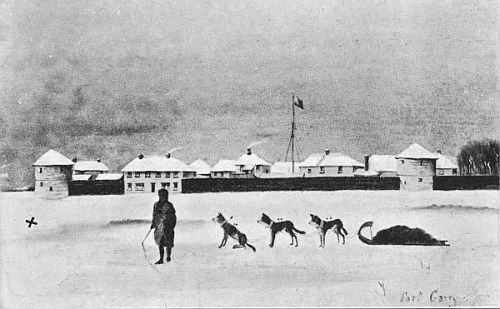
Leading posts like York Factory on Hudson Bay, Fort Garry in
the Red
River settlement, Fort Simpson on the Mackenzie River, and Fort
Victoria
on the Pacific Coast, were not only business centres, but kept alive
a Hudson's Bay Company sentiment which those who have not met it can
hardly understand. Letters were written according to the good old
style.
Not mere telegraphic summaries and business orders as at the present
day, but real news-letters—necessary and all the more valuable because
there were no newspapers in the land. The historian of to-day finds
himself led back to a very remarkable and interesting social life as he
reads the collection of traders' letters and hears the tales of retired
factors and officers. Specimens and condensed statements from these
materials may help us to picture the life of the period.
QUEER OLD PETER FIDLER.
Traditions have come down from this period of men who were far
from
being commonplace in their lives and habits. Among the most peculiar
and interesting of these was an English trader, Peter Fidler, who for
forty years played his part among the trying events preceding Governor
Simpson's time, and closed his career in the year after the union of
the Companies. The quaint old trader, Peter Fidler, is said to have
belonged to the town of Bolsover, in the County of Derby, England, and
was born August 16th, 1769. From his own statement we know that he kept
a diary in the service of the Company beginning in 1791, from which it
is inferred that he arrived in Rupert's Land about that time and was
then engaged in the fur trade. Eight years afterwards he was at Green
Lake, in the Saskatchewan district, and about the same time in Isle
à la Crosse. In this region he came into active competition with the
North-West Company traders, and became a most strenuous upholder of the
claims of the Hudson's Bay Company.
Promoted on account of his administrative ability, he is found
in the
early years of the new century at Cumberland House, the oldest post of
the Company in the interior. His length of service at the time of the
establishment of the Selkirk colony being above twenty years, he was
entrusted with the conduct
of one of the parties of settlers from
Hudson Bay to Red River.
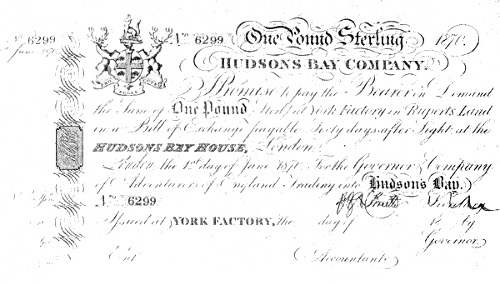
RED RIVER NOTE.
In his will, a copy of which lies before the writer, it is
made quite
evident that Fidler was a man of education, and he left his collection
of five hundred books to be the nucleus of a library which was
afterwards absorbed into the Red River library, and of which volumes
are
to be seen in Winnipeg to this day.
But Fidler was very much more than a mere fur trader. He is
called in
his will "Surveyor" and trader for the Honourable Hudson's Bay Company.
He was stated to have made the boundary survey of the district of
Assiniboia, the limits of which have been already referred to in the
chapter on Lord Selkirk. He also surveyed the lots for the Selkirk
settlers, in what was at that time the parish of Kildonan. The plan
of the Selkirk settlement made by him may be found in Amos's Trials
and in the Blue Book of 1819, and this proved to be of great value in
the troublesome lawsuits arising out of the disputes between the fur
companies. The plan itself states that the lots were established in
1814; and we find them to be thirty-six in number.
About the same time Fidler was placed in charge of the Red
River
district, and it is said that the traders and clerks found him somewhat
arbitrary and headstrong. As the troubles were coming on, and Governor
Semple had taken command of the Red River Company's fort and colony,
Fidler was placed in charge of Brandon House, then a considerable
Hudson's Bay Company Fort. He gives an account of the hostilities
between the Companies there and of the seizure of arms. He continues
actively engaged in the Company's service, and from his will being made
at Norway House, this would seem to have been his headquarters,
although
in the official statement of the administration of his effects he is
stated to be "late of York Factory."
Mr. Justice Archer Martin, in his useful book, "Hudson's Bay
Company's
Land Tenure," gives us an interesting letter of Alexander McLean to
Peter Fidler, dated 1821. This is the time of the Union of the Hudson's
Bay Company and the North-West Company. In the letter mention is made
of the departure for
New York of (Mr. Nicholas) Garry, a gentleman
of the honourable committee, and of Mr. Simon McGillivray, one of the
North-West Company. We have spoken elsewhere of Mr. Garry's visit, and
a
few years afterward Fort Garry was named after this officer.
The chief interest to us, however, centres in Fidler's
eccentric will.
We give a synopsis of it:—
(1) He requests that he may be buried at the colony of Red
River should
he die in that vicinity.
(2) He directs that his journals, covering twenty-five or
thirty
years, also four or five vellum bound books, being a fair copy of the
narrative of his journeys, as well as astronomical and meteorological
and thermometrical observations, also his manuscript maps, be given to
the committee of the Honourable Hudson's Bay Company.
(3) The books already mentioned making up his library, his
printed maps,
two sets of twelve-inch globes, a large achromatic telescope, Wilson's
microscope, and a brass sextant, a barometer, and all his thermometers
were to be taken by the Governor of the Red River colony and kept in
Government hands for the general good of the Selkirk colonists.
(4) Cattle, swine, and poultry, which he had purchased for one
hundred
pounds from John Wills, of the North-West Company, the builder of Fort
Gibraltar, were to be left for the sole use of the colony, and if any
of
his children were to ask for a pair of the aforesaid animals or fowls
their request was to be granted.
(5) To his Indian wife, Mary Fidler, he bequeathed fifteen
pounds a year
for life to be paid to her in goods from the Hudson's Bay Company
store,
to be charged against his interest account in the hands of the Company.
(6) The will required further that of all the rest of the
money
belonging to him, in the hands of the Hudson's Bay Company or the Bank
of England, as well as the legacy left him by his Uncle Jasper Fidler
and other moneys due him, the interest be divided among his children
according to their needs.
(7) After the interest of Fidler's money had been divided
among his
children till the youngest child Peter should come of age, the testator
makes the following remarkable disposal
of the residue: "All my money
in the funds and other personal property after the youngest child has
attained twenty-one years of age, to be placed in the public funds,
and the interest annually due to be added to the capital and continue
so until August 16th, 1969 (I being born on that day two hundred
years before), when the whole amount of the principal and interest so
accumulated I will and desire to be then placed at the disposal of the
next male child heir in direct descent from my son Peter Fidler" or to
the next-of-kin. He leaves his "Copyhold land and new house situated in
the town of Bolsover, in the county of Derby," after the death of Mary
Fidler, the mother of the testator, to be given to his youngest son,
Peter Fidler.
This will was dated on August 16th, 1821, and Fidler died in
the
following year. The executors nominated were the Governor of the
Hudson's Bay Company, the Governor of the Selkirk settlement, and the
secretary of the Hudson's Bay Company.
Some time after the death of this peculiar man, John Henry
Pelly,
Governor-in-Chief of the Hudson's Bay Company, Donald McKenzie,
Governor
of the Selkirk settlement, and William Smith, Secretary of the Hudson's
Bay Company, renounced the probate and execution of the will, and
in October, 1827, "Thomas Fidler," his natural and lawful son, was
appointed by the court to administer the will.
A considerable amount of interest in this will has been shown
by the
descendants of Peter Fidler, a number of whom still live in the
province
of Manitoba, on the banks of the Red and Assiniboine Rivers. Lawyers
have from time to time been appointed to seek out the residue, which,
under the will, ought to be in process of accumulation till 1969, but
no trace of it can be found in Hudson's Bay Company or Bank of England
accounts, though diligent search has been made.
STUBBORN JOHN MCLEOD.
John McLeod has already figured in our story. Coming out with
Lord
Selkirk's first party from the Island of Lewis, as one of the "twelve
or thirteen young gentleman clerks," he, as we have seen, gave a good
account of himself in the
"imminent and deadly breach," when he
defended the Hudson's Bay Company encampment at the Forks against the
fierce Nor'-Westers. His journal account of that struggle we found to
be
well told, even exciting. It further gives a picture of the fur
trader's
life, as seen with British eyes and by one of Hudson's Bay Company
sympathies.
He met at the Forks, immediately on his arrival, three chiefs
of the
Nor'-Westers. One of these was John Wills, who, as an old X Y trader,
had joined the Nor'-Westers and shortly after built Fort Gibraltar. A
second of the trio was Benjamin Frobisher, of the celebrated Montreal
firm of that name, who perished miserably; and the last was Alexander
Macdonell, who was commonly known as "Yellow Head," and afterward
became
the "Grasshopper Governor."
McLeod vividly describes the scene on his arrival, when the
Hudson's Bay
Company, as represented by trader William Hillier, formally transferred
to Miles Macdonell, Lord Selkirk's agent, the grant of land and the
privileges pertaining thereto. The ceremony was performed in the
presence of the settlers and other spectators. McLeod quaintly relates
that the three bourgeois mentioned were present on his invitation,
but Wills would not allow his men to witness the transaction, which
consisted of reading over the concession and handing it to Macdonell.
Hugh Henney, the local officer in charge of the Hudson's Bay Company
affairs, then read over the concession in French for the benefit of the
voyageurs and free traders.
McLeod relates a misadventure of irascible Peter Fidler in
dealing
with a trader, Pangman, who afterwards figured in Red River affairs.
After Henney had taken part in the formal cession, he departed, leaving
McLeod and Pangman in charge of the Hudson's Bay Company interests at
the Forks. McLeod states that prior to this time (1813), the Hudson's
Bay Company "had no house at this place," thus
disposing of a local
tradition that there was a Hudson Bay trading post at the Forks before
Lord Selkirk's time. McLeod, however, proceeded immediately to build "a
good snug house." This was ready before the return of the fall craft
(trade), and it was this house that McLeod so valiantly defended in the
following year.
During the summer McLeod found Pangman very useful in meeting
the
opposition of the North-West Company traders. Peter Pangman was a
German
who had come from the United States, and was hence called "Bostonnais
Pangman," the title Bostonnais being used in the fur-trading country
for
an American. Fidler, who had charge of the district for the Hudson's
Bay
Company, refused to give the equipment promised by Henney to Pangman.
McLeod speaks of the supreme blunder of thus losing, for the sake of a
few pounds, the service of so capable a man as Pangman. Pangman left
the Hudson's Bay Company service, joined the Nor'-Westers, and was ever
after one of the most bitter opponents of the older Company. After many
a hostile blow dealt to his opponents, Pangman retired to Canada, where
he bought the Seigniory of Lachenaie, and his son was an influential
public man in Lower Canada, Hon. John Pangman.
Events of interest rapidly followed one another at the time of
the
troubles. After the fierce onset at the Forks had been met by McLeod,
he was honoured by being sent 500 miles south-westward by his senior
officer, Colin Robertson, with horses, carts, and goods, to trade
with the Indians on the plains. This daring journey he accomplished
with only three men—"an Orkneyman and two Irishmen." In early winter
he had returned to Pembina, where he was to meet the newly-appointed
Governor, Robert Semple. McLeod states that Semple was appointed under
the resolution of the Board of Directors in London on May 19th, 1811,
first Governor of Assiniboia. From this we are led to think that Miles
Macdonell was Lord Selkirk's agent only, and was Governor by courtesy,
though this was not the case.
The unsettled state of the country along the boundary line is
shown in a
frightful massacre spoken of by McLeod. On a journey down the Red
River,
McLeod had spent a night near Christmas time in a camp of the Saulteaux
Indians. He had taken part in their festivities and passed the night in
their tents. He was horrified to hear a few days after at Pembina that
a band of Sioux had, on the night of the feast, fallen upon the camp
of Saulteaux, which was composed of thirty-six warriors, and that all
but three of those making up the camp
had been brutally killed in a
night attack. On his return to his post McLeod passed the scene of the
terrible massacre, and he says he saw "the thirty-three slain bodies
scalped, the knives and arrows and all that had touched their flesh
being left there."
McLeod was noted for his energy in building posts. He erected
an
establishment on Turtle River; and in the year after built a trading
house beyond Lake Winnipeg, at the place where Oxford House afterward
stood.
McLeod, being possessed of courage and energy, was sent west
to
Saskatchewan, where, having wintered in the district with traders Bird
and Pruden, and faced many dangers and hardships, he returned to Red
River and was among those arrested by the Nor'-Westers. He was sent to
Montreal, where, after some delay, the charge against him was summarily
dismissed. He was, while there, summoned as a witness in the case
against Reinhart in Quebec.
In Montreal McLeod was rejoiced to meet Lady Selkirk, the wife
of his
patron, from whom he received tokens of confidence and respect.
The trader had a hand in the important movement by which Lord
Selkirk
provided for his French and German dependents on the Red River, who
belonged to the Roman Catholic faith, the ordinances of religion. As
we shall see, Lord Selkirk secured, according to his promise, the two
priests Provencher and Dumoulin, and with them sent out a considerable
number of French Canadians to Red River.
McLeod's account of his part in the matter is as follows:—"On
my way
between Montreal and Quebec, I took occasion, with the help of the good
Roman Catholic priests, Dumoulin of Three Rivers, and Provencher of
Montreal, to beat up recruits for the Hudson's Bay Company service and
the colony among the French Canadians. On the opening of navigation
about May 1st, I started, in charge with a brigade of seven large
canoes, and with about forty Canadians, some with their families,
headed
by my two good friends the priests—the first missionaries in the north
since the time of the French before the conquest. Without any loss or
difficulty, I conducted the whole through to Norway House, whence in
due course they were taken in
boats and schooner to Red River. At
this place we had a navy on the lake, but lately under the command
of Lieutenant Holt, one of the victims of 1816. Holt had been of the
Swedish navy."
At Norway House McLeod's well-known ability and
trustworthiness led
to his appointment to the far West, "and from this time forth his
field was northward to the Arctic." He had the distinguished honour of
establishing a permanent highway, by a line of suitable forts and trade
establishments to the Peace River region. While in charge of his post
he
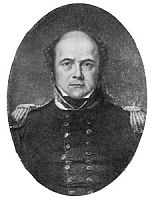
had the pleasure of entertaining Franklin (the noble Sir John) on his
first Arctic land expedition, and afterwards at Norway House saw the
same distinguished traveller on his second journey to the interior of
the North land.
After the union of the Companies, McLeod, now raised to the
position of
Chief Trader, was the first officer of the old Hudson's Bay Company to
be sent across the Rocky Mountains to take charge of the district in
New Caledonia. Among the restless and vindictive natives of that region
he continued for many years with a good measure of success, and ended
up a career of thirty-seven years as a successful trader and thorough
defender of the name and fame of the Hudson's Bay Company, by retiring
to spend the remainder of his days, as so many of the traders did, upon
the Ottawa River.
WILLARD FERDINAND WENTZEL'S
DISLIKES AND THE NEW RÉGIME.
Wentzel was a Norwegian who had entered the North-West Company
in
1799, and spent most of his time in Athabasca and Mackenzie River
districts, where he passed the hard life of a "winterer" in the
northern
department. He was intelligent, but a mimic—and this troublesome
cleverness prevented his promotion in the Company. He co-operated with
Franklin the explorer in his journey to the Arctic Ocean. Wentzel was
a musician—according to Franklin "an excellent musician." This talent
of his brightened the long and dreary hours of life and contributed to
keep all cheerful around him. A collection of the voyageur songs made
by him is in existence, but they are somewhat gross. Wentzel married
a Montagnais Indian
woman, by whom he had two children. One of them
lived on the Red River and built the St. Norbert Roman Catholic Church
in 1855. From Wentzel's letters we quote extracts showing the state of
feeling at the time of the union of the fur companies in 1821 and for a
few years afterwards.
March 26th, 1821.—"In Athabasca, affairs
seem to revive; the natives
are beginning to be subjected by the rivalship in trade that has been
carried on so long, and are heartily desirous of seeing themselves once
more in peaceable times, which makes the proverb true that says, 'Too
much of a good thing is good for nothing.' Besides, the Hudson's Bay
Company have apparently realized the extravagance of their measures;
last autumn they came into the department with fifteen canoes only,
containing each about fifteen pieces. Mr. Simpson (afterward Sir
George), a gentleman from England last spring, superintends their
business. His being a stranger, and reputedly a gentlemanly man, will
not create much alarm, nor do I presume him formidable as an Indian
trader. Indeed, Mr. Leith, who manages the concerns of the North-West
Company in Athabasca, has been so liberally supplied with men and goods
that it will be almost wonderful if the opposition can make good a
subsistence during the winter. Fort Chipewyan alone has an equipment
of no less than seventy men, enough to crush their rivals." (Editor's
note.—Another year saw Simpson Governor of the United Company.)
April 10th, 1823.—"Necessity rather than
persuasion, however,
influenced me to remain; my means for future support are too slender
for me to give up my employment, but the late revolution in the affairs
of the country (the coalition of the Hudson's Bay Company with the
North-West Company in 1821) now obliges me to leave it the ensuing
year,
as the advantages and prospects are too discouraging to hold forth a
probability of clearing one penny for future support. Salaries do not
exceed one hundred pounds sterling, out of which clerks must purchase
every necessity, even tobacco, and the prices of goods at the Bay are
at
the rate of one hundred and fifty or three hundred per cent. on prime
cost, therefore I shall take this opportunity of humbly requesting your
advice how to settle my
little earnings, which do not much exceed five
hundred pounds, to the best advantage."
March 1st, 1824.—"Respecting the concerns
of the North-West
(country), little occurs that can be interesting to Canada. Furs have
lost a great deal of their former value in Europe, and many of the
chief
factors and traders would willingly compound for their shares with the
Company for one thousand five hundred pounds, in order to retire from a
country which has become disgusting and irksome to all classes. Still,
the returns are not altogether unprofitable; but debts,
disappointments,
and age seem to oppress everyone alike. Engagés'
prices are now
reduced to twenty-five pounds annually to a boute (foreman), and twenty
pounds to middlemen, without equipment or any perquisites whatever.
In fact, no class enjoys the gratuity of an equipment. Besides, the
committee at home insist upon being paid for families residing in posts
and belonging to partners, clerks, or men, at the rate of two shillings
for every woman and child over fourteen years of age, one shilling for
every child under that age. This is complained of as a grievance by all
parties, and must eventually become very hard on some who have large
families to support. In short, the North-West is now beginning to be
ruled with a rod of iron." (Evidently Wentzel is not an admirer of the
new régime.)
FINLAY'S SEARCH FOR FUR.
The name of Finlay was a famous one among the traders. As we
have seen,
James Finlay was one of the first to leave Montreal, and penetrate
among the tribes of Indians, in search of fur, to the far distant
Saskatchewan. His son James was a trader, and served in the firm of
Gregory, McLeod & Co. As was not uncommon, these traders had
children by
the Indian women, having a "country marriage," as it was called. As the
result of these there was connected with the Finlay family a half-breed
named Jaceo, or Jacko Finlay, who took his part in exploration in the
Rocky Mountains in company with David Thompson. Besides these, there
was
a well-known trader, John Finlay, who is often difficult to separate
from the other traders of the name.
The writer has lying before him a manuscript, never hitherto published,
entitled "A Voyage of Discovery from the Rocky Mountain Portage in
Peace
River, to the Sources of Finlay's Branch, and North-Westward: Summer,
1824." This is certified by Chief Factor McDougall, to-day of Prince
Albert, to be the journal of John Finlay. As it illustrates the methods
by which the fur country was opened, we give a few extracts.
May 13th.—"Rainy weather. In the evening,
left Rocky Mountain
Portage establishment. Crossed over to the portage and encamped for the
night.... The expedition people are as follows: six effective canoe
men, Joseph Le Guard, Antoine Perreault (bowman), Joseph Cunnayer, J.
B. Tourangeau, J. M. Bouche, and Louis Olsen (middleman), M. McDonald,
Manson, and myself, besides Le Prise, and wife, in all ten persons. Le
Prise is in the double capacity of hunter and interpreter."
Finlay speaks of "The existing troubles in this quarter caused
by
the murderers of our people at St. John's, roving about free and, it
is said, menacing all; but as this is an exploratory voyage, and the
principal motive to ascertain the existence of beaver in the country we
are bound for, we shall do our best to accomplish the intentions of the
voyage."
17th.—"Encamped at the hill at the little
lake on the top of the
hills at the west side of the Portage. Mr. M. shot a large fowl of the
grouse kind, larger than the black heath cock in Scotland. Found some
dried salmon in exchange with Mr. Stunt for pemmican—a meal for his
men, and this year he seems independent of the Peace River, at least as
far as Dunvegan: they have nothing in provisions at the Portage."
Finlay is very much in the habit of describing the rock
formations seen
on his voyage. His descriptions are not very valuable, for he says,
"I am not qualified to give a scientific description of the different
species and genera of the different substances composing the strata of
the Rocky Mountains."
22nd May.—"In this valley, about four miles
before us right south,
Finlay's branch comes in on the right: a mile and a half below Finlay's
branch made a portage of five hundred paces. At a rapid here we found
the Canny cache (a hiding place for valuables);
said to be some beaver
in it of last year's hunt."
23rd.—"Met a band of Indians, who told us
they were going up the
small river—(evidently this had been named after the elder Finlay, as
this instances its familiarity)—on the left, to pass the summer, and a
little before another river on the right; that there were some beavers
in it, but not so many as the one they were to pass the summer in."
24th.—"To-day some tracks of the reindeer,
mountain sheep and goats,
but the old slave (hunter) has killed nothing but a fowl or beaver now
and then."
25th.—"I have never seen in any part of the
country such luxuriance
of wood as hereabout, the valley to near the tops of the mountains on
both sides covered with thick, strong, dark-green branching pines. We
see a good many beaver and some fowl, game (bustards), and duck, but
kill few."
Finlay declares to the slave, the hunter of his party, his
intention to
go up the large branch of the Finlay. "This is a disappointment to him
as well as to the people, who have indulged their imaginations on this
route falling on the Liard River, teeming in beaver and large animals."
7th June. —"This afternoon we have seen a
great deal of beaver work,
and killed some bustards and Canadian grey geese; we have seen no
swans,
and the ducks, with few exceptions, are shabby."
Finlay gives a statement of his journey made so far, thus:—
| Rocky Mountain Portage to entrance
of Finlay's Branch |
6 days. |
| To Deserter's Portage |
4 " |
| To Large Branch |
5 " |
| To Point Du Mouton |
4 " |
| To end of Portage |
4 " |
| To Fishing Lakes |
3 " |
|
26 days. |
FINLAY GIVES HIS VIEWS AS TO
A "BEAVER COUNTRY."
"In some of the large rivers coming into Finlay's branch,
where soft
ground with wood, eligible for beaver, had been accumulated, beaver
were
to be found. Otherwise, except such places as here and here, the whole
country is one continued mountain valley of rock and stone, and can by
no means come
under the denomination of a beaver country, in the common
acceptation of the word, on the waters of the Hudson's Bay and
Mackenzie
River."
June 15th.—"Very fine warm weather; huge
masses of snow falling
down from the mountains with a noise resembling thunder. Those snow
déboules seem irresistible, shivering the trees to
atoms, carrying
all clean before them, forming ruins as if the Tower of Babel or the
Pyramids of Egypt had been thrown down from their foundations."
June 29th.—"Made a good fishery to-day: 7
trout, 12 carp, 1 small
white fish, like those at McLeod's lake in Western Caledonia."
Finlay closes his Journal of seventy-five closely-written
quarto pages
at the lake high in the mountains, where he saw a river rising. This
lake we see from the map to be the source of the Liard River.
A TRUSTED TRADER AND HIS
FRIENDS.
Not very long ago it was the good fortune of the writer to be
in
Edinburgh. He was talking to his friend, a well-known Writer to the
Signet. The conversation turned on the old fur-trading days, and in a
short time author and lawyer found themselves four stories high, in a
garret, examining boxes, packages, and effects of James Hargrave and
his
son Joseph, who as fur traders, father and son, had occupied posts in
the Hudson's Bay Company service extending from 1820 to 1892.
Several cases were filled with copies of a book entitled "Red
River,"
published by the younger Hargrave in 1871. Other boxes enclosed the
library of father and son. Two canvas bags contained many pounds of new
farthings, which, by some strange mischance, had found their way to the
Hudson Bay and had been returned as useless. Miscellaneous articles of
no value to the searchers lay about, but in one large valise were many
bundles of letters. These were done up in the most careful manner. The
packages were carefully tied with red tape, and each, securely sealed
with three black ominous seals, emphasized the effect of the directions
written on them, in some cases "to be opened only by my son," in
others,
"to be opened only
by my children." After some delay the permission of
the heirs was obtained, and the packages were opened and examined.
They were all letters written between 1821 and 1859 by
fur-trading
friends to James Hargrave, who had carefully preserved them, folded,
docketed, and arranged them, and who had, in the last years of his
life at "Burnside House," his residence at Brockville, Canada, kept
the large correspondence as the "apple of his eye." The vast majority
of the letters, numbering many hundreds in all, had been addressed to
York Factory. For most of his life Hargrave had been in charge of York
Factory, on Hudson Bay. York Factory was during the greater part of
this fur trader's life, as it had been for more than a century before
his time, the port of entry to which goods brought by ship from Britain
had been borne to the interior of Rupert's Land, and also the port
from which the ships had carried their precious cargoes of furs to the
mother country. James Hargrave had thus become the trusted
correspondent
of governor and merchant, of bishop and clergyman, of medical man and
educationist. He was emphatically a middleman, a sort of Janus, looking
with one face to the London merchants and with the other to the
dwellers
in Rupert's Land.
But Hargrave was also a letter-writer, and a receiver of many
news
letters and friendly letters, a man who enjoyed conversation, and when
this could not be had with his friends tête-à-tête,
his social chats
were carried on by means of letters, many months and even years apart.
By degrees he rose in the service. From the first a friend of the
emperor-governor, he has the good wishes of his friends expressed for
his first rise to the post of chief trader, which he gained in 1833,
and
by-and-by came his next well-deserved promotion to be chief factor in
1844.
Along with all these letters was a book handsomely bound for
keeping
accounts and private memoranda. This book shows James Hargrave to have
been a most methodical and painstaking man. In it is contained a list
of all the promotions to official positions of commissioned officers
for nearly forty years, from the Atlantic to the Pacific. Here also is
an account of his
investments, and the satisfactory statement that,
during his nearly forty years of service, his shares of the profits,
investments, and re-investments of what he did not use, allowed him to
retire from active service with, as the result of his labour, about
8,700l.
The writer has sought to glean from the hundreds of letters in
the
Edinburgh garret what is interesting in the life of Rupert's Land, so
far as is shown in the writing and acting of this old fur trader and
his
friends.
Many of the letters are from Governor Simpson. These letters
of the
Governor are chiefly written from Red River or Norway House—the
former the "Fur Traders' Paradise," the latter the meeting-place of
the Council, held once a year to decide all matters of business.
Occasionally a letter of the Governor's is from Bas de la Rivière (i.e.
the mouth of the Winnipeg River), written by that energetic officer, as
might be said, "on the wing," and in a few cases from London, England,
whither frequently Governor Simpson crossed on the business of the
Company.
Governor Simpson's remarks as to society in Red River, 1831,
are keen
and amusing:—"As yet we have had one fête, which was honoured by the
presence of all the elegance and dignity of the place from his
Reverence
of Juliopolis (Bishop Provencher) down to friend Cook, who (the latter)
was as grave and sober as a bishop.... By-the-bye, we have got a very
'rum' fellow of a doctor here now: the strangest compound of skill,
simplicity, selfishness, extravagance, musical taste, and want of
courtesy, I ever fell in with. The people are living on the fat of the
earth, in short, Red River is a perfect land of Canaan as far as good
cheer goes.... Do me the favour to pick out a couple pounds of choice
snuff for me and send them by Mr. Miles."
A short time after this, Governor Simpson, writing, says,
speaking of
the completion of St. John's Church, afterward the Cathedral Church,
and referring to the discontent of the Selkirk settlers, with which he
had small sympathy, "We have got into the new church, which is really a
splendid edifice for Red River, and the people are less clamorous about
a Gaelic minister than they were." The good Governor had his pleas ant
fling at the claim made by the Highlanders to have their private stills
when he says, "And about whiskey they say not one word, now that rum
is so cheap, and good strong 'heavy wet' in general use." Speaking of
one of the chief officers who was off duty, the Governor says "Chief
Factor Charles is like a fish out of water, having no musquash to
count,
nor Chipewyans to trade with; he is as brisk and active as a boy, and
instead of showing any disposition to retire, wishes to volunteer to
put a finishing hand to the as yet fruitless attempt at discovering the
North-West passage."
Governor Simpson knows well the art of flattery, and his skill
in
managing his large force of Company officers and men is well seen. He
states to Hargrave that he once predicted at the board that the traders
of York Factory would yet have a seat at the Board. This, he stated,
gave mortal offence to some members, but he was to bear the prediction
in mind. He compliments him on sending the best-written letter that he
has received for a long time, and we find that in the following year
Hargrave was made Chief Trader. This was the occasion for numerous
congratulations from his friends Archdeacon Cochrane of Red River,
Trader Sieveright, and others.
The news of the time was common subject of discussion between
the
traders in their letters. Governor Simpson gave an account of the
outbreak of cholera in the eastern states and provinces, and traces
in a very graphic way its dangerous approach towards Rupert's Land.
Up to August, 1832, fifteen hundred people had died in Montreal. The
pestilence had reached Mackinaw, and two hundred of the steamboat
passengers were carried off, and some near Sault Ste. Marie. "God
grant," says the Governor, "it may not penetrate further into our
wilds,
but the chances are decidedly against us."
That the Hudson's Bay Company officers were not traders only
is made
abundantly evident. In one of his letters, Governor Simpson states that
their countryman, Sir Walter Scott, has just passed away, he thanks
Hargrave for sending him copies of Blackwood's Magazine,
and orders
are often given for fresh and timely books. A little earlier we find
the minute interest which the fur traders took in public events in
a letter from Chief Factor John Stuart, after whom Stuart's Lake, in
New Caledonia, was named. He speaks to Hargrave of the continuation of
Southey's "History of the War of the Peninsula" not being published,
and we know from other sources that this History fell still-born, but
Stuart goes on to say that he had sent for Col. Napier's "History of
the Peninsular War." "Napier's politics," says Stuart, "are different,
and we shall see whether it is the radical or a laurel (Southey was
poet laureate) that deserves the palm." These examples but illustrate
what all close observers notice, that the officers of the Hudson's Bay
Company not only read to purpose, but maintained a keen outlook for the
best and most finished contemporary literature. Much additional
evidence
might be supplied on this point.
All through Governor Simpson's letters there is a strain of
sympathy
for the people of the Company that is very beautiful. These show that
instead of being a hard and tyrannical man, the Governor had a tender
heart. In one of his letters he expresses sympathy for Trader Heron,
who
had met misfortune. He speaks of his great anxiety for a serious
trouble
that had arisen in Rev. Mr. Jones's school at Red River, and hopes that
it may not injure education; he laments at considerable length over Mr.
J. S. McTavish's unfortunate accident. Having heard of Hargrave's long
illness he sends a letter of warm sympathy, and this in the midst of a
flying visit, and in London in the following year pays every attention
by giving kind, hospitable invitations to Hargrave to enjoy the society
of himself and Lady Simpson.
The racy letters of Governor Simpson are by no means more
interesting
than those of many others of Hargrave's friends. Ordinary business
letters sometimes seem to have a humorous turn about them even fifty
years after they were written. The Roman Catholic Bishop Provencher
(Bishop of Juliopolis in partibus infidelium)
affords an example
of this. He writes in great distress to Hargrave as to the loss of
a cask of white wine (une barrique de vin blanc). He
had expected
it by the York boats sent down by the great Red River merchant,
Andrew McDermott.... The cask had not arrived. The good Bishop cannot
understand it, but presumes, as it is December
when he writes, that it
will come in the spring. The Bishop's last remark is open to a double
meaning, when he says, "Leave it as it is, for he will take it without
putting it in barrels."
The Bishop in a more important matter addresses Governor
Simpson,
and the Governor forwards his letter to York Factory. In this Bishop
Provencher thanks him for giving a voyage in the canoes, from Red River
to Montreal, to Priest Harper, and for bringing up Sub-Deacon Poiré,
a "young man of talent." He also gives hearty thanks for a passage,
granted by the Governor on the fur traders' route from the St.
Lawrence,
to two stonemasons. "I commence," he said, "to dig the foundation of my
church to-morrow." He asks for a passage down and up for members of his
ecclesiastical staff. He wants from York Factory forty or fifty hoes
for
Mr. Belcour to use in teaching the Indians to cultivate potatoes and
Indian corn, and he naïvely remarks, "while thus engaged, he will at
the same time cultivate their spirits and their hearts by the preaching
of the Word of God." The eye for business is seen in the Bishop's final
remark that he thinks "that the shoes from the Bay will cost much less
than those made by the smiths at Red River."
Archdeacon Cochrane, a man of gigantic form and of amazing bonhomie,
who has been called the "founder of the Church of England on Red
River,"
writes several interesting letters. Beginning with business he drifts
into a friendly talk. One of his letters deals with the supplies for
the
school he had opened (1831) at St. Andrew's, Red River, another sings
the praises of his new church at the rapids: "It is an elegant little
church, pewed for three hundred and forty people, and finished in the
neatest manner it could be for Red River. The ceiling is an arc of an
ellipse, painted light blue. The moulding and pulpit brown; the jambs
and sashes of the windows white."
A little of the inner working of the fur-trading system in the
predominance of Scottish influence is exhibited by Archdeacon Cochrane
in one letter to Hargrave. Referring to Hargrave's promotion to the
chief tradership, not yet bestowed, the old clergyman quaintly says,
"Are you likely to get another feather in your cap? I begin to think
that your name will have to be changed into MacArgrave. A 'mac' before
your name would produce
a greater effect than all the rest of your
merits put together. Can't you demonstrate that you are one of the
descendants of one of the great clans?"
Among the correspondence is a neat little note to Hargrave
(1826) from
Rev. David Jones, the Archdeacon's predecessor, written at Red River,
asking his company to a family dinner on the next Monday, at 2 p.m.;
and
a delicate missive from Acting-Governor Bulger, of Red River, asking
Hargrave to accept a small quantity of snuff.
Among Hargrave's correspondents are such notable fur traders
as Cuthbert
Grant, the leader of the Bois Brûlés, who had settled down on White
Horse Plains, on the Assiniboine River, and was the famous captain of
the buffalo hunters; and William Conolly, the daring Chief Factor of
New
Caledonia. Events in Fort Churchill are well described in the extensive
correspondence of J. G. McTavish, long stationed there; and good
Governors Finlayson and McMillan of Red River are well represented; as
well as Alexander Ross, the historian of the Red River affairs. A full
account of the wanderings from York Factory to the far distant Pacific
slope of Mr. George Barnston, who afterwards was well known in business
circles as a resident of Montreal, could be gathered, did time permit,
from a most regular correspondence with Hargrave.
Probably the man most after the York Chief Factor's own heart
was a
good letter writer, John Sieveright, who early became Chief Trader and
afterwards Chief Factor in 1846. Sieveright had become acquainted with
Hargrave at Sault Ste. Marie. Afterwards he was removed to Fort
Coulonge
on the Upper Ottawa, but he still kept up his interest in Hargrave
and the affairs of Rupert's Land. Sieveright has a play of humour and
pleasant banter that was very agreeable to Hargrave. He rallies him
about an old acquaintance, the handsome daughter of Fur Trader
Johnston,
of Sault Ste. Marie, who, it will be remembered, married an Indian
princess. He has a great faculty of using what other correspondents
write to him, in making up very readable and well written letters to
his
friends.
For many years Sieveright was at Fort Coulonge, and thus was
in touch
with the Hudson's Bay Company house at
Lachine, the centre of the fur
trade on this continent. Every year he paid a visit to headquarters,
and had an advantage over the distant traders on the Saskatchewan,
Mackenzie, and Nelson Rivers. He, however, seemed always to envy them
their lot. Writing of Fort Coulonge, he gives us a picture of the fur
trader's life: "This place has the advantage of being so near the
civilized world as to allow us to hear now and then what is going on
in it; but no society or amusement to help pass the time away. In
consequence I cannot help reading a great deal too much—injurious at
any time of life—particularly so when on the wrong side of fifty.
I have been lately reading John Galt's 'Southernan,' not much to be
admired. His characters are mostly all caricatures. If place will be
allowed in paper trunk, I shall put that work and 'Laurie Todd' in for
your acceptance."