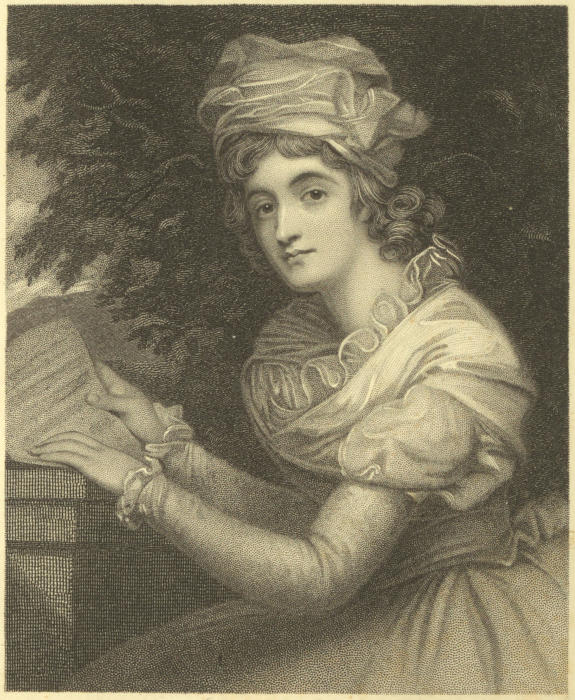
THE REMAINS OF THE LATE MRS. RICHARD TRENCH. — THE REMAINS OF THE LATE MRS. RICHARD TRENCH.
Engraved by Francis Holl, from a picture by Romney,
in the possession of the Revᵈ. Frances Trench.
Published by Parker, Son and Bourn, West Strand 1862.
THE REMAINS OF THE LATE
MRS. RICHARD TRENCH, BEING Selections from her Journals, Letters, & other Papers.
EDITED BY HER SON,
THE DEAN OF WESTMINSTER.
LONDON:
PARKER, SON, AND BOURN, WEST STRAND. 1862.
The right of Translation is reserved.
LONDON:
SAVILL AND EDWARDS, PRINTERS, CHANDOS STREET,
COVENT GARDEN.
PREFACE.
It may wear an appearance of boldness, and even of
pretension, to offer to the world the literary
‘Remains’ of one who had no name in literature. I
must leave the step which I have taken to justify
itself; as, if it does not do so, certainly no words of
mine will justify it.
In making public this selection from my Mother’s
literary ‘Remains,’ I am as far as possible from
wishing to present these as materials of a life,
or as contributions to one. It is only the fact, that
the more valuable among them consist of letters and
fragments of journals, such as naturally are best read
in a chronological order, and indeed could hardly be
presented in any other, that gives my book the
remote appearance of such. Even this I would
willingly have avoided, if it had been possible; for
the adage, whether true or not in its first application,
is certainly true concerning the English matron—Bene
vixit, quæ bene latuit; so that it is only reluctantly,
and by the necessities of the work in which I
am engaged, that I at all disturb this sacred obscurity;
as assuredly I have no desire to bring into
public gaze any of those many incidents which, deeply
interesting to the members of a family, can have no
interest to any beyond. But without some few biographical
notices connecting these letters and other
papers, I must either have withdrawn many of them
as unintelligible, or left them to be very imperfectly
understood. I soon then felt, that only by doing a
certain violence to a just feeling of reserve, could I
avoid, in one of these ways or the other, serious injury
to whatever interest the book might possess; even as
in other respects also this feeling of reserve must up
to a certain point be overcome. This, however, is
the law and limit of the narration, that whatever is
not absolutely necessary to elucidate, illustrate, or
explain the published ‘Remains,’ is passed by.
Unfortunately, the materials which came two years
ago into my hands, are very incomplete as compared
with what they might have been; and it is now
impossible for me to know by what accident they have
mainly suffered. Of my Mother’s journals, especially
of those kept during the earlier part of her life, very
far the greater portion has perished, or, at any rate,
gone hopelessly astray. The volumes, or, fascicles,
consisting for the most part of loose sheets of paper,
not very carefully sewn together, with or without
covers, may seem in some measure to have provoked
their fate. Yet this would rather explain occasional
deficiencies than account for so sweeping a disappearance,
leaving only here and there a fragment surviving.
At the same time, the largest of these fragments
contains her visit to Germany in 1799-1801, no
doubt the portion having most novelty and interest;
although even this is imperfect, and comes to an
abrupt termination, leaving no record of the later
months of her tour. Her journals of later years have
all, I believe, reached my hands; but at this time
they much less deserve this name than they did at an
earlier date, containing only occasional entries, with
no attempt at continuity.
As it is with the journals, so it is also with the
letters. During the years, now nearly thirty-five,
which have elapsed since my Mother’s death, all, or
nearly all her cotemporaries, all her correspondents,
whose deaths had not already preceded her own,
have passed away, and the papers of most of them
have been either scattered or destroyed. It has thus
come to pass that I have only two or three series of
letters at all approaching to completeness. Of her
letters to some, with whom for years she maintained
a lively correspondence—as, for instance, ‘the ladies
of Llangollen’—I do not possess a single specimen;
while of those to two others, the most intimate
friends of her life, I should be equally destitute, if
she had not in later years entered now and then in
her journal, and as constituting a portion of this,
copies in whole or in part of the most interesting. I
suppose that much the same must always in such
cases be expected; but to me my inability to recover
more has proved a disappointment; for I have thus
only remains of her ‘Remains’ from which to make
my selection. In connexion with this matter, I will
only say in conclusion how deeply thankful I should
be to any who, possessing any of her letters, should
be willing to entrust them to my care, to make such
discreet use of them as to me might seem good, if
hereafter opportunity of this should occur.
Westminster,
March 10th, 1862.
REMAINS, ETC. — CHAPTER I. 1768-1799. — COLONEL CRADOCK TO MRS. ST. GEORGE.
My Mother, Melesina Chenevix, was the only child of the
Rev. Philip Chenevix and of his wife, Mary Elizabeth,
daughter of Archdeacon Gervais. Her father was the son (at
his marriage the sole surviving child) of Richard Chenevix,
Bishop of Waterford, Lord Chesterfield’s correspondent, and
is often playfully alluded to as ‘the young bishop’ in his
Lordship’s letters.[1] In a brief sketch of her grandfather’s
life, it is explained how the familiarity and confidence, which
breathe in every line of Lord Chesterfield’s letters to the
Bishop, grew up between them. It is as follows:—
My grandfather was educated at the University of
Cambridge, took holy orders, married Dorothea, of
whom I only know she was the sister of Admiral
Dives, and much beloved by Queen Caroline. On
Lord Chesterfield’s appointment as Ambassador Extraordinary
to the States-General at the Hague, in
1728, my grandfather was recollected at court as a
person whose political information and accurate knowledge
of the French language would make him peculiarly
useful, while his high principles and scrupulous
delicacy fitted him for an unlimited confidence. He
was accordingly named chaplain to Lord Chesterfield,
and during the embassy gained the esteem of all
parties. The Prince of Orange treated him with
peculiar distinction, and presented him at parting
with his picture and those of his family, together with
a massive silver cup, engraven with the Stadtholder’s
arms.[2] So great an impression did his talents and
conduct make in this situation, that the wife of the
Hereditary Prince of Brunswick, who was born very
many years after his residence at the Hague, spoke to
me of him in 1800 as one familiar with his character,
having often heard his eulogium from her grandfather
and grandmother. Lord Chesterfield conceived the
warmest friendship for him; and till the hour of his
death paid him the respect of appearing to him a strict
friend to religion and morality, insomuch that my
grandfather was really acquainted only with the
bright side of this dazzling but imperfect character.
On Lord Chesterfield’s appointment to the Lord-Lieutenancy
of Ireland, he recommended my grandfather
to a bishopric, and enforced his recommendation,
when he was answered that ‘the King wished he
would look out for another bishop,’ by replying, that
‘he wished the King would look out for another Lord-Lieutenant.’[3]
On this my grandfather was immediately
appointed Bishop of Killaloe, and in a few
months translated to Waterford. There he resided
thirty-three years, and there, in 1779, he died, after
a long life of primitive purity and continually active
and often splendid benevolence; having survived two
daughters, as well as Philip, his beloved and exemplary
son, leaving only one grand-daughter, Melesina,
writer of these memoranda.
Born in 1768, she had lost before her fourth birthday both
her parents by death. I find among her papers, without
date, but certainly belonging to later years, some brief recollections
of her childhood, why, and for whom, written will be
gathered from the introductory sentences:—
It is your desire that I should write some recollections
of the past. Unaccustomed to order and precision
in the use of my pen as I am, they will be
incoherent and desultory, perhaps uninteresting.
But I feel that compliance with your wishes is to me
a sort of destiny; and therefore, however I may fail
in the execution, since you desire it, I am compelled
to make the attempt.
Whatever faults I may have, I do not inherit them
from my parents. They were all love and gentleness,
piety and benevolence; fondly attached to each other,
and removed from this world by an early death, which
seemed to have no terrors for either. Their separation
was short, and I trust their reunion eternal. My
paternal grandfather was one of those guileless,
humble, benevolent, firm, affectionate, and pious
characters, rarely seen, and never duly appreciated;
particularly when a species of naïveté, which, for want
of a better name, the world calls simplicity, is blended
with these qualities. He was learned, active, and
diligent, both in the performance of his duties and
the cultivation of his mind, to the last hour of a life
prolonged beyond the age of fourscore.
I have a dim recollection of my father in some
playful scene; and of my mother conversing mildly
with me, once taking from me some paper figures
with which she found it impossible to please me by
repeated alterations; and again, kneeling in her
widow’s weeds, after my father’s death, and praying
silently, at Clifton, where she went for the cure of
that consumption she had caught in her tender and
unwearied attendance upon him in the South of
France.[4] It seemed as if her death, which soon
followed his, interrupted the progress of my ideas, for
I have then no distinct recollection of anything till
that period of my infancy which found me with my
paternal grandfather, my fondly attached nurse, Alice
Cornwall, ‘the abstract and brief chronicle of the
times;’ and a governess whom I thought old—I know
not her age—with a very long face, a very long waist,
and a stocking in her hand, which she knitted so
perseveringly it seemed a part of herself; and a
determination to rule by rigour, to pass nothing, to
correct seldom, but then to do it with effect. The fear
and distaste I had for her is indescribable. It was
increased by the arrival of a large, coarse, furious-looking
maid, who I understood was to replace my
own Ally, the only remaining creature of the little
group, all gentleness and joy, that I had been used
to love. I shall not dwell on the cruelties I suffered,
possibly from the best intentions; but they have
impressed me with a deep horror of unkindness to the
young, and of all that is fierce or despotic in every
shape. My grandfather was deaf, and confined by
infirmity to his chair. I had an aversion to complaint,
and what is most singular, and to me now unaccountable,
I never did complain to him; and I
believe children suffer much rather than do so, partly
from fear of worse treatment, and sometimes partly
from generosity; they vaguely conceive their father’s
house is all the world, and that the servant or governess
dismissed at their instance, is dismissed to be an
homeless wanderer for life. At least, this appears to
me to have been the principal, perhaps the only, cause
that restrained me.
My health, however, sunk under restraint, fear,
and inflictions of every kind, combined with want of
fresh air, and insufficient food. The two last privations
were for the good of my health and beauty, both
which they materially injured. The smooth, smiling
cheek, affectionately remembered even now by those
who cherished my childhood as being ‘round as an
apple,’ grew pale and wan; the body delicate; the
elastic step listless; and in all the useless and encumbering
embonpoint of my present existence, I still
shudder when I call to mind the thinness of my neck
and arms.
I was the best little child possible. Happy had I
been, if such dispositions as I then possessed had been
cherished, and the faults which afterwards sprung up
eradicated. I was obedient and loving, docile and
lively, although timid. I do not remember the
smallest disposition to falsehood or mischief, and I
sympathized with every being that felt. I pined
away so rapidly under the new régime, it was necessary
to call in the physicians, and to recal my nurse.
The symptoms of danger disappeared, and the physicians
had the honour of the amendment produced by
the good Alice Cornwall. Cure it could not be called,
for I remained miserably thin; and the delicacy of
my form, the brightness of my large black eyes, and
the premature intelligence of mind and countenance
produced by love and suffering, combined with early
change of society and place, I am told gave something
unearthly to my whole appearance. I remember those
addressing me as a fairy queen, an Ariel, a sylph, who
spoke to me in sportive kindness; but these were
few; for I lived among the old, and old age was then
less gracious, particularly to the young, than it is
now.
Before I ceased to be a child, my good and kind,
nay, doting grandfather, died. He had not made me
happy, though he had tried to do so; nay, he had not
prevented me from being miserable. But I felt he
loved me more than all the world; and without knowing
the value of deep and exclusive love, I regretted
him, both from gratitude and from affection.
From him I went to my dear, ever dear Lady
Lifford; my tender, kind, and constant friend. Once
seen, she was ever known. She realized all the
poetical delineations of feminine gentleness and sensibility;
my heart clung to her from the first moment;
and even now her dear idea mingles with my deepest
and tenderest thoughts. She was the lovely mother
of three affectionate children, whom she educated
with suavity and apparent indulgence; but although
we seemed to do as we liked, in fact we were doing
all that she wished. How happy was the ensuing
year, how full it appears when I look back; its
bright rays set off by the dark hours which preceded
and followed. I never heard the tone, or saw the
look, of reproach; I cannot remember even that of
the mildest reproof. What an enjoyment was the
free air, and use of my own limbs, bounding along
an extensive park, or inhaling and admiring beds of
flowers. The woods, the garden, the deer, the peacocks,
the sports of childhood, the voice of joy, even
the cheerfulness of a well-regulated large English
family, were all sources of joy. What a contrast to
privation, severity, restraint, confinement; for I had
never walked but in a walled garden, except when
occasionally sent to the seashore to bathe. What a
contrast to seeing none but the aged, the infirm, the
severe, and being ever under the eye of a rigid
governess. How delightful was it to me to find
myself caressed, applauded. Applause was not quite
so new a feeling as might have been wished; for I
had been sent one night in my dear grandfather’s
life, to a fancy ball, dressed as Sterne’s Maria, with
my favourite little dog in a string, and I had drunk
deep, fatally deep, of the intoxicating draught of delusive
admiration paid to personal appearance. It was
a dangerous experiment, and I can trace to it many
of the tares which sprung up in my young heart.
My young affections entwined about Lady Lifford,
and her children, Ambrosia, George, Elizabeth. All
this dear group are vanished;
‘How populous, how vital is the grave.’
I was near a year older than the eldest; I had
great influence over them; I was the leader in their
sports, and each sought with eager competition for
the largest share of my love. I gave it to George,
yet, from instinct, I suppose, I sometimes teased him,
though never his sisters. I would say, ‘George, you
do not love me,’ and express doubts of his affection,
till the large bright drops forced themselves from his
mild hazel eyes, and then I would console him with
the softest kindness, till I drew him from under the
sofa, the place where he usually flung himself to hide
his young sorrows. This strange exertion of feminine
power over a child of nine by one three years
older; was it instinct, or a species of coquetry
awakened by having read in my grandfather’s study,
Shakspeare, Ovid’s Metamorphoses, Sterne, The Arabian
Nights, an abundance of plays, and several works of
imagination, which, describing the influence of female
charms as invincible, excited an early desire to try
their force? This childish exercise of power stands
alone. I do not recollect any other instance of the
slightest propensity to tyrannize; on the contrary, I
did all I could to promote the pleasure of my companions,
and even in points where I had any advantages
over them, to be careful they should never feel
it. I was their surest confidante, their most disinterested
adviser, and in sickness their tenderest and
most unwearied nurse. This looks too much like
praising of myself, yet what can I do? The kindly
qualities I have mentioned are compatible with a
thousand faults, of which the germs were but slightly
developed in these youthful days.
Some other fragmentary reminiscences of childhood, I do
not know at what time written, but I am inclined to
think of earlier date than those which have just been given,
dwell with more fulness on the graces and virtues of the
good Bishop; even as I can well remember that my Mother, in
later years, loved often to speak of them. They leave, too, an
impression of her own life under her grandfather’s roof, if not
a happy one, nor one natural to a child, yet on the whole not
so unhappy as the preceding notice would imply. It is in the
very nature of such recollections of a distant past, that the
colours which it wears should not always be exactly the same.
After my mother’s death I lived with my dear
grandfather, the good Bishop of Waterford. I was
the only remaining child of his once numerous family,
and in me were centered all his earthly hopes and
wishes. His domestic affections were uncommonly
strong. They formed a solid and broad basis for his
universal philanthropy. He often spoke of his lost
children, of his departed wife, and of his revered
father, who died on the field of battle.[5] Even his
family pictures, a numerous collection, which he had
carefully brought from England when he came to
settle at his bishopric, were regarded by him with
sentiments of greater tenderness and veneration than
some appear to feel for their living friends. The education
of his orphan grand-daughter became his
favourite employment. She was to him as a ray of
sunshine sent to gild the evening of his life. But she
did not absorb the mild affections of that expanded
heart, which looked on all the sons and daughters of
affliction as its own. Inattentive to the voice of
vanity, selfishness, or dissipation, and above all taste
for luxury and splendour, his superfluity was exclusively
devoted to acts of charity; and his idea of
superfluity was that of a Christian bishop. To one
who expressed fears of his injuring his family by his
generosity, he replied, ‘No, no, I shall die scandalously
rich.’ Prudent men accused him of being too lavish
and indiscriminate in his bounty; and it was said that
whoever awakened his feelings commanded his purse.
But these were noble errors, and sufficiently punished
by the occasional ingratitude he experienced. He
proved by the whole tenour of his actions that his
philanthropy was not the mere child of impulse; for
he assisted numerous public charities with the utmost
exertion of his vigilance and industry. In more
instances than one he wrested from the strong grasp
of power and affluence the portion of those who had
none to help them; and saved from rapacious heirs
the revenues of establishments, destined to last as long
as our Constitution for the comfort of the widow and
the fatherless.[6] He also sowed the first precious seed
of many liberal endowments. Providence prospered
his efforts, and those yet unborn may bless his name.
Would that I could do justice to his courtesy, his
dignity of mind, his humility, his simplicity, his
learning, his piety; but his setting sun only irradiated
my path during my childhood. His habits I
well remember. Till fourscore years of age he rose
at six, lighted his own fire, was temperate even to
abstemiousness, never tasting any but the plainest
food; was strictly attentive to every religious exercise,
public and private; was polite and hospitable, receiving
frequently large companies, from whom he retired
to his study when they sat down to cards; and
on every Sunday inviting a numerous party of clergymen
and officers to an early dinner, which admitted
of attending divine service in the evening. He was
always employed in his study in the intervals of meals;
but though apparently engrossed by his pen and his
books, never showed the slightest impatience of interruption,
whether from the claims of society or of
indigence. An airing, or a short walk to look at his
pines, grapes, or melons, was to him sufficient relaxation;
and, as his deafness precluded him from enjoying
general conversation, he had peculiar pleasure in
a private interview with those he loved or esteemed.
His courtesy was specially that of Christianity, more
solicitous to avoid offending the poor and low than
the rich and great. I have seen him receive an old
woman who asked alms in the street, and a young one
who came to solicit a recommendation to the Magdalen
Asylum, with all the politeness of a courtier, and all
the respect of a supplicant. His green old age, always
serene, and often cheerful, was wholly exempt from
ennui, listlessness, or any dispiriting complaint.
He was so attached to his diocese of Waterford,
that when offered, while Lord Townsend was Viceroy,
the Archbishopric of Dublin, he refused to leave
‘his children.’ In his diocese he was beloved as a
father, and honoured wherever known. Dr. Woodward,
on being made a bishop, went to entreat his
blessing, received it with reverence, and often spoke
of the feelings of that moment with tears in his eyes.
Dr. Law, when Bishop of Killaloe, pronounced in the
House of Lords an eloquent and animated eulogium
on his virtues many years after his death.
His love for literature tinctured perhaps too
strongly the system he formed for my education. He
condemned ornamental accomplishments, lest they
should seduce me from severer studies; and insensibly
books became my business and my only pleasure.
At seven years old, after reading Rollin as a task, I
turned to Shakspeare and Molière as an amusement;
and though debarred from most of the enjoyments of
my age, was happy while in my grandfather’s presence.
When absent from him, I longed for young companions,
unrestrained exercise, childish sports, and
fresh air; for I was deprived of all these from an
excess of care and apprehension for my health. My
grandfather’s having survived all his children and
grandchildren, rendered him so timid with regard to
my preservation, that his good understanding in this
single instance had not fair play; and I was brought
up with so much delicacy that nothing but naturally
a strong constitution and uncommon high spirits
could have saved my life. I was thus bred up in
ignorance of all modern accomplishments—no music,
no drawing, no needlework, except occasionally for
the poor; no dancing, except the ‘sweet austere composure’
of the minuet, which was admitted as favourable
to grace and deportment.
My grandfather, called to his rest and his reward
while I was yet a child, left an impression of love and
reverence never to be erased from the hearts of those
who witnessed the daily beauty of his life; least of
all from mine; and perhaps I owe to the strength of
this first attachment a tenderness for declining age,
a power of understanding its language, and a pleasure
in anticipating its wants and wishes, which have accompanied
me through life.
The Bishop’s death took place in 1779, when therefore the
writer of these recollections was eleven years old. After that
happy year spent under Lady Lifford’s roof, and already described,
it was the wish of her maternal grandfather, Archdeacon
Gervais, that she should reside with him; and this she continued
to do till she had completed her eighteenth year.
Early in her nineteenth she was married to Colonel St.
George, of Carrick-on-Shannon, Ireland, and of Hatley St.
George, Cambridgeshire. Here, again, a fragment of considerable
length has reached my hands, which I quote:—
On the last day of October, 1786, at the age of
eighteen, I entered into the arduous duties of a wife.
The moment the ceremony was performed we set out
to Dangan, a seat lent to us by Lord Mornington, as
neither Mr. St. George nor his father had ever lived on
the family estate; consequently he had no country-house
fit for my reception. The old mansion covered
a large extent of ground, in the midst of a very fine
park. Without, it had every appendage of ancient
magnificence; within, every article of modern luxury.
Here we lived for some time—I, in a kind of pleasing
dream, which every particularity in my situation served
to increase. My husband’s excessive fondness, a constant
succession of young and gay society, the
‘chimera of independence,’ successive amusements,
and late hours, left no moment for recollection. About
two months after our marriage we invited, for a
Christmas party, the Duke and Duchess of Rutland,
with the suite that attended him as Lord-Lieutenant:
Lord Westmeath, Lord Fitzgibbon, General Pitt,
General Conynghame, some of the prettiest women,
and a group of the gayest young men. I thought
myself in Elysium for half the first week; but the
charm was soon broken, and I grew weary of turning
night into day for no obvious reason, as all hours in
the twenty-four were equally free from interruption,
of listening to the double entendres of Mrs. —— and
Lady ——, and of playing commerce with a party of
women impatient for the hour of eleven, which
usually brought the men in a state very unfit for the
conversation or even the presence of our sex.
Under these impressions I accompanied the same
party to Lord ——’s, where I wrote a letter to Miss
Chenevix, expressing my opinion of the society I was
engaged in. This letter lay on the table while I
retired to dress. —— —— and —— ——, who
examined all my words and actions with the strictest
scrutiny, each hinted a desire to know the contents.
This inclination, in the more polished mind of the
latter, would have died away, had it not been encouraged
by the daring spirit of the former, who,
collecting several of the female party, proposed as an
agreeable frolic that action from which honour and
principle alike recoil. The moment she obtained a
half consent and a promise of secresy, she heated her
penknife and raised the seal. Pause a moment and
consider the group—agitated with a fear of discovery,
conscious of being each in the power of the rest; one,
mistress of the house, acting in direct violation of the
laws of hospitality; another, condemned to read aloud
the just censure of her own behaviour; a third, stung
with resentment at a charge she could never refute
without a confession of her own baseness; a fourth, in
silent expectation of being held up to view in the light
she deserved;—all trembling with apprehension, ill
disguised under bitter smiles and affected indifference.
As soon as they had finished reading, they re-sealed
the letter, committed it to the post, vented their rage
against its author, and reiterated promises of secresy.
These promises were kept like most others of the same
nature. One of the ladies confessed all to her lover—that
lover betrayed her to his friend—that friend
imparted the secret to Mr. St. George, and he disclosed
it to me. I felt no great resentment, particularly
when I recollected that the fault was attended
with its own punishment, even in the moment of
commission; and I ever after behaved to the fair
culprits with distant civility, though I never renewed
with any one of them the slightest degree of intimacy.
From the public they met with less indulgence.
They were blamed, ridiculed, and even lampooned.
From Dangan I removed to Dublin in the ensuing
spring, and from Dublin to Cork, where Mr. St. George’s
regiment was quartered. But these changes made
no alteration in our mode of life. As I rose late, I
never found an hour in the day unoccupied, either by
his society, by dressing, visiting public places, consultations
with the milliner, receiving company at home,
or fulfilling my engagements abroad. Every study,
every accomplishment were laid aside. I never
opened a book except while my hair was dressing.
I never touched a note, except when asked to play
by St. George. On domestic arrangements I never
bestowed a thought; what was our income, and what
our expense, I was equally ignorant. Scarcely could
I find a moment to write to those I most loved.
Both my temper and my taste would soon have been
spoiled by this disposal of my time. Nothing is so
quickly lost as the habit of occupation, which, till
now, I had always in some degree maintained; now it
was totally extinct. The injury my taste received
from a recurrence of frivolous pursuits and the absence
of reflection was still more evident; for I saw the
Lakes of Killarney about seven months after our marriage,
with an indifference to its beauties I surely
could not have experienced either before or since.
Soon after, however, an event occurred which
awakened all my dormant sensibilities, and conferred
on me the purest happiness I had ever tasted. I had
not long attained my nineteenth year, when I became
a mother. The delight of that moment would counterbalance
the miseries of years. When I looked in my
boy’s face, when I heard him breathe, when I felt the
pressure of his little fingers, I understood the full
force of Voltaire’s declaration:—
‘Le chef-d’œuvre d’amour est le cœur d’une mère.’
My other affections appeared to require food, and, if
not supported by adequate returns, I was sensible
might expire; but this attachment seemed a part of
my existence which could neither be increased nor
diminished by any outward circumstances. My husband’s
delight in the birth of his son nearly equalled
mine. My love for him, the father of my child, grew
in strength, and I looked on myself as one of the
happiest of women.
Alas! this was the pinnacle of my enjoyments, and
from this moment fortune never ceased to undermine
the basis on which I founded my future hopes. The
gradual decline of Colonel St. George’s health, a series
of circumstances concurring to check his prospects of
worldly advancement, the immense difference between
the poor realities of life and the splendid pictures
drawn by my youthful fancy, the void occasioned
by a course of dissipation and trivial pursuits,
were all strongly felt by a mind so susceptible as
mine; and my situation at the birth of my second son
was a perfect contrast to that which saw me first a
mother, though divided from it by little more than a
year. My husband was in the South of France. We
had sailed for Bourdeaux about two months before I
lay in. The wind was contrary, and I was so ill that
he apprehended I could not proceed without danger,
so that after I had suffered six-and-thirty hours’
wretched sickness, being still in sight of the Irish
coast, he prevailed on the captain to land us at
Wicklow, and in two days pursued the voyage alone.
My agitation on our parting, and remorse for having
suffered any personal consideration to prevent me
from attending him, affected my unborn child, who,
nine days after his birth, died of inward fits. Thus
I suffered all the pains of a lying in, without the
comfort of my husband’s presence or my infant’s
smiles, without a single female friend to cheer the
hours of confinement, regretting the past, and apprehensive
of the future. At this time I wanted five
months of one and twenty.
Sad and slow the months passed on, and when I had
nearly arrived at that age, Mr. St. George returned
to settle some affairs which depended on my majority,
and to take me with him to a more southern climate.
Greatly was I shocked at the change of his appearance.
His figure was shrunk and emaciated, his
features sharpened, and his eyes had acquired a distressing
keenness. Every day some new remedy was
proposed and tried, some fresh physician called in and
obeyed. From March to November I passed hovering
round the couch of sickness, or preparing for a
voyage to Lisbon, which I looked on as a certain
means of recovery, and undertook with the most
flattering hopes. My Portuguese journal will prove
their fallacy. It breaks off seven days before Mr. St.
George’s death.[7]
‘Long at his couch death took his patient stand,
And menaced oft, and oft withheld the blow.’
Yet the moment of his final dissolution shocked me
no less than if it had been sudden and unexpected.
To say the truth, to me it was so; strong affection
will hope where reason would despair, and I never
for an instant relinquished the expectation of his
recovery. His last moments will never be erased
from my memory, were I to live for ages. All the
surrounding objects are likewise engraved on my
brain, and can never perish while that endures. Even
the orange tree which waved its branches across the
window between my fixed eyes and that setting sun
he had seen for the last time, is impressed with every
leaf on my imagination. My friends, the Warres, in
a few hours took me to their home, and neglected
none of the offices of friendship. I required them all,
for my mind was deeply affected. Sometimes I
talked incessantly, recapitulated all the incidents of
our courtship and marriage, then sunk into sullen
silence. Sometimes I reproached myself vehemently
for imaginary faults toward him, and formed wild
schemes of expiating errors I had not committed.
Sometimes I imagined all was a dream, from which I
might yet awake. But my predominant idea was
regret for not having shown him warmer love, more
observant duty, more tender fondness. I wished that
these ‘had been in every point twice done, and then
done double;’ and whenever I was alone, used to
address him in the language of contrition, and call
on him with all the fervour of passionate attachment.
The day which completed my two-and-twentieth
year, found my mind in this disordered state, and saw
the remains of my husband placed on shipboard to
be deposited at Athlone in the tomb of his ancestors.
I soon followed those precious relics. The scene of
my misfortune was hateful to me. The spring was
advancing with charms of which a more northern
climate had given me no idea; but I saw with displeasure
beauties he could not enjoy, and longed to
remove, as if I hoped to fly from grief. In vain did
the Warres intreat me to pass the summer with them,
and promise they would themselves conduct me to
Ireland in the beginning of the autumn. Without
motive or object, without even a home to return to,
I felt a vague desire of wandering, and I sailed for
Dublin about a month after my misfortune. As I
crossed the bar, which half a year before I had passed
with the gayest and most lively hopes, the large waves
rolled solemnly toward the vessel, and I often wished
it were possible that one of them might receive me
into its dark bosom and all my inquietudes.
Contrary winds forced our vessel to take shelter in
Cork harbour. There I landed, and was taken to an
inn, and was put to bed more dead than alive. Next
morning I arose to pursue my journey to Dublin, as
rest was hateful to me. I longed to be with Mr. St.
George’s nearest relations and dearest friends. A
magazine lay on the table; I took it up, and mechanically
turned toward the Deaths. There my grandfather’s
name was the first I saw. At any time
nature must have spoken to the heart of a child thus
shocked with the intelligence of a parent’s loss; but
in my position the incident was doubly affecting.
After a melancholy journey, I arrived at Mrs.
Cradock’s. With her and Mrs. Marjoribanks I passed
the first year of my widowhood. I suffered much both
in mind and body; however, I recovered by the pure
air of Broomfield, and the unremitting attention of
those who loved me. In about fifteen months after
my return, I resolved on visiting England, and invited
Miss Chenevix to accompany me. At the commencement
of that journey I began a regular journal, which
I shall probably continue to the end of my life and
faculties.
I gather from the handwriting of the above passage that it
was written not many years after the events which it narrates,
and during the widowhood of the writer. Of the journal,
which in the last sentence she describes herself as keeping, and
intending to keep, and which no doubt for a great many years
she did keep, only a few fragments, so far as concerns the next
seven years, have come into my hands. If they are fair
specimens of the rest, it must have been kept with considerable
fulness. I shall extract a few of these; but before this,
I cannot refuse myself the pleasure of inserting, though it
has properly no place in this volume, one letter, which I have
found among my Mother’s papers, for the abiding interest of
the events and persons to whom it refers. It is from Colonel
Cradock, afterwards Lord Howden (he was half-brother to
Colonel St. George), and written after a visit to the Duke of
Brunswick’s head-quarters, and on the memorable day that
the Prussian army entered France with the intention of
marching to Paris, releasing the King, and putting down the
Revolution. Honourable to the professional zeal of the writer,
as no less in other ways, it is a slight but authentic glimpse of
an epoch-making moment in the world’s history; though it
may have needed at the moment a Goethe to discern, as it
will be remembered that he did by the Prussian watch-fires
after the cannonade at Valmy, all the significance which it
possessed.
Luxembourg, Aug. 19, 1792.
It is high time, according to promise, I should
give you some account of ourselves, and how far we
have accomplished our wild-goose chase. Our excursion
furnished a proof de plus that nothing is so difficult
in execution as in plan; for here we are, though in
London we were told the project was impossible; and
as we advanced, the account of obstructions increased;
yet to this town and this moment we have proceeded
without meeting one. We came by Dover, Ostend,
Bruges, Ypres, Brussels, Namur, Luxembourg, still
hunting the Duke of Brunswick’s army, in agony
lest the delay of one hour should make us too late;
for such was the tenor of our intelligence as we
pursued our course. We arrived here on Tuesday
evening, and to our inexpressible joy found the King
of Prussia, the Duke of Brunswick, and the main
army of 50,000 men encamped at Montfort, about
four miles from the town. Colonel Manners, St.
Leger, two other officers, and ourselves, composed
the whole of the English, though taught to expect so
many more, in the town. We went next morning
to the camp, and were presented, at the time of
giving orders, to the King of Prussia and Duke of
Brunswick before their tents. The whole passed
without the least ceremony, and had entirely the
appearance of an introduction upon the parade to the
commanding officers, such was the martial simplicity
and modesty of everything around. The King’s
tent was that of a field officer, and his two sons’, the
Prince Royal and Prince Louis, those of captains,
adjoining to his. On that morning arrived at head-quarters
Monsieur and the Count d’Artois from
Treves, with écuyers grands, &c., without number.
The vain parade of people in their circumstances
added highly to the scene; for who could behold the
contrast without admiration and wonder—poverty and
exile in the gay trappings of pride and vain-glory,
and real power and dominion over thousands and ten
thousands concealed yet augmented by the apparent
moderation of its possessor?
I cannot too favourably express the flattering reception
we met with from the King of Prussia and
the Duke of Brunswick. To us English officers was
allowed the peculiar privilege of riding throughout
the camp wherever we pleased; and, if stopped by
any sentry, we had but to explain who we were, and
we met with no interruption. This privilege allowed
us yesterday morning the happy opportunity of attending
the breaking up of their camp, and accompanying
their march twelve miles to Bellenburg, where
they encamped upon an open plain of corn upon the
very frontier of France. The ground was so advantageously
situated that one could behold the column
of cavalry and the three of infantry enter the plain
at once, and take up their ground at the same time.
A description would be tedious, and will better serve
for conversation than correspondence; but still I must
say, in the traveller cant, so magnificent a sight my
imagination could not have conceived. The whole
was performed with infinite regularity and expedition,
and every person knew his business so well that not
a direction nor scarce a word was heard. Yet something
took place, considering the Prussian discipline,
that surprised me. The men, even in sight of their
officers, stepped from their ranks and loaded themselves
with the corn, potatoes, &c., and at length
appeared like a moving field. As permission to accompany
the army had been refused to every person,
of whatsoever situation, that does not belong to it,
we English officers, fearful of exceeding our limits,
were obliged to withdraw ourselves last night, and
have bid adieu, with our best wishes, to the Duke of
Brunswick. This day he proceeded to a place called
Tiercelet, near to Longwy. Whether he will continue
his route to Paris alone, or wait to be joined by
the French Princes or M. de Clairfait’s army, no one
can tell. His motions are so secret, that nothing but
the past and present are known.
The Prussian army seems to be exasperated to a
degree against every thing that bears the name of
Frenchman; and patriot or emigrant appears to make
but little difference of sentiment in them. The
emigrants everywhere conduct themselves with so
little good sense, and are so regardless of good-will
and conciliation, that the world regard them and their
cause with much indifference; and was it not thought
that their cause would ultimately affect others, no one
would stir a step in their behalf. The other day there
had been a skirmish between some Prussian hussars
and a party of the French, which ended in the defeat
of the latter, without the loss of a single man on the
side of the Prussians. About fifty wounded men and
prisoners were brought into town, and passed before
our windows, where we were at dinner at a table-d’hôte
with some Frenchmen. They jumped up and ran
out, and returned, after viewing the poor wounded
people, crying out, ‘Que c’est charmant! comme les
hussars les ont bien arrangés!’ We abhorred them.
To-morrow the Princes and emigrants take up the
former ground of the Prussians near this town. We
shall go in the morning and meet them upon their
march. I am really very anxious to see the three
thousand officers doing the duty of soldiers and the
common drudgery of the camp. Though a painful
sight, yet it is interesting, and worthy of observation.
We shall afterwards go to Arlon and stay a day or
two with General Clairfait’s army, and enable ourselves
to talk with discernment of the difference
between the Prussian and Austrian soldiers.
I have quite failed to obtain any letters, or discover any
journals, of the next five or six years. It is only in the autumn
of 1798 that I find a few loose pages of journal. I will make
some brief extracts from these:—
Sept. 2, 1798.—Left London yesterday morning,
and arrived at Colonel Sloane’s, Stoneham, at five.
Colonel Sloane seems a sensible, polite, pleasing man;
a good understanding and great mildness appear in
his conversation. This house is situated on the river
Itchen, which winds before the windows, and, with
the addition of a single-arched bridge, and trees well
grouped, forms a very pleasing view. A small lake,
or rather pool, near the house, is excessively pretty;
and nothing can be pleasanter than to walk on its
margin under the shade of large plane-trees, whose
branches arch over your head and dip themselves in
the water; while on the opposite bank you see a rich
variety of wood, which repeats itself in the clear dark
surface. The scene is minute, but attractive; and
the intermixture of weeping willows and trees of
spiry forms among those of the more general shape,
has a delightful effect.
Sept. 3.—Colonel Sloane, who commands the
Hampshire Militia, received orders this morning at
three o’clock to hold himself and his regiment prepared
for going to repel the French invasion in
Ireland.
Sept. 16.—Dined at Lord Palmerston’s. Broadlands
is very beautiful, both from nature and from
art; to the latter it is most indebted. The river
winds just before the house, and the trees are luxuriant
and well grouped; but its distinguishing feature
is a species of rich unsullied verdure I have never
seen but there.
Sept. 24.—This day closes my happy visit to Stoneham—spot
ever to be remembered with grateful
affection. Miss Sloane and Miss Dickenson kindly
walked with me to Southampton, where I mean to
pass a week, as my house in London is painting, and
I have no engagement which it is convenient to me to
fulfil till the 1st of October.
Sept. 29.—I have passed most of my time with
Miss Sloane since my arrival at Southampton, and
repent the misplaced delicacy and fear of intruding
which hurried me from a place where I was so acceptable
and so happy.
Oct. 3.—I arrived on the 1st at Lady Buckingham’s.
La Trappe itself could not be more solitary
than her habitation. The house is convenient, the
walks retired and shady. She does not encourage
visits, which pleases me, as solitude is preferable to
the casual uninteresting society to be obtained in a
villa near London. Lady Buckingham has engaged
me for a month’s tête-à-tête. If our friendship survives
this ordeal, it may be immortal.
Oct. 7.—Went to see Miss Agar, at Lord Mendip’s.
She did not expect I would dine with her; was engaged
out, and being in an empty house, had nothing
to give me. She sent an excuse where she was expected,
and we dined gaily on bacon, eggs, and porter.
‘Better is a dinner of herbs where love is,’ &c. The
hour of parting came too soon.
Nov. 1.—Returned to town, after passing all October
with Lady Buckingham. She is sensible,
friendly, and pleasant; I am attached to her both by
gratitude and choice; ‘mais mon âme ne se fond pas
dans la sienne.’ The retirement we lived in was
complete, and rather raised than lowered my spirits.
Dec. 1.—A long blank. I have been with good
Lady Lifford and the pleasant Copes, and did not
return to London till yesterday. London, as usual,
agitates and disquiets me. It appears to me a gulf
of splendid misery and attractive wickedness. ‘De
profundis clamavi ad Te, Domine,’ to be preserved
from both. I this day saw only Lady Yarmouth and
Henry Sanford; yesterday Miss Sloane,—all very
affectionate. That I often inspire affection is one of
the chief blessings of my life.
Dec. 3.—Went with Lord and Lady Yarmouth to
a private box, to see Mrs. Siddons in Isabella and
Blue Beard. I think Mrs. Siddons is less various
than formerly, and is so perpetually in paroxysms of
agony that she wears out their effect. She does not
reserve her great guns, as Melantius[8] calls them, for
critical situations, but fires them off as minute guns,
without any discrimination.
Dec. 4.—Dined at the Duke of Queensberry’s. He
is very ill—has a violent cough, but will eat an immense
dinner, and then complains of a digestion
pénible. Sheridan’s translation of the Death of Rolla,
under the name of Pizarro, has brought him £5000
per week for five weeks. The sentiments of loyalty
uttered by Rolla are supposed to have had so good an
effect, that on the Duke of Queensberry’s asking why
the stocks had fallen, a stockjobber replied, ‘Because
at Drury-lane they have left off acting Pizarro.’
Dec. 7.—Saw poor Madame Ciriello, the picture of
despair. The late revolution at Naples not only
makes her feel miserable at the fate of her friend the
Queen, but deprives her and her husband of all the
comforts of affluence, at that advanced time of life
when such a vicissitude is most irreparable and insupportable.—At
Mrs. Walker’s masquerade we
supped in the chapel. Some were shocked at this,
who, when they heard it was a Roman Catholic chapel,
felt their consciences perfectly at ease.
Dec. 17.—I have been, and still am, confused by a
violent feverish cold. The solitude of my apartment
is not disagreeable to me, but tranquillity and reflection
strengthen my desire of living in the country,
because I think I could there adopt a consistent plan
of doing good, and see its effects. In town one may
be of use in a desultory way, but not to the same
extent, or with the same pleasure. One is divided
from the objects one serves. Those times are past
when everything I saw, every person I met, every
employment I engaged in, amused, improved, or interested
me. I no longer study character and seek
friends; an indifference is creeping over me. I see
all around me acting a part, pursuing they know not
what, yet as eager in the pursuit as if eternal happiness
depended on it. An anxiety to go everywhere, to
know everybody, to associate with those above them in
position, seems a marked feature of the polished inhabitants
of London. Like flies caught in a bottle of
honey, all are smothered in disgusting sweets, and all
are trying to rise above each other, no matter how.
The distinctions of vice and virtue are broken down.
‘Well-dressed, well-bred, well-equipaged,’ is a passport
for every door. The affected lip-deep homage paid
to virtue, while every knee bows to Baal, wherever
he appears clad in purple and fine linen, spreads a
varnish over vice, which only throws it out in stronger
colours and darker deformity. I was made for a
better life.
CHAPTER II. 1799-1801. — MARIAZELL. — TO H. ELLIOT, ESQ., DRESDEN. — TO MRS. ELLIOT, DRESDEN. — H.R.H. PRINCE ADOLPHUS (DUKE OF CAMBRIDGE), TO MRS. ST. GEORGE.
A large part of the chapter which follows was printed
last year, under the title of A Visit to Germany in
1799, 1800, of which a good many copies were privately circulated.
It excited more attention and remark than I was
prepared to expect; and I am glad that it should be now placed
within the reach of all. A few additional entries, but all of
secondary interest, which were then passed over, have now
found a place in the text.
Oct. 20, 1799, Yarmouth.—I left London on the
16th, with the consolation of feeling that all my
friends parted from me as from a beloved child, mixing
with their affection a degree of care that proved
they quite forgot I was more than fifteen. I have
been detained here since last Friday, waiting for a
fair wind, and my imprisonment would have been
comfortless enough, had it not been for the attentions
of Mr. Hudson Gurney, a young man on whom I had
no claims, except from a letter of Mr. Sanford’s;
who, without knowing or having any connexion with
him, recommended me to his care, feeling wretched
at the idea of my being unprotected in the first stage
of my journey. He has already devoted to me one
evening and two mornings, assisted me in money
matters, lent me books, and enlivened my confinement
to a wretched inn by his pleasant conversation.
Mr. Sanford having described me as a person travelling
alone for her health, he says his old assistant in
the bank fancied I was a decrepit elderly lady who
might safely be consigned to his youthful partner.
His description of his surprise, thus prepared, was
conceived in a very good strain of flattery. He is
about two and twenty; understands several languages,
seems to delight in books, and to be uncommonly
well informed.
Oct. 27, Cuxhaven.—Arrived yesterday—uncivil
captain—wretched passage—a high wind—never able
to quit my little miserable bed. I fancied myself a good
sailor, because I tolerated my Portuguese voyage,
when I had the whole vessel to myself, several attendants,
all possible luxuries and accommodations, and
every person on board occupied in sparing me the
shadow of an inconvenience. I find that travelling
under the protection of a husband who deifies one,
and is profuse in all expenses that can promote one’s
comfort, gives a very faint idea of the contretems of
an economical and solitary journey. Saw Mr. Harward,
agent for the packets, and Colonel Malcolm—both
very kind. The former invited me to his house,
and offered to conduct me free of all expense to
Hamburg, if I would wait till the boat set off with
the Government money. This offer for many trifling
reasons I declined. Colonel Malcolm is a Scotchman,
devoured by military ardour, who left Canada, where
he was happily settled, because, unfortunately, it was
a quiet country. He now commands a brigade at
Tuam.
Oct. 28.—Mr. Harward, as I refused to suffer him
to accompany me, offered me the society of his
daughter, and we sailed up the Elbe for Hamburg in
a fishing-boat, worked by two sailors. We were
thirty-six hours on the passage. I slept on a bench
in a den dignified with the name of cabin, wrapped
up in blankets I had the precaution to bring with me.
Nov. 4, Ham, near Hamburg.—Arrived at the
Stadt Petersburg on the 29th; a pleasant inn, as it
looks upon a public walk. Here you have a regular
dinner of several dishes for the same price that a
chicken costs at a London hotel; but the beds and
attendants are nearly as expensive as in Pall Mall.
Baron Breteuil[9] called next morning, and overcame
all my objections to making him a visit by proving
it was as much the wish of his daughter as himself.
She also called and reiterated the invitation.
The Baron is rich as an émigré, having near 4000l.
a-year. He has a delightful house, and entertains in
a very comfortable way, without any pretension to
keeping up his ancient style of magnificence. He
sees not only his friends, but a various and extensive
acquaintance. His daughter, Mad. de Matignon, has
a certain share of wit, great pleasantry, the best manners
possible, and unalterable cheerfulness, amounting
indeed to what may be called uncommon high spirits.
His grand-daughter, the Duchess of Montmorenci, is
pleasing, lively, and well-bred, less clever than her
mother in conversation, and excessively occupied with
her toilette, but in so unaffected a way it rather
diverts than fatigues you. The whole time of my
visit she has employed herself in taking patterns of
everything I possessed, and making up similar dresses
with the ingenuity of a milliner or mantua-maker.
The whole family vie with each other in proofs of
civility to me, and in solicitations that I would prolong
my stay. Last evening they accompanied me
to the play, and in spite of the law which commands
the gates of Hamburg to be closed at half-past five,
we returned to Ham at ten. This is done by a little
manœuvre, and crossing the river where it is shallow
and narrow, an operation of about fifteen minutes.
I saw it was an expedition which did not delight the
Baron, though he undertook it on my account; and I
am not surprised at his repugnance, as certainly in
the month of November it was a party only suited to
five and twenty. I met at his house Lady Edward
Fitzgerald and her lovely little daughter, whose eyes
and eyelashes are celestial.
Nov. 6, Soltau.—Left Ham yesterday, penetrated
with Baron Breteuil’s unaltered friendship, which
time and absence have had no power to diminish.
Travelled but one post, crossed the Elbe, and slept in
a small inn on its banks. You are not to expect any
luxuries on a German road; small rooms, with sanded
floors, no carpet or curtains, dark little beds in corners,
and wooden chairs, were all I found here. I
supped well on eggs and milk. “I must give you an
idea of this day’s journey, not by way of complaint,
but of narrative. Without delay, dispute, accident,
or ever quitting the carriage, I have travelled from
Hopen here, exactly at the rate of two English miles
an hour, in a post chaise, but moderately loaded, and
drawn by four horses. It is two posts, one of four,
the other of three German miles, each of which you
know is some four English. The roads are dreadfully
bad, but from the flatness of the country, and
the absence of either wall or ditch, not dangerous.
Going so slow, in an occasional journey, does not
signify, but I should be sorry to live where the difficulty
of communication is so great. It would be a
sad thing to think that if your child or best friend
was in the most urgent distress at a hundred miles’
distance, you would be fifty hours getting to them
even if you travelled night and day, which on these
roads few constitutions could bear. The sterility and
uninhabited appearance of the country is melancholy
to excess. Imagine a dead flat, either absolutely
naked, or slightly covered with a little starved heath,
and sometimes extending three or four miles without
an appearance of life, or trace of the hand of man.
After driving for a couple of hours through a desert
of this sort, you cannot imagine the pleasure with
which I saw and heard three or four geese, which
formed in my eye a most interesting group.”[10]
Nov. 8, Zell.—The second post of yesterday’s
journey was more tolerable to the eye than any I have
yet seen, as a river in one place, and here and there
a few trees, broke the general appearance of sterility.
Many of them were firs, whose deep green contrasted
agreeably with the withered leaves of bright brown
and yellow that were intermixed. This is a very small
town, without trade or manufactures, and possesses
no attractions of any kind; yet I remained here to-day,
partly to rest, and partly to view at my leisure
the castle where Matilda, Queen of Denmark, died in
the bloom of her youth, after having expiated by three
years’ confinement either her indiscretion or her crime,
for history seems at a loss to decide whether she was
guilty or only imprudent. It is a quadrangle surrounded
by a moat, has once been whitewashed, but
is now very dirty, and the outside has a gloomy appearance,
increased perhaps by our associating with
it ideas of banishment and a prison. The apartment
once inhabited by Matilda is a suite of five rooms, terminating
in her bed-chamber. They are all hung
with tapestry, and her bed is of green damask.
Though unsuitable to a youthful Queen, they are yet
spacious, convenient, and have a certain air of dignity.
Her mattrass and quilt, the one of white, the other
of dark green satin, have been preserved untouched
since her death. I also went to see the church, which
is ornamented with painting and sculpture. A nervous
person would have been startled at seeing in the
floor of the chancel a large open space, discovering a
flight of steps leading down to a vault, and on each
side a man in black with a lighted taper. I was soon
given to understand that the burying-place was
here the chief object of curiosity. The coffin of the
Queen of Denmark is the most ornamented, and not
far from it stood that of Dorothea, wife of George the
First. It was impossible to see their dust repose so
near, and not reflect on the similarity of their fates.
Both were accused of infidelity to their husbands;
both ended their days in banishment and obscurity;
no accusation was ever clearly proved of either; and
the presumed lovers of each perished by a violent
death.
Nov. 9, Hanover.—Another day of fatigue and two
tedious posts have brought me here. The country
has improved during this last day’s journey. There
is a road edged with trees, instead of the miserable
track, scarce discernible, through sand or heath; and
here and there the eye is refreshed with a cultivated
field and distant wood. I am not out of humour
with German travelling, slow as it is. I have found
all the people I employed, obliging, though not empressé,
and there is a quietness in their manner that
pleases. The postilions neither swear, nor beat their
horses, and are satisfied with a very small gratuity,
as are also the maids at the inns. Sixteen good
groschen to the first, and eight or ten to the
last, contents them. Two groschen is 3½d. of our
money.
Nov. 11, 12.—So uneasy at not having received
any letters either from my beloved Charles, or my
other friends in England or Ireland, that these two
days were a complete blank.
Nov. 13.—Received a visit from Mr. Tatler, one of
Prince Adolphus’ household. Soon after he sent me
a civil note and several books. He is about thirty;
pleasing in his manners and appearance.
Nov. 15.—Prince Adolphus, who arrived last night,
called on me this morning. His exterior is highly
prepossessing. He is extremely handsome, tall, and
finely formed. His complexion fair, yet manly; his
features regular, yet expressive. His manners bear
that stamp of real goodness, which no art can imitate,
no other charm replace; and though he presents himself
with suitable dignity, his address immediately
inspires ease and confidence. His conversation is
fluent, various, and entertaining.
Nov. 16.—Prince Adolphus called on me about
twelve, introducing to me Mad. de Büssche, whose
husband has a place at Court, and whom he has fixed
on to accompany me in my round of visits. She is a
beautiful grandmother, with irresistible manners. At
six Mad. de Büssche called to take me to pay my
visits; we only dropped tickets, and afterwards she
introduced me, according to an arrangement of the
Prince’s, at Mad. de Wallmöden’s. The Maréchal
de Wallmöden is son to George the Second and the
beautiful Lady Yarmouth. Our company only consisted
of our host and hostess, the two Princes, an
officer who played on the violin, some musicians, and
Mr. Tatler, who educated the Princes Augustus and
Adolphus, and now lives with the latter as a friend.
It was a delightful evening, and Prince Adolphus
sang with very good taste and a charming voice. He
is extremely animated, and there is a frankness and
goodness in his manner that pleases even more than
his graces and his talents.
Nov. 18.—The Prince, who regularly sends me the
newspapers, was so kind as to call on me at five in the
evening with a French gazette; and afterwards Mr.
Tatler, whose adoration of him is truly interesting,
sat with me the rest of the evening. He enlarged
much on his goodness, saying he never had done, and
never would do, anything to give the King, his father,
a moment’s uneasiness. He cannot speak of his father
without tears in his eyes. He rises at six, and takes
four lessons daily in different branches of study and
science.
Nov. 20.—Dined at Court; an invitation dinner of
about thirty persons. Prince Adolphus of course represents
our King; but there is no ceremony, and the
dinner does not differ from that at the house of any
private gentleman, except in the number of attendants
and the circumstance of every person’s being placed at
table according to their rank. They rise from table
in about two hours and a half, drink coffee, and
separate between five and six. There is no particular
court dress. When I least expected it the band played
‘God save the King.’ It was the first time I had
heard it since I left England, and in addition to the
feelings it usually excites, it awakened ten thousand
fond ideas of home and all the dear friends I had left
behind. It was a painfully-pleasing moment.
Nov. 24.—An assembly at Mad. Bielwhal’s. Instead
of the constant ingress and egress from ten till
one, as at a London assembly, every one assembles at
about half-past six and goes away about nine. I like
this better; you are sure of meeting your acquaintances
by going to the same place, which does not follow in
London. The play here is so very low it really
deserves its name, and no one can possibly make it a
business.
Nov. 27.—At a supper at Mad. de Wallmöden’s
met a countryman, Lord B——, whom I had always
seen with great indifference at home, but whose appearance
in a foreign country gave me great pleasure.
Nov. 30.—Went to Prince Ernest’s assembly. He
has a pleasant house, belonging to our King, and has
so furnished as to give it a very cheerful appearance.
I am much pleased with Count Münster,[11] one of my
new acquaintances, who appears to have information,
taste, and talents.
Dec. 3.—A ball at Prince Adolphus’. He was good
enough to begin it with me. His house is very beautiful,
both as to taste and magnificence, and the former
predominates just enough. The rooms are chiefly
hung and furnished with Lyons silks, in compartments,
and the ceilings, floors, doors, windows, &c., are
painted in the most exquisite Italian style. The hall
is lofty and well-proportioned, the apartments perfectly
distributed, and there is a marble saloon and a boudoir
lined with looking-glass, which more resemble a description
in the Arabian Nights than anything one has
seen in real life. The ball was gay and brilliant;
many more men than women, which still surprises me,
after having been accustomed to see seven women to
one man in London. I never saw anything like the
good-nature of the Hanoverian ladies—no malicious
shrugs or whispers, no sarcasms under the mask of
compliments, no satirical glances from top to bottom
at one’s dress, no sign of displeasure at the Prince’s
goodness to a stranger.
Dec. 4-11.—Our amusements have been varied by
the arrival of Mad. de Wally, who gives herself out as
an emigrée of distinction, and who supports herself by
singing in public. She has infinite taste, skill, and
knowledge of music. I have been fortunate enough
to render her some slight services, of which she seems
deeply sensible. She sung very well at a little concert
which I gave to my most intimate acquaintance.
Dec. 18.—I have had a little cold, and have not
been out in an evening since the concert at Court on
the 9th, except once en famille to Count Münster’s.
Count Münster has a charming collection of pictures,
which he chose himself at Rome, when he was there
with Prince Augustus. He paints himself in oils extremely
well for an amateur. At his house I met
Mad. Zimmerman, widow of the writer On Solitude.
She seems a very intelligent and is a very pleasing
woman. She is not admitted to any of the great
assemblies of any of the first class, but may visit them
in private. The distinction between the noblesse and
the other classes is here kept up with a rigorous exactitude.
At first it provoked me. On reflexion, I
believe it contributes more to happiness than the
mixture of ranks in London. Here every one moves
contentedly in their own class; there all are struggling
to associate with those above them; whence proceeds
a vast share of envy, expense, and dissipation. Much
of these evils is cut up by the roots, when it is impossible
by any exertion to quit the society of equals
for that of superiors; and as this rule only extends to
large societies, it does not break asunder any endearing
ties; for who would not rather see their friend in
a society of six than of sixty persons? Charlotte, in
Werther, is a character drawn from life, and passed
some time here. She was likewise of the second
class, but not remarkable for beauty.
Dec. 21.—An assembly given by Prince Adolphus
to the Duke of Altenburg, who came here to beg his
Royal Highness and General Wallmöden would use
their influence with the English Minister to obtain his
release from the obligation of furnishing troops and
money towards the present Continental war. They
declined to interfere.
Dec. 24.—I this day saw the little fête of Christmas-Eve,
so interestingly alluded to in Werther. Mad. de
Wallmöden knew it was a scene that would please
me. On that evening all the children and young
people in a family receive from their friends a variety
of presents, called les étrennes. They are arranged
with taste upon tables highly illuminated, ornamented
with boughs and shrubs, natural and artificial. Here
you see, in agreeable and studied confusion, shawls,
ribbons, flowers, pelisses, ornaments, toys, sweetmeats,
books—everything, in short. One table was spread
for the Countesses de la Lippe, two wards of the Field-Marshal,
and one for each of his children and grandchildren.
When all is arranged the young people are
admitted, and nothing can form a greater variety of
pleasing pictures than the delight of the children,
their unstudied expressions of gratitude, and the
pleasure of the parents in witnessing the delicious
sensations of that bewitching age. I was sensibly
affected by this scene, and equally interested by
Mad. de Wallmöden’s deep but unobtrusive sensibility,
and the lively expression of happiness in the looks
and gestures of Mad. de Kielmansegge, a beautiful
little woman, whose animation in the embraces of her
children is contrasted by a certain indifferent nonchalance
on other occasions. The Field-Marshal
retained his usual appearance of strong sense, and
conscious, but not unpleasing, superiority, which gives
him rather the aspect of an observer than an actor in
every passing scene. I sung several English songs,
which pleased by their novelty those who had never
heard them before; and the Prince de la Lippe’s tutor
observed that he was quite surprised at finding the
English language could be so well adapted to music.
As it is much softer than German, the remark added
to the long list I have made in proof that nothing
English is appreciated by foreigners. They willingly
overrate the individual, but almost always underrate
the nation.
Dec. 26.—On the day of les étrennes I laid these
lines on the table of Mad. de Büssche, with some
muslin worked with white flowers (I must observe
that the custom of giving presents is not confined to
parents; it is a day for a general exchange of
souvenirs):—
While friends long loved, long tried, entwine
Fresh garlands for Louisa’s shrine,
Trembling, a timid stranger dares
To blend her little gift with theirs;
Framed in her lonely pensive hours,
These colourless, insipid flowers
By no bright hues attract the eye,
No radiant tints of Tyrian dye.
Thus simple, unadorned, and plain,
Louisa might the gift disdain,
If art could add a single grace
To all the wonders of her face.
Dec. 27.—A day of leave-taking. The Prince gave
me a map of Germany for my tour, and sent me a
kind note, enclosing a letter of recommendation to
the Duchess of Brunswick.
Dec. 28.—At five o’clock bade adieu to Hanover.
My host, hostess, children, and family, were all up to
see me depart; had prepared spiced wine, and showed
me every little mark of attention. It was of course
quite dark when I set out, and the day seemed to
dawn from earth instead of heaven, in consequence of
the ground being covered with snow. I travelled
eight German, or thirty-eight English, miles with the
same horses, rested an hour, and arrived about six at
Brunswick.
Dec. 29, Brunswick.—This evening saw Mr. Loftus,
eldest son to the General. As I did not think of
staying here, even for a day, or being presented, I
brought no letter except that I received from Prince
Adolphus, which I did not know the etiquette of sending.
Fortunately, Mr. Loftus, whose father and
mother I am well acquainted with, can assist me in
this and other particulars.
Dec. 30.—Sent to inform the Duchess’ maid of
honour I had a letter for her Royal Highness. The
reply was an invitation to wait on her at six to-morrow
evening.
Dec. 31.—At six went to the Duchess’s casino, so
they call an undress ball and supper. She received
me with the most winning condescension. It is impossible
not to be delighted with the ease, good
humour, and familiarity of her deportment. She has
great fluency in her own conversation, and is very
attentive to that of others, evidently showing her approbation
when anything is said that strikes or pleases
her. There are few ways in which a great person
can encourage or gratify more than this, and yet it is
not common in the very highest class. She is a fair,
well-looking woman, with what we call a very good
countenance, and I think when young must have
been handsome. She is now a great deal too large,
and her dress made her appear more so, being a
thick buff-coloured satin chemise, with long sleeves
entirely lined, as she told me, with fleecy hosiery.
The Duchess invited me to sup at her table with a
party of about ten, and placed me by her. I should
have enjoyed the conversation and her civility much
more if she had not, after many other inquiries, extracted
from me my age, which I had determined to
keep secret while here, as people have thought me
much younger than I am; and as so few tell truth on
that subject, those that do are always given a few
years more than they really have. Her exclamations
of surprise and declarations that twenty-four
was the utmost any one could give me, did not console
me for having been brought to confession. The
Duke of Brunswick is a tall military-looking man,
with a fine penetrating countenance; his manners
polite, but imposing and dignified even to a degree
of stateliness.
Jan. 1, 1800.—Dined and supped with the Duchess,
and sat by the Hereditary Prince each time. At
dinner he was wonderfully affectionate, considering
we had not been acquainted twenty-four hours. At
supper, when time had improved our knowledge of
each other sufficiently for such a confidence, he
assured me I was the most interesting person he had
ever met, and that nothing could make him so happy
as being able to prevail on me to stay at Brunswick.
This was accompanied with many sighs, doux yeux,
and exclamations, to all which I answered with low
bows and audible expressions of gratitude. I could
not refrain from this malice, as everything of the soft
kind was said in so very low a whisper that I saw
nothing could be more unwelcome, or more likely to
stop such declarations, than thus making them public.
In the course of the evening I was presented to the
Dowager Duchess, a wonderful woman of eighty-five.
She is grand-daughter to George the First, whom she
says she remembers seeing when she was eight years
old, and grandmother to the Princess of Wales, so is
doubly connected with England. She is sister to the
great Frederick, whose pictures she resembles, has
great sharpness in her eyes, and peculiar animation
in her remarkably small features. Her address is
pleasing, and there is a neatness, a purity, if I may so
express myself, in her whole appearance, that one
contemplates with satisfaction.[12] I played Commerce
at her table, putting a florin in the pool, a strong
contrast to the high play of London. I had been
presented the night before to the Hereditary Princess,
a lively little woman, about twenty-nine. She has a
remarkably good carriage and address, walks and
dances well, and has a certain quickness in her looks,
speech, and motions, that gives an idea of great
natural vivacity.
Jan. 2.—Dined with the Hereditary Princess—no
other woman but Lady Findlater, who appears sensible,
lively, and talkative. In the evening went to a concert
at the reigning Duchess’s. I do not find an
atom of that form I was taught to expect in all German
Courts. Not only the Duchess, but the ladies
who played raco with her, worked in the intervals of
the game. At another table there was a large party
employed in knotting, netting, embroidery, and even
the homely occupation of knitting stockings; while
the Hereditary Princess, and those idlers who had no
regular work, were busy making lint for the hospital.
The Duchess was extremely kind to me, and I again
supped at her table, and she obligingly desired me to
dine with her next day, if I was invited nowhere else.
Jan. 3.—After dinner the Duchess pressed me to
stay some time at Brunswick, at least till the arrival
of Lady Minto, to whom she said she would introduce
me. She dwelt on the inconvenience of my
going to Vienna a perfect stranger; and said that a
woman of my age and appearance, who travelled in
that way, had ‘tous les préjugés contre elle.’ We were
alone, and she enlarged most affectionately on the
subject, ending by kissing my cheek, and assuring me
that, despite of this disadvantage, every one in Brunswick
was excessively partial to me, which she kindly
said gave her great pleasure. I supped with the
Dowager Duchess. She conversed with me after she
rose from supper: ‘Vous n’aimez pas beaucoup en
Angleterre le Roi de Prusse?’ I frankly owned to her
we did not. ‘But,’ said she, ‘il n’est pas assez riche pour
faire face aux dépenses d’une guerre contre les François,
et d’ailleurs il ne pourroit pas s’unir avec l’Empéreur.
Les François ont bien voulu lui donner Hanovre, mais
il l’a refusé.’ She expressed great regret at not having
learned English. ‘Vous avez de grandes écrivains
en Angleterre; j’aime infiniment Pope; je le trouve au
dessus de Voltaire.’ She then reverted to politics, extolled
Mr. Pitt, and said every Englishman should
wear him in his heart.
Jan. 4-9.—Every morning has brought me a regular
invitation from the reigning Duchess to dine and sup
at Court, except when she knew I was engaged to
the Hereditary Princess or the Dowager. She has
behaved to me with real affection, and once said to
me with the utmost kindness, ‘I think you will love
me at last.’ Indeed I should be very ungrateful if I
did not. The only day on which she went out to a
private party she took me with her, and presented me
to the lady of the house, Mad. Munichhausen, a
pleasing little woman, but in a bad state of health.
The ceremonial of the dinner at Court on the ordinary
days is as follows:—you go about three, dressed as
you like, except that you must not appear in a hat,
bonnet, shawl, or muff. You find the Duchess standing
at the door of an inner apartment, her maids of
honour being in the next. The whole company stand
till dinner time (the Duke and Duchess never sit
except when their company can do so too). The
chamberlain announces to the Duchess that it is on
the table, and hands her out. She makes a low
curtsey to the Duke and the company. The ladies
follow, also curtseying to the Duke, according to their
rank; except foreigners, who, even when untitled,
take place of all others, going in and out of the rooms,
and also at table. At dinner the Duchess sits at the
middle of one side, and the Duke opposite to her.
This situation, as far as I have seen, answers to the
head and foot in England. The ladies are all ranged
on one side, and the gentlemen on the other, excepting
princes, who are allowed to mix with the ladies.
The Prince de Salm generally fell to my lot, and once
Prince George. The Prince de Salm is rather above
par in address, appearance, and understanding. At
dinner there are every day forty people, and the conversation,
of course, is seldom general. Once only it
turned on politics. Some of the company expressed
their expectations that monarchy would be re-established
in France. ‘Je le désire,’ said the Duke, ‘plus
que je ne l’espère.’ He speaks well, in the subdued
voice of good sense, and has a stoop which takes
nothing away from the dignity of his appearance. I
have never seen him converse with a woman. There
is an apparent coldness in his manner to the Duchess,
and in hers to him a degree of constraint which it is
evident she tries to conceal. (Her rival, a woman of
birth and fashion, is lodged in the palace, and he
dines with her on a fixed day in every week.) Some
time after dinner the company all remove to the
drawing-room, where tea and coffee occupy a few
minutes; no one sits down. The Duchess takes leave
of her company about half-past five; the ladies curtsey
to the Duke, and return home, even though they may
be engaged for the evening party which begins at a
little after six. The Duchess one evening invited
me to retire with her at this time to her private apartment,
which is a particular favour. She spoke with
great gratitude of the affection the English had shown
to her daughter, and with great delicacy of the Prince
of Wales, yet in a manner which showed she felt his
conduct. I dined twice with the Hereditary Prince.
There the dinners are more cheerful, about ten people
at a round table, and men and women are intermixed.
On n’y fait pas trop bonne chère, but that is to me of
no consequence whatever. The Duchess Dowager’s
dinners are more in the style of her son’s; she has
near thirty people every day, so that the three Courts,
except when the family happen to dine together, entertain
daily near eighty persons. This dear little
old woman is just like a mummy; she is mere skin
and bone in the highest preserve. On the 9th I had
a private audience to take leave, and she gave me a
letter of recommendation, with some very kind expressions.
She has the talent of accommodating her
conversation to the age, situation, and country of those
she speaks to in a high degree. Indeed, her address
is pre-eminently good. I supped with the reigning
Duchess the last evening. She kissed me with the
utmost sensibility at parting, and the whole family
took leave of me as if I were an old friend. The
Princess Abbess is most caressing. She is easy, lively,
and clever; but I hear she is very false, extremely
gallant, and that she entirely governs the Duke, which
I should think difficult.[13]
Jan. 10.—Left Brunswick for Berlin, 127 English
miles; engaged four horses for ten louis. Just before
I set out, the dear Duchess sent me a letter of introduction
to Prince Augustus at Berlin. Travelled
twenty-five miles through an unvaried expanse of
snow, bounded at a great distance by a few rows of
trees, which looked like dark lines across the horizon.
It appeared as if one was in the midst of a wide sea
of snow. Slept at Helmstedt, still in the Duke of
Brunswick’s dominions. It is said to be one of the
oldest towns in Germany; and I saw nothing in its
appearance to contradict the assertion. After a
journey in England, where all is busy and populous
and animated, one through this country conveys a
strange idea of privation and non-existence.
Jan. 11.—To-day’s journey was monotonous and
melancholy as that of yesterday. Slept at Magdeburg.
On entering his Prussian Majesty’s dominions, the
precautions at the gates of every city are much increased,
and hurt the pride of an English traveller,
who is accustomed to pass unquestioned and unmolested.
You are required to write down your name,
condition, whence you come, where you go; and this
paper is afterwards verified at the inn, where the
host makes the same inquiries, and signs a duplicate.
Jan. 13.—As well as I can judge while the ground
is covered several feet deep with snow, the prospect
improves as one advances to Brandenburg, a small
town, built with more regularity and appearance of
comfort than any I have seen since I left England.
Jan. 14.—Slept at Potsdam. The gradual improvement
of the country from the moment you enter
the King of Prussia’s territories is visible to the most
careless observer. Roads, plantations, neat cottages,
pleasant country seats, well-built towns and good inns,
take place of the appearance of poverty and depopulation
so strongly marked in that of Germany I have
hitherto seen.
Jan. 15.—A dull road to Berlin, where I arrived
early, and was settled immediately in the Russian
Hotel. The superiority in cleanliness and accommodation
of the Prussian to the German inns is very
great.
Jan. 16.—Sent to Prince Augustus a letter of introduction
given to me by the Duchess of Brunswick;
received a very civil answer, offering to arrange my
presentation at Court, and regretting that his illness
did not allow him to visit me. It is said he is perfectly
well, but confines himself to avoid meeting the
French Ambassador.
Jan. 17.—Drove about this very beautiful town,
which abounds in public buildings of great magnificence,
that all seem at their ease, instead of being
crowded up like ours in London.
Jan. 18.—Saw Mr. Garlike and Dr. Brown, the
only English gentlemen to whom I had brought letters.
Received from them every offer of assistance and
civility. Dr. Garlike is Secretary of Legation, Dr.
Brown physician to the King. Had the most polite
notes from the Ladies of Honour of the Princess Ferdinand,
and Princess Radziwill. I had been recommended
to the former by the Dowager Duchess, to
the latter both by the Hereditary Princess and the
Princess Abbess.
Jan. 21.—Was persuaded by Mr. Garlike to go to
an Italian opera in order to see the Queen. It was
the first of the eight given by the King to the public
at the time of the Carnival. The house is fine, and
properly lighted. The royal box is in front, very
wide, and reaches from the ceiling to the pit. It is
also more lighted than the other boxes, which, added
to its size and situation, enables every individual in
the house to have a perfect view of the royal family.
To this box are admitted no women except those of
royal blood and their Grandes Maîtresses. But beside
the King and Princes, it is open to many officers of
the Court, all strangers, and the foreign Ministers.
The King is a well-looking man, the Queen extremely
beautiful. She is tall, finely-formed, her neck and
shoulders particularly well-shaped, her hair light, and
her features small and agreeable. She is about five-and-twenty.
The prominent traits of her character,
as I am told, are the most entire complaisance to
every wish of the King, and the most excessive
passion for dress and for dancing, particularly the
waltz. She did not converse, but read the opera book
all the evening. She was dressed in a purple satin
round gown, drawn in the front like an old-fashioned
chemise, with a flat back and long sleeves; nothing on
her head but two or three bandeaus, and her hair
lightly powdered.
Monsieur de Burrau, Minister from I forget what
Court, accompanied me. I was engaged to go with
his wife, but her illness prevented it. Two other
ladies made acquaintance with me. The one was
Madame de Grotthaus, a prettyish, talkative, silly
woman, who addressed me in good English, and whose
obligingness was as prompt as the confidence she
chose to place in me; for in about five minutes she
offered me, with many compliments, letters of recommendation
to Vienna, and told me her particular
fondness for the English arose in part from her having
had ‘an inclination’ for a young man of that nation:
‘J’étais toute-prête à l’épouser; il était fort aimable, très
lié avec le Prince de Galles, très riche; il a une belle
terre près de Londres, son nom commence par un G—;
mais enfin j’ai épousé un autre, ce militaire que vous
voyez là, bon homme, tout-à-fait, qui fait tout ce
que je veux.’ The opera is but indifferent; the
scenery alone is to be admired. The singing and
dancing are not above mediocrity. I did not, however,
hear Marchetti, the first female singer, who is indisposed.
The music did not do honour to the King’s
taste, who is the person that chooses it. It was the
Semiramide of Himmel, a German, and had been
hissed at Naples. To me, who had heard that of
Bianchi, it was particularly tiresome. The frequenters
of the opera are doomed to hear it four times; for
there are but two spectacles represented during the
Carnival. There is no Italian opera except during
these eight nights, so music, I suspect, cannot be very
highly cultivated at Berlin.
Jan. 22.—Just as I was going to dinner, Madame
de Haugwitz, the wife of the chief Minister, who introduced
herself to me last night by an encomium on
my dress, sent her tailor for the pattern of my gown,
begging that this person, whom, in a note he showed
me, she calls mon ami, would engage me to put it on,
that he might see what a good effect it had. I think
this intolerably free and easy, considering I am a perfect
stranger.
Ten P.M.—I have just had a visit of two hours from
Prince Augustus. He is taller and larger than Prince
Adolphus, and much resembles the Prince of Wales.
His hair is too scientifically and studiously dressed to
be very becoming, but on the whole his exterior is to
be admired. He appears to have a fund of conversation,
and great fluency. His vanity is so undisguised
that it wears the form of frankness, and therefore
gives no disgust. I mentioned to him that I had
heard of his excellence in singing, and he agreed that
he possessed it without the least hesitation, adding,
‘I had the most wonderful voice that ever was heard—three
octaves—and I do understand music. I practised
eight hours a day in Italy. One may boast of
a voice, as it is a gift of nature.’ Yet his vanity is so
blended with civility and a desire to please, that I
defy any person with a good heart to dislike it.
Mad. de Ritz, mistress to the late King, amassed a
fortune of about eighty thousand louis. She was a
woman of very mean birth; but induced the King,
about a year before his death, to ennoble her,[14] and
then appeared at Court, which gave great offence.
The King had not been dead a quarter of an hour,
when she was arrested, hurried to a fortress, there to
be confined for life, and all her fortune, except an
allowance of four thousand crowns a-year, confiscated
and given to the poor. All this without a trial! I
listened, and blessed dear England.
The Lutheran religion, which is that professed
here, allows a man to marry two or more sisters in
succession; and of this permission people often avail
themselves, as well as of obtaining a divorce, if either
party complain of incompatibility of temper, a most
convenient and sweeping cause of separation. At
this moment a pair, in the very first circle, are on the
point of obtaining a divorce, to enable the lady to
marry a young officer, and the gentleman his wife’s
younger sister. A woman may retain an unimpeached
character after an unlimited number of these
separations. Yet the King and Queen give the best
example possible.
The King of Prussia is supposed to be remarkably
economical. When he came to the throne in 1797,
there was not a guinea in the treasury, and it is now
supposed that in five years it will be as full as at the
death of the great Frederick. In a few years more,
according to a calculation made, it will absorb all the
current coin of the country.
Prince Augustus offered me a letter to the Duke of
Weimar. He stayed so long that Mr. Arbuthnot, his
gentleman in waiting, came to tell him the supper he
was engaged to was just over.
Feb. 18, Dresden.—The fatigues of my journey,
added to a violent cold, have left a wide chasm in my
diary. Left Berlin for this the 23rd of last month.
In driving to Potsdam I had the opportunity for the
first time of observing that a fine, clear winter’s day
in these northern climates possesses more charms than
we usually imagine. Sheets of snow, strongly reflecting
the rays of the sun, often remain undissolved on
the plains, when completely melted under the groves
of fir, whose deep green softens its excessive brilliancy.
Under these circumstances the snow frequently
assumes the form of a lake, surrounded by wood; and
gives more beauty than it takes away. The hardships
and dangers of this journey were various. I one
night ran a great risk of being lost in the snow, the
postilions having missed the track in an extensive
forest of fir trees. I was forced to keep Fitz from
falling asleep from the effects of intense cold, which
I knew to be certain death, by giving him repeated
glasses of brandy out of the carriage windows. A
distant light at last directed us to a cottage, where
we obtained a guide. I slept in the most wretched
hovels, once was without a bed, and two days without
any food but eggs and coffee. At one of the post-houses
the master thought it his duty to keep me
company while my servants supped. He was a
young man, above six feet high, covered with furs,
l’air fier, et même un peu farouche, with something
terrific in his whole appearance. He seated himself
opposite to me, smoked his pipe, laid his great paws
on my work, and began a conversation. I tried to
hide a vague sort of fear under the appearance of insouciance
and civility, but at last took courage to say
I was sleepy, and would wish him good night. The
servant girls at these wretched inns seem half savage.
Undoubtedly cultivation, arts, and sciences, lead to
luxury and its attendant evils; but without them
man is even below the beasts that perish.
Mr. Elliot,[15] our Minister at Dresden, is a very
pleasing man, about forty; his style of conversation
and tone of voice are highly captivating. He has a
large family of little cherubs, and a charming daughter
who marries Mr. Paine this week.
March 10.—The society here possesses many very
charming individuals, but is not what the French call
montée sur un ton agréable, a phrase as easy to comprehend
as difficult to translate. I think I see, and
am sure I feel, a certain constraint, which destroys
all enjoyment. I have scarcely ever been less at my
ease than in the company I have frequented since my
arrival. Yet I have not wanted that encouragement
which is usually all that is necessary to inspire confidence.
Mr. Elliot in general makes me a daily visit,
and when he omits it, apologises as for a breach of
duty. I have constant invitations to his house, where
I always find a small party and a little sociable supper.
Mad. Münster, my most intimate female acquaintance,
forgets nothing which can contribute to my amusement.
I have gone with her to morning exhibitions
and evening assemblies. Among the latter, that of
Madame de Loss, wife to the first Minister, was most
brilliant—as much so as any I have seen in London.
A numerous suite of rooms, furnished with taste; a
very large society, dressed with more magnificence,
though not with as much elegance, as in England;
and a hostess whose address and appearance would
dignify any situation. She is near sixty, but still a
very fine woman, her looks English, her manners
French.
I have also been at a concert, where I heard an
Italian, Mad. Paravicini, play delightfully on the
violin. She has infinite expression, and imitates the
graces of the voice better than any one I have ever
heard. She manages the instrument well, and avoids
all the grotesque which one annexes to the idea of a
female fiddler. An assembly at the Hanoverian
Minister’s, with a few evenings passed in very small
family circles (to which it is a great compliment to
admit a stranger), have filled up all my afternoons,
except one, which I passed at the opera, where I saw
Axur, by Salieri; the music is very pleasing, but the
plot absurd, and the hero kills himself in a moment of
pique from causes very inadequate to the effect. The
orchestra is the best I ever heard. That of Munich
alone, in Europe, disputes the palm.
I saw a good collection of pictures at the Comte de
Hagendorn’s, where I breakfasted. A St. Sebastian,
by Raphael, was the most remarkable piece. I did
not think a martyrdom could be so pleasing. I forgot
the arrow in his breast because he seemed to have
done so himself, and, like him, I was too much absorbed
in the thought of his approaching beatitude
not to be insensible to the idea of mere bodily pain.
It is a wonderfully fine picture. At the first glance
you approve, after a moment’s examination you
admire, and from admiration you pass to that state in
which the whole soul is concentrated in the eyes; you
cease to approve or admire, you only feel, and, having
totally forgot the artist, identify yourself with the
object he has created.
Yesterday I was presented at Court. Here it is an
evening assembly without any form. Women are
never invited, but pay their respects on Sunday
evenings, as often as they please. The Electress has
the greatest good humour, ease, and condescension
in her manner. Her pearl necklace is the finest I
ever saw. The Elector has something fixed, glassy,
and embarrassing in his eyes. Their only child is a
fine young woman, about seventeen. The whole
family, I need not say, receive strangers with the
utmost politeness, for this seems to me so universal in
Germany, it ceases to be the object of a remark. The
Elector is said to be a good and a religious man;
even those who seem to dislike him, do not contest
this point. The Electress said she now gave no
balls, because the Elector disapproves of such pleasures
while Europe was in its present unhappy state.
The Court never mix in society. When the Elector’s
uncle was at Dresden, dying, for several months, none
of his family visited him, as he was not within the
walls of the palace, and it would have been a breach
of etiquette. At Mad. de Loss’s, Alexis Orloff was
presented to me, and I was introduced to his daughter.
He does not look like the frontispiece to his History.
His figure is colossal and massy, but his air is not
savage, and his countenance is rather mild than otherwise.
The recollection of the atrocities that he had
committed embarrassed me so, that I retain no very
distinct idea of his person and address.[16] He does not
speak French, but we conversed a little in Italian.
His daughter has a pleasing address. She is pale,
sallow, and delicate in her appearance, with a gentle,
modest demeanour, and fine expressive dark eyes.
She wore no ornaments except rows of the finest
pearls. Her diamonds are valued at £40,000. Orloff
adores her, and declares she shall marry whomsoever
she pleases. She conversed in very good French, and
speaks English wonderfully well in proportion to the
time she has learned it. Her father wears the picture
of Catherine the Second covered, instead of crystal,
with a single diamond.
March 12.—Dresden is filled with foreigners from
all parts, chiefly Poles and Russians. Of the latter
Mr. Elliot told me two horrid anecdotes. He was
invited to dine with a Russian major; and one of his
servants, a recruit who had been thought too sickly to
serve in the army, laid the cloth rather awkwardly.
His master beat him furiously, first with a stick,
next with an iron bar. ‘Good heavens,’ cried Mr.
Elliot, ‘you will kill the man.’ ‘Why,’ replied
the Major, ‘it is very hard that I have killed seven or
eight, and never been able to make a good servant
yet.’ At another time Mr. Elliot dined with a
gentleman who talked of the aversion the Cossacks
had to the Jews. ‘Now, I dare say,’ cried he, ‘this
little fellow behind me,’ turning to a Cossack of about
thirteen, ‘has dispatched them by the score. Come,
tell me how many did you ever kill at once.’ ‘The
most I ever killed at once was eleven,’ answered the
young savage, with a grin. ‘Impossible!’ said Mr.
Elliot, ‘that boy could have killed eleven men!’
‘Oh yes,’ answered he, ‘for my father bound their
hands, and I stabbed them.’
March 14.—The Princess Fürstenberg and Mad.
Münster increase their attentions daily. I have been
confined by a cold in consequence of a round of visits
paid to the wives of the different Ministers previous to
being presented. I did not expect to be admitted,
and was not prepared in my dress for going up and
down immense flights of stone stairs in frost and snow.
My indisposition has given these amiable women an
opportunity of showing me unceasing kindness (I wish,
however, it did not display itself so much in writing
notes). The Princess heard me wish one evening for
the translation of a German poem, and sat up till three
o’clock next morning to accomplish it, that I might
receive it the moment I woke.
March 15.—Mr. and Mrs. Greathead and their son
are persons whom I regret leaving. They seem to
have excellent hearts, and possess many talents and
acquirements. He is author of The Regent, and said
to be extremely well informed. She seems a lively,
frank, decided, hasty, clever woman, with a ready
flow of ideas and copiousness of diction.
March 16.—Last night I was invited to a supper at
the Prussian Minister’s. The company were chiefly
Russians; five English were asked, and Lavalette, the
French Envoy, and his wife, were also of the party.
It has caused great sensation here, as it is said that it
was highly improper for a person in that line to invite
either Russians or English to meet Lavalette. I
did not go, but I have seen him and his wife at a
public ball. He is unpowdered, mean, squat, and
dirty. She is prettyish, and very becomingly drest,
but without much attention to decency. Her arm is
quite bare, from the bottom of her sleeve, about an
inch below her shoulder, to the top of her glove, about
an inch above her elbow. Any exposure one is
unused to, offends.
March 20, Prague.—Left Dresden for Vienna, and
slept last night here. The road is very interesting in
the commencement of this journey, particularly from
Aussig to Leitmaritz, where it winds through a
romantic range of hills by the side of the Elbe. After
you part from the river, the country becomes in
general a dull flat. Prague, as you approach it, has
an appearance of grandeur. It is, however, though
spacious, a dirty, ill-built town, with very high houses,
and very narrow streets. You cannot take a step
without being reminded you are in a Roman Catholic
country; it is so peopled with Madonnas and saints.
I was so fatigued, I remained to-day at the inn
(Rothes Haus) where Suwarrow lived three months
of the last year. He rose every day at two hours
after midnight, dined at eight, and went to bed at
three. ‘He is a great bigot and a great hog,’ the
waiter told me, of whom I asked two or three questions
about him, but was soon obliged to desist. He
was afraid I did not understand what was the species
of company Suwarrow associated with; and after long
seeking a French word to explain it, found out that of
coquette, which he seemed to think a perfect translation
of the coarser expression he had used in German.
March 22.—Dined and slept at Iglau, a neat-looking
town. How much exaggerated is the account I
have heard of the discomforts of a German journey.
The post-boys are civil, and not in the least importunate.
They seldom ask for more than they receive;
a simple denial silences them, and what we call in
England grumbling, I have never heard in this country.
Even the beggars (and in Bohemia they abound) ask
with mildness, and desist at the first refusal.
March 26, Vienna.—Arrived here two days ago,
after making in six days a journey usually very much
dreaded, without a single inconvenience or the smallest
fatigue. I travelled about fifty miles daily, after
leaving Prague, and with facility, as the roads are
good. I set out usually about seven, and reached my
gîte long before dark. Vienna, I fancy, cannot be a
healthy residence; the houses are so high, the streets
so narrow, and the population so disproportioned to
the size of the town. One can walk round the walls
in an hour; yet it contains 53,000 inhabitants. The
best shops are far inferior to those even in the obscure
parts of the city in London. Saw the Comtesse de
Wayna, who returned my visit in less than an hour.
She is very polite, empressée, and conversible; a very
handsome woman, and still young.
March 28.—It grieves me to find travelling contribute
so little to the improvement of my mind. A
variety of causes operate to prevent the possibility
of a woman reaping much benefit from a journey
through Germany, unless she totally gives up the
world. A certain enlargement of ideas must imperceptibly
follow, and she corrects some erroneous
notions; but she finds infinite difficulty in making any
new acquirements. The multiplicity of visits, not
confined to leaving a card, as in London, but real substantial,
bodily visits, and the impossibility, without
overstepping all the bounds of custom, of associating
with any but noblesse, may be reckoned among the
greatest obstacles. To make travelling subservient
to improvement, it must be undertaken on a different
plan from my present journey. I believe there is no
undertaking whatever, in which the first attempt is
not condemned to many gross and obvious imperfections.
No foresight, no reflection, no sagacity, and,
I had almost said, no advice, can supply the want of
experience, even in situations where it appears least
necessary. It is a melancholy consideration that we
only know how to live, when the chief pleasures of
life, those attendant on youth and youthful spirits,
are vanished for ever.
Last night I went to an assembly at Lord Minto’s;
the only difference between this meeting, and one of
the same kind in London, was that here I saw infinitely
less beauty, particularly among the men, less
elegance of dress, and less of those abstractions of different
pairs from the rest of the society, which I must
call ‘flirtation,’ spite of the vulgarity of the term.
Steibelt[17] played exquisitely on the pianoforte. So interesting
a performer I never heard. After he had
executed a delightful capriccio, he gave some jigs, in
which his wife accompanied him on the tambourine;
and these miserable trifles, in which he was quite subservient
to her playing, and sacrificed himself to cover
her little inaccuracies in point of time, were more
admired than his scientific delightful compositions.
Accompanying a fine pianoforte player on the tambourine
is like daubing rouge over a Madonna by
Raphael; but it shows a pretty woman to advantage,
and suits the frivolous false taste of the age. The
preference of all which is either frivolous or exaggerated
to what is really excellent grieves me. I blush
for my cotemporaries even in the moments when I
most profit by their ignorance, and when they mistake
my own superficial attainments for real talents.
The coarseness of the German language, and the
patchwork made use of to conceal its poverty in some
instances, displease me. Its beauties are said to be considerable.
More study will lead me to a knowledge of
them, but a little suffices to enable one to discover faults.
March 29.—I walked and drove in the Prater, that
great boast of the Germans, who think those who have
not seen it, have seen nothing. As far as I went to-day,
I was on a straight wide road, shaded with trees,
that led through an extensive plain, moderately
wooded, and perfectly flat. In summer it must be
very pleasant, but a complete flat excludes in my
mind all ideas of pre-eminent beauty. I could as soon
think in the living countenance that fine colours or
features could be beautiful without expression, as that
any verdure, any trees, or any river could make
amends for the want of inequality of ground.
April 9.—I must correct my judgment of the
Prater. The fashionable alley there is uninteresting;
but when the whole is considered as a wood of near
eight miles in length, commencing almost in a great
city, it acquires respectability.
April 13.—Before I had been a week here, I had
so many engagements I was only embarrassed in the
choice of them. The pleasantest hours I have spent
were at Lord Minto’s, Prince Schwarzenberg’s, and
the Hanoverian Minister’s. There I sat by the famous
General Bellegarde, to whom it is said the Archduke
Charles is chiefly indebted for his most brilliant successes.[18]
He is highly agreeable in conversation,
polite, lively, pleasing, the best ton possible, and the
most rational way of thinking. They say he is the
person most in the confidence of Thugut, the Minister.
He is about fifty, and his appearance gives a favourable
impression of him. Lord Minto is very pleasing,
when he does converse; but, like a ghost, will rarely
speak till spoken to, unless to his most intimate friends.
He is criticised here for not representing with sufficient
dignity, and for confining himself to a small circle,
composed chiefly of Poles and French. He is extremely
absent. The Empress gives him audiences,
and he forgets the day. He accepts invitations to
formal dinners, invites company for the same day, and
thinks no more of his engagement. A person here
painted very happily in one sentence his absence, and
his want of those manners in his own house which
ought to distinguish him as the master of it, by saying,
‘Il se fera présenter, quelque jour, chez lui.’ On the
whole, he is censured for his conduct in trifles; and
of his political career I have heard no opinion, for
politics are a subject scrupulously avoided. This is
commanded by the laws, and they seem in this point
exactly obeyed. Deep regrets for the loss of Joseph
the Second are all that ever escapes, which has the
most remote tendency that way. Yet many here think
that he did much harm as well as good; that his
spirit of improvement led him to risk too hasty innovations,
and that he was so ardent in his desire de faire
le bien, he did not give himself leisure de le bien faire.
At Prince Schwarzenberg’s I heard Haydn’s
famous Creation, a very pleasing oratorio, but
which I think is applauded here much above its
merits. The Duchess of Giovine, authoress of several
estimable works which display great learning and
uncommon application, has distinguished me in a very
gratifying way. I have met likewise with a very
amiable woman to whom the Countess Münster recommended
me. She is a Berlinoise, and the widow
of Prince Reuss, but is received in very few of the
first circles here, on account of her birth, her father
having been a merchant. She was originally a Jewess.
I went to Mad. Arnstein’s with her, which I fear was
a breach of etiquette, Mad. Arnstein being a banker’s
wife, and of the second class of noblesse. However, I
found there a pleasant society, and an easier ton than
in most houses at Vienna. She keeps open house
every evening to a few women, and all the best
company in Vienna as to men. She is a pretty
woman with an excellent address. I supped once at
the Prince de Ligne’s, whom I was prepared to fear
and admire as a most aimable roué, plein d’esprit, et de
talens. I have yet seen in him no resemblance to any
part of this picture. In general, conversation at
Vienna seems to me but meagre; little events are
magnified, as in a small town; politics never, and
literature very seldom, mentioned.
April 14.—The Ridotto, a very large fine room,
well lighted, most people in their usual dresses—no
brilliancy of dress, or whimsicality, or variety of
character. Those who masque, merely disguise themselves,
without assuming any particular costume.
April 17.—Breakfasted at Lady Taaffe’s, to see the
Emperor pass by to St. Stephen’s, in honour of the
citizens of Vienna, who, on the anniversary of this
day four years ago, rose en masse, and took arms to
oppose Buonaparte. The occasion of the fête made
it interesting; dazzling it was not, for the Emperor,
who is averse to all unnecessary parade, was in a
plain coach, without guards or any outward sign of
royalty. All the citizens who took arms, marched in
a body, with their officers at their head, and military
music. The spectators made a most pleasing part of
the spectacle; not a beggar, or ragged or dirty person
to be seen. All were well clothed, and had the appearance
of enjoying habitually the comforts of life.
The Emperor is easy of access, and two days in the
week may be approached by the meanest of his subjects.
He is averse to all pomp, lives in his own family, and
is attached to his own wife, which in Germany is a
singular thing, as a mistress is almost considered here
a necessary part of the establishment of a married
man. He appears at the Prater in the plainest carriage,
driving the Empress, who scarcely ever leaves him.
She is not beautiful, but possesses, I am told, a thousand
graces; is highly accomplished; mistress both of
the theory and practice of music, and an excellent
mineralogist. I dined to-day at Prince Esterhazy’s,
one of the greatest among the Hungarian noblemen.
He has a million florins a-year, but is greatly in
debt. He was not at home, but the Princess is a
charming, unaffected, pretty woman about thirty.
April 20.—Dined at Prince Colloredo’s. His wife,
though very civil, could not conceal her joy that I was
soon to go to England, because I was to be succeeded
by a gold muslin, which I have promised to buy for her.
The abundance of pearls and diamonds worn here is
absolutely dazzling. I am told they are all entailed.
April 21.—Passed the evening with the Duchess
of Giovine. The oftener we meet, the more I admire
the extent of her information, the clearness of her
understanding, and the vivacity of her ideas. The
learned languages, history ancient and modern, and
the various branches of natural philosophy, especially
mineralogy, seem familiar to her. She has reflected
deeply on education, politics, and manners; and
owned to me that she had hoped to have a place about
the Empress, which would enable her to direct the
education of the Archduchesses.[19] No woman could
be more fit for such a situation; but court intrigues,
and particularly the influence of the Marquis di Gallo,
the Neapolitan Minister, and of the present grande
maîtresse, prevented it. That the first should oppose
her was the more extraordinary, as she is highly
favoured by the Queen of Naples. An unhappy
marriage, bad health, and a natural taste for mental
improvement, all co-operated to promote her present
retired and studious life.
April 25.—A thé at Comtesse Worzell’s, a Polonaise.
Lord Douglas, a late arrival, was of the party. He
looks like a public singer, and is devoted to music,
but is easy and well-bred. Saw the real dress of a
Polish nobleman. It is becoming, and is a sort of
tunic of two colours, with sleeves puffed at the top,
and a girdle. The colours are blue and grey.
April 26.—The opera of La Virtu in Cimento, a
charming piece on the canvass of Patient Grizzle; the
music by Paer. His wife sings in it remarkably well.
May 2.—The public walks about Vienna are delicious,
particularly the Augarten, where no carriages
or horses are admitted, and which, if less a garden
peigné, would be perfect. I have dined three days this
week at the houses of the Ministers. This is no compliment,
being a matter of course. There are about
forty persons present at these entertainments. The
dinners do not appear superlatively good, and would not,
I believe, content an English epicure. They all begin
at three, end before five; coffee and cards succeed;
one retires about six, and, if one chooses, returns at
nine to an assembly in the same house.—Among the
modes here, I chiefly dislike the use of running footmen.
It is so cruel, and so unnecessary. These
unhappy people always precede the carriage of their
masters in town, and sometimes even to the suburbs.
They seldom live above three or four years, and
generally die of consumption. Fatigue and disease
are painted in their pallid and drawn features; but,
like victims, they are crowned with flowers, and
adorned with tinsel. Dwarfs as a piece of pageantry
also pain me, though I do not well know why.
May 4.—Drank tea at a house Mad. de ——
possesses in the Prater, a delicious little spot; and
the moving, animated, and varied spectacle it offers
of people of every description and almost of every
nation, apparently happy and entertained, is wonderfully
amusing—for a few moments. The inhabitants
of Vienna may certainly be called the Sybarites of
Europe, and their love of diversions proves an obstacle
to the cultivation of intellect, art, or science.
May 7.—Was presented by the Baroness de la
Vallaise to the Emperor and Empress. He receives
quite alone, she with two ladies of honour; so in fact
you merely pay them a morning visit. He has a mild
countenance; she has as much gentleness in her expression,
with more animation. Both are extremely
gracious, and it appears nature, and not art. They
place themselves on a level with you, and do not
remind you that they descend. She is not handsome,
but very pleasing. She was well dressed, in white
silk; in her hair, which seems very fine and was
dressed with powder, she wore a row of emeralds,
each set flat, and surrounded with diamonds. A
trimming on the front of her gown, and her necklace
and ear-rings, were all of the same kind.
May 11.—Supped with Mad. Divoff. Cardinal
Albani accompanied very well on the pianoforte
Mons. ——, a banker, who had passed his youth in
Italy, and who sung charmingly. Madame de
Kalitschoff, the Russian embassadress, a lively pretty
woman, was so impatient for the pattern of my combs,
that she pulled them out of my head, without the least
reluctance to discompose my toilette, and put them
into her own. The women here possess little taste in
their dress. The manner in which they mix every
colour, not merely in the rainbow, but in all nature,
and the variety of showy ornaments they heap on one
another, is incredible.
May 12.—Saw the Hungarian Guard in gala, a most
beautiful sight. Seventy-two young men, the flower
of the Hungarian nobility, magnificently and tastefully
dressed, mounted on white horses, finely shaped and
full of spirit. The costume is rich, yet so well fancied
that it adds to personal dignity, which most splendid
dresses diminish. It is composed of a scarlet vest
and trousers, made to the shape, with green belts,
scarfs, and yellow half-boots, all richly trimmed and
embroidered with silver. A tiger’s skin is fancifully
disposed on the back, and covers part of the left arm.
A very lofty fur cap, ornamented with green and
silver, is completed with a heron’s feather. Upon
the whole it is rich, yet not heavy; splendid, yet
not gaudy; and while every part is ornamental,
none seems to impede the exertion of strength or
activity.
May 13.—Saw Count Lambert’s collection of
pictures—an excellent choice. My favourite, a storm
and shipwreck by Loutherbourg, much superior to
his usual style of colouring, very transparent, beautiful,
and expressive. The Etruscan vases are numerous,
and he supposes them coeval with the Creation,
as he declares them six thousand years old.
May 14.—Saw the porcelain manufactory. It is
said the mass is not so fine as that of Dresden, of
which the white is beautifully clear and transparent,
somewhat like a plover’s egg. It is, however,
eminently beautiful; but the biscuit figures are not in
such good taste, nor so well proportioned, as those of
Dresden. A plateau, designed as a present from the
Emperor to the Duchess of York, cannot be enough
admired. The biscuit figures in the middle represent
the story of Cupid and Psyche. It costs twelve thousand
florins.
May 15.—Went to a breakfast at the Prater. I
went at one, hoping the violence of the breakfast
would be over, as I do not love sitting long at table.
Unfortunately others do. This social meal had begun
at twelve, and lasted till three, when dancing began.
It is the custom to dance a country-dance and a waltz
alternately; but those who only dance the former are
treated unfairly; for, as the waltz is the favourite,
and there is no reason it should ever finish, a vast
deal more time is devoted to it than to the country-dance,
which has a stated progress. The waltz is
so passionately beloved by the German women, that
numbers of all ranks fall a sacrifice to it; and every
Carnival is usually fatal to one or two individuals of
the first society.
May 16.—Found the Princess Rosamoffska at home
in a delicious country-house, or, as they call it here,
garden—very like Richmond. I find her extremely
pleasing. She is one of the daughters of Madame
de Thune, the Madame de Sévigné of Vienna. Her
husband was a ci-devant Russian Minister, and I see
she has a large share of the general antipathy to the
Emperor. She asked me if I had seen two excellent
caricatures of him. In the first he writes with one
hand Ordre, with the other Contre-ordre, while on his
forehead is written Désordre. In the second, Peter
the Great is represented with a torch he appears to
have just lighted; Catherine the Second has a pair
of snuffers to make it burn still brighter, and poor
Paul an—extinguisher. I left Madame Rosamoffska
much pleased with her conversation, and the prévenante
vivacity of her manners.
I found the following verses on a loose sheet of paper, quite
separate from the journal, and without any date; but if my
Mother made actually, and not merely in imagination, a visit
to the famous shrine at Mariazell—which is in Styria, and
some seventy miles from Vienna—it must have been during
this, her only residence in that city. I am quite ignorant
whether she is here recording an incident in her own travels,
or in those of another; but the description of the scenery in
the earlier lines appears like that of one drawing on her own
experience. The story is a touching one, and may help to
remind that there are other forms of human life besides that
highly artificial one in which at this time the writer was
moving.
I joined the crowd that from Vienna streamed
As pious pilgrims to Mariazell,
Where stands the Virgin Mother’s holy shrine;
And trod with them the steep romantic paths
That wound by rushing waters, and through vales
No sunbeams ever pierced. Full many a dale
Seemed by the lofty mountains sternly closed,
Until the narrow path had reached its base,
And then a sharply sudden turn displayed
O’erhanging rocks, young groves, and rivulets,
That sparkling cheered the wanderer’s weary way,
Till at the last the summit’s airy height,
Crowned with its antique cloister, was disclosed.
Chanting their simple hymn the pilgrims rise.
Then long bright tresses are unbound, to float
Like hers—the Magdalen, by Guido drawn—
Denoting penitence, meek humble prayer,
And recklessness of earthly ornament.
I rested by a fountain near the top,
And saw a father, mother, and their son
Slowly ascend the hill. The boy was fair,
The woman calm, courageous, and resigned;
So in her features did I read her soul.
But he who should have been the guide of both,
With looks of helpless, all-confiding love,
Received support from them—for he was blind.
Around his neck a rosary was hung;
His fingers told the tranquillizing beads,
While in a soft and melancholy chaunt
His wife recited the accustomed prayers,
That fell like balm upon his wounded heart.
For the last time the wonder-working stream
Refreshed his weary lips. The days prescribed,
Three anxious days of prayer and hope, were past,
Each altar visited, each vow fulfilled.
Though poor in worldly treasure, they were rich
In purer wealth—a family of love.
Their distant home in green Bohemia lay,
Where a fair daughter in ripe womanhood
Hung like a mother o’er the little band,
Who watched with longing eyes a sire’s return.
Ere darkness fell on him, he sat and sang,
Plying the shuttle with unwearied skill;
And labour, like a ceaseless fountain, flung
Around his rural home the green delight
Of rustic plenty. But, the light withdrawn
From those sad eyes, by slow degrees his day
Became a sleepless night, and poverty
Assailed him like an armèd man. At last
He formed the difficult resolve to save
A pittance for a journey to these shrines.
Then all was spared that nature did not need,
And while the customary fruits were laid
On the loved father’s board, his faithful wife
And cheerful offspring shared the coarsest food:
He knew it not, nor ever would have known,
But for the prying humour of a neighbour.
She told this simple tale, and rose to go.
No ray of light had visited his eyes,
Yet he was half consoled, and pleased to think
He had fulfilled his duty to his children:
And though he had not found the boon he sought,
He was resigned, and blest the will of Heaven.
May 28.—Dined with the Count de la Gardie,
Swedish Minister. The Hanoverian and Prussian
Ministers were of the party. The gentlemen, according
to the Swedish custom, were called into the ante-room
a moment before dinner to drink brandy and
eat bread-and-butter. At dinner, the conversation
turned on Italy. Count Divoff, a Russian, said,
‘L’été prochain j’irai en Italie; alors les rois seront tous
sur leurs trônes, et l’ordre rétabli.’ Count Keller, the
Prussian Minister, said with an air of persiflage—at
least, I thought it such—‘Il est vrai que c’est un espoir
auquel il ne faut pas renoncer.’ One assigned cause
for Sir Charles Whitworth’s disgrace with the Court
of Russia is curious. The Emperor had given orders
no empty carriage should pass a certain part of the
palace. Sir Charles, ignorant of this, had left his
coach to speak with a workman, and desired it might
drive on and meet him at a distance. The sentinel
stopped the carriage; the servants insisted on driving
on; a scuffle ensued. The Emperor, ever on the
watch about trifles, inquired into the cause of the
dispute, and, on learning it, ordered the servants to
be beat, the horses to be beat, and the coach to be
beat (Xerxes lashing the sea!). Sir Charles Whitworth,
by way of washing off this stain, ordered his
servants to be discharged, his horses to be shot, his
carriage, after being broken into a thousand pieces, to
be thrown into the river. The Emperor, indignant
at this mark of offended pride, insisted on his recall.
June 4.—At Count Keller’s, the Prussian Minister’s,
heard Marchetti, the first woman singer at Berlin.
She has a very powerful expression, too powerful,
perhaps, except for the stage, and a very brilliant
execution, too much ornamented, perhaps, for the
generality of her hearers. Her voice has, upon the
whole, more strength than sweetness, though it is
said some of her low tones resemble Marchesi. Supped
with the Princess de Lorraine, once the most
beautiful woman of her time. She retains, though
past sixty, very splendid remains, and has an uncommon
share of grace and dignity. From the pension
of 12,000 florins allowed her by the Emperor, she
supports several of her friends, relations, and even
acquaintances. She gives suppers four times a week,
composed of the best society among the emigrants,
intermingled with a few Germans and foreigners.
June 6.—I passed this morning with Mad. de la
Gardie, wife to the Swedish Minister. She is very
kind to me, and I have at her house that easy ingress
and egress which I prefer to formal invitations.
We went together to see Füger’s paintings.[20] He
is a fine artist, and a sincere enthusiast. I believe
he ranks very high in the first class of historical
painters. His ‘Death of Virginia’ is a beautiful
performance. Her father has just stabbed her;
Appius, who is elevated on the tribune from which
he had given sentence, remains petrified in the posture
into which he had thrown himself from the involuntary
motion by which we mechanically attempt
to save an object in danger, even when we know and
feel our help comes too late. The expression, ordonnance,
and colouring of this picture are all charming.
I also saw his drawings from Klopstock’s Messiah—wild,
fanciful, expressive. The dream of Judas, suggested
by Satan, who appears with his hand on the culprit’s
heart, while his guardian angel mournfully retires,
particularly struck me; as did the restoration of one of
the fallen angels, who has repented, is forgiven, and
recovers his pristine dignity and beauty. Füger is a
tall, well-looking man, about forty, his countenance
is placid, his eye is open, clear, and attractive—I mean,
invites you to look into it, and to repose your soul on
his. I have seen this in but few eyes, and they generally
belonged to persons who combined genius with
simplicity. After he had explained to me the subjects
of his drawings from Klopstock, and regretted I
could not understand him in German, he took down
an Italian translation of a few favourite cantos, and
began to read it to me. Mad. de la Gardie became
impatient to go; however he went on. At last she
tore me away; but not till Füger put the book into
my hand, exclaiming, ‘Lisez, lisez; cela vous tournera
la tête, et vous échauffera le sang.’ In the evening
went to Lady Minto’s and Mad. Arnstein’s.—It is
said Cesario, the resident Chargé d’Affaires here from
Berlin, had orders from Haugwitz to carry on a negotiation
with Thugut without the participation of
Keller. Cesario had borrowed from the latter some
maps; in returning which he sent him by mistake a
letter from Thugut, that discovered their secret intercourse.
Keller, enraged, wrote a remonstrance to
Haugwitz, which, it is also said, has procured his
recall. This story is denied by La Gardie, the friend
of Keller, who affirms that Cesario, a confirmed Jacobin,
attempted to intrigue, without being authorized
by his Court, and is to be himself recalled. Keller,
La Gardie, and La Vallaise live much together; Lord
Minto extremely apart from all the foreign Ministers.
Query, if this is good policy in his Lordship?
June 7.—On coming home last night from Mad.
Arnstein’s, I saw by the light of the moon a poor
female peasant with a load of wood at her back, praying
before a crucifix, placed on one side of the road
under a few trees, with a lighted taper before it. It
was a pleasing picture. There labour and poverty
forget their care, and there only exists a momentary,
but a real and consoling, equality. What can those
soi-disant philosophers, who endeavour to extirpate
religion from the hearts of men, offer to the poor and
the wretched in its place?—Supped at the Prince de
Ligne’s.
June 11.—Various symptoms of peace are observed
to-day. Thugut is rayonnant with delight. He has
always, it is said, been favourable in his heart to the
French, and his estates in France have never been
confiscated. The Emperor is supposed to be wholly
guided by him. The Empress is averse to this
Minister, but, spite of her influence in politics, cannot
displace him. The Emperor has done everything
within the bounds of decent respect to prevent the
Queen of Naples from coming; but cannot succeed.
June 12.—I forgot to mention having dined in the
course of last month with Count Cobenzl, who desired
me to make my own party, and devoted a day to
showing me his delightful grounds. He is a farmer
as well as an embellisher of nature, and has such a
cowhouse, &c., as I have never seen in any country.
I also dined last month at Dornbach, and saw the
villa of Maréchal Lacy, where nature has performed
her part in the most exquisite manner, but where art
has been impertinently busy. Great are the beauties
of both these places; Count Cobenzl’s, however, displays
a purity of taste which is not to be found at the
Maréchal’s.—Saw this day from the windows of
Baroness Spielman the public adoration of the Host
by the Emperor and Empress. The procession which
appears in honour of this day, the Fête Dieu, is the
most splendid and brilliant Vienna ever displays.
The Emperor and Empress, Grand Duke of Tuscany,
Palatine, ladies of the Court in gala dresses, friars of
the different Orders, children maintained by charitable
institutions, vicars of all the churches with painted
banners, German and Hungarian Guards, officers of
those regiments who rose en masse to oppose the
French, &c. &c., all proceed to church. The Emperor,
Empress, &c., go in state coaches, but return on
foot, preceded by the Host, to which they kneel for
some minutes in different streets. He was dressed
in uniform, with the Order of Maria Theresa; she in a
silver muslin gown, her hair dressed somewhat à
l’antique, powdered and ornamented with roses and
festoons of pearls. The ceremony would, in my opinion,
have been much more impressive with a mixture
of martial and religious music.
June 15-17.—Three days at Baden, a small town
two posts from Vienna, celebrated for its warm sulphureous
baths. They appear convenient and well
attended. In the largest, men and women of the best
society bathe together, and appear very much to enjoy
the amusement. The gentlemen are in shirts and
trousers; the ladies in their usual white morning
dresses, and on their heads caps, handkerchiefs, laces,
and ribbons, fancifully and becomingly disposed. It
is the triumph of real beauty and freshness, as no
rouge can be worn or paint of any kind. The bath
opens a vast field for coquetry. A becoming dishabille,
graceful attitudes, timidity, languor, and an
affectionate confidence in your conductor, may here
all be displayed to advantage. The lover leads his
mistress, and has perhaps a secret satisfaction in finding
himself with her in a new element; for Mad. de
Genlis observes, I think with truth, that to those who
really love every new situation in company with the
beloved has a certain charm. Many of those who
have no lovers obtain, however, half a conductor, as
every man who is not devoted generally gives each
arm to a different lady. The old, the plain, and the
neglected sit round on benches, as it is dangerous for
women to walk about in the bath without a guide.
Spectators are admitted, who view the scene from a
little gallery. To them the heat and sulphureous
smell is very unpleasant. The situation of this village
is agreeable, among hills, which, though minute, are
of a romantic character. An écluse, in a very wild
spot, at about ten minutes’ distance, has been made
to receive the wood which has floated on the river
from the mountains. It mingles ideas of industry
and ingenuity with those of peace and retirement, a
contrast that always pleases.
June 19.—Dined yesterday at Prince Staremberg’s,
where I saw Count ——, just returned from Russia,
who told a thousand strange stories of the Emperor’s
frivolity, punctilio, and pride. He now fears he shall
see the ghost of Catherine (a sublime apparition!);
and one night under the influence of this apprehension
leaped out of bed, and threw down the chairs and
tables in his haste to take shelter in the chimney.
The Empress, who slept near his room, terrified at
the noise, arose, and not finding the Emperor, called
his attendants. They examined the apartments, and
discovered the place of his retreat. He was so
ashamed of the ridicule he felt conscious of having
incurred, that he put the Empress under arrest, with
strict orders never to come uncalled into his chamber.
Count —— also said it was not allowed to invite half
a dozen people to dinner without permission from the
police; and if this permission was too often asked, the
person became suspected. I mentioned the conversation
of yesterday at the Count de la Gardie’s, where
I dined to-day. ‘Ce Monsieur,’ said he, ‘fera fortune
à Vienne, où c’est la mode de médire de l’Empereur de
Russie.’
June 27.—Dined at Maréchal Lacy’s—a large
party—his invitation was in the spirit of ancient
chivalry, begging ‘l’honneur de me servir à diner.’
This delightful old man does the honours of his
house perfectly. He seemed quite grieved at parting
from me, and pressed my hand most affectionately
as he put me into the carriage. In the evening
went to see a firework in the Prater. The emplacement
is perfectly convenient, the view beautiful,
and the representation extremely amusing. Those
spectators who choose to pay a florin are seated on a
stage, exactly opposite, where there is no crowd, and
where they are perfectly at their ease. The difference
of colour in the fire, some being perfectly white, and
some bright yellow, has a good effect, and there is a
degree of perspective obtained, beyond what I thought
possible. The performance represented the taking of
Genoa, and at one moment displayed a warrior, who
waved his sword, and had a noble yet satanic appearance,
which reminded one of Milton’s fallen archangel.
At the close were a range of trophies,
surmounted by a long wreath of laurel, suspended at
intervals and formed into festoons by eagles in different
postures, who held it in their beaks.
June 30.—Dined with Count Erclädy, and in the
evening went to a concert at Dr. Franc’s. He is a
physician, who is supposed to have great skill in his
profession. His son’s wife sings remarkably well, and
with some other amateurs performed the opera of
The Horatii and Curiatii—the words Metastasio’s, the
music Cimarosa’s—the former very poetical and affecting,
the latter brilliant, pathetic, and expressive.
Paer also sung charmingly; he is a maître de chapelle,
and a very agreeable composer. I find the noblesse
can sometimes wave etiquette, and sacrifice their
dignity to their amusement, for the auditors were
chiefly of the first class.
July 1.—Breakfasted with the incomparable
Duchess of Giovine, who gave me in the most
graceful manner a pair of opal ear-rings and a cross
to match. She hoped their colour might be emblematic
of the unspotted felicity I should enjoy
during the remainder of my life. Dined with Mad.
de la Gardie.
July 2.—Mrs. —— made many inquiries whether
I saw Mad. de la Gardie frequently, and ended by
assuring me she was extremely jealous. I am certain
she is as far removed from jealousy as he is from
giving her cause. Accompanied her this morning to
the gallery of Count Truchsess, a valuable collection.
There are above eleven hundred pictures, chiefly by
Flemish and Dutch masters, some by Germans;
among which Füger’s are conspicuous, particularly
one of Stratonice and Antiochus, a charming subject,
exquisitely treated.
July 3-7.—Dined one day at Prince Staremberg’s,
whose garden is much admired here, and would be
thought very tasteless in England. He is, I see, delighted
with a little muddy rivulet, flowing a very
short but serpentine way through two heaps of stones
piled on each side, and ending to the left in a small
pool, with an island in it, about the size and shape of
a plate, and to the right in a cascade that falls about
ten feet down five or six regular steps. ‘Cela va
toujours,’ said he triumphantly, ‘et cela m’a couté
trente mille florins.’ I dined also again with the
Arnsteins, who I see hate the Austrian government.
She is a Prussian, and, according to the late cant
phrase, ‘that accounts for it.’
July 8.—Went to see Prince Lichtenstein’s collection
of pictures, which fills fourteen rooms. We have
no idea of such numerous collections in England.
His pictures are chiefly Flemish and Dutch. In these
consist the riches of most of the Vienna collections.
Pictures by Italian masters are comparatively rare.
Van Huysum’s flowers, and Sebold’s extraordinary representations
of nature, in which not a hair or pore
but is distinct, were to me the greatest novelties.
The latter in the course of a long life painted but
twelve pictures, all, I believe, heads. His own portrait
and that of his daughter, who is still living, are
in Prince Lichtenstein’s gallery.
July 10.—The nobility here do not disdain any
branch of commerce or mercantile speculation, not
even usury. Prince Staremberg, Maréchal Kinski,
and the Prince de Paer are the chief usurers. The
Duchess of Giovine was employed by the Queen of
Naples to negotiate a loan of four millions, and had
recourse to the latter, who modestly asked twenty per
cent. interest, saying to her, ‘Madame, quant à l’argent,
je vous déclare je ne suis pas délicat; je suis tout à fait
marchand. Je suis accoutumé à prêter mon argent
à 20 pour 100, et je ne puis le faire à moins.’ The
great people here also make a practice of selling wine
in as small a quantity as five bottles, or a florin’s
worth, at a time. Prince Staremberg will even consent
to sell a single tree out of his favourite garden, if
any one offers a sufficient price for it.
July 11.—A ball at Mödling, a water-drinking
place, about four miles from Vienna. Went with the
Count and Countess Wickenburg. He is Minister for
Bavaria, and a friend to peace, as are La Gardie,
Keller, and La Vallaise; all, indeed, except Lord
Minto. Danced with Ferdinand Count Palffy, director
of the mines, an excellent dancer and an agreeable
little man, but of too finical and foppish an exterior.
Supped with the two Princes of Wurtemburg, beaux
frères of our Princess Royal. Conversed much with
him who is tall, of a dark complexion, and about five
and twenty.
July 12.—Received a visit from Count Truchsess.
He is averse to peace. He proposes sending his collection
to England next year, in order to sell it.
Every one at present is anxious to turn a capital of
that sort into money, having the fear of the French
before their eyes.
July 14.—Was presented at Duke Albert’s, where
I thought myself in England; his looks and manners
so much resemble those of an Englishman of high
fashion. He is son to the late King of Poland.
Mad. de Menée, a lady who is not related to him,
was grande maîtresse to his late wife, lives in his
house, and presides at his parties. This is not
thought singular here. At the Duke’s, which appears
incontestably the pleasantest house at Vienna, saw the
Duchess of Riario, his niece—a fine woman, between
twenty and thirty, extremely advantageously dressed,
with a tolerably handsome face, and great ease, nay,
even confidence, of manner.
July 18.—Dined at La Gardie’s—read Les Mères
Rivales aloud, while she made a couvre-pied for her
approaching confinement; her mother worked a cap
for the babe, and he sat down to his netting; it was
a black shawl for his wife. A fine tall man, a soldier,
too, with a very martial appearance, netting a shawl
for his wife, amused me—Hercules and Omphale! I
leave Vienna to-morrow.
Desultory Remarks.—Upon the whole, Vienna is no
place of gay dissipation, except in the Carnival. The
spectacles are but indifferent, the assemblies but little
frequented, there are few concerts and no balls.
Married women, or if one happens to be a chanoinesse,
which confers the same privileges, go about to all
places without a companion of their own sex. Those
who are of notorious bad character are received in
all societies with as much empressement as those of
the very best conduct. The few really virtuous
women do not make a class apart, but associate indiscriminately,
and even form friendships, with those
who are most notoriously otherwise. Yet a certain
respect is shown to a good character; for, though
gallantry is never blamed, a uniform life of virtue is
often praised. Attentions are reciprocal between the
sexes. The women do not exact homage, and therefore
do not receive it. I was seldom more surprised
than on being congratulated by a lady on the attentions
of a young Pole, who distinguished me particularly
on the evening of my first appearance, as in
general such congratulations are offered to the man
whose homage is suffered, and not to the woman who
receives it. Scandal is a vice totally unknown; its
most general object among women is here not disgraceful,
so hardly ever made a topic, and, when
mentioned, spoken of without censure or enlargement.
The best feature in the character of the society at
Vienna is a universal appearance of good nature.
The young Germans do not associate much with
women, and, as the various subjects of political information
which are necessary to an Englishman are
merely matters of speculation under a despotic government,
one great motive to study which exists among
us is here cut off. Classical knowledge is not thought
essential to the education of a gentleman; study, in
general, not a favourite pursuit; and reading scarcely
considered as an amusement. Consequently the
young Austrians do not excel in the art of conversation,
nor do they even possess what we call small
talk, from mixing so little with women of fashion.
They dance and ride, but I believe the variety of
sports and exercises which give a graceful exterior, is
quite unknown to them. They have little grace, and
scarcely any beauty.
Upon the whole, however, I love the German
character. Calmness and mildness are its most prominent
features. Cruelty is a vice here totally unknown,
with all its attendants, roughness, brutality,
oaths, loud speech, &c. As to importunity and servility,
they are alike banished from the land. The
begger asks charity without whining or clamour, and
if not immediately relieved, desists without reproach.
There arises from this universal calmness of soul a
certain dignity more easily felt than described. I
would advise every one who has irritable nerves to
reside in this country. He will see none of those
melancholy objects who awake pity, and hear none
of those atrocities which excite horror. Safe under
the guardianship of a mild but vigilant police, he may
travel over unfrequented heaths at all hours of the
night, and may lie down and sleep in full security,
without even the precaution of locking his door. He
may walk about the streets in any costume without
being insulted, and he may carry his whole fortune
about him without any danger of losing it by the dishonesty
of others. C’est défendu acts in this country
with the force the most violent penal laws do not
possess in England. At the play a lady said to me,
‘On ne siffle plus au spectacle; c’est défendu.’ The
general wish for peace is strongly expressed; and as
the Emperor has neither men nor money to carry on
the war, he must desire it as much as his subjects.
Gold is scarcely ever seen. I did not see one piece
of coined gold during the four months of my residence
at Vienna.
Upon the whole, the facility which strangers who are
highly recommended find in establishing themselves
in good society, the variety created by the concourse
of people from all parts of the world, those points of
national character I have already stated, and the
extreme beauty of the country, make Vienna a
delightful residence. It is also, when compared to
London, extremely cheap. A person may live in the
same manner as in London, as nearly as the difference
of each town will permit, for about one-third of the
expense.
July 20, Prague.—The road from Vienna here is
very agreeably diversified with hills, vineyards, hop
grounds, and abundance of corn-fields; but, alas!
literally the harvest is plenteous and the labourers
few. I scarcely saw a peasant, and in one field
reckoned thirteen women at work, with only two men.
July 22, Carlsbad.—Two fatiguing days have
brought me here. The situation of these baths is
charming. A variety of hills, covered to the very
top with different species of fir, sweep around and
play into one another in every direction. A small
river runs at the bottom, and an appearance of dignity,
repose, and seclusion is the general expression of the
scene.
July 23.—Became acquainted with the Countess
Brühl, a woman whose character seems to command
universal respect, and whose manners please me extremely.
I preferred seeing a beautiful country with
her to dancing with the gayer part of the society, and
was well rewarded for my choice by her conversation.
Though I had no recommendation to her, she has
offered to introduce me here, and presented me in
the same evening to the Princess Radziwill and
Duchess of Courland. The former very graciously
told me that I was still regretted at Brunswick.
July 25-28.—Lived chiefly with an English society
composed of Colonel and Mrs. ——, Sir Thomas and
Lady ——. Early tea drinking and late supping
consumed the evenings; and the mornings were wasted
in visits and shopping, with all their tiresome accompaniments.
The conversation ran chiefly on the
decided superiority of England in all points, and comparisons
of different places abroad in point of cheapness,
and stale anecdotes of ourselves and of the English
world. The improvement small, and the amusement
less.
August 4, Töplitz.—Remained at Carlsbad till the
second. The situation is charming, the ton perfectly
easy, the lodgings tolerable, the hours convenient,
and the manner of living extremely agreeable. Two
days have brought me here. The situation has not
the divine romantic beauty of Carlsbad. I have seen
no part of it so agreeable as the Wiese where I there
lodged, and I much regret the change. Went with
the Princess Clary to a thé given in that part of her
garden open to the public by the Princess Dolgorouki,
a Russian. The locale made it a pleasing fête, but
somehow or other I was not amused. In the evening
was admitted to the Princess Dolgorouki. As she
rose at my entrance I did not perceive her previous
situation; and was a little surprised when I saw her
throw herself upon a mattress, covered with the same
calico as her sofas. There she lay along, dressed in
a very dirty, huddled dishabille, and wrapped up in a
Turkish shawl. The room was small, low, and mean,
like most of the lodgings here; but was ornamented
with pieces of chintz, calico, and muslin hung round
in festoons; the like were suspended from the ceiling;
prints, unframed, were hung about in various places;
orange-trees were in the four corners, and the stove
was veiled with drapery of various kinds. The lady
and the room gave me an idea of Bedlam, yet every
one admired, and cried out how enchanting her taste.
In Germany be extraordinary, grotesque or absurd in
a new way, and you will surely be applauded. Conversed
chiefly with a wounded officer, the Prince Tour
and Taxis, who gave me a horrid account of the
fatigues and sufferings of the Austrian army during
the last campaign. He was left ten hours on the
field of battle, ‘où je serois mort,’ added he, ‘si le
caporal de mon régiment n’avoit bouché les trous de mes
plaies avec de la terre. J’aurois été heureux de mourir,
car cela m’auroit épargné bien des souffrances.’ All
seem dissatisfied with the conduct of the war, particularly
since Prince Charles resigned the command.
August 11.—Long airings with the Princess Clary
(to whom Töplitz belongs) fill up my evenings very
agreeably. I have been in two of the carriages of the
country. The first holds four, of whom two only can
be defended from the weather. The second holds
eight; it is a long plank covered with a cushion, with
a footboard on each side, and on one a sort of narrow
resting-place, which at will may serve for your back
or arms, as you can turn yourself either way. It
has four wheels covered with cases of strong leather
to prevent the branches from entangling in them, and
is excellent for going through woods and narrow roads.
It is heavy to the horses, and requires six in a long
drive.
August 13.—Went to a thé given by Vicomte
Anadia, the Portuguese Minister, and afterwards saw
Le Sauvage, a very ugly dance, which I mean to take
to England, where novelty sometimes supplies the
want of every other charm.
August 22.—The last four days have been cheered
by the society of my friend Mr. S——. How delightful
to meet a friend and countryman in a foreign
land. He travels with his eldest son, who has passed
near a year at M. de Mounier’s academy in Weimar.
He went there merely a pretty-looking, insignificant
young man, devoted to fashion, full of vanity, and
anxious to think on all subjects with those who lead
in the ton. Mounier has enlarged, refined, and liberalized
his ideas, given him just notions of politics, a
general taste in literature, and cleared his mind of the
prejudices acquired in the round of fashionable life in
London.—Conversed with the Count O’Kelly, who
confirmed all I have heard of the Empress’s unbounded
influence over her husband, her devotion to
her mother, and her dislike of the Archduke Charles,
which has produced fatal effects—whole troops at the
battle of Marengo having surrendered without firing
a shot, saying, ‘Why should we suffer ourselves to
be massacred for those who have taken our father
from us?’
Aug. 24.—To-morrow I leave Töplitz. There is
one point in which it differs materially from an English
water-drinking place; the expense may be rated
at about one-seventh. I am in a wretchedly comfortless,
but not disgraceful lodging, for which I pay but
two florins a night, and had I taken it by the week or
month, it would have been still cheaper.—Yesterday
evening I saw a play represented in the open air. The
piece, Graf von Walthron, is military, and founded on a
true story. An inferior officer, who insults his colonel,
is condemned to die, and receives a pardon at the
place of execution. Nothing, as far as what I saw of
the pantomime enabled me to judge—for it was a play
only to the eye, as it was impossible to hear a word—appeared
new in the details. A wife, who arrives
in great spirits to see her husband in camp, receives
the news of his condemnation with a fainting fit, who
kneels, implores, weeps, embraces, attempts to shoot
herself, and, according to custom, suffers the pistol to
be forced from her with great facility, is what we
have all seen a thousand times. I was chiefly employed
in reflecting what astonishing art the ancients must
have possessed to give effect to a piece in the open
air. Here nothing could be worse. I sat in one of
the best places, yet heard not a word; and the mere
spectacle did not strike the eye, as I expected an exact
reality would have done. At one moment only the
representation appeared to gain by its perfect truth;
it was when a number of horsemen gallop forward
with repeated cries, and produce the pardon of Graf
Walthron. Extreme haste to further a benevolent
purpose has always a good stage effect. Count
Waldstein’s horses were the performers. Among the
spectators was Mad. de Cachet, who commanded
22,000 men in the war of La Vendée, was wounded
in several engagements, wishes to be thought daughter
to Louis the Sixteenth, and is really not unlike the
portraits of the family. She also resembles the Margravine
of Anspach. I think her about forty, rather
well-looking, her hair d’une couleur un peu hardie,
and very long; her complexion good, and not tanned;
her throat well-turned, and very white, and her manner
of carrying her head beautiful. She is of a middle
height, rather fat and massy, her dress without taste,
but not without pretention—a black gown, with a
white muslin chemise thrown over it, fancifully made
and trimmed, a white muslin on her head, and a
great display of hair, one tress of which hung down
from the top of her head, where it was puffed, to the
bottom of her waist in front. Her confidante abused
the privilege which confidantes possess of being
hideous. Some one proposed to remove her chair a
little further back, and she turned to Mad. de Cachet,
saying, ‘Je dirai comme vous, je ne suis pas faite pour
reculer.’ Her friend smiled at this citation with great
complacence.[21]
August 27, Dresden.—I have just seen Mr. Elliot,
agreeable as ever. His conversation—‘The Emperor
of Russia is a wild beast. I consider him a
greater Jacobin than Robespierre. He has made
more Jacobins. A person of whose veracity I have
no reason to doubt, told me the following story. “I
was travelling lately in Russia, and saw one of the
carriages used in transporting prisoners, and sealed,
according to custom, with the Emperor’s seal. I heard
a faint voice call for water, and I asked who was
within. The guide desired me to look through a
small grated window. I did, and saw two human
figures fastened together by a chain passed through
their cheeks, and secured by a padlock. One of them
implored the conductor, in accents faint and indistinct,
for God’s sake to release him from his fellow-prisoner,
who was become a corpse. The guide said that it was
contrary to the Emperor’s orders, and that he dared
not open the carriage till it arrived at the destined
spot.” One would willingly go to Petersburg, for the
sake of shooting such a monster,’ In the evening I
met Lord and Lady Holland at Mr. Elliot’s. Her
manner is pleasing; she is tall and embonpoint, with
fine eyes, and an agreeable countenance, rather well-looking
than handsome. Her husband is agreeable,
and they both possess that vivacity of conversation
and mildness of manner, the union of which forms the
cachet of the Devonshire society.
Aug. 31.—Dined with Lady Holland. Mr. Marsh,
Dr. Drew, and Lord Dungannon formed the circle.
The latter is a very promising young man, natural,
civil, conversible, and good humoured.
Sept. 1.—An assembly at Mad. ——’s. On attempting
to return home, fell into a strange perplexity.
I removed this day from the inn to a lodging, but did
not know the name of the street; yet having more
dread of ennui than fear of losing my way, would not
wait at the assembly for my footman, but got into a
chair, and desired the men in bad German to take me
to a lodging opposite the Golden Angel—rather an
indefinite direction, as it might apply to a dozen
other as well as mine. However, I trusted to the
good luck which follows me in trifles, and depended
on chance for leading me to the right one. Alas! I
find myself on a staircase quite different from mine,
and the chairmen do not comprehend they have made
a mistake. A stranger (Count Romanzow, as I afterwards
learned) politely asks if he can be of service,
and desires to know where I wish to go. ‘Indeed,
sir, I cannot tell.’ He wishes to know at length
whence I came. That I cannot tell either, as Mrs.
Elliot’s carriage brought me, and I never asked the
name of my hostess. He must have thought me
mad. At last, as my most natural resource, he
ordered the chair, at my desire, to Mr. Elliot’s house
in town, where Lord and Lady Holland are lodged.
I there supped with them. Mr. Elliot remarkably
amusing; no one has so much small talk, or parries
better by a jest an opinion he disapproves, but does
not choose to refute. He has so much wit, originality,
and knowledge of the world, his caprice rather increases
than diminishes his powers of pleasing. He
says the Princess Radziwill (mère) is like a high
priest in an Italian opera. Those who have seen her
will appreciate the comparison.
Sept. 2.—At Mad. Divoff’s. Her husband amused
by assuring me how often the painters who worked
here at the Gallery, profited by his advice. All the
artists I have heard speak on the subject, laugh at
him; and the taste he has shown in his collection of
prints is execrable. But riches, omnipotent riches,
procure to their possessor all the pleasures attendant
on the consciousness of taste and talents. Every one
fancies he possesses them, and the rich man ever
finds that deference paid to his opinion, which tends
to maintain so pleasing an error.
Sept. 3.—Drank tea with Mad. de Hoenthal, a very
small party, made for the reigning, or rather the
ci-devant, Princess Tour and Taxis, who was forced
to quit Ratisbon on the arrival of the French. She
has travelled four nights, yet is as fresh as possible,
and betrays not a symptom of languor or weariness.
She is a woman of about thirty, tall, well-made and
graceful, her face agreeable, though her features irregular.
Her deportment and countenance bear some
resemblance to those of our Queen, her aunt. She is
on her way to visit her sister, the Queen of Prussia.
Her address is pleasing, and the character I have
heard of her is amiable. Her anxiety to see every
work of art worth observation, which has been
strongly marked since her arrival, speaks in her favour.
She is attended by her brother, the Prince of Mecklenburg.
His features are good, and with expression
might even be called handsome.
Sept. 4.—Breakfasted with Mad. d’Ahlefeld at a
public garden called The Little Osterwiese. It was a
very small party given to the Princess Tour and Taxis.
Afterwards we saw the palace of Prince Max,—very
mediocre; and his garden, where the ornament that
we were desired most to observe, because it contributed
most to the Prince’s amusement, was a pipée, or contrivance
for catching birds in a net. I cannot describe
it. There was a building, several walks, and a great
deal of apparatus connected with it. It is the Prince’s
principal occupation. Poor man! We then went to
the Gallery, where the picture that most struck me
was a Raphael representing the Virgin standing on a
cloud, with the infant Jesus in her arms, the saints on
either side in the act of adoration, and at the bottom
of the picture two of the loveliest heads of cherubs I
ever saw. The Virgin’s face is divine. The Child,
who appears about a year old, has more the expression
of the King, than Saviour of the world. There is a
beautiful haughtiness, mixed with disdain, in his features.
Mad. Wissenberg passed the evening with me,
and oppressed me with her tenderness. She has been
educated in a convent in France, which I should have
guessed, had she not told it to me.
Sept. 6.—Saw by torchlight Mengs’ selection of
casts in plaster of Paris, from the chef-d’œuvres of
Italy. They are lighted by a single torch carried by
the Director, and are supposed to appear more soft,
yet more prononcée, more dignified and less glaringly
white, than by the light of day. In some measure
cela les vivifie.
Sept. 7.—Dined at Mr. Elliot’s with the Hollands.
Her Ladyship’s manner to her husband is too imperious;
it is not the tyranny of a mistress or a wife,
but of a governess to her trembling pupil.
Sept. 8.—Dined with the Hollands. She has a
mixture of imperiousness and caprice very amusing to
the mere spectators. Her indolence is also remarkable,
and she lies in a very easy posture on a sofa,
with screens between the lights and her eyes, in all
the dignity of idleness, employing every individual who
travels in her party, without apology or intermission.
Her husband has the honour of being fag-in-chief, but
she likewise entirely occupies a humorous clergyman,
a peevish physician, and a young lord. There is
besides a boy (Mr. Dickens) who comes occasionally,
like those who attend servants in great families, to do
jobs; but he has found out that she dislikes the
trouble of repeating her orders, and often evades them
by affecting not to hear.
Sept. 9.—This was a busy day to me. At ten I
saw the magnificent Picture Gallery. Pictures which
struck me most were an Abraham preparing to offer
up Isaac, imitated from the Laocoon—the finest
painting on this subject I have seen, and the only one
that ever pleased me;—a Magdalen renouncing the
pomps and vanities of the world, a discipline in her
hand. She is perfectly beautiful, pale, touchante, and
in an attitude expressive of the most perfect abstraction
and abandon; the soul which informs that
lovely form seems to dwell wholly in the eyes; the
rest of the person has already ceased to exist. The
Princess Dolgorouki has ordered a copy of the Joseph
and Potiphar’s Wife—a strange choice!
Supped at the Princess Dolgorouki’s—her egotism
and vanity excessive. ‘J’ai donné une fête au Roi de
Pologne, qui l’a presque rendu fou. Madame de Brune
avoit arrangé des groupes que nous répresentions sur
un petit théâtre derrière une gaze—entr’autres la famille
de Darius—moi, j’étois Statire aux pieds d’Alexandre.
Après, la toilette de Vénus; trois des plus jolies femmes
répresentoient les Graces; moi, j’étois Vénus, et il avoit
un petit Amour en tricot qui me chaussoit.’
Sept. 18.—Arrived at Count Münster’s. He lives
at Königsbruck, where he possesses a large and convenient
château, which he has rendered cheerful by
his taste in the disposition and furniture of the apartments.
The family do not assemble at breakfast here
as in England. Countess Münster rises at six, and
does not establish herself in her drawing-room till
about twelve. Their life is extremely retired; and I
believe it is not so much the custom to receive company
in a German château as in an English country-house.
We dine at two, sup at half-past nine, and
retire long before eleven.
Sept. 28.—Left Königsbruck, where I had passed a
few very pleasant and retired days. Countess Münster
is a warm partizan of the philosophy of Kant, who says
perfectibility, and not happiness, should be the object
of human researches. Mad. Münster has adopted this
idea, and considers all revealed religion as priestcraft,
and Christianity as depraving our hearts, because it
founds our virtues on a selfish hope of future bliss,
and contracting our understandings, because it substitutes
faith for reason. She thinks truth unattainable,
but that there is a degree of relative truth to which
each understanding may arrive, in proportion to its
strength and efforts. She is not the most formidable
opponent to the Christian religion it has yet encountered;
and I doubt if she perfectly understands herself
on these subjects, which she seeks with an eagerness
that denotes a perfect conviction of her own strength.
A lofty contempt of those who do believe, and great
bigotry to her own system, render her conversation
on such topics unpleasing. She has some imagination,
extensive reading, but little tact, and a great deal
of vanity; yet she is altogether superior to the general
class of females, and neither wants sensibility nor
elevation.
Sept. 30.—From the Museum went to the collection
of porcelain under the same roof—eighteen
chambers full of the finest specimens of every kind of
Japan, Chinese, and Saxon porcelain. The value of
this collection is incalculable. I saw the Saxon
dragon china, which is only permitted to be manufactured
for the Electoral family—the dragons are in
shades of crimson; perfect imitations of the brown
and gold, or black and gold, japan; exquisite biscuit,
in imitation of the antique; heaps of valuable, but
by me unvalued, mandarins; a whole room full of
Egyptian idols; all sorts of old-fashioned figures in
glazed and coloured china; fine dressed ladies with
hats on one side and crooks in their hands, shepherds
with pink ribbons and yellow feathers kneeling at
their feet, the dog and the sheep partaking in the
general smirk; coloured bouquets, insipid, but
curiously accurate; hundreds of such jars as have
singly formed the happiness of many a respectable
dowager; the coarse pottery painted by Raphael when
he was in love with the potter’s daughter; and, in
short, a profusion which I had never expected to
behold. I then went to Graff’s, an excellent portrait
painter. He is famous for catching the expression
of the countenance, but he leaves nature pretty much
as he finds her, without attempting to obtain as much
ideal beauty as is consistent with the resemblance.[22]
Oct. 2.—Dined at the Elliots’. While I was playing
at chess with Mr. Elliot, the news arrived of Lord
Nelson’s arrival, with Sir William and Lady Hamilton,
Mrs. Cadogan, mother of the latter, and Miss Cornelia
Knight, famous for her Continuation of Rasselas,[23]
and Private Life of the Romans.[24]
Oct. 3.—Dined at Mr. Elliot’s with only the Nelson
party. It is plain that Lord Nelson thinks of nothing
but Lady Hamilton, who is totally occupied by the
same object. She is bold, forward, coarse, assuming,
and vain. Her figure is colossal, but, excepting her
feet, which are hideous, well shaped. Her bones are
large, and she is exceedingly embonpoint. She resembles
the bust of Ariadne; the shape of all her
features is fine, as is the form of her head, and particularly
her ears; her teeth are a little irregular, but
tolerably white; her eyes light blue, with a brown
spot in one, which, though a defect, takes nothing
away from her beauty or expression. Her eyebrows
and hair are dark, and her complexion coarse. Her
expression is strongly marked, variable, and interesting;
her movements in common life ungraceful; her
voice loud, yet not disagreeable. Lord Nelson is a
little man, without any dignity; who, I suppose, must
resemble what Suwarrow was in his youth, as he is
like all the pictures I have seen of that General.
Lady Hamilton takes possession of him, and he is a
willing captive, the most submissive and devoted I
have seen. Sir William is old, infirm, all admiration
of his wife, and never spoke to-day but to applaud
her. Miss Cornelia Knight seems the decided flatterer
of the two, and never opens her mouth but to show
forth their praise; and Mrs. Cadogan, Lady Hamilton’s
mother, is—what one might expect. After
dinner we had several songs in honour of Lord Nelson,
written by Miss Knight, and sung by Lady Hamilton.[25]
She puffs the incense full in his face; but he receives
it with pleasure, and snuffs it up very cordially. The
songs all ended in the sailor’s way, with ‘Hip, hip,
hip, hurra,’ and a bumper with the last drop on the
nail, a ceremony I had never heard of or seen before.
Oct 4.—Accompanied the Nelson party to Mr.
Elliot’s box at the opera. Lady Hamilton paid me
those kinds of compliments which prove she thinks
mere exterior alone of any consequence. She and
Lord Nelson were wrapped up in each other’s conversation
during the chief part of the evening.
Oct. 5.—Went by Lady Hamilton’s invitation to see
Lord Nelson dressed for Court. On his hat he wore
the large diamond feather, or ensign of sovereignty,
given him by the Grand Signior; on his breast the
Order of the Bath, the Order he received as Duke of
Bronte, the diamond star, including the sun or
crescent given him by the Grand Signior, three gold
medals obtained by three different victories, and a
beautiful present from the King of Naples. On one
side is his Majesty’s picture, richly set and surrounded
with laurels, which spring from two united anchors at
bottom, and support the Neapolitan crown at top; on
the other is the Queen’s cypher, which turns so as to
appear within the same laurels, and is formed of diamonds
on green enamel.[26] In short, Lord Nelson was
a perfect constellation of stars and Orders. Marcolini
visited him while I was there.
Oct. 6.—Dined with Lord Nelson at the Hôtel de
Pologne. Went in the evening to a concert given to
him by Count Marcolini. Paris sung—a fine bass,
with the lowest tones I ever heard; and Ciciarelli,
a soprano, who has lost his voice, but declaims well.
From thence went to a party at Countess Richtenstein’s,
Lady Hamilton loading me with all marks of
friendship at first sight, which I always think more
extraordinary than love of the same kind.
Oct. 7.—Breakfasted with Lady Hamilton, and saw
her represent in succession the best statues and paintings
extant. She assumes their attitude, expression,
and drapery with great facility, swiftness, and
accuracy. Several Indian shawls, a chair, some
antique vases, a wreath of roses, a tambourine, and a
few children are her whole apparatus. She stands at
one end of the room with a strong light to her left,
and every other window closed. Her hair (which
by-the-bye is never clean) is short, dressed like an
antique, and her gown a simple calico chemise, very
easy, with loose sleeves to the wrist. She disposes
the shawls so as to form Grecian, Turkish, and other
drapery, as well as a variety of turbans. Her arrangement
of the turbans is absolute sleight-of-hand, she
does it so quickly, so easily, and so well. It is a
beautiful performance, amusing to the most ignorant,
and highly interesting to the lovers of art. The chief
of her imitations are from the antique. Each representation
lasts about ten minutes. It is remarkable
that, though coarse and ungraceful in common life,
she becomes highly graceful, and even beautiful,
during this performance. It is also singular that, in
spite of the accuracy of her imitation of the finest
ancient draperies, her usual dress is tasteless, vulgar,
loaded, and unbecoming. She has borrowed several
of my gowns, and much admires my dress; which
cannot flatter, as her own is so frightful. Her waist
is absolutely between her shoulders. After showing
her attitudes, she sang, and I accompanied. Her
voice is good, and very strong, but she is frequently
out of tune; her expression strongly marked and
various; but she has no shake, no flexibility, and no
sweetness.[27] She acts her songs, which I think the
last degree of bad taste. All imperfect imitations are
disagreeable, and to represent passion with the eyes
fixed on a book and the person confined to a spot,
must always be a poor piece of acting manqué. She
continues her demonstrations of friendship, pays me
many compliments both when I am absent and present,
and said many fine things about my accompanying
her at sight. Still she does not gain upon
me. I think her bold, daring, vain even to folly, and
stamped with the manners of her first situation much
more strongly than one would suppose, after having
represented Majesty, and lived in good company
fifteen years. Her ruling passions seem to me vanity,
avarice, and love for the pleasures of the table. She
shows a great avidity for presents, and has actually
obtained some at Dresden by the common artifice of
admiring and longing. Mr. Elliot says, ‘She will
captivate the Prince of Wales, whose mind is as
vulgar as her own, and play a great part in England.’
Dined with the Elliots. He was wonderfully amusing.
His wit, his humour, his discontent, his spleen,
his happy choice of words, his rapid flow of ideas,
and his disposition to playful satire, make one always
long to write short-hand, and preserve his conversation.
Oct. 8.—Dined at Madame de Loss’s, wife to the
Prime Minister, with the Nelson party. The Electress
will not receive Lady Hamilton, on account of her
former dissolute life. She wished to go to Court, on
which a pretext was made to avoid receiving company
last Sunday, and I understand there will be no
Court while she stays. Lord Nelson, understanding
the Elector did not wish to see her, said to Mr. Elliot,
‘Sir, if there is any difficulty of that sort, Lady
Hamilton will knock the Elector down.’ She was not
invited in the beginning to Mad. de Loss’s; upon
which Lord Nelson sent his excuse, and then Mr.
Elliot persuaded Mad. de Loss to invite her. From
Mad. de Loss’s visited Mrs. Neumann, a very obliging
woman of the tiers état, and thence to sup at Mrs.
Rawdon’s. Here I found Lady W—— in the midst
of a very animated discourse on precedence, which I
soon found took its rise from Mr. Elliot’s having led
me in to dinner at Mad. de Loss’s before her and
another lady who had place. She politely told me
he showed his ignorance and his impertinence, and
she was sorry he knew no better. I had been so
amused by his conversation at dinner, I had quite
forgot this indecorum.
Oct. 9.—A great breakfast at the Elliots’, given to
the Nelson party. Lady Hamilton repeated her
attitudes with great effect. All the company, except
their party and myself, went away before dinner;
after which Lady Hamilton, who declared she was
passionately fond of champagne, took such a portion
of it as astonished me. Lord Nelson was not behind-hand,
called more vociferously than usual for songs in
his own praise, and after many bumpers proposed the
Queen of Naples, adding, ‘She is my Queen; she is Queen
to the backbone.’ Poor Mr. Elliot, who was anxious
the party should not expose themselves more than
they had done already, and wished to get over the
last day as well as he had done the rest, endeavoured
to stop the effusion of champagne, and effected it with
some difficulty; but not till the Lord and Lady, or,
as he calls them, Antony and Moll Cleopatra, were
pretty far gone. I was so tired, I returned home
soon after dinner, but not till ‘Cleopatra’ had talked
to me a great deal of her doubts whether the Queen
would receive her, adding, ‘I care little about it. I
had much rather she would settle half Sir William’s
pension on me.’ After I went, Mr. Elliot told me
she acted Nina intolerably ill, and danced the Tarantola.
During her acting Lord Nelson expressed his
admiration by the Irish sound of astonished applause,
which no written character can imitate. Lady
Hamilton expressed great anxiety to go to Court, and
Mrs. Elliot assured her it would not amuse her, and
that the Elector never gave dinners or suppers—‘What?’
cried she, ‘no guttling!’ Sir William also
this evening performed feats of activity, hopping
round the room on his backbone, his arms, legs, star
and ribbon all flying about in the air.
Oct. 10.—Mr. Elliot saw them on board to-day.
He heard by chance from a King’s Messenger that a
frigate waited for them at Hamburg, and ventured to
announce it formally.[28] He says:—‘The moment
they were on board, there was an end of the fine arts,
of the attitudes, of the acting, the dancing, and the
singing. Lady Hamilton’s maid began to scold in
French about some provisions which had been forgot,
in language quite impossible to repeat, using certain
French words, which were never spoken but by men
of the lowest class, and roaring them out from one
boat to another. Lady Hamilton began bawling for
an Irish stew, and her old mother set about washing
the potatoes, which she did as cleverly as possible.
They were exactly like Hogarth’s actresses dressing
in the barn.’ In the evening I went to congratulate
the Elliots on their deliverance, and found them very
sensible of it. Mr. Elliot would not allow his wife to
speak above her breath, and said every now and then,
‘Now don’t let us laugh to-night; let us all speak in
our turn; and be very, very quiet.’[29]
Oct. 11.—Dined at the Elliots’, to meet Colonel and
Mrs. Clinton, formerly Miss Chartres (daughter of
Lord Elcho). They are pleasing, quiet people, and seem
to like one another very much. Mr. Elliot says I
shall not like Berlin. This is the summary of his
sentiments on the subject:—‘The King is a fool, and
the Queen a doll. Madame de Brühl an unpleasant,
conceited, proud woman. Her husband ought to
have been the woman, and she the man. The Browns
a most uninteresting society, the Doctor pompous, and
the wife tiresome. Beware of the Bishopswerders,
an intriguing, dangerous set. Make no friendships.
The Berlin people are false and unprincipled. You
will lose a winter, and probably repent your journey.’
Oct. 15.—After three days’ and a half journey
through the most tiresome, flat, and sandy country I
have ever seen in so long a continuity, arrived at
Berlin.
Oct. 20, Berlin.—I have been here since Wednesday,
and am now settled in the apartments last inhabited
by Prince Augustus; I pay ten louis d’or a
month for the rooms he occupied, but of course have not
hired any of those that were occupied by his suite. I
have as yet made no new acquaintance except that of
Lord and Lady Carysfort; an excellent and an amiable
pair. She is made for her situation, having both the
desire and the power of pleasing, appears to possess
quick parts and strong feelings, has great pleasantry
and a graceful flowing elocution. I have been there
thrice by appointment, and have received a general
invitation for every evening.
Oct. 21.—Went to a supper at Prince Ferdinand’s.
He is almost unintelligible from his manner of speaking,
and it is difficult to persuade oneself he was
brother to the great Frederick, to the lively and
highly intelligent Dowager Duchess of Brunswick.
The Princess played cards with the gentleman whom
Mirabeau speaks of as ‘le père de ses enfants.’ She is
good-looking, civil, and gentlewomanlike. The style
of these suppers is triste and ceremonious.
Oct. 25.—Passed most of the evening with Mad.
de Solms, a beautiful little widow, who is just going
to make a second choice, and is evidently enchanted
at the idea. Finished the evening with Mrs. Hunter
and Miss Jones, with whom I have always found the
same French gentleman. She took the unnecessary
trouble of accounting for this, by saying he came to
thread their needles.
Oct. 26.—Supped at Princess Henry’s—a very
agreeable evening. The Princess talked much to me
across the table, as her grande maitresse desired me to
take the place opposite to her. I was a little embarrassed
at hearing my own voice in that way; but
received some compliments on what they were pleased
to call (to use the Clarissa phrase) my charmante
organe. Made the acquaintance of the Countess ——,
who has married five husbands, and despatched four
of these—by divorces. This she has done, it is said,
for the sake of the jewels, which, except in cases of
infidelity, remain with the wife; and which the
German noblesse are not allowed to sell without going
through some troublesome forms, that render it
difficult, and, unless in cases of evident necessity, disgraceful.
Oct. 30.—Went to the Exhibition, or as some call
it, Exposition. It really exposes the melancholy state
of the arts at Berlin. The head of Herod, formed
entirely of little children, whose bodies, artificially
placed, represented his features without the assistance
of any other object, was a curious specimen of misplaced
ingenuity, and false taste of the most odious
kind.—Supped at Prince Ferdinand’s; saw Prince
Henry, who desired I should be presented to him.
He looks like a little fiend of the minor class, not
Belial, or any of the noblesse of hell. We conversed
so little, I can speak but of his exterior. He appears
as if he had just crept out of the embers, and was
half-singed. He has two pretty women in his suite.
They say Rheinsberg, his country house, is a scene of
extraordinary wickedness and depravity.[30]
Nov. 1.—At a party at Mad. Podewitz’ conversed
with Lord Carysfort, Mr. Adams the American Envoy,
and Citoyen Beurnonville the French Minister.[31] The
latter looks like a Newmarket bullying swindler, but
was full of flourishing civility. Buonaparte, the
Consul’s brother, and Envoy Extraordinary to this
country, is short, very dark, and remarkably serious.
His whiskers cover half of each cheek, and add to the
dinginess of his appearance. He is going with Beurnonville’s
aide-de-camp to Warsaw, in order, as he
says, to inspect the forts—of which, wherever he has
been, he takes the most exact plans and dimensions—in
hope, I suppose, they will soon belong to his own
country. People are astonished at the imprudence
of the Court of Prussia in suffering this journey, as
Warsaw is already filled with discontented minds,
and has been half, some say quite, organized for revolution
by the Abbé Sièyes. On the whole, the
favourable manner in which this French mission has
been received by the Court and the Ministers is so
strongly marked, it cannot escape the most inattentive
eye. Their preference of French politics and
French principles to those of England appears a
degree of infatuation in a monarchical state not to be
accounted for by any of the common motives of
action.
Berlin, Nov., 1800.
It is always my fate to begin my letters to
you and Mrs. Elliot with acknowledgments for past
civilities, or, to speak more justly, acts of kindness.
The last I received from you has been of infinite use,
and promises to contribute very much to the agrément
of my visit to Berlin; as nothing could be more flattering
than the reception your letter procured me
from Lady Carysfort; and the manner in which she
lives makes her house a great resource to those who
love a little quiet private society. She is always at
home, except when upon duty with some of the
Princesses; and has desired me to pass every evening
with her in which I have not some other engagement.
I have passed my time chiefly at her house, since my
arrival. She seems to have all that strong desire to
please, so necessary in her situation, and great powers
of attraction in private society; I have not yet seen
her in public.
We have been expecting you these five days. I
will still hope you may come; and that, from being in
the same house, I may now and then have the chance
of a little conversation with you; which I would tell
you with truth I know how to appreciate, if I had not
read the phrase in nine out of ten of the notes I have
received since my arrival here; and if, alas! I had
not often used it in a sense very contrary to that in
which it is usually understood. I will therefore
banish it from my intercourse with those to whom I
wish to express my real feelings; and of whom it
seems a sort of profanation to express my ideas in
the common jargon of worldly intercourse.
Is Buonaparte dead or not? This is the first
question asked in every society. If you can answer
it, pray do; and give me a new speculation as to the
probable consequences of his death. I will pass it off
as my own; and from your political stores you will
not miss it.
Nov. 18-23.—It is unnecessary to endeavour to
discriminate every day in my journal, when all are so
much alike in my life. I pass it entirely at Lord
Carysfort’s. I have been at a great supper at Count
Schulenberg’s, which did not vary the scene, as I sat
by Lord Carysfort at supper in a very large company
instead of sitting by him at dinner in a very small
one. As usual, I saw Beurnonville, who was very
attentive. He looks like an immense cart-horse put
by mistake in the finest caparisons; for his figure is
colossal and ungainly; and his uniform of blue and
gold, which appears too large even for his large person,
is half covered with the broadest gold lace. His
ton is that of a corps-de-garde (he was really a corporal),
but when he addresses himself to women, he
affects a softness and légèrete, which reminds one exactly
of the Ass and the Spaniel, and his compliments
are very much in the style of M. Jourdain. It is
said, however, he is benevolent and well meaning.
Nov. 28.—I have not, according to Mr. Elliot’s
phrase, found a Paradise at Berlin, but it is quite as
pleasant as I expected. However, apart from the
impression it has made on me, which always depends
on trifling circumstances, I conceive it to be less
agreeable, less various, less polished, than Vienna.
Both are infinitely more inferior to London than I
had supposed before I saw them.
Nov. 29.—Dined to-day with Madame Divoff, saw
several curious contrasts in the entertainment—a
dinner dressed by a French cook, and dirty napkins,
&c.—the servants in magnificent liveries of scarlet
and gold, with dirty shirts—the mistress of the house
in a point-lace cap, and a dirty silk pelisse. For two
hours after dinner we sang with Righini, an excellent
maître de chapelle, who, to prove he was at his ease,
came in his boots, and made love to Madame Divoff.
Supped at the Princess Wyzimska’s; sang duets with
Righini, and heard him sing charmingly—without a
voice, but with a variety, taste, and suitableness to
the expression of the air in his manière de broder,
which I think unequalled.
Nov. 30.—Supped at Mad. Angeström’s, wife to the
Swedish Minister, who is perfectly indifferent as to all
the interests of Europe, provided nothing interrupts
her reception of the Paris fashions, for which she has
an uncommon avidity. ‘N’est ce pas, ma chère, que
ceci est charmant; c’est copié fidèlement d’un journal
de Paris, et quel journal, délicieux!’ She wears very
little covering on her person, and none on her arms of
any kind (shifts being long exploded) except sleeves of
the finest cambric, unlined, and travaillé au jour,
which reach only half way from the shoulder to the
elbow. She seems to consider it a duty to shiver in
this thin attire, for she said to Lady Carysfort, ‘Ah,
Miledi, que vous êtes heureuse, vous portez des poches et
des jupes.’ I conversed chiefly with Beurnonville
and Pignatelli. Beurnonville says, ‘Mon sécrétaire
est pour les affaires, mon aide-de-camp pour les dames,
et moi pour la réprésentation.’ The people about him
are conscious he is peu de chose, but say, ‘Qu’importe?
on est si bon en Prusse, et si bien disposé pour nous.’
A person asked Vaudreuil, aide-de-camp to Beurnonville,
if the latter was a ci-devant. ‘Non,’ dit-il,
‘mais il voudroit l’être’—a reply of a good deal of
finesse, and plainly proving how unconquerable the
respect for rank, and wish among those who have
destroyed the substance, to possess the shadow. On
my return I found an immense inhabitant of the hair
on my tucker. My suspicions turned for a moment
on Pignatelli, but on reflection I am sure he belonged
to the French mission.
Dec. 2.—Accompanied Mr. Headlam, a sensible,
well-bred, respectful young man, and the Miss
Browns, to the porcelain manufactory, and observed
the whole process which transforms a piece of Silesian
stone into a beautiful, brilliant, and valuable vase.
The operation is begun by a steam-engine, which acts
in various ways till the mass is formed. Then the
manipulation begins; round forms are turned as in
England; other shapes begun and ended in moulds
without any assistance from the wheel. Some are
painted before they are varnished, but these only
receive a dark blue colour, which is black till it passes
through the fire. The finest are varnished first,
which increases the difficulty of painting them, as the
colours used are metallic, the porcelain but an earth:
the intervention of a body which has some analogy
with both is therefore necessary; and for chymical
reasons, which I do not retain, the painters use colours
which do not produce effect immediately, so are forced
to an exertion of mind and memory as well as of the
hand. This china is cheaper than that of Dresden or
Vienna. It is said that Berlin china excels in the
colours of the painting, Vienna in the gilding,
Dresden in the mass. As to general taste in the
forms and painting I place Dresden first, and Berlin
last.
Dec. 4.—A ball at Albertleben the Minister’s. No
supper, but cakes, ices, lemonade, orgeat, and punch,
very warm and strong, of which the ladies drank plentifully.
It was very like a Lord Mayor’s ball in London,
but the dress and dancing not so good. Lady C. says
half the misses were in coarse muslin over pink stuff;
a little exaggeration in this, but there was not the
elegance displayed which I expected. On the whole,
Berlin reminds me of a provincial town with a large
garrison, and its manners seem pretty much on a par
with its morals. The women are borné to a degree,
and do not even possess ornamental accomplishments.
I forgive this as a consequence of their bad education;
but I cannot excuse their failure in dress and dancing,
which are the study of their lives.
Dec. 5.—Met M. Gentz,[32] a Berlinois, at Lord Carysfort’s.
He strikes me as possessing more energy than
any man I had ever seen. His head seems to be organized
in a very superior manner, and his conversation
bears the stamp of real genius. He is one of those
who seem to impart a portion of their own endowment;
for you feel your mind elevated while in his
society. In argument he is irresistible; but it seems
to be from fair and honest force, unassisted by trick
or artifice. His voice rises, and his eye kindles, yet
his warmth never becomes displeasing, nor degenerates
into either violence or sharpness. In his
writings he proposes Burke for his model, and walks
boldly beside him, for we cannot say he is a copyist,
though a successful imitator.
Dec. 6.—I have met M. Rivarol,[33] a much-applauded
French writer; he also proposes to be the wit and
demigod of the Berlin society, and I think may succeed;
though his powers would not in my opinion
assure him that rank elsewhere.
Dec. 13.—This morning I went to Lady Carysfort’s.
Mr. Proby, Lord Carysfort’s nephew and chaplain,
gave us the whole church service. It is interesting
in this corrupted town to see a family circle join in
prayer, and an inestimable wife and mother surrounded
by her lovely innocent daughters, untainted, and as
yet unconscious of the infection which surrounds
them.
Dec. 14.—A little dance at my hotel, composed
chiefly of English. Gentz was of the party, and his
conversation, as usual, delighted me. Rivarol and he
are the two men of greatest talent I have seen in
Berlin. I perceive this difference in their conversation,
that Rivarol is perpetually on the watch to
display himself, and catch the approbation of the circle,
while Gentz is only anxious to do justice to his topic,
and to lead their opinion. Rivarol labours, and sometimes
successfully, to produce wit; Gentz lets fall
from the plenitude of his ideas such superfluities as
he cannot even miss.
Dec. 18.—Prince George, Righini, and Lord Carysfort
passed the morning with me. The former said,
upon my observing that Prince Augustus could be
amiable, ‘Oui, mais ses accès d’amabilité deviennent
tous les jours plus rares, comme les apparitions du soleil
à la fin de l’automne.’—Prince Radziwill has been
engaged in a plot to recover the independence of
Poland. A letter of his was intercepted at Vienna,
expressive of the wish, and arranging some of the
means, adding, ‘il faut mettre en avant un Prince du
sang,’ words which were supposed to allude to his
wife’s brother, Prince Louis, the ‘Duc d’Orléans of
Germany.’
Dec. 25.—Dined at Lord Carysfort’s to celebrate
Christmas Day; received the Sacrament there in the
morning. The party consisted of all the English in
Berlin. In the evening we danced country dances.
Dec. 27.—Presented to Mad. de Voss, grande
maîtresse. It is impossible to receive with more
dignity and politeness than she displays. Supped at
Princess Wyzimska’s, and sung Giuro che ad altro mai
with Righini.
Dec. 28.—Went to Court, which is here an evening
assembly. I was presented to the King and Queen.
He is a fine tall military man, plain and reserved in
his manners and address. She reminded me of Burke’s
‘star, glittering with life, splendour, and joy,’ and
realized all the fanciful ideas one forms in one’s
infancy, of the young, gay, beautiful, and magnificent
queens in the Arabian Nights. She is an angel of
loveliness, mildness, and grace; tall and svelte, yet
sufficiently embonpoint; her hair is light, her complexion
fair and faultless; an inexpressible air of
sweetness reigns in her countenance, and forms its
predominant character. As perfect beauty in nature
is a chimæra, like the philosopher’s stone, and as it is
rarely to be found but in the higher works of art, I
take nothing from her charms in saying she is not
faultless. An ill-shaped mouth, indifferent teeth, a
broad forehead and large limbs are the only defects
the severest criticism can discover; while her hair,
her height, her movements, her shoulders, her waist,
are all unexceptionable. These slight faults only
prove she is a woman and not a statue, and altogether
she is one of the loveliest creatures I have ever seen.
Her dress was in the best taste. Her hair was dressed
in the fullest and most varied of the Grecian forms,
going very far back, and ornamented with a very tall
heron’s feather, and a number of immense diamond
stars, so placed as to form a bandeau quite round,
which came close to her temples. She wore a chemise
of crape, richly embroidered in emerald-green foil, and
a moldave (simply a body, train, and short sleeves) of
pale pink silk, slightly sparkling with gold, and
trimmed all round with sable. Her neck was richly
ornamented with jewels. She speaks very graciously
and politely to every one. I was also presented to
the Princess of Orange, a beautiful young woman.
Dec. 31.—Went to a ball at Mad. Angeström’s,
the Swedish Minister’s wife. Every one seemed to
partake in the design of finishing the century with
festivity and cheerfulness. The company was the
élite of the Berlin society, and the ball was unusually
animated and brilliant. I had just danced one dance
with Mr. Caulfield, and was resting myself during
the second in an outer room, when I heard that
M. d’Orville, a young officer just one-and-twenty,
had fallen down in a fainting fit in the dance. After
some moments he was removed from the ball-room
into Mad. Angeström’s boudoir, where all the common
remedies of salts, essences, cold water, and fresh air
were tried without effect. Still no one was much
alarmed. However, a physician and surgeon were
called in. They exhausted in vain all the resources
of their art; he was irrecoverably gone, and afforded
an awful example of the uncertainty of human life.
Mad. Angeström, whose nerves had been lately shaken
by the death of a favourite son, was affected in a
dreadful way. She fainted, and on her recovery knew
nothing of what had passed, but was impressed with
the idea that something had happened to her children.
Her husband went to their apartment, and brought
them to her from their beds, wrapped in large cloaks.
He reminded me of Lewis’s verses—
’Tis the father who holds his young son in his arm,
And close in his mantle has wrapt him up warm.’
At first she did not know her children, and she continued
to utter such incoherent rhapsodies as were
both shocking and pathetic. The shrieks, faintings,
tears, and hysterics of every woman who either had
really weak nerves, or who wished to display her
feelings, completed the horror of the scene. I wished
to escape. Lord Carysfort and Prince Radziwill
offered me their carriages, but I refused one, and there
was a mistake about the other. At last the contagion
of the scene spread to me. I wept violently, and
remember no more than that I was wrapped up by
Mr. Ridley and Mr. Caulfield, who both showed
infinite good nature, in a large cloak, and put into a
carriage; that Mr. Ridley accompanied me home,
where Mr. Kinnaird and he remained with me till a
few minutes past twelve, that I might not be left to
begin the new century a prey to melancholy reflections.
With this entry, closing the year 1800, the journal kept in
Germany breaks abruptly off, and all of it which should follow
has been looked for in vain. From one or two letters which
will be found in a later part of this volume, I gather that the
writer was brought, during her later stay at Berlin, into some
nearer personal intercourse with the Queen of Prussia than a
mere formal presentation at Court would imply; and might
have something more to say of one who at a later day
awakened so deep an interest, and in whom the touchstone of
sorrow and adversity brought out so many noble qualities,
probably at this time unknown and unguessed of by herself
or by others. The only document which I have, immediately
relating to the remaining period of my Mother’s sojourn in
Germany (some four months, I believe), is the letter which
follows.
Berlin, Feb., 1801.
We are all living here in a very contracted
circle, as we are shut out by politics from the chief
part of the houses of strangers, and the Berliners
themselves are more polite and flattering than hospitable.
I do not know whether the Carnival has been
here what is comparatively called very brilliant; but
certainly, after having witnessed the varied, tumultuous,
and luxurious dissipation of London, it appears
‘weary, stale, flat, and unprofitable.’ I sacrificed
to it neither my health nor my time; went everywhere
very late, returned very early, and lived in
constant astonishment at having heard so much of an
opera much inferior to ours, and a masquerade where
no one appeared in character, and where bon ton commanded
you to appear in deep mourning.
I have no news, except that the Princess Dolgorouki
endeavours to put herself forward on the
canvas by every possible means, and appeared at
Krudener’s fête ‘with her very nose in an attitude’—that
Miss Bishopswerder’s match still hangs, neither
on nor off—that the Russians are triumphant beyond
all ideas of triumph; but are a little embarrassed
whether they shall make the ‘husband of the Archduchess’
(he goes by no other name) King of Poland,
or Elector of Hanover. If Mr. Elliot will decide this
for me, I will impart the opinion to Krudener.
I have found also, belonging to this time, one letter to my
Mother from Prince Adolphus, who had shown her so many
kindnesses at Hanover. This also, having permission, I will
insert.
Hanover, Jan. 31, 1801.
Dear Madam,
I cannot let this opportunity pass of acknowledging
the receipt of your very obliging letter of the
8th inst. Baron Rheden has brought me a very good
account of your health, at which I do sincerely rejoice;
and I trust that the fatigues of the Berlin carnival
will not hurt you. The shocking accident of
which you were a witness on the 31st of last month
will, I am afraid, have made a deep impression on
your mind. It is at least very difficult for a person
of your feelings to forget immediately such an event,
and as it happened at a ball, all dancing parties must
for a time recal that accident to your remembrance.
I do sincerely pity M. d’Orville’s fate, and I wish he
may serve as an example for other young men, that
they may not likewise fall victims to their dress. I
have lately heard from Berlin that Lord Carysfort
has played with the Queen at Court, which I look
upon in a favourable light; and the exclusion of the
Russian ships from the embargo, makes me hope that
the disharmony which has taken place between the
Cabinets of London and Berlin has ceased, and that
matters will be made up. I am perfectly of your
opinion that it is too often the case of Englishmen in
the diplomatic line, that they forget the situation in
which they are, and act entirely according to their
own private feelings. This does their character the
highest honour, but I cannot say the same for their
judgment; for in the career of a Minister he must
often do and put up with things for the public good
which he never would do as a private man; and none
knew this better than the late Lord Chesterfield.
Your next letter will, I hope, inform me when I
shall have the pleasure of seeing you here. Be
assured, dear madam, that I wait with impatience for
that day when I can have the pleasure of renewing
the assurance of the very high esteem with which I
have the honour to remain,
Your very devoted servant,
Adolphus Frederick.
CHAPTER III. 1801-1806. — TO MRS. LEADBEATER. — TO MRS. LEADBEATER. — TO RICHARD TRENCH, ESQ. — TO THE SAME. — TO THE SAME. — TO THE SAME. — TO THE SAME. — TO THE SAME. — TO THE SAME. — TO THE SAME. — TO THE SAME. — TO THE SAME. — TO THE SAME. — THE BIRTH OF CALUMNY. — TO THE SAME. — TO THE SAME. — TO THE SAME. — TO THE SAME. — TO THE SAME. — TO THE SAME. — TO THE SAME. — TO THE SAME. — TO THE SAME. — TO THE SAME. — TO THE SAME. — TO THE SAME. — TO THE SAME. — TO THE SAME. — TO THE SAME. — TO THE SAME. — TO THE SAME. — TO THE SAME. — TO THE SAME. — TO THE SAME. — TO THE SAME. — TO THE SAME. — TO THE SAME. — TO THE SAME. — TO THE SAME. — TO CHARLES MANNERS ST. GEORGE, ESQ. — TO RICHARD TRENCH, ESQ. — TO CHARLES MANNERS ST. GEORGE, ESQ.
My Mother returned to England in the spring of 1801,
and presently passed over to Ireland. Of the period,
somewhat more than a year, which elapsed before her next
visit to the Continent, I find few memoranda, and fewer still
which need to be published. I make an extract or two.
Aug. 11, 1801.—Arrived at Mr. Alcock’s, Wilton,
near Enniscorthy, an uncle of mine by marriage, and
a worthy, valuable man. I find the Rebellion is the
prominent object in the minds of his family, as it is,
more or less, of most who have passed through it. It
is their principal epoch, and seems to have divided
time into two grand divisions, unmarked by any lesser
periods; before, and after, the Rebellion. The first
of these seems to resemble Paradise before the Fall.
They had then good servants, fine flowers, fine fruit,
fine horses, good beer, and plenty of barm—that indispensable
requisite in rural economy. Since that
period of perfect felicity, the servants have been unmanageable,
the horses restive, the beer sour, the
barm uncome-at-able, and all things scarce and dear.
Great part of the evils complained of are undoubtedly
felt; some are imaginary, and some arise from causes
which are not so important or so pleasant to put forward
as the word Rebellion.
Aug. 13.—Went to visit my farms near Gorey, accompanied
by Mr. Alcock. Mr. B——, my principal
tenant, though a rich and thriving farmer, lives in a
state of dirt which really shocked me. He attributed
some part of it to the Rebellion—of the rest he seemed
unconscious. His wife seems dawdling, indolent, and,
like most of the lower and middling Irish, oppressed
by either a real or affected melancholy. That it is
sometimes the last, particularly in the presence of
those they consider their superiors, my own observation
has convinced me. A variety of causes operate
to produce this effect. The chief of these seems to
be an idea that the higher class have a sort of jealousy
of the prosperity of their inferiors, and a fear, in some
cases too well founded, that the increasing opulence
and happiness of the tenant will excite unreasonable
and disproportioned exactions on the part of the
landlord. Mr. B. invited me to dinner, offering ‘to
kill a sheep in a crack.’
Oct. 31.—The latter part of the month I have
passed with Mr. and Mrs. C——. They are good
people from instinct and habit, and they have lived in
the country, a situation most favourable to characters
such as theirs.
Nov. 12-17.—From Mr. C——’s came to Castleton
on a visit to Mr. Cox. From Mr. Benjamin Cox, brother
to the master of the house, I have received great instruction
on a subject to which I had hitherto devoted
so little time or thought, that I was perhaps
more ignorant of it than of any other with which
females are supposed to be conversant. He has talked
to me of religion, of the God who created, the Saviour
who redeemed, the Spirit who sanctifies; without
affectation, without parade, he introduces this important
topic; and, though lowly and meek to a degree I
have seldom witnessed, no raillery or opposition ever
drives him from his stronghold, or induces him to
give up the defence of the saving truths of Christianity.
His practice and his theory are in perfect
harmony, and his life an excellent comment on his
creed. Charitable to the extent of not only relieving,
but seeking, objects of distress with whom to share
his entire income—generous even to bestowing one-third
of his fortune at three-and-twenty on a brother
richer than himself; self-denying, humble, contented,
devoted to retirement, not from incapacity to shine in
the world or to enjoy its pleasures, but from an
opinion that retirement is, with certain exceptions,
favourable to virtue. This opinion has enabled him
to conquer all those inducements to quit an obscure
and monotonous life that arise from a pleasing appearance,
an attractive address, a voice the most harmonious
and persuasive, considerable knowledge, and
favourable prospects of advancement and preferment
in any profession he might have chosen. The Church
alone, he declares, would have suited him; but from
that he is excluded by the Thirty-nine Articles, to all
of which he thinks he cannot conscientiously subscribe.
I will abandon for once a rule which I have laid down for
myself in the present volume, which is, to let the writer pourtray
herself, and to introduce no other portraiture, my own or
others; and I will here quote some words of Mrs. Leadbeater,[34]
one of my mother’s most honoured friends, and with whom
she maintained the most frequent correspondence, describing
the beginnings of an acquaintance which presently ripened
into a friendship, only to be interrupted by death, and ever
esteemed by my mother a signal blessing of her life. They
occur in the Annals of Ballitore, a work which Mrs. Leadbeater
left behind her in manuscript, and which, when published,
as I believe it is on the point of being, will be found
to contain, with other matters of interest, a very vivid description
of social life in Ireland during the time of the Rebellion.
The reader will easily understand that, had I felt at liberty to
touch the passage, one or two words might not have remained
exactly as they are, and altogether I would gladly have set
the whole at a somewhat lower key of admiration; but I
must leave it as I find it. These are Mrs. Leadbeater’s words:—
‘The inn on the high road from Dublin to Cork was completed,
and was let to Thomas Glaizebrook. It attained a
goodly reputation. One night, just as we were retiring to
rest, a messenger came down from the landlord to say that a
lady had arrived late, that the house was full to overflowing,
and there was no room for her to take refreshment in, that
she sate on the settle in the kitchen reading, waiting until she
could obtain an apartment; that she would be glad of the
meanest bed in the house, being much fatigued; could we be
so kind as to assist our tenant in this strait? My husband
went up at once for her, and brought her down in a carriage
here, when we found from her attendants that she was a person
of much consequence. She retired to rest, after expressing
grateful thanks, and we thought would pass away with the
morrow. But not so. Her servants told us that she had an
estate in the neighbourhood, that she had appointed her agent
to meet her at Ballitore inn, proposing to take her tenants
from under the middleman to her own protection;—that she
had been ten years the widow of a Colonel, and had one son.
I had seen but little of her the night before; when she entered
my parlour the next day, I was greatly struck with her
personal appearance. My heart entirely acquits me of being
influenced by what I had heard of her rank and fortune. Far
more prepossessing than these were the soft lustre of her
beautiful black eyes, and the sweetness of her fascinating
smile; her dress was simply elegant, and her fine dark hair,
dressed according to the present fashion, in rows of curls over
one another in front, appeared to me to be as becoming as it
was new. These particulars are not important, except to
myself; to me they are inexpressibly dear, because they retrace
the first impressions made on me by this most charming
woman, who afterwards gratified me by her friendship.
Melesina St. George, such was the name of the lovely stranger,
spent two weeks in our house. She asked permission, in the
most engaging manner, to remain here rather than return to
the inn. Providence had been liberal in granting to her
talents and dispositions calculated for the improvement and
happiness of all around her, while her meekness and humility
prevented the restraint of her superiority being felt, without
taking from the dignity of her character. I was surprised
and affected when I beheld her seated on one of the kitchen
chairs in the scullery, for coolness, hearing a tribe of little
children of her tenants sing out their lessons to her. I wished
for her picture drawn in this situation, and for its companion
I would choose Edmund Burke making pills for the poor. It
was with difficulty I prevailed upon her to bring her little
school into our parlour, because, as she said, she would not
bring them into her own. Admiring her method of instructing,
I told her she would make an excellent schoolmistress;
she modestly replied, with her enchanting smile, not an
excellent one, but she had no dislike to the employment, and
had contemplated it as a means of subsistence when the
Rebellion threatened to deprive her of her property. She
came to Ballitore again, and had apartments at the inn, where
she entertained us with kind, polite attention, and amused her
leisure with taking sketches of the views from thence with a
pen and ink, not having her pencils, &c. &c., with her, thus
cheerfully entertaining herself with what was attainable.’
The following letter is the firstfruits of a correspondence
which continued for a quarter of a century.
1802.
Your prose Ballitore[35] resembles a highly
finished Dutch painting; in which one of the best artists
has represented village scenery and manners, and
where one is not only struck by the general effect, but
amused and interested by the details, which all bear
to be separately examined. Your minutest touches
have their value, and the whole wears the stamp of
truth and nature. As a faithful portrait of the manners
of a small but interesting circle, it is really
curious, and will become more so every day, as those
minute particulars, neglected by the historian, and
exaggerated by the novelist, increase in value as they
increase in years. They throw the strongest light
on the progress of luxury, and the changes of modes
and customs; so perhaps many of the most trifling
circumstances you have recorded may furnish matter
whence our great-grandchildren may draw important
conclusions.
In the spring of 1802, France, after having been closed for
nine years, again became for a short period accessible, by the
Peace of Amiens, to English travellers. What my Mother
intended should be a short vacation ramble to Paris with her
son, took a shape altogether different, and in fact fixed the
whole fashion of her after life. Detained at Paris, first by indisposition,
then by her approaching marriage, and lastly, by
her husband’s captivity, her sojourn there continued, not for a
few weeks only, but for five years. Of the period anterior to her
detention I can find only the journal of the first three weeks;
from which I shall make some extracts. They differ little
from the observations of any other curious and intelligent
sight-seer; still, as the Paris of that day was to be so soon
shut up anew against English visitors, I may be excused for
finding room for them.
July 5, 1802.—Landed at Calais, where, besides
the pleasure of escaping from a ship, one feels at
Dessein’s Hotel the satisfaction of treading classic
ground, and sees Yorick, his interesting French
widow, and his incomparable monk, gliding about in
every apartment. While my imagination offered me
these mild and gracious figures, my eyes presented
me with Arthur O’Connor and a group of his associates.
His features are regular and his person good.
At the moment I saw him, he had a dark and scowling
but sensible expression. He wore a green handkerchief
as a neckcloth, and a tricoloured cockade.
Before I could obtain leave to land my carriage, I
was forced to sign a bond to bring it back to England
within four months, under a penalty of twelve
hundred francs—a testimony of the superior excellence
of English carriages very inconvenient to
travellers.
July 7, Abbéville.—The appearance of the harvest
during these two days’ journey exceeds every idea I
had formed of plenty. Almost the whole country is
under tillage, chiefly of wheat, intermixed, however,
with other grain, with flax, and with vegetables.
When I saw the peasant girls leading their lean cows
by a rope to pick up a scanty meal on the edge of the
road, I could have wished for the intermixture of
meadow. There were no animals whatever grazing;
but with the whole country thus under tillage, nothing
but sour black bread was to be seen in the common
post-houses, though they were kept by farmers; and
at one village where I wished to buy a little white
bread, it was searched for in vain.
July 8, Breteuil.—Where is the gaiety we have
heard of from our infancy as the distinguishing characteristic
of this nation? Where is the original of
Sterne’s picture of a French Sunday? I have seen
to-day no cessation from toil, no intermixture of
devotion, and repose, and pleasure. I have seen no
dance, I have heard no song. But I have seen the
pale labourer bending over the plentiful fields, of
which he does not seem, if one may judge from his
looks, ever to have enjoyed the produce; I have seen
groups of men, women, and children, working under
the influence of a burning sun (for the heat at present
is extraordinary, such as has not been remembered
since the year 1753), and others giving to toil the
hours destined to repose, even so late as ten o’clock
at night. Indeed, to judge from the extenuated
appearance of the peasantry, one would conclude
they were overworked and underfed. The children,
however, give a promise of becoming a hardy race,
and seem healthy, strong, and blooming.
July 9, Paris.—A shocking accident took place at
the close of my journey. My postilion, in spite of
my repeated orders to the contrary, galloped through
the streets with six horses, three abreast, and unfortunately
threw down an elderly man and woman
of the lower class, who were severely wounded by
the horses. A crowd instantly gathered, but they
behaved with the greatest moderation; and though I
got out of the carriage to see what could be done,
none among them blamed or insulted me as the cause
of the accident; neither was anything pilfered in the
general confusion, either from our persons or from
the carriage. The police officers were sent for, who
instantly exonerated me from all blame by saying I
appeared une dame timide, who did not like to drive
fast; and, after making the best arrangements I could
think of in the confusion of the moment for the poor
sufferers, we were allowed to proceed. I found the
journey infinitely fatiguing from the heat of the
weather, and the inns more expensive than in England,
with much worse living and less civility. The
journey from London to Paris cost me above fifty
guineas. I travelled with a courier, a man servant,
and my son.
July 12.—In the evening walked in the garden of
the Tuileries. The total want of verdure and the
straightness of the stems of the trees, which rise
without a leaf to a considerable height, made me fancy
myself in a room where a number of lofty poles had
been placed, and adorned with branches. Still, I
acknowledge the walk to be magnificent, though not
delicious.
July 13.—Saw the manufacture of Gobelin tapestry.
My guide first brought me into a long room well-lighted
and well-aired, where about a dozen men were
working at what is called la haute lisse. They sat
behind their frames; the weft is perpendicular, and
they weave it from the bottom upwards. The picture,
thus growing from the ground, faces the spectator,
and the artist has not the pleasure of seeing any but
the mechanical progress of his work. All in this
room were employed on fine historical paintings,
either French originals or copies from good Italian
masters. I then followed to another room, where
were the workers à la basse lisse. These work on a
frame placed horizontally, and remove each second
thread by a pedal worked with their feet in the usual
manner; whereas à la haute lisse they remove the
threads only with their hands. These persons, not
above half a dozen in number, were copying flowers,
game, &c., and working from pictures almost defaced
by time. I suspect the haute lisse has superior merits.
I could not compare them, as the tapestry of la basse
lisse cannot be seen while working, its right side being
turned down. The guide owned it was less healthful
to the artists, and did not pretend it had any advantage
to balance this defect.
‘Mais pourquoi donc le continuer?’
‘Ah, c’est l’ancienne mode. On travailloit comme
cela au temps de Louis XIV., quand les Gobelins
furent premièrement établis.’ After this satisfactory
explanation, he led me to the finished pieces, which
are indeed very beautiful.
From the Gobelins we went to the Hameau de
Chantilly, a tolerable little garden, fitted up by its
proprietor with all that can attract such visitors as
usually frequent these places—a hundred little dirty
rooms by way of cottages, a swing, a place to ride in
the ring, seats, tables, a green pond with three or
four boats, and above all, every sort of boire et manger
at an instant’s warning, but at an exorbitant price.
July 15.—The celebration of the anniversary of
Buonaparte’s birth, and of the signature of the Concordat.
Went to Nôtre Dame to see the consecration
of the Archbishop of Lyons, uncle to the First Consul.
The various branches of this ceremony, which was
performed by Cardinal Caraffa, the Pope’s Legate,
were so puerile and multifarious, that, being unsupported
by fine music, which is an essential in the
effect of the Catholic form of worship, it became
extremely tiresome. There was nothing to remind
one of praise or adoration, nor during the whole
service did I see any appearance of devotion. In the
Tribunes was a strange medley of persons, apparently
of every rank. We went late, but were given front
places by two good-natured women, who, in their
plain but clean dresses, trimmed with Valenciennes
lace, though made in the simplest form, gave me the
idea of being still what the most valuable part of the
class of moyenne bourgeoisie once was. An immense
crowd assembled outside, in the hope, which was not
gratified, of seeing the First Consul. In the evening
the hope of seeing Buonaparte brought me again.
His canopy was prepared nearly opposite to that of
the Archbishop of Paris, but somewhat nearer the
sanctuary. However, he came not, nor did he leave
the Tuileries the whole day. About nine o’clock
we walked about the streets to see the illuminations.
They were certainly more brilliant than those of
London as to the quality of the light, lamps in the
open air having a better effect than tallow candles
behind glass. The whole area of the Place Vendôme
was strewed with pyramids, which looked better than
any other forms, possibly from being nearest to the
natural shape assumed by fire. This spot, rendered
extremely beautiful only by the adornment of this
terrific element, seemed fit for the pleasure-garden of
Satan, and reminded one of the noble description of
the Hall of Eblis given in the Caliph Vathek. At
ten in the evening, a single and very mediocre firework
was let off; by which the people, who expected
something finer, and had stood for hours to see it,
were much dissatisfied.
July 16.—Went to hear the Abbé Sicard’s lecture
on the manner of teaching the deaf and dumb. The
Abbé has a very animated and agreeable countenance;
his pupils have more beauty than is usually seen in an
equal number of children who possess all their senses;
and they have in general a happy union of vivacity
and calmness in their expression. He receives a
pension from Government; and every Department has
a right to send to him its deaf and dumb children.
July 17.—The Louvre. When I walk among the best
Grecian statues, I feel a sort of dignified calmness
take possession of my soul. A secret influence seems
to overshadow me, that keeps off all little and agitating
ideas. Pictures please, statues both please and
elevate.
July 18.—The Louvre, again. The pictures which
occupied me were two: 1. Rubens’ Descent from the
Cross, taken from the Cathedral at Antwerp—a beautiful
and tragical scene. The tenderness and grief
of the Virgin, who seems to fear the body should be
injured by too rough a seizure—the variety of the
figures, which, without affecting contrast, all differ
in age, expression, attitude, and situation—the exquisite
posture of the dead Christ, and the charms of
execution and colouring, which rob a subject in itself
horrible of all that can inspire horror, entitle this
picture to the unbounded applause it has received.
2. A Holy Family, by Raphael. The colouring of
this picture is very purple. Whether this is owing
to the restauration and varnish of which the French
are so liberal, I know not. It is a beautiful piece.
As to restauration, it certainly requires great industry
and knowledge; but it provokes me to see the French,
when they have restored a picture, forget they have
not painted it.
Saw Andromaque, that interesting piece which
bears so imposing a character, that it deserves to
occupy the evening of a day devoted to Grecian
sculpture. We will not examine whether the characters
possess real greatness; they wear that splendid
counterfeit most fit for tragedy, and all possess it in
different degrees. All are highly impassioned, all
bear names we have lisped with respect from our
infancy, and all are dignified by their misfortunes and
those of their family. Orestes was performed by
Talma, and with infinite skill. His face and figure
are fine. He was incomparably dressed in a white
robe, seemingly of the quality of a Turkish shawl,
which fell in folds of very picturesque drapery: it
was embroidered round the edge with a deep antique
pattern in gold; and he perfectly realized the dress
and attitudes of Grecian sculpture. His voice is
deep and susceptible of variety. I cannot say he
affected me, but the fault was probably my own.
Mˡˡᵉ Duchesnois, a débutante, played Hermione,
and bids fair to be a favourite. Her ugliness
resists all the art of dress and all the illusion of stage
light. Her voice has no great power; her attitudes
are forced and Etruscan; but she feels strongly, and
has an abandon in the expression of her feelings,
which, though it appeared to me to ‘overstep the
modesty of Nature,’ gave great satisfaction to the
audience. When I thought her disgustingly violent,
those about me cried out, ‘Voilà ce que s’appelle sentir;’
and a gentleman told me, that were she a pretty
woman, ‘elle embraserait la salle.’
July 19.—The Louvre. Guido’s sweet picture of the
union of Design and Colouring pleased me much;
but I know not why he makes both appear so melancholy.
I must suppose they are going to paint the
likeness of a lost friend. No picture I remarked to-day
gave me more pleasure than a head by Raphael
of a boy of fifteen. It is not ideal beauty, but it is
the beauty of real life heightened with all the charms
of sweet and sensible expression.
July 22.—Saw David’s beautiful picture of the
Sabine women reconciling their husbands and fathers.
It is seen in an apartment of the Louvre, at thirty-six
sous a-head. He is the first French painter, I
believe, who has taken this method of reimbursing
himself. The picture is very large. Romulus, a fine
spirited figure, is in the act of lifting his spear to
strike Tatius, who actually projects from the canvas.
Hersilia throws herself between. She is standing,
her arm extended, in the attitude of one breathless
with haste and apprehension. Romulus, on the right,
has his back to the spectators, and his face is seen
in profile. I am not quite satisfied with his
figure. Those of Tatius and Hersilia are admirable.
These three form the foreground, combined with a
group of lovely children; a graceful female figure
embraces Tatius’ knees; another, on the ground,
points to an infant scarcely six months old. The
Roman leader of cavalry is seen sheathing his sword;
some of the enemies are already disarmed, and you
see that the rest will soon be so. David has admirably
united the most attractive brilliancy of colouring
with the appearance of the dust raised by the contending
armies. The background is formed by the
troops, through which the women have forced their
way. Some of the soldiers are indistinctly seen
holding up their helmets in sign of peace; and there
are several females in different postures, who all excite
a sufficient degree of subordinate interest to give life
to the whole picture.
July 25.—Again the Abbé Sicard.—‘Pour le pont
qui conduit du monde visible au monde intellectuel,
voici comme je le construis. J’ai un portrait de
Mossieu, fort ressemblant, d’à peu près deux pieds de
haut, que je fais descendre. Tous mes sourds-muets
l’appellent Mossieu. Je l’appelle le faux Mossieu;
ils font de même. Je l’appelle lui-même le vrai
Mossieu; ils m’imitent. Je fais remonter le portrait,
et je le dessine moi-même. Je leur dis, “Mais j’ai
aussi un vrai Mossieu; où est-il, puisque je puis le
copier?” Ils me répondent quelquefois, que je l’ai
dans mes pieds, dans mes mains. Mais la plupart
me répondent, que c’est dans ma tête; tant il est
naturel à l’homme d’y placer le siège des opérations
intellectuelles. Mais je leur demande, “Est-ce que je
puis couper, plier ce vrai Mossieu qui est dans ma
tête?” non; “Et puis qu’il a cinq pieds dix pouces de
haut, comment puis je le placer dans ma tête?” Ils
conviennent donc que j’ai dans la tête une espèce de
toile, sur laquelle les objets se dessinent, absolument
différente d’aucun être qu’ils connoissent déjà, puis
qu’elle peut recevoir des objets beaucoup plus grands
qu’elle-même, les retenir, et les reproduire à volonté.
Ils avoient déjà soupçonné quelque chose de cette
vérité. Ils désirent savoir la nature de cet être. Je
souffle sur leur main, j’ouvre une porte, je leur fais
sentir le vent; je leur explique que comme mon souffle,
comme le vent, existent et produisent des effets,
quoique nous ne pouvons les voir, les plier, ou les
couper, de même manière existe cet être qui retient
le portrait du vrai Mossieu—cet être auquel dès ce
moment nous donnons le nom de souffle, de spiritus,
d’esprit enfin.’
In the evening, went to the garden of the Tuileries,
where the trees are old and varied enough to rescue
it from the class of French gardens in general, which
are sandy flats, where straight poles, with bushes on
their tops, are planted in straight lines.
Paris, March 8, 1803.
Nothing else [but ill health] should have
detained me so long at Paris, a place which in cold
weather I think excessively disagreeable and peculiarly
unwholesome. In fine weather, when a stranger
can visit the various works of art which the tempest
has assembled here from every quarter of the globe,
it is highly interesting; and it is encircled by so many
delightful gardens, that one may pass the summer
here without feeling one’s absence from the country.
Yet I have never seen a spot where I should more
grieve at fixing my residence, nor a nation with which
I should find it so difficult to coalesce. A revolution
does not seem to be favourable to the morals of a
people. In the upper classes I have seen nothing but
the most ardent pursuit after sensual or frivolous
pleasures, and the most unqualified egotism, with a
devotion to the shrines of luxury and vanity unknown
at any former period. The lower ranks are chiefly
marked by a total want of probity, and an earnestness
for the gain of to-day, though purchased by the
sacrifice of that character which might ensure them
tenfold advantage on the morrow.[36] You must not
think me infected with national prejudice. I speak
from the narrow circle of my own observation and
that of my friends; and I do not include the suffering
part of the nation, who have little intercourse with
strangers, and who form a society apart. I have
been presented to Buonaparte and his wife, who
receive with great state, ceremony, and magnificence.
His manner is very good, but the expression of his
countenance is not attractive. Curran says he has
the face of ‘a gloomy tyrant.’ Another has compared
him to a corpse with living eyes: and a painter
remarked to me that the smile on his lips never
seemed to accord with the rest of his features. I
have the pleasure of sending you a little picture, very
like him, which may enable you to form your own
opinion.
And now let me thank you a thousand times for
your most flattering and beautiful verses, in which
you have decked me with merits that I owe entirely
to your partial friendship and lively imagination. I
do not, however, wish you to awaken from the illusion;
on the contrary, I feel a pride and pleasure in reflecting
that, strong as is your discernment, your
affection for me is still stronger.
Mrs. Leadbeater, to whom this last letter was written, was
at this time comparatively a recent friend; this may perhaps
explain the absence in it of any reference to the writer’s approaching
marriage, which took place at the English Embassy
in Paris very shortly after the letter was written. She and my
father, who had not very long been called to the bar, were on
the point of returning to England, when they were overtaken
by the somewhat abrupt termination of the Peace of Amiens.
They, like so many other residents and travellers in France,
had been quieted in the near prospect of war, by the assurance
that, according to the universal rule in such cases, full opportunity
would be given for quitting the hostile soil. How far the
conduct of our Government palliated, or, as pleaded by Napoleon,
justified, the course which he took in detaining the English
whom he found in France at the moment when war broke
out, need not be entered upon here, and as little the general
story of their detention. How they in whom I have nearest
interest, found their way to Orleans, a brief memorandum of
my father’s will explain. ‘Aug. 7, 1803.—Left Paris with a
passport granted by Junot, for Tours; arrived at Orleans on
the 10th; waited on the Commandant, to obtain permission
to remain in case Mrs. T.’s health should require it. He
seemed much surprised we had not preferred Orleans to Tours:
“Il est deux fois plus grand.” I replied that Orleans
seemed a very charming town. He talked to me on politics,
a subject I did not wish to enter on—set out with a profession
of impartiality, and blaming both Governments for the war;
but could not hold it two sentences: “Pourquoi est-ce que
vous-autres Messieurs veuillent garder la Malte?” “Je n’en
sais rien, Monsieur, je suis ici prisonnier de guerre.”
It was with difficulty I could persuade him of the indelicacy
of pressing me on the subject.’
My Mother, as I perceive from letters addressed to her,
maintained a tolerably active correspondence with England
during the time of this her constrained residence in France,
which endured for four years, till the spring of 1807; but with
one or two exceptions, the only letters of hers during this
period which have reached my hands, are written to her husband,
whose detention she shared; and selections from these will
follow. A word or two may be necessary to explain the circumstances
under which they were written, and some of the
references which they contain. While my father was, so to
speak,’ascriptus glebæ,’ and confined by his parole to Orleans
and its immediate vicinity, she was at liberty to move freely
in the interior of the country, with no other restraints than
those which she shared with the French themselves; indeed,
could at any moment have obtained with little difficulty a
passport allowing her to return to England. More than once
she had actually obtained one, although when it came to the
point, and under the doubt whether she would be permitted
to rejoin her husband, she never could bring herself to use it.
Every year during their detention at Orleans she paid a visit
of several weeks to Paris, and in 1804 two visits—having
always on these occasions the same object in view—namely,
to make the most of what little interest it was possible there
to command, either for the mitigation of the character of his
detention, or the bringing of it to an end altogether. Sometimes
it was necessary to employ all interest to prevent his
being sent to Verdun, where the great body of the English
were detained. It was accounted no little favour to be allowed
to remain at Orleans, and more than once a relegation to the
remoter depot, in all respects a most undesirable residence,
seemed imminent. At other times the object was not so much
that his position might not be made worse, but that it might
be amended, and that he might be permitted to reside, as a
few of the more favoured English were, at Paris, instead of
in a dull country town—or, if this could not be granted, that
he might be allowed to visit Paris for a few weeks, in the
hope that, this once permitted, he would not be again sent
away. Or if friends seemed willing to exert themselves, and
the French Government appeared more favourably disposed,
as it was during Fox’s negotiation for peace immediately after
his advent to power, a bolder request would be urged; namely,
that he might have leave to return to Ireland for six months
on his parole, his interests there suffering much through his
absence; or even that he might be permitted to return definitively
home, with no obligation to replace himself in his captivity.
This, as is well known, not a few of the English, one
by one, obtained; and at length, early in the year 1807, by
exactly what interest I know not, he obtained, after a captivity
of four years, such a permission of unconditional return;
in this more fortunate than many of his countrymen, whose
detention was only brought to an end by the advance of the
allied armies into France in 1814.
My Mother’s letters during this period touch very seldom
on public matters. The notices of Consular and Imperial
France are slight and of no great interest. There is, moreover,
about all such notices a visible caution, an evident sense
that what was written might very possibly come under other
eyes besides those for which it was intended. But in addition
to this, she was, in the nature of things, remote from the
centres of intelligence. The society in which the detained
English could move was of necessity very limited. Attentions
to them were not supposed to be favourably regarded by
the Emperor. The good French houses which were open to
them, were a very few of the old régime; and many circumstances
combined to throw the English together, while yet
the number of them was too small to allow much selection
among them of congenial society. But for all this, the letters
do contain glimpses of some of the French celebrities of this
time, as the Abbé Delille, Isabey the miniature painter, Mad.
Récamier, Mˡˡᵉ Raucourt, Mˡˡᵉ Duchesnois, Berthier, and
others; and a lively, though not always a very flattering, picture
of those our English compatriots and their way of living among
themselves. If it should seem to any that they retail too
many of the trivialities of social life, it must be remembered
that they were written to cheer and enliven, if possible, a very
dull captivity, made at the moment far more cheerless by her
own absence; and that everything was welcome which might
contribute to this end. The letters are unfortunately—unfortunately
that is, for me, who would otherwise have been
spared no little trouble—for the most part without their dates,
nor have they postmarks to supply this want. Knowing the
exact months of each year, during which they must have
been written, I have, by one help or another, put most of
those which I publish in their right order; but I am not
confident that I have done this with all.
Paris, April, 1804.
I think I live here as if I was under the ban
of the Holy Roman Empire. Is not that the phrase?
No mortal comes near me. I wish the interdict was
raised. I shall expect to be denied fire and water.
Indeed, the last is so scarce in this house, and the
first is so dear at Paris, that it is almost the same
thing. I wish the sentence of excommunication was
recalled.
I have read Werther, faute de mieux. I still admire
it as an eloquent picture of love, which must always
enchant those who have not drank at the fountain-head;
but I find that the vivid colouring of a great
attachment makes all shadows and representations
appear at once faint and affected. ‘I have heard the
nightingale,’ as the Athenian answered, when he was
invited to hear an actor imitate her notes; and for
the rest of my life I can never be extremely delighted
at what my imagination used formerly to embrace as
the height of perfection. I regret the sensibility I
wasted on Werther, as a girl, and shall never let it
appear in my house now I am a mother of a family.
I picked it up at an old lady’s, where my grandfather
took me to sit at the corner of the table, while he
played his rubber. I borrowed it, brought it home,
got it by heart, thought every one who did not
admire it enthusiastically had a ‘flinty heart,’ shed
torrents of tears over it, adopted its opinions, and
laid the first stone of that false taste by which I was
for some years subjugated.
I am delighted you went to the Marets. It is of
consequence that you, as a prisoner, should be liked;
and I wish them to lay all the sauvagerie of our life
upon me. Nothing I should like more than their
saying, ‘Il est très aimable, et il le seroit encore plus
sans sa femme, qui est bien bizarre.’ I wish I could
soufflé this to Mad. d’Oisonville for one society, and
Mad. Baudot for another, and it would soon be echoed
about and be received as one of the dozen established
phrases which form the whole conversation of Orleans.
Paris, April, 1804.
After much driving about after General
Hardy’s address, I at last obtained it, and drove to
his lodgings, with my letter to him in my hand,
enclosing a copy of the memorial to General Berthier.
I deliberated, should I send up the letter, or see him,
when I found he was visible. I recollected your
advice to speak, and it decided me. It was dusk, for
I could not get the address till late. I walked under
a dark and dirty porte cocher, where the carriage could
not turn in, and up a very narrow staircase au second.
The variety of my thoughts while walking upstairs
would fill a page. Will he think me very forward?
Shall I be too much embarrassed to speak? Shall I
find a levée of young officers? Is General Hardy an
impudent dashing young Irishman (for I knew he
was our countryman), and will he think it civil to
make love to me? I was a little reassured in passing
through an ante-room, and seeing a very domestic-looking
couvert bourgeois for four people. I walked
into the inner room with trepidation, and there, to
my comfort, saw two quiet-looking women, a modest
and pretty girl, and a tall, fair, pleasing-countenanced
man of about fifty, with a very gentle, civil address.
He read my letter, looked at my memorial, and from
what he promised, and the certainty he seemed to
have that he would be the judge of our petition
(unless Berthier had some private reason for or
against it), I have little, I may say almost no doubt,
that our affair is nearly done. Nothing could exceed
the civility and appearance of interest I received from
the whole party. I trembled so at the beginning I
could hardly speak; but, like all constitutionally
timid and morally courageous people, after the first
instant I was bold as a lion.
Paris, April, 1804.
I went last night to see Mˡˡᵉ Raucourt[37] in
Semiramis with the lady I mentioned in my last. No
one sees me. I go dressed like a housekeeper, with
my prodigious large old brown Orleans bonnet, get
into a shut-up loge, and bribe the box-keeper to let
no one else in. Semiramis gave me no pleasure. A
woman who has coolly assassinated her husband,
merely to reign alone, cannot be made interesting by
any subsequent events; and her inflated grandeur,
though not in my opinion imposing, throws all the
other characters so much into shade that you care
little what becomes of them. It was prodigiously
applauded, being a piece of great pomp and show,
and the heroine having so much of what is now called
caractère. But what was most curious, was the
frantic manner in which the women applauded Lafont.
Several of these were like so many Bacchantes. He
is good-looking, without noblesse; but does not affect
me in the least.
Paris, April 18, 1804.
I was at a largish party last night at the
Baroness’s. Through some mistake I did not receive
her invitation till the same morning, so conceived it
was a little English society, and went in my morning
dress. I felt a little awkward amongst the long
trains, feathers, bijous, and laces of about a dozen
women who were very magnifique, among whom not
the least so was Lady Clavering; but I did not suffer
so much as poor Lady I——, who, though much
more dressed than me, was not prepared for strangers,
and did nothing but look down on herself, and examine
her dress with an air of mortification and
humility, which struck me as so great a ridicule, that
it made me ashamed of being at all disconcerted.
I have just been with Lady ——. She received
me as women usually do visitors sent by their husbands—c’est
tout dire—civil and icy; she never asked
a single question about him, whether he looked well or
ill, whether we saw much of him, in short, not one
token of interest.... Remember not to let Lord
—— think I was otherwise than very civilly and
properly received. I dread your excessive sincerity
and impossibility of disguising any feeling; but I
love, and above all respect, you for it.
Paris, April, 1804.
My child is asleep in his cradle. Kitty is
boudé-ing in the little street room, and Antoine extremely
woful, as he always is now when she boudés.
Sally is pert, active, and very happy because I scolded
Kitty last night. Pierre is asleep, and the horses
are, I believe, very uncomfortable, if I may judge by
the way in which they crawl, and the miserable look
they have, so different from their sleek dowager trot
of Orleans. Certainly a woman has no business with
horses; and the lady who married because her carriage
never was at the door in time, had as good a reason
as many very wise people who seem to have taken
those who afford no excuse whatever. However, no
woman has a right in France to rail against matrimony,
for certainly, in the Anglo-Parisian set, every
fault seems on the side of the wives. I went to choose
Mrs. F——’s veil for her, and she was as worrying
as any one could be about such a trifle. I have a sort
of delicacy about those who seem subservient, that
extends itself to shopkeepers, though I know that in
most places they make one pay for the trouble one
gives; and I really felt ashamed of the way she pulled
about, and tumbled, and tried on the most valuable
laces. The struggle between Sueur’s civility and her
alarm was very comical.
It would have been a stiff holding back not to have
called on Lady —— after what he had said. I told
you she was icily civil; but I am always amused by
hearing Mrs. F., to whom she was icily rude, say
what a charming creature she has been to her, how
fond they are of one another, and how much better
she loves Lady —— than any creature in the world,
&c. &c. There certainly is this convenience in rank,
that it seems to save the trouble of being civil to
nine-tenths of those who have none; and who think
if a titled person does not turn them out of the room,
they are remarkably kind.
The lady’s wearing Lady T——’s clothes cannot
surprise me, as I know one here, who told me she
was commissioned to send a supply of millinery to a
friend in the country, and that she wore it all a few
times; also that she sold her some of her own old
things, putting new ribbon, &c., on the wearing
points. She told me this, apropos of nothing, in a
way that showed she was so far from thinking it dishonest,
it did not even strike her as shabby, or cunning,
but what every one would do in the same case.
Paris, May, 1804.
It is certain the Captain[38] is au secret, it is
said in irons, but this I doubt. The precautions
pour l’époque du couronnement are infinite; no persons
to have passports from any town but such as are
mandé, except on the most urgent business, and of
them a weekly list to be sent to Paris; the name of
every individual to whom a place in a window is let
or given, to be sent to the police; the Departments
to come at different times, and not to meet till the
ceremony, lest they should cabal. It is rather provoking
that I refused Mrs. F——’s offer of a place in
a window that gives on the Pont Neuf, where I should
have seen the cortège going, better than from any
other spot in Paris; and she has since given it away.
Forty-two louis are now paid for a window, eighteen
francs for places at the risk of people’s lives, on
scaffolding; such a crowd to see the crown of the
Empress at Foncier’s, that it was a service of danger.
I went at a moment when she had sent for it to try
on, and did not repeat the attempt.
Some say Mad. de Montmorenci asked for her place
of Dame de Palais, and has projets de conquérir the
Unconquered. She is about thirty-six—a plain face,
fine figure, beaucoup de tournure, infinite taste in dress,
médiocrement d’esprit, but great enjouement, mixed
with languor and perfect usage du monde. Such, at
least, is what she appeared to me in my short burst of
dissipation in Paris. She was presented in a robe of
velvet, couleur de cérise (the colour of mine), covered
with stars, and richly embroidered all round with
gold. Her curtsey on presentation was said to be
the most graceful possible, &c. &c. &c.
Paris, May, 1804.
I have just opened a book in which I find a
paragraph so suitable to our detention, and the close
intimacy and dependence on each other which have
followed it, that I cannot help transcribing—‘Quand
on est parfaitement heureuse par ses affections, c’est
peut-être une faveur de la Providence que certains revers
resserrent encore vos liens par la force même des choses.’
This struck me as very just, and what ought to silence
all our murmurs on the subject of our detention. It
is really gratifying to find we have been happy without
any of the usual interests of life, without society,
without plan, without fixed occupation, without enjoying
either the beauties of nature or the refined
accommodations and luxuries of art, and, on my part,
without even health. It seems a hint to us not to
confide that happiness of which we are already sure
in each other, to any other projects but those which
arise from affection, and tend to make our children
capable of the same species of enjoyment as ourselves.
For my own part, I feel so strongly qu’il faut respecter
le bonheur, that I never will again form a wish that
you should pursue any scheme of ambition or advancement.
A quoi bon? In living for ourselves
position would be useless, and our fortune is already
equal to our wishes, and of a nature which, without
effort, will, in the common course of things, insensibly
and moderately increase, so as to keep pace with the
increasing advance around us. When absent from
you, I exist only in my reflections, and all those I
have made since we parted are of this stamp.
I have been asked for every evening to Mrs. Latten’s,
and have never gone yet, which I mention to show
you how little you need regret my retirement; for I
am convinced that if I had opportunities of going out,
I should not use them; yet I like the Lattens. She
is pretty and civil, and he has the sort of animal
spirits which always excite mine, and I think him
remarkably clever, till he leaves the room, and then I
find I cannot recollect one thing he has said which
might not have come from any other person.
Paris, May, 1804.
I have got an Annual Register for 1803, through
Sir M. C., and am blinding myself over it day and
night. I wish it was to be had, and I would send it
to you. This is the night of the fête for the Emperor
at the opera. I have been too miserly to take a box,
and have been a little tempted to go to the orchestra,
which is the resource of those who have not boxes;
but I feel so strongly that it is not my place, that
nothing I could see from thence would make up to
me for that idea. So between my avarice and my
pride I shall lose the only brilliant fête open to a
stranger; but I have been formerly so used to find
my pleasures come unsought, that when I am to
purchase and look for them, I feel myself ill-used and
inclined to bouder at home. I went muffled up last
night with Mrs. Sheldon to see Mˡˡᵉ Duchesnois in
Esther. The house very thin, though almost all the
good actors appeared in tragedy or comedy. Mˡˡᵉ
Duchesnois is the sweetest creature in Esther I can
conceive—so innocent, so harmonious, so touchante,
so timid, so animated, so young in mind as well as
appearance. She gives me in that part the idea of a
little white dove, and I have an extraordinary respect
for talents which can so represent the flames of Phèdre
and the purity of Esther.
Paris, May, 1804.
My angel child being comfortable and quiet
at five this day, I ventured to dine with the Lattens
to meet the Abbé Delille. I found him much changed,
as it is many years since I saw him. But he, being
now almost blind and always très galant, addressed
several compliments to the favourable recollection he
retained of me, which would have been then within
the pale of that exaggeration authorized by the habits
of society, but were now ridiculous. This little foolish
circumstance took off from the pleasure I should
otherwise have felt in being next to him, and in finding
he remembered every trifle relative to our former
meeting (mem.—he is sixty-four[39]). He was very
entertaining; but as an old man, repeating anecdote
on anecdote, whereas formerly he conversed; and
from loss of teeth he no longer recites with that
exquisite charm which once gave me so much pleasure.
My first thought was, when he began, that now you
would never hear him recite as I did formerly. He
gave some beautiful lines on Ariosto, sparkling, close,
and like a firework. He makes him ‘l’enfant du goût
et de la folie.’[40] Altogether, it was the pleasantest day
I have had in Paris. A French gentleman, on finding
the Abbé could not recollect some lines I had asked
for on Rousseau, drew his chair close to mine, saying,
‘Eh bien, Madame, puisque Monsieur l’Abbé ne veut
pas réciter ses vers, je vous en dirai des miens,’ and
set out immediately.
Estampes, Oct., 1804.
I think you will be amused with the Memoirs
of St. Simon,[41] though written so incorrectly as to be
sometimes unintelligible on first reading. They are
more inaccurate as to punctuation than any book I
ever saw; and you will frequently detect faults in the
stopping so marked, that by a trifling change you can
find a meaning in what, as now printed, appears
absolute nonsense. You will see that those women
who excited the envy of others paid very dear for
their admission into the brilliant parties so extolled
by Mad. de Sévigné. Once in that coach which she
compares to Paradise, they must not presume to feel
dust, sun, cold, heat, fatigue—always full-dressed,
always tight-laced, always in high spirits, and always
with great appetites. Pray read the chapter, which
is curious. The author shows a strong mind, and
paints with shadows as well as lights, which distinguishes
him from most of those who have described
the hero of that day.
Paris, Oct., 1804.
I send you a little allegory, the first I ever
wrote. It amused my tristesse for above an hour, and
I see I shall again be a scribbler.
Dulness, who was daughter to the roving nymph
Idleness, and whose other parent was unknown, found
herself so favoured and enriched by the fondness of
Wealth, one of her reputed fathers, and the most
powerful, perhaps, amongst them, that she was often
highly caressed, distinguished, and even invited to
usurp the honours due to Learning and to Wit. Indeed,
she was in many external circumstances peculiarly
fortunate; though fond of tumult, noise, and
show, she generally escaped unhurt from the dangers
into which this taste seduced her; she seldom found
her steps pursued by the prying eyes of Curiosity, and
the snakes of Envy were scarcely ever seen to hiss at
her as she passed. Her outward appearance, neither
formed to excite admiration nor disgust, was that
which many philosophers have professed to think we
ought to desire for ourselves, and for the objects of our
love. Her eyes never sparkled with intelligence, her
cheeks never mantled with sensibility; but no irregularity
was discoverable in her features, and when
crowned with her favourite wreath of poppies, there
were not wanting flatterers who attributed dignity to
the slowness of her movements and the complacency
of her countenance.
Amongst the foremost of these was Malice. He
knew that Pride and Apathy, who would both have
fain claimed her for their child, had joined to form
her a shield of curious texture, which even his keen
and poisoned arrows had no power to pierce. He felt
a kind of involuntary respect for one who could repel
without effort what caused such exquisite pain to
Beauty, to Genius, and to Virtue. On the other hand,
she had a faint glimmering of gratitude to him, because
her only enemy, the fiend Ennui, by whom she
was constantly followed and often tormented, and who
had the power of raising fogs and mists against which
her shield was no defence, immediately fled when
Malice advanced; for though frequently companions
in other societies, they seldom appeared together before
her eyes.
These circumstances in time gave Malice opportunities
of paying successful court to one whom he
saw enriched by the gifts of Wealth, and shielded
from almost every species of accident or enmity by
the hands of Pride and Apathy. He finally obtained
her, and their union was followed by the birth of a
daughter, to whom they gave the name of Calumny,
and whom, in spite of her piercing and discordant
cries, they cherished with equal fondness. Her
mother prevailed on Credulity to be her nurse, and
her father engaged Envy as her governess. Dulness
insisted on forming her understanding, and Malice
undertook the management of her heart, while each
promised to second the other, even in the department
they had resigned.
Such was the parentage and birth of Calumny.
It would be superfluous to say more of one whose
empire is so widely spread, and whose attributes are
therefore so universally known.
Paris, Nov., 1804.
At a private party last night, I saw a Spanish
girl dance the bolero and the fandango with castanets
to a Spanish guitar, played by a Spaniard. He sung
to the bolero. The music, his voice, the instrument,
were all very touching. By the bye, the Spanish
guitar, with Spanish tunes, sung by a man’s tenor, is
the most affecting music to me in the world. It was
all I could do last night to avoid exposing myself, and
it would have been very strange in appearance, while
looking on at a gay dance; and I am sure no soul in
the room but me listened to the music. The girl was
pretty, with eyes so admired by the French, à fleur de
tête, not ‘odious sunk eyes;’ and she held herself so
much up and back as to have what Mons. Récamier
very accurately called ‘un air martial.’ She sat by
me, and told me all she was to do, in the beginning of
the evening, and said she had danced the bolero and
fandango at the Duchess of Somebody’s at Madrid,
and was supposed to dance it perfectly, ‘parceque
pour cela il ne faut pas beaucoup de mouvements des
pieds, mais infiniment de grâce.’ She also told me she
was thirteen, and the lady before her was her sister—two
mistakes, I believe, as she looked about eighteen,
and Mons. Récamier told me the other lady was her
mother, who chooses to pass for her sister. Her costume
was very pretty, and the applause was extreme; but
none so loud in their applauses, admires, and broad
flattery to her, and almost everybody else, as was the
F——. Some women, conscious of envy, take this
vulgar mode of hiding it. Frenchwomen, to do them
justice, never do; you scarcely ever hear them admire
another woman. The F. told the Baroness,
who had a silver trimming, that ‘it was all beauty,
modesty, and elegance, like herself,’ and many other
things to different people de cette force là.
The company was totally a different class from
what I had seen last year. If I was settled here I
would not dress and go out, to mix with the society
to which only the English can now be admitted. One
always gains some advantages in the first circle, and
one finds some members of the corps diplomatique in
other places, as one moves about; but once away
from Paris, one would never hear of or see again those
in the set our compatriotes live with at present.
Paris, Nov., 1804.
I often wonder the comparison between women
and magpies has not been enlarged upon, taking their
common love of hoarding into account. It is astonishing
to what an extreme we carry this passion.
My last female acquaintance, however, exceeds all I
have ever met. I thought my aunt ——, Lady
Yarmouth, and Mrs. F., were pretty strong instances;
but this lady excels them all. She has the
most extraordinary hoards of every kind of wearable,
every sort of bijou, and is avidly inquisitive in search
of more, more. Really, if women hoarded money, a
younger child would sometimes be unexpectedly provided
for; but it must be a provoking thing to a very
generous husband to see them buying up necessaries
and trifles, which every hour can present, as if they
feared the day would come on which they would not
have a guinea to dispose of. It always gives me the
idea of a femme entretenue, who is ‘making hay while
the sun shines.’ This lady is collecting antiques,
collecting precious stones, collecting lace—literally
collecting; for on asking my opinion about giving
260 louis for a trimming, she said, ‘I have more in
England, to be sure, than I can ever wear, but I can
always dispose of that.’ What noblesse Paris gives to
the way of thinking!
Paris, Nov., 1804.
I was last night at a thé of Mrs. P——’s, with
one set of French country dances. It was one of
those little parties she gives continually to practise
and improve her very indifferent talent for dancing,
in which she never can excel. I should not make
such a little remark, if she would allow one to think
she danced to amuse herself; but she cannot refrain
from telling how much she studies, and how many
lessons she has had, and how she hopes to do better;
and how she can dance ‘pretty well for an Englishwoman;’
but that something or other interferes at
the present moment, &c. &c. There were no fine
dancers amongst the ladies, and only Mons. Lafitte
(who looks like a flying hair-dresser) among the men.
There were, however, more pretty women than I have
seen in so small a society, and four or five of the
noted Parisian beauties. Mad. Récamier was there,
and looked much handsomer than ever I saw her
before; indeed, I thought her very handsome, for the
first time. She danced very heavily and genteelly, in
the French country dances; somewhat like an English
married woman—no steps, but a very good air.
Paris, Dec., 1804.
I was yesterday evening with all the English
at Colonel ——’s. I played three rubbers of twenty
sous casino with my Baroness and the Copes; never
looked to the right hand or the left, and walked off.
It is certain that being perfectly happy at home totally
takes away one’s relish for the amusements one meets
abroad. I always used to deny this, and conceived
it was a vulgar error, and could argue very prettily
upon the delight of mixing a certain degree of dissipation
with the highest domestic happiness; but my
mind is not expansive enough for both; and I now
begin to see the truth of the commonplace observation,
that people become less gay, and agreeable to the
world, by being married and fond of each other. It
is not because one loses one’s spirits, but because one
makes involuntary comparisons between the gêne and
the unsatisfactoriness of common life, and the perfect
confidence and fulness of pleasure in the company of
those one loves.
The complaint here that the race of good servants
is extinct, is not, I believe, ill-founded. The equalizing
education of the Revolution, and the idea instilled
so industriously into that class that servitude was at
an end, and that the relation of master and servant
was not that of a bargain, but of usurpation, together
with the deep and growing love of spectacle and
contempt of religion, must all unite to give grounds
for this complaint.
Paris, Dec., 1804.
I never saw anything so affecting on any stage
as the despair of Antiochus when he finds his brother
assassinated, and doubts whether his mother or his
bride was the murderer. It is the most déchirante
situation I ever saw; and the whole last act of
Rodogune is the finest display of theatrical effect and
of the art of moving the passions. I now yield Racine
up for Corneille. Mˡˡᵉ Raucourt, in my little opinion,
is as far above Mˡˡᵉ Duchesnois as Mˡˡᵉ Duchesnois
is above Mˡˡᵉ George. She bears the stamp of the
character impressed on her whole air. She is always
Rodogune, never Mˡˡᵉ Raucourt. You see her front
rongé de remords, and wrinkled with artifice. You
find her eye speak as much as her lips, nay,
more; and she has the uncommon power of giving
dignity to the blackest crimes. I wished much for
you.
I saw Mrs. S—— this evening. I was surprised
to see how much less well-looking her pretty daughter
is at home than au bal. I am sure this is in the air
of France; for in London a fine girl is prettier at
home, at her ease, in her white dress and in her hair,
than ever she is abroad; but this young lady had the
lounge, the home-stoop, the loose dress, the big shawl,
and the neglected hair, of a French beauty chez elle.
L—— has grown ten years older since I was last
here. I believe, in spite of his apparent insouciance,
he frets inwardly about the total want of all that
domestic comfort which results from affection. Indeed,
men or women who afficher indifference on that
subject often do it to hide strong feelings.
Paris, Dec., 1804.
I do not think I shall often go into public with
that party, for we were stuffed eleven in a box, a
thing as disagreeable as it is vulgar. We were ourselves
nine—rather more than enough; but the
Violent Gentleman introduced two odd women, whom
the rest of the party hardly spoke to; one of them
was a prettyish girl, whom he says he admires for
her ‘mental Qualifications.’ [Make the Qua very
broad, as he pronounces it.] She was certainly very
humble to join a party where the women took no
notice of her. I was very sorry to be jumbled with
such heterogeneous matter; but the house was empty,
else people must have laughed to see seven females in
one box, like bees in a glass hive.
Mrs. F. gave me this day her two young ladies
to take to the Bois de Boulogne. I found they knew,
by name or sight, all the Parisian young men, without
being acquainted with any. It is astonishing how
some young ladies acquire this knowledge, and can
class every marriageable man according to his exact
species and order, without any help from personal
acquaintance.
Paris, July, 1805.
I could not resist blinding myself with Mad.
de Sévigné, whom for the first time I really taste and
admire. She gives one, in the pleasantest and most
easily remembered way, a very clear idea of the difference
of manners, hours, value of money, &c. &c.,
in her time, from what they are at present. This is
a very subordinate merit to her feeling, wit, humour,
and spirit; but still it is a merit, particularly to me,
who can never remember such circumstances except
when they are connected with something which interests
or amuses. I have always said that love
depends on the merit of the person who feels, not who
inspires it. This is universally felt, though not always
allowed. These letters which I have just read are a
strong proof of it. They are filled from the beginning
to the end with the praises of Mad. de Grignan’s
perfections; yet one shuts the book quite indifferent
about her, and really attached to Mad. de Sévigné, of
whose character one knows but little, this all-pervading
attachment excepted.
Have you a mind for a new French idiom? On
my remonstrating with the hostess at Estampes for
charging seven francs for the horses, she answered,
‘Madame, vous ne pensez pas que je vous étrange.’
Pray remember the new verb.
Paris, July, 1805.
Thérèse dit que Paris est si beau, ‘que les
yeux lui en font mal.’
‘C’est si beau, que les yeux m’en font mal’—on
pourrait philosopher sur cette idée, appliquée aux
plaisirs d’une grande ville. Son costume, qui contrastait
avec une calêche, a un peu attiré les yeux,
dans une ville où tout le monde entend toutes les
convenances de l’habillement; ce qui me prive de la
commodité de la mener quelquefois dans les boutiques:
car je lui ferais du tort si je la faisais quitter son
habillement de paÿsanne. Ou elle le reprendrait à
regret, ou ses parents la blâmeraient de l’avoir
quitté. Les femmes qu’on voit à pied actuellement
dans les rues, sont plus élégantes que je ne me
rappelle de les avoir jamais vues. La symmétrie et la
légèreté de leurs tailles, les grâces de leur maintien,
et le goût de leur parure, sont plus frappantes que
dans aucun autre moment que je puis me rappeler.
Elles portent presque toutes le blanc orné des couleurs
à la fois gaies, vives, et délicates, et elles paraissent
toutes entre dix-huit et vingt-cinq ans. Je crois
qu’aprés cette époque on les envoie en province.
Paris, July, 1805.
Mrs. —— has just the no manner which,
without being civil, always puts those at their ease
who have not been used to good society; and though
good-looking, has what I have heard some of the
London women call, something ‘ordinary’ in her air,
which counteracts the effects of a dress the most magnifique
as to expense so completely, that it cannot
écraser the plainest. Mad. Demidoff has the same
tournure (but without any pretensions whatever to
beauty). I have just seen a gown of hers (Mad.
Demidoff) at 260 louis, composed of one yard-and-half
square of Brussels lace. Mad. Sueur brought it
to show me, as a sop to Cerberus, for having disobliged
me about Mrs. C——’s cloak. She is so civil
and obliging (for she did all she could about that
commission), that I pay her without regret, while I
grudge all the other saucy marchandes with whom I
have any dealings.
I saw a birutsche to-day, which the Baroness has
bought for 150 louis. It seems to my eyes clumsy,
and has no resemblance to an English carriage, except
in being perfectly plain. It is the ‘coloured
gown,’ but without the air of a first-rate mantua-maker.
It is all green, and looks like a great Muscovite duck.
I asked the coachmaker to let me know when he had
a good second-hand one, but in the true spirit of ‘Ne
voulez-vous pas que je gagne?’ he assured me there was
never any such thing. Certainly the Baroness encourages
tradespeople to talk such nonsense; for
though an extremely sensible, unaffected woman, her
manner to them savours of a simplicity I cannot remark
in her general character. It may possibly arise
from not having always had the disposal of so much
money as at present, and therefore thinking it beneath
her to make the slightest effort to obtain the value of
it.
Erard has, in the simplest manner possible, without
saying one phrase, lent me a pianoforte, which is to
come home to-morrow. This is very German; no
people are so silently obliging.
Paris, July, 1805.
Isabey[42] cannot give me a séance for a fortnight.
After having had painters begging one to sit without
their having any emolument by it, but merely to put
one’s picture in their atelier, it seems odd not to be
able to get one for money. I will write a poem called
‘The Progress of Woman;’ a fine occasion to show
one’s skill in the degradation of the tints. I look,
however, to living my vanities over again in my
daughters.
I told you I had met Mr. Don at dinner at F——’s;
but I did not tell you he was dans un transport de
bourgeois at having accidentally spoken to the Emperor
in a retired part of the Bois de Boulogne, at a
hunt, and informed him which way the stag went.
The Emperor did not perhaps like to find himself
tête-à-tête there with a tall young Englishman, and
was still less pleased, I suppose, at finding the person
was one who remained here contrary to his last orders,
and had escaped the vigilance of his police and surveillance
about two months. In short, poor Mr. Don’s
civility cost him two nights’ lodging in prison and a
removal to Verdun.
Paris, July, 1805.
The Emperor has adopted an idea which I
admire very much, of having a small garden under
his windows, into which no creature ever enters,
except himself and the Empress. I think the idea
of having a little sacred spot, very beautiful; and I
wonder it has never been thought of, as it is almost as
practicable as it is refined.
I now find the convenience of having been well
taught French. It is certain, the advantages of those
branches of education rigid moralists consider as only
ornamental, such as foreign languages, &c., are much
oftener felt in life than it appears possible they could
be when the matter is theoretically considered.
Mothers who cultivate them as marriage-traps are
mistaken; for, generally speaking, men do not marry
women for what are called accomplishments; and
upon the whole, except drawing, I think they deter
as many as they attract. One man is afraid of a
‘learned lady,’ another of having his house the
rendezvous of wits and poets, of actors, or fiddlers, or
singers, &c. &c. The stragglers who marry for them
are those whose mothers and sisters are remarkably
unaccomplished, and who therefore overrate little
acquirements.
Paris, July, 1805.
Just home from a very pleasant dinner at Lord
——’s. The party were Hunt, Visconti, another
savant, and the Italian who invited me to his house
in Italy three years ago, but who did not know me
again. She thanked me in the prettiest and most
expressive manner for our civility, &c., to Lord ——,
and said the time he passed with us were the only
pleasant moments he had at Orleans. He appears to
great advantage in his own house; and with her one
is immediately at one’s ease: I felt more so in two
minutes than I can be with any woman in Orleans
after two years, so great is the difficulty of an Englishwoman’s
coalescing with a French one. In the evening
she showed me a number of fine broderies, laces,
antiques; and as I love les belles choses like a woman,
and am as little envious of them as a man, I was very
much amused at tumbling them over. She is magnifique
à l’excès, beyond any woman I have yet seen.
She presses me greatly to lodge in their hotel, and
took me to see apartments in it. Like a true woman,
she seems to think nothing good enough for herself,
nor too bad for any one else; for, I assure you, I can
never think without laughing of the miserable trou
she wanted to stuff me into, and to persuade me was
comfortable. She begs I will go there every evening.
The flame of friendship crackled and burned, and ten
years ago I should have put myself anywhere to be near
a person who seemed to express such a fancy for me,
and talked so confidentially, telling me how much her
family disliked her marrying Lord ——; how differently
she would act, were it to do again, &c. &c.;
but I have lost my goût for sudden female intimacies;
with me they have always led to vexation.
Berthier was at Cobenzl’s; so think how ill-natured
to prevent me from going. There is a vast difference
between asking a favour from a great person, when
they are in the midst of business, and have their
refusing powers all up in arms, and soliciting when
they are in good humour, and surrounded by all that
unbends the mind.
Paris, July, 1805.
Twelve at night. Just returned from the
F——’s. I went from faiblesse and indolence, not
knowing how to refuse peremptorily when people beg
fiercely....
On reading over my letter, I feel ashamed to have
guessed at Mrs.——’s little motives long before you,
who have so much more penetration in matters of
consequence. The reason is probably because a man
is always treated with more kindness and bienveillance
in proportion as he has any advantages which succeed
in society; while a woman, in proportion to these
advantages, though they may be the means of her
being flattered and distinguished, is always the object
of a degree of malice and ingenious spitefulness from
her own sex, and from such men as resemble women
in their worst qualities, which very soon enlightens
her on the subject, and enables her to descry from
afar the attacks of envy and littleness. A man never
excites these feelings, except he is placed in a petite ville,
or a country neighbourhood, with such characters as
the poor sufferer in question.
In the midst of his civility, our countryman threw
in yesterday with great address, that ‘none of the
English were sent on the late occasion to Verdun,
except those who had been teasing the Minister with
applications.’ Il me voyoit venir de loin, and was
beforehand with me.
Paris, July, 1805.
General Berthier was very civil; I was not
forced to wait in an ante-room, as I expected, with a
variety of people in the same situation, but received
as a visitor. He seemed unwilling to enter into any
detail, and rather put aside all my attempts to give it
to him. He asked me where you were, and seemed
to know nothing about us. I said at Orleans. He
said, were you not sent to Verdun? I told him you
had got leave to stay at Orleans on account of your
illness, and that the favour I asked was, leave for you
to come to Paris to be treated by your physician here.
He answered, ‘J’aimerais mieux qu’il reste à Orléans.
Pourquoi ne pas rester à Orléans? c’est une belle ville;
il y a d’excellens médecins.’ I dwelt on your wish for
a particular physician here, &c. &c. He said that
this physician might go to you, that the French were
all sent out of London, and that no English could
come to Paris. I said you were Irish (to which he
seemed to allow no weight), and said that I had
hoped you would not be an exception to the indulgence
he had shown aux malheurs particuliers. He
said, at this moment no indulgence could be shown.
I dwelt upon illness; he said, in that case, everybody
would be ill, and that if one was allowed to come to
Paris, all the others would expect it, and that
nobody was allowed to come. I had the boldness to
contradict him, and quote F., upon which he said,
‘Eh bien, nous verrons; qu’il reste à Orléans, et avec le
temps je pourrais accorder quelque chose de plus peut-être.
Mais il y avait des circonstances particulières
dans la position de Monsieur F. Je ferai ce que
je pourrais, mais n’en parlez pas, car cela entraine.’
I do not here remember the words, but the idea was
that others would plague him. ‘Vous restez à Paris?’
‘Non, mon Général, je pars tout de suite pour Orléans.’
‘Je voudrais que vous pourriez rester deux ou trois
jours, et revenir içi à la même heure Mardi.’ ‘Vous
me donnez donc l’espoir d’accorder cette grâce?’ He
was then very diplomatic, with ‘Nous verrons,’ and
speeches that were neither yes nor no; but the result
is that I am to go again, Tuesday. I then asked,
how they were to know at Orleans that you were not
to be sent to Verdun, and he said he would write on
Monday. I had then to persecute him to write to-night,
which he promised. What do you think of all
this? I assure you he has left me in complete doubt.
Certainly his reception and manner, &c., may give
hope, if the stories Mrs. F. and Lady C. tell of
his difficulty of access are true; but we do not know
whether they are or not. The latter says she has
been five weeks trying in vain to see him, or get at
some one who can; and I wrote to you, I believe, that
the former said she went every day for three weeks
together in vain. At the same time he was very
guarded in not making any promise.
Paris, Aug., 1805.
Mrs. F. came yesterday again at three, and
I only got rid of her by sending for a carriage, and
setting her down where she was to dine, at the other
end of the world, and out of the way of any affairs of
my own. In the evening she ordered her carriage to
wait for her here, and came again. She is the most
terrible little caricature of the most determined dissipation
I ever saw. It consoles one for being farouche,
and not showing to advantage in society, when one
sees how much more disagreeable the opposite extreme
of living for the world may become. Other
people whom one finds tiresome one loses in a great
town, especially when they live three miles off; but
her unfortunate activity multiplies her into twenty
little facettes, all ready to blind your eyes and scratch
your fingers.
Poor Mr. Palmer looks very ill. Indeed, my eyes
are grown difficile, for it appears to me that people
in general, whom I had known of old, look much
worse than they are entitled to do by the lapse of
time. Mad. Visconti, who has been detected by her
Italian friends as having a grand-daughter of fifteen,
and being fifty-six, and Vestris the younger, who is
said to be fifty-four, both of whom I saw last night,
are the only persons who persuade me of the truth of
Hufeland’s doctrine, that those who do not live to two
hundred are carried off prematurely, and that sixty
is the flower of one’s youth.
Paris, Aug., 1805.
Isabey is a fine exact likeness-taker; but if he
had read Winckelmann, he would know that as a
painter cannot give the advantage of life and variety,
he is bound to advance to the boundaries of the beau
ideal, as far as he can consistently with resemblance,
in order to endeavour to make some compensation.
I saw a likeness of Mad. Cabarrus, beautifully done,
but with a cruel truth of resemblance in the nose,
which to those who do not carry her idea in their
heads from having seen her, makes it a very disagreeable
negro-ish picture. Mine is growing formal and
frightful, and just me when I am tired of my company.
I showed him your picture. As he has no
pretensions to looks, he praised your beauty much;
but he praised the painting just as one pretty woman,
one actor, one musician, praises another, c’est-à-dire,
d’une manière froide, triste et contrainte. Any person
that applauds warmly a person going, and still more
following, in the same road, is deceitful;—I mean if
they have ever brought their wares to market, and
sought for admiration. Those who have not, can
praise with sincerity. I am sure he admired it much,
so you may safely tell Bertrand all he would like to
hear. He begged leave to keep it to show to his élèves,
pour leur donner de l’émulation. I am sure he thinks
Bertrand too good to come to Paris, and Madame desired
me to advise him to go to Russia, where he
would soon make his fortune.
Fontainebleau, Aug., 1805.
I arrived last night at eleven—much frightened
(without reason) at passing the forest so late. To-day
I went out before breakfast, not to lose any opportunity;
waited from ten till three in the roads,
courts, and porter’s-lodge—Antoine a millstone, a
damper, and an épouvantail, frightened at his shadow,
and equally endeavouring to frighten me. At three
every one said the Emperor would not go out to-day,
and I found myself too weak to wait longer, from not
having eaten a morsel. The Empress was walking
in the garden, and I went to her, requesting she would
appuyer the placet, of which I gave her a copy. She
received it graciously, and asked if I had presented
the placet itself. Upon my saying not, she desired
me to give it to her, and she would. This I did, but
consider it unlucky, as he is reputed to attend more
to those immediately given to himself, than to those
given in any indirect way. To-morrow I shall go again,
and try for an opportunity to tell the Emperor I am
the person who presented a placet through the
Empress to him. The Empress seems to me, as I at
first thought her on my presentation, exceedingly
attractive. The face was entirely covered by a fine
lace veil and large rich bonnet; but her figure and
maintien are highly graceful and beautiful. She recollected
my having been presented to her three years
ago. A poor woman gave her a petition on her knees
immediately after; and her distress and anxiety to
make the woman get up was very interesting. Every
one more than civil. I penetrated everywhere, in
spite of the supposed difficulties.
Fontainebleau, Aug., 1805.
Yesterday I had the pleasure of giving you a
second proof of affection, and whether it succeeds or
not, nothing can deprive me of the satisfaction I
receive from the act. A travers all the embarrassments
and tumults of a retour de chasse, guns firing,
horses prancing, la meute des chiens, piqueurs, gamekeepers,
guards, in short, a thousand objects, from
each of which I should have fled on any other occasion,
I delivered my placet to the Emperor, who
received it willingly and graciously. He was just
driving off in his calèche, after a successful hunt in
the Park of Fontainebleau. Now the little agitation
and fretfulness of the business is over, I have leisure
to look back and be surprised at the kindness and
politeness with which I was treated, and the respect
I uniformly received in circumstances the least likely
to inspire it. With the smallest knowledge of the
local customs or entours, I should not have suffered
any fatigue or inconvenience; but being a total
stranger, without one common acquaintance here,
and Antoine a millstone, as I said yesterday, I
had every disadvantage. It was not true, but a mistake,
that I could not go into the court I mentioned
yesterday. The Empress had ordered women should
not remain there; but the wife of the concièrge, whose
apartment was in it, offered me her salon, newspapers,
&c., where I was quite retired, and much better
lodged than travellers usually are anywhere. I never
in the whole business met the slightest incivility,
insinuation, freedom, or rebuff. I glided everywhere,
whether others were refused or not, and I met with
every mark of interest and bienveillance. By the bye,
the placet itself was a most pitiful performance, ten
degrees lower than my address beginning ‘Etrangère
et seule,’ which had something like style and energy.
It is singular, too, that one who was First Secretary,
&c., made me, against my own opinion, make an
official mistake in it—Votre Majesté and Vous, instead
of Elle. How few people know their own métier.
Paris, Aug., 1805.
The Baroness, Col. ——, Mrs. F——, and her
young ladies, passed the evening here yesterday. Mrs.
F. was in great spirits. While I was at Fontainebleau
they had all dined with Lady ——, and danced in the
evening. They were in such raptures with his dancing
as I thought only Zephyr or Dupont could excite. I
must tell you the —— show us particular respect in
being so happy together before us; for they have the
most disgraceful fights in the presence of others.
Not a word of truth in Mrs. ——’s elopement. I regret
all the good morality I wasted upon it. As to your
insisting on my not telling you all the scandal I hear,
I am sorry to say it is a vain command. Until I get
a female friend, you must listen to it; for I will not
be at the trouble, like Midas’ wife,[43] of digging a hole
in the earth to tell it to; and ‘un secret est un pesant
fardeau.’
We have really a curious set of Anglo-Parisians.
Col. —— puts me in mind of some one in an English
farce, when he tells one, à propos of nothing, how he
and his wife always travel separately, with two equipages
each; and how they never go to sea in the
same ship, as ’twould be hazarding too much in one
bottom; and how he ‘likes things in a Great Style,
because he has always been accustomed to things in
a Great Style.’ In short, if you were to be ever so
angry, I must be diverted with these people, and must
tell you what diverts me. My mind reposes on my
little Baroness, who, I see, is quietly making the best
of a tiresome husband, and, seeming completely meek
and gentle, is yet always contriving to rein him in
from exposing himself by heat of temper and vanity,
which he is ever on the point of doing; educating
her son so well, and giving all the credit of it to him;
keeping clear of all the petite ville squabbles, civil to
everybody, and intimate with none except one, to
whom she is uniformly and impressively attentive.
Paris, Jan., 1806.
No woman dined at the Baroness’s but Mrs.
——, a banker’s wife, brimful of all sorts of vanity,
but all easily ranged under three general heads—vanity
of wealth, of extensive acquaintance, of accomplishments.
She asked the Baroness and me to go home with her
to a rehearsal of dancing, and I was obliged to go,
as the Baroness would not leave me, and was visibly
anxious not to lose the party. The rehearsal was dull,
as the dancers were mediocre. The dancing-master
attended, and it was exactly an academy. Mrs. ——
told me she had had but seven lessons, and forgot
she had told me a few months ago she had had but
ten; so they go diminuendo. She also told me that
she took particular pains when at Hamburg, ‘not to
be more elegant than other people;’ and if you saw
the little woman you would say she might have
spared herself so very unnecessary an exertion.
I hear every one is reading Alphonsine. A lady,
speaking of the author’s introducing un enfant de
l’amour into all her novels, remarked, ‘Il n’y a rien
de naturel dans les romans de Mad. de Genlis que les
enfans.’
Paris, Jan., 1806.
This morning I went with Mrs. —— to the
Gallery. She is the same obliging creature as ever,
and always ready to go anywhere. We had a sensible
white-eyed German Minister, from some little Court,
who took care of us, and knew enough to point out
the most remarkable amongst the new paintings. Les
Pestiférés is, I believe, fine in grouping and colouring;
at least it looks very distingué amongst the figures like
waxen images or scenes from the opera, without
ensemble, expression, or truth, which form the greater
part of the new Exhibition of historical painting. We
hurried so much, as one always does the first time,
that nothing struck me but Les Pestiférés, and a very
pretty drawing by Isabey, in black and white, of the
Emperor and Empress visiting the manufactory de
Bazin, and some beautiful little highly-finished paintings
that remind one of the Dutch pieces in point of
nicety, and of Wright of Derby in the choice of
subjects and the effects of perspective. I am not in
the least ashamed of talking to you on subjects I
know nothing about. I know that if by chance I
make a lucky hit, you will give me credit for it; and
that if I am guilty of the greatest error, you will not
like me less; so I have a possibility of winning, and
cannot lose.
Paris, Jan., 1806.
I have been asked yesterday and to-day to the
F.’s, but sent an excuse each day. All I regret there
now is Col. ——, for he is so like a character in an
English farce, from his broad comic look, provincial
accent, strange phraseology, undisguised vanity, and
perpetual surprise and joy at finding himself a rich
man, that though he provokes me at the moment, I
laugh ten times a day by myself afterwards in recollecting
him. I am sure if the playwriters and actors
could lay hold of him, they would turn him to good
account. He not only diverts me, but I feel a besoin
of somebody to mimic him.
By the bye, Mr. F. and Col. —— are strong instances
of what you have often said, that the Irish
can sooner conquer the want of refinement in early
life than those of other nations. Both entered late
into the world, and both obtained an unexpected rise
in circumstances. The one improves every day; the
other has his vulgarity burnt in. The one may not
please, but never offends; the other shocks some one
or other in company every time he speaks.
It was very ill-natured of me not to seize the idea
of our taking the little Yarico, and I shall be unhappy
and feel remorse if you do not do it. If you
find upon reniflé-ing that she is sweet (for some of
them are insupportable), I will educate her for a little
nursery-maid; if not, we will make of her something
which comes less close. Pray let us not neglect this
good action which Providence throws in our way.
Paris, Jan., 1806.
In the evening we saw Mˡˡᵉ George in Phèdre.
I have learned how liable one is to error in judging
of merit except by comparison. Till I felt the ennui
of seeing her in that part, and the damp it threw on
the play in general, I did not perceive the full excellence
of Duchesnois, who vivifies the whole piece.
I am told I must not judge of her in that rôle,
as it is of all she plays the least favourable to her
looks, which are her only merit. The abandon, so
necessary in the attitudes of Phèdre, betrays her
want of mollesse and softness in her motions, and
particularly displays those strangely-formed feet, of
which the shape and movements are so uncommonly
ugly; while her anxiety to hide their defects often
gives her a constraint in the moments which ought to
be the most devoted to passion. The chief merit of
her expression, dignity, is lost in a character always
given up to strong emotions; and its chief fault,
harshness, is absolutely contrary to all one’s ideas of
a creature
‘dissolved away
In dreams all night, in sighs and tears all day.’
Mad. Demidoff called for her diamonds a day or two
after her ball, to show a new aigrette to a lady of her
acquaintance. Her maid, on opening the box, and
missing this very bijou, fell into fits. She was taxed
with either dishonesty or carelessness, as she had the
care of her mistress’s jewels, and in defending herself,
said that she suspected Madame (I forget the name),
a German Countess, who was the intimate friend of
Mad. D.,—did not live in the house, but dined there
almost every day. Her grounds for this suspicion
were that this lady had asked her to show the
diamonds a very few days before, and had examined
them narrowly. Mad. D. silenced her, and continued
to have some suspicion she was the guilty person.
The next time she saw her friend, she mentioned
what the maid had said as to having shown them,
which this lady positively denied. Upon this denial,
the maid was so convinced of her guilt, that she
insisted on a police-officer searching the house, which
he did next morning, and found the aigrette in a cup
of aqua fortis, where it had been left to dissolve the
setting. She was of course immediately taken to
prison. This is a mesquin mean story to return for
your magnificent anecdote, but is now the chief
subject of conversation.
Paris, Jan., 1806.
Kitty is, I believe, settled. Her plausible
manner of abusing us, and of telling her own story,
is such that the hotel-keeper here, and all my tradespeople,
think her a very ill-used person; and trifling
as is this prejudice against me, I have been accustomed
to being so much considered a good kind of
person at least, that it frets me. I believe she has
gone about to everybody I know, of every rank;
for all have said to me with an air of coldness and
mystery, ‘Quoi, votre femme-de-chambre vous quitte—c’est
bien extraordinaire. Elle vous aimait tant. Elle
vous a servie si long temps.’ Antoine was as busy for
her at the prefecture as her counsel. I am sorry I
am awakened from my beau rêve about the good
qualities of servants, to two truths—one, that a servant
who has lived with you ten years, will prefer to
you the partner who has arrived yesterday; the next,
that although they may be at the point of the sword
together, they will always unite against you. The
expression of the ancient, ‘humble friends,’ was not
half so just as that of the modern antique, the old
Duke of Queensberry, whom I heard say, ‘They are
spies upon you, whom you pay yourself.’ I am afraid
the ancient philosopher had not so many to attend on
him as ‘old Q.,’ and was not so good a judge.
Paris, Feb., 1806.
I went yesterday with Mr. S. to Mons.
——, an artist, to see some very fine drawings. They
are chiefly copies from Raphael, and one of the ‘Last
Supper,’ of Leonardo da Vinci, which is beautiful.
He values them, I believe, too highly, as he asks a
hundred louis for this last, and the others in proportion.
He uses no colours but sepia, a soupçon of
yellow, the same of blue, and some white body colour.
From thence I returned to dine at Mrs. F——’s with
Mrs. —— and Mr. Crispy. Mrs. ——, with a volubility
seldom equalled, gave me all the details possible
of her domestic management, tending to prove
that she was at once as fine a lady and as good a
housekeeper as any in Paris—that she lived magnificently,
had a great establishment, and spent a
very large fortune with the highest degree of taste
and economy united. Amongst other details, she
was so minute as to tell me that on the last great
dinner she gave to twenty-four persons, she saw 134
pounds of beef cut up merely for soup and sauces.
I was a little astonished at this aldermanic puff, and
everybody else showed symptoms of surprise, the
greater in proportion to their knowledge of housekeeping.
I forgot to say the little baronet, our
former fellow-lodger, also dined there; whiskers and
eyebrows were all japanned and blackened like your
boots, and a light couleur de rose on his cheeks, and
his figure set up as if he had got a pair of Coutant’s
new corsets; and after we left the room, he showed
love-letters to the gentlemen. It is a great comfort
to the poor husbands whose wives expect constancy
and all their affections, that gallantry seems to have
got into such hands as it has of late. I declare it
seems to me as if that vice had seen its best days,
and was fallen into complete disrepute. I hope it
will not rise again till Fred’s character is formed; for
though some escape with undiminished sensibility and
refinement, I think the dispositions of nine men out
of ten are miserably injured by it for all the rest of
their lives.
I laughed out loud at your description of the Pétillant;
and I must say I have a generosity of soul
about a good story, which makes me uneasy at having
no one to tell it to. I feel about it like a hospitable
epicure about a delicacy, quite uneasy, if I must feast
on it alone.
Paris, Feb., 1806.
I had rather a pleasantish day at the Baroness’s.
Mad. de Richelieu is a very pleasing old dame de
l’ancienne cour. There were some others of her society,
and they all showed me that sort of politeness which,
when thoroughly ground into the manners, bears the
semblance of interest and preference. I met also a
gentleman who lodges in the house, and whose servant
ran up to him on the day of my arrival, to announce
it, telling him I was la veuve d’un Général
tué à la bataille d’Austerlitz. So because I was not
sémillante, but dressed en couleurs tendres, I must be
described as a Melpomene.
Think of my having given a breakfast to-day. My
company were the F——’s, who expressed a wish to
hear Tarchi, and who, according to the custom of the
world, attended more to their veal cutlets and their
chat, than to us, to Tarchi’s evident displeasure. She
had thought of learning from him, and as she is a
tolerable musician, with a harsh voice, he might have
made something of her; but the twelve francs she
could not submit to, and takes Blanquini at six, who
will teach her nothing. So much for economy. You
may see I have nothing to say on the grand point, by
beginning with these frivolités. I called again on
the bella Italiana, who did not return my former
visit, but I swallow couleuvres now. I send you a
note, a volunteer from my Irishman. You see by
his writing apropos of nothing, he seems to take a
certain interest in our business. Fred is gros et
gras and florid; and admired, as whatsoever deserves
to be so always is in a great town, where pretensions
do not come so close as elsewhere. The unaffected
admiration the F——s show of him gives me continual
pleasure. Both the ladies nurse him, literally nurse
him, for half an hour together. He thinks Mrs. F.’s
violent manner and clamorous talk is to amuse him,
and when she is engaged in general conversation he
coos at her with evident acknowledgment.
Paris, Feb., 1806.
The Emperor was last night at the Théâtre
François, where the applause was very moderate.
It is said he goes to the opera to-morrow, notwithstanding
which scarce a third of the boxes are taken.
The ladies of Paris are a little mortified that the few
balls and fêtes of this winter are interrupted by his
arrival, instead of receiving fresh vigour, as was expected.
He has announced his desire that all the
great ones intended for him should be put off till
May; and the small ones, no one knows why, have
felt a sort of contre-coup. Mad. Duboyne’s, however,
took place last night; but it made so much sensation
as proved that a ball was a scarce thing. How different
from London, where half a dozen East Indians
might give one the same night, and out of their own
circle no one know a word about it. I do not wonder
the class of women who place their happiness in show
and entertainments, and whose rank and fortune do
not allow them to briller in that way in London, are
very anxious to settle here. I think it fortunate
for England that it is not known how easy it is; and
that the respect for the elegance and manners of Paris
awes a London citizen’s wife, or we should have a
rebellion amongst them against their husbands, who
would be brought over here to perish of ennui, like
poor Cope.
Poor Fred is here, ‘wasting his beauty on the desert
air;’ for I know no one who receives morning visits.
I proposed bringing him to show to one lady; but
she seems to think a woman, who had been established
once before, having taken a husband since her daughter
came out, is the most odious of all monopolies, forestalling
and regrating; and, though unaccountably
civil in other things, she threw cold water on the
offer, and always turns any conversation which could
lead to the idea.
I have just seen McMahon. I must tell you a pretty
trait of Lord Elgin. He obtained, somehow or other,
a statement of Mad. Thiebault’s case; assembled
all the first physicians at Paris, had a consultation,
and sent the opinion resulting from it to the General.
I think it was a trait of genius in good-nature.
Paris, Feb., 1806.
Lady Clavering’s party was very good indeed—rooms
well furnished, well lighted, well disposed—agreeable
music, by professors, a good supper (which
I saw, though I did not wait till people sat down),
and everything going off, not like a first or second
party (which it was), but as if they were given
habitually. The company were of the ancien régime,
or English. The F—— was so dirty last night I was
ashamed of her; as the French, who deny us goût,
allow us une propreté exquise; and she had a muslin
of such extraordinary beauty and costliness, it could
not escape observation; and ‘I assure you, ma’am, it
looked as if it had cleaned the floor.’ I heard Gérat
for the first time, the Orpheus of France. They
swear by him. I confess I liked his singing a simple
romance, of which the words and music are Rousseau’s,
most exceedingly. I find it is possible for French
music, rendue by a French singer, to delight me. By
the bye, the last phrase is a strong proof that, whatever
people assume steadily and boldly, one yields to
them at last; for here am I, giving Jean Jaques to
the French, and merely because ils l’ont crié, je le
répète après eux. Unluckily, I went too late to hear
Gérat sing Italian. The Baroness, who is a good
judge, and has, I hear, been a good singer in her day,
disliked it much, and so does Tarchi; but from his
manner of singing the romance, I am afraid I should
have approved.
Mad. de Mouravieff, my old Russian friend, has
been here, and passed most of the evening: her news
is, that the German Countess who stole Demidoff’s
diadem is to be tried to-day, and ’tis thought she will
have her head shaved by the bourreau, and be imprisoned
two years. Divoff’s gaming-table, where
she played high, is supposed to be the source of her
crime. Mad. Mouravieff has brought her seven
children here; and she told me that when my old
Baron heard she had that number, he said, ‘Ah, fi,
c’est bien bourgeois.’ Think of the Divoffs ruining
themselves solely by her toilette, for neither had any
other expense that their fortune could not easily
support. You may see, by the style of my news,
that I have passed the evening in a female tête-à-tête.
Paris, Feb. 23, 1806.
You will wonder at seeing me date again from
Paris, which can have no attraction for me at present;
an English person being, equally from choice and
necessity, separated from all French society, and there
not being any straggling English left with whom I
have the least acquaintance. Lady ——’s house
was a great resource to me when I was last here, as
she was always at home, and to a very pleasant
society; but she obtained a passport for England
about five months ago. I hear, however, she soon
intends returning. At present our hopes are very
sanguine for peace. I am just at this instant returned
from seeing the image of war, or at least a preparation
for it, in the Emperor’s parade, which is now a
finer sight than when you saw it, as the houses then
in the Carrousel, opposite to the Tuileries, have been
pulled down, and the emplacement made regular and
greatly increased. This gives for the parade a most
beautiful locale; and you know what effect scenery
has upon every similar exhibition.
My business at Paris has been the old work of
trying to get a passport on parole for Mr. Trench’s
going to Ireland; or else permission for him to live
here in the capital, instead of being confined to a
miserable country town. I have little hope of success;
but, like the spider, as soon as one of my webs is
destroyed, I set about spinning another with undiminished
activity.
I wish I could send you some of the many useful
and pleasant objects of literature, taste, and agrément
with which Paris abounds; but I can find no one who
will take the smallest parcel to England. Indeed, at
present I know no person going. I am therefore
reduced to sending you a dry and vulgar hundred
pounds, with which I beg you will buy something
pretty, and fancy it is your mother’s choice.
I am delighted to find you have acquired such
facility in writing, as I perceive in your letters, and
that you take such pains to form your style. I believe
there is no trouble more fully and frequently repaid,
no expense of time which brings such immense interest
in worldly profit and pleasure.
Paris, Feb. 24, 1806.
Antoine procured us the best places possible
to see the parade: a window, au premier, in apparently
a private house, opposite the Tuileries, where
there were none but what seemed very good company,
and where Fred was extremely admired. He interests
every creature who sees him. There are people who
in youth have that gift, which I look at as separate
and independent of every other merit, charm, or
advantage; and it certainly contributes highly to
happiness, and facilitates everything. I fancy it was
that which Venus breathed over Æneas, or Ascanius—I
forget which of them—in the Æneid; for I can
never bring myself to think it was mere personal
grace, which one supposes the descendants of the
goddess must have possessed naturally, and which is
too material a thing for the refined Virgil to have
had only in his thoughts. I stayed with him there
from before twelve till past four, dévorée d’ennui,
except as I received pleasure from his: and, by the
bye, it is a species of complaisance I never had for
any other human being; for though I think I am
complaisant (perhaps I am very much mistaken, like
many others whom I have known entertain the same
opinion of themselves, to which opinion they never
made a convert), it is certainly not in that way, nor
ever was; in spite of the lectures both of Baron
Bretueil, and of another, whose judgment I more
respected; who each of them used to tell me that in
order to be a distingué person in any line, one must
learn to bear ennui, and so conceal it under smiles.
For the first time I saw, in the same room with him,
a pair of eyes which rivalled his, belonging to a little
nice interesting girl about eight years old. Hers
were much darker, of the Indian, Portuguese, and
Jew black, with jet eyebrows much pencilled and
immense eyelashes. After due deliberation I gave
his the preference, as more susceptible of variety of
expression, and equally capable of mirth as of melancholy,
whereas the jet kind can only mark the soft
and serious passions.
I possess no continuous journal of my Mother’s during her
constrained residence in France, though I believe she kept
one. I have not found more than a few entries, made in a
volume by themselves, and all referring to the death of the
eldest child of her second marriage, mentioned more than
once in the foregoing letters—then, indeed, its only child; for
a daughter, subsequently born, had only lived a few days.
The impression which this loss made, as will be seen by the
many subsequent allusions to it, was profound and lasting.
Orleans, June 12, 1806.
... You will not wonder that I cannot
write more fully at present, when you hear that Heaven
has been pleased to take from me, not many days ago,
my lovely and doted on child. I will not attrister
you with any account of the circumstances, all of
which were calculated to deepen my anguish. I will
only tell you the blow was the more unexpected, as
till his last illness his health and strength were equal
to his beauty; while his grace, sprightliness, and intelligence,
made him appear as if expressly sent from
Heaven to be the solace of our captivity. The loss
of my infant daughter, which seemed heavy at the
time, shrinks into nothing when compared with this.
She was merely a little bud; he was a lovely blossom
which had safely passed all the earliest dangers, and
gave clearest promise of delicious fruit. God bless
you; I hope you will be more fortunate than your
poor mother, and never know from experience the
pain she has now three times endured.
June 24, 1806.—My Frederick’s sufferings are over
with respect to himself, but they still exist in my
bosom. I still feel and lament them. I consider that
my sins have been visited upon him, and that I was
the author of them all. Oh, my child, my child! your
fever, your cough, your difficulty of breathing, the
nauseous draughts that were forced upon you, your
restlessness, your blindness, your blisters, your torments—how
has my hard heart survived them all?
When those beautiful eyes from whence a stream of
light and pleasure ever flowed into my bosom grew
dim and closed—when those lovely hands felt for the
little refreshments you could be prevailed on to take,
and which you could no longer see—when that voice
once so strong and sweet, grew too feeble to make its
wants and wishes known—and when, finally, the last
breath forsook those lips from whence had flowed
music and perfume—when I saw you cold and motionless
before me, how came it my heart did not break
at once? You are now forgot, or nearly so, by all
but me. Your beauty so vaunted, your intelligence
so admired, your goodness of heart, your generosity,
your strong affection, all are as if they had never
existed. Yet, perhaps, you do not sleep; perhaps
your spirit, though yet disunited from your body,
awaits its union with consciousness and enjoyment,
every stain of original sin effaced by the merits of
our Redeemer; perhaps you are permitted to protect
and watch over me, to detach me from this vain world,
and guide me to that which you inhabit—‘Là-haut,
là-haut, là-haut.’
June 26.—‘Il devroit y avoir dans le cœur des
sources inépuisables de douleurs pour de certaines
pertes. Ce n’est guère par vertu ou par force d’esprit
qu’on sort d’une grande affliction. L’on pleure
amèrement, et l’on est sensiblement touché; mais l’on
est ensuite si foible ou si léger, qu’on se console.’—La
Bruyère.
I believe this applies to every loss but that of a
lovely and beloved child, who is not only the flower
of one’s present path, but the object of one’s future
hopes, and in whom one sees an ever-widening perspective
of happiness. But Bruyère was not a mother.
He who formed the human heart speaks on such an occasion,
of ‘lamentation, and weeping, and great mourning,
Rachel weeping for her children, and would not be
comforted, because they are not.’ No man, no father,
however affectionate, can conceive a mother’s grief;
this I always believed, and am now convinced of.
Aug. 12.—I now view the whole creation expanding
into the full bloom and ripeness I had promised
to show him, and had anticipated his seeing and enjoying.
The fruits hang on those trees, whose blossoms
I exultingly compared with his complexion, whose
perfume I traced in his sweeter breath. All nature
is bright, vivid, animated; he pale, cold, and silent,
‘in his narrow cell for ever laid,’ and with him, his
mother’s highest joy and fairest hopes. The gay
perspective of that happiness he was born to receive
and to impart, has melted ‘into air, into thin air.’ A
fine prospect now reminds me that he who took such
early delight in the beauties of nature is no longer
here to give me a reflected pleasure, stronger than
what I have ever felt from immediate gratification.
His quick sensibility gave me every hope that my inventive
fondness would make the happy days of
infancy still happier; and all the visions I had formed
on that exhaustless subject, now recur to increase
my regrets by the unceasing comparison of the
future I had painted with the dark and sad reality.
Let none think themselves truly miserable till they
have seen the last moments of the object they have
best loved on earth; and if that object were not their
child, let them still own themselves far, far from a
mother’s anguish; and if that child were not lovely,
promising, full of sensibility, affection, and intelligence—if
it has not boasted such a flow of health
and spirits as set all apprehension at defiance—if they
do not accuse themselves of errors and deficiencies
in that care which might have preserved it—if they
have not seen it suffer under torments inflicted by the
hand of man—if they have not been an agent in
its sufferings, through vain and dubious hopes of
cure, then is theirs a bed of roses when compared to
mine.
Sept. 1.—I received this day my passport for
England, and my husband his, giving him permission
to accompany me as far as Brussels. Four months ago
this would have made me happy. Now it is too late.
But why such poignant regrets for anything which
can occur in this passing world? L’éternité ne tardera
point à mettre fin à la scène de la vie, qui lui
sert d’introduction. Elle s’avance vers nous comme
les flots d’un vaste océan, prêts à engloutir tout ce
qui appartient à l’humanité, et à ne laisser subsister
que le souvenir de nos vertus, et le repentir de nos
fautes.
Sept. 2.—Je ne sais plus comment marche le temps;
il me semble que tout ce qui s’est passé dans mon âme
depuis le septième jour de Juin n’a pu avoir lieu
dans une espace aussi courte; cependant il est bien
vrai, c’est ce jour là que j’ai reçu le dernier soupir de
mon enfant. Pourquoi le son de l’airain a-t-il pris
quelque chose de si lugubre? Chaque fois qu’il
retentit, j’éprouve un frémissement involontaire.
Pauvre Frédéric! chaque coup t’éloigne de moi; chaque
instant que s’écoule repousse vers le passé l’instant où
je te voyais encore; le temps l’éloigne, le dévore; ce
n’est plus qu’une ombre fugitive que je ne puis saisir,
et ces heures de félicité que je passais près de toi sont
déjà englouties par le néant! Les jours vont se
succéder, l’ordre général ne sera plus interrompu; et
pourtant tu seras loin d’ici. Le printemps reparaîtra
sans toi, et mes tristes yeux ouverts sur l’univers n’y
verront plus la beauté ravissante de mon enfant.
Quel désert! Je me perds dans une immensité sans
rivage; je suis accablée de l’éternité de la vie; c’est
en vain que je me débats pour échapper à moi-même,
je succombe sous le poids d’une heure, et pour aiguiser
mon mal la pensée, comme un vautour déchirant,
vient m’entourer de toutes celles qui me sont encore
réservées. Lorsque je veux fixer ma pensée sur l’idée
que jamais je ne le reverrai, un instinct confus la
repousse; il me semble quand la nuit m’environne,
et que le sommeil pèse sur l’univers, que peut-être sa
perte aussi n’est qu’un songe. Mais je ne puis
m’abuser longtemps; il est trop vrai—Frédéric n’est
plus; sa main glacée est restée sans mouvement
dans la mienne; son beau corps est devenu pâle,
froid, immobile; et un silence profond, éternel, a succédé
à cette respiration entrecoupée et difficile, que
j’avais seule écoutée dans le monde pendant son effroyable
maladie. La mort et mon Frédéric! non, il
m’est impossible d’unir ces deux idées! N’était-il pas
la vivacité, la force, la jeunesse en sa fleur, la beauté
même? N’avait il pas une surabondance de ce principe
vivifiant que nous appelons la vie? Ne semblait-il
pas, qu’être près de lui, c’était être en sûreté? et l’embrasser,
n’était ce pas embrasser la perfection elle-même.
Quand j’ai visité pour la première fois la
chambre qui a été sa dernière demeure, quelle vide!
quel silence! Je l’ai quittée; j’y suis revenue; je l’ai
quittée encore; j’ai erré dans la maison pour me sauver
de moi-même. Often in that room, I involuntarily
turn towards the glass which reflected his last looks,
and expect to find some outline, some trace, some
shade of him.
‘But he is gone, and my idolatrous fancy
Must consecrate his relics.’
What relics? one poor, solitary lock of shining hair;
the little, simple clothes that he embellished; not a
picture, not an image of that loveliness unparalleled!
The following lines, ‘On being pressed to go to a Masqued
Ball not many months after the Death of my Child,’ belong
evidently to this time:—
Oh, lead me not in Pleasure’s train,
With faltering step and faded brow;
She such a votary would disdain,
And such a homage disavow.
But art thou sure the goddess leads
Yon motley group that onward press?
Some gaudy phantom-shape precedes,
Arrayed in Pleasure’s borrowed dress.
When last I saw her smile serene,
And spread her soft enchantments wide,
My lovely child adorned the scene,
And sported by the flowing tide.
The fairest shells for me to seek,
Intent the little wanderer strayed;
The rose that blossomed on his cheek
Still deepening as the breezes played.
Exulting in his form and face,
Through the bright veil that beauty wove
How did my heart delight to trace
A soul—all harmony and love!
Fair as the dreams by fancy given,
A model of unearthly grace;
Whene’er he raised his eyes to heaven,
He seemed to seek his native place.
More lovely than the morning ray,
His brilliant form of life and light
Through strange gradations of decay
In sad succession shocked my sight.
And since that agonizing hour,
That sowed the seed of mourning years,
Beauty has lost its cheering power,
I see it through a mother’s tears.
Soon was my dream of bliss o’ercast,
And all the dear illusion o’er;
A few dark days of terror past,
And Joy and Frederick bloom no more.
CHAPTER IV. 1807-1812. — TO RICHARD TRENCH, ESQ. — TO RICHARD TRENCH, ESQ. — TO A GANDER ON HOUNSLOW HEATH. — TO MRS. LEADBEATER. — TO RICHARD TRENCH, ESQ. — TO THE SAME. — TO THE SAME. — TO THE SAME. — TO LADY HUTCHINSON. — TO RICHARD TRENCH, ESQ. — TO THE SAME. — TO THE SAME. — TO RICHARD TRENCH, ESQ. — TO THE SAME. — TO THE SAME. — TO THE SAME. — TO RICHARD TRENCH, ESQ. — TO THE SAME. — TO MRS. LEADBEATER. — TO RICHARD TRENCH, ESQ. — TO THE SAME. — TO THE SAME. — TO MRS. LEADBEATER. — TO THE SAME. — TO RICHARD TRENCH, ESQ. — TO THE SAME. — TO MRS. LEADBEATER. — TO MRS. LEADBEATER. — TO THE SAME. — THE ENVIOUS MAN: In Imitation of the Pictures in ‘The Microcosm.’ [45] — TO RICHARD TRENCH, ESQ. — TO THE SAME. — TO THE SAME. — TO THE SAME. — TO THE SAME. — TO MAD. DE LA GARDIE, SWEDEN. — TO A FRIEND. — TO RICHARD TRENCH, ESQ. — TO THE SAME. — ON A REPORT OF THE DEATH OF BUONAPARTE. — A MOTHER TO HER INFANT DAUGHTER.
In the spring of 1807 the long-sought-for permission to
return to England was at last obtained. As I have no
intention of writing a Memoir, but record only the events of
my Mother’s life so far as is necessary for making these
Remains intelligible, I shall at once proceed with my selection
of these. They will for the most part, if I mistake not, with
only here and there a brief elucidation, sufficiently explain
themselves.
June 7, 1807.—There seems to be a physical as
well as a moral effect in the return of the season, the
month, the day, the hour on which a beloved object
has been torn away from us. We know that many
disorders of the body are periodical. Why may not
the violent pains of the mind bear some analogy to
them—those tempests of sorrow which tear up every
pleasure by the root, and sweep away the very soil
whence new ones might have sprung, leaving nothing
but the bare old rock behind?
Dublin, Dec., 1807.
I send your map, though late, and Corinne.
Do not you think d’Erfeuil drawn with uncommon
skill, and in point of character, the best of the book?
It is a slight sketch, but, as far as it goes, perfect.
Oswald and Corinne are ‘beauteous monsters’ like
Darwin’s rose-nightingale; and are made to exhibit
qualities, to commit actions, not merely opposite and
unnatural, but contradictory. No man could unite
such weakness and such energy; and, with such superabundance
of the former, he would never attach any
woman whatever. No woman could be pedantic,
disserting, ambitious of the public applause of the
mob, and emulating the tricks of a mountebank, with
the character and feelings she is represented to possess,
wherever her affections are engaged. Besides, I am
provoked all through with the absolute necessity of
changing their dress, and giving him the petticoat and
her the Scotch plaid.
Among my Mother’s papers I have found the notes which
she took of more than one of Kirwan’s sermons; but immense,
and, I believe, deserved, as was his reputation as a preacher,—I
do not say as a divine, for his statements of Christian doctrine
are most inadequate and defective—these, like everything of
his which has seen the light of day since his death, are quite
insufficient to explain to the reader the marvellous effects
which his eloquence produced on those who actually heard it.
More interesting than these is the following sketch of his
character as a sacred orator. It leaves on me the impression
of having been prepared for publication; but I am ignorant
whether it has been published or not. It may be needful to
observe that the posthumous volume of Kirwan’s sermons was
not published till many years later, in 1814. I do not know
when this sketch was written; but as Kirwan had died during
the writer’s absence in France, in 1805, I think very probably
soon after her return to Ireland, and I place it here.
Kirwan, in the language of Grattan, ‘disturbed the
repose of the pulpit, and discovered a mine of charity
in the breasts of his countrymen with which the owners
were unacquainted.’ He taught the passions to move
at the command of Virtue; his eloquence could with
equal facility melt and subdue, or animate and inflame,
terrify the libertine in his mid career, or relax the
purse-strings of the usurer. Time seemed concentrated
to a point while his lightnings flashed or his
thunders rolled; and when he ended, a sensation of
regret and privation preceded the vivid and animating
glow of high and just applause. In his charitable
discourses (most difficult branch of pulpit oratory),
he never failed to discover some untrodden path; and
the tears and gifts of his hearers bore equal testimony
to his power. Year after year has he pleaded the
cause of the same institutions with increasing effect,
and still surprised his audience with new motives for
their liberality. He had the art of discovering
analogies new but not fantastical, unexpected but not
overstrained, between the passing events of the times
and the necessary subjects of his discourse; and from
these events he often deduced arguments the most
forcible, or imaged scenes the most pathetic. When
his thoughts were condensed, their brevity was never
affected, and, when most expanded, lost none of their
force; for, if he repeated the same idea in hope to
impress it more firmly on a popular audience, he
dressed it in such vivid colours and such breadth of
light and shade, that his repetition had all the charm
of novelty. His hearers were often reminded of
Burke, often of Grattan; for, though he disdained all
imitation, apparent similarity to great models must
arise from variety of excellence. His eloquence
appeared like inspiration, yet his sermons were not,
in fact, extemporaneous. It is said that he wrote
them, like Pope, on scraps of paper, committed them
to memory, and then—for Genius is ever careless of
her Sybil leaves—condemned them to the flames.
Perhaps he feared their being less admired when read
in the closet than from the pulpit. Was this an
excess of modesty, or of vanity? Whatever may
have been the cause, deeply is the effect regretted by
all his hearers, and great the loss to the morals and
literature of his country.
I have seldom seen him in mixed society. He was
serious, silent, and reserved; and, when he did speak,
his remarks were occasionally tinctured with somewhat
of sharpness and severity. The affection of his
amiable wife, and his habit, when absent, of writing
to her daily, give a most favourable impression of
his domestic character.
Sir Francis Hutchinson, of whose virtues the following
lines contain a slight record, was an uncle of my father’s by
marriage. He died full of years and full of good works, at
the close of the year 1807. The death of his wife, to which
there will be found references a little further on, was only
divided from his by about three months.
Dec. 1807.—Lines on the Death of Sir Francis
Hutchinson:—
Thy useful labours, Hutchinson, are o’er,
And heaven has gained one kindred spirit more.
Wise, cheerful, pious, active, and humane,
Acknowledged lord of learning’s wide domain,
Thy path was graced with all that blesses life.
Cheered and illumined by a tender wife;
Honour was thine, health, virtue, length of days,
And thine the soul whose undiminished rays,
Bright to the last, with living lustre burned,
Then to the Fountain of all light returned.
Hounslow, March 6, 1808.
After you left me, I passed Hounslow Heath
in a state of moderate fear and alert disquietude. I
will tell you, because it will give ease to your mind,
that I am at this moment less alarmed and distressed
at your absence than I was before it really began. I
would not say this perhaps, if you were not what
you are, as I might apprehend that it would make you
less sensitive to my fears and sorrows on another
occasion; but such apprehensions on my part would
be as mean as ungrateful.
On Hounslow Heath I made an address improvviso
to a gander. You say I have the power d’improvvisare,
and I thought I could not make my first essay to a
less formidable object, but one whom I had in fact
mistaken for a highway robber. I imitated the style
of some modern sonneteers, with what success you
will tell me.
Poor Gander, on this wide and lonely waste,
Patient of ill, and hopeless of all good,
Thou seek’st with toilsome industry thy food,
Hardly obtained, and bitter to the taste.
Yet here, thou careworn fowl, thy lot is cast,
By selfish pride and callous wealth debarred
From all the comforts of the farmer’s yard,
Vile yard, by gates and bolts and bars disgraced!
While distant yet, thy mild and drooping form
Like some bold robber to these eyes appeared;
My purse prepared, I watched the coming storm,
And much I trembled, Gander, much I feared:
From fools exalted in a chaise and pair
Such insults virtuous poverty must bear.
I own that a ludicrous imitation of the style I have
chosen, seems now like giving a blow to a man who
is down; or, they might say, my blow is the Ass’s
kick to the expiring Lion; for the whining pity for
things not pitiable, the contempt and hatred of all
who are comfortable as to this world’s goods, and of
all institutions calculated to keep them so, as well as
addresses to frogs, fleas, donkeys, and spiders, are
equally out of fashion.
I have been reading Cymbeline, and find five pages
of admiring criticism on the song, ‘Hark, hark, the
lark at heaven’s gate sings.’ Pray read it, and then
tell me whether you do not agree with me in thinking
Shakespeare wrote it to ridicule some compositions
of the time, now forgotten; as he often has done in
other pieces, particularly as it is introduced with
praise by his fool, Cloten. The language is so forced
and unnatural, the imagery so far-fetched and overstrained,
the grammar so bad, and the sacrifice of
sense to rhyme so evident, that I cannot view it in
any other light, and am surprised it has not been so
considered. You see how I am obliged to keep
thought at bay by every help I can pick up.
London, March 10, 1808.
Your kind letter found me safely deposited in
London with my babes. A heavy cold, in consequence
of travelling through roads dug out of snow,
combined with other circumstances to delay my
answer. We set out in the softest, finest weather
possible; and the same day our journey began, the
snow began also, and locked us up in a small and
solitary inn in the wildest part of Wales during four
days, which, however, I passed very pleasantly. I
need not explain this to you, and to many I could not
explain it; for I assure you the excess of pity which
has been lavished on my husband and me, for having
been four days wholly dependant on each other’s
society for amusement, has raised in me many an
inward smile, as being (while intended for politeness)
the very essence of rudeness. ‘Dear me, so you were
four days in that terrible way. How you must have
suffered from ennui, &c. &c.’ In vain I tell people
that I am not subject to ennui, &c. &c.; they will
continue to pity, till I am more tired of them than
they could be of retirement.
Your idea of the motive for writing The
Butterfly’s Ball is so ingenious, one inclines to suppose
it just. My dread of some insects was long
troublesome to myself and others. Your favourites,
the bees, formerly excited in me a degree of terror
and disgust never entirely removed till I was once or
twice stung. Many would say this was a strange
method of cure, but you know enough of imagination
to feel the advantage of correcting her caricatures
by comparison with reality. My children, on the
contrary, are pleased with everything that has life
and motion; and I find some exertion necessary,
when they insist on my admiring the beauties of a
huge beetle or the labours of an enormous spider.
London, March 15, 1808.
I am just returned from performing the most
solemn act of our religion, which, as you know, I had
much too long deferred. As I feared, those thoughts
I wished to silence would arise, and those tears which
ought to have proceeded from devotion, sprung, in
fact, from recollections of my lost darling. I never
saw a stronger proof that London is a religious town,
than in the numbers and the respectful awe of those
who remained to-day to receive. This, you know,
was a common Sunday, no festival, no charity sermon,
no good singing, no popular preacher, and the weather
was intolerably cold; yet I dare say more than a
hundred stayed in this private chapel; and these
persons, of whom a great part were young men and
women, and whose dress announced at the least
opulence. More solemnity and attention, both in administering
and receiving, I have never seen. What
a contrast to the manners we have left, where no one
ever thought of giving more to Heaven than les restes
du diable.
I was so low last night, yet so unwilling and unfit
for company, that I persuaded Mrs. Arabin to go to
Walker’s Orrery and lecture. It is very interesting,
but I must go again before I find it very improving.
However, something remains; and at all events, it is
equal (from the feelings it inspires) to the finest
sermon of Blair or Porteus. I was much better all
night from having given my mind this magnificent
subject for awe, wonder, and self-abasement. The
fulness of the pit and gallery gave a strong proof of
the knowledge disseminated in the middle classes.
Women who, from their appearance, you would think
never turned their thoughts beyond their kitchen or
laundry, were there, numerous and attentive listeners.
I think if I had a female to educate of a scientific
turn, I should lead her to astronomy in preference to
the more fashionable studies of botany, chemistry,
&c. It elevates the mind much more, and it is less
easy, I should imagine, in that science to dazzle the
multitude with a little knowledge than in most others;
and it seems more like a commencement of those
floods of knowledge we shall gain in another existence,
than anything relating to the material world, which
can be learned here.
London, March 17, 1808.
I have just seen Lady ——, who is, as usual,
entertaining. She exercised some of her powers on
me. First, ‘London is too dear for anybody to live
in,’ leaving me to draw my own conclusions how I
could exist, if she found it so. Next, a little quizzing
of the old-womanish style of my dress, through Mrs.
——’s, which she described as exactly what I wore,
and then said she was always dressed like a person of
a hundred. Next, a discovery that —— (though
en gros, she says they are both beautiful) is very like
the print of my grandfather in Lord Chesterfield’s
Letters. This, to be sure, I should be glad of. She
pressed me much to go there continually to dinner,
while you were away; and said, with tears in
her eyes, that ‘her heart was once all my own.’ But
the knowledge of what she has said of me appeared
too plainly, I fear, in the total insensibility with
which I received this declaration; I promised, however,
to go sometimes in the evening. People think
I have lost my memory, because I do not appear to
remember what I do not think they desire I should.
You must not allow me, even if hereafter I am
so inclined, to renew my intimacy with Lady ——,
for her conversation is of the kind which always
leaves little stings; and she chooses, I know not why,
always to try and lower all those I esteem and love,
or whom she thinks I esteem and love; while my
happiness depends almost entirely on raising them.
Those constant complaints of her poverty, intended
to prove to others by the Rule of Three that they are
paupers, may perhaps help to keep one at a distance.
I do not allow that this flows from any false shame
one would have of being poor, if it was really the case.
But it is a rule in polished society not to remind one
of being ugly, or old, or poor, or low born; and though
one would not blush at any of these circumstances,
one thinks oneself not treated with sufficient respect,
when they are constantly hinted at as having fallen to
one’s lot.
Mrs. —— dined with me on Wednesday. She likes
me for being attentive to her; but she respects Lady
—— for being what she calls ‘too much engrossed
with the great world to take any notice of such an
old woman, &c. &c.’ If one had no higher motive
than standing well in the opinion of the old and
retired, one would treat them with hauteur and
neglect; for except a Lady Hutchinson and one or
two more, they all respect you for it.
London, March 18, 1808.
I have this instant heard of Lady Hutchinson’s
illness. I did not think I could have fretted so much
about anyone out of my own circle of possessed treasures.
Her conversation, her letters, above all, the
silent lesson of her life, are inestimable, and can ill be
spared. She is the only person I have associated
with for many years from whose society I always feel
better and wiser. Many others are so superior to
myself that they might have that effect, but it is only
with her I am sensible of it. Perhaps she is already
happy, has seen my Frederick, knows everything I am
now saying, and smiles at the vanity and shortsightedness
of a mortal, whose faults may now be all
laid open to her, stript of that veil with which we
naturally seek to conceal them from those we respect
and love. I think that a painful reflection on losing
a friend. She will, however, see that I loved her
much. My eyes fill so fast that I can hardly see
what I am writing; but at the same time, without any
painful emotion that is not more than counterbalanced
by the consoling and elevating thoughts with which
the close of such a life is contemplated. I begin to
think that she left us on the night before last. This
is superstition, because I had a splendid vision on
that night; but why may she not have been allowed
for a moment to undraw the curtains of some of our
future habitations? My dream was merely that I
saw a prospect before me of such exquisite beauty as
this earth owns not, in which was united the softness
of moonlight with the splendour of sunshine, and
shaded, if I may so express it, with different degrees
of golden brightness.
March 19, 1808.
Your conversation or your letters alone animate
my existence enough to prevent me from fixing
my eyes steadily on the misfortune from which I date
my second life, as different, certainly, from the former,
as two separate modes of being. Why cannot I interest
myself in what interests so many wiser and
better people? I know not, and I feel I cannot walk
in their path. Là-haut, là-haut—if I can but follow
the bright track which may conduct me thither, little
does it signify how devious or how absurd my steps
appear in the eyes of mortals. I awakened this
morning with an impression of him as powerful as
any I felt in the beginnings of that melancholy tranquillity
which followed my first distress, and it has
accompanied me all day. I shall, however, struggle
to divert my mind from it, and will send for some
musical person in a day or two, not, like Saul, to drive
away the evil spirit, but to detach my thoughts from
the angelic spirit that hovers about them.
I have been very attentive to Mrs. ——. Poor
woman! her old age is but melancholy. Too
unsteady to fix in a place where she had friends, or
indeed in any place—not deeply attached to any
one, finding no pleasure in books, in intellectual conversation,
nor in acts of charity, she can think of
nothing but self, and at eighty, what a melancholy
prospect; indeed, at what age is it not so? I have
been obliged to rest from her (as poor Breteuil called
it) to-day. Talking much, without going deeper
than the mere dust of the earth, but just scratching
the surface, fatigues me more than labour or application.
I think people are not sufficiently pitied, who,
with a taste for intellectual pleasures, are married to
mere materialists, if you will allow me to use the word
in a new sense. Everyone pities those who marry a
person extremely disagreeable in externals, and surely
the other misfortune is far greater, as minds come
into contact at every moment of existence; and yet
the world always think and talk of it as a kind of
jest, when people are greatly mismatched as to understanding.
I reproach myself for having done so a
thousand times.
London, March 19, 1808.
I shall not attempt to tell you, my dear Lady
Hutchinson, with what pleasure I heard to-day that
you were in progress of recovery. Your illness was
only made known to me yesterday, and indeed my
feelings were more proportioned to my quick sense of
your perfections, and of your kindness to me and
mine, than to the date of our intimacy. For our
sakes, and for the sake of the many to whom you are
dear, and who benefit by your example, your influence,
and your protection, apply, I beseech you, a
little of your prudence to the case of yourself—the
only point in which I think it fails.
I think Mrs. ——’s bearing with so much temper
the disappointment of not going to a birth-night ball,
when ready dressed, as you mention, shows she is
superior to at least half the petty subjects of fretting
which diminish female happiness. Really I have seen
more peevishness wasted on the disappointments about
public places, during the short time that mine was a
dissipated life, than was excited by any other cause,
and you know Hayley has chosen a similar mishap as
one of the most severe trials of his heroine. However,
I am sorry she had the opportunity of this ‘Triumph
of Temper,’ and think her husband deserved a curtain
lecture, if he did not exert himself to the utmost to
prevent it.
London, March 26, 1808.
As this was a day of low spirits and indisposition,
I indulged myself with a novel, and one fell into
my hands which I beg you will read, if in any country
town you are compelled to such an amusement. It
is called The Hungarian Brothers, and is written by
Miss Porter. Nothing, perhaps, shows the superiority
of English literature more than our novels. This is
really almost equal to any of Mad. Cottin’s, which
make such a noise in France, yet is lost here in the
crowd of others, as excellent in principle, taste,
and feeling. It describes what few novelists have
touched on, the closing scene of a valuable and beloved
old woman. Alas! why have you men made
this almost a term of reproach? It is very ungrateful.
Mrs. Arabin sent it to me when I asked au hazard
for a book. You know how I plague people sometimes
in that way. This, however, quieted me a
whole morning.
... But how foolish these weak, faint
flashes of ambition and cupidity in my mind. After
what I have seen, I am surprised such thoughts can
ever rise in a mind so constantly aware of the fragility
of every earthly good. Certainly I do not limit the
power Heaven has over our hearts; but I think when
I forget the angel whose loss first made me sensible
of this plain and evident truth, or cease to lament
him, it will prove, not that I am consoled, but that
some decay has taken place in my feelings and faculties.
Till then—
‘Each lovely scene must him restore,
For him the tears he duly shed,
Beloved, till life can charm no more,
And mourned, till Pity’s self be dead.’
You know I have no weak, vain pride in being inconsolable;
on the contrary, no sooner did anything
divert my thoughts, than I adopted and cherished it.
Neither do I profess at all moments to feel the wound,
although I always feel its general effects on my mind.
I need not apologize for the last page, you well know
I cannot love you as I do without speaking to you
of what lies nearest my heart, my master passion.
What you say of Lady Hutchinson not feeling that
confidence which is so often remarked in those far
her inferiors in piety and virtue, does not surprise
me. We do not expect that any one temporal reward
should be uniformly extended to the good, and certainly
that of a happy exit appears to be the greatest
of all. But I am sure, ‘he that goeth on his way
weeping, and beareth forth good seed, shall doubtless
come again with joy, and bring his sheaves with him.’
We know that the Author and Finisher of our faith
was not exempt from mortal pains, as appears by His
pathetic exclamation; and, therefore, I am astonished
that so many divines dwell on the certainty that the
righteous will be distinguished by the serenity of their
closing scene.
London, April 4, 1808.
I sat yesterday at Mrs. Dawson’s between
Baron Montalembert and a young man about two and
twenty, who, hearing me speak French fluently to my
neighbour who knew not English, and seeing I was
applied to on Continental matters, was suddenly
seized with such a desire to dazzle and enchant me
from the idea that I was a foreigner or professed
traveller, as was very amusing to everybody. He
began immediately to talk French, to say he would
go to Paris the hour there was a peace, to sigh over
the charms of archduchesses and the fascinating
manners of Poles, to call foreign princes by their
names—the Radziwills, the Mecklenburgs—to say
what pleasant houses they kept, and to repeat such
French bon-mots as are in every collection of anecdotes,
at the same time trying to talk over such parts
of Germany as I only had seen, and this not in a
whisper, but so as to preclude the conversation of
others. Mrs. D. says it was a Continental fit, assumed
entirely for poor me.
By the bye, I saw a curious instance of the sameness
of French character in a marchande de toilette
whom Miss A. employs. She came from a provincial
town, has been fifteen years out of France, and yet
is precisely a second-hand inferior Mad. Canot. After
Miss A. had given her three guineas for two little
quizzical things, bought at one of the worst shops in
the Palais Royal for a petit écu, she packed up, saying,
‘Pour moi je serai toujours pauvre, car je déteste les gains
excessifs. Je ne puis pas souffrir les grands profits.’
Now I am wound up for letter-writing, I am going
to compose one to Mrs. ——. You know, some letters
we write; some write themselves (as ours to each other);
and others we compose. Thank heaven, there are
none which we invent, though I fear this last branch
is in several hands.
London, April 6, 1808.
I have read Mrs. Grant’s Letters,[44] and am
charmed with them, but they were very unfit for me,
as we were both wounded in the same vital part. I
am now certain that my wound will never close,
though it only throbs and pains at intervals. But
every agitation revives in me the sense of my loss;
even those of a pleasurable kind. I am like a man
who bears in his breast the weapon which has wounded
him, and who, when quite still, does not always feel
it, but the least movement makes it a torment. I
think if I could have seen my angel’s vivid smile
to-day it would have calmed all my anxiety. He was
certainly sent to give me an idea of celestial happiness.
There is a source of bitterness in my love for
you; for one of us must survive the other; but I
used to think with a certain satisfaction of his
closing my eyes and living happily afterwards, which
I can scarcely hope for you. Then ‘Hope waits upon
the flowery prime,’ and that which we think we shall
see improving for years acquires almost a kind of
immortality in our eyes. I give up all idea of being
more consoled than I am, though I will not oppose
the designs of Providence; but as my feelings interfere
with no duty, and assist in giving me that indifference
we ought to have for the pomps, and
vanities, and follies of the world, I rather think it
would be wrong to try and repress what I know has
made me less faulty than I am by nature. When
our Saviour said ‘Weep not’ (which is the text I
most often recollect) to the widow who had lost her
son, He intended to restore him to her once more in
this life, as He afterwards did. Besides, I cannot
possibly in any way hope you will never be absent
from me; and I expected to have enjoyed his constant
company and constant happiness for ten long years,
of which only four and a half would have now
expired. Adieu! I know I grieve you a little; but
I trust it does your mind no injury to recall it now
and then to what it is useful sometimes to think on;
and I prefer your feeling a momentary pang, to the
least chance of your forgetting him, which I should
think a faint shadow of losing him again.
April, 1808.—On receiving Lady Hutchinson’s
watch, after her decease:—
This watch, uncouth to modern eyes,
My care shall rescue from neglect;
Its sculpture rude, its antique size,
Diminish nought my fond respect.
It marked her well-divided hours,
The faithful friend, the matchless wife;
Whose gifted mind, of various powers,
In virtue found the charm of life.
Oft has it seen her summer day,
When nature blushed with brightest glow,
In calm attendance pass away
On heirs of sickness, want, and woe.
Oft has it seen her winter eve
Glide on, absorbed in tender cares,
How best their sorrows to relieve,
Their garments while her hand prepares.
Oft has it pointed to the time
For grateful praise and humble prayer,
Reclaiming vice, preventing crime,
And softening tearless pale despair.
Undazzled, she beheld the blaze
Of earthly pleasure, earthly pride;
’Twas thus she numbered well her days,
To wisdom thus her heart applied.
Bognor, Aug. 25, 1808.
I continue my early rising, and have overcome
my reluctance to visit sick poor, which I felt to a great
degree of weakness; and as the command is positive,
‘Visit the sick,’ no Christian should indulge it.
As to society, the two B——s do not afford me
much resource. The maiden lady is very good, and
sees clearly all that is very near her; but her circumference
is so small, that conversation dies for want
of aliment. The married one is too much studied
to bear a close inspection, stage effect being her principal
object; therefore intimacy destroys her charm,
and every step one makes behind the scenes, lessens
one’s admiration. She, too, is good in all main points.
... Do not think I am sniffing at
your franks. On the contrary, I am learning properly
to value 1s. 3d., by seeing at once how hardly-earned,
and how useful, money is in the country. In towns
it appears contemptible, because one has always in
view the baubles for which it is exchanged—the useless
and fatiguing ball or assembly, the cadence of
the public singer, the bill for frippery at the milliner’s,
the trinket which it is more troublesome to keep than
gratifying to show; but in the country, where one
sees how much hard labour is necessary to realize a
shilling, one is more ready to part with it for the
relief of indigence, and less willing to throw it away
on vanity and self-indulgence.
Bognor, Sept. 15, 1808.
To amuse Miss Agar, I went yesterday to see
Goodwood. Fine undulating lawns, and a luxuriant
growth of trees, give it that degree of beauty which
few large places in England are without; and the
pheasantry is a little spot of great charms. This is
a little dip, nearly oval, almost on the top of a high
hill, and thickly fenced all round with trees and
shrubs. The ground rises from it abruptly, opposite
the entrance, and more gradually on either side. In
the bottom lies the neat cottage of the protector and
guide of the most beautiful race of gold and silver
pheasants, which wander about apparently free from
restraint, but alas! a few unseen feathers have been
clipped, which completely rob them of the liberty of
quitting the little circuit allotted to them. There is
a total want of water, for which your being able by
an effort to see the sea, and your discovering the Isle
of Wight with difficulty, when you have mounted to
a particular spot, can by no means compensate. The
house is unfinished, and the windows seem too small
for a building of such extent and magnificence as it
is intended to be. You may be sure we did not go
to see the dog-kennel, which is the grand curiosity of
the place, and of such magnificence as makes one
blush; but we were persuaded to pick our way
through an ugly, gloomy, damp collection of little
rocks and moss and tombstones, to which you descend
by a short flight of steps; and this, forsooth, is the
dogs’ burial-ground!
Jan., 1809.
I have been reading Petrarch lately, not his
sonnets before, but after, the loss of Laura. He is
not a true mourner. His genius enabled him to guess
at the workings of grief, and to clothe them in beautiful
and appropriate expressions; but oh! how different
from the deep sorrows of the truth. Yet
many passages brought my own loss home to my
mind, particularly his delight in her loveliness of form,
of manners, and of voice; and his sense of his own
privation from these being no more.
Probably the fair unknown is amiable, since her
person is so attractive. I have ever found more
talents, sense, and, above all, gentleness, amongst
handsome young women than plain ones. Indeed,
the highest kind of beauty, expression, is essentially
indicative of softness, or intelligence, or sensibility;
as the lower kinds give proof of that perfect health
and organization which is always favourable to good-humour
and vivacity. If handsome women do not
shine so often in mature life as artists or authoresses,
it is from having generally had a wider choice in
marriage, and therefore becoming wives and mothers;
while the others, remaining single, have had leisure
for improvement.
London, March, 1809.
I brought to my box last night Mr. and Mrs.
Langham. No party is so comfortable to me as a
happy married pair. They are usually satisfied and
amused with the spectacle: the lady is neither looking
askant at the door, nor regretting that my box conceals
her from the public eye, nor hinting at the
number of men that are in other boxes, nor wanting
to go into The Room; while the gentleman takes
care of me out, without expecting to be repaid by
my chatting and being on the qui vive, in return for
the favour. I was particularly pleased at taking
them. She is the favourite niece of Lady Jones, and
he the son of Lady Langham, two excellent women,
who loaded me with attentions, invitations, and
tickets for concerts, &c., on the delightful first winter
I passed in London, when (deprived of my birthright
by a concurrence of circumstances one would think
could hardly have occurred to one whose infancy and
girlhood was so hedged round by precautions, and by
all the foresight of provident affection) I appeared
in this great town literally as a desolate orphan, without
one appendage of affluence, ignorant, when the
fifty pounds in my last draft were gone, where to get
another; in short, exactly like the birds, with nothing
to recommend me among strangers but my plumage
and my song (insignificant as they were), and, like
them also, ‘content and careless of to-morrow’s fare.’
Excuse this egotism; you encourage it when it tends
to cheerful reflections; and I cannot look back on
that winter, the kindness shown me, and the protecting
hand of Providence in throwing me not
merely among affectionate, but moral and good people,
without infinite gratitude to that Power which brought
me happily through a situation so dangerous in every
point of view. What might have become of me in
the world’s eye, if at that age I had fallen into the
intimacies which it was unfortunate to make at any
time; but which were of so much less consequence
when youth, bloom, and novelty no longer made me
conspicuous; when poverty no longer threatened to
be my companion; and when I was quietly domiciliée?
However, Providence has brought me now to the
haven where I would be, as far as this life goes: and
I wish and pray for nothing but a continuance of my
present blessings. For nothing! a strange-sounding
phrase, when I possess everything I can desire.
April, 1809.—On reading Lord Byron’s English
Bards and Scotch Reviewers:—
Here wit and humour willing smiles excite,
Yet who can read the volume with delight?
Or, pleased, behold a youthful censor rise,
Disdain and anger flashing from his eyes;
Who tears the silken rose to show the thorn,
Bids Genius quaff the bitter draught of scorn,
Spurns the soft charities of social life,
And rends the veil that hid domestic strife?
Prompt with misguided hand, and zeal misplaced,
The keen, bright shafts of ridicule to waste.
Pope, brilliant star of our Augustan age,
For dulness and for guilt reserved his rage.
The mighty master of the Northern lyre,
Dowered with a painter’s eye, a poet’s fire,
Scott, spirit-stirring bard to Fancy dear,
Had ne’er endured from him the cutting sneer.
Well had he marked the beauties that belong
To the wild melody of Southey’s song,
(Though strangely destitute of taste and rule);
Nor given this cordial to each rhyming fool,
That if he fall, the same unsparing blow
Had purposed to lay Scott and Southey low.
London, April 29, 1809.
I dined at the Grattans with Catalani and her
husband. They spoiled the party, as professors
always do, when made of the company; and Valabrègue
got a convenient colique; and they went off
as soon as he came up from dinner, without her singing.
She did not choose to open her mouth for fine
speeches, and a good dinner, as was expected; and to
prove that Mrs. Grattan might subscribe and come
to the concerts of Catalani, they said at dinner that
vingt estropiés s’y faisoient porter both in London and
Bath, also in Dublin. It was a curious day. She is
coarse in person and manner in private; nay, even in
voice, which is extraordinary. He is presumption
and impudence double-distilled.
Lady —— is really a firebrand. I hear the two
younger brothers of her husband are not very cordial,
which I can easily conceive with such a person in the
family. Her husband does not attempt to make the
slightest reply to any insult she offers him, either in
his own person or that of his relations. Is this love,
philosophy, Christianity, or what? Love, I think,
though it bears much violence and passion from its
object, is easily roused to anger by insult, especially
before a third person. Philosophy would probably
teach a line of conduct that might reclaim by dignified
firmness. And Christianity, which says, ‘Wives,
submit yourselves to your husbands,’ should, I think,
instruct a man to keep his place. ‘Honouring her
as the weaker vessel,’ is not allowing her vessel to
shove his out of its place, and scatter it in fragments
in the dust.
July 7, 1809.
As I always fall on something melancholy
when my guardian is absent, I this morning have
happened to read a wife’s adieu in Gertrude of Wyoming,
and a beautiful passage on the loss of a child in Morehead’s
Sermons, which were both particularly calculated
to affect me. All Gertrude says of the topics of
consolation left to her husband, with the exception of
the stanza complaining of her not leaving a child, I beg
you to apply to yourself, if ever you happen to want
them. The words are few, but so true to nature, that
they will suit ours as well as any fancied situation.
Mrs. —— seems an excellent woman, and wholly
without background. I have seen few more estimable
as a wife and mother, or more easy and safe as an
acquaintance. As to friendships, no married woman
can really form one. The most she can do is to continue
one or two made when single. The intimacies
made afterwards may be ‘confederacies in pleasure,’
but nothing more.
July 9, 1809.—There is a strong resemblance between
St. Pierre’s Paul et Virginie and Gertrude of Wyoming.
Perhaps the one may have elicited the other.
I am far from detracting from the merit of one of the
most beautiful poems in the English language by this
remark. It is not the resemblance of plagiarism, but
a species of likeness independent of imitation, which
the admirers of both will find pleasure in tracing;
and it is not uninteresting to observe what a different
character may be stamped on events and situations
nearly similar. In each we are presented with exquisite
pictures of the lonely smiles of nature in a
remote clime, where we suppose an almighty hand
to have scattered with ‘boon profusion’ those beauties
we endeavour to obtain by the slow progress of art
and industry. In each the mind reposes on the idea
of primeval innocence, and of lovers whose pure
affections are guarded by their situation from any ills
that may spring from intercourse with the world:
who not only derive from each other their chief
felicity, but to whom inconstancy, and even jealousy,
are happily impossible. In each the hero is bowed
to earth by the premature and sudden death of the
woman he loves, who meets her fate with courage and
sensibility before his eyes. In each a friend of mature
age and high endowments endeavours to ‘minister to
a mind diseased,’ and to soften that grief ‘which
knows not consolation’s name.’ These beautiful tales
have also this in common, that we conclude them with
regret, wish we had been so pained a little longer, feel
our hearts raised and ameliorated, our sense of domestic
happiness more lively, our interest in the fate
of our fellow wanderers in the path of human life
more strong and tender, than before. Such ought to
be the effect of every work of imagination that bears
the stamp of genius, and such effects alone give immortality
to its productions.
Sept., 1809.
I was greatly disappointed in Madoc, which I
have just read, though, I believe, it is not very new.
What a strange delight Southey takes in wounds and
tortures! I would almost as soon visit the Inquisition,
or witness a boxing-match, as read it again.
I have seen an interesting letter from Hannah
More on the subject of Cœlebs, and was greatly
pleased with the candour and simplicity of her sentiments
and style. She says it has gone through ten
large editions, and has been the means of sending
many readers to ‘the best of books;’ but she apologizes
for the marks it bears of having been written when
her health and spirits were somewhat impaired; and
she owns that lady may have been right who said ‘it
was a bad novel and a bad sermon.’
Your admiration of Gertrude of Wyoming is not
greater than my own. There is an exquisite sensibility
in some passages, and a pomp of poetical diction,
united with apparent truth of descriptive painting,
in others, which cover all the faults of its meagre, disjointed,
improbable narrative, and its occasional obscurity
of expression. Its condensed beauties are
numerous, and particularly to be admired at present,
when the art of saying much in few words seems
almost forgotten.
London, April, 1810.
I find myself lonely and low and alarmed and
anxious and uncomfortable to an uncommon degree.
The strangeness of this house and of all the faces
round me, makes me very nervous. Cornwall, you
know, wanders round me like something between an
old Irish mourner, a troubled spirit, and an undertaker’s
assistant. In short, I am miserable, and every
forgotten spectre of past sorrow gathers round me.
I cannot express to you what I feel at finding myself
here to-night with only this melancholy woman.
What a witch is Imagination, and how she can darken,
as well as brighten, the same groundwork, so as to
make it appear perfectly a different picture!
I met an old acquaintance to-day. She told me
she would not have known me had she met me anywhere;
but added, as a consolation, that I was grown
very ‘stout and jolly.’ ‘Stout and jolly;’ charming
epithets! But, indeed, I am very indifferent about
this. Nobody has gone so far in speaking of my
change as the looking-glass; so I am still much in
debt to the politeness of my friends.
I was amused by ——’s apprehension of meeting
with ‘a careful wife.’ I never found any of the
fears my friends entertained relative to their fate in
marriage realized. Though the hydra-headed monster
of matrimony may have produced to them
‘Gorgons and Chimæras dire,’ these have never been
precisely of the kind they apprehended. A notable
wife was often troublesome in the last age, when the
feudal hospitality and profusion of some families were
contrasted in others with a species of narrow bustling
husbandry that has long bustled its last, and subsided
into the temperate and well-regulated economy of
our time; which requires not the sacrifice of more
than the daily half-hour, and will amply repay it in
a consciousness of utility and of fulfilling the claims
made on us by children, friends, servants, the community,
and the poor, all of whom must be injured,
more or less, by every species of waste.
Dec. 17, 1810.
There is no party at present here except Mr.
—— and his wife, who is just the person formed to
distress me, by always talking to me of myself and
herself—two topics on which a fair easy dialogue is
impossible, as I cannot possibly say exactly what I
think of either of us. Her compliments to me are
very strong, but now such compliments give me pain.
Though in the exuberance of youth and spirits I could
once bear a powerful light, I am now scorched by
what used only to warm me. She is quite miserable
at her husband being ‘so stupid a thing’ as a clergyman.
I thought this opinion was extinct, and was
quite surprised to hear of its revival. I own it appears
to me a particularly happy fate, if one likes one’s
husband, to have married a clergyman. He is safe
not merely from the dangers of a profession, but of
a duel, and his wife has un gage de plus for his moral
conduct and his leading a domestic stationary life.
Add to this an eternal comparison with poor me—my
garnets, my shawl, my house in Hampshire, all wished
for; and finally, she assured me, when we were alone,
she would be very glad we could exchange husbands,
that she heard you were very much to be liked, and I
should have ——, and welcome. Now, you think I
exaggerate, and upon my word I soften the picture.
I have written a whole page of gossip. I hope we
shall continue to associate but little with those who
give materials for it.
Bursledon Lodge, Dec., 1810.
None of us have been out of the house since
Monday, and there was a fresh fall of snow to-day.
How I thank my young self for having cultivated such
a taste for occupation that my old self never knows
ennui. That I prefer society to loneliness, is quite
another thing; and I am glad to see clearly that I do
so, and no longer to be cheated by the false ideas a
warm imagination picks up on the subject from books,
or an impatient spirit from the momentary disgust
inspired by unpleasant company.
... I think to be excellent as a husband
a man must be excellent in many other points; and
if women were more convinced of this than they are
in general, there would be fewer marriages, and
perhaps more happiness; or else, in hope of pleasing
us, men would improve themselves. The greatest
fault our sex can be accused of, is being too easily
pleased by yours; who seem to take an unfair advantage
of it in being as much over, as we often are under,
nice; since the smallest fault of temper, manners, or
even person, is thought a sufficient apology for your
breaking loose; while poor we——; but this is too
copious a subject, and my poor baby is crying. I hope
Buonaparte may have a sick child, as I think the cry
of an infant, whose pain one cannot know or assuage,
would make him feel his want of power, though nothing
else has done it.
Jan. 2, 1811.
I have never seen Miss Edgeworth, which I do
not very much regret, having invariably been disappointed
whenever I have greatly admired a book, on
being introduced to its author. This may partly be my
own fault, but I believe it is so common a feeling that
those to whom admiration gives pleasure, ought
rather to wish to retain their idea of a favourite
writer than to exchange it for reality. You might
say this was ‘sour grapes,’ if I did not also acknowledge
that, if an opportunity offered of making acquaintance
with a person so distinguished, and of
such eminent talents, as Miss Edgeworth, I should
certainly embrace it; so my little theory will never
deprive me of any positive pleasure, and only serve
to save me from unavailing wishes.
(Bursledon Lodge, Feb. 26.)—You will be pleased at
knowing we are all well; and that I, who for many,
many years, have never seen the country, but when
visiting at other peoples’ houses, and of course under
some constraint, feel a childish delight at watching
the first crocuses, snowdrops, and the gradual unfolding
of the honeysuckles and other creepers. My
children are equally entertained, and find a great difference
between the liberty and variety of a garden,
and the formal pacing up and down town flags, ever
either damp or dusty. Indeed, as to education, being
in the country lops off half the difficulties which attend
it in town.
London, May 1, 1811.
The letter on the strenuous idleness of those
who devote their whole leisure to needlework, I imagine
to be Mr. Lefanu’s. Am I right? My grandfather
was more averse from this employment than
even the writer of that letter, and could never bear
to see a needle in my hands. Your friend does not
go so far, and argues not against the use of the needle,
but the abuse of it. I think he is right. But in
general I own myself a friend to what we females call
work. It fills up the interstices of time, if I may use
the expression. It accords with most of the indoor
employments of men, who, if they care for us at all,
do not much like to see us engaged in anything which
abstracts us too much from them. It lessens the
ennui of hearing children read the same story five
hundred times. It can be brought into the sick room
without diminishing our attention to an invalid, while
it seems to release the sufferer from any obligation of
conversing with us. It is a sort of composer, a
calmant peculiarly useful, I believe, to the delicate
and irritable spirits of women. Those who can use
the pen so well as the friend whom I have the pleasure
of addressing, are, I think, entitled to lay aside
the ‘shining store,’ but they are so few as to be considered
merely as exceptions.
I am glad you like Mrs. Carter’s Letters. I know
they are heavy, yet I do like them, and read them
with great pleasure, and am angry when I hear them
called dull, which has happened to me very often. I
love the turn of her mind; and though she may be a
little tedious, it is to me like the tediousness of a
friend. If you have a mind for brilliancy and flippancy,
and some sense and wit, mixed up with a
certain hardness and insensibility and vanity very
unpleasing in a youthful female, turn to Mrs. Montagu’s
Letters. They are vastly more entertaining for
once reading, but you do not love the writer half
so well, nor am I sure you would be so apt to
return to the volume. Besides, there are a few great
truths which Mrs. Carter places in so many lights,
and impresses so strongly, that I think her Letters
are highly useful in a moral view, and an excellent
book for the library of a young girl.
London, May, 1811.
I have guttered about through the rain, shut
up in a long shawl and thick veil, and have seen
West’s picture. Beautiful it certainly is, though we
are perhaps a little too national if we prefer it to the
‘Descent from the Cross,’ and the ‘Transfiguration.’
Our Saviour’s face disappointed me extremely; it is
not nature, and it does not strike me as sufficiently
noble for Divinity. But we cannot too much admire
his figure, drapery, and hands. As a composition, it
seems to be admirable; and its clearness and distinctness,
those great charms to an unlearned eye, do not
seem to injure its effect as a whole. The expression
of sensibility in the principal female faces is beautiful,
and does not disturb the harmony of their countenances;
but they are all three too much alike.
The —— always leave me in doubt by their
manner, whether I have not done something to
offend them, and really have an expression between
distracted and distrait, that one knows not how to
comprehend. In general, it is a great misfortune to
be rich without being well educated. People expect
from fortune they know not what, and are angry if
it does not command all the different kinds of respect
and attention, which are due to such a variety of circumstances.
In a small circle it will have its weight;
but when people step into general society, the effect of
mere money is immediately neutralized, and ‘Nabob’
or ‘Nay, Bob’ comes to much the same thing.
I am glad Mrs. C. is so cross, as I like you should
now and then see that the innocents who never have
seen the world, nor heard a civil thing, are worse
than us poor decayed toasts, against whom you wise
ones so often declaim as unfit for domestic life. A
race-horse draws as well in the family coach as if he
had never been on the turf.
London, May, 1811.
I heard excellent music last night, and the last
public notes of the sweetest singer I have ever heard,
or probably shall ever hear—I mean combined with
so much power; for I have heard many moderately
strong voices still sweeter, according to the usual
equalization of Heaven’s gifts. Mrs. Billington professedly
sang for the last time; but as I saw Mara’s
resurrection about six different times in ten years, I
am not without hope of hearing her again. Her last
Italian air was that which Tarchi taught me, Sarah’s
Lamentation; it was marked MS., and everyone is
wishing for it. Harrison, Catalani, a delightful ballad
singer, Mrs. Ashe, and almost everything else that
was good, sang there. Harrison’s singing was like a
lover’s whisper by moonlight.
Mr. A—— has inflicted on me the task of reading
his Journey through France—on lazy me, who would
not read the admired poem of Psyche, because it was
in manuscript. I catch a word now and then about
a ‘church and altarpiece,’ a ‘capital picture,’ ‘charges
moderate in the extreme’ (is not that a bull?), ‘the
lively chit-chat of a beautiful petite brunette,’ &c. &c.,
and so I hope to persuade myself I have read it. Mr.
Hastings, in a note which accompanied the book, gets
out of the scrape of giving an opinion with admirable
dexterity; for he says it ‘is as interesting from
the authority from which it proceeds, as from its own
intrinsic merit.’ There are not so many froms in his
phrase, but this is the idea.... I have finished
Mr. A——’s book. He talks of the mildness of the
present French Government, and is enchanted with
everything Parisian; makes Mad. Frémont a fourth
Grace; the Hôtel du Cercle the Palace of Armida; and,
finally, he makes me sick.
Bursledon Lodge, July 30, 1811.
Pray indulge me with the characters of the
youthful part of your family. I once heard Lady
Yarmouth say, to justify herself for liking a disagreeable
young man better than a sensible old one—‘I
have a decided taste for youth.’ Now, though this is
not my case, in her sense of the phrase, yet I certainly
have particular pleasure in contemplating the
characters and actions of those who are fresh from
the hand of nature, and alive to all the enjoyments
she so liberally bestows: ‘Hope waits upon the
flowery prime.’
Your Good Nature appears to me a beautiful poem,
and I strongly recommend its publication. It will
be a valuable addition to the small number of those
one may put into the hands of youth, without feeling
any secret wish to expunge even a line. Thanks for
your eulogium on Clarkson. He is not enough praised
by the world. The first promoter of every good work
is always less valued than he ought. Like the foundation
stone, like the precious seed, his fame too often
lies buried.
The opening of your book on old age, reminds me
of an anecdote of the late Duke of Queensberry, which
I had from an earwitness. Leaning over the balcony
of his beautiful villa near Richmond, where every
pleasure was collected which wealth could purchase or
luxury devise, he followed with his eyes the majestic
Thames, winding through groves and buildings of
various loveliness, and exclaimed, ‘Oh, that wearisome
river, will it never cease running, running, and
I so tired of it!’ To me this anecdote conveys a
strong moral lesson, connected with the well-known
character of the speaker, a professed voluptuary, who
passed his youth in pursuit of selfish pleasures, and
his age in vain attempts to elude the relentless grasp
of ennui.
I gather from the following, evidently the sketch of a preface,
that it was my Mother’s intention to edit a selection from the
correspondence of the two honoured friends of her youth, one
a connexion by her first marriage, whose names are mentioned
at its close. It has a further value to me, as expressive of her
sentiments in respect of the posthumous publication of letters.
Sept. 1811.—Many letters and fragments never intended
for publication, have lately been drawn from
the shade, and exhibited in the glare of day, without
any prominent merit to entitle them to notice; yet all
have been widely read; and the fastidious critic, who
exclaims against the vanity of editors, and the folly
of obtruding private letters on the public, is not
always the last to peruse the decried volume. Is it
not unfair that works which contribute so largely to
general entertainment, should meet with general censure?
Where nothing is published that the dead would
have wished to conceal, or that can hurt the feelings
of the living, it is a blameless gratification to diffuse
and prolong the remembrance of those we have loved,
to place all that remains of them on earth beyond
the reach of those accidents to which MSS. are liable,
and to enlarge through their means the stock of innocent
amusement. It may even be added, that the
curiosity excited by anecdote and private letters
turns to general good, by substituting sketches from
nature for the monstrous fictions and insipid ravings
of modern novels.
Will the editor be excused for adding another
volume to the class in question? The characters of
those who wrote the following letters were of no common
order. Many will recollect having been exhilarated
by the wit and humour of Edward Tighe; some,
too, will read with interest the ardent expressions of
the eccentric but highly gifted Mansergh St. George,
whose talents, sensibility, quick sense of honour, and
high courage, commanded admiration; though by
some strange fatality they never reached the end for
which they seemed designed by Providence, and were
buried in an untimely grave.
Of the latter of those named above, I find another and fuller
portrait; see also in the later part of this volume, a letter of
date Nov. 9, 1826.
Few men were more highly endowed by nature
than Mansergh St. George—rich in the elementary
qualities most essential to the formation of the poet,
the painter, or the hero; warm affections, a lively
imagination, powers of conception equally quick and
strong, deep sensibility, undaunted courage, unaffected
indifference to the common objects of ambition, and
exquisite skill in the transmitting his impressions,
either by the pen or pencil. Shakespeare has said
that ‘spirits are not finely touched but to fine issues;’
and he is surely right, if we take a future existence
into calculation. Did we look to this world alone,
we should say the talents of Mansergh St. George
were splendid and useless gifts;—‘their memorial is
perished with them.’ In fulfilling the duties of his
profession as a soldier, he received in the American
war a frightful wound, which carried away a portion
of the skull; and, though it clouded not the brightness
of his intellect, it deprived him of health and
vigour, except in those moments of enthusiasm when
his body seemed to borrow strength from his mind,
moments ever followed by increased debility and depression.
He was eccentric, but his singularities were
not such as derogated from the respect and affection
claimed by his sensibility and genius. He was conscious
of them, and sometimes attributed them to a
defective system of education, but they were certainly
increased by the sedentary and retired life to which
ill-health condemned him, and by the attention to his
own sensations it enforced.
I find only two or three letters of him who is thus praised
among my Mother’s papers; though, doubtless, she must
have possessed many more, when meditating this publication.
In one, of date Aug. 1792, written soon after the loss
of his wife at Clifton, there is a passage which I am well
pleased to preserve. ‘I would shake hands with Sir —— ——,
but grief communicates with grief like madness, and we are
both too apt to dress our sorrows in idle weeds and fumitory.
Affliction is a curious thing. Her threatening aspect becomes
mild on a near approach. Her snakes become
lambent, and lick our wounds. She has an agreeable ugliness.
But perhaps I am partial; for we have long been playfellows....
I have suffered the worst; in due time,
my present agony will be mellowed into those sweet regrets,
that delicious desiderium, the balm which the mind naturally
produces for its own cure.’
Oct. 12, 1811.
I am sorry I cannot answer your query about
the Duchess of York. I know she has several dogs,
but I suspect the number of 170 to be an exaggeration.
I remember ten years since hearing Col. ——,
a man nicely attentive to his own convenience, lament
that eight or ten of them usurped every good place
near the fire, and made the drawing-room extremely
offensive. She passes for being what is called ‘a good
sort of woman;’ person of whom nothing can be cited
remarkable enough to merit praise or blame. I was
presented to her at her first drawing-room, when her
manner was uncommonly gentle, and her appearance
pleasing.
How often I have thought of the affecting circumstances
of Miss Keatinge’s bequest. It is a most beneficent
dispensation of Providence that sickness and
sorrow so often prove the seeds of charity and sympathy.
In consequence of one pang felt, how often
are a thousand relieved or prevented. And as to the
sufferers, I believe there is none of us who cannot
say, ‘It is good for me that I was in trouble.’ If we
perceive that now, how much more clearly shall we
see it when in another state of existence, if we are
then endowed with a faculty of looking back on those
springs of action which gave an impulse to our earthly
life.
Nov., 1811.
I have been much interested by your Tobit; and,
as you desired, have not yet read the original, which
I have nearly forgot. This, however, is not a work
which would have much chance of pleasing the public;
as a Scripture story is a millstone which, I believe,
would now sink any poem. Strange it is, and unaccountable.
Mr. Sotheby has struggled nobly against
this prejudice in his Saul; but scarcely anyone has
read this charming poem. In the whole circle of my
acquaintance I never met one who had; nor could I
ever prevail on any person, even among Mr. Sotheby’s
friends and relations, to do so, except my second self;
yet it had the advantage of being introduced, in an
extract of considerable length, in the Annual Register
ten or a dozen years since. I think Johnson did
some injury in declaring religious subjects unfit for
poetry.
You will have great pleasure in conversing with
Lancaster, who is communicative and fluent. He
has given a great stimulus to the public mind, and
awakened those to a sense of duty who were too long
dormant on the great subject of education. That he
appears not to have been able to resist that temptation
‘by which angels fell,’ and that he has been so
far intoxicated by praise as to claim the entire merit
of an invention, which certainly he adopted and published
and fostered with more energy and success than
the real parent, is to me a matter of regret rather
than surprise—perfection and human nature being
incompatible. The bitterness of the controversy is
indeed to be deplored; it is clear that the controversy
itself has already been of use.
The following was written as a contribution to a miscellaneous
volume projected by a literary friend. I am ignorant whether
the volume was ever published; or, if so, under what name.
The next picture is distinguished by the peculiar
expression of the countenance. Mark that painful
smile. It inflicts on the spectator a slight tincture
of the uneasiness it bespeaks. This is an Envious
Man—sworn foe to Excellence, Eminence, Enjoyment.
United, these form a triple cord, in which he
would willingly hang himself; and separate, any one
of the three suffices to wring his heart.
The man who rejoices in the success of those who
tread the same path to distinction with himself, has
conquered some of the strongest foes to happiness
and virtue. He who feels a slight difficulty in doing
justice to a competitor is touched by human infirmity.
But what shall we say of this man, who is Envious
in the abstract; to whom all happiness is baneful,
all beauty deformity, all music discord, all virtue
hypocrisy or weakness? In vain you think yourself
safe, because you can never be his competitor; your
ages are dissimilar, your pursuits opposite, your
situations remote. Mistaken man! In your life ‘if
there be any virtue, and if there be any praise,’ there
will he cross you, like a basilisk, in your path. Even
though you possess no splendid gifts, no social charm,
nor riches, nor honours, nor domestic joys,—still, if
content be yours, there you sin against his creed, and
incur his anathema.
A youth speaks of a lovely woman with admiration.
The Original of this portrait points out, as a counterpoise
to all her graces, that slight blemish in person
or manners, which is but the stamp of humanity.
Tell him a witticism, he has heard it before: a splendid
act of beneficence, ’tis ostentation: an instance
of family affection, ‘Dear Sir, this may be so, but
who can peep behind the curtain?’ When the length
of a young lady’s raven tresses was pointed out to
him as remarkable, he whispered, ‘False, depend on
it; I know where they are sold.’ ‘Sir,’ said a friend
of the young lady’s, ‘the hair must have grown on
some human head, why not where we see it?’ ‘No,
no,’ says the sceptic; ‘be assured, hair of such a
length never grew from any head whatever. False,
false, depend on it.’
This is the only man whose wishes are ever crowned
with final success. Vigour declines, beauty decays,
wit is extinguished, the tenderest ties at last are
broken, the noblest monument crumbles to dust. So
far, time alone insures the accomplishment of his
desires. Folly, vice, and natural evils, accelerate the
work. All the ministers of darkness are his allies.
‘Shadow him with laurel,’ ye spirits at enmity with
man. He is already one of your fraternity; he has
enlisted in the service of your master, without a bribe.
Bath, Feb., 1812.
Your gleanings are very entertaining. Why
is it that one appears to hear more odd and comical
sayings in the first twenty-four hours after an Irish
arrival, than in many following days? I suppose the
novelty of the accent excites attention in the beginning.
I was last night at Lady Newcomen’s. I cannot
tell you how kind people are. I meet more bienveillance
than when I was younger; and to me this more than
compensates for that mixture of flattery, nonsense,
and spite, of which what is foolishly called admiration is
compounded. No one affronted me by saying I looked
as well as ever, or even simply well.
Your friend seems quite uneasy under the present
fashion of not flirting, and looks as if he was saying
‘Othello’s occupation’s gone.’ For my part, I think
the present ‘sabbath’ much pleasanter than the former
‘laborious idleness.’ If everyone told the truth,
they would own that fishing for agreeable chat often
tired them as much as more strenuous employment;
and to some the double duty of talking well, and
looking well, in all humours and under all circumstances,
was really fatiguing.
This is my day of moving. The servants are very
angry at my leaving this house, and the domestic
machinery creaks in every wheel.
Bath, Feb. 20, 1812.
I am just returned from seeing Betty, and
greatly disappointed. His figure and face are ignoble,
his voice not pleasing, his gesticulations vulgar, and
his manner in general high rant. Yet in the last act
of The Earl of Essex he showed feeling and a just
conception of his part. I know not how he pleased
others; as to me, he made no impression, and I never
desire to see him again. The pair by my side were
as much in a state of performance as he was. There
is no love on either part. She wishes to marry him
as a bon parti; and he wishes, whether he intends to
marry her or not, to make her violently in love with
him. In this he fancies he has in part succeeded,
and so did I till this evening; but he is much mistaken.
I could almost fancy she will carry her point;
one is generally safe in deciding for the woman. As
we were a quartetto, I thought it right, on quitting the
box half an hour before the play was over, to offer to
take her home, as it appeared to me unfeminine to
leave her shut up in a little cage with him; but she
refused me under a very ingenious pretence, and
much will depend on the use she makes of that time.
She was in a state of high romance and affected
suffering; and it was painful to hear on each side
the language of high-wrought affection used for
selfish or worldly purposes and in a theatrical tone;
and also to see love played at like a game of chess,
each party advancing and retreating according to a
premeditated scheme. She has a thoroughly foreign
manner, and admirable French accent, having past
much of her life in France; shows great sharpness
both of intellect and temper; but patches it over now
and then with a sentiment of softness and self-devotion,
borrowed from Claire d’Albe, or Malvina, or
Corinne. Heaven help him and his daughter, if he
marries her!
Bath, Feb. 22, 1812.
No letter from you yet, and it is now a week
since I have heard; but I will continue to write, and
heap coals of fire on your head. All Bath is much
more interested at present in Mrs. Williams’, late
Mrs. Bristow’s, dancing than in the change of
Ministry. She announced her intention of making
up a French country-dance last Thursday, and it
attracted several hundreds—partly from the reputation
of her beauty and dancing, partly from the
singularity of seeing a woman past fifty, and a grandmother,
still so handsome, and able to perform in a
cotillon. She danced, I hear, not in the theatrical
indelicate manner of the present day, but with the
flowing gracefulness of the preceding, and is to perform
again next Thursday, when a much greater
crowd is expected, as those who came to ridicule her
stayed to admire, except a few inflexible Bath Cats.
I fear I must not venture that evening, as, without
going very early, no art or good luck could secure a
place where I could see her. Her husband danced
in the same dance as her vis-à-vis (which, you know,
is not her partner), and performed also remarkably
well; but he is a youngish man.
I have wanted you to protect me from a person
who has taken possession of me—not a man. She
began by humility and falling in love with me and
mine—not by admiration, which I know how to resist,
but by affection, which I shall never resist; and she
ends by exigeance and assumption, and, without being
distinguished in any way, by an extraordinary display
of vanity, which is always interrupting the common
course of things.
I am giving —— —— something very like regular
lessons in singing; and I have the vanity to think I
have improved her. She has powers, and has had an
immensity of instruction; but I think her instructors
have made a job of her, and have hid from her, or at
least not shown her, some of the simplest principles
in singing.
Bath, Feb. 26, 1812.
I heard so often that Betty acted ill the first
night from mauvaise honte, that I was seduced to see
him again to-night, and fell upon Alexander the Great,
fancying I was going to see Tancred and Sigismunda.
He certainly pleased me much better; and I shall
not be surprised if the strength of his genius and
intelligence conquers the impression made by his
physical defects. At the same time, I shall regret
it, for the ‘stock of harmless pleasure’ is much
diminished when external grace is not united on the
stage to superior talent: and if he is borne to the
head of his profession, manœuvring will keep down
all his competitors as long as my life lasts; and I
shall be compelled to see as Hamlet, Romeo, and
Coriolanus, a clumsy, short-necked, large-stomached
hero, with a red dumpling as a face, an obstructed
articulation, and an audible manner of recovering
breath, like what one hears on board the packets. I
foresee this is likely to be our fate, for he has great
energy, pathos, and a complete conception of his part.
In short, he has every mental, and wants every physical
requisite. Lady —— is his great patroness, and I
hope I never shall forget her manner of applauding,
for it makes me laugh whenever it rises to my mind.
It was not with her eyes, it was not with her hands;
it was an undulating motion of her whole person, and
all its appendages. In a pathetic part, the only time
when a tear was forced from me, it was instantly
dried as I turned my eye on her (it was ‘Said a tear
to a smile’). I have tried to do it, but I want her
activity.
At Lady Cosby’s affectionate request I sang at her
house last Monday, and her thanks and praises were
far above what my performance could deserve. I
heard a lady behind me to-night say I sang quite in
the style of Braham. It is of all others the style of
which I should like to catch the least shadow. When
I hear a lady sings like Catalani, I am always alarmed,
for I dread anything approaching to her powers being
let loose upon me without an equal proportion of her
science and skill; and if it is a young untaught lady,
who is ‘quite a natural genius,’ I am very anxious to
run out of the room.
I hope you remember me affectionately to the kind
friends you are surrounded with. You know how
much I love many amongst them, and how completely
the second circle in my heart (for the first contains
but six souls) is filled by the friends and relations you
have given me;—I will not say relatives; ‘relations’
was good enough for Milton and Thomson, and shall
be good enough for me, spite of modern refinement.
It is a word set in the gold of two of their best passages,
and therefore I will not change it.
Bath, March 1, 1812.
I passed Monday evening with an old friend,
Mrs. Morgan, who has known me from the time I
was six years old. She has a mind most pregnant
and original, and a superior flow of conversation, but
is not generally liked. She is so indifferent to common
forms, visits only those she prefers and approves,
never goes to assemblies, and is perhaps a little more
candid than is necessary. Her lamentations over me
at my having lost what, as Clarissa always says, ‘she
was pleased to call’ ‘the prettiest and lightest figure
she ever saw,’ were really entertaining, from their
contrast to the fibs one is in the habit of hearing;
adding, ‘Ah, my dear’ (for she has some Irish phraseology),
‘what a beautiful creature I remember you,
and now, even your face is grown fat and broad.
Well, you will always be delightful to listen to.’ I
am very much obliged to her for remembering what
she once thought me, but I had the weakness to feel
a little involuntary melancholy. In spite of broad,
Mrs. Morgan is a delightful woman, so delightful,
that, though dressed to go to Mrs. Lemon’s, I sent an
excuse, and spent the whole evening tête-à-tête with
her. She illuminated the past for me, and gave me
an infinity of anecdotes from the fountain-head, relative
to Mrs. Bowdler (her intimate friend), that
prodigy, Miss Smith, the Edgeworths, who live near
her daughter, and other equally interesting people.
Mr. Edgeworth’s present wife goes with all her children
to the parish church, has introduced the Bible,
and has added to the whole family the charm of religious
feelings and principles.
Mrs. Williams will put some hundreds into King’s
pocket, such crowds attend the rooms to see her dance.
I have not ventured to go since she has performed;
for you cannot get a place near enough to see her
without going at eight o’clock. She has taught her
husband to dance; he is always her vis-à-vis; and he
said to an old maid whom he heard abusing her for
exhibiting, as they call everything they cannot do
themselves, ‘Ma’am, if you had a husband that liked
you should dance as well as I do that Mrs. Williams
should dance, I dare say you would do it too. She
is my wife, and I hope she will dance as long as she
is able.’ The consternation of the old maid was
great. Certainly it is a foolish thing to be so anxious
to see a woman perform, because she is a grandmother,
whom nobody came particularly to see when
she was sixteen years younger and a good many more
pounds lighter; for she is very large; but the folly is
in the spectators, not in her.
August, 1812.—The paucity of French works fit for
young women is remarkable. From Mad. de Genlis
they learn to overrate worldly pursuits, externals,
accomplishments, and all the frippery of life; for
though there are charming passages and delightful
stories, and she disavows this doctrine, yet such is the
general impression her writings leave. Besides, they
have a tendency to foster duplicity, and a species of
address which requires to be discouraged in females,
as experience proves that most of us have too much
of it without any superadded cultivation. A mother,
as in Adèle et Théodore, is to form her daughter’s
heart by a series of little plots and falsehoods, which
she calls scenes; and all these are to be acknowledged
to the daughter on her day of marriage, in
order to increase the respect for truth necessary for
the happiness of that connexion. From Télémaque
girls may learn abstract principles of politics and the
art of governing kingdoms; or rather, as they cannot
understand these topics, they learn to be unable ever
to read with pleasure a very fine work, from the recollection
of the ennui it inspired as an exercise.
From Gil Blas, which was once at least a school book
(perhaps it may be so no longer), they will learn what
are the habits and manners of gamesters, pickpockets,
kept mistresses, robbers, &c., and they only lose the
attic salt and exquisite humour that form the whole
merit of the book; as, to relish these, some knowledge
of the world is absolutely necessary. Mad. de
Sévigné is delightful to a cultivated mind, well read
in the anecdotes and history of her period, and versed
in the conversation-idiom of the French language;
but she is so full of allusions, so like a speaker, and
so sure her daughter has read the same books and
knows the same people as herself, that a poor girl is
quite in the dark, who has no store of information
about Louis XIV. and his Court, who has never
heard of Racine or Descartes, who knows nothing of
the tenets of the Roman Catholic religion, &c. Besides,
as Mad. de Sévigné writes to a married daughter,
whom she endeavours to amuse by all the anecdotes
of Versailles without selection, her Letters are more
suitable to female maturity than to early youth.
When a very young girl has professed to me great
pleasure in this work, I have usually found she talked
from hearsay.
L’interressante, l’aimable Comtesse de la
Cardie, a-t-elle oublieé une amie dont le séjour à
Vienne a été embelli par des prouves continuelles de
son amitié,—Melesina, qui a changé son nom de St.
George pour celui de Trench, par un mariage des
plus heureux, n’oubliera jamais les heures qui ont
coulées dans la société d’une famille où tout se
réunissoit pour plaire à l’esprit et le cœur. Je ne
puis pas exprimer les sensations avec lesquelles j’ai
trouvé hier dans le portefeuille de l’Amiral Bertie,
une gravure qui avoit sur l’envelope deux lignes qui
prouvoient que cela venoit de votre main. Il me
donne de vos nouvelles avec tout l’empressement de
son caractère, animé par le plaisir qu’il trouvoit à
rendre justice aux qualités de ses amis. Il parle
avec beaucoup de reconnoissance de vos bontés, et de
celles de Monsieur le Comte de la Gardie, et il m’a
dépeint le château hospitalier où vous m’avez invité
avec tant de grâce; et dont j’ai tant desiré de voir
les beautés pittoresques. C’est avec un plaisir trés-vif
que j’ai su par lui que votre santé, et celle de
ceux qui vous sont chers, est telle que vous pourriez
la désirer, et que l’enfant que vous attendiez quand je
suis partie de Vienne est actuellement à cette
époque, où une mère commence de trouver dans
son fils, un ami aussi sûr que tendre.
Je possède à present cinq amis de cette espèce.
Mon fils ainé fait ses études à Cambridge; les autres
animent la retraite charmante où nous nous consacrons
à leur education pour la plus grande partie
de l’année; et je possède aussi une fille de quatre mois,
qui promet de jouir d’une santé et d’une vivacité
pareille à celles de ses frères.
Puis-je me flatter que votre réponse m’assurera
que vous me continuez vos bontés, et me parlera en
détail d’une amie qui me sera toujours chère. Veuillez
bien assurer Monsieur le Comte des sentiments
d’amitié et d’estime qu’il m’a inspiré.
Cheltenham, Sept. 20, 1812.
Before you can read this letter, I earnestly
hope the stream of your domestic happiness will have
returned to its own clear and unruffled course. That
any circumstance has disturbed it, I much lament;
but I am sure it is not necessary to remind you how
often an event which has approached us under an
unpleasing form, has become afterwards one of the
primary sources of our happiness; and it is only to
the form, to the dress, if I may so express myself, of
what has occurred, that your maternal heart can
object. Virtuous love, that great blessing of human
existence—I should say greatest, if I were not a
mother—always appears in my eyes still more virtuous
when it is founded on an intimacy and knowledge
of each other commenced in childhood or early
youth. One is sure in this case that intellectual and
moral qualities have had the principal share in producing
it; for such an intercourse precludes all
illusion, all deception from the imagination; and
none but the truly amiable and excellent are likely
in this situation to feel a mutual passion. Allow me,
then, my dear friend, to offer you my congratulations.
I am not surprised that —— should feel herself
pained, because every point in the manner of ——’s
marriage is not exactly what you could desire. At
that age one expects all the occurrences of life to
accord perfectly with one’s wishes, and the lightest
deviation from these discomposes the youthful mind;
but when experience has shown that there is no light
without shade, that the brightest summer has its
passing clouds, one scarcely bestows a thought on
slight and transient mortifications, which only remind
one that earth is not heaven.
Cheltenham, Sept. 22, 1812.
I pay nine guineas a week, which I see is
three too much; but I must submit to the law of
necessity, and the inconvenience attendant on having
been taught, for more than the first half of my life,
that it was a disgrace to know how to make a bargain—as
silly an idea as can be grafted on the mind of
youth, and one I will take care my children shall not
be encumbered with. Indeed, they will see that one
of the most liberal and dignified of men is perfectly
well qualified to do himself the same justice he would
do to another, which is all that is necessary. It is
not generosity that ever prevented any sensible person
from making a bargain, but timidity, want of aplomb,
false shame, and a desire to please by facility and
yielding.
There are much the same set of people here as last
year—Mrs. Fitzherbert among them, who was judiciously
invited to a fête by Col. —— in honour of
the Princess Charlotte’s birthday. He first treated
Mrs. F. as Regentess, by leading her into the supper-room
before all the women of rank, and then gave
toasts and made orations upon the merits of the
Prince and Princess, and the lovely fruit of their union.
Was ever such folly, inconsistency, and want of
feeling? On the whole, the society here is bad, but
the walks, air, and water are delightful. I long to
see my own coronet of jewels once more on its
emerald ground; above all, to assure myself that the
last little pearl is as round and perfect as when I left
her.
Cheltenham, Sept. 24, 1812.
I passed yesterday evening at Col. ——’s.
Under the régime of Madame, he is far less ridiculous
than when allowed to go alone. A map or survey of
his Jamaica estate was ostentatiously displayed on
a flower-stand. After having so lately read John
Woolman,[47] I felt a little awkward in sharing a recherché
supper, and seeing so plainly the source whence it
flowed. ‘Negroes-land,’ ‘Sugar canes,’ were marked
in different parts of this melancholy map. John
Woolman, you know, was ‘not free to share in even
the necessaries of life,’ when obtained by the labour
of slaves. How would his mild spirit have been
afflicted by seeing this ostentatious display of our
shame! Yet I supped upon turkey piqué au lard, as
if I never had read John Woolman.
Nov., 1812.
Quenched is thy light
In endless night,
Thou flaming minister of wrath;
Struck from thy lofty and eccentric path;
Where, like a comet, through the troubled air,
Impelled by some unknown mysterious law,
Shining with lurid wild disastrous glare,
Thou didst impress intolerable awe:
And though thy light, as the volcanic fire,
Brought death, brought terror,—who but must admire
CHAPTER V. 1813-1816. — TO MRS. LEADBEATER. — TO RICHARD TRENCH, ESQ. — TO RICHARD TRENCH, ESQ. — TO MRS. LEADBEATER. — TO CHARLES MANNERS ST. GEORGE, ESQ. — TO WILLIAM LEFANU, ESQ. [52] — TO MRS. LEADBEATER. — TO RICHARD TRENCH, ESQ. — TO MRS. LEADBEATER. — TO CHARLES MANNERS ST. GEORGE, ESQ., THE HAGUE. — TO THE SAME. — TO THE SAME. — TO MRS. LEADBEATER. — TO CHARLES MANNERS ST. GEORGE, ESQ., THE HAGUE. — TO THE SAME. — TO MRS. LEADBEATER. — TO CHARLES M. ST. GEORGE, ESQ., THE HAGUE. — TO THE HONOURABLE MISS AGAR. — TO MRS. LEADBEATER. — TO CHARLES MANNERS ST. GEORGE, ESQ., THE HAGUE. — TO MRS. LEADBEATER. — TO CHARLES MANNERS ST. GEORGE, ESQ., BRUSSELS. — TO THE SAME. — TO MRS. LEADBEATER. — TO RICHARD TRENCH, ESQ. — TO THE COUNT DE LA GARDIE. — TO CHARLES MANNERS ST. GEORGE, ESQ., VIENNA. — TO RICHARD TRENCH, ESQ. — TO MRS. LEADBEATER. — TO CHARLES MANNERS ST. GEORGE, ESQ., VIENNA. — TO RICHARD TRENCH, ESQ. — TO CHARLES MANNERS ST. GEORGE, ESQ., VIENNA. — TO THE LADY FANNY PROBY. — TO CHARLES MANNERS ST. GEORGE, ESQ., DRESDEN. — TO MRS. LEADBEATER. — TO CHARLES MANNERS ST. GEORGE, ESQ., FRANKFORT. — TO MRS. LEADBEATER. — TO CHARLES MANNERS ST. GEORGE, ESQ., FRANKFORT. — TO THE SAME. — TO MRS. LEADBEATER. — TO CHARLES MANNERS ST. GEORGE, ESQ., FRANKFORT. — TO MRS. LEADBEATER. — TO THE SAME. — TO RICHARD TRENCH, ESQ. — TO THE SAME. — TO THE HONOURABLE MISS AGAR. — TO MRS. LEADBEATER. — TO CHARLES MANNERS ST. GEORGE, ESQ., FRANKFORT. — TO MRS. TUITE.
Bursledon Lodge, Feb. 7, 1813.
I am very happy to find you once more exerting
your powers for our instruction and amusement.
The second part of the Cottage Dialogues appears to
me worthy of its predecessor; less humorous, perhaps,
and less marked by a certain undescribable naïveté,
but often pathetic, and always inculcating the purest
morality. I could have wished the dialogue on
Seduction, and the subsequent death of Thady’s
victim, omitted, as it makes the volume less fit for
children, to whom it might in so many respects be
useful. Perhaps I am mistaken, but it appears to
me that it is safest to keep all such events, with whatever
purity they may be described, out of the view
and the thoughts of children and very young people:
and on this principle perhaps Pamela and Clarissa
may be considered as highly dangerous works. How
the former could ever have been mistaken for a novel
of a moral tendency (though I fully believe the
author intended it as such), is very surprising. As
to Clarissa, a judicious selection from it, with slight
alterations, would be a valuable present to the rising
generation; one that should wholly conceal the
blackest part of Lovelace’s conduct, and make her
death proceed from remorse for her elopement, and
grief for the implacability of her father, the sorrows
of her mother, and the hastiness of her choice,—as
she might be supposed to have discovered Lovelace
to be unworthy of her in a variety of ways. In this
Clarissa for Young Women, as it might be called, all
the objectionable details should be omitted; and those
parts of her character preserved, which are so well
calculated to excite an enthusiastic sense of duty to
parents, of charity, of religion, and particularly of
the value of time. But all this is idle prate; and
perhaps it is best the ‘Young Women’ should never
open the book.
I could not but smile at the graceful naïveté and
enthusiasm of friendship which sent one of my letters
to Mr. Wilkinson, in order to be placed amongst
those of ‘eminent persons.’ I feel obliged to make
poor Mr. Wilkinson some amends for your thus imposing
on him, however unintentionally on your part.
I therefore asked Mrs. Barnard, who happened to be
present when your letter arrived, to procure me
one of the Mr. Windham’s; and I send you for him
an Italian sonnet, in the fairy penmanship of Miss
Ponsonby, of Llangollen. I believe the sonnet is
unpublished.
Bath, March 12, 1813.
I have not passed four evenings from home
since we parted. The false animation of acquaintances
pretending to be friends, the slight gaiety of an assembly,
and the satisfaction of hearing I look wonderfully
well for my time, have done their duty, and
divert me no more. My sweet children are my only
real pleasures. —— has a depth of feeling very
extraordinary. He began to question me upon one
whom you and I speak of no more; and was very
anxious to know why no other since that time had
made me quite so happy. At last he said, as if he
was satisfied at having found out the cause, and conceived
it not to disparage my present love for him—‘I
believe it is because he did die,’ with a certain
solemnity of accent which I cannot describe. How
much he must have felt and observed to arrive at this
conclusion.
—— thought Miss K. handsome on the report of
two or three people, but four or five have found her
coarse, slouchy, red-armed, and somewhat like a housemaid;
you know how much ‘love’s arrows go by
hearsay.’ Moreover, she splashed through a bolero at
an assembly where no one else danced but her and
her partner; and with her large figure and strong
countenance looked as if she was going to box. That
is an improvement on the general expression of the
dance, which always seems to say, ‘My name is
Temptation; Touch me not.’ This ingenious dance
is, you know, contrived to show how great a degree
of assurance and airs de dragon can be united to
pretty music and measured steps. Its gaiety and
boldness will always recommend it to the majority;
but there cannot be worse taste than making young
ladies the performers.
M—— has written a kind letter to inform me of
his intended marriage. I am delighted that people
who love should marry; but when I know not the
other party, and that it is my friend that has the worst
of the worldly part of the contract, it is mere affectation
and deceit to pretend to be quite satisfied, until
one arrives at being a saint.
June 14, 1813.—The variations of the English
climate may assist to increase the sensibility of the
English character. Yesterday the sun shone resplendent
on a country covered with the softest, deepest
verdure, blushing with roses, and perfumed with
honeysuckle; while a few fleecy clouds added pomp
and richness and variety to the bright blue sky. The
mind, enlivened by the scenery, expatiated on scenes
of love and life and joy. To-day the whole horizon
is enveloped in a thick fog; a chilling air distracts our
thoughts by a slight sense of suffering from the
objects around us, which, shrouded in mist, have lost
half their beauty. The heart which but yesterday
was filled with ideas of pleasure, is turned to-day to
thoughts of privation, of fading glory, of decaying
nature. In what variety of lights do these sudden
changes present the same object, and what food do
they furnish for meditation!
June 24.—The collection of Sir Joshua Reynolds’
pictures now offered to the public eye, is perhaps
unique in its kind, as composed of more fine works
by a single artist than have ever yet been seen
together. They derive peculiar interest from this
circumstance. The collection seems to be animated
by one soul—the emanation of one powerful mind.
Ugolino is probably the most pathetic picture
extant, as exhibiting the highest degree of moral and
physical suffering inflicted on those whose countenances
bespeak exquisite sensibility, and accompanied
with the utter extinction of hope—each individual
agonizing at once by his own pains, and by the sufferings
of those who are dearest to him. It is like a
tragedy of Shakespeare on canvas.
London, June 27, 1813.
I got a Director’s ticket for Sir Joshua Reynolds’
on Friday evening. They were in great request,
being no more in number than the three rooms would
conveniently hold, and were bespoke for weeks before.
The evening exhibitions, which were only once a week,
closed that evening, and only the Directors had tickets.
It is the order of the day to call these meetings ‘the
best assembly in town.’ They began at nine, and
ended nominally at eleven, but the Duchess of York
did not come in till past eleven. What a ridiculous
freak of fashion to be anxious to see pictures by
candlelight, merely because money will not admit one,
when people can admire them so much better by daylight
on any morning they please to go; or was it set
on foot by the superannuated beauties, who do themselves
justice, and know they are not fit to be seen
by daylight?
Ugolino is the most pathetic picture I ever saw
(N.B. I went in the morning also)—unutterable,
hopeless anguish, moral and physical, suffered in
one’s own person, and in the persons of the dearest
objects of one’s love—a suffering to which all human
beings are exposed, and which none can ridicule as
romantic, or despise as ignoble. If it was as old as
the Laocoon, it would be as much, perhaps more, admired.
It is delightful to see at once, transferred
into so many works, the whole soul and genius of an
artist so elevated as Sir Joshua.
Tell me about the babes; I long for their sweet
musical clamour, and to see them circling me like
the spheres, all in harmonious, beautiful, and perpetual
motion.
London, July 31, 1813.
The great object of curiosity now in London,
is Mad. de Staël. The envy she excites in her own
sex is painfully disclosed by their continual remarks
on her total want of grace and beauty, in short, on
her being a large, coarse, and homely woman. One
is tempted to say—‘Who ever inquires what is the
plumage of the nightingale?’ Mrs. Jones, a lively
friend of mine, put an end to a discussion of the kind
in three words, ‘In short, she is most consolingly
ugly,’ thus by one happy phrase criticizing the critics
with a light yet sharp touch. These critics would
inveigh with more justice against the tiresome uses
she often makes of her powers. One hates to see a
drawing-room turned into a fencing school. I always
wish somebody would say with Richard III.,
‘but, gentle lady,
To leave this keen encounter of our wits.’
She has been received with all the honours due to her
genius, sought for in every society; and the Prince
Regent, with more appearance of taste than he now
often displays, went to Lady Heathcote’s one evening
purposely that she might be presented to him previously
to her appearance at his fête, where she could
not have gone without being introduced before it.
I suppose you know that Tommy Moore has lost
all his prospects of advancement by publishing The
Twopenny Post Bag;—Lord Moira refusing on this
account to take him to India, where he had intended
to provide for him. He has gained in fame what
he has lost in profit; as, although his former works
had many admirers, some disliked, and some despised
them, how justly I will not pretend to say; but all
acknowledge the wit and humour of this last production.
It is not free from blemishes, but perhaps
as much so as any work we know, entirely and professedly
satirical.
Aug. 4, 1813.—Met Lord Lauderdale at dinner at
Lady Lansdowne’s.—“I once saw Sheridan and
Mad. de Staël together. She praised his morality,
while he extolled her beauty. I sold a book at the
highest price ever paid in England, Fox’s work.[49]
Two booksellers offered me £4000; I told them it
was impossible to decide between them. One refused
to add to his first offer, the other offered £500 more.
He lost by it. Robertson’s Charles the Fifth sold for
£5000. The size of the book considered, it was not
so much. No other has ever sold at so great a price.
Mad. de Staël has received here £1500 for her work
on Germany, suppressed at Paris. She publishes it
with notes, marking the passages she supposes to
have been obnoxious to the French Government.”
He should have said to ‘Buonaparte,’ for despotism
is an unit, and ‘Government’ to English ears implies
plurality.
August 14, 1813.
Mr. Marsh dined here yesterday, supposed to
be the author of the admired letters that appeared this
year in the Times under the name of Vetus.[50] He did
not talk so much or so well as usual, for we had a petrifying
coxcomb of the party. He mentioned that Mad.
de Staël, who was always clumsy, and had a peculiarly
large foot, once exhibiting herself on a pedestal as an
antique figure, one of the spectators whispered, ‘Voilà
un vilain pied de Staël,’ a bon mot, though an ill-natured
one. We had music in the evening. Miss
M—— is a fine thundering player of the new Beethoven
school; and Lady A——’s sweet little robin red-breast
finger made a pretty contrast, pleasing to me
who can admire merit in various styles. Indeed, I
believe the less exclusive is one’s taste, and the more
one can extend its limits, so as to like what is good
in every direction, the more one will naturally enjoy,
and perhaps animate, social life. Adieu. Honour
me not with needless envelopes. ‘Ce petit garçon oublie
que je suis dévote,’ said a ci-devant mistress of Louis
XIV., when a servant offered her a glass of liqueur;
so you sometimes forget that I have arrived at thinking
all waste is blameable.
Oct., 1813.—The Giaour is a trial of skill how far
picturesque, animated, and eloquent description will
please, without dignity or delicacy of character,
novelty of scene or manners, interesting narrative, or
elevated sentiments. Events similar to those recorded
in this tale have not only been thrice told, but three
hundred times; and, in point of manners, every one
who has read a book of Travels in Turkey, knows too
well all of which he is here reminded, not to feel a
certain disappointment at being carried so far and
shown nothing new. When St. Pierre in Paul and
Virginia leads us to the Isle of France, another world
is opened to our view; a refreshing, invigorating clime
enchants our senses, where we see the pure and simple
sources of human happiness, the sparkling, living
fountains of innocence, and love, and joy. It is an
earthly paradise, worthy to succeed that where Milton
has placed our first parents; and assimilated to our
tenderest feelings by ties more numerous, if singly
less powerful. The East also may have its ‘fresh
fields and pasture new,’ but Lord Byron has not introduced
us to them.
The story of The Giaour could hardly be comprehended
by human ingenuity, if it did not turn on circumstances
the most commonplace, as we are only
presented with unconnected fragments from the lips
of two nameless narrators, who ask a variety of questions,
and whom we should be glad to question a
little in our turn. Fragments of this uninteresting story
are tricked out in gaudy colouring, and amidst a
greater proportion of indifferent lines than are fairly
admissible in so short a production, we meet occasional
proofs of originality and genius. Still The
Giaour ranks far below any former production of the
same author. It contributes, as far as its mite goes,
to injure the taste of the age, by reducing poetry
merely to an amusement for a vacant hour, instead of
employing it to elevate our minds, soften our hearts,
and refine our pleasures. Whether these effects are
produced by sentiments, by characters, by imagery,
is immaterial. When they are not produced, when
poetry addresses herself chiefly through the ear to
the eye, she must be on the decline; and this decline
works like The Giaour at once accelerate and proclaim.
Nov. 22.—How rapid is the fall of this ‘Lucifer,
son of the morning,’ whose portentous splendour
so long dazzled and misguided the nations
of the earth. England, that citadel of the world,
that guardian of civilization, the asylum of fallen
royalty, of persecuted genius, and of proscribed
virtue, now begins to reap the harvest of her generous
toils.
Nov. 23.—Overcome to-day with joy at the intoxicating
rapidity of our successes. I felt a throb of
exultation and gratitude only to be tranquillized by
raising one’s heart and one’s tearful eyes to Heaven.
I am glad I left my retirement and am amongst a
multitude on this occasion. The joy that is shared
with numbers seems purified and exalted. I found
Bath to-day in an effervescence of joy;—the
waggoners and chimney-sweeps decorated with laurel
in honour of Lord Wellington’s victories, and the
hope that Holland will break her chains. It is
pleasing to see the pulse of public feeling beat in the
very extremities. I met Mrs. Bonnefée, the Dowager
Lady Ely’s mother, also wearing her sprig of laurel—at
eighty-four.
Nov. 24.—Je lis Mad. de Staël sur l’Allemagne.
Il me paroit qu’un peintre d’un génie supérieur
me montre les desseins qu’il a faits sur des lieux
qui m’interessoient vivement, et que je ne reverrai
plus. Elle donne une idée précise de cette philosophie
de Kant que mon amie, la Comtesse Münster m’a
tant pressée d’étudier.[51] C’est la morale du Christianisme
dépourvue de l’amour, et de l’espoir, et mélée
d’une espèce de stoicisme moins imposante que celui
des anciens. Il est beau de voir que les recherches
métaphysiques les plus sévères nous conduisent au
même but moral que le Christianisme, quoique c’est
par un chemin aride, loin des sources d’eau vivante—ou,
dans les paroles de David, ‘dans un désert sec
et stérile où l’eau ne coule pas.’
Dec. 3.—Saw the Indian Jugglers. They act on
a small slightly elevated stage, surrounded by a
blaze of lamps. Two are men between twenty and
thirty, the other a youth of sixteen. Dressed in white,
with turbans, the ease of their attitudes, and serenity
of their countenances, where light and evanescent
shades of melancholy and gaiety alone break the
predominant expression of repose, strike a European
eye as novel and pleasing. Deep thought has never
contracted those brows; strong feeling has never
quivered on those lips; that face is a waveless lake,
sometimes gently swelling, sometimes sparkling in
the sun, but never agitated with tempests, or chafing
against its bounds.
In the tricks of jugglers I have small delight. I
see without interest the ball under the cup, though
I may have had reason to suppose it in the juggler’s
hand; or the beads strung with his tongue, or the
entire thread so adroitly substituted for that which
has been reduced to fragments that my senses are
completely deceived. I view with pain those exhibitions
where skill is ever on the verge of danger;
and I have a sensation of mingled disgust and horror
when I see a man actually sheath in his throat a bar
of steel twenty-two inches long, a quarter of an inch
thick, and one broad. The prettiest part of the exhibition
was a sportive manner of throwing about in
all directions, with ease, grace, and skill, four bright
brazen balls. It seemed like the coruscations of a
firework, or as if a fallen spirit amused himself by
flinging stars and meteors in the air.
All was accompanied by songs from the youngest
performer, somewhat monotonous, but not unpleasing,
and expressive of a sort of melancholy gaiety, if the
expression may be tolerated.
Dec. 15, 1813.
I have many apologies to offer for my long
silence, having been occupied by arrangements relative
to my son’s departure for the Hague. You
know the dreary vacuity which succeeds the departure
of one we love. It is rendered still more striking
by the preceding bustle of preparation, and is a faint
shadow of
‘That first dark day of nothingness,
The last of danger and distress,’
which most of us have already experienced.
I have received no reply from the Duchess of
Dorset. Retirement sadly clips one’s wings as to
any power of being useful. For that purpose they
certainly grow best ‘in the various bustle of resort.’
I had more influence when I less knew how to make
a reasonable use of it.
Your idea that a considerable portion of eternal
happiness may arise from seeing the full blow and
ripe fruits of any good seed sown in this life, is
extremely natural. The converse has presented
itself to my imagination more than once as a just
representation of ‘the worm that never dies.’
You did me the honour to ask what I thought of
Kean. I saw him but once, and imperfectly, being
shut up, like a mouse in a telescope, in one of the
wretched private boxes, which savour more of self-denial,
penance, and privation, than any views of
pride or pleasure. The diminutive oval aperture at
the end of our long and doleful den gave me no
opportunity of seeing him well, as we were a large
party, and I was too distant to judge of his countenance.
Yet he delighted me in Richard the Third.
He carries one’s views forwards and backwards as to
the character, instead of confining them, like other
actors, within the limits of the present hour; and he
gives a breadth of colouring to his part that strongly
excites the imagination. He showed me that Richard
possessed a mine of humour and pleasantry, with all
the grace of high breeding grafted on strong and
brilliant intellect. He gave probability to the drama
by throwing this favourable light on the character,
particularly in the scene with Lady Anne; and he
made it more consistent with the varied lot of ‘poor
humanity.’ He reminded me constantly of Buonaparte—that
restless quickness, that Catiline inquietude,
that fearful somewhat resembling the impatience of
a lion in his cage. Though I am not a lover of the
drama (will you despise me for the avowal?), I could
willingly have heard him repeat his part that same
evening.
Bursledon Lodge, Dec. 15, 1813.
Both your letters reached me this evening on
our return from a journey to Bath and London,
which absorbed about a fortnight. I feel for the
mother’s grief in losing her little blossom. ’Tis a
more serious calamity than any one, except a mother,
can imagine—I should have said, a parent, for I do
believe with you, that a father often suffers quite as
much. Do you remember Mrs. Grant’s stanza on
the loss of her husband? What you say recalled it
to my memory:—
‘I have sighed o’er the bud, I have wept o’er the blossom,
And beauty full grown ’twas my lot to deplore;
But the voice which was wont to speak peace to my bosom
Shall whisper compassion’s soft accents no more.’
There is something to me inexpressibly affecting in
these lines. Pray tell me soon that your daughter
continues to recover. Unless under very peculiar
circumstances, the loss of an infant is much less
injurious to a youthful mother than the sight of its
sufferings. I cannot bear, however, to hear any one
too decisive on what may or may not deeply wound
the bosom of another. Mad. de Staël justly says,
‘Nul a le droit de contester à un autre sa douleur.’
There is much implied in this short sentence.
Bursledon Lodge, Dec. 20, 1813.
What meanness of mind it shows to fasten
upon the plain person of a woman of genius, the
imprudence of a wit, or the dulness of a beauty. I
am very much displeased with the constant remarks
on Mad. de Staël’s exterior. However, it consoles
many for the thought that she will be admired when
we are all forgotten. As to Canning’s conversation
giving her more emotion than pleasure, it is easiest
to be understood by supposing her to like him in
some nuance of loverly feeling. In this light there
is great honesty in the confession. All eloquence
creates emotion, but that emotion is pleasure; while
the emotion created by the conversation of a lover
may be of every shade from Stygian darkness to the
most dazzling brilliancy. I am surprised that Mad.
de Staël, herself the wife of a diplomat, and having
lived in good company at Paris, should have questioned
the Regent. As you say, it is a breach of royal prerogative.
But I think royalty itself readily forgives
failures in etiquette, though its satellites are most
indignant on the occasion. When poor Mel walked
out before all the princesses of the German Empire,
it almost threw some of the vieux routiers into convulsions;
but the persons concerned looked on it as it
was, a pardonable forgetfulness, and distinguished
her just as kindly after as before.
I passed a pleasant day at Mrs. ——’s. We were
nearly a female party; and the only blot on the
conversation was the little, mean, detracting gossip
against Lady —— (who has taken Mr. Baring’s for the
honeymoon) and Mrs. ——, a ci-devant London belle
come to settle for a time at Southampton. They do
not forgive the former for having a ducal coronet in
prospect, nor the latter her fading advantages of
person and manner, and her grown-up daughters, fine
girls whom she has brought to the overstocked balls
at Southampton. Lady R—— is ‘very sorry for Miss
B——,’ and says so as if she could Roast her. She
cannot yet bring herself to call her Lady ——. It
appears they were intimates at Bath.
Bursledon Lodge, Dec. 23, 1813.
I am a little angry with the lady who might
have introduced me to your friends at Bath; but do
you know I am the less surprised in proportion to the
years I have passed in the world; for generally speaking,
people have a strange dislike to introducing their
friends to each other. This is very common, and,
according to Hannah More, ‘much too common to be
right.’ I suspect it proceeds from the consciousness
of endeavouring to be, not in the best sense of the
words, ‘all things to all men,’ of acting somewhat a
part, and of appearing to different friends rather
what the actor thinks will please, than what he really
is.... All this is pitiful: how different is
my dear Mrs. Leadbeater, who is uneasy till all
her friends know and like each other. What a gem
is simplicity of character, and how careful in educating
ought we to be to weed out all finesse and management.
I know children so educated will often fail in
politeness, till their knowledge of what gives pain or
pleasure becomes extensive; but their sincerity is
often amusing, even when at the expense of civility.
‘——, my dear, pray read to yourself.’ ‘Yes, mamma,
and I wish you would sing to yourself.’ There are
many whom I hear, to whom I should make use of
this phrase, if I were not restrained by feelings he
cannot understand.
The following poems certainly do not belong to the later
period of the writer’s life, and I therefore insert them here.
How quickly life forgets the dead!
To soothe the fleeting shade
A few fond tears at first are shed,
A few slight honours paid:
The fading leaf in dim decay
Awhile we thus deplore;
But whirled by autumn’s breath away,
We think of it no more.
The parting bark thus leaves a line,
Where friends are sailing on,
A moment sees it rippling shine,
A moment sees it gone.
That heartless lesson—to forget—
Then all around us preach;
Whate’er the tie—whate’er the debt—
Oblivion they would teach.
Ye who this chilling draught infuse,
From me the cup remove;
Nor let me be condemned to lose
The memory of Love.
Not one who bears the name he graced,
Not one endeared by early ties,
A brother soldier here has placed
A stone to mark where Frederick lies.
Oh light of heart, of spirit free,
Consummate courage, mild, resigned,
A form and face were given to thee,
Well suited to so bright a mind.
Obedient to thy country’s call,
’Twas thine for her to yield thy breath,
Though not in battle didst thou fall,
But thine a soldier’s lingering death.
There is a grief that knows no end,
A sorrow time can never quell,
Barbed arrow which remorse can send
For ever in the heart to dwell:
And each offence to those we love,
How slight soe’er in others’ eye,
The never-dying worm will prove
When in the silent tomb they lie.
Bursledon Lodge, Jan. 3, 1814.
I am now reading Mad. de Staël’s Allemagne:
I find it amusing to skim, but not to read attentively.
The eternal comparison between France and Germany
becomes tiresome, when pursued through three large
octavos; and she is often unintelligible to me. Her
being so, the Edinburgh Reviewers state to proceed
from her superiority to her readers, alone. Dangerous
doctrine for the guardians of literature to
promulgate! I retain a strong prejudice in favour of
those who write to be understood, as well as to be admired;
and all who have stood the test of time unite
clearness with eloquence. Fine writing may possess
deep and refined beauties, only to be felt by superior
minds, but in the same passages there is ever a plain
meaning obvious to all who are fully acquainted
with the language. In this it somewhat resembles
true religion and the style of the sacred Volume.
Mad. de Staël’s well-bred determination never to
see any but the beauties of the German authors
whose works she describes, who are mostly cotemporaries,
is graceful, conciliatory, and prudent; but
lessens the value and interest of her discussions.
The merits of an author are best understood and felt
when contrasted with his defects. When his beauties
alone are displayed, we have a Chinese picture, painted
without shade, gaudy and obtrusive, without the
softness of nature, or the mellowness of the best style
of art.
Bursledon Lodge, Jan. 16, 1814.
Zadig entertained me when I read it; but I
know not any author who less improves or animates
than Voltaire. And I have never known any man rise
above mediocrity who habitually sought amusement
from that voluminous but monotonous writer; for
monotonous he is, except in his tragedies. He presents
only the same trite and discouraging ideas in a
variety of dress. The sauce is piquante, but the
meat detestable. ‘Il a plus que tout le monde l’esprit
que tout le monde a,’ describes his style very exactly;
nothing original, but the general pleasantry and wit
of Parisian society and Belles Lettres and Esprits Forts,
concentrated and made up into packets of all sizes—compact
little doses of poison in vendible and attractive
forms.
I am reading Miss Seward’s Letters. Walter Scott,
in reducing to six octavos the twelve folio volumes of
her own Letters, which she left for publication,[53] has
cruelly lopped her eloquent panegyric of your
mother, who is dismissed with the laconic phrase of
‘lovely and accomplished.’ So there are no further
hopes of immortality from that quarter.
Bursledon Lodge, Jan. 29, 1814.
We are still snow-bound; and if we had been
a quarrelsome pair, we have had a fine opportunity,
as the bad weather found us tête-à-tête, and after its
commencement all hopes of relief were at an end.
We have nothing to do but wait patiently for its
close, which, after near a month, seems rapidly approaching.
Feb. 2.—The above was written a few
days since. The snow is now nearly thawed, and I
was delighted to see this beautiful country throw off
its glaring white mask, and give us once more its
own charming, varied, and expressive features.
As all the external changes of my life consist now
in the books I read, I must talk to you of them.
We have been amused by Colton’s Hypocrisy. It is
a witty, entertaining production—a country cousin
to The Pursuits of Literature—less courtly, less eloquent,
less conversant with capitals and fine people,
but still showing a strong family likeness.
Je relis actuellement Mad. de Sévigné, et La Fontaine.
Je veux dire ses Fables; car on dit que ses
Contes ne sont pas faits pour les yeux d’une femme.
Pour Mad. de Sévigné, le reproche qu’on lui fait de
montrer plus d’amour pour sa fille qu’elle n’en ressentait,
ou que le cœur humain n’en pouvait ressentir, me
paroit très ridicule, quand j’examine mes sentiments
pour vous. Ecrivez-moi promptement, je vous prie;
parlez-moi, premièrement, de vous, en second, et en
troisième lieu, de vous, et de vous. Ainsi vous êtes
sûr de me faire plaisir. Avez-vous dansé, chanté,
dessiné? Enfin, comment vont les beaux arts?
Avez-vous fait des vers? Patinez-vous? Avez-vous
fait une course en traineau? et comment trouvez-vous
cet amusement? Je n’ai été en traineau
qu’une fois, à Brunswick. Il m’a paru fort agréable;
mais dans tout ce qui se lie avec mes souvenirs de
l’Allemagne, je me soupçonne d’un peu de prévention.
Il est sûr que la langue n’est pas douce, et,
malgré cela, quand je l’entends par hazard et subitement,
elle me fait toujours l’effet d’une musique
touchante et inattendue. Je suis fâchée de vous dire,
malgré cela, que, faute d’étude, je l’ai presque oubliée.
J’en ai eu la preuve l’autre jour, en cherchant à
retrouver dans Werther une idée exprimée par Mad.
de Staël.
London, June 13, 1814.
Business has brought us to London; and the
difficulty of procuring good apartments while the
Great People were there, detained us till after their
departure. My curiosity is not lively, and I made
no effort to see them, except going one morning to
Portsmouth to witness the entrée of Alexander;
which enabled me to say I had seen the outside of a
shabby coach containing an Emperor within. This
is the ‘head and front’ of my knowledge of this last
truly brilliant and heroic spectacle. I should have
been pleased to see the King of Prussia, from my
gratitude for the peculiar kindness with which I was
distinguished by his charming Queen. She was the
means of my taking a near view of so much Court
parade as has entirely satiated my curiosity or interest
on that subject.
June, 1814.—Lord Nelson’s Letters to Lady
Hamilton, though disgraceful to his principles of
morality on one subject, do not appear to me, as they
do to most others, degrading to his understanding.
They are pretty much what every man, deeply entangled,
will express, when he supposes but one pair
of fine eyes will read his letters: and his sentiments
on subjects unconnected with his fatal attachment
are elevated—looking to his hearth and his home for
future happiness; liberal, charitable, candid, affectionate,
indifferent to the common objects of pursuit,
and clearsighted in his general view of politics and
life.
July 3.—Saw the Duke of Wellington received at
the opera with rapturous applause. Every eye
beamed on him with delight, and cold must have been
the heart which did not throb with an accelerated
movement. The unanimous expression of that noble
sentiment, admiration of great actions, is extremely
affecting; and those indefinite sounds of exultation
and applause used by men to express feelings for
which words are inadequate, form part of that universal
language more impressive than the speech of
any individual nation.
Bursledon Lodge, July 12, 1814.
I have just passed a pleasant fortnight in
London, and went to say my prayers at St. Paul’s
on the day of the Thanksgiving, where certainly the
assemblage of nearly all that was dignified by rank
or station in England, collected for a solemn purpose
in a magnificent building, formed a fine and imposing
spectacle. I met an old friend, Sir J—— D——, on
the steps of the cathedral, and was surprised to see
him grown old, with grey hair, red face, and a large
stomach. He must have seen greater changes in me;
but I always think I am to find people where I left them.
However, for what he has lost in the gifts of nature,
there was some little compensation in those of fortune,
for he was splendidly decorated with stars, ribbons,
&c., and attended by smiling aide-de-camps and fierce
grenadiers. He was really very glad to see me. I
also met on the same spot Lady Frances Beresford,
whom I had not seen since she was nearly as young
as the daughter who then hung on her arm; and
her I did not recollect, nor she me, till I spoke; and
then we began to stare and wonder at each other.
How few have honesty to say that such meetings are
at first unpleasant.
Had you received my former letters, you would
have known that your adding German to the list of
your acquirements gives me great pleasure. En
apprenant les langues on exerce et on fortifie son
esprit. On élargit le cercle de ses idées, et on les rend
plus nettes et plus précises. Rien n’est plus faux
que l’opinion banale qu’en étudiant les langues on ne
s’occupe que des mots. C’est une des phrases,
inventée par l’envie, et mise en crédit par la paresse.
D’ailleurs il y a des trésors dans la littérature allemande;
et le peu que nous en connaissons en Angleterre,
n’est précisément que ce qu’il faut pour nous
en donner une idée très injuste.
Enfin vous avez vu l’Empereur. Rien dans les
personnages impériaux et royaux qui nous ont visités,
n’était si extraordinaire, que la curiosité qu’a témoignée
toute l’Angleterre de les voir, de leur parler, de les
toucher. Comme Shakespeare dans The Tempest a bien
remarqué ce trait national! Cherchez le passage. L’Empereur
a été, ou a paru, charmé de tout le monde, et tout
le monde charmé de lui. Il s’est plu particulièrement
dans la société de quelques membres de l’Opposition,
et il a dit, ‘Ils sont les meilleurs hommes du monde,
et je veux avoir une Opposition aussi, quand je serai
de retour en Russie.’ J’aime bien cette phrase d’un
Autocrat. C’est vraiment comique. Au reste, il s’est
bien laissé voir, entendre, et toucher. Il a embrassé
une trentaine de dames à Portsmouth, qui se promenaient
la nuit pour voir les illuminations; j’ai vu
le mari d’une de ces personnes favorisées, qui était
aussi le frère de deux autres également distinguées,
et il a dit:—‘Indeed, it was very condescending of
the Emperor and the Regent. I am sure it was a
thing we never could have expected.’ Au reste, le
Régent est charmé de leur départ.
Bursledon Lodge, July 28, 1814.
Votre dernière lettre m’a fait rire et pleurer.
Il y a peu de personnes dans le monde qui possèdent
le don d’exciter ou les ris ou les pleurs; encore moins
qui ont le double talent que vous avez montré. Votre
dessein d’étudier le Français dans toutes ses nuances
me fait plaisir, et comme nous oublions rarement les
fautes que nous avons commises nous-mêmes contre
le génie d’une langue, si quelqu’un les relève, je vais
chercher votre dernière lettre (qui est déjà serrée
parmi les bijoux les plus précieux de Cornélie) pour
voir si je puis en découvrir.
... To perfect yourself in French, I would
advise you to read Bruyère and Mad. de Sévigné with
great attention; because their style has something of
life and vivacity; which fastens itself on the mind, and
forces one in some measure to become intimate with
the idioms of the language. It does more good to
meditate a page of a good close writer than to run
over a volume of an indifferent one. The common
opinion is against me. Many think the more words
they read in a given time, the more they will advance
in a language; but I believe in this as in every other
study, it is not the quantity, but the quality of what
we read, and that meditation by which we make it
our own, that improves. I am now skimming Mason’s
Life of Gray; for you know late rising, the children,
natural indolence, and the inclination for family chat,
leave me no leisure for aught but skimming. I was
pleased with Gray’s opinion of Rousseau’s Emile. It
confirms my own, and gives me in one condensed
paragraph the result of the opinions I had long
formed on the subject of this singular book.
Bursledon Lodge, Aug. 3, 1814.
We are again alone, living like those ‘in the
world before the flood’—gardening, admiring the
flowers and the clouds, conversing, singing, playing
with our children, hiding from the visits of our
neighbours, and devising excuses to avoid their hot,
ceremonious, long, and fine dinners, surrounded by
people dressed out as for an assembly;—‘for, my
dear ma’am, this is a delightful neighbourhood; we
never dine at home except with company;’—something
equivalent to this eulogium I have often heard
pronounced here.
I am very far from despising either the fine arts
or their effects in awakening the dormant seeds of
genius; and I believe The Society of Friends profit in
their manners and enjoyments by the insensible and
general atmosphere of those arts they contemn. But
I am sure, as individuals, your self-denial in this
matter causes your expenses to flow in streams
more conducive to the comfort and advantage of
yourselves and others than ours do. In comparison
with the greater number, we are peculiarly reasonable
on this subject (am I not like the Pharisee?),
yet I am often surprised to see how much we sacrifice
at the shrine of frivolity, fancied pleasures, and
beaux arts.
I saw not Mad. de Staël, who has left an unpleasing
impression in London,—except on a few, worth all the
rest. People expected her to be well dressed, well-looking,
soft-mannered, refined; making no allowance
for the effects of study, composition, energy, anxiety,
and all the disturbances which must affect a woman
whose life has been employed in the pursuit of literary
fame.
Bursledon Lodge, Aug., 1814.
I believe my Baron Breteuil’s maxim is just
for common minds, ‘il faut savoir s’ennuyer.’ This is
necessary to them, because if they do not ennuyer
themselves, they will often do worse. But it is, like
most of his maxims, quite unfit for the uses of a
superior character. Such ought not to ennuyer themselves.
If they really find their resources fail, they
should be satisfied something is wrong in them or
the life they have adopted, and should struggle to
release themselves from a state so foreign to their
well-being. You possess a love of study, and the
four golden keys which will introduce you to the
most brilliant assembly of the dead—Greek, Latin,
English, French. The first introduces you to those
who have instructed, the next, to those who have
conquered, mankind; the third, to her who has been
the depository of true religion, pure morality, refined
taste; and the fourth, to one who, among many striking
advantages, may consider it as her proudest boast,
that she is entitled in some things to be the rival of
England herself.
I knew Lord Wellington in my youth; that is to
say, he has often dined with me in Henrietta-street
and at the Park, but I was so reserved at that time
that we never exchanged six words, as he was also
reserved, except to those who made the first advances.
However, as he has passed some time as my guest in
the country besides these casual meetings, I should
not feel the least reluctance at any time in writing a
letter of introduction for you to him.
I go on Tuesday next to Cheltenham. How much
I shall miss you, and I shall often think of our lost
friend, Mrs. ——, whom I could not but like, spite
of the pains many people took to prove to me my
liking was not built on a good foundation. How
foolish, by the bye, are all such pains! There are
two ways of considering everything and everybody
(if we lay aside the grand questions of religion and
morality). Even your friend, whom you have lately
described as faisant les délices de la société by his
musical talents and other accomplishments, I have
just heard described as a most ridiculous, frivolous,
tiresome coxcomb; ainsi va le monde. The mania for
going to France is spreading rapidly. You know
you have infected me by a touch of the pen. Has
the last novel of Lady Morgan (née Miss Owenson)
reached the Hague? Mr. Lefanu saw a letter from
Miss Edgeworth to her ladyship, in which she says it
is glorious for Ireland to have produced such a work.
Strong language when applied to a novel. I should
have thought it too forcible if addressed even to Fielding
or Richardson.
I am very grateful to the Duchess of Brunswick
for her recollection, and can never forget the kindness
with which she honoured me at Brunswick. Tell her
so, if a proper opportunity should offer. Her character
and abilities rendered her kindness a real distinction.
The more you see of her, the more you will
value her esprit, and her natural, easy, and pleasing
manners.
We are reading Miss Edgeworth’s diffuse and wire-drawn
novel, called Patronage, which is much below
her ability and literary place, but has been hurried
off from a good family motive—that of assisting to
provide for the fatherless infants of her late brother—such,
at least, is the report.
The letter which follows is the first in date of a very few
copies which I possess of letters, or parts of letters, addressed
by my Mother to Miss Agar, sister of the late Lord Clifden,
one of her oldest, and, beyond the circle of her own family,
by far her dearest friend. Their correspondence, which was
constant, had begun some twenty years earlier. The half of
the correspondence which is of no service to me I possess; but
the other half, I fear, has long since perished.
Cheltenham, Sept. 1, 1814.
We are packed into Pine Cottage. It abuses
the cottage privilege of being small and simple.
One says at first, ‘Dear, what a charming little spot,’
and enjoys one’s own good sense in being easily
pleased. One remarks with how little space the real
wants of man are contented, and one is tempted to
criticize palaces. But in a few hours the philosophical
fit subsides, and one wants more space and
more convenience.
I think with you it was a cruel persiflage in Lord
Byron to produce Jacky as an attendant foot-page on
his lofty and vigorous production. The reviewers
once placed him and Rogers on a level. This must
have been his motive. ‘It was the smile that withered
to a sneer.’ You have probably observed that one
of the leading features in this tale seems suggested
by Falkland’s revenge on one who had insulted him,
and whom he suffered not to live to tell the tale.
Lara’s merciless desire to wreak his cruelty (for he
has not even the poor excuse of revenge) on a fallen
enemy, ranks him in the worst class of bad men. It
is extraordinary that Lord Byron should so often
waste his admirable powers in celebrating the unnatural,
and, thank Heaven, the unfrequent, union
of guilt and genius; and should forget that the
province of poetry is to elevate, soothe, or amend the
heart.
Cheltenham, Sept. 8, 1814.
Your account of the resigned and ancient pair,
who have borne affliction with so good a grace, is one
of those tonics which strengthen the mind, and assist
in repelling the contagious air of general society,
where one of the great objects aimed at is the exclusion
of all that can remind us of ‘the changes and
chances of this mortal life.’
You are kind in wishing us in Ireland. A superior
education for our children, the power of enjoying all
the innocent pleasures of life without injuring their
future prospects by expense, and my own health, all
conspire to detain us here. We leave no gap, and
interrupt no course of duty. No deserted mansion
claims us within its ruined walls; no ancient followers
look in vain for our protection. Had my husband
been an elder brother, our case would have been different.
As it is, we have acted from serious, and I
hope conscientious, motives. Setting our own case
aside, nothing has been more mistaken by the friends
of Ireland than the effects of the occasional residence
of some of her children in the sister country. Who
are most anxious for her prosperity? With some
brilliant exceptions, we must say, Those who have
mixed with English society, who have visited England,
witnessed the humanity of her landlords, the prosperity
of her peasantry, the smiling neatness of her cottages.
To improve a country by forbidding her inhabitants
to know by experience what is done in those foremost
in the race of virtue and civilization, is a solecism.
Already has much been done by the infusion of
English society. All seem aware of the benefits
arising from the interchange of the militia. Is it
amongst the lower ranks alone that acquaintance with
a superior tone of morals, manners, and knowledge is
to prove beneficial? Allowing that absentees are
truants, will lecturing bring them home? All prudent
wives know the inefficacy of the prescription. This
does not apply to your kind wishes. You never
lectured any one, yet I believe you have made many
converts.
Cheltenham, Sept. 8, 1814.
This place is as full as possible—crowds of
independent men, who seem to keep aloof from the
women—of old ladies who, after a life of gallantry,
come here to lose themselves in a crowd; and of
young ones, many of whom seem eager in the pursuit
of matrimony. You do not tell me whether you sing,
draw, or write verses. I am idleness itself, in spite
of my early rising, as to everything but books; and
though I do not study, I contrive to read some hours
every day. I have just read A World without Souls.
The idea is well conceived, but the work is but indifferently
executed; and contains an attack on the
principles of the useful and venerable Paley, which I
could wish spared. I have also read Montgomery’s
World before the Flood, in which are some beautiful
passages; but the dead weight of a dull and heavy
story will, I fear, sink the whole into oblivion, in
spite of the charms of the poetry. Lord Byron’s
Lara, an interesting vaurien, and Mr. Rogers’s
Jaqueline, an insipid shepherdess, who is bound up
and introduced to the public with this discordant
mate, have also formed part of my studies, relieved
by the agreeable flippancy of Lady Morgan’s O’Donnell.
Byron certainly persuaded Rogers to allow their
poems to see the light together, in order to prove the
immense distance between a pair whom the reviewers
had lately bracketed together.
Bursledon Lodge, Sept. 29, 1814.
Your kind letter found me reposing at home
after a pleasant visit of three weeks to Cheltenham—that
delightful spot which unites all an invalid can
desire, in pure air, beautiful scenery, fine climate,
easy habits; and is ornamented by the most pleasing
style of villa architecture, cheerful, light, and airy,
something between the cottage and the maisonnette,
sprinkled in all directions through one continued
garden.
In our way home we passed a day at Gloucester,
and heard a morning concert of sacred music, given
for a charitable purpose, in the beautiful cathedral.
These music meetings are the most thoroughly
national amusement we have. Polished, pure, and
dignified, they owe nothing to the glare of tapers,
the false spirits of the evening hour, the splendour
of ornaments, or any theatric illusion. Handel’s
Dead March in Saul was singularly affecting. The
soft sounds of wind instruments floating through the
lofty roof with the most plaintive sweetness, interrupted
at intervals by the double-drum, echoing,
reverberating, and dying away along the aisles, like
cannon among distant hills, were at once awful and
pathetic. Braham’s performance of Jephtha’s Lamentation
is one of the finest pieces of tragic singing in
our time, and combines every excellency music can
possess.
Bursledon Lodge, Oct., 1814.
If I did not speedily reply to a letter so full
of anxiety for my good spirits, I should be a most
undutiful mother. Some may contest the propriety of
the epithet, but I maintain it. There is nothing for
which I feel more obliged than a desire that I should
enjoy that prime blessing, cheerfulness, so interwoven
with my original character, that, when deprived of it,
I appear in the eyes of those who love me to be not
myself. Many friends are desirous we should enjoy
the physical goods of life. It is only real affection
and superior intelligence that look to one’s feelings;
or, indeed, are fully aware of the spirit of Mrs.
Sullen’s reply, when her husband reproaches her for
being discontented amidst all the goods of fortune—‘What,
sir, do you take me for a charity child, to
sit down contented with meat, drink, and clothes?
There are certain pretty things called pleasures.’
Mrs. Sullen not being a very correct person, we
must reject her idea of pleasure, and adopt one more
refined.
Do not you underrate The Corsair in not admiring
the description it gives of strong and tender feelings?
Except in Paradise Lost and Gertrude of Wyoming,
I know not where conjugal affection is more beautifully
described than in the character of the Corsair;
and his sufferings in the dungeon are a most spirited
Salvator Rosa sketch.
Pray have you ever read Nugæ Antiquæ, some preserved,
others written, by Sir John Harrington, a
godson and favourite of Queen Elizabeth’s? Much
amusement may be culled from the second and third
volumes. With your views and intentions you should
read original papers, as well relative to the private
characters as the remarkable actions of those who
make a prominent appearance in history. The details
respecting Queen Elizabeth are particularly amusing;
and Harrington’s wit and humour throw considerable
agrément on every subject. When you meet Mrs.
More’s Hints for the Education of a Princess, read
the Historical Reflections. Those respecting princes
who have obtained the title of Great, are admirable.
Voltaire throws so much glare on the character of
Louis the Fourteenth, that it refreshes one’s sight to
look at him through the spectacles of sober morality.
Jekyll is amusing as ever in point of wit and
humour, though not of imagination. He has turned
his mind so much to playing on words that he attends
little to thoughts—a common error in professed wits,
and one which accounts for their giving less pleasure
in society than those who only hear their bon mots
quoted are led to expect. We read in the papers of
a brewer drowned in his own beer. ‘Yes,’ says
Jekyll, ‘Unwept he floats upon his watery beer.’ Conversation
at Paulton’s hardly consists in reciprocal
communication. Jekyll talks; others applaud, excite,
and listen.
Bursledon Lodge, Oct. 14, 1814.
I send Lara. Here are all Lord Byron’s
accustomed powers of language and description, his
energetic seizure of our attention, his forceful manner
of stamping images, so that we cannot erase them if
we would, of identifying them with our thoughts, so
that they pursue when we attempt to fly them; his
verses have fangs. Here is also his accustomed celebration
of the unnatural and unfrequent union between
genius and crime. That it is an union not unfrequent,
knaves endeavour to teach, and fools willingly believe.
But experience denies the fact, and it suits not the
higher walk of poetry, which, without giving direct
lessons, should always elevate, soothe, or mend the
heart.
... The sooner you tell us the day we
may hope for you, the more on every account you
will oblige your best friend, and perhaps the only one
who considers you solely in all the opinions she gives.
Vanity, prejudice, envy, self-interest, enter into almost
all advice except from a parent. Therefore, consider
what has been said as coming from a second self, but
one who views your situation from the eminence of
years and experience.
Bursledon Lodge, Nov., 1814.
I do indeed congratulate you on your having
regained a title so dreaded by the vain and frivolous,
so desired by the affectionate. You must know in
the circle which calls itself the world, the word is
nearly exploded, and grandchildren are taught to
distinguish their parents in the first and second line
as Mamma This and Mamma That, without using the
terrific trisyllable.
My daughter, whose name has excited so much
interest in your valuable circle, is Elizabeth Melesina.
Her father affectionately wished she should bear my
name, but I seduced him to suffer Elizabeth to be
joined, which unites my mother’s name, that of the
excellent Lady Hutchinson, and of her kind godmother.
I had some objection to my own name,
combined in my mind with many faults and many
sorrows; and I also know by experience that an
appellation which is more suited to the pages of fiction
than to real life ministers to vanity and romance;
besides its tempting coxcombs to ‘soften stanzas with
her tuneful name,’ as is well expressed in some
stanzas addressed to poor me; who can now and then
be wise for others, not having expended much wisdom
at home. So my daughter is now Bessy, under which
domestic and social name I hope to see her good and
contented, and to present her in time to my dear Mrs.
Leadbeater.
Dec. 23, 1814.
Yesterday we dined at Miss Short’s. Mr. ——
talked to me when he was a little drunk, just as Mr.
—— did twenty years ago, and resembled him exactly.
I barricaded myself in a seat on the sofa,
putting M. on one side, Miss M. on the other, and a
desk screen before me. But he talked away through
all impediments; and you know my good nature
never allows me to use the defensive armour Providence
has given me against forwardness, unless I am
more provoked than I can be by a mere determination
to converse with and try to please me. He talked to
me of his capital house in Portland-place, his having
dined with Lord Spencer, his wife being cousin to
Lady —— ——, of his being a book-fancier, and
having offered £200 for Boccaccio; in short, he collected
into one focus all that was to dazzle me, and
offered to lend me the most curious French romance
extant, &c. &c., which you may be sure I refused.
Miss O’Neill is said to be more natural than Mrs.
Siddons was, but to gain no more by it than wax-work
does by being a closer representation of nature
than the Apollo Belvedere. Very few discriminate
sufficiently in the arts between the merit of an exact
representation and an ennobled one; and people are
not fair enough in general to allow that something
must be sacrificed of fidelity in order to reach that
elevated imitation which alone gives strong and repeated
pleasure.
Bursledon Lodge, 1814.
J’ai appris avec plaisir, Monsieur le Comte,
que le choix de votre Excellence pour être ambassadeur
de sa M. le Roi de Suède auprès de la Cour de
Naples vous a conduit dans ce pays. Le souvenir des
heures, à la fois, animées, douces, et tranquilles, que
j’ai passées dans votre hôtel à Vienne, et qui m’ont
rendu cette ville si agréable, ne s’effacera jamais.
J’ai vivement regretté que mon séjour forçé en France
après mon mariage, mon mari ayant été fait prisonnier
de guerre, quoiqu’il n’avoit jamais embrassé l’état
militaire, a interrompu la correspondance dont j’ai
joui pendant quelque temps. J’ai tâché de la renouer
par l’entremise du Chevalier l’Amiral Bertie. Je ne
vous exprimerai pas ce que j’ai senti quand il m’a
rapporté, sans être décachetée, ma lettre, destinée
pour la plus douce, la plus cherie des mortelles, mais
écrite à un ange du ciel. Je ne me permets de
suivre les idées que cet evenement m’inspire. Agréez,
M. le Comte, l’expression du désir que je ressens de
vous remercier ——[54]
Bath, April, 1815.
Have you seen the late Maréchal Lacy’s country
house? I thought the grounds extremely beautiful.
He was one of the many who were kind to me, that
have been removed to another existence since I left
Vienna. Fifteen years’ absence from any place gives
one a terrible lesson on the instability of life, when
one seeks for the friends or even acquaintances one
has left. Those I have lost there exceed in number
those I have preserved, and were among my chief intimates,
for I now know none there so well as I knew
Mad. de Thun, Lady Guilford, Maréchal Lacy, and
Mad. Colloredo. Are the great dinners still at two
o’clock? We were very much interested by Lord
Clancarty’s last despatch, describing the reception of
Buonaparte’s propositions, which is certainly an admirable
State paper, and written with a strength and
terseness too often neglected in diplomatic composition.
Its openness and manly directness are also to
be admired; there is a stamp of truth and firmness
about it, and no opening appears to be left for wavering
or indecision.
Adieu. It is a rare thing for me not to fill a sheet,
but I am not full of ideas, and am so conversant with
trees and shrubs that, like one of Ovid’s heroines, I
think my feet will soon take root, and my fingers
germinate, only, however, with leaves and buds.
Have you heard that both Mad. de Staël and her
daughter have married since they left England? I
suppose this country gave them a taste for domestic
life, as it is certainly the spot on the globe where it is
best understood.
The ——s are in London. He is exerting all his
energies—to get into The Alfred. Pitiable that
with so good abilities he should be reduced at sixty
to anxiety for an object so frivolous. How wise are
they who take advantage of the opening given by
English laws and customs to rise above the every-day
detail of mere society, and take their share in politics,
literature, or great works of benevolence, which, if
we add to them the learned professions, take in all the
objects really worth attention.
Have you happened to see Alison’s Sermons? If not,
bulky as they are, I must try to send them. One upon
the fiftieth anniversary of our King’s reign is exquisite
in feeling, taste, and style.
Bath, April 16, 1815.
You have no notion how much I enjoy my
escape from the jaws of the hill—opening, just as if
they designed to close on us again. I must never
put myself dans la gorge des montagnes. With a thousand
reasons for being in worse, I am in better spirits,
and enjoy my loftiness and my airiness. In short, I
hate to look up, except to people, and that is a pleasure
I am used to, and have been particularly so
during the last twelve years.
I was at Mr. Lemon’s last night, and was mistaken
and talked to for Mrs. J. Hayes, which, as she is but
four-and-twenty, I accepted for a great compliment.
I personated her as long as I could, not to distress
the speaker; but when, after inquiring for all Mrs.
Hayes’ near friends and relations, she came to solicitude
for our friend Mrs. Wiggins, I could not hold out
or do the honours of four-and-twenty any longer. I
returned Mrs. ——’s visit at her cottage on Saturday.
It is one of those cottages described in a novel, where
one finds a pair of runaway lovers or a fair unknown.
The flame of friendship on her part burned and
crackled immediately. It would have done so equally
on mine (for I am not ungrateful, and her manners
are charming), if my friendship did not flow with my
love in so broad and deep a channel that I do not find
it easy to divert it into any smaller streams. Formerly
my heart could sincerely feed innumerable
little streamlets of female friendships, platonic friendships,
literary partnerships, serviceable warm good
wills, and cheerful self-sacrificing intimacies; and
though I have been sometimes blamed for this apparent
diffusion, I had affection enough in my composition
to answer all these demands; but ‘the seven
heads of the Nile’ have now each their appropriate
destination; even the little pleasure I had last year
in the variety of mixed society is now quite absorbed
in my superior happiness at home.
May 4, 1815.
So I said in February last that I had not
leisure for many works of fiction. Alas, poor human
nature! since that time I have read Waverley, The
Queen’s Wake, The Curse of Kehama, The Lord of the
Isles, and skimmed over Guy Mannering, Discipline,
and Charlemagne. The Lord of the Isles is a charming
poem, as a full-length portrait of Bruce, whose dignity
and sweetness are admirably portrayed; but the
misses and masters of this work are too uninteresting.
The Curse of Kehama is full of exquisite beauties,
and I know nothing in the whole range of imaginative
descriptive poetry that impresses me so much as the
City under water. I was also charmed to meet my
dear nursery friends, the Glumms and Gawries, who
had so delighted me in Peter Wilkins.
May 11.—I wish I could tell you anything of
the Queen of Prussia; but there are characters which
defy description, and, if one attempts to give them
colour, one falls into invention. She was beautiful;
and well conducted in those points peculiarly exacted
from women; in nothing distinguished. Dress and
dancing she was fonder of than even the majority of
her sex, and devoted to them to a later period. She
was so uncommonly obliging to me that I feel as if I
was ungrateful in mentioning these trifles; but I
cannot resist your inquiry. Her beauty was not of
a distinguished kind as to face, but her figure was
fine and commanding.
May, 1815.
I am not surprised you admire the Prater. It
is, I believe, the most beautiful public place in the
world; and its first burst of spring, so prompt, so
rapid, so rich, though not so delightful to a resident
as a more gradual approach, is more splendid and
striking. One would not wish it so always; but for
once it is a beautiful coup de théâtre. And the great
enjoyments of the labourer and artizan in their
holiday summer evenings on this spot give a spectacle
probably unique. The populace at Vienna seem the
best and happiest I have seen. They are incomparably
the best fed; and this forms no small praise
of their superiors. Have you been presented to the
Emperor? You ought; and there is no place where it
is so little troublesome. It is a duperie not to be
introduced to the most remarkable people, and particularly
to those whose actions influence the destiny
of thousands both existing and unborn. Never
‘lay the flattering unction to your soul’ of being
presented, &c. &c., when you come back; for one
hardly ever retraces one’s own path. Friends often
say, ‘It is not worth the trouble—I am sure you
would not like it;’ but one must cut this short, or
may lose half what one travels for.
June 14, 1815.—One should be very cautious to
prevent habitual politeness from degenerating into
involuntary, or at least unintentional, dissimulation.
The daughter of the landlady of the inn where I
slept last night at Bagshot, at two years old, gave
her sister of seven, without any provocation, so
vigorous and well applied a slap, so perfectly aplomb,
as proved the exercise habitual. The mother seemed
delighted at this display of spirit before me; and
instead of a timely word or hint of disapprobation,
the vile habit of involuntary politeness led me to
sanction it rather by a civil and approving smile.
London, June 23, 1815.
We are in all the triumph and tears of a dear-bought
victory. The Prince was at dinner at Mrs.
Boehm’s when the news was brought to him. Ministers
and all wept in triumph among the bottles and glasses.
The Regent fell into a sort of womanish hysteric.
Water was flung in his face. No, that would never
do. Wine was tried with better success, and he
drowned his feelings in an ocean of claret. They
seem to have been a little disturbed in their natural
course, for he called Jekyll, and said, ‘Lady Gertrude
Sloane’s brother is killed. Take my carriage and
tell her so.’ Jekyll expostulated that Lady Gertrude
was gone to bed—just ready to be confined, and the
surprise might be fatal, if the news was announced
in that way at that hour. The Regent persisted, and
at last said, ‘Well, go to Lord Carlisle’s; for some of
them must know it,’ which Jekyll also resisted.
He is made one of the Masters (in Chancery, I
suppose), and gets between two and three thousand
a-year. I wish his dear wife was living;—but I hope
I wrong her much by so mean a wish.
Do not quote Jekyll in this account of the Regent.
One of my Hanoverian friends is killed, a worthy
man as ever fought—Omptéda his name; and one of
my acquaintances in that quarter, Büssche, the fine-looking
son of my beautiful friend, has lost an arm.
Cheltenham, July 3, 1815.
Mrs. —— was at Cheltenham six weeks, and
went to an hotel, where she lived at the table-d’hôte.
This was not the choice of very good taste; mais
n’importe; it amused her, and no one ever thought
of criticizing but those who had not kindliness of
heart to take pleasure in her being amused. Among
these critics were the Ladies B——, who told Mrs.
—— their propriety would not allow them to visit
her at a place where they might, would or could meet
so many men on the stairs, &c. Did any one ever
hear such trash? What strange points people choose
for their propriety; and how few are there who may
not go up and down stairs with perfect security.
There is a great influx of Petticoats, and Irish
petticoats, in the place; but man is a rare bird, and,
when he does come, very shy, to use a sportsman’s
phrase.
Bursledon Lodge, Sept. 2, 1815.
You ask me how I like The Pilgrims of the
Sun. It abuses the privilege assumed by modern
poets of setting aside all respect for le vrai or le vraisemblable.
It is a reverie, a rhapsody, a long tour in
an air-balloon—what you will; yet it has pretty lines,
and shows some imagination; but these one finds
everywhere. It is one of the distinctions of this age,
that so many attempt to write verses, and so few fail
of producing something which may be read, once at
least, with pleasure. But I have read Roderick the
Goth with reverence and admiration—a stately Gothic
temple, in ornament rich and elaborate, yet losing
nothing of its general effect from the beauty and
high finish of its details; exciting in the mind a
religious awe which composes and invigorates, at the
same time awakening the tenderest affections. The
application of the words of our Liturgy and Scripture
is often very beautiful; and I am not so scrupulous
on this head as the Edinburgh Reviewer, who (pious
man) is shocked at the introduction of Catholic ceremonies,
as indecorous and irreverent. They are
highly picturesque, and suited to poetry; and I do
not think Mr. Southey’s description of auricular
confession will either make one convert to Popery,
or excite the smallest sentiment of irreverence for
Christianity. But these Reviewers seem to praise
him with great regret, and, I believe, are a little angry
that any one on this side the Tweed should have
written so fine a poem. However, I grant that it is
too universally sombre; the mixture of justified and
avowed revenge with Christian feelings on other
matters is incongruous; while the hinge on which the
story turns is a crime which by no skill whatever can
be divested of meanness and ferocity.
How could Lord Carysfort think I had forgot his
reading? On the contrary, his reading not merely
fixed in my memory what was good, but has also left
an indelible impression of some of Lewis’s diableries,
and Wordsworth’s inanity, which I wish to forget,
and cannot, though I have in general a happy facility
in that way; and I sometimes find myself involuntarily
repeating—
‘What’s the matter, what’s the matter,
What is it ails young Harry Gill?’
and so on for three or four stanzas. The whole is in
an Annual Register which was sent to Berlin, and I
heard it but once read in the corner where Lady
Carysfort’s sofa was placed, and where she sat with
feminine work in her hands, and more than feminine
eloquence on her lips; now discussing with prophetic
spirit (as events have proved) the fate of Europe,
and now consulting on the form of some simple ornament
for her daughters. How much has been erased
from memory of what has happened before and since;
yet how well do I recollect those sweet evenings.
Forgive me the Irish epithet; I cannot always do
without it.
Bursledon Lodge, Sept. 11, 1815.
I address this to Dresden in great hope of its
missing you; as it is a pity the Gallery there, which
every day will improve, should detain you from the
treasures of art, now collected in Paris—but which
will soon be crumbled away. Every hour some star
is blotted from the constellation, some borrowed
plume plucked from the daw. There, too, the materials
of future history are forming. The great game
of power is playing on a large scale. Paris is now
the focus of the mind of the civilized world, and one
may exist more there in a week than elsewhere in
years. But all this is evanescent; while petty
princes, warm baths, and waltzing misses, are always
to be had.
The Polish women, whom you mention as nationally
agreeable, have all the ease and adroitness
acquired by living constantly in a crowd, and having
no pursuit but dissipation, and very little restraint
from principle. There is, however, much tinsel and
frippery in their manners. The colours are gay, but
roughly laid on; and in a short time those persons of
good taste who have been accustomed to that beautiful
union of refinement and simplicity (the perfection of
female grace) which is found amongst English women,
are annoyed by a certain mixture of coarseness and
finesse. They please at first; for their gold is hammered
into the most airy thinness, and all spread on
the surface; and though they rarely excel in anything,
they are tolerably advanced in a variety of languages,
and other accomplishments, which they are ever
anxious to display—their morning all rehearsal,
their evening all performance.
Bursledon Lodge, Sept. 30, 1815.
Your amusing packets always diffuse cheerfulness
over my horizon, or rather increase that
which, I thank Heaven, does not often forsake me.
Indeed, I do consider that moment as fortunate to me
which made us acquainted; you know not of how
much use you have been to my mind, nor what moral
benefit is derived from intercourse with you and
yours, including your excellent friend Mr. ——. I
am sorry I mentioned those ‘eccentricities,’ to borrow
your word, which I thought I perceived in his
character. I am sure, however, I was right, since you
have not contradicted me. Believe me, I do not
esteem him less for knowing on what side lie those
shades which are the inevitable lot of humanity.
On the contrary, he is more interesting to me, as I
am better acquainted with his individuality; and,
knowing that every virtue verges on some defect, I
am not the least surprised that a mind so active and
energetic, should be in some degree positive and self-opinionated.
We must not expect from eagles the
gentleness of doves.
The next few entries contain the record of a short visit to
Paris made at the conclusion of this year.
Nov. 3-5, 1815.—From London to Dover you are
received at all the inns with a jerking empressement,
that shows travellers to France are considered as the
spoiled children of the travelling world, who are trying
to get rid of themselves, and must be flattered
and humoured. Elsewhere one meets an easy, quiet
civility, as if one’s object might be one’s own business,
and it was not necessary to incite and indulge one’s
whims to keep up the spirit of change. But on this
road the whole family pour out on all occasions, not
excepting the young ladies en papillotes; there is a
double portion of alacrity, and one is treated as if
carrying despatches on which hung the fate of
Europe.
Nov. 14, Hôtel Mont Blanc, Paris.—After an absence
of eight years, I find that while the French have
veered to every point of the compass as to morals,
religion, and government, they have been constant to
their milliners, opera-dancers, and restaurateurs, who
are all the same I left. Madame Gardel still bears
the palm for grace; Madame, or rather Monsieur, Le
Roy, for millinery; and Véry and Beauvilliers are
still the princes of restaurateurs. The gentleness, the
smoothness of manners of the English, the harmony
of their voices, and the repose and educated expression
of their countenances, form a striking contrast to the
harsh, sudden, angular, impatient appearance of the
French. Sometimes these assume a veil of softness,
but it is transparent, and suddenly thrown off when
anything touches or even threatens their interest or
their vanity in the most distant point.
I inhabit an apartment that affects to be luxurious.
The suite of rooms are seven, and the walls ornamented
with large looking-glasses; but my bedroom is without
a carpet, and the curtains both of bed and window
are of embroidered muslin, unlined, so I shiver in
state. My bedroom also is without a bell, so that
whenever I want my maid I must run or roar, which
disagrees extremely with the dignified of coup-d’œil of
my apartment.
Nov. 18.—My dear little —— has begun to take
lessons in dancing from Mons. Reichard, who modestly
says—‘Je suis le premier démonstrateur du monde;’ and
who tells me that if —— attends to his dancing he
will be a very handsome man—a whimsical connexion
of cause and effect, recalling Molière’s Vous êtes orfèvre.
I had the pleasure of seeing in one evening, Corneille’s
Menteur, and Les Plaideurs, by Racine. To
see on the same night the first good French comedy
(which, however, is an acknowledged translation from
the Spanish), and the two best comic productions of
the greatest tragic writers of this nation, was fortunate.
But Les Plaideurs being founded on an alienation
of mind, gives pain, in spite of all its humour and
brilliancy. No superstructure can universally please
on this foundation, which appears to me radically
faulty, and equally an offence against good taste and
good feeling.
When I saw the Comtesse de Pimbeche she immediately
reminded me of my dear friend Mad. de
Sévigné, who says, ‘Je suis une vraie Comtesse de
Pimbeche;’ and I was glad to laugh at what had
diverted her.
Nov. 20.—The poor dismantled Gallery! Here
are the empty frames of the fine pictures, which have
been restored to their rightful owners; a mournful
memento, however just the act of restoration. Still,
much is left. Albano’s Cupids still whet their arrows,
and Cuyp’s soft light still beams from the walls.
The Hôtel des Invalides is one of the most glorious
monuments of the reign of Louis XIV. The veterans
are well fed and clothed. They lodge in a palace,
and command a view spacious and magnificent, as far
as regular plantations and wide alleys can make it so.
Sixty years of age, or wounds that disable from
service, are the titles of admission. They receive
forty sous a month pocket-money.
The general idea of such a retreat for the veterans
of war, flatters the imagination at a distance; but
when we approach, it is in detail a melancholy sight.
There is something so disproportioned between the
grandeur of the building and the maimed, old, and
debilitated figures who creep and shiver through its
magnificent arcades; and also between the remuneration
of a mere provision for the necessities of life, and
those acts, always of self-devotion, sometimes of eminent
heroism, connected with a military career, that
one gladly escapes from so painful a contrast; and
when one has said, This is the best that unlimited
power can do for valour in the aggregate, one turns
shuddering to the worst, and sees in their true light
the calamities of war. A few priests and Sœurs de la
Charité glide along among these feeble veterans, these
remnants of themselves, adding to the solemnity of
the picture. The day was bitterly cold; possibly the
summer sun might have given it a different colouring.
Nov. 21.—Saw Les Ménechmes, and Crispin Rival
de son Maître. In Les Ménechmes the hero turns off
as a jest a written promise of marriage, for which it
appears he had received a valuable consideration.
This dishonourable action would not be tolerated in
England. In Crispin the dishonesty of a servant
who gives proof of ingenious and hardened roguery,
is not only forgiven, but his master promises to try
him again in the same situation.
Nov. 22.—Les Horaces is perhaps the chef-d’œuvre
of Cimarosa. The music is worthy of the subject.
Catalani, whose want of feminine softness always
leaves something to be desired in a woman’s part, was
a charming young Roman, uniting the soldier and
the lover with admirable grace. In the first part of
the piece, where spirit, love, and happiness were to
be exprest, she was delightful; it was all sunshine
trembling and glittering through roses, or fountains
sparkling and playing in the beams of the moon.
Curiatius advances like the spirit of happiness to receive
the vows of his bride. The sacred flames are
kindled, the priests pronounce the nuptial benediction,
the bride has permitted her veil to be withdrawn,
their hands advance to join, when the three Horatii,
similar in dress, appearance, and expression, enter,
like the Fates, and interrupt the rites, never to be
renewed. Their number, their resemblance to one
another, gives to their appearance somewhat supernatural
and imposing. One trembles at the expression
of one will in these three human forms, whom
one cannot distinguish from each other. One loses
all hope of softening by prayer those who seem
divested of individuality. From this fatal moment
all is tragic; and, finally, we see these victims to
their patriotism go out to a combat which leaves no
hope for the victors or the vanquished. The piece
closes at this awful period. The sacrifice is consummated;
Rome or Alba may be saved, but the happiness
of those for whom our interest has been strongly
excited, is for ever gone. I know no piece more
animated, interesting, noble, and energetic. Touching
it would surely be, in the hands of those who know
how to strike the chords of the pathetic; but here
Catalani’s genius forsakes her; she commands admiration
and smiles, but never excites a tear. She is,
therefore, much finer in the first part of this opera
than in the second.
Nov. 30.—When an Englishwoman enters a milliner’s
shop, every individual flies at her, like birds of
prey on a tame dove. In the highest of these magazins
a beau garçon is always to be found, who gives
the cap its last arrangement when tried on, and decides
on its being extremely becoming. He is an
amphibious being, dressed in an effeminate and highly
ornamented manner, who ‘now trips a lady, and now
struts a lord.’ One of these creatures took the liberty
of asking an English lady to let him see the English
corset she wore that day, as they were always so becomingly
made about la gorge. The presence of these
supernumeraries prodigiously inflames a bill, on which
Lady C. said she never went to shops where they are
to be found, as ‘she had no idea of paying for the sight
of a man.’
Talleyrand says of the Duke of Richelieu, his successor
as prime minister, ‘He is well bred, well conducted,
and no man in France knows so much—of
the Crimea.’
Paris, Dec. 2, 1815.
Your letter from Chalons was kind and seasonable,
for it arrived on a day when I was very ill and
very low. If I had not seen you well and happy, I
should very much regret my visit to Paris, for, being
unprovided with proper letters of introduction, and
confined by my cold, I have had no pleasures of society,
and we are so much embarrassed at this moment by
failure of rents, that even the trifling sum which it
will cost is a matter of some inconvenience. I shall
regret nothing but the dancing-master, by far the
best that I ever saw, and I have observed the art
with some attention. When I announced to him
that —— could take no more lessons from him, as
we were on the point of leaving Paris, he looked at
him with commiseration, lifted up his hands and
eyes, and exclaiming, C’est un enfant perdu! hurried
away.
I see the Diet at Frankfort is thickening. Pray
present my compliments to Prince Hardenberg, whom
I had the pleasure of knowing at Berlin in 1801; and
if you ascertain that his wife is living, inquire for her
in my name. Three of the persons whom I most
esteemed and loved amongst those whose acquaintance
I made in that well-remembered tour, are no more,
Mad. de Büssche, Mad. de Walmöden, and Mad. de la
Gardie. If you ever see any of their near relations,
recall me to their remembrance. Sometimes I regret
being forgotten and out of remembrance, and almost
extinct as to all the purposes of social life, except within
my own family circle; and at other times I say to
myself, that sphere ought to content a woman. So it
ought, but you, I know, will rejoice in seeing I have
momentary aspirations after the living world, and am
not always imbarked and rooted in my geraniums
and myrtles.
Dec. 25, 1815.
You ask me of Mrs. Piozzi. She is a lively,
animated woman, far advanced in years, and peculiarly
agreeable in countenance, conversation, and
manners. So she appeared to me, who have only
met her in mixed company, and so I have heard her
described by others. She is a woman of very high
spirits, and only two years ago went to a masquerade
in Bath disguised as a constable, Lady Belmore
(the dowager) and Miss Caldwell attending her as
watchmen; and they amused themselves throwing
the whole assembly into consternation by pretending
they had a warrant to disperse and imprison them as
engaged in an illegal amusement.
Alas, and have I seen in the Farmers Journal Mr.
Lefanu’s eulogium on boxing, and has he condescended
to use the old hackneyed argument that boxing
is better than the stiletto! In my youth I used
also to hear that ‘cards were better than scandal,’
as if there were no third manner of passing the evening.
1815.—The following are some of the thoughts and observations
which I have found scattered up and down in my
Mother’s note-books and journals, often without a date. More
of them seem to belong to this year and the preceding than
to any other, and I have therefore grouped them together at
this place.
Our friends may commend us above our deserts
without corrupting our hearts, because we know their
opinions must be attributed to partiality, and cannot
be shared by any indifferent persons.
A witty man is a public benefactor. Every time
one of his brilliant sayings is repeated a portion of
pleasure is imparted, keen according to the susceptibility
of the hearer; a smile is called into tearful eyes;
severity relaxes her brow, and anxiety forgets her
cares. Social enjoyments are increased, the hearers
like each other the better for the pleasure they have
shared together. What an amount of enjoyment
Jekyll has given to the world, raised for how many
the leaden mantle of ennui, and eased them for a
moment of its weight.
To write daily in absence is an excellent habit in
marriage. As daily prayer nourishes our soul, so
does daily correspondence feed the religion of the
heart.
Man seems to bear a strange resemblance to the
planet he inhabits. His mind appears composed of
layers, like the earth. There is the layer of education,
and that of habit; the ideas he avows to the world;
those within, which he avows to his friends; under
those, what he acknowledges to himself; and yet
deeper, what he really feels without daring even a
self-avowal.
In the Macobar Islands everything a man possesses
is buried with him, and the dead are spoken of no
more. In highly polished and dissipated society this
practice seems gaining ground.
A jesting account of women by a woman.—Women
are kind to men, unkind to one another.
The best point in their character is that they are good
nurse-tenders; the worst, that they seldom speak a
word of absolute truth. They are envious of beauty,
singing, dancing, dress, wealth, and rank, in their
own sex, but not the least so of goodness, sense, or
domestic happiness.
To have too clear an insight into one’s own mind is
sometimes a misfortune, for one magnifies one’s own
meditations and chimeras, till they assume ‘a local
habitation and a name,’ and then one acts upon them
as if they were realities.
There are few more effectual ways of displeasing,
than dwelling on our own happiness, except to those
who consider themselves as the authors of it. Artful
and designing women are so aware of the converse of
this principle, that an interesting and melancholy
story of which self is the heroine, is one of their
most common and yet most successful means of seduction.
An enthusiastic manner generally denotes either
mediocrity, or affectation, or both. Those who
possess a deep knowledge of the fine arts, never converse
on the subject but most reluctantly, and by a
sort of force. Such, I recollect, was the case with
Sir William Hamilton. Smatterers cannot see a
parish church without a comparison between Gothic
and Grecian architecture, nor a Turk’s head on a
sign-post without referring to ‘classical contours’ and
‘the Apollo Belvedere.’
A charity sermon is a satire on man. That he
should require to be adjured by every motive spiritual
and temporal, and courted by every form of eloquence,
to grant a small portion of his superfluity for the
relief of human misery, is most wonderful.
The affectation of sensibility seldom imposes on
those who possess the reality. The performer may
have learned the tune, but will be out of time. The
poco piu or the poco meno will expose him.
In the Alps you sometimes find yourself under a
clear blue sky on a bright sunny throne above the
clouds—the top of the mountain being divided from
the lower world by this magnificent boundary, which,
occasionally unfolding, presents partial views of the
earth beneath. A just emblem of the state of those
who truly love.[55]
The sense of shame is so fine a weapon, it is a pity
to risk its edge, or even its polish.
Happiness! a fearful word, seldom uttered but as
the forerunner of calamity. It seems as if happiness,
like the lamps in the ancient sepulchres, is of a nature
to burn only while unnoticed and unknown.
There is no subject on which people betray more
of their character than in their unprepared opinions
on the marriages of others. How much sordid littleness
and pitiful calculation breaks out on these occasions.
The fine taste in music prevalent in some Roman
Catholic countries, is accounted for by the excellence
of their Church Music. Perhaps the universal good
style of writing in England may be owing in part to
the beauty of the language of our liturgy. Any
person who will take the trouble of comparing the
epistolary style of the middle classes in other countries
of modern Europe may perceive our superiority.
There is no virtue which is not caricatured by some
defect. Christian charity is caricatured by that
worldly-minded prudence which receives contumely
and neglect, at least from equals or superiors, with a
sort of awe approaching to admiration; and which
more willingly renders its tribute of praise or favours
to fear than love, alive to apprehension and dead to
gratitude.
One may cut down one’s own ambition, but the
shoots will spring up for one’s children.
To be in a passion with one’s superior is dangerous;
with an equal, imprudent; with an inferior,
cowardly.
Travelling gives weak minds an exaggerated idea
of the value of those personal advantages which, in
a country where the character and connexions of
strangers and the gradations of English rank are unknown,
obtain distinctions, attention, and flattery, far
beyond what they would obtain at home.
Travelling is the most selfish of all pleasures,
whether we consider the number of painful scenes we
avoid, or of duties we elude, by absence from the
natural sphere of our duties.
Shakespeare should never be mentioned with an
epithet.
Perhaps few have ever written thoroughly good
and musical prose, who did not at one time or other
exercise their pens in verse. Experience seems to
corroborate this, and it is a strong motive for encouraging
all poetical attempts.
Things to be avoided in society:—
Excessive laughter on any subject.
All jests on poverty, infirmity, plainness of person,
sickness, debility, or whatever else may be felt as a
misfortune.
Story-telling, or mimicry, repeated in the same
circle.
Discussion of ages or incomes.
Superlatives and enthusiasm.
Any quotations exceeding a line, or generally
known.
Any discussion on the fine arts, unless we can produce
new observations of our own.
Any account of our travels, except the subject is
introduced by others.
It is singular how ill, in general, men bear little
talents and accomplishments, and how much more
overweening they are made by them than by great
ones. This seems to justify what one considers at
first an English prejudice—the sort of contempt that
excelling in ornamental branches of education is so
apt to bring on a man, unless managed with great
address and apparent indifference to them; and,
indeed, even then I believe they rather take from his
dignity.
The moral uses of pain and sickness. Humility,
patience, courage, sympathy, and compassion. A just
appreciation of beauty, strength, rank, talents, and
riches. A willingness to think no assistance to our
fellow-creatures too considerable to be given, or too
small to be received. An extraordinary increase and
development of the social affections. Besides these
general uses, sickness has often the particular advantage
of breaking vicious or dangerous connexions,
and arresting us in the career of guilt and folly.
Why should a ready laugh, a general shake of the
hand, and that difficulty of living alone or in a family
circle which makes all new comers equally welcome,
constitute a good-natured man? Good nature is no
great laugher. Nine laughs out of ten spring from
a contemptuous feeling toward their object, or a
triumphant consciousness of superiority. Good nature
is too affectionate to shake hands with every new
comer in the same cordial manner; and above all, good
nature can cheerfully pass her time alone; for her
hours, always sweetened by the kindliness of her feelings,
cannot be tinctured with ennui, while she can
either serve or gratify another.
The liberty of the press acts like a perpetual alterative,
curing, or lessening by imperceptible degrees,
the ailments of the body politic.
Bursledon Lodge, Feb. 18, 1816.
I am distressed at finding you do not receive
my letters. This I am assured of, you will take it
for granted I have written, as I never claimed from
your duty those kind attentions you have always
shown me from friendship and affection; and therefore
could not be guilty of enjoying your entertaining
letters without offering my thanks. Lady Rumbold
gives a ball to-night. Mrs. Dott and Mrs. —— have
already done so. The latter gave hers on the christening
of her little boy. The tenants dined with them
next day, and Mr. —— made a speech of extraordinary
length, in which he talked of his tenantry
and his ancestry in as pompous a style as if he were
of the line of Plantagenet, and possessed of half a
province. It is curious to observe how much more
flattered people seem to be by standing on the lower
steps of the pyramid than by perching near the
pinnacle. A little height above our fellows seems to
give more pleasure than a great elevation.
As you rise in the scale of language I descend, for
I do not recollect enough of German even to decypher
the short story you have sent to me. It is as completely
locked up from me as if it were written in
modern Greek—of which, by the bye, I am quite
tired. Every one is prating and writing and publishing
about Greece and modern Greek. Have you read
Leake’s Researches? He is, you know, a brother
diplomat. The Edinburgh Review for February, 1815,
has minced him up in a very amusing way. The
dish is pungent, and excites appetite, but not for Mr.
Leake’s book. Lord —— is going to marry Mrs.
——, a fat, fair, and fifty card-playing resident of the
Crescent. They each received anonymous letters
abusive of the other, compared them, and became
better friends than ever.
Bursledon Lodge, March 5, 1816.
The objection you make to Roderick struck me
forcibly, though late. Perhaps in description of
country scenery it excels every poem except The
Seasons; and some of the finer feelings of the heart
are admirably portrayed, both in their sources, progress,
and consequences. I think the hinge on which
the poem turns is radically ignoble, and forms its
principal defect. It is in parts highly pathetic.
From the time Florinda and Roderick join Count
Julian till her death, I know nothing more affecting.
In short, it is a fine epic; and I believe I prefer it to
any poetical work by any living author. I am not
surprised it is not much admired as yet; and I found
a few lines to-day in Dryden which seem so applicable
to the subject that I will copy them here:—
‘A well-weighed, judicious poem, which at its first
appearance gains no more upon the world than to be
just received, and rather not blamed than much
applauded, insinuates itself by insensible degrees into
the liking of the reader; and whereas poems which
are produced by the vigour of imagination only have
a gloss upon them at first which time wears off, the
works of judgment are like the diamond, the more
they are polished the more lustre they receive.’
I cannot think why I have copied this, as I am very
angry when I receive a word in your letters not your
own.
Bursledon Lodge, April 1, 1816.
I have just bought Edgeworth’s Readings on
Poetry. Professing to explain the popular poetry in
daily use, the author devotes thirty-six pages to
Parnell’s Pandora[56]—a poem little read, though admirably
written. Any person who has frequented
society could have told him that half the lovers of
poetry know not that this piece exists. In another
point of view it was an injudicious choice. It is a
bitter satire upon women, full of finesse and talent,
but the spirit of it is wholly unintelligible to the
young. A boy would not understand it, and on a
girl the vulgar exclamation, ‘What a beautiful figure
would Pandora make at a masquerade,’ will rather
produce the effect of causing her to long for the garland,
the veil, and the crown, and perhaps for the
masquerade, which had better have been left out, than
inspire her with any disgust of the character. I am
surprised how to reconcile the choice of this poem,
and the remarks on it, with the practical good sense
of Edgeworth Town. There is also a bitterness of
sarcasm on the females of the present day expressed
in some of these remarks (see p. 85), quite unworthy
of that mint. I do believe the girls of the present
day have not lost the power of blushing; and though
I have no grown-up daughters, I enjoy the friendship
of some who might be my daughters; in whom the
greatest delicacy and modesty are united with perfect
ease of manner and habitual intercourse with the
great world. Pray do not communicate these remarks
in any shape to Edgeworth Town. Your peculiarly
gentle and even diffident feelings do not permit you
to know how much unsought-for criticism offends.
Bursledon Lodge, April, 1816.
I received about the same time your delightful
volume and magnificent present. I am absolutely
Queen of Pekin and Canton. You have obliged me very
much by this affectionate proof of your recollection
and of your desire to please. Besides, these beautiful
specimens of art will often, often furnish me with an
occasion of conversing about my son; and as love is
the same in all ages, I shall be able to say, ‘’Tis a
present from him,’ with as much pride as Mad. de
Sévigné felt when she was dressed in her brocade
petticoat, and said, ‘C’est un présent de ma fille.’ I
hope the light of your own eyes may soon be turned
on your vases and jars, which are placed in great
order in the drawing-room, at least as many as the
drawing-room can possibly contain. Mr. T., who
was as anxious de faire valoir your gift, as if I had
not admired it sufficiently myself, assisted me in all the
nervous task of unpacking—that is, he assisted me
as the coachman in La Fontaine assisted the fly on
the wheel. Enfin, voilà nos gens dans la plaine; and
very little damage had occurred, none from want of
care on your side in the packing. Mr. T. did the
honours, and was affronted if there was any light
and shade in my admiration, if I did not think every
cup, saucer, jar, vase, and grinning magot, equally
beautiful.
I know nothing of the Byron separation, but from
report, reflected, refracted, and far remote from
the fountain-head. We know how he was spoiled by
flattery, or rather by just praise, and self-indulgence;
and we know she was, unluckily, young, lovely, of
great mental endowments and acquirements, an heiress,
highly allied, an only child, educated by doting
parents, and had as yet received no lessons from the
great instructors, time and sorrow. Strike out any
of these circumstances, and she might have been
more suited to yield to the caprices of temper, and
the irritability of genius. I suspect they were a pair
of spoiled children, and that each might have been
happier with a thousand others.
My Mother often contemplated an English translation of a
selection of Mad. de Sévigné’s Letters, her favourite book; I
do not, however, find among her papers any letters translated,
but only the following.
Preface to an English translation of Mad. de
Sévigné’s Letters:—
Madame de Sévigné has not yet appeared in any
English dress but one which has obscured her charms;
and those who have not an intimate acquaintance
with her own language are as yet entire strangers to
a writer the most interesting and amusing. A moderate
knowledge of French, such as will enable us to
read with pleasure Bossuet, Fénélon, Racine, and La
Bruyère, is insufficient for the perfect comprehension
of her letters, filled as they are with French idioms,
allusions to proverbial expressions, to well-known
passages in favourite authors, and to the historical
events of the time. It is hoped that the following
translation and explanatory notes will be acceptable
to those who are yet unacquainted with this charming
writer.
The little that can be known of her history has
been so often repeated, it seems superfluous to insert
it here; yet as a few of my readers may desire some
information here, I will briefly mention that she was
an heiress, and of a noble family; that she was born
in the year 1627, and in the reign of Louis XIII.;
that she married at eighteen the Marquis de Sévigné,
a dissipated and profligate young man, who was killed
in a duel in 1651, leaving her a widow at the age of
twenty-four, with one son and one daughter; that she
was adorned with beauty of the most attractive kind,
and with first-rate abilities, highly improved by education;
that, in spite of these dangerous gifts, she
passed through the ordeal of a licentious Court with
an unblemished reputation, educated her children with
affection and judgment, regulated their pecuniary
concerns with discretion, established them both in
marriages which seem to have been honourable and
happy to a degree very uncommon in her time. Anything
more that is known of Mad. de Sévigné may
be collected from the following letters, for her history
is all domestic. It might abate the present ardour
of our females in quest of notoriety, did they remark
that one of those women who have obtained the highest
celebrity, never sought for it, but, pursuing the quiet
path of maternal affection, has, like the glowworm,
involuntarily attracted admiration by her native
brightness.
May I be permitted to hint to mothers, that the
letters of Mad. de Sévigné are not a collection suited
to extreme youth, though hitherto made a medium
for learning the French language? They are unintelligible
to a beginner; and if they had not this
radical fault, we must still inquire whether the confidential
letters of a lively communicative Parisian
mother, that mother being in the centre of a corrupt
court, and writing as news all the gallantries
of the day, ought to enter into the studies of very
young girls, however moral the writer might be in
her own conduct? In short, let not Mad. de Sévigné
be introduced to any one who is not of an age to
appreciate her merits, and to understand from her
general conduct both where she speaks ironically, and
where she disapproves, though she does not happen
to censure. In the present selection the passages we
allude to are not introduced.
May 16, 1816, Pulteney Hotel, London.—We breathe
imperial air, as we occupy a part of the hotel inhabited
last year by the Russian Emperor; and the waiter
assured me, with a complacent attention to my feelings,
that he always wrote in the same spot that I had
selected for the purpose. He does not seem to have
inspired much respect; though in answer to my
inquiry whether he had left the house in as dirty a
state as I had heard, the waiter justified him, and
said, ‘We have had others full as dirty.’
Bursledon Lodge, June 14, 1816.
Deeply do I sympathize with your anxiety,
and eagerly do I wish for another letter to say your
dear daughter is better. Do not, I pray, delay it.
There is everything in favour of her recovery, but,
alas! I know how precarious the heart feels all these
everythings to be when a beloved object is in question.
Our fears are magnified in that case, as well as our
hopes, and it is most fortunate that they bear divided
sway.
I have been much gratified by Mr. White’s acquaintance,
short as was our interview. His open,
intelligent countenance, and an ease of manner which
princes might envy, make a strong impression at first
sight. Why is it that some among the Society of
Friends possess an ease of manner, hardly ever met in
the first approaches of those in the great world who
are most anxious to acquire it? I believe it may
partly arise from your never being trammelled by all
those forms with which our children are embarrassed,
and which may have an effect on the manners like
back-boards, collars, and braces on the body. I wish
we may see Mr. White here, for it is like seeing a
person in a dream, to receive a short visit in the
bustle and hurry of a London hotel.
You do me too much honour in supposing me well
dressed. I am rather negligently than carefully; I
mean negligent, as opposed to fashionable and studied,
but not to neat or fresh; and as I think there cannot
be too little seen of my present changed appearance,
I always wear a veil and shawl when I can,
partly, perhaps, from pride, but partly from modesty,
having observed how much pains are thrown away by
my cotemporaries to make their exposures tolerable, ‘et
pour réparer des années les outrages irréparables.’ I
am, besides, of an indolent disposition on many subjects,
and dress is one. I hate shopping, dislike conferences
with milliners and dressmakers, fidget while
anything is trying on, and give no credit to the pert
Miss who always assures me the most expensive of
her caps is exactly the one which becomes me the best.
Aug. 29, 1816.
In whatever disposition of mind I may be
when I receive your letters, their effect on me is the
same:—
‘Round an holy calm diffusing,
Love of peace, and lonely musing;’
and none tend more to elevate and ameliorate my
heart than those in which you describe the passage
of any of your beloved circle from this world to a
better. You and yours live in a peaceable atmosphere
of family affections, of well-directed energies,
and of pure religious sentiments, which seems so fit a
preparation for a superior existence, that the loss of
one of your friends seems more like a sad and tender
separation than that total and frightful disruption
which in other cases fills the mind with awe and
terror. The loss of your admirable niece must be
deeply felt by those who knew her; and the frequent
instances in which we see parents survive their children,
turns the balance of happiness greatly in favour
of the childless. But perhaps I ought not to say
this. It is ungrateful to that Providence which has
blessed you and me with deserving and hopeful
families, and, upon a second thought, I even believe it
is untrue.
I do not feel there is any merit in my avoiding
egotism. It is rather an effect of education than disposition,
for I am naturally communicative; but I
was brought forward almost a child as a puppet upon
the theatre of the world—where no one is permitted
to speak of self,—and wisely too, since nine times in
ten the truth would not be spoken.
I admired the verses on the death of Sheridan. I
believe the other person you mention, to have been applauded
in early life far beyond his merits. When I
first saw, and occasionally conversed with him, he had
long past ‘the liquid dew and morn of youth,’ and
had suffered much from ‘contagious blastments;’
‘all was false and hollow.’ At an earlier period
higher hopes were entertained.
We are just reading Rimini, and are crammed with
description till we are crop-full. Pity that one who
now and then reminds us of Dryden, and who really
sees and feels, should thus bury himself in the exuberance
of detail; and instead of allowing you to look
quietly at the object he describes, turn it round and
round, and force you, like a showman, to examine it
on all sides, ‘about, above, and underneath.’ There
are some admirable lines in Boileau’s Art Poétique,
ending ‘Et je me sauve enfin à travers le jardin,’
which I refer you to, as exactly apposite to Hunt’s
account of a palace garden; yet when he touches on
the feelings of the heart, and describes the dignified
yet natural penitence of the guilty lovers, he is admirable,
and the beauty of his thoughts overcomes all
the peculiarities of his style. He has written a silly
dedication to Lord Byron, with an affectation of
familiarity unsuitable to a public address, and in colloquial
phrase, which I must agree with Johnson in
thinking ‘unfit for a printed letter.’
Sept. 18, 1816.—Read Lady Mary Wortley Montagu’s
Letters. I pity Mr. Wortley in the beginning
of their acquaintance. There are marks of sincerity
and love in his letters, whereas I suspect her of only
following up a design to marry him from motives of
prudence; and she certainly does show great address
in both piquing and soothing him, without ever committing
herself.
Sept. 20.—Of the numerous class who have affected
‘to wear a window in the breast,’ we feel little confidence
in any but Montaigne and Rousseau. Mad.
Roland tries to persuade herself and us that she
follows their steps; but the head and heart alike
refuse to believe her. She seems never to forget
the effect to be produced by what she writes.
She may speak truth, but it is truth presented with
selection and address; while Montaigne and Rousseau
abandon themselves to the current of their thoughts,
apparently indifferent to the impression they will
make on their readers.
Bath, Oct. 1, 1816.
No letter from you, but the weather is so
fine I cannot participate in ——’s fears of your having
been drowned. I dined yesterday with the ——s;
only the ——s and the ——s. Mr. —— was sensible
enough in his talk, but I wish he had not told me
in his wife’s hearing something about having thrown
himself away,—which sounded very odd,—and being
very low-spirited in consequence in his youthful years,
but having reconciled himself to it by degrees.
Lady M. has a great desire to please the present and
criticize the absent. At the same time, I think her a
pleasing as well as valuable woman; but the spirit of
petty criticism is so strong in us Irish, that scarcely
any degree of goodness lulls it to sleep. I am becoming
in too great request as a chaperone, which I
must stifle, as I have no taste for duennaship. Miss
E—— is growing stouter and stouter in her manners,
and she and the N——s stump about the room with
a deportment which appears to me a mixture of a
ploughboy going over rough ground and a grenadier
marching to the charge. A lady asked me yesterday in
a half-audible whisper, ‘Who is that strange-looking
ghost?’ ‘Lady Prudentia ——.’ It was curious to
see the effect of the first of these three words. She
was spell-bound. Regret at having lost a good acquaintance,
and remorse at having called an Earl’s
daughter a strange-looking person, with surprise at
the simplicity and external humility which reigns in
that school, were all visibly depicted on her countenance.
Adieu. I have mused much on you since we parted,
‘chewing the cud of sweet and bitter fancies,’—bitter
only in the thought that time and chance happen to
those who love, as to others.
Bath, Oct., 1816.
As to Mrs. M., she only thinks aloud, and
shows what other women, equally devoid of sense
with herself, keep to themselves. I can bear her
very well; but those who envy others perfect self-satisfaction,
and groundless but happy-making vanity,
must dislike her. Indeed, it can only be groundless
vanity that makes any one happy. Any other kind
is enlightened even by its own successes to see their
futility. ‘A coup sûr si la vanité a rendu quelqu’un
heureux, celui là était un sot.’ So says Rousseau, and
Mrs. M. is a practical commentary.
I am reading Mrs. Marcet’s Political Economy. It
is all Say, thrown into dialogue, with the objections
which might be made. This is a good plan for
chemistry, where a well-educated and thinking person
may begin the book entirely ignorant of the subject.
But it is a bad plan for political economy, on which
every one has some information, more or less. One
has not patience to be stopped every minute by a
foolish objection, to which one knows the answer.
It may do as an elementary book; but though I
could read her Chemistry, I cannot read this; and I
should suppose the effect would be similar on all
grown people. It shows a laudable spirit of industry,
but I think it unfair to Say, of whom it is a sort of
unavowed translation; for though she professes it to
give the quintessence of other authors, all of it which
I have read, except what is avowedly quoted, is
cribbed from him without even changing his phrases.
She is very nonsensical about the Poor Laws, saying
that the diffusion of education will give the poor a
‘spirit of dignity and independence’ that will prevent
them from taking advantage of them. Now, the
answer to this position is, that the willingness and
eagerness of the poor to become paupers—to receive
from the taxes levied on their fellow-subjects money
or support, for which no equivalent is given by them—has
kept pace with, instead of being checked by,
the diffusion of education; and that education never
yet made any man refuse a sinecure, which is relief
from the kingdom instead of the parish.
I have found a person here who almost openly forms
herself on my model, and quotes my old sayings, long
forgotten by me, as authority; but I have gone over
so much ground since, that she is like a Catholic, who
obeys the early Councils, without knowing that two or
three others since that time have promulgated different
decrees; and, as I am not the Pope, I am sometimes
puzzled to reconcile them.
—— is going to receive his wanderer again. I
cannot laugh at him, as others do. In a man, not
otherwise deficient in sense and firmness, so much
confiding love for a wife—against experience,—against
probability,—against hope,—against advice,—against
all but affection,—is in my eyes interesting, and
partakes of the feelings a superior being might have
for erring mortals.
Friday, Nov. 1, 1816.—My beloved child, my
docile, gentle, joyous, affectionate Bessy, resumed by
Heaven at seven o’clock this morning.
Bursledon Lodge, Nov. 1, 1816.
The lovely one is gone. I am more deeply
wounded than religion permits. Pity and pray for
me. My visit to you is not to be thought of; I
would not sadden any society by my presence. God
bless you, and long preserve to you the objects of
your dearest affections. My beautiful blossom, whose
loveliness I had diminished in order to surprise you—foolish,
wicked vanity—died as she had lived, loving
every one better than herself. The last phrase she
uttered, except those expressive of her latest wants
and pains, was a desire the window-curtain might
be withdrawn, that she might look at the stars. A
little before, she had asked her afflicted maid if she
thought she would go to heaven. Keep this note. I
like to think she will not be forgotten.
Bursledon Lodge, Nov. 4, 1816.
You are so kind to me, my dearest friend,
that I should feel wanting in due respect for friendship
so tender if I suffered you to hear from common
report that my lovely blossom is now in her little
coffin, where I have just kissed her beautiful marble
brow; for she was and is beautiful, though I restrained
myself from talking of her personal perfections.
What is more important, she was heavenly-minded
as far as four years and three months would
admit. I am well in health, and I hope I am resigned;
but you know how the loss of an only daughter, who
to the weakness of mortal eyes appeared faultless, and
who had all the attractions which endear a child to
strangers as well as friends—you know how it must
darken the remaining years of a mother, past the age
of hoping for any new blessings, but clinging too
eagerly to those she already possessed. God bless
you, and preserve you from such affliction.
Nov. 10, 1816.
She smiled and sparkled in my sight
Four happy months, four placid years;
No fairer babe to fond delight
E’er changed a mother’s secret tears.
Sweet miniature of womanhood—
Such as in Paradise might rove,
E’er Eve desired a fancied good,
And lost her heaven of peace and love.
To me she brought returning youth—
Fair promise of a second spring—
Fond fancy’s dream, surpassed by truth;
Image of love, without his wing.
To five protecting brothers dear,
Last precious care of long-tried love,
Gay, gentle, blooming, not a fear
Could this exulting bosom move.
Mine Eden of domestic joy
I saw so richly fenced around,
So strongly sheltered from annoy,
I wandered o’er enchanted ground.
And if a tear could find a place,
To think the wasting hand of time
That prospect must at last deface,
And mar, at last, that happy clime,
How could I deem the freshest flower
To death’s cold grasp the first was doomed;
No blossom left to mark the bower
Where all its vernal sweetness bloomed?
Emblem of purity and peace,
How beautiful in death she lay!
Affliction won a short release
In gazing on that lovely clay.
Her shining locks of richest glow
Still wore of life the brilliant hue,
And parted o’er her brow of snow
A gleam of sunny radiance threw.
She lay as in a peaceful trance,
Her snowy garb adorned with flowers,
So grouped as for the sportive dance,
On Pleasure’s robe, in festal hours.
Oh loved! oh lost! and yet I know
How just, my child, is Heaven’s decree,
Which bids me bear this weight of woe,
And bliss eternal gives to thee.
Bursledon Lodge, Nov., 1816.
It will be a relief to you to hear that my
health is unimpaired by an affliction, of which you
cannot know the extent without having witnessed the
delightful qualities and endearing habits of the lovely
little being it has pleased Heaven to resume.
You have too much feeling to be ignorant of the
irreparable loss a mother incurs by being deprived of
an only daughter, such a joy-inspiring creature, gifted
with every endowment of mind and body desired
either by the wise or the unwise—gentle, gay, blooming,
beautiful, and affectionate. I looked to her for
consolation under the total privation of your society
I am likely to suffer, and in all the other calamities
which may occur in the destiny of an affectionate
woman. A son may be alienated by an unfeeling wife,
a husband may be seduced by a mistress; but a
daughter is a benignant star, shining through the
clouds of adversity, and embellishing every scene of
joy, her mother’s companion in sorrow, her attendant
in sickness; it is on her a mother relies to close her
eyes, and cherish her remembrance, which the scenes
of busy life may soon efface from the breast of man.
I spoke of her but little, partly from a natural tendency
in the heart to silence on what interests it very
deeply, and partly that I feared to show my triumph
and exultation. She was my secret hoard of promised
pleasure and gratification; and I had a sort of dread
of letting in too much light on the fairy picture of
happiness.
I have not thought it right to omit the following letter,
though in one sentence it is a repetition of that immediately
preceding.
Bursledon Lodge, Dec. 20, 1816.
I thank you for the sympathy you express in
my deep affliction, and am aware (for I am practised
in sorrow), of the effects of time and religion. Truly
does Wallenstein say, under deplorable calamity,
But how much must one suffer before the weapon
loses its edge. A daughter is a benignant star,
shining through the clouds of adversity, and the
chief embellishment of every scene of joy; a mother’s
companion in sorrow, her ministering angel in sickness.
It is on her a mother relies to close her eyes,
and to cherish that remembrance of her, the scenes
of busy life may soon efface from the breasts of others.
Uninterested as I always am, except by what touches
my affections, I seem to be more so now than ever;
and have lost almost the only link which connected
me strongly with my own sex, in their common pursuits
and amusements. The flowers in my path are
gone, and although when I look at my sons I must
say, ‘my banks are fringed with many a goodly tree,’
yet I cannot cease to lament my fallen blossom:—
‘Die Blume ist hinweg aus meinem Leben.’
Dec. 25, 1816.—We arrived last night in London,
the populous, the powerful. It was grievous, as I
sat with my children, to see the little circle had closed
in, and lost its loveliest flower, its brightest gem,
since last Christmas-day, when I looked round on it
with perhaps too much pride.
CHAPTER VI. 1817-1821. — TO MRS. LEADBEATER. — TO THE HONOURABLE MISS AGAR. — TO RICHARD TRENCH, ESQ. — TO MRS. LEADBEATER. — TO RICHARD TRENCH, ESQ. — TO CHARLES MANNERS ST. GEORGE, ESQ., FRANKFORT. — TO MRS. LEADBEATER. — SONNET WRITTEN AT NIGHT AFTER RETURNING FROM A DANCE AT MRS. BATHURST’S. — TO THE LADY FANNY PROBY. — TO CHARLES MANNERS ST. GEORGE, ESQ., FRANKFORT. — TO MRS. LEADBEATER. — TO CHARLES MANNERS ST. GEORGE, ESQ., FRANKFORT. — TO CHARLES MANNERS ST. GEORGE, ESQ., FRANKFORT. — TO THE SAME. — TO THE HONOURABLE MISS AGAR. — TO MRS. TUITE. — TO RICHARD TRENCH, ESQ. — TO THE SAME. — TO CHARLES MANNERS ST. GEORGE, ESQ. — TO A FRIEND. — TO MRS. LEADBEATER. — TO RICHARD TRENCH, ESQ. — TO MRS. LEADBEATER. — TO CHARLES MANNERS ST. GEORGE, ESQ. — TO RICHARD TRENCH, ESQ. — TO THE HONOURABLE MISS AGAR. — HOLLAND HOUSE. — TO MRS. LEADBEATER. — TO CHARLES MANNERS ST. GEORGE, ESQ. — TO SAMUEL ROGERS, ESQ. — TO MRS. LEADBEATER. — TO CHARLES MANNERS ST. GEORGE, ESQ. — TO MRS. LEADBEATER. — TO THE HONOURABLE MISS AGAR. — TO CHARLES MANNERS ST. GEORGE, ESQ. — TO THE LADY FANNY PROBY. — TO A SON (aged 14). — TO CHARLES MANNERS ST. GEORGE, ESQ. — TO MRS. LEADBEATER. — TO A FRIEND. — TO THE HONOURABLE MISS AGAR. — TO RICHARD TRENCH, ESQ. — TO MRS. —— (a god-daughter). — TO RICHARD TRENCH, ESQ. — TO CHARLES MANNERS ST. GEORGE, ESQ. — TO CHARLES MANNERS ST. GEORGE, ESQ. — TO MRS. WILLIAM TRENCH. — TO CHARLES MANNERS ST. GEORGE, ESQ., STOCKHOLM. — TO RICHARD TRENCH, ESQ. — TO CHARLES MANNERS ST. GEORGE, ESQ., STOCKHOLM. — TO JOHN BULLAR, ESQ., SOUTHAMPTON. — TO CHARLES MANNERS ST. GEORGE, ESQ., STOCKHOLM. — TO THE HONOURABLE MISS AGAR. — TO CHARLES MANNERS ST. GEORGE, ESQ., STOCKHOLM. — TO MRS. —— (a god-daughter). — TO MRS. LEADBEATER. — TO THE LADY FANNY PROBY. — TO THE SAME. — TO THE COUNTESS OF CARYSFORT. — TO MRS. LEADBEATER. — TO RICHARD TRENCH, ESQ. — TO MRS. LEADBEATER.
London, Jan. 7, 1817.
I had obtained a frank for my kind friend the
evening before I received her letter; being always
a little impatient under her prolonged silence, and
particularly so at present, when I am impressed in no
ordinary degree with a sense of the ‘changes and
chances of this mortal life.’
I am just returned from Lord Clifden’s, where we
have passed some days. The quiet, sensible conversation
and tranquil life of his small party, have been
of use to me; while total change of scene and of
topics accelerates in some degree the effects of time.
I do not disdain any means, nor neglect any efforts,
which can aid me in returning to my usual habits—to
my usual feelings it is impossible I can ever entirely
return. We may lose the sensation of pain, where a
limb has been amputated; but I know by experience
that the sense of privation must frequently recur.
And were affection to be much fainter than it ever
has been in my heart, the very spirit of calculation
on one’s pleasures must ever recal the lovely, lively
image of one who would have embellished the home
of advancing years, and sparkled like the evening
star on one’s approaching night. I say not this in
the language of complaint. I know, and I best know,
that I have been favoured by Heaven far above my
deserts, and that I have blessings far above the usual
lot of mortality. I say it from the habit of opening
my heart with some of its weaknesses (who will dare
to say they open all?) to a dear and candid friend.
London, Jan. 12, 1817.
I have been long musing in my bed this morning,
and ended by finding that no subjects of consolation,
but those drawn from the invisible world, could
have any effect in my present loss. It is true, I have
many and most valuable treasures in the husband,
children, and friends I have left; for though the latter
are few, I do not complain of this, as it is a matter of
choice, engaged as my heart is by those few. But you
know I possessed all these treasures, when I had her
also; and such is the avarice of the human heart, it
cannot patiently resign anything which has once
engaged its affections, though it may previously have
been happy without it. I often wish I loved things
more, and persons less. I see women who set their
minds on worldly advantages, on being sought for in
crowded circles, on casino, on dress, on baubles, extremely
happy to an advanced age in these childish
pursuits. Of these they cannot be dispossessed, and
may be so occupied very harmlessly—better employed,
perhaps, than I am in my readings and my reveries. I
own I ought not to have expected the situation of my
last two years to have lasted; for I found myself so
happy, I should have been rejoiced to rest there
for ever, without any change but of seasons, of music,
and of books. And when I gained my extra health,
as I mentioned to you from Cheltenham, I was too well
satisfied for this life, and had momentary presentiments
that it could not long endure. While I bore a child
every year, this great stumbling-block lay in the way
of my comfort. Though delighted to have them
when they arrived, my ‘absolute contentment’ was
disturbed by looking to an annual day of torment and
terror; but when I considered this as over, I had all
the pleasures of an escape added to the rest. Here
is too much of myself, but I like to open my heart,
and I avoid the subject in conversation. You can
throw down my letter; but you would be saddened
by listening to me; and I wish to increase, not to
diminish, your enjoyments.
Jan. 13, 1817, Bath.—Saw Mrs. C., after an interval
of two years. When I left her then, she was in full
possession of all her faculties at eighty-five; conversed,
read, worked, attended church most regularly, received
her friends with ease and grace, and sometimes amused
herself with cards. Now, she is quite helpless, never
leaves one seat except to go to rest, and suffers a
partial failure of sight and memory. Still her features
are lovely, and her manners mild. The innocence of
her mind is peculiarly evinced by her malady; for
although perfectly thrown open, and her thoughts
presented without veil or selection, no sign ever
appears of any feeling for which poor humanity need
blush. Neither resentment, envy, nor avarice has
the smallest place in her breast. A slight desire of
elevation in rank, and pleasure in the remembrance of
her beauty, are her only weaknesses. To me she is
an object peculiarly touching; for she always loved
me much; and, if I might dare to use the expression,
she shows a greater degree of respectful and admiring
affection at this moment than she ever expressed
before.
In unconnected phrases, on that tongue
Where once the finished period smoothly rung,
The inmost foldings of thy heart are seen;
Nor throbs a heart that less demands a screen.
Thy powers, declining, feel the approach of night;
Fast fall the shadows on thy mental sight;
Obscured thy quick perception, once so clear,
Thy judgment, only to thyself severe;
Thy thoughts without selection find their way;
Far from thy purposed meaning words will stray;
Yet in full vigour many a gifted mind,
By learning nurtured, and by taste refined,
For innocence like thine might gladly change
Wit’s keenest edge and fancy’s widest range.
Bath, Feb., 1817.
C—— is gone to the ball, and I have remained
to chat with you undisturbed. ’Tis a melancholy
way of chatting, whatever may be said of the pleasure
we find in having all the talk to ourselves. I
went last night to a melancholy concert, to which I
brought no spirits, and where, of course, I found none.
A little wonderful girl of ten or twelve, first pleased,
then astonished, and then fatigued me, on the pianoforte.
I was curious to hear her begin, and longed to
hear her end. I went chiefly to please the flock, who
wanted a shepherdess, in which capacity I attended.
They persuaded, and applanied all difficulties, came
for me, and brought me home.
To-day I dined, or rather fed, at Mrs. C——’s, for
I went at five and came home at seven. She shows
distressing symptoms of change, decay of memory,
and alteration of countenance. She has been so long
the same, so happy, and so made for the sphere she
filled, that I, who have not much power of calling up
the future, felt as if she was one of the unchangeable
parts of nature, and it is with pain I awake to the
truth. The poor dear woman, when she heard Miss
Acheson admire the curl in my children’s hair, said
very gravely, ‘They did not take that from their
grandmother, my dear ma’am, for my hair never had
the least curl in it,’ literally thinking they were her
own grandchildren. No one undeceived her, nor
even looked surprised. I have always observed that
any trait of real affection or heart strikes people with
a sort of awe—perhaps because it is so uncommon—as,
on the other hand, evident selfishness diminishes
respect, and sets people at their ease. This gives
the key to a degree of influence possessed by some
minds, not to be accounted for on any other principle.
Lady B. and Miss C. stayed at Lady ——’s ball
till five in the morning on Tuesday, and were playing
loo in the evening, fresh and gay, at least dressed and
noisy, as if nothing had disturbed their rest the night
before.
I continue to like Mrs. ——. She seems a real
mother, which is no small praise. At the same time
we should not like each other as intimates. The
matronly character, the habit of commanding one’s
children, unfits us mothers for other than family
society in any intimate way. It gives us insensibly
a certain dictatorial manner, which, however veiled
by politeness or gentleness, takes away from that
pliable ease that may be possessed by other women.
Roehampton, Feb. 21, 1817.
You ask whether I know the Duke of Wellington.
I do not, but was acquainted with him in
my early youth, or rather I often received him as a
guest, but was then so diffident and reserved, I do
not believe I ever addressed five words to him. He
was extremely good humoured, and the object of
much attention from the female part of what was
called ‘a very gay society,’ though it did not appear
such to me. You ask me if I ever lived at Dangan?
I passed there a portion of three successive years. It
was a fine specimen of feudal magnificence, in space,
strength, and grandeur. There were fine gardens, a
fine library, a beautiful chapel, all that wealth collects
or luxury devises; and Colonel St. George and I,
during our residence there, did not derogate from the
feudal mode of living; but I was almost a child, and
perfectly passive on this and all other subjects.
Roehampton, March 3, 1817.
I arrived here yesterday about five, and am
settled in my old room, previously sweetened with
white violets by Miss Agar’s kind hands. I was not
much frightened at night, considering there was a
closet locked, of which I had not the key, and I knew
not what or who might bounce out of it. True, I
barricaded it with much furniture, particularly of the
brittle kind, that the difficulties of opening and the
smash of crockery might wake me, and I got up at
daybreak to remove my fortifications, lest anybody
should guess the depth of my cowardice.
I have no news but that the Princess Elizabeth
weighs fifteen stone, so I am not come up to the
royal standard yet; and that growing down is not
confined to me, for that she is becoming, as it is said,
‘a mushroom’ from having been a fine young woman;
and the Regent has lost several inches.
London, March 23, 1817.
This week has been barren of letters from you,
but your last was more than ‘the perfume and the
suppliance of a minute.’ It is still fresh and green,
and has made me smile as often as I read it over; for
one of your letters is always a permanent part of my
amusement till relieved by a successor.
Many are the inquiries that have been made for
you, and amongst thousands of others, they have
been made by Marsh,[58] who rests on his oars, and
speaks no more in the House; but, en revanche, talks
long and well at dinner, takes the lead, gives good
jokes pretty often, and bad ones when the good are
not forthcoming, having now established such a character
that men take them in the lump, one with
another. He plays into the hands of Smith, one of
the writers of Rejected Addresses, but the least efficient;
who sings his comic songs after dinner, and returns
Marsh’s ball at other times. S—— also acknowledged
your civilities to him and his companions.
He was near not surviving this acknowledgment, for
very soon after, between talking, drinking, and eating
all at once, with equal assiduity, he was almost
choked, and forced to leave the room. Dott followed
him professionally, saw him black in the face, administered
somewhat, and brought him back ‘triomphant,
adoré,’ to eat a second dinner.
London, March 27, 1817.
Your expressions of sympathy and consolation
are most soothing. I do not become less sensible of
my loss, but I am more accustomed to it. Sometimes
a quick perception of former pleasure in that delightful
gift of heaven will return. I then remember how
I felt in looking at her opening beauty, hearing her
gay, gentle voice, and watching her dawn of little
joys and virtues; and I recollect the hope that accompanied
all this, and wonder that I am not more
afflicted; for I know that but a small share of my
present comparative composure springs from pious
resignation. Mad. de Sévigné says truly, ‘On est si
faible, qu’on se console;’ and we attribute to our
strength what we owe to our weakness, to our willingness
to be occupied by the weeds, when the flowers
are gone. There may be those whose consolations
spring solely from religion. I speak but of myself
and the majority.
I wish I had some prose subject attractive enough
to tempt me to write. Most people are more vain of
their dance than their walk, their song than their
speech, their verse than their prose. I prefer my
own prose to my rhymes; because the want of that
precision, command of language, and harmony, gained
by a classical education and the study of the poetry
of Greece and Rome, is more apparent in verse than
prose.
Shall I petition you not to call yourself old when
you write to me? I cannot bear my friends should
resign themselves too soon. Lady Williams Wynne,
with whom I passed some days at her sister’s, is sixty-eight,
eats green apples, kneels down through our
long church service, walks out in October without
hat or cloak in a muslin gown, and takes long walks
alone many miles through roads, and villages, and
fields, wears artificial flowers and three flounces,
never speaks of time with reference to his effects on
herself; yet never appears to make herself the least
young, and is a model of propriety, and of the
English matron. The flowers and flounces I know
you despise at any season, but I only throw them in
to swell the heap.
Now I must have you make this sort of running
fight against time, and not talk of yourself as old.
Mind and heart like yours are never so. Excuse
this ebullition of affectionate regard.
March, 1817.
I am not envious; yet the sudden glance
Of transport beaming from a mother’s eye,
When light her daughter’s airy footsteps fly,
Supremely graceful in the wavy dance,
Wakes with a start such thoughts as slept perchance,
Hushed to repose by the long lullaby
Of many a fond complaint and heartfelt sigh:
Again the host of keen regrets advance;
Again I paint what Bessy might have been,
Since what she was I never can pourtray;
So soft, so splendid shone my Fairy Queen,
A star that glittered o’er my closing day,
A light from heaven, whose pure ethereal beam
Threw its long glories over life’s dark stream.
London, April, 1817.
You are indeed qualified to ‘minister to a
mind diseased,’ both from the tenderness of your
feelings, and the quickness of your faculties. Many
with kind hearts fail in the office of comforter, from
want of that intuitive perception and delicacy you
eminently possess. I am inclined to believe that
‘telle bonté qu’on a, on n’a que celle de son esprit;’ and
we may think this without supposing any partiality
shown to the more highly gifted, when we qualify it
with the knowledge that ‘where much is given,’
there ‘much will be required.’
I took my boys to see Macbeth last night, but
found that though they read Shakespeare, they did
not readily catch the language of the scene. They
understood Kean well, his tones are so natural; but
the raised voice and declamatory style in which most
others pronounce tragedy, renders it, I see, nearly
unintelligible to children. I was astonished by Kean’s
talents in all that followed the murder, highly as I
before thought of them. I suppose remorse never
was more finely expressed; and I quitted the house
with more admiration of him, and even of Shakespeare,
than ever I had felt before.
The sight of the poor in London is even more
melancholy than that of the dark, foggy, and snowy
sky. I speak not of those who ask, but of the silent
and drooping figures in the prime and middle of life,
seated, shivering and dying, on the steps of houses,
without stockings, without linen, in ragged clothing
above that of the lower class, with famine sunken in
every line of their faces. ‘This is,’ indeed, ‘a sorry
sight’ in this once happy country.
May 2, 1817, London.—I return next Monday to
the country, my spirits, I think, not amended by my
visit to town. All earthly sufferings return in
paroxysms; mine are nearly as frequent, yet I have
done all that my friends desired, have seen a variety
of things and persons, mingled in crowds, &c. &c.
Employment more solid would be better for a mind
like mine; but having this depends not on one’s self,
when one is married, and a mother.
June 24, 1817.
I received your dear letter this morning, and
it has thrown a bright sunshine on my day; though
to others, who had not such a pleasant volume from
an affectionate and amusing son, the day was as black,
wet, and dirty, as ever disgraced the month of June.
As to May, she may have been very lovely when she
was young; but she is now grown old, and a more
chilly, forbidding, decayed beauty I have never met
with.
We are now in town for a few days. My recent
misfortune will recur so strongly when I am tranquil,
that I am forced to seek variety in whatever shapes,
fair or foul, it can be met with. Even as I am now,
it will require an effort to unroot myself from the
tenacious soil of London, that great mantrap, which
catches and retains all descriptions of people, however
dissimilar in their tastes, pursuits, and inclinations.
I once passed in the eyes of a literal sober-minded
circle for being the most dissipated woman possible,
because I declared it was pleasant to date a letter
from London.
I wish Moore had published The Fire Worshippers
alone. It has more merit than the other poems,
which are uncommonly gaudy and sugary, and glitter,
and dazzle, and cloy, and surfeit us at last. But I
sincerely believe he has written Lalla Rookh for the
sake of his wife and children. It is evident that his
inclinations, perhaps his talents, are not suitable for
a work of any considerable length. He is a sweet
bird, fitted for short excursions; vigorous while on the
wing, but not formed for long flights; and he should
not have promised us an epic, and then put us off
with four tales, tacked together by a coarse thread.
Bursledon Lodge, June 30, 1817.
I hope your dear daughter will soon entirely
recover her health, and look back on her illness, as I
can do on all mine, with a deep sense of its advantages—as
a touchstone of the affections of those we
love—a bond of union twined by protecting cares on
one hand, and gratitude on the other—a remembrancer
of the precarious tenure of earthly blessings—a
new source of sympathy with those that suffer—and
a dark shade which throws into gayer and purer
lights the common, and therefore often unobserved,
blessings of existence.
You particularly delighted me with your description
of Lismore, because some of the days of my infancy
were passed there. Perhaps no picture is
painted on my memory more vividly than that of
Lismore Castle—the church—the bridge—the valley—and
the unnumbered beauties of that exquisite spot.
How often have I gazed with delight from the windows
of the Castle; and being ignorant I was short-sighted,
of which my eyes gave no outward indication,
I imagined no greater enjoyment—when a person
put a short-sighted glass as a plaything into my
hand, while yet a child. The improvement of the
picture was so great that I exclaimed, ‘Oh, this is
the way I shall see in heaven.’
I have no news. Poverty goes on increasing, and
like the spider in an empty house, spreads her thin
grey pall over the kingdom, widening swiftly, though
imperceptibly. Our population, though of necessity
hungry and idle, are surprisingly quiet. The loans
and gratuities proposed by Government, are but drops
in a sandy desert; and as Government must take
two drops for every one they give (to pay for the
machinery of taxation and finance), I, like Mrs. Primrose,
‘never find out we grow richer for all their
contrivances.’ In short, we are all becoming poorer,
and though philosophers tell us that to sink all
together is to keep the same place, they have not quite
persuaded us this is practically true. The Bishop of
London made this consolatory remark to a poor
curate, who replied, ‘Yes, my Lord, we may sink
all together, and your Lordship may sink a story, and
be still in a good place; but I am on the ground floor,
and if I go any lower, I shall be underground.’ If
our time of decline as a nation is marked, I hope
that it may not be sudden, but so gradual as to cause
as little individual misery as possible. Adieu, my
dear friend; may every storm blow over your innocent
and happy dwelling, unfelt.
July, 1817.—We are now reading Miss Edgeworth’s
Ormond and Harrington. The Edinburgh Reviewers
have done her much mischief; first, by persuading
her to stick fast to the bogs, after she has exhausted
all that was comic, pathetic, or striking in the peculiar
distinctions between England and Ireland; next,
by objecting to her morality being so apparent. Now
she never writes half so well as when she evidently
endeavours to illustrate a moral or prudential axiom;
and in this case, as ships sail best with ballast, she
always walks more firmly and gracefully, instead of
being impeded in her course.
Sept. 7, 1817.—When one has not seen an affected
person for some years, it is amusing to observe how
much their manner has changed. One’s natural
manner lasts for life; an assumed one can never be
kept in exact repair, and must vary in process of
time. Lady C., from being once decisive and lively,
now speaks in the toneless whisper of some of the
English grandees, with deliberate utterance and unvarying
languor.
Bursledon Lodge, Sept. 20, 1817.
I am anxious to know whether C——’s statement
of promotion coming is a forerunner of reality,
or a phantom raised to gratify his inclination for
writing a letter with ‘private’ at the top, and a recommendation
of prudence at the bottom. This, I
know, is in itself tempting to some, and, I have heard,
is peculiarly so to him.
When you next incline to make me a present, send
a few bottles of Eau de Cologne. I bought some
lately on the faith of the seller, and had recourse to it
on one of our extraordinary hot nights at the Brunswick
Hotel, when I thought the pillows seemed unsweet.
I dashed it about magnificently, but it proved
to be whisky, so for that night at least, you see, I
slept in my native sweets.
I admire the critique on Wat Tyler less than you
do, because the writer speaks with a contempt of
Southey’s abilities quite disingenuous. No man of
literary acquirements can really despise Southey as a
poet—except, perhaps, one like Lord Byron in the
first effervescence of youthful pride, fastidious ideas
of perfection, and astonishment at his own splendid,
and, in this our day, unrivalled powers. Read Don
Roderick, and then judge whether Southey is not a
poet, and of a very high order.
I am in high admiration of this long line of shore.
Last night the sun set opposite to the sea, illuminating
its smooth surface, and gilding the boats which
skim along it with all the splendid colouring of Paul
Veronese, and in an hour after the moon rose behind
the waves in quiet and contrasted beauty.
Nov. 5, 1817.—November in nothing but name.
The cannon firing, I hope for the Princess Charlotte’s
becoming a happy mother.
Nov. 6.—The melancholy fate of our lovely Princess
strikes with a heaviness of heart like a domestic
calamity. So sweet, so spotless, so full of endearing
qualities, so firm and ardent in her affections, so
nobly bold in asserting them when it seemed her
duty, so raised above the faults and follies of her age,
sex, and station. It is tragic that she should have
expired without a single friend or relative save him
who must have been overwhelmed with the unfathomable
depth of his affliction. That the heiress of the
British Empire should not in her first confinement
have had a single female but a mercenary, to watch
over her the first night after a dangerous and afflicting
labour—that the barbarity of changing her household
in her youth so frequently as not to permit her
forming an attachment for some valuable married
woman, should have deprived her of the cares of a
friend—the coldness of the Queen prevented her from
wishing for those of an experienced grandmother,—and
the faults, perhaps, of both parents cut her off
from the assistance of a mother, is indeed a melancholy
thought. I did not think anything but the loss of a
dear friend could have given me so much pain.
Bursledon Lodge, Nov. 25, 1817.
After a fortnight of that stillness and depression
into which our lovely Princess’s untimely fate had
thrown the whole country, some of those whose interest
in her was founded on everything but personal
knowledge, begin to recover their usual tone of spirits—that
tone which, while it does not prevent us from
regretting a loss, follows our being in some degree
accustomed to the privation. Nothing but having
been an actor in the scene, could convey an idea of
the state of the kingdom. It seemed as if every
family had lost an individual from its own circle,
who was more or less dear. All was sorrow, lamentation,
regret, varied only in kind and degree. The
charge of want of religion and loyalty in the lower
classes is totally disproved by the manner in which
the day of her funeral was kept throughout the
whole country. There was an universal pause from
labour as on a Sabbath day—or rather as it ought to
be on a Sabbath day—and a general laying aside of
every thought of business and pleasure. It was a
day of prayer and humiliation. The churches and
all places of religious worship were overflowing. All
sectarian barriers were broken down by the strong
feelings of compassion for the living, reverence and
regret for the dead. Indeed, when I say pleasure
was laid aside, I express myself improperly, for it
seemed never to have been thought of in any shape
from the time of this deep disappointment to a generous,
a devoted, and an enlightened nation. Had a
fast day been appointed by public authority, this affecting
expression of general sorrow would not have been
so clear a proof of the impression made by one whose
name is enshrined in our hearts, and who will be remembered
for ever as a model of all that is touching
and noble, spirited and affectionate, dignified and
condescending. The Sunday after her death, all our
servants, down to the very kitchen-maid, appeared at
prayers in deep mourning. She has been wept in
every cottage, and her loss has scarcely yet been
thought of as a political calamity, it has come so near
every heart as a private sorrow.
Bursledon Lodge, Dec. 18, 1817.
Accept a little kaleidoscope, the emblem of a
poetic imagination; varying, shifting, reflecting, combining,
refining, illuminating; and from the simplest
elements producing endless beauty and variety;
educing order from confusion, and diversity from
repetition. May your imagination thus multiply
your pleasures.
All is sombre in the general state of England; the
poor dying of hunger; and the death of our Princess
and her infant, though no longer the subject of conversation
to the exclusion of every other, has left a
cloud that will not pass away. It seems like blotting
spring from the year. Godwin’s new work,
Mandeville, is in unison with the season and the
times. It is ‘darkness visible,’ a tremendous picture
of envy, hatred, and revenge. There is a strong instance
of the impressive power of genius in Mandeville’s
description of his disfigured countenance. One
cannot forget a word of it; one knows his face better
than that of half one’s commonplace acquaintance.
Bursledon Lodge, Dec., 1817.
I refresh myself in writing to you with ideas
of kindness and affection, after looking over Godwin’s
Mandeville, which, beginning in massacre, goes on
through varied shades of hatred and revenge, and
ends by a ghastly wound, the sole and suitable catastrophe
of this dismal farrago, occasionally relieved
by gleams of powerful and original genius. Perhaps
when I read, instead of skimming, I may like it better.
It is too late now to dignify hatred. It succeeded
for a moment, when the public taste was vitiated by
those works of second-rate German authors, which not
only corrupted our literature, but led us to form a
false judgment of our admirable northern neighbours;
for we naturally supposed that the best of their
writings made their way here; while of these we saw
very few. Besides, Lord Byron’s haters have put all
others out of fashion. They alone can be angry,
revengeful, or misanthropic with grace. The mob of
haters, if we except Marmion, appear a set of vulgar
ruffians, since we knew the Corsair, Manfred, &c.
As to Chalmers, he is very eloquent and very good;
but many others on the same subject more readily
touch my heart, and please my taste. Besides, I do
not so much want books to confirm my faith, as to
incite me to act up to it. I should be very fortunate
if my practice was as firm as my belief.
Lady —— did not come here for nothing. She
has persuaded Lady —— that her country-house—just
purchased, after three years’ trial, chiefly to please
her, and expensively furnished entirely to please her—is
in an air injurious to her health. Really with
malicious people distance is one’s only safeguard.
There is no muzzling them. This is provoking to an
affectionate man. When I see how good sort of
women tease their husbands, I am not surprised that
so many wise men ‘abstain from that employment.’
London, Feb., 1818.
We have taken a house in Gloucester Place.
It has in my eyes but one fault, being too well furnished,
filled too much with that knick-knackery I
should banish were it mine, and dislike guarding for
another. Then I unfortunately saw the lady who
possesses it, or rather is possessed by it; and she gave
me so many directions about covering it, dusting
some chairs under the covers, and scarcely sitting
upon others, and watching over the extremities of
the unrobed ladies who held the lights, and not suffering
the housemaid to touch their projections, and
not using leather to the gilding, nor aught save the
breezes from the feather-brush, that I was really quite
sick of internal decoration, which, like many other
species of wealth, is often a plague to the possessor.
I saw your friend, Lady H., to-day. She is just
going to bring her daughter into the world. This
second birth is sometimes as painful as the first; and
when circumstances are not favourable to the wishes
of the mother, it is quite a protracted labour.
Roehampton, March 24, 1818.
Jekyll and Rogers came yesterday, but what
has been to me a much more acceptable arrival, so
did your letter, a golden branch laden with its quadruple
fruits. I never was less entertained with the
par nobile fratrum. ‘’Tis the brain of the victim
that tempers the dart’ of wit as well as of love; and
I am beginning to think the constant endeavour to
make something of nothing may be tiresome. I am
convinced they would have been better apart; and
Rogers stifled a pun of Jekyll’s yesterday in a cruel
manner. I guessed at it, but did not laugh out, as
it was in Latin; and no one but Rogers and me attended
to it; the former quickly threw out a squib
in an opposite direction. Next morning, Jekyll introduced
the subject of the ducks again, in order to
pave the way for his pun about dux. Again it
perished. I thought this was hard. I am very low,
which I regret, as the kind friends in the house expected
I should have been gay and communicative
with the wits; and seeing this makes me lower still.
Bath, May 18, 1818.
I got into a sort of scrape by introducing
myself last night by Lady C. Burke to Mrs. C——,
who had, I thought, mentioned to you a wish for my
acquaintance. I supposed I was doing a very civil
thing to her, as she had made the first step, in making
the second; but she gave me that vacant ill-bred stare
which the lady whose protégée she was reserved for
her female friends, and seemed to think I was doing
myself too great an honour. Perhaps she was out
of humour at the moment; for a few minutes before
a gentleman approached her with winning civility,
saying, ‘Don’t you dance?’ ‘Sometimes,’ she replied,
with that encouraging smile which forms the direct
contrast to the stare bestowed on me. ‘Much too
hot for it to-night,’ says he, turning on his heel.
This was so like a caricature put into action, that it
amused me.
——’s fair one is two-and-thirty, and has been
hacked about London and Dublin for many years,
and sent here to be young and naïve. What might
be liking, if she had known him long enough, or if
she had been young enough not to know the meaning
of the various things she has done and said, or if
she was a great parti, and thought she must make
some advances, lest he should not imagine he would
be accepted, changes its character when one knows
it is so convenient for spinsters of that age to be
established.
I like Lady A., though I do not well know why;
for mere good looks make no impression on a woman;
and I know nothing more of her than that her easy
graces and her laisser aller, and the mystery of her
face, expressive at once of pain and pleasure, make up
a prettier outside, in my opinion, than that of any
other person I meet at Bath.
London, May 25, 1818.
I send you the last canto of Childe Harold.
La fin couronne les œuvres, and magnificently too.
What in descriptive poetry is finer than his Italian
sunset, or the sketch of the Coliseum—except, indeed,
his own more exquisitely touched and highly finished
picture of it in the last act of Manfred? What shows
more intimate acquaintance with the human heart
than his stanza on the scorpion-sting of past, and
apparently forgotten, griefs? What is more sublime
and pathetic than his address to Time, melting so
beautifully and unexpectedly into forgiveness? Then
his description of the dying Gladiator, that wonderfully
tragic and Shakespearian statue, which seems
to blend the subdued sensibility of our later days with
the stoical patience of ancient heroism; while all
fitly closes with a description of the Apollo, that
statue which seems like his own poetry personified.
In short, you will be charmed, as all here have been.
The Princess of Hesse Homburg will redeem the
character of good behaviour in the conjugal bonds,
lost or mislaid by her family. She is delighted with
her hero, as she calls him. In his way from the
scene of the marriage ceremony to the Regent’s
Cottage, where, to his great annoyance, they were
destined to pass the first quarter of the honeymoon,
he was sick, from being unused to a close carriage,
and forced to leave her for the dicky, and put Baron
O’Naghten in his place. He said he was not so much
ennuyé at the Cottage as he expected, having passed
all his time in his dressing-gown and slippers, smoking
in the conservatory.
June 10, 1818.—I have seen enough to hope no
nearer friend of mine will ever engage in a contested
election. It shows our fellow-men in a contemptible
light; and yet freedom of election is one of the best
features in the best Constitution possessed by any of
the old States of the world—for I presume not to
compare with our daughter. She is ‘fresh as a
nursing mother, the current in whose veins is nectar,’
diffusing hope and plenty, cheerfulness and vigour.
To expect that England should resemble America in
these points, is as absurd as to expect the daughter
should be intellectual and refined, polished and accomplished
as her mother. Let each endeavour to
improve as her years will permit.
Those who bought their mourning for the Queen
may lock it up. It is the only dress we have a certainty
of wanting, unless prevented by its being worn
for ourselves.
Bursledon Lodge, July 21, 1818.
You have not been surprised at my late
silence; you are aware of the slowness and apathy,
mental and bodily, which sometimes creep over me.
They are now so great that even writing to you is an
effort at the moment; and I do it rather in the hope
of hastening a letter from you, and giving you some
satisfaction, than from my usual pleasure in pouring
out my heart before you. I am glad you have left
town for many reasons—first, your wishing it; next,
the heat; thirdly, your health of body; and lastly,
your health of mind; to which the conversation of
your foreign friend was by no means favourable. To
those of dull feelings, the picture of an impassioned
mind like hers is an interest, an amusement, a spectacle,
a sensation. But to those of vivid feelings—like you
and me—it is painful. It is a strong gale blowing
upon our minds, and not only disturbing their present
smoothness, but disclosing wrecks long concealed
below—at least, I found it so, even in the descriptions
you gave me. I have just read Mˡˡᵉ de Lespinasse’s
Letters in French, which remind me of your friend
in almost every line. I hope she may never read
them. They have done me no good. They are
traced with a pen of fire; and you will own she
knew how to love;—finely written, without the
slightest attempt at fine writing.
I hope you found Mrs. —— quite well. I have
an affectionate regard for her far beyond that inspired
by her being most agreeable and valuable, from your
friendship for her and her lover-like return. The
metal is gold; but your love for her adds to it in my
eyes a fine and interesting impression.
Bursledon Lodge, July 23, 1818.
Mˡˡᵉ de Lespinasse’s Letters to Guibert, the
great military genius whom Buonaparte acknowledges
for his master in the art of war, are my present study.
They are a literary curiosity, being exquisitely written,
without any view to publicity; but oh! what total
darkness as to religion and morality. She does not
defy, despise, or renounce these: she never seems to
have heard of them. Educated in a convent, and
transplanted to the society of les esprits forts in
Paris, appertaining to no family, being the fruit of
her mother’s breach of the marriage vow, without
father, brother, husband, I pity more, far more, than
I blame her. You will read, but I know you will not
let them be seen by the young, however guarded.
They are so impassioned, and so full of the highest
intellect, they must be dangerous.
As to Mad. d’Epinay, she is a clever, amusing
Frenchwoman, with so little idea of candour and
truth, that she cannot even assume them, so as to
deceive us in telling her own story. Poor Rousseau!
I never pitied him more, or blamed him less, than
since I have read this work, where there is such an
evident design to blacken his character.
Bursledon Lodge, Aug. 21, 1818.
Sweet Mrs. —— was very low yesterday. I
think there is a Platonic affection between her and
——, which I am not at all surprised at. I see it
exists at least on her side, and I think on both. You
know I can conceive this to exist with perfect innocency,
where there is no love, properly so called, for
any other person. I mean that a woman, who has
nothing more than bienveillance for her husband, may
with perfect purity have a very strong wish for the
conversation of a more sensible man; and where religion
is, and youth is not, I do not think it very dangerous;
in fact, I should not think it dangerous at
all, but for the extraordinary lessons of experience.
We read Molière in the evening, and being obliged
to dwell on the Avare in translating, it increases my
admiration. It is the most finished, perfect, witty,
humorous, pleasant, moral picture of avarice, in
every point of view, admissible in comedy. F——
feels the wit and finesse of it in a manner very surprising
at his age.
Bursledon Lodge, Sept. 15, 1818.
I sympathize in your affliction; but I revere your
calmness and resignation, and, as far as is permitted
to be proud of the qualities of our friends, I am proud
of it. I feel myself raised by contemplating the union
of the warmest family affection, of inexpressible tenderness
in all the relations of life, with a sublime
firmness which unites Christian hope and stoical fortitude.
Oh, do not say you are vain of my friendship.
Believe me, the exultation ought all to be on my side,
and I often thank Heaven for the kindness which
prompted you to seek me at Ballitore, and has followed
me with partial affection from that hour, veiling
my many faults, and placing the less exceptionable
features in the fairest points of view.
The manner in which you and yours support your
present sorrow, reminds me forcibly of what was said
to me by another mourner not very long since. She
and her husband had attended her brother to the
island of Madeira in his last illness, and shared with
his young wife in the anxious task of nursing him.
One of them was always by his side night and day,
and frequently all. He lingered many weeks in a
decline; he was her favourite brother; he was her
husband’s bosom friend, previous to the connexion by
marriage.
I dreaded meeting his sister on her return; and
looked with a kind of sensitive apprehension to the
day she immediately offered to pass with me. But
she entered with a seraphic smile, was composed and
sweet as usual, and in the evening when we were
alone, she owned that she must always look back to
the period of his loss as one of the most soothing recollections
of her life;—‘he was so completely resigned,
and so perfectly prepared.’ She is an admirable
woman. At eight-and-twenty she has a consummate
judgment, is perfectly pure from vanity or
selfishness, has looked through the decorations and
trappings of grandeur (she is daughter of Lord A——)
with that quiet perception which has enabled her to
rate them at their real value, is serene like the first
mornings of spring, pious, affectionate, and somewhat
between the violet and the lily of the valley, in an
exterior feminine and pleasing in the highest degree.
Her husband, a clergyman, was obliged to perform
the last duties to his friend before and after the termination
of existence. He filled all the duties of his
office for the inhabitants of Madeira, where there was
no resident clergyman. They wrote him a most
grateful farewell, accompanied with a present of two
hundred pounds, which he accepted, and gave to
assist in building a church in the island. These are
pleasing passages in the lives of our friends.
Sept. 10, 1818, Bognor.—This is still a wild, and,
in my opinion, unpleasant watering-place. I should
rather say cheerless than wild, for it is tame as to
scenery; all the buildings are irregular—not that
rural irregularity which is consistent with beauty,
but that of negligence and indifference to appearance.
I am engaged to visit Mr. Hayley to-morrow at half-past
twelve.
Sept. 11.—Mr. Hayley received me with the most
cordial politeness, showed me beautiful miniatures
and pictures of all kinds; fine portraits of Gibbon,
Cowper, Charlotte Smith, Romney, and an enamelled
miniature from his own Serena. He was politely
pleased with my songs, and made me give him seven,
at two intervals of my visit. He showed a strong
desire to amuse, and succeeded—and would have
equally succeeded with less exertion.
Sept. 12.—When Peter asked concerning John, ‘Lord,
and what shall this man do?’ our Saviour answered,
‘What is that to thee? follow thou me.’ When bewildered
in speculations as to the future lot of others,
this answer has sounded from the depths of my heart,
as addressed to me. It strikes at the root of the
pride which erects itself into a judge of the acts and
intentions of Supreme Wisdom, not only towards ourselves,
but others. We are not satisfied with the
assurance that to us who have received the revelation
of our hopes and duties, happiness, eternal in its
duration, and inexpressible in its intensity, is offered
to all who sincerely seek it; but we almost reproach
God for not making the gift general, unconditional.
We seem to accuse the Supreme Being of partiality
towards ourselves; we ask, What hath this man done?
and the pride of human nature advances like a boundless
ocean, in successive waves foaming and thundering
against that rock, the existence of evil, but ever
leaving that rock in all its strength for future ages
and generations to beat against in vain.
Who utter the deepest complaints against the evils
of life? They who are most distinguished by its
blessings. Youth and genius are amongst the most
clamorous of the complainants. I hope and believe
that misery is not so miserable as it appears. I
have suffered, and I know the alleviations which
attend each species of suffering I have endured; alleviations
I could not have imagined in the case of
another.
Oct. 11, London.—Just returned from St. James’s
Chapel. I hope no foreign clinquant or frippery magnificence
will ever alter the simple and noble worship
of that chapel, a monument, among many others, of
our good old King’s admirable taste—nothing done
for show, and the whole distinction arising from the
highest excellence in that art of which the use has
been sanctified by revelation to the use of religion.
‘Oh Lord, whither shall I go then from thy presence?’
was exquisitely sung. The aërial purity of
Knyvett’s voice, differing in the quality of its tone
from any mortal music or sound the earth owns, was
delightfully suited to a being who speaks of taking
the wings of the morning and dwelling in the uttermost
parts of the sea. While I deprecate adding to
this simple worship, I am equally averse to taking
aught away. I should be sorry to find the scientific
and affecting music of Handel, Purcell, and Croft,
resigned for the unison singing of our Dissenters,
pathetic on its first hearing, but soon cloying and insipid
for want of variety; and I should deplore changing
our majestic, expressive, pathetic liturgy, for the
extempore prayers of any individual, however highly
gifted. Yet even the last of these changes is within
the limits of possibility, and the former is more than
probable.
Bursledon Lodge, Nov., 1818.
I should be ‘dull as the fat weed that rots itself
in ease on Lethe’s wharf,’ had I not been delighted
with your last. In fact, your letters give me so
much pleasure, they give me some pain; for I always
regret I have not an audience to whom I could read
them, stealing a modest eye round the applauding
circle.
I have been much indisposed, but am to-day pretty
well, saving a cough, which proceeds from the malaria
of Bursledon church, which is damp by nature, and
was yesterday close from people, and people of a class
who are unconscious of hair-brushes, honey-water,
and Eau de Cologne. You know the sort of air, composed
of the living and the dead, in a close country
church with a large burying-place. I am always a
little the worse for it.
You have given me carte blanche as to your
charities; but I never recollect we are two distinct
personages, except when I am to spend your money;
and on this subject I feel myself so miserably chiche
(excuse a vulgar gallicism from the vocabulary of
nurses and abigails), that I am ashamed to see how
little I give for you in proportion to what I ought.
Be so good, therefore, as to specify a sum for the
purpose, which I will then feel it my duty to bestow.
The Queen’s death has been so long expected as to
make no impression on the little circle around me.
I feel for those who must regret her; but no woman
who reigned so long has ever taken so little root in
the hearts of her people. Her own supposed heartlessness
chilled all the warmer feelings.
We have a miraculous young poet in our neighbourhood—son
to Sir George Dallas. He has excited
the wonder and admiration of Dr. Parr, Scott,
Southey, Rogers, and about ten others, who all declare,
in reply to a circular letter of Sir George’s, that no
one at his age—now past eighteen—ever wrote Greek,
Latin, and English verse so well. I think his ear is
admirable, his verses always musical, and showing a
wide range of thought. There are who do not
think, maugre all this, that he will ever be a great
poet. None of his verses ever stick—to the heart or
the memory. His manners are simple, pleasing, and
well-bred. He is not vain; but I suspect that praise
is become to him less a pleasure received than a want
supplied.
Bursledon Lodge, Nov., 1818.
I have had a conversation with our new friend,
which, considering his relative situation, gives me
serious concern. I find that he is an unbeliever;
that he has filled his memory with every trite, pert,
and often confuted argument against the character
of the Bible, beginning with the Creation, and ending
with the most solemn and sublime of our doctrines.
This is a melancholy case, and in my mind destroys
that species of confidence which you give or withhold,
not from reasoning, but from feeling. He started
from Genesis with a remark how absurd it was—(Moses,
wise in all the wisdom of the Egyptians,
what people are they who assume a superiority over
thee!)—well, how absurd it was to say that the light
was created first, and then the sun and moon. Would
not common modesty make any one suppose that one
did not perfectly understand the passage, rather than
accuse a narrative of absurdity, which has been read
with reverence by the wisest of the uninspired, and
written, perhaps, by the wisest of the inspired?
Happily, I found a complete reply to this in King’s
Morsels of Criticism.... These very circumstances
are among those which prove the truth of the Bible—this
simplicity of narrative, which, going straight to
the point, stops not to clear up those trifling difficulties,
which a willing mind will not cavil at, and a
diligent mind will endeavour to comprehend. I have
given him the book, and hope to find answers for all
his petty objections. It is safe to look for them in
good writers, and unsafe and unseemly, perhaps, in
a woman to enter the lists of controversy herself.
Nov. 31, 1818.—Perhaps I may not live to want
this book;[59] if not, I request my dear F—— will use it
during the year 1819. It will remind him of one
who loved him well.
I am now in good health and spirits, and therefore
what I say to him here cannot be attributed to gloom.
I beg of him to remember that I have never found
any pleasure wholly unmixed with some little disquiet,
except that of trying to do good, to increase the happiness,
or lessen the misery of others; nor any pain so
severe as the recollection of having in any instance
done wrong.
Bursledon Lodge, Dec. 1, 1818.
It grieves me that any waters should be thought
necessary for Mr. Ellis; and I am particularly sorry
that he intends making his visit to Harrogate a time
for study. Do explain to him the danger of this.
Many persons cannot with impunity even write a
letter. I wish he would do as our Continental friends,
who are often wiser in their generation, especially in
what relates to care of themselves. They lay aside
not only their wisdom, but their dignity, at those
places, and take the goods the gods provide, though
these may come in the shape of people who, like the
witches of Macbeth, ‘are not inhabitants of earth’
(that is, of the beau monde), ‘though they are on it.’
My fears for Mr. Ellis are that he will lead a sedentary,
refined, grand, and melancholy old life, instead
of the desultory, rambling, thought-dispelling existence
which gives to these waters half their value.
I wish I could show you a bouncing, talking, conceited,
squat, broad, rather plain, much adorned and
little clothed Mrs. ——, who is so like Punch in
Petticoats, from the loud shrillness and continuance
of her talk, the showiness of her dress, and the
vehemence of her gestures. She whirls like a tee-totum,
and rattles like the machine placed to scare
birds from a cherry-tree. But I am like Mˡˡᵉ de
Fontanges (vide Sévigné), who said, on being offered
liqueurs, ‘Madame, ce petit garçon oublie que je suis
dévote’—only I am myself forgetting my resolutions,
which is worse.
1818.—The following little sketch was never, so far as I
know, even written out. I find it complete, but in the rough,
with the erasures and interlineations of a first draft. It
was intended to be one of a series, as is plain from a few lines
written on the same sheet of paper, in which the writer says,
‘When we abound with writers who describe every object on
every side, why should not one painter, taking up a lighter
pencil and using a fainter colour, indicate rather than detail,
and thus invite attention to real life by slight sketches,
rather than by the fulness and perfection of a finished Dutch
picture?’
By the Ghost of La Bruyère.
Aurelio has no desire more powerful than that of
rivalling, perhaps excelling, Holland House. Alas!
poor Aurelio! In our time at least Holland House
will never know a competitor. It has all that London
requires—an honourable name, entwined and illustrated
with recollections of Charles Fox—delightful
amenity, fine understanding, and a most benevolent
and upright heart in the noble host—in our hostess,
who always keeps her state, talents, caprice, some
beauty, and infinite imperiousness, forming a spirited
contrast with one or two points in her position—in
short, the zest of many contrarieties, as piquant as the
infinite variety of her cook, a man, ‘take him for all
in all, we ne’er shall look upon his like again.’ To
have him in our mind’s eye alone, would be the
torment of Tantalus; therefore, when he departs, we
can only hope to forget him; for alas! the cook, like
the actor, lives but in the present; unless, indeed, he
succeed in giving his name to some dish which may
carry it down to the remotest posterity with that of
Robert, Maintenon, Véry. While such a cook covers
the table, and the flower of our wits and poets surround
it, while more good things are eaten and said
there than in any other circle of the same magnitude
in the civilized world, Holland House must ever
remain unrivalled.
Jan. 1, 1819.—I opened the Anti-Jacobin lately,
and was shocked at Canning’s lines on Mad. de Staël.
At the same time, I was pleased to see how twenty
years have increased our refinement, and added to
the rank and prerogative of woman. All parties
blame Croker for his coarse and savage critique on
Lady Morgan, under cover of reviewing her France;
yet it is milk and water, both in mildness and purity,
when compared with the lines on Mad. de Staël,
which then lay on every young lady’s table; though
now every man would reprobate, and every woman
wish to disown having seen it. I see Canning
always laughed at many subjects which were unfit
subjects for a jest.
Feb. 22, 1819.
I can well appreciate the kindness which leads
you to communicate your sorrows to me; and I think
myself highly honoured by the power of infusing
any portion of that balm you so well deserve to
receive from the hands of friendship. I am very
much impressed in reading the annals of those whom
you regard, by seeing how much the stroke of final
separation is lightened both to the sufferer and survivors
(who are often indeed the severest sufferers),
by the blameless lives, close ties of family affection,
and temperate habits, which are more frequently
found among those of your persuasion than any other.
I do not mean to draw any inference tending to
flattery: you can understand an opinion in all its
bearings; and to you explanation is unnecessary.
The stings of death arising from those errors and
those crimes, from which the sobriety and staid simplicity
of the Friends happily keep them at a distance;
the indifference of relatives, who in their career of
ambition have hardly time, if their aspiring pursuits
left them inclination, to watch the couch of departing
life; the complicated ailments produced by the madness
of luxurious tables and studied refinements of
indolence and ease,—from such your Society seem in
general happily exempt, and fall, like the nipped
blossom or the ripened fruit, by an end, ‘without sin,
without shame, and as free from pain as may be.’
Such was the end prayed for by the good Bishop
Wilson, and may such be ours.
I read Buxton On Prisons last Christmas. It interested
me greatly; and I was happy to see another
ray of light thrown on those abodes of wretchedness.
The force and closeness of his reasoning are admirable.
His introduction is a masterpiece: never,
perhaps, was so much explained, and so many errors
unanswerably confuted, in a few words. He gives a
new idea of the duty of society towards prisoners.
To me he was peculiarly gratifying; because I had
always entertained the opinions he maintains, and
had suffered myself to be persuaded that in me they
arose from the weakness of my heart.
Our Queen was estimable in essentials; but she
was not beloved even by her family, if we except her
good, kind husband. We cannot be surprised if she
was little regretted by her people. Her age and
sufferings had prepared the good, and the unfeeling
do not see that any affectation of sorrow is called for.
London, March 10, 1819.
I wish to send you Rogers’ new poem. It is rather
too largely entitled Human Life: it is the beau ideal of
the life of an English country gentleman, from his
cradle to his tomb, and is exquisitely touched; but to
relish it one must love the country, and love one’s
children, and be alive to all the minutiæ of domestic
life; for though our country gentleman is a soldier
and a senator, yet his retirement forms by far the
longest, as well as the most beautiful, part of the poem.
It is not much relished in my little London—is called
flat, prosaic, and dull; but the public have bought it
with avidity.
London, March 18, 1819.
I should feel ungrateful if I deferred thanking
you for the pleasure your last poem has given me.
You deserve the peculiar gratitude of every fond
mother, for you have divined, embodied, and immortalized
the tenderest and the purest feelings of her
existence. In looking back, the only days I earnestly
desire to recall, are those which glided away while I
was ‘girt with growing infancy,’ and read in the eyes
and the smiles of my children, who were affectionate
and beautiful, a promise of happiness, such as this
world can never fulfil.
You have given us the beau ideal of the life of an
English gentleman, and conquered the very difficult
task of rendering highly poetical that of which the
original, divested of the beautiful colouring you have
thrown upon it, is daily before our eyes. Without
availing yourself of distance of time, or of place, of
excitement, or of an appeal to any but our best feelings,
you, like our own Apelles, have given to portraits
of simple, unsophisticated, virtuous English
nature, the dignity of historic painting, and the graces
of fiction.
They who can read your thirty-eighth page without
tears, I should suppose are few.[60] To me it was
peculiarly affecting from the circumstances of my
past life; but I must not allow myself to select gems
from the casket, and now with much difficulty I shall
restrain myself from saying more.
It is so pleasant both to feel and to express admiration,
that I know you will forgive me for having thus
obtruded mine.
March 24, 1819, London.—The Automaton chess-player
faces the spectators, seated at what appears to
be a table, upon which his chess-board is placed. He
wears a rich Turkish habit, sleeves and vest of gold
stuff, a dark green mantle like a lady’s triangular
shawl, trimmed with fur, a white turban and
heron’s feather. His right hand is extended gracefully
on the table, his attitude is dignified, his aspect
grave, and his countenance of that class we of the present
day often designate as a Kemble face. One is
surprised on first viewing him, at feeling a strong
impression of sadness, and somewhat of awe, from his
complete immobility, as connected with so close an
imitation of life. After a few minutes, one of the
spectators, who has engaged him many nights before,
ventures to attack this representation of destiny, and
concedes to him the right of opening the game.
A slight noise is heard of winding up, and the fateful
figure raises its left hand—‘that hand whose
motion is not life,’ for Lord Byron’s expressions must
cross us everywhere we go. This inauspicious hand,
which bears some resemblance to the talon of a bird
of prey, although covered with a white glove, now
lifts its pawn, and drops it in another place with a
slight, but hard and bony noise. The humble-looking
opponent plays his best, but his schemes are
thwarted, and his pieces inexorably taken, the Automaton
always putting them aside before he places his
own, differing in this alone from the living player, in
whom these movements are usually simultaneous.
The game goes on, the spectators take part with their
fellow-mortal—whisper—advise. He is puzzled with
their hints, and somewhat appalled by engaging an
unknown and mysterious power. The very buzz and
delay of winding up increases his embarrassment.
Once when he was slower than usual, the handsome
right hand tapped on the table as if to reprove his
tardiness; and the poor player seemed fearful of
having made his opponent wait too long. At last the
talon-like hand, after pouncing like a bird of prey upon
several of his adversary’s best pieces with an alarming
air of unwavering volition, checks his king and
castle. The Automaton, secure of a speedy victory,
nods his head with an air of conscious superiority,
like the statue in Don Juan. A few moves finish the
game, which has lasted about half an hour, and a
fresh adversary advances to a fresh defeat.
This invincible champion is engaged for above a
hundred nights. He has never yet been conquered
in England. This is the triumph of mechanism; no
one has yet discovered, or made any plausible guess
how the impulse of the real player is communicated
to the figure. Many persons seem to think it owes
its power of playing chess better than all its opponents
to its original formation; and that its capability of
motion and skill in the game are inseparably united.
Some only admire how neatly he takes up his pieces.
After he has played, he and his table—for they are
one and indivisible—are rolled away, and succeeded
by an Automaton Trumpeter, who is complete from
top to toe, and represents a large portion of mankind,
for he holds up his head, is a fine military figure,
dresses well, se présente bien, beats time correctly, and
plays two marches in good tune. Many come in, aye,
and go out too, of the world, in this their vocation,
who do little more.
There is no visible communication between the
Automaton chess-player and any human being. The
lower part of the table, which is shaped like a chest
on the side where it meets the eye of the spectators,
is not large enough to admit a man, nor could any
one so placed view the chess-board. He and it are
rolled about without mystery or hesitation. His
possessor walks or stands near him, with apparent
carelessness, and lays down the pieces he has taken
from his adversary in the course of the game, but has
no other communication. He plays by day, and the
room in an evening is fully lighted. There is some
little trick, however, in the Automaton’s appearing
invincible, as he allows but an hour in the evening,
and half that time in the morning, for any game;
and it is easy to conceive that a skilful player, who
might not be capable of always winning, might in
every instance have the power of protracting a game
so as not to lose it within an hour.
Salthill, May 17, 1819.
I seize a quiet hour at Salthill, where we came
yesterday for the purpose of breathing a little fresh
air, and sitting under the shade of the lime-trees, to
converse with you in peace, to ask of the health and
welfare of your friends and family, and to complain a
little of my own—I mean of my health, which has
never been passable for four-and-twenty hours together
since I left the country. You, I am sure, wonder
why I came to town, and why I stay there; but you
must know London operates as a magnet when one
is absent from it, and is full of the glue Mad. de
Sévigné speaks of as abounding in the society of les
dévots du Faubourg—I forget which,—when one is
in it. Be dissipated or domestic, sick or well, good
or bad, wise or foolish, London, once tasted, will be
required again and again. This is a mystery, and I
leave it to wiser heads to explain. It is a good hint
to country gentlemen not to be too anxious to give
their wives a sip of this enchanted Cup.
London, July 2, 1819.
Mazeppa, like some portraits of the Regent
by Cosway, is rather a description of the Horse and
his Rider than vice versâ. The horse is certainly
the hero. Where he and Mazeppa are united, all the
pictures of this new Centaur are hold, impressive,
and energetic. We are breathless with suspense and
terror during Mazeppa’s perilous course, which recals,
and perhaps excels in force and beauty, that of
Leonora’s unknown horseman. It seems as if the
author had tried his strength, in awaking so deep an
interest without displaying any other feeling of the
mind than the mere instinct of self-preservation, as
in ancient Greek tragedies our sympathy is excited
by an excess of physical suffering alone. Mazeppa’s
indifference to the fate of his mistress is something
worse than I could have expected even from the
proverbial ingratitude of man.
Cheltenham, Aug. 8, 1819.
My recollections of Anna Seward are as favourable
as gratitude for the most sedulous desire on her
part to receive with marked kindness the visitor introduced
by her Llangollen friends can make them.
You shall have them copied verbatim from my
journal when I return.[61] Her genius seemed of an
order calculated to take much higher flights than she
ever accomplished. The growth of her wing was
impeded by ‘too much cherishing.’ She lived in the
relaxing atmosphere of a country town, where she
was indubitably superior to all the women and most
of the men in mental gifts and attainments, and
though not absolutely beautiful, her personal attractions
were considerable—two circumstances adverse
to the expansion of talent. ‘Trop d’encouragement
lasse le génie,’ says Mad. de Staël, an accurate observer
of external life and internal feelings; and the more
personal advantages a woman possesses, the farther
she is removed by man from that tone of equality
which would tend to her improvement. While young
he too often looks at her as his prize or his prey, his
friend, his enemy, or his victim, to render her even-handed
justice. And when old, he considers it as
something inherently ridiculous that she should wither
away, according to the universal law of nature, and
deems her change ‘from fair to foul’ (as Lord Byron
uncivilly calls it, when speaking of his mistress) a
fit subject for all his powers of ridicule. A country
town also is a nursery of much vanity in those who
are superior to their companions. Each remarkable
person is usually unrivalled in his own department;
and the dissipation is more constant, more from
morning till night, and more dozy and stupefying
than in a capital. Her Letters, I own, I had not
patience to read through. Her account of living
characters seemed to me prolix and dull, though I
had no right to complain, being dismissed with the
laconic phrase of ‘amiable, lovely, and accomplished.’
It would have required much higher sauce to bribe
me to go through the book.
Cheltenham, Aug. 8, 1819.
If I were in danger, I could not be removed
in a better time, provided it is suitable to my eternal
interests; for I should leave all the people I most love
prosperous and happy, and all, except your dear self,
in good health. I have a sufficiency for all my boys,
and the most complete union and affection in my
family; and I should escape the steep part of the
down hill, for as yet many circumstances have combined
to hide from me that I was going down. My
husband being much younger than the husbands of
my cotemporaries, my children being young, the
cheerfulness of my temper when well, and my freedom
from the common cares of advancing years, have
all combined to keep me in a comfortable atmosphere of
youthfulness, which could not have lasted many years
longer. Besides, from the multifarious accidents of
life, a few added years might give me the pain of
losing some of the dear objects of my affection. So,
to return, provided it were suitable to my eternal interests,
I could not go in a better time; yet, I assure
you, I would much prefer staying with those I love.
Oct., 1819.—A letter full of the most awful details
relative to the Duke of Richmond’s death. They
shall not darken this paper. On so awful an infliction,
from which no care can insure us, and which may at
any moment occur to us or ours, it is best not to fix
our eyes too steadily. One circumstance only it may
not be wholly unprofitable to keep in mind. The
bite was inflicted by an irritated animal—a fox, which
had been confined, escaped to the woods, was retaken,
and became enraged at being again subject to confinement.
I remember the Duke of Richmond in Ireland,
when, as Col. Lennox, he was an object of universal
admiration to the young of both sexes. His duel
with the Duke of York seemed to have something
in it chivalrous, displaying a recklessness of all selfish
considerations. We knew little of the particulars, but
this mystery increased our respect. He was supposed
to excel in all manly exercises, and that was a higher
praise in those days than it is in these more intellectual
times. He was said to be the finest formed
man in England, and his playing at cricket was
praised as an exquisite display of grace, strength, and
skill. When Lord Buckingham was Secretary in
Lord Westmoreland’s Administration, he gave parties
in the Phœnix Park, where the élite of the young
men played cricket, while Lady Westmoreland and a
few young women, either of the highest station or
selected from the beauties of that time (and in those
days beauty was itself a dignity), sat in a tent as
spectators. The writer is ashamed to say, that such
is her propensity to ennui under the smallest constraint
or continuity of enforced pleasure, she has
suffered greatly under the delights of these parties,
and was too well prepared to answer the question,
‘Est-ce que je m’amuse?’ Yet by those who never
were invited how much were they desired; how
much were the initiated envied by those who were
hopeless of admission. Cricket was succeeded by a
dinner; cards and dancing filled up the interval till
the appearance of a supper, twin brother to the dinner;
and then by the light of the waning moon or rising
dawn, we parted to drive through the beautiful
scenery of the Park.
Nov. 10.—Yesterday evening I tried to read
Boccaccio, in order to find a tale to amuse my children.
The language may be very fine and very pure, but
the stories in general are so cumbrously told, so
loaded with unnecessary circumstance, so coarsely
indecent, and so brutally cruel, that I cannot but
wonder at the reputation of this work. Impurity
without wit, and dénouements of assault and battery,
are to be found in almost every page of the tales that
mean to be gay. Yet a few of them are charming,
and I love to see the mine where Shakespeare found
so much valuable ore.
Nov. 19.—An amendment in health disposes us to
look on all around us with a favourable eye. I
am not surprised that the gradual recovery of spirits
incident to humanity, when it begins to ‘wear down’
a great sorrow, has sometimes induced men hastily to
marry, without much apparent temptation, when the
first affliction for a beloved wife was fading into calm
regret. This action has been a theme for obloquy to
all professors of sentiment, somewhat more than it
deserves. It is rather a symptom of that easiness of
being pleased which attends recovery of mind or
body, than one of fickleness. Last winter I found
this house disagreeable, dark, confined, small. I was
going down the hill, as to health. This year, in the
gloomy month of November, I think it comfortable,
compact, convenient; I am ascending in the scale,
and see a better prospect around me.
London, Dec., 1819.
I fear Lord Carysfort will not long be one of
this world. When I saw him yesterday his Bible was
before him. He seemed like a traveller consulting
the map of his approaching journey. There is no
end to the feelings and reflections awakened by the
sight of a friend in a precarious state of health, reading
his Bible. I love the emphatic cottage expression,
his Bible, her Bible—that claim of property in
this Book, which is peculiar, I believe, to the English
language in common life.
We are all reading Lord John Russell’s Life of the
Lord Russell—an interesting work, written in a
tone of temper, candour, and moderation worthy of
the subject. Burnet’s History, and Lady Russell’s
Letters, have furnished the gems, but they are well
set, and the book is honourable to its author. Miss
Bury, Lord Orford’s niece, has edited a few of Lady
Russell’s letters, omitted in the first collection of
hers, published half a century before our time. These
letters have all a certain degree of interest from the
lustre of her name, and of his to whom they were
addressed; for most of them are to her husband, and
they are preceded by a pleasing and well written Life
of Lady Russell, by the editor. The whole is scarcely
worth offering to the public as a volume, though the
memoir and a few of the letters might have graced a
miscellaneous collection.
Dec. 24, 1819.—Dear Mrs. C—— closed her long
and virtuous life on the 15th, with a calmness and
resignation often granted to the evening of such a
day. She suffered no pain or uneasiness, and was
favoured with a renovation of those mental faculties
which so long lay dormant. She was an only child,
and educated with the most unbounded indulgence;
married very young to one whom she immediately
accompanied to the bosom of his family, in another
kingdom. Transplanted, when little more than a
child and eminently beautiful, to a distance from all
her friends and advisers, her conduct was irreproachable
as a young wife, a young mother, and a young
widow. In her second marriage to one who in years
might have been her father, she showed the same
discretion and affectionate propriety of conduct that
distinguished the earlier part of her life. Her character
was of that tranquil, unassuming order which
dazzles not at first, but shines more brightly the
longer it is examined. She was esteemed, respected,
and beloved. Her beauty was not the majestic, nor
the brilliant; it neither awed nor dazzled; but it was
feminine loveliness of the most attractive, winning
description. Her delicate and finely formed features,
of delightful expression, were set off by a thousand
graces of voice, language, manners, and deportment.
She was anxious to be loved, and pleased at being
admired. She was religious, kind-hearted, hospitable,
social, gentle, prudent; and neither severity nor envy
ever approached her heart. In my connexion with
her I never remember aught but kindness, partial
kindness, approving, applauding, nay, even admiring,
from the first hour in which she adopted me to the
last of our intercourse.
Bursledon Lodge, Dec., 1819.
Your good wishes have been fulfilled as to the
health and spirits of your friend. I have had but
one day of painful headache since my return to the
little green nest, which is now almost entirely overgrown
by the luxuriance of this summer’s extraordinary
spirit of vegetation. We are beginning to cut
our way out, as they do in the forests of America;
but, as far as good will goes, with more difficulty; for
though we both acknowledge in theory the necessity
of admitting the breeze and the sunbeam, yet each
patronizes every particular tree, shrub, or plant, which
the other proposes to remove. I hope you can give
me a favourable account of Lady —— and her latest
treasure, and that you now enjoy the pleasure of seeing
her free from the anxiety and apprehension that,
even in her serene well-regulated mind, must occur
on the eve of an event of so mixed a nature. It is
really the ‘web of mingled yarn,’ where fear and
hope, pain and pleasure, are more closely and abruptly
mingled and entwined than in any other incident of
common recurrence.
Have you read the new Tales of my Landlord?
The catastrophe of the Bride of Lammermoor is unnatural,
and so shocking, that its truth should rather
have been a reason for consigning it to oblivion, than
for embodying it in a work of imagination. In Montrose
we meet an oglio of all the strange and horrid
events contained in Walter Scott’s notes to a former
work, yet it has to me, as far as I have gone, a sort
of wild interest.
I have just received verses as wonderful, with reference
to the age of the writer, as any can be; an Ode
to the Duke of Wellington, and other poems, Greek,
Latin, and English, written between the age of eleven
and fourteen, by the youngest son of Sir George
Dallas. They are, I believe, allowed to be the best
ever written by a boy so young; yet they do not inspire
with the idea that young Dallas will be a great
poet. They are more to be admired for finished
neatness and exact knowledge of the technical part
of poetry than for strong impressions of nature and
of life. Their merits are more the effects of a fine ear,
and a memory filled by what has been said by other
poets, than of deep feeling and close observation of
realities.
Dec. 13, 1819.—I saw Lord —— yesterday. He
is said to have been much afflicted by the loss of his
valuable wife. Oh how I envied one who, after such
an affliction, in looks, in voice, in calmness, in propriety
of manner, is exactly as before, in less than
three months. I know that time wears down the appearance
of every sorrow in us all, but happy are they
in whom this effect is so soon produced. This is not,
as some might think, a criticism in masquerade, or an
assumption of superior sensibility. No, it is a real
expression of a simple feeling. If we examine the
cause of our criticizing a too rapid forgetfulness of
the departed, we may find it proceeds from selfishness;
we do not like to be reminded how soon we may
be forgotten ourselves.
Dec. 31.—It is not wholly our refinement, as we are
apt to think, which has banished social and sprightly
amusements from our drawing-rooms. Commerce,
contracts, loans, and war prices have poured an
influx of wealth into hands not hitherto in contact
with the Corinthian pillars of society. Many persons
were suddenly raised, as well by wealth as by alliances,
places, and Court favours, to mingle with those, of
whom some boast a long line of distinguished ancestors,
others all the advantages of the best education,
and not a few unite both. The patricians
were not delighted with the intimacy with such
persons which playing at cards for a low stake,
private acting, domestic dancing without the formality
of previous preparation, or small plays, naturally
produced; nor in general could the merely wealthy
shine, where ease, sprightliness, and accomplishment
were required. Accordingly they invited their noble
friends to splendid dinners in apartments of Eastern
magnificence; and from the moment these invitations
were accepted, our English nobility declined from
those habits of simple enjoyment by which they were
formerly distinguished. They were disinclined to be
much inferior in recherche and expense to these new
acquaintances, and invited them to entertainments
more luxurious and more formal than they had themselves
habitually given—more luxurious from contagion,
more formal, in part to preserve their own
dignity—thus adding insensibly to the far-sought
delicacies of the table, and the ornament of their
houses; till at last all society, saving Almack’s, which
is a ‘bright particular star,’ and that dignified
delightful scene of dozing, the Ancient Music, has
taken one uniform colour. The duke, the commoner,
the contractor, all entertain, as it is called, in gay
apartments, full of pomp and gold;
‘And one eternal dinner swallows all.’
Bursledon Lodge, Feb., 1820.
Our good King’s death made an impression of
melancholy on my mind, though I had only seen him
in the usual way at the Queen’s Drawing-rooms.
But I can never forget the paternal benevolence of
his manner—banishing awe, without diminishing
reverence. When presented to him, I partook of the
usual feeling experienced by all who have lived to
womanhood in a country where they never could see
a king, and I was intimidated at the idea of being
under the eye of a monarch; but the kindliness of
his manner soon removed all my little feminine bashfulness;
and from that day, whenever I went to the
Drawing-room, I used to watch for his approach with
pleasure.
His character, I think, will take a high place in
history. He was sometimes, I believe, mistaken in
the line of his duty; but he always pursued the road
his conscience pointed out; and if we weigh his
conduct with his temptations, and consider his justice,
temperance, piety, purity, domestic affections, humility,
and patience, I know not whether we could
safely say, his dominions contained a better man.
Bursledon Lodge, Feb., 1820.
Our fears are now gradually subsiding. They
were artfully excited by both extremes—by the
Radicals, and by the friends of arbitrary power.
Both have gained their point. Strong and unpopular
laws have passed; and discontent has
increased. I pity the Moderates, the constitutional
Whigs, the temperate zone, in short. Between the
frottement of opposite tendencies to anarchy and despotism,
they have a chance of being un peu froissé.
As I rank my best friends and myself in this class, I
look on it with double interest.
I do not like to talk or write of our good King’s
death. Some noble mind will, I hope, do justice to
his admirable qualities. They were so equally
tempered, and his line of conduct so undeviating, that
it requires meditation to see the full beauty of a
character which was not set off by contrast, nor
affected us with any surprise. It is too much the
custom to blame him individually for the wars we
have endured—for war is but another name for
suffering, to the victors as well as the vanquished.
If he erred on this point, he erred with a great proportion
of his people, and some of the strongest minds
in his dominions.
Lord A. has left us after a short visit. He was
more alive to general subjects than he has been for
some time, not being so much smothered in petticoats
as he was lately. There passed a moment when his
society was all composed of us ‘fair defects,’ and
certainly his mind requires stronger food than the
pap we can offer him. I never knew a man live
entirely with women who did not suffer from it more
or less.
Bursledon Lodge, Feb., 1820.
I do not believe Hayley is a man of bad
character; he is loved and admired by some of the
most respectable. I paid him a visit last autumn; a
friend of his brought me to his little villa, near
Bognor, by appointment. He lives in the prettiest
nutshell possible, a miniature paradise; no luxe about
it, except that of extreme neatness; and fine pictures;
Romney, painted by the artist himself, Cowper,
Charlotte Smith, Gibbon, and others of celebrity,
graced his walls; and he pleased himself and me by
showing me beautiful portraits of his wife, his mother,
and other relations. We then walked round his
small garden, strolled on his velvet lawn, and returned
to drink coffee, which he always does at two, the coffee
being accompanied with various other matters for his
guests. Afterwards we returned to his drawing-room
and pianoforte, where he showed me several songs,
chiefly sacred, of which the words were either by
Cowper or himself, and he seemed pleased that I
could play and sing them at sight; for I still retain
my voice, and, though I have no time to practise, it
does not seem inclined to leave me, which I wonder
at. I think he said he was seventy-five. He did
lately marry a young wife, but that ‘crime,’ according
to Sheridan, ‘carries the punishment along with it;’
they soon quarrelled, and parted, for the bard who
sang so sweetly the ‘Triumphs of Temper,’ is said to
be somewhat irritable and irascible; the lady was
so too, and expected he would have done nothing for
the rest of his life but sing her praises. His look and
manner denote impatience, curbed by good breeding;
and his nieces seem much afraid of him; so, I perceived,
did his visitors and old friends. I think his
manner and the expression of his face create awe
rather than put one at one’s ease. At least such was
the impression upon me.
Bursledon Lodge, Feb. 10, 1820.
I cannot defer a moment in writing to you on
an event so interesting as our dear ——’s marriage.
I have been informed that, as to the externals of life,
her choice is not that which her parents would naturally
have made. In this there is one bright side,
that it is her unbiassed choice—unbiassed not only
by the wishes of others, but by any of those mixed
motives, calculations of ambition or interest, which so
often lead to disappointment, and sometimes induce
the young to part with their liberty, where they do
not love so much as they ought, either for their own
happiness or that of their husbands. Those women
who choose for themselves undoubtedly become the
best wives, and I am sure, from the warmth and tenderness
of ——’s disposition, that her affection as a
daughter will receive a strong accession from her
grateful sense of your kindness and that of Mr. ——
in yielding to her on this important point. Of that
she will feel the merit still more, if she herself becomes
a mother.
I am anxious to hear from you, for I know by experience,
that for one’s children one hopes to attain
opposite advantages, both from the right hand and
from the left; and that any event respecting them
which does not almost unite irreconcileable blessings,
displeases one at first; but a little time passes away,
imagination ceases to operate, every feature in the
prospect bears its due proportion, and one is somewhat
surprised on recollecting one’s first uneasiness
and displeasure.
Bursledon Lodge, Feb. 17, 1820.
I hope the circumstances of ——’s intended
marriage are more favourable than Mrs. —— represents
them. In one’s first vexation one sees only
the dark side, and one overlooks every little sunny
spot. I wrote, as you advised, but I thought it
kindest to write immediately, because your dear self,
and many others, have found comfort from being
presented at the first moment of intense feeling with
a different view of things from their own. Besides,
she might have felt embarrassment in announcing a
circumstance of some mortification (some one says,
women always feel as if a misfortune were a disgrace),
and I thought a peace-making letter might
spare her this slight pain, and be of some little use.
As to —— and her lover having behaved so ill,
though I am now a mother, not a daughter, I still
think, and even more than I did then, that we owe
great indulgence in these cases to the young, when
the feeling is love, the purpose marriage, and the
parties unmarried. This is an opinion every one acts
upon, though few have the sincerity to own it.
Therefore parents would save themselves much trouble
by being mild and gentle at first.
March 15, 1820.—I see that last Sunday deprived
me of an old and tried friend, E—— C——. His
love for Colonel St. George, his friendly and almost
fatherly regard for the young girl who, as St. George’s
wife, was at once brought from retirement and quiet
to the turmoil of a most dissipated capital, the
vivid affection in which he seemed enwrapt for a short
period on the commencement of my widowhood,
which he allowed me to repress without painful explanations,
the original foundation of friendship which
all this left behind, and his late efficient kindness to
my dear Charles, will often revive in my recollection.
There was an individuality about him which is rare,
and is becoming more so every day. His manly
frankness, his good nature, doubly valuable because
one saw it sprang from a vigorous root, his spirit of
enjoyment, simplicity, classical taste, and quick intelligence,
made him a most pleasant companion. He
was self-poised; his manner was alike to all, the same
in all society, because he valued not more than they
deserved those adventitious circumstances which are
dependent on the breath of a circle. Though his life
was devoted to his profession, and perhaps shortened
by his attention to its duties, he was without ambition,
sought neither honours nor emoluments, and he
closed it retired in the bosom of his family, towards
whom a long absence had not impaired his affection.
London, March 22, 1820.
The Ancient Music was delightful to-day—the
singing middling. I, who have heard Mrs. Billington’s
‘They have triumphed gloriously,’ like a brilliant and
magnificent rainbow, can only be astonished by the
clearness and sweetness of Mrs. Salmon’s or Miss
Stephens’ exertions. I was delighted with Jomelli’s
Berenice, from Lucio Vero. The recitative is
sublimely pathetic, and the moans of the accompaniment
make it absolutely a fine duet. I allow that
in the song the voice accompanies the instrument;
but this is no more a defect, when it suits the situation,
than Satan being Milton’s hero. I met Rogers
and Henry Sanford; both of whom were amusing.
The poet was unfeignedly glad to see me, gave me a
seat, and sat by me. I went late, and but for his
exertions in bringing me to a place I had not seen,
should not have found one for some time, as it was
quite full. He recommended to me Grétry On Music.
I tried to make him say a word in honour of H——;
dumb as the dead! his countenance even did not
show that he heard me.
Do not order anything unpleasant, or say anything
in the way of reproof to the tenants, while you are
in Ireland. Let your arrows fly like the Parthians’.
London, March 29, 1820.
You are aware I am acquainted with Mr. and
Mrs. —— having given but a reluctant consent to
your marriage. This occurs so often in the course of
events, without any cause to blame either side, that
there is no indelicacy in my mentioning it. All I
wish to graft on it is this—You have carried your
point; if I may so express myself, you have gained
the victory; they are in the novel and irksome
situation of having given up their wishes, and given
them up to one whom they have been accustomed to
expect should yield to them. Let me, then, entreat
you not to take the smallest offence at anything that
may occur on their part, particularly during this
moment of unavoidable irritation; and on your side,
recollect that every concession, every small quiet attention,
every degree of filial humility, is honourable
and becoming to an affectionate daughter and a young
wife. Mr. —— will have sufficient complaisance for
you cheerfully to concur in this pleasing task. When
I think of your dear father’s advanced age, how I
grieve there should be a shadow of coldness between
him and the beloved of his heart. You may put an
end to it when you please. Believe a mother on this
head. Our children would be omnipotent in their
influence over us, if they knew the effect of the most
trifling proof of their affection.
London, March 29, 1820.
I made my débût as a diner-out at ——’s
yesterday. He sacrifices his good sense at the shrine
of party, loudly boasting of ultra-Toryism, and
crying, ‘My Tory principles go farther than yours;
I am really a Tory; I think the Manchester meeting
was illegal’ (by the bye, that discussion is quite gone
by). This was chiefly addressed to a quiet guest,
who avowed different principles, but seemed determined
not to argue with his Amphitryon. F——,
H——, and his ministerial friends appear to shrink
from his assistance, and to deprecate his entering
into discussion. Lady R. seemed displeased that
Lord —— should be a peer, and Sir John nothing—but
a baronet; asked me spitefully where Lady ——
was now, as if she was not most probably with her
husband. I repaid her by telling her how much the
King loved his Lordship, and what fine things his
Majesty had said of him to me. She returned this
blow by talking of women who died suddenly of
water on the chest, and bringing it home to such
invalids as I am—and so do ladies carry on the war.
Mrs. F. has discovered that our relations came to
London too late in life, and had much better fix
somewhere else, politely inferring that it will not be
in their power to pierce the dense column of good
society. She intended to please me, on common
family principles.... You may see I have been
associating too much with women, having descended
from general and elevating subjects to those which
are particular and lowering, from la vie intérieure to
its opposite.
I sang pretty well, as some tell me with polite
surprise; but as I know I must grow old, and am
anxious to preserve the amusement of singing a few
years longer, I enjoy the sweet, and am insensible to
the bitter, of the compliment. The truth is, my
timidity, or mauvaise honte, or what you will, is
weaker, and less depresses my voice, which therefore
seems stronger.
April, 1820.—Attended Dr. Crotch’s lecture on
music at the Royal Institution.
‘The student should distrust his own taste, and
also that of any master who advises a scholar to copy
him exclusively. He must distrust the oracles of
fashion. Fashion can operate neither as a guide,
nor yet as a beacon, being sometimes right, and
sometimes wrong. He must carefully distinguish
applause from fame. The first may be given from
various causes, independent of merit, and may be
only temporary; while fame is the consolidated
opinion of the best judges, increasing from year to
year, till in the lapse of time it bears down, as it rolls
along, the opposition which interest, prejudice, or
fashion may have raised. The works of the best
ancient masters stand on this firm foundation, and
therefore ought to be the student’s chief study. If
he does not admire them at first, let him dwell upon
them till he does.
‘But some will say, The best music is that which
naturally pleases those who have not studied the
science. This is not the case. Among a number of
hearers, the majority will be best pleased by music
of an inferior kind; and something analogous to this
takes place in all the arts. The finest efforts of art will
only appear such to the finest judges, who are always
rare. A good ear and good general taste is not sufficient
to qualify a man for being a judge of music.
We often hear such an one desire to be lulled to sleep
by what pleases him most. If he was really a judge,
the best music would much more probably keep him
awake. Vocal performers are bad judges of instrumental,
and instrumental of vocal music.
‘Music may be divided into the sublime, the beautiful,
the ornamental. From “To Thee, Cherubim,”
to “the majesty of Thy glory,” in Handel’s Te Deum
on the battle of Dettingen, is sublime. Pergolesi’s
“Dove sei,” in Eurydice, is beautiful. Handel’s Fifth
Harpsichord Lesson is ornamental. The sources of
the sublime are awe, magnitude or extent, simplicity,
and intricacy. A chorus of heavenly beings uniting
in praise of their Creator, is an awful and sublime
idea, awakened by many of Handel’s compositions.
The full effect of an orchestra reaching to the heights
and depths of musical sound, gives an idea of vastness
and extent. Simplicity from the powerful effect
it conveys of a single feeling, creates conceptions of
intensity and force. Thus the unadorned columns
of a Grecian temple are sublime in their simplicity
and reiteration; while in a Gothic cathedral, the intricacy
of infinitude gives the same result of sublimity.’[62]
April 9.—A conversation passed at Lord Clifden’s
on the delusive opinion that authors were best known
by their works, and on the possibility of a Revolution
in England. The combination of these two ideas
produced the following extract from a Review, supposed
to be carried on a century hence by the descendants
of some of our noble families, then obliged to
write for subsistence, and edited in Birmingham, then
become one of the chief seats of literature.
From an article in The Birmingham Review of 1920,
on Howard’s Lives of the Poets:—
It is lamentable that the late civil wars have destroyed
nearly all the private memoirs of those writers
who flourished in the 19th century. The number
of libraries burnt by the insurgents, or made into
ball-cartridges by both parties, or bought up by
charitable associations and boiled down into jelly, to
make nourishing soups for the poor during the years
of famine, have left us no materials from whence to
collect any account of that pleasing versifier, Rogers,
who forms a sort of link between the minor poets of
the time and such powerful writers as Scott and
Byron. Yet, in fact, an author is best known by his
works; and we do not hesitate to pronounce Samuel
Rogers one of the mildest of men, wholly without
gall, and partaking largely of the quality our friends
the French call bonhomie. There are no strokes of
wit, vivacity, or powerful imagination in his writings;
but so much mildness, and such exquisite feeling for
all the tendernesses of domestic life, as speak him
one whom to know was to love, who never suffered a
sharp word to pass his lips, and in whom his friends
could have had no fault to lament but an excess of
meekness. Indeed, this is strongly proved in his
permitting his Jaqueline to be bound up in most unequal
alliance with Byron’s Lara and an offensive
preface, in which the latter jocosely, but rudely, establishes
a comparison between them.
Some have suggested that it is probable he may
have been Byron’s domestic chaplain. We know this
noble author (to speak in the jargon of those days),
after being suspected of philosophical principles,
became extremely superstitious, having even proceeded
so far as to publish a volume of hymns, a
change that may have been caused by his grief for
the elopement of his wife, which seems, from his
pathetic ‘Farewell,’ to have affected him deeply. We
cannot, however, adopt this opinion, as The Revᵈ.
was always prefixed to the names of the national
clergy, till that order was dissolved by the seventeenth
General Assembly in 1870. Rogers may, however,
have been one of the numerous Dissenters of his
time. We think we see him, with an affectionate
wife, and half a dozen rosy children like himself, free
from envy or solicitude, his honest face beaming with
health and cheerfulness, retired and contented—‘the
world forgetting, by the world forgot.’
London, April 19, 1820.
I met Rogers and Jekyll at Roehampton; a
pleasant duo, who keep time and tune together, and,
in the language of musicians, mark their points.
Take a fragment of Rogers:—
So, Mr. Wilmot, you are going to the Duchess
of ——’s?
Mr. Wilmot.—Yes, immediately.
R.—How fat you’ll grow.
Mr. W.—Fat, how so?
R.—You will sleep so much. They go to bed so
early.
Mr. W.—No, I never go to bed early.
R.—You will, indeed.
Mr. W.—No. I always read in my own room.
R.—You will not. Measure your candle.
(Exit Mr. Wilmot.) Rogers (to the remaining
circle).—That Mr. Wilmot is a sensible man. I don’t
say so from my own knowledge; not the least. He
wrote a book, too. That, you’ll say, was nothing.
And printed it. I don’t say that from my own
knowledge either, for I never read it, never met anybody
that had.
April, 1820.—Reflections for my sons.—May I
learn to be humbly thankful for the blessings showered
upon me; for an active and healthful body, a mind
capable of receiving instruction, a liberal education,
wise teachers, affectionate relations, and more than a
sufficiency of all the goods of this life; for birth in a
free country, far from the seat of war; for having
been hitherto preserved from the commission of great
crimes; and, above all, for the knowledge of the will
of God as revealed in the Holy Scriptures. When I
may be disposed not to have a due sense of these
blessings, let me turn my thoughts to the sufferers in
occupations of severe labour, in painful disorders, in
extreme penury, in sorrows by the side of a dying
friend, in sorrows from the wickedness and ingratitude
of those whom they love; in the agonies of
starvation, in the horrors of remorse, in hopeless and
helpless anguish on the field of battle; in infamy, in
dungeons, in chains, in slavery, in torture.
Let these reflections check in me that spirit of
discontent prosperity may produce, and impress on
me thy commands, O God, that all those who are
fortunate in this world should watch over and relieve
their afflicted brethren; thy declaration that Thou
wilt punish those who neglect this duty so repeatedly
enjoined in thy Holy Word. Let me, therefore,
avoid all those acts which would incapacitate me from
assisting the poor and helpless; and let me not give
this assistance from compassion alone, but because
Thou hast commanded it, and because Our Blessed
Lord has vouchsafed to accept it as an evidence of
our faith and our love.
London, May, 1820.
The Gazette of to-day is to contain the fate of
the first Drawing-room. I have heard it is to be
without hoops and without men—a face without nose
and without eyes—but the changes of mind at the
Great House are so rapid that impatient gossip toils
after them in vain. Lady C. says that ladies shall
walk at the Coronation, ministers say they shall not;
and these two resolves are changed night and morning.
We are amazingly like the Court of France in the
later days of Louis the Fourteenth. There is the
same extensive influence of favour in all directions;
the same universal and avowed cupidity, the same
delight in luxury, the same dangers and the same
blindness, and the same public display of devotion.
I went yesterday to Newgate, to see Mrs. Fry’s
performance. I by no means wish to underrate her
merits by the phrase. The same lips which said,
‘Let not thy left hand know what thy right hand
doeth,’ have also said, ‘Neither do men light a candle
and put it under a bushel, but on a candlestick;’
leaving the heart at liberty to follow either precept,
as it conscientiously judges one or other most useful at
the time; thus proving in this instance, as in so many
others, that the Gospel is ‘the law of liberty.’
Miss Hewitt, Lady Jane Peel, and I, set out at ten
for Newgate; where a stonework of fetter over the
door told us we had arrived after a twenty minutes’
drive. Two fat and jolly men received us in a sort
of office, and civilly consigned us to a maid-servant,
who led us up two narrow and steep flights of stairs
to a small homely room, in the middle of which, her
back to the door, Mrs. Fry sat at a table, with books
and papers before her. The female convicts, I
suppose about sixty in number, faced her on rows of
benches, raised as in the gallery of a theatre. Opposite
to these were two or three rows for the visitors,
and a single row on each side, all as full as possible.
As we entered, we were slightly named to her, and
slightly acknowledged. The smell was oppressive,
and the heat unpleasant, but this was instantly forgotten
in the interest of the scene. The convicts
first drew my attention. They were of decent appearance
and deportment, habited like the lowest class of
servants. They were singularly plain, but most of
them in the prime or vigour of life, not one very old
woman; and two had children, whom they nursed.
Among the visitors I saw a few of my acquaintance,
and some persons of note.
After a short silence Mrs. Fry read, in a soft, low,
silvery tone the fourth chapter of the Ephesians, with
perfect intelligence and expressive sweetness. She
then paused, and explained what she thought wanted
elucidation in a few simple well-chosen words. Two
men of the Society of Friends spoke a few words of
exhortation. She then read a Psalm, and, I think,
did not say anything in explanation; but she knelt
down and commenced a prayer for comfort to the
unhappy convicts, and spiritual blessings for them,
for us, and for all. This prayer was chanted in a
way, I am told, peculiar to the Society of Friends.
I did not like it, with all the advantages of Mrs. Fry’s
sweet voice and musical skill. It is not a regular
tune; the words rise a few notes in the scale in
regular progression, and fall again to the same place,
but never descend lower or change their order.
Many words, of course, sometimes are given to one
note, and the long-drawn emphasis sometimes laid on
‘and,’ and other equally insignificant words, was
disagreeable to my ear. On the whole, it affected
my nerves unpleasantly, and wanted the solemn
unction of the human speaking voice. Music ought
to be very fine when we address the Deity; even then
it seems more suitable for repeating, or dwelling on,
our petitions, or for praise and gratitude, than for
humble, deep, deprecatory prayer.
The convicts now left the room. A subscription
followed; and Mrs. Fry offered to show us the jail.
I went part of the way; but as we seemed to walk
through narrow, dark, and winding passages cut out
of the cold rock, my courage failed. Thought dwelt
intensely on those that went in that way, never to
return but to death or banishment, and I felt that I
was exposing myself perhaps to illness, when uncalled
on by any duty. I prevailed on a good, kind Quaker
friend to be my Orpheus, and was very glad to see
the light of day once more.
It was a fine lesson of humility and gratitude.
The doubt whether in similar circumstances one
might not have been more guilty than the worst of
these women, the reflection how deeply they might
have been assailed by the temptations of want, added
to every other infirmity of our nature, and how
bitterly they might expiate in this world the offences
of which they had repented, all pressed on the mind
at once.
June 13. Mrs. Fry and all the remarkables have
faded like stars at sunrise. The Queen, the Queen
alone fills up the London show-box, and frights
our Court from its propriety. Figurez-vous, a woman
still handsome, fresh and vigorous as at fifteen,
attended but by an alderman, a female friend, a page,
and half a dozen servants, causing the stoutest hearts
to quail; making necessary nightly patrols of cavalry,
and an increased military force in the capital; terrifying
the Cabinet Ministers from their business in
the House of Commons; occupying all tongues, all
pens, all eyes, if they could but obtain a sight; keeping
the King in check, and finally being the innocent
cause of your mother’s windows being broken by the
mob, as a little epilogue to their more serious performance
at Lady Hertford’s.
May 26, 1820.—Mr. Grattan has taken leave of all
his friends, and resigned himself to that departure
from his life and his fame which he is aware must
shortly take place, in the due course of a painful complaint.
He is perfectly simple, affectionate, and
sublime. On the confines of another world, he still
enjoys the best this can give—in the company and
cares of his wife and his four children, all warm-hearted,
loving, and intellectual. But he has not
lain down on a sofa to close his eyes in apathy, and
indolently attend the stroke of fate. He feels a desire
of dying in his vocation, and employing his last breath
in pleading the cause of his Roman Catholic countrymen.
His great mind still connects itself with earth
by the link of patriotism, though all other ties are
dissolving or dissolved.
June 23.—Heard the tumultuous shouting of a
well-dressed and exulting crowd on a glimpse of the
Queen, who appeared once on her balcony on her
return from an airing. There was pleasure and
triumph in the sound; but it was not unmingled with
a stern consciousness of power. It filled me with
mournful anticipations. The King, his ministers, his
courtiers, and the whole phalanx of the supporters of
Administration are on one side, and the Queen and
people on the other. In these shouts I heard the
voice of a lion; pleased, but still a lion—the murmurs
of the sea; gentle, but so are the precursors of
a storm. Some say dislike to the King creates the
greatest part of the interest in favour of the Queen.
I do not think so ill of the English character. I believe
it proceeds from the immutable sense of justice.
July, 1820.
I send you, as you desire, a few of the Monodies,[63]
and am delighted that you do not think me so
weak as to look on the criticism of a friend as a mishap.
What you say is perfectly true. It is very inferior
to the four beautiful lines quoted in The Morning
Chronicle, of course very inferior to the subject;
and it is even inferior to the author; as I have never
written anything on so good a theme with so little originality
or effect. However, had it been much worse, I
should have wished to strew on the grave of our patriot
a weed from the desert, if I could not procure a flower;
a pebble, if I could not bring a gem; and I was
foolish enough to limit myself in time, being desirous
to finish it immediately, after the thought occurred
that it might be printed for the day of the funeral.
I should write much better if I had ever been criticized.
The heaths, and many other flowers, require
wind (not merely air, but blasts of wind) as well as
sunshine; and it would have been both a stimulus
and an improvement, if I had ever heard the voice of
truth. But alas! that was impossible; and my little
attempts can have no merit but that of showing to
those who love me, what I might have done, had I
not been deprived of the advantages of classical learning;
had I not been flattered in my youth, as one to
whom mental acquirements were unnecessary; had I
not been the fond mother of nine children, and the
troublesome wife of one whom I do not much like to
have out of my sight;—four very unfavourable circumstances
to the cultivation of any art or science
whatever. I have said more on this subject than it
is worth; but when I write to those I love or esteem,
I am naturally diffuse; beware, therefore, of beginning
a correspondence with
Your affectionate sister.
I do not know whether the two following stanzas were intended
to form part of a larger whole, or are complete in themselves.
They are, to my mind, the highest which the writer
accomplished in verse; at all events, the highest which has
come under my eye.
Their eyes have met. The irrevocable glance
Stamped on the fantasy of each a face,
That neither weal nor woe, nor meddling chance,
Shall ever pluck from its warm resting-place:
There it shall live, and keep its youthful grace;
Time shall not soil a single glossy tress,
Nor lightest wrinkle on that surface trace;
In life, in death, remains the deep impress,
Through all eternity endures to curse or bless—
Eternity! sweet word to lover’s ear,
For love alone unfolds a sudden view
Of thy long vista and immortal year;
All other passions do some end pursue,
And in fruition die—to live anew,
And seek the food that kills. Love’s finer frame
Turns all to aliment and honey-dew;
Of past, of future, hardly knows the name,
Exists self-poised, and wishes all its days the same.
Aug. 31, 1820, Tunbridge Wells.—Safe at the
Sussex Hotel, after going down such hills! The road
most beautiful from luxuriance of vegetation and display
of the finest trees, chiefly elms, with all their
varieties of wreathed roots, mossy or shining stems,
and picturesque forms. All around shines with neatness,
high finish, and an air of prosperity. Orchard
gardens and hop-grounds meet us at every step, yet
not so as to detract from the general air of freedom
and nature in the landscape.
Sept. 5.—This pretty spot is just as I left it, except
that formerly all strove to meet, and now all seek to
avoid each other. Refinement, an increasing taste
for domestic life, purer morals, poverty, may all have
some share in this change. It is no matter of regret
to me, whose highest pleasures are within my own dear
family circle. Yes, I forget another novelty, a clean,
square, creditable brick-built Methodist chapel, where
I heard a sermon last night that in point of matter
was not unworthy of any pulpit in Great Britain.
The manner was less pleasing, yet there was an air
of sincerity which secured sympathy and attention.
The extemporaneous prayers and singing were also
good. On the whole, there was not a peg whereon
to hang a fault; and I hope I do not derogate from
Church of Englandism by saying I thought it a
very suitable, rational, and pleasant way of passing an
hour, and one calculated to awaken and confirm
religious feelings.
Tunbridge Wells, Sept. 10, 1820.
On the day of our eclipse I was pleased at
thinking that you were certainly looking on the same
object, engaged in the same contemplations, as your
mother. The weather was so fine here that we saw
it to perfection. The diminution of light was apparent,
and its quality seemed altered, every object
assuming an appearance comparatively wan and sickly,
the sky becoming of a colder blue, tending to a dull
purple, and the leaves of the trees of a more yellowish
green. I also thought they seemed to droop, though in
a degree scarcely observable, except to a very close
attention. The thermometer sunk from 78 to 73.
Pray what were the peculiar appearances you observed?
I should like the opinion of one who is
so good a judge of colours, and of the savans of
Sweden.
What papers do you take at present? The Queen’s
trial was a wonderful harvest for the newspapers. I
despair of giving you any idea how much England is
occupied and agitated by this trial. The feeling it
excites beats like a pulse through the whole kingdom.
I cannot help thinking it is possible the Lords may
throw out the Bill. This supposition is contrary to
all common calculations, founded on the usual march
of self-interest. But these are no common times;
and the extraordinarily strong expression of feeling
out of doors, the character of the witnesses, so exceedingly
low, the improbable nature of their evidence,
some touch of the immutable principles of
justice, the divisions in the Cabinet, and many other
working causes, may possibly effect this.
Sept. 14, Brentford. This letter was begun four
days ago, and I am so far on my way to town. I
have been amused, while I sat alone in the small, dull,
square drawing-room of this inn, how many bookish
associations this town excites. First, enter the Two
Kings of Brentford, smelling to one nosegay; and
Prince Prettyman, dressed in one boot, attended by
their whole party, ushered in by Bayes and his friends.
Next comes Pope with his imitation of Shenstone;
and, lastly, the venerable Mrs. Trimmer, with all her
numerous productions, domestic and literary, followed
by a troop of children whom she has saved from tears
and punishment by her elementary books, and bearing
in her hand that sacred Volume, she so well explained,
and so diligently observed. With all this good
company I could well bear to wait for dinner, even if
I had not the great pleasure of writing to you with
that freedom from interruption one can never enjoy
so fully as at an inn.
Chessel, Oct., 1820.
I am happy here, but I have to reproach
myself with talking too much, and also with taking
possession too much of the Reverend John Owen,
and sometimes even differing from him—supposed to
be the author of The World without Souls, attributed
to Cunningham, and Secretary from the commencement
of the Bible Society—orator, poet, musician,
singer—father-in-law of young Wilberforce, friend
of Porteus and old Wilberforce—and the very
best talker of religion I have yet heard. I do not
mean that he is not a doer also, but he has the happiest
power of introducing religious topics without
gloom and without affectation. I mean to endeavour
to renew his acquaintance, and extend it to his wife
and daughter.
Nov. 7, 1820.—I have just finished Southey’s Life
of Wesley, a book one cannot read without some
religious improvement; but what a trimmer poor
Southey is, bowing to right and left! I have looked
into Croker’s translation of Fontaine’s Fables. I
grieve to see my dear old French friend in a masquerade
Court dress, a Windsor uniform. It is a coarse
and bad translation. He leaves out the sweetness,
finesse, and simplicity of his author, and substitutes
a vulgar jollity of phrase, quite intolerable on comparison
with the original.
Elm Lodge, Dec. 20, 1820.
Having just sent an excuse to Mrs. F., who
annually collects her neighbours on the shortest day
of the year, I am inclined to criticize the habit of
keeping in villas and small country houses all festivities
for Christmas, because the very wealthy, who
have immense houses, and whose large parties remain
under the same roof during that foggy period, fix on
it for their amusements. It is a misfortune when
they who are neither wealthy nor great ape the
habits of our Crœsuses and grandees. There is then
no proportion nor keeping, and little friendly society,
in their proceedings.
Lord —— is in the same state; but enjoys his
existence more than one would think possible. Yet
he loves not reading, and is debarred most of the
pleasures of a good dinner, being forbidden meat and
wine. His wife, his children, his garden, his wheelchair,
his newspaper—and his loyalty, evinced in
hating the Queen, the Radicals, the press, the parish
paupers, and the Whigs, fill up his day; as snip-snap-snorum
does his evening.
You have heard of the burning of Wootton, the
paterno nido of Lady Carysfort, just fitted up for
Lord and Lady Temple; nothing saved but her
jewels. Lady —— tells me that the poor people of the
neighbourhood, after making the most extraordinary
efforts to save the house, which was completely burned
in three hours, actually sat down and cried over the
ruins. Her sweet mind is fully convinced of this,
and, indeed, so was I, till I began to write it. But
putting a thing on paper is a sort of test of its probability;
and now I begin to doubt a little so feudal
a proof of attachment on this side of the water.
Pass but the Channel or the Tweed, and it would be
more probable.
Elm Lodge, Jan., 1821.
Accept my best thanks for your valuable little
volume. I read the greatest part of it to my family
circle last night. My four boys were interested, and
my nephew took the book the moment I laid it down,
in order to become better acquainted with the whole
of its contents. It gives a most pleasing view of the
power of religion, and is the more valuable from the
incidental lights it throws on various points of our
faith.
If I might, unblamed, be permitted to use the
phrase on so serious a subject, I should confess I was
very much gratified by its being written in such
exquisite good taste that neither the scoffer, nor the
sceptic, nor the most fastidious man of the world,
could find aught to ridicule. This may seem absurd,
but I know too well the power of ridicule in obstructing
the path of truth, not to rejoice when I see every
door shut against so dangerous an intruder; and we
must acknowledge this is not always the case in
narratives drawn up with the best intentions.
... I am pleased at finding that so admirable
a person as Isaac Watts was born in this neighbourhood,
which I consider as my adopted home; and I
wish you would, on a second edition, interweave a
few more anecdotes of his private life. No one
scarcely in these tempestuous and exciting times will
read the biography of Isaac Watts as a single work;
but a little more knowledge of him would be acceptable
to all, since his hymns are equally prized by all
gradations of intellect, and are repeated equally in
the palace and the cottage.
Elm Lodge, Jan. 20, 1821.
Did you not think very differently on the
subject which still occupies all England, when you
first mentioned it to me, from what you now conceive?
You perceive the reports on which you and many
other sensible and impartial people founded their
opinion, were raised by those who afterwards affected
to inquire into them. Some of them were so exquisitely
and ridiculously improbable, that it shows
how ill those who speak untruth most intrepidly
know how to manage their falsehoods; and one begins
to believe Mad. de Genlis, who says a person very
little used to deception will carry it on with ten times
the skill of a hackneyed deceiver. The former is
more cautious, and weaves both a finer and a stronger
web. When I was told she had danced, entirely
disrobed, on the top of a house in Italy, I did say, to
the astonishment of a circle of women, that I could
not have believed it had I seen it. I should more
easily have supposed some one had been hired to
personate her; for there would have been temptation
for an odious and disagreeable and vile act; while
in her case all the temptation was on the other side.
You will be pleased to hear good accounts of my
health. Meanwhile, the trapdoor is opening on all
sides.... If we did not sometimes see it open
thus suddenly, we should quite forget it was ever to
unclose for ourselves. But these are private losses.
The good, the benevolent, the expansive-hearted
William Parnell is gone—the friend of Ireland, the
friend of the poor. I have seldom regretted so much
any one of whom I knew so little; but that little was
always interesting. I first saw him in attendance
on a sick sister at Shrewsbury, resisting all the efforts
made to induce him to relax in his care of her,
though eagerly sought for by all whose acquaintance
was thought desirable. I then met him, the friend
of Mrs. Fry, the advocate of education, the earnest
endeavourer to ameliorate the fate of Ireland; and
I trust he will have his reward. In general, I avoid
making my letter an obituary. Am I right? am I
wrong?
Elm Lodge, Feb. 26, 1821.
My —— is come to the second mother-loving
age. About eight or nine, when they wish to go
everywhere, and when dogs and ponies, &c. &c.,
engage a part of their affections, their tenderness
diminishes for a mother, whose fears lead her frequently
to oppose their pleasure. But about fifteen,
when the mind makes a rapid expansion, and independence
of her alarms is pretty nearly established,
they become as fond of her as ever, until about twenty,
when other creatures disturb them, and again lessen
the force of early attachments.
The Abbot tired me. Why did Walter Scott try to
pourtray female pertness and violence in the four
seasons of life? The young lady is a flippant miss;
Mary Queen of Scots—in defiance of history—Mary,
whose courtesy and sweetness won all hearts, and
induced many who would have resisted her beauty
to overlook her faults, is caustic, satirical, and full of
repartee; the ci-devant lady who is her guardian is
as ill-tempered as any ill-received and faded toast of
our own time; and the old nurse is full of vulgar
violence. Perhaps I am not sufficiently indulgent;
for I have ceased to be much amused by novels.
Elm Lodge, March, 1821.
Your last letter was so cheering I am living
on it still. It left a glow in spite of its description
of nights two-and-twenty hours in length, and of the
pleasures of sliding on ice, and the necessity of being
furred up to the tip of the nose; and this warmth
will last, I hope, till the arrival of your next. I
cannot help wishing that in your next interval of
leisure you would give us a little volume. A tale,
of which the scene was laid in Sweden, would have
novelty for us—a courtship in a traîneau—ministers
tumbling in the hay—and then the delights of your
polar day—
‘The snow-clad offspring of the sun,
A polar day that knows no night,
Nor sunset, till its summer’s gone,
Its sleepless summer of long light.’
Do you receive the novels of the day? Il faut que
ceux qui veulent écrire des romans se dépêchent. Only
Walter Scott’s, and those written by persons distinguished
some other way, are read; and these are read
more in the spirit of criticism and cavil than admiration.
While Belzoni is descending into the catacombs,
and Parry is penetrating to the pole, while
history wears all the attributes of romance, and
chemistry all the brilliancy of fiction, few people have
patience to follow the adventures of beauties, robbers,
and outlaws.
My black seal is for Lady D——. Her cards were
out for an assembly, when she died, with very little
suffering of mind or body. I am sure the Bath ladies
who lost her party, think themselves most to be pitied,
and somewhat ill-used.... Ladies are seldom kind
to their dames de compagnie. Why is it that, except
in motherly and sisterly connexion, women appear so
much to dislike each other? As Lady D. seemed
disposed to live for ever, being eighty-four, without
infirmity, and enjoying all the amusements of youth,
in Bath, that Paradise of female longevity, I am sure
I wish for my sake she had. I shall miss her kind
and laudatory manner to me and mine, her approving
peep through her spy-glass, and all her cheerful,
good-humoured, civil ways.
April, 1821.
Excuse me for not having sooner expressed
the pleasure I felt in hearing of your being well, and
mother of a fine little boy. This is the most delightful
period of our existence; and when one forgets the
little anxieties about a baby’s health, and the transient
sufferings attendant on their birth, often does one
look back on those hours when infants were blossoming
around one, with regret at their having so
swiftly glided away. I believe it is the happiest time
of every woman’s life, who has affectionate feelings,
and is blessed with healthy and well-disposed children.
I know, at least, that neither the gaieties and boundless
hopes of early life, nor the more grave pursuits
and deeper affections of later years, are by any means
comparable in my recollections with the serene yet
lively pleasure of seeing my children—my beautiful,
affectionate, and sprightly children—playing on the
grass, enjoying their little temperate supper, or repeating
‘with holy look’ their simple prayers, and
undressing for bed, growing prettier for every part
of their dress they took off, and at last lying down,
all freshness and love, in complete happiness, and an
amicable contest for mamma’s last kiss.
May 16, 1821.—Saw the Exhibition.
Guess my name (Wilkie)—interior of a cottage—a
woman in a cloak, with a charming sweetness and
cordial hilarity of countenance, such as reminded one
of Mrs. Jordan, has placed her hands over the eyes
of a peasant seated at a table, and is seen to utter
these words; an old man at the door, who seems to
have followed her, enjoys the incident, as do three or
four other spectators. It is a sweet picture, and
awakens kindly unsophisticated affections.
A charming Eastern Landscape, by Daniel, with
beautiful figures—water still and transparent—a
house on a hill, catching every hope of a breeze—scattered
palm-trees and sufficient vegetation to refresh
the imagination under the evident heat of the atmosphere—some
lovely young women of the labouring
class, undepressed by its effects, engaged in light
occupation on the brink of the river.
A lovely miniature in enamel of the late Dowager
Duchess of Leinster, reading.
A head of Walter Scott, with a smile of the most
playful humour. Another of Wordsworth, a fine
pensive face, but nothing of the lackadaisical manner
report has attributed to the lake poet—both by
Chantrey.
Belshazzar’s Feast (Martin). It speaks strongly to
the imagination, and is a powerful creation of light,
and a new language in painting. The idea is fine,
and I augur much from Martin, who seems to have a
powerful fancy and a noble daring.
London, June 2, 1821.
I have always avoided making my letters bulletins,
as I wish neither to give pain nor to excite
ennui; but I cannot conceal from you the opinion of
Sir Henry Halford, justified by the success of his prescriptions,
that I shall completely recover my health.
My size is undiminished; it makes me very uncourtly
in appearance, and is the despair of some of my refined
friends; but is the less alarming, as it is not the
fulness of relaxation, but such as would do honour
to a dairy-maid or farmer’s wife; and is convenient
in one respect, for it serves, without the
odium of singularity, as an apology for my being far
behind my cotemporaries in variety of dress and
quantity of trimmings. When gently reproved on
that subject, I always say, ‘Oh, you know my size;’
and the decorated lecturer gives a pitying glance at
me, an approving one at herself, and becomes silently
absorbed in the contemplation of her flounces. The
necessity of pleasing him is sometimes hinted at on
these occasions. Poor souls! they know not how
secure I am. You must know that in this town time
brings no relaxation to the vigour of dress. On the
contrary, while some of the young have good taste
enough to trust to their charms for a few years, and
are distinguished by their simplicity, scarcely any of
their mothers resign, or cease accumulating, ornaments,
till they exchange them for the winding-sheet.
An awful instance of this passion occurred in my
neighbourhood. A person whose beauty had raised
her from the rank of milliner to that of wealthy
widow, in her last will ordered that she should be
dressed for the grave in all her laces and diamonds,
which should be buried with her. This is ‘the ruling
passion strong in death’ beyond what fiction would
have ventured to describe.
London, July, 1821.
All silly persons talk of nothing now but the
Coronation, so you may guess how much one hears of
it. Such numbers have put on their fool’s-caps about
it, and are jangling them in one’s ears, that it is quite
deafening.
HE says, that no dowager may walk at it. ‘I
will have no dowagers;’ l’ingrat!!
Lord —— is in alternate paroxysms of delight that
he and his wife may walk at it, and of terror at the
expense. She jingles her bells more quietly. He
was shocked at my repeating, though I said I did not
believe it, that each dress would cost £800. The
love of money and show are usually united.
I have just skimmed The Monastery, and am angry
with the author for appropriating our Irish Banshee,
and making so little of her, for she was originally a
poetical creature. He degrades her to something
between a ghost and a fairy, who comes popping up
in all places on the most trivial occasions, and then
melts away like a lump of sugar, till she is called
again. Fleury’s account of Buonaparte’s last short
reign,[64] is by far the cleverest of the new books I have
read, and, to all but military men, more amusing than
Napoleon’s own Memoirs.
If I were not ashamed of the length of this letter,
I should ask if you had seen Mrs. Delany’s Letters.[65]
They are too much alike, and, short as is the volume,
it might be shortened with advantage; but some of
them give a most pleasing and minute picture of the
interior of Windsor Castle in the happiest days of our
late Sovereigns. They are valuable historically, as a
faithful, though slight sketch of that branch of history,
detailing the private life of the great, of which
the French have too much, and we too little. We
are now reading Cottu, On the Administration of
Criminal Justice in England. He takes, also, a rapid
and entertaining view of our social life, our elections,
&c. &c., and is a very pleasant writer, particularly
as he finds us all perfection. It is gratifying to see
oneself in so becoming a glass.
London, Aug., 1821.
I know you will be pleased to hear that the
tickets, for which we were so much obliged, did all
that tickets could do. The place was excellent, particularly
for me, who lived half the time in the air,
which enabled me to bear fifteen hours’ attendance,
and some carriage and other difficulties, without
injury. I opened my eyes on a hair-dresser at a
quarter before four, was en route in a white satin dress-gown
and court plume at five; at six, was seated in
the Hall, after various difficulties occasioned by the
dulness of doorkeepers, and some danger from the
circumstance of my being within a few yards of the
gate at the very instant the guards were called out
to oppose the Queen. Tired to death at having been
sent backwards and forwards by doorkeepers, I was
at last near the right entrance, when I heard loud
shouts, a few faint hisses, and a cry of ‘Close the doors.’
The Guards are called out; the Battle-axes rushed
in, and absolutely carried me in amongst them, and
with wonderful alarm was the door closed against a
woman—and a Queen.
The show was all that Oriental pomp, feudal ceremonial,
and British wealth could unite. The processions
in The Curse of Kehama, and in Rimini, with
the painting of Belshazzar’s Feast, were continually
recalled to my memory. The conflict of the two
lights from the blaze of artificial day mixing with a
splendid sunshine, the position of the King’s table,
the pomp of the banquet, with its vessels of gold and
silver, the richness of the dresses, and a thousand
other particulars, rendered the resemblance so perfect,
it seemed as if the Feast had been in some degree
copied from the picture. Thus does art seem to contain
the germ of all that is developed in life.
Our loyalty was noisy, and I think our roarings
might have been dispensed with; for we roared not
once, nor thrice, but at least a dozen times. We had
great desire to roar for the horses also; but an energetic
hush from those who conducted the ceremonial
silenced us with difficulty, as we attempted it repeatedly.
The Archbishop of York, in his coronation sermon,
assured us that, ‘judging of the future by the past,
we had reason to expect a reign of extraordinary
virtue.’ The Abbey, when looked down upon from
one of the upper pews, appeared like a Turkey carpet
continually changing its pattern.
Aug. 8, 1821.—The Queen died yesterday evening
at half-past ten. Deep compassion and unaccountable
regret filled my mind on hearing this news, mixed
with something like shame that a foreign Princess
should have been made so unhappy by her connexion
with this country.
Aug. 11.—Lady Fanny Proby having offered me
places in Lord Buckingham’s private box, I saw that
splendid pageant, the Coronation, at Drury Lane. A
crowded audience, packed as close as art could place
them, except in the private boxes, sat with ineffable
complacency to witness the mimic coronation of one
whom they applauded each time he was named, and
whom this time last year an audience of similar materials
would scarcely hear mentioned without hissing
and contumely; while they bestowed not a thought
on one who lies yet unburied, on one of whom this
ceremony was calculated to remind them, on one who
is said to have died of grief in consequence of the
wrongs she received from him they now applaud,
on one whom this time last year they idolized; to
whom the most distant allusion set the theatre in a
roar—not of laughter, but of wild and tumultuous
and enthusiastic applause.
Popular applause! popular attachment! intoxicating
draught, misleading ignis fatuus;—how often
will they lead us to the edge of a precipice—and
leave us there.
Sept. 23, Roehampton.—On arriving here on the
16th, found my dear Miss Agar in her bed, and after
an anxious and miserable week of trembling anxiety,
received her last sigh at nine o’clock this morning.
One of my earliest, and for many years my dearest,
friend—the kind, the generous, the steady, the pious,
the cheerful, the pleasant, the wise. Farewell, my
Emily!
Oct. 1.—Left Lord Clifden’s—oh! how much
poorer than when I arrived; one of the treasures of
my heart, after my husband and children by far the
dearest, taken out of the small but precious circle.
London, Oct. 4, 1821.
My health, of which you are so good as to
inquire, continues unimpaired, though I feel much
of that listlessness of sorrow which succeeds to the
first energies of grief. My loss is irreparable. The
friend of early youth, whom I always found equally
partial, tender, efficient, and sincere—who never lost
an opportunity of giving pleasure, and whose affection
transformed my very faults into so many perfections,
must, by her departure, leave a chasm never
to be filled; and I know not whether it does not
increase my regret, that the very unpretending simplicity,
which was a charm in her character, in some
measure concealed the powers of her understanding,
and the virtues of her heart, from all but her closest
intimates. I know no one who gave so much in
proportion to their means, and not only to the very
poor, but to those of a higher class, who are more
rarely recollected or assisted. She refused no one,
till she tried whether it was possible, by her purse or
her influence, to serve them. Every year of her life
ripened her piety, her charity, her faith. At the
head of a large establishment, to which she contributed
a movement of the most beautiful tranquillity
and order, she made all around her happy; and, not
content with feeding and clothing the poor, used to
send her maid to discover whether want existed in
the cottages; and to reproach herself, in spite of a
state of health and routine of avocations and duties
that rendered it impracticable, for not going in person.
She was an early riser, and free from all effeminacy
and personal indulgence. She set her mind for the
day by reading at least two chapters in the Bible and
a portion of the Psalms, before she appeared at breakfast,
and she was regular in her studies of a few of
the best books on religious subjects. It was some
effort to go last Sunday to the church, where I had
never been but with her. But her own composure
seems to have spread itself around her, and to have
remained among her friends without the smallest
diminution of the depth, and with a great addition
to the tenderness, of their regrets. On the 25th, I
again saw her dear remains, wrapped in white satin,
and reposing on a white satin mattrass and pillows,
in her last quiet bed; for though all was conducted
with the privacy she desired, it was mingled with the
respectful state suitable to her condition. On the
evening of the 27th, I prayed by her closed coffin—a
solemn, not a gloomy, object. It lay in the midst of
one of the largest rooms, which was fully lighted,
and in its sombre magnificence this her last dwelling
left a serious impression, but inflicted no additional
pang. She reposes by the side of the mother she so
much loved.
I gaze upon thy vacant chair,
And almost see thine image there;
I view the slowly-opening door,
And scarce believe that never more
Thy step of lightness there shall tend
With cordial smile to greet thy friend,
My Emily.
Thy gentle care was ever nigh,
When sorrow heaved the secret sigh;
Thy bounty fell like evening dew,
Refreshing those who never knew
Whose tender hand their pillow smoothed,
And hours of anguish sweetly soothed,
My Emily.
Ennobled was thy closing strife;
Thou didst not fondly cling to life,
But the pale monarch’s call obeyed
Without surprise and undismayed,
In wedding garments, purely bright,
With well-trimmed lamp of steady light,
My Emily.
I saw thee in thine hour of prime,
I saw thee gently touched by time,
I saw thee as thy spirit fled,
I’ve seen thee since, beside my bed,
A placid dream, pure, soft, and fair,
A soul of love, a form of air,
My Emily.
Roehampton, Sept. 29, 1821.
I reproach myself for having permitted you
to learn by the public papers the misfortune I have
suffered in losing my invaluable friend Miss Agar, as
I know your kind heart will form a thousand apprehensions
as to the effect of such a disruption on my
health and spirits. Believe me, my dear friend, that
her composure, fortitude, and Christian resignation,
have left with her friends the priceless legacy of an
example which forbids every undue murmur, every
selfish indulgence of grief. ‘Our little life is rounded
with a sleep;’ and till that last sleep our character
cannot be perfectly understood or completely finished.
Hers has stood this test, and her departure reflects
back a light on all her preceding days.
Oct. 8.—Lord Clifden feels, and bears, his loss as
he ought—a second self, affectionate as a wife, clearsighted
to his interests, temporal and eternal, as a
sister, observant as a daughter, the tenderest nurse
to him in sickness, the most admirable regulator of
a family, which moved with the silence, order, and
harmony of the spheres—a pleasing, cheerful, and
entertaining companion, and as grateful to him for
his liberality to her of this world’s goods, as if she
had not been deserving of all he could bestow.
London, Oct. 15, 1821.
Besides ‘that which cometh upon me daily,’
I have been visiting a lovely little being, a soul on
the wing, one of —— ——’s nieces, who adorns a
death-bed of poverty and privation with the sweetest
and most endearing Christian graces. Oh! how his
bosom ought to be wrung in comparing her present
situation with that she might have been in, had he
behaved with common honesty; but wickedness brings
its own balm.
Lord Waldegrave’s Memoirs[66] are worth reading,
and show an accomplished mind, so habituated to
courtly restraint in expressing its thoughts, that
attention is needful to find the full meaning of the
writer, in the low and gentle tones by which it is
communicated.
—— has a delightful voice—not a single defect to
be removed; whatever he has to do will be merely
progress, which is given to about one person in five
hundred. He even opens his mouth smilingly and
horizontally, like an Italian, instead of dolorously
and perpendicularly, like a native of England.
Nov. 7, 1821.—I left Mr. Sloane’s to-day with
regret, and the happy, orderly, and dignified tranquillity
of his hospitable habitation. Such kindliness
in the master, such affectionate respect in the servants,
but with that perfect love which casteth out fear—such
a good library, so frankly communicated—such
perfect comfort, which would slide into state, if it
did not make an effort against it—such magnificent
oaks, and the whole park scenery thrown into the
house by large plate-glass windows!
Nov. 20, 1821.
I am grateful for your daughter’s kindness,
and for the depth of feeling with which she has
entered into my deprivation. Although this misfortune
was at the time softened by every favourable
circumstance, and that I constantly reflect with satisfaction
on my dear companion’s having escaped the
various ills which might have pressed upon her latter
days, and which seem to lie in wait for the most
prosperous, yet her loss is in some degree a growing
sorrow, as circumstances permitted us to be very
much together, and we were on terms so confidential
that I want her advice or assistance, or miss her
company or her letters, every day of my life. Sometimes
I hear a humorous anecdote, which my first
impulse, before ‘I waken with a start’ to the reality,
is to treasure up for her. Sometimes I have some
little charitable scheme, which she would have moulded
into form, or some little family dilemma, in which her
reason, religion, knowledge of the world, and of me,
would have enabled her to guide me. When I was in
retirement, her amusing letters brought a thousand
interesting public topics under my eyes, giving me
the opinions of many sensible and some eminent men,
condensed into small compass. When my husband
went to Ireland, she did all in her power to make
amends for his absence, and never thought it possible
to see me half enough. In her heart I read as clearly
as in my own.
CHAPTER VII. 1822-1827. — TO THE REV. —— ——. — TO MRS. LEADBEATER. — TO MRS. HAYGARTH. — SONNET TO THE RIVER HAMBLE. — TO LORD HOWDEN. — TO CHARLES MANNERS ST. GEORGE, ESQ., STOCKHOLM. — A DINNER IN 1822. — TO CHARLES MANNERS ST. GEORGE, ESQ., STOCKHOLM. — TO CHARLES MANNERS ST. GEORGE, ESQ., STOCKHOLM. — TO THE LADY FANNY PROBY. — TO MRS. LEADBEATER. — TO MRS. ——. — BURLEIGH. — TO MRS. TUITE. — TO MADAME DE STIERNELD. [67] — TO CHARLES MANNERS ST. GEORGE, ESQ., STOCKHOLM. — TO THE SAME. — TO MRS. TUITE. — TO CHARLES MANNERS ST. GEORGE, ESQ., STOCKHOLM. — TO THE SAME. — SONNETS. — I. ON THE DEATH OF TWO INFANT SISTERS—TWINS. — II. UPON A GRECIAN VASE SCULPTURED IN BASALT, SIMILAR IN DESIGN TO THE PORTLAND VASE, AND SUPPOSED TO REPRESENT THE ELEUSINIAN MYSTERIES OR ELYSIAN FIELDS, A FEMALE FIGURE IS SEEN, IN A THOUGHTFUL ATTITUDE, TO WHOM A YOUTH DESCENDS FROM ANOTHER REGION. — TO THE LADY FANNY PROBY. — TO MRS. HAYGARTH. — TO MRS. LEADBEATER. — TO CHARLES MANNERS ST. GEORGE, ESQ., STOCKHOLM. — TO THE SAME. — TO MRS. LEADBEATER. — ‘A DREAM WHICH WAS NOT ALL A DREAM.’ — TO CHARLES MANNERS ST. GEORGE, ESQ., STOCKHOLM. — TO A SON (aged 18). — TO THE SAME. — TO MRS. HAYGARTH. — TO CHARLES MANNERS ST. GEORGE, ESQ., STOCKHOLM. — TO THE LADY FANNY PROBY. — TO CHARLES MANNERS ST. GEORGE, ESQ., STOCKHOLM. — TO CHARLES MANNERS ST. GEORGE, ESQ. — TO CHARLES MANNERS ST. GEORGE, ESQ. — TO THE SAME. — TO CHARLES MANNERS ST. GEORGE, ESQ. — TO RICHARD TRENCH, ESQ. — TO MRS. SHACKLETON. — TO CHARLES MANNERS ST. GEORGE, ESQ.
A comparatively brief chapter will contain all which
I desire further to offer of my Mother’s ‘Remains.’ Her
health had for some years been giving way, but the four or
five last years of her life were years of much suffering; nor
did the physicians seem perfectly to understand her case.
She now seldom woke without what in one place she calls
her ‘penal visitation of headache;’ and I trace evidences of
failing health, and of the painfulness of all mental exertion,
in the rarer entries in her journal, and, so far as I can gather,
the fewer letters which she wrote during these years.
Elm Lodge, Feb. 27, 1822.
I thank you for your partial opinion of ——.
I hope he has already judged for himself in the spirit
of the text, ‘What shall a man give in exchange for
his soul?’ but I should very much deprecate religion
being pointed out to him chiefly by that feature you
have mentioned—‘having principles and motives for
action different from the world in general.’ I sincerely
hope that he will have such principles and
motives, and I see that he has; but I do not wish
him too soon to be aware of it, nor ever to dwell on it.
The former is dangerous as terrifying the young by
apprehensions of singularity, and adding weights
where we would wish to give wings; the latter is
doubly hazardous, and is so at all ages. ‘Lord, I
thank Thee I am not as other men,’ was, and ever
will be, a pharisaical distinction.
March 6, 1822.—I have just begun to read The
Spectator again, after a lapse of fifteen years; and
am a little surprised at finding Sir Roger de Coverley
only fifty-six, as when I first read them I did not
understand how any one could feel any interest but
that of compassion for so very old a man, except he
was one’s grandfather, or among one’s own particular
friends. I remember at nine years old somewhat of
the same feeling for the delightful Sévigné, when her
first letter mentioned her having a married daughter.
I wished to shut the book; all became colourless and
insipid as connected with a woman so far advanced
in years.
Elm Lodge, March 21, 1822.
I sincerely regret the breach which has been
made in your domestic circle, and perfectly recollect
the amiable simplicity of the worthy sisters, as well
as your account of the strength of their understandings,
and unbroken chain of their virtues. I can
enter into the added regret felt by a tender mother,
when she sees those venerable trees decay that would
have sheltered her young plants with that affectionate
mixture of esteem and instinctive fondness, only to be
felt by those who have witnessed their growing
infancy. But, above all, I recollect your sincere
piety, and see in it the balm for all the ills of life.
With only the difference of being a little sooner or a
little later, it equally heals all your sorrows, and turns
them into themes of sweet and hopeful resignation.
June 6.—Your little work is most pleasing, and
highly useful; for none, I think, can read it without
an amelioration of the heart. Gratitude for one’s
own temporal blessings, content with one’s situation,
if raised above the pressure of want or necessity of
labour, a certain dislike of frivolous expense, and
views of human nature sane and practical, must be
more or less excited by a close inspection of ‘the short
and simple annals of the poor.’
Elm Lodge, March 21, 1822.
We could not let Mr. Brigstock have this
lovely spot. If you saw the Hamble, as I do every
morning from my bedroom, sometimes at low tide,
‘in windings bright and mazy as the snake,’ and at
high tide in one broad sheet of dazzling splendour,
which, when I suddenly open my window, reminds
me of a ray of the Divine presence, you would see
the immense difficulty to my weak mind of parting
with anything so beautiful. Mr. T. is firmer, but I
think he feels as much reluctance. The spring has
advanced with unspeakable sweetness and brilliancy.
I am covering this place—perhaps for Mr. Brigstock
of the untunable name—with roses, honeysuckles,
violets, and early flowers. There are already a great
abundance, all my own planting, but I am spreading
them in every direction.
March 22.
The sun forsakes thee, yet thou still art fair;
In thy own graceful curvings fond to twine
Like the young tendrils of the gadding vine,
Beneath this azure sky and fragrant air.
Let others to more southern shores repair,
And boast their glowing summers; be it mine,
Pleased on thy verdant margin to recline,
Heedless what aspect alien climes may wear;
And mark the white-winged barks that swiftly glide,
Like sportive birds, along thy glassy tide;
Now by a circling wood’s theatric pride,
Now by yon Castle, firmly knit, though grey,
Which there shall stand, untouched by dim decay,
While like thy waters we shall lapse away.
The following letter is a reply to one of Lord Howden’s,
giving an account of a cenotaph, with its inscription, which
he had erected to the memory of Colonel St. George, his half
brother, in a church which had just been built by him on
his property in Yorkshire.
April 5, 1822.
I sincerely thank you for the sadly pleasing
satisfaction I derive from seeing you so deeply imbued
with those recollections which will fade among
the last of mine. It is pleasing to see springing up
in acts of solemn tenderness, those seeds of friendship
sown so many years since. Affection so constant
it is honourable both to feel and inspire. Your inscription,
in its dignified and unaffecting brevity, is
perfectly consistent with truth, and says much in
few words.
Honours to the dead seem particularly consonant
to the spirit of the Christian religion. When the
great Author and Finisher of our faith implied an approbation
of costly ointment as anointing Him for
His burial, and vouchsafed to lie in the tomb of the
wealthy, He seemed plainly to permit us to gratify
our feelings by reverence to the departed. These attentions
contain, also, a tacit proof of our sense of the
immortality of the soul. If the beloved who have gone
before us were nothing, we should not have the same
pleasure in cherishing these remembrances. We are
not half so apt to think too much of the departed, as
to forget them too soon; for, if we examine our own
minds, we shall find we are never so innocent,
so little selfish, so pious, or so charitable, as when
under some affliction for the loss of a friend; and
these recollections, far from unfitting us for our
duty to the living, strengthen us in every good resolution.
I have been led to enlarge on this, partly from the
pleasure of finding you think as I do, and have not
adopted a cold and heartless philosophy, now so prevalent,
and partly from having suffered a severe privation
in the departure of my dear Miss Agar. Her
deep affection for me, her excellent understanding,
and her admirable heart, ever active in works of
piety and charity, concur to make this an irreparable
loss. I was at her bed-side during her whole illness,
till the last, and after the last. It was a fine lesson
of resignation and unassuming firmness.
Roehampton, April 24, 1822.
I write from Roehampton, which I could not
summon up courage to revisit until now. It was a
melancholy moment when that bell rung at the gate,
announcing a visitor, which used to give her so much
pleasure, when I was expected; and when I went
into the house and missed her cheerful welcome; and
in my room found not the flowers she used to leave;
and when at night I retired without being followed
by her for a short half hour, sometimes to laugh at
the little shadows or flittings of vanity or peculiarity
we had witnessed, but oftener to arrange some
little plan of charity or kindliness, in which she took
the lead.
Lord Clifden is extremely pleased with Mr. Ellis’
choice. I presume her to be one of those dignified
and refined young persons, in whom the rays are so
equally blended as to produce pure white; for I have
always heard her described as extremely amiable,
without any definite addition; and this is exactly what
Lord Clifden would desire in the wife of his son, in
which he is sincerely joined by your affectionate
mother.
The following earnest jeu d’esprit was written at the commencement
of the Irish famine of this year, and printed
for private circulation.
I was yesterday one of sixteen, at a dinner of that
neutral tint in externals, which never excites a remark,
being on the general plan adopted by ninety-nine
in a hundred, from the country gentleman, or
the aspirant to office, of two thousand a year, to the
peer of twenty or thirty, or even the more wealthy
Leviathans of the East. In the small remainder we
may find all those who either entertain, as some call
it (and oh! how often is the word misapplied), with
singular and princely magnificence, or who have
courage to refrain from any part of the general usage,
unsuitable to them.
Any difference that may exist in this universal
scheme of dinner, is found in the execution, never
in the plan. Some are dignified by sauces more elaborate—purer
bread—hotter soup—colder water—a
better regulated atmosphere—silent celerity rather
than bustling officiousness in the attendants—and an
air of ease and unconcern in the host and hostess, as
to the matériel of the performance, evincing perfect
confidence in their cook, and proving their present
situation to be one of facile and frequent occurrence.
Most of the guests had rather played with the first
course; the habit of eating a solid dinner alone, or
en famille, under the specious name of luncheon, having
taken away all natural inclination for food at
seven in the evening. Many of them had refused
every dish but one or two at the second, and the
soufflé and fondu had replaced their numerous predecessors,
when Mr. Redgill, a persevering diner, one
of the few better employed hitherto than in mere
words, remarked how much distress there had been
in Ireland, adding, ‘they will be very well off now—ships
are preparing, freighted with oatmeal; but, I
suppose, they’ll not like anything but potatoes.’
‘Why,’ replied Colonel O’Trigger, ‘the potato’s the
finest food in the world—(some Parmesan, if you
please)—where do you see such fine fellows?’ (expanding
his own Hibernian chest to most sergeant-like
dimensions.) ‘When they get a little milk with
their potatoes—(some port, if you please; I always
take it after cheese)—when they get a little milk
with them, they are the happiest people in the
world!’
A prudent old gentleman then said, the present
subscriptions would pay all the Irish rents. Another
observed that a little starvation would be very good for
them, and might bring them to a due sense of gratitude
to the present government. A fourth, that it would
finally be a benefit as absorbing the population, which
appeared to him most desirable; for, he was anxious
to prove, that a plenteous harvest, whether animal or
vegetable, was fraught with misery and danger, now
we were no longer blest with war to carry off our
superabundance: while a fifth reasoned elaborately
to show that, as it was impossible wholly to relieve
the starving peasantry, nothing was so merciful as to
leave them to the working of events, instead of prolonging
their misery by charity, which must finally
be ineffectual.
This discussion was interrupted by one of more
general interest—on the proper hour of the day in
which fruit ought to be plucked: and on the tube of
tin, lined with velvet, which insidiously solicits its
fall, with soft prevailing art, at the moment of perfection,
without sullying its bloom by one ungentle
pressure. Sir Philip Cayenne, a short, coarse, and
sultry personage, to whom a pine-apple or a bunch of
grapes seemed as unsuitable as a fan, assured us
he never could touch them, unless culled before sunrise,
and kept in a northern aspect. From this topic,
he naturally digressed to his wines—his Greek wines!
his Tenedos! his Cyprus! High and musical names!
with all your delightful and shadowy associations! ye
were ‘familiar in his mouth as household words,’ and,
in his general spirit of appropriation, ye became his
own—till his devotion to a plate of early strawberries,
similar to those he told us he had bought that day
for half-a-crown a dozen, suspended every other idea.
Such are the studies and pursuits of hundreds, while
thousands of their fellow-subjects are expiring in the
agonies of hunger—dropping down from inanition in
the roads—in the ditches—in the fields—in the lime-kilns,
where they sought a little temporary warmth,
or the means of prolonging a miserable existence, by
heating their last small pittance of coarsest food.
As to luxury, I know that the words, too much,
and, too little, are high treason against property. But,
though no tangible line can be drawn, though Lear
is right when he says,
‘Oh, reason not the need: our basest beggars
Are in the poorest thing superfluous;
Allow not nature more than nature needs,
Man’s life is cheap as beast’s;’
yet, surely, less general profusion, with more charity
and some self-denial, which the luxurious might well
practise as the parent of fresh enjoyment, would become
our Christian profession, and our present state.
All are embarked on a stormy sea: the winds
whistle in our shrouds, the sky wears an ominous
aspect, and whether we can or cannot avoid the rocks
that surround us, let us at least treat our fellow-passengers
with kindness, and mitigate the sufferings we
are not yet called on to endure.
June, 1822.—Among the many consolations, most
of which fail to console, a few, I think, have been
overlooked, which may, at least for a few moments,
lighten the chain of years, that chain to which every
revolution of the sun adds a new link, some painful
and heavy, others brilliant and elastic. The treasures
of recollection—that best cabinet of curiosities, better
than diamonds, or gems, or Alduses, or Caxtons, or
visiting-tickets, or even franks, all of which have
been sought by indefatigable collectors—the treasures
of recollection can only be obtained from the hand of
time.
To have been presented at a Drawing room to the
late King and Queen, is a recollection worth having.
To have encountered in the benignant eye of majesty
that of the best husband and best father in his dominions—to
have received, perhaps, his cordial approbation—to
have seen the monarch softened to the
mind’s eye by viewing him as a sharer in the same
affectionate ties which tame the pride of greatness,
not alone by the tenderness they infuse, but by
making it vulnerable at so many points. A Drawing
room in the last reign seemed an epitome of the
country. All was quietly cheerful; and an air of
freedom, a something which reminded one of a land
of liberty, was blended with the whole arrangement.
The King and Queen were as parents surrounded
by their children. They kept no state. They circulated
about the room, as anxious to speak to all as
each individual was to be addressed by them. Their
state was in the minds of their subjects, and their
guards in their hearts’ affections.
Is it not worth something to have seen Mrs.
Siddons in her days of magnificence—Mrs. Siddons,
who has lent to the very syllables of her name an
elevation and a charm so strong that no effort of
mind could now effect their separation—so strong
that none who saw her in the splendour of her
meridian ever pronounced that name without a tone
and a manner more softened and raised than their
habitual discourse.
She sometimes gave vitality to a line which stamped
it for ever, while all surrounding recollections have
faded away. I remember her saying to a servant
who had betrayed her, in some play no longer acted—
‘There’s gold for thee; but see my face no more.’
I am sorry that this is the moment in which she
comes most strongly on my recollection. I wish it
had been in one of Shakespeare’s plays; but so it is.
There is no giving an adequate impression of the
might, the majesty of grace she possessed, nor of the
effect on a young heart of the deep and mysterious
tones of her voice. Kemble as Coriolanus, when she
was Volumnia, equalled the highest hopes of acting.
And is it not also much to recollect Kemble, when
he, too, was after the high Roman fashion, and the
last of the Romans? Some persons begin now to
praise him for his classical and erudite performance
of certain characters, as though he had been denied
the power of touching the tenderer sympathies of our
nature; but who has seen him in The Stranger or
Penruddock, and not shed tears from the deepest
sources? His tenderly putting away the son of his
treacherous friend and inconstant, but unhappy, mistress,
examining his countenance, and then exclaiming,
with a voice which developed a thousand mysterious
feelings, ‘You are very like your mother,’
was sufficient to stamp his excellence in the pathetic
line of acting. But in this respect Mrs. Siddons
was a disadvantage to him. I enter into no comparison
between their merits; but it would have
been fair to remember that the sorrows of a woman
formed to be admired and revered, are in general
more touching, more softening, than those of a
warrior, a philosopher, or a statesman; and because
Kemble did not make us weep and wail, like his incomparable
sister, we did not do justice to his powers
of moving the passions. I always saw him with pain
descend to the Stranger. It was like the Genius in
the Arabian tale going into the vase. First, it seemed
so unlikely he should meet with such an affront, and
this injured the probability of the piece; and next,
the Stranger is never really dignified, and one is
always in pain for him, poor gentleman! And though
the character is at times highly pathetic, in the next
five minutes there is something so glaringly introduced
for stage effect as to produce an unpleasant
interruption of the current of feeling.
(With a box of sauces and spices, and The Cook’s Oracle).
London, June 26, 1822.
Various means of increasing your powers of
pleasing accompany this letter. Accept a didactic
volume, showing you how to make the best use of
them. Neither Walter Scott nor Lord Byron have
had so quick and profitable a sale. It is thought the
best book of cookery extant; but, as it unveils the
secrets of the trade, professional cooks would willingly
burn, stew, bake, boil, mince, hash, broil,
pound, fry, baste, hang, quarter, cut up, or otherwise
execute it and its author. If the Oracle is the first
that speaks on the subject in Sweden, I shall think
myself a national benefactor.
I hope you have read every word of Sir James
Mackintosh’s speeches on the Criminal Code and the
Alien Bill—both admirable; the first a chef-d’œuvre,
and touching on many points of interest—Napoleon,
and the Code which would immortalize him, were
his victories forgot—Charles Fox, and his inextinguishable
philanthropy—our native sœurs de la charité,
with that meek and energetic woman at their head,
who has raised the character of her sex. All these
are panegyrized with taste and selection—the whole
speech vivified by arguments, illustrations, facts, and
quotations, apt but not commonplace; while good
temper, and a simplicity which refrains from any
appeal to the passions, shows his calm sincerity in
the cause of humanity, and his willingness to sacrifice
all the brilliancy that satire and pathos might give,
rather than lose the strong hold a plain statement
always best retains on an English audience.
Foscolo’s Lectures are concluded, which I regret,
though I learned little from them. But it was something
to hear a language one wished to improve in,
although one brought scarce any recollections away.
The atmosphere was of the deepest cerulean tint—authors,
blue ladies, chemists, politicians, poets, with
a slight infusion of couleur de rose. Foscolo’s merits
induced many to subscribe who, from other avocations,
could only look in once or twice; and for him
it has been successful, both as to fame and profit.
He made these lectures subservient to his great object
of awakening a horror of despotism with infinite
ingenuity; and to one who had once remarked this
primary view, there was a double source of amusement
in listening to him.
July, 1822.— ... Who can talk of public
speaking and not mention Mr. Irving, the chief subject
of conversation, for whom people brave pressure,
fatigue, and the most intolerable heat? Young men,
in their eagerness to hear him, make parties ‘to board
the pews;’ that is, to jump in over the sides, in
defiance of locks, sextonesses, and private property.
Lady Jersey says he is perfect; and Mrs. Canning,
whose opinion begins to be quoted (‘what a kind of
being is circumstance’), and who is said to be a
dissenter, declares herself ‘entirely satisfied with his
doctrine;’ while Colonel Abercrombie professes he
could bring twenty preachers from Scotland of superior
powers.
Elm Lodge, July 19, 1822.
Like you, I have been reading The Fortunes of
Nigel. It is a clever book, more so than most of the
last Walter Scotts; but it does seem written, like
Hodge’s razors, solely to sell; for the author is not
affectionately attached to any of his characters, as if
he had interested himself in the composition. The
fine Rembrandt painting of the miser and his daughter,
and the adventures connected with them, dignify the
whole book. Martha’s character beautifully marks
the force of plain sense and strict principle in exciting
intense interest under a variety of disadvantages of
person and situation. The miser stealing in at night,
and putting forth his withered finger for the piece of
money on the table of one peculiarly under his protection,
would be a fine subject for Wilkie. The
danger Nigel and Martha incur of being themselves
suspected and seized as authors or accomplices
of the murder, is well indicated, and we are fully
impressed with it, though it is never once mentioned.
What can we say of the misery of Ireland? At
first it created watchful nights, cheerless days, and a
sort of reluctant shame at sitting down to a table
amply spread. But the awful continuance of famine,
which ought to make it more appalling, has blunted
the edge of these feelings.
Elm Lodge, Sept., 1822.
Were you not electrified by the frightful news
of Lord Londonderry having so concluded his eventful
life? It was more painful to me than I could have
supposed possible. The intervening years, during
which I only heard of him, seemed to vanish, and I saw
him the calm, engaging, mild, dignified person I once
knew, and could hardly believe what had occurred.
‘O Time, thou beautifier of the dead!’ may be true,
but I think, ‘O Death, thou beautifier of the departed!’
is far more just; for time sometimes wears
away the sudden beauty with which those are
invested in our minds, who have just passed away
from this state of existence.
Roehampton, Oct. 7, 1822.
Your kind letter feelingly pourtrays the lights
and shades of human life. It describes two most
affecting strokes of final separation as to this world—softened,
however, by the piety and resignation of the
departed, and the consciousness of past kindness in
the survivors, the only real sources of consolation,
except those living waters from whence flows comfort,
unexpected, inexhaustible, and indescribable.
Of these calamities I hope the severity is passing
away, though I know from experience how deep
must have been the wound which divided you from
your early friend; while, on the contrary, the happy
marriage of your daughter seems the foundation and
commencement of future felicity. May you enjoy
as much of it as is consistent with the conditions of
human life.
I am now in the very spot where I felt so many
pangs at this season last year; and I am pleased to
see in her whom Providence has sent to take my dear
friend’s place, one whom she would, I think, have
chosen out of a thousand. She is grand-daughter, on
one side, of Lord Carlisle, a man of taste and letters;
on the other, of the admired Duchess of Devonshire,
whose pictures she resembles. Her gentleness, good
sense, amiable simplicity of manners, her unaffected
grace, and watchful acquiescence in all the orderly,
quiet, retired, and literary habits of the house, are
delightful.
Pray let me soon have a line about your young
lovers; I love to hear of happiness. I smiled at
reading in your letter, ‘I am no manœuvrer.’ It is
as if the sun should say, ‘I do not shed darkness.’
At the same time, I am pleased to find thus incidentally
that your new relation unites, with more essential
points, those which the world thinks worth seeking
after.
The following letter is a reply to one from a friend of her
youth, giving an account of a painful and perilous operation
just undergone.
Roehampton, Oct. 9, 1822.
There are certain unexpected feelings in which
admiration, pity, sorrow, and surprise, are so intimately
blended as to make it impossible for us to
describe them. Such your letter, which is now before
me, and of which I shall never forget even the
shape and character, is well calculated to excite. For
a moment it stunned me, and when tears brought
back the more precise consciousness of all you have so
nobly endured, the crowd of ideas and images that
pressed upon me, gave to minutes the fulness of years.
Why did you not write for me? Perhaps you
know not that as a nurse I have perfect self-command,
and that the care of those I love never injured
my health; nay, that the privation of sleep, and the
watchfulness it induces, seems to do me good. Your
being capable of passing so much time alone on this
awful occasion, proves to me that you have indeed a
Friend, who is a very present help in trouble. Philosophy
seeks witnesses, Christianity endures, nay,
chooses, solitude.
The whole night were those images before my eyes,
and thankfulness for your escape in my heart. Your
letter reached me in the evening of yesterday; till
to-day I could not bring my thoughts to the discipline
they required before they could be offered to
the person whose trial had so deeply engaged them.
Even now I can scarcely refrain from making inquiries,
describing feelings, and entering into details
which I know would at present be unfit for my
dearest friend. I do sincerely thank the all-wise Disposer
of events for the calmness, courage, and serenity,
with which you were endowed. ‘Every good gift
and every perfect gift is from above.’ No human
reason could bestow on a tender and delicate woman,
accustomed to every indulgence, and with nerves
shaken by former events, such unshrinking firmness.
In a day or two I shall be capable of addressing
you on common topics. At present I feel overcome
with a sense of reverence for your patience and courage,
and a kind of reluctance to mix them in my
thoughts with baser matter. Adieu, my dear ——,
and believe me, with that glow of affection which is
excited by the sufferings of those we love, ever, ever
yours.
Oct. 26, 1822, Elton Hall.—Went to Burleigh,
an extensive Gothic building, stored with a rather
poor, but very large, collection of pictures, china, curiosities,
and relics of every description, including Queen
Elizabeth’s watch, needle-book, and the busk of her
stays, King William’s pocket-handkerchief, &c. &c. &c.
We saw the picture of the Cottage Marchioness, and
we all agreed it was she who appeared to have made
the mésalliance, and not her lord, when we contrasted
her spirited, yet gentle, countenance and elegance of
air with his heavy form and dull face.
In reverent guise this ancient pile survey,
Girded with oaks, whose tinted foliage gleams
With autumn’s golden hue, while length’ning streams
Between their hoary trunks the western ray;
As lingering smiles the cloudless star of day,
Full on these halls are flung his parting beams,
Where Time’s ennobling touch has furnished themes
That rouse the soul through centuries to stray.
I see our maiden Queen beside me sweep,
And shrinking feel the lightning of her glance,
Or view her lofty form relaxed in sleep,
The mind’s vast power subdued as in a trance;
Till all these splendid scenes in dimness fade,
Lost in the glory circling round her shade.
Elton Hall, Oct. 29, 1822.
I write from Lord Carysfort’s, where I am
paying a long-promised visit, in which my love of
home, and my various ties, have prevented me from
indulging myself, during many years of hopes and
intentions. Like some other hopes, its fulfilment has
been deferred too late to be attended with the enjoyment
which would formerly have accompanied its
fruition, as I found Lord Carysfort in a wretched
state of health, and recollect with surprise that the
advanced and enfeebled person I behold, is one with
whom I have danced in all the contagious gaiety of
the ball-room, and whom I have seen dancing with
the lovely, and then youthful, Queen of Prussia. He
is, however, as agreeable as ever, when he does converse.
His finely furnished mind, expanding in so
many directions, and full of taste and feeling, is a
continual feast. His very prejudices, which are
numerous, and the mistaken opinions he forms in
consequence of extreme sensibility, give a zest and
novelty to his conversation. You are always doubtful
what he will think or say—never absolutely on
terra firma; you are sailing on a rapid river, always
feel the motion of the boat, and are aware that the
next reach may give you a prospect quite unexpected.
Lady Carysfort loses nothing of the impression of
sense and dignity in her first abord by a closer inspection.
Her uniform kindness to me, is as a sister’s
and mother’s mixed might be. It is pleasant to find
an acquaintance merely incidental, thus ripen into a
friendship of more than twenty years.
1822.—I am disposed to think the following is the recasting
of a ballad in the Irish language. There are several
Scotch variations of the same.
Who will shoe my little foot? who will glove my little hand?
All shivering and chill at your castle gate I stand.
The rain rains on my yellow locks, the dew has wet my skin;
My babe lies cold within my arms; Lord Gregory, let me in.
Oh, the night is far too murky, and the hour is far too late,
To open for a stranger Lord Gregory’s castle gate.
Oh, and don’t you remember one night on yonder hill,
When we changed rings together, sore, sore against my will?
Mine was of pure gold, and yours was but of tin;
Mine was true to the heart, yours false and hollow within.
The rain rains on my yellow locks, the dew has wet my skin;
My babe lies cold within my arms; Lord Gregory, let me in.
Oh, the night is far too murky, and the hour is far too late,
To open for a stranger Lord Gregory’s castle gate.
Oh, and don’t you remember one night by yonder cross,
When we changed cloaks together, and still to my loss?
Yours was the woollen grey, and mine the scarlet fine,
Yours bore an iron clasp, and mine a silken twine.
The rain rains on my yellow locks, the dew has wet my skin;
My babe lies cold within my arms; Lord Gregory, let me in.
Oh, the night is far too murky, and the hour is far too late,
To open for a stranger Lord Gregory’s castle gate.
Your castle gate is closed, but I behold your moat,
And there your cruel eyes shall see my body float.
Jan. 26, 1823.
We have all been a little disappointed in
Moore’s Loves of the Angels. The first angel’s story
is that of a Bond-street beau; the second, an adaptation
of the tale of Jupiter and Semele; the third, an
account of an earthly couple, and a pair not of the
very first order. Yet, with all this poverty of conception,
the details are very beautiful, and the whole
poem, like the wings of the angels he describes, sparkling
with brilliant prettinesses.
The severity of the frost continues. The pert
sparrow, the twinkling water-wagtail, the silent lark,
are feeding in perfect tameness outside our windows.
Every leaf is covered with a smooth crystal case,
which can be slipped off like a sheath, retains the
mark of every fibre, and looks like a splendid diamond
aigrette.
Elm Lodge, Feb. 9, 1823.
In the depth of my present retirement I can
talk to you only of public events. Are they not highly
interesting? Two such names as Greece and Spain
engaged in contests, both for liberty, one for existence;
France on the verge of some change, from
merely natural causes—the advanced age and ill
health of her monarch; Russia collecting all her
strength to act the part of the King of Beasts, Tollo,
sum Leo, whenever any opportunity offers; Italy
holding her breath for a time. In England, ‘motley’s
your only wear;’ suicide from distress of mind attendant
on ruined fortunes common among three-fourths
of our population, and an exulting air of prosperity
beaming around the remainder, who are
profiting by low prices and increased possessions;
Cobbett consorting with the magnates of the land,
consulted and addressed by the patrons and superiors
of those who hissed him to silence four years since.
The singularities of Ireland are more singular, you
know, than of any other country. Four years since, the
populace threw stones at their constant and well-tried
friend and protector, Grattan; while now a powerful
party have shown animosity against the dignified
Wellesley, whose presence was expected to heal all
dissensions. He is, however, supported by all but
that party, and, upon the whole, I believe the play-house
riot was productive of a great mass of happiness,
by giving the writers, talkers, and partisans of
our talkative, expansive, and party-loving countrymen,
a débouche for their effusions. It is certain no
single bottle ever inspired so many words.
Elm Lodge, Feb. 23, 1823.
Politics are interesting enough now to occupy
a large portion of one’s mind, particularly when one
feels that politics are but humanity on a large scale.
Instead of seeing one steady machine of government
going slowly but surely on to its purpose, with occasional
attacks from systematic bodies of foes, whose
opposition one might calculate, and who now slightly
retarded its movements, now were crushed by its
progress, we have a complete orrery, and do not in
the least know what planet or what comet will draw
attention next. Canning has been eclipsed by Robinson,
whose speech announcing the remission of two
millions of taxes has been admired more than any
other of the opening Session. It may owe this in
some degree to the subject of its communication,
which found an echo in every pocket through the
kingdom.
March 29, 1823.—Temporary separations between
parents and children being designed by Providence
for frequent occurrence, bring with them unexpected
sources of consolation, and a new set of pleasures,
not so constant, but perhaps more vivid, than any
which attend even the delightful intercourse between
them. An unexpected letter, the conversation of a
stranger who has seen one’s child within a short space
of time, and is like the Bologna diamond of Werther,
the knowledge of their progress in virtue, intellect,
or even in worldly prosperity, which seems peculiarly
their own when at a distance from us, and the rapture
of reunion, are all pleasures of the highest order.
London, April 20, 1823.
I am just embarked in Campan’s voluminous
memoirs, and regret the time I must give to her sensible
gossip—for such it is—not a lueur of genius; I
know, too, she must be partial, and her volume contains
as much as half Hume’s History. But every
one is reading her; and as there are now few amusements,
fewer invitations, and no spare money, all the
world is occupied with books; and not to be qualified
to talk of Mad. Campan is to abdicate your place in
conversation. I saw a very fine performance of Esther
by her élèves when I first went to Paris. I cannot
imagine it to have been better performed at Saint Cyr.
April 29, 1823.
We are all reading Mad. Campan and Las
Casas. The embers of the old French Court, and
the short-lived splendour of that which in all respects
was unique, shine out in both these works in
their different degrees. The lovers of minute gossip—and
they are many—delight in knowing on which
side Louis XVI. got out of bed, and with what étoffe
Marie Antoinette lined her flannel bathing-dress;
while others are gratified, after having read O’Meara’s
book, by finding a new and deeper vein displayed in
the mind of that wonderful man who has occupied us
since his death more than all the living great ones he
has left.
I have at last received Ariosto, and hope you will
be pleased with it. It is a work I never did read
through. As far as I can judge from the brilliant
passages which everybody knows, Rose seems a
spirited and faithful translator, except in the opening
stanza. That beautiful and dignified enumeration,
which keeps your attention in breathless suspense,
while it goes on like a fine procession, and which falls
so harmoniously on the ear, is sadly vulgarized by
the commonplace
‘Of loves and ladies, knights and arms, I sing.’
Elm Lodge, May 29, 1823.
This fine though cold weather finds your
mother at Elm Lodge for a week, among blooms and
verdure of the highest beauty, with an intention of
returning next Saturday to Montague Square. This
week would be called a little oasis in the desert of
the town season by some who consider London as a
heartless, dissipated, hot rendezvous, where so much
pleasure is to be swallowed—no matter with what
distaste—and so many ‘things to be done,’ only because
others do them. You and I, however, look on
London with other eyes, as the centre of wholesome,
well-regulated liberty, of unfettered social intercourse,
and of constantly-recurring opportunities and facilities
for improvement at all ages. Would we were
there together to enjoy them as heretofore. Nothing
can be purer than the present predominating pleasures
of town, for all those who are not in the dinner vortex—seeing
fine pictures all the morning, and hearing
fine music all the evening.
I know not whether you have seen Mr. Angerstein’s
collection. It is now shown by tickets, given by his
heir to a long list of acquaintance on Tuesdays and
Thursdays. Six Claudes, with more than the usual
imaginative elegance and poetic grace of that most
delightful painter; were I Dame Nature, I would
never sit for my picture to any other hand; for he
not only represents her as perfectly beautiful, but as
adorned with the highest taste and in the sweetest
humour.
There are also the originals of Hogarth’s Mariage
à la Mode, which strongly prove how much his pictures
lose by being translated into engravings. As
his style admits not exquisite outline, much of the
beauty of his youthful figures arises from their
colouring; and in the diminution of their good looks
by hard black and white, we lose some of the charm
and much of the probability of the story. In the
engraving, the lawyer is so plain that it is difficult to
consider him as a lover; not so in the painting, where
he is whispering the bride with a dark-eyed handsome
countenance of intense and glowing interest, and
where, from due management of colours, even his
flowing dress has some degree of beauty. Whimsically
characteristic is his double occupation; for he
is mending a pen, from long habit mechanically; and
this neither interrupts nor is interrupted by—his
making love.
The contrast between the fathers is much more
striking, when we see the complexion of the full-fed
gouty peer, and compare it with that of the penurious
citizen; and the death-scene of the lady is far more
impressive. The darned and dirty table-cloth, the
squalor of the furniture and apartment, her ghastly
paleness, and the stained complexion of the withered
and weeping nurse, add a force to this picture I never
dreamt of from the engraving.
There is also a Scotch merry-making by Wilkie,
full of rustic humour and glee, with occasional
touches of tenderness and a general tone of beauty.
A young girl endeavouring to draw her father from
a revel, where he has already drank too much, is full
of sweetness; and while she presses his arm in the
tenderest manner on one side, a more ardent, not
more anxious, pleader on the other, in the shape of a
jovial youth, has amicably seized the old man by the
collar, and endeavours to allure him from her gentle
grasp.
Canova, you see, is settling down into his due
place; a fine sculptor, but not quite a Praxiteles, not
the finest of all sculptors, ancient or modern.
June 1, 1823.—Left, perhaps for ever, certainly
for two years, the dearest spot to me in the world—a
home dearer to my children than any home I ever
saw to any other human beings—beautiful, and every
day becoming more so under the minute touches of
affectionate assiduity. However, in two years there
are but 365 + 365 = 730 days, and one of them is past:
730 - 1 = 729.
June 2.—730 - 2 = 728. The only home I have
ever known rushed on my first waking thoughts, as
one not to be seen for two years. Shall we enjoy it
then as now? How many things may happen in two
years. What a considerable part they are of the
time in which I can hope to enjoy any pleasure from
externals. When we meet persons after a long
absence, they very often do not seem the same from
some change in them, in us, in both. Will it not be
the same as to a place? Will not my dear boys, for
whose sake I love it, lose their keen relish for its
pleasures and its beauties?
June 7.—The Green Fever has not subsided. On
opening my eyes I long for the song of the birds, the
hush of the trees, the smell of the flowers, the sounds
and sights and sense of beauty. I comprehend the
calenture, when the sailor, under the heat of a burning
sun, leaps from the stifling deck to the green fields
he fancies undulating beneath him, and finds no
repose but that of death.
July 28, 1823.
Sweet buds of being, ye have passed away
To bloom for ever in a fairer clime,
Escaped the blasts of earth and grasp of time;
As cradled in a mother’s arms ye lay,
In this bright hope ye smiled serenely gay,
Soft as the tender plumage of the dove—
Ye seraph-sisters, whose brief life of love
Shone like the dawn of your celestial day.
Your bark of joy scarce touched this chilling shore,
Your vests of clay ye but a moment wore,
Ye sparkled like twin drops of morning dew,
Reflecting heaven’s own tints of rainbow hue,
And then, blest pair, endured no painful strife,
But, sweetly smiling, languished into life.
Springs not the gentle sadness of her brow
From her own sorrow, but man’s general doom.
This youthful bride, nipped in her dewy bloom,
Was torn from him, whose passion’s early glow
Bade every flower that crowns existence blow,
To scent her path. Lo! in her bridal room,
While hymeneal garlands breathe perfume,
The mourners’ choral dirge is heard to flow.
He, desolate, who could not long endure
This widowed world, forsook the upper air,
Seeking for death, pale sorrow’s only cure;
But found Elysian groves, and found her there,
With immortality—by love enjoyed,
To meaner hopes and hearts a cheerless void.
London, July 31, 1823.
You were not, I hope, out on any of your
charitable excursions in the late dreadful thunder and
lightning—a spectacle which I find always treated
with surprising levity. I had an aunt who always
locked herself into some closet or press—I believe,
that the lightning might not find her out. Are we
not a little in the opposite extreme, when we avow
feeling no apprehension whatever of what may bring
the severest infliction, and is always expected to
accompany that day which must come at some time,
and may come at any time? You will say I am
writing de la pluie et du beau temps; but I see so little
upon earth that I must go to the atmosphere for
subjects.
I am reading Hayley’s Life—flat and pompous, but
with green spots. According to his own statement,
he was but an indifferent husband; and I think I can
spy out he was not much better as a son. He, or his
biographer—for it is a sort of partnership—is ever
making demands on your wonder, and introducing
the commonest circumstance as a remarkable incident.
All that relates to Cowper is of course interesting.
Town is extremely thin; but the cricket-ground
to-day was a gay and pretty sight, a certain number
of the families and friends of the Harrow and Eton
players having attended; just enough to embellish, not
crowd, the scene. Twenty-two of the flower of English
youth, dressed in plain white, in different attitudes
of swiftness exertion or repose, on English verdure,
all enjoyment and animation, under the temperate
beauty of a summer sky just veiled by light clouds,
had a very Elysian appearance; and as the words of
the players were inaudible to us, though at no great
distance, there was a sweet stillness, almost silence,
just broken by their quiet tread and the gentle
applause of the lookers on.
Elton Hall, Oct., 1823.
Mr. T. has returned to me after a pleasant visit to
Ireland. He described the journey and passage as
so improved by fine roads and those prosaic conveyances,
the steam-boats, as to be now quite a party of
pleasure. He saw nothing new in Ireland, but the
fearful increase of our hungry and idle population,
appearing to baffle all hope of finding employment
commensurate with their numbers, and proving the
truth of that expressive phrase, that the attempt is
like the race of the tortoise with the hare; but alas!
not likely to be so successful. He was glad, however,
to see more just opinions prevalent on the subject,
in all ranks, than heretofore, and to find that
all agreed as to the willingness of the people to work,
and the impropriety, except in extreme and rare
cases, of giving them charity in any shape but that
of employment.
Mr. Haygarth is not, I hope, satisfied with Rose’s
opening of Ariosto. I own I never did nor could read
the original work through, nor took any pains to
conquer my reluctance; as by snatching the beautiful
passages, which everyone is ready to point out, one
avoids all which is said to be offensive. But I have
always admired the grace and dignity of the enumeration
of the first stanza, the attention so beautifully
awakened by the procession of lofty images in the
most musical verse; and vulgarizing this down, as
Rose has done, to
‘Of loves and ladies, knights and arms, I sing,’
appears to me in the opening quite disrespectful to
the author he translates, and to his readers.
London, Nov. 11, 1823.
Allow me in great haste to express a wish you
would reconsider the paper on bankruptcies. Its
whole tendency seems to be that of softening down
the demerit of an action which spreads distress and
ruin, to which the temptations are numerous, and
which is so lightly visited by the law, that it is
doubly unsafe to relax the force of opinion that remains
against it. While crimes of violence are every
day becoming more rare, crimes of fraud are so
rapidly increasing, that, if we wish to trim the boat,
we should rather try to impress firm principles
of honesty than to spread that softness which is
making swift progress, and is almost afraid to express
sentiments of blame with regard to any human
action.
The humanity and mild habits of the times make
it quite unnecessary to increase our tenderness for
the bankrupt, while the frightful extent and number
of fraudulent failures, prove that any such attempt,
if an indulgence to the few, would be cruelty to the
many. I do not think we can possibly call it ‘hardened’
to disapprove of extravagance and want of
precaution, because some persons have, in consequence
of ruined fortunes, suffered insanity, epileptic fits,
&c. &c. Gambling produces the like effects; but we
do not think it ‘hardened’ to blame gamblers.
London, Nov. 11, 1823.
I shall send your last production either to The
London Magazine, or to Miss Baillie’s Bouquet by
Living Authors, if she intends to tie up a second;
which it is said she will do, having cleared for the
benefit of a distant friend fifteen hundred guineas by
the first. Sir Humphry Davy’s contribution, called
Human Life, is a very fine bird’s-eye view of existence,
chiefly as connected with the Deity—commencing
from, and returning to, the Divine Essence—in
the enjoyment of whose favour, and the possession
of knowledge, he makes our heaven to consist; but
with so little reference to the feelings of mere humanity,
that one may humbly conjecture (if allowed
to speculate on so awful a subject) minds like his are
destined to rank among the Cherubim who know
most; while those who are less divided from their
fellow mortals by victories in science, will be classed
among the Seraphim who love most; this rabbinical
distinction being very striking, and at least probable.
A lady spoke the other day of the impossibility of
knowing her own sex till she saw them in the company
of men; and cited one whom she thought all
gentleness, propriety, and delicacy, during some days
passed in a country house, till at last a man came
to nail down the carpets. A man, like Ithuriel’s
spear, makes some women start up in their own shape,
and so it was here. She immediately displayed forwardness,
affectation, and coquetry in all their varying
forms. How often we are reminded of this
story.
I hear the Dowager Lady —— will certainly
marry Mr. ——. As we heard from one to whom
her physician announced it, that she bore her lord’s
death ‘like a Lion,’ one is the less surprised that she
should so soon have made a second choice.
London, Jan. 1, 1824.
Alas! I knew the sad news of Mad. de Stierneld’s
departure a little before your letter confirmed
it. Her house, all covered with announcements of
its being on sale, first surprised me; but there we
were only directed to another and smaller habitation,
where we thought the Baron had removed on changing
his former house, which I knew was not quite
approved. The quivering lip and sorrowing countenance
of the servant, when I inquired if she was at
home, spoke the whole truth at once, and never did
I so much regret one whom I had so seldom seen,
passée comme une fleur que le vent emporte. Nature
is at war with excellence, and seldom does one so
faultless run the usual career of life. How deeply
do I feel for her sorrowing mother. Tell me what
other children she has.
My chief objection to your present situation is,
that you can learn nothing there of your métier, and
see but little of the illumination which is centred in
the more literary and busy capitals of Europe. Its
rays become very faint at such a distance from the
centre. If you would produce a clever volume, to
be printed in London, and perhaps acknowledged
only in case of success, it might remind our Premier
of his hyperborean client. Translations are now in
great request; for every man must know everything,
talk of everything, and, if he possesses not a language,
must catch the spirit of its chef-d’œuvres as he best
can. Versions of Swedish poets, with your name at
once, would be extremely popular both here and
there.
Adieu, I continue well, and want nothing but you
to keep me so.
London, Jan. 12, 1824.
I very much regret that sorrow should so
often find its way to Ballitore; but where love extends,
there extends the domain of joy and grief. Two of
the fairest flowers of the garden have been lately
nipped in the very bloom of life. Lady Caroline Pennant,
the sole daughter of the Duchess of Marlborough,
the only perennial spring of comfort she
has known in an eventful and unfortunate life, died
ten days after her confinement, last week; and Mad.
de Stierneld, whom I have already mentioned to you
as one who interested me most particularly, faded
away in the south of France this autumn, in a decline.
Both were excellent, amiable, and interesting, living
for their virtues and their affections, without one
atom of the pride, vanity, or fondness for display,
from which so few of our sex are exempt.
Feb. 2, 1824.
‘What dost thou here, white woman, say?
To bed, to bed—away, away.
While music flings its charms around,
And fairy forms obey the sound
With looks of love and smiles of pleasure,
Responsive to the minstrels’ measure,
White woman, say, what dost thou here,
Wearing that cold unearthly sneer?
A baleful fire lights up thine eye,
Which cannot warm, and will not die.
Thou seem’st a deathlike chill to bring,
Like the last snow-shower deep in spring,
When tepid winds and blushing flowers
Have hailed the rosy-bosomed hours;
Say, art thou of the Court of Death,
Congealed by winter’s icy breath?’
She came, she went,—away, away;
And still she haunts the cheerful day;
But where is he, the mild, the bland,
With welcome in his eye and hand,
By whom that night an only child,
A sweetly budding daughter, smiled,
A radiant girl, while oft he stole
Glances tow’rd her so full of soul
As shed on each a nameless grace,
Love’s light reflected on each face,—
The child in her sweet hour of prime,
The father, yet untouched by time?
Torn from its root, for weal or woe,
The blossom lives. The tree lies low.
It fell before a leaf was sere,
Nor lived to feel the waning year.
London, May 11, 1824.
The London turmoil of this year will be short,
for the House will not sit much longer than the 17th
or 18th. It is called by ultras on both sides a very
milk-and-water Session. Very little has been done
in the way of economy and repeal of taxes; but that
little gracefully, and the leaf-gold spread over an
immense surface. The Drawing room was such a
squeeze, such a squash—without, of horses, carriages,
and footmen—within, of petticoats, mantles, trimmings,
ornaments, and fine ladies,—as has been unknown
in the courtly annals of England. Lady
Arundel was ill for several days from the actual
pressure she received; and the quantity of jewellery
lost would set up a Bond Street shop. In general,
entertainments have been sumptuous, but balls few,
owing partly to the Rossini fever. People preferred
concerts, that they might have the pleasure of giving
him fifty guineas for singing with taste, without a
voice; and his wife twenty-five for singing without
either voice or taste—as I am informed, not having
heard either of these foreign wonders; who, having
the advantage in the eyes of John Bull of not being
‘in these rough shades bred,’ will probably carry
away ten thousand pounds as the fruit of their winter’s
exertions.
The Duchess of Northumberland’s magnificence
does not seem to give so much heart-easing delight
as did the more luxurious Oriental splendour of Mrs.
H. Baring, who has seceded at a most unlucky time;
her fine entertainments being taken out of the pool
when there were fewer of any other than usual. The
marriages have been few, the scandalous anecdotes
on the most limited scale.
May 29, 1824.—Sir William Hoste told me that a
French naval officer once said to him in a confidential
way, ‘Si j’ai un défaut, c’est que je suis trop brave.’ On
my saying, ‘I am sure this was one you took prisoner,’
he acknowledged it, adding, that the same person,
after a very moderate resistance, said to him, when
he first appeared on deck as his prisoner, ‘Monsieur,
je suis le commandant qui s’est tant distingué dans
cette barque que vous voyez.’
Richmond, July, 1824.
We came to Richmond this morning, as it was
absolutely necessary to change the scene for a few
hours after my separation from you. ‘Perhaps the
lady will like to see the steam-boat,’ cries a dapper
waiter, with an air of importance at having so charming
a spectacle to offer. In spite of the glare and
intense heat, I lifted up my eyes to view what to me
was quite new, and saw nothing but long snaky
trails of smoke, puffing, puffing on towards the right
in the direction of the river, and dishonouring the
blue sky and beautiful face of the Thames. Then
appeared a flaring scarlet flag; and lastly, to the tune
of Paddy O’Rafferty, a great green and yellow beetle
floating on its back, with a tall chimney-funnel rising
from its middle, breathing out volumes of smoke.
This creature swarmed with people. They were like
ants which you could gather from an anthill in a tea-spoon,
all fervid, and gaudy, and noisy, and bustling,
and important, and delighted with their truly infernal
machine, only fit for sailing on the Styx; which has
excluded from the water all beauty and freshness
and variety, and hope and fear, and anxiety for
friends, and good wishes for a fair wind. I wrote for
an hour, and asked if the horrible vision was gone.
‘No, ma’am,’ answered the waiter, triumphantly;
‘it’s filling.’ I looked up; there was scarce standing
room; the chattering increased; the sweet strain of
Paddy O’Rafferty recommenced. Smoke now arose
from various places, about, above, and underneath.
‘All’s well,’ cried a pert sharp voice, not in the deep
tone of an ‘ancient mariner,’ but in that of an ostler
on the high road. The huge dragon of the waters
splashed with its horrid fins, bustled and porpoised
about, slowly and with difficulty worked its clumsy
self round, and at last took itself away, passengers
and all enveloped in one mantle of smoke.
‘Hence, hence, thou horrid bark, the uncouth child
Of commerce and of coal!’
Tunbridge Wells, Aug., 1824.
I have heard but once from you since you
crossed the Channel. That you have neglected
writing, it is not permitted to me, knowing you as I
do, to think for a moment; and I regret the untoward
circumstances, whatever they may be, that thus
aggravate the languor of indisposition, and the
anxiety of affection like mine.
The race-fever subsided the day before yesterday,
and these pretty hills are at last disencumbered of
their vile attire of booths, of monsters, including
even the learned pig, who came from London hither
to better his condition, with Italian beggar boys,
tortoises, gypsies, singers, conjurers, pickpockets,
foot-racers, boxers, &c. &c. &c.
I try to go out, but am not much attracted, as I
am in a respectable house, with drawing-room upstairs,
and on the high road; so I seldom leave home,
except at regular and fixed periods, and enjoy none
of the half and half out life, one leads if on a ground
floor that opens upon a garden or pleasure-ground,
however small. To-day the Remains of Kirke White
fell in my way, and have pleased me extremely. His
gentleness, elevation of mind, and complete discretion,
are deeply interesting. I shall add the volume to
your library when I meet a better edition. It appears
he fell a victim to an over-scrupulous delicacy.
After having had a fit, evidently brought on by too
much study, instead of going for a short time to his
home, or suffering his mother to know he was ill, he
remained even in the vacation at Cambridge, because
the College were paying for him a mathematical tutor.
Oh! how much does the struggle of genius and
excellence against poverty remind us that we are but
stewards of our worldly wealth, and warn us to turn
a portion of it from our own superfluities to the
necessities of others. I never felt this more strongly
than in reading Kirke White’s Remains, and seeing
one so highly gifted suffering intense anxiety from
the want of a very small portion of the waste of his
companions and fellow-students.
All at home are well, and one is more anxious to
see you than she ought.
Aug. 16, 1824.—Saw Penshurst. The road from
Tunbridge Wells is a beautiful preparation for seeing
this interesting castle. It winds on the upper lines
of some very high ground; and looks down on wide
vales of the most delightful verdure and richness.
Penshurst disappoints at first sight. The building
has little beauty, is entirely seen before you enter
the grounds, and is not a hundred yards from the
entrance gate. Can this be Penshurst? is the first
question; but when within its walls, touch after touch
increases its dignity. Its great antiquity, the recollections
and portraits of Sir Philip Sidney, of
Algernon Sidney, of Sacharissa, of Queen Elizabeth,
her presents, her needlework, her chair, the variety of
paintings, the beauty of the surrounding park, and
the singular union of dignity and cheerfulness in all
the old rooms of the Castle, give it a heartfelt charm
of no common order.
Sevenoaks, Sept. 4, 1824.
I am not surprised you are pleased with the
neighbourhood of Chepstow, where art has spoiled
nature so little, and where sudden and overgrown
opulence has not laid its heavy paw. What beautiful
banks, what rich verdure, what winding ways, unfolding
such unexpected thickets, with their tangled
luxuriance of hanging branches and fantastically
twisted roots, into which Faust has taught us to put
a sort of life. Then the houses are so English, with
the shade of Queen Elizabeth, hovering about so
many of those old mansions which bear the impress
of her time. I was not well enough to see Knowle,
and have profited but little by my absence from town.
I, however, visited Penshurst, a volume in itself, and
Summerhill, one of the pleasantest places I have seen,
as fresh as Fairy Land, with slopes and walks of
exquisite beauty.
London, Sept. 10, 1824.
When you return, you will find the squares
amazingly improved by being macadamized; you
will find baths which you can heat by a handful of
coals, without fire or grate, provided you have a
window or chimney to admit the tube which carries
off your smoke; you will find lamps which light
themselves on your touching a spring; you will find
fruits ripened and chickens hatched by steam; you
will find all the young ladies you left grown
older, and all the old ones younger; you will see
dandyism so universal, it no longer inspires conceit;
you will meet ices, confectionary, a reading-room,
and well-conducted young ladies at a horse-bazaar;
you will find Irish men and Irish poplins out of
fashion; and, above all, you will find a very, very
loving mother.
London, Sept. 14, 1824.
Penshurst and Summerhill were all I saw,
my carriage being very heavy, and myself very
cowardly. I had not sense to venture in the little pony-carts
which were the delight of everyone else. However,
if health returns, I hope a common degree of
courage will return with it; for I really despise my
own fears, though educated to think them feminine
and amiable, according to the laudable practice of
many families in my time, confirmed by the sage Dr.
Gregory,[68] who, I believe, did more mischief in his
day, with good intention, than many who set about
doing it for mischief’s sake. One plain phrase I met
lately, pleased me more than all his fine-spun theories
about the propriety of female terrors—‘It is not
permitted to a Christian to be a coward.’
... The fault of Gregory, as of The Spectator
and many authors of their day, is, that they
write as if woman’s whole existence was comprised
between fifteen and the fading of her bloom or beauty.
If they talk of her devotion, it must be associated, not
with ideas of duty, reverence, and piety, but with a
hint how much it lights up her features. She is recommended
good humour, because it will preserve
her complexion; and a modest dress and demeanour,
because!!! they are more attractive than any other,
even in the eyes of the greatest libertines.
Farnham, Dec. 17, 1824.
From my favourite inn at Farnham I write to
say how impatient I grow for a line from you, having
past a fortnight without that cheering northern
light.
Our November and December, until this day of
eternal rain, have given us the most beautiful specimens
of spring, and all Hampshire is as busy as a
bee-hive in active pursuit of pleasure, chiefly in the
tangible shape of good dinners. Mr. W. Rose,
Ariosto’s best translator, his only good one in the
opinion of Ugo Foscolo, is at present with his mother
in the Polygon, but keeps his state, and withdraws
himself from worshipful society. Murray, on observing
the merit and reputation of his Court and Parliament
of Beasts, offered him £3000 to be the interpreter
of Ariosto; which, although he is rich enough
for all his wishes, he thought it right to accept, according
to custom, for the benefit of his nephews and
nieces, &c. &c. Foscolo says, that the beauty of
Ariosto’s style being his chief excellence, those who
only know him by his present translators are wholly
ignorant of his merits.
I desire no better advocate than you have been for
the lady of ——. I think you imagine my story,
such as it is, relates to your kind friend. Not so.
That gallant vessel is safe in port. It is at the fresh,
the trim, the gaily ornate ship which lately sailed out
of harbour, all these small shots are fired. In London
we war not with the dead; dowagers of a certain
age can do no wrong; but the young, and splendid,
and prosperous can do no right—can perform no
act without some little flaw, to be detected only by
the vigilance of female observation.
Jan. 3, 1825.—Sat by the venerable Bishop of
Norwich at dinner at Lady Listowel’s. He was a
delightful neighbour. One cannot but admire his
love of liberty, his kindly way of seeing all the actions
of others, his humility in speaking of his own, the
simplicity of his tastes and habits, and the pleasing
contrast of peculiar courage in conduct, and almost
feminine mildness of manners.
Jan. 5.—A visit from Joseph Humphries, a benevolent
Quaker, and his deaf and dumb pupil—an
animated and pleasing specimen of this unfortunate
class, whose vivacity, intelligence, kindliness, and
piety, shine with a vivid lustre in his looks and words;
for he writes well, and almost as rapidly as others
speak. He was much interested by my family, probably
he is so by the great family of the human race
in a higher degree than those who have more distractions;
and he asked me, by graceful and expressive
signs, for my tallest boy, now above six feet, represented
by waving his hands, progressively higher,
over his head; and for ——, by first appearing to
draw, and then to ride, having seen some horses of
his drawing. He asked me on his slate the royal
questions, How many children I had, and then,
‘What business is your husband employed in?’ This
puzzled me. Mr. Humphries explained to him that
we lived on the produce of property in land, which,
I suppose, gave him an idea of the pleasures of agriculture,
for on going away, he imitated the actions
of digging, sowing, and whetting the scythe, making
signs that he liked those occupations. It occurred
in the course of conversation that I wrote on his slate,
‘Mrs. Leadbeater thinks me better than I am;’ and
he made signs to his friend, expressive of a reply,
in which piety was beautifully blended with kindliness.
His instructor observed, ‘They refer all things to
a Supreme Being. Their piety is remarkable, and
their complete renunciation of any opinion, when
the authority of the Bible intervenes. They are
industrious, and all wish to marry active, intelligent,
talking women, who will leave to them the routine of
their daily and peculiar employment, and take all
other trouble upon themselves.’ The attitudes of
this young man would have been a fine study for a
painter, so simple, expressive, and decided. In
Chantrey’s phrase, one may truly say, ‘he has never
been corrupted by the dancing-master.’ One also
sees he has never thought on the effect of his looks
or motions.
Jan. 7.—At last, after an interval of twenty-four
years, which succeeded a tolerably intimate acquaintance
of seven weeks, I saw Count Münster of
Hanover again. We met like two ghosts that ought
to have been laid long since. I witnessed the whole
process of the difficulty of persuading him that I
was I; and I thought him as much changed in his
degree as he could have found me. When we conversed,
all the persons we referred to were dead and
gone; and our interview added another link in my
mind to the chain of proofs that, after a very, very
long interval, neither friends nor acquaintance ought
to meet in this world. He was kindly anxious to
renew our acquaintance, and visited me next day;
but still it seemed as if seeing me had renewed some
painful associations.
April 8, 1825.
Mr. Haygarth is still in a very precarious
state. I fear we shall not long retain him. One
says that as if one was oneself immortal. Captain
Wells is also threatened with a consumption, and
forced to leave the house he enjoyed and embellished,
from the impossibility of preserving his health, or
even life, in the vicinity of the fens. When one is
acquainted with them, one learns to respect their
relations, the bogs. Only think of a puddle extending
miles around, and reaching up to your hall door;
of picking out your walk or ride over a quaking
surface, where, if you err in your path, it is at the
risk of your life; and being paid your rent in wild-ducks.
Give me the turf, which blazes so cheerfully
in your face as to bring its own apology.
April 24, 1825, Brighton.—My dear ——’s health,
which is not alarming, but threatening, has brought
us here. None are left among the idlers who embellish
a place of this kind, but those who are too sick or
too poor to move; but this is bearable. Not a tree,
not a shrub, not a flower, not a bud, mark the presence
of spring; and the hot sun is reflected from the water,
the chalk, the roads, the walks, the quarries, in most
unqualified and blinding glare.
London, May 6, 1825.
Your letter found me still inhaling the sea
breezes at Brighton, and enjoying the coming in of
the tide with its delicious plash, and its endless variety
for the eye and for the ear; to please the latter constantly
giving models of the fine choruses by Handel,
which seem the very echo of its waves. Lord Byron
loved not the sea more than I do, except in the degree
of his more intimate acquaintance. I, alas! can
neither swim nor be shipwrecked; but as far as my
knowledge of the ocean goes, I will not yield to man
or woman in the sum of my love for it; and I shall
love it still more when it has given you a safe passage.
I went yesterday to your nursing-mother, dear
Harrow, and heard speeches. We dined with Mrs.
Leith, and were delighted with every flower in her
pretty garden, and every tree in the hedges, after
passing three weeks without knowing whether it was
spring or autumn, summer or winter, by any other
indication than the atmosphere and the almanack.
London, May 26, 1825.
Chantrey is now engaged for eighty thousand
pounds’ worth of sculpture; and if he accepted all
the orders which are proposed to him, he would require
the life of Methuselah to finish even the small portion
of each accomplished by the master. He is now paid
two thousand pounds for a single figure. Nothing
can be more interesting than his studio. It is Anglo-Grecian;
and thus unites what we love the best and
what we admire the most. Now that Canova is dead,
his reputation seems declining every day; I think
the contrary will happen to Chantrey. I hear that the
former was all vanity, and certainly the latter is all
simplicity. I forget whether I told you of Carew, a
rising genius in this line, from Waterford. He has
finished a beautiful Arethusa, of considerable elegance,
though I think she has the fault supposed peculiar to
his countrywomen, and that her ankles are not finely
turned. Lord Egremont is to pay six hundred guineas
for it, and has offered him more, but from some
private motive he will not accept a larger sum. In
my eyes, however, this Arethusa resembles a colossal
Diana I saw in the Louvre, too much to have claims
to perfect originality.
Sept. 8, 1825.—Ségur has given me many interesting
hours. I know nothing like it in modern history.
He is a poet in his descriptions, and the tale he has to
tell possesses many of the essentials of an epic.
There is one predominant and effective character, by
whom the one great event is brought about; and a
variety of subordinate characters shaded off and graduated,
so as to give connexion and life to all parts
of the narrative. The picture of the entrance into
Moscow of the conquering army, who find nothing
but the pale and squalid relics of a vanished population,
when they expected the fervid hum of an immense
city, and all the honours paid to strength and
victory, is a fine exemplification of the truth that
‘Our wishes give us not our wish.’
Sept. 28.—I am not capable of writing more to-day,
having received from his brother an account of Mr.
Haygarth’s hopeless state—a loss to all who have
ever known him, irreparable in its degree, according
to the measure of their intimacy, and their power of
estimating his value. I opened a letter, which I
thought was from him, deceived by the similarity of
handwriting and the paper he commonly used. When
I read, it was as if he had himself walked in with a
hood, which, on being removed, showed me a death’s-head.
Oct. 13, 1825.
I thank Heaven the cloud attendant on receiving
the final account of our friend’s fate is clearing
away, and our loss remains only as a subject of just
regret. Were it not for that reference to another
world by which his actions were, and ours ought to
be, regulated, one might think his removal peculiarly
unfortunate, since he possessed all the materials of
present happiness, and many of the means of future
fame. He had a noble nature—a fine mind—a
striking and pleasing exterior—a distinguished figure—a
head for sculpture—great attainments—great
natural endowments—a fond father—an affectionate
sister—the wife of his choice—lovely children—sufficient
wealth, with the certainty, at no very distant
period, of a great increase; and, though last, not least,
an elevated, intellectual pursuit in the history he was
writing of Rome, which was looked for in full anticipation
of its merits, by those learned men who so
much admired those essays on the subject where he
seems to have tried his strength.
Nov. 13, 1825.—Moore’s Life of Sheridan lowers
the biographer and the subject. He is a great
motive-monger, and usually selects among a variety
of probable motives, those which are least dignified
and meritorious. He does not appear to love Sheridan;
and he alters the complexion of facts in his
domestic life, so as to make him appear blameable in
a point where the plain truth would have been highly
to his honour. That truth could not have been all
told, but Moore ought not to have employed language
which leads us to form an opposite conclusion.
March 30, 1826.—Took my lesser pair to the
British Gallery, and saw many new beauties in the
Trial of Lord Russell. It grows on one’s admiration
as much as Martin’s Deluge loses. I would
rather have that picture to elevate my mind, the
Garden scene from Scripture to animate my devotion,
the Tired Fishermen to make me feel with and
for the children of labour, the Mistletoe to make me
laugh, and the little Fisherman’s Head to give me
added liking for the aged and industrious poor, than
all the rest of the Gallery.
London, April 1, 1826.
I dined, without fatigue, at the Bishop of Norwich’s
on Thursday. The Bishop said on going down
to dinner with the prima donna, ‘Lord John Russell,
take Mrs. Trench.’ I felt much pleasure at the
thought of sitting by the historian, the political
economist, the successful author; and prepared to
treasure up his sayings and doings, with that due
degree of awe for his talents which is always a little
unpleasant to me at first, though it soon subsides
into a pleasant feeling of respect. Well, we sat
down, and he talked of Harrow, and wished he had
been at a private clergyman’s, saying that he should
have read more there and been much happier; that
at Harrow he had been subdued, and that he always
had wanted encouragement. ‘How amiable!’ thought
I; ‘how modest!’ He went on to say, ‘If I had been
at a private clergyman’s, I should have been quite a
different person.’ Still more modesty! ‘How can a
person who is so lauded,’ thought I, ‘have so moderate
an opinion of himself.’ Well, he drank his due
proportion of wine with everybody, and watched their
wants with a scrupulous attention; ‘how very attentive
to all the little forms of society,’ thought I; ‘this
is so pleasing in an author of eminence.’ In the evening
he played cards, and I went into the music-room,
and sang in quite another way from what I do when
I am afraid you are anxious I should please. I came
home and gave such an account of the author of
Memoirs of the Affairs of Europe from the Peace of
Utrecht, that all at home were dying to see him.
‘Not that he said much to mark him out,’ said I;
‘but you could see the possession of talent under the
veil of simple and quiet manners it pleased him to
assume.’
Well, the Bishop had mistaken the name, and I
had been led down by one who passes for the greatest
proser of his day, Lord John ——, and I had all my
feelings of awe for nothing. So much for a name.
May 24, 1826.—Read the criticism in the Quarterly
Review on the translations of Goethe. Its liberality
and fair dealing are very satisfactory. It seems as
if some one had awakened the Quarterly from a long
nap, and enabled it to look around and see that Goethe
was not quite an imbecile, elderly gentleman, only
known as the author of an improper novel called
Werther, now out of date; that Shelley was not quite
a mad rhymester, equally presumptuous and inane;
and that there existed other modern poets in Europe
besides the acknowledged quintetto, Scott, Byron,
Southey, Rogers, and Campbell.
June 30, 1826.—Returned to town, and there received
a letter from Miss Shackleton, with the sad
news of my beloved Mrs. Leadbeater’s death. Death
how unexpected! I never thought of this word as
connected with her. She was so serene, so happy, so
active, leading a life so far from all that exposes to
danger; she never had mentioned her illness but so
slightly; she had so many benevolent and literary
plans; she was so loved, and so sweetly loved again.
Her instinctive fondness for me was a boon from
Heaven which I valued not half enough while I possessed
it. How little gratitude did I show for her
unbounded kindness and partiality, not half so much
as I felt! how many attentions to her were to be performed,
how long were they deferred! how often
wholly forgotten. Alas! I thought I should have her
always.
Elm Lodge, Sept. 2, 1826.
I am much obliged by your letter, and hasten
to assure you that I received both parts of my dear
friend’s character, and entirely coincide in your opinion
of it. It does not touch upon many points
which deserved a place in her portrait; such as her
anxiety to improve herself and others; her delicate
feelings, highly refined, yet never degenerating into
susceptibility, or exacting from others those attentions
which she never failed to bestow herself; her
taste for everything that was admirable in nature and
art; her polished mind and manner, that seemed instinctively
to reject all that others are taught by rule
to avoid; her quick sense of wit and humour; her
own unaffected pleasantry; her entire absence of all
self-comparison with any human being, which left
her capable of doing complete justice to the merits
of all; her rare suavity, and her uncommon talents.
The writer of this character has also placed her
‘second’ in the delineation of Irish manners and language.
She is second to none in this. Others have
taken a wider range; others have permitted themselves
the free indulgence of humour on a greater
variety of topics; but as far as she goes in her pictures,
she is second to none.
Pray do not dwell on the idea that her valuable
life might have been saved. She once wrote thus to
me: ‘There never was an event of this kind where
one did not blame oneself, and blame others.’ She
was right. Self-reproach is one of the shapes that
sorrow loves to take; and one ought to protect one’s-self
against it. I deeply reproached myself, and perhaps
I was a little (though unjustly) hurt as to
others; but this is certain, I deeply reproached myself
for not having known her danger. I have been
so long in a state of suffering that it seemed to me
the most natural thing in the world to be ill; and
though I heard your dear mother was so, the idea of
danger never passed through my mind, and the intelligence
was a sad surprise, upon which I shall not
allow myself to dwell.
Sept. 22 (Sunday), 1826.
Oh happy those whose Sabbaths seem to be
‘Linked each to each by natural piety,’
Smooth stepping-stones above the stream of life,
Which chafes below in all its petty strife;
Gems that recur upon the varied chain
Of our existence, or in joy or pain;
Green olive branches where the soul may rest,
Like the tired dove that seeks her peaceful nest;
Shake off the incumbrance of each worldly care,
And for its last and longest flight prepare.
Cheltenham, Nov. 9, 1826.
Yesterday I saw your cousin, Mansergh St.
George’s second son. Oh what a rush of past times
came with him. Your dear father’s introduction of
me to his father all passed before my eyes. We
were pacing up and down the beautiful little chapel
at Dangan, which was illuminated to show it to me
by night for the first time. The twilight was still
struggling through the glass of the magnificent east
window, and a hand unseen was skilfully touching the
fine organ which did honour to the deep taste in
music of Lord Wellesley’s father. At that moment
Mansergh St. George was announced. Your dear
father left me to meet him, and I saw those fine
models of courtly grace, and of the grace of chivalry,
walk together down a long gallery leading to the
chapel. In Mansergh’s countenance, of which the
effect was heightened by the black cap his wound
obliged him to wear, were written those high thoughts,
seated in a heart of courtesy, which so distinguished
him among men; and as your father introduced me
to my new relation with that air of proud pleasure
which always accompanied his making me known for
the first time, we became friends and for life.
When I saw young St. George, all this passed
through my mind. Then the scene changed, and I
saw the moment when I gave him back to his father,
a smiling child, whom he had brought down in his
arms to bid me adieu at the carriage-door at Holyhead;
where we parted, never to meet again—he to
pass the remainder of his life in endeavouring to serve
those very people by whom he was murdered like an
Iroquois who falls into the hands of his fellow
savages. What a spirit finely touched was there
extinguished, what deep affection, what brilliant
talents, what refined powers of pleasing!
Jan. 30, 1827, Elm Lodge.—Worse headaches, and
general health worse. No power of accepting the
kind invitations pressed on me, though they are
such as seldom occur to those who withdraw themselves
from the world. The kindliness of this neighbourhood
must never be forgotten by me, be the time
long or short during which I may remember it here.
This last entry is made in a hand very different from the
preceding. There is one more brief passage in the journal,
relating to some advice given to a son on the choice of a profession.
The remainder of the volume is blank. Very shortly
after these lines were written, my Mother, who daily grew
worse, removed to Cheltenham, presently exchanged this in
the restlessness of suffering, and in the hope of some alleviation,
for Malvern; and there, on the 27th of May, 1827,
the end arrived. Water on the chest was the form her complaint
took at the last. She left five sons, of whom one, the
youngest, followed her in a few months to the grave.
As I have abstained through all this volume hitherto from
any comment whatever, so I feel it will best become me to
abstain to the end.
Page 282. The letter to William Lefanu, Esq., should have been two
letters; one of the date there given; the other, containing the last
paragraph, should have had the date Nov. 13, 1814. There would scarcely
have been need of calling the reader’s attention to the matter; but, as it
stands, the writer is made to give an account of one whom she could
scarcely at that time have seen.
Page 383, l. 5. There is an interesting account of Mˡˡᵉ de Lespinasse
and her ‘Letters’ in St. Beuve’s Causéries du Lundi, vol. ii. p. 99.
Page 323, last line but two. For ‘Pimbeche’ read ‘Pimbesche.’ A
note might fitly have mentioned that she is one of the characters in Les
Plaideurs.
FOOTNOTES
[1] These words were in the first edition very needlessly changed everywhere
into ‘your son.’ Lord Stanhope, in the supplementary volume of
Lord Chesterfield’s Letters, has made provision for a corrected text in the
future, and also for the restoration of many hitherto omitted passages, by
the aid of the original copies of these letters, which I was able to place in
his hands.—Ed.
[2] I know not what may have become of the pictures. The cup I have
now in my possession.—Ed.
[3] Lord Chesterfield’s letter, of date April 27, 1745, quite bears out this
account. Dr. Chenevix was supposed, though erroneously, to have written
political pamphlets against the administration, which made the King
personally hostile to his appointment.—Ed.
[4] See Lord Chesterfield’s letter of date Dec. 19, 1771.—Ed.
[5] At the battle of Blenheim. He had quitted France on the Revocation
of the Edict of Nantes, had entered the English service, and was major of
the 2nd Carabineers at the time when he fell.—Ed.
[6] These exertions of the Bishop are several times alluded to in Lord
Chesterfield’s letters to him. Thus, in one of date Nov. 21, 1769:—‘The
Archbishop of Cashel tells me that by your indefatigable endeavours you
have recovered near twenty thousand pounds for the several defrauded
charities.’—Ed.
[7] This journal does not exist among the papers which came into my
hands.—Ed.
[8] This was a name given among his friends to Edward Tighe, well
known in Ireland for works of active beneficence, when they were not so
common as they are now.—Ed.
[9] Baron Breteuil, born in 1733, was employed by Louis XV. in important
diplomatic services, in Russia and elsewhere; and at a later day was
Minister of Home Affairs. He opposed the calling together of the States-General,
and headed for a moment a reactionary ministry after the brief
retirement of Neckar. He left France in 1790, and after residing in
Hamburg for some years, was allowed to return in 1802. He died at
Paris, in 1807.—Ed.
[10] This passage, in inverted commas, is evidently an extract from a
letter.—Ed.
[11] Count Münster is well known in England, having been for many
years, during the connexion between Hanover and England, the minister
for Hanoverian affairs at the Court of London.—Ed.
[12] I extract from some observations by my Mother on the Princess of
Bayreuth’s Memoirs, a later portrait, from recollection, of the Dowager
Duchess. ‘The Duchess of Brunswick was one of the most accomplished
and brilliant women of her time. To a late period of life, beyond her
eightieth year, she possessed an incomparable understanding, and the most
amiable cheerfulness. Time had respected not only her faculties, but her
exterior; and while it had worn her form to a sort of etherial transparency,
had left her perfect symmetry, lively eyes, and an expressive delicate
countenance. She appeared like a model of agreeable old age turned in
ivory, and was said to be a softened resemblance of Frederic the Great,
whose agrémens of appearance and manner have been so well described by
Mirabeau.’—Ed.
[13] We now know pretty intimately the whole Court of Brunswick, as
Lord Malmesbury found it on occasion of his mission to seek there a wife for
the Prince of Wales, some five years before the above was written.—(See
his Diaries and Correspondence, vol. iii.) I have been interested to observe
the almost exact coincidence of his judgment in respect of all the persons
who composed that Court with what is written here. It is true that, having
actually to transact important business with the Duke, he saw the real
weakness and vacillation of his character, as a woman with no such
opportunities was not likely to do. But of the Duchess Dowager he writes,
‘Nothing can be so open, so frank, and so unreserved as her manner; nor
so perfectly good-natured and unaffected’ (vol. iii. p. 155). In another
place, ‘The Hereditary Prince and Princess vastly friendly; she a most
admirable character, all sense and judgment; he little of either, but very
harmless and good-natured’ (p. 188). The Princess Augusta, Abbess of
Gandersheim, he describes as ‘clever in the Beatrix way’ (p. 159), ‘clever,
artful, and rather coming’ (p. 165).—Ed.
[14] As Countess Lichtenau. The whole curious story is to be found in
Vehse, Gesch. des Preuss. Hofs und Adel, part 5, p. 67 sqq.
[15] The Right Hon. Hugh Elliot, brother to the first Lord Minto. A
few years later he proceeded to India as Governor of Madras, and died in
London in the year 1822.—Ed.
[16] He and his two brothers, as is well known, strangled with their own
hands Peter III., the husband of Catherine, and laid thus the foundations
of their fortunes. But his name is branded with a crime of yet deeper dye,
and of an almost incredible baseness. A young daughter of the Empress
Elizabeth was living in extreme poverty and obscurity in Italy, whom
Catherine, jealous of a possible pretender to the throne, desired to get
within her power. Alexis Orloff found her out at Rome, married her, lured
her away from her safe refuge in Italy, and delivered her to Catherine.
She died in a Russian dungeon.—Ed.
[17] Born 1756, died 1823. The Conversations-Lexicon says, ‘Sein.
Clavierspiel war glänzend; auch improvisirte er glücklich.’—Ed.
[18] This is certainly a mistake. Field-Marshal Bellegarde was a very
distinguished officer, who, whether serving under the Archduke Charles, as
at Aspern, or holding independent military commands, which he often did,
always acquitted himself excellently well; but there are not, I believe, the
slightest grounds for the suggestion in the text.—Ed.
[19] The Duchess of Giovine, though married to a Neapolitan nobleman,
was a German by birth. In Goethe’s Italiänische Reise (June 2, 1787),
there is an interesting record of an evening spent at Naples with her. He
rates her quite as highly as she is rated in the text; and, remarkably
enough, he too notes the evident desire which she showed ‘auf die Töchter
der höehstens Standes zu wirken.’—Ed.
[20] Füger was born in 1751, and died at Vienna in 1818. German critics
in art speak very highly of his genius, especially as manifested in the
design and composition of his pictures. His illustrations of Klopstock’s
Messiah, spoken of in the text, are always considered his greatest work.—Ed.
[21] I am entirely perplexed who this Vendean heroine is. I can find no
mention of her in any histories of the time. Nor is this the only perplexity.
Louis the Sixteenth was born in 1754. This lady of about forty could
scarcely have claimed him for her father; not to say that the purity of his
domestic life would of itself have condemned her boast. Perhaps we
should read ‘Fifteenth’ for ‘Sixteenth;’ but even then I cannot explain the
entire silence of history about her. She may possibly have been an impostress,
trading on the royalist sympathies of Germany.—Ed.
[22] Graff, born in 1736, is said to have left behind him at his death, in
1813, more than eleven hundred portraits. His pictures are still held in
high esteem, but more those of men than of women.—Ed.
[23]Dinarbas, a Continuation of Rasselas, 1790.—Ed.
[24]Marcus Flaminius; or, Life of the Romans, 1795.—Ed.
[25] See Miss Cornelia Knight’s Autobiography, vol. i. p. 152, where one
of these songs, beginning,
‘Britannia’s leader gives the dread command,’
is given.—Ed.
[26] Miss Cornelia Knight (Autobiography, vol. i. p. 148) gives testimony
here to the perfect accuracy with which these little details are set down.
‘Before landing at Leghorn the Queen presented Lord Nelson with a
medallion, on one side of which was a fine miniature of the King, and on
the other her own cipher, round which ran a wreath of laurel, and two
anchors were represented supporting the crown of the Two Sicilies. This
device was executed in large diamonds.’—Ed.
[27] This account of Lady Hamilton has been considered by some readers
to depreciate even her external advantages. It may be worth while to
observe that Goethe’s judgment of her singing some fourteen years earlier
(Italiänische Reise, May 27, 1787) quite agrees with that of the text:
‘Darf ich mir eine Bemerkung erlauben, die freilich ein wohlbehandelter
Gast nicht wagen sollte, so muss ich gestehen dass mir unsere schöne
Unterhaltende doch eigentlich als ein geistloses Wesen vorkommt, die wohl
mit ihrer Gestalt bezahlen, aber durch keinen seelenvollen Ausdruck der
Stimme, der Sprache sich geltend machen kann. Schon ihr Gesang ist
nicht von zusagender Fülle.’—Ed.
[28] Mr. Elliot must have been a little too easily satisfied with his information;
which under the circumstances is not very much to be wondered
at. When Lord Nelson reached Hamburg there was no frigate waiting
for him there, and he had to wait, I think, several days before one arrived.—Ed.
[29] It is sometimes curious and instructive to contrast the records of the
same events. Here is the stately historical record of the sojourn at
Dresden, as given in Pettigrew’s very serviceable Memoirs of Lord Nelson,
vol. i. p. 388:—‘In two days he reached Dresden, where Mr. Elliot was
British Minister. Prince Xavier, the brother of the Elector of Saxony,
here visited Nelson. The celebrated Dresden Gallery was thrown open for
his inspection and his friends’, and they remained eight days in the city,
admiring its worthy beauties and receiving entertainments at the Court,
and when they took their departure, gondolas magnificently fitted up were
in readiness to convey them to Hamburg.’—Ed.
[30] There are various scandalous memoirs, both in French and German,
of Prince Henry’s life at Rheinsberg, which I know only by name; one,
printed at Paris, ascribed, but falsely, to Mirabeau. On a visit to Paris, in
1784, he was present at a sitting of the French Academy, and was hailed
there by Marmontel as ‘la Vertu couronnée de gloire.’—Ed.
[31] Beurnonville, born in 1752, distinguished himself at Valmy and
Gemappes. Being sent by the Convention to arrest Dumouriez, he, with
the four Commissioners who accompanied him, was by him arrested and
delivered to the Austrians. Recovering his liberty by an exchange, he was,
in 1800, sent as Minister or Ambassador to Berlin. Having taken service
with the Bourbons at the first Restoration, he adhered to them during the
Hundred Days, and for this fidelity was largely rewarded. He died in
1817, a Marquis and a Marshal of France.
[32] Gentz’s able political writings in the early part of this century, and
his discreditable connexion with Fanny Elssler in his old age, have made
him too well known to need any notice here.—Ed.
[33] Antony, Count Rivarol, was born in 1753, and made literature his
profession. His discourse On the Causes of the Universality of the
French Language was crowned by the Berlin Academy in 1784, and still
keeps its place as a valuable contribution to the history of the French
language. He fled from the Revolution, first to Hamburg and then to
Berlin, where he died rather suddenly in 1801, aged 47. A sketch of his
life and character, by M. Berville, prefixed to his Mémoires, Paris, 1824,
exactly bears out this account of him.—Ed.
[34] Mary Leadbeater, a member of the Society of Friends, resided at
Ballitore, a village in the county of Kildare, in great part a colony of
Friends; and like so many other spots in Ireland where they dwelt in
large numbers, a centre of order and civilization to all the county round.
Zealous in all good works, and the mistress of a graceful and ready pen,
she exerted herself to the best interest of the Irish people. Her Cottage
Dialogues, the most useful and popular of her works, still maintain their
place. She died in 1826, aged sixty-eight.—Ed.
[35]Annals of Ballitore, referred to already, p. 132.—Ed.
[36] Among a few memoranda made by my father during his detention in
France, I have found one of a somewhat later date, expressing exactly the
same conviction of the effects which the Revolution had exercised on the
moral character of the people. ‘We have observed continually amongst
the middle and lower orders of the French, that those who have been
educated since the Revolution have a degree of illiberality in all their
transactions, accompanied with an insatiable desire of present gain, even at
the expense of permanent advantage, and a want of urbanity in their
manners, which are by no means to be found in those of a generation
before. We have often seen the mother rebuked, at least in looks, when
by a direct and honest answer she has cut short the hesitating, over-reaching
prevarication of the daughter. I might make a similar observation
on the difference between men and women; and I have so often
smarted in addressing myself to youth and the female sex in their
magasins, that I now, when I wish to avoid being cheated, apply to the
men in preference to the women, and even to the old in preference to the
young. “La jeunesse veut gagner,” or in other words, “tromper” seems
to be their motto.’—Ed.
[37] Born, 1756; died, 1815. There is a full and carefully-written account
of her in the Biographie Universelle.—Ed.
[38] This, no doubt, is Captain Wright, whose mysterious death in the
Temple has never been cleared up.—Ed.
[39] Delille was born in 1738. He must have been, therefore, nearly
sixty-six at this time.—Ed.
[40] I have found the passage in his poem, L’Imagination, chant 5. Not
to be compared with Goethe’s portraiture of Ariosto in his Torquato Tasso,
it yet possesses a merit of its own, such as is ascribed to it here.—Ed.
[41] At this time only some wretchedly edited fragments of St. Simon’s
great work had seen the light,—three volumes in 1788, and four somewhat
later. It was not till 1829 that these memoirs were published with anything
approaching to completeness.—Ed.
[42] Isabey, born in 1770, a pupil of David’s, stands, and I believe
deservedly, in the first rank of miniature painters. He lived in familiar
intercourse with Napoleon; and some of the best portraits of the Emperor
existing are by his hand.—Ed.
[44] These must be, no doubt, Mrs. Grant of Laggan’s Letters from the
Mountains.—Ed.
[45] The only book of this name which I know is The Microcosm, by
Gregory Griffin, Windsor, 1788, a collection of slight essays, very pale
imitations of The Spectator.—Ed.
[46] This letter was returned to the writer, with the seal unbroken. Mad.
de la Gardie died before it reached her.—Ed.
[47] John Woolman was a Quaker, who wrote Serious Considerations on
Various Subjects of Importance, London, 1773, with other works. He
did good service in his time in helping to awake the sleeping conscience of
England to the iniquity of the slave trade and of slavery.—Ed.
[48] Alluding to the sentiments of the wise and venerable Lady Hutchinson.
[49]History of the Reign of James II., by the Right Honᵇˡᵉ C. J. Fox.
London. 1808.—Ed.
[50] A mistake; these letters were by the late Edward Sterling, Esq.—Ed.
[52] Mr. Lefanu was for many years the editor of The Farmer’s Journal,
and in various ways actively engaged in promoting the moral and material
prosperity of Ireland.—Ed.
[53] The statement above is not perfectly accurate. Miss Seward bequeathed
her Poems to Sir Walter Scott, who published them, with only a
few of her earlier letters, in 1810. The twelve volumes of her Letters she
left to Constable, and it was he who reduced these to six, which he published
in 1811.—Ed.
[54] The two or three concluding words of this letter are lost.
[55] This same image reappears in a poem, too long to quote.
‘Yes, in the boundless hopes of dawning love
A foretaste of eternal bliss we prove;
Like him whose steps have gained an Alpine height;
The lower world has faded from his sight.
In gay confusion a bright veil of clouds
Her towers, her temples, and her pomp enshrouds.
He still advances to the illumined skies,
And feels new hope, a new existence rise;
Sublimely placed on his aërial throne,
All earth beneath, above him heaven alone.’
[56]Hesiod; or, The Rise of Woman, is properly the name of this poem.—Ed.
‘Verschmerzen werd’ ich diesen Schlag, das weiss ich;
Denn was verschmerzte nicht der Mensch!’—Ed.
[58] I quote concerning Mr. Marsh the following extract from Earl
Stanhope’s Historical Essays, 1849, p. 242; and have permission to state
that Sir Robert Peel was ‘the living statesman’ who made the observation,
and who instanced Mr. Marsh in proof.—‘We have heard a most eminent
living statesman observe how very erroneous an idea as to the comparative
estimation of our public characters would be formed by a foreigner, who
was unacquainted with our history, and who judged only from Hansard’s
Debates. Who, for instance, now remembers the name of Mr. Charles
Marsh? Yet one of the most pointed and vigorous philippics which we
have read in any language stands in the name of Mr. Marsh, under the
date of the 1st of July, 1813.’—Ed.
[59] A pocket-book for 1819, in the title-page of which these words are
written.—Ed.
In proof that not a word is said here more than was absolutely felt, I
may quote a few sentences, apparently unfinished, and not meant I suppose
for any eye, in which, three or four years later, the writer seeks to account
for the somewhat cold reception a poem of such grace and beauty found.
‘Mr. Rogers’ little bark of Human Life, made for blue skies and light
breezes, was launched in the moment most unfavourable for its prosperous
voyage. The world was in a high state of effervescence, moral, physical,
literary, political, and social. We were drinking deep of that intoxicating
cup held out by Childe Harold, which at that time still sparkled to the
brim. We had seen stars just rise above the horizon, awakening all the
hope attendant on novelty, which have since disappeared. We were dazzled
by the splendour of the Northern Lights, and we had not tasted the
sedative waters of St. Ronan’s Well. The political world was full of commotion,
and fear and hope have since subsided into certainty, which then
perplexed not monarchs alone, but all who thought and felt. We were all
craving for excitement, and the demand was indeed plentifully supplied.
At that moment Mr. Rogers had the courage to produce a poem founded
on the best and kindliest feelings of human nature—those feelings depicted
with a truth and delicacy which can only be fully appreciated when
there exists something corresponding to it in the mind of the reader.’—Ed.
[61] This journal is one of the many which have never reached my hands.—Ed.
[62] Marks indicate that a page had here been pinned into the journal;
this, which no doubt contained the conclusion of this lecture, has dropt
out and been lost.—Ed.
[63] The Monody referred to was on the death of Grattan. The lady to
whom this letter is addressed was a relation of his.—Ed.
[64] Fleury de Chaboulon, Mémoires pour servir à l’Histoire de la Vie
privée, du retour, et du règne de Napoléon en 1815. London. 1819,
1820.—Ed.
[65]Letters of Mrs. Delany to Mrs. Frances Hamilton. London.
1821.—Ed.
[67] This lady, wife of the Baron de Stierneld, Swedish Minister at the
Court of London, was the daughter of Mad. Angeström, mentioned more
than once in this volume, see pp. 118, 124. She died before the end of
this year, see pp. 496, 497.—Ed.
[68] Dr. Gregory was a physician at Edinburgh. He wrote A Father’s
Legacy to his Daughters. Edinburgh, 1788.—Ed.