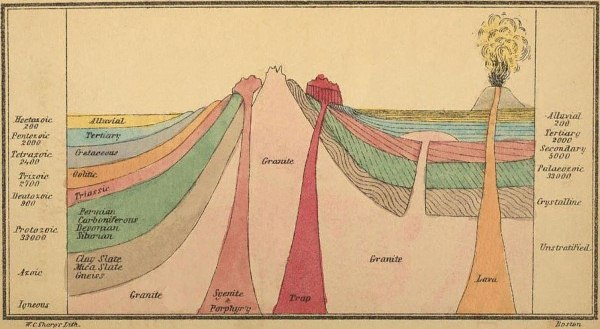
DEATH A UNIVERSAL LAW OF ORGANIC BEINGS ON THIS GLOBE FROM THE BEGINNING.
Death has always been regarded by man as the king of terrors, and the
climax of all mortal evils; and by Christians its introduction into the
world has generally been imputed to the apostasy of our first parents. For
the threatening announced to them in Eden was, In the day thou eatest of
the forbidden fruit thou shalt surely die, implying that if they did not
eat thereof they might live. But when the woman saw the tree was good for
food, and that it was pleasant to the eyes, and a tree to be desired to
make one wise, she took of the fruit thereof, and did eat, and gave also
to her husband with her, and he did eat. As the result, it is generally
supposed that a great change took place in animals and plants, and from
being immortal, they became mortal, in consequence of this fatal deed. But
geology asserts that death existed in the world untold ages before man’s
creation, while physiology declares it to be a universal law of nature,
and a wise and benevolent provision in such a world as ours. Now, the
question is, Do not these different statements conflict with one another?
and if so, is the discrepancy apparent only, or real? These are the
questions which I now propose to examine, by all the light which we can
obtain from the Bible and from science.
The first point to be ascertained in this investigation will be, what the
Bible teaches on this subject.
In the first place, it distinctly informs us that the death which man
experiences, came upon him in consequence of sin.
The declaration of Paul on this subject is as distinct as language can be.
By one man sin entered into the world, and death by sin, and so death
passed upon all men, for that all have sinned. This corresponds with the
original threatening respecting the forbidden fruit. We know that our
first parents ate of it; we know, also, that they died; and the apostle
places these two facts in the relation of cause and effect.
In the second place, the Bible does not inform us whether the death of the
inferior animals and plants is the consequence of man’s transgression.
In order to prove this statement, it is necessary to show that the
language of the Bible, which distinctly ascribes the introduction of death
into the world, is limited to man. The first part of the sentence from
Paul, just quoted, is indeed very general, and may include all organic
natures. By one man sin entered into the world, and death by sin. What
terms more general or explicit than these could be used? Yet the remainder
of the sentence shows that the apostle had man mainly in his eye; and so
death passed upon all men, for that all have sinned. The death here
spoken of is limited expressly to man; and, therefore, it is not necessary
to show that the same terms, in the first part of the sentence, had a more
extended meaning. Death is spoken of here as the result of sin, and
cannot, therefore, embrace animals and plants, which are incapable of sin.
But after all, the first part of the sentence may intend to teach a
general truth respecting the origin of every kind of death in the world.
It will be seen in the sequel, that to such a meaning I have no objection,
if it can be established.
Another very explicit passage on the introduction of death into the world
is found in Corinthians: Since by man came death, by man came also the
resurrection of the dead. Here, too, the last clause of the sentence
limits the meaning to the human family. For no one will doubt that Christ
is the man here spoken of, by whom came the resurrection of the dead. Now,
unless the inferior animals and plants will share in a resurrection in
consequence of what Christ has done, and in the redemption wrought out by
him too, they cannot be included in this passage. And if neither of the
texts now quoted extend in their application beyond the human race, I know
of no other passage in the Bible that teaches, directly or inferentially,
that death among the inferior animals or plants resulted from man’s
apostasy. I do not deny that there may be a connection between these
events; certainly the Scriptures do not teach the contrary. But they
appear to me rather to leave the question of such a connection undecided,
and open for the examination of philosophers. If so, we may reason
concerning the dissolution of animals, except men, without reference to
the Scriptures.
Under the second part of this investigation, I shall endeavor to show
that geology proves violent and painful death to have existed in the world
long before man’s creation.
In the oldest of the sedimentary rocks, the remains of animals occur in
vast numbers; nor will any one, I trust, of ordinary intelligence, doubt
but these relics once constituted living beings. Through the whole series
of rocks, six miles in thickness, we find similar remains, even increasing
in numbers as we ascend; but it is not till we reach the very highest
stratum, the mere superficial coat of alluvium, that we find the remains
of man. The vast multitudes, then, of organized beings that lie entombed
in rocks below alluvium, must have yielded to death long before man
received his sentence, Dust thou art, and to dust shalt thou return.
Will any one maintain that none of these animals preceded man in the
period of their existence? Then why are the remains of men not found with
theirs? for his bony skeleton is as likely to be preserved and petrified
as theirs. Moreover, so unlike to man and other existing tenants of the
globe are many of these ancient animals, that the sure laws of comparative
anatomy show us, that both races could not live and flourish in a world
adapted to the one or the other. If the temperature had been warm enough
for the fossil tribes, and all the circumstances of food and climate
congenial to their natures, they would have been unsuited to the present
races; and if adapted to the latter, the former must have perished. The
difference between the animals and plants dug out of the rocks in this
latitude, and those now inhabiting the same region of country, is
certainly as great as that between the animals and plants of the torrid
and temperate zones; in most cases it is greater. Now, suppose that the
animals and plants of the temperate zones were to change places with those
between the tropics. A few species might survive, but the greater part
would be destroyed. Hence, a fortiori, had the living beings now
entombed in the rocks been placed in the same climate with those now alive
upon the globe, the like result would have followed. I say a fortiori;
that is, for a stronger reason, the greater number must have perished; and
the stronger reason is, the greater difference between fossil and living
species, than between the latter in torrid and temperate latitudes. It is
true that man is among the species capable of being acclimated to great
extremes. And yet no physiologist will imagine that even his nature could
have long survived in such a climate as formerly existed, when probably
the atmosphere was loaded with carbonic acid and other mephitic gases,
and with moisture and miasms, the result of a rank vegetation, and of a
temperature higher than now exists in equatorial countries.
This argument, furnished by comparative anatomy, to show that man and the
fossil animals could not have been contemporaries, will probably seem to
have little force to those who are not familiar with the history of
organic life on the globe, and the distribution of species. It is not
generally known that both animals and plants are usually confined to a
particular district, and that a removal beyond its boundaries, or the
access of a few more degrees of cold, or heat, than is common in the place
assigned them by nature, will destroy them. To him who understands this
curious history, the argument under consideration is perfectly
satisfactory, to prove the existence and consequent dissolution of myriads
of living beings, anterior to man. “Judging by these indications of the
habits of the animals,” says the distinguished anatomist, Sir Charles
Bell, “we acquire a knowledge of the condition of the earth during their
period of existence; that it was suited at one time to the scaly tribe of
the lacertæ, with languid motion; at another, to animals of higher
organization, with more varied and lively habits; and finally, we learn
that at any period previous to man’s creation, the surface of the earth
would have been unsuitable to him. Any other hypothesis than that of a new
creation of animals, suited to the successive changes in the inorganic
matter of the globe, the condition of the water, atmosphere, and
temperature, brings with it only an accumulation of difficulties.”—The
Hand, its Mech., &c. pp. 31 and 115.
But when arguing with those who do not feel the force of this argument, I
would fall back upon that derived from the fact, that of the ten thousand
species of animals dug out of the rocks beneath alluvium, no relic of man
has been found; and ask them whether they can explain such a fact, except
by the supposition that man was not their contemporary.
In his admirable Bridgewater Treatise, Dr. Buckland has conclusively shown
that the same great system of organization and adaptation has always
prevailed on the globe. It was the same in those immensely remote ages,
when the fossil animals lived, as it now is. And there is one feature of
that system which deserves notice in this argument. At present, we know
that there exist large tribes of animals, called carnivorous, provided
with organs expressly designed to enable them to destroy other animals,
and of course to inflict on them violent and painful death. Exactly
similar tribes, and in a like proportion, are found among the fossil
animals. They were not always the same tribes; but when one class of
carnivora disappeared, another was created to take their place, in order
to keep down the excessive multiplication of other races, which appears to
be the grand object accomplished by the carnivorous races. And that
animals of such an organization not only lived in the ages preceding man’s
creation, but actually destroyed contemporary species, we have the
evidence in the remains of the one animal enclosed in the body of another,
by whom it was devoured for food and both are now converted into rock, and
will testify to the most sceptical, that death among animals existed in
the world before man’s transgression.
Under the third part of this investigation, I shall attempt to show that
physiology teaches us that death is a general law of organic natures.
It is not confined to animals, but embraces also plants. As they
correspond in a striking manner to animals in their reproduction and
growth, so they do in their decay and dissolution. In short, wherever in
nature we find life and organization, death is inevitable. The amount of
vital energy varies in different species, and in individuals; but in them
all, it at length becomes exhausted, and the functions cease. After a
certain period, the vessels which convey the nutritive materials, and
elaborate the proximate principles, become choked with excrementitious
matter, assimilation is performed imperfectly, and gradually the vital
energies are overpowered, and yield up their charge to the disorganizing
power of chemical agencies. We can hardly see why the delicate machinery
cannot hold out longer than it does, or even indefinitely. But experience
shows us that an irresistible law of nature has fixed the period of its
operations. In the expressive language of Scripture, which applies to
plants as well as animals, there is no discharge in that war.
A little reflection will convince any one, that in such a system as exists
in the world, this universal decay and dissolution are indispensable. For
dead organic matter is essential to the support and nourishment of living
beings. Admit, for the sake of the argument, (although it is obviously
absurd in respect to the carnivorous races,) that animals might be
supported by vegetable food. Yet, if plants must furnish nourishment for
their successors, as well as for animals, the organic matter must at
length be exhausted. And, furthermore, how could animals feed on plants
without destroying, as they now do, multitudes of minute insects and
animalcules? It is obvious, also, that, for a variety of reasons, the
multiplication of animals must soon be arrested, or famine would be the
result, or the world would be more than full. In short, it would require
an entirely different system in nature from the present, in order to
exclude death from the world. To the existing system it is as essential
as gravitation, and apparently just as much a law of nature.
To strengthen this argument still further, comparative anatomy testifies
that large classes of animals have a structure evidently intended to
enable them to feed on other tribes. The teeth of the more perfect
carnivorous animals are adapted for seizing and tearing their prey, while
those which feed on vegetables have cutting and grinding teeth, but not
the canine. So the whole digestive apparatus in the carnivora is more
simple, and of less extent, than in the herbivorous tribes, while in the
former the gastric juice acts more readily upon flesh, and in the latter
upon vegetables. The muscular apparatus, also, is developed in greater
power in the former than in the latter, especially in the neck and fore
paw. Throughout all the classes of animals, those which feed on flesh are
armed with poisonous fangs, or talons, or beaks, or other formidable
weapons, while the vegetable feeders are usually in a great measure
defenceless. In short, in the one class we find a perfect adaptation, in
all the organs, for destroying, digesting, and assimilating other animals,
and in the other class, an arrangement, equally obvious, for procuring and
digesting vegetables. Indeed, you need only show the anatomist the
skeleton, or even a very small part of the skeleton, of an unknown animal,
to enable him, in most cases, to decide, what is the food of that animal,
with almost as much certainty as if he had for years observed its habits.
Who can doubt, then, that when a carnivorous animal employs the weapons
with which nature has furnished it for the destruction of another animal,
in order to satisfy its hunger, that it acts in obedience to a law of its
being, originally impressed upon its constitution by the Creator? It is
true, that even the flesh-eating animals may be taught for a time to
subsist upon vegetable products. But this is unnatural; and such an
animal usually pays the price of thus inverting its original instinct, by
disease and premature decay. In a state of nature, an animal would starve
rather than thus violate its instinctive desires.
I will allude to only one other fact, that shows death to be inseparable
from organized beings, without a constant miraculous interference, in such
a world as ours. Animal organization, in all conceivable circumstances,
must be liable to accident, from mere mechanical force, by which life
would be destroyed. It may be possible, perhaps, to conceive of a material
tenement for the soul, which should be unaffected by all forms of
mechanical violence and chemical action; if, for instance, its
constitution were analogous to that supposed medium through which light,
heat, and electricity, and perhaps gravitation, act. But, surely, our
present bodies are far enough removed from such conditions, being of all
terrestrial things the most liable to ruin from the causes above
mentioned.
The conclusions from all these facts and reasonings are, that death is an
essential feature of the present system of organized nature; that it must
have entered into the plan of creation in the divine mind originally, and
consequently must have existed in the world before the apostasy of man.
Whether the entire system of death had any connection with that event, or
whether there is any thing peculiar in the death endured by the human
family, will be questions for examination in a subsequent part of my
lecture.
In opposition to these conclusions, however, the common theory of death
maintains that, when man transgressed, there was an entire change
throughout all organic nature; so that animals and plants, which before
contained a principle of immortal life, were smitten with the hereditary
contagion of disease and death. Those animals which, before that event,
were gentle and herbivorous, or frugivorous, suddenly became ferocious or
carnivorous. The climate, too, changed, and the sterile soil sent forth
the thorn and the thistle, in the place of the rich flowers and fruits of
Eden. The great English poet, in his Paradise Lost, has clothed this
hypothesis in a most graphic and philosophical dress; and probably his
descriptions have done more than the Bible to give it currency. Indeed,
could the truth be known, I fancy that, on many points of secondary
importance, the current theology of the day has been shaped quite as much
by the ingenious machinery of Paradise Lost as by the Scriptures; the
theologians having so mixed up the ideas of Milton with those derived from
inspiration, that they find it difficult to distinguish between them.
In the case under consideration, Milton does not limit the change induced
by man’s apostasy to sublunary things, but, like a sagacious philosopher,
perceives, also, that the heavenly bodies must have been diverted from
their paths.
“At that tasted fruit,
The sun, as from Thyestian banquet, turned
His course intended; else-how had the world
Inhabited, though sinless, more than now,
Avoided pinching cold and scorching heat?”
This change of the sun’s path, as the poet well knew, could be effected
only by some change in the motion of the earth.
“Some say he bid the angels turn askance
The poles of earth, twice ten degrees and more,
From the sun’s axle; they with labor pushed
Oblique the centric globe.”
Next we have the effect upon the lower orders of animals described.
“Discord first,
Daughter of sin, among the irrational
Death introduced: through fierce antipathy,
Beast now with beast ’gan war, and fowl with fowl,
And fish with fish; to graze the herb all leaving,
Devoured each other.”
The question arises here, whether such views are sustained by the Bible
and by science. Few, I presume, would seriously maintain that the act of
our first parents, which produced what Dr. Chalmers calls “an unhingement”
of the human race, resulted likewise in a change in the motion of the
earth and the heavenly bodies; since the Bible so clearly describes the
previous ordination of days, years, and seasons, on the fourth day of
creation. And is there any thing in the language of the Bible that will
justify the opinion that such changes as this theory supposes took place
in the productions of the earth, and in the nature of its animals? No
anatomist can surely be made to believe that, without a constant miracle,
our carnivorous animals can have become herbivorous, without such a change
in their organization as must have amounted to a new creation. And such a
metamorphosis can hardly have passed unnoticed by the sacred writer. True,
only the gramineous and herbaceous substances are in the Bible given to
the inferior animals for food, while the fruits are assigned to man. But
this passage seems only to be a designation of one part of vegetable
productions to men, and another to other animals, and can hardly be
supposed to preclude the idea that there might be other tribes requiring
animal food.
The sentence pronounced upon the serpent for his agency in man’s apostasy
seems, at first view, favorable to the opinion that animal natures
experienced at the same time important changes; for he is supposed to have
been deprived of limbs, and condemned henceforth to crawl upon the earth,
and to make the dust his food. But is it the most probable interpretation
of this passage, which makes the tempter a literal serpent, or only a
symbolical one? The naturalist does not surely find that serpents live
upon dust, for they all are carnivorous, and they are as perfectly adapted
to crawl upon the ground as other animals to different modes of
progression; and though cursed above all cattle, they are apparently as
happy as other animals. Hence the probability is, that an evil spirit is
described in Genesis under the name and figure of a serpent. This
conclusion is supported by other parts of Scripture, where the tempter is
in several places declared to be the devil, the old serpent, and the
great dragon.
A part of the sentence passed upon man seems, also, at first view, to
imply an important change in the vegetable productions of the earth; for
the ground is cursed for man’s sake: it would henceforth produce to him
thorns and thistles, and in the sweat of his brow must he eat of the
fruits of it, all the days of his life. Now, will not the condition and
character of Adam show how this curse might be fulfilled, without any
change in the productions of the soil? The garden of Eden, where man had
lived in his innocence, was doubtless some sunny and balmy spot, where the
air was delicious, and the earth poured forth her abundant fruits
spontaneously; and although he was called to keep and dress that garden,
yet, with a contented and holy heart, and with no factitious wants, the
work was neither labor nor sorrow. But now he is driven from that garden
into regions far less fertile, where the sterile soil can be made to
yield its fruits only by the sweat of the brow, and where the thorn and
the thistle dispute their right of soil with salutary plants; and in his
heart, too, unholy and unsubdued passions have place, which will infuse
sorrow into all his labors.
As I have remarked in another place, I cannot see why the functions of
animal and vegetable organization might not have gone on forever without
decay and death, if such had been the Creator’s will. In other words, I do
not see why the operation of the organs should at length be impeded and
cease, as we know they do universally. Hence I can conceive that it might
have been otherwise originally; and in the case of man it is possible, as
we shall see farther on, that a change of this sort may have taken place
at the time of his apostasy. But, after all, it strikes me that the Bible
furnishes very clear evidence that the same system of decay and death
prevailed before the apostasy which now prevails. The command given, both
to animals and to man, to be fruitful and multiply, implies the removal of
successive races by death; otherwise the world would ere long be
overstocked. A system of death is certainly a necessary counterpart to a
system of reproduction; and hence, where we know the one to exist, the
presumption is very strong that the other exists also. There is no escape
from this inference, except to call in the aid of miraculous power to
preserve the proper balance among different races of animals, by
preventing their multiplication. Such an interference I am always ready to
admit, where the Scriptures assert it. But to imagine a miracle without
proof, merely to escape a fair conclusion, is, to say the least, very
wretched logic. God never introduces a miracle where he can employ the
ordinary agency of nature for accomplishing his purposes. Nor should we
resort to one without the express testimony of the Bible, which, on this
subject, is our only source of evidence.
We have in Scripture the same kind of proof that plants were subject to
decay and death, before the fall, as we have in respect to animals. For in
the account of the creation of plants on the third day, we find them
described as bearing seeds; and does not this clearly imply the same
system of reproduction which now exists throughout the vegetable kingdom?
In short, an unprejudiced mind, in reading the history of the world in
Genesis, before and after the fall, can hardly fail of the conviction,
that animals and plants were originally created on the same plan, as to
reproduction, decay, and death, which now prevails. Great, indeed, must
have been the change at the fall, if, previous to that time, their
structure excluded all the organs and means of reproduction; as must have
been the case if decay and death were also excluded. And it is strange
that the sacred writer should take no notice of such a change. He states
the effect of sin upon the three parties directly concerned in it, viz.,
the tempter, Adam, and Eve; and if a transformation of all vegetable and
animal natures, great enough almost to constitute a new creation, did take
place, it could hardly have been passed in silence. Even in the case of
man, we have no remarkable physical change. The effect seems to have been
chiefly confined to his intellectual constitution, where we should expect
the effect of sin to be primarily felt. There, indeed, in man’s noblest
part, has the havoc been the most terrific, and powerfully has its
operation there reacted upon the body, so as to make death, in the case of
man, the king of terrors.
We find, then, insuperable objections to the prevalent notion that an
entire revolution took place at the fall in the material world, and
especially in organic nature. Those passages of Scripture which,
literally interpreted, seem to imply some changes of this sort, are easily
understood as vivid figurative representations of the effects of sin upon
men, while their literal interpretation would involve us in inextricable
difficulties. We rest, therefore, in the conclusion, that, whatever
connection there may be between death and the existing system of organic
and inorganic nature, no important change took place at the time of man’s
first transgression; in other Words, the present system is that which was
originally determined upon in the divine mind, and not the original plan
altered after man’s transgression.
The fourth step in the investigation of this subject leads me to attempt
to show that, in the present system of the world, death, to the inferior
animals, is a benevolent provision, and to man, also, when not aggravated
or converted into a curse by his own sin.
In examining this point, as well as many others in natural theology, where
the existence of evil is concerned, we must assume that the present system
of the world is the best which infinite wisdom and benevolence could
devise. And this we may consistently do. For the prominent design
throughout nature appears to be beneficial to animal natures, and
suffering is only incidental, and happiness, moreover, is superadded to
the functions of animals, where it is unnecessary to the perfect
performance of the function. We may be certain, therefore, that the Author
of such a system can neither be malevolent nor indifferent to the
happiness of animals, but must be benevolent; and, therefore, the system
must be the best possible, since such a Being could constitute no other.
Now, death being an essential feature of such a system, we should expect
to find it, as a whole, a benevolent provision. But, in the case of man,
the Bible represents it as a penal infliction, and such is its general
aspect in the human family. So far as the mere extinction of life is
concerned, it is the same in man as in other animals; but sin arms it with
a deadly sting, by pointing the offender to a world of retribution, as he
sees the menacing dart of the great destroyer aimed at his heart. And,
indeed, through all his days, man’s power of anticipation keeps death ever
before him, as the end of all his present enjoyments, and the
commencement, it may be, of unmitigated suffering. But the inferior
animals, being incapable of sin, find none of these aggravations to give
keenness to their final sufferings. No anticipation of death keeps it ever
in view, as a terrific enemy. No guilty conscience points them to a
righteous throne of judgment, where they must be arraigned. But when the
stroke comes, it falls unexpectedly, and the mere physical suffering is
all that gives severity to their dissolution.
In the case of man, too, there is the sundering of ties too strong for any
thing but death to break;—ties which bind him to kindred, friends, and
country; and often this separation constitutes the most painful part of
the closing scene. But in the case of animals, we have no reason to
suppose these attachments, so far as they exist, to be very strong; nay,
in most cases they are certainly very weak. And even did they exist, the
brute would not be conscious that death would remove him from the society
of his beloved companions.
The inferior animals, also, usually die either a violent and sudden death,
inflicted by some carnivorous enemy, or in extreme old age, by mere decay
of the natural powers, without disease. The violent death can usually have
in it little of suffering; and the slow decay still less. But although
some men die violent deaths, how few survive to extreme old age, and sink
at last almost unconsciously into the grave, because the vital energies
are exhausted! Were this the case, the physical terrors of death would be
almost taken away, and we should pass as quietly into eternity as a lamp
goes out when the oil is exhausted. But in general we see a constitution
yet unbroken, struggling with fierce disease, and yielding to its fate
only with terrific agonies; because sin has early implanted the seeds of
disease in the constitution.
Imagine, now, that death should come upon a man in the course of nature;
that is, without disease, and with little suffering, and with no painful
forebodings of conscience. Suppose, moreover, that the dying individual
should feel that the change passing upon him would assuredly introduce him
to a new and spiritual body, undecaying, and adapted to the operations of
the mind; that it would, in fact, be the building of God, the house not
made with hands, eternal in the heavens; and that the soul, after death,
would enter into free and full communion with all that is great and
ennobling in the universe; and that joys, inconceivable and eternal, would
henceforth be its portion: O, how different would such a death be from
what we usually witness! Yet, were men all to accept of the offered ransom
from sin and death, and, under the guidance of pure religious principle,
were to pay a strict regard to hygienic laws, such would be, for the most
part, the character of the death they would experience. The excepted cases
would be those of violent and sudden death from accident, or of disease
from unavoidable exposure, and they would be comparatively few. So that,
in fact, an observance of the laws, physical and moral, which God has
ordained, would change almost the entire aspect of death, even in this
fallen world.
These remarks seem necessary in order to obtain a correct idea of the
character of death, when not aggravated by the sins of men. For those
aggravations seem superadded, in the case of men, as penal inflictions for
their sins; and we ought to leave them out of the account, when we are
considering death as a benevolent provision. I do not contend that death,
even in its mildest forms, is no evil; nor that the apostasy of man was
not the cause of its introduction into the world. These points I shall
consider in another place. But I contend that, in the present system of
the world, death, when not aggravated by the sins of men, is to be
regarded as a benevolent provision, bringing with it more happiness than
misery; although, had sin never existed, a system productive of still
greater enjoyment might have been adopted in this world. But as the
arrangements of the world now are, death affords the following evidences
of infinite benevolence and wisdom.
In the first place, it is a transfer from a lower to a higher state of
existence.
Let me here be understood distinctly as speaking only of the death of
those accountable beings, who, by the transforming power of grace, have
become prepared for a higher and perfectly holy state of being. For the
death of all others can be looked on only in the light of a terrible penal
infliction. But the righteous, when they die,—and all may, if they will,
become righteous,—have before them the certain prospect of immortal
happiness, such as eye hath not seen, nor ear heard, neither hath it
entered the heart of man to conceive. They enter upon fulness of joy,
and pleasures forevermore; and therefore death to them is infinite gain.
Whether the inferior animals will exist again after death is a more
doubtful point. There is certainly nothing in Scripture decisive against
their future existence; for the passage in Psalms which says, that man
that is in honor and abideth not is like the brutes that perish, if
understood to mean the annihilation of animals, would prove also the
annihilation of wicked men. And while most men of learning and piety have
suspended their opinion on the existence of the inferior animals after
death, for want of evidence, some have been decided advocates of the
future happy existence of all beings, who exhibit a spark of intelligence.
Not a few distinguished German theologians and philosophers regard the
whole visible creation, both animate and inanimate, as at present in a
confined and depressed state, and struggling for freedom. On this
principle Tholuck explains that most difficult passage in Romans, which
declares that the whole creation groaneth and travaileth together in pain
until now. He supposes this “bound or fettered state of nature,” both
animate and inanimate, to have a casual connection with sin, and the death
accompanying it among men; and, therefore, when men are freed from sin and
death, the creation itself, also, shall be delivered from the bondage of
corruption into the glorious liberty of the children of God. The kingdom
of God, according to Tholuck, Martin Luther, and many other distinguished
theologians, will not be transferred to heaven at the end of the world,
but be established on earth, where all these transformations of the
animate and inanimate creation will take place.
This exposition surely carries with it a great deal of naturalness and
probability; and if it be true, death to the inferior animals must surely
be an indication of great benevolence on the part of the Deity, since it
introduces them to a higher state of existence. But if it be rejected,
still the general principle is eminently applicable to the case of man.
In the second place, the system of a succession of races of animals on
earth, which death alone would render possible, secures a much greater
collective amount of happiness than a single race of animals, endowed with
earthly immortality. I sustain this position by three arguments. The first
is, that young animals enjoy more, in the same period of time, than those
more advanced in age. This may result, in part, in the present
organization of animals, from the superior health and vigor enjoyed by the
young. But it is due, also, in part, and largely, to the novelty of the
scenes presented in early life. And so far as it results from the latter
cause, it proves that a succession of races would enjoy more than a single
race continued indefinitely, because the successive races would always be
comparatively young. A single continuous race might, indeed, be supposed
always possessed of the unabated vigor and health of youth; but, of
necessity, objects must soon lose the charm of novelty, and, therefore,
produce less of enjoyment. The second argument is, that a succession of
races admits of the contemporaneous existence of a greater number of
species than could coexist were none removed by death. If only one undying
race occupied the globe, it must subsist exclusively on vegetable food.
Whereas much the largest part of the species that now live are carnivorous
or omnivorous. All the enjoyment of these flesh-eating animals is,
therefore, so much clear gain to the stock of happiness, with the
exception of the suffering which death inflicts. Now, but few of the
inferior animals perish by disease. Some die by old age, and these suffer
almost nothing. But the greater part are suddenly destroyed by the violent
assault of the carnivorous races. And as the pangs of death are momentary,
and there are no anticipations of its approach, nor sunderings of the ties
of affection, nor dread of an hereafter, the suffering endured must be an
exceedingly small drawback upon the enjoyment of the whole life. It is
far less than it would be, if animals were left to perish by famine, or by
slow degrees, from deficient nourishment; so that the existence of the
carnivorous races, seeming at first view intended to convert the world
into a vast Golgotha, does in fact add greatly to the amount of enjoyment,
because it so prodigiously multiplies the number of species of animals,
and lessens the sufferings of death. In the third place, death exerts a
salutary moral influence upon man, and, as a consequence, swells the
amount of his happiness. And although this consideration affects only one
species, yet man’s position on the scale of being makes his happiness an
object of no small importance.
The final conclusions at which we arrive, then, are, first, that death is
a fixed and universal law of nature, essential to the existence of the
present system of the world; and secondly, that, like all other laws of
nature, it exhibits marks of benevolence, and wise adaptation on the part
of the Author of nature. The question will indeed arise in every
reflecting mind, why a Being of infinite power and wisdom could not have
secured to his creatures the benefits resulting from a system of death,
without the attendant suffering. But this question resolves itself into
the inquiry, why evil exists at all; and although, in my own view, it
exists most probably as a means of greater happiness to the universe, yet
on this point the wisest minds have differed and been baffled, and equally
perplexing is it to every form of religion. Hence it is no objection to
any views we may adopt, that they leave this question where they found it.
The fifth and last step in our investigation of this subject is to show
how science, experience, and revelation may be reconciled on the subject
of death.
We have seen that geology is not alone in proving death to be a law of
nature, essential to the present system of the world, and, indeed,
indicative of divine wisdom and benevolence. For anatomy and physiology,
as well as experience, teach us the same truths. And natural theology
shows that, if death is a law of organic nature, it must have entered into
the plan of the universe in the divine mind, and was not the result of any
change of organic nature subsequent to the fall of man. Can these views be
reconciled with the declarations of Scripture, which certainly represent
death among the human family, if not among the lower animals, to be the
consequence of sin?
There are three suppositions by which all apparent discrepancy between
science and revelation, on this subject, may be removed. I shall present
them, with the arguments in their favor, leaving to others to decide which
is most reasonable. For they are independent of one another, though not
inconsistent; and, therefore, even though different persons should prefer
different theories, they need not be regarded as in opposition to one
another.
The first theory proceeds on the supposition that death is a universal law
of organic nature, from which man was exempted so long as he obeyed the
law of God. But I will present it in the language of its distinguished
author. “In the state of pristine purity,” says Dr. J. Pye Smith, “the
bodily constitution of man was exempted from the law of progress towards
dissolution, which belonged to the inferior animals. It must have been
maintained in that distinguished peculiarity by means to us unknown; and
it would seem probable that, had not man fallen by his transgression, he,
and each of his posterity, would, after faithfully sustaining an
individual probation, have passed through a change without dying, and have
been exalted to a more perfect state of existence.”—Scrip. and Geol.
4th ed. p. 208.
According to this theory of Dr. Smith, man saw all other organic beings
around him subject to decay and death, while he, as a special favor,
remained unaffected by the general law. The penalty of disobedience was,
that he would forfeit this enviable distinction, and be subjected to death
more revolting than the brutes. The reward of obedience was a continued
immunity from evil, and a final translation, without suffering, to a more
exalted condition. And certainly the nature of the case furnishes a strong
presumptive argument to show that man did thus stand exempted from the
decay and death which reigned all around him. If not, what weight or
meaning would there be in the penalty? If he had not seen death in other
animals, how could he have any idea of the nature of the threatening? And
we may be sure that God never promulgates a penalty without affording his
subjects the means of comprehending it.
I have already intimated that I could hardly see why there exists in all
organic natures a tendency to decay and death, except in the will of the
Creator. May not that tendency result, like the varieties among men, from
some slightly modifying cause implanted by the Deity in the nature of the
animal or plant? And if so, might not an opposite tendency be imparted to
one or more species, so that the decay and death of the one, and the
continued existence of the other, might be equally well explained on
physiological principles? If this suggestion be admitted, it would not be
necessary to resort to any supernatural or miraculous agency to show how
sinless man in paradise might have stood unaffected by decay, the common
lot of all other races. It must be confessed, however, that it is not as
easy to see how, by any natural law, he could have been proof against
mechanical violence and chemical agencies; there we must admit miraculous
protection, or a self-restoring power more wonderful than that possessed
by the polypi.
These views receive strong confirmation from the history of the tree of
life, that grew in the garden of Eden. The very name implies that it was
intended to give or preserve life. That it had in it a power to preserve
life is evident from the sentence pronounced on man. And the Lord God
saith, Behold, the man hath become as one of us, to know good and evil;
and now, lest he should put forth his hand, and take also of the tree of
life, and live forever, therefore the Lord God sent him forth from the
garden of Eden. Now, it appears to me to be in perfect harmony with the
principles of physiology to suppose that there might be a virtue in the
tree of life—either in its fruit or some other part—to arrest that
tendency to decay and dissolution which we now find in all animal bodies.
It does seem that it would require only some slight modification of the
present functions of the human frame to keep the wheels of life in motion
indefinitely. When in Eden, man had access to this sure defence against
disease. But after he had sinned, he must forfeit this privilege, and,
like the plants and inferior animals, submit to the universal law of
dissolution. Surely, of all the expositions that have been given of the
meaning of this passage, this is the most rational, and it does throw an
air of great plausibility over Dr. Smith’s views.
It will occur to every reflecting mind that we have in Scripture a few
interesting examples of that change, without dying, from the present to a
higher state of being, which the theory of Dr. Smith supposes would have
been the happy lot of all mankind had they not sinned. By faith Enoch was
translated, that he should not see death. He walked with God, and he was
not; for God took him. Gladly would philosophys here interpose a
thousand questions as to the manner in which this wonderful change took
place; but the Scriptures are silent. It was enough for the heart of piety
that God was the author of the change. And so, in the case of Elijah, we
have the sublimely simple description only—And it came to pass, as they
still went on and talked, that, behold, there appeared a chariot of fire,
and horses of fire, and parted them both asunder; and Elijah went up by a
whirlwind into heaven. Except the transfiguration of Christ, which
appears to have been of an analogous character, these are all the actual
examples of translation on record. But the apostle declares that, in the
closing scene of this world’s history, this same change shall pass upon
multitudes. Behold, I show you a mystery. We shall not all sleep; but we
shall all be changed, in a moment, in the twinkling of an eye, at the last
trump; for the trumpet shall sound, and the dead shall be raised
incorruptible, and we shall be changed. Abundant evidence is, therefore,
before us, that the great change which death now causes us to pass through
with fear and dread, might as easily have been, for the whole human
family, a transition delightful in anticipation and joyful in experience.
The second theory which will reconcile science and revelation on the
subject of death, is one long since illustrated by Jeremy Taylor. And
since he could have had no reference to geology in proposing it, because
geology did not exist in his day, we may be sure, either that he learnt it
from the Bible, or that other branches of knowledge teach the existence of
death as a general law of nature, as well as geology.
“That death, therefore,” says Taylor, “which God threatened to Adam, and
which passed upon his posterity, is not the going out of this world, but
the manner of going. If he had staid in innocence, he should have gone
placidly and fairly, without vexatious and afflictive circumstances; he
should not have died by sickness, defect, misfortune, or unwillingness.
But when he fell, then he began to die; the same day, (God said,) and that
must needs be true; and, therefore, it must mean upon that very day he
fell into an evil and dangerous condition, a state of change and
affliction; then death began; that is, man began to die by a natural
diminution, and aptness to disease and misery. Change or separation of
soul and body is but accidental to death; death may be with or without
either; but the formality, the curse, and the sting,—that is, misery,
sorrow, fear, diminution, defect, anguish, dishonor, and whatsoever is
miserable and afflictive in nature,—that is death. Death is not an
action, but a whole state and condition; and this was first brought in
upon us by the offence of one man.”
In more recent times, the essential features of these views of Taylor have
been adopted by the ablest commentators and theologians, and sustained by
an appeal to Scripture.[9] The position which they take is, that the death
threatened as the penalty of disobedience has a more extended meaning than
physical death. It is a generic term, including all penal evils; so that
when death is spoken of as the penalty of sin, we may substitute the word
curse, wrath, destruction, and the like. Thus, in Gen. ii. 17, we
might read, In the day thou eatest thereof, thou shalt surely be cursed:
and in Rom. v. 12, By one man sin entered into the world, and the curse
by sin, &c. In his commentary on this passage, Professor Stuart says, “I
see no philological escape from the conclusion that death, in the sense
of penalty for sin in its full measure, must be regarded as the meaning
of the writer here.” The same may be said of many other passages of
Scripture, where the term death is used.
According to this exposition, the death threatened as the penalty of
transgression embraces all the evils we suffer in this life and in
eternity; among which the dissolution of the body is not one of the worst.
Indeed, some writers will not admit that this was included at all in the
penalty. Such, of course, find no difficulty in the geological statement
that literal death preceded man’s existence. But from the declaration in 1
Cor. xv. 22, As in Adam all die, even so in Christ shall all be made
alive, it seems difficult to avoid the conclusion, that the death of the
body was brought in upon the race by Adam’s transgression. According to
Taylor’s view, however, we might reasonably suppose that what constituted
the death threatened to Adam was not the going out of the world, but the
manner of going, and that, had he continued holy, a change of worlds might
have taken place, but it would not have been death.
Now, there are some facts, both in experience and revelation, that give to
these views an air of probability. One is, the mild character of death in
many cases, when attended by only a few of the circumstances above
enumerated, as constituting its essence. I believe that experience
sustains the conclusion already drawn as to the inferior animals, when not
aggravated by human cruelty. Pain is about the only circumstance that
gives it the character of severity; and this is usually short, and not
anticipated. Nor can it be doubted, as a general fact, that, as we descend
along the scale of animals, we find the sensibility to suffering diminish.
But in the human family we find examples still more to the point. In all
those cases in which there is little or no disease, and a man in
venerable old age feels the powers of life gradually give way, and the
functions are feebly performed, until the heart at length ceases to beat,
and the lungs to heave, death is merely the quiet and unconscious
termination of the scene, so far as the physical nature is concerned. The
brain partakes of the gradual decay, and thus the man is scarcely
conscious of the failure of his powers, because his sensibilities are so
blunted; and therefore, apart from sin, his mind feels little of the
anguish of dissolution, and he quietly resigns himself into the arms of
death,—
“As sweetly as a child,
Whom neither thought disturbs, nor care encumbers,
Tired with long play, at close of summer’s day,
Lies down and slumbers.”
If now, in addition to this physical preparation for his departure, the
man possesses a deep consciousness of forgiven sin, and a firm hope of
future and eternal joy, this change, which we call death, becomes only a
joyful translation from earth to heaven; and though the man passes from
our view,—
“He sets,
As sets the morning star, which goes not down
Behind the darkened west, nor hides obscured
Among the tempests of the sky, but melts away
Into the light of heaven.”
Nay, when such faith and hope form an anchor to the soul, it is not
necessary that the physical preparation, which I have described, should
exist. The poor body may be torn by fierce disease, nay, by the infernal
cruelties of martyrdom, and yet faith can rise—often has risen—over the
pains of nature, in joyful triumph; and in the midst of the tempest, with
her anchor fastened to the eternal Rock, she can exclaim, O death, where
is thy sting! O grave, where is thy victory! Thanks be to God, which
giveth me the victory through my Lord Jesus Christ. Surely such a
dissolution as this cannot mean the death mentioned in the primeval curse.
Look now at the contrast. Behold a man writhing in the fangs of
unrelenting disease, and feeling at the same time the scorpion sting of a
guilty conscience. His present suffering is terrible, but that in prospect
is more so; yet he cannot bribe the king of terrors to delay the fatal
stroke.
“The foe,
Like a stanch murderer, steady to his purpose,
Urges the soul through every nook and lane of life.”
It were enough for an unruffled mind to bear the bodily anguish of that
dying hour. But the unpardoned sins of a whole life, and the awful
retributions of a whole eternity, come crowding into that point of time;
and no human fortitude can stand under the crushing load. This, this is
emphatically death; the genuine fruit of sin, and therefore in
correspondence with the original threatening.
If we turn now to the Scriptures, we shall find some passages in striking
agreement with the opinion that the death threatened to man was not the
mere dissolution of the body and soul; not a mere going out of the world,
but the manner of going.
This is, indeed, made exceedingly probable by the facts already stated
respecting the translation of Enoch and Elijah, and those alive at the
coming of Christ. For the sacred writers do not call this death, although
it be a removal out of the world, and a transformation of the natural into
the spiritual body. Hence, upon the material part of men, the same effects
were produced as result from ordinary death, and the subsequent
resurrection.
If we recur to the original threatening of death as the consequence of
sin, we shall find a peculiarity in the form of expression, which our
English translators have rendered by the phrase thou shalt surely die;
but literally it should be, dying thou shalt die.
This mode of expression is indeed very common in the Hebrew language; but
it certainly was meant to indicate an intensity in the meaning, as in the
phrase blessing I will bless thee, and multiplying I will multiply thee;
that is, I will greatly multiply thee. Must it not imply, in the case
under consideration, at least that the death which would be the
consequence of transgression, would possess an aggravated character? May
it not imply as much as Taylor’s theory supposes? Might it not be intended
to teach Adam that, when he died, his death should not be simply the
dissolution of the animal fabric, and the loss of animal life, as he
witnessed it in the inferior creatures around him; but a change far more
agonizing, in which the mental suffering should so much outweigh the
corporeal as to constitute, in fact, its essence? I do not assert that
this passage has such an extended meaning, but I suggest it. And I confess
that I do not see why its peculiarity of form is understood in our common
translation to imply certainty rather than intensity.
There is another part of the threatening that deserves consideration. It
says, that man should not only die, but die the very day of the offence.
Now, if by death we understood merely a removal out of the world, or a
separation of soul and body, the threatening was not executed after the
forbidden fruit was tasted. But if it meant also, and chiefly, a state of
sorrow, pain, and suffering, a liability to disease and fatal accident,
the goadings of a guilty conscience, and the consequent fear of punishment
beyond the grave, then death began on the very day when man sinned, and
the dissolution of the soul and body was but the closing scene of the
tragedy.
The beautiful passage in the First Epistle to the Corinthians, already
quoted, where the Christian, in view of death, exultingly exclaims, O
death, where is thy sting! O grave, where is thy victory! will doubtless
occur to all who hear me, in this connection. Here the sting of death is
expressly declared to be sin, and that the pardoned Christian obtains the
victory over it. To him all that renders this king of terrors formidable
is gone. Its physical sufferings may indeed be left, but these are hardly
worth naming, when that which constitutes the sting of this great
enemy—unpardoned guilt—is taken away. Little more than his harmless
shadow is left. Worlds, indeed, are to be exchanged, and so they must have
been if Adam had never been driven from paradise. The eyes, too, must
close on beloved friends; but how soon to open them upon the bright
glories of heaven! In short, the strong impression of this passage upon
the mind is, that the essential thing in death is unpardoned sin; and
therefore the death threatened to Adam may have been only the terrible
aggravations of a departure out of this world, which have followed in the
train of transgression.
Another striking passage, bearing upon the same point, is the declaration
of Paul, that Jesus Christ hath abolished death, and brought life and
immortality to light through the gospel.
The apostle does not surely mean that Christians are freed from what is
commonly called death, since universal experience shows that animal life
in them is as sure to be extinguished, and the soul to be separated from
the body, as in others. But so different is death now, since Christ has
brought to light a future and an immortal life, and by the sacrifice of
himself shown how the heart may be reconciled to God, and sin forgiven,
and faith inspired, that, in fact, while the shadow of death still
occupies the passage to eternity, its substance is gone.
That death, which sin introduced, Christ has abolished, because, by his
sacrifice and his grace, he has conquered sin.
Upon the whole, though we may not be convinced that either of the theories
that have been explained is directly taught in the Scriptures, or can be
shown to be infallibly true, yet they are sustained by probable evidence
enough to remove the apprehension that there is any real discrepancy
between geology and revelation on the subject of death. Between these
theories there is but a slight difference. They are in fact but
modifications of the same general principles; and I say it would be more
philosophical to admit the truth of either of them, than a disagreement
between science and Scripture, since the truth of both geology and
revelation is sustained by such a mass of independent evidence.
An objection, however, may be stated against both of these theories, on
the ground that they seem to imply that death would have existed in the
world, irrespective of the sin of man, and therefore they lessen our sense
of the evil of sin.
It may be doubted, I think, whether these theories do necessarily imply
that there was no connection between the sin of man and the introduction
of death into the world. But, admitting that they do, is it certain that
inadequate views of sin are the result? For poetic effect, we admire the
sublime sentimentalism of Milton:—
“Earth felt the wound; and Nature, from her seat,
Sighing through all her works, gave signs of woe
That all was lost.”
But, after all, the deepest impression we get of the evil of sin is
derived from contemplating its effects upon man, and especially the
immortal mind. Witness its lofty powers bowed down in ignominious
servitude to base corporeal appetites and furious and debasing passions.
See how the understanding is darkened, the will perverted, and the heart
alienated from all that is holy. See reason and conscience dethroned, and
selfishness reigning in gloomy and undisputed tyranny over the immortal
mind, while appetite and passion have become its obsequious panders. See
how the affections turn away with loathing from God, and what a wall of
separation has sprung up between man and his Maker; how deeply and
universally he has revolted from his rightful sovereign, and has chosen
other gods to rule over him. Consider, too, what havoc has been made in
the body, that curious and wonderful workmanship of the Almighty; how the
unbridled appetites have sown the seeds of disease therein, and how pain,
languor, and decay assail the constitution as soon as we begin to live,
and cease not their attacks till they triumph over the citadel of life.
Consult the history of the world, and what a lazar-house and a Golgotha
has it been! What land has not been drenched in human blood, poured out in
ferocious war! What oceans of tears has the thirsty soil drank up! What
breeze has ever blown over the land which has not been loaded with sighs,
and groans, and the story of wrong and oppression, of treachery and
murder, of suicide and assassination, of blasted hopes and despairing
hearts! These, therefore, are the genuine fruits of sin. This, this is
death. And, need I add that these are but the precursors of the second
death?
The third theory respecting death takes a more comprehensive view of the
subject, and traces its origin to the divine plan of the creation.
In creating this world, God did not act without a plan previously
determined upon in all its details. Of course, man’s character and
condition formed prominent items in that plan. His apostasy, too, however
some would hesitate to regard it as predetermined, all will allow to have
been foreknown. Now, I maintain that God, in the beginning, adapted every
other being and event in the world to man’s character and condition, so
that there should be entire harmony in its system. And since, either in
the divine appointment, or in the nature of things, there is an
inseparable connection between sin and death, the latter must constitute a
feature of the system of the world, because a free agent would introduce
the former. Death would ultimately exist in the world, and, therefore, all
creatures placed in such a world must be made mortal, at whatever period
created. For mortal and immortal natures could not exist in the same
natural constitution, nor could a condition adapted to undying creatures
be changed into a state of decay and death without an entirely new
creation. Death, therefore, entered into the original plan of the world in
the divine mind, and was endured by the animals and plants that lived
anterior to man. Yet, as the constitution of the world is, doubtless, very
different from what it would have been if sin had not existed in it, and
as man alone was capable of sin, it is proper to regard man’s
transgression as the occasion of all the suffering and death that existed
on the globe since its creation.
It will probably be objected to this theory, that it is unjust to make
animals suffer for man’s apostasy, especially before it took place.
I do not see why such suffering is any more unjust before than after man’s
transgression; and we know that they do now suffer in consequence of his
sin. But this suffering is not to be regarded in the light of punishment;
and if it can only be proved that benevolence predominates in the
condition of animals, notwithstanding their sufferings, divine justice and
benevolence are vindicated; and can there be any doubt that such is the
fact? Death is not necessarily an evil to any animals. It may be a great
blessing, by removing them to a higher state of existence. In the case of
the inferior animals, it is but a small drawback upon the pleasure of
life, even though they do not exist hereafter. We have endeavored to show
that even the existence of carnivorous races is a benevolent provision.
That animals are placed in an inferior condition, in consequence of man’s
apostasy, is no more cause of complaint than that man is made a little
lower than the angels.
Another objection to these views is, that it makes the effect precede the
cause; for it-represents the pre-Adamic animals as dying in consequence of
man’s transgression.
I do not maintain that the death of animals, before or after Adam, was the
direct and natural consequence of his transgression. Nay, I am endeavoring
to show directly the contrary. But, then, the certainty of man’s apostasy
might have been the grand reason in the divine mind for giving to the
world its present constitution, and subjecting animals to death. Not that
God altered his plan upon a prospective knowledge that man would sin; but
he made this plan originally, that is from eternity, with that event in
view, and he made it different from what it would have been, if such an
event had not been certain. If this be true, then was there a connection
between man’s sin and the death that reigned before his existence; though,
in strict accuracy of speech, one can hardly be called the cause of the
other. And yet it was, as I maintain, occasioned by man’s sin, and shows
the wide-spread influence of that occurrence, even more strikingly than
the ordinary theory of death.
A third objection to this theory is, that it represents God as putting man
in a place of punishment before he had sinned; or, at least, in a state
where death was the universal law, and where he must die, though he should
keep the law of God.
There are three suppositions, either of which will meet this difficulty.
We may suppose, with Jeremy Taylor, that the death threatened to Adam
consisted, not in going out of the world, but in the manner of going. If
he had not sinned, the exchange of worlds would have been without fear or
suffering, and an object of desire rather than aversion. Christ has not
secured to the believer the privilege of an earthly immortality, but has
taken away from a removal out of the world all that constitutes death.
Or we may suppose, with Dr. J. Pye Smith, that, while man should continue
to keep the divine law, he would be secured from that tendency to decay
and dissolution, which was the common lot of all other creatures, until
the time should come for his removal, without suffering or dread, to a
higher state of existence. And that a means of immunity from death existed
in the garden of Eden we learn from the Scriptures. For there stood the
tree of life, whose fruit had the power to make man live forever, and,
therefore, he must be banished from the spot where it grew.
Or, finally, we may suppose that God fitted up for man some balmy spot,
where neither decay nor death could enter, and where every thing was
adapted for a being of perfect holiness and happiness. His privilege was
to dwell there, so long as he could preserve his innocence, but no longer.
And surely this supposition seems to accord with the description of the
garden of Eden, man’s first dwelling-place. There every thing seems to
have been adapted to his happiness; but sin drove him out among the thorns
and thistles, and a cherubim and a flaming sword forbade his return to
the tree of life.
Either of these suppositions will meet the difficulty suggested by the
objection; or they may all be combined consistently. Let us now look at
some of the advantages of the third theory above advanced.
In the first place, it satisfactorily harmonizes revelation with geology,
physiology, and experience, on the subject of death. It agrees with
physiology and experience in representing death to be a law of organic
being on the globe. Yet it accords with revelation, in showing how this
law may be a result of man’s apostasy; and with geology, also, in showing
how death might have reigned over animals and plants before man’s
existence. To remove so many apparent discrepancies is surely a
presumption in favor of any theory.
In the second place, the fundamental principle of this theory is also a
fundamental principle of natural and revealed theology, viz., that all
events in this world entered originally into the plan or purpose of the
Deity. To suppose that God made the world without a plan previously
determined upon, is to make him less wise than a human architect, who
would be charged with great folly to attempt building even a house without
a plan. And to suppose that plan not to extend to every event, is to rob
God of his infinite attributes.
In the third place, this theory falls in with the common interpretation of
Scripture, which refers the whole system of suffering, decay, and death in
this world to man’s apostasy. And although the general reception of any
exegesis of Scripture does not prove it to be correct, it is certainly
gratifying when a thorough examination proves the obvious sense of a
passage to be the true one. For to disturb the popular interpretation is,
with many, equivalent to a denial of Scripture.
In the fourth place, this theory shows us the infinite skill and
benevolence of Jehovah in educing good from evil.
The free agency of man was an object in the highest degree desirable. Yet
such a character made him liable to fall; and God knew that he would fall.
To human sagacity that act would seem to seal up his fate forever. But
infinite wisdom saw that the case was not hopeless. It placed him in a
state of temporal suffering and temporal death, that he might still have a
chance of escaping eternal suffering and eternal death. The discipline of
such a world was eminently adapted to restore his lost purity, and death
was probably the only means by which a fallen being could pass to a higher
state of existence. That discipline, indeed, if rightly improved, would
probably fit him for a higher degree of holiness and happiness than if he
had never sinned; so as to make true the paradoxical sentiment of the
poet,—
“Death gives us more than was in Eden lost.”
Misimproved, this discipline would result in an infinite loss, far greater
than if man never passed through it. But this is all the fault of man;
while all the benefit of a state of probation is the result of God’s
infinite wisdom and benevolence.
In the fifth place, this theory relieves us from the absurdity of
supposing that God was compelled to alter the plan of creation after man’s
apostasy.
The common theory does convey an idea not much different from this. It
makes the impression that God was disappointed when man sinned, and being
thereby thwarted in his original purpose, he did the best he could by
changing his plan, just as men do when some unexpected occurrence
interferes with their short-sighted contrivances. Now, such an
anthropomorphic view of God is inexcusable in the nineteenth century. It
was necessary to use such representations in the early ages of the world,
when pure spiritual ideas were unknown; and hence the Bible describes God
as repenting and grieved that he had made man. But with the light of the
New Testament and of modern science, we ought to be able to enucleate the
true spiritual idea from such descriptions. The theory under consideration
does not reduce God to any after-thought expedients, but makes provision
for every occurrence in his original plan; and, of course, shows that
every event takes place as he would have it, when viewed in its relations
to the great system of the universe.
In the sixth place, this theory sheds some light upon the important
question, why God permitted the introduction of death into the world.
It is difficult for some persons to conceive why God, when he foresaw
Adam’s apostasy, did not change his plan of creation, and exclude so
terrible an evil as death. But according to this theory, he permitted it,
because it was a necessary part of a great system of restoration, by which
the human race might, if not recreant to their true interests, be restored
to more than their primeval blessedness. It was not introduced as a mere
punishment, but as a necessary means of raising a fallen being into a
higher state of life and blessedness; or, if he perversely spurned the
offered boon, of sinking him down to the deeper wretchedness which is the
just consequence of unrepented sin, without even the sympathy of any part
of the created universe.
Finally. This subject throws some light upon that strange mixture of good
and evil, which exists in the present world. We have seen, indeed, that
benevolence decidedly predominates in all the arrangements of nature; and
we are called upon continually to admire the adaptation of external nature
to the human constitution. A large portion of our sufferings here may
also be imputed to our own sins, or the sins of others; and these we
cannot charge upon God. But, after all, it seems difficult to conceive how
even a sinless man could escape a large amount of suffering here; enough,
indeed, to make him often sigh for deliverance and for a better state. How
many sources of sufferings there are in unhealthy climates, mechanical
violence, and chemical agents; in a sterile soil, in the excessive heats
of the tropical regions, and extreme cold of high latitudes; in the
encroachments and ferocity of the inferior animals; in poisons, mineral,
vegetable, and animal; in food unfitted to the digestive and assimilating
organs; in the damps and miasms of night; and in the frequent necessity
for over-exertion of body and mind! And then, how many hinderances to the
exercise of the mental powers, in all the causes that have been mentioned!
and how does the soul feel that she is imprisoned in flesh and blood, and
her energies cramped, and her vision clouded, by a gross corporeal medium!
And thus it is, to a great extent, with all nature, especially animal
nature; and I cannot but believe, as already intimated, that Paul had
these very things in mind when he said, The whole creation groaneth and
travaileth together in pain until now, and waiteth for the manifestation
of the sons of God; that is, for emancipation from its present depressed
and fettered condition. In short, while there is so much in this world to
call forth our admiration and gratitude to God, there is enough to make us
feel, also, that it is a fallen condition. It is not such a world as
infinite benevolence would provide for perfectly holy beings, whom he
desired to make perfectly happy, but rather such a world as is adapted for
a condition of trial and preparation for a higher state, when both mind
and body would be delivered from the fetters that now cramp their
exercise.
Now, the theory which I advocate asserts that this peculiar condition of
the world resulted from the divine determination, upon a prospective view
of man’s transgression. It may, therefore, be properly regarded as
occasioned by man’s transgression, but not in the common meaning attached
to that phrase, which is, that, before man’s apostasy, the constitution of
the world was different from what it now is, and death did not exist. This
theory supposes God to have devised the present peculiar mixed condition
of the world, as to good and evil, in eternity, in order to give man an
opportunity to rescue himself from the penalty and misery of sin; and in
order to introduce those who should do this into a higher state of
existence. The plan, therefore, is founded in infinite wisdom and
benevolence, while it brings out man’s guilt, and the evil of sin, in
appalling distinctness and magnitude.
But, after all, how little idea would a man have of the entire plot of a
play, who had heard only a part of the first act! How little could he
judge of the bearing of the first scene upon the final development! Yet we
are now only in the first act of the great drama of human existence. Death
shows us that we shall ere long be introduced into a second act, and
affords a presumption that other acts—it may be in an endless
series—will succeed, before the whole plot shall have passed before us;
and not till then can we be certain what are all the objects to be
accomplished by the introduction of sin and death into our world. And if
thus early we can catch glimpses of great benefit to result from these
evils, what full conviction, that infinite benevolence has planned and
consummated the whole, will be forced upon the mind, when the vast
panorama of God’s dispensations shall lie spread out in the memory! For
that time shall Faith wait, in confident hope that all her doubts and
darkness shall be converted into noonday brightness.