How it came that Colonel Kelly arrived in
so timely a way to the relief of the hard-pressed
garrison has now to be shown. In the beginning
of March alarming reports of the state of
affairs in Chitral began to reach Gilgit, the
head-quarters of the British Political Agent and
of the force of some 3,000 men stationed on
this frontier for its supervision and protection.
The whole of Lower Chitral was rumoured to
be up in arms against the British, and communication
with Mr. Robertson and the officers who
had two months previously marched from Gilgit
to Chitral was now entirely cut off. The flame
of rebellion seemed to be spreading, and the
gravest anxiety was felt for the safety of the
detachments of troops at the various posts on
the road and of the several parties which were
marching towards Chitral. Mr. Robertson was
the British Agent, deputed by the Government
of India for the conduct of political affairs on
this frontier; but he was now shut up in Chitral,
and the control of our relations with the various
states round Gilgit and Chitral now, at this
critical juncture, devolved upon Captain W. H.
Stewart, and it may well be imagined that his
task in keeping the various peoples on this
frontier quiet and orderly, with the catching
influence of the troubles in Chitral, was no easy
one.
These excitable and impressionable people
of the Hindu Kush spring to arms under little
provocation when once the spirit of fighting
is abroad. News of what was occurring in
Chitral would rapidly reach them, and in every
house and hamlet little else would be spoken of.
Unless, therefore, the British officers in contact
with them could steady them by their influence,
there would be a great risk that, thoughtlessly,
and rashly, they might rise against us as the
Chitralis had done. It hung in a balance
whether they would go with us or against us,
and it is satisfactory to find that British influence
was still so secure even in states like
Hunza and Nagar, which had been subdued
only three years previously, that when in this
crisis Captain Stewart inquired through the
political officer in Hunza and Nagar if any
more men were willing to enlist temporarily as
levies in addition to the ninety men already
furnished and now stationed in Ghizr on the
way to Chitral, the chiefs of these two states
showed the utmost feeling of loyalty, and immediately
responded by arriving in Gilgit with
some 900 men of all ranks ready to serve
Government in any way required. Each man
brought a fortnight's supply in order to avoid
giving trouble, and the most enthusiastic spirit
was displayed by all. A certain number of
these men were sent on to Chitral, while others
were employed in guarding passes near Gilgit,
and as will be seen later on, these men who
three short years before were fighting desperately
against us, now stood by us in the time
of need and rendered to Colonel Kelly in his
march to Chitral such service as he repeatedly
acknowledged in terms of the highest praise.
Colonel Kelly was the officer in command of
the troops on the Gilgit frontier. He was the
colonel of the 32nd Pioneers, a regiment which
had a few months previously arrived upon this
frontier partly for the purpose of constructing
roads and fortified posts, and partly to give a
backbone to the force of Kashmir troops who
composed the principal part of the garrison.
It was the same regiment as afterwards escorted
me in Tibet.
The total strength of 3,000 men on this
frontier was made up of the regiment of Pioneers
of the regular army of India; 200 men of
the 14th Sikhs, also of the Indian Army; and
three battalions of Kashmir Infantry of 600
men each, and a battery of Kashmir Mountain
Artillery. This force in the beginning of
March was distributed in the following manner:
At Chitral Fort 100 of the 14th Sikhs and 300
Kashmir Infantry; at Mastuj, 100 Sikhs and
150 Kashmir Infantry; at Ghizr, 100 Kashmir
Infantry; at Gupis, 140 Kashmir Infantry; at
Gilgit, a Kashmir regiment complete. At
Hunza and on the line between Hunza and
Gilgit, there were 200 Kashmir Infantry, and
in Chilas 400. A Pioneer regiment, 800 strong,
was located at Bunji, and on the line between
there and Chilas.
When it became apparent how critical the
state of affairs was, the Government of India
saw that it was necessary to move up as many
troops as could be spared from Gilgit to afford
some relief to the Chitral garrison till the large
force under General Low, which was to march
from the Peshawur direction, could reach Chitral;
but it was not possible to send any large
force from Gilgit, for in the neighbourhood of
that place there are several small states who
had but very recently given trouble, and would
now have to be watched, however much loyalty
they might show. Hunza had only been subdued
at the end of 1891, and Chilas had been
brought under submission a year later. There
was no sign of disturbance in either of these
states, and Hunza especially seemed quiet and
contented; but it and the neighbouring state of
Nagar had to be guarded, and in Chilas, which
is in contact with fanatical and turbulent tribes
of the Indus valley, there is always constant
risk of insurrection. Under these circumstances,
and as it was not known how Yasin and the
states to the south of it might act, with Chitral
in a state of rebellion close by, it would have
been unwise to send away from the Gilgit
district any larger force than the 400 Pioneers
and two guns which it was now decided Colonel
Kelly should take with him to march towards
Chitral in order to aid, the garrison to prolong
their defence till relief could be sent from the
Peshawur direction.
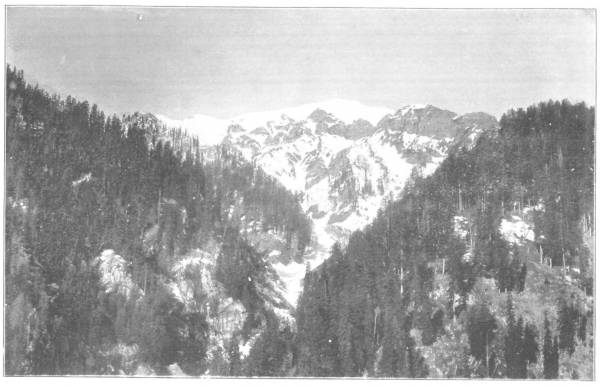
Chitral is 220 miles from Gilgit, and the
road between the two places runs through
mountainous, difficult country, and crosses a
pass 12,400 feet high. The valleys through
which the road passes are all very narrow, in
just a few places opening out to a width of a
mile, but, for the greater part of the distance,
only a few hundred yards broad, and in many
cases mere defiles with the mountains thousands
of feet high on either side and standing out
in rocky precipices from the stream at the
bottom.
The Shandur Pass is about ninety miles from
Chitral and 130 from Gilgit. On the west side
of this pass, as has been already mentioned,
the whole country was up in arms against the
British, and news now reached Gilgit, that
besides the garrison of Chitral being shut up,
the post of Mastuj was besieged, and, finally, that
the detachment of troops under Captain Ross
had been annihilated, and that officer killed, and
that a second detachment under Lieutenant
Edwardes and Fowler had been attacked on the
way to Chitral. On the east side of the Shandur
Pass is the province of Yasin, formerly
independent, but during recent years an integral
part of the Chitral state. This province had
so far remained quiet, but it could not of course
be known whether Colonel Kelly in marching
through it would encounter opposition. Even
if he did not meet with actual hostility, and if
the people were only passively obstructive, his
task of reaching Chitral would be an almost
hopeless one, for both in the matter of supplies
and of transport he must of necessity largely
depend upon the people of the country through
which he passed.
On March 23rd and 24th Colonel Kelly's
force set out from Gilgit, the news having just
previously reached them of the annihilation of
Captain Ross's party. The first detachment
which Colonel Kelly himself accompanied was
composed of 200 men of the 32nd Pioneers
under Captain Borrodaile, with Lieutenants
Bethune (afterwards killed in Tibet) and Cobbe,
and Surgeon-Captain Browning-Smith; and the
second detachment of 200 Pioneers under
Lieutenants Petersen and Cooke. Two guns
of the Kashmir Mountain Battery also accompanied
the latter detachment.
It was with this little force that Colonel
Kelly started on his venturesome journey to
succour the Chitral garrison, to restore British
prestige, to steady the frontier, to keep those
who were wavering from flooding over to the
opposite side, and to give heart to those who
still trusted and looked to the British. And it
may be well here to explain, for the benefit of
those not acquainted with our Indian Army, who
the men were whom Colonel Kelly was now
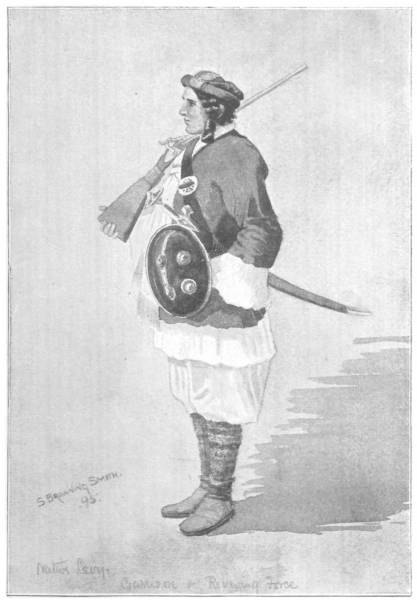
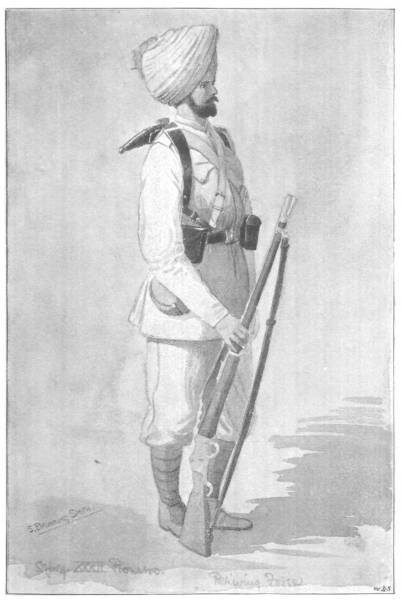
taking with him on this march. The Pioneer
regiment, of which he was taking a wing, is
composed of Sikhs from the Punjab. The regiment
is organised and equipped for the special
purpose of making roads and doing light pioneer
work in advance of the army. It is drilled, and
on service fights as an ordinary infantry battalion,
but it can be used as well for the important
work of road-making and construction of out-posts
as for ordinary fighting purposes. The
men were then armed with Martini-Henry rifles,
and carried in addition, each man, a pickaxe,
a shovel, or some other tool required for pioneer
purposes. Colonel Kelly's force, to save transport,
which was very difficult to obtain, travelled
without tents. Each sepoy was allowed fifteen
pounds of baggage, and he carried a greatcoat
and eighty rounds of ammunition, and wore a
short "poshtin" (sheepskin coat). The guns of
the Kashmir Mountain Battery were 7-pounders
of a rather antiquated pattern. The officers
and men of the battery belonged to the army of
the Maharajah of Kashmir, and for the last few
years had been drilled under the supervision of
British officers.
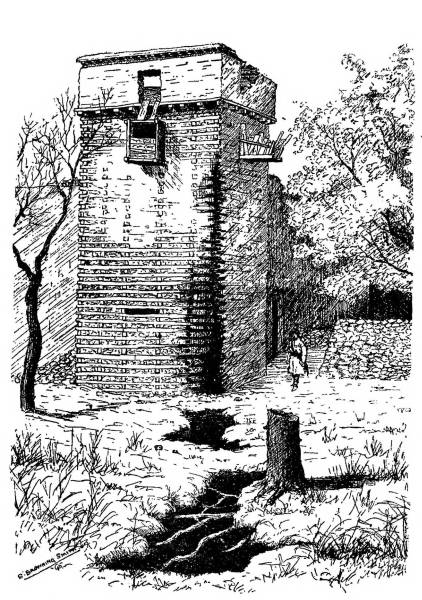
At Gupis (sixty-five miles from Gilgit), where
there is a small masonry fort, built in the previous
year by Kashmir troops under the supervision
of Captain Townshend as an advanced
post in the direction of Chitral, Lieutenant
Stewart, Royal Artillery, joined Colonel Kelly,
to be with the two guns brought from Gilgit.
Five marches further on at Ghizr a small
detachment of sixty Kashmir Infantry under
Lieutenant Gough, forty Kashmir Sappers and
Miners under the supervision of Lieutenant
Oldham, R.E., and 100 levies from Hunza-Nagar,
were stationed.
Ghizr is 10,000 feet above the sea-level, and
is a small village occupied by a hardy and
somewhat independent set of people. Here it
was that Colonel Kelly's chief difficulties were
likely to commence. He had been able to get
so far without encountering any serious obstacle.
The people of Yasin had shown no hostility, and
Ghizr had been reached without mishap; but
here at Ghizr snow lay deep on the ground, and
at the time of Colonel Kelly's arrival had been
falling steadily for five days previously. The
Shandur Pass (two marches ahead) had to be
crossed, and the British officers had to bear in
mind that if the pass could not be crossed, or if
any sort of disaster befell them on the opposite
side, there was the almost certainty that the
loyalty of the people of Yasin in their rear
would not stand the test of further trial, and
that the Yasinis, believing that the Chitralis in
rebellion on the western side of the pass must
be in the ascendant, would begin to trim their
sails to join them so as to save their own
necks.
On the 31st of March both detachments of
Colonel Kelly's force had reached Ghizr, and in
spite of the heavy snowfall and of the unpromising
look of matters, it was decided to push on
the next day towards Chitral, for the British
officers in the fort there had now been shut up
for four weeks, and it was urgently necessary
to press forward as rapidly as possible to their
aid.
On April 1st, Colonel Kelly left Ghizr with
the whole force, but difficulties commenced at
once. The start, which was to have been made
at 7 a.m., did not take place for three hours
later on account of the coolies required for the
carriage of the supplies in crossing the pass
having absconded. For some hours the force
plodded resolutely through the snow, but at
about 2 p.m. it became apparent that, eager as
they were to push on to the relief of their
comrades in Chitral, it would be impossible to
proceed with the means at their disposal.
What was most necessary was to take on the
guns; for the mere rumour that Colonel Kelly
was bringing guns with him had been sufficient
to produce the strongest moral effect upon the
Chitralis, unaccustomed as they were to these
weapons. The Chitralis might formerly have
dreaded the regular troops of the Indian Army,
but they had already annihilated two detachments
of these troops, and were now engaged
in besieging others, and Colonel Kelly's
Pioneers alone might not have been able to
produce that strong moral effect which was so
necessary; but if guns could be brought over,
the Chitralis would certainly be terrified, and
Colonel Kelly was above everything anxious
that the two guns he had brought from Gilgit
should accompany him over the pass.
Here, however, just at the critical time, there
seemed no possibility of his being able to carry
out his object. The gun-carriages and the
ammunition boxes, etc., are carried on mules,
and, on this march from Ghizr towards the
pass, it was found that the mules could scarcely
move through the snow; they were floundering
about in it, up to their bellies, and in the afternoon
it became apparent that it was no longer
possible to take them any further, much less to
bring them over the pass. This was the state
of affairs on April 1st, as Colonel Kelly was
marching out from the last village towards the
pass. Colonel Kelly had now, therefore, to
decide whether the enterprise should be abandoned
for the present and a more favourable
season awaited, or whether a part of his force
should be sent to cross the pass while the
remainder returned to quarters at Ghizr. He
elected the latter arrangement, and while the
guns and 200 of the Pioneers, with 50 Nagar
levies, returned with him to Ghizr, 200 of the
Pioneers, with Captain Borrodaile, Lieutenant
Cobbe, and Surgeon-Captain Browning-Smith,
and 40 Kashmir Sappers and Miners under
Lieutenant Oldham, R.E., with 50 Hunza
levies, remained at Teeru, a small hamlet about
seven miles beyond Ghizr in the direction of
the pass.
On the 2nd of April snow fell the whole day,
and Captain Borrodaile, with the detachment
which was to make the first attempt to cross the
pass, had to remain patiently at Teeru. In the
afternoon Lieutenant Stewart, R.A., arrived
from Ghizr again with the two guns. It was
impossible to carry these guns over on mules,
but the Pioneers, unwilling to leave them
behind, had themselves volunteered to carry
them over on their backs. They had gone to
their officers and said, that in addition to their
own rifles and ammunition, pioneer equipment,
and kit, they would guarantee that they would
themselves transport the guns with the gun-carriages,
ammunition, etc., over the pass. A
detachment of the 4th Kashmir Rifles, under
Lieutenant Gough, had also volunteered to
assist in this work, and they, too, now arrived
in Teeru.
This splendid offer, which showed so clearly
the noble spirit which animated the troops, was
eagerly accepted by the British officer, and on
the 3rd of April Captain Borrodaile set out from
Teeru to cross the pass with his spirited little
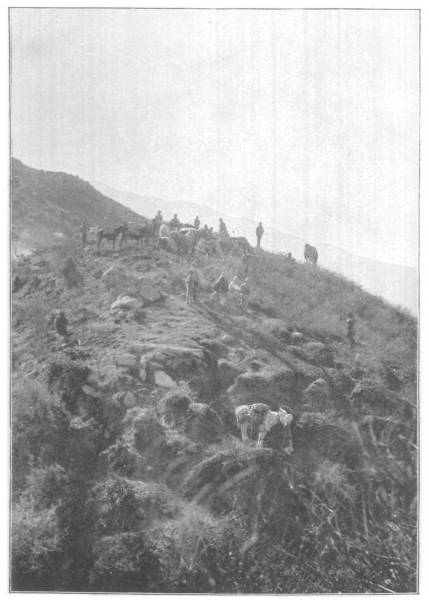
body of native troops. The snow was very
deep and the work of marching through it
excessively heavy. A more arduous task than
the men had voluntarily set themselves to do,
it would be hard to imagine; but hard though
it was, to their everlasting credit, the feat was
successfully accomplished. Sledges were at
first tried, but they had to be given up as useless.
Narrow as these sledges were, a single
man track was still narrower and extremely
uneven with great holes every few steps, so
that they could not be hauled easily and were
abandoned. All day long the men struggled
through the snow with the guns, till between
nine and ten o'clock in the evening it was so
dark that the track could scarcely be seen, and
it was then decided that if the men were to get
in at all, those behind would have to drop their
loads. This was accordingly done, ammunition
boxes, etc., were stacked in the snow, and the
troops marched on to Langar, the camping
spot at the foot of the pass.
There was only one small hut in which the
more exhausted men were placed, and the
remainder being without tents had to remain
in the open for the whole night. The men
with Captain Borrodaile were Sikhs from the
plains of the Punjab, brought up for generations
in one of the hottest climates in the world, and
they were now called upon, after the severe
struggles of this and previous days, to spend a
night on the snow at nearly 12,000 feet above
sea-level, and with the thermometer somewhere
about zero (Fahrenheit). Sleep for most of
them was out of the question; the men as far
as possible gathered round small fires which
had been made up from the brushwood to be
obtained near the camping spot, and wearily
awaited the dawn and final struggle of the
coming day.
On the following morning Captain Borrodaile
set off for the pass; but as it had now become
clear to him that if his men were to attempt to
carry over the guns as well as their own kit,
they would inevitably break down altogether,
he decided to leave Lieutenants Stewart and
Gough behind, and directed these two officers
to employ that day in bringing the remaining
loads into camp and storing them there till
either Captain Borrodaile could send back
assistance from the opposite side of the pass,
or until aid could come from Ghizr. Captain
Borrodaile's men found the task of crossing the
pass just heart-breaking; every few steps they
would sink in through the snow, although some
sort of a track had been beaten out by the
levies going on in front. At times they would
fall in almost up to their armpits, so that they
had to be pulled out by their comrades. This
was fearfully trying to men loaded as they
were, to men too who had passed an almost
sleepless night and started for this, the crisis of
the enterprise, thoroughly exhausted.
By the time the party had reached the middle
of the pass men were falling out in twos and
threes, sitting down in the snow as if they were
on the point of giving up the struggle. The
heavy loads which they had to carry, rifles,
ammunition, haversacks, greatcoats, etc., were
weighing them down and utterly exhausting
them. The snow was from three to five feet
deep and quite eighteen inches of it was soft and
fresh. At the same time the sun was pouring
down upon the men, and adding to their discomfort
by the glare which it produced from the
white surface of the snow. Although all the
men were provided with blue spectacles, many
cases of snow-blindness occurred. The absence
of water too caused the men additional suffering.
Little relief was afforded them from sucking
snow, and many were afraid to do that, thinking
it might produce some bad influence. So
exhausted were the men that it seemed at one
time to the British officers that it would be
necessary to spend another night on the snow,
but at about 5.30 the advance guard came to
the end of the flat part of the top of the pass,
and the descent was at last commenced. News
was at once passed along the line and fresh
spirit came into the men. They pulled themselves
together for a final effort, and when a
little further on some water was obtained, they
began to step out briskly. A critical time had
now been reached; the party were descending
the western side of the pass into the part of the
country which had for a month now been up in
open arms against the British. It was known
that there was a village at the foot of the pass,
and it was quite possible that Captain Borrodaile's
exhausted troops might find resistance
offered them here at the very culminating point
of their troubles. Captain Borrodaile had
therefore to send on his few levies to scout and
discover if the enemy were in any force in the
village of Laspur, at the foot of the pass, and to
report on the state of affairs there. Fortunately
no opposition was met with, for the Chitralis
had scarcely expected that the troops would be
able to cross the pass in its then condition, and
at about 7.30, nearly twelve hours after the
first start had been made from Langar, Laspur
was reached.
In this straggling village a few inhabitants
were found, who immediately came in to pay
their respects, as, 200 men in their midst, even
though they were so exhausted, were to be propitiated.
Captain Borrodaile's party then made
themselves snug for the night in the various
buildings and outhouses, improvised a few
rough defences against a night attack, and then
prayed that for this night at least, after all their
terrible exertions, they might be left in peace.
On the next morning (April 5th) Captain
Borrodaile, having seized a number of inhabitants
of the village, sent them back over the
pass to Langar to help Lieutenant Stewart and
Lieutenant Gough to carry over the guns and
the remaining loads, which had been left on the
near side of the pass. These two officers, with
the small detachment of Kashmir Infantry,
succeeded in their task, and to them is due the
credit of performing this splendid feat of carrying
guns over a high pass in, perhaps, its worst
condition, and bringing them down into Chitral
territory to give so important a help to Colonel
Kelly's force. On the 4th, Surgeon-Captain
Browning-Smith made an examination of the
men who had crossed the pass, and found
twenty-five cases of frost-bite and thirty of
snow-blindness. These were fortunately not
severe, but it was evident that even one more
day's work such as these troops had had to
undergo would have quite incapacitated the
force.
We must now try and realise what was the
position of this small detachment which Captain
Borrodaile had with such resolution brought
over the Shandur Pass. They were now in the
presence of an enemy elated with success, and
behind them this terrible pass, practically cutting
off their retreat. The village of Laspur had
to a certain extent been surprised, though two
spies stationed on the pass had been observed
by Captain Borrodaile's party, but a considerable
number of Chitralis were known to be in the
valley lower down, and an attack on Captain
Borrodaile might be made at any moment.
Colonel Kelly's instructions to Captain Borrodaile
were to entrench himself on arrival,
return his coolies, and endeavour to open up
communication with the garrison of Mastuj, two
marches below Laspur, who were besieged by
the Chitralis.
On the evening of April 5th a short reconnaissance
was made below the camp, as the
levies had brought back information that a
small body of the enemy had been seen.
On April 6th a reconnaissance in force was
made by Captain Borrodaile to Gasht, twelve
miles distant; the two guns and one hundred
and twenty of the pioneers taking part in the
movement. Gasht was reached without opposition,
and the villages on the route were
found almost deserted, but Captain Borrodaile's
troops were able to seize some thirty inhabitants
and twelve ponies to serve for transport
purposes. Captain Borrodaile returned to
Laspur the same night, and he then found
Colonel Kelly with Lieutenant Beynon, his
staff-officer, and about fifty levies had crossed
the pass and arrived in Laspur.
On the 7th the troops rested and prepared
for an advance on the following day.
On the 8th the force reached Gasht unopposed,
and a small reconnaissance in the
evening showed that the enemy were occupying
a strong position across the valley at a place
called Chokalwat, a few miles below. This
position Colonel Kelly decided to attack the
next morning. The Chokalwat position is one
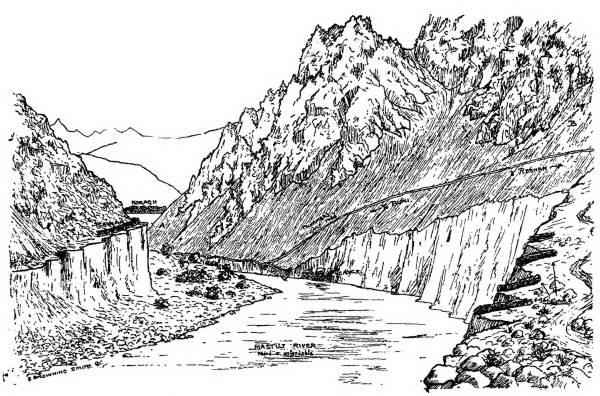
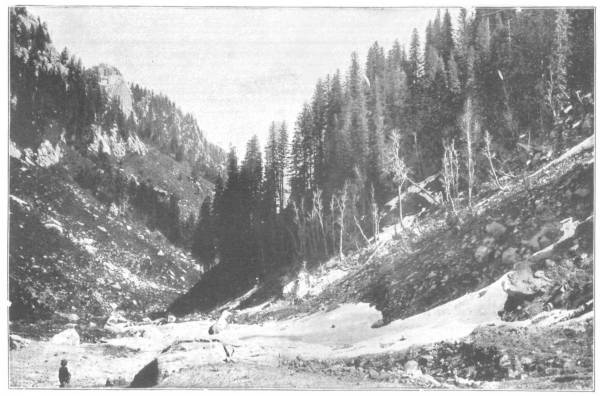
of great natural strength, and of that order
which is generally described as impregnable.
Any one looking at it would say that here a
hundred men could keep a whole army at bay.
On each side of the valley mountains tower up
thousands of feet in rugged precipices; a river
flows along it, and the only road leads either
along the bottom of a stone-shoot, down which
the enemy from above could hurl rocks on any
force passing beneath; or else over the river
and by a zigzag path up some cliffs, the edges
of which the enemy had lined with sangars or
stone breastworks. At accessible points on the
mountain sides the enemy had also constructed
these breastworks, and if the Chitralis were
determined to offer Colonel Kelly at all a
resolute opposition, he might have been brought
to a standstill here at his first contact with the
enemy, and his main object of affording speedy
relief to the garrison in Chitral would be
frustrated. In the Hunza campaign of 1891,
our troops had been kept at bay for nearly a
fortnight in just such another position. The
Hunza men were few of them armed with rifles,
while the Chitralis had numbers of breech-loaders,
and it was not difficult to imagine that
a check might here be offered to the relief force,
and a check, anything else indeed but complete
success, would have involved the British in
most serious trouble, and might have caused
the people all along the lengthy line of communications
to show hostility.
On the morning of April 9th, at 10.30 a.m.,
Colonel Kelly advanced to the attack of this
position. In the early morning Lieutenant
Beynon with the Hunza levies were sent up the
high hills on the left bank of the river, so as to
turn the right of the enemy's position and attack
in rear. The Punyalis were ordered up the
hills on the right bank to turn out the men
above the stone-shoots on that side. The
enemy's position consisted of a line of sangars
blocking the roads from the river up to the
alluvial fan on which they were placed. The
right of the enemy's position was protected by
a snow glacier which descended into the river
bed, and also by sangars which were built as
far up as the snow-line on the hill-side. The
road down the valley led on to the alluvial fan,
the ascent to which was short and steep—it was
covered with boulders, and intersected with
nullahs. The road led across this fan and then
along the foot of the steep, shaly slopes and
shoots within 500 yards of the line of sangars
crowning the opposite side of the river bank,
and totally devoid of any sort or description of
cover for some two miles. It could also be
swept by avalanches of stones set in motion by
a few men placed on the heights for that
purpose.
The force with which Colonel Kelly advanced
to the attack of this position consisted of 190
men of the 32nd Pioneers, two guns of the
Kashmir Mountain Battery, 40 Kashmir
Sappers and Miners, and 50 levies—in all, 280
men. Colonel Kelly considered that any delay
to wait for the second detachment of his troops,
who were on their way over the Shandur Pass,
would only give the enemy an opportunity for
collecting in greater strength, and for improving
the fortification of their position, and he decided
therefore to attack at once, and advanced in
the following order:—A half company of 32nd
Pioneers formed the advance guard, and these
were followed by the forty Kashmir Sappers
and Miners, a half company of the 32nd
Pioneers, the two guns which were carried by
coolies, and the other company of the 32nd
Pioneers completed the main body. The
baggage, under escort of the rear guard,
remained at Gasht till ordered forward to the
action.
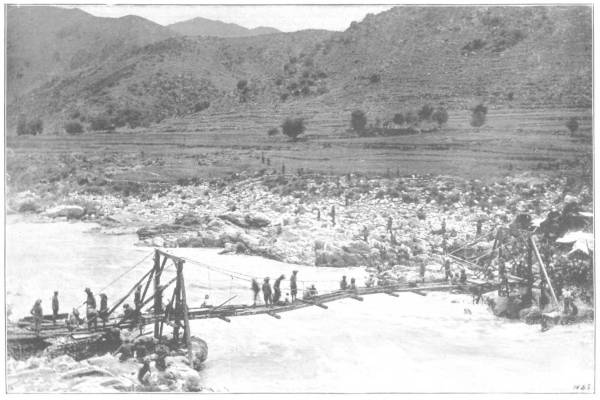
The advance was made up to the river where
the bridge had been broken by the enemy, but
was now sufficiently repaired by the Sappers
and Miners for the passage of the infantry.
The guns forded the river, and the force
ascended to the fan facing the right sangar
of the enemy's position. Colonel Kelly's plan
was for the advance guard to leave the road
and form up on the highest part of the fan
facing A sangar, which was to be silenced by
volley firing and the guns. He also proposed
to adopt the same course with regard to B
sangar, when an opportunity should offer for
the infantry to descend into the river bed and
ascend the left bank to enfilade the enemy in
the remaining sangars, which it was expected
would be vacated as soon as Lieutenant
Beynon's flank attack with the levies had
developed.
The advance guard of the Pioneers formed
up at about 800 yards from the position, while
the main body followed in rear. The Pioneers
then advanced to the attack—one section of C
company extended, another section of the same
company in support; two sections of C company
and the whole of A company in reserve. The
guns then took up a position on the right and
opened on A sangar at a range of 825 yards.
As the action progressed the supporting section
of C company advanced and reinforced the
remaining half of C company, which also
advanced, and leaving sufficient space for the
guns, took up their position in the firing
line on the extreme right. Volley firing was
first opened at 800 yards, but the firing line
advanced 150 to 200 yards as the action progressed.
At a later stage one section of A
company was pushed up to fill a gap on the
right of the guns in action in the centre of
the line. A few well-directed volleys and
accurately-aimed shells soon caused the enemy
to vacate A sangar in twos and threes, till it
was finally emptied. Meanwhile Lieutenant
Beynon with his levies had found his way up
the hill-sides on the left bank of the river, and
as the Pioneers advanced across the fan
Lieutenant Beynon drove the enemy from their
sangars on the hill-sides. As soon as the enemy
had been cleared from A sangar, Colonel Kelly
directed his attention to B sangar, and attacked
it in a similar manner, and just as the enemy
had fled from the first, they now vacated B
sangar also. At the same time those of the
enemy who had been driven from the positions
on the hill-side came streaming down into the
plain, and a general flight ensued. An advance
of Colonel Kelly's whole force was then made
down the precipitous banks to the bed of the
river. This advance was covered by the fire of
the reserves; the river was forded, and sangars
A and B occupied. The guns were then
carried across, and the whole line of sangars
having been vacated, the column was re-formed
in the fan, and the advance was continued to a
village one and a half miles further along
the bed of the river, and there a halt was
made.
So terminated the first successful action with
the enemy. It was carried out, says Colonel
Kelly, with the extreme steadiness of an ordinary
morning parade; the volleys being well
directed and properly controlled. The action
lasted but one hour, and the casualties on the
side of the British were only one man of the
32nd Pioneers severely wounded, and three
Kashmir Sappers slightly wounded. The
strength of the enemy was computed at from
400 to 500 men, and they were armed with
Martini-Henry and Snider rifles. Several dead
were found in the sangars, and the loss of the
enemy was estimated to have been from fifty to
sixty men.
After a short halt the troops continued the
advance by the left bank of the river till within
three miles of Mastuj, where the river was
forded. Here, drawn up on the crest of an
alluvial fan above the river, were seen the
British garrison of Mastuj, who had been shut
up in the fort for eighteen days, but who had,
on hearing the firing of Colonel Kelly's troops,
and seeing the enemy gradually vacating their
position round the fort, now come out to join
hands with the relieving force.
At 5 p.m. Colonel Kelly's force reached
Mastuj itself, and so in a single day a successful
action had been fought, the beleaguered garrison
of Mastuj relieved, and another march made in
the direction of Chitral.
Lieutenant Moberly, who was in command
at Mastuj, was now able to relate the story of
his adventures since his investment by the
Chitralis. In a previous chapter the story of
the disasters to the parties under Captain Ross
and Lieutenant Edwardes has been told. These
detachments had in the beginning of March set
out from Mastuj for Chitral, but no news of
what had happened to them, or of what was
occurring in Chitral reached Lieutenant
Moberly. He had sent messengers down to
Buni three times, but each time they were cut
off. On March 10th Captain Bretherton (who
was afterwards drowned in the Brahmaputra
on the way to Lhasa), the Deputy-Assistant
Commissary-General for the Gilgit force,
arrived in Mastuj with a detachment of 100
Kashmir Sepoys from Ghizr, and so brought
up the Mastuj garrison to a total strength of
170 men. Sixty more men arrived from Ghizr
on the 13th, and on the 16th Lieutenant
Moberly, who had been trying for some days
to obtain coolies to enable him to march down
to Buni to ascertain the fate of Captain Ross's
party, set out from Mastuj with 150 Kashmir
Infantry. No coolies had been obtained, and
each man had to carry his poshtin (sheepskin
coat), two blankets, 120 rounds of ammunition,
and three days' cooked rations. Sanoghar, a
village eight miles below Mastuj, was reached
that day, but no longer march could be made,
as a bridge over the river had to be repaired.
Fifty Punyali levies had joined Lieutenant
Moberly, and on the next morning he left for
Buni. This he reached at 5 p.m., and found
there Lieutenant Jones and the seventeen survivors
of Captain Ross's party, and thirty-three
men who had been left in Buni by Captain Ross
before his march to Koragh. Lieutenant
Jones had been unable to proceed towards
Mastuj for fear of attack on the difficult road
there, and had remained on in Buni trying
to communicate with Lieutenant Moberly, and
hoping that relief might be sent him.
This relief Lieutenant Moberly at no small
risk, for there are many points on the eighteen
miles of road between Mastuj and Buni where
his retreat might have been cut off, had now
gallantly brought. But Buni was no place in
which to stay longer than was absolutely necessary.
It is an open village; there is no defensible
post in it, and above everything there
were not supplies sufficient to last any length
of time. The enemy were already in strength
at Drasan, a few miles distant on the opposite
bank of the river, and Lieutenant Moberly
heard that they intended to cut off his retreat
that very night at the Nisa Gol, a strong
position on the way between Buni and Mastuj.
Lieutenant Moberly heard also that the enemy
were collecting on the road between Mastuj
and Gilgit, and that no more of our own troops
had yet started from Gilgit.
He had no choice left but to return to Mastuj
immediately. So after remaining there only
two hours he set out at 7 p.m. on the 17th on
his return journey. A party had been previously
despatched to seize the bridge over the
river and the difficult piece of cliff along which
the road passes, and the Punyali levies had been
sent forward to if possible prevent the enemy
from occupying the Nisa Gol position. These
precautionary measures were successfully carried
out; the enemy did nothing more than follow
the party along the path, and Lieutenant
Moberly after marching steadily all night halted
for a few hours at dawn, and proceeded on to
Mastuj, which he reached in safety about 10 a.m.
on the 18th, having thus by a bold and carefully-planned
march rescued Lieutenant Jones's
party from probably the same fate that befell
Lieutenant Edwardes's party. He did this,
too, just in the nick of time, for only a few
hours after he had left Buni, the enemy arrived
there in force, and afterwards occupied the Nisa
Gol position.
On the three days following his return to
Mastuj, Lieutenant Moberly and Captain Bretherton
were busily occupied in cutting down
trees, from them making up fence-work round
the fort, and completing defensive arrangements
generally. The Hunza-Nagar levies, to the
number of one hundred, were sent back to
Ghizr on the other side of the Shandur to reinforce
that post and be in communication with
Gilgit. On the 25th news reached Mastuj that
Lieutenants Fowler and Edwardes had been
captured by the Chitralis. The enemy were
now closing round the fort. A reconnaissance
which Lieutenant Moberly had taken out on
the 22nd showed that about six hundred of
them were building and holding sangars at
Chokalwat position, a few miles above Mastuj
on the way to Gilgit, and a regular blockade of
the fort now commenced.
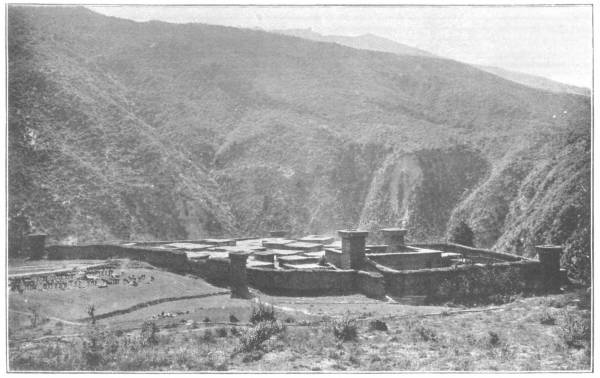
Mastuj fort is about ninety yards square, and
is built of masonry and woodwork, in the same
manner as are all the forts in these parts. The
walls are about twenty-five feet high, but at the
time of the siege were in a dilapidated condition,
for the place had only been temporarily occupied
by the British as a residence for the political
agent and his escort pending the decision
of the Government as regards our permanent
policy towards Chitral. And unfortunately
a very severe earthquake in the previous
year had shaken the walls very nearly to pieces.
At that time I was the political agent there,
and a little incident which occurred while the
earthquake was taking place is worth recording
as an instance of the steadiness of the native
troops. Lieutenant Gurdon, the officer in command
of the escort of Sikhs, and myself were
seated in a room of the fort when we suddenly
felt the whole place shaking. But earthquakes
are common in Chitral and we did not at first
move, till we heard stones crashing down outside
and the whole room tossing about like a
cabin on board ship. Then we dashed out of
the door to the courtyard, and as we did so
passed a sentry, who quietly proceeded to present
arms in salute as if nothing was happening.
The mountains round were in a cloud of dust
from the avalanches of rock set rolling down
their sides by the earthquake, and the rickety
walls of the fort tumbling on all sides; but all
this did not disturb the Sikh sentry; his sense
of discipline was so ingrained that he saluted as
usual, in the ordinary, everyday manner.
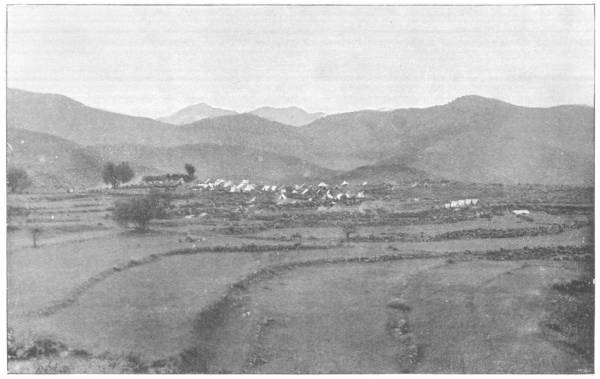
The Mastuj fort is situated on the edge of a
sloping plain running down from the hill-side
which at one point approaches to within about
400 yards of the fort. The enemy occupied a
row of houses some 300 yards from the fort,
which they loopholed, and from these commenced
firing upon the fort. They also built
sangars at a distance of 800 yards, but the
garrison succeeded in silencing their fire by
aiming volleys into them; and on one occasion
Punyali levies were sent out at night to whitewash
the loopholes of sangars out of which the
enemy had been driven during the day, so that
it would be possible for the garrison to aim
correctly if the enemy attempted to reoccupy
them. The enemy did subsequently come back
to the sangars, but only to be driven out again
by the carefully-aimed fire from the garrison.
On another occasion the Chitralis had built
a sangar on the hill-side and from it wounded
two ponies in the inside of the fort. The enemy
were armed with Martini-Henry and Snider
rifles and could fire from long ranges into the
fort. It was necessary therefore to dislodge
them from the sangar, and the Punyali levies
were sent early one morning to destroy it before
it had been occupied for the day by the
enemy. Some days afterwards a sangar was
built about 300 yards below the fort, but Lieutenant
Moberly moved out with a party of
eighty sepoys and rushed it. The enemy only
fired a few shots, and then retired into some
houses from which they harassed the return
of the party. The sangar, which was found to
be strongly built of fascines and stones, was
destroyed.
All this time the Chitralis had been trying to
induce Lieutenant Moberly to come out under
the promise of a safe conduct to Gilgit, and he
was assured that Sher Afzul, the pretender to
the throne of Chitral, had no wish to fight the
British. Had Lieutenant Moberly listened to
these insinuating advances he would undoubtedly
have been captured as soon as he came
outside, and he acted wisely to wait for the
relief which, though he was not aware of it, was
now near at hand. On the 9th of April large
numbers of the enemy were observed to be
moving off, and Lieutenant Moberly took out
his men to follow them up and harass them.
Then it was that he met Colonel Kelly's force
marching in to the relief of the garrison. The
siege was now at an end; the tables were
turned, and relieving and relieved forces now
marched down to succour Chitral.
From the 10th to the 12th of April Colonel
Kelly halted in Mastuj to allow of arrangements
for supplies and transport for the further march
to Chitral to be made, and to await the arrival
of a second detachment of the troops catching up
from the Shandur Pass. On the 11th of April
this detachment arrived accompanied by Surgeon-Captain
Luard with the Field Hospital,
which was now established at Mastuj; and on
the same day a reconnaissance was made by
the levies in the direction of Chitral, as the
enemy were reported to be holding a strong
position a few miles below Mastuj. On the
12th of April a further reconnaissance was
made by Lieutenant Beynon, the staff-officer,
and an accurate sketch of the enemy's position
brought back by him, which enabled Colonel
Kelly to settle the course of his action. The
position was generally considered to be impregnable,
and the late Mehtar of Chitral had,
standing on the very spot, himself explained to
me its natural strength, and affirmed that it was
one of the strongest positions in his country.
In Chitral all the positions in the mountain
valleys are well known and are regularly occupied
in each successive invasion which occurs,
and this position, Nisa Gol, is the one which has
been selected from time immemorial by the
Chitralis in the defence of their valley.
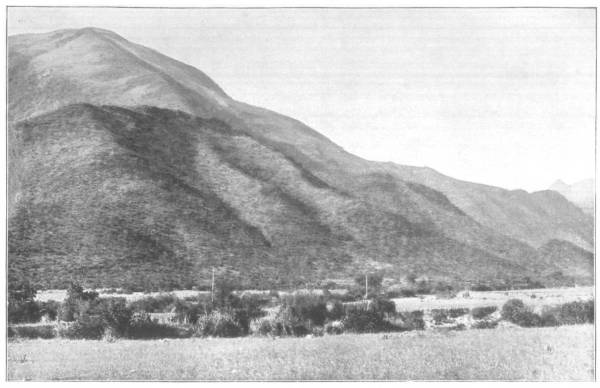
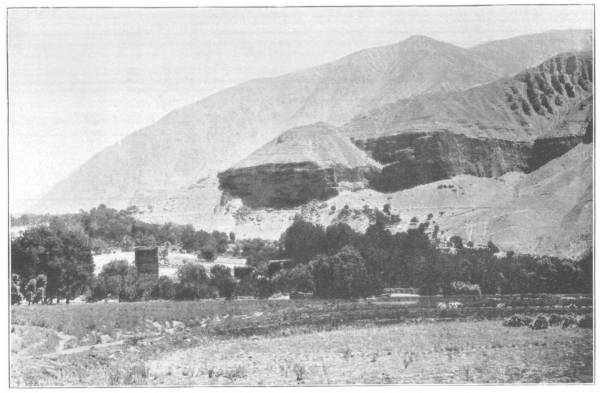
The valley of the Chitral River at the Nisa
Gol position is about a mile wide, and is
bounded on either hand by steep rocky
mountains, rising for several thousand feet
above the river. On the left bank especially
the mountain sides are very precipitous, and up
against these the Chitral River runs. On first
looking down the valley it appears as if, in
between the mountains, there was nothing but
a smooth plain running down from the right-hand
side, and it is not till one is actually on it
that it is discovered that the seemingly open
plain is cleft by a nullah between 200 and 300
feet deep, and with absolutely perpendicular
sides. The nullah is the Nisa Gol, and only
one path leads across it, that of the road to
Chitral, and this path the enemy had now cut
away. There had been a small goat-track
across this nullah at another point, but the
enemy had now entirely obliterated it. Sangars
had also been erected at the head of these
paths and along the right bank of the nullah.
These sangars were sunk into the ground and
head-cover was provided by a covering of
timber and stones. On the left of their position
they had sangars on the spur of the hill in
a general line with the sangars on the plain,
and on the hill parties of men were stationed
to throw down stones. On the right of their
position across the Chitral River, and slightly in
advance of the general line, they had another
line of sangars on a spur stretching away high
up into the snow-line.
Such was the position which Colonel Kelly
had now to attack, and in it the Chitralis had
collected to the number of about 1,500 men
under their chief leader, Mohamed Isa, to
make their principal stand, so as to prevent
Colonel Kelly joining hands with the British
garrison in Chitral.
Colonel Kelly, reinforced by the garrison of
Mastuj, now had with him 382 Pioneers under
Captain Borrodaile, two guns under Lieutenant
Stewart, 100 Kashmir Infantry under Lieutenant
Moberly, 34 Kashmir Sappers and Miners
under Lieutenant Oldham, R.E., and 100
Hunza and Punyali levies. With this force he
advanced from Mastuj at 7 a.m. on the 13th
of April. His plan was to send on an advance
guard, which, on gaining the plain which the
enemy's position bisected, would make its way
well up to the right where the ground favoured
an advance under cover to within 500 yards of
the ravine, whose further bank was occupied
by the enemy. This advance guard was
ordered to direct its attack on the sangar on
the right with well-directed volleys till the guns
and the remainder of the force could come into
position. As soon as the advance guard could
silence the fire in this sangar, which commanded
the advance across the plain, the main sangars
along the banks of the ravine were to be fired
upon. At the same time levies were to make
their way high up in the ravine nearer its
source in the mountains on Colonel Kelly's
right, to find some path by which the enemy's
left could be turned.
The advance guard, composed of A company,
at about 10.30 a.m. deployed into line and
advanced in extended order when within 900
yards of the position, the C company following
soon after prolonging the line to the right.
Each of these two formed their own supports,
E and G companies were in reserve, marching
in column of half companies forming single
rank, and opening out into one pace as they
advanced. Reinforcements being called for, E
company advanced and prolonged the line to
the right, G company being called up similarly
later on, formed the extreme right of the firing
line. The levies were well on the right, high
up towards the head of the ravine. While
these movements were being executed, the
guns came into action at a range of 500 yards,
firing common shell, and knocking down the
wall of the sangar to a height of about three
feet, and so, for a short time, silencing the fire
from it. The guns were afterwards advanced
to a distance of 275 yards from the enemy's
main sangar.
The infantry having deployed, A and C
companies kept the enemy engaged directly in
front along the main line of sangars, the latter
company occasionally directing its fire half
right against the sangars on the hills in that
flank. The fire of E and G companies was
almost entirely directed against the hill sangars—occasional
volleys being directed on small
parties of the enemy occupying hill tops from
800 to 900 yards distance. The general
average distance at which firing was opened to
the front was from 250 to 300 yards. As soon
as the guns had silenced the fire from the
sangars on the hill-sides to the right, they
shelled at ranges from 875 yards to 1,200 yards
the sangars along the edge of the ravine.
The existence of the goat-path across the
ravine already referred to was now reported to
Colonel Kelly by his staff-officer Lieutenant
Beynon, and Colonel Kelly accordingly directed
that an attempt should be made to make
it practicable so that the force might cross by
it. Some ladders had been brought with the
force for the special purpose of crossing the
ravine, and the Kashmir Sappers under Lieutenant
Moberly were sent forward with Lieutenant
Beynon to carry out the work. The scaling-ladders
were lowered down the sides of the
ravine by means of ropes, and after half an
hour's work a track was made by which the
bottom of the nullah could be reached and an
ascent by the goat-track on the further side
assured. The troops then descended into the
nullah, and eventually a party of about fifteen
succeeded in climbing the opposite bank, which
they reached almost simultaneously with the
levies, who had now worked their way round
by the right, turned the enemy's left and
reached the sangars on the hill-side. The appearance
of these bodies on the enemy's left
caused a general flight, and they streamed out
of their sangars in a long line, with the guns
firing at ranges from 950 to 1,400 yards, and
under volleys of rifle fire from the infantry,
Colonel Kelly then ordered a general advance
across the nullah by the road leading to Chitral.
A company, as soon as it could be mustered,
was sent in pursuit, but the enemy's flight was
extremely rapid, and they succeeded in effecting
a retreat towards Drasan and over the hill-sides
on the right bank of the river.
Colonel Kelly in reporting this action said
that he could not speak too highly of the extreme
steadiness and bravery of the troops during the
course of the action, which lasted two hours,
and during which they were subjected to a very
heavy and trying fire from the front and left
bank. The fire discipline he also said was
excellent, and contributed materially to keeping
down the fire from the enemy's sangars.
The enemy's casualties were estimated at
some sixty killed and one hundred wounded.
Amongst the enemy were some forty of Umra
Khan's men, and the fire which Colonel Kelly's
force had to face was entirely from Martini-Henry
and Snider rifles.
This second success was even greater than
the first. All the principal men of the country
not employed before the fort of Chitral were
present in the action, and the utmost reliance
had been placed in the strength of the position.
It was therefore a serious blow to the Chitralis
when they found that the principal position
on the road to Chitral had been summarily
captured.
Colonel Kelly halted that night opposite the
village of Sanoghar, and on the following day,
the 14th of April, marched to Drasan to ascertain
the strength of the enemy and his whereabouts,
as it was reported that Mohamed Isa had fled
in that direction. The road had been broken,
and a long detour had to be made up the spur
some 2,000 ft. high above the road, necessitating
a march of some twenty miles.
The fort at Drasan was found to be unoccupied,
and in it were large quantities of grain,
which would have been very acceptable to
Colonel Kelly had he been able to carry it
away, but no transport was available for the
purpose as no men could be captured from the
neighbouring villages.
The usual road to Chitral runs down the opposite
side of the valley to that on which Drasan
is situated. It was by this road on the left
bank of the river that Captain Ross and Lieutenants
Edwardes and Fowler had advanced,
and along it the parties under them had been
annihilated. The enemy had intended to have
arrested Colonel Kelly's progress at or near
the spot where Captain Ross's party had suffered
so severely, but Colonel Kelly outwitted them
by avoiding the terrible defiles on that road
and by marching from Drasan high up along
the hill-sides on the right bank of the river till
he had passed these difficult positions.
In the midst of heavy rain he marched on
the 15th of April to Khusht, and on the 16th to
Loon; and then on the 17th, being well behind
the worst defiles, he descended to the river bed
again and crossed the Chitral River to Barnas,
though the river at this point is not generally
considered fordable, for it is breast-high and
runs with rapid current. It was of course with
only great risk that men could be taken across,
but by linking them together in bands of ten or
twelve, and by stationing levies in the stream to
help men who might be washed off their legs,
and to save kits which might be carried away,
Colonel Kelly's force was able to effect the
passage of this deep and rapid mountain river.
A strategical move of the highest importance
had thus been effected and an almost impregnable
position turned without the firing of a
single shot.
All this time Colonel Kelly had not been
able to hear a single word from the garrison in
Chitral, nor had he been able to pass a message
in to them to give warning of his approach.
He was now only two marches distant from
Chitral, and the crisis of his arduous march was
approaching. This date was indeed the turning-point
of the whole campaign—Colonel Kelly
had turned the enemy's last position; it was
on this day that Lieutenant Harley made his
brilliant sortie; and it was on this day Umra
Khan was making his last futile effort against
General Low's force. The high-water mark of
the rebellion had been reached, and from now
the tide began to turn rapidly.
On the 18th Colonel Kelly made a short
march to Moroi and on the 19th arrived at
Koghazi, only one march from Chitral. Here
he received his first letter from the beleaguered
garrison, and obtained the welcome news that
the siege had just been raised and that the
enemy had finally fled.
In the afternoon of April 20th the force
marched into Chitral and joined hands with
their comrades, who had for forty-seven days
been invested within the fort.
This famous march of native troops from the
plains of India, led by a mere handful of British
officers, over a snow-clad range, through
precipitous defiles into the heart of a country
flushed with successful rebellion, will ever be
remembered as a unique exploit of the Indian
Army. The news of the success of the little
force was soon spread throughout the empire.
Everywhere the highest admiration was excited,
and critics in the great armies of the Continent
joined with ourselves in the praises of the high
military qualities which its accomplishment
showed that our officers and men possessed.
Her Majesty the Queen immediately telegraphed
to India her gracious approbation of
this remarkable exploit, and the Commander-in-Chief
in India, Sir George White, expressed
his warm appreciation of the manner in which,
in the face of extraordinary difficulties, the
advance and operations of the force were conducted,
and of the indomitable energy displayed
by Colonel Kelly and the officers and troops
under his command in overcoming them. The
Commander-in-Chief considered the arrangements
made for the crossing of the Shandur
Pass, the perseverance and skill displayed by the
officers, and the excellent behaviour of the troops
worthy of the highest praise, and while commending
all, recorded especially the important
part taken by Captain Borrodaile and his detachment,
who were the first over the pass.
A week after Colonel Kelly had reached
Chitral Major "Roddy" Owen and myself,
riding on ahead of the advanced parties of
General Low's force arrived in Chitral. It
was a bright sunny day, the country was
clothed in all the fulness of spring, the young
corn was waving in the fields, the blossoms
were forming on the trees and all nature was
smiling as we rode through the forty miles
of country which separated Chitral from the
advance guard which General Gatacre had
just led over the Lowarai Pass. But the looks
of the people were in striking contrast. Worn,
trembling and utterly cowed the Chitralis
shrank from even two British officers riding
without an escort through their country. It
was pitiable to see them. Men, whom a few
months before I had seen gay as few but
Chitralis in their contented moments can be,
were now moving about with careworn faces,
thin and exhausted. The people of Chitral
had flamed up into rebellion, and were now
lying burnt out like the charred remains of
a firework. When I asked them why they
had been so foolish as to fight us, they wrung
their hands and said, "Why were we? We
hate these Pathans; they have plundered our
houses and carried off our women, but they
were strong and close while you were far away,
and we never knew you were so powerful as
you are. We did not want to fight you, but
we were led away."
It was only very few people, however, that
we met as we rode through the villages, for
most had fled to the hills, believing that
General Gatacre's brigade, now just over the
Lowarai Pass, was to advance and exact a
terrible retribution by massacring them for the
space of three days.
Late in the evening of the 27th of April, we
rode into Chitral, and had the honour to be the
first to congratulate the famous garrison and
the officers of Colonel Kelly's force upon their
splendid achievements. We found the officers
just sitting down to dinner in the very house
in which I had lived for many months, and
in which Mr. Curzon and I on the previous
October had entertained the late Mehtar at
dinner. It was situated half-a-mile from the
fort, and here we found Sir George Robertson
and the other officers, recovered somewhat
indeed from what Colonel Kelly's officers had
found them, but still looking pale and worn,
thin, and with the set, anxious look which had
not yet left their faces. They were cheery;
they brought out a long-treasured bottle of
brandy from the reserve for hospital purposes,
and they produced a Christmas plum-pudding
which had only that day arrived, and insisted
upon our sharing these luxuries with them;
but even now they hardly realised that the
struggle was yet over, and one or other of them
would from time to time go round the sentries
posted everywhere round the house.
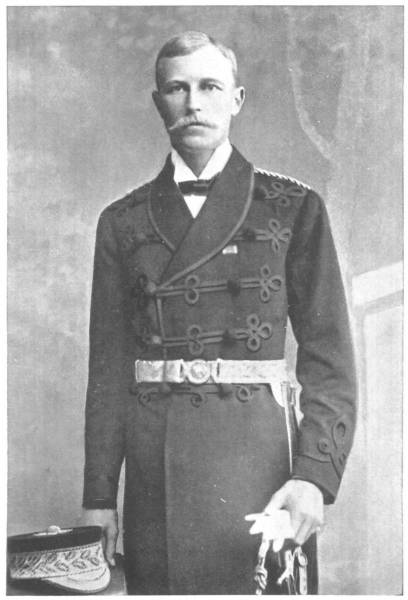
One of the first subjects on which they spoke
to us was about poor Baird. Few officers
have ever attached their comrades more
sincerely to them than did this brave officer,
and he was one of the best and keenest soldiers
in the service. He was noted for his tact
and for the amiability of his character, and he
studied his profession with the spirit of an
enthusiast. His coolness was as remarkable as
his zeal, and suffering though he was and knowing
that he must die, he remained cheerful and
collected to the last. He said that he would
not have wished to die any other death than
the soldier's death which he was now to meet;
he had done his duty and led his men as a
soldier should do, and he never regretted his
fate. He gave a few last messages to those at
home and then with a smile on his face and,
thinking of his profession to the very end,
wished his comrades success in their plans and
bade them good-bye.
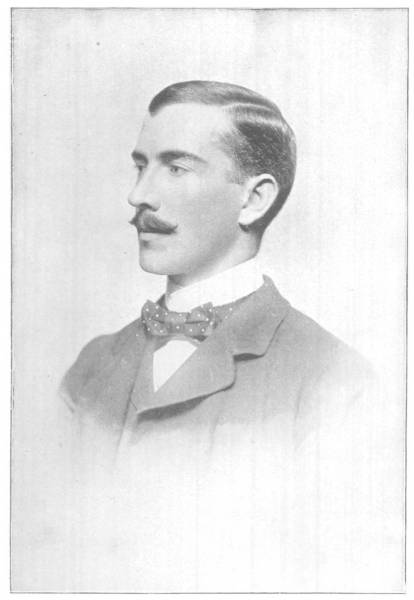
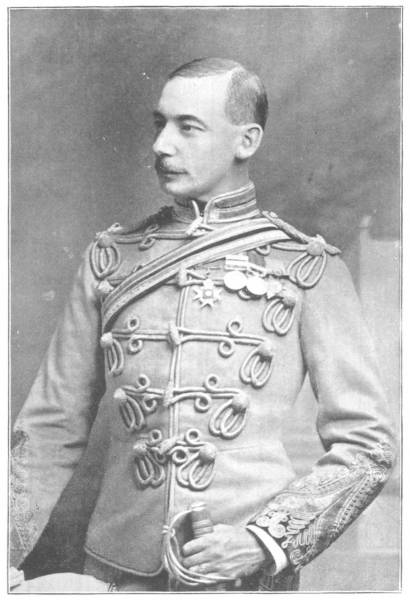
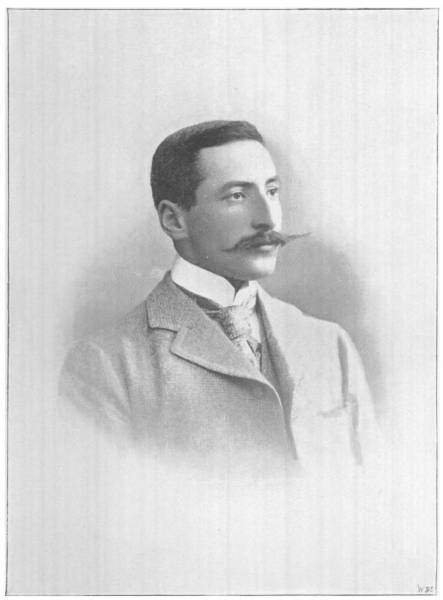
Photo Bassano, Old Bond Street.
Captain J. McD. Baird.
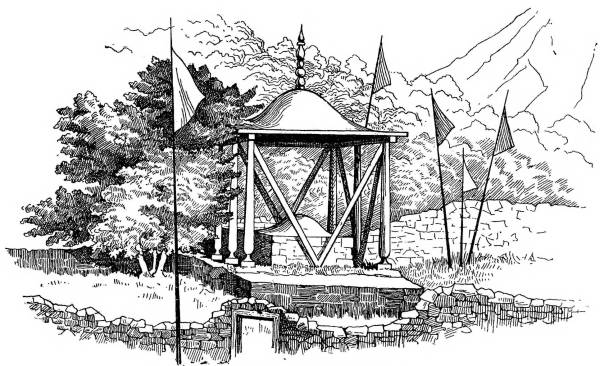
He died on the morning of the 4th of March,
and was buried in the dead of night outside the
main gate of the fort while the enemy were
firing all round. A little over two months
later, when the advance brigade of the Relieving
Force arrived in Chitral, General Gatacre read
a funeral service over his grave, and Major
Aylmer, R.E., who had served together with
Baird in the Hunza Campaign three years
before and won his Victoria Cross there, erected
a tombstone to his memory and with his own
hands carved an inscription. His comrades
and fellow-countrymen will know then that, far
away though he now lies, his grave has not
been neglected, but will ever be cared for by
the soldiers who follow after him.
After poor Baird I think the subject on which
the officers of the garrison spoke most feelingly
was the devotion and noble spirit of discipline
and determination shown by the Sikhs. There
were but a hundred of them in a garrison of
nearly four hundred, but the officers said that
without them they could never have held out,
and that but for these Sikhs not one of them
would have been there now. They only grew
more enthusiastic as the siege became closer
and times seemed harder. With calm self-reliance
they stood proudly at bay like a rock
with the waves beating against it. And so
great was the sense of discipline which their
stern old native officer Gurmukh Singh instilled
into them, that when during an attack the sick
struggled out of hospital to join in the fight he
would not excuse even their impulsive bravery,
but told them that a soldier's first duty was to
obey, that they had been ordered to hospital
and there they must stay. It was the discipline
ingrained into these men that saved the garrison.
As long as a Sikh was on sentry, and while
Sikhs were holding a threatened point, Captain
Townshend had nothing to fear. The enemy
would never catch a Sikh off his guard and
could never force their way through a post of
Sikhs while one remained alive. They saved
the garrison, and the officers gratefully acknowledged
their service.
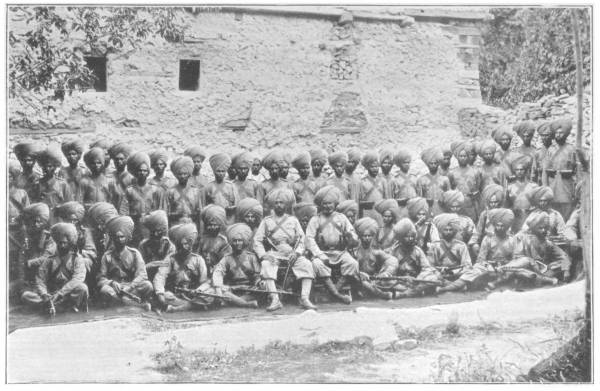
Company of the 14th Sikhs which formed part of the Garrison of Chitral during the Siege.
The skill of the enemy was, too, a subject on
which the officers specially dwelt. The Chitralis
had not previously been considered of much
account as a fighting race; but even they, once
their blood was up, fought hard and well, and
their Pathan allies were as skilful and brave as
troops of a regularly-trained army. Umra
Khan's men were born warriors; unlike the
Chitralis, who by nature prefer polo and sport
and dancing to fighting, the Pathans from their
childhood upwards think of little else than
warfare. They are for ever raiding upon one
another, attacking each other's villages, and
besieging and defending the forts scattered over
their country nearly as thickly as public-houses
in England. They therefore showed every
ingenuity in the siege of Chitral. To make
the most of their ammunition they never fired
a shot without clearly making out an object to
aim at, and usually with the rifle resting on a
stone so as to enable them to aim correctly.
The skill which they displayed in the construction
of trenches and breastworks to approach
the walls; the sagacity they evidenced in repeatedly
attacking the water-way and in setting
fire to the towers and walls of the fort; and
the courage and determination they showed in
their attempts to carry out these objects, excited
the highest admiration of the besieged.
No less remarkable was their well-directed
effort to undermine the walls; and at the close
of the siege the defenders found a huge pent
roof, which was to have been borne along and
placed against the walls of the fort so as to cover
the assailants, and huge scaling-ladders, capable
of carrying three men abreast. With the aid
of these contrivances the enemy had hoped,
when the mine had been successfully fired, to
have made one last desperate assault upon the
devoted garrison before the Relieving Force
could arrive. They calculated that the defenders
must be getting very short of supplies, for Mr.
Robertson in his negotiations with them had
always been careful to lead them into this
belief. They thought, too, that the native
troops must be low at heart, and ready to throw
up the sponge at any day. They considered,
therefore, that if one great effort could be made
they would be able to first crush the Chitral
garrison, and then annihilate Colonel Kelly,
who they knew had with him only a handful of
men with no supplies and no transport to speak
of, and who was now in the middle of the worst
defiles of the country. But the carefully-planned
and brilliantly-executed sortie under Harley
had effectually frustrated this last supreme effort
of the besiegers, and Colonel Kelly's force had,
by their skilful tactics and bravery in action,
thwarted the enemy's most cherished plans.
Just on the brink of a disaster the British forces
came out triumphant; and once again in our
fair island's story it was shown that British
officers, even though unsupported by a single
British soldier, and with only their own stout
hearts and strong right arms to trust to, and
to the influence they could exercise over men
of subject races, had been able to uphold the
honour of their race; and the story of the
defence and relief of Chitral will be handed
down to posterity as one of the most brilliant
chapters in the annals of Indian military history.
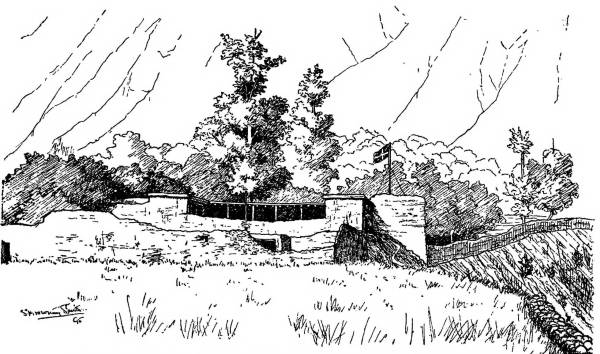
HOUSE OCCUPIED BY SHER AFZUL DURING THE SIEGE OF CHITRAL FORT
Now the British Agency
THE END
Richard Clay & Sons, Limited, London and Bungay.
MACMILLAN'S
NEW SHILLING LIBRARY
Globe 8vo. 1s. net per Volume.
LEAVES FROM THE NOTE-BOOKS OF LADY
DOROTHY NEVILL
H.M.I. Some Passages in the Life of one of H.M.
Inspectors of Schools
By E. M. Sneyd-Kynnersley.
TALES OF OLD JAPAN
By A. B. Freeman-Mitford (Lord Redesdale). Illustrated.
AT LAST: A Christmas in the West Indies
By Charles Kingsley. Illustrated.
THE RELIEF OF CHITRAL
By Colonel G. J. Younghusband and Sir Francis Younghusband.
Illustrated.
BARRACKS, BIVOUACS, AND BATTLES
REMINISCENCES OF THE GREAT MUTINY.
Including the Relief, Siege, and Capture of
Lucknow, and the Campaigns in Rohilcund
and Oude
By William Forbes-Mitchell.
CAWNPORE
By the Right Hon. Sir G. O. Trevelyan, Bart.
NORTH ITALIAN FOLK. Sketches of Town and
Country Life
By Mrs. Comyns Carr. Illustrated by Randolph Caldecott.
ALCOHOL AND THE HUMAN BODY. An Introduction
to the Study of the Subject, and a
Contribution to National Health
By Sir Victor Horsley, F.R.S., and Mary D. Sturge, M.D.
With a Chapter by Arthur Newsholme, M.D.
MACMILLAN AND CO., LIMITED, LONDON.