THE REIGN OF WILLIAM RUFUS. — CHAPTER V. — THE WARS OF SCOTLAND, NORTHUMBERLAND, AND WALES. [1] 1093–1098. — CHAPTER VI. — THE LAST WARS OF WILLIAM RUFUS. [429] 1097–1099. — CHAPTER VII . — THE LAST DAYS OF WILLIAM RUFUS AND THE ACCESSION OF HENRY. 1100–1102. [744]
3
THE year of Anselm’s appointment to the archbishopric, Events of the year 1093.
that part of the year which passed
between the day when the bishop’s staff was forced into
4
his hand and the day when he received consecration
from Thomas of Bayeux, was a time full of stirring
and memorable events of quite another kind. Relations between England and Scotland. War of 1093. It was
now that some of the events of former years were to
bring forth fruit. The relations between England and
Scotland were of a kind which might lead to open warfare
at any moment.[2]
This year the open warfare came.
And it was a warfare which was far more important in
its direct results than mere plundering inroads on either
side of the border commonly were. Its results.
The direct results
of the warfare of this year were in truth the crowning
result of causes which had been working for a whole
generation. Growth of the English power
It was a singular irony of fate which made
William the Red in some sort a missionary, not only of
the political power of the English kingdom, but of the
ascendency of the English blood and speech. He began
the later position of England as an European power.
He extended the boundaries of the kingdom of England
within his own island. and of the English nation under William Rufus.
And, more than this, he gave
decisive help to a work which wrought one of the
greatest of victories, not so much for England as a
power as for the English-speaking folk in their English-speaking
character. That he gave kings to Scotland
was a small matter; that was done by other rulers of
England before and after him. What specially marks
his reign is that in his day, and largely by his agency,
it was ruled that, of the three elements in Northern
Britain, British, English, and Scottish or Irish, the English
5
element should have the upper hand. The Scottish kingdom becomes English.
It was ruled
that the kingdom of Scotland, whatever might be its
relations towards the kingdom of England, whether
separate or united, whether dependent or independent,
whether friendly or hostile, should be itself truly an
English kingdom, a kingdom which was for some
generations more truly English than the southern
England itself.
Summary of Scottish affairs.
The Scottish affairs with which we shall have to deal
in the present chapter begin with the controversy between
William Rufus and Malcolm which led to the
death of Malcolm in his last invasion of England.
Death of Malcolm; first reign of Donald. 1093.
On
this follows that first outburst of the true Scottish nationality
which led to the election of Donald, followed by
his overthrow and the establishment of Duncan by the
power of England. Reign of Duncan.
Then, after a short interval, comes
the second national uprising, and the restoration of
Donald. After a longer interval comes the second
overthrow of Donald, and the establishment of the
younger Eadgar by the arms of the elder. Second reign of Donald. 1094. Establishment of Eadgar. 1097. The question
was now decided in favour of the line of Malcolm and
Margaret and of the form of English influence which
was represented by that line. And between these two
last revolutions we may record, as a kind of episode for
which it is not easy to find a place in the general run of
any other narrative, Revolt of Robert of Mowbray. 1095.
the revolt and overthrow of the great
earl of Northern England which forms at least a poetical
sequence to the overthrow of Malcolm. Between the
second establishment and the second overthrow of
Donald, I propose to tell, in its chronological order, the
tale of the slayers of Malcolm, of Earl Robert of Mowbray
and his kinsman Morel. There is little doubt that
their revolt was connected with movements in Normandy
also; but it would have been hard to describe it
in a chapter in which Anselm is the chief actor. It
6
comes better in its moral and geographical relation
towards the affairs of Scotland.
But Scotland was not the only land within the four
seas of Britain with which the kingdom of England has
much to do, especially in the way of fighting, within the
few years of this memorable reign. Affairs of Wales.
The affairs of Wales
are still more constantly coming before our eyes. While
the Red King is on the throne, Welsh warfare supplies,
year after year, no small part of the events which the
chronicler of England has to record. The Welsh history
of this time is one of deep interest on many grounds.
But it is specially important as giving us an example of
a third type of conquest in our own island, a conquest
differing widely both from the English Conquest of
Britain and from the Norman Conquest of England.
Comparison between Wales and Scotland.
Nor do the affairs of Wales fail to supply us with some
instructive contrasts as compared with the affairs of
Scotland. Scotland and the other dominions of the
Scottish king seem throughout this time to act as a
whole, at least as regards England. The land is conquered,
or it wins back its freedom; it receives foreign
influences, or it casts them out; but it seems to do all these
things as a whole. The union was perhaps very much on
the surface, but the events of this time bring whatever
there was of union to the front. Disunion in Wales.
The British story, on the
other hand, is the story of disunion in its strongest form.
Alike in victory and in defeat, all is local and personal;
common action on the part of the whole nation seems
impossible. The result of English dealings with Wales
during these years may be summed up as immediate loss
and final success, as defeat in detail leading to substantial
conquest. Effects of the reign on the union of Britain.
It is to this reign more than to any other that
we may trace up the beginning of the chain of events
which has gradually welded together England, Scotland,
and Wales, into the thoroughly united island of
7
Great Britain. The remote causes begin far earlier;
now we begin to enter on the actual story itself. And
from that story we may perhaps draw another lesson.
Its causes.
Three nations, differing in blood and speech, once parted
by bitter enmities, have been worked together into one
political whole, while still keeping so much of old diversity
as is really healthy, so much as hinders a dull and
lifeless uniformity, so much as sometimes kindles to
wholesome rivalry in a common cause. But this has
been because the facts of geography allowed and almost
compelled their union; it has been because the nature
of the old enmities was such as did not hinder union.
England, Scotland, and Wales, have at various times
done one another a good deal of mischief; there has
been no time when any one of the three held either of
the others in abiding Turkish bondage. But these very
facts may teach us that the same result cannot be looked
for in a land where the undying laws of nature and the
events of past history alike forbid it. Such union cannot
be where the boundaries of land and water on the map,
where the memory of abiding Turkish bondage in days
not long passed by, join to hinder the same process of
welding together which has so happily taken place among
the three nations of the isle of Britain. Comparison with Ireland and Normandy.
William the Red
did much for the final union of Britain, because nature
favoured that union. He brought Normandy under the
same rule as England, but only for the two lands to be
again parted asunder, because nature forbad their union.
And if it be true that from the rocks of Saint David’s
he looked out on the dim outline of distant Ireland, he
did well to turn away from the prospect, to bluster and
threaten, it may be, but to keep the practical exercise of
his warfare and his policy for other lands. He did well to
keep it, as far as the island world was concerned, for
those lands which, as the event has shown, nature did
8
not forbid to be, in course of ages, fully united with his
kingdom.
§ 1. The Last Year of Malcolm.
1093.
We should be glad of a clearer account than we have
of the immediate causes which led to the open breach
between William and Malcolm in the year which followed
the restoration of Carlisle. Complaints made by Malcolm.
It is certain that
Malcolm complained through an embassy that the King
of the English had failed to carry out the provisions of
the treaty made two years before. Nothing is more
likely; it was not the manner of William Rufus to carry
out his treaties with other princes, any more than his
promises to his subjects. Both alike, being parts of his
everyday duty, and not lighted up with the rays of
chivalrous honour, were reckoned by him under the head
of those promises which no man can carry out. But we
should be well pleased to know whether the alleged
breach of treaty had anything to do with William’s
Cumbrian conquest. Effects on Scotland of the restoration of Carlisle.
The strengthening of Carlisle, the
annexation of its district, could in no case have been
agreeable to the King of Scots. And if, as there seems
every reason to believe, the land had been held by its
late lord Dolfin as a vassal of the Scottish crown, what
William had done was a distinct aggression on the rights
of that crown. Probable wrong to Scotland.
The superiority of the English crown
over both Scotland and Cumberland would in no way
justify the act; it would have been a wrong done to the
Duke of the Normans if the King of the French had
annexed Ponthieu and strengthened Saint Valery against
Normandy. Other grounds of offence.
But we are not told whether this was the
ground of offence, or whether William had failed to carry
out any of the clauses of the treaty, those for instance
which secured to the King of Scots certain payments
9
and possessions in England.[3]
What followed may perhaps
suggest that, however much the occupation of Carlisle
may have rankled in the mind of Malcolm, the formal
ground of complaint was something of this last kind.
Scottish embassy at Gloucester. March, 1093.
Whatever were his wrongs, the Scottish king sent to
complain of them, and the answer which he received was
one which shows that, at this first stage, Rufus was not
disposed to slight the complaint. We are not told the
exact date of this first Scottish embassy. It may very
well have come during the short season of William’s
reformation; his seeming readiness to deal reasonably
with the matter, as contrasted with his conduct a few
months later, may pass as one of the fruits of his temporary
penitence, along with the appointment of Anselm
and the promise of good laws. Malcolm summoned to Gloucester.
He sent an embassy to
Scotland, inviting or summoning the Scottish King to
Gloucester, and giving hostages for his safety. This looks
very much as if the ground of complaint was the refusal
of some of the rights which had been promised to Malcolm
whenever he came to the English court. The Scottish
King agreed to come on these terms. William, in his
present frame of mind, was seemingly anxious to do all
honour to the prince with whom he was dealing. Eadgar sent to bring him.
The
Scottish ambassadors were sent back to bring their king,
and with them, as the most fitting of mediators, was sent
the man who had himself for a moment been a king,
the brother-in-law of Malcolm, the favoured guest of
William, the Ætheling Eadgar.[4]
Eadgar in favour with William.
We last heard of Eadgar somewhat more than a year
before, when Robert left England in anger, and Eadgar
went with him.[5]
This seems to imply that the relations
between William and Eadgar were at that moment unfriendly.
10
We have no account of Eadgar’s return to
England; but the duty on which he was now sent implies
that he was now not only in William’s formal favour, but
in his real confidence. His mission to Scotland.
He who had lately been Malcolm’s
representative in a conference with William now acts as
William’s representative in a conference with Malcolm.
Eadgar, like his friend Duke Robert, was clearly one of
those men who can act better on behalf of others than on
behalf of themselves.[6]
In his present mission he seems
to have acquitted himself to William’s full satisfaction;
the King of Scots was persuaded to come to the English
court. If his coming did not prove specially lucky either
to himself or to the over-lord to whom he came, that was
at all events not the fault of Eadgar.
Events of the year 1093.
While Eadgar was away on his mission to Scotland,
he left behind him a busy state of things in England.
His embassy came in the midst of the long delays between
Anselm’s first nomination and his investiture, enthronement,
and consecration. It came in the time when William
of Eu was plotting,[7]
and when, as we shall presently
see, seeming conquest was going on throughout Wales.
Meeting at Gloucester. August 24, 1093.
The place and day for which Malcolm was summoned to
the King’s court was Gloucester on the feast of Saint
Bartholomew. This can hardly have been a forestalling
of the regular Christmas Gemót, for which, by the rule
of the last reign, Gloucester was the proper place. But
this year, like most years when William Rufus was in
England, was a year of meetings. This cannot be the
meeting at which Anselm was invested and did homage,
for that, as we have seen, was at Winchester.[8]
But, if
Winchester was near to the New Forest, Gloucester was
near to the Forest of Dean, and would on that account
not be without its attractions for the Red King.[9]
Or it
11
may well be that the presence of the King at Gloucester,
both now and earlier in the year, may have been caused
by the convenience of that city for assemblies in which
action against the Britons might have to be discussed.[10]
Malcolm sets forth. August, 1093.
Malcolm accordingly set forth, “with mickle worship,”
in the beginning of August as it would seem, to go to
the court of the over-lord by the Severn.
He stops at Durham.
On his way he tarried to take part in a great ecclesiastical
ceremony, his share in which was not without a
political meaning. Rebuilding of the abbey.
The Bishop of Durham, William of
Saint-Calais, now again the King’s chief counsellor,
already his partisan in the opening strife with Anselm,[11]
was ready to begin his great work of rebuilding Saint
Cuthberht’s abbey. The church of Ealdhun, which had
escaped the flames on the day of Robert of Comines,[12]
could not really have been ruinous beyond repair; but,
after the fashion of the time, it was doomed to make way
for a building, built not only on a vaster scale, but in an
improved form of art surpassing every contemporary
building.[13]
Malcolm lays a foundation stone. August 11, 1093.
Of the mighty pile which still stands, the glory
of the Northern Romanesque, King Malcolm now laid
one of the foundation-stones, along with Bishop William
and Prior Turgot.[14]
The invitation to take part in such
12
a work was clearly meant as a mark of honour and
friendship on both sides. But it must surely have
meant more. The King of Scots could not on any
showing have claimed any authority at Durham. But
he was something more than a mere foreign visitor. As
ecclesiastical geography was understood at Durham,
Malcolm was no stranger there; he was rather quite at
home. At York he might have been told that the whole
of his dominions owed spiritual allegiance to that metropolis.
But the Bishops of Durham, practically the
only suffragans of the see of York and suffragans almost
on a level with their metropolitan, were at no time
specially zealous for the rights of the Northern Primate.
Much of Malcolm’s dominions in Durham diocese.
But, as they drew the ecclesiastical map, a great part of
Malcolm’s dominions, his earldom of Lothian, his Castle
of the Maidens, perhaps even lands beyond those borders,
all came within their own immediate spiritual charge.
To the counsellor of King William Malcolm came as the
highest vassal of the English crown; to the Bishop of
Durham he came as the highest layman in his own diocese.
As such, he was fittingly asked to take a share in
a work which concerned the kingdom and the church
of which he was one of the chief members. Import of the ceremony.
His consent,
besides being a mark of friendship alike towards King
William and Bishop William, was doubtless taken as
an acknowledgement that he belonged to the temporal
realm of the one and to the spiritual fold of the other.
And if Malcolm had learned any of the subtleties of
some of his contemporaries and of some of his successors,
he might have comforted himself with the thought that,
whatever the laying of the stone implied, it was laid
only by the Earl of Lothian and not by the King of
Scots.
From Durham and its ceremonies Malcolm, Earl and
13
King, went on to the court of the over-lord at Gloucester.
Malcolm at Gloucester. August 24, 1093.
He had evidently come disposed to make the best of
matters, as William himself had been during his time of
sickness and penitence. But now in August Rufus
was himself again; he had repented of his repentance;
he was more than ever puffed up with pride and with
the feeling of his own power. Rufus refuses to see Malcolm.
Out of mere insolence, it
would seem, in defiance of the advice of his counsellors
who wished for peace, he refused to have any speech
with, or even to see, the royal vassal and guest who had
made such a journey to come to his presence.[15]
Whatever
passed between the kings must have passed by way
of message through third parties. Dispute between the kings.
In one account we
read generally that Rufus would do nothing of what he
had promised to Malcolm.[16]
In another version we are
told, with all the precision of legal language, that William
Question of “doing right.”
demanded that Malcolm should “do right” to him
by the judgement of the barons of England only, while
Malcolm maintained that he was bound by ancient
custom to “do right” only on the borders of the two
kingdoms, where the kings of Scots were wont to “do
right” to the kings of the English, and that by the
judgement of the great men of both kingdoms.[17]
The
meaning of these words is plainly open to dispute, and
it has naturally given rise to not a little.[18]
Probable pretensions of Rufus.
Their most
natural meaning seems to be that William wished to deal
with the kingdom of Scotland as with an ordinary fief.
Such a claim would have been against all precedent, and
it would be specially dangerous when William Rufus was
king and when Randolf Flambard was his minister. On
the other hand, Malcolm in no way denies the superiority
of the English crown; he stands simply on the ground of
14
ancient custom. He is ready to “do right,” a process
clearly to be done by an inferior to a superior; but he
will do it only as by ancient custom it was wont to be
done. Because a kingdom acknowledged the external
superiority of another kingdom, it did not at all follow
that its king was bound to submit himself to the judgement
of the barons of the superior kingdom. The original
commendation had been made, not only by the King of
Scots, but by the whole Scottish people,[19]
and their king
might fairly claim that he should have the advice and help
of his own Wise Men in making answer to any charge
that was brought against him. This is one of the cases
in which the use of technical language, without any full
explanation of the circumstances, really makes a matter
darker; and we must perhaps be content to leave the
exact point at issue unsettled. William in the wrong.
But it is plain from the
English Chronicle that William was in the wrong; he
refused to do something for Malcolm which he had promised
to do. The obligations of a treaty sat lightly on
the Red King; but on one point his honour was pledged.
Malcolm had come under a safe-conduct—the sending of
hostages, if nothing else, shows it. William observes his safe-conduct.
And a safe-conduct
from Rufus might always be trusted. We cannot say
that the two kings parted in wrath, seeing they did not
meet at all. But Malcolm naturally went away in great
wrath, and he left Rufus behind him in great wrath also.
He reached his own kingdom in safety; what he did
with the hostages we are not told.[20]
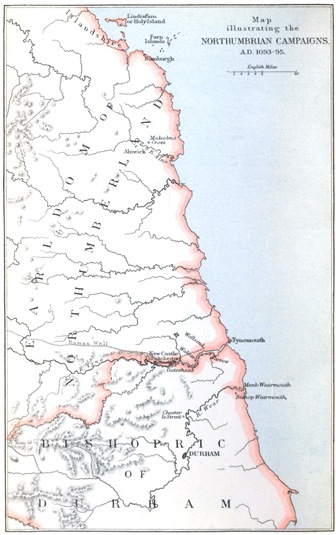
Edwᵈ. Weller
For the Delegates of the Clarendon Press.
Map
illustrating the
NORTHUMBRIAN CAMPAIGNS
A.D. 1093–95.
The silly pride shown by William Rufus at Gloucester
led to a series of events of the highest importance both
as to the relations between England and Scotland, and
as to the internal affairs of the northern kingdom.
15
Malcolm’s last invasion of England.
As soon as Malcolm reached Scotland, he gathered together
his forces, and began his fifth, and, as it happened,
his last, invasion of England. He entered the
earldom of Northumberland, and harried after his usual
fashion as far as some point which, there is no reason to
doubt, was in the near neighbourhood of Alnwick. He draws near to Alnwick.
We
may fairly accept the tradition which carries him to the
spot known as Malcolm’s Cross, where a commemorative
rood once stood, and where the ruins of a Romanesque
chapel may still be seen. The spot is on high ground
overlooking the river Alne, while on the opposite side of
the stream a lower height is crowned by the town of
Alnwick castle.
Alnwick, and by such remains of its famous castle as
modern innovation has spared. The neighbourhood of
Alnwick and the Percies.
that castle, the fame of the historic house which once
held it, has caused every place and every act into which
the name of Alnwick or of Percy can be dragged to be
surrounded by an atmosphere of legend. The first Percy at Alnwick. 1309.
It needs some
little effort to take in the fact that, as the Percies of
history have long passed away from Alnwick, so in the
days of Malcolm some centuries had to pass before the
Percies of history reached Alnwick. It needs some further
effort to take in the further fact that the true Percy,
The true Percies.
the Percy of Domesday, the Percy of Yorkshire, never
had anything to do with Alnwick or with Northumberland
at all. And it perhaps needs a further effort again
to take in the fact that it is by no means clear whether
in the days of Malcolm there was any castle of Alnwick
in being. One may guess that the site had been fortified
at some earlier time; The Vescies at Alnwick.
but the known history of Alnwick,
castle and abbey, begins with the works of the elder lords of
Alnwick, the house of Vescy, in the next century.[21]
Of that
date a noble gateway has still been spared, which may
1174.
well have looked on the captivity of the Scottish William
16
in the days of Henry the Second, but which assuredly
did not look on the death of Malcolm in the days of
the Red King. The height to which Malcolm’s harryings
reached may have looked down on some earlier fortress
beyond the Alne, or it may simply have looked down on
the town of Alnwick, which was doubtless already in
being. But whatever was there at that time in the
way of artificial defence, there were stout hearts and
a wary leader ready to meet the king who was invading
England for the fifth time.
English feeling about Malcolm.
It is certainly strange that in not a few English
writers, generally indeed those who are parted from
the event by some distance of time and place, the
overthrow of the invaders which now followed is told
with a certain feeling for the invader and with a certain
feeling against those who overthrew him. Malcolm
perhaps drew to himself some share of the national and
religious halo which gathered round his wife, while
there was nothing attractive, either on national or on
personal grounds, in the men who at that time stood forth
as the champions of England. Yet it must have been
the “good men” of two years past[22]
who now went forth
under the cunning guidance of Earl Robert of Mowbray.
By some ambush or other stratagem, that skilful captain
led his forces on the Scottish King unawares, under
circumstances which are not detailed, but which have
led even English writers to speak of the attack as
treacherous.[23]
Death of Malcolm. November 13, 1093.
Malcolm was killed; and with him died
his son and expected heir Eadward. They fell on the day
of Saint Brice, ninety-one years after the great slaughter
of the Danes which has made that day memorable
in the kalendar of England.[24]
Malcolm slain by Morel.
The actual slayer of
Malcolm was his gossip Morel, Earl Robert’s nephew
17
and steward, guardian of the rock and fortress of
Bamburgh. From him it would seem that Alnwick,
or perhaps rather the dale between Alnwick and Malcolm’s
Cross, took the name of Moreldene.[25]
Morel was,
it was noticed, the gossip, the compater, of Malcolm, as
William Malet was of Harold;[26]
and it seems almost
to be implied, by writers far away from Alnwick, that
this spiritual affinity made the slaughter of the invader
a crime.
Burial of Malcolm at Tynemouth.
The body of Malcolm, like the bodies of Harold and
Waltheof, received a first burial and a later translation.
It was first borne to the church of Saint Oswine at Tynemouth,
a place which was growing into great reputation
under the special favour of Earl Robert. History of Tynemouth.
Through his
bounty the walls of a new minster were rising within his
fortress which crowned the rocky height on the left bank
of the mouth of the great Northumbrian river. That fortress
and that minster will again play a memorable part
in the chequered history of their founder. But the church
of Saint Oswine, the martyred King of Deira, did not
owe its first origin to Robert of Mowbray or to any
other stranger.[27]
Martyrdom of King Oswine.
The body of the sainted king, slain
by the practice of the Bretwalda Oswin, was laid in
a church which was said to have been first built of wood
by the Bretwalda Eadwine, and then rebuilt of stone
by the sainted Bretwalda Oswald. First church of Tynemouth.
The position of
Tynemouth marked it out as a special point for attack
and defence in the days of the Danish invasions; but,
after the havoc which they caused, the holy place had
been neglected and forgotten. Invention of Saint Oswine. March 15, 1065.
In the days of Earl Tostig
18
and Bishop Æthelwine the pious care of the Earl’s
wife Judith had led to the invention of the martyr’s
relics, and to the beginning of a new church. Of that
Tostig begins the new church.
church Tostig laid the foundations in the year of his fall,
but men of another speech were to finish it. The unfinished
church was granted by Earl Waltheof to the monks
of the newly restored house of Jarrow, and his gift was
confirmed by the Norman Earl Alberic. Tynemouth granted to Jarrow by Waltheof.
A gift to Jarrow
proved, as events turned out, to be the same thing
as a gift to Durham; but, before the change of foundation
at Durham, the monks of Jarrow had removed the relics
of Saint Oswine from Tynemouth to their own church.
Earl Robert grants Tynemouth to Saint Alban’s.
With the reign of Earl Robert a change came. Out
of devotion, and at the heavenly bidding, as was believed
at Saint Alban’s—out of a quarrel with Bishop William,
as was believed at Durham—but at all events out of
a feeling for the memory of Oswine which showed that
he had learned some reverence for the worthies of the
land in which he had settled—Earl Robert deprived
the church of Durham of this possession, and refounded
Tynemouth as a cell to the distant abbey of
Saint Alban. Death of Abbot Paul. 1093.
Abbot Paul came in person to take
possession, in defiance of all protests on behalf of
Durham, where it was believed that his death which
soon followed was the punishment of this wrong. Translation of Saint Oswine. August 23, 1103.
Saint
Oswine himself was not translated back to Tynemouth
till the power of Robert of Mowbray had passed away.
But the church on the rock became famous, and it fills
a considerable place in the local history of Saint Alban’s.
There, in the chosen sanctuary of his conqueror, the
body of Malcolm lay for awhile. Malcolm translated to Dunfermline.
He was afterwards
moved to his own Dunfermline[28]
, where the pillars of his
minster, in their deep channellings, bear witness to an
19
abiding tie, at least of the artistic kind, between the
royal abbey of Scotland and the great church of Northern
England of which a Scottish king laid the foundation-stone.
But, if English writers in later times, and even men
who wrote at the time in distant parts of England,
found some flowers to strew on the tomb of the husband
of the saintly daughter of the old kingly line, no such
feelings were shared by those who had seen Malcolm
and his invading host at their own doors. Local estimate of Malcolm’s death.
The chronicler
who wrote nearest to the spot stops, as he records the
death of Malcolm, to mark the judgement of God which
cut off the merciless enemy of England. He stops to
reckon up all the times that Malcolm had laid waste
the fields of Northumberland, and had carried away the
folk of Northumberland into bondage.[29]
He tells with
glee how the invading host utterly vanished; how they
were either cut down by the sword of the avenger, or
swept away by the floods of Alne, swollen by the winter’s
rain beyond its wonted depth and strength.[30]
He records
the burial at Tynemouth; but he takes care to tell how
none of the Scottish host was left to bury the Scottish
king, but how the charity of two men of the land bore
him on a wain to the place of burial.[31]
And he adds
the moral, equally applicable to all ambitious kings, that
he who had deprived so many of life and goods and
20
freedom now, by God’s just judgement, lost his life and
his goods together.[32]
The invading king was dead, and with him the son
whom he had designed to wear his crown after him was
dead also. The saintly wife of Malcolm and mother of
Eadward was soon to follow her husband and her son.
Character of Margaret.
Of the true holiness of Margaret, of her zeal, not only
for a formal devotion, but for all that is morally right,
none can doubt.[33]
A woman evidently of great natural
gifts and of a cultivation unusual in her time, she deeply
impressed all whom she came across, her own husband
most of all. Malcolm’s devotion to her.
To Malcolm his Margaret was indeed a
pearl of great price, to be cherished, almost to be worshipped,
as already a saint on earth. She taught him
to share her devotions, till men wondered at such piety
in a man of this world.[34]
It is touching to read how
the unlettered king loved to look with wonder on the
books in which his queen delighted; how those which
she delighted in more than others he would cherish and
kiss like holy relics, how he would have them adorned
with gold and gems, and would then bring them back
to his wife in their new splendour, as sacred offerings.[35]
21
Her prayers, her fasts, her never-failing bounty to the
poor, stand out in her biography even more conspicuously
than her gifts to churches, to distant Iona among them.[36]
Margaret’s education of her children.
It is perhaps a rarer merit that the influence of her
personal example hindered the slightest approach to foul
or profane speech in her presence,[37]
and that her careful
education of her children handed on her virtues to
another generation. For Margaret was not one of those
who sought for their own soul’s health in neglecting the
most obvious duties of the state of life to which God
had called them. In the petty and selfish devotion of
her great-uncle she had no share; called to be wife,
mother, and queen, it was by doing her duty as wife,
mother, and queen that she won her claim to a higher
saintship than that of Æthelthryth at Ely or of Eadgyth
at Wilton. The witness of Margaret is in her children,
children many of whom bore the great and kingly names
of her own house. The careful training which the
Conqueror gave to his children showed its fruits in his
daughters only; the teaching of Margaret lived in her
sons as well. Her sons;
Eadward died with his father; but in
22
Eadgar and Alexander and the more renowned David,
she gave three kings to Scotland, of whom the two latter
were kings indeed, while all three inherited the gentleness
and piety of their mother, along with the virtue
so rare among the princes of that day, the strictest
purity of personal life.[38]
David;
David, son-in-law of Waltheof,
who gave Scotland worthy heirs to succeed him, surely
ranks higher on the roll of royal saints than Eadward,
son-in-law of Godwine, who left England to the chances
of a disputed succession. One child only of this goodly
stock is spoken of as falling away from the bright
example of his parent.[39]
Eadmund.
Yet Eadmund, alone of the
children of Margaret, lived to become a cloistered monk;
and he was perhaps deemed degenerate only because
he fell back on the character of a Scottish patriot of
an older type.
Had Margaret confined her cares to bringing up her
own children in strict piety and virtue, one of her sons
would in all likelihood have mounted his father’s throne
immediately after the bloody day of Alnwick. Margaret’s reforms.
But in
Malcolm’s kingdom she came, in her own eyes at least,
as the representative of a higher morality, a purer religion,
and a more advanced civilization, and she felt
specially called on to play the part of a reformer. State of religion in Scotland.
The
ecclesiastical condition of Scotland was by no means
perfect, according to the standard which Margaret had
23
brought with her. The Scots still kept Easter at a
wrong time; they said mass in some way which at
Durham was deemed barbarous;[40]
they cared not for the
Lord’s day; and they are said to have neglected the
most ordinary Christian rules in the matter of marriage.
They took to wife, after Jewish models, the widows of
their brothers, and even, after old Teutonic models, the
widows of their fathers. All these evils, ecclesiastical
and moral, Margaret set herself zealously to root out.
Councils were gathered to work the needful reforms, and
Malcolm acts as his wife’s interpreter.
Margaret found her husband an useful interpreter. For
the king who had been placed on the Scottish throne
by the will of Eadward and the arms of Siward naturally
spoke the English tongue as readily as that of his own
people.[41]
But Margaret was a queen as well as a saint;
and she either took a personal pleasure in the pomp of
royalty or else she deemed royal state to be wholesome
in its effects on the minds of the barbarous people. She increases the pomp of the Scottish court.
The
King of Scots was taught to show himself in more
gorgeous apparel, to ride with a greater and more stately
train, than his forefathers had been wont to do. But the
righteous queen knew something of the evils which
might come of a king’s great and stately following, and
she took care that the train of King Malcolm should
not, like the train of King William, pass among the
fields and households of his people like a blight or a
pestilence[42]
. That Margaret should innovate in the
24
direction of state and ceremony was not wonderful.
Her early associations.
Daughter of kings, kinswoman, perhaps daughter, of
Cæsars, she had, in her childhood and youth, seen something
of many lands. She may have seen the crown
of Saint Stephen, still in its freshness, on the brow of
a Magyar king, and the crown of Charles and Otto on
the brow of an Imperial kinsman. She had assuredly
seen King Eadward, King Harold, and King William,
in all the glory of the crown to which her husband’s
crown owed homage. And we may be sure that the
kingly state of Scotland was mean besides that of
Germany, of England, and even of Hungary. Margaret
might well think it a duty to herself and to her husband
to raise him in outward things nearer to a level with
his brother kings both of the island and of the mainland.
Feeling of the Scots.
But the policy of such a course, among such a people
as the Scots of that age, may well be doubted. A fierce
race, hard to control at any time, may well have had
no great love for an outward show of kingship, which
would be taken, and rightly, as the sign of a growth
of the kingly power such as agreed neither with their
customs nor with their wishes.
English influence in Scotland.
Margaret moreover was a stranger in Scotland. One
can well believe that the native Scots were already
beginning to be jealous of English influence in any shape.
Before Margaret came, they must have felt that the
English element in the triple dominion was growing into
greater importance than their own. Lothian was becoming
greater than the true Scottish land beyond the Scots’-water.
Fife, it may well be, was already becoming as
Lothian. Malcolm himself had been placed on the throne
25
by English arms; he had become the man of two kings
who were politically English, though they held England
as a conquered realm. His five invasions of England
must have been quite needful to keep up even Malcolm’s
character among his own people. Scottish feeling towards Margaret.
And his English queen,
bringing in English ways, trying to turn Scotland into
another England, stopping good old Scottish customs
and good old Scottish licence, tricking out the King
of Albanach in some new devised foreign garb, English,
Norman, German, or Hungarian, must have been looked
at in her own time, by the Scots of her own day, with
very different feelings towards the living queen from
those with which they soon learned to look towards the
national saint. English and Norman settlers.
She came too with her English following,
and her English following was only the first wave of
many which came to strengthen the English element
which was already strong in the land. While Malcolm
and Margaret reigned, Scotland, the land which had
sheltered Margaret and her house in their days of
banishment, stood open to receive, and its king’s court
stood open to welcome, every comer from the south.
Native Englishmen flying from Norman oppression and
Norman plunder,—Normans who thought that their share
in the plunder of England was too small—men of both
races, of both tongues, of every class and rank among
the two races,—all found a settlement across the Scottish
border. The King spoke English; the Queen most
likely spoke French also; Englishmen and Normans
alike seemed civilizing elements among the people whom
Margaret had to polish and to convert. Both Normans
and English kept Easter at the right time, and neither
Normans nor English thought of marrying their step-mothers.
Scotland and the court of Scotland were
crowded with English and Norman knights, with English
and Norman clerks. They got benefices, temporal and
26
spiritual, in the Scottish land. They may have converted;
they may have civilized; but conversion and
civilization are processes which are not always specially
delighted in by those who are to be converted and
civilized. Anyhow they were strangers, brought into
the land by kingly favour, to flourish, as men would
naturally deem, at the cost of the sons of the soil.
Jealousy of the native Scots.
The national spirit of the Scottish people arose; the jealousy
of the strangers established in the land waxed stronger
and stronger. It might be in some measure kept down as
long as novelty was embodied in the persons of the warrior
king and the holy queen. As soon as they were gone,
the pent-up torrent burst forth in its full strength.
The news of Malcolm’s death brought to Margaret. November 17, 1093.
The first to bring the news of the death of her husband
and son to the ears of Margaret was another of her
sons, the future King Eadgar. As the tale reached
Peterborough, Worcester, and Saint Evroul, the Queen,
when she heard the tidings, became as one dead at heart;
she settled her temporal affairs; she gave gifts to the
poor; then she entered the church with her chaplain;
she communicated at the mass which he sang; she prayed
that her soul might pass away, and her prayer was
granted.[43]
English version of her death.
This is a version which has already received
a legendary element. It is not, strictly speaking, miraculous,
but is on the way to become so. A person,
seemingly in health, is made to die in answer to prayer
on the receipt of ill news. The tale, as told by an
eye-witness, is different. The Queen had long been
expecting death; for half a year she had never mounted
27
a horse, and had but seldom left her bed.[44]
On the fourth day
after her husband’s death, feeling somewhat stronger, Turgot’s version.
she
went into her private oratory; she heard mass, and communicated.
Her sickness increased; she was taken back to
her bed, holding and kissing a relic known as the Black
Cross of Scotland,[45]
and waiting for her end. She prayed
and repeated the fifty-first psalm,[46]
with the cross in her
hand. The agony was already near when Eadgar came
from the war. She was able to ask after his father and
brother. Fearing to distress his mother yet more, Eadgar
said that they were well.[47]
Margaret conjured him as
her son, and by the cross which she had in her hand,
to speak the truth. He then told her the grievous tale.
She murmured not, nor sinned with her lips.[48]
She could
even give thanks for her sorrows, sent, as she deemed,
to cleanse her from her sins.[49]
As one who had just
28
partaken of the holy rite, she began the prayer which
follows communion, and, as she prayed, her soul left the
world. The deadly paleness passed away from her face,
and she lay, red and white, as one sleeping.[50]
Her burial at Dunfermline.
The place
of her death was Edinburgh, the castle of maidens;[51]
her
body was borne to Dunfermline and buried there, before
the altar of the church of the Holy Trinity of her own
rearing.[52]
We read the touching tale with different feelings from
those with which it was heard at the moment by Scots
who clave to old Scottish ways, good or bad. We have
even hints that the funeral of the sainted queen could
not go from Edinburgh to Dunfermline without danger.
Scottish feeling towards her.
It needed either a miracle or the natural phænomena
of the country to enable the body of the English lady
to be carried out of one gate of the Castle of the
Maidens, while the champions of the old times of Scotland
were thundering at another.[53]
Such a story may
be legendary in its details, but it is clearly no legend,
but true tradition, as regards the national feeling of the
times which it describes. Scotland, at the time of
Malcolm’s death, was still torn by local and dynastic
factions;[54]
but all parties in the old Scottish realm were
29
agreed on one point. A Scottish king to be chosen.
They would have no more innovations
from England or from Normandy; they would
have no more English or Norman strangers to eat up
their land in their own sight. They would have no
son of Margaret, no son even of Malcolm, to reign over
them; they would again have a king of the true stock
of Albanach, who should reign after the old ways of
Albanach and none other. The settled English element
south of the Scots’-water would be weak against such
a movement as this; or indeed it may be that the men
of Lothian were no more eager to be reformed after
Margaret’s fashion than the men of Scotland and Strathclyde.
Election of Donald.
Such a king as was needed was soon found in
the person of Donald Bane, Donald the Red—Scotland
had her Rufus as well as England—the brother of the
late king and son of that Duncan who had been cut off
in his youth in the civil war between his house and the
house of Macbeth.[55]
He was at once raised to the Scottish
crown as the representative of Scottish nationality.
He drives out the English.
His first act was emphatic; “he drave out all the
English that ere with the King Malcolm were.”[56]
Meaning of the words.
This is of course no more to be understood of a general
driving out of the settled English inhabitants of Lothian
than the massacre of Saint Brice is to be understood of
a general slaughter of the settled Danish inhabitants
of Lincolnshire and Yorkshire.[57]
The driving out was
30
confined to the newly come English, who filled the court
of Malcolm and Margaret, and who doubtless kept, or
seemed to keep, many a true-born Scot from the favour
of his king. For these there was to be no longer a
place in the Scottish realm or in the other dominions of
its sovereign. They had to go and seek shelter in their
own land. The language of our guides suggests that
they were mainly English in the strictest sense; though
we cannot but fancy that some Normans or other
strangers may have crept in among them.[58]
One thing
is certain; among the English that ere with the King
Malcolm were his own children by his English wife
held a place. Margaret’s children driven out.
Of his sons Eadmund and Æthelred we
cannot speak with certainty; but Eadgar, Alexander,
and David, had to flee, and the Scottish story describes
their uncle the Ætheling Eadgar as in some way helping
their escape. He did it, we are told, by stealth, that he
might not kindle any suspicion in the Norman King of
England.[59]
Action of the elder Eadgar.
It is hard to see what Eadgar, who could
not have been in Scotland at the time of his sister’s
death, could have done for her children till they were at
least within the English border, and there is nothing to
make us think that Eadgar had in any way lost that
full favour with William Rufus which he had enjoyed at
the beginning of the year. But the mere use of his name
witnesses to the belief that he who could do so little for
himself was able to do a good deal for others. In this
31
story he is said to have sheltered his sister’s daughters
as well as her sons. Malcolm’s daughters;
More trustworthy accounts say
that Eadgyth and Mary had already been sent by their
parents to be brought up in the abbey of Romsey, where
their aunt Christina was a nun.[60]
Mary;
Mary in time married
the younger Eustace of Boulogne, and was the mother of
a Queen of the English, that valiant Matilda who strove
so well to keep the English crown for her husband
Stephen.[61]
Eadgyth or Matilda;
Eadgyth, in her loftier destiny, will meet us
again under the new name which she had to share with
her niece and to hand on to an Imperial daughter.[62]
The
second Queen Matilda of our story, the good Queen
Maud of tradition, had been designed to be the bride of
the Breton Count Alan.[63]
That was not to be her fate;
neither was it to be her fate to embrace the holy calling
which her aunt Christina strove to force upon her. her sojourn at Romsey.
For
the present she remained unprofessed, loathing the veil
which her aunt ever and anon put upon her head, to
shield her, as she said, from Norman outrage.[64]
When
Christina’s back was turned, the lively girl tore the
veil from her head and trampled on it.[65]
Malcolm at Romsey.
Her father
too, on some visit to England—could he have turned
aside to Romsey before or after his memorable visit to
Gloucester?—saw the veil on her head with anger; he had
not designed her for that, but for the bridal of Count
Alan. Her relations with Henry.
It seems plain that her marriage with Henry
was a marriage of old affection on both sides, and one
version even makes the Ætheling seek for her as his
32
wife in her father’s lifetime. Tale of Eadgyth and William Rufus.
One version, strange indeed,
but perhaps the more likely to have some truth in
it because of its strangeness, gives her an unlooked-for
lover. We are told that, for once, in the person of Eadgyth
of Scotland, female charms kindled in the heart of the Red
King a passion which in his case might be called virtuous.[66]
He came to Romsey with a body of his knights;
the wily abbess, dreading his purpose, caused Eadgyth
to put on the veil. She then drew the King into the
cloister to see her roses and other flowers; but he caught
a glimpse of the nuns as they passed by; he saw the
veil on the head of Eadgyth, and turned away. She
was then twelve years old. Presently her father came;
he saw her veiled; he tore the veil from her head, he
trampled it under his feet, and took away his daughter.
Such a tale must be taken for what it is worth; but the
picture of William Rufus contemplating either maidens
or roses at least puts him in a light in which we do not
meet him elsewhere.
A series of events now follow which our guides seem
to place within the year of Malcolm’s death, but for
which room can hardly have been found in the few
weeks of it which were still to come. Christmas, 1093–1094.
The winter of
that year, it will be remembered, was a stirring winter.
It saw the consecration of Anselm; it saw the Gemót at
Gloucester at which William received the challenge from
his brother in Normandy;[67]
it saw the first beginnings
of fresh disputes between the King and the Archbishop.[68]
Events of 1094.
The next year was the year of William’s second Norman
expedition, and it is clear that his absence from England
had an influence on the affairs of Scotland, as it undoubtedly
had on those of Wales. Order of Scottish events.
The election of
33
Donald and the driving out of the English from Scotland
may have followed as swiftly on the deaths of
Malcolm and Margaret as the election of Harold followed
on the death of Eadward or the election of Henry
on the death of William Rufus. But we can hardly find
room for an English expedition to Scotland, for the
establishment of a new king, and for a domestic revolution
limiting his powers, between the driving out of the
English and the last day of the year. One is inclined
to think that the Gemót of Gloucester saw a discussion
of the affairs of Scotland as well as of the affairs of
Normandy, and that the results of that discussion, direct
consequences as they were of the death of Malcolm and
the election of Donald, were set down under the year
in which the chain of events began, though some of them
must, almost in the nature of things, have really happened
in the year which followed.
Gemót of Gloucester. Christmas, 1093–1094.
I am inclined therefore to think that it must have been
at the Christmas assembly which decreed the war with
Robert that a claimant appeared to demand the Scottish
crown at the hands of the southern over-lord. This was
Duncan, the son of Malcolm and Ingebiorg. Duncan claims the Scottish crown.
He was in
truth the eldest of Malcolm’s children, and, though, under
the influence of a new set of ideas, it became usual to
speak of him as a kind of Ishmael, he was most likely as
lawful an heir to the Scottish throne as any of the three
kings who were sons of the English saint.[69]
In itself
the succession of Duncan would have seemed an intermediate
course between the succession of Donald and
the succession of Margaret’s son Eadgar. But Duncan,
34
given years ago as a hostage to William the Great,[70]
had
long been a follower of William the Red. Duncan’s Norman education.
He lived in
his court, and did him faithful service as his man and his
knight. He must have been unknown in Scotland, and
his feelings and habits must have been those of a Norman
rather than those of a Scot. He represented neither the
old Scottish traditions which were embodied in Donald
nor yet the new foreign reformation which was embodied
in Margaret and her sons. It was no wonder then that
no party in his father’s kingdom thought of his claims
at his father’s death. He receives the crown from William.
But he now came to the King’s
court; he set forth the usurpation of his uncle Donald and
his own rights; he demanded the crown of his father,
and did homage for it to the Monarch of Britain.[71]
The
event is singularly like the earlier event which had
placed Duncan’s own father on the Scottish throne; 1054.
it
is still more like the later event which gave Scotland a
momentary king in Edward Balliol. 1332.
The King’s designs
on Normandy hindered him from either marching
himself to the help of Duncan or sending any part
of the regular forces of his kingdom. He wins it by the help of Norman and English volunteers. 1094.
But Duncan
was allowed to get together a body of volunteers,
English and French—doubtless of any nation that he
could find—at whose head he marched into Scotland.
He overthrew his uncle Donald, and took possession of
35
the throne by the help of his new allies.[72]
Details are
lacking; the Scots must have been overthrown for a
moment by some sudden attack. Second revolution; the foreigners driven out.
What follows is instructive.
The reign of Duncan, as a king surrounded
by a Norman and English following, was but for a moment.
May? 1094.
But there was clearly no feeling in Scotland
against allowing him to reign, if he were willing to reign
as a national Scot. The people, startled for a moment,
took heart again. A new movement broke forth; the King
was surrounded, and the foreigners who accompanied
him were this time, not driven out, but slaughtered. He
himself escaped with a few only.[73]
But, this work once
done, the son of Malcolm was not less willingly received
than his brother. Donald was not restored; but Duncan
was accepted as King of Scots on condition of his allowing
no English or French settlers within his realm.[74]
We may perhaps suspect that this national movement
in Scotland was timed so as to grasp the favourable
moment when the King of the English, with the mass
of his forces, was beyond the sea. This is more
clearly marked in the next revolution, which took
place towards the end of the year. While King William
was still in Normandy, while the Welsh were in
36
triumphant revolt, a powerful confederacy was formed
against Duncan. Donald now leagued himself with Malpeter,
the Mormaor of Mærne, the representative of the
old party of Macbeth, and also with Eadmund, son of
Malcolm and Margaret. This last, their only degenerate
son, as he is called, joined with his uncle against his half-brother.
He was lured, it is said, by the promise of half the
kingdom.[75]
Death of Duncan and restoration of Donald. November? 1094.
Duncan was slain, by treachery, we are told,
and Donald began a second reign.[76]
This revolution was
perhaps among the causes which brought William back
from Normandy.[77]
But both English and Welsh affairs
were in a state which forbade any immediate intervention
in Scotland. William had to put up with the insults
which he had received, the driving out of his subjects
and the slaughter of the king to whom he had given
the kingdom. Second reign of Donald. 1094–1097.
Donald was allowed to reign without
disturbance for three years.
§ 2. The Revolt of Robert of Mowbray.
1095–1096.
Events contemporary with Donald’s second reign.
The three years of Donald’s second reign were contemporary
with much that we have already told, with
the whole dispute between William and Anselm, with the
preaching of the crusade, with the acquisition of Normandy.
They were contemporary with stirring events in Wales
37
which we shall speak of in another section. And they
were contemporary with events in England which, as I
have said, have a kind of connexion with the fate of
Malcolm which makes it seem on the whole most natural
to speak of them at this point. We will now therefore
go on to the chief English event of the year which
followed the second accession of Donald, namely the
revolt of Robert Earl of Northumberland.
Conspiracy against William Rufus.
It is not the least strange among the strange events
of this reign that the only rebellion against William
Rufus within his kingdom, after that which immediately
followed his accession, was directly occasioned by one of
the few good deeds which are recorded of him. The King
did a simple act of justice; one of his greatest nobles at
once openly rebelled, and the open rebellion of one brought
to light the hidden conspiracy of many more. We may be
sure that there had long been a good deal of lurking
discontent which was waiting for even a slight opportunity
to break forth into a flame. The conspiracy was
devised among men of the highest rank and power, some
of them near of kindred to the King; and the open rebel
was certainly the foremost man of his own generation in
the kingdom. There were in the days of Rufus grounds
enough for discontent and revolt among any class,
and there were special grounds which specially touched
the men of highest rank. They are said to have been
offended by the King’s general harshness, and, above
all, by the strictness of his hunting-code.[78]
The head
38
and author of the seditious movement was the stern
guardian of the northern frontier of the kingdom, Robert
of Mowbray Earl of Northumberland. He is said to
have been specially puffed up to rebellion by his
successes against Malcolm and his Scots.[79]
But, great
as he deemed himself, he held that he might become
greater by a powerful alliance. The gloomy Earl, with
whom speech and laughter were so rare, thought to help
his projects by taking a wife. Robert of Mowbray marries Matilda of Laigle.
He married Matilda of
Laigle, the daughter of that Richer who died so worthily
beneath the keep of Sainte-Susanne,[80]
the sister of
that Gilbert whom we have seen foremost in the work
of slaughter among the seditious citizens of Rouen.[81]
Her
mother Judith was the sister of Earl Hugh of Chester;
and Robert seems to have entangled his new uncle in his
rebellious schemes. His dealings with the Earl of Chester and the Bishop of Durham.
One would have thought that Bishop
William of Durham had had enough of rebellion. He
was now as high in the King’s favour and counsels as
any man in the realm. He was, or at least had been,
on bad terms with his neighbour Earl Robert;[82]
and it is
hard to see what can have been his temptation to join
in any seditious movement. Yet we know that there
were churchmen concerned in the conspiracy;[83]
it is
certain that Bishop William lost the King’s favour about
this time; and there seems little doubt that he was at
least suspected of being in league with the Earl. Other conspirators.
Others
concerned are said to have been Philip of Montgomery, son
39
of the late Earl of Shrewsbury,[84]
Roger of Lacy, great in
Herefordshire and in several other shires,[85]
and one nearer
to the royal house than all, William of Eu.
William of Eu, the late
stirrer up of strife between the King and his brother.
Conspiracy in favour of Stephen of Aumale.
The object of the conspiracy was said to be to put the
King to death, and to give the crown to Stephen of
Aumale, the son of Adelaide, whole sister of the
Conqueror, by her third husband, Odo Count of Champagne
and lord of Holderness.[86]
In short, the two men who had been the first to put
castles into the King’s hands in Normandy were now
plotting against him in England. Stephen of Aumale
was to receive the English crown at the bidding of
William of Eu. No general support for the plot.
Such a conspiracy as this must have
been merely the device of a few discontented nobles; it
could have met with no broad ground of general support
among men of any class. No doubt many men of all
ranks and of all races would have been well pleased
to get rid of William; but there must surely have been
few who seriously hoped to set up Stephen of Aumale
as his successor. No ground for Stephen’s claim.
By a solemn treaty only five years old,
the reigning Duke of the Normans was marked out as
the successor to the English crown.[87]
And if that
arrangement was held to be set aside by later warfare
between the brothers, there was nothing to bar the
natural claims of Henry. Neither Norman nor English
feeling could have endured that the man who was at
once Norman and English should be set aside for a
stranger from Champagne. Neither Norman nor English
40
feeling could have endured that all the sons of the
Conqueror should be set aside in favour of the son of
his sister. Truly men of any rank or any race had
good reason to revolt against William Rufus. But this
was like the revolt of the Earls in the days of the elder
William,[88]
a purely personal and selfish revolt, which
called forth no sympathy, Norman or English. Still
a large party was ready to revolt on any occasion. And
the occasion was presently found.
It was found, as far as Earl Robert was concerned,
in a wanton breach of common right and of the law
of nations, which it was assumed that the King would
treat as an act of defiance against his authority.
Four Norwegian trading ships had peacefully anchored
in some Northumbrian haven. Earl Robert plunders the Norwegian ships.
Earl Robert, his
nephew Morel, and their followers, wantonly plundered
the ships, and took away their whole cargoes. And
the tale is told as if the act of plunder was meant
directly as an act of rebellion against the King, whose
peace was certainly broken in the most outrageous way.[89]
The merchants complain to the King.
The merchants, despoiled of all that they had, made
their way to the King and laid before him their complaint
against the Earl of the Northumbrians.[90]
Had such
an act been done by any of William’s own following, the
injured men would most likely have met with no redress.
But plunder done by anybody else on his own account
was an outrage on the royal authority—one might perhaps
say an encroachment on the royal monopoly of
oppression—with which the Red King was not minded
41
to put up. William straightway sent the strictest and
sternest orders to Earl Robert to restore at once all that
had been taken from the Norwegian merchants. Robert refuses redress.
The
Earl scornfully took no notice. The King then asked
the amount of the merchants’ losses, and made it good
to them from his own hoard. He is summoned to the King’s court.
He then summoned the
Earl to his court; but he refused to come.[91]
Such is the story which reached the cloister of Saint
Evroul, a story altogether likely in itself, and which
well fits in with and explains the entries in our own
Chronicle. These bring us into the thick of the regular
assemblies of this year of assemblies. The gathering
at Rockingham dealt wholly with the affairs of Anselm;
Gemót of Winchester. March 25, 1095.
to the regular Easter assembly at Winchester which
so soon followed it, Earl Robert, though specially summoned,
refused to come. The King was very wroth
against him, and sent word that, if he did not wish to
be altogether put out of the King’s peace, he must come
to the court to be held at Pentecost.[92]
Signs in the
heavens seem to have foretold that something was
coming. The falling stars. April 4.
It was now, on the night of the feast of Easter
and again ten days later, that a crowd of stars was
seen to fall from heaven, not one or two, but so thickly
that no man could tell them.[93]
If the stars fought against
42
Malcolm on the day of Saint Brice, it was only in their
courses, and no chronicler has recorded the fact. But
it looks as if this special Easter shower, of which we
have elsewhere heard other meanings,[94]
was by some
at least held to portend the fall of the great earl of the
North. Messages between the King and Robert.
The time between Easter and Pentecost, the
time so busily occupied in another range of subjects
by the coming of Cardinal Walter and the acknowledgement
of Pope Urban,[95]
was no less busily occupied by
an exchange of messages between the King and his
undutiful subject. Robert, like Godwine two-and-forty
years before, demanded hostages and a safe-conduct,
before he would risk himself before the Assembly.[96]
This
the King refused; Robert, arraigned on a definite charge
of open robbery, had no such claim to hostages as
Godwine, as King Malcolm, or even as his own neighbour
Bishop William. Whitsun Gemót. Windsor, May 13, 1095.
The Whitsun-feast was held; the King
was at Windsor—not at Westminster—and all his Witan
with him. Anselm was there, to be received into the
King’s favour, and to engage to observe the customs of
the realm.[97]
But the Earl of the Northumbrians was
not there.[98]
The two accounts fit in perfectly without
contradiction or difficulty. One gives us the cause of
the special summons of Earl Robert to the Gemót; the
other gives us its exact date and form.
The King’s march.
Rufus, thus defied, at once took to arms. It would
seem that he did not wholly rely on his mercenaries,
but called out the national force of the kingdom.[99]
He
43
was again the King of the English, marching at the head
of his people. He was marching against the rebel fortresses
of the North, as he had once marched against
Tunbridge, Pevensey, and Rochester. His motives.
But these great
preparations were not made simply to avenge the wrongs
of the Norwegian merchants. Their wrongs were the
outward occasion, and that was all. The refusal of Earl
Robert to come to the King’s court was the counterpart
of the more general refusal of the Norman nobles to come
to the Easter Assembly seven years earlier.[100]
The
King knew, or had good reason to suspect, that there
was again a wide-spread conspiracy afloat to deprive
him of his crown and life. Of this conspiracy the open
disobedience of Earl Robert was simply the first outward
sign; the affair of the Norwegian merchants had merely
brought matters to a head. Rufus may even have
made use of their wrongs as a pretext for proving
Robert’s doubtful loyalty. Robert was as yet the only
open rebel. When the King drew the sword, he met
with no resistance anywhere save where the Earl of
the Northumbrians was in possession. Robert’s accomplices
remained accomplices and conspirators; they did
not dare to risk the chances of open rebellion. The
Earl may have thought that the strength which had
twice overcome a King of Scots might defy a King of
the English also.[101]
Robert resists.
At all events, Robert of Mowbray
withstood the King in arms, and a stirring and varied
campaign followed.
It appears however from an incidental notice that
44
Earl Robert and his fellows by no means trusted only
to movements within the realm. Help expected from Normandy.
It is certainly strange
that a conspiracy in which William of Eu could be even
suspected of taking a part should have found any support
in Normandy; yet in those times men changed sides
so easily that it is not impossible that he might have
been again intriguing with Duke Robert himself. It
is still more likely that some intrigue was going on,
not with the Norman Duke but with the enemies of
Rufus in Normandy as well as in England. It is
certain that an invasion of south-eastern England was
at this time daily dreaded;[102]
and it is perhaps more likely
that William of Eu, Stephen of Aumale, and the rest,
were planning an expedition at their own risk than that
Duke Robert was designing anything with the regular
forces of Normandy. The invasion was plainly looked
on as a serious danger; but there is no reason to think
that it ever took place. The King thought it needful
to take special means for guarding the coast. The King marches to Nottingham.
He had
gone on his northern march as far as Nottingham,
accompanied not only, as we might expect, by many
of his nobles, but what we might less have looked for,
by both the archbishops and by the Cardinal Bishop of
Albano.[103]
Anselm’s command in Kent.
One might almost think that some special
news was brought to the King at this point; for it was
now that Anselm, in this his short season of renewed
favour with the King, was sent back to guard his city
and diocese. He received the trust from the King’s
own mouth; he went back to Canterbury, whither a
45
writ from the King followed him bidding him stay
in care of the city, ready at any moment, when news
should be brought from the threatened havens, at once
to gather together horse and foot for the defence of the
land.[104]
Anselm went back to his metropolis, and there
stayed, as we have seen, ready to discharge these unusual
duties, which, as the expected invasion never came, did
not in the end involve any military action on his part.
Meanwhile the King went on, taking with him the
Archbishop of York, who at Nottingham was already
in his own province and diocese. The King draws near to Northumberland.
When the march
had gone on somewhat further, when the King and
his host were drawing near to the borders of the
Northumbrian earldom, that is, we may suppose, when
they were near the banks of the Tyne, an incident
happened which showed that the enemies of Rufus had
other schemes besides those of open warfare either at
home or abroad.[105]
Gilbert of Clare or of Tunbridge, of
whom we have already heard as a rebel in earlier days,[106]
and who seems now to be looked on as a traitor in the
King’s camp, calls the King aside, and, to his amazement,
falls at his feet and craves his pardon for his offences.
Confession of Gilbert of Clare.
Let the King promise him forgiveness, and he will do
something which shall deliver him from a great danger.[107]
46
Rufus wonders and hesitates, but, after a little debate
in his own mind, he promises the pardon that is asked
for. Gilbert then warns the King not to enter a certain
wood—have we again the tale of the hunting-party
as the scene of assassination?[108]
He was himself one of
a body who had plotted the King’s death, and a party
of them were now in the wood ready to slay him.
He told the King their number and names;[109]
but the
story reads as if no immediate action was taken against
them. The conspirators are baulked of their prey, and
the King’s host marches on to attack the fortresses of
the rebel Earl.[110]
Defence of Robert’s fortresses.
Robert of Mowbray had made good preparations for defence.
The main body of his followers, among them the
men highest in rank and most trusted in valour, guarded
the great frontier fortress of his earldom, The New Castle.
the New Castle
which Duke Robert had reared to guard the way to the
further north by the old line of the Ælian Bridge.[111]
Placed
opposite the scene of Walcher’s slaughter at Gateshead,[112]
it rose above the Tyne with far more of the usual position
of a fortress than would be dreamed by one who merely
passes so strangely near to it on the modern railway,
or who lights almost by chance on gateway and castle
imbedded in the streets of the modern town. The
gateway, even the keep as it now stands, are both of
later date than the time of our story. But the days
of Monkchester were passed; the New Castle was
already a place of arms, a strong post standing right
in the way of the King’s advance against the rebellious
land. Lower down the tidal stream, beyond the relics—they
47
were then still something more than relics—of the
great Roman rampart which left its name at Wallknol,
at Wallcar, and at Wallsend[113]—fast by the mouth of the
estuary whose shores and whose waters are now so
thickly set with the works of modern industry—the
Tynemouth.
Earl’s castle of Tynemouth at once sheltered the rising
monastery of Saint Oswine and guarded the approach
to the river and to all to which the river led. Tynemouth
was held by the Earl’s brother; Bamburgh.
Robert himself,
far to the north, kept the great stronghold of all, the
old seat of Northumbrian power, which frowns over
land and sea from the basaltic rock of Bamburgh. The
King’s first attack was lucky; we have no details; but
we read that the New Castle was taken, and that all
the men that were in it were kept in ward. Taking of the New Castle.
The
choicest men of Earl Robert’s following were thus in
the King’s hands; the inland centre of his power was
lost; but he and his brother still held out in their
fastnesses by the Ocean.
Tynemouth and Bamburgh both stood long sieges.
The strong site of the monastic stronghold enabled it
to bear up for two months, while the fortress of Ida
remained, as far as any strictly military operation was
concerned, untaken during the whole war. Siege of Tynemouth.
Tynemouth,
which had so lately seen the burial of Malcolm, had
now to endure the assaults of the royal force in the
cause of Malcolm’s chief enemy. The holy place of
Saint Oswine was strong alike by nature and art. Description of the site.
At
the mouth of the great Northumbrian river, on that
bank of it which lay within Robert’s earldom, two
headlands, divided by a small bay, stand forth boldly
48
to meet the waves of the German Ocean. In later times
the fortified precinct took in both points. Both came
within the wall and ditch which cut off the peninsulas
from the mainland. The castle of Tynemouth, strictly
so called, covered the southern height immediately above
the river. The northern promontory was crowned by
the church and the monastic buildings, themselves
sheltered by a vast gatehouse, which itself grew into
a castle. Such, there is reason to believe, was the
arrangement in the days of Malcolm and William. The
castle of Robert of Mowbray rose sheer above the estuary,
on its left bank. To the north, on the other headland,
protected by a smaller fortress, stood the church and
monastery which were growing up at his bidding, a
tribute paid by the conquerors to the ancient worthies
of the land. The monastic peninsula.
The peninsula crowned by the monastic
stronghold stretches forth into the waters, like a miniature
of that which is at once the oldest and the newest
Syracuse, since the art of man joined the island of
Ortygia to the mainland of Sicily. While the neck
is strengthened by works of defence, the rocky headland
rises boldly from the waves on two sides. To the south
the ground rises more gently above the bay between the
two peninsulas, the bay to which the monastery above it
gave the name of the Prior’s haven. The town which
grew up in after times sprang up directly to the west
of the approach to the northern headland; it now spreads
itself on all sides save only on the two headlands themselves.
Taking of Tynemouth. July? 1095.
The first attack must have been made from
the older site of the town; the small fortress, that most
likely which guarded the neck of the monastic headland,
was taken. The main castle to the south fell at the
end of two months, and the Earl’s brother and the
knights who defended it shared the fate of the defenders
of the New Castle.
49
And now came the hardest struggle of all, the
struggle for the old home of Ida and Bebbe. The castle of Bamburgh.
Bebbanburh,
Bamburgh—the royal city of Bernicia, which
its founder had fenced first with a hedge and then
with a wall or earthwork—the city small but strong,
with its steep height approached only by steps[114]—though
its main purpose was military and not religious,
contained within its walls a sanctuary and a relic as
worshipful as aught that was sheltered by Tynemouth
or Jarrow or Durham itself. The relic of Saint Oswald.
The ancient church of
Bamburgh was honoured by the presence of the wonder-working
hand of the martyred Bretwalda Oswald. That
relic had in earlier days helped, along with the prayers
of Aidan, to save Bamburgh from the fires of Penda;
we are not told whether it was by the favour of the
martyr that the elder Waltheof sheltered himself within
the impregnable walls, while his valiant son marched
forth to victory. The city, the small city which took
in the space only of a few fields, had doubtless by this
time given way to the Norman fortress, strengthened
by all the arts which the Norman had brought with
him. The castle precincts, in their widest extent, clearly
cover the whole of the ancient site; at the south-western
end they are still approached by steps which doubtless
represent those which in the days of the old Northumbrian
chronicler were the only means of mounting
the height. At Bamburgh, as elsewhere, we are met by
the never-failing difficulty which besets the student of the
castles of that age. Can any of the work at Bamburgh
which bears the impress of Norman art be safely assigned
to the eleventh century? The keep.
Or must we give up all to the
twelfth, and believe that no part of the great centre of
the building, the keep “huge and square,” was already in
being when Robert of Mowbray defied the Red King from
50
his rock? On such a point it is dangerous to be over-positive.
The surrounding walls are of all dates down to
the basest modern imitations; the chapel which guarded
the relic of Saint Oswald, standing apart in the great
court with its eastern apse overlooking the sea, was
clearly, when perfect, no mean work of the next age.
But whatever was the character or the material of the
defences of Robert’s day, they were doubtless as strong as
any skill within the Northumbrian earldom could make
them. There, from the castle raised on the land side
on the bulwarks of the rock out of which its walls
and bastions grow, rising on the sea side over deep
and shifting hills of sand, the eye might take in the
long indented coast, the sea dotted with islands of
which many play a part in the sacred story of
northern England,[115]—Farn and its fellows hard by, hallowed
by the abode and death of Saint Cuthberht—Holy
Island itself further to the north-west, the landscape
bounded in the far distance by the border hills
of the two British kingdoms, beyond which Malcolm
no longer stood ready to ravage the pastures of Northumberland.
Robert defends Bamburgh against the King.
Within that ancient fortress, rich with
so many earlier associations, the proud and gloomy Earl
now kept his ground, adding a new and stirring page
to the long history of Bamburgh. His brother and his
best knights were the King’s prisoners; but, strong on
his rocky height, the Earl of the Northumbrians, heedless
of the lesson of seven years earlier, dared to bid defiance
51
to the King of the English and to the whole strength
of his kingdom.
Strength of the position.
And in truth the event proved that the rebellious
daring of Robert of Mowbray had better grounds than
the daring of those who had held Rochester and Pevensey,
Tynemouth and the New Castle, against their sovereign.
The well of the purest water, hollowed out on the highest
point of the rock, and then, or at some later day, taken
in within the massive walls of the huge keep, made
Robert safe from all such dangers as threatened the
Ætheling Henry when he held out on the rock of
Saint Michael.[116]
Direct attacks fail.
All the power and skill of the Red
King was brought to bear upon the ancient stronghold;
but all was in vain; the castle of Bebbe was not to
be taken by any open attack. William therefore took
to slower means of warfare. Making of the Malvoisin.
He made one of those
towers which were so often made in such cases, to act
as a check on the besieged castle, to form in fact an
imperfect kind of blockade. This tower must have
stood on the land side, to cut off all hope of help from
any friendly quarter. It therefore could not have stood
very far from the site of the present village; and in
the fields nearly south of the castle some faint traces of
earthworks seem not unlikely to mark the site of the
tower to which the King gave the significant name of
Malvoisin. Its effects.
The new work is described as exercising
all the energies of the royal army, and as striking such
fear into the hearts of the besieged that many of
Robert’s party now forsook him and entered the King’s
service. Alleged despair of Robert.
We are even told that the fierce Earl looked
out from the height of Bamburgh in all fear and sadness,
crying out to his accomplices by name to be mindful
of the traitorous oaths which they had sworn to him.
The King and his friends were merry as they heard,
52
and none of those who were appealed to, tormented
as they were with fear and shame, went back to share
the Earl’s waning fortunes. Be this as it may, as far
as open force went, Bamburgh and its lord remained
unsubdued. The castle still not taken.
To bring either of them under his power,
the King and his followers were fain to have recourse
to false promises and cruel threats.
The Evil Neighbour of Bamburgh was built; it was
well stocked with guards, arms, and victuals. But Bamburgh
itself was not taken any the more. William did
not in this case, as he did in some of his continental
enterprises, throw up the whole undertaking, because he
did not succeed in the first or second attack. So to have
done would have been pretty much the same as throwing
up his crown; it would have been to unteach the great
lesson of his reign, and to declare that the Earl of the
Northumbrians was stronger than the King of the English.
He might turn away in wilfulness from this or that
Norman or Cenomannian fortress which he had attacked
in wilfulness; but he knew the art of reigning better
than to leave Bamburgh in the possession of a rebel earl.
The King goes away.
The work was to go on; but he was so far tired of it that
he left it to be done by others. When the Malvoisin was
well strengthened, the King turned away, and appeared no
more before Bamburgh during the rest of the campaign.
Michaelmas, 1095.
When Rufus left Bamburgh, he went southward;
he then went to the war in Wales, and left the garrison
of the Malvoisin to keep watch over their besieged
neighbour. It may be left to casuists in chivalry to
judge whether the knightly king approved of the means
which were now taken in order to entrap the besieged
earl. Robert entrapped by a false message.
The garrison of the New Castle, doubtless not
without the knowledge of the garrison of the Malvoisin,
sent a false message to Robert, saying that, if he came
thither privily, he would be received into the castle.
53
The Earl, naturally well pleased at such a prospect of
winning back his lost stronghold, set forth by night for
the New Castle at the head of thirty knights. The men
from the Malvoisin watched and followed him, and sent
to the men of the New Castle to say that he was on the
way. Knowing nothing of what was going on, Earl
Robert drew near to the New Castle on a Sunday, expecting,
it would seem, to be received there with welcome.
His hopes were vain; he was taken, and the more part
of his followers also were taken, killed, or wounded. He flees to Tynemouth.
The
version which goes most into detail says that, when he
saw that he was betrayed by the garrison of the New
Castle, he fled, with a part at least of his following, to
his own monastery at Tynemouth. It is not easy
to see how this could be, unless he was able either
to win back the small fortress on the neck of the
monastic peninsula, or else to climb up from the seaside
at some less steep or less strongly defended point
of the height. But the tale is so told that there must be
at least some kernel of truth in it. He is besieged in the monastery,
We read that the
Earl stood something like a siege in his own monastery.
He was able, with his small party, to defend himself in
it for six days, and to kill and wound many of his
assailants. At last, on the sixth day, he himself received
a severe wound in the leg; the whole of his followers
were taken, some of them also as wounded men. The
Earl, himself among the latter, contrived to drag himself
to the church of his own rearing, where still lay the body
of the Scottish King whom some looked on as his victim.
If claims of sanctuary were thought of, they were not
allowed, and one who had turned the consecrated precinct
into a castle had perhaps little claim to plead such privileges,
even within his own foundation. taken, and imprisoned.
Earl Robert was
dragged away from his own church, and was kept in
prison to await the King’s pleasure.
54
Bamburgh defended by Matilda of Laigle.
A tale of twenty years back now repeats itself in our
story. A strong castle is again defended by a valiant
bride. As Norwich, after the revolt and flight of Ralph
of Wader, was defended by Emma of Breteuil, so Bamburgh,
after the revolt and capture of Robert of Mowbray,
was defended by Matilda of Laigle. Married just as the
revolt broke out, she had had, we are told, but little
taste of joyful or peaceful wedlock; but she was at least
zealous in the cause of her husband. She had Morel to
her counsellor and captain, and the two held out in the
ancient stronghold against all attacks. November, 1095.
It was now
winter, and King William had come back from Snowdon,
not covered with much glory. He felt no mind to renew
the siege of Bamburgh in his own person; but he bade
that the captive Earl should be taken thither, and led
before the walls, with the threat to his wife and nephew
that, if the castle was not at once given up, the eyes of
its lord should be then and there seared out in their
sight. She yields to save her husband’s eyes.
To this threat Matilda and Morel yielded, and
the gates of the unconquered fortress were thrown open
to the King’s forces. The valiant Countess thus saved
her husband’s eyes; but his eyes were all that she could
save. Robert was sent back to prison at Windsor, to live
in bonds, at least for a season, and in no case to return
to the rights and duties of an earl or a husband. Later history of Robert; two versions.
But
there are two widely different stories as to his later fate.
The local history of Saint Alban’s told how one who,
however guilty towards others, was at least a benefactor
to that house, was allowed to spend his remaining days
as a monk within its walls. At Saint Evroul a widely
different tale was believed. It was there recorded by the
contemporary writer that Robert survived his capture
thirty years, but that the whole of that time was passed
in hopeless imprisonment. If so, he must have been
looked on as dangerous by the calm prudence of Henry
55
no less than by the wrath or the revenge of Rufus. The
story indeed runs that his imprisonment was deemed so
irrevocable that it was held to amount to a civil death.
The once proud Earl of Northumberland was counted
to have passed away from among men as much as if the
grave had closed over him alongside of Malcolm in his
own Tynemouth. Later history of Matilda; her second marriage and divorce.
By a special permission from Pope
Paschal, Matilda was allowed to marry again, as though
she had been his widow and not his wife. Nigel of
Albini became her second husband; but, after the death
of her brother Gilbert of Laigle, he thought he could
better himself by marriage in another quarter. His
marriage with Matilda was declared void, not on the
ground that Robert was alive, but because of some
kindred, real or alleged, between Robert and Nigel. The
papal dispensation must have been badly drawn, if it did
not provide for the lesser irregularity as well as for the
greater. Of Matilda we hear no more; Nigel took him
another wife of the house of Gournay. Gerard had by
that time died on his way to the crusade;[117]
his widow
Eadgyth had married again, and their son Hugh was lord
of Gournay. Their daughter, who inherited the name of
Gundrada from her mother’s mother, took the place of the
forsaken Matilda, who was thus left in a strange plight,
as the widow, so to speak, of two living husbands.
Morel turns King’s evidence.
Meanwhile her partner in the defence of Bamburgh,
Morel, the nephew and steward of the fallen Earl, made
his peace with the King by naming all who had any share
in the late conspiracy. Not a few men of high rank,
clerical and lay, were accused by him.[118]
The time of the
Midwinter Gemót drew nigh, at which the offenders would
56
regularly be brought for trial. The King’s prisons were
full,[119]
and he determined that the gaol delivery should be a
striking and a solemn one. Christmas Gemót of 1095–1096.
The Assembly of that Christmas-tide
was to be a Mickle Gemót indeed, a Gemót like
those which had gathered in King Eadward’s day beneath
the walls of London and in King William’s day upon the
plain of Salisbury. A summons of special urgency went
forth, bidding all men who held any land of the King, if
they wished to be deemed worthy of the King’s peace, to
come to his court at the appointed time.[120]
The call was
answered. The appointed place of meeting was Windsor,
and there the Assembly came together. But the business
to be done needed a longer time than the usual twelve days
of Christmas, and the gathering was greater than the royal
castle and its courts could hold. Adjourned from Windsor to Salisbury. January 13, 1096.
The work began at
Windsor; but an adjournment was needed, and on the
octave of the Epiphany in the opening year we find the
King and his Witan at Salisbury.[121]
The wide fields which
had seen the great review and the great homage in the
days of the elder William could alone hold the crowd
which came together to share in the great court of doom
which was now holden by the younger.
Constitutional importance of the meeting.
The Gemót of this winter, and specially the strict
general summons sent forth by the King, are of high
constitutional importance. They show how, even under
such a king as Rufus, the old constitutional forms went
57
on. They show how great is the error of those who dream
that the Norman kingship in England was as thorough a
despotism in form as it undoubtedly was in substance.
Continuance of the old forms.
In the eleventh century, as in the sixteenth, the whole
future of English history turned on the fact that constitutional
forms still went on, that assemblies were still
brought together, even if they came together for little
more than to register the edicts of the King.[122]
So now
Rufus himself, when about to make a great display of
kingly power, specially summons no small part of the
nation to take a share in his acts. Import of the summons.
On the one hand,
the need of the summons shows that, unless at some
specially exciting moment, men did not flock eagerly to
such gatherings.[123]
On the other hand, the fact of the
summons shows that kings then knew, that Rufus himself
knew, that the gathering of such an assembly was
both a sign and a source, not of weakness but of strength,
on the part of the kingly power.[124]
But in the form of
the summons we may see that the assembly, though still
large, is gradually narrowing. Tenants-in-chief only summoned.
The summons goes, not
to all freemen, not to all land-owners, but only to the
King’s tenants-in-chief. Their great number.
These, it must be remembered,
were a very large body, including land-owners on every
scale, from the greatest to the smallest. And it must
be further remembered that in this body a vast majority
of the influential members were strangers by
birth, but that a great numerical proportion, most
likely a numerical majority, were natives. The King’s
thegn, who had kept a scrap of his old estate, was
as much a member of the court as Earl Hugh of
Shrewsbury or Earl Walter of Buckingham, though he
was not so likely to be listened to in any debate that
might arise as Earl Hugh or Earl Walter was. Still
58
the special summons to the King’s tenants-in-chief marks
a change; it marks the growth of the new ideas. The
immediate reason was doubtless to be found in the
main object for which the Assembly came together.
The main work of the earlier Gemót of Salisbury was
that all men in the realm, of whatever lord they held,
should become the men of the King. Comparison with the Conqueror’s Gemót at Salisbury.
William the Great
therefore summoned the men of other lords, who had
not up to that moment been his own men, who owed
obedience to him as head of the kingdom, but who
was not bound to him by any more personal tie. He
summoned them in order that they might bind themselves
to him by that personal tie, that they might become
his men as well as his subjects. But the main work of
the present Gemót was to sit in judgement on a crowd of
offenders, of various ranks and orders, but all of whom
were likely to be tenants-in-chief of the King. According
to the notions which were coming in, the right court
for their trial was the court of their peers, their fellow
tenants-in-chief. The King, who could summon whom he
would, who sometimes summoned few and sometimes many,
this time, for this special purpose, summoned the whole
body of his tenants-in-chief, great and small, and summoned
no others. Effects of the practice of summons.
But, as every summons tends practically
to the exclusion of those who are not summoned, this
summons of a particular class marks a stage in the process
by which the Assembly shrank up from the crowd
which decreed the restoration of Godwine to a House of
Lords of the reign of Henry the Eighth.[125]
Still the actual
gathering, even of the summoned members only, must
have been very great. Action of the Assembly.
When it came together, the
Assembly must have followed the same law as all other
assemblies of that age. Practically it decreed as the
King willed; only a few of the great men were likely to
59
say anything to guide the King’s will; the mass of the
assembly were not likely to do more than to make the
King’s acts their own by crying Yea, Yea. We must
however remember that they had not the slightest temptation
to cry Nay, Nay. No general sympathy with the accused.
The mass of the inhabitants
of the land, Norman and English alike, were not likely
to have the faintest sympathy with any one who really
had a share in the late treason. The only question was
whether any were accused who had no share in it. In
the case of those who were charged only with conspiracy
and not with open revolt, this might easily be.
Otherwise the Red King, in the vengeance which he
now took, did no more than justice, as justice was deemed
in his day. But his justice was far sharper than the
justice of the old kings, far sharper than the justice
of his father. And the tone in which the story is told
implies that men at the time felt that it was so.
Sickness of the Bishop of Durham.
One of the great men of the realm, who, whether
guilty or not, seems to have been at least suspected, died,
while the Assembly was in session, before any formal
charge had been brought against him. Before the Bishop
of Durham came to Windsor, it was known in his own
diocese that he had not long to live. Portents foretelling his death.
One of his knights,
Boso by name, had, while lying under a dangerous
sickness, been favoured with trances and visions, which
told him much that was comforting about the monks
of Durham, and much that was fearful about other
folk. He saw the old inhabitants of the land, he
saw the new French settlers, above all, he saw the
priests’ wives—these seem to be looked on as three
classes of offenders, gradually increasing in blackness—suffering
each a grievous doom.[126]
His visions about the
60
Bishop himself might perhaps point to an intermediate
destiny; at all events they were understood as implying
his speedy death.[127]
His work at Durham. 1083. 1093.
His work perhaps was done. Thirteen
years before he had filled the church of Durham
with monks;[128]
three years before he had begun the great
work of its rebuilding; and, by pressing it on with almost
incredible speed, he had carried it on so far as to set
an example of unsurpassed grandeur in its own style, an
example which his own monks could not follow, but
which Randolf Flambard could.[129]
He is summoned to take his trial.
William of Saint-Calais
came to the Gemót, and was summoned by the
King to appear to take his trial.[130]
He pleaded sickness
61
as his excuse for not appearing. Rufus declared, with
his usual oath, that the excuse was a feigned one.[131]
He sickens and dies. December 25, 1095-January 1, 1096.
It
was however thoroughly real. Bishop William was sick,
and sick unto death. He was smitten on the day of the
Nativity, and died on the day of the Circumcision.[132]
His death-bed.
He
was comforted in his sickness by the presence and exhortations
of several of his brother bishops who had
come together for the business of the Assembly. There
was Anselm whom he had withstood at Rockingham;
there was his own metropolitan Thomas; there was
Walkelin of Winchester; there was John of Bath, born,
like himself and Anselm, beyond the bounds either of
England or of Normandy. Debate as to his burying-place.
These prelates debated concerning
the place of his burial. They argued that he
who had done such great things for Saint Cuthberht’s
abbey should be buried in the place of highest honour
within its walls. He himself declined any such place.
He would be no party to any breach of Saint Cuthberht’s
own rule, which forbade that any man should be
buried within his minster.[133]
The bishops therefore ruled
that he should be buried in the chapter-house, so that
his monks, when they came together, should have the
tomb of their founder ever before their eyes.[134]
So it was;
62
He is buried in the chapter-house.
he was borne to Durham, and there laid in the place
which the bishops had chosen for him, among the tears
and wailings of the brotherhood which he had founded,
any one of whom, we are told, would gladly have died
for him.[135]
This touching picture of the death which ended the
varied life of William of Saint-Calais comes as an
episode in the middle of the stern doings of the Gemót
of Windsor and Salisbury. The Red King did not bear
the sword in vain. Sentences of the Gemót.
Yet, if his justice was sharp towards
those whom it did smite, it was certainly somewhat
capricious, or at least guided by expediency, with regard
to those whom it smote and those whom it failed to
smite. Some of the offenders were men of the highest
rank, some even, it is implied, of the rank of Earl. But
these powerful rebels, ashamed and weakened by the fall
of their brother of Northumberland, were now deemed
fitting objects of mercy. By the advice of the Wise
Men, they were spared a public trial;[136]
but some of them
were made to pay a heavy price for being left safe in
life, limb, and estate. Hugh of Shrewsbury buys his pardon.
One is mentioned by name. Earl
Hugh of Shrewsbury, who was at least suspected of a
share in the plot, was dealt with privately by the King
63
as his father had been at Arundel.[137]
He bought his
restoration to favour at the high price of three thousand
pounds.[138]
Roger of Lacy.
Roger of Lacy lost his lands and was banished,
as he would have been in the days of King
Eadward, and his possessions were given to his loyal
brother Hugh. But heavier penalties, unknown in King
Eadward’s days, were in store for others of the conspirators,
including one of the loftiest descent. January 13, 1097.
At the
adjourned meeting at Salisbury, Geoffrey of Baynard,
bearing a name famous in London city, appealed no less
a man than William of Eu of treason against the King,
of conspiring to slay him, and to give his crown to
Stephen of Champagne.[139]
Combat of Geoffrey of Baynard and William of Eu.
The charge was denied, and,
as both parties were Frenchmen, the trial was, by the
law of the Conqueror, referred to the wager of battle.
The judicial combat which followed is memorable in the
history of the time, and forms one of the landmarks in
our early jurisprudence.
Defeat of William of Eu.
On the plain of Salisbury the combatants met, and
William of Eu was overthrown.[140]
By the laws of the
combat his defeat was full evidence of his guilt. But
what was to be his punishment? Save the case of the
64
beheading of Waltheof, there was no precedent in the
ordinary jurisprudence either of England or of Normandy
for any sentence harsher than banishment, forfeiture, and
imprisonment.[141]
The older English precedents went for
banishment and forfeiture. The precedents of Normandy
and of Norman rule in England went for
imprisonment, such an imprisonment, it might be, as
that of Robert of Mowbray. For the course actually
taken there was no precedent in either land, unless it
were the dealings of Harold the son of Cnut with the
Ætheling Ælfred.[142]
Sentence of mutilation on William of Eu.
The punishment decreed was that
of bodily mutilation. Urged by Hugh of Chester.
It is said that this course was
proposed by Earl Hugh of Chester, and that on a singular
ground. William of Eu was the husband of the
Earl’s sister—her name is not mentioned. He had
neglected his wife, while he had three children by a
mistress.[143]
If this was to be ground for the loss of eyes
or limbs, the brothers of the Countess Ermentrude would
have had a right to demand that the portly person of
Earl Hugh should be cut down to a shapeless trunk.[144]
Feeling with regard to mutilation.
Mutilation, it should be remembered, was a familiar
punishment, a punishment which in that generation
aroused no horror when the persons so dealt with were
held to be real criminals.[145]
But, with that common inconsistency
which reverses the sound rule of smiting the
leaders and sparing the commons, mutilation, death, or
any heavy punishment, seems always to have aroused
horror, or at least amazement, when it was inflicted on
any criminal of lofty rank. Such things had been done
in the isle of Britain and out of it, but hardly by the
65
solemn sentence of the King of the English at the head
of his Witan. But now William of Eu was blinded, and
underwent a fouler mutilation as well.[146]
His sentence
was seemingly carried out at Salisbury, perhaps in sight
of the assembly. Are we to infer that any show of indignation
was called forth by the bloody sight, when we
read directly afterwards that some of the lord of Eu’s
fellow-sufferers were taken to London, and were blinded
or otherwise mutilated there?[147]
Story of Arnulf of Hesdin.
If we may trust a tale to be found in one of those
secondary writers who often preserve scraps of truth,
another accused man appealed to the wager of battle
with better luck than William of Eu. This was Arnulf
of Hesdin, a man whose name is familiar enough to us
in Domesday, though it does not call up any distinct
personal idea like the King’s unlucky kinsman.[148]
He
is set before us as a man of great bodily stature,
brave and active, and in the enjoyment of large possessions,
out of which he and his wife Emmeline had made
gifts to the abbey of Gloucester.[149]
He was charged, unjustly
and enviously we are told, with the same crime as
the rest.[150]
His innocence proved by battle.
He defended himself by his champion, who
proved his lord’s innocence by overthrowing a man of
the King’s who was matched against him.[151]
But Arnulf
66
was so stirred up with wrath and grief at the unjust
charge, that, notwithstanding the King’s entreaties to
stay, he threw up all the lands that he held of him, and
left England for ever.[152]
He goes to the Crusade,
Before the end of the year, the
Crusade offered him worthy occupation elsewhere. He
marched with the Christian host as far as Antioch; he
there fell sick, and declined all medical help; none should
heal him save Him for whose sake he had gone on pilgrimage.
and dies.
Arnulf, professing the opposite doctrine to Asa
of Judah, fared no better than that king. Antioch was
the last stage reached by the armed pilgrim of Hesdin.[153]
Confiscation of lands.
Arnulf, according to this story, became landless, as far
as England was concerned, by his own act. Others
underwent the same loss by sentence, it seems, of the
Assembly. Count Odo of Champagne and many others
lost their lands.[154]
In one case only does death seem to
have been inflicted. William of Alderi is condemned to death.
William of Alderi, cousin and
steward of William of Eu, was, as the Chronicle tells us,
“hanged on rood.”[155]
This somewhat startling formula
doubtless means nothing but ordinary hanging; but it
seemingly marks hanging of any kind as something
which was not ordinary. As to the guilt or innocence of
William of Alderi we have contradictory accounts. One
weighty authority declares him to have been a sharer in
the plot.[156]
Others class him among many brave and
67
guiltless men who were ruined by the charges brought by
Morel and by Geoffrey of Baynard.[157]
Guilty or innocent,
he was, we are told, a man of high birth, goodly presence,
and lofty spirit.[158]
He was moreover the King’s gossip,
bound to him by the same tie which bound Morel to
Malcolm. We thus incidentally learn that there were
those whom William Rufus had held at the font, and for
whose Christian faith and Christian life he had pledged
himself. But the spiritual kindred went for nothing
with the Red King. The King refuses to spare him.
Many of the great men are said to
have earnestly begged for the life of William of Alderi,
and to have striven to move the King’s greed by a
mighty bribe. The Conqueror had refused Harold’s
weight in gold as the price of his Christian burial;
his son refused three times the weight of William of
Alderi, both in gold and in silver, as the price of
his life.[159]
Why Rufus was so bent on his death does
not appear; but nothing could move him. It marks
the way in which the King’s will practically ordered
everything, even in so great an assembly of the realm as
that which had now come together, that William of
Alderi was condemned and hanged without any attempt
to rescue him, though many believed him to be guiltless,
and though powerful men were eager to save him.
His pious end.
When hope was gone, he made an ending at once as pious
and, according to the ideas of other ages, more manly
than the ending of Waltheof. He confessed his sins to
68
Bishop Osmund, and was, seemingly at his own asking,
scourged in the new-built minster and the other churches
of the city on the waterless hill.[160]
Then he gave away
his clothes to the poor, and went naked or slightly clad
to the place of hanging, staining his limbs with blood by
often kneeling on the rough stones.[161]
The Bishop and a
crowd of people followed him to the place. He then made
the most solemn protestations of his innocence. The
Bishop sprinkled him with holy water, said the commendatory
prayer, and then withdrew.[162]
It was not for Osmund
of Salisbury, whatever it might have been for Odo of
Bayeux or Geoffrey of Coutances, to look on what was
next to come. The work of death was then done, and all
who beheld wondered that not a groan escaped the victim
as death drew near, and not a sigh in the act of dying.[163]
Last days of William of Eu.
There was thus a marked difference in the fate of the
kinsmen and chief officers of the two leaders, if leaders
they both were, in the conspiracy. The steward and
cousin of William of Eu was done to death, while his
master underwent a fate which to modern ideas seems
worse than death. We are not told how long William of
Eu lived on in blindness and misery; but his punishment
did not involve forfeiture, at all events not corruption
of blood; for a few years later we find his son Henry in
possession of his county.[164]
End of Morel.
The steward and nephew of
Robert of Mowbray seems to have gained but little by
69
the act which, if it were formally allowed to be loyalty
to the King, was likely to be far more commonly looked
on as treason to his immediate lord. When he saw that
his kinsman and master was condemned to life-long
bonds, he left England, and died in banishment, poor and
hated of all men.[165]
§ 3. The Conquest and Revolt of Wales.
1093–1097.
Relations with Wales.
These years, so rich in events in Scotland and on the
English lands nearest to the Scottish border, were at
least equally rich in events on the other border of the
English kingdom, towards the lands which were still
held by the remnant of our British predecessors. Wars
with the Welsh may be looked for, as a matter of course,
in every reign during this period; but in the reign of
William Rufus such wars form a special feature, and the
position which they hold is a little singular. Nature of the Welsh wars of Rufus.
It is plain
from the records of the time, it is still plainer from the
results, that this reign was a time of great and lasting
advance at the cost of the Britons. It was the time when
large parts of Wales were more or less fully brought
under the authority of the English crown. Territorial advance and military ill-success.
It is still more
distinctly the time when Norman adventurers, subjects
of the English crown, carved out for themselves, as its
vassals, possessions and lordships within the British land.
Yet the first impression which we draw from the writers
who record the British warfare of this reign is that it
was a time of ill success on the English side, especially
in those campaigns in which the King himself took
a part. The Chronicler records an expedition, and
he sends up a wail at its ill luck. Nothing came of
70
it; horses and men not a few were lost; the Welsh
escaped to their moors and mountains where no man
might come at them. One chief is put to flight in a
battle, but the others go on doing mischief all the same.[166]
The same story comes almost every year; one would
think that the warfare of the Red King with the Welsh
was a warfare than which none was ever more bootless.
And a historian who aspires to more of critical and
philosophical insight sums up the whole British warfare
of the reign as a distinct case of failure.[167]
Yet it is clear
from the result that it was not so. And one passage in
the Chronicle seems to give us the key to the whole
matter. “When the King saw that he could there further
nothing of his will, he came back into this land, and took
rede that he might let make castles on the borders.”[168]
Effect of the building of castles.
An expedition which seemed mere failure, in which
many men and horses were lost, while the Welsh escaped
to moors and mountains with hardly any loss at all, was
really successful in the long run, if it led to the building
of a border castle. The Britons fled unhurt to their mountains;
but while they lurked in the fastnesses where
none might come at them, the most valuable part of their
land was taken from them bit by bit. When they came
down again from the mountains, they found a castle built,
they found so much land as the castle could protect
71
changed into a settlement of strangers. The lands might
be harried; the castle might at some favourable moment
be broken down; but it was sure to spring up again and
again to do its work. The lasting possession of the fertile
land had passed away to the invaders; the moors and
mountains alone were left to the sons of the soil.
Welsh campaigns of Harold and of William Rufus.
The mention of these Welsh wars naturally carries us
back to the thought of the great Welsh campaign of a
generation earlier. We see how true, from one point
of view, was the saying of the next century that none
since Harold had known how to deal with the Welsh
as Harold had known.[169]
As a matter of military success,
the failures of William Rufus stand out in marked contrast
to the victories of Harold. The Red King had
no pillars to set up to mark where he had overcome
the Briton in open fight.[170]
A single word helps us to
at least one part of the cause. Use of horses.
Harold, in his victorious
campaign, must have undergone some loss of men, but
he underwent no loss of horses. He found that the
English tactics were not suited for British warfare,
and he made his housecarls turn themselves into
light-armed Welshmen.[171]
But the Norman tactics were
still less suited for British warfare than the English.
There were places in the moors and mountains which
the mailed housecarl might reach, if with difficulty, but
which the mounted knight could not reach at all. But
William Rufus does not seem to have suited his tactics
to the country as Harold had done; the mention of
horses suggests that he repeated the old mistake of
Ralph the Timid in a worse shape.[172]
Immediate defeat and lasting success.
As a matter of
fighting then, Rufus failed where Harold had succeeded;
but as a matter of enduring conquest, the failures of
Rufus did more than the successes of Harold. Harold
72
indeed had no general schemes of Welsh conquest.
Different objects of Harold and Rufus.
He overthrew the Welsh; but, except in the districts
which were definitely ceded to England,[173]
he made no
attempt to occupy Wales. He gave back the land
whose people he had overcome to princes of their own
blood, bound to him simply by their oath of homage.[174]
But wherever Rufus or his lords planted a castle, there
was at once a piece of Welsh soil occupied, and a centre
made ready for occupying more. The object of Harold
in short was simply the defence of England; the object
of William Rufus was the conquest of Wales.
Comparison of the conquest of Wales with the English and Norman Conquests.
The conquest which now began, that which we may
call either the English or the Norman Conquest of Wales,
differed widely both from the English Conquest of Britain
and from the Norman Conquest of England. It wrought
far less change than the landing at Ebbsfleet; it wrought
far more change than the landing at Pevensey. The
Briton of those lands which in the Red King’s day
were still British was gradually conquered; he was
gradually brought under English rule and English law;
but he was neither exterminated nor enslaved nor wholly
assimilated. He still abides in his ancient land, still
speaking his ancient tongue. The English or Norman
Conquest of Wales was not a national migration, like
the English Conquest of Britain. Nor was it a conquest
wrought under the guise of an elaborate legal fiction,
like the Norman Conquest of England. William Rufus
did not ask the people of Wales to receive him as their
own lawful king; he did not give himself out to all
mankind as the true heir of Gruffydd the son of Llywelyn,
defrauded of his rights by perjured usurpers. Europe
had passed the stage at which a conquest of the earlier
kind was possible; and there was in this case no excuse
or opportunity for a conquest of the later kind. William
73
Rufus was not a man to seek, like his father, to justify
his acts by legal fictions; nor had he the same room
for devising them as his father had. He had doubtless,
with the crown of the Old-English kings, inherited
their claims to Imperial supremacy over the whole
island; he called himself “Monarch of Britain” no less
than the kings who had gone before him.[175]
But that
monarchy gave him no claim to bring the lands of his
subordinate princes under his immediate rule. If an invasion
of Wales needed any justification in the eyes of
William Rufus and his barons, that justification would
take the shape of reprisals. We may be sure that there
was no moment when the men on the border, either on
the English or the Welsh side, could not have brought
some complaint against the other side which might
have been deemed to justify reprisals by a more scrupulous
prince than the Red King. But for men like
the Norman adventurers of his day it was enough
that a land adjoining to the land which they had
made their own lay open to be conquered. Geographical conditions of the conquest.
Therein
lay another great difference between this conquest and
either of the other two conquests with which we have
compared it, in the fact that the land to be won lay
adjoining to the land which was already won. The
Angles and Saxons wholly forsook their old homes
beyond the sea, and, if the Normans in England did not
in the same way wholly forsake theirs, the sea at least
rolled between the old home and the new. But the
Norman whose lot was cast on the Welsh frontier of
England had nothing to do but to press on from the
point where he already was. He had simply to add on
the next field to his own field, subject to such resistance
as the actual occupiers of the next field might be able
to make. From this geographical cause, while the
74
Norman Conquest of England was in no sense an extension
of Normandy, the English or Norman Conquest
of Wales was in every sense an extension of England.
Extension of England by conquest and settlement.
The Normans in England did not bring Normandy with
them; they had from the very beginning to put on more
or less fully the character of Englishmen, and to live
according to English law. But the Norman who from
England went on into Wales had no thought of putting
on the character of a Welshman or of living according to
Welsh law. Wherever he settled, he most truly carried
England with him, such as England had been made through
his own coming. But then for a long time he settled only
here and there in the British land. Where he did settle,
the speech, the laws, the national life, of the Briton passed
away in such sort as the speech, the laws, the national life,
of the Englishman never at any moment passed away
from England. But alongside of these conquered districts
there long remained independent districts, where the
natives under their native princes still bade defiance to
the invaders. England had already an uniform aspect;
it was the old England with certain changes; its laws
were the laws of King Eadward with the amendments of
King William. Wales, for a long while after the time
with which we are now dealing, was as far from
uniformity as any land east of the Hadriatic. Various elements in Wales.
Here
was the castle of the Norman lord, with his following,
Norman, English, Flemish, anything but British. Here
was the newly-founded town, with its free burghers, again
Norman, English, Flemish, anything but British. Here
again was a whole district from which the Briton had
passed away as thoroughly as he had passed away from
Kent or Norfolk, but which the Norman had not taken
into his own hands. The Flemings.
He had found that it suited his purpose
to leave it in the hands of the hardy and industrious
Fleming, the last wave of Low-Dutch occupation in the
75
isle of Britain. And alongside of all, there was the
still independent Briton, still keeping his moors and
mountains, still ready to pour down from them upon
the richer lands which had been his fathers’, but which
had passed into the stranger’s grasp. Those days have
long passed away; for three centuries and more Briton
and Englishmen have been willing members of a common
state, willing subjects of a common sovereign. But the
memory of those days has not passed away; it abides
in the most living of all witnesses. Endurance of the Welsh language.
England has for ages
spoken a single tongue, her own ancient speech, modified
by the coming of the conquerors of eight hundred years ago.
But in Wales the speech of her conquerors, the speech
of England, is still only making its way, slowly and
fitfully, against the abiding resistance of that stubborn
British tongue which has survived three conquests.[176]
Local nomenclature of Wales.
The results of this state of things, where so many contending
elements so long stood side by side, are still to
be seen on the face of the British land. The local
nomenclature of Wales tells a wholly different tale from
that of England. Contrast with that of England.
In England the nomenclature is everywhere
essentially Teutonic; we might say that it is
everywhere essentially English; for the names given by
the Danes form one class along with those given by the
Angles and Saxons, as opposed either to Celtic survivals
or to Romance intruders. Both these two last classes
are in England mere exceptions to the general law of
Teutonic nomenclature. Teutonic and French names.
But in Wales, while the great
majority of the names are Celtic, the Teutonic names are
somewhat more than exceptions. In some districts, as
I have already said, they are the all but invariable
rule. French names, too, though not very common, are,
I think, less rare than in England. Places bearing two names.
Nothing is more
76
common than for a place to bear different names, according
as English or Welsh is spoken. And these names
sometimes translate one another, and sometimes do not.
All this is natural in a land where distinct and hostile
races so long dwelled side by side, each one a thorn in
the side of the others. It marks a kind of conquest
different alike from the conquest where the conquered
vanish from the soil and from the conquest where they
swallow up their conquerors.
The Welsh castles.
There is again a visible feature, one so characteristic of
the scenery of Wales as to be all but a natural feature,
which arises out of the nature of the conquest with which
we have now to deal. The traveller who comes back, I will
not say from the land of the Grey Leagues, but from that
nearer land of Maine with which our tale will soon have
so much to do, to one of the hilly districts of England,
feels something missing in the landscape, or in the
memories called up by the landscape. On the isolated
hill, on the bluff which ends the long ridge, he comes
instinctively to look for the shattered castle or for the
lines which show that the castle once stood there. Lack of castles in England.
It is
one of the special signs of what English history has been,
one of the signs which should make us thankful that it
has been what it has been, that in England those bluffs,
those island hills, on which the castle or its traces can
still be seen, are in truth few and far between. After all
that we hear of castles and castle-builders, the castle was,
at any moment of English history save the nineteen
years of anarchy, a rare thing in England compared to
what it was in other lands. Houses in England.
Save where there was a
town to protect or to keep in obedience, save where there
was some special post of military strength that needed to
be guarded, the lord of an English lordship, in whichever
host his forefather had fought on Senlac, found that a
simple manor, sheltered perhaps by some slight defence,
77
served his purpose as well as the threatening tower. Border castles.
On
all the borderlands it was otherwise; the pele-tower of
the north is but the Norman keep on a miniature scale.
And, above all, Wales is, as every one knows, pre-eminently
the land of castles. Through those districts with
which we are specially concerned, castles, great and
small, or the ruins or traces of such castles, meet us at
every step. It was needful to strengthen every height,
to guard every pass, while the moors and mountains, the
Asturias or the Tzernagora of the Cymry, still remained
unsubdued. The castles are in truth the leading architectural
features of the country; the churches, mostly small
and plain, might themselves, with their fortified towers,
almost count as castles. The Welsh towns.
The towns, almost always of
English foundation, were mostly small; they were military
colonies rather than seats of commerce. As Wales
had no immemorial cities like Exeter and Lincoln, so she
had no towns which sprang up into greatness in later
times, like Bristol, Norwich, and Coventry. Every memorial
of former days which we see in the British land
reminds us how long warfare remained the daily business
alike of the men of that land and of the strangers who
had made their way into it at the sword’s point.
Advance before the accession of Rufus.
We have seen that neither the days of Eadward nor
the days of the elder William were days of peace along
the Welsh border. The English frontier had advanced
during both reigns. Rhuddlan,[177]
Montgomery,[178]
Cardiff,[179]
had become border fortresses of England. An indefinite
tract of North Wales was held by Robert of Rhuddlan;[180]
Radnor was an English possession;[181]
the followers of Earl
78
Roger of Montgomery had harried as far as the peninsula
of Dyfed.[182]
The whole land seems to have made some
kind of submission to William the Great at the time
when he made his pilgrimage to Saint David’s, and set
free so many of his captive subjects.[183]
Robert of Rhuddlan.
But real conquest
does not seem to have gone very far beyond the border
fortresses, as within the march of the Marquess of
Rhuddlan it did not go very far from the coast. In
the days of the rebellion we have seen that the hearts
of the Cymry rose again, and that they again ventured
on offensive warfare with no small effect. They and their
Scandinavian allies had broken the power and taken away
the life of the man who had so long kept their northern
tribes in awe. Rhys ap Tewdwr.
In that work we have seen that Rhys ap
Tewdwr, the King of Deheubarth, whose dominions took
in the greater part of South Wales, had a hand.[184]
Under
him Cedivor seems to have been the vassal prince of Dyfed.
The reign of Cedivor ended in a time of misfortune,
ominous of greater misfortunes to come. Saint David’s robbed by pirates. 1091.
The shrine of
Saint David was robbed. The holy bishop Sulien died,
and presently his church and city, the holy place of Saint
David, were again sacked by the pagans of the isles.[185]
Is this simply a traditional way of speaking of Scandinavian
invaders, or were there still any wild wikings
who avowedly clave to the faith of Odin? Then Cedivor
himself died, and his sons revolted against their over-lord
Rhys, but were again overthrown.[186]
This was the year
of the Red King’s siege of Saint Michael’s Mount, the
79
year of his journey to the North; and one account hints
that the movements in Wales as well as in Scotland had
a share in bringing him back from the mainland.[187]
But
it is not till two years later that Welsh warfare began to
put on enough of importance for its details to be recorded
by English writers.
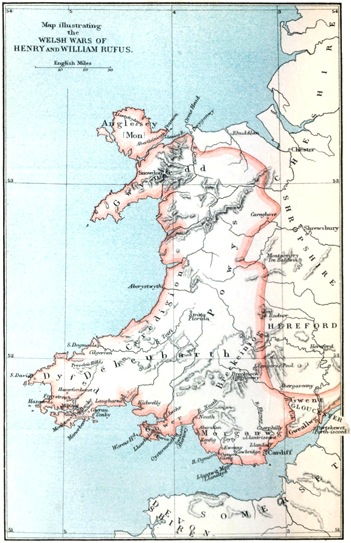
Edwᵈ. Weller
For the Delegates of the Clarendon Press.
Map
illustrating the
WELSH WARS OF
HENRY AND WILLIAM RUFUS.
Beginning of the Conquest of South Wales. 1093.
It seems to have been in the year of Anselm’s appointment,
the year of Malcolm’s death, that the conquest of
South Wales began in earnest. It seems now to have
been for the first time taken up by the King as part of
the affairs of his kingdom. But the geography of the
campaign shows that a gradual advance must have
already begun along the south coast. Our public entries
are concerned only with the land stretching nearly due
west, from the mountains of Brecknock and Abergavenny
to the Land’s End of Saint David’s. This leaves out
the sea-land which, with the bold curve of its coast,
projects to the south, the land of Morganwg or Glamorgan.
Yet it may be taken as a matter of course that this
land was not left to be won later than inland Brecheiniog
and far distant Dyfed. Legend of the conquest of Glamorgan.
The unlucky thing is that,
while the conquest of Brecheiniog and Dyfed is recorded
in notices which, though meagre enough, are fully trustworthy
as far as they go, the conquest of Morganwg,
strangely left out in all authentic records, has become
the subject of an elaborate romance which has stepped
into the empty place of the missing history. The romance
is, as usual, the invention of pedigree-makers, working,
after their manner, to exalt the glory and increase the
antiquity of this and that local family. This is perhaps
the meanest of the many forms of falsehood against
which the historian has to strive; but it is also one of
80
the strongest and most abiding, and one which is specially
strong and abiding on the northern coast of the Bristol
Channel.[188]
The legend pieces itself on to that point of the genuine
history when the sons of Cedivor were defeated by
Rhys ap Tewdwr. Story of Jestin and Einion.
A brother of Cedivor, Einion by
name, who had been in the service of either the elder or
the younger William, and had served the King in his
continental wars, now flees to another enemy of Rhys,
Jestin son of Gwrgan, described as prince of Gwent
and Morganwg.[189]
Jestin promises his daughter to Einion
with an ample estate, if he can obtain help from England
against the common enemy Rhys. This, it is supposed,
Einion’s friendship with the King and his knights will
enable him to do. Nor was Jestin’s hope disappointed.
Story of Robert Fitz-hamon and his knights.
No less a man than Robert Fitz-hamon hearkened to the
invitation of Einion; he set out at the head of a company
of twelve knights and their followers to give help to the
prince of Morganwg. Their joint forces overcame Rhys
in a battle on the borders of Brecheiniog, and Rhys
himself, flying from the field, was taken and beheaded.
His kinsmen and followers seem to have been killed
or dispersed, and we are told that Robert Fitz-hamon
and his companions, being well paid for their services
by Jestin, went away towards London. Then Einion
demands his reward; but Jestin says that he will not
give either his daughter or his land to a traitor. Einion recalls Robert.
Then
Einion persuades Robert and his companions to come
back, and take Jestin’s dominions for themselves. They
are of course in no way unwilling; and they are joined
by some of Jestin’s Welsh enemies. Jestin is driven
out, and his land is partitioned. The rough mountain
land is assigned to Einion and his Welsh companions,
and Einion also marries Nest the daughter of Jestin.
81
Robert Fitz-hamon and his twelve knights divide the
fertile vale of Glamorgan among them. Division of Glamorgan.
Each man
establishes himself in a lordship and castle, and all do
homage to Robert as lord of Glamorgan, holding his
chief seat in his castle of Cardiff. Share kept by the children of Jestin.
But, while the traitor
Einion obtains so sorry a portion, a son of Jestin is
admitted to a share in the rich vale, and is allowed to
hand on his lordship to his descendants. Another of the
family, a grandson of Jestin, Gruffydd son of Rhydderch,
refuses to submit, withstands the invaders in arms, contrives
to defend Caerleon, and to hand on to his son Caradoc
a principality in Gwent, seemingly east of the Usk.
Estimate of the story.
Now how much of this story is to be believed? Jestin
is a most shadowy being, of whom personally nothing
is recorded. But there is evidence enough for the
existence of his descendants, and for their retention of
an important lordship in Glamorgan.[190]
This may make
us inclined to put some faith in the account of the
transactions between Jestin, Einion, and Robert Fitz-hamon.
Elements of truth.
The general outline of the tale is perfectly
possible, except the very unlikely story that Robert or
any other Norman, when once standing in arms on
British or any other ground, simply marched out again
after receiving a fair day’s wages for a fair day’s work.
Settlement of Robert Fitz-hamon at Cardiff.
That Robert Fitz-hamon did conquer Glamorgan and
establish himself at Cardiff cannot be doubted. The
settlement of some of his followers is equally historical;
but the list of them as given in the legend is untrustworthy,
Legendary names in the list.
as containing names of families which did not
82
appear in the district till later. That the Normans were
invited by a Welsh prince to help him against his enemies,
and that they then took his lands to themselves, is quite
possible, though the story rests on no certain evidence.
That the Norman invaders took the valuable land, the
fertile vale, to themselves, and left the rugged mountains
to the Britons, is doubtless a true description of the
general result, though it is not likely to have been caused
by any formal division. The only thing to suggest such
a division is the portion which was kept by the descendants
of Jestin. But such an anomaly as this last might
be accounted for in various ways. The defeat and death
of Rhys in Brecheiniog is beyond doubt, and it is not
unlikely that Robert Fitz-hamon may have had a hand
in it; but at all events the date is utterly wrong.[191]
Question of Jestin’s descendants.
The
most unlikely part of the story is that which describes
a grandson of Jestin as founding a principality in that
part of Gwent which had already long been an English
possession. This story might almost seem to be a confusion
with an event of earlier times. We are tempted
to think that the Caradoc son of Gruffydd and grandson
of Rhydderch, who now settles himself in Gwent, is a
mythical repetition of the Caradoc son of Gruffydd and
grandson of Rhydderch who destroyed King Eadward’s
hunting-seat at Portskewet.[192]
Robert Fitz-hamon;
Robert Fitz-hamon, conqueror of Glamorgan—for of
his right to that title there is no doubt—has his
place in the history of this reign and of the early
years of the next. other notices of him.
We have already heard of him as
one of the few faithful among the Normans in England
at the time of the great rebellion against the present
King.[193]
Son or grandson of the famous rebel of Val-ès-dunes,[194]
he had an elder brother of his father’s name,
83
who appears, with the title of Dapifer, among the land-owners
of eastern England.[195]
He holds the lands of Brihtric.
He had himself, at one time
in the present reign, received those lands which had once
been Brihtric’s, which had then been Queen Matilda’s,
and which had been afterwards held or claimed by the
Ætheling Henry.[196]
These made him great in the shires of
Gloucester and Somerset, shires from which he might look
with a longing eye towards the lands beyond the Severn
and the Severn sea. To these, it appears, was added the
honour of Gloucester, or rather the lands of Brihtric were
made into an honour of Gloucester for his benefit.[197]
He marries Earl Roger’s daughter.
He
married a daughter of Earl Roger, Sibyl by name,[198]
and so
had the privilege of being brother-in-law to Robert of
Bellême. Marriage of his daughter to Robert of Gloucester.
His daughter Mabel, heiress of her uncle as
well as of her father,[199]
became, as we have often had
occasion to notice, the wife of King Henry’s son Robert,
84
with whom Gloucester became an earldom. His works at Gloucester and Tewkesbury.
He founded
the abbey of Tewkesbury, one of the line of great religious
houses along the Severn, where his work may
still be seen in the vast pillars and mysterious front of his
still surviving minster.[200]
To the older abbey of Gloucester
he was a bountiful benefactor. And the nature of his
gifts to these two favoured houses would be almost
enough of itself to enable us to set down Robert Fitz-hamon
as conqueror of Glamorgan. Grant of Welsh churches to English monasteries.
Gloucester and
Tewkesbury were enriched at the cost of the churches
of Glamorgan, proof enough that he who could thus
enrich them had won great possessions in Glamorgan.
The holy places of the Briton, Llantwit and Llancarfan,
with a crowd of churches of lesser note, supplied
the conqueror with an easy means of being bountiful
with no cost to himself.[201]
So again the mere fact that
a man who held such a position as that of Robert Fitz-hamon,
one who, though not an earl, ranked by possessions
and connexions alongside of earls, plays so small
a part as he does in the recorded history of the reign,
might almost of itself suggest that he was busy on some
enterprise of his own, such as that which legend assigns
to him. Conquest of Glamorgan.
When the mound by the swift and shallow
Taff was crowned by the shell-keep of Cardiff, the
progress of invasion was not likely to tarry. The fertile
85
lowlands from the mouth of the Taff to the mouth of
the Neath were a natural accession to the lowlands of
Gwent which were already won. They were won;
they were guarded by a crowd of castles. Building of castles.
And the
winning of the land, the building of the castles, events
about which the genuine local history is strangely silent,
were, there is not the slightest reason to doubt, the work
of Robert Fitz-hamon and of the men who shared with
him in that work.
Distinction between Morganwg and Glamorgan.
In strict geographical accuracy the names Morganwg
and Glamorgan do not answer to one another.[202]
Morganwg
in the wider sense is said to have taken in a
vast district from the Severn to the Towy, while Glamorgan,
said to be called from a prince named Morgan
in the tenth century, was less than the present county,
taking in only the vale. The distinction between the
two was preserved in the style of the lords of “Morgania
and Glamorgania.” Extent of Glamorgan.
But the country with which we
have now to deal may be practically looked on as
answering to the present county, somewhat cut short
to the west and somewhat lengthened to the east. It
takes in the present Monmouthshire between Usk and
Rhymny; it does not take in the peninsula of Gower.
This last, with the town of Swansea on its isthmus,
still forms no part of the diocese of Glamorgan or
Llandaff; it marks its formerly distinct character by still
belonging to the diocese of Saint David’s. Within this district
Robert Fitz-hamon and his successors the Earls of
Gloucester held a position like that of the Earl of Chester
or the Bishop of Durham. Without bearing their lofty
titles, the Lord of Glamorgan practically held, like them,
a vassal principality of the crown. Like the other lords
marchers, he held most of the powers of kingship within
his lordship, and the position of his lordship enabled
86
him to carry out those powers more thoroughly than most
of his fellows.[203]
Cardiff castle.
The chief seat of the lord was at Cardiff
on the Taff, where the castle had been, as we have seen,
founded in the Conqueror’s day.[204]
Bishopric of Llandaff.
A little higher up the
river was the seat of the bishopric of Glamorgan at
Llandaff, with its church, most unlike Le Mans or Durham,
nestling by the river at the foot of the hill. Under
the chief lord settled several lesser lords, tenants-in-chief,
we may almost venture to call them, within Glamorgan,
who founded castles and families, and under
whom the land was again divided among a crowd of
smaller tenants. Some of these lesser lords held within
their own lordships powers almost equal to those of the
lord of Glamorgan himself. William of London.
First perhaps among them
was the house founded by William of London, better
known under the French form of Londres.[205]
The name
suggests some thoughts. Who was a William of London
in the days of William Rufus? A Norman doubtless,
but hardly a Norman of any very lofty rank in his own
land. May we follow the analogy of the great bearer of
the same name in the next age, and see in him the son
of a Rouen citizen settled in London in the very first
days of the Conquest, or even in the days of the Confessor?
Kidwelly and Ogmore.
The house of London spread beyond the bounds
of Glamorgan; their chief seat was at Kidwelly; but
within the lordship of Fitz-hamon the square keep of
Ogmore and the fortified priory of Ewenny, one of the
most precious specimens of the Norman minster on the
smallest scale, still remain as memorials of their presence.
Richard Siward.
But the name of Siward—its first bearer appears in the
legend as Richard Siward—bespeaks English or Danish
descent, and we are tempted to see in the colonist of
87
Glamorgan a son or grandson of Thurkill of Warwick.[206]
Pagan of Turberville at Coyty.
Pagan of Turberville held Coyty, married a Welsh
heiress, and became the founder of a house whose feelings
became British rather than Norman or English.
Aberafan held by the children of Jestin.
Aberafan, the fortress at the mouth of the Glamorgan
Avon, remained in the hands of the descendants of Jestin,
the only native line which, like such Englishmen as
Thurkill, Eadward of Salisbury, Coleswegen and Ælfred
of Lincoln, abode on its own ground on equal terms
with the conquerors. They alone shared the fertile
plain with the strangers; the rest of their countrymen,
even those who held acknowledged lands and lordships,
were confined to the barren hills.[207]
The lords and their castles.
These few families have each something in their name
and history which entitles them to special notice. A few
others were of really equal eminence from the first, and
the legend, to make up the full tale of twelve peers,
adds on several names of later date. These great lords,
and a crowd of smaller land-owners as well, built each
man his castle; in Glamorgan the peaceful manor-house,
soon to become the rule in England, seems to have been
the reform of a much later day. The castles with
which we are to deal are of course for the most part
castles of the older and simpler type; it was not till
long after the times with which we are dealing that
Caerphilly, with its mighty gateway-towers, its princely
hall, its lake wrought by the hand of man, became the
proudest of South-Welsh fortresses, the peer of Caernarvon
itself. Caerphilly lies indeed beyond our immediate
range, in the land still left to the natives, parted off by
hills from Cardiff and from the rich plain which the conquerors
kept for themselves. Not a few others of the
famous castles of the district belong to times far too
88
late for us. The South-Welsh churches.
From the castles the churches also caught
a military air, and kept it during the whole time of
mediæval architecture. The fortified towers of Glamorgan
have the military character less strongly marked
than the towers of Pembrokeshire; but it is marked
quite strongly enough to strike the English visitor as
something altogether in harmony with the endless
traces of castles which meet him at every step. He sees
at once that a state of things which in England
existed only during the first years of the Conquest, or
which more truly, unless during the nineteen years of
anarchy, never existed at all, went on in the half conquered
British land for ages.
Saxon settlements in South-Wales.
The leaders in the settlement were of course mainly
Norman. It has been acutely remarked that they mostly
came, as followers of Robert Fitz-hamon most naturally
would come, from the old lands of Brihtric in Gloucestershire
and Somerset. They doubtless brought with them
an English following, a strictly Saxon invasion of South
Wales. Among the Teutonic settlers in this district,
it is not easy to distinguish the Saxon from the Fleming.
The Flemings in Pembrokeshire.
It must always be remembered that, while the Flemish
settlement in Pembrokeshire is matter of history, the
Flemish settlements in Gower and Glamorgan are merely
matters of inference.[208]
Foundation of boroughs.
The English and Flemish settlers
were doubtless the chief inhabitants of the boroughs
which now began to arise under the shadow of the castles.
Cardiff, Kenfig, Aberafan, and Neath, arose on the coast or
on the rivers from which some of them took their names.
Cowbridge and Llantrissant lay in the inland part of the
vale; the last, a borough mainly British, was the only one
which held at all a commanding site among the hills.
In later times these towns sank into insignificance—Kenfig
indeed well nigh perished under heaps of sand.
89
But some of them have in later times been called up to
a new life by the wonderful development of mineral
wealth which has changed the barren hills which were
left to the Briton into one of the busiest regions of our
whole island.
Ecclesiastical affairs.
In ecclesiastical matters the conquest of this district
was for awhile chiefly marked, as has been mentioned,
by the spoliation of the ancient British foundations,
to the behoof of the conqueror’s favourite monasteries
at Gloucester and Tewkesbury. Llandaff.
The bishopric of Llandaff
or Glamorgan kept its place, though it never became,
either in the extent of its possessions or in the
fabric of its church, at all the peer of Saint David’s.
Ewenny. Cistercian foundations.
Ewenny arose, if not in the very first days of the conquest,
yet within the first or second generation.
The Cistercian
movement reached this district early. Neath. 1130.
The abbey
of Neath arose in King Henry’s time, under the patronage
of Earl Robert;[209]
and in the last year of his life, while
the anarchy still raged, the same earl, the most renowned
of the lords of Glamorgan, Margam. 1147.
found means to found the
more famous abbey of Margam.[210]
The conquest of Glamorgan thus stands out as an
event which is altogether unrecorded in authentic history,
but of which it is not hard to put together a picture
from its results. Other parts of the conquest of South
Wales are more clearly entered in both British and
English annals. Conquest of Brecknock.
The mountain land of Brecheiniog
must have been occupied early in the reign of Rufus,
if not earlier still. Bernard Newmarch.
Its conqueror, Bernard of Neufmarché,
better known in the English form of Newmarch,
has already figured in our story;[211]
and he was clearly
90
in possession when William Rufus lay sick and penitent
at Gloucester. His followers are then spoken of as the
French who inhabited Brecheiniog. By that time then
the upper valley of the Usk, from Abergavenny westward,
must have been already subdued. The rich land
of the holy King Brychan, with his twenty-four sainted
daughters—the church where the worship of one of them
turned the people of the land into frenzies which offended
the soberer devotion of the Norman[212]—the rivers full of
fish, the lake of marvels, the whole pleasant valley cut
off by its hills from the extremes of heat and cold[213]—all
had passed away from British rule. The castle of Brecknock.
Bernard had doubtless
by this time reared on the hill of Aberhonwy at
least some rude forerunner of the castle of Brecknock,
the fragments of which still stand, facing the southern
mountains, alongside of the massive church of his own
priory, the church which he made his far-off offering
to Saint Martin of the Place of Battle.[214]
Bernard’s gifts to Battle Abbey.
We know not
whether Bernard had by this time striven to confirm his
power on British soil by a marriage which connected him
with the noblest blood, alike British and English. His wife Nest.
His
wife Nest united the blood of Gruffydd with the blood of
Ælfgar. We are not told the name or race of her father;[215]
but her mother was Nest the daughter of Gruffydd and
Ealdgyth, the stepdaughter of Harold, the half-sister of
91
his twin wanderers, the granddaughter of Ælfgar and
his perhaps Norman Ælfgifu.[216]
Nest thus came on the
spindle-side from Godgifu the mirror of English matronhood;
but the woman who shamelessly avowed to King
Henry that her son was not the son of her husband
Bernard hardly walked in the steps of her renowned
ancestress.[217]
During that memorable Lent, while King
William lay sick at Gloucester, the new lord of Brecknock
found it needful to gather his strength to withstand an
attack from the people whom he had despoiled. Defeat and death of Rhys at Brecknock. 1093.
The
Britons came together under Rhys the son of Tewdwr, the
king of whom we have often heard, and who must have
been at this time the most powerful prince of South Wales.[218]
He invaded the invaders; and in the very Easter week,
while matters were busy between William and Anselm
on the one hand, between William and Malcolm on
the other hand, a battle took place near Brecknock.
There Rhys was killed, by the help, according to the
Glamorgan legend, of Robert Fitz-hamon. According to
the same legend, Rhys did not fall in open fight, but as
a prisoner to whom quarter was refused. Another
account describes him as being slain by the treachery
of his own men. His death was marked as an epoch
in the history of Wales. End of “the kingdom of the Britons.”
With him, the native historian
writes, fell the kingdom of the Britons, a phrase which
an English writer seems to have misunderstood as
meaning that after him no Welsh prince bore the kingly
92
title.[219]
The overthrow of Rhys led to great movements
in other parts of South Wales. Effect of the death of Rhys.
We can hardly doubt
that, whether Robert Fitz-hamon had a hand in the
fight at Brecknock or not, his settlement in Glamorgan
was at any rate already begun. But the fall of Rhys
laid the lands to the south-west, the lands of Ceredigion
and Dyfed, open to invasion; and two sets of invaders
were equally ready to make the most of the chance
which was now laid open to them. The British enemy
came first. Cadwgan harries Dyfed. April 30, 1093.
Cadwgan son of Bleddyn, who had once
before driven Rhys from his throne,[220]
seized the moment
of his death to carry a wasting inroad into Dyfed.[221]
He
was presently followed by invaders who were to do
something more than make a wasting inroad. Norman conquest of Ceredigion and Dyfed. July 1, 1093.
“About the
kalends of July the French for the first time held Dyfed
and Ceredigion, and set castles in them, and thence
occupied the whole land.”[222]
These words of the British annalist mark a most important
stage in the occupation of his country. The campaign
of this summer completed the conquest of South
Wales, so far as a land could be said to be conquered which
was always revolting, and where native chiefs still kept,
sometimes by their own strength, sometimes by formal
acknowledgement, such parts of the land as the invaders
could not or did not care to occupy. But it was now
93
that a land was planted with castles which is still pre-eminently
the land of castles; Pembrokeshire.
it was now that a land
was brought under the power of those who bore rule
in England which was itself to become a new England
beyond the line of the Briton. Ceredigion, the land of
Cardigan, the vale of Teifi with its still abiding beavers,[223]
the sites of the castles of Aberystwyth and Cilgerran, of
the abbey of Strata Florida and the priory of Saint Dogmael,
were added to the dominion of the conquerors.
Thence they pressed on to the extreme south-western
land, and added Dyfed by a new name to the possessions
of the English crown. Tale of Rufus’ threats against Ireland.
A tale has been told how the
Red King himself made his way to the most western
point of all, to the headland of Saint David’s; there,
from the treeless rocks, he looked over the sea to the
land beyond, which may now and then be seen on a
cloudless evening. Then he boasted that, lord as he
was of Britain, he would be lord of Ireland too, how he
would gather round that headland the fleets of his whole
kingdom, and would make of them a bridge by which
he might pass over and win the great island for himself.
The tale goes on to tell how, when the threatening
words were brought to King Murtagh,[224]
he asked whether
the King of the English had added to his threat the
words, “If God will?”[225]
The Red King had not used
94
the formula which he hated to hear even from the lips
of others,[226]
and the Irish prince at once answered that
he did not fear the coming of one who meant to come
only in his own strength, and not in that of the Most
High.[227]
Estimate of the story.
The tale is eminently characteristic of William Rufus;
yet it sounds somewhat like an echo of the real visit
and the real schemes of the great William translated
into the boastful language of his son. The Conqueror
did visit Saint David’s;[228]
he did plan the conquest of
Ireland;[229]
but it is not likely that he threw the
expression of his designs into such a shape as that
which William Rufus would have been likely enough
to choose. The younger William may have made
his way to Saint David’s; but it is not easy to find
a time for his coming, either in this year or in any
other. Acquisition of Saint David’s.
But, whether through his coming or not, Saint
David’s itself passed under the obedience of the conquerors.
Bishop Wilfrith.
We presently find its bishop, a bishop spoken
of as a Briton, but bearing the English name of Wilfrith,
acting in their full confidence.[230]
But the holy place,
deep in its hollow, was left to be guarded by its own
holiness. No castle of king or earl or sheriff invaded
its precincts; the home of its bishop did not, as at
Llandaff, take the form of a castle looking down upon
the minster, but that of a peaceful palace resting by
95
its side. The conquerors pressed on, through the land
of Cemaes and Emlyn and by the hills of Preseleu,
till they reached the south-western land, the land of
creeks and peninsulas, where the tides of Ocean rise
and fall beneath the walls of far inland towns and
fortresses. Milford Haven.
In those waters the wandering wiking had
seen the likeness of his own fiords, and he had left his
mark here and there on a holm, a gard, a thorp, a ford,
some of them bearing names which seem to go back
to the gods of Scandinavian heathendom.[231]
The Norman
won the land, to hand it over in the next reign to the
Flemish settlers, who rooted out whatever traces of the
Cymry Northmen and Normans had left. Two of the
chief towns, Pembroke and Tenby, kept their British
names in corrupt forms.[232]
Milford and Haverford would
seem to have been already named by the Northmen. The Pembrokeshire castles.
On
every tempting point overlooking the inland waters, sometimes
on points overlooking the Ocean itself, castles arose,
some of which grew into the very stateliest of their own
class. Tenby, Haverfordwest—Manorbeer, birthplace of
Giraldus[233]—Caerau, connected with so many famous names
of later date[234]—and a crowd of castles of lesser note,
witness the means by which the conquerors knew how to
hold down the land which they had won.
At the head of all stands the great fortress which
96
gave its name to a town, a shire, and a long line of
earls, and in our own time to a great workshop of the
naval strength of the land. Pembroke Castle.
Pen bro, the head of the
sealand, grew into Pembroke, with its vast castle rising
on a peninsula above two arms of the inland sea—with
its stately hall looking down on the waters—with the
deep cave underneath its walls, with the huge mass of the
round tower—with the one hill-side covered by the houses
and churches of the town, the other crowned by the
long line of the priory of Monkton, with its stern
square tower and its now roofless choir. Pembrokeshire buildings.
The character
of military strength and simplicity, which is stamped
in a lesser measure on the churches and houses of
Glamorgan, comes out in all its fulness in the churches
and houses of Pembrokeshire. Of all this the days of
which we are speaking saw the beginnings, but only
the beginnings. The castle begun by Arnulf of Montgomery.
On the tongue of land between the
two creeks a fortress was raised by Arnulf of Montgomery,
son of Roger and Mabel, a man of whom we
have already heard and shall hear again. But his
defences were as yet small and feeble as compared with
what was to follow; the first castle of Pembroke was
a mere earthwork with a palisade.[235]
Second building of Gerald of Windsor. 1105.
Arnulf placed his
work under the care of a valiant knight named Gerald
of Windsor, who afterwards was the beginner of a castle
97
of greater strength on the same spot.[236]
His wife Nest.
In after times
he married a wife of the noblest British blood, yet
another Nest, the daughter of Rhys son of Tewdwr, and
grandchild through her mother of that Rhiwallon who
had received a kingdom at the hands of Harold.[237]
Before
her marriage she was the mother of one of the sons of
King Henry, though assuredly not of the great Earl of
Gloucester.[238]
In later days, through another marriage,
she became the grandmother of Giraldus Cambrensis.
The course of events in North Wales during these
years is less easy to mark with exact dates. But it
is plain that the death of Robert of Rhuddlan had been
only a momentary triumph for the Cymry, and that
it had not given any real check to the Norman power.
Hugh of Chester in Anglesey.
Earl Hugh of Chester, strong on the border of the
continental Britons, still held a hand no less firm on
their island kinsfolk. Castle of Aberlleiniog.
He even pressed on into Anglesey,
and there built a castle, most likely at Aberlleiniog on
the eastern coast of the island, a spot of which we shall
have to speak again more fully in recording a memorable
day later in our story. Advance of Earl Roger in Powys.
Earl Roger meanwhile, from
his capital at Shrewsbury and his strong outpost at his
new British Montgomery,[239]
pushed on his dominion into
Powys. The King at least approved, if he did not at this
stage help in the work; Castle of Rhyd-y-gors.
the castle of Rhyd-y-gors was
built at the royal order by William son of Baldwin.[240]
98
The conquest of Wales was thus, to all appearance,
nearly complete. Seeming conquest of Wales.
The two great earls were going on
with their old work in the north, while in the south
the tide of conquest was advancing with such speed
as it had never advanced before. In the south-east
Gwent and Morganwg seemed to be firmly held, while
in the south-west the torrent of Norman invasion had
rushed by a single burst from the hill of Brecknock
to the furthest coast of Dyfed. In the south at least
the only independent region left was that which lies
between the conquest of Robert Fitz-hamon and the
conquest of Arnulf of Montgomery. Gower and Caermarthen unsubdued.
Gower, with its
caves, its sands, its long ridge, where the name of Arthur
has made spoil of a monument of unrecorded times—with
its Worm’s Head looking out in defiance at the
conquered land beyond the bay—the whole range too
of coast with its sandy estuaries, from the mouth by
Llwchr to the mouth by Laugharne—Kidwelly also, not
yet crowned by the gem of South-Welsh castles—Caermarthen
and the whole vale of Towy—were still unsubdued.
Otherwise the Britons might truly say with
their chronicler that on the death of Rhys their kingdom
passed away from them. 1093–1094.
So things slept while Anselm
received his archbishopric, while Malcolm pressed on to
die at Alnwick, while King William was kept by the
winds at Hastings. Effects of William’s absence.
But when the king was beyond
the sea, when he and the great men of England were
busy with Norman affairs—when Argentan bowed to
Robert and Philip and when the brother of the conqueror
of Pembroke was a prisoner[241]—when the great
Earl, the father of both of them, had died with the cowl
on his head at Shrewsbury—then the Britons deemed
that the hour of deliverance was come. The English
99
Chronicler, though he does not at this stage help us to
the names of British men or of British places, paints
the general picture in his strongest colours; Revolt of the Welsh. 1094.
“The
Welshmen gathered themselves together, and on the
French that were in Wales or the nighest parts and
had ere taken away their lands, they upheaved war,
and castles they broke and men they offslew, and as
their host waxed, they todealed themselves into more.
With some of those deals fought Hugh Earl of Shropshire
and put them to flight. And none the less the
others all this year never left off from none evil that
they might do.”[242]
In this version the Norman or English champion
stands clearly forth. We see that Earl Hugh had sharp
work upon his hands from the moment that he stepped
into his father’s earldom. The British writers give us a
clearer sight of the geographical extent of the movement,
and they help us to the name of its chief leader. Cadwgan son of Bleddyn.
This
was Cadwgan son of Bleddyn, whom we last heard of as
harrying Dyfed, and who even now seems at least as
anxious to make Dyfed a land subject to Gwynedd as to
drive Normans, English, or Flemings, out of either. Thus
the Britons were, as ever, in the words of the Chronicler,
todealed; they were divided into local and dynastic
parties. Divisions of the Welsh.
Yet, as he puts it, even this division, if it
did not give strength, at least delayed subjection. If
Earl Hugh or any other leader of a regular force was
able to overthrow one deal, another deal was ready all
the same to do as much evil as before. But it was in
100
Gwynedd and under Cadwgan that the work began.
General revolt of Wales.
The Britons could not bear the yoke of the French;
they rose, they broke down the castles, and, as men
commonly do in such cases, they did by the invaders
as the invaders had done by them. It is not very
wonderful if, in their hour of victory, they revenged the
reavings and slaughters done on them by the French
with new reavings and slaughters done on the French
themselves.[243]
And, as our Chronicler hints, it was not
only on the French within Wales, but on those also in
the nighest parts that they rose. By this time the whole
land had risen; South-Welsh and West-Welsh—that is
now no longer the men of the peninsula of Cornwall, but
the men of the peninsula of Dyfed—were in arms no less
than the men of Gwynedd. Invasion of England.
Gruffydd and Cadwgan burst
into the neighbouring shires, Cheshire, Shropshire, and
Herefordshire; they burned towns, carried off plunder,
and slew Frenchmen and Englishmen alike.[244]
The Saxon,
101
the old enemy, had not become less an enemy, because
he had, through his own conquest, become an accomplice
in the invasions of his conquerors. Deliverance of Anglesey.
Gwynedd was now
free; the deliverers crossed into Anglesey; Aberlleiniog castle broken down.
they broke
down the castle at Aberlleiniog or elsewhere, and put an
end for a while to the foreign dominion in the island.[245]
The Britons now seemed to have altogether undone
the work of the invaders. It was now time for vigorous
action on the other side. The French—Hugh of Chester,
Hugh of Shrewsbury, or any other—entered Gwynedd
with a regular force; but if one deal was put to flight,
another, under Cadwgan himself, claims to have overcome
the invaders at Yspwys.[246]
The path was now open for
a march of the Britons to the south. Late in the year a
general attack was made on all the castles throughout
Ceredigion and Dyfed. Two only held out; Gerald of
Windsor successfully defended Pembroke; William the
son of Baldwin successfully defended Rhyd-y-gors.[247]
Action of Cadwgan in Dyfed.
But
the warfare of Cadwgan was waged in the interest of Gwynedd,
not in that of Dyfed. By a harsh, though possibly
prudent policy, he enforced a migration somewhat in the
style of an Eastern despot. The men and the cattle of
Ceredigion and Dyfed—we must take so general a statement
with those deductions which the laws of possibility
imply—were transported to the safer region, and south-western
Wales was made, so far as Cadwgan could
make it, a wilderness.[248]
Pembroke holds out.
Gerald, in his castle among the
102
creeks, was left to lord it over whom he might find,
and to feed himself and his followers how he might,
in the wasted land. As far as we can see, Gwent,
Morganwg, and Brecheiniog, remained in the hands of
the conquerors. The rest of the British land, from the
isthmus of Gower to the furthest point of Mona, was
either free or a wilderness.
Question of a winter campaign.
It is almost past belief that William Rufus could
have found time for a winter campaign against the
Welsh in the few weeks, or rather days, which passed
between his return from Normandy at the end of
December and his interview with Anselm at Gillingham
in the middle of January.[249]
December 28,1094-January, 1095.
But there was plenty of
fighting in the course of the year in Wales and elsewhere.
The Britons seem to have kept their independence
in the newly liberated districts, while the
Norman conquerors of Glamorgan made a successful
attack on the intermediate lands which had not yet
been subdued. Conquest of Kidwelly, Gower, and Caermarthen.
“The French laid waste Gower, Kidwelly,
and the vale of Towy;” and we are further told that
those lands, as well as Dyfed and Ceredigion, remained
waste.[250]
But if Normans laid waste, they did not simply
lay waste, like the Welsh. What they found it expedient
to lay waste for a season they meant to put in
order some day for their own advantage. This was
no doubt the time when William of London established
himself at Kidwelly, and made the first beginnings of
castle, church, borough, and haven.[251]
It was now too that
the way was at least opened for the work of colonization
103
which made Gower a Teutonic land. 1099.
According to an
authority to which we turn with a certain doubt, the
actual settlement dates from five years later. Swansea Castle. The castles of Gower.
Castles
were built, Abertawy or Swansea guarding its own bay
and the approach to the peninsula, Aberllwchr guarding
the sandy estuary between the peninsula and the opposite
coast to the north, Oystermouth, Penrice, Llanrhidian,
on points within the peninsula itself.[252]
Alleged West-Saxon settlement of Gower.
And in this
version the settlement is made, not by Flemings, according
to the common tradition, but by West-Saxons
brought across the channel from Somerset.[253]
It is certain,
as has been already said, that there is not the same
historical evidence for Flemings in Gower which there
is for Flemings in Pembrokeshire. But it is perhaps
less important to fix the exact origin of each Teutonic
settlement along this coast than to insist on the fact that,
as compared with the native Cymry, any two branches
of the Nether-Dutch stock, whether Flemish or Saxon,
came to very much the same thing.
Along with this territorial advance on the part of
the invaders, we hear, from the same somewhat doubtful
quarter, of a movement among the invaders themselves
which turned to the advantage of the natives. It is
characteristic of the outwardly legal nature of the Norman
Conquest of England that it gave no opportunity
for a character not very rare in less regular invasions,
the invading chief who finds it to his interest to separate
104
himself from his own fellows and to place himself at
the head of those whom he has helped to subdue. In
the conquests both of Wales and of Ireland there was
room for such a part to be played, and the story sets
before us one of the Norman conquerors of Glamorgan
as playing it with some effect. Pagan of Turberville joins the Welsh.
The lord of Coyty,
Pagan of Turberville, married to a wife of the house
of Jestin, took the side of his wife’s countrymen, and, we
are told, went so far as to attack Cardiff on their behalf.
The result, it is said, was a confirmation of the ancient
laws of Wales on the part of the lord of Glamorgan.
This, it is added, led many to transfer their dwellings
from the disturbed parts of the country to the more
settled lands under his rule.[254]
North Wales keeps its independence.
Meanwhile in the northern parts of Wales the Britons
still kept the independence that they had won by
the struggle of the last year. They had got the better
of the local powers on their own borders, and the
King, busied with the peaceful opposition of Anselm
and the armed opposition of Robert of Mowbray, had
little time to spare from councils and sieges within
his kingdom. Autumn, 1095.
At last, towards autumn, while the siege
of Bamburgh was going on, after he had himself turned
away from it, and left the Evil Neighbour to do its work,
William heard a piece of news from the British border
which at once stirred him to action. One of the great
fortresses of the march had fallen. In vain had Earl
Roger made his nest on the rock to which he gave the
name of his own Norman home.[255]
The Welsh take Montgomery.
Montgomery, Tre Baldwin,
105
was in the hands of the Britons, and all Earl
Hugh’s men within it were slain.[256]
William was wroth
at the tidings, and he at once called out the fyrd of his
realm, so much of it as was not needed for the lingering
leaguer-work in Northumberland.[257]
William’s invasion of Wales. Michaelmas, 1095.
Soon after Michaelmas
he entered Wales at the head of his host. He
divided it into parties, and caused them to go thoroughly
through the land. He reaches Snowdon. November 1.
At last, by the feast of All-hallows,
the whole army met together by Snowdon. If merely
marching through a country could subdue it, William
Rufus had now done a good deal towards the conquest
of Gwynedd. But William Rufus was not Harold; the
master of continental chivalry could not bring himself
to copy Harold’s homely tactics. While the royal army
scoured the dales, the Welsh betook them to the moors
and mountains where no man might come at them.[258]
Harold had found out the way to come at them; but
the Red King knew it not. Ill-success of the campaign.
All that he could do was to
go homeward, when he saw that he there in the winter
might do no more.[259]
The British annalists, with good
right, rejoice as they tell how God their people sheltered
in the strong places of their land, and how the King
and his host went away empty, having taken nothing.[260]
106
1096.
The next year saw the bloody Gemót at Salisbury;
it saw Europe pour forth its forces for the deliverance
of Eastern Christendom; it saw the Red King become
master of the Norman duchy. Among such cares, William
had no time, perhaps he felt no strong call, for another
Welsh campaign, either in winter or summer. But the
lords of the marches could not be thus idle; with them
the only choice was to invade or to be invaded. The year
seems to have begun with another gain on the part of the
Britons. The Welsh gain Rhyd-y-gors. 1096.
William son of Baldwin, who had kept the
castle of Rhyd-y-gors safe through all perils up to this
time, now died. His spirit did not abide in his garrison;
they left the castle empty, a prey to the enemy.[261]
The
spirit of the Britons, even in the lands which seemed
most thoroughly subdued, now rose. Within the bounds
of the present Glamorgan the favourable composition of
the last year seems to have kept men quiet; but the
lands to the east, parts of which had been so long under
English rule, were now encouraged to strike another blow
for independence. Revolt of Gwent and Brecknock.
The natives were in arms along the
whole line of the Usk; Brecheiniog, Gwent, and Gwenllwg,
the land between Usk and Wye and the land
between Usk and Rhymny, threw off, as their own
writers say, the yoke of the French.[262]
The marchers
had now to act in earnest. English feeling towards the war.
Our own Chronicler says
mournfully how “the head men that this land held
ofttimes sent the fyrd into Wales, and many men with
that sorely harassed, and man there sped not, but man-marring
and fee-spilling.”[263]
We see that the old duty
107
of every man to fight for the land when called on had
come to awaken some of the feelings which attach to a
conscription. Men were, we may believe, ready for a
campaign in Normandy or Maine, where plunder was
to be had, and where there was most likely still some
satisfaction felt in fighting against French-speaking
enemies, even under French-speaking captains. To drive
back Malcolm would come home to every man’s heart
as a national duty; to dispose of Malcolm’s crown under
the leadership of an English Ætheling might call up
long-forgotten feelings of national pride. But who could
be tempted by the prospect of a march to Snowdon, even
in the fairest weather? What interest had the men of
perhaps far-off English shires in rivetting the dominion
of a Norman lord on the men of Brecknock or Pembroke?
No doubt every Englishman was ready to drive back
the Briton from Shropshire and Herefordshire; but it
was an irksome and bootless work to go and attack
him in his own land, a land from which even conquerors
could draw so little gain. Even to win back Gwent,
the conquest of Harold, was an enterprise which would
lead mainly to man-marring and fee-spilling. Vain attempt to recover Gwent.
Into Gwent
however they were marched; but nothing was done; the
land was not subdued; the army was even attacked
on its retreat, and after great slaughter put to flight.[264]
A second greater attempt came to nothing more. The
grandsons of Cadwgan, Gruffydd and Ivor, attacked this
army too on its return, and cut it also off at Aberllech.[265]
108
The British chronicler here makes a comment which
fully explains the final issue of these wars. The Normans
or English, whichever we are to call the hosts of England
under the Red King, had thus for three years met with
nothing but defeat. Yet they had in truth won the
land. “The folk stayed in their homes, trusting fearlessly,
though the castles were yet whole, and the castlemen
in them.”[266]
Effects of the castle-building.
The fortresses might be hemmed in for
a moment; but, as long as they stood whole with the
castlemen in them, the newly won freedom of the open
country was liable to be upset at any moment. In
Gwent and Brecheiniog at least the natives might for
the moment stay fearlessly in their homes; they might
at some favourable point surprise and cut to pieces the
armies that were sent against them; they might withdraw
to moors and mountains when the invading force was
too strong for them; but, as long as the castles stood
firm, the real grasp of the stranger on the land was
not loosened. How long a castle could stand out we
see by the example of this very year’s campaign. Pembroke castle holds out.
All
the castles of Dyfed and Ceredigion had been destroyed
two years before, save Pembroke and Rhyd-y-gors; and
Rhyd-y-gors was now in the hands of the Britons. Pembroke,
the castle of earth and wood, the outpost cut off
from all help, still stood through the whole of these two
years, the one representative of Norman dominion in the
whole region of which it had become the head. No wonder
that the Britons, victorious everywhere else, resolved on
one great attack on this still unconquered stronghold of the
enemy. The Welsh attack Pembroke. 1096.
A host led by several chieftains of the house of
Cadwgan, Uhtred son of Edwin,--one whom we should
rather have looked for in Northumberland,--and Howel
son of Goronwy, set forth and fought against Pembroke.
Gerald of Windsor was hard pressed. One night, fifteen
109
of his knights, despairing of resistance, made their
escape from the castle in a boat. Resistance of Gerald of Windsor.
Their esquires were
more faithful, and Gerald at once gave them the arms
of knighthood, and also granted—or professed to grant
to them—the fiefs of their recreant lords.[267]
His devices.
We read too
how Gerald, to hide his real plight from the enemy,
betook himself to some of those simple devices of which
we hear in so many times and places. He had four
swine in the castle; he cut them in pieces, and threw
them over to the besiegers.[268]
The next day he wrote
or caused letters to be written sealed with his seal, saying
that there was no need to trouble Earl Arnulf—he is
made to bear the title—for any help for four months
to come. His dealings with Bishop Wilfrith.
These letters he took care should be found
near a neighbouring house of Bishop Wilfrith of Saint
David’s, as if they had been lost by their bearer.[269]
They
were read out in the Welsh army. The Britons, we are
told, having no mind for a four months’ siege, marched
away.[270]
They claim to have marched away without loss,
110
with much booty, especially with all the cattle belonging
to the castle.[271]
Offensive action of Gerald. 1097.
But the castle was not taken; it stood
there to do its work; and early in the next year Gerald
was harrying in his turn as far as the borders of Saint
David’s.[272]
Friendship for the Bishop perhaps kept him
from harrying the holy soil of Dewisland itself.
This year, the King, as he had done two years before,
deemed the affairs of Wales to call for his own presence,
and for a greater effort on his part than ever. He had
come back from taking possession of the mortgaged land
of Normandy; Easter, 1097.
he had held the Easter Assembly at
Windsor somewhat after the regular time.[273]
At that
Assembly Welsh affairs must have formed a subject of
discussion, as the King presently set out for Wales with
a great host. This was the time when the knights sent
by the Archbishop were deemed so unfit for their duty.[274]
William’s second Welsh campaign.
The King’s coming appears to have led to a seeming,
perhaps a pretended, submission. Led by native guides,
he passed through the whole country,[275]
Seeming conquest.
and he clearly
believed that he had brought Wales to a state of peace.
So he deemed when he came back to hold the Whitsun
Assembly, the assembly in which Anselm for the first
111
time that year craved leave to go to the Pope.[276]
But
he was called back by a fresh revolt. Fresh revolt.
The Welsh, in
the emphatic phrase of our Chronicler, “bowed from the
King.”[277]
They had once bowed to him; now they bowed
from him; they cast away his authority; perhaps they
formally defied him in the strict feudal sense; certainly
they defied him in the more general sense which that
word has now come to bear. And now, for the first
time in these wars, the English Chronicler gives us the
name of a Welsh leader, a name which from British
sources has long been familiar to us. Cadwgan.
“They chose them
many elders of themselves; one of them was Cadwgan
hight, that of them the worthiest was; he was brother’s
son of Gruffydd the King.”[278]
The name of the great
prince who had ruled all Wales, who had won the battle
by the Severn,[279]
who had put Earl Ralph to flight[280]
and
burned Hereford town and minster,[281]
the prince whom
it needed all the strength and all the arts of Harold
to overthrow, was still famous even among Englishmen.
The nephew of Gruffydd had this time too to dread no
such tactics as had worn down his uncle on his own
soil. William’s third campaign. June-August, 1097.
King William set forth with a host of horse as
well as of foot, vowing to put to death every male of
the rebel nation.[282]
Again the pomp and pride of Norman
112
chivalry was shivered against the natural defences of
the land which was so rashly attacked. The Britons
seem, by their own account, to have made the war a
religious one; perhaps, like the Irish king, they deemed
that higher powers would fight for them against the
blasphemer. The King’s ill-success.
Strengthened by prayers, fastings, and other
pious exercises, the Welsh took to their woods and rocks
and mountains, while the Red King’s host marched
and rode bootlessly through the valleys and plains.[283]
“Mickle he lost in men and in horses, and eke in many
other things.”[284]
This state of things went on from midsummer
to August.[285]
Then the King came back to hold
two assemblies at unusual times, in the second of which
he and Anselm met for the last time.[286]
And now it was
that he took that wise resolution which I have quoted
above.[287]
He determines to build castles. October, 1097.
As invasions by mounted knights led to nothing
but losing both the knights and their horses, he would
build castles on the borders. This Harold, who knew so
much better than William Rufus how to carry on a Welsh
campaign, had not done. But then the objects of Harold
and the objects of William Rufus were not the same.
We should have been well pleased to know what was
the immediate result of the resolve for the building of
113
the border-castles. What were the fortresses which were
built, as surely some must have been built, in obedience
to it? This is the last entry which connects Rufus
personally with Welsh affairs. But we can hardly help
connecting this resolve with the building, a little time
later, of several fortresses in the lands threatened by the
Welsh, specially of one, the greatest of them all. Action of Robert of Bellême. 1098–1102.
In
the next year one part of the British land becomes the
scene of a series of events of far-reaching interest and
importance, but also of a local interest quite as great in
its own way. We shall then see that, if the Red King
did not do much in the way of building border-castles
himself, much was done by others, of course with his
approval, most likely by his order. Our next year’s
tale brings Robert of Bellême to the Welsh border,
and, where he was lord, castle-building went on with
all vigour.
Affairs of Scotland.
But before we enter on a branch of our story which
touches all parts of the British islands, and many lands
beyond the British islands, it may be well to take up
the thread of our Scottish narrative at a point where the
affairs of Scotland and those of Wales seem again to be
brought into some measure of connexion. The year
which saw that wise resolution of the Red King with
regard to the Welsh castles, a resolution which really
meant the final union of Wales with the English realm,
saw also the end of those revolutions whose final result
was, not the union of Scotland with the English realm—that
was not to come about till long after, and by other
means—but the extension of English influence within
the kingdom of Scotland till it might be looked on as in
truth a second English realm.
114
§ 4. The Establishment of Eadgar in Scotland.
1097–1098.
Decree for action in Scotland. August, 1097.
It must have been at one of the later assemblies of
the year which we have now reached, most likely at the
August gathering,[288]
that the resolution was taken for
vigorous action in Scotland. The King himself had
had enough of Welsh warfare; he must have been
already looking forward to those French and Cenomannian
campaigns which form the main feature of the
next year; he was in the middle of his final dispute
with Anselm. But William Rufus seems always to have
been well pleased to set others in motion, even on enterprises
in which he did not share himself. Designs of the Ætheling Eadgar.
So he gladly
hearkened to the proposals of the Ætheling Eadgar for
an expedition into Scotland. Its object was to overthrow
the usurper Donald, as the chosen of Dunfermline was
deemed at Winchester, to restore the line of Malcolm
and Margaret, and to bring the Scottish kingdom once
more into its due obedience to the over-lord in England.
Relations between Eadgar and the King.
Our last certain notice of Eadgar sets him before us as
enjoying the fullest confidence on the part of the reigning
King, as sent by him on the important errand of negotiating
with Malcolm and bringing him to William’s
court at Gloucester.[289]
Story of Godwine and Ordgar.
One hardly knows what to make
of the tale which describes him as awakening a certain
amount of suspicion in the King’s mind later in the
same year;[290]
but that, either before or after this time, he
was in some such danger appears from another tale in
the details of which there may or may not be a legendary
element, but which undoubtedly brings before us real
persons and a real state of things. To this tale I have
115
already referred elsewhere, as having that kind of interest
which belongs to every story in which we see any one
of those who are recorded in the Great Survey as mere
names stand forth as a living man, playing his part in
the world of living men. However obscure the man,
however small his deeds, there is always an interest in
finding any part of the dry bones of Domesday clothed
with flesh and blood. And the interest becomes higher
when the man thus called forth out of darkness is a man
of native English birth, and the father of one whom England
may well be glad to reckon among her worthies.[291]
Eadgar accused by Ordgar.
The story runs then that a knight of English birth,
Ordgar by name, seeking favour with the King, brought a
charge against the English Ætheling. He told William
that Eadgar, trusting to his own descent from ancient
kings, was seeking to deprive the reigning king of his
crown. William hearkened to the accuser, and some
grievous doom—would it have been the doom of William
of Eu?--was in store for Eadgar, if his guilt—his ambition
or patriotism—could be proved. The ordeal and the battle.
But how was the
charge to be proved or disproved? By Old-English law the
appeal to the judgement of God in doubtful cases was by
the ordeal; and, as between Englishman and Englishman,
this rule had not been changed by the laws of the Conqueror.[292]
But we can well believe that Englishmen who
were admitted to a place in the Red King’s court had
largely put on the ideas and feelings of Normans. They
would doubtless look down on the ancient practice of
their fathers, and they would be more inclined to follow
the fashion of their Norman companions in better liking
the more chivalrous test of the wager of battle. It seems
in the present story to be taken for granted that the
trial will be by wager of battle. But who will do battle
116
for Eadgar, when the royal favour is so clearly shown
on behalf of Eadgar’s accuser? The Ætheling was sad at
heart, forsaken, as it seemed, of all men. Godwine volunteers to fight for Eadgar.
But at last
one stepped forward who was ready to dare the risk on
behalf of a man to whom he was bound by a double
tie. As an Englishman he was stirred to come to
the help of the descendant of the ancient kings, and he
was further bound to Eadgar by the special tie which
binds a man to his lord. He was a knight of noble
English descent, known as Godwine of Winchester.
Notices of him in Domesday.
We know him in Domesday as a tenant of the
Ætheling for lands in Hertfordshire, and the Survey
further suggests that he may have had a private grudge
against the opposite champion. There were lands in
Oxfordshire which were held by an Ordgar, and which
had been held by a Godwine. Duel of Godwine and Ordgar.
The matter is to be
decided by the hand-to-hand fight of the two English
knights. For they so far cleave to the customs of their
fathers that they fight on foot and deal handstrokes
with their swords. Ordgar comes forth in splendid
armour, surrounded by a crowd of courtiers.[293]
Godwine
has nothing to trust to but his sword and his good
cause. But there was at least no attempt made to
hinder a fair fight—so to do would have been altogether
foreign to the spirit of the chivalrous king. The herald
and the umpire do their duty;[294]
the knights take their
oath to forbear the use of all weapons but those which
were needed in the knightly duel. A long and hard fight
follows, the ups and downs of which are described with
117
Homeric minuteness. Victory of Godwine, and acquittal of Eadgar.
Ordgar at last, sorely wounded, is
pressed to the ground, with the foot of the victorious Godwine
upon him.[295]
As a last resource, he strives, but in
vain, to stab Godwine with a knife which, in breach of his
oath, he had treacherously hidden in his boot.[296]
Godwine
snatches the knife from him; Ordgar confesses the falsehood
of his charge, and presently dies of his wounds.[297]
Godwine now becomes an object of universal honour,
and receives from the King the lands of the slain Ordgar,
while Eadgar rises higher than ever in the King’s
favour.
Estimate of the story.
I see no reason to doubt the main outline of this
story, which rests on the evidence of undesigned coincidences.
Men of no special renown, about whom
there was no temptation to invent fables, are made to
act in a way which exactly agrees with what we know
from the surest of witnesses to have been their real
position. Without pledging ourselves to the details of
the combat, which have a slightly legendary sound, we
may surely believe that we have here the record of a
real wager of battle, like those which happened at no
great distance of time in the cases of William of Eu and
Arnulf of Hesdin. Its general truth. Englishmen under Rufus.
We may surely believe that Eadgar
was wrongfully accused, and that Godwine cleared his
lord in the duel. We see then that in the Red King’s
day there was nothing to hinder men of Old-English
118
birth, exceptionally lucky men doubtless, from holding
an honourable rank and a high place in royal favour.
But we learn also, as we might expect to find, that such
Englishmen found that it suited their purposes to adopt
Norman fashions. Robert son of Godwine.
Of Godwine we hear no more; but
his son, as I have noticed elsewhere, bears, according to a
very common rule, the Norman name of Robert.[298]
Had
we chanced to hear of him without hearing the name
of his father, we might not have known that the hero
and martyr was a man of our own blood.
The Eadgars march to Scotland. September, 1097.
We now follow the Ætheling to a warfare in which
Robert the son of Godwine is his companion. Eadgar set
out about Michaelmas to place his nephew and namesake
on the Scottish throne. He had a bright comet
and a shower of falling stars to light him on his
way.[299]
But Donald was hardly of importance enough for
the heavenly powers to foretell his fall; The comet.
the shining
and departure of the comet was rather understood to
mark the approaching day when Anselm, the light of
England, turned away from our land and left darkness
behind him.[300]
The force of the Ætheling seems
to have been of much the same kind as the force which
119
Duncan had led on the same errand three years before.
He went with the King’s approval and support, but
certainly without the King’s personal help, perhaps
without any part of the royal army.[301]
That army, as
we have lately seen, was just then coming together for
another errand.[302]
Vision of the younger Eadgar.
The host then marched northward. On the way, we
are told, the younger Eadgar was honoured by a vision
of Saint Cuthberht, who bade him take his banner from
the abbey at Durham—the abbey now without a bishop—and
he should have victory in the battle.[303]
The banner
was borne before the army; the fight in which it was
unfurled was long and hard; but the valour of the men
who fought under its folds was not to be withstood.
Exploits of Robert son of Godwine.
Without binding ourselves to details which may well
be legendary, we may believe that Robert son of Godwine
was foremost in the fight, and that the victory in which
Defeat and blinding of Donald.
Donald was the second time overthrown was largely
owing to his personal prowess.[304]
Little mercy was shown
to the vanquished; Donald spent the rest of his days
blinded and a prisoner;[305]
Fate of Eadmund; he becomes a monk at Montacute.
his confederate Eadmund lived
120
to become somewhat of a saint.
He put on the garb
of Clugny in the priory of Montacute, at the foot of that
hill of Saint Michael where the castle of Robert of
Mortain now covered the spot which had beheld the
finding of England’s Holy Cross.[306]
But as that house
did not arise till some years later, at the bidding of
Count William the son of Robert,[307]
we may gather that
Eadmund spent the intermediate time in some harsher
captivity. When he died, he was buried, at his own
request, in chains, as a sign of penitence for his share in
his half-brother’s death.[308]
Eadgar King of Scots.
The younger Eadgar now reigned over Scotland as
the sworn liegeman of King William of England.[309]
The
elder Eadgar went back to England, to end there a year
of heavy time, a year of evil weather, Character of the year 1098.
a year in which
men could neither till the earth nor gather in its tilth,
and when the folk was utterly bowed down by unrighteous
gelds.[310]
His valiant comrade abode for a while in the
dominions of the Scottish King. Eadgar was grateful
to all who had helped him in heaven or in earth. The
battle had been won by Saint Cuthberht and Robert son
121
of Godwine. Saint Cuthberht, in the person of the
monks of his abbey, received the lands of Coldingham,
the seat in ancient times of a house of nuns famous in
the days of Danish warfare.[311]
Eadgar’s gifts to Durham and to Robert son of Godwine.
A little later—for it was
when Durham had again a bishop—he received, in
the person of his own successor, the greater gift of the
town of Berwick.[312]
Robert, by the leave of his own
sovereign, received a fief in the same land of Lothian,
and began the building of a castle. Action of Eadgar, Robert, and Randolf Flambard; after 1099.
But, while King
Eadgar went to do service to his over-lord in England,
the bishop—it was already Randolf Flambard—and the
barons of the bishopric, whom Robert’s fortress seems in
some way to have offended, attacked it and made its
lord a prisoner.[313]
King Eadgar came back with letters
from his over-lord, ordering the release of their common
subject. The Bishop and his barons obeyed; but the
King of Scots withdrew his gift of Berwick from the
bishopric, as a punishment for the wrong done to the
man to whom he owed his crown.[314]
Eadgar and Robert go to the Crusade.
Robert the son of Godwine was presently called to
a nobler work. His lord the Ætheling went to the Holy
War. Eadgar was not one of those who marched first of
all with the two Roberts of Normandy and Flanders.
He was one of that second party who set forth about
the time of the siege of Antioch, 1099.
and joined the Norman
122
Duke in his ignoble retreat at Laodikeia.[315]
Robert the
son of Godwine, if he stayed in Britain long enough to
have any dealings with Flambard in his character of
Bishop of Durham, must have set out later still. He
could have had no share in the leaguer of Nikaia or
of Antioch; most likely he had no share in the rescue
of the Holy City. Robert in Palestine.
He could hardly have reached
Syria till Jerusalem was again a Christian kingdom
under its second king. Godfrey, the mirror of Christian
knighthood, was gone. His successor was his less worthy
brother Baldwin, he who had told the dream of his
calling to Dame Isabel in the hall of Conches.[316]
But
there was still work to be done; the land which
had been won had to be defended. King Baldwin was
besieged in Rama by the misbelievers.[317]
1103.
The King, attended
by five knights only, made a sally to cut his way
through the besiegers. His exploits and death.
The valiant Englishman rode in
front of him, cutting down the infidels on each side with
his sword. As Robert pressed too fiercely on, his sword
fell from his hand; he stooped to grasp it again; he was
overpowered by numbers, and was carried off a prisoner.[318]
He was led to the Egyptian Babylon; he was offered
his choice of death or apostasy; he clave to his faith;
placed as a mark in the market-place, like the East-Anglian
Eadmund, he died beneath the arrows of his
merciless captors.[319]
Such men could England, even in
123
her darkest day, send forth for the relief and defence
of Christendom in the Eastern world. Modern parallels and contrasts.
Such men she
could send forth even in the days of our fathers, to draw
the sword for right in the haven of Pylos or beneath
the akropolis of Athens. Now the men who go forth
from England to the same quarter of the world seem to
share more of the spirit of another Robert who, a century
later, went forth from the same shire as the son of
Godwine on another errand. In our own story we come
across no renegade or traitor save the single name of
Hugh of Jaugy.[320]
But in the course of the twelfth century
we see the forerunners of a class of men whose names
stain the annals of our own time. Robert of Saint Alban’s.
The glory of Robert
son of Godwine is balanced by the shame of Robert of
Saint Alban’s, English by birth and blood, the apostate
Templar who joined the host of Saladin and mocked
the last agonies of the defenders of the Holy City.[321]
Of
the earlier Robert our century has seen the true successors
in the honoured names of Gordon and Church and
Hastings. Of the later Robert it has seen the successor
in the Englishman who sells his soul and his sword to
keep down the yoke of the barbarian on the necks of his
Christian brethren. It has seen him in the Greek who
sells his soul and his glib tongue to argue in the councils
of Europe against the deliverance of his own people.
Reign of Eadgar in Scotland. 1097–1107.
With the accession of Eadgar to the Scottish crown
the direct connexion between English and Scottish affairs
comes to an end, as far as concerns the period with which
we have immediately to do. Eadgar reigned in peace, as
far as his own kingdom was concerned, for ten years,
124
earning the doubtful praise of being in all things like to
his remote uncle the Confessor.[322]
At his death the Scottish
dominions were divided between his two more energetic
brothers. Alexander. 1107–1124.
Alexander took the kingdom; David, by a revival
of an ancient custom,[323]
held as an appanage that part
of Strathclyde or Cumberland which still belonged to the
Scottish crown. Friendship of the Scottish kings for England.
Both princes maintained strict friendship
with England, and both sought wives in England.
Alexander married a natural daughter of King Henry,
Sibyl by name;[324]
the wife of David was, more significantly,
the widowed daughter of Waltheof.[325]
Alexander
had to strive against revolts in the North,[326]
and his reign
marks a great period in the ecclesiastical history of
Scotland. Turgot and Eadmer.
It is the time in which we meet with the
familiar names of Turgot and Eadmer, the one as bishop,
the other as bishop-elect, of the first see in Scotland.[327]
The influence of the reign of Eadgar told wholly in
favour of the process by which Scotland was becoming an
English kingdom. The reign of Alexander told perhaps
less directly in favour of things specially English,[328]
but it
125
worked strongly towards the more general object of
bringing Scotland into the common circle of western
Christendom. Effects of the reign of David. 1124–1153.
The succession of David reunited the
Scottish dominions, and his vigorous rule of twenty-nine
years brought to perfection all that his parents had begun.
That famous prince was bound to England by every tie of
descent, habit, and affinity. His English position;
Brother of her Queen, uncle of
her Imperial Lady,[329]
David was an English earl in a stricter
sense than any king of Scots who had gone before him.
his earldoms.
He was not only Earl of Lothian, which was becoming fast
incorporated with Scotland—or more truly was fast incorporating
Scotland with itself—nor yet only of Northumberland
and Cumberland, with which the same process
might easily have been carried out.[330]
He was Earl also of
distant and isolated Huntingdon, an earldom which could
not be held except on the same terms as its fellows of
Leicester or Warwick. English influence in Scotland.
Under David, the great reformer,
the great civilizer, but at the same time the king who
made the earlier life of Scotland a thing of the past, all
that was English, all that was Norman, was welcomed in
the land which was now truly a northern England. His invasion of England.
If
David, like his father, appeared as an invader of England,
if, in so doing, he made England feel that he had subjects
who were still far from being either English or Norman,[331]
he did so only as a benevolent mediator in the affairs of
England, as the champion of the claims of one of his nieces
against the claims of the other. The Scottish kings of the second series.
With the three sons of
Malcolm and Margaret begins the line of those whom we
may call the second series of Scottish kings, those who
still came in the direct line of old Scottish royalty, but
under whom Scotland was a disciple of England, and on
the whole friendly to England. They stand distinguished
alike from the purely Celtic kings who went before them,
126
and from the kings, Norman or English as we may
choose to call them by natural descent, who were politically
more hostile to England than the old Malcolms and
Kenneths. Eadgar and Alexander died childless; the
later kings were all of the stock of David. The English or Norman candidates for the Scottish crown.
Of that
stock—and thereby of the stock of Waltheof and Siward
and their forefathers of whatever species—came
that motley group who in after days wrangled for David’s
crown. Bruce, Balliol, Hastings, Comyn, all came by female
descent of the line of David and Matilda. In every
other aspect all of them were simply English nobles of
the time. It is an odd destiny by which, according as
they supported or withstood the rights of their own
prince over the kingdom which they claimed, some of
them have won the name of Scottish traitors and others
the name of Scottish patriots.
§ 5. The Expedition of Magnus. 1098.
Events of the year 1098.
The events of the year which followed the last revolution
in Scotland amount to a general stirring of all the
lands which could in ordinary times have any influence
on the affairs of England. Their wide geographical range.
We shall see in the next
chapter that it was the busiest of times in the Gaulish
mainland, where the designs of Rufus, now undisputed
master of Normandy, spread far beyond anything
that had been dreamed of by any earlier holder of the
Norman duchy. For warfare or for alliance, the range
of our story during this most stirring year stretches from
the fiords of Norway to the gorges of the Pyrenees. In
the present section we have to look to the northern side
of this tangled drama, and to take the specially British
aspect of it as our centre. A mighty undertaking, which
moved the whole of north-western Europe, which touched
England, Scotland, Ireland, Wales, and the smaller islands
which lie between and around them, comes home to us
127
mainly as it touches that one among those islands which
might almost pass for a part of the mainland of southern
Britain. Magnus of Norway.
The great warfare of Magnus of Norway mainly
concerns our story so far as it almost casually became a
part of warfare in Wales, and specially of warfare in
Anglesey. Anglesey the centre of the story.
And, as regards England itself, the most
important aspect of a movement which stirred every
northern land was that it indirectly lifted one man who
was already great beyond endurance in Normandy and
its border lands into a place of greatness even less endurable
in England and its border lands. The Earls of Shrewsbury.
We have to
tell a tale spreading over many lands and seas, a tale full
of personal pictures and personal exploits. To Englishmen
of the last years of the eleventh century and the
first years of the twelfth, its most practical aspect was
that it took away Earl Hugh of Shrewsbury and set
his brother Robert in his place.
The winter of 1097.
We must now look back to the moment, late in the
last year, when the Welsh seemed to have completely
won back their freedom, except in Glamorgan and at
the single point covered by the unconquered fortress of
Pembroke.[332]
It is startling to find in our next notice
that the Britons, without any mention of any fresh loss,
are beginning to stand on the defensive, and to seek
out as it were a last shelter. The war of Anglesey. 1098.
The war is now shifted
to a quarter of which we have hitherto heard less
than of some other parts of Wales, and it becomes
connected with movements in other parts of the world
which carry us back a generation. The island off the
north-west corner of Wales, that Mona or Mevania to
which half-forgotten English conquests had given the
name of Anglesey,[333]
became now, as in the days of
128
Roman invasion, the chief—at the time it may have
seemed the last—stronghold of British resistance. The
island, parted from the British mainland by the narrow
strait—the Hellespont—of Menai, lying within sight of
the fortress of Robert of Rhuddlan at Dwyganwy, seems
for the last four years to have been left untouched by
any Norman invader. Schemes of Cadwgan and Gruffydd.
But now we read that the princes
of Gwynedd, Cadwgan son of Bleddyn, their worthiest
elder, and Gruffydd the slayer of Robert, with the
general assent of the Britons of the north, agree in
council, as one of their own chroniclers puts it, to save
Mona.[334]
This form of words seems to imply less trust in
their own resources than we might have looked for in
the elders of the Britons after their late successes. If
Mona needed to be saved, one would think that they
must already have found that there was little real
chance of saving Gwynedd or Dyfed. And the way by
which they sought to save Mona was hardly a wise one,
though it was one which might have been defended by
many precedents. The Welsh take wikings from Ireland into pay.
Just as Gruffydd had done ten
years before, they took into their pay a fleet of pirates
from Ireland, wikings doubtless from the Scandinavian
settlements, whom one Welsh writer, perhaps more from
habit than as meaning his words to be taken in their
full force, speaks of as heathens.[335]
With these allies,
and with the main body of their own forces, the British
leaders withdrew into Anglesey.
129
The two Earls Hugh, of Chester and Shrewsbury.
The news of this alliance was thought serious enough
to call for vigorous action on the part of the two earls
of the border. Both now bore the same name. Hugh
of Avranches still ruled at Chester—we last heard of
him as counselling the cruel punishment of William of
Eu; Hugh of Montgomery was drawing near to the
end of his short dominion over Shropshire. The
Scandinavian writers couple the two Hughs together,
and they distinguish the elder by the well-earned surname
of Hugh the Fat, and the younger by that of
Hugh the Proud.[336]
They gathered their forces, Norman
and English, and crossed over to Anglesey. The
first step towards the occupation of the island was
the usual Norman means, the building of a castle. In
this case they had not to build for the first time, but
to build up afresh what the Welsh had destroyed in
the moment of victory. It will be remembered that,
four years before, the Britons in their great revolt had
won back Anglesey and broken down the castle.[337]
Rebuilding of the castle of Aberlleiniog.
There
seems no reason to doubt that the site of the old work
was the site of the new, and that that site marks at once
the landing-place of the two earls and the scene of the
fall of one of them. It lies on the eastern side of the
island, quite free from the strait, and nearly due west
from the scene of the Marquess Robert’s death at
Dwyganwy.[338]
It lies about half way between the priory
of Penmon—the head of Mona—parts of whose simple
and venerable church must be nearly contemporary
130
with our times,[339]
and the great fortress of later days at
Beaumaris, the head of the island shire. A small
expanse of flat and marshy ground marks the spot where
the small stream of Lleiniog, mere brook as it is, makes
its independent way into the sea. Traces of the castle.
On its left bank
the careful enquirer will find, what he will certainly not
see at a glance, a castle-mound with its ditches, now,
after the usual senseless and provoking fashion, masked
with trees. But he who makes his way within will find,
not only the mound, but the square tower crowning
it, though he will hardly deem this last to be a work
of the two earls. In front of the castle, immediately
above the sea, a slight natural height seems to have been
improved by art into a smaller mound. The earthworks
at least the earls doubtless found ready to their hand,
whether they had been thrown up in the earlier invasion
of the island, or whether the invaders had then taken
advantage of mounds thrown up by men of earlier times.
Here we have beyond doubt the remains of the castle
of Aberlleiniog, the castle which Hugh the Fat and Hugh
the Proud designed to hold Anglesey in check.[340]
But it
was not only to the craft of the engineer that the two
Hughs trusted. The earls bribe the wikings.
The earls of the Red King’s day had
learned to practise the special arts of their master. The
wikings were bribed with the gold of England to betray
the cause of their British allies, and they gave the earls
131
valuable help in making good their entrance into
Anglesey.[341]
Cadwgan and Gruffydd flee to Ireland.
It was in strange contrast with the vigour which for
several years had been shown by the Welsh leaders,
and with the success which had commonly waited on
their arms, but quite in harmony with their last action
of all, when Cadwgan and Gruffydd, seeing the turn
which things had taken, threw up the common cause
altogether and fled to Ireland to secure their own safety.[342]
Anglesey was now left to the mercy of the two earls.
The character for gentleness which Hugh of Shrewsbury
bears, and which he may have deserved in the government
of his own earldom, brought no lessening of
suffering to British enemies. Wherever the two Hughs
marched, men were slaughtered, or were, in modern eyes
at least, worse than slaughtered. Cruel treatment of the Welsh captives.
They were blinded,
deprived of hands and feet, or made to undergo the other
mutilations usual at the time.[343]
In some cases at least
the earls trampled on every privilege of holy places and
holy persons. Desecration of the church of Saint Tyfrydog.
It may be deemed a lesser matter that
one of them caused his hounds to pass a night in the
church of Saint Tyfrydog, and found them all mad in
the morning.[344]
The privileges of the Church could not
132
shelter even her human and priestly servants. One
special victim was an aged priest, who is said to have
taken a leading part in the war by the advice which
he gave to the Welsh. Mutilation of Cenred.
His name Cenred bespeaks
English birth; the form of the name is Mercian; if he
had passed from the earldom of either Hugh to the side
of the Welsh, he would naturally be looked on as a
traitor, and his treason would explain the excessive
harshness with which he was treated. The old man was
dragged out of a church; besides more shameful suffering,
one eye was torn out, and his tongue was also cut out.[345]
This last form of mutilation seems to have been confined
to himself, and it may have been meant as specially
befitting one who had used that dangerous member to
give counsel to the enemy. Restoration of his speech.
And now, according to our
story, happened one of those signs and wonders which were
at the time naturally deemed miraculous, but for which
modern times have supplied, if not an explanation, at
least a parallel. Cenred fared like the victims of Gelimer
of old, like the victims of Djezzar in modern times; three
days after the loss of his tongue, his speech came back
to him.[346]
Four days later again, so men deemed at Worcester,
came vengeance on one at least of the two earls
for the cruel deed which they had wrought on him.[347]
Expedition of Magnus Barefoot.
If wikings from Ireland had betrayed the cause of the
133
Britons, a far mightier wiking was now afloat, if not to
give help to the Britons, at least to act as a minister of
wrath upon their enemies. The tale of Stamfordbridge
seems to come over again on the western, instead of the
eastern, side of the British islands. For a grandson of
Harold Hardrada shows himself at the head of a power
almost equalling that of his grandfather; he brings
a grandson of Godwine in his train, he overcomes
two Mercian earls, and finds his own doom, not indeed
in Yorkshire, but in Ireland. But the enterprise which
recalls so many points in the enterprise of two-and-thirty
years earlier was not in any strict sense an invasion
of England. Character of his reign. 1093–1103.
Magnus, the son of that peaceful Olaf
of whom we have heard in the Conqueror’s day,[348]
now
reigned in Norway in the spirit of his grandfather rather
than in that of his father. His surnames.
He bore various surnames, as
the Tall and the Lover-of-Strife; but his name has gone
down in history with the special epithet of Magnus Barefoot—more
strictly it would seem Bare-leg—a name
which is said to have been given to him as one of the
results of the enterprise of which we have now to speak.
1093–1098.
After showing himself for five years as a mighty warrior
in his own peninsula, Magnus set forth to bring more
western lands under his obedience. He professes friendship for England.
Against England
he professed to have no designs, and the little that we
casually hear of him in connexion with England seems
to imply friendly relations. His son Sigurd, afterwards
famous as the Crusader, was the child of an English captive.
Her name of Thora witnesses to her Scandinavian
descent;[349]
but her captivity could not have been the work
134
of the arms of Magnus. His treasure at Lincoln.
Either now or at some later time,
he entrusted a great treasure, twenty thousand pounds
of silver, to the keeping of a rich citizen of Lincoln,[350]
a
sign of the high place which was still held by the city
of the Danish Lawmen, and of the connexion which its
citizens still kept up with the kingdoms of the North.[351]
Harold son of Harold in his fleet.
But, peaceful as might be the professions of Magnus
toward England, there was one in his fleet whose presence
could not fail to call up thoughts of deeds which had been
done, or which might again be done, on English ground.
We learn from one of the most casual of notices that Magnus
had with him a man who, if the course of things had
gone otherwise a generation earlier, might then himself
have been the wearer of the English crown, who would at
least have stood nearer to it than either the Ætheling of
the blood of Cerdic or the Ætheling of the blood of Rolf.
It could hardly have been without an object that the
grandson of Harold the son of Sigurd brought with him
the son of Harold the son of Godwine. Strange indeed was
the fate of the twin sons of the doubly widowed Ealdgyth.[352]
Each flashes across our sight for a moment, and only for a
moment. Ulf we have seen the prisoner of the Conqueror;
we have seen him sent forth by the Conqueror’s son to go
in freedom and honour, but to go we know not whither.[353]
And now, for once in the course of a life which must have
been a chequered one, we hear the name of his brother.
Some ship in the fleet of Magnus bore, as its guest or as
its captain, Harold the son of Harold King of the English.[354]
135
Whence he came, whither he went, before and after
that one voyage to the shores of Britain, we know not.
Grandson of Godwine, grandson of Ælfgar, begotten, but
not born, to the kingship of England, the child of the
widow did not see the light in the City of the Legions
till his father had found his cairn upon the rocks of
Hastings, perhaps his tomb before the altar at Waltham.
What friendly hand saved him, when his brother came
into the Conqueror’s power, we know not, any more than
we know the later fortunes of his mother. But now the
younger Harold came, the guest of one whose grandfather
had felt the might, as his father had felt the mild-heartedness,
of the elder Harold.[355]
His voyage brought
him not near to either the most glorious or the most
mournful memories of his father. The fleet of Magnus
kept aloof alike from the shores of Yorkshire and from
the shores of Sussex. But the younger Harold came to
look for a moment on the land where his mother had
dwelled as a queen, and which his father had filled with
the trophies of his conquest.[356]
He came to see the British
shores lined with English warriors, but to see them under
the rule of the Norman leaders who had divided between
them so great a part of the earldom of his mother’s house,
and the elder of whom reigned as all but a king in the
city of his own birth. Son and nephew of the three who
died on Senlac, he saw from the Norwegian ship the fall
of the son of the man who led the charge which first
broke down the English palisade upon that hill of doom.[357]
And then, his name once spoken, he passes away into
utter darkness. Of Ulf, the knight of the Norman duke,
136
of Harold the comrade of the Norwegian king, we have
no tale to tell save that they were such.
Magnus’ designs on Ireland.
One version of our tale speaks of Ireland as the main
object of the expedition of Magnus, as it certainly was
the object of his last expedition some years later. His alleged Irish marriage.
He
had, it is said, married the daughter of an Irish king, but
his father-in-law had failed to carry out the marriage-contract.[358]
There is nothing of this in the Norwegian
account, which speaks only of a later marriage between
Sigurd son of Magnus Irish marriage of his son Sigurd.
and a daughter of King Murtagh.[359]
But it seems clear from a comparison of the various
accounts that Magnus did, at some stage of the present
voyage, make an attack on Ireland; it seems reasonable
therefore to suppose that Irish enterprise formed part of
his scheme from the beginning.[360]
His voyage among the islands.
Our own narrative is
more concerned with his course along the shores of our
own island, in which however he seems to have barely
touched Britain itself, in either its Scottish or its English
regions. His exploits lay among the smaller islands of
the British seas, most of which had at that moment more
to do with Ireland than with either England or Scotland.
It is not easy to call up from among many conflicting
statements an exact picture of the state of things at the
time. Dominion of Godred Cronan.
In the interval between the expedition of Harold
Hardrada and the expedition of his grandson, Godred
the son of Harold, surnamed Cronan, he whom we have
heard of at Stamford bridge,[361]
1075–1091.
had raised up a considerable
dominion of which Man was the centre. 1078.
He ruled
over Dublin and the greater part of Leinster, and over
137
the Sudereys or Hebrides; and, if the chronicle of his
own island may be believed, he drove the Scots to a
singular treaty, the object of which must have been to
hinder Scotland from becoming a naval power.[362]
We may
guess that some of the piratical adventurers of whom we
have heard once or twice in our Welsh notices, as for
instance in the story of Robert of Rhuddlan and again
in the tale which we have just told, were in truth subjects
of Godred. But the dominion of Godred was one
of those powers which seem as it were casually founded,
and which seldom long outlive the reign of their founder.
His Irish dominion did not last even so long as his own
life. Godred driven out of Dublin. 1094.
After seventeen years of possession, he was driven
out of Dublin by Murtagh, and in the next year he died,
leaving three sons, Lagman, Harold, and Olaf, of whom
Lagman succeeded to his island dominion. His death.
1095.
His sons, Lagman and Harold.
In the Manx
version of the tale, Lagman, disturbed by a rebellion of
his brother Harold, took a frightful revenge by inflicting
on him the usual cruel mutilations. Then, smitten
with remorse, he made the pilgrimage to Jerusalem and
died there.[363]
The chief men of the Sudereys, hearing of
his death, asked King Murtagh for a ruler during the
minority of Olaf. Donald sent by Murtagh to the Sudereys.
This would almost look as if Murtagh
had not only driven Godred out of Ireland, but had established
some kind of supremacy over Man itself. But the
ruler sent, Donald by name, proved a tyrant, and was
138
driven out.[364]
Ingemund sent by Magnus.
Then we are told that Magnus himself sent
one Ingemund to take the crown of the Isles, that the
chief men came together in Lewis to make him king but
that his outrages on their wives and daughters made
them change their purpose. Instead of crowning him,
they burned him in his house, and slew all his followers
with fire and sword.[365]
Civil war in Man.
Directly after, we read of a civil
war in the isle of Man itself, in which the leaders of both
parties were killed.[366]
The Norwegian story tells us
nothing of all this; it conceives Godred as still living at
the time of the expedition of Magnus, and Lagman as
acting under his father.[367]
The Manx version, though
confused in its chronology and mixed up with some
legendary details, gives the more intelligible story of the
two. We see a time of confusion in Man, Ireland, and
the Sudereys, which the Norwegian King tries to turn to
his own advantage. The slaughter of his candidate for
the island crown might have been looked on as ground
for war by princes more scrupulous in such matters than
Magnus Barefoot.
Signs and wonders.
A King of the Northmen could hardly set out on a
great enterprise without signs and wonders; but the
139
signs and wonders which marked the expedition of
Magnus are of a different kind from those which marked
the expedition of Harold Hardrada. Or rather, one of
the two elements which we see in the tale of Harold
had, in the thirty years which had passed, waxed strong
enough to drive out the other. In the days of Harold
the omens and visions still savour of the old times of
Scandinavian heathendom. Saint Olaf indeed appears in
his character of a Christian martyr, to remind us that we
are reading the deeds of baptized men; but the general
tone is that of the worshippers of Thor and Odin.[368]
But
the tale which is now told of Magnus is a mere piece of
every-day mediæval hagiology. It reminds us of some
of the tales which are told of William the Great and of
others.[369]
Legend of Magnus and Saint Olaf.
Magnus, great-nephew of Saint Olaf, is seized
with an irreverent longing to test the truth of the boast
that the body of his martyred kinsman had not seen
corruption. The body, first buried in a sandhill near
Nidaros or Trondhjem, was soon, like those of our own
Harold and Waltheof, translated to a worthier place in
the great church of Nidaros. Its incorruption had been
already proved, and in their new place the holy remains
wrought wonders of healing and deliverance.[370]
But now,
heedless of the remonstrances of the bishop and his
clergy, Magnus bade that the shrine should be opened,
that he might see whether it was even as the tale went.
He saw and believed; and he not only believed but
trembled. He rushed out of the church, smitten with
sudden fear. In the night the martyr appeared to him
and gave him his choice of two forms of punishment. He
must either lose his kingdom and his life within thirty
140
days, or else he must set forth from Norway and never
see the land again. His fleet.
Magnus gathered together his wise
men; he told them the vision, and by their advice, he
chose the second alternative, by far the less terrible to a
king of the seas.[371]
He set forth, but it was on an errand
of conquest, at the head of a fleet of a hundred and sixty
ships, a number far less than that of the mighty armada
which had come together at the bidding of his grandfather.[372]
The teller of this tale has either misplaced the date
of the real or supposed vision, or else he has mixed up
the present voyage of Magnus with a later one. Magnus
certainly saw Norway again after that one of his expeditions
which alone directly touches English history.
Magnus at Orkney.
He first sailed to the Orkneys, where the brother earls,
the sons of Thorfinn and Ingebiorg, the half-brothers
of Duncan of Scotland, still reigned.[373]
Their reign now
ended. He seizes the earls.
On what ground we are not told, Paul and
Erling, the allies of his grandfather, were dealt with by
Magnus as enemies. They were made prisoners, and
were sent to Norway, where they afterwards died.[374]
He gives the earldom to Sigurd.
His own young son Sigurd was established in the
rule of the earldom, with a council to advise him.[375]
Magnus then sailed among the Sudereys, plundering,
burning, and slaying. Magnus among the Sudereys; His minstrels and sagamen boast
of his doings in this way in the islands of Lewis, Uist,
141
Skye, Mull, and Islay. But he spared—the new faith
of the Northmen prevailed thus far—the holy island
of Saint Columba, all whose inhabitants were freely
received to his peace.[376]
in Cantire;
The only part of the isle of
Britain itself which he seems to have touched was the
long peninsula of Cantire, which might pass rather for
another island than for part of the mainland, and which
in truth formed a part of the insular realm. Thence,
we are told, he plundered such parts of the Irish and
Scottish coasts as lay within reach.[377]
his dealings with Galloway.
We read also
in other versions that he made the men of Galloway
become hewers of wood for fortresses to be raised, perhaps
along their own shores.[378]
His fruitless design on Ireland.
We read too that at
this stage he designed a more deliberately planned attack
on Ireland, but that he shrank from carrying it out
when he saw how strongly the Irish coasts were guarded.[379]
He occupies Man.
His next point was Man, which one narrator of his
exploits strangely describes him as finding forsaken, and
as peopling with inhabitants, from what quarter we
are not told.[380]
The local chronicler tells us, doubtless
with far greater truth, that he landed on the island of
Saint Patrick,--Holm Peel, the place of the famous
castle and cathedral church—that he was pleased with
the land, and built fortresses therein, meaning—so at
142
least it was believed in Man—to make the island his
own dwelling-place.[381]
His designs.
Man, once established as the seat
of a great Northern empire, would certainly have been
a standing menace to all the regions and races of the
British islands. But the dominion of Magnus over Man
was not handed on to any successor of his own house,
and during the few years which he still lived, he did not
make Man the centre of his power.
Version of Orderic.
We now come near to that point in the expedition
which brings it immediately within the range of our
present history. The writer who gives us most detail
deems the exploits of Magnus so great that he lashes
himself up to his highest flight of classical rhetoric.
He paints the Norwegian king as the conqueror of the
Kyklades—not those Kyklades of the Ægæan which his
grandfather may well enough have visited, but the other
Kyklades in the great sea, lying as it were outside the
world.[382]
To match this unlooked-for definition of the
Western islands, the winds which filled the sails of Magnus
are honoured with unusual names; and, by a sad relapse
into paganism Amphitritê seems to be called up as a
special guardian of the English shore.[383]
Of the two islands
which bore the name of Mevania, both of which had
143
obeyed the Bretwalda Eadwine, Magnus was already
master of one; he now drew near to the other. He approaches Anglesey.
We are
told that he sent a small part of his fleet, consisting of six
ships, to some unnamed point of the more strictly English
shore, bearing a red shield as a sign that their purposes
were peaceful.[384]
Preparations for resistance.
But the people of Britain of all races
seem to have put little faith in the peaceful purposes of
the Northmen. A vast host, French and English, presently
came together from all parts of the dominions of
the two Mercian earls. The meeting-place is said to have
been at Dwyganwy on the peninsula opposite Anglesey,
the scene of the fall of Robert of Rhuddlan.[385]
The fleet off Aberlleiniog.
But there
can be no doubt that the scene of the tale which we
have to tell lies on the opposite shore of Anglesey, and
seemingly hard by the newly restored castle of Aberlleiniog.
Most likely the sea then came in further over
the low and marshy ground, and nearer to the castle-mound,
than it does now. Both the earls were on the
spot; the younger Hugh of Shrewsbury had been the first
to come, and he had had to wait some days for his allies.
At last the Norwegian ships were seen at sea near the
coast, and the inhabitants were running to and fro for
fear. By this time the forces of Hugh of Chester must
have come up; but it is Hugh of Shrewsbury, the younger
and more active of the pair, who plays the chief part
in the story. He mounted his horse, and rode backwards
and forwards along the shore, bringing his followers
together, lest the invaders should land and overcome
them piecemeal.[386]
In his zeal he rode so near to the water
144
as to come within reach of the advancing tide and within
bow-shot of the Norwegian ships. Two archers on the
ship of King Magnus spied him out, and took aim. His
body was so well guarded by his coat of mail that it
was his face only that supplied a mark for the archers.
Of these one was King Magnus himself; the other was
a warrior from Halagoland, the most northern part of the
strictly Norwegian shore. The arrow shot by the King’s
comrade struck and turned aside from the nose-piece of
the Earl’s helmet. The shaft sent by the King’s own
hand went yet more truly to its mark; it pierced the eye
of Hugh and went through his head. Hugh the Proud
sank, and perished amid the advancing waves.[387]
He died
by a stroke like that by which the elder Harold fell on
Senlac; and we could almost wish that it had been the
hand of the younger Harold that sent the shaft.
Norwegian and Welsh versions.
That shaft was, according to the monk of Saint Evroul,
sent by the hand of Magnus, but by the special instigation
of the devil. To the minstrels of Norway the death
of Earl Hugh seemed a worthy exploit. They sang,
not of a single shot, but of a fierce battle, in which the
Norwegian king, lord of the islands, met the Welsh
earls[388]
face to face. They told how the arrows rattled
on the coats of mail, and how the King’s own arrow
overthrew Earl Hugh the Proud by the waters of Anglesey.[389]
The British chronicler too tells us, if not of
the fierce struggle described by the Northern poet, yet
of arrows shot on both sides, alike from the ships
and by the defenders of the land.[390]
All agree that it
was by the royal hand that the Earl fell. But it is
only from Saint Evroul that we hear that Magnus shot
Hugh unwittingly, and that he mourned when he knew
who it was whom he had slain. Peace between Magnus and Hugh of Chester.
It is added that he at
145
once made full peace with the surviving Earl Hugh of
Chester, declaring that he had no hostile purposes against
England, but that he only wished to wage war with
Ireland, and to assert his dominion over the islands.[391]
The body of Earl Hugh of Shrewsbury was sought for
with pains by Normans and English, and was found at
last, as the tide went back.[392]
The only gentle one among
the sons of Mabel[393]—gentle, we may easily believe, to all
but the Britons, perhaps cruel to them only under the evil
influence of his elder namesake—was mourned by all, Burial of Hugh of Shrewsbury.
and
was buried the seventeenth day after his death in the
cloister of his father’s abbey at Shrewsbury.[394]
The words which we have just seen put into the mouth
of Magnus are words of doubtful meaning, and they
might imply a claim to Anglesey, as well as to the other
islands. Designs of Magnus on Anglesey.
That Magnus came thither with purposes of
conquest we may set down as certain; it is less clear
whether those purposes were carried out, even for a
moment. In Norway it was believed that the overthrow
of Earl Hugh put the King of the Northmen in possession
of Anglesey, which is strangely spoken of as a third
of the British land.[395]
In Man it was said that Magnus,
having slain one earl and put another to flight, occupied
Anglesey, but that he was persuaded by the Welsh, on
146
the payment of a heavy ransom, to leave the island and
sail back to Man.[396]
Certain it is that, if Magnus took
any real possession of Anglesey, it was a momentary
possession indeed. According to the British chroniclers,
he sailed away at once, so that his coming and the death
of one of the earls did not really hinder the joint work of
the two. Anglesey and North Wales subdued by Hugh.
For a moment Anglesey, and with it seemingly
the greater part of North Wales, was brought more
thoroughly than ever under Norman or English rule.
The phrase by which the Welsh writer sets forth the
result has a strange sound; but it does not badly describe
the final work of these endless wars. The French, he
says, made the people become Saxons.[397]
But for the
present this work was done only for a moment. In the
course of the next year, Anglesey was again, neither in
French nor in Saxon, but in British hands.[398]
We shall hear again of Magnus in the revolutions both
of Anglesey and of other parts of North Wales. For the
present, satisfied with the glory of having carried the
Norwegian arms further south in the British islands than
any of his predecessors had done,[399]
he seems to have
sailed, first to Man and then to Ireland. There he
made a truce with Murtagh, and, at a later time, he
married the daughter of the Irish king to his own
son Sigurd. Sigurd’s kingdom.
This youth was now entrusted with the
rule of all the Orkneys and Hebrides, and that with the
kingly title.[400]
Of his kingdom Cantire formed a part;
147
the peninsula had been formally taken possession of by
the Norwegian king. Occupation of Cantire.
This was done by a symbolic rite,
which well expressed the dominion of a king of the seas
over the land. Magnus was drawn in a ship across the
isthmus which joins Cantire to the mainland. Dealings of Magnus with Scotland.
The occupation
of Cantire was, according to the Norwegian
writer, the result of a treaty with Malcolm King of
Scots;[401]
but the expedition of Magnus took place during
the reign of Eadgar. Magnus then went back to Norway,
to receive his surname from the dress of the islanders,
the use of which he and his followers brought into their
own land. He then occupied himself for a while with
Scandinavian affairs, till his restless spirit again brought
him within the range of our story.
§ 6. The establishment of Robert of Bellême in England.
1098.
Of the two earls who had crossed over to Anglesey to
meet with such singular ups and downs of fortune, it
was the elder who came back alive. Hugh of Chester,
Hugh the Fat, had still to rule for a few years longer till
he died a monk at Saint Werburh’s. Effects of the death of Hugh of Shrewsbury.
But the short-lived
reign of Hugh the Proud at Shrewsbury and Arundel had
come to an end, and his death led to important changes
in all those parts of England with which he had had
to deal, but above all in his own earldom on the Welsh
border. Robert of Bellême Earl of Shrewsbury. 1098.
A large part of that district, a district the most
important of all in a military point of view, passed
under the rule of the man who was at once the most
merciless of oppressors and the most skilful of military
148
engineers. The Red King and his minister had now an
opportunity of carrying out their doctrines with regard
to the redemption of lands on a grand scale. The King
was doubtless ready to be the heir of Earl Hugh, as of
all other men; but, as in the case of other men, he
was willing to allow the next kinsman to redeem the inheritance,
if he offered a becoming price. He buys his brother’s possessions.
So now, when
Robert of Bellême claimed the earldom and lands of his
deceased brother, he obtained a grant of them on a payment
of three thousand pounds.[402]
This was nearly half
the sum for which William Rufus had made himself master
of all Normandy; but it was perhaps not too great a
price to pay for the great earldom of Shropshire with its
endless castles and lordships, for Arundel and Chichester
and the other South-Saxon lands of Roger of Montgomery,
and for the rest of his possessions scattered over
many English shires. Extent of his estates.
Robert of Bellême, specially so called
as the son of his mother, but who was no less Robert of
Montgomery as the son of his father, and who now became
no less Robert of Arundel and of Shrewsbury, thus
joined together in his own person three inheritances, any
one of which alone might have set him among princes.
Doubtful policy of the grant.
One might doubt whether William the Conqueror would
have been tempted by any price to allow the accumulation
of such vast powers in the hands of one man,
and that a man whose homage was not due to himself
only. But with William the Red the services and the
payments of Robert of Bellême together outweighed any
thought of the policy which might have led him rather
to bestow the vacant earldom and other lands on some
other among the sons of Earl Roger. Robert was now at
149
the height of his power and his fame—such fame as his
was—beyond the sea. Position of Robert on the continent.
We shall read in the next chapter
of his doings in Maine this very year, the doings of which
he now received the reward. To the Norman heritage
of his father, to the marchlands which he had inherited
from his mother, to the lands which mother and son
had snatched from so many Norman and Cenomannian
holders, Robert now added all that his father had received
from the Conqueror’s grant among the conquered
English, and all that his father had won for himself
among the half-conquered Welsh.
His new position in England.
The establishment of Robert of Bellême in England
marks an epoch in our story. Though we have already
so often heard of him, not only in continental affairs but
in the affairs of our own island, he had not yet, as far as
we can see, held any English possessions at all; certainly
he had none which put him on a level with the great
Norman land-owners. From this time he is something
more than merely one among them; he at once begins to
play the part of the foremost among them, foremost alike
in power and in ambition. His namesake, Robert of
Mortain and of Cornwall, had held as great a number of
English acres, and his death had handed over the vast
heritage to his son. Comparison with the Counts of Mortain.
But neither of the Counts of Mortain
had any personal gifts which could win for them the
personal position which was held by Robert of Bellême.
The father was sluggish; the son was turbulent; neither
of them was the peer of the great captain and engineer
who was now to lord it over the British march. Nor did
the nature and position of his estates give to the grandson
of Herleva the same advantages which belonged to
the son of Mabel. The one was, bating the title of Earl,
as great in Cornwall as the other was in Shropshire;
but the lord of Cornwall might, if he chose, sleep idly,
while the lord of Shropshire was driven to constant
150
action against a restless enemy. Each had a great position
in Sussex; but the position of the lord of Arundel
and Chichester was practically higher than that of the
lord of Pevensey. The vast scattered possessions held by
the Count of Mortain throughout England added more to
his wealth than to his political power. Comparison of Robert of Bellême and Hugh of Chester.
Earl Hugh of
Chester was in his own earldom even greater than
Robert was in his; but Earl Hugh was growing old, and
ambitious as he was, he seems to have kept his ambition
within certain geographical bounds, in those regions of
Normandy and of Britain which destiny seemed to have
set before him. Unique position of Robert.
There can be no doubt that, at this
moment, Robert of Bellême held a position in England
which he shared with no rival in the island, and which
was backed by a power beyond sea which put him rather
on a level with sovereign dukes and counts than with
ordinary nobles.
Effects of his coming.
To the men of the borderland, of whatever race, the
change of masters was a frightful one. To the settled
inhabitants, Norman and English, it must have been like
yet another foreign conquest. The change is marked in
the change of name; the surname of the new lord comes
from the lands of his mother which lay beyond the bounds
either of England or of Normandy. Hugh of Montgomery
is exchanged for Robert of Bellême. Robert a stranger in England.
The new master from
the march of Normandy and Maine must, twenty-nine
years after the conquest of Shropshire, have seemed a
stranger, not only to Englishmen, but to Normans of the
first settlement, still more so to men who were of Norman
parentage but of English birth. In its personal aspect
the change of lords must have been a matter of shuddering.
The rule of Earl Roger had been tolerable; the
four years of Earl Hugh we have seen spoken of as a
reign of special mildness, at least for his own people.
But now they had a lord of another kind. English and
151
Welsh, we are told, had smiled at the tales of the deeds
of Robert in other lands; Cruelty of the new earl.
they listened to them as to the
song of the bard or the gleeman, deeming that, if such
things were done, they were at least done far away from
themselves. But now they found in their own persons
that those tales were true, when, in the strong words of
a writer of those times, they were flayed alive by the
iron claws of Earl Robert.[403]
The Earl himself, great as
he was in power and wealth, was only puffed up by what
he had to hanker after yet more. His spoliations.
He spared no man, of
whatever race or order, whose lands lay conveniently to
his hand, nor did he scruple to take away from the
saints themselves what the men of the elder time had
given to them.[404]
But Robert of Bellême was something more than an
ordinary plunderer; he was a man of genius in his way;
whatever he either inherited or seized on was sure to be
strengthened by the best engineering skill of his time.[405]
His skill in castle-building.
In
the gradual work of planting both England and Normandy
with castles he had no small share; and his skill is nowhere
more to be admired than in the way in which he adapted
his designs to the varying circumstances of different
places. He built at Bridgenorth and he built at Gisors;
there is little that is alike in the two fortresses, because
there is little that is alike in the position of the two
points which those fortresses severally had to defend.
The former, Robert of Bellême’s great creation on English
152
ground, held a most important place in the defences of the
middle course of the Severn. His defence of Shropshire.
The Welsh wars of this
reign had brought that whole line of country into renewed
importance. If the power of England under her
Norman masters was stretching further and further over
the British lands, that very advance laid the English lands
more and more open to passing and occasional British
ravages. The experience of such warfare within the
English border was quite fresh. 1094.
When Robert of Bellême
took his earldom, four years only had passed since Shropshire
and Herefordshire had been laid waste,[406]
just as in
the old days when Gruffydd smote the Saxon at Rhyd-y-Groes.[407]
The new Earl of Shropshire therefore found
it needful to strengthen the whole line of defences of the
Severn. Early history of the Shropshire fortresses.
Strong as was the capital of his earldom on its
peninsular height, it was well to have, in the rear of
Shrewsbury, another great fortress on a lower point of
the river, a point whose importance is witnessed by its
name; it is emphatically the Bridge. The whole region
had been carefully fortified, perhaps in earlier days still,
certainly in the days when the Dane as well as the
Briton had to be guarded against. 896.
In the last campaign
of Ælfred, the Danes, finding it expedient to leave the
neighbourhood of London, had marched across the whole
breadth of England from Thames to Severn, and had
wrought a work beside that river at Quatbridge.[408]
Æthelflæd fortifies Bridge (north). 912.
Sixteen
years later, the victorious Lady, the guardian of the
Mercian land, had timbered the burh at Bridge. At a
somewhat lower point, the enemy against whom Ælfred
and his daughter had to strive has left his memory
in the name of Danesford. The Bridge was the site
153
of the chosen stronghold of Robert of Bellême. But
when his discerning eye marked the spot for a great
military centre, he did but do afresh what had been
already done by the native guardian of England. The
fortress of Robert of Bellême was but a calling into
fresh being, a strengthening with new works, of the older
fortress of Æthelflæd.[409]
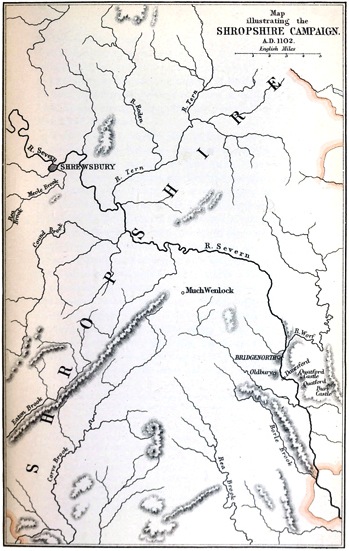
Edwᵈ. Weller
For the Delegates of the Clarendon Press.
Map
illustrating the
SHROPSHIRE CAMPAIGN.
A.D. 1102.
It is somewhat singular that in the line of defence
traced by Robert’s father so commanding a site as that
of the Bridge did not hold the first place. The strong
place of Roger of Montgomery lies between three and
four miles lower down the river. Older mound of Quatford.
There, on the
left, the English, side of the Severn, we meet with the
first—first to one going up the stream—of our present
group of fortresses. A bold height, of no very great
positive elevation, marks the position of the church and
mound of Quatford, standing side by side, as is so often
seen both in our own island and beyond sea. The mound
is a natural height rising close above the river, ditched
and scarped as was needed, but raised only slightly
above its original height. Quatford Castle.
This elder fortification, the
dwelling-place of some English thegn of the old time,
seems to have given way, either before or after the
coming of the Norman, to a stronghold a little way further
up the river, which still bears the name of Quatford
154
Castle. A sandstone hill, standing isolated, near to the
river but not immediately on its banks, was, like the
smaller and older post, improved and raised into a castle
mound, perhaps by Earl Roger himself, perhaps by some
earlier holder. Earl Roger’s house.
There the Survey records his new house
and his borough; and we may fairly see his work in the
well which still remains bored deep in the heart of the
rock.[410]
In the days of King Eadward the lordship of
Eardington had been held by Saint Mildburh of Wenlock.
His chapel.
But, if Earl Roger, who passes for the refounder
of that house,[411]
did any wrong to its patroness, he may
be held to have atoned for it by the collegiate chapel
which he raised at Quatford. It was founded at the
request of his wife, not the proud and cruel Mabel, but
her pious and gentle successor Adeliza. A pleasing
legend is told of the origin of the chapel and of the
house, a legend which, if it contains any kernel of truth,
points to Earl Roger as having been the first to occupy
Quatford Castle as a dwelling, and which may account
for the restoration of the far more tempting site of the old
fortress of the Lady being left to be the work of his son.[412]
155
The new rule now began, and the home of Roger and
Adeliza was forsaken by Earl Robert for the far stronger
point higher up the river, and on the opposite, the right
or Welsh bank.[413]
Robert of Bellême removes to Bridge (north).
Here, in contrast to the mere fords at
other points, to Quatford itself and to the Danesford
above it, stood the bridge which still forms so marked a
feature, and which had given the spot its name. Bridge
then, the stronghold of Æthelflæd, became the stronghold
of Robert of Bellême; and now, perhaps from its position
with regard to his father’s dwelling at Quatford, it came
to be specially distinguished as Bridgenorth. A steep
cliff overhangs the river at a point where the opposite
ground is high, where the stream is far wider than it
again becomes lower down, and where the channel is
divided by an island, such as those by which the Danes
loved to anchor, whether in the Seine or in the Severn.
Oldbury.
And, as the Danes are recorded to have wrought a work
in clear distinction from the burh which the Lady afterwards
timbered, we are tempted to see that work in
a mound not far from the bridge, and on the same side
as the river, but not rising immediately above the river’s
banks. A natural height has been ditched, scarped, and
raised to a level somewhat lower than that of the cliff
immediately above the stream, the cliff which was chosen
for the fortress, first of the Lady and then of the rebel
Earl. It is plainly in opposition to this last that the place
had, before the time of Domesday, received the name of
Oldbury, which is still borne by the parish in which it
stands.[414]
The cliff itself, the site of the castle and town of
Bridgenorth, has a peninsular shape so strongly marked
that it is hard to believe that the river runs on one side of
it only, and that Bridgenorth and Oldbury are divided, not
156
by a stream, but by a dry valley, in those days doubtless
not dry, but marshy. Oldbury and Bridgenorth.
The sites of the older and the newer
fortress still look on one another, though the older has
again become only a grassy mound, while the younger
grew into a fortress, parish, and town, and still remains a
parliamentary borough.
The position of the great fortress of the oppressor is a
noble one. The mere height of the cliff at Bridgenorth
is so much lower than many of the surrounding hills
of that lovely region that it makes less show than might
have been looked for in the general view. But, as we
stand close under it on the other side of the river,
we feel that Bridgenorth needs only buildings of equal
majesty on its height to make it rank with Lincoln, with
Le Mans, almost with Laon itself. But against the
proud minsters of those cities Bridgenorth has nothing
to set in its general view save two church towers, one of
them modern, whose ugliness is not relieved by the fact
that it represents the castle church, the college of Bridgenorth,
transferred thither by Robert of Bellême, when
he moved castle, church, and everything from their older
home at Quatford. Bridgenorth castle;
But Bridgenorth still keeps one object
of surpassing interest in our present story, that which is
of a truth the very cradle and kernel of the place,
the shattered keep of Robert of Bellême. Robert’s keep.
There we have
the good luck which we enjoy but seldom in examining
the military remains of this age, the strongholds of the
men of the Conquest and their immediate successors.
Most commonly we light on little more than the mere
site, or the works of earlier or of later times; it is
only now and then that we actually see, in however
imperfect a state, some piece of genuine masonry belonging
to the time with which we are dealing. This
satisfaction we have in no small measure at Bridgenorth.
There is the square keep of the terrible founder of the
157
fortress, broken down, riven asunder by some explosion
in the warfare of later times—what is left of it driven
to overhang its base like the tower of Caerphilly or the
Muro Torto of Rome—but still keeping its main and
distinctive features, still showing, in its flat pilasters, its
double-splayed windows,[415]
the traces of its double-sloped
roof with the deep gutter,[416]
what that stern, hard, tower
was when the Devil of Bellême first called it into being.
We can just trace the gateway which the keep commanded
between the inner and outer courts of the castle,
and we can see the ruins of the advanced building which
sheltered the actual entrance of the keep itself. The
square tower, so characteristic of Norman military work,
is after all so rare in this its earlier form that every
such fragment as this of Bridgenorth calls for most attentive
study. Here we see the highest advances in
the art of defence, as practised by the man whose name
makes us shudder through almost every page of our
story. At Bridgenorth nature had done almost everything.
The tall and steep cliff called for nothing to be
done in the way of mounds and ditches. It was enough
to fence in the height—that the Lady had doubtless done
after the fashion of her age—and to raise the keep—the
distinctive feature of Earl Robert’s age—as the last
shelter in case of attack from the land side. The churches and town of Bridgenorth.
We can
trace the inner and outer courts, the latter containing the
unsightly church which represents the college within the
castle. The other church stands nearly on a level with
the castle, parted from the castle hill by a dip which
takes the form of a steep road--Cartway is the name it
158
still keeps—leading down from the town to the river.
Few stronger or more striking sites of its own scale
could have been found. The Castle by the Bridge is not
a mountain fortress; far higher hills than the hill of
Bridgenorth or the hill of Quatford come within the
general view. But the stronghold of Æthelflæd and
Robert served better than any loftier point could have
done for its own immediate work. No other point
could have served so well to guard the most important
point of the river, and to shelter the older borders of
England against any desperate attempt of the Britons to
carry their endless warfare far within her later borders.
The group of fortresses.
The whole group, Bridgenorth, Oldbury, the two Quatfords,
are a succession of strongholds which form a whole.
All are within sight of one another, though it might be
hard to find a point which directly commands all four at
once. Burf Castle.
A little further inland, on the Quatford side of
the river, a broad hill, fenced in by a slight earthwork,
and known as Burf Castle, commands the widest and
most striking view of all, the round back of the Wrekin,
the sharp rise and fall of the Titterstone, with a boundless
view over the lower country to the north-east. This
is undoubtedly the site of an early stronghold, which may
have played its part in the days of the Lady or in the
old time before her. But there is no sign that it entered
into the military reckoning of Roger of Montgomery or
of Robert of Bellême.
The great engineering works at Bridgenorth seem to
have occupied the mind of Earl Robert during the whole
of the few remaining years of his English career. We
shall find that they were not fully finished four years
later. Robert builds the castle of Careghova.
At the same time, while he fenced in Bridgenorth
in the rear of the capital of his earldom, he raised
another stronghold in advance of it, within the later
159
Welsh border, at Careghova, immediately on Offa’s
Dyke.[417]
And he was at the same time extending his
possessions in a more peaceful region, where no inroads
of Britons or Northmen were to be feared. His Yorkshire and Nottinghamshire estates.
On the
borders of Yorkshire and Nottinghamshire stood a
chief seat of one who, in the extent of his possessions,
ranked as one of the foremost men in England. This
was Roger of Bully, who took his name from a Norman
lordship in the land of Braye, lying west of what was to
be the New Castle of King Henry, on the high ground
which overlooks the forest of Saint-Saen, the home of
the faithful Helias. Roger of Bully.
The name of Roger of Bully—the
spellings of the name are endless—is less commonly mentioned
in our tale than we might have looked for. He
was a great land-owner in Yorkshire; he was one of the
greatest land-owners in Nottinghamshire, and he held
considerable estates in other parts of England. He had
supplanted two English earls in their special homes; he
sat by the hearth of Eadwine and by the hearth of
Waltheof; in another spot, the holdings of ten English
thegns had been rolled together into a single lordship
to enrich the fortunate stranger.[418]
His Yorkshire estates.
Among his Yorkshire
160
estates he held the exceptionally favoured lands of
Sprotburgh and Barnburgh, which had remained untouched
in the general harrying of Northumberland.[419]
He seems to have won the special favour of the greatest
ladies of the Conqueror’s court; if he held the hall of
Hallam, the hall of Waltheof, it was by the gift of
Waltheof’s widow Judith;[420]
and an estate which he
held in distant Devonshire is set down as the gift of
Queen Matilda herself.[421]
Yet this man, who holds so
great a place in the Survey, plays no visible part in
history; he lives only in the record of Domesday and in
his still abiding work in a minster and a castle of his
own rearing. Just within the borders of Yorkshire, at
no great distance from the shires both of Nottingham
and Lincoln, Roger had occupied an English dwelling-place,
entered in the Survey as Dadesley, but which
afterwards grew into greater note by the name of Tickhill.[422]
Position of Tickhill.
Like many other dwelling-places of English lords,
Dadesley or Tickhill must have been chosen simply as
a convenient centre for the estates of its owner. It is
no natural stronghold; the post seems to have no special
military advantages; it crowns no steep, it commands
no river, it bars the entrance to no valley. The castle.
A low hill
of sandstone was improved by art into one of the usual
mounds, and it had been in King Eadward’s day the
161
possession of Ælfsige and Siward. The mound, as in
other places, was in after time taught to bear a polygonal
keep, and its sides were themselves strengthened by
masonry. The keep, of which the foundations only are
left, was of later date than the days with which we
are concerned. And we may fully believe that parts
at least of the circuit wall of the castle, and still more,
that the elder parts of the gatehouse, with a face of
ornaments and sculptures which almost remind us of
the work of the great Emperor’s day at Lorsch, are due
to the taste, such as it was, of the first Norman lord of
Tickhill.
The nomenclature of the lands of Roger of Bully
has been singularly shifting. Dadesley gave way to
Tickhill. But Tickhill is not the only name borne by
Roger’s stronghold. It not uncommonly takes the name
of a more certain memorial of him which lies only a few
miles off, but within the bounds of another shire. The priory of Blyth, founded 1088.
In
the year of the first rebellion of the Red King’s reign,
Roger of Bully had founded a monastery dependent on
the abbey of the Holy Trinity at Rouen. It was reared on
a point of his possessions known as Blyth, lying within
the borders of Nottinghamshire, and near a river which
joins the old historic stream of the Idle.[423]
The nave of
Roger’s church still stands; there is no mistaking the
distinguishing marks of the earliest Norman style, even
in a building whose loftiness and narrowness have more
in common with later forms of art.[424]
Blyth became at
162
least as famous as Tickhill. Name of Blyth and Tickhill used indiscriminately.
The castle, with the honour
of which it formed the head, is called by both names,
and we shall find as we go on that the same incident
in our story is placed by some of our authorities at
Blyth and by others at Tickhill.[425]
Death of Roger of Bully.
Roger, founder of
both castle and monastery, seems to have died about
the time when Robert of Bellême was strengthening
himself at Bridgenorth and Careghova. His lands went
at once to swell the possessions of the terrible Earl. On
some plea of kindred, Robert demanded them of the
King. The lands of Roger of Bully granted to Robert of Bellême.
William was as ready to grant him the lands
of Blyth and Hallam as he had been to grant him the
earldom of Shropshire and the other possessions of his
father. But he was no more inclined than he was then
to grant anything without a consideration. Earl Robert
was allowed to redeem the heritage of his kinsman, but
to redeem it only on payment of a great sum.[426]
Impolicy of the grant.
We
may again doubt whether William the Great would have
163
allowed such a redemption, even in the days when he had
fallen into covetousness and greediness he loved withal.
With the Conqueror neither greediness nor anything else
ever came before policy. He whose policy it had been
to separate Norman and English estates in the second
generation, who had taken care that no son of his own
chosen friend should hold Breteuil and Hereford in a
single hand,[427]
would surely never have allowed any one
man to have reached the gigantic height of wealth and
power which was now reached by Robert of Bellême.
Greatness of Robert of Bellême.
The gathering together of such vast possessions in Normandy
and England in the hands of one who had some
pretensions to rank as a prince beyond the bounds of
Normandy and England almost amounted to a direct
challenge to their owner to dispute the great lesson of
Rochester, and to see whether there was not at least
one subject in England whom the King of England could
not control.
That question had yet to be tried, and to be tried
in the person of the new lord of Tickhill. But it
was not raised during the short remnant of the days
of William the Red. The two powers of evil contrived
to pull together in friendly guise as long as the
days of unlaw and unright lasted. And the longer those
days lasted, the blacker and the bitterer they grew.
The greater the power and wealth which was gathered
together in the hands of Robert of Bellême, the greater,
we are told, was the pride and cruelty of that son of
Belial.[428]
He may by this time have grown weary of
oppression in the familiar scenes of his evil deeds on
both sides of the sea. The death of Robert of Bully
164
opened to him a new and wide human hunting-ground
in Nottinghamshire and Yorkshire. But his hold on
all that he had within our island was fated to be short.
We are drawing near to the end of the reign and the life
of William Rufus, and, when the reign and life of William
Rufus were over, the English power of Robert of Bellême
did not last long.
But before we come to the last days of the Red King
in his island kingdom, we must again cross the sea, to
follow the warlike campaigns of his latest days, to trace
out the wide-reaching schemes of dominion which filled
his restless soul, his fitful energy in beginning enterprises,
his strange waywardness in leaving them half
done. And now will come the living contrast between
unright, as embodied in William Rufus, and right, as
embodied this time, not in a man of the church and the
cloister, but in a man of his own order, a layman, a
prince, a soldier. We have had one chapter where the
main interest has gathered round Anselm of Aosta; we
are now coming to another in which the main interest
will gather round Helias of La Flèche.
165
THE latter years of the reign of the Red King,
Character of the last years of Rufus. 1097–1100. beginning
from the departure of Anselm, are far richer
in foreign than in domestic events. Even within the isle
of Britain we have, as we have already seen, chiefly to
deal with the lands which lie beyond the actual English
kingdom. Scotland has received a king at the bidding
of the over-lord in England. A deep plan has been laid
for the better subjugation of the seemingly unconquerable
Welsh. A Norwegian king has slain an earl of
England in strife on the shore of a Welsh island. But
within England itself the greatest event which we have
had to record has been the immediate result of that
distant strife in the succession to an English earldom.
When Robert of Bellême became the most powerful
subject in England, it was undoubtedly an event of no
small importance both at the moment and in its results.
It added perceptibly to the evils even of the reign of
166
unlaw. Still it was not in itself an event on the same
scale as the rebellion of Odo or the rebellion of Robert
of Mowbray, or as the beginning or the ending of the
dealings between Anselm and the King. Little to record at home, and much abroad.
And the same
character of the time goes on to the end. There is
in England itself nothing to record besides the great
architectural works of the King, a few ecclesiastical
deaths and appointments, and those natural portents and
phænomena which are characteristic of the whole time,
and which come thicker upon us as we draw nearer to
the end. Beyond sea, on the other hand, this time of
less than three years is the most stirring time of the
whole reign. King of England, over-lord of Scotland,
not in form Duke of the Normans, but master of Normandy
as his brother never was, the Red King goes on
to greater schemes. Rufus seems to have been always
puffed up by success, but never cast down by bad luck.
His personal failure in Wales was really a marked contrast
to the success of Eadgar in Scotland. Temper and schemes of Rufus.
But Rufus
seems to have had the happy gift of plucking out of all
states of things whatever tended to gratify his pride, and
of forgetting all that looked the other way. He, or others
in his name, had set up a king at Dunfermline. This
was enough to make him put out of sight all thought
that he had in his own person marched to Snowdon and
taken nothing by his march. He felt himself more
than ever Monarch of Britain, King of kings within his
own island. We can believe that it rankled in his soul
that, outside that island, he was less than a king. The
lord of Normandy had in any case a formal over-lord in
the French King, and William Rufus was lord of Normandy
only by an anomalous and temporary title. He
held the duchy only as a merchant holds a pledge. We
can well understand how such a man would chafe at the
thought that he had anywhere even a nominal superior.
167
Such an one as William deemed himself was dishonoured
by being, even in the most nominal way, the man of
such an one as Philip. His designs on France.
And the noblest way of escaping
from the acknowledgement of a superior was by himself
taking that superior’s place. The Monarch of Britain
would be also Monarch of Gaul, of so much at least of
Gaul as in any sense admitted the over-lordship of Paris.
The lord of Winchester and Rouen would be lord of Paris
also. William wished for a war with France, and a war
with France could at any moment be had. The eternal
question of the Vexin stood always awaiting its solution.
Wars with France and Maine.
But a war with France was not the only war which
William Rufus had now to wage on the Gaulish mainland.
He had to strive against a noble city, a valiant
people, ruled by a prince worthy of his city and his
people. Besides striving with France and Philip, he
had to strive against Maine, he had to strive against
Helias. The war with France was doubtless the object
with which he crossed the sea; but mischief had long
been brewing in the troublesome land to the south of
Normandy, and about the time when the French war
began, the standing Cenomannian difficulty grew into
open war also. William had thus two wars to wage at
once. These two wars, with France and with Maine, are
told in our narratives as if they were altogether distinct,
and had no bearing on one another. Yet the two were
going on at the same time at no great distance from one
another, and some of the chief actors on one side were
flitting to and fro between the two. Beginning of war. 1097–1098. It is hard to say in
which region the first actual fighting took place. In
both it must have begun in the winter after Anselm
had gone on one errand into Burgundy and Eadgar on
another into Scotland. William crosses the sea.
It was then that King William
crossed the sea also, with the object doubtless of making
war on France. The Cenomannian war was thrown in
168
as something incidental. The war with Maine has in
itself, as a tale, by far the greater charm of the two.
But it is needless to say that far higher interests were,
or might have been, at stake in the war with France.
Of the wide-reaching schemes of William Rufus, and of
their remarkable position among those things which
might have been but which were not, I have spoken at
some length elsewhere.[430]
But it is only in its latest stage
that the war showed even any likelihood of growing
beyond the scale of a border struggle. It was, in profession
at least, a war for the Vexin, and it was in the
Vexin that it was mainly waged.
Comparison of the two wars.
The result of the war was widely different in the two
cases. We may sum it up by saying that Maine was
subdued and that France was not. Maine was at least
held to be subdued. In the first Cenomannian war the
capital was taken; the prince was made a prisoner; so
much of the land as was really attacked was subdued.
In the second war the capital was taken and the prince
was driven out. But against France no real advantage
at all seems to have been gained. To modern ideas this
difference may seem no wonderful result of the difference
between the invasion of a county and the invasion of a
kingdom. Comparative position of France and Maine.
But in the eleventh century the resources of
Maine could not have been very greatly inferior to the
resources of France. In one sense indeed the resources
of Maine were by far the greater of the two, Helias and Philip.
inasmuch
as Helias reigned at Le Mans and Philip reigned at
Paris. But in truth the comparison between a county
and a kingdom is not a fair one. The France of those
days was not a kingdom; it was simply that small part
of a great kingdom which was held to obey—which
under Philip certainly did not obey—the nominal king
of the whole. The king was simply that one among the
169
princes of the kingdom who always claimed, and who
sometimes received, the homage of the others. Advantage of the kingly dignity.
We must
never underrate the vast moral advantage which the
king drew from his kingly dignity;[431]
but, on the other
hand, we must not be thereby led to overrate the
material strength of the king’s actual dominion. Supposing
that the resources of Maine and of France had
been positively equal, if Helias had the advantage over
Philip that the one was Helias and that the other was
Philip, this advantage was far more than counterbalanced
by the fact that Philip was a king while Helias
was only a count. That he was a count of doubtful
title, always threatened by a neighbour more powerful
than himself, was of course a further incidental disadvantage;
but the essential difference is inherent in the
position of the two princes and their dominions. The
king, even though the king was Philip, was a king, and
men had scruples about personally attacking one who
was at once their own lord on earth and the anointed of
the Lord of Heaven. William Rufus doubtless had no
such scruples about that or about any matter; but such
scruples had been felt by his father; they were to be felt
in times to come by Henry of Le Mans and of Anjou, of
Normandy and of England.[432]
Such scruples would not
be felt by Normans withstanding French aggression on
their own land; we may remember how a lance from
the Côtentin had laid Philip’s father on the ground
at Val-ès-dunes.[433]
They would not be felt by native
Englishmen, to whom Normandy, France, and Maine,
were all alike foreign and hostile lands. But we may
suspect that there was many a knight in William’s
host who, when he went forth to invade the lands of the
lord of his lord in an utterly unprovoked quarrel, did
170
not go forth with quite so light a heart as that with
which he went forth to win back for his lord a land of
which his lord had some shadow of ground for professing
that he had been robbed by one of his own men.
Maine then was, in a sense, conquered; France was not
conquered in any sense. Le Mans was taken; Paris was
hardly threatened. And this, we may believe, was at
least partly owing to the fact that Le Mans was only
the city of a count, while Paris was the city of a king.
Both lands had a champion in whom we may feel a personal
interest. Lewis son of Philip.
While we follow the steps of an old
acquaintance in Count Helias, we gladly watch the beginnings
of a new acquaintance, not indeed in King
Philip himself, but in his gallant son the Lord Lewis.[434]
He has his special biographer, and we only wish that
the minute detail in which we can read his actions in
dealing with the immediate vassals of the French duchy
had been extended to the greater though shorter strife
which he had to wage against the sovereign of Normandy
and England.
It is not easy to tell the story of these two wars in
exact chronological order. Beginning of the war of Maine. January, 1098.
The early part of the French
war is told without any dates, while we know when
the actual fighting began in Maine. This was in the
January which followed William’s crossing to the continent,
the January of the year in which Earl Hugh
was killed in Anglesey. Whether there was any fighting
on the French border earlier than that we cannot tell.
For a later stage of the French war we have dates, and
its dated stage clearly follows the end of the first
Cenomannian war. If we go back to the causes of the
two struggles, it is equally hard to find the beginning.
In both cases there was a standing quarrel, which might
171
have broken out into war at any time. But the French
war has a certain right to precedence, inasmuch as it
was doubtless rather to attack France than to attack
Maine that William Rufus crossed the sea. It may
therefore be our best course, first to trace out the earlier
undated part of the French war down to the point where
there is a clear break in the story. We may then follow
the fortunes of Le Mans and Maine, till we reach the
later dated part of the French war which followed their
first momentary conquest.
§ 1. The Beginnings of the French War.
1097–1098.
King Philip;
Of Philip King of the French, the fourth king of the
house of Paris, we have often heard already, and from
what we have heard we shall hardly expect him to take
any leading part either in war or in council. his adulterous marriage with Bertrada of Montfort.
He is
chiefly memorable for his adulterous marriage with
Bertrada of Montfort, the wife of Fulk Rechin of Anjou.
He had got rid of his first wife, the daughter of Count
Florence of Friesland and step-daughter of that Count
Robert of Flanders who bore the Frisian name. He puts away his first wife.
The
mother of his son Lewis and his daughter Constance was
put away by Philip on some plea of kindred, and was
shut up in the castle of Montreuil.[435]
Some years later
172
Bertrada became her successor. Of her and Fulk we
shall hear again in our Cenomannian story; she was in
some sort given to Fulk as the price of Cenomannian
bondage. But, as Fulk had at least one wife living,
the validity of the marriage might have been fairly
called in question. Philip and Bertrada;
If the scandal of the time may be
trusted, Bertrada, wearying of Fulk, and fearing that he
might deal by her as he had dealt by others, offered
herself to King Philip to supply the place which he had
made vacant.[436]
She won his heart, so far as he had any,
and she seems to have been the only thing that he really
cared for. But she who had been a countess at Angers
would not be less than queen at Paris, and a ceremony
of marriage was gone through. More than one prelate
was charged with the uncanonical deed. their alleged marriage by Odo. 1092.
The version
which most concerns us is that which tells how, when no
prelate in France would thus profane the sacraments of
the Church, the King looked beyond the border, and
found one less scrupulous in the person of the Bishop of
Bayeux. The churches of Mantes, it is said, were Odo’s
reward for his thus pandering to the misdeeds of his
royal neighbour.[437]
173
Scandal occasioned by the marriage.
Much scandal and searching of heart followed on the
pretended marriage, scandal which spread throughout all
France, throughout all Gaul, throughout all Christendom.
Opposition of Ivo and Hugh of Lyons.
The famous Bishop Ivo of Chartres protested in
many letters to the King and others.[438]
If a council
of the prelates of France, gathered by the King’s authority
at Rheims, was inclined to deal gently with the
royal sinner, there were higher ecclesiastical powers
who were more unbending. Archbishop Hugh of Lyons,
Primate of all the Gauls, no subject of Parisian dukes
or kings, but a prince of that Imperial Burgundy which
knew no king but Cæsar, gathered an assembly which
spoke in another voice. The friend of Anselm, the friend
of Urban, called together the bishops of the Gauls at
Autun, and their voice denounced the offence which the
bishops of France alone had been inclined to pass over.[439]
Higher powers still spoke at Piacenza and at Clermont.
Excommunication of Philip and Bertrada.
Philip and Bertrada were excommunicated often and
absolved now and then. None would eat at their table;
the dogs were said to refuse the morsels which fell from
it. Wherever they went, the public exercise of Christian
worship stopped, though, by a somewhat inconsistent
174
indulgence, they were allowed to have a low mass said
before them in a private chapel.[440]
It would seem as
though, in spiritual as well as in temporal things,
subjects were to suffer from the crimes of kings, while
the kings themselves went unscathed. But when Philip
and Bertrada left any town, the bells at once struck out.
Then, with allusion no doubt to the supposed power of
the bells to chase away thunder and pestilence, the King
would say to his companion, “Do you hear, my beauty,
how they drive us away?”[441]
For fifteen years, allowing
perhaps for occasional times of reconciliation, the King
of the French never wore his crown or his kingly robes
or appeared in royal state at any public ceremony.[442]
Sons of Philip and Bertrada.
By this second marriage or adultery, which was held
to be in no way done away by the death of the lawful
Queen in prison,[443]
Philip had two sons, Philip and Florus.
Bertrada’s schemes against Lewis.
Bertrada wished to be the mother of a king, and in after
times the lawful heir Lewis was said to have been the
object of not a few plots on the part of his step-mother,
if even step-mother she is to be called. But at this stage
Philip seems to have kept sense enough to see the merits
of his son, and to place full trust in him. By the consent
175
of his realm, he made Lewis the immediate ruler and
defender of the exposed frontier of the royal dominions.
He granted him in fief the towns of Mantes and Pontoise,
and the whole French Vexin.[444]
Philip invests Lewis with the Vexin. 1092.
But Lewis was made more
than this. Practically, whether by any formal act or not,
Lewis became the ruler of France, so far as France just
then had any ruler. Philip, scorned and loathed of all
men, with the curses of the Church hurled over and over
again against him, withdrew from ruling, fighting, or
anything else but his own pleasures, and threw the whole
burthen of the government and defence of his kingdom
on the shoulders of his young and gallant son.
Question of the Vexin.
We are not told at what exact moment the old question
of the Vexin was again first stirred. Philip was not
likely to stir it, neither was Robert; William Rufus
might not care to stir it while he was lord only of part
of Normandy, and not of the whole. But when all
Normandy became his, the old dispute naturally came
up again in his mind. He would not have been William
Rufus if he had not sought to win all that his father
had held, all that his father had claimed, and among the
rest the place where his father found his death-wound.
Grounds of offence on the part of Rufus.
The special acts of authority exercised by Philip in the
Vexin, the grant of the land as his son’s fief, the grant
of the churches of Mantes, the churches which were rebuilding
out of his father’s dying gifts, to his own
rebellious uncle Odo, would be likely to stir him up
still more to put forward his old claim. William demands the French Vexin. 1097.
At last, after
reflecting, we are told, on the wars and the fate of his
father in that region, he sent, in the year of the departure
of Anselm, solemnly to demand the cession of the whole
176
Vexin, specially naming the towns and fortresses of
Pontoise, Chaumont, and Mantes.[445]
Of these Mantes and
Chaumont were in the strictest sense border fortresses;
Pontoise—the bridge on the Oise, as its name implies—lies
far nearer the heart of the King’s territory; Pontoise
in an enemy’s hand would indeed be a standing
menace to Paris. The demands of the Red King almost
amounted to a demand for the surrender of the independence
of the French kingdom.
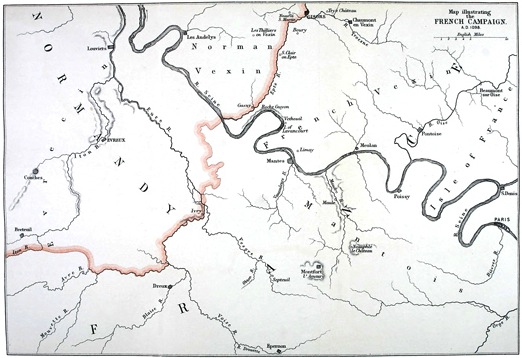
Edwᵈ. Weller
For the Delegates of the Clarendon Press.
Map
illustrating the
FRENCH CAMPAIGN.
A.D. 1098.
The demand is refused.
It is needless to say that the demand was refused.
Lewis and his counsellors declined to give up the
Vexin or any of its fortresses.[446]
King William accordingly
crossed the sea to assert his rights, and the
French campaign possibly began before the end of the
year. It is wonderful, when we remember that it is
chiefly from our own writers that we get the details of
William Rufus’ Norman campaigns, how little they tell
us about his French campaigns. Of the war of Maine to
which we shall presently come they tell us little enough.
Still the name of Maine does appear in their pages, while
the name of France at this stage does not. William crosses to Normandy. November 11–30, 1097.
We learn
indeed that in the November of this year the King
crossed into Normandy, but with what object we are not
told.[447]
What we are told is eminently characteristic of
the Red King and his reign. Excesses of the King’s followers.
As so often happened, his
crossing was delayed by the weather; meanwhile his
immediate followers carried out to the full that licence
177
which the King’s immediate followers were wont to
allow themselves till Henry and Anselm found sharp
means to check them.[448]
“His hired in the shires there
they lay the most harm did that ever hired or here in
frithland should do.”[449]
If the army at large is meant,
the expression is a strange one. The hired is the King’s
household, taking in doubtless household troops in personal
attendance on the King, like the old housecarls,
but not surely the whole force, national or mercenary.
But it was the King’s household whose excesses were
specially complained of; and this casual outburst of
bitterness is a speaking comment on the general pictures
of their misdoings which we have already come across.[450]
But it is only of damage done in England by the King’s
household that our Chronicler tells us anything. Silence of English writers as to the French war.
Of
warlike exploits on the other side of the Channel neither
he nor any other English writer tells us at this stage a
single word.[451]
If from the silence of our own writers we turn to our
chief authority on the French side, we shall find a
vivid general picture of the war, but hardly any account
of particular events. We get indeed one of the most
striking of personal contrasts. Though the war which was
now waged by Rufus was in every sense a war waged
against France, yet it could hardly be called a war personally
waged against the nominal ruler of France. It
was a war for the Vexin, waged against the lord of the
Vexin, and, in its first stages at least, mainly confined to
178
the Vexin. William and Lewis.
The struggle between William and Lewis, as
it is set forth by the biographer of the French prince,
was an unequal one. William had his old weapons at
command—the wealth of England, the traitors whom
that wealth could bribe, the mercenaries whom that
wealth could hire.[452]
He had his own experience in war;
he had his veteran troops and their veteran commanders.
Chief men on William’s side.
Next under the King, comparatively young in years, but
first of all in daring as in wickedness, was Robert of
Bellême. Then came the King’s brother Henry, and the
well-known names of Count William of Evreux, Earl
Hugh of Chester, and the old Earl Walter of Buckingham.[453]
These were formidable foes for an untried youth
like Lewis; the aged warrior who was old on the day of
Senlac must have been a strange contrast indeed to the
gallant lad on whom the fortune of France now rested.
Difficulties of Lewis.
Lewis had, we are told, neither men nor money nor
allies; he had to pick up all where and how he could.
Whenever, often by running to and fro as far as the
borders of Berry or Auvergne or Burgundy, he had got
together three hundred, or perhaps five hundred, knights,
he met King William of England marching against him
with ten thousand.[454]
Here was little room for pitched
179
battles; Lewis could not risk a meeting with such an
enemy in the open field. He had often to retire, sometimes
openly to fly.[455]
And the different state of the
hoards of the two princes showed itself in an effect on
their military operations which is characteristic of the
time. Fate of the captives on each side.
When warriors on the English side—we must use
the language of our French informant—fell into French
hands, the price of their ransom was speedily paid.
When French warriors were made prisoners by the forces
of Rufus, there was no money to ransom them. They
had to languish in bonds with only one hope of deliverance.
Those only were set free who were willing to
become the men of the King of England and to bind
themselves by oath to fight against their own natural
lord.[456]
Some then at least of the native subjects of the French
crown, who had no conflicting engagements to plead, did
not scruple, in the extremities in which they found themselves,
to take service on behalf of the invader against
their own lord. It is therefore the less wonderful if
another class of men, whose interests and whose duties
were more doubtful, deemed, when they had to choose
between two lords, that Rufus was the lord to be chosen.
French traitors.
Others again were found of baser mould, who simply took
the money of the Red King, and for its sake turned
against their own people on behalf of strangers. Among
180
these one is specially marked, one who by his geographical
position was called on to be among the foremost champions
of France against Norman invasion. This was one
of the lords who commanded the fortresses on the Seine,
a man whose possessions lay close to the Norman border,
Guy of the Rock.
Guy of the Rock, the Rock which has taken its name from
him and which still is known as La Roche Guyon.[457]
The
position of his chief stronghold made his adhesion of no
small importance. Norman possessions beyond the Epte.
The stream of Epte, flowing during
a great part of its course through a deep valley, seems
designed by nature to part Normandy and France; but,
as we have seen, the frontier was ever disputed, and here
and there the Norman held small portions of territory on
the left bank of the river. One of these Norman holdings
on the French side lies by the small village of Gasny,
where the boundary, surviving in that of the modern department,
is still marked at some distance up the opposite
hill. A slight further ascent brings the traveller in sight
of one of the noblest bends of the Seine, where the great
river, with all its islands, runs immediately below a long
line of chalk hills, with their white spurs jutting out in
endless fantastic shapes. The windings of the Seine have
in fact left at this point little more than a narrow isthmus
between itself and its lowlier tributary. Roche Guyon.
Just within the
French territory at this point, and commanding this
important sweep of the great French river, lay the
domains of the lord of the Rock. The ridge on which
181
the traveller stands ends in a bluff to the south-east.
There, where the hills open for another tributary of the
Seine, close by the island of Lavancourt, stood Guy’s
now vanished fortress of Vetheuil. But, as we now gaze,
by far the most prominent object in the whole curved line
of the hill, placed like the imperial seat in the centre of
an ancient amphitheatre, rising over the church, the more
modern castle, the town, and the airy bridge which
modern art has thrown across the river, soar the relics of
the fortress which still bears Guy’s name. A spur of the
hill is crowned by a small keep, with a round tower
attached to a square mass within its compass. But in
the days of the Red King, the Guy’s Cliff of the Vexin,
now the site of a castle so preeminently visible, was
specially known as the site of the stronghold that was
invisible. The castle bored in the rock.
The lords of the rock had, like the Kenite
of old, literally made their nest in the rock itself.
The chalk is to this day habitually bored to make
houses, churches,[458]
any kind of excavation that may
be needed. In days before our time this custom had
been applied to a more dangerous use; the plundering
chiefs of the rock had scooped themselves out a castle in
its side. More than one of the chambers remain—comfortless
to our eyes, but perhaps not more comfortless
than the chambers within many a tower of timber or
masonry—whence these troglodyte barons looked out to
mark the craft upon the Seine, and to exact, by a custom
which lingered on till late times, a toll from every passer
by. Guy submits to Rufus.
Guy of the Rock now submitted to the island king,
and his submission supplied a new fetter to pen up the
king of the mainland within his havenless realm. At
the very entrance of the French territory on this side,
Guy’s Rock, Vetheuil, and all that is implied in the
182
possession of Vetheuil and of the Rock, passed from the
obedience of the lord of Paris to the obedience of the lord
of Winchester and Rouen.
While Guy thus sold to the invader the very entrance-gate
of the French kingdom, the Red King found another
ally in a far more famous man who held a position of at
least equal importance higher up the Seine. Policy of Robert of Meulan.
At the head
of the nobles who held lands of both kings stood the
acknowledged master of all subtle policy, Count Robert
of Meulan. We have been so long familiar with his
name, whether as the youthful warrior of Senlac or as
the experienced counsellor of the Red King, that we may
have almost forgotten that the title by which we call
him is French, and that he was as great a lord in France
as he was in England or in Normandy. We find it
hard to think of him as one of those who had thus
to choose between two lords, and that he might conceiveably
have chosen the cause of Philip—or rather of
Lewis—against William. We cannot fancy that he took
long to decide. He may have argued that William, lord
both of Normandy and of England, had two parts in
him, while Philip of France had only one. He receives William’s troops.
He received
the troops of the Red King into his castles, and his
adhesion was held to have been of special help to his
undertaking. He opened, we are told, a clear path for
the English into France.[459]
The words sound as if they
belonged to the fourteenth, fifteenth, or sixteenth century
rather than to the last years of the eleventh. And
they are clothed with a strange significance when we
remember that the man who now opened a way into
France for the combined host of Normandy and England
183
was the same man who, two-and-thirty years before, had
opened a way into the very heart of England for the
combined host of Normandy and France.[460]
But in a
geographical point of view the expression is fully justified.
Importance of the position of Meulan.
In a war between the lord of Rouen and the lord of
Paris, no man’s friendship could be more valuable to
either side than the friendship of the Count of Meulan.
A man weaker in fight and less wary in council than the
Achitophel of his day might, if he kept the Seine barred
as the lord of Meulan could bar it, have gone far to hold
the balance between the contending kings. As at Mantes,
as at Rouen, as at Paris itself, the islands so characteristic
of the Seine are at Meulan also brought into play for
purposes of habitation and defence. Description of Meulan.
Meulan indeed is,
what neither Paris nor Rouen is, at once a hill-fortress
and a river-fortress. At a point of the river lying between
Mantes, the seat of the Conqueror’s death-wound,
and Poissy, the spot where he went to crave help of his
lord before the day of Val-ès-dunes, a hill which the surrounding
valleys gird as with a natural fosse rises from
the right bank of the river. A group of islands is
formed at this spot by the branches of the winding
stream, fit places for the landing of the forefathers of the
Normans in their pirate days. The spot was seized on
for defence. A castle arose on the side of the hill, with
a town at its foot sloping swiftly down to the river.
There a bridge of some antiquity joins the right bank to
a central island, which is joined again to the left bank
by another bridge. The island, once strongly fortified,
still keeps the significant name of the Fort. The bridge
which joins the island to the left bank of the river, where
lies the suburb known as Les Mureaux, was, at least in
later times, defended by a tower bearing the name of La
Sangle. A considerable extent of the outer walls of the
184
castle may be traced, and a specially diligent inquirer
may thread his way to a small fragment of the castle
itself, and may there mark work of a somewhat later date
than the time with which we have to do. It is more
easy to trace out a large part of the defences of the Fort,
and to mark the churches, surviving and desecrated, one
of which, high on the hill side, also belongs, like so many
others, to the age next following. As in so many other
places, so at Meulan, we cannot lay our hand on anything
which we can positively affirm to be the work of its
most famous lord. But we can well see that the strength
of the spot, a spot which in later times played no small
part in the wars of the League, was well understood
in the days of our story, and that so important a position
was strengthened by all the art of the time. When
Count Robert received the forces of Normandy and England
on the height and in the island of Meulan, he did
indeed open a way for those forces into the heart of
France. It was a way which might have been expected
to lead them straight to the city which then, as ever,
might be deemed to be more than the heart of France,
to be France itself.
William’s prospects.
Count Robert was doubtless guided, then and always,
by policy. Many of his neighbours who found themselves
in the like case followed his lead. They could
not serve two masters; so they made up their minds to
serve the master who was strongest either to reward or
to punish, him whose purse was the deeper and whose
spirit was the fiercer.[461]
Altogether the odds seemed
frightfully against the French side. Rufus might indeed
have small chances of carrying out his grand scheme of
185
uniting Paris—perhaps Poitiers and Bourdeaux—under
the same lord as Winchester and Rouen; but things at
least looked as if the conquest of the disputed lands was
about to advance the Norman frontier most dangerously
near to the French capital. Above all, when the Seine
was barred both at Roche Guyon and at Meulan, we ask
how things stood in the border town which lay between
them, the town which was one of the special subjects of
William’s demands on Philip. How fared it at Mantes
when the stream both above and below was in the hands
of the enemy? To this question we get no answer; but
we see that, in any case, the King of the French was
more closely shut up than ever in the central prison-house
of his nominal realm.
Failure of William’s plans.
But, small as seemed young Lewis’s means of defence,
weakened as he further was by treason among his own
or his father’s vassals, the resistance made by the French
to the Norman or English invasion was valiant, stubborn,
and, we may add, successful. William Rufus was much
further from conquering France than Henry the Fifth,
or even than Edward the Third, was in after times. With
all his wealth, all his forces, he could not conquer the
land; he could not even take the fortresses to which he
specially laid claim. He could not conquer the Vexin;
he could not take either Pontoise or Chaumont. Pontoise and Chaumont not taken.
While
we hear nothing of Mantes, we know that both these two
last-named fortresses successfully withstood his attacks.
Of the three fortresses which were the special objects of
the war, one, that of Chaumont, became in some sort its
centre. Castle of Chaumont.
The Chaumont with which we have to deal is
still distinguished from other places of the same name
as Chaumont-en-Vexin. It stands about five miles east
of the Epte, at the point where the frontier stream of
Rolf is joined by the smaller stream of the Troesne, and
makes a marked turn in its course from nearly due south
186
to south-west. The region is a hilly one, though it contains
no heights of any remarkable elevation. The Bald
Mount itself, which—unluckily for the inquirer—is bald
no longer, is a wide-spreading hill crowned with a mound
which stands out prominently to the eye on every side.
The line of the wall which it supported may still be
easily traced, and in a few places it is actually standing.
On the steep north-eastern side of the hill the small
town of Chaumont nestles at its foot, while the stately
church of the later days of French architecture soars
above the town as the castle again soars above the church.
Of the part played in the war by this stronghold we
shall hear a little later.
The height of Chaumont commands a vast prospect on
all sides; the eye stretches far away over the friendly
land to the south, towards the hills bordering on the
Seine; but the special rival of Chaumont, the fortress
at the junction of the Epte and Troesne, is shut out
from sight by a near range of hills which follow the
line of the smaller stream. Where the two rivers join,
the Epte, like the greater Seine, divides to form a group
of islands at the foot of a low hill on the right, the
Norman, bank. The castle of Gisors.
Here stands the town and fortress of
Gisors, the chief bulwark of Normandy towards the
north-eastern corner of the Vexin. Once a dependency
of the neighbouring Neauflé, whose mound and square
tower form a prominent object in the landscape, Gisors
had now become a stronghold indeed. Its first defences. 1096.
It had been
first fenced in about two years before by Pagan of
Gisors, a man of whom we shall hear in the course of
the war.[462]
Somewhat later William gave orders that
187
the border post should be made into a fortress of the
greatest possible strength, and he committed the work
to the most skilful engineer at his command. Strengthened by Robert of Bellême.
All the
craft and subtlety of the Devil of Bellême were employed
to make Gisors a stronghold which might shelter
the eastern frontier of Normandy against all enemies.
As far as one can see, the islands in the Epte and the
hill which rises above them near to the right bank of
the main river were united in one common plan of
defence. The town itself, taking in the islands, was
walled, either now or at a later time, and defended with
a ditch throughout those parts of its circuit which were
neither sheltered by the river nor by the castle hill. In
the great defences of this last we see the fruit of the
engineering skill of Robert of Bellême, and we better
learn what in those days was deemed a specially strong
fortress. On all sides save that where town and castle
join, the hill is girded by a deep ditch, and on the north,
the side which lies away from both town and river, the
ditch is doubled, and the chief entrance on this side is
defended by an outpost between the two. The ditch
fences in a vast walled space, in the middle of which art
has improved nature by piling up a vast artificial mound
crowned by a shell keep. The earthworks are most likely
older than either Robert of Bellême or Pagan of Gisors.
The outer wall and the shell keep may well be part of
Robert’s design, if they are not actually his work; but the
towers which now rise so proudly over Gisors, not only
the round tower, precious in local legend, but the vast
octagon on one side of the keep which bears the name
of the martyr of Canterbury, must all be of later date
than our time. A graceful chapel within the keep,
where the visitor is told with special emphasis that
188
Saint Thomas once said mass, has thus much to show
in favour of the legend that it is clearly a work of
Henry the Second’s days. Gisors under Henry the Second.
His days were stirring days
at Gisors as well as the days of Rufus, and a hundred
years of sieges had brought new improvements into the
art of fortification.
All in short that strikes the eye
as the traveller draws near to Gisors, Present appearance of Gisors.
the castle towers,
no less than the strange and striking outline of one of
the stateliest of those churches which boasted no bishop
or abbot at their head, belongs to later days than those
of the Red King’s campaign of Chaumont. Of the defences
of the town below little can now be traced, and
that part of the defences of the castle on which the
historian looks with the deepest interest is carefully
hidden from distant view. The tower of Saint Thomas
and its lower fellow both seem to rise from the midst of
a wood—a wood artificially planted, seemingly for the
express purpose of robbing Gisors of its characteristic
feature, of shutting out from sight the mighty motte and
keep which Robert of Bellême made ready at the Red
King’s bidding to be the strongest bulwark of the Norman
land.
Castle of Trye.
Near as Gisors stands to Chaumont, another fortress
barred the way between them. The road between the
two towns passes through Trye—distinguished from its
neighbour Trye-la-Ville as Trye-Château—which appears
in our story along with Chaumont as one of the French
fortresses which Gisors was specially meant to keep in
check. Yet Trye must have been itself specially meant
as an outpost against Gisors. Close by Gisors is one
of the points where the Norman frontier overlaps
the Epte; so that Trye, lying between two and three
miles from Gisors, is yet nearer than Gisors to the actual
frontier. Trye does not lie, like Chaumont, hidden behind
the hills; it stands boldly in the teeth of the enemy,
189
clearly seen from the hill of Gisors, and barring the main
road between Gisors and Chaumont, a road which led
over level ground and neither over hill nor swamp.
Otherwise the site has not, like Gisors and Chaumont,
any marked advantages of ground, nor, at present at
least, are any earthworks visible. In our time, though a
gate and a tower of later date than our story recall the
days of the military importance of Trye, the attractions
of the spot are chiefly of other kinds. Primæval and later antiquities.
Between
Trye and Chaumont a cromlech, known as the Three
Stones, calls up the thought of days and men which
were as mysterious in the time of Rufus as they are
now. More than one fragment of mediæval architecture
may be lighted on by the way, and Trye itself stands
conspicuous for the singular and beautiful Romanesque
work—again too late for our immediate time—to be
found both in its ecclesiastical and its secular buildings.
Chaumont and Trye may practically be looked on as
one piece of defence. Castle of Boury.
A third fortress, that of Boury,[463]
lay further apart to the south-west, hidden from Gisors,
like Chaumont, by another line of hills. All three
castles seem to have remained unsubdued through the
whole war. The valour of the French resistance is
dwelled on with pleasure by our Norman or English
guide. Did the monk of Saint Evroul, the young
scholar of the Severn side, remember that, after all,
his father belonged neither to the land of his birth nor
to the land of his adoption, but was in truth a Frenchman
from Orleans?[464]
National feeling in the French Vexin.
The French Vexin was inhabited by
a valiant race, in whom, if we are not pressing too far the
words of our story, a distinct feeling of French nationality
190
was strong. They were ready to run all risks—it is
not said for their King, but for the defence of their
country, for the glory of their nation, for the honour of
the French name.[465]
Valiant men, mercenaries it would
seem—but who was to pay them?--from all parts of
Gaul, or at least of France, pressed to their help, and a
brave and successful defence was made. Prisoners on both sides.
Prisoners on
both sides underwent the two different fates which were
already spoken of. The name on the Norman side
which is best known to us is that of the fierce Gilbert
of Laigle; Gilbert of Laigle.
with him we hear of the former lord and
fortifier of Gisors.[466]
Among the captives on the French
side the national historian records one who bore a far
loftier name, but one which at that moment was hardly
a name of honour. Simon of Montfort.
Two of the long line of Simons of
the French Montfort are heard of in the course of our
story, father and son, father and brother of her who in
our authorities appears commonly as the woman from
Anjou, but who on the Strong Mount of her fathers may
have been deemed a Queen of the French. One Simon
is now spoken of as a prisoner; both are found somewhat
later fighting stoutly in the cause of France. We
have heard that the Red King let none free who would
not undertake to fight on his side. Are we to infer that
a forefather of our own deliverer had learned the lesson
of Harold, that an extorted oath is of no strength?
191
§ 2. The First War of Maine.
1098.
Dates of the French war. November, 1097–September, 1098.
These events on the French side, of which thus far we
have but a vague account, would seem to have happened
during the first half of the year with which we are
dealing. But all that we can say for certain is that
they happened between the November of one year and
the September of the next.
Of the struggle which was
going on at the same time in Maine, the dates are far
more clear. War of Maine. January—August, 1098. It began in January and it was deemed to
be over in August. But its immediate occasion arose
the year before, and its general causes go much further
back. Fully to understand the war of William and
Helias, more truly the war of Helias and Robert of
Bellême, we must trace out the events of several years.
History of Maine. 1089–1098.
While we have been following the fates of England,
Normandy, Scotland, and Wales, much of high interest
has been going on in Maine which had no connexion
with the affairs of any part of Britain, and which had
but little influence on Norman affairs either. But now
that England and Normandy have again a common
ruler, the affairs of England, or at least the affairs of
her King, have again a close connexion with the affairs
of Maine. We have now therefore to take up the tale
of that noble city and county from the days when we
had to tell of Duke Robert’s campaign before Ballon
and Saint Cenery.[467]
Robert suspects the loyalty of Maine. 1089.
The submission of Maine to the Norman Duke which
then took place lasted only till the next favourable
opportunity for asserting the old independence of the
city and county. No great time after he had taken
192
possession, Robert began to suspect the loyalty of his
Cenomannian subjects. A strange story follows, which
connects itself in a way yet stranger with the tale of the
royal household of France which we have lately been
telling. Robert, it seems, was sick at the moment when
he, or some one else for him, thought it needful to take
action against impending revolt in Maine. He asks help of Fulk of Anjou.
He sent
messengers and gifts to Count Fulk of Anjou, the famous
Rechin, praying him to come to him.[468]
Fulk, it will
be remembered, claimed the over-lordship of Maine,
and Robert himself had, long before, at the peace of
Blanchelande, done a formal homage to Fulk for the
county.[469]
The Angevin Count was supposed to have influence
with the people of Maine, influence which might
be enough to hinder them from revolting. That influence
Robert now prayed Fulk to use. The Angevin
agreed on one condition, namely that the Norman would
use his own influence in quite another quarter, for quite
another purpose. Fulk asks for Bertrada of Montfort.
Fulk wanted a wife. As the story is
told us, he is said to have had two living wives already;
but that seems not to have been the case.[470]
His first wife,
the daughter of a lord of Beaugency, died, leaving a
daughter. He then married Ermengarde of Bourbon—a
description not to become royal for some ages—the
mother of his son Geoffrey Martel. Her he put away
on the usual plea of kindred, and now it was that he
appeared as the wooer of that Bertrada of whom we
193
have already spoken of in her later character. The
daughter of Simon of Montfort was the niece of Count
William of Evreux, through her mother Agnes, Count
William’s sister. Bertrada brought up by Heloise.
Her mother would seem to have been
dead, and she was brought up in her uncle’s house,
under the schooling of Countess Heloise.[471]
The Count of
Anjou, no longer young, driven to strange devices as to his
shoes,[472]
and burthened with a former wife whose divorce
might be called in question, felt that he was hardly
likely to win favour as a lover in the eyes either of
Bertrada herself or of her guardians. But the Rechin was
skilful at a bargain. He would engage to keep Maine
in the Duke’s obedience, if the Duke would get him the
damsel of Montfort to wife.[473]
Robert set off for Evreux
in person, and pleaded Fulk’s cause with Count William.
The Count of Evreux was duly shocked, and set forth
the obvious objections to the marriage. William of Evreux’s bargain about his niece.
But he too was
open to a bargain; he would get over his scruples if the
Duke would restore to him certain lordships to which he
asserted a right, and would grant certain others to his
nephew William of Breteuil. These lands had been the
possession of his uncle Ralph of Wacey, guardian of
the Great William in his early days, who it seems was
sportively known as Ralph with the Ass’s Head.[474]
Let
194
the Duke give him and his nephew back their own,
and Bertrada should be, as far as the Count of Evreux
was concerned, Countess of Anjou.
Robert consents.
The Duke did not venture to answer without the
advice of his counsellors. His counsellors.
But the combined wisdom of
Robert of Bellême, lately a rebel but now again in
favour,[475]
of the Ætheling Eadgar, and of that monastic
William of Arques of whom we have already heard,[476]
advised the acceptance of Count William’s terms. The
whole county of Maine was of more value than the
lordships which the Count of Evreux demanded as the
price of his niece.[477]
The power and the will of Fulk to
do what he promised about Le Mans and Maine seems
not to have been doubted. The double bargain was
struck, and it was carried out for a season. Count
William and his nephew got all that they asked, except
that one lordship passed to Gerard of Gournay. Fulk marries Bertrada.
Fulk
too got what he asked, namely Bertrada, till such time
as King Philip took her away. She had time to quarrel
with her stepson Geoffrey, and to become the mother of
Fulk, afterwards Count of Anjou and King of Jerusalem,
and grandfather of the first Angevin King of England.
Maine kept quiet for a year.
And Count Fulk was able, by whatever means, to keep
the Cenomannian city and county in a formal allegiance
to the Norman Duke, till such time as the temptations
to revolt became too strong to be withstood.
Movements in Maine.
Our story however seems to imply that the submission
of Maine to Robert was wholly on the surface, and that
all this while schemes were going on for shaking off the
hated Norman yoke. The present movement took the
195
same form which had been taken by the movement in the
Conqueror’s day.[478]
The avowed object of Cenomannian
patriotism was now, as then, the restoration of the ancient
dynasty. The valour and energy of the citizens of Le
Mans are constantly spoken of; but we hear nothing this
time of the commune. The rule of some prince seems to
be assumed on all hands, and for a while all seem to have
agreed in seeking that prince in the same quarter in
which they had sought a prince already. Hugh son of Azo sent for. 1090.
Little indeed
of good for Le Mans or Maine had come of the former
application to Azo and Gersendis; but their son Hugh
had now reached greater years and experience, and the
men of Maine again sent into Italy to ask for him to
reign over them.[479]
Union of Geoffrey and Helias.
The application was supported both
by Geoffrey of Mayenne, of whom we have so often heard
during the last thirty years, and by Helias of La Flèche,
who might well have asserted his own claims against
those of the distant house of Este.[480]
Helias of La Flèche.
Helias now becomes the hero of the Cenomannian
tale. He is one of the men of his time of whom we can
get the clearest idea. We see him alike in his recorded
acts and in his elaborately drawn portrait; and by the
light of the two we can hail in him the very noblest type
of the age and class to which he belonged. We see in
him a no less worthy defender of the freedom of Maine
than Harold was of the freedom of England. His character
He stands
196
before us with his tall stature, his strong, thin, and well-proportioned
frame, his swarthy complexion, his thick
hair cropped close after Norman or priestly fashion.[481]
Brave and skilful in war, wise and just in his rule in
peace, ready and pleasant in speech, gentle to the good
and stern to the evil, faithful to his word, and corrupted
neither by good nor evil fortune, a man withal of prayer
and fasting, the bountiful friend of the Church and the
poor, Helias stands forth within the narrow range of a
single county of Gaul as one who, on a wider field, might
have won for himself a place among the foremost of mankind.[482]
With the house of the old Counts of Maine he had
a twofold connexion. and descent.
The male line of Herbert Wake-dog
had come to an end; but in the female line Helias came
of it in two descents, while Hugh came in one only. Not
only was his mother Paula one of the sisters of the
younger Herbert, but his father John of La Flèche was
son of a daughter of Wake-dog himself.[483]
His castles.
To his father’s
Angevin fief of La Flèche, among the islands of the Loir,
his marriage with Matilda, a grand-niece of Archbishop
Gervase of Rheims, known to us better as Bishop of
Le Mans,[484]
had added a string of castles in the south of
Maine. Two of these, Mayet and the one which is
specially called the Castle of the Loir, fill a prominent
197
place in our story.[485]
Helias was plainly the greatest lord
of eastern Maine, the modern department of Sarthe, as
Geoffrey of Mayenne was the greatest in western Maine,
the modern department which still bears the name of his
own fortress.[486]
His possible claim on the county.
One might have thought that the position
of Helias as a great local chief might, when the
elders of Maine were called on to choose a prince, have
outweighed any slight genealogical precedence on the
part of the stranger Hugh. But the great men of the
county may not have been disposed to place one of themselves
over their own heads. He accepts the succession of Hugh.
Anyhow Helias, like his
father before him,[487]
waived his own claim to the succession.
Along with the lord of Mayenne and the great mass of
the people of the city and county, he welcomed the Ligurian
prince—such is the geography of our chief guide—when
he came to take possession of the dominion to
which the voice of the Cenomannian people had called
him a second time.[488]
Negotiations with Hugh.
We are to suppose that the negotiations with the
house of Este were going on during the year when Count
Fulk contrived to keep Maine outwardly quiet. But
when the quarrel between William and Robert broke
out, when Normandy was divided and dismembered, the
Angevin over-lord’s influence gave way. The time for
action was clearly come. Revolt of Maine. 1090.
Le Mans and all Maine now
openly rose against the Norman dominion. Duke
Robert’s garrisons were driven out;[489]
the Cenomannian
198
land was again free. Invitation to Hugh.
But the first act of restored freedom
was to invite Hugh of Este, descendant of the ancient
counts, to come at once to take possession, and to rule in
the palace on the Roman wall which fences in the Cenomannian
hill.
Opposition of Bishop Howel.
The chief opponent of the movement for independence
was, as before, the Bishop. The throne of Saint Julian
was still filled by the Breton Howel, the nominee of
the Conqueror, and he stood firm in his loyalty to
his patron’s eldest son.[490]
He withstood the revolt by
every means in his power, and scattered interdicts and
anathemas against the supporters of the newly-elected
Count.[491]
Hugh had not yet come, and the opposition of
the Bishop was felt to be dangerous. Howel imprisoned by Helias.
Helias therefore,
whose piety did not lead him to any superstitious reverence
for ecclesiastical privileges, dealt with Howel as an
enemy, or at least as one whom it was well to keep out
of the way for a season. As the Bishop was going
through his diocese with a train of clergy, in the discharge
of some episcopal duty, Helias seized him, carried
him off, and put him in ward at La Flèche.[492]
The great
199
grievance seems to have been that Howel was denied
the company of his attendant clergy, and was allowed
the services only of one unlettered rustic priest. The
fear was lest the Bishop and his more learned companions
would, in their Latin talk, plot something which
their keepers would not understand.[493]
This very complaint
shows that the Bishop’s imprisonment was
not of a very harsh kind. But the cause of the captive
prelate was zealously taken up by his clergy. Interdict of Le Mans.
Le
Mans and its suburbs were put under a practical interdict;
divine worship ceased; the bells were silent; the
doors of the churches were stopped up with thorns.[494]
Great, it is said, was the joy when the Bishop was set
free and came back to his city. Liberation of Howel on Hugh’s coming.
We are told by a writer
in the episcopal interest that Helias set him free in a fit
of penitence, in answer to many intercessions from
nobles, clergy, and neighbouring bishops. Howel was
gracious and forgiving, and let his wrongs be forgotten
200
on the restoration of whatever had been taken from
him.[495]
All this is possible; but the more definite statement
that Howel was kept in ward till Hugh came
shows that his captivity was a matter of policy, and that
he was set free as soon as it seemed that no object could
be gained by prolonging it.
Hugh reaches Le Mans.
Meanwhile Hugh was on the road. At the border
fortress of La Chartre he was met by the magistrates of
Le Mans—the city seems, as often in Cenomannian history,
to act for the whole county—who swore oaths to
him, counting, it is added, their former oaths to Duke Robert
for nought.[496]
Howel flees to Robert.
The Bishop, determined not to acknowledge
the revolution, fled to the court of the prince
whom he did acknowledge. But he found little help
there. Robert’s carelessness as to his loss.
The idle and luxurious Robert seemed not to
care, he seemed almost to rejoice, that so noble a part
of his dominions had fallen away from him.[497]
One thing
only he would not give up; he would at all hazards cleave
to his rights over the Cenomannian bishopric.He cleaves to his rights over the bishopric.
Robert
bade Howel to go back to Le Mans, but to do nothing
which could be taken as an admission of Hugh as temporal
lord of the bishopric.[498]
Howel went home, and
found the new Count, for whatever reason, quartered in
the episcopal palace. He had himself to live in the
201
abbey of Saint Vincent, just outside the city. Dispute between Hugh and Howel.
A long
dispute followed between the Breton Bishop and the
Italian Count, and then came a still fiercer dispute between
the Bishop and a party in his own Chapter. One
or two points are of constitutional interest, and remind
us of questions which we have just before heard of in
our own land. Howel refuses to acknowledge Hugh as advocatus.
The Count called on Howel to acknowledge
himself as his feudal superior for the temporalities
of the bishopric.[499]
He refused and left the city, on
which Hugh seized the temporalities of the bishopric.
Howel and his Chapter.
Worse even than the Count were the Bishop’s clerical
enemies, one Hilgot at their head. By a cruel subtlety
they had persuaded him to appoint as Dean a mere boy
from his own land, Geoffrey by name, of the age of
twelve years only—so it is said. Disputes about the deanery.
Now they turned about,
found fault with the appointment, and set up an anti-dean
of their own.[500]
The Bishop crossed over to England
for help, and, strange to say, he found a friend in the
King.[501]
Howel comes to England.
But meanwhile all kinds of wrongs were done to
202
his people, even to branding an innocent boy in the
face.[502]
At last a reconciliation between the Count and
the Bishop was brought about, partly because of the
turn taken by public feeling. Saint Julian’s, in the
absence of its chief pastor, was forsaken, while crowds
flocked to keep the feasts of the Church at the Bishop’s
monastic retreat. This was at the priory of Solêmes,
near Sablé, lying south-west of the city, towards the
Angevin border.[503]
Return of Howel. June 28, 1090.
At last the prelate came back amidst
universal joy, and the Count made good all wrongs and
losses that he had undergone.[504]
Unpopularity of Hugh.
But happier days were to come for the Bishop and the
people of Maine. It was not only to Howel and his
clergy that the Italian Count had made himself hateful.
He had none of the qualities which were needed in the
ruler of a high-spirited people in a time of danger. Idle,
timid, weak of purpose, he had no power among the
men over whom he was set; and he had not, as seems
to have been hoped for, brought with him any store of
money from the south.[505]
His wife, a daughter of Robert
Wiscard, a woman of a lofty spirit, was too much for him.
He put her away, and was excommunicated by Pope
Urban for so doing.[506]
Despised of all men, he was thinking
of flight.[507]
February, 1091.
It was now moreover the moment when
203
the Norman power had again become specially dangerous
to Maine. Danger of Maine.
The sons of the great William, lately at
variance, were now reconciled, and the subjugation of
Maine was one of the terms of their agreement.[508]
Helias
saw his opportunity. He set forth the dangers of the
land to his cousin. Hugh said that he wished to sell
his county and be off.[509]
Helias argued that, in that
case, he ought to sell it to no one but himself. He set
forth his right by birth; he said that it was no easy
place that he was seeking. But his just rights and a
love for the freedom of the land called him to it, and he
trusted that God would help him in his post of danger.[510]
A bargain was soon struck. Helias buys the county.
For a sum of ten thousand
Cenomannian shillings Hugh agreed to abdicate in
favour of his cousin. The coronet of Maine passed from
the son of Gersendis to the son of Paula. Hugh went
back into Italy with his money, and Helias was received
without opposition as Count of Maine.[511]
First reign of Helias. 1091–1098.
The reign of Helias over Le Mans and Maine lasted
for about twenty years, with a break of three years
of warfare of which we shall presently have to speak.
First came a time of seven or eight years, during which
the Cenomannian people might indeed be objects of envy
to the people either of Normandy or of England. The new
204
prince, by every account of his actions, showed himself
the model of a ruler of those times. His strong and just rule.
He did justice and
made peace; as far as a prince of those days could do
so, he sheltered the weak from the oppressions of the
strong.[512]
His personal piety was not lessened, nor was his
devotion to the Church less zealous, now that the ecclesiastical
power was no longer a political enemy. His friendship for Howel.
Strong
in the friendship of his late gaoler, Bishop Howel could
rule his diocese in peace, and could carry on his works
of building, both in the city itself and in his neighbouring
lordship of Coulaines.[513]
Peace of the land.
And these happy years were
years of peace without as well as within. The rule of
Helias was undisputed; Maine saw neither revolt within
her own borders nor invasion from any power beyond
them. Whatever designs either Robert or William may
have cherished against the independence of Maine, those
designs did not for the present take the shape of
any overt act. Robert seems to have done absolutely
nothing; the first signs of impending evil showed themselves
soon after William’s acquisition of Normandy; 1096.
but
there was no open warfare for two years longer.
Translation of Saint Julian. October 17, 1093.
In these times of exceptional quiet there is little to
record beyond ecclesiastical ceremonies. It was a bright
day at Le Mans when Bishop Howel was able to translate
the body of the venerated patron of the city to the
place of honour in his new building.[514]
That was the
time when Anselm, already enthroned, was waiting for
consecration, and when Malcolm had turned away from
Gloucester to plan his last invasion of Northumberland.[515]
205
In these years too Howel must have finished the two
stately towers of Saint Julian’s minster, of which we shall
before long have a tale to tell. But Le Mans presently
saw a greater day than all, as it seemed at least in
the eyes of the biographer of her bishops. Visit of Pope Urban to Le Mans. November or December, 1095.
After the
days of Piacenza and Clermont, Pope Urban honoured
the Cenomannian city with his presence. For three
days the sovereign Pontiff was the guest of Howel, and
we are told that, though it was a year of scarceness,
yet the Bishop of Le Mans was able to entertain the
Pope and his following right bountifully.[516]
Howel, it is
said, appeared among his fellow-bishops conspicuous
for the gifts of both mind and body. Men rejoiced with
him on the happiness of receiving such a guest, and
deemed from his health and vigour that he might long
enjoy his honours.[517]
Sickness of Howel. 1095–1097.
Before long he fell sick, and his
sickness was unto death, although his end did not come
till nearly two years after the preaching at Clermont.
The visit of Urban, the death of Howel, led to important
events in the history of Maine.
The preaching of the crusade, above all the presence,
and doubtless the preaching, of the crusading Pope in
his own city, stirred up the same impulse in the heart
of Helias which was stirred up in the hearts of so many
other men of his day. Helias takes the cross. 1095–1096.
Young and strong, devout and
valiant, he would go and fight to win back the sepulchre
of his Lord from the misbelievers and to deliver his
Christian brethren in other lands from their cruel bondage.
By the counsel of the Pope, the Count of Maine
206
took the cross, and made ready to go on the armed
pilgrimage along with his neighbours, with Robert
of Normandy and Stephen of Chartres.[518]
Estimate of his action.
Our feeling
perhaps is that Helias, like Saint Lewis, had a stronger
call to stay at home than to go on the crusade. A certain
part of mankind, a small part certainly, but that
part among which his immediate duty lay, was peaceful
and happy under his rule as they were not likely to be
under the rule of any other. Could it be right, we might
argue, for him to leave a work which none could do but
himself, a work which he had taken on his shoulders of
his own free will, for another work, however noble,
which others could do as well as himself? Let Robert
go and win honour abroad instead of dishonour at home.
Normandy was in such a case that the coming even of
Rufus was a happy change. Let Stephen of Chartres
go; he left his royal-hearted Adela behind him. Let
King Philip go, if he could go; his son Lewis would rule
his realm far better than he. But let Helias stay, and
keep for his land and city that well-being which he
had given and which another might take away. Sigurd and Eystein.
An
argument nearly the same as this was actually pressed
on the crusading Sigurd by his stay-at-home brother
Eystein. While Sigurd was warring far away, Eystein
had done a great deal of good to his own people in
Norway.[519]
But there are moments in the world’s history,
moments when all has to be sacrificed to a great
cause, when arguments like these, so sound against
ordinary warfare, sound above all against the utterly
purposeless warfare of those days, cannot be listened
to. Argument in favour of the Crusade.
If Western Christendom was to arm for a crusade,
207
it was well that that crusade should be headed by the
noblest men in Western Christendom. The work would
not be done, if it were only left to lower souls. If
Godfrey was to march, it was fit that Helias should march
beside him. Godfrey went; Helias did not go. He had
now a neighbour who made it vain for him to think of
leaving his own land in jeopardy, even to carry out his
promise to Pope Urban and to go on the holy war.
William in Normandy. August (?), 1096.
The bargain between William and Robert had just been
struck. The two brothers were together at Rouen. Robert
was about to set out for Jerusalem; William had come to
take possession of Normandy. It would have been the
height of rashness for Helias to join in the enterprise of
Robert, unless he could make his county safe during his
absence against any aggression on the part of William.
Danger to Maine.
According to Norman doctrines, Maine was simply a rebellious
province. Robert had done nothing to stop the
rebellion, but he had never acknowledged either Hugh or
Helias as lawful Prince of the Cenomannians. Where
Robert had done nothing, William would be likely to act
with vigour. The claims which Robert had simply not
acknowledged William might be inclined to dispute
with the sword. Importance of Norman neutrality.
It was therefore of the utmost moment
for the Count of Maine to secure the friendship,
or at least the neutrality, of the new ruler of Normandy.
Helias doubtless knew that, if William bound himself
by his knightly promise, that promise would be faithfully
kept, and he perhaps hoped that towards one who
was bound on a holy errand, an errand during which he
would be harmless and powerless as far as Maine and
Normandy were concerned, the chivalrous king might be
disposed to pledge such a promise. He therefore went to
Rouen, and sought interviews with both brothers. Helias and Robert.
He
first took counsel with the Duke.[520]
Helias and William.
Robert, we know, could
208
give counsel to others,[521]
and he had no temptation at
this moment to give unfriendly counsel to Helias. By
his advice, the Count of Maine went to the King; He professes himself William’s vassal.
he
addressed him reverently, and, if his words be rightly
reported, acknowledged himself his vassal. So to do
was no degradation, and the acknowledgement might
turn the King’s heart towards him. He set forth his
purpose of going to the crusade; he said that he wished
to go as the King’s friend and in his peace.[522]
Answer of Rufus; he demands the cession of Maine.
Then
Rufus burst forth in a characteristic strain. Helias
may go whither he thinks good; but let him give
up the city and county of Maine; whatever his father
held it was William’s will to hold also.[523]
Helias
answers that he holds his county by lawful inheritance
from his forefathers, and that he hopes by God’s help
to hand it on to his children. But if the King has a
mind to try the question in a peaceful pleading, he is
ready to maintain his right before kings, counts, and
bishops, and to abide by their judgement.[524]
Rufus tells
him that he will plead against him with swords and
spears and countless arrows.[525]
Challenge of Helias.
Then Helias spoke his
209
solemn challenge. He had wished to fight against the
heathen in the name of the Lord, but he had found the
enemies of Christ nearer to his own doors. The county
which he held was his by the gift of God;[526]
he would
not lightly give it up, nor leave his people to the wolves
as sheep without a shepherd. Let the King and all his
nobles hear. He bore the cross of a pilgrim; that cross
he would not lay aside; he would bear it on his shield,
on his helmet, on the saddle and bridle of his horse.
Under the protection of that sign he would go forth to
defend himself against all who might attack him, that
all might know that those who were fighting against him
were fighting against a warrior of the cross. He trusted
in Him who ruled the world and who knew the secrets
of his heart, that a day would come when he would be
able to discharge his vow according to the letter.[527]
Rufus lets Helias go with a defiance.
The
Red King bade him go whither he would and do
what he would; he had no mind to fight against crusaders,
but he would have the city which his father
had once won.[528]
Let Helias get together workmen to
repair his broken walls.[529]
He would presently visit the
citizens of Le Mans, and would show himself before their
gates with a hundred thousand pennoned lances.[530]
He
would send cars drawn by oxen, and laden with arrows
and javelins. But before the oxen could reach Le
210
Mans, he would be there with many legions of armed
men.[531]
Such was the threatening message which Helias was
bidden to receive as the most certain truth and to go
back and tell his accomplices—that is, we may understand,
his faithful subjects. Helias makes ready for defence.
He went back to his
capital, and began to put his dominions into a state fit
to withstand an attack. But as yet no attack came;
for a year or more neither king nor legions nor oxen
were seen before the gates of Le Mans. William delays his attack. 1096–1097.
William was
busy with many matters, with the dispute with Anselm,
with the Welsh war, with the affairs of Scotland. We
are told, characteristically enough, that in the midst of
all these affairs he forgot Maine altogether. Helias
meanwhile remained in actual possession of the county,
not attacked or disturbed by Rufus, but in no way
acknowledged by him, with the King’s threats hanging
over him, and knowing that an attack might come at
any moment. At last this armed neutrality came to
an end. An event happened which called the King’s
mind back to Cenomannian affairs in a manner specially
characteristic of Cenomannian history.
Affairs of the bishopric.
Again, as so often in our story, the bishopric of
Le Mans becomes the centre of the drama and the
subject of dispute among the princes of the world. Death of Howel July 29, 1097.
In
the middle of the summer, shortly before the council
of Winchester, Bishop Howel died, seemingly of the
same sickness which had come upon him soon after the
visit of Pope Urban. Helias, like Hugh, deemed himself,
as the reigning Count, to be the temporal lord of
211
the bishopric, and he at once nominated to the vacant
see. Helias nominates Geoffrey.
His choice was the Dean of Saint Julian’s, that
same Geoffrey who had been placed by Howel in the
deanery in his childhood, and who, if the dates be right,
must still have been wonderfully young for a bishop.[532]
The canons choose Hildebert.
But the canons of Saint Julian’s stood upon their right
of free election, and chose a man of greater name, their
Chancellor and Archdeacon, the famous Hildebert.[533]
They placed him at once, seemingly against his own
will, on the episcopal throne.[534]
At first Helias was wroth,
and was minded to set aside this direct slight to his
authority. Helias accepts the election.
But the rights of the Chapter were set before
him, and, unlike our own Confessor under less provocation,
he yielded, and accepted the election.[535]
The
Dean, deeming himself sure of the bishopric, had made
ready a great feast; but his dainties were spread and
eaten to no purpose.[536]
Geoffrey Archbishop of Rouen. 1111. His time of promotion was only
deferred.
Fourteen years later, Geoffrey succeeded William
the Good Soul in the archbishopric of Rouen. So
212
his now more successful competitor was not fated
always to remain in the second rank of prelacy. Hildebert Bishop of Le Mans. 1097–1126.
One
of the great scholars of his day, renowned for his
writings both in prose and verse, a diligent writer of
letters and thereby one of the authorities for our history,
a builder, a reformer, an enemy of heresy who
could yet deal gently with the heretic,[537]
a model in
short, we are told, of every episcopal virtue, Hildebert
ruled the church of Le Mans for more than twenty-nine
years, Archbishop of Tours. 1126–1134.
and then for the last nine years of his long life
was removed to the metropolitan throne of Tours.[538]
All the elements of the Cenomannian state, prince,
clergy, and people, had joined in the elevation of Hildebert.
But there was one to whom any free election or
nomination by any of the local powers was in its own
nature distasteful. Claims of the Norman Dukes over the bishopric.
It was perhaps because their claim
was very doubtful that the princes of the Norman house
clave with such special obstinacy to their rights over
the temporalities of the see of Le Mans. The bishopric
was the one thing in Maine which even the careless
Robert cared about.[539]
And to William Rufus, who so
deeply cherished his father’s memory, it would seem a
crowning indignity that a bishop appointed by his father,
a special and loyal friend of his father, should be succeeded
by any one, whether the choice of count, chapter,
213
or commune, in whose election he himself had no share.
Anger of Rufus at the election of Hildebert.
When the King heard of the election of Hildebert, he
was very wroth. He forbade his consecration, seemingly
under threats of open war.[540]
Hildebert was consecrated
none the less, and the war which Rufus had hitherto
planned in his heart, broke out in action.[541]
William in Normandy. November, 1097.
When William crossed the sea in the November
following the election of Hildebert, we may believe that
the wrong which he held to have been done to him
in the matter of that election was in his mind as a
secondary cause of action, along with his demand of the
Vexin from the King of the French. His designs on Maine.
He came for war
with France; he was ready for war with Maine also.
But we do not hear of any actual military operations
till the next year had begun. And, when warfare
began, it was at first warfare carried on, just as often
happened in Wales and even in Scotland, by the King’s
licence indeed, but not by the King himself. Robert of Bellême attacks Maine. The immediate
danger lay on the side of the county which was
threatened by the constant enemy of Maine and of Helias,
Robert of Bellême.
From him came the first acts
of warfare. It was against him that Helias now found
it needful to strengthen his castle of Dangeul.[542]
Helias strengthens the castle of Dangeul. Its position.
This point lies to the north-east of Ballon, at only a few miles’
distance. The castle stands on a height nearly equal to
that of Ballon, though Dangeul does not take the same
214
marked form of a promontory, but rather stands on the
edge of a wide expanse of high ground sinking by stages
down to the plain below. The fortress has wholly
vanished; but its site may be traced within the grounds
of the modern château which has taken its place, and
which represents, in a figure, the stronghold of Helias.
The view which the spot commands shows how well the
site was chosen. The eye ranges as far as the height of
Sillé-le-Guillaume on one side, as far as the Norman
Chaumont on the other. Dangeul stood right in the
way of an advance of the arch-enemy, whether from his
own home at Bellême or from any of his Norman or
Cenomannian fortresses.
Geographical character of the war; waged chiefly with Robert of Bellême.
The war of Maine is largely a war between Helias and
Robert of Bellême. This gives the war its special geographical
character. The immediate possessions of Helias
lay in the south-eastern part of the county; the
fortresses of the enemy threatened him from the north-east.
The capital lay between them. The result is that
the seat of war is confined to the eastern part of Maine,
the modern department of Sarthe, and that Le Mans
itself is its special centre. Of western Maine, the modern
department of Mayenne, we hear nothing. There is no
news from the old battle-field of Domfront, Ambrières,
and Mayenne itself, though of the lord of Mayenne we
still continue to hear. There is nothing this time to tell
of Sainte-Susanne or of Sillé-le-Guillaume.[543]
The war
takes up such an area as is natural when the strife is
waged mainly for the city of Le Mans, when it is waged
between the lord of La Flèche and the lord of Bellême.
The enemy advances from Alençon and Mamers; he is
checked by the fortification of Dangeul.
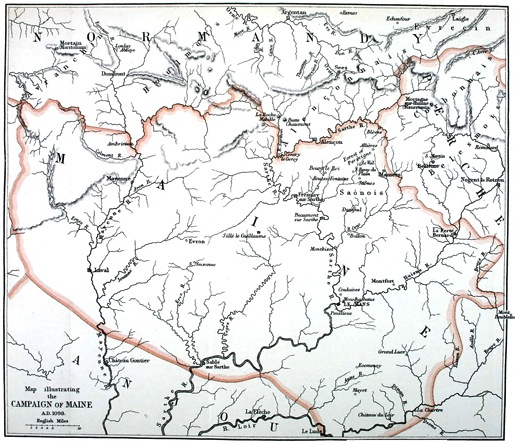
Edwᵈ. Weller
For the Delegates of the Clarendon Press.
Map
illustrating the
CAMPAIGN OF MAINE
A.D. 1098.
Effects of the occupation of Dangeul.
The occupation of this last strong post by Helias was
not without effect. He did not indeed win back any of
215
the castles which were held by Robert of Bellême; but
the garrison of Dangeul kept the invader in check, and
hindered him from carrying his accustomed ravages
through the whole country. This move of Helias seems
even to have convinced Robert that the conquest of
Maine was an undertaking too great for his own unassisted
power. Robert of Bellême invites the King. January, 1098.
In January he went to the King, and
stirred him up to a direct attack on Helias. With a
lover of warfare like Robert winter went for nothing; it
would be just the time to take the enemy by surprise,
while they were not expecting any attack. The King,
we are told, was unwilling. It is hard to understand
why this should be, unless he was too busily occupied
with the war in the Vexin. He was ashamed however—the
chivalrous feeling again comes in—to shrink from
any warlike enterprise which was proposed to him.[544]
William and Robert against Helias.
The King and the Count of Bellême set forth; but they
found the Count of Maine fully their match. He knew
how war was to be carried on in his own land against
an enemy stronger than himself. Guerrilla warfare of Helias.
He planted detachments
at every convenient post; he lined the hedges and
defences of every kind with men; he guarded the passages
of the streams, and the difficult approaches of the
woods. Against this kind of skirmishing warfare the
mighty Rufus and all his knights were able to do as
little as they were able to do against the light-armed
Welsh.[545]
The King waxed fiercer than ever against the
216
men of Maine and their Count; William leaves Maine.
but he withdrew his
own personal presence, betaking himself doubtless to
the other seat of war.
Robert of Bellême continues the war.
Meanwhile Robert of Bellême was left to carry on the
struggle with Helias. He was ordered by Rufus to
bring together as large a force as he could in his own
fortresses, nor did the King forget to supply him with
abundance of money for that purpose.[546]
On such a
bidding as this, Robert of Bellême, Robert the Devil on
Cenomannian lips, set to work with a will which fully
bore out his surname. He built new fortresses, he
strengthened the old ones with deep ditches.[547]
He had
already occupied nine castles, besides fortified houses,
on Cenomannian ground.[548]
Castles held by him in Maine.
The list is given as Blèves,
Perray, Mont-de-la-Nue, Saônes, Saint Remy-du-plain,
Lurçon, Allières, Motte de Gauthier-le-Clincamp, and
Mamers. All these lie in the north-eastern part of the
county, the part immediately threatened from Alençon
and Bellême. They occupy nearly the whole of the land
between the Cenomannian Orne and the upper course of
the Sarthe above Alençon, lying on each side, north and
south, of the great forest of Perseigne. The line of the
Sarthe from Alençon to Le Mans remained untouched,
while Ballon stood as the advanced guard of the capital,
and Dangeul was a yet further outpost of Helias, in the
very teeth of the invader from Bellême. Perray, alone
217
among the points held by Robert, stands as far south
as the lower course of the Orne.
Several of the castles on this list occupied marked
sites, and have left considerable traces. Mamers and
Blèves were strictly border fortresses, points which
Robert had seized just within the Cenomannian border;
the others were more advanced points in the heart of
the Cenomannian land. Mamers.
Mamers, with its streets sloping
down to the young Orne, is the only one of the places on
our list which is now at all a considerable town. But
the only signs of its fortifications which are to be seen
are found in the names of its streets, which suggest the
former presence of a fort by the river and of a castle on
somewhat higher ground. Mamers, due west from Bellême,
may well have been Robert’s first conquest, and its
occupation may have marked his first advance into the
dominions of his neighbour. But he must also, early in
his career, have made himself master of Blèves. Blèves.
This is
a point which has no natural advantages of height, but
which, standing in the very north-east corner of Maine,
separated from Perche by a small tributary of the Sarthe,
is important from its border position and as commanding
a bridge. A mound which once stood there has been
levelled; a graceful Renaissance house near its site is
the present representative of the castle; but parts of
the ditches may still be seen; the church, near but not
within the enclosure, contains work which may have
been looked on by Hildebert and Helias, and ancient
masonry still remains at the manorial mill. Blèves
lies north of the forest of Perseigne; Allières.
at Allières, on
its eastern verge, all actual traces of the castle have
vanished; but the church again contains some small
parts which seem contemporary with our story, and the
site of the fortress may well be marked by the modern
château on the hill-side commanding a wide view to
218
the south. But more speaking witnesses of this war
may be seen at two points lying south of the forest and
directly west of Mamers. Saint Remy-du-plain.
Saint Remy, distinguished as
Saint Remy du Plain from a namesake to the south-east
known as Saint Remy du Mont, stands, not indeed in
the plain, but on the edge of the high ground. It commands
an extensive view, reaching to the point which
bounds most of the views in northern Maine, the butte
of Chaumont. Saônes.
A site of the like kind, but with a less
wide prospect, is held by Saônes at a short distance to
the south, hard by that unusual feature in these lands,
a small lake. Saônes is now a small village, but it
was once of importance enough to give its name to the
surrounding district of Saosnois or Sonnois. In both
these cases the castle-mound rises immediately to the
west of the church, the latter at Saint Remy being a
late building of more pretension than is usual in the
neighbourhood. Each mound has its surrounding ditch,
which at Saint Remy is of most striking depth; each has
its encircling wall; each has its inner tower, that at
Saônes of an irregular four-sided shape, that of Saint
Remy octagonal without and round within. Here are two
unmistakeable and most striking sites of the fortresses
which the invader from Perche rent away from the
Cenomannian county. But, with such small remains of
walls as are still left, it is hard to say in each case how
much may be the work of Robert of Bellême himself.
The mounds—natural hills improved by art—and their
ditches are doubtless far older than his day; the walls
must often be far later. Small architectural remains of the eleventh century.
There is little architectural
detail left to decide such points; we are left to the less
certain evidence of masonry. Some of the masonry in
the inner building at Saônes certainly has the air of
work of the eleventh century. In any case, whatever
may be the exact amount of his work among the
219
existing remains, everything bears witness to the impression
which Robert’s invasion made on the district
and to the reputation which he left behind him. Not
far from Saônes, some remains of dykes, of the age or
object of which it would be rash to speak with certainty,
still keep the name of Robert the Devil.
Nature of the country and of the war.
A visit to the scene of this war, a look-out from any
of the chief fortified points, brings forcibly home to us
the nature of that kind of struggle with which we are
dealing. Nothing but an actual sight of Italy and
Greece fully brings home to the mind the state of things
when each city was a sovereign commonwealth, armed
with all the powers of war and peace. Till we take in
the fact with our own eyes, we do not thoroughly understand
how men felt and acted when they constantly lived
with rivals, rivals who might at any moment become
enemies, within sight of their own territory. Teaching of the landscapes in Maine.
The out-look
from any of the Cenomannian heights, the out-look
from the home and centre of mischief on the hill of
Bellême, brings home to us another state of things with
equal force. Had the commune of Le Mans lived on,
had other neighbouring cities followed its example, the
older Greek, the later Italian, model might have been
seen in all its fulness on the soil of northern Gaul.
And warfare between Le Mans and Tours, between Le
Mans and Alençon, carried on with that mixture of lofty
and petty motives which is characteristic of warfare
between rival cities, would have been ennobling compared
with the state of things which actually was. The castles.
For
here we see every available point seized on to make
what, at least in the hands of Robert of Bellême, was a
mere den of robbers.[549]
From his own scarped mound at
220
Bellême the destroyer could see far enough into the
Cenomannian land to give a keen whet to his appetite
for havoc. Within the land which thus lay open to
his attack, we see from every height the sites, not of
one or two only, but of a whole crowd of strongholds
which have passed away. A very few only of these
strongholds could ever have been needed for the protection
of any town or for the general defence of the
country. Their object private war.
They were strongholds which had been first
raised for the purpose of private war, and which, in the
hands of their present master, were turned to the purpose
of general oppression. One wonders how, in such
a state of things, when almost every village was overshadowed
by its robber’s nest, a single husbandman
could till his field, or a single merchant carry his wares
from town to town. Contrast with England.
And we must remember that,
unless during the nineteen years of anarchy, this state
of things never existed in England. Our forefathers
raised their wail over the building of the castles and over
the evil deeds which were wrought by those who built
them. Comparative rarity of castles in England.
But at no time in England, save on the borders
which were exposed to the foreign enemies of the
kingdom, did castles stand so thick on the ground as
they did in the land on which we now look. The eye
which has been used to track out the scenes of the Cenomannian
war comes back to an English landscape of the
same kind, to mark the steep bluff or the isolated mount,
which seems designed to be girt with a ditch and crowned
with a donjon, and almost to wonder that no ditch or
donjon ever was there. And, as we gaze on the land where
they crowned every tempting site, we better understand
221
the joy and thankfulness with which men hailed the reign
of any prince who put some curb on the pride and power
of the knightly disturbers of the peace and gave to smaller
men some chance of possessing their own in safety. We
can understand how in such a prince this overwhelming
merit was held to outweigh not a few vices and crimes
in his own person. We can understand how, at the beginning
of every period of restored order, a general
sweeping away of castles was as it were the symbolic
act of its inauguration. State of the Cenomannian castles.
And perhaps the thought comes
all the more home to the mind, because the Cenomannian
castles are, to so great an extent, a memory and not a
presence. They are not like those castles by the Rhine
which have come to take their place as parts of a picturesque
landscape. As a rule, it is not the castles
themselves, but the sites where we know that they once
stood, which catch the eye as it ranges from Mamers to
Sillé, from Ballon to Alençon. But when we see how
many spots within that region had been made the sites
of these dens of havoc—when we think how many of
them had, in the hands of Robert of Bellême, become
dens of havoc more fearful than ever—we shall better
understand how men cherished the names of William
the Great and of his youngest son; we shall better
understand the work which had now to be done in the
Cenomannian land by one nobler than either the son or
the father.
Wrong and sacrilege of Robert of Bellême.
In the minds of Helias and his contemporaries the
occupation of so large a part of their country was yet
more keenly embittered by the despite done to holy
places and the wrong wrought on men who enjoyed exceptional
respect even in the fiercest times. Some of the
strongholds of Robert the Devil were planted on lands
belonging to the Church, especially to the abbeys of
222
Saint Vincent and La Couture without the walls of Le
Mans. The peaceful tenants of these religious houses,
accustomed to a milder rule than their neighbours,
groaned under the oppressions of their new masters.[550]
Stirred up by this wrong and sacrilege, the Count of
Maine marched forth to protect his people. Now that
the King was gone, he even ventured on something like
a pitched battle. Helias defeats Robert at Saônes.
He met Robert of Bellême at the head
of a superior force near the lake and castle of Saônes,
not far, it may be, from the dyke which specially bears
the tyrant’s name. The pious Count and his followers,
calling on God and Saint Julian, attacked the sacrilegious
invaders and put them to flight.[551]
Several of the
nobles of Normandy were wounded or taken prisoners.
Robert of Courcy, a name not new to us,[552]
lost his right
eye. William of Wacey and several others were taken,
and were released on the payment of heavy ransoms.[553]
Helias, in short, carried on a defensive warfare in the
spirit of a Christian knight. Not so his enemy. Cruelty of Robert.
Robert
of Bellême carried on a war of aggression in the spirit
of a murdering savage. All the worst horrors of war
were let loose upon the land. Robert’s treatment of
prisoners was not that which the captive Normans met
with at the hands of Helias. In the holy season of
Lent, when other sinners, we are told, forsook their sins
for a while, the son of Mabel only did worse than ever.
Three hundred prisoners perished in his dungeons. Large
223
ransoms were offered for their release; but Robert would
not forego for money the pleasure of letting them die of
cold, hunger, and wretchedness.[554]
April, 1098.
The war thus went on till the end of April. On the
Wednesday in the last week of that month Helias made
an expedition against Robert. Second victory of Helias. April 28, 1098.
The exact point of attack
is not told us; but doubtless it was some of the fortresses
held by the enemy. It was perhaps Perray, the
hostile point furthest to the south, perhaps Saônes, the
scene of his own former victory over the invaders. The
starting-points of the Count’s operations were the two
points which he held as outposts of the city against
attacks from the north, Ballon and his own immediate
dwelling-place at Dangeul. From these castles Helias
led forth his forces. The day’s skirmish was successful;
the pride of Robert the Devil received another check.[555]
But fortune soon turned from the better to the worse
cause. Helias taken prisoner near Dangeul.
The Count bade the main body of his followers
march on to Ballon, while he himself, with seven knights
only, was minded to halt at his own castle of Dangeul.
As he drew near to the fortress, he saw a few men lurking
among the trees and bushes.[556]
Trees and bushes are
still there in abundance, surrounding the modern house
which in a figure represents the castle of Helias. The
224
presence of liers-in-wait so near his own home was
threatening. Helias rode against them and scattered
them; in so doing he also scattered his own small party.
But the few men in the thickets were only the advanced
guard of a larger body. The arch-fiend Robert
was himself near in ambush. At the lucky moment he
sprang forth; his comrades seized the Count, along with
his standard-bearer Hervey of the Cenomannian Montfort,[557]
and the more part of his small following. The
few who escaped made their way to Ballon, to turn the
joy of their comrades into sorrow at the news that
Count Helias was a prisoner.[558]
Contrast between Robert of Bellême and William Rufus.
The noblest man in Gaul was now at the mercy of the
vilest. Helias was helpless in the hands of Robert of
Bellême. The tale which follows is picturesque in itself,
and it is specially valuable as throwing light on the
mixed character of the Red King. With all his evil
deeds, he was at least not the worst man with whom
we have to do. We now see what mere chivalry could
do and what it could not do. It could not raise a man
225
to the level of Helias; but it kept him from sinking to
the level of Robert of Bellême. Helias surrendered to the King.
Helias was far too important
a captive to be left to die a lingering death in
the dungeons of Robert. He was taken to Rouen, and
handed over to the King; and in the King’s hands he at
least ran no risk as to life or limb. William Rufus
might perhaps not understand a patriot fighting for his
city and country. He could perhaps understand a
prince fighting for the inheritance of his fathers. He
could most fully understand and admire a gallant and
honourable knight fighting manfully in any cause, even
though his gallantry was directed against himself. William and Helias.
In
one or other of those characters, Helias extorted a kind
of respect from the King who was so bitterly enraged
against him. Helias kept at Rouen.
The fortune of war had gone against
the defender of Maine, but William was not disposed
to press his advantage harshly. Helias was kept in
the castle of Rouen, a prisoner, but a prisoner whose
durance was, by the King’s express order, relieved by
honourable treatment.[559]
State of things at Le Mans; the new municipality.
One element of the Cenomannian state, and that the
highest, was thus lost to it. But at Le Mans the prince
226
was only one element in the state; the ecclesiastical and
the civic powers appear alongside of him at every stage.
As soon as the Count was in the hands of the enemy, another
power, perhaps not the old commune, yet some form
of republican or municipal government, at once sprang
up. Bishop Hildebert and the Council.
Bishop Hildebert appears at the head of a council
or assembly of some kind which devised measures daily
for the safety of the commonwealth.[560]
We must not build
too much on the expressions of rhetorical writers who
loved to bring in classical allusions; still, considering
what Le Mans had been, a momentary burst of the old
freedom is no more than we might reasonably look for.
If so, the restored commonwealth had, at its first birth,
to brave the full might of the younger William, as the
former commonwealth had had to brave the full might
of the elder. We can only tell the tale as we have it,
and we have no means of connecting what was going on
in Maine with what was going on at the same time in
the Vexin. William’s council at Rouen.
Yet one is a little surprised to find William,
at this stage of the year, sitting quietly at Rouen, holding
a council, and presently sending forth orders for the
levying of a great army, as if two wars were not already
waging. His speech.
In his council of the Norman barons the Red
King is made to express himself in a humane and devout
strain. Hitherto he had been careless about winning
back the heritage of his father; he had been unwilling,
for the mere sake of enlarging his dominions, to
trouble a peaceful population or to cause the death of
human beings.[561]
Now however God, who knew his
right, had, without any knowledge of his, delivered his
227
enemy into his hands; what should he do further?[562]
The writers of these times do indeed allow themselves
strange liberties in putting speeches, and sometimes very
inappropriate speeches, into the mouths of the actors in
their story. But surely to put words like these into
the mouth of William Rufus, as something uttered in
seriousness, would be going beyond any conceivable
licence of this kind. Considering his better authenticated
speeches, one is tempted to believe that we
have here the memory of some mocking gibe. He,
King William, had not laid waste the fields of Maine
nor caused men to die of hunger in prison. It was only
Robert of Bellême who had done such things. It would
be quite in character with Rufus, as with Jehu, to ask,
Who slew all these?[563]
Nor is such brutal mockery in
any way inconsistent with the display of chivalrous
generosity whenever any appeal is made personally to
himself in his knightly character. A great levy ordered.
Anyhow we are told
that the barons advised that a summons should go forth
bidding the whole force of Normandy to come together
for an expedition to win back the land of Maine. They
themselves would come, willingly and with all daring, in
their own persons.[564]
All this reads strangely in a narrative which, a page
or two before, had told us of the warfare around Gisors
which, one would think, must have been going on at
this very moment. But we read that the messengers went
forth, and that the host came together. Not only from
228
Normandy, but from Britanny and Flanders, from Burgundy
and France—not a word as to the treason implied
in this last name—men flocked to the banners
of the prince who was so bountiful a paymaster.[565]
At
some stage of their march, an aged French warrior, a
survivor of the wars of King Henry—one therefore who
could remember the ambush of Varaville and the flames of
Mortemer, perhaps even the clashing of lances at Val-es-dunes—Gilo
de Soleio by name, beheld the host from the
top of a high hill. Numbers of the army.
He had seen many and great gatherings
of men, but never on this side the Alps—had he
fought then in Apulia or at Dyrrhachion?--had he seen
so vast an army. He told the number of the men at
fifty thousand.[566]
Be the figures trustworthy or not as to
this particular army, this is one of several hints which
help to show us what passed in those days for an army
of unusual numbers.[567]
The army meets at Alençon. June, 1098.
The trysting-place of this great host was at Alençon,
the border town and fortress of Normandy, where the
Sarthe divides the Norman and Cenomannian lands.[568]
Once famous as the town whose people had felt so stern
a vengeance for their insults to the great William, it was
now a stronghold of Normandy against Maine, at all
events a stronghold of Robert of Bellême against those
who still maintained the cause of the captive Helias.
229
There the army met in June.[569]
Rufus, in invading
Maine, was repeating an exploit of his father. He
entered by the same road, and began by threatening the
same fortress. The words of our authorities may lead
us to think that he himself tarried at Alençon, while his
army, or the bulk of it, marched to Fresnay.[570]
The army at Fresnay.
Fresnay-le-Vicomte,
Fresnay-on-Sarthe, was the first castle in
Maine to which the Conqueror had laid siege, and under
its walls Robert of Bellême had been girt with the belt
of knighthood.[571]
At that time Fresnay, along with Beaumont
lower down the river, had dared to withstand the
invader. Both fortresses stand on heights overlooking
the Sarthe; Fresnay, seated on a limestone rock rising
sheer from the stream, might seem well able to defy any
enemy. The castle and church of Fresnay.
Of the ancient part of the castle nothing is left
but shattered walls and a stern gateway of a later age.
The church, a gem of the art of an age nearly a hundred
years later, contains only a small part which can have
been standing in the days of Rufus. Beaumont-le-Vicomte.
Beaumont is not
mentioned in our present story. But its square keep
must have already looked down on the Sarthe and its
islands, while a mound on each side of the town, one
seemingly artificial, one by the river-side only improved
by art, may perhaps mark the sites of besieging towers
raised by the Conqueror to bring town and castle into
subjection.[572]
The then lord of Fresnay and Beaumont,
230
the Viscount Hubert, had at a later stage forsaken both
his castles on the Sarthe, to defy, and that successfully,
the whole might of William the Great from his
more inaccessible donjon on the rock of Sainte-Susanne.[573]
His successor, the Viscount Ralph, felt no call to run
any such risks. The Viscount Ralph asks for a truce.
When the army drew near to Fresnay,
when no hostilities beyond a little skirmishing had as
yet taken place, Ralph went to the King at Alençon and
asked for a truce. He pleaded that he was but one
member of a body; he could not take on himself the
duties of the head of that body; he could not without
dishonour be the first man in Maine to yield his castle
without fighting. The council of Maine was sitting in
the city; he, Ralph, was bound by their resolves; let
the King go on to Le Mans and negotiate; as he should
find peace or war at Le Mans, he should find peace or
war at Fresnay.[574]
Rufus grants it.
Rufus, always ready to answer any
appeal to his personal generosity, praised the proposal
of Ralph, and granted him the truce which he asked for.[575]
He did the like to others whose lands lay on his line of
march. Action of Geoffrey of Mayenne.
Among these we hear of Rotrou of the Cenomannian
Montfort, and of one whose name has for so
many years been sure to meet us the first moment he set
231
foot on Cenomannian soil, the now surely aged Geoffrey
of Mayenne.[576]
Estimate of their conduct.
The conduct of these lords seems to show lukewarmness,
to say the least, in the cause of Cenomannian independence.
We are again reminded of the days of the
commune, of the unwillingness of the nobles to accept
the republican government, of the special treason of
Geoffrey himself.[577]
We can understand that many of
the lords of castles throughout Maine, though they
might prefer their own count to the king who came
against them, might yet prefer the king to any form of
commonwealth. The local historian does not scruple to
use strong language on the subject. For we can hardly
doubt that Geoffrey, Ralph, Rotrou, and others in the
like case, are the persons who are referred to as the
faithless men by whose consent Rufus was led to hasten
to the city.[578]
But the King had another motive to call
him thither. Fulk Rechin at Le Mans.
By this time there was no longer a commonwealth
to be dealt with; Le Mans had again a
prince, though no longer her native prince. May 5, 1098.
In the very
week after Helias was taken prisoner, Fulk of Anjou
came to Le Mans, and brought with him his son Geoffrey.
He himself came in his character of superior lord,[579]
232
while Geoffrey, to whom Eremburga, the only child of
Helias, was betrothed, might pass in some sort for the
heir of the county.[580]
He is received.
The citizens, we are told, received
the Angevin count willingly; any master was better than
the Norman. Fulk’s son Geoffrey left at Le Mans.
Fulk put garrisons in the fortresses of
La Mans, with his son in command. He then left the
city, seemingly for operations in other parts of Maine.[581]
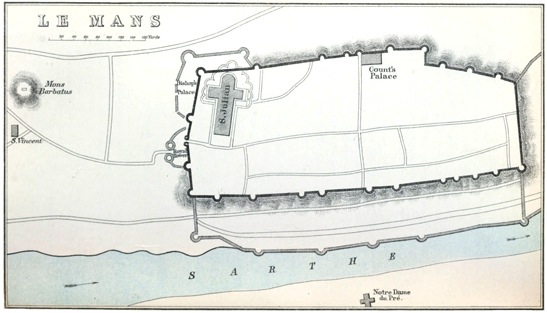
E. Weller
For the Delegates of the Clarendon Press.
LE MANS
March of Rufus.
Against this new enemy William Rufus set out from
Alençon. He had to overtake the host which was
already at Fresnay. He crossed the Sarthe; he continued
his course along its left bank, and stopped for the
first time at Rouessée-les-fontaines.[582]
This point is no
great distance from Alençon, and it is still some way
north of Fresnay. The present village of Rouessée contains
no signs of any castle or mansion fitted for a
king’s reception. Castle of Bourg-le-roi.
One suspects that the exact spot
meant must be the neighbouring castle of Bourg-le-roi, a
castle said to take its name from Rufus himself. Here a
ruined round tower, with walls of amazing thickness
and girded by a deep ditch, looks down from a small
hill on what seems to be the preparation for a large
town which has never been built. A small village and
church are sheltered within walls of vast compass,
pierced by gates of later date than the days of Rufus
and Helias. His next stage is distinctly spoken of as
an encampment. The King had now joined his army.
Rufus at Montbizot
That night his camp was pitched at Montbizot, in the
233
peninsula between the Sarthe and the Cenomannian
Orne.[583]
and Coulaines.
On the third day he encamped in the meadows,
by the Sarthe, hard by the village of Coulaines.[584]
He
was still on the left bank of the river, the same bank as
the city itself, though the bend which the stream makes
immediately under the hill of Le Mans gives the city
almost the look of standing on the other side. Wide
meadows spread from the village of Coulaines to the
foot of the hill; they were now covered by the tents of
Rufus. View of Le Mans.
Right before the eyes of the army, high on its
hill, rose the city which they were come to attack, and
it rose so as to bring at once before their leader’s eyes
the objects which would specially stir up his wrath. As
Le Mans is seen from the meadows of Coulaines, the
city and its hill lie almost out of sight to the south-west.
The prominent objects are those which stand in
the north-east corner of the city and in the adjoining
suburb. Highest of all, rising above the city itself,
soared the abbey of Saint Vincent without the walls,
the house whose tenants had been so cruelly oppressed
by Robert of Bellême.[585]
Saint Julian’s, on its lower
ground, almost closes in the view on the other
side. When Rufus drew nigh, the twin towers of
Howel rose high in all the freshness of their newly-finished
masonry, to remind the King that the chair
of the prelate whom his father had appointed was now
filled by a successor in whose choice no regard had been
paid to his own pleasure. Between the two minsters
rose the royal tower, the tower of his father, the fortress
which had passed away from him and from his father’s
house, held no longer even by a rebellious vassal, as he
234
might deem Helias, but by the invading stranger from
Anjou. How deeply one at least of these feelings
rankled in the mind of Rufus is shown by his dealings
with the immediate neighbourhood of his encampment.
The village of Coulaines was an episcopal lordship. Rufus ravages Coulaines.
For
the churl chivalry taught no mercy; in his wrath
against Hildebert, the King burned the church and the
whole village, and cruelly laid waste the neighbouring
lands.[586]
But however fiercely Rufus might wreak his spite on
the unlucky lands and tenants of the bishopric without
the walls, the flock of Hildebert within the city was safe
for a while. Le Mans was not to pass into the King’s
hands just yet, and Ralph of Beaumont and Geoffrey of
Mayenne might still keep their bat-like nature for some
while longer. Sally from the city.
For it is at this stage that the local
historian places an exploit of the citizens of Le Mans
which reminds us of the way in which our own Godwine
was said to have won the special favour of Cnut
for himself and his fellow-Englishmen.[587]
The men of the
city marched forth—whether under Angevin leadership
we are not told—to attack the King’s camp at Coulaines.
Rufus goes away.
Rufus, deeming that some treachery was on
foot, marched off in the night with his army. In the
morning the citizens occupied the camp and found no
one there.[588]
It is hard to say what we are to make of
235
this story, which has a somewhat mythical sound. But
it has at least thus much of truth in it, that Rufus was
obliged to break up the siege of Le Mans for a while.
Ballon betrayed to Rufus and occupied by Robert of Bellême.
The castle of Ballon, of which we have already so
often heard, was betrayed to Rufus by its lord Pagan
of Mont-Doubleau, and it was held that this strong
position, nearly due north of the city, almost put the
city itself into the King’s power. Robert of Bellême
was put in command at Ballon, with three hundred
knights. At his bidding the land was ravaged in every
way; the vines were rooted up and the crops were
trampled down. But at last the invaders began to feel
the effects of the damage they themselves had done. A
failure of provisions, especially of oats for the horses,
hindered the Red King from keeping on the siege.[589]
The siege of Le Mans raised.
He
went away into Normandy, bidding his men go home
and see to their harvests, and come again when the crops
were reaped.[590]
Nothing is more natural in the case of
the native Normans, who would feel in such a case very
much as Englishmen felt; but one can hardly believe
that William allowed his great mercenary force to be
wholly broken up. And again, the question keeps always
presenting itself, What was going on in the Vexin?
236
Was there any moment when so eager a warrior, with
two wars on his hands at once, left both of them to take
care of themselves? Throughout this story the relations
between the French and the Cenomannian wars form a
never-ceasing puzzle. But we presently come to an
incident of the campaign which is the most characteristic
in the whole history of William Rufus.
Fulk attacks Ballon.
While William was away, Count Fulk, at the head of
a mixed host, Angevin and Cenomannian, laid siege to
the newly-betrayed castle of Ballon. The attack went
on for some days; a message was sent to the King
for help. To meet this fresh danger, the nobles of
Maine and Anjou pressed in greater numbers to help the
Count and his force. Successful sally of the besieged.
The defenders of the castle
planned a sally. Beggars went out as spies, and brought
in news that the besiegers were busy dining at the
hour of tierce. The sally was made; the besiegers were
surprised in the midst of their meal;[591]
a hundred and
forty knights and a crowd of foot-soldiers were taken
prisoners. The rest took to flight and left a rich spoil
of arms, clothes, and furniture as a prey to the Normans.
Many of the captives were men of high rank and
great possessions. The story almost reads as if Robert
of Bellême condemned them to die of hunger; if so,
Rufus came before hunger had done its work; cold
would no longer be a means of torture. William at Ballon, c. July 20, 1098.
It was now
not Lent, but the third week in July, when King
William with a great force came to Ballon. A cry
presently reached him from the prisoners, “Noble King
William, set us free.” The chivalrous King, who had
237
no mercy for the peasants of Coulaines, felt his heart
stirred towards the captive knights of Anjou. His treatment of the captive knights.
He
ordered that a meal should be made ready for them
along with his own followers, and he set them free on
their parole till the meal was ready. Some of his companions
suggested to him that, in the crowd and confusion,
they might easily escape. Rufus cast aside
such a suggestion with scorn. He would never believe
that a good knight would break his word; he who
should do so would have punishment enough in the
scorn of all mankind that would follow him.[592]
Illustration of the chivalrous spirit.
Here we
see the chivalrous character in all its fulness. Justice
and mercy go for nothing; the law of God and the law
of man go for nothing; the oath of the crowned king,
the promise of a prince and a brother, go for nothing;
but the class tie of knighthood is sacred; the promise
made under its guaranty is sacred. As a good knight,
William Rufus is faithful to his own word pledged as
such to others; as a good knight, he will not believe
that a brother of his order can be other than faithful to
his word pledged as such to him.
Fulk goes back to Le Mans.
The siege of Ballon was at an end. Fulk, we are
told, betook himself to the city, and there stayed in
some of the monasteries, waiting to see what would
happen.[593]
But the defenders of Le Mans, both native
and Angevin, had now made up their minds that resistance
to the power of Rufus was hopeless; their
238
object was to treat for peace. Negotiations for peace.
The captive Helias was
allowed a share in the negotiations; he was specially
fearful that Fulk might make some agreement by which
he himself might be cut off from Maine for ever.[594]
Share of Helias.
By
the King’s leave, Bishop Hildebert and some of the chief
men of the city visited Helias, and they agreed on terms
which were put into the form of an agreement between
Rufus and Fulk. Convention between William and Fulk. August, 1098.
It was rather a military convention
than a treaty of peace, and it left all the disputed questions
unsettled. Nothing was said either as to the
general question about the bishopric or as to the particular
election of Hildebert. Nor was it at all ruled
who was to be looked on as lawful Count of Maine. It
was not even agreed that hostilities were to cease. The
actual terms are conceived in words which seem to
come from Rufus himself. The memory of his father is
put prominently forward. Le Mans to be surrendered.
Le Mans and all the fortresses
which had been held by the late King William
were to be surrendered to King William his son. Helias to be set free.
Helias
and all other prisoners on both sides were to be set free.[595]
All sides, we are told, rejoiced at this agreement. To
William and his followers it was a great immediate
triumph. To the people of Le Mans it was at least
immediate deliverance from a wasting struggle. And
wary men may have seen that the liberation of Helias
was not too dearly bought even by the surrender of his
capital. If the valiant Count were set free, free alike
from fetters and from promises, he would win back his
lost city and dominion before long.
Submission of Le Mans.
But for the present all went according to the pleasure
of the Red King. Rufus, as his father had twice done,
entered Le Mans without bloodshed, amidst at least the
outward welcome of its inhabitants. And it may well
be that, if Helias was not to be had, they may have
239
looked on William as a more promising master than
Fulk. The convention was formally accepted, and it
was immediately carried out. The castles occupied by the King’s troops.
Robert the son of Hugh
of Montfort, that Hugh whom we have already heard of
on Senlac and at Dover,[596]
was sent at the head of seven
hundred chosen knights, full armed in their helmets and
coats of mail, to occupy the fortresses of Le Mans.[597]
They met with no opposition; the garrisons, native or
Angevin, marched out; the Normans took possession.
All the strong places of the city—the ancient palace of
the counts on the Roman wall—the donjon of William
the Great, the royal tower, standing so dangerously near
to the north wall of Saint Julian’s minster—the other
fortress of the Conqueror, the tower of Mont Barbet on
its height, overlooking the city from the side of Saint
Vincent’s abbey—all that the father had either subdued
or called into being—now passed without a blow into
the hands of the son. The King’s banner—what was
the ensign wrought upon it?--was hoisted amid shouts of
victory on the highest point of the royal tower. King
William the Red had achieved the object which in his
thoughts came nearest to the nature of a duty. He had
brought under his hand all that had ever been under the
hand of his father.[598]
240
William’s entry into Le Mans.
On the day of the military occupation followed the
day of the joyous entry. The Red King entered, doubtless
by the northern gate, the gate between Saint Vincent’s
abbey and the royal tower. His new subjects
welcomed him with shouts and songs, and were received
by him to his full peace.[599]
His reception by Hildebert.
Bishop Hildebert, seemingly
now admitted to favour, with his clergy and people, met
the King with psalms and processions. They led him
by the royal tower, with his own banner floating on its
battlements, to the cathedral church, now a vaster and
more splendid pile than when the first Conqueror had
been led to it with the same pomp.[600]
The church of Saint Julian.
The twin towers of
Howel soared in their freshness; the aisles which we
still see, with their abiding Roman masonry, had risen at
his bidding; it may well have been by the mighty
portal of his rearing that Rufus entered within the hallowed
walls. Within, the sight was different in every
stone, in every adornment, from that on which we now
gaze. The columns and arches of Saint Julian’s nave
were still the columns and arches of the basilica which
Aldric had raised when Le Mans was a city of the Empire
of the pious Lewis.[601]
It may be that of those
columns we can here and there spell out some faint
traces amid the finer masonry and gorgeous foliage of
the next age. But of the works to the east, still new
when Rufus came, the splendid reconstructions of later
times have left us no signs. The choir of Arnold still
blazed in all its freshness with the rich decorations
which had been added by the skill and bounty of
241
Howel. The first bloom had not passed away from the
painted ceiling, from the rich pavement, from the narrow
windows glowing with the deep richness of colour which
no later age could surpass. Through all these new-born
splendours of the holy place the scoffer and blasphemer
was solemnly guided to the shrines of Saint Julian and
of all the saints of Le Mans. And there were moments
when the heart of Rufus was not wholly shut against
better thoughts. As at Saint Martin of the Place of
Battle, so at Saint Julian in newly-won Le Mans, we
may deem that some dash of thankfulness was mingled
with his swelling pride, as he felt that he had finished
his father’s work.
William leaves Le Mans.
The stay of William at Le Mans does not seem to
have been long. The government of the city was put
into the hands of Count William of Evreux and of
Gilbert of Laigle. The royal tower, well provisioned,
stocked with arms and with all needful things, was
placed under the immediate command of Walter the son
of Ansgar of Rouen.[602]
General submission of Maine.
The nobles of Maine now came in
to make their submission and to receive the King’s
garrisons into their castles. Among them were Count
Geoffrey of Mayenne and the Viscount Ralph of Beaumont.
The terms of their engagement were fulfilled.
Their castles were to follow the fortune of Le Mans,
and Le Mans now was King William’s.[603]
But he who had lately been the lord of them all
242
was waiting for the benefits of the convention to be
extended to himself. We are a little surprised when we
presently find the King at Rouen, and when we further
find that Helias, who had been lately in ward in the
castle there, had now to be brought hither from a prison
at Bayeux.[604]
Meeting of William and Helias.
The King and his captive met face to face.
The contrast between the outward look of the two men
was as striking as the difference in their inward souls.
Before the victorious King, short, bulky, ruddy, fierce of
countenance, hasty and stammering in speech, stood the
captive Count, tall, thin, swarthy, master of eloquent
and winning words. Something of bodily neglect
marked, perhaps not so much the rigour of his confinement
as a captive’s carelessness of wonted niceties.
His hair, usually neatly trimmed, was now rough and
shaggy.[605]
The King seems to have begun the dialogue;[606]
“I have you, Sir.” Helias answered with dignity and
respect, as a man of fallen fortunes speaking to a
superior in rank, and yet not stooping to any unworthy
submission. Proposals of Helias.
He called on the King, in the name of his
might and his renown, to help him. He had once, he
said, been a count, lord of a noble county. Fortune
had now turned against him, and he had lost all. He
asked leave to enter the King’s service, to be allowed to
keep his rank and title of count, but pledging himself
not to make any claim to the Cenomannian county or
city, till by some signal exploit on the King’s behalf he
should be deemed worthy to receive them as a grant from
the King’s free will. Till then it would be enough for
him to have his place in the royal following and to
enjoy the royal friendship.
William disposed to accept Helias’ proposal.
Such an appeal as this went straight to the better
243
part of William’s nature, and he was at once disposed
to agree to the proposal of Helias. But then stepped in
the selfish prudence of Robert of Meulan, who measured
other men by himself. He is hindered by Robert of Meulan.
He was now the King’s chief
adviser, and he jealously grudged all influence which
might fall to the lot of any one else.[607]
The admission of
Helias to the King’s friendship and councils would of all
things be the least suited for Robert’s purposes. He
could not bear that any man, least of all a man of a
spirit so much higher than his own, should be so near
the throne as Helias threatened to be. The men of
Maine, said the Count of Meulan, were a cunning and
faithless race. All that the captive Helias sought by
his offers was to insinuate himself into the King’s
favour, to learn his secrets, that he might be able,
when a fitting moment came, to rise up against him
with more advantage and join himself to his enemies
with greater power. The purpose of Rufus was
changed by the malignant counsel of Count Robert.
The petition of Helias was refused; it was again made;
it was again refused. Defiance of Helias.
Then the Count of Maine spoke
his defiance. “Willingly, Sir King, would I have served
you, if it had been your pleasure; willingly would I
have earned favour in your sight. But now, I pray you,
blame me not, if I take another course. I cannot bear
with patience to see mine inheritance taken from me.
All right is denied to me by overwhelming violence;
wherefore let no man wonder if I again renew my claim,
if I strive with all my might to win back the honour of
my fathers.” Rufus was beside himself with wrath at
words like these; but it was in words only that his
wrath spent itself. He stammered out, “Scoundrel, what
244
can you do? Be off, march, take to flight; Answer of Rufus.
I give you
leave to do all you can, and, by the face of Lucca, if
you ever conquer me, I will not ask you for any grace
in return for my favour of to-day.” Even after this outburst,
the Count had self-command enough to ask for a
safe-conduct, and the King had self-command enough to
grant it. Helias set free.
Helias was guided safely through the Norman
duchy, and made his way, to the delight of his friends,
to his own immediate possessions on the borders of
Maine and Anjou.[608]
Illustration of the King’s character.
Of all the stories of the Red King there is none more
characteristic than this. His first impulse is to accept
a generous and confiding offer in the spirit in which it
was made. For a moment he seems to rise to the level
of the man who stood before him. Even when his
better impulse is checked by an evil counsellor, he does
not sink so low as many would have sunk in the like
case. In the wildest wrath of his insulted pride, he does
not forget that his word as a good knight is pledged
to the man who has defied him. Rufus was bound by all
the laws of chivalry to let Helias go this time, whatever
he might do if he caught him again. And the laws
of chivalry Rufus obeyed in the teeth of temptations of
opposite kinds. A meaner tyrant might have sent
Helias at once to death or blinding. A calmer or more
wary prince, even though not a tyrant, might have
argued that it was unsafe for him and his dominions to
let the man go free who had uttered such a challenge.
He might further have argued that a speech which was
so like an open declaration of war at once set aside
the conditions of peace. But William Rufus, when
once on his point of honour, was not led away from
245
it either by the impulse of vengeance or by the calculations
of prudence. His knightly word was pledged that
Helias should go free. Free therefore he went, after
his defiance had been answered by a counter defiance,
each alike emphatically characteristic of the man who
uttered it.
§ 3. The End of the French War.
September-December, 1098.
The war of Maine was, or seemed to be, over. And,
just at this point we get a chronology clear enough to
enable us to fix the connexion of the two works which
were going on at once. We have seen William in his
Norman capital at a time when we should rather have
looked for him on one or other of his Norman frontiers.
William on the continent. 1097–1099.
But it seems plain that he spent the whole year on the
mainland, and that he did not cross to England at any
time between the two Christmas feasts which he is
specially said to have kept in Normandy. Helias was
set free in August, and we are led to believe that Rufus
now deemed that the war of Maine was over, or at least
that he could afford to despise it in its present stage.
Extent of William’s conquests in Maine.
We shall presently see that the war of Maine was by no
means over, and that William’s Cenomannian conquests
hardly reached beyond the capital and the lands north
of the capital. He begins, but does not finish.
We are inclined to wonder that a warlike
prince like Rufus took no further heed to a campaign
which was manifestly unfinished, while an active enemy
was again at liberty and was still in possession of a
strong line of castles. But this is neither the first nor
the last time in which we find William the Red much
more vigorous in beginning a campaign than in ending
it. And in this case he may, with two wars on his
246
hands, have not unreasonably thought that, after so
great a conquest as that of the capital of Maine, he could
afford to turn his thoughts to the other seat of warfare.
In the month after Helias was set free, he made up his
mind for a special effort against the stubborn border-land
of France.
William sets forth. September 27, 1098.
Two days before Michaelmas, William set forth, from
what head-quarters we are not told, at the head of a
great army. On his way to the seat of war he enjoyed
the hospitality of Ralph of Toesny on the hill of Conches.
That night there was a sign in the heavens; The sign in the sky. the whole
sky blazed and seemed as red as blood. At other times
such a portent in the heavens might not have seemed too
great to betoken some great victory or defeat on the part
of one or other of the contending kings of the West.
But, while Christendom was on its march to the eastern
land, the heavens could tell of nothing meaner than
the ups and downs of the strifes between two continents
and two creeds. Its meaning.
If the sky was red over
Conches and Evreux and the whole western world, it
was because at that moment Christians and heathens
met in battle in the eastern lands, and by God’s help the
Christians had the victory.[609]
But William Rufus cared
little for signs and wonders, even when he himself was
deemed to be the subject of their warning. His heart
was not in Palestine, but on the French border; and his
present business was a march against the most distant
of the three fortresses to which he laid claim. Chaumont
and Trie still held out; but their garrisons could
not hinder him from carrying a destructive raid into
247
districts far more distant from his head-quarters at
Gisors. He marches to Pontoise.
He marched to the south-east, burning, plundering,
and carrying off prisoners from the whole French
territory as far as Pontoise.[610]
The invading King had now reached a point of
French soil nearer to Paris than the spot where Count
Robert kept the Seine barred at Meulan. At Pontoise,
as the name implies, was the bridge spanning the Oise,
the tributary which joins its waters with those of the
Seine at Conflans—the Gaulish Confluentes—between
Paris and Meulan. Castle and town of Pontoise.
Here a precipitous rock rises above
the stream, a rock which, strengthened and defended by
art in every way, was crowned by the vast circuit of the
castle of Pontoise. Here is no town sloping down from
the castle to the river. The castle rock rises sheer—it
rose most likely from the water itself, till the Oise, like
the Seine at Rouen, was curbed by a quay. In the view
from the bridge, the castle, shorn as it is of its towers
and of all that can give stateliness to such a building,
still lords it over everything. The town of Pontoise
seems to crouch by the side of the rock; the great
church of Saint Maclou, with its lofty tower of late
architecture, is wholly hidden from sight. It is only at
some distance beyond the river, in the suburb known as
that of Saint Ouen l’Aumône, that we begin to see that
the church stands on ground not much lower than
the site of the castle. Strong position of the town.
We then learn that the town of
Pontoise, standing on a height separate from the castle-rock,
well walled, and with streets as steep as those of Le
Mans or Lincoln, was in itself no contemptible fortress.
As usual, there is little or nothing in town or church or
castle that we can positively assign to the period of our
248
story. But the main features of the spot must be the
same now as they were when the Red King led his
plundering host as far as the bridge of the Oise. Pontoise the furthest point of the raid.
It is
plain that this was the end of his course on this side;
it is plain that Pontoise was not added to the list of
fortresses which were taken by him or betrayed to him.
But we have nothing to explain why he turned back at
this point, whether he met with any repulse in an
attack on Pontoise or whether he attacked Pontoise at
all. We only know that Pontoise marks in one sense
the furthest point of the French campaigns of William
Rufus. We shall presently find him on another side
at a greater distance from his own dominions; but
Pontoise marks his nearest approach to the capital of
France. Had Pontoise been William’s as well as Meulan,
Paris would indeed have been threatened. But this south-eastern
journey was clearly, in its effect at least, a
mere plundering raid, from which Rufus came back to
attempt a more regular attack on the nearer enemy at
Chaumont.
Siege of Chaumont.
The siege of Chaumont is described to us in greater
detail than the march on Pontoise, but we do not,
any more than at Pontoise, get a really intelligible
account. It is plain that the siege was a considerable
enterprise, one to which Rufus led his whole army. It
is also plain from the result that its issue must have
an important effect on the turn of affairs. But of
the siege itself all that we hear is one of those
strange stories by which we are sometimes met, stories
which must have some meaning, which must be
grounded on some fact, and which yet, as they stand,
pass all belief. We are told that the defenders of Chaumont
were valiant men, strong to defend the battlements
of their own castle. But to defend their own castle was
all that they could do; their numbers were not enough
249
to enable them either to meet William’s great army in
open battle, or even to hinder his plunderers from laying
waste the neighbouring lands. But the defence of
Chaumont itself was stout, and, as it turned out, successful.
The archers of Chaumont shoot the horses only.
Yet we are told that the garrison of Chaumont,
out of the fear of God and out of tenderness towards
men, stood strictly on the defensive, or took the offensive
only towards brute beasts. In taking aim at the besiegers,
they avoided the persons of the riders, and
aimed all their blows at the horses. Seven hundred
horses of great price fell under the arrows and darts of
the men of Chaumont, and their carcases made a rich
feast for the dogs and birds of prey of the Vexin.[611]
Chaumont not taken.
The
virtue of these scrupulous warriors did not go unrewarded.
Our story breaks off somewhat suddenly; but
we see that at all events Chaumont was not taken.
The war now takes a turn of special interest, which
makes us specially regret the very unsatisfactory nature
of our materials. The field of our story is suddenly enlarged;
but events do not crowd it at all in proportion
to its enlargement. Rare notices of southern Gaul.
It is but seldom that our tale brings
us into any direct dealing with the lands and the princes
south of the Loire. We have seen the tongue of oil
supplant the Danish tongue in Normandy, and we have
seen it appear as a rival to our own speech in our own
island. But we have been seldom called on to listen to
the accents of the tongue of oc. But at this moment the
chief potentate of that tongue suddenly appears on the
250
field of our story, an appearance from which we naturally
look for great events. The young lord of the Vexin and
heir of France had to meet a new enemy, almost as
powerful, and quite as reckless and godless, as the old
one. Coming of William of Poitiers.
Another William, William of Poitiers and Aquitaine,
came to the help of William of Normandy and
England.[612]
He was in the end to go to the crusade—to
go not exactly in the guise of Godfrey or Helias.[613]
But
he had not yet set out; and, before he went, he came to
strike a blow on behalf of the prince to whom he was said
to have sold the reversion of his dominions. Alliance of Normandy and Aquitaine.
The mighty
dukes of the North and the South might seem to have
utterly hemmed in the smaller realm of the king whose
men they were or should have been.[614]
The final results of
their alliance were not memorable, but the coming of the
southern duke had the immediate effect of carrying the
war into districts little used to the presence of English
or even of Norman warriors.
Campaign to the west of Paris.
It can hardly fail to have been the march of William
of Aquitaine which led to a campaign carried on in the
lands west and south-west of Paris, within the triangle
which may be drawn between the three points of
Mantes, Paris, and Chartres. One side of this triangle
is formed by the Seine itself, and here the adhesion of
the Count of Meulan must have effectually guarded the
seat of war from the north. Somewhat to the west of
Meulan, between that fortress and Mantes, the small
251
stream of the Maudre empties itself into the Seine.
Valley of the Maudre.
The course of this stream and the valley through
which it flows formed the chief seat of warfare at this
stage, seemingly after the attacks on Chaumont had
proved fruitless. Small as the Maudre is, its course
makes a clearly marked valley, running nearly north
and south. Maule.
About the middle of it lies Maule, the
fortress of Peter of Maule, the benefactor of the house
of Saint Evroul, and therefore high in favour with its
historian. Further to the south, where the stream is
a mere brook, the valley widens into a plain between
hills, and here some of the strongest points are occupied
by the strongholds of the French house of Montfort,
numbering among them the spot which gave that house
its ever-memorable name. Montfort-l’Amaury.
Here rose the hill which
above all others glories in the name of the Strong
Mount, the home of the Simons and the Amalrics.
Under the name of Montfort-l’Amaury it still keeps the
less illustrious of the two names, one or other of
which was always borne by its successive counts. Neauphlé-le-Château.
To
the north-east of the cradle of their race, on the other
side of the Maudre, the Counts of Montfort had planted
another stronghold on a height, which, though all traces
of a fortress have passed away, still keeps the name of
Neauphlé-le-Château, as distinguished from another
place of the same name, Neauphlé-le-Vieux. Epernon.
Much
further to the south-west, on the upper course of the
Drouelle, a tributary of the Eure, stood Epernon, another
fortress of the house of Montfort, a border fortress of
the strictly French territory towards the lands of the
Counts of Chartres. The two Williams march against the Montfort castles.
On this district now fell the heavy
wrath of the two Williams, who led a mighty multitude
against Montfort and Epernon and laid waste the whole
surrounding land. They had traitors in their service;
they came under the guidance of Almaric the Young and
252
of Nivard of Septeuil.[615]
This last place lies in the valley
of the Vaucouleurs, a stream running almost parallel
with the Maudre and joining the Seine at Mantes. Such
a position, lying nearly due west from Maule, and at
a greater distance north-east from Montfort, marks a
dangerous outpost thrown out from the Norman side
into the heart of the French territory. Seat of war affected by the coming of William of Poitiers.
Of the line of
march of the Poitevin duke we have no account; but it
must have been his coming which caused the seat of war
to be changed from the north-west of the threatened
capital of France to the south-west, a region so much
better suited for an invader from the south.
No special mention of Lewis.
It is somewhat singular that, while we have so striking
a general picture of the courage and conduct of the
young Lewis during this struggle, we hear nothing of
any particular exploit of his, we hear nothing of any
help given by him to any of the threatened fortresses.
It is their own lords, each for himself, who withstand,
and successfully withstand, the attacks of the powers of
North and South. Our chief informant—English, Norman,
and French, all at once—enlarges on the failure of
Philip to give any help to his vassals; but we should
never learn from him that his place was supplied by his
son.[616]
The castles resist singly.
Every man, it would seem, fought for his own
hand. We are told this of a crowd of unnamed lords
defending unnamed fortresses. Peter of Maule.
But we are not left to
guess at the name of the friend of Saint Evroul, Peter of
Maule, who, with his sons Ansold and Theobald, successfully
253
defended his fortress in the valley of the Maudre.[617]
We must suppose that the forces of the two Williams
were scattered and frittered away in a series of desultory
attacks against strongholds scattered all over
the country. The two Simons of Montfort.
But to us at least the main interest of
the campaign gathers round the dwellings of the house
of Montfort. We should be well pleased to have even
such details of a warfare which affected them as we have
had of the sieges of Chaumont and as we shall presently
have of the siege of Mayet. But we hear only of the
result, how the arms of the two Simons, elder and
younger, The elder Simon defends Neauphlé. defended all the possessions which looked up to
the Strong Mount as their head.
The elder guarded the
height of Neauphlé, where a curve in the hills, theatre-shape,
awakens some faint remembrance of the kingly
mount of Laon.[618]
The castle of Montfort.
But the Mons fortis itself, the hill from
whence, in after times, Simon the father went to work
the bondage of Toulouse and Simon the son to work the
freedom of England, must have been among the strongholds
which were saved by the energy of the younger
bearer of the name which was to be so fearfully and
so gloriously renowned. High on its peninsular hill,
still keeping some small traces of elder towers along
with one graceful fragment of far later days, the castle
of Montfort looks down over church and town, over
hills and plains, bidding defiance to foes on every side,
but bidding the most direct defiance of all to any
254
foe who should advance by the path which must
have been trodden by the Aquitanian duke. For of
all the outlooks from the height of Montfort the
widest and the most striking is that by which the eye
looks out towards those southern lands which came so
near to forming a South-Gaulish realm for its own
lords. The church.
The church stands beneath on a lower point of
the steep. The works of later times, which have filled
its windows with the painted forms of the basest of the
later Valois, have spared one side of the more ancient
central tower, preserving to us forms which were looked
on, not indeed by the Simons of our own immediate story,
but by the Simon of Muret and the Simon of Evesham.
A gate at the base of the castle mound, though the
actual building must be of later date, still keeps the
name of that Hugh Bardolf, himself joined by a tie of
affinity to the house of Montfort, of whom we have
heard elsewhere as one of the most abiding of the enemies
of Normandy.[619]
Defence of the younger Simon.
Here, while the father defended
Neauphlé, the son defended the cradle of their race, and
their other outlying possessions. Not a detail is given
us; but our historian emphatically tells us that it was
by the help of God that the lords of Montfort kept their
fortresses safe from the twofold enemy.[620]
Interest of the defence.
And, though
a King of the English marched against them, though
doubtless there was no lack of native English warriors
in his train, yet we may join in the pious thankfulness
of our guide at Saint Evroul. It was not good for
English interests in any wide or lasting sense that the
sovereign of England should even hold his ancestral
Normandy, much less that he should inherit Aquitaine
and conquer France. When the lords of Montfort in the
eleventh century beat back from their strongholds all
the efforts of England and Normandy, of Poitiers and
255
Aquitaine, they were in truth working in the same
cause as their glorious descendant in the thirteenth.
Unknowingly and indirectly, they were, no less than he,
fighting for the freedom and the greatness of what in their
eyes seemed hostile England.
The war lingers on. Christmas, 1098.
The war seems to have lingered on through another
winter, the second of those when King William kept his
Christmas feast in Normandy. But no successes are
recorded either of William of England or of William of
Aquitaine. No successes of the two Williams.
The Red King had really done nothing,
either alone or in company with his Poitevin ally. The
gallant resistance of the men of the French borderland
had beaten him back at every point.
He was now glad
to conclude a truce, A truce agreed to. which the events which followed
made practically a peace.[621]
Survey of the French war. Its ill-success.
It is not at first easy to understand why so very little
came of such great preparations as those which William
Rufus made for the French war. The strength of two
great states, during the later stages of the war the
strength of three great states, was broken by efforts
which, even allowing as much as we can for the energy
of young Lewis, were mainly those of the nobles and
people of a single district. England, Normandy, and
Aquitaine, were baffled by the men of the French Vexin.
It is true indeed that the war of Maine was far from
being really ended, but Rufus seems at this stage to have
thought little of the efforts of the man whom he had
bidden to do his worst against him. Nor was there anything
this year in England, as there was the year before,
to draw off the King’s attention from continental affairs.
Scotland was quiet under a king of his own naming;
Magnus did not really threaten England; the Welsh border
256
might be left to Robert of Bellême or those whom he
had left in charge. All that we can do is to record this
singular break-down of a great force, without being able
fully to explain it. One remark may be made. Illustration of William’s character.
Men of
the temper of Rufus often get simply weary of undertakings
which bring little success, and in which there is
nothing to call forth any special point of personal vengeance
or personal honour. Rufus claimed the Vexin;
but his heart does not seem to have been set on its
possession, as it clearly was set on the possession of
Le Mans. There was no one on the French border who
had stung him personally to the quick as Helias had
done. The want of success in the joint undertaking of
the two Williams is certainly hard to understand; but
we can quite understand how William of England and
Normandy might, in sheer disgust, throw up an undertaking
in which he did not at once succeed. When
he was once more wounded in the most sensitive
part, he was, as we shall presently see, all himself
again.
§ 4. The Gemót of 1099.
William, master of Le Mans, but hardly to be called
master of Maine, and assuredly not master of the Vexin,
stayed in Normandy during the winter which followed
the double war in those regions. The time of his absence
is spoken of as a time of special oppression in
England, a time when the exactions of Flambard and
his fellows grew worse and worse, on account of the
great sums which had to be sent over the sea for the
King’s wars.[622]
William keeps Christmas in Normandy. 1098–1099.
The Christmas feast was again kept in
257
Normandy, in what city or castle we are not told, but
such incidental notices as we have seem to point to
Rouen as his usual head-quarters when he was in the
duchy. He came back to England in time for the Easter
feast; the feast implies the assembly; Easter Gemót. April 10, 1099.
but we have no
account of its doings; there was no longer in England
either an Anselm to afford subjects for discussion or an
Eadmer to report the debates. Whitsun Gemót in the new hall at Westminster. May 10, 1099.
The next festival was of
greater importance, if only on account of the place
where it was held, a place ever-memorable in the history
of England from that day to this.
“At Pentecost the King William held his court for the first time in the
new building at Westminster.”[623]
Buildings of William Rufus.
The architectural works of William Rufus form a
marked feature in his reign; but the place which they
hold in the national annals is singular.
They are set
down among the grievances of that unhappy time. They are reckoned among national grievances. Besides
the bad weather, which was not the Red King’s
258
fault, and the bad harvests which were deemed to be
in some measure his fault,
there were the unrighteous
taxes and the other forms of unlaw which were directly
his fault; Various grievances. lastly there were the great buildings which
are set down as not the least among his ways of oppressing
the people. Complaints in 1096,
We have heard some of the wails
which the Chronicler sends up year by year. The year
of the purchase of Normandy was a year when the land
was pressed down by manifold gelds and by a heavy
time of hunger.[624]
in 1097.
The next year, the year of Anselm’s
going, was a year of signs in the heavens, and of ungelds
and unweather below.[625]
Signs and wonders in 1098.
The next year, the year of
Maine, the year of the Vexin, the year of Anglesey, had
also its physical wonders. In the summer a pool at
Finchampstead in Berkshire was said to have welled up
blood.[626]
At Michaelmas the heaven seemed well-nigh all
night as if it were burning.[627]
Bad weather of 1098.
That was a very grievous
year, through manifold ungeld and through mickle rains
that all the year never stopped; and—what came home
to those who could look back to the bright days of the
Golden Borough—well-nigh all tilth in the marsh-land
died out.[628]
The great buildings in London. 1097.
Such are the mournful voices to which we
listen year by year; but in the central year of the three
another grievance is added. “Eke many shires that
with work to London belonged were sorely harassed
259
through the wall that they wrought around the Tower,
and through the bridge that well nigh all flooded
away was, and through the King’s hall-work that
man in Westminster wrought, and many men therewith
harassed.”[629]
This was the light in which three great works of
building on which Englishmen of later days learned to
look with national pride were looked on by the men
of the time when they were wrought. We hear the
cry of the Hebrew in the brick-field toiling to rear up
the treasure-cities of the Pharaohs. Earlier parallels.
We hear the cry of
the Roman plebeian, as the proud Tarquin constrained
him to give the sweat of his brow to fence in the seven
hills with walls or to burrow beneath the ground to lay
the foundations and turn the arches of the great sewer.[630]
So it was in the days of the Red King with the Tower of
London, the bridge of London, the hall of Westminster.
Abuse of the old law.
We may believe that, as so often happened, the old
law of England was turned to purposes of oppression.
The repair of bridges and fortresses was the universal
260
burthen on the Englishman’s eðel, the duty which he
owed, not to a personal lord, but to the commonwealth
of which he was a member.[631]
In one case at
least we know that the defences of the local capital
were laid by local law upon the people of the whole
shire.[632]
What was law at Chester would seem from the
words of the Chronicler to have been law in London
also. There were certain “shires that with work to
London belonged.” William Rufus may therefore have
been quite within the letter of the ancient law in calling
on the people of certain shires to contribute in money or
labour to any works which were needed for either the
Tower or the bridge of London. But it is clear that
this is the kind of law which opens the way to a great
amount of oppression in detail, and that the law itself
supplies temptations to extort more than the law gives.
The bridge and the Tower.
The bridge at least was an useful work, and if the men
of London thought that the Tower stood by their walls
rather to overawe them than to defend them, that was
an argument which could not be openly brought forward.
Question as to the hall.
But it is by no means clear whether the ancient
law about bridges and fortresses could be stretched so as
to take in works at the King’s palace. Anyhow the
burthen laid on the people was frightfully oppressive, and
those who felt the burthen bitterly complained. And, if
we rightly understand the Chronicler, the grievance of
building the bridge was doubled by a flood which swept
away the unfinished work, and made it needful to build
it over again.[633]
Thus, amid the toils and groans of the people, three
mighty works arose, to hand down the name of William
Rufus to after ages as a great builder. While Rufus
261
was harrying the land of Maine, a land which but for
him might have remained peaceful and happy under a
righteous ruler, while he was striving in vain to bring
the heights of Chaumont and Montfort under his power,
the people of a large part of England were giving their
strength and their money to make London put on a
new face, to make all things ready for the time when
the King should again come to his island kingdom to
wear his crown in or hard by its greatest city. Growth of the greatness of London.
All
these works point, among other things, to the steady
growth of the greatness of London. The city had
grown fast in importance during the whole century
which was now drawing to an end, and at no time
faster than during Harold’s nine months of little stillness.[634]
Relations of London and Winchester.
London had become the city of the King; Winchester
was left to be the city of the Old Lady.[635]
The
attractions of the New Forest drew the Conqueror,
specially after the death of Eadgyth, back again to the
old West-Saxon capital; but this preference of Winchester
as the head-quarters of sport in no way checked
the advance of London as the real head of the kingdom.
Harsh as may have been the means by which the Red
King raised his great buildings, richly as he and they
may have earned the curses of his subjects at the time,
we can say nothing against either the taste or the policy
which led him to the defence and the adornment of
the great city and of the palace which lay under its
shadow.
The wall round the Tower.
Notwithstanding any momentary checks, the works
went on and prospered. The great tower of Gundulf—strange
work for the meek follower of Anselm—was
fenced in with a surrounding wall. London Bridge.
The river was
spanned by its first stone bridge, that long range of
262
narrow arches, itself a thickly-peopled city over the
stream, of which the last traces vanished in our own
early days. Westminster Hall.
But above all there now arose that famous
hall of Westminster whose name has come to be another
name for the law of England. Strange founder for
such a pile might seem the prince whose reign was before
all others the reign of unlaw. Its two founders.
And yet it was not
wholly unfitting that the Prytaneion of England should
first arise at the bidding of William the Red, and
should take a new form at the bidding of a later
king in whose days unlaw was again mighty. Its architecture.
The
great hall arose at the bidding of Rufus, in the stern
and solemn form of the art of his day—the day, be it
remembered, of William of Saint-Calais and the choir
of Durham—with its low massive walls, its two ranges
of pillars and arches, far removed, we may be sure, from
the graceful forms which had been at Spalato and which
were to be again at Oakham, but standing firm in their
strength, bearing the full impress of the style whose
leading feature is that of simple, changeless, abiding,
rest.[636]
Recasting by Richard the Second.
At the bidding of Richard of Bourdeaux the walls
were cased, and pierced with windows of forms unknown
in the days of the Red King; his pillars and
arches were swept away; the central space and its aisles
were thrown into a single body; the timber roof of
wondrous span and wondrous workmanship leaped
boldly from wall to wall, with a daring which might
have pleased the swelling pride of Rufus himself. Thus,
at the word of two despotic kings, arose the pile which
may claim, no less than its neighbours, Saint Peter’s
chapter-house and Saint Stephen’s chapel, to be the chosen
home of English freedom. For in England law has ever
grown out of unlaw. The despotism of Normans and of
Tudors only paved the way for the outbursts of freedom in
263
the thirteenth century and in the seventeenth; a reforming
Henry dogged the steps alike of Rufus and of Richard.
Legal position of the reign of Rufus.
And if from one side the reign of Rufus was a reign of
unlaw, from another side it was a reign of overmuch
law. It saw the beginning of those legal subtleties, that
web woven by the wicked skill of Flambard, which
makes the Red King’s day a marked epoch in legal
history. His reign bridges the space between the days
when we had laws but when we had no lawyers, and
the days when lawyers had grown so many and so
subtle that the true ends of law were sometimes forgotten
among them. History of the hall.
If from one side the hall of Westminster
has been one of the cradles of English freedom,
from another side it has been the special home of that
form of unlaw by which men have been sent to a wrongful
doom under the outward forms of justice. Of all
that is good and bad in the history of the law of
England the hall of Rufus is the material embodying.
Within no other building reared by the hand of man
has so great a share of English history been wrought.
Object of the hall.
But it was not directly as the dwelling-place either of
law or of its opposite that Rufus first reared his hall.
It was built rather as a trophy of his own swelling pride.
Personal pride of Rufus.
The home of the Confessor, the home of the Conqueror,
was not stately enough for the Red King. He would be
lodged, at least in that special home of kingship, as
better became the idea which he had formed of his own
greatness. It was the hall of the king, rather than the
hall of the kingdom, the centre and crown of his own
house, the place for the display of his own splendour,
which Rufus sought to call into being. Legends of the hall.
When the
work was done, other men deemed that it was as great,
perhaps greater, than even so great a king could need.
But its founder was not satisfied. Nero, when he had
finished his Golden House, allowed that he was at last
264
lodged like a man. Rufus, when he had outdone the
works of all that had gone before him, hardly deemed
that he was lodged like a man in his palace of Westminster.
Alleged sayings of Rufus.
The new hall, when it was done, was not half
so great as he had meant it to be.[637]
Some add a wilder
saying, that he would build a house on such a scale that
the great hall should be but one of its bed-chambers.[638]
But the hall, such as it was, vast in the eyes of other
men, small in the eyes of its master, was ready for use
by the day of the Pentecostal feast. The Whitsun feast.
Then the assembly
came together; then the accustomed rites were gone
through in the West Minster; then the banquet and
the council were held, as was wont, under its shadow,
in the accustomed place, but within new walls and under
a new roof. Within those walls, beneath that roof, men
for the first time saw King William of England, lord, as
he deemed, of Scotland, Normandy, and Maine, in all his
own greatness and glory, in all the greatness and glory
of his new work. One feature in that great gathering
might indeed have helped to swell his heart even higher
than it had ever before been swollen. The crown was,
as usual, placed on his head in the minster and worn in
the hall. And on that day at least he must have felt
that the crown which was placed on his head was in
truth an imperial diadem. William the Red was not
indeed rowed on the Thames by vassal kings, like
Eadgar the Giver-of-peace. But in the pomps of that
265
day he saw a king march before him as his vassal,
a king who had received his crown at his own bidding.
The sword borne by the King of Scots.
When King William of England wore his cynehelm in
church and hall, King Eadgar of Scotland, first of his
men in rank and honour, bore the sword of state before
his lord.[639]
Was that day of pride and pomp merely a
day of pride and pomp, or were any of the great affairs
of William’s kingdom and empire dealt with in the joint
presence of the Monarch of Britain and his kingly
vassal? One thing only we know; one act alone of
that gathering is recorded. But that act is one which
has no small fitness as the one act which we know that
the Red King did in his new building.
Deaths of bishops and abbots.
The hands of Randolf Flambard must have been just
then full of work, and the coffers of King William must
have been just then well filled with wealth flowing in
from the usual sources. Bishops and abbots had for some
time been dying most conveniently for the King and his
minister. Walkelin of Winchester. January 3, 1098.
Within the first few days of the year of Le Mans
and Chaumont died the friend, some said the kinsman, of
the Conqueror, the Norman Walkelin, the successor of
English Stigand in the see of Winchester.[640]
Character and acts of Walkelin.
Though he had
266
appeared as an adversary of Anselm,[641]
though he had once
designed to supplant the monks of the Old Minster by
secular canons,[642]
though he was said to have lessened the
revenues of the monks to increase those of the bishopric,[643]
he still left behind him a good name in the monastic
annals of his church, both for the austerity of his own
life and for the affection which he afterwards learned to
show to the brethren.[644]
Winchester tradition loved to
tell of the pious fraud by which he had cajoled the Conqueror
out of the whole timber of a great wood towards
the rebuilding of his church.[645]
The monks take possession of Walkelin’s church. April 8, 1093.
It told how, in the year
of the King’s temporary penitence, the monks had, in
the presence of well-nigh all the prelacy of England,
taken possession of the church of Walkelin’s building,
and how they had presently gone on to rase to the ground
the church of Æthelwald which had been deemed so
stately a pile not much more than a hundred years
before.[646]
Walkelin joint-regent with Flambard. 1097.
It told how, when the King set forth for the
French war, the Bishop of Winchester was left as joint-ruler
of the realm with the mighty chaplain and Justiciar.[647]
267
And it told the last tale, how, when he had barely
entered on his new office, on the very Christmas
morning, while the holiest rite of Christian worship was
going on, The King’s demand for money. Christmas, 1097–1098.
the King’s messenger came to demand two
hundred pounds without delay. The Bishop, like
Anselm, knew that he could raise no such sum without
robbery of the Church and oppression of the poor. He
prayed that he might be set free from a world of
which he was weary. Two days later his prayer was
answered; while the Red King warred at Chaumont
and Mayet, Randolf Flambard remained sole ruler of
England.[648]
On the death of Bishop Walkelin presently followed
the deaths of two other heads of great monastic bodies.
Death of Turold of Peterborough, and of Robert of New Minster.
One was Turold, the martial abbot of Peterborough, of
whom we heard in the days of Hereward;[649]
the other
was Robert of New Minster, he whose staff had been
bought for him by his too dutiful son the Bishop of
Norwich.[650]
And, a few days before the death of Walkelin,
another great abbot passed away who was, in a
way in which none of those three was, a link with
earlier days. Death of Baldwin of Saint Eadmund’s. December 29, 1097.
Abbot Baldwin of Saint Eadmund’s, the
skilful leech of King Eadward, if not himself of English
birth, had at least received his staff from an English
King. His house had been growing in wealth and fame
ever since the penitent devotion of Cnut had changed
the secular canons of Beadricsworth into the monks of
Saint Eadmund’s. We have already heard of Baldwin’s
medical skill and of his strivings for the privileges
268
of his church against the East-Anglian bishopric.[651]
Acts of Baldwin. Rebuilding of the Church.
He won fame also, like other abbots of his day, as
the rebuilder of his church, the church which, besides
his royal patron, sheltered the relics of the holy abbot
Botolf and the valiant ætheling Jurwine.[652]
The latest
research has added largely to our knowledge of Baldwin
and his house, and has brought to light several details
which illustrate the reign of the Red King and the
characters of some of the chief actors in it.
Miracles of Saint Eadmund.
Saint Eadmund had long ago begun to work signs and wonders.
In King Eadward’s day he had avenged himself
on our old friend Osgod Clapa, Osgod Clapa.
reverenced at Waltham
but not reverenced at Saint Eadmund’s, because he had
thrust himself into the holy place with his Danish axe
in warlike guise on his shoulder.[653]
Bishop Herfast.
In the days of the
elder William, when the dispute was going on between
the abbey and the bishopric, the saint had directly interfered
to bring Bishop Herfast to a better mind by a
bodily chastisement.[654]
He had even appeared, as he had
269
done to the tyrant Swegen,[655]
mounted and lance in hand,
to smite, and in smiting to reform, a courtier of the Conqueror’s,
Randolf by name.[656]
But we are more concerned
with stories which directly bear on our own history.
Robert of Curzon.
When Roger Bigod did so much evil in eastern England
in the days of the general rebellion, Saint Eadmund
did not fail to defend his own lands, and to smite with
madness a certain Robert of Curzon to whom the rebel
had presumed to grant a manor belonging to the abbey.[657]
Completion of the Church. 1094.
The King forbids the dedication.
We read too how, when the new church was finished,
King William, seemingly in the assembly at Hastings,
by what caprice is not explained, gave permission for
the translation of the martyr, but forbade the dedication
of the church.[658]
Meanwhile, a rumour, of which we have
heard the like more than once, is spread abroad that the
body of Saint Eadmund is not really there, and that the
270
precious things which adorned the empty shrine might
well be applied to the objects of the King’s warfare.
Translation of Saint Eadmund. April 30, 1095.
The danger passed away, and, notwithstanding some
opposition from Bishop Herbert, a solemn translation, in
the presence of Bishop Walkelin of Winchester and of
Randolf the chaplain, removed all doubts.[659]
Abbot Baldwin
survived this triumph two years and a half. His
career had been a long and a busy one. In the course of
his warfare with the East-Anglian bishops, he had found
it needful to visit Rome, and he too, like others, found
how great was the strength of gold and silver at the
threshold of the Apostles.[660]
Baldwin’s relation to the English.
He had gone on that journey
with English companions, and when he died, during the
Christmas feast which followed the departure of Anselm,
he was mourned by men of both races.[661]
We cannot, as these stories alone show, go very far in
the reign of Rufus without coming across the name of
Randolf Flambard, chaplain and Justiciar. We are now
about to hear of him in a new character. The churches
of the prelates who so opportunely died, remained unfilled;
their temporalities passed into the King’s hands;
their revenues were to be gathered in, their tenants were
to be squeezed as might be needful, by the zealous care
of the faithful Randolf. Vacancy of Durham.
But one church, of higher dignity
than all these, which had stood vacant longer than
271
all these, was at last to have a shepherd. The careful
guardian of them all was at last to have his reward.
The reward was a great one, but in the course of his
long service he had doubtless gathered enough into his
private hoard to pay the price even for such a gift. The bishopric granted to Flambard.
The
hall was built; the Witan were assembled in it; and, as
the one recorded act of the assembly, the King gave the
bishopric of Durham to Randolf his chaplain, that ere
drave all his gemóts over all England.[662]
In the new hall
of Westminster, the hall of justice, often the hall of injustice,
the man who had wrought so much of real injustice,
but who had raised the name of justice, in its
official meaning, to the high place which it has ever after
kept—the Justiciar Randolf Flambard, the founder of
the greatness of his office, the creator of the feudal law
of England—received one of the greatest of the prizes to
which men of his class could look forward. The driver
of gemóts, the exactor of the moneys of rich and poor,
became, not only lord of strong castles and of barons
and knights not a few, but also shepherd of souls in a
great diocese, abbot of monks in a monastery too young
as yet to have wholly lost its first love. Consecration of Flambard. June 5, 1099.
The new successor
of Saint Cuthberht, Randolf Bishop of Durham,
was presently consecrated in Saint Paul’s minster by his
metropolitan Archbishop Thomas. But the local patriotism
of Durham takes care to put on record that, as
his predecessor William of Saint-Calais had made no
profession, so neither did he.[663]
Character of the appointment.
The appointment of Randolf Flambard to a great
272
bishopric, as it is the last recorded kingly act of Rufus
in England, was the crowning act of that abuse of the
royal power in ecclesiastical matters, that bringing low
of the Church and her ministers, which is so marked a
feature of his reign.[664]
To place the bishop’s staff in the
hands of Randolf Flambard was going a step further than
to place it in the hands of Robert Bloet. Flambard’s episcopate. 1099–1128. His works at Durham.
Yet Flambard
showed himself in some ways, in all temporal ways, as a
great prelate. A mighty builder, he joined his efforts with
those of his monks to carry on Saint Cuthberht’s abbey
on a plan as noble as that on which William of Saint-Calais
had begun it, and with greater richness of detail.[665]
He strengthened the fortifications of his castle and city;
he laid out the green between the castle and the abbey.
The castle of Norham. 1121.
At the extreme border of what was now the English
kingdom, not on the extreme border of his own diocese,
he founded the famous castle of Norham. It was built,
we are told, as a defence alike against border thieves
and against attacks of invading Scots.[666]
But this last
273
motive was hardly needed in the days of Eadgar, Alexander,
and David. Every temporal right of his church
he defended to the uttermost.[667]
His personal character.
Still eager to be first,
pretending with voice and gesture more of wrath than
he really felt, we see in the mighty Bishop of Durham
essentially the same man as the royal officer who made
sad the enthronization day of Anselm.[668]
As to his life
and conversation strange tales are told. The Bishop is
said to have wantonly exposed his monks to temptations
most contrary to monastic rule, to have entertained them
in the episcopal hall along with guests most unbecoming
for an episcopal castle, and to have marked as hypocrites
all who refused to join in his unseemly revelries.[669]
But
the mass of Flambard’s doings as bishop, good or bad,
belong to the reign of Henry, to his own second episcopate.
1106?-1128.
Our own story will show him, after a short
occupation of his see, an exile, an exile after the type
of William of Saint-Calais rather than after the type of
Anselm. From that exile he came back, as his predecessor
274
came back, to go on with his great work, to rule, with
unabated strength of mind and body, to extreme old
age, and to die with every sign of penitence.[670]
The appointment of Flambard is the last recorded act
of the Red King on English ground. We take leave of
him, as far as the affairs of our own country are concerned,
in the new hall of Westminster, placing the bishop’s staff
in a hand which doubtless grasped it more readily than
the hand of Anselm. Later events of the year. 1099.
But we have still to see somewhat
of him in two other characters, in either of which he was
more at home than in that of the civil ruler. We have
to look at him as the hunter and as the warrior. From
the great ceremony at Westminster he seems to have
straightway taken himself to enjoy the sports of the
woods in Wiltshire. The prince who ruled on both
sides of the channel had come back to his island realm
to busy himself both with English affairs and with English
pleasures. While thus engaged, his thoughts were
once more suddenly called to matters beyond the sea.
§ 5. The Second War of Maine.
April-September 1099.
In the August of the last year William had given
Helias of Maine his full leave to do what he could
against him, reserving doubtless to himself the like
power to do what he could against Helias. Action of Helias. August, 1098-April 1099.
In the
months which had since passed the Count of Maine had
shown that he could do a good deal; but it seemingly
was not till he had shown the full range of his powers
of doing that the King felt himself called on once more
275
to try his own powers against him. William did not
stir himself till the news came that Helias was again in
Le Mans, and then he stirred himself indeed. August, 1098.
Helias,
when he was set free in August, went at once to his
own immediate possessions on the border of Maine and
Anjou. Helias withdraws to La Flèche.
If he was no longer Count of Maine, he was
still lord of La Flèche. If he could no longer reign on
the Cenomannian height, in the palace on the Roman
wall or in the tower before whose rising strength the
Roman wall itself had given way, he could at least keep
his own native town and castle. He strengthens the castles on the Loir.
At La Flèche, and
in the whole southern part of the county, Helias still
reigned, undisputed and unthreatened. He was still
lord of the whole line of fortresses which guarded the
course of the Loir, the tributary of the greater stream
with which its name is so easily confounded. The
castles along that river, reared doubtless to guard the
Cenomannian border against attacks from the south,
served, now that things had so strangely turned about,
to protect the southern districts of Maine against attacks
from its own capital. In front of the land to be guarded
stood the castles of Mayet and Outillé. Along the Loir
itself stood a formidable line of defences; La Chartre
guarded one end, La Flèche the other; between them lay
La Lude and the fortress which is still specially known as
the Castle of the Loir. La Chartre.
The stream flows below the hill-fort
of La Chartre, once held by Geoffrey of Mayenne,[671]
but the name of this castle is not mentioned in our
present story. The omission is singular, as La Chartre
must always have been a post of special importance,
guarding Maine towards the land of Chartres as well as
towards the now Angevin land of Tours. It rises, like
Bellême and Saint Cenery, on the bluff of a promontory
where two mounds with their fosses mark the site of the
276
fortress, and where the rocky sides of the hill are
pierced, like the hill of Nottingham, like so many hills
along the greater Loire, with the dwelling-places of man.
La Flèche.
Much lower down the Loir is Helias’ own special home
of La Flèche, where all traces of his day have vanished,
but where the castle of John and Paula must have stood,
on a site most unlike that of La Chartre, on one of the
rich and grassy islands which are there formed by the
branching of the stream. Château-du-Loir.
Château-du-Loir lies between
the two, and the river from which it takes its name is a
far less prominent feature there than at either La Flèche
or La Chartre. The fortress which is specially called the
Castle of the Loir stands at a greater distance from its
waters than either of the other two. But of the stronghold
itself it has more to show than either. The castle stands
half-hidden in the midst of the small modern town, and
the approaches to it have been carefully defaced and
levelled. But the stump of a tower of irregular shape
still remains, which may well be a fragment of the
stronghold of Helias; the neighbouring church too
still keeps under its choir a crypt which must be far
older than his day. Still in possession of a considerable
part of his dominions, master of a district so strongly
guarded, the undisputed lord of La Flèche began to
make everything ready for a campaign which might
make him once more Count of Le Mans. Preparations of Helias. August 1098-April 1099.
From August
till April, Helias kept within his own lands—like a bull
in the hiding-places of the woods, says the local writer[672]—strengthening
his own fortresses and making alliances
wherever he could. April 10, 1099.
The whole line of castles, together
with the fortified villages in the neighbourhood, had by
Easter-tide been made ready for defence against the
attacks of any enemy.[673]
277
Helias now deemed that the time was come for offensive
operations against the invaders of Maine. Helias begins operations.
He began to
attack the posts which were occupied by the King’s
forces, and to lay waste the lands in their possession.
In this work he was secretly favoured by the people of
the country,[674]
and before long a large body of his friends
and neighbours had openly joined his banner. He marches against Le Mans. June, 1099.
In June
he set forth at the head of a great force for an enterprise
against the city itself.[675]
We should like to know what,
in such a case, was deemed a great force; but we may
suspect that the following of Helias would largely consist
of irregular levies, not well fitted, unless with the advantage
of very superior numbers, to measure themselves
with the picked and tried mercenaries of Rufus. The
army marched northwards towards Le Mans. Junction of Sarthe and Huisne.
A little
to the south-west of the city the Sarthe is joined by the
Huisne, the stream which, with its tributaries, waters
the whole north-eastern part of Maine. The river is at
this point shallow and weedy, with woody banks and
small islands in its bed. Two old lines of road lead
from the south towards the lower course of the Huisne.
One leads towards the bridge of Pontlieue, a bridge
278
which has a history in modern times.[676]
The other leads
to a ford less than a mile lower down the stream, now
known as the ford of Mauny. One of our accounts distinctly
makes Helias cross by a ford; the other seems
less distinctly to imply that he crossed by a bridge.[677]
At
any rate he crossed in this quarter, immediately south
of Le Mans. Battle at Pontlieue.
He challenged the King’s troops in the
city to come forth. The challenge was accepted, and a
battle followed on the ground between the Huisne and
the city. Pontlieue may now pass as a suburb of Le
Mans, and not its least busy suburb. In those days the
flat ground was doubtless all open; the hospital reared
by Henry the Second in the neighbourhood of his native
city must have been placed there as in a rural retreat.
Victory of Helias; he recovers Le Mans.
The fight was stout; the King’s troops fought valiantly;
but they were put to flight by the greater numbers of
the liberating host. The beaten garrison sought shelter
in the city; fliers and pursuers streamed in together;
the gates could not be shut; Count Helias was again in
Le Mans at the head of a conquering army.[678]
279
Joy of the citizens.
The joy of the citizens of Le Mans was indeed great
at his coming.[679]
Their own lord, their native count, the
happiness of whose former reign they remembered in its
fair contrast with the Norman dominion, was again
amongst his faithful people. The formal welcome which
had greeted the coming of Rufus was exchanged for heartfelt
delight at the coming of Helias. The castles still held for Rufus.
But there was still
work to be done. Helias was in Le Mans; but the
garrison of Rufus was in Le Mans also. The garrison
had not been able to hinder the Count’s followers from
entering the city; but the Count’s followers had not
been able to hinder the garrison from securing themselves
in the fortresses of the city, in the King’s tower
and in Mont-Barbet.[680]
Comparison with the deliverance of York in 1069.
And now the story reads almost
word for word like a famous scene in our own history
just thirty years before.[681]
Helias entered Le Mans as
Eadgar and Waltheof entered York. And at Le Mans,
280
as at York, the native deliverers occupied the city while
the foreign garrison still held the castles. The Normans
at Le Mans betook themselves to the same means of
defence as the Normans at York, the familiar means of
defence of their nation. Whether he would or not, the
joyous entry of Helias was to be celebrated with the
same kind of offerings as the crowning and the churching
of the Conqueror. Westminster, York, Mantes, had felt
the Norman power of destruction; the turn of Le Mans
was now come. The Normans set fire to the city.
Walter the son of Ansgar set his engineers
to work, and, when the evening came, flaming
brands and hot cinders were hurled from their engines
upon the houses of the city. It was summer; all things
were dry; a strong east wind was blowing, and all Le
Mans was presently in a blaze.[682]
How the great minster,
so near to the King’s tower, escaped without damage
does not appear. But, as the church stands between the
castle and the main part of the city, we may conceive
that the fiery bolts launched by the engines from the
tower might fly over the roof of its nave without
doing harm. In any case, before the end of the day on
which Helias entered, a large part of the city and suburbs
was burned. The true prince was again in his own
city; but he had nothing there to reign over, except
smoking ruins commanded by a hostile fortress. Discouragement of the citizens.
And
we are told that the love of the citizens for their count
was somewhat lessened by this mischance of warfare,
281
which was surely no fault of his. We are significantly
told that they were less eager to fight for him in the
evening than they had been in the morning.[683]
Wooden
houses indeed could easily be rebuilt; it may even be
that that day’s fire cleared the space for those noble
domestic buildings of a little later date, some of which
the official barbarism of our own day has deigned to
spare, and of which those that still remain count among
the choicest treasures of Le Mans.[684]
But at the moment
the effect must have been disheartening, and the change
in the feelings of the people is in no way wonderful.
Operation against the castles.
At Le Mans, as at York in the like case, the business
of the moment was the assault of the castles; but at Le
Mans the enterprise of the deliverers was less fortunate
than it had been at York. The citizens of Le Mans
were not, like the citizens of York, to have the pleasure
of breaking down the stronghold of the stranger. Helias
himself, after all, was a French prince of the eleventh
century, and he would hardly have been so ready as
Waltheof was to encourage such a work. He had never,
during his earlier reign, thought of playing Timoleôn
in that special fashion. But in any case the fortresses
were first to be taken. Walter the son of Ansgar seems
to have been a more wary captain than William Malet
282
and Gilbert of Ghent. He did not risk a sally, and
Helias had not the same opportunity as Waltheof of
showing his personal prowess by cutting off Norman
heads in the gate.[685]
The castles besieged in vain.
He was driven to a formal siege of
the castle. Amid the ashes of the burned city he planted
his engines to play upon the royal tower. Question of the church towers.
We may
almost suspect, from a story which we shall come to
presently, that the new towers of Saint Julian’s were
profaned to warlike uses, and were made, as they well
might be, to play a part in the attack. But in any case
the attack was in vain. The strength of the fortresses,
the skill with which their defenders brought engines to
answer engines, were too great for all the battering-works
of Helias.[686]
Robert of Bellême strengthens Ballon.
The King’s tower and Mont Barbet
both held out, and Robert of Bellême took the further
precaution of strengthening the defences of Ballon.[687]
The news sent to the King.
But it was not enough for the garrisons to hold out.
They served a master beyond the sea; and that master
had yet to learn either that they were holding out or
that there was any enemy for them to hold out against.
We are in this story doubtless dealing with the work of
a very few days. The fight by the ford, the entry of
Helias, and the fire, all took place on the same day. The
siege of the castles would begin at the first moment that
any engines could be brought up. Whether Helias had
brought them with him, or whether he had to send for
283
them, we are not told. We may be sure that there
was no great delay in sending the news to the
King; but the messenger did not start till he had
something more to tell than that Le Mans, or what
was left of it, was in the hands of its own count.
A Norman Pheidippidês, Amalchis by name, the special
courier of Robert of Bellême, was sent with the
news.[688]
The news brought to him in the New Forest.
He crossed the sea; he hastened to the King’s
hunting-seat of Clarendon, and met William and a party
of his favourite companions going forth to hunt in the
New Forest. The King asked the messenger what the
news was. The news was speedily told; Le Mans was
taken by treason. But Amalchis could add some words
of comfort, how his own lord held Ballon, how the King’s
troops in the city, though besieged and attacked by the
enemy, still held out in the fortresses, how they were
longing for the King to come in person to their help.[689]
We can hardly believe that Rufus had heard nothing
of the general movements of Helias in southern Maine;
but all that had happened since the Count set forth for
Pontlieue came to his ears in a single message.
William rides to the coast.
At the hearing of such a tale as this William the Red
did not tarry. He waited for no counsellors. His words
were only, “Let us go beyond the sea and help our friends.”
When those around him bade him wait till a force could
be made ready, he answered, “I will see who will follow
me. Do you think that I shall be left without men?
I know well the youth of my lands, they will hasten to
284
come to me, even at the risk of shipwreck.” So saying,
without following, without preparation, he loosened his
bridle, he put spurs to his horse, he rode straight to the
sea-shore at Southampton, and at once trusted himself
all alone to an old crazy ship which he found there.
He crosses to Touques.
The sky was cloudy; the wind was contrary; the blasts
tossed up huge waves; the sailors prayed him to wait
till the winds and the waves should be more inclined to
peace and mercy. “I never heard of a king being
drowned,” cried Rufus; “make haste, loose your cables;
you will see the elements join to obey me.” He set sail,
and the next morning he reached the haven of Touques,
God, we are told by the monk of Saint Evroul, being his
guide.[690]
The spot where William landed must, especially at the
moment of William’s landing, have had a widely different
look from that which it bears in our own day. Touques in Rufus’ time.
The river
from which the town of Touques takes its name, flowing
down from Lisieux to its mouth by the modern pleasure-town
of Trouville, has had its course shifted by modern
improvements; but it has perhaps not greatly changed
in width or bulk of stream since the time of our story.
Touques lies a few miles inland; but a high tide would
easily bring up the small vessels of that day to the point
which was once a busy haven, but which now affords at
the most a landing-place for barges. The single long
street, full of picturesque wooden buildings of later times,
and containing a striking disused church of the days of
Rufus or his father, now turns away from the stream, as if
to show that the days of Touques as a haven have passed
away. In those days the inland port, placed in the rich
vale of the stream, under the shadow of the hills, those
to the right forming the forest-land of Touques, was a
frequented spot; and at the moment when the ship came
285
which bore Rufus and his fortunes, it presented a busy
scene. Landing of the King.
As was usual in the summer-tide, a crowd of
persons, both clerical and lay, was gathered at the riverside.[691]
When they saw a ship coming from England,
they pressed to ask what the news might be. Specially
they asked how the King fared. And lo, the King was
there as his own messenger to answer them.[692]
He returned
their greetings in merry mood, and all wondered
and were glad.[693]
We must remember that Normandy had
better reason to be glad at the presence of Rufus than
either England or Maine. His ride to Bonneville.
The King landed; he sprang
on the first beast that he could find, a mare belonging
to a priest, and so took the road which led towards
the south-east to the castle of Bonneville, on the slope
of the hills which overlook and guard the haven. The
distance is short, and most of it is uphill, and the speed
of the priest’s mare was most likely not equal to the
speed of the King’s own horse which had borne him
from Clarendon to Southampton. A loyal crowd, clerks
and peasants, were thus able to follow him on foot,
cheering their sovereign as he rode up the hill-side to
the castle.[694]
The castle of Bonneville.
The headlong rush by land and sea was now over, and
the Red King again found himself in one of the chief
strongholds of Normandy. The castle of Bonneville,
placed, not on the top of the hill, but on a small spur
projecting from its side, was in fact the citadel of
286
Touques. It specially guarded the inland haven; otherwise
one might rather have looked for the site of such
a fortress on the hills which overlook the sea and guard
the actual mouth of the stream. Yet from the towers of
Bonneville we look out on a wide and a goodly prospect.
Almost at the foot of the hill lies Touques itself. The
river stretches away to its mouth at Deauville; on the
right the valley is fenced in by the high ground of the
forest, on the left by the hill crowned by the castle of
Lassay, famous in later times, with the small priory of
Saint Arnold, still keeping work of the Conqueror’s day,
nestling on the hill-side. But at Bonneville itself no
strictly architectural work remains which can have served
the Red King as a resting-place after his fierce journey.
The existing castle, a shell-keep strengthened by round
towers, seems to be in all parts later than the days of
Rufus, later than the days of Norman independence. A
single gateway only could possibly be placed even within
the latter years of the twelfth century. But the site is an
ancient one; the castle is girded by a ditch, and the ditch
is in some parts further strengthened by an embankment,
which seem more likely to have been taken advantage
of by the Norman dukes than to be their original
work. Early history and legends of Bonneville.
Bonneville had been one of the dwelling-places
of William the Great, and it is one of the many towns
and castles which claim to have been the scene of the
oath of Harold.[695]
Though the existing buildings are
later, the hill itself and its earthworks are there, as when
Rufus drew breath among them. He there rested for a
moment, after being borne with the swiftest speed of his
own age from the sports of the West-Saxon forest to the
287
serious business which pressed on a ruler of Normandy
when Le Mans was again held by a hostile power.
William at Bonneville.
The castle which Rufus had now reached, the nearest
fortress in Normandy to the spot in England from which
he had so wildly rushed, now became the starting-point
of a campaign which, in its beginning, was not unskilfully
planned. At Bonneville the King began to make
his preparations for the recovery of Le Mans. His levy.
He sent
his messengers to and fro, and soon gathered a large force.
He marches towards Le Mans.
He then began his march southward; he crossed the
frontier, and pressed on towards Le Mans, harrying the
land as he went.[696]
The effect of his coming was immediate.
When the news came that the King was on his
way, the forces of Helias began to fail him; he no longer
dared to go on with the siege of the castles; he no longer
dared even to hold the city.[697]
Helias flees to Château-du-Loir.
He fled from Le Mans, and
hastened to the defence of his immediate possessions in
the southern part of the county. Here he took up his
head-quarters in his own fortress specially known as the
Castle of the Loir. Within its walls the Count of Maine
again waited for better days, while the hosts of Normandy
drew near to his capital.[698]
Flight of the citizens.
Meanwhile despair reigned in Le Mans. A crowd of
the citizens, with their wives and children and all that
288
they had, followed their prince.[699]
When Rufus heard of
the flight of Helias, he was still north of Le Mans.William passes through Le Mans.
He
pressed on to overtake his enemy; he reached the city;
but, like Harold on the march to Stamfordbridge, he did
not deem it a time to tarry even a single night within
its walls. And in the mind of Rufus there was doubtless
another motive at work besides either military precaution
or even simple military ardour. With him it
would be a point of honour to occupy, at the first moment
that he could, the ground on which his choice
troops had been put to flight by the hasty levies of
Helias. His camp beyond the Huisne.
He marched through the city, over the battleground
of Pontlieue; he crossed the bridge of the
Huisne, and pitched his camp on the broad plain[700]
to the
south of the stream. He had thus passed into what
might seem the immediate dominions of his rival, as his
rival had passed at the same point to attack the city
which he claimed as specially his own.
He harries southern Maine. Helias burns the castles.
From his camp on the left back of the Huisne Rufus
began a deliberate and fearful harrying of the whole
southern part of Maine. But before his troops could
reach the strongholds of the enemy, they found the land
laid waste before them. Even two castles, those of
Outillé and Vaux-en-Belin,[701]
were set fire to by the
289
Count’s own partisans. Robert of Montfort—the Norman
Montfort—pressed on with five hundred knights,
put out the fire at Vaux, repaired the fortress, and held
it for the King.[702]
Helias meanwhile was biding his time
in the Castle of the Loir. Helias keeps on the defensive.
His force was still strong;
but he deemed it no time for any attack on his part.
Perhaps he knew Rufus well enough to feel sure that
against him the tactics of Fabius were the tactics which
were most likely to prevail.
For in this campaign, exactly as in the earlier campaign
in Maine and in the campaign in the Vexin, the
thing which most strikes us is the way in which it
ends, or, more truly, the way in which it comes to no
end at all. William besieges Mayet.
While Helias held out at Château-du-Loir,
William, instead of attacking him, laid siege to Mayet.
At this last point, lying some way north of Château-du-Loir,
we find the scene of some of the most remarkable
anecdotes in our whole story, and it is here that the last
serious warfare of the Red King seems to have taken
place.[703]
The siege was not a long one, and its result
was strange and unexpected; but the few days which it
took are crowded with incident, and they set William
Rufus before us in more than one character. He first
appears in a mood which may be thought wholly unexpected;
perhaps as touched by devotion himself, at all
290
events as hearkening readily to the devotional scruples
of others. The King’s host appeared before Mayet on a
Friday, and he gave orders for a general attack on the
castle on the next day.[704]
Observance of the Truce of God.
The sabbath morning dawns;
the warriors are vying with one another in girding on
their weapons and making ready for the attack.[705]
Then
a pious scruple, a scruple which seems to have occurred to
no man on the day of Senlac, touched the hearts of some
of the elders of the host. Certain unrecorded wise men
crave of the King that, out of reverence for the Lord’s
burial and resurrection, he will spare the besieged both
that day and the next, and will grant them a truce till
Monday. In other words, they demand the observance
of the Truce of God.[706]
The King gives glory to God,
and gives orders that it shall be as they wish; nothing
shall be done against the castle on either Saturday or
Sunday; on Monday the attack shall be made.[707]
We now get a glimpse within the walls. The defenders
of Mayet, we are told, were men of proved
valour and endurance, faithful to their lord and ready
to fight for him to the death.[708]
It is worth notice that,
through the whole story, the Red King’s favourite arms
are never heard of within the bounds of Maine. No bribery in Maine.
The
wealth of England, which carried such weight within
Normandy and France, which proved such an unanswerable
argument in the mind of King Philip, goes for nothing
on the banks of the Sarthe and the Loir. It seems
291
never to enter into any man’s mind that it was worth
trying to buy over any man who owned Helias as his
lord. So now in the Red King’s camp steel lies idle
on the holy days of the older and the newer law; and
gold seems to lie idle no less. Preparations of the besieged.
But those days were
not days of idleness within the bulwarks of Mayet.
The gallant defenders of the castle were making ready
for the attack. One special means of defence was to place
wicker crates along the walls in order to break the force
of the stones hurled by the King’s artillery.[709]
The castle attacked on Monday.
At last
Monday came, and the assault began. The deep and wide
ditch of the castle was found to be no small hindrance to
the besiegers.
A wild story is told that the King ordered
the ditch to be filled up with horses and mules, the beasts
seemingly of draught and burthen.[710]
Story of Robert of Bellême. For them, as the
villains of the brute world, there was no mercy; the
destrier of the knight was, in knightly hearts, entitled to
some share of the respect due to his rider. But the tale
adds that Robert of Bellême, the man so hateful in Cenomannian
memory, improved on the King’s order, and
bade the ditch be filled, not only with horses, but with
human villains also.[711]
Such an order would really be
292
thoroughly in the spirit of chivalry. Illustrations of chivalry.
It would have come
well from the mouths of those French gentlemen who
called at Crecy for the slaughter of the so-called peasants
whom they had hired from Genoa.[712]
But William the Red
had learned beneath the walls of Rochester what the
churls of one land at least could do, and he was not
likely to carry his knightly ideal quite so far as this.
The tale, we may suspect, is a bit of local Cenomannian
romance, part of the popular tale of the devil of Mamers.
Those who tell it add that the effect of the order was to
cause the immediate flight of all the members of the
despised class who were within hearing.[713]
The besiegers fill the ditch with wood.
But the most
trustworthy narrative of the siege of Mayet tells us nothing
of any of these strange ways of filling up a ditch.
There we read only of vast piles of wood which were
hurled into it, and of a path raised on piles which the
besiegers strove to make level with the palisade of the
castle.
The besieged burn the wood.
But the devices of the garrison of Mayet were at least
equal to the devices of their enemies. They hurled down
masses of burning charcoal, and so, by the help of the
summer heat, they burned up the piles of wood with
which the besiegers were filling up the ditch.[714]
All
293
Monday both sides strove with all their might against
one another, and the King began to be grieved and
angry that all his efforts had availed nothing.[715]
Narrow escape of William.
While
he was thus troubled in mind, a stone was aimed at
him from a lofty turret. It missed William himself,
but a warrior who stood by him was crushed to pieces
by the falling mass.[716]
Then there rose a loud shout of
mockery from the wall; “Lo, the King now has fresh
meat; let it be taken to the kitchen and made ready for
his supper.”[717]
We might have looked to hear that for
such scorn as this the Red King vowed a vengeance like
his father’s vengeance at Alençon. But either Rufus and
his counsellors were strangely cowed, or else they were
glad of any excuse to throw up an enterprise one day of
which seems to have been enough to weary them. William’s captains advise a retreat.
The
lords and high captains of the King’s host impressed
on their master’s mind that the defences of Mayet were
very strong, that its defenders were very brave, that,
sheltered as they were behind their strong walls, they
had a great advantage over besiegers encamped in the
open air.[718]
These sound strange arguments in an age when
warfare chiefly consisted in attacking and defending
strong places. They sound strangest of all when they
294
are addressed to a king who, so short a time before, had
taken it for granted that not only men and walls, but
the winds and the waves, would yield to his will. But
the reasoning of these prudent warriors is said to have
carried conviction to the King’s mind. Rufus saw that
the best thing that he could do was to march off while he
was still safe. There were other ways besides besieging
castles by which more damage could be done to the
enemy with less risk to his own followers.[719]
The siege raised on Tuesday.
Orders were
given to march to Lucé with the first light of Tuesday.
The host arose early, and went on, making a fearful
harrying as they went.The land ravaged. Vines were rooted up, fruit-trees
cut down, walls and houses overthrown. The whole of
that fertile land was utterly laid waste with fire and
sword.[720]
No real success on the King’s part.
This seems a somewhat paltry ending for a campaign
which began with the King’s breathless rush from the
New Forest to Bonneville. Not very much had come
of the headlong ride or of the sail in the crazy ship.
William Rufus had gained no real success, military or
political. He was as far as ever from the real possession
of the whole land of Maine. He had rooted up a great
many vines and cut down a great many fruit trees; but
he had neither won a battle nor taken a fortress. His
garrisons at Le Mans and at Ballon had held out;
Helias had left Le Mans open to him; at Vaux Robert
of Montfort had overcome, not Helias, but the flames.
On the other hand, Helias himself was safe, in full command
of most of his southern castles; from the only one
295
of them which the King had actually attacked, he had
turned away baffled after one day’s fighting. Illustration of Rufus’ character.
In all
these cases it would seem as if the fiery impulses of
Rufus soon spent themselves, as if all depended on the
first rush. If that failed, he never had perseverance to
go on. In his strangely mingled nature, he could be
either a ruler or a captain when the fit to be either took
him. He had not steadiness to be either for any long
time together. The campaign unfinished.
Certain it is that he left all his continental
campaigns unfinished; and this one, which was
begun with such a special blaze of energy, was left more
utterly unfinished than any of the others. And yet perhaps,
after all, William Rufus had succeeded in the chief
wish of his heart. William satisfied by the recovery of Le Mans.
Le Mans was the special prize of his
father; its castles were the work of his father. But
his father had had no special dealings with Mayet or
Château-du-Loir. He might be satisfied to do without
such small and distant possessions, he might be satisfied
even to undergo defeat before them, as long as the city
which his father had twice won, as long as the royal
tower which his father had reared, were his beyond
dispute.
William’s good treatment of Le Mans.
But it is at least to William’s honour that, in his last
entry at Le Mans, he showed himself a benefactor to the
city which had suffered so much. Rufus had, as we
have seen in the case of Robert of Bellême, men about
him who were worse than himself. Or rather, putting
aside such exceptional sinners as Robert of Bellême, he
had men about him who simply did, as a matter of
course, according to the fashion of the time, without
either rising or sinking to those parts of the character
of Rufus which are special to himself. So now the
citizens of Le Mans found in the Red King himself
a deliverer from the oppressions done by his officers.
296
Those among the inhabitants who had stayed in the
city and had not followed their Count in his flight, had
suffered every kind of wrong-doing at the hands of the
King’s garrisons. He enters the city.
The tale, according to the local historian,
was too long and sad to tell in full.[721]
But matters
grew better when the King came himself. William again
entered Le Mans in triumph, a triumph won chiefly over
vines and apple-trees, certainly not over the garrison of
Mayet.[722]
He stops the oppressions of his garrison.
Anyhow he came in a merciful mood. He
checked the excesses of his soldiers; it was owing to his
bounty only that the city was saved from utter ruin.[723]
But on one class of its inhabitants his hand was harder
than on the rest. He drives out the canons.
The canons of Saint Julian’s, or so
many of them as had agreed to the election of Hildebert,
were driven out by the King’s order.[724]
He leaves garrisons and returns to England. September, 1099.
William then
disbanded his army,[725]
leaving garrisons in the castles of
Le Mans, and doubtless in that of Ballon also. He then
left the mainland for the last time, and, after an absence
of three months, came back to England about the time
of the feast of Michaelmas.[726]
William and Hildebert.
But, if William Rufus, on his last visit to Le Mans,
297
saved the inhabitants of the city from ruin, he presently
deprived the city itself of one of its chief material ornaments.
It was the election of Hildebert which had first
stirred up his wrath, and he had picked out the lands of
the bishopric, as the lands of a personal enemy, for special
havoc.[727]
Hildebert reconciled to the King.
Yet we read that, at some very early stage of
his march, before he had yet crossed the frontier of Normandy
and Maine, Hildebert met the King, and was received
as a friend, on showing that he had had no hand
in bringing about the occupation of the city by Helias.[728]
Charges brought against him.
But, after William had again entered Le Mans, the charge
was once more brought against the Bishop by some of
the clergy of Saint Julian’s who had opposed his election
from the beginning. It was by Hildebert’s counsel, they
said, that Helias had been received, and that the King’s
castles had been besieged; nay, the towers of the minster
itself, the twin towers of Howel, had been used, as they
well might be, for the attack on the royal tower. William bids Hildebert pull down the towers of Saint Julian’s.
William
hearkened to the enemies of Hildebert, and gave him his
choice, either to pull down the towers which were so liable
to abuse, or else to follow him at once into England.[729]
To
the Bishop of Le Mans the sea-voyage itself seemed frightful;[730]
and when its dangers were passed, when Hildebert
298
had reached the shores of our island, his enemies, who
seem to have crossed also, again began to accuse him
to the King.[731]
Dialogue between William and Hildebert.
A strange dialogue followed between
the two. William, in his craft, offered to purchase the
destruction of the towers at a price which would have
greatly increased the internal splendour of the church.
Let the Bishop agree to pull down the towers, and he,
King William, will give him a vast mass of gold and
silver for the adornment of the new shrine of Saint
Julian.[732]
But the Bishop had his craft also. He was in
the land so famous for gold and silver work, the land
where Otto and Theodoric were doubtless still plying
their craft. They had no such goldsmiths at Le Mans;
let the King keep his precious ingots for works within
his own kingdom.[733]
Still the destruction of the towers
is pressed upon him; all that he can gain, and that with
difficulty, is a little delay. Hildebert at last went back
to Le Mans, taking with him, not indeed the King’s great
ingots, but some lesser ornaments for his church.[734]
The
burning of the city, the dispersion of his canons, the havoc
wrought in his own lands, all weighed him down. He
poured forth the full bitterness of his soul in his extant
299
letters. The unrepealed order for the pulling down of
the two towers still hung over him. Was it ever carried
out? Our author does not say distinctly. We might
rather infer from his story that the death of Rufus and the
return of Helias saved the Bishop from his difficulties.[735]
Yet the appearance of the building itself looks the other
way. The southern tower.
As the church of Saint Julian now stands, the
southern tower of Howel has its existing representative.
It is slender, and, if it stood against a building of
ordinary height, it would be tall. Its upper part belongs
to the late rebuilding of the transepts, but the
lowest stage belongs to the latest and richest style of
Romanesque, contemporary with the great recasting of
the nave. It is no work of Howel or even of Hildebert;
but it is the work of one who wished to reproduce, with
the richer detail of his own day, the general likeness of
what Howel’s tower had been. Appearance on the north side.
On the north side this
tower has no fellow; the space at the end of the transept
which answers to it is occupied by a ruined building of
earlier Romanesque, which may well be the stump of
the original tower of Howel.[736]
Are we to infer that the
bidding of Rufus was carried out—that the towers, or
their upper stages, were actually destroyed—that every
later ruler of Le Mans, the devout Helias among them,
deemed the northern tower too near to the royal fortress
to allow of its rebuilding, but that the rebuilding of the
more distant tower on the southern side was begun in
the earlier and finished in the later recasting of the
church? May we look on the shattered building which
joins hard to the northern transept of Saint Julian’s as
being truly the remnant of a tower which Howel reared
with the good will of William the Great, and which
Hildebert, with a heavy heart, pulled down at the bidding
of William the Red? If it be so, I know of no
300
spot where architectural evidence speaks more strongly
to the mind, where walls and columns and arches
bring us more directly into the presence of the men
who made and who unmade them. Among all the wonders
of Saint Julian’s minster—beside the nave which is
inseparably bound up with so many living pages of our
story—beside the choir which in itself concerns not the
historian of Norman kings and Cenomannian counts,
but on which we gaze in breathless wonder as one of the
noblest of the works of man—no spot comes more truly
home to us than that where we see the small remnants
of what once was there and is there no longer. Alongside
of the soaring apse to the east, of the wide portal
to the west, the northern tower of Howel is indeed
conspicuous by its absence.
The second war with Maine is the only event beyond
the bounds of England which our own annalists record
under this year, except indeed those œcumenical events
besides which the affairs of Maine, and even the affairs
of England, seem for the moment but as trifles. Robert at Jerusalem. July, 1099.
In the
same month of July in which William made his way
into Le Mans, his brother Robert, in quite another warfare,
made his way into Jerusalem.[737]
Presently, before
he could have heard of his own work, the great preacher
of the crusade, Death of Pope Urban. July 29.
Pope Urban the Second, passed away.[738]
With the affairs of Maine these events have a direct
connexion. It was not the fault of Count Helias
that he did not obey the teaching of Urban, that he
did not enter the Holy City alongside of Robert and
Godfrey. Revolt in Anglesey. 1099.
But it needs an effort to turn away either
from Jerusalem or from Le Mans to record the last
counter-revolution in Anglesey. Yet it is not amiss to
remember that two lands were at the same moment
striving for freedom against the Red King, and that the
301
Briton and the Cenomannian had to hold their own
against the same enemy. He who ruled at once at Bellême
and at Shrewsbury was terrible to both alike. We
may believe that the Britons marked their time while
the fierce Earl had his hands full beyond the Channel,
to strike another blow to win back their land, and
specially to win back the island which had been the
scene of the warfare of the last year. Return of Cadwgan and Gruffydd. But it would
seem that, in some parts at least of the land, there
was little need for blows.
The two princes who had
fled to Ireland, Cadwgan son of Bleddyn and Gruffydd
son of Cynan, now came back. Cadwgan obtained a
peaceful settlement in Ceredigion; Recovery of Anglesey and Ceredigion by the Welsh.
Gruffydd got possession
of Anglesey, perhaps as the price of warfare.
A son of Cadwgan, Llywelyn, was presently killed by
the men of Brecheiniog, that is doubtless by the followers
of Bernard of Newmarch.[739]
Another Welsh
prince, Howel by name, had to flee to Ireland.[740]
We
may infer that the central border-land was still firmly
held by the conquerors, but that, though the French had
constrained the Britons of Anglesey to become Saxons,[741]
French and Saxons alike had to yield to the returning
Britons both in Anglesey and in Ceredigion. Gruffydd
and Cadwgan, names which are by this time familiar
to us, are again established in Britain. Both of them
play a part in the later history of their own land, and
Cadwgan at least will appear again within the range of
our own story.
These Welsh matters find no place in the English
302
Chronicles, which find so little space even for the deeds
of Helias. Most likely they made no great impression
on the mind of Rufus, now that, not Maine indeed, but
at least Le Mans, was again his. He came back to
England, a conqueror doubtless in his own eyes, about
the feast of Saint Michael. Natural phænomenon.
The year did not end
without one of those natural phenomena in which the
reign is so rich. The great tide. November 3, 1099.
This time it was the wonderful flood-tide
which, in the beginning of November, on a day of
new moon, came up the Thames, flooded the land, overwhelmed
houses and villages, and swept away men, oxen,
and sheep.[742]
A month later a new source of revenue
began to flow into the Red King’s coffers. Death of Bishop Osmund of Salisbury. December 3, 1099.
Bishop
Osmund of Salisbury, the founder alike of the elder
church and of the abiding ritual of his diocese, died
early in December.[743]
His temporalities passed, like
those of Canterbury and Winchester, into the King’s
hands. The Bishop of Durham had doubtless bade farewell
to such duties; but the race of exactores, of clerical
exactores, had not died out. There were still plenty of
men in the Red King’s court who were ready to help
in wringing the last penny out of the lands of bishops
till they had wrung enough to buy bishoprics for themselves.
The end is now drawing nigh; but till the end
came, the groans of the Church, of the tenants of the
Church, and of the whole people of the land, went up
with a voice ever louder and louder.
303
The last year of the eleventh century had now come. End of the eleventh century.
The course of those hundred years had wrought
many changes in the world. To our eyes the changes
which it had wrought in the isle of Britain seem great
and wonderful, and great and wonderful they were. Changes in Britain. 1000–1100. At
the beginning of the century Englishmen were struggling
for their country and their homes against the invading
Dane. The Dane had won the land; he had given us
one foreign ruler who became one of ourselves. The
days of foreign rule had passed away, only, as the event
proved, to pave the way for a foreign rule which was to
be far more abiding. A foreign rule which, by adopting
national feelings, in some sort deadened them paved the
way for a foreign rule which, by seeming for a moment
to crush the old life of the nation, really called it up
again in new shapes. But the rule of the Norman could
304
not, like the rule of Cnut, itself become national during
the life-time of the Conqueror or of his first successor.
Internal changes.
There was indeed a change between the England of
Æthelred and the England of William Rufus. The outward
aspect of the land itself must have changed, now
that well-nigh every English mound was crowned by its
Norman castle, now that well-nigh every English minster
was giving way to a successor built after Norman patterns.
But, if things had changed, men had changed
also. Compare the signatures to a charter of Æthelred
and the signatures to a charter of William. The
change which had come over the land is marked by the
difference between the list of English names among
which it may be that some follower of the Norman
Lady has crept in, and the list of Norman names
among which it may be that some unusually lucky
Englishman has contrived to hold his place. Changes in foreign relations.
England
had thus changed indeed in her internal state; she
had changed no less in her relations to other lands.
Within her own island she had made what it is no
contradiction to speak of as a peaceful conquest made
at the sword’s point. Scotland.
The elder Eadgar had placed the
younger on the Scottish throne as the work of warfare.
So far as Eadgar’s work was the political submission of
Scotland, its results were but for a moment. So far as
it led to the peaceful change of Scotland into a second
and separate English kingdom, its results have been
indeed abiding. Wales.
Towards Wales, amidst much of seeming
ill-success, the work of conquest had in truth begun;
the Red King had found out the true way to curb those
bold spirits which he could not overcome in the field.
Fusion of elements in Britain begins.
Much indeed had the eleventh century done, in different
ways, towards welding the three elements of the isle
of Britain into one political whole. Ages had to pass
before the work was finished; but it was in the eleventh
305
century, above all, in the reign of Rufus, that it really
began. Ireland.
Towards the impossible work, forbidden by
geography and history, of welding another great island
into the same whole, whatever either William may have
dreamed—yet to the Conqueror we may not dare to
ascribe mere dreams—neither had done anything. So
far as the two great islands of the Ocean had begun to
draw near to one another, it was as yet wholly through
the advances which the princes and people of Ireland
had made in spiritual things to the Pontiff of the other
world, the Patriarch of all the nations beyond the sea.
Britain ceases to be another world.
But one great work of the times over which we are
casting our eyes was that Britain was now fast ceasing
to deserve its ancient name of another world.
The earliest and the latest years of the century are each
marked by a marriage, by a change of name on the part
of the bride, which puts the change before us in a living
way. Marriages of Ælfgifu-Emma and Eadgyth-Matilda. A new epoch of intercourse with other lands had
begun when, on her marriage with a King of the
English of her day, Norman Emma had to become
English Ælfgifu. How greatly things had turned the
other way was shown when, on her marriage with a
King of the English of her day, English Eadgyth had
to become Norman Matilda. England becomes part of the Latin world.
The land which was to
be the realm of Henry and Matilda was, through the
chain of events which began with Emma’s marriage, fast
changing from the separate world of Æthelred’s day into
a part of the larger world of Western Europe, the world of
Latinitas, of Latin speech and of learning, the world
which, amidst all the struggles of rival Popes and Emperors,
still deemed itself the world of Rome. Advance of the Latin world in the eleventh century.
And in
few ages had that world done more to extend itself
than in the age which began with Æthelred and ended
with Henry. At the beginning of the century northern
Europe was still largely heathen; England was fighting
306
the battle of Christendom against the Danish
renegade. Conversion of the North. The Crusade.
Now the kingdoms of the North had passed
into the Christian fold. The change between the beginning
of the century and the end is best marked
by saying that before its end the crusades had begun,
that the first crusade had been crowned with the greatest
of crusading victories. But, in looking at the crusades
of the East, the abiding crusade of the West must not
be forgotten. The struggle in Spain.
Our own Chronicler has not failed to tell
us somewhat of the great strife of Christian and Saracen
in the south-western peninsula,[745]
and if the taking of
Toledo was followed by reverses of the Christian arms,
it was only by dint of help from Africa. Here is a sign
that the tide was turned, and that it was only by such
help from beyond the straits, by a new passage of Africa
into Europe, that Islam could maintain itself in the once
Roman and Gothic land. In the Eastern world, the
crusade should not make us forget the causes of the
crusade. Decline of the Eastern Empire.
At the beginning of the century we saw the
Eastern Rome in her full might, the might of Saracenic
victories which were already won, of Bulgarian victories
which were winning. But now, as the Western Mussulman
has to call in help from Africa, so the Eastern
Christian has to call in help from Western Europe.
Renewed advance.
The Christian frontier in Asia has indeed frightfully
gone back since the beginning of the century; but it
has again begun to advance; Nikaia, Antioch, Jerusalem
itself, are restored to the Christian world, and
Nikaia is restored, not only to the Christian world but
to the obedience of the Eastern Augustus. Sicily.
And, by not
least memorable change among so many, the great Mediterranean
island, the battle-field of Greek and Saracen,
has passed away from the rule of either, while remaining
the flourishing dwelling-place of both. Sicily has entered
307
within the range of Western Christendom, and Palermo,
like Winchester, has entered within the range of Norman
dominion. When Æthelred reigned at Winchester and
Richard at Rouen, a bishop of Evreux could not have
performed the funeral rites of a bishop of Bayeux within
the walls and between the havens of the Happy City.
Changes then had been great in east and west and
north and south during the century which carries us
from Otto the Wonder of the World and Basil the Slayer
of the Bulgarians to what at first sight seems the lower
level of Henry the Fourth and Alexios Komnênos. Change from Æthelred to William Rufus.
And
when in our own land the same space carries us from
Æthelred to William Rufus, the gap seems wider still.
And it was at least not the fault of William Rufus that
the changes wrought by the eleventh century were not
greater still. Æthelred, the man without rede, was not
likely to change the face of the world, unless by passively
supplying the means for Swegen and Cnut to
change it. But William Rufus had no lack of rede of
one kind, though it was perhaps of a kind which better
deserved to be called unrede. But it was unrede of a
more active kind than the unrede of Æthelred. Schemes of Rufus.
William
was eager enough to change the face of the world for
his own behoof. To win, after a sort, the submission of
Scotland and Maine, to plan the conquest of Ireland and
France, to negotiate for the purchase of Aquitaine—here
alone are far-reaching plans enough, plans which could
not have been carried out without some large result on
the history of mankind. That result could never have
been the lasting establishment of that Empire of Gaul and
Britain of which Rufus seems to have dreamed. But had
his continental plans been successful, they might have led,
as the marriage of Lewis and Eleanor in the next century
might have led, to the formation of a kingdom of France
in the modern sense some ages before its time.
308
Contradiction in William’s position.
The strange thing is that a man who schemed so much,
who filled so great a place in the eyes of his own generation,
after all did so little. Almost more strange is the
way in which he sees all his great plans utterly shattered,
and yet seems to feel no shame, no discouragement, no
shock to his belief in his own greatness. He comes back
really defeated; he has twice won Le Mans, and that is all;
but if he has won Le Mans, he cannot win Mayet. So
far from winning Paris, he cannot win Chaumont. So far
from reigning on the Garonne, he cannot keep even the
frontier of the Loir. His defeats not counted defeats.
But what would have been counted
defeat in any one else does not seem to have been counted
defeat in William Rufus. Beaten at all points but one,
he still keeps the air of a conqueror; he still seems
to be looked on as a conqueror by others. From the
beginning to the end, there is a kind of glamour about
the Red King and all that he does. He has a kind of
sleight of hand which imposes on men’s minds; like the
Athenian orator, when he is thrown in the wrestling-match,
he makes those who saw his fall believe that he
has never fallen.[746]
We might even borrow a word from
the piebald jargon of modern diplomacy; we might say
that the reign of the Red King was the highest recorded
effort of prestige.
The year 1100.
And now we have entered on the last year of the reign
and of the century. Lack of events in its earlier months.
It is a year whose earlier months
are, within our own range at least, singularly barren of
events, while its latter months are full of matter to record.
It is a kind of tribute to the importance of William
Rufus that there is at once so much to record the
moment he is out of the way. When he is gone, a large
part of the world feels relief. But about the lack of events
earlier in the year there is something strange and solemn.
309
Contrast with the year 1000.
The last year of the eleventh century was not marked
by that general feeling of awe and wonder and looking
forward to judgement which marked the last year of the
tenth century. Vague expectations afloat.
But, at least within the range of the
Red King’s influence, that year seems to have been
marked by that vague kind of feeling of a coming something
which some of us have felt before the great events
of our own times. Whatever may be the cause, it is
certain that, as the news of events which have happened
sometimes travels with a speed which ordinary means
cannot account for,[747]
so the approach of events which
have not yet happened is sometimes felt in a way which
we can account for as little. Coming events do cast
their shadows before them, in a fashion which, whether
philosophy can explain it or not, history must accept as
a fact. And coming events did preeminently cast their
shadows before them in the first half of the year 1100.
Portents and prophecies.
In that age the feeling which weighed on men’s minds
naturally took the form of portent and prophecy, of
strange sights seen and strange sounds listened to.
There is not the slightest ground for thinking that all
these tales are mere inventions after the fact, though
they were likely enough to be improved in the telling
after the fact. The frightful state of things in the
land, unparalleled even in those evil times, joined with
the feeling of expectation which always attends any
marked note of time, be it a fresh week or a fresh
millennium—all worked together to bring about a looking
for something to come, partly perhaps in fear, but
far more largely in hope. Things could hardly get worse;
they might get better. Men’s minds were charged with
expectation; every sight, every sound, became an omen;
if some men risked prophecies, if some of their prophecies
were fulfilled, it was not wonderful. The first half of
310
the year, blank in events, was rich in auguries; in the
second half the auguries had largely become facts. In
its first months men were saying with hope, “Non diu
dominabuntur effeminati.”[748]
Before the twelvemonth was
out, they were beginning to say with joy, “Hic rex
Henricus destruxit impios regni.”[749]
§ 1. The Last Days of William Rufus.
January—August, 1100.
The three assemblies of 1099–1100. Christmas at Gloucester. 1099–1000.
This year the King, occupied by no warfare beyond
his realm, was able to hold all the assemblies of the
year at their wonted times and in their wonted
places.[750]
At Christmas William Rufus wore his crown
at Gloucester, the place of his momentary repentance
and of his wildest insolence. He had there given the
staff to Anselm; he had there sent away Malcolm
from his court without a hearing. Easter at Winchester. April 1, 1100.
At Easter he wore
his crown at Winchester, the city which had first received
him after the death of his father, where he had
first unlocked his father’s treasures, and had put in
bonds those whom his father had set free. Pentecost at Westminster. May 20, 1100.
At Whitsuntide
he wore his crown at Westminster, and again
held the assembly and the banquet in the mighty hall of
his own rearing. No record of these assemblies.
We have no record of the acts of any
of these three assemblies. The two former at least may
well have been gatherings which came together more
for the display of kingly magnificence than for the
transaction of any real business of the realm. All
things seemed to be as glorious as ever for the defeated
of Mayet and Chaumont. In the death of Urban
311
Rufus saw the removal of an enemy, at least of a
hindrance in his way. Death of Urban.
He had indeed found that Urban
could be won to his will by a bribe. Still he was a
Pope, a Pope whom he had himself acknowledged, a
Pope whom it might be needful to bribe. Better far was
it to come back to the happy days before he had been
cajoled by Cardinal Walter, before he had been frightened
into naming Anselm, the happy days when he was
troubled by no archbishop in the land and no pope out
of it. Those days were come again. Anselm was far
away; Urban was dead; Paschal he had not acknowledged.
The last recorded words of Rufus before the
day of Lammas and its morrow were those in which
he set forth his fixed purpose to use as he would the
freedom which was his once more.[751]
But if we have no record of the three assemblies of
the year, if we have no traditional sayings of the King,
if we have no record of anything that really happened
during these months, we can see that great schemes
were planned; great preparations were making, which
must have been the matter of deep debates at the Pentecostal
assembly. Our own Chroniclers are silent; our
tidings come from our familiar teacher at Saint Evroul.
Continental schemes of Rufus.
Though the Red King kept himself so close in his island
kingdom, he was planning greater things than ever beyond
the sea. He had Normandy to keep and he had
Aquitaine to win. For such objects he had need of both
gold and steel, and we cannot doubt that in the assembly
held at Whitsuntide within the new hall of Westminster
King William demanded no small store of both to enable
him to carry out the schemes of his overweening pride.
Robert’s return from the crusade.
Normandy was to be kept. Duke Robert, the bold
crusader, was coming back from the lands where his
name, once so despised in his own duchy, had been
312
crowned with unlooked-for glory. He was coming back
by the path by which he had gone, through the Norman
lands of southern Italy. His marriage with Sibyl of Conversana. And he was coming with a
companion whose presence promised something in the
way of amendment alike of his private life and of his
public government. He brought with him a wife, Sibyl
of Conversana, daughter of Geoffrey lord of Brindisi,
and grand-niece of Robert Wiscard. His reception in south Italy.
He had been welcomed
by his southern countrymen with all honours
and with precious gifts; both Rogers, the Duke of
Apulia and the young Count of Sicily, to be one day
the first and all but the most famous of Sicilian kings,
were zealous in showing their regard. Character of the Duchess Sibyl.
But from the house
of the Count of Conversana he took away the most precious
gift of all in a woman who is described as uniting
all merits and beauties within and without, and who was
certainly far better fitted to rule the duchy of Normandy
than he was.[752]
His funds for buying back the duchy.
His father-in-law and his other friends
gave him great gifts in money and precious things
towards redeeming his dominions from his brother.[753]
313
But William Rufus had no thought of restoring the
pledge; he had Normandy in his grasp, and he had no
mind to let it go.
William of Aquitaine; his crusade;
But besides this, Aquitaine was to be won. It was
indeed to be won in a peaceful sort, as far as the engagements
of its sovereign went. Duke William of
Poitiers, the ally of William of England in his French
campaign, was at last ready for his crusade. Strange
warrior of the cross, strange comrade for Godfrey or even
for Robert, was he who, after his return from the Sepulchre,
spared the life of a holy bishop who rebuked him
on the ground that he hated him too much to send him
to paradise, who brought together the monastic harem at
Niort, and who marched to battle with the form of his
adulterous mistress painted on his shield.[754]
But now he
was setting forth for the holy war. Thirty thousand
warriors—the conventional number everywhere—from
Aquitaine, Gascony, and other lands of southern Gaul,
were ready, we are told, to follow in his train.[755]
He proposes to pledge his duchy to Rufus.
But
Duke William, like Duke Robert, lacked money. He
sent therefore to the master of the hoard which seemed
open to all comers, seeking to pledge his duchy, as
Robert had pledged his.[756]
We cannot help suspecting
that some such arrangement had been made at an earlier
time, when the two Williams joined their forces together
against France; but, if not made then, it was made now.
King William readily agreed to an offer which would
practically make him master of the greater part of Gaul.
314
He was lord of Normandy; he held himself to be master of
Maine; he was about to become lord of Aquitaine. Preparations for occupation of Aquitaine.
Maine
and Poitou indeed did not march on each other; but Anjou
might be won by some means. Fulk could not hold out
against a prince who hemmed him in on either side.
Either gold or steel would surely open the way to Angers,
as well as to Rouen and to Bourdeaux. Prepared for all
chances, William was gathering money, gathering ships,
gathering men, for a greater work than fruitless attacks
on Mayet and Chaumont, for the great task of enlarging
his dominion,--our guide says to the Garonne; he should
rather have said to the Pyrenees. Robert was to be kept
out of Normandy; to restore to the debtor his pledge was
the dull virtue of the merchant or the Jew; such duties
touched not the honour of the good knight. No man
could perform all his promises, and the restoration of
Normandy was a promise of the class which needed not
to be performed. Aquitaine was to be peacefully bought;
but possibly arms might be needed there also. All who
should dare to withstand the extension of William’s dominion
to the most southern borders of Gaul were to be
brought to obedience at the sword’s point.
His alleged designs on the Empire.
I have said “dominion;” but the word in the writer
whom I follow is Empire.[757]
That name, one not unknown
to us in the history of Rufus, may have been
dropped at random; but it may have been meant to
show that mightier schemes still were at work in the
restless brain of the Red King. We may couple the
phrase with vague hints dropped elsewhere, which show
315
that, whether Rufus really thought of it or not, men gave
him credit for dreams of dominion greater even than the
supplanting of Fulk of Angers, of William of Poitiers,
and of Philip of Paris all at once. The doctrine that
Britain was a land fruitful in tyrants was to be carried
out on a greater scale than it had been in the days of
Carausius or Maximus or the later Constantine. The
father had once been looked for at kingly Aachen;[758]
the
son, so men believed, hoped to march in the steps of
Brennus to imperial Rome.[759]
He would outdo the glory
of all crusaders, of princes of Antioch and kings of
Jerusalem. Geoffrey, Bohemund, his own brother, had
knelt as vassals in the New Rome; he would sit as an
Emperor in the Old. Then he would have no question
about acknowledging or not acknowledging popes;
he would make them or refuse to make them as he
thought good. The patrimony of Saint Peter might
be let to farm, along with the estates of Canterbury
and Winchester and Salisbury. Whether such thoughts
really passed through the mind of William Rufus we can
neither affirm nor deny. That men could believe that
they were passing through his mind shows that they
believed, and rightly, that he was capable of dreaming,
of planning, of attempting, anything.
Portents.
But while the preparations were making, the portents
were gathering. First came a stroke which reads like a
rehearsal of his own end. While Robert was coming
back with his Sibyl to found a new and legitimate
dynasty in the Norman duchy, a blow fell on one of the
children of his earlier wanderings.[760]
Death of young Richard. May, 1100.
One Richard had
already fallen in the haunted shades of the New Forest,[761]
and his death opened the path for his younger
brother to reign at Winchester and Rouen and Le Mans,
316
and to dream of reigning at Dublin, Paris, Poitiers, and
Rome. Another Richard, the natural son of Duke
Robert, who must have been enrolled in the service of
his uncle, was cut off on the same fatal ground early in
May, shortly before the Westminster assembly. The
King’s knights were hunting the deer in the forest; one
of them drew his bow to bring down a stag; the arrow
missed the intended victim, and pierced Richard with a
stroke which brought him dead to the ground.[762]
Great
grief followed his fall; his unwitting slayer, to escape
from vengeance, fled and became a monk.[763]
Young
Richard thus died while his uncle was making ready to
keep his father out of the dominions which he was
pledged to restore. William, natural son of Robert.
His brother William, the other son
of Robert’s vagrant days, seems to have followed the
fortunes of his father, till, after Tinchebrai, he went to
Jerusalem and died fighting in the Holy War.[764]
The death of Richard might be a warning. It might
be taken as a sign that some special power of destiny
hovered over the spot where the dwellings of man and
the houses of God had been swept away to make clearer
ground for sports where joy is sought for in the wanton
infliction of death and suffering. Still it was no portent
out of the ordinary course of nature. But portents of
this kind too were not lacking. Wonders and apparitions.
The pool of blood in
Berkshire welled again;[765]
the devil was seen openly in
many places, showing himself, it would seem, to Normans
317
only, and talking to them of their countrymen the
King and the Bishop of Durham.[766]
Strange births,
stranger unbirths, were told as the news of the day to a
visitor from another land.[767]
As the day approaches, a
crowd of vivid pictures seems to pass before us. Warlike preparations. June-July, 1100.
June
and July passed amidst preparations for war, but July
saw also one great ecclesiastical ceremony. Abbot
Serlo’s minster of Gloucester was now near enough to
perfection for its consecration to be sought for. Whether
all the lofty pillars of the nave were as yet reared or not,
at least that massive eastern limb with its surrounding
chapels, which may still be seen through the lace-work
of later times, was already finished. Consecration of Gloucester Abbey. July 15, 1100.
The rite of its
hallowing was done by the diocesan Samson and three
other bishops, Gundulf of Rochester, Gerard of Hereford,
and Hervey the shepherd of the stormy diocese of
Bangor. The zeal of the monks and their visitors was
stirred up by the ceremony, and the house of Saint
Peter at Gloucester became a special seat of vision and
prophecy. Vision and prophecies.
One godly brother[768]
saw in the dreams of
the night the Lord sitting on his throne, with the
hosts of heaven and the choirs of the saints around
318
him. A fair and stately virgin stood forth and knelt
before the Lord. She prayed him to have pity on his
people who were ground down beneath the yoke of King
William of England. The dreamer trembled, and understood
that the suppliant was the holy Church of
Christ, calling on her Lord and Saviour to look down on
all that her children bore from the lusts and robberies
and other evil deeds of the King and his followers.[769]
Serlo, filled with holy zeal, set down the vision in
writing, and sent the message of warning to the King.[770]
Abbot Fulchered’s sermon at Gloucester. August 1, 1100.
But the visions of the night were not all. A more
open voice of prophecy, so men deemed, was not lacking.
A few days after the monk’s vision, on the day of
Lammas, a crowd of all classes was gathered in Saint
Peter’s church at Gloucester to keep the feast of Saint
Peter-in-Chains.[771]
Fulchered, Abbot of Earl Roger’s
house at Shrewsbury, once a monk of Earl Roger’s house
at Seez, an eloquent preacher of the divine word, was
chosen from a crowd of elders[772]
to make his discourse to
the people. A near neighbour of the terrible son of his
own founder, none could know better than he under
what woes the land was groaning. Fulchered mounted
the pulpit of the newly-hallowed minster, and the spirit
of the old prophets came upon him.[773]
In glowing words
319
he set forth the sins and sorrows of the time, how England
was given as an heritage to be trodden under foot of
the ungodly. Lust, greediness, pride, all were rampant,
pride which would, if it were possible, trample under
foot the very stars of heaven.[774]
The words have the
ring of the words of Eadward on his deathbed; but
Eadward had to tell of coming sorrow, and of only distant
deliverance. Fulchered could tell of a deliverance which
was nigh, even at the doors. A sudden change was at
hand; the men who had ceased to be men should rule no
longer.[775]
And then in a strain which seems to carry us on
to the days of Naseby and Dunbar, he told how the Lord
God was coming to judge the open enemies of his spouse.
He told how the Almighty would smite Moab and Edom
with the sword of vengeance, and overthrow the mountains
of Gilboa with a fearful shaking. “Lo,” he went
on, “the bow of wrath from on high is bent against the
wicked, and the arrow swift to wound is drawn from
the quiver. It shall soon smite, and that suddenly; let
every man that is wise amend his ways and avoid its
stroke.”[776]
Such is the report of Abbot Fulchered’s sermon, as it
is told us by one who no doubt set down with a special
interest the words of the first prelate of the minster into
which the humble church of his own father had grown.[777]
The alleged dream of the King.
Other stories tell us how on the night of that same
Wednesday a more fearful dream than that of the monk
320
of Gloucester disturbed the slumbers of some one. In
the earlier version the seer is a monk from beyond sea;
in its later form the terrible warning is vouchsafed to
the King himself.[778]
The story, as usual, puts on fresh
details as it grows; but its essential features are the
same in its simplest and in its most elaborate shape.
The King, with his proud and swelling air, scorning all
around him, enters a church. In one version it is a
chapel in a forest; in another it is a minster gorgeously
adorned. Its walls were robed with velvet and purple,
stuffs wrought by the skill of the Greek, and with tapestry
where the deeds of past times lived in stitch-work,
like the tale of Brihtnoth at Ely and the newer tale of
William at Bayeux.[779]
Here were goodly books, here were
the shrines of saints, gleaming with gold and gems and
ivory, a sight such as the eyes of the master and spoiler
of so many churches had never rested on. At a second
glance all this bravery passed away; the walls and the
altar itself stood bare. At a third glance he saw the
form of a man lying bare upon the altar. A cannibal
desire came on him; he ate, or strove to eat, of the
body that lay before him. His victim endured for a
while in patience; then his face, hitherto goodly and
gentle as of an angel, became stern beyond words, and
he spoke—“Is it not enough that thou hast thus far
grieved me with so many wrongs? Wilt thou gnaw my
very flesh and bones?” One version gives the words
another turn; the stern voice answers simply, “Henceforth
thou shalt eat of me no more.” Exhortation of Gundulf.
In those accounts
which make the King the dreamer, Rufus tells the vision
to a bishop—one tale names Gundulf—who explains
the easy parable. The exhortation follows, to mend his
321
ways, to hold a synod and to restore Anselm. The
King, in one account, in a momentary fit of penitence,
promises to do so. But his better feelings pass away; in
defiance of all warnings, he goes forth to hunt on the
fatal ground, the scene of the wrong and sacrilege of his
father—in some of these versions the scene of further
wrong and sacrilege of his own.
The details of some of these stories I shall discuss
elsewhere. If they prove nothing else, they prove at
least the deep impression which the Red King’s life and
the Red King’s end made on the men of his own days
and of the days which followed them. William at Brockenhurst. August 1, 1100.
One thing is
certain; on the first day of August, while Fulchered was
preaching at Gloucester, King William was in the New
Forest, with his head-quarters seemingly at Brockenhurst.[780]
His companions.
He had with him several men whose names are
known to us, as Gilbert of Laigle, once so fierce against
William’s cause at Rouen, Gilbert and Roger of Clare,
the former of whom had won his forgiveness by his
timely revelations on the march to Bamburgh.[781]
Henry.
Henry,
Ætheling and Count, if not one of the party, was not far
off; he too had, if not his visions, at least his omens.[782]
Walter Tirel.
But chief among the company, nearest, it would seem,
to the King in sportive intercourse, was one who was
perhaps his subject in Normandy by birth, perhaps his
subject in England by tenure, but whose chief possessions,
as well as his feelings, belonged to another
land.[783]
This was a baron of France, whom we once
322
before heard of in better company, but whom the fame
of the Red King’s boundless liberality had led into his
service. His father the Dean of Evreux.
In days before the stern laws of Hildebrand
were strictly enforced, a churchman of high rank, Fulk,
Dean of Evreux, was, seemingly by a lawful marriage,
the father of a large family. Walter, one of his sons,
bore the personal surname of Tirel, Tyrell, in many
spellings, pointing perhaps to his skill in drawing the
bow. His lordships and marriage.
He became, by whatever means, lord of Poix in
Ponthieu, and of Achères by the Seine between Pontoise
and Poissy; at the former of these lordships, it would
seem, he had once been the host of Anselm.[784]
He was
not, in the days of the Survey at least, a land-owner of
much account in England. A small lordship in Essex,
held under Richard of Clare, is the only entry under any
name by which he can be conceived to be meant. He
had married a wife, Adelaide by name, of the great line
of Giffard, who seems to have lived till the latter days
of King Henry. He was now a near friend of the Red
King’s, a special sharer with him in the sports of the
forest, so much so that, when legend came to attribute
the laying waste of Hampshire to the younger instead
of the elder William, Walter Tirel was charged with
having been the adviser of the deed.[785]
Gab of the King and Walter Tirel.
On the Wednesday of Fulchered’s sermon, the King
and his chosen comrade were talking familiarly. Walter
fell into that kind of discourse which is called in the
Old-French tongue by the expressive words gaber and
gab.[786]
He began to talk big, to jeer at the King for the
small results of his own big talk. But the matter of
323
the discourse sounds a little strange, if it was really
uttered at a moment when such great preparations were
making for the defence of Normandy, for the purchase
of Aquitaine, perhaps for the conquest of Anjou, to say
nothing of schemes greater and further off. Walter jeers at the king.
The lord of
Poix asked the King why he did nothing; with his vast
power, why did he not attack some neighbour? Great
as the Red King’s power was, Walter is made to speak
of it as a good deal greater than the truth, so much so
indeed that we can read the speech only as mockery.
William’s alleged subjects and allies.
All William’s men were ready at his call, the men of
Britanny, of Maine,[787]
he adds of Anjou. The Flemings held
of him—we have heard of his dealings with their Count;[788]
the Burgundians held him for their king; Eustace of
Boulogne would do anything at his bidding.[789]
Why did
he not make war on somebody? Why did he not go forth
and conquer some land or other? The King’s answer; he will keep Christmas at Poitiers.
The King answers
that he means to lead his host as far as the mountains—the
Alps, we may suppose, are meant. He will thence
turn back to the West, and will keep his next Christmas
feast at Poitiers.[790]
Angry words of Walter.
The mocking vein of Walter Tirel
now turns to anger; he bursts forth in wrathful words.
It would be a great matter indeed to go to the mountains
and thence back to Poitiers in time for Christmas.
324
Burgundians and French would indeed deserve to die
by the worst of deaths, if they became subjects to the
English.[791]
Illustrative value of the story.
This talk, put into the mouth of the King and his
chosen comrade by a writer of the next generation, is in
every way remarkable. The King’s boast that he would
keep Christmas at Poitiers is found also in an earlier
writer, and it is almost implied in his preparations for
taking possession of Aquitaine.[792]
The words about
French and Burgundians becoming subject to the English
might sound more in harmony with the next generation;
but we have already seen examples which show
that, even so soon after the Norman Conquest of England,
the English name was beginning to be applied on
continental lips to all the subjects of the English crown.
The armies of William Rufus were English in the same
sense in which the armies of Justinian were Roman.
The threat of a King of England, speaking on English
ground, to overrun all the provinces of Gaul is conceived
as calling forth a feeling of patriotic anger in the
lord of Poix and Achères. Yet, while we might have
expected such an one to fight valiantly for Ponthieu
or the Vexin against a Norman invader, we might also
have expected him to be quite indifferent to the fate
of Poitiers, indifferent at all events to its transfer from
the Aquitanian to the Norman William. The speech
325
is followed by words which imply that the King’s
boast was taken more seriously than it was meant,
and which almost suggest a plot on Walter’s part for
the King’s destruction.[793]
In the crowd of conflicting
tales with which we are now dealing, we must not insist
on any one as a trustworthy statement of undoubted
facts; but the dialogue which is put into the
mouths of William Rufus and Walter Tirel is almost
as remarkable if we look on it as the invention of the
rimer himself as if we deem it to have been, in its
substance, really spoken by those into whose mouths
it is put.
Last day of William Rufus. August 2, 1100.
Of the events of the next day we may say thus much
with certainty; “Thereafter on the morrow after Lammas
day was the King William in hunting from his own men
with an arrow offshot, and then to Winchester brought
and in the bishopric buried.”[794]
Statement of the Chronicle.
These words of our own
Chronicler state the fact of the King’s death and its
manner; they suggest treason, but they do not directly
assert it; they name no one man as the doer. Other versions; Walter Tirel mentioned in most.
Nearly
all the other writers agree in naming Walter Tirel as
the man who drew the bow; but they agree also in
making his act chance-medley and not wilful murder.
Yet it is clear that there were other tales afloat of which
we hear merely the echoes. Ralph of Aix.
One tradition attributed the
blow, not to Walter Tirel, but to a certain Ralph of Aix.[795]
326
As the tale is commonly told, the details of the King’s
death could have been known from no mouth but that of
Walter himself; The charge denied by Walter.
yet it is certain that Walter himself,
long after, when he had nothing to hope or fear one
way or the other, denied in the most solemn way that
he had any share in the deed or any knowledge of it.[796]
The words of the Chronicler, though they suggest treason,
do not shut out chance-medley; they leave the actor perfectly
open. Estimate of the received tale.
There is nothing in the received tale which
is in the least unlikely; but it is the kind of tale which,
even if untrue, might easily grow up. William may
have died by accident by the hand of Walter Tirel or of
any other. He may also have died by treason by the
hand of Walter Tirel or of any other. In this last case
there were many reasons why no inquiries should have
been made, many reasons why the received tale should
be invented or adopted. It was just such a story as was
wanted in such a case. It satisfied curiosity by naming a
particular actor, while it named an actor who was out of
reach, and did not charge even him with any real guilt.
In favour of the same story is the statement, which can
hardly be an invention, that Walter Tirel fled after the
King’s death. But this was a case in which a man who
was innocent even of chance-medley might well flee from
the fear of a suspicion of treason. And Walter’s own
solemn denial may surely go for as much as any mere
suspicion against him. Guesses in such a case are easy;
the slayer may have been a friend of Henry, a friend of
Anselm, a man goaded to despair by oppression—all
such guesses are likely enough in themselves; there is
no evidence for any of them. All that can be said is
that the words of the Chronicle certainly seem to point
327
out the actor, whether guilty or only unlucky, as belonging
to the King’s immediate following. The statement of the Chronicle the only safe one.
“The King
William was in hunting from his own men by an arrow
offshot.” Beyond that we cannot go with certainty.
But the number of men of every class who must have
felt that they would be the better, if an arrow or any
other means of death could be brought to light on the
Red King, must have been great indeed. Wonder that he was not killed sooner.
The real
wonder is, not that the shaft struck him in the thirteenth
year of his reign, but that no hand had stricken
him long before.
Accounts of the King’s last day.
Of the last day of the Red King, Thursday, the second
day of August, we have two somewhat minute pictures
which belong to different hours of the day. There is no
contradiction between the two; the two may be read as
an unbroken story; but we have that slight feeling of
distrust which cannot fail to arise when it is clear that
he who records the events of the afternoon knew nothing
of the events of the morning. The details of such a
day would be sure to be remembered; for the same
reason they ran a special chance of being coloured and
embellished. We shall therefore do well to go through
the details of the earlier hours of that memorable day
as we find them written, not forgetting the needful
cautions, but at the same time not forgetting that the
tale has much direct evidence for it and has no direct
evidence against it.[797]
Morning of August 2.
The King then, even according to those who do not
assign the specially fearful vision to himself, passed a
restless night, disturbed by dreams which, on this milder
showing, were ugly enough. William’s dreams.
He dreamed that he was
bled—a process which in those days seems to have passed
328
for a kind of amusement—and that the blood gushed up
towards heaven, so as to shut out the light of day.[798]
He
woke suddenly with the name of our Lady on his lips;
he bade a light to be brought, and bade his chamberlains
not to leave him.[799]
He remained awake till daybreak.
Robert Fitz-hamon tells the monk’s dream.
Then, according to this version, came Robert Fitz-hamon,
entitled to do so as being in his closest confidence,[800]
and told him the dream of the monk from beyond sea.
William was moved; but he tried to hide his real feelings
under the usual guise of mockery; William’s mocking answer.
“He is a monk,” he
said with his rude laugh, “he is a monk; monklike he
dreams for the sake of money; give him a hundred shillings.”[801]
Here we see the boasted liberality which recklessly
squandered with one hand what was wrung from
the groaning people with the other. His disturbance of mind.
Seriously disturbed
in mind, William doubted whether he should go hunting
that morning; his friends urged him to run no risk, lest
the dream should come true. His morning.
He therefore, to occupy his
restless mind, gave the forenoon to serious business;[802]
there
was enough of it on hand, if he was planning a march
to Rome or even a march to Poitiers. The early dinner
329
of those days presently came; he ate and drank more
than usual, hoping thus to stifle and drown the thoughts
that pressed upon him.[803]
In this attempt he seems to
have succeeded; after his meal he went forth on his
hunting.
He sets forth to hunt.
At this point we take up the thread of the other story.
The King, after his meal, has regained his spirits, and,
surrounded by his followers and flatterers, he is making
ready for the chase. The new arrows.
He was putting on his boots—boots
doubtless of no small price—when a smith drew
near, offering him six new catapults, arrows, it would
seem, designed, not for the long bow, but for the more
deadly arbalest or cross-bow.[804]
The King joyfully took
them; he praised the work of the craftsman; he kept
four for himself, and gave two to Walter Tirel. He gives two of them to Walter Tirel.
“Tis
right,” he said, “that the sharpest arrows should be
given to him who knows how to deal deadly strokes
with them.”[805]
The two went on talking and jesting; the
flatterers of the King joined in admiringly. Abbot Serlo’s letter.
Suddenly
there came a monk from Gloucester charged with a letter
from Abbot Serlo. The letter told the dream of the monk,
in which the Holy Church had been seen calling on her
Lord for vengeance on the evil deeds of the King of the
English. The letter was read to the King[806]—there was
a future king not far off who could read letters for himself.
William’s mockery.
William burst into his bitter laugh; he turned to his
favourite comrade; “Walter, do thou do justice, according
330
to these things which thou hast heard.” “So I will, my
lord,” answered Walter.[807]
Then the King talks more at
length about the Abbot’s letter. “I wonder at my lord
Serlo’s fancy for writing all this; I always thought him
a good old abbot. ’Tis very simple of him, when I have
so much business about, to take the trouble to put the
dreams of his snoring monks into writing and to send
them to me all this way. His sneers at English regard for omens.
Does he think I am like the
English, who throw up their journey or their business
because of the snoring or the dreams of an old woman?”[808]
This speech has a genuine sound; it should be noticed
as being the only speech put into the mouth of William
Rufus which can be construed as expressing any dislike
or scorn for his English subjects as such. Yet the words
are rather words of good-humoured raillery than expressive
of any deeper feeling. The Red King oppressed
and despised all men, except his own immediate following.
Practically his oppression and scorn must have
fallen most heavily on men of native English birth; but
there is no sign that he purposely picked them out as
objects of any special persecution.
William and his companions go to the hunt.
In the version which records this speech the sneer
at the English regard for omens are the Red King’s
last recorded words. He now mounted his horse and
rode into a wooded part of the forest to seek his
sport, the sport of those to whom the sufferings of
the wearied, wounded, weeping, beast are a source
of joy. Count Henry the King’s brother,[809]
William of
Breteuil, and other nobles, went forth to the hunt, and
331
were scattered about towards different points. The King and Walter Tirel.
The King
and the lord of Poix kept together, with a few companions,
some say; others say that they two only kept
together.[810]
The King shot by an arrow.
The sun was sinking towards the west when
an arrow struck the King; he fell, and his reign and life
were ended. This is all that we can say with positive
certainty. That the arrow came from the bow of Walter
Tirel is a feature common to nearly every account; but
all the details differ. Various versions.
In one highly picturesque version,
not only the King and Walter Tirel,[811]
but a company of
barons are in a thickly wooded part of the forest near a
marsh. The herd of deer comes near; the King gets
down from his horse to take better aim; the barons get
down also, Walter Tirel among them. Walter places himself
near an elder-tree, behind an aspen. A great stag
passes by; an arrow badly aimed pierces the King; by
whose hand it was sent the teller of the tale knew not;
but the archers who were there said that the shaft came
from the bow of Walter Tirel. Walter fled at once; the
King fell. He thrice cried for the Lord’s body. Alleged devotion of the King at the last moment.
But
there was none to give it to him; the place was a wilderness
far from any church. But a hunter took herbs and
flowers and made the King eat, deeming this to be a
communion. Such a strange kind of figure of the most
solemn act of Christian worship was not unknown.[812]
Our author charitably hopes that it might be accepted in
the case of the Red King, especially as he had received
holy bread—itself a substitute of the same kind—the
Sunday before.
In this version there is no mention of the warning
332
dreams either of the King or of any other person. The
scene in the wood follows at once on the boasting discourse
with Walter Tirel. Another version;
In another version the King
has the frightful dream; he receives, and receives in a
good spirit, the warning interpretation of the Bishop.[813]
His companions, knights and valets, make ready for the
chase; they are mounted on their horses; the bows are
ready; the dogs are following; the dogs bark; the
horns blow; all is ready that could stir up the soul of the
hunter. William unwilling to go to the hunt.
The King is unwilling to stir; his companions
tempt him, entreat him, jeer at him; it is time to set
out; he is afraid. He tells them solemnly that he is
sick and sad a hundredfold more than they wot of. The
end is come; he will not go to the forest. They think
that he is mocking, and at last constrain him to come.
The chase is described; the King seems to be alone
with one unnamed companion. He is shot by accident by a knight unnamed.
The King calls on his
comrade to shoot; he is frightened as being too near
the King. He shoots; the devil guides the barbed arrow
so that it glances from a bough, and pierces the King
near the heart. He dies penitent.
He has just strength enough to bid the
knight to flee for his own life, and to pray to God for
him who has lost his life by his own folly, and who has
been so great a sinner against God. The knight rides
off in bitter grief, wishing a hundred times that he had
himself been killed instead of the King.
Tenderness towards Rufus in these two versions.
In these versions, both written in the Red King’s own
tongue, the details are very remarkable. They seem to
come from a kind of wish, like the feeling which strewed
flowers on the grave of Nero, to make the end of the
oppressor and blasphemer one degree less frightful.
Other versions know nothing of this conversion at the
last moment. In one of them, the two, the King and
Walter, are alone; the King shoots at a stag; he hits
333
the beast, but only with a slight wound. Other versions mention Walter Tirel.
The stag flies;
the King follows him with his eyes, sheltering them with
his hand from the sun’s rays. Walter Tirel meanwhile
aims at another stag, misses him, and strikes the King.
Rufus utters no word; like Harold, he breaks off the shaft
of the arrow; he falls on the ground, and dies. Walter
comes up, finds him lifeless, and takes to flight.[814]
Or again,
the stag comes between his two enemies; Walter shoots;
the King at the same moment shifts his place; Walter’s
arrow flies over the stag’s back, and pierces the King.[815]
In another version the arrow, as we have already heard,
glances from a tree;[816]
in another the King stumbles and
falls upon it.[817]
In later but not less graphic accounts
the string of the King’s bow breaks; the stag stands
still in amazement; the King calls to Walter, “Shoot,
you devil,” “Shoot, in the devil’s name; shoot, or it will
be the worse for you.” Walter shoots; his arrow, perhaps
by a straight course, perhaps by glancing against a
tree, strikes the King to the heart.[818]
In all these versions the arrow comes from the bow of
a known companion, and in all but one that companion is
said to be Walter Tirel. In another form of the story the
general outline is the same, but the persons are different.
Dunstable version.
The vision which in the other version is seen at Gloucester
is moved to Dunstable, and is seen there by the prior of
that house. The change of place is unlucky, as the
334
priory of Dunstable was not yet founded.[819]
The dream with new details.
The Prince
on his throne, and the fair woman complaining of the
deeds of William Rufus, are seen, with some differences of
detail, but quite a new element is brought in. A man all
black and hairy offers five arrows to the Prince on the
throne, who gives them back again to him, saying that
on the morrow the wrongs of the suppliant woman shall
be avenged by one of them. The Prior has the vision
explained to him much as in the other versions of the
story, but with the addition that, unless the King repented,
the woman—the Church—would be avenged by
one of the arrows on the morrow. The prior of Dunstable warns the King.
The Prior starts
from his sleep, and midnight as it was, he sets out at
once on a journey to the New Forest, as swift and headlong
as the King’s own ride to Southampton the year
before. He reaches the place at one in the afternoon,
and finds the King going forth to hunt. As soon as
William sees him, he says that he knows why he is
come, and orders forty marks to be given to him. For,
it is added, the King, who destroyed other churches
throughout all England, had a love for the church of
Dunstable and its prior, and had even built the minster
there at his own cost. The Prior says that he has come
on much greater and weightier matters; he takes the
King aside; he tells him his dream, and warns him on
no account to go into the forest, but at once to begin to
repent and amend his ways. The Prior has hardly
ended his discourse when a man, like the man whom he
had seen in his dream, comes and offers the King five
arrows, like the arrows of the dream. The King shot by Ralph of Aix.
The King gives
them—not to Walter Tirol, who is not mentioned, but to
Ralph of Aix, to take with him into the forest. The
Prior meanwhile prays him not to go, but in vain. He
goes into the wood, and is presently shot with one of
335
those arrows by the hand of Ralph. No details are
given, nor is it implied whether the King’s death was an
act of murder or of chance-medley.
Impression made at the time by the death of Rufus.
These varying tales, whose very variety shows the
impression which the event made upon men’s minds, may
make us glad to come back to the safe statement of the
Chronicler, that the Red King was shot from his own
men. The place and circumstances of the death of
Rufus were such as could not fail to stamp themselves
upon men’s minds. We see the proud and godless King,
in the height of his pride and godlessness, with his heart
puffed up with wilder plans and more swelling boasts
than any of his plans and boasts in former years. He
goes forth, in defiance of all warning—for some kernel
of truth there must surely be in so many tales of
warning—to take his pleasure in the place which men
had already learned to look on as fatal to his house, the
place where his brother had died by a mysterious death,
where his nephew had died only a few weeks before his
own end. He goes forth, after striving first to quiet
his restless soul with business, and then to quench all
thoughts and all warnings in the wine-cup. In the
midst of his sport, he falls, by what hand no man knows
for certain. One writer rejoices to tell us how the
oppressor of the Church died on the site of one of the
churches which had been uprooted to make way for his
pleasures.[820]
Others rejoice to tell how the King whose
life and reign had been that of a wild beast, perished
336
like a beast among the beasts.[821]
Its abiding memory.
And the impression was
not only at the time; it has been abiding. The death of
William Rufus is one of those events in English history
which are familiar to every memory and come readily to
every mouth. His death lives in the thoughts of not a
few who have no clear knowledge of his life. The arrow
in the New Forest is well known to many who know
nothing of the real position of the Red King’s reign in
English history. The name of Walter Tirel springs
readily to the lips of many on whose ears the names of
Randolf Flambard and Robert of Bellême, of Helias of
Maine and Malcolm of Scotland, nay the name of
Anselm himself, would fall like unwonted sounds. Local traditions.
No
keener local remembrance can be found than that which
binds together the name of Rufus and the name of the
New Forest. At the scenes of the great events of his
reign, at Rochester and Bamburgh and Le Mans, local
memory has passed away, and the presence of the Red
King has to be called up by book-learning only. In a
word, in popular remembrance William Rufus lives, not
in his life but in his death. Nor is this wonderful. Impressive character of the death of Rufus.
In
the widest survey of his reign, we can only say that his
death was the fitting ending of his life; in a life full of
striking incident, it is not amazing that the last and
337
most striking incident of all should be the best remembered.
Rufus and Charles the First.
Of all the endings of kings in our long history,
the two most impressive are surely the two that are most
opposite. There is the death of the king who fell suddenly
in the height of his power, by an unknown hand in
the thickest depths of the forest; and there is the death
of the king who, fallen from his power, was brought
forth to die by the stroke of the headsman, before the
windows of his own palace, in the sight of his people and
of the sun. The striking nature of the tale is worthy
of its long remembrance; but one could almost wish
that the name of the supposed actor in the death of
Rufus had never attached itself to the story. The words of the Chronicle.
The dark
words of the Chronicle are in truth more impressive
than the tale, true or false, of Walter Tirel. Rufus was
shot in his hunting from his own men. That is enough;
his day was over. End and character of Rufus.
A life was ended, stained with deeds
which, in our history at least, stand out without fellow
before or after, but a life in which we may here and there
see signs of great powers wasted, even of momentary
feelings which might have been trained into something
nobler. As it is, the career of William the Red is one of
which the kindest words that we can say are that he
always kept his word when it was plighted in a certain
form, and that he was less cruel in his own person than
many men of his time, than some better men than himself.
Judgement on the reign of Rufus.
But, however we judge of the man, there is but one
judgement to be passed on the reign. The arrow, by
whomsoever shot, set England free from oppression such
as she never felt before or after at the hand of a
single man.
Alleged final penitence of Rufus.
One tale of the death of Rufus, it will be remembered,
charitably describes him as seeking at the last for the
mercy of the God whom he had so often defied. Others
338
paint him as stubborn to the end, and put the name of
the fiend in his mouth as his last words. The other version prevails.
The latter
version is the one which left its abiding remembrance;
it is the one which all men accepted at the time as the
true picture of the oppressor whose yoke was broken at
that memorable Lammas-tide. Accounts of William’s burial.
But the versions which
try to assert a repentance for William Rufus at the last
moment try also to claim for him a solemn and honourable
burial amid the tears of mourning friends. One
story goes so far as to place at the head of the assembly
the late Bishop of the diocese, Walkelin of Winchester,
whose body was already resting in the Old Minster,
while the revenues of his see were in the hands of the
King. This version gives us a vivid picture of the scene
which followed the King’s death.[822]
A company of barons
gather round the corpse. There were the sons of Richard
of Bienfaite, pointedly distinguished, the one as Earl, the
other only as Lord.[823]
There were Gilbert of Laigle and
Robert Fitz-hamon, names familiar to us, and William
of Montfichet, a name afterwards well known, but
which is not enrolled in Domesday. These lords weep
and rend their hair; they beat themselves and wish they
were dead; they could never have such another lord.
Gilbert of Laigle at last bids them turn from vainly
lamenting the lord who could not come back to them to
paying the last honours to what was left of him. The
huntsmen make a bier; they strew it with flowers and
fern; they lay it on two palfreys; they place the corpse
on the bier and cover it with the new mantles of Robert
Fitz-hamon and William of Montfichet. Then they bear
him to the minster of Saint Swithhun, where bishops,
339
abbots, clerks, and monks, a goodly company, are come
together. Bishop Walkelin, strange to say, watches by
the body of the King till the morning. Then it is
buried with such worship, such saying of masses, as no
man had ever heard before, such as no man would
hear again till the day of doom.
The genuine story.
Such is the tale of those who would soften down the
story; but the version which bears on it the stamp of
truth gives us quite another picture. The King, forsaken
by his nobles and companions, lay dead in the
forest, as little cared for as his father had been when he
lay dead in his chamber at Saint Gervase. Those who
had been his comrades in sport hastened hither and
thither to their own homes, to guard them against
troubles that might arise, now that the land had no
longer a ruler. Only a few churls of the neighbourhood,
men of the race at whom Rufus had sneered for heeding
omens and warnings, were, now that omens and warnings
had proved too true, ready to do the last corporal
work of mercy to the oppressor. They laid the bleeding
body on a rustic wain; they covered it as they could,
with coarse cloths, and then took it, dripping blood as it
went, to the gates of Winchester. He who had so dearly
loved the sports of the woods was himself borne from
the woods to the city, like a savage boar pierced through
by the hunting-spear.[824]
And now took place one of the
most wonderful scenes that our history records.[825]
Popular canonizations.
That
history records not a few cases of popular canonization;
neither pope nor king could hinder Earl Waltheof and Earl
Simon from working signs and wonders on behalf of the
340
folk for whom they had died.[826]
Popular excommunication of Rufus.
But nowhere else do we
read of a popular excommunication. William Rufus, as
I have more than once remarked, had never been openly
cut off from the communion of the Church. He had
died indeed unshriven and unabsolved, but so had many
a better man in the endless struggles of those rough
days. There was no formal ground for refusing to his
corpse or to his soul the rites, the prayers, the offerings,
which were the portion of the meanest of the faithful.
But a common thought came on the minds of all men that
for William Rufus those charitable rites could be of none
avail. His foul life, his awful death, was taken as a sign
that he was smitten by a higher judgement than that of
Popes and Councils. A crowd of all orders, ranks, and
sexes, brought together by wonder or pity—we will not
deem that they came in scorn or triumph—met the humble
funeral procession, and followed the royal corpse to the
Old Minster. He is buried in the Old Minster without religious rites.
The dead man had been a king; the consecrating
oil had been poured on his head; his body was
therefore allowed to pass within the hallowed walls, and
was laid with all speed in a grave beneath the central
tower. But in those rites, at once sad and cheerful, which
accompany the burial of the lowliest of baptized men,
the lord of England and Normandy had no share. No
bell was rung; no mass was said; no offerings were
made for the soul which was deemed to have passed
beyond the reach even of eternal mercy. No man took
from the hoard which Rufus had filled by wrong to win the
prayers of the poor for him by almsgiving. Men deemed
that for him prayer was too late; no scattering abroad
of the treasure by the hands of others could atone for
the wrong by which the treasure had first been brought
together. Many looked on; but few mourned. None
wept for him but the mercenaries who received his pay,
341
and the baser partners of his foul vices. They would
gladly have torn his slayer in pieces, but he was already
far away out of their reach. Thus unwept, unprayed
for, a byeword, an astonishment, and a hissing, the Red
King lay beneath the pavement of the minster of
St. Swithhun. Fall of the tower. 1107.
A few years later the tower under which
he lay crumbled and fell. Men said that it fell because
so foul a corpse lay beneath it.[827]
Portents at William’s death.
But as portents had gone before the fall of the Red King,
so portents did not wait for the crumbling of Walkelin’s
tower to startle men in strange ways with the news
that he had fallen. That news, so say the legends of the
time, was known in strange ways in far-off places, long
before the tidings could have been brought by the utmost
speed of man; sooner, it would seem, than the moment
when the arrow hit its designed or unwitting mark.
Dream of Abbot Hugh of Clugny. July 31, 1100.
Already on the last day of July, the holy abbot Hugh
of Clugny was able to tell Anselm that he had seen in
a dream the King of the English brought before the
throne of God, accused, judged, and condemned to eternal
damnation.[828]
Vision of Anselm’s doorkeeper. August 1.
The next day, the night of the kalends of
August, a bright youth stood before Anselm’s door-keeper
at Lyons, as he strove to sleep, and asked if he wished
to hear the news. The news was that the strife between
King William and Archbishop Anselm was over.[829]
News brought to Anselm’s clerk. August 2.
The
next day, the day of the King’s death, one of the Archbishop’s
clerks was at the matin service, singing with his
342
eyes shut. He felt a small paper put into his hand and
a voice bade him read. He looked up; the bearer of the
paper was gone; but he read the words, “King William
is dead.”[830]
Within our own island the news was said to
have been spread abroad in yet stranger ways. Vision of Count William of Mortain. August 2.
At the
same hour when King William went forth to hunt in the
New Forest, his cousin Count William of Mortain went
forth for his sport also in some of his hunting-grounds in
Cornwall. He too found himself by chance alone, apart
from any of his comrades. No archer from Poix crossed
his path, but a sight far more fearful. A huge goat,
shaggy and black, met him, bearing on his back a king—how
was his kingship marked?--black and naked, and
wounded in the midst of his breast. The Count adjured
the beast in the holiest name to say what all this meant.[831]
The power of speech was not lacking to the monster. “I
bear,” he answered, “your king, rather your tyrant, William
the Red, to his doom. For I am the evil spirit, I am
the avenger of the wickedness with which he raged against
the Church of Christ, and I brought about his death,
at the bidding of the blessed Alban, protomartyr of England,
who made his moan to the Lord, because this man
sinned beyond measure in the island which he had been
the first to hallow.”[832]
From what mint this wild tale
343
comes it is needless to add. The house of Saint Alban
was only one of thirteen abbeys which the King had
kept vacant to receive their revenues.[833]
But the other
twelve were less rich in that special growth both of
legend and of genuine history which adorns the house
of the protomartyr.
§ 2. The First Days of Henry.
August 2--November 11, 1100.
Vacancy of the throne.
The throne was again vacant; and now came the
question which Englishmen knew so well whenever
the throne was vacant, Whom should they choose to
fill it? Claims of Robert by the treaty of 1091.
There was indeed an instrument in being,
dated nine years before, by which it had been agreed
that, if either Robert or William died without lawful
issue, the survivor should succeed to the dominions of
his brother.[834]
Such claims little regarded.
But Englishmen had never allowed their
most precious birthright to be thus lightly signed away
beforehand. And many men of Norman birth must by
this time have put on the feelings of Englishmen on this
point as on many others. With the great mass of both
races there could have been no doubt at all as to the
right man to place upon the vacant throne. Choice confined to the house of the Conqueror.
By this
time, we may be sure, all thought had passed away of
choosing outside the line of the Conqueror; and if such
344
a thought had come into the head of any man, there
was no candidate who could have been brought forward.
No thought of either Eadgar.
The elder Eadgar was far away on his crusade, and no
one was likely to think of sending to Scotland to offer
the crown to his nephew. His nieces were near at hand;
but the thought of a female ruler did not come into men’s
minds till the next generation. Within the house of
the Conqueror there were two claimants. Choice between Robert and Henry.
Robert had
whatever right the treaty could give him, a better right
undoubtedly than any which he could put forward as
the eldest son of his father. But a paper claim of this
kind went for little when the man who asserted it was
far away, and when, had he been at hand, everything
except the letter of the treaty was against him. It went
for naught when there, on the very spot, was the man
whom every sign marked out for kingship. Claims of Henry; the only son of a king.
There among
them was the only man—unless indeed they had gone to
Norway to seek for the younger Harold—who was the son
of a crowned King of the English. There was the one
man of the reigning house who, born on English soil of
the Norman stock, could be looked on as a countryman
by Normans and English alike. His personal merits.
There was the man
who, while his brothers had, in different ways, so deeply
misgoverned on their several sides of the sea, had shown,
by his wise rule of a small dominion, how far better
suited he was than either of them to be entrusted with
the rule of a mighty kingdom. The Count of the
Côtentin, Henry the Ætheling, Henry the Clerk, was
the man whose name spoke alike to English and to Norman
hearts. To the Normans he was the son of their
conquering Duke, the descendant of the dukes that had
been before him, the man who had made one spot of
Norman ground prosperous while anarchy tore the rest
in pieces. To the English he was their own Ætheling,
the one son of their king, their countryman, as they
345
fondly deemed, speaking the tongue of Ælfred, sent to
renew the law of Eadward. With such a candidate at
their doors, the bit of diplomatic parchment was torn to
the winds. No time was to be lost; the land could not
go without a king. Speedy election of Henry.
The work was done speedily and
decisively. The record which tells how the late king
died in the midst of his unright, without shrift, without
atonement, goes on to say, “On the Thursday was he
slain and on the morrow was he buried; and, after that
he buried was, the Witan that nigh at hand were his
brother Henry to king chose.”[835]
Story of Henry on the day of William’s death.
On the day of the Red King’s fall Count Henry was
hunting in the New Forest, but not in the same immediate
part of it as his brother. The tale ran that the string
of his bow broke, that he went to the house of a churl to
get wherewithal to mend it. While the bowstring is
mending, an old woman of the house asks one of the
Count’s companions who his master was. He answers
that he is Henry, brother of the king of the land. She
tells them that she knows by augury that the King’s
brother shall soon be king himself, and bids them remember
her words.[836]
Henry turns again to his sport,
but, as he draws near to the wood, men meet him, one,
346
two, three, then nine and ten, telling him of the King’s
death.[837]
Henry hastes to Winchester.
In this account, he goes in grief to the place
where the corpse lay;[838]
a more likely version carries him
straight to the hoard at Winchester, where, as lawful
heir of the kingdom, he demands the keys at the hands
of the guard.[839]
The tale reminds us of Cæsar and Metellus.[840]
William of Breteuil maintains the claim of Robert. Popular feeling for Henry.
William of Breteuil withstands the demand.
He pleads the elder birth of Robert and the homage
which both Henry and himself had done to him. Robert
had waged wars far off for the love of God; he was now
on his way to take his crown and kingdom in peace.[841]
A fierce strife arose; a crowd swiftly gathered, and it
was soon seen on which side the feelings of the people
lay. Men pressed together from all quarters to swell the
company of him who in their eyes was the lawful heir
claiming his right. The voice of England—so much of
England as had heard the news—rose high against the
stranger who dared to withstand the English Ætheling,
the son of a crowned king born in the land. Thus, four-and-thirty
years after the great battle, Englishmen still
looked on the son of William Fitz-Osbern, nay on the
347
son of William the Great born to a duke in Normandy,
as outlandish men. But the son of William the Great,
born to a king in their own land, they claimed as
their own countryman. Strengthened by the favour of
the people, the Ætheling put his hand on his sword’s
hilt; he would endure no vain excuses to keep him out
of the inheritance of his father.[842]
A stop seems to have
been put to this open strife, perhaps by night, perhaps
by the coming of the lowly funeral pomp of the fallen
king on the Friday morning. Formal meeting for the election. August 3.
The unhallowed ceremony
over, the Witan came together in a more regular
assembly for the formal choice of a king.
The place of their meeting, whether in the minster or
in the king’s palace, is not recorded.[843]
Division of the assembly; Wherever it was,
other voices were now to be heard besides those of the
Englishmen of Winchester and the coasts thereof. These
called with one voice for their own Ætheling; but the
voices of the Norman lords were by no means of one
accord. English and Norman supporters of Henry;
Some of the immediate companions of the late
king had hastened at once on his fall to pledge themselves
to the cause of Henry. supporters of Robert.
But in the assembly
which now came together a strong party, Normans we
may be sure to a man, supported the cause of Robert.
There are few assemblies of which we would more gladly
hear the details than of this, in which the claims of two
candidates for the crown were debated, not without
348
fierce strife, but at least without bloodshed. Comparison with the assembly after the death of Cnut. 1035.
We are
reminded of the assembly which, sixty-five years before,
peaceably decided between the claims of Harthacnut
and the first Harold.[844]
But then the question was settled by a division of the kingdom; now such a
thought is not breathed. The Conqueror had made
England a realm one and indivisible; it was doubtful
to which of his sons it was to pass, but, to whichever it
passed, it was to pass whole. The divided kingdom now impossible. Unluckily, when debates
concerned the kingdom only, without touching any
ecclesiastical question, no Eadmer or William Fitz-Stephen
was found to report them. We know only the
result. Henry chosen;
Henry was chosen, and he largely owed his
election to one special friend. influence of Henry Earl of Warwick.
This was his namesake
Henry, Earl of Warwick, the younger son of the old
Roger of Beaumont and brother of the more famous
Count of Meulan, soon to be Earl of Leicester. Earl
Henry and his wife Margaret of Mortagne bear a good
character among the writers of their time, and they seem
to have been designed for a more peaceful age than that
in which their lot was cast. Chiefly by the influence of
Henry of Warwick, Henry of Coutances and Domfront
was chosen to the English crown. The work was almost
as speedy as the burial of Eadward, the election and the
crowning of Harold. Quite as speedy it could not be,
when the Gemót of election was held at Winchester,
while the precedents of three reigns made it seem matter
of necessity that the unction and coronation should be
done at Westminster. Before the sun set on the day
after the death of Rufus, England had again, not indeed
a full king, but an undisputed king-elect.
The hoard opened to the king-elect.
Against a king-elect the gates of the hoard could
no longer be shut. Not five thousand pounds only,
but the whole treasure of the kingdom was now
349
Henry’s. His first act was to stop one of the many
sources by which the hoard was filled. One of them
was found in the revenues of the vacant bishopric
of the city in which they were met. Henry, still only
chosen and not crowned, took on him to do one act of
royal authority which all men would hail as a sign that
the new reign was not to be as the last. He grants the bishopric of Winchester to William Giffard.
As the uncrowned
Ætheling Eadgar had confirmed the election
of Abbot Brand by the monks of Peterborough,[845]
so
the uncrowned Ætheling Henry bestowed the staff of
the see of Winchester on the late king’s Chancellor,
William Giffard, doubtless a kinsman of the aged Earl
of Buckingham. In his appointment we may perhaps
see a wish on the part of a king who was emphatically
the choice of the English people to conciliate
at once the Norman nobles and the royal officials.[846]
But
seven years were to pass before the bishop-elect appointed
by the king-elect became a full bishop by the
rite of consecration. Consecrated 1107; died 1129.
And what we should hardly have
looked for in a minister of the Red King, some of
those years were years of confessorship and exile endured
by the new prelate on behalf of an ecclesiastical
principle.[847]
But Henry, Ætheling and Count, was not long to
remain a mere king-elect. The interregnum ended on
350
the fourth day. Need for hastening the coronation.
It was not a time to tarry; it was needful
that the land should have a full king at the first
moment that the rite of his hallowing could be gone
through. It was known that Robert was on his way back
from Apulia, and Henry and his counsellors feared lest,
if the Duke should show himself in England or even in
Normandy before the crown was safe on the new king’s
brow, the Norman nobles in England might repent of an
election in which it is clear that they had not very
heartily agreed.[848]
From Winchester therefore Henry
went to London with all speed, in company with Count
Robert of Meulan, who kept under the new reign the
same post of specially trusted counsellor which he had
held during the reign of Rufus.[849]
Henry crowned at Westminster. August 5, 1100.
On the Sunday after
that memorable Thursday, Count Henry was admitted
to the kingly office in the West Minster. As the Primate
was far away, the rite of consecration was performed
by the highest suffragan of his province, Maurice
Bishop of London.[850]
Form of his oath.
The form of Henry’s coronation
oath seems, like the oaths of his father and his brother,[851]
to have had a special reference to the circumstances of
the time. It is the oath of a reformer, of a king who
has to bring back right after a season of wrong. As the
memory of Rufus had been branded in his burial as the
memory of no other king ever was, so it was branded no
less in the coronation rites of his successor. He swears to undo the evils of his brother’s reign.
The new
351
king swore, as usual, to hold the best law that on any
king’s day before him stood; but he swore further to
God and to all folk to put aside the unright that in his
brother’s time was.[852]
These weighty promises made,
Bishop Maurice of London hallowed Henry to king, and,
according to the great law of his father, all men in this
land bowed to him and sware oaths and became his
men.[853]
The work was now done; the diplomatic meshes
of nine years before had been broken asunder by the
strong will of the English people. England had again a
king born on her own soil, a king of her own rearing,
her own choosing, King of the English in a truer sense
than those who went either before him or after him for
some generations. Joy at Henry’s accession.
Great was the gladness as the news
spread through the length and breadth of the land.
The long hopes of the English, the dark sayings of
the Britons, were fulfilled in the coming of the king
sworn before all things to undo the wrongs of the evil
time. The good state was brought back; the golden
age had come again; the days of unlaw had passed
away; the Lion of Justice reigned.[854]
352
He puts forth his Charter.
Before the Sunday of his consecration had passed,
King Henry had put the solemn promises which he had
made before the altar into the shape of a legal document.
That very day he set forth in writing that
famous charter which formed the groundwork of the
yet more famous charter of John.[855]
Its provisions.
I have commented
on its main provisions elsewhere, and I have tried to
show how it at once establishes the new doctrines as to
the tenure of land, and promises to reform the abuses to
which they had already led.[856]
I will now go through
its main provisions in order. First, Henry, King of the
English, does his faithful people to wit that he has been
crowned king by the common counsel of the barons of
the whole realm of England.[857]
He had found the realm
ground down with unrighteous exactions. The Church to be free;
For the fear
of God and for the love which he has to his people, he
first of all makes the Church of God free. He will not
sell the Church nor put her to farm.[858]
ecclesiastical vacancies.
When an archbishop,
353
bishop, or abbot, dies, he will take nothing during
the vacancy from the demesne of his church or from its
tenants. And he will put away the evil customs with
which the realm of England was oppressed, which evil
customs he goes on to set down in order.
Reliefs.
Secondly, he touches the question of reliefs. The heir
of lands held in chief of the crown shall no longer, as
was done in his brother’s time, be constrained to redeem
his land at an arbitrary price; he shall relieve it by a
just and lawful relief.[859]
And as the King does by his
tenants-in-chief, he calls on his tenants-in-chief to do
in their turn by their under-tenants.
Marriage.
Thirdly, he comes to the abuse of the lord’s rights in
the matter of marriage.[860]
He will take nothing for
licence of marriage, nor will he meddle with the right of
his tenants to dispose of their daughters or other kinswomen,
unless the proposed bridegroom should be the
King’s enemy. The rights of the childless widow are
also secured.
Wardship.
The fourth clause touches the case of the widow with
children. The mother herself or some fitting kinsman
shall have the wardship.[861]
And as the King does by his
barons, so shall they do in the case of the daughters and
widows of their men.
The coinage.
Fifthly, the coinage is to be brought back to the state
in which it was in the days of King Eadward, and
justice is denounced against false moneyers and other
retailers of false coin.[862]
Sharp justice it was, as we know
from the annals of Henry’s reign.
354
Debts and suits.
Sixthly, The King forgives all debts owing to his
brother, and stops all suits set on foot by him. This is
not the first time in which it is presumed that claims
made by the crown must be unjust. Henry excepts
debts arising out of the ordinary farming of the crown
lands; he excepts also anything that any man had agreed
to pay for the inheritances or other property of others.[863]
Does this refer to property confiscated and sold by the
King? Payments which had been made in relief for a
man’s own inheritance are specially forgiven.[864]
Wills.
Seventhly, he confirms the free right of bequest of
personal property. If a man, through warfare or sickness,
dies intestate, his wife, children, kinsfolk, and
lawful men, are to dispose of his money as they may
think best for his soul.[865]
Amercements.
The eighth provision goes back a step further than
the others. It cancels the practice of both Williams,
and goes back in the most marked way to earlier times.
If one of the King’s barons or other men incurred forfeiture,
he should not bind himself to be at the King’s
mercy, as had been done in the time of his father and
brother; he should be fined a fixed amount according to
custom, as was done in the days of the kings before
his father.[866]
Murders.
Ninthly, the King forgives all murders up to the day
of his coronation. That is to say, he forgives all payments
due from the hundreds according to the special
355
law made by his father for the protection of his foreign
followers.[867]
For the future the payment shall be according
to the law of King Eadward.[868]
The forests.
Tenthly comes the one illiberal provision in the document.
“By the common consent of my barons, I have
kept the forests in my own hands, as my father held
them.”[869]
Here, where the King’s personal pleasure was
concerned, we hear nothing of the law of King Eadward
or of the practice of yet earlier kings.
Privilege of the knights.
The eleventh clause is a remarkable one. It does not
speak, like the others, of reforming abuses or of going
back to the practice of some earlier time. The King, of
his own free will, bestows a certain privilege on one class
of his subjects. Knights who held their lands by military
service are to be free, as far as their demesne lands
are concerned, from all gelds and other burthens. This
the King grants to them as his own gift. In return for
so great a boon, he calls on them to stand ready with
horses and arms for his service and the defence of his
kingdom.[870]
This boon seems meant for a class whom it
was very important for Henry to attach to his interest,
the men namely of both races who were of knightly
rank but not higher. Many of them were his tenants-in-chief;
those who held only of other lords were still
his men by virtue of the law of Salisbury. It was his
356
policy to strengthen both classes in opposition to the
great nobles whom he knew to be disaffected to him. Effect of the provision.
It
may not be too much to see in this clause of Henry’s
charter an important stage in the developement of an
idea which is peculiar to England, the idea of the gentleman
who has no pretensions to be a nobleman. Growth of the country gentry.
The
knights of Henry’s charter are the representatives of the
thegns of Domesday, the forerunners of the country
gentlemen of later times. Holding a place between the
great barons and the mass of the people, and again between
the greatest and the smallest of the king’s
tenants-in-chief—largely Norman by descent, but also
largely English—they were well suited to become the
leaders of the people, as they worthily showed themselves
in our early parliaments. Their existence and
importance, as a class separate from the great barons,
did much to establish that distinctive and happy feature
of English political life, which spread freedom over the
whole land, instead of shutting it up within a few
favoured towns. The existence of the knight, as something
separate from the baron, secured, not only his
own freedom, but the freedom of land-owners smaller
than himself. It helped to hinder the growth of the
hard and fast line which in France divided the gentilhomme
from the roturier. Policy of Henry towards the second order.
It was part of the policy of
Henry to raise particular men of this second rank,
while he broke the power of the great barons of the
Conquest. This clause shows that it was also his
policy to strengthen and to win to his side this class
as a class.
The King’s Peace.
Of the other three clauses of the charter, the first two
are general, the last is temporary. The twelfth clause
establishes firm peace through the whole kingdom. The
thirteenth expresses that mixture of old things and new
which marks the time. The Law of Eadward.
Henry lays down the great
357
basis of all later English jurisprudence; “I restore to
you the law of King Eadward, with those amendments
which my father made with the consent of his barons.”[871]
The law of Henry was to be the old law of England,
traditionally called by the name of the king to whose
days men looked back as to the golden age, The Conqueror’s amendments.
but modified
by the changes, or rather additions, which were brought in
by the few genuine statutes of the Conqueror.[872]
Here, as
throughout, Henry sets forth his full purpose to reign as
an English king, and he carefully puts forward the nature
of his kingship as a strict continuation of the kingship
of Eadward and of the kings before Eadward. The alleged Laws of Henry.
We
have seen that the collection which goes by the name of
the Laws of Henry is no real code of Henry’s issuing.[873]
But it breathes the spirit of this clause and of the
other clauses of the charter. It shows how English,
in theory at least, the government of Henry was meant
to be.
Amnesty.
The fifteenth and last clause is a kind of amnesty for
any irregularity which might have happened during the
short interregnum. Two days and parts of two other
days had passed after the peace of King William—if
we may so speak of the days of unlaw—had come
to an end, and before the peace of King Henry had
begun. If any man had during that time taken anything
which belonged to the King or to any one else, he
might restore it without any fine; if he kept it after the
proclamation, he was to be heavily fined.[874]
Such was the famous charter of Henry, the document
358
to which Stephen Langton appealed as the birthright of
English freemen.[875]
Witnesses to the charter.
It was witnessed on the day of the
crowning by the bishop who had officiated, Maurice of
London, by Gundulf Bishop (of Rochester), William
Bishop-elect (of Winchester), Henry Earl (of Warwick),
Simon Earl (of Northampton), Walter Giffard, Robert
of Montfort, Roger Bigod, and Henry of Port.[876]
Such
names look forward and backward. There is already a
Bigod, forefather of the Earl who would neither go nor
hang.[877]
There is a Simon, and if the likeness of names
is merely accidental, the tradition is carried back in
another way when we remember that Earl Simon of
Northampton was the son-in-law of Waltheof.[878]
The
fewness of the names may perhaps show that the coronation
of Henry, celebrated as it was amidst a burst of
popular joy, was but scantily attended by the great men
of the realm. The whole thing was almost as sudden
as the death of Eadward and the election of Harold, and
it did not, like those events, happen while the Witan
were actually in session. The summons, or even the
news, could have gone through a very small part only
of the kingdom. One would be glad to know how men
heard in distant shires, in Henry’s own Yorkshire for
359
instance, not only that the oppressor was gone, but that
the new king was crowned, pledged by his oath and
his seal to give his land a new time of peace and
righteousness.
The new King had taken upon himself to undo the
evils of his brother’s reign, to bring back the days
of Eadward, to reign as an English king. One step
towards the restoration of the good state was to fill the
churches which his brother had sacrilegiously kept vacant.
Appointments to abbeys.
The see of Winchester he had filled already; he now
began to fill the thirteen abbeys which Rufus had held
in his hands on the day of his death. Several were filled
before the year was out; two at least were filled on the
very day of his coronation. Saint Eadmund’s and Ely.
These were the abbey of
Saint Eadmund, void by the death of its abbot Baldwin,
and that of Ely, which had stood void for seven years
since the death of the aged abbot Simeon.[879]
The staff of
Saint Eadmund was now placed in the hand of Robert, a
young monk of Bec, who is described as a son, seemingly
a natural son, of Earl Hugh of Chester.[880]
That of Ely
360
was given to Richard, another monk of Bec, son of
Richard of Clare.[881]
In these appointments and in some
others we again see the need in which Henry stood of
pleasing the great nobles, even at the cost of sinning
against ecclesiastical rule. In the case of the appointment
to Saint Eadmund’s we are distinctly told that the
King’s nomination was made against the will of the
monks, and a little later Anselm thought it his duty to
remove both Robert and Richard from their offices. Two
other prelates, appointed before any long time had passed,
are of greater personal fame. Herlwin Abbot of Glastonbury. 1100–1120.
The name of Herlwin of
Caen, who now received the staff of Glastonbury, lives in
local memory as a great builder.[882]
Faricius Abbot of Abingdon. 1100–1117.
And the Italian Faricius,
now placed in the vacant stall of Abingdon, figures
among the most renowned abbots of his house, famous
amongst his other merits for his skill in the healing art.
Oddly enough, his skill in this way kept him back from
higher honour. Had Faricius been less cunning in leechcraft,
he might have been Archbishop of Canterbury.[883]
But to undo the evils of the days of unlaw and to
361
reign as an English king, something more was needed
than to put men of Norman, or even Italian, birth in
possession of English abbeys. Towards carrying out
the former of these objects, Henry had a criminal to
punish and a sufferer to restore. Towards carrying
out the second, he had a wife to marry. These three
events pretty well filled up the rest of the year. Anselm and Flambard.
Henry
had two bishops to deal with, who needed to be dealt
with in two very different ways. They were between
them the living representatives of the late rule of
unright. The one was the embodiment of what its
agents did, the other was the embodiment of what its
victims underwent. The King had promised to put
away the unrighteousnesses of his brother and of Randolf
Flambard; he began by putting away their surviving
author. Flambard imprisoned in the Tower.
By the advice of those about him, the Bishop of
Durham, the dregs of wickedness, as he is called in the
vigorous words of one of our writers, was sent as a prisoner
to the Tower of London.[884]
This was most likely
not the first case, but it is the first recorded case, in
which the great fortress of the Conqueror was used as
a state-prison for great and notable offenders. Randolf
Flambard heads the long list of its unwilling inmates,
few of whom better deserved their place there than he
did. We hear nothing of any claim of ecclesiastical
privilege on behalf of the man who had brought God’s
Church low. Flambard was not allowed the advantage
362
of any of the legal subtleties which his predecessor in
his see had known how to play off so skilfully, and
which, one would think, he could have played off more
skilfully still. We do not even hear whether the Bishop
of Durham was summoned before any court of any kind.
The accounts read rather as if his imprisonment was
simply a stretch of the royal power in answer to a
popular demand. The Tower may even have been the
best place for Flambard’s safety, as it was the best place
for the safety of Jeffreys, as understood by Jeffreys himself.[885]
The words which say that the act was done by the
advice of those about the King are also worthy of notice.
The King’s inner council.
The King’s inner council must certainly have contained
the two Beaumont brothers, the subtle Count of Meulan
and the upright Earl of Warwick. It contained Roger the
Bigod, more honoured in his descendants than in himself.
It contained too some of Henry’s old friends from his Norman
fief, Richard of Redvers and Earl Hugh of Chester.
We are told that as soon as the news of the death of Rufus
was known in Normandy, several of the great men who
were there, specially the Earls of Chester and Shrewsbury,
hastened to England to acknowledge Henry.[886]
We
do not find Robert of Bellême among Henry’s inner
counsellors; we do find Hugh of Avranches. And to the
list we may also most likely add the bishop-elect of
Winchester, William Giffard, a tried court official, though
363
one who afterwards showed that he could suffer for a
principle. Roger, afterwards Bishop of Salisbury.
And a man who was to be more famous than
all of them, the patriarch of the long line of English
Justiciars and Judges, the poor clerk who was to be
presently the all-powerful Bishop Roger of Salisbury,
may have already given his voice among men who were
as yet so far above him in worldly place.
We are told that the imprisonment of the Bishop of
Durham was one of two acts which the new King did in
order that nothing might be wanting to the universal
joy at his accession.[887]
The other was the recall of the
Archbishop of Canterbury. We have seen that, in legendary
belief at least, the death of Rufus was very
speedily made known, if not to Anselm himself, at least
to his friends.[888]
The news of the King’s death brought to Anselm.
The news was presently brought to him
in a more ordinary way by two monks, one of Bec, one of
Canterbury. His head-quarters were now at Lyons, but
he was at the moment staying at a monastery called
God’s House.[889]
There the messengers met him, and told
him that King William was dead. Anselm was overwhelmed
at the tidings, and burst forth into the bitterest
weeping. Those who stood by wondered; but he told
them with a voice broken with sobs that, by the truth
which a servant of God ought not to transgress, he
would far rather have died himself than that William
should die as he had died.[890]
He is invited to come back by his own monks,
Anselm now went back to Lyons, where another monk
of Canterbury met him, bringing with him a formal letter
from the convent of the metropolitan church, praying
364
him, now that the tyrant was dead, to come back without
delay to comfort his children.[891]
He took counsel with
his friend Archbishop Hugh, and by his advice began
his return to England, to the great grief, we are told, of
the whole city of Lyons and all the lands thereabouts.[892]
and by the King.
He had not reached Clugny when he was met by
a still more important bearer of tidings. A messenger
came in the name of the new King of the English and
his lords, bearing a royal letter, calling on Anselm to
come back, and even blaming his delay in not coming
sooner.[893]
Importance of Henry’s letter.
We have its text, every word of which deserves
to be studied, as showing how popular the constitution
of England still was in theory, and what was
the kind of language which had to be used by one who
was called on to play the part of a popular king. Henry,
in setting forth his right to the crown, uses more popular
language than is to be found in the charter itself. Its popular language.
There
he spoke of the choice of the barons; in the letter to
Anselm he tells the Archbishop that his brother King
William is dead, and that he is chosen king by the will
of God and by the clergy and people of England.[894]
He
excuses his hasty coronation in the Archbishop’s absence
on the ground of the urgency of the time. He would
more gladly have received the blessing at his crowning
from him than from any one else; but the necessity of
the moment forbade; enemies had arisen against him
365
and against the people whom he had to rule; his barons
therefore and his whole people had thought that the
coronation could not be delayed. He had therefore,
against his will, received the rite from Anselm’s vicars,
and he trusted that Anselm himself would not be displeased.[895]
Himself and the whole people of England,
all whose souls were entrusted to Anselm’s care, prayed
him to come back with all speed to give them the benefit
of his counsel.[896]
He committed himself and the whole
people of England to the counsel of Anselm and of those
who ought to consult with Anselm for the common
good.[897]
He would have sent messengers with money of
his own for Anselm’s use; only since the death of his
brother the whole world is so stirred against the kingdom
of England that he could not send any one with any
safety.[898]
Anselm is earnestly prayed not to pass through
Normandy, but to sail from Whitsand and land at Dover.
There some of the King’s barons shall be ready to meet
him with money which will enable him to pay anything
that he may have borrowed.[899]
The letter ends in a pious
and imploring strain; “Hasten then, father, to come,
lest our mother the church of Canterbury, so long tossed
366
and desolate for your sake, should any longer suffer the
loss of souls.” Signatures to the letter.
The signatures to the letter should be
noticed. It is said to be signed by other bishops and
barons as well, but the actual names are Gerard Bishop of
Hereford, William Bishop-elect of Winchester, William of
Warelwast, of whom we have heard so often, Henry Earl
of Warwick, in some sort a milder king-maker, Robert
Fitz-hamon, and his brother Hamon the dapifer.[900]
It is
worth notice that the Achitophel of Meulan does not set
his name either to this letter or to the charter. Was it to
give as national a character as might be to both documents
that Robert, as yet only a French count and not
an English earl, abstained from putting his name to
them? One can fancy no other reason for its absence
from the earlier document. By the time the letter to
Anselm was sent, the Count of Meulan’s presence may
well have been needed in Normandy.
Dangers of the King and kingdom.
The dangers which, according to King Henry’s letter,
beset the kingdom of England may have been somewhat
exaggerated in his picture of them; but they were perfectly
real. And no description of them could be better
than that which the King gave when he spoke of them
specially as dangers which beset the King and the people
whom he had to rule. Intrigues of the Norman nobles with Duke Robert.
It was most truly the King and the
people of England who were threatened by the intrigues
of the great Norman nobles with the restored ruler of
Normandy—if ruler he may be called. The effects of
the Red King’s death were exactly opposite in Normandy
and in England. Renewed anarchy in Normandy on William’s death.
In England his reign of unright
was at once changed for a rule as strong and more
righteous. In Normandy, which had seen the better side
of him, where he had brought back peace of some kind
after the anarchy of Robert’s first reign, anarchy came
367
back again the moment the news of his death came.
Within a week the forces of Evreux and Conches were
again in motion, this time indeed not in order to attack
one another, but for a joint raid against the lands of the
Norman Beaumont, the possessions of the Count of
Meulan. The Count, we are told, had abused his influence
with Rufus to do both of them some wrongs, which,
while Rufus lived, they were unable to avenge.[901]
They
now took the law into their own hands; so did everybody
else. Normandy again became the same confused
field of battle, with every man’s hand against every
other man, which it had been before William the Red
at least did it the service of putting one tyrant in the
room of many.[902]
Return of Robert to Normandy. September, 1100.
To this disturbed land Duke Robert came back in the
month of September, bringing with him his wise and
beautiful Duchess from Conversana. They went to
Saint Michael in-Peril-of-the-Sea to give thanks for
their safe return,[903]
and Robert was held to have again
taken possession of his duchy. The English Chronicler
says that he was received blithely;[904]
it was certainly
not the interest of those whom a ruler like Henry would
have checked in their evil ways to make any opposition
to his fresh acknowledgement. His renewed no-government.
As soon as Robert was
again in his native land, all the energy and conduct which
368
he had shown in the East once more forsook him. The
old idleness, the old wastefulness, came back again. He
had already squandered all the money which he had received
from his father-in-law; luckily the death of Rufus
relieved him from the necessity of repaying the sum for
which the duchy had been temporarily pledged. It had
not been alienated for ever, and Henry had no claim to
it during Robert’s life. Henry keeps his own fief.
Robert therefore had no difficulty
in taking possession—such possession as he could take—of
all Normandy, except the districts which formed the
fief which Rufus had granted to Henry. There, in the
lands of Coutances, Avranches, and Bayeux, King Henry’s
men still kept the land for him, and withstood all Robert’s
attempts to dislodge them.[905]
War between Henry and Robert.
A border warfare thus
began between the brothers almost from the first moment
of the reign of Henry, the second reign of Robert.
And it would seem that, though there was no open outbreak
till the next year, the turbulent Norman nobles
in England were, from the very beginning, Intrigues of the Normans in England with Robert.
making Robert
the centre of their intrigues against a prince whose rule
was eminently inconvenient for them.[906]
The Lion of Justice
was exactly the kind of ruler for whom they did not
wish; Robert, who would put no check upon them, was
far more to their tastes. Could they only put him on
the throne, they might have their own way in all things
in England as well as in Normandy. The same schemes
which disturbed the second year of the reign of Rufus
disturbed the reign of Henry from the very beginning.
It was in the midst of all these disorders, directly after
Robert’s return, that Henry’s letter was sent to Anselm.
369
It was therefore not without reason that the King warned
the Archbishop not to come back through Normandy,
but to make his way to Whitsand. Return of Anselm. September 23, 1100.
To Whitsand Anselm
accordingly came, and crossed safely to Dover a few days
before Michaelmas.[907]
The whole land from which he had
been now nearly three years absent received him with a
burst of universal joy.[908]
Connexion of Anselm with Norman history.
The chief points in the primacy of Anselm had all
along had a singular connexion, by way of coincidence
at least, with the changes of things in the Norman
duchy. It was when William was making ready for his
second Norman expedition that Anselm had first drawn
on himself the Red King’s anger by the alleged smallness
of his gift towards its cost.[909]
It was just before the
King set out that the Primate had given him his most
memorable rebuke.[910]
The return of William was at once
followed by the interview at Gillingham[911]
and the great
assembly at Rockingham. The collection of money for
the final occupation of the duchy did not directly lead to
the second dispute;[912]
but the connexion of time is still
marked. Rufus comes back from Normandy to find fault
with Anselm’s contingent of troops for the Welsh war;[913]
and he does not go again to the mainland for the French
370
and Cenomannian wars till after he has driven Anselm
from England. Now that the Red King is dead, everybody
seems to come back to his old place. Robert
comes back to Rouen; Anselm to Canterbury. And
along with them, a third actor in our story, whom, like
them, Rufus had dispossessed, came back also. Before
the year was out, Maine was again free; Helias had won
back city and castle without slash or blow.
Helias returns to Le Mans.
As soon as the news of his enemy’s fall reached the
Count of Maine in some of those southern possessions
from which he had never been driven, he at once
gathered a force and marched to Le Mans. But no force
was needed; the loyal city received its banished prince
with all joy.[914]
The King’s garrison holds out in the royal tower.
But possession of the city did not give
Helias possession of the royal tower; that was still held
by the garrison which had been placed in it by the Red
King. One of their commanders was a man whom we
know already, Walter of Rouen, the son of Ansgar.[915]
The
castle was well provided with arms and provisions, and
all that was needed for defence. Helias calls in Fulk of Anjou.
Helias, before undertaking
a siege, sought the alliance and help of Fulk of
Anjou, whom he acknowledged as over-lord of Maine.[916]
Siege of the tower;
The two counts sat down before the castle of the
Conqueror; but no strictly warlike operations followed.
courtesies between besieged and besiegers.
Besieged and besiegers seem to have been on
the most friendly terms. They sometimes exchanged
threats, but more commonly jokes. It was agreed between
371
the two parties that Count Helias should, whenever
he chose, put on a white tunic, and should, by the
name of the White Bachelor, be received within the
tower.[917]
Such was the chivalrous confidence shown on
both sides that the Count of Maine went in and out
as he chose, and much that was sportive and little
that was hostile went on between the two parties. Conference between Walter and Helias.
At
last Walter and his colleague Haimeric[918]
opened their
minds to Helias. They were in exactly the opposite
case to the Confessor when he told the churl that he
would hurt him if he could.[919]
They explained to their
supposed enemy that they could hurt him if they would,
but that they had no mind to do so. The ground and
the defences of the castle gave them the stronger position.
They were not afraid of his artillery, and they
could shower down stones and arrows upon him at
pleasure.[920]
But they had no mind to fight against one
for whom they had a deep regard, especially as they did
not know for whom they were fighting. The garrison know not whose men they are.
They had been
the men of the late King William; they did not now
know whether they were the men of King Henry of
England or of Duke Robert of Normandy. They proposed
a truce, during which they might send messengers
to both their possible lords; when they got answers,
they might settle what to do.[921]
A truce is made; they apply to Robert, The messenger came to
Robert, and asked him whether he wished to keep the
372
royal tower of Le Mans or not. If he wished to keep
it, he must send a strong force to rescue it from its
Angevin and Cenomannian besiegers. The Duke, tired,
we are told, with his long journeyings and more anxious
for the repose of his bed than for the labours of war,[922]
is
made to give two somewhat contradictory reasons for
leaving matters alone. On the one hand, he was satisfied
with the duchy of Normandy; on the other hand, the
nobles of England were inviting him to come and take
the crown of that kingdom. He told them that they
had better make an honourable peace with the besiegers.
and to Henry.
The messenger, without going back to Le Mans, crossed
to England, and told King Henry exactly how matters
stood. Henry was too busy at the moment to meddle
in affairs beyond the sea.[923]
He rewarded the messenger,
he sent his thanks to the garrison, and left them to
their own discretion. When the answer came, a message
was sent to the White Bachelor, asking him to visit
the tower. The day was now come when he might
rejoice in the possession of that for which he had long
wished. If he had any money in his hoard, he might
now make a fine bargain. He asked what they meant.
They told him that he had not conquered them, that
they were quite able to withstand him, but that they
had no lord to serve and were quite willing to give up
the castle to him. They knew his worth and valour;
they chose him of their own free will, and made him
that day truly Count of Maine.[924]
Surrender of the castle.
They gave up the
373
castle and all that was in it; Helias of course treated
them with all honour, and gave them a strong guard to
shelter them from any attacks on the part of the citizens
whose houses they had burned the year before.[925]
Last reign of Helias. 1100–1110.
Thus, after all struggles, Helias of La Flèche was at last
undisputed lord of the Cenomannian city and county.
He reigned, in all honour and seemingly in perfect
friendship with Bishop Hildebert,[926]
for ten years longer.
His friendship for Henry.
He was the firm friend, and in some sort the vassal, of
King Henry of England, and did him good service at
Bayeux and at Tinchebrai.[927]
Under his second reign
Maine seems to have been peaceful; but there must have
been some wars and fightings on its borders, as we find
Rotrou Count of Perche a prisoner in the Conqueror’s
tower.[928]
His second marriage. 1109.
The year before his death Helias married
a second wife, Agnes, the daughter of Duke William of
374
Aquitaine and widow of Alfonso King of Gallicia.[929]
But
his only child was Eremberga, the daughter of his first
wife Matilda of Château du Loir. Helias, as he was the
worthiest, was also the last, of the counts who held
Maine as a separate sovereignty, and who had for some
generations filled no small place in their own quarter of
the world. Later fortune of Maine.
Maine became the heritage of his daughter,
and passed to her husband the younger Fulk, Count of
Anjou and King of Jerusalem,[930]
and to her son Geoffrey
Plantagenet. Thus Maine became an appendage to Anjou,
to Normandy, to England. Descent of the Angevin kings from Helias.
And every sovereign of
England, from the first Angevin king onwards, could
boast that he had in his veins, besides the blood of
William and Cerdic, the blood, less famous it may be,
but assuredly not less worthy, of Helias of Le Mans.
Meeting of Anselm and Henry; beginning of fresh difficulties. Changes in Anselm.
Anselm landed in England after Helias had been received
at Le Mans, but before he had won back the royal tower.
The King and the Primate soon met, and difficulties
at once arose between them. The truth is that
Anselm had come back, in some things, another man.
Or rather the man was the same; his gentleness, his
firmness, his perfect single-mindedness, had not changed
a whit. But he had learned doctrines at Rome and at
Bari which had never been revealed to him at Bec or at
Canterbury. Comparison of the dispute between Anselm
The tale of Anselm’s dispute with Henry,
his second banishment, his second return, goes beyond
the prescribed limits of our story, and I have pointed
375
out its leading features elsewhere.[931]
and Rufus and the dispute between Anselm and Henry.
There is hardly
anything in which the difference between William Rufus
and Henry the First stands out more strongly. But we
are here concerned only with the very earliest stage of
the dispute, if indeed it is to be called a stage of the dispute
at all. Henry and Anselm met at Salisbury. The
King received the Archbishop with joy; he again excused
himself by the necessities of the time for having received
the royal unction from another prelate. Anselm fully
admitted his excuses.[932]
There was less agreement between
them on the next point which the King started.
Henry calls on Anselm to do homage.
Henry called on Anselm to do homage to him after the
manner of his predecessors, and, in the language of the
time, to receive again the archbishopric at his hands.[933]
Phrase of receiving the archbishopric.
This last phrase has, I think, sometimes been misunderstood.
It has nothing in common with the fresh
commissions which the bishops of Edward the Sixth’s
day took out after the death of Henry the Eighth. It
has nothing whatever to do with the spiritual office; in
this phrase, as in so many others, by the “archbishopric”
is to be understood simply the temporalities of the see.
These were at this moment in the King’s hands through
their seizure in the days of Rufus. Since then a new
reign had begun; England had a new king; her inhabitants
had a new lord; for the archbishop, like any
other subject, to become the man of the new king was
simply according to the law of Salisbury. For him to
receive back his lands was his right; for him to receive
them as a fief was no more than he had already done at
the hands of the Red King. Anselm had then done
376
without scruple all that he was now asked to do. Effect of the new teaching on Anselm’s mind.
But
since then the decrees of Piacenza and Clermont, above
all the decrees of Bari and Rome, where he had been himself
present, had been put forth. And by those decrees
the ancient customs of England were condemned, and the
censures of the Church were denounced against all who
should conform to them. Anselm deemed it his duty,
in all single-mindedness, to obey the bidding of Rome
rather than the law of England. We may regret, but
we can neither wonder nor blame. Anselm, after all,
was not an Englishman; he could not help looking at
things with œcumenical rather than with insular eyes.
He fairly told the king’s counsellors how matters stood;
he was bound by the new decrees. If Henry would accept
them, there might be perfect peace between them.[934]
If not,
he himself could be of no use in England; he would
have to refuse to communicate with any to whom the
King might give bishoprics or abbeys in the ancient
fashion; he could not stay in England on the terms of disobeying
the Pope. He asked of those to whom he spoke
that the King would consider the matter, and tell him his
decision, that he might know which way to turn himself.[935]
Difficulties of Henry.
Henry was now, at the very beginning of his reign, in
a great strait. He was naturally unwilling to give up
one of the chief flowers of his crown, one which had
been handed down from all the kings before him.[936]
To
377
give up the investiture of the churches and the homage
of their prelates would be to give up the half of his
kingdom. On the other hand, he felt that it would not
do to quarrel with the Archbishop at the very moment of
his return to England, or to allow him to leave England
while he himself was not yet firm on his throne. He
feared—doing Anselm, we may be sure, utter injustice—that,
if Anselm left England, he might go to Robert,
and take up his cause. It would be perfectly easy, as
he knew very well, to persuade Robert to accept the
new decrees. And on those terms, Anselm might, so the
words run, make Robert King of England[937]—that is, he
might bestow on him a consecration more regular than
that which Henry had himself received from the Bishop
of London. A truce made till Easter; the Pope to be asked to allow the homage.
It was therefore agreed on both sides to
make a truce or adjournment of all questions till the
next Easter. Meanwhile both King and Archbishop
should send messengers to the Pope, to pray him so to
change his decrees as to allow the ancient customs of
the kingdom to stand.[938]
No personal scruple on Anselm’s part.
We here see, on the one hand,
that Anselm still had no kind of scruple of his own
about the homage and investiture; it was with him
simply a question of obedience to a superior. Let
Paschal withdraw the decrees of Urban, and Anselm
was perfectly ready to do by Henry as earlier archbishops
had done by earlier kings. Effects of the reign of Rufus.
On the other hand,
we see how the temporal power had been weakened
378
and the spiritual power strengthened through the
late King’s abuse of the temporal power. Rufus had
given the foreign dominion a moral advantage, of which
Henry now felt the sting. Men had come to look on
the King as the embodiment of wrong, and on the Pope
as the only surviving embodiment of right. Abasement of the kingly power.
The King
of the English was driven to ask the Bishop of Rome to
allow the ancient laws of England to be obeyed. True
this was while the King’s hold on his crown was still
weak; when his position was more assured, he took a
higher tone; but it marks the change which had happened
that an English king, and such a king as Henry, should
be driven so to abase himself even for a moment.
The truce agreed to; provisional restoration of the Archbishop’s temporalities.
By the terms of the truce, things were to remain as
they were for the present. Anselm was to be restored
to his temporalities without homage or other conditions;
but, if Paschal could not be brought to yield on the
matter of the decrees, they were to pass to the King
again.[939]
Anselm looked on all this as useless; he knew
the temper of the papal court better than the King and
his friends did. But he agreed for the sake of peace;
he wished to avoid the slightest suspicion of any wish
to disturb the King in the possession of his kingdom.[940]
The truce was therefore agreed to; the messengers were
sent, and Anselm, when the court broke up, went once
more in peace to his metropolitan city or to some other
of his many houses.
But, besides settling the affairs of his Church and
379
realm, Henry had other more distinctly domestic and
personal duties to discharge. Reformation of the court.
He had to reform the
household which he had inherited from his brother; he
had also—so we are told that the bishops and others
strongly pressed upon him—to reform his own life.[941]
Personal character of Henry.
The vices of Henry were at least not the vices of
Rufus; inclination as well as duty led him to cleanse
the court of its foulest abuses, to make a clean sweep
of the works of darkness.[942]
But it was only in a wholly
abnormal state of things that Henry the First could
have been hailed as a moral reformer. Henry’s mistresses and children. His private life
was very unlike the life of his father. Unmarried, like
both of his brothers till the recent marriage of Robert,
he was already the father of several children by mothers
of various nations. Robert Earl of Gloucester.
Of his eldest and most famous son,
Robert, afterwards the renowned Earl of Gloucester, the
mother is unknown; but she appears to have been
French.[943]
Henry son of Nest.
The British Nest, of whom we have often
heard, the daughter of Rhys ap Tewdwr, had, before her
marriage with Gerald of Windsor, borne a son to Henry
who bore his own name.[944]
Matilda Countess of Perche. Two of his mistresses bore
the characteristic English name of Eadgyth. One was
the mother of Matilda Countess of Perche, who died
in the White Ship;[945]
the other, who afterwards, like
Nest, obtained an honourable marriage with the younger
Robert of Ouilly, Robert son of Eadgyth.
was the mother of a Robert who plays
380
a part in the civil wars forty years later.[946]
Henry’s daughter by Isabel of Meulan.
His birth
therefore most likely came long after the times of which
we are speaking, as did the birth of the daughter whom
Henry is said to have had by a woman of a Norman
house of the loftiest rank, Isabel, daughter of his chief
counsellor, Robert Count of Meulan and Earl of Leicester.[947]
Richard son of Ansfrida.
The list of Henry’s natural children is not yet
exhausted—we have no account of the mother of the
valiant Juliana; but the birth of one who is second in
personal fame to Earl Robert of Gloucester had already
taken place, and it is connected with a characteristic
story which is worth telling. Story of his mother and her husband Anskill.
A wealthy man of Berkshire,
Anskill by name, was one of the chief tenants
of the church of Abingdon. As far as his name is
concerned, he might be Norman; he might be English
or rather Danish. His enemies brought a charge against
him to the Red King, who caused him to be kept in
so sharp a prison that before long he died of his hardships.[948]
He left a widow, whose name is given as Ansfrida,
and a son named William. The King then seized
on the manor of Sparsholt, which Anskill had held of
the abbey, and gave it—or perhaps only its wardship—to
one of his officers named Toustain, without reserving
any service to the Church.[949]
By this grant both
381
the young William and the church of Abingdon were
wronged. For the wardship of its tenant would even,
by Flambard’s own law, go to the abbey. The widow,
by what instinct we are not told, betook herself to
Henry to ask his intercession with his brother the
King. Young William did not get back his land,
which was recovered for the abbey at a later time.
Henry’s son Richard.
But his mother presently gave him a half-brother,
Richard, who afterwards distinguished himself in the
French wars, and died in the White Ship.[950]
The interest
of Henry, if it did not get back Sparsholt for its
lawful tenant, was enough to secure for his new mistress
the safe possession of her dower, and to provide for her
legitimate son by an advantageous marriage.[951]
Ansfrida
382
herself was in the end buried in the minster of Abingdon
with honours of which Saint Hugh would hardly have
approved, and her lawful son did not fail to give gifts to
the place of his mother’s burial.[952]
Henry is exhorted to marry.
Henry then, if he was fully entitled to reform the
worst abuses of his brother’s household, stood in some
need of reformation himself. His counsellors exhorted
him to mend matters by giving himself a wife and his
kingdom a queen. He had not far to look for one when
policy and inclination led him the same way. He seeks for Eadgyth daughter of Malcolm.
Notwithstanding
all his irregularities, we are told that he had
long loved Eadgyth or Matilda, the daughter of Malcolm,
and it is further implied that his love was returned
on her part.[953]
It is not clear where she was at
this moment, but seemingly no longer with her aunt
Christina in her monastic shelter at Romsey.[954]
She was
now about twenty years old, some say of remarkable
beauty, at all events of a pleasing face, and mistress of
an amount of learning which must have equalled or
exceeded that of her clerkly lover.[955]
She had no great
383
worldly possessions;[956]
Policy of the marriage.
but she came of a stock which
made a marriage with her the most politic choice which
the King could make at the moment. Eadgyth looked on as English.
Eadgyth had
lived so long in England that men seem to have forgotten
that she was the daughter of Malcolm, and to
have remembered only that she was the daughter of
Margaret. As such she was held to be of the right
kingly kin of England,[957]
marked out as the most fitting
bride for a king whose purpose was to reign as an
Englishman. True she came of the blood of Cerdic only
by the spindle-side, and by the spindle-side Henry came
of the blood of Cerdic himself.[958]
Henry’s descent from Ælfred.
But no one was likely
to remember that a daughter of Ælfred was a remote
ancestress of Henry’s mother, while everybody remembered
that Eadgyth was the daughter of Margaret, the
daughter of Eadward, the son of Eadmund, the son of
Æthelred, the son of Eadgar. It was for the English
King to take an English Lady, and to hand on the English
crown to kings born in the land and sprung of the
true blood of its ancient princes.
So thought the people; so thought the King; so
384
seemingly thought the daughter of Malcolm herself.
Objections made to the marriage.
But not a few mouths were opened to denounce the
marriage as contrary to the laws of the Church. Eadgyth,
they alleged, was a consecrated virgin, and a marriage
with her would be sacrilege. Eadgyth said to have taken the veil.
She had, they said,
taken the veil at Romsey, when she was dwelling there
with her aunt Christina.[959]
She appealed to the Archbishop,
to whom all looked to decide the matter.[960]
She
told her story, as we have already heard it, and called
on Anselm to judge her cause in his wisdom. Anselm holds an assembly to settle the question.
The
Archbishop called together at Lambeth—the manor of
his friend the Bishop of Rochester—an assembly of
bishops, abbots, nobles, and religious men, before whom
he laid the matter, and the evidence bearing on it.[961]
There was the evidence of the maiden herself; there was
the evidence of two archdeacons, William of Canterbury
and Humbald of Salisbury, whom Anselm had sent to
the monastery, and who, after inquiries among the
sisters, reported that there was no ground to think that
Eadgyth had ever been a veiled nun.[962]
The Archbishop
then left the assembly, and the rest, who are spoken of
as the Church of England gathered into one place,[963]
debated the question in his absence. Much stress was
laid on the case of those women who, in the first days of
the Conquest, had sought shelter in the cloister from
385
shame and violence, but who had not taken religion
upon themselves.[964]
Eadgyth declared free to marry.
The late Archbishop had declared
them free to marry, and the judgement of the assembly
was that the same rule applied to the case of
the daughter of Malcolm.[965]
Anselm came back, and the
debate and the decision were reported to him. He declared
that he assented to the judgement, strengthened
as it was by the great authority of Lanfranc.[966]
Then
Eadgyth herself was brought in, and heard with a
pleased countenance all that had passed.[967]
She then
offered to confirm all that she had said by any form of
oath that might be thought good. She did not fear that
any one would disbelieve her; but she wished that no
occasion should be left for any one to blaspheme.[968]
Anselm told her that no oath was needed; if any man
out of the evil treasure of his heart should bring forth
evil things, he would not be able to withstand the
amount and strength of the evidence by which her case
was proved.[969]
He gave her his blessing,[970]
and she went
forth, we may say, Lady-elect of the English.
Other versions of the story.
In another version, also contemporary but not resting
on the same high authority, things are made to take
386
another turn. The King bids Anselm perform the marriage
rite between himself and the nameless daughter of
Malcolm, called in this version David.[971]
Anselm made to object.
Anselm refuses
on the ground that, having worn the veil of a nun, she
belonged to a heavenly, not to an earthly bridegroom.
The King says that he has sworn to her father to marry
her, and that he cannot break his oath, unless it can be
shown by a canonical judgement that the marriage is
unlawful.[972]
Anselm is therefore bidden to summon the
Archbishop of York, and the rest of the bishops, abbots,
and other ecclesiastical persons of all England, to come
together and examine the matter.[973]
Story of Rufus and the Abbess.
The Abbess is brought
before them, and she tells the story of the Red King’s
visit to her flowers.[974]
The King bids Anselm call on the
synod for its judgement. Decision in favour of the marriage.
The assembled fathers debate;
canons are read, and it is judged that the maiden is free
to marry, chiefly on the ground that, if she was veiled,
it was while she was under age and without her father’s
consent.[975]
Anselm’s scruples and warning.
The King asks Anselm whether he objects to
this decision; Anselm says that he has no fault to find
with it. Henry then asks Anselm to marry them at
387
once. Anselm pleads that, though the judgement is right,
yet, as the maiden had somehow or other worn the veil,
it were better that she should not marry; there were
others, daughters of kings and counts, one of whom the
King might marry instead. Henry still insists; Anselm
performs the ceremony; but with a warning that England
would not rejoice in the offspring of the marriage.[976]
The fate of the White Ship and the wars of Stephen and
Matilda are quoted as a proof of Anselm’s prophetic power.
The tone of this story is quite unlike that of the more
trustworthy version; yet there is perhaps no actual
contradiction between them. But the foreign writer
stumbles greatly in his names and pedigrees, and writes
by the light of forty years later. Later fables.
We may see in his
version the beginnings of the wild stories of later times,
where Eadgyth is pictured as forced into the marriage
against her will, and even as devoting her future offspring
to the fiend.[977]
Marriage of Henry and Eadgyth. November 11, 1100. She takes the name of Matilda.
A few days later, on the feast of Saint Martin, the
marriage was celebrated by Anselm, and Matilda, as we
must now call her, was hallowed to Queen.[978]
It is only
388
a guess that this was the time of her change of name.
One hardly sees its motive; it was Henry’s policy at
this moment to be as English as possible, and the name
of his bride was one of the few English names which the
Normans now and then adopted. Could it be Henry’s
abiding reverence for his mother which made him wish
to place another Matilda on his throne? Be this as it
may be, the new Queen bears no other name. The wedding and coronation.
All the
great men of the kingdom and a crowd of folk of lower
degree came together to her wedding and crowning. At
the door of the West Minster, as the multitude thronged
towards the King and his bride, the Archbishop stood
on high and harangued the people. Anselm’s speech.
He told them how
the whole matter had been settled, and on what grounds.
And he once again called on any one who had aught else
to say against the marriage to stand forth and say it.[979]
The only answer was a general shout of assent to the
judgement and the marriage.[980]
The rite was done. Objections not wholly silenced.
But
there were still some who blamed Anselm for the course
that he had taken;[981]
and years afterwards the validity
of Matilda’s marriage, and the consequent legitimacy of
her children, was called in question by those whose
political objects it suited to do so.[982]
It is somewhat singular that Matilda practically
stepped into the place of the Lady whose name she
had forsaken. There had been no queen constantly
living in England since the elder Eadgyth. The
elder Matilda had been but little in England; William
Rufus had been pre-eminently the “bachelor king.”
389
Novelty of a queen.
It must have been a wonderful change when the riot
and foul excess of the Red King’s court gave way
to a household presided over by a devout and virtuous
woman. Regular life of the King and Queen.
For a time at least Henry as well as his
wife lived a sober and regular life. As a generation
back the strict conduct of Henry’s father had called
forth the jeers of the profligate scoffers of his day, so
now the profligate scoffers of another generation jeered
at the decorous court of Henry and Matilda, “Godric and Godgifu.”
and
mocked the English King and his English Lady by the
characteristic English names of Godric and Godgifu.[983]
1100–1118.
The married life of Matilda reached over eighteen years
only; Children of the marriage. William;
of her two children, both born early in her wedlock,
she did not live to see her son, the Ætheling
William, cut off in the White Ship; she did live to see
her daughter of her own name raised to a place which
had never before been filled by a daughter of England,the Empress Matilda.
sitting as a crowned Augusta in the seat of Livia and
Placidia.[984]
After a while Henry seems to have fallen
back into his old courses; Later life of Henry and Matilda. some at least of his natural
children must have been born after his marriage; and
the same kind of language which was used about his
first marriage was used about his second.[985]
The Queen,
for whatever reason, ceased to follow the endless wanderings
of the court; and lived in all royal pomp at
390
Westminster.[986]
Her character.
Her piety rivalled that of her mother;
it was shown in all the usual forms of the time; and
her brother David, not an undevout prince, went so near
to a scoff as to ask his sister whether King Henry would
care to kiss the lips which had kissed the ulcers of the
lepers.[987]
Her boundless liberality to the poor, to clerks,
scholars, and strangers of every kind, was perhaps not
the less amiable for a manifest touch of vanity.[988]
We
read that the means for her lavish bounty in this way
had to be found by harsh exactions from her tenants;
but, here as ever, the blame is laid upon the reeves
rather than on their mistress.[989]
“Good Queen Mold.”
The memory of “good
391
Queen Mold” was long cherished, and we can hardly
doubt that her presence by Henry’s side did much to
help the fusion of Normans and English in her husband’s
kingdom.
Two ecclesiastical events wind up the last year of the
eleventh century. Guy of Vienne comes as Legate.
One of them showed that there were
limits to Anselm’s submission to the see of Rome. Guy
Archbishop of Vienne came into England, professing to
be papal Legate throughout all Britain. Legates had
been seen in England before, but not with such a commission
as superseded the authority of an acknowledged
Primate. Earlier Legates. They had come both under Eadward and
under William the Great; but they came in the doubtful
days of Stigand, and the last time they came to set
Stigand finally aside.[990]
One Legate had come under
William the Red; but it was to bring the pallium to
Anselm.[991]
Guy’s pretensions not acknowledged.
But now all men were amazed at a foreign
prelate claiming to exercise powers which had hitherto
been held to belong to none but the Patriarch of the
island world.[992]
Legates waxed mightier before Henry’s
reign was out;[993]
this time Guy went back as he came.
We get no details; but we read that no one acknowledged
him as Legate, and that he was not able to discharge
any legatine function.[994]
Death of Archbishop Thomas. November 18, 1100.
The other event was the death of Archbishop Thomas
of York, after an episcopate of thirty years. He died a
few days after the King’s marriage, leaving a good name
392
behind him as the honoured rebuilder of his church and
legislator of its chapter.[995]
This was the first prelacy
which had fallen vacant since Henry’s accession. To
deal with the vacant see after his brother’s fashion
would have been in the teeth of all the new King’s promises.
He therefore soon gave the church of York
another shepherd. But his choice fell on a man of a
character widely different from either Thomas or Anselm.
The new archbishop was Gerard Bishop of Hereford,
of whom we have already heard a good deal, and
heard some things that are passing strange.[996]
The see of York given to Gerard of Hereford. Archbishop 1100–1108.
He held
the throne of the northern metropolis for eight years,
and, when he died, he had some difficulty in finding
a resting-place in his own minster.[997]
§ 3. The Invasion of Robert.
January-August, 1101.
Likeness of the years 1088 and 1101.
The first year of the twelfth century was a stirring
time for England, though it was not crowded with great
and striking events like the last year of the eleventh.
It reads like an earlier chapter of our story coming over
again. We have now again to tell well nigh the same
tale which we told at the beginning of the reign of
Rufus. Again we have a Norman rebellion on English
soil; again we have a Norman invasion; again the
393
English people cleave steadily to the king whom they
have chosen; again the Primate and the bishops in
general take the side which was at once the side of the
King and of the people. Action of the Bishop of Durham, And, as if to make the likeness
square in the smallest details, a bishop set free from
bonds is the foremost stirrer up of mischief, and again
three sons of Earl Roger are the most active leaders of
the revolt. of the sons of Earl Roger. The part of Bishop Odo of Bayeux in the
former rebellion is in the present played to some extent
by Bishop Randolf of Durham; the part of Robert of
Bellême is played again in more than all its fulness by
Robert of Bellême himself. Plots to give the crown to Duke Robert.
There is again a party
eager to place the Duke of the Normans on the throne
of England; but this time that party is balanced by
another which in the other tale does not appear till
later, A party in Normandy for Henry.
a party eager to place the King of the English in
the ducal chair of Normandy.
Character of Robert and Eadgar.
Robert, like his chosen companion Eadgar, could play
an active and honourable part anywhere save in his
own country. Both alike show to far greater advantage
in Palestine and in Scotland than in Normandy or
in England. The seeming inconsistency is not hard
to understand. Neither of them perhaps lacked mere
capacity—Robert certainly did not. And Robert most
certainly did not lack generous feeling. But both lacked
that moral strength without which mere feeling and
mere capacity can do very little. Such men can act
well and vigorously now and then, by fits and starts,
when some special motive is brought to bear upon
them. They can act better on behalf of others than
they can on behalf of themselves, because, when they
act for others, a special motive is brought to bear upon
them. Their own cause they may, if they like, neglect
or betray—forgetting that, when a prince betrays his
own cause, he commonly betrays the cause of many
394
others; but it is a point of honour not to betray or to
neglect the cause of another which is entrusted to them.
Thus it was that both Robert and Eadgar, who could do
nothing for themselves, could do a good deal for others,
whether as counsellors, as negotiators, or as military
commanders. Robert as crusader.
The crusade had brought out all Robert’s
best qualities; but we have seen that, even on the crusade,
he had yielded to any great and sudden temptation.
Amidst so many noble and valiant comrades,
he could not shrink from the siege or the battle; and,
once brought up to the siege or the battle, he showed
himself, not only a daring soldier, but a skilful captain.
But at Laodikeia he had been the same man that he was
at Rouen. His relapse on his return to Normandy.
Now that he was again at Rouen, Antioch
and Jerusalem passed away; it was all Laodikeia with
him. The dream of winning the English crown floated
before his eyes, and at last stirred him up to action.
His renewed misgovernment.
Otherwise he sank into his old listlessness, his old
lavishness, his old vices and follies of every kind. It
may be an overdrawn picture which paints him as
lying in bed till noon, and neglecting to attend mass,
because he had no clothes to go in; the base persons of
both sexes who surrounded him had carried them all off.
Some odd chance that happened once must have been
spoken of as a habit.[998]
But there is no ground for
doubting the general description of Robert’s misgovernment
or rather no-government, both before he went to
the crusade and after he came back from it.
Parties in England and Normandy.
It may at first sight seem a paradox that there
should be at the same moment a party in Normandy
anxious to hand over the duchy to Henry and a party
395
in England anxious to hand over the kingdom to Robert.
But quiet men in Normandy, who wished their country to
enjoy some peace, would naturally wish to place it under
the rule of Henry, while the kind of men who, at the
accession of Rufus, had wished to bring Robert into England
would equally wish to bring him now. Henry’s strict rule distasteful to the Norman nobles.
They had
perhaps already found out that where Henry reigned
none might misdo with other, and to misdo with other
was to a large part of the Norman nobles the very
business of life.
Their plots against him.
The greater part of those nobles were now beginning
to plot against the King. The estates which most of
them held in Normandy gave them special opportunities
for so doing, by giving them excuses for going to and
fro between England and Normandy. Robert of Bellême and his brothers. Of this they
were not slow to take advantage. The three sons of
Earl Roger of Shrewsbury, Robert of Bellême and his
brothers Arnulf and Roger, were busy in this work;
Robert of Pontefract. Ivo of Grantmesnil.
so was Robert the son of Ilbert of Lacy, beginning
to be known as Robert of Pontefract; so was Ivo of
Grantmesnil, son of the deceased Sheriff of Leicestershire,
himself best known as the rope-dancer of Antioch.
Earl Walter.
And we are somewhat surprised to find on
the same list, now at the very end of his long life, the
aged Walter Giffard, lord of Longueville and Earl of
Buckingham. All these were in secret communication
with the Duke.[999]
But none of them, Robert of Bellême
least of all, was inclined to serve the Duke or any
other lord for naught. Duke Robert’s grants to Robert of Bellême.
Duke Robert distributed castles
and lands among them, and promised to give them
greater gifts still when he should be king of England.[1000]
To Robert of Bellême he granted the forest of Gouffers,
396
and the castle of Argentan of whose siege we heard
seven years before;[1001]
he further confirmed him in a
claim very dear to the house of Bellême, by granting
him the ducal right of advowson over the bishopric of
Seez.[1002]
He gives back Gisors to Pagan.
And, strangest of all, the Duke gave back the
fortress of Gisors, the bulwark of his duchy, to its former
holder Theobald or Pagan, because he had once hospitably
entertained him.[1003]
Did not Robert of Bellême ask
that, if his own master-piece of engineering was to pass
out of the hands of the prince, it should pass into no
hands but his own? Thus Duke Robert’s way of making
ready for the conquest of England was to squander the
resources of Normandy. Every inch of his territory,
every stone of his fortresses, stood ready to be granted
away, almost to any one who would take the trouble
to ask for them.
Christmas Gemót at Westminster. 1100–1101.
Things were thus brewing through the winter without
any open outbreak. At Christmas King Henry wore his
crown at Westminster.[1004]
That was a better place than
Gloucester for watching movements beyond the sea.
And soon after the feast and assembly the cause of
Robert was strengthened by an unexpected helper,
whose coming seems to have put a new life into his
supporters. Escape of the Bishop of Durham.
The Bishop of Durham, Randolf Flambard,
suddenly showed himself in his native land of
397
Normandy. We saw him but lately shut up, to the joy
of all men, in the Conqueror’s Tower. His keeper,
William of Mandeville, may have been negligent; at
all events his captivity was easy.[1005]
The King clearly
did not mean it to be harsh, as he allowed him two
shillings a day for his keep. Flambard, with all his
sins, was a pleasant and liberal companion, and he kept
many friends, even in his fall.[1006]
He was allowed the
company of those friends; with them he made merry in
his prison, and gave costly banquets to them and to his
keepers.[1007]
At last the means of escape were given to
him; a rope was brought hidden in a vessel of water or
wine. The Bishop made a feast for his keepers, and
plied them well with the wine. When they were snoring
in their drunken sleep, Flambard tied his rope to the
small column which divided one of the double windows
usual in the architecture of his day.[1008]
Even at such a
moment, he did not forget that he was now a bishop;
398
he took his pastoral staff with him, and began to let
himself down by the rope. But he had forgotten another,
and at that moment a more useful, part of the
episcopal dress. He left his gloves behind; so his hands
suffered sadly in his descent. Moreover the Bishop was
a bulky man and his rope was too short; so he fell with
a heavy fall, and lay groaning and half dead.[1009]
But his
friends and followers were at the foot of the Tower
ready to help him. How they came there it is not
easy to see, unless there was treason in the fortress;
they should surely have been kept out by the wall with
which Rufus, at such cost to his people, had surrounded
his father’s Tower.[1010]
So however the tale is told. The
Bishop’s faithful helpers had got good horses ready and
his treasure all safe. They set sail for Normandy; Flambard
went in one ship, his witch mother with the treasure
in another. Adventures of his mother.
This second vessel was seized by pirates and
the treasure carried off; the old woman and the crew
reached Normandy despoiled and sad.[1011]
His reception by Duke Robert; he stirs him up against Henry.
Flambard made
his way to the court of Duke Robert, became his chief
counsellor, and worked hard to stir him up by every
means to an invasion of England.[1012]
399
Easter Gemót. April 21, 1101.
Meanwhile King Henry held the Easter feast at Winchester.
The questions between the King and Anselm adjourned.
The only recorded business of the meeting is
that, as the messengers who had been sent to the Pope
had not come back, the matters in dispute between
the King and the Archbishop were adjourned till their
return.[1013]
But meanwhile most of the chief men of Norman
birth in England were, of their mickle untruth,
the Chronicler says, plotting with the Duke against the
King.[1014]
Growth of the conspiracy.
Any excuse was enough for treason; if Henry
refused to make lavish grants after the manner of
his brother, the refusal made another traitor.[1015]
Instead
of a list of the conspirators, we get a list of the few
who remained faithful. The few faithful.
These were the two Beaumont
brothers, Roger Bigod, Henry’s old friend Richard of
Redvers, and the lord of Gloucester and Glamorgan,
Robert Fitz-Hamon.[1016]
To these we ought surely to add
old Earl Hugh; but he was drawing near to the end of
his days. The rest sent secret messages to Robert, and
mocked openly at Godric and Godgifu. It would seem
however that there was as yet no open rebellion on
English ground.
Whitsun Gemót. June 9, 1101. Popular character of the assembly.
The King next kept the Whitsun feast; the place is
not mentioned, but it was doubtless Westminster; and
the malecontents do not seem to have followed the old
tactics of refusing to appear in the assembly. This
Pentecostal gathering is spoken of as a vast assemblage
both of the nobles and of the people in general.[1017]
In an
400
assembly held close to London the popular element
would, as in the days of Stephen, be better able to make
itself felt than at Winchester and Gloucester. Advice of Robert of Meulan.
And it
was on the popular element that the King relied. We
are told that his subtle counsellor from Meulan taught
him that, at such a moment as this, he must be lavish of
promises, even to the length of promising London or
York, if they should be asked for.[1018]
He must promise
now, and, when peace comes again, he may take all back
again.[1019]
In the assembly, King and nobles met with
mutual suspicions. Mediation of Anselm.
The common voice of all ranks put
Anselm forward as the mediator between the nation and
its sovereign. It was indeed his constitutional place, a
place which in the late reign Anselm had never been
able to fill, but in which he was now called on to act, and
in which he acted honourably and vigorously. Renewed promise of good laws.
A second
promise of good laws was the result.[1020]
Parties were now
401
divided very much as they had been at the beginning of
the reign of Rufus.
Anselm played the part of Lanfranc; The Church and the people for Henry.
the bishops were all loyal; the English people clave unswervingly
to the king of their own choice, the king
born on their own soil, the king who could speak to the
hearts of Englishmen in the English tongue. They, we
are emphatically told, knew nothing of the rights of any
other prince.[1021]
They were for the English king, son of a
king; they had no part or lot in the foreign duke, son of
a duke. And it is implied that, not only the English by
descent, but that men of all classes and all races, except
the few great men who had a vested interest in anarchy,
were with one consent steady in their loyalty to the
King and ready to fight for him against any invader.
England united against Norman invasion.
There was again an united nation, a nation perhaps
more united than it had been five-and-thirty years
before, ready to withstand the new, the last attempt, at
a Norman conquest of England. If a few earls and
great lords played a game of yet more active treason
than had been played by Eadwine and Morkere, they
were not able, as Eadwine and Morkere had been able,
to keep back any part of the force of England from
joining the national standard.
Importance of the campaign of 1101.
The campaign which now followed, if campaign is the
right word when armies merely look at one another
without fighting, marks an important stage in the process
which it was the work of Henry’s reign finally to
carry out, Fusion of Normans and English under Henry. Last opposition of Normans and English.
the fusion of Normans and English in England.
The siege of Rochester was the last time when
402
Normans and Englishmen, by those names, met in arms
as enemies on English ground. Now, at Pevensey and
at Portsmouth, we for the last time hear of Englishmen
on English ground spoken of in such a way as to imply
that there were other dwellers in England who were not
English. In the first year of Henry such language was
still true; to go no further, the chief counsellor of the
King was the man who had been the first to break down
the English barricade on Senlac. Long before the last
year of Henry, the men who had fought on Senlac on either
side had passed away; the sons and grandsons of the
conquerors had put on the nationality of the conquered.
Warfare of 1102.
The struggle which did not come to blows this year did
come to blows in the next; the fighting which was
found not to be needed against Robert of Normandy
was found to be needed against Robert of Bellême. Peace of King Henry. 1102–1135.
Then for thirty-three years there was peace in the island,
though there was often war on the mainland. Englishmen
believed that the old score was wiped out when they won
Normandy for an English king; and the belief, if partly a
delusion, was not wholly so. English feeling about Tinchebrai. 1106. On English ground the
distinction of races died out during the long peace of
Henry; when the anarchy came, men tore one another
in pieces on other pretences. But now Englishmen still
go forth to withstand a Norman invasion, Englishmen
marked off by the English name, not only from men of
other lands, but also, though for the last time, from
men who were not English within the English kingdom
itself.
Meanwhile the exhortations of the Bishop of Durham
had had their effect on the sluggish mind of the Norman
Duke. Robert’s fleet. July, 1101.
In the course of July the fleet which was to
win England for Robert was ready at Tréport.[1022]
The
403
ducal navy bore the force that was designed for the new
conquest, horsemen, archers, and foot-soldiers of other
kinds. King Henry meanwhile brought together the
hosts of England. Henry’s levy.
As of old, the fyrd flocked together
from all parts, pressing on with a good will to the defence
of England and her King. Henry now, like his
brother thirteen years before, had on his side the two
great moral powers, the people and the Church. Anselm and his contingent.
There
was no need this time to throw scorn on the men who
came as the military contingent of the see of Canterbury.
With them Anselm came in person,[1023]
not surely to wield
weapons with his own hands; but doubtless to bring
about peace, if so he could, and, failing that, to exhort
his flock to the last and most terrible of duties, to fight
without flinching in a righteous war, when peace has
become hopeless. It was not Anselm’s first sight of warfare;
but he might now learn the difference between
Duke Roger’s war of aggression against Capua, and the
war which the English people were ready to wage for
their native land and their native king.[1024]
The English at Pevensey.
The King and
the Primate, the national force ready to act at their
bidding, the stranger nobles ready to betray them to the
404
invader, gathered once more on the old battle-ground of
Pevensey.[1025]
There two invading Norman fleets had
already shown themselves, with widely different results
from their invasions. William Count of Mortain.
The third was looked for on the
same spot, perhaps all the more because of the very
doubtful faith of the new lord of Pevensey, Count William
of Mortain. For that same reason it was all the
more needful to secure such a post against the invaders.
At Pevensey then, under the ancient walls and the new
donjon, the army came together, waiting for the coming
of the hostile fleet. But Henry took means to check
them on their voyage. The English fleet sent out.
He sent forth his ships to watch
the coasts, to watch the enemy and to hinder them from
landing.[1026]
But here we are met with a somewhat strange
fact. Some of the crews desert to Robert.
This is not the first time that we have found
Englishmen at sea less faithful than Englishmen on
land. Tostig found allies among the sailors who were
sent to meet him;[1027]
so now did Robert. Some of the
crews threw aside their allegiance, joined the invaders,
and guided them to land. Alleged agency of Flambard.
This piece of treason is attributed
to the craft and subtlety of the Bishop of Durham,
perhaps only, as in the case of Eadric, from the general
belief that, whatever mischief was done, he must have
been the doer of it.[1028]
405
Coming of Robert and his fleet. This time the landing-place was not Pevensey, but it
was a kindred spot. One writer contrasts Robert’s invasion
with that of his father. William made his way
into the land by his own strength, Robert only by the
help of traitors.[1029]
Comparison with his former attempt.
But it might have been only fair to
contrast Robert’s former attempt, when he sent others
to land at Pevensey, but made no attempt to land anywhere
himself, and this present attempt, when he came
in his own person and actually landed on English
ground. And the first and the third invasion have one
point of likeness as distinguished from the second. The
second invasion, that in the days of Rufus, was beaten
back, because the attempt was made on Pevensey when
Pevensey was well defended. Comparison of Harold and Henry.
But as the Conqueror
was able to land at Pevensey because Harold was far
away in Yorkshire, so, because Henry was carefully
guarding Pevensey, Robert was able to land elsewhere.
The traitors guided his fleet along the narrow seas
which had seen the Saxon landings which came next
after those which made Anderida a wilderness. As the
father had made his way to England almost in the wake
of Ælle and Cissa, so the son made his way into England
more nearly in the wake of Cerdic and Cynric. Robert lands at Portchester. July 20, 1101.
The
Norman fleet sailed up the haven of Portsmouth, and
the Duke and his army landed as safely beneath the
Roman walls of Portchester as his father and his army
had landed beneath the Roman walls of Pevensey.
Portchester castle and church.
Those walls at least were there; the massive keep most
likely was not yet; the priory of Austin canons, whose
church, little altered, still abides within the castle walls,
406
was the work of Henry himself.[1030]
Robert marches to besiege Winchester.
From Portchester the
invader naturally marched towards Winchester; there
was the royal seat; there was the royal hoard. He
pitched his camp in a fit place for a siege;[1031]
He declines to attack the city because of the Queen.
but, in one
of his fits of generosity, he refused, on a purely personal
ground, to attack the city. His godchild and sister-in-law
Queen Matilda was already lying there in child-bed
of her first child, either the Ætheling or the future Empress.
Was the West-Saxon capital her morning-gift
also, as it had been with Emma and the elder Eadgyth?
When Robert heard of the Queen’s case, he turned away,
saying that it would be the deed of a villain to assault
the city at such a time.[1032]
Estimate of his conduct.
In this story we see the better side of Robert, that
spirit of true personal kindliness, which, like his dealings
with his brother Henry at the siege of Saint Michael’s
Mount, calls forth a personal liking for him in spite
of all his follies and vices. But one and the same
fallacy runs through all these stories of passing personal
407
generosity. War cannot be carried on without causing
much distress to many people, to besieged garrisons suffering
from thirst, to women in child-bed, and others.
Therefore war should never be undertaken, except for
some public object so great and righteous as to outweigh
the distress caused to individuals. Therefore too
he who is carrying on a war on what he believes to be
adequate grounds, should not turn aside from any operation
which will promote the cause which he has in hand,
merely on account of the distress which it may cause to
individuals. We can hardly fancy that Robert himself
would have turned away from the siege of Jerusalem or
Antioch out of thought for any single person, even a
brother or sister. He would have felt such an act to be
treason to the common cause of Christendom. At Saint
Michael’s Mount and at Winchester he had no cause to
betray; he was simply fighting for his own interests,
which he might, if he chose, forbear to assert. The
morality of his age, perhaps the military morality of
any age, fails to see that what this proves is that he
should not have been attacking Winchester or the
Mount at all. Unless war is so high a duty as to outweigh
all personal considerations, it is a crime.
Personal character of the chivalrous feeling.
Again, in all these stories we see how the chivalrous
spirit thinks of those only whose rank or kindred or
some other personal cause brings their distress directly
home to its thoughts. Others on the Mount were thirsty
besides Henry; Winchester must have contained other
women in child-bed besides Matilda. But Robert thinks
only of those who are personally connected with himself.
Of course that abstract way of looking at the matter
which strict morality dictates is quite foreign to the
notions of the eleventh century or of many later centuries,
and must therefore not be pressed too far. And
undoubtedly the personal kindliness which is always
408
shown by Duke Robert is quite enough to put him on
another moral level from a monster like Robert of Bellême.
It is also enough to put him on another level
from William Rufus, whose generosity is simply a form
of pride. Yet, after all, the Red King’s abiding duty
and reverence towards his father, alive and dead, comes
nearer to a moral principle than Robert’s momentary
outbursts of kindly feeling.
Robert’s march from Winchester.
From Winchester Robert is said to have turned towards
London, under the belief that Henry was there.[1033]
This is somewhat strange, as one would think that the
sea-faring men who had guided him to Portchester must
both themselves have known, and would take care to let
him know, that the King was at Pevensey. But nothing
would be more natural than that Robert should march
on London while the King was known to be elsewhere.
And the point where, in the only account which
attempts any geographical detail, the armies are said to
have met, suggests a march of Robert towards London,
and a march of Henry from Pevensey designed to meet
him on the road before he should reach London. The armies meet near Alton.
Robert
was by the wood of Alton when news was brought to
him that his brother’s force was near, on the other side of
the wood.[1034]
This seems a likely point for the armies to
409
meet, when the one was going north-east from Portchester
and the other going north-west from Pevensey. Wherever
the spot was, the two hosts met face to face and
made ready for battle. But, either then or earlier, many
of the Norman barons in Henry’s army openly forsook
the King’s cause and went over to the invaders. Desertion of the Earls of Shrewsbury and Surrey.
Two
of the traitors are mentioned by name. Robert of
Bellême, who was a little time before plotting in Normandy
in his character of lord of Montgomery, must now
have been again in England to work this open treason
in his character of Earl of Shrewsbury. The other was
the King’s cousin, the Earl of Surrey, the younger William
of Warren, who is spoken of as a bitter personal
enemy of the King.[1035]
William of Warren’s enmity to the King.
Henry had, even in his charter of
liberties, kept the forests in his own hands; for, besides
his wars, his studies, and his love-intrigues, he found
time for an indulgence in hunting, which even surpassed,
it would seem, the measure of his fellows. His jests on the King’s love of hunting.
This drew
on him the mockery of Earl William, who jeered at his
deer-slaying exploits, and bestowed on him the nickname
of Hartsfoot.[1036]
To mockery he now added treason,
410
and Henry did not forget either. Doubtful truth of other nobles.
While these great
lords forsook the King, other Norman nobles still clave
to him outwardly, but only with a feigned heart. His
trust was in the small band of faithful Normans, in the
Primate and the bishops, and above all in the English
people. Death of Earl Hugh. July 26, 1101.
One of his oldest Norman friends was gone;
Earl Hugh had ended his long and turbulent life as a
three-days’-old monk in the house of Saint Werburh,
the house which was the joint work of himself and
Anselm.[1037]
Meanwhile every motive of religion, loyalty, and
patriotism, was brought to bear on the minds of the
royal army. While some among the barons were openly
falling off, while the good faith of others was doubtful,
the King put his whole trust in Anselm only. The
Primate was set to exhort, publicly and privately, all
whose defection was feared.[1038]
Anselm’s energy on the King’s side.
And exhort he did, and
with good success, hindering at least any further open revolt.
Robert himself was alarmed at the threat of excommunication
which Anselm held over him.[1039]
In the belief
of Anselm’s biographer, the King at this moment owed
his crown to the Archbishop.[1040]
Henry’s promises to Anselm.
It is added that, in this
411
moment of danger, Henry promised, not only to let Anselm
exercise his full jurisdiction undisturbed, but also to
obey in his own person all the decrees and orders of the
Apostolic See.[1041]
The former part of the promise Henry
cannot be fairly charged with breaking; the latter engagement,
if it was ever made at all, must surely have been
made under some qualification, or else it must be referred
to the same class of promises as the suggested grants of
London and York. Still there can be no doubt that
Anselm served the King well and loyally, and that his
help went far to keep many wavering souls in their
allegiance. Zeal of the English.
But the mass of the English army hardly
needed exhortation to keep them in their duty. They
would perhaps be more deeply stirred by the voice of
the King himself than even by that of the Primate.
Never yet since the day of Senlac had Englishmen harnessed
for the battle heard a crowned king call on them
in their native tongue. Exhortation of the King.
But now we see Henry marshalling
his ranks in the old tactics, and speaking to his
Englishmen as Brihtnoth or Harold might have spoken.
The lifeless Latin catches some spark or echo from the
song of Maldon, when King Henry rides round the
wedge of warriors, and bids them meet the charge of
the Norman knights by standing firm in the array of
the ancient shield-wall. No wonder that their hearts were
stirred; no wonder that they shouted loud for the battle,
and told their King with one voice that they were ready
for the work, and feared not a Norman in the invading
host.[1042]
412
Negotiations between Henry and Robert.
But the merits of the Norman lance and the English
battle-axe were not again to be put to the trial on
English ground. Harold and William had tried negotiation
before the final appeal to arms; how much more
then should the brothers Henry and Robert? Message of Henry.
The King
of the English first sent a herald to the invader to ask
why he had dared to enter his kingdom in arms.
Robert’s answer.
Robert sent word back again that it was the kingdom of
his father which he had entered, and that he demanded it
as his due by the right of elder birth.[1043]
His claim of elder birth.
In English ears
this appeal to the new-fangled notions of other lands
must have sounded meaningless. To whom could a
crown be due but to him to whom the folk of his land
had given it? What was Robert and his elder birth to
them? He, the stranger-born, might, for aught they
knew, be the eldest son of Duke William of Normandy;
but King Henry, the countryman of his people, was the
only son of King William of England. Other messages
followed; wise men on both sides sought to bring
about a reconciliation between the brothers; others
sought war rather than peace.[1044]
Personal meeting of the brothers.
We read on the one
hand that, after many messages had gone to and fro,
the King found that he could trust no negotiator but
himself.[1045]
Yet we hear also of Henry being represented
by Robert Fitz-hamon, who was surely faithful, while
the representatives of Robert are somewhat strangely
said to have been two of Henry’s own rebels, the
Earl of Shrewsbury and the lord of Cornwall.[1046]
However
413
this may be, those on both sides who shrank from
a war of brothers brought about a personal interview
between the rival princes. Nothing could be more to
the advantage of the calm genius of Henry. Robert,
able to negotiate for others, was sure not to be able to
negotiate for himself. The hosts of Normandy and England
stood marshalled in all their pride of war, while the
King and the Duke went forth alone into the plain between
them. They agree on terms.
The brothers talked together; after a while
they embraced and kissed.[1047]
Terms of agreement had
been come to which were to save the blood of the
subjects of both.
The treaty of 1101. Robert gives up all claim to England; Henry gives up his Norman possessions.
By the treaty now sworn to Robert gave up all claim
to the kingdom of England. Henry, on his part, gave
up to Robert his county of Coutances, and all that he
possessed within the borders of Normandy. One continental
possession alone, a small and isolated one, he
kept. He might give up the lands which he had once
bought of Robert and which he had afterwards received
in fief of William. He keeps Domfront.
But he could not give up the town
and castle of Domfront, whose people had of their own
free will chosen him as their lord, and had received his
oath never to give them over to any other lord. Domfront
therefore, the border post of Normandy and Maine, once
the solitary possession of the wanderer, now remained
the solitary continental possession of the island king.[1048]
Henry and Helias neighbours.
Thus, in his small dominion on the mainland, Henry had
in a neighbour his friend and ally Count Helias, a neighbourhood
which had some influence on the events of a
few years later. Yearly payment to Robert. Stipulation as to the succession.
Besides the territorial cessions, the
Duke was to receive a yearly payment of three thousand
pounds from his brother. The vain provision was again
inserted that, if either brother died without lawful issue
414
in the lifetime of the other, the survivor should succeed
to his dominions. Such a provision might seem even
vainer than ever, now that both brothers were lately
married to young and fruitful wives. Dying out of the legitimate male line of both brothers.
Yet it is strange
to look forward, and to see how each brother outlived
his son, and how short a time the younger brother outlived
the elder. Neither Robert nor Henry could have
dreamed that the succession of both would pass to the son
of their sister at Chartres. Natural sons of Henry.
Anyhow the arrangement
shut out those who afterwards showed themselves to be,
in personal qualities, the most worthy to reign. These
were the natural sons of Henry. Earl Robert.
Robert, the son of the
unknown French mother, came to fill no small place in
history as the renowned Earl of Gloucester; Richard.
and the
short life of Richard, the son of the Berkshire widow,
showed him as a gallant soldier and something more.
Thus the relations and the succession of the two states
of Normandy and England were settled. But a personal
matter still remained between the princes. Henry released from his homage to Robert.
At some
earlier time, most likely when he first received the
Côtentin, Henry had become the man of Robert. But
now Henry was a king; Robert was to remain only
a duke. It was not becoming for a crowned and
anointed king to be the man of a mere duke. Henry
was therefore released from all personal obligations of
homage towards his brother. Each prince to restore the partisans of the other.
Lastly, a provision borrowed
from the elder treaty was inserted, seemingly
only for form’s sake. Each prince bound himself to
restore the lands and honours of all men who had
suffered forfeiture for supporting the cause of the other.
The treaty sworn to.
The treaty thus agreed to was, like the elder one, confirmed
by the oaths of twelve of the chief men on each
side.[1049]
Robert and his army go back. Michaelmas, 1101.
Part of the Duke’s army at once left England;
part stayed till he himself went back at Michaelmas.
415
He tarried till then as his brother’s guest, treated with
all honour, and enriched with many gifts. Mischief done by the Norman army.
But it is
recorded that the part of his army which stayed with
him did much harm in the land.[1050]
§ 4. The Revolt of Robert of Bellême.
1102.
Continued disloyalty of the Norman nobles.
King Henry was now made fast in his kingdom; but
he still had enemies to strive against. The allegiance of
many of the chief men of Norman birth in England was
still not a little doubtful. They had to be fully brought
under the royal power before either the King or his
kingdom could be safe. Henry’s plan for breaking the power of the great barons.
Henry, there can be little
doubt, cold and calculating as he was, formed a settled
plan for breaking the power of those great barons who,
at least if they joined together, might easily make themselves
dangerous to the peace of the land. It was not
his policy to hurry, nor to make over-many enemies by
attacking all the dangerous men at once. The work
was to be done bit by bit; opportunities were to be
found as they offered themselves, to settle matters with
those who had been traitors once and who were likely
to be traitors again.
The treaty does not apply to Flambard.
To some of the most dangerous traitors of all the
provisions of the late treaty did not apply. The Bishop
of Durham had lost nothing in the cause of Duke
Robert. He had been imprisoned, and his temporalities
had been seized, on the ground of his old offences,
416
before Robert’s claims had been heard of. He had no
claims to restoration, nor did he as yet find any favour.
Death of Gilbert Bishop of Lisieux. August, 1101.
He went back to Normandy, and there, in his banishment
to his native land, he found means to provide for himself
at the cost of one of its bishoprics. Gilbert Maminot, the
skilful leech whom the Conqueror had placed in the see
of Lisieux,[1051]
died in August, while Duke Robert was in
England. Fulcher, Flambard’s brother, holds the see. June 1102-January 1103.
The see was not filled till the next June, when
it was given to Flambard’s brother Fulcher, who was
consecrated and held the bishopric with a good reputation
for liberality till his death seven months later. Then
Flambard caused the see to be bestowed on a young son
of his own, Thomas by name. As far as a not very intelligible
account can be made out, Thomas remained unconsecrated,
while his father received the revenues. Flambard receives the revenues under cover of his son.
It was
not till after Henry’s conquest of Normandy that a more
regular appointment to the bishopric was made.[1052]
Banishment of the Earl of Surrey.
Earl William of Warren too paid the penalty of rebellion,
rebellion aggravated by personal gibes against the
King. If our accounts are correct, he was disinherited so
soon that he went away to Normandy in company with
Duke Robert. He is said to have had other companions in
the same case.[1053]
He was afterwards restored at Robert’s
intercession; but the chronology is confused, and we may
guess that his fall did not happen quite so soon as is
said. If he did suffer forfeiture directly after the treaty,
it must have been on some other ground, and not that of
taking Robert’s side during the quarrel, which would
have been covered by the treaty. On Earl William
417
chastisement had a good effect; His restoration.
he came back to be a
loyal subject and special friend of King Henry during
the rest of his reign.[1054]
Henry’s rewards and punishments.
Other dangerous persons were got rid of one by one,
as occasion served. Henry rewarded bountifully all
who served him faithfully; but no enemy escaped him;
no traitor avoided forfeiture or heavy fines.[1055]
Forfeiture
came before long on some men who were, after the earls,
among the greatest of the men of Norman birth in
England. Banishment of Robert Malet; of Robert of Pontefract.
Such was Robert Malet, son of the gossip of
King Harold, a man great in the east of England. Such
was one equally great in the north, Robert of Pontefract,
the son of Ilbert of Lacy. Charges were brought against
them in the King’s court, and forfeiture and banishment
followed.[1056]
In another case we know the exact nature
of the charge, nor can we condemn the punishment,
except so far as it was turned to the private advantage
of a favourite. Private war unlawful in England.
It was our boast in England that we
needed not the Truce of God, that, alike before and after
King William came into England, private war, the
dearest privilege of the continental noble, was always
a crime against the law.[1057]
Ivo of Grantmesnil harries his neighbours’ lands.
But now Ivo of Grantmesnil,
the rope-dancer of Antioch, took upon him to bring the
licence of Normandy into England, and to lay waste the
lands of some of his neighbours. This was a deed which
could not be passed by in the days of the King who had
come to make peace in the land. His trial, and conviction.
A trial, and a huge fine
418
on conviction, followed.[1058]
Ivo, on the verge of ruin, betook himself to Count Robert of Meulan. He asks help of Robert of Meulan. Bargain between them.
Let the Count reconcile him to the King, and he would again go
to the crusade, and try to wipe out the shame of his
former pilgrimage.[1059]
A bargain was struck; Count
Robert was to give Ivo five hundred marks towards his
journey to Palestine, and was in return to take possession
of all Ivo’s lands for fifteen years. Then they were
to go back to his son Ivo, now a child, who was to
marry the Count’s niece, the daughter of the Earl of Warwick.[1060]
The elder Ivo went on his second crusade with
his wife, the daughter of Gilbert of Ghent, and died on his
pilgrimage. With him ended the short-lived greatness
of the house of Grantmesnil in England. The inheritance
of his father and grandfather passed away from the
younger Ivo to swell the fortunes of the chief counsellor
of the King.[1061]
Origin of the earldom of Leicester.
The subtlety of the Count of Meulan was famous, and
it enabled him to change his fifteen years’ possession of
the lands of Ivo of Grantmesnil into a great hereditary
earldom. A chief part of Ivo’s position came from his
relations to the town of Leicester. Ivo’s relations with Leicester. He had succeeded
his father as Sheriff of the shire and farmer of the
royal revenues. He was also castellan of the fortress
above the Soar, the fortress which the elder Eadmund
won back for England and for Christendom,[1062]
where
419
a mound older than Æthelflæd[1063]
looks down on the
church of Robert of Meulan and the hall of Simon the
Righteous. Other lords in Leicester.
But the lordship of the house of Grantmesnil
over the old Danish borough was not complete;
besides the King and the Bishop of Lincoln, some rights
in Leicester belonged to Earl Simon of Northampton.[1064]
Robert Earl of Leicester. 1103.
The cunning Count of Meulan contrived to unite all
claims in himself, and became the first of the Earls of
Leicester,[1065]
that title which has passed to so many names,
and which has drawn to itself alike the glory of a Montfort
and the shame of a Dudley. Dies, 1118.
Earl Robert kept his
office and his prosperity for the remaining fifteen years
of his life, and then died, fifty-two years after the great
battle, with the wrongs of Ivo of Grantmesnil upon his
conscience.[1066]
Married, as we have seen, somewhat late
in life,[1067]
he was the father of two sons, both of whom
were brought up with such care that they could, while
still young, hold logical disputations with cardinals.[1068]
Of
these brothers, Robert, the elder, became a prosperous
Earl of Leicester in England, while his brother Waleran
420
became an unlucky Count of Meulan beyond the sea.[1069]
Of one of his daughters we have already heard as helping
to swell the irregular household of King Henry.[1070]
The
Earl himself remained the King’s counsellor, keeping on
friendly terms with Anselm, while cleaving steadfastly
to the ancient law of England in the matter of investitures.[1071]
He too was an ecclesiastical benefactor,
though on no very great scale. His college at Leicester. 1107.
He founded or restored
a college of canons within the castle of Leicester, where
the small church of his building may still be seen embedded
in the greater fabric into which it has grown.[1072]
Its endowments transferred to Leicester abbey. 1143.
But the greater part of its endowments were taken by
the second Earl Robert to enrich the abbey of our Lady
of his own foundation, the abbey where a more famous
cardinal than those with whom its founder had disputed
1530. came to lay his bones.[1073]
Christmas Gemót. 1101–1102. King Henry had thus overthrown several of his open
or secret enemies, and he doubtless wore his crown at
the Christmas Gemót at Westminster with a greater
feeling of safety. But the greatest work of all had still
to be done. There was still one man in England whose
presence was utterly inconsistent with the rule of any
king whose mind was to give peace to his kingdom.
Danger from Robert of Bellême.
Peace, in Henry’s sense of the word, could not be in a
land where Robert of Bellême was, to say the least, the
421
mightiest man after the King. Henry knew his man;
he knew that, sooner or later, the struggle must come
between himself and such a subject. The King watches him.
For a whole year
he kept his eye upon the Earl of Shropshire and all his
doings. Spies sent from the King watched all that he
did; every blameworthy act was carefully reported and
set down in writing.[1074]
A bulky volume, one would
think, must have been added to the library of the
learned King. At last the moment came when Henry
thought that it was time to act, and the form of action
which he took was one which followed more than one
precedent in earlier reigns. Easter Gemót. April 6, 1102.
The Easter Gemót was to
be held at Winchester. The King summoned Earl
Robert to appear before the Assembly, and to answer
openly on forty-five distinct charges of offences done
either against the King or against his brother the Duke.[1075]
Robert asks a licence to be accompanied by his men.
We do not read that Robert, like others in the like case
on earlier occasions, demanded a safe-conduct to go and
to return; but we do read that he demanded—and it
is implied that the demand was an usual one—a licence
to come accompanied by his men. The licence is given.
They were to serve,
we may suppose, either as compurgators or as defenders
by the strong hand, as things might turn out.[1076]
The demand was granted; Earl Roger set forth; the King
and his barons were waiting for his coming at Winchester;
but he came not. Robert does not come.
On the road he changed his
mind; he knew that the result of any legal trial must be
422
against him; he deemed, and doubtless with truth, that
he would be safer in his own strong castles than he
could be in the King’s court. He fled, we are told,
breathless and afraid, a description which does not
savour much of the fierce lord of Bellême. But at any
rate the King’s messenger had to report that the Earl of
Shropshire had gone elsewhere, and was not on his way
to obey the King’s summons.[1077]
The King’s proclamation.
Henry did not hurry;
he put forth a proclamation, declaring that the Earl,
lawfully charged with various crimes, had not come to
make his defence, and that, if he did not come at once to
do right—to abide his trial—he would be declared an
outlaw.[1078]
He again summons Robert, who refuses to come.
Along with the issue of the public proclamation,
the King, clearly anxious to give no occasion for
any man to say that the Earl had been harshly or informally
treated, sent him a second personal summons
to appear before the Assembly. This time Robert
directly refused to come,[1079]
and open war broke out. The war begins.
The
work of King Henry, as we have already heard, was to
destroy the ungodly within his kingdom.[1080]
He had to
423
begin by doing that useful work on an offender whose
ungodliness was on the grandest scale of all.
Greatness of Robert’s possessions.
The overweening greatness of the house of Montgomery
or Bellême, and the personal energy of its
members, is shown in the range both of warfare and
of negotiation which was opened by what was in its
beginning a mere legal process on the part of the King
of the English against an offending subject. We must
always remember that, whatever Robert was at Shrewsbury
or at Montgomery, at Bellême he was something
more than an ordinary vassal of either king or duke.
His acquisition of Ponthieu.
He had lately increased his continental power by taking
possession of the county of Ponthieu, the inheritance of
his son, who bore the name of his own maternal grandfather,
the terrible William Talvas.[1081]
The Earl of Shrewsbury
was thus entitled to deal with princes as one of
their own order. His brothers Arnulf and Roger.
He and the two best known of his
brothers, those whom we have already seen leagued
with him, Arnulf of Montgomery, lord of Pembroke,
and Roger of Poitou, once lord of the land between
Mersey and Ribble, were now again firmly joined together
against the King.[1082]
Wide range of warfare and negotiation.
And they contrived to draw no small part of Northern Europe into a partnership in
their private quarrel. That Robert of Bellême should
be able to get together a large body of Welsh allies is in
no way wonderful. He was indeed the sternest enemy
of their nation; Welsh alliance of Robert. but, among that divided people, enmity
on the part of one tribe or dynasty was a claim to support
on the part of another, and all tribes and dynasties
424
forgot every enmity and every wrong when there was
a chance of harrying the fields and homes of the Saxon.
Welsh allies of the rebel Earl play an important part in
the story, and the more distant powers of Ireland and
Norway are also brought within its page.
Just at this time the Welsh seem to have been
stronger and more united than usual. We have seen
that their momentary subjugation after the death of Earl
Hugh of Shropshire had led to a successful movement
while his successor was busy on the continent.[1083]
Revolt in Gwynedd.
The
men of Gwynedd could not bear Norman rule; whether
it took the form of law or of unlaw, it was equally
against the grain. Their leader now was Owen son of
Edwin, who, we are told, had been the first to bring the
French into Mona.[1084]
Settlement of Gruffydd and of Cadwgan and his brothers.
This was before the end of the year
of Earl Hugh’s death; it was in the next year that
Cadwgan and Gruffydd came back from their Irish
shelter.[1085]
The phrase of the Welsh writer, that they
came to terms with “the French,” must be understood
as referring to their relations with Robert of Bellême.
Cadwgan kept Ceredigion and a part of Powys, for which
he and his brothers Jorwerth and Meredydd became
the men of the Earl of Shropshire. Gruffydd seems to
have held Anglesey as a wholly independent prince;
there is at least no mention of vassalage in his case.[1086]
425
Robert calls on the Welsh for help;
Earl Robert now called on his British vassals to help
him in his struggle with the King. As there is no sign
that they had become the men either of King Henry
or of any earlier king, the law of Salisbury did not
apply to them. his gifts and promises.
The promises of Robert of Bellême were
splendid; so were his gifts; he almost seems to have
won the help of the Britons by a promised restoration of
complete freedom to their country.[1087]
In the allies thus
drawn to his banners he professed the most boundless
trust. He put into their hands—so the Welsh writer
tells us—his wealth and his cattle, perhaps also, what a
Norman lord would specially value, the horses of noble
breed which he had brought over from Spain, and whose
race flourished in the land of Powys long after.[1088]
A great
and motley host was thus got together, which entered
zealously into the cause of the Earl, and did not pass by
so good an opportunity of finding great spoil.[1089]
Arnulf’s dealings with Murtagh.
Meanwhile the Earl’s brother Arnulf at once strengthened
the castle of Pembroke and looked further for allies
than the land of Ceredigion and Powys. By the hands
of his steward at Pembroke, Gerald of Windsor, he sent
to Ireland to King Murtagh, to ask for the king’s
daughter in marriage and for help in the struggle.[1090]
426
Negotiation with Magnus.
From what followed, and from the connexion between
Murtagh and Magnus, we can hardly doubt that the
negotiations of Arnulf reached to Norway as well as to
Ireland, and that Magnus himself was a party to the
course which was at once followed by Murtagh. Murtagh sends his daughter to Arnulf.
The
Irish king promised his daughter to the lord of Pembroke,
in some sort his neighbour, and actually sent her
to her affianced husband on board a great fleet designed
to support the rebel cause.[1091]
King Henry had thus plenty of foes to strive against
in his work of bringing back the reign of law and order
in his kingdom. Henry’s negotiation with Duke Robert.
But he too could negotiate beyond sea;
he could stir up a diversion against the Count of Bellême
and Ponthieu, which might do something to weaken
the power of the Earl of Shropshire and lord of Arundel.
The King sent letters to his brother Duke Robert, setting
forth how Earl Robert had incurred forfeiture in the
dominions of both of them, and how he had treasonably
refused to appear in the general Assembly of England.
He called on his brother to do as he was doing himself,
and to smite the man who was a traitor to both his
lords with the vengeance that was his due.[1092]
The Duke
attempted something after his fashion, that is his fashion
in Normandy and not his fashion in Syria. The man
who had been foremost in the crusading host had on his
native soil sunk again into the feeble and half-hearted
ruler whom we knew of old. Duke Robert besieges Vignats.
Yet he did make an
attempt to subdue the castles which held out for Robert
of Bellême in the land of Hiesmes. He laid siege to
427
Vignats, a castle lying south-east of Falaise, on a height
looking to the north, not far from one of the tributaries
of the Dive. It was an old possession of the house of
Talvas, and in the next generation it became the site of
an abbey of Benedictine nuns.[1093]
It was now held on
behalf of Robert of Bellême by a captain named Gerard
of Saint Hilary. The garrison, if their state of mind is
rightly described, wished the besiegers to make a fierce
assault that they might have an excuse for surrendering
without dishonour.[1094]
But, under the generalship of
Duke Robert on Norman ground, no fierce assault followed.
Treason of Robert of Montfort and others.
There were even traitors in the Duke’s camp.
Robert of the Norman Montfort, whom we have heard of
in the wars of Maine,[1095]
and other lords in the Duke’s
army, being, it would seem, in league with the rebels,
burned their quarters and fled, no man pursuing them.
They even constrained the loyal part of the army to flee
with them.[1096]
Victory of the besieged.
It was not wonderful then that the garrison
of Vignats plucked up heart, made a vigorous sally, and
chased the voluntary fliers with loud shouts.[1097]
A war
428
followed, in which the whole land of Hiesmes was laid
waste. Not only Vignats, but Fourches, Argentan, and
Château-Gonthier further down the river, were all held
by the rebels. Ravage of the Hiesmes.
The loyal lords on both sides of the Oudon,
Robert of Grantmesnil, the other son of the old Sheriff of
Leicestershire, his brother-in-law Hugh of Mont-Pizon,
and his other brother-in-law, Robert of Courcy, strove
in vain to defend their lands. But the rebels were too
strong for them, and the whole of that district of Normandy
was laid waste with havoc of every kind.[1098]
Robert of Bellême strengthens his castles. Works at Bridgenorth.
King Henry managed matters better in his island.
The rebel Earl put all his castles in a state of defence.
Arundel, Shrewsbury, and Tickhill, were all garrisoned,
all supplied with provisions. So too was the Castle by
the Bridge, where, as well as at Careghova, the works, still,
it would seem, not wholly finished, were pressed on by
day and night.[1099]
The King’s plans.
The King had to choose which fortress
he would attack first. His plan seems to have been first
to cut off Robert’s outlying possessions, before he made
any attack on the strongholds of his power on the
Welsh border. He besieges Arundel.
And, first of all, he led his force—the
host of England it is emphatically called—to the siege
of the Earl’s great South-Saxon castle, that which lay
open to the chance of help from the supporters of the
429
rebel cause in Normandy.[1100]
The King marched to Arundel;
he set up, after the usual fashion, two evil neighbours
to keep the fortress in check.[1101]
He then gave part
of his army leave of absence while the work of blockade
went on.[1102]
Truce with the besieged.
The zeal of the defenders of Arundel in the
cause of their rebel lord does not seem to have been
strong; but they had a keen sense either of the honour
of soldiers or of the duty of vassals. This last, to be
sure, was a mistaken sense, according to the laws of
England, above all according to the great law of
Salisbury. They craved a truce, during which they
might ask Earl Robert either to send them help or
to give them leave to surrender. Robert was far away
in his Mercian earldom, busy on two works. Robert and Arnulf harry Staffordshire.
The
defences of Bridgenorth were strengthening day by day,
and Robert and Arnulf, at the head of their Gal-Welsh
and Bret-Welsh forces—it is significantly hinted that
Englishmen had no share in the evil work—were harrying
the neighbouring parts of Staffordshire. A great
booty of cattle, and some human captives, were carried
430
off into Wales, the price of the help given by Cadwgan
and his brother.[1103]
The messengers from Arundel found
their lord at some stage of these employments, and set
forth to him the danger in which they stood from the
King’s leaguer. Terms of the surrender of Arundel.
Mournful, but feeling himself unable to
send help to so distant a post, Robert of Bellême gave
his garrison of Arundel full leave to make what terms
they could with the King.[1104]
They surrendered at once
and with great joy; but they honourably stipulated that
their lord Earl Robert should be allowed to go safe into
Normandy. The King received them graciously and rewarded
them with rich gifts.[1105]
Arundel passed into the
royal hands, to become in the next reign the seat of a
more abiding earldom in the hands of the famous houses
of Aubigny and Fitzalan, and to pass through them to
the more modern, but perhaps more English, line of
Howard.[1106]
431
The surrender of Arundel took away all fear lest any
help should come to Robert of Bellême from his Norman
partisans. But before the King made any movement
towards the lands on the Severn, he marched far to the
north-east, to the lands watered by the tributaries of the
northern Ouse, on the borders of Yorkshire and Nottinghamshire.
Surrender of Tickhill.
Here the mound of Tickhill was still
held for the rebel Earl, and the new gate-house of his
predecessor’s building still frowned defiance in the teeth
of any advancing enemy.[1107]
But Tickhill proved yet an
easier conquest than Arundel. It needed no Malvoisin,
no messages sent to Shrewsbury or Bridgenorth, to persuade
its garrison to surrender. Question of the King’s presence.
According to one version,
the siege was not even deemed worthy of the royal
presence. While Henry himself marched to the greater
enterprise at Bridgenorth, a spiritual lord was deemed to
be captain enough for the siege of Tickhill. Action of Robert Bloet.
The work
to be done there was entrusted to the hands of Bishop
Robert of Lincoln.[1108]
According to another version, which
is perhaps not quite inconsistent with the other, the
King himself appeared before Tickhill, and the garrison
at once marched forth with all readiness to meet their
natural lord--cynehlaford to Normans and Englishmen
alike, cynehlaford above all to Yorkshiremen, if he was
really born in their shire—and received him with all
fitting joy.[1109]
Later history of Tickhill.
The castle of Tickhill or Blyth passed back
432
again for a while to the kinsfolk of its former owner,
and afterwards became a possession of the Crown.[1110]
A
collegiate chapel was founded within its walls by the first
Queen Eleanor, and in the reign of her son Richard the
ground between Tickhill and Blyth became the special
scene of fantastic displays of chivalrous rashness.[1111]
There was no licensed tournament-ground at Tickhill or
elsewhere in the days of the King who made peace for
man and deer.[1112]
Henry’s Shropshire campaign. Autumn, 1102.
The more distant possessions of the rebel Earl were
thus brought under the King’s obedience. The peace of
King Henry reigned in Sussex, in Yorkshire, and in
Nottinghamshire. Now came the time for attacking the
special strongholds of Robert’s own earldom; the stage
of attacking himself was to come last of all. After the surrender of Arundel and Tickhill, the King allowed his
men a breathing-time;[1113]
then, in the course of the autumn, he gathered together the forces of all England
for the final overthrow of the rebellion.
Robert of Bellême at Shrewsbury. Defence of Bridgenorth.
Robert of Bellême had chosen his capital of Shrewsbury as the
post which he would defend himself. His new fortress
of Bridgenorth he placed in the hands of three chosen
captains, at the head of eighty mercenary knights,
attended doubtless by a fitting following of lower degree.[1114]
Of the three leaders, Robert son of Corbet—a
433
name which was to become abiding in those parts—was
a hereditary follower of the house of Montgomery; The three captains. Robert son of Corbet.
he appears in Domesday as the holder of a large estate
under Earl Roger.[1115]
To another captain, Robert de Nova
Villa, we have no certain clue; Neuvevilles and Newtons
abound in Normandy and England; he may or he may
not have been a forefather of the historic Nevilles. Robert Neville? Wulfgar the huntsman.
The
third awakens more interest; his name seems to be
English; he is Wulfgar the huntsman.[1116]
Nor is there
the slightest reason to think that Robert of Bellême
would reject the services of a born Englishman in any
post, if the man himself seemed likely to suit his purpose.
These three, with the regular force at their command,
had to defend the Castle by the Bridge; Action of the Welsh princes.
the
Welsh princes, Cadwgan and Jorwerth, with their less
disciplined bands, were planted in the neighbourhood, to
annoy the King’s troops, as they might find occasion.[1117]
434
Robert of Bellême seizes the land of William Pantulf.
But, while Earl Robert knew how to make use of the
services of Robert the son of Corbet, he had the folly to
make an enemy of another old follower of his father.
He had already, for what cause we are not told, seized the
lands of William Pantulf, who appears in Domesday as
holding under Earl Roger a great estate in Shropshire,
a small one in Staffordshire, and an empty house in the
town of Stafford.[1118]
He rejects his services.
He was a tried and valiant warrior,
and he now, forgetting his late wrongs, offered his services
to the son of his old benefactor in his time of need.
William Pantulf joins the King.
Earl Robert thrust him aside with scorn, on which
William betook himself to the King, by whom his merits
were better valued. Henry had known him of old, and
now gladly received him. He commands at Stafford;
William Pantulf was sent at
the head of two hundred knights, to command the castle
of Stafford, a castle which had risen and fallen in the
435
days of the Conqueror, and which must have by this
time risen again.[1119]
The local knowledge and interest of
William Pantulf in the two neighbouring shires seems to
have stood him in good stead. his services.
He acted vigorously
against the lord who had scorned him, and no one, we
are told, did more towards bringing about the final
overthrow of the proud Earl.[1120]
Relation of Normans and English.
And now we get one of our most instructive pictures
of the time, and of the difference of feeling among men
of the time. We distinctly see the difference of feeling
between Normans and English. But they are no longer
labelled as Normans and English, as they were only a
year before. They are spoken of simply as different
classes in one army. Six-and-thirty years after the day
of Senlac, we are but seldom dealing with the men who
fought for Harold or for William; we have come to their
sons or even their grandsons. Division of feeling in the army.
But the great men of the
army and the small men, of whom the former class would
be all but wholly Norman, while the latter would be
Normans and English intermingled in various proportions,
had quite different views as to the proper policy
for King Henry to follow. And King Henry’s own views
agreed with the views of the small men, and not with
the views of the great. Siege of Bridgenorth. The King builds a Malvoisin.
The army was gathered before
Bridgenorth, and a regular siege was opened. The King
brought up his engines of war; he built a fort to check the
approach of any relief to the castle[1121]—was it on Oldbury,
was it on the northern side, beyond the surviving gate of
the town, or did it guard the river from the opposite side
436
of the bridge? The siege lasted three weeks;[1122]
and the
course of events shows that it cannot have been at any
very late stage of it that King Henry found that he had
in his camp two widely different classes of men. There
were in it men who were working honestly in his service,
men who strove heartily for his success, knowing that
the interests of King and people were the same. There
were also men there to whom the interests of their own
order were dearer than those of either King or people,
and who feared that the overthrow of the power of the
Earl of Shropshire might tend to the lessening of their
own power, perhaps of their own possessions. We have
seen the same division of feeling before the walls of
Rochester;[1123]
we now see it beneath the cliff of Bridgenorth.
The great men lean to Robert of Bellême.
The earls and great men of the kingdom who
were in the army came together in separate consultations.
They argued that it was not for their interest
that the power of Robert of Bellême should be utterly
broken. If the King dealt so with the greatest of his
nobles, he might deal in the like sort with the rest, and
might tread them under his feet like servants and handmaidens.[1124]
It would suit them far better to bring about
a peace between the King and the Earl. It would have
been, one may guess, a peace by which Robert of Bellême
should keep his earldom and the castles within his
earldom, but should leave to the King the castles and
437
lands which the King had already won. In this way
they would put an end to disputes, and would make
both the King and the Earl their debtors.[1125]
The smaller men, Normans and English, faithful to the King.
So reasoned the great men, the Norman nobles, the
men to most of whom Robert of Bellême was a countryman
and a comrade, and none of whom were likely to
have felt the grip of his iron claws[1126]
in their own persons.
So reasoned not the sons of the soil; so reasoned
not men of any race who were lowly enough to feel that
in the power of the King—that is in Henry’s days, the
power of law—lay their only hope of shelter against
smaller oppressors. Meeting of the nobles.
The great men came together in a
field—perhaps in the meadows beside the Severn—and
there held a parliament with the King—a meeting, one
might say, of the Witan from which the land-sitting
men were shut out—and earnestly pressed peace upon
the King.[1127]
Henry’s own feelings were clearly the other
way; and those who were shut out from the counsels of
the great ones now came to his help. Gathering of the mass of the army.
Three thousand
men of the mass of the army, men seemingly of the
shire most nearly concerned, who were stationed on one
of the neighbouring hills, knew, by whatever means, the
counsel of the leaders, and were minded to have their
voice in the matter too.[1128]
If the King chose to hold a
military Gemót, an assembly of the armed nation,[1129]
they
438
had a right to be heard as well as men of higher degree.
At Rochester too the English soldiers had spoken their
minds; but to the Red King they must have spoken
them through an interpreter. But Henry knew the
tongue of his people, and we may fancy him not unwilling
to listen to counsels which he could hear and
weigh, while the mass of those of whom he had reason
to be jealous understood not what was said. Appeal of the army to the King.
A vigorous
speech, which doubtless fairly represents the feelings of the
moment, is put into the mouths of the three thousand or
their leaders; “Lord King Henry, trust not those traitors.
They do but strive to deceive you, and to take away
from you the strength of kingly justice. Why do you
listen to them who would have you spare the traitor
and leave unpunished the conspiracy of those who seek
your death? Behold we all stand by you faithfully;
we are ready to serve and help you in all things. Attack
the castle vigorously; shut in the traitor on all sides, and
make no peace with him till you have him alive or dead
in your hands.”[1130]
The speakers do not call, as the English
before Rochester called in the case of Odo, for the judicial
death of the traitor. Henry’s faith pledged for Robert’s life.
The faith of Henry was pledged to
the garrison of Arundel that Robert of Bellême should
be allowed to go safe into Normandy.[1131]
But the three
thousand clearly cherished a hope, perhaps that Robert’s
own men might turn against him, certainly that, when
Bridgenorth should fall and Shrewsbury should be beleagued,
then some lucky bolt from an arrow or a
mangonel might light on him before the time of surrender
came, or, best of all for those who had felt his
iron claws, that he might fall beneath one of their own
axes in a sally or a storm.
439
Henry seeks to detach the Welsh from Robert.
The King listened to the counsels of his advisers of
lower degree, but of more honest hearts. King and
people were one, and the designs of the traitors in the
camp were brought to naught.[1132]
First of all, Henry
determined to weaken the strength of Robert, and no
doubt to relieve his own army from a never-ending
annoyance, by detaching the Welsh force from the cause
of the rebels. Dealings of William Pantulf with Jorwerth.
William Pantulf, who was doubtless well
known to the Britons, acted as the King’s agent with Jorwerth
son of Bleddyn. We are not told why he was
thought more easy to win over than his brothers; but it
seems plain that the negotiation was carried on with
him only, unknown to Cadwgan and Meredydd.[1133]
Henry’s great promises to Jorwerth.
The
King invited Jorwerth to his presence, with the assurance
that he would do more for him than Earl Robert
and his brothers could do.[1134]
Jorwerth came; the gifts of
King Henry were acceptable; his promises were magnificent
indeed. As long as Henry lived—it was wise
not to bind his successor—the British prince should
440
have, free of all homage and all tribute, Powys, Ceredigion,
half Dyfed with the castle of Pembroke, the vale
of Teifi, Kidwelly, and Gower.[1135]
Such a dominion would
give its holder a seaboard on two seas; it would leave
under English rule little beyond the central and southern
lands of Brecheiniog, Gwent, and Morganwg, and the
outlying land of Pembroke, which would thus be most
distinctly “Little England beyond Wales.” We are not
told what was to be the fate of Cadwgan when Jorwerth
received this great inheritance; but Jorwerth himself
naturally caught at such a prospect. Jorwerth makes the Welsh change sides.
And it seems that
his power over his countrymen was so great that, while
his brothers knew nothing of what was going on, Jorwerth
was able to turn the whole British force which
had come to the Earl’s help to the side of the King.
The Welshmen now harried the lands of the Earl and
his friends instead of those of his enemies, and carried
off a vast booty.[1136]
In any case the lands of some one
were harried, and for the Britons that was doubtless
enough.
Henry’s dealings with the captains at Bridgenorth.
Having thus relieved himself of the enemy who hung
upon his flanks, Henry began to deal directly with the
defenders of Bridgenorth. Three of the leaders—we may
safely guess that Roger son of Corbet, Robert of Neville,
and Wulfgar, are the three meant—were invited to the
King’s presence. They doubtless had a safe-conduct for
that once; but they had to take back an ugly message
to their comrades. The King swore in the hearing of all
men that, unless they surrendered the castle within three
441
days, he would hang every man of the garrison that he
could catch.[1137]
The three captains, whose necks were in
as much danger as those of their followers, began to consult
for their own safety. Mediation of William Pantulf.
They asked William Pantulf,
as their neighbour, to act as a mediator between them
and the King.[1138]
At their request, he came to them, and
made them a set speech on the duty of surrendering the
castle to the lawful king. And his eloquence was backed
by one special argument which shows that, in one point
at least, Henry had made some progress in the school
of Rufus. William was commissioned to swear in the
King’s name that submission should be rewarded by an
addition to the estates of each of the captains of lands
of a hundred pounds’ worth.[1139]
The captains promise to surrender.
Moved, we are told, by a
sense of the common good, the captains agreed, and, to
avoid all further danger, submitted to the King’s will.[1140]
They were allowed to send a message to Earl Robert to
say that they could hold out no longer against the invincible
power of King Henry.[1141]
Position of Robert.
Robert of Bellême was now nearly at the end of his
hopes and of his wits. His distant castles were lost;
Bridgenorth, his own work, his newest work, was as
good as lost; William Pantulf, able and active, had
442
turned against him; his Welsh allies had failed him;
Cadwgan and Meredydd were still at his side;[1142]
but they
were useless guests now that Jorwerth had turned the
whole power of the Britons to the other side. He still
held Shrewsbury; but it was hard to defy the strength
of the whole kingdom from within the walls of a single
fortress. His dealings with Ireland and Norway. In his despair, he caught at the hope of making
his peace with the King;[1143]
he caught also at the most
distant chances of stirring up enemies against the King.
The Britons had proved a broken reed; he would try the
Irish and the Northmen. The Irish fleet was said to be
actually coming; Arnulf goes to Ireland.
Arnulf was sent, or went of his own
accord, to hasten the pace of these new allies, who, beside
such help as they might give to Robert, were to
bring Arnulf himself a wife who might one day give him
a crown. But as Arnulf took his own men with him,
Robert was yet further weakened by his going.[1144]
At this
moment one more chance seemed to offer itself. Magnus in Anglesey.
The
Norwegian King was once more afloat, and that for the
last time. His course was much the same as on his
former voyage. He sailed by the Orkneys and the
Sudereys to Man, and thence once more to Anglesey.[1145]
His castle-building in Man.
Here, we are told, he busied himself in cutting down
timber for the repair of certain castles in Man which he
had formerly destroyed. It must have been at this
443
stage of the voyage of Magnus that Earl Robert sent a
message craving help at his hands. It must have cost
Robert somewhat of an effort to ask help of the slayer
of his brother, Robert vainly asks help of Magnus.
and, unless we attribute to the Norwegian
King a general interest in confusion everywhere, it is
hard to see on what ground Magnus could be expected
to help Robert of Bellême against King Henry. The
Northman refused all help. Failure of the Irish scheme.
It would seem too that the
Irish alliance came to nothing; one version at least
makes this the moment when the daughter of Murtagh
was given to Sigurd the son of Magnus, and not to
Arnulf of Montgomery.[1146]
Robert of Bellême left alone.
Every chance of help far and
near had failed the once mighty lord of so many lands
and castles; his old friends had turned against him; his
strivings to win new friends had failed. As far as England
was concerned, Earl Robert seemed to be left alone
on the mound of Shrewsbury.
Divisions in Bridgenorth;
And yet for a moment one hope seemed left to him.
The message of the three captains which announced the
speedy surrender of Bridgenorth was premature. Roger,
Robert, and Wulfgar, had promised more than they
could do at the moment. There was a wide difference
of interest between two classes of men who stood side
by side on the height of Bridgenorth. the captains and the townsmen for surrender;
The captains and
the burgesses of the town—for such a class had already
in the space of four years sprung up at the gate of Earl
Robert’s castle[1147]—were of one mind, the mercenary soldiers
were of another. The three captains, the townsmen,
and doubtless any of the Earl’s soldiers of whatever
rank who were English by birth or settlement, any who
444
had any stake on English soil, were eager to come to
terms with the King. So to do was their manifold interest
and manifest duty; it was a special interest and
duty of the captains who had promised so to do, and
who looked for such rich rewards for so doing. the mercenaries wish to hold out.
But to
the mercenary soldiers of Earl Robert, professional fighting
men picked out from many lands, things had another
look. They had no stake in England; they cared nothing
for King Henry and for the peace of his kingdom.
The more the peace of England was likely to be disturbed,
the better it would be for them. Any glimmering
of duty which found a place in their minds would
be a feeling of rude faithfulness to the master whom
they served, the rebel Earl whose bread they had eaten.
The mercenaries therefore cried out loudly against the
submission to which, without taking them into their
counsels, the captains and the townsmen had agreed.
They seized their arms, and strove to hinder the carrying
out of the surrender which had been promised.[1148]
They are overpowered.
But the
captains, with the townsmen and the loyal party in the
garrison, were too strong for them; they were themselves
made prisoners and shut up within some one part of the
castle.[1149]
Surrender of Bridgenorth.
The surrender was now carried out; the gates
were opened; the royal troops marched up the path
which led to the castle, and the banner of England again
floated over the height crowned by the stronghold of
Æthelflæd.[1150]
The joy of the men of Bridgenorth was
great, and on that day of deliverance no man was inclined
to harshness. King Henry could honour the
faithfulness of the Earl’s mercenaries to their own lord,
even though that faithfulness was, in the eye of the law,
445
treason to himself and his kingdom. The mercenaries march out with the honours of war.
They were allowed
to go forth with the honours of war, with their arms and
their horses. Whither they went we are not told. They
may even have entered the King’s service. The prudence
of Henry might be trusted not to let them go anywhither
where they were likely to be dangerous. And,
as they came forth between the ranks of the besiegers,
they were allowed to tell their tale in the hearing of all
men. It was not, they said, to be turned to the shame
of their calling that the Castle by the Bridge had been
given up without a blow. They were guiltless; the
deed was done by the guile of faithless captains and
of unwarlike townsmen.[1151]
King and people might admire,
in truth there is something to admire, in the mistaken
faithfulness of these men, even to an evil cause.
But King and people had still work on their hands; the
arch-enemy had still to be found, alive or dead, in the
last stronghold which held out for him.
And now came the last act of the drama, the last
stage of the struggle which was to make Henry truly
king, and to give England three-and-thirty years of
peace under his rule. Robert still holds Shrewsbury. With the news of the fall of
Bridgenorth all hope passed away from the heart of Robert
of Bellême. One strong fortress indeed was still
his.
Earl of the Mercians, Earl of Shropshire, he could
call himself no longer; lord of Shrewsbury he still was,
while he still kept the castle of his capital as the last
abiding seat of rebellion. Shrewsbury castle.
All the distinctive features
446
of Shrewsbury in later times, town, churches, castle,
abbey, were all there. On the neck of the peninsula
girded by the Severn, on ground high in itself though
lower than some points of the hill town behind it, the
mound of Old-English days which had supplanted the
old seat of British kingship, and which was now crowned
by the fortress of his father, still was his.[1152]
Its towers
rose as high as the loftiest buildings of the town which
they kept in awe; from their height he might look
forth on the mountain land which had been won for his
earldom by his father’s power; he might look down on
the broad and rushing river, and on his father’s minster
beyond its stream.[1153]
But the mountain land, so lately his
ally, had now turned against him; the stream of Severn
brought no help to the beleaguered fortress; no prayers,
we may be sure, went up for the son of Mabel from the
altars whose guardians had seen the virtues and tasted
the bounty of Adeliza. Despair of Robert.
The stern earl, thus utterly forsaken,
lost his fierce and defiant spirit; he groaned for
sorrow; he knew not which way to turn for help or
counsel.[1154]
The King’s march to Shrewsbury. And soon he felt that his hour indeed was
come, when he saw the royal banners draw near to his
last stronghold. As soon as Bridgenorth had fallen,
the march on Shrewsbury began. A mighty host it
was which set forth on the errand of deliverance. Gathering of the English army.
We
take the figures as merely the conventional expression
of a vast number, when we read that sixty thousand
Englishmen gathered around the standard of King Henry
447
of England.[1155]
Zeal of the troops.
They marched with a will, eager to meet the
great oppressor face to face, to bring the last stronghold
of wrong under the dominion of law, to join in their
king’s work of rooting out the ungodly that were in the
land. Englishmen had gone forth with a will to the siege
of Rochester, perhaps to the siege of Bamburgh; but then
they had gone forth at the bidding of a king who was
wholly a stranger. Now they gathered around a king,
born indeed of the foreign stock, but a king of their own
choice, born on their own soil, cheering them on in their
own tongue, a king whom they might well deem a truer
Ætheling than the grandson of Ironside born in distant
Hungary or than the son of Harold brought up among
the wikings of the North. Nature of the road.
The road by which they had
to march was one which had dangers of its own. It was
a road among hills, sometimes rough with stones; in
one part it was for a mile’s space a mere hollow way,
overhung by a thick wood, a path so narrow that two
horses could hardly pass, a path which men called the
Evil Hedge. Among the trees on either side archers might
easily lurk, to the no small loss of the host which had to
march between two fires.[1156]
The road is cleared.
The King accordingly first
sent forward his pioneers to clear the way for his army
and for all travellers along that road for ever. The
wood was cut down on both sides, the path was widened,
and the evil hedge became a broad road along which the
great host of England could march in safety.[1157]
448
Along the new-made road King Henry marched to a
bloodless conquest. He had no need to throw up a
bank or to shoot an arrow against the mound and
the towers of Shrewsbury. Robert sends to ask for peace.
On his way he was met by
an embassy from Earl Robert, asking for peace. The
terms are not told us, but the answer implied that
Robert still asked for terms. He may have hoped,
shut out as he was from everything else, still to
keep the capital of his earldom, perhaps as a means for
one day winning back all that he had lost. The King refuses terms.
But the
King and his host were in no mood to listen to terms;
they longed for the last attack on the arch-enemy. The
answer, the decree, as we read it, of the armed Gemót,
was that Robert of Bellême must hope for no mercy,
unless he came and freely threw himself into the King’s
hands.[1158]
In that case, it will be remembered, the King’s
word was pledged for his life and his safe passage to
Normandy. Robert consulted the few friends whom he
had left, and their advice at last bent his proud heart
to an unconditional submission. Nine days had passed
since the surrender of Bridgenorth[1159]
when the royal force
drew near to Shrewsbury. Robert submits at discretion.
Robert of Bellême came
forth in person to meet them; he knelt, we may suppose,
before the King; he confessed his treason, and placed in
the King’s hands the keys of Shrewsbury, city and
castle. He thus gave up for ever his last English possession,
the head of that great earldom which his father had
received from the hands of the King’s father.[1160]
As far as
449
England was concerned, the lord of Bellême, a moment
before lord of Shrewsbury, was a landless man. He is sent out of England.
The
King strictly kept his word to the suppliant; but he
would not grant him the slightest favour beyond what
his word bound him to. Robert was untouched in life
and limb, he received a safe-conduct to the sea-shore, and
he was allowed to keep his arms and horses, a needful
defence in case of irregular attack.[1161]
And so the land
was free from its worst enemy; the devil of Bellême was
cast out of the realm of England. Evil men no doubt
were left behind; but none, we may believe, who would
refuse to ransom his prisoners, for the mere pleasure of
seeing them die of hunger or of torture.
The work was done; the host of victorious Englishmen
marched back to their homes.[1162]
Joy at Robert’s overthrow.
The joy of the land
at the great deliverance was beyond words. The tyrant
was overthrown, the King was now king indeed. The
national joy is set before us as bursting forth in a kind
of rhythmical song, which reminds us of those fragments
of primæval poetry which remain imbedded in
the history of the Hebrews. We hear the same strain
as that which denounced woe to Moab and rejoiced in
the undoing of the people of Chemosh,[1163]
when Englishmen
450
are described as gathering round their King, and
shouting the hymn of victory. The song of deliverance.
“Rejoice, King Henry,
and give thanks to the Lord God, now that thou hast
overthrown Robert of Bellême and hast driven him from
the borders of thy kingdom.”[1164]
Banishment of Arnulf and Roger.
Nor was he driven forth
alone. The King had good grounds for the banishment
of his chief accomplices, his two brothers Arnulf and
Roger, and for the seizure of their lands.[1165]
The King’s hatred towards the whole family.
His hatred
towards the whole house of Montgomery, or rather
towards the whole house of Talvas, had become so great
that he would not endure that any member of it should
hold lands or honours in his kingdom. Later history of Robert of Bellême.
Robert of Bellême
himself went over to Normandy, to raise new disturbances
there. At a later time he was again twice to
visit England, once as an ambassador, and again as a
prisoner, a prisoner in a prison so strait that no man
knew whether he lived or died.[1166]
But his part, a part
only of four years, as an English earl and perhaps the
greatest of English land-owners, was played out for ever.
Death of Magnus. 1103.
Of the other chief actors in the events of those four
451
years, King Magnus died the year after the fall of
Robert of Bellême, in his last and greatest attack on Ireland.[1167]
A Giffard in his fleet.
It awakens some interest when we read that he
had in his host a stranger who bore the great Norman
name of Giffard.[1168]
Was he an accomplice, was he a messenger,
of Earl Robert of Shropshire? Later history of Jorwerth.
Towards the
Welsh prince Jorwerth, who had done so much on both
sides in the course of the rebellion, Henry was, according
to the Welsh writers, far from keeping his word. War between Jorwerth and his brothers.
It is
not wonderful that enmity arose between Jorwerth and
his brothers after his conduct during the siege of
Bridgenorth. He seems to have waged open war
with them in the King’s name. Meredydd imprisoned.
For we are told that
he seized his brother Meredydd and handed him over
to the King or imprisoned him in a royal prison.[1169]
Jorwerth cedes Ceredigion to Cadwgan.
But with Cadwgan he made peace, giving up to him
a large share of his promised dominions, namely the
lands which Cadwgan had before held of Robert of
Bellême, Ceredigion and part of Powys. It was perhaps
this agreement with an enemy which offended
Henry. The King does not fulfil his promises to Jorwerth.
When Jorwerth came, seemingly to receive his
grant from the King’s hands, he received nothing.
Dyfed and the castle of Pembroke, far too precious a
stronghold to be left in the hands of any Briton, was
entrusted to a knight named Saer, from whom it afterwards
passed to Gerald of Windsor, a man who had
already bravely defended it, and whom the King had
his own reasons for promoting.[1170]
Grant of Gower and other lands to Howel.
But the remainder
of the promised possessions of Jorwerth, the vale of
Teifi, Gower, and Kidwelly, were, by a breach of promise
452
which must have been yet more galling, granted to
another Welsh lord, Howel son of Goronwy.[1171]
Jorwerth tried at Shrewsbury and imprisoned. 1103.
The next
year Jorwerth was summoned before an assembly at
Shrewsbury, the place renowned for the trial of a more
famous Welsh prince of later days. The choice of the
place is characteristic of the reign of Henry, Gemóts held in various places under Henry. under
whom national assemblies were held in various parts
of the kingdom, and were no longer confined to the
three places to which custom had confined them under
Eadward, Harold, and the two Williams.[1172]
Shrewsbury a former place of meeting.
It was but
a return to older custom; Shrewsbury had been the seat
of more than one memorable assembly in earlier times;[1173]
but this was the first time that Shrewsbury in its new
form had seen a great national gathering; The earldom of Shrewsbury.
it was the first
assembly that had been held since the English mound
had become the kernel of Earl Roger’s castle, and since
Earl Roger’s abbey had arisen beyond the river. Earls
had now passed away from Shrewsbury; no such title
was heard again till the days of the famous Talbot, when
it was in French and not in English ears that the name
was terrible. After the four years’ rule of Robert of
Bellême, there was doubtless much to settle in his
former earldom and along the whole Welsh border. Trial of Jorwerth.
In
the assembly held for that end Jorwerth appeared and
was put upon his trial. We should be well pleased to
have as full an account of the proceedings against the
British prince as we have of the proceedings against
Bishop William of Durham. His conviction and imprisonment.
But the story was not
deemed worth recording by any English writer; the
Welsh, who bitterly complain of the injustice of the
court, tell us how, after a day’s pleading, Jorwerth
was declared guilty and committed to prison.[1174]
He was
453
afterwards set free, and again played a part among his
own people; His later history.
but a patriotic Welsh chronicler laments
that the hope, the fortitude, the strength, and the happiness
of all the Britons failed them when Jorwerth was
put in bonds.[1175]
Establishment of Henry’s power.
King Henry had at last done his work. When Robert
of Bellême was cast out, his throne remained safe and
his kingdom peaceful. Two years later indeed there
was another enemy to cast out; but the ease with which
the work was now done showed how thoroughly the
harder work had been done before Bridgenorth and
Shrewsbury. Banishment of William of Mortain, 1104.
When the King’s near kinsman and bitter
enemy, Count William of Mortain, would fain have had
the earldom of Kent and have been another Odo in it,
there was no need of a siege of Pevensey or of Montacute.
His imprisonment after Tinchebrai. 1106.
A simple legal process was enough to send him
out of the land without slash or blow.[1176]
He lived to try the chance of slash and blow at Tinchebrai, and
to meet with a heavy doom, live-long bonds,
perhaps borne in blindness, His alleged blinding. at the hands of his offended cousin
and sovereign.[1177]
His ambition could not disturb the
peace of the land for a single day; the might of armed
unlaw had been broken when the gates of Shrewsbury
454
opened to receive King Henry. Peace of Henry’s reign. 1102–1135.
From that day for
three-and-thirty years, a wonder in those days, a whole
kingdom saw neither civil war nor foreign invasion.
As Italy rested of old under Theodoric, as Sicily rested
under his contemporary Roger, so England rested under
Henry. Henry and Roger of Sicily.
The two Norman and insular kings, lords of the
great island of the Mediterranean and of the great island
of the Ocean, had each his wars to wage. But each kept
his battle-ground on the mainland, while his island
realm abode in peace. Character of Henry’s reign.
The bright promises with
which the reign of Henry opened, the dreams of an
English king reigning over an English people, were
not wholly fulfilled. Its promises how far fulfilled.
The fair dawn was in some
measure clouded over; the winning promises were not
in everything carried out. Still things were not under
Henry as they had been under his brother. The dawn
was never changed into the blackness of darkness; the
promises of righteous and national rule were never
utterly trampled under foot. Under the strong hand of
the Lion of Justice such deeds as those of Robert of Bellême
became impossible. The complaints of exactions
in money go on throughout his reign. The more
grievous complaints of the wrongs done by his immediate
followers are not heard of after the stern statute
by which Henry and Anselm joined together to check
their misdoings. The reign of law.
Under Henry law did not always put
on a winning shape; but it was felt that the reign of
law in any shape was better than the reign of unlaw.
Effects of Henry’s reign.
It may be that the very restraint under which the
powers of evil were kept down during the reign of
Henry led to a fiercer outbreak when they were set
free at his death. Henry the Second.
But the same process had given
the nation life and strength to bear up through the
frightful years of anarchy, and to be ready at their
close to welcome another Henry again to do justice
455
and make peace. Fusion of Normans and English under Henry.
But above all, the rule of Henry
wiped out the distinction which, at his accession,
had divided the conquerors and the conquered. Under
him Normans born on English ground grew up as
Englishmen. They felt as Englishmen, when the second
restoration of the reign of law brought with it, as its
dark side, the preference of men from beyond the sea
to the sons of the soil of either race. Henry the refounder of the English nation.
With all his
faults, his vices, his occasional crimes, Henry the Clerk,
the first of the new line who was truly an English
Ætheling, must rank before all other kings as the refounder
of the English nation. He embodies the process of fusion.
He is himself the
embodiment of the process by which the Norman on
English soil washed off the varnish of his two centuries’
sojourn by the Seine, and came back to his
true place in the older Teutonic fellowship of Angle,
Saxon, and Dane. When Henry gave back to his people
the laws of King Eadward with the amendments of
King William, he wrote in advance the whole later
history of England. The old stock was neither cut
down nor withered away; but a new stock was grafted
upon it. And it was no unworthy fruit that it bore in
the person of the King in whose days none durst misdo
with other.
With the firm establishment of Henry’s rule by the fall
of Robert of Bellême my immediate story ends. Of the
memorable time which followed, a time memorable for
many things, but memorable above all as being, within
the English kingdom, a perfect blank in military history,
I have sketched the outline in another volume. I
there traced out the leading features of the reign and
discussed its leading results. The compromise with Anselm. 1107.
I there traced the later
stages of the career of Anselm, his dispute with Henry,
his second departure and second restoration, the final
456
compromise which to the wisdom of Henry and the
single-mindedness of Anselm was not impossible. The war with Robert.
I traced out also the various matters in dispute between
Henry and Robert till the time when, as men fondly
deemed, England, after forty years, paid back the day of
Senlac on the day of Tinchebrai. 1106.
I could have been
well pleased to carry on in detail to their end two
stories of which I have had to tell so large a part. But
my immediate subject ends when King Henry is made
fast on his throne by the overthrow of the rebel Earl of
Shrewsbury. Earlier than that point the tale could not
stop. The reign of Rufus how far an episode.
Deep as is the importance of the reign of William
Rufus in so many ways, there is a certain way of looking
at things in which the reign of William Rufus is a kind
of episode. Or rather it is an attempt at a certain
object which, when tried in the person of Rufus, failed,
and which had to be again tried, with better luck, in
the person of Henry. Problem of reconciling England to the Conquest.
The problem was to reconcile the
English nation to the Norman Conquest, to nationalize,
so to speak, the Conquest and the dynasty which the
Conquest had brought in. The means thereto was to
find a prince of the foreign stock who should reign as an
English king, with the good will of the English people, in
the interest of the English people. Not solved under Rufus,
William Rufus might
have held that place, if he had been morally capable of
it. His crown was won for him from Norman rebels
by the valour and loyalty of Englishmen, when for the
last time they met Normans on their own soil as enemies.
But Rufus forsook his trust; he belied his promises; if
he did not strictly become an oppressor of Englishmen
as Englishmen, it was only because he became the
common oppressor and enemy of mankind. but solved by Henry.
Thirteen
years later the same drama was acted over again.
Henry, who reigned by a more direct choice of the
English people than William, owed his crown also to
457
the loyalty of Englishmen whose valour against Norman
enemies it was found needless to test in the open field.
This time the problem was solved; if Henry did not
bring back the days of Ælfred or even the days of
Cnut, he at least brought in a very different state of
things from what men had seen in the days of his
brother. England no longer a conquered land.
After the election at Winchester, the conference
at Alton, the fight at Tinchebrai, England could
no longer be called a conquered land. The work of the Norman Conquest was from one side confirmed for ever,
from another side it was undone for ever. The Conquest at once confirmed and undone.
The last act of the struggle, an afterpiece more stirring than the main
drama, was when Robert of Bellême came forth, shorn
of his power to do evil, to surrender the stronghold of
Shrewsbury to his sovereign. The surrender of Chester
to the elder William marked that the first struggle was
over, and that the Norman was to rule in England. Import of the surrender of Shrewsbury.
The
surrender of Shrewsbury to his youngest son marked
that the second struggle was over, the struggle which
ruled that, though the Norman was to reign in England,
he was to reign only by putting on the character of an
English king, called to his throne by the voice of
Englishmen, and guarded there by their loyalty against
the plots and assaults of Norman rebels.
458