THE REIGN OF WILLIAM RUFUS. — CHAPTER I. — INTRODUCTION. — CHAPTER II. — THE EARLY DAYS OF WILLIAM RUFUS. [4] 1087–1090. — CHAPTER III. — THE FIRST WARS OF WILLIAM RUFUS. 1090–1092. [479] — CHAPTER IV. — THE PRIMACY OF ANSELM AND THE ACQUISITION OF NORMANDY. [903] 1093–1097.
Character of the reign of William Rufus.
THE reign of the second Norman king is a period of
English history which may well claim a more
special and minute examination than could be given to
it when it took its place merely as one of the later
stages in the history of the Norman Conquest, after the
great work of the Conquest itself was done. There is
indeed a point of view in which the first years of the
reign of William the Red may be looked on as something
more than one of the later stages of the Conquest.
The Norman Conquest in one sense completed, in another
undone.
They may be looked on, almost at pleasure, either as
the last stage of the Conquest or as the reversal of the
Conquest. We may give either name to a struggle in
which a Norman king, the son of the Norman Conqueror,
was established on the English throne by warfare
which, simply as warfare, was a distinct victory
won by Englishmen over Normans on English soil.
The truest aspect of that warfare was that the Norman
Conquest of England was completed by English hands.
But, in so saying, we must understand by the Norman
Conquest of England all that is implied in that name
to its fullest extent. When Englishmen, by armed
support of a Norman king, accepted the fact of the
Norman Conquest, they in some measure changed its
nature. In the act of completing the Conquest, they
in some sort undid it. If we hold that the end of the
Conquest came in the days of Rufus, in the days of
4
Feudal developement under Rufus and Flambard.Rufus also came the beginnings of the later effects of
the Conquest. The reign of William the Red, the administration
of Randolf Flambard, was, above all others,
the time when the feudal side, so to speak, of the Conquest
put on a systematic shape. The King and his
minister put into regular working, if they did not write
down in a regular code, those usages which under the
Conqueror were still merely tendencies irregularly
at work, but which, at the accession of Henry the
First, had already grown into abuses which needed
redress. Growth of anti-feudal tendencies.But, on the other hand, it was equally the
time when the anti-feudal tendencies of the Conquest,
the causes and the effects of the great law of Salisbury,[1]
showed how firmly they had taken root. The reign of
Rufus laid down the two principles, that, in the kingdom
of England, no man should be stronger than the king,[2]
but that the king should hold his strength only by
making himself the head of the state and of the people.
As a stage then in the history of the Conquest and its
results, as a stage in the general constitutional history
of England, the thirteen years of the reign of Rufus
form a period of the highest interest and importance.
Extension of the power of England at home.
But those years are a time of no less interest and importance,
if we look at them with regard to the general
position of England in the world. Within our own
island, the reign of William the Red was marked by a
great practical extension of the power of England on
the Welsh marches. Wales;On another side it was marked
yet more distinctly by an enlargement of the kingdom
itself, by the settlement of the north-western frontier, by
the winning for England of a new land, and by the
restoration of a fallen city as the bulwark of the new
Carlisle.boundary. What the daughter of Ælfred was at Chester,
the son of the Conqueror was at Carlisle. Beyond the
5
sea, we mark the beginnings of a state of things which
has ceased only within our own memories. Beginning of rivalry between England and France.
Wealth of England.The rivalry
between France and Normandy grows, now that England
is ruled by Norman kings, into a rivalry between France
and England. In will, if not in deed, the reign of Rufus
forestalls the reigns of Edward the Third and Henry
the Fifth. It sets England before us in a character
which she kept through so many ages, the character of
the wealthy land which could work with gold as well
as with steel, the land whence subsidies might be looked
for to flow into the less well-filled coffers of the princes
of the mainland.Change in the European position of England. In the reign of Rufus we see England
holding an European position wholly different from what
she had held in earlier days. She passes in some sort
from the world of the North into the world of the West.
That change was the work of the Conqueror; but it is
under his son that we see its full nature and meaning.
The new place which England now holds is seen to be
one which came to her wholly through her connexion
with Normandy; it is no less seen to be one which she
has learned to hold in her own name and by her own
strength.
And, if we pass from the domain of political history
into the domain of personal character and personal incident,
we shall find few periods of the same length richer
in both.Personal character of William Rufus. The character of William Rufus himself, repulsive
as from many points it is, is yet a strange and
instructive study of human nature. The mere fact that
no prince ever made a deeper personal impression on
the minds of the men of his own age, the crowd of
personal anecdotes and personal sayings which, whether
true or false, bear witness to the depth of that impression,
all invite us to a nearer study of the man of
whom those who lived in his own day found so much
to tell, and so much which at first sight seems strange
6
and contradictory. William Rufus stands before us as
the first representative of a new ideal, a new standard.
Our earlier experiences, English and Norman, have
hardly prepared us for the special place taken by the
king who has some claim to rank as the first distinctly
recorded example of the new character of knight
and gentleman. In the company of the Red King we
are introduced to a new line of thought, a new way
of looking at things, of which in an earlier generation
we see hardly stronger signs in Normandy than we
see in England. For good and for evil, if William
Rufus bears the mark of his age, he also leaves his
mark on his age. His own marked personality in some
sort entitles him to be surrounded, to be withstood,
by men whose personality is also clearly marked.
His companions and adversaries.A circle of well-defined portraits, friends and enemies,
ministers and rivals, gathers around him. Among
them two forms stand out before all.Anselm and Helias. The holy Anselm
at home, the valiant Helias beyond the sea, are
the men with whom Rufus has to strive. And the
saint of Aosta, the hero of La Flèche, are men who of
themselves are enough to draw our thoughts to the
times and the lands in which they lived. Each, in his
own widely different way, stands forth as the representative
of right in the face of a power of evil which
we still feel to be not wholly evil. All light is not
put out, all better feelings are not trampled out of
being, when evil stands in any way abashed before
the presence of good.
Rufus and England.
Looked at simply as a tale, the tale of Rufus and
Anselm, the tale of Rufus and Helias, is worth the telling.
But better worth telling still is the tale of Rufus and
England.The last warfare of Normans and English. The struggle which kept the crown for Rufus,
the last armed struggle between Englishmen and Normans
on English ground, the fight of Pevensey and the
7
siege of Rochester, form a stirring portion of our annals,
a portion whose interest yields only to that of a few
great days like the days of Senlac and of Lewes. But
the really great tale is after all that which is more silent
and hidden. Results of the struggle.This was above all things the time when
the Norman Conquest took root, as something which at
once established the Norman power in England, and
which ruled that the Norman power should step by
step change into an English power. The great fact of
Rufus’ day is that Englishmen won the crown of
England for a Norman king in fight against rebellious
Normans.The Conquest accepted and modified. On that day the fact of the Conquest was
fully acknowledged; it became something which, as to
its immediate outward effects, there was no longer any
thought of undoing. The house of the Conqueror was
to be the royal house; there were to be no more revolts
on behalf of the heir of Cerdic, no more messages sent
to invite the heir of Cnut. And with the kingship of
the Norman all was accepted which was immediately
implied in the kingship of the Norman.The Norman kingship becomes English. But on that
day it was further ruled that the kingship of the
Norman was to change into an English kingship. It
became such in some sort even under Rufus himself,
when the King of England went forth to subdue Normandy,
to threaten France, to dream at least, as a link
between Civilis and Buonaparte, of an empire of the
Gauls.[3]
Effects of the French War.The success of the attempt, the accomplishment
of the dream, would have been the very overthrow
of English nationality; the mere attempt, the
mere dream, helped, if not to strengthen English
nationality, at least to strengthen the national position
of England. But these years helped too, in a
more silent way, if not to change the Norman rule at
home into an English rule, at least to make things
8
ready for the coming of the king who was really to
do the work. It was perhaps in the long run not the
least gain of the reign of William the Red that it left
for Henry the Clerk, not only much to do, but also
something directly to undo.
Scheme of the work.In a former volume we traced the history of the
Conqueror in great detail to his death-bed and his
burial. In another volume we followed, with a more
hasty course, the main features of the reign of William
Rufus, looked at specially as bearing on the history
of the Conquest and the mutual relations of English
and Normans. We will now again take up the thread
of our detailed story at the bed-side of the dying Conqueror,
and thence trace the history of his successor,
from his first nomination by his father’s dying voice to
his unhallowed burial in the Old Minster of Winchester.
And thence, though the tale of Rufus himself is over,
it may be well to carry on the tale of England through
the struggle which ruled for the second time that England
should not be the realm of the Conqueror’s eldest
son, and, as such, an appendage to his Norman duchy.
The accession of Henry is essentially a part of the same
tale as the accession of Rufus. The points of likeness
in the two stories are striking indeed, reaching in some
cases almost to a repetition of the same events. But
the points of unlikeness are yet more striking and instructive.
And it is from them that we learn how much
the reign of Rufus had done alike towards completing
the Norman Conquest and towards undoing it.
9
THE Character of the accession of Rufus.way by which the second William became
fully established on the throne of his father has
some peculiarities of its own, which distinguish it
from the accessions of most English kings, earlier
and later. The only claim of William Rufus to the
crown was a nomination by his father which we are told
that his father hardly ventured to make.No formal election. Of election
by any assembly, great or small, we see no trace. Yet
the new king is crowned, and he receives the nationalHis general acceptance.
submission at his crowning, with the fullest outward
national consent, with no visible opposition from any
quarter, and, as events proved, with the hearty good
will of the native English part of his subjects. Yet
the King is hardly established in his kingdom before
10
he has to fight for his crown. William Rufus had, like
his father, to win the kingdom of England by war after
he was already its crowned king. But, as regards those
against whom he fought and those at whose head he
fought, his position was the exact reverse of that of
his father. Nominated by his father, elected, one might
say, by Lanfranc, crowned with no man gainsaying him,
William Rufus was at last really established in the
royal power by the act of the conquered English.
It was they who won the crown for the son of their
Conqueror in fight against his father’s nearest kinsmen
and most cherished comrades.
§ 1. The Coronation and Acknowledgement of William
Rufus.
September, 1087.
One prominent aspect of the reign of William Rufus
sets him before us as the enemy, almost the persecutor,
of the Church in his realm, as the special adversary of
the ecclesiastical power when the ecclesiastical power
was represented by one of the truest of saints. And
yet there have been few kings whose accession to the
throne was in so special a way the act of the ecclesiastical
power. William Rufus was made king by Lanfranc
in a somewhat fuller sense than that in which
every king of those times might be said to be made
king by the prelate who poured the consecrating oil
upon his head. Nomination by the last king, in the
form of recommendation to the electors, had always
been taken into account when the people of England
came together to set a new king over them. The
nomination of Eadward had formed a part, though the
smallest part, of the right of Harold to become the chief
of his own people.[5]
An alleged nomination by Eadward
11
formed the only plausible part of the claim by which
William asserted his right to thrust himself upon a
people of strangers. And now a nomination by William
himself was the only right by which his second
surviving son claimed to succeed to the crown which
he had won. Modern notions of hereditary right would
have handed over England as well as Normandy to
the eldest son of the last king. English feeling at the
time would doubtless, if a formal choice had to be made
among the sons of the Conqueror of England, have
spoken for his youngest son. Of all the three Henry
alone was a true Ætheling; he alone had any right to
the name of Englishman; he alone was the son of a
crowned king and a man born in the land.[6]
But the
last wish of William the Great was that his island
crown should pass to William the Red. He had not,
as our fullest narrative tells us, dared to make any
formal nomination to a kingdom which he had in his
last days found out to be his only by wrong. He had
not dared to name William as his successor; he left the
kingdom in the hands of God; he only hoped that the
will of God might be that William should reign, and
should reign well and happily.[7]
And as the best means
of finding out whether the will of God were so, he left
the actual decision to the highest and wisest of God’s
ministers in his kingdom. He gave no orders for the
12
coronation of Rufus; he simply prayed Lanfranc to
crown him, if the Primate deemed such an act a rightful
one.[8]
As far as the will of the dying king went, one
alone of the Witan of England, the first certainly among
them alike in rank and in renown, was bidden to make
the choice of the next sovereign on behalf of the whole
kingdom.
The special agency of Lanfranc in the promotion of
William Rufus is noticed by all the writers who give
any detailed account of his accession.[9]
Nor was it likely
that, when the Archbishop was to be the one elector,
the claims of the candidate should be refused. It would
seem indeed as if Lanfranc doubted for a moment
whether he ought to take upon himself the responsibility
of the choice.[10]
But everything must have helped to
make him ready to carry out the wishes of his late
master. That they were the Conqueror’s last wishes
was no small matter, and Lanfranc had every personal
reason to incline him the same way. To make
William Rufus king was to promote the man who stood
in a special relation to himself, who had been in some
sort his pupil, and whom he had himself girded with
the belt of knighthood.[11]
And it really seems as if
there was no other elector besides Lanfranc himself.
For once in our history we read of a king succeeding
without any formal election, without any meeting of the
Witan before the coronation. Within three weeks of the
death of the first William, the second William was full
king over the land. As soon as he had heard the
last wishes of his father, as soon as the dying king
had dictated the all-important letter which was to express
13
those wishes to the Primate, William Rufus left
the bedside of his father while the breath was still in
him. He started for the haven of Touques, a spot of
which we shall get a vivid picture later in our story.
With him set forth the bearer of the letter, one of
the great King’s chaplains, and, as some say, his Chancellor.
This was Robert Bloet, he who was presently
to succeed Remigius of Fécamp in his newly-placed
throne on the hill of Lincoln.[12]
Before they had left
Norman ground, the news came that all was over, that
England had no longer a king.[13]
William crossed with
all speed, seemingly to Southampton, and found in England
no rival, English or Norman. He indeed brought
with him two men, either of whom, if Englishmen had
still heart enough to dream of a king of their own blood,
might have been his rival. Among the captives whom
the Conqueror set free on his death-bed were two men
who represented the mightiest of the fallen houses of
conquered England. These were Morkere the son of
Ælfgar, once the chosen Earl of the Northumbrians,
and Wulfnoth, the youngest son of Godwine and brother[14]
of Harold.Wulf and Duncan set free by Robert.
Two other captives of royal blood,
Duncan the son of Malcolm and Ingebiorg, so long a
hostage for his father’s doubtful faith to his over-lord,[15]
14
and Wulf the son of Harold and Ealdgyth, the babe
who had been taken when Chester fell,[16]
were set free
at the same time. Duncan and Wulf were in the power
of Robert. They in no way threatened his possession
of Normandy, and Robert, with all his faults, did not
lack generous feeling. They were knighted and set free.[17]
Of Wulf we hear no more; Duncan lived to sit for a
moment on the throne of his father. The fate of their
fellow-sufferers was harsher. Morkere and Wulfnoth
had come, by what means we know not, into the power
of William. As Morkere had once crossed the sea with
the father,[18]
he now came back with the son. But
their day of freedom was short. The son of Godwine
and the grandson of Leofric might either of them be
dangerous to the son of William. They therefore tasted
the air of freedom only for a few days. William, acting
as already king, went to his capital at Winchester, and
there thrust the delivered captives once more into the
house of bondage.[19]
Of Morkere we hear no more; we
must suppose that the rest of his days, few or many,
were spent in this renewed imprisonment. Wulfnoth
seems to have been released at some later time, to enter
religion, and to be made the subject of the praises of
a Norman poet.[20]
15
Such was the first act of authority done by the new
ruler. Having thus disposed of the men whom he seems
to have dreaded, William found no opposition made
to his succession. But it was important for him to take
possession without delay. The time, September, was
not one of the usual seasons for a general assembly
of the kingdom, and William could not afford to wait
for the next great festival of Christmas. No native
English competitor was likely to appear; but he must
at least make himself safe against any possible attempts
on the part of his brothers beyond the sea. From
Winchester he hastened to the presence of Lanfranc—seemingly
at Canterbury; as the story is told us, it
seems to be taken for granted that it rested with the
Primate to give or to refuse the crown.[21]
Whether the
younger William himself brought the news of the death
of the elder is not quite clear; but we are not surprised
to hear from an eye-witness that the first feeling of Lanfranc
was one of overwhelming grief at the loss of the
king who was dead, a king who, if he had been to him
a master, had also been in so many things a friend
and a fellow-worker.[22]
Rufus is crowned at Westminster, September 26, 1087.
The formal consecration of his
successor was not long delayed; the new king was
solemnly crowned and anointed by the hands of Lanfranc
in the minster of Saint Peter, on Sunday the feast of the
16
saints Cosmas and Damian. So the day is marked by a
scholar who had specially explored the antiquities of Rome;
Englishmen, who knew less of saints whose holy place
was by the Roman forum, were content to mark it by
its relation to the great festival three days later, or even
by the mere day of the month.[23]
On that day, before
the altar of King Eadward’s rearing, the second Norman
lord of England took the oaths which bound an English
king to the English people. And, besides the prescribed
oaths to do justice and mercy and to defend the rights
of the Church, Lanfranc is said to have bound the new
king by a special engagement to follow his own counsel
in all things.[24]
William Rufus was thus king, and,
if anything had been lacking in the way of regular
election before his crowning, it was fully made up by
the universal and seemingly zealous acceptance of him
at his crowning. “All the men on England to him
bowed and to him oaths swore.”[25]
The crown which
had passed to Eadward from a long line of kingly
forefathers, the crown which Harold had worn by the
free gift of the English people, the crown which the
first William had won by his sword and had kept by
his wisdom, now passed to the second of his name and
house. And it passed, to all appearance, with the perfect
good will of all the dwellers in the land, conquerors
and conquered alike. William the Second, William the
Younger, William the Red, took his place on the seat
17
of the great Conqueror without a blow being struck or
a dog moving his tongue against him.
The first act of the uncrowned candidate for the kingly
office had been one of harshness—harshness which was
perhaps politic in the son, but which trod under foot
the last wishes of a repentant father. The first act of
the crowned King was one which might give good
hopes for the reign which was beginning, and which
certainly carried out his father’s wishes to the letter.
From Westminster William Rufus went again to Winchester,
this time not to make fast the bars of his
father’s prison-house, but to throw open the stores of
his father’s treasury.Wealth of the treasury at Winchester.
Our native Chronicler waxes
eloquent on the boundless wealth of all kinds, far
beyond the powers of any man to tell of, which had
been gathered together in the Conqueror’s hoard during
his one and twenty years of kingship. The Chronicler
had, as we must remember, himself lived in William’s
court, and we may believe that his own eyes had
looked on the store of gold and silver, of vessels and
robes and gems and other costly things, which it was
beyond the skill of man to set forth.[26]
These were the
spoils of England, and from them were made the gifts
which, in the belief of those days, were to win repose
in the other world for the soul of her despoiler.Gifts to churches. Every
minster in England received, some six marks of gold,
some ten, besides gifts of every kind of ecclesiastical
ornament and utensil, rich with precious metals and
precious stones, among which books for the use of
18
divine service was not forgotten.[27]
Gifts to Battle Abbey.
And, above all,
the special foundation of his father, the Abbey of the
Battle, received choicer gifts than any, the royal mantle
of the departed King among them.[28]
Every upland
church, every one at all events on the royal lordships, received
sixty pennies.[29]
Gifts to the poor. Moreover a hundred pounds in
money was sent into each shire to be given away in
alms to the poor for William’s soul.[30]
Such a gift might
be bountiful in a small shire like Bedford, where many
Englishmen still kept their own; but it would go but
a little way, even after eighteen years, to undo the work
of the great harrying of Yorkshire. Meanwhile Robert,
already received as Duke of the Normans, was doing
the same pious work among the poor and the churches
of his duchy.[31]
The dutiful son and the rebel were
both doing their best for the welfare of their father in
the other world.
The Christmas Assembly. 1087–1088.
From Winchester the new King went back to Westminster,
and there he held the Christmas feast and
assembly. It was attended by the two archbishops
and by several other bishops, among whom the saint
19
of Worcester is specially mentioned. Odo restored to his earldom.
At this meeting
too appeared Odo of Bayeux, who received again from
his nephew his earldom of Kent.[32]
Released from
his bonds by the pardon which had been so hardly
wrung from the dying Conqueror,[33]
he already filled
the first place in the councils of the new Duke of
the Normans,[34]
and he hoped to win the like power
over the mind of his other nephew in England. But
before long events came about which showed how
true had been the foresight of William the Great, when
he had said that mighty evils would follow if his brother
should be set free from his prison.
Unusual character of William’s accession.
It is certainly something unusual in those times for a
king thus to make his way to his crown by virtue, as
it were, of an agreement between a dead king and a
living bishop, without either the nobles or the nation
at large either actively supporting or actively opposing
his claim. It is clear that men of both races had very
decided views about the matter; but they gave no open
expression to them at the time. The discussion of the
succession came after the coronation, among men who
had already acknowledged the new King. It may be
that all parties were taken by surprise. The accession
20
of William Rufus had not indeed followed the death of
his father with anything like the same speed with which
the accession of Harold had followed the death of his
brother-in-law. But then the death of Eadward had
long been looked for; the succession of Harold had long
been practically agreed on; above all, the Witan were
actually in session when the vacancy took place. Everything
therefore could be done at a moment’s notice
with perfect formal regularity. Now everything, if
much less sudden, was much more unlooked for. The
kingdom found itself called on to acknowledge a king
whom no party had chosen, but whom no party had
at the moment the means, perhaps not the will, to
oppose. The Normans, we may believe, would, if they
had been formally asked, have preferred Robert. The
English, we may be sure, would, if they had been formally
asked, have, at least among Norman candidates,
preferred Henry. William the only available king at the moment.
And practically the choice lay among
Norman candidates only, and among them Henry was
the one who was practically shut out. All hopes, we
may be sure, had passed away of seeking for a king
either in the house of Cerdic, in the house of Godwine,
or in the house which, if not the house of Cnut, was,
at least by female succession, the house of his father
Swegen. Of the sons of the Conqueror, Henry, the one
who was at once Norman and Englishman, was young
and beyond the sea. William was in England, with at
least his father’s recommendation to support him. The
practical question lay between William and Robert.
Was William to be withstood on behalf of Robert?
Comparison between William and Robert.
Between William and Robert there could at the moment
be little doubt in the minds of Englishmen. Their
father’s policy had kept both back from any great opportunity
of doing either good or evil to the conquered
kingdom. But, as far as their personal characters went,
21
Robert had as yet shown his worst side and William
his best. There could be little room for doubt between
the man who had fought against his father and the man
who had risked his life to save his father.Political bearing of William’s accession.
And, besides
this, the accession of William would separate England
and Normandy. England would again have, if not a
king of her own blood, yet at least a king of her own.
The island world would again be the island world, no
longer dependent on, or mixed up with, the affairs of
the world beyond the sea. The harshness which had
again thrust back Morkere and Wulfnoth into prison
might be passed by, as an act of necessary precaution.
Morkere too might by this time be well nigh forgotten,
and Wulfnoth had never been known. If a native king
was not to be had, William Rufus was at the moment
by no means the most unpromising among possible
foreign kings.
No real choice.
But in truth neither Normans nor Englishmen were
in this case called on to make any real choice. Both
were called on, somewhat after the manner of the sham
plebiscita of modern France, to acknowledge a sovereign
who was already in possession. Whatever might have
been the abstract preference of the Normans for Robert
or of the English for Henry, neither party felt at the
moment that degree of zeal which would lead them to
brave the dangers of opposition. At any rate, William
Rufus was a new king, and a new king is commonly
welcome. Men of both races might reasonably expect
that the rule of one who had come peacefully to his
crown would be less harsh than that of one who had
made his entry by the sword. Employment of the treasure.
It is further hinted that
William partly owed his recognicitaition to his early possession
of his father’s hoard, perhaps to his careful discharge
of his father’s will, perhaps, even thus early in his reign, to
22
some other discreet application of his father’s treasures.[35]
Certain it is that, from whatever cause, all men accepted
Rufus with all outward cheerfulness, though perhaps
without any very fervent loyalty towards him on any
side. It needed the events of the next few months, it
needed strong influences and strong opposing influences,
to turn the Normans in England into the fierce opponents
of the new King, and the native English into his
zealous supporters. It needed the further course of his
own actions to teach both sides how much they had lost
when they passed from the rule of William the Great to
that of William the Red.
§ 2. The Rebellion against William Rufus.
March-November, 1088.
The winter of the year which beheld the Conqueror’s
death passed without any disturbance in the realm of
his son.[36]
Beginning of the rebellion.
But in the spring of the next year it became
plain that the general acceptance which Rufus had met
with in England was sincere on the part of his English
subjects only. As the native Chronicler puts it, “the
land was mightily stirred and was filled with mickle
treason, for all the richest Frenchmen that were in this
land would betray their lord the King, and would have
his brother to King, Robert that was Earl in Normandy.”[37]
The leaders in this revolt were the bishops
23
whom the Conqueror had clothed with temporal power.
Discontent of Odo.
And foremost among them was his brother, the new
King’s uncle, Odo Bishop of Bayeux, now again Earl of
Kent; and, according to one account, already Justiciar and
chief ruler in England.[38]
But whatever might be his formal
position, Odo soon began to be dissatisfied with the
amount of authority which he practically enjoyed. He
seems to have hoped to be able to rule both his nephews
and all their dominions, and, in England at least, to keep
the whole administration in his own hands at least as
fully as he had held it before his imprisonment. In
this hope he was disappointed. The Earl of Kent was
not so great a man under the younger William as he
had been under the elder. The chief place in the confidence
of the new King was held by another man of his
own order. Influence of William of Saint-Calais.
This was William of Saint Carilef or
Saint Calais, once Prior of the house from which he took
his name, and afterwards Abbot of Saint Vincent’s without
the walls of Le Mans.[39]
He had succeeded the
murdered Walcher in the see of Durham, and he had
reformed his church according to the fashion of the time,
by putting in monks instead of secular canons.[40]
His
place in the King’s counsel was now high indeed. “So
well did the King to the Bishop that all England went
after his rede and so as he would.”[41]
Besides this newly
24
born jealousy of the Kings newly chosen counsellor,
Odo had a long standing hatred against the other prelate
who had so long watched over the King, and whose
advice the King was bound by oath to follow.[42]
He
bore the bitterest grudge against the Primate Lanfranc,
as the inventor of that subtle distinction between the
Bishop of Bayeux and the Earl of Kent which had cost
the Earl five years of imprisonment.[43]
Action of Odo.
Of the two personages who might thus be joined or
separated at pleasure, it is the temporal chief with
whom we have now to deal. March 1, 1088.
Lent was now come. Of
the spiritual exercises of the Bishop of Bayeux during
the holy season we have no record; the Earl of
Kent spent the time plotting with the chief Normans
in England how the King might be killed or handed
over alive to his brother.[44]
Gatherings of the rebels.We have more than one
vigorous report of the oratory used in these seditious
gatherings. According to some accounts, they went on
on both sides of the sea, and we are admitted to hear the
arguments which were used both in Normandy and in
England.[45]
Arguments on behalf of Robert.
Both agree in maintaining the claims of
Robert, as at once the true successor, and the prince
best fitted for their purpose. But it is on Norman
ground that the necessity for an union between Normandy
and England is set forth most clearly. The main
25
object is to hinder a separation between the two kingdoms,
as they are somewhat daringly called.[46]
It is clear
that to men who held lands in both countries it would
be a gain to have only one lord instead of two; but, if we
rightly understand the arguments which are put into the
mouths of the speakers, it was held that, if England had
again a king of her own, though it were a king of the
Conqueror’s house, the work of the Conquest would be
undone. The men who had won England with their
blood would be brought down from their dominion in
the conquered island.[47]
If they have two lords, there
will be no hope of pleasing both; faithfulness to the one
will only lead to vengeance on the part of the other.[48]
William was young and insolent, and they owed him
no duty. Robert was the eldest son; his ways were
more tractable, and they had sworn to him during the
life-time of his father. Let them then make a firm
agreement to stand by one another, to kill or dethrone
William, and to make Robert ruler of both lands.[49]
Robert, we are told, approved of the scheme, and promised
that he would give them vigorous help to carry
it out.[50]
26
These arguments of Norman speakers are given us
without the names of any ringleaders. We may suspect
that the real speaker, in the idea of the reporter, was
no other than the Bishop of Bayeux.[51]
Speech of Odo.
We hear of him
more distinctly on English ground, haranguing his
accomplices somewhat to the same effect; only the
union of the two states is not so distinctly spoken of.
It may be that such a way of putting the case would
not sound well in the ears of men who, if not Englishmen,
were at least the chief men of England, and who
might not be specially attracted by the prospect of
another conquest of England, now that England was
theirs. Reasons for preferring Robert to William.
The chief business of the Bishop’s speech is to
compare the characters of the two brothers between
whom they had to choose, and further to compare the
new King with the King who was gone. The speaker
seems to start from the assumption that, in the interests
of those to whom he spoke, it was to be wished that
the ruler whom they were formally to acknowledge
should be practically no ruler at all. William the Great
had not been a prince to their minds; William the Red
was not likely to be a prince to their minds either.
Robert was just the man for their purpose. Under
Robert, mild and careless, they would be able to do
as they pleased; under the stern and active William
they would soon find that they had a master. Comparison of the elder and younger William.
The
argument that follows is really the noblest tribute that
could be paid to the memory of the Conqueror. It sets
him before us, in a portrait drawn by one who, if a
brother, was also an enemy, as a king who did justice
and made peace, and who did his work without shedding
27
of blood. It is taken for granted that the death of the
great king, at whose death we are told that peaceable
men wept and that robbers and fiends rejoiced,[52]
was
something from which Odo and men like Odo might expect
to gain. But nothing would be gained, if the rod of
the elder William were to pass into the hands of the
younger. The little finger of the son would be found
to be thicker than the loins of the father. Their release
from the rule of the King who was gone would profit
them nothing, if they remained subjects of one who
was likely to slay where his father had merely put in
bonds.[53]
In this last contrast, though we may doubt
whether there could have been any ground for drawing
it so early in the reign of Rufus, we see that the men of
the time were struck by the difference between the
King whose laws forbade the judicial taking of human
life and the King under whom the hangman began his
work again. To pleadings like these we are told that
the great mass of the Norman nobility in England
hearkened; a small number only remained faithful to
the King to whom they had so lately sworn their oaths.
Thus, as the national Chronicler puts it, “the unrede
was read.”[54]
Bishop Geoffrey of Coutances joins the rebels.
As the chief devisers of the unrede we have the names
of two bishops besides Odo. One name we do not
wonder to find along with his. Geoffrey Bishop of
Coutances was a prelate of Odo’s own stamp, one of
28
whose doings as a wielder of the temporal sword we
have heard in northern, in western, and in eastern
England.[55]
But we should not have expected to find
as partner of their doings the very man whose high
promotion had filled the heart of Odo with envy. Treason of the Bishop of Durham.
It
was indeed the most unkindest cut of all when the
Bishop of Durham, the man in whose counsel the King
most trusted, turned against the benefactor who had
raised him so that all England went at his rede. What
higher greatness he could have hoped to gain by treason
it is hard to see. Different statements of his conduct.
And it is only fair to add that in the
records of his own bishopric he appears as a persecuted
victim,[56]
while all the writers of southern England join
in special reprobation of his faithlessness. The one who
speaks in our own tongue scruples not to make use of
the most emphatic of all comparisons. “He would do
by him”—that is, Bishop William would do by King
William—“as Judas Iscariot did by our Lord.”[57]
We
should certainly not learn from these writers that, after
all, it was the King, and not the Bishop, who struck,
or tried to strike, the first blow.
It is certainly far from easy to reconcile the different
accounts of this affair. At a time a little later the
southern account sets Bishop William before us as
one who “did all harm that he might all over the
North.”[58]
But at Durham it was believed that at all
events a good deal of harm had been already done by
the King to the Bishop; and the Bishop claims to have
at an earlier time done the best of good service to the
King.[59]
That service must have been rendered while
29
the Lenten conspiracy was still going on; for at no later
time does the Bishop of Durham seem to have been anywhere
in the south of England. His alleged services to the King. Lent, 1088.
Then, according to his
own story, the Bishop secured to the King the possession
of Hastings, of Dover, and of London itself. We have
only William of Saint-Calais’ own statement for this
display of loyal vigour on his part; but, as it is a statement
made in the hearing of the King and of the barons
and prelates of England, though exaggeration is likely
enough, the whole story can hardly be sheer invention.
Bishop William claims to have kept the two southern
havens in their allegiance when the King had almost
lost them. His action towards London.
He claims further to have quieted disturbances
in London, after the city had actually revolted,
by taking twelve of the chief citizens to the King’s
presence.[60]
Our notes of time show that the events of
which the Bishop thus speaks must have happened at
the latest in the very first days of March. Early movements in Kent and Sussex. March, 1088.
It follows
that there must have been at the least seditious movements
in south-eastern England, before the time of the
open revolt in the west. In short, the rebellion in Kent
and Sussex must have begun very early indeed in the
penitential season.
We gather from the Durham narrative that, even at
this early stage, both Bishop Odo and Earl Roger were
already known to the King as traitors. Bishop William’s advice to the King.
We gather
further that it was by the advice of the Bishop of
Durham that the King was making ready for military
operations against them, and that, when the Bishop
was himself summoned to the array, he made answer
that he would at once join with the seven knights whom
30
he had with him—seven chief barons of the bishopric,
as it would seem—and would send to Durham for more.
He forsakes the King.
But, instead of so doing, he left the King’s court without
his leave; he took with him some of the King’s
men, and so forsook the King in his need.[61]
Such was
afterwards the statement on the King’s side. Certain
it is that, whatever the Bishop’s fault was, the royal
vengeance followed speedily on it. His temporalities seized. March, 1088.
Early in March,
whether with or without the advice of any assembly,[62]
Rufus ordered the temporalities of the bishopric to be
seized, and the Bishop himself to be arrested. The
Bishop escaped to his castle at Durham, whence it
would not be easy to dislodge him without a siege.
Meanwhile the King’s men in Yorkshire and Lincolnshire,
though they failed to seize the Bishop’s own
person, took possession in the King’s name of his lands,
his money, and his men. He writes to the King.
From Durham the Bishop
wrote to the King, setting forth his wrongs, protesting
his innocence, and demanding restitution of all that had
been taken from him. He goes on to use words which
remind us in a strange way at once of Godwine negotiating
with his royal son-in-law and of Odo in the
grasp of his royal brother. He offers the services of
himself and his men. He offers to make answer to any
charge in the King’s court. But, like Godwine, he asks
for a safe-conduct before he will come;[63]
like Odo, he
declares that it is not for every one to judge a bishop,
and that he will make answer only according to his
31
order.[64]
On the receipt of this letter, the King at once,
in the sight of the Bishop’s messenger, made grants of
the episcopal lands to certain of his barons;[65]
those
lands were therefore looked on as property which had
undergone at least a temporary forfeiture. He is summoned to the King’s Court.
He however
sent an answer to the Bishop, bidding him come to his
presence, and adding the condition that, if he would not
stay with the King as the King wished, he should be
allowed to go back safe to Durham. It must however
be supposed that this promise was not accompanied by
any formal safe-conduct; otherwise, though it is not
uncommon to find the officers of a king or other lord
acting far more harshly than the lord himself, it is hard
to understand the treatment which Bishop William met
with at the hands of the zealous Sheriff of Yorkshire.
Action of Ralph Paganel.
That office was now held by Ralph Paganel, a man
who appears in Domesday as holder of lands in various
parts, from Devonshire to the lands of his present
sheriffdom,[66]
and who next year became the founder
of the priory of the Holy Trinity at York.[67]
The
Bishop, on receiving the King’s answer, sent to York
to ask for peace of the Sheriff. But all peace was refused
32
to the Bishop, to his messengers, and to all his
men. A monk who was coming back from the King’s
presence to the Bishop was stopped; his horse was
killed, though he was allowed to go on on foot. The lands of the bishopric laid waste. March-May, 1088.
Lastly,
the Sheriff ordered all men in the King’s name to do
all the harm that they could to the Bishop everywhere
and in every way. The Bishop was thus cut off from
telling his grievances; and for seven weeks, we are told,
the lands of the bishopric were laid waste.[68]
This date
brings us into the month of May, by which time important
events had happened in other parts of England.
We have seen that, in south-eastern England at least,
the unrede of this year’s Lent must have gone beyond
mere words, and must have already taken the form of
action. General rebellion.
But it seems not to have been till after Easter
that the general revolt of the disaffected nobles broke
forth throughout the whole land. By this time they
had all thoroughly made up their minds to act. And
we may add that it is quite possible that the King’s
treatment of the Bishop of Durham may have had some
share in helping them to make up their minds. They
may have been led to think that open rebellion was
the safest course. The Easter Gemót. April 16, 1088.
The first general sign was given at
the Easter Gemót of the year, which, according to rule,
would be held at Winchester.
The rebel nobles, instead
of appearing to do their duty when the King wore his
crown, kept aloof from his court.The rebels refuse to come. They gat them each
man to his castle, and made them ready for war.[69]
Soon
33
after the festival the flame burst forth. The great body
of the Norman lords of England were in open revolt
against the son of the man who had made England theirs.
The rebel nobles.
The list of the rebel nobles reads like a roll of the
Norman leaders at Senlac or a choice of the names
which fill the foremost places in Domesday. With a
few marked exceptions, all the great men of the land
are there. Robert of Mortain
Along with Odo, Bishop and Earl, the other
brother of the Conqueror, Robert of Mortain and of
Cornwall, the lord of Pevensey and of Montacute, joined
in the revolt against his nephew.[70]
and William of Eu.
So did another kinsman,
a member of the ducal house of Normandy and
gorged with the spoils of England, William son of Robert
Count of Eu, grandson of the elder William and his
famous wife Lescelina.[71]
Earl Roger and the border lords.
Of greater personal fame, and
of higher formal rank on English soil, was the father
of one of the men who had crossed the sea to trouble
England, Roger of Montgomery, whose earldom of
Shrewsbury swells, in the statelier language of one of
our authorities, into an earldom of the Mercians.[72]
He
brought with him a great following from his own border-land.
Among these was Roger of Lacy, great in the
shires from Berkshire to Shropshire;[73]
Osbern.
and with him
came the old enemy Osbern of Richard’s Castle, whose
34
name carries us back to times that now seem far away.[74]
With Osbern came his son-in-law Bernard of Neufmarché
or Newmarch, sister’s son to the noble Gulbert of Hugleville,
the man who was soon to stamp his memory on
the mountain land of Brecheiniog.[75]
From the same
border too came the lord of Wigmore, Ralph of Mortemer.[76]
But the treason of the great Earl of the central
march was not followed by his northern neighbour.
Loyalty of Earl Hugh.
Hugh of Chester clave to the King, while the mightiest
of his tenants joined the rebels. For the old Hugh of
Grantmesnil raised the standard of revolt in Northhamptonshire,
and in Leicestershire, the land of his
sheriffdom.[77]
Rebellion of Robert of Rhuddlan;
And his rebellion seems to have carried with
it that of his nephew the Marquess Robert of Rhuddlan,
the terror of the northern Cymry.[78]
Robert thus found
himself in arms, not only against his king, but against his
immediate and powerful neighbour and lord Earl Hugh.
But the tie which bound a man to his mother’s brother
was perhaps felt to be stronger than duty towards
either king or earl. of Roger the Bigod;
Along with the lords of the British
marches stood the guardian of the eastern coast of England
against the Dane, Roger the Bigod, father of earls,
whose name, fated to be so renowned in later times,
appears in the records of these days with a special brand
of evil.[79]
of Bishop Geoffrey of Coutances;
And with Odo and William of Durham a
third prelate joined in the unrede, a prelate the worthy
compeer of Odo, the warrior Geoffrey of Coutances, the
bishop who knew better how to marshal mailed
knights for the battle than to teach surpliced clerks
to chant their psalms in the choir.[80]
He brought with
35
him the last of the elder succession of Northumbrian
earls, his nephew Robert of Mowbray, of Robert of Mowbray.
tall of stature,
swarthy of countenance, fierce, bold, and proud, who
looked down on his peers and scorned to obey his
betters, who loved better to think than to speak, and
who, when he opened his lips, seldom let a smile soften
his stern words.[81]
With these leaders were joined a
crowd of others, “mickle folk, all Frenchmen,” as the
Chronicler significantly marks.[82]
The sons of the soil,
we are to believe, had no part in the counsels of that
traitorous Lent, in the deeds of that wasting Easter.
Ravages of the rebels.
The war now began, a war in which, after the example
of the chief combatants, fathers fought against sons,
brothers against brothers, friends against their former
friends.[83]
The rebel leaders, each from the point where
his main strength lay, began to lay waste the land,
specially the lordships of the King and the Archbishop.
Evidence against the Bishop of Durham.
And among these evil-doers the loyal monk of Peterborough
distinctly sets down William of Saint-Calais,
meek victim as he seems in the records of his own
house. The Bishop may have argued that he was only
returning what the King had done to him; but the
witness is such as cannot be got over; “The Bishop
of Durham did to harm all that he might over all the
36
north” Some others of the confederates and their doings
are sketched in a few words by the same sarcastic pen;
Ravages of Roger Bigod;
“Roger hight one of them that leapt into the castle at
Norwich, and did yet the worst of all over all the land.”[84]
So does the English writer speak of the first Bigod who
held the fortress which had arisen on the mound of the
East-Anglian kings.[85]
Roger had succeeded to the
place, though not to the rank, of Ralph of Wader, and,
as Ralph had made Norwich a centre of rebellion
against the father, so Roger now made it a centre of
rebellion against the son. of Hugh of Grantmesnil.
Then we read how “Hugo
eke did nothing better neither within Leicestershire
nor within Northampton.”[86]
This was the way in
which the lord of Grantmesnil, so honoured at Saint
Evroul, was looked on in the scriptorium of the house
which had once been the Golden Borough. In some
other parts of the country we get fuller accounts than
these of the doers and of what was done. Three
districts in the west and in the south-east of England
became the scene of events which are set down by the
writers of the age in considerable detail.
Bristol and its castle.
Of Bristol, the great merchant-haven on the West-Saxon
and Mercian border, we last heard when the
sons of Harold failed to make their way within its
walls,[87]
and when its greedy slave-traders cast aside, for
a while at least, their darling sin at the preaching of
Saint Wulfstan.[88]
The borough was now beginning to
37
put on a new character, one which, in the disturbances
half a century later, won for it the name of the stepmother
of all England.[89]
Bristol in the eleventh century.A fortress, the forerunner of the
great work of Robert Earl of Gloucester,[90]
had now arisen,
and its presence made Bristol one of the chief military
centres of England down to the warfare of the seventeenth
century.
The Bristol of those days had not yet
occupied the ground which is now covered by its two
chief ecclesiastical ornaments. The abbey of Saint
The chief churches not yet built.
Augustine, the creation of Robert Fitz-Harding, had not
yet arisen on the lowest slope of the hills to the west,
nor the priory of Saint James, the creation of Earl
Robert, on the ground to the north of the borough.
These foundations arose in the next age on the Mercian
ground without the walls. And any forerunner which
may then have been of the church of Saint Mary on the
Red cliff, for ages past the stateliest among the parish
churches of England, stood beyond the walls, beyond
the river, on undisputed West-Saxon ground. Peninsular site of the borough.
The older
Bristol lay wholly on the Mercian side of the Avon,
at the point where the Frome of Gloucestershire still
poured its waters into the greater stream in the sight
of the sun.[91]
But nowhere, unless at Palermo, have the
relations of land and water been more strangely turned
about than they have been at Bristol. The two rivers.
The course of the
greater river, though not actually turned aside, is disguised
by cuts and artificial harbours which puzzle the
38
visitor till the key is found. The lesser stream of the
Changes in later times.
Frome has had its course changed and shortened, and
the remnant is, like the Fleet of London, condemned by
art to the fate which nature has laid on so many of the
rivers of Greece and Dalmatia;[92]
it runs, as in a katabothra,
under modern streets and houses. The marshy
ground lying at the meeting of the streams has been
reclaimed and covered with the modern buildings of the
city. In the twelfth century, still more therefore in the
eleventh, this space was covered at every high tide, when
the waters rushing up the channels of both rivers made
Bristol seem to float on their bosom like Venice or Ravenna.[93]
The castle.
Of the castle again the more part of its site
is covered by modern buildings; a great part of its moat
is filled up; the donjon has vanished; the green is no
longer a green; it is only by searching that we can find
out some parts of the outer walls of the fortress, and
some still smaller parts of the buildings which they
fenced in.[94]
But, when the key is once found, it is
not hard to follow the line both of the borough and of
the fortress. Bristol belongs to the same general class
of peninsular towns as Châlons, Shrewsbury, Bern, and
Besançon; but, as at Châlons, the height above the
rivers is not great; and it is at Bristol made quite insignificant
by comparison with the hills to the west and
north. Yet on the narrow neck of the isthmus itself,
the actual slope towards the streams on either side is
39
not to be despised. To the west of that isthmus, within
the peninsula, stood the original town, girded to the
north by the original course of the Frome, to the south-west
by the marshy ground at the junction of the rivers.[95]
To the west of the isthmus, outside the peninsula, stood
the castle. Standing on the exposed side, open to an
attack from the east, it was fenced in on three sides by
a moat joining the two rivers at either end. Works of Earl Robert.
A writer
of the next age gives us a picture of Bristol Castle as
it then stood, strengthened by all the more advanced
art of that time.[96]
But the great keep of Earl Robert,
slighted in the days of the Commonwealth, was not yet.
We can only guess at the state of borough and fortress,
as they had stood when the sons of Harold were driven
back from the walls of Bristol, or as they stood now at
the opening of the civil war which we have now reached.
But there are few towns whose general look must have
been more thoroughly unlike what it is now. The
central and busy streets which occupy the area of the
older Bristol must, allowing for the difference between
the eleventh century and the nineteenth, still keep the
general character of the old merchant-borough. Growth of the town.
But
few changes can be greater than those which have
affected Bristol both in earlier and in later times.
One period of change first surrounded the elder town
40
with a fringe of ecclesiastical buildings, and then took
them within a more extended line of wall. Another in
later days has swept away well nigh every trace of the
fortress which was so famous both in the twelfth century
and in the seventeenth, and has covered the whole range
of the neighbouring hills with a new and airy city of
modern days.
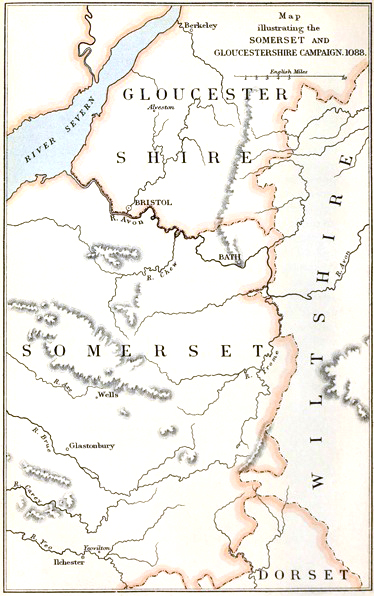
Edwᵈ. Weller
For the Delegates of the Clarendon Press.
Map
illustrating the
SOMERSET AND
GLOUCESTERSHIRE CAMPAIGN. 1088.
Bristol occupied by Bishop Geoffrey.
The castle of Bristol then, though not perched, like so
many of its fellows, on any lofty height, was placed on
a strong and important site. That site, commanding
the lower course of the Avon and the great borough
upon it, and guarding the meeting-place, still of two
shires, as once of two kingdoms, supplied an admirable
centre for the work of those whose object was, not to
guard those shires, but to lay them waste.[97]
To that
end Bristol was occupied and garrisoned by the warrior
Bishop of Coutances, Geoffrey of Mowbray. It is not
unlikely that he was already in command of the castle.
He was not only a land-owner in the two neighbouring
shires, a very great land-owner in that of Somerset;[98]
but the meagre notice of Bristol in the Great Survey
His relation to the town.
also shows that he stood in some special relation to the
borough as the receiver of the King’s dues within it.[99]
He doubtless added anything that the castle needed in
41
His works.
the way of further defences, and conjecture has attributed
to him one of the several lines which the city
walls have taken, that which brought the line of defence
most closely to the banks of the Frome.[100]
But
whatever were his works, we have no record of them;
we know only that the fierce prelate, at the head of
his partisans, turned Bristol Castle into a den of robbers.
Ravages of William of Eu and Robert of Mowbray.
His chief confederates were William of Eu, of whom we
have already spoken[101]
, and his own nephew Robert of
Mowbray. Among them they harried the land, and
brought in the fruits of their harrying to the castle.[102]
The central position of Bristol made a division of labour
easy. Of Bishop Geoffrey’s two younger confederates,
Robert undertook the work in Somerset and William
in Gloucestershire. Robert marched up the valley of the
Robert burns Bath.
Avon to the Roman town of Bath, emphatically the “old
borough.”[103]
At the foot of the hills on either side, lying,
as wicked wits put it, amid sulphureous vapours, at the
gates of hell,[104]
the square, small indeed, of the Roman
walls sheltered the abbey of Offa’s rearing, now widowed
by the death of its English abbot Ælfsige.[105]
The city had
been overthrown by the arms of Ceawlin; it had lain
42
waste like the City of the Legions;[106]
it had risen again as
an English town to share with the City of the Legions in
the two chief glories of the days of the peaceful Eadgar.
If Chester saw his triumph,[107]
Bath had seen his crowning.
And now the hand of the Norman, not the Norman
Conqueror but the Norman rebel, fell as heavily on the
English borough as the hand of the West-Saxon invader
had fallen five hundred years before. Bath was a king’s
town; as such it drew on itself the special wrath of
the rebels; the whole town was destroyed by fire, to
rise again presently in another character.[108]
From
He marches through Wiltshire to Ilchester.
Bath, the greatest town of Somerset, but which, as
placed in a corner of the land, has never claimed
to be one of its administrative centres, the destroyer
passed on to another town of Roman origin, which once
did aspire to be the head of the Sumorsætan, but from
which all traces of greatness have passed away. From
Bath Robert first marched into Wiltshire, most likely
following the line of the Avon; he there wrought much
slaughter and took great spoil. He then turned to the
south-west along the high ground of Wiltshire; he made
his way into the mid parts of Somerset, and laid siege
to the King’s town of Givelceaster, Ivelchester, Ilchester,
Position of Ilchester.
the Ischalis of a by-gone day.[109]
The town lay at the
foot of the most central range of the hills of Somerset,
43
on the edge of one of the inlets of the great marshland
of Sedgemoor. The site was marked by the junction
of the great line of the Fossway with a number of roads
in all directions. The spot was defended by the river,
the Ivel, which gives the town its English name. Here,
at the foot of the high ground, the stream widens to
surround an island, a convenient outpost in the defences
of the town which arose on its southern bank.
The siege.
Ilchester, like Bath, drew on itself the special enmity of
the rebels as being a king’s town, an enmity likely to
be the sharper because Ilchester stands within sight
of Count Robert’s castle of Montacute, and is divided
only by the river from lands which were held by
his fellow-rebel William of Eu.[110]
The Ilchester of
our day seems a strange place for a siege; but in the
days of the Red King the town was still surrounded
by strong walls, and those walls were defended by
valiant burghers. The walls and gates have perished;
the ditches have been filled up; yet the lasting impress
of the four-sided shape of the Roman chester may still
be traced in the direction of the roads and buildings
of the modern town.[111]
The importance of Ilchester had
passed away even in the sixteenth century, when of its
five or six churches all but one were in ruins; but, in the
times with which we are dealing, its hundred and seven
44
burgesses, with their market held in the old forum at the
meeting-place of the roads, held no inconsiderable place
among the smaller boroughs of Western England.[112]
What
Robert of Mowbray driven back from Ilchester.
the men of Ilchester had they knew how to defend; the
attack and the defence were vigorously carried on on
either side. Our one historian of the leaguer—he becomes
almost its minstrel—tells us how the besiegers fought
for greed of booty and love of victory, while the besieged
fought with a good heart for their own safety and that
of their friends and kinsfolk. The stronger and worthier
motive had the better luck. The dark and gloomy
Robert of Mowbray, darker and gloomier than ever,
turned away, a defeated man, from the unconquered
walls of Ilchester.[113]
This utter failure of a man who stands forth in a
marked way as one of the skilful captains of the age
was a good omen for success at points which were still
William of Eu plunders in Gloucestershire.
more important in the struggle. Meanwhile the work
of destruction was going steadily on in the lands on
the other side of Bristol, among the flock of the holy
Wulfstan. Gloucestershire was assigned as the province
of William of Eu, and he did his work with a will along
the rich valley of the Severn, still the land of pasture,
then also the land of vines.[114]
The district called Berkeley
He harries Berkeley.
Harness was laid waste with fire and sword, and the
town of Berkeley itself was plundered.[115]
Berkeley, once
45
the abode of Earl Godwine and the scene of the pious
scruples of Gytha,[116]
is now simply marked as a king’s
town;[117]
the abbey had vanished in a past generation;
the famous castle belongs to a later generation; but the
Position of Berkeley.
place was not defenceless. Berkeley is indeed one of
those places which have become strongholds almost by
accident. It looks up at a crowd of points on the bold
outlying promontories of the Cotswolds, points some of
them marked by the earthworks of unrecorded times,
which in Normandy or Maine could hardly fail to have
been seized on for the site of fortresses far sooner than
itself. Nor is it near enough to the wide estuary of the
Severn to have been of any military importance in the
way of commanding the stream. It is rather one of
those places where the English lord fixed his dwelling
on a spot which was chosen more as a convenient
centre for his lands than with any regard to purposes of
warfare. The mound, the church, the town, rose side
by side on ground but slightly higher than the rich
meadows around them. But the mound on which the
great Earl of the West-Saxons had once dwelled had
been, as usual, turned to Norman military uses.
The castle.
Earl William of Hereford, whose watchful care stretched
on both sides of the river, had crowned it with
what Domesday marks as “a little castle.”[118]
One
would be well pleased to know in what such a defence
was an advance on the palisades or other defences which
may have surrounded the hall of Godwine. In after days
46
the “little castle” was to grow into the historic home
of that historic house in whom, whether they themselves
acknowledge it or not, history must see the lineal
offspring, not of a Danish king, but of an English
staller.[119]
At present however the savage William of
Eu had not to assault the stronghold of Robert, son
of Harding and grandson of Eadnoth, but merely to
overcome whatever resistance could be offered by the
castellulum of William Fitz-Osbern. Its defences were
most likely much less strong than the Roman walls of
Ilchester. Berkeley and the coasts thereof were thoroughly
ravaged. On the whole, notwithstanding the defeat of
Robert of Mowbray, the Bishop of Coutances and his
lieutenants had done their work to their own good liking.
No small spoil from each of the three nearest shires
had been brought in to the robbers’ hold at Bristol.
Meanwhile the same work was going on busily to
the north and north-west of Bishop Geoffrey’s field of
action. Rebel centre at Hereford.
Of the movements in Herefordshire and Worcestershire
we have fuller accounts, accounts which, before we
have done, land us from the region of military history
into that of hagiography. The centre of mischief in
this region was at Hereford. The city which Harold
had called back into being, and where William Fitz-Osbern
had ruled so sternly, had now no longer an
earl; the rebel Roger was paying the penalty of his
treason at some point far away alike from Hereford,
from Flanders, and from Breteuil.[120]
The city had now
the King for its immediate lord. It was presently seized
by Roger of Lacy,[121]
and was turned into a meeting-place
47
for the disaffected. The host that came together is
marked as made up of “the men that eldest were of
Hereford, and the whole shire forthwith, and the men
of Shropshire with mickle folk of Bretland.”[122]
Some of
their names, besides that of Roger of Lacy, we have heard
already.[123]
Action of Earl Roger.
And we are significantly told that the men
of Earl Roger—the men of Shropshire—were with them,
a formula which seems specially meant to shut out the
presence of the Earl himself.[124]
And though the leaders
were “all Frenchmen,”[125]
yet among their followers were
men of all the races of the land. Not only Normans
and Britons, but Englishmen also, were seen in the rebel
ranks. So it seemed, if not in the general prospect
as it was looked at from distant Peterborough, yet at
least in the clearer view which men took from the
watch-towers of more nearly threatened Worcester.[126]
The rebels march on Worcester.
For it was the “faithful city” of after days on which
the full storm of the Western revolt was meant to burst.
The Norman lords of the border, with their British allies,
now marched on Worcester, as, thirty-three years before,
1055.an English earl of the border, with his British allies, had
marched on Hereford.[127]
They came of their own will to
deal by Worcester, shire and city, as, forty-seven years
1041.
before, English earls had been driven against their will to
deal with them at the bidding of a Danish king.[128]
“They
harried and burned on Worcestershire forth, and they came
to the port itself, and would then the port burn and the
48
minster reave, and the King’s castle win to their hands.”[129]
But Worcester was not doomed to see in the days of the
second William such a day as Hereford had seen in
the days of Eadward, as Worcester itself had seen in
the days of Harthacnut. Deliverance of Worcester.
The port was not burned, the
minster was not reaved, nor was the King’s castle won
into the hands of his enemies. And the deliverance of
Worcester is, with one accord, assigned by the writers
of the time to the presence within its walls of its bishop,
the one remaining bishop of English blood, whose unshaken
loyalty had most likely brought the special wrath
of the rebels upon his city and flock. Action of Wulfstan.
The holy Wulfstan
was grieved at heart for the woes which seemed
coming upon his people; but he bade them be of good
courage and trust in the Lord who saveth not by sword
or spear.[130]
The man who had won the heart of Northumberland
for Harold,[131]
who had saved his own city
for the first William,[132]
was now to save it again for the
second. Position of Worcester.
At Worcester, castle, minster, and episcopal palace
rose side by side immediately above the Severn. But
Worcester is no hill city like Durham or Le Mans. The
height above the stream is slight; the subordinate buildings
of the monastery went down almost to its banks.
The mound, traditionally connected with the name of
Eadgar the Giver-of-peace, has now utterly vanished;
49
it then stood to the south of the monastery, and had
become, as elsewhere, the kernel of the Norman castle.
It will be remembered that it was the sacrilegious extension
of its precincts at the hands of Urse of Abetot
which had brought down on him the curse of Ealdred.[133]
But by this time the new minster of Wulfstan’s own
building, whose site, we may suppose, was further from the
castle, that is, more to the north, than that of the church
of Oswald,[134]
was, if not yet finished, at least in making.
It may be that at this moment the two minsters—the elder
one which has wholly passed away, the newer, where
Wulfstan’s crypt and some other portions of his work
still remain among the recastings of later times,—both
stood between the mound of Eadgar and its Norman surroundings,
and the bishop’s dwelling, whatever may have
been its form in Wulfstan’s day. Still along the line of
the river, lay the buildings of the city further to the
north, with the bridge leading to the meadows and low
hills beyond the stream, backed by the varied outline
of the heights of Malvern, the home of the newly-founded
brotherhood of Ealdwine.[135]
At the moment when
the rebels drew near to Worcester, all the inhabitants
of the city, of whatever race or order, were of one heart
and of one soul under the inspiration of their holy
Bishop. Wulfstan called to the command.
Like the prophets and judges of old, Wulfstan
suddenly stands forth as first, if not in military action,
at least in military command. We know not whether
the fierce Sheriff or some captain of a milder spirit
formally bore rule in the castle. But we read that the
Norman garrison, by whom the mild virtues of the
English bishop were known and loved, practically put
him at their head. They prayed him to leave his episcopal
home beyond the church, and to take up his abode
50
with them in the fortress. If danger should be pressing,
they would feel themselves all the safer, if such an one
as he were among them.[136]
Wulfstan enters the castle.
Wulfstan agreed to their proposal,
and set out on the short journey which he was
asked to make, a journey which the encroachments of
the Sheriff had made shorter than it should have been.[137]
On his way he was surrounded by the inhabitants of
Worcester of all classes, all alike ready for battle. He
himself had, after the new fashion of Norman prelates,
a military following,[138]
and the soldiers of the King and
of the Bishop, with all the citizens of Worcester, now
came together in arms. From the height of the castle
mound, Wulfstan and his people looked forth beyond
the river. Advance of the rebels.
The foes were now advancing; they could be
seen marching towards the city, and burning and laying
waste the lands of the bishopric.[139]
Sally of the royal forces.
Soldiers and citizens
now craved the Bishop’s leave to cross the river and
meet the enemy. Wulfstan gave them leave, encouraging
them by his blessing, and by the assurance that God would
allow no harm to befall those who went forth to fight
for their King and for the deliverance of their city and
people.[140]
Grieved further by the sight of the harrying of
51
the church-lands, and pressed by the urgent prayer of all
around him, Wulfstan curses the rebels.
Wulfstan pronounced a solemn anathema
against the rebellious and sacrilegious invaders.[141]
The
loyal troops, strengthened by the exhortations and
promises of their Bishop, set forth. Victory of the king’s men.
The bridge was
made firm; the defenders of Worcester marched across
it;[142]
and the working of Wulfstan’s curse, so the tradition
of Worcester ran, smote down their enemies before
them with a more than human power. The invaders,
scattered over the fields for plunder, were at once overtaken
and overthrown. Their limbs became weak and
their eyes dim; they could hardly lift their weapons
or know friend from foe.[143]
The footmen were slaughtered;
the horsemen, Norman, English, and Welsh, were
taken prisoners; of the whole host only a few escaped
by flight. The men of the King and of the Bishop
marched back to Worcester—so Worcester dutifully
believed—without the loss of a single man from their
ranks. They came back rejoicing in the great salvation
which had been wrought by their hands, and giving
all thanks to God and his servant Wulfstan.[144]
Among the sorrows which rent the breast of the holy
Bishop of Worcester, one may have been to see a man of
52
his own order, one whom he had, somewhat strangely
perhaps, honoured with his friendship, acting as a temporal
leader in the rebellion against which he had to
wield his spiritual arms. It was, it may be remembered,
Geoffrey of Mowbray, the lord of the robbers’
hold at Bristol, who had rebuked the lamb-like simplicity
of Wulfstan’s garb.[145]
The lamb of Severnside had
now overthrown alike the wolves of Normandy and
the wild cats of the British hills. But, if Wulfstan
mourned over the evil deeds of the warlike Bishop of
Coutances, he had no such personal cause for grief over
either the sins or the sorrows of another bishop who
was meanwhile, like himself, besieged in an episcopal
city. That bishop however was not, like Wulfstan, defending
his own flock with either spiritual or temporal
arms; he was doing all the wrong in his power to the
flock of another. Movements of Odo in Kent.
The source and leader of the whole
mischief,[146]
Odo, Bishop and Earl, chose his own earldom
of Kent for the scene of his ravages. Our notes of time
are very imperfect, and we have seen that there were
movements in Kent, movements in which Odo seems
to have had a share, much earlier in the year.[147]
But
it would seem that the great outbreak of rebellion
in south-eastern England happened about the same time
as the great outbreaks more to the west and north. As
the Bishop of Coutances had fixed his head-quarters in
the castle of Bristol, so the Bishop of Bayeux now fixed
his head-quarters in the castle of Rochester, and thence
ravaged the lands of the King and the Archbishop.[148]
53
Another great Kentish fortress, that of Tunbridge, was
also in rebellion. Tunbridge and Pevensey.
So in Sussex was Pevensey, the very
firstfruits of the Conquest, where Odo’s brother Count
Robert also held out against the King. These three
fortresses now become the busy scene of our immediate
story; but the centre of all is the post occupied by
the Bishop of Bayeux and Earl of Kent. This part of
the war is emphatically the war of Rochester.
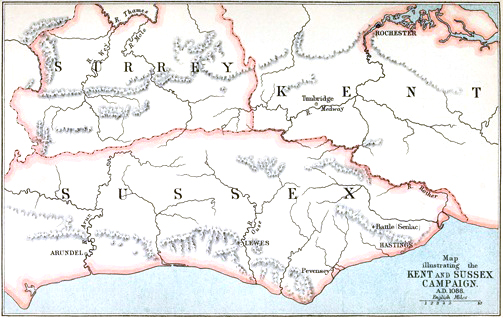
Edwᵈ. Weller
For the Delegates of the Clarendon Press.
Map
illustrating the
KENT AND SUSSEX
CAMPAIGN.
A.D. 1088.
Early history of Rochester.
The city by the Medway had been a fortress from the
earliest times. We have seen that it had already played
a part both in foreign and in civil wars. In the days
of Æthelred it still kept the Roman walls parts of which
still remain, walls which were then able to withstand
two sieges, one at the hands of the King himself, and
one at those of the Danish invaders.[149]
Importance of its position.
In truth the
position of Rochester, lying on the road from London
to Canterbury, near to the sea on a navigable river,
made it at all times a great military post.[150]
The chief
ornament of the city did not yet exist in the days of
Odo. The later castle.
The noble tower raised in the next age by Archbishop
Walter of Corbeuil, the tower which in one
struggle held out against John[151]
and in the next held
out for his son,[152]
and still remains one of the glories of
54
Norman military architecture, had perhaps not even a
forerunner of its own class.[153]
The cathedral church.
And the minster of Saint
Andrew, which the enlargements of the twelfth and
thirteenth centuries have still left one of the least
among the episcopal churches of England, had then
only the lowly forerunner which had risen, which perhaps
was still only rising, under the hands of Gundulf.[154]
The castle site fortified by the Conqueror.
But the steep scarped cliff rising above the broad tidal
stream was a stronghold in the Conqueror’s days, as it
had doubtless been in days long before his. Whether
a stone castle had yet been built is uncertain; the fact
that such an one was built for William Rufus by Gundulf
later in his reign might almost lead us to think
that as yet the site, strong in itself, was defended only
by earthworks and defences of timber.[155]
The city.
Below the
castle to the south-east lay the city, doubtless fenced
55
by the Roman wall; and a large part of its space had
now begun to form the monastic precinct of Saint
Andrew. The town is said to have been parted from
the castle by a ditch which, as at Le Mans and at
Lincoln, was overleaped by the enlarged church of the
twelfth century;[156]
in any case the castle, in all its
stages, formed a sheltering citadel to the town at its
feet. Nature of the site.
Neither town nor castle by itself occupies a peninsular
site; but a great bend of the river to the south
makes the whole ground on which they stand peninsular,
with an extent of marshy ground between the
town and the river to the north and east. The stronghold
of Rochester, no lofty natural peak, no mound of
ancient English kings, perhaps as yet gathering round
no square keep of the new Norman fashion, but in any
case a well-defended circuit with its scarped sides strengthened
by all the art of the time, was the chief fortress
of the ancient kingdom over which the Bishop of Bayeux
now ruled as Earl. The castle occupied by Odo.
It now became, under him, the great
centre of the rebellion. Gundulf, renowned as he was
for his skill in military architecture, must have been sore
let and hindered in the peaceful work of building his
church and settling the discipline of his monks,[157]
when
his brother bishop filled the castle with his men of war,
five hundred of his own knights among them.[158]
But
56
Odo was not satisfied with his garrison. Odo asks Robert to come.
He sent beyond
sea to Duke Robert for further help. The prince in
whose name Rochester was now held was earnestly
prayed to come at once at the head of the full power
of his duchy, to take possession of the crown and
kingdom which were waiting for his coming.[159]
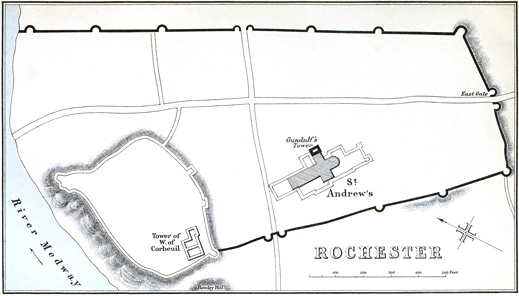
E. Weller
For the Delegates of the Clarendon Press.
ROCHESTER
The news brought to Robert.
According to the narrative which we are now following,
it would seem that Robert now heard for the
first time of the movement which was going on in his
behalf in England. His heart is lifted up at the unlooked
for news; he tells the tidings to his friends;
certain of victory, he sends some of them over to share
in the spoil; he promises to come himself with all speed,
as soon as he should have gathered a greater force.[160]
He sends over Eustace of Boulogne and Robert of Bellême.
At the head of the party which was actually sent were
two men whose names are familiar to us.[161]
One of
them, Count Eustace of Boulogne, united the characters
of a land-owner in England and of a sovereign
prince in Gaul. This was the younger Eustace, the
son of the old enemy of England, the brother of the
hero who was within a few years to win back the Holy
57
City for Christendom.[162]
With him came Robert of Bellême;
his share in the rebellion is his first act on
English ground that we have to record. Three sons of Earl Roger at Rochester.
Himself the
eldest son of Earl Roger of Shrewsbury, he had either
brought with him two of his brothers, or else they had
already embraced the cause of Odo in England. Three
sons of Roger and Mabel were now within the walls
of Rochester.[163]
Hugh of Montgomery.
The second was Hugh, who was for
a moment to represent the line of Montgomery while
Robert represented the line of Bellême, and who was
to be as fierce a scourge to the Britons of the Northern
border as Robert was to be to the valiant defenders of the
land of Maine.[164]
Roger of Poitou.
And with them was the third brother,
Roger of Poitou, the lord of the debateable land between
Mersey and Ribble,[165]
carrying as it were to the furthest
point of the earldom of Leofric the claim of his father
to the proud title which the elder Roger bears at this
stage of our story. Action of Earl Roger.
It is as Earl of the Mercians that
one teller of our tale bids us look for a moment on the
lord of Montgomery and Shrewsbury.[166]
But the Earl of
58
the Mercians was not with his sons at Rochester any
more than he had been with his men before Worcester.
He was in another seat of his scattered power. His
presence was less needed at Shrewsbury, less needed at
the continental or the insular Montgomery, than it was
in the South-Saxon land where the lord of Arundel and
Chichester held so high a place. He stays at Arundel.
While his men were
overthrown before Worcester, while his sons were
strengthening themselves at Rochester, Earl Roger himself
was watching events in his castle of Arundel.[167]
The spot was well fitted for the purpose. Arundel lies
in the same general region of England as the three
great rebel strongholds of Rochester, Tunbridge, and
Pevensey; it lies in the same shire and near the same
coast as the last named of the three. Position of Arundel.
But it lies apart
from the immediate field of action of a campaign which
should gather round those three centres. A gap in
the Sussex downs, where the Arun makes its way to
the sea through the flat land at its base, had been
marked out, most likely from the earliest times, as a
fitting spot for a stronghold. A castle at Arundel T. R. E.
The last slope of this
part of the downs towards the east was strengthened
in days before King William came with a mound and
a ditch, and Arundel is marked in the Great Survey as
one of the castles few and far between which England
contained before his coming.[168]
Description of the castle.
The shell-keep which
crowns the mound, and the gateway which flanks it,
have been recast at various later times from the twelfth
century onward, but it would be rash to assert that the
mere wall of the keep may not contain portions either of
the days of King William or of the days of King
Eadward. The traces of a vast hall, more immediately
59
overlooking the river, reared as usual on a vaulted substructure,
almost constrain us to see in them the work
of no age earlier or later than that of Roger or his
successor of his own house.[169]
The site is a natural watchtower,
whence the eye ranges far away to various points
of the compass, over the flat land and over the more
distant hills, and over the many windings of the tidal
river which then made Arundel a place of trade as well
as of defence.[170]
Less threatening than his vulture’s nest
at Tre Baldwin,[171]
less tempting to an enemy than his
fortresses on the peninsula of Shrewsbury and within the
walls of Chichester,[172]
the stronghold of Arundel seems
exactly the place for an experienced observer of men and
things like Earl Roger to look out from and bide his
time. He had to watch the course of things in the three
rebel fortresses; he had further to watch what might
come from a nearer spot, another break in the hill
ground, where, between his doubtful Arundel and rebellious
William of Warren at Lewes.
Pevensey, the twin mounds of loyal Lewes,[173]
the home of William and Gundrada, looked up to what
was one day to be the battle-ground of English freedom.
Its lord, long familiar to us as William of Warren, stood
60
firm in his allegiance, and it was now, according to some
His earldom of Surrey.
accounts, that he received his earldom of Surrey, an earldom
to be borne in after times along with that which took
its name from Roger’s own Arundel.[174]
William became
the King’s chief counsellor, and his position at Lewes
must have thrown difficulties in the way of any communication
between Arundel and Pevensey. His loyalty.
And in
truth, when Earl Roger found it safest to watch and be
prudent, we are not surprised to find events presently
shaping themselves in such a way as to make it his
wisest course to play the part of the Curio of the
tale.[175]
Action of the King.
But meanwhile where was King William? Where was
the king who had taken his place on his father’s seat
with so much ease, but whose place upon it had been so
soon and so rudely shaken? We have been called on
more than once in earlier studies to mark how the two
characters of fox and lion were mingled in the tempers
of the Conqueror and his countrymen, and assuredly the
Conqueror’s second surviving son was fully able to don
either garb when need called for it.[176]
At this moment
we are told in a marked way that William Rufus showed
himself in the character of that which is conventionally
looked on as the nobler beast. He had no mind to seek
for murky holes, like the timid fox, but, like the bold
and fearless lion, he gave himself mightily to put down
the devices of his enemies.[177]
Yet the first time when
61
He wins over Earl Roger.
we distinctly get a personal sight of him, the Red
King is seen playing the part of the fox with no small
effect. Earl Roger was assuredly no mean master of
Norman craft; but King William, in his first essay,
showed himself fully his equal. By a personal appeal
he won the Earl over from at least taking any further
personal share in the rebellion. At some place not mentioned,
perhaps at Arundel itself, the Earl, disguising,
we are told, his treason, was riding in the King’s company.[178]
The King took him aside, and argued the case
with him. He would, he said, give up the kingdom, if
such was really the wish of the old companions of his
father. He knew not wherefore they were so bitter
against him; he was ready, if they wished it, to make
them further grants of lands or money. Only let them
remember one thing; his cause and theirs were really
the same; it was safer not to dispute the will of the
man who had made both him and them what they
were. “You may,” wound up Rufus, “despise and
overthrow me; but take care lest such an example
should prove dangerous to yourselves. My father has
made me a king, and it was he alone who made you an
earl.”[179]
Roger felt or affected conviction, and followed
the King, in his bodily presence at least, during the rest
62
of the campaign.[180]
Count Robert at Pevensey.
But Robert, Count of Mortain and lord
of Cornwall, still made Pevensey one of the strongholds
of the revolt. Of the third great neighbour of these
two lords, Count Robert of Eu, father of the ravager of
Berkeley, we hear nothing on this side of the water.
Loyal Normans.
But, amid the general falling away, the throne of
William Rufus was still defended by some men of
Norman birth on whom he could better rely than on the
Earl Hugh.doubtful loyalty of the Earl of Shrewsbury.
Earl Hugh
of Chester remained faithful; so, as we have seen, did
Earl Roger’s neighbour, now or afterwards Earl William.[181]
William of Warren.
And to these already famous names we must add one
which was now only beginning to be heard of, but which
was presently to equal, if not to surpass, the renown of
either. Robert Fitz-hamon.
This was Robert Fitz-hamon, the son or grandson
of Hamon Dentatus, the rebel of Val-ès-dunes.[182]
But
it was not on the swords of the Norman followers of his
father that the son of the Conqueror rested his hopes
of keeping the crown which the Conqueror had left him.
Forces on the side of Rufus,
William Rufus had at his side two forces, either of
which, when it could put forth its full power, was
63
stronger by far than the Norman nobles. All that in
any way represented the higher feelings and instincts
of man was along with him. All that in any shape was
an embodiment of law or right was arrayed against the
men whose one avowed principle was the desire to shake
off the restraints of law in any shape. the Church, and the people.
Against the
openly proclaimed reign of lawlessness the King could
rely on the strength of the Church and the strength of
the people. With the single exception of him of Durham,
the marauding bishops of Bayeux and Coutances found
no followers among the men of their order in England.
Loyalty of the Bishops.
Lanfranc stood firmly by the King to whom he had
given the crown; and the other bishops, of whatever
origin, sought, we are told, with all faithfulness of
purpose, the things which were for peace.[183]
The King appeals to the English.
Either by
their advice or by his own discernment, the King saw
that his only course was to throw himself on the true
folk of the land, to declare himself King of the English
in fact as well as in name. His proclamation.
A written proclamation went
forth in the name of King William, addressed, doubtless
in their own ancient tongue, to the sons of the soil, the
men of English kin. The King of the English called
on the people of the English, on the valiant men who
were left of the old stock; he set forth his need to
them and craved for their loyal help.[184]
At such a
64
moment he was lavish of promises. His promises.
All the wrongs of
the days of William the Elder were to be put an end
to in the days of William the Younger. The English
folk should have again the best laws that ever before
were in this land. King William would reign over his
people like Eadward or Cnut or Ælfred. The two
great grievances of his father’s days were to cease; the
King’s coffers were no longer to be filled by money
wrung from his people; the King’s hunting-grounds
were no longer to be fenced in by the savage code
which had guarded the Conqueror’s pleasures. All
unrighteous geld he forbade, and he granted to them
their woods and right of hunting.[185]
The English take up the King’s cause.
At the sound of such
promises men’s hearts were stirred. At such moments,
men commonly listen to their hopes rather than to their
reason; the prospects and promises of a new reign are
always made the best of; and there was no special
reason as yet why the word of William the Red should
be distrusted. He had not conquered England; he had
not as yet had the means of oppressing England; he
had shown at least one virtue in dutiful attachment
65
to his father; his counsellor was the venerated Primate;
chief in loyalty to him was one yet more venerated, the
one native chief left to the English Church, the holy
Bishop of Worcester. If the English dealt with William
as an English king, he might deal with them as an
English king should deal with his people. Motives for supporting William.
In fighting
for William against the men who had risen up against
him, they would be fighting for one who had not himself
wronged them against the men who had done them the
bitterest of wrongs. If the Bishop of Bayeux and the
Bishop of Coutances, if Robert of Mortain and Robert
of Mowbray, if Eustace of Boulogne and the fierce lord
of Bellême, could all be smitten down by English axes
or driven into banishment from the English shores, if
their estates on English soil could be again parted out
as the reward of English valour, the work of the Norman
Conquest would indeed seem to be undone. And it
would be undone none the less, although the king whose
crown was made sure by English hands was himself the
son of the Conqueror of England.
Loyalty of the English.
With such feelings as these the sons of the soil
gathered with glee around the standard of King William.
Not a name is handed down to us. We know not from
what shires they came or under what leaders they
marched. They meet in London.
We see only that, as was natural when the
stress of the war lay in Kent and Sussex, the trysting-place
was London.[186]
How did that great city stand at
this moment with regard to the rebellion? It will be
remembered by what vigorous means Bishop William
of Durham claimed to have secured the allegiance of the
citizens some time earlier.[187]
At all events, whether by
66
the help of William of Saint-Calais or not, London was
now in the King’s hands. William’s English army.
There the royal host met,
a motley host, a host of horse and foot, of Normans and
English, but a host in which the English element was
by far the greatest, and in which English feeling gave
its character to the whole movement. Thirty thousand
of the true natives of the land came together of their
own free will to the defence of their lord the King.[188]
The figures are of much the same value as other figures;
it is enough if we take them as marking a general and
zealous movement. Their zeal in his cause.
The men who were thus brought
together promised the King their most zealous service;
they exhorted him to press on valiantly, to smite the
rebels, and to win for himself the Empire of the whole
island.[189]
This last phrase is worth noting, even if it be a
mere flourish of the historian. William accepted as the English king.
It marks that the change
of dynasty was fully accepted, that the son of the Conqueror
was fully acknowledged as the heir of all the
rights of Æthelstan the Glorious and of Eadmund the
Doer-of-great-deeds. A daughter of their race still sat
on the Scottish throne; but for Malcolm, the savage
devastator of Northern England, Englishmen could not
be expected to feel any love. William was now their
king, their king crowned and anointed, the lord to
whom their duty was owing as his men.[190]
Him they
would make fast on the throne of England; for him
they were ready to win the Empire of all Britain. The
English followers of Rufus loudly proclaimed their
67
hatred of rebellion. They even, we are told, called on
their leader to study the history of past times, where he
would see how faithful Englishmen had ever been to
their kings.[191]
William’s march.
At the head of this great and zealous host William
the Red set forth from London. He set forth at the
head of an English host, to fight against Norman
enemies in the Kentish and South-Saxon lands. And
in that host there may well have been men who had
marched forth from London on the like errand only
two-and-twenty years before. Great as were the changes
which had swept over the land, men must have been
still living, still able to bear arms, who had dealt their
blows in the Malfosse of Senlac amidst the last glimmerings
of light on the day of Saint Calixtus. The enemy
was nationally and even personally the same. English hatred of Odo.
The
work before all others at the present moment was to
seize the man whose spiritual exhortations had stirred
up Norman valour on that unforgotten day, and whose
temporal arm had wielded, if not the sword, at least
the war-club, in the first rank of the invaders. Odo,
the invader of old, the oppressor of later days, the
head and front of the evil rede of the present moment,
was the foremost object of the loyal and patriotic
hatred of every Englishman in the Red King’s army.
Could he be seized, it would be easier to seize his
accomplices.[192]
The great object of the campaign was
therefore to recover the castle of Rochester, the stronghold
where the rebel Bishop, with his allies from
68
Boulogne and from Bellême, bade their defiance to the
King and people of England.
It was not however deemed good to march at once
upon the immediate centre of the rebellion. A glance
at the map will show that it was better policy not
to make the attack on Rochester while both the other
rebel strongholds, Tunbridge and Pevensey, remained
unsubdued. Tunbridge castle.
The former of these, a border-post of Kent
and Sussex, guarding the upper course of the stream
that flows by Rochester, would, if won for the King,
put a strong barrier between Rochester and Pevensey.
Attack on the castle.
The march on Rochester therefore took a roundabout
course, and this part of the war opened by an attack
on Tunbridge which was the first exploit of the Red
King’s English army. Position of Tunbridge.
At a point on the Medway about
four miles within the Kentish border, at the foot of the
high ground reaching northward from the actual frontier
of the two ancient kingdoms, the winding river receives
the waters of several smaller streams, and forms a group
of low islands and peninsulas. On the slightly rising
ground to the north, commanding the stream and its
bridge, a mound had risen, fenced by a ditch on the
exposed side to the north. This ancient fortress had
grown into the castle of Gilbert the son of Richard,
called of Clare and of Tunbridge, the son of the famous
Count Gilbert of the early days of the Conqueror.[193]
As Tunbridge now stands, the outer defences of the
castle stand between the mound and the river, and the
69
mound, bearing the shell-keep, is yoked together in a
striking way with one of the noblest gateways of
the later form of mediæval military art.[194]
The general
arrangements of the latter days of the eleventh century
cannot have been widely different. The mound, doubtless
a work of English hands turned to the uses of the
stranger, was the main stronghold to be won. It was
held by a body of Bishop Odo’s knights, under the command
of its own lord Gilbert; to win it for the King and
his people was an object only second to that of seizing
the traitor prelate himself. The rebel band bade defiance
to the King and his army. The castle held out for
two days; but the zeal of the English was not to be
withstood; no work could be more to their liking
than that of attacking a Norman castle on their own
soil, even with a Norman King as their leader. The castle stormed.
The
castle was stormed; the native Chronicler, specially
recording the act of his countrymen, speaks of it, like
the castles of York in the days of Waltheof, as “tobroken.”[195]
Most likely the buildings on the mound
were thus “tobroken;” but some part of the castle enclosure
must have been left habitable and defensible.
For the garrison, with their chief Gilbert, were admitted
to terms; and Gilbert, who had been wounded
70
in the struggle, was left there under the care of a loyal
guard.
The first blow had thus gone well to the mark.
Such an exploit as this, the capture by English valour
of one of the hated strongholds of the stranger, was
enough to raise the spirit of William’s English followers
to the highest pitch. And presently they were summoned
to a work which would call forth a yet fiercer glow of
national feeling. They march towards Rochester.
After Tunbridge had fallen, they set
forth on their march towards Rochester, believing that
the arch-enemy Odo was there. Their course would be
to the north-east, keeping some way from the left side
of the Medway; Bishop Gundulf’s tower at Malling,[196]
if it was already built, would be the most marked point
on the road. But they were not to reach Rochester
by so easy a path. While they were on their way,
news came to the King that his uncle was no longer
at Rochester. Odo at Pevensey.
While the King was before Tunbridge,
the Bishop with a few followers had struck to the
south-east, and had reached his brother’s castle of
Pevensey.[197]
Odo exhorts Robert of Mortain to hold out.
The Count of Mortain and lord of Cornwall
was perhaps wavering, like his neighbour at Arundel.
The Bishop exhorted him to hold out. While the King
besieged Rochester, they would be safe at Pevensey, and
meanwhile Duke Robert and his host would cross the
71
sea. The Duke would then win the crown, and would
reward all their services.[198]
Interest of Duke Robert in the rebellion.
It is well to be reminded by words like these what
the professed object of the insurgents was. It would
be easy to forget that all the plundering that had been
done from Rochester to Ilchester had been done in
the name of the lawful rights of Duke Robert. The
men who harried Berkeley and who were overthrown at
Worcester were but the forerunners of the Duke of
His coming looked for.
the Normans, who was to come, as spring went on, with
the full force of his duchy.[199]
It was not for nothing
that King William had gathered his English army,
when a new Norman Conquest was looked for. He fails to help the rebels.
But
as yet the blow was put off; Duke Robert came not;
he seemed to think that the crown of England could
be won with ease at any moment. When the first
news of William’s accession came, when those around
him urged him to active measures to support his
rights, he had spoken of the matter with childish scorn.
His childish boasting.
Were he at the ends of the earth—the city of Alexandria
is taken as the standard of distance—the English would
not dare to make William king, William would not dare
to accept the crown at their hands, without waiting for
the coming of his elder brother.[200]
Both the impossible
72
things had happened, and Robert and his partisans had
now before them the harder task of driving William from
a throne which was already his, instead of merely hindering
him from mounting it. Up to this time Robert had done
nothing; His promises.
but now, in answer to the urgent prayers of
his uncles, he did get together a force for their help,
and promised that he would himself follow it before
long.[201]
William marches on Pevensey.
The news of Odo’s presence at Pevensey at once
changed the course of William’s march. Wherever the
Bishop of Bayeux was, there was the point to be aimed
at.[202]
Instead of going on to Rochester, the King turned
and marched straight upon Pevensey. The exact line
of his march is not told us, but it could not fail to cross,
perhaps it might for a while even coincide with, the line of
march by which Harold had pressed to the South-Saxon
coast on the eve of the great battle. The English besiege Odo in Pevensey.
Things might seem
to have strangely turned about, when an English army,
led by a son of the Conqueror, marched to lay siege to
the two brothers and chief fellow-workers of the Conqueror
within the stronghold which was the very firstfruits
of the Conquest. The Roman walls of Anderida
were still there; but their whole circuit was no longer
desolate, as it had been when the Conqueror landed, and
as we see it now again. The castle of Pevensey.
One part of the ancient city had
again become a dwelling-place of man. As Pevensey
now stands, the south-eastern corner of the Roman enclosure,
73
now again as forsaken as the rest, is fenced in
by the moat, the walls, the towers, of a castle of the
later type, the type of the Edwards, but whose towers
are built in evident imitation of the solid Roman bastions.
Then, or at some earlier time, the Roman wall
itself received a new line of parapet, and one at least of
its bastions was raised to form a tower in the restored
line of defence. When the house of Mortain passed
away in the second generation, the honour of Pevensey
became the possession of the house of Laigle, and from
them, perhaps in popular speech, certainly in the dialect
of local antiquaries, Anderida became the Honour of the
Eagle.[203]
Within the circuit of the later castle, close on
the ancient wall, rises, covered with shapeless ruins, a
small mound which doubtless marks the site of the
elder keep of Count Robert. Within that keep the two
sons of Herleva, Bishop and Count, looked down on the
shore close at their feet where they had landed with
their mightier brother two-and-twenty years before.
Within that stern memorial of their victory, they had
now to defend themselves against the sons and brothers
of men who had fallen by their hands, and whose lands
they had parted out among them for a prey.
The siege of Pevensey.
The siege of Pevensey proved a far harder work than
the siege of Tunbridge. The Roman wall with its new
Norman defences was less easy to storm than the ancient
English mound. William the Red had to wait
longer before Pevensey than William the Great had had
to wait before Exeter. The fortress was strong; the
spirit of its defenders was high; for Odo was among
them. The King beset the castle with a great host;
74
he brought the artillery of the time to bear upon its
defences; but for six weeks his rebellious uncles bore
up against the attacks of William and his Englishmen.[204]
Duke Robert at last sends help.
And, while the siege went on, another of the chances of
war seemed yet more thoroughly to reverse what had
happened on the same spot not a generation back.
Again a Norman host landed, or strove to land, within
the haven of Pevensey. But they came under other
guidance than that which had led the men who came
before them on the like errand. When William crossed
the sea, his own Mora sailed foremost and swiftest in the
whole fleet, and William himself was the first man in
his army to set foot on English ground. William in
short led his fleet; his son only sent his. Robert stays behind.
Robert still
tarried in Normandy; he was coming, but not yet; his
men were to make their way into England how they
could without him. They came, and they found the
South-Saxon coast better guarded than it had been
when Harold had to strive against two invaders at once.
The English hinder the Normans from landing.
When Robert’s ships drew nigh, they found the ships
of King William watching the coast; they found the
soldiers of King William lining the shore.[205]
On such
a spot, in such a cause, no Englishman’s heart or hand
was likely to fail him. The attempt at a new Norman
landing at Pevensey was driven back. Those who escaped
the English sailors drew near to the shore, but only
to fall into the hands of the English land-force. It must
not be forgotten that, as the coast-line then stood, when
the sea covered what is now the low ground between the
75
castle and the beach, the struggle for the landing must
have gone on close under the walls of the ancient city
and of the new-built castle. The English who beat
back the Normans of Duke Robert’s fleet as they strove
to land must have been themselves exposed to the
arrows of the Normans who guarded Count Robert’s
donjon. But the work was done. Some of the invaders
lived to be taken prisoners; but the more part,
a greater number than any man could tell, were smitten
down by the English axes or thrust back to meet their
doom in the waves of the Channel. Some who deemed
that they had still the means of escape tried to hoist the
sails of their ships and get them back to their own land.
But the elements fought against them. The winds which
had so long refused to bring the fleet of William from
Normandy to England now refused no less to take
back the fleet of Robert from England to Normandy.
And there were no means now, as there had been by the
Dive and at Saint Valery, for waiting patiently by a
friendly coast, or for winning the good will of the South-Saxon
saints by prayers or offerings.[206]
Even Saint Martin
of the Place of Battle had no call to help the eldest
son of his founder against his founder’s namesake and
chosen heir. The ships could not be moved; the English
were upon them; the Normans, a laughing-stock
to their enemies, rather than fall into their enemies’
hands, leaped from their benches into the less hostile
waters. Utter failure of the invasion.
The attempt of the Conqueror’s eldest son to
do by deputy what his father had done in person
had utterly come to nought. The new invaders of
England had been overthrown by English hands on
the spot where the work of the former invaders had
begun.
After the defeat of this attempt to bring help to the
76
besieged at Pevensey, nothing more was heard of Duke
Robert’s coming in person. Alleged death of William of Warren.
If we may believe a single
confused and doubtful narrative, the defenders of the
castle had at least the satisfaction of slaying one of the
chief men in the royal army. We are told that Earl
William of Warren was mortally wounded in the leg by
an arrow from the walls of Pevensey, and was carried to
Lewes only to die there.[207]
However this may be, the
failure of the Norman expedition carried with it the
failure of the hopes of the besieged. The castle surrenders.
Food now began
to fail them, and Odo and Robert found that there was
nothing left for them but to surrender to their nephew
on the best terms that they could get. Of the terms
which were granted to the Count of Mortain and lord
of Cornwall we hear nothing. The Bishop of Bayeux
and Earl of Kent was a more important person, and we
have full details of everything that concerned him. Terms granted to Odo.
The
terms granted to the chief stirrer up of the whole rebellion
were certainly favourable. He was called on to swear
that he would leave England, and would never come
back, unless the King sent for him, and that, before he
Rochester to be surrendered.
went, he would cause the castle of Rochester to be surrendered.[208]
For the better carrying out of the last of his
engagements, the Bishop was sent on towards Rochester
77
in the keeping of a small body of the King’s troops,
while the King himself slowly followed.[209]
No further
treachery was feared; it was taken for granted that
those who held the castle for Odo would give it up
at once when Odo came in person to bid them do so.
These hopes were vain; the young nobles who were left
in the castle, Count Eustace, Robert of Bellême, and the
rest, were not scrupulous as to the faith of treaties, and
they had no mind to give up their stronghold till they
were made to do so by force of arms. Odo was brought
before the walls of Rochester. The leaders of the party
that brought him called on the defenders of the castle
to surrender; such was the bidding alike of the King
who was absent and of the Bishop who was there in person.
But Odo’s friends could see from the wall that the voices
of the King’s messengers told one story, while the looks
of the Bishop told another. The garrison refuse to surrender; Odo taken prisoner by his own friends.
They threw open the gates;
they rushed forth on the King’s men, who were in no
case to resist them, and carried both them and the
Bishop prisoners into the castle.[210]
Odo was doubtless
a willing captive; once within the walls of Rochester,
he again became the life and soul of the defence.
78
It perhaps did not tend to the moral improvement
of William Rufus to find himself thus shamefully deceived
by one so near of kin to himself, so high in
ecclesiastical rank. At the moment the treachery of
Odo stirred him up to greater efforts. Rochester should
be won, though it might need the whole strength of
the kingdom to win it. William’s Niðing Proclamation.
But the King saw that it
was only by English hands that it could be won. He
gathered around him his English followers, and by their
advice put out a proclamation in ancient form bidding
all men, French and English, from port and from upland,
to come with all speed to the royal muster, if they
would not be branded with the shameful name of Nithing.
That name, the name which had been fixed, as
the lowest badge of infamy, on the murderer Swegen,[211]
was a name under which no Englishman could live;
and it seems to have been held that strangers settled
on English ground would have put on enough of English
feeling to be stirred in the like sort by the fear of
having such a mark set upon them. What the Frenchmen
did we are not told; The second English muster.
but the fyrd of England
answered loyally to the call of a King who thus knew
how to appeal to the most deep-set feelings and traditions
of Englishmen.[212]
Men came in crowds to King
79
William’s muster, and, in the course of May, a vast host
beset the fortress of Rochester. The siege of Rochester.
According to a practice
of which we have often heard already, two temporary
forts, no doubt of wood, were raised, so as to hem in the
besieged and to cut off their communications from without.[213]
The site of one at least of these may be looked
for on the high ground to the south of the castle, said
to be itself partly artificial, and known as Boley Hill.[214]
The besieged soon found that all resistance was useless.
They were absolutely alone. Pevensey and Tunbridge
were now in the King’s hands; since the overthrow of
Duke Robert’s fleet, they could look for no help from
Normandy; they could look for none from yet more
distant Bristol or Durham. Straits of the besieged.
Till the siege began, they
had lived at the cost of the loyal inhabitants of Kent
and London. For not only the Archbishop, but most of
the chief land-owners of Kent were on the King’s side.[215]
This is a point to be noticed amid the general falling
away of the Normans. For the land-owners of Kent,
a land where no Englishman was a tenant-in-chief, were
a class preeminently Norman. But we can well believe
that the rule of Odo, who spared neither French nor
English who stood in his way,[216]
may have been little more
to the liking of his own countrymen than it was to that of
80
the men of the land. But all chance of plunder was now
cut off; a crowd of men and horses were packed closely
together within the circuit of the fortress, with little
heed to health or cleanliness. Plague of flies.
Sickness was rife among
them, and a plague of flies, a plague which is likened to
the ancient plague of Egypt, added to their distress.[217]
There was no hope within their own defences, and
beyond them a host lay spread which there was no
chance of overcoming. At last the heart of Odo himself
failed him. They agree to surrender.
He and his fiercest comrades, Eustace of
Boulogne, even Robert of Bellême, at last brought themselves
to crave for peace at the hands of the offended
and victorious King.
Lesson of the war: the King stronger than any one noble.
It was a great and a hard lesson which Odo and
his accomplices learned at Pevensey and Rochester.
It was the great lesson of English history, the great
result of the teaching of William the Great on the day
of Salisbury, that no one noble, however great his power,
however strong the force which he could gather round
him, could strive with any hope of success against
the King of the whole land. In the royal army itself
Odo might see one who had risen as high as himself
among the conquerors of England, the father of the
fiercest of the warriors who stood beside him, following
indeed the King’s bidding, but following it against his
will. Odo and Roger of Montgomery.
Roger of Montgomery was in the host before
Rochester, an unwilling partner in a siege which was
waged against his own sons. Both he and other Normans
in the King’s army are charged with giving more of real
help to the besieged than they gave to the King whom
81
they no longer dared to withstand openly.[218]
But it was
in vain that even so great a lord as Earl Roger sought
to strive or to plot against England and her King. The unity of England.
The
policy of the Conqueror, crowning the work of earlier
kings, had made England a land in which no Earl of
Kent or of Shrewsbury could gather a host able to withstand
the King of the English at the head of the English
people.[219]
When the days came that kings were to be
brought low, it was not by the might of this or that
overgrown noble, but by the people of the land, with
the barons of the land acting only as the first rank of
the people. Those days were yet far away; but an
earlier stage in the chain of progress had been reached.
The Norman nobles had taken one step towards becoming
the first rank of the English people, when they
learned that King and people together were stronger
than they.
Rufus refuses terms to the besieged.
The defenders of Rochester had brought themselves
to ask for peace; but they still thought that they could
make terms with their sovereign. Let the King secure
to them the lands and honours which they held in his
kingdom, and they would give up the castle of Rochester
to his will; they would hold all that they had as of his
grant, and would serve him faithfully as their natural
lord.[220]
The wrath of the Red King burst forth, as well it
might. Odo at least was asking at Rochester for more
favourable terms than those to which he had already sworn
82
at Pevensey. William answered that he would grant
no terms; he had strength enough to take the castle,
whether they chose to surrender it or not. The King’s threats.And the
story runs that he added—not altogether in the spirit of
his father—that all the traitors within the walls should
be hanged on gibbets, or put to such other forms of
death as might please him.[221]
But those of his followers
who had friends or kinsfolk within the castle came to
the King to crave mercy for them. Pleadings for the besieged.
A dialogue follows
in our most detailed account, in which the scriptural
reference to the history of Saul and David may be set
down as the garnish of the monk of Saint Evroul, but
which contains arguments that are likely enough to
have been used on the two sides of the question. An
appeal is made to William’s own greatness and victory,
to his position as the successor of his father. God, who
helps those who trust in him, gives to good fathers a
worthy offspring to come after them. The men in the
castle, the proud youths and the old men blinded by
greediness, had learned that the power of kings had
not died out in the island realm. Those who had come
from Normandy—here we seem to hear an argument
from English mouths—sweeping down upon the land
like kites, they who had deemed that the kingly stock
had died out in England, had learned that the younger
William was in no way weaker than the elder.[222]
Mercy
83
was the noblest attribute of a conqueror; something
too was due to the men who had helped him to his
victory, and who now pleaded for those who had undergone
enough of punishment for their error. Answer of the King.
Rufus is
made to answer that he is thankful both to God and
to his faithful followers. But he fears that he should
be lacking in that justice which is a king’s first duty,
if he were to spare the men who had risen up against
him without cause, and who had sought the life of a
king who, as he truly said, had done them no harm.[223]
The Red King is made to employ the argument which
we have so often come across on behalf of that severe
discharge of princely duty which made the names of
his father and his younger brother live in men’s grateful
remembrance. He fears lest their prayers should lead
him away from the strait path of justice. He who spares
robbers and traitors and perjured persons takes away
the peace and safety of the innocent, and only sows
loss and slaughter for the good and for the unarmed
people.[224]
This course is one which the Red King was
very far from following in after years; but it is quite
possible that he may have made such professions at any
stage of his life, and he may have even made them
honestly at this stage. Pleadings for Odo.
But on behalf of the chiefest
of all culprits, the counsellors of mercy had special
arguments. Odo is the King’s uncle, the companion of
his father in the Conquest of England. He is moreover
a bishop, a priest of the Lord, a sharer in the privileges
to which, in one side of his twofold character, he had
84
once appealed in vain. The King is implored not to lay
hands on one of Odo’s holy calling, not to shed blood
which was at once kindred and sacred. Let the Bishop
of Bayeux at least be spared, and allowed to go back to
his proper place in his Norman diocese.[225]
Pleadings for Eustace and Robert of Bellême.
Count Eustace
too was the son of his father’s old ally and follower—the
invasion which Eustace’s father had once wrought in
that very shire seems to be conveniently forgotten.[226]
Robert of Bellême had been loved and promoted by his
father; he held no small part of Normandy; lord of many
strong castles, he stood out foremost among the nobles of
the duchy.[227]
It was no more than the bidding of prudence
to win over such men by favours, and to have their friendship
instead of their enmity.[228]
As for the rest, they were
valiant knights, whose proffered services the King would
do well not to despise.[229]
The King had shown how far
he surpassed his enemies in power, riches, and valour;
let him now show how far he surpassed them in mercy
and greatness of soul.[230]
85
To this appeal Rufus yielded. The King yields.
It was not indeed an
appeal to his knightly faith, which was in no way
pledged to the defenders of Rochester. But it was
an appeal to any gentler feelings that might be in
him, and still more so to that vein of self-esteem and
self-exaltation which was the leading feature in his character.
If Rufus had an opportunity of showing himself
greater than other men, as neither justice nor mercy
stood in the way of his making the most of it, so neither
did any mere feeling of wrath or revenge. As his
advisers told him, he was so successful that he could
afford to be merciful, and merciful he accordingly was.
To have hanged or blinded his enemies would not have
so distinctly exalted himself, as he must have felt himself
exalted, when those who had defied him, those who
had tried to make terms with him, were driven to
accept such terms as he chose to give them. He grants terms.
The Red
King then plighted his faith—and his faith when once
so plighted was never broken—that the lives and limbs
of the garrison should be safe, that they should come
forth from the castle with their arms and horses. But
they must leave the realm; they must give up all hope
of keeping their lands and honours in England, as long
at least as King William lived.[231]
To these terms they
had to yield; but Odo, even in his extremity, craved
for one favour. Odo asks for the honours of war.
He had to bear utter discomfiture, the
failure of his hopes, the loss of his lands and honours;
but he prayed to be at least spared the public scorn of
the victors. His proud soul was not ready to bear the
looks, the gestures, the triumphant shouts and songs, of
the people whom he had trodden to the earth, and who
86
had now risen up to be his conquerors. He asked, it
would seem, to be allowed to march out with what in
modern phrase are called the honours of war. His particular
prayer was that the trumpets might not sound
when he and his followers came forth from the castle.
This, we are told, was the usual ceremony after the
overthrow of an enemy and the taking of a fortress.[232]
The King was again wrathful at the request, and said
that not for a thousand marks of gold would he grant
it.[233]
Humiliation of Odo.
Odo had therefore to submit, and to drink the cup
of his humiliation to the dregs. With sad and downcast
looks he and his companions came forth from the stronghold
which could shelter them no longer. The trumpets
sounded merrily to greet them.[234]
But other sounds more
fearful than the voice of the trumpet sounded in the ears
of Odo as he came forth. Men saw passing before them,
a second time hurled down from his high estate—and
this time not by the bidding of a Norman king but by
the arms of the English people—the man who stood
forth in English eyes as the imbodiment of all that was
blackest and basest in the foreign dominion. Odo might
keep his eyes fixed on the ground, but the eyes of the
nation which he had wronged were full upon him. Wrath of the English against him.
The
English followers of Rufus pressed close upon him,
crying out with shouts which all could hear, “Halters,
bring halters; hang up the traitor Bishop and his accomplices
on the gibbet.” They turned to the King whose
throne they had made fast for him, and hailed him as
a national ruler. “Mighty King of the English, let
87
not the stirrer up of all evil go away unharmed. The
perjured murderer, whose craft and cruelty have taken
away the lives of thousands of men, ought not to live
any longer.”[235]
Cries like these, mingled with every form
of cursing and reviling, with every threat which could
rise to the lips of an oppressed people in their day of
vengeance, sounded in the ears of Odo and his comrades.[236]
But the King’s word had been passed, and the
thirst for vengeance of the wrathful English had to be
baulked. He leaves England for ever.
Odo and those who had shared with him in
the defence of Rochester went away unhurt; but they
had to leave England, and to lose all their English lands
and honours, at least for a season. But Odo left England
and all that he had in England for ever.[237]
The career
of the Earl of Kent was over; of the later career of the
Bishop of Bayeux we shall hear again.
End of the rebellion.
The rebellion was now at an end in southern England.
Revolt had been crushed at Worcester, at Pevensey,
and at Rochester, and we hear nothing more of
those movements of which Bishop Geoffrey had made
Bristol the centre, and which had met with such a reverse
at the hands of the gallant defenders of Ilchester.
88
The chronology of the whole time is very puzzling. Order of events.
We
have no exact date for the surrender of Rochester; we are
told only that it happened in the beginning of summer.[238]
But, as the siege of Pevensey lasted six weeks,[239]
it is impossible
The Whitsun Assembly. June 4, 1088.to crowd all the events which had happened
since Easter into the time between Easter and Whitsuntide.
Otherwise the pentecostal Gemót would have been
the most natural season for some acts of authority which
took place at some time during the year.
The King was now in a position to reward and to punish; and some
confiscations, some grants, Confiscations and grants.were made by him soon after
the rebellion came to an end. “Many Frenchmen forlet
their land and went over sea, and the King gave their
land to the men that were faithful to him.”[240]
Of these
confiscations and grants we should be glad to have some
details. Did any dispossessed Englishmen win back their
ancient heritage? And, if so, did they keep their recovered
heritage, notwithstanding the amnesty which at a somewhat
later time restored many of the rebels? One thing is
clear, that the Frenchmen who are now spoken of were not
the men of highest rank and greatest estates among the
rebellious Normans. For them there was an amnesty
at once. Amnesty of the chief rebels.
Them, we are told, the King spared, for the
love of his father to whom they had been faithful followers,
and out of reverence for their age which opened
a speedy prospect of their deaths. He was rewarded, it
is added, by their repentant loyalty and thankfulness,
89
which made them eager to please him by gifts and service
of all kinds.[241]
The speed with which some of the greatest among the
rebel leaders were restored to their old rank and their
old places in the King’s favour is shown by the way in
which, within a very few months, we find them acting
on the King’s side against one who at the worst was
their own accomplice, and who himself professed to have
had no part or lot in their doings. Versions of the story of the Bishop of Durham.
We must now take up
again the puzzling story of Bishop William of Durham.
We left him, according to his own version, hindered
from coming to the King by the violence of the Sheriff
of Yorkshire, and suffering a seven weeks’ harrying of
his lands which carries us into the month of May.[242]
This is exactly the time when the national Chronicler
sets the Bishop himself before us as carrying on a
general harrying of the North country.[243]
It is likely
enough that both stories are true; in a civil war above
all it is easy, without the assertion of any direct falsehood,
to draw two exactly opposite pictures by simply
leaving out the doings of each side in turn. Anyhow the
King had summoned the Bishop to his presence, and the
Bishop had not come. The King again summons the Bishop.
The King now sends a more
special and urgent summons, demanding the Bishop’s
presence in his court, that is, in all likelihood, at the
Whitsun Gemót, or at whatever assembly took its place
90
for that year.[244] The message was sent by a prelate of
high rank, that Abbot Guy who had just before been
forced by Lanfranc upon the unwilling monks of Saint
Augustine’s.[245]
The Bishop was to accompany the Abbot
to the King’s presence. The Bishop’s complaints.
But, instead of going with Guy,
Bishop William, fearing the King’s wrath and the snares
of his enemies, sent another letter, the bearer of which
went under the Abbot’s protection.[246]
The letter curiously
illustrates some of the features of the case. We
learn more details of the Sheriff’s doings. Doings of Counts Alan and Odo.
He had
divided certain of the Bishop’s lands between two very
great personages, Count Alan of the Breton and of the
Yorkshire Richmond, and Count Odo, husband of the
King’s aunt, and seemingly already lord of Holderness.[247]
The Sheriff had not only refused the King’s peace to the
Bishop; he had formally defied him on the part of the
King.[248]
Some of the Bishop’s men he had allowed to
redeem themselves; but others he had actually sold.
Were they the Bishop’s slaves, dealt with as forfeited
chattels, or did the Sheriff take on himself to degrade
freemen into slavery?[249]
The Bishop protests that he is
91
ready to come with a safe-conduct, and to prove before
all the barons of the realm that he is wholly innocent
of any crime against the King. He adds that he would
willingly come at once with the Abbot. He had full
faith in the King and his barons; but he feared his
personal enemies and the unlearned multitude.[250]
Who
were these last? Are we again driven to think of the
old popular character of the Assembly, and did the Bishop
fear that the solemn proceedings of the King’s court
would be disturbed by a loyal crowd, ready to deal out
summary justice against any one who should be even
suspected of treason? The Bishop comes with a safe-conduct.
The King sent the safe-conduct
that was asked for, and the Bishop came to the King’s
court.[251]
The two Williams, King and Bishop, now met face
to face. William of Saint-Calais pleaded his rights as
a bishop as zealously, and far more fully, than they
had been pleaded by the bishop who was also an earl.
The Bishop’s ecclesiastical claims.
The Bishop of Durham, as Bishop of Durham, held
great temporal rights; but William of Saint-Calais was
not, like his predecessor Walcher, personally earl of any
earldom. Bishop William’s assertion of the new ecclesiastical
claims reminds us of two more famous assemblies,
in the earlier of which William of Saint-Calais will appear
on the other side. In forming our estimate of the
whole story, we must never forget that the man who
surprised the Red King with claims greater than those
of Anselm is the same man who a few years later became
the counsellor of the Red King against Anselm. In
92
this first Assembly the Bishop refuses to plead otherwise
than according to the privileges of his order. The
demand is refused. He craves for the counsel of his
Metropolitan Thomas of York and of the other bishops.
This also is refused. He offers to make his personal
purgation on any charge of treason or perjury. This
is refused. The King insists that he shall be tried before
the Court after the manner of a layman. He goes back to Durham.
This the
Bishop refuses;[252]
but the King keeps his personal faith,
and the Bishop is allowed to go back safely to Durham.
We hear much of the ravages done on the Bishop’s
lands, both while he was away from Durham and after he
had gone back thither.[253]
Of ravages done by the Bishop
we hear nothing in this version. In this version William
of Saint-Calais, blackest of traitors in the Peterborough
Chronicle, is still the meekest of confessors.
June-September, 1088.
We get no further details of the Bishop of Durham’s
story till the beginning of September. But in the
meanwhile the Bishop wrote another letter to the King,
again asking leave to make his purgation. The only
answer, we are told, on the King’s part was to imprison
the Bishop’s messenger and to lay waste his lands more
thoroughly than ever. But, from the beginning of
September, the story is told with great detail. By that
time southern England at least was at peace, and by
that time too men who had taken a leading part in
the rebellion were acting as loyal subjects to the King.
Agreement between the Bishop
On the day of the Nativity of our Lady an agreement was
come to between the Bishop and three of the barons of
93
the North. Two of these were the Counts Alan and Odo,
who had received grants of the Bishop’s lands. and the Counts. September 8.
They,
it seems clear, had had no share in the rebellion; but
with them was joined a leading rebel, Roger of Poitou,
son of the Earl of Shrewsbury, whom we last heard
of as one of Odo’s accomplices at Pevensey. These
three, acting in the King’s name, pledged their faith
for the Bishop’s personal safety to and from the King’s
court. The three barons seem to make themselves in
some sort arbiters between the King and the Bishop.
His personal safety is guaranteed in any case. But the
place to which he is to be safely taken is to differ
according to the result of the trial. The terms seem
to imply that, if the three barons deem justice to be
on the side of the Bishop, he is to be taken back safely
to Durham, while, if they deem justice to be on the
side of the King, he is to be allowed freely to cross
the sea at any haven that he may choose, from Sandwich
to Exeter.[254]
In case of the Bishop’s return to Durham,
if he should find that during his absence any new
fortifications have been added to the castle, those fortifications
are to be destroyed.[255]
If, on the other hand,
the Bishop crosses the sea, the castle is to be surrendered
to the King. No agreement contrary to this present one
was to be extorted from the Bishop on any pretext.
94
The terms were agreed to by the Bishop, and were sworn
to, as far as the surrender of the castle was concerned,
by seven of the Bishop’s men, seemingly the same seven
of whom we have heard before and of whom we shall
hear again. All matters were to be settled in the King’s
court one way or the other by the coming feast of Saint
Michael; but, as this term was plainly too short, the
time of meeting was put off by the consent of both sides
to an early day in November.
The Meeting at Salisbury. November 2, 1088.
On the appointed day Bishop William of Durham
appeared in the King’s court at Salisbury. We have
not now, as we had two years before, to deal with a
gathering of all the land-owners of England in the great
plain. The castle which had been reared within the
ditches that fence in the waterless hill became the
scene of a meeting of the King and the great men of
the realm which may take its place alongside of later
meetings of the same kind in the castle by the wood
at Rockingham and in the castle by the busy streets
of Northampton. We have—from the Bishop’s side only,
it must be remembered—a minute and lifelike account
of a two days’ debate in the Assembly, a debate in which
not a few men with whose names we have been long
familiar in our story, in which others whose names and
possessions are written in the Great Survey, meet us
face to face as living men and utter characteristic
speeches in our ears. Urse of Abetot.
We are met at the threshold by
a well-known form, that of the terrible Sheriff of
Worcestershire, Urse of Abetot. Notwithstanding the
curse of Ealdred, he flourished and enjoyed court favour,
and we now find him the first among the courtiers to
meet Bishop William, and to bid him enter the royal
presence.[256]
That presence the Bishop entered four times
95
in the course of the day, having had three times to
withdraw while the Court came to a judgement on points
of law touching his case. Conduct of the Bishop.
At every stage the Bishop
raises some point, renews some protest, interposes some
delay or other. And during the whole earlier part of
the debate, it is Lanfranc who takes the chief part in
answering him; the King says little till a late stage of the
controversy. Before Bishop William comes in to the
King’s presence, he prays again, but prays in vain, to have
the counsel of his brother bishops. None of them, not
even his own Metropolitan Thomas, would give him the
kiss of peace or even a word of greeting. When he does
come in, he first raises the question whether he ought not
to be judged, and the other bishops to judge him, in full
episcopal dress. Lanfranc’s view of vestments.
To the practical mind of Lanfranc
questions about vestments did not seem of first-rate
importance. “We can judge very well,” he said, “clothed
as we are; for garments do not hinder truth.”[257]
Case of Thomas at Northampton. 1164.
This point,
it will be remembered, again came up at Northampton,
seventy-six years later. The entrance of Thomas into
the King’s hall clad in the full garb of the Primate of
all England was one of the most striking features of that
memorable day.[258]
A long legal discussion followed, in which Bishop
William and Lanfranc were the chief speakers. Some
points were merely verbal. Much turned on the construction
of the word bishopric. The Bishop of Durham
96
asked to be restored to his bishopric. Lanfranc answered
that he had not been disseized of it.[259] In the course
of this dispute one or two facts of interest come out.
Hostile dealings of the Bishop’s own men.
It appears from the Bishop’s complaint that some of
the chief men of the patrimony of Saint Cuthberht had
made their way to the meeting at Salisbury, and that not
as their bishop’s friends. They, his own liegemen, had
abjured him; they held the lands of the bishopric in
fief of the King; they had made war upon him by the
King’s orders, and were now sitting as his judges.[260]
The Bishop called on to “do right.”
But the main point was that the Bishop should, before
matters went any further, do right to the King, that
is, acknowledge the jurisdiction of the Court.[261]
This demand
the Bishop tried to evade by every means; but
it was firmly pressed both by Lanfranc and by the lay
members of the Court. These last seem to act in close
concert with the Primate, and the ecclesiastical writer
brings out in a lively way the energy of their way of
speaking.[262]
In answer to them the Bishop spake words
which amounted to a casting aside of all the earlier
jurisprudence of England, but which were only a natural
97
inference from that act of the Conqueror which had
severed the jurisdictions which ancient English custom
had joined together. He denies the authority of the Court.
He told the barons of the realm
and the other laymen who were present that with them
he had nothing to do, that he altogether refused their
jurisdiction; he demanded, that, if the King and the
Bishops allowed them to be present, they should at
least not speak against him.[263]
Growth of the new doctrines.
The doctrine of ecclesiastical
privilege had indeed grown, since, six and thirty
years before, the people of England, gathered beneath
the walls of London, had declared a traitorous archbishop
to be deprived and outlawed, and had by their
own act set another in his place. Position of Lanfranc and Bishop William.
Yet the position
of William of Saint-Calais was more consistent than
the position of Lanfranc. William of Saint-Calais
wholly denied the right of laymen to judge a bishop;
Lanfranc, the assertor of that right, had been placed
in his see on the very ground that the deposition of
Robert and the election of Stigand were both invalid, as
being merely acts of the secular power. Still, however
logical might be the Bishop’s argument, his claims
were practically new, either in English or in Norman
ears. If they had ever been heard of before, it had
been only for a moment from the lips of Odo. And
we may mark again that, though the words of William
of Saint-Calais would have won him favour with
Hildebrand, they won him no favour with Lanfranc.
Lanfranc represented the traditions of the Conqueror,
and in the days of the Conqueror, all things, divine and
human, had depended on the Conqueror’s nod.[264]
98
The King speaks.
At this stage the King speaks for the first time, and, in
this first speech the words of William the Red are mild
enough. He had hoped, he said, that the Bishop would
have first made answer to the charges which had been
brought against him, and he wondered that he had taken
any other course. But the charge had not yet been formally
made. Roger Bigod demands that the charge be read.
Amid the Bishop’s protests about the rights
of his order, this somewhat important point was pressed
by one of his fellow-rebels. This was Roger the Bigod,
he who from the castle of Norwich had done such harm
in the eastern lands, but who now appears as an adviser
of the king against whom he had been fighting a few
months before. Let the charge, he said, be brought in
due form, and let the Bishop be tried according to it.[265]
After more protests from the Bishop, the charge was
made by Hugh of Beaumont.[266]
The charge formally brought.
It contained a full
statement of the Bishop’s treason and desertion, as
already described,[267]
and the time is said to have been
when the King’s enemies came against him, and when
his own men, Bishop Odo, Earl Roger, and many others,
strove to take away his crown and kingdom.[268] It is
demanded that, on this charge and on any other charges
that the King may afterwards bring, the Bishop shall
abide by the sentence of the King’s court. We have
99
this statement only in the version of Bishop William
himself or of a local partisan. Its probable truth.
Yet there is no reason
to doubt that it is a fair representation of the formal
charge which was brought in the King’s court. That
charge brings out quite enough of overt acts of treason
to justify even the strong words of the Peterborough
Chronicler.[269]
With the secret counsels of the rebels during
Lent it does not deal; what share Bishop William had
had in them might be hard to make out by legal proof,
and the charge is quite enough for the King’s purpose
without them. But it brings out this special aggravation
of the Bishop’s guilt, that, after the rebellion had
broken out, after military operations had begun, the
Bishop was still at the King’s side, counselling action
while he was himself plotting desertion. The flight of
Bishop William, as we have already told it, really reads
not unlike the flight of Cornbury and Churchill just six
centuries later; and it would be pressing the judgement
of charity a long way to plead in his behalf the doctrine
that in revolutions men live fast.[270]
Points not dwelled on.
We may notice also
that nothing is said about the Bishop’s harryings in
Northern England. They might, according to the custom
of the time, be almost taken as implied in the fact of
his rebellion; or they might be among the other charges
which the King had ready to bring forward if he thought
good.
The Bishop’s answer.
The formal charge was thus laid before the Court, and
it was for the Bishop to make his answer. It was the
same as before. Hugh of Beaumont might say what he
chose;[271]
only according to his own ideas of canonical rule
would he answer. By this time the wrath of the lay
100
members of the Assembly was waxing hot; Wrath of the lay members.
they assailed
the Bishop, some, we are told, with arguments, some
with revilings.[272]
At this stage Bishop William found a
friend where we should hardly have looked for one.
Speech of Bishop Geoffrey on behalf of William.
The brigand Bishop of Coutances, already changed from
a rebel into a loyal subject, was there among the great
men of the realm. England knew him, not as a prelate
of the Church, but as one of the greatest of her land-owners;
but now, like Odo, he speaks as a bishop. He
appeals to the Archbishops at least to give a hearing
to Bishop William’s objection. They, the bishops and
abbots, ought no longer to sit there; they ought to
withdraw, taking with them some lay assessors, to discuss
the point raised by the Bishop of Durham, whether
he ought not to be restored to his bishopric before he
is called on to plead.[273]
Answer of Lanfranc.
Again the great ecclesiastical
statesman is inclined to scorn, almost to mock, the
scruples of lesser men. Canonical subtleties might disturb
the conscience of a bishop who had a few months
before headed a band of robbers; but the lawyer of
Pavia, the teacher of Avranches, the monk of Bec, the
Abbot of Saint Stephen’s, the Patriarch of all the nations
beyond the sea, had learned, in his long experience, that,
as changes of vestments did not greatly matter, so changes
of place and procedure did not greatly matter either.
As Lanfranc had told Bishop William that they could
judge perfectly well in the clothes which they then had
on, so now he tells Bishop Geoffrey that they can judge
101
perfectly well in the place and company in which they
were now sitting. The Bishop goes out.
There was no need to rise; let the
Bishop of Durham and his men go out, and the rest of
the Court, clergy and laity alike, would judge what
was right to be done.[274]
The Bishop warned the Court
to act according to the canons, and to let no one judge
who might not canonically judge a bishop. Lanfranc
calmly, but vaguely, assured him that justice would be
done.[275]
Defiance of Hugh of Beaumont.
Hugh of Beaumont told him more plainly, “If
I may not to-day judge you and your order, you and
your order shall never afterwards judge me.”[276]
With one
more protest, one more declaration that he would disown
any judgement which was not strictly canonical,[277]
Bishop William and his followers left the hall of
meeting.
Debate in the Bishop’s absence.
Our only narrative of these debates, the narrative of
Bishop William himself or of some one writing under
his inspiration, complains of the long delay before the
Bishop was allowed to come back, and gives a description,
one which reads like satire, of the assembly which
stayed to debate the preliminary point of law. Constitution of the Court.
There was
the King, with the bishops and earls, the sheriffs and the
lesser reeves, with the King’s huntsmen and other officials.[278]
The great officers of state, Justiciar, Chancellor,
102
Treasurer, had not yet risen to their full importance;
still it is odd to find them, as they would seem to be,
thrust in, after the manner of an et cetera, after, it
may be, Osgeat the reeve and Croc the huntsman.[279]
But
anyhow, in this purely official assembly, we may surely
see the Theningmannagemót gradually changing into the
Curia Regis.[280]
The Court, however constituted, debated
in the Bishop’s absence on the point of the law which
he had raised. The Bishop comes back.
On his return, his own Metropolitan,
Thomas of York, announced to him the decision of the
Assembly. Till he acknowledged the jurisdiction of
the Court, the King was not bound to restore anything
that had been taken from him. Debate on the word fief.
We seem to hear the
voice of Flambard, when, in announcing this decision,
Thomas makes use of the word fief, which had not
hitherto been heard in the discussion.[281]
Bishop William
catches in vain at the novelty; Archbishop Thomas
declines all verbal discussion; whether it is called
bishopric or fief, nothing is to be restored till the jurisdiction
of the court is acknowledged.[282]
Thus baffled,
Bishop William has only to fall back on his old protests,
his old demand for the counsel of his brother
bishops. Lanfranc meets him as a lawyer; the bishops
103
are his judges, and therefore cannot be his counsel.[283]
The King now steps in; the Bishop may take counsel
with his own men, but he shall have no counsel from
any man of his.[284]
The Bishop’s seven men.
The Bishop answers that, in the seven
men whom he has with him—clearly the same seven
of whom we have twice heard already—he will find but
little help against the power and learning of the whole
realm which he sees arrayed against him.[285]
He goes out the second time.
But he
gets no further help; he withdraws the second time for
consultation, but it is only with the seven men of his
own following.
The result of their secret debate suggests that Bishop
William in truth took counsel with no one but himself.
Surely no seven men of English or Norman birth could
have been found to suggest the course which William
of Saint-Calais now took. For he came back to utter
words which must have sounded strange indeed either in
English or in Norman ears. He comes back and appeals to Rome.
“The judgement which has
here been given I reject, because it is made against the
canons and against our law; nor was I canonically
summoned; but I stand here compelled by the force of
the King’s army, and despoiled of my bishopric, beyond
the bounds of my province, in the absence of all my
comprovincial bishops. I am compelled to plead my
cause in a lay assembly; and my enemies, who refuse
me their counsel and speech and the kiss of peace, laying
aside the things which I have said, judge me of
things which I have not said; and they are at once
accusers and judges; and I find it forbidden in our
law to admit such a judgement as I in my folly was
104
willing to admit.[286]
The Archbishop of Canterbury and
my own Primate ought, out of regard for God and
our order, to save me of their good will from this encroachment.
Because then, through the King’s enmity,
I see you all against me, I appeal to the Apostolic See of
Rome, to the Holy Church, and to the Blessed Peter
and his Vicar, that he may take order for a just sentence
in my affair; for to his disposition the ancient
authority of the Apostles and their successors and of
the canons reserves the greater ecclesiastical causes
and the judgement of bishops.”[287]
Character of the appeal.
Such an appeal as this was indeed going to the root
of the matter. It was laying down the rule against
which Englishmen had yet to strive for more than four
hundred years. William of Saint-Calais not only declared
that there were causes with which no English
tribunal was competent to deal, but he laid down that
among such causes were to be reckoned all judgements
where any bishop—if not every priest—was an accused
party. Bishop William could not even claim that, as
one charged with an ecclesiastical offence, he had a right
to appeal to the highest ecclesiastical judge. Even
such a claim as this was a novelty either in Normandy
or in England; but William of Saint-Calais was not
charged with any ecclesiastical offence. Except so far
as the indictment involved the charge of perjury, that
debateable ground of the two jurisdictions, the offence
105
laid to the Bishop’s charge was a purely temporal one,
that of treason against his lord the King. So arraigned,
he refuses the judgement of the King of the English and
his Witan, and appeals from them to the Bishop of
Rome. He justifies his appeal by referring to some
law other than the law of England, some special law
of his own order, by which, he alleges, he is forbidden
to submit to any such judgements as that of the
national assembly of the realm of which he is a subject.
We again instinctively ask, how would William the
Great have dealt with such an appeal, if any man had
been so hardy as to make it in his hearing? But we
again see how the ecclesiastical system which William
the Great had brought in was one which needed his
own mighty hand to guide.[288]
He was indeed, in all
causes and over all persons, ecclesiastical and temporal,
within his dominions supreme. But the moment he
himself was gone, that great supremacy seems to have
fallen in pieces. Arguments of Lanfranc.
Lanfranc himself, steadily as he maintains
the royal authority throughout the dispute, seems
to shrink from boldly grappling with the Bishop’s claim.
Some lesser fallacies we are not surprised to find passed
over. The daring statement that the sole right of the
Bishop of Rome to judge other bishops was established by
the Apostles may perhaps have seemed less strange even
to Lanfranc than it does to us. William’s comprovincials.
But Lanfranc must have
smiled, and Thomas of York must have smiled yet more,
at the Bishop of Durham’s grotesque complaint that he
was deprived of the help of his comprovincial bishops.[289]
It was a vain hope indeed, if he thought that King Malcolm
would allow him the comfort of any brotherly
counsel from Glasgow or Saint Andrews. But the real
106
point is that Lanfranc seems to avoid giving any direct
answer to Bishop William’s claim to appeal to a court
beyond the sea. Instead of stoutly denying the right
of any English subject to appeal to any foreign power
from the judgement of the highest court in England, he
falls back into Bishop William’s own subtleties about
“fief” and “bishopric;” and he appeals to the case of
Odo, where it was only the Earl and not the Bishop
who was dealt with.[290]
The verbal question goes on, till
the Bishop declares that he has no skill to dispute
against the wisdom of Lanfranc; he has been driven
to appeal to the apostolic see, and he wishes to have the
leave of the King and the Archbishop to go to the see to
which he has appealed.[291]
The Bishop goes out the third time.
A third time does he, at Lanfranc’s
bidding, leave the hall while this question is debated
by the King and his council.
On his return the
final sentence is pronounced by the mouth of Hugh of
Beaumont. He comes back, and sentence is pronounced.As the Bishop has refused to answer the
charges brought against him by the King, as he invites
the King to a tribunal at Rome, the Bishop’s fief is declared
forfeited by the judgement of the King’s court
and the barons. It really says a good deal for the long-suffering
of the prelates and barons, and of the Red
King himself, He renews his appeal.
that Bishop William again ventured to
make his appeal in more offensive terms than before.
He is ready, in any place where justice reigns and not
violence, to purge himself of all charges of crime and
perjury. He will prove in the Roman Church that the
107
judgement which has just been pronounced is false and
unjust.[292]
Hugh of Beaumont is driven to a retort; “I
and my companions are ready to confirm our judgement
in this court.” The Bishop again declares that he will
enter into no pleadings in that court. Let him speak
never so well, his words are perverted by the King’s partisans.
They have no respect for the apostolic authority,
and, even after he has made his appeal, they load him
with an unjust judgement. He will go to Rome to seek
the help of God and of Saint Peter.[293]
Up to this time the King has taken only a secondary
part in the lively dispute which has been going on in his
presence. We have listened chiefly to the pithy sayings
of Lanfranc and to the official utterances of Hugh of
Beaumont. Speeches of the King.
But now Rufus himself steps in as a chief
speaker, and that certainly in a characteristic strain.
His patience had borne a good deal, but it was now
beginning to give way. The King’s short and pointed
sentences, uttered, we must remember, with a fierce look
and a stammering tongue, are a marked contrast to the
long-turned periods and legal subtleties of the Bishop.
He now steps into the dispute from a very practical side;
“My will is that you give me up your castle, as you will
not abide by the sentence of my court.”[294]
More distinctions,
more protests, more appeals to Rome, only
stir up the Red King to the use of his familiar oath;
108
“By the face of Lucca, you shall never go out of my
hands till I have your castle.”[295]
The Bishop was now
fairly in the mouth of the lion; yet he again goes through
the whole story of his wrongs and his innocence, with
some particulars which we have not hitherto heard.
When his possessions were seized by the King’s officers,
though a hundred of his own knights looked on, no
resistance had been offered to the King’s will.[296]
He
had now nothing left but his episcopal city; if the King
wished to take that, he would offer no resistance, save
by the power of God. He would only warn him, on
behalf of God and Saint Peter and his Vicar the Pope,
not to take it. He would give hostages and sureties
that, while he went to Rome, his own men should keep
the castle, and that, if the King wished, they should
keep it for his service.[297]
The King again spoke; “Be
sure, Bishop, that you shall never go to Durham, nor
shall your men hold Durham, nor shall you escape my
hands, unless you freely give up the castle to me.”[298]
The Bishop appeals to Counts Odo and Alan.
The Bishop now for once says not a word about
canonical rights; he appeals, more shortly and more
prudently, to the plighted faith of the two Counts who
had promised that he should go back to Durham. But
Lanfranc argues that the Bishop has forfeited his safe-conduct,
and that, if he refuses to give up the castle, the
109
King may rightly arrest him.[299]
Cries of the lay members.
At this hint the lay
members of the Assembly joined in with one voice, the
foremost among them being that Randolf Peverel of
whose possessions and supposed kindred we have had
elsewhere to speak.[300]
“Take him,” was the cry, “take
him; for that old gaoler speaks well.”[301]
But at this
stage the Bishop finds friends in the Counts whose faith
had been pledged to his safe-conduct. Intervention of Count Alan.
Count Alan
formally states the terms of the agreement, and prays
the King—Odo and Roger joining with him in the
prayer—that he may not be forced to belie his faith,
as otherwise the King should have no further service
from him.[302]
But in Lanfranc’s view the second of the
two cases which were contemplated in the agreement
had taken place. The King was not bound to let the
Bishop go back to Durham; all that he was now bound
to do was to give him ships and a safe-conduct out of
the realm.[303]
The dispute goes on in the usual style.
The Bishop appeals yet again.
The Bishop continues his appeal to Rome; he again invokes
what he calls specially the Christian law, pointing,
it would seem, to a volume in his own hand;[304]
while
110
Lanfranc asserts the authority of the King’s court.[305]
The
King then steps in with one of his short speeches;
“You may say what you will, but you shall not escape
my hands, unless you first give up the castle to me.”[306]
The Bishop then makes a shorter protest than usual,
the drift of which seems to be that he is ready to suffer
any loss rather than be personally arrested.[307]
The final sentence.
The sentence
of the Court is now finally passed. A day is
fixed by which the Bishop’s men should leave the city of
Durham and the King’s men take possession of it instead.[308]
The judgement of the Assembly had thus formally gone
against the claims of the Bishop of Durham; but his
The Bishop asks for an allowance.resources were not at an end. Defeated on all points
of law, he makes an appeal to the King’s generosity.
Will his lord the King, he now prays, leave him something
from his bishopric on which he may at least be
able to live?
Lanfranc again answers; “Shall you go to
Rome, Answer of Lanfranc.to the King’s hurt and to the dishonour of all of
us, and shall the King leave lands to you? Stay in his
land, and he will give back to you all your bishopric,
except the city, on the one condition that you do right
to him in his court by the judgement of his barons.”[309]
111
Bishop William, almost parodying the words of a much
earlier appeal to Rome, says that he has appealed to the
Apostolic See, and to the Apostolic See he will go.[310]
Lanfranc retorts; “If you go to Rome without the King’s
leave, we will tell him what he ought to do with your
bishopric.” Bishop William answers in a long speech,
renewing his protests of innocence and his offers of purgation,
and setting forth the services which he claimed
to have done for the King at Dover, Hastings, and
London. The Bishop many times makes his prayer, and
the King as often refuses. Then Lanfranc counsels him
to throw himself wholly on the King’s mercy; if he will
do so, he himself will plead for him at the King’s feet.
But the Bishop still goes on about the authority of
the canons and the honour of the Church; he will
earnestly pray for the King’s mercy, but he will accept
no uncanonical judgement. The King’s offers.
The King then makes a new
proposal; “Let the Bishop give me sureties that he will
do nought to my hurt on this side the sea, and that
neither my brother nor any of my brother’s men shall
keep the ships which I shall provide to my damage or
against the will of their crews.”[311]
It certainly was
demanding a good deal to expect Bishop William to go
surety for either the will or the power of Duke Robert
to do or to hinder anything. The Bishop pleads that
the Counts pledged their faith that he should not be
obliged to enter into any agreement except the one
which had been made at Durham. The King and Ralph Paganel.
And the Sheriff of
Yorkshire, Ralph Paganel, the same who had been the
112
spoiler of the Bishop’s goods, bears witness that his
claim was a just one.[312]
By this time the wrath of the
Red King was gradually kindling; he turns on the Sheriff
with some sharpness; “Hold your peace; for no surety
will I endure to lose my ships; but if the Bishop will
give this surety which I ask, I will ask for no other.”[313]
The Bishop falls back on his old plea; he will enter into
no agreement save that into which he entered with the
Counts. The King again swears by the face of Lucca
that the Bishop shall not cross the sea that year, unless
he gives the required surety for the ships.[314]
The
Bishop then protests that, rather than be arrested, he
will give the surety and more than the surety which is
demanded; but he calls all men to witness that he does
this unwillingly and through fear of arrest.[315]
He gives
the surety, and another stage in the long debate ends.
Question of the safe-conduct.
A new point, happily the last, was raised when the
Bishop, having given the required surety, asked for ships
and a safe-conduct. The King says that he shall have
them as soon as the castle of Durham is in the King’s
power; till then, he shall have no safe-conduct, but shall
stay at Wilton.[316]
He again meekly protests; he will
endure the wrong against which he has no means of
113
striving.[317]
Then a man of Bishop Geoffrey of Coutances
steps in with a new count. Charges against the Bishop’s men.
The men who held the
Bishop of Durham’s castle had—before the Bishop came
to the King’s court; therefore, it might be inferred, with
his knowledge—taken two hundred beasts belonging to
the Bishop of Coutances which were under the King’s safe-conduct.
Bishop Geoffrey had surely seen more than two
hundred beasts brought into Bristol as the spoil of loyal
men in Somerset, Gloucestershire, and Wiltshire; but he
is careful to exact the redress of his own loss from his
brother bishop and rebel. The men of the Bishop of
Durham had refused to pay the price of the beasts; they
refused even when Walter of Eyncourt—we have met him
in Lincolnshire[318]—bade them do so in the King’s name;
he William, the man of Bishop Geoffrey, demands that
the price be paid to his lord.[319]
The King puts it to the
barons whether he can implead the Bishop on this
charge also.[320]
Interposition of Lanfranc on behalf of the Bishop.
Lanfranc, for the first time helping his
brother prelate, rules that this cannot be done. Bishop
William cannot be impleaded any further, because he
now holds nothing of the King—the surrender of the
castle of Durham is thus held to be already made—and
is entitled to the King’s safe-conduct.[321]
The Bishop to leave England.
The Assembly
now breaks up for the day; the Bishop is to choose the
haven from which he will sail, and to make known his
choice on the morrow.
The next day the Court again comes together. The
114
Bishop of Durham asks Count Alan to find him a haven
and ships at Southampton. Conditions of the Bishop’s sailing.
The King steps in; “Know
well, Bishop, that you shall never cross the channel till
I have your castle”—adding, with a remembrance of the
doings of another prelate at Rochester—“for the Bishop
of Bayeux made me smart with that kind of thing.”[322]
If
the castle of Durham was in the King’s hands by the
fixed day, the fourteenth day of November, the Bishop
should have the ships and the safe-conduct without further
delay. November 21,1088.
The King then bids Count Alan and the Sheriff
Gilbert[323]
to give the Bishop at Southampton such ships
as might be needful for his voyage seven days after the
day fixed for the surrender of the castle. November 14.
Meanwhile, on
the appointed day, the castle of Durham was received
into the King’s hands by Ivo Taillebois and Erneis of
Burun—names with which we have long been familiar.[324]
They disseized the Bishop of his church and castle and
all his land; but they gave to the Bishop’s men a writ
under the King’s seal, promising the most perfect safety
to the Bishop and his men through all England and in
their voyage.[325]
And, according to the most obvious
meaning of the narrative, Heppo, the King’s balistarius—a
man of whom, like Ivo Taillebois, we have heard in
Lincolnshire—was put into their hands as surety for the
observance of the safe-conduct.
It might have seemed that the Bishop’s troubles were
now ended, so far as they could be ended by leaving the
land which he professed to look on as a land of persecution.
115
But a crowd of hindrances were put in the way of
his voyage. Action of Ivo Taillebois.
Notwithstanding the safe-conduct given to
the Bishop’s men, a number of wrongs were done to them
by Ivo Taillebois, whose conduct may be thought to
bear out his character as drawn in the legendary history
of Crowland. The great grievance was that in defiance—so
men thought at Durham—of Lanfranc’s judgement
that Bishop William was not bound to plead in the
matter of the beasts taken from the Bishop of Coutances,
two of his knights were forced to plead on that charge.[326]
November 21.
Meanwhile the day came which had been appointed for
the Bishop’s voyage. He had been waiting at Wilton,
under the care of a certain Robert of Conteville, who had
been assigned, at his own request, to keep him from all
harm.[327]
The Bishop’s voyage delayed.
The castle had been duly given up; all seemed
ready for his crossing. Bishop William asked the Sheriff
Gilbert and his guardian Robert for ships, to cross in
the company of Robert of Mowbray.[328]
Under orders
from the King,[329]
November 26.
they kept him for five days longer,
when Robert of Conteville took him to Southampton.
The wind was favourable, and the Bishop craved for
leave to set sail at once. The King’s officers forbade
him to sail that day; the next day, when the wind had
become contrary, they, seemingly in mockery, gave him
116
leave to sail. Charge against the monk Geoffrey.
While he waited for a favourable wind,
a new charge was brought against him, founded on the
alleged doings of one of his monks, Geoffrey by name,
of whom we shall afterwards hear as being in his special
confidence. By the sentence of forfeiture pronounced
by the Court, all the Bishop’s goods had become the
property of the Crown. It was therefore deemed an
invasion of the King’s rights when, after the Bishop had
gone to the King’s court, Geoffrey took a large number
of beasts from the Bishop’s demesne. He had also taken
away part of the garrison of the castle, who had killed
a man of the King’s. New summons against the Bishop.
On this charge Bishop William
was summoned to appear in the King’s court at the
Christmas Gemót to be held in London. One of the
bearers of the summons was no less famous a man than
Bishop Osmund of Salisbury, a man of a local reputation
almost saintly.[330]
His argument with Osmund.
Bishop William again appeals to
the old agreement; he protests his innocence of any share
in the acts of Geoffrey, though he adds that he might
lawfully have done what he would with his own up to
the moment when he was formally disseized.[331]
These
words might seem to imply that the act of Geoffrey,
though done after the Bishop had left Durham, was done
before the sentence was finally pronounced. But he
cannot go to the King’s court; he has nothing left; he has
eaten his horses; that is seemingly their price.[332]
He is
117
still repeatedly forbidden to cross, even alone.[333]
In
answer to an earnest message that he might be allowed
to go to Rome, The Bishop again summoned by Walkelin.
the King sent Walkelin Bishop of Winchester
with two companions, one of them Hugh of Port,
a well-known Domesday name, to summon him to send
Geoffrey for trial to Durham and to appear himself in
London at the Christmas Gemót to answer for the deeds
of his men.[334]
In defiance of all prayers and protests, the
King’s officers kept the Bishop in ward night and day; in
his sadness he sent a message to the Counts who had given
him the safe-conduct, praying them by the faith of their
baptism to have him released from his imprisonment and
allowed to cross the sea.[335]
Interposition of the Counts.
They answered his appeal.
At their urgent prayer, the King at last let him cross.
He at last crosses to Normandy.
He sailed to Normandy, where he was honourably received
by Duke Robert, and—so the Durham writer
believed—entrusted with the care of his whole duchy.[336]
Perhaps it was owing to these new worldly cares that,
though we often hear of him again, we do not hear of
him as a suppliant at the court of Rome.
Importance of the story of William of Saint-Calais.
The tale of Bishop William of Durham is long, perhaps
in some of its stages it is wearisome; but it is too
important a contribution to our story to be left out
or cut short. It sets before us the earliest of those
debates in the King’s court of which we shall come
118
across other memorable examples before the reign of
Rufus is over. Illustrations of jurisprudence.
We see the forms and the spirit of
the jurisprudence of England in the days immediately
following the Norman Conquest, a jurisprudence which,
both in its forms and its spirit, has become strongly
technical, but which still has not yet become the exclusive
possession of a professional class. Bishops, earls,
sheriffs, are still, as of old, learned in the law, and are
fully able to carry on a legal discussion in their own
persons. And we see that a legal discussion in those
days could be carried out with a good deal of freedom
of speech on all sides. Legal trickery of the Bishop.
As to the matter of the debate,
all that we know of Bishop William, both afterwards
and at this time from other sources, can leave hardly
any doubt that he was simply availing himself of every
legal subtlety, of every pretended ecclesiastical privilege,
in order to escape a real trial in which he knew that
he would have no safe ground on the merits of the case.
Reasons for proceeding against him.
And, if it be asked why the Bishop of Durham should
have been picked out for legal prosecution, while his
accomplices were forgiven and were actually sitting as
his judges, the answer is to be found in the circumstances
of the case. As we read the tale in all other accounts,
as we read of it in the formal charge brought by Hugh
of Beaumont, we see that there was a special treachery
in Bishop William’s rebellion which distinguished his
case from that of all other rebels. Why he should have
joined the revolt at all, how he could expect that any
change could make him greater than he already was, is
certainly a difficulty; but the fact seems certain, and,
if it be true, it quite accounts for the special enmity
with which he was now pursued. The idea of the
Bishop which the story conveys to us is that of a subtle
man, full of resources, well able to counterfeit innocence,
and to employ the highest ecclesiastical claims as a
119
means to escape punishment for a civil crime. The first appeal to Rome made by William of Saint-Calais.
It was
from the mouth of William of Saint-Calais that, for the
first time as far as we can see, men who were English
by birth or settlement heard the doctrine that the King
of the English had a superior on earth, that the decrees
of the Witan of England could be rightly appealed
from to a foreign power. The later career of the
Bishop makes him a strange champion of any such
teaching. The largest charity will not allow us to give
him credit for the pure single-mindedness of Anselm, or
even for the conscious self-devotion of Thomas. We
feel throughout that he is simply using every verbal
technicality in order to avoid any discussion of the
real facts. A trial and conviction would hardly have
brought with them any harsher punishment than the
forfeiture and banishment which he actually underwent.
But it made a fairer show in men’s eyes to undergo
forfeiture and banishment in the character of a persecuted
confessor than to undergo the same amount of
loss in the character of a convicted traitor.
Behaviour of Lanfranc;
The part played by Lanfranc is eminently characteristic.
Practically he maintains the royal supremacy on
every point; but he makes no formal declaration which
could commit him to anti-papal theories. of the King.
As for William
Rufus, one is really inclined for a long while to admire
his patience through a discussion which must have been
both wearisome and provoking, rather than to feel any
wonder that, towards the end of the day, he begins to
break out into somewhat stronger language. But in the
latter part of the story, like Henry the Second but unlike
Henry the First, he stoops from his own thoroughly good
position. He shows a purpose to take every advantage
however mean, and to crush the Bishop in any way,
fair or foul. So at least it seems in our story; but one
would like to hear the other side, as one is unwilling
120
to fancy either Bishop Walkelin or Bishop Osmund
directly lending himself to sheer palpable wrong. The lesser actors.
But,
after all, not the least attractive part of the story is
the glimpse which it gives us of the lesser actors, some
of them men of whom we know from other sources the
mere names and nothing more. We feel brought nearer
to the real life of the eleventh century every time that
we are admitted to see a Domesday name becoming
something more than a name, to see Ralph Paganel, Hugh
of Port, and Heppo the Balistarius playing their parts
in an actual story. The short sharp speeches put into
the mouths of some of the smaller actors, as well as those
which are put into the mouth of the King, both add to
the liveliness of the story and increase our faith in
its trustworthiness. Conduct of the laity,
As in some other pictures of the
kind, the laity, both the great men and the general
body, stand out on the whole in favourable colours. not favourable to the Bishop.
It
is perfectly plain, from Bishop William’s own words,[337]
that he had not, like Anselm and Thomas, the mass
of the people on his side. It is equally plain that
the majority of the assembly, though they certainly
gave him a fair hearing, were neither inclined to his
cause nor convinced by his arguments. And the conduct
of the Counts Alan and Odo and their companion
Roger of Poitou is throughout that of strictly honourable
men, anxious to carry out to the letter every
point to which they have pledged their faith. The Red
King, having merely pledged his faith as a king, and
not in that more fantastic character in which he always
held his plighted word as sacred, is less scrupulous
on this head.
The affair of Bishop William brings us almost to
the last days of the year of the rebellion. But, much
121
earlier in the year, events of some importance had been
happening in other parts of the island. No recorded movement in Scotland.
We are almost
tempted to take for granted that so great a stir in
northern England as that which accompanied the banishment
of the Bishop of Durham must have been accompanied
or followed by some action on the part of King
Malcolm of Scotland. None such however is spoken
of. Movements in Wales.
But the stirs on the Western border had been taken
advantage of by the enemies of England on that side.
We have seen that British allies played a part on the
side of the rebels in the attack on Worcester. Further
north, independent Britons deemed that the time was
come for a renewal of the old border strife. When Earl
Hugh of Chester and the Marquess Robert of Rhuddlan
took opposite sides in a civil war, it was indeed an inviting
moment for any of the neighbouring Welsh princes. The
time seems to have been one of even more confusion than
usual among the Britons. State of Wales.
The year after the death of
the Conqueror is marked in their annals as a special time
of civil warfare, in which allies were brought by sea
from Scotland and Ireland. Rhys restored by a fleet from Ireland.
Rhys the son of Tewdwr,
of whom we have already heard,[338]
was driven from his
kingdom by the sons of Bleddyn, and won it again by
the help of a fleet from Ireland.[339]
Men were struck by
the vast rewards in money and captives with which he
repaid his naval allies, who are spoken of as if
some of them were still heathens.[340]
These movements
122
are not recorded by any English or Norman writer,
nor do the Welsh annals record the event with which
Norman and English feeling was more deeply concerned.
But there was clearly a connexion between the two.
Gruffydd the son of Cynan appears in the British annals
as an ally of the restored Rhys,[341]
Gruffydd’s Irish allies.
and we now find a
King Gruffydd, not only carrying slaughter by land
into the English territory, but appearing in the more
unusual character of the head of a seafaring expedition.
We may feel pretty sure that it was the presence of the
allies from Ireland—both native Irish, it would seem,
and Scandinavian settlers—which combined with the disturbed
state of England to lead Gruffydd to a frightful
inroad on the lands of the most cruel enemy of the
Britons, the Marquess Robert. He attacks Rhuddlan.
The Welsh King and his
allies marched as far as the new stronghold of Rhuddlan;
they burned much and slew many men, and carried off
many prisoners, doubtless for the Irish slave-market.[342]
It was clearly through this doubtless far more profitable
raid on the English territory that Rhys and Gruffydd
found the means of rewarding their Irish and Scandinavian
allies.
Robert of Rhuddlan.
This inroad took place while the civil war in England
was going on,[343]
a war in which it must be remembered
that other British warriors had borne their part.[344]
While
123
the lands of Rhuddlan were wasted, the Marquess Robert
was busy far away at the siege of Rochester. His probable change of party.
This would
make us think that, like Earl Roger, he changed sides
early,[345]
and that he was now in the royal camp, helping
to besiege Odo and his accomplices. He returns to North Wales.
After the surrender
of Rochester, the news of the grievous blow which had
been dealt to himself and his lands brought Robert back
to North Wales, wrathful and full of threats.[346]
The
enemy must by this time have withdrawn from the
neighbourhood of Rhuddlan; for we now hear of the
Marquess in the north-western corner of the land which
he had brought under his rule. The peninsula of Dwyganwy.
He was now in the
peninsula which ends to the north in that vast headland
which, like the other headland which ends the peninsula
of Gower to the west, bears the name of the Orm’s
Head.[347]
The mountain itself, thick set with remains
which were most likely ancient when Suetonius passed
by to Mona, forms a strong contrast to the flat ground
at its foot which stretches southward towards the tidal
mouth of the Conwy. But that flat ground is broken
by several isolated hills, once doubtless, like the Head
itself, islands. Of these the two most conspicuous, two
peaks of no great height but of marked steepness and
ruggedness, rise close together, one almost immediately
above the Conwy shore, the other landwards behind it.
They are in fact two peaks of a single hill, with a dip
between the two, as on the Capitoline hill of Rome.
124
Here was the old British stronghold of Dwyganwy,
The castle of Dwyganwy.
famous in early times as the royal seat of Maelgwyn,
him who is apostrophized in the lament of Gildas by the
name of the dragon—the worm—of the island.[348]
That
stronghold had now passed into the hands of the Marquess
Robert, and had been by him strengthened with
all the newly imported skill of Normandy. The castle
of Dwyganwy plays a part in every Welsh war during
the next two centuries, and we can hardly fancy that
much of Robert’s work survives in the remains of buildings
which are to be traced on both peaks and in the
dip between them. But it is likely that at all times
the habitable part of the castle lay between the two
peaks, while the peaks themselves formed merely military
defences. Robert at Dwyganwy.
Here then Robert was keeping his head-quarters
in the opening days of July. At noon on one
of the summer days the Marquess was sleeping—between
the peaks, we may fancy, whether in any building or in
the open air. He was roused from his slumber by
stirring tidings. Approach of Gruffydd. July 3, 1088.
King Gruffydd, at the head of three
ships, had entered the mouth of the Conwy; he had
brought his ships to anchor; his pirate crews had
landed and were laying waste the country. The tide
ebbed; the ships stood on the dry land; the followers
of Gruffydd spread themselves far and wide over the
flat country, and carried prisoners and cattle to their
ships.[349]
The Marquess rose; he climbed the height immediately
125
above him, a height which looks on the flat
land, the open sea, the estuary now crowned on the
other side by Conwy with its diadem of towers, over the
inland hills, and on the Orm’s Head itself rising in the
full view to the northward. He saw beneath him a
sight which might have stirred a more sluggish soul.
As King Henry had looked down on the slaughter of
his troops at Varaville,[350]
so Robert, from his fortified
post of Dwyganwy, saw his men carried off in bonds
and thrown into the ships along with the sheep.[351]
Eagerness of Robert.
He
sent forth orders for a general gathering, and made ready
for an attack on the plunderers at the head of such men
as were with him at the moment. They were few; they
were unarmed; but he called on them to make their
way down the steep hillside and to fall on the plunderers
on the shore before the returning tide enabled
them to carry off their booty.[352]
The appeal met with
no hearty answer; the followers of the valiant Marquess
pleaded their small numbers and the hard task
126
of making their way down the steep and rocky height.[353]
But Robert was not to be kept back; he still saw what
was doing through the whole of the peninsular lowlands.
He could not bear to let the favourable moment
pass by. Without his cuirass, attended only by a single
knight, Osbern of Orgères, he went down to attack the
enemy on the shores of the estuary.[354]
Death of
Robert.
When the Britons
saw him alone, with only a single companion and no
defence but his shield, they gathered round him to overwhelm
him with darts and arrows, none daring to attack
him with the sword.[355]
He still stood, wounded, with
his shield bristling with missiles, but still defying his
enemies. At last his wounds bore him down. The
weight of the encumbered shield was too much for
him; he sank on his knees[356]
, and commended his soul
to God and His Mother. Then the enemy rushed on
him with one accord; they smote off his head in sight
of his followers, and fixed it as a trophy on the mast
of one of the ships.[357]
Men saw all this from the hilltop
with grief and rage; but they could give no help.
127
A crowd came together on the shore; but it was too
late; the lord of Rhuddlan was already slain. By
this time the invaders were able to put to sea, and the
followers of Robert were also able to get their ships
together and follow them. They followed in wrath and
sorrow, as they saw the head of their chief on the
mast.[358]
Gruffydd must have felt himself the weaker.
He ordered the head to be taken down and cast into
the sea. On this the pursuers gave up the chase; His burial at Chester.
they
took up the body of the slain Marquess, and, amidst
much grief of Normans and English,[359]
buried him in
Saint Werburh’s minster at Chester.[360]
We are well pleased to have preserved to us this
living piece of personal anecdote, which reminds us for
a moment of the deaths of Harold and of Hereward.
Connexion of Robert with Saint Evroul.
Its preservation we doubtless owe to the connexion of
Robert of Rhuddlan with the house of Saint Evroul.
Otherwise we might have known no more of the conqueror
of North Wales than we can learn from the
entries in Domesday which record his possessions.[361]
But Robert, nephew of Hugh of Grantmesnil, had enriched
his uncle’s foundation with estates in England,
and in the city of Chester itself.[362]
He was therefore
128
not allowed to sleep for ever in the foreign soil of
Chester. He had a brother Arnold, a monk of Saint
Evroul, zealous in all things for his house, who had
begged endless gifts for it from his kinsfolk in England,
Sicily, and elsewhere. His translation to Saint Evroul.
Some years after Robert’s
death, Arnold came to England, and, by the leave of
Bishop Robert of Chester or Coventry—Bishop of the
Mercians in the phrase of the monk who was born in
his diocese—translated the body of Robert to the minster
of Saint Evroul. There a skilful painter, Reginald
surnamed Bartholomew—most likely a monk who had
taken the apostolic name on entering religion—was
employed to adorn the tomb of Robert and the arch
which sheltered it with all the devices of his art.[363]
Orderic writes his epitaph.
And the English monk Vital—we know him better by
his English and worldly name—was set to compose
the epitaph of one who had in some sort, like himself,
passed from Mercia to Saint Evroul.[364]
In his history
Orderic deemed it his duty to brand Robert’s dealings
with the Welsh as breaches of the natural law which
binds man to man.[365]
Its character.
And it may be that something of
the same feeling peeps out in the words of the epitaph
itself, which prays with unusual fervour for the forgiveness
of Robert’s sins.[366]
Yet in the verses which record
his acts, his campaigns against the Briton appear as
worthy exploits alongside of his zeal for holy things
and his special love for the house of Ouche. It is not
129
easy to track out all these exploits, even in the narrative
of Orderic himself, much less in the annals of
Robert’s British enemies. But all the mightiest names
of the Cymry are set forth in order, as having felt the
might of the daring Marquess. He had built Rhuddlan
and had guarded it against the fierce people of the land.
He had ofttimes crossed beyond Conwy and Snowdon
in arms. He had put King Bleddyn to flight and had
won great spoil from him. He had carried off King Howel
as a prisoner in bonds. He had taken King Gruffydd
and had overthrown Trahaern. That Howel, his former
captive, should rejoice at his fall is in no way wonderful;
but the epitaph speaks further of the treachery
of a certain Owen, of which there is no mention in the
prose narrative.[367]
In any case Robert of Rhuddlan
stands out as one of the mightiest enemies of the
Northern Cymry, and the tale of his end is one of the
most picturesque in this reign of picturesque incidents.
End of the Norman Conquest.
The rebellion was now over, and the new King was
firm upon his throne. And with the rebellion, the last
scene, as we have already said, of the Norman Conquest
130
was over also. Englishmen and Normans had, for the
last time under those names, met in open fight on English
soil. Whether of the two had won the victory?
The Conquest confirmed and undone.Such a question might admit of different answers when
the Norman King vanquished the Norman nobility at
the head of the English people. In one sense the Conquest
was confirmed; in another sense it was undone.
How far undone.
Men must have felt that the Conquest was undone, that
the wergeld of those who fell two-and-twenty years
back was indeed paid, when the second Norman host
that strove to land on the beach of Pevensey, instead of
marching on to Hastings, to Senlac, to London, and to
York, was beaten back from the English coast by the
arms of Englishmen. They must have felt that it was
undone, when the castles on which Englishmen looked as
the darkest badges of bondage were stormed by an English
host, gathered together at the same bidding which had
gathered men together to fight at Sherstone and at
Stamfordbridge. He must have been Nithing indeed
who did not feel that the wrongs of many days were
paid for, when the arch-oppressor, the most loathed of
all his race, came forth with downcast looks to meet
the jeers and curses of the nation on which he had
trampled. Days like the day of Tunbridge, the day of
Pevensey, and the day of Rochester, are among the days
which make the heart of a nation swell higher for their
memory. They were days on which the Englishman
overcame the Norman, days which ruled that he who
would reign over England must reign with the good
will of the English people. Tendencies to union.
The fusion of Normans and
English was as yet far from being brought to perfection;
indeed nothing could show more clearly than those days
that the gap between the two nations still yawned in
all its fulness. But nothing did more than the work of
those days at once to fill up the gap and to rule in what
131
way it should be filled up. Those days showed that the
land was still an English land, that the choice of its
ruler rested in the last resort with the true folk of the
land. Those days ruled that Normans and English
should become one people; but they further ruled, if
there could be any doubt about the matter, that they
were to become one people by the Normans becoming
Englishmen, not by the English becoming Normans.
It is significant that, in recording the next general rebellion,
the Chronicler no longer marks the traitors as
“the richest Frenchmen that were on this land;” they
are simply “the head men here on land who took rede
together against the King.”[368]
How far confirmed.
But, if in this way the Conquest was undone, if it was
ruled that England was still to be England, in another
way the Conquest was confirmed. The English people
showed that the English crown was still theirs to bestow;
but at the same time they showed that they
had no longer a thought of bestowing it out of the house
of their Conqueror. The Norman dynasty accepted.
When the English people came together
at the bidding of the Conqueror’s son, when they
willingly plighted their faith to him and called on him,
as King of the English, to trust himself to English
loyalty, they formally accepted the Conquest, so far
as it took the form of a change of dynasty. Men
pressed to fight for King William against the pretender
Robert; not a voice was raised for Eadgar or Wulf
or Olaf of Denmark. The stock of the Bastard of
Falaise was received as the cynecyn of England, instead
of the stock of Cerdic and Woden; for there must have
132
been few indeed who remembered that William the Red,
unlike his father, unlike Harold, unlike Cnut, did come
of the stock of Cerdic and Woden by the spindle-side.[369]
And, in admitting the change of dynasty, all was admitted
which the change of dynasty immediately implied. Men
who accepted the son could not ask for the wiping out
of the acts of the father. They could not ask for a new
confiscation and a new Domesday the other way. In
accepting the son of the Conqueror, they also accepted
the settlement of the Conqueror. Acceptance of the Norman nobility in an English character.
His earls, his bishops,
his knights, his grantees of land from Wight to Cheviot,
were accepted as lawful owners of English lands and
offices. But the very acceptance implied that they could
hold English lands and offices only in the character of
Englishmen, and that that character they must now
put on.
In this way the reign of William Rufus marks a stage
in the developement or recovery of English nationality
and freedom. And yet at the time the days of Rufus
must have seemed the darkest of all days. Rufus’ breach of his promises.
No reign
ever began with brighter promises than the real reign
of William the Red; for we can hardly count his reign
as really beginning till the rebellion was put down. No
reign ever became blacker. No king was ever more
distinctly placed on his throne by the good will of his
people. No other king was ever hated as William Rufus
lived to be hated. No other king more utterly and
shamefully broke the promises of good government by
which he had gained his crown. Englishmen not oppressed as such;
And yet we may doubt
whether William Rufus can be fairly set down as an
oppressor of Englishmen, in the sense which those words
would bear in the mouths of a certain school of writers.
His reign is rather a reign of general wrong-doing, a
reign of oppression which regarded no distinctions of
133
race, rank, or order, a time when the mercenary soldier,
of whatever race, did what he thought good, and when
all other men had to put up with what he thought good.
but the general oppression touches them most.
In such a state of things the burthen of oppression would
undoubtedly fall by far the most heavily upon the native
English; they would be the class most open to suffering
and least able to obtain redress. The broken promises
of the King had been specially made to them, and they
would feel specially aggrieved and disheartened at his
breach of them. Still the good government which Rufus
promised, but which he did not give, was a good government
which would have profited all the King’s men, French
and English, and the lack of it pressed, in its measure, on
all the King’s men, French and English. There is at least
nothing to show that, during the reign of Rufus, Englishmen,
as Englishmen, were formally and purposely picked
out as victims. We must further remember that no legal
barrier parted the two races, and that the legal innovations
of the reign of Rufus, as mainly affecting the King’s
military tenants, bore most hardly on a class which was
more largely Norman than English. Rufus and the English.
On the other hand,
it is certain that native Englishmen did sometimes, if
rarely, rise to high places, both ecclesiastical and temporal,
in the days of Rufus. Of the many stories current
about this king, not above one or two throw any light
on his relations to the native English class of his subjects.
The one saying of his that bears on the subject savours
of good-humoured banter rather than of dislike or even
contempt.[370]
On the whole, dark as is the picture given
us of the reign of Rufus, we cannot look on it as having
134
at all turned back or checked the course of national
advance. The mercenaries.
When mercenary soldiers have the upper hand,
they are sure to be chosen rather from strangers of any
race than from natives of the land of any race. There
is indeed no reason to think that either a native Englishman
or a man of Norman descent born in England
would, if he were strong, brave, and faithful, be shut
out from the Red King’s military family. The eye of
Rufus must have been keen enough to mark many an
act of good service done on the shore of Pevensey or
beneath the stronghold of Rochester. But all experience
shows that the tendency of such military families is to
recruit themselves anywhere rather than among the sons
of the soil. And nothing draws the sons of the soil
more closely together than the presence of strangers on
the soil. In their presence they learn to forget any
mutual grievances against one another. Their favour helps the fusion of races.
In after times
Normans and English drew together against Brabançons
and Poitevins. We may feel sure that they did so from
the beginning, and that the reign of Rufus really had its
share in making ready the way for the fusion of the two
races, by making both races feel themselves fellow-sufferers
in a time of common wrong-doing.
The rebellion and its suppression, the affairs of the
Bishop of Durham, and the striking episode by the Orm’s
Head, fill up the first stirring year of the Red King.
But the year of the rebellion is also marked by one or two
ecclesiastical events, which throw some light on the state
of things in the early days of Rufus, while he still had
Lanfranc to his guide. Sale of ecclesiastical offices.
The great ecclesiastical crimes
of the Red King in his after days were the bestowal
of bishoprics and abbeys for money, and the practice
of keeping them vacant for his own profit. Of these
two abuses, the former seems to have been the earlier
135
in date. The keeping prelacies vacant was one of the
devices of Randolf Flambard, Prolonging of vacancies.
and it could hardly
have been brought into play during the very first
year of Rufus. The influence of Lanfranc too would be
powerful to hinder so public an act as the keeping
vacant of a bishopric or abbey; it would be less
powerful to hinder a private transaction on the King’s
part which might be done without the Primate’s knowledge.
Add to this, that, while the filling a church or
keeping it vacant was a matter of fact about which
there could be no doubt, the question whether the King
had or had not received a bribe was a matter of surmise
and suspicion, even when the surmise and suspicion happened
to be just. It is then not wonderful that we find
Rufus charged with corrupt dealings of this last kind
at a very early stage of his reign. Case of Thurstan of Glastonbury.
We have seen
that Thurstan, the fierce Abbot of Glastonbury, was,
by one of the first acts of Rufus, restored to the office
which he had so unworthily filled, and from which the
Conqueror had so worthily put him aside. And we
have seen that it was at least the general belief that
his restoration was brought about by a lavish gift to
the King’s hoard.[371]
But three prelacies, two bishoprics
and a great abbey, which either were vacant at the
moment of the Conqueror’s death or which fell vacant
very soon after, were filled without any unreasonable
delay. Geoffrey Bishop of Chichester; dies September 25, 1088.
Stigand, Bishop of Chichester, died about the
time of the Conqeror’s death, whether before or after,
and his see was filled by his successor before the end
of the year.[372]
Geoffrey’s own tenure was short; he
died in the year of the rebellion, and, as his see did
136
then remain vacant three years, we may set that down
as the beginning of the evil practice.[373]
Death of Scotland of Saint Augustine’s and Ælfsige of Bath.
About the same
time died Scotland Abbot of Saint Augustine’s, and the
English Ælfsige, who still kept the abbey of Bath. Not
long after died Ælfsige’s diocesan, the Lotharingian Gisa,
who had striven so hard to bring in the Lotharingian
discipline among his canons of Wells.[374]
Death of Bishop Gisa. 1088.
The bishopric of
the Sumorsætan was thus among the first sees which fell
to the disposal of William the Red, and his disposal of it
led to one of the most marked changes in its history.
The bishopric of Somerset granted to John of Tours.
The bishopric was given to John, called de Villula, a
physician of Tours, one of the men of eminence whom
the discerning patronage of William the Great had
brought from lands alike beyond his island realm and
beyond his continental duchy. John was a trusty
counsellor of the Red King, employed by him in many
affairs, and withal a zealous encourager of learning.[375]
But he had little regard to the traditions and feelings
of Englishmen, least of all to those of the canons of
Wells. He removes the see to Bath.
Like Hermann, Remigius, and other bishops
of his time, he carried out the policy of transferring
episcopal sees to the chief towns of their dioceses. But
the way in which he carried out his scheme, if not
137
exactly like the violent inroad of Robert of Limesey
on the church of Coventry,[376]
was at least like the first
designs of Hermann on the church of Malmesbury,
which had been thwarted by the interposition of Earl
Harold.[377]
The change was made in a perfectly orderly
manner, but by the secular power only. The abbey of
Bath was now vacant by the death of its abbot Ælfsige.
Bishop John procured that the vacant post should be
granted to himself and his successors for the increase of
the bishopric of Somerset. This was done by a royal
grant made at Winchester soon after the suppression
of the rebellion, and confirmed somewhat later in a
meeting of the Witan at Dover.[378]
John then transferred
his bishopsettle from its older seat at Wells to the church
which had now become his. Grant of the temporal lordship.
He next procured a grant
of the temporal lordship of the “old borough,” which
was perhaps of less value after its late burning by
Robert of Mowbray.[379]
Thus, in the language of the time,
Andrew had to yield to Simon, the younger brother to
the elder.[380]
That is, the church of Saint Peter at Bath,
with its Benedictine monks, displaced the church of
Saint Andrew at Wells, with its secular canons freshly
instructed in the rule of Chrodegang, as the head church
of the bishopric of Somerset. The line of the independent
abbots of Bath came to an end; their office was
merged in the bishopric, by the new style of Bishop
of Bath. Thus the old Roman city in a corner of the
land of the Sumorsætan, which has never claimed the
temporal headship of that land, became for a while
the seat of its chief pastor.
138
That so great an ecclesiastical change should be
The change made wholly by the civil authority.
wrought by the authority of the King and his Witan—perhaps
in the first instance by the King’s authority
only—shows clearly how strong an ecclesiastical supremacy
the new king had inherited from his father
and his father’s English predecessors. By the authority
of the Great Council of the realm, but without any
licence from Pope or synod, an ancient ecclesiastical
office was abolished, the constitution of one church was
altered, and another was degraded from its rank as an
episcopal see. The change was made, so says the Red
King’s charter, for the good of the Red King’s soul,
and for the profit of his kingdom and people. It is
more certain that it was eminently distasteful to both
the ecclesiastical bodies which were immediately concerned.
Power of bishops.
The treatment which they met with illustrates
the absolute power which the bishops of the eleventh
century exercised over their monks and canons, but
which so largely passed away from them in the course
of the twelfth. Dislike to the change on the part of the canons of Wells
To the canons of Wells Bishop John
was as stern a master or conqueror as Bishop Robert
was to the monks of Coventry. They were deprived
of their revenues, deprived of the common buildings
which had been built for them by Gisa, and left to live
how they might in the little town which had sprung
up at the bishop’s gate.[381]
and the monks of Bath.
To the English monks of Offa’s
house at Bath the new bishop was hardly gentler; he
deemed them dolts and barbarians, and cut short their revenues
and allowances. It was not till he was surrounded
by a more enlightened company of monks of his own
choosing that he began to restore something for the relief
of their poor estate.[382]
Buildings of John of Tours. 1088–1122.
But in his architectural works
he was magnificent. His long reign of thirty-four years
139
allowed him, not only to begin, but seemingly to finish,
the great church of Saint Peter of Bath, of which a few
traces only remain, and the nave only of which is represented
by the present building.[383]
The church of Bath called abbey.
And though, since the
days of Ælfsige, there has never been an Abbot of Bath
distinct from the Bishop, yet abbey, and not minster or
cathedral, is the name by which the church of Bath is
always known to this day.[384]
Disturbances on the appointment of Guy at Saint Augustine’s.
The disturbances at Saint Augustine’s which followed
the death of Abbot Scotland, and the chief features of
which have been described elsewhere, must have taken
place earlier in the year. For the appointment or intrusion
of Guy took place while Odo was still acting as
Earl of Kent.[385]
But the great outbreak, in which the
citizens of Canterbury took part with the monks against
the Abbot, did not happen till after the death of Lanfranc.
Then monks and citizens alike made an armed
attack on Guy, and hard fighting, accompanied by many
wounds and some deaths, was waged between them and
the Abbot’s military following.[386]
Flight of Guy.
The Abbot himself
escaped only by fleeing to the rival house of Christ
Church. Then came two Bishops, Walkelin of Winchester
140
and Gundulf of Rochester, accompanied by some
lay nobles, with the King’s orders to punish the offenders.
Punishment of the rebellious monks.
The monks were scourged; but, by the intercession
of the Prior and monks of Christ Church, the
discipline was inflicted privately with no lay eyes to
behold.[387]
They were then scattered through different
monasteries, and twenty-four monks of Christ Church,
with their sub-prior Anthony as Prior, were sent to
colonize the empty cloister of Saint Augustine’s.[388]
Punishment of the citizens.
The
doom of the citizens was harder; those who were found
guilty of a share in the attack on the Abbot lost their
eyes.[389]
The justice of the Red King, stern as it was,
thus drew the distinction for which Thomas of London
strove in after days. The lives and limbs of monastic
offenders were sacred.
§ 3. The Character of William Rufus.
Death of Lanfranc. May 24, 1089.
The one great event recorded in the year after the
rebellion was the death of Archbishop Lanfranc, an
141
event at once important in itself,
and still more important
in the effect which it had on the character of
William Rufus, and in its consequent effect on the general
Its effects.march of events. The removal of a man who had played
so great a part in all affairs since the earliest days
of the Conquest, who had been for so many years, both
before and after the Conquest, the right hand man of
the Conqueror, was in itself no small change. For
good or for evil, the Lombard Primate had left his
mark for ever on the Church and realm of England.
Position of Lanfranc in England and Normandy.
One of the abetters of the Conquest, the chief instrument
of the Conqueror, he had found the way to the
good will of the conquered people, with whom and with
whose land either his feelings or his policy led him
freely to identify himself.[390]
It must never be forgotten
that, if Lanfranc was a stranger in England, he was no
less a stranger in Normandy. As such, he was doubtless
better able to act as a kind of mediator between
the Norman King and the English people; he could do
somewhat, if not to lighten the yoke, at least to make
it less galling. In the last events of his life we have
seen him act as one of the leaders in a cause which was
at once that of the English people and of the Norman
King. We have seen too some specimens of his worldly
wisdom, of his skill in fence and debate. An ecclesiastical
statesman rather than either a saint or strictly
a churchman, it seems rather a narrow view of him
when the national Chronicler sends him out of the
world with the hope that he was gone to the heavenly
kingdom, but with the special character of the venerable
father and patron of monks.[391]
His primacy of
142
nearly nineteen years ended in the May of the year
following the rebellion.[392]
His burial at Christ Church.
He was buried in the metropolitan
church of his own rebuilding, and, when his
shorter choir gave way to the grander conceptions of
the days of his successor, the sweet savour that came
from his tomb made all men sure that the pious hope
of the Chronicler had been fulfilled.[393]
Lanfranc was borne to his grave amid general sorrow.[394]
But the sorrow might have been yet deeper, if
men had known the effect which his death would have
on the character of the King and his reign. Change for the worse in the King’s character.
Up to this
time the worst features of the character of William
Rufus had not shown themselves in their fulness. As
long as his father lived, as long as Lanfranc lived, he
had in some measure kept them in check. We need
not suppose any sudden or violent change. It is the
manifest exaggeration of a writer who had his own
reasons for drawing as favourable a picture as he could
of the Red King, when we are told that, as long as
Lanfranc lived, he showed himself, under that wholesome
influence, the perfect model of a ruler.[395]
There
143
can be no doubt that, while Lanfranc yet lived, William
Rufus began to cast aside his fetters, and to look on his
monitor with some degree of ill will. Lanfranc’s rebukes of William.
The Primate had
already had to rebuke him for breach of the solemn promises
of his coronation, and it was then that he received the
characteristic and memorable answer that no man could
keep all his promises. But there is no reason to doubt
that the death of Lanfranc set Rufus free from the last
traces of moral restraint.[396]
His dutiful submission to
his father had been the best feature in his character;
and it is clear that some measure of the same feeling
extended itself to the guardian to whose care his father,
both in life and in death, had entrusted him. But now
he was no longer under tutors and governors; there was
no longer any man to whom he could in any sense look
up. He was left to his own devices, or to the counsels
of men whose counsels were not likely to improve
him. It was not a wholesome exchange when the
authority of Lanfranc and William the Great was exchanged
for the cunning service of Randolf Flambard and
the military companionship of Robert of Bellême.
Picture of William Rufus.
As soon then as Lanfranc was dead, William Rufus
burst all bounds, and the man stood forth as he was, or
as his unhappy circumstances had made him. We may
now look at him, physically and morally, as he is drawn
in very elaborate pictures by contemporary hands. William,
the third son of the Conqueror, was born before
his father came into England; but I do not know that
there is any evidence to fix the exact year of his birth.
144
Birth of William Rufus, c. 1060.
He is spoken of as young[397]
at the time of his accession,
and from the date of the marriage of the Conqueror and
Matilda, it would seem likely that their third son would
then be about twenty-seven years of age. He would
therefore be hardly thirty at the time of the death of
Lanfranc. His outward appearance.
The description of his personal appearance
is not specially inviting. In his bodily form he seems,
like his brother Robert,[398]
a kind of caricature of his
father, as Rufus, though certainly not Robert, was also
in some of his moral and mental qualities. He was a
man of no great stature, of a thick square frame, with
a projecting stomach. His bodily strength was great;
his eye was restless; his speech was stammering, especially
when he was stirred to anger. He lacked the power
of speech which had belonged to his father and had even
descended to his elder brother; his pent-up wrath or
merriment, or whatever the momentary passion might be,
broke out in short sharp sentences, often showing some
readiness of wit, but no continued flow of speech. His surname of Rufus.
He
had the yellow hair of his race, and the ruddiness of
his countenance gave him the surname which has stuck
to him so closely. The second William is yet more emphatically
the Red King than his father is either the
Bastard or the Conqueror. Unlike most other names
of the kind, his surname is not only used by contemporary
writers, but it is used by them almost as a proper
name.[399]
Up to the time of his accession, he had played no
part in public affairs; in truth he had no opportunity of
145
playing any. The policy of the Conqueror had kept
his sons dependent on himself, without governments or
estates.[400]
Rufus in youth.
We have a picture of Rufus in his youthful
days, as the young soldier foremost in every strife, who
deemed himself disgraced, if any other took to his arms
before himself, if he was not the first to challenge an
enemy or to overthrow any enemy that challenged his
side.[401]
His filial duty.
Above all things, he had shown himself a dutiful
son, cleaving steadfastly to his father, both in peace and
war. His filial zeal had been increased after the rebellion
of his brother, when the hope of the succession had
begun to be opened to himself.[402]
By his father’s side,
in defence of his father, he had himself received a wound
at Gerberoi.[403]
Such was his character beyond the sea;
146
but the one fact known of him in England before his
father’s death is that he had, like most men of his
time who had the chance, possessed himself in some
illegal way of a small amount of ecclesiastical land.[404]
It is quite possible that both his father and Lanfranc
may have been deceived as to his real character. His natural gifts.
In
the stormy times which followed his accession, he had
shown the qualities of an able captain and something
more. He had shown great readiness of spirit, great
power of adapting himself to circumstances, great skill
in keeping friends and in winning over enemies. No
man could doubt that the new King of the English had
in him the power, if he chose to use it, of becoming a
great and a good ruler. His conduct during the rebellion.
And assuredly he could not
be charged with anything like either cruelty or breach
of faith at any stage of the warfare by which his crown
was made fast to him. If he anywhere showed the
cloven foot, it was in the matter of the Bishop of
Durham. Case of the Bishop of Durham.
Even there we can have no doubt that he
spared a traitor; but he may have been hasty in the
earliest stage of the quarrel; he certainly, in its latter
stages, showed signs of that small personal spite, that
disposition to take mean personal advantages of an
enemy, which was so common in the kings of those
days. Still, whatever Lanfranc may have found to rebuke,
whatever may have been the beginnings of evil
while the Primate yet lived, no public act of the new
king is as yet recorded which would lead us to pass
any severe sentence upon him, if he is judged according
to the measure of his own times.
It is indeed remarkable that the pictures of evil-doing
which mark the reign of Rufus from the Chronicle
onwards are, except when they take the form of personal
147
anecdote, mainly of a general kind. General charges against Rufus.
Those pictures,
those anecdotes, leave no room to doubt that the reign
of Rufus was a reign of fearful oppression; but his oppression
seems to have consisted more in the unrestrained
Little personal cruelty;
licence which he allowed to his followers than in any
special deeds of personal cruelty done by his own hands
or by his immediate orders. comparison with his father and brother.
Rufus certainly did not
share his father’s life-long shrinking from taking human
life anywhere but in battle; but his brother Henry, the
model ruler of his time, the king who made peace for man
and deer, is really chargeable with uglier deeds in his
own person than any that can be distinctly proved
against the Red King. We are driven back to our
old distinction. The excesses of the followers of Rufus,
the reign of unright and unlaw which they brought
with them, did or threatened harm to every man in his
dominions; the occasional cruelties of Henry hurt only
a few people, while the general strictness of his rule
profited every one. His profligacy and irreligion.
What makes William Rufus stand out
personally in so specially hateful a light is not so much
deeds of personal cruelty, as indulgence in the foulest forms
of vice, combined with a form of irreligion which startled
not only saints but ordinary sinners. Redeeming features in his character.
And the point
is that, hateful as these features in his character were,
they did not hinder the presence of other features which
were not hateful in the view of his own age, of some
indeed which are not hateful in the view of any age.
His marked personality.
The marked personality of William Rufus, the way
in which that personality stamped itself on the memory
of his age, is shown by the elaborate pictures which
we have of his character, and by the crowd of personal
anecdotes by which those pictures are illustrated. Allowing
for the sure tendency of such a character to get worse,
we may take our survey of the Red King as he seemed
in men’s eyes when the restraints of his earlier life were
148
taken away. As long as his father lived, he had little
power to do evil; as long as Lanfranc lived, he was kept
within some kind of bounds by respect for the man to
whom he owed so much. When Lanfranc was gone, he
either was corrupted by prosperity, or else, like Tiberius,[405]
his natural character was now for the first time able to
show itself in the absence of restraint. Comparison with his father.
His character
then stood out boldly, and men might compare him with
his father. William the Red may pass for William the
Great with all his nobler qualities, intellectual and moral,
left out.[406]
He could be, when he chose, either a great
captain or a great ruler; but it was only by fits and
starts that he chose to be either. His alleged firmness of purpose.
His memory was
strong; he at least never forgot an injury; he had also
a kind of firmness of purpose; that is, he was earnest
in whatever he undertook for good or for evil, and could
not easily be turned from his will.[407]
His caprice.
But he lacked that
true steadiness of purpose, that power of waiting for
the right time, that unfailing adaptation of means to
ends, which lends somewhat of moral dignity even to
149
the worst deeds of his father. The elder William, we
may be sure, loved power and loved success; he loved
them as the objects and the rewards of a well-studied
and abiding policy. The younger William rather loved
the excitement of winning them, and the ostentatious
display of them when they were won. Hard as it was
for others to turn him from his purpose, no man was
more easily turned from it by his own caprice. No
man began so many things and finished so few of them.
His military undertakings are always ably planned and
set on foot with great vigour. His unfinished campaigns.
But his campaigns come
to an end without any visible cause. After elaborate
preparations and energetic beginnings, the Red King turns
away to something else, often without either any marked
success to satisfy him or any marked defeat to discourage
him. If he could not carry his point at the first rush,
he seems to have lacked steadiness to go on. We have
seen what he could do when fighting for his crown at
the head of a loyal nation. He does not show in so
favourable a light, even as a captain, much less as a
man, when he was fighting to gratify a restless ambition
at the head of hirelings gathered from every land.
His “magnanimity.”
The two qualities for which he is chiefly praised by
the writer who strives to make the best of him are his
magnanimity and his liberality. The former word must
not be taken in its modern English use. It is reckoned
as a virtue; it therefore does not exactly answer to
the older English use of the word “high-minded;” but
it perhaps comes nearer to it than to anything that
would be spoken of as magnanimity now. It was at
all events a virtue which easily degenerated into a
vice; the magnanimity of William Rufus changed, it is
allowed, by degrees into needless harshness.[408]
The
leading feature of the Red King’s character was a
150
boundless pride and self-confidence, tempered by occasional
fits of that kind of generosity which is really
the offspring of pride. His boundless pride.
We see little in him either of
real justice or of real mercy; but he held himself too
high to hurt those whom he deemed it beneath him to
hurt. His overweening notion of his own greatness,
personal and official, his belief in the dignity of kings
and specially in the dignity of King William of England,
led him, perhaps not to a belief in his star like
Buonaparte, certainly not to a belief in any favouring
power, like Sulla,[409]
but to a kind of conviction that neither
human strength nor the powers of nature could or ought
to withstand his will. This high opinion of himself
he asserted after his own fashion. The stern and
dignified aspect of his father degenerated in him into
the mere affectation of a lofty bearing, a fierce and
threatening look.[410]
His private demeanour.
This was for the outside world;
in the lighter moments of more familiar intercourse,
the grim pleasantry into which the stately courtesy
of his father sometimes relaxed degenerated in him into
a habit of reckless jesting, which took the specially
shameless form of mocking excuses for his own evil
deeds.[411]
Indeed his boasted loftiness of spirit sometimes
laid him open to be mocked and cheated by those around
him. Trick of his chamberlain.
One of the endless stories about him, stories which,
true or false, mark the character of the man, told how,
when his chamberlain brought him a pair of new boots,
he asked the price. Hearing that they cost three
shillings only—a good price, one would have thought,
151
in the coinage of those times—he bade his officer take
them away as unworthy of a king and bring him a
pair worth a mark of silver. The cunning chamberlain
brought a worse pair, which he professed to have bought
at the higher price, and which Rufus accordingly pronounced
to be worthy of a King’s majesty.[412]
Such a
tale could not have been believed or invented except
of a man in whose nature true dignity, true greatness
of soul, found no place, but who was puffed up with a
feeling of his own importance, which, if it could sometimes
be shaped into the likeness of something nobler,
could also sometimes sink into vanity of the silliest
and most childish kind.
His “liberality.”
But the quality for which the Red King was most
famous in his own day, a quality which was, we are
told, blazed abroad through all lands, East and West,
was what his own age called his boundless liberality.
The wealth of England was a standing subject of wonder
in other lands, and in the days of Rufus men wondered
no less at the lavish way in which it was scattered
abroad by the open hand of her King.[413]
But the liberality
of Rufus had no claim to that name in its higher sense.[414]
It was not that kind of liberality which spends ungrudgingly
152
for good purposes out of stores which have
been honestly come by; it was a liberality which gave
for purposes of wrong out of stores which were brought
together by wrong. His wastefulness.
It was a liberality which consisted
in the most reckless personal waste in matters of daily
life, and which in public affairs took the form of lavish
bribes paid to seduce the subjects of other princes from
their allegiance, of lavish payments to troops of mercenary
soldiers, hired for the oppression of his own
dominions and the disquieting of the dominions of others.
It was said of him that the merchant could draw from
him any price for his wares, and that the soldier could
draw from him any pay for his services.[415]
The sources
which supplied William with his wealth were of a piece
with the objects to which his wealth was applied; under
him the two ideas of liberality and oppression can never
be separated. What was called liberality by the foreign
mercenary was called extortion by the plundered Englishman.
His reward to the loyal troops after the rebellion.
The hoard at Winchester, full as the Conqueror had
left it, could not stay full for ever; it is implied that
it was greatly drawn upon by gifts to those who saved
William’s crown and kingdom at Pevensey and Rochester.[416]
This was of a truth the best spent money of the Red
King’s reign; for it rewarded true and honest service,
and service done by the hands of Englishmen. But to
fill the hoard again, to keep it filled amid the constant
drain, to keep up with the lavishness of one to whom
prodigality had become part of his nature,[417]
needed
153
every kind of unrighteous extortion. His extortions.
The land was bowed
down by what, in the living speech of our forefathers,
was called ungeld; money, that is, wrung from the
people by unrede, unright, and unlaw.[418]
His generally strict government.
Like his father,
Rufus was, as a rule, strict in preserving the peace of the
land; his hand was heavy on the murderer and the
robber. The law of his father which forbade the punishment
of death[419]
was either formally repealed or allowed
to fall into disuse. The robber was now sent to the
gallows; but, when he had got thither, he might still
save his neck by a timely payment to the King’s
coffers.[420]
And the sternness of the law which smote
offenders who had no such prevailing plea was relaxed
also in favour of all who were in the immediate
service of the King.[421]
His lavishness to his mercenaries.
The chief objects of William’s
boasted liberality were his mercenary soldiers, picked
men from all lands. A strong hand and a ready
wit, by whomsoever shown and howsoever proved,
were a passport to the Red King’s service and to his
personal favour.[422]
And those who thus won his personal
favour were more likely to be altogether strangers than
natives of the land, whether of the conquering or of the
conquered race. Chiefly foreigners.
We may suspect that the settled inhabitants
of England, whether English or Norman, knew the
King’s mercenaries mainly as a body of aliens who had
licence to do any kind of wrong among them without
fear of punishment. The native Englishman and his
Norman neighbour had alike to complain of the chartered
154
brigands who went through the land, wasting the substance
of those who tilled it, and snatching the food out
of the very mouths of the wretched.[423]
Their wrongdoings.
A more detailed
picture sets before us how, when the King drew near
to any place, men fled from their houses into the woods,
or anywhere else where they could hide themselves.
For the King’s followers, when they were quartered in
any house, carried off, sold, or burned, whatever was
in it. They took the householder’s store of drink to
wash the feet of their horses, and everywhere offered the
cruellest of insults to men’s wives and daughters.[424]
And
for all this no redress was to be had; the law of the
land and the discipline of the camp had alike become a
dead letter in the case of offenders of this class. The
oppressions of the King’s immediate company were often
complained of in better times and under better kings;
but they seem to have reached a greater height under
William Rufus than at any time before or after. Statute of Henry against them. 1108.
We
hear of no such doings under the settled rule of the
Conqueror; under Henry they were checked by a statute
of fearful severity.[425]
As usual, the picture of the time
cannot be so well drawn in any words as those in which
the native Chronicler draws it in our own tongue. King
William “was very strong and stern over his land and
his men and his neighbours, and very much to be feared,
and, through evil men’s rede that to him ever welcome
were, and through his own greediness, he harassed his
land with his army and with ungeld. For in his days
155
ilk right fell away, and ilk unright for God and for world
uprose.”[426]
Thus were the promises with which William Rufus
had bought the help of the English people in his day
of danger utterly trampled under foot. He had promised
them good laws and freedom from unrighteous taxes;
he had promised them that they should have again, as
in the days of Cnut,[427]
the right of every man to slay
the beasts of the field for his lawful needs. Instead
of all this, the reign of the younger William became,
above all other reigns, a reign of unlaw and of ungeld.
Stricter forest laws.
The savage pleasures of the father, for the sake of which
he had laid waste the homes and fields of Hampshire,
were sought after by the son with a yet keener zest,
and were fenced in by a yet sterner code. In the days
of William the Red the man who slew a hart had, what
he had not in the days of William the Great, to pay
for his crime with his life.[428]
The working of this stern
law is shown in one of the many stories of William
Rufus, a story of which we should like to hear the end
a little more clearly.[429]
Story of the fifty Englishmen.
Fifty men were charged with
having taken, killed, and eaten the King’s deer. We
are so generally left to guess at the nationality of the
lesser actors in our story that our attention is specially
called to the marked way in which we are told that
156
they were men of Old-English birth, once of high rank
in the land, and who had contrived still to keep some
remnants of their ancient wealth.[430]
They belonged
doubtless to the class of King’s thegns; if we were told
in what shire the tale was laid, Domesday might help us
to their names. Why mentioned as Englishmen.
This is one of the very few passages
which might suggest the notion that Englishmen, as
Englishmen, were specially picked out for oppression.
And it may well be true that the forest laws pressed
with special harshness on native Englishmen; no man
would have so great temptation to offend against them
as a dispossessed Englishman. What is not shown is
that a man of Norman birth who offended in the same
way would have fared any better. The mention of the
accused men as Englishmen comes from the teller of the
story only; and he most likely points out the fact in
order to explain what next follows. On their denying
the charge, they were sent to the ordeal of hot iron.
Granting that killing a deer was a crime at all, this
was simply the ancient English way of dealing with
the alleged criminal. We are therefore a little surprised
when our informant seems to speak of the appeal to the
ordeal as a piece of special cruelty.[431]
Their acquittal by ordeal.
The fiery test was
gone through; but God, we are told, took care to save the
innocent, and on the third day, when their hands were
157
formally examined, they were found to be unhurt. The
King in his wrath uttered words of blasphemy. The King’s blasphemous comment.
Men said
that God was a just judge; he would believe it no
longer. God was no judge of these matters; he would
for the future take them into his own hands.[432]
To
understand the full force of such words, we must remember
that the ordeal was, in its own nature, an
appeal to the judgement of God in cases when there
was no evidence on which man could found a judgement.[433]
What happened further we are not told; it can
hardly be meant that the men in whose favour the
judgement of God was held to have been given were
sent to the gallows all the same.
Special vices of Rufus.
In this last story the most distinctive feature of the
character of William Rufus comes out. In many of his
recorded deeds we see the picture of an evil man and an
evil king, but still of a man and a king whose deeds
might find many parallels in other times and places.
But the story in which he mocks at the ordeal leads us
to those other points in him which give him a place of
his own, a place which perhaps none other in the long
roll-call of evil kings can dispute with him. Other
kings have been cruel; others have been lustful; others
have broken their faith with their people, and have said
in their hearts that there was no God. But the Red King
stands well nigh alone in bringing back the foulest vices
of heathendom into a Christian land, and at the same
158
time openly proclaiming himself the personal enemy
of his Maker.
Contrast between Rufus and his father.
It is with regard to his daily life and to the beliefs
and objects which his age looked on as sacred that
William Rufus stands out in the most glaring contrast
to his father. William the Great, I need hardly repeat,
was austere in his personal morals and a strict observer
of every outward religious duty. His court was decent;
the men who stood before him kept, we are told, to the
modesty of the elder days. Old and new fashions of dress.
Their clothes were fitted
to the form of their bodies, leaving them ready to run or
ride or do anything that was to be done.[434]
They shaved
their beards—all save penitents, captives, and pilgrims—and
cut their hair close.[435]
But with the death of William,
of Pope Gregory, and of other religious princes,
the good old times passed away, and their decorous
fashions were forgotten through all the Western lands.[436]
Then vain and foppish forms of attire came in. The
gilded youth of Normandy and of Norman England
began to wear long garments like women, which hindered
walking or acting of any kind; they let their
hair grow long like women; they copied the walk and
mien of women.[437]
The pointed shoes.
Above all, their feet were shod with
shoes with long curved points, like the horns of rams
or the tails of scorpions. These long and puffed shoes
159
were the device of a courtier of Rufus, Robert henceforth
surnamed the Cornard, and they were further improved
by Count Fulk of Anjou, when he wished to hide the
swellings on his gouty feet.[438]
The long hair and the
long-pointed shoes serve as special subjects for declamation
among the moral writers of the time.[439]
Fashionable vices of the time.
But these
unseemly fashions were only the outward signs of the
deeper corruption within. The courtiers, the minions, of
Rufus, forerunners of the minions of the last Henry of
Valois, altogether forsook the law of God and the customs
of their fathers. The day they passed in sleep; the
night in revellings, dicing, and vain talk.[440]
Vices before
unknown, the vices of the East, the special sin, as Englishmen
then deemed, of the Norman, were rife among
them. Personal crimes of the King.
And deepest of all in guilt was the Red King
himself. Into the details of the private life of Rufus
it is well not to grope too narrowly. In him England
might see on her own soil the habits of the ancient
Greek and the modern Turk. His sins were of a kind
from which his brother Henry, no model of moral perfection,
was deemed to be wholly free, and which he was
believed to look upon with loathing.[441]
Sinners, even of the special type of the Red King, have
before now been zealous supporters of orthodoxy. If William
persecuted Anselm, Constans defended Athanasius.
His irreligion.
But the foulness of William’s life was of a piece with his
open mockery of everything which other men in his day
held sacred. Whatever else divided Englishman and
Norman, they were at least one in religious doctrine
160
and religious worship. In matters of dogma Stigand
was as orthodox as Lanfranc. But now, among the
endless classes of adventurers whom the Conquest
brought to try their luck in the conquered land, came
men of a race whom Normans and Englishmen alike
looked on as cut off from all national and religious
fellowship. Coming of the Jews.
In the wake of the Conqueror the Jews of
Rouen found their way to London,[442]
and before long we
find settlements of the Hebrew race in the chief cities
and boroughs of England, at York, Winchester, Lincoln,
Bristol, Oxford, and even at the gates of the Abbots of
Saint Edmund’s and Saint Alban’s.[443]
Their position in England.
They came as the
King’s special men, or more truly his special chattels,
strangers alike to the Church and to the commonwealth
of England, but strong in the protection of a master
who commonly found it to his interest to defend them
against all others. Hated, feared, and loathed, but far
too deeply feared to be scorned or oppressed, they
stalked defiantly among the people of the land, on
whose wants they throve. They lived safe from harm
or insult, save now and then, when popular wrath burst
all bounds, and when their proud mansions and fortified
quarters could shelter them no longer from raging
crowds eager to wash out their debts in the blood
of their creditors.[444]
The romantic picture of the despised,
161
trembling, Jew, cringing before every Christian
that he meets, is, in any age of English history, simply
a romantic picture. Favour shown to them by Rufus.
In the days of Rufus at all events,
the Jews of Rouen and London stood erect before the
prince of the land, and they seem to have enjoyed no
small share of his favour and personal familiarity. The
presence of the unbelieving Hebrew supplied the Red
King with many opportunities for mocking at Christianity
and its ministers. He is even said to have shown
himself more than once, when it was to his interest so to
show himself, as a kind of missionary of the Hebrew faith.
He was not the only prince of his age who discouraged
conversions to Christianity on the part of distinct races
who could be made more useful, if they remained distinct,
and who could in no way be kept so distinct as if they
remained in the position of infidels. Comparison with the Sicilian Saracens.
Count Roger of
Sicily found that the unbelieving Saracens,[445]
and William
Rufus found that the unbelieving Hebrews, were, each in
their own way, more profitable to their several masters
than if they had been allowed to lose their distinct being
among their Christian neighbours. William’s vein of mockery.
But in the whole
dealings of Rufus with the Jews there is a vein of
mockery in which, if Roger shared, it is not recorded.
It is true that we do not find Rufus taking the part of
the Jew, except when the Jew made it worth his while
to do so. But when he did take the Jew’s part, he clearly
found a malicious pleasure in taking it. He enjoyed
showing favour to the Jew, because so to do gave annoyance
to the Christian.
Question of William’s scepticism.
Whether Rufus was in any strict sense an intellectual
sceptic may be doubted. That he was such cannot be
inferred from his bidding in bitter mockery the Jewish
rabbis and the bishops of England to dispute before
him on the tenets of their several creeds, promising to
162
embrace the faith of the strangers, if they should have the
better in the discussion. The dispute between Jews and Christians.
The discussion took place in
London, most likely when the prelates were gathered for
some Whitsun Gemót. The Christian cause was supported
by several bishops and clerks—one would like to have
their names—who argued, we are told, in great fear on
behalf of the faith which was thus jeoparded.[446]
As is
usual in such cases, each side claimed the victory;[447]
but in
any case the arguments on the Hebrew side were not so
overwhelming as to make the King become an avowed
votary of Moses. Still he did what he could to hinder
the ranks of the Church from being swelled at the cost of
the synagogue. In a story which must belong to the latter
part of his reign, we read how the Jews of Rouen began
to be frightened at the great numbers of their body
who fell away from the law of their fathers. Jews turn back again.
They came
to the King, and, by a large bribe, obtained from him
a promise that the converts should be constrained to go
back to the faith which they had forsaken. They were
brought before Rufus, and most of them were by his
terrible threats forced again to apostatize.[448]
The tale
163
of the Red King’s success in this crooked kind of missionary
enterprise reached the ears of a Jew father—where
we are not told—whose only and well-beloved son was lost
to him by conversion to the Christian faith. Story of the convert Stephen and his father.
The young
man had been favoured with a vision of the protomartyr
Stephen, who had bidden him ask for baptism and take
his own name at the font.[449]
He went to a priest, told
his tale, and was admitted to baptism by the name
which was appointed to him. His father, mourning for
his loss, went to King William and made his complaint;
praying that at his command his son might be restored
to his old faith.[450]
Rufus held his peace; the argument
which alone persuaded him to meddle in such matters
had not yet been urged.[451]
A promise of sixty marks
of silver, payable on the second conversion of the youth,
brought the King to another mind,[452]
and Stephen was
called into the royal presence. A dialogue took place
164
between the King and the neophyte, in which Rufus, remembering
Dispute between Stephen and the King.
perhaps the one redeeming feature in his own
life, pressed Stephen’s return to Judaism as a matter of
filial duty. The youth humbly suggests that the King is
joking. Rufus waxes wroth, and takes to words of abuse
and to his usual oath. Stephen’s eyes shall be torn out,
if he does not presently obey his bidding.[453]
The youth
stands firm, and even rebukes the King. He can be no
good Christian who, instead of trying to win to Christ
those who are estranged from him, strives to drive back
those who have already embraced his faith. Rufus, put
to shame by the answer, has nothing to say, but drives
Stephen from his presence with scorn.[454]
The Jew father
is waiting without. His son overwhelms him with words
of abuse which even zeal for his new faith would hardly
justify. He would no longer acknowledge a father in
one whose own father was the Devil, and who, not
satisfied with his own damnation, sought the damnation
of his son.[455]
With this somewhat harsh way of putting
matters, the zealous youth vanishes from the story; the
Jew father has yet another turn with the Red King. The King’s compromise with Stephen’s father.
He
is called in, and Rufus says that he has done what he had
been asked to do, and demands the promised payment for
his pains.[456]
The Jew expostulates. His son, he says, is
firmer than ever in his Christian faith and in his hatred
towards himself. Yet the King says that he has done what
165
he had been asked, and demands payment. “Finish,” he
goes on, with a boldness which challenges some sympathy,
“what you have begun, and then we will settle about
my promise; such was our agreement.”[457]
It is characteristic
of Rufus not to be angry at a really bold
word. Evidently entering into the grotesque side of the
dispute, he rejects the doctrine of payment by results; he
answers that he has done his best, and that, though he
had not succeeded, he cannot go away with nothing for
his trouble.[458]
At last, after some further haggling, the
parties in this strange dispute come to a compromise.
The Jew pays, and the King receives, half the sum which
had been promised in the beginning.
A king of whom such stories as these could be told,
whether every detail is literally true or not, must have
utterly cast aside all the decencies of his own or of any
other age. But Rufus, according to the tales told of him,
went even further than this. William’s defiance of God.
He is charged with a kind
of personal defiance of the Almighty, quite distinct alike
from mere carelessness and from speculative unbelief.
When he recovered from the sickness which forms such
an epoch in his life, 1093.“God,” he said, “shall never see
me a good man; I have suffered too much at his
hands.”[459]
He mocked at God’s judgement and doubted
his justice—his disbelief in the ordeal is quoted as an
166
instance. Either God did not know the deeds of men,
or else he weighed them in an unfair balance.[460]
He was
wroth if any one ventured to add the usual reserve of
God’s will to anything which he, King William, undertook
or ordered to be undertaken. He had that belief
in himself that he would have everything referred to his
own wisdom and power only.[461]
Modern ideas might be
less shocked at another alleged sign of his impiety. His contempt for the saints.
He
was said to have declared publicly that neither Saint
Peter nor any other saint had any influence with God,
and that he would ask none of them for help.[462]
In all
this we are again left in doubt whether we are dealing
with a speculative unbeliever, or only with one who was
so puffed up with pride that he liked not to be reminded
of any power greater than his own, least of all of a
power which might some day call him to account for
his evil deeds. Frequency of blasphemy.
And though William Rufus clearly went
lengths in his defiance of God to which even bad men
were unaccustomed, we must remember that something
of the same kind in a less degree was not uncommon
in his time. Blasphemy strictly so called, that is, neither
167
simple irreverence nor intellectual unbelief, but direct reviling
and defiance of a power which, by the very terms
of the defiance, is believed in, is a vice of which Englishmen
of our own day have hardly any notion. But, as it
has many parallels in heathen creeds, as it has not yet
died out in all parts of Christendom, so it was by no
means unknown in the days with which we are dealing.
Its frequency at a somewhat later time is shown when
Contrast of Saint Lewis.
the biographer of Saint Lewis sets it down as one of his
special virtues, that he never, under any circumstance,
allowed any reviling of God or the saints.[463]
Case of Henry the Second.
On the
other hand, we find Henry the Second, whom there is no
reason whatever to look on as a speculative unbeliever,
indulging, as in lesser forms of irreverence, so also in
direct reviling of God.[464]
But the vice, to us so revolting
and unintelligible, seems to have reached its highest
point in the King of whom men said in proverbs that
he every morning got up a worse man than he lay down,
and every evening lay down a worse man than he
got up.[465]
Thus far we are inclined to see in our second William
a character of unmixed blackness, alike as a man and
as a King. There seems no room left for even pagan
virtues in the oppressor, the blasphemer, the man given
168
up to vices at whose foulness ordinary sinners stood
aghast. Redeeming features in Rufus’ character.
Yet nothing is plainer than that there was something
in the character of William Rufus which made
him not wholly hateful in the eyes of his own age.
There was a side to him which, if we may not strictly
call it virtuous, has yet in it something akin to virtue,
as compared with other sides of him. Little personal cruelty.
There is, as I have
already hinted, amidst all the general oppressions of his
reign, amidst all the special outrages which he at least
allowed to go unpunished, no sign in him of that
direct delight in human suffering which marks some
of his contemporaries. Respect to his father’s memory.
I have spoken of his dutiful
obedience to his father while he lived; and the sentiment
of filial duty lived on after his father’s death, and showed
itself in some singular forms of respect for his memory.
Elsewhere the enemy and spoiler of the Church, towards
his father’s ecclesiastical foundations Rufus appears as a
benefactor. Saint Stephen’s, the monument of his father’s
penance, Battle, the monument of his father’s victory,
were both the objects of his bounty.[466]
But it is singularly
characteristic that the means for bounty towards
Saint Stephen at Caen were found in the plunder of
the Holy Cross at Waltham.[467]
His foundations.
At York, strangely out
of the common range of his actions, we find him counted
as a second founder of the hospital of Saint Peter;
we find him changing its site, enlarging its buildings and
revenues, but specially setting forth that he was confirming
the gifts of his father.[468]
We shall see that, in all his
wars, it was his special ambition to keep whatever had
been his father’s; whatever he lost or won, it was a point
of honour to hold the great trophy of his father’s continental
victories. Le Mans.
In other warfare the Red King might
halt or dally or put up with an imperfect conquest.
But when Le Mans, castle and city, was to be kept or
169
won, when the royal tower of his father was in jeopardy
or in hostile hands, then the heart of Rufus never
waxed weak in counsel, his arm never faltered in the
fight.
His chivalrous spirit.
But one form of words which I have just used opens
to us one special side of the character of the Red King
which is apt to be overlooked. I have spoken of the
point of honour. I am not sure that, in the generation
before Rufus, those words could have applied in all their
fulness either to Harold of England or to William of
Normandy, either to Gyrth of East-Anglia or to Roger
of Beaumont. Chivalry a new thing.
But to no man that ever lived was the
whole train of thoughts and feelings suggested by
those words more abidingly present than they were to
the Red King. It might be going too far to say that
William Rufus was the first gentleman, as his claim to
that title might be disputed by his forefather Duke
Richard the Good.[469]
But he was certainly the first
man in any very prominent place by whom the whole
set of words, thoughts, and feelings, which belong to
the titles of knight and gentleman were habitually and
ostentatiously thrust forward.
True character of chivalry.
We have now in short reached the days of chivalry,
the days of that spirit on which two of the masters of
history have spoken in words so strong that I should
hardly venture to follow them.[470]
Of that spirit, the
spirit which, instead of striving to obey the whole law
of right, picks out a few of its precepts to be observed
under certain circumstances and towards certain classes
of people, William the Red was one of the foremost
models. The knight and the monk.
The knight, like the monk, arbitrarily picks
out certain virtues, to be observed in such an exclusive
and one-sided way as almost to turn them into vices.
170
He has his arbitrary code of honour to supplant alike
the law of God and the law of the land. That code
teaches the duties of good faith, courtesy, mercy—under
certain circumstances and towards certain people. His word when kept and when broken.
Was
William Rufus a man of his word? His subjects as a body
had no reason to think so; the princes of other lands
had no reason to think so. His promises to his people
went for nothing; his treaties with other princes went
for nothing.[471]
To observe both of these was the dull everyday
duty of a Christian man whom it had pleased God
to call to a particular state of life, that namely of a
king. Holding, as Rufus did, that no man could keep all
his promises,[472]
these were the class of promises that
he thought it needless to try to keep. But when
William plighted his word in the character of the probus
miles, the preux chevalier, in modern phrase, as
“an officer and a gentleman,” no man kept it more
strictly. No man cared less for the justice of his wars;
no man cared less for the wrong and suffering which
his warfare caused. His knightly courtesy.
But no man ever more scrupulously
observed all the mere courtesies of warfare. He was
not like Robert of Bellême. The life and limb of the
prisoner of knightly rank were safe in his hands. Indeed
any man of any rank who appealed to his personal
generosity was always safe. Under the influence
of the law of honour, the tyrant, the blasphemer, the
extortioner, the oppressor who neither feared God nor
regarded man, puts on an air of unselfishness, of
unworldliness. His trust in the knightly word of others.
Strict in the observance of his own
knightly word, he places unbounded confidence in the
knightly word of others. He thrusts indignantly aside
the suggestion of colder spirits that a captive knight
171
may possibly break his parole.[473]
Contrast with Helias.
We shall see all this
as we follow the tale of his strife with Helias of Maine,
one who was as scrupulous an observer of the law of
honour as himself, but one who did not let the law of
honour stand in the place of higher and older laws. Importance of this side of his character.
And
this is a side of the character of Rufus on which it is important
to dwell, as it is one which the popular conception
of him, a conception perfectly true as far as it goes, is apt
to leave out. We have not grasped the likeness of the
real man, unless we remember that the man whose
crimes and vices the popular picture has not exaggerated,
carried with him through life a sentimental standard
of filial duty and reverence, and a knightly conscience,
if the phrase may pass, as quick to speak and as sure
to be obeyed as the higher conscience of Anselm or
Helias. Without fully taking this in, we shall not easily
understand the twofold light in which Rufus looked to
the men of his own age, in whose eyes he clearly was
not wholly hateful. And without fully taking it in, we
shall fail to give him his place in the general history
of England, Normandy, and mankind in general. He marks the beginning of a new æra.
In
William Rufus we have not only to study a very varied
and remarkable phase of human nature; we have also
to look on a man who marks the beginning of a new
age and a new state of feeling.
The Red King has indeed this advantage, that the
other parts of his character are so bad that the chivalrous
side of him stands out as a relief, as at least comparative
light amid surrounding darkness. Chivalry the bad side of some princes;
There are
other princes in whom the chivalrous side is the dark
side, because there are other parts of their character
better than chivalry. The essence of chivalry is that
the fantastic and capricious law of honour displaces all
172
the forms of the law of right. Its one-sided nature.
The standard of the good
knight, the rule of good faith, respect, and courtesy, as
due from one knight to another, displaces the higher
standard of the man, the citizen, and the Christian. There
are perhaps whole ages, there certainly are particular
men, in which this lower standard has its use. Any
check, any law, is better than no check and no law.
Its incidental use.
He who cannot rise to the higher rank of an honest
man had better be a knight and gentleman than a mere
knave and ruffian. If a man cannot be kept back from
all crimes by the law of right, it is a gain that he
should be kept back from some crimes by the law of
honour. It was better that William Rufus should show
mercy and keep his word in some particular kind of
cases than that he should never show mercy or keep
his word at all. But the very fact that such an one
as Rufus could feel bound by the law of honour shows
how feeble a check the law of honour is. And we
must remember that the very feeling of courtesy and
deference towards men of a certain rank led only to
more reckless and contemptuous oppression of all who
lay without the favoured pale. And, at least as regards
particular men, the beginning of the days of chivalry
was the falling back from a higher standard. Instances of obedience to a higher law.
We have
come across men in our own story who showed that
they obeyed a better law than that of honour. It was
not at the bidding of chivalry or honour, it was not
in the character of knight or gentleman, that Herlwin
made light of his own wrongs by the side of those of his
poor peasants,[474]
or that Harold refused to harry the lands
of the men who had chosen him to be their king.[475]
Practical working of chivalry.
But
the law of honour and chivalry was most fully obeyed,
the character of knight and gentleman was shown in its
full perfection, when the Knight without Fear and without
173
Bayard.Reproach refused to expose himself to toils of war
which were too dangerous for any but the base churl.[476]
It was fully carried out when the mirror of chivalry, the
The Black Prince.
Black Prince himself, gave their lives to the French
knights who fought against him, and murdered the unarmed
men, women, and children, who craved for mercy.[477]
Francis the First of France.
It was no less worthily carried out by the king who
ever had the faith of a gentleman on his lips, who
boasted that he had never broken his word except to
women, and who betrayed, not only the women, but the
allied princes and commonwealths who trusted in him.
William the Red at least need not shrink from a comparison
with Francis of Valois.[478]
Twofold character of the Black Prince.
But it must not be forgotten
that one of the chivalrous heroes on our list had
a side to him better than his chivalry. William the
Great assuredly, and I believe William the Red also,
would have shrunk from such a deed as the slaughter of
Limoges. But he who wrought the slaughter of Limoges
174
was also the patriotic statesman of the Good Parliament.
The knight, courteous and bloody as became his knighthood,
could turn about and act as something better than
a knight. In such a man we must measure the balance
of good and evil as we can, and the chivalrous side of
him is the evil side. In William Rufus the chivalrous
side is the better side; it is the comparatively bright
spot in a picture otherwise of utter blackness.
Grouping of events in the reign of Rufus.
The chief events of the reign of William Rufus fall
into two classes. There is the military side; there is
the ecclesiastical and constitutional side. There is the
side which shows us the noblest and the basest type
of the warrior in Helias of La Flèche and in Robert
of Bellême. There is the side which shows us the noblest
and the basest type of the priest in Anselm of Canterbury
and in Randolf of Durham. The two sides go on together.
The most striking features in both belong to a somewhat
later time than that which we have now reached. But
it is the military side in its earlier stages which most
directly connects itself with the tale which we have gone
through in the present chapter. The first Norman
campaign of the Red King comes in date before the
archiepiscopate of Anselm; it comes in idea before the
administration of Randolf Flambard. On the other
hand, it is directly connected with the war of Pevensey
and Rochester, with the banishment of Bishop Odo and
Bishop William. We will therefore pass to it as the
chief subject of our next chapter.
175
THE Character of the year 1089.rest of the year in which Lanfranc died was
unmarked by any striking public event, political
or military. The causes of evil which had begun to
play their part before the Primate’s death, which were
176
enabled to play it so much more powerfully after his
death, were no doubt already at work; but they had
as yet not wrought any open change, or done anything
specially to impress men’s minds. Natural phænomena.
The writers
of the time have nothing to record, except natural
phænomena, and it must be remembered that natural
phænomena, and those mostly of a baleful kind, form
a marked feature of the reign of William Rufus. Even
he could hardly be charged with directly causing earthquakes,
storms, and bad harvests; but, in the ideas of
his day, it was natural to look on earthquakes, storms,
and bad harvests, either as scourges sent to punish his
evil deeds, or else as signs that some more direct
vengeance was presently coming upon himself. The
ever-living belief of those times in the near connexion
between the moral and the physical world must always
be borne in mind in reading their history. And in the
days of William Rufus there was plenty in both worlds
to set men’s minds a-thinking. The great earthquake. Aug. 11, 1089.
Lanfranc had not been
dead three months before the land was visited with
a mighty earthquake. The strongest buildings—the massive
keeps and minsters lately built or still building—seemed
to spring from the ground and sink back again
into their places.[480]
Then came a lack of the fruits of
the earth of all kinds; the harvest was slow in ripening
and scanty when it came; men reaped their corn at
Martinmas and yet later.[481]
177
Character of the year 1090.
The next year we find no entries of this kind. There
was a mighty stir in England and in Normandy; but
it was not a mere stirring of the elements. Beginnings of foreign adventure.
We now enter
on the record of the foreign policy and the foreign wars of
the Red King, and we hear the first wail going up from the
oppressed folk within his kingdom. Throughout his reign
the growth of the prince’s power and the grievances of his
people go together. In the former year there was nothing
to chronicle but the earthquake and the late harvest. First mention of domestic opposition.
This
year we hear of the first successes of the King beyond the
sea, and we hear, as their natural consequence, that the
“land was fordone with unlawful gelds.”[482]
The years 1090–1091.
The two years which followed the death of Lanfranc saw
the attempt of the first year of Rufus reversed. Instead
of the lord of Normandy striving to win England, the lord
Successes in Normandy.
of England not only strives, but succeeds, in making himself
master of a large part of the Norman duchy. Supremacy over Scotland. 1091.
Having
thus become a continental potentate, the King comes
back to his island kingdom, to establish his Imperial
supremacy over the greatest vassal of his crown, and
to do what his father had not done, to enlarge the borders
Annexation of Cumberland. 1092.
of his immediate realm by a new land and a new city.
Through a large part then of the present chapter the
scene of our story will be removed from England to Normandy.
Close connexion of English and Norman history.Yet it is only the scene which is changed, not the
actors.
One main result of the coming of the first William
into England was that for a while the history of Normandy
and that of England cannot be kept asunder.
The chief men on the one side of the water are the chief
The same main actors in both.
men on the other side. And the fact that they were so is
the main key to the politics of the time. We have in the
last chapter seen the working of this fact from one side;
178
we shall now see its working from the other side. The
same men flit backwards and forwards from Normandy
to England and from England to Normandy. Normandy the chief seat of warfare.
But of
warfare, public and private, during the reign of William
Rufus and still more during the reign of Henry the
First, Normandy rather than England is the chosen
field. Without warfare of some kind a Norman noble
could hardly live. And for that beloved employment
Normandy gave many more opportunities than England.
The Duke of the Normans, himself after all the man of a
higher lord, could not be—at least no duke but William
the Great could be—in his continental duchy all that the
King of the English, Emperor in his own island, could be
within his island realm. Contrast between Normandy and England as to private war.
Private war was lawful in Normandy—the
Truce of God itself implied its lawfulness; it
never was lawful in England. And wars with France,
wars with Anjou, the endless struggle in and for the borderland
of Maine, went much further towards taxing the
strength and disturbing the peace of the Norman duchy,
than the endless strife on the Welsh and Scottish marches
could go towards taxing the strength and disturbing the
peace of the English kingdom. Normandy then will be
our fighting-ground far more than England; but the
fighting men will be the same in both lands.
The old and the new generation.
The old companions of the Conqueror were by this time
beginning to make way for a new generation. The rebellion
of 1088 saw the last exploits of some of them. Yet
others among them will still be actors for a while. Bishop Odo.
Bishop
Odo, cut off from playing any part in England, still plays
a part in Normandy. The great border earls, Hugh of
Hugh. d. 1101.
Chester and of Avranches, Roger of Shrewsbury and of
Roger. d. 1094.
Montgomery, die in the course of our tale, but not till we
have something more to tell about both of them, and a
good deal to tell about the longer-lived of the two. Robert of Mowbray.
Their
younger fellow, Robert of Mowbray, after becoming the
179
chief centre of one part of our story, leaves the world
by a living death. William of Warren.
The new Earl of Surrey, if not
already dead, passes away without anything further to
record of him; Walter Giffard, d. 1102.
Walter Giffard, old as a man, but young
as an earl, still lives on. But younger men are coming
into sight. William of Eu.
William of Eu, the son of the still living
Count Robert, has already come before us as a chief
actor in our story, and we shall see him as the chiefest
sufferer. But above all, two men, whom we have
hitherto seen only by fits and starts, now come to the
front as chief actors on both sides of the sea. Before
we enter on the details of Norman affairs, it will be well
to try clearly to take in the character and position of
two famous bearers of the same name, great alike in England,
in Normandy, and in France, Robert of Bellême.
Robert of Bellême,
afterwards of Shrewsbury, of Bridgenorth, and of both
Montgomeries, and Robert of Meulan.
Robert, Count of the French county of
Meulan, heir of the great Norman house of Beaumont,
and forefather of the great English house of Leicester.
The two Rogers, fathers of the two Roberts, are still
living; but for the rest of their days they play a part
quite secondary to that played by their sons. History and character of Robert of Bellême.
Robert
of Bellême, the eldest son of Roger of Montgomery, has
already come before us several times, most prominently
as a sharer in the rebellion raised by the present Duke
against his father in Normandy[483]
and in the rebellion
raised on his behalf against his brother. Succeeds his mother Mabel. 1082.
As son of
the slain Countess Mabel,[484]
he was heir of the house
of Talvas, heir alike of their possessions and of their
reputed wickedness.
Lord through his mother of the
Her inheritance.castle from which he took his name, lord of a crowd
of other castles on the border-lands of Normandy,
Perche, and Maine, Robert of Bellême, Robert Talvas,
Succeeds his father at Montgomery, 1094;
stands forth for the present as the son of Mabel rather
180
than as the son of Roger.
In after times counties and
lordships flowed in upon him from various sources and
in various quarters. The death of his father gave him
the old Norman possessions of the house of Montgomery;
and his brother at Shrewsbury, 1098.
the death of his brother gave him the new English
possessions of that house, the great earldom of Shrewsbury
and all that went with it. We seem to be carried
back to past times when we find that Robert of Bellême
His wife Agnes of Ponthieu.
was married to the daughter of Guy of Ponthieu, the
gaoler of Harold, and that, at the accession of William
Rufus, Guy had still as many years to reign as the Red
King himself. Guy Count of Ponthieu. 1053–1100.
Guy’s death at last added Ponthieu to
the possessions of the house of Bellême, nominally in
the person of Robert’s son William Talvas, practically
in that of Robert himself. Greatness of Robert’s possessions.
The lord of such lands,
master of four and thirty castles,[485]
ranked rather with
princes than with ordinary nobles; and even now, when
Robert held only the inheritance of his mother, the
extent and nature of his fiefs gave him a position almost
princely. The man alike of Normandy and of France,
he could make use of the profitable as well as the
dangerous side of a divided allegiance, and it is not
181
without reason that we find the lord of the border-land
spoken of by the fitting title of Marquess.[486]
Great part played by him.
From the
death of the Conqueror onwards, through the reigns
of Robert and William, till the day when Henry sent
him to a life-long prison, Robert of Bellême fills in
the history of Normandy and England a place alongside
of their sovereigns.
His character.
With the inheritance of Mabel and William Talvas,
their son and grandson was believed to have succeeded
in full measure to the hereditary wickedness of their
house. That house is spoken of as one at whose deeds
dæmons themselves might shudder,[487]
His surname.
and Robert himself
bears in the traditions of his Cenomannian enemies the
frightful surname which has been so unfairly transferred to
the father of the Conqueror. His name lives in proverbs.
In the land of Maine his abiding works are pointed
to as the works of Robert the Devil. Elsewhere the
“wonders of Robert of Bellême” became a familiar
saying.[488]
That Robert was a man of no small natural
gifts is plain; to the ordinary accomplishments of the
Norman warrior he added a mastery of the more intellectual
branches of the art of warfare. His skill in engineering.
As the
Cenomannian legend shows, he stood at the head of
his age in the skill of the military engineer.[489]
Firm
and daring, ready of wit and ready of speech, he had
in him most of the qualities which might have made
him great in that or in any other age. His special and wanton cruelty.
But, even in
that age, he held a place by himself as a kind of incarnation
182
of evil. Restless ambition, reckless contempt
of the rights of others, were common to him with many
of his neighbours and contemporaries. But he stands
almost alone in his habitual delight in the infliction
of human suffering. The recklessness which lays waste
houses and fields, the cruelty of passion or of policy which
slays or mutilates an enemy, were common in his day.
But even then we find only a few men of whom it was believed
that the pangs of other men were to them a direct
source of enjoyment. In Robert sheer love of cruelty
displaced even greediness; he refused ransom for his
prisoners that he might have the pleasure of putting
them to lingering deaths.[490]
The received forms of cruelty
blinding and mutilation, were not enough for him; he
brought the horrors of the East into Western Europe;
men, and women too, were left at his bidding to writhe
on the sharp stake.[491]
Distrustful of all men, artful,
flattering, courteous of speech, his profession of friendship
was the sure path to destruction.[492]
The special vices
of William Rufus are not laid to his charge; it is at
least to the credit of Latin Christendom in the eleventh
century that it needs the union of its two worst sinners
183
to form the likeness of an Ottoman Majesty, Excellency,
or Highness in the nineteenth. But his domestic life
was hardly happy. His treatment of his wife
His wife Agnes, the heiress of
Ponthieu, the mother of his one child William Talvas,
was long kept by him in bonds in the dungeons of
Bellême.[493]
and his godson.
And, more piteous than all, we read how
a little boy, his own godchild, drew near to him in all
loving trust. Some say, in the sheer wantonness of
cruelty, some say, to avenge some slight fault of the
child’s father, the monster drew the boy under his cloak
and tore out his eyes with his own hands.[494]
The list of the men, great and small, who were simply
wronged and dispossessed by Robert of Bellême, is
long indeed.[495]
Some of them, it is true, were now
and then able to revenge their wrongs with their own
arms. His enmity to the men of Domfront;
He seems, as might have been expected, to
have been the special enemy of all that was specially
good in individuals or in communities.
He was the
bitter foe of the valiant and faithful men of Domfront.[496]
to Helias;
He was before all things the enemy of Helias of La
Flèche. to Rotrou of Perche;
He was the enemy of his neighbour Count
Rotrou of Perche, who also bears a good character among
the princes of his day.[497]
to the prelates of Seez.
As temporal lord of Seez, he
was the enemy of its churches, episcopal and abbatial;
he had not that reverence for the foundation of his
184
father which is one of the redeeming features in the
character of the Red King. Abbot Ralph, afterwards Archbishop of Canterbury.
He underwent excommunication
from the zeal of Bishop Serlo, and by the wrongs
done by him to Abbot Ralph of Seez, which drove that
prelate to seek shelter in England, he unwittingly gave
England a worthy primate and Anselm a worthy
successor.[498]
One is inclined to wonder how such a
man gained the special favour of the Conqueror, whose
politic sternness had nothing in common with the
fiendish brutality of Robert.[499]
Perhaps, as in William
Rufus, the worst features of his character may for a
while have been hidden. It is less surprising that, in
the days of William’s sons, we find him in honour
at the courts of England, Normandy, and France.
But at last vengeance came upon him. His imprisonment by Henry. 1110.
When King
Henry sent him to spend his days in prison, it was in a
prison so strait and darksome that the outer world knew
not whether he were dead or alive, nor was the time
of his death set down in any record.[500]
Robert Count of Meulan and Earl of Leicester.
The other Robert, the son of the other Roger, was a
man of a different mould, a man who would perhaps
seem more in place in some other age than in that in
which he lived.
He was the son of the old and worthy
Roger of Beaumont, the faithful counsellor of princes,
His father Roger of Beaumont. who, like Gulbert of Hugleville, refused to share in
185
the spoils of England.[501]
Great, like his namesake, in
France, Normandy, and England, Robert passed through
a long life unstained by any remarkable crime, though
it was hinted that, of his vast possessions on both sides
of the sea, some were not fairly come by.[502]
He inherits Meulan from his uncle,
He is known
in history by the name of his French county of Meulan,
which he inherited from his mother’s brother, Count
Hugh, son of Count Waleran, who withdrew to become
a monk of Bec.[503]
and Beaumont from his father.
From his father, when he too had
gone to end his days in his father’s monastery of Preaux,
Robert inherited the lordship of Beaumont, called, from
his father’s name, Beaumont-le-Roger.[504]
His earldom of Leicester.
He shared in
the Conqueror’s distribution of lands in England, and in
after days he received the earldom of Leicester from
King Henry, as his less stirring brother Henry had
already received that of Warwick from the Red King.
His exploits at Senlac.
That he was a brave and skilful soldier we cannot
doubt; his establishment in England was the reward of
good service done at one of the most critical moments of
the most terrible of battles.[505]
But the warrior of Senlac
hardly appears again in the character of a warrior; he
His fame for wisdom.
lives on for many years as a cold and crafty statesman,
the counsellor of successive kings, whose wisdom,
surpassing that of all men between Huntingdon and
186
Jerusalem, was deemed, like that of Ahithophel, to be like
the oracle of God.[506]
His counsels were not always of an
amiable kind. Character of his influence with Rufus and Henry.
Under Rufus, without, as far as we can
see, sharing in his crimes, he checked those chivalrous instincts
which were the King’s nearest approach to virtue.[507]
Under Henry his influence was used to hinder the promotion
of Englishmen in their own land.[508]
Yet on the
whole his character stands fair. He discouraged foppery
and extravagance by precept and example; he was
the right-hand man of King Henry in maintaining the
peace of the land, and he seems to have shared the
higher tastes of the clerkly monarch.[509]
Of Anselm he was
sometimes the enemy, sometimes the friend.[510]
His sons.
His sons
were well taught, and they could win the admiration of
Pope and cardinals by their skill in disputation.[511]
The
eldest, Waleran, his Norman heir, plays an unlucky part
in the reign of Henry;[512]
his English heir Robert continued
187
the line of the Earls of Leicester.[513]
His last days.
His last days
were clouded by domestic troubles;[514]
and he is said to
have formally perilled his own soul in his zeal for the
temporal welfare of his sons. His death. 1118.
On his death-bed, so the
story runs, Archbishop Ralph and other clergy bade him,
for his soul’s health, to restore whatever lands he had
gained unjustly.[515]
Story of his death-bed.What then, he asked, should he leave
to his sons? “Your old inheritance,” answered Ralph,
“and whatever you have acquired justly. Give up the
rest, or you devote your soul to hell.” The fond father
answered that he would leave all to them, and would trust
to their filial piety to make atonement for his sins.[516]
But we are told that Waleran and Robert were too busy
increasing by wrong what had been won by wrong to do
anything for the soul of their father.[517]
These are the two men who, of secondary importance
in the tale of the Conquest and of the reign of the first
188
William, become the most prominent laymen of the
reign of the second. The churchmen of the time who
stand forth conspicuously for good and for evil will have
their place in another chapter. Prominence of the two Roberts.
But the two Roberts
will, next to the King and the Ætheling, hold the first
place in the tale which we have immediately to tell, as
they held it still in days of which we shall not have the
telling, long after the Ætheling had changed into the
King. The force of him of Bellême, the wit of him of
Meulan, had their full place in the affairs both of Normandy
and of England, and both were brought to bear
against the prince and people of Maine.
§ 1. Normandy under Robert.
1087–1090.
Temptations to the invasion of Normandy.
That the thought of an invasion of his elder brother’s
duchy should present itself to the mind of William Rufus
was not very wonderful. The fact that it was his elder
brother’s duchy might perhaps be of itself enough to suggest
the thought. The dutiful son of his father, whom
alone his father had called to rule of his own free will,
might feel himself in some sort defrauded, if any part of
his father’s dominions was held by a brother whose only
claim was the accident of his elder birth, and whose personal
unfitness for the rule of men his father had emphatically
set forth. Indeed, without seeking for any
special motive at all, mere ambition, mere love of enterprise,
might be motive enough to lead a prince like
Rufus to a campaign beyond the sea, a campaign which
might make him master of the native dominion of his
father, the land of his own birth. Interest of those who held land in both countries.
And such schemes
would be supported on grounds of reasonable policy by
a large part of the Norman possessors of the soil of
England. Holding, many of them, lands on both sides
of the sea, it was their interest that the same prince
189
should reign on both sides of the sea, and that they
themselves should not be left open to the dangers of a
divided allegiance. They had failed to carry out this
purpose by putting Robert in possession of England;
they might now carry it out by putting William in
possession of Normandy. And the attempt might even
be made with some show of justice. Provocation given by Robert.
The help which
Robert had given to the rebellion against Rufus might,
in the eyes of Rufus, or of a much more scrupulous
prince than Rufus, have been held to justify reprisals.
State of Normandy.
And to a prince seeking occasions or excuses for an
invasion of Normandy the actual condition of that
duchy might seem directly to invite the coming of an
invader. The invader might almost comfort himself
with the belief that his invasion was a charitable work.
Any kind of rule, almost any kind of tyranny, might
seem an improvement on the state of things which was
now rife through the whole length and breadth of the
Norman land. His invasion likely to be largely welcome.
William Rufus might reasonably think
that no small part of the inhabitants of Normandy
would welcome invasion from an invader of their own
blood, the son of their greatest ruler. And the event
showed that he was by no means mistaken in so
thinking.
The Conqueror foretells the character of Robert’s reign.
No words of man were ever more truly spoken than
the words in which William the Great, constrained, as
he deemed himself, to leave Normandy in the hands of
Robert, was believed to have foretold the fate of the
land which should be under his rule. Robert was,
so his father is made to call him, proud and foolish,
doomed to misfortune; the land would be wretched
where he was master.[518]
The Conqueror was a true prophet;
190
Utter anarchy of the duchy.
when Robert stepped into his father’s place, the
work of the fifty years’ rule of his father was undone
in a moment. Normandy at once fell back into the
state of anarchy from which William had saved it, the
state into which it fell when the elder Robert set forth
for Jerusalem.[519]
Once more every man did what was
right in his own eyes. And the Duke did nothing to
hinder them. Again we are brought to that standard
of the duties of a sovereign of which we have heard so
often, that standard which was reached by the Conqueror
and by his younger son, but which neither Robert
in this generation nor Stephen in the next strove
to reach. Character of Robert.
Robert, it must always be noticed, is never
charged with cruelty or oppression of any kind in his
own person. His weak good-nature.
His fault was exactly of the opposite kind.
He was so mild and good-natured, so ready to listen to
every suppliant, to give to every petitioner, to show
mercy to every offender, that he utterly neglected the
discharge of the first duty of his office, that which the
men of his time called doing justice.[520]
William the Great
191
had done justice and made peace. Revival of brigandage and private war.
The smaller brood
of thieves and murderers had been brought to feel the
avenging arm of the law. Thieves and murderers on a
greater scale, the unruly nobles of the duchy, had been
forced to keep back their hands from that form of
brigandage which they dignified with the name of private
war. Under Robert both classes of offenders found full
scope for their energies. He did nothing to restrain
either. He neither made peace nor did justice. Lack of “justice.”
Brave,
liberal, ready of speech, ready of wit and keen of sight
in supporting the cause of another, Robert undoubtedly
could be. But stronger qualities were needed, and those
qualities Robert had not. Sunk in sloth and dissipation, no
man heeded him; the land was without a ruler. Forgetful
alike of injuries and of benefits, Robert, from the first
moment of his reign, tamely endured the most flagrant
outrages to the ducal authority, without doing anything
to hinder or to avenge.[521]
192
Spread of vice and evil fashions.
In other respects also Normandy suddenly changed
from what it had been under the great King-duke.
William the Great, strict to austerity in his private life,
careful in the observance of all religious duties, a zealous
supporter of ecclesiastical discipline, had made his duchy
into a kind of paradise in ecclesiastical eyes. All this
was now swept away. The same flood of foolish and
vicious fashions which overspread England overspread
Normandy also. There is nothing to convict Robert
personally of the special vices of Rufus; but the life of
the unmarried Duke was very unlike the life of his
father. And vice of the grossest kind, the vices of
Rufus himself, stalked forth into broad daylight, unabashed
and unpunished.[522]
Weakness of the spiritual power.
The ecclesiastical power, no
longer supported by the secular arm, was too weak to
restrain or to chastise.[523]
As every form of violence, so
every form of licentiousness, had its full swing in the
Normandy of Robert Curthose.
Building of castles.
But, above all, this time stood out, like all times of
anarchy, as a time of building and strengthening of
castles.
One of the means by which the Conqueror had
The Conqueror keeps garrisons in the castles of the nobles.maintained the peace of the land had been by keeping
garrisons of his own in the castles of such of his nobles
as were likely to be dangerous.
He had followed this
wise policy with the castle of Evreux, the stronghold of
Instances at Evreux, and in the Bellême castles.his kinsman Count William. He had followed it with
the crowd of castles which, as the inheritance of his
193
mother, had passed to Robert of Bellême, the man who
is to be the leading villain of our present drama. But
the precautions of the Conqueror lasted no longer than
his life; his successor might be defied without danger.
At the moment of the King’s death, Robert of Bellême
was on his way to the court to “speak with the King,”
in the ordinary phrase,[524]
on some affairs of his own. He
had reached Brionne when he heard of the Conqueror’s
death. Robert of Bellême drives out the ducal forces.
Instead of going on to offer his homage or support
to the new Duke, he turned back, gathered his
own followers, marched on Alençon, and by a sudden
attack drove the ducal garrison out of the fortress by
the Sarthe, the southern bulwark of Normandy. He did
the same with better right on his own hill of Bellême,
which was not strictly Norman soil. He did so with all
his other castles, and with as many of the castles of his
neighbours as he could.[525]
The lord of Bellême in short
established himself as a prince who might well bear himself
as independent of the lord of Rouen. The like done by the Count of Evreux and others.
Count William
of Evreux followed his example; the late King’s garrison
was driven out of the fortress which had arisen within
the walls of the Roman Mediolanum. William of Breteuil,
Ralph of Toesny or of Conches, the nobles of Normandy
in general wherever they had the power, all did the
like.[526]
They drove out the garrisons; they strengthened
the old fortresses; they raised new ones, adulterine
194
castles in the phrase of the day, built without the Duke’s
licence and placed beyond his control. Those who
were strong enough seized on the castles of weaker
neighbours. The land was again filled with these robbers’
nests, within whose walls and circuit law was
powerless, lairs, as men said, of grievous wolves, who
entered in and spared not the flock.[527]
Robert’s lavish grants.
Some nobles indeed
had the decency to go through the form of asking
the Duke for gifts which they knew that he would not
have strength of mind to refuse them. One of them was
William of Breteuil, the son of the famous Earl William
of Hereford, the brother of the rebel Roger,[528]
and once a
sharer in Robert’s rebellion against his father. Ivry.
He asked
and received the famous tower of Ivry, the tower of
Albereda, the now vanished stronghold which once looked
down on the plain where Henry of Navarre was in after
ages to smite down the forces of the League. This gift
involved a wrong to the old Roger of Beaumont, who had
held that great fortress by the Conqueror’s commission.
Brionne.
Roger was accordingly recompensed by a grant of
Brionne, the island stronghold in the heart of Normandy,
which had played such a part in the early wars of the
Conqueror.[529]
Thus places specially connected with the
memory of the great William, places like Alençon and
195
Brionne, which had cost him no small pains to win or to
recover, passed away from his son without a thought.
Robert gave to every man everything that he asked for,
to the impoverishment of himself and to the strengthening
of every other man against him.[530]
The Ætheling Henry.
In one corner only of the duchy was there a better
state of things to be seen. The Ætheling Henry had
received from his dying father a bequest in money, but
no share in his territorial dominions.[531]
He claims his mother’s lands.
He claimed however
the English lands which had been held by his
mother Matilda, but which the late King had kept in his
own hands after her death.[532]
This claim had not as yet
been made good, and Henry’s possessions still consisted
only of his five thousand pounds in money. With part
of this he was presently to make a splendid investment.
Lavish waste of Robert.
While Henry had money but no lands, Robert
had wide domains, but his extravagance soon left him
without money. The Norman portion of the Conqueror’s
hoard was presently scattered broadcast among
his mercenary soldiers and other followers. Of these
he kept a vast number; men flocked eagerly to a prince
who was so ready to give; but before long he was
196
without the means of giving or paying any more. He asks a loan of Henry.
He
asked Henry for a gift or a loan. The scholar-prince
was wary, and refused to throw his money away into
the bottomless pit of Robert’s extravagance.[533]
The Duke
then proposed to sell him some part of his dominions.
At this proposal Henry caught gladly, and a bargain
was struck. Henry buys the Côtentin and Avranchin.
For a payment of three thousand pounds,
Henry became master of a noble principality in the
western part of the Norman duchy. The conquest of
William Longsword,[534]
the colony of Harold Blaatand,[535]
the whole land from the fortress of Saint James to
the haven of Cherbourg, the land of Coutances and
Avranches, the castle and abbey of Saint Saviour,[536]
and
the house that was castle and abbey in one, the house of
Saint Michael in Peril of the Sea—all this became the
dominion of Henry, now known as Count of the Côtentin.
With these territories he received the superiority over
a formidable vassal; he became lord over the Norman
possessions of Earl Hugh of Chester.[537]
Thus the English-born
son of the Norman Conqueror held for his first
dominion no contemptible portion of his father’s duchy,
as ruler of the Danish land which in earlier days had
beaten back an English invasion.[538]
In that land, under
197
Henry’s firm rule.
the rule of him who was one day to be called the Lion
of Justice, there was a nearer approach to peace and
order than could be found in other parts of Normandy.
The young Count governed his county well and firmly;
no such doings went on in the lands of Coutances and
Avranches as went on in the rest of the duchy under
the no-rule of Duke Robert.[539]
Henry goes to England. Summer, 1088.
Henry, Ætheling on one side of the sea and now
Count on the other side,[540]
next thought of crossing the
channel to seek for those estates in his native land
which he claimed in right of his mother.[541]
These lands,
in Cornwall, Buckinghamshire, and specially in Gloucestershire,
had mostly formed a part of the forfeited possessions
of Brihtric, the man whose name legend has so
strangely connected with that of Matilda.[542]
Henry
must have reached England about the time when the
rebellion had been put down, and when the new King
might be expected to be in a mood inclined either to
justice or to generosity. William promises him the lands of Matilda.
William received his brother
graciously, and granted, promised, or pretended to grant,
the restitution of the lands of their mother.[543]
Henry,
already a ruler on one side of the sea, a sharer in his
father’s inheritance, went back to his peninsula in a
198
character which was yet newer to him, that of a sharer
in his father’s conquest, a great land-owner on the other
side of the sea. But his luck, which was to shine forth
so brightly in after times, forsook him for the present.
If Henry ever came into actual possession of his English
estates, his tenure of them was short. He seizes them again.
At some time
which is not distinctly marked, the lands which had
been Matilda’s were again seized by William.
They are granted to Robert Fitz-hamon.They
were granted to one of the rising men of the time, one
of the few who had been faithful to the King in the late
times of trouble, to Robert Fitz-hamon, perhaps already
the terror of the southern Cymry. Thus the old possessions
of Brihtric passed into the hands of the lord of the
castle of Cardiff, the founder of the minster of Tewkesbury.[544]
In the next generation the policy of Henry was
to win them back, if not for himself, yet for his son.[545]
Influence of Odo with Robert.
If the Count of Coutances failed of his objects in England,
a worse fate awaited him for a season on his return
to Normandy. He had enemies at the court of Duke
Robert; first of all, it would seem, his uncle Odo, lately
Earl of Kent and still Bishop of Bayeux. He was now
driven from his earldom to his bishopric, like a dragon,
we are told, with fiery wings cast down to the earth.[546]
Autumn, 1088.
The tyrant of Bayeux, the worst of prelates—such are
the names under which Odo now appears in the
pages of our chief guide[547]—had again become Robert’s
chief counsellor. His counsel seems to have taken the
199
form of stirring up the Duke’s mind to abiding wrath
against his brother of England, and against all who
were, or were held to be, his partisans.[548]
Henry brings back Robert of Bellême.
When Henry
left England to come back to Normandy, he brought
with him a dangerous companion in the person of
Robert of Bellême. That rebel of a few months back
was now thoroughly reconciled to Rufus. Duke Robert
was even made to believe that his namesake of Bellême,
so lately his zealous supporter, was joined with
Henry by a mutual oath to support the interests of
the King of the English at the expense of the Duke
of the Normans.[549]
They are seized and imprisoned.
The measures of Robert or of Odo
were speedily taken; the coasts were watched; the
voyagers were seized before they could disembark from
their ships.[550]
They were put in fetters, and presently
consigned to prisons in the keeping of the Bishop. They
had not even the comfort of companionship in bonds.
While the Ætheling, Count of the Côtentin, was kept
in Odo’s episcopal city, the place of imprisonment for
the son of the Earl of Shrewsbury was the fortress
of Neuilly, in the most distant part of Odo’s diocese,
near the frontier stream of Vire which parts the Bessin
from Henry’s own peninsula. The less illustrious captive
was the first to find a champion. Earl Roger makes war on the Duke.
Earl Roger, by
the licence of the King, left England, crossed into Normandy,
entered into open war with the Duke on behalf
of his son, and garrisoned all his own castles and those
of his son against him. Vassal of three lords, the lord
200
of Montgomery and Shrewsbury, the father of the lord of
Bellême, might almost rank as their peer. As a prince
rather than as a mere baron, Earl Roger took to arms.
His fortresses.
The border-fortresses on the frontier ground of Normandy,
Maine, and Perche were all put into a state of
defence.[551]
Alençon, by the border stream, was again, as
in the days when its burghers mocked the Tanner’s
grandson,[552]
garrisoned against his son and successor.
Bellême itself, the cradle of the house of Talvas—the
Rock of Mabel, bearing the name of her who had united
the houses of Talvas and Montgomery, and whose blood
had been the price of its possession—Saint-Cenery on its
peninsula by the Sarthe, another of the spoils of Mabel’s
bloody policy—all these border strongholds, together
with a crowd of others lying more distinctly within
the Norman dominions, had again become hostile spots
where the Duke of the Normans was defied.
The episcopal gaoler of Bayeux, in his character of
chief counsellor of Duke Robert, is described as keeping
his feeble nephew somewhat in awe. But his counsels,
it is added, were sometimes followed, sometimes despised.[553]
Odo’s exhortation
to Robert.
Now that all Normandy was in a blaze of
civil war, Odo came to Rouen, and had an audience of
the Duke, seemingly in an assembly of his nobles.[554]
If
our guide is to be trusted, Robert, who had no love for
hearing sermons even from the lips of his father, was
now condemned to hear a sermon of no small length
from the perhaps even readier lips of his uncle. Odo
201
gave Robert a lecture on the good government of his
duchy, on the duty of defending the oppressed and
putting down their oppressors. A long list of princes
are held up as his examples, the familiar heroes of
Persia, Macedonia, Carthage, and Rome, among whom,
one hardly sees why, Septimius Severus takes his place
along with the first Cæsar. Rivalry of Normandy and France.
On the same list too
come the princes of his own house, the princes whom
the warlike French had ever feared, winding up
with the name of his own father, greatest of them all.[555]
In all this we hear the monk of Saint Evroul rather
than the Bishop of Bayeux; but any voice is worth
hearing which impresses on us a clearer understanding
of the abiding jealousy between Normandy and France.
But we may surely hear Odo himself in the practical
advice that follows.The line of Talvas to be rooted out.
Now is the time to root out the
whole accursed stock of Talvas from the Norman duchy.
They were an evil generation from the beginning, not
one of whom ever died the death of other men.[556]
It is
as the son of Mabel, not as the son of Roger, that Robert
of Bellême comes in for this frightful inheritance, and
Odo could not foresee how pious an end the Earl of
Shrewsbury was to make in a few years.[557]
He reminded
the Duke that a crowd of castles, which had
been ducal possessions as long as his father lived, had
been seized on his father’s death by Robert of Bellême,
and their ducal garrisons driven out.[558]
It was the
202
Duke’s duty, as the ruler of the land, as a faithful son
of Holy Church, to put an end to the tyranny of this
usurper, and to give to all his dominions the blessing of
lawful government at the hand of their lawful prince.
But the overthrow of the house of Talvas was not
the only work to which Odo stirred up his nephew.
Affairs of Maine.
There was another enterprise to be undertaken before
the great lord of the Cenomannian border could be
safely attacked. These early days of Robert lead us
on at once to that side of the continental wars and
continental policy of Rufus which seems to have drawn
to itself the smallest amount of English interest at the
time,[559]
but which is that on which we are now led to
look with a deeper interest than any other. Before
Robert could safely attack Bellême, he must make sure
of Le Mans and of all Maine. Every mention of that
noble city, of its counts and its bishops, its renowned
church, and its stout-hearted citizens, has a charm which
is shared by no other spot between the Loire and the
Channel. Helias and Hildebert.
And at no stage of its history did the Cenomannian
state stand forth with greater brilliancy than in
the last days of its independent being, when Le Mans
had Helias to its count and Hildebert to its bishop.
Those days are still parted from us by a few years; but
the advice given by Odo to Robert brings us to the beginning
of the chain of events which leads straight to
them. The historian of William Rufus must now begin
to look forward to the days when Rufus, like his
father, tried his strength against the valiant men of
the Cenomannian land and city, and tried it at a time
203
when land and city could put forth their full strength
back again under a leader worthy of them. But as
yet the land of Maine has neither to deal with so
mighty a foe nor to rejoice in the guardianship of so
worthy a champion. In the stage of the tale which
we have now reached, Rufus plays no part at all, and
Helias plays only a secondary part. History of Maine under the Conqueror.
The general story of
Le Mans and Maine has been elsewhere carried down
to the last mention of them in the days of the Conqueror.[560]
It has been told how the land passed under
1063.
William’s power in the days before he crossed the sea
to win England[561]—how the city and land had revolted
against the Norman—how, after trying the rule of a
foreign branch of their own princely house, its people had
1073.
risen as the first free commonwealth north of the Loire—how
they had been again brought into William’s
hand, and that largely by the help of his English warriors[562]—and
how, after the final submission of the city,
isolated spots of the Cenomannian land had again risen
against the Norman power. The last act of this earlier
1083.
drama was when a single Cenomannian fortress successfully
withstood the whole strength of Normandy and
England.[563]
We have seen how Hubert of Beaumont beheld
the Conqueror baffled before his hill fortress of
Sainte-Susanne, the shattered keep which still stands,
sharing with Dol in the Breton land the honour of being
the two spots from which William had to turn away,
conqueror no longer.[564]
1086.
But, if Hubert had beaten back
William from his castle, he had found it expedient to
return to his allegiance; and, at the death of the Conqueror,
Maine seems to have been as thoroughly under
William’s power as Normandy and England. Dissatisfaction in Maine.
Things
204
changed as soon as the great King had passed away.
The land and city which had striven so often against
the Conqueror himself were not likely to sit down quietly
under the feeble rule of Robert. Relations with Fulk of Anjou.
And, besides the standing
dislike of the people of Maine to Norman rule, there
was a neighbour who was likely to be stirred up by his
own ambition to meddle in the affairs of Maine, and to
whom the actual provisions of treaties gave at least a
colourable claim to do so. By the terms of the peace
of Blanchelande, the new Duke of the Normans had become
the man of Count Fulk of Anjou for the county of
Maine.[565]
It is true that the homage had been of the
most formal kind. There had been no reservation of
authority on the part of the superior lord, nor, as far as
we can see, was any service of any kind imposed on the
fief, if fief it is to be called. Robert’s homage to Fulk.
The homage might almost
seem to have been a purely personal act, a homage
expressing thankfulness for the surrender of all Angevin
rights over Maine, rather than an acknowledgement
of Angevin superiority over the land and city. Still
Robert, as Count of Maine, had, in some way or other,
become Count Fulk’s man, and Count Fulk had, in some
way or other, become Robert’s lord. A relation was
thus established between them of which the Rechin was
sure to take advantage, whenever the time came.
Robert Count of Maine.
Robert, on his father’s death, had taken his title of
Prince of the Cenomannians as well as that of Duke of
the Normans,[566]
and his authority seems to have been
acknowledged at Le Mans no less than at Rouen. State of things in Maine.
We
may suspect that there was no very deep felt loyalty in
the minds of a people whose rebellious tendencies had
deeply impressed the mind of William the Great. He is
205
said—though we may guess that the etymology comes
rather from the reporter than from the speaker—to have
derived the name of their land and city from their currish
madness.[567]
But there was as yet no open resistance. Of
the three chief men in Church and State, Howel.
Bishop Howel
was an active supporter of the Norman connexion, while
Geoffrey of Mayenne and Helias of La Flèche were at
least not ready openly to throw it off. Geoffrey of Mayenne.
Geoffrey, who
had fought against the Conqueror twenty-five years
before,[568]
who had betrayed the young commonwealth of
Le Mans fifteen years before,[569]
must have been now advanced
in life; but we shall still hear of him for some years
to come. Helias.
Helias, the chief hero of later wars, was of a
younger generation, and now appears for the first time.
His descent and position.
He was, it will be remembered, the son of John of La
Flèche and of Paula the youngest sister of the last Count
Herbert.[570]
He was therefore, before any other man in
the land, the representative of Cenomannian independence,
as distinguished both from Norman rule and from
Angevin superiority. But his father had, in the Conqueror’s
second Cenomannian war, remained faithful to
the Norman, alike against commonwealth, Lombard, and
Angevin.[571]
His son for the present followed the same
course. Story of Bishop Howel’s appointment.
Bishop Howel was in any case a zealous Norman
partisan; according to one story he was a special nominee
of the Conqueror, appointed for the express purpose of
helping to keep the people of Maine in order. According
to the local historian, he had been appointed Dean of
Saint Julian’s by his predecessor Arnold, and was, on
206
Arnold’s death, freely and unanimously chosen to the
bishopric.[572]
In Normandy it was believed that King
William, on Arnold’s death, offered the bishopric to one
of his own clerks, Samson of Bayeux, who declined the
offer on the ground that a bishop, according to apostolic
rule, ought to be blameless, while he himself was a
grievous sinner in many ways. The King said that
Samson must either take the bishopric himself or find
some fit person in his stead. Samson recommends him for the see.
Samson made his nomination
at once. There was in the King’s chapel a clerk,
poor, but of noble birth and of virtuous life, Howel by
name, and, as his name implied, of Breton birth or
descent.[573]
He was the man to be bishop of Le Mans.
Howel was at once sent for. He came, not knowing to
what end he was called. Young in years, slight and mean
in figure, he had not the stately presence with which
Walcher of Durham had once impressed the mind of
Eadgyth, perhaps of William himself.[574]
But Howel was
not called upon, like Walcher, to be a goodly martyr,
but only a confessor on a small scale. William was at
first tempted to despise the unconscious candidate for
the chair of Saint Julian. But Samson, who, sinner as
he may have been, seems not to have been a bad preacher
or reasoner, warned the King that God looked not at the
207
outward appearance, but at the heart. William examined
further into Howel’s life and conversation, and presently
gave him the temporal investiture of the bishopric.[575]
At
the same time a congé d’élire went to Le Mans, which
led to Howel’s “pure and simple” election by the Chapter.[576]
A point both of canon and of feudal law turned
up. Temporal relations of the bishopric of Le Mans.
The old dispute between the Norman Duke and the
Angevin Count about the advowson of the bishopric had
never been settled; the Peace of Blanchelande was silent
on that point. Legally there can be no doubt that the
true temporal superior of the Bishop of Le Mans was
neither Fulk nor William, but their common, if forgotten,
lord King Philip.[577]
But, whoever might be his temporal
lord, no one doubted that the Bishop of Le Mans was a
suffragan, and the suffragan highest in rank, of the Archbishop
of Tours.[578]
Yet, as things stood, as Tours was in
the dominions of Fulk, a subject of William who went
to that metropolis for consecration might have been called
on to enter into some engagement inconsistent with his
Norman loyalty. Howel consecrated at Rouen. April 21, 1085.
By a commission therefore from Archbishop
Ralph of Tours, Howel received consecration at
208
Rouen from the Primate of the Normans, William the
Good Soul.[579]
This story is worth telling, as it is thoroughly characteristic
of the Conqueror; but there is this difficulty
about it, that we can hardly understand either how the
historian of the Bishops of Le Mans could fail to know
the succession of the deans of his own church, or else
how the head of the chapter of Saint Julian’s could be
lurking as a poor clerk in King William’s chapel. Be
this as it may, there is thorough agreement as to the
episcopal virtues of Howel, as to his zeal in continuing
the works in the church of Saint Julian,[580]
Howel’s Norman loyalty.
and as to his
unwavering loyalty to the Norman house. And, builder
and adorner of the sanctuary as he was, he did not
scruple to rob the altars of the saints of their gold and
silver to feed the poor in the day of hunger.[581]
His loyalty
to Robert seems to have carried with it, for a time at
least, the submission of the city. Robert before Le Mans.
The Duke drew near
at the head of his army. Bishop Odo was again in harness
as one of his nephew’s chief captains. With him came
not a few of the lords who had seized castles in the Duke’s
despite, but who were nevertheless ready to follow his
209
banner. There was the elder Ralph of Toesny, he who
had taken the strange message to King Henry after
the day of Mortemer, and who had refused to bear the
banner of Normandy on the day of Senlac.[582]
With him
was his nephew, William of Breteuil, the elder and
more lucky of the two sons of William Fitz-Osbern.
He had been one of Robert’s companions in his day of
rebellion, along with the younger Ralph of Toesny and
with Robert of Bellême, now their enemy.[583]
The host
entered Le Mans without resistance, and was received,
we are told, with joy by clergy and citizens alike.[584]
Messages were sent forth to summon the chief men of the
county to come and do their duty to their new lord.
Helias came; so did Geoffrey of Mayenne. General submission of the county.
When two
such leaders submitted, others naturally followed their
example. All the chief men of Maine, it would seem,
became the liegemen of Duke Robert. Ballon holds out.
One obstinate rebel
alone, Pagan or Payne of Montdoubleau, defended with his
followers the castle of Ballon against the new prince.[585]
The castle of Ballon.
The fortress which still held out, one whose name
we shall again meet with more than once in the
immediate story of the Red King, was a stronghold
indeed. About twelve miles north of Le Mans a line
of high ground ends to the north in a steep bluff rising
above the Cenomannian Orne, the lesser stream of that
name which mingles its waters with the Sarthe. The
river is not the same prominent feature in the landscape
which the Sarthe itself is at Le Mans and at
some of the other towns and castles which it washes;
it does not in the same way flow directly at the foot
of the hill. But it comes fully near enough to place
210
Ballon in the long list of peninsular strongholds. The
hill forms a prominent feature in the surrounding landscape;
and the view from the height itself, over the
wooded plains and gentle hills of Maine, is wide indeed.
He who held Ballon against the lord of Normandy, the
new lord of Le Mans, might feel how isolated his hillfort
stood in the midst of his enemies. To the south
Le Mans is seen on its promontory; and, if the mighty
pile of Saint Julian’s had not yet reached its present
height, yet the twin towers of Howel, the royal tower
by their side, the abbey of Saint Vincent then rising
above all, may well have caught the eye even more
readily than it is caught by the somewhat shapeless mass
of the cathedral church in its present state. To the north
and north-west the eye stretches over lands which in any
normal state of things would have been the lands of
enemies, the lands of the houses of Montgomery and
Bellême. But at the moment of Robert’s siege the
defenders of Ballon must have looked to them as
friendly spots, joined in common warfare against the
Norman Duke. To the north the eye can reach beyond
the Norman border at now rebellious Alençon, to the
butte of Chaumont, the isolated hill which looks down
upon the Rock of Mabel. To the north-east the horizon
skirts the land, at other times the most dangerous of all,
but which might now be deemed the most helpful, the
native home of the fierce house of Talvas. But, even if
Ballon had been begirt on all sides by foes, its defenders
might well venture to hope that they could defy them
all. The hill had clearly been a stronghold even from
præhistoric times. The neck of the promontory is cut
off by a vast ditch, which may have fenced in a Cenomannian
fortress in days before Cæsar came. This
ditch takes in the little town of Ballon with its church.
A second ditch surrounds the castle itself, and is carried
211
fully round it on every side. The castle of Ballon therefore
does not, like so many of its fellows, strictly overhang
the stream or the low ground at its foot. At no
point does it, like many other fortresses in the same land,
mingle its masonry with the native rock. Ballon is more
like Arques[586]
on a smaller scale than like any of the
strictly river fortresses. Within the ditch, the wall of the
castle remains, a gateway, a tower, a house of delicate
detail; but every architectural feature at Ballon is later
than the days of Rufus; the greater part of the present
castle belongs to the latest days of mediæval art. Siege of Ballon.
This
stronghold, to be fought for over and over again in the
course of our story, now underwent the earliest of its
sieges which concerns us. August-September, 1088.
It held out stoutly for some
time during the months of August and September. The
loss on both sides was great.
At last the besieged
The castle surrenders.surrendered, and were admitted to the Duke’s grace.[587]
Robert was for a moment the undisputed lord of all
Maine.
Further schemes of Odo.
The first part of Bishop Odo’s counsel was thus successfully
carried out. But the submission of Maine was
in Odo’s scheme only a means to the thorough rooting
out of the house of Bellême. And Robert found himself
in such sure possession of Le Mans and Maine that he
could call on the warriors of city and county to follow him
in carrying out the second part of the Bishop’s scheme.
Robert attacks Saint Cenery.
The first point for attack among the fortresses held on
behalf of Earl Roger or his captive son was the castle of
Saint Cenery. Description and history of the fortress.
This was a border fortress of Normandy
and Maine, one which could boast of a long and stirring
history, and its small remains still occupy a site worthy
212
of the tale which they have to tell. Just within the
Norman border, some miles west of the town and castle of
Alençon, not far from the junction of the lesser stream of
Sarthon with the boundary river, a long narrow peninsula
is formed by the windings of the Sarthe. It forms
an advanced post of Normandy thrust forward with the
Cenomannian land on three sides of it. The greater part
of the peninsula consists of a steep and rocky hill,[588]
which,
as it draws near to its point, is washed by the stream on
either side, though nearer to the isthmus the height rises
immediately above alluvial meadows between its base
and the river. The site was a tempting one for the
foundation of a castle, in days when, though there might
be hostile ground on three sides, yet no bow-shot or catapult
from any hostile point could reach the highest part of
the hill. Yet, as the name of the place is ecclesiastical, so
its earliest memories are ecclesiastical, and its occupation
as a fortress was, in the days of our story, a thing of
yesterday. Cenericus or Cenery, a saint of the seventh
century, gave the place its name. Monastery of Saint Cenery.A monastery arose,
where a hundred and forty monks prayed around the
tomb of their patron. His memory is still cherished on
his own ground. A church contemporary with our story,
a church of the eleventh century crowned by a tower of
the twelfth, rises boldly above the swift stream which
flows below the three apses of its eastern end. Within,
the art of a later but still early age has adorned its walls
with the forms of a series of holy persons, among whom
the sainted hero of the spot holds a chief place.[589]
But if
213
the name of Saint Cenery first suggests the ecclesiastical
history of the place, its surname[590]
marks a chief feature
in its secular history. The place is still Saint Cenery-le-Gerey.
That is, it keeps the name of the famous house
of Geroy, the name so dear to the heart of the monk of
Saint Evroul.[591]
For the monastery of Saint Cenery was
but short-lived. The monks flee to Château-Thierry.
When the wiking Hasting was laying
waste the land, the monks of Saint Cenery fled away
with the body of their patron, like that of Saint Cuthberht
in our own land, to the safer resting-place of
Château-Thierry in the land of Soissons.[592]
As things now
stand, the peninsula of Saint Cenery, with its church and
the site of its castle, might suggest, as a lesser object
suggests, a greater, the grouping of abbey and castle on
that more renowned peninsula where the relics of Saint
Cuthberht at last found shelter. The forsaken monastery
was never restored. The holy place lost its holiness;
over the tombs of the ancient monks arose a den of
thieves, a special fortress of crime.[593]
In other words,
after a century and a half of desolation, a castle arose
on the tempting site which was supplied by the neck of
the peninsula.[594]
Fragments of its masonry may still be
214
seen, and its precinct seems to have taken in the church
and the whole peninsula, though in the greater part of
its circuit no defence was needed beyond the steep and
scarped sides of the rocky hill itself. The castle founded by Geoffrey of Mayenne for William of Geroy.The castle was
the work of a man whose name has been familiar to
us for thirty years, a man who was still living, and
who was actually in the host before the fortress of his
own rearing. Geoffrey of Mayenne was closely connected,
as kinsman and as lord, with William the son
of Geroy. When Geoffrey fell into the hands of William
Talvas, the faithful vassal ransomed his lord by the
sacrifice of his own castle of Montacute, which stood just
beyond the Sarthon within the borders of Maine. To
repair this loss of his friend, no doubt also to repay the
invasion of Cenomannian soil by a like invasion of
Norman soil, and to put some check in the teeth of the
house of Bellême, Geoffrey built the castle of Saint
Cenery on the left bank of the Sarthe, and gave it as
a gift of thankfulness to the son of Geroy.[595]
But the
inhabitants of the new stronghold, in their dangerous
border position, never knew peace or good luck, but were
visited with every kind of evil.[596]
History of the descendants of Geroy.
The sons of the pious
and virtuous Geroy yielded to the influence of the spot;
they fell into crime and rebellion, and were punished by
banishments and strange deaths. The second lord of
Saint Cenery, Robert the brother of William, had rebelled
against the Conqueror; he had held his fortress
against him, and he had died in a mysterious way of a
poisoned apple.[597]
His son and successor Arnold found how
215
dangerous was the greed and hate of a powerful and unscrupulous
neighbour. Roche-Mabille.
Nearly north from Saint Cenery,
at much the same distance as Alençon is to the east, not
far from the foot of the hill of Chaumont which makes
so marked a feature in the whole surrounding landscape,
on a peninsula formed by a bend of the Sarthon, just
within the borders of Maine as Saint Cenery is just
within the borders of Normandy, rises the solitary rock
which once had been known as Jaugy. There we still
trace the ruins of the castle which bore the name of the
cruel Countess, the despoiler of the house of Jaugy, the
castle of the Rock of Mabel.[598]
To the possessor of the
Rock of Mabel the mightier rock of Saint Cenery, forming
part of the same natural line of defence, could not
fail to be an object of covetousness. Arnold died of
poison, by the practice of the ruthless wife of Roger
of Montgomery. Saint Cenery seized by Mabel.
Saint Cenery became part of the possessions
of the fierce line of Bellême; and, under its
present master, it doubtless deserved the strongest
of the names bestowed on it by the monk of Saint
Evroul.
Saint Cenery held by Robert Carrel.
At this moment Saint Cenery was held on behalf of
Robert of Bellême by a specially valiant captain named
Robert Carrel.[599]
We have no details of the siege. We are
told nothing of the positions occupied by the besiegers, The siege.
or
how they became masters of the seemingly impregnable
height. We are told that the resistance was long and
fierce; Surrender of Saint Cenery.
but at last the castle was taken; and, as failure of
provisions is spoken of as the cause, we may guess that
216
the garrison was driven to surrender. If so, the surrender
must have been to the Duke’s mercy, and the mercy of
Duke Robert or of his counsellors was cruel. Robert Carrel blinded.
The Duke,
we are told, in his wrath, ordered the eyes of Robert
Carrel to be put out.
The personal act of the Duke in
the case of the rebel leader seems to be contrasted with
Other mutilations.the sentence of a more regular tribunal of some kind, by
which mutilations of various kinds were dealt out to
others of the garrison.[600]
Yet personal cruelty is so inconsistent
with the ordinary character of Robert that
we are driven to suppose either that some strong personal
influence was brought to bear on the Duke’s mind, or
else that Robert Carrel had given some unpardonable
offence during the course of the siege. But it is worth
while to notice the words which seem to imply that the
punishment of the other defenders of Saint Cenery was the
work of some body which at least claimed to act in a judicial
character. Question of the military tribunal.
We can hardly look as yet for the subtlety
of a separate military jurisdiction, for what we should
now call a court-martial. That can hardly be thought
of, except in the case of a standing body of soldiers, like
Cnut’s housecarls, with a constitution and rules of their
own.[601]
But as in free England we have seen the army—that
is, the nation in arms—act on occasion the part of
a national assembly, so in more aristocratic Normandy
the same principle would apply in another shape. The
chief men of Normandy were there, each in command of
his own followers. If Robert or his immediate counsellors
wished that the cruel punishments to be dealt out to the
revolted garrison should not be merely their own work,
217
if they wished the responsibility of them to be shared by
a larger body, the means were easy. There was a court
of peers ready at hand, before whom they might arraign
the traitors.
Claims of Robert, grandson of Geroy.
But if there were those within Saint Cenery who
were marked for punishment, there was one without its
walls who claimed restitution. A son of Geroy’s son
Robert, bearing his father’s name, had, like others of
his family, served with credit in the wars of Apulia
and Sicily. He was now in the Duke’s army, seemingly
among the warriors of Maine, ready to play his part in
winning back the castle of his father from the son of the
murderess of his uncle. Geoffrey of Mayenne and the
rest of the Cenomannian leaders asked of the Duke that
the son of the former owner of the castle, Geoffrey’s own
kinsman and vassal, should be restored to the inheritance
of his father, the inheritance which his father held in the
first instance by Geoffrey’s own gift. The warfare which
was now waging was waged against the son of the
woman by whom one lord of Saint Cenery had been
treacherously slain. The triumph of right would be
complete, if the banished man were restored to his own,
at the prayer of the first giver. The castle granted to him.
The Duke consented;
Saint Cenery was granted afresh to the representative of
the house of Geroy; Geoffrey saw the castle of his own
rearing once more in friendly hands. The new lord
strengthened the defences of his fortress, and held it as a
post to be guarded with all care against the common
enemy, the son of Mabel.[602]
Two fortresses were thus won from the revolters; and
the success of the Duke at both places, his severity at
218
one of them, had their effect on those who still defended
other castles for Robert of Bellême.[603]
Surrender of Alençon,
of Bellême.
Alençon, where
the great William had wrought so stern a vengeance
for the mockeries of its citizens, stood ready to receive
his son without resistance. So did Bellême itself,
the fortress which gave its name to the descendants
of the line of Talvas, the centre of their power, where
their ancient chapel of Mabel’s day still crowns the elder
castle hill, standing, isolated below the town and fortress
of later date.[604]
Its defenders made up their minds to
submit to the summons of the Duke, if only the Duke
would come near to summon them. The other castles ready to surrender.
So did the garrisons
of all the other castles which still remained in
rebellion. Frightened at the doom of Robert Carrel
and his companions, they stood ready to surrender as
soon as the Duke should come. But it is not clear
whether the Duke ever did draw near to receive the
fortresses which were ready to open their gates to him.
Robert had had enough of success, or of the exertions
which were needful for success. It would almost seem
as if the siege of Saint Cenery had been as much as he
could go through, and as if he turned back at once on its
surrender. At all events he stopped just when complete
victory was within his grasp. He longed for the idle
219
repose of his palace. Robert disbands his army.
His army was disbanded; every
man who followed the Duke’s banner had the Duke’s
licence to go to his own home.[605]
Robert of Bellême still in prison.
All this while, it will be remembered, Robert of Bellême
himself was actually in bonds in the keeping of Bishop
Odo. The war had been waged rather against his father
Earl Roger than against himself. But it was wholly on
Robert’s account that it had been waged. Whatever we
may think of the right or wrong of his imprisonment
at the moment when it took place, there can be no
doubt that it was for the general good of the Norman
duchy that Robert of Bellême should be hindered from
doing mischief. He was the arch-rebel against his sovereign,
the arch-plunderer of his neighbours, the man who,
in that fierce age, was branded by common consent as the
cruellest of the cruel. It was to break his power, to win
back the castles which he had seized, that the hosts of
Normandy and Maine had been brought together; it was
for the crime of maintaining his cause that Robert Carrel
and his comrades had undergone their cruel punishment.
But the fates of the chief and of his subaltern were
widely different. Duke Robert, weary of warfare, was
even more than ever disposed to mercy, that is more
than ever disposed to gratify the biddings of a weak
good-nature. Earl Roger prays for his son’s release.
Earl Roger marked the favourable moment,
when the host was disbanded, and when the Duke had
gone back to the idle pleasures of Rouen. He sent eloquent
messengers, charged with many promises in his
name—promises doubtless of good behaviour on the part
of his son—and prayed for the release of the prisoner.[606]
220
With Duke Robert an appeal of this kind from a man
like Earl Roger went for more than all reasonable forethought
for himself and his duchy. The welfare of
thousands was sacrificed to a weak pity for one man.
Robert of Bellême set free.Robert of Bellême was set free. His promises were of
course forgotten; gratitude and loyalty were forgotten.
Till a wiser sovereign sent him in after days to a prison
from which there was no escape, he went on with his
His career.career of plunder and torture, of utter contempt and
defiance of the ducal authority.[607]
But, under such a
prince as Robert, contempt and defiance of the ducal
authority was no disqualification for appearing from time
to time as a ducal counsellor.[608]
Robert of Bellême was thus set free, because his father
had asked for his freedom. A prince who sought to keep
any kind of consistency in his acts could hardly have
kept his own brother Henry in ward one moment after
the prison doors were opened to his fellow-captive. But
it would seem that the gaol-delivery at Bayeux did not
follow at once on that at Neuilly. Henry set free.
Henry was still kept
in his prison, till, at the general request of all the chief
lords of Normandy, he was set free.[609]
He went back to
his county of the Côtentin with no good will to either
of his brothers.[610]
Here he strove to strengthen himself
221
in every way, by holding the castles of his principality,
by winning friends and hiring mercenaries. Henry strengthens his castles.
He strengthened
the castles of Coutances and Avranches, those of
Cherbourg by the northern rocks and of Gavray in the
southern part of the Côtentin. His partisans.
Among his counsellors
and supporters were some men of note, as Richard of
Redvers, and the greater name of the native lord of
Avranches, Earl Hugh of Chester.[611]
Indeed all the lords
of the Côtentin stood by their Count, save only the
gloomy, and perhaps banished, Robert of Mowbray, Earl
of Northumberland. That we find the lords of two
English earldoms thus close together in a corner of Normandy
shows how thoroughly the history of the kingdom
and that of the duchy form at this moment one tale.
His good government.
While the Count and Ætheling was strengthened by such
support, the land of Coutances and Avranches enjoyed
another moment of peace and order, while the rest of
Normandy was torn in pieces by the quarrels of Robert
of Bellême and his like.
§ 2. The first Successes of William Rufus.
1090.
Schemes of William Rufus.
While the duchy of Normandy had thus become
one scene of anarchy under the no-government of
its nominal prince, the King of the English had been
carefully watching the revolutions of his brother’s
dominions. He now deemed that the time had come
to avenge the wrongs which he deemed that he had
suffered at his brother’s hands. He must have seen that
he had not much to fear from a prince who had let slip
222
such advantages as Robert had held in his hands after
the taking of Saint Cenery. He watched his time; he
made his preparations, and was now ready to take the
decisive step of crossing the sea himself or sending
others to cross it. But even William Rufus in all his pride
and self-confidence knew that it did not depend wholly
on himself to send either native or adopted Englishmen
on such an errand. He had learned enough of English
constitutional law not to think of venturing on a foreign
war without the constitutional sanction of his kingdom.
He consults the Assembly at Winchester. Easter, 1090.In a Gemót at Winchester, seemingly the Easter Gemót
of the third year of his reign,[612]
he laid his schemes
before the assembled Witan, and obtained their consent
to a war with the Duke of the Normans. His speech.
If we may
trust the one report which we have of his speech, William
the Red had as good reasons to give for an invasion of
Normandy as his father had once had to give for an invasion
of England. He went forth to avenge the wrongs
which his brother had done to him, the rebellion which
he had stirred up in his kingdom. But he went also
from the purest motives of piety and humanity. The
prince who had tried to deprive him of his dominions had
shown himself utterly unable to rule his own. A cry
had come into the ears of him, the Red King, to which
223
he could not refuse to hearken. It was the cry of the
holy Church, the cry of the widow and the orphan.
All were alike oppressed by the thieves and murderers
whom the weakness of Robert allowed to do their will
throughout the Norman land. That land looked back
with a sigh to the days of William the Great, who had
saved Normandy alike from foreign and from domestic
foes. It became his son, the inheritor of his name and
crown, to follow in his steps, and to do the same
work again. He called on all who had been his father’s
men, on all who held fiefs of his granting in Normandy
or in England, to come forward and show their prowess
for the deliverance of the suffering duchy.[613]
But it
was for them to take counsel and to decide. His constitutional language.
Let the
Assembly declare its judgement on his proposal. His
purpose was, with their consent, to send over an army
to Normandy, at once to take vengeance for his own
wrongs, and to carry out the charitable work of delivering
the Church and the oppressed, and of chastising
evil-doers with the sword of justice.[614]
This constitutional language in the mouth of William
Rufus sounds somewhat strange in our ears; the profession
of high and holy purposes sounds stranger still.
There is of course no likelihood that we are reading a
genuine report of an actual speech; still the words of
our historian are not without their value. No one would
have been likely to invent those words, unless they
had fairly represented the relations which still existed
224
between a King of the English and the Assembly of
his kingdom. The piety may all come from the brain
of the monk of Saint Evroul; Its witness to constitutional usage.
but the constitutional
doctrines which he has worked into the speech cannot
fail to set forth the ordinary constitutional usage of
the time. Even in the darkest hour in which England
had any settled government at all, in the reign of the
worst of all our kings, it was not the will of the King
alone, not the will of any private cabal or cabinet, but
the will of the Great Council of the nation, which, just
as in the days of King Eadward,[615]
decided questions of
peace and war.
The Witan unanimously agreed to the King’s proposal,
and applauded, so we are told, the lofty spirit—the
technical name is used—of the King himself.[616]
War voted by the Witan.
War was
at once voted, and it might have been expected that
a brilliant campaign would at once have followed on
the warlike vote. We might have looked to see the
Red King, the mirror of chivalry, cross the sea, as his
father had done on the opposite errand, at the head
of the whole force of his realm. We might have looked
to see a series of gallant feats of arms take place between
the two hostile brothers. The real story is
widely different. The King stays in England.
William Rufus did not cross the sea
till a year after war had been declared, and remarkably
little fighting happened, both while he stayed in
England and after he set forth for Normandy. His policy.
But we
have seen that William Rufus, as a true Norman, was,
with all his chivalry, at least as much fox as lion.[617]
And a ruler of England, above all, a son of William the
225
Great, had many weapons at his command, one only
of which could the Duke of the Normans hope to
withstand with weapons of the like kind. His advantages in a a struggle with Robert.
Robert was
in his own person as stout a man-at-arms as Rufus,
and, if the chivalry of Normandy could only be persuaded
to rally round his banner, he might, as the
valiant leader of a valiant host, withstand on equal
terms any force that the island monarch could bring
against him. But courage, and, we may add, whenever
he chose to use it, real military skill, were the
only weapons which Robert had at his bidding. The
armoury of the Red King contained a choice of many
others, any one of which alone might make courage
and military skill wholly useless. William, headstrong
as he often showed himself, could on occasion bide
his time as well as his father, and, well as he
loved fighting, he knew that a land in such a state
as Normandy was under Robert could be won by
easier means. Besides daring and generalship equal
to that of Robert, Rufus had statecraft; and he was
not minded to use even his generalship as long as his
statecraft could serve his turn. He knew, or his ready
wit divined, that there were men of all classes in
Normandy who would be willing to do his main work
for him without his striking a blow, without his crossing
the sea in person, almost without a blow being struck
in his behalf. He had only to declare himself his
brother’s rival, and it was the interest of most of the
chief men in Normandy to support his claims against
his brother. Interest of the chief Normans.
The very same motives which had led
the Normans in England to revolt against William on
behalf of Robert would now lead the Normans in
Normandy to revolt against Robert on behalf of William.
Norman nobles and land-owners who held lands on
both sides of the sea had deemed it for their interest
226
that one lord should rule on both sides of the sea.
They had then deemed it for their interest that that
lord should be Robert rather than William. The former
doctrine still kept all its force; on the second point they
had learned something by experience. Position of William and Robert.
If England and
Normandy were to have one sovereign, that sovereign
must needs be William and not Robert. There was not
the faintest chance of placing Robert on the royal throne
of England; there was a very fair chance of placing
William in the ducal chair of Normandy. Simply as
a ruler, as one who commanded the powers of the state
and the army, William had shown that he had it in
his power to reward and to punish. Robert had shown
that it was quite beyond his power to reward or to
punish anybody. He who drew on himself the wrath
of the King was likely enough to lose his estates in
England; he who drew on himself the wrath of the
Duke had no need to be fearful of losing his estates
in Normandy. Power of William’s wealth.
And William had the means of making
a yet more direct appeal to the interests of not a few
of his brother’s subjects, in a way in which it was still
more certain that his brother would not appeal to any
of his subjects. The hoard at Winchester was still well
filled. If it had been largely drawn upon, it was again
filled to the brim with treasures brought in by every
kind of unrighteous exactions. Already was the land
“fordone with unlawful gelds;”[618]
but the King had the
profit of them. But there was no longer any hoard
at Rouen out of which Robert could hire the choicest
troops of all lands to defend his duchy, as William
could hire them to attack it. Hiring of mercenaries.
And the wealth at William’s
command might do much even without hiring a single
mercenary. The castles of Normandy were strong; but
227
few of them were so strong that, in the words of King
Philip—Philip of Macedon, not Philip of France—an
Bribes.
ass laden with gold could not find its way into them.[619]
Armed at all points, master alike of gold and steel, able
to work himself and to command the services of others
alike with the head and with the hand, William Rufus
could, at least in contending with Robert, conquer when
he chose and how he chose. Bribes.
He conquers without leaving England.
And for a while he chose,
like the Persian king of old, to win towns and castles
without stirring from his hearth.[620]
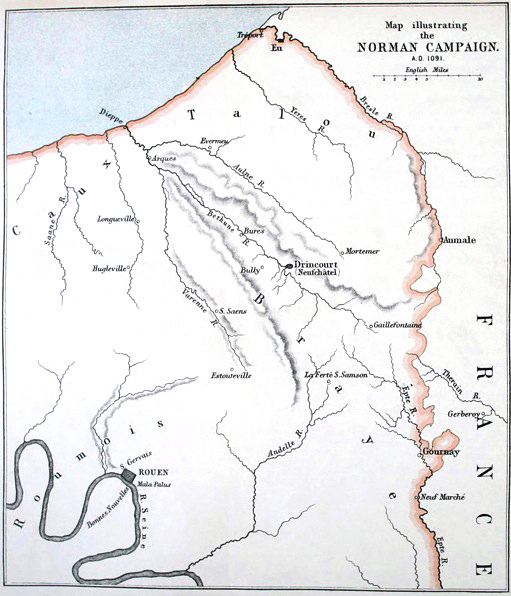
Edwᵈ. Weller
For the Delegates of the Clarendon Press.
Map
illustrating the
NORMAN CAMPAIGN.
A.D. 1091.
Submission of Saint Valery.
The first point of the mainland which the Red King
won was one which lay beyond the strict bounds of
the Norman duchy; but no spot, either in Normandy
or in England, was more closely connected with the
fortunes of his house. And it was one which had a
certain fitness as the beginning of such a campaign.
The first spot of continental ground which was added to
the dominion of one who called himself King of the
English, and who at least was truly King of England,
was the spot from which his father had set forth for the
conquest of England. He won it by the means which
were specially his own. “By his cunning or by his
treasures he gat him the castle at Saint Valery and the
havens.”[621]
Englishmen had fought for the elder William
228
in Maine and before Gerberoi;[622]
but that was merely to
win back the lost possessions of the Norman Duke.
Now the wealth and the arms of England were used to
win castles beyond the sea for a prince whose possessions
and whose titles up to that moment were purely English.
Beginning of English action on the continent.
In the history of England as a power—and the history
of England as a power had no small effect on the history
of the English as a people—the taking of Saint Valery
is the beginning of a chain of events which leads on,
not only to the fight of Tinchebray and the first loss of
Rouen, but to the fight of Crecy and the fight of Chastillon,
to the taking of Boulogne and the loss of Calais.
Saint Valery had, by the forced commendation of the
still reigning Count Guy, passed under Norman superiority;[623]
but it was no part of the true Norman land. Submission of Stephen of Aumale.
The
first fortress within the Norman duchy which passed
into the hands of Rufus was the castle of Aumale, standing
just within the Norman border, on the upper course
of the river of Eu. Its lord, the first of the great Norman
nobles to submit to William and to receive his
garrison into his castle, was Stephen, son of Count Odo
of Champagne and of Adelaide, whole sister of the
Conqueror, cousin-german therefore of the two contending
princes.[624]
Aumale was won, as Saint Valery had been
won, by cunning or by treasure. Stephen may simply
have learned to see that it was better for him to have the
same lord at Aumale and in Holderness, or his eyes may
have been yet further enlightened by the brightness of
229
English gold. But the Red King had other means at his
disposal, and it seems that other means were needed, if
not to win, at least to keep Aumale. Aumale strengthened as the King’s headquarters.
The defences of
the castle were greatly strengthened at the King’s cost,[625]
and it became a centre for further operations. “Therein
he set his knights, and they did harms upon the land, in
harrying and in burning.”[626]
Other castles were soon
added to the Red King’s dominion. Submission of Count Robert of Eu and his son William;
Count Robert of
Eu, whom we have heard of alike at Mortemer and in
Lindesey,[627]
the father of the man whom we have more
lately heard of at Berkeley, still held the house where
William the Great had received Harold as his guest,[628]
hard by the church where he had received Matilda as
his bride.[629]
The Count had been enriched with lands in
southern England; he is not recorded as having joined
in his son’s rebellion; and the lord of Eu now transferred
the allegiance of his Norman county to the prince of
whom he held his command on the rocks of Hastings.[630]
Aumale and Eu, two of the most important points on
the eastern border of Normandy, are thus the first
places which we hear of as receiving Rufus on the mainland.
We shall hear of both names again, but in quite
another kind of tale, before the reign of Rufus is over.
of Gerard of Gournay.
The next Norman noble to join the cause of William
was another lord of the same frontier, who held a point
of hardly less importance to the south of Eu and Aumale.
230
This was Gerard of Gournay, son of the warrior of Mortemer
who had gone to end his days as a monk of Bec,[631]
son-in-law of the new Earl of Surrey,[632]
husband of perhaps
the only woman on Norman ground who bore the name
of English Eadgyth.[633]
His castle of Gournay, from
which many men and more than one place[634]
in England
have drawn their name, stood on the upper course of the
Epte, close to the French border. The fortress itself has
vanished; The church of Gournay.
but the minster of Saint Hildebert, where the
massive work of Gerard’s day has been partly recast in
the lighter style of the next century, still remains, with
its mighty pillars, its varied and fantastic carvings, to
make Gournay a place of artistic pilgrimage. Nor is it
hard to trace the line of the ancient walls of the town,
showing how the border stream of Epte was pressed into
the service of the Norman engineers. The adhesion of
the lord of Gournay seems to have been of the highest
importance to the cause of Rufus. The influence of
Gerard reached over a wide district north of his main
dwelling. Other castles of Gerard.
Along with Gournay, he placed at the King’s
disposal his fortress of La Ferté Saint Samson, crowning
a height looking over the vale of Bray, and his other
fortress of Gaillefontaine to the north-east, on another
height by the wood of its own name, overlooking the
early course of the Bethune or Dieppe, the stream
which joins the eastern Varenne by the hill of Arques.[635]
Gerard too was not only ready in receiving the King’s
forces into his own castles, but zealous also in bringing
over his neighbours to follow his example.[636]
Among
231
these was the lord of Wigmore, late the rebel of
Worcester, Ralph of Mortemer.[637]
Submission of Earl Walter Giffard.
Old Walter Giffard
too, now Earl of Buckingham in England, had English
interests far too precious to allow him to oppose his
island sovereign. His castle of Longueville.
He held the stronghold of Longueville—the
north-eastern Longueville by the Scie, the
stream which, small as it is, pours its waters independently
into the Channel between Dieppe and Saint
Valery-in-Caux. There, from a bottom fenced in by
hills on every side, the village, the church where the
hand of the modern destroyer has spared only a few
fragments of the days of Norman greatness, the priory
which has been utterly swept away, all looked up to a
hill on the right bank of the stream which art had
changed into a stronghold worthy to rank alongside of
Arques and Gisors. Girt about with a deep ditch, on the
more exposed southern side with a double ditch, the hill
was crowned by a shell-keep which still remains, though
patched and shattered, and a donjon which has been
wholly swept away. In this fortress the aged warrior
of Arques and Senlac received, like so many of his neighbours,
the troops which William of England had sent to
bring the Norman duchy under his power.
Ralph of Toesny and Count William of Evreux.
The domains of all these lords lay in the lands on
the right bank of the Seine, the oldest, but, as I have
often remarked, not the truest Normandy. But the Red
King also won a valuable ally in quite another part of
the duchy. This was Ralph of Conches or of Toesny,
with whom we are now most concerned as the husband
of the warlike Isabel of Montfort, and, in that character
rather than in any other, the enemy of the Countess
Heloise and of her husband Count William of Evreux.
The rival lords were in fact half-brothers. The old
232
Roger of Toesny, the warlike pilgrim of Spain,[638]
was
succeeded by Ralph, who has so often played his part
in our story, and whom we last met in Duke Robert’s
army before Le Mans.[639]
The widow of Roger, the mother
of Ralph, had married Richard Count of Evreux, and was
by him the mother of the present Count William.[640]
Enmity of their wives.
But
this near kindred by birth had less strength to bind the
brothers together than the fierce rivalry of their wives
had to set them at feud with one another. The jealousy
of these two warlike ladies kept a large part of Normandy
in a constant uproar. Our historian bitterly
laments the amount of bloodshed and havoc which was
the result of their rivalry.[641]
Countess Heloise of Evreux.
Heloise was of the house
of the Counts of Nevers, the Burgundian city by the
Loire, a descent which carries us a little out of our
usual geographical range.[642]
Tall, handsome, and ready
of speech, she ruled her husband and the whole land of
Evreux with an absolute sway. Her will was everything;
the counsels of the barons of the county went for
nothing.[643]
Violent and greedy, she quarrelled with many
233
of the nobles of Normandy, with Count Robert of Meulan
among them, and stirred up her husband to many
disputes and wars to gratify her fierce passions.[644]
At
this time some slight which she had received from the
lady of Conches had led her to entangle her husband in
a bitter feud with his half-brother. Isabel of Montfort.
Isabel or Elizabeth—the
two names are, as usual, given to her indifferently—the
wife of Ralph of Toesny, was a daughter of the French
house of Montfort,[645]
the house of our own Simon. Like
her rival, she must now have been long past her youth;
but, while Heloise was childless,[646]
Isabel was the mother
of several children, among them of a son who has
already played a part in Norman history. This was
that younger Ralph of Toesny who married the
daughter of Waltheof and who had taken a part in
the present Duke’s rebellion against his father.[647]
Handsome,
eloquent, self-willed, and overbearing, like her
rival, Isabel had qualities which gained her somewhat
more of personal regard than the Countess of
Evreux. She was liberal and pleasant and merry of
234
speech, and made herself agreeable to those immediately
about her. Moreover, while of Heloise we read indeed
that she stirred up wars, but not that she waged them in
her own person, Isabel, like the ancient Queens of the
Amazons, went forth to the fight, mounted and armed,
and attended by a knightly following.[648]
War between Conches and Evreux.
The struggle between
the ladies of Evreux and Conches was at its height
at the moment when the castles of eastern Normandy
were falling one by one into the hands of Rufus. Isabel
and Ralph were just now sore pressed. Ralph in vain asks help of the Duke.
The lord of
Conches therefore went to Duke Robert and craved his
help;[649]
but from Duke Robert no help was to be had
for any man.
Ralph then bethought him of a stronger
protector, in the sovereign of his English possessions.
He submits to William.King William gladly received such a petition, and bade
Count Stephen and Gerard of Gournay, and all who had
joined him in Normandy, to give all the help that they
could to the new proselyte.[650]
Advance of William’s party.
The cause of the Red
King prospered everywhere; well nigh all Normandy to
the right of Seine was in the obedience of Rufus. All
its chief men had, in a phrase which startles us in that
235
generation, “joined the English.”[651]
And for them the
King of the English was open-handed. Into the hoard
at Winchester the wealth of England flowed in the shape
of every kind of unlawful exaction. Out of it it flowed
as freely to enable the new subjects of King William to
strengthen the defences of their castles and to hire mercenaries
to defend them.[652]
Helias of Saint-Saens.
During all this time Duke Robert himself does not seem
to have thought of striking a blow. But there was one
man at least between Seine and Somme who was ready
both to give and to take blows on his behalf. He marries Robert’s daughter.
Robert
had given one of his natural children, a daughter born,
to him in his wandering days,[653]
in marriage to Helias,
lord of Saint-Saens.[654]
Helias, like so many of the Norman
nobles, came of a house which had risen to importance
His descent.through the loves of Gunnor and Richard the
Fearless.[655]
A daughter of one of Gunnor’s sisters married
Richard Viscount of Rouen, and became the mother
of Lambert of Saint-Saens, the father of Helias.[656]
Helias
and the daughter of Robert had thus a common, though
distant, forefather in the father of Gunnor. He has Caux as his wife’s dowry.
With his
wife Helias received a goodly dowry, nothing less, we
are told, than the whole land of Caux.[657]
Helias’ own
lordship of Saint-Saens lies on the upper course of the
Position of Saint-Saens.
236
Varenne, in a deep bottom girt on all sides by wooded
hills, one of which, known as the Câtelier, overhanging
the town to the north, seems to have been the site of
the castle of Helias. His stronghold has vanished; but
the church on which the height looks down, if no rival to
Saint Hildebert of Gournay, still keeps considerable
remains of an age but little later than that with which we
have to do. Importance of his position.
The possessions of Helias, both those which
he inherited and those which he received with his wife,
made his resistance to the invader of no small help to
the cause of his father-in-law. They barred the nearest
way to Rouen, not indeed from Gournay, but from Eu
and Aumale. They came right between these last
fortresses and the domain of Walter Giffard at Longueville.
Of the three streams which meet by Arques,
while Helias himself held the upper Varenne at Saint-Saens,
Bures.
his wife’s fortress of Bures held the middle course
of the Bethune or Dieppe below Gerard’s Gaillefontaine,
and below Drincourt, not yet the New Castle of King
Henry.[658]
The massive church, with parts dating from the
days of Norman independence, rises on the left slope
of the valley above an island in the stream. But the
site of the castle which formed part of the marriage
portion of Duke Robert’s daughter is hard to trace.
Helias holds Arques.
But lower down, nearer the point where the streams
meet, the bride of Helias had brought him a noble gift
indeed. Through her he was lord of Arques, with its
donjon and its ditches, the mighty castle whose tale
has been told in recording the history of an earlier
generation.[659]
A glance at the map will show how strong
a position in eastern Normandy was held by the man
who commanded at once Saint-Saens, Bures, and Arques.
But the son-in-law of Duke Robert deserves our notice
237
for something better than his birth, his marriage, or his
domains. Faithfulness of Helias towards Robert.
Helias of Saint-Saens was, in his personal
character, a worthy namesake of Helias of La Flêche.
Among the crimes and treasons of that age, we dwell
with delight on the unswerving faithfulness with which,
through many years and amidst all the ups and downs
of fortune, he clave to the reigning Duke and to his son
after him.[660]
But this his later history lies beyond the
bounds of our immediate tale. What directly concerns
us now is that Helias was the one noble of Normandy
whom the gold of England could not tempt. It would
be almost ungenerous to put on record the fact that,
unlike most of his neighbours, he had no English estates
to lose. The later life of Helias puts him above all
suspicion of meaner motives. Saint-Saens, Arques,
Bures, and all Caux, remained faithful to Duke Robert.
With this honourable exception, an exception which
greatly lessened the value of his new conquests, William
Rufus had won, without hand-strokes, without his personal
presence, a good half of the original grant to Rolf,
the greater part of the diocese of Rouen. William’s dealings with France.
He was soon
to win yet another triumph by his peculiar policy. By
those arms which were specially his own, he was to win
over an ally, or at least to secure the neutrality of an
enemy, of far higher rank, though perhaps of hardly
greater practical power, than the Count of Aumale and
the aged lord of Longueville. Robert asks help of Philip.
Robert in his helplessness
cried to his over-lord at Paris. Had not his father done
the same to Philip’s father? Had not King Henry
played a part at least equal to that of Duke William
among the lifted lances of Val-ès-dunes?[661]
Philip had
238
had his jest on the bulky frame of the Conqueror, and
his jest had been avenged among the candles of the
bloody churching at Mantes.[662]
By this time at least, so
some of our authorities imply, Philip had brought himself
to a case in which the same jest might have been
made upon himself with a good deal more of point. Philip comes to help.
At
the prayer of his vassal the bulky King of the French
left his table and his dainties, and set forth, sighing and
groaning at the unusual exertion, to come to the help of
the aggrieved Duke.[663]
It was a strange beginning of the
direct rivalry between England and France. Meeting of the Norman and French armies.
King Philip
came with a great host into Normandy. And Robert
must somewhere or other have found forces to join those
of his royal ally. And now was shown the value of the
position which was held by the faithful Helias in the land
of Caux. They march on Eu.
It must have been by his help that the combined
armies of Robert and Philip were able to march to
the furthest point of the Red King’s new acquisitions,
to the furthest point of the Norman duchy itself, to the
castle of Eu, which was held, we are told, by a vast host,
Norman and English.[664]
Let an honest voice from Peterborough
239
tell what followed. “And the King and the
Earl with a huge fyrd beset the castle about where the
King’s men of England in it were. Philip bribed to go back.
The King William
of England sent to Philip the Franks’ King, and he for
his love or for his mickle treasure forlet so his man the
Earl Robert and his land, and went again to France and
let them so be.”[665]
A Latin writer does not think it
needful to allow Philip the perhaps ironical alternative
of the English writer. Love between Philip and
William Rufus is not thought of. We are simply told
that, while Philip was promising great things, the money
of the King of England met him—the wealth of Rufus
seems to be personified. Before its presence his courage
was broken; he loosed his girdle and went back to
his banquet.[666]
The first English subsidy.
Thus the special weapons of Rufus could overcome
even kings at a distance. But, ludicrous as the tale
sounds in the way in which it is told, this negotiation
between Philip and William is really, in an European,
and even in an English point of view, the most important
event in the whole story. We should hardly
be wrong in calling this payment to Philip the first
instance of the employment of English money in the
shape of subsidies to foreign princes. For such it in
strictness was. It was not, like a Danegeld, money paid
to buy off a foreign invader. Nor was it like the simple
hiring of mercenaries at home or abroad. It is, like
later subsidies, money paid to a foreign sovereign, on
240
condition of his promoting, or at least not thwarting, the
policy of a sovereign of England. The appetite[667]
which
was now first awakened in Philip of Paris soon came to
be shared by other princes, and it lasted in full force for
many ages. First direct dealings between England and France.
Again, we have now for the first time direct
political dealings between a purely insular King of England—we
may forestall the territorial style when speaking
of England as a state rather than of Englishmen as
a nation—and a French King at Paris. The embassies
which passed between Eadward and Henry, even when
Henry made his appeal on behalf of Godwine,[668]
hardly
make an exception. Different position of the two Williams.
William the Great had dealt with
France as a Norman duke; if, in the latter part of his
reign, he had wielded the strength of England as well
as the strength of Normandy, he had wielded it, as far
as France was concerned, wholly for Norman purposes.
But William the Red, though his position arose wholly
out of the new relations between England and Normandy,
was still for the present a purely English king.
Relation of England, Normandy, and France.
The first years of Rufus and the first years of Henry
the First are alike breaks in the hundred and forty
years of union between England and Normandy.[669]
Had
not a Norman duke conquered England, an English
king would not have been seeking to conquer Normandy;
but, as a matter of fact, an English king, who
had no dominions on the mainland, was seeking to conquer
Normandy. And he was seeking to win it with
241
the good will, or at least the neutrality, of the French
King. This was a state of things which could have
happened only during the few years when different sons
of the Conqueror ruled in England and in Normandy.
Whenever England and Normandy were united, whether
by conquest or by inheritance, the old strife between
France and Normandy led England into the struggle.
But at the present moment an alliance between England
and France against Normandy was as possible as any
other political combination. Results of Rufus’ dealings with Philip.
And the arts of Rufus
secured, if not French alliance, at least French neutrality.
But either alliance or neutrality was in its
own nature destructive of itself. Let either Normandy
win England or England win Normandy, and the old
state of things again began. The union of England and
Normandy meant enmity between England and France,
an enmity which survived their separation.[670]
Friendly
dealings between William and Philip were a step towards
the union of England and Normandy, and thereby
a step towards that open enmity between England and
France which began under Rufus himself and which lasted
down to our fathers’ times. The bribe which Philip took
at Eu has its place in the chain of events which led to
Bouvines, to Crécy, and to Waterloo.
State of Normandy.
But while things were thus, unknown to the actors in
them, taking a turn which was permanently to affect the
history of mankind, the immediate business of the time
went on as before in the lands of Northern Gaul. In
Normandy that immediate business was mutual destruction—civil
war is too lofty a name; in Maine it was
deliverance from the Norman yoke. I am not called on
to tell in detail the whole story of every local strife between
one Norman baron and another, not even in those
242
rare cases when the Duke himself stepped in as a judge
or as a party in the strife. Those who loved nothing so
well as slaughter, plunder, and burning, had now to
make up for the many years during which the strong
hand of William the Great had kept them back from
those enjoyments. Private wars not interrupted by the invasion.
They had no thought of stopping,
though the kings of England and France, or all the
kings of the earth, should appear in arms on Norman
soil. Many a brilliant feat of arms, as it was deemed
in those days, must be left to local remembrance; even
at events which closely touched many of the chief names
of our story we can do no more than glance. The
revolt of Maine will have to be spoken of at length in
another chapter; Action of Robert of Bellême.
among strictly Norman affairs we
naturally find Robert of Bellême playing his usual part
towards his sovereign and his neighbours, and we find
the tower of Ivry and the fortified hall of Brionne ever
supplying subjects of strife to the turbulent nobles.
We see Robert of Bellême at war with his immediate
neighbour Geoffrey Count of Perche,[671]
and driving
Abbot Ralph of Seez to seek shelter in England.[672]
We
also find him beaten back from the walls of Exmes by
Gilbert of Laigle and the other warriors of his house, the
house of which we have heard in the Malfosse of Senlac
243
and beneath the rocks of Sainte-Susanne.[673]
William of
Breteuil loses, wins, and loses again, his late grant of
the tower of Ivry, and the second time he is driven to
give both the tower and the hand of his natural daughter
as his own ransom from a specially cruel imprisonment
at the hands of a rebellious vassal.[674]
Brionne forms the
centre of a tale in which its new lord and his son, the
other Roger and the other Robert of our story, play
over again the part of the Earl of Shrewsbury and
his son of Bellême. Robert of Meulan claims the tower of Ivry.
Robert of Meulan comes from
England to assert his claim among others to the much-contested
tower of Ivry. The Duke reminds him that
he had given Brionne to his father in exchange for
Ivry. The Count of Meulan gives a threatening
answer.[675]
He is imprisoned, but set free at the intercession of his father.
The Duke, with unusual spirit, puts him in
prison, seizes Brionne, and puts it into a state of defence.
Then the old Roger of Beaumont, old a generation
earlier,[676]
obtains, by the recital of his own exploits,
244
the deliverance of his son.[677]
He then prays, not without
golden arguments, for the restitution of Brionne.[678]
Robert takes Brionne.
The
officer in command, Robert son of Baldwin, asserts his
own hereditary claim, and, at the head of six knights
only, stands a siege, though not a long one, against the
combined forces of the Duke and of the Count of Meulan
and his father.[679]
This siege is remarkable. The summer
days were hot; all things were dry; the besiegers shot
red-hot arrows against the roof of the fortified hall, and
set fire to it.[680]
So Duke Robert boasted that he had
taken in a day the river-fortress which had held out for
three years against his father.[681]
These events concern us only because we know the
actors, and because they helped to keep up that state of
confusion in the Norman duchy which supplied the Red
King at once with an excuse for his invasion, and with
the means for carrying out his schemes. Advance of Rufus.
It must be
remembered that the two stories are actually contemporary;
while Robert was besieging Brionne, the fortresses
of eastern Normandy were already falling one by
one into the hands of Rufus. It is even quite possible that
245
Robert of Meulan’s voyage from England to Normandy,
and the demands made by him and his father on the
Duke, were actually planned between the cunning Count
and the Red King as a means of increasing the confusion
which reigned in the duchy. But there are tales of local
strife which concern us more nearly. The war of Conches and Evreux.
The war of the
half-brothers, the war of the Amazons, the strife between
Conches and Evreux, between Isabel and Heloise, is an
immediate part of the tale of William Rufus. The lord
of Conches was strengthened in his struggle with his
brother by forces directly sent to his help by the King’s
order.[682]
Movement at Rouen.
The war went on; and, while it was still going
on, a far more important movement began in the greatest
city of Normandy, a movement in which the King of the
English was yet more directly concerned. Up to this
time his plans had been everywhere crowned with success.
His campaign, if campaign we can call it, had begun soon
after Easter. Half a year had passed, and nearly the
whole of the oldest, though not the truest, Normandy
had fallen into his hands without his stirring out of his
island realm. It now became doubtful whether Robert
could keep even the capital of his duchy.
November, 1090.
The month of November of this year saw stirring
scenes alike in the streets of Rouen and beneath
the walls of Conches. But, while Conches was openly
aided by the King’s troops, no force from England
or from the parts of Normandy which William had
already won had as yet drawn near to Rouen.
Rufus knew other means to gain over the burghers
of a great city as well as the lords of castles and
smaller towns. State of things in Rouen.
The glimpse which we now get of the
internal state of the Norman metropolis tells us, like
so many other glimpses which are given us in the history
of these times, just enough to make us wish to be
246
told more. A state of things is revealed to us which
we are not used to in the history of Normandy. Rouen
appears for a moment as something like an independent
commonwealth, though an enemy might call it a commonwealth
which seemed to be singularly bent on its own
destruction. The municipal spirit.
The same municipal spirit which we have
seen so strong at Exeter and at Le Mans[683]
shows itself
now for a moment at Rouen. We may be sure that under
the rule of William the Great no man had dreamed of a
commune in the capital of Normandy. His arm, we may be
sure, had protected the men of Rouen, like all his other subjects,
in the enjoyment of all rights and privileges which
were not inconsistent with his own dominion. But in his
day Rouen could have seen no demagogues, no tyrants,
no armies in civic pay, no dealings of its citizens with
any prince other than their own sovereign. But the rule
of William the Great was over; in Robert’s days it may
well have seemed that the citizens of so great a city were
better able to rule themselves, or at all events that they
were entitled to choose their own ruler. When the arts
of Rufus, his gifts and his promises, began to work at
Rouen in the same way in which they had worked on
the castles of the eastern border, his agents had to deal,
not with a prince or a lord, but with a body of citizens
under the leadership of one of whom one doubts whether
he should be called a demagogue or a tyrant. We seem
to be carried over two hundred and forty years to the
dealings of Edward the Third with the mighty brewer
of Ghent. Conan demagogue or tyrant.
The Artevelde of Rouen was Conan—the
name suggests a Breton origin—the son of Gilbert surnamed
Pilatus. He was the richest man in the city;
his craft is not told us; but we must always remember
that a citizen was not necessarily a trader.[684]
His wealth
247
was such that it enabled him to feed troops of mercenaries
and to take armed knights into his pay.[685]
Another
leading citizen, next in wealth to Conan, was William
the son of Ansgar,[686]
whose name seems to imply the
purest Norman blood. Conan’s treaty with William.
Conan had entered into a treaty
with William, the object of which, we are told, was to
betray the metropolis of Normandy and the Duke of the
Normans—the sleepy Duke, as our guide calls him—into
the power of the island King.[687]
The citizens favour William.
Nor was this merely
the scheme of Conan and William; public feeling in the
city went heartily with them. A party still clave to the
Duke; but the mass of the men of Rouen threw in their
lot with Conan, and were, like him, ready to receive
William as their sovereign instead of Robert.[688]
They
may well have thought that, in the present state of
things, any change would be for the better; the utter
lawlessness of the time, which might have its charms
for turbulent nobles, would have no charms for the
burghers of a great city. Or the men of Rouen may have
argued then, much as the men of Bourdeaux argued ages
later, that they were likely to enjoy a greater measure
of municipal freedom, under a King of the English,
dwelling apart from them in his own island, than they
would ever win from a Duke of the Normans, holding
248
his court and castle in Rouen itself. Yet the friends of
Robert might have their arguments too. A party for Robert.
The party of mere
conservatism, the party of order, would naturally cleave
to him. But other motives might well come in. True
friends of the commune might doubt whether William the
Red was likely to be a very safe protector of civic freedom.
They might argue that, if they must needs have
a master, their liberties were less likely to be meddled
with under such a master as Robert. But the party of
the Duke’s friends, on whatever grounds it stood by him,
was the weaker party. A majority of the citizens was
zealous for William. A day fixed for the surrender to William.
A day was fixed by Conan with
the general consent, on which the city was to be given
up,[689]
and the King’s forces were invited to come from
Gournay and other points in his obedience.
Robert sends for help.
Robert
seems to have stayed in the capital which was passing
from him; but he felt that, if he was to have supporters,
he must seek for them beyond its walls. He sent to tell
his plight to those of the nobles of Normandy in whom
he still put any trust.[690]
And he also hastened to seek
help in a reconciliation with some neighbours and subjects
with whom he was at variance.
Henry and Robert of Bellême come to the Duke’s help.
It is certainly a little startling, after the history of the
past year, to find at the head of the list of Duke Robert’s
new allies the names of the Ætheling Henry and of
Robert of Bellême. We may well fancy that they took
up arms, not so much to support the rights of the Duke
against the King as to check the dangerous example of
a great city taking upon itself to choose among the
249
claims of kings, dukes, and counts. Danger of the example of Rouen.
Robert of Bellême
may indeed have simply hastened to any quarter
from which the scent of coming slaughter greeted him.
But Henry the Clerk could always have given a reason
for anything that he did. Popular movements at Rouen
might supply dangerous precedents at Coutances. The
Count of Coutances too might have better hopes of becoming
Duke of Rouen, if Rouen were still held for a
while by such a prince as Robert, than he could have if
the city became either the seat of a powerful commonwealth
or the stronghold of a powerful king. But, from
whatever motive, Henry came, and he was the first to
come.[691]
Others to whom the Duke’s messengers set forth
his desolate state[692]
came also. Others who help Robert.
Robert of Bellême, so lately
his prisoner, Count William of Evreux and his nephew
William of Breteuil, all hastened, if not to the deliverance
of Duke Robert, at least to the overthrow of
Conan. And with them came Reginald of Warren,
the younger son of William and Gundrada,[693]
and Gilbert
of Laigle, fresh from his victory over his mightiest
comrade.[694]
November 3, 1090.
At the beginning of November Duke Robert
was still in the castle of Rouen;
but his brother Henry
was now with him within its walls, and the captains
Henry at Rouen. who had come to his help were thundering at the gates
of the rebellious city.
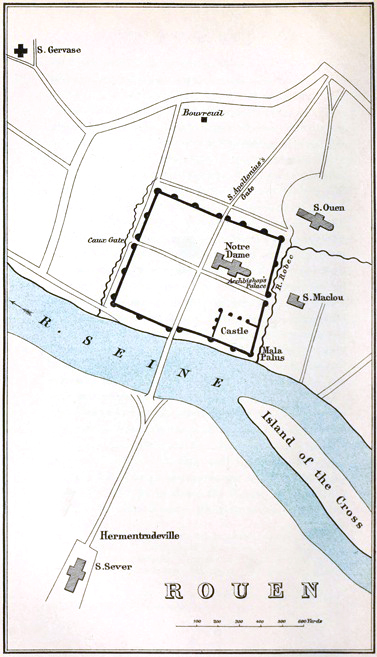
E. Weller
For the Delegates of the Clarendon Press.
ROUEN
Rouen in the eleventh century.
The Rouen of those days, like the Le Mans, the York,
and the Lincoln, of those days, was still the Roman city,
the old Rothomagus. As in those and in countless other
cases, large and populous suburbs had spread themselves
over the neighbouring country; at Rouen, as at York,
250
those suburbs had passed the river; but the city itself,
the walled space to be attacked and defended in wartime,
was still of the same extent as it had been in the
days before Rolf and before Chlodwig. The rectangular
space marking the Roman camp stretched on its
southern side nearly to the Seine, whose stream, not yet
fenced in by quays, reached further inland on that side
than it now does. Position of the city.
Rouen is essentially a river city, not
a hill city. The metropolitan church does indeed stand
on sensibly higher ground than the buildings close to the
river; but to one fresh from Le Mans or Chartres the rise
which has to be mastered seems trifling indeed. For a hill
city the obvious site would have been on the natural
akropolis supplied by the height of Saint Katharine to
the south-east. Yet Rouen is a city of the mainland;
the islands which divide the waters of the Seine must
have been tempting points for Rolf in his Wiking days;
but even the largest of them, the Isle of the Cross, was
hardly large enough for a town to grow upon it. Of the
walls of Rothomagus not a fragment is left; yet the
impress of a Roman chester is hard to wipe out; it is
still easy to trace its lines among the streets and buildings
of the greatly enlarged mediæval and modern city.
Frightful as has been the havoc which the metropolis
of Normandy has undergone in our own time, mercilessly
as the besom of destruction has swept over its
ancient streets, churches, and houses, the dæmon of
modern improvement has spared enough to enable us,
if not to tell the towers, yet in idea to mark well the
bulwarks, of the city where the Conqueror reigned.
The ducal castles.
Near the south-west corner of the parallelogram, not
far from the river-side, had stood the earlier castle of
the Dukes. Its site in after times became the friary of
the Cordeliers, a small fragment of whose church, as
well as another desecrated church within the castle
251
precinct, does in some faint way preserve the memory
of the dwelling-place of Rolf.[695]
But by the days of
Robert, the dukes had moved their dwelling to the
south-eastern corner, also near the river, where the site
of the castle is marked by the vast halles, and by the
graceful Renaissance porch, where the chapter of our
Lady of Rouen yearly, on the feast of the Ascension,
exercised the prerogative of mercy by saving one prisoner
condemned to die. Here the memory of the castle,
though only its memory, lives in the names of the Haute
and the Basse Vieille Tour, one of which is soon to be
famous in our story. The eastern side of the city.
On the eastern side the wall was
washed by a small tributary of the Seine, the Rebecq,
a stream whose course has withdrawn from sight almost
as thoroughly as the Fleet of London or the Frome of
Bristol.[696]
On this side of the city lay a large swampy
tract, whose name of Mala palus still lives in a
Rue Malpalu[697],
though a more distant part of it has
taken the more ambitious name of the Field of Mars.
The archbishopric.
Within the wall lay the metropolitan church of our
Lady and the palace of the Primate of Normandy. If
this last reached to anything like its present extent to
the east, the Archbishops of Rouen, like the Counts of
252
Maine,[698]
must have been reckoned among the men who
sat on the wall. Abbey of Saint Ouen.
Outside the city, but close under the
wall, near its north-eastern corner, stood the great abbey
of Saint Ouen, the arch-monastery,[699]
still ruled by its
Abbot Nicolas, though his long reign was now drawing
to an end.[700]
At the opposite north-western angle, but
much further from the walls, where the higher ground
begins to rise above the city, stood the priory of
Saint Gervase, the scene of the Conqueror’s death.[701]
Priory of Saint Gervase.
Saint Gervase indeed stood, not only far beyond the
Roman walls, but beyond those fortifications of later
times which took Saint Ouen’s within the city. For
Rouen grew as Le Mans grew. Castle of Bouvreil.
On the higher ground
like Saint Gervase, but more to the east, rose the
castle of Bouvreil, which Philip of Paris, after the loss
of Norman independence, reared to hold down the conquered
city. Walls of Saint Lewis.
Between his grandfather’s castle and the
ancient wall Saint Lewis traced out the newer line of
fortification which is marked by the modern boulevards.
His walls are gone, as well as the walls of Rothomagus;
but of the house of bondage of Philip Augustus one
tower still stands, while of the dwelling-place of
her own princes even mediæval Rouen had preserved
nothing.
The gates.
The four sides of the Roman enclosure were of course
pierced by the four chief gates of the city, of three of
which we hear in our story. Of these the western, the
gate of Caux, is in some sort represented by the Renaissance
gate of the Great Clock[702]
with its adjoining
253
tower. The northern gate bore the name of Saint
Apollonius. The river was spanned by at least one
bridge, which crossed it by way of the island of the
Cross, near the second ducal castle. Suburbs beyond the Seine.
Beyond the
stream lay the suburb of Hermentrudeville, now Saint
Sever, where Anselm had waited during the sickness
of the Conqueror.[703]
There too the Duchess Matilda,
soon to be Queen, had begun the monastery of the
meadow, the monastery of our Lady of Good News, the
house of Pratum or Pré, whose church still stood unfinished,
awaiting the perfecting hand of her youngest
son.[704]
Fright of Duke Robert.
Meanwhile the elder and best-beloved son of Matilda
was trembling within the city on the right bank of the
broad river. Luckily he had the presence of his youngest
brother, the English Ætheling, the Count of the Côtentin,
to strengthen him. Personal courage Duke Robert never
lacked at any time; but something more than personal
courage was now needed. Robert was perhaps not
frightened, but he was puzzled; at such a moment he
seemed to the calm judgement of Henry to be simply
in the way; it was for wiser heads to take counsel
without him. But deliverance was at hand. Both sides
of the Seine sent their helpers. Approach of Gilbert and Reginald.
Gilbert of Laigle crossed
the bridge by the island close under the ducal tower, and
turned to the left to the attack of the southern gate.
Reginald of Warren at the head of three hundred
knights drew near to the gate of Caux.[705]
Efforts of Conan.
Against
this twofold attack Conan strove hard to keep up the
hearts of his partisans. He made speeches exhorting
to a valiant defence. Division among the citizens.
Many obeyed; but the city was
already divided; while one party hastened to the
southern gate to withstand the assault of Gilbert,
254
another party sped to open the western gate and to
let in the forces of Reginald. Utter confusion.
Soldiers of the King of
the English, the advanced guard doubtless of a greater
host to come, were already in the city, stirring up the
party of Conan to swifter and fiercer action.[706]
Soldiers
and citizens were huddled together in wild confusion;
shouts passed to and fro for King and Duke; men at
either gate smote down neighbours and kinsmen to the
sound of either war-cry.[707]
The strength of the city was
turned against itself. The hopes of the commonwealth
of Rouen, either as a free city or as a favoured ally
of the island King, were quenched in the blood of its
citizens. Le Mans and Exeter had fallen; but they had
fallen more worthily than this.
Henry sends Duke Robert away.
Meanwhile Henry and those who were with him in
the castle deemed that the time had come for the defenders
of the ducal stronghold to join their friends
within and without the city. But there was one inhabitant
of the castle whose presence was deemed an
encumbrance at such a moment. Men were shouting
for the Duke of the Normans; but the wiser heads of
his friends deemed that the Duke of the Normans was
just then best out of the way. Robert came down
from the tower, eager to join in the fray and to give
help to the citizens of his own party.[708]
But all was
255
wild tumult; it needed a cooler head than Robert’s to
distinguish friend from foe. He might easily rush on
destruction in some ignoble form, and bring dishonour
on the Norman name itself.[709]
He was persuaded by
his friends to forego his warlike purposes, and to
suffer himself to be led out of harm’s way. While
every other man in the metropolis of Normandy was
giving and taking blows, the lord of Normandy, in
mere personal prowess one of the foremost soldiers in his
duchy, was smuggled out of his capital as one who could
not be trusted to let his blows fall in the right place.
With a few comrades he passed through the eastern gate
into the suburb of the Evil Swamp, just below the
castle walls. No attacks from the east.
It is to be noticed that no fighting on this
side of the city is mentioned. The King’s troops were
specially looked for to approach from Gournay, and the
east gate was the natural path by which an army from
Gournay would seek to enter Rouen. One would have
expected that one at least of the relieving parties would
have hastened to make sure of this most important point.
Yet one division takes its post by the southern gate,
another by the western, none by the eastern. Were
operations on that side made needless, either by the
neighbourhood of the castle, by any difficulties of the
marshy ground, or by the disposition of the inhabitants
of the suburb? Certain it is that Duke Robert’s nearest
neighbours outside his capital were loyal to him. The
men of the Evil Swamp received the Duke gladly as
their special lord.[710]
He allowed himself to be put into
a boat, and ferried across to the suburb on the left bank.
256
There he was received by one of his special counsellors,
William of Arques, a monk of Molesme, and was kept
safely in his mother’s monastery till all danger was
over.[711]
It was clearly not wholly for the sake of such a prince
as this that so many Norman leaders, Henry of Coutances
among them, had made up their minds that the republican
movement at Rouen was to be put down. The moment
for putting it down had come. Gilbert enters Rouen.
Gilbert of Laigle had by
this time, by the strength of his own forces and by the
help of the citizens of his party, entered Rouen through
the southern gate. His forces now joined the company of
Henry; they thus became far more than a match for the
citizens of Conan’s party, even strengthened as they were
by those of the King’s men who were in the city. Slaughter of the citizens.
A great
slaughter of the citizens followed; the soldiers of Rufus
contrived to flee out of the city, and to find shelter in
the neighbouring woods;[712]
the city was full of death,
flight, and weeping; innocent and guilty fell together;
Conan taken prisoner.
Conan and others of the ringleaders were taken prisoners.
Conan himself was led into the castle, and
257
there Henry took him for his own share of the spoil,
not indeed for ransom, but to be dealt with in a strange
and dreadful fashion. It is one of the contrasts of
human nature that Henry, the great and wise ruler, the
king who made peace for man and deer, the good man
of whom there was mickle awe and in whose day none
durst hurt other, should have been more than once
guilty in his own person of acts of calm and deliberate
cruelty which have no parallel in the acts of
his father, nor in those of either of his brothers. Fate of Conan.
So
now Conan was doomed to a fate which was made the
sterner by the bitter personal mockery which he had to
endure from Henry’s own mouth. The Ætheling led his
victim up through the several stages of the loftiest tower
of the castle, till a wide view was opened to his eyes
through the uppermost windows.[713]
Henry and Conan in the tower.
Henry bade Conan
look out on the fair prospect which lay before him. He
bade him think how goodly a land it was which he had
striven to bring under his dominion.[714]
These words well
express the light in which Conan’s schemes would look
in princely eyes; the question was not whether Robert
or William should reign in Rouen; it was whether Conan
should reign there as demagogue or tyrant in the teeth
of all princely rights. Henry went on to point out the
beauties of the landscape in detail; the eyes of the
scholar-prince could perhaps better enjoy them than
the eyes of Rufus or of Robert of Bellême. Beyond the
river lay the pleasant park, the woody land rich in
beasts of chase. There was the Seine washing the walls
of the city, the river rich in fish, bearing on its waters
the ships which enriched Rouen with the wares of many
258
lands.[715]
On the other side he bade him look on the
city itself thronged with people, its noble churches, its
goodly houses. The modern reader stops for a moment
to think that, of the buildings which then met the eye of
Conan, churches, castles, halls of wealthy burghers like
himself, clustering within and without the ancient walls,
all doubtless goodly works according to the sterner
standard of that day, hardly a stone is left to meet his
own eye as he looks down from hill or tower on the
great buildings of modern Rouen. It was another Saint
Romanus, another Saint Ouen, of far different outline
and style from those on which we now gaze, which
Henry called on Conan to admire at that awful moment.
He bade him mark the splendour of the city; he bade
him think of its dignity as the spot which had been
from of old the head of Normandy.[716]
The trembling
wretch felt the mockery; all that was left to him was
to groan and cry for mercy. He confessed his guilt;
he simply craved for grace in the name of their common
Maker. He would give to his lord all the gold and
silver of his hoard and the hoards of his kinsfolk; he
would wipe out the stain of his past disloyalty by faithful
service for the rest of his days.[717]
The Conqueror
would have granted such a prayer in sheer greatness of
soul; the Red King might well have deemed it beneath
him to harm so lowly a suppliant. But the stern purpose
of Henry was fixed, and his wrath, when it was
259
once kindled, was as fierce as that of his father or his
brother. “By the soul of my mother”—that seems to
have been the most sacred of oaths with Matilda’s defrauded
heir, as he looked out towards the church of her
building—“there shall be no ransom for the traitor, but
rather a hastening of the death which he deserves.”[718]
Conan no longer pleaded for life; he thought only of the
welfare of his soul. “For the love of God, at least grant
me a confessor.”[719]
Had the Lion of Justice reached that
height of malice which seeks to kill the soul as well as
the body? At Conan’s last prayer his wrath reached its
height;[720]
Conan should have no time for shrift any more
than for ransom. If the clergy of Saint Romanus
already enjoyed their privilege of mercy, they were to
have no chance of exercising it on behalf of this arch-criminal.
Death of Conan.
With all the strength of both his hands, Henry
thrust Conan, like Eadric,[721]
through the window of the
tower. He fell from the giddy height, and died, so it
was said, before he reached the ground. His body was
tied to the tail of a pack-horse and dragged through
the streets of Rouen to strike terror into his followers.
The spot from which he was hurled took the name of
the Leap of Conan.[722]
The tower, as I have said, has
perished; the site of the Leap of Conan must be
260
sought for in imagination, at some point, perhaps the
south-eastern corner, of the vast halles of ancient Rouen.
Policy of Henry.
The rule of Robert was now restored in Rouen, so far
as Robert could be said to rule at any time in Rouen
or elsewhere. It is remarkable that after the death of
Conan we lose sight of Henry; that is, as far as Rouen is
concerned, for we shall before long hear of him again in
quite different relations towards his two brothers. He may
well have thought that one fearful example was needed,
but that one fearful example was enough. He would
secure the punishment of the ringleader, even by doing
the hangman’s duty with his own hands; but mere havoc
and massacre had no charms for him at any time. His
policy might well have forestalled the later English rule,
“Smite the leaders and spare the commons.” If Robert
or anybody else was to reign in Rouen, nothing would
be gained by killing, driving out, or recklessly spoiling,
the people over whom he was to reign. But there were
men at his side to whom the utmost licence of warfare
was the most cherished of enjoyments. The Duke, never
personally cruel,[723]
was in a merciful mood. Robert brought back.
When all
danger was over, he was brought across the river from
his monastery to the castle. He saw how much the city
had already suffered; his heart was touched, and he was
not minded to inflict any further punishment. Treatment of the citizens.
But he
had to yield to the sterner counsels of those about
him, and to allow a heavy vengeance to be meted out.[724]
He seems however to have prevailed so far as to
hinder the shedding of blood. At least we hear nothing
of any general slaughter. The fierce men who had
brought him back seem to have contented themselves
with plunder and leading into captivity. The citizens
261
of Rouen were dealt with by their countrymen as men
deal with barbarian robbers. They were spoiled of all
their goods and led away into bondage. Robert of
Bellême and William of Breteuil, if they spared life,
spared it only to deal out on their captives all the
horrors of the prison-house.[725]
Imprisonment and ransom of William son of Ansgar.
The richest man in
Rouen after the dead Conan, William the son of
Ansgar, became the spoil of William of Breteuil. After
a long and painful imprisonment, he regained his liberty
on paying a mighty ransom of three thousand pounds.[726]
Before his captive was set free, the lord of Breteuil
himself learned what it was to endure imprisonment,
this time doubtless of a milder kind than that which he
inflicted on William the son of Ansgar or that which
himself endured at the hands of Ascelin.[727]
Count William marches against Conches. November, 1090.
The Count of
Evreux and his nephew of Breteuil must have marched
almost at once from their successful enterprise at Rouen
to a less successful enterprise at Conches. For it was
still November when Count William or his Countess
resolved on a great attack on the stronghold of their
rival.[728]
Evreux was doubtless the starting-point for
an undertaking which followed naturally on the work
which had been done at Rouen. The Count of Evreux
might keep on the garb of Norman patriotism which
he had worn in the assault on the rebellious capital, and
262
his Countess might add to the other crimes with which
she charged Ralph and Isabel a share in the crime of
Conan, that of traitorous dealing with the invading
enemy. The forces of Evreux and Breteuil were therefore
arrayed to march together against the stronghold
of the common kinsman and enemy at Conches.
No contrast could well be greater than the contrast
between the spot from which Count William set
forth and the spot which he led his troops to attack.
Position of Evreux and Conches.
Near as Conches and Evreux are, they are more
thoroughly cut off from one another than many spots
which are far more distant on the map. The forest of
Evreux parts the hills of Conches from the capital of
Count William’s county. The small stream of the Iton
flows by the homes of both the rival heroines. But
at Conches it flows below the hill crowned by castle,
church, and abbey; at Evreux its swift stream had ages
before been taught to act as a fosse to the four walls of
a Roman chester. Position of Mediolanum or Evreux.
Low down in the valley, like our own
Bath, with the hills standing round about his city, the
Count of Evreux lived among the memorials of elder
days. The walls of Mediolanum, which can still be
traced through a large part of their circuit, fenced in to
the south the minster of Our Lady and the palace of the
Bishop, then still tenanted by the eloquent Gilbert.[729]
His home, like that of his metropolitan at Rouen,[730]
might seem to stand upon the Roman wall itself. At
the north-west corner, the wall fenced in the castle from
which Count William had driven out the Conqueror’s
garrison, and where he, either then or at some later time,
overthrew the Conqueror’s donjon.[731]
History of Evreux.
The wall of Mediolanum,
like the wall of the Athenian akropolis, had
263
fragments of ornamental work, shattered columns, capitals,
cornices, built in among its materials. It would
thus seem to belong to a late stage of Roman rule, when
the Frank was dreaded as a dangerous neighbour, perhaps
when he had already once laid Mediolanum waste.
To the north, much as at Le Mans and at Rouen, the city
in later times enlarged its borders, as, in later times still,
it has enlarged them far to the south. The “Little City”—a
name still borne by a street within the Roman circuit—is
a poor representative of the Old Rome on the
Cenomannian height;[732]
but both alike bear witness to
the small size of the original Roman encampments, and
to the gradual process by which they were enlarged into
the cities of modern times. The Roman walls.
But in the days of William
and Heloise the circuit of Roman Mediolanum was still
the circuit of Norman Evreux. And, as in so many
other places, the oldest monuments have outlived many
that were newer. Small traces of the eleventh century at Evreux.
Neither church, castle, nor episcopal
palace, keeps any fragments of the days of the warlike
Countess; it is only in the minster of Saint Taurinus
without the walls that some small witnesses of those times
are to be found. Even the Romanesque portions of the
church of Our Lady must be later than Count William’s
day, and the greater part of the building of the twelfth
century has given way to some of the most graceful conceptions
of the architects of the fourteenth. The home of
the Bishop has taken the shape of a stately dwelling in
the latest style of mediæval art; the home of the Count
has vanished like the donjon which Count William overthrew.
But the old defences within which bishops and
counts had fixed themselves in successive ages still live
on, to no small extent in their actual masonry, and in
the greater part of their circuit in their still easily
marked lines. And, high upon the hills, the eye rests
264
on the stronghold of yet earlier days, bearing the local
The Câtelier.
name of the Câtelier, the earth-works which rise above
Evreux as the earth-works of Sinodun rise above the
northern Dorchester. Here we may perhaps see the
point where the Gaul still held out on the hill, when
the Roman had already entrenched himself by the river-side.
At Evreux the works of the earliest times, the
works of the latest times, the works of several intermediate
times, are there in their fulness. But there is
nothing whatever left in the city directly to remind us
of the times with which we are now dealing. A man
might pass through Evreux, he might make a diligent
search into the monuments of Evreux, and, unless he
had learned the fact from other sources, he might fail to
find out that Evreux had ever had counts or temporal
lords of any kind.
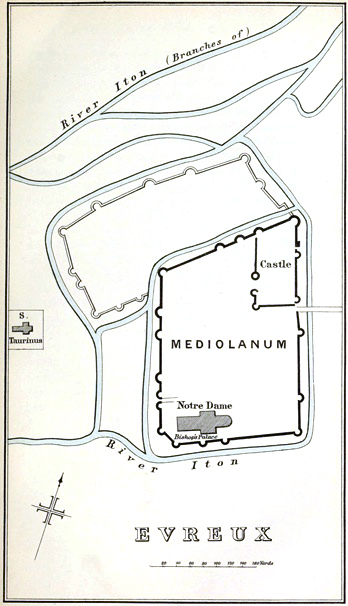
E. Weller
For the Delegates of the Clarendon Press.
EVREUX
Position of Conches.
It is otherwise with the fortress of the warlike lady
of the hills, against which the warlike lady of the
river-city now bade the forces of her husband’s county
to march. The home of Isabel has no more of her actual
work or date to show than the home of Heloise; but the
impress of the state of things which she represents is
stamped for ever on the stronghold of the house of
Toesny. At Evreux the Count and his followers lived
in the midst of works which, even in their day, were
ancient; at Conches, on the other hand, all was in that
day new. Conches had already its minster, its castle,
most likely its growing town; but all were the works
of its present lord or of his father. The hill of Conches
is another of those peninsular hills which, as the chosen
sites of castles, play so large a part in our story. But
the castle of Conches does not itself crown a promontory,
like the castle of Ballon. The cause doubtless was that
at Conches the abode of peace came first, and the abode
of warfare came only second. Either Ralph himself, the
265
first of his house who bears the surname of Conches as
well as that of Toesny, Foundation of the monastery.
or else his fierce father in some
milder moment, had planted on the hill a colony of
monks, the house of Saint Peter of Conches or Castellion.[733]
The monastery arose on that point of the high
ground which is most nearly peninsular, that stretching
towards the north. To the south of the abbey presently
grew up the town with its church, a town which, in after
times at least, was girded by a wall, and which was sheltered
or threatened The castle.
by the castle of its lords at the end
furthest from the monastery. To the east, the height
on which town and castle stand side by side rises sheer
from a low and swampy plain, girt in by hills on every
side, lying like the arena of a natural amphitheatre. On
the hill-side art has helped nature by escarpments; the
mound of the castle, girt by its deep and winding ditch,
rises as it rose in the days of Ralph and Isabel; but the
round donjon on the mound and the other remaining
buildings of the fortress cannot claim an earlier date
than the thirteenth century. The donjon and the apse
of the parish church, a gem of the latest days of French
art, now stand nobly side by side; in Isabel’s day they
had other and ruder forerunners. The abbey.
But of the abbey,
which must have balanced the castle itself in the general
view, small traces only now remain; it has become quite
266
secondary in the general aspect of the place, which
gathers wholly round the parish church and the donjon.
The western side of the hill, towards the forest which
takes its name from Conches, shows nearly the same
features as the eastern side on a smaller scale. It looks
down on another plain girt in by hills; but on this side
the slope of the hill of Conches itself is gentler, and the
town is here defended by a wall. Altogether it was a
formidable undertaking when the lord of the ancient
city in the vale carried his arms against the fortress, the
work of his brother, which had arisen within his own
memory on the height overlooking his own river.
Siege of Conches.
Count William thus began his winter siege of Conches;
but, as usual, we get no intelligible account of the siege
as a military operation. We are told nothing of the
Count’s line of march, or by what means he sought to
bring the castle to submission. Near kindred of the combatants.
But, as usual too, we
have no lack of personal anecdotes, anecdotes some of
which remind us how near were the family ties between
the fierce nobles who tore one another in pieces.
We have already mentioned one nephew of the Count of
Evreux who came with him to the attack of Conches.
But William of Breteuil was nephew alike of both the
contending brothers. His mother Adeliza, daughter of
Roger of Toesny, wife of Earl William of Hereford before
he went to seek a loftier bride in Flanders,[734]
was the
whole sister of Ralph of Conches and the half-sister of
Count William of Evreux.[735]
Another nephew and follower
of Count William, Richard of Montfort, son of his
whole sister, was moreover a brother of the Penthesileia
of Conches.[736]
The fate of these two kinsmen was different.
Death of Richard of Montfort.
Richard, in warring against his sister’s castle,
with some chance of meeting his sister personally in the
267
field, did not respect the sanctity of the neighbouring
abbey of her husband’s foundation. He heeded not the
tears of the monks who prayed him to spare the holy
place. A chance shot of which he presently died was
looked on as the reward of his sacrilege. Both sides
mourned for one so nearly allied to both leaders.[737]
William of Breteuil taken prisoner.
William of Breteuil, the ally of his uncle of Evreux,
became the captive of his uncle of Conches. That wary
captain, when the host of Evreux came a-plundering, was
at the head of a large force of his own followers and of
the King of England’s soldiers.[738]
But he bade his men
keep back till the foe was laden with booty; they were
then to set upon them in their retreat. His orders were
successfully carried out. Many of the party became the
prisoners of the lord of Conches, among them the lord of
Breteuil, the gaoler of William the son of Ansgar.[739]
Of
this incident came a peace which ended the three years’
warfare of the half-brothers.[740]
The captive William of
Breteuil procured his freedom by a ransom of three
thousand pounds paid to his uncle of Conches, which
268
was presently made good to him by the ransom of his
own victim from Rouen. Settlement of the county of Evreux on young Roger of Conches.
Moreover, as he had no lawful
issue,[741]
he settled his estates on his young cousin
Roger, the younger son of Ralph and Isabel. The same
youthful heir was also chosen by his childless uncle
of Evreux to succeed him in his county.[742]
Perhaps Duke
Robert confirmed all these arrangements as a matter of
course; perhaps the consent of such an over-lord was
not deemed worth the asking.
The young Roger of Toesny thus seemed to have a brilliant
destiny opened to him, but he was not doomed to be
lord either of Evreux or of Breteuil. He was, it is implied,
too good for this world, at all events for such a world
as that of Normandy in the reign of Robert. Character of Roger.
Pious,
gentle, kind to men of all classes, despising the pomp
of apparel which was the fashion of his day,[743]
the young
Roger attracts us as one of a class of whom there may
have been more among the chivalry of Normandy than
we are apt to think at first sight. An order could not
be wholly corrupt which numbered among its members
such men as Herlwin of Bec, as Gulbert of Hugleville,[744]
269
and the younger son of Ralph of Conches. A tale is
told of him, a tale touching in itself and one which gives
us our only glimpse of the inner and milder life of the
castle of Conches under the rule of its Amazonian mistress.
A number of knights sat idle in the hall, sporting
and amusing themselves with talk in the presence of
the lady Isabel.[745]
At last they told their dreams. The three dreams.
One
whose name is not given, said that he had seen the form
of the Saviour on the cross, writhing in agony and
looking on him with a terrible countenance. All who
heard the dream said that some fearful judgement was
hanging over the head of the dreamer. Baldwin of Boulogne.
Then spoke
Baldwin the son of Count Eustace of Boulogne, one of
the mightier sons of an ignoble father.[746]
He too had
seen his Lord hanging on the cross; but the divine
form was bright and glorious; the divine face smiled
kindly on the dreamer; the divine hand blessed him
and traced the sign of the cross over his head.[747]
All
said that rich gifts of divine favour were in store for
him. Roger’s dream.
Then the young Roger crept near to his mother,
and told her that he too knew one not far off who had
beheld his vision also. Isabel asked of her son of whom
he spoke and what the seer had beheld. The youth
blushed and hesitated, but, pressed by his mother and
his comrades, he told how there was one who had lately
seen his vision of the Lord, how the Saviour had placed
his hand on his head, and had bidden him, as his beloved,
to come quickly that he might receive the joys of
life. And he added that he knew that he who was thus
called of his Lord would not long abide in this world.
270
Such talk as this in the hall of Conches, in the presence
of its warlike lady, whether we deem it the record
of real dreams or a mere pious imagining after the fact,
seems like a fresh oasis in the dreary wilderness of unnatural
war. Fulfilment of the dreams.
Each vision was of course fulfilled. The
nameless knight, wounded ere long in one of the combats
of the time, died without the sacraments. Baldwin of
Boulogne, afterwards son-in-law of Ralph and Isabel,[748]
was indeed called to bear the cross, but in a way which
men perhaps had not thought of six years before Pope
Urban preached at Clermont. Count of Edessa, King of
Jerusalem, the name of Baldwin lives in the annals of
crusading Europe; to Englishmen it perhaps comes home
most nearly as the name of a comrade of our own Robert
son of Godwine.[749]
Death of young Roger.
But a brighter crown than that of Baldwin’s
kingdom was, long before Baldwin reigned, the reward
of the young Roger. A few months after the date
of the tale, he died peacefully in his bed, full of faith and
hope, and, amid the grief of many, his body was laid in
the minster of Saint Peter of his father’s rearing.[750]
Later treaty between the two brothers.
1100.
There was thus peace between Conches and Evreux, a
peace which does not seem to have been again broken.
Ten years later, in a time of renewed licence, we find
the two brothers joining in a private war against Count
Robert of Meulan.[751]
Eight years later again, when
Banishment and death of Count William. April 18, 1108.
Count William and his Countess were busy building a
monastery at Noyon, they fell under the displeasure of
King Henry, and died in banishment in the land of
Anjou.[752]
Ralph of Toesny was succeeded by his son
271
the younger Ralph, and Isabel, after a long widowhood,
withdrew as a penitent to atone for the errors of her
youth, one would think of her later days also, in a life
of religion.[753]
Orderic’s picture of Normandy.
It is after recording the war of Conches and the sack
of Rouen that the monk of Saint Evroul takes up his
parable to set forth the general wretchedness of Normandy
in the blackest colours with which the pictures
of Hebrew prophets and Latin poets could furnish him.
And it is Orderic the Englishman[754]
that speaks. His English feelings.
In his
Norman cell he never forgot that he first drew breath by
the banks of the Severn. In his eyes the woes of Normandy
were the righteous punishment for the wrongs of
England. The proud people who had gloried in their
conquest, who had slain or driven out the native sons of
the land, who had taken to themselves their possessions
and commands, were now themselves bowed down with
sorrows. The wealth which they had stolen from others
served now not to their delight but to their torment.[755]
Normandy, like Babylon, had now to drink of the same
cup of tribulation, of which she had given others to
drink even to drunkenness. A Fury without a curb
raged through the land, and smote down its inhabitants.
272
The clergy, the monks, the unarmed people, everywhere
wept and groaned. None were glad save thieves and
robbers, and they were not long to be glad.[756]
And so he
follows out the same strain through a crowd of prophetic
images, the locust, the mildew, and every other instrument
of divine wrath. We admit the aptness of his
parallel when he tells us that in those days there was
no king nor duke in the Norman Jerusalem; we are
less able to follow the analogy when he adds that the
rebellious folk sacrificed at Dan and Bethel to the
golden calves of Jeroboam.[757]
At last, when his stock
of metaphors is worn out, he goes back to his story to
tell the same tale of crime and sorrow in other parts of
the Norman duchy.[758]
§ 3. Personal Coming of William Rufus.
1091.
In a general view of the state of affairs, William Rufus
had lost much more by the check of his plans at Rouen
273
than he could gain by any successes of his Norman
allies at Conches. The attempt of the Count of Evreux
on the castle of his new vassal had been baffled; but
his own far greater scheme, the scheme by which he
had hoped to win the capital of Normandy, had been
baffled also. It may have been this failure which led
Christmas Gemót at Westminster. 1090.the King to see that his own presence was needed
beyond the sea.
The Christmas Gemót of the year was
held, not, as usual, at Gloucester, but at Westminster.
At Candlemas the King crossed to Normandy with a great
fleet.[759]
The King crosses to Normandy. February, 1091.The two things are mentioned together, as if to
imply that a further sanction of the assembled Witan was
given to this new stage of the war. War indeed between
William and Robert there was none. It does not seem
that a single blow was struck to withstand the invader.
But blows were given and taken in Normandy
throughout the winter with as much zeal as ever. And
this time Duke Robert himself was helping to give and
take them. Duke Robert helps Robert of Bellême.
Stranger than all, he was giving and taking
them in the character of an ally of Robert of Bellême
against men who seem to have done nothing but defend
themselves against the attacks of the last-named common
enemy of mankind. Hugh of Grantmesnil and Richard of Courcy.
Old Hugh of Grantmesnil, once the
Conqueror’s lieutenant at Winchester and afterwards his
Sheriff of Leicestershire,[760]
was connected by family ties
with Richard of Courcy,[761]
and the spots from which they
274
took their names, in the diocese of Seez, between the Dive
and the Oudon, lay at no great distance from one another.
They thus lay between Earl Roger’s own Montgomery[762]
and a series of new fortresses on the Orne and the neighbouring
streams, by which Earl Roger’s son hoped to extend
his power over the whole land of Hiesmes.[763]
Hugh
and Richard strengthened themselves against the tyrant—such
is the name which Robert bears—gathering their
allies and putting their castles in a state of defence.
Their united forces were too much for the lord of Bellême.
He sought help from his sovereign, and the Duke,
who was not allowed to strike a blow for his own
Rouen, appeared as the besieger of Courcy, no less than
of Brionne. He who had fought to turn the tyrant out
of Ballon and Saint Cenery now fought to put Courcy
into the tyrant’s power.
Siege of Courcy. January, 1091.
The siege of Courcy began in January.[764]
At the end
of the month or the beginning of the next, a piece of
news came which caused the Duke and the other besiegers
to cease from their work. News of William’s coming. February.
Robert himself could
see that there was something else to be done besides
making war on Hugh of Grantmesnil on behalf of
Robert of Bellême, when the King of the English was
in his own person on Norman ground. The siege raised.
The host before
Courcy broke up; some doubtless went to their own
homes;[765]
but we may suspect that some found their
way to Eu. For there it was that King William had
fixed his quarters; there the great men of Normandy
were gathering around him. They did not come empty-handed.
They welcomed the King with royal gifts; but it
275
was to receive far greater gifts in return. Men flock to William from all parts.
Thither too
men were flocking to him, not only from Normandy, but
from France, Flanders, Britanny, and all the neighbouring
lands. And all who came went away saying that the
King of the English was a far richer and more bountiful
lord than any of their own princes.[766]
In such a state of
things it was useless for Robert to think of meeting his
brother in arms. His only hope was to save some part
of his dominions by negotiation before the whole Norman
land had passed into the hands of the island king.
Treaty of Caen. 1091.
A treaty of peace was concluded, by which Robert kept
his capital and the greater part of his duchy, but by
which William was established as a powerful and dangerous
continental neighbour, hemming in what was left
of Normandy on every side.
The treaty was agreed to, seemingly under the mediation
of the King of the French, in a meeting of the rival
brothers at Caen.[767]
Cession of Norman territory to William.
The territorial cession made by Robert
mainly took the form of recognizing the commendations
which so many Norman nobles had made to the
Red King. They had sought him to lord, and their lord
he was to be. The fiefs held by the lords of Eu, Aumale,
Gournay, and Conches, and all others who had submitted
to William, passed away from Robert. They were to be
held of the King of the English, under what title, if any,
does not appear. To hold a fief of William Rufus meant
something quite different from holding a fief of Robert.
The over-lordship of Robert meant nothing at all; it did
276
not hinder his vassal from making war at pleasure either
on his lord or on any fellow-vassal. But the over-lordship
of William Rufus, like that of his father, meant real
sovereignty; the lords who submitted to him had given
themselves a master. If any of them had a mind to live
in peace, their chance certainly became greater; in any
case the dread of William’s power, combined with the
attractions of the rich hoard which was so freely opened,
might account for the sacrifice of a wild independence.
Their geographical aspect.
The territory thus ceded to the east, the lands of Eu,
Aumale, and Gournay, involved a complete surrender of
the eastern frontier of the duchy. The addition of the
lands of Conches formed an outpost to the south. Rouen
was thus hemmed in on two sides. But this was not
enough, in the ideas of the Red King, to secure a scientific
frontier. The lord of the island realm must hold
some points to strengthen his approach to the mainland,
something better than the single port of Eu in one
corner of the duchy. Robert had therefore to surrender
two points of coast which had not, as far as we have
heard, been occupied by William or by his Norman
allies. Cession of Fécamp and Cherbourg.
Rouen was to be further hemmed in to the
north-west, by the cession of Fécamp, abbey and palace.
The occupation of this point had the further advantage
for William that it put a check on the districts which
had been kept for Robert by Helias of Saint-Saen.
These were now threatened by Fécamp on one side and
by Eu and Aumale on the other. And William’s demands
on the Duke of the Normans contained one
clause which could be carried out only at the cost of the
Count of the Côtentin. Henry’s fortress of Cherbourg, not
so long before strengthened by him,[768]
was also to pass to
William. So early was the art known by which a more
powerful prince, with no ground to show except his own
277
will, claims the right to shut out a weaker prince or
people from the seaboard which nature has designed for
them.
William demands Saint Michael’s Mount.
Besides Cherbourg, the Red King demanded the island
fortress of Saint Michael’s Mount, the abbey in peril of
the sea. Otherwise he seems to have claimed nothing
in the west of Normandy. Robert might reign, if he
could, over the lands which his father had brought into
submission on the day of Val-ès-Dunes. Nor were
the great cessions which Robert made to be wholly
without recompence. It might be taken for granted
that the Duke whose territories were thus cut off was
to have some compensation in another shape out of the
wealth of England. Money paid to Robert.
So it was; vast gifts were given
by the lord of the hoard at Winchester to the pauper
prince at Rouen.[769]
But he was not to be left without
territorial compensation also. The lost dominions of the Conqueror to be restored to Robert.
William not only undertook
to bring under Robert’s obedience all those who
were in arms against him throughout Normandy; he
further undertook to win back for him all the dominions
which their father had ever held, except those
lands which, by the terms of the treaty, were to fall to
William himself. This involved a very considerable
enlargement of Robert’s dominions, besides turning his
nominal rule into a reality in the lands where he was
already sovereign in name. It was aimed at lands both
within and without the bounds of the Norman duchy.
Maine, city and county, was again in revolt against its
Norman lords.[770]
Projected recovery of Maine.
By this clause of the treaty William
bound himself to recover Maine for Robert. This obligation
he certainly never even attempted to fulfil. He
did not meddle with Maine till the Norman lord and the
English King were again one. Then the recovery of
278
Maine, or at least of its capital, became one of the chief
objects of his policy.
But this clause had also a more remarkable application.
Its terms were to be brought to bear on
one nearer by blood and neighbourhood to both the
contending princes than either Cenomannian counts
or Cenomannian citizens. Henry to be despoiled of the Côtentin.
The terms of the treaty
amounted to a partition of the dominions of the Count
of the Côtentin between his two brothers. Cherbourg
and Saint Michael’s Mount were, as we have seen,
formally assigned to William, and the remainder of
Henry’s principality certainly came under the head of
lands which had been held by William the Great and
which the treaty did not assign to William the Red.
As such they were to be won back for Robert by the
help of William. That is to say, William and Robert
agreed to divide between themselves the territory which
Henry had fairly bought with money from Robert. No
agreement could be more unprincipled. Character of the agreement.
As between
prince and prince, no title could be better than Henry’s
title to his county; while, if the welfare of the people of
Coutances and Avranches was to be thought of, the
proposed change meant their transfer from a prince
who knew the art of ruling to a prince whose nominal
rule was everywhere simple anarchy. Neither Robert
nor William was likely to be troubled with moral
scruples; neither was likely to think much of the
terms of a bargain and sale; but one might have expected
that Robert would have felt some thankfulness
to his youngest brother for his ready help in putting
down the rebellious movement at Rouen.[771]
William
279
might indeed on that same account look on Henry
as an enemy; but such enmity could hardly be decently
professed in a treaty of alliance between Robert and
William. We may perhaps believe that the chief
feeling which the affair of Rouen had awakened in
Robert’s mind was rather mortification than gratitude.
A brother who had acted so vigorously when he himself
was not allowed to act at all was dangerous as a neighbour
or as a vassal. The memory of his services was humiliating;
it was not well to have a brother so near at
hand, and in command of so powerful a force, a brother
who, if he had at one moment hastened to his elder
brother’s defence, might at some other moment come
with equal speed on an opposite errand. But whatever
were their motives, King and Duke agreed to rob their
youngest brother of his dominions. Henry attacked at once.And the importance
which was attached to this part of the treaty is shown
by the speed and energy with which it was carried out.
While the recovery of Maine was delayed or forgotten,
the recovery of the Côtentin was the first act of
the contracting princes after the conclusion of the
treaty.
Probable objects of William.
But, when we look to some other terms of the treaty,
it is possible that, in the mind of William at least, the
spoliation of Henry had a deeper object.
One purpose
of the treaty was to settle the succession both to
the kingdom of England and to the duchy of Normandy.
Settlement of the English and Norman succession.Neither the imperial crown nor the ducal coronet had
at this moment any direct and undoubted heir, according
to any doctrine of succession. Both William and
Robert were at this time unmarried; Robert had more
than one illegitimate child; no children of William Rufus
are recorded at any time. William and Robert to succeed one another.
The treaty provided that,
if either King or Duke died without lawful issue during
the lifetime of his brother, the survivor should succeed
280
to his dominions. I have spoken elsewhere of the
constitutional aspect of this agreement.[772]
Constitutional aspect of the agreement.It was an
attempt to barter away beforehand the right of the
Witan of England to bestow the crown of a deceased
king on whatever successor they thought good. And,
like all such attempts, before and after, till the great
act of settlement which put an end to the nineteen
years’ anarchy,[773]
it came to nothing. Growth of the hereditary principle,
But that such
an agreement should have been made shows what fresh
strength had been given by the Norman Conquest to
the whole class of ideas of which the doctrine of hereditary
succession to kingdoms forms a part.[774]
But,
putting this view of the matter aside, the objects of
the provision, as a family compact, were obvious. It
was William’s manifest interest to shut out Robert’s
sons from any share in the inheritance of their father.
and of the doctrine of legitimacy.
This was easily done. The stricter doctrine of legitimacy
of birth was fast growing.[775]
It was but unwillingly
that Normandy had, sixty years earlier,
acknowledged the bastard of an earlier Robert; it
was most unlikely that Normandy would submit to
a bastard of the present Robert, while there yet lived
lawful sons of him who had made the name of Bastard
glorious. Robert, on the other hand, might not be
unwilling to give up so faint a chance on the part of
his own children, in order to be himself declared presumptive
heir to the crown of England. But there
were others to be shut out, one of whom at least was
far more dangerous than the natural sons of Robert.
The two Æthelings
There were then in Normandy two men who bore the
English title of Ætheling, one of the old race, one of the
new; one whom Englishmen had once chosen as the
last of the old race, another to whom Englishmen looked
281
as the first of the new race who had any claim to the
privileges of kingly birth. Henry;
We must always remember
that, in English eyes, Henry, the son of a crowned
King of the English, born of his crowned Lady on
English ground, had a claim which was not shared by
his brothers, foreign born sons of a mere Norman
Duke and Duchess.[776]
Eadgar.
The kingly and native birth of
Henry might put his claims at least on a level
with those of Eadgar, who, male heir of Ecgberht and
Cerdic as he was, was born of uncrowned parents
in a foreign land.[777]
Indeed it might seem that by
this time all thoughts of a restoration of the West-Saxon
house had passed out of the range of practical
politics, and that the claims of Eadgar were no longer
entitled to a thought. The Red King however seems
to have deemed otherwise. He was clearly determined
to secure himself against the remotest chances of danger.
Henry was to be despoiled; Eadgar banished from Normandy.
Eadgar was to be banished.
Eadgar had come back from Apulia;[778]
he was now
living in Normandy on terms of the closest friendship
with the Duke, who had enriched him with grants of
land, and, as we have seen, admitted him to his inmost
counsels.[779]
We know not whether Eadgar had given
the Red King any personal offence, or whether William
was simply jealous of him as a possible rival for the
crown. At any rate, whether by a formal clause of the
treaty or not, he called on Robert to confiscate Eadgar’s
Norman estates and to make him leave his dominions.[780]
William’s policy towards Henry and Eadgar.
Neither towards Henry nor towards Eadgar would the
policy of William Rufus seem to have been wise; but
282
sound policy, in any high sense, was not one of the
attributes of William Rufus. Whatever may be said
of Henry’s relations towards Normandy, he was more
likely to plot against his brother of England if he became
a landless wanderer than if he remained Count
of Coutances and Avranches. As for Eadgar, it might
possibly have been a gain if he could have been sent
back to Apulia or provided for in his native Hungary.
As it was, he straightway betook himself to a land
where he was likely to be far more dangerous than he
could ever be in Normandy. Eadgar goes to Scotland.
As in the days of William
the Great,[781]
he went at once to the court of his brother-in-law
of Scotland.[782]
It may be that William presently
saw that he had taken a false step in the treatment
of both the Æthelings. At a later time we shall see
both Henry and Eadgar enjoying his full favour and
confidence.
The man before whose eyes the crown of England had
twice been dangled in mockery, and the man who was
hereafter to grasp that crown with a grasp like that of
the Conqueror himself, were thus both doomed to be for
the moment despoiled of lands and honours. The followers of each side to be restored.
To men
of less exalted degree the treaty was more favourable.
King and Duke alike, so far to the credit of both of
them, stipulated for the safety and restoration of their
several partisans in the dominions of the other. All
supporters of William in any of those parts of Normandy
which were not to be ceded to him were to suffer
no harm at the hands of Robert. The rebels of 1088 to be restored.
And, what was much
more important, all those who had lost their lands in
England three years before on account of their share
in the rebellion on behalf of Robert were to have their
283
lands back again. An exception, formal or practical,
must have been made in the case of Bishop Odo. He
certainly was not restored to his earldom of Kent.
The treaty sworn to.
The treaty was sworn to by twelve chief men on each
side.[783]
The English Chronicler remarks, with perfect
truth, It stands but a little while.
that it stood but a little while.[784]
But one part
at least was carried out at once and with great vigour.
William and Robert march against Henry.
Within less than a month after William had landed in
Normandy to dispossess Robert, he and Robert marched
together to dispossess Henry. They spent their Lent in
besieging him in his last stronghold. Lent, 1091.When the Count
of Coutances heard of the coalition against him, he made
ready for a vigorous resistance. Henry’s position.
He put his two cities
of Coutances and Avranches and his other fortresses
into a state of defence, and gathered a force, Norman
and Breton, to garrison them.[785]
Britanny indeed was
the only quarter from which he received any help in his
struggle.[786]
Earl Hugh of Chester and others betray their castles to William.
Those who seemed to be his firmest friends
turned against him. Even Earl Hugh of Chester, the foremost
man in the land from which his father had taken
his name,[787]
had no mind to jeopard his great English
palatinate for the sake of keeping his paternal Avranches
in the obedience of the Ætheling. Henry’s other supporters,
Richard of Redvers, it is to be supposed, among
them, were of the same mind. They saw no hope that
Henry could withstand the might, above all the wealth,
of Rufus; they accordingly surrendered their fortresses
284
into the King’s hands.[788]
Henry takes up his quarters at Saint Michael’s Mount.
One stronghold only was
now left to Henry, one of the two which had been
specially marked out to be taken from him, the monastic
fortress of Saint Michael. The sacred mount
was then famous and venerable through all Normandy,
and far beyond the bounds of Normandy. The buildings on the Mount.
Of that vast
and wondrous pile of buildings, halls, cloister, church,
buildings which elsewhere stand side by side, but which
here are heaped one upon another, little could then have
been standing. The minster itself, which crowns all,
had begun to be rebuilt seventy years before by the
Abbot Hildebert,[789]
and it may be that some parts of his
work have lived through the natural accidents of the
next age[790]
and the destruction and disfigurement of
later times. But the series of pillared halls, knightly
and monastic, which give its special character to the
abbey of the Mount, are all of far later date than the
war of the three brothers. Yet the house of the
warrior archangel was already at once knightly and
monastic. Abbot Roger. 1085.
The reigning abbot Roger was, in strict
ecclesiastical eyes, a prelate of doubtful title. He
had come in—as countless other bishops and abbots
of Normandy and England had come in—less by free
election of the monks than by the will of the great
285
Duke and King.[791]
What personal share Roger took in the
struggle is not recorded; but some at least of his monks,
The monks welcome Henry.
like the monks of Ely in the days of Hereward,[792]
welcomed
the small body of followers who still clave to
Henry, and at whose head he now took up his last
position of defence in the island sanctuary.[793]
Siege of the Mount. Lent, 1091
Here Henry was besieged by his two brothers, Duke
and King. Yet we hear of nothing which can in strictness
be called a siege. The Mount stands in the mouth
of a bay within a bay. Its position.
At high water it is strictly an
island; at low water it is surrounded by a vast wilderness
of sand—those treacherous sands from which thirty
years before Harold had rescued the soldiers of the elder
William[794]
, and which stretch back as far as the rocks of
Cancale on the Breton shore. The inner bay.
In this sense the bay of
Saint Michael may be counted to stretch from Cancale
to the opposite point on the Norman coast, where the
land begins to bend inwards to form the narrower bay.
This last may be counted to stretch from the mouth of
the border stream of Coesnon below Pontorson to Genetz
lying on the coast nearly due west from Avranches.
The Mount itself and its satellite the smaller rock of
Tombelaine lie nearly in a straight line between these
two points. Alternately inaccessible by land and by
water, accessible by land at any time only by certain
known routes at different points, the Mount would seem
to be incapable of direct attack by any weapons known
in the eleventh century. On the other hand, it would
be easy to cut it off from all communication with the
outer world by the occupation of the needful points on
286
the shore and by the help of a blockading fleet. Later sieges. 1417–1424.
And in
the great siege three hundred and thirty years later—when
Normandy had again a kingly duke of the blood
of Rolf and Henry, but when the Mount clave to the
King of Paris or of Bourges—we hear both of the blockading
fleet of England and of the series of posts with
which the shore was lined. No mention of ships.
Without a fleet the Mount
could hardly be said to be besieged; but, on the other
hand, its insular position would be of no use to its
defenders, unless they had either ships at command
or friends beyond sea. In the present case we hear
nothing of ships on either side, nor of any help coming
to the besieged. Nor do we hear of any systematic
occupation of the whole coast. Positions of the besiegers.
We hear only that the
besiegers occupied two points which commanded the
two sides of the inner bay, On the north the Duke
took up his quarters at Genetz; to the south the besiegers
occupied Arderon, not far from the mouth of
the Coesnon, while King William of England established
himself in the central position of Avranches.[795]
Character of the siege.
The siege thus became an affair of endless small
attacks and skirmishes. We hear of the plundering
expeditions which Henry was able to make into the
lands of Avranches and even of Coutances, lands which
had once been his own, but which had now become
hostile ground.[796]
We hear too how, before each of the
287
extreme points occupied by the besiegers, before Genetz
and before Arderon, Combats
the knights on both sides met every
day in various feats of arms, feats, it would seem, savouring
rather of the bravado of the tourney than of any
rational military purpose.[797]
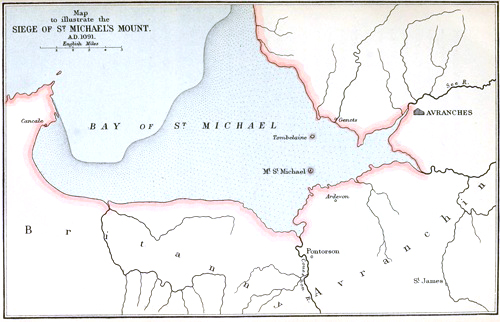
Edwᵈ. Weller
For the Delegates of the Clarendon Press.
Map
to illustrate the
SIEGE of Sᵀ MICHAEL’S MOUNT.
A.D. 1091.
Personal anecdotes.
We now get, in the shape of those personal anecdotes
in which this reign is so rich, pictures of more than one
side of the strangely mixed character of the Red King.
At the other end of Normandy William had won lands
and castles without dealing a single blow with his own
sword, and with a singularly small outlay of blows
from the swords of others. At Eu, at Aumale, and at
Gournay, the work had been done with gold far more
than with steel. Beneath Saint Michael’s Mount steel
was to have its turn; and, when steel was the metal to be
used, William Rufus was sure to be in his own person the
foremost among those who used it. The change of scene
seemed to have turned the wary trafficker into the most
reckless of knights errant. Amidst such scenes he became,
in the eyes of his own age, the peer of the most
renowned of those Nine Worthies the tale of whom was
made up only in his own day. William compared to Alexander.
We shall see at a later
stage how the question was raised whether the soul of
the Dictator Cæsar had not passed into the body of the
Red King; by the sands of Saint Michael’s bay he was
held to have placed himself on a level with the Macedonian
Alexander. The likeness could hardly be carried
on through the general military character of the two
princes; for Alexander, when he began an enterprise,
commonly carried it on to the end. And it may be
doubted whether Alexander ever jeoparded his own life
288
in the senseless way in which Rufus in the tale is made
to jeopard his. We must picture to ourselves the royal
head-quarters between the height of Avranches and
the sands of Saint Michael’s bay. Knight-errantry of William.
The King goes
forth from his tent, and mounts the horse which he had
that morning bought for fifteen marks of silver.[798]
He
sees the enemy at a distance riding proudly towards
him. Alone, waiting for no comrade, borne on both
by eagerness for the fray and by the belief that no one
would dare to withstand a king face to face, he gallops
forward and charges the advancing party.[799]
The King upset.
The newly
bought horse is killed; the King falls under him; he
is ignominiously dragged along by the foot, but the
strength of his chain-armour saves him from any actual
wound.[800]
By this time the knight who had unhorsed
him has his hand on the hilt of his sword, ready to deal
a deadly blow. William, frightened by the extremity of
his danger, cries out, “Hold, rascal, I am the King of
England.”[801]
The words had that kind of magic effect
which is so often wrought by the personal presence of
royalty. From any rational view of the business in
hand, to slay, or better still to capture, the hostile
king should have been the first object of every man in
Henry’s garrison. To no case better applied the wise
order of the Syrian monarch, “Fight neither with small
nor great, save only with the King of Israel.”[802]
But as
soon as a voice which some at least of them knew proclaimed
that it was a king who lay helpless among
them, every arm was stayed. The soldiers of Henry
tremble at the thought of what they were so near
289
doing; with all worship they raise the King from the
ground and bring him another horse.[803]
His treatment of the knight who unhorsed him.
William springs
unaided on his back; he casts a keen glance on the
band around him,[804]
and asks, “Who unhorsed me?” As
they were muttering one to another, the daring man who
had done the deed came forward and said, “I, who took
you, not for a king but for a knight.” A bold answer
was never displeasing to Rufus; he looked approval,
and said, “By the face of Lucca,[805]
you shall be mine;
your name shall be written in my book,[806]
and you shall
receive the reward of good service.” Here the story
ends; we are to suppose that William, instead of being
carried a prisoner to the Mount, rode back free to
Avranches, having lessened the small force of Henry by
a stout knight and two horses.
Character of the story.
The tale is told as an example of the magnanimity of
the Red King. And there is something which moves a
kind of admiration in the picture of a man, helpless
among a crowd of enemies, yet bearing himself as if they
were his prisoners, instead of his being theirs. The point
of the story is that Rufus did no harm, that he felt
no ill will, towards the man who had unhorsed, and all
but killed him; that he honoured his bold deed and bold
bearing, and promised him favour and promotion. But
had the soldiers of Henry done their duty, William would
have had no opportunity, at least no immediate opportunity,
of doing either good or harm to his antagonist.
290
William assumes that the enemy will not dare to withstand
him, and his assumption is so far justified that
he is withstood only by one who knows not who he
is, and whose words imply that, if he had known, he
would not have ventured to withstand him. Trusting
to this kind of superstitious dread, William is able to
speak and act as he might have spoken if the man who
unhorsed him had been brought before him in his own
tent. Comparison with Richard the First.
Richard of the Lion-heart, when the archer who
had given him his death-wound was brought before him,
first designed him for a death of torture, and then, on
hearing a bold answer, granted him life and freedom.[807]
In this, as in some other cases, the Red King, the earliest
model of chivalry, certainly does not lose by comparison
with the successor who is more commonly looked on as
its ideal.[808]
Another and perhaps better known story which is told
of this siege puts the character of William Rufus in
another light, while it brings out the character of Robert
in a lively form. Contrast between William and Robert.
The Duke, heedless of the consequences
of his acts but not cruel in his own person, was, above
all men, open to those passing bursts of generosity which
are quite consistent with utter weakness and want of
principle. William Rufus was always open to an appeal
to his knightly generosity, to that higher form of self-assertion
which forbade him to harm one who was beneath
him, and which taught him to admire a bold deed
or word even when directed against himself. But the ties
291
of kindred, still more the ties of common humanity, sat
very lightly on him. The gentler soul of Robert was by
no means dead to them. He did not shrink from
waging an unjust war against his brother and deliverer;
he did not shrink from despoiling that brother and deliverer
of dominions which he had sold to him by his own
act for a fair price; but he did shrink from the thought
of letting the brother against whom he warred suffer
actual bodily hardships when he could hinder them.
Lack of water on the Mount.
The defenders of the Mount had, according to one account,
plenty of meat; but all our narratives agree as to
the difficulty of providing fresh water for the fortress
which twice in the day was surrounded by the waves.[809]
Henry asks to be allowed to take water.
Henry sent a message to the Duke, praying that he
might be allowed access to fresh water; his brothers
might, if they thought good, make war on him by the
valour of their soldiers; they should not press the
powers of nature into their service, or deprive him of
those gifts of Providence which were open to all human
beings.[810]
Answer of Robert and William.
Robert was moved; he gave orders to the
sentinels at Genetz not to hinder the besieged from
coming to the mainland for water.[811]
One version even
adds that he added the further gift of a tun of the best
wine.[812]
This kind of generosity, where no appeal was
made to his own personal pride, was by no means to
292
the taste of Rufus; as a commander carrying on war,
he was ready to press the rights of warfare to the
uttermost. When he heard what Robert had done, he
mocked at his brother’s weakness; it was a fine way
of making war to give the enemy meat and drink.[813]
Robert answered, in words which do him honour,
but which would have done him more honour if they
had been spoken at the beginning as a reason for forbearing
an unjust attack on his brother—“Shall we let
our brother die of thirst? Where shall we find another,
if we lose him?”[814]
Such are these two famous stories of the war waged
beneath the mount of the Archangel. Both are eminently
characteristic; there is no reason why both may not be
true. But we must withhold our belief when one of our
tale-tellers adds that William turned away from the
siege in contempt for Robert’s weakness.[815]
A more
sober guide tells us that when, for fifteen days, Henry and
his followers had held up against lack of water and
Henry surrenders.
threatening lack of food,[816]
the wary youth saw the hopelessness
of further resistance, and offered to surrender
the Mount on honourable terms. He demanded a free
293
passage for himself and his garrison. William, already
tired of a siege in which he had made little progress and
which had cost him many men and horses,[817]
gladly accepted
the terms. Henry, still Ætheling, though no
longer Count, marched forth from his island stronghold
with all the honours of war.[818]
We are to suppose that,
according to the terms of the treaty, the King took
possession of the Mount itself, and the Duke of the rest
of Henry’s former county. William at Eu.
William stayed on the mainland,
in the parts of Normandy which had been ceded to
him, for full six months, having his head-quarters at
Eu.[819]
He goes back to England. August, 1091.
In August the affairs of his island kingdom called
him back again; and, strange to say, both his brothers
went with him as his guests and allies.[820]
Fortunes of Henry.
At this moment the past and the future alike lead us
to look with more interest on the fates of the dispossessed
Ætheling than on those of any other of the actors
in our story. But there is at first sight some little difficulty
in finding out what those fates were. His presence in England in 1091.
From our
English authorities we could only gather that Henry
was in England before the end of the year in which the
siege took place, and that three years later he was again
beyond sea, in favour with William and at enmity with
Robert. From other writers we get a version, which
294
Story of Henry’s adventures.
takes no notice of any visit to England, but which gives
us a moving tale of Henry’s experiences in Normandy
and the neighbouring lands. It is one of those cases
where a writer, telling his own part of the story, altogether
forgets, perhaps without formally contradicting,
other parts. In such a case he is likely to stumble in
some of his dates and details; but this need not lead us
altogether to cast aside the main features of his story.
It is plain that, for some time after the surrender of the
Mount, Henry was, to say the least, landless. In the
pictures of his actual distress and adversity there may
well be somewhat of exaggeration; but they draw from
one who is not a flatterer the important remark that,
having known adversity himself, he learned to be gracious
in after years to the sufferings of others.[821]
His alleged wanderings.
We are
perhaps startled by such a saying when we think of
some particular acts of Henry; but this witness does
not stand alone; and, among the contradictions of
human nature, there is nothing impossible in the belief
that such a spirit may have existed alongside of many
particular acts of cruelty.[822]
But it is certain that
Henry’s season of adversity must have been shorter
than it appears in the picture of it which is given to
us. We are told that, soon after he left the Mount,
he found himself very nearly a solitary wanderer.
He first went into Britanny, the only land from
which he had received any help, and thanked his
friends there for their services. Thence he betook himself
to France, and spent, we are told, nearly two years
in the borderland of the Vexin, the land which had been
the scene of his father’s last and fatal warfare, and which
295
was again to be the scene of warfare before his brother’s
reign was ended. There, with a train cut down to one
knight, one clerk, and three esquires, Henry wandered
to and fro, seeking shelter where he could.[823]
Whatever
truth there may be in these details, the time of Henry’s
probation could not have been spread over anything like
a period of two years. He may have been a wanderer
during the few months which immediately followed the
surrender of the Mount; but, if so, he was reconciled to
both his brothers long before the end of the year. Or he
may, from some unexplained reason, have again become
a wanderer during some months of the following year.
There is nothing in any way impossible or unlikely in
either story. What is certain is that, before the end of
the next year, Henry had again an establishment on
Gaulish ground, and one gained in the most honourable
way. Robert and Henry accompany William to England.
And it is equally certain that when King William
went back to England in the month of August in the
present year he took both of his brothers with him.[824]
§ 4. The Scottish Expedition of William Rufus.
August–October, 1091.
Affairs of Scotland.
The business which called William back to his kingdom
was a serious one; it was no other than to drive
back or to avenge a Scottish invasion. King Malcolm,
who seems to have stayed quiet during the rebellion
three years before, now took up arms. We cannot help
connecting this step with the visit of his brother-in-law,
and the words of the Chronicler seem directly to
imply that Malcolm’s invasion was the consequence of
296
Eadgar’s coming.[825]
From one version we might almost
think that Malcolm had been called on to do homage
and had refused.[826]
This is perfectly possible in itself;
but the time of William’s special occupation with Norman
affairs seems oddly chosen for such a summons.
An earlier time, some point in the blank period between
the rebellion and the Norman campaign, would have
seemed more natural for such a purpose. Malcolm’s invasion of Northumberland. May, 1091.
However this
may be, now, in the month of May, Malcolm took advantage
of William’s absence in Normandy to invade
Northumberland for the fourth time. He designed, we
are told, to go much further and do much more, words
which might almost suggest a purpose of asserting the
claims of Eadgar to the English crown. Whatever were
his objects, they were not carried out, save one which
was doubtless not the least among them, that of carrying
off great spoil from Northumberland.[827]
The furthest point
that Malcolm reached was Chester-le-Street, a point unpleasantly
near to the bishopless monks of Durham.[828]
He is driven back.
There the men in local command went against him and
drove him back. In the national Chronicle they appear
as “the good men who guarded this land.”[829]
In this way
297
of speaking, as in many other phrases in our own and
other tongues, the word “good” means rank and office
rather than moral goodness. The “good men.”
Yet the latter idea is not
wholly absent; the name would hardly be given to men
who were engaged in a cause which the writer wholly
condemned. The “good men” here spoken of must have
been mainly Normans, with Earl Robert of Mowbray
at their head. Earl Robert was not likely to have won
much love from the English people. Yet he passed for
a “good man,” when he did his duty for England, when
he guarded the land and drove back the Scottish invader.
Of any wish to put Malcolm in the place of either the
elder or the younger William we see no trace at any
stage of our story. Beyond this emphatic sentence, we
get no details. As in so many other cases, if conquest
was the object of Malcolm’s expedition, plunder was the
only result.
William and Robert in England. August, 1091.
The news of this harrying of the northern part of his
kingdom brought King William back from Normandy in
the course of August. With him, as we have said, came
Robert and Henry. Why was the Duke’s presence needed?
One account hints that his coming had some reference
to the actors in the late rebellion, some of whom at least
were now restored to their estates.[830]
Relations between Robert and Malcolm.
Another version
speaks of an old friendship between Robert and Malcolm;[831]
and there was a tie of spiritual affinity between
298
them arising out of Robert’s relation as godfather to a
child of Malcolm.[832]
It was perhaps in this character
that Robert came to act, if need should be, as a welcome
negotiator with his Scottish gossip. Stronger side of Robert and Eadgar.
One strange thing
is that, on more than one occasion in our story, both
Robert and Eadgar, two men who seem so incapable of
vigorous or rational action on behalf of themselves, play
a distinctly creditable part when acting on behalf of
others. But this is really no uncommon inconsistency
of human nature; men are often found who are good
advisers in the affairs of others, while they are by no
means wise managers of their own. Robert in truth
appears to most advantage anywhere out of his own
duchy. Neither the warrior of the crusade nor the
negotiator with the Scot seems to be the same man as
the Duke who could not be trusted to defend his own
palace.
William sets forth.
In the present case there was more of negotiation
than of warfare. Of actual fighting there seems to have
been none. William got together, as his father had
done in the like case,[833]
a great force by land and sea for
the invasion of Scotland. With the land force the King
and the Duke set forth; but seemingly with no haste, as
time was found for a great ecclesiastical ceremony on
the way. Durham in the absence of Bishop William.
For three years the church of Durham had
been without a shepherd, and the castle of Durham had
been in the hands of the King. The monks of Saint
Cuthberht’s abbey had feared that this irregular time
would be an evil time for them. But they put their
trust in God and their patron saint, and went to the King
to ask his favour. The King’s favourable treatment of the monks.
Rufus was specially gracious and
merciful; he rose up to greet Prior Turgot, the head of the
embassy, and he gave orders that the monks of Durham
should be in no way disturbed, but should keep full
299
possession of their rights and property, exactly as if the
Bishop had remained in occupation of his see.[834]
We
may even venture to guess that they had a somewhat
fuller possession of them during the Bishop’s absence.
We are expressly told by the local historian that the Red
King did not deal with Durham as he dealt with other
churches; he took nothing from the monks, and even
gave them something of his own.[835]
Works at Durham.
The new society—for
it must be remembered that the monks of Durham
were a body of Bishop William’s own bringing in[836]—flourished
so greatly during this irregular state of things
that it was now that they built their refectory.[837]
But a
time of more settled order was now to come. Reconciliation of Bishop William with the King.
Bishop
William of Saint-Calais, whatever had been his crimes
three years back, was among those whom King William
had engaged by his treaty with his brother to restore to
their lands and honours. Besides this general claim, it
was believed, at Durham at least, that the banished
prelate had earned his restoration by a signal service
done to the King. In the third year of his banishment
an unnamed Norman fortress was holding out for the
King; but its garrison was sore pressed, and its capture
by the enemy seemed imminent. The Bishop, by what
means of persuasion we are not told, but it does not
seem to have been by force, caused the besiegers to raise
the siege.[838]
This service won the King’s thorough good
300
He is restored to his bishopric. September 3, 1091.
will, and William, on his march to Scotland, personally
put the Bishop once more in possession of his see and of
all its rights and belongings, temporal and spiritual.[839]
Bishop William did not come back empty-handed; he
brought with him costly gifts for his church, ornaments,
gold and silver vessels, and, above all, many books.[840]
And, at some time before the year was out, we find him
confirming with great solemnity, with the witness of
the great men of the realm, certain grants of the Conqueror
to the monks of his church.[841]
The return of the
Bishop was an event not only of local but of national
importance. His renewed influence with the King.
He was restored by the King, not only to
his formal favour, but to a high place in his innermost
counsels. Bishop William was not one of those who
come back from banishment having learned nothing and
forgotten nothing. He had, in his sojourn beyond the
sea, learned an altogether new doctrine as to the relations
between bishops and kings.
The march which had been interrupted by the ceremony
at Durham was clearly a slow one. William was
at Durham in the first days of September; much later
in the month a heavy blow fell on one part of the expedition.
Loss of the ships. Michaelmas, 1091.
The greater part of the ships were lost a few
days before the feast of Michaelmas, and we are told that
this happened before the King could reach Scotland.
The King was therefore several weeks in journeying
301
from Durham to the border of the true Scotland, the
Firth of Forth; and we are told that many of the land
force also perished of cold and hunger.[842]
The army
however which remained was strong enough to make
Malcolm feel less eager for deeds of arms than he had
most likely felt in May. William and Malcolm by the Scots’ Water.At last, near the shore of the
Scots’ Water, the estuary which parted English Lothian
from Scottish Fife, the two kings met face to face,
seemingly in battle array, but without coming to any
exchange of blows. It is marked in a pointed way that
Malcolm had crossed from his kingdom to his earldom.
He “went out of Scotland into Lothian in England, and
there abode,”[843]
There a negotiation took place. Mediation of Robert and Eadgar.
The ambassadors or mediators were Duke Robert and the
Ætheling Eadgar.[844]
According to the most picturesque
version, Malcolm, who is conceived as still keeping on
the northern side of the firth, sends a message to
302
William to the effect that he owes no homage to him,
but that, if he can have an interview with Robert, he
will do to him whatever is right. Conference of Robert and Malcolm.
By the advice of his
Wise Men,[845]
William sends his brother, who is courteously
received by the Scottish King for three days.
Somewhat like the Moabite king of old, though with
quite another purpose, Malcolm takes his visitor to the
tops of various hills, and shows him the hosts of Scotland
encamped in the plains and dales below. With
so mighty a force he is ready to withstand any one who
should try to cross the firth; he would be well pleased
if any enemy would make the attempt. Malcolm’s homage to Robert.
He then suddenly
turns to the question of homage. He had received
the earldom of Lothian from King Eadward,
when his great-niece Margaret was betrothed to him.
The late King William had confirmed the gifts of his
predecessor, and, at his bidding, he, Malcolm, had become
the man of his eldest son, his present visitor Duke
Robert. To him he would discharge his duty; to the
present King William he owed no duty at all. He
appealed to the Gospel for the doctrine that no man
could serve two lords, the doctrine which had been so
practically pressed on Robert’s behalf three years before.[846]
Robert admitted the truth of Malcolm’s statement;
but he argued that times were changed, and that
the decrees of his father had lost their old force. It
would be wise to accept the reigning King as his lord, a
lord nearer, richer, and more powerful, than he could
pretend to be himself. Malcolm might be sure of a
gracious reception from William, if he came on such an
errand. He submits to William.
Malcolm was convinced; he went to the King
of the English; he was favourably received, and a peace
303
was agreed on. It is added that the two kings then
disbanded their armies, and went together into England.[847]
This last statement throws some doubt upon the
whole of this version; for Malcolm’s alleged journey to
England at this moment is clearly a confusion with
events which happened two years later. Question as to the betrothal of Margaret.
The references
too to the earldom of Lothian and to an earlier betrothal
of Margaret are a little startling; yet it is perhaps not
quite hopeless to reconcile them with better ascertained
facts. As I have elsewhere suggested, this earlier betrothal
of Margaret to Malcolm is not necessarily inconsistent
with his later marriage with her after the intermediate
stage of Ingebiorg.[848]
Malcolm may at one time
have been in no hurry to carry out a marriage dictated
by political reasons; yet he may have afterwards become
eager for the same marriage after he had seen her whose
hand was designed for him. Question of Lothian.
As for the Lothian earldom,
we here see the beginning of the later Scottish argument,
that homage was due from the Scottish to the
English king only for lands held within the kingdom
of England. At this stage Lothian was the land held
within the kingdom of England; it was what Northumberland,
Huntingdon, or any other confessedly English
land held by the Scottish king, was in later times. When
Malcolm was restored to his crown by the arms of
Siward,[849]
no doubt Lothian was granted to him among
other things. Only Malcolm takes up the line, or our
historian thinks it in character to make him take up the
line, of implying, though not directly asserting, that
Lothian was the only possession for which homage was
due. And, on the strictest view of English claims, Malcolm
would be right in at least drawing a marked
304
distinction between Scotland and Lothian. He owed both
kingdom and earldom to the intervention of Eadward
and Siward; but Lothian was a grant from Eadward in
a sense in which Scotland was not. Over Scotland
neither Eadward nor William could claim more than an
external superiority. Lothian was still English ground,
as much as the land which is now beginning to be distinguished
as Northumberland.
Treaty between William and Malcolm.
The version of Malcolm’s submission which I have
just gone through is certainly worth examining, and
I do not see that it contradicts the simpler and more
certain version. According to this account, the negotiation
was carried on between Robert and Eadgar. The
agreement to which the mediators came was that Malcolm
should renew to the younger William the homage
which he had paid to the elder.[850]
On the other hand, he
was to receive all lands and everything else that he had
before held in England, specially, it would seem, twelve
vills or mansions for his reception on his way to the
English court.[851]
Malcolm does homage.
On these terms Malcolm became the
man of William; Eadgar also was reconciled to William.
The two kings parted on good terms, but the Chronicler
notices, in a phrase of which he is rather fond, that it
“little while stood.”[852]
William, Robert, and Eadgar now took their journey
305
back again, as it is specially marked, from Northumberland
into Wessex.[853]
Return of William.
The realm of Ælfred is still looked
on as the special dwelling-place of his successors from
beyond the sea. But it would seem that, at some stage
of their southward journey, at some time before the
year was out, they joined with other men of royal and
princely descent in setting their crosses to a document,
in itself of merely local importance, but which is clothed
with a higher interest by the names of those who sign
it. Evidence of the Durham charters.
A grant of certain churches to the convent of Durham
becomes a piece of national history when, besides the
signatures for which we might naturally look, it bears the
names of King William the Second, of Robert his brother,
of Henry his brother, of Duncan son of King Malcolm, of
Eadgar the Ætheling, and of Siward Barn.[854]
This is the
only time when all these persons could have met. There is
no sign of any later visit of Robert to England during
the reign of William. But the signatures of Henry and
Duncan teach us more. Duncan.
Duncan, it will be remembered,
had been given as a hostage at Abernethy;[855]
he had been
set free by the Conqueror on his death-bed; he had been
knighted by Robert, and allowed to go whither he would.[856]
Had he already made his way back to his own land, or
did he come in the train of his latest benefactor? In
the former case, had he been again given as a hostage?
Or had William found out that the son of Ingebiorg
might possibly be useful to him? It is certain that, two
years later, Duncan was at William’s court and in William’s
favour; and it looks very much as if he had, in
whatever character, gone back to England with the
306
King. Eadgar.
The signature of Eadgar shows that the document
must be later than the treaty with Malcolm by which
he was reconciled to William, that is, that it was
signed on the journey southward, not on the journey
northward. Henry.
The signature of Henry is our only hint
that he had any share at all in the Scottish business,
and it throws a perfectly new light on this part of his
history. He was plainly in England, seemingly in favour
with both his brothers, and things look as if he too,
though he is nowhere mentioned, must have gone on
the march to Scotland. Siward Barn.
Siward Barn, like Duncan, was
one of those who were set free by William the Great on
his death-bed. We now learn that he shared the good
luck of Duncan and Wulf, not the bad luck of Morkere
and Wulfnoth. He signs as one of the great men of the
north, with Arnold of Percy, with the Sheriff Morel, and
with Earl Robert himself.
One thing is plain, namely, that this document was
not signed in the regular Christmas Assembly of the
year. By that time Robert and Eadgar were no longer
in England. By that time Robert and William had
again quarrelled. Fresh dispute between William and Robert.
We may guess that some of Robert’s
old partisans had been less lucky than the Bishop of
Durham. At all events, some points in the treaty of
Caen remained unfulfilled. Then, as in later times, a
diplomatic engagement was not found strong enough to
carry itself out by its own force, like a physical law of
nature. We are not told what was the special point
complained of; but something which the Red King
should have done for Robert or for his partisans was
left undone.[857]
It was simply as a man and a king that
Rufus had entered into any engagements with his brother.
His knightly honour was not pledged; the treaty therefore
came under the head of those promises which no man can
307
fulfil.[858]
We are told in a pointed way that Robert stayed
with his brother till nearly the time of Christmas. The
matter in dispute, whatever it was, might have been
fittingly discussed in the Christmas Assembly; only it
might have been hard to find the formula by which the
Duke of the Normans was to appeal the King of the
English of bad faith before his own Witan. Robert and Eadgar leave England. December 23, 1091.
Two days
before the feast Robert took ship in Wight, and sailed
to Normandy, taking the Ætheling Eadgar with him.[859]
Natural phænomena. Fall of the tower at Winchcombe. October 15, 1091.
Either the reign of Rufus was really richer than other
times in striking natural phænomena, or else they were
specially noticed as signs of the times. About the time
of the King’s Scottish expedition, the tower of the
minster at Winchcombe was smitten by a mighty
thunderbolt, and fell in ruins on the body of the church,
crushing the most hallowed images in its fall. The Chthonian
Zeus had no place in the mythology of the times;
but this destruction, which left behind it a thick smoke
and an evil smell, was deemed to be the work of the evil
one, the signs of whose presence were got rid of only by
the most solemn chants and processions.[860]
Two days later,
308
Great wind in London. October 17, 1091.
London was visited by a fearful wind, which blew down
seven churches and houses to the number of six hundred.
Above all, the wooden roof of the church of Saint Mary-le-bow
was carried off, and its beams were hurled to the
ground with such force that they were driven into the
hard earth, and had to be sawn off as they stood.[861]
Two
men who were in the church were crushed. The citizens
could have hardly repaired their houses before another
blow came upon them. Fire in London. March 28, 1092.
Early in the next year the greater
part of London was destroyed by fire.[862]
By Eastertide
the cathedral churches of two of the dioceses whose
seats had been moved in the late reign stood ready for
consecration. Consecration of the church of Salisbury. April 5, 1092.
On the waterless hill which then was
Salisbury, within the everlasting ditches of the elder
time, looking down on the field of battle which had
decreed that Britain should be English[863]
and on the
field of council which had decreed that England should
be one,[864]
Norman Osmund, the doctor of the ritual lore
of England, had finished the work which Lotharingian
Hermann had began. The new mother church of the
lands of Berkshire, Wiltshire, and Dorset, the elder
minster of Saint Mary, whose stones were borne away
to build the soaring steeple of its successor but whose
foundations may still be traced on the turf of the forsaken
city, now awaited its hallowing. There was then
309
no archbishop in southern England; the rite was done
by Osmund himself with the help of his two nearest
episcopal neighbours, Walkelin of Winchester and
John of Bath.[865]
The ceremony had thus a specially
West-Saxon character. The three bishops who came
together at Salisbury represented the three—once four—churches,
among which the old West-Saxon diocese, the
diocese of Winchester, had been parted asunder.[866]
But
at Salisbury too, the elements, if somewhat less hostile
than at Winchcombe and London, were by no means
friendly. The tower roof thrown down. April 10.
Five days only after the hallowing, the lightning
fell, as at Winchcombe; the peaked roof or low
spire which sheltered the tower—doubtless of wood
covered with lead—was thrown down, and its fall did
much damage to the walls of the new minster.[867]
A day later by a month had been fixed for another
ceremony of the same kind, the crowning of the work of
a prelate who seems to have wished for a more stately
ceremony and a greater gathering than the almost domestic
rite which had satisfied Bishop Osmund. Remigius,
Almoner of Fécamp, Bishop of Dorchester, Bishop of
310
Remigius of Lincoln.
Lincoln, was drawing near the end of his famous episcopate.
He had reformed the constitution of his chapter
and diocese; and we hear that he was no less zealous
in reforming the manners of his flock.[868]
The darling
sin of Bristol—most likely the darling sin of every great
trading-town—was rife at Lincoln also; and Remigius,
like Wulfstan, preached against the wicked custom by
which men sold their country-folk, sometimes their kinsfolk,
to a life of shame or of bondage in foreign lands.[869]
Completion of the minster.
But beyond all this, he had finished his great work on
the hill of Lincoln; the elder church of Saint Mary had
grown into the great minster of which later rebuildings
and enlargements have still left us some small remnants.[870]
The eastern limb had as yet no need to overleap the
Roman wall of Lindum; but Remigius had reared, and
sought to consecrate, no fragment, but a perfect church.
His doorways are there in the western front to show that
the building has received no enlargement on that side
from Remigius’ day to our own. The work was done,
and its founder felt his last end coming. He was eager
to see the house which he had builded dedicated to
its holy use before he himself passed away. But an
unlooked-for hindrance came. The only archbishop in
the land, Thomas of York, claimed the district in which
311
Remigius had built his church as belonging to his own
diocese.[871]
Thomas of York claims the jurisdiction of Lindesey.
This does not seem to have been by virtue of
the claim that the whole diocese of Dorchester came
within his metropolitan jurisdiction.[872]
The argument
was that Lindesey, won for the Christian faith by
Paullinus, won for the Northumbrian realm by Ecgfrith,
was part of the diocesan jurisdiction of the Bishop of
York. And, whatever the truth of the case might be,
the warmest of all admirers of Remigius goes some way
to strengthen the doctrine of Thomas, when he speaks
of Lindesey almost as a conquered land won by the
prowess of Remigius from the Northumbrian enemy.[873]
The time was not one for doubtful disputations. Remigius wins over the King.
Remigius,
saint as he is pictured to us, knew how to use
those baser arguments which were convincing above all
others in the days of the Red King. His original
appointment in the days of the Conqueror had not been
altogether beyond suspicion;[874]
and it was now whispered
that it was by the help of a bribe that he won
the zealous adhesion of William Rufus to his cause.
Rufus was at least impartial; he was clearly ready to
give a fair day’s work for a fair day’s wages, and what he
would do for a Jew he would also do for a bishop. All
312
the bishops of England were bidden by royal order to
come together at the appointed day for the dedication
of the church of Lincoln.[875]
Gathering for the consecration at Lincoln. May 9, 1092.
A vast crowd of men of all
ranks came to Lincoln; the course of the story suggests
that the King himself was there; all the bishops came,
save one only. Robert of Hereford, the friend of Wulfstan,
the Lotharingian skilled in the lore of the stars,
knew by his science that the rite would not take place
in the lifetime of Remigius. He therefore deemed it
needless to travel to Lincoln for nothing.[876]
Death of Remigius. May 6, 1092.
His skill
was not deceived; three days before the appointed time
Remigius died.[877]
The dedication of the church was delayed;
it was done in the days of his successor, some
years later.[878]
Meanwhile Remigius himself won the
honours of a saint in local esteem, and wonders of healing
were wrought at his tomb for the benefit of not a
few of divers tongues and even of divers creeds.[879]
313
§ 5. The Conquest and Colonization of Carlisle.
1092.
William’s conquest of Carlisle.
It was seemingly from this fruitless gathering at Lincoln
that William the Red went forth to what was in
truth the greatest exploit of his reign. He went on a
strange errand, to enlarge the bounds of England by
overthrowing the last shadow of independent English
rule. Hitherto the northern border of England had shown
a tendency to fall back rather than to advance, and a
generation later the same tendency showed itself again.
But Rufus did what neither his father nor his brother
did; he enlarged the actual kingdom of England by the
addition of a new shire, a new earldom—in process of
time a new bishopric—and he raised as its capital a renewed
city whose calling it was to be the foremost bulwark
of England in her northern wars. Whatever any other
spot on either side of the sea may be bound to do, Carlisle,
city and earldom, is bound to pay to the Red King the
honours of a founder. And the Saxon branch of the
English people must see in him one who planted a strong
colony of their blood on the lands of men of other races,
kindred and alien. Mistakes as to the position of Cumberland and Westmoreland.
There is a certain amusement in seeing
the endless discussions in which men have entangled
themselves in order to explain the simple fact that
Cumberland and Westmoreland are not entered in Domesday,
forgetful that it was just as reasonable to look
for them there as it would have been to look there for
314
Caithness or the Côtentin. Cumberland and Westmoreland,
by those names, formed no part of the English kingdom
when the Conqueror drew up his Survey. Parts of
the lands so called, those parts which till recent changes
formed part, first of the diocese of York, afterwards of
that of Chester, are entered in Domesday in their natural
place, as parts of Yorkshire.[880]
The other parts are not
entered, for the simple reason that they were then no part
of the kingdom of England. It was now, in the third or
fourth year of William Rufus, that they became so.
History of Carlisle.
Lugubalia or Caerluel was reckoned among the Roman
cities of Britain. It was reckoned too among the cities of
the Northumbrian realm, in the great days of that realm,
603–685.
from the victory of Æthelfrith at Dægsanstan to the fall
of Ecgfrith at Nectansmere.[881]
Then the Northumbrian
power fell back from the whole land between Clyde
and Solway, and all trace of Lugubalia is lost in the
confused history of the land of the Northern Britons.
Its site, to say the least, must have formed part of that
northern British land whose king and people sought
Eadward the Unconquered to father and lord.[882]
It must
have formed part of that well nigh first of territorial fiefs
which Eadmund the Doer-of-great-deeds granted to his
Scottish fellow-worker.[883]
It must have formed part of
the under-kingdom which so long served as an appanage
for the heirs of Scottish kingship. But, amidst all these
changes, though the land passed under the over-lordship
of the Basileus of Britain, yet it never, from Ecgfrith to
Rufus, passed under the immediate dominion of any
English king. And, as far as the city itself was concerned,
for the last two centuries before Rufus the site was all
315
that was left to pass to any one. Scandinavians
in
Cumberland.
The history of Scandinavian
influence in Cumberland is one of the great
puzzles of our early history. The Northman is there to
speak for himself; but it is not easy to say how and
when he came there.[884]
But one result of Scandinavian
occupation or Scandinavian inroad was the overthrow
of Lugubalia. Carlisle destroyed by Scandinavians.
We gather that it fell, as Anderida fell
before Ælle and Cissa, as Aquæ Solis fell before Ceawlin,
as the City of the Legions fell before Æthelfrith.[885]
But
now the son of the Conqueror was to be to Lugubalia
what the daughter of Ælfred had been to the City of
the Legions. The king who made the land of Carlisle
English bade the walls of Carlisle again rise, to fence in
a city of men, a colony of the Saxon land.
Dolfin lord of Carlisle.
At this moment the land of Carlisle, defined, as we
can hardly doubt, by the limits of the ancient diocese,
was the only spot of Britain where any man of
English race ruled. Its prince, lord, earl—no definite
title is given him—was Dolfin the son of Gospatric, a
scion of the old Northumbrian princely house and sprung
by female descent from the Imperial stock of Wessex.[886]
When or how Dolfin had got possession of his lordship
we know not; but it can hardly fail to have been a
grant from Malcolm, and it must have been held by
him in the character of a man of the Scottish king.
Dolfin driven out, the city restored and the castle built. 1092.
We are not told whether either Dolfin or Malcolm had
given any new offence to William, or whether there
was any other motive for the King’s action at this
moment. We can record only the event. Rufus went
northward with a great force to Carlisle. He drove out
Dolfin; he restored the forsaken city; he built the castle;
he left a garrison in it, and went southward again.[887]
316
But this was not all.The Saxon colony.
Not only was the restored city to
be a bulwark of England, but the conquered land was to
become a colony of Englishmen. Many churlish folk
were sent thither with wives and cattle, to dwell in the
land and to till it.[888]
We thus see, what seems always to be
forgotten in discussions of Cumbrian ethnology, that, at
least in the immediate district of Carlisle, the last element
in its mixed population was distinctly Saxon.[889]
Supposed connexion with the making of the New Forest.
Ingenious
writers have guessed that the men who were
now settled at Carlisle were the very men who had been
deprived of their homes and lands at the making of the
New Forest. There is no evidence for this guess, and
every likelihood is against it. Though I hold that the
dispossessed land-owners and occupiers of Hampshire are
not an imaginary class,[890]
yet I cannot think that they
can have formed so large a class as to have gone any
way towards colonizing even so small a district as the
old diocese of Carlisle. But it is plain that the land
needed inhabitants, and that the new inhabitants were
sought for in the south of England. In the Carlisle district
then the order of settlement among the races of
Britain is different from what it is anywhere else. Elsewhere
it is Briton, Angle or Saxon, Dane or Northman.
Here, as far as one can see, the order must be Briton,
Angle, Pict, Northman, Saxon.
317
The land and earldom of Carlisle.
The land now added to England is strictly the land of
Carlisle. We do not hear the names of Cumberland or
Westmoreland till after the times with which we are
dealing. The restored city gave its name to the land, to its
earls, when it had earls, to its bishops when it had bishops.[891]
And truly of all the cities of England none is more
memorable in its own special way than that which now
for the first time became a city of united England. History and character of the city.
The
local history of Carlisle stands out beyond that of almost
any other English city on the surface of English history.
It has not, as local history so often has; to be dug out of
special records by special research. Called into fresh
being to be the bulwark of England against Scotland,
Carlisle remained the bulwark of England against Scotland
as long as England needed any bulwark on that
side. In every Scottish war, from Stephen to George
the Second, Carlisle plays its part. Its analogy with Edinburgh and Stirling.
Nor is it perhaps
unfit that a city whose special work was to act as a
check upon the Scot should itself have in its general
look somewhat of a Scottish character. The site of the
city and castle instinctively reminds us of the sites of
Edinburgh and Stirling. It is a likeness in miniature;
but it is a likeness none the less. The hill which is
crowned by Carlisle castle is lower than the hills which
are crowned by the two famous Scottish fortresses; but
in all three cases the original city climbs the hill whose
highest point is crowned by the castle. At Carlisle the
castle stands at the northern end of the city, and its
look-out over the Eden, towards the Scottish march, is
emphatically the look-out of a sentinel. It looks out
towards the land which so long was hostile; but it
looks out also on one spot which suggests the memories
of times when Scots, Picts, and Britons may have been
there, but when they found no English or Danish adversaries
to meet them. The Roman wall avoids Lugubalia
318
itself, though the inner line of foss, which runs some way
south of the wall itself, is said to be traced along the
line which divides the castle from the city. But among
the most prominent points of view from the castle is
Stanwix, the site of the nearest Roman station, which
seems to bear about it the memory of the stones of the
ancient builders. The wall and the castle.
Here, on the brow of the hill, cut off
by a ditch like so many headlands of the same kind, on
a site which had doubtless been a place of strength for
ages before the Roman came, the Red King reared the
new bulwark of his realm. Of the works of his age
there are still large remains; how much is the work of
Rufus himself, how much of his successor, it might be
hard to say. The square keep is there, though sadly
disfigured by the unhappy use of the castle as a barrack;
a large part of the wall, both of city and castle, is
still, after many patchings and rebuildings, of Norman
date; it is still in many places plainly built out of
Roman stones. Here and there one is even tempted to
think that some of those stones in the lower part of the
wall may have stood there since Carlisle was Lugubalia.
Castle and city bear about them the memories of many
later times and many stirring scenes in history. Works of Rufus and Henry at Carlisle.
But on that spot we are most called on to trace out, in
church and city and castle, every scrap that reminds us
of the two founders of Carlisle, the two royal sons of
the Conqueror. The names which before all others live
on that site are those of William who raised up city
and fortress from the sleep of ages, and of Henry who
completed the work by adding Carlisle to the tale of
English episcopal sees.[892]
Fortunes of Henry.
In the same year in which King William of England
thus advanced and strengthened the borders of his
319
kingdom by strength of arms, his youngest brother again
became a ruler of men by a nobler title. Whatever was
the date or the length of Henry’s day of distress, it came
to an end about the time of the restoration of Carlisle.
No call could be more honourable than that which again
set him in a place of power. Domfront held by Robert of Bellême.
Among the many victims
of Robert of Bellême were the people of Domfront, the
old conquest of William the Great. The castle had
passed into the hands of the tyrant, and grievous was
the oppression which Domfront and the coasts thereof
suffered at his hands. The men of Domfront choose Henry to lord. 1093.
The inhabitants, under the lead
of a chief man of the place, Harecher or Archard by
name, rose in revolt, and chose the banished Count of
the Côtentin as their lord and defender against the common
enemy of mankind. In company with this local
patriot, Henry came to Domfront; he accepted the
offered lordship, and entered into the closest relations
with those who had chosen him. He bound himself to
respect all their local customs, and never to give them
over to any other master. Henry kept his word; amidst
all changes, he clave to Domfront for the rest of his days
as a specially cherished possession.[893]
Position of Domfront.
It was indeed, both in its position and in its associations,
a noble starting-point for one who had to
carve out a dominion for himself by his wits or by his
sword. It was a place of happy omen for a son of
William the Conqueror, as the place where his father
first began to deserve that title, his first possession beyond
the elder bounds of his own duchy.[894]
Henry was
now lord of the rocky peninsula, which, impregnable as
it had once been deemed, had yielded to the terror of his
father’s name, and where the donjon of his father’s
rearing opened its doors to receive his greatest son as a
prince and a deliverer. On one side, the Varenne flowed
320
far beneath the rock, parting it from the wilder rocks
beyond the stream. On the other side, on the same level
as the castle, but with a slight dip between the two, just
like the dip which parts town and castle at Nottingham,[895]
was the walled town, in after days itself a mighty
fortress, girded with double walls and towers in thick
array, and entered by a grim and frowning gateway
with two massive flanking towers grounded on the solid
rock. But, of all spots in the world, Domfront is one
whose lord could never bear to be lord of Domfront
only. From few spots not fixed on actual Alps or
Pyrenees can the eye range over a wider prospect than
it ranges over from the castle steep of Henry’s new
lordship. To the north the view is by comparison shut
in; but on this side lies the way into the true heart of
Normandy, to Caen and Bayeux and all that lies between.
To the west the eye catches the hills of the
Avranchin; to the south the land of Maine stretches far
away, the land of his father’s victories at Ambrières and
at Mayenne, the land whose sight suggests that the land
of Anjou lies yet beyond it. To the south Henry might
look on lands which were to be the inheritance of his
children; to the north he looked on lands which were
one day to be his own; but to the south-west, towards
Mortain and Avranches and the Archangel’s Mount, his
eye might light on a region some of the most famous
spots of which he was presently to win with his own
right hand.
Change in Henry’s affairs.
His old friends join him
For the tide in Henry’s affairs turned fast, as soon as
the wanderer of the Vexin became the chosen lord of
Domfront. His old friends in his former principality
began to flock around him once more.
Earl Hugh was again on his side, with Richard of Redvers and the rest.[896]
Earl Hugh.And he had now a mightier friend than all. King
321
Henry restored to William’s favour.
William of England soon found out that he had not
played a wise part for his own interests, or at least for
his own plans, in strengthening his elder brother at the
expense of the younger. Henry at war with Robert.
He was now again scheming
against Robert; he therefore favoured the growth of the
new power on the Cenomannian border. It was with the
Red King’s full sanction that Domfront became the
head-quarters of a warfare which Henry waged against
both Roberts, the Duke and the tyrant of Bellême.[897]
He
made many expeditions, which were largely rewarded
with plunder and captives, and in the course of which
some picturesque incidents happened which may call for
some notice later in our story.[898]
For the present we are
concerned rather with the re-establishment of Henry’s
power, of which his possession of Domfront was at once
the earnest and the beginning. He gets back his county.
Favoured by William,
helped by his former friends, Henry was soon again a
powerful prince, lord of the greater part of his old
county of Coutances and Avranches. And this dominion
was secured on his southern border by the occupation of
another fortress almost as important as Domfront itself,
and no less closely connected with the memory of
Henry’s father.
Castle of Saint James occupied by Henry.
This was the castle of Saint James, the stronghold
which the Conqueror reared to guard the Breton march,[899]
which stands close on that dangerous frontier, in the
southernmost part of the land of Avranches. That hilly
and wooded land puts on at this point a somewhat
bolder character. Its position.
A peninsular hill with steep sides,
and with a rushing beck, the Beuvron, between itself
and the opposite heights, was a point which the eye of
William the Great had marked out as a fitting site for a
border-castle. Yet the castle did not occupy the exact
spot where one would have looked for it. We should have
322
thought to find it at the very head of the promontory,
commanding the valley on all sides. It is so at Ballon;
it is not so at Saint Cenery or at Conches. But in a
more marked way than either of these, the castle of Saint
James stood on one side of the hill, the south side certainly,
the side looking towards the dangerous land, but
still not occupying the most commanding position of all.
In this choice of a site we may perhaps see a mark of
the Conqueror’s respect for religion. The ecclesiastical
name of the place shows that, in William’s day, the church
of Saint James already occupied the lofty site which
its successor still keeps. Castle-builders less scrupulous
than the great William might perhaps have ventured,
like Geoffrey of Mayenne at Saint Cenery,[900]
to build their
fortress on the holy ground. The Conqueror had been
content with the less favourable part of the hill, and at
Saint James, as at Conches, church and castle stood side
by side. The natural beauty of the site cannot pass
away; the look-out over the valley on either side is fairer
and more peaceful now than it was in William’s day;
but every care has been taken to destroy or to mutilate
all that could directly remind us of the days when Saint
James was a stronghold of dukes and kings. Slight remains of the castle.
The elder
church has given way to a structure strangely made up
of modern buildings and ancient fragments. The tower
of the Conqueror still gives its name to the Place of the
Fort; but there are no such remains as we see in the
shattered keep of Domfront, hardly such remains as may
be traced out at Saint Cenery and on the Rock of Mabel.
A line of wall to the south, strengthening the scarped
hill-side like the oldest walls of Rome, is all that is left
to speak to us of the castle which was William’s most
famous work on that border of his dominions. Nothing
beyond these small scraps is left of the fortress whose
323
building led to that memorable march against the Breton
in which William and Harold fought as fellow-soldiers.[901]
The castle granted to Earl Hugh.
We are not told what were Henry’s relations with
Britanny at the time when this great border fortress
passed into his hands. Bretons had been his only
friends at the time of the siege of the Mount; but their
friendship for the Count of the Côtentin was perhaps
felt for him, not so much in that character as in that of
the enemy of the Norman Duke and the English King.
It may possibly mark a feeling that the Celtic peninsula
might again become a dangerous land, when the guardianship
of the chief bulwark against the Bretwealas of the
mainland was given to one who had full experience of
warfare with the Bretwealas of the great island. The
Earl of Chester had a hereditary call to be the keeper
of the castle of Saint James. The fortress had, on its
first building, been entrusted by the Conqueror to the
guardianship of Earl Hugh’s father, the Viscount Richard
of Avranches. Hugh’s treason when King and Duke
came against him was now forgotten; his earlier and
later services were remembered; and the restored prince,
now once more Count as well as Ætheling, granted the
border castle, not as a mere castellanship, but as his own
proper fief, to the lord of the distant City of the Legions.[902]
We have thus seen the power of William the Red
firmly established on both sides of the sea. He had
received the homage of Scotland; he had enlarged the
324
bounds of England; he had won for himself a Norman
dominion hemming in the dominions which are left to
the nominal sovereign of the Norman land. And it is
wonderful with how little fighting all this had been done.
It was only before the island rock of Saint Michael that
the chivalrous King had any opportunity of winning
renown by feats of chivalry. A year follows, crowded
with events, but all of them events which happened within
the four seas of our own island. Our next chapter will
therefore deal mainly with English affairs, and with some
aspects of English affairs which yield in importance to
none in the whole history of England. One of the chief
personages of our story now comes before us in the form
of the holy Anselm. Few more striking personal contrasts
are to be found in the whole range of history than
those parts of our tale where Anselm and William meet
face to face. But more memorable still, in a general
aspect of English history, is the work which has been
silently going on ever since William Rufus was made
fast on his throne, the work which stands broadly forth
as a finished thing when the controversy between King
and Primate begins. Assuredly no “feudal system” was
ever introduced into England by any law of William
the Great; but it is only a slight stretch of language
to say that something which, if any one chooses, may
be called a “feudal system” was, during these years,
devised in and for England by the craft and subtlety
of Randolf Flambard.
325
THE Character of the early years of William Rufus. 1087–1092.
story of the first five years of the Red King’s
reign may be written with little, if any, forsaking
of strict chronological order. The accession, the rebellion,
the affairs of Normandy, the affairs of Scotland,
326
follow one another in successive or nearly successive
years, as the main subjects which challenge our attention.
Chronological sequence of the history.
One set of events leads to another. The rebellion
followed naturally on the accession; the interference of
Rufus in Normandy followed naturally on the rebellion;
the Scottish invasion seems to have been the immediate
occasion of the banishment of Eadgar from Normandy.
But during the whole of the five years there is no great
interlacing of different parts of the main story; at no
stage are two distinct sets of events of equal moment
going on at the same time; the historian is hardly called
on to forsake the arrangement of the annalist. While
the events recorded by the annalist were in doing, some
of the greatest changes in English history were silently
going on; but they were not changes of a kind which
could be set down in the shape of annals. More complicated character of the next period. 1093–1098.
From the
end of the year which saw the restoration of Carlisle the
nature of the story changes. Different scenes of the
drama of equal importance are now acting at once.
For the next five years we have three several lines of
contemporary story, which are now and then intertwined,
327
but which on the whole did not seriously affect
one another. Three distinct sets of contemporary events.
Each is best told by itself, with as little
reference to either of the others as may be. And each
begins in the year of which we have now reached the
threshold. The sixth year of William Rufus saw the
beginning of the primacy of Anselm, the beginning of the
main dealings of the reign with Wales and Scotland, the
beginning of renewed interference in the Norman duchy.
Aspects of Rufus with regard to each.
It will be well to keep these three lines of narrative as
distinct as may be. They show the Red King in three
different characters. In the first story he appears as the
representative of the new form which the kingship of
Primacy of Anselm.England has taken with reference both to temporal and
to spiritual matters within the kingdom. In the second
story we see him asserting the powers of the English
crown beyond the kingdom of England, but within the
island of Britain. Affairs of Scotland and Wales.
And here, alongside of the affairs of
Scotland, perhaps not very closely connected with them
by any chain of cause and effect, but forming one general
subject with them as distinguished alike from purely
domestic and from continental affairs, will come the
relations between England and Wales during the reign
of William Rufus. Continental schemes.
In the third story we see the beginning
of the events which led to those wider schemes of
continental policy which almost wholly occupy the last
three years of the reign. Revolt of Robert of Mowbray. 1095.
One event only of much moment
stands apart from the general thread of any of the
three stories. It stands by itself, as one of those events
which might easily have led to great changes, but which,
as a matter of fact, passed away without much result.
This is the conspiracy and revolt of Robert of Mowbray
and William of Eu, which may, dramatically at least, be
connected with either the Scottish or the Norman story,
but which, as a matter of actual English history, stands
apart from all.
328
Relations between Rufus and Anselm.
Of these three the first on the list must claim the
precedence. The relations between Rufus and Anselm
involve the whole civil and ecclesiastical policy of the
reign. Working of the new ideas.
The dispute between King and Primate was the
outcome of all that had been working in silence while
the Red King was winning castles in Normandy, receiving
the homage of Scotland, and enlarging the
bounds of England. During those years one side of the
results of the Norman Conquest was put into formal
shape. Between the fall of Rochester and the restoration
of Carlisle, new ideas, new claims, had come to their full
growth. New position of the King.
Those ideas, those claims, had made the kingship
of William the Red something marked by not a few
points of difference from the kingship either of the Confessor
or of the Conqueror. Ecclesiastical position of the Conqueror.
Nowhere does the difference
between the elder and the younger William stand forth
more clearly than in their dealings with the spiritual
power. No king, as I have often shown, was more truly
Supreme Governor of the Church within his realm than
was the Conqueror of England, her defender against the
claims of Rome. William and Lanfranc.
But William the Great sought and
found his fellow-worker in all things in an archbishop
likeminded with himself. We can hardly conceive the
reign of the Conqueror without the primacy of Lanfranc.
Opposite conduct of Rufus.
But the great object of William the Red was to
avoid the restraints which could not fail to be placed
upon his self-will, if he had one standing at his side
whose place it was to be at once the chief shepherd of
the English Church and the tribune of the English
people. Vacancy of the see of Canterbury. 1089–1093.
For three years and more from the death of
Lanfranc the see of Canterbury remained vacant. Such
a vacancy was without precedent; but it was designed
itself to become a precedent. It was by no accident, from
no momentary cause, that William delayed the appointment
of any successor to his old guardian and counsellor.
329
Its policy.
It was part of a deliberate policy affecting the
whole ecclesiastical and civil institutions of the realm.
Influence of Randolf Flambard.
And that policy, there can be little doubt, was the device
of a single subtle and malignant genius by whom the
whole internal administration of the Red King’s reign
was guided.
§ 1. The Administration of Randolf Flambard.
1089–1099.
The chief minister, if we may so call him, of William
Rufus, during these years, and indeed to the end of his
reign, was that Randolf Flambard or Passeflambard of
whom we have already heard.[904]
Early history of Flambard.
His early history is
not easy to trace, beyond the general fact that he rose
to power by the same path by which so many others
rose in his day, by service in the King’s chapel and
chancery.[905]
Said to have been settled in England T. R. E.
It has been generally thought that he was
settled in England as early as the days of Eadward;
but it may be doubted whether the evidence bears out
this belief. And the course of his life is certainly easier to
understand, if we do not bring him into England so soon,
or attribute to him so great a length of life, as we must
do if we look on him as having been already a land-owner
in England before the Conquest.[906]
Said to have been in the service of Bishop Maurice [Bishop of London 1086–1107].
On the other
hand, if we accept the story which makes him pass to
the King’s service from the service of Maurice Bishop of
London, he must have been the King’s clerk for so short
a time before the death of the Conqueror as hardly to
give room for the usual stages of official promotion.
Another version places him in the King’s service from his
earliest years.[907]
Perhaps we may guess that the name of
330
the Bishop of London is wrongly given, and that Flambard
had really been in the service of one of Maurice’s
predecessors, of Hugh of Orival or of the more famous
William. Said to have held the deanery of Twinham.
His reason for leaving his episcopal patron is
said to have been that a deanery which he held was
taken from him, a story which oddly connects itself with
another, according to which he was at one time dean or
other head of the canons of Twinham—better known as
Christchurch—in Hampshire.[908]
Preferments held by the clerks of kings and bishops.
The story, true or false,
like the earlier life of Thomas of London, illustrates the
way in which the highest ecclesiastical preferments short
of bishoprics and abbeys were held by these clerical servants
of kings and bishops. Clerical they often were
only in the widest sense; they were sometimes merely
tonsured, and they seldom took priest’s orders till they
were themselves promoted to bishoprics.[909]
Flambard a priest.
Randolf Flambard
however was a priest;[910]
he could therefore discharge
the duties of his deanery in person, if he ever troubled
himself to go near it. Character of Flambard.
Otherwise there was very little
of the churchman, or indeed of the Christian, about the
future Bishop of Durham and builder of Saint Cuthberht’s
nave. At all events it was wholly by his personal qualities,
such as they were, that Randolf Flambard made
his way to the highest places in Church and State. In
his day the Church supplied the readiest opening for the
service of the State, and service to the State was again
rewarded by all but the highest honours of the Church.
His parents.
The man who was practically to rule England had at
least little advantage on the score of birth. He is set
331
before us as the son of a low-born priest in the diocese
of Bayeux and of a mother who bore the character of a
witch, and who was reported to have lost an eye through
the agency of the powers with which she was too
familiar.[911]
Handsome in person, ready of wit, free of
speech and of hand, unlearned, loose of life, clever and
unscrupulous in business of every kind, he made friends
and he made enemies; but he rose. The name Flambard.
The surname which
cleaves to him in various shapes and spellings is said to
have been given to him in the court of the Conqueror by
the dispenser Robert, because he pushed himself on at the
expense of his betters, like a burning flame.[912]
His financial skill.
But his
genius lay most of all in the direction of finance, in
days when finance meant to transfer, by whatever means,
the greatest amount of the subject’s money into the
coffers of the King. Mention of him in the Conqueror’s reign.
One story describes him as sent
on such an errand by the Conqueror into the lands of
his future bishopric, and as smitten for his crime by
the wonder-working hand of Saint Cuthberht himself.[913]
There is every reason to believe that he had a hand in
drawing up the Great Survey.[914]
His share in Domesday.
But, while William the
Great lived, he seems not to have risen to any high
place. Towards the end of his reign the Conqueror did
begin to give away bishoprics to his own clerks,[915]
but
still hardly to such clerks as Randolf Flambard. Nor
332
did the Conqueror need a minister, in the sense of needing
one who should in some sort fill his place and exercise
his powers. The elder William could rule his kingdom
himself, or at most with the advice of the special counsellor
whom ancient custom gave him in the person of
Lanfranc. His rise under Rufus.
But the younger William, sultan-like in his
mood, needed, like other sultans, the help of a vizier.
And he found the fittest of all viziers for his purpose in
the supple clerk from the Bessin.
The reign of Flambard seems to have begun as soon as
Lanfranc was gone. He thoroughly suited the Red King’s
views. He was ready to gather in wealth for his master
from every quarter; he knew how to squeeze the most
out of rich and poor; when a tax of a certain amount
was decreed, he knew how to make it bring in double
its nominal value.[916]
He alone thoroughly knew his art;
no one else, said the laughing King, cared so little whose
hatred he brought on himself, so that he only pleased
his master.[917]
His alleged new Domesday.
He stands charged in one account of his
deeds with declaring the Great Survey to be drawn up
on principles not favourable enough to the royal hoard,
and with causing it to be supplanted by a new inquisition
which made the Red King richer than his father.[918]
This story is very doubtful; but it is thoroughly in
character. His official position.
In any case Flambard rose to the highest
measure both of power and of official dignity that was
open to him. His office and its duties are described
in various ways; in that age official titles and functions
333
were less accurately distinguished than they were a little
later.[919]
He holds the Justiciarship.
But there seems no doubt that Flambard, the
lawyer whom none could withstand,[920]
held the formal
office of Justiciar. Till his time that post had not, as
a distinct office, reached the full measure of its greatness.
Growth of the office under him.
It was Flambard himself who raised it to the height of
power and dignity which accompanied it when it was
held by Roger of Salisbury and Randolf of Glanville.
He was to the post of Justiciar what Thomas of London
two generations later was to the post of Chancellor; he
was the man who knew how to magnify his office.[921]
His “driving” of the Gemóts.
In
that office “he drave all the King’s gemóts over all England.”[922]
The King’s thegns who had come to the local
assembly on the King’s errand in the days of Æthelred
and Cnut[923]
had now grown into a mighty and terrible
power. How Flambard drave the gemóts we learn elsewhere.
He was fierce alike to the suppliant and to the
rebel.[924]
Suppliant and rebel alike were in his eyes useful
only as means for further filling the mighty chest at Winchester.
He loses his land for the New Forest.
Strangely enough, he himself, clerk and Norman
as he was, had found neither birth nor order protect him
when the Conqueror had needed a part of his land for the
creation of the New Forest.[925]
His zeal for the King’s interests.
On the principle that man
is ever most ready to inflict on others the wrongs which
he has borne himself, Flambard, who himself in some
334
sort ranked among the disinherited, was of all ministers
of the royal will the most eager to draw the heritage of
every man, without respect to birth or order, into the
hands of the master whom he served too faithfully.
But we shall altogether misunderstand both Flambard
and his master, if we take either of them for vulgar
spoilers, living as it were from hand to mouth, and
casually grasping any sources of gain which chanced to
be thrown in their way. His changes and exactions systematic.
Whatever Flambard did he
did according to rule and system; nay more, he did it
according to the severest rules of logic. Amidst the
vague declamations which set him before us as the
general robber of all men, we light on particular facts
and phrases which give us the clue to the real nature of
his doings. His alleged spoliation of the rich.
It is worth notice that, in more than one
picture, the rich are enlarged on as the special victims of
his extortions; in one the Ætheling Henry himself is
spoken of as having suffered deeply at his hands.[926]
His dealings with the Ætheling Henry.
We may guess that this has some special reference to
the way in which Henry was defrauded of the lands of
his mother, a business in which Flambard is likely
enough to have had a share.[927]
These references to the
wrongs done to the rich have their significance; they
point to a cunningly devised system of Flambard’s, by
which, the greater a man’s estate was, the more surely
was he marked for extortion. The legislation of Flambard,
if we can call that legislation which seems never to
have been set down in any formal statute,[928]
was not at
all of the kind which catches the small flies and lets the
large ones get through. Witness of the Chronicle.
As we have seen in some other
cases,[929]
a seemingly casual expression of our native
335
Chronicler is the best record of a matter of no small
constitutional importance. The King to be every man’s heir.
The Red King “would be
ilk man’s heir, ordered and lewd.”[930]
In those words lay
the whole root of the matter.
The great work of the
Flambard’s lasting burthens and exactions.administration of Flambard, the great work of the reign
of Rufus, was to put in order a system of rules by
which the King might be the heir of every man. Those
few words, which might seem to have dropped from
the Chronicler in a moment of embittered sarcasm, do
indeed set forth the formal beginning of a series of
burthens and exactions under which Englishmen, and
preeminently the rich and noble among Englishmen,
groaned for not much less than six hundred years after
Flambard’s days.
The Feudal Tenures.
In short the “unrighteousness” ordained by William
Rufus and Randolf Flambard[931]
are no other than those
Abolished 1660.
feudal tenures and feudal burthens which even the Parliament
which elected Charles the Second, in the midst of
its self-abasement and betrayal of its own ancient rights,
declared to have been “much more burthensome, grievous,
and prejudicial to the kingdom than they have
been beneficial to the king.”[932]
Assuredly they were as
burthensome, grievous, and prejudicial to the kingdom
in the eleventh century as they were in the seventeenth;
but assuredly they were found in the eleventh century
to be highly beneficial to the King, or they would not
have been ordained by Rufus and Flambard. Tenure in chivalry.
We have
reached the age of chivalry; and tenure in chivalry,
336
with all its mean and pettifogging incidents, was put
into a systematic form for the special benefit of the
coffers of the king who was before all things the good
knight, the preux chevalier, the probus miles. The King
“would be the heir of ilk man, ordered and lewd.” Wardship.
To
that end the estate of the minor heir was to be made a
prey; he was himself to be begged and granted and sold
Marriage.
like an ox or an ass;[933]
the heiress, maid or widow, was
in the like sort to be begged and granted, sold into unwilling
wedlock, or else forced to pay the price which
a chivalrous tenure demanded for the right either to remain
unmarried or to marry according to her own will.
Dealings with bishoprics and abbeys.
The bishopric or the abbey was to be left without a pastor,
and its lands were to be let to farm for the King’s profit,
because the King would be the heir of the priest as well
as of the layman. Agency of Flambard in systematizing the feudal tenures.
That all this, in its fully developed
and systematic form, was the work of Randolf Flambard,
I hope I may now assume. I have argued the point at
some length elsewhere,[934]
and I need not now do more
than pass lightly over some of the main points. The evidence.
Certain
tendencies, certain customs, of which, under the Conqueror
and even before the Conqueror, Henry’s charters.
we see the germs,
but only the germs, appear at the accession of Henry
the First as firmly established rules, which Henry does
not promise wholly to abolish, while he does promise to
redress their abuses. It follows that they had put on
their systematic shape in the intermediate time, that is,
during the reign of Rufus. One of these abuses, that
which for obvious reasons was most largely dwelled on
by our authorities, namely the new way of dealing with
ecclesiastical property, is distinctly spoken of as a
337
novelty, and a novelty of Flambard’s devising. The
obvious inference is that the whole system, a system
which logically hangs together in the most perfect way,
was the device of the same subtle and malignant brain.
Importance of seemingly casual phrases.
And having got thus far, we are now enabled to see the
full force of those seemingly casual expressions in the
writers of the time of which I have already spoken. It
was the royal claims of relief, of wardship, and marriage,
systematically and mercilessly enforced, no less
than the royal claim to enjoy the fruits of vacant
ecclesiastical benefices, which are branded in Latin as
the injustitiæ of Rufus and Flambard, and which in
our own tongue take the shape of the King’s claim to be
the heir of every man.
This last pithy phrase takes in all the new claims
which were now set up over all lands, whether held
by spiritual or temporal owners, and, in some cases at
least, over personal property also. All the “unrighteousnesses,”
all “the evil customs,” which the charter of
Henry promises to reform[935]
come under this one head.
Flambard’s theory of land-holding.
In Flambard’s system of tenure there could be no such
thing as an ancient eðel or allod, held of no lord, and
burthened only with such payments or duties as the
law might lay upon its owner. With him all land was in
the strictest sense loanland.[936]
The owner had at most
a life-interest in it; at his death it fell back to the king,
for the king was to be the heir of every man. Relief and redemption.
The king
might grant it to the son of the last owner; but, if so, it
was by a fresh grant,[937]
for which the new grantee had
to pay. And the terms of Henry’s charter imply that
338
the payment was arbitrary and extortionate. Henry promises
that the heir of a tenant-in-chief shall not be constrained
to redeem—to buy back—his father’s lands as
had been done in his brother’s time; he shall relieve
them by a just and lawful relief.[938]
Under Rufus then
it was held that the land had, by the former holder’s
death, actually passed to the king, as the common heir
of all men, and that, if the son or other representative
of the former holder wished to possess it, he must, in
the strictest sense, buy it back from the king. Henry
acknowledges the rights of the heir, while still maintaining
the theory of the fresh grant. The heir is not to
redeem—to buy back—his father’s land; he is merely to
relieve it—to take it up again, and he is to pay only the
sum prescribed by legal custom, the equivalent of the
ancient heriot or the modern succession-duty. So it is
with personal property. Dealings with men’s wills.
The Red King, it is plain,
claimed to be the heir of men’s money, as well as of their
land. For one of Henry’s promised reforms is that the
wills of his barons and others his men shall stand good,
that their money shall go to the purposes to which they
may have bequeathed it, and that, if they die without
wills, their wives, children, kinsfolk, or lawful men, shall
dispose of it as they may think best for the dead man’s
soul.[939]
Such a reform could not have been needed unless
William Rufus had been in the habit of interfering with
men’s free right of bequest. Older theory of wills.
And it might have been
plausibly argued that the right of bequest was no natural
339
right of man, that the most ancient legal doctrine both
of Rome and of England was that a will was an exceptional
act, which needed the confirmation of the sovereign
power. If such a doctrine had anyhow come to the
knowledge of Flambard, it would assuredly seem to him
a natural inference that no such confirmation should be
granted save at such a price as the king might see fit to
demand.
Wardship.
But of all the devices of Flambard, there was one which,
it would seem, was specially his own, one which was at
once the most oppressive of all and that which followed
most logically from the nature of feudal tenure. This
was the lord’s right of wardship. This claim starts from
the undoubted doctrine that the fief is after all only a
conditional possession of its holder, that he holds it only
on the terms of discharging the military service which is
due from it. Nothing was easier than to argue that, when
the fief passed to an heir who was from his youth incapable
of discharging that service, the fief should go back into
the lord’s hands till the heir had reached the time of life
when he could discharge it. The abuses and oppressions
which such a right led to need hardly be dwelled on; they
are written in every page of our legal history from the
days of Rufus to the days of Charles the First. Nothing
now enriches an estate like a long minority; in those
times the heir, when at last he came into possession,
found his estate impoverished in every way by the temporary
occupation of the king or of the king’s favourite
to whom the wardship had been granted or sold. Its logical character.
Yet it
cannot be denied that the argument by which the right
of wardship was established was, as a piece of legal
argument, quite unanswerable. And of all the feudal
exactions certainly none was more profitable. Its oppressive working.
The
tenant-in-chief who died, perhaps fighting in the king’s
cause, and who left an infant son behind him, had the
340
comfort of thinking that his estate would, perhaps for
the next twenty years, go to enrich the coffers of his
sovereign. On this head Henry speaks less clearly than
he speaks on some other points; but his words certainly
seem to imply that the wardship of the tenant-in-chief
was to go, not to the king, but to the mother or to some
kinsman.[940]
If so, either Henry himself or his successors
thought better of the matter. The right of wardship, as
a privilege of the king or other lord, appears in full
force in the law-book of Randolf of Glanville.[941]
Extent of Flambard’s changes.
When we attribute all these exactions and “unrighteousnesses”
to the device of Flambard, it is of
course not meant that they were altogether unheard of
either before his day or beyond the lands over which
his influence reached. Traces of these claims, or of
some of them, are to be found wherever and whenever
feudal notions about the tenure of land had crept in.
All that is meant is that claims which were vaguely
growing up were put by Flambard into a distinct and
systematic shape. What William the Great did on occasion,
for reasons of state, William the Red did as a
matter of course, as an ordinary means of making
money.[942]
Wardship and marriage special to England and Normandy.
And it is significant that two of the most
oppressive of these claims, that of wardship and the
kindred claim of marriage, were, in their fully developed
shape, peculiar or nearly so to the lands
where Rufus reigned and Flambard governed, to the
English kingdom and the Norman duchy.[943]
The two sides of feudalism.
I have said
elsewhere that, of the two sides of feudalism, our Norman
kings carefully shut out the side which tended to
341
weaken the royal power, and carefully fostered the side
which tended to strengthen it.[944]
Both sides of this process
were busily at work during the reign of Rufus.
The great law of the Conqueror, the law of Salisbury,
which decreed that duty to the king should come before
all other duties, was practically tried and practically
confirmed in the struggle which showed that no man in
England was strong enough to stand against the king.[945]
England in what sense feudal.
England was not to become feudal in the sense in which
Germany and France became feudal. But in all those
points where the doctrines of feudal tenure could be
turned to the king’s enrichment, England became of all
lands the most feudal. Flambard the lawgiver of English feudalism.
Enactor of no statute, author of
no code or law-book, Randolf Flambard was in effect the
lawgiver of feudalism, so far as that misleading word
has any meaning at all on English soil.
Flambard’s oppression falls most directly on the greatest estates.
All this exactly falls in with those phrases in our
authorities which speak of Flambard as the spoiler
of the rich, the plunderer of the inheritances of other
men. It also bears out what I have said already,[946]
that
there is no evidence to show that Rufus was a direct
oppressor of the native English as such. No special oppression of the native English.
The subtle
devices of tyranny of which we have just spoken directly
concerned those only who were the King’s tenants-in-chief.
That is to say, they touched a class of estates
which were far more largely in Norman than in English
hands. Most likely, even in that reign, a numerical
majority of the King’s tenants-in-chief would have been
found to be of English blood. But such a majority
would have been chiefly made up of the very smallest
members of the class; the greater landowners, those
whose wrongs, under such a system, would be, if not
heavier, at least more conspicuous, were mainly the
342
conquerors of Senlac or their sons. It was a form of
oppression which would strike men as specially falling
upon the rich. A special meaning is thus given to
phrases which might otherwise be thought to be merely
those common formulæ which, in speaking of any evil
which affects all classes, join rich and poor together.
The devices of Flambard were specially aimed at the
rich. Indirect oppression of other classes.
The great mass of the English people, and that
large class of Normans who held their lands, not straight
of the king but of some intermediate lord, were
touched by them only when the lords who suffered by
Flambard’s exactions tried to make good their own losses
by exactions of the same kind on their own tenants.
Dealings of the tenants-in-chief with their under-tenants.
That they did so is shown by the reforming charter of
Henry. When he promises to deal fairly and lawfully
by his barons and his other men in the matters of relief
and marriage, he demands that his barons shall deal fairly
and lawfully by their men in the like cases.[947]
But in the
first instance it was mainly the rich, mainly the Normans,
whom the feudal devices of Flambard touched.
Strange submission of the nobles.
And it is not the least strange thing in these times to
see a race of warlike and high-spirited nobles, conquerors
or sons of conquerors, submit to so galling a yoke, a
yoke which must have been all the more galling when
we think of the origin and position of the man by whom it
was devised. Position of the king’s clerks.
We cannot think that the king’s clerks were
ever a popular body with any class, high or low, native
or foreign. Their position appealed to no sentiment of
any kind, military, religious, or national; their rule rather
implied the treading under foot of all such sentiments.
The military tenants must have looked on them with
the dislike which men of the sword, specially in such
343
an age, are apt to look on the rule of men of the pen.
In the eyes of strict churchmen they must have passed
for ungodly scorners of the decencies of their order.
To the mass of the people they must have seemed
foreign extortioners, and nothing more. They represented
the power of the king, and nothing else. In
some states of things the power of the king, even of a
despotic king, may be welcomed as the representative of
law against force. The reign of unlaw.
But under Rufus the power of the
king was before all things the representative of unlaw.
Yet though all murmured, all submitted. General submission.
The son of
the poor priest of the Bessin, clothed with a power
purely official, lorded it over all classes and orders.
Earls, prelates, and people, were alike held down by
the guide and minister of the royal will.
Position of Rufus favourable for his schemes.
One cause of this general submission is doubtless to be
found in the immediate circumstances of the time. The
alliance of the King and the English people had for the
moment broken the power of the Norman nobles. The
ecclesiastical estate was left without a head by the death
of Lanfranc. The popular estate was left without a head,
as soon as the King turned away from the people who
had given him his crown, and broke all the promises that
he had made to them. There was no power of combination;
the great days when nobles, clergy, and commons,
could join together against the king, as three orders in
one nation, were yet far distant. Each class had to bear
its own grievances as it could; no class could get any help
from any other class; and the King’s picked mercenaries,
kept at the expense of all classes, were stronger than any
one class by itself. Effect on national unity.
Yet we cannot doubt that even the
rule of Rufus and Flambard did something towards the
great work of founding national unity. All the inhabitants
of the land, if they had nothing else in common,
had common grievances and a common oppressor.
344
For a moment we can believe that the English people
would feel a certain pleasure in seeing the men who
had once conquered them and whom they had more
lately conquered, brought under the yoke, and under
such a yoke as that of Flambard. But such a feeling
would be short-lived compared with the far deeper
feeling of common grievances and common enmities.
Other forms of exaction.
For the yoke of Flambard was one which, in different
ways, pressed on all classes. If the native English, and
the less wealthy men generally, were less directly
touched by his feudal legislation than those who ranked
above them, Flambard had no mind to let poor men,
or native Englishmen, or any other class of men, go
scot free. Working of the old laws.
If his new devices pressed mainly on the
great, he knew how to use the old forms of law so as to
press on great and small alike. No one was too high,
no one was too low, for the ministers of the King’s
Exchequer to keep their eyes on him. No source of profit
was deemed too small or too mean, if the coffers of a
“Driving” of the Gemóts.
chivalrous king could be filled by it. If Flambard sought
to seize upon every man’s heritage, he also drave all the
King’s gemóts over all England. We have no details;
but it is easy to see how the ancient assemblies, and the
judicial and administrative business which was done in
them, might be turned into instruments of extortion.
We have seen that the worst criminals could win their
pardon by a bribe,[948]
and means might easily be found, by
false charges and by various tricks of the law, for
wringing money out of the innocent as well as the
guilty. Witness of Henry’s charter.
We may again turn to Henry’s charter. It is
a very speaking clause which forgives all “pleas” and
debts due to his brother, except certain classes of them
which were held to be due of lawful right.[949]
In the days of
345
Rufus and Flambard the presumption was that a demand
made on behalf of the crown was unlawful.
Dealings with church property.
But there is one form of the exactions of the Red King
which, for obvious reasons, stands forth before all others
in the pages of the writers of the time. When the King
would be the heir of every man, he was fully minded
to be the heir of the clerk or the monk as well as of the
layman. And Flambard, priest and chaplain as he was,
had no mind to sacrifice the interests of his master to
the interests of his order. By his suggestion William
began early in his reign, as soon as the influence of Lanfranc
was withdrawn, to make himself in a special way
the heir of deceased bishops and abbots. These great
spiritual lords were among the chief land-owners of the
kingdom. The kings therefore naturally claimed to have
a voice in their appointment. Appointment and investiture of bishops and abbots.
They invested the new
prelate with his ring and staff; and this right, so fiercely
denied to the successor of Augustus, was exercised without
dispute by the successor of Cerdic and Rolf.[950]
The
346
new prelate received, by the king’s writ, as a grant from
the king, the temporal possessions which were attached
to the spiritual office.[951]
We have seen that this action on
the part of the king by no means wholly shut out action
either on the part of the local ecclesiastical body or on
the part of the great council of the kingdom.[952]
Grant of the temporalities by the king.
But it
was from the king personally that the newly chosen or
newly nominated prelate received the actual investiture
of his office and its temporalities. The temporalities
with which he was invested might have their special
Church lands become fiefs.
rights and privileges; but at least they were not exempt
from the three burthens which no land could escape,
among which was the duty of providing men for military
service in case of need.[953]
As feudal ideas grew, the
inference was easy that lands granted by the king and
charged with military service were a fief held of the
king by a military tenure. We have seen signs of
change in that direction in the days of the Conqueror;[954]
in the days of Rufus the doctrine was fully established,
and it was pushed to its logical results by the lawyer-like
ingenuity of Flambard. Flambard’s inferences.
If the lands held by a bishop or
abbot were a fief held by military tenure, they must be
liable to the same accidents as other fiefs of the same
kind. Analogy between lay and ecclesiastical fiefs.
When a bishop or abbot died, or otherwise vacated
his office, the result was the same as when the lay
holder of a fief died without leaving an heir of full age.
347
There was the fief; but there was no one ready to perform
the duties with which it was charged. The fief must
therefore fall back to the lord till it should be granted
afresh to some one who could discharge those duties.
The king thus, in the words of the Chronicler, became
the heir of the deceased bishop or abbot, even more
thoroughly than he became the heir of the deceased baron
or other lay tenant-in-chief. For in the latter case,
except when the late holder’s family became extinct by
his death, there was always some one person who had
by all law and custom a right above all other men
to succeed him. The son or other natural successor
might be constrained to buy back the lands of the
ancestor,[955]
or, if a minor, he might be kept out of them
till his time of wardship was over. Still even Flambard
would have allowed that such a natural successor had,
if he could pay the price demanded, a claim upon the
land which was not shared by any one else. But on the
lands of a deceased bishop or abbot no man, even of his
own order, had any better claim than another till such a
claim was created by election or nomination. Vacant prelacies held by the King.
The king
was the only heir; the lands and all the other property of
the vacant office passed into his hands; and, as no election
or nomination could hold good without his consent, it
was in his power to prolong his possession as heir as long
as he thought good. That is to say, by the new device of
Flambard, when a bishop or abbot died, the king at once
Power of prolonging the vacancy.entered on his lands, and kept them as long as the see or
abbey remained vacant.
And, as it rested with the king
when the see or abbey should be filled, he could prolong
the vacancy for any time that he thought good. And
William Rufus commonly thought good to prolong the
Sale of bishoprics and abbeys.
vacancy till some one offered him such a price in ready
money as made it worth his while to put an end to it.[956]
348
The result was that, in the words of the Chronicler,
“God’s Church was brought low.”[957]
The great ecclesiastical
offices, as they fell vacant, were either kept
vacant for the King’s profit, or else were sold for his
profit to men who, by the very act of buying them, were
shown to be unworthy to hold them.[958]
Innovations of Rufus.
We are distinctly
told that this practice was an innovation of the days of
Rufus, and that it was an innovation of which Flambard
was the author.[959]
The charge of simony, like
all other charges of bribery and corruption, is often
much easier to bring than to disprove; but it is not
likely to be spoken of as a systematic practice, unless it
undoubtedly happened in a good many cases. Earlier cases of simony.
We have
come across cases in our earlier history where it was at
least suspected that ecclesiastical offices had been sold,
or, what proves even more, that they were looked on as
likely to be sold.[960]
And that the practice was common
among continental princes there can be little doubt.
Not systematic before Rufus.
But there is nothing to make us believe that it was at
all systematic in England at any earlier time, and the
Conqueror at all events was clear from all scandal
of the kind. But the chain of reasoning devised by
Flambard would make it as fair a source of profit for
the king to take money on the grant of a bishopric as
to take it on the grant of a lay fief. And there is no
reason to doubt that Rufus systematically acted on this
principle, and that, save at the moment of his temporary
repentance, he seldom or never gave away a
bishopric or abbey for nothing. The other point of the
349
Treatment of vacant churches.
charge, that bishoprics and abbeys were kept vacant
while the king received the profits, was not a matter of
surmise or suspicion, but a matter of fact open to all
men. When a prelate died, one of the king’s clerks
was sent to take down in writing a full account of all
his possessions. All was taken into the king’s hands.
Sometimes the king granted out the lands for money or
on military tenure, in which case the new prelate, when
one was appointed, might have some difficulty in getting
them back.[961]
In other cases the king kept the property in
his own hands, letting it out at the highest rent that he
could get, and, as his father did with the royal demesnes,
at once making void his bargains if a higher price
was offered.[962]
In the case of the abbeys and of those
churches of secular canons where the episcopal and
capitular estates were not yet separated, the king
took the whole property of the church, and allowed the
monks or canons only a wretched pittance.[963]
We have
seen that, in one case where local gratitude has recorded
that he did otherwise, it is marked as an exception to his
usual practice.[964]
Flambard the chief agent.
And, in all these doings, Flambard, as
he was the deviser of the system, was its chief administrator.
The vacant prelacies were put under his
management; he extorted, for his own profit and for
the king’s, such sums both from the monks or clergy
and from the tenants of the church lands that they all
said that it was better to die than to live.[965]
350
The practice a new one.
These doings on the part of Rufus are by the writers
of the time put in marked contrast with the practice of
earlier kings, and especially with the practice of his own
father. As the old and inborn kings had done nothing
of the kind, so neither had the Conqueror from beyond
sea. The olden practice.
In their days, when an abbot or bishop died, his
spiritual superior, the bishop of the diocese or the archbishop
of the province, administered the estates of his
church during the vacancy, bestowing the income to
pious and charitable uses, and handing the estates over
to the new prelate on his appointment.[966]
In later legal
language, the guardian of the spiritualties was also the
guardian of the temporalities. Tenure in frank-almoign.
Bishoprics and abbeys
were dealt with as smaller preferments have always
been dealt with, as holdings in frank-almoign. The
novelty lay, not in receiving the bishopric or abbey from
the king, but in receiving it on the terms of a lay
fief. Odo Abbot of Chertsey resigns, 1092.
One prelate, Odo Abbot of Chertsey, the Norman
successor of the English Wulfwold,[967]
resigned his post
rather than hold it on such terms.[968]
For the rest of the
reign of Rufus the estates of the abbey were left in the
hands of Flambard. Restored by Henry, 1100.
One of the earliest among the reforms
of Henry and Anselm was the restoration of Odo.[969]
Vacancies longer in abbeys than in bishoprics.
If we look more minutely into the chronology of this
reign, it will appear that these long vacancies were
more usual in the case of the abbeys than in that of the
351
bishoprics.
At the time of William’s death he had in his
hands, besides the archbishopric of the absent Anselm,
the two bishoprics of Winchester and Salisbury and
eleven abbeys.[970]
Walkelin dies. Jan. 3, 1098.
Of these Winchester had been vacant
rather more than two years and a half, Salisbury had
been vacant only eight months. Osmund dies. Dec. 3, 1099.
And the bishoprics
which were filled in his reign had mostly been
vacant one, two, or at most three years, shorter times
than bishoprics were often kept vacant in much later
times.[971]
The reason for the difference seems clear. Differences between bishoprics and abbeys.
The
bishoprics, when they were filled, commonly went to
the king’s clerks, to Flambard himself and his fellows.
The great temporal position of a bishopric was acceptable
to men of this class, and they found in the
king’s service the means of making up a purse such as
would tempt the king to end the vacancy in their
favour[972]
. A bishopric was therefore likely to be filled,
unworthily filled doubtless, but still filled, before any
very long time had passed. The abbeys, on the other
hand, would have small attractions for the king’s servants,
who in fact, as secular clerks, could not hold
them. And the men for whom such a post would have
attractions, the monks of the vacant abbey or the abbots
or priors of lesser houses, would not have the same
means as the king’s servants of making up a purse.
352
The abbeys therefore were likely to remain vacant
longer than the bishoprics. When they were filled, it
was not without simony, or at least not without a payment
of some kind to the King. Case of Peterborough. 1098.
For it is rather harsh
to apply the word simony to the payment by which the
monks of Peterborough bought of the King the right to
choose an abbot freely—a free congé d’élire in short,
without any letter missive.[973]
Another thing may be
noticed. The bishops appointed at this time all bear
Norman names; Normans were the most likely men to
English abbots.
find their way into the King’s chapel and chancery. But
the abbots are still not uncommonly English.[974]
Rufus,
who welcomed brave mercenaries from any quarter, also
welcomed bribes from any quarter, with little of narrow
prejudice for or against particular nations. An English
monk was as likely as his Norman fellow to have, by some
means quite inconsistent with his rule, scraped together
money enough to purchase preferment. And when a
body of monks bought the right of free election, they
were likely to choose an Englishman rather than a
stranger. At all times the kings interfered less with
the elections to abbeys than they did with the elections
to bishoprics.[975]
And, if there is any truth, even as a
legendary illustration, in a tale which is told both of
Rufus and of other kings, there were moments when the
Red King could prefer a practical joke to a bribe. Story of the appointment to an unnamed abbey.
An
abbey—the name is not given—is vacant; two of its
monks come to the King, trying to outbid one another
in offers of money for the vacant office. A third brother
353
has come with them, and the King asks what he will
give. He answers that he will not give anything; he
has simply come to receive the new abbot, whoever he
may be, and to take him home with all honour. Rufus
at once bestows the abbey on him, as the only one of
the party worthy of it.[976]
The tale is not impossible;
had it been placed in Normandy and not in England,
we might have even said that it was not unlikely.
For we shall see, as we go on, that, from whatever cause,
Rufus dealt with ecclesiastical matters in Normandy in
a different spirit from that in which he dealt with
them in England.
Sees vacant in 1092.
At the point which we have reached in our general
story, the time of the restoration of Carlisle, two English
sees only were vacant. Two had been filled during the
year of the Norman campaign, and both of them by prelates
of some personal mark. Ralph Luffa Bishop of Chichester. 1091–1123.
Ralph Luffa, Bishop of
Chichester, holds a high place in the history of his own
church, as the founder alike of the existing fabric and
of the existing constitution of its chapter.[977]
He bears
altogether so good a character that he is not likely to
have come to a bishopric in the way which was usual in
the days of Rufus. Did the King give him his staff in
some passing better moment, like that in which he gave
the staff to the worthy abbot at the nameless monastery?
But the other episcopal appointment of the same
354
year was one of the usual kind, as far as the motive of
the appointment went, though the person to whom the
bishopric was given or sold was not one of the class who
in this reign commonly profited by such transactions.
Death of William Bishop of Thetford. 1091.
Bishop William of Thetford, the successor of the unlearned
Herfast,[978]
died in the year of negotiations, the
year of the peace with Robert and the peace with Malcolm.[979]
His bishopric was not long kept vacant; before
the end of the year the church of Thetford had a new
pastor, and one who plays no small part in local history.
Herbert Losinga.
This was the famous Herbert Losinga,[980]
who, if we may
trust such accounts of him as we have, made so bad a
beginning and so good an ending. Norman by birth,
an immediate countryman of the Conqueror, as sprung
from the land of Hiesmes, a man of learning and
Prior of Fécamp.
evident energy, he became a monk of Fécamp and
prior of that great house.[981]
Early in the reign of
Rufus or in the last days of the Conqueror, Abbot of Ramsey. 1087.
he was
raised to the abbey of Ramsey, when the long and
varied life of Æthelsige came to an end.[982]
He buys the see of Thetford.
He now,
on Bishop William’s death, at once bought for himself
the see of Thetford for one thousand pounds.[983]
Before the end of the year he was consecrated by
Archbishop Thomas of York, making his profession
to a future Archbishop of Canterbury.[984]
At the same
355
time he also bought preferment for his father Robert,
who, it must be supposed, had embraced the monastic
life. Three years’ vacancy of New Minster. 1088–1091.
The New Minster of Winchester had now been for
three years, since the death of its last Abbot Ralph, in
the hands of Flambard.[985]
Herbert now bought the abbacy
for his father.[986]
Robert Losinga Abbot. 1091–1093.
This twofold simony naturally gave great
offence, and formed a fertile subject for the eloquence
of the time, both in prose and verse.[987]
The reign of the
father was short; two years later Flambard again held
the wardship of New Minster.[988]
The career of the son in
his East-Anglian bishopric was longer and more varied,
and we shall come across him again in the course of our
story. Herbert repents and receives his bishopric again from the Pope, c. 1093.
At present it is only needful to say that Herbert
very soon repented of the shameful way by which he
had climbed into the sheepfold, that he went to Rome,
that he gave up his ill-gotten bishopric into the hands
of Pope Urban, and received his staff from him again in
what was deemed to be a more regular way.[989]
Herbert’s
repentance was to his credit; and, as things stood at the
moment, there was perhaps no better way of making
amends. But the course which he took was not only
one which was sure to bring on him the displeasure of
the Red King; it was in the teeth of all the customs of
William the Great and of the kings before him. A
journey to Rome, without the royal licence, and seemingly
taken by stealth,[990]
the submission to a Pope whom
the King had not acknowledged,[991]
the surrender to any
356
Pope of the staff which he had received from the King of
the English, were all of them offences, and the last act
Novelty of Herbert’s act.
was distinctly a novelty. Ulf, Ealdred, Thomas, Remigius,
had all been deprived of their staves and had received
them again;[992]
but no English prelate of those times had
of his own act made the Pope his judge in such a matter.
When the holy Wulfstan was threatened with deposition,
he had, even in the legend, given back his staff, not
to the Pope who ruled at Rome, but to the King who slept
at Westminster.[993]
No wonder then that the Red King
was moved to anger by a slight to his authority which
his father could not have overlooked, and which might
have stirred the Confessor himself to one of his passing
fits of wrath. The return of Herbert from Rome forms
part of a striking group of events to which we shall presently
come.
The two bishoprics of Chichester and Thetford were thus
filled soon after they became vacant. Vacancy of Lincoln. 1092–1094.
In the year after
the consecration of Ralph and Herbert, a third see, as we
have seen, fell vacant by the death of Remigius of Lincoln.[994]
That see was not filled so speedily as Chichester
and Thetford had been; still it did not remain vacant so
long as some of the abbeys. But a longer vacancy befell,
a lasting vacancy seemed designed to befall, the mother
church of all of them. Vacancy of Canterbury. 1089–1093.
All this while the metropolitan
throne of Canterbury remained empty. No successor to
Lanfranc was chosen or nominated; it was the fixed
purpose of the Red King to make no nomination himself,
to allow no choice on the part of the ecclesiastical
electors. Here at least the doctrines of Randolf Flambard
357
were to be carried out in their fulness. It is the
state of ecclesiastical matters during this memorable
vacancy, and the memorable nomination which at last
ended it, which call for our main attention at this stage
of our story.
§ 2. The Vacancy of the Primacy and the Appointment
of Anselm.
1089–1093.
Effects of the vacancy of the see of Canterbury.
It needs some little effort of the imagination fully to
take in all that is implied in a four years’ vacancy of the
see of Canterbury in the eleventh century. For the
King to keep any bishopric vacant in order to fill his
coffers with its revenues was a new and an unrighteous
thing, against which men cried out as at once new and
unrighteous. Special position of the metropolitan see.
But to deal in this way with the see of
Canterbury was something which differed in kind from
the like treatment of any other see. That the bishopric
of Lincoln was vacant, that the Bishop of Durham was
in banishment, was mainly a local grievance. The
churches of Lincoln and Durham suffered; they were
condemned to what, in the language of the times, was
called a state of widowhood. The tenants of those
churches suffered all that was implied in being handed
over from a milder lord to a harsher one. The dioceses
were defrauded of whatever advantages might have
flowed from the episcopal superintendence of Robert
Bloet or of William of Saint-Calais. But the general
affairs of the Church and realm might go on much the
same; there was one councillor less in the gemót or the
synod, and that was all. It was another thing when the
patriarchal throne was left vacant, when Church and
realm were deprived of him who in a certain sense
might be called the head of both. An Archbishop of
Canterbury was something more than merely the first
358
of English bishops. Setting aside his loftier ecclesiastical
claims as the second Pontiff of a second world, he
held within the realm of England itself a position which
was wholly his own.[995]
Its antiquity and dignity.
He held an office older and more
venerable than the crown itself. There were indeed
kings in England before there were bishops; but there
were Archbishops of Canterbury before there were Kings
of the English. The successor of Augustine, the “head
of Angle-kin,”[996]
had been the embodiment of united
English national life, in days when the land was still
torn in pieces by the rivalry of the kings of this or
that corner of it.[997]
This lofty position survived the
union of the kingdoms; it survived the transfer of the
united kingdom to a foreign Conqueror. Lanfranc stood
by the side of William, as Dunstan had stood by the side
of Eadgar. Place of the Archbishop in the assembly.
In every gathering of the Church and of
the people, in every synod, in every gemót, the Archbishop
of Canterbury held a place which had no equal or
second, a place which was shared by no other bishop or
earl or ætheling. If we reckon the King as the head of
the assembly, the Archbishop is its first member. If we
reckon the King as a power outside the assembly, the
Archbishop is himself its head. His leadership of the nation.
He is the personal
counsellor of the King, the personal leader of the nation,
in a way in which no other man in the realm could be
said to be. As of old, under the Empire of Rome, each
town had its defensor civitatis, so now, under the kingship
of England, the successor of Augustine might be said
to hold the place of defensor regni. The position which
359
Lanfranc had held, and in which during these dreary
years he had no successor, was a position wholly unlike
that of the class of bishops to which we are now getting
accustomed, royal officials who received bishoprics as the
payment of their temporal services. It was equally unlike
that of the statesman-bishops of later times, who might
or might not forget the bishop in the statesman, but
whose two characters, ecclesiastical and temporal, were
quite distinct and in no way implied one another. An
archbishop of those times was a statesman by virtue of
his spiritual office; he was the moral guardian and
moral mouth-piece of the nation. The ideal archbishop
was at once saint, scholar, and statesman; of the long
series from Augustine to Lanfranc, some had really
united all those characters; none perhaps had been altogether
lacking in all three. Appointments to the archbishopric.
Hence the special care
with which men were chosen for so great a place both
before and for some time after the time with which
we are dealing. The king’s clerks, his chancellor, his
treasurer, even his larderer,[998]
might beg or buy some
bishopric of less account; but, seventy years after this
time, the world was amazed when King Henry bethought
him of placing Chancellor Thomas, Thomas of London. 1162.
not in the
seat of Randolf of Durham or Roger of Salisbury, but in
the seat of Ælfheah, Anselm, and Theobald.[999]
The King’s fixed purpose to keep the see vacant.
The surprise
which was then called forth by what was looked
on as a new-fangled and wrongful nomination to the
archbishopric of Canterbury may help us to judge of the
surprise and horror and despair which came over the
minds of men, as it became plain that the wish, perhaps
360
the fixed purpose, of the Red King was to get rid of
archbishops of Canterbury altogether.
The King’s motives.
The motives of the King are plain. He sought something
more than merely to get possession of the rich
revenues of the archbishopric, though that was doubtless
not a small matter in the policy of either Rufus or Flambard.
The estates of the see.
The estates of the see of Canterbury furnished a
very perceptible addition to the royal income, and they
gave the King a convenient means of rewarding some of
his favourites, to whom he granted archiepiscopal lands
on military tenure.[1000]
Lanfranc himself had already done
something like this;[1001]
but the usual tendency of lands
so granted to pass away from the Church would be
greatly strengthened when it was not the Archbishop,
but the King, at whose hands they had been received,
and to whom the first homage had been paid. But all
this was doubtless very secondary. Further motives.
In the case of other
sees it was a mere reckoning of profit; Rufus had no
objection to fill them at once, if any one would make
it worth his while to do so. But it is plain that he had
a fixed determination to keep the archbishopric vacant,
if possible, for ever, at all events as long as the patience
of his kingdom would endure such a state of things. To
Rufus, whether as man or as king, the appointment of
an archbishop was the thing of all others which was
least to be wished. To fill the see of Canterbury would
be at once to set up a disagreeable monitor by his side,
and to put some check on the reign of unright and
unlaw, public and private. William doubtless remembered
how, as long as Lanfranc lived, he had had to play
an unwilling part, and to put a bridle on his worst and
most cherished instincts. An archbishop of his own
naming could not indeed have the personal authority of
his ancient guardian; but any archbishop would have
361
a charge to speak in the name of the Church and the
nation in a way which could hardly be pleasing in his
ears. The metropolitan see therefore remained unfilled
till the day when William Rufus became for a short
season another man.
No fear of a bad appointment.
It is worth remarking that what might have seemed a
very obvious way out of the difficulty clearly did not
come into the head of the King or of any one else. The
long vacancy of the archbishopric made men uneasy;
they were grieved and amazed as to what might happen
in so unusual a case; but they felt sure that the present
distress must end some time, and they seem to have
taken for granted that, when it did end, it would end by
the appointment of some one worthy of the place. Men
were troubled at the King’s failure to appoint any archbishop;
they do not seem to have been at all troubled
by fear that he might appoint a bad archbishop.[1002]
Rufus
himself seems never to have thought of granting or
selling the metropolitan see to any of his own creatures,
to Flambard for instance or to Robert Bloet. He might
so deal with Lincoln or Durham; something within
or without him kept him from so dealing with Canterbury.
It is throughout taken for granted that the choice
lay between a good archbishop or none at all. A good
archbishop was the yoke-fellow of a good king, the
reprover of an evil king. William Rufus wanted neither
of those. But even William Rufus had not gone so far,
his subjects did not suspect him of going so far, as to
think of appointing an evil archbishop in order to be
the tool of an evil king. Primates between Anselm and Thomas.
The precedent of making the
patriarchal throne of Britain the reward of merely temporal
services[1003]
did not come till it had been filled by
362
four more primates, all taken from the regular orders,
numbering among them at least one saint and one
statesman, but no mere royal official. The first degradation
of the archbishopric led to its greatest exaltation,
in the person of Thomas of London. But Thomas of
London, even in his most worldly days, was a very
different person from Randolf Flambard.
Seemingly no thought of election.
Another point to be remarked is how utterly the
notion either of ecclesiastical election or of election in
the Great Council of the realm seems to have passed
away.
There is nothing like an attempt at the choice
of an archbishop, either by the monks of Christ Church,
No action of the monks.the usual electors, or by the suffragan bishops, who afterwards
claimed the right. It might have been too daring
a step if the monks had done as they once had done in the
days of King Eadward,[1004]
if they had chosen an archbishop
freely, and then asked for the King’s approval of their
choice. Eadward had rejected the prelate so chosen;
William Rufus might have done something more than
reject him. But we do not hear of their even venturing
to petition for leave to elect; they do not, like the monks
of Peterborough,[1005]
make such a petition, and enforce it
by the strongest of arguments. No action of the Witan.
Nor do bishops, earls,
thegns, the nation at large, venture to act, any more than
the monks. They murmur, and that is all. No action on
the subject is recorded to have been taken in any of the
gemóts till the vacancy had lasted nearly four years;
and we shall see that the action which was at last taken
363
showed more strongly than anything else that, as far
as this world was concerned, Silent endurance of the action.
it rested wholly with the
King whether England should ever again have another
primate or not. Through the whole time, the nation
suffers, but it suffers in silence. We have already had
to deal with a king on whose nod all things human
and divine were held to hang;[1006]
we are now dealing
with a king who would have no petition made, no act
ascribed, within his realm, to any God or man except
himself.[1007]
Results, of the vacancy.
The state of things during the time when William
Rufus held firm to his purpose that no man should be
archbishop but himself,[1008]
and when the revenues of the
archbishopric were paid into the hands of Randolf Flambard,[1009]
was one of general corruption. Corruption of the clergy.
It is immediately
after recording the King’s way of dealing with bishoprics
and abbeys that one of our chief guides breaks forth into
his most vehement protest against the vices of the time,
and specially against the corruption and degradation of
the clergy.[1010]
That they took to secular callings, that
they became pleaders of causes and farmers of revenues,
was not wonderful. Under the rule of Flambard there
364
were endless openings for employments of this kind, employments
for which, as in the case of Flambard himself,
the clerk was commonly better fitted than the layman.
Fiscal spirit of the time.
And the general fiscal spirit of the time, the endless
seeking after gold and silver of which the King set the
example, naturally spread through all classes; every
rich man, we are told, turned money-changer.[1011]
The
constant demands for actual coin, the large outlay of
actual coin in the payment of the King’s mercenaries,
must have led to an increased activity in the circulation
of the precious metals. The newly-come Jews, strong in
royal favour, doubtless found their account in this turn
of things; but some classes of Christians seem to have
found their account in it also. Effects of the lack of ecclesiastical discipline.
But, besides all this, the
writers of the time seem clearly to connect the frightful
profligacy of the time, specially rife among the King’s
immediate following, with the vacancy of the archbishopric.
It is true that things were not much better
in Normandy, where the good soul of Archbishop William
must have been daily grieved at the unlawful
deeds of almost every one around him. But an Archbishop
of Rouen had never been held to have the same
authority over either prince or people as an Archbishop
of Canterbury. Whatever power, moral or formal, was
at any time wielded by the ecclesiastical state for the
reformation of manners was altogether in abeyance, now
that there was no Primate either to call together a synod
of the national Church or to speak with that personal
authority which belonged to none of the chiefs of the
national Church but himself. Even darker times were
in store, when there was a Primate in the land, but
when his authority was defied and his person insulted.
365
But as yet the darkest times that men had known were
the four years during which the sons of the English
Church were left as sheep without a shepherd.
The shepherd was at last to come, like his immediate
predecessor, in one sense from a distant land, in another
sense from a land which was only too near. The house
of Bec, the house of Herlwin, was for the second time to
give a patriarch to the isle of Britain. Anselm.
It had given us
Lanfranc the statesman; it was now to give us Anselm
the saint. Debt of England to foreigners.
We may reckon it, not as the shame, but as
the glory of our nation that we have so often won
strangers, and even conquerors, to become our national
leaders, and to take their place among the noblest
worthies of the soil. Alongside of the lawgiver from
Denmark, of the deliverer from France, we rank, as
holding the same place among bishops which they hold
among kings and earls, the holy man from the Prætorian
Augusta.[1012]
The annals of the eleventh and twelfth centuries
are thick set with the names of foreign prelates
holding English sees; and among them both Normandy
and Lorraine, to say nothing of Pavia, had sent us some
whom we might well be glad to welcome. The Burgundian saints.
But the two
whose names shine out above them all, the two from
whose names all thought of their foreign birth passes
away, the two whom we hail as our own by adoption
and love, came from a more distant realm, and a realm
which is well nigh forgotten. Hugh of Avalon.
Hugh of Avalon and of
Lincoln came from the more favoured and famous district
where the Imperial Burgundy rises to the Alps and sinks
366
again to the Rhone.[1013]
Anselm of Aosta.
Anselm of Aosta and of Canterbury
came from that deep valley which, after all changes, is
still Cisalpine Gaul. He came from that small outlying
fragment of the Middle Kingdom which has not risen
to the destiny of Unterwalden and Bern, of Lausanne
and Geneva, but which has escaped the destiny of
Bresse and Bugey, of Chablais and Nizza, of royal Arles
and princely Orange, and of Hugh’s own home by the
city of Gratian.[1014]
The vale of Aosta, still Burgundian
in its speech and buildings, the last remnant of the great
Burgundian dominion of its lords, still gives a title to
princes of the house of its earliest and of its latest
Humbert. His parentage.
The father of Anselm, no less than the father
of Lanfranc, was of Lombard birth. But Gundulf had
been fully adopted at Aosta, and his son, born on Burgundian
soil, son of a Burgundian mother of lofty, perhaps
of princely stock,[1015]
must be reckoned as belonging to the
367
Associations of his youth.
Burgundy in which he was born and bred rather than
to the Italy which in after days he visited as a stranger.[1016]
There, in the last home of old Gaulish freedom, in an
Augusta named after the first Augustus—an Augusta
which we doubt whether to call Prætorian from the
conquerors or Salassian from the conquered—in the long
valley fenced in by the giant Alps on either side—at the
foot of the pass where local belief holds that Hannibal
had crossed of old and where Buonaparte was to cross
in days to come—there where the square walls of the
Roman town rise almost untouched above the rushing
Dora—where the street still bearing the name of Anselm
leads from the Roman gate to the Roman arch of triumph,
where the towers of Saint Gratus and Saint Urse,
fellows of kindred towers at Verona and at Lincoln, at
Schaffhausen and at Cambridge, rose fresh in all their
squareness and sternness when Anselm lay as a babe
beneath their shadow—there, among the sublimest works
of nature and among some of the most striking works of
man, was born the teacher of Normandy, the shepherd of
England, the man who dived deeper than any man before
him into the most awful mysteries of the faith, but
whom we have rather to deal with as one who ranks by
adoption among the truest worthies of England, the man
368
who stood forth as the champion of right against both
political and moral wrong in the days when both political
and moral wrong were at their darkest.
Comparison of Lanfranc and Anselm.
I have already pointed out the contrast between the
characters of Lanfranc and Anselm, in recording one
memorable discourse between them, in which Anselm
won Lanfranc over to a better mind in the matter of
our English Ælfheah.[1017]
The calling and the work of
the two men were different; and the work of Anselm
implied the earlier work of Lanfranc. Lanfranc was,
after all, in some sort a conqueror of the English Church,
and the character of a conqueror was one in which
Anselm could never have shown himself. Lanfranc was
a statesman, one whose policy could spread itself far beyond
the bounds of this or that kingdom or nation, but
whose very policy compelled him not to let the distinctions
of kingdoms and nations slip out of his sight. To
Anselm we could almost fancy that such distinctions
were of small account. He was the servant of God and
the friend of all God’s creatures; he perhaps hardly
stopped to think whether those whose souls and bodies
he was ever ready to help were Burgundian, Norman,
or English. Anselm not preferred in England by the Conqueror.
With such a spirit as this, he could not
have done Lanfranc’s work; and it is worthy of remark
that the Conqueror, who so greatly valued him, seems
never to have thought of him for any preferment in England.
Lanfranc had to carry out a policy, in some measure
harsh and worldly, but which, granting his own position
and that of his master, could not be avoided. Anselm
fittingly came after him, at a time when national distinctions
and national wrongs were almost forgotten in
the universal reign of evil, to protest in the name of universal
right, and in so doing to protest against particular
and national wrongs. He would have been out of place
369
in the first days of the Conquest; as a stranger, though
only as a stranger, he would have been out of place in
the days of our earlier freedom. Various sides of Anselm’s character.
When he did come, he
was thoroughly in place, as one who was before all
things a preacher of righteousness, but who could, when
need called for it, put on the mantle of the statesman
and even that of the warrior. Like our own Wulfstan,
in many things his fellow, we find him the friend and
counsellor of men of a character most opposite to his
own. And, as we have seen Wulfstan, if not commanding,
at least directing, armies,[1018]
so we shall see
Anselm, if not waging war in his own person, at least
hallowing more than one camp by his presence. And
we can hardly blame him if, at some later stages of his
career, he allowed himself to be swayed by scruples
which he had never thought of at its beginning, if, in
his zeal for eternal right, he allowed himself to sin
against the ancient laws and customs of England.
When England, Normandy, France, and the Empire,
were as they all were in his day, we can forgive him
for looking on the Roman Bishop as the one surviving
embodiment of law and right, and for deeming that,
when he spake, it was as when a man listened to the
oracles of God.
Anselm and Eadmer.
The tale of the early life of Anselm has been handed
down to us by a loving companion, a man of our own
nation, who was won in his youth by the kind words of the
foreign saint when he came to England as a momentary
visitor, and who in after times became the most faithful
of disciples through all the changes of his fortunes. It is
one of the marked features of the story that we know so
little of Anselm, except from his own writings and from
the narrative of Eadmer. Our own historians of the time
370
speak of Anselm with the deepest reverence; References to Eadmer in other writers.
but they
say little of him beside the broad facts which lie on the
surface of English history. Some of them directly refer
to his special biographer for fuller accounts.[1019]
In telling
his story I find myself in the like case. Church’s Life of Anselm.
I am tempted
to refer once for all for the acts of Anselm to his Life
as written in our own day by a master both of description
and of comment.[1020]
I could be well pleased to send
my readers elsewhere to study Anselm the monk and
abbot, and to concern myself only with his career as
archbishop in our own land. But the earlier and the
later career of Anselm hang together, and he has already
made his appearance at more than one earlier stage of
our own story. I must therefore attempt some general
notice, though at less length than if the ground had not
been thus forestalled, of the primate who came to us
from Aosta, as his predecessor did from Pavia, and who,
like his predecessor, made Bec a halting-place on the
way to Canterbury.
Childhood of Anselm.
In the life of Anselm a childhood and a manhood of
eminent holiness are parted by a short time of youthful
licence. The little child in his dream climbed his native
mountains to seek for the palace of God on a Christian
Olympos. He reported the idleness of the handmaids
of his Lord; he sat at the feet of his Lord; he was refreshed
by the steward of the divine household with a
meal of the purest bread.[1021]
The scholarly boy was so
eager for the monastic life that he prayed for some
371
sickness that might drive him into the cloister.[1022]
His youthful licence.
But
the youth for a while cast aside his piety; he cast aside
his learning; he gave himself to the thoughts and sports
of the world; he even yielded to those temptations of
the flesh which Wulfstan had withstood in the midst of
his military exercises,[1023]
and which Thomas withstood
in the midst of his worldly business.[1024]
But the love of
his tender and pious mother kept him from wholly
falling away. The yearning for a monastic life came
He leaves Aosta. 1057.upon him again, though his wishes were greatly opposed
by his father.
At last, in his twenty-fourth year, Anselm
left his own land. His sojourn at Avranches.
After three years’ sojourn in Burgundy
and France, he reached Normandy, and, in the
steps of Lanfranc, first took up his abode at Avranches.[1025]
But Lanfranc was now at Bec. He becomes a monk at Bec. 1060.
Thither Anselm,
fully bent on the monastic calling, followed the great
scholar. He had doubted for a while between Bec and
Clugny. We shall hardly think the worse of him for
his frank confession of human feelings. He doubted,
because at Clugny his human learning would be of no
use, while at Bec it would be overshadowed by that of
Lanfranc.[1026]
In the end, by the advice of Lanfranc himself
372
and of Archbishop Maurilius, he became a monk of
Elected prior. 1063.
Bec, and, when Lanfranc became Abbot of Saint Stephen’s,
Anselm succeeded him in the office of prior.[1027]
Stories of him as prior.
This first preferment Anselm seems to have taken willingly.
A crowd of beautiful stories, setting forth his faith
towards God and his kindliness towards all men, belong
to this part of his career, the time when he was specially
employed in writing his theological works. We admire
the mixture of wisdom and kindness with which he reproved
the abbot of another house who complained that
the boys who were entrusted to his teaching got more
and more unruly, even though they were whipped day
and night.[1028]
We are tempted to feel a slight grudge when
he counsels a knight who seems to have been leading a
good and devout life in the world to embrace the monastic
calling.[1029]
Much as that age needed men like Anselm,
it still more needed men like Gulbert of Hugleville and
Helias of La Flèche. But we note with some interest
the comment of Eadmer, so curiously illustrating the
common rivalry between one monastery and another.
In such cases Anselm did not counsel profession at
Bec rather than in any other house, and this particular
convert took the cowl at Marmoutiers. Elected Abbot. 1078.
At last,
on the death of Herlwin, the unanimous choice of the
convent called him to the place of abbot. His deep
reluctance to accept so great a charge was overcome
only by the express command of Archbishop Maurilius,
373
who, on his election to the priorship, had bidden him
by virtue of holy obedience to accept both that and any
higher preferment which might come in his way.[1030]
The
election of Anselm to the abbacy marks a stage in our
story. It was in his character of abbot that he was first
brought into relations with England; in that character
he paid his first visit to the land which was presently
to make him her own.
Bec under Anselm.
The fame of the new Abbot of Bec and of his house,
great already, now grew still greater. Learning had
shone at Bec ever since Lanfranc came thither; but
hitherto it had shone only in the second rank. It now
took the chief seat in the person of Abbot Anselm. He
was sought by men from all parts as a friend, a teacher,
a spiritual adviser. Of the open-handed hospitality of
Bec it was not, we are told, for Norman neighbours to
speak; those might speak who had found their way
thither from the distant lands of Burgundy and Spain.[1031]
His widespread fame.
The whole Latin world drank in with eagerness the
teaching of Anselm.[1032]
Scholars of all lands came to sit
at his feet. Noble ladies in their widowhood sought his
neighbourhood and spiritual direction, and received the
374
honourable title of mothers of the house.[1033]
His correspondence.
Like all
the saints and scholars of his day, he had a crowd of
correspondents of all classes; amongst them we see
Countess Ida of Boulogne and the Conqueror’s renowned
daughter Adela.[1034]
Intercourse between Bec and England.
And throughout his life and letters
we see constant signs of the daily intercourse which, as
naturally followed on the circumstances of the time, was
ever going on between Normandy and England. The
endless going to and fro between the two countries
strikes us at every step.[1035]
There was an interchange
of men; if many Normans found their way to England,
some Englishmen found their way to Normandy. Bec
had already begun to give bishops to England. Lanfranc
had placed two monks of his old house in the episcopal
chair of Rochester.[1036]
The second of them, the famous
Gundulf, had been, when at Bec, the familiar friend of
Anselm, who spoke little himself, but who listened to the
great teacher, and wept at his touching words.[1037]
On the
other hand, in the house of Bec itself there were monks
who were English of the Old-English stock, monks whom
Lanfranc thought fit to call back to their own land and to
the monastery of which he was the spiritual father.[1038]
375
Anselm had thus many ties of friendship and
kindly association with England, even before he had
any official connexion with the land or its inhabitants.
And a strictly official connexion began long before he
became archbishop. Lands of Bec in England.
The Abbot of Bec had both temporal
possessions and spiritual duties within our island.
He was the lord of English estates and the spiritual
father of brethren settled on English soil. The house of
Bec appears in four places in Domesday as holder of
lands in England; but one manor only was held in
chief of the king. The church of Saint Mary of Bec
held the lordship of Deverel in Wiltshire, once the possession
of Brihtric, whether the son of Ælfgar or any
less famous bearer of the name. This had been the
gift of Queen Matilda, and it is worth noting that the
value of the land had lessened in the few years between
her death and the taking of the Survey.[1039]
A smaller
estate at Swinecombe in Oxfordshire, held of Miles
Crispin, was more lucky; it had grown in value by
one third.[1040]
In Surrey the house held lands at Tooting
376
and Streatham, the gift of Richard of Clare or of Tunbridge,
him of whom we have so often heard. The
possessions of Bec at Tooting, which had sunk to one
fifth of their ancient value at the time of their grant
to the abbey, had risen again to the value at which
they were rated in the days of King Eadward.[1041]
The
business arising out of these lands, all seemingly held
in demesne, with a mill, churls, slaves, and other dependents,
must have called for some care on the part of
the abbot or of those whom he employed for the purpose.
And it would seem that, on the whole, the monastic body
had been a careful husband of its English estates. In
after times also Bec became the head of several alien
priories in England; but one only of these can be carried
back with certainty to Anselm’s day. This was the
priory of Clare in Suffolk, afterwards moved to Stoke,
which was founded as a cell to Bec while Anselm was
abbot.[1042]
The dependent priory of Clare. 1090.
It was the gift of Gilbert of Clare, brother of
Richard the other benefactor of the house, a house which
seems to have had special attractions for the whole
family of Count Gilbert.
Law-suits.
Anselm was thus a land-owner on both sides of the
sea, and, little as he loved temporal business, he could
377
not wholly escape it. No man, no society of men, in
either the Normandy or the England of those days,
could hope to keep clear of law-suits. The house of
Herlwin, new as it was and holy as it was, seems to
have been entangled in not a few. Anselm’s desire to do justice.
Anselm’s chief wish
was that in these disputes justice should be done to all
concerned. There were among the monks of Bec, as
among the monks of other houses, men who knew the
law and who were skilful in legal pleadings. The Abbot
had sometimes to charge them to make no unfair use
of their skill, and not to strive to win any advantage for
the house but such as was strictly just.[1043]
Otherwise, as
far as he could, he entrusted mere worldly affairs—the
serving of tables—to others.[1044]
Yet he could not avoid
journeys beyond sea on behalf of the house. He was
thus more than once compelled to visit England. His first visit to England. 1078.
He
crossed the sea in the first year of his appointment as
abbot. He came to Canterbury; he was received with
mickle worship by Lanfranc and the monks of Christ
Church.[1045]
The first touch of English soil seems to have
changed the Burgundian saint, the Norman abbot, into an
Englishman and an English patriot. It was now that he
made the memorable discourse in which he showed that
English Ælfheah was a true martyr.[1046]
His friendship with the monks of Christ Church.
The Abbot of
Bec did not scorn to be admitted into the brotherhood
378
of the monks of Christ Church, and to dwell with them
as one of themselves.[1047]
It was the time when Lanfranc
was doing his work of reform among them,[1048]
a
work which was doubtless helped by the sojourn and
counsel of Anselm. With the more learned among
them he lived familiarly, putting and answering questions,
both in profane and sacred lore.[1049]
And among
them he made one friend, English by blood and name,
whose memory is for ever entwined with his own. Eadmer.
It
was now that Eadmer, then a young monk of the house,
won his deep regard, and attached himself for ever to
the master whose acts he was in after times to record.[1050]
Anselm’s general popularity in England.
But it was not only in the church which was one
day to be his own, or among men of his own order only,
that Anselm made friends in England. He made a kind
of progress through the land, being welcomed everywhere,
as well in the courts of nobles as in the houses
of monks, nuns, and canons.[1051]
Everywhere he scattered
the good seed of his teaching, speaking to all according
to their several callings, to men and women, married and
unmarried, monks, clerks, laymen, making himself, as
far as was lawful, all things to all men.[1052]
Scholar and
379
theologian as Anselm was, his teaching was specially
popular; His preaching.
he did not affect the grand style, but dealt
largely in parables and instances which were easy to
be understood.[1053]
The laity therefore flocked eagerly
to hear him, and every man rejoiced who could win the
privilege of personal speech with the new apostle.[1054]
The men of that age, stained as many of them were
with great crimes—perhaps all the more because their
crimes were of a kind which they could not help feeling
to be crimes—commonly kept enough of conscience and
good feeling to admire in others the virtues which they
failed to practise themselves. William Rufus himself
had moments when goodness awed him. It was only
a few exceptional monsters like the fiend of Bellême
whom no such feelings ever touched. His love for England.
Anselm became
the idol of all the inhabitants of England, without distinction
of age or sex, of rank or race. The land became
to him yet another home, a home which he loved to
visit, and where he was ever welcome.[1055]
His alleged miracles.
Men sought to
him for the cure of bodily as well as spiritual diseases;
and we read of not a few cases of healing in which he
was deemed to be the agent, cases in which modern times
will most likely see the strong exercise of that power
which, from one point of view, is called imagination,
380
and from another faith.[1056]
The highest in estate and
power were the most eager of all to humble themselves
before him. His friendship with the Conqueror;
We have seen how the elder William, ever
mild to good men, was specially mild to Anselm, how he
craved his presence on his death-bed, and how Anselm,
unable to help his master in life, was among those who
did the last honours to him in death.[1057]
We are told that
there was not an earl or countess or great person of any
kind in England, who did not seek the friendship of
Anselm, who did not deem that his or her spiritual state
was the worse if any opportunity had been lost of doing
honour or service to the Abbot of Bec.[1058]
Like some other
saints of his own and of other times, he drew to himself
the special regard of some whose characters were most
unlike his own. with Earl Hugh.
Earl Hugh of Chester, debauched,
greedy, reckless, and cruel, beyond the average of the
time, is recorded as being a special friend of the holy
man.[1059]
Hugh’s changes at Chester.
He who rebuked kings doubtless rebuked earls
also; but it would have been a better sign of reformation,
if Hugh, under the teaching of Anselm, had learned to
spare the eyes either of brother nobles or of British
381
captives, than if he was merely led to place monks
instead of canons at Saint Werburh’s, and in the end to
take the cowl among them himself.
Feeling as to the vacancy of the archbishopric. 1092.
But the planting of monks at Saint Werburh’s had no
small effect on the destiny of Anselm and of England.
In the course of the year which saw the annexation of
Cumberland men began to be thoroughly wearied of the
long vacancy of the archbishopric. It may be that the
great gathering at Lincoln had brought home to every
Vacancy of Lincoln.mind the great wrong under which the Church was
suffering. The bishops of the land had come together
to a great ecclesiastical rite; but they had come together
as a body without a head. And they had parted under
circumstances which made the state of things even worse
than it had been when they met. The death of Remigius
had handed over another bishopric to the wardship
of Flambard. The land from the Thames to the Humber,
the great diocese which took in nine shires, was to be left
without a shepherd as long as Rufus and Flambard should
think good. That is, it was to be left till some one among
the King’s servants should be ready to do by Lincoln as
Herbert Losinga had done by Thetford. Men began to
say among themselves that such unlaw as this could not
go on for ever; the land could not abide without a chief
pastor; an archbishop must soon come somehow, whether
the King and Flambard willed it or not. Anselm looked to as the coming archbishop.
The feeling
was universal; and with it another feeling was almost
equally universal; when the archbishop should come, he
could come only in the shape of the man who was of all
men most worthy of the office, the man whom all England
knew and loved as if his whole life had been spent
within her seas, the holy Abbot of Bec.[1060]
That such was
382
the general feeling in England soon became known out
of England; it became known at Bec as at other places;
it was not hidden from the Abbot of Bec himself.
Earl Hugh seeks help from Anselm in his reforms. 1092.
At the time which we have now reached Earl Hugh
was planning his supposed reforms at Saint Werburh’s.
Designing to fill the minster with monks, he would have
his monks from the place where the monastic life was
most perfectly practised; the men who were to kindle
a new light at Chester must come from Bec.[1061]
It was in
the end from Bec that the first abbot Richard and his
brethren came to wage that strife which we are told was
so specially hard-fought in that region.[1062]
But the founder
further wished the work to be done under the eye of the
Abbot of Bec himself; so, trusting in his old friendship,
Earl Hugh prayed Anselm to come to him. His prayer
was backed by that of other nobles of England;[1063]
the
monks of Bec too deemed that either the affairs of Saint
Werburh’s or some other business of the monastery called
for their abbot’s presence in England.[1064]
Anselm refuses to go.
But Anselm at
383
first steadily refused to go; the general rumour had
reached his own ears; he had been told that, if he went
to England, he would certainly become Archbishop of
Canterbury. His motives.
He shrank from the acceptance of such
an office; he shrank yet more from doing anything
which might even have the look of seeking for such
an office. It might be a question of casuistry whether
the command of Maurilius to accept any preferment
that might be offered could have any force beyond
the life and the province of Maurilius; yet that command
may have made Anselm yet more determined to
keep out of the way of all danger of having the see of
Canterbury offered to him. He refused to go to England,
when it was possible that his object in going might
be cruelly misconstrued.[1065]
Hugh’s sickness and second message.
Another message came, announcing
that Earl Hugh was smitten with grievous
sickness, and needed the spiritual help of his friend.
Moreover Anselm need not be afraid; there was nothing
in the rumours which he had heard; he stood in no
danger of the archbishopric.[1066]
In this Hugh most likely
spoke the truth. Others had brought themselves to believe
that there must soon be an archbishop, and that
that archbishop must be Anselm. But they had no
ground for thinking that anything of the kind would
happen, except that it was the best thing that could
happen. The Earl of Chester was as likely as any man
except Flambard to know the King’s real mind; and
what followed makes it plain that as yet Rufus had no
thought of filling the archbishopric at all. The third message.
Still Anselm
would not go till a third message from the Earl appealed
384
to another motive. It would not be for the soul’s health
of Anselm himself if he stayed away when his friend so
deeply needed his help.[1067]
To this argument Anselm
yielded; for the sake of friendship and of his friend’s
spiritual welfare, he would go, let men say what they
would about his motives for going.[1068]
He is
bidden to
go by his
monks.
But the invitation of Earl Hugh was not Anselm’s
only motive for his journey. Another cause was added
which a little startles us. The business of the abbey
in England, business to be done with the King, still
called for the abbot’s presence there. The monks sought
to have the royal exactions on their English lands
made less heavy.[1069]
At this moment Anselm was not at
Bec; he was spending some days at Boulogne with his
friend and correspondent Countess Ida.[1070]
While there,
he received a message from Bec, bidding him, by virtue
of the law of obedience, not to come back to the abbey
till he had gone into England and looked after the
matters about which he was needed there.[1071]
Such a
message as this from monks to their abbot sounds to
385
us like a reversal of all monastic order; but it seems to
have been held that, while each monk undoubtedly owed
obedience to the abbot, the abbot himself owed obedience
to the general vote of the convent. To these two
influences, the law of obedience and care for Earl Hugh’s
soul, Anselm at last yielded. He set sail from Boulogne
or Whitsand, and landed at Dover. Anselm goes to England.
He was now within
what was presently to be his own province, his own diocese;
and that province he was not again to leave till
he sought shelter on the mainland in the character of
archbishop and confessor.
The immediate business of Anselm led him to Chester,
and to the place, wherever it was, where the King was
to be found. We are told that he made the best of his
way to his sick friend,[1072]
who was so eager for Anselm’s
coming that he despised all other spiritual help.[1073]
But it
is plain that he tarried on the road to see the King.
From Dover his first stage was Canterbury. Anselm at Canterbury. September 8, 1092.
There he was
alarmed by the welcome given him by a crowd of monks
and laymen who hailed him as their future archbishop.
It was a high festival, the Nativity of our Lady; but
Anselm, wishing to give no encouragement to such greetings
as he had just received, declined to officiate at the
celebration of the feast. He tarried but one night in the
city, and left it early the next morning.[1074]
His first interview with Rufus.
He then went to
the King. The reception which he met with showed that
Rufus must have been for the moment in one of his better
moods. Anselm indeed was a chosen friend of his father,
386
and he had given him no personal offence. As soon as
the approach of the Abbot of Bec was announced, the
King arose, met him at the door, exchanged the kiss of
peace, and led him by the hand to his seat.[1075]
A friendly
discourse followed. Perhaps the very friendliness of William’s
greeting brought it more fully home to Anselm’s
mind that it would be a failure of duty on his own part if
he spoke only of the worldly affairs of his abbey. Anselm’s rebuke of the King.
He must
seize the moment to give a word of warning to a sinner
whose evil deeds were so black, and who disgraced at
the same time so lofty an office and such high natural
gifts. Anselm asked that all others might withdraw;
he wished for a private interview with the King. The
affairs of the house of Bec were, for the moment at least,
passed by; the welfare of the kingdom of England, and
the soul’s health of its king, were objects which came
first. Anselm told Rufus in plain words that the men
of his kingdom, both secretly and openly, daily said
things of him which in no way became his kingly office.[1076]
From later appeals of Anselm to the conscience of Rufus,
we may conceive that this general description took in at
once the special wrongs done to the Church, the general
abuses of William’s government, and the personal excesses
of William’s own life. Anselm was not the man
to hold his peace on any one of those three subjects; but
we have no details of Anselm’s discourse from his own
biographer, nor does he give us any notice of the way in
which William received his rebuke.[1077]
Yet it would seem
387
that the milder mood of the Red King had not wholly
passed away. If Anselm had been thrust aside with
any violent or sarcastic answer, it would surely have
passed into one of the stock anecdotes of the reign. Our
only other description of the scene paints Rufus as held
back from any disrespectful treatment of Anselm by a
lingering reverence for the friend of his parents. He
turned the matter off with a laugh. He could not hinder
what men chose to say of him; but so holy a man as
Anselm ought not to believe such stories.[1078]
It is not
even clear whether Anselm brought himself to speak
at all on the particular business which had brought him
to the King’s presence. Settlement of the affairs of Bec.
King and Abbot parted; it
would seem that nothing was done about the affairs of
Bec for the present; but we may gather that, at some
later time, the lands of the monastery were relieved
from the burthens of which they complained.[1079]
Anselm at Chester.
Anselm now went on to Chester, where he found his
friend Earl Hugh restored to health. But the change in
the foundation at Saint Werburh’s still needed his presence,
and the special affairs of his own house had also
388
to be looked to. Between these two sets of affairs,
Anselm was kept in England for five months. The King refuses him leave to go back. February, 1093.
He then
wished to go back to Normandy; but the King’s leave,
it seems, was needed, and the King’s leave was refused.[1080]
This refusal is worth notice. It does not seem to have
been done in enmity; at least it was not followed by any
kind of further wrong-doing on the King’s part towards
Anselm. William’s feeling towards Anselm.
It really looks as if William had, not indeed
any fixed purpose of appointing Anselm to the archbishopric,
but a kind of feeling that he might be driven to
appoint him, a feeling that things might come to a stage
in which he could not help naming some archbishop, and
that, if it came to that stage, he could not help naming
Anselm. It is plain from what follows that the thought
of Anselm as a possible archbishop was in the King’s
mind as well as in the minds of others. But certainly
no offer or hint was at this stage made by William, nor
was anything said to Anselm about the matter by any
one else.[1081]
Men no doubt knew Anselm’s feelings, and
avoided the subject. But at one point during these
five months the vacancy of the archbishopric was
brought very strongly before Anselm’s mind, though
Christmas Assembly, 1092–1093.not in a way which suggested his own appointment
rather than that of anybody else.
When the Midwinter
Gemót of this year was held, the long vacancy, and
the evils which flowed from it, The vacancy discussed by the Witan.
became a matter of
discussion among the assembled Witan. But they did
not venture to attempt any election, or even to make any
suggestion of their own; they did not even make any
389
direct petition to the King to put an end to the vacancy.
Petition of the Assembly to the King.
A resolution was passed—our contemporary guide
doubted whether future ages would believe the fact—that
the King should be humbly petitioned to allow
prayers to be put up throughout the churches of England
craving that God would by his inspiration move
the King’s heart to put an end to the wrongs of his
head church and of all his other churches by the appointment
of a worthy chief pastor.[1082]
We thus see that
the power of ending or prolonging the vacancy is
acknowledged to rest only with the King; it is not for
the Witan to constrain, but only for God to guide, the
royal will. But we further see that the right of ordaining
religious ceremonies is held to rest with the
King and his Witan, just as it had rested in the days of
Cnut.[1083]
The unanimous petition of the Assembly was
laid before the King. He was somewhat angry, but he
took no violent step. He agreed to the matter of the
address, but in a scornful shape. Prayers for the appointment of an archbishop.
“Pray as you will; I
shall do as I think good; no man’s prayers will do anything
to shake my will.”[1084]
To draw up a proper form
of prayer was the natural business of the bishops; and
they had among them one specially skilled in such
matters in the person of Osmund of Salisbury. But they
all agreed to consult the Abbot of Bec, and to ask him to
390
draw up a prayer fitted for the purpose. Anselm draws up a form of prayer.
Anselm, after
much pressing, agreed; he drew up the prayer; it was
laid before the Assembly, and his work was approved by
all.[1085]
The Gemót broke up, and prayers were offered
throughout England, according to Anselm’s model, for the
appointment of an archbishop, a prayer which on most
lips doubtless meant the appointment of Anselm himself.[1086]
The year 1093.
Before the Assembly broke up, a memorable year had
begun. It is a year crowded with events, with the
deaths of memorable men, with one death above all
which led to most important results on the relations between
the two great parts of the isle of Britain. With
these events I shall deal in another chapter; we have
now mainly to trace the ecclesiastical character of the
year as the greatest of all stages in the career of Anselm.
The Assembly had doubtless been held at Gloucester,
and, after the session was over, the King tarried in the
neighbourhood, at the royal house of Alvestone, once a
lordship of Earl Harold.[1087]
William’s sickness at Alvestone.
There he was smitten with
a heavy sickness. The tale has a legendary sound; yet
there is nothing really incredible in the story that he fell
sick directly after he had been guilty of a mocking speech
about Anselm. Discourse about Anselm before the King.
Some nobles were with the King at
Alvestone, and one of them spoke of the virtues of the
Abbot of Bec. He was a man who loved God only, and
sought for none of the things of this world. The King
says in mockery, “Not for the archbishopric of Canterbury?”
The remark at least shows that Anselm and the
391
archbishopric went together in the King’s thoughts as
well as in the thoughts of other men.[1088]
The King’s mockery.
The lord who
had spoken answered that, in his belief and in that of
many others, the archbishopric was the very thing which
Anselm least wished for.[1089]
The King laughed again, and
said that, if Anselm had any hope of the archbishopric,
he would clap his hands and stamp with his feet, and
run into the King’s arms. But he added, “By the face of
Lucca, he and every other man who seeks the archbishopric
may this time give way to me; for I will be archbishop
myself.”[1090]
He repeated the jest several times. He falls sick and is moved to Gloucester.
Presently
sickness came upon him, and, in a few hours, he took to
his bed. He was carried in haste from Alvestone to
the neighbouring city, where he could doubtless find
better quarters and attendance.[1091]
He lay sick during the
whole of Lent; Ash Wednesday, March 2, 1093.but, unless his sickness began somewhat
earlier, the whole of the events with which we have to
deal must have been crowded into the first few days of
the penitential season. At all events, during the first
week of Lent, William Rufus was lying at Gloucester,
392
sick of a sickness which both himself and others deemed
to be unto death.[1092]
Repentance of Rufus.
The heart of the Red King was not yet wholly
hardened; with sickness came repentance. Believing
himself to be at the gates of the next world, his conscience
awoke, and he saw in their true light the deeds
which he had been so long doing in this world. He no
longer jested at his own crimes and vices; he bemoaned
them and began to think of amendment. The great
men of the realm, bishops, abbots, and lay nobles,
pressed around his sick bed, looking for his speedy
death, and urging him to make what atonement he
could for his misdeeds, while he yet lived. Advice of the prelates and nobles.
Let him
throw open his prisons; let him set free his captives;
let him loose those who were in chains; let him forgive
his debtors—it is again assumed that a debt to the Crown
must be a wrongful debt—let him provide pastors for
the churches which he holds in his hands; above all, let
him set free the head church of all, the church of Canterbury,
whose bondage was the most crying wrong of
his kingdom.[1093]
All this they pressed, each to the best
of his power, on the no longer unwilling mind of the
King. It bethought them moreover that there was one
not far off, who was more skilled than any of them in
healing the diseases of the soul, and whose words would
393
strike deeper into the heart of the penitent than the words
of any other. Anselm sent for.
The Abbot of Bec was still in England;
he was even, knowing nothing of what was going on,
tarrying at no great distance from Gloucester.[1094]
A messenger
was sent, bidding him come with all speed; the
King was dying, and needed his spiritual help before all
was over. Anselm and Rufus.
Anselm came at once; he asked what had
passed between the sick man and his directors, and he
fully approved of all the counsel that they had given to
the repentant sinner.[1095]
The duties of confession, of amendment,
of reparation, the full and speedy carrying out of
all that his advisers had pressed upon him, was the
only means, the only hope. By the general voice of all,
Anselm was bidden to undertake the duty of making
yet another exhortation to the royal penitent. Anselm
spoke, and William hearkened. He more than hearkened;
he answered, and for the moment he acted. Rufus promises amendment.
He
accepted all that Anselm told him; he promised to
amend his ways, to rule his kingdom in mildness and
righteousness. To this he pledged his faith; he made
the bishops his sureties, and bade them renew the promise
in his name to God before the altar.[1096]
His proclamation.
More practical
still, a proclamation was put forth under the royal
seal, promising to the people, in the old form, good
394
laws, strict heed to right, strict examination into wrong.
The vacant churches should be filled, and their revenues
should be restored to them. The King would no longer
sell them or set them to farm. All prisoners should be
set free; all debts to the crown should be forgiven; all
offences against the King should be pardoned, and all
suits begun in the King’s name stopped.[1097]
General satisfaction.
Great was
the joy through the land; a burst of loyal thankfulness
was in every heart and on every mouth. The rule of
King William was henceforth to be as the rule of the
best of the kings who had gone before him. Thanksgivings
went up to God through the whole land, and
earnest prayers for the welfare of so great and so good
a king.[1098]
This was the second time that the people of England
had greedily swallowed the promises of the Red King.
He had already deceived them once; but kings are easily
trusted, and the awful circumstances under which reform
was now promised might well lead men to believe that
the promise was sincere. Beginnings of reform.
Sincere for the moment it
doubtless was; nor did the proclamation remain altogether
a dead letter. The reforms were actually begun;
some at least of the prisoners were set free. William
395
also now made grants to some monasteries,[1099]
and, what
was more important than all, he filled the vacant
bishoprics. He grants the bishopric of Lincoln to Robert Bloet.
The fame of one of the two appointments
so fills the pages of our guides that we might easily forget
that it was now that the staff of Remigius was given
to Robert Bloet.[1100]
We have heard of him already as an
old servant of William the Great, and as trusted by him
with the weighty letter which ruled the succession of the
crown on behalf of William the Red.[1101]
He was now the
King’s Chancellor. He bears a doubtful character; he
was not a scholar, but he was a man skilful in all worldly
business; he was not a saint, but he was perhaps not the
extreme sinner which some have painted him.[1102]
His consecration
was put off for nearly a year; and we shall
meet him again in the midst of a striking and busy scene
when the next year has begun. For the present we need
only remember that two bishops, and not one only, were
invested, according to the ancient use of England, by the
royal hand at the bedside of William Rufus.
We may take for granted that it took no such struggle
to change the King’s Chancellor into the Bishop-elect
of Lincoln as it took to change the man on whom all
eyes were now fixed into an Archbishop-elect of Canterbury.
March 6, 1093.
It was now a Sunday, the first Sunday in Lent;
a gathering of bishops and other chief men stood around
the King who was believed to be dying. He had
solemnly repented; he must now make restitution. The
396
best men among those who stood around him pressed
yet more strongly on his mind the duty of at once filling
the metropolitan see. The sick man answered that such
was his purpose. They asked whom he deemed worthy
of such a post; none dared suggest any name; the
choice rested wholly with the royal will.[1103]
Rufus names Anselm to the archbishopric.
The King
made an effort; he sat up in his bed; he pointed
out the Abbot of Bec among those who filled the
room, and spake the words; “I choose this holy man
Anselm.”[1104]
The feeling which now bids men to listen in
silence to the official utterances of royal lips was then
unheard of; even the fear of danger to the sick man
General delight.
yielded to the universal joy; a loud shout of applause
rang through the chamber which was soon, as men
deemed, to be the chamber of death. One man alone
joined not in the shout; one man grew pale and trembled
in every limb. The moment so long dreaded had at last
come; the burthen from which he shrank was at last to
be forced on the shoulders of the struggling abbot. For
in the case of Anselm the struggle was no metaphor. Unwillingness of Anselm.
He
was dragged to the King’s bedside to receive the investiture[1105]—no
thought of the elective rights of the monks of
distant Christ Church seems to have come into the head
of any man. Pouring out reasons against his own appointment,
Anselm withstood by main force all efforts to
397
drag him nearer to the King. The bishops at last succeeded
in drawing him apart from the crowd, and began
Arguments of the bishops.
to argue with him more quietly.[1106]
They warned him not
to withstand the will of God, or to refuse the work to
which he was called. He saw that Christianity had
almost died out in England; everything had fallen into
confusion; every abomination was rife. One bolder
voice—was it the voice of English Wulfstan or of Norman
Gundulf?—added words such as are not often
uttered in the chamber of a king, and which even then
perhaps were not meant to reach kingly ears. “By the
tyranny of that man”[1107]—pointing to the sick king on his
bed—“we and the churches which we ought to rule have
fallen into danger of eternal death; wilt thou, when
thou canst help us, scorn our petition?” The appeal
went on; Anselm was told how the church of Canterbury,
in whose oppression all were oppressed, called to
him to raise up her and them; could he, casting aside all
thought for her freedom, all thought for the help of his
brethren, refuse to share their work, and seek only his
own ease? Anselm pleaded at length; he was old; he was
unused to worldly affairs. He prayed to be allowed
to abide in the peaceful calling which he loved. The
bishops all the more called on him to take the rule over
them which was offered to him; let him guide them in
the way of God; let him pray to God for them, and they
would manage all worldly affairs for him.[1108]
He then
pleaded that he was the subject of another realm;[1109]
he
owed obedience to his own prince, to his own archbishop;
he could not cast off his duty to them without
398
their leave; nay, he could not, without the consent of
his own monks, cast off the duties which he owed to
them. The bishops told him that the consent of all
concerned would be easily gained. He protested that
all that they did, all that they purposed, was nought.[1110]
Anselm dragged to the King’s bedside.
The bishops had certainly the better in the argument;
they had also the better in the physical struggle; for
they now dragged Anselm close to the King’s bedside.
They set forth to Rufus what they called the obstinacy
of the Abbot;[1111]
it was for the King to try what his
personal authority could do. The sick man, lately so
proud and scornful, was stirred even to tears; he made
a speech far longer than his wont, but which seems to
carry with it the stamp of genuineness. He had raised
himself to speak his formal choice with a voice of authority;
he now spoke, in plaintive and beseeching
words, in the ear of the holy man beside him. In the
mind of Rufus at that moment it was his own personal
salvation that was at stake. Pleadings of the King.
“O Anselm,” he whispered,
“why do you condemn me to eternal torments? Remember,
I pray you, the faithful friendship which my
father and my mother had to you and which you
had to them; by that friendship I adjure you not
to let their son perish both in body and soul. For
I am sure that I shall perish if I die while I still
have the archbishopric in my hands.[1112]
Help me then,
help me, lord and father; take the bishopric for the
holding of which I am already greatly confounded,
and fear that I shall be confounded for ever.” Still
Anselm drew back and excused himself. Then the
399
bishops again took up their parable in a stronger tone.
Further pleadings of the bishops
What madness had possessed him? He was harassing
the King, almost killing him; his last moments were
embittered by Anselm’s obstinacy.[1113]
They gave him to
know that whatever disturbances, oppressions, and
crimes, might hereafter disturb England would all lie at
his door, if he did not stop them that day by taking on
him the pastoral care. Still—so he himself witnessed
afterwards—wishing rather, if it were God’s will, to die
than to take on him the archbishopric, he turned to two
of his own monks who had come with him, Eustace
and Baldwin of Tournay, and asked them to help
him.[1114]
Baldwin answered, and of his own monks.
“If it be the will of God
that it shall be so, who are we that we should withstand
the will of God?” His words were followed
by a flood of tears, his tears by a gush of blood from
his nostrils. Anselm, surely half-smiling, said, “Alas,
how soon is your staff broken.” The King then, seeing
that nothing was gained, bade the bishops fall at Anselm’s
feet and implore him to take the see. A like scene
had been gone through at Bec when it was first sought
to raise Anselm to the abbacy.[1115]
The bishops fell at his
feet, and implored; Anselm fell at their feet, and implored
back again. There was nothing to be done save the last
shift of, so to speak, investing him with the bishopric
by physical force. He is invested by main force.
A cry was raised for a pastoral staff;
the staff was brought, and was placed in the sick king’s
hand.[1116]
The bishops seized the right arm of Anselm;
some pushed; some pulled; he was forced close up to
400
the Kings bed. The King held out the staff; the Abbot,
though his arm was stretched out against his will, held
his hand firmly clenched. The bishops strove to force
open his fingers, till he shrieked with the pain. After
much striving, they managed to raise his forefinger, to
place the staff between that one finger and his still
closed hand, and to keep it there with their own hands.[1117]
This piece of sheer violence was held to be a lawful investiture.
The assembled crowd—we are still in the sick
king’s room—began to shout “Long live the Bishop.”
The bishops and clergy began to sing Te Deum with a
loud voice.[1118]
He is installed in the church.
Then the bishops, abbots, and nobles, seized
Anselm, and carried rather than led him into a neighbouring
church—was it the great minster of Ealdred or
its successor growing up under the hands of Serlo?[1119]—while
he still refused and struggled and protested that
all that they did went for nothing.[1120]
A looker-on, Anselm
himself says, might have doubted whether a crowd
in their right mind were dragging a single madman, or
whether a crowd of madmen were dragging a single man
who kept his right mind.[1121]
Anyhow they reached the
church and there went through the ceremonies which
401
were usual on such occasions.[1122]
Anselm was now deemed
to have become, however much against his own will,
Archbishop-elect of Canterbury.
Anselm’s renewed protest.
From the church Anselm went back to the King’s
chamber. He there renewed his protest against the appointment,
but he renewed it in the form of a prophecy.
“My lord the King, I tell you that you will not die of this
sickness; I would therefore have you know how easily
you can undo what has been this day done with regard
to me, as I never agreed, nor do I agree, that it shall be
held valid.”[1123]
He then left the sick room, and spoke to the
bishops and nobles in some other place, perhaps the hall
of the castle. Whether formally summoned as such or
not, they were practically a Gemót of the realm.[1124]
His parable to the prelates and nobles.
Anselm
spoke to them in a parable, founded on the apostolic
figure which speaks of the Church as God’s husbandry.[1125]
In England the plough of the Church ought to be drawn
by two chief oxen of equal strength, each pulling with
the same good will. These were the King and the Archbishop
of Canterbury, one ruling by worldly justice and
dominion, the other by divine doctrine and teaching. So,
he implies, it had been in the days of William the Great
and of Lanfranc his yoke-fellow.[1126]
The figure is one
which will bear much study. It is perhaps in England
402
alone that it could have been used. Its special fitness in England.
In the highest rank
of all, used to the loftier metaphors of the two great
lights of heaven and the two swords on earth, figures
drawn from ploughs and oxen might have seemed unworthy
of the supreme majesty of the Roman Emperor
and the Roman Pontiff. In other lands the metaphor
would have failed from another side. The Primate of
Rheims or of Rouen could hardly be spoken of as in the
same sort the yoke-fellow of the French King or the
Norman Duke. In England the parable had more truth.
It set forth at once the supreme ecclesiastical authority
of the King, and the check which ancient custom put on
that authority in the shape of an archiepiscopal tribune
of the people. But the happy partnership of the two
powers had come to an end. The strong ox Lanfranc
was dead. His surviving yoke-fellow was a young and
untameable wild bull.[1127]
With him they wished to yoke
an old and feeble sheep, who might perhaps furnish them
with the wool and milk of the Lord’s word, and with
lambs for His service,[1128]
but who was utterly unequal to
the task of pulling in fellowship with such a comrade.
His weakness and the King’s fierceness could never work
together. If they would only think over the matter,
they would give up the attempt which they had begun.
The joy with which they had hailed his nomination
would be turned into sorrow. They talked of his raising
up the Church from widowhood; if they insisted on
forcing him into the see, the Church would be thrust
403
down into a yet deeper widowhood, widowhood during
the life of her pastor. He himself would be the first
victim; none of them would dare to give him help, and
then the King would trample them too under his feet at
pleasure. He then burst into tears; he parted from the
assembly, and went to his own quarters, whether in
the city of Gloucester or at the unnamed place where
he had before been staying.[1129]
The King orders the restitution of the lands of the see.
The King, foreseeing no
further difficulties, gave orders that steps should be
taken for investing him without delay with the temporal
possessions of the see.[1130]
But a whole train of unlooked-for
hindrances appeared before Anselm could be put
into possession of either the temporal or the spiritual
powers of Lanfranc.
The royal right of investiture not questioned.
At this first stage of the story, as at every other,
as long as the scene is laid in England, we are
struck in the strongest way by the fact that every
one concerned takes the ancient customs of England
for granted. If those customs have changed from
what they may have been under Cnut or Eadward,
they have at least not changed to the advantage of the
Roman see, or indeed of the ecclesiastical power in any
shape. Hildebrand has no followers either in England
or in Normandy. No one has called in question the
right either of the King of the English or of the Duke
of the Normans to invest the prelates of his dominions
with the pastoral staff. No scruples on the part of Anselm.
There is not one word in the
whole story implying that any one had any scruple on
the subject. Anselm clearly had none. He had received
404
the staff of Bec from the Duke; if he was not ready
to receive the staff of Canterbury from the King, it was
not because of any scruple as to the mode of appointment,
but because he refused to accept the appointment
itself, however made. Not a single English bishop has
a word to say on the matter. We could not look
for such scruples in Wulfstan who had received his staff
from the holy Eadward; but neither do they trouble
William of Saint-Calais, so lately the zealous champion
of the rights of Rome. If anything, the bishops seem to
attribute a kind of mystic and almost sacramental efficacy
to the investiture by the King’s hand. No ecclesiastical election.
Nor is
there a word said as to the rights of any ecclesiastical
electors, the monks of Christ Church or any other. It
is taken for granted that the whole matter rests with
the King. Anselm protests against the validity of
the act, but not on any ground which assumed any
other elector than the King. The nomination was
invalid, because he did not consent to it himself, because
the Duke of the Normans, the Archbishop of
Rouen, and the monks of Bec, had not consented to it.
Anselm is very careful as to the rights of all these three;
he has not a word to say about the rights of the monks
of Christ Church. Had he been a subject of the crown
of England, a bishop or presbyter of the province of
Canterbury, and himself willing to accept the archbishopric,
there would clearly have been in his eyes
nothing irregular in his accepting it in the form in
which it was forced upon him, by the sole choice
and sole investiture of the King. Later change in Anselm’s views.
He afterwards
learned to think otherwise; but it was neither at
Canterbury nor at Bec nor at Aosta that he learned
such scruples. He had to go beyond English, Norman,
and Burgundian ground to look for them. At present
he does at every stage, as an ordinary matter of
405
course, something which his later lights would have led
him to condemn. Gundulf’s letter to the monks of Bec.
But it certainly does seem strange
when Bishop Gundulf of Rochester, in a letter to his
old companions the monks of Bec, tells them that the
King had given the government of the church of Canterbury
to their abbot Anselm, by the advice and request
of his great men and by the petition and election of the
clergy and people.[1131]
We have often come across such
phrases;[1132]
and this case, where we know every detail,
may help us to estimate their meaning in some other
cases. That Anselm’s appointment had been the general
wish of all classes before it was made, that it received
the general approval of all classes after it was made,
there is no manner of doubt. But there is no sign of
any formal advice, petition, or election, by any class of
men at any stage. It may be that the ceremony in the
church at Gloucester was held to pass for an election by
the clergy and people. But that was after the King had,
by the delivery of the staff, given to Anselm the government
of the church of Canterbury. Sole action of the King.
Even in Gundulf’s
formula, the advice, petition, and election are mere helps
to guide the King’s choice; it is the King who actually
bestows the see. And here again, of the rights of the
monks of the metropolitan church there is not a word.
Several months passed after this amazing scene at
Gloucester before Anselm was fully admitted to the full
possession of the archbishopric. He had not yet given
any consent himself, and the consents of the Norman
406
Duke, the Norman Archbishop, and the Norman monks,
on all of which Anselm laid such stress, were still to be
sought for. Anselm tarries with Gundulf.
The King sent messengers to all of them, and
meanwhile Anselm was, by the King’s order, lodged on
some of the archiepiscopal manors under the care of his
old friend Bishop Gundulf.[1133]
One may suspect that it
was the influence of this prelate, a good man plainly,
but not very stout-hearted, and more ready than Anselm
to adapt himself to the ruling powers, which brought
Anselm to the belief that he ought to give way to what
he himself calls the choice of all England, and which
he now allows to be the will of God. At any rate
Anselm brought himself to write letters to the monks
of Bec, asking their consent to his resignation of the
abbey and acceptance of the archbishopric.[1134]
Consent of the Duke, the Archbishop of Rouen, and the monks of Bec.
For it was
with the monks of Bec that the difficulty lay; Duke
Robert and Archbishop William seem to have made no
objection.[1135]
It was, after much hesitation, and by a
narrow majority only that the convent agreed to part
with the abbot who had brought such honour upon their
house.[1136]
In the end all the needful consents were given.
Anselm was free from all obligations beyond the sea.
But he still had not given his own formal consent to
the acceptance of the archbishopric. A long series of
acts, temporal and spiritual, were needed to change the
simple monk and presbyter, as he was now once more,
into an Archbishop of Canterbury, clothed with the full
powers and possessions of the Patriarch of all the nations
beyond the sea. Those acts needed the consent, some of
them needed the personal action, of the King. And
407
King William the Red was now again quite another
man from what he had been when he lay on his sick
bed at Gloucester.
The King’s recovery.
The King’s sickness is said to have lasted during the
whole of Lent; but he seems to have been restored to
health early enough to hold the Easter Gemót at Winchester.[1137]
Anselm was there, in company with his guardian
The Easter Gemót. 1093.Bishop Gundulf and his friend Baldwin the monk of
Bec; but there is no mention of any business being
done between him and the King. Doubtless the needful
letters had not yet come from Normandy, even if Anselm
had so soon brought himself to write those which were
needful on his own part. By this time William was
again in full health, and, with his former state of body,
his former state of mind had also come back. William falls back into evil ways.
He had
repented of his repentance; he had fallen back into all
his old evil courses with more eagerness than ever. All
the wrong that he had done before he fell sick was
deemed to be a small matter compared with the wrong
which he did after he was restored to health.[1138]
It is to
this stage of his life that one of the most hideous of his
blasphemous sayings is assigned. His renewed blasphemy.
Instead of thankfulness
for his renewed health, he looked on his sickness
as a wrong done to him by his Maker, for which he
would in some way have his revenge. It was now that
he told Bishop Gundulf, whom we can fancy faintly
exhorting him to keep in the good frame of mind which
he had put on while he lay on his sick bed—“God shall
never see me a good man; I have suffered too much at his
408
hands.”[1139]
And his practice was such as became the fool
who said that there was no God, or rather the deeper
fool who said that there was a God, and yet defied him.
He recalls his acts of mercy.
He even went on to undo, as far as lay in his power, the
good works which he had done during his momentary
repentance. Some of the prisoners to whom he had
promised deliverance were already set free, and some of
those who were set free had taken themselves beyond his
reach. But those who were still in safe-keeping were
kept in yet harsher bondage than before; and of those
who had been set free as many as could be laid hold of
were sent back to their prisons. The pardons, the remissions
of debts, which had been put forth were recalled.
Every man who had been held liable before the King’s
sickness was held liable again. His gifts to monasteries
were also recalled.[1140]
But one thing which William had
promised to do he remained as fully minded to do as
before. He keeps his purpose as to Anselm.
At no stage did he show the slightest purpose of
recalling his grant of the archbishopric to Anselm. This
distinction is quite in harmony with the general character
of William Rufus. The reforms which he had promised,
and which he had partly carried out, were part of the
ordinary duty of a man in that state of life to which
William had been called, the state of a king. As such,
they were reckoned by him among those promises which
409
it was beyond his power to fulfil. But his engagement
to Anselm was of another kind. To say nothing of
Anselm being the old friend of his father, his engagement
to him was strictly personal. If it was not exactly
done in the character of a good knight, it was done as
the act of a man to a man. It was like a safe-conduct;
it touched, not so much William’s kingly duty as his
personal honour. William’s honour did not keep him
back from annoying and insulting Anselm, or from
haggling with him about money in a manner worthy
of the chivalrous Richard himself. But it did keep him
back from any attempt to undo his own personal act
and promise. He had prayed Anselm to take the archbishopric;
he had forced the staff, as far as might be,
into Anselm’s unwilling hand. From that act he would
not draw back, though he was quite ready to get any
advantage for himself that might be had in the way of
carrying it out.
Events of March-December, 1093.
But we must not fancy that the affairs of Anselm and
of the see to which he had been so strangely called
were the only matters which occupied the mind of
England during this memorable year. The months which
passed between the first nomination of Anselm and his
consecration to the archbishopric, that is, the months
from March to December, were a busy time in affairs of
quite another kind than the appointment of pastors of
the Church. The events of those months chiefly concerned
the relations of England to the other parts of the
island, Welsh and Scottish, and I shall speak of them at
length in another chapter. Affairs of England and Wales.
Here it is enough to say
that the very week of the Easter Gemót was marked
by striking events in Wales,[1141]
and that during the whole
410
time from March to August, negotiations were going on
between William and Malcolm of Scotland. In August
Dealings between William and Malcolm.
Malcolm came personally to Gloucester, but William
refused to see him. Malcolm then went home in wrath,
and took his revenge in a fifth and last invasion of
England, in the course of which he was killed near
Alnwick in the month of November. By that time
Anselm was already enthroned, but not yet consecrated.
The main telling of the two stories must be
kept apart; but it is well always to keep the joint
chronology of the two in mind. In reading the Lives
of Anselm, where secular affairs are mentioned only
casually, we might sometimes forget how stirring a time
the year of Anselm’s appointment was in other ways;
while the general writers of the time, as I have already
noticed,[1142]
tell us less about Anselm than we should have
looked for. The affairs of Scotland and the affairs of
Anselm were going on at the same time; and along
with them a third chain of affairs must have begun
of which we shall hear much in the next year. Designs of Rufus on Normandy.
Rufus
was by this time already planning a second attack on
his brother in Normandy. Except during the short
season of his penitence, he was doubtless ready for such
an enterprise at any moment. And this same year,
seemingly in the course of its summer, a special tempter
came over from beyond sea. Action of William of Eu.
This was William of Eu, of
whom we have already heard as the King’s enemy and
of whom we shall hear again in the same character, but
who just now appears as the King’s counsellor. As the
owner of vast English estates, he had played a leading
part in the first rebellion against William, with the
object of uniting England and Normandy under a single
prince.[1143]
That object he still sought; but he now sought
to gain it by other means. He had learned which of
411
the brothers was the more useful master to serve. His divided allegiance.
He
was now, by the death of his father, Count of Eu, and
Eu was among the parts of Normandy which Robert
had yielded to William.[1144]
For Eu then Count William
was the man of King William; but he was still the man
of Duke Robert for some other parts of his possessions.
He suggests an attack on Normandy.
He thought it his interest to serve one lord only; he
accordingly threw off his allegiance to Robert, and came
over to England to stir up William to take possession
of the whole duchy.[1145]
And it must surely have been in
connexion with these affairs that, at some time between
March and September, William and Robert Count of Flanders.
William had an interview with
Count Robert of Flanders at Dover. By this description
we are doubtless to understand the elder Count
Robert, the famous Frisian, of whom we have already
heard as an enemy to the elder William,[1146]
but who must
now have been at least on terms of peace with his son.
Death of Count Robert. October 4 or 13, 1093.
He was drawing near the end of his life, a memorable life,
nearly the last act of which had been honourable indeed.
He had, several years before the preaching of the crusade,
sent a body of the choicest warriors of Flanders to
defend Eastern Christendom against the Turk.[1147]
Robert
died in October of this year, and was succeeded by his
412
Robert of Jerusalem.
son Robert of Jerusalem,[1148]
a name which the father had
an equal right to bear. The younger Robert had been
associated by his father in the government of the county;
but one may suppose that, when our guide speaks of
Robert Count of Flanders, it is the elder Robert who is
meant. He was the enemy of the elder William rather
in his Norman than in his English character, and his
enmity may have passed to his successor in the duchy
and not to his successor in the kingdom. Relation between William and the Flemish Counts.
One can hardly
help thinking that this meeting of William of England
and Robert of Flanders had some reference to joint
operations designed against Robert of Normandy. But,
if so, the alliance was put an end to by the death of
Robert the Frisian, and, when the time for his Norman
enterprise came, William had to carry it on without
Flemish help.
Interview between Anselm and the King at Rochester.
By this time Anselm had received the letters from
Normandy which were to make him free to accept the
archbishopric; but the letters to the King from the same
parties had not yet come. At this stage then Anselm
wished for an interview with the King, the first—unless
they met at Easter at Winchester—since they had parted
in the sick room at Gloucester. William was on his way
back from his meeting with the Count of Flanders at
Dover; he came to Rochester, where Anselm was then
staying with Bishop Gundulf. There Anselm took the
King aside, and laid the case before him as it then
stood.
Anselm’s position.
Anselm was at this moment, in his own view, a private
man. He was no longer Abbot of Bec. His monks
had released him from that office, and he had formally
413
resigned it by sending back to them the pastoral staff.[1149]
He was not yet Archbishop of Canterbury; he was not
yet, in his own view, even Archbishop-elect; all that had
been done at Gloucester he counted for null and void.
But he was now free to accept the archbishopric, and,
though he still did not wish for the post, he had got over
the scruples which had before led him to refuse it. In
such a case he deemed it his duty to be perfectly frank
with the King, and to tell him on what terms only he
would accept the primacy, if the King still persisted in
offering it to him.
His conditions with the King.
The conditions which Anselm now laid before William
Rufus were three. The first of them had to do with the
temporal estates of the archbishopric. I have elsewhere
spoken of the light in which we ought to look at demands
of this kind.[1150]
Restoration of the estates of the see.
We may be sure that Anselm
would gladly have purchased the peace of the land,
the friendship of the King, or anything that would profit
the souls or bodies of other men, at the cost of any temporal
possessions which were strictly his own to give up.
But, if he became Archbishop of Canterbury, he would
become a steward of the church of Canterbury, a trustee
for his successors, the guardian of gifts which had been
given to God, His saints, and His Church. In any of
these characters, it would be a sin against his own soul
and the souls of others, if he willingly allowed anything
which had ever been given to his church to be taken
from her or detained from her. If the King chose to
keep the see vacant and to turn its revenues to his own
use, that would be his sin and not Anselm’s; but Anselm
would be a sharer in the sin, if he accepted the see without
414
requiring full restitution of everything to which
the see had a lawful claim. In the private conference at
Rochester, he therefore demanded, as a condition of his
accepting the see, that he should receive all that Lanfranc
had held, without delay or dispute or process in
any court. As for lands to which his church had an
ancient claim, but which Lanfranc had been unable to
win back, for those he demanded that the King should
do him justice in his court.[1151]
The second demand touched
the ancient relations between the crown and the archbishopric.
The sheep, about to be yoked with the wild
bull, sought to make terms with his fierce comrade.
He demands to be the King’s spiritual guide.
Anselm demanded that, in all matters which touched God
and Christianity, the King should take him as his counsellor
before all other men; as he acknowledged in the
King his earthly lord, so let the King acknowledge in
him his ghostly father and the special guardian of his
soul.[1152]
Acknowledgement of Popes.
To these two requests Anselm added a third, one which
touched a point on which the Red King seems to have
been specially sensitive. It had been the rule of his
father’s reign that no Pope should be acknowledged in
England without his consent.[1153]
William Rufus seems to
have construed this rule in the same way in which he
construed some others. From his right to nominate to
415
bishoprics and abbeys he had inferred a right not to
nominate to them; so, from his right to judge between
contending popes, he inferred the right to do without
acknowledging any pope at all. And, if the King acted
in this way for his own ends, the country at large seems
to have shown a remarkable indifference to the whole
controversy. To Englishmen and to men settled in England
it was clearly a much greater grievance to be kept
without an Archbishop of Canterbury than it was to be
left uncertain who was the lawful pope. Schism in the papacy. Victor the Third. 1086–1087. Urban the Second. 1088–1099. Urban and Clement.
At this moment
the Western Church was divided between the claims of
Wibert or Clement, the Imperial anti-pope of the days of
Hildebrand, and those of Urban, formerly Odo of Ostia,
who, after the short reign of Victor, stepped into Hildebrand’s
place. In the eyes of strict churchmen Urban
was the true Vicar of Christ, and Wibert was a wicked
intruder and schismatic. Yet it will be remembered that
Lanfranc himself had, when the dispute lay between
Wibert and Hildebrand, spoken with singular calmness
and caution of a question which to more zealous minds
seemed a matter of spiritual life and death.[1154]
Our own
Chronicler seems to have measured popes, as well as
English feeling on the subject.
kings and bishops, by the standard of possession; he
found it hard to conceive a pope that “nothing had of
the settle at Rome.”[1155]
Even Anselm’s own biographer
speaks very quietly on the point. Two rival candidates
claimed the popedom; but which was the one rightly
chosen no one in England, we are told, knew—or seemingly
cared.[1156]
Another of our guides describes Urban
and Clement as alike men of personal merit, and looks
416
on the controversy as one in which there was much to
be said on both sides. The chief argument for Urban
was that his supporters seemed to increase in number;
otherwise no one really knew on which side the divine
right was. In England opinion was divided; but fear of
the King—so we are told—made it lean on the whole to
Clement.[1157]
Earlier in the reign we have heard Bishop
William of Durham talk a great deal about going to the
Pope; but he had taken care not to say to which pope he
meant to go, and in the end he had not gone to either.[1158]
Anselm requires to be allowed to acknowledge Urban.
With Anselm the matter was more serious. Urban was
his pope. All the churches of Gaul had acknowledged
him; Bec and the other churches of Normandy had
acknowledged him along with the rest.[1159]
From the
obedience which he had thus plighted he could not fall
back. He told the King that, though he, King William,
had not acknowledged Urban, yet he, Anselm, must continue
to acknowledge him and to yield him such obedience
as was his due.[1160]
To be allowed freely to do so must be
one of the conditions of his accepting the archbishopric.
417
The King’s answer was unsatisfactory, but not openly
hostile. The King’s counsellors; Count Robert and Bishop William.
He was however beginning to be on his guard;
he called to his side the two subtlest advisers that the
Church and realm of England could supply. The one was
Count Robert of Meulan, at home alike in England, Normandy,
and France. The other was William Bishop of
Durham, once the strong assertor of ecclesiastical claims,
who had appealed to the Pope against the judgement of
the King and his Witan. He had indeed both learned and
forgotten something in his exile. The Bishop’s new policy.
He had come back to
be the special counsellor of Rufus, the special enemy of
Anselm, the special assertor of the doctrine that it was
for the King alone to judge as to the acknowledgement
of Popes. The King, having listened to Anselm, sent
for these two chosen advisers. He bade Anselm say over
again in their hearing what he had before said privately.
The King’s answer.
He then, by their advice, answered that he would restore
to the see everything that had been held by Lanfranc;
on other points he would not as yet make any positive
engagement.[1161]
The letters come from Normandy.
Up to this time the King had not yet received his
expected letters from Normandy. They presently came,
and Rufus evidently thought that some step on his part
ought to follow. He had asked the Duke, the Archbishop,
and the monks of Bec, to set Anselm free to
accept the archbishopric. They had done so at his request.
Unless then he wished to make fools of himself
and of everybody else, he could not help again offering
the see to the man whom he had himself chosen, and
418
who was now free to take it. He sent for Anselm to
Windsor, where he now was; The King prays Anselm to take the archbishopric.
he prayed him no longer
to refuse the choice of the whole realm;[1162]
but in so
doing, he fell back somewhat from the one distinct
promise which he had made at Rochester. When the
estates of the see came into his hands on the death
of Lanfranc, he had granted out parts of them on
tenure of knight-service. He asks for the confirmation of grants made by him during the vacancy.
These grants he asked Anselm,
as a matter of friendship to himself, to allow.[1163]
Was
William merely seeking an excuse for backing altogether
out of his offer of the archbishopric, or did he feel
himself bound in honour to the men to whom he had
made the grants? If so, his scruple of honour was met
by Anselm’s scruple of conscience. Anselm refuses.
Anselm would not
be a party to any alienation of the goods of the Church;
above all, he would not make any agreement about such
matters before he was invested with any part of them.[1164]
The point clearly is that so to do would be more
than wasting the estates of the Church; it would be
obtaining the archbishopric by a corrupt bargain. To
agree to give up the estates of the see to the King’s
grantees would be the same thing as obtaining the see
by a bribe to the King. Anselm therefore refused to
consent to the grants which the King had made during
the vacancy. The whole matter thus came to a standstill.
Rufus refused the investiture unless his grants were to
stand good. Anselm went away rejoicing.
The whole case was set forth at length by Anselm
419
in a letter to his friend Hugh Archbishop of Lyons,
the head prelate of his native Burgundy.[1165]
Anselm’s statement of the case.
The alienation
to which Anselm was asked to consent was called
by the King a “voluntary justice,” a phrase which has
a technical sound, but the meaning of which is not very
clear.[1166]
The King’s argument was that, before the Normans
invaded England, the lands in question had been
held of the archbishopric by English thegns, that those
thegns had died without heirs, and that it was open to
the King to give them what heirs he would.[1167]
It was
certainly strange, if, on the one hand, not one of these
thegns had been constrained to make way for a Norman
successor, and if, on the other hand, not one of them
had left a son to succeed him. But we must take
the fact as it is stated. Nature of the King’s grants.
Rufus seems to mean that,
during Lanfranc’s incumbency, the lands which these
thegns had held of the see had fallen back to the lord
for lack of heirs, and had become demesne lands of the
archbishopric. The King asserts his right, during the
vacancy of the see, to grant out such lands by knight-service,
service to be paid of course to the King as long
as the vacancy lasted, but seemingly to the Archbishop,
as soon as there should be an archbishop in possession.
If this was the argument, an argument which savours of
the subtlety of Flambard, there is, from Flambard’s point
of view, a good deal that is plausible about it. The King’s case.
The
King, as temporary lord, claims to deal with the land as
any other lord might do, and, when his temporary lordship
420
comes to an end, he calls on the incoming lord to
respect his acts. The legal question would seem to be
whether the new doctrine which gave the King the
temporary profits of the archbishopric gave him any
right to turn its demesne lands into fiefs. Anselm’s argument.
Anselm’s
argument seems to be that anyhow the possessions of
the archbishopric were practically lessened, as they undoubtedly
were. Experience showed that such a lordship
as the see would keep over the lands so granted
out would be both hard to enforce and of little value
if enforced.[1168]
Practically the grants were an alienation
of the lands of the see. And to this Anselm could
not consent. Open robbery from some quarter which
owed no special duty to the archbishopric he might bear,
and in such a case there would be more hope of gaining
back what was lost by the help of the law.[1169]
But for
the King, the advocate of the see, and for himself, its
guardian, to come to an agreement whereby the see
would be damaged, was a thing to which Anselm would
never consent.[1170]
The King’s advocatio of the archbishopric.
In this argument we hear the word advocate,
the equivalent of the modern patron, in its elder
sense. The advocatio, the advowson, of an ecclesiastical
benefice carries with it, not only the right to name the
incumbent of that benefice, but also the duty of acting
as its protector.[1171]
For the King, the advocate of the see
of Canterbury, to do anything against its rights was a
421
greater crime than if another man did the same. For the
Archbishop to betray the rights of his church and his
successors was a greater crime still. And if King and
Archbishop agreed to any such spoliation, all other men
would naturally hold that the act could not be questioned.
On these grounds Anselm refused to consent to
the King’s grants. He left the royal presence trusting
that he was now free from the burthen of ecclesiastical
rule in any shape. He had been set free from the abbatial
rule of Bec; he had escaped being loaded with the
primatial rule of Canterbury. He was, as he wished to
be, a private man.[1172]
Public feeling since the nomination at Gloucester.
But a private man Anselm was not to remain. After
the scene in the sick room at Gloucester, neither William
nor Anselm could act exactly as if that scene had never
taken place. The momentary repentance of the King,
and the acts done during the time of that repentance, had
given a strength to public opinion which even William
Rufus could not despise. The old abuses, the old oppressions,
began again; but men were now less disposed to
put up with them than they had been before. They would
no longer go on without an archbishop, after an archbishop,
and Anselm as that archbishop, had been more than
promised, after he had been given to them. The general
murmur became so loud that the King had to give way.[1173]
He could no longer help giving the archbishopric to
Anselm, and that on Anselm’s own terms. And what
he did, he did in the most solemn and, as far as outward
appearances went, the most thorough manner. Gemót at Winchester.
An extraordinary
Gemót of the kingdom—for the season was
422
neither Christmas, Easter, nor Pentecost—was summoned
to Winchester. The King renews his promises.
In the presence of the assembled
Witan, William Rufus, in full health, renewed the
promises which he had made in his sickness. The
wrongs done in his kingdom, above all, the wrongs
done to the Church, were a second time to come to an
end.[1174]
Anselm receives the archbishopric, and does homage.
Anselm was exhorted, and at last persuaded, to
accept the archbishopric. He received it, seemingly
without scruple, according to the ancient use of England;
he became the man of the King.[1175]
Anselm kneeling
before Rufus, with his pure hands between the polluted
hands of the King, pledging himself as the King’s man for
all earthly worship, makes a scene which it is strange to
think of.[1176]
The deed was now done, and it could not be
recalled. Bishop in the spiritual sense Anselm was not
as yet; but he was the legal possessor of all the temporal
estates and temporal jurisdiction of the see of
Canterbury.
The King’s writ.
The act which had just been done had now to be
announced to the whole nation in the ancient form.
The writ of King William went forth, announcing to all
the King’s faithful men, French and English, that he
had granted to Anselm the archbishopric of Canterbury,
with all the rights, powers, and possessions—rights,
powers, and possessions, recited in the English tongue—which
belonged to the see, with all liberties over all his
men, within boroughs and without. And words were
added which seemed meant expressly to enforce Anselm’s
423
view of the point last in dispute. The Archbishop’s thegns.
The new archbishop was
to have all these liberties over as many thegns as King
Eadward the King’s kinsman had granted to the see of
Christ Church. This can hardly mean anything except the
annulling of the grants which the King had made during
the vacancy.[1177]
Anselm was to have all such temporal
rights as had been lawfully held by Lanfranc, as had
been before him unlawfully held by Stigand. Clauses in favour of the monks.
The writ
further contains provisions on behalf of the metropolitan
monastery. The estates of the convent were
distinct from those of the see; still, in such a time of
unlaw, it is likely that some excuse had been found to
do them some wrong also. To the monks of Christ
Church therefore the King confirms all their rights and
possessions, with all the tolls and dues from the haven
of Sandwich; no man, French or English, should meddle
with them or their servants.[1178]
The city of Canterbury and abbey of Saint Alban’s.
Our Canterbury guide
speaks also of a renewed grant, on more favourable terms
than before, of the city of Canterbury and of the abbey
of Saint Alban’s.[1179]
These possessions were at least not
granted by the writ which announces the grant of the
archbishopric. Anselm and Saint Alban’s.
Of one of them the local patriotism of
Saint Alban’s naturally knew nothing, though we hear
of the friendship which Anselm showed to the house and
424
to its abbot Paul. Death of Abbot Paul. 1093.
This friendship could hardly have
been shown in the character of archbishop, as Paul died
during the year of Anselm’s appointment.[1180]
And it is
not wonderful that Anselm’s friendship for the abbey
did not avail to save it from the usual fate. Vacancy of the abbey.
For four
years after the death of Paul, the church of Saint
Alban remained without an abbot, while the King
held the lands of the abbey, cut down its woods, and
found many ingenious excuses, such as Flambard knew
how to devise, for wringing money out of its tenants.[1181]
It would seem that, of the three points which had
been insisted on by Anselm at Rochester, two were left
out of sight in the public assembly at Winchester no less
than in the private conference at Windsor. The question
about the grants of the archiepiscopal lands was settled,
at least in name and for the time, in favour of Anselm;
The question as to the Pope left unsettled.
but nothing was said either about William’s obligation
to take Anselm as his spiritual guide or about the acknowledgement
of Urban as Pope. The former of these
two was in truth a matter for the King’s private conscience;
it was hardly a matter to be discussed and
legislated about in an assembly of the kingdom. And
even the matter of the Pope did not touch Anselm’s
conscience in exactly the same way as the question of the
grants. If Anselm had allowed the grants, it would
have been, in his view, an alienation of the rights of his
see, and therefore a personal crime. But he might, without
in any way giving up his position, receive the investiture
425
No reference to the Pope in English episcopal appointments.
without saying anything about the papal question at
all. It was not yet held that the Bishop of Rome
was entitled to any voice as to the election, investiture,
or consecration, of any English bishop. In the case of
a diocesan bishop, there was no need for any reference
to the Pope at any stage; in the case of a metropolitan,
the pallium had to be asked for; but it was not asked
for till after consecration. Anselm had given fair warning
to the King that he meant to acknowledge Urban. But
at no stage of the business which had yet been reached
was there any need for any formal acknowledgement
of any Pope. Anselm might therefore fairly hold that
his first warning was enough, and that he was not called
upon to raise the question again, till the time came when
it would be his duty to seek for the pallium from one
Pope or the other. When that time came, he would be
ready to do or suffer as the circumstances of that yet
future day might dictate.
Order of episcopal appointments.
Before the time for any dealings with Rome should
come, there were still two more ceremonies to be done
in England. The process of making a bishop was, then
as now, a long one; but the order of the several stages
was different then from what it now is. Anselm had
done homage and had received restitution of the temporalities;
but he was not yet enthroned, still less
consecrated. The order then was, homage, enthronement,
consecration. Opposite present practice.
The present order is the exact opposite.
The bishop-elect is consecrated; then he takes corporal
possession of the see by enthronement; last of all, he
does homage to the King and receives restitution of the
temporalities. In the elder state of things the spiritual
office was bestowed on one who was already full bishop
for all temporal purposes. By the later rule the temporal
rights are bestowed on one who is already full bishop
426
for all spiritual purposes. Theories of the two systems.
The difference in order seems
to arise from the different theory of the episcopate which
has prevailed since the restoration of ecclesiastical elections
was fully established by the Great Charter. In the
irregular practice of the eleventh century, the notion of
investiture of a benefice by the king had come to the
front. The king had in his hands a great fief, which he
granted to whom he would; that fief was chargeable
with certain spiritual duties. It was therefore for the
Church, by her spiritual rite of consecration, to make
the king’s nominee, already invested with his temporal
rights, capable of discharging his spiritual duties. Such
was clearly the established view of the days of Rufus,
and the order of the process is in harmony with it. The
office is treated as an appendage to the benefice. In the
theory which is both earlier and later the benefice is
treated as an appendage to the office. Present process.
The order of the
process is therefore reversed. The spiritual office is first
filled by the three ecclesiastical processes of election, confirmation,
consecration—the last of course being needless
when the person chosen is already a bishop. The bishop
then takes personal possession of his church by installation
or enthronement. The spiritual functions over, the
bishop, now in full possession of his office, lastly receives
the attached benefice by homage to the king and restitution
of the temporalities at his hands. That elections
were hardly ever really free at any time, that the
royal leave was needed for the election, that kings recommended,
that popes “provided,” that the later law
requires the electors to choose only the king’s nominee
and requires the metropolitan to confirm the person so
chosen, makes no difference to the theory. The royal
power is kept in the background; it is the ecclesiastical
power which formally acts. The king’s hand pulls the
wires of the ecclesiastical puppets; but the ecclesiastical
427
puppets play their formal part. The whole is done according
to a theory which naturally places the formal act
of the temporal power last. In the days of Rufus the
whole was done according to another theory which, as
naturally, placed the formal act of the temporal power
first of all.
The next stage then was for Anselm, still only a presbyter,
but already invested with all the temporal powers
and possessions of the archbishopric, to take personal
possession of his see in the metropolitan church. It was
the only time that such a rite was performed in the short
eastern limb of the new church of Lanfranc. Anselm’s
own later days were to see the removal of the patriarchal
throne of Britain to be the centre of the more stately
apse of Conrad, as later days saw it again removed to be
the centre of the yet more stately apse of the two Williams.
Enthronement of Anselm. September 25, 1093.
On that throne, Anselm, chosen to be Pope of the
island Empire, was placed on one of the later days of
September in the presence of a rejoicing crowd of monks,
clergy, and lay folk. Well might they rejoice; the
Church had again a shepherd; the nation had again a
defender. But even that day of joy did not pass without
signs that the favour of the temporal lord of the island
Empire was already turned away from its new pontiff.
The King’s sense of personal honour required him to carry
out the promise made at Gloucester, to allow, even
to compel, Anselm to become archbishop. But he had no
sense of Christian or kingly duty to keep him from insulting
and harassing the man whom he had promoted,
or to constrain him to keep the promises contained in his
own proclamation. Those things had not been done in
the character of probus miles, of knight and gentleman.
It was quite consistent with chivalrous honour to send
Flambard to disturb the joyful day of enthronement
428
Flambard brings a suit against Anselm on the day of enthronement.
by the announcement of a hostile suit against the new
archbishop. We are not told what was its exact nature,
only that it was something which, in the eyes of strict
churchmen at least, wholly concerned the affairs of the
Church, and with which the King’s court had nothing to
do.[1182]
In the older days of England such a distinction
could hardly have been drawn; after the separation of the
jurisdictions under the Conqueror, it may have been fair
enough. Whatever the actual matter in dispute was, we
can understand the general indignation at the choice of
such a moment for the serving of the notice, at the malice
which would not let even the first day of the Primate’s
new dignity pass unmolested. We can also easily picture
to ourselves the fierce swagger of Flambard, graphically
as it is set before us.[1183]
And we can listen also to the mild
grief of Anselm, inferring from such treatment on the
first day of his primacy what the troubles of his future
life were likely to be.[1184]
Other events of the year.
After the enthronement more than two months still
passed before the final rite of consecration admitted
Anselm to the fulness of his spiritual office. They were
months of no small moment in the history of Britain.
They beheld the last invasion of Malcolm, his death,[1185]
the death of his saintly wife, the uprising of Scottish
429
nationality against the foreign innovations or reforms
which Malcolm and Margaret represented in the eyes
of their native subjects. The affairs of Scotland, of
Consecration of Anselm at Canterbury. December 4, 1093.Wales, of Normandy, were all on the Red King’s
mind at the same moment, as well as the affairs of
Anselm. But it is these last that we have to follow for
the present.
Early in December, on the second Sunday
in Advent, the more part of the bishops of England came
together at Canterbury for the consecration of the new
metropolitan. At their head was the Archbishop of
York, Thomas of Bayeux. Thomas of York.
It was the privilege of his
see—so the loyal historian of the church of York takes
care that we should know—when Canterbury was without
an archbishop, to consecrate bishops and to put the
crown on the king’s head within the vacant province.[1186]
Whether the one available suffragan of the northern province
came along with Thomas, in the form of William of
Durham, we are not distinctly told. Other bishops present.
But of the bishops
of the province of Canterbury eight must have been there.
Robert Bloet was the elect of Lincoln; but he, like Anselm,
was himself awaiting consecration. Of the rest three
were absent, and among those three were the only two
Absence of Herbert, who were English either by birth or by adoption, the two
whom we could have most wished to have a share in the
work.
Herbert of Thetford must now have been on his
penitential journey to Rome or on his way back.[1187]
The holy Wulfstan, the one Englishman by descent
Wulfstan,
as well as by birth who was left among the bishops
of England, the only one who had been a bishop in
430
the old days of King Eadward, was still in the land,
but was kept away by age or sickness. So was
and Osbern.
Osbern of Exeter, the only one of the foreign stock
who had thoroughly made himself an Englishman by
adoption. These two sent letters of consent instead of
their personal presence.[1188]
The others gathered round
the high altar of Lanfranc’s rearing at Christ Church.
Most of them are men with whose names we are
familiar; Maurice of London, Walkelin of Winchester,
Gundulf of Rochester, Osmund of Salisbury, Robert of
Hereford, John who had moved from Wells to Bath,
Robert of Lichfield or of Chester, who had moved in a
fiercer sort to Earl Leofric’s Coventry. All of them,
whatever they were in other ways, were mighty builders.
If William of Durham, whose church had just begun to rise
on the height above the Wear,[1189]
was really in their company,
there was indeed the master-builder of all, whose heart
might already swell to think how the work which he had
begun would surpass the work of Lanfranc under whose
roof they were met. These eight came together in the new
metropolitan church to perform the rite which should
make Anselm at once their brother and their father.
But, before the rite could be gone through, an old
question was stirred again, by no means for the last time.
The leader of the episcopal band was fully minded that
the rank to which they were about to admit the prelate
elect should be clearly defined. Position of Thomas.
Thomas of York had
doubtless not forgotten the day when he had himself
gone away unconsecrated from the spot where they were
now met, because he could not bring himself to make
such a submission to the higher dignity of Canterbury
as Anselm’s predecessor had required of him.[1190]
He now
had his opportunity of raising his voice with greater
431
success on behalf of the dignity of his own church. Before
the consecrating prelates went on to the examination of the
bishop-elect, it was the business of the Bishop of London to
read the formal document declaring the cause why they had
come together.[1191]
Bishop Maurice handed over this duty to
the Bishop of Winchester. Walkelin began to read how
the church of Canterbury, the metropolitan church of all
Britain, was widowed of its pastor. Thomas objects to the description of Anselm as “Metropolitan of Britain.”
The Archbishop of
York stopped him; “Metropolitan church of all Britain?
Then the church of York, which all men know to be a
metropolitan church, is not metropolitan. We all know
that the church of Canterbury is the primatial church of
all Britain; metropolitan church of all Britain it is not.”[1192]
This was not a distinction without a difference. To
allow the claim of Canterbury to be the metropolitan
church of all Britain would have been to admit that the
church of York was a mere suffragan see of Canterbury.
The other form simply asserted the precedency of Canterbury
as the higher in rank of the two metropolitan
sees of Britain. So Anselm’s correspondent at Lyons
was Primate of all the Gauls, without endangering the
metropolitan rank of Rheims and Rouen. But William
the Good Soul would have been stirred to wrath had it
been hinted that Lyons was the metropolitan church of
all Gaul, and Rouen simply its suffragan. A zealot for
432
His objection admitted.
the rights of Canterbury admits that the objection of
Thomas was a good one.[1193]
The wording of the document
was at once changed;[1194]
Anselm’s consecration.
the rite went on, and Anselm was
consecrated as Archbishop of Canterbury and Primate of
all Britain. If the more northern suffragans of York
had any objections to make, they were just then less
likely than ever to be at Canterbury to make them.
The position of the newly-consecrated Primate within
his own island was thus settled to the satisfaction of the
man who thought that he had a special interest in the
matter. Question of acknowledging the Pope.
It was perhaps more difficult to settle his relation
to the ecclesiastical powers beyond his own island.
Anselm had warned the King that, if he became archbishop,
he must yield obedience to Urban. But, as the
King had not acknowledged Urban, it would have been
deemed unlawful to speak of Urban as Pope in any
public act. The difficulty seems to have been got over
by Anselm making a profession of obedience to the
433
Roman Church, without mentioning the name of any
particular pontiff.[1195]
Thus passed the day of the consecration;
Thomas claims jurisdiction over Lincoln.
but, on the morrow, Thomas of York, successful
thus far, found yet another point to assert on behalf
of the alleged rights of his church. He had, it will be
remembered, striven to hinder Remigius from transferring
the see of Dorchester to a spot which he deemed
to be in his own province and diocese.[1196]
Since that time,
notwithstanding his remonstrances, the minster of Lincoln
had arisen; but it remained unconsecrated, and its
builder was dead. To the mind of Thomas these facts
perhaps seemed to be signs as clear in their meaning as
any which the Bishop of Hereford would find out from the
lore of the stars.[1197]
Thus emboldened, on the day after he
had consecrated Anselm to the see of Canterbury, Thomas
warned the new Primate against proceeding, as he had
purposed, to consecrate Robert Bloet to the see of Lincoln.
He might consecrate him, if he would, to the ancient see
of Dorchester; but not to Lincoln or to any other place in
that land of Lindesey which belonged to the jurisdiction
of York.[1198]
Robert Bloet’s consecration delayed.
Anselm seems to have yielded; at least the
matter remained unsettled, and the elect of Lincoln remained
unconsecrated for two months longer.
Anselm now, after so many difficulties, was at last
fully Archbishop. He remained in his metropolis for
434
eight days only after his consecration. Christmas Gemót at Gloucester. 1093–1094.
He then set forth
for the Christmas Assembly of the realm, to be held at
Gloucester.[1199]
The prayer which he had drawn up at the
assembly held there twelve months before had indeed
been answered. The King’s heart had been stirred; the
Archbishop had been appointed. Unhappily also the
King’s heart had been stirred back again. William was
again the king who had mockingly bidden his bishops
to pray as they thought good, not the king who had
passionately called on Anselm to step in between him
and eternal death. The breach between King and Primate
had begun before Anselm was fully Primate, when
Flambard had insolently summoned him in his own
church on the day of his enthronement. Whatever the
matter of the summons was, Anselm was now ready in
the King’s court to answer it. But of that dispute we hear
no more.
The Archbishop came to Gloucester, and was
courteously and cheerfully received, Anselm received by the King. not only by the
assembled nobles, but by the King himself.[1200]
But the
Witan were not to depart from the place of meeting till
new grounds of quarrel had arisen between the two
unequal yokefellows who were at last fully coupled
together.
§ 3. The Assembly at Hastings and the Second
Norman Campaign.
1094.
Events of the year 1094.The
events of the year on which we have now entered
consist partly of warlike movements in Normandy
and Scotland, partly of matters directly touching ecclesiastical
questions, above all touching Anselm. Of these,435
the affairs of Scotland and the affairs of Anselm have
hardly any bearing on one another. Affairs of Normandy; their connexion with Anselm.
But the affairs of
Normandy and the affairs of Anselm have a close connexion.
They were discussed in the same assemblies; and
one ground of quarrel between King and Primate arose
directly out of the discussion of Norman affairs. Some
of the details of the two stories are so mixed up with
one another that it would be hard to keep them apart.
Again, the Scottish warfare of this year is part of a continuous
series of Scottish events spread over several
years. But the Norman warfare is a kind of episode.
It is connected by the laws of cause and effect with
things which went before and with things which came
after; but, as a story, it stands by itself or is mixed up
with the story of Anselm. It cannot be dealt with, like
the King’s first Norman war, as a distinct chapter of our
history. It will therefore be better, during the year
which follows the consecration of Anselm, to keep Scottish
affairs apart from the history of the ecclesiastical
dispute, but to treat the Norman campaign as something
filling up part of the time between two great stages in
Anselm’s history.
Robert’s challenge of William. 1093–1094.
The chief business of the assembly which now met at
Gloucester was the reception of a hostile message from
the Duke of the Normans. This fact makes us wish to
know more in detail what Count William of Eu had
suggested, and what King William of England had done.
It is certain that King William needed no pressing to
make him inclined for another attempt on his brother’s
dominions; but it is clear that the coming of Count
William had led to some special action which had given
Duke Robert special ground of complaint. The Norman
embassy came, and challenged one brother in the name
of the other, almost as an earlier Norman embassy had
challenged Harold in the name of the father of both of
436
them.[1201]
Form of the message.
The diplomacy of those days was clear and outspoken.
The bodes of Duke Robert seem to have spoken
to King William in the midst of his Witan, much as the
bodes of the Athenian commonwealth spoke, with a
greater amount of personal deference, to King Philip on
his throne. They told the King of the English that
their master renounced all peace and treaty with him,
unless he would do all that was set down in the treaty;
they declared him forsworn and truthless, unless he
would hold to the treaty, or would go and clear himself
at the place where the treaty had been made and sworn
to.[1202]
Such a message as this was hardly wise in Robert,
whatever it might have been in a prince who had the
resources of his dominions more thoroughly at his command.
It was in some sort an appeal to arbitration;
but it was put in a shape which was sure to bring
on war. War decreed.
William had no doubt made up his mind
for a Norman enterprise in any case; the message of
Robert would really help him by turning a certain
amount of public feeling to his side. An expedition was
decreed; Normandy was to be a second time invaded
by the Red King.
And now came the question how ways and means were
to be found for the new war. That some of the ways and
means which were employed were unworthy of all kingly
dignity[1203]
is not wonderful in this reign. But the only
one of which we distinctly hear seems in itself less unworthy
437
than some others, though the particular form which
it took is eminently characteristic of Rufus. The great
men who had come together to the assembly made presents
to the King, forerunners of the benevolences of later times.
Contributions collected for the war.
The great men of Normandy had, twenty-eight years before,
made contributions of ships for the invasion of England.[1204]
Now the great men of England, some of them the
same persons, made contributions of money for the invasion
of Normandy. This was at least less unworthy of
the kingly dignity than some of the tricks by which Flambard
wrung money out of more helpless victims. But
the Red King’s way of dealing with such gifts shows
the mixture of greed and pride which stands out in all
his doings. If the sum offered was less than he thought
it ought to be, he cast it aside with scorn; nor would
he ever again admit the offerer to his friendship, unless
he made amends by a second offer of such a sum as the
King might think becoming.[1205]
Anselm unwilling to contribute.
To this custom Anselm
now conformed, with the other nobles and prelates; but it
was with some pains that his friends persuaded him to
conform to it.[1206]
With his usual fear of being misconstrued,
he dreaded that if, so soon after his consecration, he gave
the King any sum which the King would think worth
taking, it might have the air of a simoniacal bargain.[1207]
He might also hold that the goods of the Church ought
not to be applied to worldly, least of all to warlike,
438
uses; he might even feel some scruple in helping towards
a war against a prince who had so lately been his own
worldly lord. But he was won over by the argument that
a gift in season might win the King’s favour for ever,
and that he might be allowed to give his mind with less
disturbance to the spiritual duties of his office.[1208]
He gives five hundred pounds.
He
brought himself therefore to offer the King five hundred
pounds of silver. William was satisfied with the amount,
and received the gift with courteous thanks.[1209]
William persuaded to refuse the money.
What followed showed that William Rufus had counsellors
about him who were worse than himself, or
who at any rate were not ashamed to play upon the
worst parts of his character to obtain their own ends.
In this case they are nameless. Are we to fill up the
blank with the names of the Bishop of Durham and the
Count of Meulan? Or is it safer to lay any evil deed
the doer of which is not recorded on the broad back of
Randolf Flambard? At any rate, some malignant persons,
whoever they were, came about the King, and persuaded
him that the gift of the Archbishop was a
contemptible sum which he ought to reject. One whom
he had exalted and enriched above the other great men
of England ought, in such need as that in which the King
found himself, to have given him two thousand pounds, or
one thousand at the very least. To offer so little as five
hundred was mere mockery. Let the King wait a little,
let him change his face towards the Archbishop, and
Anselm would presently come, delighted to win back the
King’s favour with the gift of five hundred pounds more.[1210]
439
Thus the Primate’s enemies, whoever they were, sought
to frighten him, and to get more money out of him for
the King’s use. But their schemes were disappointed.[1211]
Anselm was presently surprised by a message to say
that the King refused his gift—the gift which he had
already cheerfully accepted.[1212]
Anselm prays Rufus to take the money.
He then sought an audience,
and asked the King whether such a message
was really of his sending. Some tyrants might have
seen in this question an escape from a difficulty. It
would have been easy for Rufus to have denied his own
act; but his pride was up, and direct lying was never in
his vein. He avowed his message. Then Anselm prayed
him not to refuse his gift; it was the first that he had
offered; it should not be the last. It would be better for
the King to receive a smaller sum from him as a friend,
than to wring a larger sum from him as a slave.[1213]
Of the alternative of increasing the amount of the gift
he said not a word. One motive was that he could not
raise a greater sum without doing wrong to his
tenants—the wrong which he had declared Ælfheah to
be a true martyr for refusing to do.[1214]
Rufus refuses it.The King was
now in the mood for short and wrathful speeches.
“Keep your money and your jaw to yourself; I have
enough of my own. Get you gone.”[1215]
Anselm obeyed,
remembering that at his enthronement the Gospel had
been read which said that no man could serve two
masters. He rejoiced that no one now could deem
that he had been guilty of any corrupt bargain with
440
the King. Yet he tried once more through messengers
to persuade the King to take his gift, but, as he
steadily refused to double it, it was still thrust aside
with scorn. The assembly broke up; the Archbishop,
still in the King’s disfavour, went away, and the
money which the King had despised was given to the
poor.
This business over, Anselm had now a few weeks, but a
few weeks only, to give to his immediate pastoral work.
Even those weeks were disturbed by a dispute with one
of his suffragans. Dispute with the Bishop of London.
The point at issue was the right of the
Archbishop to consecrate churches and do other episcopal
acts in such of his manors as were locally in other dioceses.
This right was denied by Bishop Maurice of London, who
sent two of his canons to forbid the Archbishop to consecrate
the newly built church of Harrow.[1216]
The matter
was settled by an appeal to one who knew the ancient
laws of England better than either Maurice or Anselm.
Judgement of Wulfstan.
Wulfstan of Worcester, now “one and alone of the ancient
fathers of the English,” wrote back his judgement in
favour of the Primate’s right.[1217]
The question was thus
441
decided; Maurice did not dare to set up his judgement
on such a matter against that of the venerable saint, the
relic of a state of things which had passed away.[1218]
Those of the great men of England who had come to
the Gemót at Gloucester from the more distant parts of
the kingdom could hardly have reached their homes
when they were again summoned to give the King the
benefit of their counsels. William Rufus was so strong
upon his throne that in his days assemblies were sure to
be frequent. He was moreover planning a campaign
beyond the sea, so that it was very doubtful whether he
would be able this year to wear his crown in England at
the usual times of Easter and Pentecost. Assembly at Hastings. February 2, 1094.
The Easter
Gemót was therefore in some sort forestalled. As the
starting-point for his second invasion of Normandy the
King had chosen the spot which had been his father’s
head-quarters in the great invasion of England. At
Pevensey he had once beaten back the invasion of his
Norman brother; at Hastings he now gathered the force
which was for the second time to avenge that wrong. The
442
chief men of England were again brought together. We
may perhaps see in this assembly a case of the military
Gemót. Anselm and several other bishops were there;
but it is said that their presence was required to give their
blessing to the King and his army before they crossed
the sea.[1219]
The fleet delayed by the wind.
But that final blessing could not be given
till many weeks after the army or assembly first came
together. When the younger William sought to invade
Normandy, he was kept lingering at Hastings, as the
elder William had been kept lingering at Saint Valery
when he sought to invade England. For six weeks the
north wind refused to blow. While thus kept back
from warfare, the King seems to have amused himself
with ecclesiastical business and ecclesiastical ceremonies,
and he further brought on himself the sharpest of
ecclesiastical rebukes.[1220]
But one of the ceremonies which filled up the time of
enforced leisure must have been something more than a
matter of amusement to William the Red. Whatever
traces of good feeling lingered in his heart gathered
round the memory of his parents. And he was now
called on to join in a rite which was the crowning
homage to his father’s name, the most speaking memorial
of his father’s victory and his father’s bounty.
Again was a William encamped at Hastings called
on to make his way to the hill of Senlac. But this time
he could make his way thither in peaceful guise. The
443
The Abbey of Battle.
place was no longer a wilderness or a camp, no longer
the hill of the hoar apple-tree, no longer bristling with
the thickset lines of battle, no longer heaped with the
corpses of the conquerors and the conquered. The height
which had once been fenced in by the palisade of the
English host was now fenced in by the precinct wall of a
vast monastery; its buildings, overhanging the hill side,
covered the spot where Gyrth had fallen by the hand of
William;[1221]
its church, fresh from the hands of the craftsman,
covered the ground which had beheld the last act
of the day of slaughter; its high altar, blazing doubtless
with all the skill of Otto and Theodoric,[1222]
marked the
spot where Harold, struck by the bolt from heaven, had
fallen between the Dragon and the Standard. Completion of the building.
After so
many years had passed since the Conqueror had bidden
that the memorial of the Conquest should rise on that
spot and on no other, the minster of Saint Martin of the
Place of Battle stood ready for consecration. Moved by
the prayer of Abbot Gausbert, prompted too by his own
reverence for the memory and the bidding of his father,
William the younger bade that his father’s church should
at once be hallowed in his own presence.[1223]
Consecration of the church. February 11, 1094.
On a Saturday
then in the month of February, in the twenty-eighth year
since the awful Saturday of Saint Calixtus, the two who
were so unequally yoked together to draw the plough of
the Church of England made their way to the place of
Battle. A crowd of nobles and commons came together to
the sight; and with them, besides the Primate, were seven
444
Bishops present; Ralph of Coutances.
bishops of three different provinces. There was Ralph of
Chichester, bishop of the diocese, whose jurisdiction
within the favoured abbey was so zealously denied by
every monk of Battle.[1224]
There were Walkelin of Winchester,
Osmund of Salisbury, John of Bath, and Gundulf
of Rochester. There was the Primate’s great
northern enemy, William of Durham. And there too
was a suffragan of Rouen, the immediate successor of
one of the fierce prelates who had blessed the Conqueror’s
host on the morning of the great battle.[1225]
Death of Geoffrey Bishop of Coutances. February 3, 1093.
Geoffrey of Mowbray, Bishop and once Earl, had died
a year before, and the episcopal chair of Coutances
was now filled by his successor Ralph.[1226]
How, it may be
asked, came a Norman bishop in the court, almost in
the army, of a king who was about to invade Normandy?
The answer is easy. The Côtentin was now
again in the hands of Henry,[1227]
and the presence of its
bishop at the court of William was a sign of the
good understanding which now reigned between the
two younger sons of the Conqueror. William and Anselm at Battle.
But on such a day
as this all interest gathers round the two main figures
in the assembly, the two of highest rank in their several
orders. William the Red, strange assistant in any religious
rite, seems less out of place than usual as assistant
in the rite which was to dedicate the work of his father.
And if prayers and offerings were to go up on that
spot for those who had fallen there on the defeated as
well as on the victorious side, there was no mouth
in which we should more gladly put them than in the
mouth of him who was the chief celebrant on that day.
Anselm, standing at the head of his foreign suffragans—English
445
Wulfstan stood not by him—before the altar of
Saint Martin of the Place of Battle, seemed like a representative
of universal Christendom, of universal peace
and love. The holy man from Aosta sang his mass in
honour of the holy man of Tours. And he sang it on
the spot where Harold of England had stood by his
standard in the morning, where William of Normandy
had held the feast of victory in the evening, the morning
and evening of the most memorable day in the history
of our island since England became one kingdom.
The King at Hastings.
From the hill of Battle William went back to the hill
of Hastings, now crowned by the castle into which the
hasty fortress of his father had grown.[1228]
William of Saint-Calais.
Six years
earlier the Bishop of Durham, charged with treason,
had in answer, pleaded that he had kept Hastings and
its castle in the King’s obedience.[1229]
Notwithstanding
that answer, he had been banished; he had been recalled,
and he now stood, with all his former authority,
chief counsellor of the King, chief enemy of the Archbishop.
Consecration of Robert Bloet to Lincoln. February 12, 1094.
On the morrow of the dedication of Saint
Martin’s, William of Saint-Calais joined with Anselm in
the long-delayed consecration of the elect of Lincoln.
The rite was done in the church of Our Lady within the
castle of Hastings, by the hands of the same prelates
who had the day before dedicated the church of Battle.
It was to the see of Lincoln, not to the see of Dorchester,
that Robert Bloet was consecrated. Thomas of Bayeux
was not there to repeat his protest. He would have
been there in vain. The bishop-elect had, in the
course of his chancellorship, got together the means of
settling such questions. His bishopric, granted at the
time of the King’s repentance, had cost him nothing.
It was now a matter of regret with Rufus that it had
446
cost him nothing; Robert had therefore to pay all
the more for the establishment of the rights of his see.
Robert’s gift to the King.
One who had the means of knowing says that he gave
the King the great sum of five thousand pounds to
decide the cause in favour of Lincoln.[1230]
This was done,
the York writer complains, without the consent of
the Archbishop of York and without the knowledge of
his chapter.[1231]
The case must have been settled either
at Gloucester or now at Hastings. It was most
likely at Hastings, as we can hardly fancy Thomas
keeping away from the great Christmas gathering. Our
Canterbury guide tells us a not very intelligible story
which may show us how the claim of Thomas was
spoken of in the southern metropolis. The cause of
York had found at least professing friends among
the great men at Hastings, though it met with no
favour from the King himself. Plot against Anselm.
Not knowing perhaps
with what weighty arguments the elect of Lincoln had
proved his case, certain unnamed bishops and lords
deemed that they would please the King by anything
which could annoy or discredit Anselm. They
therefore insidiously tried to persuade the Archbishop to
consecrate Robert without his making due profession to
the church of Canterbury.[1232]
Anselm stood firm. The
King, when he heard of the plot, took to his magnanimous
vein. His personal quarrel with Anselm should
447
never lead him to do anything against the dignity
of the Church of Canterbury his mother.[1233]
The King
and Flambard perhaps enjoyed the joke together. But
Robert Bloet made the needful profession, and was consecrated
as Bishop of Lincoln by Anselm and the assembled
prelates. Compromise with York.
The controversy with York was at last formally
settled, by a compromise which was announced in a
royal charter. By this the Archbishop of York accepted
the patronage of the new abbey of Selby in his own
diocese, and that of the church of Saint Oswald at Worcester—the
city and diocese so long connected with
York—in exchange for his claims over Lindesey.[1234]
The
isle and city of Lindum has ever since remained an
undisputed member of the southern province.
Character of Robert Bloet.
The new Bishop of Lincoln, the first prelate consecrated
to that see, has left a doubtful character behind
him. He held his bishopric for thirty years, living on
far into the reign of Henry, and keeping the royal favour
till just before his death. His offices.
Chancellor under both Williams,
he, as usual, resigned that post on his consecration;
but under Henry he ruled with great power in the
higher office of Justiciar.[1235]
Bountiful in his gifts to his
see and to his church, the number of whose prebends he
doubled, splendid and liberal in his manner of life, bountiful
to the poor, winning the hearts of all around him,
not himself a scholar, but a promoter of scholars, skilful
in worldly business of every kind, he does not show us
the best, but neither does he show us the worst type of
the prelates of his day. He was charged with looseness
of life; but his chief accuser found it wise to strike out
448
the charge, and his son Simon, Dean of his own church,
was born while he was Chancellor to the Conqueror,
quite possibly in lawful wedlock. His death. 1123.
His last days form
a striking incident in the next reign; here he chiefly
concerns us as being in some sort, however strangely,
bracketted with Anselm, as the other bishop whom the
Red King named during his short time of repentance.[1236]
Local legends about him.
Anyhow it was hard on him to tell in after days how his
ghost hindered anybody from praying or giving alms near
his tomb in the minster, and that only because he removed
the monks of Stow to Eynsham, because he subjected
his see to the gift of a precious mantle to the
King, or because he agreed to the wise measure which
lessened the extent of his vast diocese.
Return of Herbert of Thetford.
Another bishop appeared at this gathering, whose coming
was, for the time, less lucky for himself than that of Robert
Bloet. Herbert of Thetford, struck with penitence for his
simoniacal bargain, had, as it will be remembered, gone beyond
sea on an errand which of all others was most offensive
to the King. He had gone to receive again from the
Pope—doubtless from Urban—the bishopric which he had
already bought of the King.[1237]
He is deprived by the King.
For this offence William
now took away his staff; that is, he deprived him of
his bishopric. With whose advice or consent this
was done, and what line Anselm took with regard to
such a step, we are not told. At all events the King
now deprived a bishop of his office on the ground of what
he deemed to be treason done without the realm. This
was the converse of the act by which, forty-two years
before, the nation had deprived another bishop on the
ground of what they deemed to be treason within the
realm.[1238]
William however did not set up any doubtful
449
Stigand of his own in the church of Thetford. About a
year later Herbert was again in possession of his see.[1239]
How he was restored to the King’s favour we are not
told. He may have deemed it no sin to win it by means
which he had learned to look upon as sin when applied
to the obtaining of a spiritual office. Next year he removed
the seat of the East-Anglian bishopric once more.
Herfast had moved it from Elmham to Thetford. With
the good will and help of Roger Bigod Herbert now
translated it to its final seat at Norwich. He there
began the foundation of that vast church and monastery,
the creation of which caused his name to be ever
since held in at least local honour.
Meanwhile the north wind still refused to blow, and
the King with his prelates, lords, and courtiers, still
tarried at Hastings. Lent, 1094.
Lent began before the fleet had
a chance of sailing. The penitential season began with
the usual ceremonies. The Archbishop said his mass and
preached his sermon in the ears of the multitude who
came together on the day of ashes, to receive, according
to custom, the ashes of penitence from the hands
of the Primate. Among them came the minions and
young gallants of the court of Rufus, with their long
combed and twined hair, their mincing gait, defying
alike the commands of the Apostle and the dictates of
common decency and manliness. Anselm rebukes the minions.
The voice of Anselm
rebuked them, as well he might, when the outward garb
was but the sign of the deeper foulness within. Not a
few were moved to repentance; they submitted to the
450
loss of their flowing locks, and put on again the form of
men.[1240]
Others were stubborn; they received neither
ashes nor absolution. In this battle with a foolish
custom which was in truth far more than a foolish
custom, Anselm had not a few forerunners or followers.
Saint Wulfstan, Gundulf, Serlo of Seez, all preached and
acted vigorously against the long hair which was the
symbol of the crying vice of the time.[1241]
Anselm deemed
that the evil called for something more than a single
act of discipline. The man of God felt called on to
strike at the root of the mischief; he was moved to make
a warning appeal to the conscience, if any conscience was
left, of the chief sinner of them all, and he made it, after
his wont, at once gently and vigorously.
We may guess that the King had not been present at
the ceremonies of Ash-Wednesday; had he been there,
his presence would surely have been dwelled upon. It
seems that Anselm, though openly out of the King’s
favour, still visited him from time to time. Anselm’s interview with the King.
One day
therefore he went and sat down beside him, and spoke
what was in his heart.[1242]
The King was setting forth to
conquer Normandy. His silence about the war.
It is to be noticed that Anselm
does not say a word as to the right or wrong of the war.
Perhaps, after the challenge of Robert, the cause of
Rufus may have seemed, even to him, to be technically
just. Perhaps he knew that anything that could be
451
said on that subject would be fruitless. He may even
have deemed, a view which had much to be said for it,
that a conquest of Normandy by the Red King would
be a good exchange for the rule of its present sovereign.
And we must remember that wars of all kinds were in
those days so constantly going on that they would seem
like a necessary evil, a dark side of the economy of
things, but one which could not be hindered. Even
men like Anselm would come to look with less horror
than one might expect on wars which were waged only
by those whose whole business might seem to be warfare.
Anyhow Anselm said nothing directly against the
war, even though it was to be waged against the prince
to whom he had lately owed allegiance and against the
land which had been to him a second birth-place. He asks for help in his reforms.
But
he asked the King whether he had any right to look
for success in that or any other enterprise, unless he did
something to check the evils which had well nigh uprooted
the religion of Christ in his realm. He called on
William to give him the help of the royal authority in
his own schemes of reform. The King asked what form
his help was to take,[1243]
and Anselm then put forth his
views at length.
He asks leave to hold a synod.
First and foremost, the King was to help in the work
of reform by allowing Anselm to hold a synod of the
realm. It will be remembered that, by the laws of the
Conqueror, no synod could be held without the King’s
licence, and the acts of the synod were of no force
without the King’s confirmation.[1244]
But under the Conqueror
Lanfranc had, on the conditions thus laid down,
held his synods without hindrance. That is to say,
the elder William, in all causes and over all persons
452
within his dominions supreme, used that supremacy
as the chief ruler of the Church from within, while
the younger William turned that same supremacy into
a weapon wherewith to assault the Church as an enemy
from without. It is plain from the earnestness of Anselm
one way—one might almost say, from the earnestness of
Rufus the other way—that the synod was a real instrument
for the reformation of manners. Advantages of the synod.
It is plain that the
assembled bishops, when they came together in a body,
could do more both for ecclesiastical discipline and for
moral improvement than they could do, each one in his
own diocese. One cause may have been that, in a synod,
the assembled prelates might seem to be really speaking
as fathers in God, while the exercise of their local jurisdiction
was too much mixed up with the petty and not
always creditable details of their courts, with those tricks
and extortions of archdeacons and other officials of which
we have often heard. Anyhow, as the Roman Senate had
good enough left in it to call forth the hatred of Nero, so
an ecclesiastical synod had good enough left in it to call
forth the hatred of William Rufus. No synod held under Rufus.
Not one synod had
he allowed to be held during the whole time of his reign,
now in its seventh year.[1245]
Anselm earnestly prayed to
be allowed to hold one for the restoration of discipline
and the reformation of manners. The King answered;
“I will see to this matter when I think good; I will
act, not after your pleasure but after my own. And,
pray,” added he mockingly, “when you have got your
synod, what will you talk about in it?” Anselm’s appeal against the fashionable vices.
The man of
God did not shrink from going straight to the crying
evil of the time. What weighed most on Anselm’s mind
453
was not any mere breach of ecclesiastical rule—such
breaches he had to speak of, but he would not speak
of them first;[1246]
the burthen on his soul was the hideous
moral corruption, a new thing on English ground,
which had become rife throughout the land. Unless
King and Primate, each in his own sphere, each
with his own weapons, worked together to root out
this plague, the kingdom of England might share the
fate of the cities which it had come to resemble.
A strict law was needed, the very hearing of which
would make the guilty tremble.[1247]
The words of Anselm
were general; there was no personal charge against
William; the Archbishop simply appealed to him as
King to stop the sins of others. But all this makes
us feel more strongly the wonderful character of such
a scene, where two such men could be sitting side by
side and exchanging their thoughts freely. But the
heart of Rufus was hardened; he answered only by a
sneer. “And what may come of this matter for you?”
“For me nothing,” said Anselm; “for you and for God
I hope much.”[1248]
454
There is so much of simple moral grandeur in this
appeal of the righteous man against moral evil that we
might almost have wished that Anselm’s discourse had
ended at this point, and that he had not gone on to
speak of matters which to us seem to have less of a
moral and more of a technical nature. Ecclesiastical grievances.
Yet Anselm
would doubtless have thought himself faithless to his
duty, if he had left the King’s presence without making
a special appeal about the special grievances of ecclesiastical
bodies. Moreover the wrongs of the bishoprics and
abbeys were distinctly moral wrongs; the King’s doings
involved breach of law, breach of trust; they were
grievances on which the head of the ecclesiastical order
was, as such, specially bound to enlarge. Wrongs of the church tenants.
But they were
also grievances which did not touch the ecclesiastical
order only; the wrongs done to the tenants of the
vacant churches are constantly dwelled on as one of the
worst features of the system brought in by Rufus and
Flambard. Anselm therefore deemed it his duty, before
he parted from the King, to say a word on this matter
also, a matter in which there could be no doubt that the
King himself was the chief sinner. No bishopric was
now vacant; but several abbeys, Saint Alban’s among
them, were in the hands of Flambard. He prays the King to fill the vacant abbeys.
Such a state of
things called for his own care as Primate; he appealed
to William to give him his help as King. In the monasteries
which were left without rulers discipline became
lax; the monks fell into evil courses; they died without
confession. He prayed the King to allow the appointment
of abbots to the vacant churches, lest he should
draw on himself the judgement which must follow on
the evils to which their vacancies gave cause.[1249]
The
King seems to have been less able to endure this rebuke
455
than the other. The disorders of his courtiers and of
his own private life he could not defend on any showing;
but the demand that the abbeys should be filled touched
what he looked on as one of his royal rights. Rufus
burst forth in wrath. “Are not the abbeys mine? The abbeys in what sense the King’s.
Tush,
you do as you choose with your manors; shall not I
do as I choose with my abbeys?”[1250]
The answer of
Anselm drew a distinction which was a very practical
one in those days, and which affects our legal language
still. To this day the King, the Bishop, the Chapter,
all speak of any episcopal see as “our cathedral church,”
and all speak, from their several points of view, with
equal truth. Such a church is the king’s church by
virtue of the fundatorial rights which he claims, in some
cases by real historic succession, in all cases by a legal
theory. By virtue of those fundatorial rights, he claims to
be informed of every vacancy, and to give his consent to
a new election. In this sense Anselm did not deny that
the abbeys were the King’s abbeys; he did deny that they
were the King’s in the further sense in which Rufus claimed
them. “The abbeys are yours,” he said, “to defend and
guard as an advocate; they are not yours to spoil and lay
waste. They are God’s; they are given that his servants
may live of them, not that you may make campaigns and
battles at their cost.[1251]
You have manors and revenues of
many kinds, out of which you may carry on all that
belongs to you. Leave, may it please you, the churches
to have their own.” Hostile answer of Rufus.
“Truly,” says the King, “you know
that what you say is most unpleasing to me. Your predecessor
would never have dared to speak so to my
father. I will do nothing on your account.” When
456
Anselm then saw that he was casting his words to the
winds,[1252]
he rose and went his way.
Lanfranc and Anselm.
It may be that William Rufus spoke truly, and that
Lanfranc would not, in any case, have dared to speak to
the Conqueror as Anselm dared to speak to him. Lanfranc,
with much that was great and good in him, was
not a prophet of righteousness like Anselm. But it is
far more certain that Lanfranc was never put to the
test. The Conqueror never gave him any need to
speak to him as Anselm had now need to speak to his
son. What we blame in William the Great, what men
like Wimund of Saint Leutfred dared to blame in him,
Lanfranc could not blame. The position of Lanfranc in
England involved the position of William. And, once
granting that position, there was comparatively little to
blame in the elder William. The beheading of Waltheof,
the making of the New Forest, stand almost alone; and
the beheading of Waltheof was at least no private murder;
it was the judgement of what was in form a competent
court. The harshness and greediness with which the
Conqueror is justly charged was, after all, a small
matter compared with the utter unlaw of his son’s reign.
No need to rebuke the Conqueror on these points.
And on the two subjects of Anselm’s present discourse,
the elder William needed no rebuke at any time. His
private life was at all times absolutely blameless, and,
neither as Duke nor as King, did he ever turn his ecclesiastical
supremacy into a source of gain. On both those
points Lanfranc had as good a right to speak as Anselm;
but on those points he was never called on to speak to
his own master. Whether, in Anselm’s place, he would
Estimate of Anselm’s conduct.
have dared to speak as Anselm did, we cannot tell. But
surely the holy boldness of Anselm cannot be looked on
as in any way blameworthy, as either insolent or untimed.
To him at least the time doubtless seemed most fitting.
457
He called on the King, before he exposed himself to the
dangers of a campaign beyond the sea, to do something
to win God’s favour by correcting the two grossest of the
evils which were rife in his kingdom. The Assembly was
clearly not dissolved when Anselm spoke; William could
at once have filled the abbeys, he could at once have put
forth a law against the other class of offenders, in the most
regular form, by the advice of his Wise Men. Anselm
might even have held his synod while the wind was waiting.
The synod in Lanfranc’s day followed on the Gemót,
and it took up only three days.[1253]
Most of the bishops were
present at Hastings; those who were absent had doubtless
been summoned and, by the rule of the Great Charter
and of common sense, they would be bound by the acts of
those who obeyed the summons.The Archbishop’s claim to the regency.
Moreover, according to
the precedents of the late reign, Anselm would be the sole
or chief representative of the King during his absence.
He might fairly ask to be clothed with every power,
temporal and spiritual, which was needed for the fit
discharge of kingly as well as pastoral duties.
Anselm attempts to recover the King’s favour.
Anselm was deeply grieved at the ill success of his
personal appeal to the King. He was now wholly out
of the King’s favour, and he felt that, without some
measure of support from the King, he could not carry
out the reforms, ecclesiastical and moral, for which he
longed.[1254]
He was ready to do anything that could be
done with a good conscience in order to win back the
King’s good will. He sent the bishops to William, to
crave that he might, of the King’s free grace, be again
admitted to his friendship. If the King would not grant
him his favour, let him at least say why he would not
grant it; if Anselm had wronged him in any way, he was
458
ready to make the wrong good.[1255]
The bishops laid the
prayer of their metropolitan before the King. The answer
was characteristic. “I have no fault to find with the
Archbishop; yet I will not grant him my favour, because
I hear no reason given why I should.”[1256]
What those
words meant in the mouth of Rufus the bishops knew very
well. Advice of the bishops to give more money.
They went back to tell the Primate that the mystery
was clear.[1257]
The King’s favour was to be won only by
money, and by money in no small store. Their counsel
was that Anselm should at once give the King the five
hundred pounds which he had before offered, and that he
should promise him another gift of the same amount as
soon as he could get it out of his men.[1258]
On those terms
they fully believed that the King would grant him his
peace and friendship. They saw no other way for him;
they were in the same strait themselves, and knew no
other way out of it.[1259]
In the counsel thus given to Anselm by his suffragans
we hear the words, not of utterly worldly and unscrupulous
men, but of the ordinary prelates of the time, good
men, many of them, in all that concerned their own personal
lives and the ordinary administration of their
churches, but not men disposed to risk or dare much,
men disposed to go on as they best might in very bad
times, without doing anything which might make things
still worse. Anselm’s grounds for refusing.
In the eyes of Anselm, on the other hand,
things hardly could be made worse; if they could, it
would be by consenting to them. By an unflinching
459
assertion of principle things might be made better;
in the worst case the assertor of principle would have
delivered his own soul. In Anselm’s eyes the course
which his suffragans suggested was sinful on every
ground; moreover—an argument which some of them
might better understand—it was utterly inexpedient.
He refused to make his way out of his difficulties by the
path which they proposed. The King allowed that he
had no ground of complaint; he was simply angry because
he could not get five hundred pounds out of him
as the price of his favour. If now, while his appointment
was still fresh, he should win the King’s favour
at such a price, the King would get angry with him at
any other time that might suit him, in order to have his
wrath bought off in the same way. This last argument
seems to show that Anselm was after all not so lacking
in worldly wisdom as some have thought. He will not oppress his tenants.
But his main
argument was that he would not commit the crime of
wringing any more money out of his tenants. They
had been frightfully oppressed and robbed during the
vacancy; he had not as yet been able to do anything to
relieve them; he would not lay fresh burthens upon them;
he would not flay alive those who were already stripped
to their skins.[1260]
Again, he would not deal with his lord
the King as if his friendship was a thing to be bought
and sold. He owed the King faith and honour, and it
would be doing him dishonour to treat his favour like a
horse or an ass to be paid for in vile money. He utterly
refused to put such an insult upon his sovereign. His answer to the bishops.
He
told his suffragans that they should rather do their best
to persuade the King to deal of his free grace as it was
fit for him to deal with his archbishop and spiritual
father. Then he, on his part, would strive to do all that
460
he could and might do for his service and pleasure. This
ideal view of the relation of King and Primate was
doubtless above the heads of John of Bath, of Robert of
Lincoln, of Robert of Chester, and of William of Durham
in his present mood. It was surely one of them, rather
than Osmund or Robert of Hereford, who answered; “But
at least you will not refuse him the five hundred pounds
which you once offered.” Anselm answered that he could
not give that either; when the King refused it, he had
promised it to the poor, and the more part of it had been
given to them already. The bishops went back to the
King on their unpromising errand. The King more hostile than ever.
William bade them
tell the Archbishop that he hated him much yesterday,
that he hated him much to-day, and that he would hate
him more and more to-morrow and every other day.
He would never hold Anselm for father or archbishop; he
cursed and eschewed his blessings and prayers. Let him
go where he would; he need not stay any longer there
at Hastings, if it was to bless him on his setting sail that
he was waiting.[1261]
Anselm leaves Hastings.
The Red King had thus cast aside another offer of
grace. Our guide tells us; “We departed from the court
with speed, and left him to his will.” The pronoun
is emphatic. From that time, if not from an earlier
time, English Eadmer was the inseparable companion of
Anselm. Anselm and Eadmer then turned away, at what
exact date we are not told. But the north wind seems
not to have blown till more than half the month of
March had passed. Then at last King William of England
set sail from Hastings for the conquest of Normandy.
He went without Anselm’s blessing; yet some
of the ceremonies which had been gone through during
461
his sojourn at Hastings must surely have dwelled in his
mind. Fresh from the rite which in some sort marked
the completion of his father’s work in England, the
William crosses to Normandy. March 19, 1094.younger William set out so far to undo his father’s
work as to bring Normandy into political subjection to
England.
At what Norman haven he landed we are
not told; it was seemingly in some part of the lands of
his earlier conquest, the lands on the right bank of the
Seine.
Before swords were drawn, an attempt was
made to settle the dispute between the brothers.Vain attempts to settle the dispute. King
and Duke met in person; what was their place of
meeting we are not told; but no agreement could be
come to.[1262]
A second meeting took place, in which the
guarantors of the former treaty were appealed to, much
as Cnut had appealed to the witnesses of the treaty
between him and Eadmund.[1263]
Verdict of the guarantors against William.
The guarantors, the
twenty-four barons, twelve on each side, who had sworn
to the treaty, agreed in a verdict which laid the whole
blame upon the King. The words of our account—it is
the English Chronicler who speaks—clearly imply that
the guarantors on William’s side agreed in this verdict
no less than those who swore on behalf of Robert.[1264]
And he adds from himself that Rufus would neither
allow that he was in fault nor abide by his former
engagement.[1265]
This meeting therefore was yet more
462
fruitless than the former; the brothers parted in greater
anger than ever.[1266]
The Duke went back to Rouen; the
King again took up his head-quarters at Eu.[1267]
Again on Norman soil, William began to practise the
arts which had stood him in such stead in his former
enterprise on the duchy. He hired mercenaries; he
gave or promised money or lands to such of the chief
men of Normandy as were willing to forsake the allegiance
of Robert; he quartered his knights both in the
castles which he had hitherto held, and in those which
he won to himself by these means.[1268]
Some of these last
were very far from Eu. Castles held by the King.
It shows how successful were
the arts of Rufus, how wide was the disaffection against
Robert, when we find castles, far away from one
another, far away from the seat of William’s power
in eastern Normandy, but hemming in the lands in the
Duke’s obedience on two dangerous frontiers, garrisoned
by the King’s troops. We are reminded of the revival
of Henry’s power in the Côtentin when we read
La Houlme.
that the castle of La Houlme, at the junction of
the two rivers Douve and Merderet, lying south-east
from Valognes and nearly east from Saint Saviour, was
now held for William.[1269]
Argentan.
So was another stronghold
in quite another quarter, not far from the Cenomannian
border, the castle of Argentan on the upper course of the
Orne, to the south of the great forest of Gouffers. Two
463
famous captains held these threatening posts. Argentan
was commanded by Earl Roger’s son, Roger the Poitevin.[1270]
La Houlme was held by William Peverel, the lord of Nottingham
and the Peakland.[1271]
Taking of Bures.
But the first military exploit
of the campaign was wrought in a land nearer to Eu.
Bures—whether still held or not by the faithful Helias
we are not told—was taken, and the garrison were made
prisoners; some of them were kept in Normandy, others
were sent by Rufus for better safe-keeping in his own
kingdom.[1272]
Rufus thus pressed the war vigorously against his
brother, with the full purpose of wholly depriving him
of the duchy. Robert calls in King Philip.
Robert, in his distress, again called
on his over-lord, and this time with more effect than
before.[1273]
The French intervention was at least able to
turn the balance for a while against Rufus. No object
was more important for Robert than the recovery of
the two strongholds which threatened him, one in the
dangerous land on the upper Orne, the other in the
no less dangerous Constantine peninsula. Siege of Argentan.
A joint expedition
of the new allies was agreed on, and King and
Duke appeared side by side before Argentan. The castle
stood on a height of no great elevation above the river,
with the town, as usual, spreading down to its banks.
The existing fragments show that the fortress and its
precinct covered a vast space, but no architectural feature
remains as a witness of the siege of Argentan by Philip
464
and Robert. The town contains several attractive
buildings of later date, ecclesiastical, civil, and military.
There are churches, town-walls with their towers, the
later château within the fortress; but of the stronghold
which Roger of Poitou had to guard against the powers
of Rouen and Paris but little can be traced. There are
some massive and irregular pieces of wall, and part of a
polygonal donjon, the latter at least far later than
Roger’s day. But of the size and strength of the castle
there can be no doubt. It is therefore with some little
wonder that we read that the besiegers found its capture
so easy a matter as they did, especially when its defender
was one of the house of Montgomery and Bellême.
Surrender of Argentan.
On the very first day of the siege the castle surrendered
without bloodshed. Roger of Poitou, with seven hundred
knights and as many esquires—a name which we are
now beginning to come across—and his whole garrison
were made prisoners and were kept in ward till they were
ransomed.[1274]
Here we see the hand of Philip; we see, as
in some other cases which we have come across already,
the beginning of one of the institutions of chivalry. Ransom of prisoners.
We
shall presently see the custom of the ransom become a
marked feature of the wars between France and England—so
we shall soon find ourselves obliged to call
them—in the eleventh century no less than in the
fourteenth. But the bulky King of the French was for
the present contented with this one exploit and with so
valuable a stock of captives. Philip went back into
France, and left his Norman vassal to go on with the
campaign alone.[1275]
Robert now drew some spirit from
465
success. He marched westward, and attacked La Houlme.
Robert takes La Houlme
The castle surrendered; the lord of the Peak, with eight
hundred men, became the prize of the Duke’s unusual
display of vigour.[1276]
The war went on; each side burned the towns and
took the men of the other side.[1277]
But the tide had for
the moment decidedly turned against the Red King.
Difficulties of Rufus.
The loss of Argentan and La Houlme, with their commanders
and their large garrisons, was a serious military
blow. The payment of their ransoms might be a still
more serious financial blow. And the payment of a
ransom, by which he only got back again what he had
had before, would be less satisfactory to the mind of
Rufus than the payment of bribes and wages by which
he had a hope of gaining something fresh. The hoard
at Winchester seems at last to have been running low;
but when William Rufus was king and when he had
Randolf Flambard to his minister, there could be no
lack of ways and means to fill it again. Further taxation.
Specially
heavy were the gelds laid on England both in this year
and in the following.[1278]
And money was gained by one
device which surely would have come into the head
of no king and no minister save those by whom it
actually was devised. A great levy was ordered; Levy of English soldiers.
King
William sent over his bidding that twenty thousand
Englishmen should come over to help the King in Normandy.[1279]
Englishmen had by this time got used to service
466
beyond sea. Nothing is said of any difficulty in getting
this great force together. The troops were gathered
at Hastings, ready to set sail. Each man had brought
with him ten shillings, the contribution of his shire for
his maintenance in the King’s service. For the men
who answered to Rufus’ bidding were no mercenaries,
not even housecarls; they were the fyrd of England,
summoned, by a perhaps unjustifiable but not very
wonderful stretch of authority, to serve their king
beyond the sea. But, when they were ready to sail,
Flambard takes away the soldiers’ money.
Flambard came, and by the King’s orders took
away each man’s money, and bade them all go home
again.[1280]
One would like to know something of the
feelings of the men who were thus strangely cheated;
we should surely have heard if there had been any
open resistance. Anyhow, by this amazing trick, the
Red King had exchanged the arms of twenty thousand
Englishmen for a sum of ten thousand pounds of English
money. After all, the money might be of greater use
than the men in a war with Philip of Paris.
If William thus reckoned, he was not deceived. He
was still at Eu. Philip was again in arms; his forces
joined those of Robert; again King and Duke marched
side by side, this time with the purpose of besieging the
King of the English in his Norman stronghold. Rufus buys off Philip.
The
ten thousand pounds now served William’s turn quite as
well as the twenty thousand men could have served it.
The combined French and Norman host had reached
467
Longueville on the Scie, with streams and forests between
them and Eu.[1281]
Longueville was the last stage
of their march. Thither Rufus sent those who knew
how to bring his special arguments to bear on the mind
of Philip. The King again went back to France, and
the confederate army was broken up.[1282]
Contemporary notices of the campaign.
There is something very singular in the way in which
this second Norman war of William Rufus is dealt with
by those who wrote at or near the time. Some make
no mention of it at all; others speak of it only casually;
our own Chronicler, who gives the fullest account of all,
does not carry it on to any intelligible issue of success
or of failure. In his pages, and in those of some others,
the war drops out of notice, without coming to any real
end of any kind.[1283]
The monk of Saint Evroul, so lavish
in local Norman details, seems to have had his head too
full of the local strifes among the Norman nobles to tell
us anything of a warfare which in our eyes comes so
much nearer to the likeness of a national struggle. It
must always be remembered that the local wars which
tore every district of Normandy in pieces did not stop
in the least because two hostile kings were encamped on
Norman soil. Difference between England and Normandy.
There cannot be a more speaking comment,
at once on the difference between Robert and
either of his brothers and on the essential difference
468
between the ordinary state of Normandy and of England.
With us private war was never lawful; we needed not
the preaching of the Truce of God.[1284]
William the Great,
when his authority was fully established, kept England
in peace; and in his later years the peace of Normandy
itself, as distinguished from the border lands, was broken
only by the rebellion of his own son. So in England there
still were rebellions alike against Rufus and against
Henry; but, when the rebellion was crushed, the land
was at rest. Private wars go on in Normandy.
In Normandy, as soon as the hand of the
great ruler was taken away, things fell back into the
state in which they had been during his own minority.
And they remained in that state till William the Red
in his later years again established order in the duchy.
One can well understand that the endless ups and downs
in the local struggles which went on close to every man’s
door really drew to themselves far more of men’s thoughts
than the strife of King William, King Philip, and Duke
Robert himself. The two kings were but two more disputants
added to the crowd, and they were disputants
who really did much less harm to the land in general
than was done by its own native chiefs. It is not very
wonderful then that we hear so little of this war from
the Norman side. It is not wonderful that, on the
English side, when stirring events began again before
long to happen in England, the Norman war dropped
out of sight. And presently events in the world’s history
were to come which made even the warfare of
England and France seem trifles amid the general stir
of “the world’s debate.”
Relations of Rufus and Henry.
For the last events of Rufus’ second Norman war
we have to go wholly to our one witness in our own
tongue. It is plain that the King, even after his gold
469
had turned Philip back, did not feel at all at ease in
his Norman quarters. He seems to have distrusted two
important personages at the other end of the duchy, his
other brother and one of the mightiest of his own subjects.
Henry, Ætheling and again Count, was safe in
his castle of Domfront, among the people who had chosen
him as their protector. At one period of this year, he
is described as at war with both his brothers at once.[1285]
We find him taking the part of the lord of Saint Cenery,
Robert son of Geroy,[1286]
against the common enemy, Robert
of Bellême. Saint Cenery taken by Robert of Bellême.
His help however did not hinder the cherished
fortress from falling into the hands of the tyrant.[1287]
We hear of him before the end of the war in a way which
implies at least some suspicious feeling between himself
and the King his brother. Henry and Hugh summoned to Eu.
Besides Henry, Hugh of
Chester—rather Hugh of Avranches or Hugh of Saint-James—was
also in his own continental possessions.
The
King summoned both of them to come to him at Eu,
and, as the state of the duchy did not allow them to
come across Normandy by land, he sent ships to bring
them.[1288]
But Henry and Hugh, from whatever causes,
470
did not choose to meet the King face to face. They go to Southampton. October 31, 1094.
They keep Christmas in London.
Instead
of sailing to Eu or its port, they made for Southampton,
where they landed and seemingly stayed—with what
objects we are not told—for some weeks.[1289]
Thence they
went to London, and kept Christmas there.
King William
was not this year wearing his crown either at
Westminster or at Gloucester. But it is clear that the
movements of his youngest brother had an effect upon
his own. For the first three days of the holy twelve he
stayed at Whitsand.
The King comes to England. December 28, 1094.
On the fourth day, the feast of
the Innocents, the anniversary of the dedication of
the West Minster, he crossed the sea and landed at
Dover.[1290]
Thence he seemingly came to London, where
Henry was.
Whatever quarrels or suspicions had sprung
up between the King and the Ætheling were now
made up. Henry was received into his brother’s fullest
William and Henry reconciled.
confidence. He stayed in England till Lent began, when
he went to spend the penitential season in Normandy.
But it was not to be an idle season; in the month
between Epiphany and Lent, the Red King had made
his preparations for a campaign in which Henry was to
Henry goes to Normandy, c. Feb. 9, 1095.
take his place. The Count of Coutances then went
again beyond sea with great treasures to be used on
the King’s behalf against his brother—Earl Robert,
as English lips called him.
“And ofttimes upon the
Earl he won, and to him mickle harm either on land and
His warfare with Robert.on men did.”[1291]
Here ends our story. We get no further
471
details till William became master of all Normandy by
quite another process. General results of the campaign.
But though we get no details of
the war from Norman sources, we do get a general
picture of its results. The no-rule of Robert is once
more set before us in speaking words. The soft Duke,
who feared his subjects more than they feared him, was
benumbed with softness and idleness.[1292]
He is contrasted
with both his brothers. Progress of Henry.
Henry held his stronghold at
Domfront, together with a large but undefined part of
the duchy, including without doubt the more part of
his old peninsular county. Some places he had won by
arms; others, like Domfront itself, had sought his rule
of their own free will.[1293]
Within these bounds he yielded
to his brother the Duke just so much service as he
thought good,[1294]
which at this particular moment would be
little indeed. And the other brother who wore the diadem
of England held more than twenty castles on Norman
ground. He, unlike Robert, was a ruler whom men
feared; and his gifts, and the fear of him together, kept
many of the great men of the land, not only in his
allegiance, but in his zealous service.[1295]
If Normandy was
not conquered, it was at least effectually dismembered.
Norman supporters of William.
The list of the Norman nobles who joined the King
from beyond sea takes in most of the names with
472
which we are most at home. There is Ralph of
Conches, Gerard of Gournay, Richard of Courcy. We
hear now too of Philip of Braose, a name to become
famous in more than one part of our island. And
we find the names of men yet higher in power, and
nearer to the ducal house. William of Eu.
Stephen of Aumale.
There is the first author of
the late troubles, Count William of Eu, for the present
still an adherent of Rufus, before long to be heard
of in quite another character.
With him stands Count
Stephen of Aumale, also before long to play a part
in our story wholly different from that which we
find him playing now. Robert of Meulan.
And it is needless to say that
Count Robert of Meulan was the Red King’s servant
in his Norman, as well as in his English character.[1296]
Walter Giffard.
Nor do we wonder to find in the same list—for
he was Earl of Buckingham as well as lord of Longueville—the
name of Walter Giffard, him who appeared
as an aged man forty years before.[1297]
He still lived,
while, during this very year, more than one of the
elder generation of the famous men of Normandy
passed away. Death of Roger of Beaumont. 1094.
The father of the Count of Meulan, the
old Roger of Beaumont, renowned so many years before
alike in arms and in council,[1298]
died on the Norman soil
which he had guarded so well, and which he seems
never to have left. He had for some years left the world,
to become a monk in the monastery of Preaux of his
father’s rearing.[1299]
His estates had passed to his son at
Meulan, the mighty vassal of three lords. Henry Earl of Warwick.
His younger
son Henry had his lot cast in England, where, perhaps
before this time, the Red King bestowed on him the
earldom of Warwick. And, in the same year as the lord
of Beaumont, died, far away in England, another Roger,
473
Death of Roger of Montgomery. 1094.
like him a monk, but four days before a mighty earl,
Roger of Montgomery, of Arundel, and of Shrewsbury,
the youngest brother of the house beyond the Severn
bridge of which he at least claimed to be the founder.[1300]
His vast possessions were divided at his death. Robert of Bellême succeeds his father in Normandy, and Hugh in England.
Robert
of Bellême, already heir of his mother in the border-land,
now became heir of his father in Normandy. The
earldom of Shrewsbury and Roger’s other English estates
passed to his second son Hugh, who bears the character
of being the only one of the sons of Mabel who was mild
and gentle[1301]—mild and gentle, we must understand, to
Normans, perhaps even to Englishmen, but certainly not
to captive Britons. Of Hugh, as well as of Robert of
Bellême and Roger of Poitou, as well as of Arnulf of Montgomery,
a fourth son of the same fierce stock, we shall hear
much as our tale goes on. Death of Hugh of Grantmesnil.
In England too, perhaps within
his sheriffdom of Leicester, died Hugh of Grantmesnil, of
whom we have lately heard in the civil wars both of
Normandy and of England, and whom his own shire
and his neighbours of Northamptonshire had no reason
to bless. His burial at Saint Evroul.
His body, we need hardly say, found its way
across the sea, to lie among his loyal bedesmen at Saint
Evroul.[1302]
These men all left the world in the year with
which we are now dealing, Death of Walter Giffard. 1102.
and left the hoary Earl of
Buckingham to be for eight years longer the representative
of an earlier day.[1303]
The hands which eight and
twenty years before had been too feeble to bear the banner
of the Apostle[1304]
were still, it would seem, ready to do
whatever was still found for them to do in the service of
the Red King. But the warfare of the King and his
474
partisans is set down simply as one among the many
ways in which Normandy was torn in pieces by her
own children.[1305]
Eadmer’s judgement of the campaign.
An English writer meanwhile, on whose
main subject the Norman campaigns of Rufus had but
a very indirect bearing, speaks casually of this expedition
as an undertaking on which a vast deal of money
was spent, but by which very little was gained.[1306]
It is indeed to be borne in mind, as supplying at least
a partial explanation of the way in which the second
Norman expedition comes to an end without any end,
that things in England were, just as they had been three
years and a half before, in a state which urgently called
for the presence of the King within his kingdom. Wretchedness of England.
We
know not whether it at all moved him that the heavy
taxation which had been laid on his kingdom for the
cost of his warfare had brought the land to the lowest
pitch of wretchedness. Men, we are told, had ceased to
till the ground; hunger followed; there were hardly left
any who could tend the dying or bury the dead.[1307]
These
things might not have greatly stirred the heart of the
Red King; but he may, like other tyrants, have felt
that there was a bound beyond which oppression could
not be safely carried. Causes for the King’s return.
And there were political and
military reasons which called him back. He could not
afford to jeopard his undisputed possession of England
for the sake of a few more castles in Normandy. He
475
could hardly afford to jeopard for their sake the imperial
supremacy of his crown over the whole isle of
Britain, a supremacy which he was at that moment
specially called on to assert. The year of the second
Norman campaign was a year of special importance in
the history both of Scotland and of Wales. Affairs of Scotland
While the
Red King was warring and bribing in Normandy,
Scotland had, as in the days of Siward, received a
king from England, and, what had not happened in
the days of Siward, her people had slain the foreign
nominee, and had again chosen a king of their own.
The first reign of Donald, the momentary reign of
Duncan, the beginning of the second reign of Donald,
all of them events which were not mere changes of
sovereign, but real revolutions in the state of the
nation, had happened between the death of Malcolm and
the return of William from Normandy thirteen months
later. and Wales.
Wales too had risen in a movement which had
more than was usual of the character of real national
insurrection, and the movement had called for all the
energies of the new Earl of Shrewsbury and of the King
himself on his return. Plots at home.
And a plot yet nearer home, a
plot to deprive the King of his crown and life, a plot
devised by men who had been just now the foremost in
supporting his cause, broke out soon after his return. It
broke out so soon after it that one is tempted to think
that it was already hatching, and that it was one of the
causes which brought him back. The seeming break-down
of the Red King’s second Norman campaign thus becomes
more intelligible than some of the other cases where
he began an undertaking and failed to finish it. William
had plenty to do in Britain, both in camp and in council.
As soon as he was assured of the adhesion of his brother
Henry, he could afford, indeed he was driven, to leave
him to do the work which had to be done in Normandy.
476
§ 4. The Council of Rockingham.
December,
1094–March, 1095.
Notices of the year 1095.
The year to which the last Christmas feast introduces
us brings strongly home to us the singular way in
which our general chroniclers follow one line of events,
while the special biographer of the Archbishop follows
another. There is no contradiction; but the gaps
which have to be filled up in each narrative are remarkable.
It is not perhaps wonderful that the biographer
of Anselm should, even in a work which bears
a general title, pass by events which in no way affected
the history of Anselm. It is more remarkable that one
of the most striking scenes in Anselm’s history should not
have been thought worthy of notice by the more general
annalists of our land. But so it is. Councils of the year.
The year 1095 is
a year of very stirring events, and it is preeminently a
year of councils. But, with a single exception, our two
authorities do not record the same events and the same
councils. Both tell us of the pallium being brought to
Anselm; but, while one tells us nothing of the most
striking of the assemblies in which Anselm bore a part,
the other tells us nothing of the conspiracy, the revolt,
the war, which specially mark this year in the general
story of England.
Alleged Welsh campaign. January 9, 1095?
If our story is rightly told, the Christmas meeting of
William and Henry, followed before long by a Norman
campaign on the part of Henry, was followed yet more
immediately by a Welsh campaign on the part of William.
The King took the affairs of his own island into
his own hands, and, for the present, he left those of
the mainland to the Count of Coutances. A winter campaign
in Wales does not sound very promising, and we
are not surprised to hear that it did not add much to the
477
glory of the Red King’s arms.[1308]
At all events it must have
been short, for, in the course of January and February
we find him at points at a considerable distance from the
Welsh border. Movements of William. January-February, 1095.
In January he was at Cricklade in Wiltshire;
in February he was at Gillingham in Dorset, near
to Ælfred’s monastery of Shaftesbury, and itself the scene
of the election of the Confessor.[1309]
In both cases we hear
of the King’s movements through incidental notices in
our ecclesiastical story. The second is part of the story
of Anselm; the first does not concern Anselm himself;
it forms part of the tale of the holiest of his suffragans.
Death of Wulfstan.
In this month of January the soul of the last surviving
English bishop, the sainted Wulfstan of Worcester, passed
away. In the eyes of one annalist his death was the
great event of the year, and was announced by signs
and wonders in the heavens. “There was a stir among
478
the stars, and Wulfstan Bishop of Worcester died!”[1310]
Sickness of Wulfstan.
The health of the good old man had been for some time
ailing; we have seen that he had latterly been unable
to show himself in assemblies and ceremonies. At the
Easter, 1094.
Easter of the year before his death, while the King was
in Normandy, he told his steward that on the day of
the feast he meant to dine in state with “good men.”
He dines with “good men.”
The steward, mistaking the meaning of a phrase which
is ambiguous in several languages and which was
specially so in the English of his day,[1311]
got together
many of the rich men of the neighbourhood—we are not
told whether the Sheriff Urse was among them. The
day came; the Bishop entered the hall with a large
company of the poor, and ordered seats to be set for
them among the other guests. The steward was displeased;[1312]
but Wulfstan explained that those whom he
brought with him were the men who had the true
riches; he had rather sit down with such a company than
sit down, as he had often done, with the King of the
English.[1313]
For Rufus, we are told, always received
479
Wulfstan with honour; General respect for Wulfstan.
we may doubt whether either
knew enough of the other’s language for rebukes to be
met by repartees. The great men of the realm did the
like. Foreign princes, prelates, and potentates honoured
him with gifts and asked for his prayers.[1314]
His correspondence.
Among his
correspondents were the Pope—doubtless Urban—Malcolm
and Margaret of Scotland, and the kings of Ireland.
His increased sickness. Whitsuntide, 1094.To this list are added the Archbishop of Bari and the
Patriarch of Jerusalem, which last name suggests correspondence
on the common needs of Christendom.
At
Pentecost Wulfstan was very sick; he sent for his special
friend Bishop Robert of Hereford, him whose skill had
foretold that Remigius would never dedicate his minster.[1315]
Wulfstan and Robert of Hereford.
Robert came; the humble Wulfstan made his
confession and submitted to the discipline.[1316]
But he
lived on during the rest of that year. Shortly after the
beginning of the new year, he had another visit from
Bishop Robert and two abbots of his diocese, Serlo of
Gloucester and Gerald, abbot of the still unfinished
house which Robert Fitz-hamon was raising at Tewkesbury.[1317]
Wulfstan again confessed; he foretold his own
480
death; he comforted his friends; he gave himself to religious
exercises, causing his seat in his chamber to be so
placed that he could see the altar in his chapel.[1318]
Death of Wulfstan. January 18, 1095.
His appearance to Bishop Robert.
At last,
not many days after Robert’s visit, the one remaining
bishop of the old stock passed away from his church and
from the world.
Men believed that he appeared in transitu
to his friend Bishop Robert, who, as one who reconciled
his episcopal virtues with skill in the affairs of the world,
was now with the King at Cricklade.[1319]
The vision bade
Robert come to his friend’s burial; he came, and the
ceremony took place four days after Wulfstan’s death,
among a mighty gathering of those who had honoured
His burial. Jan. 22.him in life. A generation later it was made a subject
of complaint, a subject of rebuke to an age which, we
are told, was loath to believe in signs and wonders, that
so holy a man was not formally enrolled on the list of
saints.[1320]
Aftertimes made up for this neglect. Wulfstan
481
became the chief object of local devotion, and no small
object of devotion throughout the land. The saint whom
Rufus had honoured in life became after death the special
object of the devotion of King John, who hoped to be
safer in the next world if his body lay in Wulfstan’s
church under the shadow of Wulfstan’s shrine.
Another link with the past was thus snapped, and, what
the King at least thought more of, another bishopric
passed into the hands of Flambard. About a month
after the shade of Wulfstan had appeared to Bishop
Robert in the King’s court at Cricklade, the living
Anselm showed himself to the King in person in
his court at Gillingham.[1321]
Notwithstanding the hatred
which William had expressed towards him at Hastings,
the Archbishop had reasons which urged him to seek
another interview. Anselm and Urban.
The errand on which he came was
one at which he had hinted before he had been invested
with the archbishopric. He had then fairly warned the
King that, if he became archbishop, he must acknowledge
Urban as Pope.[1322]
He had as yet done nothing
towards acknowledging him; he had taken no step
which involved the acknowledgement of Urban or of
any other pope. With Anselm moral questions came
first. The points on which he had first striven to
awaken the conscience of the King had been the moral
corruption of his court and kingdom, and the synod
482
which, in Anselm’s eyes at least, was the best means for
its reformation. But William had so utterly refused his
consent to the holding of a synod, he had so utterly
refused to give Anselm any help in his schemes of moral
reform, that Anselm perhaps thought it useless to press
those subjects again upon him. The point which he still
thought it his duty to press was one which to us seems
of infinitely less importance than either, but with regard
to which we must look at matters with the eyes of Anselm’s
day and not with the eyes of our own. Anselm
was full archbishop in all points spiritual and temporal,
as far as the spiritual and temporal powers of England
could make him so. Need of the pallium.
But he still lacked one badge of
metropolitan authority, without which his position
would certainly be deemed imperfect anywhere out of
England. He had not received the archiepiscopal pallium
from Rome. He naturally wished for this final
stage of his promotion, this sign of recognition, as he
would deem it, on the part of the Universal Church and
her chief pastor. Elder usage as to the pallium.
Now this supposed need of the pallium
was not, like some of the claims of the Roman see, anything
new. English archbishops had gone to receive the
pallium at Rome, or they had had the pallium sent to
them from Rome, in the days of the elder William, in the
days of Eadward, in the days of kings long before then.[1323]
Lanfranc had gone to Rome for his pallium with the full
good will of the Conqueror,[1324]
and one of the chief ecclesiastical
difficulties of the time immediately before the
Conqueror’s coming was the belief that Stigand had received
his pallium in an irregular way.[1325]
The amount of
dependence on the Roman see which was implied in the
receipt of this badge of honour may perhaps be questioned.
It would be differently understood at Rome and at Canterbury.483
It would be differently understood at Canterbury,
according to the temper of different archbishops, or
according to their English or foreign birth. The pallium not needful for the validity of archiepiscopal acts.
But it is at
least plain that the possession of the pallium was not at
this time looked on as at all needful for the validity of
any archiepiscopal act. Anselm, as yet unclothed with
it, had consecrated a bishop and had proposed to hold a
synod. Still for the new archbishop to go to Rome to
receive that badge of his office which was still lacking
was a simple matter of course. Doubtless the journey
needed the formal leave of the king; but no king but
William Rufus would have thought of refusing his leave
for the purpose. William had indeed not acknowledged
Urban; but Anselm had warned William that, if he
became archbishop, he must continue to acknowledge
Urban, and William had allowed him to become archbishop
on those terms. The earlier conduct of William
in such matters could not have led Anselm to think that
he attached much real importance to the matter. William
of Saint-Calais had put forth the loftiest views of papal
authority in the hearing of William and Lanfranc, and
they had been objected to on quite other grounds. King
and Primate had rightly objected when the Bishop of Durham
appealed from the King and his Witan to the Pope
of Rome; they had not quarrelled with the Bishop of
Durham simply because he had implied that there was
a Pope of Rome. Character of William’s refusal.
The refusal to allow Anselm to go for
the pallium could have come only from a king who was
determined to raise every point which could annoy the
archbishop, above all to raise every point which could
by any chance drive him to a resignation of the archbishopric.
Or better still than all in the Red King’s
eyes would it be to find some point which could anyhow
lead to Anselm’s being deprived of the archbishopric.
If such an end could be gained, it would
484
matter not by what power or by what process it was
done; it would matter not if it involved the forsaking
on William’s own part of every position which he had
taken up.
Anselm asks leave to go to Urban for the pallium.
William will acknowledge no pope.
Anselm then came to Gillingham, and asked the
King’s leave to go to the Pope to ask for his pallium.
William at once asked to which Pope he meant to go.[1326]
Anselm of course answered, To Urban.
The King said
that he had not yet acknowledged Urban as Pope, that
it was neither his custom nor that of his father to allow
any one in his kingdom so much as to call any one Pope
without his leave. So precious was this right to him
that to seek to take it from him was the same thing as
to seek to take away his crown.[1327]
Anselm’s argument.
Anselm then set forth
the case of the two contending Popes, and his own personal
case in the matter. He reminded the King of what
he had told him at Rochester before he took the archbishopric,
that, as Abbot of Bec, he had acknowledged
Urban, and that he could not withdraw from the
obedience which he had pledged to him. William’s answer.
The King, in
great wrath, said that Anselm could not at once keep
his faith towards himself and the obedience which without
his leave he had promised to Urban.[1328]
Position of Anselm towards Urban.
Now, when
Anselm pledged his obedience to Urban, he was not an
English subject, and he needed no leave from the King
of England for anything. He acknowledged Urban, as
all the rest of Normandy acknowledged him. The obedience
which he had thus pledged Anselm looked on as
still personally binding on him, though his temporal
485
allegiance was transferred to a kingdom where Urban
was not acknowledged. William, not unnaturally, took
no heed of Anselm’s personal obligations. Whatever the
Abbot of Bec might have done, neither the Archbishop
of Canterbury nor any other English subject could
acknowledge any Pope without the King’s leave. After
all, Anselm’s acknowledgement of Urban had not yet
gone further than speaking of him as Pope. He had had
no dealings with him of any kind. He indeed proposed
to do an act which would have been the fullest acknowledgement
of Urban’s claims. But he had proposed
to do it only with the King’s leave. What he should do
in case the King refused to give him leave to go, he
had not said, very likely he had not settled in his own
mind. He would do nothing contrary to his obedience
to Urban; but as yet his obedience to Urban was wholly
in theory. The King’s words now made it a practical
question; any kind of adhesion to Urban was declared
by the King’s own mouth to be inconsistent with the
duties of one who was the man of the King of England.
Twofold duty of the Archbishop.
Anselm, it is plain, was most anxious to do his duty
alike as churchman and as subject. He saw no kind of
inconsistency between the two. No such questions had
been raised in the days of Lanfranc, and he had not
done, or proposed to do, anything but what Lanfranc
had done before him. Reasonably enough, he was not
prepared to admit the King’s interpretation of the law
which declared that he could not be the friend at once
of Urban and of William. He asks for an assembly to discuss the question.
And, in a thoroughly constitutional
spirit, he demanded that the question should be
referred to a lawful assembly of the kingdom. Let the
bishops, abbots, and lay nobles come together, and let
them decide whether the two duties were so inconsistent
with each other as the King said they were.[1329]
By their
486
judgement on the point of law he would abide. Anselm’s purposes.
If they
ruled that it was as the King said, that obedience to
Urban was inconsistent with allegiance to William, then
he would shape his own course accordingly. He will leave the realm if he may not acknowledge Urban.
If such
should be their verdict, he could not abide in the land
without either openly throwing off the obedience of
Urban or else openly breaking his duty as subject and
liegeman to William. He would do neither. In such a
case he would leave the realm till such time as the
King should acknowledge Urban.[1330]
By that means he
would avoid all breach of either duty. The case might
well have been argued on another ground, whether it
was not being righteous overmuch to bring back again,
for the sake of a technical scruple of any kind, all the
evils which would at once follow if the land were again
left without an archbishop. Anselm’s answer would
doubtless have been that he could not do evil that good
might come. And it would be much clearer to the mind
of Anselm than it would have been to the mind of any
native Englishman that a withdrawal of obedience from
Urban was the doing of evil. The feelings of Aosta,
even the feelings of Bec, were not quite at home in the
air of Gillingham. But the bringing in of foreign
ideas, feelings, and scruples, was one of the necessary
consequences of foreign conquest. Anselm obeyed his
own conscience, and his conscience taught him as a
487
conscience schooled at Aosta and Bec could not fail to
teach him.
Frequency of assemblies under Rufus.
To Anselm’s proposal for referring the matter to the
Witan of the kingdom William made no objection. The
Red King seems never to have had any objection to
meeting either his great men or the general mass of his
subjects. He was in truth so strong that every gathering
of the kind became little more than a display of his
power. But it is not easy to see why the question could
not have been kept open till the ordinary Easter Gemót.
Easter Gemót. March 25, 1095.
That Gemót was held this year at Winchester, and, as
we shall see in another chapter, matters of no small
moment had to be treated in it. The King’s authority
was beginning to be defied in northern England, and at
this Easter it had to be asserted. A special meeting summoned.
But, for whatever
reason, it was determined that a special assembly should
be summoned a fortnight before the regular meeting at
Winchester, for the discussion of the particular point
which had been raised between the King and the Archbishop.
It illustrates the way in which the kings and
great men of that time were always moving from place
to place that a spot was chosen for the special meeting,
far away from the spot where William and Anselm then
were, far away from the place where the regular assembly
was to be held so soon after. Gillingham and
Winchester were comparatively near to each other; Assembly of Rockingham. March 11, 1095.
but
the assembly which was to give a legal judgement as to
Anselm’s conflicting duties was summoned to meet on
the second Sunday before Easter at the royal castle of
Rockingham on the borders of Northamptonshire and
Leicestershire, a place which had at least the merit of
being one of the most central in England.
In the question which was now to be argued, there
can be little doubt that the King was technically in the
488
right, as the law was understood in his father’s time.
The King technically right.
By the custom of the Conqueror’s reign, no Pope could
be acknowledged without the King’s leave; and, though
Anselm had not taken any active or public step in
acknowledgement of Urban, he had acknowledged him
in words spoken to the King himself, and he had declared
that he would not on any account withdraw his
obedience from Urban. Moral estimate of his conduct.
At the same time one can
hardly conceive a more pettifogging way of interpreting
the law, or a meaner way of abusing a legal power.
There was no reasonable ground for refusing to acknowledge
Urban, except on the theory that the deposition
of Gregory and the election of Clement were valid.
Urban represented the claims of Gregory; Clement still
lived to assert his own claims. But though Lanfranc
had used cautious language about the dispute,[1331]
England
and her King had never thought of acknowledging Clement
or of withdrawing their allegiance from Gregory.
Gregory had been the Conqueror’s Pope, as long as the
two great ones both lived. Position of the rival Popes.
And, if Clement’s election
was void from the beginning, Gregory’s death could not
make his right any better. Victor had succeeded
Gregory, and Urban had succeeded Victor. There could
be no excuse for objecting to Urban, except on a ground
which William Rufus might have been glad to take up,
but which he could not take up with any decency. He
might, not unreasonably from his own point of view,
have thrown himself into the Imperial cause, as the
common cause of princes. But he could not do this
without throwing blame on the conduct of his father.
Or again, if he had tried, in any legal or regular way,
either to limit the papal power like Henry the Second,
or to cast it off altogether like Henry the Eighth, we at
least, as we read the story, could not have blamed him.489
But it was not in the nature of William Rufus to do
anything in a legal or regular way. It was not in him
to take up any really intelligible counter position, either
by getting rid of Popes altogether or by acknowledging
the Imperial Pope. It is true that he might have found
it hard to carry with him even his servile prelates, still
harder to carry his lay nobles, in either of those courses.
But then it was just as little in him honestly to take the
third course which was open to him, by frankly acknowledging
Urban. William’s treatment of the question.
It pleased him better to play tricks
with his claim to acknowledge popes, just as he played
tricks with his claim to appoint bishops and abbots.
To keep the question open, to give no reason on either
side, but practically to hinder the acknowledgement
of any pope, was a more marked exercise of his own
arbitrary will than if he had ruled the disputed question
either way. But, just as he was ready to fill up a
bishopric as soon as he thought it worth his while in
point of money, so he was quite ready to acknowledge a
pope as soon as it seemed worth his while to do so, in
point either of policy or of spite. No real objection to Urban on his part.
All this while he
had not the slightest real objection to acknowledge
Urban. Either now or very soon after, he was actually
intriguing with Urban, in hopes of carrying his point
against Anselm by his means.
And now the Assembly came together which was to
declare the law of England as to the point in dispute
between Anselm and the King. Position of Rockingham.
It was not gathered in
any of the great cities, or under the shadow of any of
the great minsters, of the realm. Nor yet was it
gathered, as some councils were gathered before and
after, in one of those spots which were simply the seats
of the King’s silvan pleasures. Rockingham, placed on
the edge of the forest which bears its name, the wooded
490
ground between the sluggish streams of Nen and Welland,
was preeminently a hunting-seat; but it was not
merely a hunting-seat; it was also a fortress. History of the place.
As in so
many cases, the Norman, in this case the Conqueror
himself, had seized and adapted to his own use the home
and the works of the Englishman. On a height just
within the borders of Northamptonshire, looking forth
across the valley of the Welland over the Danish land
to the north, the Englishman Bofig had in King Eadward’s
days held sac and soc in his lordship of Rockingham.
His dwelling-place, like those of other English
thegns, crowned a mound on a site strong by nature, and
which the skill of Norman engineers was to change into
a site strong by art. In the havoc which fell upon
Northampton, borough and shire, when William went
forth to subdue the Mercian land,[1332]
the home of Bofig
had become waste; and on that waste spot the King
The castle.
ordered a castle to be built.[1333]
At Rockingham, as almost
everywhere else, we find works earlier and later than
the time of our story, but nothing that we can positively
assign to the days of either William. There is no keep,
as at Bridgenorth and at Oxford, which we can assign
to any of the known actors in our tale. The mound of
Bofig is yoked on to a series of buildings of various
dates, from the thirteenth century to the sixteenth. But
we can still trace the line of the walls and ditches which
the Conqueror or his successors added as new defences
to the primitive mound and its primitive ditch. Art and
nature together have made the site almost peninsular;
but a considerable space, occupied by the parish church
491
and by the town which has sunk to a village, lies between
the castle and the stream that flows beneath the height.
Description of the site.
The site is a lordly one, and is almost the more striking
because it commands no other great object such as those
which are commanded by those castles which were
raised to protect or to keep down a city. When the
forest was still a forest in every sense of the word, the
aspect of the castle of Rockingham, one of the wilder
retreats of English kingship, must have been at once
lonelier and busier than it is now.
Meeting of the Assembly. March 11, 1095.
At Rockingham then the Assembly met, a fortnight
before Easter. The immediate place of meeting was the
church within the castle.[1334]
The church has perished, but
its probable site may be traced among the buildings to
the north of the mound.
But it is hard to understand
Place of meeting; the castle-chapel.how the narrow space of a castle-chapel could hold the
great gathering which came together at Rockingham.
The King and his immediate counsellors sat apart in a
separate chamber, while outside were a numerous body,
The King’s inner council.
which is also spoken of as a vast crowd of monks,
clerks, and laymen.[1335]
It may be that, according to an
arrangement which is sometimes found elsewhere, but
of which there is no present trace at Rockingham, the
great hall opened into the chapel, so that, while the
church was formally the place of meeting, the greater
space of the hall would be open to receive the overflowing
crowd.[1336]
Early hours of the assembly.
The time of meeting was the early
492
morning; a midnight sitting of the Wise Men was an
unknown thing in those days. The King sat within
in the outer space, whatever was its nature, Anselm’s opening speech.
Anselm
addressed the assembly, calling forth the bishops and
lords from the presence-chamber to hear him. We must
remember that, in the absence of the King, he was the
first man in the Assembly and its natural leader. He
laid his case before his hearers. He had asked leave of
the King to go to Pope Urban for his pallium. The
King had told him that to acknowledge Urban or any
one else as Pope without his leave was the same thing
as trying to take his crown from him. The King had
added that faith to him and obedience to Urban were
two things which could not go together; Anselm could
not practise both at once. It was this point which the
Assembly had come together to decide; it was on this
point that their counsel was needed. He states his case.
He bade his
hearers remember that he had not sought the archbishopric,
that in truth he would gladly have been
burned alive rather than take it.[1337]
They had themselves
forced him into the office—the bishops certainly had in
a literal and even physical sense. It was for them
now to help him with their counsel, to lessen thereby
the burthen which they themselves had laid on his
shoulder.[1338]
He appealed to all, he specially appealed
to his brother bishops, to weigh the matter carefully,
and to decide. Could he at once keep his plighted faith
493
to the King and his plighted obedience to the Pope? It
was a grave matter to sin against either duty. Could
not both duties be observed without any breach of
either?
The real point avoided on the King’s side.
This was indeed the question which the Assembly was
brought together to consider and to decide. The
meeting had been called, at Anselm’s own request, to
inform him on the point of law, whether he could
acknowledge Urban without disloyalty to William. But
during a long debate of two days, that real issue is
never touched, till Anselm himself calls back men’s
minds to the real object of their coming together. Assumption of the King’s party against Anselm.
It
is assumed throughout by the King and the King’s
party that the point of law is already settled in the
sense unfavourable to Anselm, that Anselm has done
something contrary to his allegiance to the King, that
He is treated as an accused person.
he is there as an accused man for trial, almost as a
convicted man for sentence. That he is a member of
the Assembly, the highest subject in the Assembly,
that the whole object of the meeting is to decide a
question in which the King and his highest subject
understand the law in different ways, seems not to
come into the head of any of the King’s immediate
counsellors. Conduct of the bishops.
Least of all does it come into the heads
of the bishops, the class of men who play the most
prominent and the least creditable part in the story.
Answer of the bishops.
To Anselm’s question then the bishops were the first
to make answer. They are spoken of throughout as
acting in a body; but they must have had some spokesman.
That spokesman could not have been the Bishop
of Durham, who must surely have been sitting with the
King in his inner council. William of Saint-Calais comes
on the scene afterwards, but no bishop is mentioned by
name at this stage. The answer of the episcopal body
was not cheering. The Archbishop had no need of their
494
counsel. He was a man prudent in God and a lover of
goodness, and could settle such points better than they
could. If he would throw himself wholly on the King’s
will, then they would give him their advice;[1339]
or they
would, if he wished, go in and report his words to the King.
The meeting adjourned till Monday.
They did so; and Rufus, with a scruple which one would
rather have looked for from Anselm, ordered that, as the
day was Sunday, the discussion should be adjourned to
the morrow. Anselm was to go to his own quarters,
and to appear again in the morning. One might like to
know where, not only the Archbishop, but the whole
host of visitors at times like this, found quarters. Unless
they were all the King’s guests in the castle, and
Meeting of Monday, March 12.filled its nooks and corners how they might, it must have
been much harder to find lodgings at Rockingham than
it was at Gloucester.
Monday morning came; Anselm,
with his faithful reporter Eadmer, went to the place
of meeting. Anselm and the bishops.
Sitting in the midst of the whole Assembly,[1340]
he told the bishops, as it would seem, that he was ready
to receive the advice which he had asked for yesterday.
They counsel unreserved submission.
They again answered that they had nothing to say but
what they had said yesterday; they had no advice to
give him, unless he was ready to throw himself wholly
on the King’s will. If he drew distinctions and reservations,
if he pleaded any call on behalf of God to do anything
against the King’s will, they would give him no
help.[1341]
So low had the prelacy of England fallen under
495
the administration of Rufus and Flambard. Position of the bishops.
Neither as
priests of God, nor as Witan of the realm, nor simply as
freemen of the land, was there any strength or counsel
in them. Their answer seems almost to imply that they
cast aside the common decencies, not only of prelates
but of Christian men, that they fully accepted the ruling
of their sovereign, that the will of God was not to be
put into comparison with the will of the King. Anselm makes no exclusive claims.
Anselm
is not doing like some before and after him, not even
like his chief enemy in the present gathering. He is
not asserting any special privilege for his order; he is
not appealing from a court within the realm to any
foreign jurisdiction. He asks for counsel how he may
reconcile his duty to God with his duty to the King;
and the answer he gets is that he has nothing to do but
to submit to the King’s will; the law of God, and
seemingly the law of England with it, are to go for
nothing. But there was at least some shame left in
them; when they had given their answer, they held
their peace and hung down their heads, as if waiting
for what Anselm might lay upon them.[1342]
His second speech.
Then the
Primate spoke, seemingly not rising from his seat, but
with uplifted eyes, with solemn voice, with a face all
alive with feeling.[1343]
He looked at the chiefs of Church
and State, prelates and nobles, and told them that if
they, shepherds and princes,[1344]
could give no counsel save
according to the will of one man, he must betake him to
the Shepherd and Prince of all. That Shepherd and
496
Prince had given a charge and authority to Peter first,
and after him to the other Apostles, to the Vicar of
Peter first and after him to all other bishops, a charge
and authority which He had not given to any temporal
prince, Count, Duke, King, or Emperor.[1345]
His two duties.
He owed a
duty to his temporal prince, for the Lord had bidden
him to render to Cæsar the things that were Cæsar’s.
But he was bidden also to render to God the things that
were God’s. He would, to the best of his power, obey
both commands. He must give obedience to the Vicar
of Peter in the things of God; in those things which
belonged to the earthly dignity of his lord the King,
he would ever give his lord his faithful counsel and
help, according to the measure of his power.
Position of England towards the Popes.
The words are calm and dignified, the words of a
man who, forsaken by all, had no guide left but the
light within him. There is indeed a ring about some of
Anselm’s sayings which is not pleasing in English ears;
we may doubt whether Dunstan would have drawn the
distinction which was drawn by Anselm. And yet that
distinction comes to no more than the undoubted truth
that we should obey God rather than man. The only
question was whether obedience to Pope Urban was a
necessary part of obedience to God. The foreign clergy
doubtless held stronger views of papal authority than had
been known of old in England; but we may be sure that
every man, native or foreign, held that the Bishop of
Rome had some claim on his reverence, if not on his
obedience. The ancient custom that an English archbishop
should go to him for the pallium shows it of
itself. The craven bishops themselves would, if secretly
pressed by their consciences or their confessors, have
spoken in all things as Anselm spoke. And there was
497
one hard by, if not present in that company, yet within
the wall of the same castle, who had gone many steps
further Romeward than Anselm went. Anselm and William of Saint-Calais.
Closeted with the
King, caballing with him against the man of God, was
Bishop William of Durham, the man who had openly
appealed to the Pope from the sentence of an English
court, the man who had openly refused to Cæsar what
was most truly Cæsar’s, who had denied the right of the
King and Witan of England to judge a bishop, even in
the most purely temporal causes.[1346]
Anselm had made
no such appeal; he had made no such exclusive claims;
it is needless to say that he did not, like William of
Saint-Calais, take to the policy of obstruction, that he did
not waste the time of the assembly by raising petty points
of law, or subtle questions as to the befitting dress of its
members.[1347]
Anselm was a poor Papist, one might almost
say a poor churchman, beside that still recent phase of
the bishop who had now fully learned that the will of
God was not to be thought of when it clashed with the
will of the King. Anselm not the first to appeal to Rome.
It was not Anselm, but the man who
sought to supplant Anselm, who had taken the first and
greatest step towards the establishment of foreign and
usurped jurisdictions within the realm.
Answer of the bishops.
The bishops heard the answer of their Primate. They
rose troubled and angry; they talked confusedly to
one another; they seemed as if they were pronouncing
Anselm to be guilty of death.[1348]
They turned to him in
wrath; they told him that they would not carry to the
King such a message as that, and they went out to the
room where the King was. But it was right that the
King should know what Anselm’s answer had been.
498
Anselm had no one whom he could send on such an
errand; it was not in his nature to thrust another into
the mouth of the lion when he could brave the danger
himself. Anselm goes in to the King.
He went into the presence-chamber; he repeated
his own words to the King, and at once withdrew.
The wrath of William was kindled; he took
counsel with the bishops and the nobles of his party, to
see what answer he could make; but they found none.
As in the hall at Lillebonne, when the Conqueror put
forth his plan for the invasion of England,[1349]
men were to
be seen talking together by threes and fours, seeking for
something to say which might at once soften the King’s
wrath and at the same time not directly deny the
doctrine set forth by Anselm.[1350]
Anselm asleep.
They were long over
their discussion; the subject of their debates meanwhile
sat leaning against the wall of the place of meeting, in
a gentle sleep.[1351]
He was awakened by the entrance of the
bishops, accompanied by some of the lay nobles, charged
with a message from the King. The King’s message.
His lord the King bade
him at once, laying aside all other words—the words,
one would think, of dreamland so cruelly broken in
upon—to hear, and to give his answer with all speed.[1352]
Advice of the bishops.
They had not as yet to announce any solemn judgement
of the King and his Witan; their words still took the
form of advice; but it was advice which was meant to
be final and decisive.[1353]
As for the matters which had
499
been talked about between him and the King at Gillingham,
the matter for whose decision he had sought the
present adjournment, the matter at issue was plain and
easy. The whole realm was complaining of the Archbishop,
because he was striving to take away from the
common lord of all of them his crown, the glory of his
Empire. For he who seeks to take away the King’s dignities
and customs seeks to take away his crown; the one
cannot be without the other.[1354]
Anselm to submit to the King in all things.
They counselled Anselm
at once to throw aside all obedience and submission to
Urban, who could do him no good, and who, if he only
made his peace with the King, could do him no harm.
Let him be free, as an Archbishop of Canterbury should
be in all his doings; as free, let him wait for the will
and bidding of the King in all things.[1355]
Let him, like a
wise man, confess his fault and ask for pardon; then
should his enemies who now mocked at his misfortunes,
be put to shame as they saw him again lifted up in
honour.[1356]
Such was the advice which the stranger bishops of
England, with such of the stranger nobles as acted with
them, gave to the stranger Primate. Such was their prayer,
such was their counsel; such was the course which they
insisted on as needful for Anselm and for all who held
with him. Their definition of freedom.
Among those was the true Englishman who
wrote down their words, and who must have smiled over
the definition of freedom which, even in their mouths,
500
has a sound of sarcasm. Anselm will not reject Urban.
Anselm said that, to speak of
nothing else, he could not cast aside his obedience to the
Pope. But it was evening; let there be an adjournment
till the morrow; then he would speak as God should
bid him.[1357]
The bishops deemed either that he knew not
what more to say or else that he was beginning to yield
through fear.[1358]
They went back to the King, and urged
him that the adjournment should not be allowed, but
that, as the matter had been discussed enough, if Anselm
would not agree to their counsel, the formal judgement
of the Assembly should be at once pronounced against
him.[1359]
William of Saint-Calais.
And now for the first time we come across a distinct
mention of an individual actor, standing out with
a marked personality from the general mass of the
assembled Witan. Foremost on the King’s side, the
chosen spokesman of his master, was the very man who
had gone so far beyond Anselm, who had forestalled
Thomas himself, in asserting the jurisdiction of the
Bishop of Rome within this realm of England. William
of Saint-Calais, who, when it suited his purpose, had
appealed to the Pope, who had been so anxious to go
to the Pope, but who, when he had the means of going,
had never gone, stood now fully ready to carry out the
Imperial teaching that what seems good to the prince has
the force of law. His schemes against Anselm.
This man, so ready of speech—that we
have seen long ago—but, in Eadmer’s eyes at least, not
rich in any true wisdom, was all this time stirring the
King up to wrath against Anselm, and doing all that he
501
could to widen the breach between them.[1360]
He aspires to the archbishopric.
Men believed,
on Anselm’s side at least, that his object was to bring
about the Archbishop’s deprivation or resignation by any
means, in hopes that he might himself succeed him.[1361]
Was
this mere surmise, or had the Bishop of Durham any solid
ground for looking forward to a translation to Canterbury?
Had he the needful means? William of Saint-Calais
was not a servant of the King’s to make a fortune
in his service, like Randolf Flambard or Robert Bloet.
He had risen, like Anselm himself, through the ranks of
monk, prior, abbot, and bishop. But so too had Herbert
Losinga, who had managed to buy a bishopric for himself
and an abbey for his father. William of Saint-Calais
had since his consecration spent three years in
banishment while his bishopric was in the King’s hands.
Still he may, during his two terms of possession before
and after, have screwed enough out of the patrimony of
Saint Cuthberht to pay even the vast price at which
the archbishopric would doubtless be valued. Or he
may have fondly dreamed that, if Anselm could be got
rid of by his means, the service would be deemed so
great as to entitle him to Anselm’s place as a free gift.
Anyhow he worked diligently on the King’s behalf.
We are told—and the picture is not out of character—that
Objects of the King.
Rufus wished to get rid of Anselm as the representative
within his realm of another power than his own.
He deemed himself to be no full king as long as there
was any one who put the will of God before the will of
the King, or who named the name of God as a power to
502
which even the King must yield.[1362]
In his hatred to
Anselm, he hoped to carry one of two points. Either the
Archbishop would abjure the Pope, and would abide in
the land a dishonoured man who had given up the cause
for which he strove. Or else, if he still clave to the
Pope, the King would then have a reasonable excuse for
driving him out of the kingdom.
To these intrigues of the blaspheming King the
Bishop of Durham was not ashamed to lend himself.
He recked nothing of the dishonour under which it
was thought that Anselm would hardly bear to live.
Bishop William’s promises to the King.
He promised to the King that he would bring about
one of two things; either the Archbishop should
renounce the Pope, or else he should formally resign
the archbishopric by restoring the ring and staff.[1363]
Now seemingly was the time to press him, when he was
weary with the day’s work and sought for a respite,
when his enemies were beginning to hope that, either
through fear or weariness, he would be driven to yield.
So the bishops again went back from the King to the
Archbishop, with him of Durham as their leader and
spokesman. The time-server made his speech to the
man of God. His speech to Anselm.
“Hear the King’s complaint against you.
He says that, as far as lies in your power, you have
robbed him of his dignity by making Odo Bishop of
Ostia”—William of Saint-Calais had had other names
for him in an earlier assembly—“Pope in his England[1364]
without his bidding. Having so robbed him, you ask
503
for an adjournment that you may devise arguments to
prove that that robbery is just. Rather, if you please,
clothe him again with the dignify of his Empire,[1365]
and
then talk about an adjournment. Otherwise know that
he will invoke the wrath of Almighty God upon himself,
and we his liegemen will have to make ourselves
sharers in the curse, if he grants you an adjournment of
an hour. Wherefore at once make answer to the words
of our lord, or else expect presently a judgement which
shall chastise your presumption. Do not think that all
this is a mere joke; we are driven on by the pricks of
a heavy grievance.[1366]
Nor is it wonderful. For that
which your lord and ours claims as the chief thing in
his whole dominion, that in which it is allowed that he
surpasses all other kings,[1367]
that you unjustly take away
from him as far as lies in your power, and by taking it
away you throw scorn on the oath which you have
sworn to him, and plunge all his friends into this
distress.”
William’s Imperial claim.
Here are forms of words which may make us
stop to study them. In this speech, and in the one
which went before it, we see the ground on which
William founded a claim to which he attached such
special importance. It was not merely the King of the
English, it was the Basileus of Britain, the Cæsar of
the island world, whose dignity was deemed to be
touched. To allow or to refuse the acknowledgement
of Popes is here declared by William of Saint-Calais to
be no part of the prerogative of a mere king; it is spoken
of as the special attribute of Empire. He who, alone
504
among Christian princes, knew no superior either in the
elder or the younger Rome, was alone entitled to judge
how far the claims of the Pontiff of one world should be
acknowledged in another. This sole claim to Imperial
power on behalf of the Monarch of all Britain[1368]
might
have been disputed in the last age in Bulgaria and in
the next age in Castile; at that moment William of
England was without a rival. He might even, if he
chose to take up Anselm’s line of argument, bear himself
as more truly Imperial than the German king
whose Roman crown had been placed on his head by
a schismatic pontiff. William and the vassal kingdoms.
And yet at no moment since
the day when Scot and Briton and Northman bowed to
Eadward the Unconquered had the Emperor of the Isle
of Albion been less of an Emperor than when Anselm
met the Red King at Rockingham. The younger William
had indeed fallen away from the dominion of the
father who had received the homage at Abernethy and
had made the pilgrimage to Saint David’s. The Welsh
were in open and triumphant revolt; the Scots had
driven out the king that he had given them. His ill-success at this moment.
The
Welsh had broken down his castles; the Scots had declared
their land to be barred against all William’s
subjects, French and English.[1369]
True he was girding
himself up for great efforts against both enemies; but
those efforts had not yet been made. William was just
then as far away as a man could be from deserving his
father’s surnames of the Conqueror and the Great. At
such a moment, we may really believe that he would
feel special annoyance at anything which might be construed
as casting doubt even in theory on claims which he
found it so hard to assert in practice. In the moment of
his first great success in England, there had been less to
505
bring the wider and loftier side of his dominion before
his mind. He had thought less of his right to allow or
to refuse the acknowledgement of Popes in the days
when the regale was asserted by Lanfranc and the pontificale
by William of Saint-Calais, than he thought now
that the regale was asserted by William of Saint-Calais
and the pontificale by Anselm.
The shamelessness of the words of William of Saint-Calais
in the mouth of William of Saint-Calais might
have stirred even the meek Anselm to wrath. But he
bore all with patience; he only seized, with all the skill
of his scholastic training, on the palpable fallacy of the
Bishop’s argument. The real question hitherto evaded.
The Assembly had come together
to discuss and settle a point of law. Was the duty which
Anselm professed towards the Pope inconsistent or not
with the duty which he no less fully acknowledged
towards the King? On that point not only had no judgement
been given, but no arguments either way had been
heard. Messages had gone to and fro; Anselm had been
implored, advised, threatened; but prayers, advice, and
threats had all assumed that the point which they had
all come there to discuss had already been ruled in the
sense unfavourable to Anselm. William of Saint-Calais
could talk faster than Anselm; but, as he had not
Anselm’s principle, so neither had he Anselm’s logic.
Anselm saw both his intellectual and his moral advantage.
Anselm’s challenge.
His answer to the Bishop of Durham took the shape of
a challenge. “If there be any man who wishes to prove
that, because I will not give up my obedience towards
the venerable chief Pontiff of the holy Roman Church,
I thereby break the faith and oath which I owe to my
earthly King, let him stand forth, and, in the name of
the Lord, he will find me ready to answer him where
I ought and as I ought.” He states the real case.
The real issue was thus at
last stated; Anselm demanded that the thing should
506
at last be done which the Assembly had been called for
the very purpose of doing. The bishops were puzzled,
as they well might be; they looked at one another, but
no one had anything to say; so they went back to their
lord.[1370]
Our guide however puts thoughts into their hearts
which Anselm had certainly not uttered, which his
position in no way implied, and which one is tempted
to think that both Anselm and Eadmer first heard of
in later times when they came to talk with a pope face
to face. New position of the bishops.
The bishops, we are told, remembered, what
they had not thought of before, that an Archbishop of
Canterbury could not be judged on any charge by any
judge except the Pope.[1371]
This may be so far true as that
William of Saint-Calais may have remembered the day
when he had urged those very claims on behalf, not only
of an Archbishop of Canterbury, but of a Bishop of
Durham. If the other bishops had any such sudden
enlightenment, they did well to keep their new light to
themselves. The doctrine that no one but a Pope could
judge the Archbishop, combined with the doctrine that
there could be no Pope in England without the King’s
leave, amounted, during the present state of things, to
a full licence to the Archbishop to do anything that he
might think good.
Meanwhile things were taking a new turn in the outer
place of assembly. There a state of mind very unlike
that of the King’s inner council began to show itself.
There were those, as there will always be in every
gathering of men, whose instinct led them to insult and
trample on one who seemed to be falling. By such men
507
threats, revilings, slanders of every kind, were hurled
at the Archbishop, Anselm insulted.
as he sat peacefully waking and
sleeping, while William of Saint-Calais marched to and
fro at the head of his episcopal troop. But threats and
revilings were not the only voices that Anselm heard.
Popular feeling on his side.
The feeling of the great mass of the assembly was with
him. Well might it be so. Englishmen still abiding on
their own soil, Normans who on English soil were
growing into Englishmen, men who had brought with
them the spirit which had made the Conqueror himself
pause on the day of Lillebonne, were not minded to see
the assembly of the nation turned into a mere tool to
carry out a despot’s will. They were not minded that
the man whose cause they had come together to judge
according to law should be judged without law by a
time-serving cabal of the King’s creatures. English
thegns, Norman knights, were wrought in another mould
from the simoniacal bishops of William’s court. A spirit
began to stir among them like the spirit of the old times,
the spirit of the day which called back Godwine to his
earldom and drove Robert of Jumièges from his archbishopric.
When Anselm spoke and William of Saint-Calais
stood abashed and speechless, the general feeling
of the assembly went with the man who was ready to
trust his cause to the event of a fair debate, against the
man who could do nothing but take for granted over
and over again the very question which they had come
there to argue. There went through the hall that deep,
low murmur which shows that the heart of a great assembly
is stirring and that it will before long find some
means of clearer utterance. But for a while no man
dared to speak openly for fear—it is Eadmer’s word—of
the tyrant.[1372]
At last a spokesman was found. A knight—we
508
should gladly know his name and race and dwelling-place—stepped
Anselm and the knight.
forth from the crowd and knelt at the
feet of Anselm,[1373]
with the words, “Father and lord,
through me your suppliant children pray you not to
let your heart be troubled at what you have heard;
remember how the blessed Job vanquished the devil
on his dunghill, and avenged Adam whom he had
vanquished in paradise.” Anselm received his words
with a pleased and cheerful look; for he now knew
that the heart of the people was with him. “Vox populi vox Dei.”
And his
true companions rejoiced also, and grew calmer in their
minds, knowing the scripture—so our guide tells us—that
the voice of the people is the voice of God.[1374]
Perplexity of the King.
While
a native English heart was thus carried back to the
feelings of bygone times, the voice of the stranger King,
to whom God was as a personal enemy, was speaking
in another tone. His hopes had utterly broken down;
his loyal bishops had made promises to him which they
had been unable to fulfil. When he heard how popular
feeling was turning towards Anselm, he was angered
beyond measure, to the very rending asunder of his
soul.[1375]
His speech to the bishops.
He turned to his bishops in wrath. “What is
this? Did you not promise that you would deal with him
altogether according to my will, that you would judge
him, that you would condemn him?” William of Saint-Calais breaks down.
The boasted wisdom,
the very flow of speech, of their leader the Bishop of
Durham now failed him; he spoke as one from whom
509
all sense and reason had gone away.[1376]
The assembly adjourned.
All that he could
say who had so lately with curses and threats refused
Anselm’s plea for an adjournment was to propose an
adjournment himself. It was night; let Anselm be bidden
to go to his own quarters; they, the bishops, would
spend the night in thinking over what Anselm had said,
and in devising an answer on the King’s behalf.[1377]
The
assembly was accordingly prorogued till the next
morning, and Anselm went to his own quarters, uncondemned,
with his cause as yet unheard and unanswered,
but comforted doubtless that he had put his enemies
to silence, and that he had learned that the hearts of the
people were with him.
March 13, 1095.
Tuesday morning came, and Anselm and his companions
took their seats in the accustomed place,[1378]
awaiting
the King’s bidding. That bidding was slow in coming.
The debates in the King’s closet were perplexed. Debates in the inner council.
The
King and his inner counsellors were working hard to
find some excuse for the condemnation of Anselm. The
King asked the Bishop of Durham how he had passed
the night;[1379]
but the night thoughts of William of Saint-Calais,
sleeping or waking, did not bring much help to
the royal cause. He confessed that he could find no
way to answer Anselm’s argument, all the more because
it rested on holy writ and the authority of Saint Peter.
We must always remember that the texts which
Anselm quoted, and the interpretation which he put
upon them, were in no way special to himself. Every
510
one acknowledged them; William of Saint-Calais recommends force.
William of Saint-Calais had
appealed to them when it suited his purpose to do so.
But the bishop who had once laid the lands of northern
England waste could recommend force when reason
failed. He whose dealings towards the King in whose
cause he was now working had been likened to the deed
of Judas was now ready to play Judas over again
towards the Patriarch of all the nations beyond the
sea. “My counsel,” he said in plain words, “is that he
be put down by force;[1380]
if he will not consent to the
King’s will, let the ring and staff be taken from him,
and let him be driven from the kingdom.” The lay nobles refuse.
This short
way of dealing with the Archbishop, proposed by the
man who had once argued that none but the Pope could
judge any bishop, suited the temper of the King; it did
not suit the temper of the lay nobles. Many of them
had great crimes of their own to repent of; but they
could see what was right when others were to practise it.
Besides Anselm was in one way their own chief; if they
were great feudatories of the kingdom, so was he, the
highest in rank among them. The doctrine that the
first vassal of the kingdom was to be stripped of his fief
at the King’s pleasure might be dangerous to earls as
well as to bishops. The lay nobles refused their consent
to the violent scheme of the Bishop of Durham.
Speech of the King.
The King turned fiercely on them. “If this does not
please you, what does please you? While I live, I will
not put up with an equal in my kingdom.” Speaking
confusedly, it would seem, to bishops and barons alike,
he asked, “If you knew that he had such strong grounds
for his cause, why did you let me begin the suit against
him? Go, consult, for, by God’s face, if you do not condemn
511
him according to my will, I will condemn you.”[1381]
The common spokesman was found in him whose counsel
was held to be as the oracle of God.[1382]
Speech of Robert of Meulan.
Count Robert of
Meulan spoke, and his speech was certainly a contrast
to that of Bishop William, though both alike, these two
special counsellors, confessed that Anselm had been too
much for them. “All day long were we putting together
counsels with all our might, and consulting how our
counsels might hang together, and meanwhile he, thinking
no evil back again, sleeps, and, when our devices are
brought out, with one touch of his lips he breaks them
like a spider’s web.”[1383]
The King and the bishops.
When the temporal lords, the subtlest of counsellors
among them, thus failed him, the King again turned to
his lords spiritual. “And you, my bishops, what do you
say?” They answered, but their spokesman this time is
not mentioned; Bishop William, it would seem, had tried
and had failed. They were grieved that they could not
satisfy the pleasure of their lord. Anselm was Primate,
not only of the kingdom of England, but of Scotland,
Ireland, and the neighbouring islands—lands to which
William’s power most certainly did not reach at that
moment. They were his suffragans;[1384]
they could not
512
with any reason judge or condemn him, even if any crime
could be shown against him, and now no crime could
be shown. “What then,” asks William, “can be done?”
The king bids the bishops withdraw their obedience from Anselm.
The question was answered by a suggestion of his own,
one which sounds as if it really were his own, and not
the device of Bishop William or Count Robert. If the
bishops could not judge him, could they not withdraw
from him all obedience and brotherly friendship? This,
they said, if he commanded it, they could do. It is not
clear by what right they could withdraw their obedience
from a superior whom they could not judge; but both
king and bishops were satisfied. The bishops were
to go and do the business at once; when Anselm
saw that he was left alone, he would be ashamed, and
would groan that he had ever forsaken his lord to follow
Urban.[1385]
He withdraws his protection.
And, that they might do this the more safely,
the King added that he now withdrew from Anselm all
protection throughout his Empire, that he would not
listen to or acknowledge him in any cause,[1386]
that he
would no longer hold him for his archbishop or ghostly
father. Though the King’s commandment was urgent,
the bishops still stayed to devise other devices against
Anselm; yet found they none. The bishops and abbots carry the message.
At last the bishops,
now taking with them the abbots, a class of whom
we have not hitherto heard in the story, went out
and announced to Anselm at once their own withdrawal
of obedience and friendship and the King’s withdrawal
of protection. The Archbishop’s answer was
a mild one. They did wrong to withdraw their obedience
and friendship where it was due, merely because
513
he would not withdraw his where it was also due. But
he would not deal by them as they dealt by him. Anselm’s answer.
He
would still show them the love of a brother and a
father; he would do what he could for them, as brethren
and sons of the church of Canterbury, to bring them
back from their error into the right way. And whereas
the King withdrew from him all protection and would
no longer acknowledge him as father and archbishop,
he would still discharge to the King every earthly duty
that lay upon him, and, so far as the King would let
him,[1387]
he would still do his duty for the care of the King’s
soul. Only he would, for God’s service, still keep the
name, power, and office, of Archbishop of Canterbury,
whatever might be the oppression in outward things
that it might bring upon him.
The King turns again to the lay lords.
His words were reported to the King.[1388]
We are again
admitted to witness the scene in the presence-chamber.
The bishops had proved broken reeds; William would
make one more appeal to the lay nobles. “Everything
that he says,” began the King, “is against my pleasure, and
no one shall be my man who chooses to be his.[1389]
Wherefore,
you who are the great men of my kingdom, do you,
as the bishops have done, withdraw from him all faith
and friendship, that he may know how little he gains by
the faith which he keeps to the Apostolic See in defiance
of my will.” But the lay lords were not like the
bishops; one would like to know by what mouth they
made their calm and logical answer. They drew a clear
distinction between spiritual and temporal allegiance.
514
The King had told them that no one could be his man
and the Archbishop’s at once, and he had bidden them
to withdraw their faith—clearly using the word in the
feudal sense—from the Archbishop. The lay lords support Anselm.
They answered that
they were not the Archbishop’s men, that they could not
withdraw from him a fealty which they had never paid
to him. This of course was true of the lay nobles as a
body, whatever questions there might be about Tunbridge
castle or any other particular fief. But they
went on to say that, though Anselm was not their lord,
yet he was their archbishop, that it was he who had to
“govern Christianity” in the land; that, as Christian men,
they could not, while in that land, decline his mastership,
all the more as there was no spot of offence in him
which should make the King treat him in any other way.[1390]
The King’s difficulties.
Such an answer naturally stirred up William’s wrath;
but the earls and great barons of his kingdom were a
body with whom even he could not dare to trifle. He
was stronger than any one among them; he might not
be stronger than all of them together, backed as they now
were, as the events of the day before had shown, by
popular feeling. He had once beaten the Norman nobles
at the head of the English people; he might not be able
to beat the Norman nobles and the English people together.
He therefore made an effort, and kept down
any open outburst of the wrath that was in him.[1391]
But
515
the bishops were covered with confusion;Shame of the bishops.
they felt that
all eyes were turned on them, and that their apostasy
was loathed of all.[1392]
This and that bishop was greeted,
seemingly by this or that earl or baron, with the names
usual in such cases, Judas, Pilate, and Herod.[1393]
The King further examines the bishops.
Then the
King put the trembling bishops through another examination.
Had they abjured all obedience to Anselm, or
only such obedience as he claimed by the authority of
the Roman Pontiff?[1394]
The question was hard to answer.
Anselm does not seem to have claimed any obedience
by virtue of the authority of the Pope; he had simply
refused to withdraw his own obedience from the Pope.
Some therefore answered one way, some another. But
it was soon plain which way the King wished them to
answer. The real question in William’s mind had nothing
to do with the Pope; any subtlety about acknowledging
this or that Pope was a mere excuse. It was Anselm
himself, as the servant of God, the man who spake of
righteousness and temperance and judgement to come,
that Rufus loathed and sought to crush. Those bishops
therefore who said that they had abjured Anselm’s obedience
utterly and without condition were at once
516
bidden to sit down as his friends in seats of honour.[1395]
His treatment of them.
Those who said that they had abjured only such obedience
as was claimed by the Pope’s authority, were sent, like
naughty children, into a corner of the room, to wait, as
traitors and enemies, for their sentence of condemnation.[1396]
But they debated among themselves in their
corner, and soon found the means of winning back the
royal favour. A heavy bribe, paid at once or soon
after, wiped out even the crime of drawing distinctions
while withdrawing their obedience from a metropolitan
whom the King hated.[1397]
Anselm wishes to leave England.
While his suffragans were undergoing this singular experience
of the strength of the secular arm, Anselm sent a
message to the King. He now asked that, as all protection
within the kingdom was withdrawn from him, the King
would give him and his companions a safe-conduct to
one of his havens, that he might go out of the realm till
517
such a time as God might be pleased to put an end to
the present distress.[1398]
Perplexity of the King.
The King was much troubled and
perplexed. He wished of all things for Anselm to leave
the kingdom; but he feared the greater scandal which
would arise if he left the kingdom while still in possession
of the archbishopric, while he saw no way of
depriving him of it.[1399]
He again took counsel; but this
time he did not trouble the bishops for their advice. Of
them he had had enough; it was their counsel which had
brought him into his present strait.[1400]
He once more
turned to the lay lords. Another adjournment.
They advised yet another
adjournment. The Archbishop should go back to his
own quarters in the King’s full peace,[1401]
and should come
again in the morning to hear the King’s answer to his
petition. Many of the King’s immediate courtiers were
troubled; they groaned at the thought of Anselm’s
leaving the land.[1402]
But he himself went gladly and cheerfully
to his lodgings, hoping to cross the sea and to cast
off all his troubles and all the burthens of the world.[1403]
Wednesday, March 14, 1095.
Anselm summoned to the King’s presence.
The fourth day of the meeting came, and the way
in which its business opened marks how the tide was
turning in Anselm’s favour.
A body of the nobles came
straight from the King, asking the Primate to come
518
to the royal presence.[1404]
Anselm was tossed to and fro
between the hope of leaving the kingdom and the fear
of staying in it. Eadmer was eager to know what
would be the end of the whole matter.[1405]
They set forth
and reached the castle. They were not however, at first
at least, admitted to the presence-chamber, but sat in
their wonted place. Before long the lay nobles, accompanied
by some of the bishops, came to Anselm. They
were grieved, they said, as old friends of his, that there
had been any dispute between him and the King. The lay lords propose a “truce.”
Their
object was to heal the breach, and they held that the
best means towards that object was to agree to an
adjournment—a truce, a peace[1406]—till a fixed day, during
which time both sides should agree to do nothing
which could be counted as a breach of the peace. Anselm
agreed, though he said that he knew what kind of peace
it would be.[1407]
But it should not be said of him that
he preferred his own judgement to that of others. To
all that his lord the King and they might appoint in
the name of God he would agree,[1408]
saving only his
obedience to Pope Urban. Adjournment till May 20.
The lords approved; the
King agreed; he pledged his honour to the observance
of the peace till the appointed day, the octave of
Pentecost. The day seems to have been chosen in order
that the other business of the Whitsun Gemót might
519
be got over before the particular case of Anselm came
on. If matters had not been brought to an agreement
before that time, the case was to begin again exactly
at the stage in which it had left off at Rockingham.[1409]
It is not clear whether, even at this last moment, William
and Anselm again met face to face. But the Archbishop,
by the King’s leave, went to Canterbury, knowing that
the truce was but an idle and momentary veiling of
hatred and of oppression that was to come.[1410]
Importance of the meeting at Rockingham.
So it soon proved; yet the scene at Rockingham was
a victory, not only for a moment but for ever. No slight
step had been taken in the great march of English freedom,
when Anselm, whom the King had sought to condemn
without trial or indictment, went back, with his own
immediate case indeed unsolved, but free, uncondemned,
untried, with the voice of the people loud in his favour,
while the barons of the realm declared him free from
every crime. It was no mean day in English history
when a king, a Norman king, the proudest and fiercest
of Norman kings, was taught that there were limits to
his will. It is like a foreshadowing of brighter days
to come when the Primate of all England, backed by
the barons and people of England—for on that day the
very strangers and conquerors deserved that name—overcame
the Red King and his time-serving bishops.
The day of Rockingham has the fullest right to be
marked with white in the kalendar in which we enter
the day of Runnymede and the day of Lewes.
The honour of the chivalrous King was pledged to
the peace with Anselm. But the honour of the chivalrous
520
King was construed after a truly chivalrous fashion.
William keeps faith to Anselm personally.
William doubtless thought that he was doing all that a
true knight could be expected to do, if he kept himself
from any personal injury to the man to whom he had
personally pledged his faith. Anselm was unhurt; he
was free; he went whither he would; he discharged the
ordinary duties of his office undisturbed; it does not
appear that he was in any way personally molested,
or that any of the property of his see was taken into
the King’s hands. But William knew full well how
to wreak his malice upon Anselm without breaking the
letter of the faith which he had pledged. He knew how
to grieve Anselm’s loving heart far more deeply than it
could be grieved by any wrong done to himself. He oppresses his friends.
The
honour of the good knight was pledged to Anselm personally;
it was not pledged to Anselm’s friends and tenants.
Towards them he might, without breach of honour, play
the greedy and merciless king. A few days after Anselm
had reached Canterbury, Rufus sent to drive out of
England the Archbishop’s cherished friend and counsellor
the monk Baldwin of Tournay,[1411]
and two of his clerks.
Their only crime was standing by their master in the
trial which still stood adjourned.[1412]
The Archbishop’s
chamberlain was seized in his master’s chamber before
his master’s eyes; false charges were brought against his
tenants, unjust imposts were laid upon them, and other
wrongs of many kinds done to them.[1413]
The church of
Canterbury, it was said, began to doubt whether it had
521
not been better off during the vacancy than now that
the archbishopric was full.[1414]
And all this while, heavy
as William professed to deem the crime of so much
as giving Urban the title of Pope, William’s own dealings
with Urban were neither slight nor unfriendly.
§ 5. The Mission of Cardinal Walter.
1095.
Events of the months of truce, March-May, 1095.
The months of truce between the King and the Archbishop
were, as our next chapter will show, busy months
in other ways. William Rufus was all this time engaged
in another dispute with a subject of a rank but little
below that of the Primate, a dispute in which, at least
in its early stages, the King appears to much greater
advantage than he commonly does. A conspiracy against
William’s throne and life was plotting; Robert of Mowbray
was making ready for revolt, and his refusal to appear,
when summoned, at the Easter and Whitsun assemblies
of this year was the first overt act of his rebellion. Assemblies of the year.
We
may conceive that Anselm did not attend either of those
gatherings; that of Whitsuntide we know that he did
not. It might be more consistent with the notion of
the truce that he should keep away from the King’s
presence and court till the time which had been fixed for
the controversy formally to begin again. At Easter and
for some time after, Anselm seems to have stayed at
Canterbury, and, while he was there, the metropolitan
city received an unexpected visitor, who did not allow
himself to be treated as a guest.
Position of Urban.
The year which we have reached was one of the most
memorable in the history of the papacy. Urban, though
not in full possession of Rome, had kept his Christmas
there a year before, and his cause was decidedly in the
522
ascendant throughout the year of the Red King’s second
Norman campaign.[1415]
At the beginning of the next year,
after keeping Christmas in Tuscany, Urban went on
into Lombardy, where the Emperor still was, though
his rebel son Conrad, crowned and largely acknowledged
as King of Italy, was far more powerful than his father.[1416]
Council of Piacenza. May 1–7.
Almost on the same days as those which in England
were given to the council of Rockingham, Urban held
his great council of Piacenza, a council so great that no
building could hold its numbers; the business of the
assembly was therefore done, as we have seen it done in
our own land, in the open fields.[1417]
Its decrees.
There the Empress
Praxedes told her tale of sorrow and shame; there the
cry of Eastern Christendom, set forth in the letters of
the Emperor Alexios, was heard and heeded; there the
heresy of Berengar, already smitten by Lanfranc,[1418]
was
again condemned; there a new set of anathemas were
hurled at the married clergy,[1419]
and a more righteous curse
was denounced against the adulterous King of the
French. No mention of English affairs.
But no mention seems to have been made
of English affairs; one is a little surprized at the small
amount of heed which the dispute between the King
and the Archbishop seems to have drawn to itself in
523
foreign lands. Yet, next to the ups and downs of the Emperor
himself, one would have thought that no change
could have so deeply affected the Roman see as the
change from William the Great to William the Red. It
is part of the same general difficulty which attaches to
the Red King’s career, the strange fact that the worst of
all crowned sinners, the foulest in life, the most open
in blasphemy, the most utter scorner of the ecclesiastical
power, never felt the weight of any of those ecclesiastical
censures which so often lighted on offenders of a less
deep dye. But if Urban was not thinking about William,
William was certainly thinking about Urban. It was at
this stage that we light on the curious picture which we
have before seen, showing us England in a state of uncertainty,
and seemingly of indifference, between the rival
Pontiffs.[1420]
William’s fresh schemes to turn the Pope against Anselm.
But just now it suited William to acknowledge
some Pope, because he thought that his only chance
of carrying out his purposes against Anselm was by the
help of a Pope. He had found that no class of men in
his kingdom, except perhaps some of the bishops, would
support him in any attempt to deprive the Primate
of his own arbitrary will. Mere violence of course
was open to him; but his Witan would not agree to any
step against Anselm which made any pretence to legal
form, and, with public feeling so strongly on Anselm’s
side, with a dangerous rebellion brewing in the realm,
the King might well shrink from mere violence
towards the first of his subjects. His new device was
to acknowledge a Pope, and then to try, by his usual
arts, arts which Rome commonly appreciated, to get the
Pope whom he acknowledged to act against the Archbishop.
To see Anselm deprived, or in any way humbled,
by an exercise of ecclesiastical power, would be to wound
Anselm in a much tenderer point, and would therefore be
524
a much keener satisfaction to his own spite, than anything
that he could himself do with the high hand.
Mission of Gerard and William of Warelwast.
As soon therefore as William found, by the issue of
the meeting at Rockingham, that Anselm could not be
bent to his will, and that he could practically do nothing
against Anselm, he sent two trusty clerks of his chapel
and chancery on a secret and delicate errand. They
were men of the usual stamp, both of whom afterwards
rose to those high places of the Church which were just
then commonly reserved for men of their stamp. They
were Gerard, afterwards Bishop of Hereford and Archbishop
of York, and William of Warelwast, afterwards
Bishop of Exeter. Their commission.
As we read our account of their
commission, it would almost seem as if they were empowered
to go to Rome, to examine into the state of
things, and to acknowledge whichever seemed to be
the true Pope, or rather whichever Pope was most likely
to suit their master’s purpose. They are practically sent to acknowledge Urban.
But practically they
had no choice but to acknowledge Urban. Local English
feeling might indeed set little store by one who
simply “hight Pope, though he nothing had of the
settle at Rome;”[1421]
but Urban was plainly the stronger
Pope, the Pope acknowledged by all who were not in
the immediate interest of the Emperor. And, what was
more, Urban was the only Pope who could carry out
William’s purpose. A censure from Urban would be a
real blow to Anselm and to Anselm’s partisans; a censure
from Clement would in their eyes go for nothing,
or rather it would be reckoned as another witness in
their favour. Practically Gerard and William of Warelwast
went to acknowledge Urban, and to see what they
could make of him. They went secretly. Anselm knew
nothing of their going. Most likely nothing was known
525
of their errand by any man beyond the innermost cabal
of the King’s special counsellors.[1422]
Their mission is said to have been to Rome; but the
name Rome must be taken in a conventional sense for
any place where the Pope might be. It is not likely that
they really reached the Eternal City. Urban at Cremona. April 10, 1095.
In the former
part of April Urban was at Cremona, and was received
there with great state by the rebel King Conrad.[1423]
The
momentary effort of Henry which followed, his vain
attempt on Nogara, only raised the position of Urban
and the Great Countess yet higher.[1424]
Dealings of Gerard and William with Urban.It was most likely
at Cremona that the ministers from England met
Urban.
They were to try, if possible, to win over the
Pontiff, by gifts, by promises, by any means, to send a
pallium to England for the King to bestow on the Archbishop
of Canterbury, without mentioning the name of
Anselm. The Sicilian “Monarchy.”
They were, it seems, to try to obtain for the
King a legatine authority like that which, then or later,
had been granted to the Norman princes of Sicily.[1425]
526
A Norman king of England was surely as worthy of such
powers as a Norman Great Count of Sicily; and throughout
these disputes we ever and anon see the vision of
the “Sicilian Monarchy,” as something at which kings of
England were aiming, and which strict churchmen condemned,
whether in Sicily or in England.[1426]
It is even
possible that Gerard and William of Warelwast may
have discussed the matter with some members of the
Sicilian embassy which about this time brought the
daughter of Count Roger to Pisa as the bride of King
Conrad.[1427]
Relations between England and Sicily.
Close intercourse between the Norman princes
of the great Oceanic and the great Mediterranean island
is now beginning to be no small element in European
politics. Some commission of this kind from the Pope
was what William’s heart was set upon; he thought he
had good right to it; he thought that his hope of it
could not be doomed to disappointment.[1428]
Did the
proudest of men look forward, as an addition to royal
and imperial power, to a day when he might fill a
throne in the mother church of England, looking down
on the patriarchal chair, as the empty thrones of later
Williams still look down on the lowlier metropolitan
seats of Palermo and Monreale?
Gerard and William come back,
The dates show that the journeys must have been
hasty, and that the business was got through with all
speed. The two clerks could not have left England
before the middle of March, and May was not far
527
advanced before they were in England again, and a
papal Legate with them. and bring Cardinal Walter as Legate.
This was the Cardinal Walter,
Bishop of Albano, whose good life is witnessed by our
own Chronicler.[1429]
His Italian subtlety showed itself
quite equal to the work of outwitting the King and his
counsellors whenever he chose; but his Roman greediness
could not always withstand their bribes. He brings a pallium.
He
came, bringing with him a pallium, but the whole affair
was, by the King’s orders, shrouded in the deepest
mystery. Not a word was said about the pallium;
indeed the Legate was not allowed to have any private
discourse with any man. Secrecy of his errand.
His two keepers, Gerard and
William, watched him carefully; they passed in silence
through Canterbury, and took care not to meet the
Archbishop.[1430]
His interview with the King.
A few days before Whitsuntide, Cardinal
Walter had an interview with the King. He spoke so
that William understood him to be willing to abet all
his purposes. Some special privilege was granted to
William, which amounted at the least to this, that no
legate should be sent into England but one of the King’s
own choosing.[1431]
Not a word did Cardinal Walter say on
528
behalf of Anselm, not a word that could make peace
between him and the King, not a word that could give
Anselm any comfort among all the troubles that he was
enduring on behalf of the Christian religion and of the
authority of the Holy See.[1432]
Many who had looked for
great good from the Legate’s coming began to murmur,
and to say, as Englishmen had learned to say already and
as they had often to say again, that at Rome gold went
for more than righteousness.[1433]
To King William everything
seemed to be going as he wished it to go. William acknowledges Urban.
Fully
satisfied, he put out a proclamation that throughout his
Empire—through the whole patriarchate of Anselm—Urban
should be acknowledged as Pope and that obedience
should be yielded to him as the successor of Saint Peter.[1434]
Walter had now gained his point; William fancied that
he had gained his. He at once asked that Anselm might
be deprived of his archbishopric by the authority of the
Pope whom he had just acknowledged. He offered a
vast yearly payment to the Roman See, if the Cardinal
would only serve his turn in this matter.[1435]
Walter refuses to depose Anselm.
But Walter
stood firm; he had done the work for which he had
come; England was under the obedience of Urban.
And, much as gold might count for at Rome, neither the
Pope nor his Legate had sunk to the infamy of taking
money to oppress an innocent man and a faithful
529
adherent. Anselm was indeed treated by them as Englishmen,
whether by race, by birth, or by adoption, whether
Edmund, Thomas, or Anselm, commonly were treated
by Popes. He was made a tool of, and he got no
effectual support; but Urban was not prepared for such
active wickedness as the Red King asked of him.
William and his counsellors outwitted by the Legate.
William was now thoroughly beaten at his own
weapons. The craft and subtlety of Randolf Flambard,
of William of Saint-Calais, of the Achitophel of Meulan
himself, had proved of no strength before the sharper
wit of Walter of Albano. The King complained with
good right that he had gained nothing by acknowledging
Urban.[1436]
In truth he had lost a great deal. He had
lost every decent excuse for any further attack upon
Anselm. The whole complaint against Anselm was that
he had acknowledged Urban. But the King had now
himself acknowledged Urban, and he could not go on
persecuting Anselm for simply forestalling his own act.
In legal technicality doubtless, if it was a crime to
acknowledge Urban when the King had not yet acknowledged
him, that crime was not purged by the King’s
later acknowledgement of him. Rufus himself might
have been shameless enough to press so pettifogging
a point; but he had learned at Rockingham that no
man in the land, save perhaps a few servile bishops,
would support him in so doing. He is driven to a reconciliation with Anselm.
There was nothing
to be done but for William to make up his quarrel with
Anselm, to make it up, that is, as far as appearances
went, to make it up till another opportunity for a
quarrel could be found. But till such opportunity was
found, Anselm must be openly and formally received
into the King’s favour.[1437]
The thing had to be done;
530
only if some money could be squeezed out of Anselm
in the process of doing it, the chivalrous King would
be the better pleased.
Whitsun Gemót at Windsor. May 13, 1095.
The feast of Pentecost came, and with it the second
of the assemblies at which the rebellious Earl of
Northumberland refused to show himself. The King and
his Witan were at Windsor; the Archbishop was keeping
the feast at his manor of Mortlake. On the octave he
was himself, according to the truce made at Rockingham,
to appear at Windsor. The King’s message to Anselm.
In the course of the Whitsun-week
a message was brought to him from the King,
bidding him go to Hayes, another of his manors nearer to
Windsor, in order that messages might more easily go to
and fro between him and the King.[1438]
He went, and Eadmer
went with him. The next day nearly all the bishops
came to him; some of them, it will be remembered, had
kept the King’s favour throughout, and the others who
had lost it had bought it again. Their object was to try
to persuade the Archbishop to give money to the King
for the restoration of his favour. Anselm answered
stoutly, as before, that he would not so dishonour his
lord as to treat his friendship as something which
could be bought and sold.[1439]
He would faithfully discharge
every temporal duty to his lord, on the one
condition of being allowed to keep his obedience to Pope
Urban. If that was not allowed, he would again ask
for a safe-conduct to leave the kingdom. The Legate’s coming revealed to Anselm.
They then
told him—the secret must have been still kept, though
Urban was acknowledged—that the Bishop of Albano
had brought a pallium from the Pope; they did not
531
scruple to add that he had, at the King’s request, brought
it for Anselm.[1440]
Would not the Archbishop pay something
for so great a benefit?[1441]
Would he not at least, now that
the pallium had come to him instead of his going for the
pallium, pay the sum which the journey to Rome would
otherwise have cost him?[1442]
Anselm will not pay for the pallium.
Anselm would pay nothing.
The King had thus to make the best of a bad bargain.
As Anselm would not pay for either friendship or pallium,
there was nothing to be done but to let him have
both friendship and pallium without paying. Anselm and William reconciled.
The King
once more consulted his lay nobles, and, by their advice,[1443]
he restored Anselm to his full favour, he cancelled all
former causes of quarrel, he received him as archbishop
and ghostly father, and gave him the fullest licence to
exercise his office throughout the realm. One condition
only seems to have been made; Anselm was to promise
that he would observe the laws and customs of the
realm and would defend them against all men.[1444]
The
promise was made, but with the express or implied
reservation of duty to God.[1445]
That was indeed the
reservation which William most hated; but in his present
frame of mind he may have brought himself to consent
532
to it. Anselm came to Windsor, and was admitted by
Their friendly discourse.
the King to his most familiar converse in the sight of
the lords and of the whole multitude that had come
together.[1446]
Cardinal Walter came in at the lucky
moment, and was edified by the sight. He quoted the
scripture, “Behold, how good and joyful it is brethren
to dwell together in unity.” He sat down beside the
friendly pair; he quoted other scriptures, and expressed
his sorrow that he himself had not had any hand in
the good work of bringing them together.
The wild bull and the feeble sheep thus seemed for
a moment to pull together as friendly yokefellows. But
a Norman king did not, in his character of wild bull, any
more than in his character of lion, altogether cast aside
his other character of fox. He, or Count Robert for him,
had one shift left. Or it might almost seem that it was
not the King’s own shift, but merely the device of
flatterers who wished to win the royal favour by proposing
it. Anselm asked to take the pallium from the King.
Would not the Archbishop, for the honour
of the King’s majesty, take the pallium from the King’s
hand?[1447]
Anselm had made no objection to receiving
the staff from the King’s hand, for such was the ancient
custom of England. But with the pallium the King
had nothing to do; it belonged wholly to the authority
of Saint Peter and his successor.[1448]
He refuses.
Anselm therefore
refused to take the pallium from the King. The refusal
was so clearly according to all precedent, the proposal
the other way was such a manifest novelty, that nothing
more was said about the matter. It was settled that, on a
533
fixed day, the pallium should be laid on the altar of Christ
in the metropolitan church, and that Anselm should
take it thence, as from the hand of Saint Peter himself.[1449]
The expression used is remarkable, as showing that the
popular character of these assemblies had not utterly
died out. Assent of the Assembly.
“The whole multitude agreed.”[1450]
They agreed
most likely by a shout of Yea, Yea, rather than by any
more formal vote; but in any case it was that voice of
the people which Eadmer at least knew to be the voice
of God.
Anselm absolves two repentant bishops.
The Archbishop and his faithful comrade now set out
for Canterbury. But he was called on to do some
archiepiscopal acts by the way. They had hardly left
Windsor when two bishops came to express their repentance
for the crime of denying their metropolitan
at Rockingham.[1451]
Robert and Osmund.
These were the ritualist Osmund of
Salisbury, and Robert of Hereford, the friend of Wulfstan.
It was believed that, besides the visit at the moment
of his departure, the saint of Worcester had again
appeared to Bishop Robert. He had warned him of
divers faults in his life and in the administration of
his diocese, giving him however good hopes if he mended
his ways.[1452]
Notwithstanding this voice from the dead,
Robert had consented to the counsel and deed of them
at Rockingham; he now came with Osmund to ask
534
pardon. Anselm turned into a little church by the wayside,
and gave them absolution. Then and there too
he did another act of archiepiscopal clemency to a more
distant suffragan. Wilfrith of Saint David’s restored.
Wilfrith Bishop of Saint David’s had
been—we are not told when—suspended for some fault—we
are not told what. Anselm now restored him to his
episcopal office.[1453]
Anselm receives the pallium at Canterbury. June 10, 1095.
The Archbishop went on to Canterbury, and there
awaited the coming of the Roman Cardinal. On the
appointed day, a Sunday in June, Bishop Walter came.
He was met with all worship by the convents of the
two monasteries, Christ Church and Saint Augustine’s,
by a great body of clergy, and by a vast crowd of layfolk
of both sexes. The Bishop of Albano bore the precious gift
in a silver casket. As they drew near to Christ Church,
Anselm, with bare feet, but in the full dress of his office,
supported on either side by the suffragans who had come
to the ceremony, met the procession. The pallium was
laid on the altar; it was taken thence by the hand of
Anselm, and reverently kissed by those who were near
him.[1454]
The Archbishop was then clothed with his new
badge of honour; nothing was now wanting to his
position. Already invested, consecrated, clothed with
full temporal and spiritual powers within his own
province by the King and the bishops of England, he
now received the solemn recognition of the rest of the
535
Western Church, in the person of its chief Pontiff.[1455]
Anselm and England were again in full fellowship with
the lawful occupier of the apostolic throne. Nothing
now was wanting. The Archbishop, clad in his pallium,
sang the mass. But, as at his consecration, men found
an evil omen in part of the words of the service. The
gospel of the day told of the man who made a great
supper and bade many, but whose unthankful guests
began to make excuse.[1456]
The reception of the pallium by Anselm was the last
great ceremony done in the metropolitan church during
this his first primacy; it was one of the very few great
ceremonies done in the unaltered church of Lanfranc.
Death of Bishop Robert of Hereford. June 26, 1095.And, if we are to understand that all the suffragans of
Canterbury were present, one of them was soon taken
away.
Not many days after Anselm first put on the pallium,
his late penitent, Bishop Robert of Hereford, left the
world, to join for ever, as the charity of Worcester believed,
the saintly friend whom he had twice wonderfully seen.[1457]
The Legate stays in England.
Cardinal Walter meanwhile stayed in England during the
greater part of that year, and according to some accounts
for some months of the year which followed. Notwithstanding
the good life for which the Chronicler gives
536
him credit, he seems, like other Romans, to have been
open to the King’s special means of influence, and a
foreign writer who had good means of knowing seems
to speak of his general conduct in England as having
greatly tended to bring his office into discredit.[1458]
His
commission from Pope Urban was a large one. Objects of Walter’s mission.
Among
other things, he had to look to the better payment of
the Romescot,[1459]
which, it will be remembered, had not
always flowed regularly into the papal coffers even in
the days of the Conqueror,[1460]
and which of course did
not flow at all in the days when no Pope was acknowledged
in England. He had also to enquire generally
into the state of things in England, and to consult
with Anselm as to the means of reform. His dealings with Anselm.
It is plain
however from most independent testimonies that the
Archbishop and the Cardinal were by no means suited
to work together. Two letters from Anselm to Walter
throw a singular light on some points in the story which
are not recorded in any narrative. The personal intercourse
of the two prelates was interfered with by a
cause which we should hardly have looked for, namely,
the occupation of Anselm in the duties of a military
command. But it is plain that Anselm did not look
for much good from any special intercourse between
himself and the Cardinal. He writes that private conferences
between the two were of no use; they could
do nothing without the King’s consent and help.[1461]
But
537
Anselm seems to have taken a more constitutional view
of the way by which the King’s consent and help was
to be got than the Roman Legate was likely to take.
Anselm says that they would meet to no purpose, except
when the King, the bishops, and the nobles, were all
near to be referred to.[1462]
This reads very much as if
Anselm was aware of some underhand practices between
the King and the Legate, and had no mind to meet the
emissary of Rome except when he himself would have
the constitutional voice of the nation to back him. But
as things stood at the moment, circumstances seem to
have hindered the meeting for which Walter seems to
have wished and Anselm not to have wished.
The King’s northern march.
We are now in the thick of the revolt of Earl Robert
of Mowbray, the tale of which will be told in full in
the next chapter. The King was on his march northward
to put down the revolt. King, Archbishop, and
Legate, had parted as if the Legate at least was not to
see either of the other two again in England.[1463]
At such
a time the desired conference could not be held; and
Anselm himself was bound for the time within a very
narrow local range. Anselm entrusted with the defence of Canterbury.
While the King marched on towards
Northumberland, the Archbishop was entrusted with the
care of Canterbury, perhaps of Kent generally, against
538
an expected Norman invasion.[1464]
If Anselm’s conscience
would have allowed him to take part in actual warfare,
we can hardly fancy that he would have proved a captain
to the liking of the Red King. Yet it does sometimes
happen that a simple sense of duty will carry a man
with credit through business the most opposite to his
own temper and habits. It is more likely however that
the duty really laid upon Anselm, as upon Wulfstan
at Worcester, was rather to keep the minds of the King’s
forces up to the mark by stirring exhortations, while
the task of personally fighting and personally commanding
was given to others. Still he was, both by the
King’s word of mouth and by his writ and seal, entrusted
with the care of the district,[1465]
and he deemed it his duty
not to leave Canterbury, except to go to any point that
might be immediately threatened.[1466]
Why Walter could
not have come to Canterbury is not clear. Letters between Anselm and Walter.
Anyhow
personal communication was hindered, and to that
hindrance we owe a letter which gives us a further
insight into the almost incredible shamelessness of the
King’s courtly bishops. Walter, it is plain, had been
rebuking them for their conduct towards Anselm. Position of the bishops.
They
were open to ecclesiastical censure for denying their
archbishop, and he blames Anselm himself for too great
lenity towards them.[1467]
Anselm pleads that they had
returned to him and had promised obedience for the
future.[1468]
The others, it would seem, had followed the
539
example of the Bishops of Hereford and Salisbury. But
it comes out in the letter that some of these undutiful
suffragans had taken up the strangest and most self-condemning
line of defence. These men, cringing slaves
of the King, who had carried every mean and insulting
message from the King to the Primate, who had laid
down the rule that neither bishops nor other men had
anything to do but to follow the King’s will in all things,
The bishops object to Anselm’s position.
were not ashamed to plead that Anselm was no lawful
archbishop, that he could claim no duty from them,
simply because he had done what they had themselves
done in a far greater degree. These faithful servants
of King William were not ashamed to urge that their
master and his kingdom had been in a state of schism,
cut off from the Catholic Church and its lawful head, and
that Anselm had been a partaker in the schism. He had
received investiture from a schismatic King; he had done
homage to that schismatic King, and had received consecration
from schismatic bishops. In other words, they
plead that Anselm is no lawful archbishop, because he
had been consecrated by themselves.
A more shameless plea than this could hardly be
thought of, but Anselm does not seem stirred by its
shamelessness. His answer.
He simply answers the doubt which was
cast on his own appointment and consecration as calmly
as if it had been started by some impartial outsider.[1469]
Those who consecrated him were not schismatics; no
judgement had cut them off from the communion of the
Church. They had not cast off their allegiance to the
Roman Pontiff; they all professed obedience to the Roman
540
See; they had not in any way denied that Urban was
the lawful Pope; they had simply, in the midst of the
controversy which was going on, doubted whether it
was their clear duty to receive him as such.[1470]
That
his own position was perfectly good was shown by the
conduct of the Pope himself. Urban knew all that had
happened between him and the King, together with all
the circumstances of his consecration. So knowing,
he had treated him as lawfully consecrated, and had
sent him the pallium by Walter’s own hands.[1471]
If
such objections had any force, why had not Walter
spoken of them before he, Anselm, had received
the pallium?[1472]
Question about the monks of Christ Church.
Another passage in this letter would
seem to imply that some complaint had been made as
to Anselm’s dealings with the monks of his own church.
The Cardinal asks Anselm to leave them in free possession
of their goods.[1473]
Anselm answers that he earnestly
desires the peace and advantage of his monks, and
with God’s help he will do all that lies in his power to
settle everything for their advantage.[1474]
Anselm and his
541
monks seem to have been commonly on the best of
terms. Still we seem here to see the beginnings of those
disputes which grew into such terrible storms a hundred
years later. The lands of the monks had, as we have
seen,[1476]
not been spared during the vacancy of the archbishopric.
And it may be that some wrong had been
again done to them when the King was molesting the
Archbishop’s men during the time of truce. We heard
not long ago of great complaints going up during that
time; some of them may have taken the formal shape
of an appeal to the Cardinal. Anselm’s reeves may have
been no more scrupulous than the reeves of other men.
Indeed we find a curious witness that it was so. The
question was raised why Anselm, a monk and a special
lover of monks, did not always live at Canterbury, among
his monks.[1475]
Several answers are given. Anselm and his tenants.
The most
remarkable is that his presence in his manors was
needed to protect his poorer tenants from the oppression
of his reeves.[1476]
When such care was needed on behalf
of the tenants, it is quite possible that the reeves might
sometimes meddle wrongfully with the possessions of
the monks also.
A time of peace for Anselm followed, though hardly
a time of peace for England. Before the year was out
the King had put down the revolt in Northumberland;
Earl Robert of Mowbray was his prisoner. An expedition
against the Welsh was less successful, and Scotland
still remained under the king of her own choice. Gemót of Windsor and Salisbury. Christmas, 1095–1096.
The
542
Christmas Gemót, of which we shall have presently to
speak at length, was a famous, and, what was not usual
in our early assemblies, a bloody gathering. It was
held at Windsor and was then adjourned to Salisbury;
at the former place at least Anselm was present, and he
had an opportunity of showing Christian charity to an
enemy. Anselm attends the Bishop of Durham on his death-bed. January, 1096.
At Windsor Bishop William of Durham sickened
and died. His latter days are so closely connected
with the fall of Earl Robert that they will be better
spoken of elsewhere. It is enough to say here that his
last hours were cheered by the ghostly help of the holy
man against whom he had so deeply sinned. Meanwhile
Anselm, comforted by the recall of his friend Baldwin,[1477]
was doing his duty in peace; ruling, writing, exhorting,
showing love to every living creature,[1478]
ever and anon
called on to discharge the special duties of his office. Consecration of bishops.
In
this interval he consecrated two bishops to sees within the
realm. The churches of Worcester and Hereford were
vacant by the deaths of the two friends Wulfstan and
Robert. Both sees were filled in the year after they fell
vacant. Were they filled after the usual fashion of the Red
King’s day, or was Anselm, now, outwardly at least, in
William’s full favour, able during this interval of peace
to bring about some relaxation of the crying evil of this
reign? There is no direct statement either way; we can
judge only by what we know of the characters of the
two men appointed. Neither of them, one would think,
was altogether to the mind of Anselm. Samson Bishop of Worcester.
In the place
of the holy Wulfstan, the diocese of Worcester received
as its bishop, and the monks of Worcester received as
their abbot, a canon of Bayeux, Samson by name, a
543
brother of Archbishop Thomas of York. The influence
of the Northern Primate may perhaps be seen in the
appointment of his kinsman to a see so closely connected
with his own. Samson was one of the school
of learned men with whom Odo—it was his one redeeming
merit—had filled his church of Bayeux.[1479]
He was as yet only in deacon’s orders, and he was
possibly married, at least he is said to have been
the father of the second archbishop Thomas of York.[1480]
He seems to have been one of those prelates, who,
without any claim to special saintship, went through
their course at least decently. He was bountiful to all;
to the monks of Worcester he did no harm—some harm
seems to have been looked for from a secular—beyond
suppressing their dependent monastery of Westbury.[1481]
Of the new Bishop of Hereford we know more. Gerard Bishop of Hereford, Archbishop of York 1100.
He was
that Gerard who had helped to bring Cardinal Walter
to England, one of the King’s clerks, not even in deacon’s
orders, and a thorough time-server.[1482]
We cannot help
544
suspecting that his bishopric was not granted for nothing,
whatever may have been the case with Samson at
Worcester. Consecration of Gerard and Samson. June 6, 1096.
The bishops-elect came to Anselm for consecration.
He was then with his friend Gundulf at
Lambeth, then a manor of the see of Rochester. In the
chapel of the manor Anselm ordained them priests.[1483]
The next day he consecrated them in the cathedral
church of London, with the help of four of his suffragans,
three of whom, Thomas of York, Maurice of London,
and Gundulf of Rochester, had in different ways a special
interest in the ceremony. The fourth was Herbert, described
as of Thetford or Norwich. It was in the
course of this year that he began his great work in his
last-named see.[1484]
Anselm consecrates Irish bishops.
This year too Anselm was able to show that his style
of Patriarch of all the nations beyond the sea was not an
empty title. It was now that he consecrated two bishops
to sees in Ireland, Samuel of Dublin and Malchus of
Waterford. They were both Irish by birth, but monks
of English monasteries, Samuel of Saint Alban’s, Malchus
of Winchester. They came with letters from the clergy
and people of their sees, and from King Murtagh or Murchard,
of whom we shall hear again, and who takes to
himself the sounding title of King of Ireland. Both were
consecrated by Anselm, Samuel at Winchester, Malchus
at Canterbury.[1485]
It was no new claim; two predecessors
of Samuel had already been consecrated by Lanfranc.
545
§ 6. The Crusade and the Mortgage of Normandy.
November, 1095-March, 1097.
We must now for a while again turn our eyes to Normandy,
but to Normandy mainly as affected by the most
stirring scenes in the history of the world. Council of Piacenza. March 7, 1095.
We have
seen Urban at Piacenza; we have heard him there make
his appeal to Western Christendom on behalf of the oppressed
churches and nations of the East. Their cry
came up then, as it has come up in our own ears; and it
was answered in those days as one only among Christian
nations has been found to answer it in ours. In those
days the bulwark and queen of the Eastern lands still
Appeal of the Emperor Alexios.
stood untouched. The New Rome had not then to be
won back for Christendom; it had simply to be preserved.
By the prince who still kept on the unbroken
succession of Constantine and Diocletian and Augustus
the appeal was made which stirred the hearts of nations
Council of Clermont. November 18, 1095.as the heart of one man. The letters of Alexios had
been read at Piacenza;
the great call from the mouth of
the Western Pontiff was made in the ears of a vaster
multitude still in the memorable assembly of Clermont.
The first Crusade.
But the tale of the first Crusade needs not to be told
here. The writers of the time were naturally called
away from what might seem the smaller affairs of their
own lands to tell of the great struggle of two worlds.
Some of the fullest accounts of the gathering and march
546
of the crusaders are to be found in the writings to which
we are in the habit of turning in every page for the
history of England and Normandy.[1486]
Our native Chronicler
can spare only a few words, but those are most pithy
words, to set forth the great stirring of the nations.[1487]
Bearing of the crusade on our story.
And
in our present tale the holy war directly comes home to
us, chiefly because so many men whom we have already
heard of took a part in it. Above all, it places two of
our chief actors before us in parts eminently characteristic
of the two. We see how Duke Robert of Normandy
went forth to show himself among the foremost and the
worthiest in the struggle, and how King William of
England took occasion of his brother’s zeal to gain his
duchy by money wrung from English households and
English churches. I have noticed elsewhere,[1488]
as has been
often noticed before, that the work of the first crusade
was strictly the work of the nations, and of princes of
the second rank. No king engaged in the first crusade.
Dukes and counts there were many
in the crusading army, but no king of the West joined
in its march. The Western Emperor was at open war
with the Pope who preached the crusade. The kings
of Spain had their own crusade to wage. The kings of
England and France were of all men in their kingdoms
the least likely to join in the enterprise.The crusades a Latin movement.
The kingdoms
of the North were as yet hardly stirred by the voice of
Urban.
It is indeed plain that the whole movement was
primarily a Latin movement. It is with a true instinct
that the people of the East have from those days onward
Name of Franks.
given the name of Franks to all the Christians of the
West. It is a curious speculation, and one at which I
have already hinted elsewhere, what would have been
the share of England in the crusades, if there had been
547
no Norman Conquest.[1489]
As it was, the part of the Teutonic
nations in the crusades is undoubtedly secondary
to that of the Latin nations. Germany takes no leading
part till a later stage; Scandinavia takes no leading
part at all; England is brought into the scene as an
appendage to Normandy. Share of Normandy and Flanders.
The English crusaders served
under the banner of the Norman Duke.[1490]
Among the
secondary powers Flanders indeed appears among the
foremost; but Flanders, a fief of the crown of Paris, was,
as a power, though not as a people, more Latin than
Teutonic. The elder Count Robert had won the honour
of forestalling the crusade by sending help to the
Eastern Emperor on his own account.[1491]
Place chosen for the council.
It was fittingly
in a Latin city, in a Gaulish city, that Urban, himself
by birth a Frenchman in the stricter sense,[1492]
called the
nations of the West to arms. But it was equally fitting
that it should not be within the immediate dominion of
a king who had no heart for the enterprise, of a king
whose own moral offences it was one of the duties of
the Pontiff and his council to denounce. Not in the
dominions of any king, not in the dominions of any of
the great dukes and counts who were in power on a
level with kings, but in the land of the lowlier counts,
not as yet dauphins, of Auvergne, the assembly met
whose acts were to lead to the winning back of the Holy
City for Christendom, but with which we are more
directly concerned as causing William the Red to reign
at Rouen as well as at Winchester.
548
Decrees of the council.
The preaching of the crusade was not the only business
of the great assembly at Clermont. A crowd of
canons of the usual kind were passed against the usual
abuses. Those abuses were not confined to England and
Normandy. We are told that in all the lands on our
side of the Alps—and we may venture to doubt whether
things were likely to be much better on the other side—simony
prevailed among all classes of the clergy, while
the laity had taken to put away their wives and to take
to themselves the wives of other men.[1493]
The great example
of this last fault was certainly King Philip of
France, whose marriage or pretended marriage with
Bertrada of Montfort, the wife of Count Fulk of Anjou,
was one of the subjects of discussion at the council.
All abuses of all these kinds were again denounced,
Lay investiture forbidden.
as they had often been denounced before, and were
often to be denounced again. But what concerns us
more immediately is the decree that no bishop, abbot,
or clerk of any rank, should receive any ecclesiastical
benefice from the hand of any prince or other layman.[1494]
549
This struck straight at the ancient use both of England
and of Normandy. It forbad what Gregory the
Seventh had, if not allowed, at least winked at,
during his whole reign, in the case of the common
sovereign of those two lands.[1495]
This decree, we cannot
doubt, had an important bearing on the future position
of Anselm. Sentences against Clement and the Emperor; against Philip and Bertrada.
Wibert, calling himself Clement, was of
course excommunicated afresh, along with the Emperor
as his supporter. So were the King of the French and
his pretended queen, for their adulterous marriage. So
were all who should call them King and Queen or Lord
and Lady, or should so much as speak to either of them
for any other purpose except to rebuke their offences.[1496]
The thunders of the Church could have found only one
more fitting object than the reformation of this great
moral scandal. But we see to what a height ecclesiastical
claims had grown, when the council took on itself to declare
the offenders deprived of their royal dignity and their
feudal rights. Then followed the great discourse which
called men to the Holy War. Urban preaches the crusades; his geography.
Urban told how, of the
three parts of the world, the infidels had rent away two
from Christendom; how Asia and Africa were theirs—a
saying wholly true of Africa, and which, when the
Turk held Nikaia, seemed even more true of Asia than
it really was. Europe alone was left, our little portion.
Of that, Spain had been lost—the Almoravids had come
550
in since our last glimpse of Spanish matters[1497]—while
most of the northern parts of Europe itself were still
shrouded in heathen darkness. It needs some little
effort to remember how true to the letter Urban’s religious
geography was. The south-western peninsula was
then, what the south-eastern is now, the land of Christian
nations slowly winning back their own from infidel
masters. And, before Swedish kings had crossed the
Baltic, before Sword-brothers and Teutonic knights had
arisen, before Russia had made her way northward,
southward, and eastward, all north-eastern Europe was
still heathen, while Scandinavia, Poland, and Hungary,
were still recent conquests for the faith. Into the central
strip of Christian land which lay between the heathen
of the north and the Turks and Saracens of the south,
east, and west, the enemy was now ready to cross.
Urban called on his hearers to go forth and stop the
way; and not a few of the men whose names have been
famous, some whose names have been infamous, in our
own story were among the foremost to go forth on the
holy errand to which the voice of the Pontiff called them.
French and other crusaders.
Those among the recorded crusaders whose names
come more immediately home to Englishmen did not join
the holy war till a later time. But not a few names
which have been long familiar to us are to be found in
the list of those who joined in the first regular expedition
1096.
which set forth in the course of the year which
followed the assembly at Clermont. Hugh brother of King Philip.
Beyond the bounds
of England and Normandy we may mark the names of
Hugh surnamed the Great, the brother of King Philip,
Count of Vermandois, Count of Valois in succession
to the holy Simon,[1498]
but who appears in our chief
list of crusaders by the lowlier title of the Count
of Crêpy. He went to the work, leaving his fiefs to
551
his sons. His daughter Isabel or Elizabeth he gave in
marriage to Count Robert of Meulan, by this time no
very youthful bridegroom.[1499]
Robert of Meulan marries his daughter.
Among princes of greater
power, but of less lofty birth, the foreign allies of the
Norman house were represented by the younger Count
Robert of Flanders, nephew of the Conqueror’s queen,
and by Stephen Count of Chartres and Blois, husband of
Robert of Flanders and Stephen of Chartres.
the Conqueror’s noblest child, and father of a king of
England and of a bishop of an English see more personally
eminent than his royal brother. Rotrou of Mortagne and
Walter of Saint Valery went from the border lands so
closely connected with Norman history. In Everard of
Puiset we hear the name of a house which was in the
next century to become famous in England on the throne
of Saint Cuthberht, the throne at that moment empty and
widowed by the death of William of Saint-Calais. The brothers from Boulogne;
And
from a house most hateful to England, but which had received
no small share of the spoils of England, went forth
three brethren, one of whom was to show himself the worthiest,
and to be placed the highest, in the crusading host.
Eustace,
Eustace of Boulogne, a prince beyond the sea but in
England lord of lands scattered from Mendip to the
Kentish and East-Saxon shores,[1500]
marched with his two
brothers, both of whom were to reign as kings in the
Holy City. Baldwin,
The part of Baldwin in the enterprise had
been already foreshadowed in visions told in the hall of
Conches.[1501]
Visions were hardly needed to foretell the
552
Godfrey of Lorraine.
greatness of Godfrey of Lorraine, who had won his duchy
as the prize of faithful service to the Emperor, but who
was none the less ready to discharge the duties of a
higher allegiance at the bidding of the Pontiff. From
Normandy itself went, among a crowd of others, some of
that younger generation which is beginning to supply
the chief actors in our tale. Norman crusaders.
Philip, the son of the lately
deceased Roger of Montgomery, Ivo and Alberic the sons
of the lately deceased Hugh of Grantmesnil,[1502]
all went
forth; so did Gerard of Gournay and his wife Eadgyth, he
to die, she to come back for another marriage.[1503]
And with
them went another married pair whose names carry
us back to earlier times. Ralph of Wader.
The double traitor, Ralph of
Wader, traitor to England, traitor to William, went forth
with his valiant Emma, to do something to wipe out his
old crimes by good service beneath the walls of Nikaia,
and to leave his bones and hers in lands where his
memory was not a memory of shame.[1504]
Duke Robert.
We may be sure that among the crowd of men of
every rank who were stirred by the voice of Urban none
took up the cross with a more single mind than the
Duke of the Normans. It was an appeal which spoke at
once to the better side of him, an appeal which took him
away from that land of his birth and dominion which
was to him a land of such utter failure. As a son and a
ruler, he had much to repent of; as a warrior, a worthy
object of warfare was for the first time opened to him.
His need of money.
But how was he to go, at least how was he to go as became
the prince of a duchy which under other princes had
been so great? His hoard was empty; half his barons
553
were in practical rebellion; his brothers held no small
part of his duchy. He is driven to apply to William.
He had no resource but one, to seek
help, at whatever cost, from the brother who could command
the wealth of England, even though the price should
be nothing short of yielding the whole of Normandy to
him who already held a part. It is needless to say
that King William of England had no thought of going
on the crusade himself. Position of William.
He was not indeed hindered, as
the Emperor and the King of the French were hindered,
by actually lying under the censures of the Church.
But he was as little likely as either of them to gird on
his sword in the great quarrel. The voice which stirred
the heart of Robert to the quick found no kindred chord
to strike on in the mocking soul of Rufus. The enemy
of God felt no call to march in the cause of God. He
was not likely to spend his treasures or to display his
chivalry in warfare which could not bring him any direct
increase of wealth or power. It was rather for him to
stay at home, and to reap what he could in the way of
either wealth or power at the cost of those whose madness
led them on errands which could bring in neither.
Palestine was far away and hard to win. Normandy,
so much as was left of Normandy, so much as was not
already his own, was near and was easy to win with his
own special arms. William Rufus was not at all likely
to turn aside from any offer of the kind which Robert
might make to him.
Mission of Abbot Jeronto.
The brothers were however at war, and the services of
a mediator were needed to open negotiations between
them. The Pope becomingly undertook the office, and
sent a prelate from the more distant parts of Gaul,
Jeronto, Abbot of Saint Benignus at Dijon, to make
peace between the King and the Duke. We are told
that Walter of Albano’s greediness and subserviency to
554
the King had brought the name of Legate, and of Rome
itself, into discredit. Jeronto was therefore trusted with
a commission to make an appeal to William, such as
Walter had clearly never made, about the evils which
were allowed to go on under his government.[1505]
Of the
two branches of this commission one prospered better
than the other. Jeronto rebukes William.
At first, we are told, the Abbot’s righteous
boldness and plainness of speech seemed to have made
an effect on the King, while it raised general hopes of
reform among the nation.[1506]
But the King or his counsellors
knew how to deal, if not with Abbot Jeronto, at
least with those in greater authority. He had, so the
story runs, sent a messenger of his own to the Pope—most
likely during his sojourn in northern Gaul, of which
we shall hear again—carrying with him the weighty
argument of ten marks of the purest gold.[1507]
Trusting to
this means of gaining his end, the King kept the Abbot
of Dijon with him, till the Easter of the next year. The Pope sends his nephew. Easter, April 13, 1096.
By
that time the King’s messenger came back, bringing with
him a commissioner from the Pope, a layman, the sister’s
son of Urban, by whose word of mouth it would seem
the Abbot’s commission was cancelled and all questions
were adjourned till the next Christmas.[1508]
When the next
555
Christmas came, the King was not in England, to attend
to ecclesiastical reform or to anything else.
Peace between Robert and William.
The other object for which Jeronto came to England
was fully carried out, whether Jeronto himself had any
real hand in bringing it about or not. Peace was made
between the Duke of the Normans and the King of the
English. Normandy pledged to William. 1096.
In order that Robert might have money to go
to the crusade, the duchy of Normandy was pledged to
his brother for a sum of ten thousand marks. The transaction
was not a cession or a sale; it was a mere pledge.
The duchy was to pass to William merely for a season,
for three years, or for so long a time as Robert should be
away. If the Duke should come back, and should find
himself able to pay the money, the duchy was to be his
again.[1509]
Still William’s possession seemed likely to be a
lasting one. There seemed but small chance of Robert’s
556
ever coming back, and smaller still of his coming back
with ten thousand marks to spare out of the spoils of the
infidels. If he ever did come so laden, William Rufus
doubtless trusted that, by some means either of force or
of fraud, his brother’s restoration to his duchy might be
either evaded or withstood.
The price not large.
The price for which Normandy was thus handed over
does not, when compared with other payments of the
time, seem a large one. It was not very much higher
than the sums which Herbert Losinga was said to have
paid for a bishopric for himself and an abbey for his
father.[1510]
The price to be paid for at least a three years’
possession of all Normandy was not much more than
three times the sum which courtiers at least had looked
on as a reasonable contribution for an Archbishop of
Canterbury to make towards a single Norman expedition.[1511]
Heavy taxation to raise the money.
Yet the sum which was now to be paid is
spoken of as a drain upon the whole kingdom. Rufus
had no thought of paying the money out of any rightful
revenues of the crown or out of any stores which he had
already wrung from his people. Something was to be
wrung from them yet again for the special object of the
moment. The time would seem to have been the summer
of the year which followed the gathering at Clermont,
the year which in England began with the death of
Bishop William of Durham and the frightful punishment
of Count William of Eu. Whitsun Assembly, 1096.
The matter may have been
discussed at the Whitsun Assembly of that year, of
which we have no record. At any rate a heavy tax was
laid on the whole kingdom; we may be sure that the
Red King took the occasion to wring more out of the
land than the actual sum which he had to pay to his
brother. Otherwise, except on the view that everything
had been taken already, the payment of a sum less than
557
seven thousand pounds could hardly have weighed on
the whole kingdom as this benevolence is said to have
weighed. Extortion of the benevolence.
For a benevolence it was, at least in form;
men were invited to give or to lend; but we gather that
some more stringent means was found for those who
failed to give or to lend willingly.[1512]
The English
Chronicler sends up his wail for the heavy time that it
was by reason of the manifold gelds, and he tells us
how, as so often happened, hunger followed in the wake
of the extortioner.[1513]
Other writers describe the King as
demanding loans and gifts from his prelates, earls, and
other great men. Oppression of tenants.
The great lay lords, we are told, raised
their share by the plunder of the knights who held fiefs
of them and of the churls who tilled their demesne lands.[1514]
It is the cry of these last that we hear through the voice
of the Chronicler. Protest of the prelates.
The bishops and abbots are said to
have made a protest, a thing which almost passes belief
on the part of the bishops of the Red King’s day. When
called on for their shares, they are said to have answered,
in the spirit, or at least in the words, of Ælfheah, that
they could not raise the money by any means save the
oppression of the wretched tillers of the earth.[1515]
Judged
by the conduct of the two classes at Rockingham, the
prelates and the lay barons seem to have changed places.
Comparison of the prelates and the lay lords.
It is the churchmen now who have the conscientious
scruple. Yet the difference is not wonderful. The barons
were used to general havoc and violence of every kind;
558
what they scrupled at was the deliberate perversion of
formal justice to crush a single man who claimed their
reverence on every ground, official and personal.
The
prelates, on the other hand, might be ready for any
amount of cringing and cowardice, and might yet shrink
from being made the agents of direct oppression in their
own persons. Anyhow another means of payment was
suggested by the cunning agents of the impious King.
It may have been the future Bishop of Durham who
answered, “Have ye not chests full of the bones of dead
men, but wrought about with gold and silver?”[1516]
Plunder of the churches.In this
strait the churchmen took the sacrilegious hint. The
most sacred objects were not spared; books of the
gospels, shrines, crucifixes, were spoiled of their precious
ornaments, chalices were melted down, all the gifts of
the bounty of the old time were seized on, not to relieve
the poor, but to fill the coffers of the King with the
money that was needed for his ambitious schemes.[1517]
In all this we have learned to suspect some exaggeration;
extreme measures taken at some particular places
must have been spoken of as if they had been universal
throughout the land. In one case, and that the case of
the highest personal interest, we get the details, and
they are a good deal less frightful than the general
picture. Contribution of Anselm.
Among the other great men of the land, the
Archbishop of Canterbury was called on for his contribution.
His friends advised compliance with the
request, and he himself did not complain of it as
559
unreasonable.[1518]
But Anselm had no great store of money
in hand. He consulted the Bishops of Winchester and
Rochester, Walkelin and Gundulf, and by their advice
he borrowed a sum of money from the hoard of his
monks, who seem to have been better provided than
himself. He mortgages the manor of Peckham to his monks.
The convent, by a vote of the majority, agreed
to help the Archbishop with a present sum of two
hundred pounds, in return for which Anselm made over
to them for seven years his manor of Peckham, which
brought in thirty pounds yearly. The money supplied
by the monks, together with what Anselm could raise
himself, made up a sum which seems to have satisfied
the King; at least no complaint or dispute is recorded.[1519]
The ten thousand marks were raised and paid. We
may well believe that more than the ten thousand
marks were raised; but we may be sure that not a
penny more than his bargain entitled him to found its
way into the hands of Duke Robert. In September the
whole business was finished. Conference between William and Robert.
King William crossed the
sea, and met his brother in a conference held under the
mediation of the King of the French, at some point of
the border-land of the Vexin, at Pontoise or at Chaumont,
places of which we shall have to speak again.[1520]
560
The money was paid to the Duke; the duchy was
handed over to the King, Robert sets forth on the Crusade. September, 1096.
His companions, Robert, Stephen, and Odo.
and Robert of Normandy set
forth for the holy war. He went in company with his
cousin the Count of Flanders and his brother-in-law the
Count of Chartres.
And with them went a kinsman of
an elder generation, whose long history, though not
specially long life, is now drawing to an end.
Bishop
Odo of Bayeux could not bear to stay in Normandy
again to become a subject of the nephew to whom he
had surrendered himself at Rochester.[1521]
He joined the
forces of his elder nephew, and with him went the eloquent
Bishop of Evreux, Gilbert, who had preached the
funeral sermon of the Conqueror.[1522]
Conduct of Robert.The Duke on his
armed pilgrimage showed new powers. He could now,
often but not always, overcome his love of idleness and
pleasure, and whenever the moment of real danger came,
he was ever foremost, not only in the mere daring of
the soldier, but in the skill and counsel of the commander.[1523]
Another hand has traced his course with all
561
vividness, but with less sympathy than one could have
wished for the general objects of the holy war.[1524]
A few
points in Robert’s eastern career are all that need now be
touched on. He and his companions passed by Lucca, and
there received the blessing of the orthodox Pope Urban.[1525]
Robert at Rome.
They went on to what should have been Urban’s see,
and found how truly the English Chronicler spoke when
he said that Urban nothing had of the settle at Rome.
When they went to pay their devotions in the basilica of
Saint Peter, they met with much such entertainment
from the followers of the schismatic Clement as the
monks of Glastonbury had met with from their abbot
Thurstan.[1526]
His reception by Roger of Apulia.
They reached southern Italy, now a duchy
of the house of Hauteville, and the reigning Duke
Roger, son of the renowned Wiscard, is said to have
welcomed his natural lord in the head of the ducal
house of his ancestral land.[1527]
At the time of their coming, Duke Roger, his uncle
Count Roger of Sicily, who had won back a realm for
Christendom, and his brother Bohemond—Mark Bohemond
562
we find him accurately called[1528]—were warring
Siege of Amalfi.
against the famous merchant town of Amalfi,[1529]
rebellious
in their eyes against the Norman Duke, in its own
eyes loyal to the Eastern Emperor. Bohemond takes the cross.
At the coming of
the crusaders Bohemond took the cross, and rent up a
goodly cloak into crosses for his followers.[1530]
Count
Roger was left almost alone to besiege Amalfi, and he
went back to his own island. The crusaders winter in Apulia. 1096–1097.
Yet, after this outburst
of pious zeal, those who were highest in rank among the
warriors of the cross tarried to spend a merry winter in
that pleasant land, while many of the lower sort, already
weary of the work, turned aside and went back to their
homes.[1531]
The Norman prelates, from whatever motives,
crossed to the great island of the Mediterranean, a
trophy of Norman victory only second to the yet
greater island of the Ocean. There, under the rule of
the Great Count of Sicily, the whilom Earl of Kent
might see how conquerors of his own blood could deal
563
with the men of conquered lands after another sort from
that in which he had dealt with the men of his English
earldom. There, in the happy city of the threefold
speech,[1532]
the Bishop of Bayeux might mark, in the
great temple of Palermo, once church, then mosque, and
now church once more, those forms of art of the Greek
and the Saracen, which had lost in grace, if they had
gained in strength, in taking the shapes which he had
himself followed in his great work in his own Saxon
city. Odo dies at Palermo. February, 1097.
There the Earl and Bishop at last ended a career of
which Kent and Bayeux could tell so different a tale.
Gilbert of Evreux discharged the last corporal work of
mercy for his fiercer brother; and the tomb of Odo of
Bayeux arose within the walls of the great church of
Palermo, soon to boast itself the head of the Sicilian
realm.[1533]
And, after all the changes of later days, amid
the small remains which the barbarians of the Renaissance
have left us of the church of English Walter, we
may, even beside the tomb of the Wonder of the World,
stop for a moment to remember that the brother of our
Conqueror, the scourge of our land, found his last
resting-place so far away alike from Bayeux, from
Senlac, and from Rochester.
Duke Robert crosses to Dyrrhachion.
The Bishop went no further than Palermo; the Duke
went on by the course which the warfare of the Apulian
Normans had lately made familiar. They entered the
Eastern world at Dyrrhachion, where the valour of Normans
and Englishmen had been lately proved.[1534]
Use of the Bulgarian name.
They
passed, in the geography of our authors, through Bulgaria;[1535]
that is, they passed through those Illyrian and
564
Macedonian lands where the rule of Byzantium had again
displaced the rule of Ochrida, but to which the name of the
people whom Samuel had made terrible still clave, as in the
language of fact, though not of diplomacy, it cleaves still.
They reached Thessalonica, they reached Constantinople,
and wondered at the glories of the New Rome.[1536]
Robert does homage to Alexios.
There,
as in duty bound, they pledged their faith to the truest
heir of the Roman majesty, whose lost lands they were
to win back from the misbelievers. Before the throne of
Alexios Robert the Norman knelt; he placed his hands
between the Imperial hands, and arose the sworn liegeman
of Augustus.[1537]
The homage of Harold to Robert’s father
was not more binding than the homage of Robert to
Alexios; but an English earl and a Norman crusader
were measured in those days by different standards.
The host passed on; at Nikaia, at Antioch, at Jerusalem,
Robert was ever foremost in fight and in council. Yet the
old spirit was not wholly cast out. Robert at Laodikeia.
When the English Warangians
at Laodikeia hailed their joint leaders in the son
of their Conqueror and in the heir of their ancient kings,[1538]
565
the pleasures of Asia, like the pleasures of Apulia, were
too much for the Duke, and it needed the anathemas of
the Church to call him back from his luxurious holiday to
the stern work that was before him.[1539]
Before the walls
of Jerusalem he found a strange ally. Hugh of Jaugy joins the crusades.
Hugh of Jaugy,
one of the murderers of Mabel, after his long sojourn
among the infidels, greeted his natural prince, returned
to his allegiance, and by his knowledge of the tongue
and ways of those whom he forsook, did useful, if not
honourable, service.[1540]
A worthier comrade was a noble
and valiant Turk, who of his own accord came to seek
for baptism and for admission to share the perils of the
pilgrims.[1541]
The Norman Duke ever appears as the fellow-soldier
of his kinsman and namesake of Flanders; the
two Roberts are always side by side. The “rope-dancers” at Antioch.
It is needless to
say that neither of them shared in that shameful descent
from the walls of Antioch which gained for some of the
heroes of Normandy the mocking surname of the rope-dancers.[1542]
It is hard to find any absolutely contemporary
566
authority for the statement which was very soon afloat,
Robert said to have refused the crown of Jerusalem.
that the crown of Jerusalem was offered to Robert and
was refused by him.[1543]
Robert could not have been as
Godfrey; but we can believe that his career would have
been more honourable in a Syrian than in a Norman
dominion. He was at least one of the first to stand on
the rescued walls of the Holy City;[1544]
and in the fight for
the newly-won realm against the Fatimite Caliph, it was
not merely by cutting down the Saracen standard-bearer
with his own hand, but by a display of really skilful tactics,
that Robert did much to win the day for Christendom.[1545]
His return.
He then turned his face towards Constantinople and
towards Apulia, and we shall meet him again in his own
land.
William takes possession of Normandy.
As soon as Robert had set forth for Jerusalem, William
took possession of the duchy of Normandy—in modern
phrase, he took upon him its administration—without
opposition from any side. There was indeed no side,
except the side of mere anarchy, from which opposition
could come. It was perhaps a little humiliating for a
great duchy to be handed over from one prince to another
by a personal bargain, like a house or a field. But there
567
was no practical ground for opposing William’s entry.
All classes, save mere robbers, lordly or vulgar, must
have had enough of Robert. And now Robert was gone,
and in going, he had handed them over to the prince for
whom many of them had fought or intrigued, and who
already held some of the most important points of the
country. Whether it was good or bad for England and
Normandy to have the same ruler, it was clearly a gain
for all Normandy to have only one ruler. In one sense indeed
this object was not even now attained. William’s first
step was to dismember the duchy which he had bought.
Grants to Henry.
Henry, it will be remembered, had been left in Normandy
a year and a half before, and had been, perhaps ever
since, acting in William’s interests against Robert. He
now received the reward of his services in a noble fief
indeed. He became again acknowledged Count of the
whole Côtentin. And to his peninsular dominion he was
allowed to add the whole Bessin, except the city of
Bayeux and the castle and town of Caen.[1546]
The spot
which contained the foundations of his parents, the tombs
of his parents, William Rufus could not bring himself to
give up, even to reward the faithful service of a brother.
But for Henry, in full friendship with his brother, to
hold a corner of Normandy as a fief of his brother was a
partition of Normandy of quite another kind from such
a partition as had been when William, as Robert’s
enemy, hemmed in Robert in his capital. Rule of William in Normandy.
There can be
no doubt that the exchange from Robert to William was
an unspeakable gain to the duchy. During the remainder
of the life of Rufus Normandy had a stern master; but,
after the anarchy of Robert, what the land most needed
568
was a master of almost any kind. Synod of Rouen. 1096.
The kind of work
which was needed is shown in the acts of a synod which
had been gathered at Rouen by Archbishop William,
while Robert still nominally ruled, almost immediately
after the greater gathering at Clermont. Three Norman
bishops had been at Clermont in person, Odo of
Bayeux, Gilbert of Evreux, and Serlo of Seez. They
brought back the decrees of the council to their brethren,
who forthwith assembled to accept and enforce in their
own province all that had been ordered at Clermont for the
Church and the world in general. Truce of God confirmed.
They confirmed the
Truce of God[1547]
with all its enactments on behalf of the
more useful and helpless members of society. They
drew up an oath to be taken under pain of anathema by
all men, which bound them to observe the Truce in their
own persons, and to give the help of the temporal arm to
the efforts of the ecclesiastical powers against those who
should break it.[1548]
In those days at least peace could be
had only through war, and the Truce of God itself became
the occasion of more fighting against those who
scorned its wholesome checks. Other decrees.
Other anathemas were
pronounced against robbers, false moneyers, and buyers
of stolen goods, against those who gathered themselves
together in castles for purposes of plunder, and against
the lords who sheltered such men in their castles. Such
castles were put under an interdict; no Christian rite
might be done in them.[1549]
In going on to pronounce
569
further anathemas against the invaders of ecclesiastical
rights, against the unlawful occupiers of Church lands,
against laymen who claimed to have a right in tithes
and other Church dues,[1550]
the synod uses a formula which
shows how keenly Normandy felt the difference between
the great William and his eldest son. The days of King William.
What the days of
the Confessor were in England, the days of the Conqueror
were in his own duchy. The synod decreed that all
churches should enjoy their goods and customs as they
had been in the time of King William, and that no
burthens should be laid upon them but such as King
William had allowed.[1551]
It would be too much to think that William the Red
at once brought back the Norman duchy to the state in
which it had been in those golden days of William the
Great. And it is still less needful to stop to prove that
even the days of William the Great would not have
seemed golden days as compared with the state of any
well-governed land in our own time. But there can be
no doubt that the coming of the new ruler wrought a real
reform. And a reform was grievously needed. Small results of the synod.
We read
that very little came of the well-intentioned decrees of the
synod. The bishops, Odo among them, did what they
could—it is Odo’s last recorded act in the lands with which
we have to deal, and it is something that he leaves us in
the shape of a reformer and not in that of an oppressor.
But very little came of the efforts of the prelates. The
Duke did nothing to help them—his mind was perhaps
too full of the crusade—and things were at the moment
of William’s coming in almost greater confusion than
570
ever.[1552]
William’s rule in Normandy.
He at least gave the land the advantage of a
strong rule; he kept the luxury of oppression to himself.
The lesser scourges of mankind were thoroughly put
down. We hear no more of that private warfare which
had torn the land in pieces in the days of Robert. William
recalled many of the lavish grants of Robert; what his
father had held, he would hold.[1553]
Even in ecclesiastical
matters Rufus is not painted in such dark colours in
Normandy as he is in England. His appointments to prelacies.
He is not charged with
keeping ecclesiastical benefices vacant in order that he
might enjoy their revenues. He found two great abbeys
vacant, those of Jumièges and Saint Peter-on-Dives;
and he at once supplied them with abbots. They were
abbots of his own choosing, but it is not said that
they bought their places.[1554]
Tancard Abbot of Jumièges. 1096–1101.
Tancard, the new abbot of
Jumièges, may lie under some suspicion, as a few years
after he was deposed on account of a shameful quarrel
with his monks.[1555]
Saint Peter’s was vacant, not by the
death, but by the deposition and banishment—unjust we
are told—of its abbot Fulk. Etard Abbot of Saint Peter’s. 1096–1107.
William appointed a monk
of Jumièges called Etard or Walter, who ruled well, we
are told, for eleven years, till Fulk came back with
letters from the Pope, on which his successor cheerfully
made way for him again.[1556]
No Norman bishopric was
vacant at the time of William’s entry, nor did any become
vacant for more than a year. February, 1098.
Then in the midst
of events which are to be told hereafter, the news came
571
that the throne of Bayeux was vacant by the death of
Odo far away at Palermo. William at once bestowed
the staff on Turold the brother of Hugh of Evermouth,
seemingly the same Hugh who figures in the legend of
Hereward as his son-in-law and successor.[1557]
Turold Bishop of Bayeux. 1098–1195.
This prelate
sat for seven years, and then, for reasons of his
own, gave up his see, and became a monk at Bec.[1558]
§ 7. The Last Dispute between William and Anselm.
1097.
Christmas, 1096–1097.
The year which followed William’s acquisition of
Normandy was a busy year in many ways. The King
passed the winter in the duchy; the greater part of the
year he spent in England. He was largely occupied
with the affairs of Wales and Scotland, and in this year
came the last dispute between the King and the Archbishop,
and the first departure of Anselm from England.
Since their reconciliation at Windsor two years before,
there had been no open breach between them. State of Wales at the end of 1096.
The
first difference arose out of the events of the Welsh war.
At the end of the year which saw William master of
Normandy, he seemed to have wholly lost his hold on
Wales. Except Glamorgan and the one isolated castle
of Pembroke, the Britons seemed to have won back their
whole land.[1559]
The affairs of Wales brought the King
Easter, April 5, 1097.
William comes to England.
back from Normandy, and he designed to hold the
Easter Gemót in its usual place at Winchester. Stress of
weather however hindered him from reaching England
in time for the festival.
He landed at Arundel on Easter
572
eve, and thence went to Windsor, where the Assembly
Assembly of Windsor.was therefore held, somewhat later than the usual time.[1560]
The meeting was followed by a great expedition into Wales,
Seeming conquest of Wales.and by a submission of the country which events a few
months later proved to be very nominal indeed.[1561]
But there
was at last an apparent success. William seemed to
be greater than ever; he had, by whatever means, won
Normandy and recovered Wales. And, more than this,
the beginnings of his Norman government had been
good; he had thus far shown himself a better nursing-father
of the Church in his duchy than his brother
Robert had done. Good hopes for the future.
A hope therefore arose in many minds
that the days of victory and peace might be days of
reformed government in England also, and that King
and Primate might be able to join in some great measure
for the improvement of discipline and manners.[1562]
In this
hope they were disappointed, as they were likely to be,
especially if they reckoned on any long time of peace with
the Britons. But the first renewed breach between the
King and the Archbishop arose from quite a new cause.
William complains of Anselm’s contingent to the Welsh war.
When the King came back from the Welsh war, he sent
a letter to Anselm, angrily complaining of the nature of
the Archbishop’s military contingent to his army. The
knights whom Anselm had sent had been so badly equipped
and so useless in war that he owed him no thanks for
573
them but rather the contrary.[1563]
This story is commonly
told as if Anselm had been the colonel of a regiment whose
men were, through his fault, utterly unfit for service.
Anselm had indeed, as we have seen, once held somewhat
of a warlike command, but it had been of a passive kind;
Estimate of the complaint.
he was certainly not expected to go to the Welsh war
himself. In truth the complaint is against knights;
doubtless, if the knights were bad, their followers would
be worse; but it is of knights that the King speaks.
Position of the Archbishop’s knights.
If I rightly understand the relation between the Archbishop
and his military tenants, these knights were men
who held lands of the archbishopric by the tenure of
discharging all the military service to which the whole
estates of the archbishopric were bound.[1564]
It was doubtless
the business of their lord to see that the service was
paid, that the proper number of knights, each with his
proper number of followers, went to the royal standard.
But one can hardly think that it was part of the Archbishop’s
business to look into every military detail, as
if he had been their commanding officer. It was not
Anselm’s business to find their arms and accoutrements;
they held their lands by the tenure of finding such
things for themselves. The King was dissatisfied with
the archiepiscopal contingent, and, from his point of view,
most likely not without reason. Anselm’s troops might
be expected to be among the least serviceable parts of the
army. Gentlemen and yeomen of Kent—we may begin
to use those familiar names—could have had no great
experience of warfare; there were no private wars to keep
their hands in practice; they could not be so well fitted for
574
war in general or specially for Welsh war, either as the
picked mercenaries of the King or as the tried followers
of the Earl of Chester and the Lord of Glamorgan.
William, as a military commander, might naturally be
annoyed at the poor figure cut by the Archbishop’s
knights; but there is every reason to think that, in
point of law, his complaint against the Archbishop was
unjust. It seems to be shown to be so by the fact that
the charge which the King brought against Anselm on
this account was one which in the end he found it better
to drop. Anselm summoned to the King’s court.
But he now bade Anselm to be ready to do right
to him, according to the judgement of his court, whenever
he should think fit to summon him for that end.[1565]
Anselm’s distress.
Anselm seems to have been thoroughly disheartened
by this fresh blow. And yet it was no more than what
he had been looking for. Over and over again he had
said that between him and William there could be no
lasting peace, that under such a king as William there
could be no real reform.[1566]
And the new grievance was a
personal one; whether the charge was right or wrong,
it had nothing to do with the interests of the Church
or with good morals; it simply touched his relations to
the King as his temporal lord. Since the meeting at
Windsor two years before, though William had given
Anselm no kind of help in his plans, he does not seem
to have openly thwarted them, except, as seems implied
throughout, by still refusing his leave for the
holding of a synod. His weariness of England.
At the same time there had been
quite enough to make Anselm thoroughly weary of
England and her King and of everything to do with her.
And the visits of the Cardinal of Albano and the Abbot
575
of Saint Benignus had done Anselm no good. Change in Anselm’s feelings.
From this
time we mark the beginning of a certain change in him
which, without in any way morally blaming him, we
must call a change for the worse. Left to himself, he seems
not to have had the faintest scruple as to the customs
which were established alike in England and in Normandy.
He was unwilling to accept the metropolitan
office at all; but he made no objection to the particular
way of receiving it which was the use of England and
of Normandy. He had, without scruple or protest,
received the staff of Canterbury from the son as he had
received the staff of Bec from the father. His wish to
go to Rome to receive the pallium was fully according
to precedent, and it was only the petty captiousness of
the King that turned it into a matter of offence. His yearnings towards Rome.
But
the mere talking about Rome and the Pope which the
discussion had led to was not wholesome; and everything
that had since happened had tended to put Rome
and the Pope more and more into Anselm’s head. The
coming of the Legate, the rebukes of the Legate, even
the base insinuations of his undutiful suffragans against
the validity of his appointment, would all help to bring
about a certain morbid frame of mind, a craving after
Rome and its Bishop as the one centre of shelter and
comfort among his troubles. The very failure of Walter’s
mission, the unworthy greediness and subserviency into
which the Legate had fallen, the utter break-down of the
later mission of Abbot Jeronto, would all tend the same
way. Anselm would hold, not that the Pope was corrupt,
but that none but the Pope in his own person could
be trusted. He would have nothing more to do with
his unfaithful agents; he would go himself to the
fountain-head which could not fail him. And he to
whom he would go was not simply the Pope, any Pope;
it was Urban the Second, the reformer, the preacher of
576
the crusade. Personal position of Urban.
Since Anselm’s work had begun, the world
had been filled with the personal fame of the Pontiff
in whose cause he had striven. In the same council
which had stirred the common heart of Christendom
Urban had denounced those customs of England to which
Anselm had conformed in his own appointment and which
he had promised to defend against all men. The rules
laid down at Clermont against the acceptance of ecclesiastical
benefices from lay hands not only condemned
his own appointment, made before those decrees were
issued; it condemned also the consecrations to the sees of
Hereford and Worcester which he had himself performed
since they had been issued. Amid the reign of unlaw,
amid the constant breaches of discipline, the frightful sins
against moral right, which he had daily to behold and
which he was kept back from duly censuring, with none
to support him outwardly, none but a few chosen ones
to understand his inward thoughts, it is not wonderful
if distant Rome seemed to him a blessed haven of rest
from the troubles and sorrows of England. Let him flee
thither at any cost, and have peace. Let him seek the
counsel of the ghostly superior to whom he looked up
in faith, and to whom he had been so faithful; to him he
would open his soul; from him he would receive guidance,
perhaps strength, in a course which was beset with so
many difficulties on all sides. Ideal aspect of Rome.
Rome, seen far away, looked
pure and holy; its Pontiff seemed the one embodiment
of right and law, the one shadow of God left upon earth,
in a world of force and falsehood and foulness of life,
a world where the civil sword was left in the hands of
kings like William and Philip, and where an Emperor like
Henry still wielded it in defiance of anathemas. At
such a distance he would not see that the policy of
Popes had already learned to be even more worldly and
crooked than that of kings and emperors. He had not
577
learned, what Englishmen had already learned, that gold
was as powerful in the counsels of the Holy See as ever
it was in the closet of the Red King. The Pope’s agents
and messengers might take bribes; the Pope himself, the
holy College around him, would never sink to such
shame. The majestic and attractive side of the Roman
system was all that would present itself to his eyes. He
would flee to the blessed shelter and be at peace. He
had had enough of the world of kings and courts, the
world where men of God were called on to send men to
fight the battles of this life, and were called in question
if swords were not sharp enough or if horses were
not duly trained and caparisoned. Weary and sick at
heart, he would turn away from such a scene and from
its thankless duties; he would, for a while at least, leave
the potsherds of the earth to strive with the potsherds
of the earth; he would go where he might perhaps win
leave to throw aside his burthen, or where, failing that,
he might receive renewed strength to bear it.
New position taken by Anselm.
In all this we can thoroughly enter into Anselm’s
feelings, nor are we called upon to pronounce any censure
upon either his feelings or his conduct. But it is
plain that he was now taking up a wholly different position
from that which he had taken at Rockingham, a
position in which he could not expect to meet with, and
in which he did not meet with, the same support which
he had met with at Rockingham. At Gillingham and at
Rockingham Anselm did nothing which could be fairly
construed as a defiance of the law or an appeal to the
Pope against any lawful authority of the King. All that
he did was to ask the King’s leave to go for the pallium,
that is to do what all his predecessors had done, to obey
what might be as fairly called a custom of the realm as
any other. Aspect of his conduct.
In the discussions which now began, his
conduct would, to say the least, have, in the eyes of
578
any but the most friendly judges, another look. He was
asking leave to go to Rome, not to discharge an established
duty, but, as it might be not unfairly argued,
simply to gratify a caprice of his own. He might rightly
ask for such leave; but it rested with the King’s discretion
to grant or to refuse it, and no formal wrong
would be done to him by refusing it. And to ask leave
to go and consult the Pope, not because of any meddling
with his spiritual office, not on account of any religious
or ecclesiastical difficulty, but because the King had
threatened him with a suit, just or unjust, in a purely
temporal matter, had very much the air of appealing
from the King’s authority to the Pope. We must remember
throughout that Anselm nowhere makes the
claim which Odo and William of Saint-Calais made
before him, which Thomas of London made after him,
to be exempt from temporal jurisdiction on the ground
of his order. As such claims had no foundation in
English law, neither was it at all in the spirit of
Anselm to press them. All that he wanted was to be
allowed to seek help in his troubles in the only quarter
where he believed that help might be found. Causes of his loss of general support.
But the
petition for leave to seek it was put in a form and under
circumstances which might well have awakened some
distrust, some unwillingness, in minds far better disposed
towards him than that of the Red King. We
may not for a moment doubt the perfect singlemindedness
of Anselm, his perfect righteousness from the point
of view of his own conscience. But we cannot wonder
that, in the new controversy, he failed to have the
barons and people of England at his side, as he had had
them on the day of trial at Rockingham and on the day
of peace-making at Windsor.
The belief that the supposed season of peace might be a
579
season of reform had been shared by Anselm himself.
Anselm’s continued demands of reform.
He had more than once urged the King on the subject;
but William had always answered that he was too
busy dealing with his many enemies to think about
such matters.[1567]
Such an answer was a mere put-off;
yet a more discouraging one might have been given.
Anselm had therefore fully made up his mind to make
the most of this special opportunity, and to make yet
one more urgent appeal to the King to help him
in his work.[1568]
He determines not to answer the new summons.And now, at the meeting where he trusted
to make this attempt, he was summoned to appear as
defendant on a purely temporal charge.
To that
charge he determined to make no answer. But surely
the reason which is given is rather the reason of Eadmer
afterwards than of Anselm at the time. Working of the King’s court.
Anselm is
made to say that in the King’s court everything depended
on the King’s nod, and that his cause would be
examined in that court, without law, without equity,
without reason.[1569]
He had not found it so at Rockingham,
580
nor did he find it so now. But we can quite understand
that, with his mind full of so much greater matters, he
might think it better to let his judges settle matters as
they might, for or against him, in questions as to horses
and weapons and military training. The worst that
could happen would be another payment of money.[1570]
Anselm believed that the charge was a mere pretence,
devised simply to hinder him from making the appeal to
the King which he designed.[1571]
He therefore made up
his mind to make no answer to the summons, and to let
the law, if there was any law in the matter, take its
course.[1572]
When he looked around at the spoliation of
the Church, at the evils of all kinds which had crept in
through lack of discipline, he feared the judgement of
God on himself, if he did not make one last effort.[1573]
His
heart indeed sank when he saw that, of all the evil that
was done, the King either was himself the doer or took
pleasure in them that did it. He determines on a last effort.
But he would strive once
more; if his last effort failed, he would appeal to a higher
spiritual power than his own; he would see what the
authority and judgement of the Apostolic See could do.[1574]
581
Whitsun Gemót. May 24, 1097.
The Whitsun festival came, and Anselm went to the
Assembly. The place of meeting is not mentioned;
according to usage it would be Westminster. Though
the suit was hanging over Anselm, he went, not as a defendant
in a suit, but as a chief member of the Gemót.
He seems to have been graciously received by the King;
Anselm favourably received; his last appeal.
at least we hear of him at the royal table, and he had
opportunities of private access to the royal ear. Of these
chances he did not fail to take advantage for his purpose;
but all was in vain; nothing at all tending to reform was
to be got out of William Rufus.[1575]
In this way the earlier
days of meeting, the days of the actual festival, were
spent. Then, as usual, the various matters of business
which had to be dealt with by the King and his Witan
were brought forward.[1576]
Surmises as to the charge against Anselm.
Among other questions men
were eagerly asking what would become of the charge
against the Archbishop as to the bad equipment of his
knights in the late Welsh campaign. Would he have to
pay some huge sum of money, or would he have to pray
for mercy, and be thereby so humbled that he could
never lift up his head again?[1577]
Anselm’s thoughts meanwhile
were set upon quite other matters. He had made
his last attempt on the King’s conscience, and he had
failed. There was nothing more to be done by his own
unaided powers. He determines to ask leave to go to Rome.
He must seek for the counsel and help
of one greater than himself. He called together a body
582
of nobles of his own choice, those doubtless in whom he
could put most trust, and he bade them carry a message
from him to the King, to say that he was driven by the
He declares his purpose to a chosen body.
utmost need to ask his leave to go to Rome.[1578]
We ask
why he who had been on such intimate terms with the
King during the earlier days of the meeting, was now
forced to send a message instead of speaking to the King
face to face. We may suppose that the arrangement was
the same as at Rockingham, that there was an outer and
an inner chamber, and that, while the suit against the
Archbishop was pending, he was not allowed to take his
natural place among the King’s counsellors. During the
days of festival, he had been a guest and a friend; now
that the days of business had come, he had changed into
a defendant. We are not told what the lords of his
choice said or thought of the message which he put into
their hands. Aspect of the demand.
Unless it was accompanied by a rather full
explanation, it must have been startling. With the help
of Eadmer we can follow the workings of Anselm’s mind;
but to one who heard the request suddenly it must have
had a strange sound. Did the Archbishop wish to
complain to the Pope because the King was displeased
with the trim and conduct of his military contingent?
The King at least, when the message was taken to him,
was utterly amazed. But William was not in one of his
worst moods; he was sarcastic, but not wrathful. He
refused the licence. The King’s answer.
There could be no need for Anselm
to go to the Pope. He would never believe that Anselm
had committed any sin so black that none but the Pope
could absolve him. And as for counsel, Anselm was much
better fitted to give it to the Pope than the Pope was
to give it to Anselm. Anselm took the refusal meekly.
583
“Power is in his hands; he says what pleases him.
What he refuses now he may perhaps grant another
day. I will multiply my prayers.”[1579]
Anselm had therefore
to stay in England. The charge against Anselm withdrawn.
But the formal charge against
him was withdrawn. Perhaps the King had merely made
it in a fit of ill humour, and had long given up any
serious thought of pressing it. And, if he really wished
to annoy Anselm, he had now a way in which he might
annoy him far more thoroughly and with much greater
advantage than by any mere temporal suit.
Affairs of Wales. June-August, 1097.
This year was a year of gatherings, alike for counsel
and for warfare. The seeming submission of Wales was
soon found to be utterly hollow. From Midsummer till
August William was engaged in another British expedition,
one which brought nothing but immediate toil and
trouble, but of whose more distant results we shall have
again to speak. Another assembly.
On his return he summoned, perhaps
not a general Gemót, but at any rate a council of prelates
and lords, to discuss grave matters touching the
state of the kingdom.[1580]
We would fain hear something of
their debates on other affairs than those of Anselm; but
that privilege is denied us. Anselm’s request again refused.
We only know that, when
the council was about to break up, when all its members
were eager to get to their homes, Anselm earnestly craved
that his request to go to Rome might be granted, and that
the King again refused.[1581]
William Rufus seems never to have been happy save
when he was himself moving and keeping everybody else
in motion. It must have been in his days as in the days
584
of Constantius, when the means of getting from place
to place broke down through the multitude of bishops
who were going to and fro for the endless councils.[1582]
In the month of October the bishops and great lords at
least, if no one else, were brought together for the fourth
time this year. Assembly at Winchester. October 14, 1097.
This time the place of meeting was
Winchester; the day was the day of Saint Calixtus, the
thirty-first anniversary of the great battle. We hear
nothing of any other business, but only of the renewed
petition of Anselm. It is clear that the idea of going to
the Pope had seized on Anselm’s mind to an unhealthy
degree. He could not help pressing it in season and out
of season, clearly to the weakening both of his influence
and of his position. Anselm renews his request.
He made his request to the King both
with his own lips—this time he was no defendant—and
by the lips of others. The King was now thoroughly tired
of the subject; he was now not sarcastic, but thoroughly
annoyed and angry. He was weary of Anselm’s endlessly
pressing a request which he must by this time know
would not be granted. Anselm had wearied him too
much; he now directly commanded that he should cease
from his importunity, that he should submit to the
judgement of the court and pay a fine for the annoyance
which he had given to his sovereign.[1583]
The King
had an undoubted right to refuse the licence; but it is
hard to see why the Archbishop was to be fined for
asking for it. Anselm again impleaded.
By this turn Anselm was again made
a defendant. Anselm now offers to give good reasons,
such as the King could not gainsay, for the course
which he took. Alternative given to Anselm.
The King refuses to hear any reasons,
and, with a mixture of licence, threat, and defiance, he
585
gives the Archbishop a kind of alternative. Anselm
must understand that, if he goes, the King will seize the
archbishopric into his own hands, and will never again
receive him as archbishop.[1584]
There was some free expression
of feeling in these assemblies; for this announcement
of the King’s will was met by a storm of shouts
on different sides, some cheering the King and some the
Archbishop.[1585]
The meeting adjourned.
Some at last, the moderate party perhaps,
proposed and carried an adjournment till the morrow,
hoping meanwhile to settle matters in some other way.[1586]
Thursday, October 15, 1097.
The next morning came; as so often before, Anselm
and his friends sat waiting the royal pleasure. Some
bishops and lords came out and asked Anselm what
his purpose now was about the affair of yesterday.
He had not, he answered, agreed to the adjournment
Anselm and the bishops and lords.
because he had any doubt as to his own purpose,
but only lest he should seem to set no store by the
opinion of others. He was in the same mind in which he
had been yesterday; he would again crave the King’s
leave to go. Go he must, for the sake of his own soul’s
health, for the sake of the Christian religion, for the
King’s own honour and profit, if he would only believe
it.[1587]
The bishops and lords asked if he had anything
else to say; as for leave to go to Rome, it was no use
talking; the King would not grant it. Anselm answers
that, if the King will not grant it, he must follow the
scripture and obey God rather than man. We here see
that Anselm had brooded over his griefs till he had
586
reached the verge of fanaticism. Such language would
have been exaggerated, had it been used when he was
forbidden to go for the pallium according to ancient
custom; it was utterly out of place when no clear duty
of any kind, no law of eternal right, no positive law of
the Church, bade him to go to Rome in defiance of the
King’s orders.
Speech of Bishop Walkelin.
At this stage we again meet a personal spokesman
on the other side; Bishop Walkelin of Winchester
speaks where doubtless William of Saint-Calais would
have spoken, had he still lived. Walkelin’s argument
was one hardly suited to the mind of Anselm. The
King and his lords knew the Archbishop’s ways; they
knew that he was a man not easily turned from his
purpose; but it was not easy to believe that he would
be firm in his purpose of casting aside the honour and
wealth of the great office which he held, merely for the
sake of going to Rome.[1588]
Anselm’s face lighted up, and
he fixed his keen eyes on Walkelin, with the words,
“Truly I shall be firm.” This answer was taken to
the King, and was debated for a long while in the inner
council. Anselm and the bishops.
At last Anselm bethinks him that his suffragans
ought rather to be advising him than advising the King;
he sends and bids them to come to him. Three of them
come at the summons, Walkelin, the ritualist Osmund,
the cunning leech John of Bath. They sat down on
each side of their metropolitan. Anselm called on them,
as bishops and prelates in the Church of God. If they
were really willing to guard the right and the justice of
God as they were ready to guard the laws and usages
of a mortal man,[1589]
they will let him tell them in full his
587
reason for the course which he is taking, and they will
then give him their counsel in God’s name.[1590]
The three
bishops chose first to confer with their brethren; Walkelin
and Robert were then sent in to the King, and the whole
body of bishops came once more to Anselm. The bishops’ portrait of themselves.
We now
see the portrait of the prelates of the Red King’s day, as
it is drawn by their own spokesman. Anselm they knew
to be a devout and holy man who had his conversation
in heaven. But they were hindered by the kinsfolk
whom they sustained, by the manifold affairs of the
world which they loved; they could not rise to the
loftiness of Anselm’s life or trample on this world as he
did.[1591]
But if he would come down to them, and would
walk in their way,[1592]
then they would consult for him as
they would consult for themselves, and would help him
in his affairs as if they were their own. If he would
persist in standing alone and referring everything to
God,[1593]
they would not go beyond the fealty which they
owed to the King. This was plain speaking enough;
the doctrine of interest against right has seldom, even
in these later times, been more openly set forth. One
would think that the bishops simply meant to strengthen
Anselm’s fixed purpose; they could not hope to move
him with arguments which certainly did not do justice
to their own case. Anselm’s answer.
Anselm’s scholastic training always
enabled him to seize an advantage in argument. “You
have spoken well,” he answered; “go to your lord; I
588
will cleave to God.”[1594]
They did as he bade them; they
went, and Anselm was left almost alone; the few friends
who clave to him sat apart at his bidding, and prayed
to God to bring the matter to a good ending.[1595]
In all these debates it is the bishops who play the
worst part. They seem to say in calm earnest the same
kind of things which the King said in wrath or in jest.
Part of the lay lords.
After a short delay, they come back, accompanied by
some lay barons, and the tone of their discourse is at
once raised. Anselm has no longer the laity on his side,
as he had at Rockingham; nor can we wonder at the
change. The speech which is now made is harsh, perhaps
captious; but at all events the stand is now taken
on direct legal grounds, no longer on the base motives
confessed to by the bishops. The King sent word that
Anselm had troubled him, embittered him, tortured him,
by his complaints.[1596]
Anselm’s promise to obey the customs.
The Archbishop is reminded that, after
the suit at Rockingham and the reconciliation which followed
at Windsor—a reconciliation which is now attributed
to the earnest prayers of Anselm’s friends[1597]—he had
sworn to obey the laws and customs of the realm, and to defend
them against all men.[1598]
After this promise the King
had believed that Anselm would give him no more trouble.[1599]
589
But he had already broken his oath—the charge is
delicately worded—when He is charged with breach of promise.
he threatened to go to Rome
without the King’s leave.[1600]
For any of the great men of
the realm so to do was utterly unheard of; for him most
of all. Anselm’s enemies had now the advantage of him;
he certainly had uttered words which might be not unfairly
construed as an intended breach of the law. They
therefore called on him to make oath that he would
never appeal to the Holy See in any shape in any matter
which the King might lay upon him; Alternative given to him.
otherwise he must
leave the kingdom with all speed, on what conditions he
already knew. And if he chose to stay and take the oath,
he must submit to be fined at the judgement of the court
for having troubled the King so much about a matter in
which he had after all not stuck firm to his own purpose.[1601]
This last condition seems hard measure; there
was surely no treason in making a request to the King
which it rested with the King to grant or to refuse. With
regard to the alleged breach of promise they undoubtedly
stood on firmer ground.
The King’s messengers did not wait for an answer.
Anselm therefore rose; followed by his companions, he
went in to the King, and, according to custom, sat down
beside him.[1602]
He asked whether the message which he
had just heard had really come from the King, and he received
for answer that it had. Anselm and the King.
Anselm then said that he
had undoubtedly made the promise to observe the laws,
but that he made it only in God’s name, and so far as
the laws were according to right, and could be obeyed in
590
God’s name.[1603]
Qualifications and distinctions.
The King and his lords answered that in
the promise there had been no mention of God or of
right.[1604]
We should be well pleased to have the actual
words of the promise; but we need not suppose any direct
misstatement of fact on either side; the forms of oaths
and promises are commonly capable of more than one
interpretation. Words which one side looks on as surplusage
another side looks on as the root of the whole
matter. But the form of the answer gave Anselm, if
not a logical, at least a rhetorical, advantage. If there
was no mention of God or right, what was there mention
of? No Christian man could be bound to observe laws
which were contrary to God and right. We have here
reached the beginning of those distinctions and qualifications
which play so great a part in the debates of the
next century; but with Anselm the appeal is simply to
God and right; there is not a word about the privileges
of his order. His hearers murmured and wagged their
heads, but said nothing openly.[1605]
Anselm’s discourse; duty to God always excepted.
So the Primate went
on to lay down at some length the doctrine that every
promise of earthly duty involved in its own nature a
saving of duty to God. Faith was pledged in earthly
matters according to the faith due to God; faith to God
was therefore excepted by the very terms of the promise.[1606]
The argument is doubtless sound, as regards the individual
conscience; it leaves out of sight, and any argument
of that age would probably have left out of sight,
591
the truth that men may differ as to what is duty
towards God, and that no lawgiver or administrator of
the law can possibly listen to every scruple which
may be urged on such grounds in favour of disobedience.
To Anselm’s mind the case was clear. A custom
which hindered him from going to consult the Vicar of
Saint Peter for his own soul’s health and for the good
of the Church was a custom contrary to God and right,
a custom which ought to be cast aside and disobeyed.
No man who feared God would hinder him from going
to the head of Christendom on God’s service. He ended
with a parable. The King would not think himself well
served if any powerful vassal of his should by terrors
and threatenings hinder any other of his subjects from
doing his duty and service to him.
Answer of Count Robert.
It was perhaps not wholly in enmity that the Count
of Meulan, who at Rockingham had frankly professed
his admiration of Anselm, joined the King at this
stage in trying to turn off the matter with a jest.
The Primate, he said, was preaching them a sermon; but
prudent people could not admit his line of argument.[1607]
And certainly Anselm’s present line of argument, the
assertion of individual conscience against established
law, could not be admitted by any legislative or judicial
assembly. The barons against Anselm.
A disturbance followed; the barons who
had stood by the Archbishop when he lay under a
manifestly unjust charge joined in the clamour against
him when he declared that the law of the land was
something to be despised and disobeyed. But Anselm’s
conscience was not disturbed; he sat quiet and silent,
with his face towards the ground, till the clamour wore
itself out.[1608]
He then finished his sermon, as Count
592
Robert called it. He ends his discourse.
No Christian man ought to demand
of him that he would never appeal to the blessed Peter
or his Vicar. So to swear would be to abjure Peter,
and to abjure Peter would be to abjure Christ who had
set Peter as the chief over his Church. He then turned
to the King with a kind of gentle defiance; “When I
deny Christ, O King, for your sake, then will I not be
slow to pay a fine at the judgement of your court for
my sin in asking your leave.” Half in anger, half in
mockery, Count Robert said, “You will present yourself
to Peter and the Pope; but no Pope shall get the better
of us, to our knowledge.”[1609]
“God knows,” answered
Anselm, “what may be in store for you; He will be
able, if He thinks good, to guide me to the threshold of
his apostles.” With these words the Archbishop rose,
and went again into the outer chamber.
The King and his counsellors seem to have been moved
by the calm resolution of Anselm, even when the letter of
the law was on their own side. Either Rufus was not in
his most savage mood, or his wily Achitophel contrived
to keep him in some restraint. Nothing could be gained
by keeping Anselm in the kingdom. He had already
had the choice set before him. Anselm to be allowed to go, but the archbishopric to be seized if he went.
He might go; but, if he
went, the archbishopric would be seized into the King’s
hands. He had made his choice, and he should be
allowed to carry it out without hindrance; only he knew
on what conditions. The decision was on the whole not
altogether unfair; but the inherent pettiness of the magnanimous
King could not help throwing in an insult or
two by the way. If Anselm chose to go, all that he had,
in Rufus’ version of the law, at once passed to the King.593
Anselm allowed to go, but the archbishopric to be seized.
He was therefore told, in the message which was sent
out to him, that he might go, but that he might take
nothing with him which belonged to the King.[1610]
Anselm
did not, like William of Saint-Calais, bargain for the
means of crossing in state with dogs, hawks, and servants.[1611]
He seems tacitly to raise a point of law. The
lands of the archbishopric might pass to the King; but
that could not take from him his mere personal goods.
“I have,” he said, “horses, clothes, furniture, which perhaps
somebody may say are the King’s. But I will go
naked and on foot, rather than give up my purpose.”
When these words were reported to Rufus, for a moment
he felt a slight sense of shame.[1612]
He did not wish the
Archbishop to go naked and barefoot. But within eleven
days he must be ready at the haven to cross the sea, and
a messenger from the King would be there to tell him
what he and his companions would be allowed to take
with them. The King’s bidding was announced to the
Archbishop, and Anselm’s companions wished, now the
matter seemed to be settled, to go at once to their own
quarters. But Anselm would not leave the man who
was his earthly lord, who had once been, in form at
least, his friend, to whom he held himself to stand in
so close an official and personal relation, without one
word face to face. Anselm’s last interview with the King.
He entered the presence-chamber,
and once more the saint sat down side by side with
the foulest of sinners. “My lord,” said Anselm, “I am
going. If I could have gone with your good will, it
would have better become you, and it would have been
more pleasing to every good man. But since things are
594
turned another way, though it grieves me as regards
you, as regards myself I will, according to my power,
bear it with a calm mind. And not even for this will I,
by the Lord’s help, withdraw myself from the love of
your soul’s health. Now therefore, not knowing when
I may again see you, I commend you to God, and, as
a ghostly father speaking to a beloved son, as an Archbishop
of Canterbury speaking to a King of England, I
would, before I go, give you my blessing, if you do not
refuse it.” For a moment Rufus was touched; his good
angel perhaps spoke to him then for the last time. He blesses Rufus.
“I
refuse not your blessing,” was his answer. The man of
God arose; the King bowed his head, and Anselm made
the sign of the cross over it. He then went forth, leaving
the King and all that were with him wondering at the
ready cheerfulness with which he spoke and went.[1613]
Anselm at Canterbury.
Rufus and Anselm never met again. From Winchester
the Archbishop went to his own home at Canterbury.[1614]
The day after he came there, he gathered together his
monks, and addressed them in a farewell discourse.[1615]
He takes the pilgrim’s staff.
Then, in the sight of a crowd of monks, clerks, and lay folk,
he took the staff and scrip of a pilgrim before the
altar. He commended all present to Christ, and set
forth amidst their tears and wailings. The same day he
and his comrades reached Dover. There he found that the
passing current of better feeling which had touched the
King’s heart as he bowed his head for Anselm’s blessing
had been but for a moment. Rufus had gone back to
595
his old mind, to the spirit of petty insult and petty gain.
William of Warelwast at Dover.
The King’s obedient clerk, William of Warelwast, one
day to be the builder of the twin towers of Exeter,
was there already. For fifteen days Anselm and his
companions were kept at Dover, waiting for a favourable
wind. Meanwhile William of Warelwast went in and
out with Anselm; he ate at his table, and said not a
word of the purpose which had brought him.[1616]
On the
fifteenth day the wind changed, and the sailors urged the
Archbishop’s party to cross at once. When they were
on the shore ready to start, William stopped the Archbishop
as if he had been a runaway slave or a criminal
escaping from justice,[1617]
and in the King’s name forbade
him to cross, till he had declared everything that he had
in his baggage. In hope of finding money, all Anselm’s
bags and trunks were opened and ransacked, in the
sight of a vast crowd that stood by wondering at so
unheard of a deed, and cursing those who did it.[1618]
The
bags were opened and ransacked in vain. Nothing was
found that the King’s faithful clerk thought worth his
master’s taking. Anselm crosses to Whitsand.
The Archbishop, with Baldwin and
Eadmer, was then allowed to set sail, and they landed
safely at Whitsand.
The archbishopric seized by the King.
As soon as the King heard that Anselm was out of the
kingdom, he did as he had said that he would do; he
again seized all the estates of the archbishopric into his
own hands. This was only what was to be looked for;
it was fully in accordance with the doctrines of Flambard,
and better kings than William Rufus would
596
have done the like in the like case. But Rufus or
his agents went much further. Our guide implies that
he acted as if Anselm had been an intruder in the archbishopric.
Anselm’s acts declared null.
All the acts and orders of Anselm during
his four years’ primacy—that is, we must suppose,
all leases, grants, and legal transactions of every kind—were
declared null and void.[1619]
Much loss and wrong must
have been thus caused to many persons. A man who
had, in the old phrase, bought land of the archbishopric
for a term or for lives[1620]
would lose his land, and, we may
be sure, would not get back his money. A clerk collated
by the Archbishop might be turned out of his living to
make room for a nominee of the King. It is no wonder
then that the wrongs which were done now were said to
be greater than the wrongs which had been done when the
archiepiscopal estates had before been seized after the
death of Lanfranc.[1621]
For at any rate the acts of Lanfranc
were not reversed. One feels a certain desire to know
what became of the Archbishop’s knights whose array
had so displeased the King earlier in the year. But we
hear nothing of them or of any particular class; all is
quite general. In one case indeed it is quite certain that
the rule that all Anselm’s acts should be treated as invalid
was not carried out. The monks keep Peckham.
The monks of Christ Church
clearly kept their temporary possession of the manor of
Peckham. For they spent the whole income of it on
great architectural works which Anselm himself had
begun. The metropolitan church, so lately rebuilt by
Lanfranc, had already become small in the eyes of a
younger generation, as indeed it was smaller than many
597
minsters of the same date. The church of Lanfranc had
followed the usual Norman plan; the short eastern
limb, the monks’ choir, was under the tower.[1622]
Rebuilding of the choir of Christ Church.
The
arrangements of the minster were now recast after a new
pattern which did not commonly prevail till many years
later. The eastern limb was rebuilt on a far greater
scale, itself forming as it were a cruciform church, with
its own transepts, its own towers, one of which in after
days received the name of Anselm. Ernulf Prior 1096? Abbot of Peterborough, 1107; Bishop of Rochester, 1115.
This work, begun
by Anselm before his banishment, was carried on in his
absence by the prior of his appointment, Ernulf—Earnwulf—a
monk of his old house of Bec, but perhaps of
English birth, who rose afterwards to be Abbot of Peterborough
and Bishop of Rochester.[1623]
In marked contrast
to the speed with which Lanfranc had carried through
his work, the choir begun by Ernulf and carried on by
his successor Prior Conrad was not consecrated till late
in the days of Henry.[1624]
Comparison of the trials of William of Saint-Calais, Anselm, and Thomas.
After reading the accounts of these two great debates
or trials, at Rockingham and at Winchester, it is impossible
to avoid looking both backwards and forwards.
The story of these proceedings must be told, as I have
throughout tried to tell it, with an eye to the earlier
proceedings against William of Saint-Calais, to the later
proceedings against Thomas of London. The three stories
598
supply an instructive contrast. In each case a bishop is
arraigned before a civil tribunal; in each case the bishop
appeals to the Pope; but beyond that the three men have
little in common. Comparison of the men.
William and Thomas were both of them,
though in widely different senses, playing a part; it is
Anselm alone who is throughout perfectly simple and
unconscious. Through the whole of Anselm’s life, we feel
that he never could have acted otherwise than as he did
act. He never stopped to think what was the right thing
for a saintly archbishop to do; he simply did at all times
what his conscience told him that he ought to do. Position of Thomas;
Thomas,
perfectly sincere, thoroughly bent on doing his duty, was
still following a conscious ideal of duty; he was always
thinking what a saintly archbishop ought to do; above
all things, we may be sure, he was thinking what
Anselm, in the like case, would have done. Thus, while
Anselm acts quite singly, Thomas is, consciously though
sincerely, playing a part. of William of Saint-Calais.
William of Saint-Calais is
playing a part in a far baser sense; he appeals to the
Pope, he appeals to ecclesiastical privileges in general,
simply to serve his own personal ends. He appealed to
those privileges more loudly than anybody else, when he
thought that by that appeal he might himself escape condemnation.
He trampled them under foot more scornfully
than anybody else, when he thought that by so doing he
might bring about the condemnation of Anselm and his
own promotion. But it is curious to see how in some
points the sincere acting of Thomas and the insincere
acting of William agree as distinguished from the pure
single-mindedness of Anselm. Both William and Thomas
distinctly appeal to the Pope from the sentence of the
highest court in their own land. Anselm does not strictly appeal to the Pope.
We cannot say that
Anselm did this; he does not refuse the sentence of the
King’s court; he does not ask the Pope to set aside the
sentence of the King’s court; the utmost that he does is
599
to say that it is his duty to obey God rather than man,
and that his duty to God obliges him to go to the Pope.
To the Pope therefore he will go, even though the King
forbids him; but he is ready at the same time to bear
patiently the spoiling of his goods as the penalty of
going. This is assuredly not an appeal to the Pope in
the same sense as the appeals made by William and
Thomas.
Among the marks of difference in the cases is that
both William and Thomas strongly assert the privileges
of their order; none but the Pope may judge a bishop.
Anselm does not assert clerical privileges.
Anselm never once, during his whole dispute with William
Rufus, makes the slightest claim to any such privilege;
he never breathes a word about the rights of the clerical
order. The doctrine that none but the Pope may judge the
Archbishop of Canterbury—nothing is said about other
priests or other bishops—is heard of only once during
the whole story.[1625]
And then it is not put forth by Anselm;
it is not openly put forth by anybody; it is merely
mentioned by Eadmer as something which came into the
minds of the undutiful bishops as a kind of after-thought.
This most likely means that it was not really thought
of at the time, either by the bishops or by anybody else,
but that Eadmer, writing by fresh lights learned at Rome
and at Bari, could no longer understand a state of things
in which it was not thought of by somebody. The truth
doubtless is that in Anselm’s day the doctrine of clerical
exemption from temporal jurisdiction was a novelty
which was creeping in. It was well known enough for
Odo and William of Saint-Calais to catch at it to serve
their own ends; it was not so fully established that it
was at all a matter of conscience with Anselm to assert it.
By the time of Thomas every doctrine of the kind had so
grown that its assertion had become a point of conscience
600
with every strict churchman. Question of observing the customs.
But there is another point
in which the case of Anselm and the case of Thomas
agree as distinguished from the case of William of Saint-Calais.
In this last case nothing turned on any promise
of the Bishop to obey the customs of the realm. Much
in the case of Anselm, much more in the case of Thomas,
turned on such a promise. In each case the Archbishop
pleads a certain reservation expressed or understood;
but there is a wide difference between the reservation
made by Anselm and the reservation made by Thomas.
The favourite formula with Thomas, the formula which
he proposes, the formula which he is at Clarendon with
difficulty persuaded to withdraw and on which he again
falls back,[1626]
is “saving my order.” Anselm has nothing
to say about his order; he is not fighting for the privileges
of any special body of men; he is simply a righteous
man clothed with a certain office, the duties of which
office he must discharge. It is not his order that he
reserves; he reserves only the higher and more abiding
names of God and right.
Nature of our reports of the trials.
As for the cases themselves and the tribunals before
which they were heard, we must always remember that
our reports, though very full, are not official. Their
authors therefore use technical or non-technical language
at pleasure. They assume familiarity with the nature of
the court and its mode of procedure; they do not stop
to explain many things which we should be very glad
if they had stopped to explain. But it is clear that the
nature of the proceedings was not exactly the same in
the three cases. Comparison of the proceedings in each case.
And it is singular that, in point of mere
procedure, there seems more likeness between the case of
Anselm and the case of Thomas than there is between
either and the case of William of Saint-Calais. William
601
William and Thomas summoned to answer a charge.
of Saint-Calais and Thomas were both of them, in the
strictest sense, summoned before a court to answer a
charge. The charges were indeed of quite different
kinds in the two cases. William of Saint-Calais was
charged with high treason. Thomas, besides a number
of demands about money, was charged only with failing
to appear in the King’s court in answer to an earlier
summons. Anselm seeks advice on a point of law.
Anselm, on the other hand, cannot be said
to have been really charged with anything, though the
King and his party tried to treat him as though he had
been. The assembly at Rockingham was gathered at
Anselm’s own request, to inform him on a point of law.
The King and his bishops tried to treat Anselm as a
criminal; but they found that the general feeling of the
assembly would not allow them to do so. At Winchester
again, Anselm was not summoned to answer any charge,
for the charge about the troops in the Welsh war had
been dropped at Windsor. The charges, such as they are,
which are brought against him turn up as it were casually
in the course of the proceedings. Yet the order of things
seems much the same in the case of Anselm and in
the case of Thomas, while in the case of William of
Saint-Calais it seems to be different. Proceedings in the case of William of Saint-Calais.
In the case of
William of Saint-Calais everything is done in the
King’s presence. The Bishop himself has more than
once to leave the place of meeting, while particular
points are discussed; but there is not that endless going
to and fro which there is in the other two cases. In the
case of Thomas, as in the case of Anselm, we see plainly
the inner room where the King sits with his immediate
counsellors, while the Archbishop waits in an outer place
with the general body of the assembly. Architectural arrangements.
At Northampton
we see the architectural arrangement more clearly
than either at Rockingham or at Winchester. Thomas
enters the great hall, and goes no further, while the
602
King’s inner council is held in the solar.[1627]
Constitution of the several assemblies.
It is possible,
as indeed I have already hinted,[1628]
that there was a difference
in the nature of the assembly in the case of William
of Saint-Calais and in the two cases of Anselm and
Thomas. We must remember that in the reign of
William Rufus the judicial and administrative system
was still only forming itself, and that many things were
then vague and irregular, both in fact and in name, which
had taken a definite shape in the time of Henry the
Second. Between the case of Anselm and the case of
Thomas came the justiciarship of Roger of Salisbury
and the chancellorship of Thomas himself. The Witenagemót;
I am inclined
to think that, at Rockingham, at Winchester, at
Northampton, the assembly was strictly the great
assembly of the nation, the ancient Witenagemót, with
such changes in its working as had taken place between
the days of the Confessor and the days of William
Rufus, and again between the days of William Rufus
and the days of Henry the Second. its constitution becomes gradually less popular.
Each of these
periods of change would of course do something towards
taking away from the old popular character of the
assembly. At Rockingham that popular character is
by no means lost. We are not told where the line, if
any, was drawn; but a multitude of monks, clerks, and
laymen were there.[1629]
At Northampton we hear of no
class below the lesser barons; and they, with the sheriffs,
wait in the outer hall, till they are specially summoned
603
to the King’s presence. Lessened freedom of speech.
At Rockingham too and at
Winchester there seems much greater freedom of speech
than there is at Northampton. The whole assembly
shouts and cheers as it pleases, and a simple knight
steps forth to speak and to speak boldly.[1630]
At Northampton,
as at Rockingham and at Winchester, the Archbishop
is allowed the company of his personal followers.
William Fitz-Stephen and Herbert of Bosham sit at the
feet of Thomas, as Eadmer and Baldwin sit at the feet
of Anselm. But at Northampton the disciples are
roughly checked in speaking to their master, in a way
of which there is no sign in the earlier assemblies. At
Rockingham and Winchester again, though the Archbishop
stays for the most part outside in the hall, yet he
more than once goes unbidden into the presence-chamber,
and is even followed thither by his faithful monks. At
Northampton Thomas is never admitted to the King’s
presence, and no one seems to go into the inner room who is
not specially summoned. This may be merely because, as
is likely enough, strictness of rule, form, and etiquette had
greatly advanced between William Rufus and Henry the
Second. Or it may have been because Thomas was
strictly summoned to answer a charge, while Anselm was
really under no charge at all, but came as a member of
the assembly.
The inner and outer council;
Another point here arises. I cannot but think that in
these great assemblies, consisting of an inner and an outer
body, we must see the same kind of distinction which we
saw on the great day of Salisbury between the Witan
and the landsitting men. foreshadowing of lords and commons.
That is, I see in the inner and
outer bodies the foreshadowing of Lords and Commons.
To this day there is one chamber in which the King’s
throne is set; there is another chamber whose occupants
do not enter the presence of that throne, except by
604
special summons. I am inclined therefore to see, both in
the case of Anselm and in the case of Thomas, a true
gathering of the Witan of the realm. Thomas tried before the Witan;
Thomas comes,
like Strafford or Hastings, to answer a charge before the
Court of our Lord the King in Parliament,[1631]
that court,
which from an assembly of the whole nation, gradually
shrank up into an assembly of the present peerage. In
the case of Anselm I see the same body acting, not
strictly as a court, but rather as the great inquest of the
nation, but at the same time fluctuating somewhat, as
was but natural in that age, between its judicial and its
legislative functions. William before the Thening-mannagemót.
But in the tribunal which sat on
William of Saint-Calais I am, as I have already said,
inclined to see, not the Mickle Gemót of the whole nation,
but rather the King’s court in a narrower sense, the
representative of the ancient Theningmannagemót, the
more strictly official body.[1632]
Here we have no division
of chambers; the proceedings are strictly those of a
court trying a charge, and the King, as chief judge, is
present throughout.
605
Estimate of the three cases.
As for the matter of the three cases, the trial of
William of Saint-Calais was in itself the perfectly fair
trial of a rebel who, in the end, after the custom of the
age, came off very lightly for his rebellion. Behaviour of Rufus;
There really
seems nothing to blame William Rufus for in that matter—William
Rufus, that is, still largely guided by Lanfranc—except
some characteristic pettinesses just towards the
end of the story.[1633]
Towards Anselm William appears—save
under one or two momentary touches of better
feeling—simply as the power of evil striving, by whatever
means, to crush the power of good. He seems none
the less so, even when on particular points his own case
is technically right. of Henry the Second.
Henry the Second, acting honestly
for the good of his kingdom, both technically and
morally right in his main quarrel, stoops to the base and
foolish course of trying to crush his adversary by a
crowd of charges in which the King seems to have been
both morally and technically wrong, and which certainly
would never have been brought if the Archbishop
had not given offence on other grounds. William Rufus
again, and Henry the Second also, each forsook his own
position by calling in, when it suited their momentary
purposes, the very power which their main position bade
them to control and to keep out of their kingdom. Comparison with Henry the First.
Not
so the great king who came between them. The Lion of
Justice knew, and he alone in those days seems to have
known, how to carry on a controversy of principle,
without ever forsaking his own position, without ever
losing his temper or lowering his dignity, without any
breach of personal respect and friendship towards the
holy man whom his kingly office made it his duty to
withstand.
The three years of Anselm’s first sojourn beyond sea
606
concern us for the most part only indirectly. Effect on Anselm of his foreign sojourn.
Of their
most important aspect, as concerns us, I have spoken
elsewhere,[1634]
and we shall again see their fruit before the
present work is ended. In his journeyings to Lyons, to
Rome, to Bari, Anselm learned a new doctrine which he
had never found out either at Bec or at Canterbury. It
was not for his good that he, who had, like the Primates
who had gone before him, received his staff from the
King’s hands, and placed his own hands in homage
between them, should hear the anathema pronounced
against the prince who should bestow or the clerk who
should receive any ecclesiastical benefice in such sort as
no prince had scrupled to give them, as no clerk had
scrupled to receive them, in the days of King Eadward
and in the days of King William.[1635]
When Anselm came
back to England, he came, as we shall see, the same
Anselm as of old in every personal quality, in every
personal virtue. Change in him.
But in all things which touched the
relations of popes, kings, and bishops, he came back
another man.
His journey.
But in the course of Anselm’s adventures, in his
foreign journeys, there are details here and there which
no Englishman can read without interest. We come
across constant signs of the place which England and
her Primate held in the minds of men of other lands.
Alleged scheme of Odo Duke of Burgundy [1078–1102] against Anselm.
We read how no less a prince than Odo Duke of Burgundy,
already a crusader in Spain and afterwards a
crusader in Palestine, was tempted by the report of the
wealth of the great English see to sink into a common
robber, and to set forth for the purpose of plundering the
Primate as he passed through his land. We read how
he was turned from his purpose, when he saw the white
hair, the gentle and venerable look, of the Archbishop,
607
the look which won all hearts. Instead of harming him,
Odo received his kiss and sought his blessing, and sent
him under a safe guard to the borders of his duchy.[1636]
We
read how the likeness of that venerable face had been
painted by cunning limners in the interest of Clement,
that the robbers who were sent to seize the faithful
follower of Urban might better know their intended
victim. Anselm at Rome.
We read with some national pride how, at his
first interview with Urban, when Anselm bowed himself
at the Pontiff’s feet, he was raised, received to his kiss,
and seated by him as one of equal rank, the Pope
and Patriarch of another world. Council of Lateran.
We read how, in
the great gathering in the head church of the city and
of the world, when no man knew what was the fitting
place in a Roman council for a guest such as none
had ever seen before, the English Archbishop was placed
at the papal bidding in a seat of special honour.
Anselm took his seat in that apse which was spared
when papal barbarism defaced the long arcades of
Constantine, when the patriarchal throne of the world
was cast forth as an useless thing,[1637]
but which the more
relentless havoc of our own day, eager, it would seem,
to get rid of all that is older than the dogmas of
modern Rome, has ruthlessly swept away. We read how
visitors and pilgrims from England bowed to kiss the
feet of Anselm, as they would have kissed those of
Urban himself, and how the humble saint ever refused
608
such unbecoming worship.[1638]
And we are most touched
of all to hear how, among all these honours, Anselm
was commonly spoken of in Rome, not by his name,
not by the titles of his office, but simply as “the holy
man.”[1639]
At Rome, that name might have a special meaning.
It was well deserved by the one suitor at the
Roman throne who abstained from the use of Rome’s
most convincing argument.
But in the record of Anselm’s wanderings there is one
tale which comes home more than any other to the
hearts of Englishmen, a tale which carries us back, if
not strictly to the days of English freedom, at least to
the days when we had a conqueror whom we had made
our own. Council of Bari.
The fathers are gathered at Bari, in the
great minster of the Lykian Nicolas, where the arts of
northern and southern Christendom, the massiveness of
the Norman, the finer grace of the Greek, are so
strangely blended in the pile which was then fresh
from the craftsman’s hand. There, in his humility, the
pilgrim from Canterbury takes to himself a modest
place amongst the other bishops, with the faithful
Eadmer sitting at his feet.[1640]
The Pope calls on his father
and master, Anselm Archbishop of the English, to arise
and speak. There, in the city so lately torn away
from Eastern Christendom, Anselm is bidden to justify
the change which Latin theology had made in that
609
creed of the East which changeth not. The Pope
harangues on the sufferings of the Church in various
lands, and, above all, on the evil deeds of the tyrant
of England. The assembled fathers agree with one
voice that the sword of Peter must be drawn, and
that such a sinner must be smitten in the face of the
whole world. Anselm pleads for Rufus.
Then Anselm kneels at the feet of Urban,
and craves that no such blow may be dealt on the
man who had so deeply wronged him.[1641]
But, while
these high debates were going on, the curious eye of
Eadmer had lighted on an object which spoke straight
to his heart as an Englishman and a monk of Christ
Church. The cope of Beneventum.
Among the assembled prelates the Archbishop
of Beneventum appeared clad in a cope of surpassing
richness. Eadmer knew at once whence it came; he
knew that it had once been one of the glories of Canterbury,
worn by Primates of England before England had
bowed either to the Norman or to the Dane. Eadmer,
brought up from his childhood in the cloister of Christ
Church, had been taught as a boy by aged monks who
could remember the days of Cnut and Emma. Dealings between Canterbury and Beneventum.
Those
elders of the house, Eadwig and Blæcman and Farman,
had told him how in those days there had been a mighty
famine in the land of Apulia, how the then Archbishop
of Beneventum had travelled through foreign lands to
seek help for his starving flock, how he brought with
him a precious relic, the arm of the apostle Bartholomew,
and how, having passed through Italy and Gaul,
he was led to cross the sea by the fame of the wealth of
610
England and of the piety and bounty of Emma its Lady.
She gave him plenteous gifts for his people, and he asked
whether she would not give yet more as the price of the
precious relic. Emma buys the arm of Saint Bartholomew.
The genuineness of the treasure was
solemnly sworn to;[1642]
a great price was paid for it by
the Lady, and, by the special order of King Cnut, it
was added as a precious gift to the treasures of the
metropolitan church. For in those days, says Eadmer,
it was the manner of the English to set the patronage of
the saints before all the wealth of this world. Æthelnoth’s gift of the cope.
The
Archbishop of Beneventum went back, loaded with the
alms of England, and bearing with him, among other
gifts from his brother Primate Æthelnoth, this very cope
richly embroidered with gold with all the skill of English
hands. Eadmer, taught by the tradition of his
elders, knew the vestment as he saw it in that far land
on the shoulders of the successor of the prelate who had
come to our island for help in his day of need. Eadmer recognises the cope.
He saw
it with joy; he pointed it out to Father Anselm, and,
feigning ignorance, he asked the Beneventan Archbishop
the history of the splendid cope which he wore. He
was pleased to find that the tradition of Beneventum
was the same as the tradition of Canterbury.[1643]
Now
that we have made our way into other times and other
lands, it is pleasing to look back for a moment, with our
faithful Eadmer, to days when England still was England,
even though she had already learned to bow to a
foreign King and a foreign Lady.
More important in a general view than the details of
611
Anselm’s journey are the negotiations which went on
during this time between William, Urban, and Anselm.
The Red King’s day of grace was now over. Position of Rufus.
The last
touch of feeling recorded of him is when he bowed his
head to receive Anselm’s blessing. Henceforth he stands
out, in a more marked way than ever, in the character
which distinguishes him from other kings and from other
men. We have had evil kings before and after him; but
we have had none other who openly chose evil to be his
good, none other who declared himself in plain words to
be the personal enemy of the Almighty. Yet, as we have
already noticed, the bolts of the Church never lighted on
Possible effect of excommunication on him.the head of this worst of royal sinners. We have just
seen how once at least he was spared by the merciful
intercession of his own victim.
We are tempted to stop
and think how a formal excommunication would have
worked on such an one as William Rufus had now become.
Papal excommunications not yet despised.
We must remember that the weight of papal excommunications
of princes had not yet been lowered, as it came
to be lowered afterwards, either by their frequency or by
their manifest injustice. The cases which were then fresh
in men’s minds were all striking and weighty. The Emperor Henry.
The excommunication
of the Emperor was, from the papal point
of view, a natural stage of the great struggle which was
still raging. Philip of France.
Philip of France had been excommunicated
for a moral offence which seemed the darker because it
involved the mockery of an ecclesiastical sacrament.
Boleslaus of Poland. 1079.
And no man could wonder or blame when, in the days
of Hildebrand, Boleslaus of Poland was put out of the
communion of the faithful for slaying with his own
hands before the altar the bishop who had rebuked him
for his sins.[1644]
The case most akin to the wanton excommunications
of later times had been when Alexander the
612
The case of Harold.
Second in form, when Hildebrand in truth, had denounced
Harold without a hearing for no crime but that
of accepting the crown which his people gave him. But
men are so apt to judge by results that the fall of
Harold and of England may by this time, even among
Englishmen, have begun to be looked on as a witness to
the power of the Church’s thunders. In the days of
Rufus a papal excommunication was still a real and
fearful thing at which men stood aghast. It might not
have turned the heart of Rufus; it might even have
hardened his heart yet further. Probable effect of an excommunication on the people.
But among his people,
even among his own courtiers, the effect would doubtless
have been such that he must in the end, like
Philip, have formally given way. As it was, the
bolt never fell; the hand of Anselm stopped it once;
other causes, as we shall soon see, stopped it afterwards.
And, instead of the formal excommunication of
Rome, there came that more striking excommunication
by the voice of the English people, when, by a common
instinct, they declared William the Red to have no true
part in that communion of the faithful from which he
had never been formally cut off.
Anselm writes to the Pope from Lyons.
The negotiations, if we may so call them, which followed
the departure of Anselm may be looked on as
beginning with a letter written by Anselm to the Pope
from Lyons.[1645]
The Archbishop, once out of England,
seems to take up a new tone. His new tone.
His language with regard
to the King’s doings is still singularly mild;[1646]
but he
now begins to speak, not only of God and right, but of
the canons of the Church and the authority of the Pope,613
as something to which the arbitrary customs of England
must give way.[1647]
To those customs he cannot agree
without perilling his own soul and the souls of his
successors. He comes to the Apostolic See for help and
counsel.[1648]
Anselm at Rome.
When he had reached Rome, he again set
forth his case more fully, as it had been set forth in the
letter from Lyons. Letters to the King.
Letters both from Anselm and from
the Pope were sent to the King by the same messenger,
letters which unluckily are not preserved. The summary
of the papal letter seems to point to a lofty tone on the
part of the Pontiff. He moves, he exhorts, he at last
commands, King William, to leave the goods of the Archbishop
free, and to restore everything to him.[1649]
Anselm’s
own letter was doubtless in a milder strain. The messenger
came back, to find both Urban and Anselm again
at Rome after the synod at Bari. His reception of the letters.
The letter from Urban
had been received, though ungraciously; the letter from
Anselm was sent back. As soon as the King knew that
the bearer was a man of the Archbishop’s, he had sworn
by the face of Lucca that, unless the messenger speedily
got him away out of his lands, he would have his eyes
torn out without fail.[1650]
Mission of William of Warelwast.
The Pope however could hardly be left wholly without
some answer, however scornfully William might deal
614
with the letter of his own subject. But the answer was
not speedy in coming. Its bearer was the trusty clerk
William of Warelwast, of whom we have already
heard more than once. The King’s business did not
now call for the same haste as it had done when the
same man was sent to find out who was the true
Pope.[1651]
Much happened before he came. Amongst other
things, not a few travellers came from England and
Normandy, bringing with them fresh and fresh reports
of the evil doings of the King, some of which we have
already heard of. William on the continent. November, 1097-April, 1099.
William was now in Normandy.
He crossed at Martinmas,[1652]
and spent the whole of the
next year in the wars of France and Maine. He did
not come back to England till the Easter of the year
following that.[1653]
It was now that he played at Rouen
the part of a missionary of the creed of Moses.[1654]
But he
kept his eye upon England also; for to this time is assigned
the story of the fifty Englishmen who so enraged
the blaspheming King by proving their innocence by the
ordeal.[1655]
Nor was it merely rumours of William’s doings
at home which found their way into Italy from Normandy
and England. While the King was devising his
answer to the Pope, his emissaries were busy in other
parts of the peninsula. Affairs of Southern Italy.
The affairs of the Normans in
their two great settlements are always joining in one
stream. While Bohemund and Tancred were on their
Eastern march, the reigning princes of their house, Roger
of Apulia and Roger of Sicily, were carrying on their
schemes of advancement west of Hadria. Siege of Capua.
Their armies
now lay before Capua. Meanwhile Anselm had withdrawn
615
with John Abbot of Telesia to seek quiet in a town
of the Abbot’s on the upper Vulturnus, Anselm at Schiavia.
whose name of
Schiavia may suggest some ethnological questions.[1656]
Our
guide specially marks that this journey was a journey
into Samnium; he may not have fully taken in how
truly Telesia was the heart of Samnium, alike in the
days of the Pontius of the Caudine Forks and in the
days of the Pontius of the Colline Gate.[1657]
He writes “Cur Deus Homo.”
Here, in his
Samnite retreat, Anselm was moulding the theology of all
later times by his treatise which told why God became
Man.[1658]
Meanwhile William of England, at war with righteousness
in all its forms, held Helias in his prison at
Bayeux,[1659]
and plotted against Anselm in his hermitage at
Schiavia. When Duke Roger’s army was so near, the
master of Normandy deemed that something might be
done for his purpose by Norman arms or Norman craft.
He sent letters—his letters could go speedily when speed
was needed—to stir up Duke Roger to do some mischief
to the man whom he hated.[1660]
The plot was in
vain. Anselm and Urban before Capua.
Anselm was invited to the Duke’s camp; he was
received there with all honour during a sojourn of some
time, as he was at every other point of the Duke’s
dominions to which he went.[1661]
The Pope and Anselm,
616
patriarchs of two worlds, were Duke Roger’s guests at
the same time. But only the rich dared to present
themselves in the presence of the Pope of the mainland,
while the shepherd of the nations beyond the sea welcomed
men of all kinds lovingly.[1662]
Anselm and the Saracens.
The very Saracens
whom Count Roger had brought from Sicily to the help
of his nephew pressed to visit the holy man of another
faith, to be received and fed at his cost, to kiss his hands,
and to cover him with prayers and blessings. Not a few
of them were even ready to embrace Anselm’s creed;[1663]
but proselytism among his soldiers formed no part
of the policy of the conqueror of Sicily. Count Roger
was ready enough to extend the territorial bounds of
617
Christendom by his sword; Count Roger forbids conversions.
but he found, as his great-grandson
found after him, that in war no followers were
to be trusted like the misbelievers. Once enlisted in his
service, they had no motive to forsake him for any other
Christian leader, while they had no hope of restoring
the supremacy of their own faith. With them too neither
Clement nor Urban, nor any votary of Clement or Urban,
had any weight. So useful a class of warriors was
not to be lessened in number. Whatever might be his
missionary zeal at Palermo or Syracuse, Count Roger
allowed no conversions in the camp before Capua. The
men who were ready to hearken to Anselm’s teaching
had to turn away at the bidding of their temporal
lord, and the father of Christian theology was forbidden
the rare glory of winning willing proselytes to the
Christian faith among the votaries of Islam.[1664]
Anselm wishes to resign the archbishopric.
Meanwhile the tales of William’s misdoings in Normandy
and England were brought in day by day. The
heart of Anselm was moved ever more and more; he
saw that, come what might, he and such a king could
never agree; the only course for him was to cast aside
the grievous burthen and responsibility of his archbishopric.
He earnestly craved the Pontiff’s leave to
resign it into his hands.[1665]
Urban was far too wary
for this. Urban forbids him.
He enjoined Anselm, by virtue of holy
obedience, to do no such thing. The King, in his
618
tyranny, might seize his temporalities and might keep
him out of the land; but in the eye of the Church he
remained none the less the Archbishop of the English
kingdom, with his power of binding and loosing as strong
as ever.[1666]
Anselm was not only not to give up his office;
he was to make a point of always appearing with the
full badges of his office.[1667]
Even now Anselm seems to
have been in some difficulties how to reconcile his two
duties to God and to Cæsar, difficulties which he would
doubtless have got rid of altogether by resigning the
archbishopric.[1668]
But he submits to the Pontiff’s will,
and he is bidden to meet him again at Bari, where
judgement will be given in the matter of the King of the
English and of all others who interfere with the liberties
of the Church.[1669]
Council of Bari. October 1, 1098.
Then came the meeting at Bari, the disputation
against the Greeks, the excommunication of Rufus
stopped by Anselm’s intercession.[1670]
That Anselm was
playing an arranged part we cannot believe for a
moment; but we may believe, without breach of charity,
that Urban threatened the excommunication of Rufus
in the full belief that Anselm would intercede for him.
Anselm at Rome.
Urban and Anselm then went back to Rome; and
thither presently came the messenger from Normandy,
who had to tell of the King’s frightful threats towards
619
himself. William of Warelwast and Urban.
Soon after came William of Warelwast,
with a message from the King to the Pope.
The diplomacy of the future bishop of Exeter was at
least straightforward. “My lord the King sends you
word that he wonders not a little how it can have
come into your mind to address him for the restitution
of the goods of Anselm.” He added, “If you
ask the reason, here it is. When Anselm wished to
depart from his land, the King openly threatened him
that, if he went, he should take the whole archbishopric
into his demesne. Since Anselm then would not, even
when thus threatened, give up his purpose of going,
the King deems that his own acts were right, and that
he is now wrongfully blamed.”[1671]
The Pope asked
whether the King had any other charge against Anselm.
“None,” answered the envoy. Urban had gained an
advantage. Urban’s answer.
He poured forth his wonder at a thing so
unheard of in all time as that a king should spoil the
primate of his kingdom of all his goods merely because
he would not refrain from visiting the Roman Church,
the mother of all churches.[1672]
Excommunication threatened.
William of Warelwast
might go back to his master, and might tell him that
the Pope meant to hold a council at Rome in the
April 12, 1099.
Easter-week next to come, and that, if by that time
Anselm was not restored to all that he had lost, the
sentence of excommunication should go forth.[1673]
620
Brave words were these of Pope Urban, but William
the Red knew how to deal with mere bravery of words,
even in the Pope whom he had acknowledged. Walter
of Albano had once outwitted William and his counsellors;
but Walter of Albano had in the end yielded to
William’s most powerful argument. William of Warelwast’s secret dealings with Urban.
William of Warelwast
was not the least likely to outwit Urban; but he
had it in commission from his master to overcome the
Pope by the same logic by which his Legate had been
overcome. We may copy the words of our own Chronicler
four-and-twenty years later; “That overcame Rome
that overcometh all the world, that is gold and silver.”[1674]
To Urban’s well conceived speech the answer of William
of Warelwast was pithy and practical; “Before I go
The excommunication respited.
away, I will have some dealings with you more in
private.”[1675]
He went to work prudently, as the Red
King’s clerks knew how to do; he made friends here
and there; the Pope’s advisers were blinded; the Pope
himself was blinded; April-September, 1099.
a respite from Easter to Michaelmas
was granted to King William of England.[1676]
Position of Anselm.
This adjournment was a heavy blow for Anselm. He
had in no way stirred up the Pope to any action against
the prince whom he still acknowledged as his sovereign.
At Bari, when no answer had as yet been received
621
from the King, Anselm had pleaded for him; it was
indeed only common justice to give him that one more
chance. But, when the answer had come, and had
proved to be of such a kind as we have seen,
Anselm most likely thought that the time for action had
come. He might indeed fairly deem that the excommunication
would in truth be an act of kindness towards
William. All other means of reclaiming the
sinner had failed; that final and most awful means
might at last succeed. At all events, Anselm’s soul was
grieved to the quick at the thought that the Pope’s
sentence, whatever it might be, could be changed or
delayed by the power of filthy lucre. Urban’s treatment of Anselm.
He had borne
every kind of grief, he had borne insults and banishment
and the spoiling of his goods, for the sake of Rome
and the Pope, and he had now found out what Rome and
the Pope were. He had found that the master was no
better than his servants. He had found Rome to be
what Rome was ever found to be by every English
bishop, by every Englishman by birth or adoption, who
ever trusted in her. Urban proved the same broken
reed to Anselm which Alexander in after days proved to
Thomas. Anselm had gone through much in order to
have the counsel and help of the Pope. But no counsel
or help had he found in him.[1677]
Anselm made to stay for the Council of Lateran, April 12, 1099.
He craved leave to
depart from Rome, and again to tarry at Lyons with a
friend in whom he could better trust, the Primate of all
the Gauls.[1678]
The request was refused. Urban had still
to make use of Anselm for his own purposes. He
had to show his guest and the Church’s confessor—the
622
guest and confessor whom he had sold for William’s
gold—to the whole world in his Lateran Council. The
special honours which were there paid to Anselm must
have been felt by him as little more than a mockery. Protest of Reingar of Lucca.
It
may have been a preconcerted scene, it may have been
a burst of honest indignation, when Reingar, Bishop of
Lucca, bore an emphatic witness on Anselm’s side.
Reingar, chosen on account of his lofty stature and
sounding voice to announce the decrees of the Council,
broke forth in words of his own declaring the holiness
and the wrongs of the Archbishop of the English, and
thrice smote his staff on the floor with quivering lips
and teeth gnashed together.[1679]
The Pope checked him;
Reingar protested, and renewed his protest. Anselm
simply wondered; he had never said a word to the
Bishop of Lucca on any such matter, nor did he believe
that any of his faithful followers had done so either.[1680]
End of the Council.
The council broke up. The great general anathema
was pronounced which would take in William along
with the other princes of the earth;[1681]
but nothing was
said or done directly for Anselm or his cause.[1682]
Anselm goes to Lyons.
Anselm
now at last left Rome for Lyons. He there heard of the
deaths both of him who was to issue the excommunication
and of him against whom it was to be issued. Death of Urban. July. 29, 1099.
Urban
did not live to hear how his preaching at Clermont
was crowned by the deliverance of the Holy City. Yet
the work was done while he still lived. Fourteen days
after the storm of Jerusalem, seven days after the election
623
William’s words on his death. of King Godfrey, Pope Urban died. The news of his
death was brought to William while he was in the midst
of his last warfare for Le Mans.
Let God’s hate, he answered,
be upon him who cares whether he be dead or
alive.[1683]
Battle of Ascalon. August 12, 1099.
Fourteen days after Urban’s death, the hosts of
Egypt were smitten at Ascalon; and the city which had
just been won was again made safe. The next day a fresh
Pope was chosen, Paschal, who, in the course of a long
reign, had to strive alike with a Henry of Germany and
Paschal the Second, Pope. August 13, 1099-January 21, 1118.with a Henry of England. The news of his election was
brought to William, and he asked what manner of man
the new Pope might be. He was told that he was a man
in many things like Archbishop Anselm.
“Then by God’s
face,” said the Red King, “if he be such an one, he is no
good.” But William felt that his wished for time was now
William’s words on Paschal’s election.come. Now at least there should be no trouble about
acknowledging Popes against his will. “Let the Pope be
what he will, he and his popedom shall not this time come
over me by little and little. I have got my freedom
again, and I will use it.”[1684]
The time fixed for the excommunication
passed unmarked over the head of the living
Rufus. But before a full year had passed from Paschal’s
election, the dead Rufus was excommunicated by the
voice of his own kingdom.
We leave Anselm at Lyons; we shall meet him again
when he comes back in all honour to crown and to
marry a king and a queen who filled the English
throne by the free call of the English people. Meanwhile
we must take up the thread of our story, and
see more fully what has been happening in the other
lands which come within the Red King’s world,
while Anselm was so long and so wearily striving for
624
righteousness. The tale of Normandy, the tale of Jerusalem,
so far as it concerned us to tell it, could hardly
be kept apart from the tale of Anselm. But we have still
to tell the tale of Scotland, of Northumberland, of Wales,
of France, above all the tale of Maine and its noble
Count, during the years through which we have tracked
the history of Anselm. We have to go back to the
beginning of the story through which we have just
passed, and to begin afresh while Rufus in his short day
of penitence lies on his sick-bed at Gloucester.