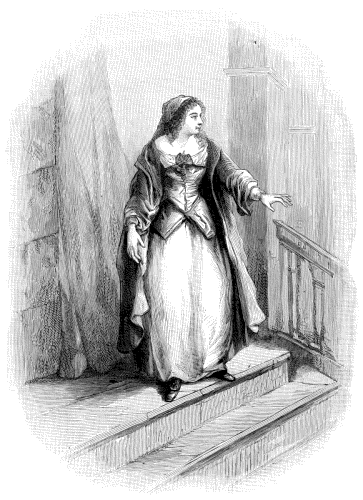
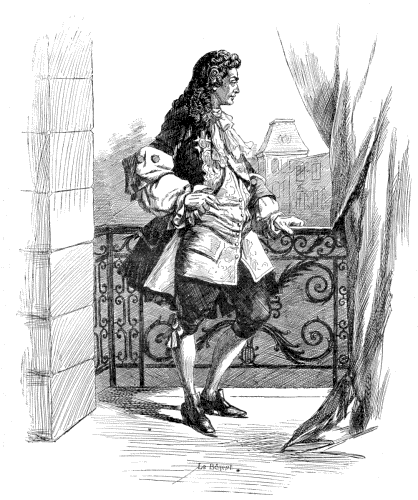
"What, monseigneur, you here!" cried Dubois, entering the room of the
house in the Rue du Bac, and finding the regent seated in the same place
as on the previous day.
"Yes; is there anything wonderful in that? Have I not an appointment at
noon with the chevalier?"
"But I thought the order you signed would have put an end to these
conferences."
"You were mistaken, Dubois; I wish to have another interview with this
young man. I shall make one more effort to induce him to renounce his
plans."
"And if he should do so?"
"Then all will be at an end—there will be no conspiracy—there will
have been no conspirators. I cannot punish intentions."
"With any other I should not allow this; but with him I say, as you
please."
"You think he will remain firm?"
"Oh! I am quite easy. But when he has decidedly refused, when you are
quite convinced that he persists in his intention of assassinating you,
then you will give him over to me, will you not?"
"Yes, but not here."
"Why not here?"'
"Better to arrest him at his hotel."
"There, at the Muids d'Amour, with Tapin and D'Argenson's
people—impossible, monsieur. Bourguignon's affair is still in
everybody's mouth in that quarter. I am not sure that they even quite
believe in the attack of apoplexy, since Tapin now gives strict measure.
It will be much better to arrest him as he leaves here, monseigneur; the
house is quiet; four men could easily do it, and they are already here.
I will move them, as you insist on seeing him; and, instead of arresting
him as he enters, it must be done as he leaves. At the door a carriage
shall be ready to take him to the Bastille; so that even the coachman
who brings him here shall not know what has become of him. No one but
Monsieur de Launay shall know; and I will answer for his discretion."
"Do as you please."
"That is my usual custom."
"Rascal that you are!"
"But I think monseigneur reaps the benefit of the rascality."
"Oh, I know you are always right."
"But the others?"
"What others?"
"The Bretons, Pontcalec, Du Couëdic, Talhouet, and Montlouis?"
"Oh, the unfortunates; you know their names."
"And how do you think I have passed my time at the hotel Muids d'Amour?"
"They will know of their accomplice's arrest."
"How?"
"Having no letter from Paris, they will fear that something is wrong."
"Bah! Is not Captain la Jonquiere there to reassure them?"
"True; but they must know the writing?"
"Not bad, monseigneur, you are improving; but you take useless
precautions, as Racine says. At this moment, probably, they are
arrested."
"And who dispatched the order?"
"I. Pardieu! I am not your minister for nothing. Besides, you signed
it."
"I! Are you mad?"
"Assuredly, these men are not less guilty than the chevalier; and in
authorizing me to arrest one, you authorized me to arrest all."
"And when did the bearer of this order leave?"
Dubois took out his watch.
"Just three hours ago. Thus, it was a poetical license when I said they
were all arrested; they will not be till to-morrow morning."
"Bretagne will be aroused, Dubois."
"Bah! I have taken measures."
"The Breton tribunals will not condemn their compatriots."
"That case is foreseen."
"And, if they should be condemned, none will be found to execute them.
It will be a second edition of the affair at Chalais. Remember, it was
at Nantes that that took place, Dubois. I tell you, Bretons are
unaccommodating."
"This is a point to settle with the commissioners, of whom this is a
list. I will send three or four executioners from Paris—men accustomed
to noble deeds—who have preserved the traditions of the Cardinal de
Richelieu."
"Good God!" cried the regent; "bloodshed under my reign—I do not like
it. As to Count Horn, he was a thief, and Duchaffour a wretch; but I am
tender, Dubois."
"No, monseigneur, you are not tender; you are uncertain and weak; I told
you so when you were my scholar—I tell you so again, now that you are
my master. When you were christened, your godmothers, the fairies, gave
you every gift of nature—strength, beauty, courage, and mind: only
one—whom they did not invite because she was old, and they probably
foresaw your aversion to old women—arrived the last, and gave you
weakness—that spoiled all."
"And who told you this pretty tale? Perrault or St. Simon?"
"The princess palatine, your mother."
The regent laughed.
"And whom shall we choose for the commission?" asked he.
"Oh, monseigneur, people of mind and resolution, be sure; not
provincials; not very sensitive to family scenes; men old in the dust of
tribunals, whom the Breton men will not frighten with their fierce eyes,
nor the Breton women seduce with their beautiful languid ones."
The regent made no reply.
"After all," continued Dubois, "these people may not be as guilty as we
suppose. What they have plotted let us recapitulate. Bah! mere trifles.
To bring back the Spaniards into France, what is that? To call Philip
the Fifth king, the renouncer of his country; to break all the laws of
the State—these good Bretons."
"Dubois, I know the national law as well as you."
"Then, monseigneur, if you speak truly, you have only to approve the
nomination of the commissioners I have chosen."
"How many are there?"
"Twelve."
"Their names?"
Dubois gave in the list.
"Ah, you were right—a happy choice; but who is to preside over this
amiable assembly?"
"Guess, monseigneur."
"Take care; you must have an honest man at the head of these ravagers."
"I have one."
"Who is it?"
"An ambassador."
"Cellamare, perhaps."
"Ma foi! I think if you would let him come out of Blois he would not
refuse you even the heads of his accomplices."
"Let him stop at Blois. Who is to preside?"
"Chateau-Neuf."
"The ambassador from Holland, from the great king. Dubois, I do not
generally compliment you, but this time you have done wonders."
"You understand, monseigneur: he knows that these people wish to make a
republic; and he, who is brought up to know none but sultans, and who
has a horror of Holland through the horror of Louis XIV. for republics,
has accepted with a good grace. We shall have Argram for prosecutor.
Cayet shall be our secretary. We go to work quickly and well,
monseigneur, for time presses."
"But shall we at least have quiet afterward?"
"I believe so. We may sleep all day and all night; that is to say, when
we have finished the war in Spain."
"Oh!" cried the regent, "why did I strive for the regency? I should
laugh to see M. de Maine freeing himself with his Jesuits and his
Spaniards! Madame de Maintenon and her politics, with Villeroy and
Villars, would drive away the spleen; and Hubert says it is good to
laugh once a day."
"Apropos of Madame de Maintenon," replied Dubois; "you know,
monseigneur, that she is very ill, and that she cannot live a
fortnight."
"Bah!"
"Since the imprisonment of Madame de Maine and the exile of her husband,
she says that decidedly Louis XIV. is dead, and that she goes weeping to
rejoin him."
"Which does not trouble you, eh?"
"Oh! I confess that I hate her cordially; it was she who made the king
open his eyes so wide when I asked for the red hat at your marriage;
and, corbleu! it was not an easy thing to arrange, monseigneur, as you
know. If you had not been there to redress my wrongs, she would have
spoiled my career. If I could but have crammed her M. de Maine into this
Bretagne affair; but it was impossible—the poor man is half dead with
fear, so that he says to every one he meets, 'Do you know there has been
a conspiracy against the government of the king and against the person
of the regent? it is a disgrace to France. Ah! if all men were only like
me!'"
"No one would conspire—that is certain," said the regent.
"He has disowned his wife," added Dubois, laughing.
"And she has disowned her husband," said the regent, laughing also.
"I should not advise you to imprison them together—they would fight."
"Therefore I have placed one at Doulens, and the other at Dijon."
"From whence they bite by post."
"Let us put all that aside, Dubois."
"Ah, monseigneur! you have, I see, sworn the loss of the blood of Louis
XIV.; you are a true executioner."
This audacious joke proved how sure Dubois felt of his ascendency over
the prince.
The regent signed the order naming the tribunal, and Dubois went out to
prepare for Gaston's arrest.
Gaston, on his return to the Muids d'Amour, found the same carriage and
the same guide awaiting him that had before conducted him to the Rue du
Bac. Gaston, who did not wish Helene to alight, asked if he could
continue his route in the hired carriage in which he had just arrived;
the man replied that he saw no objection, and mounted on the box by the
driver, to whom he told the address.
During the drive, Gaston, instead of displaying the courage which Helene
had expected, was sad, and yet gave no explanation of his sadness. As
they entered the Rue du Bac, Helene, in despair at finding so little
force of character in him on whom she leaned for protection, said:
"Gaston, you frighten me."
"Helene, you shall see before long if I am acting for your good or not."
The carriage stopped.
"Helene, there is one in this house who will stand in the place of a
father to you. Let me go first, and I announce you."
"Ah!" cried Helene, trembling, she knew not why; "and you are going to
leave me here alone?"
"You have nothing to fear, Helene; besides, in a few minutes I will
return and fetch you."
The young girl held out her hand, which Gaston pressed to his lips; the
door opened; the carriage drove into the courtyard, where Gaston felt
that Helene ran no danger; the man who had come to the hotel to fetch
him opened the carriage door; Gaston again pressed Helene's hand,
alighted, ascended the steps, and entered the corridor, when his guide
left him as before.
Gaston, knowing that Helene waited his return, at once tapped at the
door of the room.
"Enter," said the voice of the false Spaniard.
Gaston knew the voice, entered, and with a calm face approached the Duc
d'Olivares.
"You are punctual, monsieur," said the latter; "we named noon, and it is
now striking."
"I am pressed for time, monseigneur; my undertaking weighs on me; I fear
to feel remorse. That astonishes and alarms you, does it not,
monseigneur? But reassure yourself; the remorse of a man such as I am
troubles no one but himself."
"In truth, monsieur," cried the regent, with a feeling of joy he could
not quite conceal, "I think you are drawing back."
"Not so, monseigneur; since fate chose me to strike the prince, I have
gone steadily forward, and shall do so till my mission is accomplished."
"Monsieur, I thought I detected some hesitation in your words; and words
are of weight in certain mouths, and under certain circumstances."
"Monsieur, in Bretagne we speak as we feel, but we also do as we
promise."
"Then you are resolved?"
"More than ever."
"Because, you see," replied the regent, "there is still time—the evil
is not yet done."
"The evil, you call it, monseigneur," said Gaston; "what shall I call it
then?"
"It is thus that I meant it," replied the regent; "the evil is for you,
since you feel remorse."
"It is not generous, monseigneur, to dwell on a confidence which I
should not have made to any person of less merit than yourself."
"And it is because I appreciate your worth, monsieur, that I tell you
there is yet time to draw back; that I ask if you have reflected—if you
repent having mixed yourself with all these—" the duke
hesitated—"these audacious enterprises. Fear nothing from me—I will
protect you, even if you desert us; I have seen you but once, but I
think I judge of you as you deserve—men of worth are so rare that the
regrets will be for us."
"Such kindness overwhelms me, monseigneur," said Gaston, who, in spite
of his courage, felt some indecision. "My prince, I do not hesitate; but
my reflections are those of a duelist, who goes to the ground determined
to kill his enemy, yet deploring the necessity which forces him to rob a
man of life. But here the interest is so great, so superior to the
weaknesses of our nature, that I will be true to my friendship if not my
sympathies, and will conduct myself so that you shall esteem in me even
the momentary weakness which for a second held back my arm."
"Well," said the regent, "how shall you proceed?"
"I shall wait till I meet him face to face, and then I shall not use an
arquebuse, as Paltrot did, nor a pistol, as Vitry did. I shall say,
'Monseigneur, you are the curse of France—I sacrifice you to her
salvation;' and I shall stab him with my poniard."
"As Ravaillac did," said the duke, with a serenity which made Gaston
shudder; "it is well."
Gaston did not reply.
"This plan appears to me the most secure, and I approve of it; but I
must ask you one other question: suppose you should be taken and
interrogated?"
"Your excellency knows what men do in such cases—they die, but do not
answer; and since you have quoted Ravaillac, I think, if my memory
serves me, that was what he did—and yet Ravaillac was not a gentleman."
Gaston's pride did not displease the regent, who had a young heart and
a chivalric mind; besides, accustomed to worn-out and time-serving
courtiers, Gaston's vigorous and simple nature was a novelty to him; and
we know how the regent loved a novelty.
"I may then reckon," said he, "that you are immovable?"
Gaston looked surprised that the duke should repeat this question.
"Yes," said the regent; "I see you are decided."
"Absolutely, and wait your last instructions."
"How? my instructions?"
"Certainly; I have placed myself body and soul at your disposal."
The duke rose.
"Well," said he, "you must go out by that door, and cross the garden
which surrounds the house. In a carriage which awaits you at the bottom
you will find my secretary, who will give you a pass for an audience
with the regent; besides that, you will have the warranty of my word."
"That is all I have to ask on that point, monseigneur."
"Have you anything else to say?"
"Yes; before I take leave of you, whom I may never see again in this
world, I have a boon to ask."
"Speak, monsieur, I listen."
"Monsieur," said Gaston, "do not wonder if I hesitate a moment, for this
is no personal favor and no ordinary service—Gaston de Chanlay needs
but a dagger, and here it is; but in sacrificing his body he would not
lose his soul; mine, monseigneur, belongs first to God and then to a
young girl whom I love to idolatry—sad love, is it not, which has
bloomed so near a tomb? To abandon this pure and tender girl would be to
tempt God in a most rash manner, for I see that sometimes he tries us
cruelly, and lets even his angels suffer. I love, then, an adorable
woman, whom my affection has supported and protected against infamous
schemes; when I am dead or banished, what will become of her? Our
heads fall, monseigneur; they are those of simple gentlemen; but you are
a powerful adversary, and supported by a powerful king; you can
conquer evil fortune. I wish to place in your hands the treasure of my
soul. You will bestow on her all the protection which, as an accomplice,
as an associate, you owe to me."
"Monsieur, I promise you," replied the regent, deeply moved.
"That is not all, monseigneur; misfortune may overtake me, and find me
not able to bestow my person upon her; I would yet leave her my name. If
I die she has no fortune, for she is an orphan. On leaving Nantes I made
a will wherein I left her everything I possessed. Monseigneur, if I die,
let her be a widow—is it possible?"
"Who opposes it?"
"No one; but I may be arrested to-morrow, this evening, on putting my
foot outside this house."
The regent started at this strange presentiment.
"Suppose I am taken to the Bastille; could you obtain for me permission
to marry her before my execution?"
"I am sure of it."
"You will use every means to obtain this favor for me? Swear it to me,
monseigneur, that I may bless your name, and that, even under torture,
nothing may escape but a thanksgiving when I think of you."
"On my honor, monsieur, I promise you that this young girl shall be
sacred to me; she shall inherit in my heart all the affection which I
involuntarily feel for you."
"Monseigneur, one word more."
"Speak, monsieur; I listen with the deepest sympathy."
"This young girl knows nothing of my project; she does not know what has
brought me to Paris, nor the catastrophe which threatens us, for I have
not had the courage to tell her. You will tell it to her,
monseigneur—prepare her for the event. I shall never see her again, but
to become her husband. If I were to see her again at the moment of
striking the blow which separates me from her, my hand might tremble,
and this must not be."
"On my word of honor, monsieur," said the regent, softened beyond all
expression, "I repeat, not only shall this young girl be sacred to me,
but I will do all you wish for her—she shall reap the fruits of the
respect and affection with which you have inspired me."
"Now," said Gaston, "I am strong."
"And where is this young girl?"
"Below, in the carriage which brought me. Let me retire, monseigneur,
and only tell me where she will be placed."
"Here, monsieur; this house, which is not inhabited, and which is very
suitable for a young girl, shall be hers."
"Monseigneur, your hand."
The regent held out his hand, but hearing a little dry cough, he
understood that Dubois was becoming impatient, and he indicated to
Gaston that the audience was over.
"Once more, monseigneur, watch over this young girl; she is beautiful,
amiable and proud—one of those noble natures which we meet but seldom.
Adieu, monseigneur, I go to find your secretary."
"And must I tell her that you are about to take a man's life?" asked the
regent, making one more effort to restrain Gaston.
"Yes, monseigneur," said the chevalier; "but you will add that I do it
to save France."
"Go then, monsieur," said the duke, opening a door which led into the
garden, "and follow the directions I have given you."
"Wish me good fortune, monseigneur."
"The madman," thought the regent; "does he wish me to pray for success
to his dagger's thrust? Ma foi, no!"
Gaston went out, the gravel, half-covered with snow, creaked under his
feet—the regent watched him for some time from the window of the
corridor—then, when he had lost sight of him—
"Well," said he, "each one must go his own way. Poor fellow!"
And he returned to the room, where he found Dubois, who had entered by
another door, and was waiting for him.
Dubois's face wore an expression of malicious satisfaction which did not
escape the regent, who watched him some time in silence, as if trying
to discover what was passing through the brain of this second
Mephistopheles.
Dubois was the first to speak.
"Well, monseigneur, you are rid of him at last, I hope."
"Yes," replied the duke; "but in a manner which greatly displeases me—I
do not like playing a part in your comedies, as you know."
"Possibly; but you might, perhaps, do wisely in giving me a part in
yours."
"How so?"
"They would be more successful, and the denouements would be better."
"I do not understand—explain yourself, and quickly, for I have some one
waiting whom I must receive."
"Oh! certainly, monseigneur, receive them, and we will continue our
conversation later—the denouement of this comedy has already taken
place, and cannot be changed."
And with these words, Dubois bowed with the mock respect which he
generally assumed whenever, in the eternal game they played against each
other, he held the best cards.
Nothing made the regent so uneasy as this simulated respect; he held him
back—
"What is there now?" asked he; "what have you discovered?"
"That you are a skillful dissimulator, peste!"
"That astonishes you?"
"No, it troubles me; a few steps further, and you will do wonders in
this art—you will have no further need of me; you will have to send me
away to educate your son, whom, it must be confessed, requires a master
like myself."
"Speak quickly."
"Certainly, monseigneur; it is not now, however, a question of your son,
but of your daughter."
"Of which daughter?"
"Ah! true; there are so many. First, the Abbess of Chelles, then Madame
de Berry, then Mademoiselle de Valois; then the others, too young for
the world, and therefore for me, to speak of; then, lastly, the charming
Bretagne flower, the wild blossom which was to be kept away from
Dubois's poisoning breath, for fear it should wither under it."
"Do you dare to say I was wrong?"
"Not so, monseigneur: you have done wonders; not wishing to have
anything to do with the infamous Dubois, for which I commend you,
you—the archbishop of Cambray being dead—have taken in his place the
good, the worthy, the pure Nocé, and have borrowed his house."
"Ah!" said the regent, "you know that?"
"And what a house! Pure as its master—yes, monseigneur, you are full of
prudence and wisdom. Let us conceal the corruptions of the world from
this innocent child, let us remove from her everything that can destroy
her primitive naïveté; this is why we choose this dwelling for her—a
moral sanctuary, where the priestesses of virtue, and doubtless always
under pretext of their ingenuousness, take the most ingenuous but least
permitted of positions."
"Nocé told me that all was proper."
"Do you know the house, monseigneur?"
"Do I look at such things?"
"Ah! no; your sight is not good, I remember."
"Dubois!"
"For furniture your daughter will have strange couches, magic sofas; and
as to books, ah! that is the climax. Nocé's books are good for the
instruction and formation of youth; they would do well to go with the
breviary of Bussy-Rabutin, of which I presented you a copy on your
twelfth birthday."
"Yes; serpent that you are."
"In short, the most austere prudery prevails over the dwelling. I had
chosen it for the education of the son; but monseigneur, who looks at
things differently, chose it for the daughter."
"Ah, ca! Dubois," said the regent, "you weary me."
"I am just at the end, monseigneur. No doubt your daughter was well
pleased with the residence; for, like all of your blood, she is very
intelligent."
The regent shuddered, and guessed that some disagreeable news was hidden
under the long preamble and mocking smile of Dubois.
"However, monseigneur, see what the spirit of contradiction will do; she
was not content with the dwelling you chose for her, and she is moving."
"What do you mean?"
"I am wrong—she has moved."
"My daughter gone!" cried the regent.
"Exactly," said Dubois.
"How?"
"Through the door. Oh, she is not one of those young ladies who go
through the windows, or by night—oh, she is of your blood, monseigneur;
if I had ever doubted it, I should be convinced now."
"And Madame Desroches?"
"She is at the Palais Royal, I have just left her; she came to announce
it to your highness."
"Could she not prevent it?"
"Mademoiselle commanded."
"She should have made the servants close the doors: they did not know
that she was my daughter, and had no reason to obey her."
"Madame Desroches was afraid of mademoiselle's anger, but the servants
were afraid of the sword."
"Of the sword! are you drunk, Dubois?"
"Oh, I am very likely to get drunk on chicory water! No, monseigneur; if
I am drunk, it is with admiration of your highness's perspicacity when
you try to conduct an affair all alone."
"But what sword do you mean?"
"The sword which Mademoiselle Helene disposes of, and which belongs to a
charming young man—"
"Dubois!"
"Who loves her!"
"Dubois! you will drive me mad."
"And who followed her from Nantes to Rambouillet with infinite
gallantry."
"Monsieur de Livry?"
"Ah! you know his name; then I am telling you nothing new, monseigneur."
"Dubois, I am overwhelmed."
"Not without sufficient cause, monseigneur; but see what is the result
of your managing your own affairs, while you have at the same time to
look after those of France."
"But where is she?"
"Ah! where indeed—how should I know?"
"Dubois, you have told me of her flight—I look to you to discover her
retreat. Dubois, my dear Dubois, for God's sake find my daughter!"
"Ah! monseigneur, you are exactly like the father in Moliere, and I am
like Scapin—'My good Scapin, my dear Scapin, find me my daughter.'
Monseigneur, I am sorry for it, but Geroute could say no more; however,
we will look for your daughter, and rescue her from the ravisher."
"Well, find her, Dubois, and ask for what you please when you have done
so."
"Ah, that is something like speaking."
The regent had thrown himself back in an armchair, and leaned his head
upon his hands. Dubois left him to his grief, congratulating himself
that this affection would double his empire over the duke. All at once,
while Dubois was watching him with a malicious smile, some one tapped at
the door.
"Who is there?" asked Dubois.
"Monseigneur," said an usher's voice at the door, "there is in the
carriage which brought the chevalier a young woman who wishes to know if
he is coming down soon."
Dubois made a bound toward the door, but he was too late; the regent, to
whom the usher's words had recalled the solemn promise he had made to
Gaston, rose at once.
"Where are you going, monseigneur?" asked Dubois.
"To receive this young girl."
"That is my affair, not yours—you forget that you abandoned this
conspiracy to me."
"I gave up the chevalier to you, but I promised him to be a father to
this girl whom he loves. I have pledged my word, and I will keep it;
since through me she loses her lover, I must at least console her."
"I undertake it," said Dubois, trying to hide his paleness and
agitation under one of his own peculiar smiles.
"Hold your tongue and remain here," said the regent.
"Let me at least speak to her, monseigneur."
"I will speak to her myself—this is no affair of yours; I have taken it
upon myself, have given my word as a gentleman. Silence, and remain
here."
Dubois ground his teeth; but when the regent spoke in this tone, he knew
he must obey: he leaned against the chimney-piece and waited.
Soon the rustling of a silk dress was heard.
"Yes, madame," said the usher, "this way."
"Here she is," said the duke, "remember one thing, Dubois: this young
girl is in no way responsible for her lover's fault; consequently,
understand me, she must be treated with the greatest respect;" then,
turning to the door, "Enter," said he; the door was hastily opened, the
young girl made a step toward the regent, who started back
thunderstruck.
"My daughter!" murmured he, endeavoring to regain his self-command,
while Helene, after looking round for Gaston, stopped and curtseyed.
Dubois's face would not be easy to depict.
"Pardon me, monseigneur," said Helene, "perhaps I am mistaken. I am
seeking a friend who left me below, who was to come back to me; but, as
he delayed so long, I came to seek for him. I was brought here, but
perhaps the usher made a mistake."
"No, mademoiselle," said the duke, "M. de Chanlay has just left me, and
I expected you."
As the regent spoke, the young girl became abstracted, and seemed as
though taxing her memory; then, in answer to her own thoughts, she
cried—
"Mon Dieu! how strange."
"What is the matter?" asked the regent.
"Yes: that it is."
"Explain!" said the duke, "I do not understand you."
"Ah! monsieur," said Helene, trembling, "it is strange how your voice
resembles that of another person."
"Of your acquaintance?" asked the regent.
"Of a person in whose presence I have been but once, but whose accents
live in my heart."
"And who was this person?" asked the regent, while Dubois shrugged his
shoulders at this half recognition.
"He called himself my father," replied Helene.
"I congratulate myself upon this chance, mademoiselle," said the regent,
"for this similarity in my voice to that of a person who is dear to you
may give greater weight to my words. You know that Monsieur de Chanlay
has chosen me for your protector?"
"He told me he would bring me to some one who would protect me from the
danger—"
"What danger?" asked the regent.
Helene looked round her, and her glance rested uneasily on Dubois, and
there was no mistaking her expression. Dubois's face inspired her with
as much distrust as the regent's did with confidence.
"Monseigneur," said Dubois (who did not fail to notice this expression),
in an undertone to the regent, "I think I am de trop here, and had
better retire; you do not want me, do you?"
"No; but I shall presently; do not go away."——"I will be at your
orders."
This conversation was too low for Helene to hear; besides, she had
stepped back, and continued watching the doors, in the hope of seeing
Gaston return.
It was a consolation to Dubois to know she would be disappointed.
When Dubois was gone, they breathed more freely.
"Seat yourself, mademoiselle," said the duke; "I have much to tell you."
"Monsieur, one thing before all. Is the Chevalier Gaston de Chanlay in
any danger?"
"We will speak of him directly, but first of yourself; he brought you to
me as a protector. Now, tell me against whom I am to protect you?"
"All that has happened to me for some days is so strange, that I do not
know whom to fear or whom to trust. If Gaston were there—"
"Yes, I understand; if he authorized you to tell me, you would keep
nothing back. But if I can prove to you that I know nearly all
concerning you?"
"You, monsieur!"
"Yes, I; are you not called Helene de Chaverny? Were you not brought up
in the Augustine convent between Nantes and Clisson? Did you not one day
receive an order to leave the convent from a mysterious protector who
watches over you? Did you not travel with one of the sisters, to whom
you gave a hundred louis for her trouble? At Rambouillet, did not a
person called Madame Desroches await you? Did she not announce to you a
visit from your father? The same evening, did not some one arrive who
loved you, and who thought you loved him?"
"Yes, yes, monsieur, it is all true," said Helene, astonished that a
stranger should thus know the details of her history.
"Then the next day," continued the regent, "did not Monsieur de Chanlay,
who followed you under the name of De Livry, pay you a visit, which was
vainly opposed by Madame Desroches?"
"You are right, monsieur, and I see that Gaston has told you all."
"Then came the order to leave for Paris. You would have opposed it, but
were forced to obey. You were taken to a house in the Faubourg St.
Antoine; but there your captivity became insupportable."
"You are mistaken, monsieur; it was not the captivity, but the prison."
"I do not understand you."
"Did not Gaston tell you of his fears, which I laughed at at first, but
shared afterward?"
"No, tell me what did you fear?"
"But if he did not tell you, how shall I?"
"Is there anything one cannot tell to a friend?"
"Did he not tell you that this man whom I at first believed to be my
father—?"
Gaston rose hastily, and met D'Argenson with a law
officer.—Page 514.
Link to larger image
"Believed!"
"Yes; I swear it, monsieur. Hearing his voice, feeling my hand pressed
by his, I had at first no doubt, and it almost needed evidence to bring
fear instead of the filial love with which he at first inspired me."
"I do not understand you, mademoiselle; how could you fear a man who—to
judge by what you tell me—had so much affection for you?"
"You do not understand, monsieur; as you say, under a frivolous pretext,
I was removed from Rambouillet to Paris, shut in a house in the Faubourg
Saint Antoine, which spoke more clearly to my eyes than Gaston's fears
had done. Then I thought myself lost—and that this feigned tenderness
of a father concealed the wiles of a seducer. I had no friend but
Gaston—I wrote to him—he came."
"Then," said the regent, filled with joy, "when you left that house it
was to escape those wiles, not to follow your lover?"
"Oh, monsieur, if I had believed in that father whom I had seen but
once, and then surrounded by mysteries, I swear to you that nothing
would have led me from the path of duty."
"Oh, dear child!" cried the duke, with an accent which made Helene
start.
"Then Gaston spoke to me of a person who could refuse him nothing—who
would watch over me and be a father to me. He brought me here, saying he
would return to me. I waited in vain for more than an hour, and at
length, fearing some accident had happened to him, I asked for you." The
regent's brow became clouded.
"Thus," said he, "it was Gaston's influence that turned you from your
duty—his fears aroused yours?"
"Yes; he suspected the mystery which encircled me, and feared that it
concealed some fatal project."
"But he must have given you some proof to persuade you."
"What proof was needed in that abominable house? Would a father have
placed his daughter in such a habitation?"
"Yes, yes," murmured the regent, "he was wrong; but confess that without
the chevalier's suggestions, you, in the innocence of your soul, would
have had no suspicion."
"No," said Helene, "but happily Gaston watched over me."
"Do you then believe that all Gaston said to you was true?" asked the
regent.
"We easily side with those we love, monsieur."
"And you love the chevalier?"
"Yes; for the last two years, monsieur."
"But how could he see you in the convent?"
"By night, with the aid of a boat."
"And did he see you often?"
"Every week."
"Then you love him?"
"Yes, monsieur."
"But how could you dispose of your heart, knowing that you were not your
own mistress?"
"For sixteen years I had heard nothing of my family; how could I suppose
that all at once it would reveal itself, or rather, that an odious
maneuver should take me from my quiet retreat to my ruin?"
"Then you still think that that man lied, when he called himself your
father?"
"I scarcely know what to think, and my mind becomes bewildered in
contemplating this strange reality, which seems so like a dream."
"But you should not consult your mind here, Helene," said the regent;
"you should consult your heart. When you were with this man, did not
your heart speak to you?"
"Oh!" said Helene, "while he was there I was convinced, for I have never
felt emotion such as I felt then."
"Yes," replied the regent, bitterly; "but when he was gone, this emotion
disappeared, driven away by stronger influence. It is very simple, this
man was only your father; Gaston was your lover."
"Monsieur," said Helene, drawing back, "you speak strangely."
"Pardon me," replied the regent, in a sweet voice; "I see that I allowed
myself to be carried away by my interest. But what surprises me more
than all, mademoiselle," continued he, "is that, being beloved as you
are by Gaston, you could not induce him to abandon his projects."
"His projects, monsieur! what do you mean?"
"What! you do not know the object of his visit to Paris?"
"I do not, monsieur. When I told him, with tears in my eyes, that I was
forced to leave Clisson, he said he must also leave Nantes. When I told
him that I was coming to Paris, he answered, with a cry of joy, that he
was about to set out for the same place."
"Then," cried the regent, his heart freed from an enormous load, "you
are not his accomplice?"
"His accomplice!" cried Helene, alarmed; "ah, mon Dieu! what does this
mean?"
"Nothing," said the regent, "nothing."
"Oh, yes, monsieur; you have used a word which explains all. I wondered
what made so great a change in Gaston. Why, for the last year, whenever
I spoke of our future, his brow became dark. Why, with so sad a smile,
he said to me, 'Helene, no one is sure of the morrow.' Why he fell into
such reveries, as though some misfortune threatened him. That misfortune
you have shown me, monsieur. Gaston saw none but malcontents
there—Montlouis, Pontcalec. Ah! Gaston is conspiring—that is why he
came to Paris."
"Then you knew nothing of this conspiracy?"
"Alas, monsieur! I am but a woman, and, doubtless, Gaston did not think
me worthy to share such a secret."
"So much the better," cried the regent; "and now, my child, listen to
the voice of a friend, of a man who might be your father. Let the
chevalier go on the path he has chosen, since you have still the power
to go no further."
"Who? I, monsieur!" cried Helene; "I abandon him at a moment when you
yourself tell me that a danger threatens him that I had not known! Oh,
no, no, monsieur! We two are alone in the world, we have but each
other: Gaston has no parents, I have none either; or if I have, they
have been separated from me for sixteen years, and are accustomed to my
absence. We may, then, lose ourselves together without costing any one a
tear—oh, I deceived you, monsieur, and whatever crime he has committed,
or may commit, I am his accomplice."
"Ah!" murmured the regent, in a choking voice, "my last hope fails me;
she loves him."
Helene turned, with astonishment, toward the stranger who took so lively
an interest in her sorrow. The regent composed himself.
"But," continued he, "did you not almost renounce him? Did you not tell
him, the day you separated, that you could not dispose of your heart and
person?"
"Yes, I told him so," replied the young girl, with exaltation,
"because at that time I believed him happy, because I did not know
that his liberty, perhaps his life, were compromised; then, my
heart would have suffered, but my conscience would have remained
tranquil; it was a grief to bear, not a remorse to combat; but
since I know him threatened—unhappy—I feel that his life is mine."
"But you exaggerate your love for him," replied the regent, determined
to ascertain his daughter's feelings. "This love would yield to
absence."
"It would yield to nothing, monsieur; in the isolation in which my
parents left me, this love has become my only hope, my happiness, my
life. Ah! monsieur, if you have any influence with him—and you must
have, since he confides to you the secrets which he keeps from me—in
Heaven's name, induce him to renounce these projects, of which you
speak; tell him what I dare not tell him myself, that I love him beyond
all expression; tell him that his fate shall be mine; that if he be
exiled, I exile myself; if he be imprisoned, I will be so too; and that
if he dies, I die. Tell him that, monsieur; and add—add that you saw,
by my tears and by my despair, that I spoke the truth."
"Unhappy child!" murmured the regent.
Indeed, Helene's situation was a pitiable one. By the paleness of her
cheeks, it was evident that she suffered cruelly; while she spoke, her
tears flowed ceaselessly, and it was easy to see that every word came
from her heart, and that what she had said she would do.
"Well," said the regent, "I promise you that I will do all I can to save
the chevalier."
Helene was about to throw herself at the duke's feet, so humbled was
this proud spirit by the thought of Gaston's danger; but the regent
received her in his arms. Helene trembled through her whole frame—there
was something in the contact with this man which filled her with hope
and joy. She remained leaning on his arm, and made no effort to raise
herself.
"Mademoiselle," said the regent, watching her with an expression which
would certainty have betrayed him if Helene had raised her eyes to his
face, "Mademoiselle, the most pressing affair first—I have told you
that Gaston is in danger, but not in immediate danger; let us then first
think of yourself, whose position is both false and precarious. You are
intrusted to my care, and I must, before all else, acquit myself
worthily of this charge. Do you trust me, mademoiselle?"
"Oh, yes; Gaston brought me to you."
"Always Gaston," sighed the regent, in an undertone; then to Helene he
said:
"You will reside in this house, which is unknown, and here you will be
free. Your society will consist of excellent books, and my presence will
not be wanting, if it be agreeable to you."
Helene made a movement as if to speak.
"Besides," continued the duke, "it will give you an opportunity to speak
of the chevalier."
Helene blushed, and the regent continued:
"The church of the neighboring convent will be open to you, and should
you have the slightest fear, such as you have already experienced, the
convent itself might shelter you—the superior is a friend of mine."
"Ah, monsieur," said Helene, "you quite reassure me; I accept the house
you offer me—and your great kindness to Gaston and myself will ever
render your presence agreeable to me."
The regent bowed.
"Then, mademoiselle," said he, "consider yourself at home here; I think
there is a sleeping-room adjoining this room—the arrangement of the
ground-floor is commodious, and this evening I will send you two nuns
from the convent, whom, doubtless, you would prefer to servants, to wait
on you."
"Ah, yes, monsieur."
"Then," continued the regent, with hesitation, "then you have almost
renounced your—father?"
"Ah, monsieur, do you not understand that it is for fear he should not
be my father."
"However," replied the regent, "nothing proves it; that house alone is
certainly an argument against him but he might not have known it."
"Oh," said Helene, "that is almost impossible."
"However, if he took any further steps, if he should discover your
retreat and claim you, or at least ask to see you?"
"Monsieur, we would inform Gaston, and learn his opinion."
"It is well," said the regent, with a smile; and he held out his hand to
Helene, and then moved toward the door.
"Monsieur," said Helene, in a scarcely audible voice.
"Do you wish for anything?" asked the duke, returning.
"Can I see him?"
The words seemed to die away on her lips as she pronounced them.
"Yes," said the duke, "but is it not better for your sake to do so as
little as possible?" Helene lowered her eyes.
"Besides," said the duke, "he has gone on a journey, and may not be back
for some days."
"And shall I see him on his return?"
"I swear it to you."
Ten minutes after, two nuns and a lay sister entered and installed
themselves in the house.
When the regent quitted his daughter, he asked for Dubois, but he was
told that, after waiting half an hour, Dubois had returned to the Palais
Royal.
The duke, on entering the abbe's room, found him at work with his
secretaries; a portfolio full of papers was on the table.
"I beg a thousand pardons," said Dubois, on seeing the duke, "but as you
delayed, and your conference was likely to be prolonged greatly, I took
the liberty of transgressing your orders, and returning here."
"You did rightly; but I want to speak to you."
"To me?"
"Yes, to you."
"To me alone?"
"Alone."
"In that case, will monseigneur go into my cabinet, or into your own
room?"
"Let us go into your cabinet."
The abbe made a respectful bow and opened the door—the regent passed in
first, and Dubois followed when he had replaced the portfolio under his
arm. These papers had probably been got together in expectation of this
visit.
When they were in the cabinet, the duke looked round him.
"The place is safe?" asked he.
"Pardieu, each door is double, and the walls are two feet thick."
The regent sat down and fell into a deep reverie.
"I am waiting, monseigneur," said Dubois, in a few minutes.
"Abbe," said the regent, in a quick decided tone, as of a man determined
to be answered, "is the chevalier in the Bastille?"
"Monseigneur," replied Dubois, "he must have been there about half an
hour."
"Then write to M. de Launay. I desire that he be set free at once."
Dubois did not seem surprised; he made no reply, but he placed the
portfolio on the table, opened it, took out some papers, and began to
look over them quietly.
"Did you hear me?" asked the regent, after a moment's silence.
"I did, monseigneur."
"Obey, then."
"Write yourself, monseigneur," said Dubois.
"And why?"
"Because nothing shall induce this hand to sign your highness's ruin,"
said Dubois.
"More words," said the regent, impatiently.
"Not words, but facts, monseigneur. Is M. de Chanlay a conspirator, or
is he not?"
"Yes, certainly! but my daughter loves him."
"A fine reason for setting him at liberty."
"It may not be a reason to you, abbe, but to me it is, and a most sacred
one. He shall leave the Bastille at once."
"Go and fetch him, then; I do not prevent you."
"And did you know this secret?"
"Which?"
"That M. de Livry and the chevalier were the same?"
"Yes, I knew it. What, then?"
"You wished to deceive me."
"I wished to save you from the sentimentality in which you are lost at
this moment. The regent of France—already too much occupied by whims
and pleasures—must make things worse by adding passion to the list. And
what a passion! Paternal love, dangerous love—an ordinary love may be
satisfied, and then dies away—but a father's tenderness is insatiable,
and above all, intolerable. It will cause your highness to commit faults
which I shall prevent, for the simple reason that I am happy enough not
to be a father; a thing on which I congratulate myself daily, when I see
the misfortunes and stupidity of those who are."
"And what matters a head more or less?" cried the regent. "This De
Chanlay will not kill me, when he knows it was I who liberated him."
"No; neither will he die from a few days in the Bastille; and there he
must stay."
"And I tell you he shall leave it to-day."
"He must, for his own honor," said Dubois, as though the regent had not
spoken; "for if he were to leave the Bastille to-day, as you wish, he
would appear to his accomplices, who are now in the prison at Nantes,
and whom I suppose you do not wish to liberate also, as a traitor and
spy who has been pardoned for the information he has given."
The regent reflected.
"You are all alike," pursued Dubois, "you kings and reigning princes; a
reason stupid enough, like all reasons of honor, such as I have just
given, closes your mouth; but you will never understand true and
important reasons of state. What does it matter to me or to France that
Mademoiselle Helene de Chaverny, natural daughter of the regent, should
weep for her lover, Monsieur Gaston de Chanlay? Ten thousand wives, ten
thousand mothers, ten thousand daughters, may weep in one year for their
sons, their husbands, their fathers, killed in your highness's service
by the Spaniard who threaten you, who takes your gentleness for
weakness, and who becomes emboldened by impunity. We know the plot; let
us do it justice. M. de Chanlay—chief or agent of this plot, coming to
Paris to assassinate you—do not deny it, no doubt he told you so
himself—is the lover of your daughter; so much the worse—it is a
misfortune which falls upon you, but may have fallen upon you before,
and will again. I knew it all. I knew that he was beloved; I knew that
he was called De Chanlay, and not De Livry; yes, I dissimulated, but it
was to punish him exemplarily with his accomplices, because, it must be
understood that the regent's head is not one of those targets which any
one may aim at through excitement or ennui, and go away unpunished if
they fail."
"Dubois, Dubois, I shall never sacrifice my daughter's life to save my
own, and I should kill her in executing the chevalier; therefore no
prison, no dungeon; let us spare the shadow of torture to him whom we
cannot treat with entire justice; let us pardon completely; no half
pardon, any more than half justice."
"Ah, yes; pardon, pardon; there it is at last; are you not tired of that
word, monseigneur; are you not weary of harping eternally on one
string?"
"This time, at least, it is a different thing, for it is not generosity.
I call Heaven to witness that I should like to punish this man, who is
more beloved as a lover than I as a father; and who takes from me my
last and only daughter; but, in spite of myself, I stop, I can go no
farther; Chanlay shall be set free."
"Chanlay shall be set free; yes, monseigneur; mon Dieu! who opposes it?
Only it must be later, some days hence. What harm shall we do him?
Diable! he will not die of a week in the Bastille; you shall have your
son-in-law; be at peace; but do act so that our poor little government
shall not be too much ridiculed. Remember that at this moment the
affairs of the others are being looked into, and somewhat roughly too.
Well, these others have also mistresses, wives, mothers. Do you busy
yourself with them? No, you are not so mad. Think, then, of the ridicule
if it were known that your daughter loved the man who was to stab you;
the bastards would laugh for a month; it is enough to revive La
Maintenon, who is dying, and make her live a year longer. Have patience,
monseigneur; let the chevalier eat chicken and drink wine with De
Launay. Pardieu! Richelieu does very well there; he is loved by another
of your daughters, which did not prevent you from putting him in the
Bastille."
"But," said the regent, "when he is in the Bastille, what will you do
with him?"
"Oh, he only serves this little apprenticeship to make him your
son-in-law. But, seriously, monseigneur, do you think of raising him to
that honor?"
"Oh, mon Dieu! at this moment I think of nothing, Dubois, but that I do
not want to make my poor Helene unhappy; and yet I really think that
giving him to her as a husband is somewhat derogatory, though the De
Chanlays are a good family."
"Do you know them, monseigneur? Parbleu! it only wanted that."
"I heard the name long ago, but I cannot remember on what occasion; we
shall see; but, meanwhile, whatever you may say, one thing I have
decided—he must not appear as a traitor; and remember, I will not have
him maltreated."
"In that case he is well off with M. de Launay. But you do not know the
Bastille, monseigneur. If you had ever tried it, you would not want a
country house. Under the late king it was a prison—oh, yes, I grant
that, but under the gentle reign of Philippe d'Orleans, it is a house of
pleasure. Besides, at this moment, there is an excellent company there.
There are fetes, balls, vocal concerts; they drink champagne to the
health of the Duc de Maine and the king of Spain. It is you who pay, but
they wish aloud that you may die, and your race become extinct. Pardieu!
Monsieur de Chanlay will find some acquaintances there, and be as
comfortable as a fish in the water. Ah, pity him, monseigneur, for he is
much to be pitied, poor fellow!"
"Yes, yes," cried the duke, delighted; "and after the revelations in
Bretagne we shall see."
Dubois laughed.
"The revelations in Bretagne. Ah, pardieu! monseigneur, I shall be
anxious to know what you will learn that the chevalier did not tell you.
Do you not know enough yet, monseigneur? Peste! if it were me, I should
know too much."
"But it is not you, abbe."
"Alas, unfortunately not, monseigneur, for if I were the Duc d'Orleans
and regent, I would make myself cardinal. But do not let us speak of
that, it will come in time, I hope; besides, I have found a way of
managing the affair which troubles you."
"I distrust you, abbe. I warn you."
"Stay, monseigneur; you only love the chevalier because your daughter
does?"
"Well?"
"But if the chevalier repaid her fidelity by ingratitude. Mon Dieu! the
young woman is proud, monseigneur; she herself would give him up. That
would be well played, I think."
"The chevalier cease to love Helene! impossible; she is an angel."
"Many angels have gone through that, monseigneur; besides, the Bastille
does and undoes many things, and one soon becomes corrupted there,
especially in the society he will find there."
"Well, we shall see, but not a step without my consent."
"Fear nothing, monseigneur. Will you now examine the papers from
Nantes?"
"Yes, but first send me Madame Desroches."
"Certainly."
Dubois rang and gave the regent's orders.
Ten minutes after Madame Desroches entered timidly; but instead of the
storm she had expected, she received a smile and a hundred louis.
"I do not understand it," thought she; "after all, the young girl cannot
be his daughter."