We had scarcely returned from Armenia when paragraphs began to appear in
the press from all sections of the country, connecting the Red Cross
with some undefined method of relief for Cuba. These intimations were
both ominous and portentous for the future, something from which we
instinctively shrunk and remained perfectly quiet. “The murmurs grew to
clamors loud,” and, I regret to say, not always quite kind. There were
evidently two Richmonds in the field, the one ardently craving food
alone, simply food for the dying. The other wanting food and arms. They
might have properly been classed under two distinct heads. The one,
merely the friends of humanity in its simple sense; the other, friends
of humanity also, but what seemed to them a broader and deeper sense,
far more complex. They sought to remove a cause as well as an effect,
and the muffled cry of “Cuba Libre” became their watchword. Naturally,
any general movement by the people in favor of the former must have the
effect to diminish the contributions of the latter, too small at best
for their purpose, and must be wisely discouraged. Thus, whenever an
unsuspecting movement was set on foot by some good-hearted,
unsophisticated body of people, and began to gain favor with the public
and the press, immediately would appear most convincing counter
paragraphs to the effect that it would be useless to send relief,
especially by the Red Cross:
First, it would not be permitted to land.
Next, whatever it took would be either seized outright, or “wheedled”
out of hand by the Spanish authorities in Havana.
That the Spaniards would be only too glad to have the United States send
food and money for the use of Havana.
Again, that the Red Cross being international, would affiliate with
Spain, and ignore the “Cuban Red Cross” already working there and here.
As if poor Cuba, with no national government or treaty-making power,
could have a legitimate Red Cross that other nations could recognize or
work with.
That doubtless the American Red Cross, flushed with victory in Armenia,
would be only too glad to enter on another campaign, direct another
field, and handle its donations. Tired, heart-sore and needing rest, we
were compelled to read columns of such reports, and understanding that
it was not without its political side and might increase to proportions
dangerous to the good name of the Red Cross, we felt compelled to take
steps in self-protection. Accordingly through the proper official
authorities of both nations, we addressed to the government of Spain at
Madrid a request for royal permission for the American Red Cross to
enter Cuba and distribute, unmolested, among its starving reconcentrado
population such relief as the people of America desired to send.
This communication brought back from Spain perhaps the most courteous
assent and permission ever vouchsafed by a proud government to an
individual request, especially when that request was in its very nature
a rebuke to the methods of the government receiving it. Not only was
permission granted by the crown, the government, the Captain-General at
Cuba, and the Queen Regent, but to the assent of the latter were added
her majesty’s gracious thanks for the kindly thought.
This cablegram was published broadcast through the Associated and United
Presses in its exact text, with all official signatures duly appended,
and over my signature the statement that the American Red Cross was
ready to enter upon the relief of the starving Cubans whenever the
people of the United States should place at its disposal a sum in money
or material sufficient to warrant a commencement of the work.
Strange to say, so sensational had the tone of our press become, so
warped the judgment, so vitiated the taste of its readers, that in the
hurried scramble between headlines and the waste basket they failed to
discriminate between this announcement of clear, true official relations
on the part of a government, with a body which it held sufficiently
responsible to deal with officially, and the sensational guess of some
representative of the press.
It will seem a little singular to any one who should ever take the time
to coolly read this account (if such there be), that in response to this
announcement not one dollar or one pound ever came or was offered, and
the cry for “starving Cuba” still went on as if no door had been opened.
Had the nation gone mad, or what had happened to it?
Societies of women were formed to raise money; among these the most
notable, influential and worthy ladies in American society. They
labored, instant in season and out of season, with small results;
perfectly unable to comprehend their want of success.
I think that dear Mrs. Thurston, one of their most ardent members, came
to comprehend it a little by the strong, prophetic words she spoke to me
as months later in Havana our carriages rattled and thundered over rocky
streets from one hospital of death to another. And this only
comparatively a few hours before the cruel, restless sea surged out of
that worn, frail body the soul that glowed with the flame of humanity,
justice and pity to the last.
This state of things continued through the year of 1897, but as the
present year of ’98 opened the reports of suffering that came were not
to be borne quietly, and I decided to confer with our government and
learn if it had objections to the Red Cross taking steps of its own in
direct touch with the people of the country, and proposing their
co-operation in the work of relief. I beg pardon for the personality of
the statement which follows, but it is history I am asked to write:
Deciding to refer my inquiry to the Secretary of State, I called at his
department to see him, but learned that he was with the President. This
suiting my purpose, I followed to the Executive Mansion, was kindly
informed that the President and Secretary were engaged on a very
important matter and had given orders not to be interrupted. As I turned
to leave I was recalled with, “Wait a moment, Miss Barton, and let me
present your card.” Returning immediately, I entered the President’s
room to find these two men in a perplexed study over the very matter
which had called me. Distressed by the reports of the terrible condition
of things so near to us, they were seeking some remedy, and producing
their notes just taken revealed the fact that they had decided to call
me into conference.
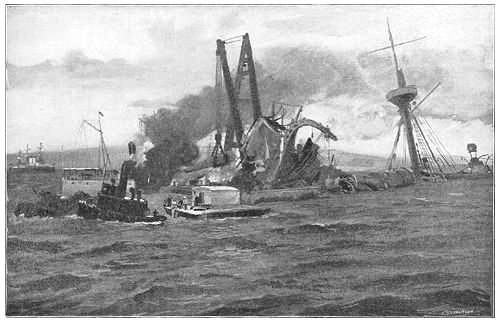
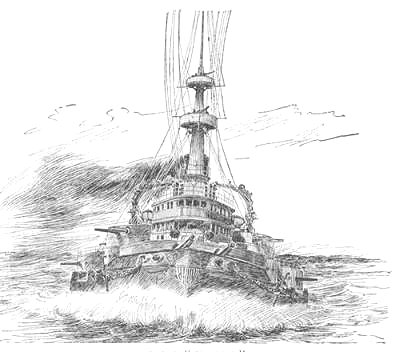
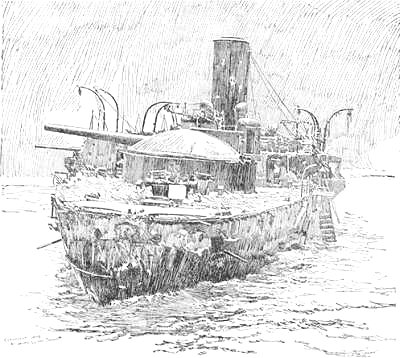
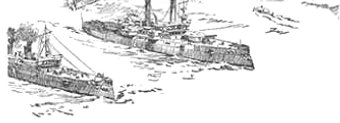
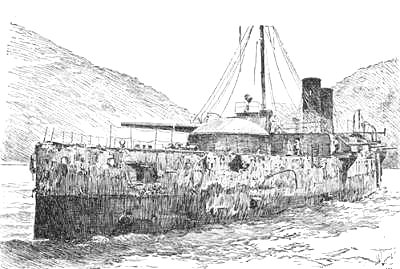
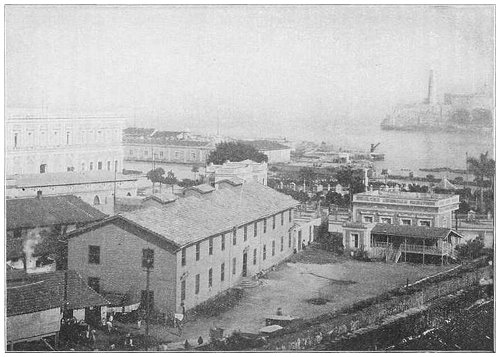
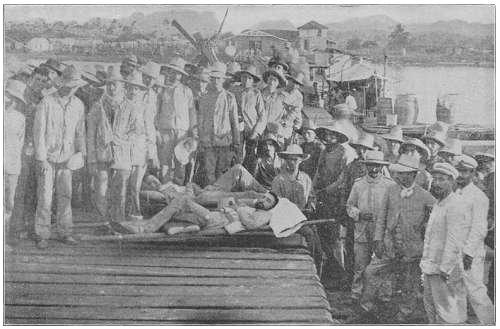
WRECK OF THE BATTLESHIP “MAINE,” HAVANA HARBOR.
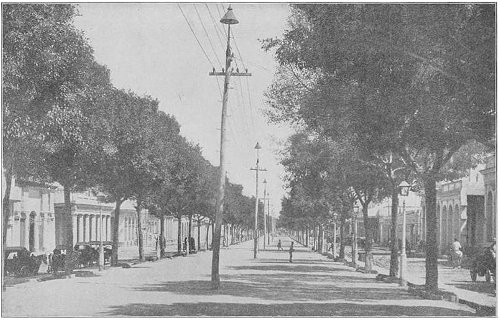
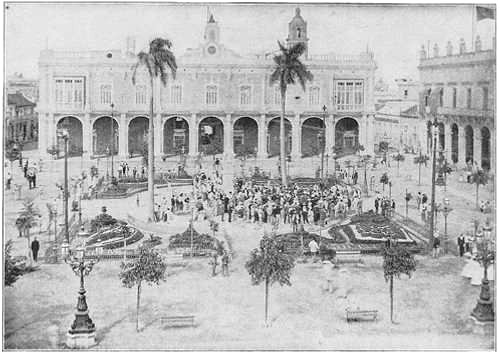
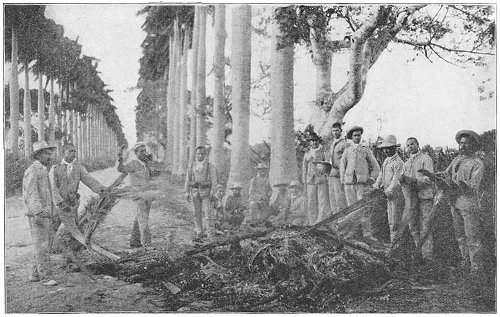
THE PRADO—PRINCIPAL STREET IN HAVANA.
The conference was then held. It was decided to form a committee in New
York, to ask money and material of the people at large to be shipped to
Cuba for the relief of the reconcentrados on that island. The call would
be made in the name of the President, and the committee naturally known
as the “President’s Committee for Cuban Relief.” I was courteously asked
if I would go to New York and assume the oversight of that committee. I
declined in favor of Mr. Stephen E. Barton, second vice-president of the
National Red Cross, who, on being immediately called, accepted; and with
Mr. Charles Schieren as treasurer and Mr. Louis Klopsch, of the
Christian Herald, as the third member, the committee was at once.
established; since known as the Central Cuban Relief Committee.
The committee was to solicit aid in money and material for the suffering
reconcentrados in Cuba, and forward the same to the Consul-General at
Havana for distribution. My consent was then asked by all parties to go
to Cuba and aid in the distribution of the shipments of food as they
should arrive. After all I had so long offered, I could not decline, and
hoping my going would not be misunderstood by our authorities there, who
would regard me simply as a willing assistant, I accepted. The
Consul-General had asked the New York Committee to send to him an
assistant to take charge of the warehouse and supplies in Havana. This
request was also referred to me, and recommending Mr. J.K. Elwell,
nephew of General J.J. Elwell, of Cleveland, Ohio, a gentleman who had
resided six years in Santiago in connection with its large shipping
interests, a fine business man and speaking Spanish, I decided to
accompany him, taking no member of my own staff, but going simply in the
capacity of an individual helper in a work already assigned.
On Saturday, February 6, we left Washington for Cuba via Jacksonville,
Tampa and Key West.
Thus, with that simple beginning, with no thought on the part of any
person but to do unobtrusively the little that could be done for the
lessening of the woes of a small island of people, whom adverse
circumstances, racial differences, the inevitable results of a struggle
for freedom, the fate of war, and the terrible features of a system of
subjugation of a people, which, if true, is too dark to name, was
commenced the relief movement of 1898 which has spread not alone over
the entire United States of America from Maine to California, from
Vancouver to the Gulf of Mexico, but from the Indias on the west, to the
Indias on the east, and uniting in its free-will offerings the gifts of
one-third of the best nations in the world.
“We reached Havana February 9, five weeks ago, and in all the newness of
a strange country, with oriental customs, commenced our work.”
The above entry I find in my diary. In speaking of conditions as found,
let me pray that no word shall be taken as a criticism upon any person
or people. Dreadful as these conditions were, and rife as hunger,
starvation and death were on every hand, we were constantly amazed at
the continued charities as manifested in the cities, and small, poor
villages of a people so over-run with numbers, want and woe for months,
running into years; with all business, all remuneration, all income
stopped, killed as dead as the poor, stark forms around them, it was
wonderful that they still kept up their organizations, municipal and
religious, and gave not of their abundance, but of their penury; that
still a little ration of food went out to the dens of woe. That the
wardrobe was again and again parceled out; that the famishing mother
divided her little morsel with another mother’s hungry child; that two
men sat down to one crust, and that the Spanish soldier shared, as often
seen, the loaf—his own half ration—with the eager-eyed skeleton
reconcentrado, watching him as he ate. In another instance the
recognition might have been less kind it is true, for war is war, and
all humanity are not humane.
The work was commenced in earnest. I still turn the pages of the diary,
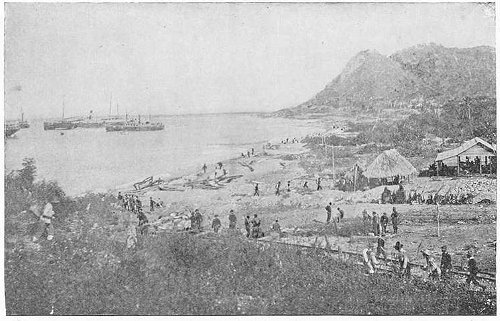
which says: “We were called on deck to look at Morro Castle, which, grim
and dark in the bright morning sunlight, skirts the bay like a frowning
ogre.”
We were met at the dock and driven to Hotel Inglaterra, where letters of
welcome awaited us. After paying our official respects, our first
business was to meet the committees appointed for the distribution of
food. We found them pleasant gentlemen. We were notified of the arrival
of the steamship “Vigilancia,” with fifty tons of supplies, sent by the
New York Committee; took carriage and drove to the dock. It was a glad
sight to see her anchors dropping down into the soil of that starved
spot of the earth. We boarded her, met the gentlemanly officers, and saw
the goods being put on the lighters. This was the largest quantity of
supplies that had yet arrived by any one steamship. In returning to
land, we threaded our way through the transports and yachts—among the
latter the “New York Journal,” that had just taken Julian Hawthorne
across from Key West—and grandest of all, the polished, shining
battleship “Maine.” She towered above them like a monarch, or rather
like an elegant visitor whom all the household felt bound to respect. On
landing, we resumed our carriage and drove to Los Fosos, a large, long
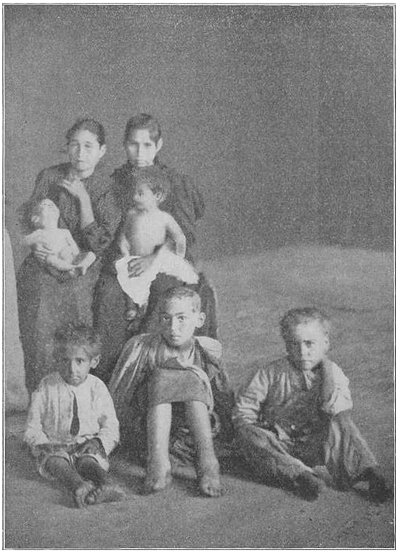
building filled with reconcentrados,—over four hundred women and
children in the most pitiable condition possible for human beings to be
in, and live; and they did not live, for the death record counted them
out a dozen or more every twenty-four hours, and the grim, terrible pile
of rude black coffins that confronted one at the very doorway, told to
each famishing applicant on her entrance what her exit was likely to be.
We went from room to room, each filled to repletion—not a dozen beds
in all. Some of the inmates could walk, as many could not,—lying on the
floors in their filth—some mere skeletons; others swollen out of all
human shape. Death-pallid mothers, lying with glazing eyes, and a
famishing babe clutching at a milkless breast. Let me attempt no further
description. The massacres of Armenia seemed merciful in comparison.
We went our rounds, and sought the open air; drove to another building
of like character, but in a little better condition—one hundred and
fifty-six inmates. These persons had been recommended by someone, who
paid a little for each, and thus kept them from daily starvation. From
here to the third building (the Casino), of about an equal number, still
a little better off.
From here to the fourth building (La Yocabo)—two hundred and fifty
persons, the best of the reconcentrados. The sisters of charity had
recently taken hold of these, and cleanliness and order commenced to
appear. The children had books, were being taught, and rooms were fitted
out for some kind of industrial training. This place seemed like heaven
in comparison.
From here to the fifth building, a distributing house, where American
rations were given out on Sundays to great crowds of people who thronged
the streets.
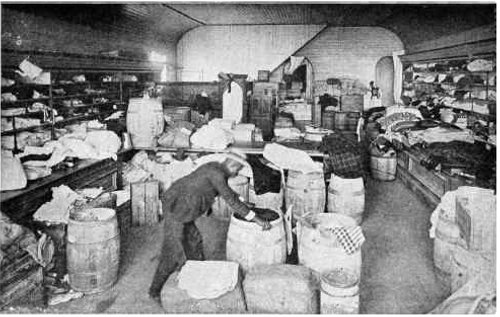
This finished, we drove to our warehouse, the San Jose, where our
supplies were stored. Here was what remained of the several shipments
which had preceeded us, the result of the tireless and well directed
efforts of the New York Committee, only so recently established, and so
new in its work. Possibly three hundred tons of flour, meal, rice,
potatoes, canned meat, fruit, bacon, lard, condensed and malted milk,
quinine, some of which had come by the first shipment, showing how
difficult the distribution had been found to be; and it was not strange
that a “warehouse man” had been asked for by the Consul General. Surely
Mr. Elwell had not a sinecure.
Somehow the report got abroad that we had brought money for
distribution, and a thousand people thronged the hotel.
We found among our supplies large quantities of flour, and the people
had no way of cooking it. There are no ovens in these oriental countries
except those of the baker. Consequently only he could make bread of
flour. We found a baker with whom we arranged to take our flour and
return bread in its place at a fair percentage.
“The Consul General has named a desire to have an orphanage created, and
asked of me to find a building, and establish such an institution. I
commence a search among the apparently suitable buildings of the town,
but regretting always that I have not his knowledge of the city and its
belongings. Up to this time the search, although vigilant, has been
fruitless. Still there are only three days of it all since our arrival,
and to-morrow will be Sunday.”
This hopeful entry ended the first half week of life in Cuban relief. Up
to this moment no American food had ever entered Los Fosos, as the
institution was under Spanish military and municipal direction. How to
get our distributors into proper and peaceful aid there, if not into
control, was a politic question.
The diary continues: “That Sunday morning, fine, clear and warm, brought
three matters of interest to our attention:
“First. An interview with a householder concerning the
orphanage—unsuccessful.
“Second. The visiting of all the various points, some nine in number,
where American food would be distributed for the coming week to the
waiting thousands and—
“Third. A bull fight.”
One would feel something of the same dread in attempting to describe
these gathering moving masses of starving humanity as in picturing the
“still life” of Los Fosos. The children of three and four years old
often could not walk and the mother was too weak to carry the burden,
and they fell in a heap among the crowd.
The food was distributed by tickets, suited to the family and put up in
paper bags, for few had any vessel to get it in.
At the first place of distribution there were 1000 fed; at the second,
1300; at the third, 2200, and so on—some larger, some less. At one of
the larger distributions, when about half served, it was announced that
there was no more food and the people were directed to disperse. We
inquired the cause and were told there were no more American supplies in
Havana—that they had been so informed. We could not persuade them that
they had been misinformed, that there was plenty of food in the
warehouse, but we did succeed in having the disappointed, hungry
hundreds called back and told to come again next day and get their food.
We never knew how the mistake occurred, but were more than ever
convinced that some systematic work must be instituted among the
constantly arriving supplies at the warehouse. The task had all along
been too great. The next morning took us with proper assistants to San
Jose, when a systematic inventory of stock as per each shipment was
instituted. At 3.30 p.m. our work was interrupted. A cordial invitation
from Captain Sigsbee to visit the “Maine” that afternoon had been
received. His launch courteously came for us; his officers received us;
his crew, strong, ruddy and bright, went through their drill for our
entertainment, and the lunch at those polished tables, off glittering
china and cut glass, with the social guests around, will remain ever in
my memory as a vision of the “Last Supper.”
The next day took us again to the warehouse. I cannot refrain from
taking the liberty of mentioning my most distinguished volunteer
assistant, General Ross, a general in our Civil War and the uncle of
Commissioner Ross, of Washington, D.C. Being in Havana on a passing
tour, and perceiving the need, he volunteered freely to do the work
which he had once commanded his under officers to direct their private
soldiers to do. It was most intelligent help.
While passing quickly among the rows of barrels, with dress pinned back,
a letter of introduction from the Consul-General was handed to me by a
manly, polished-mannered gentleman, on whose playful features there
mingled a look of amused surprise, with a tinge of well-covered
roguishness and complacency, that bespoke the cultured man of the world.
The note, addressed to my hotel, said that the Consul took pleasure in
introducing to me Mr. William Willard Howard, of New York. Although
never having met we were by no means strangers. He had worked on the
Eastern fields of Armenia in the hard province of Van, while I was in
Constantinople, and our expeditions in the great centre districts of
Harpoot and Diarbeker. He evidently felt that the surroundings were a
little rough and unexpected for a first meeting, but collecting
himself, at once rallied me with the grand opportunity I was affording
him for a sensational letter to the States, with a cartoon of the
president of the American National Red Cross in a Cuban warehouse, with
dress pinned back, “opening boxes.” He admitted that the latter stroke
of the picture was a little stretch of imagination, but he hoped it
might realize, as he really wanted it for his cartoon. After a few
moments of pleasant badinage he left, under pretext of not hindering me
in my favorite occupation of “opening boxes.”
The next day I was detained at home by an accumulation of clerical work
and heavy mails to be gotten off (I had as yet no clerk), but on the
return of the men at night they reported a marvelous day’s work. That
Mr. Howard had come early in the morning, thrown off his coat, and,
calling for a box opener, had opened boxes all day. They had never seen
a better day’s work. A messenger was immediately dispatched to his
hotel, inviting Mr. Howard to come and dine with us. From that time on,
during his stay, he continued to dine with us. We compared methods of
relief work with the experiences we had gained, and when we separated it
was with the feeling on my part that any work of relief would be a
gainer that could enlist men of such views, experience and capacity as
Mr. Howard in its ranks.
The heavy clerical work of that fifteenth day of February held not only
myself but Mr. Elwell as well, busy at our writing tables until late at
night. The house had grown still; the noises on the streets were dying
away, when suddenly the table shook from under our hands, the great
glass door opening onto the veranda, facing the sea, flew open;
everything in the room was in motion or out of place—the deafening roar
of such a burst of thunder as perhaps one never heard before, and off to
the right, out over the bay, the air was filled with a blaze of light,
and this in turn filled with black specks like huge spectres flying in
all directions. Then it faded away. The bells rang; the whistles blew,
and voices in the street were heard for a moment; then all was quiet
again. I supposed it to be the bursting of some mammoth mortar, or
explosion of some magazine. A few hours later came the terrible news of
the “Maine.”
Mr. Elwell was early among the wreckage, and returned to give me news.
The diary goes on. “She is destroyed. There is no room for comment, only
who is lost, who has escaped, and what can be done for them? They tell
us that most of the officers were dining out, and thus saved; that
Captain Sigsbee is saved. It is thought that 250 men are lost, that one
hundred are wounded, but still living, some in hospital, some on small
boats as picked up. The Chief Engineer, a quiet, resolute man, and the
second officer met me as I passed out of the hotel for the hospital. The
latter stopped me saying, ‘Miss Barton, do you remember you told me on
board the “Maine” that the Red Cross was at our service; for whenever
anything took place with that ship, either in naval action or otherwise,
someone would be hurt; that she was not of a structure to take
misfortune lightly?’ I recalled the conversation and the impression
which led to it,—such strength would never go out easily.
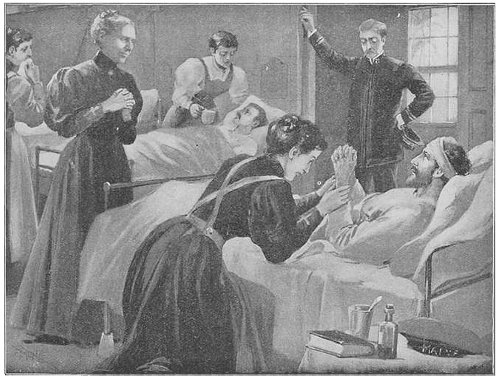
“We proceeded to the Spanish hospital San Ambrosia, to find thirty to
forty wounded—bruised, cut, burned; they had been crushed by timbers,
cut by iron, scorched by fire, and blown sometimes high in the air,
sometimes driven down through the red hot furnace room and out into the
water, senseless, to be picked up by some boat and gotten ashore. Their
wounds are all over them—heads and faces terribly cut, internal wounds,
arms, legs, feet and hands burned to the live flesh. The hair and beards
are singed, showing that the burns were from fire and not steam; besides
further evidence shows that the burns are where the parts were
uncovered. If burned by steam, the clothing would have held the steam
and burned all the deeper. As it is, it protected from the heat and the
fire and saved their limbs, whilst the faces, hands, and arms are
terribly burned. Both men and officers are very reticent in regard to
the cause, but all declare it could not have been the result of an
internal explosion. That the boilers were at the two ends of the ship,
and these were the places from which all escaped, who did escape. The
trouble was evidently from the center of the ship, where no explosive
machinery was located.
“I thought to take the names as I passed among them, and drawing near to
the first in the long line, I asked his name. He gave it with his
address; then peering out from among the bandages and cotton about his
breast and face, he looked earnestly at me and asked: ‘Isn’t this Miss
Barton?‘ ‘Yes.’ ‘I thought it must be. I knew you were here, and thought
you would come to us. I am so thankful for us all.’
“I asked if he wanted anything. ‘Yes. There is a lady to whom I was to
be married. The time is up. She will be frantic if she hears of this
accident and nothing more. Could you telegraph her?’ ‘Certainly!’ The
dispatch went at once: ‘Wounded, but saved.’ Alas, it was only for a
little; two days later, and it was all over.
“I passed on from one to another, till twelve had been spoken to and the
names taken. There were only two of the number who did not recognize me.
Their expressions of grateful thanks, spoken under such conditions, were
too much. I passed the pencil to another hand and stepped aside.”
I am glad to say that every kindness was extended to them. Miss Mary
Wilberforce had been at once installed as nurse, and faithful work she
performed. The Spanish hospital attendants were tireless in their
attentions. Still, there was boundless room for luxuries and comforts,
delicate foods, grapes, oranges, wines, cordials, anything that could
soothe or interest; and no opportunity was lost, nor cost nor pains
spared, and when two days later the streets filled with hearses bearing
reverently the bodies of martyred heroes; and the crape and the flowers
mingled in their tributes of tenderness and beauty, and the muffled
drums and tolling bells spoke all that inanimate substance could speak
of sorrow and respect; and the silent, marching tread of armies fell
upon the listening ear,—the heart grew sick in the midst of all this
pageant, and the thoughts turned away to the far land, smitten with
horror, and the homes wailing in bitter grief for these, so lone, so
lost; and one saw only the:
Nodding plumes over their bier to wave,
And God’s own hand in that lonely land
To lay them in their grave.
We were still in hotel—excellent of course—but a home should be made
for the body of assistants it was by this time proposed to send for. I
remembered the visit of a lady—one among the hundreds who called the
day before—and who impressed me as being no ordinary person. She had
the air of genuine nobility and high birth. I had retained her card:
Senora J.S. Jorrin,
528 del Cerro.
It would be certain I thought that this lady knew something of suitable
homes; and we drove to her residence next day, to find one of the
loveliest villas in the city, surrounded by gardens, fountains,
flowers, baths, a little river rushing through the garden, palms,
bananas, cocoanuts, all growing luxuriantly. This was the home of Senora
Jorrin, given her as a wedding gift many years before by her husband, a
man of great power in the island, and who had three times represented
Cuba in the Senate of Madrid. Three months before he had died on a visit
to New York. La Senora was alone with her retinue of servants, and
waiting to make some suitable disposition of her mansion, in order to
join her only daughter residing in America.
The desired disposition was quickly made, and in the next day or two we
were safely installed in our new home, with Senora as honorary hostess,
to the delight and advantage of all. This pleasant arrangement has never
been interrupted, and is the origin of the charming Red Cross
headquarters at Cerro, that all our friends and visitors recall with
such admiration. I might be pardoned for adding that Senora Jorrin, who
was early called to Washington by the sudden death of her beautiful and
only daughter, has remained with her grandchildren, and we have
continued such loving care as we were able to extend over her palatial
home from that time to the present.
The diary now makes the following notes, which I remember to have once
copied in a letter to some periodical which perhaps published it. I
never knew; but will venture to reproduce it here, as the description of
the first visit made to any point of the country outside of Havana.
We were overborne by requests to visit towns and villages filled with
suffering and death. The notes run:
It was a clear warm day. I had retired early to be ready for a five
o’clock start for the town of Jaruco, some twenty miles away. It was as
dark as night when we stepped into the carriage to go to the ferry and
the train—damp, heavy, just a morning for chills. Some members of the
committee joined us at the train, and as daylight and sunrise came, the
sight, in spite of neglect and devastation, was magnificently lovely.
The stately groves of royal palms looked benignly down on the less
pretentious banana and cocoanut, each doing its best to provide for and
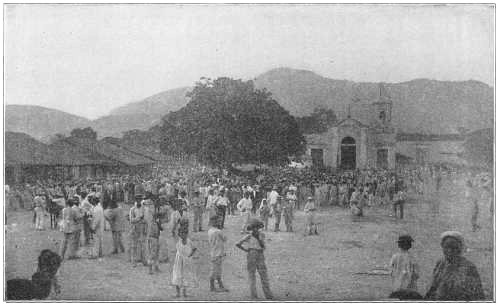
keep life in a starving, dying people. Nine o’clock brought us to the
town, where we were met and right royally welcomed by its leading
people. The mayor took us in his carriage to the church, followed by a
crowd of people that filled its centre. The plain, simple services told
in repeated sentences the heart gratitude of a stricken people to God
for what he had put into the hearts of America to do. She had remembered
them when all was gone, when hunger, pain and death alone remained to
them; and when that assemblage of pale, hollow faces and attenuated
forms knelt on the rough stone floor in praise to the Great Giver, one
felt if this was not acceptable, no worship might ever hope to be. From
the church to the house of the mayor, the judge, the doctor and other
principal men of the town. It now remained to see what we had “gone for
to see.” Two hours’ wandering about in the hot sunshine from hovel to
hovel dark and damp, thatched roof and ground floor, no furniture,
sometimes a broken bench, a few rags of clothing; some of the people
could walk about, some could not, but all had something to eat. Thank
God, if not all their lean bodies might crave, still something, and
while they showed their skeleton bodies and feet swollen to bursting,
they still blessed the people of the country that had remembered them
with food.
The line of march was long and weary, and ended with the “hospital.”
What shall I say of it? If only a sense of decency were consulted one
would say nothing; but truth and facts demand a record. We tried to
enter, to reach a poor, wretched looking human being on a low cot on the
far side of the room, but were driven back by the stench that met us,
not alone the smell one might expect in such a place of neglect, but the
dead had evidently lain there unremoved until putrefaction had taken
place. There were perhaps four wrecks of men in the various rooms,
doubtless left there to die. Like a body of retreating soldiers, driven
but not defeated, we went a few rods out and rallied, and calling for
volunteers and picked men for service, determined to “storm the works.”
Jaruco is one of the great points of devastation; it is said that more
people have died there than the entire town numbers in time of peace; it
is still almost a city of reconcentrados.
Naturally, the inhabitants who survive have given all they had many
times over in these terrible months. Everything is scarce and dear; even
water has to be bought. This was the first point of attack. Twenty good
soldiers, with only dirt and filth as enemies, can make some progress.
Water by the dray load, lime by the barrel, brushes, brooms, blue for
whitewash, hatchets, buckets and things most needful, made up the
equipment; and late in the afternoon, when Mr. Elwell, who might well
be termed the “Vigilant,” returned to look after the work, preparatory
to leaving for home, he found the four poor patients in clean clothes,
on clean beds, in the sunshine, eating crackers and milk, the house
cleaned, scrubbed, limed, and being whitewashed from ceiling to floor.
It will be finished to-morrow. Sunday and to-day (Monday), we ship cots,
blankets, sheets, pillow-slips, all the first utensils needed to make a
plain hospital for twenty-five, to be increased to fifty—the food to go
regularly. The sick, lying utterly helpless in the hovels, to be
selected with care and sent to the hospital, a nurse placed with them,
the doctor already there in Jaruco to attend them, and send frequent
reports of condition and needs. In two weeks time we may hope to see,
not only a hospital that may bear the name, but progress of its patients
that may be noted.
I am writing this at length, because it is the first of hundreds that
should follow throughout the island, and a type of what we shall
endeavor to accomplish.
It will naturally be asked if we expect the Spanish authorities to
permit us to do this. Judging from to-day, we have reason to expect
every co-operation. The commandant of the town was one of the men who
welcomed us; and so far as they had the materials desired, offered them
for our use; it was very well, as there were some we could get in no
other way.
The crowd that followed us was bewildering—the little children in
pitiful proportions. We had prepared ourselves for this by a large
invoice of five-cent scrip. An intimation of our desire to the priest
arranged the matter quickly. All under, perhaps, six to seven years old,
were sent into the church to come out at a side door, with Mr. Elwell
and myself on each side as doorkeepers. Every pale passing hand took its
scrip, and the gladness that beamed in their little wan faces was good
for angels’ eyes. They rushed into the street, romping and tumbling like
actual live children, which they had no longer seemed to be.
There was but one more feature to mark this memorable day. After leaving
the hospital we were told that a deputation of ladies desired to call on
us. We were in the house of a naturalized American citizen, and prepared
to receive them. They entered slowly and reverently, the leader bearing
a deep plate of choice flowers. As she handed them to me, I perceived in
the center a large envelope with a half-inch border of black, and a
black ribbon with a tied bow encircling it. The envelope was addressed
to me. The first sentence, with tender, trembling voice, told the
purport of it all: “For the dead of the Maine.”
The crowd, full of hope and blessing, followed us to the train, and as
we passed on, gentle, tender-eyed women came down the banks from their
cottages with little baskets of flowers to be passed into the
carriage—and ever the black-bordered tribute:
“To the dead of the Maine.”
It was long after dark when we reached our new home, and we were weary
enough to find it welcome; but glad of our day’s work, as a type of many
more which we confidently expect will follow.
In our banking operations I learned the full address of our excellent
hostess, which she had been too modest to name to me:
“Senora Serafina Moliner de Jorrin.”
Titles: “Eccelentisima.” “Ilustrisima.”
We have always had occasion to feel those titles to be well deserved.
Indeed, in groping our way among the poor and helpless, we have found
that Cuba is not without its diamonds of worth, nobleness and culture.
We were still searching diligently for a suitable location for the
orphanage which I had been requested to open.
Through the social relations of Senora we were immediately put into
communication with Senor José Almagro on Tulipan street, who placed at
our disposal his own private residence, a charming house with large
gardens, stables, swimming baths, fruit and flowers.
Members of the staff, Drs. Hubbell and Egan, together with Dr. and Mrs.
Lesser, had meanwhile arrived by steamship from New York.
The diary goes on to say in regard to the orphanage, its location and
surroundings:
“It seems to lack nothing. Large, commodious, healthful, easy of access,
beautiful to elegance, with tropical gardens, royal palms, swimming
baths, and capable of caring for two hundred children, either well or
sick,—and for all this the modest, little rent of one hundred and two
dollars per month. Attention was first directed to this piece of
property on Saturday, February 27. At night the contract was made and
signed. On Sunday—“tell it not in Gath”—oh, Christian world, be gentle
in your judgment, if a few men, rather than stand about the streets,
hunger-stricken, waiting for the crust that came not, earned a few
welcome dollars on its frescoed walls, stained glass windows and marble
floors.
“On Monday seventy-five new cots, blankets, pillows and sheets adorned
its spacious rooms. On Tuesday, March 1, Mrs. Dr. Lesser, our practical
“Sister Bettina,” who had taken the superintendence, made the necessary
outfit,—food and medicine from the warehouse; and from Los Fosos, that
terrible den of suffering, the pale lifeless, helpless, starved little
creatures to fill the waiting cots—a few good nurses to lift the heads
that could not lift themselves and fill the mouths that had scarcely
ever before been filled.”
This, then, was the orphanage. May I be pardoned for saying reverently,
we looked on our work and found it good, and felt that we might now
leave the little, tired creatures to rest in the faithful hands that had
so lovingly and intelligently taken them up, while we turned away to
other fields.
Among the welcome, notable persons who from time to time visited us, led
by their interest in the great suffering reported through the press,
were Senator Redfield Proctor and his friend, Hon. M.M. Parker, of
Washington, D.C. They had come imbued with the desire, not only to see
the condition of the island and the people, but to try to find as well,
what could be done for them,—to gain some practical knowledge which
could be used for their benefit. There seemed to be no more certain way
of their gaining this information than by inviting them to accompany us
on the various tours of investigation which we would be now able to make
outside of Havana. Reports of great suffering had come from Matanzas,
and it was decided that that should be our next point of inspection.
The once-a-day run of the trains made early rising a necessity; and
half-past four in the morning, dark and chilly, found us on the way to
the train for Matanzas. Our own small party was joined at the ferry by
our Washington friends, and together, as the train speeded on, we
watched the gorgeous sunrise spread itself over these strangely deserted
lands.
Matanzas has some fifty thousand of its own inhabitants, greatly
increased by the reconcentrado element, which had gathered there to
exist hopelessly in enforced idleness for nearly two years.
It is needless to say that all the diseases incident to exposure,
physical want and mental woe, from gaunt, lingering hunger down to
actual starvation and death, had developed among them. For some
reason—possibly a sense of pity—our consul seemed to dread to show us
their worst, which were evidently their hospitals, and hesitatingly led
the way to other centres of the town. But there was no hesitancy on the
part of the governor, Senor Francisco de Armas—a royal Cuban and a new
appointee of Captain-General Blanco—with warm heart and polished
manner, in welcoming us to his elegant mansion, and in bringing his
wife, his mother and sister, to assist in receiving and to bid us
welcome to all they had to offer or that we could desire. The
half-hour’s seance in that polished marble salon, with its spacious
elegance, the deep feelings of the governor, the still deeper sympathy
of the ladies, whose daily time is given to the poor sufferers around
them, was a scene not to be forgotten. In all that was said, not a word
of crimination, nor a disrespectful allusion to any person, or nation,
or government; but the glistening eyes and trembling lips when the word
Americano was spoken, told how deep a root the course of our people
had taken in the thrice harrowed soil of these poor broken hearts.
But the worst must be seen, and as we drove out of the town we halted
for a short call at the municipal hospital, generally attended by
sisters of charity, scantily provided it is true, but well cared for; a
little is paid per week, either by, or, for each patient in this
institution, which helps to keep up the general fund. Our welcome by the
sisters was most cordial, and we were grateful for every faint smile
that passed over each pallid face. A mile further on we came to the four
hospitals where nothing was paid, and apparently nothing had. There were
between one hundred and two hundred men, women and children, in all
stages of hunger and disease. There were empty beds for as many more
that could have been thrice filled from the huts outside; but the
hospital authorities feared to take more in, lest they die through their
inability to feed them. It is not my purpose to detail woe, nor picture
horrors; I leave that to others, if more of it must be had; let my few
words tell how they were met and how the comfort that could be given,
was given, or at least attempted.
The purses and the pockets of our entire party were emptied, and as the
cold, thin fingers closed feebly over the coin so strange to the touch,
the murmured prayer for America fell from every lip. Our visit had been
one of inspection, returning to Havana by the afternoon train.
The hospital committee and surgeons had been organized to work under our
charge, and begging that one of our Red Cross men be temporarily
assigned to them for their distribution, we turned our steps toward
Havana, with a thankfulness unspoken in our hearts for the great head of
our country who had asked for this food, the great-hearted people who
had given it, and the efficient and tireless committee which had
organized and sent it.
The train of next day took out supplies of cereal foods, condensed milk,
malted milk, meal, rice, flour, crackers, meat, fish, farina, tomatoes,
canned vegetables and fruits—more than enough to hold those four
hospitals comfortable till the promised shipment by the “Bergen” from
New York, direct to Matanzas, should arrive.
It was from information gathered by the party on this trip that Senator
Proctor afterward made his speech in the U.S. Senate upon the condition
of the reconcentrados.
[From a speech by Senator Redfield Proctor, of Vermont, in the U.S.
Senate, March 17, 1898.]
There are six provinces in Cuba, each, with the exception of
Matanzas, extending the whole width of the island, and having about
an equal sea front on the north and south borders. Matanzas touches
the Caribbean Sea only at its southwest corner, being separated from
it elsewhere by a narrow peninsula of Santa Clara Province. The
provinces are named, beginning at the west, Pinar del Rio, Havana,
Matanzas, Santa Clara, Puerto Principe and Santiago de Cuba.
My observations were confined to the four western provinces, which
constitute about one-half the island. The two eastern ones are
practically in the hands of the insurgents, except a few fortified
towns. These two large provinces are spoken of to-day as “Cuba
Libre.”
Havana, the great city and capital of the island, is, in the eyes of
the Spaniards and many Cubans, all Cuba, as much as Paris in France.
But having visited it in more peaceful times and seen its sights,
the tomb of Columbus, the forts of Cabanas and Morro Castle, etc., I
did not care to repeat this, preferring trips in the country.
Everything seems to go on much as usual in Havana. Quiet prevails
and except for the frequent squads of soldiers marching to guard and
police duty and their abounding presence in all public places, one
sees little signs of war.
Outside Havana all is changed. It is not peace, nor is it war. It is
desolation and distress, misery and starvation.
Every town and village is surrounded by a trocha (trench) a sort of
rifle pit, but constructed on a plan new to me, the dirt being
thrown up on the inside and a barbed wire fence on the outer side of
the trench.
These trochas have at every corner, and at frequent intervals along
the sides, what are there called forts, but which are really small
block-houses, many of them more like a large sentry box, loop-holed
for musketry, and with a guard of from two to ten soldiers in each.
The purpose of these trochas is to keep reconcentrados in as well as
to keep the insurgents out.
From all the surrounding country the people have been driven into
these fortified towns and held there to subsist as they can. They
are virtually prison yards and not unlike one in general appearance,
except that the walls are not so high and strong, but they suffice,
where every point is in range of a soldier’s rifle, to keep in the
poor reconcentrado women and children.
Every railroad station is within one of these trochas and has an
armed guard. Every train has an armored freight car, loop-holed for
musketry, and filled with soldiers and with, as I observed usually,
and was informed is always the case, a pilot engine a mile or so in
advance. There are frequent block-houses enclosed by a trocha and
with a guard along the railroad track. With this exception there is
no human life or habitation between these fortified towns and
villages throughout the whole of the four western provinces, except
to a very limited extent among the hills, where the Spaniards have
not been able to go and drive the people to the towns and burn their
dwellings.
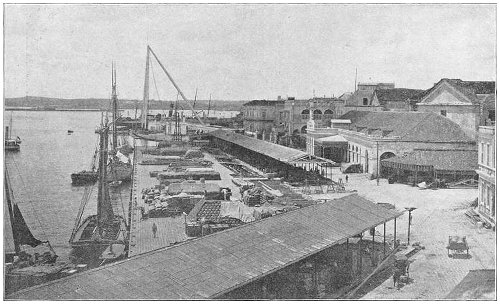
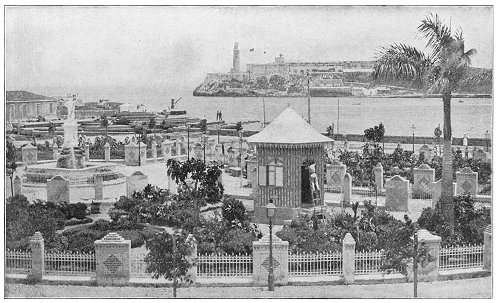
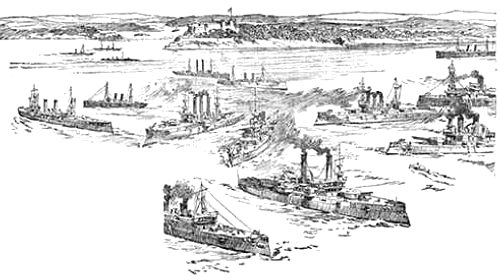
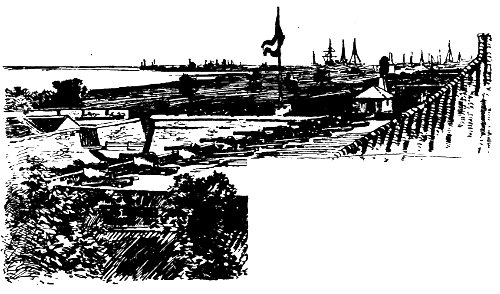
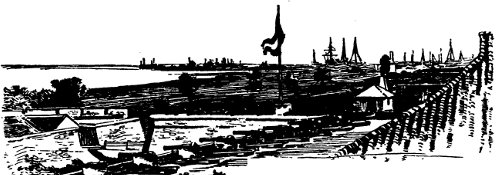
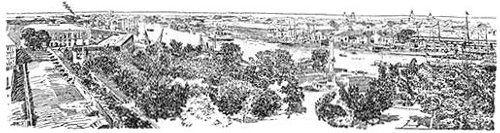
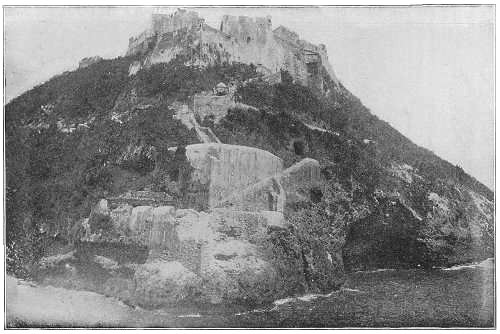
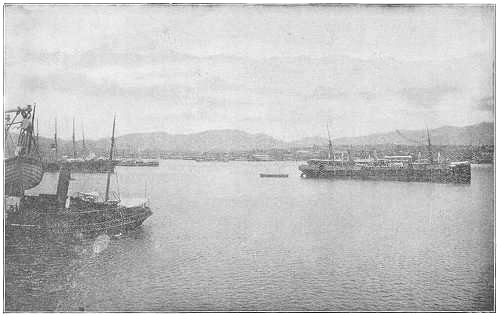
HAVANA HARBOR.
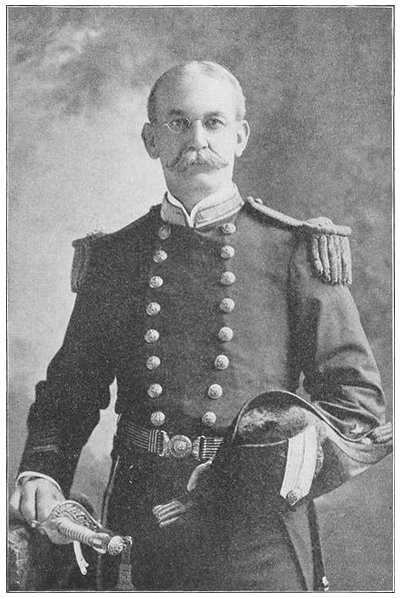
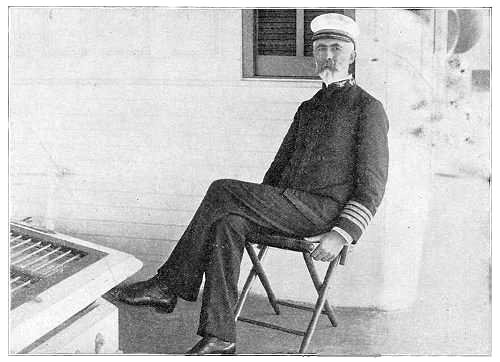
CAPTAIN C.D. SIGSBEE.
I saw no house or hut in the 400 miles of railroad rides from Pinar
del Rio Province in the west across the full width of Havana and
Matanzas Provinces, and to Sagua La Grando on the north shore and to
Cienfuegos on the south shore of Santa Clara, except within the
Spanish trochas. There are no domestic animals or crops on the rich
fields and pastures except such as are under guard in the immediate
vicinity of the towns.
In other words, the Spaniards hold in these four western provinces
just what their army sits on.
Every man, woman and child and every domestic animal, wherever their
columns have reached, is under guard and within their so-called
fortifications. To describe one place is to describe all.
To repeat, it is neither peace nor war.
It is concentration and desolation. This is the “pacified” condition
of the four western provinces.
All the country people in the four western provinces, about 400,000
in number, remaining outside the fortified towns when Weyler’s order
was made, were driven into these towns, and these are the
reconcentrados. They were the peasantry, many of them farmers, some
land-owners, others renting lands and owning more or less stock,
others working on estates and cultivating small patches, and even a
small patch in that fruitful clime will support a family.
It is but fair to say that the normal condition of these people was
very different from that which prevails in this country. Their
standard of comfort and prosperity was not high, measured by our
own, but according to their standards and requirements, their
conditions of life were satisfactory.
They lived mostly in cabins made of palm or in wooden houses. Some
of them had houses of stone, the blackened walls of which are all
that remains to show that the country was ever inhabited.
The first clause of Weyler’s order reads as follows:
“I order and command:
“First—All the inhabitants of the country now outside of the line
of fortifications of the towns shall within the period of eight days
concentrate themselves in the town so occupied by the troops. Any
individual who after the expiration of this period is found in the
uninhabited parts will be considered a rebel and tried as such.”
The other three sections forbid the transportation of provisions
from one town to another without permission of the military
authority, direct the owners of cattle to bring them into the towns,
prescribe that the eight days shall be counted from the publication
of the proclamation to the head town of the municipal districts, and
state that if news is furnished of the enemy which can be made use
of it will serve as a “recommendation.”
Many doubtless did not learn of this order. Others failed to grasp
its terrible meaning. Its execution was left largely to the
guerillas to drive in all that had not obeyed, and I was informed
that in many cases a torch was applied to their homes with no
notice, and the inmates fled with such clothing as they might have
on, their stock and their belongings being appropriated by the
guerillas.
When they reached the town they were allowed to build huts of palm
leaves in the suburbs and vacant places within the trochas, and were
left to live if they could. Their huts are about ten by fifteen feet
in size, and for want of space are usually crowded together very
closely. They have no floor but the ground, and no furniture, and
after a year’s wear but little clothing, except such stray
substitutes as they can extemporize.
With large families or with more than one in this little space, the
commonest sanitary provisions are impossible. Conditions are
unmentionable in this respect.
Torn from their homes, with foul earth, foul air, foul water and
foul food, or none, what wonder that one-half have died and that
one-quarter of the living are so diseased that they cannot be saved.
A form of dropsy is a common disorder resulting from these
conditions. Little children are still walking about with arms and
chests terribly emaciated, eyes swollen and abdomen bloated to three
times the natural size. The physicians say these cases are hopeless.
Deaths in the streets have not been uncommon. I was told by one of
our consuls that people have been found dead about the markets in
the morning where they had crawled hoping to get some stray bits of
food from the early hucksters, and that there had been cases where
they had dropped dead inside the market, surrounded by food.
These people were independent and self-supporting before Weyler’s
order. They are not beggars even now. There are plenty of
professional beggars in every town among the regular residents, but
these country people, the reconcentrados, have not learned the art.
Rarely is a hand held out to you for alms when going among their
huts, but the sight of them makes an appeal stronger than words.
The hospitals—of these I need not speak; others have described
their condition far better than I can.
It is not within the narrow limits of my vocabulary to portray it. I
went to Cuba with a strong conviction that the picture had been
overdrawn; that a few cases of starvation and suffering had inspired
and stimulated the press correspondents, and that they had given
free play to a strong, natural and highly cultivated imagination.
I could not believe that out of a population of one million six
hundred thousand, 200,000 had died within these Spanish forts,
practically prison walls, within a few months past, from actual
starvation and disease caused by insufficient and improper food.
My inquiries were entirely outside of sensational sources. They were
made by our medical officers, of our consuls, of city alcaldes
(mayors), of relief committees, of leading merchants and bankers,
physicians and lawyers. Several of my informants were Spanish born,
but every time came the answer that the case had not been
overstated.
What I saw I cannot tell so that others can see it. It must be seen
with one’s own eyes to be realized.
The Los Fosos Hospital, in Havana, has been recently described by
one of my colleagues, Senator Gallinger, and I cannot say that his
picture was overdrawn, for even his fertile pen could not do more.
He visited it after Dr. Lesser, one of Miss Barton’s very able and
efficient assistants, had renovated it and put in cots.
I saw it when 400 women and children were lying on the stone floors
in an indescribable state of emaciation and disease, many with the
scantiest covering of rags, and such rags! and sick children, naked
as they came into the world. And the conditions in the other cities
are even worse.
Miss Barton and her work need no indorsement from me. I had known
and esteemed her for many years, but had not half appreciated her
capability and devotion to her work. I especially looked into her
business methods, fearing there would be the greatest danger of
mistake, that there might be want of system, waste and extravagance,
but found she could teach me on these points.
In short, I saw nothing to criticise, but everything to commend. The
American people may be assured that the bounty will reach the
sufferers with the least possible cost and in the best manner, in
every respect.
And if our people could see a small fraction of the need, they would
pour more “freely from their liberal store” than ever before for any
cause.
When will the need for this help end? Not until peace comes and the
reconcentrados can go back to their country, rebuild their homes,
reclaim their tillage plots, which quickly run up to brush in that
wonderful soil and clime, and until they can be free from danger of
molestation in so doing.
Until then the American people must in the main care for them. It is
true that the alcaldes, other authorities and relief committees are
now trying to do something, and desire, I believe, to do the best
they can. But the problem is beyond their means and capacity and the
work is one to which they are not accustomed.
General Blanco’s order of November 13 last somewhat modifies the
Weyler order, but it is of little or no practical benefit. Its
application is limited to farms “properly defended,” and the owners
are obliged to build “centres of defense.”
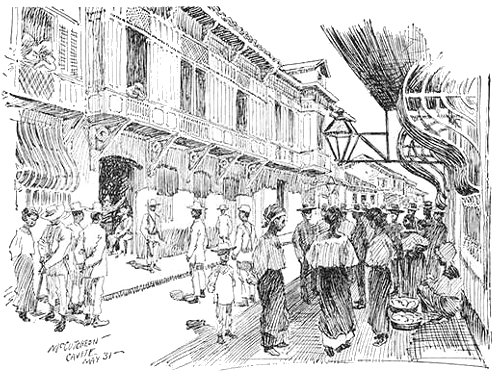
STREET IN CAVITE SHOWING GENERAL AGUINALDO’S HEADQUARTERS.
Whilst these various provisions and improvements in and around Havana,
in the little orphanage and Los Fosos were going on, food was going out
from the great warehouse upon requisition, to thirty or forty towns and
villages in number, which no one had yet had the time to visit; and
their first distribution must be made on trust. From many sources we had
heard of the needs of Artemisa, several miles to the east by rail. As
usual, there was but one train daily from Havana, and that, like the
road we had traveled to Jaruco and Matanzas on the west, left at six
o’clock in the morning, and also meant rising at half-past four, a
carriage ride of three-quarters of an hour in the dark. Our party again
formed, including Mr. Elwell, Drs. Hubbell and Egan, Senator Proctor,
Colonel Parker and a few other attendants. The day was clear and fine,
affording an excellent opportunity to observe the condition of the
country as we passed through. There was entire lack of cultivation; the
tall palm threw its stately shadow over miles of desolated, rolling and
meadow land; no people in sight save in the little thatched hovels; no
cattle, no tools, the rank, wild grass swarding the soil where the
richest of crops belong; and we bringing food grown on the sterile
fields of North America, among the gravel and rocks, with a quarter of
the year under snow, nearly one-half under frost, to a country like
this, where the verdure is perpetual and three crops possible, where the
rain and the sun never fail, where land is abundant and yet where
millions of hands want acres and millions of acres want hands. Heavenly
Father, what is the matter with this beautiful earth that Thou hast
made! “And, what is man that Thou art mindful of him!”
Eight o’clock in the bright morning sunshine found us at Artemisa. A
brief examination by carriage served to show us where its defences had
once been, now practically abandoned and the field of military activity
drawn to other points.
We found here a most practical mayor, with two thousand to three
thousand people about him almost entirely without food. Since November
24, until some three months ago, the Spanish government had issued small
rations to these people, but these grew less and less, and finally
stopped altogether. This small help from the government had saved the
people thus far, but they were now beginning to be dangerously hungry.
What gladness it was to feel that our provisions would fall in just in
time to save, we hoped, the greater portion of those remaining.
The district of Artemisa had originally 10,000, and the town 2000
inhabitants. Into this small number 10,000 reconcentrados had been sent.
Three thousand of these had died; some had strayed away to other places
in the hope of more food and fewer persons to eat it; 5000 still
remained. In August 770 persons died—now the death rate is 5 to 6
persons per day, or about 175 per month. We found only one hospital and
this for smallpox, far out in the fields, with forty patients. There
were three physicians who would be more than glad to make up a
hospital—if there were anything to provide it with—attend to it
personally, and find women who would care for the sick, as nurses. They
were directed to do this at once, and suitable hospital food would be
sent to them as soon as their hospital was reported ready for it. They
were also directed to gather all the sick in the outlying hovels and
bring them into hospitals. One of our physicians would go directly with
the food and assist in the establishment of the institution. We remained
over night; the distribution of food which had been sent them took place
at seven the next morning. Their system of tickets was excellent; a
better system of relief we had not seen. The mayor himself would visit
every family and the physicians the same, until the sick would be all in
hospitals. It was a welcome sight at eight o’clock that morning, when
the crowd of waiting thousands stood around the mayor, to see the tight
hand grasp on the bag of rations, like a godsend from heaven when hope
was lost. The mayor had a thousand acres of land lying within the
military lines of fortifications, which he offered free for the use of
the people, if they could get permission, and if the people could help
to cultivate it. In three months, he said, under their own cultivation
it would feed them all.
Our work at Artemisa closed at noon and we returned to Havana.
Referring again to the diary I find the following record:
Sagua la Grande and Cienfuegos yet remain within our limits to be
reached at once. We have not a day to lose, and again leave at six
o’clock for Sagua la Grande. This means the usual morning ride in
the dark, the ferry and the beautiful opening of the day speeding on
through a strange land of waste and desolation. Our same company
assembled, and as we neared Sagua we were met by our friend, Consul
Barker, and later on the mayor, Senor Machado. Carriages were taken
and inspection made of the reconcentrados, their condition and
needs, the land, etc. While there is evidently great want here,
there is still an atmosphere of care and effort on the part of the
best people and the officials which fills one with an earnest desire
to help them on. The best place possible for the poor had been
provided by the mayor, and as he passed among them, pointing out to
us especial cases and conditions, their eyes followed him with a
look of grateful devotion. While sympathizing with all, his deepest
care seemed to be for the young girls; to find some occupation for
them, and some protection. The plan most feasible to him was the
starting of a cigarette factory where the hundreds might be
employed, with suitable time for instruction, earn their living, and
be kept out of danger. I am glad to know that he is partially
succeeding in this, and also that he had, and I think still has, the
earnest co-operation of our good consul at Sagua, Mr. Barker.
The day had been very fully occupied, and we must remain until
morning to witness the operation of the kitchens established by the
consul and the mayor, where the poor are fed with well-cooked rice,
beans and such vegetables as can be obtained.
These people are desperately poor, and need all the help that can be
given them, and yet they are not in the condition of the people of
Matanzas. Their doctors are caring for the sick, and the ladies of
the town giving every assistance in their power. The mayor again
reverts to his great interest in the young girls; “Here is the
greatest danger of all. Can you not help me out with this?” His
earnestness made such an impression upon me that I finally asked if
he had young daughters of his own. He hesitated a moment, and then
with a look of confidence, as if he were about to entrust a secret
to me, he replied: “We have an adopted daughter, who is very, very
dear to us. She is the sister of Miss Cisneros, but does not know
it, and we have not the courage to tell her. She is some fourteen or
fifteen years of age, has read everything regarding Miss Cisneros,
and admires her intensely, but never mistrusts the relationship.”
“Will you not tell her?” I asked. “Oh yes; some day,” he replied,
“and it must be before long; but the relationships are so sweet that
my wife and I both dread to break them. Of course, some day we must
tell her, but we put it off as long as we can.” He then explained
that the father had been an active patriot and fell under political
censure; in his imprisonment the family was broken up, and this
little girl, then a mere babe, had been adopted by the mayor and his
wife, who were intimate friends of the family. I hope I have not
betrayed a trust; but there was a little touch of romance in
this—something so sweet and paternal in the relationship—and
something altogether so interesting in the thought of this bright
young girl reading and admiring the courage and successful exploits
of her own sister, without ever dreaming that it was anything to
her—it seems really too good a point to keep dark. I trust that the
good mayor, if he ever learns that I have betrayed his trust, will
forgive me.
Although a rather early train on the next day would take us to
Cienfuegos, the visit to the kitchens with their great, steaming
cauldrons of food must not be passed by. Although it was simply beans,
rice, such other dry vegetables as could be obtained, and the little
meat or lard that came with the ration, slowly and thoroughly cooked, it
was still a food that any good appetite could appreciate—wholesome,
clean and as abundant as the circumstances would permit. It was a
pleasure to see the children and the mothers come up with the little
pails and buckets and receive the one large ladle of food, steaming hot
from the cauldron, and bear it cheerfully away for the coming meal.
There was a degree of order and systematic thought in this rarely met
under occasions so grave. It will remain ever a happy memory with Consul
Barker and the good mayor of Sagua, that under their wise direction this
system was instituted and carried out. The courtesies of the railroad
were cheerfully extended to us, and without incident worth relating the
night found us at Cienfuegos. The country round about Cienfuegos is
favorable to cultivation; the troubles there had been of a less grave
nature, consequently the suffering has been less. Judging from the
report of the consul, there had been very little; but to our stranger
eyes, upon personal observation, there were traces of something not
compatible with thrift, prosperity and happiness. We were sure that some
help might be comfortably given there, and made our preparations
accordingly. This also was a visit of investigation, and being Tuesday,
the next day’s boat from Havana to the States must take our good friends
from us, and an early start, over a long, jolting road, took us from
Cienfuegos back to Havana.
Our journey through the three or four districts had shown us the worst
of human suffering, the greatest of desolation, and a degree of
discouragement as hard perhaps to rally the people from as the absolute
physical conditions under which they existed. We had arranged for food
for all. The ships with their various consignments were already on the
way, the “Fern” to Matanzas, a shipment from the Philadelphia Red Cross
on the “Bergen,” also bound for Matanzas, from both of which supplies
could go forward to Artemisa and Sagua, for the railroads were generous
in giving free transportation; and we were informed that a shipment was
also en route for Cienfuegos. Remembering our own generous shipment of
food to Matanzas of the third instant, we felt that we might give the
time of a day or two to the institutions we were founding and supporting
in Havana. The little hospital was growing finely, increasing in
numbers, and the numbers increasing in strength. The frail, pale
creatures were commencing to sit up in bed and hold the playthings that
generous friends had brought them by the basketful; some even walked
about and tried to play. Their heavenly godmother, “Sister Bettina,” was
providing everything for their comfort, also for their nurses and the
little household that made up a pattern hospital. Dr. Lesser had
established a clinic on the grounds, and under the shade of the great,
beautiful garden trees the poor invalids of the town assembled by the
hundred each afternoon with the various maladies that misfortune,
poverty and neglect had brought them. The gratitude which their strange
tongues spoke in evident blessing upon him who had thought to come to
their relief, and the great brown eyes that followed him as he turned
quickly and gently from one to another, were pictures not to be
forgotten.
Los Fosos, on the other hand, was fast losing its terrors. A regular
distribution of American food had gone into it, and even rooms were
partitioned off for a dispensary, fairly well provided with medicines,
and another for clothing and bedding fast filling up from our warehouse
were all in grateful operation. All had beds, the floors and stairs were
strengthened, and the food went regularly through twice a day among all
the waiting inmates. M. Sr. J. Palacios y Airoso, the Consul of Bolivia,
and a member of our committee, had volunteered to take personal charge,
and his fine, manly form seen day by day among these poor, suffering
creatures, watching and providing their wants, was like a benediction
from heaven. And Sister Bettina, with her band of faithful nurses, soon
carried strong traces of order and cleanliness where it had once seemed
impossible.
The morning that saw our first welcome party of American visitors,
Senator Proctor and friends, leave us, brought another party still
larger, among whom were Senator and dear Mrs. Thurston, Senator Money
and nieces, Senator Gallinger, Mr. Cummings, Mr. Smith, and others. It
was not only comforting, but hopeful, to see such interest manifested in
these dreadful conditions by the highest prestige in our country and
those who had it in their power to make these conditions better. We
welcomed them with an earnestness they could scarcely comprehend.
There was in all these surroundings a feeling akin to horror, an
isolation from the world it seemed, and it is not difficult to
understand the welcome we gave in our hearts to those who came to us.
Our new guests visited Havana, its institutions, the little orphanage,
and the Los Fosos of that day—a terror to them, but a comfort to us, as
we saw it daily growing better and better.
Matanzas must of course be visited, and another early morning train
found our large party en route for that city and the sights that had so
distressed us ten days before. Although realizing how terrible the state
of things must seem to our party of American visitors, we still rejoiced
during the entire journey that they were not to see those hospitals in
the condition in which we had first found them. Our supplies, so
promptly and generously sent, we were sure had dulled the keen edge of
hunger, and could not fail to show an improvement there. Our guests,
then, would not see all the terrors of unfed famine that had so shocked
us, and we knew that by that time the ships from the North must have
arrived. The breakfast at the hotel and a second visit to our hospitable
governor brought with them no apprehension of what was to meet us a
little later. We drove to the hospitals, to learn that no food had been
distributed or received. Those whom we had seen dying there on our first
visit were gone; others had taken their places, and it was only a
repetition of the first visit, with the addition of ten days more of
hunger. Astonished and shocked beyond description, we drove at once to
the railway station, to find in its freight house our four tons of
provisions sent from Havana ten days before. Although every notice had
been given by us that the goods would be sent—again that they were
sent—and the authorities asked to look out for them, our consul
appeared to have no intimation that they were there. The hospital
authorities, of course, had none, and it only remained for us to order
out the provisions and get something to the patients as quickly as
possible, leaving Dr. Hubbell to see that at last they had a supper.
It is not strange that from this event went out the cry of “starving
Matanzas,” although at that moment, in addition to our four tons of
goods previously sent, the “Fern” lay in the harbor under the American
flag, with fifty tons of American supplies, and fifty rods away lay the
“Bergen,” under the same colors, bearing a cargo of fifty-two tons from
the Philadelphia Red Cross, faithfully sent through the New York
Committee, by request. So uncontrollable a thing is human excitement
that these facts could not be taken in, and the charities of our whole
country were called afresh to arms over “starving Matanzas,” which was
at that moment by far the best provided city in Cuba. The result of this
was an entire train of supplies from Kansas, which, remaining there
after the blockade, not being consigned to the Red Cross, was, we were
informed, distributed among the Spanish soldiery by the Spanish
officials. Goods bearing the mark of the Red Cross were everywhere
respected, and we have no record of any of our goods having been
appropriated by the Spanish authorities.
The third member of the Cuban Relief Committee of New York, Mr. Louis
Klopsch, having arrived, it was perhaps natural and proper that the work
of relief and distribution under the consul-general should pass to his
direction. Accordingly, by request of Mr. Klopsch, no more visits were
made to other cities, and by his direction Mr. Elwell gave his entire
attention to the warehouse, and I continued the very hopeful
negotiations I had commenced with the Spanish authorities for the
privilege of unmolested cultivation by the reconcentrados of the broad
glades of land lying within the trochas. In some instances, as around
Sagua, hundreds of acres lay thus unoccupied by either Cubans or
Spanish, and only the fear of the Spanish soldiery from their own side
of the trochas prevented the cultivation of this land by the
reconcentrados gathered in the towns. In some long and earnest
interviews with General Blanco I laid this matter before him, and begged
his interference and commands on behalf of the safety of the poor people
who might desire to cultivate this land. The captain-general said they
had the matter already under consideration, and desired me to meet his
board of education, who would be glad to co-operate. I met this body of
gentlemen—middle-aged, thoughtful, intelligent men. They had already
taken some important steps, but were perplexed on both sides; first by
the Spanish soldiery, liable to attack the workers, likewise the Cuban
guerillas, who were equally as dangerous. And yet, despite all this,
some important steps had really been taken and some little commencement
made. I need not say that the exciting news which followed in less than
a month put to an end all thoughts of steps in that direction. A new
enemy would appear and the ground was likely to be plowed by shells from
the monster ships that would line the bay.
I met the Spanish authorities, not merely as a bearer of relief, but as
the president of the American National Red Cross, with all the
principles of neutrality which that implied, and received in return the
unfailing courtesy which the conditions demanded. From our first
interview to the last sad day when we decided that it was better to
withdraw, giving up all efforts at relief, and leave those thousands of
poor, dying wretches to their fate, there was never any change in the
attitude of the Spanish authorities, General Blanco or his staff, toward
myself or any member of my staff. One of my last visits before the
blockade was to the palace. The same kindly spirit prevailed; I was
begged not to leave the island through fear of them; every protection in
their power would be given, but there was no guarantee for what might
occur in the exigencies of war. I recall an incident of that day:
General Blanco led me to the large salon, the walls of which are covered
with the portraits of the Spanish officials for generations past, and
pointing to the Spanish authorities under date of 1776, said, with a
look of sadness, “When your country was in trouble, Spain was the friend
of America. Now Spain is in trouble, America is her enemy.” I knew no
answer for this but silence, and we passed out through the corridor of
guards, he handing me to my carriage with a farewell and a blessing. I
could but recall my experience with the Turkish officials and
government, where I entered with such apprehension and left with such
marks of cordiality.
During this interval of time important business had called me to
Washington, and I only returned to Cuba some time during the second week
of April, when the diary commences with, “strong talk of war.”
It is needless to say that the strong talk went on—well or ill, wise or
unwise, welcome or unwelcome—it went on. Evidently the blockade was
near at hand and a declaration of war liable to follow. What should one
do but to ask counsel of all within reach? I have given the result of my
interview with the Spanish authorities; cabling to American authorities
brings the answer, “The consul should know best. Take no chances.”
Reference to the consul brings the kindly reply, “I am going myself.”
The order was for all American citizens to leave Havana, and the order
was obeyed, but not without having laid the matter formally in counsel
before my staff of assistants and taking their opinion and advice, which
was to the effect that while personally they would prefer to remain for
the chance of the little good that might be accomplished, in view of the
distress which we should give our friends at home, and, in fact, the
whole country, when it should be known that we were inside that wall of
fire that would confront us, with no way of extricating or reaching us,
it seemed both wiser and more humane to leave. And the ninth of April
saw us again on shipboard, a party of twenty, bound for Tampa. We would
not, however, go beyond, but made headquarters there, remaining within
easy call of any need there might be for us. Here follow the few weeks
of impending war. Do we need to live them over? Do we even want to
recall them? Days when the elder men of thought and memory pondered
deeply and questioned much! When the mother, patriot though she were,
uttered her sentiments through choking voice and tender, trembling
words, and the young men, caring nothing, fearing nothing, rushed
gallantly on to doom and to death! To how many households, alas, these
days recall themselves in tones never to be forgotten!
Notwithstanding all this excitement and confusion and all the pressure
that weighed upon him, our good President still remembered the
suffering, dying reconcentrados, and requested that a ship be provided
as quickly as possible loaded from the warerooms of the indefatigable
Cuban Relief Committee in New York, and be sent for the relief of the
sufferers in Cuba whenever they could be reached. One need not say with
what promptness this committee acted, and I was informed that the “State
of Texas” laden with fourteen hundred tons of food would shortly leave
New York en route for Key West, and it was the desire of that committee
and the Government that I take command of the ship, and with my staff
and such assistants as I would select, undertake the getting of that
food to its destination.
Some members of the staff were in New York, and with Dr. Hubbell in
charge sailed from that port on Saturday, the twenty-third of April. A
hasty trip from Washington, gathering up the waiting staff at Tampa, and
pushing on by the earliest train brought us to Key West in time to meet
the “State of Texas” as she arrived, board her and take charge of the
snug little ship that was henceforth to take its place in American
history. She was well built, but by no means new, nor handsome. Her dull
black hull could in no way compare with the snow white, green and red
striped hospital ships, those heralds of relief that afterwards graced
the waters of that bay. Still she was firm, sound, heavy-laden, and gave
promise of some good to someone at some future day, that day being only
when the great war monsters should have pealed out to the world that an
entrance was made on the coast of Cuba, and we would be invited to
follow.
By the authorities at Washington, the “State of Texas” had been
consigned to the protection of the navy, and accordingly we must report
our arrival. This was done to the senior officer, representing Admiral
Sampson, in the port, Captain Harrington, of the monitor “Puritan.” This
brought at once a personal call from the captain with an invitation to
our entire staff to visit his beautiful ship the following day. The
launch of the “Puritan” was sent to take us, and not only was the ship
inspected, but the dainties of his elegant tea table as well.
When all was over the graceful launch returned us safely to our ship,
with grateful memories on the part of the younger members of our
company, who had never chanced to form an intimate acquaintance with a
piece of shipping at once so beautiful and so terrible, as that
death-dealing engine of destruction. I record this visit and courtesy on
the part of Captain Harrington as the first of an unfailing series of
kindnesses extended by the navy to the Red Cross from first to last.
There was no favor too great, no courtesy too high to be cheerfully
rendered on every occasion.
The memories of pitiful Cuba would not leave us, and, knowing that under
our decks were fourteen hundred tons of food, for the want of which its
people were dying, the impulse to reach them grew very strong, and a
letter was addressed to Admiral Sampson.
This brought immediately the launch of the “New York” to the side of our
ship, and Captain Chadwick, the gallant officer whom no one forgets,
stepped lightly on board to deliver the written message from the
admiral, or rather to take me to the “New York.” Nothing could have
exceeded the courtesy of the admiral, but we were acting from entirely
opposite standpoints. I had been requested to take a ship, and by every
means in my power get food into Cuba. He, on the other hand, had been
commanded to take a fleet, and by every means in his power keep food out
of Cuba. When one compared the two ships lying side by side and thought
of a contest of effort between them, the situation was ludicrous, and
yet the admiral did not absolutely refuse to give me a flag of truce and
attempt an entrance into Havana; but he disapproved it, feared the
results for me and acting in accordance with his highest wisdom and
best judgment, I felt it to be my place to wait. By the concurrence of
the admiral our letters were both given to the public, and appear
elsewhere in these pages, and we remained, as we had been, neighbors and
friends.
These days of waiting were by no means lost time. The accidents
constantly occurring in a harbor filled with transports, kept the
surgeons of the Red Cross constantly in active duty, while the twenty or
thirty Spanish ships which had been and were being captured as prizes,
lay a few miles out, unprovided either by themselves or their captors.
They had been picked up whilst out at sea, some of them having no
knowledge of the existence of a war and supposing themselves as safe as
in the balmiest days of peace. Most of them were provided with a little
open well in the bottom of the ship where live fish were kept. But for
this provision, it is by no means certain that deaths from starvation
would not have occurred. The ships were mainly little Spanish
vessels—their crews honest working men, who knew their ships and the
hills and harbors of Spain and Cuba, and little else—could speak no
word of any language but their own—our people, unused to privateering
or to the treatment of captives, forgot to provide them, and thus they
waited, living on the few fish in their holds, with neither meat, lard,
butter, nor oil for their cooking, nor vegetables, nor bread as
accompaniments. Our men learned this state of things, and naturally
attended to it. It is enough for me to say that recently the thanks of
all Spain, through its Red Cross, has come back to us for the kindnesses
rendered her captive seamen.
The days waxed and waned; the summer sun poured its burning rays down on
the glistening waters of the bay; the reveille and tattoo warned us that
we were in camp, with the little difference between land and
sea—waiting for some onward movement.
Tampa became the gathering point of the army. Its camps filled like
magic, first with regulars, then volunteers, as if the fiery torch of
Duncraigen had spread over the hills and prairies of America; the great
ships gathered in the waters; the monitors, grim and terrible, seemed
striving to hide their heads among the surging waves; the transports,
with decks dark with human life, passed in and out, and the great
monarchs of the sea held ever their commanding sway. It seemed a strange
thing, this gathering for war. Thirty years of peace had made it strange
to all save the veterans, with their gray beards, and the silver-haired
matrons of the days of the old war, long passed into history. Could it
be possible that we were to learn this anew? Were men again to fall, and
women weep? Were the youth of this generation to gain that experience
their fathers had gained, to live the war lives they had lived, and die
the deaths they had died? Here was abundant food for reflection, while
one waited through the days and watched the passing events.
At length the fleet moved on, and we prepared to move with, or rather
after, it. The quest on which it had gone and the route it had taken
bordered something on the mystery shrouding the days when Sherman
marched to the sea. Where were the Spanish fleets? and what would be the
result when found and met? and where were we to break that Cuban wall
and let us in? Always present in our minds were the food we carried, the
willing hands that waited, and the perishing thousands that needed. We
knew the great hospital ships were fitting for the care of the men of
both army and navy. Surely they could have no need of us, and the
knowledge that our cargo was not adapted to army hospital use brought no
regret to us.
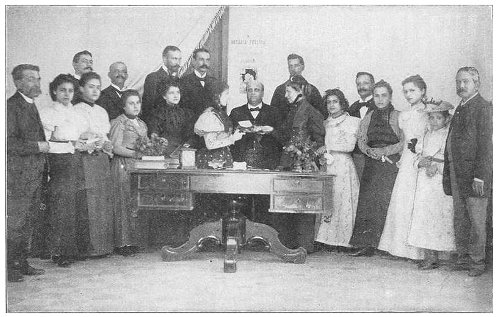
CITIZENS OF JARUCO PRESENTING A MEMORIAL FOR THE VICTIMS OF THE “MAINE.”
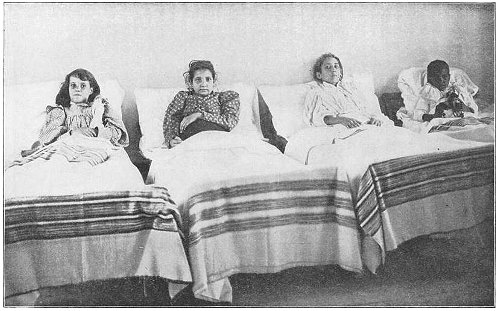
Copyright, 1898, by The Christian Herald.
LITTLE CONVALESCENTS IN HOSPITAL.
These days of quiet waiting were like the lull that precedes the storm.
The time seemed long regarded only from that standpoint, but when it is
remembered that these few days were all that had been allowed for a
great nation with thirty years of peace to rouse up and plunge itself
into a war, the time seems comparatively short. We had taken possession
of our ship at Key West on the twenty-ninth of April; it was now the
twentieth of June, and the great national records of two countries at
least will always give the history of those days. It is our part to keep
as clearly, truthfully and kindly as possible the record of the
little that fell to us to perform in this great drama. Our arrangements
for putting out to sea were quickly made. Such supplies and such persons
as were not to go with us must be landed and left. Among the latter, to
our deep and lasting regret, was our charming friend, Mrs. J. Addison
Porter, who had kindly passed the last weeks with us, leaving us as she
did, however, with the comforting promise to return if she should find
it possible.
All preliminaries arranged, at ten o’clock, the twentieth of June we
weighed anchor at Key West and steamed for the open sea, having first
taken the official advice of Commodore Remie, commanding the navy at
that point, to find Admiral Sampson and report to him.
The twenty-fifth gave us our first view of the water of Santiago. Our
transports and battleships were gathered there, and the advice of
Admiral Sampson was that we proceed to Guantanamo, where the marines had
made a landing and were camped on the shore. There had been some
fighting at Guantanamo. The “Solace” was there. Its harbor was fine, and
the run of forty miles was made by noon of that day. Whoever has enjoyed
the quiet, sheltered harbor of Guantanamo will not require to be
reminded of it—protected on three sides by beautifully wooded hills. At
six o’clock our anchors sunk in the deep still waters, and we had time
to look about us and see for the first time the beginning of the war.
The marines were camped diagonally along the brow of a beautiful hill.
On our right a camp of Cubans, and all about us the great monsters with
their protruding guns which told of forthcoming trouble. Captain
McCalla, who was in command of Guantanamo, had sent compliments and a
launch pointing out our place of anchorage.
The courtesies of the navy, so early commenced at Key West, were
promptly continued. At eight o’clock we received a visit from Commander
Dunlap of the “Solace” which, after a long and cordial interview, closed
by his proposing to send his launch at ten o’clock the following day to
take our entire company for a visit to the “Solace” and its fifty
wounded men. If that beautiful ship or its management had left room on
the records of our country’s mead of gratitude for more words of
appreciative praise, I should be glad to speak them. Only those familiar
with the earliest history of the Red Cross in our country and the
methods by which our navy alone of all the Red Cross nations had gained
even an approximately legal place, can judge what the sight of that
first naval relief ship on our American waters was to me. It brought
back so vividly the memory of the day when President Arthur called me to
him to carefully explain the conditions of the treaty which he had just
signed in 1881, and that Congress, having generously included the navy
in its treaty for war, he would provide to hold it carefully until the
probable widening of the original treaty would include the navies of
the world as well as the armies. I was thankful for themodus vivendi,
which I knew was as welcome to Spain as to ourselves, that had made it
possible to pick up these poor wounded sailors and given them kindly
care among their own, that there were not to be left uncared for, or
thrown into land hospitals where everything would be strange to them. My
twenty or thirty assistants glided about the polished decks of the
magnificent ship, with a kindly greeting for every poor, wounded fellow,
and delighted with everything they saw. For me, I had few words,
prayerful gratitude, and many memories of the long years of patient
waiting that had brought the American Red Cross even up to the point it
had attained.
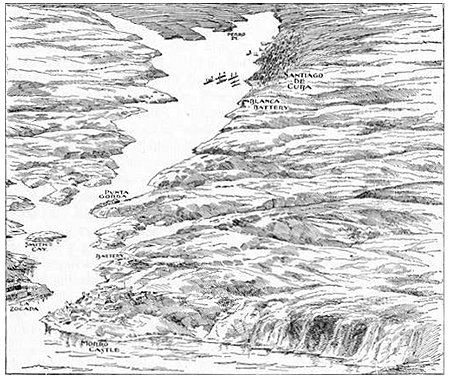
LOCATION OF SHORE BATTERIES, SANTIAGO.
Before the day closed news came to us of a more serious character than
we had before learned. The daring Rough Riders had been hardly dealt by;
Hamilton Fish and Capron had been killed, and the wounded needed help.
Wherever they might be, it must be possible to reach them, and it was
decided that no time be lost. Our men commenced work in the hold of the
ship to get at medical supplies and dressings, and the captain took his
orders. I find in my diary at the close of that day the following
paragraph:
“It is the Rough Riders we go to, and the relief may be also rough; but
it will be ready. A better body of helpers could scarcely be gotten
together.”
Nine o’clock of the same night, June 26, found us in Siboney and
anchored in its waters, which can scarcely be called a harbor. It seems
to be rather an indenture in the coast. Shall I be pardoned if I again
revert to the diary which, by some means, I found time to hastily
pencil:
Siboney, Cuba, June 27, 1898.
We were wakened at daybreak to see the soldiers filing up over the
hill in heavy marching order, forming in lines by ones and twos,
winding up, in and out among the hills, higher and higher, like a
great anaconda. As we watched them through a glass, they were a
moving line trailing on toward the clouds, till lost in the mist,
and we can only think as we look at them, on how many or on which is
set the mark of death, He knows no more than we, poor fellow, and
unthinkingly, perhaps, with his swinging, careless gait, toils up
and up and waits for—he knows not what.
The hospitals, both American and Cuban, are located on the shore just to
the right of us, and have been visited by our men during the night. Some
of their surgeons called on us; all seemed interested in the Red Cross,
but none thought that a woman nurse would be in place in a soldier’s
hospital; indeed, very much out of place. I suggested that that decision
was hard for me, for I had spent a great deal of time there myself. They
appeared to understand that perfectly, or were so polite as not to
criticise it, but there seemed to be a later line which could not be
crossed. The Cubans, who had just come into camp, were less conventional
and expressed a great desire for any assistance we could give them.
“Sister Bettina” and her four trained “Sisters,” Drs. Egan and Hubbell
went ashore to the hospitals. This had been proposed the evening before
at General Garcia’s headquarters; but they were begged to wait just one
day until their hospital could be in a little better order. These
“Sisters” were not the persons to grant that day of preparation. On the
contrary, we were told that as soon as they were fairly in the wards
they commenced putting things into order and cleanliness, and worked
through the day without interruption, coming home only after dark, tired
it must be, but fresh and happy, full of the conviction of a work well
done. Long before that day’s work was ended our own American hospitals
alongside commenced to be jealous of the Cubans, and believed that they
had spoken first. Be that as it might, we were equally forgetful, and
from that time no distinction between the hospitals was known.
Dr. Lesser, Mr. Kennan and Mr. Elwell tramped, for there was no other
mode of conveyance, to our advance line within three miles of Santiago.
They found the artillery up and things nearly ready for attack, which it
was thought would be on the following Wednesday.
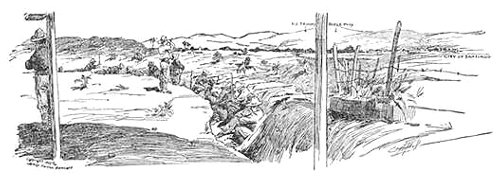
JULY FIFTH IN RIFLE PITS.
The sea grew wild and rough; the water was too deep for firm anchorage,
and we rocked at such a fearful rate that in pity for the pale faces
about me, I begged the captain to draw as near the shore as possible and
let, at least, a portion of them onto the land. Let them have, if only a
few minutes, the solid ground under their feet. He drew up to within two
or three hundred feet of the cliff which runs around like a firm sea
wall, and succeeded in anchoring; took a boat and tried to land some of
our people, but there were no wharves; the poor little seven by nine
bench, designated as a wharf, running out into the sea, against which
the boats swung and crashed as they tried to land supplies, was all
there was, except the narrow beach with a heavy surf. Our people
declined the landing, and headsick, heartsick and seasick returned to
the ship.
We had been long without news from the United States; but the next day
brought the following dispatch from the New York Cuban Relief
Committee:
Cobb sails Wednesday with Red Cross supply boat. All articles
requested by her will be shipped. The launch will be towed from
Jacksonville. Do you want additional nurses? Five hundred tons
provisions and clothing, also three ambulances complete, shipped to
Key West warehouse this week from New York. Send “State of Texas” to
New York as soon as can be spared. Cobb with Red Cross boat expects
to reach Guantanamo July 5 to 10. Massachusetts relief ship cannot
sail before middle of July. Will dispatch schooner with ice within a
fortnight. Make your requisitions specific in kind and quantity.
This was only one of the scores of dispatches reaching us within the few
following weeks, and I repeat it here, not as having any special
significance, excepting to show the uncertainty and utter instability of
all human calculations. Analyzing this kind-hearted and well-meant
dispatch in the light of the future, we find that neither the Red Cross
supply boat, the steam launch, the Massachusetts relief ship, nor the
additional nurses ever reached us. The ice schooner proved to be the
“Mary E. Morse,” of which mention is made elsewhere. The five hundred
tons of provisions shipped to the Key West warehouse were distributed
there. I name this, not in any spirit of complaint—far from it,
indeed—but simply to show still further and make more apparent, if
possible, the difficulties attendant upon all work at a field of war.
Those who have seen only this one war will find these uncertainties and
shortcomings very strange, and unaccountable; to me, who had seen other
wars, they seemed natural, probably largely inevitable, and quite the
thing to be expected, the fatal results of which misfortunes I had spent
half my lifetime in instituting measures to prevent or lessen.
We were honored next day by a call from an officer of the “Olivette,”
with his assistant. It is not singular, in the light of the great,
elegant, newly-fitted ship at his command, that it was difficult for him
to realize the use or the necessity of an unpretending little black boat
like the “State of Texas,” or of what service it could be expected to be
to an army. We labored to impress upon him the fact that this ship did
not come for the war, but was loaded and dispatched weeks before there
was any war, and simply waited an opportunity to deliver its cargo to
the hungry and naked reconcentrados for whom they were designed. This
explanation we hoped would make it apparent to the gentleman, how it
was, that our supplies of clothing would not be likely to contain the
articles of which he said his ship was in want; it probably never having
entered into the minds of our sympathetic generous lady donors of
America to provide pajamas for Cuban women. Anything we had was
freely at his service. If we made any attempt at conversion (which I
do not now recall), it was simply on the line of a better understanding
of Red Cross methods and principles as connected with his profession,
and not a change of heart.
With the constant reminders of the sufferings of the people on shore and
our inability to reach them, it was a welcome errand brought by a
dispatch boat that afternoon from Captain McCalla, that if we could get
five thousand rations to him before the next Thursday morning, he could
find a way to deliver them to the refugee families of insurgents and
others lying out in the hills and woods beyond his camp at Guantanamo,
where they had fled for safety. We steamed at once to Guantanamo and
landed the rations next morning, returning to Siboney the same
afternoon. The next day our working force was busy all day getting off
material to refugees coming in from the mountains. General Garcia
detailed a detachment to repair pontoons for the purpose of landing the
supplies. Captain McCalla cabled for twenty thousand rations for
refugees, to be delivered at Guantanamo by Sunday.
Our Red Cross sisters and surgeons were all busy at the Cuban Hospital,
when the following letter from Major Le Garde was received:
To Miss Clara Barton, President American National Red Cross:
I have the honor to request your assistance in caring for the
patients in a so-called hospital near the landing at this point. The
orders are to the effect that all patients now under treatment on
the shore shall be transferred to the “Iroquois” and “Olivette,” but
the facilities for carrying out this order are apparently
inadequate. In order that the Divisional Hospital may remain
unhampered for the care of the wounded in the engagement about to
take place, it is necessary for me to request this favor of you, and
I trust that you may find it possible to comply with said request.
Your obedient servant,
Louis A. Le Garde,
Major and Surgeon, U.S.A., Commanding Hospital.
To this the following reply was immediately returned:
Steamship “State of Texas,”
Siboney, Santiago de Cuba, June 30, 1898.
Dr. Louis A. Le Garde,
Major and Surgeon, U.S.A., Commanding Hospital:
Major:—Permit me, I pray you, to express the great pleasure given
me by your cordial letter inviting the assistance of the persons
here under my direction in the care of the sick and wounded of the
engagement about to take place.
Although not here as a hospital ship by any means, nor legitimately
fitted for the work, still we have some hospital supplies, a few
intelligent workers, skill, intrepidity, experience, the willingness
to serve, the readiness to obey, and I believe, the true spirit of
the Red Cross, that seeks to help humanity wherever its needs exist.
I send them to you in the hope that they may be of service. With
grateful appreciation, I am, doctor,
Most cordially yours,
Clara Barton,
President American National Red Cross.
In the afternoon of this day some members from our ship went ashore and
visited the Cuban Hospital and General Garcia’s headquarters, which that
general, on leaving Siboney had graciously ordered to be placed “at Miss
Barton’s disposal as headquarters for herself and her staff.” It was
found, however, that the building would be required by the military, and
the matter was given no further consideration.
On the first of July Dr. and Mrs. Lesser with their assistants went
early ashore to work in the hospitals, both United States and Cuban. The
transport “Harvard” arriving with troops, demanded our anchorage, and on
coming out of the harbor to give place to her, we saw that a bombardment
of Aguadores, five miles to the west, was taking place. A battleship,
perhaps the “Oregon,” the flagship “New York” and a little cruiser were
standing in near the shore, the latter keeping up a rapid fire, which
was responded to by the batteries on both sides of a ravine which the
railroad crossed. We ran down as close as safety permitted and watched
the engagement from the bridge of our own ship. The two large ships then
drew in and shelled the ravine, apparently silencing the batteries. When
we returned to Siboney we learned that our troops had been fighting all
day, and that large numbers of wounded were walking or being brought in
for treatment. The Red Cross had been requested to take entire charge of
a fever hospital of United States troops, which it did. Dr. and Mrs.
Lesser and two of the Sisters were assisting in the operating tent. All
of us worked nearly through the night—the nurses and physicians as
above stated; the others taking out supplies for wounded—one hundred
cots, bedding, hospital utensils, medicine, food, etc. The reports were
that we had taken and held all the commanding positions around Santiago,
but that it had cost us four hundred men.
The diary of July 2 says: The day opened cool and fresh, and although
having worked steadily until three o’clock the night previous, when
they had been brought back to the ship for a little rest, the Sisters
were ready for work at half-past six. Sisters Anna and Isabell had been
on duty all night, and must now be relieved. Dr. Egan and Mr. Kennan
made ready for the front, the former to have a field hospital.
With a portion of my assistants I go ashore to visit the hospitals in
the early part of the day, to learn if anything further can be done for
them. We find the wounded coming in rapidly, long rows of hospital tents
being filled with them, and many waiting their turn on the operating
tables. We learned that the officers had suffered very severely, having
been picked off by Spanish sharpshooters. A note came by messenger from
Mr. Kennan at the front, saying that by order from General Shafter’s
headquarters “Miss Barton was directed to seize any empty wagons coming
in and send by them hospital supplies, medical stores, which were badly
needed at the front.” This direction would of course be filled as far as
possible; the supplies would be gotten out and sent, and it was decided
that myself and as many of our assistants as could be spared go with
them the next day. These were anxious, trying days throughout the whole
country. All America was astir, once more in the dreaded throes of war.
Another dispatch from our committee at New York reveals this state of
feeling:
New York, July 2, 1898.
Barton, Santiago de Cuba:
Government transport “Port Victor” sailing New York, Wednesday via
Tampa takes all our supplies to Santiago. Look out for arrival.
Twenty-five nurses go there Tuesday; more follow; order them forward
if needed. Report your actions. People anxious.
To which the following reply is returned:
Dispatch received. Lesser’s force attending wounded here constantly
coming in. Elwell and force landing supplies in the surf at night,
without dock, under great difficulties and dangers. An urgent appeal
from the front for medicines and food. None there. Will try to get
two four-mule wagons full to them to-night and go ourselves. Have
reported all we could. No telegraph here till to-day. No dispatch
boats. No post-office. We also anxious.
July 3 opened clear and bright, the commencement of a hard and busy day,
to be long remembered. Our shippers had been landing supplies all night
and keeping such guard over them on the sandy beach as was possible.
The daily record of our movements kept always up and open, like the log
of the ship, must now fall to the hands of our faithful stenographer,
Miss Lucy Graves, and taking up her duties bravely that day, she
commences with this paragraph:
“Miss Barton, with Dr. and Mrs. Gardner, Dr. Hubbell and Mr. McDowell,
leave for the front to-day, taking two six-mule wagon loads of hospital
supplies.” To the young writer it was a simple note in the records of
the day, having no special significance. As my eye glanced over it it
seemed very strange—passing strange, that after all this more than a
quarter of a century I should be again taking supplies to the front of
an army in the United States of America; that after all these years of
Red Cross instruction and endeavor, it was still necessary to
promiscuously seize an army wagon to get food to wounded men.
I hope in some way it may be made apparent to any one who follows these
notes how difficult a thing it was to get this food from our ship to the
shore. In a surf which after ten o’clock in the morning allowed no small
boat to touch even the bit of a pier that was run out without breaking
either the one or the other, and nothing in the form of a lighter save
two dilapidated flat boat scows which had been broken and cast away by
the engineer corps, picked up by ourselves, mended by the Cubans, and
gotten in condition to float alongside our ship and receive perhaps
three or four tons of material. This must then be rowed or floated out
to the shore, run on to the sands as far as possible, the men jumping
into the water from knee to waist deep, pulling the scow up from the
surf, and getting the material on land. This was what was meant by
loading the “seized wagons from the front” and getting food to the
wounded. After ten o’clock in the day even this was impossible, and we
must wait until the calm of the next morning, three or four o’clock, to
commence work again and go through the same struggle in order to get
something to load the wagons for that day.
Our supplies had been gotten out, all that could be sent that day for
the heavy surf, and among the last, rocking and tossing in our little
boat, went ourselves, landing on the pier, which by that time was
breaking in two, escaping a surf which every other moment threatened to
envelop one from feet to head, we reached the land. Our wagons were
there already loaded with our best hospital material,—meal, flour,
condensed milk, malted milk, tea, coffee, sugar, dried fruits, canned
fruits, canned meats, and such other things as we had been able to get
out in the haste of packing—entirely filling the two wagons.
An ambulance had been spoken of, but could not be had. We walked out a
little way to wait for it. Dr. Hubbell left our party and went again in
search of an ambulance, notwithstanding the assurance that an army wagon
would answer our purpose quite as well. These were going line by line up
to the front, mainly with ammunition. We waited a little by the
roadside; the doctor did not return; our own wagons had gone on, and
stopping another loaded with bales of hay, we begged a ride of the
driver, and all took our seats among the hay and made our way once more
to the front.
The road was simply terrific—clayey, muddy, wet and cut to the hub. A
ride of about four hours brought us to the First Division Hospital of
the Fifth Army Corps, General Shafter’s headquarters. This was properly
the second day after the fight. Two fearful nights had passed.
The sight that greeted us on going into the so-called hospital grounds
was something indescribable. The land was perfectly level—no drainage
whatever, covered with long, tangled grass, skirted by trees, brush and
shrubbery—a few little dog tents, not much larger than would have been
made of an ordinary tablecloth thrown over a short rail, and under these
lay huddled together the men fresh from the field or from the operating
tables, with no covering over them save such as had clung to them
through their troubles, and in the majority of cases no blanket under
them. Those who had come from the tables, having been compelled to leave
all the clothing they had, as having been too wet, muddy and bloody to
be retained by them, were entirely nude, lying on the stubble grass, the
sun fitfully dealing with them, sometimes clouding over, and again
streaming out in a blaze above them. As we passed, we drew our hats over
our eyes, turning our faces away as much as possible for the delicacy of
the poor fellows who lay there with no shelter either from the elements
or the eyes of the passers-by.
Getting past them as quickly as possible, and seeing a smoke ahead of
us, and relying upon the old adage that where there is smoke there must
be fire, we went to it. A half-dozen bricks had been laid about a yard
apart, a couple of pieces of wagon-tire laid across these, so low and so
near the ground that no fire of any strength or benefit could be made,
the bits of wet wood put under crosswise, with the smoke streaming a
foot out on each side, and two kettles of coffee or soup and a small
frying-pan with some meat in it, appeared to be the cook-house for these
men. They told us there were about eight hundred men under the tents and
lying in the grass, and more constantly coming in.
I looked at the men who had constructed and who had charge of that
“fireplace,” and saw how young and inexperienced the faces were, and
how little they could know of the making up of a camp, and how
unsatisfactory it must all be to themselves, and was filled with a sense
of pity for them as well as the poor sufferers they were trying to
serve. I looked around for the faces of some old veterans of the wars
before, who could bring a little knowledge gained from practice. There
were none there, but here was our own McDowell, with a record of four
years and twenty-six battles in the old Civil War, and after a few
moments’ consultation as to the best method to be pursued, we, too,
gathered stones and bricks and constructed a longer, higher fireplace,
got more wagon-tires, found the water, and soon our great agate kettles
of seven and ten gallons were filled. But the wood! It was green, not
resinous as the wood of some islands. In Corsica, for instance, one may
take the green, wet wood and make a blazing fire. The wood of Cuba is
beautiful in quality, but hard and slow to burn.
The rain, that had been drizzling more or less all day, increased. Our
supplies were taken from the wagon, a piece of tarpaulin found to
protect them, and as the fire began to blaze and the water to heat Mrs.
Gardner and I found the way into the bags and boxes of flour, salt, milk
and meal, and got material for the first gallons of gruel. I had not
thought to ever make gruel again over a camp-fire; I cannot say how far
it carried me back in the lapse of time, or really where or who I felt
that I was. It did not seem to be me, and still I seemed to know how to
do it, and when the bubbling contents of our kettles thickened and grew
white with the condensed milk, and we began to give it out, putting it
in the hands of the men detailed as nurses and of our own to take it
around to the poor sufferers shivering and naked in the rain, I felt
again that perhaps it was not in vain that history had reproduced
itself. And when the nurses came back and told us of the surprise with
which it was received and the tears that rolled down the sun-burned,
often bloody, face into the cup as the poor fellow drank his hot gruel
and asked where it came from, who sent it, and said it was the first
food he had tasted in three, sometimes in four, days (for they had gone
into the fight hungry), I felt it was again the same old story, and
wondered what gain there had been in the last thirty years. Had anything
been worse than this? But still, as we moralized, the fires burned and
the gruel steamed and boiled and bucket after bucket went out, until
those eight hundred men had each his cup of gruel and knew that he could
have another and as many as he wanted. The day waned and the darkness
came and still the men were unsheltered, uncovered, naked and
wet—scarcely a groan, no word of complaint; no man said he was not well
treated.
The operating tables were full of the wounded. Man after man was taken
off and brought on his litter and laid beside other men and something
given him to keep the little life in his body that seemed fast oozing
out. All night it went on. It grew cold—for naked men, bitter cold
before morning. We had no blankets, nothing to cover them, only as we
tore off from a cut of cotton cloth, which by some means had gotten on
with us, strips six or seven feet long, and giving them to our men,
asked them to go and give to each uncovered man a piece that should
shield his nakedness. This made it possible for him to permit us to pass
by him if we needed to go in that direction.
Early in the morning ambulances started, and such as could be loaded in
were taken to be carried back over that rough, pitiless road down to
Siboney to the hospitals there, that we had done the best we could
toward fitting up—where our hundred cots and our hundred and fifty
blankets had gone, and our cups and spoons and the delicacies that would
help to strengthen these poor fainting men if once they could get there,
and where also were the Sisters under Dr. Lesser and Dr. Le Garde to
attend them.
They brought out man after man, stretcher after stretcher, to the
waiting ambulances, and they took out seventeen who had died in the
night—unattended, save by the nurse—uncomplaining, no last word, no
dying message, quiet and speechless life had ceased and the soul had
fled.
By this time Dr. Hubbell had returned for he had missed our wagons the
day before and gone at night for more supplies. This time came large
tarpaulins, more utensils, more food, more things to make it a little
comfortable—another contribution from the surf of Siboney. We removed
our first kitchens across the road, up alongside the headquarter tent of
Major Wood in charge of the camp. The major is a regular army officer,
brusque, thickset, abrupt, but so full of kind-hearted generosity that
words cannot do justice to him. He strove in every way to do all that
could be done. He had given us the night before a little officer’s tent
into which we had huddled from the pouring rain for a few hours in the
middle of the night. The next day, although no tent so spacious as that
could be had, a little baby tent it seemed, of about seven feet, was
found, pitched alongside of the other, the tarpaulins put over, a new
fireplace made near us, magnificent in its dimensions, shelter given for
the boxes, bags and barrels of supplies that by this time had
accumulated about us. There was even something that looked like tables
on which Mrs. Gardner prepared her delicacies.
The gruel still remained the staple, but malted milk, chocolate and rice
had come in, and tea, and little by little various things were added by
which our ménage became something quite resembling a hotel. The
wounded were still being taken away by ambulance and wagon, assorted and
picked over like fruit in a barrel. Those which would bear
transportation were taken away, the others left where they were. The
numbers grew a little less that day.
I ought not neglect mentioning the favorite and notable drinks which
were prepared, for it will seem to the poor, feverish men who partook of
them that they ought to be mentioned—they will never forget them. They
have not even yet ceased to tell through the hospitals that they fall
into later of the drink that was prepared for them at the Fifth Corps
Hospital. We had found a large box of dried apples, and remembering how
refreshing it would be, we had washed a quantity, put it in a large
kettle, filled it with water and let it soak. It happened to be a fine
tart apple, and the juice was nearly as good as wine. Perhaps no wine
had ever seemed so good to those men as a cup of that apple water, and
when they tasted it tears again ran down their faces. To their poor,
dry, feverish mouths it was something so refreshing that it seemed
heaven-sent. The next day a box of prunes was discovered, and the same
thing was done with that; a richer, darker juice was obtained, and this
also took its place among the drinks prepared at the Fifth Corps
Hospital. The apple and prune juice will remain, I suspect, a memorial
for that poor neglected spot.
By the third day our patients seemed strong enough that we might risk
food as solid as rice, and the great kettles were filled with that,
cooked soft, mixed with condensed and malted milk, and their cups were
filled with this. It was gratifying to hear the nurses come up and say:
“I have sixteen men in my ward. So many of them would like rice; so many
would like malted milk; so many would like gruel; so many would like
chocolate, and a few would like a cup of tea; and another, who is
feverish, would like only some apple or prune juice,”—and taking for
each what he called for, go back to his patients as if he had given his
order to the waiter at a hotel; and the food that he took was as well
cooked, as delicate and as nice as he could have gotten there. The
numbers were now getting considerably less—perhaps not over three
hundred—and better care could be taken of them.
A dispatch on Thursday afternoon informed me that Mrs. J. Addison Porter
would be on the hospital ship “Relief” coming into Siboney that day. I
would of course go to meet her. It was a great joy to know that she
would return to us. We at once decided that an army wagon should be
asked for from headquarters and a party of us go to Siboney, both for
Mrs. Porter and more supplies. The roads were getting even worse—so
bad, in fact, that I dared not risk an ambulance, an army wagon being
the only vehicle strong enough to travel over it.
We had blankets and pillows and the ride was fairly comfortable; but it
was late, nine o’clock, before we reached Siboney. The “State of Texas,”
which in the last three days had made a trip to Port Antonio for ice, we
thought must be back by that time, and on reaching Siboney, found that
she had arrived that evening at five o’clock and was lying at her old
anchorage. But there was no way of communicating with her in order that
a boat might be sent for us. Everything was tried. We had no signals;
there was no system of signaling on the shore by which we could reach
her or, in fact, any other boat. There was no way but to remain where we
were until morning. It was proposed that I go to the rooms assigned for
the hospital assistants. I decidedly refused this, for every reason. I
knew the buildings were not to be trusted, and persons nursing day and
night among all kinds of patients were not the people to room with. I
asked to be allowed to remain in my army wagon. This was not thought
proper. I suggested that it might be drawn out anywhere, the mules taken
off, and I be left with the blankets and pillows. I thought it, in fact,
a good place for any one to sleep, and ventured to recommend it as an
old-time method—a refuge which once would have been palatial for me on
the war-swept fields of old Virginia, or in the drifting sands of Morris
Island—what would that have been the night after Antietam or old
Fredericksburg, Chantilly or the Wilderness? But the newer generation
could not see it so; a building must be had somewhere, and as I refused
the hospital appendage in toto, it was proposed that I enter the
post-office, a room there being offered to me.
The postmaster and deputy postmaster, who felt themselves under
obligation to us, came out to our men and insisted that I occupy a room
in that building. Such a courtesy could not be gainsaid, and against all
feeling of acquiescence, and with a terrible dread, as if there were
something so wrong about it, I allowed myself to be helped out of the
wagon and entered the house. The postmaster sat down and talked with me
a little while. I thought he seemed ill. It appeared to be an effort for
him to talk. I had never met him before, but my heart went out in
sympathy for him. I feared I was taking his room, as was indeed the
case, although he did not admit it. I was shown into a large room with
one cot, one table, cheerless, bare, with an outside door, and a candle
without a stick burning upon the table. The men went outside and laid
down upon the steps for the night. I laid down upon the stretcher. It
was impossible for me to remain there. Something constantly warned me to
leave it. I got up, went to the outside door, looked out upon the night
and darkness and waited for the gray of the morning. I went out and
stood upon the beach beside the sea and waited more and more, until
finally some of the men appeared and I went with them down to the water.
I might as well say here, as I will not refer to it again, that six days
after, when I returned, they told me that the rightful occupant of the
cot—the postmaster who had seemed so ill—had died of a fever raging
here that they called “yellow fever.” I had occupied his cot and he had
gone to heaven. I wondered who it was that so continually warned me that
night to keep away from that room, away from the cot, away from all
connected with it, when I had not the slightest suspicion of anything
wrong. “Yellow fever” was then not talked of. Did some one tell me? I do
not know, but something told me.
While standing at the dock, Dr. Smith, of the “Olivette,” who had taken
a ride with us to the front a day or two before, approached, and kindly
asked if he could place his boat at my service, and if I would go to the
“Olivette” with him. I replied that I would go to the “Relief,” if he
would be so kind as to take me there, for a friend whom I had on board.
He did so, and as we drew around the side of the elegant white and green
striped boat in full navy regulation, the men in white duck appeared on
the decks above and below, a half dozen ladies’ faces showing among
them, but most notably the good, substantial, matronly looking lady who
had left us a few days before—Mrs. Porter. It occurred to me that she
had possibly come by invitation to remain on the “Relief” and aid in the
charge of the nurses, and would make this explanation to me, but was
agreeably surprised when I saw a satchel and a package or two coming
down the steps immediately followed by Mrs. Porter herself. I could
scarcely believe that she was leaving that elegant boat to come over to
the obscure “State of Texas.” But so it was, and, taking her seat in the
boat, we rowed around to the “Olivette,” where Dr. Smith left us, and
was replaced by a major-surgeon, who would escort us over to the
“Texas,” only some rods distant. I did not at once recall him, but among
his first remarks were, “You have been at the front?” “Yes, Major.” “I
should think you would find it very unpleasant there.” “Such scenes are
not supposed to be pleasant.” “What do you go for?” I scarcely know what
reply was made to this abrupt question, but the significance was that
possibly we could be useful there. “There is no need of your going
there—it is no place for women. I consider women very much out of place
in a field hospital.” “Then I must have been out of place a good deal of
my lifetime, Doctor, for I have been there a great deal.” “That doesn’t
change my opinion, and if I had my way, I would send you home.”
“Fortunately for me, if for no one else, Doctor, you have not your way.”
“I know it, but again that doesn’t change my opinion. I would send you
home.” By this time we were rowing pretty near our own boat, and it was
admissible for me to maintain the silence that I felt dignity called
for. I made no other remark to him beyond “Good morning, Major,” as we
separated for our respective ships.
This is a foolish little episode to enter in one’s diary, not worth the
time of writing, especially in days like these, only as it will serve as
a landmark, a kind of future milestone noting the progress of humane
sentiment, and the hopeful advancement of the civilization and
enlightenment of the world. Only a few years ago the good major would
have actually possessed the power of which this advancement has relieved
him. Finding an accumulation of work at our ship, large mails from the
North having arrived, it was Monday before we could return to the front,
Mrs. Porter accompanying us. This journey was also made in an army
wagon, and a wretched, miserable wagon it was. We found the camp in
perfect running order. Mrs. Gardner had stood like a rock through it
all, neglecting nothing, quiet, calm, peaceful, faithful, busy—how well
she had done, I have no words to express. Everybody grateful to her,
everybody loving her.
The camp had now from one hundred to two hundred men. There began to be
strong talk of yellow fever, not only at Siboney but at the front as
well.
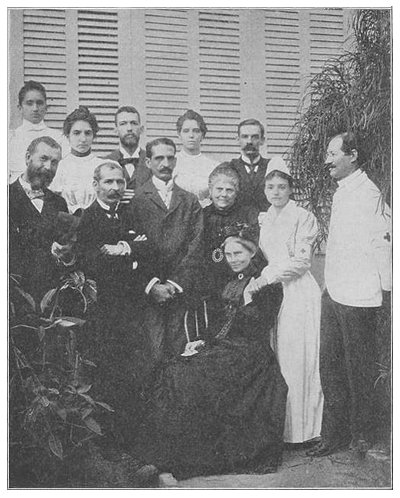
THE PHYSICIANS AND NURSES OF THE ORPHANAGE AND CLINIC IN HAVANA.
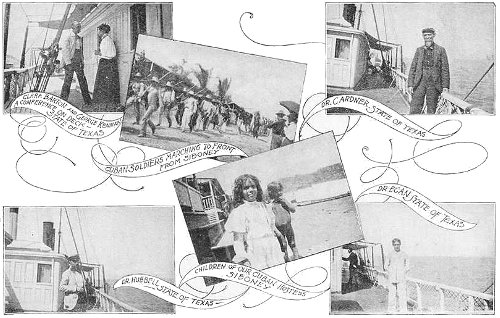
The negotiations between General Shafter and the Spanish army at
Santiago were still going on. The flag of truce that threatened every
day to come down still floated. The Spanish soldiers had been led by
their officers to believe that every man who surrendered (and the people
as well), would be butchered instantly the city should fall and the
American troops should come in. But when General Shafter commenced to
send back convoys of captured Spanish officers, their wounds faithfully
dressed and carefully placed on stretchers and borne under flags of
truce to the Spanish lines at Santiago and set down at the feet of the
general as a tender gift back to him, and when in astonishment he
learned the object of the flag of truce and sent companies of soldiers
to form in line and present arms while the cortege of wounded were
borne through by American troops, a lesson was learned that went far
toward the surrender of that city.
I happened to know that it was not without some very natural home
criticism that General Shafter persisted in his course in the face of
the time-honored custom of “hostages.” One can readily understand that
the voluntary giving up of prisoners, officers at that, in view of an
impending battle might seem in the light of old-time army usages a
waste, to characterize it by no harder term. It is possible that none of
the officers on that field had ever read the articles of the Treaty of
Geneva or fully realized that that treaty had become a law or that their
commander, possibly without fully realizing it himself, was acting in
full accord with its wise and humane principles.
The main talk of the camp was now “yellow fever.” On Monday night
occurred one of the most fearful storms which I have ever seen—rain,
thunder and lightning. Our tent had been well protected and deeply
ditched, but the water rolled around it in the ditches like rivers. The
thunder shook the ground; the lightning blazed like a fire. As I have
said, the camp was as level as a floor. No water could really run off.
During the most of that night the men in the tents laid in five to six
inches of water. Before daybreak the rain had ceased, some water had run
away—some soaked in—and the ground was passable. The next day followed
another rain. It was now discovered by the medical authorities that from
there having been at first one case of fever, there were now one hundred
and sixteen; that a fever camp would probably be made there and the
wounded gotten away. It was advisable then that we return to our ship
and attempt, as far as possible, to hold that free from contagion. I was
earnestly solicited to do this in view of what was expected of our ship
and of what was expected of us—that we not only protect ourselves, but
our cargo and ship from all contamination and even suspicion. I
faithfully promised this, and again we called for an army wagon, leaving
all supplies that were useful for the men here, sending to Caney what
was most needed there and taking only our personal effects, we again
placed ourselves in an army wagon with a tarpaulan over us and started
for Siboney. In less than twenty minutes the rain was pouring on us and
for two hours it fell as from buckets. The water was from a foot and a
half to two feet deep in the road as we passed along. At one time our
wagon careened, the mules were held up, and we waited to see whether it
should go over or could be brought out—the water a few inches only from
the top of the lower side. It was scarcely possible for us to stir,
hemmed in as we were, but the men from the other wagons sprang to our
wheels, hanging in the air on the upper side, and we were simply saved
by an inch. The mud and water was at least two and one-half feet deep
where we should have gone down.
But like other things, this cleared away. We came into Siboney about
three o’clock, in a bright glare of sunshine, to find the town utterly
burned, all buildings gone or smoking, Dr. and Mrs. Lesser and the
faithful Sisters as well, in a “yellow fever” hospital a mile and a half
out of the city, reached by rail. All customary work was suspended. The
atmosphere was thick and blue with smoke. Men ran about the grounds
smutted and bareheaded like children. My medical knowledge was not
sufficient to allow me to judge if everybody there had the yellow fever,
but general observation would go far toward convincing a very ordinary
mind that everybody had gone crazy.
All effort was made to hold our ship free from suspicion. The process of
reasoning leading to the conclusion that a solid cargo, packed in tight
boxes in the hold of a ship, anchored at sea, could become infected in a
day from the land or a passing individual, is indeed, an intricate
process; but we had some experience in this direction, as, for instance,
Captain McCalla in his repeated humane attempts to feed the refugees
around Guantanamo had called again for a hundred thousand rations,
saying that if we could bring them to him soon, he could get them to the
thousands starving in the woods. We lost no time, but got the food out
and started with it in the night. On reaching Guantanamo we were met at
a distance out and called to, asking if anyone on our ship had been on
shore at Siboney within four days, if so, our supplies could not be
received, and we took them away, leaving the starving to perish.
On Friday morning the constantly recurring news of the surrender of
Santiago was so well established that we drew anchor and came up to the
flagship and the following letter was addressed to Admiral Sampson:
“State of Texas,” July 16, 1898.
Admiral Sampson,
Commanding United States Fleet off Santiago, Flagship “New York”:
Admiral:—It is not necessary for me to explain to you my errand,
nor its necessity; both your good head and heart divine it more
clearly than any words of mine can represent.
I send this to you by one of our men, who can tell you all you will
wish to know. Mr. Elwell has resided and done mercantile and
shipping business in Santiago for the last seven years; is favorably
known to all its people; has in his possession the keys to the best
warehouses and residences in the city, to which he is bidden welcome
by the owners. He is the person appointed four months ago to help
distribute this food, and did so with me until the blockade. There
seems to be nothing in the way of our getting this 1400 tons of food
into a Santiago warehouse and giving it intelligently to the
thousands who need and own it. I have twenty good helpers with
me. The New York Committee is clamoring for the discharge of the
“State of Texas,” which has been raised in price to $400 a day.
If there is still more explanation needed, I pray you, Admiral, let
me see you.
Respectfully and cordially,
(Signed) Clara Barton.
This was immediately responded to by Captain Chadwick, who came on
board, assuring me that our place was at Santiago—as quickly as we
could be gotten there.
On Saturday, the sixteenth, feeling that it might still be possible to
take the supplies to Guantanamo, requested by Captain McCalla, a letter
was addressed as follows:
Steamship “State of Texas,” July 16, 1898.
Captain Chadwick, Flagship “New York” off Santiago:
Captain:—If there is a possibility of going into Santiago before
to-morrow morning, please let me know, and we will hold just where
we are and wait.
If there is no possibility of this, we could run down to
Guantanamo and land Captain McCalla’s 100,000 rations in the evening
and be back here to-morrow morning.
Will you please direct me.
Yours faithfully,
Clara Barton.
Reply to the above:
U.S. Flagship “New York,” 1st Rate,
Off Santiago de Cuba, July 17, 1898.
Dear Miss Barton:—We are now engaged in taking up mines, just so
soon as it is safe to go in your ship will go. If you wish, you can
anchor in near us, and send anything up by boats, or, if we could
get lighters, drawing less than eight feet, food may be sent by the
lighters, but it is not yet possible for the ship to go in. There
are four “contact” mines, and four what are known as “observation”
mines, still down.
Yours very truly,
(Signed) F.E. Chadwick
It was after this that we turned back again and steamed to Guantanamo to
unload our supplies at night and return the next morning.
These were anxious days. While the world outside was making up war
history, we thought of little beyond the terrible needs about us—if
Santiago had any people left, they must be in sore distress, and El
Caney—terrible El Caney—with its thirty thousand homeless, perishing
sufferers, how could they be reached?
The diary at this point says: On returning from our fruitless journey to
Guantanamo we stopped at Siboney only long enough to get our dispatches,
then ran down directly in front of Santiago and lay with the fleet. A
personal call from Admiral Schley, Captain Cook and other officers
served to show the interest and good will of those about us. Between
three and four o’clock in the afternoon a small Spanish steamer—which
had been among the captures of Santiago—ran alongside and informed us
that an officer wished to come aboard. It proved to be Lieutenant
Capehart, of the flagship, who brought word from Admiral Sampson that if
we would come alongside the “New York,” he would put a pilot on board.
This was done and we moved on through waters we had never
traversed—past Morro Castle, long, low, silent and grim—past the
Spanish wrecks on the right—past the “Merrimac” in the channel, which
Hobson had left. We began to realize that we were alone, of all the
ships about the harbor there were none with us. The stillness of the
Sabbath was over all. The gulls sailed and flapped and dipped about us.
The lowering summer sun shot long golden rays athwart the green hills on
either side, and tinged the waters calm and still. The silence grew
oppressive as we glided along with scarce a ripple. We saw on the right
as the only moving thing a long slim boat or yacht dart out from among
the bushes and steal its way up half hidden in the shadows. Suddenly it
was overtaken by either message or messenger, and like a collared hound
glided back as if it had never been. Leaning on the rail half lost in
reverie over the strange quiet beauty of the scene, the thought suddenly
burst upon me: Are we really going into Santiago—and alone? Are we not
to be run out and wait aside and salute with dipping colors while the
great battleships come up with music and banners and lead the way? As
far as the eye could reach no ship was in sight. Was this to remain so?
Could it be possible that the commander who had captured a city declined
to be the first to enter—that he would hold back his flagship and
himself and send forward and first a cargo of food on a plain ship,
under direction of a woman? Did our commands, military or naval, hold
men great enough of soul for such action? It must be true—for the
spires of Santiago rise before us, and turning to the score of
companions beside me I asked, “Is there any one here who will lead the
doxology?” In an instant the full rich voice of Enola Gardner rang out:
“Praise God, from whom all blessings flow.” By that time the chorus was
full, and the tears on many a face told more plainly than words how
genuine was that praise, and when in response to a second suggestion “My
Country, ’Tis of Thee” swelled out on the evening air in the farewell
rays of the setting sun, the “State of Texas” was nearing the dock, and
quietly dropping her anchors she lay there in undisputed possession of
the city of Santiago.
It has been remarked that Mr. Elwell had been a resident of Santiago and
connected with its shipping for several years. It was only the work of
an hour after landing to find his old-time help. A hundred and
twenty-five stevedores were engaged to be on the dock at six o’clock
next morning, to work for pay in rations.
The dock had its track and trucks running to its open warehouses. As we
had entered we saw it bare of every movable or living thing. Want had
swept it of all that could be carried away, and the remaining people
dared not approach us. Six o’clock next morning changed the scene. The
silence was no longer oppressive. The boxes, barrels and bales pitched
out of that ship, thrown onto the trucks and wheeled away told the story
of better days to come; and it was something to see that lank, brawny
little army of stevedores take their first breakfast in line alongside
of the ship.
The city was literally without food. In order to clear it for defence,
its inhabitants had been ordered out, ten days before, to El Caney, a
small town of some five hundred people, where it was said thirty
thousand persons were gathered, without food, shelter, or place of rest.
Among these were the old-time residents—the wealthy and the best people
of Santiago. Its British consul, Mr. Ramsden, and his family were of
them, and the care and hardship of that terrible camp cost his life. A
message from the headquarters of General Shafter, telegraphed to us even
after leaving Siboney, said:
“The death rate at El Caney is terrible. Can you send food?”
Word went back to send the thirty thousand refugees of El Caney at once
back to Santiago;—we were there and could feed them—that the “State of
Texas” had still on board twelve hundred tons of supplies for the
reconcentrados. That day poured in upon us all that had strength to make
the journey, of the thirty thousand starving wrecks of El Caney. If
there were any at night who had not received food, no one knew it. The
fires were rekindled in the great steam soup kitchens of Mr. H.
Michaelsen—that name should be carved in marble and lettered in gold in
Santiago—that had run uninterrupted for nearly two years, until within
a few weeks of the surrender, when there was no more food for its
kettles. Ten thousand persons had hot soup there the first day, and it
was estimated that ten thousand more had dry food of crackers, meat and
meal. To the sick were distributed condensed and malted milk as fast as
it could be gotten to them.
Of the districting of the city, the formation of committees for the
distribution of food, the care, the justice, and the success with which
it was done, I leave to the reports of my experienced staff officers and
assistants and to the committee of Santiago, which nobly volunteered its
aid. These persons performed this work—they were a part of it—and no
one can describe it so well as they. I refer the reader to the reports
of Dr. Hubbell, Dr. Egan, Mr. Cottrell, Miss Fowler, now the wife of
Baron Van Schelle of Belgium, and the committee of Santiago composed of
H. Michaelsen, vice-consul for Germany, Robert Mason, Chinese consul and
vice-consul for England, and Wm. Ramsden, son of the late Frederick
Ramsden, British consul. With these latter gentlemen, together with
twenty of the leading ladies of Santiago, was left, one month later, the
supplies remaining in our warehouses, and the oversight of the poor of
the city, over whom their care had extended so tenderly and so wisely in
the past, and on whom as helping them back into citizenship it must
largely devolve in the future.
Returning to our first day in Santiago, it is remembered that this
narration has thus far left the navy, its flagship and commander at the
entrance of the harbor in obscurity. It would seem but just that it
reproduce them.
Until ten o’clock on Monday the eighteenth we saw no sign of life on the
waters of the bay—neither sail, steam nor boat—but suddenly word
passed down from the watch on deck that a ship was sighted. Slowly it
came in view—large, fine, full masted—and orders went to salute when
it should pass. At length here was something to which we could pay
deference. The whistles were held, the flag was ready for action, ropes
straight and without a tangle—all stood breathless—but she does not
pass, and seems to be standing in. In a minute more a stout sailor voice
calls out: “Throw us a rope,” and here, without salute, whistle or bell,
came and fastened to the stern of our boat this glittering and masted
steamship from whose decks below Admirals Sampson and Schley and their
respective staffs shouted up their familiar greetings to us.
The view from their ship enfiladed, to speak in military parlance, our
entire dock. There was every opportunity to see how our work was done
and if we were equal to unloading our ship. The day was spent with us
till four o’clock in the afternoon; and when about to leave and the
admiral was asked what orders or directions he had for us, the reply
was, “You need no directions from me, but if anyone troubles you, let me
know.”
Many months have passed since that day, and I write this without ever
having seen again the face of the commander who had been so courteous
and kind, and so helpful in the work I went to do.
Under date of July 23 is found the following entry in the diary which
sums up the entire matter of facts, dates and figures in few words:
“The discharge of the cargo of the ‘State of Texas’ of over twelve
hundred tons, commenced at six o’clock Monday, July 18. One hundred and
twenty-five stevedores were employed and paid in food issued as rations.
“On Thursday, the twenty-first, at six o’clock p.m. the discharge was
completed, and the following morning, Friday, July 22, the ship left for
New York.
“During that time the people had returned to Santiago, numbering thirty
thousand, and all were fed—ten thousand a day from the soup kitchen of
Mr. Michaelsen, the others with bread, meat and milk.
“The present general committee was formed, the city districted into
sections, with a commissioner for each district, selected by the people
themselves living there.
“Every family or person residing in the city is supplied by the
commissioner of that district. All transient persons are fed at the
kitchen, the food being provided by the Red Cross.
“Although the army has entered the city during the latter part of that
time, there has been no confusion, no groups of disorderly persons seen,
no hunger in the city more than in ordinary times. We wait the repairs
of the railroads to enable us to get food and clothing to the villages
enclosed within the lines of the surrender.”
We had done all that could be done to advantage at that time in
Santiago. The United States troops had mainly left; the Spanish soldiers
were coming in to their waiting ships, bringing with them all the
diseases that unprovided and uncleanly camps would be expected to hold
in store. Five weeks before we had brought into Santiago all the cargo
of fourteen hundred tons of the “State of Texas,” excepting the light
hospital supplies which had been used the month previous among our own
troops at Siboney, General Shafter’s front and El Caney during the days
of fighting. To any one accustomed to apportioning food, it would be at
once apparent that these twelve hundred tons of heavy supplies, of meal,
meat, beans and flour, etc., were too much for distribution at one time
for a little town of thirty thousand, which naturally partly fed itself.
But it must all be stored.
The “State of Texas” discharged her cargo and left for New York on the
fifth day, leaving us without a particle of transportation, and in the
pressure and confusion none could be obtained. Let those who tried it
testify. The two railroads leading out of the town were destroyed. The
ports were not open, and the country portions of the province reached
only by pack mules. Later, forty large, fine healthy mules were shipped
to us, but the half score of fully equipped ambulances, harnesses and
between four hundred and five hundred bushels of oats were on the
transports which brought them, could not be lightered off, and up to the
time of our departure were never seen.
The schooner “Morse,” which, following the behest of an angelic thought
of some lovely committee of home ladies, had come in laden with a
thousand tons of ice. The tug “Triton,” which towed her all the way from
Kennebec, and was to have been held for our use, was at once seized by
the government. Santiago had neither an ice house nor a pile of dry
sawdust, and the ice remained on the “Morse” till discharged order by
order among the transports of sick, wounded and convalescing as they
sailed one after another with their freight of human woe. Slowly,
painfully waiting, but gladly, piece by piece, the ice went out, filling
to repletion the box of every transport sailing north, and something
glistened on the weather-beaten bronzed cheek of more than one of those
long-serving, faithful, north Atlantic captains, as he tried to say what
it would be to the poor fever-burnt sufferers he must take.
Visions, of the schooner “Morse” when she should be unloaded
constituted our only transportation up to the day we left Santiago. I
cannot say that other visions did not obtrude at times. In our
perplexity, memory pictured, as in another life, the hundreds of
strong-built, luxuriantly-furnished, swift-running steam tugs, yachts
and house boats of the restful “Thousand Islands,” and the health and
pleasure-giving resorts of the lovely Jersey coast; but they were only
visions, quickly put aside for the stern realities of the inevitable
surroundings. The “Morse” did well its blessed work, but never came to
us.
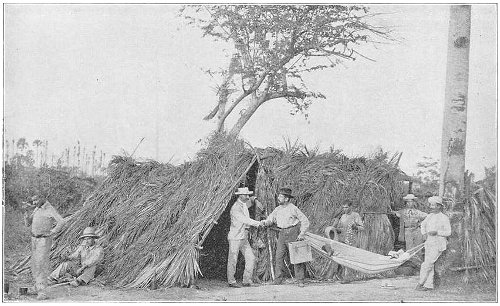
A CUBAN THATCH HUT.
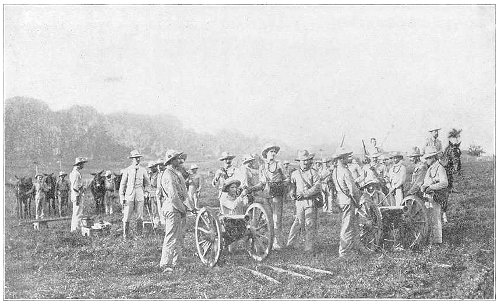
A BATTERY OF CUBAN ARTILLERY.
Neither for love nor money could transportation be gotten. I did,
however, near the last, obtain the use of a leaky lighter for two hours
to get off some mules, but I might specify that it was on neither of the
above considerations.
Some reporter is responsible for the statement that a large ship seen
floating near the dock that morning had been seized. While it might not
be possible to verify this statement by actual facts, it was not so very
far out of the way in theory.
These were the last days of General Shafter in Santiago, who was, as he
had at all times been, the kind and courteous officer and gentleman.
General Wood, alert, wise and untiring, with an eye single to the
general good of all, toiled day and night.
The government warehouses were so filled with supplies that there seemed
no room for more. The harbor filling with merchant ships for the trade,
would soon come to regard with a jealous eye any body of persons who
dispensed anything without price to even the poorest and most destitute.
But all this did not stay the marching stride of the native fever, so
persistent in its grasp as scarcely to merit the appellation of
intermittent. Day by day I watched my little band ever growing less; out
of twenty which the good “State of Texas” brought, seven were on their
feet; twelve had sickened, been nursed and gotten off home, and one had
gone to heaven. Of our own band of the national Red Cross workers, none
had actually gone down; of those who had joined us as assistants, few
remained.
At this juncture news came that Havana was open. In all the country I
knew but one person who had the power to order one of those waiting
transports to take myself, staff and some supplies to Havana, and my
dispatch went to President McKinley, with the suggestion kindly and
thoughtfully made by Major Osgood who had just come in on the “Clinton,”
that in order to economize time and labor, possibly the President might
furnish a ship already loaded with government supplies, and let us repay
from our supplies on shore. This dispatch brought the following prompt
reply from the Secretary of War. It was a glad reminder of the kindly
courtesy and friendship of many years. I give the text of both the
dispatch of the Secretary and my reply, in order to set right a
misunderstanding on the part of the public, which I have observed with
pain:
Washington, August 18, 1898.
Miss Clara Barton, Santiago de Cuba:
“Clinton” cannot be used until unloaded. Stores aboard were sent on
special request and are necessary for the comfort of officers and
men at Santiago. The government will send as soon as ship can be
loaded at Port Tampa two thousand tons of supplies for relief of
destitute. This accomplishes same result and in shorter time. Will
not this meet your wishes even better than recommended in your
cablegram yesterday? Would it be asking too much for you to go to
Havana to superintend the distribution of these stores under the
law? Only the destitute and those in immediate danger of perishing
can receive these supplies.
R.A. Alger, Secretary of War.
Santiago de Cuba, August 18, 1898.
Pierson, War Department, Washington:
Tell Secretary Alger I appreciate to the greatest possible extent
his responsive and practical sympathy. His suggestions are better
than I had asked, and are promptly accepted. If the “Clinton” is
unloaded in time, I will leave here Saturday morning. Will take
forty mules from here. Need ten additional wagons and harness for
all my mules. Please give me some horsefeed from here.
Clara Barton.
The reloading was quickly accomplished, the direction of our remaining
affairs placed in proper hands, and on the twenty-first of August, just
five weeks to an hour since entering the harbor, we retraced the waters
we had sailed over coming from Siboney to Santiago. The same golden
sunshine rested on the hills and tinged the still waters of the bay, but
we were no longer the only ship. The transports to take our soldiers
home lay there; the great Spanish liners to take the Spanish soldiers to
Spain; the hospital ships with their fevered weight of glad woe “going
home,” dotted the sea and skirted the shore.
All who understood our movement saluted, and with tearful glances back
to the little spot of earth which had given so much pain, made so many
homes in both lands desolate, we ordered on full steam and glided away.
Five days of continuous sunshine and scarcely wind to fill a sail
brought us to Havana. I had cabled the Spanish authorities on our
departure from Santiago and notified them of our arrival, and was
courteously referred to the Civil Governor of Havana, on whom I called
and received in return a most cordial visit, with the added respect of
bringing his entire staff with him.
No supplies from Port Tampa having arrived we spent the second day in
Matanzas, receiving from the good Governor and his amiable household
such a welcome as one might expect from those they had known longest and
loved most. We then hoped to go there at once and leave the supplies
they so badly needed.
Next day there came into harbor the steamship “Comal,” from Port Tampa,
laden with sixteen hundred tons of government supplies for distribution.
We exchanged visits with her gentlemanly and sensible officers, who had
governmental instructions to take their cargo to Havana and distribute
it, but no instructions to act in conjunction with us or with any one;
and we, on the other hand, received no intimation that her supplies were
in any way intended for our use.
Both ships alike met the restriction of the customs duties, and while I
felt that it might be well for a governmental cargo to test its position
with the law of nations, under the circumstances, it was by no means the
course for the Red Cross to take—an organization which never leads, but
follows, in all military matters.
No commissioners had arrived, and feeling that we might become a source
of irritation to them by remaining, and being unable to distribute our
supplies, we decided to withdraw. Our captain, having been trained in
the merchant service and being unaccustomed to military shipping, had
neglected some little formality on leaving Santiago, which admitted, or
perhaps called for, a fine of five hundred dollars. This we promptly
paid, and with the best understanding with all parties, Spanish, Cuban
and our own, no coercion on the part of any one, impelled by nothing but
our own sense of the situation, we decided our course. In fact,
strenuous efforts were made by the Spanish officials, notably the
Secretary of State, to open the way for us; and while they could not
override the law and positively remit a duty, they offered in this case
to pay the duty themselves, and take part in the distribution. We
appreciated the courtesy, but still felt that we might in some way
become a hindrance to the pending negotiations by remaining, and after
careful consideration, decided to draw anchor and steam for Port Tampa,
leaving the “Comal” with its full cargo and efficient officers to meet
the situation in the good governmental way, we were sure they would do.
This explanation is given to set right the general impression that the
“Comal” was a Red Cross ship. There was no connection whatever between
the “Comal” and ourselves, excepting through good will and good
fellowship; and again the impression that we were mistreated by the
Spanish government at Havana, subjected to discourtesy or requested to
leave is a mistaken one. The facts are quite the contrary. We entered
under the supposition that Havana was open, as Santiago was open; but it
was not an open port. We were in Spanish waters, subject to Spanish laws
and customs, and so regarded them, as we should have expected to do in
any country, remembering experimentally that our own country is not too
much inclined to easily remit its custom duties.
Dividing the time of our Cuban campaign into sections, the incoming days
fall exclusively to Santiago. Days of an army in one sense inactive, in
another rushed and crowded beyond its powers to meet or control. Days
when everything is needed and nothing can be gotten at. No one knows
where anything is—must have a formal order to obtain it when it is
found, and cannot get the order. Officers clamor for their needy men,
the sick list increases, complaints are rife, patience gives place to
desperation, and a time of general confusion follows.
Again I would say that to those taking the first lessons in army life,
all these things seem incomprehensible, to say the least, and “Who’s to
blame?” seems to be floating in the very atmosphere about them.
Deplore such a state of things as we will, it is still a part of army
life. It belongs to war, and the grey-haired military chief, whom all
would recognize were I to name him, was correct when he once said to me:
“Strange as it may seem, the days of ‘rest’ at an active field are its
hardest days.”
The ofttimes perplexed officers at Santiago will neither exclaim nor
disclaim against this little statement, if it should ever meet their
eyes. They will realize, however, that there were others, near them
having no power, or scarcely place, who could yet comprehend their
perplexities, and sympathize with the distressing conditions surrounding
them.
They will also recall that from this source no unreasonable request was
ever made of them, no impatient word spoken—only thanks for needed
facilities that could be granted, for those withheld, respectful
acquiesence.
To every officer on that first conquered field of Cuba, who extended to
the organization I had there the honor to represent, or to myself
personally, the smallest recognition or kindness, if it were only a mere
courtesy, I tender in behalf of the Red Cross, honoring gratitude and
heartfelt thanks. As soldiers, they performed their duty; as men, they
sustained their own manly self-respect.
Knowing that several of my aides have kept their own notes during the
entire campaign, especially as pertaining to the department occupied by
each, I have for the sake of accuracy and perspicuity, invited them to
contribute, from their notes, reports to this hastily written volume.
These reports must perforce so completely cover the time of this rather
uneventful period, until we should again enter upon some more active
operations, I decide to leave this space to them, referring the reader,
if he have the interest to follow, to these reports, and especially to
the letter from our Santiago committee, composed of the leading men of
the city, whose faithful service, wisdom and care for the interests of
their community, lends a halo of grateful remembrance to the very
mention of their names.
In response to a call from the president of the American National Red
Cross, I left this city with Mrs. Lesser for Key West on June 15. On my
trip South, a train of recruits commanded by First Lieutenant Heavey,
First Infantry, joined us on their way to Tampa. There were a number of
sick on this train; I offered my services to the lieutenant, which he
accepted, and I attended the sick. Most of them had bowel troubles;
either diarrhœa or constipation; several had fever, and some sore
throats. One private was very ill, and lay on a short bench in a
Southern Railroad coach. His temperature was high, and his condition
somewhat alarming. I engaged a section in a sleeping car, saw that he
was made comfortable, gave him medicine, and Mrs. Lesser nursed him
until we arrived in Tampa. The lighter cases as well as the one special
case were much improved when we arrived at Tampa, still I mentioned that
the patient be taken in an ambulance which the lieutenant ordered by
telegraph before we reached Tampa. We then proceeded to the steamer
“Mascot,” bound for Key West. On board were a number of marines of the
United States Navy, several of them suffering from the same troubles as
Lieutenant Heavey’s recruits. Among them was one case of erysipelas, due
to improper care of a vaccinated pox. We attended him, and left him and
all the others comparatively well in Key West, where Mrs. Lesser and
myself joined Miss Barton and staff on the steamship “State of Texas.”
The following morning, June 20, we started for Cuba, reaching Santiago
after a six days’ journey. On June 26, Mr. George Kennan, vice-president
of the American National Red Cross, interviewed Admiral Sampson for
instructions, and the steamship “State of Texas” was directed to
Guantanamo, where we remained over night.
The following morning, June 27, a correspondent of a New York paper
boarded the “Texas” and informed Miss Barton that a battle had been
fought at the front, and that there were a number of sick and wounded at
Siboney.
Miss Barton gave orders for the ship to return immediately to Siboney (a
little village between Santiago and Guantanamo), at which place we
arrived at 9.20 p.m.
Upon arriving at Siboney, although it was late in the evening, I was
directed by Miss Barton to go ashore to inquire into the needs of the
hospital, and if any, to present her compliments, and to make the
following offer:—Although the “State of Texas” was sent to feed the
refugees and starving Cubans, it carried some persons and articles that
might serve for hospital purposes, and that the Red Cross considers its
first duty to be to help those who are nearest.
There was a large barn to which I was directed when I asked for the
hospital. I introduced myself and staff to the physician, extended the
compliments of the president of the Red Cross offering the services of
her staff, as well as needed supplies. The physician in charge very
courteously answered that he had been ordered to go to the front the
following morning, and not needing anything, thanked the Red Cross for
its offer.
Westward from the landing place was a pond of stagnant water. Upon a
little hill across a railroad track stood a number of wooden cottages.
The first large one, which seemed to have been some kind of a store, and
a barn westward from it was pointed out to me as another hospital. (It
was the same house which later was used as a post-office, in which
Postmaster Brewer contracted yellow fever, but which was never used by
the Red Cross.) There were a number of sick soldiers lying around on the
floor, Surgeon-Major Havard being in command. I made the same offer to
the major as I had made in the first place, and the condition of affairs
being apparent, I tendered him the services of the Sisters, as well as
cots and blankets for his sick; for which he thanked me, adding that he
would accept the cots and blankets, but that he did not require nurses.
I invited him to the steamship “State of Texas” to see Miss Barton, so
that he might select such articles or service as he desired. From there
I went with the staff to Dr. Virano, surgeon-in-chief of the Cuban
Hospital, making the same statement and offers to him. He introduced us
to General Garcia and his staff, and thankfully accepted the offer of
the Red Cross. His patients were lying on cots and on the floor, little
care apparently having been given to put the house in fit and proper
condition. This ended our duty of the evening, and we returned to the
ship.
The next morning, June 28, Major Surgeon Havard visited Miss Barton on
the “Texas,” as also did a Cuban delegation; the former made a request
for cots, and the latter for the assistance of nurses, and food for the
sick. Sister Isabel, Sister Minnie, Sister Annie and Sister Blanch under
the direction of Mrs. Lesser went to the Cuban Hospital, taking with
them proper nourishment for the sick, and utensils for preparing the
same. The work of relief then began at the Cuban Hospital, and beds and
blankets were sent on shore for Major Havard.
The same morning Miss Barton directed me to go to the front and find out
if anything was needed at the camps, and accompanied by Mr. George
Kennan and Mr. Elwell I started about 10.00 a.m. A large detachment of
infantry which the night before had camped along the shore of Siboney,
had gone on the road up the hill about a thousand feet in height, while
another detachment of infantry and artillery took the lower road in the
valley, being the only road for vehicles which leads from Siboney to
Santiago. The men looked well, although the heat prostrated a number of
them on the march. We walked along the latter road as far as the Camp of
Rough Riders, which on that day was the furthest in front, a distance of
eight miles from Siboney. It was several days after the battle between
the Rough Riders and the Spaniards.
The next day, June 29th, I returned to the shore with the Sisters, whose
work and value had been observed by others. Siboney with a large water
supply and a sea breeze was selected for the Reserve Divisional Hospital
of the Fifth Corps. Surgeon-Major La Garde, of the regular army service,
was the chief of the department. His supply was small, and conveniences
still smaller, which he said was owing to the fact that through military
necessity medical and hospital supplies of the army were still on the
transports, with no means of unloading. There were but few hospital
tents, and the cots in them were occupied by a number of patients, in
whom Dr. Fauntleroy took great interest. I offered the services of the
Red Cross, as directed by the president. The major, a man with humane
ideas, unable to get such supplies as were needed, accepted any
reasonable aid that he could receive.
Our offer came at a moment when we could be of help. Surgeon-Major
Havard with his staff had been ordered to the front and was unable to
place the cots we had landed. His patients, who were suffering from
typhoid fever, measles and other diseases, were transferred to Major La
Garde’s camp. Battle was expected every day, and the major in order to
be as well prepared as possible, accepted the offer of assistance made
by the Red Cross, and placed a house at our disposal to serve as a
hospital. He addressed a formal letter to Miss Barton, who answered at
once in kind words and deeds. We also immediately sent word to Miss
Barton, describing the requirements. The Sisters cleaned the muddy
house, then disinfected it; Miss Barton sent from the “State of Texas”
cots and bedding; food, stoves and utensils to prepare the same. In a
few hours our house was disinfected and in order, and about thirty-nine
patients were carried to it; most of them had typhoid fever and a few
had measles.
The night of July 1, however, our work had to be changed. The major
called for all assistance possible to attend the wounded who were
arriving from the battlefield of Santiago. Large numbers of the wounded
were brought down, many of whom walked miles. Men with bullet wounds
through their lungs walked and crept for hours to get to the hospital.
There were hospitals nearer to the front, but all seemed to have been
overcrowded by the work of that day, and many soldiers had lost their
way in the undergrowth and wandered about until they found the nearest
road to a hospital. Many walked because they complained that the rough
roads and heavy wagons increased their pains with every jolt.
Surgeon-Major La Garde’s management can never be too highly praised. The
wounded men that came down in the wagons were examined by him and laid
somewhere to be comfortable until they could have attendance. By
“comfortable” I mean as far as the situation would permit.
Every surgeon and nurse was put to work. Mrs. Lesser and the Sisters
were called to assist at an operating table, and Sister Annie McCue and
Mrs. Trumbull White were left in charge of the hospital building. At
first I had the pleasure of assisting a very able army surgeon, Dr.
Fauntleroy, but the same evening a table was assigned to me by Major La
Garde. There were six tables in the tent, which were in charge of the
following surgeons: Drs. Fauntleroy, Ireland, Nancrede, Munson, Parker,
Howard and myself, some coming later than others. The work continued all
night, each operator having one assistant and one of the Sisters at his
table, continuing all of the following day. As the wounded came down in
numbers, and there were not cots for them, they had to be left in any
position around the ground. Major La Garde and Chaplain Gavitt were at
all times kept busy having long flies put up to protect them in case it
should rain.
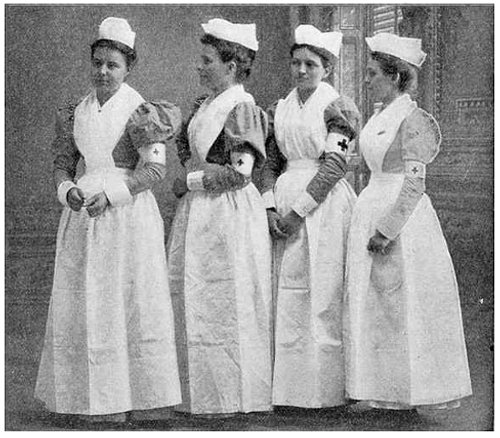
Copyright, 1898, by Clara Barton.
A GROUP OF RED CROSS SISTERS
The four sisters of the New York Red Cross Hospital of Dr. and Mrs. A.
Monae Lesser, who nursed sick reconcentrados and their orphans in
Havana, and afterward assisted the surgeons on the ships and in the
hospitals of Siboney in dressing the wounds of Cuban, Spanish and
American soldiers and sailors, until they fell victims of the fever and
went into hospital themselves.
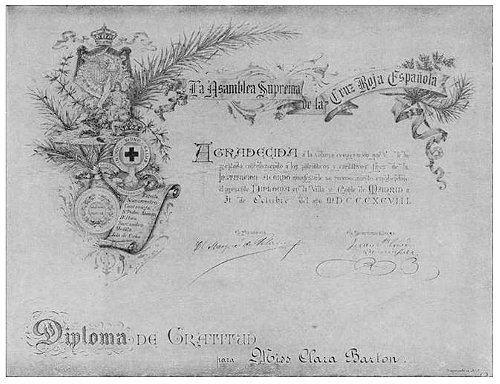
DIPLOMA OF GRATITUDE FOR MISS CLARA BARTON FROM THE RED CROSS OF SPAIN.
[Translation of Text.]
The Supreme Assembly of the Red Cross of Spain Grateful for the powerful
co-operation which you have given, contributing to the patriotic and
humanitarian ends of the institution, has resolved to manifest its
recognition thereof, by issuing to you the present diploma in the city
of the Court of Madrid on the 31st day of October in the year
M.D.C.C.C.X.C.V.I.I.I. (1898).
The President,
Marquis of Paloma.
The Secretary General,
Juan P.C. Domingues.
Every moment news of another battle was expected; the experience of the
first, with no better means as yet at hand, was a matter of great
concern and worry to all present. Suggestions were made and discussed.
Finally it was agreed to request more Red Cross aid by telegraph. A call
for one hundred Sisters was suggested, and Mrs. Lesser was consulted in
the matter. We had fifty trained nurses and assistants on our lists,
also women to act as matrons to distribute nourishment; we promised to
send for that number immediately, as we had sent for twenty-five
already. That morning Miss Barton, with Mr. Kennan and several of her
staff, had gone to the front, and before leaving, Miss Barton instructed
her secretary, Mr. C.H.H. Cottrell, that, at our request, he should
cable in her name for such persons and material as should be needed in
the Hospital Department. We cabled for fifty nurses, ten assistants, a
number of immune physicians, complete hospital equipment, and a quantity
of surgical material, sufficient to make at least five hundred patients
comfortable.
The work was performed almost without intermission, every surgeon
employing all his energies. The feeling in the hospital among the
members of the surgical staff was an excellent one.
The night of the third we expected to be able to rest a few hours, but
during the day the fleet had fought its battle, and a number of Spanish
wounded prisoners were taken off by the various ships. Dr. Lewis, chief
surgeon of the “Harvard,” who assisted in attending the wounded at the
hospital at Siboney, invited Dr. Parker, myself and the Sisters to help
him in attending the wounded Spaniards, to which we gladly responded and
spent the night on the “Harvard.”
The wounded continued to arrive for four days, many of them telling that
they had been shot on the first day of the battle, July 1, and as yet
had received no care except from some comrade who had with him the
little emergency package.
Permit me to say here that I believe the little emergency package has
saved many a man from death through bleeding.
Most notable and commendable was the desire of the surgical staff to
save limbs when at all possible; and I have seen and often joined Drs.
Fauntleroy, Nancrede, Ireland and Parker in the work, spending an hour
for resection of the part in order to prevent amputation. Of course all
endeavored to do the same, and out of the total number of 1415 wounded
treated in the Siboney Hospital after the battle, there were but three
amputations of the thigh, two of the leg and one of the forearm, that I
observed in the camp. The death rate was also very small, as most of the
shots made clean wounds, and only when they affected most vital parts
did they cause death.
The dressing of wounds and the operating upon the wounded, however, were
not all the service required by the injured. Shelter, comfortable cots
and blankets were needed, very few of which had been landed. Still, as
the wounded came, and the needs became greater, I saw Surgeon-Major La
Garde, most ably assisted by Chaplain Gavitt, hunt about for canvas or
anything that would act as cover for a tent, and have it put up along
the tents and flies. Their work was unceasing. In those days every
officer and member of the medical staff gave up his cot and tent that
the wounded might find some kind of shelter and proper resting place;
but in spite of that they were inadequate. The largest number of wounded
lay on the ground, some on blankets, others on canvas, or if very
severely wounded, on a litter.
The steamship “State of Texas” had a number of cots (I believe 350)
which were originally meant for Cuban relief, many of which we used in
the Red Cross Hospital at Siboney; when I informed Miss Barton of the
condition of affairs, all cots that were in the ship were unloaded and
sent to the hospital, and the most seriously wounded received
comfortable resting places.
The gauze, particularly the iodoform gauze, and bandages soon gave out.
The “State of Texas” carried a quantity of surgical dressings. All that
was necessary was to ask Miss Barton for them, who immediately sent on
land any article needed if in her possession.
Among our patients were several cases of gunshot wound through the skull
and brain near the eyes; the eyes were inflamed, and ice had to be
applied continuously to relieve excruciating pain. Dr. Fauntleroy
suggested that the cases be sent to the Red Cross Hospital, we had there
the only ice in the field at that time; it also came from the “State of
Texas,” from which we received a daily supply. The eye cases were
carefully attended by Mrs. White, the wife of Dr. Trumbull White, of the
Chicago Record, who deserves much praise for the constant attention
which she gave them. It was necessary to make continuous application of
ice every few minutes, which she did with constant and unceasing care.
Mrs. White is not a trained nurse, but a gentle, wise woman. I agree
with the remarks of Dr. Fauntleroy when he said that her attention and
the ice relieved much suffering and saved quite a few from blindness.
Captain Mills, who was one of the wounded in that manner, may tell of
his own experience.
Most of the cases of gunshot wounds gave very little work to the
surgeons, as the bullet entered at one place and made its exit at
another, thus leaving a clean wound. Even through vital parts of the
body, such as the brain and abdomen, bullets passed without apparently
giving the patient any great distress. The simple cases did not need
much attention; cleanliness and a cushioned dressing well protected was
all they usually required. In fact, many of the smaller wounds came to
us bandaged with a little emergency pad, progressing in healing. These
were always shots from the Mauser bullet. Many of the men that I saw
were shot in the shoulder, the bullets making exits through the back.
Some gunshot wounds had two places of exit and entrance in their course.
For instance, I had cases in which the bullet had gone into the upper
and lateral part of the cranium, come out behind the ear, went into the
shoulder and came out behind and below the shoulder blade; or had made
its course through the left arm, again entering the right chest and
coming out at the back. It would perhaps be out of place to enumerate or
describe in this report the many courses which the bullets have taken,
but as stated, most of them required little attention. There were,
however, some serious wounds, such as compound comminuted fractures, in
the treatment of which great skill was shown by the various surgeons in
the hospital. Those were the cases which in former years would have
resulted in amputation, but drainage and cleanliness, plainly speaking,
have given the patients the advantage of keeping their limbs.
In the simple cases one could work alone, with the assistance of a
Sister or a hospital steward, but in the more difficult cases good
surgical skill was required, and it was often a source of great
gratification to see two eminent surgeons, of equally good reputation,
assisting each other in a difficult case; one advising, the other
acting; thus the greatest harmony existed among the members of the
staff. The Sisters being required in the operating tents as also the
stewards there were no nurses in the tents to care for the wounded.
No food had been prepared for the large number of wounded lying on the
cots or on the ground on blankets or canvas; a great many of them were
too helpless even to turn. Surgeon-Major La Garde did me the honor of
consulting me in regard to the nursing, and I suggested that some of the
Sisters leave the operating tables, which were by that time supplied
with other assistants.
The major then sent for Mrs. Lesser, who suggested that the worst cases
be brought into one or two rows of tents, as the small staff of Sisters
brought into Cuba was not sufficient to take charge of all and do them
justice. The rows of tents were then placed in her charge, and she
portioned the work of caring for them among the Sisters assisted by
hospital corps men. The soldiers were nearly famished; some had not
received a morsel of food for two days. Oatmeal gruel, coffee and
quantities of prune juice and other articles of relish were at once
prepared at the Red Cross Hospital in big cans which had come from the
“State of Texas,” and with the assistance of the ever active
indefatigable Chaplain Gavitt, and several newspaper correspondents, the
wounded soldiers received such food as their conditions allowed.
Unfortunately the surgeons lost track of the greater number of their
cases. The patient marked for redressing was placed on any table, and
the surgeon in charge of that table redressed the wound; thus it was
hard to say what result one or the other had obtained, with the
exception of a few cases, which by special request one was allowed to
continue to observe. Some of the patients came down with their wounds
dressed in some hospital at the front, and I may here mention that I saw
excellent work coming from the hospital in command of Dr. Woods.
When the rush was over, I was called to the camp where the Spanish
prisoners were located. I prescribed for their ailments, while the
Sisters supplied their food. In addition, I answered the calls which
came from Cuban families in Siboney. Some Spanish prisoners were wounded
and others suffered from fevers. Those who were wounded had their wounds
dressed at the scene of battle, and although some of the dressings were
temporary, they feared to have any person touch them, until assured that
they would be treated as gently as possible. The patients had now all
been operated upon and attended; only some of the wounds needed
redressing. They were taken to the transport hospital ships as soon as
their condition permitted. It was about that time the hospital ship
Relief arrived, bringing more food for invalids and more equipped cots.
Dr. Guiteras, who visited all the hospitals daily, informed me one
afternoon that he had found a case of yellow fever in camp (not in our
hospital), developed in a place near Siboney. There were two or more
suspicious cases which he had watched, and he believed that yellow fever
would develop very rapidly. I called the Sisters together, presented the
situation to them, that they might decide whether to stay in the field
or return to the “State of Texas.” Their unanimous decision to stay and
face the consequences made them continue their work without any
hesitation. The Red Cross Hospital building became crowded, one room was
set aside for doubtful cases, while the other rooms were occupied with
typhoid patients. The porch in front of the house, shaded with canvas,
and a little isolated room to the right, sheltered the wounded.
My work at the Red Cross Hospital became continuous, as a large number
of patients came from the various camps to receive attention, and still
a larger number from our camp came for consultation and treatment. The
number of such consultations I discontinued to write down after three
hundred were attended, Americans, Spanish and Cubans together.
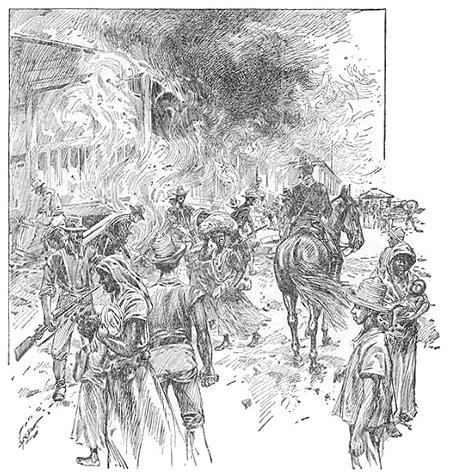
THE BURNING OF SIBONEY—RED CROSS HOSPITAL IN THE
FOREGROUND.
Every case of typhoid fever and other disease which was placed in our
charge from the day we opened the hospital, has recovered. The last of
them were brought home well on the “Concho;” those that came later were
on the way to recovery when I left for the fever hospital. Among our
patients were two who had measles, complicated with pneumonia, and there
was a large number of patient suffering with Cuban malarial fever. I
also wish to state that not one patient in our hospital became infected
with yellow fever; the cases that had it came there with the disease,
but were closely observed, and as soon as the first positive sign was
noticed, they were isolated and brought to the fever hospital. The
total number of sick permanent and transient thus attended was 234. Most
of the medicines we had brought with us, but received some from army
stores.
When the “State of Texas” left for Jamaica to get ice, in order to save
time we took a dwelling in one of the houses at Siboney, which was
believed by experts not to be infected. The family living in it was very
clean, and it appeared that the house would serve as well, and perhaps
better than any other. Our tents, in which we should have preferred to
live, had not arrived, nor did we have any cots, all having been given
to the sick and wounded.
When the houses at Siboney were ordered to be burned down, we left for
the yellow fever camp. Before leaving I requested Dr. Senn to operate
upon two Spanish prisoners whom I had not seen for several days.
On the seventh day after our arrival at the camp we were able to return
to Siboney. Our ailments, although not prevented, had been made light by
prophylactic methods, and our recovery was consequently rapid. After our
return to Siboney I again offered to serve.
In the meantime word from Assistant Surgeon-General Greenleaf was
received at Siboney, stating that forty-five Red Cross nurses, surgeons
and other assistants, had arrived at Guantanamo, waiting to come to us,
and as we returned the same day from the fever camp, Surgeon-Major La
Garde telegraphed and telephoned repeatedly for them to come, but he
received no reply.
Feeling that under the existing circumstances and exhausted from work
and illness we could not continue to work without more assistance, I
applied for our return. Surgeon-Major La Garde upon this placed me in
charge of the steamship “Concho” which left for the North on July 23, of
which voyage a special report has been presented.
Before my departure from Siboney, Surgeon-Major La Garde handed me a
document, a copy of which I herewith present:
Reserve Divisional Hospital, Fifth Corps,
Siboney, Cuba, July 23, 1898.
This is to certify that Dr. A. Monae Lesser, surgeon-in-chief of the
American National Red Cross, offered his services to the Medical
Department of the army on the twenty-ninth day of June. From the
latter date to the present day Dr. Lesser has been connected with
this hospital as a surgeon and patient. When the wounded commenced
to arrive on July 1, and during the rush of work which lasted four
days in the care of the wounded, Dr. Lesser was assigned one of the
six tables in the operating room. His work was skillful and most
continuous. His suggestions to me on more than one occasion,
concerning administration details, were of the highest value. After
the rush of work in the operating room Dr. Lesser continued to take
charge of a hospital, a building which was pronounced free from
infection, in which he treated wounded and sick soldiers. His work
was the admiration of every one who had the good fortune to be under
the watchful care of himself and the Sisters under him.
Unfortunately the building—in which they lived—soon showed signs
of yellow fever infection. Dr. Lesser, his wife and four of the
Sisters—his entire staff—were taken one by one with the fever.
They were removed to our yellow fever hospital. They are now
convalescing, though weak; they leave us for the North to-day for a
much needed rest. I have no words at my command which could in any
way express my appreciation of the work of Dr. Lesser and his heroic
staff. Had it not been for their assistance and the quantities of
supplies furnished by the “State of Texas,” the sufferings of the
hundreds of wounded would have been magnified more than I can now
venture to express.
In commenting on our lack of supplies, attendants, etc., I desire to
state that our unprepared condition to meet the rush of work which
came with such surprising rapidity was due to those military
conditions which often transpire in war when blood, suffering and
death seem to be inevitable, or beyond the scope of man to
anticipate.
May God’s blessing be with him and his.
Louis A. La Garde,
Major and Surgeon, U.S.A.,
Commanding Hospital.

Early in February, 1898, after the President of the
United States had called Clara Barton to several conferences on the
question of relieving the sufferings of the Cuban reconcentrados; and
the Central Cuban Relief Committee had been formed to take charge of the
funds and supplies which it was known that the generous American people
were anxious to donate for this purpose, it was decided that Miss Barton
should go to Cuba at once to assist in the prompt and efficient
distribution of the succor which was so near at hand. It is her habit to
act quickly when her plans have been matured, and not a moment’s time
was lost in preparing for her journey to Havana.
On her arrival at Havana Miss Barton communicated with the American
Consul General, the Spanish officials, and some of the best known and
benevolently disposed citizens; and after freely conferring with them,
and learning the existing conditions, the city was divided into
distribution districts, and a committee of citizens, who were fully
acquainted with the people and their wants, was appointed to take charge
of each district. Abundant space in a very large warehouse had already
been secured by the Consul General, which was, with the use of its
employes, given free of charge to the Red Cross.
Several of the villages near Havana and as far east as Matanzas were
then visited and arrangements similar to those made in Havana were
perfected for the distribution of food and clothing; and these
communities were supplied as quickly as possible.
Shortly after Miss Barton’s arrival in Havana the deplorable “Maine”
disaster occured, killing, drowning and injuring so many of our brave
sailors and marines. As soon as she heard of this awful calamity she
visited the hospital where the victims who were not killed outright were
lying, and arranged to have them provided with every possible attention,
and the best of everything needed that money and sympathy could procure.
As the situation developed and the needs of the country became known, it
was found to be necessary to largely increase the working force of the
Red Cross, and arrangements were accordingly made to have some of the
oldest and most experienced workers of that organization, with some new
recruits, come to Havana. A large house for their accommodation was
secured in the suburb of Cerro, about three miles from the business
centre of the city, where they were pleasantly and comfortably
established. The party when completed consisted of the following named
ladies and gentlemen:
Miss Clara Barton, Mr. J.K. Elwell, Dr. J.B. Hubbell, Dr. E. Winfield
Egan, Dr. A. Monae Lesser, Mrs. A. Monae Lesser, known as “Sister
Bettina,” Misses Annie McCue, Minnie Rogall, Blanche McCorresten and
Isabelle Olm, Red Cross nurses or “sisters;” Mr. J. A. McDowell and Mr.
C.H.H. Cottrell.
Many of the best citizens of Havana, ladies and gentlemen, Spaniards and
Cubans, gave us a most hearty welcome and every encouragement, many of
them volunteering their services in any capacity in which they could be
made useful, and we were thus enabled to secure a number of doctors and
nurses, who gave excellent service, and who received the well-deserved
thanks of the Red Cross.
Mr. Elwell was put in charge of the warehouse with an able corps of
assistants, and his work there was all that could be desired, as it was
something that he was perfectly familiar with from long experience; he
had the great advantage of knowing the Spanish language and the
character of the people with whom he was dealing. Many hundred tons of
the finest supplies, including everything that a generous and
sympathetic public could think of that would be suitable for a famishing
people, were given out as fast as orders were issued for them; but in
every instance the utmost care was exercised that nothing should go out
that might reach the hands of irresponsible persons; and every possible
safeguard of check and receipt was adopted and successfully used.
The large number of orphan children that had been left unprovided for
appealed to the sympathies of some worthy people for whom Consul-General
Lee was the spokesman, and Miss Barton was asked by them to provide a
hospital and home for these waifs. She therefore rented and furnished a
large private residence on Tulipan street in Cerro, near the Red Cross
residence, which was opened and named the “Lee Orphanage.” The house was
completely arranged and had a capacity for seventy-five inmates, besides
the attendants, and it was soon filled. Dr. and Mrs. Lesser were placed
in charge of the orphanage, assisted by several Cuban doctors and
nurses. The greater part of the children who were brought there were in
an extreme state of exhaustion from lack of nourishment, many being
unable to sit up, and the greatest care and watchfulness had to be
observed to save their lives. A few of them died after they reached the
hospital; but by careful and unremitting attention the larger part of
them were gradually brought back to health, and it is to be hoped that
some of them will eventually find homes in good families.
An old ramshackle building long before abandoned as unsafe and
undesirable was owned by the city and known as Los Fosos. Being
worthless and unwatched, it had become the lodging place of a horde of
beggars and tramps, and when the unfortunate reconcentrados were driven
into the city from their homes in the country hundreds of them flocked
to this miserable place. Miss Barton found there men, women and children
crowded together in a most pitiable and disgusting mass; and suffering
from disease and exhaustion and in such a state of filth that her party
was unable to endure the stench and had to get out after a very short
stay. These poor victims of cruel war were lying on the bare floor in
their dirty rags, and entirely helpless except for such poor aid as they
could render each other. Many of them died daily and their corpses would
lie for hours before being removed. Altogether it was one of the most
horrible pictures imaginable.
Permission was obtained by the Red Cross to repair the building and make
a hospital of it, and carpenters were put to work to strengthen the
swaying floors and batten up the sides and make the roof rainproof.
Three rooms were partitioned off for a dispensary, store room and
kitchen. Scrub women were put to work and a plentiful supply of soap,
water and disinfectants soon made a great change for the better. When
the place had been cleansed, new cots were brought in and clean bedding
put on them. Up to the time of their forced departure those devoted
nurses worked faithfully from early morn till late in the day to keep
the place decently clean and instill habits of neatness into those
miserable beings. Deprived of the pride and care of those trained women,
it is easy to believe that within a week after they left, Los Fosos had
resumed its former reputation as the most unsavory spot in all Havana.
During the time that Los Fosos was under the care of the Red Cross the
best medical skill obtainable was given to the inmates, and the untiring
care and attention of as faithful a body of trained nurses as the world
has ever known was freely given them, and the best of nourishing food
and delicacies were abundantly supplied; and if fate had willed that
this body of self-sacrificing men and women should remain, there is no
doubt that, in the course of time, this old pesthouse would have become
a famous hospital with a reputation second to none.
One of the most comprehensive systems of charitable work had been thus
inaugurated and was doing incalculable good, and was receiving praise
and gratitude from all classes, when it was announced that the official
relations between Spain and the United States, which had been strained
for some time, were about to be broken. The American Consul-General
announced that he did not think that it was safe for American citizens
to remain in Cuba while the excited state of feeling existed, and that
he should leave on a certain day, and he advised all Americans in Cuba
who wished to go to the States that he would provide transportation for
them. The time given for settling affairs and preparing to leave was
less than a week, and accordingly there was much excitement and great
sacrifices had to be made, which in many cases meant ruin and beggary.
Quite a number of the refugees afterward became entirely dependent upon
the bounty of the Red Cross at Key West and Tampa, Florida.
When it thus became necessary to decide whether the Red Cross should
abandon its work in Cuba, Miss Barton called her staff around her (as
is her invariable custom in deciding all important matters), and asked
for their individual opinions as to the advisability of their leaving,
and a full discussion of all the points involved ensued, and a unanimous
decision was arrived at. All Spanish officials, national and municipal,
had never failed to show the utmost courtesy to all our members, and
time after time they had shown their sincerity by repeated acts of
kindness, and none of us believed that they were likely to change their
attitude toward us. But when it was considered that war was almost
inevitable, and that if we remained in Cuba we should be shut up in an
enemy’s country and unable to communicate with our friends and
relatives, who would be daily harrowed by sensational stories, it was
decided that we should withdraw when the Consul-General was ready to
leave.
When it became known that we were about to leave Miss Barton received
some very hearty assurances of regard and protection from high Spanish
officials, and many Spanish and Cuban ladies and gentlemen called on her
and assured her of their high regard and deep gratitude for all she had
done for their suffering people.
The day before we were to leave Cuba the Archbishop of Havana came to
the Lee Orphanage, where quite a number of the best people of the city
had assembled, and gave his blessing to the little institution; which
was, with those Catholic people, an augury equivalent to a guaranty that
the success and protection of the undertaking was fully assured; and,
indeed, we learned several months after the war had begun that the
Spanish authorities had not only taken the most scrupulous care of this
hospital, and all its abundance of provisions with which the Cuban
Relief Committee had supplied it, but they had also placed a guard
around Miss Barton’s residence and had kept it inviolate from all
predatorily disposed persons. After the war some of our party visited
the residence and the orphanage, and found provisions which had been
left at both places were still on hand.
Of course it was to be expected that the hospital, being deprived of the
example of the trained Red Cross nurse, with her habits of order and
neatness, would naturally retrograde in many ways, and our party
therefore was prepared for the many evidences of neglect and disorder
that met their eyes on their return visit.
The Central Cuban Relief Committee, of New York, which had been
appointed by the President of the United States, had abundant means to
maintain this work that had been so successfully inaugurated, and it is
greatly deplored that the unfortunate declaration of war prevented the
carrying out of all the plans that had been so carefully matured, and
which would have saved the lives of thousands of men, women and children
who now lie under the sod.
Having made the best possible arrangement for the maintenance of the
institutions we had brought into being and had fostered in Havana; and
with the saddest regrets that we should have to abandon a work so well
begun, we boarded the ship “Olivette” on April 11, and started for the
United States. After a great deal of discomfort, caused by the
overcrowding of passengers and the heavy seas, we reached Tampa, Fla.,
on April 13. After a day or two of rest, Miss Barton proceeded to
Washington with Drs. Hubbell and Egan, the remainder of the party
stopping in Tampa.
There were at that time probably about fifteen hundred Cuban refugees in
Tampa and eight or nine hundred in Key West, who were entirely
dependent. The Red Cross took upon itself the task of maintaining these
poor people, and for a period of seven months its agents provided for
them. It should be said, however, that the citizens of both these cities
appointed committees and did all they could to relieve the necessities
of these large bodies of indigent people.
Early in April it had been decided to charter a steamer in New York and
to load her with supplies and send her to different ports in Cuba, where
her cargo could be unloaded in such quantities as might be required.
Accordingly, the steamer “State of Texas,” of about eighteen hundred
tons burden, was chartered from Messrs. Mallory & Co., of New York, and
notwithstanding the fact that our party had been obliged to leave
Havana, and that subsequently war had been declared, the preparations
for sailing were kept up, and the steamer was loaded with a cargo of
fourteen hundred tons, which embraced a fine assortment of substantials
and delicacies, and many household articles, medicines and hospital
stores. When she was finally loaded in the latter part of April, the
“Texas” sailed for Key West in charge of Dr. J.B. Hubbell, with Captain
Frank Young as sailing master, arriving there on the twenty-eighth of
that month.
In the meantime, Dr. Jos. Gardner and wife, of Bedford, Ind., had joined
our party at Tampa; and soon after Miss Barton, Dr. Egan, Mr. D.L. Cobb
and Miss Lucy M. Graves came along, and it was arranged that the entire
party was to leave Tampa on the evening of April 28, to go aboard the
steamer “State of Texas,” at Key West, and remain on her until the army
had made a landing in Cuba, when it was expected that we should be able
to resume our work there. The day of the evening we were to leave Tampa,
Mrs. J.M. Towne, the lady at whose house our party was stopping, gave a
reception in honor of Miss Barton, to which General Wade and the army
officers who were then stationed there, and many ladies and gentlemen of
that fine little city, were invited. It was a most brilliant and
enjoyable occasion, the uniforms of the officers and the lovely toilets
of the ladies making a picture that will long remain in the memories of
those who saw it.
On our arrival at Key West, on the afternoon of April 29, we were met by
Dr. Hubbell and Mr. C.C. Bangs, who had been sent by the New York
committee to assist in our work; and Mr. A. Butler Duncan, a well-known
gentleman of New York, and were taken aboard the steamer “State of
Texas,” where we were welcomed by Captain Young, and where we
subsequently passed many pleasant weeks together. A few days later we
were joined by Mr. Geo. Kennan, First Vice-President of the American
National Red Cross, and his wife.
Key West at that time was a very busy place, the harbor being filled
with naval vessels which came in there daily from the Cuban blockading
squadron for coal and provisions. Miss Barton immediately paid her
respects to Captain Harrington, of the monitor “Puritan,” who was the
senior commander of the port, and presented her credentials from the
State and Navy Departments. Subsequently she placed herself in
communication with Commodore Sampson, and stated her desire to reach
Cuba at the earliest possible moment.
Many naval officers and citizens of Key West called on Miss Barton
daily, and this attention, combined with her enormous correspondence,
kept her time fully occupied till late in the night. There was scarcely
a day that some accident of more or less severity did not happen to
some of the sailors or workmen on the many auxiliary craft that were in
the harbor; and the Red Cross doctors were at all times in demand. In
order to keep every one in the best preparation for possible
contingencies of any kind, everybody on the ship was instructed and
drilled in the various phases of his or her particular kind of work; and
thus all were kept happily and busily engaged. The doctors inaugurated a
series of lectures for the benefits of the nurses and others, and
clinics were of frequent occurrence, and every member of the party
benefited by the practical knowledge thus attained in bandaging and
taking care of various kinds of injuries.
Doctor E. Winfield Egan, of Boston, one of the foremost of our surgeons,
effected some wonderful operations here and at Port Tampa, and won the
warm friendship of many a poor fellow, who, but for his skillful
ministrations would have fared badly. Some of the injured men were so
badly hurt that days and weeks elapsed before they were fully recovered,
and during the time of their convalescence, they were carefully attended
and watched by the Red Cross nurses; and at all times of the day the Red
Cross boat, with its well-known flag floating, could be seen going from
one transport to another on its errands of mercy.
While we were lying at Key West there was scarcely a day passed that
some of our vigilant blockading squadron did not bring in from one to
three captured prizes; sometimes large steamships, and from that class
through the various grades of shipping down to fishing smacks; and in
the course of a couple of weeks there were between thirty and forty of
these boats lying at anchor in the harbor, with their crews aboard under
guard. Somehow it was forgotten that these poor foreigners must eat to
live; or else perhaps somebody thought that somebody else was
responsible for this very important matter; be that as it may, they were
unprovided for. The boats, of course, had a small amount of provisions
aboard when they were captured, and while that lasted all went well; but
in a few days their supply was exhausted and calls were made on the
United States Marshal, in whose charge the prisoners were, for food.
That officer, having no contingent fund on which to draw, was in
despair, and came to Miss Barton, who at once reassured him by saying
that she would attend to the matter and would provide for all the
prisoners until such time as he could get his petition through the
departments at Washington. Accordingly several boatloads of provisions
were hastily gotten together and taken in tow by a steam launch which
landed them alongside of each prize. Miss Barton personally visited
these boats, and with the aid of an interpreter she learned the needs of
the crews, and not only supplied them with food, but she arranged to
take letters from all who wished to communicate with friends and
relatives in Spain and elsewhere, and forwarded the letters to their
destination.
All governmental relations between Spain and the United States having
been broken by the declaration of war, it was necessary, where letters
were to go to Spain, to send them to the Red Cross of Portugal, which
organization kindly acted as the intermediary friend all through the
war. And here I may say that the Red Cross adopted this method wherever
there were Spanish prisoners, and through its kind offices thousands of
anxious hearts received news of their absent ones who were “held by the
enemy.”
About the middle of May the friends of the Red Cross in New York City,
conceived the idea of forming a relief committee for the collection of
money and supplies to be used in aiding the soldiers in camp and field.
The committee was formed, with some of the richest and most prominent
people of the country on its list, and it became necessary for Miss
Barton to go to New York to empower the committee with authority to act
in the name of the Red Cross. Accordingly the steamer “State of Texas”
left Key West and proceeded to Port Tampa, where Miss Barton took train
for the North, leaving the remainder of the party on the steamer.
At this time there were several camps at Tampa and Port Tampa, and
several thousand troops were preparing for the invasion of Cuba;
transports were daily arriving at Port Tampa and were being placed in
readiness to carry this vast host to the “Pearl of the Antilles.” Those
were busy days for everybody, and the Red Cross doctors and nurses were
called upon hourly to render service to many victims of injury and
disease.
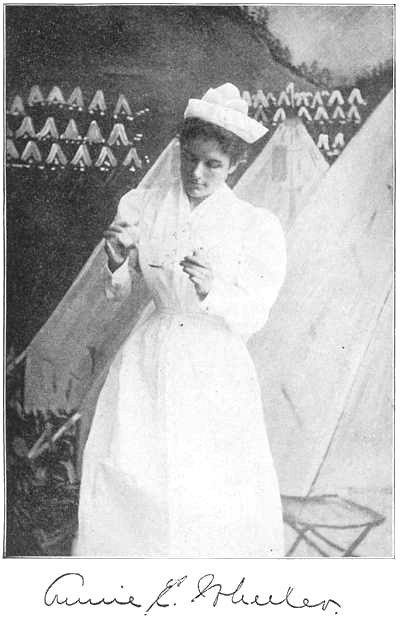
In charge of Red Cross nurses at Nautical Club Hospital,
Santiago de Cuba.
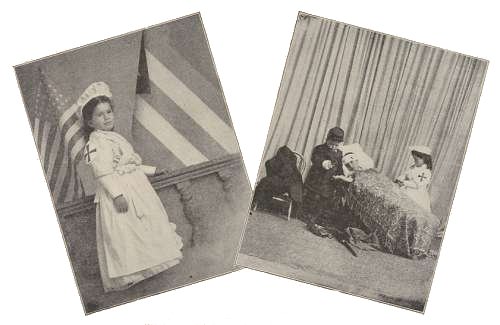
THE YOUNGEST RED CROSS NURSE, 4 YEARS OLD.
While we were waiting at Port Tampa we were joined by Miss Janet
Jennings, of Washington, and Mrs. Trumbull White, of Chicago, both of
whom afterward did excellent work in the hospitals at Siboney.
Miss Barton rejoined our party on June 16, being accompanied by Mrs. J.
Addison Porter, the wife of the secretary to President McKinley, who
went with us on the “State of Texas.”
Miss Barton had been the recipient of such assurances on her recent trip
to Washington from the heads of the various government departments, that
she believed that the Red Cross would receive the most cordial
recognition from the army and navy as an auxiliary aid, and would be
able to co-operate with them in the utmost harmony. Although the mission
of the steamer “State of Texas” was to render relief to the Cuban
reconcentrados, it was tacitly understood and believed by all that every
possible aid would be extended to the army and navy forces whenever it
was necessary or called for.
All of the government transports carrying General Shafter’s army had
sailed from Port Tampa, bound for Cuba, when, on June 17, the “State of
Texas” weighed her anchor and started for Key West, where we arrived on
the following afternoon.
It was learned at Key West that the cargo of a captured ship, consisting
of South American “tasajo,” or jerked beef, was about to be sold by the
United States Marshal; and as we knew this was a favorite food of the
Cubans, and that we could get all that we needed at a very low figure,
Miss Barton decided to take aboard twenty tons of it.
A telegram had been sent from Port Tampa to the Secretary of the Navy,
under whose authority the “State of Texas” was then sailing, notifying
him that we were going to Key West, where he could communicate with us,
and thence on to Cuba, if orders to the contrary were not received.
On June 20, everything being in readiness, and no orders having been
received from the Secretary of the Navy, it was decided to sail and find
Sampson’s fleet near Santiago de Cuba, where it was generally believed
that General Shafter would try to effect a landing; so at 10.15 a.m. we
started, taking the westerly course around Cape Antonio. Just as we were
about to leave, Mr. W.S. Warner joined our party and afterwards became
one of our most useful and valued workers.
After a pleasant but uneventful voyage on the morning of June 25 we
arrived off Morro Castle, at the entrance of the Bay of Santiago. The
Spanish flag was flying over the land fortifications and Sampson’s fleet
was stationed in the adjacent waters. Miss Barton sent a representative
aboard the flagship “New York,” who presented her compliments to Admiral
Sampson and asked for orders, or an expression of his wishes regarding
the position to be taken by the Red Cross ship. The Admiral sent back
word saying that General Shafter’s army had disembarked at Daiquiri, a
point about twelve miles east of Morro Castle, and he advised Miss
Barton to take her ship to Guantanamo Bay, where she would find good
anchorage and calm water; and where she would be able to learn more of
what was taking place on land, as there was constant communication from
there with the invading army. Accordingly we drew away and arrived that
evening at Playa del Este, which is about forty miles from Santiago, and
situated just inside the mouth of Guantanamo Bay.
Captain McCalla, the naval commander of the port, with several other
naval officers came aboard the “Texas” that evening, and warmly welcomed
Miss Barton. Among these officers were the captain and medical staff of
the United States naval hospital ship “Solace” which was lying at anchor
near us, and they extended an invitation to all the members of our party
to visit their ship on the following morning. The invitation was
accepted, and the next day the launches of the “Solace” came for us, and
we passed a couple of very enjoyable hours looking over one of the most
complete and handsome ships we had ever seen.
After our return to the “State of Texas” two representatives of New York
papers called on Miss Barton, informing her that they had just come in
from Siboney, where there was great need of supplies and medical aid.
They said that the men who were wounded in the fight between the Rough
Riders and the Spaniards on the previous Friday had just been brought in
and that they were suffering from the lack of everything in the way of
comforts and conveniences. Our steamer was at once headed westward and
started within a few minutes for the scene of suffering. A two months’
sojourn in tropical waters had enabled the busy little cirripeds to
attach themselves in millions to the bottom of our ship, and, in
nautical parlance, she was very “foul,” and consequently our speed was
reduced from a normal of about ten knots an hour to between seven and
eight knots, so we did not reach Siboney until after eight o’clock that
night.
Soon after our ship was anchored a boat was lowered and a party of our
doctors started for the shore. As the night was dark and there was no
wharf nor other landing place, save one small bit of sandy beach which
was bounded on each side by precipitous rocky ledges, and no lights
other than those of the ships which were anchored safely away from the
shore, and the uncertain and misleading flare of an occasional camp fire
some distance away from the beach, the landing was a matter of some
difficulty and anxiety. A heavy ground swell was running quite high and
dashed itself against the rocks with a roar that deafened us; however
the officer who was in charge of the boat was an old sailor, who was
used to landing in strange places, and by constant “ahoying” to every
sign of life on ship or shore, we managed to strike the one soft spot in
that vicinity and soon had our boat drawn up on the sand.
By inquiring of several sentinels, we found our way to the army
hospital, which was a rough wooden building that had evidently been used
for a store or warehouse in more peaceful times. On a veranda in front
of the hospital a group of officers was standing, and on our asking for
the surgeon in charge, Major Havard stepped forward. Drs. Gardner and
Lesser introduced themselves and the other members of the party to Major
Havard and formally offered him, in the name of Clara Barton and the Red
Cross, the personal services of all our doctors and nurses, and any of
our supplies that might be needed. Major Havard very courteously thanked
them for their offers and said that he fully appreciated the value of
such services, but he thought that he and his assistants would be able
to take care of all the sick and wounded that were there at that time;
and as for supplies, he knew there was an abundance of them on the
transports, and he hoped they would be landed the next day. During
these speeches our members were looking through the miserable place that
bore the name of hospital, and the sights that met us brought tears to
our eyes. There were half a dozen cots in a building where there were,
perhaps, fifty or sixty patients, the greater number of whom were lying
on the floor, some with a blanket under them, but a great many were
lying on the bare boards. Sheets, pillows and bedclothes were unknown,
and those poor fellows who were not dressed in their uniforms were lying
almost naked. There were some wounded men, and others who were sick
with fever; and in the dim light of a few lanterns we could see them
turning from side to side in their discomfort and agony and hear their
moans, and in some cases imprecations against a Government that would so
illy provide for such a contingency. One of the nurses(?), a young
fellow who sat out on the veranda in his shirt sleeves complacently
smoking a cigarette, told us that he couldn’t do very much for the boys,
as he didn’t have anything to do with; besides one nurse couldn’t do
very much for forty men, all wanting him at the same time, and he
thought there ought to be more help. I couldn’t help contrasting this
good natured but rather indolent chap, who was performing his duty in
such a careless and perfunctory manner, with the brave, clean,
intelligent and energetic young women whom I knew, who, when on duty,
never took a minute’s rest, but were constantly busy, and who
anticipated every want of a patient; and who by their bright faces and
cheerful voices drove away all feelings of despondency and homesickness
among the sufferers, and in this way helped them quite as far on the
road to recovery as the medicine that the doctors might prescribe.
With saddened hearts we turned away and entered the Cuban army hospital
near by. This house was better furnished with beds and bedding and other
hospital appliances than the place we had just left, as it had been a
regular army hospital when the Spaniards were in possession of the
place, and they in their quick retreat had left nearly everything
intact. So that these patients were in a much better condition. But how
dirty it was! And how badly it smelled!
The Surgeon in charge of the Cuban hospital was a very intelligent Cuban
who spoke good English, and he welcomed us warmly, and insisted on
taking us to see General Calixto Garcia, whose headquarters were near
by. That fine old warrior, with his gentlemanly and courtly manners,
received us with the greatest cordiality, introducing us to the members
of his staff who were present, and in every way made us feel that we
were more than welcome. He had no hesitation in accepting any aid we had
to offer; said that his men had suffered so terribly during the past
three years that he welcomed our coming as a perfect godsend. So it was
arranged that the Red Cross should take hold of the Cuban hospital the
next day and do what it could to make it healthier and pleasanter;
although the surgeons in charge begged that the ladies, i.e., the
nurses, should not come until the place had been cleaned. But Red Cross
nurses are trained in a school that makes the annihilation of dirt its
first principle; and early the following morning they appeared with
pails, scrubbing brushes, soap, whitewash and disinfectants, and the way
in which they went to work elicited the admiration and astonishment of
all who saw them. After thoroughly washing and disinfecting the floors,
walls and furniture, they took the beds and put them through the same
process, and afterwards put new mattresses, pillows and bedding on them.
Then the patients were taken in hand, and carefully bathed and put in
clean clothing, and then into clean, sweet-smelling beds. The looks and
words of gratitude that were given to those little women in blue will
always remain a happy recollection to them.
This grand transformation of the dirty Cuban hospital was watched with
great interest by the American officers and men, and when it was finally
finished it presented such a noticeable contrast of peace, cleanliness
and comfort to the United States Army hospital, where everything was the
very opposite, in all its hideousness of neglect, squalor and suffering,
that there was a universal grumble in the camp, and men were heard to
mutter: “What kind of people are these Red Cross folks that come down
here and give the best of everything to the Cubans, and pass by our own
boys, who are dying for the want of these very attentions?” When it was
explained to them that the Red Cross had first gone to our own hospital
and offered all it had to our own army surgeons, and that they had
declined assistance, there was an immediate and widespread inquiry,
“Why?” and as no answer that would satisfy could be given, and the
grumble was becoming more general and forcible all the time, a little
later the army surgeons thought best to allay further irritation by a
general acceptance of whatever was needed from the Red Cross stores, and
any personal assistance that might be offered.
As a result of this change of mind everything that was needful to make
the American hospital the equal of the Cuban hospital was gladly given
by the Red Cross, and from that time on to the end of the war the army
surgeons and the Red Cross worked in perfect harmony and with mutual
respect and admiration. A Red Cross hospital was opened at Siboney and
immediately filled to its capacity with American soldiers and government
employes; and the Red Cross surgeons were given operating tables in the
army hospital and on the field, and with the aid of Red Cross nurses
rendered splendid service in the bloody days that soon followed.
As General Shafter pressed forward with his troops, the fighting became
more severe, and his chief surgeon, Colonel Pope, sent word to Miss
Barton asking for aid to be sent out to the front. She responded
immediately and personally led a party consisting of Mr. George Kennan,
Mrs. J. Addison Porter, Dr. and Mrs. Gardner, Dr. E. Winfield Egan, Dr.
J.B. Hubbell, and Mr. J.A. McDowell, going forward in army wagons and on
foot over a road whose badness could not be exceeded anywhere; and they
soon had their tents up and their kettles boiling, and for several days
they devoted all their time to relieving the sufferings of the wounded
men on the field. They made gruels and soups, and all the delicacies
that could be prepared with the facilities at hand, and distributed
fruits and cooling drinks. These poor wounded soldiers were lying on the
field where they were left after their wounds had been dressed; and as
there was no food for them to eat except the regular army ration of salt
meat, hardtack and coffee, which many of them were unable to swallow, in
some instances they had not taken any nourishment for three days, and
were nearly starved.
The “rainy season” had just set in and these “martyrs to the cause of
Cuban liberty,” who were helpless and in many cases without clothing of
any kind, were left without protection, except such as could be had from
small bushes and trees; and they were subjected daily to alternate
“sunshine and shower;” and when it is said that those words are not to
be taken in a poetical sense, but that they mean intense heat and
deluging rains, the suffering that ensued can be understood. And it may
be well to say that in that locality at that time of the year, when the
sun sets the cold air from the mountains drops down into the valleys and
the nights become uncomfortably chilly before morning.
That the statement of the sufferings of these men may not be thought
overdrawn, I shall introduce here an extract from the testimony of Major
William Duffield Bell, an army surgeon, as given on this point in his
report for the War Department:
The First division of the Fifth Army Corps Hospital was the only one
in the field. The surgical force in this hospital was insufficient
to meet the demands upon it, and numbers of the wounded lay
unattended for twelve and even twenty-four hours on the bare ground
before their turn came. There was an insufficient supply of proper
food for invalids, due to lack of transportation, though there was
no lack of surgical supplies at the hospital, thanks to the energy
and business like efforts of Major Wood, chief surgeon of the
Division Hospital.
Another great want was the scarcity of clothing and blankets. In
many cases soldiers were soaked with rain and stiffened with mud
from the trenches, so that their clothes had to be removed before an
operation or dressing, and could not be put on again. Men were often
taken from the operating table and of necessity in many cases were
laid upon the wet ground without shelter, and in the majority of
cases without even a blanket, and with little or no nourishment for
two awful days until the Red Cross Society, under Miss Barton,
appeared on the scene.
With no intention to place the blame for the condition of things
existing, it is only just to state that had some officers of the
commissary and quartermaster’s departments displayed the same zeal
and enthusiasm as did Major Wood and his officers and men, such
things need not have happened, and the poor sick and wounded
sufferers would not have had to feel, as many did, that they were
almost forgotten by God and man.
It is not to be wondered at that in such conditions our soldiers began
to fall victims to calentura, a prevalent fever from which very few
people there escape, even though surrounded by the best sanitary
conditions. The yellow fever scare had taken hold of a part of our
soldiers before they left the states; and as there were a great many
contract surgeons in the army, who were inexperienced in diagnosing
tropical fevers, it was not long before it was reported that the yellow
fever had broken out, and considerable demoralization ensued. The Red
Cross party which was at the front was requested to return to the
steamer; and all the buildings at Siboney, including the hospital, were
ordered to be burned “to stop the spread of the fever.” Dr. and Mrs.
Lesser and Sister Minnie Rogal had already fallen victims to the fever,
and were at that time lying in the Red Cross Hospital at Siboney. A
temporary fever camp had been started in the hills at the back of
Siboney, and they were taken there, accompanied by Sisters Isabelle and
Annie both of whom afterward had the fever.
Right here let me say that a Dr. Gray connected with the Medical
Department of the Army has been quoted in the papers as saying that the
Red Cross was to blame for the outbreak of the yellow fever in Siboney,
inasmuch as that organization had opened a hospital in a building that
had been condemned, before any army hospital had been opened. It is only
necessary to say that the Red Cross Hospital was not opened until over
a week after the American and Cuban Army Hospitals had been opened in
buildings that had been previously condemned by army officers.
Referring to this subject, Major Louis A. La Garde, Surgeon U.S.A., has
given this testimony:
The Cubans deceived Dr. Pope, as they had deceived Dr. Guiteras, by
telling him that there had been no yellow fever in Siboney. Dr.
Guiteras believed this. On one occasion he told me that Siboney
didn’t look like a yellow fever locality, as the place was hilly and
well drained, except in a small section to the northeast of the
town, where there was a stream. Dr. Guiteras advised that hospitals
be established in houses in Siboney, and he thought there was no
danger of infection because of such action.
As I write this report the War Investigating Commission is holding its
sessions, and the country is impatiently awaiting its decision as to
where the blame rests for the many shortcomings that were developed
during the Santiago campaign, I have just been reading the testimony of
Dr. Frank Donaldson, Assistant Surgeon of Roosevelt’s Rough Riders, in
which he remarks:
“My experience is that the reason the Rough Riders fared so well was
because we hustled for ourselves.”
When Dr. Donaldson arrived in Siboney he immediately came aboard the Red
Cross steamer and announced that he was about to join the Rough Riders,
and would like some supplies to take out with him. He was given
everything that he wanted that we had in our stores; and the next day he
came with two more members of his regiment, and after having breakfast
with us, made another requisition for an increased amount of good
things. These were cheerfully given and, in addition, shoes and
underclothing from the private wardrobes of the members of the Red Cross
were added, to meet the required needs that could not be filled
otherwise, owing to the fact that these things were not in the steamer’s
cargo.
I esteem it a privilege to be able to testify to the exactness of the
doctor’s testimony as to his ability and success as a “hustler,” and
still more to be able to show where he “hustled,” which appears to
have escaped his memory.
A few days previous to the fever scare our supply of ice, coffee, fruit
and other needful articles running short, the steamer “State of Texas”
was ordered to go to Jamaica to replenish her stores. While in Kingston
we met many refugees from Santiago, among them Mr. Louis Brooks and Mr.
Robt. Douglas, Sr. Both these gentlemen placed their residences in
Santiago at the disposal of Miss Barton; she accepted that of Mr.
Douglas, and we afterwards spent several very happy and comfortable
weeks within its hospitable walls. Mr. Douglas also offered the Red
Cross the use of his warehouses in Santiago which was accepted, and we
are indebted to these gentlemen for many other favors and their kindness
is remembered with gratitude and pleasure.
Commander McCalla of Guantanamo Bay had already made calls upon the Red
Cross for relief supplies for the Cubans in that vicinity, and the
“State of Texas” had made two trips there, leaving five thousand rations
at one time and ten thousand at another. The commander then called for
fifty thousand rations, and we started at once to deliver them. On our
arrival at Playa del Este the commander met us in his steam launch as we
were coming into the harbor, and before we had cast anchor he demanded
to know if we had come from Siboney, and if any of our members had been
ashore there recently. Being answered in the affirmative, he said that
he could not expose the men of his fleet to the risk of taking yellow
fever from us, and ordered our ship to turn about and leave at once.
While we were lying at Siboney Messrs. Elwell and Warner were kept busy
with a crew of from fifty to seventy-five Cuban soldiers, in landing
supplies from the steamer; and the work they did and the success they
achieved calls for the highest praise, for it was accomplished under the
most adverse conditions and with most inadequate facilities.
At the near-by village of Firmeza were thousands of Cuban refugees and
residents, who were in abject need and many were sick and dying. Through
the energetic efforts of the above named gentlemen and Dr. J.B. Hubbell
all these people were fed and clothed, in addition to many more who came
into Siboney.
During the siege of Santiago General Shafter sent word to General Toral,
the Spanish Commander, that unless the city was surrendered within
twenty-four hours, he should bombard it. Notice was given to the
citizens of that place, and the surrender was refused. An exodus of
non-combatants, men, women and children, hurriedly took place; it was
said there were thirty thousand of them, and they fled to the country to
the north and east, some twenty thousand crowding into the little
village of El Caney which normally has not over five hundred
inhabitants.
The city of Santiago at that time was in a destitute condition, several
people having already starved to death, and there was consequently
little or no provisions for the people to take away. So this vast horde
of hungry wretches overwhelmed the little country places that they come
to, and the suffering that ensued was something frightful.
The officers at General Shafter’s headquarters notified Miss Barton of
the conditions at El Caney, and she immediately sent Mr. Elwell there to
form a citizens’ committee to assist in distributing the food that was
to follow as quickly as we could get transportation to carry it. Every
horse, mule, vehicle of any kind that could be borrowed, begged or
hired, was impressed into the service, and tons of supplies were taken
there at the earliest possible moment. For about two weeks the Red Cross
force worked night and day in relieving this place. Mr. C. C. Bangs, an
elderly gentleman from Brooklyn, N.Y., who had been sent to the Red
Cross by the New York Cuban Relief Committee, was given charge of the
relief supplies at El Caney, and he remained there until the surrender
of Santiago, when the city people returned to their homes, faithfully
working as cook and dispenser from sixteen to eighteen hours a day. The
hard work, lack of sleep, and poor sanitary conditions, were too hard a
strain on him and he came to us at Santiago sick and very much broken.
He was attacked by the calentura and removed to a hospital where in a
few days he died. He was buried by the Red Cross in the Santiago
cemetery, his funeral being attended by the members of that body.
The surrender of Santiago having been arranged to take place at ten
o’clock on the morning of July 17, and Miss Barton being anxious to get
to that city at the earliest moment, knowing full well the terrible
conditions that existed there, the steamer “State of Texas” steamed
down from Siboney that day to the entrance of Santiago Bay. Miss Barton
sent word to Admiral Sampson that she was ready to go in to the city
whenever he was ready to have her; and he answered that he would send
her a pilot to take her ship in as soon as the channel was made safe by
the removal of torpedos that had been planted by the Spaniards.
Accordingly about 4.30 in the afternoon a Cuban pilot came aboard the
“Texas” from the flagship “New York” and we were soon on our way to
Santiago, where we arrived just before sundown. We came to anchor just
off the main wharf and Messrs. Elwell and Warner went ashore to make
arrangements for warehouse room and to engage men to unload the ship on
the morrow.
Early the next morning the “Texas” was drawn up beside the principal
wharf and one hundred Cuban stevedores began the work of discharging
her. These poor fellows were a sorry looking crowd of undersized and
half starved men, the effects of their long fast being plainly visible
in their hollow cheeks and thin arms and legs. Many women and children
were on the wharf ready to sweep up any stray bits of meal or beans that
might escape from leaky sacks or boxes.
As the stores came from the ship they were loaded on hand cars and
rolled to the land end of the wharf, where they were placed under a
large shed and a guard of soldiers was placed over them to keep back the
hungry people and dogs who hung around like a pack of famished wolves.
The same plan of distribution that we had so successfully pursued in
Havana was adopted in Santiago, and with the aid of such splendid men as
Mr. William Ramsden, son of the English Consul; Mr. Robert Mason,
Chinese Consul and vice British Consul; and Mr. Michelson, German Vice
Consul, we were soon possessed of full knowledge of the place and in
perfect touch with its best people.
General McKibben, the Military Governor of the city, and many other army
officers and citizens called on Miss Barton, giving her a warm welcome
and offering their assistance in any way they could be of service to
her.
A central committee of citizens was appointed, to whom was deputed the
duty of dividing the city into districts, and of appointing
sub-committees of responsible persons to distribute the supplies to the
needy. All applications for relief from the sub-committees had to be
approved by the general committee, and then brought to the Red Cross
warehouse, where they were filled in bulk and sent back to the district
committees for distribution. In this way all confusion was avoided, and
our headquarters kept comparatively free from crowding.
By steady work and long hours the cargo of the “State of Texas” was
discharged, and she left on her return trip to New York on the fifth day
after her arrival; and we were thus left without any means of
transportation that we could depend upon in any direction, the railroads
being broken, and there being none but government ships in the harbor.
The government not having many delicacies for its sick men, and such as
it had being so hard to get that those in quest of them could hardly get
their orders filled until their patients had died or recovered, it was
only natural that they should come to the Red Cross when they needed
anything of that kind, where it was only necessary to state the need and
write a requisition to be supplied with anything that we had in stock.
That this privilege was appreciated can be attested by hundreds of
chaplains, surgeons and officers; and if it was abused in rare
instances, there is little to complain of when it is remembered how many
lives were thus saved, and how many poor fellows were made comfortable
and happy.
While we were at Santiago we were joined by Mrs. Fanny B. Ward of
Washington, D.C.; Miss Annie M. Fowler of Springfield, Ill., and Miss
Annie Wheeler, of Alabama, a daughter of General Joe Wheeler, the
celebrated and much-liked cavalry leader. All of these ladies did
splendid work in their several fields, and hundreds of soldiers will
gratefully remember their kindly ministrations.
General Shafter, General Wheeler, General McKibben, General Wood,
General Bates and Colonel Roosevelt; Admiral Sampson, Admiral Schley,
Captain Chadwick, and in fact, almost every military and naval officer
with whom we had any business relations, did everything they could for
the Red Cross, and it is our proud satisfaction to feel that we met
their wishes to the extent of our ability, and that the most perfect
reciprocity of good feeling and mutual regard existed.
Miss Barton visited all the Spanish hospitals in Santiago and made a
thorough inspection and inquiry into their needs; and subsequently
furnished them with everything required that we had in our stores. The
Spanish Red Cross had no active workers with the Spanish army in Cuba
that we could find, and whatever was done for their soldiers by that
organization must have been done through the officials of the army. It
was said that Spain was well furnished with army hospitals at home, all
of which were carried on by the Red Cross; and that it was the custom,
previous to the breaking out of the Spanish-American War, to send all
invalid soldiers back to Spain to recover.
The municipal hospitals of Santiago were also visited and their inmates
made happy by a plentiful supply of good food and clean clothing.
The Red Cross opened a free dispensary where Drs. Gills, Carbonel,
Solloso and Zuniga attended many hundred of the sick poor and dispensed
medicine and delicacies to all needing them. These faithful doctors also
visited the sick in their homes wherever they could find them, and did a
great deal of good work.
An expedition was sent inland some seventy miles to Holguin, and the
needs of all the intervening communities were carefully investigated.
Miss Barton and several members of her staff also went to San Luis, and
made arrangements with some of the most prominent citizens of that place
to take charge of a large quantity of stores; and word was sent to all
the adjacent country for forty miles on each side, notifying the people
that all who were in need of help could receive supplies by coming to
San Luis.
Dr. Hubbell went to Baracoa and Sagua de Tanamo before the Spanish
soldiers and the inhabitants of those places had learned of General
Toral’s surrender; and he was obliged to go in under a flag of truce and
was not generally believed when he told the people that the Province was
then under the domination of the Americans. But they were in such
straits of sickness and hunger that they gladly accepted the medicine
and food that he proffered them.
There was at both Siboney and Santiago a great congestion of government
steamers, causing much confusion and consequent delay in getting
commissary and quartermaster stores ashore. The government, of course,
had charge of everything, including wharves and lighters; and as we were
unable to command these facilities several shipments of goods sent to
the Red Cross at Santiago were never allowed to land there and were
returned to the United States. They were not needed, however, as we had
an ample supply for all the demands that were then made upon us. At the
suggestion of Mr. D. L. Cobb of the Red Cross, a large schooner was
chartered and loaded with Kennebec ice and sent to Santiago in tow, by
the “Ice Auxiliary” of New York. Certainly no other of the many methods
of relief that had been suggested, was more welcome or acceptable to the
suffering heroes of Santiago. No single article that was sent to the
soldiers gave one quarter the satisfaction to them that was given by
this cooling and comforting necessity. Owing to the lack of facilities
for landing, as stated above, we were unable to get the ice ashore to
deliver to the hospitals; but as transports, loaded with sick and
wounded soldiers were leaving almost daily for the States, we notified
the captains of all those steamers that they could have all the ice they
might need, and as they could easily run alongside the schooner and take
it aboard they all availed themselves of the privilege until the cargo
was exhausted.
When the schooner that had brought the ice to Cuba was discharged, she
was towed alongside the transport “Port Victor,” that had on board some
seven hundred tons of Red Cross supplies, which it was impossible to
land, and they were taken aboard the schooner and subsequently sent to
Gibara on the northern coast.
Distribution of the Ice.
The following is summary of orders (for ice) upon which the cargo of the
“Mary E. Morse” was delivered:
| | Tons. |
| August | 1, | Captain J.H. Dizer, S.S. “Berkshire” | 7 |
| | 2, | Captain P.H. Hanlon, S.S. “Grand Duchess” | 30 |
| | 1, | Captain J.F. Lewis, S.S. “Mattewan” | 8 |
| | 1, | Captain Downs, S.S. “Orizaba” | 10 |
| | 1, | Captain Googins, S.S. “Gate City” | 15 |
| | 3, | Captain ——, S.S. “Fanita” | 5 |
| | 2, | Captain J.H. Byrne, S.S. “Mexico” | 20 |
| | 3, | Swift & Co.’s representative | 50 |
| | 5, | Captain ——, S.S. “Olivette” | 20 |
| | 4, | Mr. Douglass | 2 |
| | 5, | Captain ——, S.S. “Mattewan” | 6 |
| | 1, | Captain McIntosh, S.S. “Vigilancia” | 15 |
| | 5, | Captain ——, S.S. “Tarpon” | 10 |
| | 6, | Captain Brickley, S.S. “Port Victor” | 50 |
| | 10, | Captain Brickley, S.S. “Port Victor” | 100 |
| | 8, | Captain Paul Konow, S.S. “Arnrum” | 1 |
| | 9, | Captain ——, S.S. “Grand Duchess” | 50 |
| | 8, | Captain Genis (Spanish), S.S. “Alicante” | 7 |
| | 9, | Captain A.T. Anderson, S.S. “Marie” | 1 |
| | 9, | Captain J. Hanlon, S.S. “Mortero” | 6 |
| | 9, | Captain J.H. Dizer, S.S. “Berkshire” | 3 |
| | 5, | Captain A.S. Johnston, S.S. “San Juan” | 5 |
| | 9, | Captain ——, S.S. “Olivette” | 20 |
| | 9, | Captain Charles A. Furlong, S.S. “Catinia” | 15 |
| | 11, | Captain S. Layland, S.S. “Mobile” | 25 |
| | 11, | Captain ——, S.S. “Vigilancia” | 50 |
| | 12, | Captain ——, S.S. “Arcadia” | 15 |
| | 2, | Captain John Evans, S.S. “Specialist” | 7 |
| | 13, | Captain ——, S.S. “City of Macon” | 10 |
| | 8, | Swift & Co.’s representative | 40 |
| | 1, | Captain Kimball, S.S. “Louisiana” | 12 |
| | 10, | Captain Antonio, “Alemani,” “Isla Luzon” | 7 |
| | 13, | “Olivette” | 10 |
| | 10, | Captain Peters, transport “Miller” | 20 |
| | 16, | Captain Aldamis, S.S. “M.D. Villarverde” | 5 |
| | 16, | Captain Mir, S.S. “Montevideo” | 10 |
| | 14, | Captain Antonia Jascia, S.S. “Isle Pinay” | 5 |
| | 10, | Commander Jacobsen, German man-of-war, “Geier” | 5 |
| | 16, | Captain ——, S.S. “Berkshire” | 10 |
| | 15, | Captain Bie, S.S. “Sewanne” | 5 |
| | 14, | Captain Tomaso, S.S. “Latrusgui” | 12 |
| | 15, | Captain of S.S. “Burton” | indefinite quantity |
| | 3, | Master steam lighter “Bessie” | 1 | piece | |
| | 3, | To “Miami” | 2 | boat loads | |
| | 6, | Representative Swift & Co. | 2 | cakes | |
| | 5, | Government boat “Sewanne” | 1 | ton | |
| | 5, | S.S. “Olivette” | 1,000 | pounds | |
| | 10 |
| Cargo of “Mary E. Morse” contained | 792 |
| Delivery as per above schedule | 722 |
| Charged to melting, etc. | 70 |
After a five weeks stay in Santiago it became apparent that the
distribution of further general relief was unnecessary and inadvisable,
as the more pressing wants had been supplied, and the presence of the
army, and the returning commercial and industrial prosperity had given
employment to all the available laborers, who were now amply able to
provide for themselves and their families. In these circumstances, it
was decided to restrict the distribution henceforth to such people as
might be vouched for by the various members of the committee as having
no means of support.
The Red Cross had at that time in its warehouse at Santiago about eight
hundred tons of stores, and the New York committee was sending more all
the time. The government warehouses and wharves were overcrowded with
quartermaster and commissary stores, although the troops, both sick and
well, were being sent North as fast as steamers could be secured to
carry them. General Wood, the military governor, was devoting all of his
time to the betterment of the general condition of the people; and in
addition to cleaning the streets and yards and disinfecting all foul
spots, he was exercising a general oversight for the moral and physical
welfare of the community.
With all this great abundance of provisions and clothing, and the small
number of needy people that were within reach, and the perfect
arrangements that had been made that no one needing relief should be
overlooked, a longer stay of the full Red Cross staff seemed unwise and
useless; so it was decided that we should go to some other field where
our services could be utilized to better advantage. As a further
precaution, that there might be no possibility of any needy person being
overlooked, Miss Barton appointed a committee of ladies, who should by
house to house inspection discover and report to the general committee
any cases of suffering that might escape notice otherwise.
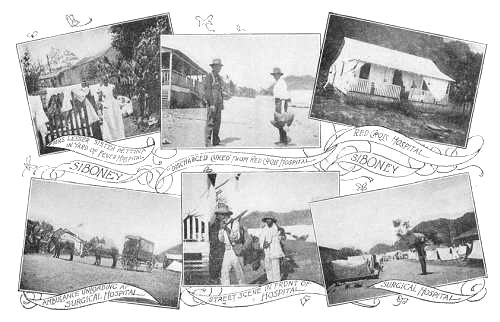
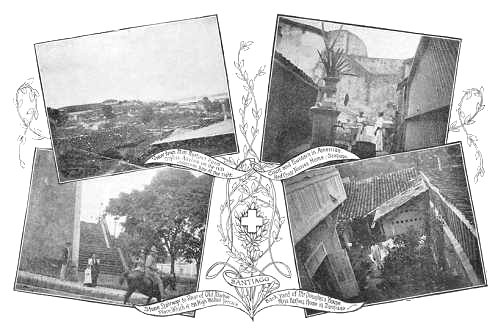
Having heard that the port of Havana was open, it was natural that our
party should be eager to return there and take up the work that we had
been compelled to relinquish during the previous spring. The only means
of transportation that was at our disposal to use in reaching Havana was
the schooner “Mary E. Morse,” and as she had been already destined for
another port, and was withal so slow that she would not have served our
requirements, we had no other recourse than to appeal to the
government. Miss Barton accordingly telegraphed President McKinley,
asking for the use of a transport, and he promptly placed at her
disposal the Morgan Line steamer “Clinton,” which was then in the
government service. Within the following four days we loaded the
“Clinton” with thirty-four mules that had been sent to us by one of the
Red Cross auxiliary committees of New York, and about three hundred tons
of general stores, which we hoped would serve as a starter in the
distribution at Havana, other supplies having been promised to meet us
at that place.
We sailed away from Santiago on the afternoon of August 21, and after a
pleasant voyage we arrived at Havana on the morning of the twenty-fifth.
We learned on entering the harbor that we were as much in Spanish waters
as we had been during our previous sojourn in Havana, and that there was
no marked change in anything. The same customs’ officers whom we had
known before the war boarded our boat, and we were treated with the
old-time courtesy, but there was no let up in the rigid enforcement of
all the requirements of the law; the necessary clearance papers,
manifests, etc., being demanded. As we were on a government transport,
and carrying a cargo intended for charitable distribution, we expected
to be admitted without hindrance or ceremony, but we were disappointed.
We were informed that we should have to pay full duties on our cargo,
which amounted to as much as the original cost of the goods; and that as
we had failed to make a specific manifest of every article we had on
board we must pay a fine of five hundred dollars before we should be
allowed to land our cargo or to leave the harbor.
Miss Barton called upon the Governor of Havana, who received her with
great urbanity, but when she told him the nature of her visit he
insisted that there was no need of aid in that city, that there was no
suffering, that the people were all well fed and had been all through
the blockade. This call was very courteously returned by the general and
staff.
No possible endeavor was omitted that gave any hope of enabling us to
land our cargo, and we brought every influence to bear that we could
command. After a couple of days had elapsed one of the government
officials came aboard our ship and told Miss Barton that the Colonial
Council had held a meeting, and that its members had voted to take the
amount of money needed from some special fund that was available and pay
the duties on the cargo of her ship, provided she would turn it over
to their agents to distribute. Finding that there was no likelihood of
any better terms being offered Miss Barton decided that it was useless
to remain longer. Then again, the American Evacuation Commissioners were
expected to arrive in a few days, and it was thought that the presence
of this boatload of Cuban relief might be an embarrassment to them in
dealing with the Spanish commission, and that we had better pay our fine
and quietly withdraw until such time as we might return without
hindrance.
During our stay in Havana hundreds of the best people of that city,
including Spaniards and Cubans, came aboard the “Clinton” and assured
Miss Barton of their warmest friendship and heartiest welcome, and it is
believed that they did their utmost to persuade the officials to allow
Miss Barton to resume her work in Havana. They told the most harrowing
stories of the suffering in and about the city, and they said that with
the exception of some “soup houses,” which the government was
ostentatiously supporting, and which gave out to the poor, miserable
sufferers who called for it a small quantity of an alleged soup, in
which there was not enough nourishment to keep a chicken alive, there
was no other distribution of food, and that people were daily dying in
the streets. We knew that this was true, as we all had seen scores of
these people every time we had gone ashore.
On September first we paid our fine of five hundred dollars and arranged
all other matters, so that we were ready to sail at seven o’clock that
evening, and with many regrets, we started for Egmont Key, Florida,
where we knew we would have to go into quarantine, before entering the
United States.
As our ship’s charter would expire on September 7 and she ought to be in
New Orleans, where she belonged, on that date, it was decided to unload
her cargo of goods at Egmont Key, and have it transferred from there to
Tampa. The mules were to be left aboard, and taken to New Orleans, where
they had been purchased.
Captain Wertsch and the entire crew of the steamer “Clinton,” having
exerted themselves to make all of our party comfortable and happy, and
having succeeded in an eminent degree, Miss Barton was pleased to make
acknowledgment of their courtesy in a letter, a copy of which follows.
On Board Steamer “Clinton,”
En Route Havana to Egmont Key,
September 1, 1898.
Capt. P.C. Wertsch, Steamer “Clinton:”
Dear Sir:—As we draw near the end of our voyage on the steamer
“Clinton,” I cannot refrain from giving expression to the feeling of
satisfaction and gratitude that all the members of the Red Cross
party entertain for you and your crew. If you have any influence
with the gods of wind and wave, you must certainly have exerted it,
for verily we have been “sailing o’er summer seas” during the past
weeks, and a pleasanter time than we have had could not well be
imagined. It gives me great pleasure to say to you that the uniform
courtesy and consideration that have been shown our people and the
general comfort of the “Clinton” are highly appreciated. We
congratulate the Morgan Line on having such a ship and such a crew.
In saying good-bye, permit me to thank you most heartily for your
many kindnesses and your unfailing courtesy, and to wish you and all
the members of your crew a long life and the best of everything in
it.
Sincerely yours,
Clara Barton.
Captain Wertsch replied in the happy manner following:
On Board Steamer “Clinton,”
September 2, 1898.
Miss Clara Barton, President American National Red Cross:
Dear Madam:—Your very kind note, in which you commend my ship and
crew, is received, and I have to return my most grateful thanks. A
commander’s duties not only embrace the safe navigation of his
craft, but the comfort and happiness of his passengers and crew, and
it is a great pleasure to know that my efforts in that direction,
combined with the propitious conditions of the elements, have met
with your approval, and I shall always treasure your approbation as
one of the bright spots in my rather monotonous calling. I esteem it
one of the greatest honors to have as passenger and friend one who
has so distinguished and endeared herself to all the civilized world
by her many years of faithful and never-ceasing devotion to
suffering humanity, and it is my sincere hope that God may grant you
many years more in which to continue your work of love, and that
every success may crown your efforts. I have the honor to subscribe
myself,
Your devoted friend,
P.C. Wertsch, Captain.
We arrived at Egmont Key on the morning of September 3, and the party
went into camp for a five days’ quarantine, which, barring the heat and
mosquitoes, was rather a pleasant rest after the worry and suspense of
the past week. Dr. Geddings, of the Marine Hospital Service, the surgeon
in charge of the quarantine station, did everything in his power to make
our stay agreeable, and he succeeded far better than we had anticipated.
As our party was about to break up, after a pleasant union of seven
months, in which we had become like one family, and had conceived a
mutual esteem and regard for each other, it seemed fitting that some
little expression of good feeling should be manifested in a way that
would be lasting and memorable. The following address to Miss Barton was
accordingly drawn up, signed by all the members present and read to her:
To Miss Clara Barton.
Now that our work has ceased for a time, and our party which has
labored so long and so harmoniously together, is returning home, we,
the members of the Cuban relief expedition, desire to express to
you, our leader, as delicately and fittingly as may be, our
unbounded confidence and admiration, and our sincere and heartfelt
gratitude and love. As we look back over the past few months, and
recall the many scenes of suffering and death that we have
witnessed, and remember how ceaselessly, faithfully and tirelessly
you have worked, and how much you have accomplished under the most
unpromising circumstances, our wonder grows and we cannot help but
reverence and admire your wisdom, patience and industry. No more
trying position than you have occupied during the past seven months,
could well be imagined, and no one not possessed of nerves of steel
and of ripest wisdom and the rarest judgment, combined with a
purpose as fixed as the stars could have made the great success that
you have made of the work we had in hand. When it is remembered how
many thousands of brave soldiers have been saved from suffering and
death through your efforts, and how many starving and sick people
have been brought back to health and happiness, and all with so
little cost of actual money, our warmest admiration is excited, and
we cannot withhold that praise which you so justly deserve.
Personally each of us wishes to express his or her acknowledgment of
your unfailing kindness and interest in our comfort and general
welfare, and we have to thank you for thousands of those little
considerations of word and look that go so far to brighten one’s
thoughts and make life a pleasure. We all have the greatest
satisfaction in knowing that all the work we were permitted to do
has been done with thoroughness and economy, and we are vain enough
to think that no one could have done more under the conditions that
existed. We shall soon separate and go our several ways, and it will
be with the deepest sorrow and regret that we shall say good by to
our leader; but throughout life it will always be a pleasure to call
to mind her image and remember all the happy moments we have passed
with her. So in parting, it will no doubt be a satisfaction to you
to have the assurance that you hold our warmest love and good will,
and that at any time each and all of us will be ready to serve you
in any way that lies within our power.
A. Von Schelle,
Membre du Comité Directeur de la Croix Rouge de Belgique, Membre de
l’Association Nationale de la Croix Rouge des Etats Unis l’Amerique.
J.B. Hubbell,
General Field Agent of the American National Red Cross.
E. Winfield Egan,
Surgeon American National Red Cross.
C.H.H. Cottrell,
Financial Secretary.
Lucy M. Graves,
J.A. McDowell,
Chas. R. Gill, M.D.,
C.D. Cottrell,
Annie M. Fowler,
J.K. Elwell,
Geo. J. Hassett.
At the conclusion of this kind and just tribute to our beloved leader
there was a moment of profound silence, our feelings being too deep for
utterance. At length, when Miss Barton had subdued her emotions
sufficiently to speak clearly, she responded in most graceful terms,
expressing her warm and sincere appreciation of the work performed, and
the loyal support that had ever been accorded her; that no words could
fully express the gratitude she felt for this thoughtful little memento
of our comradeship, and she should prize it quite as much as any badge
or decoration she had ever received.
Farewells were said, and the party separated, going to their several
homes; and so ended our first Cuban expedition.
It is a very hard matter to express in dollars and cents the value of
the relief distributed, as it was all donated in either material or
money which was turned into material; and the kinds were so varied, the
market value so fluctuating, and the data so scattered, that only an
approximation can be ventured. It is probably underestimating the amount
of relief stores that have been sent to Cuba by the Central
Cuban Relief Committee and the American National Red Cross to place it
at six thousand tons, approximating in value half a million dollars in
New York. Had these same goods been bought in Cuba, their cost would
easily have been doubled.
In estimating the cost of distribution great difficulties present
themselves, as large numbers of laborers, sometimes as many as two
hundred per day were paid in food taken from the stores; but such labor
can only be paid in that way while the need is extreme; and the moment
the direst wants are satisfied money is demanded for every service.
We found a considerable number of people who had once been wealthy, but
who were utterly helpless after being despoiled of their riches, and
gave up in despair, and would have died without making any adequate
effort to save themselves, had not relief been brought to them. There
were, however, many sterling families who had cast their fortunes with
the revolution; had sacrificed everything for “Cuba libre,” and were
willing to give life itself, if necessary; these people accepted relief
reluctantly and sparingly, and with warmest gratitude.
For nearly two months after our arrival in Havana the entire expenses of
the relief work were borne by Miss Barton from her private purse. It is
but just to state that when this fact was discovered, by the committee
the money was refunded. Then the Central Cuban Relief Committee began to
furnish her with means which came thereafter in abundance, and nothing
that was needed that money could procure was ever omitted. Volunteers
for work were plentiful, but they were generally without experience and
therefore not available. For this reason, and considering the magnitude
of the work to be attempted and the celerity with which it must be
carried on in order to be effective, it was necessary to override a
time-honored precedent of the Red Cross, and pay salaries to certain
grades of professional workers who could not be obtained otherwise. It
should be stated though, that all these people who were engaged required
no more money than was sufficient to meet the necessities of those who
were dependent on them; and the few salaries that were paid were very
low considering the high grade of ability that was secured.
The first funds sent for our use were in drafts payable in Spanish gold
at Havana. Gold was then held at a premium of about thirty-five per cent
over Spanish silver, with which the greater part of the ordinary
business of the country was carried on.
On entering Santiago we found both American and Spanish money
in circulation, and consequently considerable confusion resulted on
account of the fluctuation in values, there being no established
standard. The military governor made an arbitrary ruling that there
should be a premium of one hundred per cent on American money over
Spanish silver, or, in other words, that one dollar in American money
should be worth two dollars in Spanish silver. Spanish gold and American
gold were on a par in ordinary transactions of limited amounts, but in
large amounts American gold was worth a small percentage more than the
Spanish.
While we were in Santiago our supply of condensed milk ran short, owing
to the large amount that was used in the hospitals. Fortunately there
was at that time in the harbor a merchant ship loaded with groceries
which could not be disposed of satisfactorily, and we were able to
purchase at a very reasonable figure quite a large amount of that
greatly needed delicacy, and continue filling all requisitions.
The following is a statement of our accounts at the end of the
expedition:
Financial Statement.
| Central Cuban Relief Committee, cash | | $11,296.55 |
| Contributions | | 172.93 |
| Exchange | | 236.83 |
| Household Expenses | $1,521.41 | |
| General Expenses | 2,040.92 | |
| Cuban Relief Expenses | 3,699.79 | |
| Traveling Expenses | 968.22 | |
| Telegrams | 105.02 | |
| Office Expenses, Stationery, etc. | 22.45 | |
| Salaries | 2,541.24 | |
| American National Red Cross Relief Committee Army | 807.26 | |
| | $11,706.31 | $11,706.31 |
The expense accounts will generally explain themselves by their titles,
with a few exceptions which will be noted. “Cuban Relief Expenses”
covered all charges for labor outside of that performed by our own
party, and for supplies, etc., that were purchased outside of those we
had brought from New York. “American Red Cross Expenses” included
expenses of nurses and hospitals on account of army work, as distinct
from Cuban relief work; also the maintenance of forty mules that had
been sent us by that organization. “Household Expenses” covered house
rent, servant hire, and maintenance of the entire party, which numbered
as high as thirty people at times, and averaged twenty most of the time,
making an average of less than $2.50 expense per week for each person.
“General Expenses” included work on hospitals and other buildings
necessary to make them habitable and comfortable, and all other expenses
not properly chargeable to any other account.
On an estimated distribution of relief supplies, valued at half a
million dollars, the cost of distribution, covering a period of seven
months, exclusive of the charter price for the steamer “State of Texas,”
amounts to less than three per cent of the value of the goods
distributed.
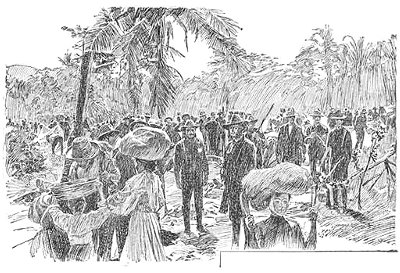
REFUGEES FROM SANTIAGO.