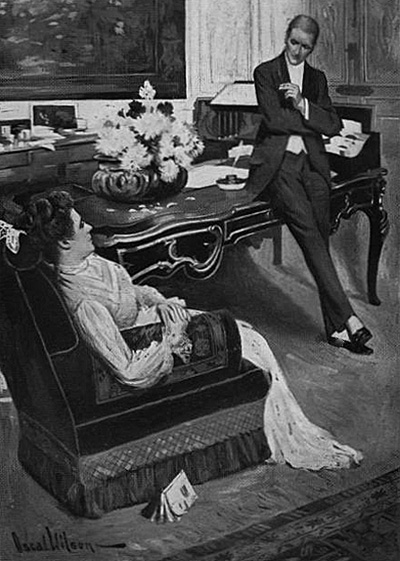
THE LAST MEETING
The days that followed were some of the happiest
of my life. There was, as may be imagined, more
than ordinary delight in having been the instrument
of that marvellous change from sorrow to joy, and
such joy, the like of which it has been few men’s luck
to witness. Then came the happiness of my betrothal,
and the sunny days seemed to glide by with scarcely a
cloud on our horizon. And, as though everything
conspired to complete our happiness, one that did seem
in our graver moments to threaten, was suddenly dispersed.
One morning I saw in an Italian newspaper a
paragraph to the effect that the Count von Rallenstein
had on the previous day been seized with a
paralytic stroke, and that the famous Chancellor’s state
of health gave occasion for considerable anxiety.
Under the circumstances we could hardly pretend
to take as anything but good fortune the news that
the ruthless, vindictive autocrat’s power for harm was
practically at an end. From Von Lindheim, now safe
in Paris, I had received news; the end of the Chancellor’s
reign would make all the difference to him;
for, however matters might have otherwise changed
(as by the failure of Rallenstein’s marriage scheme),
he would never have dared to risk a return to his
native country under the old régime. I sent the good
news to my friend, with a suggestion that he should
join us at Verona. Strode, now well again, was expected;
naturally Asta’s parents were most anxious
to make his acquaintance and thank him personally
for the indispensable part he had taken in the rescue.
We were going to be a very happy and merry party;
but the night before our friend’s arrival a startling
event happened which showed me on the brink of what
an awful danger we were trifling.
That night we were invited to a rather grand reception
at the Guacini Palace. Naturally the rooms
were crowded, so crowded that Asta and I made our
way from the crush, and finding a little room leading
out of one of the salons we sat there cosily, out of
touch, yet in sight of the restless crowd just beyond.
“What a change,” Asta remarked, “in my hopes,
in my life, from only a few days ago. Think of me
in that dismal room, a prisoner expecting every time
the door opened that death would enter. Could I ever
have dreamt to have seen the world again like this?”
“You must not let your mind run on that gloomy
time now that it is so happily past,” I remonstrated,
clasping the hand which was slid into mine. “We
have now only joy to look forward to, for it shall not
be my fault if the future does not compensate for all
you have gone through. It is hard, but you must try,
dearest, to dismiss it all as a hideous dream.”
“We are going to be so happy,” she said lovingly,
“that I am sure as time goes on I shall think less of
those terrible days. But can I forget them without
ignoring a certain dear brave Englishman who——”
I stopped her. “Asta, I wish you would forget that
part of our acquaintance. I don’t want you to love
me for that.”
She laughed. “For that only, you mean, sir.
But as to forgetting one little incident—no; not if by
that I might have no recollection of my terror and
sufferings. And now all is life and joy again. A few
days ago I had nothing before me but the choice of
death—or worse.” She shuddered. “Of becoming
the Countess Furello; the wife of a murderer. Can I
ever thank you, ever love you enough? It is so hot
here,” she said, after a pause which was not altogether
blank; “let us come and see whether we can
find our way to the garden.”
As we rose I noticed that a jewel in her hair had
become disarranged and was in danger of falling out.
She turned to a great mirror on the wall and made the
ornament fast. Suddenly, as she turned again, she
gave a little half-gasping cry. I thought she must
have hurt her head with the pin of the ornament, but
soon saw that her cry had been called forth by something
much worse than that, for she clasped my hand
convulsively, and for some moments seemed speechless
for very terror. At length she could answer me, in
a frightened whisper:
“Furello! I saw him there as I turned from the
glass. His face there, looking in at us. He is here.”
“Here!” I echoed incredulously, though with an
uneasy feeling that the thing was quite possible.
“Here, yes; I saw the hateful face in the doorway, I
tell you. He looked into this room, only for a
moment. Jasper, my darling, you will save me from
him, will you not?”
I reassured her as best I could, both on that point
and on the likelihood of her being mistaken. “Your
mind is full of the man,” I argued. “Some one resembling
him looked in, and your nerves not having
quite recovered made you think it was he.”
But she insisted; she was sure. “Do you suppose
I could ever be mistaken in that face?” she said.
“It was Count Furello.”
“But what should he be doing here?” I reasoned.
“Here in one of the most exclusive gatherings in
Verona. His evil reputation is such that no decent
countryman of his own would know him. Of that you
may be sure. And to think that Prince Guacini
would admit him across his threshold is absurd.”
Reason as I would, nothing would shake her conviction
that it had been Furello and none other that
she had seen. It was distressing to me to see the
mortal fear into which the sight, fancied or real, had
thrown my darling.
“I will settle this at once,” I said. “Come back
to your father while I search the rooms. If the
Count is here I will find him. But I think it far
more likely I shall light on the double who has
frightened you.”
She clung to me as we made our way through the
crowd to where her parents were sitting. So far no
one in the least like Count Furello came under my
notice, though I kept a sharp look-out on all sides.
I gave General von Winterstein a hint of what had
happened, and with a word of encouragement to Asta
went off on my search.
It was vain. The thorough scrutiny I made in the
rooms and all likely and unlikely places in the palace
showed me no Count Furello or any one resembling him
closely enough to have deceived Asta. One man,
indeed, I pitched upon as being perhaps sufficiently
near to the Count’s general appearance to have suggested
that arch villain, especially when seen casually
for a moment. But upon my pointing him out to
Asta she was quite convinced that he was not the man
she had seen, and that it had indeed been
Furello.
The episode, mysterious and disquieting enough,
seemed suddenly to plunge us from an unclouded happiness
and confidence into fear. Not that there was
any danger of open violence there. It was quite
certain that if Furello was really among the guests, a
word to the Prince would be enough to have him
turned out not only of the palace but probably of the
country. The worst part of it was, though, that the
Count’s methods were essentially cunning and secret;
had he been an open enemy there would have been
little ground for fear.
I was inclined, however, to regard the whole affair as
the effect of Asta’s unstrung nerves. Rallenstein was
now practically hors de combat, and it was scarcely
likely that the Count would have ventured to follow
us with any sinister purpose on his own account. The
idea in my mind was that he was somewhat of a
coward who required the impelling will of a stronger
man behind his fell enterprises.
For the rest of the time I stayed at the palace I did
not cease to look about for the man; had he been
there I certainly must have lighted upon him. The
report of my fruitless search at last reassured Asta a
little, and when I parted from her at her aunt’s house I
was glad to see that she seemed to have got over the
worst of her fear. We had arranged to meet Strode
next day, and I turned towards my hotel full of
pleasant anticipations.
When I arrived there it was past midnight; a sleepy
porter let me in, and I went straight to my apartment,
which consisted of a sitting-room, with a bedroom,
en suite. Here I found a long letter awaiting me from
Von Lindheim. Tired as I was, I lighted the candles
on my table and began to read it, being eager to know
what his plans were. This was the first letter of any
length I had received from him; it was closely written,
and contained an account of the incidents of his long
journey, including some narrow escapes he had had
from being detected and falling into the hands of
Rallenstein’s emissaries. I had drawn a chair to the
table and sat down to study the closely-written pages,
when, in turning over one and raising my eyes to the
beginning of the next, they caught on the opposite wall
an arresting movement, a stirring of the shadow
thrown by a full moon on the opposite wall. My
back was to the window, and the phenomenon betokened
that the drawn curtains behind me were being
stealthily moved apart. Realizing this, I raised the
letter to the level of my eyes, as though it were difficult
to decipher. Looking over the paper, I watched
the wall before me. Slowly the streak widened, and
in the middle there appeared a shadow—the form,
unmistakably, of a man’s head, framed, as it were,
in the aperture.
Then, with a thrill, I knew that a crisis, the most
desperate of all, had come. Assuredly nothing but
sheer presence of mind was between me and death.
This thought nerved me; every moment now was
critical. A suspicious movement on my part would
mean a bullet through me; before I could turn I
should be a dead man. My one chance lay in taking
my concealed enemy by surprise.
“Tchut! I do wish, my dear friend, you would
write legibly,” I said aloud. “Was there ever such a
fist! I shall have to get a reading-glass to you, mein
Herr. Let’s see, there was one on this table.”
Muttering thus, always distinctly enough for my
words to be heard, I moved away quickly and crossed
to a little writing-table that stood in the corner of the
room. By this I was somewhat out of that uncomfortable
direct line of fire. The bell was at the other
side of the room; to have attempted to reach it would
have been madness. Making a pretence of seeking the
glass among the nick-nacks on the writing-table I was
able to get out my revolver, which events had now
taught me never to be without.
“Ah, here it is!” I said, going back as to my chair.
Next instant, by a quick movement, I had turned
and flung aside the curtain, my revolver covering the
place where I knew the intruder must be.
“Count Furello!” I cried. “Come out and show
yourself, you cowardly villain!”
I do not know why my revolver hung fire, for I had
resolved to shoot him on sight. But the moment’s
hesitation as I brought the Count—it was he—to view,
showed him to me standing against the window with
dropped hands, and none of the expected signs of
attack. I could not shoot, even him, like that; if
only he had made the slightest aggressive movement I
would not have hesitated. As it was I stayed looking
at him. He stood there quite motionless, his arms by
his side, and, so far as I could see, with no weapon in
his hand. His face looked absolutely white, the mouth
was drawn behind the bristling moustache into the
suggestion of an ugly grin, not reflected in the eyes,
which glittered with repressed viciousness.
I think we must have stared at one another for
some seconds before I spoke.
“What are you doing here, Count?”
The grin deepened. “A scarcely necessary question.
You are going to shoot. Please don’t delay.
I am ready to pay the penalty of my rashness and your
superior—luck.”
The hatred with which he spoke the last words was
indescribable.
“You will have to pay the penalty,” I said, trying
to bring myself to press the trigger. His face was
calm now except for the gleam of desperation in his
eyes. My better judgment told me to send a bullet
through that scoundrel’s heart, yet I paused, perhaps
in the very certainty that the heart was covered by my
pistol.
“We are rivals, it seems,” Furello said calmly.
“May we not settle our differences in the approved
fashion?”
“Rivals! you and I!” was my scornful answer.
“Was that your intention, Count?”
He gave a shrug and a look of devilish mockery.
“I had not made up my mind. I have not an Englishman’s
good fortune. But it is plain that the time for
one of us has arrived.”
In talking to me like this he must have felt pretty
confident of the difference between my nature and his
own; had the positions been reversed, little time
would he have given me for parley, except, perhaps, as
a cat prolongs a mouse’s agony. I had evidently
taken him by surprise, and so at a disadvantage; no
chance was left for him but to calculate upon my
sense of chivalry. Chivalry with that murderous
reptile! I wonder how I allowed such a consideration
to influence me; but somehow it seemed hard to pull
the trigger in cold blood.
“Will you give me a chance, my dear Tyrrell?” he
demanded again, but without the ugly grin. “Or
are you going to shoot me here as I stand defenceless?
If so, for Heaven’s sake be quick about it.”
Instead of taking him at his word, I, like a fool,
began to retort. The thought of Asta and all this
loathsome brute had made her suffer came to my mind
with the recollection of the pitiable state of fear she
had shown that evening.
“Chance!” I cried. “What chance did you mean
to give me when you pressed me to eat poisoned sweetmeats
at your cursed table? What chance was I to
have in that assassin’s room you gave me to sleep in?
What chance did you give that poor priest whom you
decoyed to your devil’s den—the man who, three hours
after, was lying in his grave in the wood. You talk
to me of—ah! you——!”
He had suddenly stooped and made a desperate
rush at me. Perhaps he saw that I was working
myself up to do what I should have done long before.
No doubt my vehemence had relaxed my alertness.
His move was a clever one, for in his stooping position,
he offered a much worse mark for a shot, and greatly
reduced the certainty of a mortal wound. In that one
fierce crouching spring he was upon me and at close
quarters, while my advantage was almost gone. I
must have fired, but have no recollection of the shot.
I only know that each seized the other’s right wrist
with the left hand. So he was safe from my revolver,
and I from something I could see shining in his grasp.
I think the feeling uppermost in my mind at that
supreme moment was one of bitter disgust at my own
folly; but, after the first pang of discomfiture there
was no room for any thought but of mastering the
human hyena that had fastened on me. It was
evident to me that I was the stronger and more athletic
man, but then my adversary had the strength of
desperation; he had gained the first advantage, and
would naturally fight like a demon.
It was scarcely a violent struggle at first. We stood
for a while wrestling warily, confining our efforts
almost entirely to the arms. I can see now Furello’s
horrible face close to mine; it was as though in those
critical moments every evil passion of his life, every
crime, every knavery, sprang its index into his countenance.
If ever the Devil looked out of a man’s eyes,
there he was in that glare of desperate vicious hatred
and rage. Soon I put forth a greater effort, and to my
relief it confirmed the idea that my adversary’s strength
was less than my own. I forced him backwards step
by step till I held him against the wall. Suddenly he
pressed himself close against me, struggling furiously
to force towards me the hand I held. In it was an
object which scarcely suggested a weapon. A short
metal instrument, square at the butt and tapering to a
very fine point. I could not tell what it actually was,
but the fact of the Count’s using it was enough to give
me a shrewd idea of its purpose. At any rate I thought
I would make trial of its effectiveness on its owner.
So, holding away from the sting-like point, I forced
Furello round from the wall, then against the table,
then backwards upon it, where naturally he was at
my mercy. Then I set myself to force down the hand
with its mysterious weapon upon him. As he realized
my intention he, even at the disadvantage of that
almost helpless position, struggled with such convulsive
fury that for a time he baffled my purpose.
Then gradually my greater strength told, the point
was forced down till it entered his cheek.
“A——h!”
Such a cry, as the stylet dug into the flesh. The
grip on my revolver hand relaxed so that with a sharp
wrench I could release it. The fingers of the Count’s
other hand still rigidly clutched the strange weapon.
I had now the pistol free and pressed to his temple.
“Let go!” I said, “or I’ll blow your brains
out!”
“Shoot!” he cried. “Shoot! I defy you,
cursed Englishman! You dare not!”
He raised his head and tried furiously to bite my
hand. I beat his head back with the revolver and
drove by sheer weight the stylet into his neck. He
screamed and wriggled like a wounded animal, but I
had no pity for him, only heartily wishing the part I
was forced to play had fallen to another man’s lot.
As I held him there an idea crossed my mind and
determined me to get from him the murderous little
weapon which he held so tenaciously. After a sharp
struggle I succeeded in unloosening the nervous fingers,
and, obtaining possession of the instrument, flung it to
the farther end of the room.
The Count now lay absolutely still, except for his
heaving chest. Suspicious of his further power for
mischief I began to feel for any weapon he might have
about him. There was a revolver in a pocket of his
coat. I took it out, and then drew a little away,
contenting myself with watching keenly for any suspicious
movement.
He lay quite passive on the table just as I had forced
him down: on his back with his legs dangling, his feet
scarcely touching the floor. It seemed as though all
the fight was beaten out of him. The situation was a
hideous one for me, and I began to speculate how long
it would last and how it would end, when suddenly a
convulsive shudder seemed to run through the man as
he lay before me. His hands opened and clenched
thrice, then another convulsion shook him and he called
me by name.
“Shoot me!” he gasped in a voice thick and
hardly recognizable. “If you are a man send a bullet
through me and put me out of my agony.”
The conjecture in my mind now became a certainty;
I returned no answer; simply waited in silence.
Another spasm seemed to madden him.
“Shoot me! Shoot me, curse you!” he cried,
breaking out into a string of hideous imprecations.
I said nothing, and sat quite still.
“Tyrrell!” he screamed; and then, by what
seemed a terrible effort, sat upright.
I sprang from my chair in horror. The face,
which had been hidden from me as he lay, was now
dark purple, almost black. The blazing eyes protruded
from their sockets, the swollen lips, jet black
were drawn back into a frightful grin; the man was a
human being no longer; it seemed as though he were
already a devil, as hideous as the imagination of man
ever conceived. The sight brought back to me poor
Szalay’s appearance in his death agony, but the effect
of the poison here was indescribably more fearful.
For the first time in that perilous half-hour I felt
fear—sickening fear. The thing opposite to me was
so unutterably loathsome that the very idea of his
breath reaching me was horrible. I recall that in sheer
panic, I raised my revolver, but before I could fire, the
Count, with a sound of words which the tumid tongue
would not utter, fell back. I could endure the terrible
sight no longer, but rushed from the room, locking
the door behind me. When I had roused the hotel
people and the door was opened again, Count Furello
lay still on the table—dead.
So perished this villain by the horrible means he had
prepared for me. When I think of that hideous death,
the idea of my narrow escape sends a shiver through
me. When we came to examine the lethal instrument
which inflicted it, we found it to be a hollow stiletto
with a collapsible handle, this forming a receptacle for
the virulent poison with which it was charged. A
slight prick, as it must have been in the case of poor
Szalay, would be enough to cause death, and the
venom acted so rapidly that a remedy was out of the
question. A very pretty and effective implement of
the great Chancellor’s vaunted statecraft!
It appeared that the Count had taken a room on the
same floor, whence it had been easy for him to slip
into mine and await my return. But Von Lindheim’s
letter saved me.
There was, of course, an inquiry into the facts of that
strange and appalling tragedy. Happily for me, all
the circumstances confirmed my straightforward story,
which was further corroborated by the dead man’s
antecedents. It appeared that before he quitted Italy
several mysterious deaths of the same character as
this one had occurred, with which he had seemed
closely connected; but nothing beyond strong suspicion
had been fastened upon him.
But at last the terribly appropriate retribution
had overtaken him; and surely no man had ever
greater cause than I to be thankful for the gift of a
strong arm and an athletic frame.
With that night the story of my series of adventures
ends. I had certainly had my fill of them, and ever
since then my appetite for that sort of thing has been
considerably less keen. But apart from the more
selfish advantage I derived, the winning of a most
charming wife, it has always been a satisfaction to me
to reflect that what I did served a useful purpose in
ridding the world of a gang of precious villains. I
have since visited the Monastery of St. Tranquillin in
the Geierthal; it is now the innocent abode of a prosperous
farmer, who occasionally entertains stray
sportsmen in rather different fashion from his predecessors,
and is, happily, ignorant of what lies beneath
the ground he plods over, or the dark history of
the rooms in which his children play.
After the death of Count Rallenstein the rule of the
Jaguar was known no more, and Von Lindheim, after
spending several months with us in England, was able
to return to his estate, there to live in peace and safety.
From the subsequent marriage of the poor Princess
Casilde there sprang, as every student of European
affairs knows, the consort of one of the most illustrious
rulers; but the keenest and most diligent of students
has never found the name Von Orsova in her family
tree, and yet that was undoubtedly the Princess’s
name before her marriage. Still, I have made a
journey, more than once, to lay a wreath on the grave
of the handsome Rittmeister von Orsova, the man
whose fate, though it brought terror and death to
others, yet gave supreme happiness to me.
THE END
London: Ward, Lock & Co., Limited.
WARD, LOCK & CO.’S
Sevenpenny Net Novels
Cloth Gilt. With frontispiece, and attractive coloured
wrapper, 7d. net.
Fiction-lovers have welcomed the appearance in this
dainty and attractive form of some of the best work of
leading modern novelists. All the stories included are
copyright and of proved popularity. The type is large
and readable, and the neat cloth binding renders the
volumes worthy of permanent preservation.
THE GARDEN OF LIES.
By JUSTUS MILES FORMAN.
The novel with which Mr. Forman attained popularity.
A real romance, full of vigour, passion and
charm.
ANNA, THE ADVENTURESS.
By E. PHILLIPS OPPENHEIM.
Mr. Oppenheim excels himself in this story, which
has been the most successful of all his novels.
RAINBOW ISLAND.
By LOUIS TRACY.
“Should be hailed with joyous shouts of welcome.”—The
Literary World.
THE IMPOSTOR.
By HAROLD BINDLOSS.
Will live and always rank as its author’s most
powerful and engrossing work.
THE DUST OF CONFLICT.
By HAROLD BINDLOSS.
Another excellent story of adventure comparable
to its Author’s great success “The Impostor.”
TWO BAD BLUE EYES.
By “RITA.”
A delightfully charming and exciting story of
strong human interest.
MR. WINGRAVE, MILLIONAIRE.
By E. P. OPPENHEIM.
A rattling good novel of remarkable power and
fascination.
THE CORNER HOUSE.
By FRED M. WHITE.
Crammed with sensation and mystery—an excellent
romance that will be eagerly read.
IN STRANGE COMPANY.
By GUY BOOTHBY.
A capital novel of the sensational-adventurous
order.
THE SPORTING CHANCE.
By A. & C. ASKEW.
A bright and alluring story that is well worth
reading.
THE GOLD WOLF.
By MAX PEMBERTON.
Throbbing with interest and excitement from
start to finish.
THE BEAUTIFUL WHITE DEVIL.
By GUY BOOTHBY.
A more exciting romance no man could reasonably
ask for.
WHEN I WAS CZAR.
By A. W. MARCHMONT.
A really brilliant novel, full of dramatic incident
and smart dialogue.
THE CRIMSON BLIND.
By FRED M. WHITE.
One of the most ingeniously conceived detective
stories ever written.
THE LODESTAR.
By MAX PEMBERTON.
A fine and distinguished romance.
IN WHITE RAIMENT.
By WILLIAM LE QUEUX.
Absolutely the most puzzling and enthralling of
Mr. Le Queux’s many popular romances.
NOT PROVEN.
By ALICE AND CLAUDE ASKEW.
The finest emotional and entertaining story these
authors have written.
YOUNG LORD STRANLEIGH.
By ROBERT BARR.
“The most amusing and at the same time the
most exciting novel of the year.”—Manchester
Courier.
THE MOTHER.
By EDEN PHILLPOTTS.
“This is Mr. Phillpotts’ best book,” said The Daily
Telegraph.
A STUDY IN SCARLET. (The first book about Sherlock Holmes.)
By A. CONAN DOYLE.
“One of the cleverest and best detective stories
we have seen.”—London Quarterly Review.
A MAKER OF HISTORY.
By E. PHILLIPS OPPENHEIM.
Mr. Oppenheim’s skill has never been displayed
to better advantage.
BUCHANAN’S WIFE.
By JUSTUS M. FORMAN.
A thoroughly fine book from start to finish.
THE PILLAR OF LIGHT.
By LOUIS TRACY.
A wonderfully fascinating and breathlessly exciting
story, told in Mr. Tracy’s best style.
A BID FOR FORTUNE.
By GUY BOOTHBY.
The first and best of all the exciting adventures
of Dr. Nikola.
THE DAY OF TEMPTATION.
By WILLIAM LE QUEUX.
An enthralling mystery tale.
THE SECRET.
By E. PHILLIPS OPPENHEIM.
“One of the most engrossing stories we have
read.”—Daily Telegraph.
A DAMAGED REPUTATION.
By HAROLD BINDLOSS.
“Once more we repeat that Mr. Bindloss has
stepped into the shoes of the late Seton Merriman.”—Daily
Mail.
THE SOUL OF GOLD.
By JUSTUS MILES FORMAN.
This story has been acclaimed by The Daily
Telegraph as worthy of much praise and cleverly
worked out.
THE MARRIAGE OF ESTHER.
By GUY BOOTHBY.
A story full of action, life, and dramatic interest.
LADY BARBARITY.
By J. C. SNAITH.
“‘Lady Barbarity’ would cheer a pessimist in a
November fog.”—Black & White.
BY WIT OF WOMAN.
By A. W. MARCHMONT.
The ingenuity of this exciting story positively
takes one’s breath away.