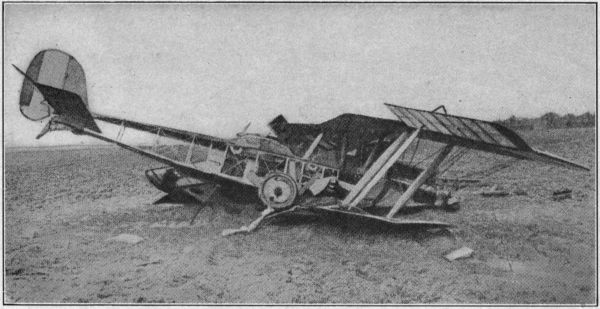
Schäfer Lands Between the Lines
WE went on a shooting expedition on the
twentieth of April. We came home
very late and lost Schäfer on the way.
Of course everyone hoped that he would
come to hand before dark. It struck nine,
it struck ten, but no Schäfer was visible. His
benzine could not last so long. Consequently,
he had landed somewhere, for no
one was willing to admit that he had been
shot down. No one dared to mention the
possibility. Still, everyone was afraid for
him.
The ubiquitous telephone was set in motion
in order to find out whether a flying
man had come down anywhere. Nobody
could give us information. No Division and
no Brigade had seen anything of him. We
felt very uncomfortable. At last we went to
bed. All of us were perfectly convinced
that he would turn up in the end.
At two o'clock, after midnight, I was suddenly
awakened. The telephone orderly,
beaming with pleasure, reported to me:
"Schäfer is in the Village of Y. and would
like to be fetched home."
The next morning when we were sitting
at breakfast the door opened and my dear
pilot stood before me. His clothes were as
filthy as those of an infantryman who has
fought at Arras for a fortnight. He was
greeted with a general Hurrah! Schäfer was
tremendously happy and elated and tremendously
excited about his adventure. When
he had finished his breakfast he told us the
following tale:
"I was flying along the front intending to
return home. Suddenly I noticed far below
me something that looked like an infantry
flier. I attacked him, shot him down, and
meant to fly back. However, the English in
the trenches did not mean me to get away
and started peppering me like anything. My
salvation lay in the rapidity of my machine,
for those rascals, of course, would forget
that they had to aim far in front of me if
they wished to hit me.
"I was at an altitude of perhaps six hundred
feet. Suddenly, I heard a smash and
my engine stopped running. There was
nothing to do but to land. I asked myself
whether I should be able to get away from
the English position. It seemed very questionable.
The English noticed my predicament
and started shooting like mad.
"As my engine was no longer running I
could hear every single shot. The position
became awkward. I came down and landed.
Before my machine had come to a standstill
they squirted upon me heaps of bullets from
machine guns in the hedge of the village of
Monchy near Arras. My machine became
splashed with bullets.
"I jumped out of it and down into the
first shell hole. Squatting there I reflected
and tried to realize exactly where I was.
Gradually it became clear to me that I had
landed outside the English lines, but cursedly
near them. Happily it was rather late
in the evening and that was my salvation.
"Before long the first shell came along.
Of course they were gas shells and I had no
mask with me. My eyes started watering
like anything. Before darkness set in the
English ascertained the distance of the spot
where I had landed with machine guns. Part
of them aimed at my machine and part at
my shell crater. The bullets constantly hit
its rim.
"In order to quiet my nerves I lit a cigarette.
Then I took off my heavy fur coat and
prepared everything for a leap and a run.
Every minute seemed to me an hour.
"Gradually it became dark, but only very
gradually. Around me I heard partridges
giving a concert. As an experienced shot I
recognized from their voices that they felt
quite happy and contented, that there was
no danger of my being surprised in my hiding
place.
"At last it became quite dark. Suddenly
and quite close to me a couple of partridges
flew up. A second couple followed. It was
obvious that danger was approaching. No
doubt a patrol was on the way to wish me
a happy evening.
"I had no time to lose. Now or never.
First I crept very cautiously on my chest
from shell hole to shell hole. After creeping
industriously for about an hour and a half
I noticed I was nearing humans. Were they
English or were they Germans? They came
nearer and I could almost have fallen round
their necks, when I discovered our own
musketeers. They were a German patrol
who were nosing about in No Man's Land.
"One of the men conducted me to the Commander
of his Company. I was told that in
the evening I had landed about fifty yards
in front of the enemy lines and that our infantry
had given me up for lost. I had a
good supper and then I started on my way
home. Behind me there was far more shooting
than in front of me. Every path, every
trench, every bush, every hollow, was
under enemy fire. The English attacked on
the next morning, and consequently, they
had to begin their artillery preparation the
evening before. So I had chosen an unfavorable
day for my enterprise. I reached the
first telephone only at two o'clock in the
morning when I 'phoned to the Squadron."
We were all very happy to have our Schäfer
again with us. He went to bed. Any
other man would have taken a rest from
flying for twenty-four hours. But on the
afternoon of this very day friend Schäfer
attacked a low flying B. E. above Monchy.
The Anti-Richthofen Squadron
THE English had hit upon a splendid joke.
They intended to catch me or to bring
me down. For that purpose they had actually
organized a special squadron which flew
about in that part which we frequented as
a rule. We discovered its particular aim by
the fact that its aggressive activity was
principally directed against our red machines.
I would say that all the machines of the
squadron had been painted red because our
English friends had by-and-by perceived that
I was sitting in a blood-red band-box. Suddenly
there were quite a lot of red machines
and the English opened their eyes wide when
one fine day they saw a dozen red barges
steaming along instead of a single one. Our
new trick did not prevent them from making
an attempt at attacking us. I preferred their
new tactics. It is better that one's customers
come to one's shop than to have to look
for them abroad.
We flew to the front hoping to find our
enemy. After about twenty minutes the
first arrived and attacked us. That had not
happened to us for a long time. The English
had abandoned their celebrated offensive
tactics to some extent. They had found them
somewhat too expensive.
Our aggressors were three Spad one-seater
machines. Their occupants thought
themselves very superior to us because of
the excellence of their apparatus. Wolff, my
brother and I, were flying together. We
were three against three. That was as it
ought to be.
Immediately at the beginning of the encounter
the aggressive became a defensive.
Our superiority became clear. I tackled my
opponent and could see how my brother and
Wolff handled each his own enemy. The
usual waltzing began. We were circling
around one another. A favorable wind came
to our aid. It drove us, fighting, away from
the front in the direction of Germany.
My man was the first who fell down. I
suppose I had smashed up his engine. At
any rate, he made up his mind to land. I no
longer gave pardon to him. Therefore, I
attacked him a second time and the consequence
was that his whole machine went
to pieces. His planes dropped off like pieces
of paper and the body of the machine fell
like a stone, burning fiercely. It dropped
into a morass. It was impossible to dig it out
and I have never discovered the name of my
opponent. He had disappeared. Only the
end of the tail was visible and marked the
place where he had dug his own grave.
Simultaneously with me, Wolff and my
brother had attacked their opponents and
had forced them to land not far from my
victim.
We were very happy and flew home and
hoped that the anti-Richthofen Squadron
would often return to the fray.[35]
We Are Visited By My Father
MY father had announced that he would
visit his two sons on the twenty-ninth
of April. My father is commander of
a little town in the vicinity of Lille. Therefore
he does not live very far away from us.
I have occasionally seen him on my flights.
He intended to arrive by train at nine
o'clock. At half past nine he came to our
aerodrome. We just happened to have returned
from an expedition. My brother was
the first to climb out of his machine, and
he greeted the old gentleman with the
words: "Good day, Father. I have just shot
down an Englishman." Immediately after,
I also climbed out of my machine and
greeted him "Good day, Father, I have just
shot down an Englishman." The old gentleman
felt very happy and he was delighted.
That was obvious. He is not one of those
fathers who are afraid for their sons. I
think he would like best to get into a machine
himself and help us shoot. We breakfasted
with him and then we went flying
again.
In the meantime, an aerial fight took
place above our aerodrome. My father
looked on and was greatly interested. We
did not take a hand in the fight for we were
standing on the ground and looked on ourselves.
An English squadron had broken through
and was being attacked above our aerodrome
by some of our own reconnoitering aeroplanes.
Suddenly one of the machines
started turning over and over. Then it recovered
itself and came gliding down normally.
We saw, with regret this time, that it
was a German machine.
The Englishman flew on. The German
aeroplane had apparently been damaged. It
was quite correctly handled. It came down
and tried to land on our flying ground. The
room was rather narrow for the large machine.
Besides, the ground was unfamiliar
to the pilot. Hence, the landing was not
quite smooth. We ran towards the aeroplane
and discovered with regret that one
of the occupants of the machine, the machine
gunner, had been killed. The spectacle
was new to my father. It made him
serious.
The day promised to be a favorable one
for us. The weather was wonderfully clear.
The anti-aircraft guns were constantly
audible. Obviously, there was much aircraft
about.
Towards mid-day we flew once more.
This time, I was again lucky and shot down
my second Englishman of the day. The Governor
recovered his good spirits.
After the mid-day dinner I slept a little. I
was again quite fresh. Wolff had fought the
enemy in the meantime with his group of
machines and had himself bagged an enemy.
Schäfer also had eaten one. In the afternoon
my brother and I accompanied by Schäfer,
Festner and Allmenröder flew twice
more.
The first afternoon flight was a failure.
The second was all the better. Soon after
we had come to the front a hostile squadron
met us. Unfortunately they occupied a
higher altitude so we could not do anything.
We tried to climb to their level but did not
succeed. We had to let them go.[36]
We flew along the front. My brother was
next to me, in front of the others. Suddenly
I noticed two hostile artillery fliers approaching
our front in the most impertinent
and provocative manner. I waved to my
brother and he understood my meaning. We
flew side by side increasing our speed. Each
of us felt certain that he was superior to the
enemy. It was a great thing that we could
absolutely rely on one another and that was
the principal thing. One has to know one's
flying partner.
My brother was the first to approach his
enemy. He attacked the first and I took care
of the second. At the last moment I quickly
looked round in order to feel sure that there
was no third aeroplane about. We were
alone and could see eye to eye. Soon I had
got on the favorable side of my opponent. A
short spell of quick firing and the enemy machine
went to pieces. I never had a more
rapid success.
While I was still looking where my enemy's
fragments were falling, I noticed my
brother. He was scarcely five hundred yards
away from me and was still fighting his opponent.
I had time to study the struggle and must
say that I myself could not have done any
better than he did. He had rushed his man
and both were turning around one another.
Suddenly, the enemy machine reared. That
is a certain indication of a hit. Probably the
pilot was shot in the head. The machine
fell and the planes of the enemy apparatus
went to pieces. They fell quite close to my
victim. I flew towards my brother and we
congratulated one another by waving. We
were highly satisfied with our performance
and flew off. It is a splendid thing when one
can fly together with one's brother and do
so well.
In the meantime, the other fellows of the
squadron had drawn near and were watching
the spectacle of the fight of the two
brothers. Of course they could not help us,
for only one man can shoot down an opponent.
If one airman has tackled his enemy
the others cannot assist. They can only look
on and protect his back. Otherwise, he
might be attacked in the rear.
We flew on and went to a higher altitude,
for there was apparently a meeting somewhere
in the air for the members of the Anti-Richthofen
Club. They could recognize us
from far away. In the powerful sunlight,
the beautiful red color of our machines could
be seen at a long distance.
We closed our ranks for we knew that our
English friends pursued the same business
as we. Unfortunately, they were again too
high. So we had to wait for their attack.
The celebrated triplanes and Spads were perfectly
new machines. However, the quality
of the box matters little. Success depends
upon the man who sits in it. The English
airmen played a cautious game but would
not bite. We offered to fight them, either
on one side of the front or on the other. But
they said: No, thank you. What is the good
of bringing out a squadron against us and
then turning tail?[37]
At last, one of the men plucked up courage
and dropped down upon our rear machine.
Naturally battle was accepted although
our position was unfavorable. If
you wish to do business you must, after all,
adapt yourself to the desires of your customers.
Therefore we all turned round.
The Englishman noticed what was going on
and got away. The battle had begun.
Another Englishman tried a similar trick
on me and I greeted him at once with quick
fire from my two machine guns. He tried
to escape me by dropping down. That was
fatal to him. When he got beneath me I
remained on top of him. Everything in the
air that is beneath me, especially if it is a
one-seater, a chaser, is lost, for it cannot
shoot to the rear.
My opponent had a very good and very
fast machine. However, he did not succeed
in reaching the English lines. I began to
fire at him when we were above Lens. I
started shooting when I was much too far
away. That was merely a trick of mine. I
did not mean so much to hit him as to
frighten him, and I succeeded in catching
him. He began flying curves and this enabled
me to draw near. I tried the same
manoeuver a second and a third time.
Everytime my foolish friend started making
his curves I gradually edged quite close to
him.
I approached him almost to touching distance.
I aimed very carefully. I waited a
moment and when I was at most at a distance
of fifty yards from him I started with
both the machine guns at the same time. I
heard a slight hissing noise, a certain sign
that the benzine tanks had been hit. Then
I saw a bright flame and my lord disappeared
below.
This was the fourth victim of the day.
My brother had bagged two. Apparently,
we had invited our father to a treat. His
joy was wonderful.
I had invited several gentlemen for the
evening. Among these was my dear Wedel
who happened to be in the neighborhood.
We had a great treat. The two brothers
had bagged six Englishmen in a single day.
That is a whole flying squadron.[38]
I believe the English cease to feel any
sympathy for us.[39]
I Fly Home
I HAD shot down fifty aeroplanes. That
was a good number but I would have
preferred fifty-two. So I went up one day
and had another two, although it was
against orders.
As a matter of fact I had been allowed to
bag only forty-one. Anyone will be able to
guess why the number was fixed at forty-one.
Just for that reason I wanted to avoid
that figure. I am not out for breaking records.
Besides, generally speaking, we of the
Flying Corps do not think of records at all.
We merely think of our duty. Boelcke might
have shot down a hundred aeroplanes but
for his accident, and many others of our dear
dead comrades might have vastly increased
their bag but for their sudden death. Still,
it is some fun to have downed half a hundred
aeroplanes. After all, I had succeeded in
obtaining permission to bring down fifty machines
before going on leave.
I hope that I may live to celebrate a second
lot of fifty.
In the evening of that particular day the
telephone bell was ringing. Headquarters
wished to speak to me. It seemed to me the
height of fun to be connected with the holy
of holies.
Over the wire they gave me the cheerful
news that His Majesty had expressed the
wish to make my personal acquaintance and
had fixed the date for me. I had to make
an appearance on the second of May. The
notification reached me on the thirtieth of
April at nine o'clock in the evening. I should
not have been able to fulfil the wish of our
All-Highest War-Lord by taking the train.
I therefore thought I would travel by air,
especially as that mode of locomotion is far
pleasanter. I started the next morning, not
in my single-seater "le petit rouge" but in
a big fat double-seater.
I took a seat at the rear, not at the sticks.
The man who had to do the flying was Lieut.
Krefft, one of the officers of my squadron.
He was just going on furlough to recover
his strength, so that it suited him admirably
to act as my pilot. He reached home more
quickly traveling by air and he preferred
the trip by aeroplane.
I started on the journey rather hastily.
The only luggage which I took with me was
my tooth-brush. Therefore, I had to dress
for the journey in the clothes in which I was
to appear at Headquarters. Now, a soldier
does not carry with him many beautiful
uniforms when he goes to war and the scarcity
of nice clothes is particularly great in
the case of such a poor front hog as myself.
My brother undertook the command of
the aeroplane squadron in my absence. I
took leave with a few words for I hoped soon
to recommence my work among those dear
fellows.
The flight went via Namur, Liège, Aix la
Chapelle and Cologne. It was lovely for
once to sail through the air without any
thoughts of war. The weather was wonderful.
We had rarely had such a perfect
time. Probably the men at the front would
be extremely busy.
Soon our own captive balloons were lost
to sight. The thunder of the Battle of Arras
was only heard in the distance. Beneath us
all was peace. We saw steamers on the
rivers and fast trains on the railways. We
easily overtook everything below. The wind
was in our favor. The earth seemed as flat
as a threshing floor. The beautiful mountains
of the Meuse were not recognizable as
mountains. One could not even trace them
by their shadows, for the sun was right
above us. We only knew that they were
there and with a little imagination we could
hide ourselves in the cool glades of that delightful
country.
It had become late. Clouds were gathering
below and hid from us the earth. We
flew on, taking our direction by means of
the sun and the compass. The vicinity of
Holland was disagreeable to us. We decided
to go lower in order to find out where we
were. We went beneath the cloud and discovered
that we were above Namur.
We then went on to Aix la Chapelle. We
left that town to our left and about mid-day
we reached Cologne. We both were in high
spirits. We had before us a long leave of
absence. The weather was beautiful. We
had succeeded in all our undertakings. We
had reached Cologne. We could be certain
to get to Headquarters in time, whatever
might happen.
Our coming had been announced in Cologne
by telegram. People were looking out
for us. On the previous day the newspapers
had reported my fifty-second aerial victory.
One can imagine what kind of a reception
they had prepared for us.
Having been flying for three hours I had
a slight headache. Therefore, I thought I
would take forty winks, before going to
Headquarters. From Cologne we flew along
the Rhine for some distance. I knew the
country well. I had often journeyed that
way by steamer, by motor car, and by railway,
and now I was traveling by aeroplane.
It is difficult to say which of these is the
most pleasant form of locomotion. Of
course, one can see the details of the landscape
better from the steamer. However,
the commanding view one gets from an aeroplane
has also its attractions. The Rhine is
a very beautiful river, from above as well
as from any other viewpoint.
We flew rather low in order not to lose
the sensation that we were traveling among
mountains, for after all the most beautiful
part of the Rhine are the tree clad hills and
castles. Of course we could not make out
individual houses. It is a pity that one cannot
fly slowly and quickly. If it had been
possible I would have flown quite slowly.
The beautiful views which we saw vanished
only too quickly. Nevertheless, when
one flies high in the air one never has the
sensation that one is proceeding at a fast
pace. If you are sitting in a motor car or
in a fast train you have the impression of
tremendous speed. On the other hand, you
seem to be advancing slowly when you fly
in an aeroplane at a considerable speed. You
notice the celerity of your progress only
when you have not looked out of your machine
for four or five minutes and then try
to find out where you are. Then the aspect
of the country appears suddenly completely
changed. The terrain which you passed over
a little while ago looks quite different under
a different angle, and you do not recognize
the scenery you have passed. Herein lies
the reason that an airman can easily lose his
way if he forgets for a moment to examine
the territory.
In the afternoon we arrived at Headquarters
and were cordially received by some
comrades with whom I was acquainted and
who worked at the holiest of holies. I absolutely
pitied those poor ink-spillers. They
get only half the fun in war.
First of all I went to the General commanding
the Air Forces.
On the next morning came the great moment
when I was to meet Hindenburg and
Ludendorf. I had to wait for quite a while.
I should find it difficult to describe my
encounter with these Generals. I saw Hindenburg
first and then Ludendorf.
It is a weird feeling to be in the room
where the fate of the world is decided. I
was quite glad when I was again outside
the holiest of holies and when I had been
commanded to lunch with His Majesty. The
day was the day of my birth and somebody
had apparently told His Majesty. He congratulated
me in the first place on my success,
and in the second, on my twenty-fifth
birthday. At the same time he handed me
a small birthday present.
Formerly I would never have believed it
possible that on my twenty-fifth birthday
I would be sitting at the right of General
Field Marshal von Hindenburg and that I
would be mentioned by him in a speech.
On the day following I was to take mid-day
dinner with Her Majesty. And so I
went to Homburg. Her Majesty also gave
me a birthday present and I had the great
pleasure to show her how to start an aeroplane.
In the evening I was again invited
by General Field Marshal von Hindenburg.
The day following I flew to Freiburg to do
some shooting. At Freiburg I made use of
the flying machine which was going to Berlin
by air. In Nuremberg I replenished my
tanks with benzine. A thunderstorm was
coming on. I was in a great hurry to get to
Berlin. Various more or less interesting
things awaited me there. So I flew on, the
thunderstorm notwithstanding. I enjoyed
the clouds and the beastly weather. The
rain fell in streams. Sometimes it hailed.
Afterwards the propeller had the most extraordinary
aspect. The hail stones had
damaged it considerably. The blades looked
like saws.
Unfortunately I enjoyed the bad weather
so much that I quite forgot to look about
me. When I remembered that one has to
look out it was too late. I had no longer any
idea where I was. That was a nice position
to be in! I had lost my way in my own
country! My people at home would laugh
when they knew it! However, there it was
and couldn't be helped. I had no idea where
I was. Owing to a powerful wind I had
been driven out of my course and off my
map. Guided by sun and compass I tried to
get the direction of Berlin.
Towns, villages, hills and forests were
slipping away below me. I did not recognize
a thing. I tried in vain to compare the
picture beneath my map. Everything was
different. I found it impossible to recognize
the country. Later on I discovered the impossibility
of finding my way for I was flying
about sixty miles outside my map.
After having flown for a couple of hours
my guide and I resolved to land somewhere
in the open. That is always unpleasant.
One cannot tell how the surface of the
ground is in reality. If one of the wheels
gets into a hole one's box is converted into
matchwood.
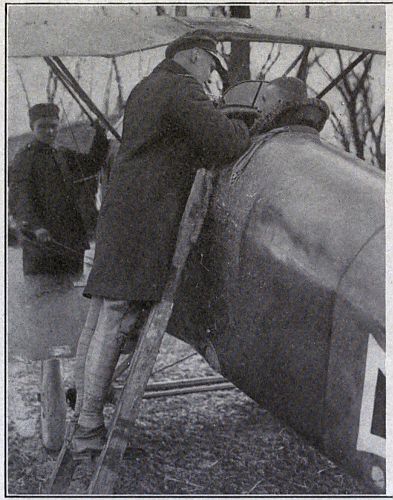 LIEUT. SCHÄFER SPEAKING WITH ANOTHER
MEMBER OF THE SQUADRON
LIEUT. SCHÄFER SPEAKING WITH ANOTHER
MEMBER OF THE SQUADRON
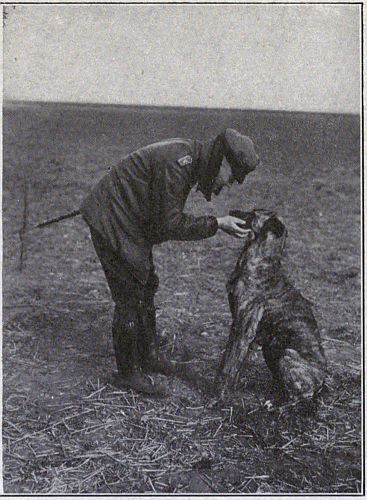 CAPTAIN RICHTHOFEN WITH HIS MASCOT
DOG "MORITZ"
CAPTAIN RICHTHOFEN WITH HIS MASCOT
DOG "MORITZ"
We tried to read the name written upon
a station, but of course that was impossible,
it was too small. So we had to land. We
did it with a heavy heart for nothing else
could be done. We looked for a meadow
which appeared suitable from above and
tried our luck. Close inspection unfortunately
showed that the meadow was not as
pleasant as it seemed. The fact was obviously
proved by the slightly bent frame of
our machine. We had made ourselves
gloriously ridiculous. We had first lost our
way and then smashed the machine. So we
had to continue our journey with the commonplace
conveyance, by railway train.
Slowly but surely, we reached Berlin. We
had landed in the neighborhood of Leipzig.
If we had not landed so stupidly, we would
certainly have reached Berlin. But sometimes
you make a mistake whatever you do.
Some days later I arrived in Schweidnitz,
my own town. Although I got there at seven
o'clock in the morning, there was a large
crowd at the station. I was very cordially
received. In the afternoon various demonstrations
took place to honor me, among
others, one of the local Boy Scouts.
It became clear to me that the people at
home took a vivid interest in their fighting
soldiers after all.