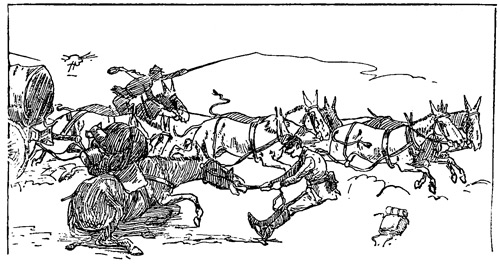
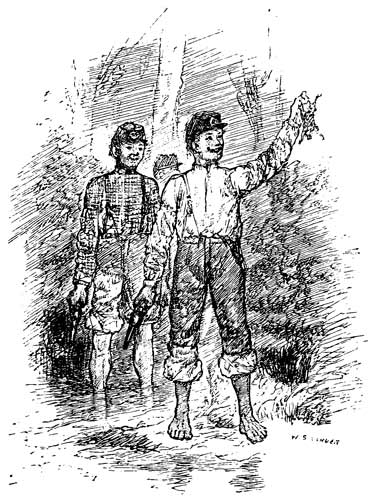
"Harry, I'm getting tired of this thing.
It's becoming monotonous, this thing of being
roused every morning at four, with orders to
pack up and be ready to march at a moment's
notice, and then lying around here all day in
the sun. I don't believe we are going anywhere,
anyhow."
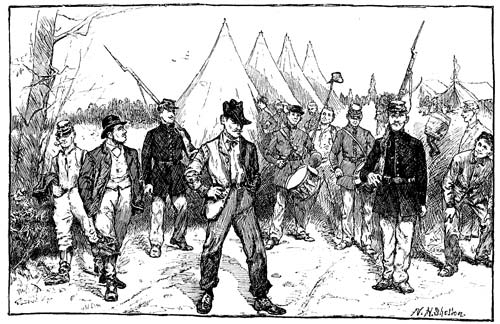
We had been encamped for six weeks, of
which I need give no special account, only
saying that in those "summer quarters," as
they might be called, we went on with our
endless drilling, and were baked and browned,
and thoroughly hardened to the life of a soldier
in the field.
The monotony of which Andy complained
did not end that day, nor the next. For six
successive days we were regularly roused at
four o'clock in the morning, with orders to
"pack up and be ready to move immediately!"
only to unpack as regularly about
the middle of the afternoon. We could hear
our batteries pounding away in the direction
of Fredericksburg, but we did not then know
that we were being held well in hand till the
enemy's plan had developed itself into the
great march into Pennsylvania, and we were
let off in hot pursuit.
So, at last, on the 12th of June, 1863, we
started, at five o'clock in the morning, in a
north-westerly direction. My journal says:
"Very warm, dust plenty, water scarce,
marching very hard. Halted at dusk at an
excellent spring, and lay down for the night
with aching limbs and blistered feet."
I pass over the six days' continuous marching
that followed, steadily on toward the
north, pausing only to relate several incidents
that happened by the way.
On the 14th we were racing with the enemy—we
being pushed on to the utmost of human
endurance—for the possession of the defences
of Washington. From five o'clock of that
morning till three the following morning,—that
is to say, from daylight to daylight,—we
were hurried along under a burning June sun,
with no halt longer than sufficient to recruit
our strength with a hasty cup of coffee at
noon and nightfall. Nine, ten, eleven, twelve
o'clock at night, and still on! It was almost
more than flesh could endure. Men fell out
of line in the darkness by the score, and
tumbled over by the roadside, asleep almost
before they touched the ground.
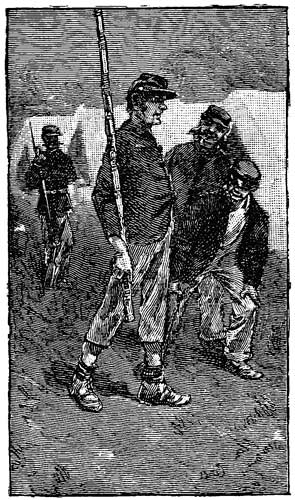
I remember how a great tall fellow in our
company made us laugh along somewhere
about one o'clock that morning,—"Pointer,"
we called him,—an excellent soldier, who
afterward fell at his post at Spottsylvania.
He had been trudging on in sullen silence
for hours, when all of a sudden, coming to
a halt, he brought his piece to "order arms"
on the hard road with a ring, took off his
cap, and, in language far more forcible than
elegant, began forthwith to denounce both
parties to the war, "from A to Izzard," in
all branches of the service, civil and military,
army and navy, artillery, infantry, and cavalry,
and demanded that the enemy should
come on in full force here and now, "and
I'll fight them all, single-handed and alone,
the whole pack of 'em! I'm tired of this
everlasting marching, and I want to fight!"
"Three cheers for Pointer!" cried some
one, and we laughed heartily as we toiled
doggedly on to Manassas, which we reached
at three o'clock A. M., June 15th. I can assure
you we lost no time in stretching ourselves at
full length in the tall summer grass.
"James McFadden, report to the adjutant
for camp guard! James McFadden! Anybody
know where Jim McFadden is?"
Now that was rather hard, wasn't it? To
march from daylight to daylight, and lie down
for a rest of probably two hours before starting
again, and then to be called up to stand
throughout those precious two hours on guard
duty!
I knew very well where McFadden was, for
wasn't he lying right beside me in the grass?
But just then I was in no humor to tell. The
camp might well go without a guard that
night, or the orderly might find McFadden
in the dark if he could.
But the rules were strict, and the punishment
was severe, and poor McFadden, bursting
into tears of vexation, answered like a
man: "Here I am, Orderly; I'll go." It was
hard.
Two weeks later, both McFadden and the
orderly went where there is neither marching
nor standing guard any more.
Now comes a long rest of a week in the
woods near the Potomac; for we have been
marching parallel with the enemy, and dare
not go too fast, lest by some sudden and dexterous
move in the game he should sweep
past our rear in upon the defences of Washington.
And after this sweet refreshment, we
cross the Potomac on pontoons, and march,
perhaps with a lighter step, since we are
nearing home, through the smiling fields
and pleasant villages of "Maryland, my
Maryland." At Poolesville, a little town on
the north bank of the Potomac, we smile as
we see a lot of children come trooping out of
the village school,—a merry sight to men
who have seen neither woman nor child these
six months and more, and a touching sight to
many a man in the ranks as he thinks of
his little flaxen-heads in the far-away home.
Ay, think of them now, and think of them
full tenderly too, for many a man of you
shall never have child climb on his knee
any more!
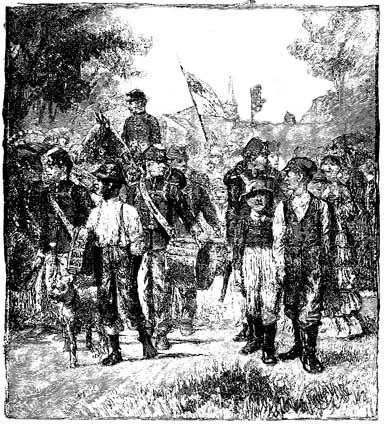
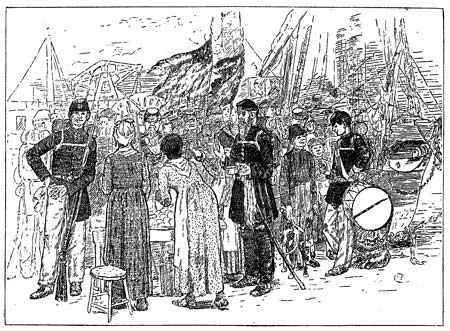
As we enter one of these pleasant little
Maryland villages,—Jefferson by name,—we
find on the outskirts of the place two
young ladies and two young gentlemen waving
the good old flag as we pass, and singing
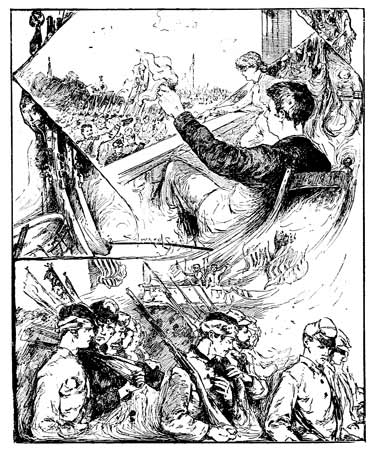
"Rally round the Flag, Boys!" The excitement
along the line is intense. Cheer on
cheer is given by regiment after regiment as
we pass along, we drummer-boys beating, at
the colonel's express orders, the old tune,
"The Girl I left behind me," as a sort of
response. Soon we are in among the hills
again, and still the cheering goes on in the
far distance to the rear.
Only ten days later we passed through the
same village again, and were met by the same
young ladies and gentlemen, waving the same
flag and singing the same song. But though
we tried twice, and tried hard, we could not
cheer at all; for there's a difference between
five hundred men and one hundred,—is there
not? So, that second time, we drooped our
tattered flags, and raised our caps in silent
and sorrowful salute. Through Middletown
next, where a rumor reaches us that the enemy's
forces have occupied Harrisburg, and
where certain ladies, standing on a balcony
and waving their handkerchiefs as we pass
by, in reply to our colonel's greeting, that
"we are glad to see so many Union people
here," answer, "Yes; and we are glad to see
the Yankee soldiers too."
From Middletown, at six o'clock in the
evening, across the mountain to Frederick,
on the outskirts of which city we camp for
the night. At half-past five next morning
(June 29th) we are up and away, in a drizzling
rain, through Lewistown and Mechanicstown,
near which latter place we pass a company
of Confederate prisoners, twenty-four in
number, dressed in well-worn gray and butternut,
which makes us think that the enemy
cannot be far ahead. After a hard march of
twenty-five miles, the greater part of the way
over a turnpike, we reach Emmittsburg at
nightfall, some of us quite barefoot, and all
of us footsore and weary. Next morning
(June 30th) at nine o'clock we are up and
away again, "on the road leading towards
Gettysburg," they say. After crossing the
line between Maryland and Pennsylvania,
where the colonel halts the column for a
moment, in order that we may give three
rousing cheers for the Old Keystone State,
we march perceptibly slower, as if there were
some impediment in the way. There is a
feeling among the men that the enemy is
somewhere near. Towards noon we leave the
public road, and taking across the fields, form
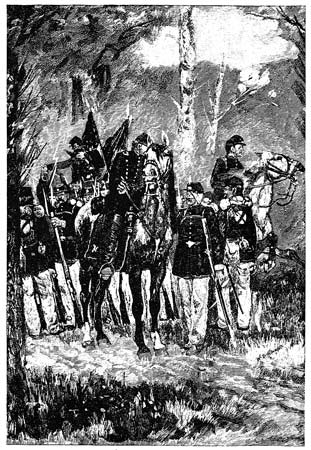
in line of battle along the rear of a wood, and
pickets are thrown out. There is an air of
uncertainty and suspicion in the ranks as we
look to the woods, and consider what our
pickets may possibly unmask there. But no
developments have yet been made when darkness
comes, and we bivouac for the night
behind a strong stone wall.
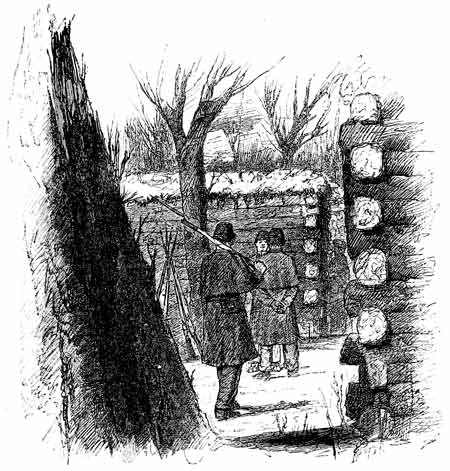
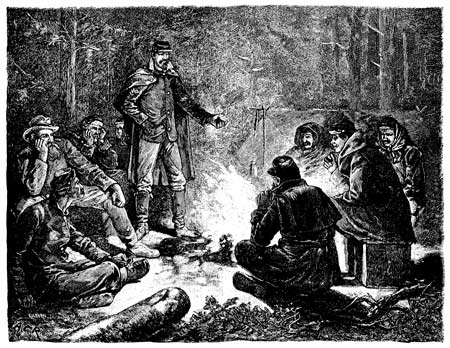
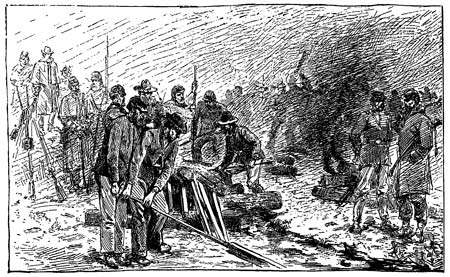
Passing down along the line of glowing
fires in the gathering gloom, I come on one
of my company messes squatting about a fire,
cooking supper. Joe Gutelius, corporal and
color-guard from our company, is superintending
the boiling of a piece of meat in a
tin can, while Sam Ruhl and his brother Joe
are smoking their pipes near by.
"Boys, it begins to look a little dubious,
don't it? Where is Jimmy Lucas?"
"He's out on picket in the woods yonder.
Yes, Harry, it begins to look a little as if we
were about to stir the Johnnies out of the
brush," says Joe Gutelius, throwing another
rail on the fire.
"If we do," says Joe Ruhl, "remember
that you have the post of honor, Joe, and
'if any man pulls down that flag, shoot him
on the spot!'"
"Never you fear for that," answers Joe
Gutelius. "We of the color-guard will look
out for the flag. For my part, I'll stay a
dead man on the field before the colors of
the 150th are disgraced."
"You'll have some tough tussling for your
colors, then," says Sam. "If the Louisiana
Tigers get after you once, look out!"
"Who's afraid of the Louisiana Tigers?
I'll back the Buck-tails against the Tigers any
day. Stay and take supper with us, Harry!
We are going to have a feast to-night. I
have the heart of a beef boiling in the can
yonder; and it is done now. Sit up, boys,
get out your knives and fall to."
"We were going to have boiled lion heart
for supper, Harry," says Joe Ruhl with mock
apology for the fare, "but we couldn't catch
any lions. They seem to be scarce in these
parts. Maybe we can catch a tiger to-morrow,
though."
Little do we think, as we sit thus cheerily
talking about the blazing fire behind the
stone-wall, that it is our last supper together,
and that ere another nightfall two of us will
be sleeping in the silent bivouac of the dead.
"Colonel, close up your men, and move on
as rapidly as possible."
It is the morning of July 1st, and we are
crossing a bridge over a stream, as the staff-officer,
having delivered this order for us,
dashes down the line to hurry up the regiments
in the rear. We get up on a high
range of hills, from which we have a magnificent
view. The day is bright, the air is
fresh and sweet with the scent of the new-mown
hay, and the sun shines out of an
almost cloudless sky, and as we gaze away off
yonder down the valley to the left—look!
Do you see that? A puff of smoke in mid-air!
Very small, and miles away, as the faint
and long-coming "boom" of the exploding
shell indicates; but it means that something
is going on yonder, away down in the valley,
in which, perhaps, we may have a hand before
the day is done. See! another—and another!
Faint and far away comes the
long-delayed "boom!" "boom!" echoing
over the hills, as the staff-officer dashes along
the lines with orders to "double-quick!
double-quick!"
Four miles of almost constant double-quicking
is no light work at any time, least of
all on such a day as this memorable first day
of July, for it is hot and dusty. But we are
in our own State now, boys, and the battle is
opening ahead, and it is no time to save
breath. On we go, now up a hill, now over a
stream, now checking our headlong rush for a
moment, for we must breathe a little. But
the word comes along the line again, "double-quick,"
and we settle down to it with right
good-will, while the cannon ahead seem to be
getting nearer and louder. There's little said
in the ranks, for there is little breath for
talking, though every man is busy enough
thinking. We all feel, somehow, that our
day has come at last—as indeed it has!
We get in through the outskirts of Gettysburg,
tearing down the fences of the town-lots
and outlying gardens as we go; we pass
a battery of brass guns drawn up beside the
Seminary, some hundred yards in front of
which building, in a strip of meadow-land, we
halt, and rapidly form the line of battle.
"General, shall we unsling knapsacks?"
shouts some one down the line to our
division-general, as he is dashing by.
"Never mind the knapsacks, boys; it's the
State now!"
And he plunges his spurs into the flanks
of his horse, as he takes the stake-and-rider
fence at a leap, and is away.
"Unfurl the flags, Color-guard!"
"Now, forward, double——"
"Colonel, we're not loaded yet!"
A laugh runs along the line as, at the
command "Load at will—load!" the ramrods
make their merry music, and at once the
word is given, "Forward, double-quick!" and
the line sweeps up that rising ground with
banners gayly flying, and cheers that rend
the air,—a sight, once seen, never to be
forgotten.
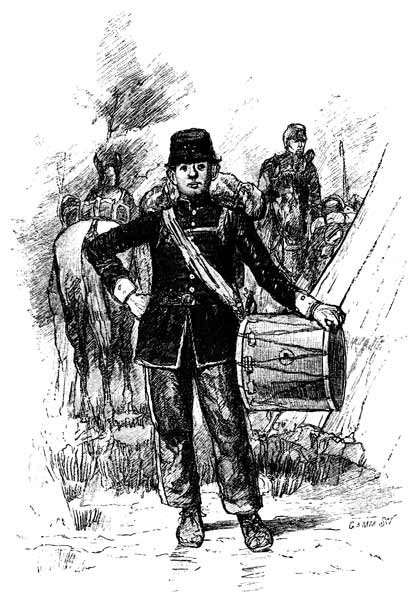
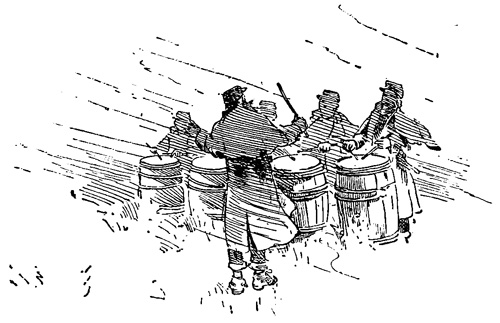
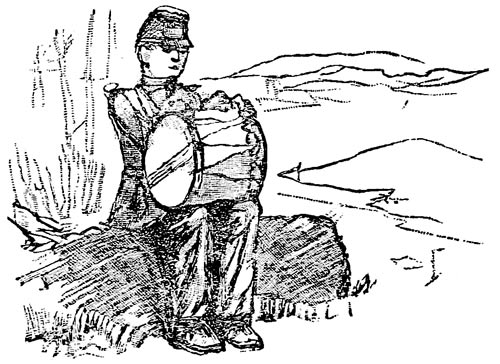
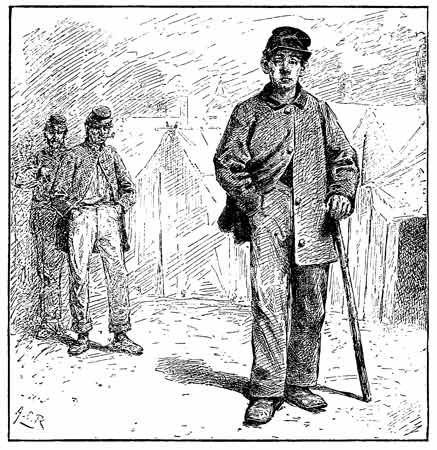
I suppose my readers wonder what a drummer-boy
does in time of battle. Perhaps they
have the same idea I used to have, namely,
that it is the duty of a drummer-boy to beat
his drum all the time the battle rages, to
encourage the men or drown the groans of
the wounded! But if they will reflect a
moment, they will see that amid the confusion
and noise of battle, there is little chance
of martial music being either heard or heeded.
Our colonel had long ago given us our
orders:
"You drummer-boys, in time of an engagement,
are to lay aside your drums and take
stretchers and help off the wounded. I
expect you to do this, and you are to remember
that, in doing it, you are just as much
helping the battle on as if you were fighting
with guns in your hands."
And so we sit down there on our drums
and watch the line going in with cheers.
Forthwith we get a smart shelling, for there
is evidently somebody else watching that
advancing line besides ourselves; but they
have elevated their guns a little too much, so
that every shell passes quite over the line and
ploughs up the meadow-sod about us in all
directions.
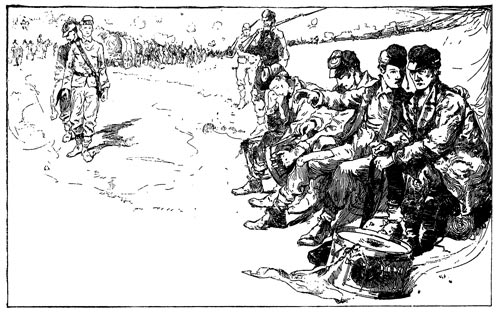
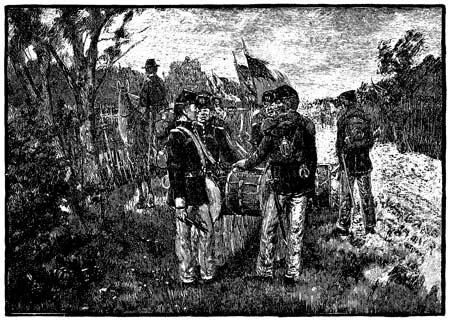
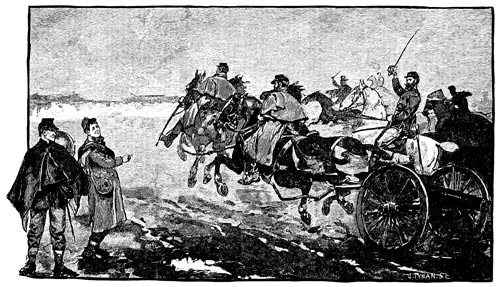
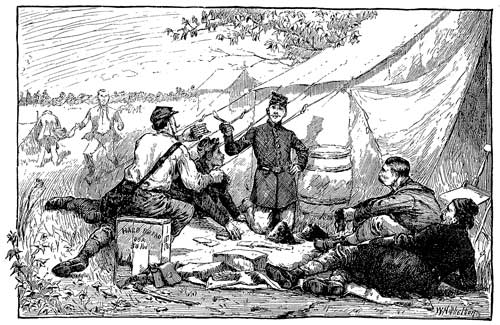
A Skirmish after a Hard Day's March
Laying aside our knapsacks, we go to
the Seminary, now rapidly filling with the
wounded. This the enemy surely cannot
know, or they wouldn't shell the building so
hard! We get stretchers at the ambulances,
and start out for the line of battle. We can
just see our regimental colors waving in the
orchard, near a log-house about three hundred
yards ahead, and we start out for it—I on
the lead, and Daney behind.
There is one of our batteries drawn up to
our left a short distance as we run. It is
engaged in a sharp artillery duel with one of
the enemy's, which we cannot see, although
we can hear it plainly enough, and straight
between the two our road lies. So, up we go,
Daney and I, at a lively trot, dodging the
shells as best we can, till, panting for breath,
we set down our stretcher under an apple-tree
in the orchard, in which, under the brow
of the hill, we find the regiment lying, one or
two companies being out on the skirmish line
ahead.
I count six men of Company C lying yonder
in the grass—killed, they say, by a single
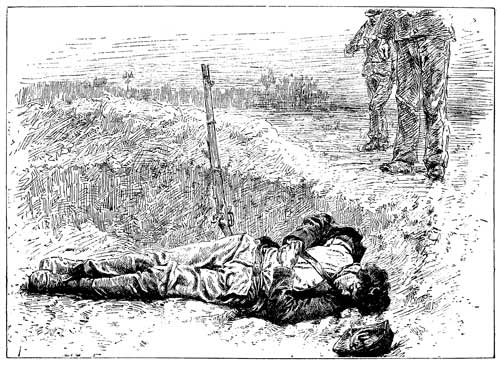
shell. Close beside them lies a tall, magnificently
built man, whom I recognize by his
uniform as belonging to the "Iron Brigade,"
and therefore probably an Iowa boy. He lies
on his back at full length, with his musket
beside him—calm-looking as if asleep, but
having a fatal blue mark on his forehead and
the ashen pallor of death on his countenance.
Andy calls me away for a moment to look
after some poor fellow whose arm is off at
the shoulder; and it was just time I got
away, too, for immediately a shell plunges into
the sod where I had been sitting, tearing my
stretcher to tatters, and ploughing up a great
furrow under one of the boys who had been
sitting immediately behind me, and who
thinks, "That was rather close shaving, wasn't
it, now?" The bullets whistling overhead
make pretty music with their ever-varying
"z-i-p! z-i-p!" and we could imagine them so
many bees, only they have such a terribly
sharp sting. They tell me, too, of a certain
cavalry-man (Dennis Buckley, Sixth Michigan
cavalry it was, as I afterwards learned—let
history preserve the brave boy's name) who,
having had his horse shot under him, and
seeing that first-named shell explode in
Company C with such disaster, exclaimed,
"That is the company for me!" He remained
with the regiment all day, doing good
service with his carbine, and he escaped
unhurt!
"Here they come, boys; we'll have to go
in at them on a charge, I guess!" Creeping
close around the corner of the log-house, I
can see the long lines of gray sweeping up in
fine style over the fields; but I feel the
colonel's hand on my shoulder.
"Keep back, my boy; no use exposing
yourself in that way."
As I get back behind the house and look
around, an old man is seen approaching our
line through the orchard in the rear. He is
dressed in a long blue swallow-tailed coat
and high silk hat, and coming up to the
colonel, he asks:
"Would you let an old chap like me have a
chance to fight in your ranks, colonel?"
"Can you shoot?" inquires the colonel.
"Oh yes, I can shoot, I reckon," says he.
"But where are your cartridges?"
"I've got 'em here, sir," says the old man,
slapping his hand on his trousers pocket.
And so "old John Burns," of whom every
school-boy has heard, takes his place in the
line and loads and fires with the best of them,
and is left wounded and insensible on the field
when the day is done.
Reclining there under a tree while the skirmishing
is going on in front and the shells
are tearing up the sod around us, I observe
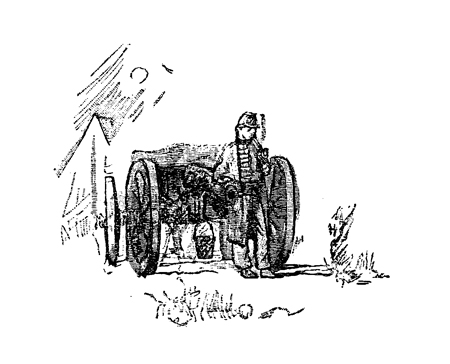
how evidently hard pressed is that battery
yonder in the edge of the wood, about fifty
yards to our right. The enemy's batteries
have excellent range on the poor fellows serving
it. And when the smoke lifts or rolls
away in great clouds for a moment, we can see
the men running, and ramming, and sighting,
and firing, and swabbing, and changing position
every few minutes to throw the enemy's
guns out of range a little. The men are
becoming terribly few, but nevertheless their
guns, with a rapidity that seems unabated,
belch forth great clouds of smoke, and send
the shells shrieking over the plain.
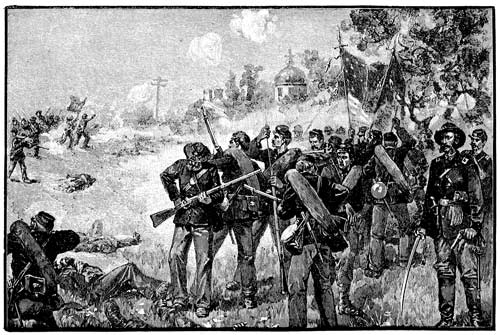
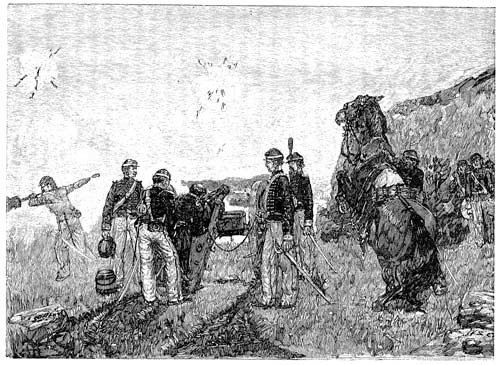
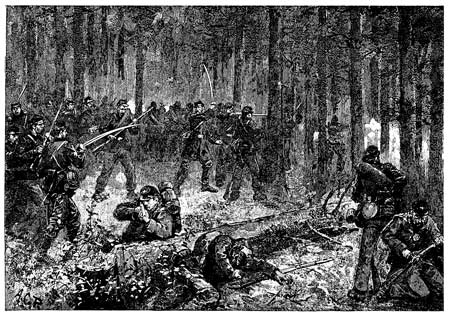
At Close Quarters the First Day at Gettysburg.
Meanwhile, events occur which give us something
more to think of than mere skirmishing
and shelling. Our beloved brigadier-general,
Roy Stone, stepping out a moment to reconnoitre
the enemy's position and movements, is
seen by some sharpshooter off in a tree, and
is carried, severely wounded, into the barn.
Our colonel, Langhorne Wister, assumes command
of the brigade. Our regiment, facing
westward, while the line on our right faces to
the north, is observed to be exposed to an
enfilading fire from the enemy's guns, as well
as from the long line of gray now appearing
in full sight on our right. So our regiment
must form in line and "change front forward,"
in order to come in line with the other regiments.
Accomplished swiftly, this new movement
brings our line at once face to face with
the enemy's, which advances to within fifty
yards, and exchanges a few volleys, but is soon
checked and staggered by our fire.
Yet now, see! Away to our left, and consequently
on our flank, a new line appears,
rapidly advancing out of the woods a half-mile
away, and there must be some quick and sharp
work done now, boys, or, between the old foes
in front and the new ones on our flank, we
shall be annihilated. To clear us of these old
assailants in front before the new line can
sweep down on our flank, our brave colonel,
in a ringing command, orders a charge along
the whole line. Then, before the gleaming
and bristling bayonets of our "Buck-tail"
brigade, as it yells and cheers, sweeping
resistlessly over the field, the enemy gives
way and flies in confusion. But there is
little time to watch them fly, for that new
line on our left is approaching at a rapid pace;
and, with shells falling thick and fast into our
ranks, and men dropping everywhere, our regiment
must reverse the former movement by
"changing front to rear," and so resume its
original position facing westward, for the
enemy's new line is approaching from that
direction, and if it takes us in flank, we are
done for.
To "change front to rear" is a difficult
movement to execute even on drill, much more
so under severe fire; but it is executed now
steadily and without confusion, yet not a minute
too soon! For the new line of gray is
upon us in a mad tempest of lead, supported
by a cruel artillery fire, almost before our line
can steady itself to receive the shock. However,
partially protected by a post-and-rail
fence, we answer fiercely, and with effect so
terrific that the enemy's line wavers, and at
length moves off by the right flank, giving us
a breathing space for a time.
During this struggle, there had been many
an exciting scene all along the line as it
swayed backward and forward over the field,—scenes
which we have had no time to mention
yet.
See yonder, where the colors of the regiment
on our right—our sister regiment, the 149th—have
been advanced a little, to draw the
enemy's fire, while our line sweeps on to the
charge. There ensues about the flags a wild
mêlée and close hand-to-hand encounter. Some
of the enemy have seized the colors and are
making off with them in triumph, shouting
victory. But a squad of our own regiment
dashes out swiftly, led to the rescue of the
stolen colors by Sergeant John C. Kensill, of
Company F, who falls to the ground before
reaching them, and amid yells and cheers and
smoke, you see the battle-flags rise and fall,
and sway hither and thither upon the surging
mass, as if tossed on the billows of a tempest,
until, wrenched away by strong arms, they are
borne back in triumph to the line of the 149th.
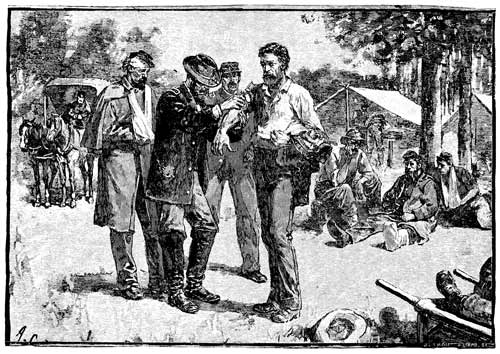
See yonder, again! Our colonel is clapping
his hand to his cheek, from which a red
stream is pouring; our lieutenant-colonel,
H. S. Huidekoper, is kneeling on the ground,
and is having his handkerchief tied tight
around his arm at the shoulder; Major Thomas
Chamberlain and Adjutant Richard L. Ashurst
both lie low, pierced with balls through the
chest; one lieutenant is waving his sword to
his men, although his leg is crushed at the
knee; three other officers of the line are lying
over there, motionless now forever. All over
the field are strewn men wounded or dead, and
comrades pause a moment in the mad rush to
catch the last words of the dying. Incidents
such as these the reader must imagine for
himself, to fill in these swift sketches of how
the day was won—and lost!
Ay, lost! For the balls which have so far
come mainly from our front, begin now to sing
in from our left and right, which means that
we are being flanked. Somehow, away off to
our right, a half-mile or so, our line has given
way, and is already on retreat through the
town, while our left is being driven in, and we
ourselves may shortly be surrounded and
crushed—and so the retreat is sounded.
Back now along the railroad cut we go, or
through the orchard and the narrow strip of
woods behind it, with our dead scattered
around on all sides, and the wounded crying
piteously for help.
"Harry! Harry!" It is a faint cry of a
dying man yonder in the grass, and I must see
who it is.
"Why, Willie! Tell me where you are
hurt," I ask, kneeling down beside him; and
I see the words come hard, for he is fast dying.
"Here in my side, Harry. Tell—mother—mother——"
Poor fellow, he can say no more. His head
falls back, and Willie is at rest forever!
On, now, through that strip of woods, at the
other edge of which, with my back against
a stout oak, I stop and look at a beautiful
and thrilling sight. Some reserves are being
brought up; infantry in the centre, the colors
flying and officers shouting; cavalry on the
right, with sabres flashing and horses on a
trot; artillery on the left, with guns at full
gallop sweeping into position to check the
headlong pursuit,—it is a grand sight, and
a fine rally; but a vain one, for in an hour we
are swept off the field, and are in full retreat
through the town.
Up through the streets hurries the remnant
of our shattered corps, while the enemy is
pouring into the town only a few squares away
from us. There is a tempest of shrieking
shells and whistling balls about our ears.
The guns of that battery by the woods we
have dragged along, all the horses being disabled.
The artillery-men load as we go,
double-charging with grape and canister.
"Make way there, men!" is the cry, and
the surging mass crowds close up on the
sidewalks to right and left, leaving a long
lane down the centre of the street, through
which the grape and canister go rattling into
the ranks of the enemy's advance-guard.
And so, amid scenes which I have neither
space nor power to describe, we gain Cemetery
Ridge towards sunset, and throw ourselves
down by the road in a tumult of excitement
and grief, having lost the day through the
overwhelming force of numbers, and yet
somehow having gained it too (although as
yet we know it not), for the sacrifice of our
corps has saved the position for the rest of
the army, which has been marching all day,
and which comes pouring in over Cemetery
Ridge all night long.
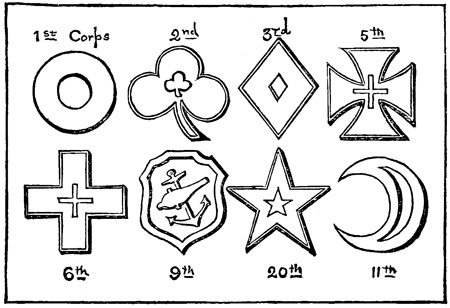
Ay, the position is saved; but where is
our corps? Well may our division-general,
Doubleday, who early in the day succeeded to
the command when our brave Reynolds had
fallen, shed tears of grief as he sits there on
his horse and looks over the shattered remains
of that First Army Corps, for there is but a
handful of it left. Of the five hundred and
fifty men that marched under our regimental
colors in the morning, but one hundred
remain. All our field and staff officers are
gone. Of some twenty captains and lieutenants,
but one is left without a scratch,
while of my own company only thirteen out
of fifty-four sleep that night on Cemetery
Ridge, under the open canopy of heaven.
There is no roll-call, for Sergeant Weidensaul
will call the roll no more; nor will Joe
Gutelius, nor Joe Ruhl, nor McFadden, nor
Henning, nor many others of our comrades
whom we miss, ever answer to their names
again until the world's last great reveille.