1306. Whence does the snail obtain its shell?
Young snails come from the egg with a shell upon their backs.
1307. How does the shell grow with the increase of size of the
animal?
The soft slime which is yielded by the body of the animal, hardens
upon the orifice of the shell, and thus increases its size.
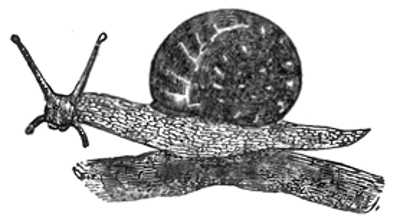
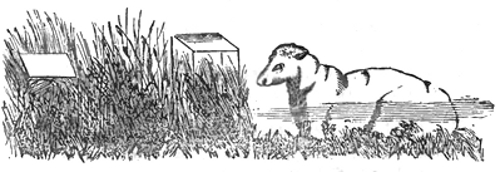
Fig. 80.—COMMON GARDEN SNAIL.
1308. Why is the shell spiral?
Partly because of its original formation; but also because, as the
shell grows, the opening is elongated; and thrown up, causing the
spiral body of the shell to turn, and so to wind its growth around
the centre.
"Notwithstanding they hearkened not unto Moses;
but some of them left it until the morning, and it bred worms, and
stank: and Moses was wrath with them."—Exodus xvi.
1309. Why has the snail four tentacula attached to its head?
Because the insect, having no other limbs, is provided with those
projecting members, the lower two serving as feelers and the upper
two also as feelers and eyes. These, projecting in the front of
the animal, impart to it a consciousness of surrounding objects, and
especially of those which lie in its path.
1310. Why is the snail able to move, without feet?
Because it has attached to its body a fringe of muscular skin,
which is capable of considerable contraction and expansion, and by
alternately stretching and shortening this, the snail is able to draw
himself along.
1311. Why do we see no snails in the winter time?
Because they bury themselves in the ground, or in holes, where they
remain in a torpid state for several months. Before they enter into
the torpid state, they form with their slimy secretion, and with some
earthy matters which they collect, a strong cement with which they
seal up the opening to their shells.
1312. Why can snails live in shells thus sealed?
Because they leave, in the thin wall by which they close themselves
in, a small hole, too small to admit water, but large enough to let
in sufficient air to carry on their feeble respiration during their
winter sleep.
1313. Why do insects abound in putrid waters, and in decaying
substances?
Because they have been endowed with appetites and with constitutions
that enable them to live upon and to enjoy corrupt matter. In this
point of view the maggots of flies are exceedingly useful; a dead
carcass is speedily threaded by them in every direction; thus that
corrupt matter which, in a large mass, would poison the air, is
taken up in small portions by millions of living bodies, and by them
dispersed, and becomes innoxious.
"For he maketh small the drops of water: they
pour down rain according to the vapour thereof."—Job xxxv.
1314. Why do we see, in tanks of rain water, insects rising to the
surface?
Because numerous insects pass through their first stages of existence
in water, and among them the common gnat. The gnats of the previous
season having deposited their eggs on the sides of the water-butt,
the warm water developes them, and the larvæ of the gnats appear
(Fig. 81; c natural size of larva; b larva magnified).
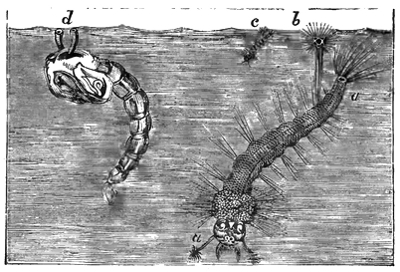
Fig. 81.—LARVA AND PUPA OF GNAT.
(Greatly magnified.)
1315. Why do they continually rise to the surface of the water?
Because they require to breathe air, and therefore they come up to
the surface, where, elevating the tube (b) above the surface of the
water, they are enabled to breathe.
1316. Why do some appear to have larger heads than others?
Those that have apparently larger heads, and that breathe through
tubes attached to their heads (d) are in the pupa, or second
stage of development, and underneath the large shield by
which their
heads are marked, their wings, feet, &c., are being formed.
"Because thy loving kindness is better than life,
my lips shall praise thee."—Psalm lxiii.
1317. Why, when the water is disturbed, do the larvæ descend more
rapidly than the pupæ?
Because the pupæ are in a torpid condition, awaiting the formation of
their perfect organs.
1318. Why are the flies able to escape from the water?
Because, as their formation becomes perfected, and the fluids of
the body of the pupa become absorbed in the production of the light
texture of the wings, &c., the body and its case become lighter than
the water, and rise and float upon the surface. The pupa-case then
forms a natural boat, from which the fly emerges, and spreading its
wings, enters upon the final state of its existence.
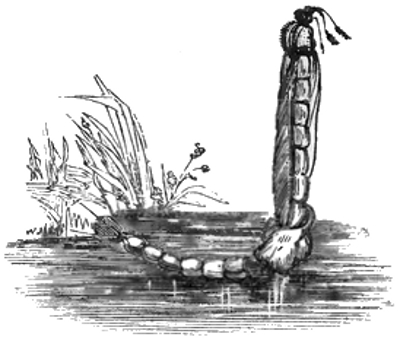
Fig. 82.—THE PERFECT GNAT. ESCAPING FROM THE PUPA-CASE.
(Greatly magnified.)
This interesting metamorphosis may be seen going on in the summer
time, in every pond, brook, and reservoir. A fine sunny morning
calls up millions of these little boats from beneath the surface,
and the diver within that wonderful little bell breaks its sealed
doors, and flies away to enjoy the bright sunshine.
1319. Why are beetles denominated "coleoptera?"
Because they have wings protected by horny sheaths; the term
coleoptera signifies wings in a sheath.
"They shall lie down in the dust; and the worms
shall cover them."—Job xxi.
1320. Why have beetles hard horny wing-cases?
Because they live underground, or in holes excavated in wood, &c.
If, therefore, their wings were not protected by a hard and firm
covering, they would be constantly liable to destruction from the
movement of the insect within hard and rough bodies.
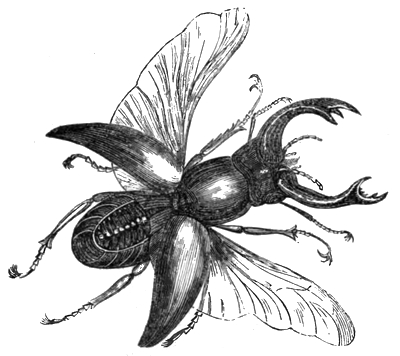
Fig. 83.—STAG-BEETLE, SHOWING ITS WINGS
UNFOLDED, AND THE WING-CASES OPEN.
The elytra, or scaly wings of the genus of scarabæus, or beetle,
furnish an example of this kind. The true wing of the animal is
a light, transparent membrane, finer than the finest gauze, and
not unlike it. It is also, when expanded, in proportion to the
size of the animal, very large. In order to protect this delicate
structure, and, perhaps, also to preserve it in a due state of
suppleness and humidity, a strong, hard case is given to it,
in the shape of the horny wing which we call the elytron. When
the animal is at rest, the gauze wings lie folded up under this
impenetrable shield. When the beetle prepares for flying, he
raises the integument, and spreads out his thin membrane to the
air. And it cannot be observed without admiration, what a tissue
of cordage, i. e. of muscular tendons, must run in various and
complicated, but determinate directions, along this fine surface,
in order to enable the animal, either to gather
it up into a
certain precise form, whenever it desires to place its wings under
the shelter which nature hath given to them, or to expand again
their folds when wanted for action.
"The Lord is good; his mercy is everlasting;
and his truth endureth to all generations."—Psalm c.
In some insects, the elytra cover the whole body; in others, half;
in others only a small part of it; but in all, they completely
hide and cover the true wings. Also,
Many, or most of the beetle species lodge in holes in the earth,
environed by hard, rough substances, and have frequently to
squeeze their way through narrow passages; in which situation,
wings so tender, and so large, could scarcely have escaped injury,
without both a firm covering to defend them, and the capacity of
folding themselves up under its protection.
1321. Why have many of the beetle tribe large strong horns?
Because, as they live in holes in the earth, or in excavations in
wood, they use their horns to dig out their places of retreat.
1322. Why has the giraffe a small head?
Because, being set upon the end of a very long neck, the animal would
be unable to raise it if it were heavy.
1323. Why has the giraffe a long neck?
Because it feeds upon the branches of tall trees.
1324. Why has the giraffe a long and flexible tongue?
Because it is thereby enabled to lay hold of the tender twigs and
branches, and draw them into its mouth, avoiding the coarser parts
of the branches.
1325. Why are the nostrils of the giraffe small and narrow, and
studded with hairs?
Because the hairs and the peculiar shape of the nasal passages are
designed as a protection against the insects which inhabit the boughs
of the trees upon which the giraffe feeds; and also against the sands
of the desert, which storms raise into almost suffocating clouds.
"Bless the Lord, all his works, in all places of
his dominion: bless the Lord, O my soul."—Psalm ciii.
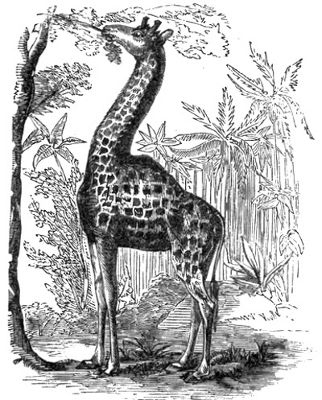
Fig. 84.—GIRAFFE FEEDING.
1326. The distribution of animals, or Zoological Geography, is of
great interest, and should be carefully studied in connection with
Botanical Geography (see 1208). The highest department of the
animal kingdom (writes the Rev. W. Milner) commences with the class of
Birds, which may be naturally divided into the three great orders
of ærial, terrestrial, and aquatic. Aggregation
into immense flocks
is a distinguishing feature of several species,
especially of the
aquatic order, which form separate colonies, building their nests in
the same state, though other spots equally adapted are at no great
distance. Hence the Vogel-bergs, or bird rocks of the northern seas,
one of which at Westmannsharn in the Faroe group of islands, seldom
intruded upon by man, presents a most extraordinary spectacle to the
visitor. The Vogel-berg lies in a frightful chasm in the precipitous
shores of the island, which rise to the height of a thousand feet,
only accessible from the sea by a narrow passage. Here congregate a
host of birds. Thousands of guillemots and auks swim in groups
around
the boat which conveys man to their domain, look curiously at
him, and
vanish beneath the water to rise in his immediate neighbourhood. The
black guillemot comes close to the very oars. The seal stretches his
head above the waves, not comprehending what has disturbed the repose
of his asylum, while the rapacious skua pursues the puffin and gull.
High in the air the birds seem like bees clustering about the rocks,
whilst lower they fly past so close that they might be knocked down
with a stick. But not less strange is the domicile of this colony.
On some low rocks scarcely projecting above the water sit the glossy
cormorants, turning their long necks on every side. Next are the skua
gulls, regarded with an anxious eye by the kittiwakes above. Nest
follows nest in crowded rows along the whole breadth of the rock, and
nothing is visible but the heads of the mothers and the white rocks
between. A little higher on the narrow shelves sit the guillemots and
auks, arranged as on parade, with their white breasts to the sea, and
so close that a hailstone could not pass between them. The puffins take
the highest station, and, though scarcely visible, betray themselves
by their flying backwards and forwards. The noise of such a multitude
of birds is confounding, and in vain a person asks a question of his
nearest neighbour. The harsh tones of the kittiwakes are heard above
the whole, the intervals being filled with the monotonous note of the
auk, and the softer voice of the guillemot. When Graba, from whose
travels this description is principally drawn, visited the Vogel-berg,
he was tempted by the sight of a crested cormorant to fire a gun, but
what became of it, he remarks, it was impossible to ascertain. The air
was darkened by the birds roused from their repose. Thousands hastened
out of the chasm with a frightful noise, and spread themselves over
the ocean. The puffins came wandering from their holes, and regarded
the universal confusion with comic gestures. The kittiwakes remained
composedly in their nests, whilst the cormorants tumbled headlong into
the sea. Similar great congregations of the feathered race appear where
the shores are rocky high, and precipitous, but this is strikingly the
case, where
——"The northern ocean, in vast whirls,
Boils round the naked melancholy isles
Of farthest Thule; and the Atlantic surge
Pours in among the stormy Hebrides.
Who can recount what transmigrations there
Are annual made? what nations come and go?
And how the living clouds on clouds arise?
Infinite wings! till all the plume-dark air
And rude resounding shore are one wild cry."
"He rained flesh upon them as dust, and
feathered fowls like as the sand of the sea."—Psalm lxxviii.
1327. Most terrestrial birds, unacquainted with man, exhibit a
remarkable tameness, and are slow in acquiring a dread of him, even
after repeated lessons that danger is to be apprehended from his
neighbourhood. Mr. Darwin speaks of a gun as almost superfluous in
the unfrequented districts of South America, for with its muzzle
he pushed a hawk off the branch of a tree. Once, while lying down,
a mocking thrush alighted on the edge of a pitcher, made of the
shell of a tortoise, which he was holding in his hand, and began
very leisurely to sip the water, even allowing him to handle it
while seated on the vessel. In Charles Island, which had been
colonised about six years, he saw a boy sitting by a well with a
switch in his hand, with which he killed the doves and finches
as they came to drink; and for some time had been constantly in
the habit of waiting by the well for the same purpose, to provide
himself with his dinners. In the Falkland Islands, at Bourbon, and
at Tristan d'Acunha, the same tameness
was noticed by the early
visitors. On the other hand, the small
birds in the arctic regions
of America, which have never been persecuted, exhibit the anomalous
fact of great wildness. From a review of various facts, Mr. Darwin
concludes, "first, that the wildness of birds with regard to man is
a particular instinct directed against him, and not dependent on
any general degree of caution arising from other sources of danger;
secondly, that it is not acquired by individual birds in a short
time, even when much persecuted; but that in the course of successive
generations it becomes hereditary. Comparatively few young birds in
any one year have been injured by man in England, yet almost all,
even nestlings, are afraid of him; many individuals, however, both at
the Galapagos and at the Falklands, have been pursued and injured by
man, but yet have not learned a salutary dread of him."
"As a bird that wandereth from her nest; so is a
man that wandereth from his place."—Psalm xxvii.
1328. Numerous species of birds may be regarded as the favourites of
nature on account of the gracefulness given to their shape, and the
richly-coloured plumage with which they are adorned, as evidenced in
the gaudy liveries of many of the parrot tribe, and the forms and
hues of the birds of paradise. But they are especially interesting
to man for the faculty of song with which they are endowed; in some,
"most musical, most melancholy," in others, sprightly and animating,
inspiriting the sons of toil under the burdens peculiar to their
station. It deserves to be remarked, as an instance of compensation
and adjustment, that whilst the birds of the temperate zone are far
inferior to those of tropical climes in point of beauty, they have
far more melodious notes in connection with their less attractive
appearance.
1329. From the powerful means of locomotion possessed by several of
the bird tribe, and their great specific levity, air being admitted
to the whole organisation as water to a sponge, it might be inferred,
that the entire atmosphere was intended to be their domain, so that
no species would be limited to a particular region. The common
crow flies at the rate of twenty-five miles an hour; the rapidity
of the eider-duck, Anas mollissima, is equal to ninety miles an
hour; while the swifts and hawks travel at the astonishing speed of
a hundred and fifty miles in the same time. It is true that some
species have a very extensive range, as the nightingale, the common
wild goose, and several of the vulture tribe. The same kind of osprey
or fishing-eagle that wanders along the Scottish shores appears upon
those of the south of Europe, and of New Holland. The lammergeyer
haunts the heights of the Pyrenees, the mountains of Abyssinia, and
the Mongolian steppes; and the penguin falcon occurs in Greenland,
Europe, America, and Australia. In general, however, like plants
and terrestrial quadrupeds, the birds are subject to geographical
laws, definite limits circumscribing particular groups. The common
grouse of our own country affords a striking exemplification of this
arrangement, as it is nowhere met with out of Great Britain; and
other examples occur of a very scanty area containing a species not
to be found in any other region. The celebrated birds of paradise we
exclusively confined to a small part of the torrid zone, embracing
New Guinea and the contiguous islands; and the beautiful Lories
are inhabitants of the same districts, being quite unknown to the
New World. Parroquets are chiefly occupants of a zone extending a
few degrees beyond each tropic, but the American group is quite
distinct from the African, and neither of these have one in common
with the parrots of India. The great eagle is limited to the highest
summits of the Alps; and the condor, which soars above the peak of
the loftiest of the Andes, never quits that chain. Humming-birds
are
entirely limited to the western hemisphere, where a particular
species is sometimes bounded by the range of an island, while others
are more extensively spread, the Trochilus flammifrons, common to
Lima, being observed by Captain King upon the coast of the Straits
of Magellan, in the depth of winter, sucking the flowers of a large
fuchsia, then in bloom in the midst of a shower of snow. Among the
birds incapable of flight, which rival the quadrupeds in their
size, the intertropical countries of the globe have their distinct
species, presenting similar general features of organisation, as the
ostrich of Africa and Arabia, the cassowary of Java and Australia,
and the touyou of Brazil. In the arctic regions, we meet with
species peculiar to them, the Strix laeponicus or Lapland owl,
and the eider-duck, an inhabitant of the shores, from whose nests
the eider-down is obtained. Several families of maritime birds are
likewise limited to particular oceanic localities. Approaching the
fortieth parallel of latitude, the albatross is seen flitting along
the surface of the waves, and soon afterwards the frigate and other
tropical birds appear, which never wander far beyond the torrid zone.
It thus appears, that, notwithstanding the great locomotive powers of
birds, particular groups have had certain regions assigned to them
as their sphere of existence, which they are adapted to occupy, and
to which they adhere in the main, though it is easy to conceive of
natural causes occasionally constraining to a migration into new and
even distant territories. Captain Smyth informed Mr. Lyell, that when
engaged in his survey of the Mediterranean, he encountered a gale
in the Gulf of Lyons, at the distance of between twenty and thirty
leagues from the coast of France, which bore along many land-birds
of various species, some of which alighted on the ship, while others
were thrown with violence against the sails. In this manner, many an
islet in the deep, after ages of solitude and silence, uninterrupted
except by the wave's wild dash, and the wind's fierce howl, may have
received the song of birds, forced by the tempest from their home,
and compelled to seek a new one under its direction.
"There is a path which no fowl knoweth, and which
the vulture's eye hath not seen."—Job xviii.
1330. There is no feature more remarkable in the economy of birds
than the periodical migrations, so systematically conducted, in
which five-sixths of the whole feathered population engage. In the
case of North America, according to an estimate by Dr. Richardson,
the passenger-pigeons form themselves into vast flocks for the
journey, one of which has been calculated to include 2,230,000,000
individuals. We are familiar with the cuckoo as our visitor in
spring, and with the house-swallow as our guest through the summer,
the latter usually departing in October to the warmer regions of
the south, wintering in Africa, returning again when a more genial
season revives its insect food. By cutting off two claws from the
feet of a certain number of swallows, Dr. Jenner ascertained the
fact of the same individuals re-appearing in their old haunts in the
following year, and one was met with even after the lapse of seven
years. The arctic birds migrate farther south, when the seas, lakes,
and rivers become covered with unbroken sheets of ice; the swans,
geese, ducks, divers, and coots flying off in regular phalanxes to
regions where a less rigorous winter allows of access to the means
of life. Hence, soon after, we lose the swallows, we gain the snipes
and other waders, which have fled from the hard frozen north to our
partially frozen morasses, where their ordinary nutriment may still
be obtained. The equinoctial zone, where the seasonal change is that
of humidity and drought furnishes an example of the same phenomenon.
As soon as the Orinoco is swollen by the rains, overflows its banks,
and inundates the country on either
side, an innumerable quantity of
aquatics leave its course for the West India islands on the north,
and the valley of the Amazon on the south, the increased depth of the
river, and the flooded state of the shores, depriving them of the
usual supply of fish and insects. Upon the stream decreasing, and
retiring within its bed, the birds return.
"The Lord is my light and my salvation; whom
shall I fear? the Lord is the strength of my life; of whom shall I be
afraid?"—Psalm xxvii.
1331. A comparison between the quadrupeds of the Old and New Worlds
is in every point strikingly in favour of the former. Not only has
the western continent no animals of such giant bulk as those of
the eastern, but no examples of such high organisation, such power
and courage, as the African lion and the Asiatic tiger display.
Buffon's remark must indeed be considerably modified, respecting the
cowardice of the American feline race; for the jaguar of the woods
about the Amazon, when attacked by man, will not hesitate to accept
his challenge, will even become the assailant, nor shrink from an
encounter against the greatest odds. The following passages from the
writings of Humboldt show that this transatlantic animal is not to be
despised:—
"The night was gloomy; the Devil's Wall and its denticulated rocks
appeared from time to time at a distance, illuminated by the burning
of the savannahs, or wrapped in ruddy smoke. At the spot where
the bushes were the thickest, our horses were frightened by the
yell of an animal that seemed to follow us closely. It was a large
jaguar, that had roamed for three years among these mountains. He
had constantly escaped the pursuit of the boldest hunters, and had
carried off horses and mules from the midst of enclosures; but,
having no want of food, had not yet attacked men. The negro who
conducted us uttered wild cries. He thought he should frighten the
jaguar; but these means were of course without effect. The jaguar,
like the wolf of Europe, follows travellers even when he will not
attack them; the wolf in the open fields and in unsheltered places,
the jaguar skirting the road, and appearing only at intervals between
the bushes."
The same illustrious observer also remarks,—
"Near the Joval, nature assumes an awful and savage aspect. We there
saw the largest jaguar we had ever met with. The natives themselves
were astonished at its prodigious length, which surpassed that of all
the tigers of India I had seen in the collections of Europe."
Still these were extraordinary specimens of the race, and leave the
fact undoubted, that the most formidable of the western Feræ has
no pretensions to an equality with his congener, the tyrant of the
jungles of Bengal.
1332. In vain also we look among the tribes of America for a rival
in outward appearance to the giraffe, so remarkable for its height,
its swan-like neck, gentle habits, and soft expressive eye; while
of the animals most serviceable to mankind—the horse, the ox, the
ass, the goat, and the hog—not a living example of either was known
there before its occupancy by the Europeans. But, however inferior
the animal race of the New may be as compared to those of the Old
world, the balance between the two appears to have been pretty equal
in remote ages; geological discovery has disproved the assertion of
Buffon, that the creative force in America in relation to quadrupeds
never possessed great vigour, and has established the fact, that
it is only the more recent specimens of its energy that are upon
an inferior scale. The relics of the unwieldly magatherium, of the
gigantic sloth, and armadillo-like animals, discovered in great
abundance imbedded in its soil, prove that at a former period it
swarmed with monsters of equal bulk with those that now roam in the
midst of Africa and Asia. The estuary deposit that forms the plains
westward of Buenos Ayres, and covers the gigantic rocks of the Bando
Oriental, appears to be the grave of extinct gigantic quadrupeds.
"But wild beasts of the desert shall lie there;
and their houses shall be full of doleful creatures; and owls shall
dwell there, and satyrs shall dance there."—Isaiah xiv.
1333. There are various animals which are very widely dispersed,
enduring the extremes of tropical heat and of polar cold, which are
either in a wild condition or in a state of domestication. Wild
races, considered to be varieties of the domestic dog, occur in
India, Sumatra, Australia, Beloochistan, Natolia, Nubia, various
parts of Africa, and both the Americas; while in subjection to
man, the dog is his faithful companion, and has followed his steps
into every diversity of climate and of situation to which he has
wandered. The north temperate zone of the Old Continent appears to
be the native region of the ox, which passes in Lapland within the
arctic circle, and has been spread over South America since its first
introduction by the Spaniards. The horse, originally an inhabitant
of the temperate parts of the Old World, has shared in a similar
dispersion, and now exists in the high latitude of Iceland, in the
desolate regions of Patagonia, and roams wild in immense herds over
the Llanos of the Orinoco, leading a painful and restless life in the
burning climate of the tropics. Humboldt draws a striking picture of
the sufferings of these gifts of the Old World to the New, returned
to a savage state in their western location.
"In the rainy season, the horses that wander in the savannah, and
have not time to reach the rising grounds of the Llanos, perish
by hundreds amidst the overflowings of the rivers. The mares are
seen, followed by their colts, swimming, during a part of the day,
to feed upon grass, the tops of which alone wave above the waters.
In this state they are pursued by the crocodiles; and it is by no
means uncommon to find the prints of the teeth of these carnivorous
reptiles on their thighs. Pressed alternately by excess of drought
and of humidity, they sometimes seek a pool, in the midst of a bare
and dusty soil, to quench their thirst; and at other times flee
from water and the overflowing rivers, as menaced by an enemy that
encounters them in every direction. Harassed during the day by
gad-flies and mosquitoes, the horses, mules, and cows find themselves
attacked at night by enormous bats, that fasten on their backs, and
cause wounds which become dangerous, because they are filled with
acaridæ and other hurtful insects. In the time of great drought,
the mules gnaw even the thorny melocactus (melon-thistle), in order
to drink its cooling juice, and draw it forth as from a vegetable
fountain. During the great inundations, these same animals lead
an amphibious life, surrounded by crocodiles water-serpents, and
manatees. Yet, such are the immutable laws of nature, their races
are preserved in the struggle with the elements, and amid so many
sufferings and dangers. When the waters retire, and the rivers return
into their beds, the Savannah is spread over with a fine odoriferous
grass; and the animals of old Europe and Upper Asia seem to enjoy, as
in their native climates the renewed vegetation of spring."
1334. The first colonists of La Plata landed with seventy-two horses,
in the year 1535, when, owing to a temporary desertion of the colony,
the animals ran wild; and in 1580, only forty-five years afterwards,
it had reached the Straits of Magellan. The ass has a more restricted
range than the horse, not being capable of enduring so great a
degree of cold, though usually far from being considered a delicate
animal. To the warmer parts of the temperate zone, between the 20th
and the 40th parallels of latitude, the ass seems best adapted, not
propagating much beyond the 60th, and only occurring in a state of
degeneration beyond the 52nd. The sheep and goat tribe are widely
spread, equally supporting the extremes of temperature. According to
Zimmerman, the Argali or Mouflon, the original race of sheep,
still exists on all the great mountains of the two continents; and
the Capricorn and Ibex, the ancestors of the common goat inhabit
the high European elevations. From the 64th degree of north latitude
the hog is met with all over the old continent, and also in the
islands of the Indian Ocean, peopled by the Malay race; and since its
introduction into the
New World, it has diffused itself over it,
from the 50th parallel north as far as Patagonia. Originally the cat
was not known in America, nor in any part of Oceanica; but it has now
spread into almost every country of the globe. Among animals entirely
wild, the most extensively diffused, are the fox, hare, squirrel, and
ermine; but the species are different in every region of the world;
nor is there perhaps one example to be found of a species perfectly
identical naturally existing in distant localities of the earth.
"His going forth is from the end of the heaven,
and his circuit unto the ends of it; and there is nothing hid from
the heat thereof."—Psalm xix.
Respecting the internal constitution and heat of the earth,
differences of opinion, and some very wild speculation have existed.
We find in Humboldt's "Cosmos" the following remarks:—
1335. "It has been computed at what depths liquid and even gaseous
substances, from the pressure of their own superimposed strata, would
attain a density exceeding that of platinum, or of iridium; and in
order to bring the actual degree of ellipticity, which was known
within very narrow limits, into harmony with the hypothesis of the
infinite compressibility of matter, Leslie conceived the interior of
the Earth to be a hollow sphere, filled with "an imponderable fluid
of enormous expansive force." Such rash and arbitrary conjectures
have given rise, in wholly unscientific circles, to still more
fantastic notions. The hollow sphere has been peopled with plants and
animals, on which two small subterranean revolving planets, Pluto and
Proserpine, were supposed to shed a mild light. A constantly uniform
temperature is supposed to prevail in these inner regions, and the
air being rendered self-luminous by compression, might well render
the planets of this lower world unnecessary. Near the north pole, in
82 deg. of latitude, an enormous opening is imagined, from which the
polar light visible in Aurora streams forth, and by which a descent
into the hollow sphere may be made. Sir Humphry Davy and myself were
repeatedly and publicly invited by Captain Symmes to undertake this
subterranean expedition; so powerful is the morbid inclination of
men to fill unseen spaces with shapes of wonder, regardless of the
counter-evidence of well-established facts, or universally recognised
natural laws. Even the celebrated Halley, at the end of the 17th
century, hollowed out the earth in his magnetic speculations; a
freely rotating subterranean nucleus was supposed to occasion, by its
varying positions, the diurnal and annual changes of the magnetic
declination. It has been attempted in our own day, in tedious
earnest, to invest with a scientific garb that which, in the pages of
the ingenious Holberg, was an amusing fiction."
The following are among the speculations which Humboldt thus severely
but justly condemns:—
"The increase of temperature observed is about 1 deg. Fahr. for every
fifteen yards of descent. In all probability, however, the increase
will be found to be in a geometrical progression as investigation is
extended; in which case the present crust will be found to be much
thinner than we have calculated it to be. And should this be found
to be correct, the igneous theory will become a subject of much more
importance, in a geological point of view, than we are at present
disposed to consider it. Taking, then, as correct, the present
observed rate of increase, the temperature would be as follows:
Water will boil at the depth of 2,430 yards.
Lead melts at the depth of 8,400 yards.
There is red heat at the depth of 7 miles.
Gold melts at 21 miles.
Cast iron at 74 miles.
Soft iron at 97 miles.
And at the depth of 100 miles there is a temperature equal to the
greatest artificial heat yet observed; a temperature capable of
fusing platina, porcelain, and indeed every refractory substance we
are acquainted with. These temperatures are calculated from Guyton
Morveau's corrected scale of Wedgwood's pyrometer; and if we adopt
them, we find that the earth is fluid at the depth
of 100 miles from
the surface, and that even in its present state very little more than
the soil on which we tread is fit for the habitation of organised
beings."
"He hath filled the hungry with good things; and
the rich he hath sent empty away."—Luke i.
The above is to be found in Mr. Timbs's "Things not Generally Known,"
a little book which professes to set people right upon points on
which they are in error!
Upon this subject Mr. Hunt, in his "Poetry of Science," says:—
1336. "A question of great interest, in a scientific point of view,
is the temperature of the centre of the earth. We are, of course,
without the means of solving this problem; but we advance a little
way onwards in the inquiry by a careful examination of subterranean
temperature at such depths as the enterprise of man enables us to
reach. These researches show us, that where the mean temperature of
the climate is 50 deg., the temperature of the rock at 59 fathoms
from the surface is 60 deg.; at 132 fathoms it is 70 deg; at 239
fathoms it is 80 deg.; being an increase of 10 deg. at 59 fathoms
deep, or 1 deg. in 35.4 feet; of 10 deg. more at 73 fathoms deeper,
or 1 deg. in 43.8 feet; and of 10 deg. more at 114 fathoms still
deeper, or 1 deg. in 64.2 feet.
Although this would indicate an increase to a certain depth of about
one degree in every fifty feet, yet it would appear that the rate of
increase diminishes with the depth. It appears therefore probable,
that the heat of the earth, so far as man can examine it, is due to
the absorption of the solar rays by the surface. The evidences of
intense igneous action at a great depth cannot be denied, but the
doctrine of a cooling mass, and of the existence of an incandescent
mass, at the earth's centre, remains but one of those guesses which
active minds delight in."
Upon the subject of hunger and thirst, by which living creatures
are prompted to feast upon the bounties of nature, Sir Charles Bell
says, in "Appendix to Paley's Natural Theology:"—
1337. "Hunger is defined to be a peculiar sensation experienced
in the stomach from a deficiency of food. Such a definition does
not greatly differ from the notions of those who referred the
sense of hunger to the mechanical action of the surfaces of the
stomach upon each other, or to a threatening of chemical action
of the gastric juice on the stomach itself. But an empty stomach
does not cause hunger. On the contrary, the time when the meal
has passed the stomach is the best suited for exercise, and
when there is the greatest alacrity of spirits. The beast of
prey feeds at long intervals; the snake and other cold-blooded
animals take food after intervals of days or weeks. A horse, on
the contrary, is always feeding. His stomach, at most, contains
about four gallons, yet throw before him a truss of tares or
lucerne, and he will eat continually. The emptying of the
stomach cannot, therefore, be the cause of hunger.
"The natural appetite is a sensation related to the general
condition of the system, and not simply referable to the state
of the stomach; neither to its action, nor its emptiness, nor
the acidity of its contents; nor in a starved creature will a
full stomach satisfy the desire of food. Under the same impulse
which makes us swallow, the ruminating animal draws the morsel
from its own stomach.
1338. "Hunger is well illustrated by thirst. Suppose we take
the definition of thirst—that it is a sense of dryness and
constriction in the back part of the mouth and fauces; the
moistening of these parts will not allay thirst after much
fatigue or during fever. In making a long speech, if a man's
mouth is parched, and the dryness is merely from speaking,
it will be relieved by moistening, but if it comes from the
feverish anxiety and excitement attending a public exhibition,
his thirst will not be so removed. The question, as it regards
thirst, was brought to a demonstration by the following
circumstance. A man having a wound low down in his throat, was
tortured with thirst; but no quantity of fluid passing through
his mouth and gullet, and escaping by the wound, was found in
any degree to quench his thirst."
"Let us hear the conclusion of the whole matter;
Fear God, and keep his commandments: for this is the whole duty of
man."—Ecclesiastes xii.
"Thirst, then, like hunger, has relation to the general
condition of the animal system—to the necessity for fluid in
the circulation. For this reason, a man dying
from loss of
blood suffers under intolerable thirst. In both thirst and
hunger, the supply is obtained through the gratification of an
appetite; and as to these appetites, it will be acknowledged
that the pleasures resulting from them far exceed the pains.
They gently solicit for the wants of the body; they are the
perpetual motive and spring to action."
Our task draws near to a conclusion; and we hope that those who have
followed our teachings will thirst after further knowledge; that they
will henceforward regard the great Book of Nature as the work of an
Almighty Hand, and endeavour to find, for everything that Nature
does, the Reason Why.
A high perception of the wisdom of the Divine Being, must necessarily
be the result of an intelligent contemplation of the Divine works. To
the ignorant, the name of God is an unmeaning word; it may inspire
fear, but it does not develope love. To the dark mind of the untaught
man, God is no more than one of those mysterious existences that awe
the superstitious, and deter the wicked. There is no grafting of
the soul of the man upon the eternal love. But knowledge brings man
into communion with that Almighty wisdom which is the fountain of
all truth and happiness. To the enlightened man, God is the sun of
all goodness, around whom the attributes of Power, Wisdom, and Love,
radiate and fill the universe. As man's physical eye cannot withstand
the light of the sun, neither can man's spiritual eye see the whole
glory of God. But as we can rejoice in the sunshine, and interpret
the mission of the sunbeam, so can we find happiness in the Divine
presence, and gather wisdom by the contemplation of the Creator's
works.
Nature is a great teacher. What a lesson may be gathered from the
germination of a seed; how uniformly the germs obey their destiny.
However carelessly a seed may be set in the ground, the germ which
forms the root, and that which is the architect of the stem, will
seek their way—the one to light, the other to darkness—to fulfil
their duty. The obstruction of granite rocks, cannot force the
rootlet upward, nor drive the leaflet down. They may kill the germs
by exhausting their vital powers in an endeavour to find the proper
elements; but no obstruction can make a single blade of grass do
aught but strive to fulfil the end for which it was created. Would
that man were equally true to the purpose of his existence, and
suffered neither the rocks of selfishness, nor the false light of
temptation, to force or allure him from duty to his God.
THE END.
A BOOK OF UNIVERSAL KNOWLEDGE.
JUST PUBLISHED, THE MOST USEFUL AND EXTRAORDINARY VOLUME
Ever yet issued from the Press, as it comprises all the essence
contained in a Dozen of any other Books of Information that have
hitherto been printed.
THE TITLE OF THIS WONDERFUL BOOK, IS AS FOLLOWS:
INQUIRE WITHIN
FOR ANY THING YOU WISH TO KNOW; OR
OVER 3,700 FACTS FOR THE PEOPLE.
A Large Volume of 436 pages—Cloth, gilt—Price $1. Sent free of
Postage.
This Book, as its title imports, will give you correct information
on every possible subject that you ever heard or thought of! It
tells you how to cook a dinner—to cure a sick friend, or cut
an acquaintance—to get up a dinner party, or dine abroad—to
play at cards, at chess, or any other popular game,—whether
you wish to establish yourself in life according to the rules of
etiquette,—to get up a sumptuous entree for the dinner table,
or arrange a plain dinner—to fold fancy napkins—to start
business—to make money—to dress with taste—to conduct a
courtship—to tie any kind of a knot—to get married—to give
an evening party to your friends—to behave well in company—to
keep house properly—to dance—to make ornamental vases, by the
new art of Porchomanie, or Wax work, and other fancy employments for
the ladies: to establish acquaintances according to the rules of
etiquette—to enjoy an hour at curious puzzles and arithmetical
questions—to do up a neat parcel—to relieve the invalid—to
acquaint yourself with the technical terms in literature, law, and
medicine—in short, to do every useful thing that can be thought of
or imagined, whether at home or abroad, or among your friends,
or in your business, or on your farm, or in your garden, or at
a public meeting, or at a private assembly. It contains tables
of all weights and measures; Interest Tables from $1 to $10,000 at
six and seven per cent, besides innumerable tables on Interesting and
Curious Subjects. It gives complete directions how to wash, starch,
and iron—how to keep the eyes, hair, teeth and complexion in perfect
order—how to punctuate, spell and write correctly—how to compose
all kinds of letters, from the billet-doux to the business letter—how
to clean furniture, take care of pet animals—how to measure all
kinds of mechanic's work—how to detect fraudulent scales—and all
about the properties and uses of different medicines. Indeed this is
really and truly one of the most wonderful and valuable books ever
printed. Besides all this information—and we have not room to give
an idea of a hundredth part of it—it contains so many Valuable and
Useful receipts that an enumeration of them requires SEVENTY-TWO
COLUMNS OF FINE TYPE FOR THE INDEX. If you wish to consult law or
physic, buy this book! If you want to learn mechanically how to do
a little of everything that is useful, buy it! If you have any
literary vanity, and wish to become a blue-stocking—or if you desire
to make a sensation in almost any way, this book will tell you exactly
how to do it! It is no collection of ancient sayings and receipts,
but the whole are fresh and new, and suited to the present times.
As a book to keep in the family for reference, it is unequaled,
comprising as it does all kinds of Books of Information in a single
volume.
Send cash orders to
DICK & FITZGERALD. No. 18 Ann Street, New York.
LIVE AND LEARN;
A GUIDE FOR ALL WHO WISH TO SPEAK AND WRITE CORRECTLY:
particularly intended as a Book of Reference for the Solution of
Difficulties connected with Grammar, Composition, Punctuation, &c.,
with Explanations of Latin and French words and Phrases of frequent
occurrence in Newspapers, Reviews, Periodicals, and Books in general
containing Examples of
ONE THOUSAND MISTAKES
of Daily Occurrence, in Speaking, Writing and Pronunciation. Together
with Detailed Instructions for Writing for the Press, and forms of
Articles in the various departments of Newspaper Literature. 216 pages,
bound in Cloth, 12mo, price 50 cents, and sent to any address free of
postage.
"Live and Learn" is a most useful book, designed as a Guide to Grammar,
Composition, and Punctuation. So few people speak or write really good
grammar, and fewer still punctuate decently, that a book that informs
them how to do so—and not only that indicates their faults, but shows
them how they are to be corrected—cannot fail to be popular; there is
not a person indeed, who might not learn something from it.
No work heretofore written on this subject contains one half the really
useful information that the present does. It should be in the hand of
every man, woman and child in the country, and is alike invaluable to
the Scholar, the Merchant, the Farmer, and the Artizan.
There are hundreds of persons engaged in professional and commercial
pursuits, who are sensible of their deficiencies on many points
connected with the grammar of their own tongue, and who, by
self-tuition, are anxious to correct such deficiencies, and to acquire
the means of speaking and writing, if not with elegance at least with
a due regard to grammatical accuracy, to whom this little work is
"indispensible." As a book of reference, "Live and Learn" will settle
many disputes. It ought to be on every table, and be particularly
recommended to the young, before habit makes common blunders uncommon
hard to cure.
OPINIONS OF THE PRESS.
"Live and Learn" is an excellent book. To show our appreciation of
its merits we have had it cased in leather, and have made a pocket
companion of it. We look upon it as really indispensible. We advise
our readers to imitate our example—procure the book and sell it not
for any price—Educational Gazette.
Such a book as this has long been wanted by those who entertain the
wish alluded to in the title. It is suitable for all classes. We have
attentively conned its pages, and can recommend it as one of the best
works of reference for the young student, or even the ripe scholar, and
as deserving to be generally consulted. The work is altogether useful
and indispensible.—New York Tribune.
This book, particularly intended as a work of reference for the
solution of difficulties connected with grammar, composition and
punctuation, etc., etc., will be found useful by those who have not
received a sound elementary education and who nevertheless move in
position.—Daily Times.
This capital work not only gives examples of over 1000 mistakes, but
it gives rules for their correction so clear, so terse, and at once
so simple that the most ordinary mind cannot fail to comprehend their
meaning. This is one of the chief beauties of "Live and Learn," for
what is the use of pointing out a grammatical error without giving a
key to its correction? There has been several catchpenny works on this
subject lately issued. They tell the reader that mistakes exist, but
give no rule for their avoidance. If you want a really good work, buy
"Live and Learn."
Send cash orders to
DICK & FITZGERALD,
No. 18 Ann St. N. Y.
EVERY MAN A MAGICIAN.
THE MAGICIAN'S OWN BOOK;
OR,
The Whole Art of Conjuring.
Being a Complete Hand-Book of Parlor Magic, containing over One
Thousand Optical, Chemical, Mechanical, Magnetical, and Magical
Experiments, Amusing Transmutations, Astonishing Sleights and
Subtleties, Celebrated Card Deceptions, Ingenious Tricks with Numbers,
Curious and Entertaining Puzzles—Together with all the most Noted
Tricks of Modern Performers. The whole Illustrated with
OVER 500 WOOD CUTS,
And intended as a source of amusement for
ONE THOUSAND AND ONE EVENINGS.
12mo., cloth, 400 pages; gilt side and back stamp. Price, ONE DOLLAR,
sent free of postage.
Here is a book for the long winter evenings, and one that will make
all merry and happy. It contains over a THOUSAND TRICKS, of every
description, and they are all explained so clear and explicitly that
any person can comprehend and perform them with ease. It also contains
numerous CURIOUS PUZZLES, with patterns showing how they are done,
any one of which will afford amusement enough for a whole evening.
There is, also, the best collection of wonderful CARD DECEPTIONS ever
yet published, any one of which is worth more than double the price
of the book. This work also contains a splendid collection of CURIOUS
TRICKS WITH NUMBERS, and embraces several hundred tricks never before
in print. It is no catchpenny affair, but a standard work, containing
every variety of Experiment in Conjuring, Cards, Legerdemain,
Transmutations, the Magic of Chemistry, the Magic of Mechanics, the
Magic of Pneumatics, the Magic of Numbers, the Magic of Art, the Magic
of Strength, the Magic of Magnetism, the Magic of Secret Writing,
Miscellaneous Curious Tricks and Fancies, &c. This book is beautifully
bound in fine cloth, with gilt side and back stamp, and is illustrated
with
OVER 500 WOOD ENGRAVINGS,
Besides a Tinted Title Page and Frontispiece. Price, ONE DOLLAR, and
sent to any address, free of postage.
Send cash orders to
DICK & FITZGERALD,
No. 18 Ann Street, New York.
THE FOUNTAIN OF ALL KNOWLEDGE.
THE REASON WHY:
A CAREFUL COLLECTION OF
Some Thousands of Reasons for Things which,
though Generally Known, are Imperfectly Understood.
A BOOK OF CONDENSED SCIENTIFIC KNOWLEDGE FOR THE MILLION.
BY THE AUTHOR OF "INQUIRE WITHIN."
This is a goodly sized volume of 356 pages, comprising a sort of
Encyclopedia of Scientific Information of all kinds. It is arranged
with an Alphabetical Index, in referring to which you can solve almost
any problem in Natural Philosophy or Learned Science that may come up.
It is a book that will give you the cream of the information that a
long course of practical experiments and profound study has imparted to
the savants and philosophers of this progressive age. It contains a
collection and solution of Thirteen Hundred & Thirty-Two Facts in
Science & Philosophy, some of which, on their first discovery, puzzled the most learned and
apt scholars.
It is useless to go into details of this excellent work. Suffice it to
say, that it treats on every imaginable subject pertaining to Causes
and Effects, and must necessarily be invaluable to all persons who
desire KNOWLEDGE, and whose means and position in life have prevented
them from acquiring it by a regular and tedious course of Study.
We hesitate not to say, that any one who closely reads this volume
will obtain as much real learning in a few days as years of study and
patient research would afford them in a regular course. In a word it
makes you a learned and refined person with spending but very little
money, time or trouble.
No pains have been spared by the Author to make this a popular book, in
fact a book for the million, and some idea may be formed of its vast
usefulness when we inform the reader that THE REASON WHY has an
Index of Contents requiring Forty Columns of Fine Type.
No person who desires to figure in refined and intelligent circles
should delay purchasing a copy of this capital work, for it will
furnish thousands of ideas and important topics of conversation, so
that the most ignorant person by reading it will be posted up on all
scientific subjects.
What Haydn's Dictionary of Dates is in regard to historical events,
this wonderful book is in respect to scientific facts. The plan of the
book and its execution, leave nothing to be desired. We can cordially
recommend this work to all those inquirers, young and old, of both
sexes, who are never satisfied until they know the "reason why."
The man who goes out into the world, or attempts to attend properly to
his domestic duties, will find himself, however abundantly supplied
with books or bullion, perpetually embarrassed for the want of small
facts and small change. This volume supplies the
Ready Coin of Conversation.
In the shape of SCIENCE FOR THE MILLION, and makes even the neglected
in early studies feel quite at home upon every topic likely to be
discussed within the ordinary range of the social circle. It imparts
Practical Information on the Subject of Practical Facts.
It may be denominated, Science made easy, or a world of useful
every-day learning condensed into a volume for your pocket!
THE REASON WHY
Is a handsome 12mo. volume of 356 pages, printed on fine paper, bound
in cloth, gilt, and embellished with a large number of Wood Cuts,
illustrating the various subjects treated of.
PRICE ONE DOLLAR.
☞ Copies mailed to any address in the United
States or Canada, free of postage.
Send your Cash orders to
DICK & FITZGERALD, Publishers,
NO. 18 ANN
STREET, NEW YORK.
SAM SLICK'S NEW WORK.
"Buy it, and if you don't laugh, then there is no laugh in you."—OHIO
STATESMAN.
JUST PUBLISHED,
NATURE AND HUMAN NATURE
A Sequel to "Wise Saws; or, Sam Slick in Search of a Wife."
BY JUDGE HALIBURTON,
Author of "Sam Slick, the Clockmaker," "Old Judge," &c., &c.
NEATLY BOUND IN MUSLIN, 75 CENTS; IN PAPER, 50 CENTS.
CONTENTS.
- A Surprise.
- Clippers and Steamers.
- Unlocking a Woman's Heart.
- A Critter with a Thousand Virtues and but One Vice.
- A New Way to Learn Gaelic.
- The Wounds of the Heart.
- Fiddling and Dancing, and Serving the Devil.
- Stitching a Button-Hole.
- The Plural of Moore.
- A Day on the Lakes.
- The Betrothal.
- A Foggy Night.
- Female Colleges.
- Gipseying.
- The World before the Flood.
- Lost at Sea.
- Holding up the Mirror.
- The Bundle of Sticks.
- Town and Country.
- The Honeymoon.
- A Dish of Clams.
- The Devil's Hole; or, Fish and Flesh.
- The Cucumber Lake.
- The Recall.
-
NOTICES OF THE PRESS.
"The writings of Judge Haliburton have long been regarded as the
production of the finest humorist that has ever attempted the
delineation of Yankee character, and the entertaining work before us
shows that he has lost none of his original wit and humor. It will be
difficult to find a volume so full of fun and good sense as this, which
chronicles the last experiences of Sam Slick."—Commercial Advertiser.
"Since Sam Slick's first work he has written nothing so fresh, racy,
and genuinely humorous as this. Every line of it tells, some way or
other—instructively, satirically, jocosely or wittily."—London
Observer.
"We sincerely pity the man who cannot find in it the materials for the
loosening of several of his coffin nails. It is full of oddity and fun,
and must sell like new tomatoes."—Buffalo Express.
Published by DICK & FITZGERALD, 18 Ann St., N. Y.
And for sale by all the principal Booksellers.
☞ Persons forwarding the price by mail will
receive the Work FREE OF POSTAGE. ☜
DICK & CO.'S LIST OF PUBLICATIONS.
A Book for Housekeepers.
THE AMERICAN HOME COOK-BOOK.
Containing several hundred
EXCELLENT RECIPES.
The whole based on many years' experience of an American Housewife.
Illustrated with engravings. Price 25 cents.
All the Recipes in this book are written from actual experiments in
Cooking. There are no copying from theoretical cooking recipes. They
are intended for American families, and may be depended upon as good
and practicable. The authoress is a lady who understands how cooking
ought to be done, and has here given her experience. It is a book of
128 pages, and is CHEAP at 25 cents. We expect to sell a very large
number at this low price.
Works for the Ladies.
THE LADIES' GUIDE TO BEAUTY.
A COMPANION FOR THE TOILET.
Paper ... 25 cts.
Cloth ... 37½ "
Containing Practical Advice on Improving the Complexion, the Hair, the
Hands, the Form, the Teeth, the Eyes, the Feet, the Features, so as to
insure the highest degree of perfection of which they are susceptible.
And also upwards of One Hundred Recipes for various Cosmetics, Oils,
Pomades, etc., etc., being the result of a combination of Practical
and Scientific Skill. By Sir James Clark, Private Physician to Queen
Victoria. Revised and edited by an American Physician and Chemist.
Price 25 cents, and we send it free of postage.
LADIES' GUIDE TO CROCHET.
BY MRS. ANN S. STEVENS.
Copiously illustrated with original and very choice Designs in Crochet,
etc., printed in colors, separate from the letter-press, on tinted
paper. Also with numerous wood-cuts printed with the letter-press,
explanatory of terms, etc. Oblong, pp. 117, beautifully bound in extra
cloth, gilt. Price 75 cents.
This in by far the best work on the subject of Crochet yet published.
There are plenty of other books containing Crochet patterns, but the
difficulty is, they do not have the necessary instructions how to work
them, and are, therefore, useless. This work, however, supplies this
much felt and glaring deficiency, and has the terms in Crochet so
clearly explained that any Crochet pattern, however difficult, may be
worked with ease.
Copies of the above mailed to any address in the United States free of
postage.
Books by Celebrated Authors.
WHICH—THE RIGHT OR THE LEFT?
A Religions Novel. Royal 12mo., cloth. 534 pages. Price $1 25.
This work has received favorable notice from the entire secular as
well as the religious press. The main design of the author in the
illustration of the fact that success in business may easily consort
with fervid piety and the strictest honesty on the part of those
engaged in it. The story is that of a young man, the son of a country
pastor, who goes as an assistant into a dry goods store, at New York;
and not only maintains his religious principles amidst the allurements
of the capital, but succeeds in drawing within their happy influence
a number of the clerks and other assistants, who at first scoffed at
his "rural piety," as they termed it, but were at length led by him
to abandon the frivolities which had formed their former delight, and
devote themselves to religious exercises and the visitation of the sick
and poor. His influence reached even a higher circle; and the author
gives us some lively sketches of the insipidity and heartlessness of
fashionable life, whose unhappy devotees choose to live for society and
self, rather than for Religion and their fellow-creatures.
⁂ The Publishers have in their possession,
testimonials from over three hundred of the principal Clergymen in
the United States and Canada, pronouncing this to be the best work
that has been published for years, and in every instance they are the
honest convictions formed after an actual perusal of the volume itself.
This work has also received high laudation from almost every paper of
character and standing in this country. Added to which it has been read
by thousands, and has received universal commendation.
ESTELLE GRANT; OR, THE LOST WIFE.
Large 12mo., cloth. Price $1 00.
This is a book so thoroughly excellent, so exalted in its character, so
full of exquisite pictures of society, and manifesting so much genius,
skill, and knowledge of human nature, that no one can possibly read
it without admitting it to be, in every way, a noble book. The story,
too, is one of stirring interest; and it either sweeps you along with
its powerful spell, or beguiles you with its tenderness, pathos, and
geniality.
THE PILGRIMS OF WALSINGHAM.
A Romance of the Middle Ages, from the accomplished pen of Agnes
Strickland.
Large 12mo., pp. 460. Price $1 00.
Truly a charming book! Full of the profoundest interest, yet not one
improbable incident—not one prurient idea. You will sooner find spots
upon the leaves of the silvery lily than an impure sentence in a book
by this author.—Buffalo Courier.
NA MOTU; OR, REEF ROVINGS IN THE SOUTH SEAS.
A Narrative of Adventures in the Hawaiian, Georgian, and Society
Islands, with original illustrations.
BY EDWARD T. PERKINS
12mo. Cloth. $1 00
Na Motu is the quaint title of a handsome volume of voyage and
adventure in the South Seas. Mr. Perkins, the author, a schoolmate
of Ike Marvel, has spent several years before the mast, and on the
salt water in other capacities, and his style is characterized by a
straightforward, honest nonchalance and idiomatic flavor, redolent of
Old Ocean from stem to stern. His daguerreotype of nautical dialogues
is only a little too perfect, occasionally, for good taste; a large
portion of his experience being gained on a whaling ship.—New York
Church Jour.
SAM SLICK'S YANKEE COURTSHIP.
RECENTLY PUBLISHED,
WISE SAWS;
OR,
SAM SLICK IN SEARCH OF A WIFE.
By the Author of "Sam Slick In England," "Nature and Human Nature,"
"Sam Slick's Sayings and Doings," &c.
In One Elegant Volume, neatly bound in Muslin;
Price 75 Cts.—in Paper 50 Cts.
Extract from the Preface:
* * * * "Fun has no limits. It is like the human race and face; there
is a family likeness among all the species, but they all differ. New
combinations produce new varieties. A man who has an eye for fun sees
it in everything. * * * There is a work called 'The Horse,' and another
'The Cow,' and 'The Dog,' and so on; why should'nt there be one on 'The
Galls?' They are about the most difficult to choose and to manage of
any created critter, and yet there aint any dependable directions about
pickin' and choosin' of them. Is it any wonder then so many fellows get
taken in when they go for to swap hearts with them? Besides; any one
can find a gentleman that keeps a livery stable to get him a horse to
order, but who can say, 'This is the Gall for your money!'"
CONTENTS.
- Introductory Letter,
- Chat with the President,
- Stealing a Speech,
- Everything in General, and Nothing in Particular,
- The black Hawk: or Life in a Fore-and-After,
- Old Blowhard,
- The Widow's Son,
- The Language of Mackerel,
- The Best-natured Man in the World,
- The Bait-Box,
- The Water-Glass; or a Day-Dream of Life,
- Old Sarsaparilla Pills,
- Our Colonies and Sailors,
- The House that Hope Built,
- The House without Hope,
- An Old Friend with a New Face,
- Chat in a Calm,
- The Sable Island Ghost,
- The Witch of Eskisoony,
- Jericho beyond Jordan,
- Three Truths for One Lie,
- Aunt Thankful & her Room,
- A Single Idea,
- An Excellent Plan of Reform,
- Goose Van Dam,
- A Hot Day,
- A Pic-Nic at La Haire,
- A Narrow Escape.
Published by DICK & FITZGERALD, 18 Ann St., N. Y.
And for sale by all the principal Booksellers.
THE ARTIST'S BRIDE;
OR, THE PAWNBROKER'S HEIR.
A Novel, by EMERSON BENNET.
12mo. Cloth,—420 pages,—Price 1 00.
"We have perused this work with some attention, and do not hesitate to
pronounce it one of the very best productions of the talented author.
There is not a page that does not glow with thrilling and interesting
incident, and will well repay the reader for the time occupied in
perusing it. The characters are most admirably drawn, and are perfectly
natural throughout. We have derived so much gratification from the
perusal of this charming novel, that we are anxious to make our readers
share it with us: and, at the same time, to recommend it to be read
by all persons who are fond of romantic adventures. Mr. Bennett is a
spirited and vigorous writer, and his works deserve to be generally
read; not only because they are well written, but that they are, in
most part, taken from events connected with the history of our own
country, from which much valuable information is derived, and should,
therefore, have a double claim upon our preference, over those works
where the incidents are gleaned from the romantic legends of old
castles and foreign climes."—Louisville Journal.
DICK TARLETON;
OR,
THE LAST OF HIS RACE.
Containing 112 very large octavo pages. Price 25 cts. and the book
sent free of postage. This well written work has been pronounced by
good judges to be the best of Mr. Smith's production. This is saying a
great deal, considering that gentleman is the author of "Minnie Grey,"
and "Woman and her Master,"—works which have become famous with novel
readers.
CYRILLA;
A ROMANCE.
BY THE AUTHOR OF THE INITIALS.
Large Octavo.—Price 50c.
Every person who has read that charming novel, "The Initials," should
purchase a copy of "Cyrilla." It is one of the best novels that has
been published in the past ten years. There is, probably no work of
fiction now before the public that surpasses it for power, pathos,
depth of plot, delineation of character and brilliancy of sentiment. It
forcibly shows that "Many who have perished have erred and sinned for
woman."
Copies of the above books sent by mail free of postage. Send cash
orders to
DICK & FITZGERALD,
No. 18 Ann St., New York.
New Works by Miss E. Marryatt.
(DAUGHTER OF CAPTAIN MARRYATT.)
HENRY LYLE; OR LIFE AND EXISTENCE.
12mo. Cloth, Price $1 00.
TEMPER; A TALE.
12mo. Cloth, Price $1 00.
The above novels, by the talented daughter of the late Captain
Marryatt, were written in compliance with the wishes of her father,
expressed a short time previous to his death; and the fair authoress
alludes to this circumstance by way of apology, in the preface
to "Temper." We predict for them a wide spread popularity. They
are original in style, truly moral and religious in tone, and are
calculated to accomplish much good, as the author aims some telling
blows at the tendency of the present generation towards Infidelity,
and other modern evils.
Works by the Author of "Zaidee."
ADAM GRAEME OF MOSSGRAY.
12mo. Cloth. Price $1 00.
The characters are painted in bold relief, and seem to live, move
and speak before you. Not one is overdrawn, and yet each comes up to
the popular standard, in point of interest, individualization, and
spirit. The tale is, indeed, "sad, high and working; full of state and
woe;" but it is pleasant enough for all that, and the sober, truthful
earnestness with which it is related, will at once communicate itself
to the mind of the most fastidious and hypercritical peruser of modern
volumes.
MAGDALEN HEPBURN;
A Story of the Scottish Reformation.
12mo. Cloth, Price $1 00.
This charming novel, by the author of "Zaidee," will be welcomed by
all who have had the pleasure of reading the former production. The
quaint originality, the healthy and cheerful religious tone, and
charming simplicity and good sense of this volume, will render it a
general and permanent favorite. A work which will be read as long as
any volume of our time. We know of no fiction, in fact, that we would
sooner recommend; for, while it will fascinate all who merely read
for amusement, it will delight as well as improve those who seek for
something even in a novel. It is fascinating from beginning to ending,
and no reader will lay it down, after perusal, without wishing the
author had extended its pages.
A REPLY TO "DRED," AND "UNCLE TOM."
TIT FOR TAT;
A NOVEL,
BY A LADY OF NEW ORLEANS.
12mo. Cloth, Price $1. Sent free of postage.
This the title of a most wonderful book, written by a lady of New
Orleans, and issued from the press for the perusal of all persons whose
minds have been poisoned by the pernicious exaggerations of American
life and Negro Slavery to be found in "Uncle Tom's Cabin" and "Dred."
The lady of New Orleans has done her work manfully. The book shows
clearly that those who cry out against Negro Slavery, and utter the
rankest falsehoods about that institution, are the supporters and
proprietors of a system of white slavery more cruel and debasing in
its character and operations than the most skilful romancist could
imagine. All this is shown in a Tale abounding with spirited and
dramatic scenes and incidents. "TIT FOR TAT" embraces forty chapters
of astonishing interest. MILLIONS of copies of this work should be
circulated.
OPINIONS OF THE PRESS.
"It recounts, in a forcible manner, the evils of the English social
system.... We only wish it furnished any sufficient apology for our
shortcomings."—Commercial, Buffalo.
"One of the must powerfully written novels of the day."—Springfield
Republican.
"It is a poem in all its parts; fervid, womanly and
eloquent."—Galveston News.
"She shows clearly that those who cry out against Negro Slavery
are the supporters of a system of white Slavery, most cruel and
depraved."—Savannah News.
This is "carrying the war into Africa" with a vengeance. It is more
than "a Roland for an Oliver." It is more caustic than even "Change
for Dickens' American Notes. By a lady." "Dred, a Tale of the Dismal
Swamp," the offspring of foreign influence; British influence;
subsidising and Anglicising the Yankee pen of Harriet Beecher Stowe, is
answered most effectually in a tale of white slavery, far more dismal
than all the caricatures that have ever been painted of Negro servitude
in the South. Our bane and antidote are both before us. "Tit for Tat"
is confined to England and the English, and is, therefore, a more
direct and appropriate reply to the Duchess of Sutherland's minion. The
bold, startling pictures are drawn from real life, and their darkest
shadows do not exaggerate the depths of degradation and misery into
which the fairest specimens of God's handiwork are plunged; white men
capable of appreciating misery in its highest forms, and of enjoying
all its benefits and refinements. And all the suffering and woe
depicted by the author with masculine vigor are the direct results of
the cruel oppression of the aristocracy, to whom Mrs. Stowe plays the
flunkey, flattering in their vices, the tyrants who wallow in luxury
upon the toil and blood of the people.—New York Citizen.
Copies of the above books sent per mail free of postage. Send cash
orders to
DICK & FITZGERALD.
No. 18 Ann Street, New York.
- Minor typographical errors have been corrected without note.
- Punctuation and spelling were made consistent when a predominant
form was found in this book; otherwise they were not changed.
- Ambiguous hyphens at the ends of lines were retained.
- Mid-paragraph illustrations have been moved between paragraphs
and some illustrations have been moved closer to the text that
references them.
- Each page starts with a biblical quotation. They were moved
between paragraphs when needed.
Other Notes:
- p. ix: LESSON XI follows LESSON XII. This was not changed.
- p. 151: Two consecutive questions are labeled 666. This was not changed.
- p. 177: Question 892 was mislabeled. Changed to 802.
- pp. 199 and 201 each have a question 869. This was not changed.
- p. 232. "F. The muscle situated underneath, ..." This muscle is shown above
in Fig. 61.
- p. 251: "... that required to be removed..." changed to "... that are
required to be removed"....
- p. 253: "... destruction of the optic,..." changed to "... destruction of the optic
nerve,..."
- p. 286: "... that minerals, and animals..." changed to "... animals..."
- p. 293: Two consecutive questions are labeled 1167. This was not changed.