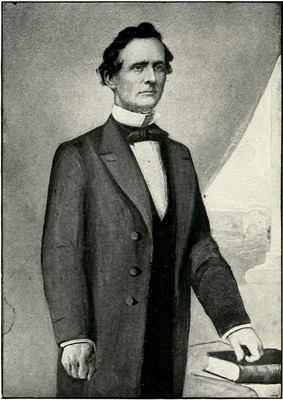
Almost four decades have passed since the surrender at Greensboro of
Johnston to Sherman finally terminated the most stupendous and sanguinary
civil war of history. Few of the great actors in that mighty drama still
linger on the world’s stage. But of the living and of the dead,
irrespective of whether they wore the blue or the gray, history has, with
one exception, delivered her award, which, while it is not free from the
blemish of imperfection, is nevertheless, in the main, the verdict by
which posterity will abide. The one exception is Jefferson Davis. Why this
is so may be explained in a few words.
Occupying, as he did, the most exalted station in the government of the
seceding states, he became from the day of his accession to the
presidency, the embodiment of two diametrically opposite ideas. The loyal
people of the North, disregarding the fact that the Confederacy was a
representative government of limited powers, that a regularly elected
congress made the laws, often against the judgment of the chief executive,
that many of the policies most bitterly condemned by them were inaugurated
against his advice, transformed the agent into the principal and visited
upon him all of the odium attaching to the government that he represented.
Nay, more than this. The bitter passions engendered in the popular mind by
the conflict clothed him with responsibility, not only for every obnoxious
act of his government, but, forgetful of the history of the fifty years
preceding the Civil War, saddled upon him the chief sins of the very
genesis of the doctrine of secession itself. Thus confounded with the
principles of his government and the policies by which it sought to
establish them, the acts for which he may be held justly responsible have
been magnified and distorted while the valuable services previously
rendered to his country, were forgotten or minimized, and Jefferson Davis
as he was disappeared, absorbed, amalgamated, into the selfish arch
traitor intent upon the destruction of the Union to gratify his
unrighteous ambition.
The masses of the Southern people, on the other hand, holding in proud
remembrance the gallant soldier of the Mexican War and deeply appreciative
of his able advocacy of principles which they firmly believed to be
sacredly just, regarded their chief magistrate as the sublimation of all
the virtues inherent in the cause for which they fought. When the
Confederacy collapsed, the indignities heaped upon its chief, his long
imprisonment and the fact that he alone was selected for perpetual
disfranchisement added the martyr’s crown to the halo of the hero, thus
creating in the South an almost universal mental attitude of affection and
sympathy, which was as fatal to the ascertainment of the exact and
unbiased truth of history as were the rancor and bitterness that prevailed
at the North. That this prejudice and predilection still exist cannot be
doubted. But time has plucked the sting of malice from the one and has
dulled the romantic glamor of the other sufficiently to enable us to
examine the events that gave birth to both with that calm and
dispassionate criticism which subrogates every other consideration to the
discovery of truth. I do not underestimate the difficulties that beset the
self-imposed task, but to the best of my humble ability and free from
every motive except that of portraying the impartial truth, I shall
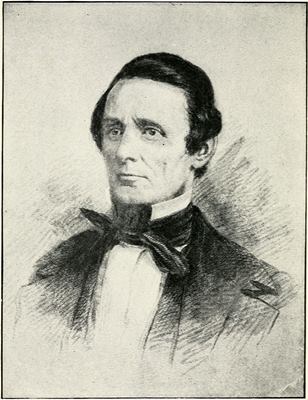
endeavor to delineate the life of the real Jefferson Davis.
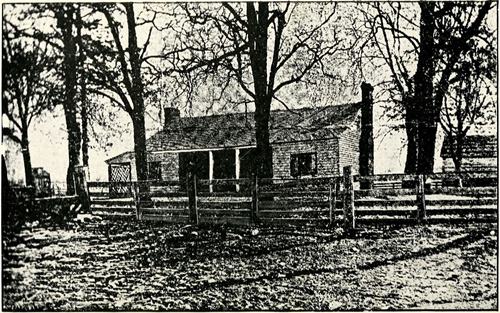
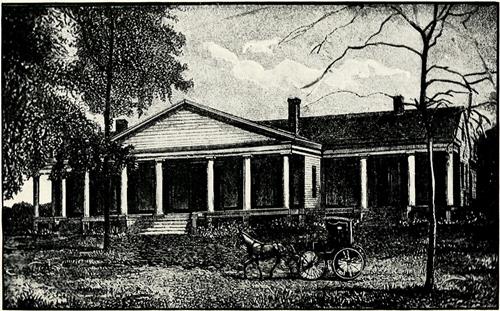
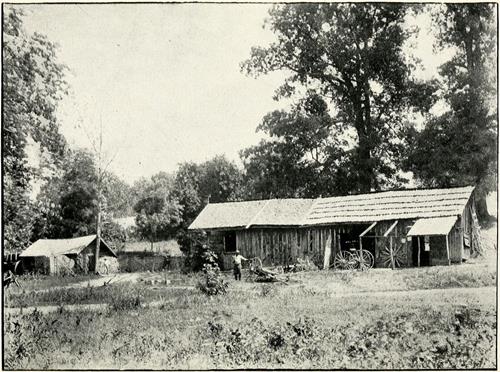
Jefferson Davis’ Birthplace, at Fairview, Ky.
Contrary to the belief still somewhat prevalent, Jefferson Davis was not
descended from a line of aristocratic progenitors, but sprang from the
ranks of that middle class which has produced most of the great men of the
world. About the year 1715 three brothers came to this country from Wales,
and located in Philadelphia. The younger, Evan Davis, eventually went to
the colony of Georgia and there married a widow by the name of Williams.
The only child of that union, Samuel Davis, enlisted at the age of
seventeen as a private soldier in the War of the Revolution. Later he
organized a company of mounted men and at its head participated in most of
the battles of the campaign that forced Lord Cornwallis out of the
Carolinas. At the close of the war he married Jane Cook, a girl of
Scotch-Irish descent, of humble station, but noted for strength of
character and great personal beauty, and they settled on a farm near
Augusta, Ga. In 1804 Samuel Davis removed with his family to southwestern
Kentucky to engage in stock raising and tobacco planting, and there, in a
modest farmhouse, which was then in Christian County and not many miles
from the cabin where a few months later Abraham Lincoln opened his eyes
upon the light of the world, Jefferson Davis was born, June 3, 1808. The
spot is now in Todd County, and upon it stands the Baptist church of
Fairview. While he was still an infant, the hope of there better providing
for a numerous family caused his father to seek a new home on Bayou Teche
in Louisiana. The country, however, proved unhealthful, and he remained
but a few months. He finally bought a farm near Woodville in Wilkinson
County, Miss., where he spent the remainder of his long life, poor, but
respected and esteemed as a man of fine sense and sterling character.
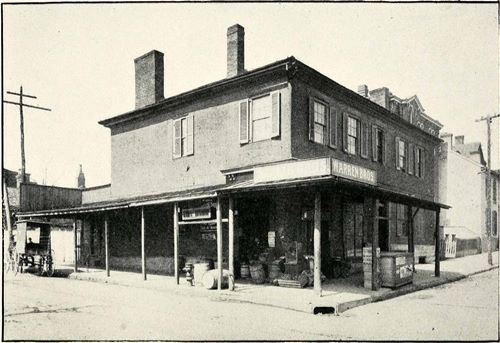
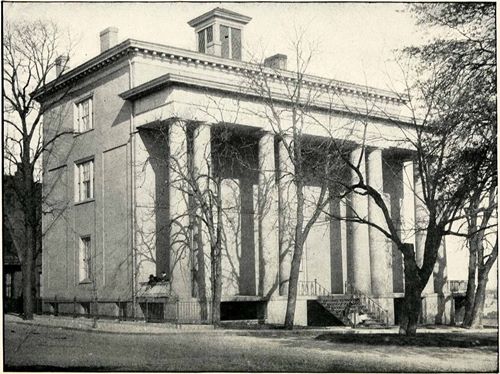
Where Jefferson Davis Boarded While in Lexington
Jefferson Davis’ first tuition was at a log schoolhouse, near his home,
but the educational advantages of that time and place were so meager that
when seven years old he was sent to a Catholic institution known as St.
Thomas’ College, and there, under the guidance of that truly good man and
priest, Father Wallace, afterward Bishop of Nashville, his education
really began. After some years in this school, he entered Transylvania
University, at Lexington, Ky., then the principal collegiate institution
west of the Alleghanies and famous many years thereafter as the alma mater
of a distinguished array of soldiers and statesmen. In November, 1823,
when in his senior year at Transylvania, through the efforts of his
brother, Joseph Davis, he was appointed by President Monroe a cadet at
West Point. The following year he entered that institution and after
pursuing the customary course of four years, was graduated in July, 1828,
with a very low class standing.
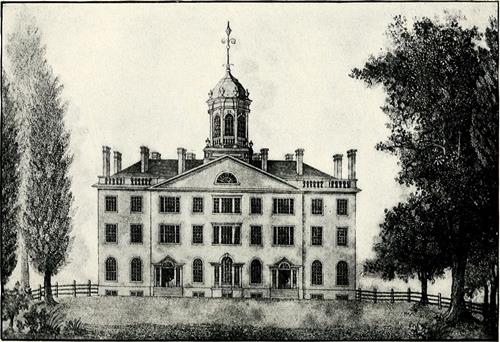
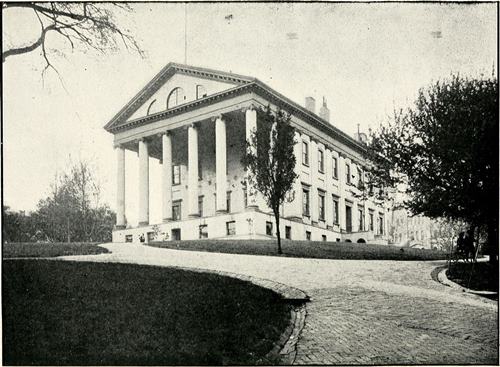
Transylvania College at Lexington
He was then in his twenty-first year. The period in which the principal
foundations of character are laid had passed. What this important period
of life had developed is, therefore, both interesting and instructive.
Fortunately, this information is obtainable through evidence which is
conclusive. More than a half score of his classmates at Transylvania and
at West Point, who subsequently played important parts in the history of
the country, have left us their impressions of Jefferson Davis during that
period of his life. This information is supplemented by his instructors at
both institutions. All of this testimony was recorded previous to the
occurrence of any of the later events in his life which might have biased
the judgment, and all of the witnesses corroborate each other. Without
entering into any extended discussion of this evidence, we may safely
conclude from it that in his youth he was one of those peculiarly normal
characters whose well-ordered existence leaves but little material for the
biographer. Few inequalities and no excesses are discoverable. He seems to
have possessed one of those refined natures that abhor vice and immorality
of every kind. While he made no pretensions to piety, and, apparently
selected no associations with this view of avoiding contamination, his
moral character was without a blemish. Nor was he, as has been
represented, haughty, impulsive and domineering, but, on the contrary, his
nature seems to have been remarkably gentle and his bearing free from
pretensions of every kind. He had opinions, and his convictions were
strong, but he neither reached them hastily nor maintained them with
arrogance. He was serious, somewhat reserved, always cheerful, sometimes
gay. In his manner he was thoroughly democratic, but free from any
suggestion of demagoguery. He was slow to anger, easily mollified, without
malice and possessed in a remarkable degree that ingenuous and credulous
nature which a long and eventful life never impaired and which was
responsible, in no small degree, for many of the fatal mistakes of later
years. If at this time he possessed any of those mental powers which later
in life won the admiration even of his enemies, he gave no indication of
the fact. He was an indifferent student, always somewhat deficient in
mathematics, and never particularly proficient in any other branch,
impressing those who knew him best as an ordinary youth of fair capacity
and of about the attainments requisite to pass the examinations.