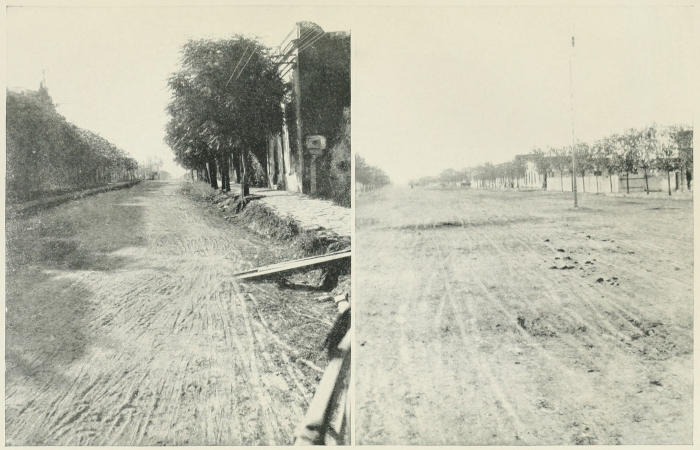
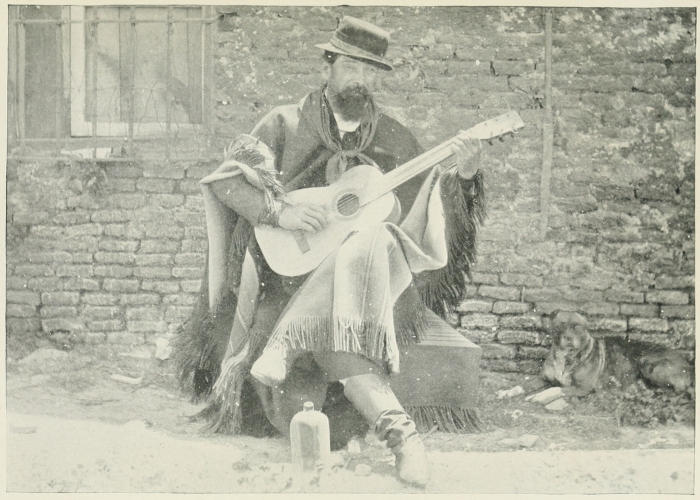
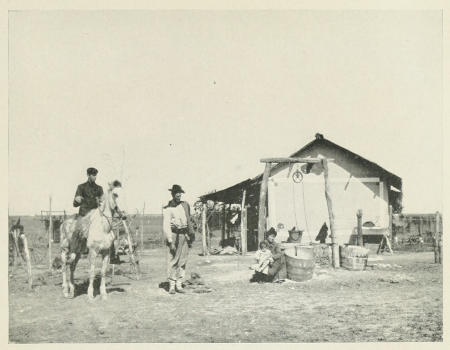
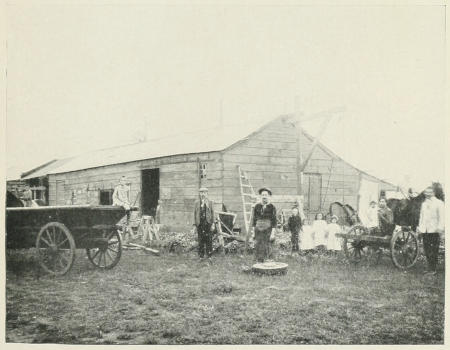
So many books have been written on South American
countries within recent years that the addition of
one more to the already formidable list calls for a
word of explanation, if not apology.
So far as American writers on the Latin-American
Republics are concerned, many of their works are based
upon the statistical returns of the respective Governments,
or on topographical and historical data, easily
obtainable at the public libraries. Others, more popular,
but perhaps less valuable, are the hasty records
of fleeting visits. These latter are so apt to be informed
by a spirit of indiscriminate admiration that
they present misleading and untrue notions of the countries
described.
The present writer may be stating what is already
known to the reader, when he mentions that among
both of these classes of books a considerable percentage—perhaps
the greater number of those published in
the United States and in England—have been subsidised
by the governments of the respective republics of
which they treat. Many are but glorified advertising
pamphlets, put forth in the guise of serious books the
better to fulfil their office of propaganda. To look to
them for any dispassionate and well-studied view of the
countries illustrated in their pages, would be as natural
as to expect the advertisement writer of Somebody’s
Soap to publish an entirely impartial opinion of the
article he had been employed to advertise.
Several French and German authors have written
admirable works on the Argentine, entirely free from
bias, depicting the country as it is, alive to its merits
and its demerits alike; free both from the charge of
“log-rolling” and from that of hasty observation.
But American or English writers of similar works are
not many. Nay, due to the difficulties of ensuring the
conditions essential to the impartial and open-minded
study of the country, even writers of such international
distinction as Viscount Bryce and Mr. Theodore
Roosevelt, with the best will in the world, are liable
to give false impressions. Often have I seen the system
at work, whereby “distinguished visitors” to
South American capitals are so entirely taken in hand
by Government, entertained royally, and shown only
such things as Government particularly wish them to
see, that it would be expecting too much of human nature
to look to them for an unbiased opinion of the
country. I have not read Lord Bryce’s book on South
America, nor anything that Mr. Roosevelt may have
written concerning his tour there, but both these eminent
men so suffer from the disability of their eminence,
and from the official hospitality showered upon
them during their brief sojourns in South America,
that, try they never so valiantly to speak nothing but
the truth,—and I esteem them, different as they are in
many ways, two of the frankest and most honourable
of modern statesmen,—their impressions will be coloured
by the peculiar conditions under which they were
obtained; conditions of official tutelage; and tempered
furthermore by reason of the warm hospitality extended
to them by the respective Governments. As
for the things they see in their rounds of inspection, it
is notorious that they are shown only what official discretion
would have them see. All this, mark you, in
no depreciation of the brilliant work which these, and
many less distinguished visitors to South America, are
capable of doing, but merely to remind the reader that
the conditions in which a work descriptive of any particular
country has been evolved ought to be borne in
mind in the reading of it.
The chief fault of most writers on the Argentine
is the indiscriminate praise they shower around; their
fulsome flattery of the country. Only two hours ago
I received from Canada a newspaper with most of its
front page devoted to an illustrated article entitled
“Buenos Ayres—the Paris of the New World.” An
estate agent, describing the attractions of some property
for sale, would have been beggared for superlatives
compared with the writer of this article who lets
loose a veritable flood of uncritical “gush” on Buenos
Ayres. He may have spent a week in the town, or he
may never have seen it, but a more untruthful or misleading
account of the city could not have been penned,
though it is typical of many that have come to my notice.
I feel that the influence of such writings is to
create in the minds of the public who do not know the
scenes nor the conditions described an impression entirely
mischievous.
So thinking, I have set myself in the present work to
make “a try at truth.” I have lived long enough on
the River Plate to revise and correct my impressions.
I mastered the language of the country, so that I came
to converse in it as readily as in English. And during
the whole of my stay I wrote not a single paragraph of
this book, lest I should record impressions and ideas
which in the end might be misleading. I deliberately
refrained from note-taking, so that when, fully a year
later, I came to the writing, I should be able to secure
a truer perspective, only the things that mattered disengaging
themselves from the multitude of impressions
that crowd in on one during a year of active life
in a strange land.
I have eschewed statistics, which bulk so largely in
most other works on the Argentine, and can be made to
prove whatever a writer most wishes to establish.
What I have sought for rather, has been the human interest
of these great cities of the River Plate; to present
an honest picture of the life that is being lived in
them to-day, and to convey, in as interesting a manner
as I know how, some general notion of the Republics
of Argentine and Uruguay as they really are. I carefully
avoid the official point of view, having studiously
refrained from putting myself at any time under any
obligation that might tend to make me echo an official
opinion instead of stating that which I had honestly
formed from personal and independent study.
J. A. H.
THE REAL ARGENTINE
CHAPTER I FROM LONDON TO LISBON
We set out from London on a raw and rainy day. It
had been raining off and on for many weeks, and as
enthusiasts of the car we had been grumbling, my wife
and I, a good deal at the weather. But we were
booked for the land of sunshine! And when we bade
good-bye to the chauffeur at Charing Cross Station,
rather nervously watched the old grey car roll away
among the traffic and the drizzling rain, we comforted
each other with simple words about the sunshine that
awaited us far off by the River Plate.
Even Paris was dirty. I am an inveterate lover of
Paris, and must have made some thirty different visits,
but seldom out of season, so that I have rarely seen
her draggle-tailed. But in that rainy March she
looked as miserable as London, and next day only the
luxurious accommodation of the Sud Express made the
journey through a sodden France agreeable. Floods
everywhere. In the neighbourhood of Orleans, the
geography of the country seemed to have changed, and
this land of few lakes was studded with sheets of water
that more than rivalled those of Bouchet, or Gerardmer.
Entering Spain we suffered a change in railway accommodation
which was to be typical of many things
when changed into Spanish—a change for the worse.
The carriages were no longer so princely in their
appointments, they were smaller and not quite so clean;
but we were still on the Sud Express, the train de luxe,
and were (but guessed it not) more comfortable than
we were to be again for many moons. So in the
darkness through Northern Spain, awakening in the
morning as we were nearing the borders of Portugal.
Thus far the journey had mostly covered ground
long familiar to me, but Portugal was a new land, and
romantically beautiful it appeared, with its stony uplands,
its green mountains and leafy valleys, seen in
the clear rain-washed air of that golden day that followed
the passing of the floods. We were due in
Lisbon at eleven o’clock at night; but, a bridge on the
route having been washed away, the train had to make
a long détour. We arrived at one o’clock in the morning;
yet the town was as wide awake as if it had been
no later than ten. It evidently goes to bed about three,
as we soon found to our cost when we sought to sleep
in one of the luxurious chambers of the Avenida Palace
Hotel. And here again we were unconsciously bidding
good-bye to genuine comfort, as we were never to
see in any hotel of South America a room worthy to
be slept in by comparison, though we were to pay three
times the price charged at the Avenida Palace, which,
at the time, seemed sufficiently high!
An interesting little incident on arrival at Lisbon
threw a gleam of light on the manners of the degenerate
Portuguese nobility, about which we were to learn
much from a friend who had resided there since the
flight of King Manuel. At the Gare d’Orsay in Paris,
we noticed that the next compartment to ours was occupied
by a tall and handsome lady and her little daughter.
Elegantly dressed, her natural but waning beauty aided
artificially, her hair of false gold, this painted lady
offered a strong contrast to the group of relatives who
had come to see her off. At best, one might have
judged these to be ugly people of the artisan class; at
worst, gentry who traded less honourably in the obscurer
byways of Saint Lazarre or Montmartre.
The lady showed no physical resemblance to any
of them; she might have been a changeling daughter.
Her own child was a charming little creature,
despite her plain features, and it was clear the mother
could command more cash than any of the shabby
group of relatives who had wished them adieu and bon
voyage.
All the way to Lisbon, the lady kept closely to her
compartment, but the trixy little daughter made free
of the car. On arrival at the Portuguese capital,
one began to piece together the scraps of a typical
modern “romance,” as the pair were met by an undersized,
flabby and slightly deformed young gentleman,
on whom the child gazed with all the interest of a first
encounter. A great motor car was in waiting and
conveyed them to our hotel, a distance of about two
hundred yards! We were fated to see much of the
curious trio on the voyage to Rio de Janeiro. The
gentleman, a Portuguese nobleman, was evidently making
for the safety of Brazil, and had planned to keep
bright his memories of Parisian Nights in company of
one of the pleasure-givers.
One meets queer ship-mates on the South American
trip. It would be the height of indiscretion to inquire
too closely into the relationship of many of the
couples who sit with you at table. Somehow I always
thought of “the distinguished member of the Jockey
Club, with his niece, h’m, h’m!” in Tartarin sur les
Alpes, when the Portuguese nobleman, with his lady,
h’m, h’m, sat down at table with the rest of our oddly
assorted company.
There is a brightness and a sense of gaiety about
the picturesque and beautiful capital of Portugal that
are most engaging to the fleeting visitor, but after a
short time the foreign resident finds it one of the dullest
of towns, and has a lurking sympathy with the old and
fallen nobility who sought distraction in pursuits that
drew only the poison from the pleasures of London and
Paris, and eventually made of them the most corrupt
aristocracy in Europe. From all one heard, the revolution
did not come a day too soon, and seldom have
there been a king and an aristocracy that more openly
“asked for it” than Manuel and his effeminate nobles.
The mingling of the negro blood with the European,
which is so marked a feature of the Portuguese, is
doubtless responsible for the low ebb of morality in
Lisbon. The Jewish type is very noticeable among
the people one passes in the streets, and especially in
the women. Altogether, I felt that the breath of the
place was somewhat unwholesome, and Republicanism
cannot possibly make matters worse, though
national decay may have gone too far for any sort of
government to re-vitalise the character of the people.
Old Portugal’s adventurings abroad, which made her
powerful for a time, brought to her the canker of
luxury and the lowering of her virility, in the admixture
of the blood of alien and vicious peoples, so that to-day
in her decadence she is really paying her final
debts of empire.
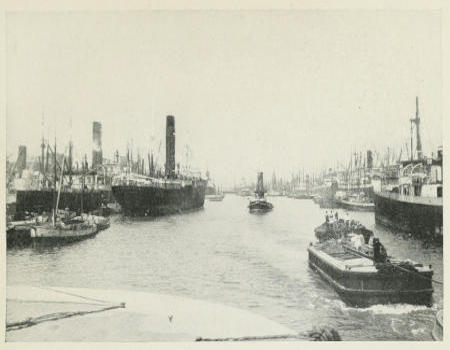
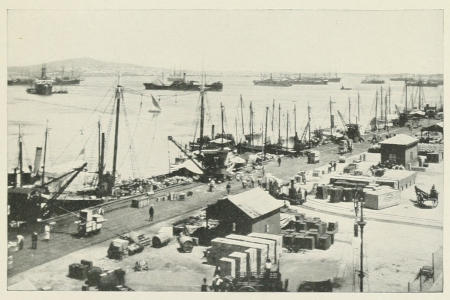
One of the Crowded Docks in the Port of Buenos Ayres.
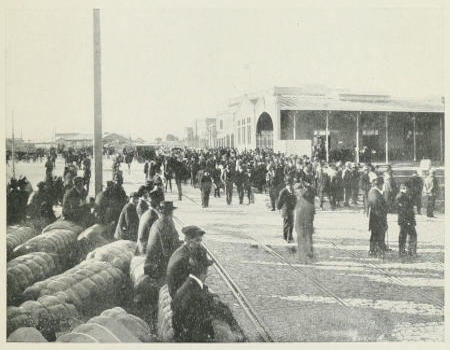
Friends of Emigrants awaiting the Arrival of a Ship.
One sign there was of hope in what we saw—the
admirably conducted orphanage that occupies the
splendid buildings of the old monastery of Belem, hard
by the memorial of Vasco da Gama, with its memories
of Portugal’s golden age. Nowhere have I seen a
finer institution of its kind, with better evidence of
wise charity and tender care of the young. It was a
good act that cleared out the droning monks and confiscated
their building for its present humane and profitable
use. The boys are taught all kinds of trades,
including agriculture, and some of them to whom we
spoke during their play-hour were much ahead of the
scholars of any English orphanage in their knowledge
of foreign languages. French was the favourite,
although one of the lads, who had strong evidence of
negro origin, spoke both French and English admirably,
and told us he was studying German.
On the way to the monastery we spent some time examining
the extraordinary collection of old royal carriages
and sedan chairs, housed in a plain modern
building. These relics of the gorgeous past are even
more remarkable in their prodigal ostentation than
those of the famous collection at Versailles, and will
probably be guarded by the Republic as evidence that
the spendthrift kings who so long oppressed the country
went to sinful extremes in their love of ostentation and
luxury, though all the same I would not swap a sixteen
horse power car for the whole collection, if it
were comfort I was after!
The driver of the motor car we had hired would
have been kept in solitary confinement in any peaceful
country, for he was a public danger, yet when we had
loaded up with our luggage at the hotel we came near
to missing the ship, as “something went wrong with
the works,” and the reckless driver proved so incompetent
a mechanic that we had eventually to transfer
ourselves and our light luggage (the heavy having
been shipped in England) to another taxi, and so reach
the quay, where for a mere trifle of 2,000 reis ($2)
two brawny rascals put our bags on board the tender,
with more fuss than an English porter would have
made over shifting a car-load.
In a few minutes more we were aboard the liner
that was to carry us across the sunlit seas to that other
America which is so different from the Northern Continent
and of which Americans really know so little.
CHAPTER II OUR VOYAGE TO THE RIVER PLATE
We had laughed at the story of some Englishmen in
Lisbon, told us by a friend there. He overheard a
group of typical John Bull tourists, who had been
“doing” a fortnight in Portugal, discussing their experiences
on their way to the boat. The weather had
been superb all the time; they had been steeped in sunshine;
yet the reflection which seemed to find most
favour was the remark of a burly Yorkshireman:
“Thank ’eaven, boys, no more of this damned glare
for a while!”
But we were seekers of sunshine, prepared to accept
all that came our way, so it was with light hearts
we heard the engines throb and felt the vessel resume
her voyage. The Franco-Portuguese couple with the
little girl and ourselves were all who came aboard at
Lisbon, which looked a veritable city of dream as we
steamed out through the wide waters of the Tagus.
Seen from the river, there are few finer prospects
than the long and diversified coast line of Lisbon,
culminating in the castled height of Cintra. A soft
haze of heat blurred the outlines of the hills and
touched them much in the manner of those feathery
old landscape engravings that used to adorn the art
books of fifty years ago.
There was a fairly large number of passengers
aboard, but we soon discovered that the majority were
only bound for Las Palmas, excluding the second class
and some three hundred Spanish and Portuguese emigrants
herded like cattle in the steerage. The dinner
bell rang soon after we had settled in our new quarters,
and for two weeks or so our days now slipped
away, punctuated by the ship’s bells. This orderly
division of time speedily produces a mental condition
that makes for calm and good health. With nothing
to do but engage in an occasional game of deck golf,
or lounge in your canvas chair reading a novel, and be
prompt to answer the summons of the bells that ring
you to your meals, the days fade into each other, like
the old-fashioned dissolving views, and with never a
suggestion of weariness. Indeed, I often wondered if
it might not be that a term of imprisonment would be
almost as efficacious in bringing calm to the troubled
spirit and health to the wearied body. Certainly a
spell of monastic life would be as good a “rest cure.”
But, on the whole, I felt the steamer chair had its advantages
and although I had taken with me the notes
for a book I had had in hand for years, intent on advancing
that in my days of idleness, it was with a great
content that I found it impossible to fix my mind on
any thought of work in those serene days of sailing
over sunny seas. Nothing seemed to matter, even the
frequent ticking of the “wireless” was somewhat of
an intrusion on our ocean peace.
In a voyage of so little incident, when the chief excitement
is contrived by arranging sweepstakes on the
day’s mileage of the vessel, there is plenty of time to
study one’s fellow passengers, and for this a small company,
such as we were after leaving Las Palmas, is
probably more interesting than a large one. There
were only some thirty saloon passengers and naturally
there was much interchange of gossip, the ship’s officers
proving especially companionable. A small company
has the disadvantage, however, that the chronicler cannot
well describe his companion voyagers with that
easy frankness he may safely bestow upon a crowd.
The possibilities of mutual identification are enormously
increased.
Yet in the little handful of voyagers with whom we
sailed there was a remarkable mingling of character:
potentialities of tragedy and comedy, a microcosm of
the social world. One could find much to say of them.
I must content myself, however, with a few vague
touches.
I found that one of the passengers who had made
himself most eminent in the companionship of the
saloon was an intimate of one of my oldest friends in
a far-distant city—so tiny is this great world of ours.
He was a gentleman in whom there survived something
of the spirit of Mr. Pleydell in his Saturday evening
“high jinks,” and maintained that character in the
smoking room (where every night was Saturday) with
a small but admiring audience whom he addressed as
“my loyal subjects.” “Tell me,” he would say,
“what thou would that we, of our royal will, might
do this evening for our own and thy diversion.” And
with varying qualities of the lamely jocular they would
give their suggestions. It was all very pathetic to an
onlooker: the frank and insatiable egotism of “Uncle”
(as we dubbed this worthy of the ruddy visage), his
determination to hear the beloved sound of his own
voice in hoary anecdote and threadbare jest. I was
very patient with him, as I shall ever be with one who
has passed many years of his life in South America—he
should be allowed a large charter of liberty for all
that he has suffered of social hunger and intellectual
thirst. At first I resented somewhat the obtrusive
nature of this worthy Scot’s companionship, but, somehow,
before the journey’s end we were good friends.
I think a voyage of this kind teaches one tolerance, and
it is surprising how the most apparently incompatible
units may draw together by the practice of even a little
toleration. As “Uncle” observed in his soft Scots
voice: “Mun, I was even beginning to like Brixton,”
naming a young man who joined us at Pernambuco, and
who, by reason of a most pronounced tendency to
“swank,” made a bad first impression.
Mention of this passenger, by the way, reminds me
that his unfortunate habit of capping every story, going
one better than everybody else, kept most of us at
arm’s length for a day or two. If one said he had
yellow fever, Brixton had had it twice; if another had
made two voyages to Africa, Brixton had made five or
six; if a third had shot a hare, Brixton had shot an elephant.
Everywhere he had been he had met with hair-raising
adventures. In Pernambuco, he had to use his
revolver every night to scare away the burglars. How
many had he killed? “I winged one of the devils anyhow!”
And in proof he passed round his revolver.
Yellow Jack was raging in the town when he left, he
assured us; but somehow he had been allowed to come
on board quietly and make us shiver with recital of the
horrors he had escaped. Of course, we doubted every
word that Brixton said and yet on many points I have
since had occasion to test his statements and never once
have I found that he lied. He told the truth as he
saw it, and he was an entertaining and good-hearted
Englishman, who had forgot in growing up to cast off
certain habits of thought and talk which are delightful
in Tom Sawyers and Huck Finns, but are apt to convey
wrong impressions of handsome, well-groomed
Mr. Brixtons!
Perhaps our quaintest voyager was an ugly Frenchman,
who had been christened “Dr. Crippen,” before
the ship had reached Lisbon. He certainly bore some
resemblance to that misguided gentleman who stood so
eminently in the world’s eye for a time, and the humour
of the situation was that he had never heard of
Crippen, and rather thought it was some sort of dimly
conceived English compliment to him. He spoke no
word of our barbaric tongue, and when “Uncle” presided
at a mock trial of “Dr. Crippen” the prisoner
was vastly amused, until he found himself condemned
to an hour’s solitary confinement in a bathroom. He
was much given to patronising the bar and passed the
most of his days in a state of happy fuddle; yet I afterwards
learned that his was one of the clearest brains
that control a great and world-famous organisation in
France and when he left us, it was a new and extremely
sober “Dr. Crippen” who stepped ashore to carry out
a very delicate and difficult business mission.
There was no American or English lady among the
saloon passengers, but we had Scots, Irish, Danish,
French, Spanish, and Peruvian. Of none that were
ladies shall I speak, but two who were something else
deserve a note. ’Tis ever thus; virtue is so lacking in
the picturesque. As a connoisseur of dancing, I was interested
to discover that we had aboard a famous
danseuse, most charming of all the pupils of the great
Loïe Fuller, who was on her way to the Casino at
Buenos Ayres—a resort of dubious fame, according
to current belief among our music-hall performers.
But as I had many a time been charmed by the exquisite
art of the said pupil of Loïe Fuller (whose name is
as widely known as that of her teacher) I had no difficulty
in deciding that the plain and vulgar Spanish contortionist
who was going to stamp her heavy feet and
twist her decidedly shapely body before the jovenes
distinguidos of the Casino was merely trading in the
name of a celebrity. Her luggage bore the famous
name in huge letters, and I afterwards saw it “billed”
widely in Buenos Ayres.
On the whole, the conduct of this Spanish dancer
during the voyage was so openly without sense of shame
that there was little one could object to! Sometimes
she appeared in gorgeous raiment and an enormous
“picture hat,” ready for the Bois or the Alameda;
even, on one occasion, sporting a huge muff in the tropics!
Again she would pass the day in bedroom slippers,
her corsets put aside, her lithe body draped only
in a dressing gown, and her golden hair of yesterday,
completely doffed, leaving only a shabby little nob of
faded brown. She entangled at least one of the male
passengers, a Chilian who later found another flame in
an attractive demi-mondaine of the second class, and it
afforded us some amusement to watch the rivalry
which now ensued, but there was little sympathy when
the gay Lothario came to the end of his cash and attempted
to borrow.
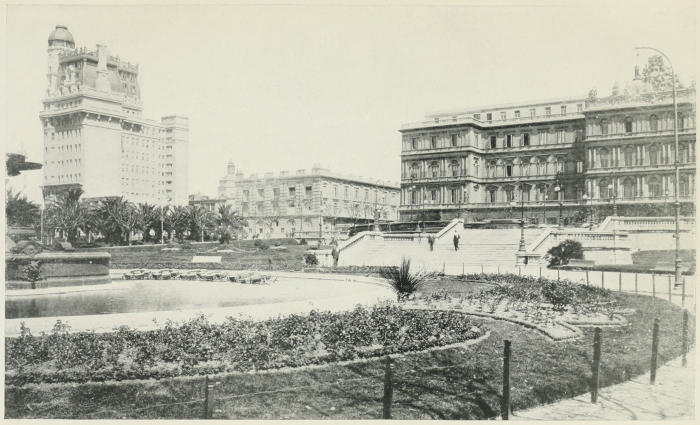
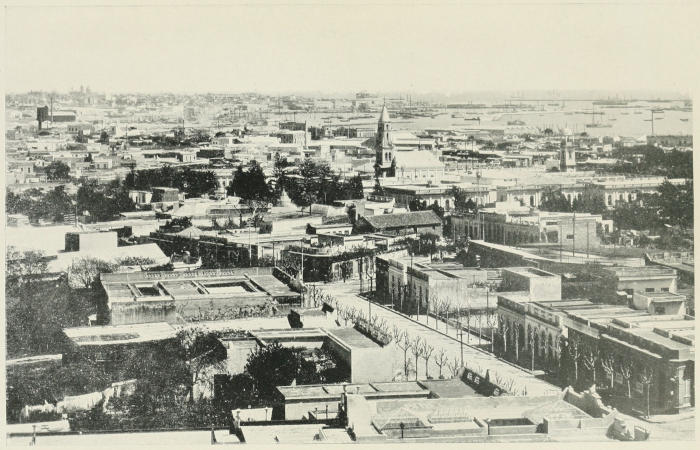
The First Familiar Landmark for the Visitor To Buenos Ayres.
Part of the Paseo Colón, with the Government House on the right,
and the tallest of the new commercial buildings on the left.
The other “interesting lady” of the saloon was of
quite a different type. A French chanteuse of the
smaller café concerts, she was extremely plain by nature’s
wish, but the art of make-up and some potent
hair-dye effected a magical change the day she left us.
She behaved herself modestly enough and passed most
of her time with her crochet needle, sitting side by side
with the honest women aboard, yet I was told that her
songs would have brought a blush to the cheeks of a
stevedore! She sang to us several dainty and harmless
little French and Spanish verses in the familiar
café chantant manner, and altogether left the impression
of a poor woman laying out her small gifts to the
best advantage.
There was little or no intercourse between the saloon
passengers and those of the second class, although it
seemed to me that among the latter were many worthy
people and a good-hearted companionship. They certainly
showed to advantage in the diverting ceremony
observed when Father Neptune held court on crossing
the line. Included among them were a number of
minor “artistes” bound for the music-halls of Buenos
Ayres, not to mention several young women with a still
less attractive journey’s end in view.
We heard much from the old South Atlantic voyagers
on board about the doings on other and more
popular lines than that to which our vessel belonged.
The “muck-raking” magazines might work up a spicy
stew of scandal about life on the South American liners
if they gave themselves to the task. Wealthy Argentines
and Brazilians travelling with their wives in the
saloon and two or three concubines in the second class,
offer quite attractive material for the journalist in
search of the spicy, while the traffic in “white slaves”
has long provided a certain percentage of the passengers
for these very profitable lines, in which, perchance,
some dear old christian ladies have their investments.
How difficult it is to keep one’s hands clean in this
soiled world!
From all that I have been told, and also from personal
observation, the perils of the deep may have a
curious resemblance to the perils of “the Great White
Way.” And even those who ought to be the protectors
of innocence may prove to be its assailants. A
young married lady, lately arrived from England, was
under the pain of having to travel alone from Buenos
Ayres to a Brazilian port where her husband was lying
in hospital with typhoid, and her plain story of how
the purser, under cloak of sympathy for her in her distress,
first ingratiated himself by talking sentimental
slop about his wife and bairns at home, getting her to
go into his cabin to look at the treasured photographs
of his “dear ones,” and there, without more ado, attempted
to assail the honour of the young wife, whose
mental sufferings at the time were, to my knowledge,
almost beyond endurance, is one of the ugliest I have
heard. This was an English officer, note you: none
of your sensual Italians.
It is to be feared that much co-mingling with pimps
and procurers may have tended somewhat to blunt the
native honour of the Englishman in these southern
latitudes, for, up to a day so recent that it seems but
yesterday, nothing had been done to dam the foul
stream that has flowed so long from the human sewers
of Europe into the still more noisome mares stagnantes
of Buenos Ayres. Now, there is at least some
pretence of stemming it, and from time to time one
reads in the Buenos Ayres papers about the latest raid
on the “apaches,” who are deported, with much pomp
and circumstance, or about the rejected of Paris, in the
shape of womankind, who are refused admission to the
city of good airs.
But to return to a pleasanter, if less piquant subject,
our voyage deserves at least a few words of description.
We seemed to be lying off Las Palmas before
the beautiful picture of Lisbon in sunshine had quite
faded from our vision, and at this distance of time I
would not undertake to say whether it was two or three
days that had passed between the two ports, so dreamy
was our progress. The sight of Las Palmas, with its
grateful greenness of hill and valley, and far southward,
cloud-high in a gorgeous flood of sunshine, the
mighty mass of Teneriffe, thrusting itself boldly into
the sky from the heaving wilderness of water, gave to
the beholder one of those rare moments of spiritual
exaltation which a first sight of such natural grandeur
must always awaken in the thinking mind.
St. Vincent was a different story. Fully two days
more steaming brought us thither to that vile haunt of
malaria and all things unlovely. The Cape Verde Islands,
of which St. Vincent is the principal, dishonour
the name they bear, as there is scarce a speck of verdure
to be seen upon them. Presumably there must be
some natural reason for the naming of the Cape itself
on the African coast, off which, nearly five hundred
miles northwestward, these scabby isles show their
horrid heads above the blue Atlantic. They are of a
dirty red colour, and at a distance resemble some
humpy monsters of the deep wallowing in the sunshine.
The port is useful as a coaling and cable station. A
town of shanties, it swarms with negroes, and ships’
pedlars. Here a small colony of young Britons are
marooned in the cable service. At first the young
cable operator is no doubt delighted to find how much
more picturesque he has become than he was at home.
To have to wear white duck suits and a pith helmet,
and look like Stanley on his way to discover Livingstone,
is extremely attractive to the eye of youth!
Even the gentleman who sells coals to the liners comes
on board looking for all the world like a colonial governor,
or the leader of a mission to Abyssinia. Then
there is much card-playing and a good deal of hard-drinking
among “the boys,” who talk of “the service
and all that sort of thing, dontcher know,” to feed
youth’s fondness for swagger. But when the debilitating
effects of the climate and the life make themselves
felt, when the novelty has gone, what a husk
remains! Lucky are the young men who escape from
these rusty isles before the rot of the place has eaten
too deeply into their natures. The harbour swarms
with sharks, but the negro boys who dive for the
amusement of the passengers on the ships that put
in there make light of the sharks for a sixpence, or
even for a humble penny thrown into the water.
St. Vincent gave us our last glimpse of the Old
World. Its very ugliness sent our thoughts zestfully
forward to the undiscovered beauties of the New, then
so full of promise, now—but that’s a later story. It
was pleasant to hear again the long soft swish of the
water running past the vessel’s sides as she resumed
her tranquil voyage into the sunset. Now succeeded
many days of idle lolling in the deck chair, watching
through the binoculars the swarms of flying fish skimming
over the surface of the ocean like tiniest aeroplanes.
Bird life in these ocean solitudes is rare, yet we not
only saw several journeying on confident wing several
hundred miles from land, but for two or three days we
were forcibly reminded of “Nature red in tooth and
claw,” by witnessing a little drama in feathers. One
day out from St. Vincent a bird, about the size of a
pigeon, gorgeously coloured and sporting a plume of
orange-red, alighted on the rigging of the ship, pursued
by a larger hawk-like bird. Evidently the pursuit had
lasted for a long time, as both were land birds and
seemed very exhausted, for we were now some hundreds
of miles from the African coast, whence hunter
and hunted had no doubt flown. For two or three
days a strange game of cross purposes ensued, the
hunted, with the skill of desperation, cleverly selecting
different positions in the rigging or on the smoke-stacks,
which offered no opportunity to the hunter to
swoop down on him from above. There were violent
chasings at times around the ship, when the essential
cruelty of the Spanish emigrants was displayed in their
efforts to strike the pursued bird with all sorts of objects
hurled at it as it swept past the bows. Eventually
the hawk gave up and disappeared and soon afterward
the bird of brilliant plumage took wing away.
Seldom did we sight another vessel; now and again
we signalled a tramp or a collier heading south with its
cargo from Wales to be sold eventually in Buenos
Ayres at some $20 or $25 per ton—it was during the
time of the coal strike. One only of the old “wind-jammers”
did we pass. In full sail, she looked, in the
blue immensity of the tranquil sea, no bigger than a
toy boat, and an object of such appropriate grace and
beauty that it was sad to think a day would come when
no ship that goes by spread of glistening sail would
cross those far waters again.
Early on the sixth day out from St. Vincent, on
going on deck before breakfast we were not a little
surprised to find that we were steaming close to a long
and narrow green island on which many signs of careful
cultivation were evident. In a cove the white
houses of a township showed clear and inviting in the
morning air, the blue smoke curling from some of the
chimneys giving one an intense pang of home hunger.
With the binoculars it was easy to make out people going
about their tasks in the fields, others walking towards
what seemed to be a signalling station. The
surprise at this sudden coming upon a bit of the habitated
globe in what, for all we had supposed the night
before, was still mid-ocean, sent us questioning to the
officers of the ship. The island turned out to be Fernando
de Noroña, notable chiefly as a Brazilian penal
settlement. A Brazilian—the only one among our
company—told me a story about Fernando de Noroña
which, speaking in Spanish, he considered muy
graciosa. An Englishman in Pernambuco killed a native
in a quarrel and was sent to the penal isle, but in
the course of a year or less he was granted his liberty,
that being a matter of simple negotiation: a little influence
and a modicum of money can always save a criminal
in that happy clime. But, the Englishman, having
long suffered a shrewish wife, found so much peace in
prison that he refused to quit the island and there remains.
Fernando de Noroña lies some two hundred
miles off the north eastern shoulder of Brazil, and by
that token we were soon to be touching at Pernambuco
and hugging the Brazilian coast for the rest of our
voyage.
One felt almost sorry that the sunny days of serene
steaming over shoreless seas were coming to an end
and that presently we would be picking up the coast of
the new world. By now we had grown so used to the
companionship of the boat that we began to look forward
to leaving it with something of regret.
At Pernambuco we had our first sight of a South
American town and I should be departing widely from
the truth were I to say that the “Venice of Brazil”
tugged at my heart-strings. It is a town of evil-smelling
waterways, half-finished streets, at their best no
better than a London byway, with cut-throat quarters
that harbour all uncleanness. The task of going
ashore, first being lowered into a bobbing dingy by
means of a rope and basket, is attended with a sensation
of nausea which the merry assurance of the old
skipper by your side as to the water being a favourite
haunt of sharks does little to counteract, especially
when his trained eye enables him, a moment or two
later, to point out several of these hunting for garbage
around the ship. It is fair to say of Pernambuco that
it is undergoing transformation: the “avenida” craze
has taken root and at the time of our visit innumerable
shanties were being demolished to make way for wide
avenues and new buildings.
The first sensation of crossing a great sea and making
land on its farther shore, once experienced—and
it is a “thrill” that never comes again—we sank
back into the half-indifferent contemplation of the long,
indented coast line of this prodigious land of Brazil.
For hundreds of miles it is unchanging in its character
of palm-fringed shores, with great dim mountain
masses inland, a soft blur of heat overhanging all.
There is plenty to suggest mystery and romance, and
yet somehow beauty is lacking. I mean the wild
beauty of peak and crag which we find along the coasts
of Scotland, where the conformation is continually
changing. These mountains of Brazil have that volcanic
sameness which only becomes magnificent when
you can ascend to some commanding pinnacle and look
down upon a veritable wilderness of mighty earth
mounds, such as it was my good fortune once to look
upon from the tower of the ancient castle of Polignac
in the volcanic heart of France.
For many nights the tropical skies had been a revelation
of stellar glory, and often though I have gazed
at the friendly skies of home on “a beautiful clear
night of stars” (to quote the haunting phrase of “R.
L. S.”), little had I imagined the glories that awaited
the beholder of the heavens in a clear tropical night.
The stars appear much larger and incomparably more
brilliant than I have ever seen them in our northern
latitudes, nor do they “stud” the sky so much as hang
dependent from the dense dark blue. I had many
starlight talks with the old skipper who was travelling
to a “shore job” (the dream of every sailor!) on the
Pacific, and who spoke of the stars which had guided
him so long on his voyages with that familiarity of the
worthy old Scots minister “who, ye micht hae thought,
had been born and brocht up among them.” Yet I
have failed on many occasions since to rediscover the
interesting relationships of the constellations which he
so clearly explained to me. I confess, however, to a
keen sense of disappointment in the much vaunted
Southern Cross. It is a lop-sided and unimpressive
group of four stars.
The sight of Bahía, about one day’s steam from
Pernambuco, was peculiarly pleasing. It might have
been a bit of the French or Italian Riviera, with its
rich verdure and bosky hills, while the residential suburbs
looked quite European as seen from the ship.
We made no closer acquaintance than a stay of some
three hours in the beautiful bay, but I could well believe
that much that looked most alluring in the picturesque
sea-front of the town did not bear too close
inspection.
Two more days brought us to Rio de Janeiro, full of
expectation and curiosity for the pearl of South America.
The bay of Rio has been so often photographed,
so fully described, that any one who has read much
must have a good mental picture of the place, which
fortunately squares very neatly with the actuality.
The fantastic islands of volcanic origin which peep
up through the broad waters of the bay, or impudently
flaunt their grassy cones high above sea level,
in the most unexpected places, give to Rio, as seen from
the bay, an aspect that is unique. The town spreads itself
out with picturesque irregularity among the gentle
valleys that lie between the many hills, trending swiftly
upward some little way inland from the shore, the noble
height of Corcovado crowning the whole lively and
diversified scene. These hills being mostly tropical in
the richness and character of their vegetation, the art
of man had no great task to transform the situation
into one of the world’s most beautiful cities.
On the whole, man has here done his work well, although
it has to be confessed that much of the architecture
is paltry and all of the plaster variety. The
marine drive will match almost anything of the kind in
Europe, and the Avenida Central is admirably devised
at once to beautify the town and drain the pressing traffic
of the narrower side streets. The suburbs are also
spacious and well planned, so that one could imagine
life being very pleasant here—when the weather is a
little cooler than the norm. Although the summer was
supposed to be over at the time of our visit, the atmosphere
was enervating in the extreme, and even on the
breezy heights of Corcovado, to which we ascended by
the funicular, and whence one of the grandest prospects
man may look upon rewarded us, we perspired at
every step. Everywhere there was the moist, oppressive
smell of the hot-house, so that one could guess
what it meant to be afoot in Rio in the summer time, if
this were autumn.
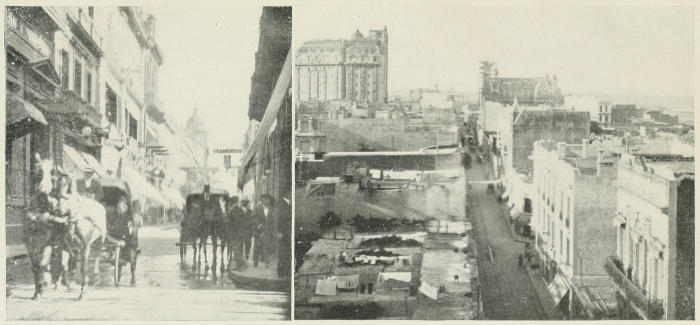
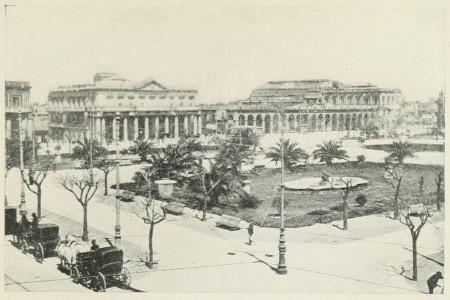
The Narrow Streets of Buenos Ayres.
The left illustration shows Calle Florida, the busiest thoroughfare of
Buenos Ayres; the right is a bird’s-eye view of Calle San Martín,
looking towards the Plaza Hotel. These are typical main streets.
As for living here: when we were charged twelve
milreis ($6.50) for a dish of fruit that might have
cost a dollar in New York, at a very ordinary hotel,
where all other charges were proportionately appalling,
we had our doubts, even granted a change of
weather. One of our party paid the equivalent of four
dollars for a tooth-brush, a cake of soap, a small tube
of lanoline, and some shaving powder!
Paying an uniformed madman, who was plying for
hire with a motor car, a few thousand reis (a milreis
or one thousand reis go to 54 cents, so that you part
with them in tens of thousands in a forenoon), we
drove all around the city and the Marina at fully thirty
miles an hour, turning busy corners at that speed. I
myself can claim some dexterity at the wheel; but I
confess that I sat in terror in that maniac’s car as we
sped wildly through the highways and byways of Rio.
Yet he was perfectly sane as motorists are accounted
sane in that town; his performance evoking no remark.
The speed limit is, I believe, eight or ten miles an hour,
but, like all the laws of Latin America, that is laid
down merely to be ignored. The municipal authorities,
however, use the bylaw as a supplementary tax,
and regularly fine all the motorists of the town, in succession,
for exceeding the limit. A well-known English
resident who owns a speedy car told me he had
been fined a month before for exceeding the limit on a
certain date, when he had been on the high seas returning
from Europe. He protested, lodged his plea,
and was fined all the same, on the ground that if he did
not exceed the limit that day, he had done so in all certainty
before or after.
Altogether our impressions of Rio were favourable.
Every prospect pleased us; only man was vile, and none
viler than the scum that haunt the sea-front to plunder
visitors by getting them aboard their small boats for
conveyance to the liners in the bay, then, with sundry
sinister threats, endeavour (too often successfully) to
make their victims disgorge a payment large enough to
purchase the boat. The gentry who ply this trade at
Naples are mild and benevolent by comparison.
About noon of the day following our stop at Rio,
we were steaming up the picturesque estuary of Santos.
A Frenchman on board had promised me that here I
should see something tout à fait original, and much
though I had been charmed with the actual sight of
Rio, so long familiar to me in picture, the approach to
Santos proved even more interesting, due perhaps in
some degree to the charm of the unknown and unexpected.
There is also a touch of romance in slowly
approaching a town that lies up a river, instead of coming
upon it suddenly from the sea. A negro pilot took
command of the ship up to Santos, somewhat to the
disgust of our captain, who had never before stood by
a “nigger” on the bridge and seemed none too sure
of his pilot, for he never let go the telegraph handle
until his vessel was berthed.
The country through which the river runs (it is
more an arm of the sea than a river) is undoubtedly
“original,” abounding in low volcanic hills, with abundance
of verdure, broken now and then by palm groves,
and swampy flats. Here one is conscious of being in a
strange land, and it is easy to imagine with what tense
interest and straining eyes the first bold adventurers
sailed up this narrow and beautiful water-way to found
the city that has become the second port of Brazil.
The city itself stretches by the riverside around the
foot of a great green hill, disfigured by a monstrous
advertisement announcing to adventurers of a different
kind and a later day that somebody’s biscuits are the
best! A considerable part of the town lies on land
that still looks suspiciously swampy and used to be an
ideal haunt of Yellow Jack, though I was told that to-day
it would be difficult to find a healthier spot. That
may be so, but I think I could succeed if I tried very
hard. As for the town itself, a short ramble revealed
one of the deadest and most uninteresting cities it has
been my lot to see, and I gladly returned to the friendly
shelter of the ship and the livelier locality of the quayside,
where were congregated many vessels from British,
American, and Continental ports.
Two days more and we found ourselves at anchor
in the roads outside Montevideo, which presents a
most engaging picture from the sea, the town covering
a lumpy tongue of land that juts seaward with a rocky
short, rambling inland in many directions and along the
bay, which culminates in the conical mass known as the
Cerro, crowned by an antique fortress and a modern
light-house. At night, when the myriad electric lamps
are lit, the light-house on the Cerro throwing its broad
and regular beams athwart the bay, innumerable red
and green lights blinking on the buoys in the harbour,
much flitting of motor launches and brightly illuminated
liners lying at anchor, there is no scene I know that
better suggests one’s juvenile fancies of Fairyland.
The town itself delighted us, seen in generous sunshine,
with refreshing breezes blowing from the sea,
which at first sight, as we pass along the streets, seems
completely to enclose it. But as I shall have something
to say of my later stay in the Uruguayan capital,
I shall not occupy myself with it further at the moment.
We bade good-bye to the ship that had been our
most pleasant abode for so many days and made our
first acquaintance with things Argentine by transferring
ourselves to a musty, ill-managed river-steamer, on
which the crudest elements of courtesy had still to be
acquired by officials and stewards, who were all too
conscious of being employed by a firm which then
monopolised the river trade.
Still, although we realised what a change for the
worse we had made in transhipping, we comforted
ourselves with the knowledge that to-morrow we should
awaken in the port of Buenos Ayres; in that genial
land of sunshine to which we had so long looked forward
with eager anticipation. The passage up the
river—which, seaward of Montevideo, is some 150
miles in width, narrowing suddenly to sixty opposite
the city, and to the eye has no farther shore, so that
only the discolouration of the water distinguishes river
from sea—was made in the roughest weather we had
experienced, the steamer tossing like a cork and its paddle
wheels beating the waves with feeble irregularity.
It was an early autumn morning when we walked
off the gangway at the Dársena Sud to endure the pain
of getting our belongings through the customs, an operation
apparently regulated by the shipping authorities
after studying all the worst methods in vogue,
selecting the worst features of each, and combining
these into a system that is the acme of inefficiency.
Moreover, the wind bit as shrewdly this autumn morning
as on a midwinter’s day in New York, and, believing
in this land of sunshine with a simple faith that had
yet to suffer rudest shocks, we stood there an hour or
more, clothed for summer, chattering with cold.
But we were actually in Buenos Ayres, and soon all
the marvels of that wonderful city, that “Paris of
South America,” as Argentines who have never been
to Europe are fond of describing it, were to reveal
themselves to us starveling voyagers who knew nothing
better than the Paris of France.
Vamos a ver, as they say in Buenos Ayres.
CHAPTER III FIRST IMPRESSIONS OF BUENOS AYRES
Our ship’s doctor, with whom I had passed many
agreeable hours, and whose efforts to practise the Spanish
speech added not a little to the gaiety of our voyage,
was a plain-spoken young man, who assured me,
when he heard I was bound for Buenos Ayres, that I
was going to “the rottenest place in South America.”
This was a blow that struck my puffed-up admiration
of the place under the belt. I had read in the papers
before leaving London that no fewer than fifteen stowaways
from Glasgow had reached the sunshine city of
the River Plate on a merchant liner, and of these thirteen
were discovered on the same vessel when it was
making its homeward trip. Now, Glasgow is noted
for its rain, but it had rained in such an appalling manner
all the time the vessel was discharging and loading
at Buenos Ayres that these sodden thirteen were homesick
for the milder rains that wash their native haunts!
Doubtless, if the truth were known, the other two had
stowed away too much of the vile liquid sold as “Eskotsh
weeskee” in Buenos Ayres to be able to stow
themselves away a second time, and remained to swell
the ranks of the Scotch and Irish rascals who pester
their fellow-countrymen for alms in Florida and San
Martín—the streets where most of the Britishers may
be encountered.
But I had made light of both the doctor’s dictum
and the experience of the Glasgow stowaways. Nobody,
nothing, was to rob me of my ideal city on the
Silver River!
The dirty porter who conveyed our hand-bags to a
dirtier coche, with a driver in the full regalia of
“hobo” and two horses that ought to have been taken
straightway to the knacker’s yard, did his best to rob
me of five pesos (value $2.10) for a task which would
have been well paid at a dime or a quarter and the
money gratefully received. I had given him one peso
only (42 cts.) and so loudly and volubly did he denounce
me for a “mean, dirty German,” that I gave
him one more for peace, and the sorry nags were
whipped up and we drove away on our great adventure.
The coach, typical of many I was to see and not
greatly inferior to scores it was to be my unhappy fate
to ride in for many months, was of the “Victoria”
style, so pleasantly familiar to the frequenter of Paris;
but it was battered and tattered, the splash-boards
broken, the mud-encrusted wheels repaired with odd
spokes, the upholstering faded and torn, while the
sight of the driver in his greasy rags and the poor worn
horses with projecting ribs, broken kneed, and raw
flesh showing in patches along their scraggy backs,
mortified me that in such a manner I should enter the
city of my dreams. Yet the description may stand as
representative of a considerable percentage of the
things then plying for hire in Buenos Ayres. The tattered
ruffian on the box-seat lashed the moribund nags
so unmercifully that I had to insist on his refraining,
but then, and often afterwards, it was clear to me
that only by thrashing could the hapless creatures be
made to go.
And what a journey! The roadway reminded me
of the Chinese saying, that in China the roads are
good for ten years and bad for ten thousand. With
a briefer history than China’s it may be said of Buenos
Ayres that its roads are good for ten days and bad for
ten years. We had evidently arrived on the eleventh
day! Made of cobble stones, the road was as choppy
as the river on a windy day, the tram lines now projecting
half a foot above the level, now dipping into baked-mud
hollows. Everywhere the cracking of whips, the
clanging of bells, the shouting of drivers, the screeching
of ungreased axles, and the slipping and straining of
sweating horses, harnessed in threes and fours to uncouth
and overladen wagons. A scene of brutal ugliness
and sordid brute strife that filled one’s mind with
horror. We had plunged into the hell of the horse
and the mule. It was heart-rending to see the wretched
creatures cut and bruised, with open sores and swollen
fetlocks, the cruel chain traces at which they were
straining often running in grooves which they had cut
in the creature’s flesh and ever the relentless whips descending
on the suffering backs with stings that would
have touched the heart of any man of feeling. But in
all that strange, noisy medley of man and brute there
was no sign of feeling; nothing but a dull, blear-eyed
urge forward. Forward to what? Ah, he were a bold
man who answered that. But what I know and assert
is that in a hundred thousand miles of world-travel,
and observation, I have never witnessed such a scene
of brute suffering as I did that autumn morning in our
drive from the Dársena Sud, past the Aduana, by the
Paseo Colón and the Paseo de Julio to our hotel.
As for my first impressions of the city, I comforted
myself with the reflection that the neighbourhood of
docks is in all great seaports the least favourable point
of view. Everything that met one’s eyes was mean, or
makeshift. The shops along the Paseo were of the
lowest class; most of the buildings were crumbling
plaster shanties. The people trafficking in them were
the dredgings of a lower life than one sees in the
region of the Bowery—incomparably more villainous
in mien. It is true that the gardens, which adorn the
Paseo Colón and the Paseo de Julio and make these
appear (in a photograph) one of the pleasantest thoroughfares
in all the world (the one is a continuation
of the other), looked beautiful, yet none but foul Italians
and Semitic scum were to be seen walking there.
It would be all right when we got into the city itself,
for had we not feasted our eyes times out of number
on alluring pictures of the imposing buildings of this
wonder city sent broadcast to the ends of earth by official
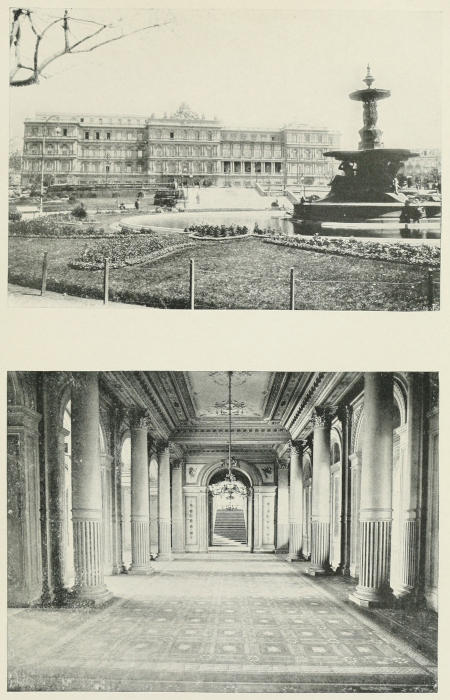
propagandists? A huge pink-painted plaster
building, with the “sham” flaking off in places, showed
its spacious back to the green palm-dotted gardens
of the Paseo. Was it—could it be?—the famous
Casa Rosada, the official home of the president? It
was. A little cold shiver zig-zagged down my back,
and I ticked off in my mind the Casa Rosada as one of
my dream pictures of Buenos Ayres that had not come
true.
Presently, up a side-street, crowded with struggling
wagons, coaches and clamorous tram-cars, where small
buildings were being torn down and large steel-frame
ones were being stuck up, we came to our hotel.
The roadway in front was so narrow, the traffic so
insistent, and the tramways so continuous, that the mere
act of stopping our coach for a minute blocked the
whole ill-regulated, restless mass. Nor in the hotel
did we find peace. It was in the hands of repairers,
who, as we afterwards learned, had been repairing it
for three years, and in all that time did no more than
could have been achieved in New York inside of a
month. As to the moderation of this statement, not
only can I vouch from a careful and intimate study of
the work of those blundering incompetents through
eight long months of residence there, but I could call
a cloud of witnesses, whose fate it was to live through
a considerable part of the weary years of alteration,
as the discomforts we had to suffer were a frequent
topic of the “stayers” in what, with all its faults, was
at that time the most comfortable and reasonable hotel
in Buenos Ayres. (I hear that it has since been much
improved in its appointments.)
In the small and crowded lounge, where we humbly
waited for the privilege of securing accommodation,
there was a mingling of the coming and the parting
guests. The former one could recognise at a glance
by their creased clothing, the latter notably chiefly for
their bucolic touches. The room was uninviting, the
shabby wallpaper in pendulous bulges, mouldy with
damp, every item worthy only of a small country hotel.
The gentleman in the temporary office, who carried out
his duties amidst plasterers’ ladders and plumbers’
tools, was willing to concede us a small room with a
bath for twenty-six pesos ($11) per day, including
“board” but excluding certain “extras.” The terms
would be the same for a stay of one night or for a stay
of one year. I accepted with a feeling of disappointment,
after discovering that a bedroom and a sitting-room
of the most ordinary description were to cost
me seventeen dollars per day. And had I to stay again
for eight whole months in Buenos Ayres I should most
willingly return to the same conditions which at first
I regarded with frank contempt. It is a sadder and a
wiser man that writes these lines than he who stepped
hopefully into the best-recommended hotel in Buenos
Ayres that chill morning of autumn.
The window of our room looked upon a street so
narrow that, when all the high buildings in process of
erection are completed, no faint ray of sun will ever
enter it. At the corner immediately opposite stood one
of the old single-story structures of the colonial type,
which in the centre of the city are giving way to the
multi-storied edifices of steel and concrete. This old
shanty-like building was a centre of swarming life—Turks,
Greeks, Swedes, Syrians, Italians, in short, the
off-scourings of all nations, were to be our neighbours,
and their babel of tongues sounded from the little drinking
den into which our window looked as though the
brawlers were in the hotel itself. A nice quiet neighbourhood!
Being so near the corner, we had the advantage
of two sets of tramways, and with the windows
open it was almost necessary to use a megaphone to
make one’s voice heard in the bedroom. The narrow
streets intensified all noises to an extraordinary degree.
Bedlam must be peaceful compared to that corner—and
that is but one of thousands similar.
“We must clear out of here as soon as possible,”
said my wife. But a woman’s “must” dwindles into
the meekest acquiescence when pitted against the
“must” of Buenos Ayres. “There must be quieter
places in the centre of the town, away from these
cramped and crowded back streets,” she opined. Alas,
there are no back streets in Buenos Ayres. Or rather,
there are few other.
As soon as possible I went forth to find the great
open avenues where, perchance, I could move at my
ease and enjoy the spectacle of the myriad life of the
great metropolis. I half hoped that we had entered
the hotel by a back door and would find on turning the
corner that it had a noble frontage to some spacious
street. Vain hope of a “Gringo”—as the native dubs
the foreigner in South America. I found myself in a
buzzing thoroughfare, where there were no tramways,
but where coaches and motor cars were dashing along
in the most reckless manner and with quite superfluous
speed, as at nearly every corner they had to pull up
suddenly in muddled mobs to allow the streaming traffic
of the cross-streets to pass. The street was lined
with splendid shops, many displaying the most luxurious
articles of furniture, jewellery, or wearing apparel,
and reminding one of London’s Bond Street. It
was about the width of Wall Street, New York City.
It was the Calle Florida, the very core and pride of
Buenos Ayres!
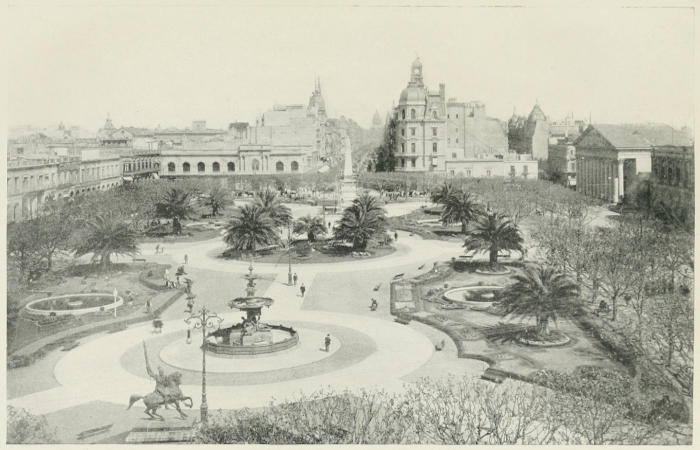
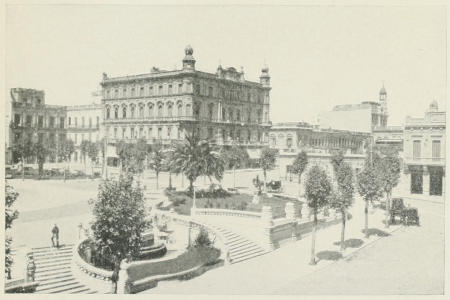
The Changing Heart of Buenos Ayres.
Plaza de Mayo, looking westward along the Avenida towards Congreso. The
appearance of this square has recently been modified, and two great
diagonal avenues are now in construction, the one starting from the
right-hand corner of the square and running northwest, the other from
the left-hand corner southwestward.
As I went along, stepping off the narrow sidewalk
every few yards to pass any two people inconsiderate
enough to walk side by side, I recalled the one spark
of wit I had heard from a youth of the “Rube” variety
who had been a shipmate of ours. We were having
dinner on board the river steamer and had reached
the fifth or sixth course of the weirdest mixtures, when
he said, “I wonder when they are going to bring us
something to eat.” In all these thoroughfares, I
wondered when I was going to find a street. I had
heard much of the famous Avenida. That at least
would not disappoint me.
The sun was now strong and the temperature must
have risen fifteen or twenty degrees since the bitterly
cold morning. Horses were sweating and giving off
an offensive odour—the result, I fancy, of their “alfalfa”
feeding—and were covered with a thick white
lather along the parts of their bodies where the harness
rubbed. I, too, was perspiring, though I was conscious
of a brisk buoyancy in the air, as I continued
southwards towards the Avenida.
Near the end of Florida, I noticed among the throng
an acquaintance of mine who lives a few streets from
me and whom I had not seen at home for more than
two years. He was only on a short visit to the country,
but I was soon to find that New Yorkers and Londoners
who have business anywhere in Argentina and may
never see each other for years at home are certain to
meet in Calle Florida, which is a sort of funnel through
which the whole stream of Argentine traffic must pass.
The Avenida at last! Except where the narrow
cross-streets debouched into it, every inch of the splendid
roadway was boarded up and only the sidewalks,
crowded with jostling humanity, remained. They were
then making the underground railway from the Plaza
Mayo to the Estacion Once. In this state for many
months it continued, an eyesore and a source of illimitable
dust and dirt to all the centre of the city. No
more than a scrap of the dome of Congress, away to
the west, was visible above the earthworks and barricades,
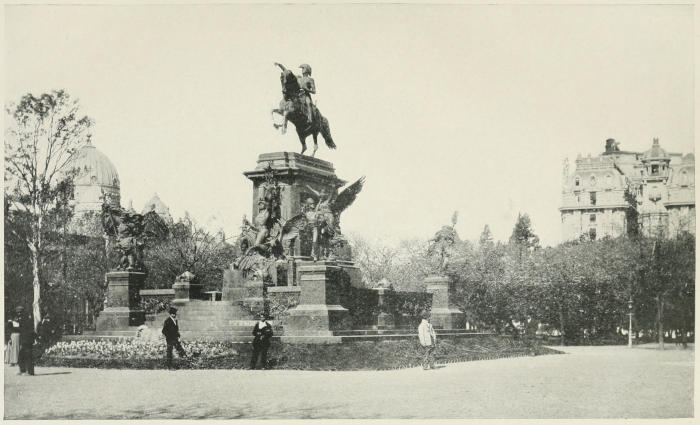
while the Plaza Mayo, with the historic Independence
Monument, was a scene of shapeless
confusion.
I ventured along Maipú, where the ceaseless rattle
of traffic is surely more disturbing than the battle
whence it takes its name could have been. Longing
for a quiet corner to rest, I regained my hotel, where
my wife reminded me of a certain old Scotswoman
who came to visit her daughter in London and was
taken to Westminster Abbey. She had got as far as
the choir and stood looking quietly at the massy columns
and noble spring of the arches, the iridescent
beauty of the windows, before she spoke, and then she
said: “Weel, do ye ken, Jeenie, I’m awfu’ disappointed!”
The afternoon was unpleasantly hot and enervating,
but the evening was cool with a fresh and pleasant
breeze. We were in a Latin city—the Paris of South
America, we had heard it called—we were both lovers
of Paris, my wife and I; so we sauntered out after
dinner to take our ease at “some café, somewhere, in
one of the squares.” But all seemed dead. A mere
handful of stragglers in Florida; in the Avenida a few
soft-hatted loungers, who stared at my wife with rude
animal interest; no café anywhere in any square, where
we were tempted to linger for a moment. So a coche
rattled us back as quickly as possible to the already
friendly hotel, going by way of Esmeralda and Corrientes,
where the bright exteriors of some cinemas
and other places of amusement punctuated the dulness
with points of brightness.
It was no later than half-past nine, and we thought
once more of that old Scotswoman in Westminster
Abbey.
CHAPTER IV PICTURES OF STREET LIFE IN BUENOS AYRES
It is a reasonable proposition that there are at least
as many ways of studying a strange town as Mr. Kipling
allows in the writing of tribal lays—“and every
single one of them is right.” I claim no more than that
for my own particular way.
My first concern is to gain a general impression, by
wandering the streets and letting the spirit of the place
“soak” into me, almost unconsciously. Later, I assume
an attitude of mind more critical and less subjective,
becoming an active observer, open-eyed for everything
that is strange or unusual; finally I compare all
that has especially appealed to my mind with impressions
long since etched thereon by visits to other cities.
In this way I should probably describe the same
town somewhat differently in the varying stages of my
observation, and each would be a true description so
far as I was able to convey any notion at all. But
after passing from the impressionary stage to the critical
and eventually to that of the comparative observer,
it is difficult to recover the first impressions once these
have been overlaid, like some palimpsest of the memory,
with later records. In the preceding chapter I
have made some slight attempt at this, simply because
it seemed to me worth trying and the progress of my
narrative suggested it. A book of first impressions,
however, would be of small value, no matter how interesting
it might prove, and I deliberately refrained
throughout my stay of twelve months in the cities
of the River Plate from keeping a diary, even
from making notes, except on two subjects, to wit: the
price of commodities, and cruelty to animals, which I
shall discuss in special chapters. In what I now proceed
to describe, I shall be guided by my last and abiding
impressions of all that I saw or experienced, and
for this purpose a continuous narrative is no longer
feasible.
My way, then, in studying a foreign city is first to
observe the panorama of its street-life so closely that
I can ever after recall it in minute detail; then to store
away finished pictures of its characteristic buildings in
my memory; next to watch narrowly the ways of the
people, as expressed in all forms of their social life
and business activities, gleaning on every hand from
others and exchanging opinions even with persons with
whom I should hate to agree. In such wise, or as
nearly as may be, I shall now continue.
Buenos Ayres in its planning is essentially North
American. That is simplicity itself, but out of simplicity
has come confusion. The buildings are in
“blocks,” or cuadras (squares), as they call them in
South America. These squares measure 150 yards
each way. Thus a plan of the city looks like a monstrous
checker board, with here and there a larger
square, where two or more cuadras have been thrown
into one to admit a little more air into the congested
mass. For the streets are narrow beyond belief. The
average width allows three coaches to stand abreast,
with a clearance of some twelve inches between them.
A walking stick and a half gives you the measure of
the pavements. These are the standards for nearly all
the thoroughfares in the older part of the town, and
were the ample ideals of the Spanish colonisers, who
required no more than single-story houses and a track
between for their horses or their bullock wagons.
Thus, in great measure, Buenos Ayres is an anachronism,
and such it will long remain, as the abnormal
development of the country and its capital city—the
world’s most prodigious mushroom—has made this
central part a veritable Eldorado of the landowner.
What served a century ago is to-day a legacy of evil,
and these narrow colonial streets have made of central
Buenos Ayres an inferno of human strife such as I
hope exists nowhere else on our globe. For within
these myriad squares of 150 yards there is no entrance
or exit for wheeled traffic, and it is a pathetic sight to
witness the unloading of goods on the narrow sidewalks
in the early morning. Let the North American
reader conceive a great department store, situated
in a street no wider than Wall Street, utterly devoid
of any back way for the entrance of a cart, with a pavement
in front that measures a walking-stick and a half;
and let him picture what it means to stock that great
building with all sorts of goods, from massive suites
of furniture to tons of shoes and neckties! If his imagination
will stand the strain, let him further imagine
what would happen if a trolley line were laid within
two feet of the sidewalk in front of the door, and an
endless stream of cars were passing, the bodies of
them flush with the curbstone! Yet the Wanamakers
and the Marshall Fields of Buenos Ayres have to stock
their premises under these conditions. In this city of
miracles, there is none more extraordinary than the
task of moving goods from the street into the shop and
it is small wonder that a large part of what one pays
for any article in Buenos Ayres has been incurred in
getting it into the place where it is bought. It is infinitely
easier and cheaper to carry a piano from London
to the port of Buenos Ayres than to take it from
the ship a mile away to the shop where it will be sold!
Often have I marvelled at the patience and energy
of the Italian peones, struggling with enormous cases
of merchandise in the middle of the street, dodging
them across the trolley lines, while a dozen drivers
were clanging their bells for them to clear the way.
And it is a daily incident to see wardrobes, suites of
furniture, desks, sofas, mingled in the gutters with the
fretting traffic, in front of the warehouse doors.
In almost every street there is a trolley line on one
side, and all the traffic has perforce to move in one
direction,—down this street, up the next,—for which
purpose an arrow on the walls indicates the direction.
To walk at ease along any one of these streets in the
business hours is impossible, and progress afoot is only
to the strong.
In such streets motor traffic is a folly, yet motor cars
abound. It is a safe assertion that nine out of ten of
them are used for no purpose other than ostentation.
And your Argentine nouveau riche will have none of
your modest 15-20 horse-power affairs. His mark is
40 horse-power, and the biggest, bulkiest, most cumbersome
body money can buy. Thus, at certain hours of
the day when the ladies go a-shopping, many of the
streets are stuffed with monstrous cars, which have
brought their owners a good mile or perhaps two, and
while the ladies are about their diversion in the shops,
the chauffeurs sit making filthy remarks about every
woman who passes, and ogling the girls. These motor
men, uniformed expensively, are one of the most offensive
elements in the life of the city. Lazy, pampered
loafers most of them; they deliberately place themselves
in the near front seat of the car while waiting for
their owners, the better to “amuse” themselves.
With a cautious municipal authority, the motor-car
would be prohibited in the centre of Buenos Ayres. It
is a century or so ahead of the town. In streets so
narrow the horse carriage should suffice, and as a matter
of fact the horse-driven traffic can move as quickly
as the motor-driven, owing to the innumerable stops
that have to be made in even the shortest journey. In
the whole vast country of the Argentine there are not
more than a hundred miles of really good motoring
roads and automobile owners in Buenos Ayres seldom
venture farther afield than the Tigre, an excursion of
some sixteen miles. The road thither is the best in
the country. It would rank as “bad” in the guidebook
of any American or European touring club and
it is the ruin of many a car. Yet vulgar ostentation
insists upon the automobile, and almost every notable
firm of motor-car makers in Europe or the United
States is catering for the craze with branch establishments
in or around the Calle Florida.
The papers abound in accounts of motor accidents
and one seldom passes a car that does not bear some
trace of a collision, many of the drivers being as reckless
as they are unskilled. The motor-car is indeed
one of the city’s problems and no effort is being made
to solve it.
If the streets were only narrow, matters might not
be so bad. But they are also villainously paved and
continually out of repair. The pavements chiefly consist
of slabs of rough-hewn stone, so badly laid that
one is constantly tripping over their inequalities.
Moreover, holes are merely covered by a piece of sheet
iron laid loose over them, and in Florida alone (it is the
universal custom in South America merely to give the
name of a street, without adding the word calle) I
have noted about a dozen old gas pipes left protruding
some six inches above the pavement, a menace to all
who do not walk with their eyes to the ground. As
a New York lady visitor said to me: “If you don’t
watch where you’re putting your feet, you’ll fall into
a hole, or trip yourself, and if you do look out for
your feet, you’ll get run over!”
The streets are laid variously with asphalt, wood,
and cobbles. But no matter what material is used, the
result is equally deplorable. Thanks to the excessively
heavy traffic, borne in wagons with immense narrow
wheels, an asphalted street is cut up into ruts in a few
days after it is laid, wooden blocks are destroyed with
amazing rapidity, and cobbles are daily dislodged in
hundreds. Thus stones innumerable are lying in the
cobbled streets, to the danger of all sorts of traffic; in
the wood-paved thoroughfares there are ruts several
inches deep alongside the tram lines, and the asphalt
roads are cracked and broken as though some wandering
earthquake had passed through them on its way
from Chili. A paseo in a motor-car is an agony—there
is no “rule of the road,” it is merely “devil take
the hindmost”—a drive in a coach is little better, as
the motor-cars make the progress of the horse vehicle
a hazard of terrors.
In such narrow and congested thoroughfares, building
operations are carried on with great difficulty. To
me it was a source of constant interest and admiration
to watch those in progress. And as there is no street
where the builders are not busy, I had ample opportunity.
In Florida, where a huge arcaded building
was being constructed through to the next street, San
Martín, the work of digging out the foundations went
on all day, and all night long the dirt was removed
when the street was quiet. The scaffolding fashioned
for the purpose was the most ingenious and complicated
I have ever seen. To the narrow street there was a
barricade of corrugated iron (wood is too expensive
to use for that purpose) and above towered a weird
framework of timber, with “tips” or “chutes” projecting
into the street. Seen from behind the corrugated
iron, it was a magnificent spectacle of industry.
Hundreds of labourers were digging down into the
loamy earth some thirty or forty feet, and the material
taken out was hoisted up by a lift and dumped near
the tips, so that through the night great-wheeled
wagons came along in fashionable Florida and were
loaded up, leaving the street strewn with spilled earth
next morning. I recall the night when some of this
scaffolding collapsed and precipitated over thirty labourers
into the excavations fifty or sixty feet below.
Such accidents are very common, there being no intelligent
supervision of building operations, and many
labourers are sacrificed every year to the carelessness
of their employers and their own ignorance.
Exterior and Interior of the “Casa Rosada.”
The upper illustration shows the façade of the Government House towards the
gardens of the Paseo Colón; the lower, the vestibule entering from the main door in
the Plaza de Mayo.
But, on the whole, it would be impossible to find
more inspiring examples of human energy and ingenuity
in the face of extraordinary difficulties than in
the erection of these great buildings. To watch the
low colonial house fall to the pick and shovel in a few
days, the crazy scaffolding quickly reared for mining
out the earth, the mighty steel uprights and girders
arriving on huge wagons, each drawn by three or four
sweating horses, the labourers swinging them into position,
the frame of the ten- or twelve-story building
presently disengaging itself where so recently stood the
shanty, the bricklayers clothing it with their handiwork,
the plasterers finishing its exterior with graceful
decorative touches,—all this was to me a source
of endless interest.
There is no evidence of an elementary regard for
human life in the streaming streets of riotous traffic.
Often have I seen buildings in course of demolition
with no better guard against falling bricks and blocks
of cement than some rough pack-sheet stretched in
front. Sometimes not even that dubious courtesy is
shown to the passer-by, and the demolishers stand
aloft knocking down the walls inwards without the
slightest protection against the fragments that rebound
and land in the middle of the street. On several occasions
I have escaped by half a yard or so a falling
brick that might well have closed my account. Even
when blasting with dynamite old foundation walls of
brick and mortar, a few yards from the pavement,
nothing will be done for the safety of the passer-by.
The casualty columns of the daily papers are eloquent
evidence of the risks the ignorant labourers run who
are employed in this work of demolition.
In effecting repairs to the exteriors, painting, and the
like, the workers are confronted with many difficulties,
for the simple expedient of erecting ladders as in our
cities is denied to them. A ladder would block the
whole pavement. So they have to reverse the old
order, and instead of placing the ladder firmly on the
ground and leaning it against the wall, they plant the
foot of it in the angle of the pavement and the wall
and lean it away from the building, securing the upper
and projecting end by ropes to a window. The worker
on the ladder is thus between the ladder and the wall.
And from this coign of vantage he drops paint or wet
plaster on the passers-by with a cheerfulness and impartiality
which must be seen to be duly appreciated.
Naturally the beautiful detail and the imposing appearance
of many of the finest buildings in the city are
completely lost for lack of space to see them. Hundreds
of thousands of pounds may be said to be wasted
in this way; for there is widespread effort to render the
façades of the buildings artistic, the cement or plaster
with which they are covered lending itself to all sorts
of decorative treatment. But anything over two
stories in height is above the line of sight in the narrow
streets, and there are prodigalities of decoration,
in the third and fourth and higher reaches of the new
buildings which have never been noticed by anybody
since the day they were uncovered. A barn-like structure
would have served the purpose equally and given
as good an effect—except in a photograph, taken
from one of the upper stories on the opposite side of
the street. Thus one has a curious feeling of disappointment
on beholding many of the more notable
buildings which he has first seen in photographs. The
famous Jockey Club, for example. You are conscious
that if you could get a hundred yards away from the
front of it, you might find it a very handsome edifice.
But the actual effect is that of a full-length photograph
out of focus, in which the boots and the lower part of
the legs dwarf all the rest.
I recall very vividly the impression of my first
walks in those strange streets. The scarcity of women
was very noticeable in the earlier part of the day.
Such streets as Bartolomé Mitre, Cangallo, Sarmiento,
Maipú, and San Martín, where the tide of business
flows strongest, were crowded with men; the odd
women who passed seemed out of place. But later in
the day women and children may be seen in considerable
numbers in Florida and the vicinity, though at no
time are they ever relatively so numerous as in the
streets of New York. And what never ceased to irritate
me was the rudeness with which the passers-by
stared at me and at each other. I was prepared for
them feasting their eyes on the odd women, but man
scrutinising man was new to me. They inspect your
necktie, study the style of your hat, stare at your
boots! They gape at you, so that you wonder if you
have forgotten your collar or if your suspenders are
hanging down! You are reassured, however, by their
gaping at each other for no obvious reason. It is
merely a vulgar habit, probably acquired by the
gapers when first they arrived from the hill villages of
Italy or the desert towns of Spain, when any person
decently clothed was a novelty to them.
Some of the half-breed policemen at the street corners,
trying to “control” the traffic, are a source of
infinite joy. Armed with white batons, they wave
these about in a way so bewildering that it is a puzzle
to know whether they mean to hold up one of the
streams of cross traffic or invite the two opposing processions
to mutual destruction. On the whole, although
some of these policemen, shamefully underpaid,
indulge in a little robbery to keep the pot boiling—one,
whom I had rather grown to like, mounted guard
one Sunday while a gang of thieves, with carts and
motor cars, plundered the newly-opened branch of
Harrods’ London Stores in Florida!—I came to form
a very favourable opinion of them, and many showed
real courtesy and good sense in controlling the traffic,
under the most trying circumstances, as every cochero
and chauffeur looks upon them with contempt and pays
a minimum of respect to their authority.
I have been told by old English residents of Buenos
Ayres, who are prepared to perjure their souls on behalf
of the city that has given them the opportunity to
grow richer than they were ever likely to become at
home, that “there are no poor and there are no beggars
in Buenos Ayres.” Both statements are untrue.
There are lots of poor, and there are some beggars.
(Time was when the beggars went about on horseback,
to the confusion of the old proverb.) It could
not be otherwise in a vast metropolis, abnormally
larger than the country behind it will warrant for many
years to come, to which the poor of the poorest countries
in Europe, Spain and Italy, are flocking in daily
ship-loads. No poor in Buenos Ayres, forsooth!
Thousands of poor are dumped down at the docks
every month, and poor many of them remain forever—poor
and criminal—though many more, with energy
and application, escape from the ranks of poverty,
and not a few grow rich.
Poor there are in abundance, and very much in evidence.
Take a walk along the Paseo de Julio and you
will see as many of the tattered army of Poverty as you
will encounter in London, and in London you should
see exactly five times as many, to maintain a proportion
relative to the size of the cities. Beggars are less noticeable,
chiefly, I fancy, because there is no room for
them in the streets; yet I have often been asked for
alms in Florida, while looking at a shop window—the
only chance the beggar has of practising his (more
often her) profession, as to stand in the gutter for
more than a minute would be to invite a violent death.
To Britishers, a saddening sight is presented by the
gin-sodden Irishmen and abandoned Englishmen who
pester their fellow-countrymen in Florida and San
Martín, with the old familiar yarn about losing their
job as ship’s carpenter and the certainty of getting a
new start if they can only raise the money for a suit of
clothes. Scores of times have I had to turn these
British rascals away, and some of them became as familiar
in my daily walks as old friends. If ever one
saw a face that had been made repulsive by drink, a
nose that was reddening with malt, it was invariably
the guilty possession of a Britisher.
Mention of familiar faces reminds me of one of the
most disagreeable features of the Buenos Ayres streets.
In this matter I am a thoroughly prejudiced witness,
so I must explain my attitude. To me, one of the
abiding charms of London is that I can walk its dear
familiar streets with their ever changing throngs,
without having momently to raise my hat, or to stop
every few yards to endure the idle chatter of some
acquaintance. I love London for itself and I know
where to find my friends when I want them. To have
them bumping up against me at every corner would
come between me and my London. It would destroy
completely that feeling of immensity, that sobering
sense of the greatness of humanity, which London imposes
on the reflective mind. But in Buenos Ayres, if
you have noticed a man in a railway train, if you have
spoken to a passenger on the river boat, if you have
been introduced to somebody at a Belgrano dinner-party,
you will surely see them all in Florida next day.
This parochial condition is the result of the central
part of the town being confined to a few narrow streets.
In all Latin countries there is also a sheep-like flocking
to certain beaten tracks, as in Paris every boulevardier
and almost any visitor is sure to be “spotted” if you
but sit long enough at the Café de la Paix. Although
the admirably planned and imposing Avenida de Mayo
was opened some twenty years ago to give Buenos
Ayres a new heart, it is still comparatively unpopular,
while the congested Calle Florida is more congested
than ever.
Other faces that grow familiar to one in the streets
are those of the porters or changadores. Brawny
Italians or Gallegos usually, these lazy and exigent
vendors of unskilled labour stand in braces at the corners
of many of the central streets, a nuisance to passers-by.
They are armed with a rope or with a large
piece of packing cloth folded and laid across their left
shoulder. This is at once their instrument and their
insignia. If you want anything removed, you send
out for one of these gentry, and if he is feeling strong
enough he may condescend to oblige you for a fee
which would command a visit from a skilled medical
man in New York. They will fuss and blow over a
little job which should be no more than a mere incident
in the day’s work. Once I was so fortunate as to get
one to carry a box of books for me up three flights of
stairs, for a trifle—five pesos, or two dollars—which
he pocketed without a word of thanks. They
must be prosperous villains these street porters and the
malorganisation of labour gives them their opportunity,
as nobody sending you any moderately heavy
article will undertake to do more than leave it at the
foot of the stairs. If you happen to require it three
stairs up that is entirely your affair.
Turning from the people in the streets to the shops,
one is struck by the extraordinary preponderance of
chemists and druggists. Almost every other cornershop
is a farmacia. And it is pretty certain to be a
farmacia inglésa or francesa, or alemana, or italiana—rarely
española! But all the same the “English
chemist” may be an enterprising Argentine who knows
no more than “zank you ver’ mooch,” which he will
utter with a self-satisfied smile after you have conducted
all your business in his own language. And he
ought to “zank you” in half a dozen languages at
once for what you have to give him in exchange for
what you get. The farmacia is to Buenos Ayres, and
indeed to the whole of the Argentine and Uruguay,
what the public-house is to England—the “corner
shop.” In the country towns it actually takes the place
of the village inn and is the rendezvous of the local
gossips. Magnificent establishments are these farmacias.
New York has nothing to show in the line of
artistic shops that will excel the best of them. Indeed,
in no other great city have I seen drug-stores
to be compared with certain of these in respect to the
grandeur of their carved wood adornments and the
completeness of their equipment. Their numerous
assistants usually wear long white linen coats, after the
style of hospital doctors, which give them a pleasant
air of cleanliness they might otherwise lack.
With a drugshop at every corner, buzzing with customers,
the unconscious liar who can speak no ill of
Buenos Ayres will blandly tell you it is “the healthiest
city in the world.” As a matter of undiluted fact, it
is a paradise of the doctor and the patent-pill-man,
largely due to its curiously trying climate. One often
comments on the abundant evidence of the patent
medicine seller in the United States—in the advertising
columns of the newspapers, on the hoardings in
the streets—but nothing we have amongst us in that
respect equals the insistence with which you are reminded
of your aching stomach at every turn in
Buenos Ayres—if, by lucky chance, your stomach
itself has forgotten for a moment to remind you of its
troubles.
Statute of San Martín in the Plaza named after that Hero of the Republic.
On the left, the domes of the Art Gallery are to be seen, and on the right a portion of the Plaza Hotel.
Next in proportion to those offering the Argentino
a myriad cures for his estómago, come the shops that
are dedicated to cleaning his boots. Indeed, one might
reasonably suppose this to be the national industry.
The abundant energy devoted to this lowly calling if
turned to other channels might go far to fortify the
republic. Even in the Calle Florida, where land values
and shop-rents rival the highest known on Fifth
Avenue, one finds certain enviable positions occupied by
nothing better than salones de lustrar, and in all the
central streets such establishments—often employing
upwards of a dozen men—abound. Nay, go where
you will, even to the outer suburbs, you will never fail
to find a druggist’s or a bootblack’s shop.
A real Argentine citizen must have his boots polished
several times a day, else these multitudinous slaves of
the blacking brush could not be kept so busy. The
saloons are sometimes fitted up in quite a luxurious
manner, with long platforms on which are raised
padded chairs with high foot rests in front, and
while you sit in this elevated position the polisher performs
the most elaborate operation on your shoes,
using a bewildering variety of pastes, brushes, and
cloths. When you think he has done, he begins all
over again and not until he has completed what must
be the tenth or eleventh stage of the operation, which
consists in taking a piece of silk from his trouser
pocket, where it has been lodged to absorb the warmth
of his body, and working it with furious friction over
your shoes, are you free to step down. Meanwhile
you have been listening to Caruso and Tetrazzini on the
gramophone,—I have even heard a customer insist
on a tune being stopped and his favourite substituted!—so
that when you step out with shining feet you feel
the threepence or fourpence you have paid has been
well-earned. But you won’t have gone twenty paces
along the street until a bawling door-man, shouting
“Se lustra! se lustra!” will point to your feet and invite
you into his shop, with “Shine, sir?”
Many of these boot-blacks run their prosperous business
in conjunction with an agency for lottery tickets
and most of them sell cigars and cigarettes as “sidelines.”
The shops dedicated to the sale of lottery
tickets present at first a very unusual sight to the visitor.
Their name is legion. All the numerous money-changers
deal in these tickets, which are spread out in
their windows so that the passer-by may scrutinise the
numbers and see if his lucky combination is among them.
Many tobacconists also sell them, and there are numerous
street-hawkers to offer you the chance of scores
of thousands of dollars for fifty cents or so—a
thirty-thousand-to-one chance. It is a study in Hope to
watch a poor workman outside the window of one of
these lottery-ticket vendor’s pointing out the particular
ticket which he trusts may bring him a sudden fortune
and take him home to Italy or Spain by the next
steamer—the ultimate hope that flickers in all their
breasts.
There is much parade of luxury in the barbers’ shops,
which form a good third, in point of number, to the
druggists and boot-blacks. Mirrors gleam along the
walls and the basins and pipes for performing the
mysteries of an Argentine’s “shave and haircut” are
many and glittering. The assistants seem almost as
numerous as the customers at any hour of the day and
all wear the white jackets that cover a multitude of
sins. A simple haircut in an establishment of just middling
style—regular, no mas—costs you eighty
centavos, leaving twenty out of the peso for the artist
who has treated you. Forty-two cents for a mere
haircut is moderately “stiff”; but have a shampoo,
a singe and a shave at the same time, and you will find
that, like Sampson, your strength has oozed away with
your hair, when the barber names his price!
CHAPTER V MORE SCENES FROM THE STREETS OF BUENOS AYRES
What fascinated me most in the streets of this motley
town were the bookshops. Who says there is no culture
in Buenos Ayres has to reckon with the evidence
of these, for London itself has no more than you might
count on the fingers of one hand that excel the librerías
of the Argentine capital. Many pleasant hours have
I passed inspecting their wonderfully varied stocks of
books from all the countries of Europe where the art
of printing flourishes, as well as from North and South
America. In proportion to their populations, Buenos
Ayres excels New York in the number and character of
its bookshops.
It was very encouraging to a literary worker to note
how every country has sent of its best (though Spain
also of its worst) to keep alive the taste for letters
in those whom the eternal quest for the elusive dollar
has taken to far-away Argentina. There are many
German bookshops, stocked with wonderful collections
of the classic literature of the Fatherland and the latest
works of its indefatigable authors of to-day in every
branch of thought and activity. Several admirable
French shops there are of which the same may be said;
a few Italians—extremely few in proportion to the
vast Italian population—and several well-known
British shops, where cheap English and American fiction
unfortunately outnumbers the books of serious
value, though practically no new book of real note that
saw the light in England or North America did not
have at least a brief showing on the shelves of the
British bookshops during my stay. There is even a
bookshop where the strange literary products of the
Turk and the Syrian are sold to the oriental community.
But the native bookshops have nothing to learn from
the foreigners, unless it be a better taste in displaying
their wares, which are usually thrown into the window
with all the abandon of a country store. In point of
variety, they are as richly stocked as any of their colleagues
overseas, and it is clear from the most casual
examination of their shelves that all the principal
French and German publishers are vieing with each
other in catering for this rich and ready market of
golden South America. I could fill pages with lists
of “libraries” which are being produced specially for
Latin America (but chiefly for Buenos Ayres) by famous
Continental houses, who publish Spanish translations
of all their important new books, as well as of a
bewildering number of old books that first found
popularity in French or German. Spanish publishers
lack enterprise, hence Buenos Ayres, where printing
is excessively costly and is used almost exclusively for
business propaganda, has to get its most worthy Spanish
books by way of France or Germany.
I have said Spain also sends of its worst. Most of
the trash comes from Barcelona and Madrid houses.
It consists chiefly of atrocious translations of English
and American detective tales of the crudest “penny
blood” variety, badly printed, and stitched within a
gaudy and often well-done coloured wrapper, with some
preposterously sensational picture thereon. These are
sold, not at a penny, but at fourpence (twenty
centavos) and are read by young and old alike. There
are many shops that show nothing in their windows
but this gutter literature, while the kiosks on the
Avenida—pale and shabby ghosts of the delightful
Paris kiosks these!—are stocked with them, and also
with translations of the pornographic French books
which the shameless shopmen of the Palais Royal display
for the concupiscent foreigner.
Of old bookshops, alas, there are none. To the
literary man, a city without its dusty haunts of the
bookworm lacks something that all the loads of “latest
books” cannot quite replace. Old books there are to
be found in the general bookshops, and they are usually
offered at prices so excessive that when I set about the
formation of a library of South American works, I was
eventually forced to discontinue buying any but the
most essential, as they are to be picked up in Paris at a
fifth the price and with much less searching. I also
found that I could secure in London more and better
photographs of Buenos Ayres than in the city itself,
and at less cost! One day, requiring urgently a photo
of a certain aspect of the statue of San Martín, I had
all the likely shops and photographers searched in vain,
yet in London I could have got it immediately.
The English booksellers (who, of course, also cater
for the small North American “colony”) have the
habit of hanging out a notice when the English or
North American mail has come to hand with its load
of new books and the latest periodicals. And once a
week the exiles from Old England or from the United
States must feel a quickening of the pulse when they
see the announcement in good bold letters “MAIL
DAY” or “MAIL ARRIVED” at the doors of
these thriving bookshops in the Calle Cangallo. But
perhaps a time may come to the exile when his pulse is
so scant of home-fed blood that he notes these signs
with a dim unseeing eye and feels no flush of the old
love for his native land arise in him.
If horseshoes brought luck, every exile might be a
millionaire, for nowhere have I seen so many cast
shoes in the streets. You could wager on filling a cart
with them in one day! The workmanship of the
smiths is evidently so crude or so little care is taken of
the horses that their shoes are allowed to loosen and
fall off without any serious attempt to preserve them.
Whatever the reason, they are in all the streets like
“common objects of the seashore.” But the electric
bulb is to Buenos Ayres as the seaweed or the limpet
to a rocky shore. Except along Broadway, no New
Yorker ever looks on such prodigality of electric
lamps. All the public buildings are permanently outlined
with them, so often have they to use them on
anniversaries or centenaries; for the Argentine dearly
loves to celebrate the centenary of any old forgotten
“battle” in his glorious history and the anniversaries
of all the “epoch-making” events and great men’s
birthdays, by illuminating his public buildings and getting
some great living Argentine to declaim a type-written
speech to an assembly of distinguidos. Even
the Cathedral is garlanded with rows of electric bulbs,
so that it may take its part with the public buildings
and the retail shops in these extremely frequent electrical
celebrations. No wonder the electricians love
Buenos Ayres! And very beautiful is the city with its
millions of little coloured lamps aglow. I saw it many
times thus in eight months; but could have wished for
some novelty after the fifth or sixth time.
While electricity is comparatively cheap, and the
supply of glass lamps evidently inexhaustible, the plate-glass
used for lighting underground warehouses from
the sidewalk is evidently at a premium, as I noticed
that whenever one of these pavement lights was broken
it was not replaced by a piece of thick glass, but by
wood covered with a layer of cement!
The Colón Theatre, Buenos Ayres.
A general view of this fine cement-covered building, where a short season of State-aided Opera is given each year.
Having thus far dealt with the streets of Buenos
Ayres in general terms, let me now glance at certain
of the more famous thoroughfares in particular.
Florida must naturally come first, for Florida is a
microcosm of Buenos Ayres. It is a tramless street,
in so far as the electricos only cross it at every 150
yards. It is, moreover, a “two ways” street, traffic
being allowed to pass along it in both directions. It is,
as I have already indicated, an extremely narrow street.
But it is the great highway of the city; its peculiar pride
and joy. There throbs the great heart of el gran
pueblo Argentino. On a dry day the motors churn
up the dust and line the broken asphalt roadway with
long tracks of oil, on which the horses “slither” and
fall. On a moist day the dust is converted into a
pasty coating, which makes progress on sidewalk or
roadway a peril to quadrupeds and bipeds alike. On
a really wet day—and often it rains in torrents for
days on end—the windows of all the shops become
obscured with mud and pedestrians are bespattered
from head to heels. The habit of wearing waterproofs
with hoods, which they flap over their hats, gives a
curious aspect to the men on wet days. I had been
told in London that the Anglo-Saxon was spotted in
Buenos Ayres by his umbrella. My experience was
that the first things a newcomer bought in the month
of May or June were a waterproof and an umbrella,
and it was comic to see the poor Italian and Spanish
immigrants disembarking, each clutching a real old
“gamp,” for which he was to find abundant use. The
coches, being built for fair weather, offer little protection
when it rains, a crude apron of leather being
stretched in front of the “fare,” but leaving his head
and shoulders exposed to the deluge. Yet one is lucky
indeed to secure so much protection on a rainy night,
and often have I had to walk to my quarters in the
drenching rain after shivering for half an hour in a
doorway in the vain hope of getting some condescending
cochero to accept my patronage. At other times,
when I have secured a coach, I have regretted I have
not boldly footed it in the rain, as there would be a
painful interlude on the journey while the driver struggled
to raise up his fallen steeds. They tumble about
on the slippery streets like beginners in a skating rink.
But let us look at Florida when the sun is shining.
Its shops are full of interest to the curious. The
jewellers are especially numerous, and vie with the
best in London or Paris. And their contents are of the
most beautiful, for the Argentines have taste in
jewellery, even though they are inclined to display it
with almost barbaric opulence. The furniture shops
are equally prodigal in beautiful and unique wares, with
perhaps too marked a tendency to the art nouveau,
which has not yet grown old in Buenos Ayres. Comfortable
chairs, luxurious lounges, no—their preference
is for “style” rather than comfort. The
milliners and modistas display the most tempting
hats—I have seen one ticketed at 500 pesos—and
dresses which are the last word in Parisian ingenuity.
They have also a childish delight in grouping life-sized
and very lifelike female figures arranged in these vanities
in their windows. A waxen lady displaying her
startling corsets and snowy underwear has a peculiar
fascination not only for the women, but even for the
men. One evening I overheard a little ragged urchin,
who was standing before such a revelation, pressing his
hands across his heart, like Caruso in a love scene,
exclaiming to the wax idol of his adoration, “Ah, mi
querida señorita!” They begin young in Buenos
Ayres!
Florida is so much a Vanity Fair that the shops devoted
to the more sober necessities of life seem out of
place. Some of these still present a “Wild West”
aspect in the motley assortment of their wares, cooking
ranges, oil stoves, baths, cork-screws, infants’ foods,
boots, bedsteads, and travelling trunks being mingled
together in pleasing disorder. But such establishments
are gradually being elbowed out by the pompous jeweller,
the pianoforte-seller, whose chief business is in
pianolas and musical boxes—crowds will stand around
a shop door to listen to a musical box at work or an
automatic organ, in the evening when the street has
been closed to wheeled traffic—the furrier, the high-class
stationer, the modista, the chemist, and the optician.
Nowhere will you find such opticians. It may
be that the syphilitic condition of the South American
blood is responsible for the myopia of the Argentines,
or it may be no more than a fashion, like the monocle
with a certain type of Englishman; but the use of
glasses is widespread. There is one establishment in
Florida which is a veritable palace of optical appliances,
employing many scores of assistants. A considerable
part of this business is also associated with land-surveying
and the most expensive instruments of that science
may be seen for sale in many shop windows in
Florida. A peculiarity of Buenos Ayres (and Montevideo
also) is the public display of surgical appliances.
Brilliantly lighted windows present you with
the latest things in operating tables, glass service stands
for the instruments, and all sorts of uncanny inventions
for cutting you up.
The craftsmen of Florence send much of their marble
handiwork to Florida, and some of the art shops
are stocked with beautiful statues and bronzes, while
every variety of gorgeous inkstands may be seen in
them. The inkstand is an important item of the chic
Argentine home. But the taste for graphic art is still
undeveloped, and the pictures offered for sale compare
very unfavourably with the sculptures. I recall in
particular a hideous daub, which was alleged to represent
two or three members of a certain familia distinguida
(any family that can pay its way and afford
a seat at the Opera is so described), being the centre
of admiration in a Florida shop window for some days,
while the newspapers gave reproductions of it. In
London or Paris no art-dealer would have allowed it to
be seen on his premises.
As I have already indicated, Florida has every day
a brief surcease from the battle of motors and coaches.
From four o’clock until seven no vehicles are allowed
to pass along it, and only at the crossings is there any
traffic. These are the hours of the evening paseo.
Ladies and children are now at liberty to saunter along
the pavements or in the roadway, while the gilded
youth of the town struts by and gazes at them, or more
often stands in stolid rows and admires. The ladies
are perhaps a trifle too well dressed and the children
mostly over-dressed. But this is their “life.” This
paseo is what they live for, so they strive to appear at
their best and to display their possessions of silks and
satins, while the jovenes distinguidos have all had their
boots polished to the nth degree just before they came
into the street. And the scene is undeniably enchanting,
when the electric lights blaze out. There are hundreds
of projecting shops-signs, in which changing electric
lights are now revealed and now occluded, and
the great warehouses are all illuminated as though it
were another centenario, news vendors are calling
La Razon, El Diario, Caras y Caretas, or Fray
Mocho, and the whole has the atmosphere of some
brilliant bazaar, rather than of the highway of a
great city. It is a feast of light, but not of gaiety, for
the Argentines are not given to joyousness and are
strangely lacking in humour; everybody is frightfully
formal and all are obviously conscious of being well
dressed. It is Vanity Fair with the fun left out!
Towards the river, the street of San Martín (inescapable
national hero who pursues you everywhere
in statue, in street and place-name, in “cocktails,” in
every conceivable connection) runs parallel to Florida
but bears no resemblance to it except in being equally
narrow. It is essentially an earnest business thoroughfare,
lined with many fine office buildings, and choking
perpetually with traffic. But, by the way, many of
these business buildings that look so “up-to-date”
from the outside are antiquated within. It is a fact
that up to so recently as a year ago builders were in
the habit of erecting large tenements which they well
knew would be utilised for nothing but offices, yet they
built them deliberately for “flats,” or departamentos,
as these are called, fitting each with its kitchen and
bathroom and disposing the apartments as for bedrooms
and salons. Thus you will find to-day hundreds
of business firms using such modern flats as offices,—in
some cases the bathrooms remaining, in others converted
into “enquiry office,” or the like,—all extremely
uncomfortable in conditions entirely foreign
to their requirements. But San Martín contains several
imposing blocks of real office buildings and will
presently contain more, for the builders are busy here,
as everywhere else, with their work of transformation.
A friend of mine, when I called on him at the beginning
of May, 1913, had just received notice to quit, by the
demolishers arriving and starting to unroof his office!
That was his first intimation that the landlord purposed
clearing away his old property and putting up
a great new business building. Argentine methods
are not ours.
One “square” nearer the river runs Reconquista,
dignified by the presence of the principal bank buildings,
many of which are real ornaments of the town and
all suggest a sense of opulence and financial solidity it
would be hard to match even in New York or London.
Yet the best of them, the richest and the most substantial,
are no more than the branches of the Tree of
English Gold which has its roots deep-struck in London
City. It is a street of all nations this Reconquista.
England, France, Germany, Spain, Italy, and the rest
have their banking houses here, and there is no more
encouraging sight in this remorseless city than to witness
the many ill-clad Spanish and Italian labourers
going through the long and intricate operation of sending
drafts home to those they have left in the old country.
Many hundreds have I seen with eager, straining
faces, scanning the pink or green slips of paper that
would mean so much to some one far away in Lombardy
or in Catalonia, and represented so much of the
sweat of his brow to the poor sender.
The practice of keeping a bank account is very general,
even among the labouring classes, as the poor
peon has nowhere to hide his little hoard, living as he
does in the most shameful conditions, where a square
yard of living-room is more costly than a cottage would
be in his native village, and among people who do not
hesitate at murder to gain a few pitiful pesos. Thus
you will often see a lean and hungry labourer, dressed
no better than an English tramp, scrutinising his bank
book in the corridor of one of the great banking houses,
and the sight is a strange one to English eyes. Turks,
Polish Jews, Norwegians, Russians, Cingalese, Swedes,
Armenians, all the nations of the world are represented
daily in the teeming throngs that flock to the banks in
Reconquista, where the innumerable clerks are puffing
steadily at cigarettes and attending to their clients with
a charming ease that has in it a pleasant suggestion of
eternity. For the simplest banking operation will eat
away twenty minutes of your time, as your account is
balanced whenever you withdraw or lodge any sum,
and to secure a draft on London at ninety days, calls
for the patience of Job and three-quarters of an hour.
Much of this formality is the result of the system of
issuing open checks, which makes swindling delightfully
simple, and the bank always stands to lose, as
there is extreme difficulty in bringing a swindler to
book.
The last of the narrow streets riverward is Calle
25 de Mayo, so called from the day in the year 1810
when the movement for Independence began, although
the actual date of the Declaration of Independence is
9th July, 1816. They have a curious habit of thinking
in dates in Latin countries. Both Paris and Rome
give us examples of famous dates as street names, but
in South America dates are honoured to a degree that
is comic. One of my friends in Montevideo has an
office in 25 de Mayo, a show-room in 18 de Julio, and
warehouses in 21 de Agosto and in 15 de Octubre! By
some odd chance he always found what he needed most
in one of the streets named after Uruguay’s historic
dates. There was another such, 1 de Mayo, but it
offered him no accommodation else he should have
taken premises there also, just to complete the series.
Calle 25 de Mayo in Buenos Ayres has long been one
of the degenerate parts of the town, entirely unworthy
of the historic event it commemorates. But it is being
gradually reformed and may yet take on an aspect
of decency. Near the Plaza de Mayo it contains some
fine new buildings, but westward it is still the haunt of
undesirables, although the English pro-cathedral stands
there, a plain and not undignified structure with which
I made no close acquaintance.
Exterior of the Jockey Club, Buenos Ayres.
A good photograph of this famous building cannot be made, the street being too
narrow to admit of focus, even from the upper storeys opposite. In the right bottom
corner part of a window-sill, or ledge of roof, on the opposite side of the street,
appears in this photograph.
From 25 de Mayo the ground falls quickly, to the
Paseo de Julio, the former street occupying the level
of what, no doubt, was long ago the bank of the river.
This is the only semblance of a hill in all the district.
Inland for leagues, the city lies flat as the proverbial
pancake, while below towards the river, the Paseo and
the gardens beyond, with the buildings of the port in
the further distance, occupy a lower level of land reclaimed
from the river. If anybody wants an enemy
“put out of the way” for a matter of twenty dollars
or so, he will have no difficulty in finding a villain ready
for the job somewhere along the arcaded haunts of the
Paseo. In one respect the Paseo de Julio resembles
Princess Street, Edinburgh, which, as the Irishman
said, “is no more than half a strate, as it has only one
side to it.” The Paseo has only one side to it, and
it is a bad one. The second stories of the buildings
that stand between the Paseo and 25 de Mayo are on
the road level of the higher street. Thus it might be
possible, for aught I know, to enter one of the low
dens on the Paseo and mounting two or three floors
within its evil and mysterious interior, emerge on the
level of 25 de Mayo. The lower stories of these
buildings on the Paseo side are arcaded, and these arcades
are the haunt of “all things perverse, abominable.”
According to the local press, after nightfall
no man dare appear there wearing a collar, and any one
who requires the aid of eye-glasses must not venture
thither. Often have I wandered among the stinking
peones and cosmopolitan criminals who throng the
arcades by day, but I know not the Paseo by night.
The shops are kept by all sorts of cheap clothiers, general
dealers, and many cutlers, whose windows are exclusively
given over to the display of long knives or
daggers. Probably sixty per cent. of the frequenters
of the arcades carry one of these dirks, like the old
Scottish Highlander, and the other forty per cent. are
armed with revolvers, of which hundreds are exposed
for sale in the arcades. There is no lack of “cheap
Jacks” with “special lines” to clear at a sacrifice.
There are many filthy looking restaurants and provision
shops; and more librerías, which expose nothing
but the filth of the Continental press translated into
Spanish and Italian. If you look at one of their windows
for a minute, out pops the greasy owner, spiderlike,
to enquire if by any chance you would like to inspect
his more secret stock of fotografías muy curiosas,
while youths will thrust under your nose an envelope
of obscene photographs, with a particularly offensive
one exposed. The whole atmosphere is vile. The
cinematographs and raree shows that also abound in
these arcades may be no more pernicious than many in
the Bowery, but that is a matter on which no decent
visitor can speak, as none such could risk the contamination
of entering therein. It is a male crowd that is
always circulating in the Paseo. Never have I seen a
decent woman there, and indeed no more than a half-a-dozen
hatless sluts are ever to be noticed under its
arcades.
This abomination must pass. It exists merely because
landowners have preferred to hold their old
rotten properties, and allow them to be used by the
scum of the population, until such time as it would pay
them to sell out. The transformation has already begun;
the pestiferous old buildings are giving way to
modern ones, devoted to cleaner purposes. Some day
the haunts of the criminals may be utterly wiped out
and the Paseo de Julio become, what it might well be,
one of the pleasantest thoroughfares of a great city.
Up the little hill from the Paseo, one gains the Plaza
de Mayo, whence stretches for a mile and a half in the
most approved Haussmannesque straightness the
Avenida de Mayo, ending in the massive palace of
Congreso. Lined with many handsome buildings, of
six, eight, or even a dozen stories, whose shadows are
falling athwart the broad and teeming roadway, while
the westering sun is making iridescent the white marbles
of the great domed Congreso in the far distance, here
in the new land of South America is at least one fine
city highway that may hold up its head among the
world’s best. There is a suggestion of a Paris boulevard
in the Avenida; a suggestion of form, but assuredly
not of life nor of “atmosphere.” And there
the rivalry between the two great Latin cities begins
and ends!
The great Avenida Callao runs at right angles with
the Avenida de Mayo from the Plaza Congreso. It
is badly paved, but contains many attractive buildings
of cement. Some day perhaps it may become the central
thoroughfare of the city. There are those who
believe it will, but in my judgment it will call for a
greater revolution than they have ever known in Argentina
to shift the centre of gravity from the Calles
Maipú, Florida, and San Martín to Callao. Between
Florida and Callao there are eleven parallel streets.
All are incessantly busy from early morning till nightfall,
while Maipú, Esmeralda, and Suipacha, in the order
given parallel to Florida, are busy even through
the night. All sorts of shops abound in these
thoroughfares and business offices innumerable, as well
as many places of entertainment, restaurants, and cafés.
But, apart from Florida, all these streets that lie to the
north of the Avenida de Mayo are so characterless that
after many years of residence it would puzzle even
those with an abnormal “bump of locality” to say in
which street they found themselves if they stepped
from a cab in any one of them without having noted
some landmark on the way. In the suburbs it is even
more difficult to realise at a glance where you may
happen to be, and the policeman often cannot tell you
the name of the street he is patrolling. I remember
asking a policeman in a street near the Plaza Libertad
for Frank Brown’s Circus (Brown is an American or
an Englishman who has made and lost fortunes in
circuses throughout South America). “Oh,” said he,
“you are going the wrong way. It is at the corner of
Florida and Córdoba.” Now, I knew that some
eighteen months or two years before it had stood there,
but was deliberately burned to the ground by the jingo
youths of the city, who were offended by some quite
innocent action of the unfortunate Brown. This
policeman, some eight or ten squares away from the
scene, had not yet heard the news, and meanwhile a
magnificent pile of ferro-concrete architecture, the
Centro Naval, had been reared on the spot! I found
the new circus by describing to another policeman, who
at first denied all knowledge of it, a big building to
which thousands of people had been flocking for two
or three nights past. Then a light dawned on his
Indo-Spanish soul. “Entonces, señor,” said he,
“se encuentra sin duda, a la esquina de esta misma
calle, porque se ha concurrida mucha gente, por alla,
estas ultimas noches.” It was even so, three squares
away at the corner of the street in which I had speech
with the policeman, I found the circus.
There is no end to what I might write about the
streets of Buenos Ayres, but there must be speedily, if
not already, to the interest of the reader. I who have
tramped them, in fair weather and in foul, on busy
week days and on the deadest of dull dead Sundays,
mile upon mile, seeking for interest and finding but
little, now discover many forgotten impressions coming
up on the films of the mind, which, so to say, I have
been putting into the developer, and though these
amuse me, I doubt if they would equally entertain
others.
CHAPTER VI WHAT WE THOUGHT OF THE WEATHER AND THE MOSQUITOES
I cannot go further in the story of my stay in Buenos
Ayres without saying something very definite about the
weather. Passing references have already been made
to that all-important topic; but it requires a chapter to
itself, and it insists on having it here and now.
As I have said, we were seekers of sunshine. Well,
we found it—and also some fine samples of most sorts
of weather known between the Equator and the Poles.
We arrived early in April, which is the beginning of
autumn in the Argentine. As the reader has heard,
the morning of our arrival was a “perisher.” Next
day I found my hands, for the first time since boyhood,
sore and “chapped.” The cold wind was so keen that
it had instantly roughened all exposed parts of the
skin, and I had recourse to lanoline to soften my hands
and to heal my cracked lips. But on the third day the
sun came forth again and for nearly a fortnight the
heat was almost as trying as in a New York summer.
Everybody was mopping his forehead; men who, a
day or two before, had been going about in great-coats,
were walking the streets with handkerchiefs tucked inside
their collars to absorb the sweat. And suddenly
it would change to a bitter night; or perhaps one went
forth in the sunny morning in summer clothes, and by
noon the temperature had precipitately dropped fifteen
or twenty degrees, so that one went shivering hotel-ward
for lunch and a change of clothes.
Yet a Scotsman, long resident in Chile, told me that
I would find Buenos Ayres had the finest climate in the
world! I wonder where he will go to when he dies.
For eight months I had occasion to comment on the
weather and seldom in terms of congratulation. The
expatriated English and the few porteños of British
parentage with whom I came into frequent contact were
strangely prone to ask me what I thought of the
weather, whenever it happened to be a really fine day.
“Compare this,” they would say, “with the weeks
of fog in London when the gas has to be lighted all
day long and one can’t breathe.”
“My dear sir,” (or “lady,” as the case more often
was), I might timorously make answer, “you speak of
what is as much a tradition as the red wig and beard
for the part of Shylock, and moreover you speak to
one who has seen as great variety of weather in
Buenos Ayres as in London. Your memory is so short
that you forget it rained monstrously for three days
last week, and for the other four days there was a
white chilling vapour over all the town, so that you
could not see the length of two squares in the forenoon,
and when the vapour had cleared it was as though you
were walking on vaselined sidewalks.”
“Oh, but that was exceptional.”
“And so, it may be, are the fogs of London. But
I’d much prefer a real old London ‘particler’ to this
marrow-searching, flesh-chilling, white plague that
comes up from the River Plate in your winter-time and
gets one by the throat.”
That fine line of Tennyson’s,
All in a death-dumb, autumn-dripping gloom,
comes to mind in Buenos Ayres on one of these days,
but, alas, the autumn dripping is not from branchy trees
to fragrant, leaf-laden loam, nor is it “death-dumb.”
It drips from gaunt iron frames, from broken plastered
walls, from tram-cars, from horses’ harness. A
billiard cue taken from the rack will feel as though it
had been lying in the bath, and the boots which you
have not been wearing for a few days will show patches
of white and green mould.
But it is true that between April and November there
may be many days of sunshine; nay, even weeks of it
at a stretch. And these days are delicious. There
is a tang of freshness in the air such as comes to one
on a fine frosty autumn morning on the heights of uptown
New York.
Then towards the end of November the sun begins
his yearly revel and till the end of March Buenos Ayres
swelters in the most oppressive heat imaginable. Not
that the barometer ever attains a greater height than it
frequently registers in New York City, but New York
rarely experiences such long-sustained periods of heat,
and the humidity—due to the mighty volume of the
River Plate—makes the life of man and beast a
burden. The nights bring no surcease. Horses die
in the streets by the score every day, and you will see
their carcasses in all parts of the town, awaiting removal.
Lucky are the inhabitants who can escape to
Mar del Plata, to Montevideo or to the Hills of Córdoba,
but they are few compared with the myriads who
must remain in the monstrous stew-pot. “Long
drinks” and two or three cold shower baths are now
the order of the day. But even the cold douche has its
snares. I was once severely scalded by taking one, as
the cistern was exposed to the sun and the water had
been brought near to boiling point without the aid of a
“geyser”! There is nobody in Buenos Ayres during
the summer who attaches much importance to the scientific
wiseacres who tell us the heat of the sun is diminishing.
There was no doubt about it—we had found the
sunshine at last. And like so many of the quests on
which mankind sets out, our find was no better than
Dead Sea apples. What could we do with it? Why,
we shut it out of our rooms by every means in our
power; we wore smoked glasses so that we should not
see it. We thought of the Kentucky nigger who was
knocked down by an autumnal blast and got up and
shook his fist at the invisible force, saying: “Wind,
wheah wuz you dis time las’ July?”
The New Courts of Justice.
The “Tribunales” photographed just before the completion of the
cement work on the top storey. In the foreground, the fine
monument to General Lavalle, standing in the plaza named after him.
It will be gathered from what I have said that the
Argentine has no lack of “weather,” wherein it resembles
England, which Mark Twain alleged had only
“samples” of climate. It has all the essentials of the
finest climate in the world, but no wise Providence has
blended these with any discretion. In the course of
one short day you will pass through all the seasons of
the year, and though it never snows, I have experienced
cold in Buenos Ayres equal to a sharp frost in New
York. Nay, I will roundly assert that no wind that
sweeps across New York has a tooth so keen as the
pampero. One has to be out in Buenos Ayres when
the wind from the boundless pampas strikes the town
to know how cold can rake through to the marrow.
Over the thousands of leagues of plains it blows, direct
from the snowy Andes, and stirring up the clammy
effluvia of the River Plate it breathes rheumatism,
bronchitis, consumption over the city—the hateful
pampero!
Nor have the people learned how to combat their
changeful weather. All their houses are built for summer.
They are excellent for four months of the year,
and uncomfortable for the best part of eight. The
ceilings of the rooms are usually five feet or more
higher than the American standard, which gives one a
sporting chance of a breath of fresh air in the torrid
season, but when the wind blows and the rain pours,
such lofty rooms, tenanted by a myriad draughts, are
veritable haunts of misery. For they have neither
fireplaces like English houses, nor stoves like American,
while steam heating is in its infancy. There are actually
modern houses in which “dummy” fireplaces
have been built for show, but a real genuine fireplace
is a thing which most Argentines have only seen on a
visit to Europe. A well-known steam-heating expert
from New York, who was sent on a special mission of
study to Buenos Ayres, told me that in many of the
new departamento buildings which offer the attraction
of calefacción central the steam heating installation is
no more than make-believe for selling or letting purposes,
but never calculated to supply the tenants with
warmth. No, the Argentine either goes to bed earlier
or puts on extra clothing in the cold weather, lounges
about his house with an overcoat or a shawl above his
winter suit, and tries to warm his toes at an oil stove.
The ironmongers make great display of these stinking
abominations at the first cold-snap, and the papers carry
many advertisements of their merits, their “odourless”
quality being insisted upon in every case. Electric
stoves are largely and successfully used, and as
electric current is cheap they form the best substitute
for a coal fire—although the English believe there
is no substitute in all the world for a fine glowing fire
of coal.
“Weather” is indeed a staple of talk in the Argentine,
just as at home. Indeed, to a greater degree does
one hear people discussing the weather in Buenos Ayres
even than in London, and with very good reason. The
fortunes of all hinge on the state of the climate. Too
much rain and the harvests are spoiled; too much heat
and horses, cattle and sheep perish in their tens of
thousands. And year after year the Argentine suffers
either way. Tell an estanciero that you have seen two
or three locusts flying about in the street and his face
will blanch, his lip quiver, for already in imagination
he sees the dreaded plague of these insects devastating
his crops. He is ever in a state of nervous fear as to
whether there is going to be too little rain or too much,
and, poor man, he will tell you with glee when he meets
you on the beastliest of rainy days that “it’s raining
dollars.” If you meet him a fortnight later and it is
still raining, there will be no smile on his face, for he
fears it is to be the old, old story. “Last year and the
year before the crops were nearly in the bags for putting
on the rail and yet we lost them through the rain.”
Raining dollars, forsooth! For a day or two that may
be so, for a week, perhaps; but later on it rains bankruptcy.
Que lindo país, as a dear old self-deluded
lady used to say when telling me the most atrocious untruths
about her adopted country. What a lovely
country!
The uncertainty of the Argentine weather is really
incredible to any one who has been fed on the pap of
interested hack-writers. In the year 1911 the great
national horse race at Palermo was three times postponed
on account of the course being dangerously
heavy from excessive rain, and in 1912 it was postponed
once for the same reason, being run on the succeeding
Sunday on a course that was still sloppy. Was
the Derby ever postponed because of rain? I have no
Derby lore, but I should be surprised to learn that such
a thing had ever happened in rainy England.
It had been represented to me before I went to
Buenos Ayres that, so reliable was the climate, one
could make engagements for outdoor sports months
ahead, with the certainty of weather conditions being
favourable. During my stay there, numerous lawn
tennis, golfing, boating and picnic engagements were
postponed from time to time because of the rain.
In short, Argentine weather is either too much of
a good thing or too much of a bad thing. The dear
old lady already mentioned told me that she had to live
in Buenos Ayres during the winter because the roads
to her estancia were quite impassable whenever it
rained, but it was lovely there for a few weeks in the
spring, though she had to clear out as soon as summer
came, as the place was so infested by flies and mosquitoes
that the family had to live in darkness, never
daring to raise the blinds! Buenos Ayres being equally
obnoxious in summer, she went to the Hills of
Córdoba, and came back to town with the autumn.
Thus she was able to spend a few short weeks of each
year at her home in the “Camp,” and the rest of the
year, from a chair in the hotel drawing-room she sang
the praises of the glorious Argentine weather and of
the country that blossoms as the rose.
The final touch of unloveliness is the loss of the
ruddy glory of the fall. In the province of Buenos
Ayres especially, there is no gorgeous funeral for King
Summer; no shimmering gold of hedge and bough.
The leaves rot on the trees suddenly, wither into pale
colourless things that to-morrow’s wind sweeps away
and, behold, so many gaunt and shivering skeletons of
trees. When man dies in Buenos Ayres, they coffin
him and consign him to his corner of Chacarita within
twenty-four hours. Summer dies and is buried with
similar despatch, but Nature relatively provides less
pomp at the funeral of Summer than the experts in
pompas fúnebres supply for the average Argentine
who yesterday was and to-day is not.
Insect life is, of course, conditioned by the weather.
Yet the Argentine mosquito has a wonderful power of
surviving into the winter. It is a worker. Its industry
is unquestionable. I shall not readily forget
how I was plagued by this small product of a great
country. On various occasions I had to limp about my
affairs with absurdly swollen feet, thanks to the attentions
of these tiny pests. An afternoon siesta could
only safely be indulged in under a mosquito net. Even
as I write I still bear traces on my right foot of a particularly
venomous bite that dates back more than six
months!
“Haw, yes, the mosquitoes always get the Gringos,”
said a pimply faced young Englishman to me, when I
was mentioning my first experiences nearly a year later
in Montevideo.
“How long have you been out here?” I inquired.
“Oh, nearly three years now,” said he.
“So that you are a three years’ Gringo, I suppose.”
The English youth makes haste to range himself with
the “old timers” and will lie to you abominably to
convey the impression that he is no longer a tenderfoot
(though a Gringo he must ever be), and tell you that
the mosquitoes never touch him, while you can see him
scratching his latest bite! The fact is that some people
are more subject than others to mosquito bite and
there are many thousands of native-born who never
outgrow the susceptibility. I sincerely sympathise
with all such, as the mosquito has the power to make
their lives a misery for at least six months of the year.
Fleas and bugs (the loathsome bed-hunter) also abound
in the City of Good Airs. A gentleman of my acquaintance
who took lodgings in a native doctor’s house
was told by the housekeeper, when he complained about
the bugs in his bed, that she couldn’t help them—“they
were natural.” That was his complaint; he
would rather they had been artificial. The bicho
colorado is another busy little fellow, the size of a pin-head.
He haunts the grass and as you walk over that
he removes his habitat to your foot, bores a hole
in your skin, burrows merrily into your flesh and produces
a sore which you will have cause to remember
for many a day. The chemists do brisk business in
selling innumerable “preventatives” and “cures” for
the bites of mosquitoes and bichos colorados, but all
that I tried were failures, until I discovered in that
familiar product, liquid ammonia, a really effective
banisher of the pain.
On the whole, I do not seem to have formed an
extremely favourable opinion of the weather in Buenos
Ayres. Like that famous little girl, “when it is good
it is very, very good; but when it is bad it is horrid.”
And I have a notion that the little girl in question was
none too often “good.” As for the insects; well,
Stalky’s pet aversions, the “bug-hunters,” can always
be sure of a busy time in and around Buenos Ayres.
CHAPTER VII A SPLENDID CITY OF SHAM
“Of course we all work in sham,” remarked a prominent
Argentine architect to me, one clear, still night,
as we leant together over the rail of a river steamer,
discussing the pros and cons of Buenos Ayres—a
subject as infinitely interesting to River Platers as the
weather to the Englishman.
The “of course” was a kindly concession to some
criticism of mine and showed an open and liberal mind.
The architect was no self-deluding porteño to whom
Buenos Ayres was everything good, true and beautiful.
He was prepared to admit the warts.
He were, indeed, the blindest and most incompetent
of observers who failed to notice at the end of his
first hour in Buenos Ayres that it is a city of “sham.”
Its buildings are of no distinctive value architecturally—nay,
not even the most notable. Without exception
they follow European models in exterior treatment,
no matter how widely they may differ from them
interiorly. That many of the public buildings are imposing,
and at first glance look like “the real thing,”
no one will deny. Besides, he who were foolish
enough to deny this could be confronted with the evidence
of the official photographs which have conveyed
to an envious Europe the idea that Buenos Ayres
eclipses her worn-out old cities in its architectural
glories. A photograph makes lath and plaster to
look like granite and porphyry. Through the camera
the graceful buildings of the St. Louis “World’s Fair”
appeared as permanent as the pyramids, though a few
score labourers with picks and shovels wiped them out
in less time than it took to put them up.
Buenos Ayres is truly a city of sham. Nor is this to
its shame. For it costs more to erect its steel-frame
and cement structures than it does in Washington or
London to rear solid piles of masonry. The country
is destitute of workable stone, and the bricks made
in the Argentine are so unsightly and spongy that
they can only serve as a base for plaster. Wood also
is scarce and the gorgeous doors, without which no
fine building in Buenos Ayres would be considered complete,
have to be imported at great cost from Europe.
Many of these are beautiful and in this one respect the
city may be said to outvie Paris, whence comes this
taste for the grandeur in gates.
It may be a mere old-world prejudice on my part, but
I have never been able to look with real interest on a
building that has not been made of brick or stone.
In Europe, in the United States, also, we are accustomed
to historic buildings that have been reared by
competent workmen with the idea that they were to
last forever, which, as Ruskin reminds us, is the only
true way to build. To come to a new land and find
that the most pretentious efforts of the builder’s craft
are chiefly stucco copies of European stone-work,
leaves the beholder cold.
The Congreso has been trying for some years to become
the pride of the town. It is the great marble-veneer
palace where the legislators sit—in a literal
sense, for they deliver their speeches seated—and it
is effectively situated at the western end of the spacious
Avenida de Mayo. It has been many years in course
of construction and I am afraid to say how many
millions of money have been spent upon it. At least,
it has cost more than three times the amount originally
voted for it, and there are few senators or deputies who
have not had some pickings out of the “job.” No man
knows when it will be finished, for it is said that as
much material as would have built two such palaces
has gone in at the front door of the works and been
mysteriously absorbed. The explanation is that many
a fine residence for a legislator with a “pull” has been
built of the said material, after it had gone out a backdoor!
Meanwhile the gorgeous Palacio del Congreso
presents a noble marble front to the great Plaza Congreso
and stares eastward along the Avenida without
a blush for its ulterior nakedness. It is like the noble
savage, “whose untutored mind clothes him in front
and leaves him bare behind”; for when you have
turned the corners from the plaza you discover that
only the front part has been covered with marble slabs;
behind there is naught but dirty naked bricks. So it
has been for three or four years and so it is like to remain
for some years to come; but meanwhile a photograph
of the front does good service for sending
abroad as an evidence of the architectural grandeur of
the capital city.
But all this notwithstanding, the Congreso, as seen
from almost any point of the Avenida, is an imposing
building. Dignity and elegance are combined in its
graceful proportions, and its elongated dome soars
above the surrounding buildings with a fine sense of
confidence. The Corinthian column is used very effectively
in the façade and there are many—rather too
many—statuary groups, in which winged figures and
ramping horses are prominent. Grand stairways
sweep up to the central door and inclined planes make
possible the near approach of carriages. But immediately
one steps inside there is disappointment. The
central hall is of mean proportions, and in a few minutes
all is confusion, as there is no real dignity of treatment,
and certain inner courtyards are actually built
with painted iron pillars hopelessly out of harmony
with the prevailing style of the building. The Chamber
of Deputies, in the form of an ellipse, is businesslike
and handsome, but no more imposing than some of
the council chambers of the great provincial cities at
home. The Senate is a smaller and more elegant
chamber, richly furnished with ample seats of ease
and commodious desks for each of its distinguished
members. There is another luxurious room, dedicated
to special ceremonies, and the deputies’ lounge is immense
and well-appointed, much after the style of some
of the big New York clubs. It is, indeed, at once a
club and an exchange, for here many of the “deals”
by which some men make money in the Argentine, and
others lose it, are consummated.
On the first floor are ranged all the different ministerial
offices and committee rooms, and I think there
were only two of these to which I did not gain admission.
But there was little of interest to note in them.
The fact that the rooms devoted to the affairs of the
Army and Navy were about one-tenth the size of those
required for the department of Public Works was eloquent
and reassuring. But although I explored the
whole building, high and low, I find I have retained
only a very blurred impression of the interior with its
bewildering passages, through which liveried servants
bearing trays of tea dishes were constantly passing, as
the Argentine deputy is a firm believer in getting all
he can out of his country in addition to his annual salary
of 12,000 pesos ($5,040), feeding at public expense,
not only himself, but as many relatives and
friends as have the good sense to find important business
to transact in the lobbies of Congress at meal
times.
A very handsomely furnished library is a notable
feature of the palace. It is small, but admirably designed
for the enshrinement of many books. One of
the proudest possessions of the library, pointed out to
me with much satisfaction, is a complete set of the
Hansard Debates of the British Parliament. There
are standard works on all sorts of social subjects and
books of statistics enough to give a mere literary man
a headache. I noted most of the books had a suspicious
air of newness. There was a deputy busy consulting
a volume of Hansard, but no other thirster after
knowledge in the library at the time of my visit.
“You may come here often,” said the official who
was showing me over the building, “and you will seldom
see more than two people using the library,—perhaps
three.”
The restaurant is much more popular with the deputies,
but there is no doubt that if any of them ever by
chance should wish to “verify his references” he
would find no difficulty in performing that most laudable
and improbable task with the aid of this well-stocked
and well-managed library.
On the whole, the impression of the Palacio de Congreso
upon the visitor is of a piece with the capital city.
It is all so new, and all so unfinished, and promises to be
rather shoddy when eventually it is finished. As a tall
strapping doorkeeper, who showed me over the great
rooms in the basement of the building, where are stored
in iron chambers many official records, said, “when
they’ve finished the building they will have to start all
over again repairing it.”
I went outside on a balcony at the back to examine
the still uncovered brick-work. It is of a quality which
would not be used for workmen’s cottages in England,
but once it has been hidden under plaster, with thin
slabs of marble imposed thereon, it will doubtless present
a brave appearance for some years. But not for
all time!
The Palatial Home of “La Prensa.”
Façade of the great newspaper office on the north side of the Avenida de Mayo.
Different interior views of this building are given at pages 80 and 81.
At the eastern end of the Avenida stands the more
historic “Pink House” (Casa rosada), or government
building. It occupies the whole width of the
Plaza de Mayo and extends backwards to the Paseo
Colón beyond—a mighty pile of plastered brick.
Lacking in distinction and of no established style, it is
chiefly notable for its abundance of windows. I remember
counting about one hundred and twenty in the
east front alone, so that the whole building probably
contains upwards of six hundred, and, with so many
piercings in its walls, it will be understood that little
opportunity was left for architectural ingenuity. An
immense group of statuary surmounts the central part
of the building, and this too is most likely a stucco masterpiece,
for if it were solid stone it would surely bring
down the roof. The whole exterior is painted pink
and on a bright day its appearance is undeniably pleasing,
if you are content to take it as a whole and some
little distance off, for a too close inspection will reveal
many shabby patches and innumerable corners that are
calling aloud for plaster and paint. Indeed, so large
is the Pink House, it would only be possible to give it
a coat of paint that would be fresh all over by employing
an army of workers, for, ordinarily treated, the
paint on one side has become old ere the painters have
reached the other.
The interior of the Government House, Casa de
gobierno—which is the official designation of the Casa
rosada—contains many fine apartments, richly furnished.
The great ballroom where the President gives
his grave and stately entertainments from time to time
is of elegant proportion and beautifully decorated.
At the northwest corner of the Plaza de Mayo
stands the Cathedral. Although I passed it daily for
some eight months, I never mustered up sufficient interest
to go inside—I who have spent so many months
of my life among the musty old cathedrals and churches
of France. I felt there was little historic about this
common and defective imitation of a Grecian façade,
vulgarised by wreaths of electric bulbs around its Corinthian
columns. At first glance it suggests a stock
exchange rather than a place of Christian worship.
There is a dome of glazed tiles, so far away from the
low and squat entrance colonnade—which faces due
south—that it seems to have no relation to it. I do
not remember noting the material of the building—so
little did it attract me—but I fancy it consists of
the usual plastered brick. One day I did seek to enter,
but could find no door that was open and never do
I remember to have seen the main door open on a week
day. This is characteristic of the churches of South
America, where one misses that generous invitation of
the fine old fanes of France. Mainly, the Cathedral
of Buenos Ayres will stay in my memory as a great
stock exchange building gone wrong, or—illuminated
on any of the numerous national feast days—as
a municipal theatre on a noche de gala.
A stone-throw from the Cathedral stands the Municipal
Building, or Intendencia, at the corner of the
Avenida and the Plaza de Mayo. It is of no account,
and does not compare in interest with the splendid
palace of La Prensa adjoining it. I confess that as a
journalist I had more desire to inspect the famous
building of the great Buenos Ayres daily than any other
sight in the city. During my stay I had frequent business
with the management of La Prensa and was privileged
to examine every corner of its wonderful home,
on one occasion spending some hours in the building
after midnight, when the sight of Buenos Ayres from
the globe on which stands the Prensa’s Goddess of
Light, who holds aloft her flaring torch over the restless
city, is surely one that can be rarely equalled in the
world. No doubt if one were to look at Paris by night
from the apex of the dome over the Sacré Coeur, or
London, say from the Clock Tower at Westminster,
the sight would be more beautiful, but it could scarcely
be more impressive, as the extraordinary flatness of
Buenos Ayres permits the observer on the Prensa tower
to survey the whole vast city to its utmost limits
and even to distinguish the twinkling lights of La
Plata, the provincial capital, twenty-four miles away.
I shall not readily forget that starry night when, at two
o’clock, I stood up there in the lookout beneath the
Goddess of Light and saw the great noisy, cruel city
as a prodigious map of stars. The prodigality of
Buenos Ayres in electric light was evident even at that
hour, for mile upon mile the eye could follow the main
streets with their double lines of radiant dots, thinning
gradually as they flickered into the boundless plain beyond,
while on the fringes of the mighty metropolis
appeared numerous constellations betokening the suburbs
which the Federal Capital threatens to engulf.
The interior of the Prensa building would require a
chapter to itself to describe it with any attempt at detail.
That is not possible here and a mere glimpse of
it must suffice. It is almost everything that our English
ideas would expect a newspaper office not to be.
If you enter from the front, there is nothing in the business
department to strike your attention. There are
many newspaper offices in the United States quite as imposing.
Nor is there anything particularly worthy of
note in the reportorial rooms, the library, or any of the
workaday departments, though the note of luxury is
probably more pronounced in the apartments of the
editor and the editorial writers than in most American
offices. The machine room is splendidly equipped.
The overseer, I was told, was an Argentine, but I suspect
he was of British or German parentage, for the
native has little aptitude for mechanics. His assistant
was a Britisher.
There is a series of “show” rooms which made it
hard for one, like myself, whose life has been spent
in newspaper offices at home amid the well-loved odour
of printer’s ink, to imagine himself within a building
devoted to the production of a daily newspaper. At
two o’clock in the morning what a scene of hustle is a
daily newspaper office in New York! Here everything
was as quiet and orderly as in a museum when
the visitors have gone! And in truth it reminded
me not a little of a museum. There was a magnificent
concert hall, superbly decorated, with painted panels
for the doing of which artists had come especially from
France. Here many of the most famous operatic stars
who have visited Buenos Ayres have appeared before
select audiences invited by the Prensa; celebrated
actors have tried new plays and illustrious visitors
from foreign lands have addressed privileged audiences
in many different tongues. The value of such a
hall to a newspaper is so obvious that it is surprising
none of the New York journals has yet attempted anything
of the kind. I think the Prensa salon accommodates
an audience of some five hundred, and it is
smaller than the very charming little theatre of
Femina, the Paris ladies’ journal, in the Champs
Élysées.
Then there is a suite of living-rooms, fronting to
the Avenida, worthy of a prince. These have been
placed at the disposition of distinguished visitors to
the Argentine with a liberality that has not always
been duly appreciated, for I was told that this very
pleasant custom of honouring the country’s guests has
more than once been abused by a visitor staying so long
that he threatened to become a permanent boarder of
the Prensa. Hence, it may be, that the custom is no
longer to be maintained, and I can imagine the business
side of the newspaper can make even better use of the
space. A sports-room for the staff includes appliances
for every variety of indoor sport and exercise, from
billiards to fencing, nor need one ever be at a loss for a
cooling bath in the hot summer days, as the bathrooms
and lavatories are worthy of a first-class New York
hotel. But, most curious of all, perhaps, are the medical
and dental departments. The rooms for the
physicians and surgeons on the staff of the Prensa are
supplied with all the latest medical and surgical appliances,
and readers of the paper can come here free
of charge for advice and treatment. There is also a
legal department, where skilled lawyers look into the
troubles of the newspaper’s subscribers!
In short, the Prensa building is one of the most interesting
sights of Buenos Ayres and a notable ornament
of the Avenida. It is an epitome of Argentine
progress, for less than fifty years ago the journal was
a humble little four-page sheet, issued from some
scrubby little shanty, while to-day it is one of the
wealthiest, as it is one of the largest, newspapers in
the world, housed in a palace that cost $1,500,000 to
build. Its enterprising founder, the late Dr. José Paz,
died at Nice a week or two before I left England and
I was later present at the ceremony of receiving his
remains in Buenos Ayres for interment at Recoleta, the
last resting place of the Argentine’s aristocrats. He
had built another palace for the whole Paz family in
the Plaza San Martín, one of the most magnificent
buildings in the city and one of the most princely private
residences I have ever seen in any land, but he was
not spared to see it occupied.
If we cross the Avenida and go some four squares
down the Calle Defensa we shall come to one of the
few historic buildings in the city—the church of Our
Lady of the Rosary—Nuestra Señora del Rosario.
There is nothing worthy of note in its architecture,
but in the tower which surmounts the front entrance—to
the north—a number of cannon balls are embedded
in the mortar of which the church is built. These are
said to be relics of the British bombardment of 1806
and within are the flags which the Spanish viceroy,
Liniers (a Frenchman, by the way), took from the
British troops under General Carr Beresford when
they were compelled to surrender to superior forces
after their brief and ill-advised occupation of the
citadel from June to August of that year. Liniers
promised the flags of the conquered British to Nuestra
Señora del Rosario before he went forth to engage
Beresford on the 12th of August, and there they hang,
objects of no small pride to the patriotic Argentine.
(This on the authority of the native historian, Señor
José Manuel Eizaguirre, though Mr. Cunninghame
Graham states that the flags were taken from the incompetent
General Whitelock in his disastrous attempt
to retake the town in 1807, and that they hang in the
Cathedral.)
There are indeed few churches in Buenos Ayres that
will repay a visit. All are edifices of little note and,
almost without exception, stuck rather shamefacedly
among other buildings where you may pass a dozen
times and never notice them once. Buenos Ayres has
other business in hand than matters of the soul. No
one could describe it as an aggressively religious city.
The Jockey Club is more to its taste. It stands rather
more than half-way along the Calle Florida, going
from the Avenida towards the Plaza San Martín.
That admirable English word of recent invention,
“swank,” was surely coined by some one familiar with
the Jockey Club of Buenos Ayres. But for the moment
I shall not seek to illustrate this by attempting to
describe the spirit that animates this bizarre and curious
institution. In this chapter I am concerned only
with its outward appearance. That is by no means
unpleasing, though the façade of the building is constricted
and the narrowness of the street prevents one
from obtaining a satisfactory view of it. It is covered
with an infinity of electric bulbs and no occasion to light
these is ever allowed to pass unregarded. Often have
I seen the building aglow like Aladdin’s Palace in a
Drury Lane pantomime and scarce a soul within sight
to feast his eyes on the outward magnificence of this
great national institution which exists for the maintenance
of the best breeds of man’s devoted servant,
the horse (no me parece, as they say in Buenos Ayres,
or “I don’t think,” as they say elsewhere).
Westward some six or seven squares from Florida
one encounters in the Plaza Lavalle several noteworthy
buildings. On the west side of that fine plaza the new
Tribunales, or Law Courts, have just been completed,
and Buenos Ayres has nothing finer in the way of architecture
to show. Conceived on a massive scale and
carried out with unusual thoroughness of detail, this is
a magnificent palace for the housing of Justice, and as
Justice is by no means blind in the Argentine she will
find much in her palace to occupy her attention, even to
distract it from those duties which in other lands she
is supposed best to perform with shut eyes. Why a
style that is reminiscent of Assyria and Byzantium
should have been chosen, I know not, unless Argentine
Justice is of Oriental origin; but the effect is undoubtedly
imposing. The six massy columns of the central
façade spring upwards to the height of five tall
stories, with a large sense of strength and permanence,
though it is true they begin in noble stone only to continue
upward in concrete. The five entrances are generously
inviting, but every Argentine knows that when
he enters there to lodge a suit Heaven alone can guess
how old he will be, how grey his hairs, when he comes
out again with a verdict. Three more stories tower
above the great plinth of the pillars, and over the entrance
runs a fine, spacious colonnade of Ionic columns.
The building of the Tribunales is, in truth, one of the
finest palaces of justice in any great city of the world,
exceeded in sheer bulk, so far as I can remember, only
by the Palais de Justice of Brussels, which is colossal
beyond all reason. Even though a vast deal more
cement than enduring stone has gone to its making, it
will long remain the most noteworthy architectural
effort in Buenos Ayres, and one cannot look upon it
without feeling a certain reverence for the intentions of
its builders. If Argentine Justice will only endeavour
to “live up to” the dignity of her new home, the
citizens of the great young republic will have reason
to congratulate themselves.
A Princely Sanctum—Room of the “Prensa’s” Chief Editor.
A Corner of the Medical Consulting Room of the “Prensa.”
On the opposite side of the same ample plaza stands
the Teatro Colón (Columbus Theatre), the home of
the state-aided opera. The citizens are immensely
proud of this fine building and with good reason. Always
allowing for the difference between stone and
cement, neither Paris nor London has anything finer
than this palatial theatre. Admirably situated, it is
no less admirably designed. It seems large enough to
contain half a dozen opera houses, and indeed the
theatre proper occupies less than half of the great building.
Near the Colón rears its more modest head the
Colegio Sarmiento. Sarmiento was one of the greatest
men the Argentine or any other country has produced
in modern times. No one did more than he for the
advancement of his native land, and while I would
have preferred to see the Colón dedicated to the
memory and the educational ideals of the famous president,
it is perhaps only in accord with the lessening
ideals of our day that amusement and social pretentiousness
should outvie the merely intellectual and
useful.
The old Teatro de la Opera still stands and thrives
under private management. No doubt when it was
first built it was thought to represent the last word in
architectural grandeur, but a glance at its rococo façade,
wedged between two other buildings in the Calle Corrientes,
after having looked at the Colón, will show
how rapidly Argentine ideas have expanded in recent
years.
It is scarcely possible to continue an orderly commentary
on the public buildings of Buenos Ayres until
one has passed them all in review. There are too
many for that, and many are too similar. Others that
I call to mind particularly at the moment, are the great
offices of the Water Works (Aguas corrientes) and
the Board of Education (Junta de education), both of
which are fine examples of the stately manner in which
the Argentine houses its public departments. The
same cannot be said for the Art Gallery. I am willing
to concede that in a young country the essential things,
such as good drinking water and elementary education,
should take precedence over the fine arts, but when
so noble a building as the Colón could have been
erected merely to provide society with a short season
of social diversion each year (for we must frankly
admit that it is more a society haunt than a temple of
the muse), surely it might have been possible to do
something worthier of the graphic arts! The art
gallery occupies a commanding site on the northeast
side of the Plaza San Martín, but the building is only
a second-hand pavilion, bought from some exhibition
(that of St. Louis, I was told) and re-erected here.
It is a gimcrack affair of iron frame, wood and gaudy
tiles. Although it looks quite attractive in a photograph,
the shoddy workmanship, the great chunks of
coloured glass, used as items of the decorative scheme,
and the general air of temporariness inseparable from
the purpose for which it was originally designed, leave
one with the impression that the Argentines set a very
low value on their art treasures. Yet there are several
canvases in the collection that may be worth more than
the building that houses them. The sooner this
trashy pavilion is thrown on the scrap-heap and a
worthy gallery erected, the better for the reputation
of the country in respect to the fine arts.
One other public building there is that calls for note.
It is known as the Casa de expósitos, and occupies an
airy position on the great thoroughfare that runs
through the district of Barracas—Montes de Oca.
It is an immense building, larger than some of the
great London workhouses, and seems to have an infinity
of rooms within. There is no fanciful treatment
of the exterior; all is plain, massive, substantial. The
purpose of this institution is to rear the undesired children
of Buenos Ayres. An expósito is a foundling,
and this is the Foundling Hospital of Buenos Ayres.
Unwilling mothers bring their offspring here, leave
them at the door, where they are willingly received
“and no questions asked.” The state does not
despise this means of fostering the population, though
it leaves many thousands of infants to die annually for
lack of popular instruction on the rearing of the young
and also by permitting the continuance of social conditions
which make the survival of most children of the
labouring class something of a miracle.
When the station of the Central Argentine Railway
at Retiro has been completed, Buenos Ayres will possess
one of the finest railway buildings in the world,
but during my stay the termini of that railway and the
B. A. P. were no better than some of the shabbier
country stations in the United States, though the
Southern, at Plaza Constitucion, has a handsome edifice,
and the Western, at Plaza Once, quite a presentable
railway station.
And talking of railway stations, I shall make this
the end of my journey round the public buildings of
Buenos Ayres—at least for the present. I have not
sought to do more than to give the reader—as in the
fleeting glimpses of a strange land from the window of
a speeding train—a rapid outline of the material
Buenos Ayres. This splendid city of sham! If I may
not appear to have been deeply impressed with its
beauties which have been so floridly pictured by more
partial pens, that is probably because I have sought to
bear in mind there are other great cities in the world.
To the untravelled British provincial, who has shipped
straight from some English port to the River Plate,
I can well imagine the Argentine metropolis is the greatest
wonder of the world. The most devoted admirer
of Buenos Ayres that I met during my stay there was a
gentleman from Kilmarnock, Scotland. He had never
seen London; had never previously been out of his
native Scotland; but his ten years in the Argentine capital
had convinced him that it stood unique in the world
and in all time as the most glorious example of the
power of man in the making of cities. That renegade
Scot, I quite believe, looks forward with satisfaction
to living out his life there and being hurried one day,
some twenty hours after he dies, to the sweet rest of
Chacarita! But he is a type one may easily allow
for (I always show a marked approval of their well-seasoned
opinions) and pass on. The intelligent
writer, however, who so often, from hasty observation
or from interested motives, conveys a too flattering impression
of a town does incomparably more harm than
a whole wilderness of inexperienced and unobservant
enthusiasts. So many such writers have already described
the outward show of Buenos Ayres as a sun
without spots, that my observations may at least restore
the spots. They are set down in all honesty
and with no desire to belittle the truly commendable
things of Buenos Ayres, in appraising which I trust I
shall not be held guilty of any niggard spirit. But,
after all, the buildings of any city are no more than the
husk, and though we must break the shell to come at
the kernel, it is on the latter we have our mind in the
progress of the operation. Thus I am in these chapters
on the outward appearance of Buenos Ayres engaged
in nothing more than the breaking of the shell—and
perhaps a few well-established illusions at the same
time.
CHAPTER VIII SOME “PASEOS” IN AND ABOUT BUENOS AYRES
A paseo signifies no more than a stroll, a walk, a
promenade. But the modern Argentine usually goes
a-strolling in a coche or a motor-car. He has an ingrain
horror of exercising his legs. The British resident
soon falls into this modern manner, either out of a
frank desire to ruffle it with the best of them or merely
because one must eventually follow the line of least resistance.
It demands a certain amount of will-power
to walk when all the world’s on wheels. Thus, as
there is but a single paseo where one can display one’s
gorgeous motor-car, or hired carriage, all the world
makes for that and stares at everybody else. Palermo!
Oh, potent word to local minds! Palermo is the one
paseo known to all. In that one word is summed up
most of what the citizens of Buenos Ayres know of
outdoor enjoyment. There are other paseos that do
not call for a coche; where you don’t go merely to look
at the crowd and be looked at; consequently these are
left to the stray visitor or the Gringo, who knows no
better.
But first let us talk of Palermo. It is as Hyde Park
to London, as the Bois to Paris. And it is an infinitely
greater source of pride to the Buenos-Ayrian than
Hyde Park to the Londoner or the Bois to the Parisian.
I met a young English lady who had been brought to
the River Plate as a child and after growing to womanhood
had returned to England for a year or two, but
had now come back to Buenos Ayres again. “I just
love Palermo,” she said ecstatically. “It is unique;
there is nothing like it in all London.” I received the
information with due humility.
Palermo consists of a mile or so of carriage driveway
which is level and tarred (differing in these respects
from every other bit of road in the Argentine),
a pond or two, and some trees. Materially, that is all.
But it is in the spirit of Palermo that lies its fascination,
and it may truly be said of it that “for those who
like this sort of thing it is just the sort of thing they
will like,” as will presently appear when I endeavour
to describe that spirit. No, outwardly there is nothing
quite like it in London, nor in New York: the driveways
in Hyde Park or in Central Park are immensely
smoother, the lawns are incomparably more velvety,
the trees more umbrageous, while a dozen or more
Palermos could be cut out of a corner of the Fairmount
Park, Philadelphia, without noticing the loss!
But all that is by the way. Palermo is not to be
sneered at as the lung of a stifling city. There are instances
of people going along quite well with but one
lung. The man with one lung, however, has scant reason
for crowing over his normal fellow-creatures.
Palermo, taken at what it is and eschewing comparisons,
is very fine and reflects the highest credit on
the municipal authorities of Buenos Ayres. They
have done wonders with the most unpromising material.
Yet as it stands to-day it is nothing, I believe,
to what it is likely to become.
To reach this haunt of River Plate fashion you will
hire a coche (taking care to select one of the minority
that are cleanly upholstered and well-horsed) or you
may engage a motor-car, for there is an abundance of
splendid automobiles to be hired by the hour, with
nothing but the tell-tale taximeter to show that it is not
a luxurious private car. Or you may take either train
or trolley car. Nor is it any great distance to walk
thither from the centre of the town. I have gone
every way, for after a time it becomes “the only thing
to do,” and when you have reached that stage you almost
invariably take a coche. The favourite route is
by way of the Plaza San Martín and the Avenida Alvear,
the Fifth Avenue of Buenos Ayres. The district
lying between the Plaza and Recoleta is the most
fashionable residential quarter, and along the fine
Avenida Alvear stand many of the most beautiful private
mansions in Buenos Ayres. Here for the first
time in wandering about the town one notes hardly any
intermingling of the ostentatious and the mean.
Everywhere else that strikes the observer most
forcibly—the extraordinary way in which the palace
is placed alongside the hovel, so that, separated only
by a matter of two or three feet of distance and the
thickness of a wall, may be a group of thieves discussing
their affairs over drinks in an evil-smelling “dive”
and a perfumed gathering of distinguidos. Time, of
course, will cure this in the older quarters of the town,
but the indifference to the nature of one’s neighbours
is evidently deep-rooted, as in the Avenida Alvear itself
there is at least one very common drinking saloon
in the lower part of a handsome new building, and further
out toward Palermo a fine new block of flats is
disfigured by a noisy bar on the street level. On the
whole, however, this district is so free from the lower
class of trades people and the meaner sort of building
that in this respect it reminds one of the aristocratic
quarter of any great European town.
The Plaza San Martín is a noble square, plentifully
studded with trees, flowering shrubs and flower beds.
The grass is coarse and scraggy, the close-cropped,
velvety lawn being here impossible of attainment owing
to natural difficulties of soil and weather. In the centre
of the plaza stands a splendid monument to the
national hero. It is of the familiar equestrian type,
showing San Martín, astride the usual prancing steed,
pointing with his right hand to the path that leads to
glory or the grave. The statue, a very spirited work,
stands on a high pedestal of granite, in front of which
a fine figure of a Roman warrior is seated holding aloft
an oak branch, while four other bronze groups typifying
military prowess and victory, each in itself a considerable
monument, occupy granite pedestals at the
extreme corners of the wide-spreading sculptured base.
Inset in the main pedestal are battle groups in high
relief and the lower parts of the stone-work are also
enriched with many similar panels of smaller size, in
which the stirring events of South America’s struggle
for independence, so little known in North America or
in Europe, are vigorously depicted. Withal, a very
handsome and worthy memorial, of enduring stone
and bronze. In art and craft it is French, having been
transported from France with much ceremony and at
no small cost. It is a noteworthy ornament of the
city; a legitimate source of pride to the patriotic.
The sculpture mania has Buenos Ayres in its grip.
The Latin peoples have ever been more partial to that
art than the Anglo-Saxon, but the Argentines are in
danger of touching an extreme that borders on the
foolish. Here in the Plaza San Martín there are two
more groups—in marble these—one being a very
striking work indeed, entitled La Doute. It stands
near the southeast corner of the plaza and is so
shadowed by trees that it baffled all my efforts to secure
a really good photograph of it. A little reminiscent
of the Rodin manner—Rodin is one of the gods of the
Buenos Ayrians—this work represents a great muscular
young man, semi-nude, with perplexed brow, pondering
a book, to which an old wizened figure points
with skinny finger while he peers into the face of the
young man. “Doubt” is writ large thereon; but
whether the old man seeks to dispel the doubt or is the
cause thereof I am myself in doubt. His old face always
reminded me of the bust of Voltaire in the Louvre.
Perhaps there’s a clue in that. The other group is
called Los primeros fríos (The first cold winds) and
represents a naked old man seated with a naked child
at his knee. It always impressed me as a peculiarly
stupid work, though technically good, and beyond reminding
perspiring humanity in the suffocating summer
time that there are occasions when the cold winds blow,
I can imagine no good purpose that it serves.
Another feature of the plaza is an artificial rockery
which, with another of the same, though somewhat
higher, in the Plaza Constitucion, is the only thing in
the shape of a mountain for scores of miles round about
Buenos Ayres!
Bedroom of Distinguished Visitors’ Suite in “Prensa” Office.
The Gorgeously Decorated Salon in the “Prensa” Office.
Such is the Plaza San Martín—as handsome a public
square as you will find in any great city. The pity
is that it is frequented chiefly by riff-raff, and the footways
being laid with tiny pebbles, one would fain don
his golf-shoes to walk thereon. It is surrounded by a
series of private palaces, notably those of Mihanovich,
a millionaire whose life-story is a romance, and that
of the Paz family, already mentioned.
We continue towards Palermo by the Avenida Alvear,
noting the many mansions on the way in which
good taste and vulgar ostentation often stand side by
side, though, on the whole, good taste prevails. These
gorgeous homes are frequently left to the care of a few
servants for twelve months on end, as the wealthy
Argentine says to his native town, “I could not love
thee, dear, so much, loved I not Paris more!” And
while he does homage to his homeland by adorning the
Avenida Alvear with a palatial residence, he spends
most of his time in Paris—and I don’t blame him.
The late Dr. Paz lived for twenty years on the Riviera
and there he died. Good Americans, ’tis said, go to
Paris when they die. Wealthy South Americans go to
Paris when they live and are brought back to Buenos
Ayres when they die!
The Avenida Alvear is wide and well paved with
wooden sets. In the afternoons there is a continuous
stream of vehicles, and on Sundays a more animated
thoroughfare could not be imagined. Motor-cars innumerable
go scudding along without a thought of
speed limit, tinkling coches, splendid carriages and
pairs, and the scrubbiest Victorias and the mangiest
teams you ever set eyes on. Mounted police are stationed
at different points, not so much to “direct”
the traffic as to act as living landmarks for the drivers,
all of whom seem bent on getting somewhere first,
though there is not the least occasion for hurry, unless
they are bound for the race-course, as in half an hour
they will have gone the whole distance that can be covered
in comfort. We two Gringos used to spend
many pleasant hours sitting in the little green garden
by the Palais de Glace, near Recoleta station, watching
the varied throng go by, but that was not “the thing
to do,” bless you, as our only companions were nursemaids
and rough labouring men. On the south side
of the Avenida, however, are other and much larger
gardens, where those who are not ambitious to lucirse
(or “show off”) at Palermo, are wont to sit or
promenade. And very attractive are these gardens,
with their winding walks, their lakelets, and shrubberies.
Those at the Plaza Francia are particularly
favoured by the toilers on Sunday afternoon,
though the view across the Avenida to the waterworks
is somewhat of an eyesore. In the Plaza Francia
the French “colony” have erected a fine monument
to the Argentine Republic, as a recuerdo of the centenary
in 1910. At the back of the plaza is a long
and substantial-looking balustrade. We thought this
must lead to “somewhere beyond”—full of groves
and tinkling fountains! We ascended one hot day,
to find that it led nowhere, and was made of bricks
and stucco, and although still unfinished it had already
fallen into decay.
So we continue our paseo, be it in coche or afoot,
along Alvear, passing, as we near Palermo, many
shanty-like structures which must soon disappear and
many unsightly remains of the Centennial Exhibition.
This last was opened and closed in the year 1910, but
at the end of 1912 numerous ruined pavilions still
cumbered the ground. One place near here used to
amuse me. It was a shabby pleasure resort named
“Harmenonville.” Memories of that delightful
bower in the Bois de Bologne always came back to me
when I looked at this, “with laughter of gods in the
background.” And now, we find ourselves at a great
dusty meeting of wide roads. On the left is the entrance
to the Zoological Gardens, to the right the
woods of Palermo, with their pines and eucalyptus
trees, suggestive of unfathomed forest within, while
ahead the broad road continues, now noisy with tram-cars
coming and going from the race-course and by
the Avenida Sarmiento that runs southwest to the
Plaza Italia.
The woods on the right invite us by their coolness
and apparent depth. They prove, however, a mere
strip of trees, and we seldom encounter decent-looking
people among them. But there is no lack of
promenade ground in the direction of the lakes, whither
every vehicle of every kind is heading. And there,
beyond the great tea-room, the Pabellón de los lagos,
the real paseo begins. Along the driveway by the
margin of the lakes there is, on Sunday afternoons
especially, an extraordinary crowd of vehicles. All
have to move at a snail’s pace, directed by many
mounted police, who, posted in the middle of the roadway,
keep the traffic into two orderly streams, one going,
the other returning, while alongside the footpath
stands a row of carriages, whose owners or hirers may
either be seated within, staring at every other carriage
that passes, or, greatly daring, may be venturing a few
paces on foot beside the lakes, where sundry low
Italians are enjoying themselves rowdily in the gondolas,
and dreaming themselves back in Venice—if,
perchance, they are strong in dreams.
This is Palermo. For this all the monstrous noise
of motor “cut-outs” and every devilish variety of
“hooter” along Alvear, all the brutal lashing of
perspiring horses. For this! The dresses of the
ladies in the carriages are la ultima palabra and their
wearers sit as stiff and expressionless as the wax mannequins
in the windows of the Florida modistas. They
recognise their friends with a slight inclination of the
neck, but show no sign of pleasure. The gilded youths
in groups of threes or fours, with their boots polished
to solar brilliancy, go by in hired motors or in coches
(the latter have the merit of showing off the boots to
advantage) and stare at the lindas muchachas whom
they do not know, and doff their hats with profoundest
bows to those they do know. And so it goes on for
an hour or two, then towards five or half-past five, the
throng begins to lessen, the returning vehicles continue
townward at increased speed when they have come
back for the last time to the beginning of the carriage-drive,
and by six o’clock the fashionable throng has
melted away, leaving Palermo to the prowlers and
the stragglers once again. What strikes the spectator
is the appalling respectability of it all, the
gravity of the paseantes, the lack of vulgarity and
gladness. It is all a pose, for I have seen these same
charmingly dressed ladies who look so frightfully formal
on Sunday afternoons, all smiles and merriment
on the evenings of the Corso de flores, or the Battle
of Flowers, which takes place at Palermo in aid of public
charities in the month of November. It is “the
thing” to be seen taking a paseo at Palermo and as
there is nothing so serious in this strange life of ours
than our social obligations, we must needs discharge
them with due gravity. But what a comedy it all is
for the spectator who has no obligations to local Society!
The paseo by the ponds (it is gross flattery to call
them lagos, but estanque, which signifies “pond,” is not
so pretty a word as lago) is by no means the end of
Palermo’s possibilities to the wanderer in Buenos
Ayres, though it is so to the residents. Near by is the
Zoological Garden, which extends from the Avenida
Alvear to the Plaza Italia, on the great highway
of Santa Fé. But one does not visit this often. It
contains a large and interesting collection of wild animals
and is well laid out, but badly kept. In the summer
months it is disagreeably dusty and on Sundays it
is so crowded by low class Italians and the unwashed
of all nations, that one feels all the wild animals are
not in cages. I noticed many of the lions, tigers and
larger beasts had ugly sores, the result of insect
trouble, I was told, and one of the most abominable
sights I have ever seen was witnessed here. In
a large pound was a troup of poor worn old horses
and ponies, wandering aimlessly about. A more
ghastly collection of living creatures could not be
conceived. These were the food for the lions and the
tigers. Faugh!
Separated from the Zoological Garden by a spacious
avenida—General Las Heras, if I remember correctly—and
occupying a small triangular plot of
ground extending townwards from the Plaza Italia
is the Botanical Garden. It contains many specimens
of American flora and has a few hothouses full of
tropical plants; but it is of no real account botanically
and is more useful as a place of grateful greenness and
shade, retired a little from the dust and noise of the
streets, where one may idle an hour away with pipe and
book.
A Contrast in Public Buildings.
The upper illustration depicts the tawdry old exhibition pavilion which Buenos Ayres
is content to use as an Art Gallery, and the lower the splendid offices of the Public
Waterworks.
Then, of course, there is the great race-course or
Hipódromo Argentino, only a little way beyond the
Parque 3 de Febrero, as the whole park, of which
Palermo proper is only a part, is named. The race-course
is, I opine, one of the largest in the world. It
is very pleasantly situated and maintained in admirable
condition; but it has the defect of being so large, or
so designed, that the race as a whole cannot be followed
uninterruptedly from any of the “grandstands”
or tribunas. These are well built and extremely commodious.
There is a particularly gorgeous erection
for the distinguished persons associated with the
Jockey Club, and this is naturally alongside of the paddock.
Next to it is a larger stand for the public who
pay seven pesos a head, and beyond are the tribunas
populares for the mob. As the Paris mutuel system,
or “totalisator” is used for regulating the betting, the
“bookie” is unknown here. There are many ticket
offices, each bearing a number, and you merely go to
the one that has the number of the horse you wish to
“back,” buy as many tickets “for a win and a place”
as your fancy or your pocket dictates, return to the
stand, and await results! These offices are in different
series: one series only issues tickets of ten pesos, another
of five, and a third of two. After a race, if
your horse has won or been “placed,” you go to a
paying-out office, present your tickets and there receive
your winnings at the rate which was announced on the
large notice board near the grand-stand after the money
on that particular race had been apportioned, which,
being done by mechanical calculation, occupies very little
time. You will almost certainly have a few hot
words with the man at the box-office, as he will try to
swindle you out of a portion of your gains, trusting to
the confusion of the moment to cover up his fraud.
On the whole, the system is about as good a way for
losing one’s money as our Stock Exchange, and it does
possess an element of “sport” which the latter seems
to me to lack.
We knew as much about the horses running at
Palermo as our maiden aunt, but we stuck to our lucky
number and always “got home.” A sporting gentleman
who was with us on one occasion and knew the history
of every horse for generations back, lost so heavily
that on one race he joined my wife and me on our
lucky number! The horse arrived last; but—will you
believe me?—by some strange error of the judge, it
was given a place and we drew so substantial a dividend
on it that the sporting gentleman—who “plunged”
all he had left on it—squared his losses! There was
a great how-d’ye-do in the papers about the mistake,
but it shows you the value of having a lucky number,
rather than being versed in the “form” of the horses!
Talking of the matter with a member of the Jockey
Club, he told me that on one occasion he was present
when the winning horse passed so much ahead of the
others and so close under the judge’s box that the judge
didn’t see it! The Jockey Club conducts the races and
the betting, paying a certain percentage of its enormous
gains to charities. As for the public, although present
at the races in their thousands, they seemed to
have no healthy interest in the horses, but were there
with solemn, hard, joyless faces to make money. Yet
we are told horse-racing is the national “sport” of
the Argentine. The liveliest scene is when the last
race is over and the multitude fight for seats on tram-cars,
while the lucky ones swagger back to town in
their hired vehicles. Very few women are to be seen;
certainly not five per cent. of the crowd. A few of
the mundo elegante may be noted in the Jockey Club
enclosure, but the demi-mondaine, so eminent and attractive
at Longchamps, is rigorously debarred. Indeed,
you will search in vain at the Palermo races for
any real signs of gaiety or sport.
Beyond the Hipódromo lies the golf-course. The
club has been specially favoured by the generosity of
Señor Tornquist, a great local landowner, and is patronised
by natives and foreigners alike, the Argentine
being very emulative of the English in all their national
sports and at heart he is “a good sport.” The course,
though only containing nine holes, is well laid out and
is most interesting. I recall with pleasure the few
rounds I made there and also the ample hospitality of
one of the finest club-houses I have ever visited.
Between the race-course and the golf, there is a fine
riding track, and near the station named “Golf” are
some spacious tennis courts, where energetic natives,
as well as Britishers and Americans, practise that
vigorous pastime. Football, too, and cricket are
played near here and at Belgrano, and it is a common
sight at Palermo to witness some of the military
aviators practising; so that, on the whole, the sportively
inclined need not be unoccupied in Buenos Ayres, and
if there is little that invites the visitor to a paseo in
the town, Palermo has always something to offer on
Sundays at least.
CHAPTER IX MORE “PASEOS” IN BUENOS AYRES
Recoleta I have only mentioned in passing; but that
offers a very interesting paseo to the visitor. My wife
specialised on Recoleta and piloted many another
lonely soul to that strange city of tombs! As they
say in Scottish villages, “Let’s take a bit daunder in
the kirk yaird.” Recoleta is certainly worthy of a
“daunder.” This famous cemetery combines some
features of Pere Lachaise with certain of the Campo
Santo at Genoa. But it is really not like either. It is
peculiarly Argentine. You can trace in it the progress
of the national prosperity. It is essentially the creation
of a people newly rich. Here and there we see
in its crowded lines of tombs some mouldering memorial
of the last generation, simple, unpretentious. But
most of those that bear dates within the last twenty
years or so are the last word in necrological “swank”
or mortuary pomp. Not for nothing are funerals
styled pompas fúnebres in the Argentine. They do
well by their dead. Millions of money have gone to
the making of these splendid homes of the dead at
Recoleta. For they are not buried in our “earth to
earth” fashion. The bodies are merely encased in
leaden shells, within gorgeous coffins of carved wood,
and are laid on shelves within the mausoleums, so that
for years to come the survivors may visit the tomb and
mourn with no more than the thickness of the coffin between
them and the departed. It is a horribly unsanitary
system of burial and the smell in Recoleta
on a hot summer’s day is distinctly “high.” How
could it be else, with all these thousands of decaying
corpses enclosed in boxes which, you may be sure, are
not all air-tight? So intolerable is the savour of the
dead, that the custodians—the cemetery pululates with
uniformed custodians—have to “air” the tombs by
opening the doors for several hours daily. When I
went wandering in Recoleta, I used to think that
Jacques’ words—
“And so, from hour to hour we ripe and ripe
And then, from hour to hour, we rot and rot”—
would make a good motto for the place. How Shakespeare
has a tag for everything, old and new!
But I must describe a typical tomb. It is built entirely
of beautiful Carrara marble, and better built
than most houses in Buenos Ayres. No “sham” here.
It towers nearly twenty feet above the ground level, and
its lower floor is eight or ten feet underground. It is
beautifully designed, with delicately carved pilasters,
and surmounted by a graceful cupola, bearing a decorative
cross. The spacious entrance is fitted with a noble
iron-work gate, lined on the inner side with plate glass,
and bearing on a gilded boss in the centre the Christ-mark
☧ so familiar in all Latin cemeteries. In a word,
save for the cross and the Christ-mark, it is outwardly
such a monument as the wealthy Roman reared by the
Appian Way, and surely there must be in Recoleta as
many of these vanities as made that highway one of
the great sights of Imperial Rome.
Let us peep within. In the upper chamber stands
an elaborate altar of alabaster and brass, with an
enamelled painting of the Virgin and Holy Child, encased
in a massive frame of brass, before which, on
the lace altar-cloth, spotlessly clean, are burning several
candles. There are two or three prie-dieus of
mahogany and various wreaths of real flowers hung
on the walls, as well as others of beads or immortelles.
Below, down a flight of marble stairs with brass
balustrades, one can see on shelves around the chamber,
six, eight, perchance a dozen coffins, and several
marble busts, portraits of the more notable occupants
of the coffins, placed on pedestals, against which are
heaped more wreaths. Every detail of the tomb is
perfect in its way and no expense has been spared in
the making of it. It is scrupulously clean, for here
come dainty ladies to kneel on the praying chairs for
an hour at a time, and on All Souls’ Day or the Day
of the Dead (El dia de los muertes) the family interested
in the tomb will pass most of the day here. Fifteen
thousand dollars would probably be a fair estimate
of the cost of this little palace of death—a few
square yards in one of the main avenues of Recoleta
will outvalue the same space in Florida!—but it remains
a charnel house and it smelleth of things unclean.
I often thought that the mourning ladies seen
in these tombs were another of the many traces of the
Moorish dominion in Spain that still show in the customs
of Spanish America.
The English “Pro-Cathedral” in Calle 25 de Mayo, Buenos Ayres.
The Roman Catholic Cathedral in the Plaza Mayo, Buenos Ayres.
(Note the wreaths of electric bulbs which permanently entwine the columns
of the building.)
When I tell you that in Recoleta there are some ten
thousand tombs, huddled together so closely that it
is hardly possible to get an unembarrassed view of a
single one, and that many of them are quite as splendid
as the one I have described, you will understand what
a prodigious expenditure Recoleta represents. Millions
of money, much good taste and more bad, have
gone to its making.
Every kind of stone seems to be used: alabaster,
marbles, granites, freestone; and all have been imported
from Europe. Nearly everything of artistic
merit bears evidence of European craftsmanship.
There is abundance of beautiful iron-work and bronze
plaques, medallions, statues. The debased modern
Italian work is very noticeable. Almost every atrocity
is of Italian origin. But there are several mausoleums
of black granite, in the style of Germany’s art
nouveau, which show how beautifully that may be
treated. They are so individual and yet so restrained
and dignified that the good taste of the owners is as
evident in them as the skill and genius of the designers.
Strange to say, few of these really beautiful things bear
the makers’ name, yet every ramshackle erection of
the jerry-builders in the streets of Buenos Ayres displays
in large concrete letters the name of the proud
architects who committed it!
Naturally, in Recoleta repose many of the notable
men in the recent history of Argentina. The great
heroes, such as Belgrano, San Martín, Sarmiento, sleep
elsewhere in lonely state; but here are many presidents,
generals, statesmen, mingled with the rabble of the
merely rich. There is also a quadrangle stuffed with
hundreds of coffins let into niches in the walls, tier
above tier, up to some thirty feet in height, but that
is mossy and neglected, as it recalls the old days before
the coming of the “boom”; yet it is there that
the real “forefathers of the city sleep”; there you
will find the true blue Argentine who in life to-day is
rara avis.
One could write a whole chapter on Recoleta, while
its history and the stories of its tombs are worthy of
a book. But our purpose is a paseo, and enough has
been said, perhaps, to indicate that in its narrow and
crowded lanes of mausoleums a paseo no less interesting,
but very different in kind, from that of Palermo,
may be made. Unlike the theme of the popular song,
however, it is not “all right in the summer time.”
What one misses most is “the storied urn.” The
“animated bust” there is and to spare; but the tombs
are lacking in interesting inscriptions. Usually,
Propiedad de la familia Fulano de Tal is all that gives
the wanderer a clue to the identity of the peaceful
dwellers in these marble halls. The graveyard poet
is unhonoured in Recoleta. One feature I had almost
forgotten, and it is very much in tune with modern
Buenos Ayres. Several magnificent tombs were unoccupied
and bore tickets announcing that they were for
sale. They had been erected by enterprising speculators.
Thus the Argentine who has suddenly become
wealthy by selling his “camp,” bought a fine mansion
in Buenos Ayres, and joined the Jockey Club, may
acquire a ready-made mausoleum for his “family.”
Ah, the magic peso!
Chacarita, a long way westward from Recoleta, is
the great general place of burial. It is many times
larger than Recoleta and more varied in its memorials,
though it also contains great avenues of handsome
mausoleums. A portion of Chacarita is dedicated to
the British and Americans, and here one encounters
the names of many of one’s fellow-countrymen who
have helped to build up the amazing prosperity of the
Argentine and eventually laid their bones in its friendly
soil. One grave, most likely to be passed unnoticed,
bears a simple stone which records that he who sleeps
beneath was the last lineal descendant of the Earls of
Douglas. It’s a far cry from the historic haunts of
the Black Douglas to Chacarita, but so runs the world
away.
Still farther westward, yet within the boundaries of
this wide-spreading city, is the Parque del Oeste, which
covers even more ground than the Parque 3 de Febrero
at Palermo. We never met any Gringos who were in
the habit of taking a paseo there; while in the pretty
little park in the Boca, to which we occasionally wandered,
my wife and I, we never saw anybody above the
loafer class enjoying its leafy shade. In fact, this
applies to all the parks of Buenos Ayres, if we except
Palermo and the Botanical Gardens—they are the
haunts of undesirables, and while they certainly beautify
the city and look extremely well as green spots on
the coloured plans, they might not exist so far as the
decent population is concerned.
On a very tiny scale the picturesque Plaza Constitucion
reminds one of the debaters’ ground at Hyde
Park, for here come the socialist orators to harangue
little groups of artisans and labourers, and here the
tireless warriors of the Ejercito de Salvacion raise the
banner of “Blood and Fire” and wage an unequal
battle against the forces of Unbelief, Idolatry and Indifference.
To encounter these uniformed enthusiasts
in the remotest corners of earth wrings even from the
antipathetic a tribute of admiration for the genius of
him who founded the strange movement and gave his
life to a great idea. I am not sure but that the Salvation
Army discharges a more urgent and useful social
service in cities like Buenos Ayres and Montevideo
than it does in the land of its birth. But it may be
that the wanderer is apt to admire abroad qualities
which at home would leave him cold.
In the Plaza Constitucion there is an elaborate artificial
hill, with the artificial ruins of a castle! As the
whole erection is now girt about with barbed wire, I
suspect its constructors builded better than they knew
and, in attempting to imitate ruins, succeeded so well
that “the ruins” speedily became “dangerous.” But
the pathos of the sight will not escape the reflective eye.
Of the Paseo de Julio I have already written. It is
a great blot on the municipality that this most beautifully
laid-out promenade, with all its pleasant greenery,
its banks of flowers, its very remarkable marble
fountain of the seductive mermaids, should be a haunt
of the vilest classes of the community. Yet it was here,
I confess, that when I went a-wandering alone I most
often strayed, and an elderly gentleman who lived at
our hotel told me that it used to be his practice of an
evening to smoke his after-dinner cigar in a stroll along
the Paseo de Julio, until he was warned that some night
perhaps he would be added to the long list of victims
who had there received a knife in their vitals and been
robbed while they breathed their last. The shops along
the Paseo certainly contain enough daggers to kill off
the whole community in a comparatively short time,
if used with system. There were several cases of
murder in the Paseo during my stay, a man being done
to death, in one instance, for the equivalent of nine
shillings.
As I have already hinted pretty broadly, if there is
but little that the visitor can find to interest him in the
way of paseos within the wide boundaries of the city,
there is even less beyond. When we have enumerated
the Tigre, Hurlingham, San Isidro and San Andrés, the
list of pleasure resorts in the near neighbourhood is
exhausted, and I have deliberately made the best of it
by including San Isidro, which is merely a residential
suburb prettily set on rising ground. I tramped all
round San Isidro one lovely autumn day, hunting for
a new golf course, which I found to be so new that
the greens had not yet been laid. At that time the
place, pretty as it was, could not be said to hold the
slightest interest for the visitor. Its church is pleasantly
situated on the high ground of the barranca, an
elevated ridge which denotes the former river course.
There is a dainty public garden trending downward
from the church to the railway level, and one has a
spacious view of the country, now bosky and broken
towards the River Tigre. The President of the Republic
had a house at San Isidro and there were some
very charming villas to be noted. But it could
scarcely be considered a “show place”—there are
many New York suburbs far more beautiful—though
the patriotic Buenos Ayrian would probably complain
if I failed to include San Isidro among the charms of
the countryside between the city and the Tigre.
At San Andrés there is a fine golf-course, with a
Scots professional, and indeed a fine flavour of Scots
even to the name, which is the Spanish for Scotland’s
patron saint. There is naught else at San Andrés, save
the usual vast acreage of flat uninteresting earth.
Hurlingham is more varied in its interests and more
picturesque. These resorts are almost exclusively
British, with a very light sprinkling of Americans, who
are usually classed as ingléses by the natives. I have
sunny—and also showery—recollections of both.
Remains the Tigre. And when all is said, the Tigre
is the one playground of the Buenos-Ayrians, after
Palermo. Of it I have many mingled memories.
Some eighteen or twenty miles to the northwest of the
city the River Tigre joins its turbid waters with the
tawny flood of the River Plate. Near the junction,
the Tigre is itself a river of considerable volume and it
is broken up by numerous small islands, which, thanks
to the frequent flooding in the rainy seasons, are rendered
extremely fertile, as the river deposits coatings
of rich soil upon them. It is the delta of the Nile on a
miniature scale. Thus it is that these islands in common
with the banks of the river for many miles are always
clothed with verdure and all sorts of fruit trees
flourish abundantly. The natural growth is low and
bushy; the few clumps of taller trees have all been
planted. But here at last we have something approaching
“scenery.” Picturesque “back-waters” allure
the oarsmen in all directions. There is no sensational
beauty—not a vestige of anything unusual.
Still the Tigre does offer to the hungry eye of the disillusioned
wanderer some natural interest.
“La Merced,” a Typical Buenos Ayres Church.
“Teatro de la Opera,” Official Home of Opera before the Building of the Colón.
But let me tell you of the town that has sprung up
here, before we go a-boating on the river. The railway
approach to it is as unlike a pleasure resort as
Newark, N. J., is unlike the Champs Élysées. In the
town itself the streets are still to be made, and after a
day or two of rain horses have to haul you through
mud which reaches up to their knees, so that it is an
agony to ride in a coach, as the animals can only be
made to perform their terrible task by the most brutal
thrashing. Once only did I consent to endure the experience
of seeing two poor creatures flogged unmercifully
to transport us a distance of about half a mile
across the wooden bridge and through the monstrous
mire to the Tigre Boat Club on the other side of the
river.
Along the river banks there is foot-room enough,
recalling the curate’s egg, in being good in parts. On
the left bank there are the beginnings of what some
day may be very pretty riverside gardens, but the roadway
for vehicles is merely mother earth in her changing
varieties of mud and dust. After rain it is impassable
for motor cars and in dry weather it is covered
with train-loads of dust. In its former state I have
seen a large motor-car imbedded up to the level of the
chassis and two other cars on drier ground, with ropes
attached, utterly powerless to move it one foot, and I
have seen it when the passage of an automobile meant
“a pillar of cloud by day” which the Buenos Ayres
Israelites—whose name is legion—might have descried
in the wilderness of the city! Most of the quintas
or country residences are situated on the left bank,
in streets that run at right angles to the river, and many
of these country chalets are very charming, both in
architecture and rustic surroundings, but assuredly an
aeroplane would be the most practical way of reaching
them after a shower. I noticed a childish affection for
plaster effigies of dogs and other animals in the gardens,
one quinta achieving the limit of bad taste with
a perfect stucco menagerie dotted about the garden.
There were dogs, cats, geese, foxes, storks, hens, and
many other “strange wild fowl,” to say nothing of the
little gnomes, so popular as garden ornaments in Switzerland.
A more ludicrous exhibition could not be imagined.
The houses are built of many different materials,
but stucco prevails, and they are painted in all the
colours of the spectroscope, some of them rivalling the
garish exterior effects of Italian ice cream saloons; but
others, not a few, charming in every detail.
The river banks are occupied chiefly by numerous
boat clubs, some of which possess very fine buildings,
with every kind of modern luxury. All the nations of
Europe seem to be represented in this way and so far
as I could gather the Germans vie with the British in
their devotion to the river sport, though the native Argentines
can pull an oar with the best of them and have
several handsome club houses. There is a large and
well-appointed hotel and a magnificent home for the
Tigre Club was nearing completion before I left
Buenos Ayres. This is the fashionable resort of the
smart set, who are infinitely more interested in the
roulette table and baccarat than in anything so wholesome
as the manly sport which the other and less gorgeous
club-houses represent. They motor down the
sixteen miles from Buenos Ayres on Sunday afternoon,
after the races at Palermo are over; get inside the Tigre
Club as quickly as possible, and so away from the
mosquitoes; spend the evening in “play”; stay the
night and so to Buenos Ayres in the morning.
But the scene along the river on a Sunday afternoon
is bright with life. Crews practising in outriggers,
lonely canoeists, loaded boats of trippers beating the
water with ill-timed blades, motor-launches scurrying
along well-laden with passengers and delightfully oblivious
of the “rules of the road,” the gilded youth
showing the pace of his new motor-boat and translating
his Florida swagger into terms of the river. An
animated and pleasing scene.
There are leafy shades on many of the islands where
teas may be served or where you may picnic if you be
so minded, just as at home. To one of these we went
occasionally on our boating excursions. It is a little
island orchard. The catering is excellent and among
the spring-blossoms,—“under boughs of breathing
May” used to ring strange in the memory when one
knew it was October, though the conditions were May—it
was pleasant to sip the fragrant herb, which in the
Argentine they can brew as well as in England and better
than I found elsewhere in South America. This
particular island is the property of a certain lady who
in the wicked past was a dancer at the Casino, when
that was probably the most notorious entertainment in
any civilised city (“according to information received”)
but who is now a douce and not unattractive
widow “with a past,” and with a present which includes
good teas and a hearty welcome. Everything is
so lacking in historic interest out in the Argentine that
I found myself not a little piqued by the story of the ex-bailarina
and her island retreat, to which she had withdrawn
with a husband when her dancing days were
done, and the husband dying soon thereafter, she added
the tea-garden to her well-stocked orchard and new interests
to her widowhood.
Such, then, is the Tigre, of which I had heard so
much before I set sail for the River Plate. “There’s
such a charming place called the Tigre, to which everybody
goes boating and picnicking,” I used to be told.
But I was not told that in the summer its mosquitoes’
sting was sharper than serpent’s tooth, or that in the
winter you had to wade to the river through mire and
thank the gods for a fine dry day when it pleased their
extreme sulkinesses to vouchsafe so great a favour.
Still, given the right day, the exile may bless the
Tigre and may there dream dreams of home.
CHAPTER X HOW THE MONEY GOES
Buenos Ayres has somehow achieved the reputation
of being “the most expensive city in the world.” But
this is not, strictly, correct; for, in my experience, Rio
de Janeiro can give it some points and a beating in this
respect, and even its near neighbour, Montevideo, on
the northern shore of the River Plate, is, in a way presently
to be explained, more expensive. To the
stranger, however, it is always difficult to understand
or account for the wide differences between the living
expenses in the principal South American cities, and
Buenos Ayres and Montevideo offer a good illustration
of this. In the former, “old River Platers” and
natives alike will tell you that the cost of living is
higher in Montevideo, and this has been confirmed to
me on many occasions by visitors to the latter city.
But when living for some five months in Montevideo,
and finding all the commodities of life more costly than
in Buenos Ayres, it seemed odd to be told by natives
that so long as they could get profitable occupation in
the Uruguayan capital, they would not think of changing
to the Argentine metropolis where life was so much
more expensive.
After comparing notes with many acquaintances in
both towns, and contrasting these with my own experiences,
I came to the conclusion that while the householder
in Buenos Ayres is confronted with economic
conditions which make for excessively high cost of living,
a person in the same position in Montevideo lives
relatively cheaper, as house rents, criminally high in
Buenos Ayres, are moderate in the other city, and domestic
labour is somewhat cheaper, while facilities for
securing food stuffs are greater and the market prices
relatively less. But to the stranger who does not take
a house in either city, and prefers the comfortless freedom
of hotel life, the conditions are exactly reversed,
so that Montevideo would appear to a casual observer
the more expensive city in which to live.
The main reason for this is the short-sighted policy
of the hotel-keepers in the Uruguayan capital, which,
during the summer months—December, January, and
February—is an increasingly popular place of resort
for wealthy Argentines and the no less wealthy hacendados
from the Uruguayan “Camp.” The hotels,
then crowded beyond all possibilities of accommodation,—so
that I have known an Argentine Minister of
State glad to occupy a bathroom, from which he noisily
refused to be ejected in the morning to permit of other
guests turning the room to its proper uses—raise their
prices to absurd heights, and when the season suddenly
collapses, the managers still endeavour to screw from
their lingering guests as near an approach as possible
to the season’s prices. Montevideo hotels that three
or four years ago were charging from $3.50 to $4.00
per day (the Uruguayan dollar is worth two cents
more than the American) now demand in the season
from seven to nine dollars for accommodation which
consists of one small room, with full board, half a dollar
extra having to be paid for each bath taken on the
premises! When I protested against this extra charge
for baths, the hotel-keeper said that under no circumstances
was he prepared to deduct it, as water in Montevideo
was “dearer than wine,” because a maldita
English company owned the waterworks, and made the
poor townspeople pay dearly for the privilege of keeping
themselves clean. Under the circumstances, my
wife and I were quite willing to substitute the cheaper
wine for the water, but even this condescension on our
part did not meet with his approval.
Certain it is that, although Buenos Ayres cannot
really maintain the proud claim to be the most expensive
city in the world—for I defy you to beat the record
of four dollars paid by an acquaintance of mine in Rio
de Janeiro for one cake of Pears’ soap, a small packet
of tooth-powder, and four ounces of tobacco, all
bought in the same shop!—it is in all conscience one
of the most remarkably easy places in the world for
getting rid of money quickly. Mr. Punch’s immortal
Scotsman who wasn’t in London half an hour before
“bang went saxpence” would assuredly have had an
apoplectic fit within a quarter of an hour of arriving in
Buenos Ayres. Fortunately, the preliminary shocks,
which ought to be the severest, are the least felt, for
one takes some little time to become familiarised with
the relative values of the money, and not until one can
instantly figure the American or English values of the
Argentine notes he is paying away does he quite realise
how rapidly his hard-earned cash is slipping from him.
The real unit of value in most transactions is the
paper peso,—these notes are usually so dirty that they
are in very truth “filthy lucre”—and as the exchange
stands about 11.4 to the English sovereign (the standard
throughout South America), it will be seen
that a peso is value for about 42 cents. Many
English residents, in endeavouring to regulate their
expenditure, follow the somewhat simple plan of
reckoning a peso as a shilling. This method certainly
saves worry, though it is extremely bad finance, and
worse, when it is known that, even reckoned as a shilling,
the peso can purchase nothing that is the equivalent
of a shilling’s worth in England. Thus bad begins,
but worse remains behind, for,—as we shall all too
surely find,—not only have we often to spend three
times, and sometimes four times the value of English
money to secure what the English unit would have obtained
at home, but the article so bought will often
prove to be falsificado,—a shoddy imitation!
But what most strikes the observer at first is the
seeming negligence with which the Buenos Ayrian
throws his money about, and the brazen audacity of the
shopkeeper, as illustrated by the price he places upon
his wares. The one is, of course, a resultant of the
other, though, obviously, there must be other forces at
work to inflate prices. Mainly, we have to bear in
mind that in this great city, perhaps the most cosmopolitan
in the world, with a population of nearly a million
and a half gathered from the ends of Earth, a motley
multitude of money grubbers, money is the only
standard of value. Thus, an art dealer who placed a
statue in his window and ticketed it at a reasonable
figure, leaving to himself a fair profit after importing
it at a fair price, would not long continue to thrive in
Buenos Ayres. A very large percentage of the spending
class are people who have come by their money
easily, and, lacking all knowledge alike of commercial
values and intrinsic worth, can judge only that a thing
is good or bad according as the seller prices it. It is
a happy state of affairs this, which cannot last forever,
and already there are signs that the Golden Age is
passing. In October of 1912, for instance, I witnessed
a portentous demonstration, in which a hundred thousand
citizens took part, to petition the Government and
Municipality for some immediate legislative action to
lessen the cruel burden of the common people, to whom
high wages and brisk trade mean absolutely nothing,
in view of the excessive prices for the merest necessaries
of life. To this I shall make further reference in
the present chapter.
I remember how impressed I was in one of my earliest
walks, window gazing in Calle Florida, by the
curious care certain shopkeepers had taken to display
articles which in New York would have been heaped in
tray-loads and ticketed, “Anything in this basket 20
cts.” In fancy goods dealers’, for example, insignificant
little purses and common pencil-holders, cheap
fountain pens and little desk calendars, paper knives,
and all the familiar odds and ends which are classed
under the generic head of “fancy goods,” were not
crowded into the window, as with us, suggesting overflowing
richness of stock, but were each disposed in
solitary state at respectful distance from one another,
much as though they were valuable jewels, and indeed
when one noted the prices, they might have been precious
stones, for a leather purse which would sell in
New York for a dollar would there be ticketed relatively
at $3. I paid exactly $3.15 for a small loose-leaf
pocket book, an exact copy of which I had previously
bought in London for $1.30.
The chief disparity between English and South
American prices is found in articles of clothing, which,
fortunately for most temporary residents, is a matter
that does not greatly trouble them, as it is always possible
to take sufficient clothing to last one for a considerable
period. But certainly when you see an ordinary
straw hat, that would sell in the Strand, London,
for $1.25 ticketed somewhere around $4 you are inclined
to catch your breath. The common “bowler,”
that sells in London at $1.50 will cost you anything
from four to five dollars; while the average price for
a suit of clothes made to measure in Buenos Ayres,
equivalent in all respects to a suit costing twenty dollars
in London, is fifty dollars. Consequently, many
Argentines have their measure taken by a London
tailor, who, charging them thirty dollars for a suit
(thus leaving an unusual margin of profit to himself)
enables the purchaser, after paying $10 import duty,
to wear an actual London made suit for 20 per cent.
less than he can get one of inferior quality made in
Buenos Ayres.
To give anything like an exhaustive list of the excessive
prices charged for the simplest necessities in
the way of personal clothing might be to lay oneself
open to the charge of exaggeration, except that, fortunately,
I have preserved several newspaper advertisements
as evidence of the bona fides of any statements
I have made, should these ever be called in question.
So far as clothing is concerned, I shall limit
myself to the further statement that on the day of my
leaving Buenos Ayres for travel further afield, I bought
one dozen pairs of common socks, which in London sell
for 40 cts. a pair, and paid for these exactly forty
pesos, or $1.40 per pair. This was one of the few occasions,
during my stay in South America, when I found
it necessary to purchase any articles of personal wear,
and afterwards on looking at the prices in New York
and London stores, I congratulated myself very heartily
that I went forth to my adventures in South America
well stocked. I remember an English traveller,
whose business takes him to Buenos Ayres for three
months of every year, stating in the most emphatic
manner that he would rather walk down Florida in his
shirt tail than commit the economic crime of purchasing
a stitch of clothing in the town,—and he was not a
Scotsman!
It might be thought that the Gringo was a legitimate
object of prey for the harpy shopkeepers of Buenos
Ayres, but it is not so. The present writer, being not
only competent to ask for anything in the native language,
but, when occasion serves, to engage in heated
and lengthy discussion in that delightful tongue, never
found it possible to secure better terms than were
granted to any Gringo who could not utter a sentence
of Spanish. It is not a case of one tariff for the native
and, another for the foreigner, as we find in Paris and
other European resorts. The native pays as highly—and,
from long practice, much more cheerfully—for
all that he buys, as the stranger.
In proof of this, I cannot quote a better example
than that afforded by an incident in which the silk hat
of my native secretary figured somewhat eminently.
He had been wearing it one Sunday at some special
function—for the “stove pipe” is throughout Latin
America the symbol of importance and of special occasions,
as it used to be in England—and, happening
to be caught in a heavy shower, he required to send
it round to the hatter’s for ironing next morning. His
wife, also a native, speaking only Spanish, called in and
took the hat back home (errand boys are at a
premium). The charge made for merely ironing the
hat was 4 pesos ($1.68). The good lady had no idea
whether this was much or little, but her husband considered
it a trifle excessive, as he, having lived some
little time in New York, and having found it possible
to have a hat ironed there for 10 cents went round
to the Buenos Ayres hatter, and after much argument
succeeded in recovering two pesos, or 50 per cent. of
the charge from that gentleman, who was quite indifferent
to the business, and told him to keep his old
hat at home, as he had no wish to iron anybody’s
hats!
That is the spirit in which all repairing business is
done. If you want anything repaired, you have got to
pay so much that it is about as cheap to buy a new article.
One day my watch stopped: the spring was not
broken, and evidently it was only some slight fault, requiring,
probably, a speck of oil. I left it with the
watchmaker and asked him to regulate it. Calling
next day, the watch was ready and going perfectly well,
but to my surprise I was asked to pay eight pesos
($3.35) for the craftsman’s skill and labour in putting
it right.
The Luxurious Domestic Architecture of Buenos Ayres.
The immense building seen in the background of the upper illustration is the home
of the Paz family in the Plaza San Martín; the lower view shows a typical “quinta,” or
country house of an Argentine magnate in the suburbs.
“Oh, evidently the mainspring was broken when you
charge so much,” I remarked.
“No, sir, the mainspring was not broken,” he replied.
“Then surely one of the jewels must have fallen out,
or there was something to replace, to justify so heavy
a charge.”
“No, none of the jewels was missing, but it was
quite a difficult little job, and, besides, we do not like
to repair watches,”—which was all the satisfaction I
was able to secure for parting with eight pesos!
On mentioning my experience that afternoon to an
Englishman of longer residence in the city, he remarked
that these were the sort of things that never
could happen to one after two or three years, because
one soon discovered it was cheaper to buy, as you can,
a good useful 5 peso American watch, and whenever
it goes out of order, throw it away and buy another.
There is a perfectly reasonable explanation of this.
Workmanship, artisan skill, labour of all sorts, are
the commodities at highest premiums in Buenos Ayres.
People are making their money, reaping fortunes, not
from honest, productive workmanship and exercise of
creative skill, as in North American and in other settled
industrial countries, but merely from sale and exchange.
The men who grow rich are the agents, the
middle-men, and it is the middle-men who are taking
back as quickly as they can from the wage-earners the
high salaries which the latter can easily obtain but not
so easily retain. The stationer, for instance, who sold
me for ten pesos a mechanical pencil sharpener, which
my office boy immediately broke by carelessly inserting
the point of the pencil, charged five pesos to repair
the little machine. His business was to sell at a profit
what he had imported from Europe, but not to supply
skill and labour to put anything right.
As rather an inveterate smoker, and one with a
preference for cigars, I recall how disappointed I was
to be told by the captain of the ship on which I sailed
to the River Plate, that there was probably no place
in the world where cigars were so bad or so expensive
as in Buenos Ayres. I cherished for a time some faint
hope that this was perhaps a sweeping generalisation
founded on unfortunate experience, but I must bear
witness to its general accuracy. The cigar shops are
many of them most beautifully appointed, fitted up
with a luxury rare even in London or New York. In
not one of them is there a smokable cigar to be had at
less than 60 centavos (roughly 25 cts.) and in order
to enjoy something approximating to the pleasure of
a fine Cuban cigar, which would sell in New York for
40 cts., you will have to disburse at least 3 pesos, or
$1.25. It is a custom among the Argentines, who are
notably abstemious, to invite a friend to smoke a cigar,
under circumstances where an American or Englishman
would ask him to “have a drink.” Often I have
noticed at the tobacconist’s a gentleman taking in a
friend to “stand” him a cigar, and seldom, if he is a
gentleman who values his self-respect and reputation
in the community, will he offer a friend anything less
than a cigar that cost three pesos. It is naturally a
biggish cigar, and it will certainly have a very wide
band, with a good splash of gilt on it, and it will probably
smoke not quite so well as a 25-ct. cigar sold in
Broadway. So far as I could discover, the moist atmosphere
deteriorates the imported Havannas.
Locally made imitations are concocted from Brazilian
tobacco, packed up in disused Havanna boxes and
hawked among the offices by men who pretend to have
smuggled them into the country without paying duty.
Admirably “faked” as to outward appearance—for
the art of falsification is one of the few local industries
that flourish in Buenos Ayres—these cigars can deceive
no one after the first puff, but thousands of boxes
are annually sold to ready buyers, who, unable to
afford the shop prices, at least make a pretence of
smoking Havannas, though they know quite well they
are being fobbed off with cheap Brazilian tobacco.
Cigars are sold at all sorts of prices, from 20 centavos
upwards, and occasionally it is possible to smoke one
sold at 50 centavos, as I had frequently to do at my
hotel, where I was charged one peso for a cigar, on
the band of which 50 centavos was printed. Representing
to the manager that 42 cents seemed a good
deal to pay for a 21-cent cigar, the value of which in
New York would not have exceeded ten cents, he
blandly assured me that they always charged a peso for
a 50 centavo cigar in the hotel!
Hotel prices are naturally in excess of all shop prices
in Buenos Ayres, as elsewhere, and of course there are
degrees even among the hotels. At one hotel where
some of the modern comforts common to the better
class of hotels in London or New York may be obtained,
the tariff is so formidable that even an Argentine
millionaire whose acquaintance I made, and who
had been making the hotel his headquarters for a year
or two instead of living in a town house, told me that
he would have to quit, as he felt it was little short of
sinful to pay the weekly bill with which he was presented.
Another gentleman, the manager of a very
large industrial concern in England, whose market is
mainly in the Argentine, was spending several months
in Buenos Ayres during my stay, and left the palatial
hotel in question to come to the more modest establishment
where we two Gringos put up. In talking
over the relative charges with me, he said that while
we had to pay enough in all conscience for what we
received (and for which no praying could have made
us “truly thankful”!), there was at least the difference
between paying excessively for very common fare
and having your money literally “taken away from
you.” Yet the hotel in question, thanks to the extraordinary
difficulty of obtaining competent assistants at
reasonable wages, and to the famine prices which must
be paid for every domestic commodity, as well as the
immense capital that has to be invested in steel frames,
reinforced concrete, and furnishings, is no very profitable
business for those who conduct it. I doubt if
they could charge less than they do! This was often
my experience when I came to inquire into what
seemed altogether unreasonable prices: to find that
those who seemed to be imposing on one were really
asking no more than the circumstances warranted.
All the same, a knowledge of the economic conditions
does not greatly help you to look with approval
upon a charge of $2.35 for placing a bunch of about
six roses and half-a-dozen other flowers in a bowl on
your table at dinner when you are entertaining a couple
of guests, especially if, as you happen to know for
certain, the said flowers have been left over from a
wedding celebration in the hotel the evening before.
On several occasions this was the charge which appeared
on our weekly bill for decorating our little
table in the gorgeous manner described. Myself, having
scant use for alcoholic beverages, my main expenses
on liquids touched “soft drinks.” Certainly
the prices were hard enough. I have retained some
of our hotel bills as reminders. From these I extract
the following interesting items: One bottle of San
Pellegrino Water, 55 cts.; Salus Water, 70 cts.; Small
Apollinaris, 35 cts.; Schweppe’s Soda, 58 cts.; Vichy,
55 cts.; Small Perrier, 35 cts. As most visitors make
it a point never to drink the water of the town, and
can easily dispose of several bottles of Perrier or
Schweppe’s Soda per day during the hot weather, the
reader can figure what proportions the weekly bill for
mineral waters will reach, and it must be borne in mind
that the figures given are those charged at a hotel of
an extremely modest character. Nor would these
prices appear so excessive if each bottle contained what
was indicated on the label. There is no security that
such is the case, and I know that many a time have I
had to accept some local concoction put forth in the
guise of an imported European mineral water.
I also find some notes as to alcoholic drinks in our
hotel bills, which will give some notion of the casual
expenses of entertaining friends. For a bottle of
Guinness’ Stout, 45 cts.; for a glass of Tonic Water and
Gin, 50 cts.; for a bottle of Chandon, $5.30; the same
for a bottle of Veuve Clicquot; Chateau Lafitte, $3; and
so on. It will be noticed that the disparity between
American and Argentine prices in the matter of alcoholic
drinks is less glaring than in the case of mineral
waters. But I find an occasional item in these weekly
bills which probably touches the high water mark of
imposition. Under the heading of “Alcohol,” we
were charged from time to time 75 cts. for a pint bottle
of methylated spirits for use in a small spirit lamp!
Apart altogether from the normal excessive charges
in the ordinary hotels, which one comes to accept without
demur simply because they are universal, a further
stage of imposition is to be noted in the swindling propensities
of restaurant employees. Thus, I have a note
that I was once made to pay $1.05 for one glass of
tonic water and gin which I “stood” a friend, and
on various occasions I was charged 63 cts. for a glass
of whisky and soda, while I had myself consumed frequent
glasses of hot water with half-a-lemon squeezed
therein and a spoonful of sugar added, at a charge of
27 cts., before I realised that a portion of these casual
expenses was finding its way into the pocket of the
gentleman with the shifty eyes who presided over a
certain “bar” where the drinks were obtained. But
the hotel charge of 62 cts. for half an hour’s game of
billiards, which conformed in every particular to that
imagined by W. S. Gilbert as the punishment of the
billiard sharper,—
“On a cloth untrue, with a twisted cue,
And elliptical billiard balls,”—
seemed to me at once an insult and an injury.
Mentioning petty swindling on the part of employees
reminds me that the favourite dodge is to return the
change of a five peso bill when a ten peso bill has been
presented. My patience, though seared by many tiny
swindles mutely borne, was never equal to taking the
five-pesos-for-ten trick “lying down.” I first became
acquainted with it, soon after my arrival, at Retiro
station, when taking out a ticket for Hurlingham, the
British suburban resort. Presenting a ten peso bill
at the booking office, the clerk hastily handed me my
ticket and the change of a five peso bill, which fact I
discovered only on examining my change after leaving
the window. But even at that early period of my
stay, my command of the language was good enough
to enable me to return to the window and hold up the
entire crowd of would-be ticket-buyers, by informing
the clerk that I intended to stay there until he handed
me another five pesos. He brazenly denied that I had
presented a ten peso bill, but on my stoutly asserting
that I intended remaining in front of his window till
I received another five pesos, he forthwith met my demand,
and thereby advertised himself to the entire
company the thief he undoubtedly was. I do not exaggerate
when I state that on dozens of occasions I
had to draw the attention of shop assistants and waiters
(especially on dining cars) to the fact that they had
made this slight error in my change. When it is remembered
that five pesos is no less a sum than $2.10,
it will be understood that some slight knowledge of
the language is desirable when one goes a-shopping
among the petty swindlers of Buenos Ayres.
Perhaps the very apex of audacity in the matter of
excessive prices is reached by the chemists, who ought
surely to be the richest trades people in all South
America. It was our unfortunate experience, as indeed
it is the experience of most Northerners who have
to live for any length of time in these parts, to be
fairly frequent patrons of the drug shop. But no
amount of experience reconciled us to the prices that
were exacted. Nor do I think the natives ever purchased
anything without an inward or outward protest,
as I was frequently present at disputes between customer
and chemist. I recall particularly a youth who
had been sent by his employer to fetch some medicine
that had been dispensed for him, and on offering all
the money his employer had given him to pay for the
medicine, he was found to have brought less than half
the price demanded by the chemist.
It was my wife’s unfortunate fate to have to consume
a large number of cachets, prescribed by a
Porteño doctor, and these I had to purchase weekly at
a well-known drug store, paying $2.10 for thirty, the
price of which in London would have been 60 cents.
Out of curiosity, after two or three weeks, I took the
prescription to another chemist—as there is one at
every other street corner, the choice is ample—and
was supplied with precisely the same articles at $1.05.
But the following week, when I returned for a new
supply, I was charged $2.10, as at the other chemist’s!
On my protesting that I had only paid half that price
the previous week, I was informed that as they had
a somewhat limited supply of a certain drug used in
the prescription, they were forced to charge an increased
price, and had therefore added 100 per cent.
to the first charge! These prices are typical of everything
sold in the chemists’ shops; from soap to chest
protectors, there is not a single item that will not cost
the purchaser from three to five times the price at
which it may be bought in the stores of New York or
London.
It will thus be seen that it is a somewhat expensive
business to be ill in South America, and as most people,
natives included, seem to be in a continual state of
recovering from illness (so much so that a familiar
greeting among the natives is “Buenas días, y como le
pasa su estómago?”—“Good morning, and how’s
your stomach?”), the harvest of the chemist fails less
frequently than that of the agriculturist. The commonest
class of doctor charges a fee of $4.15 if you
call upon him for a few minutes’ consultation and are
fortunate enough to be admitted before his two hours
of work are over, as you will usually find a roomful
of patients awaiting his attention. If you indulge in
the luxury of inviting a visit from him at your house,
his charge will be $8.30, which must be paid on the nail,
while payment for a consultation at his rooms is either
made to an attendant before entering, or to the doctor
himself on leaving. A simple operation, such as that
for appendicitis, will cost you anything from $250 to
$1000.
Returning again to the smaller items of daily expense
which help to drain your earnings away from
you as quickly almost as you receive them, I find I have
a few further notes worthy of record. At the hotel
where we lived, two English servants suddenly appeared.
They had been attracted to Buenos Ayres as
the new Eldorado, and wages of forty pesos a month
had seemed to them the beginning of fortune, especially
when they estimated the possibilities of “tips.”
But one of them, requiring to buy a new hat after her
first fortnight in the city, and being charged twenty-three
pesos for the same (about $10), which in London
she would have considered fairly expensive at
$1.70, she and her companion very speedily made up
their minds to return home, prepared to be a little more
contented with the conditions they had so lately
despised. A peso and a half (63 cts.) was a common
charge for hair-cutting—a simple haircut, no
shampoo or singeing included, mark you.
As for theatre charges, the opera save in the
gallery—where anybody who has any reputation to
maintain in the town can not afford to be seen—is
possible only to the wealthy, and consequently it is
seldom visited by English residents, except when
honoured by an invitation from some Argentine friend.
A seat in the pit of the commonest theatre costs about
$1.30. There is a curious system of paying for your
seat and afterwards paying a peso for the privilege of
entering the theatre! The cinematographs, which are
relatively as numerous as in New York or Chicago,
have a uniform charge of 85 cts. for an entertainment
that compares badly with those that charge a
quarter in New York. Some of them are run on a
system of three sections per evening, the admission being
25 cts. to each section, but these are of the cheaper
class.
In short, there is no necessity or luxury of life for
which one has not to pay many times more in Buenos
Ayres or in Montevideo than in any North American
or European city. Every instance I have taken from
my personal experience, and beyond these there are
doubtless hundreds of examples quite as remarkable,
or perhaps still more noteworthy, for various newcomers
with whom I came into touch, who were settling
in the city and under the necessity of furnishing flats
or houses, were uniformly aghast at the prices they
were asked to pay for the most modest items of furniture,
while house rents would have turned a Fifth
Avenue landlord green with envy. I had personally
to buy many items of office furniture, the prices of
which I do not recall, with the exception of a polished
oak table of North American manufacture, which in
London would not have fetched more than $15, but
which cost me exactly $70. I also remember that a
none-too-ostentatious writing-desk of similar origin
cost me upwards of $125.
Terminus of the Southern Railway at Plaza
Constitucion, Buenos Ayres.
No wonder such conditions of life should be pressing
heavily on the resident population, with whom
la carestía de la vida has become an all-absorbing topic
of conversation. During my stay, as I have already
mentioned, a strong movement was initiated by the
popular journal La Argentina, in the hope of bringing
about some easing of the terrible burden, with what
ultimate success I know not. But it is interesting to
quote here a few passages from the leading English
daily (the Standard), which, like all the Buenos Ayres
journals, native and foreign alike, is seldom severely
critical of the economic conditions of the country, being,
I suppose, nervously afraid of saying anything that
might place the Argentine in an unfavourable light to
foreign critics:
For some years past the Press has been urging upon the
National and Municipal authorities the necessity of adopting
measures for improving the condition of the working-classes by
reducing the cost of the necessaries of life and by providing
convenient and hygienic dwellings for workmen and their families,
but hitherto, the people having remained patiently submissive
to the economic state of things which counteracts the
higher remuneration obtainable for labour, the authorities have
failed in their duties to promote, to the utmost of their power,
the well-being of the mass of the population of this great city.
Congress has voted lavishly the resources for the embellishment
of the city, for the construction of monumental buildings
and monuments, for the acquisition of useless warships, for the
granting of hundreds of pensions to persons who have no claim
to public charity, for the sending of representatives to congresses
held in foreign countries upon subjects in which this
Republic is not interested, and special embassies and commissions
under different excuses, to enable favoured individuals to
make the tour of Europe with their families at the expense of
the public, but there is never any surplus revenue to permit
the diminution of the duties and taxes which weigh most heavily
upon the shoulders least able to bear the burden....
The place of meeting was in the Congress plaza, to which,
in spite of the threatening state of the weather, the people
flowed from all parts of the city and suburbs, and at the appointed
time marched in orderly procession to the Plaza Mayo.
A deputation, headed by Mr. Adrian Patroni, a member of
the staff of La Argentina, was received in the Government
House by the Minister of Finance, Dr. Perez, who was accompanied
by his private secretary and by the Administrator of the
Custom House. Mr. Patroni presented to the Minister a
petition, together with numerous lists of thousands of signatures
in support of the petition, which asks, among other things,
for the reduction of the import duties on the necessaries of life;
for a diminution of the cost of transport of articles of general
consumption; for the erection of 10,000 houses for workmen
and their families; for the grant of sufficient funds for paving
all the streets of the suburbs in order to give work to the unemployed
as well as to improve the hygiene of the city; for
the prohibition of races on working days, and for the closing
of the hippodromes (race-courses) within five years....
Numbers of people in the procession carried placards upon
which were inscribed the requirements of the proletariat, including,
besides those mentioned in the petition, demands for
the concession of the public land, with facilities for the payment
of the same, to those who are willing to cultivate it;
for personal security for all the inhabitants of the provinces
and territories; for the improvement of the roads; for the suppression
of trusts and monopolies; for severe legislation against
usury; for regulations of the auctioneers’ profession; for issuing
bonds for 100,000,000 pesos for pavement in the suburbs; for
the reduction of license taxes on the vendors of articles of consumption;
for establishing free fairs in all sections of the
municipality; for permission to introduce the carcasses of animals
slaughtered outside the boundaries of the Municipality.
Now what is the reason for this extraordinary expense
of living? It is not a matter that can be explained
in a few sentences, so many factors are at work
to make the conditions what they are. I can at most
throw a beam of light on several of these factors.
Visitors are astonished, for instance, to be told that
in a country popularly supposed to be one of the most
naturally fruitful in the world (though there is no
greater illusion), that the commonest fruits which in
North America and Europe are within the reach of the
very poorest, are only to be enjoyed in Buenos Ayres
by the rich. The country is almost destitute of native
fruit-bearing trees; it is naturally a treeless, bushless,
wilderness of rich, loamy soil, capable of producing
enormous crops of grain if properly cultivated,
or of maintaining almost fabulous herds of cattle.
The contents of the orchards and vineyards that do
exist must be reckoned as exotics. Few people, indeed,
seem to trouble about the cultivation of fruit or
vegetables, though the vineyards round about Mendoza
on the Andine frontier, and Bahía Blanca in the south
of the Province of Buenos Ayres, show what unlimited
possibilities the soil possesses for the vine. Cattle and
grain have occupied (and not unnaturally) the energies
of the agriculturists, but fruit-growing has been comparatively
neglected. Even so, it has fallen into the
hands of a vicious “ring,” who, adopting the worst of
North American methods, have set themselves to exploit
the public. In the islands of the Tigre, at carting
distance from Buenos Ayres, where fruit and to
spare could be grown to supply the needs of the capital;
and across the river, in Uruguay, where there are ideal
conditions for fruit culture, and where peaches, pears,
apples, and other fruits are almost as plentiful as
blackberries; this ring has seized control, and I have
been told that thousands of tons of peaches and other
fruit have been thrown into the river in a single season
rather than that the harvest, by its natural abundance,
should have been permitted to lower the market
prices.
A successful English fruit-grower, attracted by the
possibilities of Buenos Ayres and the crying need for
supplies, came out to study the situation, and found
that although he could easily have secured ideal orchard
land, and could have raised enormous crops of
apples, pears, peaches, and all sorts of table fruits, he
would have been powerless to have brought his products
to the market in face of this sinister ring. He,
therefore, abandoned the project and returned to England.
Thus, within walking distance of orchards
laden with peaches, it would cost you 6 cts. for one,
and in Montevideo the conditions are more outrageous
still, as during our summer there we bought hundreds
of Californian apples at a cost of from 16 cts.
to 25 cts. each, the local product, at best inferior to
the imported, and nearly as expensive, being then inaccessible.
One effect of this scarcity of fruit—and the vegetables
are only a little less scarce, the country people
seldom tasting them!—is the vogue of English
preserves, which are served as table delicacies. Jams,
which the London workman buys at 12 cts. a pot, are
dealt out in the restaurants in spoonfuls at more than
12 cts. a helping! Dulce inglésa is the line on the
menu and when you ask for it (which you do but once)
you find it means a tablespoonful of common strawberry
jam, and you could have had a peche melba for
the money at home! Common 12 ct. pots of marmalade
are sold in Buenos Ayres at 43 cts. In Montevideo
we two Gringos were responsible for the consumption
of many a tin of American fruit, such as sells
in London at 20 cts. or 25 cts., the uniform price of
which in Montevideo was 80 cts.
In the matter of manufactured articles, one naturally
expects to pay extra, since everything has to be
imported from Europe or the United States. From
the latter country comes most of the polished oak
office furniture, on which there is an infamous import
duty, on top of which again the selling agents exact
large profits. In this way the price swells to four or
five times the home selling cost. Import duties on
ready-made clothes and every variety of household
wares are so excessive that the original cost is augmented
by 25 per cent. to 50 per cent. before the
seller secures possession of the goods. The seller in
turn has such enormous expenses in the shape of high
wages to assistants and iniquitous rentals, that he must
clap on another 25 per cent. or so for handling expenses,
and finally, as he himself has heavy outgoings
for his own living and will naturally endeavour to
secure some little luxuries from the limited possibilities
open to him, on must go another 25 per cent. or more
for profit.
It is thus one vicious circle, which results in everybody
earning far more money than he can earn anywhere
else, and spending four or five times more to
secure about one-half of the comfort or luxury he
would expect to enjoy in any part of Europe or North
America. Net result: he is, perhaps, “ahead of the
game,” but I am far from being convinced that the
European or the North American could not equally
keep “ahead of the game” in his own country, earning
less, spending less, enjoying more, and saving
equally. There is, however, to some temperaments a
certain delight in having money pass freely through
one’s hands, and assuredly that is what happens in the
Argentine. If the money comes easily, it goes with
equal ease, and in the getting and the going there is a
certain zest which brings with it a feeling of unusual
prosperity.
CHAPTER XI SOME PHASES OF SOCIAL LIFE
Here is a subject which every writer on the general
life of a town or a country is expected to deal with, but
in the case of Buenos Ayres one is reminded of the
famous, “Story? Lord bless you, there’s none to tell,
sir!” Save, that in being a civilised people, the inhabitants
of the Argentine must needs dwell in communities,
“social life,” as we understand it, is difficult
to discover in these communities. Certainly, a teeming
city of nearly a million and a half population, with
crowded streets, palatial houses, theatres, lecture
rooms, concert halls, restaurants, would seem to suggest
possibilities of “social life”; but it happens to be
a city mainly devoted to money-making, those who
have already made their money maintaining a centre
of social life somewhat remote from the Calle Florida;
as far away, indeed, as the Bois de Boulogne and the
Champs Élysées, for is not Paris the social Mecca of
the successful Argentine?
Still they are few indeed thus privileged, in comparison
with the multitude who have to make the best
of things as they are in Buenos Ayres. Even during
the terrible months of summer, those who can afford
to fly from its stifling atmosphere to the rustic surroundings
of the Hills of Córdoba, to the sea-washed
shores of Mar del Plata, or to the still more attractive
riverside suburbs of Montevideo, constitute a small
section of the community.
There is, of course, an important section of the community
who annually quit the city to pass the spring
and summer months in the “Camp.” These are the
estancieros, whose wealth comes entirely from their
country estates, where life in the winter months declines
to the nadir of dismal dulness and discomfort,
so that they reside for some seven or eight months of
the year in the city, and remove to the country for
the warmer season, during which time the head of the
family may inspect and revise the work that has been
going on in his absence under the direction of his
mayordomo, while the members of his family, (which
may include what we would consider half-a-dozen
separate “families,” as the patriarchal system of
family life still obtains among the Argentines) will
enjoy themselves in a variety of simple and healthy
country pursuits. When residing in Buenos Ayres, the
estancieros who have not placed their affairs entirely
in the hands of estate agents, as is the custom with
those who prefer to live in Paris, maintain offices and
clerical staffs like any other business men, for the work
of an Argentine estancia entails a vast amount of organisation.
With the family life of the Argentines, however, I
do not for the moment wish to concern myself, that
being a subject of peculiar interest, which I purpose
treating at some length in a later chapter. For the
moment, my endeavour is only to register such evidences
of the outward social life of the people as came
within my range of observation during my stay in
Buenos Ayres and my visits to different parts of the
country. Conditions in the capital city differ, of
course, in various ways, from those in the larger
provincial towns, such as Rosario, Córdoba, and Mendoza,
and still more widely from the life of the smaller
rural communities; but we must always bear in mind
in speaking of the Argentine that more than a fifth—and
the most important fifth—of the entire population
is concentrated in the capital, so that while London
is not the embodiment of England, nor New York
of the United States, Buenos Ayres does stand for
Argentina.
In previous chapters I have expressed my feelings
of surprise and disappointment at the unlooked-for
dulness of the so-called “Paris of South America.”
Never shall I forget the deadness of our first night in
Buenos Ayres—a deadness that struck us like a nipping
wind, chilling to the bone all hope of bright and
entertaining evenings. It was an impression which the
succeeding months, when we maintained a hungry and
pathetic quest for social interest, did but little to remove.
Perhaps it was due in some degree to the
grossly exaggerated and misleading pictures of the
city spread abroad by writers more intent on flattery
and official patronage than on the simple narration of
the truth. Almost alone among the many who have
written on the life of Buenos Ayres, M. Jules Huret
has ventured to hint at the appalling dulness of the
social life and the lack of interest, especially for those
of the younger generation.
The most vital factor in determining the social life
of any community is, perhaps, the position of the
womenfolk. In this respect, there is probably no city
in the world on which so much has been written, yet
concerning which the untravelled reader entertains
more erroneous ideas. For this we have chiefly to
thank the sensational journalism of Europe and North
America, which, on the flimsiest of bases, has built up
in the public mind the conception of Buenos Ayres as
the metropolis of Vice, the world’s mart of the White
Slave Traffic. Bearing in mind much of what has
been written on this unsavoury topic, and more that is
circulated world-wide in irresponsible gossip, the visitor
might expect to find the outward conditions of
New York, London and Paris reproduced on a many-times
magnified scale. Nothing could be further from
the truth. There are no large cities that I have visited
in Europe or North America,—and I have visited
most of them—outwardly so free of social offence as
Buenos Ayres and the other great cities of South
America. By comparison, New York, Chicago, New
Orleans, even Washington and Philadelphia, would
seem sinks of iniquity. Go to the races at Palermo,
visit any theatre in Buenos Ayres, with two or perhaps
three exceptions, dine at any of the few restaurants
where a good meal is obtainable, wander the streets
at any hour of the day or night, and you will never
have a moment’s embarrassment from the social pest
which obtrudes itself so flauntingly in New York or
London. This is one of the few things they regulate
better in Buenos Ayres. All places of public resort
are barred to the demi-mondaine, and as she is
officially known, this makes for a certain surface cleanliness
of society, which is doubtless a delusion so far as
the essential morals of the people are concerned, and
may be written down an organised hypocrisy, but the
outward evidences are as stated and not otherwise.
Furthermore, I know of no cleaner journalism than
that of South America. Even the papers of the Anglo-Saxon
world compare unfavourably in this respect;
yes, those we deem highly “respectable”! One might
expect to find among a Latin people something of the
Continental levity in the treatment of this subject, but
for propriety and sobriety, I do not believe it would
be possible to better the journals, even of the lighter
class, which are published in Buenos Ayres. They
are almost absurdly respectable; the result, it may be,
of a very obvious lack of humour in the people. A
further consideration is the intense devotion of the Argentine
to family life, and to family life of an almost
Moorish exclusiveness, so that, with very few exceptions,
almost any publication issuing in Buenos Ayres
may safely pass from the hands of the parents into
those of the youngest children.
This will be something of a revelation to many of
my readers, but when I come to deal with “The Argentine
at Home,” the factors which make for this
outward cleanliness of social life will become apparent.
On the other hand, the position of the Argentine
woman, which so vitally affects the social life of the
country, corresponds in no way to Anglo-Saxon notions,
and explains much of the dulness, artificiality,
and insincerity it is my immediate business to describe.
I remember very well reading in the pages of M.
Huret’s admirable work Del Plata á la Cordillera de
los Andes:
An Argentine assured me that, on meeting in the street a
lady whom he had known in his youth, and whom he is entitled
to address familiarly (á la cual tutea), he is careful not to stop
and speak to her, lest in doing so he might compromise the lady.
Indeed, this Argentine informed the French writer
that in such a case he preferred not to notice the lady
at all, but to look away from her! Here, surely, is
a suggestive fact. The statement seemed to me so
remarkable that I raised the point with various Argentines,
and always had it confirmed, one gentleman
assuring me that he would not even go so far as to
pause for a moment to speak in the street with his
sister-in-law if she were unaccompanied. He thought
it was an extremely foolish social custom but considered
it was one to which every gentleman was bound to
conform.
Marble Fountain in the Gardens of the Paseo Colón.
Plaza Francia in the Avenida Alvear.
The memorial is an offering of the French “Colony” to the Argentine on its Centenary
in 1910. Various monuments, the gifts of other “Colonies,” ornament different
parts of the capital city.
It will thus be seen at a glance that one form of
social intercourse so familiar to us does not exist in
the Argentine, which country is typical in this of almost
all the South American Republics. How far this must
condition the social life, any one can guess. The
women are permitted some measure of freedom until
they become engaged, and may, under strict chaperonage,
attend formal receptions and balls, where the
stiffest of starchy manners are de rigueur. But after
marriage, they withdraw to the seclusion of their own
homes and devote themselves to the care of their
families, seldom taking part in any social gaieties, even
going very little to the theatre.
One consequence of this is an extraordinary preponderance
of men at all places of amusement. I am
probably under-estimating the proportion when I say
that in almost any audience, with the exception of that
at the Teatro Colón, seventy-five per cent. would be
men. More, I have often deemed it a pathetic commentary
on the arid life of the place to enter one of the
many cinematograph theatres and note the rows upon
rows of men, with no more than a handful of women
sprinkled among them. Often in an audience numbering
probably five hundred, there would not be more
than a dozen ladies and most of these foreigners. It
is a condition of things that tends to perpetuate itself,
as my wife, even with me at her side, always felt
a little ill at ease where so few of her sex seemed to
be expected, although, without exception, the entertainments
might have been arranged for a party of
Sunday-school children, especially if it contained a number
of “Budges” who revelled in “bluggy” subjects,
as hairbreadth escapes and the adventures of Nick
Winter, Sherlock (often rendered “Shylock”)
Holmes, and other preposterous “detectives” were
the staple fare.
This tremendous overplus of men in the places of
amusement admits of two explanations. First, we
have the unusual social custom which allows of the
husband acting as vicarious pleasure-seeker for wife
and family, so that no Argentine lady complains when
her husband goes out alone to the theatre and winds
up the night at his club, returning long after she has
been asleep! Secondly, we have to remember that in
all cities populated chiefly by emigrants, large numbers
of single men are to be encountered. It is the
experience of business people in Buenos Ayres who employ
considerable staffs, that a large proportion of
their workers are youngish men who seem to be absolutely
without family ties or attachments of any kind,
lonely wanderers from the far lands of Europe.
A further influence militating against the womenkind
enjoying such entertainment as is to be found in
Buenos Ayres is the widespread area of the city.
With a population not very much larger than half that
of Paris, Buenos Ayres occupies vastly more space,
owing to the system of one-story houses, which is still
universal beyond the congested business area of the
town. The tram service, one of the best regulated in
the world, as it is also one of the cheapest, affords only
a very inadequate means of communication between
the further suburbs and the theatre district, in Maipú
and Esmeralda, while the primitive state of the Suburban
roadways make travel by coach, or taxicab, a
hazardous and painful experience. So it happens that
we find nowhere those bright and attractive supper
restaurants with merry groups of pleasure-seekers, men
and women, discussing the play they have just come
from; but, in their place, many cafés, exclusively occupied
by soft-hatted men smoking and drinking. The
most pretentious restaurant in the city shuts its doors
immediately after dinner, and even during dinner the
ladies are always in an insignificant minority. Gaiety,
forsooth! Who comes to look for that in Buenos
Ayres has undertaken one of the most barren of pursuits.
As for the character of the resorts, little that is favourable
can be said. I remember with what delight
I used to scan the theatre advertisements in the
columns of La Prensa before I sailed for the River
Plate, and what pleasures we promised ourselves, my
wife and I, when the day’s work would be done!
Places of amusement there are in abundance, and their
advertisements make a brave showing in the newspapers,
but there are rarely more than two, or it may be
three, entertainments that are worthy of a visit. South
America is the happy hunting ground of all sorts of
incompetent Spanish actors and draggle-tailed Spanish
dramatic companies. To see “The Merry
Widow,” “Casta Susana,” or “The Count of
Luxembourg” performed by a company destitute of
vocal talent, with shabby, misfit scenery, and a wardrobe
so poverty stricken that not a single actor wears
a suit of his size (the whole company of them resembling,
in evening dress, a scratch lot of waiters from
a Soho chop-house), the orchestra clad in the motliest
mixture of tweed suits, while the voice of the
prompter, whose sweaty shirt sleeves obtrude from his
ugly box in the fore-front of the stage, is heard above
that of the actor—to witness this is by no means a
delectable experience; yet such is the manner of the
fare most frequently offered in the theatres of the city.
True, from time to time excellently organised Spanish
and Italian companies do occupy the principal
theatres, and once a year there is a visit from some
eminent French actor, with a picked company, but on
the whole dramatic entertainment is pitifully poor, the
pieces being staged in a slovenly and inadequate style.
The State-aided Opera, which has its home in the great
Columbus Theatre, is, of course, a national institution,
and as such plays a very important part in the social
life of the richer classes, though the bulk of the people
have never seen more than the outside of the building.
Opera is here staged as perfectly as in the finest opera-houses
of Europe, and not a few “stars” first twinkled
in Buenos Ayres before their magnitude was recognised
in London or Paris. On the strength of the Opera,
Buenos Ayres enjoys the reputation of being a very
musical city. In the paraíso, or gallery, you might discover
a considerable number of Italians who had been
attracted to the Colón out of a genuine delight in the
performance, but in most other parts of the house, and
most of all in the highly-priced boxes, the people are
there to see each other: the ladies to study the dresses
of the other ladies, the gentlemen to display in the
persons of their wives and daughters the substantial
condition of their banking accounts—or of their
credit. Nay, even during the most dramatic parts of
“Aïda,” “Manon Lescaut,” or “Otello,” I have seen
quite as many ladies in the audience with their backs to
the stage, chattering to friends, as there were others
following the play. And in the cazuela (a word
which in domestic use signifies a stew, and theatrically
a gallery reserved entirely for ladies—also something
of a stew) the chattering between the fan-flapping occupants
is so continuous that on a sudden lowering of
the music one is sure to hear voices from the cazuela
ringing out by contrast. For the rest, the Opera is a
function conducted with the most tremendous gravity,
and although the season is comparatively short (and
usually unprofitable to the impresarios), it is not without
its uses in enabling the native community to see a
little more of each other than the restrictions of their
social life would otherwise allow. To the stranger,
however, it is socially useless, and to the mere lover
of music who could appreciate the excellence of its
representations, it is almost prohibitively expensive,
unless he or she is brave enough to incur the odium of
being “spotted” in the five shilling gallery or paraíso,
where no English resident of any position in the town
would condescend to ascend. The consequence is, you
will seldom meet an English resident who has ever
been to a performance in the Colón.
Of recent years, a movement in the direction of providing
healthier entertainment of a varied description
for the family circle on certain afternoons of the week,
much after the style of the American vaudeville, has
been growing. Thus, on Saturday and Sunday afternoons
during our stay, one used to see many ladies and
young children at the Casino, but at night it was the
rarest thing to discover in the whole crowded theatre
a respectable woman. Occasionally, an American or
English lady ventured with her husband to one of the
boxes, where it was possible to sit behind a screen and
see the performance without being seen, but every seat
in the pit, the circle, and the galleries was occupied by
a man, and invariably there would be at least one turn
that was highly objectionable, and rendered the more
so by the conduct of the audience, who, slow to respond
to anything which the Anglo-Saxon mind recognises
as humour, have an ever-ready nose for suggestiveness,
and when that is forthcoming, do not merely
laugh at it, but render it the more offensive by uttering
all sorts of obscene noises.
The Casino, the Theatre Royal, the Scala, and the
Parisiana, during my stay, whatever may be the case
now, were the evening haunts of the younger men.
The first named was the only one that attempted anything
like vaudeville entertainment, the majority of the
artistes being usually American or English, and the
difficulty of maintaining a programme was so great that
the management had to content themselves with what
they could get in the shape of second- and third-rate
“turns” from overseas, so that often the variety was
not remarkable, two or three groups of comic acrobats
being included in one programme, and we all know
that there is no variety in comic acrobats. The other
three resorts were deplorable imitations of the Parisian
houses that specialise in revues. With the exception
of the Casino, these theatres were all so small that
they would not have been considered suitable in America
for more than lecture rooms or “picture” halls.
The revues were usually so stupid, the scenery so contemptible,
the performers so inferior, that I always
felt sorry the audience had nothing better to do than
waste their time in such inanity. French was the language
of the revues, with occasional Spanish songs and
interludes, and there was only one joke which seemed
to have a universal appeal—some reference to
“606.” Examples: A miserable youth comes on
to visit a burlesque doctor. He begins explaining how
he had met a young lady in a restaurant, using words
of the most suggestive character, each sentence containing
a pun on a number. “Ah,” says the doctor,
“your case must be treated arithmetically.” As the
patient proceeds with his tale, the doctor seizes on
every punning phrase containing a number, jots these
down on a slate, adds the lot up, result 909; but reversing
the slate he exhibits to the audience “606.”
Then there is feeble laughter of fools! Or a young
lady has a song of the telephone, and the refrain is
“Please give me number 606.” Faugh! But the
spectacle of an English acrobat on the Casino stage,
dressed as a Highlandman, who at certain times pulled
a string that raised the back part of his kilt and displayed
“606” painted on the seat of his “shorts”
filled me with disgust. (Perhaps it should be explained
that “606” is a cure for syphilis.)
The music in these revues usually consisted of a
rechauffé of such up-to-date tunes as “Ta, ra, ra, boom
de ay!” “A Bicycle Built for Two,” “There are nice
girls everywhere,” and many others that have run their
little day in the “halls” of New York and London.
In a word, anything more despicable in the matter of
entertainment could not be conceived, yet in these
poor, pitiful play-houses the young men and older
bucks of Buenos Ayres were supposed to be “seeing
life.”
At one of the theatres mentioned, a group of fourteen
English girls were employed as dancers and singers
practically all the time I stayed in Buenos Ayres.
They would certainly have found the greatest difficulty
in earning a livelihood in the same way in their own
land, and it made me sad to hear their poor thin voices
uttering some drivel about “coons” and “moons”
which to me was only partially intelligible in my native
language, and must have been so much meaningless
rubbish to the majority of the audience. The few
painted ladies who frequented those places in the evenings
were a sorrowful group of regular attenders, admitted,
I believe, at half price, and gave the final touch
of squalid meanness to the scene.
Prize Bulls at the Agricultural Show in Buenos Ayres.
So much for the “gaiety” of Buenos Ayres! The
reader will probably now begin to realise what an attractive
place it is for the young American or Britisher.
Poor young man, there is no one for whom I feel
more pity. He is at his wits’ end for wholesome
amusement after business hours, and his case is even
worse than that of the young Frenchman or the
Spaniard, who can occasionally, at least, enjoy some
reasonably good performance in his native tongue, for
English dramatic companies cannot possibly find sufficient
support to warrant the expense of the long
voyage out and back. When I come to deal with the
life of the British community, I shall describe the
straits they are put to for social amusement and distraction,
and the ingenuity with which they contrive
to render their lives a little less unpleasant than circumstances
conspire to make them. But in the general
social life of the town, the English take little or
no part, keeping to themselves with their usual exclusiveness,
rendered the greater here by the almost
impenetrable barrier which the criollos, or older native
families present to all advances from without.
In this regard, the British are not singular, as the
French, German, Spanish, Italian, and other nationalities
all maintain in a very marked degree their racial
sympathies, although assimilating more quickly with
the native element in the matter of language, which
remains the great stumbling block of the Anglo-Saxons.
Each community maintains its own clubs, with many
sub-divisions among Italians and Spaniards, the Neapolitans,
for instance, having their meeting-places apart
from other Italians—indeed most decent Italians refuse
to recognise the Neapolitans as fellow-countrymen—and,
among Spaniards, the Asturians especially
maintaining their local patriotism and racial interests in
this way. These clubs, almost innumerable, afford the
men a common meeting place to discuss their fortunes
in the new land of promise and to recall their old days
at home, and as the social side of them includes frequent
concerts, banquets, and balls, the women of the
company have also opportunities for appearing in their
best clothes and seeing photographs of themselves in
groups published in Caras y Caretas, the principal illustrated
weekly, whose every issue contains a large number
of such items.
The social side of journalism is even more highly
developed in Buenos Ayres and in South America generally
than in North America, so that one judging
only by the newspapers and the illustrated periodicals
might suppose there was nowhere in the world such
sociability as in these Latin Republics. In Buenos
Ayres and in Montevideo elaborate guías sociales are
published annually, containing lists of “At-home
Days” and other information of a personal character,
while La Prensa, La Nacion, El Diario, and all the
other newspapers devote whole columns daily to the
movements of the local nobodies. No possible occasion
for a banquete is allowed to pass, and to the English
reader Caras y Caretas is a weekly joy, with its
dozens of photographs of these quaint little functions.
Señor Don Alonso Moreno Martínez (let us say)
is going to Rio de Janeiro on business for two or three
weeks. The friends of Don Alonso thereupon ask
him to dine with them at the Sportsman Restaurant,
where, in two hours’ time, they will demolish a quite
eatable dinner of five or six courses. Meanwhile, one
of the ten or fifteen hosts of Don Alonso has taken
care to warn the photographer of Caras y Caretas, of
Fray Mocho, and perhaps of P. B. T., and these three
photographers turn up in the course of the two hours,
make flashlight photographs of the little handful of
diners, none of whom will be in evening dress, the
group presenting the oddest assortment of clothes, and,
behold, in the next issues of these widely circulated
periodicals, excellent reproductions of the said photographs,
inscribed: “Banquet offered by his friends
to Señor Don Alonso Moreno Martínez, in view of
his departure for Rio de Janeiro, where he will absent
himself for a few weeks on affairs of importance.”
It is no exaggeration to say that thousands of these
photographs are published yearly in the pictorial press,
and when the honoured guest is a little more important
than my imaginary Don Alonso, then the big daily
newspapers are pleased to publish the photograph,
while the provinces send up to Buenos Ayres scores of
them every week. It is all very pathetic, but very eloquent
of the low level of social interest.
Even the Races, so important an institution in
Buenos Ayres, are conducted in a way that almost entirely
eliminates the social element. Among the vast
crowd that frequent the splendid course at Palermo on
Thursday and Sunday afternoons, except in the enclosure
belonging to the Jockey Club, very few women are
to be seen. The men are there in mobs, not to enjoy
the races, in which they take no genuine sportive interest,
but in the hope of making a bit of money. An
American lady said to me she had never been at so
quiet a demonstration before; she considered King Edward’s
funeral was altogether a livelier ceremony!
The undemonstrative character of the people is, to us
supposedly phlegmatic Anglo-Saxons, really extraordinary.
I have an impression that it arises from an inborn
laziness of character which is not altogether foreign
to their nature. They are chary of giving applause
in the theatre, and they sit dull and motionless
before the most exciting films in the picture palaces.
At the Races there is a feeling of sullen determination
to get back twenty pesos or more for the two they have
speculated.
With all this lack of wholesome interest in life, outside
the brute struggle for the dollar, it is not surprising
that there should be a widespread devotion to gambling
and the card table, most of the social centres
already mentioned being also resorts of gamblers.
And with all its veneer of socialness, there is no genuine
public spirit throughout the heterogeneous community.
In a minor way this was illustrated in February of
1913, when, owing to certain regulations which the
Chancellor of the Exchequer imposed upon the shops
selling drugs and perfumes, some 1,340 hairdressers
and about 400 drugshops declared themselves “on
strike” by temporarily closing their premises, to the
serious inconvenience of the invalids and the dandies.
The action drew forth the strongest denunciation of
the Press for its anti-humanitarian character, but I
noticed that quite as much sympathy was expressed
with the male population who would thus be placed
under the painful necessity of shaving themselves for
a day or two, as with the suffering humanity whose need
for medicine makes the druggist’s one of the most successful
businesses in the city.
There is truly little humanitarian feeling evident in
the social life of Buenos Ayres, although the organisation
of the Asistencia pública is in every respect admirable
and its first aid to the injured and the sick
leaves nothing to be desired. The Hospital organisation
into whose care the patient passes after leaving the
hands of the Asistencia is by no means so well conducted,
so that while you may rely on being taken to a
hospital in the best possible way, Heaven help you
after you have been left there! While it is true that
the Argentine is far in advance of most of the other republics
in its provisions for public vaccination, and
also in its sane policy of making vaccination compulsory,
the official treatment of disease always
seemed to me to suggest a nervous dread of the possibilities,
a feverish readiness to test all the latest European
innovations for its suppression. The memory
of past plagues is a potent factor in this; recollections
and traditions of the devastations wrought in Buenos
Ayres by Yellow Jack a generation ago do much to
spread the nervousness when there is any whisper of
epidemics in other South American ports.
January 29, 1913, was the second anniversary of the
first great epidemic of yellow fever that decimated
the population of Buenos Ayres, and the anniversary
coincided with an outbreak of bubonic plague in the
northern city of Tucumán. The occasion was seized
by the very competent and vigorous writer of “Topics
of the Day” in the Buenos Ayres Standard to deliver
an excellent homily on “Disease as a Hygienist.”
From this I quote a few passages which I think worthy
of attention, coming as they do from the pen of an outspoken
local critic:
Unfortunately government as an art is not understood to
include or embrace hygiene. Politics concern themselves only
with the passions of the people, and the detriment thereof.
The oft-quoted tag: “the health (sic) of the people is the
supreme law,” is remembered only when an orator is anxious
to display his erudition, or when he feels in a particularly
cynical mood. The “supreme law,” as every one knows, is
to get what you can, when you can, how you can, but get it!
Not merely in the Provinces is hygiene neglected. The big
cities are great culprits in this matter. Some years ago the
city of Rosario was visited by bubonic plague. Instantly it
was placed in a state of siege. Trains from outside were not
allowed to enter, nor were passengers allowed to leave without
“a thorough disinfection.” They and their luggage were submitted
to the process, which gave them a disagreeable odour,
but, unfortunately, gave immunity to no one. The outbreak
was, as a matter of fact, too benevolent to cause wide alarm
in Rosario, but it had a wonderful influence in stimulating the
city authorities. As if by some enchantment, the old fœtid
system of cesspools in the centre of the city was done away
with and modern sanitation installed. Legions of homeless
dogs were summarily caught and mercifully asphyxiated. The
vigorous broom of reform was wielded unceasingly for a few
months, and Rosario smelled sweeter in consequence. But
much still remains to be done in Rosario. In Buenos Ayres
the old problem of sanitation is now in course of solution, a
comprehensive and stupendous scheme being in course of execution.
Still there are places in the outskirts that would serve
as nurseries for exotic disease-germs. Unfortunately, too, the
conventillos are full of children and adults predisposed by
heredity, by malnutrition and unwholesome surroundings, to
fall victims to, and propagate, any passing epidemic....
The fact is, it is difficult, if not impossible, to find a city,
town or village in Argentina that can boast of adequate sanitary
arrangements. The smaller the place the greater the
problem. But to listen to Argentine orators, in Congress or
out of Congress, it might be thought that this country had
absolutely nothing to worry about but the unsatisfactory political
conditions of the Provinces and the country. Whole sessions
are devoted to a sterile debate upon the alleged covert
intervention of the National authorities in the mean and pettifogging
“politics” of the Provinces. But never a word about
the squalor that is endemic in the cities and towns of these
politician-ridden, quasi-autonomous States. Should Nemesis
come along she will exact heavy retribution for culpable loss
of time and opportunity, sacrificed in order that glib orators
may air their ineffective gifts.
Clearly social hygiene is not yet a strong point in
the Argentine, where 62 per cent. of deaths among
children born in the country are due to malnutrition
and errors of diet. Think of the folly of it! A land
clamouring for population, inviting immigrants of all
races, yet allowing a high percentage of its new-born
citizens to perish owing to the lack of humanitarianism
in its social system. The life of the individual is
valued lightly in the Argentine and in any sort of society
where the welfare of the component atoms is
deemed of no importance, the basis upon which to rear
the fabric of social well-being is insecure.
As an illustration of the poor stuff out of which
the social life of Buenos Ayres has to be constructed,
note the following, which I reprint from the Buenos
Ayres Standard:
“Those who live in glass houses should pull the blinds
down” is an old axiom worth keeping in mind. Although not
exactly a glass house, there is a hotel in Calle Cangallo. A
bedroom in the ground floor has two large windows fronting
the street. Last night both these windows were surrounded
by an admiring crowd. An Englishman who happened to pass
naturally stopped to look at the attraction. This consisted of
a young and exceedingly pretty woman who had “divested”
herself and got into bed, quite oblivious of the fact that the
persianas (lattice shutters) were wide open. The evening was
warm, and as she slept the sleep of the just, she exhibited even
more of the human form divine than would be considered discreet
by a classical dancer. The admiring crowd freely criticised
the sleeping beauty and made no attempt whatever to
arouse her to a sense of her position. Our English friend
promptly entered the hotel, explained matters, and a maid
promptly entering the room switched off the light, to the accompaniment
of a chorus of groans from those who stood
without.
Summer Scenes on the Tigre, the River Resort near Buenos Ayres
The lax organisation of the police is largely to
blame for the lack of social sweetness throughout the
Argentine. The officials of the force embrace every
type of mankind from honest devoted servants of the
public to the lowest of “grafters” and murderers.
They are constantly swaying between excess of zeal
and absolute indifference, or active participation in
criminality. Here is a typical case as reported in the
daily press:
The Buenos Ayres 17th police have been accused of a serious
abuse of authority. According to the accusers, a young couple
engaged to be married were arrested in the Plaza Francia because
they were seated on a bench talking. Conveyed to the
comisaría, the two prisoners were confined in separate rooms,
and one of the two police officials, it is alleged, assaulted the
young woman in a most cowardly and repulsive manner. The
case has been referred to the Chief of Police.
That is all I ever heard of the matter. Almost daily
all sorts of police scandals come to light in the press,
show their ugly heads for a moment, as it were, then
slip out of sight, “no more being heard of the matter.”
A similar case to that just quoted came to my knowledge,
in which two Gringos figured unhappily. A
young lady arrived from England to marry her
sweetheart, who was employed in Buenos Ayres. On
the second night of her arrival, they strolled to the
Plaza San Martín, and, forgetful of the strange amenities
of local society, behaved in the “spoony” fashion
of a loving couple in a London park. They were
promptly arrested and passed the rest of the night in
prison. The creature who would arrest them might
be a half-breed Indian, himself capable of any crime,
but not understanding that Gringos are accustomed to
do their love-making in the open!
Quaintly enough, the police are often the ravishers
of helpless women. Once during our stay a young
woman was forcibly taken by two men in a taxicab to
the woods at Palermo and there criminally assaulted
by them, while a vigilante “kept the coast clear.” The
men then decamped, and the zealous agent of Argentine
law himself committed a further criminal assault
on the unfortunate woman. The police have even
been known—though this predated our stay in the
town—to seize a woman in the street, conduct her to
a house and assault her!
With the police as active agents in wrong-doing, the
social life of the country could not be other than it is.
Nay, when one has listened to many stories of official
turpitude, the surprise is that so much approximating
to modern civilised conditions should be able to survive
in the Argentine. Although probably more in place in
my chapter on the Emigrants, I am tempted to relate
here, for the lurid light it throws on certain sections of
Argentine society, one of several stories told to me
by an Italian doctor, who had practised for some twelve
years, first in a provincial town and afterwards in the
Federal capital.
A countryman of his came to the Argentine, with his
young wife and infant daughter. In Italy he had been
a small market-gardener, and in the new Land of Promise
he started in a humble way as a cultivator of potatoes
and vegetables near a country town some thirty-five
miles from Buenos Ayres. Modest prosperity attended
his efforts, and in their rudely built and sparely
furnished little rancho, the couple lived happily and
contentedly with their little daughter. Some years of
increasing prosperity passed in this way, and the Italian
was able to acquire a little more land. Meanwhile,
a slight friendship had sprung up between him and the
local comisario, who, in riding past, would occasionally
dismount and enter the rancho, or take a seat in the
shade of the rude verandah, to share a bottle of wine
with the Italian and his wife. Indeed, the story as
told to me by the doctor, with the warm, imaginative
touch which the Italian imports from his native tongue
into the Spanish, was quite idyllic up to this point, but
here enters the element of tragedy.
It so happened that the young wife, her husband’s
junior by some eight or ten years, was even more beautiful
than the average woman of her class, admittedly
the most beautiful of peasant women. At first the
Italian was flattered by the friendship of the police officer,
whose good-will it was desirable to retain, if all
sorts of oppressive restrictions hampering the development
of the ranchero’s work were to be avoided—but
later, he began to wonder whether this friendship
sprang entirely from good feeling towards himself, or
whether the comisario was casting an envious eye upon
the young wife. Suddenly awakened to the possibilities
of this, and being, in common with most of his race,
a man of passionate nature, the Italian forthwith determined
to remove from the district to some place
where he hoped his wife might be free from any possible
persecution and he from being tempted to the
usual extreme of the Italian husband whose honour has
been assailed.
Selling his plots and belongings for much less than
he might have secured had he cared to wait a favourable
offer, he removed some forty miles away, leaving
no clue as to his address. In this new locality he acquired
a similar piece of land, set about the erection
of a new rancho and the preparation of his soil. Here
he opined his wife would at least be safe from the attentions
of the official, and he determined he would
exercise greater care in preventing the comisario of the
new district from setting eyes on her, for he had now
realised, what all his countrymen in the Argentine come
speedily to understand, that a good-looking wife is one
of the most dangerous possessions an emigrant can take
with him to the new land. Quietly the couple went
about their business for a time, the wife actively assisting
in the work of the little farm. The shadow of the
evil comisario seemed to have passed. But it was not so.
Annoyed at being baulked of his prey, that ruffian had
carefully followed up the disappearance of the Italian
couple and traced them to their new place of abode.
This he managed by the simple process of sending out
an official description to all the surrounding comisarías,
describing the couple and asking for news of them to
be forwarded to him, as though they were fugitives
from justice! And so it happened that, after a few
more months of peaceful industry, the Italian was horrified
one day to see his wife’s persecutor riding down
the main street of the town, in company with the local
chief of police. Scenting evil afoot, he hastened home
to warn his wife, and make preparations for eventualities.
That very evening the comisario, accompanied by a
local vigilante, called at the house and demanded admission,
declaring they held an order for the arrest of
the Italian. The latter’s response was to discharge a
revolver point blank at the police agent, whom he grievously
wounded,—the officer keeping out of range.
The latter then withdrew, only to return with two more
agents, and several roughs from a neighbouring café.
Acting on his instructions, the gang attacked the house,
the two vigilantes being killed by the Italian before he
was overpowered and bound to the rough wooden posts
of the inner wall. The comisario and the scoundrels
who accompanied him now criminally assaulted the
young wife and daughter before the eyes of the helpless
man, and eventually left, carrying away with them
the mother and child, only when the outraged husband
seemed to have been rendered raving mad.
Later, several agents were sent from the local
comisaría to remove the now almost lifeless Italian, who
had been seriously injured in the mêlée and crippled for
life owing to the wanton brutality of those who broke
into his rancho. He was lodged in jail, and after
many months was tried and sentenced to some five
years’ imprisonment for the shooting of the two agents
sent to arrest him. Surviving the prison ordeal, he
was eventually released, though crippled, beggared,
and hopeless. But the Italian spirit of revenge burned
fiercely within his shattered frame, and obtaining one
of the deadly stilettos with which his countrymen are
all too familiar, within a few months of regaining his
freedom, he succeeded, in the most dramatic manner,
in killing not only the comisario who had worked such
havoc with his life, but also the brother officer who had
so callously aided and abetted him. The one he despatched
in a café; the other in his private room at the
police station, allowing himself to be arrested immediately
thereafter. Of his ultimate fate the Italian
doctor could not speak, but he assured me the facts
were as stated, and that the man was personally known
to him. Nor did he know what sinister fate befell the
wife and daughter. Such is one of the little tragedies
of the Argentine, and one that I have been assured by
those who know is typical of numberless unwritten
chapters in its social life.
It may be objected that the killing of the officer in
a restaurant and being able to escape to a distant town
and kill another, seems improbable; but this you will
understand when you know what happens in the event
of a public murder in the Argentine. I remember
walking along Calle Maipú, in Buenos Ayres, soon
after my arrival, when suddenly seven or eight people
bolted out of a small café, the entrance to which was
down some steps, and whence came the screams of a
woman. Presently two policemen came hurrying
along and disappeared within. Everybody near the
scene took care to avoid the immediate vicinity of the
café, lest he might be arrested as a witness! What had
happened was this. A man had been shot dead, and
his body was lying in the café, where only an old woman
who attended the bar remained, every one who had
been in the place at the time of the murder incontinently
bolted. And well for them that they did so,
as it is the custom of the police to make indiscriminate
arrests of witnesses in the neighbourhood of any crime
that has been committed, and these helpless witnesses
are lodged in gaol and treated with greater rigour than
the perpetrator of the deed! So notorious is this
ludicrous procedure, that there is a saying in Buenos
Ayres, “It is better to be a murderer than a witness,”
and consequently an enormous number of crimes pass
unpunished for the simple reason that no one who values
his personal safety cares to come forward as a witness.
The nature of the crimes perpetrated daily throughout
Argentina is such that the Anglo-Saxon mind revolts
at the mere thought of human beings existing who
could be guilty of such enormities. But it is only fair
to say that in these crimes of passion and violence, the
native Argentine is seldom involved, the lower class
Italian, and especially the Neapolitan, being the worst
offender. Indeed the Italian doctor who told me the
story related above was careful to explain that neither
of the comisarios who played such villainous parts were
Argentines of pure descent, but were Spanish-Italians.
One has only to note the names of the persons concerned
in the cases reported in the Press to realise that
Italy, and especially that hotbed of vice and criminality
of which Naples is the centre, is responsible for the
largest percentage of the inhuman outrages that stain
the records of the Argentine.
As I have hinted, the Gringo who gets himself involved
in any sort of dispute with the police is likely
to regret it. The only safe course is to avoid at all
costs the intervention of the legal authorities. When
one must go to law, then care must be taken to ensure
the proper course of justice, either by judicious bribery
or personal influence! I have known of cases in the
United States where it has been necessary “to purchase
justice,” particularly one important judgment which
was only placed beyond doubt by liberally feeing the
judges. Similarly, the honest man who meekly sits
down, and out of his unworldliness allows “justice” to
take its course in the Argentine, without doing something
to help it along, may live to regret his scrupulousness.
An English acquaintance whose sense of justice is so
abnormally developed that he would go to law about
the most trumpery matter rather than submit to what
he felt to be an injustice, one morning had to make
some calls in Buenos Ayres, and, hailing a coach from
the rank in front of the hotel, he drove to his first appointment,
a matter of some ten minutes, asking the
driver—an Italian—to wait for him at a certain
point a few hundred yards distant, where coaches were
permitted to stand. But after discharging his business
and going to the place in question, he could not find the
coach. The driver had evidently accepted another
fare, hoping to get back in time for my friend. But,
behold him at the hotel in the evening, demanding payment
of fifteen or sixteen pesos, on the ground that he
had waited several hours for the return of the traveller,
and only gave up hope of his coming back when it
was nearing dinner time! The Englishman declined to
disgorge six or seven dollars for his ten minutes’ coach
drive, and offered two pesos, exactly double the amount
he had legally incurred up to the time of leaving the
coach, and thus allowing for the time he had ordered
the coachman to wait. This the man indignantly refused,
quitting the hotel with vows of vengeance on the
Englishman who, by the way, had only a smattering of
the language, or sufficient to indicate in a crude and
gesticulative manner what he required.
Views of Mar Del Plata.
In the second picture the large building of “El Club,” the gambling centre during
the short bathing season, is seen, and the bottom illustration shows the new “Rambla”
or promenade of cement structure which has supplanted a rickety wooden one.
Next morning, or it may have been the next again,
when walking along the Calle Florida, our Gringo was
surprised to find himself stopped by a policeman, with
whom was the cochero, and requested to accompany
them to the comisaría. He gave the agente to understand,
as well as he could by gesture and some of his
odd Spanish words, that he would go with him in a
coach, but would not be taken on foot through the
streets. Eventually this was agreed to, and thus they
reached the police station, where some hours passed
before the magistrate could or would inquire into the
case.
In vain did the prisoner claim permission to communicate
with the British Minister, and when at length
he was brought before the judge, it was clear that gentleman
had made up his mind on the story already told
by the cabman, which was naturally a tissue of lies. A
request for an interpreter was at first refused, the
magistrate saying he believed the Gringo understood
well enough what was being said to and about him, but
on continued protest, an interpreter was called, and he
made it his first business to interpret nothing said either
by the magistrate or by the accused, but advised the latter
to pay up and get out of the court at once. Mr.
Gringo, being a particularly stiff-necked British type,
insisted that having incurred the trouble of being arrested,
he would not now pay one centavo more than
he had offered the cochero at the hotel, and demanded
that his side of the case should be fully interpreted to
the magistrate. Even this seemed to make no impression
on the enlightened administrator of the law, who
stated that the simple fact remained that the coachman
had been engaged and had not been discharged, and
that evidently the accused had not taken sufficient pains
to make sure that the coachman was not waiting for
him at the appointed time and place, the prosecutor
producing a lying witness who swore to seeing him at
the appointed place and at the time stated.
At this juncture the Englishman again in the most
emphatic way instructed the interpreter to insist on having
the case adjourned until he could have time to communicate
with the British Minister, as he was willing
even to run the risk of a night in jail rather than accede
to any order of Court that seemed to him unjust.
His request was again dismissed as irrelevant,
the matter being one entirely for the consideration of
the police judge. Then, suddenly recollecting that at
the moment of his arrest he was on the way to visit a
very influential Argentine with whom he had business
relations, and who took a prominent part in local politics,
he suggested that he be permitted to communicate
with this gentleman. When the judge heard the
name of this gentleman pronounced, and realised
he might be a friend of the accused, the whole complexion
of the case instantly changed, and instead of
passing judgment for the payment of the coachman’s
claim, as he had originally shown a readiness to do,
he calmly asked the accused why he had not mentioned
before that he was a friend of Señor Fulano de Tal,
and the matter could have been arranged immediately.
Moreover, he would not even allow that the coachman
was entitled to more than one peso, his minimum fare
for the ride from the hotel to the place at which the
Englishman left the coach!
So dumbfoundered was the plaintiff at this sudden
change of front that he burst into a volley of oaths
against the Gringo and also insulted the judge, who
forthwith clapped him into jail to cool off for the next
three days!
Our friend, not a little satisfied with the turn of
events, was thereupon liberated, with no worse loss
than that of some four or five hours’ time, and the expenditure
of a certain amount of nervous anxiety.
But that was not the end of the matter. The cochero,
having spent a few pesos by way of bribes anticipatory,
had ample time in the next three days to nurse his
wrath to scalding point, and the Englishman was advised,
in view of this, to be very careful of his movements
after these three days had passed, as it was a
matter that might be settled in the approved manner
of the Italian—at the point of the stiletto.
It so happened that five days after the court scene,
the Englishman was due to sail for England, and during
the days following the prisoner’s release he practically
never left the hotel, even taking the precaution
of having his luggage conveyed to the boat by another
traveller, to throw the coachman off the scent, if perchance
he was lurking about, seeking vengeance. Then
when ready to leave, a friend engaged a taxicab and
drove up in it to the kitchen entrance of the hotel, the
Englishman jumping in instantly. Thus he succeeded
in eluding the ruffian, but he actually saw him arrive at
the quayside just when the visitors were being turned
off the vessel.
The simple narration of this episode can give but
faint idea of the anxiety and inconvenience it must have
caused to the English traveller, and it is to be doubted
whether in the end he was the gainer. My own policy
was invariably to submit to any sort of injustice when
I could not see an immediate likelihood of successfully
protesting against it. The line of least resistance is
certainly the only policy in the Argentine that makes
for comfort and peace of mind.
The practice of indiscriminately thrusting people
into jail and leaving them there for several days, in
the vilest conditions and often in a common room with
the most desperate characters, before inquiring into
their cases, had one solitary merit, and, as the Irishman
said, even that was a bad one. In every motor accident
that takes place—and there are many daily—the
first thing the policeman does is to march the
chauffeur off to jail, and have the car removed afterwards.
It is a matter of complete indifference to the
police whether the accident is the fault of the chauffeur
or not—off he goes to jail and there he may lie for
several days before he is discharged. As it would be
difficult to discover more reckless drivers than those
who make pandemonium of the streets of Buenos
Ayres, this struck me as not entirely a bad method. To
assume the guilt of the motor-driver until he had
proved his innocence was, in nine cases out of ten, to
take the proper course. Some English acquaintances
of mine, however, who kept an automobile and employed
a very considerate and cool-headed Englishman
as driver, were unable to agree with me, as their man
had just spent three days in jail for a slight accident,
in which a careless passenger had injured his foot by
stepping off the pavement against the wheel of the car,
and owing to the verminous condition of the jail, the
poor chauffeur had to destroy all his clothes after he
was liberated! My friends also had to suffer inconvenience
owing to their car being abandoned in the
street by the arrest of the driver, and being held by the
police for a day or two before it was delivered to
them, sustaining in the meantime some damage. The
only moral of this story is that Buenos Ayres is no
place for an English chauffeur!
But of course it is easy to be critical of the social
conditions of a country which, after all, has no more
than emerged from somewhat primitive conditions into
the larger life of a great modern nation. The Spanish
civilisation in America was not in every way superior
to the native civilisations it destroyed and supplanted,
and for generations it made but little progress
of itself, if anything deteriorating as the inevitable
consequence of its low and brutalising aim—the
securing of treasure for the Spanish Crown. The
Spanish communities established throughout the continent
were notoriously lacking in ideals. Until
they threw off the yoke of Spain and began to feel
within themselves the stirring of national aspirations,
to cherish ambitions of elevating themselves into individual
nations, their history went some way to justify
the famous cynicism that the true dividing line between
Africa and Europe are not the Straits of Gibraltar, but
the Pyrenees.
No longer, however, can it be said that any of these
virile young peoples are without their ideals. If the
Argentine citizen had no other figure than the splendid
one of Sarmiento to point to, he would still be justified
in claiming for his country a place among the intellectual
nations of our time. And Sarmiento is but one
of many great men whom the Argentine has produced.
There is everywhere in South America to-day an
unmistakable reaching out for better things. Alongside
the sheer brutality, unhappily still existing, the
tender plant of intellectual culture has been growing,
and with it true humanitarianism must make progress.
It is, however, the defect of virtue ever to be less interesting
than vice; not only in the Argentine, but also
among ourselves, the baser elements of society have a
knack of thrusting themselves in front of the worthier,
so that the observer is liable to get his perspective
askew. That is why it is easy to overestimate the importance
of these baser elements of Argentine social
life, though not to overdraw the picture of actual conditions.
It may fairly be said that the baser elements
of social life touch a higher percentage of the
whole in the Latin-American civilisation of to-day
than in that of Europe or North America, but that the
more elevating factors are present and, if less in degree,
are similar in kind to those of the older nations,
and will eventually produce a worthy social system, in
which intellectualism and humanitarianism will triumph
over the brute forces of self-seeking and indifferentism.
But the time is not yet.
The Argentine is credited with expending more on
the education of its people than any other country in
the world, with the exception of Australia, and if the
truth must be told, it is not getting the best value for
its expenditure. Since the days when Sarmiento,—who
took part in the insurrection against the notorious
Rosas in 1829, and some twenty years later had a hand
in overthrowing that gaucho tyrant,—established in
1856, the first department of public education, the public
schools of the Argentine have been regarded as one
of the first considerations of every statesman. Sarmiento
spent his life in the cause of education, which
he had studied in the United States and in Europe before
rising to power in his native land, and during his
presidency he achieved great things in the founding of
schools and colleges throughout the country.
A visitor to Buenos Ayres, and especially if he be
one of official distinction in his own country, will be
shown some most admirable educational institutions in
the federal capital, and among these the splendid
Colegio Sarmiento, which perpetuates the memory of
the wisest and most humane of Argentine presidents.
So far good, but he will not be told, especially if he
be under official guidance, that probably the school
teachers throughout the country are four, five, or six
months in arrears with their salaries, the appropriation
for public education having somehow fallen short
of the requirements. Just as an immense amount of
the corruption and criminality among the police is
due directly to the infamously low rate of remuneration,
which in 1912 was practically the same
as it had been some fifteen or twenty years before,
though the cost of living had meanwhile doubled, if
not trebled, so is school-teaching rendered one of the
most despicable of callings by reason of the shamefully
low wages paid to those engaged in it. In a
country where the commonest forms of manual labour
are highly rewarded, the rank and file of teachers are
not so well paid as they are in the United States or
in England, and thus, in financial standing, fall into
the meanest class of workers. Nay, it is by no means
unusual for their wretched salaries to be as much as
six months in arrears, and in any case the average
teacher seldom has the satisfaction of handling his or
her income, owing to a check system worked under the
immediate auspices of the Educational Department itself.
The school teacher, being quite without resources
and living from hand to mouth, wishes to buy, let us
say, a sewing machine for his wife, or some household
necessity. He obtains this on the instalment system,
and the Educational Department becomes his fiador,
or guarantor, for the transaction. It does more; it
actually pays the instalments and marks them off
against his salary! In such wise many teachers do all
their shopping, even to the purchase of their eatables,
and rarely have the satisfaction of handling their actual
salaries. No wonder that the poor pedagogue,
who ought to be the hope of his country, is more often
despised and contemned for his inability to acquire
money in a country where the possession of it is the
sole measure of a man’s ability.
Nevertheless, it cannot be denied that there is a
genuine desire for knowledge among the Argentine
people to-day, a willingness to be instructed, only second
to that of the North American, whose advanced
ideals of education first fired Sarmiento to emulation.
The works of an informative character sold in the
bookshops would, I am confident, greatly outnumber
those of light reading, were statistics available. There
is throughout the Press the same evidence of a serious
interest in subjects which in England would be considered
“heavy” or “dull.” In a word, the good Argentine
is a man very much in earnest, given to pondering
the problems of life in the light of the best
criticism he can find, and if he is still overshadowed
by his worser compatriots, he is by no means a negligible
quantity, nor is he rarely to be met with.
Suburban and Rural Roads in the Argentine.
The photograph on the left was taken in the suburb of Quilmes,
and shows a typical suburban road in dry weather; that on the right, the
main road through the town of Azul in the south of the Province of Buenos Ayres.
In many ways the country seems to be passing
through much the same social development as the history
of the United States presents, always remembering,
however, that it is based on a civilisation that differs
radically from the Anglo-Saxon. A further
evidence of this is the extraordinary popularity of the
lecture as an instrument of education. In the course
of a single year, the procession of lecturers who invade
Buenos Ayres assumes proportions that are almost
comic. Not a week passes but the newspapers herald
the coming of some European celebrity, whose portrait
is published broadcast, whose life is written up
in every journal, and whose lectures (for which a high
fee is usually charged) are pretty sure to be well attended.
The subjects on which these lecturers discourse
are often of the most forbidding seriousness,
and only people famishing for knowledge, or utterly
at a loss otherwise to dispose of their time, could provide
audiences for them. These conferencistas come
indiscriminately from France, Spain, and Italy, the
languages of these countries being so widely represented
in the Argentine that a gathering capable of
understanding any or all of them is not difficult to get
together. Some of the lecturers are officially invited
by the Government, who pay their fees and expenses,
others—the majority—are quite as much interested
in filling their pockets as in furthering the intellectual
development of the Argentine, and very willingly invite
themselves, any lecturer of the Latin race being
a gifted self-advertiser. A good many ladies, chiefly
Spanish novelists of reputation or political agitators,
also grace the lecture platform in Buenos Ayres and
the large provincial centres. A reception committee
is usually formed to meet the distinguished visitor at
the boat, and there is the usual banquete, with the
equally inevitable copa de champaña, and the ubiquitous
photographers from Caras y Caretas and the
other pictorial papers.
This movement has assumed proportions which in
1912 led the caricaturists to turn their attention to it,
and cartoons of the different lecturers hurrying off
with bags of gold, indicated the local cynicism on the
subject; but apart from its amusing aspect it ought to
be accepted as an earnest of the desire that does exist
for instruction in subjects of public life. One popular
lecture, for instance, was devoted to “The Management
of Public Museums,” but literary subjects,
studies of the lives of famous authors, and historical
studies, as well as travel-talks, seem to be most acceptable.
One lady arrived from Spain with a lecture in
which she endeavoured to prove that Columbus was
a Spaniard, based upon the most slender evidence put
forth by a Spanish antiquary, with whom the wish was
father to the thought; but she was listened to in a
good-humoured, sceptical manner, which spoke well
for the common-sense of the people, who wisely do
not care a straw whether Columbus was a Gallego or
Genoese. Among the celebrities engaged under Government
auspices to lecture in recent years was a very
famous French novelist, who is one of the favourite
authors throughout Latin America. In common with
most other authors, he not only lectured, but made use
of his experience on returning home to describe the
countries he had visited. His description of Uruguay
is particularly remembered in Montevideo, as he is
said to have mentioned the fine coffee plantations of
that country, and this was the first that any Uruguayan
had ever heard of them!
Although the final civilisation of the Argentine people
will leave between it and any Anglo-Saxon civilisation
a marked cleavage, yet it will approximate more
closely to the British or North American than to the
French or Spanish. To say that the Argentines are
Latins with certain aspirations which are essentially
characteristic of the Anglo-Saxons, would be too broad
a generalisation, but, closely analysed, we can discover
even more characteristics in the Argentine sympathetic
to British social notions,—imitative of them, perhaps,—than
in the French or Spanish, though at bottom,
the Argentine remains Latin, and every nation, like
every individual, is doomed to carry, wherever it goes
along the road of progress or retrogression, “the baggage
of its own psychology.” Socially, the British
have passed through some of the phases from which
the Argentine is only just emerging, and North Americans
have passed through others which at no time affected
British social life.
In concluding this chapter, I have to admit that I
have been somewhat hampered in its construction by
the fact that many illustrations which I have stored in
my mind affecting the social side of things, fall more
properly into other sections of my book, so that it is
impossible to avoid in some degree the overlapping of
interests, especially when I deal with subjects such as
that in my succeeding chapter, which is really a further
consideration of the social life of the country. In the
present chapter, I have therefore sought to do no
more than touch discursively upon certain incidents
and matters coming within my knowledge during my
stay on the River Plate, which may shed some light
on an aspect of the Argentine which few American or
English writers mention in their usually flattering and
too often uncritical studies of the country and its people.
CHAPTER XII BUSINESS LIFE IN BUENOS AYRES
Although I will not admit that Buenos Ayres is the
most desirable place of residence, or that I should willingly
pass any considerable portion of my life there,
I can appreciate its fascination for the man of business.
I was continually meeting Britishers who
would, in the crudest fashion, contrast the Argentine
capital with the cities of their Homeland, to the total
eclipse of the latter, proclaiming that there was but
one place on earth for them, and that was Buenos
Ayres. But I never met an American there who preferred
it to any of the great cities of his own country.
These British exiles who so rejoice in their expatriation
are undoubtedly maintaining in their adopted city
an existence that in all points of comfort cannot be
compared with that within the reach of a person of
very moderate means at home. Yet they are by no
means to be regarded as asserting loudly what they
only half-believe. It is more than probable that they
are honestly convinced of what they say, and that, so
far as they are concerned, they do but utter the simple
truth.
The secret of the matter lies in the fact that in the
Argentine, as, indeed, in most alert young countries,
there is a quick response to the efforts of the business
man, which is but rarely experienced in the markets of
the Old World. In this progressive Republic we have
the phenomenon of some seven million people, of
whom more than twenty per cent. are accessible in one
city, crying out for commodities. It is a country almost
destitute of industrial resources, lacking coal,
minerals, wood, the essential elements of industrial
life, for though minerals and wood do exist within the
political delimitations of the Republic, they are geographically
distant from the centres of population.
Imported coal is extremely costly, while water power,
owing to the extraordinary flatness of the land and the
sluggishness of its rivers, is difficult, if not impossible
to utilise. So that, for all practical purposes,—unless
the discovery of oil deposits in the southwest may
work a revolution in industrial possibilities,—we may
regard the Argentine as a country at present limited to
the pursuits of agriculture and cattle-rearing. These
are the true bases of its wealth; for the development
of these have English capitalists poured some £150,000,000
of money into the country, to cover it with a
system of admirably constructed and well-managed
railways. Mainly on the strength of these industries,
have British, French, and other foreign investors
taken up the millions of Government Stock for the national
development of the Republic. In all some
£300,000,000 of British money have been invested in
the country.
Thus we may view the people as divided into two
great camps: those who work the land and breed cattle,
and those who make a living (and something to
spare) by supplying the requirements of the former
class, acting as middle-men between the European or
North American exporter and the Argentine consumer.
Roughly into one or other of these very disproportionate
classes every worker in the Argentine
must come, although, of course, there are endless variations
of relativeness, if one cares to search for
them. It is true that here and there some slight industrial
progress falls to be noted. There is a good
deal of tobacco making; there is more than one successful
paper-making enterprise; in a timid way there
is even the founding of iron; but broadly speaking,
industries, apart from the land, do not exist. It is
true you can get a table made, but it will be a very insecure
table, it will also be very expensive, and you will
be sorry you did not buy an imported one. The same
applies to many other simple kinds of manufactured
articles, which might, with a little patience and care,
be successfully and profitably produced in the Argentine;
but it is a safe assumption that for many years to
come,—probably not within the lifetime of the present
generation—there is no likelihood of national industry
developing to such an extent that it would be
able to replace in any great measure the imported article.
Meanwhile, the commission agent is enjoying a
golden age of gain. It is a fairly easy matter to induce
people to purchase who are in a chronic state of
needing all sorts of commodities, living, as they do,
in a country which is but poorly supplied even with
the commonest necessities of modern domestic life.
The commission agent has merely to announce the fact
that he has made arrangements with Messrs. So & So,
the well-known manufacturers of this or that, and will
be pleased to supply it on certain terms, for his customers
to find him out and make him busy,—granted
that the article in question is one for which there is a
real need. The crudest sort of advertising, the baldest
form of announcement, will prove almost as effective
as the most skilful propaganda would at home.
So it happens you will find many British residents
of the meagrest intellectual endowments who have
acquired considerable fortunes by doing nothing more
brilliant than I have indicated, but who have been
lucky enough—or shrewd enough, if you will—to
secure the representation of some useful British or
American-made device, such as a windmill water-pump,
of which many thousands are in use throughout
the country; a mechanical cash register, without which
no Argentine business establishment is complete; a patent
grass cutter; or almost any conceivable article of
general utility. While the primal wealth of the
country may come, as it does the world over,
from the land, the most substantial profits made
are those that go into the pockets of the agents, many
of them unskilled, who handle the imported manufactured
goods which the people of the country require in
exchange for their grain, their cattle, their cow-hides,
and their wool. Economically, of course, this is an
unfortunate state of things, but I am concerned not
with things as they ought to be, but as they are, and
this is the present condition of the Argentine.
An Argentine “Gaucho” in his Hours of Ease
The net result of all this is a very pronounced feeling
of briskness in almost every branch of commerce.
The country is steadily progressing in its agricultural
development, the Government is steadily borrowing
to advance public works, and, except for the temporary
set-back in 1913, it may be said that credit all
round has continued extremely good for many years.
Consequently, men of business do not haggle and discuss
the fractional profits with which manufacturers
and merchants have now-a-days to be content in the
older countries of the world, and especially when there
is a large amount of borrowed capital floating throughout
a country, there is sure to exist something of that
spendthrift feeling which we always associate with the
individual borrower. This tends to make commercial
conditions extremely “easy.” Given that A possesses
the article which B wants, or thinks he wants, or which
perhaps A has told him he ought to have, there is
every likelihood that B will purchase the same at A’s
price, or, if he insists on a reduction, that will probably
be the result of a personal knowledge of A, who is
most likely in the habit of placing a specially high
profit on any article he offers to B, intending to rebate
the excess of profit. This used to be the sole method
of doing business throughout the Latin-American
market, and here and there lingering traces of the
Moorish system of asking double or treble what one
expects to receive for an article, may be detected.
Until quite recently, much of the shopping in Buenos
Ayres was conducted on this ancient Oriental system
of beating down the seller. No Argentine lady would
ever have dreamed of paying what the shopkeeper
asked her, and, equally, no shopkeeper would ever
have dreamed of asking the customer what he expected
eventually to accept; but the Argentines, more alert
than most Latin-Americans, and more anxious to put
themselves in line with Anglo-Saxon business methods,
have largely abandoned this obsolete farce, and
now in most business houses and in most of the shops,
precio fijo is the order of the day. The thanks of the
shopkeeping community are particularly due to the
pioneer house of Messrs. Gath & Chaves, the largest
department stores in the Southern continent, who virtually
broke down the old system when they opened
their great establishments some years ago and announced
that all goods would be sold at fixed prices.
At first they had to turn away innumerable customers,
who simply refused to buy unless the prices were reduced,
but eventually the battle was won for honest
trading, and the system has been largely adopted
throughout the country. It is true that small dealers
of divers sorts still endeavour to maintain the ancient
bluff. One day, for instance, in the window of a bric-à-brac
seller, I was attracted by a walking-stick of a
peculiar Brazilian wood. I entered, and asked him
how much he wanted for it. He named a price, the
equivalent of about $18.
“I’ll give you twelve pesos ($5),” I said.
“Muy bien”—(very well), said the dealer, wearily,
as he handed me the article and accepted the
money; and there seemed to be no feeling of shame on
the part of the seller at endeavouring to secure so high
a price. Assuredly, what I paid him was all the article
was worth, and probably a little more than its real
value, but, assuming that I wanted the stick, he made
a shot at a price which he fancied I might pay.
This irresponsibility is characteristic of much of the
business dealings not only in Buenos Ayres, but in all
the South American centres where it has been my lot
to make purchases. There is an extraordinary ignorance
of intrinsic values. The restricting of imports,
the delays of the Customs authorities (who will often
hold up a valuable shipment from three to six weeks
after its arrival), the lack of competition, all tend to
the imposition of the most absurd prices. Just imagine
asking three printers in New York to estimate
for a certain piece of work, and receiving from A a
quotation for $1000, from B one for $457, and from C
another of $1825. Such disparities are absolutely
unthinkable in any country where labour has been
properly organised, where prices of materials have
been more or less standardised, and where the only
difference must come from the ability of one firm to
save a little more than its competitors in its working
methods. Not once, but on scores of occasions, I experienced
discrepancies in estimates of which the above
illustration is typical. Hence the man of business
who merely employs one printer, without putting others
in competition, may be losing heavily, as it is folly
to place any sort of order without securing two or
three checking estimates. Moreover,—and here the
foolishness of the methods adopted becomes apparent,—I
have on more than one occasion invited the
printer whose estimate was highest by upwards of
$500, but whose work seemed to me the best, to accept
the order at the estimate of the lowest printer, and he
has willingly done so! I also recall another printer
who, on my protesting against an overcharge on an
account for $750, made a reduction of $425, in order
that I should not bar him from future work! This
slight excess occurred on some work done without estimate.
The same printer informed me that the account
in question was based on the standard rate, which
for many years his house had been charging one of the
principal banks for the printing of their stationery.
The reader will scarcely wonder, therefore, that we
used to remark, in discussing these discrepancies in
estimates, that it was evidently no more than a toss-up
whether you were to be asked to pay $50 or $450,
and in view of this it will be seen how essential is some
expert knowledge of the work in hand to any person
who ventures to engage in business in South America.
At the same time, the spacious feeling which comes
from this disregard of small profits has its effect on
the individual man of business, and the quick results
which follow the friendly attitude of the public to all
sorts of new offers is highly inspiriting. I can therefore
perfectly understand the enthusiasm of an Englishman
who, perhaps only moderately successful, or
making insufficient progress at home, has emigrated to
Buenos Ayres, and is enjoying the delights of handling
a rapidly growing and remunerative business, feeling
that here indeed is the only land worth living in. For
after all, to most business men their business is their
life, and as there is so little to interest any man in
Buenos Ayres outside of his office, conditions are
mutually reactive, the inspiration of the business serving
to increase one’s interest in one’s work, and the
increased interest tending to increased business. In
this way the business man becomes doubly a worker,
and knows not even the Saturday afternoon holiday,
an English institution that is very slowly, if at all,
creeping into even the English offices in Buenos Ayres.
Most business men have admitted to me that, while
they like the place, it is only a place for working and
sleeping in, and I suspect the majority of cherishing in
their heart of hearts the hope of returning to their
native land some day for good. I have known men
who have lived there over thirty years, and who have
lost every relative and friend they ever possessed at
home, go back after all and close their account with
Buenos Ayres. On the other hand, not a few I have
met who, having retired to England, to France, or to
Germany, as the case may have been, have eventually
returned to settle and die in Buenos Ayres. These
are the people who say there is “a something” that
draws them back. They would even have you believe
there is about South America that strange, intangible
glamour of the East, which brings most who have
lived in the Orient under its spell. This I will not
believe; there is no glamour, there is no romantic
beauty, there is no sensuous delight in the atmosphere
of all South America. What happens is a far other
thing. Men become so devoted to their business, under
the conditions I have outlined, so engrossed in the
mere circumstance of their prosperous affairs, that,
neglecting all other interests in life, they have nothing
left to them but their business, and when they return
to their native lands, they have not brought that with
them, and where their business is their heart is also.
Glamour, no, but business, yes,—as one would say in
the phraseology of the country.
Seldom missing an opportunity of making inquiries
as to the business success of all sorts of people with
whom I came into contact, I might set forth some quite
remarkable examples of how the conditions in Buenos
Ayres compare very favourably, from certain points
of view, with those at home, were it not that I hesitate
to use the experience of friends in such wise that some
readers might identify them.
M. Jules Huret, in his admirable work, to which
reference has already been made, offers many notable
examples of prosperous careers in different branches
of trade and commerce, related to him in his various
travels throughout the Republic; but in every case
these narratives were given for publication. I cannot
fairly do the same with much of the information in my
possession, but I purpose giving, as nearly as may be,
the particulars of three comparatively young men of
my acquaintance, and contrasting their present conditions
with what, in all likelihood, would have been
their positions in England had they remained at home.
The first, whom I shall distinguish as Mr. X., is a
young man of very considerable natural talent. In
personal characteristics he is the very antithesis of the
“pushing” young fellow, and, I rather suspect, had
permitted others to push ahead of him at home. At
all events, essaying a venture on his own account in
London, it turned out badly, and he found it necessary
to take up his profession again as an employee in a
moderately responsible position, receiving not more
than $1750 per annum. His integrity being above
suspicion, his ability unquestioned in his particular profession,
which calls for much precise knowledge and
long years of study, he happened fortunately, when
he applied for the post of Manager of a very large
enterprise in the Argentine, favourably to impress
the selective committee, and was engaged. In this
very responsible position he has, to my knowledge,
greatly improved the conditions of his company, extended
its work, increased its profits, sent up its shares.
His remuneration, instead of being $1750 per annum,
is about $10,000, and may increase, according to results,
to double that figure. The business in which he
is engaged is of the same nature as he has been employed
in all his life, and to which he was trained in
the provinces of England.
Take Mr. Y., another young man, outwardly more
suggestive of liveliness, sparkle, capacity, than Mr.
X., but probably no better endowed intellectually.
Mr. Y., who is not quite thirty, is at the present time
director of the South American interests of an important
English firm, handling contracts in the Argentine
and in Uruguay for hundreds of thousands of
pounds, and himself earning a salary and commission
something in the neighbourhood of $10,000 per annum.
This Mr. Y. would have had reason to count
himself singularly fortunate if, remaining in England
and engaged in the same class of work, he at the present
time had been enjoying a salary of say $2500 per annum.
Moreover, in common with Mr. X., he has that
splendid influence in character building which comes
from the fine sense of self-reliance imposed upon one
by having to control the destinies of many employees
and decide large and vital questions on one’s own initiative.
Such positions for men of thirty to forty are
extremely few in England, but are by no means uncommon
in South America.
As regards Mr. Z., I think I may state without fear
of identifying him that his profession is that of architect.
The architects in Buenos Ayres are among the
busiest of professional men. One can scarcely walk
for five minutes in any direction without noting building
operations, and for scores of years to come the
more central parts of the city will be in a state of rebuilding,
as all the smaller and old-fashioned houses
are bound to give way to modern steel and concrete
structures. Hence the skill of the architect is in high
request, and likely so to continue, although it must be
admitted there is plenty of competition, as Italians,
French, German, and all nationalities are represented
in the ranks of the profession. The extraordinary
cosmopolitan character of the city also justifies the
variety of races among its architects, every conceivable
European style, not to mention many inconceivable
styles, being favoured by the property owners.
Mr. Z., however, is an Englishman, and as an architect
I confess he is no better than the ruck, but I believe
he has the recommendation of being honest, and
for that reason, if for no outstanding ability of any
other kind, he has earned substantial success, so that
it is no unusual thing for him, in the course of the year,
to find himself in pocket to the tune of $15,000 to
$20,000, which, I imagine, is by no means an ordinary
sum for even an architect of unusual ability to earn in
England.
Italian “Colonos” and their “Rancho” in the Argentine
A Village Wheelwright in the Argentine “Camp”.
It so happens that not a single one of these young
men I have mentioned really likes Buenos Ayres, but
each is delighted with his particular work, and I am
strongly of opinion that in the fulness of time they
will all become submerged in the said work. That is
to say, they will go the way of those I have already
described, who, yearning at heart to be home again, become
so engrossed in their business, trade, or profession,
that unconsciously with the lapse of years they
grow into veritable slaves of their business and cannot
live without it. If a man can make his fortune under
four or five years in Buenos Ayres and then withdraw,
all may be well; but beyond that time, it seems to me,
the genuine fascination which the spirited commercial
life of the place exercises on any keen man of business
will become too strong to permit of his cutting the
traces, and I am just as sure that a day will come when,
in totting up his profits and losses, he will feel he ought
to put down on the debit side of his ledger of life a
very large figure to represent what he has lost in his
long years of exile from his home land.
In connection with Mr. Z., I mentioned the fact of
his honesty, which, it goes without saying, applies
equally to Mr. X. and Mr. Y. Here we touch one of
the most important matters in the business life of South
America. Honesty is a quality that does not bulk unduly
in South American character. Having had
peculiar opportunities of testing the honesty of the
general public throughout the Argentine, Uruguay, and
Chili, and having listened to all sorts of local and foreign
stories about the shameless disregard for the ordinary
usages of decent straight-forward business said
to be characteristic of one country more than another,
I am persuaded that there is little to choose in this
matter between South Americans in general, if we exclude
the Indians and mestizos, or half-breeds. In
Buenos Ayres it takes very little searching indeed to
discover Englishmen as dishonest and unworthy of
trust as any scoundrelly native. Nay, I am not at all
sure that worthless English emigrants and English-speaking
porteños—children born of English parents
in the Argentine, who speak both languages equally
well—cannot give most of the tricky natives and unscrupulous
foreigners a strong lead in the matter of
dishonesty.
Individually, I found among the native population
a very high percentage of men of the strictest commercial
integrity, men who were caballeros correctísimos,
not merely in the formal sense of the
phrase, but in actuality. At the same time, I am
forced to confess that there is something in the atmosphere
of Buenos Ayres which seems to depreciate
the importance of business rectitude. Ask me to describe
this with any definiteness, and I am afraid I
should fail, but the fact remains that one is conscious
of the feeling every day and in every business relationship.
It may be the influence of old tradition,
the result of the Argentine capital having been for
so long the resort of all sorts of foreign criminals and
justice-bilkers, as much as the experience of business
men in their dealings with Buenos Ayres houses to-day.
But whatever the extent or reality of this commercial
dishonesty may be, it is a factor to be reckoned
with, and in all negotiations with commercial houses
it is no doubt well to look carefully at their references
if their credentials are unknown. A procurador, or
attorney, for instance, who was employed very successfully
in connection with certain legal matters that
came under my notice, and who did his work so well
and so profitably to those who feed him that it was
suggested to establish in other parts of the country
similar connections for the recovery of debts, said to
his clients, “Unfortunately, I know of no other honest
procurador in the Argentine with whom I could co-operate
in carrying out your suggestion”! The gentleman
who reported the matter to me stated that he
entirely believed his attorney spoke the truth as to the
lack of honest lawyers, and he even had his doubts
about him! But how can we expect the legal fraternity
to be shiningly honest when we know that justice is poisoned
at its source; that the Argentine Law Courts
have nothing to learn and can probably teach even
Tammany something new in chicanery?
Let me give but one instance of how justice is administered.
A young Spaniard, one of many employed
in a certain undertaking in which I was
interested, had to be discharged for dishonesty. He
was an attractive, gentlemanly young man, with tastes
beyond his means,—which is all that needs to be said
of nine-tenths of the swindlers in Buenos Ayres. Discharged
for dishonesty, he was immediately admitted
as a clerk in—of all places in the world—a very
prosperous bank! Within six weeks of his admission
to the bank, he contrived to steal some $3500, a portion
of which went to wipe out gambling debts, some
$1500 he sent to Spain, and the remainder, nearly
$1000, he lodged in another bank. Arrested, he was
so conscious of the absolute proof of his guilt, that
he signed a statement written by his own lawyer admitting
the whole matter, hoping thus to be clemently
dealt with. The case came before a young judge who
took a personal liking to the prisoner, and deliberately
made up his mind to discharge him. This seemed a
difficult thing to do in face of the signed confession.
Among the witnesses called was the gentleman who
had discharged him for dishonesty prior to his being
admitted to the bank. This gentleman was called
because the prisoner had given his name as that of his
previous employer. The only question the judge
would allow the witness to answer was “When in
your employment did the prisoner strike you as a
person who would be likely to have committed this
forgery in the bank?” The witness, having no wish
to force the prisoner into jail, answered “No.” The
judge then asked the prisoner whether, in view of the
fact that his alleged confession was written by a third
person and only signed by him, he had been fully conscious
of what that document contained, and whether he
realised precisely the gravity of the admissions therein.
The prisoner seemed somewhat bewildered as to how
he should reply, and, not quite realising that the judge
had actually turned himself into advocate for the defence,
seemed on the point of committing himself by
accepting full responsibility, when the judge, silencing
him and whispering with the clerk for a few moments,
asked the prisoner not to answer until he had consulted
with his lawyer. The clerk of the court withdrew,
with a sign to the prisoner’s lawyer, who, also
leaving the court, returned presently and whispered
a few words to the prisoner.
The forger was then asked by the judge to state
exactly how the confession had been secured. Now,
nothing loath, he brazenly asserted that he had signed it
most unwillingly, not realising how it incriminated him,
and so forth. Result: prisoner not only discharged,
who, according to the law of the land could have been
put in jail for three years, but by an order of court, the
money which he had stolen from one bank and lodged
in another, and which had meanwhile been arrested
by the court, restored to him!
Is it surprising, in face of an experience such as this,
that the business world teems with minor employees who
have been guilty of all sorts of thefts and dishonest
practices, but whom employers have not prosecuted
because conviction is so difficult to secure and legal
expenses are so heavy? A friend of mine who was
robbed of $4000 by an employee, who forged his signature
and imperilled his credit in various directions,
spent so much time and money in endeavouring to
secure the conviction of the wrongdoer that he eventually
gave up the struggle and left him to be liberated
from the jail where he had lain for some seven or
eight months without a trial.
Here, then, is probably the real reason of this feeling
of low business morality which undoubtedly does
prevail in Buenos Ayres—the laxity of the law and
the difficulty of securing justice. A further example
and one of very recent date will serve to show to what
extent audacity attains in the commercial world of
Buenos Ayres. A cinematograph company secured at
great cost from a European firm the exclusive right to
reproduce an important film throughout the Argentine,
Uruguay and Chili. In due course the film arrived,
and was placed with a firm of photographic experts to
make a number of copies for despatching to the various
centres where it was to be exhibited, and where the
exclusive nature of the exhibition was already being
loudly trumpeted in the press. Those entrusted with
the making of the copies did not hesitate to multiply
the number by a dozen or more, and to sell them at
high prices to competitive theatres. In this delightfully
simple way, instead of one theatre in one town
being able, as it had announced, to give the exclusive
exhibition of the film, some eight or ten theatres were
showing their unauthorised copies of it on the same
evening.
Confronted with such facts, it is hardly a matter for
surprise that many foreign merchants look upon Argentine
transactions with suspicious eye, exacting conditions
of payment that are more rigorous than apply
in other quarters of the mercantile world. In the
United States, I believe, and in England certainly, this
feeling of insecurity does exist, and exporters are usually
chary of entering into negotiations with unproved
houses in Buenos Ayres. Then, again, it is so difficult
to find local representatives of strict integrity that many
large firms who have made efforts to open up business
out there have eventually given up the task, one well-known
maker of a very profitable line of stationery
goods, for which there is a large demand in Buenos
Ayres, confessing to me that over a period of years
each arrangement he had made for local representation
had eventually fallen through, owing to the slackness
or dishonesty of his agents.
It is a lamentable fact that the general laxity of
business morals has the effect of developing in clever
men their roguish propensities, with the consequence
that I have noticed all too often when the assistance
obtainable in Buenos Ayres has been undeniably competent
as regards intelligence and resource, it has failed
in the matter of honesty, and, inversely, where honesty
has been beyond suspicion, these other desirable qualities
have been lacking. And thus we have employers
deliberately, with eyes open, utilising the services of
persons whom they distrust and whom they know to
be capable of swindling whenever opportunity serves,
simply because their other abilities are essential to
the creation or extension of the business in hand. The
atmosphere of suspicion thus engendered, and the high
standard of incompetency in almost every branch of
service, are two factors that must enter into the serious
consideration of all engaging in the business life
of the country.
I could describe at least a dozen individuals with
whom, during my eight months in Buenos Ayres, I
came into touch, all persons of the most obvious capacity
and worthy of employment, had that capacity
been wisely directed, but each, on close investigation,
so tainted with suspicion of trickery and trailing behind
him an inglorious record, that it was impossible to
utilise his services. One person in particular, with
whom I almost entered into an important literary venture,
whose scholarly attainments were unquestionable,
and who, at first, seemed a thorough gentleman, had,
as I subsequently discovered, served three terms in
provincial penitentiaries, and had even been guilty of
attempted murder, which crime he had planned purely
and simply for business ends, with a view to “putting
away” a gentleman whom he and another had swindled
to the extent of nearly $5000, and who was proving
inconsiderate enough to invoke the law against the
swindlers. This person, whose portrait and finger
marks are duly filed in the Criminal Bureau of Buenos
Ayres—where, by the way, the system of thumb
prints originated—had, during his various encounters
with the law, become intimate with a comisario, who,
prior to entering the police service, had himself been
a successful criminal, and continued, not unsuccessfully,
his criminal career in his new capacity. With
the aid of this official, the “liter’y gent” was able to
defeat the ends of justice, and for aught I know is still
busy under police protection fleecing new victims in
or about Calle Florida.
Preparing the Picnic Meal—“Un Asado” in the Argentine.
The staple fare of the “Gaucho” is roasted beef, and at picnic parties
a whole animal is often roasted, in the manner above illustrated.
The laxity of business morality is, of course, a concomitant
of the laxity of general morals, or an effect
of the latter, most of the commercial obliquity that
exists having a first cause in the immoral life of the
offenders. Just as it is the fashion of many Argentines,
in addition to maintaining their legitimate wives
and families, to possess openly two or three queridas;
so among those who are financially ill equipped to play
the pasha, the imitative spirit asserts itself, and
even down to the office boys, it will be found when
things go wrong with them there is “a woman in
the case.” This, and gambling, account for probably
two-thirds of the commercial dishonesty, and the remaining
third has its most likely source in a pitiful
effort to imitate their betters in the matter of high living,
where the plainest of fare and the humblest accommodation
cost more than genuine luxury does with
us. Drinking enters very slightly into the account, as
it would be difficult to find a large community where
less tippling exists than in Buenos Ayres. Whatever
there is of that will be found chiefly among British
and German residents, so that any anti-temperance
partisan desirous of proving that a temperate public
is not necessarily a moral one, will find abundant argument
ready to his hand in the life of the Argentine.
Turning from this unpleasant aspect of the business
life, which is, after all, only one phase of it, and must
not be allowed to darken completely our view of the
commercial Argentine, there are several other aspects
that must engage our attention, and perhaps to more
profit. British readers especially will rejoice to
know that their own country and its manufacturers occupy
a pre-eminent position in the affections of the Argentine
people. While on every hand there is evidence
of great activity on the part of the Germans,
who have laid themselves out, and with fair measure
of success, to secure a large slice of the Argentine import
trade, there is not only in the Argentine but
throughout all South America a widespread distrust of
the German. He is noted for commercial methods
that are no more praiseworthy than many that prevail
locally. His propensity for showing samples that are
much superior to the goods supplied is notorious, and
such progress as he has made may be regarded as
largely the result of a readiness to flatter the native
buyer by speaking the language of the country and
dealing with him in terms of local usage. The
Britisher, on the other hand, is guilty of the coldest
indifference to the convenience of the Argentine consumer.
I have, for instance, met more than one traveller
for a British house who has been visiting all the South
American capitals and the great centres of population
with samples of goods, and has not been able
even to ask for a glass of beer in Spanish. I recall
one gentleman in particular who, by the sheer
merit of the goods he was offering, had done a very
considerable business, and yet was so hopelessly ignorant
of the native tongue that he could not even
pronounce the names of the firms who had bought from
him, or the streets in which their offices were situated!
This never happens with a German traveller. He may
make the most atrocious mistakes with the language,
but he at least does attempt, and usually succeeds, to
explain himself without the aid of an interpreter, and
the Spanish American accepts any effort on the part of
a foreigner to speak his native tongue as a compliment
to himself and strives valiantly to understand what the
foreigner is endeavouring to express.
Then again, British manufacturers show an unruffled
disdain for local conditions in many of the articles
they supply. Take, for instance, the sailors’
hats so much worn by children in England, and even
more in vogue with the niños of the Argentine, where
everything that touches their naval aspirations is highly
popular. Thousands of these are imported from England,
and it always struck me as ludicrous to witness
little Argentines going about with “H. M. S. Redoubtable,”
“H. M. S. Dreadnought,” “H. M. S. Benbow,”
or some such peculiarly British name, on their
hats. Why on earth do not the British manufacturers
have the common-sense to ascertain the names of the
principal vessels in the Argentine Navy, and use these
for the hats they export to the republic? Evidently
the Germans are doing so, as occasionally you will see
“Sarmiento,” “Belgrano,” “San Martín,” in place
of the meaningless British names, and I was told these
did not come from England. The patriotism of the
Argentine and of every other South American is such
that he would undoubtedly buy an inferior hat for his
boy if it bore the name of a national warship, and even
pay more for it than for a superior British-made hat
with the name of a British man-of-war thereon.
All sorts of sanitary appliances are also imported
from Great Britain, with the instructions for their use
painted or engraved in the English language. Take
“geysers” as an example. It often occurred to me
in using bathrooms in various part of the country,
where the geyser is an inevitable fitting, that it was not
only bad business, but very dangerous for these appliances
to be in use with English instructions engraved
upon them. The working of a geyser is at best none
too simple, and when every detail of its manipulation
is explained on the machine in a language of which
nine-tenths of the users are totally ignorant, the possibility
of putting it out of order or of setting the place
on fire, is considerable. Lavatory basins with “Hot”
and “Cold” mean nothing to a native, who can only
think of caliente or of fria. The same applies to proprietary
medicines imported from Great Britain and
the United States (though American exporters are
waking up to the need of printing instructions in Spanish),
whereas German, French and Italian medicines
are invariably supplied with Spanish directions.
In short, the pre-eminence of British goods, which
I noted wherever I went, not only in the Argentine
but throughout all South America, is in many respects
undeserved. That pre-eminence is due to nothing but
honesty and commercial integrity. The British manufacturer
is, with few exceptions, an honest man, selling
a good article at a reasonable price; he keeps his bargains,
and fortunately for him palabra inglésa (the
word of an Englishman) is honoured throughout
Latin America. But the German, if he cares, can
also make good articles, quite as good as the English,
and many German firms are honourable exceptions to
the rule I have mentioned above, so that once an importer
has secured German goods which are as sound
as the English and have been made to suit local requirements,
the English manufacturer has met the most
serious kind of competition.
I attribute a great deal of the indifference shown by
British exporters to lack of proper representation on
the spot. So long as the demand for every class of
imported article continues as lively as it is at present,
and the local agent can dispose of the stuff he receives
without undue trouble, he does not worry about making
his service more valuable to his clients by insisting
on manufacturers doing their business in terms of
the country. Meanwhile, one finds everywhere the most
remarkable evidence of preference for British goods,
British brands of tea, British preserves, pickles, sauces,
sweets, British machinery, clothes, furniture, are everywhere
in prominent use and demand. A good deal
of this preference is also the natural result of British
capital having been so largely used to develop the
country,—they say locally “British money and Italian labour
have made the Argentine”—but let me warn the
British manufacturer that things cannot continue as
they are indefinitely; this happy condition of demand
exceeding supply will change, and meanwhile if he is
making no serious effort to consider more carefully
the needs of his customers and to render them better
service, his astute German competitor will be “climbing
upward in the night”!
While British and American exporters are not always
represented as well as they might be in the South
American market, there is yet another point for their
consideration—are they properly staffed at home for
dealing with this particular field? I believe that not
a few have clerks in their foreign departments entirely
ignorant of South American Geography, if the
“howlers” they commit are any criterion. The ignorance
which prevails in Great Britain in this connection
is notorious, and from what I have been able
to discover, general knowledge in the United States is
no more advanced,—less if anything.
One example coming within my own experience will
serve to illustrate what I mean. Staying at our hotel
in Buenos Ayres was one of the managers of a very
large British enterprise, with agents in different parts
of North and South America. One of these was stationed
at Punta Arenas, a considerable town in the far
south of Chili, on the Straits of Magellan. It is the
port for a vast country in which sheep farming has of
recent years been making remarkable strides, and
where wealth is growing rapidly. This gentleman
chanced to be on his way to England, and made a break
at Buenos Ayres to visit his superior at our hotel.
Among the subjects discussed by them was the curious
fact that for three years in succession the agent had
received at Punta Arenas an account from the head
office for goods supplied during the year to a certain
Señor P——, whom he had failed entirely to trace.
One evening, as the manager and the agent were scanning
the list of hotel guests, the latter exclaimed “Why,
there’s a Señor P——. I wonder if that might be
the man I’m after?” Further inquiry proved that
the gentleman in question was a well-known merchant
from Asunción, the capital of Paraguay, whose business
had brought him on a visit to Buenos Ayres, and
that he was none other than the mysterious Mr. P——
whose accounts were regularly sent to Punta Arenas
for collection. The point of the story is that while
Punta Arenas is distant 1350 nautical miles, or a full
four days’ steaming south of Buenos Ayres, Asunción
lies 825 to the north of Buenos Ayres—another three
to four days’ journey by rail and river,—but the export
department of the English firm was so little versed
in these matters that it selected its remotest agent to
collect the debt! Punta Arenas and Asunción were
both in South America, and that was enough to establish
a connection! This is but one of many instances
I could give to show the lack of geographical knowledge
even among British firms trading with the country.
Manufacturers in the United States show a much
more intelligent appreciation of the possibilities of Argentine
trade than those of Great Britain, although the
latter handle double the volume of business.[1] Various
trade journals published in the Spanish language
emanate from different parts of the United States and
are circulated assiduously among these Latin Republics,
though, I fear, so far with inadequate result. It
is the misfortune of the United States that not a few
of its citizens who have gone south in search of
“Spanish gold” have not always been noted for their
business rectitude. The result is that while palabra
inglésa has become an accepted phrase in the language
of the country, so has yanqui bluff, which may be said
to stand for any sort of crookedness. There are, of
course, as I shall have to point out further on, other
reasons of a political nature which tend to make the
South American at once jealous and suspicious of
North Americans, and against these influences it is the
duty of all good business men in the United States
wishful to extend the market for their national products,
to fight incessantly, making special efforts to show
to the business man of the southern continent that they
are actuated by nothing but the strongest desire to
cultivate a friendly commercial intercourse and an increasing
exchange of commodities between the North
and the South. At the present time, the United States
is the chief source of supply for office furniture, typewriters,
cash registers, and also competes with considerable
success in the market for agricultural machinery.
But in all these directions, and especially the
last-named, there is enormous room for expansion.
Here is another aspect of business life that calls for
the careful consideration of all who are ambitious of
securing a share of the profits that await the seller in
these lively markets of the south. The natural prosperity
of the country is considerably exaggerated owing
to the ease with which it has been able to borrow from
Europe, and these heavy borrowings have led to general
extravagance, raising the sense of prosperity beyond
what is justified by intrinsic values. I do not
suggest for one moment that borrowing has vastly
exceeded the potentialities of the country, but I do assert
that it has anticipated these potentialities, and to
that extent discounted future development. The possibilities
of the Argentine are colossal, and its power
of recuperation after the severest trials, such as ruined
harvests or destruction of cattle and sheep through
drought, amazing. In this connection, it is unnecessary
to say more than that in one single summer the
country has suffered the loss of several million sheep
owing to a prolonged drought, without the community
as a whole being conscious of any financial
strain from so great a destruction of capital. The
British makers of sheep-dip, however, would probably
suffer a decrease of some thousands of pounds
in their exports to the Argentine that year, and
British wool-buyers who swarm over to the River Plate
each year, would have to pay a great deal more for
their purchases, owing to the shortage of supply.
Fields of Maize.
It is said the profits of a single harvest have repaid the cost of the land.
Still, the fact remains that, due largely to the popular
conception of the Argentine as the new Eldorado
for European manufacturers, enormous sums of
money are annually being wasted by ill-advised efforts
to secure business for which competition has suddenly
become keen. Now, we have to remember that with
a borrowing people an element of thriftlessness is inevitable,
and that there is a necessarily high percentage
of wastage in the heavy loans which the country has
secured from Europe. Hence that general sense of
prosperity and abundance which on closer examination
is often found to be more apparent than real. Right
through the Argentine this spirit of borrowing prevails.
They are a nation of borrowers, and in all ranks of
society—by which is meant the various divisions
graded according to the supposed dimensions of their
banking accounts or their credit—the one notion of
doing business is by drawing on the Bank of the Future.
The countless thousands of land-sales, which
have brought unequalled prosperity to one class of the
community and riches to the leading newspapers (daily
crammed with advertisements of these auctions) have
been and still are conducted on the principle of
mensualidades, or monthly payments. The hire purchase
system is universal. Mortgage banks abound and
flourish on interest rates that range anywhere from
8 per cent. to 14 per cent., many such banks offering
depositors 7 per cent. per annum for their money,
which they lend out at 10 per cent. or 12 per cent. to
help landowners in the development of their properties.
You will be told by local residents that this high
rate of interest is perfectly compatible with the capabilities
of the country, and that the Englishman, with
his time-honoured notions of 4½ per cent. on land
mortgage, is a hopeless back number in the Argentine.
There may be some truth in this, but it is difficult
to get away from the feeling that there is the hectic
flush of unhealthiness in any system that demands
such high rates for its financial accommodation.
As one could fill a whole book discussing nothing
else than the aspects of the various branches of commercial
enterprise, all so different in their essentials
from most of our home conditions, I am making no attempt
to enter into detailed consideration of the subject,
but to illustrate broadly the danger I have hinted
at, arising from the almost uncanny feeling of prosperity
which the peculiar conditions of the country have
induced.
I may touch briefly on the motor-car business. Although,
as I have already stated, there are few countries
in the world less attractive from the point of view
of motoring than the Argentine, where roads such as
we know them in Europe, or even in North America,
simply do not exist; and no large city so ill-adapted
for motoring as Buenos Ayres, where the principal
streets are extremely narrow and badly kept, while
those of the suburbs are almost entirely unpaved; the
popularity of the motor-car as an article of luxury and
ostentation is supreme. The importation of expensive
cars was proceeding in the most reckless manner during
my stay there in 1912, with the result that I was
informed by one of the leading automobile dealers
whom I met in Chili some six months after leaving the
River Plate, and who had come over to spy out the
Transandine possibilities, that it was estimated by the
various houses dealing in cars at the end of the 1913
season that there were no fewer than twelve hundred
unsold cars in the store-rooms of the numerous agencies
in Buenos Ayres. In the previous season, I think the
highest number I saw on a motor-car was in the 4000’s.
No wonder there was general talk of “the Motor
Crisis” in 1913!
In my walks abroad during 1912, it was an endless
source of wonder to me to contemplate the folly of the
European companies in their mad scramble for this business.
I saw dozens of establishments being opened
at enormous cost, stocked with expensive cars and
served by retinues of gorgeous youths who were to sell
these to the fabulously wealthy Argentines. In eight
months’ time, I saw more than one of those splendid
establishments shut up, and doubtless since then many
another has pulled down its shutters (the use of metal
shutters which pull down from above is universal).
Of one in particular I secured some inside information.
It was a German concern, and it took a magnificent
exposicíon in a fashionable quarter, paying a rent of
$4,000 per month. In the first nine months, it had
sold some thirty-five cars, the total value of which did
not greatly exceed the rent of the show-room. In
addition to the show-room, the concern in question required
a large warehouse and repair shop in another
part of the city, so that the man of business will be
able to gather how such an enterprise was likely to
end. Moreover, most of those cars were sold at so
much “down,” and the remainder in ten monthly instalments.
I suppose it is a safe assumption that more
money has been lost in the motor-car business in
Buenos Ayres than is likely to be made in it for some
time to come.
One particularly astute foreigner with a large stock
of unsold cars devised a most admirable selling scheme.
He made a bargain with a number of willing scoundrels
that each should go to a certain organisation which
provided any conceivable article to its customers on
the instalment system, exacting from the customer an
increased price, and from the seller of the article a
substantial discount. These accomplices of the motor
agent, each through this medium of the purchasing
agency, bought one of his motor cars, tendering the
initial payment, the money for which had been supplied
by him, and the buying agency in due course furnished
the car, paying the vender his trade price for
it. Each car sold in this manner immediately came
back into the possession of the vender, and naturally
the accommodating financiers soon discovered no second
payments were forthcoming. I understand this
enterprising motor-dealer had thus netted quite a respectable
sum on his surplus stock before his good work
was interrupted by an unwillingness on the part of the
purchasing agency to continue!
All this will serve to suggest the general looseness
of business methods and the accompanying wastage
that is going on, which can be attributed to no other
cause than the ease with which the country has been
able to borrow, and the avidity with which foreign
manufacturers have taken the bait by rushing into the
market without due consideration of its risks and the
characteristics of the people with whom business has
to be done. In no wise do I wish to belittle the commercial
possibilities of the country, for I am a firm and
convinced believer that South America generally is
“the Coming Continent,” and that Buenos Ayres is
probably the most attractive of the newer business
centres of the world to-day, with limitless opportunities
for sound commercial expansion to European and
North American manufacturers, but by reason of its
very attractiveness, the freedom with which money circulates,
and the readiness with which the people burden
themselves with responsibilities, the desideratum
in all business enterprise is not boldness, but caution.
One of the most experienced native business men
assured me that in land speculation, which is even a
more popular form of gambling than the public lottery—servants
and street porters actually owning
“lots” they have never seen, and never will see, and
for which they are paying every month,—the venders
never hesitate to make the number of instalments run
into several years, in order to make the individual instalment
as low as possible, because the purchaser, incapable
of a “long view,” in no case realises the burden
he is accepting, and merely looks at the amount he
has to pay monthly. The sum total of payments is
seldom mentioned, the accepted formula being a small
initial payment and anything from twenty-four to sixty
mensualidades, also of comparatively small amounts.
The vast majority of the buyers never complete their
purchases, surrendering, after a year or two, what they
have paid, together with the land, to the seller, who
will probably resell it to another purchaser, who will
also make default, and in this way the land speculator
grows rich.
Every day the newspapers contain particulars of
some fresh scheme for relieving the public of their
money; sharks abound, and their variety is endless.
From the point of view of the foreign manufacturer,
one of the most pernicious forms of unfair trading is
that practised in connection with the registration of
trade marks. The law grants the sole title in a trade
mark to the first person who registers it, and exacts
from him no evidence whatsoever that he is registering
that which is his own property. The outcome of this
delightful state of affairs is that a fraternity of longsighted
speculators has grown up in Buenos Ayres,
whose business is to keep in close touch with the commercial
worlds of Europe and North America, and the
moment a manufacturer places a new article on these
markets and registers his trade mark, one of these
gentry hastens to secure the proprietorship of that
trade mark for the Argentine, registering it as his
own. His next movement—which may be delayed
for a year or so—is to write to the foreign manufacturer
and to state that he shall be very pleased to act
as agent for the article in question, which he thinks he
can sell to advantage, and indeed so confident is he of
being able to handle it successfully that he has taken
the trouble to register the trade mark. The manufacturer,
if he wishes to introduce the article in South
America, must then either appoint this nimble gentleman
his agent or pay him an extortionate price for
the right to sell his own article under its original name.
One example of how this works will suffice. The
Oliver typewriter is sold in the Argentine by its duly
accredited agent as the “Revilo,” because an enterprising
citizen had forestalled the owners by registering
the name “Oliver” as applied to typewriters,
and the company, neither caring to appoint him its
agent nor to pay for the privilege of selling their typewriter
there, adopted the plan of labelling their machines
for sale in the Argentine with the name spelt
backward! Some famous brands of Scotch whisky
cannot be sold in the Argentine, as a Jewish gentleman
is in possession of their trade marks, which he registered
in anticipation, and thus the whisky drinker will
discover all sorts of unfamiliar brands specially prepared
for export, while it is possible that the purloiner
of the familiar trade mark may arrange to bottle
any sort of vile rubbish under the well-known label.
This is a state of things, of course, that can easily be
met by the foreign manufacturer, whenever he is introducing
any new article of consumption, taking care
to have it formally registered in the Argentine at the
same time that it is placed on the home market, so
that if in the future he should wish to export it, he
will be able freely to do so.
Owing to the accessibility of legislators to influence
and bribery, all sorts of abuses arise. In Montevideo,
for instance, a typical case came under my personal
knowledge. A large British manufacturing house,
which for many years had been supplying an article of
wide consumption throughout South America and in
Uruguay particularly, suddenly discovered that an excessive
import tariff had been placed upon it. A large
consignment of the article in question arrived in the
harbour of Montevideo two or three days after the
passing of the Act, and a battle royal ensued between
the representative of the British company and the
Customs officials, who endeavoured to exact the new
tariff, but who were eventually defeated on the ground
that the tariff did not date from the passing of the
Act, but from the signing of the same by the President,
which, fortunately, had not taken place until two or
three days after the arrival of the cargo. This increased
tariff had been imposed solely on the initiative
of an ambitious Uruguayan, who had determined to
manufacture a competitive article locally and got his
friends in the cámara to assist him by choking off the
foreign competitor. The result was that the British
firm had immediately to buy land and build a factory
in Montevideo in order to get “inside the tariff,” which
they did before the bungling native was able to work
out his own plans, and so completely outwitted him.
The probability is that the tariff will again be taken
off, and the British company will be able to make the
Uruguayan consumer pay for the inconvenience and
expense which the unsuccessful trickery of their compatriot
incurred.
Bags of Wheat awaiting Shipment at a Railway Station.
Three Huge Piles of “Jerked Beef” outside a “Saladero,” or Curing Factory.
Before turning from this subject, I must add a final
word about the extraordinary incompetency of native
labour, already mentioned, which conditions to so
large an extent the business life, not only of the Argentine,
but of all South America. Inefficiency is
the keynote of the Spaniard as a worker. A complete
indifference to the pressure of time is another of his
characteristics, and both of these we find more or
less eminent in the South American. The Argentine
himself is steadily escaping from the influence of his
Spanish original, and will eventually become a more
wide-awake, competent, and altogether a more intelligent
worker. But even so, he has still to rid himself of
innumerable faults in order to come into line with
what modern industrial conditions exact from the
worker in France, Germany, and Italy, in Great
Britain and in North America. The tradesman will
dismiss you with the blandest assurances of completing
the work he has in hand for you “to-morrow,” and
probably you will discover a week later he has not yet
begun it. He doesn’t care a hang whether you are
pleased or not. The professional man will make no
attempt whatever to keep an engagement within half
an hour of the appointed time, and the employee does
not believe that the interests of the employer and
his own can ever possibly be identical.
There is but one way to deal with the Spanish-American
worker, and that is never to encourage him,
never to express your approval of his work, never for
one moment to let him feel you value his services, and
never voluntarily to advance his wages! The master
who finds his native helper really useful and shows his
appreciation by doing any of these things will speedily
have to meet a demand for an impossible increase of
wages, or to suffer the annoyance of seeing his employee
“slacking” at every opportunity and assuming
an attitude of disregard for his interests. The man
reasons that if his master thinks so well of him as to
advance his wages without a request, or to express his
satisfaction with his services, he has become so invaluable
to that master that he can presume on him
by taking liberties which a less useful worker would
not expect to be allowed. Presently, the only thing
his master can do is to discharge the man whom
he has thoughtlessly encouraged, and it may be that
the latter will retaliate by waiting at the door and
either shooting or stabbing the misguided employer.
Especially in handling the peones is it necessary to
maintain the severest, almost the most brutal conditions
of discipline. Among my acquaintances in the
Argentine is a wiry little Englishman, whose reputation
as a disciplinarian is so widely known that his
services are much in request to “clean up” estancias
where unsuccessful managers have allowed slackness
to prevail among the hands, or “arms,” rather: agricultural
labourers being collectively brazos or braceros,
though the latter term is also used in the singular. He
looks the last man in the world for the job, having
more the appearance of a natty, little London lawyer.
But he was wont to ride among the rough Italian
and Gallego labourers, always complaining about the
inefficiency of their work, and if one ever muttered a
protest, he calmly smashed him to the ground with a
well-directed blow on the forehead from the butt of
his loaded riding whip. On various occasions he has
even gone so far as to have two peones seize one of
their number who had retorted to some complaint,
carry him to a barn and strip off his shirt, and after
having him tied to a post, personally apply a substantial
number of lashes to his back. It might be thought
that this was just the type of man to receive a shot
some night, or a stab in the back, but that is not the
way of things in South America. He has gone about
his business for nearly thirty years and has won the
respect of the creatures he has knocked down and
flogged, as well as that of all the others who did not
wish to feel the weight of his strong hand. No, the
type of employer more likely to be assassinated is he
who has treated his employees with ill-directed kindness.
I met a gentleman, the manager of an estancia, at
our hotel in the middle of one week leaving for his
home and heard the following Sunday that he had been
shot dead by a labourer on the Saturday, because he
would not re-employ the man whom the mayordomo
had discharged during the manager’s absence. The
fellow had no grudge against the man who discharged
him, who was probably in the habit of making his arm
felt among the workers, but the manager, who had
shown a kindly interest in the peones and braceros, and
could, had he wished, re-engage this one, was the natural
object of his vengeance. Another gentleman with
whom I came into occasional relationship was shot
dead one evening by one of his workers because he
would not advance him a day’s money, declaring that
he already had received sufficient for the week.
Wages are paid nominally by the month, but improvidence
is so common among the workers that seldom
has a man, no matter his status, to draw his full pay
at the end of the month, continual advances having
been asked for week by week.
Therefore any North American or European house
that purposes branching out in the Argentine is faced
with difficulties that do not exist, at least to the same
extent, in almost any other great centre of trade, and
some allowance must be made to discount these in
money values from the cost of doing business there.
Blackmail and “graft” entering so largely into
business and politics, it would be surprising were it
entirely absent from the Press. In proportion to its
population, Buenos Ayres probably supports more
periodicals than any other city in the world. There
are about fifteen morning and evening journals devoted
to Argentine interests, “national” newspapers;
two dailies which cater for the Spanish community in
distinction from the native Argentine; three or four
Italian morning and evening papers; two English
dailies (one of which has a wide circulation and is
extremely profitable to its proprietors); two French
dailies; two or three flourishing German dailies; one
Turkish daily (containing four pages about the size
of a New York evening paper, printed in Arabic characters),
and weekly, semi-weekly, bi-weekly, and
monthly publications almost innumerable, catering for
all manner of interests and representing a veritable
babel of tongues—Yiddish, Scandinavian, Syriac,
Russian, Greek, Catalan, Basque, to mention a few at
random. A mere glance at a list of these journals
would be sufficient to indicate, even to the uninitiated,
that they cannot all be getting an honest living. Those
that are conducted on strict business principles are
relatively few; the blackmailer is busy on the others.
His methods are simple, naïve to a degree. The advertising
manager calls upon you and states that he
has seen your advertisement in La Prensa, La Nacion,
La Razon, La Argentina, or El Diario, all of which
are reputable and important journals, and that he
would like you to put it into his paper, and if you do not
think of doing that, his editor is contemplating publishing
an article attacking you, and it would be a pity
to let that appear. They are foolish indeed who allow
such threats to induce them to use space in any of
the numberless rags that issue from obscure printing
offices, as the circulation of these sheets is so small,
their influence so contemptible, that it would scarcely
matter whether they published a full page denouncement
of a Calle Florida tradesman as a thief and a
swindler and offered their paper for sale at his door,
so little attention do the general public pay to them.
On the other hand, there is an abundance of good
journalism, and neither New York nor London can produce
more profitable mediums of commercial publicity
than several of the daily papers already named, or such
weeklies as Caras y Caretas, Fray Mocho, and P. B. T.
Relatively, the advertising rates in all these journals
are higher than in American or British publications
of the same circulation, but the ready response to the
advertisements in them not only compensates for the
difference in cost, but makes them work out cheaper
mediums of publicity than the average in North America
or Great Britain.
From every point of view, the Argentine offers to
the man of business almost unequalled opportunities,
but, as I have endeavoured to illustrate in this chapter,
it has the defects of its merits, and he who imagines
it a veritable gold mine where there is no more to do
than pick up the nuggets and bring them home, is the
most deluded of optimists. It will give rich return for
industry, for intelligence, and for honest merit, but
while the business man in search of new fields of enterprise
may reasonably expect to do relatively better
in the wonderful Argentine than in most other markets
of the world, what I have written may show that business
life in Buenos Ayres is not entirely a bed of roses.
CHAPTER XIII THE ARGENTINE AT HOME
As we make no distinction in English between the name
of the country and that of its native, referring to both
as “the Argentine,” I am continually finding little
difficulties present themselves in the progress of my
writing, involving circumlocutions which are obviated
in the Spanish. The Spaniard can never doubt the
intention of a writer about the Argentine, la Argentina
being the name of the country, or of a female native,
while el Argentino indicates the male native. In the
English, we have to depend entirely on the context of
the sentence to make clear whether the reference is to
the country or to a native thereof. In the present
chapter, of course, the title sufficiently indicates that
we are to look at the Argentine native in his domestic
relationships, and I must confess the subject is one
that does not admit of very extensive treatment, for
the reason set forth by M. Jules Huret in one of his
admirable studies. The French writer observes (I
translate from the Spanish translation):
Only strangers of high social or official standing are received
with any active sympathy. It is a matter of pride to be able
to make these visitors realise the great progress of the metropolis
and to introduce them to two or three salons, which are all
precisely alike. But if the stranger, although he be of good
family, arrive at Buenos Ayres provided with letters of introduction
to real criollos (natives with generations of Argentine
pedigree) he will receive cards in reply, and not always that
courtesy; rarely a word of friendship or welcome. He will
hear repeated on all hands mi casa es suya (“my house is
yours”); there will even be the usual courtesies with him
should they meet, and he may even be asked to go to the Jockey
Club, if his stay in Buenos Ayres is not to be a long one.
With few exceptions, he will not be able to penetrate into the
intimacy of the “home” or of a family of criollos. Argentine
family life, especially of the better class, retains many of the
habits of the Spaniards and something of the customs of
the Arabs.
This is correctly observed, and if an amiable Frenchman
found such difficulty as M. Huret evidently experienced
in penetrating within the outer walls of Argentine
domesticity, how shall the Anglo-Saxon succeed
where a Latin had to confess failure? It is to be
borne in mind, however, that this refers chiefly to the
old families, who affect to despise the motley rabble of
newcomers, and while profiting enormously by the industry
and enterprise of the Gringo,—who has developed
and exploited the riches of their country, making
them rich in the process,—do not wish to be vulgarised
by intercourse with the merely money-making
element of the population. The exclusiveness of such
families is notorious, and maintaining as they do the
ancient patriarchal relationships, they are sufficient
unto themselves, so that any foreigner who seeks to
force himself into their small and narrow-minded circle
is an ill-advised mortal who will surely be snubbed
for his pains. They are as truly republican, these
criollos, as the families of the Doges of Venice, but
politically, and even socially they are being overwhelmed
by the great tide of commercial prosperity on
which all sorts and conditions of people and the motliest
mixtures of nationalities have floated into wealth
and power. Yet there is something austerely attractive
in their dignified isolation, their cold contempt of
the ruck of the community. Like the creole families
of Louisiana, they are landmarks of the past, mouldering
memorials of a social system that has served its
day and is ceasing to be.
We have really to go further back than Spanish
origins to trace the influences that have moulded the
Argentine criollo into what we find him. Just as it
is a recognised law of heredity that certain characteristics
are apt to skip one generation and reappear in
the next, so do we find among these peoples of South
America features that are more Moorish than Spanish.
In modern times, while the Spaniards at home have been
ridding themselves of many traces of the old Moorish
dominion, those who settled in their American colonies
retained customs and habits of thought which were
disappearing in the home country, and owing to the
isolated and circumscribed colonial life, tendencies toward
exclusiveness have become emphasised to the point
of exaggeration. Thus, in certain directions, the dusky
hand of the Moor is even more noticeable in South
America to-day than in Spain itself. This is a point
of view which few Argentine writers would be willing
to endorse, as it is the claim of the Argentine that his
civilisation is purely European, though distinctive in
its individuality. The fact remains, however, that the
position of the womenkind, legally and socially, though
now showing signs of rapid change, conforms more to
Moorish notions than to European ideals; the very
arrangement of the house is Moorish, disguised, it is
true, by progression through Spanish and French styles;
the tribal dignity of the head of the family is nearer to
Arabic life than to anything still surviving in European
civilisation.
It will be at once obvious to the reader that in a
country where we find the very latest ideas of intellectual
and industrial progress warring with social
conceptions which we have long come to esteem as essentially
oriental, we must have a very complex and
unfamiliar system of family life to consider. Indeed,
while there is but little for the writer to deal with, who
confines himself to a record of familiar experiences,
the subject is extremely fascinating and capable of
treatment at great length. My present purpose, however,
is to deal with the obvious, with “things seen,”
rather than to attempt in any detail the tracing of
origins of the Argentine social system. But the slight
suggestion I have thrown out will show the bent of my
thought in this connection, and perhaps help the reader
to a better understanding of what is to follow.
It must be understood that the foreign resident actively
engaged in business affairs might not, in the
whole course of a lifetime, come in contact with any
of the real criollos. Nor would it be matter for surprise
if he seldom or never encountered a real Argentine.
Personally, it was my good fortune to meet
several gentlemen of eminent position and influence
in Buenos Ayres who were natives of the country,
whose parents in some instances had even been born
there, and all were intensely proud to be Argentines.
It would be difficult, however, to determine to what extent
any one of them, had England been the scene of
their lives, would have been regarded as an Englishman.
The extraordinary power of the country to assimilate all
races under the sun, the speed with which even the
most unpromising material of immigration seems to
be transformed into Argentine nationality, presents
one of the greatest difficulties to the foreigner in his
search for national characteristics. I was told by various
English residents that they had only been able
to make their children grow up with the English tongue
by thrashing them when they spoke Spanish, and M.
Huret mentions the typical case of a Frenchman whose
sons absolutely refused to learn their father’s language,
and were proud to speak only Spanish. He also tells
how two sons of a wealthy German resident in Rosario,
who had been sent to a German University,
while staying at the Plaza Hotel in Buenos Ayres on
their return, on being mistaken for Germans, felt so
mortified that they wept!
There are two immediate reasons for this fervid
patriotism of the younger generation: (1) the fact
that all male children born in the Argentine are regarded
as Argentine citizens and must perform their
military service; and (2) the perfervid patriotism
instilled into them at school, where the national flag
is exhibited in every room and receives the homage of
a sacred thing.
A Scene in the “Camp”—Peones outside a “Pulperia,”
or Country Grocery and Liquor Store.
It is perfectly understandable that a young man,
feeling himself a citizen of no mean country, in which
his father is no more than a foreigner—rarely does
a Frenchman become officially an Argentine, as that
involves the renunciation of his own nationality; the
Germans are less squeamish in this respect; while the
Italians and Spanish readily nationalise themselves—will
take a wholesome pride in his citizenship. And
as language is the greatest instrument for binding a
people together, and the predominance of Spanish in
South America is unassailable, it is not surprising that
the native-born should even prefer the language of his
country to that of his father’s country. In the course
of my stay I met quite a number of persons bearing the
most familiar English and Scottish names, who could
not even say “Good morning” in English. With certain
of these I had frequent transactions, and it was interesting
to study the racial characteristics of a gentleman
named Campbell, a fanatical Argentine, whose
parents two generations back spoke nothing but “braid
Scots,” yet whose every action and trick of speech was
peculiarly Argentine. Another gentleman, one of the
most able and businesslike men I encountered, boasted
the name of Harris (pronounced “Arrees”), which
was about the only English word he knew. Thus it
happens there are unnumbered thousands of Argentines
without a single drop of Spanish blood, but with
all sorts of infusions of British, German, French,
Italian, Belgian, Russian, Scandinavian, etc. As regards
the patriotic teaching, here is an example of the
catechism in daily use throughout the public schools:
Question. How do you esteem yourself in relation to your
compatriots?
Answer. I consider myself bound to them by a sentiment
which unites us.
Q. And what is that?
A. The sentiment that the Argentine Republic is the finest
country on earth.
Q. What are the duties of a good citizen?
A. First of all, to love his country.
Q. Even before his parents?
A. Before all.
Afterwards, the scholar responds in the following
manner to another question from the teacher:
In the veins of no human being ever flowed more generous
blood than ours; the origins of no people in the world ever
shone with a brighter aureole than that which illuminates the
brow of the Argentine Republic. I am proud of my origin, of
my race, and of my country.
Whenever the name of General San Martín is mentioned
by the teacher in a class, the scholars are expected
to bob up and make the military salute, at the
same time saying viva la pátria! And very touching the
extreme gravity of all classes in uncovering and their
prayerful homage when the somewhat bizarre strains
of the National Anthem, reminiscent of the Marseillaise
mixed with a Sankey hymn, are heard, while the national
flag borne through the streets or exhibited on
an official occasion involves the doffing of all hats.
All this, to Europeans, exaggerated patriotism, will
appear far less so to the citizen of any young country,
and is not vastly more pronounced than that of the
United States, but it is probably necessary to the fomenting
of a proper sentiment of nationality. Time
will adjust the untrue perspective of the present day,
which elevates the most trumpery shooting affairs into
heroic combats and successful soldiers of no dazzling
genius with Wellington and Napoleon, if not with
Julius Cæsar and Alexander the Great!
These, then, are two very potent factors in the making
of the Argentine patriot: the claiming of every male
child born in the country as a national unit and the determined
inculcation of a vigorous patriotism. We
have to add to them the influence of the language and
also that natural love of country which makes the human
being prefer even the most forbidding and unattractive
scenes, if they happen to be the first on which
his dawning mind has looked. So strong is this feeling,
that I have found it quite impossible to utter a
single word in criticism of Buenos Ayres in the presence
of young people, the children of British subjects,
who had been born there and had never seen a European
city. Nay, they are to be met in England, full
of contempt for poor old London and all things English,
and fired with the most unreasoning love of their
native Buenos Ayres. Thus in a country where “the
melting pot” so quickly turns all that is thrown therein
into the same mould, it is almost futile to go searching
for “the real Argentine,” and we must be content to
attempt no delicate differentiations, but simply to accept
in the broadest and loosest way the Argentine residents
as the Argentine people, excluding, perhaps, the
larger portion of the British community.
Early discovering the fact that there was no possibility
of the average stranger being admitted into the
charmed circle of the private family, I turned to other
methods of discovering something of the family life,
and confess that I did not even despise the observations
of English governesses, whose services are in keen demand
among the well-to-do. Some of these ladies
might do the necessary picture of the inner life of the
Argentine family which no ordinary visitor is ever
likely to be able to draw from personal observation.
Let me give one glimpse of an Argentine interior,
as I had it from a very able teacher of languages—an
English lady who had spent a number of years
in the homes of different families. Unlike most Argentine
families, this was self-contained, the father and
mother with their brood of young children, and a considerable
retinue of servants, occupying an immense
house in the fashionable district, with no other relatives
sharing it. The gentleman derived a large income
from his estates and was above the need to do more
than draw his money periodically from the agents into
whose hands he had placed their management. The
wife, still under thirty, was the mother of some eight
or nine children, and she had already attained to that
condition of adipose tissue which is the ambition of
every respectable Argentine lady. Her mornings were
spent in aimless lolling about the house in a state of undress,
her toilet being a matter for the afternoon, when
she went for a short run in their big limousine, or
visited some lady friends to take afternoon tea. In
the evenings, she had her children with her until a comparatively
late hour, her husband spending almost
every evening at his club, and he too would attend to
his toilet in the afternoon, thinking nothing of sitting
down to lunch in his shirt-sleeves with his suspenders
hanging from the back of his trousers, while his wife
would be in her dressing gown. The children were
not admitted to meals, but took their food with the
governess and one or two nurses in a special dining-room,
into which papa would occasionally wander at
meal time, still in his shirt sleeves, and help himself
to scraps from the dishes on the table or perhaps a
spoonful of soup from the tureen! This the governess
found somewhat trying in her efforts to instil manners
into the children, whose conduct at table was deplorable.
Once when one of the elder girls was picking
the bread on the governess’s plate, that much-tried
lady explained to her gently that such was not considered
good manners, to which the bright young girl
replied: “In England, yes; but here, no.”
To keep these lively youngsters from all sorts of
monkeyisms, such as licking the dividing spoon, putting
their knives into their mouths, and making as much
noise over a plate of soup as one does in a bath, left
the governess scant time to enjoy her meals, and such
manners among children are not altogether exceptional
in Argentine homes. Young people are pampered to
a dangerous degree, and while still mere children they
have more pocket money to dispose of on their own
little selfish pleasures than many a well-to-do Englishman
spends on himself.
Although there is great and growing popularity for
all forms of English sport, and especially football, the
boys of the moneyed classes are usually somewhat effeminate
in their manners. Those of the household
above mentioned who were old enough to go to school
were taken there, a distance of about a quarter of a
mile, under care of a nurse or the governess, in one of
the various motor cars owned by the father, and at the
hour of dismissal each day they were brought home in
the same manner. I used to think it quite one of the
characteristic sights of Buenos Ayres to notice the
groups of nurses and governesses at the doors of the
better-class schools, waiting to receive their little
charges and conduct them as far as two or three squares
away by electric tram, when the parents could not afford
to send a motor or a horse-carriage for that purpose.
Many of these helpless boys would be twelve
years old! This is understandable in the case of the
girls, nay imperative, but it tends to make the boys
timorous and unmanly, afraid even to cross the street
alone. In view of the universal pampering of the children,
it speaks highly for the essential virility of Argentine
character that the youth of the country cannot,
as a whole, be said to lack in manliness; they seem to
throw off in adolescence the effeminacy which their
boyhood training is admirably adapted to foster in
them.
Of familiar domestic intercourse, such as the social
relationships of British and North American home-life
make possible, there is absolutely none in the Argentine,
or, indeed, throughout the whole of South
America—excepting always those families in which
Anglo-Saxon influence predominates. The drawing-room
of most of the better-class houses is a gorgeously
furnished chamber, in which the furniture, on most
days of the year, is hidden under dust covers, and
where the blinds are seldom raised. It exists for state
occasions only, when the starchiest formality is observed,
and these are by no means numerous and always
duly announced in the social column of the daily papers.
The lady of the house passes most of her time
between her bedroom and her boudoir, and it is in the
latter, if she cultivate a circle of lady friends, that she
will sip afternoon tea with her callers, although you will
occasionally come across an announcement in the social
news stating that some lady is going to give a “five
o’clock tea room” at four o’clock, and inviting her
acquaintances to be present. There is a great partiality
for the use of English phrases, and “five o’clock
tea,” together with the addition of “room,” is often
used without any clear understanding of its meaning.
But the Argentine mother, although her ways are not
our ways, might in certain respects serve as an example
to English and American mothers; entering not in
the slightest degree into any of her husband’s concerns
that lie outside of their home, her devotion is entirely
to her children, who will in large measure reflect her
standard of culture, and when the lady of the house has
had a European training, there will be nothing lacking
in the behaviour of her children.
This bond between the mother and children is very
strong, reaching out through all the living generations,
so that even a great-grandmother—and there are
many, as the women marry young, grandmothers of
forty being not uncommon—enters very intimately
into the lives of all her progeny, who vie with each
other in their love for her. The community of feeling
between all members and branches of the family is
most pronounced. The importance of this in knitting
together the fabric of Argentine society cannot be overestimated.
Unlike the French housewife, the Argentine lady
does not greatly concern herself about the finances of
the household, merely giving directions for the expenditure,
but usually leaving it to her husband to settle
the accounts. In this she shows something of the
“grand lady” and also something of the lady of the
harem, acknowledging that it is no part of a woman’s
business to understand the value of money. Her conception
of her office is to be pleasing and attractive to
her husband and devoted to her children, in which
duties she finds her full content. The very formality
of her name indicates how far the Argentine lady is
removed from the possibilities of Pankhurstism. She
is proud to be known as Señora María Martínez de
Fuentes, thus indicating that she is María Martínez of
Fuentes, the latter being her husband’s name. It is an
admission of husband’s rights which could not exist in
a country of self-assertive womenkind.
By the way, it may be interesting here to explain the
peculiar customs that regulate family names in South
America, and lead to continuous mistakes on the part
of Englishmen and Americans, who have not taken the
trouble to familiarise themselves with them. I have
just explained that when a lady marries she retains her
maiden name and adds to it, with the preposition de,
the name of her husband. Almost certainly, however,
her husband would have two family names; the paternal
and maternal. Let us suppose his name was
Fuentes Mattos, the first his father’s family name and
the second his mother’s family name. His wife, in
adding his name to hers, ignores his mother’s name,
which is of secondary importance, and in many cases
is entirely dropped. On the other hand, the children
of this imaginary couple would be named Fuentes
Martínez, thus indicating that the father was a Fuentes
and the mother a Martínez, so that we have the following
varieties of nomenclature in one family:
Father: José Fuentes Mattos.
Mother: María Martínez de Fuentes.
Son: Alfonso Fuentes Martínez.
When we remember that the names of the grandparents
and the grandchildren will all pass through similar
changes, it will be seen how complicated South
American family names may become. Still, always
bearing in mind the simple rules I have illustrated,
there is no difficulty in identification, and relationships
can be much more clearly established than with our
cruder system.
There is a tendency in the Argentine, due to admiration
of British brevity, to ignore the maternal name
entirely, whereas on the Pacific coast it is the universal
practice to use only the initial, so that Señor José
Fuentes Mattos would there be expected to sign himself
José Fuentes M. As it is, in the Argentine a man
will sometimes write his name in full and at other times
use only the initial for the maternal name, or drop it
entirely; but for Señor José Fuentes Mattos to receive
a letter from England addressed Señor J. F. Mattos
is an insult he does not readily forgive. Naturally,
that is what happens daily in business correspondence
between North and South America, and I well remember
a traveller for an American firm coming to me to
solve the difficulties of a long list of names he had received
from his head office, in every one of which the
surname was represented by an initial and the maternal
name written in full.
Returning to the Argentine at home, we have to consider
for a moment that patriarchal system of living,
to which I have already made reference as one of the
legacies of the remote past. Formerly universal in
Spain, had it not existed in the mother country before
the colonising days, it would almost certainly have
been forced upon the colonial pioneers. For protection
against the marauding Indians, the colonists, even
for many years after gaining their national independence
in 1810, had to maintain themselves in closely
banded communities. Even so recently as the year
1860, the now thriving city and port of Bahía Blanca,
which may yet rival Buenos Ayres as a great centre of
shipping, was no more than a military outpost to keep
the Indians from penetrating too near the townships in
the province of Buenos Ayres. Thus we might have
attributed to the influence of environment the system of
one family with all its connections, interested in the
work of a large estancia, as extensive, perhaps, as an
English county, living together under the one paternal
roof, did we not know that it has a remoter origin.
Now that the conditions which justified it have entirely
passed away, its true origin is not only forgotten, but
would probably be denied by those who observe the
custom, which survives in the very heart of the metropolis,
and among the best families of the land. I remember
well how impressed we were with some of the
private palaces in Buenos Ayres, many of which rival
in size and architectural ostentation the great public
buildings. It was a matter for wonder how any ordinary
family could tenant a house large enough to
serve as the town hall of an important city. But all
was made clear when we knew that in many of these
private palaces there was not merely one solitary family
nestling away in some corner of the huge building,
but probably anything from six to a dozen related families,
living under one roof, so that I used to think of
the head of the family in Gilbertian rhyme, abiding in
peace, not only with wife and children, but with
His sisters and his cousins,
Whom he reckons up by dozens,
And his aunts!
To Britishers especially, it is a surprising fact that
there are brethren in the world who can dwell together
in harmony, to whom propinquity does not lead to
family bickerings. That would be notoriously impossible
in Great Britain, and I suspect equally so among
the Anglo-Saxons of America. Our nature prompts to
the independent life and an early good-bye to the parental
roof. Surely, then, there must be something
radically different in the Argentine character which can
enable half a dozen or more interrelated families to live
harmoniously in the same house. Of course, each
family unit has its own particular quarters, and in some
of the more stately residences each family is really self-contained
as to its house accommodation, but more
usually they will have common dining-rooms and sitting-rooms,
the women folk passing practically all their
time in each other’s company. As a people they must
either be abnormally good-natured, family affection
must be developed beyond anything familiar among us,
or their racial inclination to indolence makes them so
tolerant of one another that they do not have the spirit
to quarrel. I suspect that something of all three, interacting
on their lives, makes possible the existence of
this unusual condition of happy family life.
The system is one that has much to be said for it,
and fostering, as it does, an intense feeling of family
pride, which is reflected in the patriotism of the country,
it must be regarded as a valuable asset of national
character. If it happens that any member of the composite
family meets with misfortune, he can be sure of
the immediate sympathy and practical help of his relatives
within the domestic circle, for they would deem
it an indignity that one of their family should be known
to be in difficulties. If one of the married sons dies,
leaving a widow with several children, there will never
be a moment’s doubt as to what the widow will do.
She will continue in precisely the same position within
the family, and even if her husband has left no money
at all, his brothers will consider it their bounden duty
to maintain her and her children in the same comfort
as her husband would have done. Nor is there any
charity in this, as there would be with us. It is a natural
concomitant of the family system. What we
should consider generosity, the Argentine brother-in-law
regards as a simple duty, and there is hardly a limit
to what he will do in the shape of service to the family
of his dead brother.
In this connection, I recall a very interesting illustration
of the racial differences between Argentine and
English. An English settler in Buenos Ayres had five
daughters born there, four of whom married British
residents or the children of British residents. The one
exception married an Argentine gentleman, and so narrowly
British were her relatives that at first they looked
with disfavour on the match. After some years, the
English husband of one of the daughters died, leaving
her with four children and an empty purse, having
wasted all his wife’s patrimony in foolish speculation—there
is no Married Women’s Property Act, the husband
becoming sole arbiter of his wife’s fortune! Her
English brothers-in-law and her own sisters were more
or less sympathetic, but the despised Argentine brother-in-law
immediately made a home for her and her
children with his own family, and, as one of her relatives
told me, seemed to think he was only doing his
bare duty. This is a very pleasant trait of character,
and from all that I was able to gather it is entirely
characteristic of the better-class Argentine. Certainly,
wherever I found that British women had married
natives, they had good reason for happiness, and
too often were able to commiserate with their own sisters
and women friends who had married Englishmen.
Another noteworthy resultant of the strength of the
family bond is its influence for good on the men. In a
country where, thanks to the cosmopolitan rabble of
rogues and tricksters who swarm in every quarter, dishonesty
abounds in all its guises, the temptations to
most men are greater than in the older and more firmly
established countries of the world. Pride of family
very often keeps a man in the straight path. It is a
little reminiscent of the ancient system of the Japanese,
which involved the entire family in the disgrace and
punishment of any one member who transgressed the
laws of honour. The strongest deterrent to one
tempted towards a wrong course is not what the community
at large will think of him, but how his action
will embarrass and humiliate his whole family. And
when a member of one of these composite family circles
is guilty of embezzlement or any misdeed which
can be rectified by the self-sacrifice of the others, the
matter seldom reaches the public; his father and his
brothers and other relatives willingly make good his
defalcations. Quite a number of cases of this kind
came to my personal knowledge, and I believe it is a
fact that the law has seldom to be appealed to when
any one has suffered a loss through an employee, or a
partner who is “well connected.” For this reason,
astute business men are always careful to inquire into
the family connections of any person with whom they
purpose having transactions, these connections being
their best guarantee. It will usually be found that the
most barefaced swindlers are either foreigners, or of
foreign parentage, and not seldom have they a good
deal of British blood in their veins.
A “Ramada,” or Shaded Resting-place for Men and Horses in the Argentine “Camp.”
As to the “homes” of the Argentine, they approach
more nearly Anglo-Saxon ideas of “comfort” than the
French, Spanish, or Italian notions of “home.”
French styles of furniture and interior decoration still
predominate. There is, however, a growing appreciation
of the more solid comfort of English styles, and
popularity for these is assured. Our capacious easy
chairs are ousting the dainty, elegant and abominably
unrestful French affairs. Little progress, however,
has been made in the direction of heating the houses,
and an Argentine interior in winter, as I have said in
an earlier chapter, is apt to be a picture of shivering
cheerlessness. But there are signs that even this will
be remedied in the increasing approval of what may
be described as “English comfort.”
That the Argentine’s home is likely, however, to be
thrown open to the freedom of the North American
home is inconceivable. His exclusiveness is a heritage
of the past. He could not rid himself of it, even
though he tried. Nor is he trying very hard. He
may in time come to follow European customs in the
ordering of his meals, which still remain, in real Argentine
homes, a topsy-turvy wonder to the European,
the soup usually appearing about the end of the dinner,
and the cheese being eaten indiscriminately between the
earlier courses. This is no more than a fashion, but
the other matter is “bred in the bone.”
Knowing this, it seems quaint to receive from a native
a letter on some ordinary affair of business, bearing
his home address with the initials “s.c.” or “s.c.u.”
appended. Here we have an old Spanish formality,
and one of the emptiest of courtesies. The
initials stand for su casa de usted, meaning “Your
house.” That is to say, he informs you his house is
your house! But he has no more intention of ever
asking you to enter his house than you have of going
there to stay. It reminds one of Mark Twain on his
travels in Spain, when expressing admiration for a
Spaniard’s jacket, the owner retorted, “It is yours,
sir,” and further assured him when he also admired
his beautiful waistcoat that it also was at his disposal,
so that Mark, out of consideration of the Spaniard’s
convenience, refrained from admiring anything else he
wore. This is a custom of very primitive peoples, and
I am told that something similar obtains among the
Maoris of New Zealand, one of whose chiefs pressed
upon King George, when, as Prince of Wales, he visited
the colony, the acceptance of some venerated object,
and was greatly chagrined by the royal visitor, in
all innocence and wishing not to offend the chief, accepting
the quite useless gift. We must never take
Spanish courtesy literally, and we must remember in
South America that their courtesy is one of the things
they have imported from Spain.
Among the minor characteristics of the Argentine
which frequently interested me and for which I endeavoured
to find a reason, was the habit of repeating
the most ordinary phrases in much the manner of a
doddering old person reiterating the same story. Let
me try to express this in English. A lady is telling
how she narrowly escaped being run down by a tram in
the street:
It would be about four o’clock in the afternoon, when I
was going down Calle Sarmiento. There was a lot of traffic
in the street, and without looking backwards I stepped off the
pavement. Just as I stepped off the pavement, I heard the
bell of a tram, and looking back, it had nearly reached me, so
I gave a scream and stepped back on the pavement, just as the
tram passed me, in the Calle Sarmiento, at about four o’clock
in the afternoon, when it was very crowded and I had only
just stepped off the pavement, when I heard the bell, and had
only time to step back when the tram passed me. If I hadn’t
heard the bell, I might have been run over, and I gave a scream
just as I stepped back on the pavement.
That is no burlesque version of how this most thrilling
story would be told. Then, suppose you have to
arrange with one of your native employees to purchase a
box of purple carbon paper and three shorthand note-books
on his way to the office to-morrow morning.
You will tell him so, and expect that to be an end of
the matter—when you are fresh to Buenos Ayres.
But no, after listening attentively to your elaborate instructions,
he will then repeat:
So, when I am coming in to-morrow morning, I will go to
the stationer’s, and I will get a box of purple carbon paper
and three shorthand note-books—a box of carbon paper, purple,
and shorthand note-books, three, to-morrow morning on
my way into the office. Three note-books and a box of purple
carbon paper. Bueno!
This most tantalising habit of trivial repetition is universal,
and so endemic that English-born residents
speaking both languages translate this mode of thought
into the English tongue, with the quaintest results.
There is surely no people in the world who can take a
longer time to explain a little matter than the South
American, and I have often thought that the volume
of the Spanish language, which frequently calls for
three or four times the number of words that would be
used in English to express a simple idea, must have had
some influence in producing this strange habit of repetition,
in order to fix in the mind precisely what is
wanted and the condition under which it is to be secured.
The only satisfactory method of conveying
ideas from mind to mind was to assume that the person
you were addressing was still under fifteen years of
age. The swift exchange of thought flashes which is
possible between Anglo-Saxons is unknown to users of
the Spanish tongue, but the more go-ahead Argentine,
who really represents to-day the brightest intelligence
that expresses itself in Spanish, is deliberately aiming
at the Anglo-Saxon ideal, and, disregarding the circumlocutions
of his native speech, is endeavouring to
bend that to the brisker uses of modern commercial
life. This theory of mine may be entirely wrong, but
the facts, as I have endeavoured to illustrate them
above, are substantially correct.
If anything is likely to seduce the Argentine away
from his oldest and most honoured customs of life, it
is the spirit of emulation which pervades the whole
social system, though it is present to a much greater
degree in those of mixed parentage than in the criollos.
By no means peculiar to the Argentine, it attains to
almost equal strength in the United States, nor is it at
all uncommon in English society. Social rivalry is
really the motive force behind much of the commercial
activity of the country. The family of Sanchez have
just built a swagger new house and bought a 25 horse-power
limousine. The Alonso family, having quite as
much money and perhaps a trifle more than the Sanchez,
cannot brook this ostentation to pass without reply,
so up goes a still more florid mansion, a 40 horse-power
car is bought, and the chauffeur wears a dozen
more brass buttons. This game of “Beggar my
Neighbour” in social ostentation is being played merrily
through every grade of Argentine society. It is
extremely good for business. Not only does it create
a brisk demand for luxuries, but it lays upon those who
play it the necessity of energising to secure the wherewithal,
and is thus productive of creative effort in the
making of wealth where formerly the impetus was
lacking. So that perhaps it might not be wrong to
suppose that what the European observer would write
down in the one case as the vulgar striving of social
“climbers,” and as rotten economics in the other, is
economically good in the development of a young country.
But it is imitative and nothing else, for there is as
yet no evidence of the growth of a distinctively national
taste, and this imitative tendency of the people is destined
to bring them steadily nearer to European ideas,
so that they will probably emerge with a social system
that will bear the same relationship to that of all the
European nations as a composite photograph does to
all the portraits that have been overlaid on the negative.
CHAPTER XIV “THE BRITISH COLONY” AND ITS WAYS
All the different nationalities represented in the population
of the Argentine are known as “colonies,”
excepting the Spaniards and Italians, who are at once
so numerous and so involved in the life of the country
that it is scarcely possible to think of them merely as
colonial groups. The Republic, with a total population
of seven and a half-millions, contains vast numbers of
Italians and Spaniards, but reliable returns as to the
various nationalities included in the population are difficult
to come by, if not impossible to secure. It is
stated that there are upwards of 800,000 Spaniards in
the country, while the Basques, both French and Spanish,
are said to exceed a quarter of a million; the Germans
number nearly 50,000, the total of German
speaking persons, which includes Germans, Austrians,
and Swiss, being upwards of 120,000. The British
residents throughout the Republic probably do not total
40,000, but that is thought a fair estimate. As for
Italians, their name is legion. In Buenos Ayres alone
there are some 350,000 of them. But all figures must
be regarded as approximate only, as the re-emigration
movement is considerable. For example: in the year
1911 the total immigration into the Republic was 225,772,
but the emigration from it amounted to 120,709,
leaving an immigration balance of 105,063. Race
statistics are easily obtained as to the incoming population,
but of the settled residents and those who leave
the country, there is a good deal that is speculative in
all estimates, official and otherwise.
The Spaniards and Italians are split up into many
subsections, such as the Basques, Asturians, Andalusians,
Neapolitans, Tuscans, Lombards, Sicilians, and so
forth. It would thus be correct to talk of “the Asturian
colony,” but scarcely so of “the Spanish colony”;
of the Neapolitan colony, but not of the Italian.
To a remarkable degree do these communities preserve
their racial distinctions, as I have already explained,
this applying more particularly to the cosmopolitan
centres of population, such as Buenos Ayres,
Rosario, La Plata, and Mendoza. In the smaller
country towns, where the nationalities thin out, there
are not the same inducements to maintain distinctions
of race; thus, paradoxical though it may seem, the process
of “Argentinising” the Gringo proceeds apace
more rapidly in the Camp than in the larger towns, or
even in Buenos Ayres, which might be thought the hottest
part of the “melting pot.”
Naturally, the capital contains the major portion of
the British colony, yet, not even the ubiquitous Italian,
though always overwhelming the British in sheer numbers,
finds his way to remoter parts, for everywhere
throughout the vast territory of the Republic the British
have penetrated, either as lonely overseers or “construction
engineers,” in little groups as prosperous
estancieros, or managers of divers concerns. In Rosario
there is a very considerable colony of them, in
Bahía Blanca, in Junin, Mendoza, Tucumán—wherever
there are banks to be managed, railways to be
maintained, machinery to be sold, there you will find
the enterprising sons of Albion busy, and usually prosperous;
though it must be confessed that the figure I
have just used may not quite apply, as the most familiar
names borne by these self-exiles from Britain are
Scots and Irish.
In many respects, the Irish Argentine was one of my
most interesting studies. As a journalist, it was something
of a revelation to find two comparatively prosperous
weekly newspapers, the Southern Cross and the
Hiberno-Argentine Review, both printed in English
and very much alive, dedicated exclusively to the interests
of the Irish Catholic families of the country. The
Irishman is well-known for the part he has played in
the development of South America. In that wonderful
statesman and governor, Ambrosio O’Higgins, and
his no less brilliant son Bernardo, the liberator and first
President of Chili, did not Ould Ireland give to South
America two of the noblest men of action whose lives
illumine its history? In the Argentine also, the Hibernian
has played no mean rôle in the development of
the young nation. His influence in her counsels to-day
is considerable. Prepared as one may be by previous
reading to discover him prominent in its life, it is none
the less strange to meet eminent men of business, in
every fibre of their being fervid Argentines,—using the
Argentine tongue with all the nuances of the native,—who
speak our own language with the most pronounced
Irish brogue.
Comparatively few of these Irish Argentines, moreover,
have ever crossed the seas to the green isle of
their ancestors. Almost without exception they are
bitterly anti-English in sentiment. Originally sprung
from the lower class Irish peasantry, to whom the miserable
conditions of emigrant life in the Argentine, a
generation or two back, were far less forbidding than
to the average British emigrant, the dress-suit and silk-stockinged
stage of luxury attained by the many who
have gathered a bit of fortune from the generous soil,
is to them a satisfaction that might not appeal so
strongly to the classes which England and Scotland are
pouring into Canada at the present time. His religion
also fitting in with that of the country is another factor
that has helped to make the Irishman at home in the
Argentine.
Under the British Treaty with the Argentine, the
children born in the country of British parents occupy
a somewhat curious position as regards nationality.
While their parents remain British subjects, unless—and
this rarely indeed—they deliberately renounce
their birthright to become nationalised Argentines,
children born in the country are reckoned as Argentines
and amenable to the laws of the Republic so long
as they continue to live therein, but they become British
subjects on entering British territory. Thus, the
native son of British parents must conform to the law
of military service, while the native-born daughter
ranks with all other Argentine women in her disabilities
as to the personal control of her property in the
event of her marrying in that country. Yet, on going
to London, that son and daughter cease, for the time
being, to be Argentine subjects, so far as British law
is concerned, and are there accepted as native-born
Britishers.
Whether this curious international arrangement exists
in connection with any other European countries,
I know not; but suspect it does not, else the heroic efforts
of many foreign women residents, and especially
the French, to maintain the nationality of their children,
would not be necessary. Seldom does a steamer
leave Buenos Ayres for Europe without carrying several
lonely women who have left their husbands, perhaps
in some remote corner of the Pampa, in order
that the child to be born may see the light under the
flag of its parents’ country. M. Huret mentions the
case of a French lady who, in addition to a long and
toilsome journey from the interior, undertook the trip
to Europe and back on two occasions within three years
thus to preserve the French nationality of her children.
With English mothers the chief, indeed the only reason
for following this course is to save any son of theirs
from the burden of military service. And many a poor
lady who has made the trip has been disappointed to be
told the child was a girl!
Argentine statesmen are most insistent on the maintenance
of the conditions that go with Argentine citizenship,
and to such a point that the famous Bartolomé
Mitre, one of the greatest men the nation has produced,
declared that, rather than withdraw the condition,
that he who becomes a citizen of the Republic
must renounce his allegiance to his native land, he
would “set fire to his country from all sides.”
Officialism is alert and open-eyed in its watch and ward
over the native-born sons of foreigners who seek to
evade their military obligations. So far as I could
gather, there was but little disposition to do so on the
part of most of the young citizens sprung from Gringo
parents; rather are they apt to look down upon the
country of their fathers, and to swell with pride at being
privileged to serve the Argentine.
Exceptions to this rule will most usually be found
among the sons of resident Britishers, though many of
them, and especially the Irish, willingly do their duty
by the Republic. I remember overhearing the mother
of one of these young Irish porteños scolding him because
he insisted on speaking Spanish, even among his
own people, where English (with a thick brogue) was
the language of the family circle. He had served his
term in the Republican army, and gloried in reciting its
illustrious achievements, before which the efforts of the
poor blunderers who muddled through with such footling
officers as Napoleon and Wellington paled into
insignificance. What were the British Grenadiers to
the Granaderos de San Martín? What indeed! But
the Englishmen and Scotsmen who, by accident of
birth, rank as Argentine citizens, and have done their
military service, are comparatively few in proportion
to the whole. I have met native-born Argentines not
a few who were far less enamoured of the country and
its ways, and more sanely appreciative of old England
than many British residents who had better reason to
entertain these sentiments.
A certain lofty contempt for the Englishman at
home is to be noted in the attitude of the “British Colony”
to things British. “I have no use for the untravelled
Englishman,” said an Argentine-born Englishman
to me. This gentleman’s parents had evidently
been so essentially English that their son, now
a man of about fifty, had grown up and attained to
prosperity without being able to speak more than
“Gringo Spanish.” He had no use for the untravelled
Englishman, and yet I shall venture to say that
many a Lancashire or Yorkshire man who has travelled
no farther than London will have as broad an
outlook as the English porteño who has never been
outside of the Argentine. This very gentleman, one
of the most charming and agreeable of the British residents
with whom I came into touch, had himself visited
England for the first time two years before I met
him, and confessed that the old land, with its unlimited
facilities for the larger enjoyment of social life,
made a deep impression on him, even to the point of
awakening the desire to go “home” and avail himself
of his British birthright for the rest of his days.
An “Estancia” Homestead of the Old Clay-built Type.
Judge ye, therefore, to what extent he was entitled
to sneer at the untravelled Englishman! So far as
enlarging one’s horizon or enriching the mind is concerned,
a month on the Continent of Europe, amid
historic scenes and in touch with the grand, great things
of the past, will do more than many years of Buenos
Ayres. Thus I was at first inclined to stiffen against
my porteño friend and resent his suggestion, but I had
misunderstood him, and we were really in entire harmony,
he and I. His point was that the Englishman
who arrives in Buenos Ayres direct from England, and
has never before travelled throughout his own country
or even troubled about that Continental tour
is apt to prove a social bore to his fellow-countrymen
in Buenos Ayres. I concur most heartily, for this is
the very type of Englishman who discusses in the loudest
voice and with the most unreasoning bigotry the incomparable
advantages of the Argentine over the benighted
little island he has left. Nor must it be supposed
that the seven thousand miles from the Thames
to the River Plate do anything appreciably to reduce
the untravelled state of this Englishman. There is
not a great deal to see, and what there is slips past the
average voyager without notice, so that he reaches his
journey’s end in the same splendid state of untravelled
ignorance that he left his native town in England.
In any consideration of the British colony, we ought
to have established in our minds what exactly are its
constituents. A very large number of its members are
associated with the management of the railways.
Even readers who are only indifferently informed on
South American subjects are probably aware that the
British are the great railway makers of the world, and
that the thousands of miles of lines which interlace the
far-flung towns of the Argentine are monuments of
British enterprise, while some £150,000,000 of good
English money has gone to their making. In this
alone the Britishers have proved themselves the greatest
benefactors of the country, although it has not been
entirely a work of philanthropy. The railways, then,
being chiefly British concerns, show a natural preference
for British employees, and thousands of young
Britons are serving on them to-day in all sorts of capacities,
but chiefly as clerks, accountants, draughtsmen,
engineers, and department managers.
Time was when the young railway employee in England
who secured a post in the Argentine went direct
from a thistly pasturage to a field of clover; was able
to keep his horse and ruffle it with the best. That was
before the standardising of the currency, when a paper
peso would occasionally be as good as gold, and usually
a great deal better than it has been since the establishment
of the caja de conversión. To-day they
speak of those times as of a Golden Age that has vanished,
and now the lot of the minor railway employee
is by no means an enviable one. It is true that he will
probably receive a salary twice or two and a half times
greater than he got at home, but, as I have already
made clear, the net result of such a salary will be that
financially his Argentine condition, if not worse than
his British, will be but little better. He will handle
more money, and he will get a great deal less for what
he spends. Meanwhile, he has signed his two or three
years’ agreement, and must struggle on, however inadequately
he is financed for the fight. Falling readily
into the ways of his better situated countrymen, he
endeavours to vie with them, and in the process is
lucky indeed if he avoids running into debt. From this
class, to which naturally there are many exceptions
among the higher placed officials—many of whom are
men of outstanding ability, handsomely paid and more
liberally treated than they would be in similar positions
in Great Britain or North America—we have not the
best of material for the building of the British colony.
The British banks and financial agencies, so numerous
throughout the Republic, are very largely staffed
from home, though there is also a large native element
in every office, as it is not to be supposed that the operations
of these banks are confined to a British clientéle.
Far from that; I should imagine that the large majority
of depositors with such as the London and River
Plate Bank were foreigners. Certainly, to judge by
my occasional visits to that busiest of banks, there were
always fewer Britishers among those waiting on the
outside of the counters than there were English-speaking
accountants and cashiers on the inside. In addition
to the heads of departments who were, I think,
without exception, Britishers, the staff contained many
English-speaking porteños, but working away at the
books, and not in touch with the public, one could note
many essentially British faces. This is typical of most
of these banks operating in South America, some perhaps
employing more of their fellow countrymen than
others. If anything, the Anglo-South-American Bank
seemed to me to find employment for even more Englishmen
than the average in its various branches in the
Argentine and along the Pacific Coast.
The young men drafted out from England for employment
in these banks are, I imagine, of a somewhat
better social status and also better paid than the ruck
of the railways employees. In contrast with the conditions
of service and remuneration at home, the bank
clerk in the Argentine certainly does seem to better his
position somewhat, or, more correctly, he attains advancement
earlier than he would at home. He is, on
the other hand, doomed to a long and probably permanent
exile, as there seems little disposition on the part
of the home offices to find openings in London for any
of their employees once they have become accustomed
to the work and life of South America. This is probably
one of the reasons why the British banking community
throughout the country appears to be very settled
in its character, the constant shifting, so unsatisfactory
a feature of the clerical staffs of the railways,
not being a characteristic of the financial fraternity.
Then, the business of the banker, bringing him into
direct touch with the public, imposes upon all those
anxious to progress therein, the necessity of acquiring
the language of the country, whereas the railway clerk,
beyond a string of technical words used in his bookkeeping,
may never find any need for it, and rarely indeed
does an Englishman (and here I must bracket the
American with him) make any attempt to learn the
language unless under pressure of circumstances.
This is another of the reasons for the superiority of the
banking clerk over the railway clerk, as it will be found
that the intelligent Englishman who has acquired a
good command of the language, with whatever object
in view, always holds a position superior to his fellow
countryman who has not done so, or he is at least likely
to outstrip him in the long run.
A third element in the making of the British colony
are the “Cable boys.” The various cable companies
are all served by very young men, who among Britishers
abroad probably bear away the bell for their unlimited
power of “swanking.” It is altogether delightful
to pass an hour or two in the company of some
of these breezy youths. They leave you with the impression
that the whole modern civilisation has been
moulded by men of their kidney. They talk about
their work with a zest that no mere banker, engineer,
journalist, or architect could possibly impart to his
humbler calling. They call it “The Service,” and to
hear a group of them discussing the personalities of
their great men in charge of branch offices at fabulous
salaries of £5 to £6 a week, is most refreshing to the
wearied man of affairs.
Often have I watched and frequently had intercourse
with these glorious youths, of whose romantic existence
I had only the haziest notions until I went a-travelling
in South America, and they always contrived to
make me feel something of a worm for not having
dedicated such abilities as I possess to “The Service.”
Yet there is a pathetic side to them and their work.
The Cable Service and Wireless Telegraphy are two
potent snares for the youth of our time. It really requires
a very modest supply of grey matter in the cranium
to discharge the duties of either, and a young man
of twenty is as good a cable operator as he will be at
forty, and probably better than he will be at fifty. Few
are they who can hope to rise to the more responsible
managerial positions. The bulk of them grow up into
disillusioned, underpaid, and aimless men. It is a
service for youths, in which they quickly attain proficiency,
and what, for youth, is a substantial wage; but
“soon ripe, soon rot.” So that whenever I came in
touch with those swaggering “boys,” I used to see
hovering behind them shadowy figures with grey, sad
faces, and did not grudge them their swanking days.
Yet another of the constituents of the “colony” is
furnished from the ranks of the commission agents and
local representatives of our exporting firms. Many
of the large manufacturing firms maintain their own
offices and staffs under the management of able assistants
who have been trained at home, while many more
are content to be represented on a commission basis by
agents, who are their own masters and handle the business
of several firms whose interests do not clash.
Among these will be found not a few of the most prosperous
members of the British community, men of self-reliance,
initiative, individuality. There are also to be
considered in this connection, though the bond that
binds them to the British colony is ever loosening,
fellow countrymen who have permanently established
themselves as local tradesmen, conducting every variety
of business, such as chemist, draper, grocer, jeweller,
bootseller, furniture dealer, bookseller, and so
forth. In all parts of Buenos Ayres, and in a lesser
degree in the larger towns of the country, the wanderer
will note familiar British names over shop windows,
often with the Christian name in Spanish, Juan
for John, Diego for James, and so on. It is a fair
assumption that when the English tradesman has taken
to use the Spanish form, he intends to strike his roots
deep into the new soil. His children will become more
Argentine than British, and theirs British not at all.
But perhaps the most important, and I suspect the
most substantial of the British community who have
made their homes in this Land of Fortune are those
of the estanciero class. It is true that the wealthiest
of them cannot be compared on a mere money basis
with the wealthier natives, who have seen their landed
properties increase some hundred times in value in the
last forty years, whereas most English estancieros had
to buy their holdings after the upward movement began.
Many of them carry on farming on what, compared
with the average conditions in their native land,
is a baronial scale, and as a rule they seem to be pleased
with their lot and happy in the country of their adoption.
They are frequent visitors to Buenos Ayres, and
flock there, particularly at the time of the Agricultural
Show, when their womenfolk vie with each other in
the display of their latest hats and dresses. Included
among the agricultural class are many highly paid managers,
usually Englishmen of good education and organising
ability, who conduct the intricate affairs of
large estancias either for private owners or for public
companies.
It is impossible, of course, to give in complete detail
an analysis of the British colony, and all that I
have attempted has been to suggest very roughly the
classes that go to its composition. It will be seen that
it is first and last a purely commercial community. In
no sense is it a replica of society as one knows it in England.
Every member of it is there to make money,
and by the extent to which he is succeeding does he
stand in the estimation of the community. It could
not be otherwise. It is true there are British schools
with British instructors, British churches—a pro-Cathedral
among them—with clergymen, Nonconformist
pastors, and Irish priests, societies for literary
discussion, British clubs, charities, hospitals, missions
to seamen, Salvation Army workers, and amateur theatrical
societies; but the fact remains that it is in the
very fibre of its being a business community, where
commercial standing takes precedence of most other
considerations.
At the same time, I found ample evidence in the
British colony of a desire to approximate more nearly
to the social observations of the homeland, to look
more closely at the credentials of newcomers before
taking them to its bosom. In the early days, Buenos
Ayres was one of the many dumping places for wastrels,
and the colonial freedom which accepted everybody
at his face value produced an inevitable mixture
of sorts, so that not rarely did Britishers of dubious
antecedents manage to secure a wife among the daughters
of some prosperous British resident. It is well-known
that the daughters of these families even still
have great difficulty in finding suitable husbands of
their own class, and during our stay I confess I saw
sufficient of the British community to have made me
extremely careful, had I intended to settle in the town,
in the choice of my friends. There is in all this nothing
that reflects upon the worthier elements of the community;
it is the inevitable outcome of peculiar conditions,
and rather than finding much to censure, one may
discover a great deal to commend in the life of these
exiles. That it is provincial to a degree is scarcely surprising,
and that it is productive of much genuine
friendship, sympathy, mutual helpfulness, is due to the
generous British nature on which it is based.
Its class distinctions are being emphasised, and not
before time. At first blush one might be repelled by
what seemed the pettiness of its interests, the little corroding
jealousies, its snobbishness, but the last mentioned
is at bottom a praiseworthy effort to raise the
social level beyond that obtaining with the indiscriminate
mixing of good and bad which characterised the
earlier life of the community. The pettiness is inescapable.
A country town in England would probably
provide no more gossip and scandal than any British
community several times its size in a foreign land.
A nursery governess comes out to Buenos Ayres and
stays at the by-no-means-luxurious headquarters of the
Y.W.C.A. until she finds a job. She will probably
be back there frequently in the periods between her
various posts, as she will have many changes before she
is “suited.” Eventually she will meet some decent,
lonely Englishman, managing an estancia a day or
two’s journey away in the Camp. They will get married,
and make a brave show of it at the Y.W.C.A.,
and next day the Standard will publish a column describing
the great event, with the list of presents spaced
out in single lines. Need one be surprised if the
nursery governess suddenly finds herself something of
a snob? She will immediately “put on airs,” and on
her visits to the capital with her husband she will
ruffle it for a day or two in the smartest of new dresses
and the biggest of hats, just to advertise the agreeable
fact that they are “getting on.”
Marriage possibilities form the favourite gossip of
the community, and the Standard even publishes copies
of invitations that have been sent out by the most ordinary
members of the community, introducing them
with the words “The following wedding invitations
are now in circulation.” The most vital crisis in European
affairs will receive less space than the wedding
of John Jones and Mary Smith. The favourite paper
of the community teems daily with the most trivial personalities,
even the social movements of a railway clerk
not being deemed unworthy of record. The lack of
entertainment causes amateur theatricals to flourish,
and the English papers will “spread themselves” on
a three or four column criticism of the most ordinary
amateurish production of, say, “The Count of Luxembourg,”
while there will not be lacking foolish people
to assert that the amateur production was in every
respect finer than anything that could be seen in the
principal London theatres. There are two or three
of these dramatic societies with long rolls of membership,
and the performances are given in the regular
theatres some half-a-dozen times per annum, these
functions being admirable occasions for the display of
new toilettes on the part of the ladies of the audience,
and an airing for the gentlemen’s swallow-tails.
I often thought it was evidence of the dearth of social
entertainment that British residents were always
eager for an opportunity to dine at any of the hotels,
although they could have done as well, if not better, in
their own homes, so far as food was concerned. An
invitation to dinner at the hotel had evidently all the
charm of an “event” for them. Those who maintained
a widish circle of friends would also occasionally
offer an “At Home” at the hotel most patronised
by the English and the Americans. In short, one felt
from the straits to which they seemed to be put for
amusement and distraction, that there was a great social
hunger in the community; but on reflection I could
see that even those evidences of pettiness which somewhat
grated on one fresh from the larger life of London,
were more apparent than real, and the British
residents in Buenos Ayres were solving fairly well the
problem of existing as social beings in an unfavourable
environment. It was the little round of the most
ordinary social engagements, magnified into artificial
importance, that helped to make their exile pleasant.
I can even imagine myself falling into a condition out
there that would make the report of the wedding of
two local nobodies quite interesting reading.
The various literary societies were also productive
of some intellectual intercourse, and although I attended
none, thanks to the English dailies I was able to
read many papers delivered at their meetings, reprinted
at full length, which showed a fair average of literary
attainment. On the other hand, the most contemptible
rubbish that I have seen in print took the form of
letters to the editor of the Standard or the Herald,
which gave admittance to good and bad indiscriminately.
Ignorant diatribes against English politicians
and home affairs from uneducated residents, who rejoiced
to sneer at their motherland, too often found
their way into type instead of into the waste basket,
and could not but exercise a bad influence on other
ignorant members of the community.
Nay, it was among the British colony that I found
more ignorance and bigotry than I did amongst the
natives, the Spaniards, the French, or the Germans.
Some of the sanest criticisms of the country to which
I listened were made by natives and Spaniards, and
also by Italians. I found the Britishers seldom had
a well-balanced opinion to deliver: they were either
disgusted with everything and longing to be home, or
delighted with everything and never wishing to return.
Out of many I can recall to mind, I shall select
two, both young men, and both typical asses, whom I
may describe as pro-Argentines, although neither was
naturalised, and both had only been about five years
in the country.
The first I shall describe as Mr. Q——, a notorious
bore, who must surely have earned a wide reputation
for his habit of monopolising the talk in whatever company
he finds himself. I first came into contact with
him after listening patiently to a long harangue, addressed
chiefly to a group of innocent ladies, on the
amazing progress of the Argentine. Not a single
statement that he made had a remote connection with
fact. I sat by uncomplaining until he assured his admiring
female group that Buenos Ayres in the last
thirty years had not only become the third largest city
in the world, but that in fifty years it would unquestionably
have exceeded London in the matter of population.
This was too much. I offered to bet the gentleman
a thousand pesos to one that he was talking
nonsense, and that Buenos Ayres, apart from being
already notoriously disproportionate in population to
the country as a whole, was not third, but thirteenth
of the world’s large cities, in proof of which I was
fortunately able to produce within ten minutes
Whitaker’s Almanac for 1912. I did not, however,
receive my peso, as Mr. Q—— declined to accept
Whitaker as an authority, stating his information was
based on statistics issued by the Argentine Government!
Of course no such fool statistics have ever been
issued, the third city of the world (Paris) containing
twice the population of Buenos Ayres, though covering
a much smaller area.
I had many other encounters with the same gentleman,
who, having acquired some land which he was endeavouring
to transfer to the public on the most philanthropic
basis (to himself), had turned himself into
a walking advertisement for the glorious Argentine,
and never ceased to explain to visitors how completely
played out was Great Britain, how rapidly she was sliding
down the slippery slope to oblivion, while the Argentine
was forging ahead on the path to world-empire!
Please do not imagine I am exaggerating one
tittle the declarations of this British driveller, who,
by the way, hadn’t acquired a single sentence of Spanish
in five years! He pictured Buenos Ayres as the
future hub of the world’s civilisation, this purely agricultural
country of the Argentine (featureless and ill
adapted for any purpose other than the growing of
luxurious crops and the rearing of vast herds of cattle),
as a teeming land of wondrous industries, before
which such things as England, America, France, and
Germany have achieved would have to pale their ineffectual
fires. No argument of sanity that could be
advanced disturbed the calm serenity with which this
self-constituted trumpeter of the Argentine reiterated
stupidities that would have put the most perfervid patriot
to the blush.
I have described Mr. Q—— at some little length,
because, bore though he is, he is typical of a certain
class of Englishman whom one encounters in the Argentine,
and for whom Argentine and average Englishman
alike have a wholesome contempt. He is one
of those aggressive, self-assertive “Anglo-Argentines”
who go home occasionally and blow about this
new land of promise, to the ultimate disillusionment
of such as give ear.
The other Englishman I have in mind, who also
typifies a certain class, is less offensively anti-British
than Mr. Q——, and his observations being based
upon a little knowledge and a large inexperience, he is
more amenable to reason than the Mr. Q’s, who are
mere windbags, that seek to cloak their lack of success
at home by magnifying their changed condition in
the new land. Mr. F——, as I shall call the other,
had a little knack from time to time of dropping such
sage remarks as, “Where in the whole of London
will you find such evidence of wealth as you do in a
walk along the Avenida Alvear?”—“Where in London
will you see so many beautiful dresses, such wealth
in millinery, as at Palermo on a Sunday afternoon?”—“Talk
about the business of London, what
is it in comparison with the business of Buenos
Ayres?”—“Were you not astounded at the magnificent
buildings when you came to Buenos Ayres, all
so bright and clean looking, after London?”—and
so on ad nauseam.
We dubbed Mr. F—— “the silly ass observer.”
For each of these examples of his acumen in the art
of comparative observation breathes of ignorance and
thoughtlessness. They are, indeed, almost too stupid
to call for notice, but as Mr. F—— was personally
a pleasant and amiable young Englishman, I was often
at pains to explain matters to him, and always found
that at the root of his odious comparisons lay the
simple fact that he had lived in London with his eyes
shut and his mind untouched by the grandeur that
surrounded him. How many hundreds of thousands
of young men are like Mr. F——! They look on
the old familiar things of home with unseeing eyes,
and when, perchance, in some new land they begin to
take notice, they lack standards of comparison to guide
them. When I explained to poor Mr. F——, who
was honestly overwhelmed by the glory that is Buenos
Ayres, that Threadneedle Street or Lombard Street
in ye antique city of London, though they look as nothing
to the eye that cannot see beyond their drab and
smoky walls, might comfortably purchase the entire
Argentine and all that in it is, from the torrid north
to the foggy south, and have something over to be going
on with; when I impressed him with the undoubted
fact that most of the wealth which he saw around him
had come into being thanks to British money, and
that a very substantial portion of the profits being derived
from the exploitation of the country went every
year into London pockets, he began to see things in a
new light. To compare the Avenida Alvear with
Park Lane, merely shows that one has not observed
Park Lane, or that he is not aware that the Avenida
Alvear and the few streets thereabout which represent
the Mayfair, Belgravia, and West End of London,
are as an inch to an ell. Mr. F—— is very representative
of the “cable boy” standard of intelligence,
but in other respects a fine, clean English type,
that one would value all the more as an element in the
British Colony were it given to a little reflection before
it aired its opinions on Argentine and the world
in general, of which its experience has been notably
slight.
Hardly at all does the emigrant class enter into the
British Colony. British workpeople there are occasionally
to be met throughout the Argentine, but the
country as a whole is ill adapted for them. Any person
who by word of mouth or writing spreads abroad
the idea that artisans or those of the labouring class
of Great Britain will find the Argentine an attractive
field, may be doing a very mischievous thing. The conditions
of life in which the Italian emigrants, the
Spaniards, Poles, Russians, Syrians, and all the rest
of them herd together in the cities or make shift to
exist in rough shanties in the Camp are impossible
to even the commonest class of English or Scots workpeople,
if the language difficulty did not exist to make
matters still worse for them.
But many British workpeople are there under conditions
very different from those of the other emigrants.
They are chiefly railway engineers, employed
as foremen or as expert workers in the great workshops
of the different railway companies, or as locomotive
drivers. Their conditions of life, although I fail
to see wherein they are greatly superior to those obtaining
in their native land among their class, having
regard to the different purchasing value of the wages
earned, are at least made agreeable by association with
fellow-workers of their own race, and the possibility
of saving more money than they would be likely to do
at home. For example, where a working man in England
might be able to save £20 ($100) per year, he
can at least contrive to save the same relative proportion
from his wages in the Argentine, and as his wages
will not be less than double, and perhaps two and a
half times what they would have been in England, by
the same ratio may his savings be increased. These
workmen have also security of employment, and, in
fine, must not be confounded with the emigrant class.
They find grievances, none the less, and even went on
strike in the year 1911.
A Modern “Estancia” Homestead built of Concrete.
Owing to the little communities in which they live
being almost entirely British, they do not assimilate
with the natives, and few of them, even after many
years in the country, have picked up more than some
odd words of the language. A friend of mine, who
was rather shaky in his Spanish, was waylaid at a
railway station in the interior and wished to have a
train stopped at a point along the line where there was
no station, to enable him to reach a certain estancia.
He managed to explain this in Spanish to the station-master,
but the latter was unable to interpret it to the
engine-driver, who turned out to be English and did
not know a word of what he called “their blooming
lingo!” These sturdy and skilled artisans naturally
do not count in the British Colony of Buenos Ayres,
and most of them live in the railway centres of the
provinces, and come only occasionally to the capital
for a trip.
What must strike the British visitor in Buenos Ayres
with a curious air of home is the railway bookstall at
Retiro, Once, or at Constitución. The former looks
as familiar as a London suburban bookstall, with all
sorts of English periodicals, from the Strand Magazine
to Comic Cuts, bundles of “sixpenny” and “sevenpenny”
novels, The Times, weekly edition, Lloyds’
News, and many another familiar title, though the
prices charged are naturally two or three times those
printed on the periodicals. These are evidence of the
large English community residing in the various suburbs
served from the stations named. The English
bookshops in the heart of the city are also well-known
centres, being entirely patronised by the “colony,” but
the English grocers drive a large business with the native
population, and employ many assistants who only
speak Spanish. Still, British housewives have no need
to acquire the language, as they may transact all their
business in their native tongue, and it is no rare thing
to meet a lady who in twenty years of Buenos Ayres
has not even got to know the Spanish names of the
common objects of the dinner table. In the provinces,
however, most foreign lady residents have to acquire
at least a smattering of the native lingo.
A further element in the “colony” may be described
as the floating population of British visitors
who make periodical journeys to the Argentine in pursuit
of business. The stay-at-home has no faint notion
of the extraordinary trafficking of his race in foreign
parts. Veritable battalions of commercial
travellers representing British houses visit the Argentine
each year, staying from two to six months at a
time, and the hotels are always sheltering Englishmen
who seem to have nothing to do beyond taking their
meals and playing billiards for weeks on end, but who
are really waiting the signing-up of contracts. One
gentleman I knew had put in nearly nine months of
this strenuous work, and eventually left in despair.
The contract for which he had been waiting so long
was fixed up about three weeks afterwards, and went
to a German firm whose representative had perhaps
been more patient in waiting, or more liberal (or more
discreet) in his bestowal of backsheesh.
Those visitors whose stays are short do not fare
badly in the Argentine capital, and as a rule retain
rather pleasant memories of the place, although not
a few with whom I conversed really dreaded the necessity
of having to return, as they found time hang so
heavily on their hands. Then there comes occasionally
one of the scribbling fraternity, who fixes a little round
of engagements, hurries to see the sights of the place,
and flits away again to entertain a public quite as well-informed
as he or she may be by the little that he or
she has seen in the few days’ stay. I spent some time
with an American correspondent, who did not know
a word either of French or Spanish, and yet had the
fortitude to contribute a series of articles to one of the
local papers, giving his valuable impressions of a country
and a people into whose mind he was not able even
to peep. His articles, of course, were written in English
and translated into Spanish, and were published
with great fanfarronada, although his literary reputation
was unknown even to me, whose business it has
been for many years to keep in touch with literary
reputations on both sides of the Atlantic.
The regulation course for the “globe-trotter” who
flits through the Argentine for a week or so, to write
a book thereon, is to motor round the various public
buildings, interview a few of the official heads, endeavouring,
if possible, to have a talk with the President,—a
comparatively easy matter in all South
American Republics, the President being sort of ex-officio
Chief of Publicity,—engineer an invitation to
a model estancia to stay overnight, and an interview
with a reporter from the Standard to announce the
gestation of the great work that will later see the light
in London or New York. The usual practice of the
more or less distinguished visitor is to deliver himself
of the most fulsome flattery of all that he has seen, and
to lay on the butter with a trowel. To this rule there
are occasional exceptions, and I gather that the
Princess of Pless, who paid Buenos Ayres a visit in
August of 1913, when I was staying in Chili, was
one of these exceptions. The Buenos Ayres correspondent
of La Union of Santiago sent to his paper
an amusing little article on the Princess, which I think
worthy of translating, as it will make an acceptable
tailpiece to this chapter. He wrote:
She has gone! A wandering star, seeking a constellation
wherein she may shine with due refulgence and without suffering
eclipse from other stars of greater brilliance. She had
a glimpse of the Argentine in her dreams as the ideal land of
aristocracy by having read in the “British Cyclopædia” (sic)
that in this country there are no titles of nobility other than
those of the wash-tub.
Yesterday she stated in one of her farewell confidences:
“I go away horribly disappointed! Not a sauvage (sic), not
a tiger, not a Paraguayan crocodile!”
What a useless voyage! To confront the dangers of three
thousand leagues of sea and twenty days of poor food and
worse sleep to come to see savages, when these can be found
in thousands within twenty-four hours of London! In this
poor America there remain no other savages than those Europeans
who exploit the miserable natives of Putumayo. The
veritable Indians of the tales of Fenimore Cooper and of
Gustave Aimard, the scalp hunters, the throat cutters, the
mutilators of children, are to be found in the very heart of
Europe, in the countries of “The Merry Widow.” There
the Princess ought to have gone a-hunting for those sanguinary
curiosities and to satisfy her appetite for exotics.
She came here nervously afraid of the prospect of being carried
off by Calufucurá, and even resisted the temptation to
visit the estancia of Pereyra, fearing lest the Cacique Catriel
should force her to prepare the pipe of counsel surrounded by
his tribe, and she goes away disenchanted by not having seen
an Indian even in the distance, and disgusted at having had to
suffer the sugary gallantries of some of our dandies of the old
school, little fortunate in the conquest of princesses.
But, above all, what mortified her most and most precipitated
her departure, rendering her ill at ease during her stay
in Buenos Ayres, is the fact that she did not rank here in the
front file of beauty, nor shine above the rest in fashion, nor
find herself in any sort a protagonist. She was no more than
one among the mass of our women, and less than many of our
distinguished ladies. Thus she has gone as she came, after
having attempted to discover some labyrinthine forest never
visited by man, without encountering more than cultivated soil
and agricultural machines where she had hoped to see Indians
discharging their poisoned arrows and brandishing their formidable
tomahawks. And thus it is that she says in her despite
“America has lost all her virginities, even the celebrated virginity
of her forests!”
Yesterday the Princess embarked, and on seeing her aboard
the Arayaguaya, using her walking-stick like a crutch, to
disguise her mincing gait,—alone, with not even the companionship
of a “snob,” who might have attempted to win her good-will,
not even a lady of honour dazzled by her noble title,—there
came to our mind, though altered by the circumstances,
the lines of that farewell elegy on the remains of Sir John
Moore:
“Not a drum was heard, not a triumphal note—As she
arrived at the Dársena Norte—Not a soldier discharged his
farwell schot—When the steamer left the Argentine shore!”
The intrinsic merits of this little sketch and the
charm of the concluding effort in English, surely
justify its reproduction! What on earth the Princess
of Pless may have said to lead to this display of journalistic
courtesy, I do not know, but I suspect that
she must have ventured some words of frank criticism,
and that is precisely what the common, untramelled Argentine
does not want. He asks for butter, and he
wants it thick, and if you can add a layer of sugar,—for
he has a sweet tooth—so much the better. Most
of the British Colony know this, and also know on
which side their bread is buttered. Thus the English
visitor who is indiscreet enough publicly to express a
frank and honest opinion of anything that does not
meet with his approval in Buenos Ayres or the Argentine,
will scarcely expect to be grappled to its bosom
by hooks of steel. I am persuaded, however, that the
better-class of native Argentine opinion is quite capable
of sustaining honest criticism and profiting
thereby.
CHAPTER XV THE EMIGRANT IN LIGHT AND SHADE
There is a popular story in Buenos Ayres of a Spanish
emigrant who had just arrived with wife and children,
and as the group was crossing the Paseo de Julio, the
wife espied a silver coin in the gutter. She called to
her husband to pick it up, but he disdainfully answered,
“I have no concern with mere silver money, when I
have come here to gather gold!” The story usually
ends here, but I suspect the frugal wife of picking up
that coin herself and thereby making money more easily
than her husband would be like to do for some time to
come. For certain it is that the Argentine is no “land
of gold,” such as our world has had to marvel at in
California, Australia, South Africa, and Alaska.
No,—it is something better than any merely auriferous
land! So rich is its soil, it returns to those who
work it such wondrous increase of harvest that it is
truly an inexhaustible gold mine. But the first and
final essential to the winning of its gold is Labour.
This, as we know, Italy has given to the Argentine in
abundant measure, and those who only know the Italian
by such specimens of his race as grind organs and sell
ice-cream in England, have no least, small notion of
what a splendid fellow he is, his many vices notwithstanding.
Before we take a look at the different classes of
emigrants which the Argentine attracts and their influence
on the development of the country, a word or
two on the land system may be in place. The time
will come, I doubt not, when some revolutionary
change will be forced upon the country, as the land
is too closely held by the landed aristocracy—the multitudes
of small lots sold by speculative dealers notwithstanding.
In this young country, with its Republican
Government and its progressive ideas, we encounter
the anomaly of a mere handful of fabulously
wealthy proprietors owning the greatest part of a vast
country—nearly eight times larger than the British
Isles. Meanwhile, these prodigious tracts of territory
being so tightly held by a few private owners,
have the effect of increasing the values of the negotiable
land, of which there is evidently still sufficient to
meet the demands of the moment. Double the population,
however, and such a change will pass over the
scene that legislation to force the hands of private
owners and loosen their grip on the lion’s share of the
Republic’s soil will be inevitable.
The system on which the land is worked is also
charged with danger to the social development of the
community, and some day it, too, must give place to
a better adjustment as between the owner and the
worker. I have made frequent reference in previous
chapters to the estancias, without entering into any detail
as to the working of these great agricultural
estates, which, curiously enough, are known by the
Spanish word for a dwelling-house or a sitting-room
(estancia in South America means either a farm, a
country house, or the whole area of landed property
under one ownership). Here, however, I must explain
something of the peculiar methods of working
these estates.
The owner himself will cultivate at his own cost a
certain portion with alfalfa, wheat, maize, or linseed,
as the case may be, and will maintain immense herds
of cattle, sheep, and horses, according as he specialises
in agriculture or in live-stock. But the estancias are
usually much too large for their owners to develop to
their full extent, and thus have grown up two methods
of co-operation, neither of which has in it the
germ of permanency, both being based on one man’s
need and another’s opportunity. The one system is
worked by the medieros, the other by the colonos.
The mediero is a man who has come out from Spain
or Italy with some tiny capital in his pocket that enables
him to purchase certain agricultural implements,
seeds, and probably to knock up a shanty of corrugated
iron,—wood for building purposes being a highly
priced commodity. But he cannot afford to purchase
agricultural land in any locality where his crop would
be of adequate value to him once he had raised it, for
wherever the land is within reachable distance of a
railway line, it is impossible to purchase it at anything
like its actual market value, the method of the Argentine
land-seller being invariably to demand the price
which the land may be worth in ten or fifteen years.
The land-vender takes “long views,” he is big with
the future, so confident of it that he values his possessions
of to-day at the dream prices of a somewhat
distant morrow. Now, the mediero cannot come to
grips with such as he, and cap in hand he approaches
the estanciero, offering in return for the right to work
so many acres of his land, to “go halves” with him in
expenses and in profits—hence mediero, or “halver.”
The colono (colonist) is a genuine knight of the
empty purse, with nothing to offer save his labour and
that of his wife and children; but that is a great thing,
and he is received with open arms throughout the
length and breadth of the Argentine. The estanciero
not only grants him as many acres of land as he may
be able to work with his wife and family, but lends
him cows for milk, horses for the plough, and through
his almacén supplies to him on credit the necessary
implements, seeds, and food, as well as corrugated iron
and planks of wood for the building of his rancho. It
should be explained that the almacén on every estancia
is an important institution, a sort of universal provider
for the hundreds of medieros and colonos who have
taken up land on the estate, selling to them all sorts of
commodities at a substantial profit to the estanciero.
The “colonist” is now expected to labour incessantly
on the land allotted to him, so that he may repay to
the almacén the pretty heavy debt he has contracted
there, while an agreed percentage of his crops will go
to the owner of the estate.
These medieros and colonos include all nationalities,
but are chiefly drawn from the Italian emigrants,
the Spaniards being more commonly tradesmen.
Everything looks couleur de rose to the poor toilers;
they set about their task with high hope, a new feeling
of freedom, little recking that they have tied themselves
to a new serfdom by the bond of that initial
debt with which they start. The mediero has a better
chance than the colono of “turning the corner” soon,
and it too often happens that the latter, after two or
three years of incessant labour, has no more than
cleared his feet, when comes a bad harvest, and he is
back where he was at the beginning. Withered are
his roses, poor fellow. Disgusted at the result, and
hoping that a change to some other part of the country
may turn out for the better, he disposes of the few
things he owns, quits his “camp,” and shifts to some
other quarter, perhaps only to repeat this chapter of his
history.
Meanwhile, it will be seen the estanciero has had
another corner of his estate brought into cultivation,
its value considerably increased thereby, and the poor
Italians have spent their strength for a bare subsistence.
That many of them do succeed in earning some
profit, especially those of the mediero class, and starting
in some other business, is undeniable; but the
roll of those who have turned over the soil of the Argentine
and brought it into bearing to the great benefit
of its owners, and their own non-success is, I am told,
beyond reckoning. This, then, I submit, is no system
that can endure. It carries its own seeds of decay.
So long as the stream of immigration flows as steadily
as of recent years, the system will doubtless continue,
but a time will come when disappear it must, and some
method of employment based on a fairer distribution
of profits, or on adequate wages, take its place.
Apart from the ethics of the Argentine land system,
which are clearly open to criticism, one can have nothing
but praise for the manner in which emigration is
officially encouraged, and the way in which the emigrants
are handled on arrival at the River Plate.
There is a fine saying reported of President Sáenz
Peña when he represented his country at the Pan-American
Congress in Washington on the occasion of
the fourth centenary of the discovery of America. In
the course of a speech he was making, some fervid
Pan-American thought it a fit occasion to interject the
watchword, “America for the Americans”! Quick
as a flash Dr. Sáenz Peña retorted, “Yes, but Latin
America for humanity!”
This certainly is the spirit that informs the policy
of Argentine immigration. A hearty welcome is given
to people of all races, whose only right of entry into
this new land of promise is the possession of brawny
muscles and the will to work. Every week they are
arriving in ship-loads, and the manner in which these
cargoes of humanity are received at the docks in
Buenos Ayres and speedily transhipped by rail to different
parts of the interior, according to the demand
for brazos, is one of the most businesslike things the
visitor will have an opportunity of noting in the public
administration. Ship-load after ship-load of
Italians, Spaniards, Portuguese, and other nationalities
arrives and melts away, absorbed into the thirsty country
like water into sandy soil.
A “Rodeo,” or Round-up of Cattle in the Argentine Pampa.
During our stay, a splendidly equipped hostel, or
shelter, was opened for the emigrants. Erected by the
riverside close to the scene of their disembarkation,
this building is capable of sheltering a large number
of newcomers. Sleeping-rooms fitted with wire mattresses
upon which the emigrants may place their own
bedding (always the most precious of their personal
possessions) are provided for the men, and similar
accommodation for the women and children. There
is no excuse for any of them to go unbathed, lavatories
specially fitted with showers being provided for those
who care to use them (the superintendent told me it
was seldom that an emigrant ventured on such an experiment),
while in the great common dining-room
they may take their meals in comparative comfort and
can secure eatables at a low rate. The accommodation,
if I remember correctly, is free, and the whole
place is so admirably clean that it must come with
something like a shock to most of the emigrants who
pass through it, habituated as they have been, almost
without exception, to dirty ways of life in their native
lands. Many of the emigrants never see Buenos
Ayres at all, as the trains that take them into the Camp
pick them up at a short distance from the vessels which
have borne them oversea, and at the very doors of the
shelter where they may have passed the night of arrival.
Laughter and tears mingle a good deal in the landing
of these poor people from the Old World. Huddled
almost like cattle in the steerage of the steamers,
their condition at sea presents what seems an unbridgable
abyss between their lives and those of the saloon
passengers. Day after day I have watched them sitting
aimlessly on deck in their dirty, faded clothes, the
effluvia from the mass of them, even tempered by the
sea breeze, suggesting conditions of horror when they
“turned in” at night, that might recall the Black Hole
of Calcutta. The captain assured me it was not so
very bad, but I never had the stomach to prove it for
myself. Yet, on the morning of arrival at Buenos
Ayres, what a transformation! Girls who have
seemed the dirtiest of sluts throughout the voyage step
down the gangway quite neatly attired. The married
women, tricked out with little bits of finery, the men
mostly in suits of black, with sombre soft hats, and
every Spaniard armed with an ample umbrella, are
difficult to recognise as the slovenly creatures one has
seen for weeks feeding out of tins and using fingers,
for lack of knives and forks. But even among
the emigrants there are many grades, and not all are
able to make this sudden transformation, many having
no more than the soiled and shabby garments in which
they have made their voyage, a little handkerchief tied
at the corners being a pathetic index of their worldly
gear. But even from among these, there will be some
that one day shall bridge that awful gulf between the
steerage and saloon, and make a voyage home as cabin
passengers to advertise the magic Argentine!
Hope is the prevailing note in the demeanour of
every new batch of fortune-seekers. It shines brightest,
perhaps, in the eyes of the alert and wiry little
Italians; the Spaniards, also, step ashore with a firm
and confident tread, but mostly among the Poles, the
Bulgars, and the Russians do we see the dull look of
something very like despair. In discussing the character
of the emigrants with M. Huret, Señor Alsina,
a former Director of the Emigration Service, remarked:
What surprises one most in the careful observation of these
people from the four extremes of Europe is the rapidity of
their transformation, Spaniards from Galicia, brutish and
wretched, sordid Jews from Russia, lift up their heads
(levantan la cabeza) at the end of a few months. I have seen them
arrive bent and downcast, with all the timidity of a dog
that has been badly treated, so dejected and timorous, indeed,
that I thought it necessary to engage some Russian students
to lecture them on the dignity of humanity in general, and the
conditions of liberty which they could enjoy in the Argentine.
A few months afterwards, seeing many of them again, I could
observe that they had so entirely changed that they had become
argumentative, noisy, and given to discussion.
The case of the Armenians is in this respect entirely typical.
Some eighteen years ago they arrived here for the first time.
Becoming pedlars, they travelled all over the Pampa, some with
“bundles” on their backs, others pushing before them their
wares. Little by little they made money, even growing rich.
Many of them went in for politics, and to-day occupy positions
of influence in the public life. Very active in business, they
are in a fair way to surpass the Italians in the retail trade.
Proud of their title as free citizens, they refuse to sell their
vote, which is the common practice among the populace, and
their prosperity is so real, so positive, that the Armenian Colony
is offering to the Argentine a monument which will cost
them 120,000 francs.
I am afraid that appearances are very much inclined
to be deceptive in studying the faces of emigrants.
Surely there are none who can look more dejected than
the Armenians and the Poles, who closely resemble
each other in facial appearance, yet the money-making
potentialities of these sad-faced emigrants are relatively
much higher than those of the merry, little,
guitar-strumming Italians and Spaniards.
On the arrival of every new contingent, there is always
a considerable group of friends awaiting the
vessel, and fortunate are they who have come out on
the initiative of some relative that has gone before
and prepared the way. These emigrants of yesterday,
who have already come to grips with fortune and won
the first bout, form one of the pleasantest features of
the disembarkations, as they stand on the quayside in
their “Sunday best,” with their watch chains, tie pins,
finger rings, and highly polished boots to announce to
all the world that they are “getting on.” This
friendly co-operation is of immense service to the Emigration
Bureau, and is really a sounder sort of propaganda
than the familiar widecast publishing of alluring
pictures of the riches of the country and the ease
with which fortunes may be made. The emigrant who
comes because a brother or a friend has already substantially
changed his condition, and will have the advice
of that friend to help him in securing employment,
is at least on sure ground, and where labour is in such
demand he cannot well make a mistake, provided he
is willing to work.
In this way have grown up the distinctive “colonies”
throughout the country, the majority of the
Russians making direct for the neighbourhood of
Bahía Blanca, where their services as agricultural labourers
and as craftsmen are in high demand; the
Turks and Syrians concentrating in a district of Buenos
Ayres, where they seem to engage in every variety of
occupation in which there is a minimum of creative
work and the possibility of profiting as middle-men by
the labour of others. A great many French find their
way to Mendoza, the centre of the wine-growing, in
which business not a few have become masters of millions.
The German emigration is of more recent
origin, and embraces, like the French, a superior class
of people, as well as supplying a modicum to the toiling
community. Although all the emigrants, save the
Spanish, are at first conditioned in their occupations
and their localities by their ignorance of the native language,
so that they must needs go where they find
their fellow-countrymen and more or less follow the
pursuits in which these are engaged, they speedily pick
up the language, and once acclimatised and furnished
with the means of universal intercourse, they begin
to look around, weigh up the possibilities of the country,
and strike out their independent courses. In this
movement, the British have practically no part whatever,
and with the exceptions of the scanty Irish emigration
of past years and the Welsh colony settled,
with very equivocal success, on the River Chubut some
twenty years ago, the annals of the British in the Argentine
present no parallel whatever to those of the
other European nations.
When we talk of Argentine emigration, we refer
chiefly to the Italian and the Spanish, though the Basque
provinces of France and Spain have probably supplied
the very finest element of foreign blood in the
Argentine nation to-day. Italy is sending from eighty
to a hundred thousand of her sturdy sons to swell the
Argentine population every year. The newcomers
from Italy each year number about 200,000, but in
these later years there has been a very considerable
movement towards repatriation among the Italians
and also among the Spaniards, so that there is an offset
of at least 50 per cent. for re-emigration. The
Italian who does not determine to make his home in
the Argentine is quickly satisfied with a comparatively
small amount of savings. Once he has netted from
$1000 to $2500, he considers himself a man of independent
means, and is apt to return to his native village
with his tiny fortune, which will enable him there
to live far more comfortably than he has been existing
in the Argentine, and to enjoy a life of comparative
leisure. The call of the Homeland is always very
strong to the Italian, and if he acquires his little fortune
quickly, before his family have become thoroughly
Argentine in character and sentiment, he will almost
surely go back. The hundreds of thousands of his
race who are fixed and rooted in the Republic are they
who, either through superior fortune have come to
hold such a stake in the land, or from longer delay in
“turning the corner” and the influence of their children,
have become habituated to their new environment.
The quickest fortunes, the easiest gained wealth,
assuredly do not come to those who take up the life
of the colono or the mediero, as above described, for
there are innumerable other ways in which money can
be made more readily, and those who engage in shopkeeping—always
a superior class to the tillers of the
soil, as they require some little capital for a start—as
well as the many Spaniards who enter the already
established business houses, are in more immediate
touch with money-making possibilities than the
braceros. It is always thus, that they who are of least
use in the economical development of the country
should be most speedily rewarded.
I heard of an Italian waiter, who arrived in Buenos
Ayres some time in November of 1911 and immediately
went on to Mar del Plata, the fashionable seaside
resort, where he readily secured a situation in one
of the hotels. In one month he netted a thousand
pesos in “tips,” and with this vast sum ($420) he
incontinently returned to his native country in order
to purchase a piece of land and set up as a small
farmer! A coachman, also an Italian, whose services
I occasionally employed during our stay in Buenos
Ayres, informed me that he was making a clear profit
of 600 pesos (or $252) per month. The coach, a
very handsome one, and the horse, a splendid animal,
were his own property, and so careful was he of his
coach that he did not care to bring it out on very sunny
days, lest the upholstery might fade, while he disliked
driving on very wet days, so that he suited his own
convenience as to the hours and days of work!
Withal, he was speedily acquiring a competence. He
assured me he drank as good wine as he got at home,
and if he did not eat so well, it was because nobody
did in the Argentine, owing to the difficulty of getting
good food at reasonable prices. He also had been a
waiter, but evidently had his eye on a higher mark than
his compatriot who hastened back from Mar del
Plata with his first month’s gratuities.
I do not doubt that if one had gone about, notebook
in hand, collecting experiences from all sorts and
conditions of people who had emigrated to the country,
no end of “human interest” stories could have
been obtained. Such as I came by, however, were the
fruit of casual conversations, and the absence of the
British and North Americans from the emigration
movement was probably the reason why I did not study
it in more than its broadest aspects. To follow it here
in detail would involve so much in the way of comparative
statistics, that I make no apology for touching
the subject in the most sketchy, but I hope not
unsuggestive, manner. I did receive, after leaving
Buenos Ayres, some copies of the Herald containing a
long and interesting correspondence, originated by an
Englishman in Buenos Ayres, entitled “Is Argentina
as Bright as it is Painted?” Some excellent letters
were written by Britishers while the correspondence
continued, and although the Mr. Q’s and Mr. F’s could
not allow the occasion to pass without casting a stone
at the unworthy land of their birth, the whole weight
of opinion was in tune with what I have written. If
anything, most of the writers went further, and some
even piously called upon the Almighty to protect the
wretched English workman whose lot it was to live in
such places as Bahía Blanca and Rosario. Personally,
I must confess that I have seen worse places to live in
than Rosario, and even considerably worse than Bahía
Blanca. I have been in Antofagasta!
But enough of the British in this connection, for
they certainly do not amount to anything of real consequence
in the sum total of Argentine immigration,
the Americans to still less.[2] What is to be noticed,
however, is a very distinct forward movement among
the Germans. The German has come rather late in the
day to discover the Britisher very thoroughly established
in all branches of commerce throughout the Republic.
But, undismayed, the German has set himself
to the task of undermining British supremacy, laying
his plans to capture a large share of future business.
There is, of course, no comparison in sheer bulk
between the German and the Italian immigration, as
the number of Germans arriving in the Argentine in
1912 was only 4,337, (to which we might add 6,545
Austrians) against 165,662 Italians. But in the
smaller Teutonic group lay greater money-making possibilities
than in the Latin horde.
These Germans represent all classes of the community;
there are quite a few titled Teutons engaged
in business in Buenos Ayres to-day. They are developing
their banking connection throughout the Republic
with great energy; German manufacturers are
establishing branches everywhere; German clerks are
flooding into all sorts of businesses, their superior
working qualities to the Spaniard, their readiness to
accept the lowest wages that will support an existence,
and their ability to acquire speedily the language of
the country, being all sound reasons for the ready demand
for their services. The competition of these
German clerks will soon change the complexion of the
office staffs of the railways, for they are even supplanting
the British employees, and, if the cold truth
must be told, they are really better employees. One
seldom meets a German who cannot at least contrive
to make himself understood in English, and who, although
seldom speaking the Spanish language with
grace or correct pronunciation, will not in a few months
be able to converse in it with a fair degree of fluency.
In addition to those different classes of Teutonic invaders
come the hand-workers—engineers, carpenters,
builders, agricultural labourers. In considerable
numbers these work people, who share the ability of
their compatriots in the acquiring of languages, are
filtering all over the Argentine and in certain districts
of the southwest, especially around the celebrated Lake
Nahuel Huapi, some thirteen hundred miles distant
from the capital, there are entire settlements of German
farmers, with their native school-teachers and
Protestant missionaries. In fine, the Germanising of
the Argentine has begun, and if it is still far from attaining
the dimensions it has already assumed in Chili,
I do not doubt that a day is coming when the German
will have ousted the British, the French, and the
Italian from their present supremacy in their respective
fields, although never likely to compete with
Britain or France in the matter of invested capital.
At the time of writing, it is evident that there is a further
movement to encourage German enterprise in the
Argentine. I read in the London Times this morning
that the Kaiser’s brother, Prince Henry of Prussia, accompanied
by his Princess and suite, are sailing on an
official visit to the Republic in one of the fine new
passenger steamers with which the Germans are successfully
competing against the British lines for South
Atlantic trade.
It is not to be supposed, although I have emphasised
the fact that the Italian immigration is essentially a
movement of unskilled labour, that it is exclusively so.
For the Argentine offers to the observer a very remarkable
lesson in the industrial progress of Italy,
which may entirely escape him in his travels in Italy
itself. To encounter at every step, as one does
wherever one goes throughout the Argentine, the most
persistent evidences of Italian enterprise in every
branch of commerce, is to discover the Italian in an
entirely new light. Most of us are in the habit of
going to Italy to look at old things, to revel in the
glories of her past, and are apt to come away from
Rome, or Florence, or Venice, and especially from
Naples, with an impression of bygone grandeur and
lingering poverty. It is true that we must set against
this the evidence of her prosperity and modern activity,
which we find in Milan and in Turin; but, on the whole,
our popular notion of Italy is that of a country living
mainly on its past.
The Italian in the Argentine will speedily dispel this.
Not only does he supply the strong arms that are tilling
the soil of countless leagues, but he maintains many
of the great importing establishments in Buenos Ayres
and the principal towns. Italian engineering agencies
and workshops abound. A large proportion of the
splendid motor cars that crowd the streets of the capital
hail from Italy. Some of the finest chemists’ establishments
are Italian. Not only are Italian workmen
vastly in the majority on all building operations, but
very often Italian brains are directing the whole undertaking;
Italian contractors are paving the streets.
In short, Italy stands forth in the life of the Argentine
to-day as a magnificent industrial and commercial
force, supported by the wide-spreading base of Italian
emigrant labour.
There is also a very large traffic between the two
countries in casual labour, ship-loads of Italians coming
out each year for the harvest season—during
which wages jump up from 40 to 50 pesos a month to
5 or 6 pesos a day—and return home immediately
on its conclusion. The Italian steamers (the fastest
that ply between Europe and South America, some of
them doing the journey from Buenos Ayres to Genoa
in twelve days, whereas the average of the English
mail steamer from the River Plate to London or Liverpool
takes nineteen to twenty-one days) provide special
facilities for the shipment of these labourers at
a very low head rate. To the remarkable return
movement among Italian emigrants, on which I have
already touched, this large element of casual labour
has contributed not a little.
As regards the Spanish emigrant, I had many discussions
with Spaniards settled in the Argentine, from
which I gained a good deal more information than I
had ever been able to acquire from any printed source.
One of these gentlemen in particular had studied the
question in five or six of the republics, and was engaged
upon a book for circulation among his countrymen
at home, putting the matter in a new light. In
his estimation, the Argentine conditions represent an
improvement for only the lowest class of Spaniard.
This class of Spaniard I remember being very fully
described in a leading article in La Prensa. His notions
of thrift were there illustrated by his habit, when
in his native country, of journeying about the countryside
bare-footed, with his boots and stockings hung
around his neck. When he approaches a village, he
pauses by the roadside to put on his stockings and
boots, and so shod traverses the village; but as soon as
he has emerged on the highway again, he removes
them and continues his journey with them around his
neck once more! Such a custom touches the zero of
social comfort and those habituated to it could scarcely
fail to do better in almost any other country in the
world.
According to my Spanish friend, such of his countrymen
immediately become enthusiasts for the new
land, and not only being able to go about permanently
with their boots and stockings, but perhaps to buy a
white collar for themselves and even a pair of silk
stockings for their wives, feel they have suddenly made
a magical transition into the very lap of luxury. But
for the craftsmen, the village carpenter, the blacksmith,
the modest tradesmen, he assured me the change
was not always for the better. Spaniards of these
classes can, thanks to the cheapness of commodities
in their native country, and despite the lowness of
wages, secure infinitely better household accommodation,
and will eat better food, drink better wine, and
altogether live a less strenuous and more satisfactory
existence, than the majority, at least, will be doomed
to maintain in the Argentine. As to all this, I can speak
with no exact knowledge, and I do no more than report
the opinion of a Spanish gentleman, confirmed to me,
I may add, by several others of his race who ought to
have been in positions to judge.
The gentleman in question was probably somewhat
prejudiced, as he was a patriotic Spaniard, fond of
elaborating his theory that Spain to-day had lost her
head over the Argentine and was hastening her decay by
orienting her literature and her journalism towards the
lucrative market of South America instead of towards
purely Spanish ideals. Looking to South America as
a land of employment for her children, as in the past
her kings had looked to it to fill their coffers, she was
guilty of a crowning folly. If the energy she is pouring
into South America were properly utilised at home,
it would return far greater profit to the nation and the
individual. Such, at least, was his line of reasoning,
and I more than half suspect it was well based in
fact.
And withal, from what I could gather, in the annals
of Argentine immigration, the most interesting chapter
that might be written would describe the activities
and achievements of the Basques. This splendid race
of people who seem to unite the finest qualities of the
French and the Spanish, have distinguished themselves
above all others in the making of modern Argentine.
The geographical position of their homeland, enabling
them to acquire, in addition to their own most difficult
language—which polyglot Borrow found his hardest
nut to crack—both French and Spanish, are peculiarly
adapted for making their way in Latin America. But
apart from the language question, their personal characteristics,
in which industry joins with intelligence and
imagination, would inevitably carry them to success.
They stand to South American colonisation as the Scot
to British Empire-making, and the peculiar custom of
their country, whereby the eldest son inherits all the
family goods and remains at home to maintain the
family succession, while the younger sons have to fare
forth into the world to seek their fortunes, marks them
out for colonists.
Familiar Scenes on an “Estancia.”
In the upper picture, a “Bebedero,” or drinking-place for the cattle; in the lower, a
flock of sheep brought in for shearing. The windmill pumps seen in both illustrations
are the commonest objects of Argentine landscape.
My acquaintance with the Basques was limited to
one family only—a wonderful family; they are
French Basques, and some fifteen or sixteen brothers
and cousins are united in a great business, which has
important warehouses and distributing centres in every
large town along the Atlantic and Pacific Coasts of
South America, as well as in many of the business
centres of the interior. But for a typical story of the
Basques, I turn to the pages of M. Huret and translate
what is one of the most interesting little romances of
Argentine emigration:
I wish to relate in some detail the story of one of these
French Basques (perhaps the most celebrated of them all), as
I heard it from one of his sons. I admire and sympathise with
the pride of this intelligent plebeian in a country where so many
people think of little more than how to make others believe in
the aristocracy of their blood, as if the most beautiful and the
noblest qualities of “aristocratic” blood did not potentially
exist in the blood of the people!
Pedro Luro was born in 1820 in the little town of Gamarthe,
and in 1837 he arrived at Buenos Ayres with a few
francs in his pocket. Entering as a labourer in a saladero
(beef salting establishment), he contrived to save enough to
contemplate matrimony, but suffered the loss of his little savings
by robbery. He applied himself with new energy to
work; purchasing a horse and a tilt cart, he converted the
latter into an omnibus, and with himself as driver plied between
the Plaza Montserrat and the suburb of Barracas.
He then married a countrywoman, Señorita Pradere, a relative
of his own, and with one of her brothers founded an
almacén (general store) at Dolores, some three hundred kilometres
to the south. But soon this store did not suffice for
his activity, and leaving his wife and her brother in charge of
it, he scoured the Pampa for cattle, wool and hides. Later on,
he made a proposal to a neighbouring estanciero whom he saw
planting trees on his ground, and effected a contract with him,
the conditions of which are famous still in the Argentine.
Luro was to plant as many trees as he liked on two hundred
hectáreas of land, which the estanciero was to place at his disposal,
and was to be paid for the work at the rate of four
centimes for each common tree and twenty-five for each fruit
tree of which the fruit contained stones.
Calling to his aid a number of his fellow Basques, at the
end of five years, Pedro Luro had planted so many trees on
these two hundred hectáreas that the proprietor owed him a
sum not only superior to the value of the ground planted, but
of the whole five thousand hectáreas composing his estancia
(land was sold at that time in this district at 5,000 francs per
league). The estanciero did not care to pay Luro, with the
result that the astute Basque started an action at law and
converted himself into the proprietor of the 5,000 hectáreas.
About the year 1840, the southern part of the province of
Buenos Ayres was still almost desert, the land of small value.
These were the times of the Rosas tyranny, and incessant revolutions.
All around the abandoned estancias dogs had returned
to a state of savagery, and cattle wandered free in innumerable
herds across these immense spaces. It happened that Luro
was assisting at a batida (battue) of these animals, rendered
mad by being entangled in the lassos and pricked with knives
in the hocks. Pondering over the value of all that flesh and
fat wasted, for it was then the custom merely to secure the skin
of the animal and leave its body to decay, the idea occurred to
buy from the landowner all the animals of the class that were
thus to be hunted and killed, at the rate of ten pesos of the old
Argentine money, equivalent to little more than one peso of the
present currency. The proprietor was highly amused at the
suggestion. “I quite believe I will accept,” he exclaimed,
laughing, “but do you really think it would be good business?”
It was with the only system of capture known to the
gauchos, that is to say the lasso and the bolas (three balls attached
by long leather thongs, which, thrown with great dexterity
at the legs of an animal, entangle these and bring it to
the ground), necessitating months and an enormous number of
men, that he would be able to bring some thousands of cattle—and
in what sad state—to the salting factory.
All the same, Luro insisted with perfect coolness, and the
contract was signed.
Now the tactics conceived by the intelligent Basque were
as follow: He began by prohibiting the gauchos from scouring
the country in cavalcades. During three months, only two
men on horseback, going slowly, were allowed to wander about
the pasture ground of these wild cattle. Little by little the
animals became accustomed to the sight of them and did not
fly away when they approached. When some hundreds of
cattle had thus been domesticated, they were taken farther
away, where others were still in a wild state, and these in turn
were easily reduced to the tameness of the first.
In batches of five hundred to a thousand, Luro was soon
able to herd the cattle direct to the salting factories, where
he sold them at 15, 20, 25, even 30 francs each. At the end
of a year, he had thus secured no fewer than 35,000 head of
cattle. He had made himself rich, and the proprietor of the
estancia had received from him at one stroke 70,000 francs,
which he had never expected, remaining enchanted with his
transaction.
In 1862, Pedro Luro went still further afield, beyond Bahía
Blanca, whose fort at that time constituted the frontier against
the Indians. He was delayed for some time on the banks of
the River Colorado, owing to the Indians having robbed him
of his horses. Meanwhile, exploring the valley of the river,
he quickly grasped the potentialities of the district. Returning
to Buenos Ayres, he secured an interview with General Mitre,
to whom he proposed to buy from the State 100 square leagues
of land (250,000 hectáreas) at the rate of 1,000 francs per
league, with a view to founding a colony of three hundred
Basques in that region.
His scheme apparently approved by the President, he then
set sail for Navarra Baja in Spain, where he recruited some
fifty families, with whom he returned to the Argentine. But
the Government, while agreeing to the sale of land, would not,
for some unknown reason, permit the founding of the colony,
so the Basques were spread over the land of their compatriot.
Many of them, or their descendants, are to-day millionaires,
while the land bought at the 1,000 francs the league is valued
now at 200 francs the hectárea, or say 500,000 francs per
league.
Meanwhile, Pedro Luro continued his active commerce in
skins and wool. Ere long he had constructed the largest curing
factory in all the basin of the River Plate, expending
millions of francs on it. Then he set himself to the exploitation
of the bathing station of Mar del Plata, which had been
founded by Señor Peralta Ramos, one of the most fortunate
of speculations, from which his heirs, continuing his work
there, have benefited immensely. At his death he left to his
fourteen children 375,000 hectáreas of land, 300,000 sheep,
and 150,000 cattle, then valued at 40,000,000 francs.
Pedro Luro was a Frenchman who did honour to his country
by his exceptional qualities, his spirited initiative, valour,
endurance, and business intelligence. He took to the Argentine
more than 2,000 of his fellow Basques, whom he employed
in his many agricultural and industrial establishments, providing
them with cattle, letting land to them cheaply, lending
them money. Almost all of these have made their fortunes.
With Luro disappeared one of those types that are almost
legendary, and without doubt the most famous colonist of the
epic period of Argentine immigration.
Here, then, is as fascinating a story as we shall find
in the annals of colonisation, and so eminent in the life
of the Argentine are the descendants of Pedro Luro
to-day that the story of their origin and the achievements
of their progenitor would form a splendid subject
for some native writer, were not the Argentine
authors too busy imitating European models to lend
themselves to the simple narration of such splendid
life-histories as the making of the Argentine presents.
For the passage I have quoted from M. Huret is no
more than the prelude to a romance which is likely yet
to see its final issue in the founding of a great and
prosperous town at the mouth of the River Colorado
in the Bay of San Blas, southward of Bahía Blanca.
The Luros are the lords of all the land in that region,
and I recall the interest with which I read a series of
somewhat highly coloured articles by Mr. A. G. Hales,
the Anglo-Australian journalist, then attached to the
staff of the Buenos Ayres Standard, who, in the latter
part of 1912, made a journey on horseback through
that district. He pictured the coming of a day when
ships would sail from the city of San Blas laden with
wines for the tables of European epicures, and no end
of other wonders that would come to pass in the valley
of the River Colorado, which fifty years ago the
shrewd Pedro Luro had secured for his descendants
at so small an outlay. At the present moment, there
is no railway within 150 miles of San Blas, and I suppose
there is no more than a paper plan of the future
city, lying somewhere in the estate office of the Luros,
and no ships cast anchor in its bay, but there was a time
when Buenos Ayres itself, and not so many years ago
Bahía Blanca, meant no more to the world than a name
on a map, and who shall say what dreams may not
come true?
CHAPTER XVI LIFE IN THE “CAMP” AND THE PROVINCIAL TOWNS
To the European imagination, the Argentine gaucho
typifies the rural life of the country. And a fine figure
he cuts in his showy poncho (a shawl with a slit in the
centre to thrust the head through), the graceful folds
of it, with fringed edges and embroidery, falling as
low as his top-boots with their jingling spurs. On his
head he wears any variety of soft felt hat, but never
the “Panama hat” of popular imagination. He is
more inclined to cultivate a beard and fierce moustache
than to shave, and above his poncho, which covers a
complete suit of “store” clothes, he usually wears a
black or white silk handkerchief tied loosely around
his neck. On horseback, an admirable figure, the
poncho serves also as partial covering for his steed,
which he rides with unrivalled grace and confidence.
He has a soul for music, too, this rough and somewhat
villainous-looking knight of the Pampa. The
guitar is his favourite instrument, and he is no gaucho
who cannot strum a tune thereon, or improvise some
lines of verse, the old Spanish custom of singing a
couplet to the accompaniment of the guitar still retaining
high favour in the Argentine Camp, to such an
extent, indeed, that a weekly paper, La Pampa Argentina,
exists for no other purpose than to collect and
circulate the latest efforts of the coplistas and reprint
famous couplets of the past. His sports, too, are rendered
picturesque by the part which his horse, almost
inseparable from himself, performs in them.
An agreeable sense of old-fashioned courtesy still
clings to him, and while I fear his morals will not bear
too close an inspection, nor are his habits of life quite
as cleanly as domestic legislation has contrived to make
those of most European and North American people,
the gaucho is by no means unlikable, although I never
felt quite so kindly towards him in the flesh as I have
done imaginatively through the pages of Mr. Cunninghame-Graham
and Mr. W. H. Hudson. For all
his courtesies, his nature retains much of the old Spanish
cruelty. To see him bury his spurs in the flanks of
his horse with a vicious dig, and pull the animal up on
his haunches by throwing his whole weight backwards
on the reins, that are fixed to a long and brutal curb
bit, is not a sight that makes you long to go up and take
him by the hand as a man and a brother.
His origin is the mixture of Spanish and Indian
blood, in which it is not improbable that some of the
worser qualities of both races may have been retained,
along with a curious strain of sentimentality. That
he is a veritable devil of cruelty I cannot assert from
anything I have witnessed, but from much that I have
read and heard from eye-witnesses, he seems no person
to quarrel with. “A merciful man is merciful to his
beast.” If this be any true test, then the gaucho is not
a merciful man. One of the most disgusting performances
it has ever been my lot to witness was one of
a series widely advertised in Buenos Ayres, and patronised
by the Spaniards and natives with high approval.
It took place in the grounds of the Sports Club, near
Palermo, and consisted of exhibitions of gauchos
breaking in supposedly wild and savage horses (potros).
As a matter of fact, the horses were poor,
spiritless creatures, that could be made to buck only
by the riders gashing them with their cruel spurs in the
tenderest parts of their bodies. A more degrading or
beastly exhibition I have never seen, yet it amused the
Spanish-Argentine audience vastly. No, among the
gauchos there is nothing of the Arab’s traditional attachment
to his horse. His horse is to him a brute
that has cost a few pesos and may be ridden to death
with no great loss. Here, however, it is not my intention
to enlarge on this subject, which I am reserving
for more specific treatment in a later chapter, and
I shall merely record one instance of gaucho brutality,
as described to me by an Argentine lady.
It dates back some eight or ten years, when, together
with her husband and a party, she was on the way to
a very remote settlement on the Andine frontier, where
her husband had taken over a large estancia. The
diligence was driven by a team of six or eight horses,
and while going along, a gaucho who accompanied the
driver and assisted him in the “care” of the animals,
managed, by his skill in throwing the lasso, to capture
a wild mare, whom they surprised in the solitude of
the pampa. More as an exhibition of the driver’s
power to control the animals than out of need, this
wild thing was harnessed up with the others and attached
immediately to the coach. It very soon became
unmanageable, and presently in its struggles fell down,
the heavy coach rolling over it and breaking its hind
legs. Quick as a flash, the gaucho who had captured
it, leapt to the ground, and before any of the travellers
realised what he was doing, he was dangling in
front of them the mare’s tongue, which he had cut out
by the roots with his long-bladed knife, the animal
being still alive! The husband of the lady who related
to me this pleasant little episode of native life, immediately
shot the animal dead, and would willingly have
done the same to the man, but that his services were
essential to their journey. Mare’s tongue is considered
among the gauchos a great delicacy, and they are
evidently not particular about waiting for the mare to
be done with it.
I have no wish whatever to blacken the character
of the gaucho, nor yet have I come to praise him, for
I found myself but little in touch with his class, and
such as I met I shall hope were not the finest specimens.
Later, however, I did meet an old German
who had lived among them for some thirty years, and
still had his home in a lonely corner of the Andes.
When I encountered him he was carrying what seemed
an unusually large revolver of an antique type, and I
asked him if he could count up how many people he
had killed with it, living all those years where the arm
of the law can scarcely reach out. “Never once in
my life have I had to use it against a human being,”
was his surprising reply, and with that must disappear
some of our boys’ book fictions of gaucho ferocity.
Teams of Oxen Ploughing in the Argentine Pampa.
The gaucho is to South America what the cowboy
is to the North, and so far as life in the larger towns
is concerned, the one is as seldom seen as the other,
where streets are paved and electric trams are running.
If anything, I should suspect the gaucho of entertaining
a greater dislike for town life than does his
counterpart of North America. He is essentially a
child of nature, delighting to be in the saddle, roaming
the plains, rounding up the cattle, living to the full his
outdoor life, eating enormous quantities of beef and
mutton, sipping his mate and strumming his guitar at
eventide by the open door of his rudely furnished
rancho. It seems to me that his opportunities for
scoundrelism are somewhat limited by nature, and if
there is no denying his cruelty, that is no more than
acknowledging his origin. He seldom owns property
of much importance, and there are not many families
of gaucho origin who have risen to wealth, although
one full-blooded member of the race, the ever notorious
Rosas, who held the Argentine in an iron grip as
dictator from 1833 to 1852, has left his mark on its
history. It is more than likely that he is fated to disappear
in the onward march of the Republic. Nowhere
has he the field to himself, as he had say thirty
years ago, for, as I have already pointed out, the Italian,
the Russian, and indeed the labourers of all nations,
have spread throughout the country to such extent
that there is probably no estancia where the
newcomers do not outnumber the gauchos. Proud of
his national origin, he does not mix readily with them,
and this self-isolation will surely have but one result,
although the time may still be distant for the passing
of his picturesque figure from the Argentine scene.
That there is a fascination about the life of the
Camp, most of the Britishers who engage in it are
ever ready to bear witness. When you meet a fellow-countryman
who is sincerely in love with Argentine
life, he is almost invariably “from the Camp.” But
this fascination is of slow growth, and such occasional
visits as the town dweller is able to pay to the estancia
of a friend in the interior go a very little way to create
in him a liking for the life. The estancias are
very much alike in construction, and vary only according
to the resources of the owners. They are usually
plain structures of wood and iron, and only occasionally
do we find them built of bricks. Those that boast
a second story are few, though where the owner controls
a large tract of territory and spends much of his
time in personal supervision, we occasionally find a
more ambitious effort in domestic architecture. There
are no gentle valleys surrounded by low hills, or shady
woods, where attractive sites may be secured. In this
treeless land, the farmer has to make his own shade by
planting trees around his house, and usually his home
is set within a quadrangle of eucalyptus trees or California
poplars. There are no broad, white, firm
highways reaching out into the country, along which
one may travel in comfort to distant estancias—nothing
but mother earth everywhere, and such rude and
primitive tracks as the European mind would more
readily associate with neolithic man than with one of
the richest and most progressive agricultural countries
of the modern world. The European traveller who
first sets eyes on a camp road in the rainy season experiences
a shock from which he does not readily recover.
Let me try to picture, not a mere byway to an estancia
but a “main travelled road” in the Camp,
such as I have seen it after a few days of rain. It
may be twice as wide as the average American highway
and is far more like a muddy river-bed than a way for
wheeled traffic. Here and there, there may be as much
as thirty or forty yards in which the proportion of
earth to water is greater, though it will be cut and
scored with wheeled tracks a foot or two in depth, the
whole surface having the consistency of a mud heap.
Then will succeed another twenty or thirty yards of
yellow water, deep enough to drown a horse did it fall
down, and thus league upon league, alternating between
patches of rutted mud and rippling pools, the
noble highway goes on its undeviating course through
the Camp.
Travel along one of these roads in any kind of
wheeled vehicle is the last word in discomfort. All
the buggies used for passengers stand very high on tall
wheels, so that the axles may clear the inequalities of
the mud, and the wagons for conveying grain and
goods to the railway stations from forty to one hundred
miles away, are fitted with great narrow wheels,
the better to cut through the doughy compound. The
life of the animals employed to pull these vehicles is
one long agony of toil, horses having to make their
way at times through liquid earth half-way up their
girths. Teams of oxen I have witnessed so buried in
the “road” that only a small part of their backs was
visible above the surface, while they laboriously
dragged their hoofs with a sucking noise from the
thicker compost in the unseen depths where they found
a precarious foothold. The reader can picture to
himself the delights of winter travel along such roads,
and further he may imagine how nearly these highways
approximate to the conception of a road in our own
land when they suddenly dry.
Their summer condition suggests a stream of lava
that has cooled down, except that the dust lies thick on
it and rises in blinding clouds at every puff of wind.
Small wonder, then, that the estanciero who can afford
to live in town during the winter is never to be found
at his estancia, where, in truth, it would be difficult to
find him were he there, as most of these country houses
during the winter months are practically isolated, owing
to the condition of the roads, and an aeroplane suggests
the only practical means of reaching them. None
the less, in the long rainless months it is easy enough,
and certainly invigorating, to move about the Camp on
horseback, and even by motor-car, as there are no tiresome
restrictions about keeping to the road, and one
may ride or drive at will over long tracts of flat grassy
land.
The smaller towns in these boundless prairies are
all so much alike, owing to the lack of individuality in
the landscape, that any one is representative of the
whole country. Most of them are on the railway lines,
for the railways have made the towns spring into existence,
instead of the railways having been laid to serve
the needs of townships. The great majority of them
have begun with nothing more than a railway station
and an almacén. The station master is thus a person of
much importance throughout the Argentine, the link
that binds the estancias within his district—and his
district will probably stretch a matter of fifty miles or
so on both sides of the railway line—to civilisation,
as represented by Buenos Ayres and beyond. He receives
letters, telegrams, and goods for them, and their
gauchos ride in to the station so many times a week to
take home the mail.
According as the settled population of the district
offers to retail tradesmen opportunities for trafficking
to some profit, little one-story buildings begin to spring
up near the station, until in a year or two some dozens
of houses, with the most oddly assorted stores occupying
their front premises, will represent the thriving
township, whose possibilities are limited only by the
imagination of the vender of the real estate, and his
powers of vision would put some of our most imaginative
novelists to shame. There will be a few rude
cafés, a butcher’s shop, which opens in early morning
and again towards evening, displaying a red flag to
indicate that warm, freshly killed meat is on sale, a
baker’s that hangs out a white flag when there’s a supply
of bread for sale, a “general dealer” or two, sellers
of “store clothes,” and such craftsmen as joiners
and boot repairers, leather workers and the like—“the
rude forefathers of the village.” The first
almacenero to establish himself will presently be ambitious
of marking his progress by converting his corrugated
iron shanty into a brick building, and thus the
town progresses until ten or fifteen years later it has
its municipal authority and its intendencia and begins
to think of lighting its still unpaved streets. Wherever
one goes throughout the Argentine, there are these
germs of possible towns to be seen, all without the
slightest touch of beauty, but all speaking eloquently
of the new life that is throbbing in the veins of this
vast country, to what great issues in the future we can
but guess.
In many of these towns where the population runs
into a few thousands, the cinematograph represents the
sole centre of amusement, and it may be taken as proof
that public administration in the larger cities makes
for cleanliness of life when I mention that while the
moving picture exhibitions so numerous in all the
larger towns are conducted in a way that would have
the warmest approval of Mrs. Grundy, in these smaller
country places it is the custom for the women and children
to leave the halls after the ordinary evening exhibition,
while the men remain to witness the most obscene
films that can be secured from the filth-mongers
of Paris or Berlin.
There is probably in all such towns at least one
church, but the influence of the priest in the Argentine
is slight, and the religious life of the Camp communities
exists at a low ebb. Still, I have noted many evidences
of a real co-operative spirit in the erection of
churches, the men lending a hand with their labour to
rear a building likely to serve the needs of the town
for years to come, and often, indeed, anticipating in
its size and ambitious design a somewhat distant future.
Many churches will be seen, in a journey through the
country, only half-built, and constructed of rude clay
bricks, which it is hoped some day to cover over with
cement, their window spaces filled with sheets of tin,
that some day may glow with coloured glass. In fine,
it may be said of the smaller towns of the Camp that
none of them yet exists, but all are in the making, and
in judging them we must not be too critical, for we are
looking only on the first rough sketches, so to speak,
and know not what they may become.
When we come to the large provincial centres, such
as Rosario, La Plata, Mendoza, Córdoba, Tucumán,
Santa Fé, and others of growing importance, we find
ourselves contemplating something that is not merely
in the initial stages of its existence, but has “arrived.”
Between the forlorn little pueblecito, or even towns of
some note, such as Dolores in the province of Buenos
Ayres, or Mercedes in that of San Luís, and the important
cities I have just named, there is even a greater
difference than between the familiar commercial centres
of the Northern continent and these emporia of the
South. Difficult though it is to be perfectly just in comparing
towns where one has been no more than a fleeting
visitor, with others in which, voluntarily or involuntarily,
one may have had to live for some time, I do venture
to say that from what I saw of the provincial cities,
I can conceive myself at least as happy (if not more so)
settled in such a town as Rosario or La Plata, as in
Buenos Ayres itself.
Although noted for their travelling propensities,
which take so many Argentines to Europe every year,
the visitor will be surprised to find how seldom he will
meet a native who knows his own country at first hand.
It may be safely said that in Buenos Ayres one will
meet as many people of native birth who have visited
Europe as have been to Rosario, and most certainly
far more who have made the overseas trip than have
faced the thousand miles railway journey to Tucumán.
The Argentine does not know his own country, and he
is scarcely to be blamed. A certain widely travelled
native used to entertain me with descriptions of his
adventures in London and on the Continent, and would
grow dithyrambic in his praise of old England’s capital,
where, in his opinion, the whole municipal energy
and the efforts of the electric railways, tramways, omnibuses,
and all branches of public catering, were devoted
to making the lot of the foreign visitor as easy
and comfortable as possible. Beyond being able to
read our language in an elementary way, he had no
command of it, but, armed with one of the multitudinous
maps of the “Underground,” and following the
arrows which so lavishly decorate the station walls and
the insides of the trains that burrow by devious paths
through London’s mighty molehill, he felt perfectly
happy and never at a loss how to make his way about.
Patriot though he was, London and Paris and the great
cities of Europe had more to teach him than any of his
own, and knowing, as he did, each Argentine city is
more or less a replica of another, while the country
possesses no scenes of natural beauty within easy reach
of the capital, he was content to take his educational
trips abroad and leave the seeing of his native land,
if ever, to a later time, when there might be better reward
for the pains.
This is the attitude of the average Argentine, so
that the Italian labourer who has had to move about
the country in quest of employment comes to know
the Republic better than its natural citizens, while the
European engineers, commercial travellers, and business
men in general, can tell the Argentine native a
great deal more about his country from personal observation
than he himself is ever like to know. He
has heard so much about it, too, from foreign writers,
and he is so frequently treated to the dazzling products
of the National Department of Statistics, that he is
given to take its wonders for granted and leave it to
others to perform the task of personal inspection. Myself,
I had planned to go as far afield as Tucumán,
merely to have a glimpse of the sugar cane and orange-growing
district, so different in character and climate
from the agricultural regions of the Centre and the
South, but being assured by three different gentlemen
who had their business headquarters in that thriving
city of the North that half a day would be ample in
which to exhaust its interests, while the journey thither
and back again would consume some four or five days,
I decided to range myself with the native, and take
Tucumán for granted. But opportunity serving, during
my stay, to visit a number of provincial centres between
the River Plate and the Andes, I shall now set
down a few recollections of some of these visits.
A very acute American gentleman of my acquaintance,
carrying on an important export business with
South America, disputed an assertion of mine, based
entirely on something that I had read years before,
that the city of La Plata in the province of Buenos
Ayres was a more important centre of population than
Bahía Blanca, the rising southern port of the province.
He was perfectly satisfied that I was in error, and even
went so far as to doubt the very existence of such a
city, suggesting that I was confusing it with the fashionable
holiday resort on the Atlantic seaboard, Mar
del Plata. That a town of fully 100,000 inhabitants
could exist anywhere near Buenos Ayres and on the
very banks of the River Plate seemed to him impossible,
especially as he had just returned from a business
visit to the country. This I mention merely as a passing
illustration of the lack of knowledge among even
the most intelligent people as to the topography of the
Argentine.
Not only was I confident of the existence of La
Plata, concerning whose famous museum I had frequently
read, but it was one of the cities I intended to
give myself the pleasure of visiting. So, one fine day
I hied me hither, forty minutes from Plaza Constitucion.
This is one of the pleasantest little train journeys
in the province, passing through some of the oldest
settled country, where woods and water combine
to form many a little landscape like the reproduction
of some old-world scene.
La Plata is essentially a thing of the New World.
It is not a town that has grown. It has been made,
or, more correctly, it has been nearly made, and
stopped short temporarily for lack of funds. It is the
capital city of the Province of Buenos Ayres, which in
1881, under the policy of President Roca, became a
distinct entity from the newly created federal district
of Buenos Ayres. The explanation of this in due detail
is matter for the historian, and involves the tracing
of the growth of the Republic, its evolution from the
Confederation of the River Plate, and the ultimate
settling of political rivalry by the creation of Buenos
Ayres as the federal capital, in which struggle Córdoba
had fought a fierce fight against heavy geographical
odds and against “the Fox” of modern Argentine politics,
General Roca. Córdoba still looks with jealous
eye on Buenos Ayres as a usurper city.
Before the 19th of November, 1882, the site of La
Plata, twenty-four miles southeast of Buenos Ayres,
and inland some five miles from the south shore of the
River Plate, was a barren waste, but on that day the
corner stone of the new capital of the province was
laid. The plan adopted for the making of the city
was sufficiently ambitious, following that of Washington,
with great diagonal avenues ninety-seven and a
half feet wide, streets of fifty-eight and a half feet in
width, and many spacious public squares. Ten million
pounds went to the laying out of this model provincial
capital and the erection of its public buildings.
Its importance may be judged from the fact that the
provincial legislature having its seat here controls territory
as large as the British Isles, and a population
to-day numbering upwards of two millions.
So quickly was the work of construction pushed forward,
that in less than three years from the date of its
foundation, La Plata had already a population of
thirty thousand, and in addition to the splendid public
buildings which had sprung up on what so lately was
a barren waste, there were nearly 4,000 houses erected
or in course of construction. For a time the building
went on merrily, and then the funds began to give out,
so that to-day we find the city at once an evidence of a
great outburst of energy and an earnest of what it may
become when the provincial treasury is again sufficiently
well filled to permit of finishing much that has lain for
years incomplete.
The province having lost control of the port of
Buenos Ayres by the Federal Act, set about another
great undertaking in which four million pounds more
were spent. This was the building of a port at Ensenada,
about five miles away on the River Plate, connecting
that by means of a canal and railroad with La
Plata. Ensenada is now the port for several lines of
steamships engaged in the frozen meat traffic, and carrying
many thousands of passengers annually to and
from the River Plate.
The railway station of La Plata is a very tasteful
and commodious building, which gives the visitor an
agreeable first impression on arrival, while the spacious
streets, villainously paved though many of them remain,
offer a welcome sense of freedom and airiness to
one who has been cooped up for any length of time in
the choking byways of Buenos Ayres. There is none
of that eddying and surging traffic of the metropolis.
The current of life flows with an old-world leisure;
everywhere there is a sense of “ampler air.” The
public buildings are numerous and imposing, the Government
House, the Capitol, the Treasury, the Law
Courts, and all the other departments of the provincial
legislature being housed in handsome quarters, though
naturally much that looks as if it had been built forever
is really found on inspection to be in keeping with
the universal “sham” of Argentine architecture.
French influence predominates, and while there is much
in the city that recalls a French provincial capital, there
is nothing beyond its ground plan and the width of its
streets to liken it to the splendid capital of the United
States.
The houses in the residential part are chiefly of the
familiar one-story variety, with here and there a modification
of a French Renaissance building, austere,
withdrawn, and always somewhat dusty. Grass
sprouts luxuriously between the cobbles in all the
streets a little way from the centre, and the great avenues
that cut athwart the town in all directions still
lack many finishing touches in the way of pavement,
while most of the public squares speak of plans stopped
short of completion. The great public park, amply
shaded with lofty eucalyptus trees and no lack of
shrubbery, though a worthy monument and an adornment
to any town, has still that unkempt appearance
of a partly finished exhibition ground. Some day, I
do not doubt, it will receive its finishing touches, and
will probably be a nearer approach, as indeed it is at
present, to our notions of a public park than anything
to be seen elsewhere in the South American continent.
The museum in the park presents a rather scabby face
of flaking cement, which goes ill with its severe Greek
modelling. Interiorly, it is admirably arranged, and
noteworthy chiefly for its wonderful collection of
glyptodons, those giant armadillos of the country’s
prehistoric past. In no museum have I seen such
splendid specimens and so many have here found house
room, that later on, when the other provinces come to
organise their local museums, it should be possible to
supply them all with specimens and still leave sufficient
to make a brave show at La Plata. Noteworthy also is
the famous stucco cast of the monstrous brontosaurus,
taken from the original in New York Museum of Natural
History and presented by Mr. Andrew Carnegie.
La Plata is not ill supplied with hotels and restaurants,
and contains a number of well-designed churches,
as well as two or three handsome theatres, while
its race-course is second in the Argentine only to
that of Buenos Ayres. Withal, a beautiful, and in
many ways an attractive city, where it would be no ill
lot to pass one’s life, though I am prepared to be told
it is a hotbed of political bickerings; inevitable that, in
any centre of South American government. One
drawback it has, which would plague me sorely, I must
confess. On the occasion of my first visit, a beautiful
calm day of winter sunshine changed in an instant, on
the rising of a sharp wind, to the greyness of a London
fog, but ten thousand times more abominable in
character than any fog could ever be, for the greyness
came from dense clouds of finest dust, raised in such
abundance from the sand-laden streets that even the
great public buildings, one of which I was in the act
of photographing, were suddenly blotted from sight,
and everybody out of doors was making a desperate
dash for shelter. I saw it again in rain, and once more
in sunshine, and I shall prefer to think of it in the last
condition, and always to defend it from those who will
tell me it is not worth the forty minutes’ journey from
the capital.
Montevideo from the South, showing the Cerro with its Fort.
Shipping in the Roadstead at Montevideo and the Maciel Quay.
Entirely different in character from La Plata is the
busy, go-ahead, self-reliant, commercial town of Rosario,
on the right bank of the Paraná River, some 160
miles northwest of Buenos Ayres. This splendid city
is no costly product of political ambitions, but the
quick flowering of a great trade centre, Rosario being
the market-place of the vast and bountiful provinces
that lie between the Paraná and the Andes, and a river
port of great and growing activity. The province in
which it is situated, that of Santa Fé, still contains considerable
less than a million inhabitants, and of these
about 150,000 live and work in Rosario, yet this great
town, the second in commercial importance in the entire
Republic, is under the political control of the city
of Santa Fé, the capital of the province, with a population
of less than 40,000. These two cities, by the
way, have equal appropriations for public education!
In a country where population and commerce are the
determining factors of importance, it can easily be imagined
how Rosarians chafe under the domination of
the political groups in sleepy Santa Fé. That is a state
of things that cannot endure, and some day the agitation,
periodically renewed, for the shifting of the seat
of provincial government, will surely succeed, and give
to Rosario the political importance which the enterprise
of its citizens and its commercial prosperity demand.
It is one of the Argentine towns from which I have
carried away the pleasantest memories. I am not at
all certain that its superior hotel accommodation does
not to some extent colour my recollections. Nor is
that a small matter, for had it been possible to secure
in the capital city so near an approach to European
comfort as may be obtained in at least two of the excellent
and ably conducted hotels of Rosario, I fancy
I should have passed my long months in Buenos Ayres
more agreeably. As a provincial city, Rosario undoubtedly
approximates more nearly to our ideals than
Buenos Ayres does as a capital. It is hardly less cosmopolitan
in character, and there is a large and agreeable
sense of commercial movement everywhere in its
bright and ample thoroughfares. Lacking in public
buildings, for the reason stated, the city contains many
fine commercial edifices, while its shopping centres are
wonderfully well-furnished with world-wide products,
one large establishment, devoted to sanitary appliances,
excelling anything I have ever seen in the quantity and
variety of its wares, having a huge show-room devoted
entirely to all sorts of porcelain and enamel baths.
All the principal banks have substantial-looking
buildings, and the residences of the merchants of the
town are no unworthy competitors with those of
Buenos Ayres itself. There are several good theatres,
where the best foreign companies that come to Buenos
Ayres invariably make an appearance. The principal
park, a favourite centre of social life, is admirably laid
out, and has its inevitable statue of Garibaldi, for the
Italians are here as plentiful as elsewhere, and wherever
a colony of Italians can get together sufficient
money for a statue of their national hero, there will
he be seen in some heroic pose. M. Huret was reminded
of Bluebeard, in looking upon the Garibaldi
of Rosario, and I confess the somewhat ferocious aspect
of the hero of Italian Independence as portrayed
in this particular statue, would fit not ill that ogre of
our childhood.
But what interested me most in my peregrinations
around the city was the wonderful dock accommodation.
The building of its splendid port began in 1902,
and I should judge that it is now complete, or as near
completion as will be necessary for some years to
come, for the Rosarians, with a fine sense of future
development, determined, in providing a port for the
ever-growing traffic of the town, to base its accommodation
upon the estimated needs of the year 1932!
By reason of this generous anticipation of the future,
the port, where at present a traffic valued at nearly
$120,000,000 per annum is handled, looks almost idle.
The quays stretch along the river front for some miles,
dotted here and there with big grain elevators, and
railway trucks unloading their freight for shipment
into the steamers, which, though mustering a considerable
fleet, seem “few and far between,” the accommodation
for them being so enormous. The River Paraná
is wide and easily navigable for sea-going vessels
of considerable tonnage at Rosario, and this, combined
with the privileged situation of the town in the centre
of one of the richest agricultural regions of the Republic,
marks Rosario out for a future of the greatest
prosperity. Its history already is second to none as a
modern romance of commercial expansion, and the
brisk business air that pervades the community, exhaled
by all its citizens, legitimately proud of its rapid
progress, render it a most attractive centre for the
commercial man.
Here we find a considerable British Colony, for
which in 1912 a local English newspaper was started,
and the town is also a favourite shipping centre with
the English estancieros of the closely settled agricultural
region to the north and west, to which five or six
railway lines branch out from the city.
The railway run between Rosario and Buenos Ayres
is perhaps the most comfortable of any in the Republic,
and the Pullman service is excellently maintained, the
journey occupying from about eight or nine o’clock in
the morning until about half-past six in the evening.
The departure of the Rosario express from Retiro
every day is usually a scene of much male embracing
and female kissing. Like most train journeys in
the Argentine, there is never a tunnel, scarcely a perceptible
change in the gradient, and only an occasional
low bridge over some small stream to be crossed.
You skim along through endless fields of alfalfa, of
maize, of linseed, or through vast pasture lands dotted
with innumerable herds of cattle, which always reminded
me of Meredith’s sonnet where he says that
Shakespeare’s laugh is
Broad as ten thousand beeves at pasture!
A trip to Córdoba, involving another day’s journey
north and west from Rosario, offers a more appreciable
change of scene. Here we find ourselves in a city
that has caught but little of the new spirit of the Argentine
and rather prides itself on being the shrine of
the ancient spirit. For the first time, too, we can witness
something resembling scenery, as the country in
the neighbourhood of Córdoba, tired of being flat and
uninteresting for so many hundred miles, begins to take
on some picturesque inequalities, and at no great distance
beyond the antique city, the Hills of Córdoba,
wooded and picturesque, come gratefully to the eye.
The city itself is essentially Spanish, with its narrow
streets and old colonial houses, its numerous churches
and black-gowned priests. Less than any of the Argentine
towns do we find here that cosmopolitan
mixture of humanity; here the old customs have fought
a longer fight against modern innovations. M. Huret
mentions an amusing example of this. He says:
“No more than twelve years ago, it would not have
been decent for any Córdoba woman walking through
the public streets to have raised her skirt slightly; it
was allowed to sweep the pavement with its tail. Two
fashionable young ladies who had returned from Paris
were the occasion of a scandal, by having ventured to
show their ankles. But they continued doing so, and
ended by conquering public opinion, so that to-day the
ladies of the town are no longer afraid to raise their
skirts in the street, but even have come to the point of
wearing short dresses!” This is very characteristic
of Córdoba, whose university (founded in 1605 by
the Bishop of Tucumán, and sharing with that of
Lima the distinction of being the oldest in South America)
has done so much to maintain the spirit of times
past, at the very threshold of the most insistent modernity.
Little though I admire the Roman Catholic
Church as I find it in South America, it seems to me
that the Argentine is the better for its Córdoba. It is
good that in a young republic, where commerce and the
making of money have suddenly and inevitably become
the great ambitions of the populace, the spirit of veneration
for the past, even to the point of narrow-mindedness
in social relationships, should somewhere
survive as a leaven to the lump. Intensely provincial,
parochial indeed, the life of Córdoba has still about it
something of the aroma of a grey, old, historic place,
and may not that be as fine a possession as great docks
and grain elevators, and new-made banks stuffed with
money?
Of Mendoza I shall have something to say in a
later chapter, and of Bahía Blanca I need only state
that it is no more than a town in the making—the
raw materials of a great possibility, which in another
decade may have grown into something not unlike
Rosario to-day. Its life is naturally lacking in that
rhythm I find in the great established emporium of the
Paraná, but on every hand the evidences of activity are
so patent that it requires no remarkable vision to see
Bahía Blanca some day with a population running into
six figures, with finished streets and settled conditions,
where so much at present is in the travail of birth.
To sum up, the provincial life of the Republic reflects
in high degree the conditions of the capital from
which all the commercial centres take their cue.
Buenos Ayres is the great exemplar, and it is only to
be expected that the newer towns springing into greatness
should aim at reproducing in themselves what
they admire in the capital, avoiding always the creation
of such unduly narrow thoroughfares as Buenos
Ayres has inherited from the old colonial city. In the
smaller towns, life is attended with many hardships
and calls for stern self-denial, for plain living, if not
for high thinking, and the impression of their inhabitants
which survives in my memories of those I visited
is that of their sullen determination to become rich, at
no matter what inconvenience for the present. So,
everywhere one finds the people looking to the future
rather than endeavouring to “live along the way.”
For hundreds of thousands, the Future may have a full
hand. For hundreds of thousands more, perhaps, it
is well the Future is veiled, that they may at least toil
on in hope.
CHAPTER XVII THE SPIRIT OF THE COUNTRY
There is a sense in which the spirit of a country must
show itself in any honest description of its life and
character. The preceding chapters of this book have
dealt with so many and varied aspects of Argentine
life that the reader should have been able to take in
from these something at least of the spirit of the country:
perhaps as much as can be made manifest in any
specialised treatment of the subject. Yet I feel the
attempt should be made to disengage from the tangle
of ideas and impressions created in the mind by close
observation of the ways of a people some orderly estimate
of its “spirit.”
I remember very well on our taking the river
steamer from Montevideo for the night journey to
Buenos Ayres, after transshipping from the ocean
liner, that an Anglo-South-American, who had been
a fellow voyager, said it would be amusing to watch
the demeanour of the Argentines on board, as we
should be able to distinguish them from the general
mass by their swaggering walk, their bumptious manners,
and sartorial affectations. And that evening,
while the passengers were thronging aboard, it did
seem as though he spoke truth, so many answered to
his description; evidently all of them Argentines returning
to Buenos Ayres at the close of the Montevidean season.
These fellows strutted about the saloon and paraded
the deck of the steamer with a splendid air of proprietorship,
while the grossly offensive manner of the
stewards, who treated the passengers with a lofty
contempt, and a calm indifference to their wants, gave
one an extremely bad first impression of Argentine
manners. Nevertheless this was no true sample.
The traveller who allows such evidences as these to
prejudice him against a whole people is hardly a trained
observer. If a foreigner were to judge the British
people by many of the specimens I have myself encountered
abroad, he would draw an extremely unflattering
picture of them as a nation. Swagger there is
and to spare, among the Argentines, and boastfulness
of their national progress is only to be expected in a
young people whose international experience is still far
from complete, but that these are essentials of the
Argentine spirit, I would have no one believe.
Truer would it be to say that the spirit of the Argentine—that
intangible something which permeates
a whole people and marks them off from others—can
best be discovered in walking about the streets,
mingling with the throng, listening to the casual remarks
of passers-by. You will notice, not once or
twice, but scores of times in any day—that is, if you
notice anything—the curious habit of men in conversation
rubbing together the forefinger and thumb
of the right hand. This is expressive of money. One
of the curiosities of the Spanish language is the extraordinary
amount of gesture which usually goes with it;
people commonly, when referring to themselves, tap
the breast to emphasise the personal pronoun; when
speaking of having seen something, they will point to
the eyes, or to the mouth, if they wish to convey some
notion either of speech or silence. In the same way,
the Argentine seldom mentions plata (money) without
this rubbing of the forefinger and thumb, suggestive
remotely; suppose, of the counting out of coins. He
who christened the Rio de la Plata made a happier hit
than he could have suspected, for plata lies close to the
heart of every citizen of Buenos Ayres, and you have
never to listen many minutes to a casual conversation
in the street without hearing mention of it. “He has
given so many pesos per yard for the land.” “Fancy
selling it for a thousand pesos and having bought it
only eighteen months ago at three hundred and fifty!”
“He has lots of money—tiene mucha plata.” “He is
asking too much money.” “I have offered so many
pesos.” These, and such phrases, one overhears at
every turn, and might well suppose that the spirit of
the country was exclusively associated with the getting
of money.
Still would that be a wrong conclusion, just as I believe
it would be unfair to the country as a whole to
judge of it by the sham and shoddy of Buenos Ayres
and its great cities, or by the primitive and low social
conditions of the smaller towns. We must look elsewhere
for that “spirit” of which we are in search.
The Jockey Club will not help us. No, it will tend
rather to confirm the impression of the peacocketing
passengers on board the river steamer. Congreso itself
will help but little. There we shall find the
“grafter,” the place seeker, the dishonest politician,
just as eminently successful as in the United States, and
who would allow that the real spirit of the United
States disengaged itself in Congress or from the political
groups at Washington?
Again, a friend of mine, having important business
with the municipality of a provincial town, had to call
upon the intendente with reference to the signing of
certain documents, which formality was only possible
after the mayor’s secretary had pocketed several hundred
pounds of backsheesh, and the mayor himself had
named his price for his signature. The intendente’s
daughter, a young woman of seventeen years of age,
singularly handsome, happened to be in the room at
the beginning of the interview, and my friend may have
looked upon her with some evidence of admiration, for
when she left her father remarked to him:
“Fine little girl, my Manuelita, eh? She’ll make
good meat for the beasts!”
On a later visit in connection with the same undertaking,
the daughter was not present, but the accommodating
mayor blandly asked my friend if he would
care to see his little daughter, as he rather thought he
admired her,—a fatherly suggestion which was respectfully
declined.
This is typical of many instances I can give (the
drift of which needs no indication), and still I do not
wish to quote it or them as eminently characteristic of
the spirit of the country.
No more do I wish to maintain that the secretary of
the said mayor, a quite humble functionary with an
official salary of $150 a month, who lives at the rate
of nearly $15,000 a year and is understood to be growing
wealthy (having a brother a judge, he can secure
for any one a favourable verdict for a definite fee, even
to acquittal for murder!) is a gentleman in whom the
spirit of the country shines radiantly. Many such as
he there are growing rich by foulest methods of corruption,
polluting justice and public life by their every
action, yet without losing the esteem of their fellow
citizens.
Rather would I instance the children’s fondness for
balloons, which one notices everywhere, as more in tune
with the spirit of the country! Every day at certain
hours a man will be seen bustling down Calle Florida
with some hundreds of penny balloons inflated with
gas, taking them to one of the large drapery establishments,
where each customer may receive a balloon as
a present. During the afternoon, mothers and nurses
and children innumerable will be seen about the streets
with their balloons. It is indeed un país de niños—a
land of children! Yes, after reviewing all the various
manifestations of the national spirit, down to its
love of the morbid, its revelling in stories and scenes
of crime, its lack of humour, I am persuaded that most
representative is this childishness. Perhaps it is because
the Argentines are children at heart that they
are so lacking in the sense of humour. Children are
notoriously humourless, though they may be the cause
of infinite humour in others. The keen relish of life’s
lighter side comes with advancing years. So with
young nations. The Argentine is not old enough yet
to have developed the sense of humour; it is still
seriously young. But with this youth it also has
that wonder sense which is the privilege of all youth,
and just as the sand-built castles of the children by the
sea shore are to them more wonderful than the Pyramids
of Egypt, so are all things in his republic to the
Argentine.
General View of the City of Montevideo and the River Plate.
Most of the corruption which exists in public life is
due to the participation of foreigners therein; Italians
chiefly. That will pass. The nation is young and is
gradually adjusting its perspective. The boastfulness
of the younger generation, so irritating to the visitor
who is prepared to admire all that is worthy of admiration
in the Republic, is another fault of youth. It too
will pass. The young Argentine who to-day talks of
his country as a great empire of the future, dominating
not only the Western hemisphere, but influencing profoundly
the whole civilised world of the future, is still
bien jeune. He will grow older, and his vision of the
wonders that may be shall grow dimmer.
Remains the fact that eminent among the public
men of the Argentine are many of supreme ability
and integrity. Rather let us think of them than of
the baser sort. They are the true patriots, and they
also once were young. I have read many speeches and
articles by such publicists as Dr. Luís María Drago,
Dr. E. S. Zeballos, Dr. Quesada, Dr. Ramos-Mexía,
and Dr. David Peña, (all doctors of law, the use of
such degrees being universal) to mention a few only
of the scores of names that one might muster, worthy
to rank with the best expressions of modern statesmanship.
With these leaders, and such as these, the Argentine
is not only assured of material progress, but
intellectually equipped for a future which will see the
abolition of innumerable abuses that darken its public
life to-day. The spirit of the country is the spirit of
youth, and youth, as we know, has its faults. But
there is “no fool like an old fool,” and the old nation
that is wedded to its folly is of human institutions ever
the most hopeless.
Such follies as we can detect in abundance in the Argentine
are either the immediate follies of youth, or
corrupting influences imported from Europe. For my
part, I am persuaded that the people as a whole constitute
a nation in earnest. With their heart set on
progress, small wonder if its material forms should
first engage them, but there is no lack of forces making
for better things, and if at the moment too many of
the younger generation of Argentine writers seem to
have fallen under the spell of the French decadent
school, that, too, will prove no more than a passing
phase. There is a far finer appreciation of literature,
an infinitely more important body of national literature,
in the Argentine than in Australia or in Canada. And
there is a certain veneration for old things and ancient
culture, not usually consonant with the spirit of
youth. Even the United States have not yet entirely
emerged from that condition of youthful disrespect
inseparable from great material progress in a young
country. In the Argentine one finds a very remarkable
degree of admiration for the fine old things of
Spanish civilisation. Spain was a harsh mother to
her, yet she is remembered as the mother, and her
harshness as that of la madre pátria. Her glorious
literature has the profoundest admiration of the Argentine.
Still, the Argentine is never blind to the failings
of Spain and the conditions of his national life
having tended to put a finer edge on his wits than
those of the Spaniard can boast, he is always ready to
assert his independence. A good instance of this is
furnished by an anecdote of a well-known Buenos Ayres
abogado who was present at a lecture by the eminent
Spanish novelist, Señor Blasco Ibáñez, when the latter
declared, in alluding to the Spanish colonisation of
South America and the West Indies, that Spain, after
having given to the world sixteen children, was now
exhausted. The acute Argentine lawyer retorted:
“That may be so, but England has had more children
than Spain; among them the United States, India,
and Australia; and after each new birth she has gone
forward acquiring new strength, and greater force.”
The Republic may thus be said to look towards the
motherland for her culture, but to the Anglo-Saxons
for social ideals. She has probably looked more than
she has followed. She is essentially a child of Spain,
still young, but entirely independent of her mother,
with much character of her own and a willingness to
emulate good examples. For “a land of children,”
these are surely conditions that will make for greatness
when it has grown up.
CHAPTER XVIII THE LAND OF PAIN
Although by no means a nervous person or one so
dotingly fond of animals that he exaggerates every
little evidence of ill treatment, I have ever taken a
keen interest in animal welfare, and what I have
seen during my stay of nearly two years in South
America has led me to look upon some of these Latin
Republics as almost incredible hells of suffering for
the so-called “lower animals.” I am much tempted
here to write a general chapter on the subject, covering
my observations not only in the Argentine and in
Uruguay, but in Chili, Bolivia, Peru, and elsewhere,
for it is remarkable to what an extraordinary extent
the various republics differ in the treatment of animals.
The Chilians, for instance, are moderately careful of
their horses, incomparably the finest in South America,
while dogs are allowed to multiply like so much vermin,
and throughout the country hundreds may be seen
short of a leg! The Indians, on the other hand, and
especially those of Bolivia, treat horses with gentleness
and seem on the friendliest of terms with their
dogs, while even the large troops of llamas, the burden
bearers of the Bolivian plateau, are handled with
no evidence of brutality. In the Argentine, however,
horse and mule and dog are the subjects of such indiscriminate
cruelty that it will be sufficient if I confine
myself to recording a few of the instances seen by
me and others that were matter of common report during
my stay. For of all the republics mentioned, the
Argentine is most deserving of the title wherewith I
have headed this chapter, noticeable improvement in
the treatment of animals being evident in Uruguay.
It is difficult to explain why the mere crossing of a
river should produce a change in human character, yet
I assert that the lot of man’s friend, the horse, is far
happier in Uruguay than in the Argentine. It may be
that the Uruguay horse is of better quality, better fed,
and so fitter for service, thus saving the driver from
the need of thrashing it soundly and incessantly every
journey it makes. But I am not so sure of this, for
I have seen Argentine drivers maltreating fine, spirited
horses just as severely as the broken-kneed and
spavined jades so commonly seen between the shafts.
Or perhaps it is something of a local habit, originating,
it may be, in the inferior quality of the horseflesh.
Conceivably, a driver who has only found it
possible to make his horse go by thrashing, becomes
so habituated to the act of thrashing, that every horse
coming under his hands will receive like treatment,
merely from long practice and not from necessity. Be
the reasons what they may, the facts I deem it my duty
to set down are incontestable.
As a lover of dogs, I was particularly interested in
watching their treatment in Buenos Ayres, and I am
not ashamed to confess that sights which I saw there
haunted me for days, and still remain indelibly impressed
on my memory. First, let me explain the admirable
system of the municipality for cleaning the
city of all stray curs. A branch of the sanitary department
maintains several wagons which every day
visit different districts. Each wagon is attended by
an employee in addition to the driver,—an expert in
the art of throwing the lasso, in which the Argentine
gaucho is unrivalled. So afraid are these brave fellows
of being bitten in the attempt to capture some poor
diseased or dying dog which ought to be destroyed,
that they lasso them in the public streets, and, thus
secured, chuck them into the wagon. The dogs are
then supposed to be taken to a general depot to be put
out of existence as painlessly, we should hope, as possible.
Now this, on the face of it, is no bad scheme for
ridding the city of canine undesirables, and every humanitarian
should applaud it, in so far as it reduced
the stray dogs, nearly all which are diseased, having
for that reason been turned adrift by heartless owners.
But, unfortunately, the able official with the lasso never
thinks of capturing a stray dog, or a dog it would be
a kindness to kill. He has a far more profitable game
to play. His attention is devoted to lassoing the very
best dogs he can see, whose owners will then have to
go to the depot and pay anything from one to five dollars,
according to the mood of the gentleman in
charge, to have their animals returned!
Plaza Independencia, Montevideo.
The central building in the background is the Government House, or official
residence of the President.
The Plaza Libertad, or Cagancha, Montevideo.
The audacity of these official ruffians knows no
limits. A lady of our acquaintance was out driving
with her little daughter in their private carriage one
afternoon and had allowed their pet Pomeranian to
take a little exercise by running on the sidewalk beside
the carriage. Suddenly the daughter heard the
children in the street shouting that the dog-catchers
were coming—for it is to the credit of the youngsters
everywhere that they run ahead of the dog-catching
van to warn people to secure their dogs—and, stopping
the carriage, she leapt to the pavement to secure
her pet, but in the very act of lifting it, the dog was
lassoed and torn from her grasp. No appeal to the
policeman at the corner could restore it to her, until
that evening when her father could attend at the depot
and go through the usual formalities and part with
the usual bribe.
This disgusting abuse of a most necessary sanitary
measure leads Buenos Ayres to be overrun with mangy
curs, some of which, as I remember them, were more
like horrid creatures of a nightmare than “the companion
of man.” In particular I recall a large Borzoi,
from which, owing to starvation and disease, every
single hair had departed. Its back was arched like a
bow pulled taut, and its legs, once so straight and
handsome, were bent and pithless. Yet this poor
brute, an object of pitiful horror, with its red-rimmed,
mournful eyes, looking reproachfully at the passers-by,
was to be seen slinking about the crowded and congested
thoroughfares day after day. This creature,
which was not an old dog, and perhaps had been as
handsome as those rendered popular in England by
Queen Alexandra’s affection for the breed, had probably
been lost to his original owners, and months of
wandering and starving must have elapsed to bring
him into the appalling state in which I saw him. Seldom
was an eye of pity bent upon him; nay, I have
seen boys kicking him with the full approval of the
policeman.
Another I recall, in much the same condition, had
been at one time a fashionable French poodle of the
large black variety, but his skin, to which only a few
scraps of hair still adhered, was a mass of sores, his
ribs so prominent that they threatened to cut through,
and the animal altogether so exhausted that as he
walked along the busy pavements of Maipú, he had
every now and again to sit down and lean against the
wall. Yet another, I noticed on a wet and bitter winter
day. It was a little silky spaniel, and my attention
was attracted to him making efforts to jump on
the step at the door of a grocer’s shop. He fell back
several times in trying this, and then I noticed that one
of his hind legs had been cut off a little above the foot,
and the same accident had evidently sliced off a portion
of his tail. He had thus a bad start for the jump,
but when I came nearer I found a bright little boy inside
the shop door who had evidently kicked the little
dog each time it jumped up, and presently it continued
on its hopeless way along the Calle Viamonte.
The happiest dogs I saw in Buenos Ayres were those
lying dead in the gutter. Every day dogs are killed
or maimed by the reckless motor cars, as there is no
room for them to run freely on the pavement, and still
less for them in the roadway. It is little short of a
crime to allow a dog to be at large in Buenos Ayres,
yet so perverse is fate that such creatures as I have
just described, maimed and diseased, linger on unkilled,
while healthy animals, probably well cared for,
meet swift fate beneath some of the myriad motor
wheels.
Withal I would not have you suppose the Argentine
is essentially and invariably cruel to his dog. It is
the weakness of all Latin races either to be too cruel
or too kind. There are many dogs in Buenos Ayres
that suffer more from kindness than from cruelty, just
as an Argentine who takes a real interest in his horses
will probably spoil them by over-feeding and under-working.
That well-balanced average of good treatment
which, on the whole, is more characteristic of
the Anglo-Saxons than of the Latins, is lacking. At
bottom we find the old innate carelessness and indifference
of the race. On one occasion I went to inspect
a large number of dogs and puppies for sale in
a well-known mart in the Calle San Martín. Among
a group of some ten or twelve beautiful terrier puppies,
was one in a very bad state of distemper. The
attendants of the place were either too ignorant of the
fact, or so utterly indifferent, that they were making
not the slightest effort to prevent the whole group
from developing that highly contagious fever. There
must be, I think, a considerable amount of ignorance
to add to the carelessness, for I was informed by a
native that his landlord had that day sold for fifty
pesos a valuable Great Dane because it was developing
rabies! The man was an Italian, and he scouted the
suggestion that he had done anything wrong in getting
rid of the dog in that condition. That was entirely
a matter for the purchaser to find out.
In the matter of animal disease, it came with something
of a shock to me to see prize cattle at the Buenos
Ayres Agricultural Show suffering from foot and
mouth disease, or aftosa, as it is known in the Argentine.
Shall I be believed when I state that prize
bulls, so far gone with the disease that they could
scarcely crawl round the paddock, were sold at auction
for substantial sums? Yet when I got to know that
it is the custom in South America to nurse the animals
affected by this fever back to health, and that those
sold in that condition were only disposed of subject to
their recovery, I began to wonder why in England they
take such stringent methods of elimination? It is a
subject on which I possess not a particle of expert
knowledge, but surely it cannot be right in one country
ruthlessly to destroy every animal that shows signs
of foot and mouth disease, while in another it is possible
to sell prize animals while suffering from it. The
explanation of this I must leave to my bucolic friends.
Turning now to the question of the horse and his
treatment, I have from time to time in preceding chapters
been forced to pass some strictures on this subject,
and to mention specific instances. Probably the
most remarkable and suggestive case reported in the
press during my stay was the following: A one-horse
coach was passing along one of the narrow streets to
the south of the Avenida de Mayo—Peru, I think—when
the animal fell in the mud, and no efforts of the
driver could get it to its feet again. It was a bitter day
of blinding rain, and while the poor creature lay struggling
in the slush, blocking the traffic of the narrow
thoroughfare, it gave birth to a foal. The newcomer
was placed in the coach, the mare eventually raised
to her feet and harnessed once more to the shafts, the
driver taking his seat and thrashing her off to the
stables as though nothing unusual had happened! I
wonder what the good folk of the R.S.P.C.A. would
have to say to that.
To describe one tithe of the cases of cruelty, either
personally witnessed or coming to my knowledge during
my eight months in Buenos Ayres, would occupy
many pages of this book, and I shall limit myself to
one more in particular. It happened in the Calle
Bartolomé Mitre, one of the most congested thoroughfares
in the city. It was again a rainy day, when
horses may be seen falling in every street, owing to
the absurd regulation which prohibits the use of heel
pieces on their shoes (perhaps—ye gods!—it is
thought these might injure the roads). When I came
on the scene, this horse was lying in a helpless condition
on the asphalt with sand all around him. The
sand had been brought so that he might find a foothold
in his struggles to rise, but the poor brute was far beyond
struggling. Everywhere that the harness had
touched him he was marked with raw flesh. Under
his collar was a ring of raw flesh around his neck; the
saddle, which had fallen loose from him, disclosed
great patches of bleeding skin; the girths wherever they
had touched him, left bloody traces, and every movement
the poor thing made peeled off the skin where it
touched the ground. A more loathsome spectacle of
inhumanity I have not seen. This horse should have
been shot months before. His skin was positively
rotten, and in places green-moulded. Yet the little
Indian policeman from the corner was helping the
driver to raise the animal to its feet. This they were
attempting by making a loop of the reins around its
neck, the policeman pulling on this with all his might,
so that by partially choking the horse it might be
tempted to struggle to its feet, while the driver stood
and thrashed it with his whip in the most unmerciful
manner, every stroke breaking the skin. All to no
purpose; it was too lifeless to struggle, and lay with a
mute appeal in its eyes to be put out of its agony.
I personally protested to the policeman against his
endeavouring to raise the animal, which was clearly
past all service, and he frankly told me to mind my
own business, as he was there to get the street cleared.
A young native, however, at this juncture, came along,
and seeming the only person other than myself who
was in the least interested in the fate of the horse, I
explained to him what had taken place while I stood
there, and he, producing a card of membership of the
Sarmiento Society, which is endeavouring to sow humanitarianism
in the stony soil of the Argentine nature,
insisted that no further effort should be made to
raise the horse by thrashing it or partially choking it,
and that it ought to be destroyed immediately. The
policeman was disposed to listen to him, as, thanks to
this society, considerable sums of money have been
distributed among the police in accordance with the
number of convictions they have secured against persons
ill-treating animals. When I passed the spot
some hours later, there was only the sand and some
clots of blood to be seen, and I know not what had
become of the horse; but the picture of it, bleeding
and hopeless, haunted me for weeks, and remains vivid
in my mind’s eye still.
Cathedral and Plaza Matriz, Montevideo.
Plaza Independencia and Avenida 18 de Julio, Montevideo.
I have no wish to harry the feelings of the reader,
and I have personally trained myself to a certain degree
of fortitude in looking upon suffering, for I am
not at all sure that the Cæsars who invented and maintained
the Coliseum at Rome chiefly for the purpose
of hardening the populace by familiarising them with
bloodshed, were not wise in their generation. I have
no patience with the maudlin sentimentalist or the ultra-sympathetic
person who melts into tears or prepares
to faint at the sight of blood. For such as they, a
few months’ wanderings in the streets of Buenos Ayres
would be an admirable training; but for the ordinary
man of feeling, it is a purgatory of pain. Horses innumerable,
with diseased, swollen legs, broken skin,
and bleeding fetlocks, are familiar objects of the
streets. To horses in good condition, life during the
warmer months in Buenos Ayres is bad enough,
plagued as they are by the myriads of flies and mosquitoes;
but to the poor animals suffering from wounds,
no mind can imagine what their torture is, for these
insect pests swarm ever to the open wounds, and I
have seen a horse almost mad with agony from the
clustering flies sucking the blood at an open sore on
its body. Sleep is impossible in the neighbourhood of
a cab rank, as through the sultry night the standing
horses will be heard stamping their feet in the most irritating
manner on account of the plaguing insects.
Of course, much of this ill-treatment is due “to
want of thought as well as to want of heart,” and we
must not be indiscriminate in denouncing the Argentine.
I have seen, for instance, two fine horses yoked
together, one of them in a state of semi-collapse from
high fever, obvious even to me that has no special
knowledge of horseflesh, by its nostrils being entirely
stuffed with yellowish-green matter, while it tried to
rest its fevered head against its yoke-fellow. This, of
course, was bad economy, the one horse most certainly
infecting the other, and almost certainly both of them
being doomed to early death. But at the back of it
was crass ignorance and carelessness, the two qualities
so eminent in all service throughout the Argentine.
I recall also a coachman thrashing two horses attached
to a heavy wagon, because they were going so
slow. The man was losing his wits with rage as he
madly applied his whip to the poor brutes, who were
struggling and sweating to move the wagon, empty
though it was, along the road. I pointed out to him
that he had omitted to undo the chains with which the
wheels were locked. He thereupon jumped down, still
in a state of high dudgeon, undid the chains, and got
back again to his seat, and began the lashing as freely
as before, but certainly with better result.
“La gente aqui ne se fija en nada” (the people
here don’t pay attention to anything), a Spanish friend
of mine was fond of saying. His experience was precisely
the same as my own. Instructions of the most
explicit kind, given for the discharge of some little task,
were never by any possible chance correctly carried out.
The person addressed never seemed to take any intelligent
interest in what was being said to him. He
nodded with a confident Si, señor, to everything, and
comprehended nothing. The sense of care and attention
had not been developed in him. This extraordinary
failing is not characteristic merely of the Argentine,
but actually exists in greater degree in other
parts of South America. It explains much of the apparent
apathy to suffering, and the lack of care for
the domestic animals.
I remember we had been but a few days in our apartment
at the hotel when, looking out of a window one
morning, I saw a woman in the side street come to the
door and throw a biggish black and white object into
the street. Presently a cart came along, and the horse
knocked this object on to the tram lines. Then came
a tram and cut through it; then numerous other horses
and coaches passed over it. Taking my field glasses,
I could make out that it was a large cat, which had evidently
died overnight and was thus disposed of by its
mistress. Within a few hours it had been so pounded
out of recognition that by the evening practically nothing
of it remained. This I afterwards found was quite
a common method of disposing of household pets
when they had ceased to be, forced upon the people,
perhaps, by the simple fact that few of the dwelling
houses have a back yard, and none have an inch of
front space.
Where such indifference to the welfare of men’s
animal friends and helpers exists, humanitarianism is
necessarily a plant of slow growth. That it has been
planted, the Sarmiento Society serves to show, and although
nothing whatever can be hoped for from the
Church, which is supremely indifferent to the suffering
of the animal world, there are certain warmer human
qualities in the Argentine people which in due time
will triumph over the present era of active brutality and
apathy. Horses are too cheap and food too dear for
their lives to be a subject of solicitude with the Argentines.
If these economic conditions were to be
modified in some way, that might also help to a change
of feeling.
Best of all would be the passing of some stringent
laws, and their enforcement. For when it has been
possible to work such a revolution in the treatment of
animals as we have seen within the last ten years in
Naples, previously notorious for cruelty—a revolution
due entirely to the initiative of the Queen of Italy,
who invited the English Society for the Prevention of
Cruelty to Animals to organise the movement there—as
much is possible of achievement in the Argentine.
The English newspapers of Buenos Ayres frequently
stand forth as champions of animals’ rights, and probably
a sufficiently strong public opinion may yet be
formed on the subject to remove from the country the
stigma which at present it undoubtedly deserves in the
title I have here applied to it.
CHAPTER XIX TO-DAY AND TO-MORROW IN THE ARGENTINE
Although there is a great deal in South America to
appeal to the sense of the historic, to render the study
of the past interesting and profitable, in the Argentine
the past does not greatly engage anybody. There is
a general concurrence with the Oscar Wilde dictum
that the best thing about the past is the fact that it is
past. Here and there native scholars devotedly tend
the lamp of History, and from time to time remind
the populace of past events worthy of celebration,
whereupon the populace, nothing loath, celebrates, and
every electric light in the country blazes forth, though
it might be difficult to obtain from the average citizen
a really intelligent appreciation of the event thus commemorated.
Speaking broadly, everybody in the Argentine is
looking forward; few indeed are they who pause to
take a backward glance. To-day and to-morrow are
the things that matter; not yesterday, nor the day before.
And to-day matters less than to-morrow. I
have already mentioned the propensity of the landowners
and venders of “lots” to discount the future
in their sales. This was confirmed to me by various
gentlemen acting for large English and French syndicates
in land purchases in different parts of the Republic.
All were agreed that it was well-nigh impossible
to find a landowner prepared to talk business
on the basis of current market values. Yet I was told
by those in whose judgment I have the fullest confidence
that agricultural land, enormously though it has
increased in value of late years, is not yet inflated beyond
its intrinsic possibilities. Certain lands examined
with the greatest care by two Australian experts were,
they assured me, though offered much above their
present market value, obtainable at little more than
half the price of similar land in Australia. Hence
they reasoned that, even allowing for the likelihood of
having to pay more than a legitimate price according
to actual conditions, the possibility of buying agricultural
land in the Argentine which would depreciate in
value was very remote.
Mention of these Australian experts reminds me
that a very interesting movement was noticeable in
1912 and has probably increased in volume since.
Owing to the excessive and vindictive restrictions which
the Labour Government of Australia had imposed
upon property holders, many of the large Australian
landowners and agriculturists were beginning in 1912
to look abroad for new fields where they might invest
their capital. The Argentine naturally attracted them,
similar as it is in many ways to Australia in soil and
climate. The gentlemen above mentioned represented
between them a potentiality of some $20,000,000 of
investment in Argentine lands, and so favourably impressed
were they with the splendid possibilities of the
soil that I do not doubt they will yet become—if they
have not already forwarded their negotiations—owners
and developers of large tracts of Argentine
territory, the folly of the Australian Labourists driving
their millions of money forth from the land where
it was earned to fructify a foreign country, and incidentally
to earn greater increase for its owners.
It is not to be supposed, however, that everybody
who engages in land speculation in the Argentine makes
money thereby. In all countries that have passed
through a period of “land boom” there will ever be
a larger proportion who lose than gain. Many English
residents in Buenos Ayres engage in a small way
in land speculation as a “side line” or hobby, with an
eye to the possibility of adding to their incomes. But
those with whom I discussed this matter nearly always
concluded by admitting that, so far as they were concerned,
the game was not worth the candle, as the
anxieties incident to the speculation, and the necessity
of watching the market day by day, constituted a serious
interference with their ordinary business, which
in the end the profit hardly justified. At the same
time, one heard many stories of fortunes rapidly
realised by successful “deals,” that seemed to make
all honest work for payment a futile farce. Here is
one of many instances.
A young English dentist—one of the most lucrative
professions in the Argentine, by the way—was
doing very well in Buenos Ayres. He did not own
his premises, nor did he even rent them direct from
the owner. He was no more than a lodger, and possessed
only the instruments and appliances of his profession.
But his services were in large request and
well rewarded, so he ventured upon matrimony, his
sweetheart going out to be married to him, as he was
too busy to come home. The young wife took with
her a considerable quantity of furniture, including a
fine dining-room suite, the gift of her parents. A
house was taken and furnished, and the dentist still
continued to carry on his work at the old address where
he rented rooms. Business continued excellent.
Meanwhile, a friend had mentioned to him that a certain
plot of land was for sale in a part of the town
where values were bound to rise. The purchase of
this required the total savings of the dentist, but he
bought it. Soon afterwards, an adjoining plot came
into the market, and this he wished also to acquire,
but lacked the capital. Here the young wife suggested
that they should sell off their furniture, for
which they could secure a much higher price than it
had cost in England, give up their house, and go into
lodgings. This was done, a good profit being realised
on the sale, and the new plot bought. So, for a year
or two the young man went on increasing his property
as he was able, from the profits of his profession. In
the course of six years, the land he had thus acquired
had not only increased substantially in value, but being
let out for building purposes, provided him with
an income which enabled him to retire to a beautiful
home and small estate near London. This is no fairy
tale of a land vender, but a brief record of fact, the
beginning of which does not date back more than fifteen
years.
The “Rambla” or Promenade at Pocitos, Montevideo.
Bathing-Place at Ramírez, Montevideo, showing the
Parque Hotel in Background.
The tales of fortunes made by the purchase of land
in Buenos Ayres during comparatively recent years,
which one heard on all hands, were bewildering in the
dazzling possibilities they held out for “getting rich
quick.” I was shown properties that in ten or fifteen
years had not merely doubled in value, but had increased
from five to tenfold. One particular site I
remember near Recoleta, which had been valued at
about $30,000, on the occasion of the owner’s death
in 1907, was sold in 1912 for upwards of $200,000.
The secretary of an important mortgage company, that
rigidly refrained from all speculation, mentioned to
me several instances in which his company had foreclosed
and sold off properties to recover its mortgages,
where, had it bought the property at its auction price,
it would, in the course of a very few years, as events
proved, have earned upwards of 500 per cent. on the
capital invested.
With all these alluring facts before me, and with
every opportunity to acquire Argentine land and wait
for it to treble or quintuple its value, I own not one
square inch—not even an 8 per cent. or 10 per cent.
mortgage, which I was told was as easy to acquire as
a 4½ per cent. mortgage in England! But, acting on
the most reliable “inside information,” I did become
the owner of a considerable number of Argentine railway
shares, and at the time of writing I have the pain
of seeing these being sold on the London Stock Exchange
at 30 per cent. less than I paid for them. This
reminds me, by the way, that an old English lady whom
I met in Buenos Ayres, on a business visit to the city,
had brought with her some hundreds of pounds to invest
in Argentine railways. She was much surprised,
and not a little disappointed, when I advised her to
take her money back to London, where the shares could
be purchased to better advantage. From bitter personal
experience, I can state that on all financial matters
affecting English investments in South America,
a London stockbroker can give one better information
than can be obtained “on the spot.” The Stock Exchange
of Buenos Ayres I found ridiculously ignorant
of possibilities in respect to shares of Argentine enterprises
whose registered offices are in London. Thus
the investor in Argentine public companies controlled
from London can do a great deal better if he lives in
Hampstead than if he lived in Belgrano.
On the other hand, investment in mortgages and
the purchase of land can only be satisfactorily transacted
by those who are resident in the country or have
secured a thoroughly reliable person to hold their
power of attorney. That fortunes are still to be made
in land purchase, and that splendid incomes are being
derived from mortgages, are facts that cannot be
disputed, but the nonsense that gets into print in American
and English journals about lucrative investments to
be secured by the simple act of sending out your
check and receiving in return fat half-yearly dividends,
is of the most reprehensible character. Some
one sent to me an English daily paper with an article
entitled “A Safe Eight Per Cent. Argentine Investment.”
On the face of it, all looked in perfect order,
but on careful analysis, the 8 per cent. dwindled to 6
per cent., after allowing for bank collection charges
and the fluctuations of exchange, and the investment
was in nowise “gilt-edged.”
It may be possible to get from 8 per cent. to 10 per
cent. on a mortgage on agricultural land in the Argentine,
but if the mortgagor is resident in the United
States or in England, by the time he has met a variety
of charges for the collection of said interest, the return
beyond what would have been obtainable from
the same money invested in a home industrial concern,
is not likely to reach an extra 2 per cent. More, there
are all sorts of little difficulties and peculiar customs
to be noted in connection with Argentine mortgages.
For instance, a mortgage that is continued beyond
eight years may become illegal, and repayment be a
matter for the discretion of the mortgagee! It is thus
a common custom to effect a mortgage for five years,
with a clause providing that it may be re-inscribed by
the judge for a further period at the end of three years.
An important consideration is the provision that the
mortgaged land shall not be rented for a period longer
than the duration of the mortgage. And in every instance,
no matter where the mortgagee may reside, or
even if his land be a thousand miles distant from the federal
capital, he should give an address in Buenos Ayres,
as otherwise any question of legal difficulty is intensified
to the point of impossibility. I have already
hinted sufficiently at the difficulties of securing justice
in Argentine Courts, but the absentee mortgagor who
becomes involved in any legal question with a native,
resident remote from the capital, and has not provided
for the right to sue that native in the federal
capital, may as well give up hope of securing satisfaction,
no matter how patent his rights may be. There
are many other difficulties in the handling of mortgages
which arise to cloud over the bright prospect of investing
one’s capital in that way and so deriving a
snug income to keep one in comfort at home.
Nor is it all that fancy paints it to be owner of
land in the Argentine. Several persons of my acquaintance
are in that supposedly enviable position.
In one case a lady is receiving upwards of $10,000 a
year from a piece of property, exactly the same as her
sister ten or twelve years ago sold for a sum that does
not yield her $1000 per annum in a 5 per cent. investment.
This lady is one of the fortunate. A gentleman
owning a far larger property has had to spend as
much as eighteen months of his time at a stretch in the
Argentine trying to let it to advantage, and has suffered
all sorts of losses from bad tenants. Yet
the gentleman in question is a well-known authority on
Argentine land, and in his time must have bought and
sold property aggregating many millions of pesos.
He is now resident in England, and if anybody goes to
him for advice about investing money in Argentine
land (except as a shareholder in a land-investment company),
he will pronounce an emphatic “Don’t.”
During my stay, there was every evidence of a coming
“slump” and since I left it has come with a
vengeance. Old-established firms which hitherto had
enjoyed the highest reputation for stability have gone
bankrupt in dozens. This was entirely to be expected;
was inevitable. I have already given sufficient
reasons to show why the country must from time to
time pass through financial crises; that of 1913-14 is
no more than a momentary pause in its onward progress.
It has been largely influenced by conditions of
universal depression, for in the world of finance, even
more obviously than in that of humanity, “We are
every one members one of another,” in the Pauline
phrase. The Argentine, whose development has depended
entirely upon European faith in its possibilities,
whereby colossal sums of European capital have been
placed at its disposal, has suffered from a sudden tightening
of the European purse strings. It is like a
young, go-ahead business, which has gone ahead a trifle
too fast for its financial resources, and, unless it can
raise some fresh capital, is in imminent danger of bankruptcy.
Thoroughly sound at bottom, nothing can
well stay the progress of the Argentine, and the millions
of European gold that have been poured into it
have served to create new sources of wealth, whose
ultimate increase an hundredfold is as certain as most
things mundane.
Apart from natural risks, such as failure of crops
from drought, excessive rains, or locusts, destruction
of cattle and sheep in millions from protracted periods
of heat, there is another danger to which the Argentine
is peculiarly exposed. That is the lack of a settled
policy in agriculture and cattle-raising. So many
of the estancieros are still experimentalists, that they
are apt to show a certain affinity with their sheep in
following the mode of the moment rather than in maintaining
an individual and well-conceived working policy
for their lands. From all that I could gather, the
country is essentially one for stock-raising. In the
early colonial days, so stupendous were the herds of
wild cattle roaming the plains, that settlers were permitted
to possess themselves of three thousand head—but
not more! This will indicate how cattle may
multiply on these sunny plains.
It is doubtful if there is in all the world a similar
territory so admirably adapted for stock-raising, and
on its live-stock its modern prosperity has been based.
But, not content with the profits derived from this
great business, estancieros during more recent years
have turned their attention to agriculture rather than
to cattle-raising. The reason for this entails but little
searching. Provided huge crops of grain may be secured
from land which else were pasturage, the relative
profits are vastly greater. Hence it became the
fashion to devote more attention to agriculture and
less to cattle. With what result? The most deplorable.
During 1912 and 1913, the public press was
voicing the national alarm at the tremendous decline
in ganadería. In such wise was the supply of cattle
shrinking that large numbers of cows were being sent
to the meat chilling establishments (frigoríficos)
to fulfil contracts. The destined mothers of future
herds were being slaughtered. The Argentine, whose
supplies of cattle ought to be without limit, was actually
in 1913 importing live-stock from the neighbouring
Republic of Chili, where the cattle industry is
comparatively in its infancy!
Here is a state of things that might well spell disaster.
It is primarily the result of the imitative habit
in following a new craze, and the lack of an established
policy.
If alongside of this declining activity in stock-raising
there were an enormous countervailing increase in
agriculture, there would be no occasion for criticism.
But owing to the uncertainty of the seasons, agriculture
must remain in the Argentine—at least until “dry
farming” has been perfected—a more speculative industry
than cattle. Government has recently taken
measures to establish the North American dry farming,
and this may go some way to insure the agriculturist
against seasonal conditions which at present make
him a highly nervous observer of the barometer.
Even so, and admitting that the agricultural possibilities
of the country to be enormous, its essential industry,
that which nature seems to have marked out
for it, is cattle-raising. So, after some four or five
years of crop failures, and faced with a scarcity of
animals, estancieros are again feverishly turning their
attention to live-stock. The imminent danger is that
in making haste to recover their pre-eminence in cattle-raising,
they may undo something of the progress they
have made in agriculture. And so they see-saw from
policy to policy. This is bad, and so long as it continues
we shall see these periodic panics. A more settled
system is bound to emerge, more individualised,
and based upon a nicer appreciation of local conditions,
for the climate differs throughout the Argentine as
widely as it does between the South of Spain and
Siberia.
The future prosperity of the country is not a matter
of doubt to any person who has travelled across its
fertile plains, but all Argentine prosperity, whether of
to-day or to-morrow must rest upon agriculture and
cattle-raising, the latter, perhaps, bearing the greater
proportion. Here lies its limitation. He is no true
friend of the Republic who paints highly coloured pictures
of a coming day when workshops in the great
cities will hum with myriad crafts, and industries
flourish as we see them now in the great industrial
centres of the Old World and the United States. The
mechanical arts and sciences will be relegated to a very
humble position in the Argentine activities of the future,
as they are in its industrial life to-day. You cannot
make bricks without straw, nor can you work machinery
without power. If the Andes were made of
solid coal, still would the progress of the Argentine be
slow in the textile and mechanical industries. It would
cost more to carry the coal to the Atlantic seaboard,
where the industries must needs have their centres,
than it now does to bring coal thither from England
to-day. But there is no reason for supposing that the
Andes contain coal in any considerable quantities, while
we do know that the only coal beds at present being
worked on the Chilian side with some degree of success
produce coal of so inferior a kind that it is only
useful for mixing with imported coal.
Already I have had occasion to point out these limitations,
and here I do no more than reassert that in my
opinion the future of the Argentine is indissolubly
bound up with the proper adjustment of its two great
national industries. Nature has intended it to rear
cattle almost without limit, and to produce grain for the
teeming populations of Europe, and it never pays to
fight against nature. It may be that some day rich
gold deposits shall be discovered in still unexplored
corners of the Andes, where we know that copper, tin,
and silver are to be found in abundance. But in these
things there is no permanence. For a generation or
two, gold discoveries might modify a country’s progress,
and might eventually do a great deal more harm
than good, as it is to be feared the rich nitrate fields,
of Chili will yet do to the sister republic. The real
gold is the fruitful soil, and this is the Argentine’s ample
dowry.
Main Buildings of Montevideo University.
The Solis Theatre, Montevideo.
The future of a country, however, is not merely a
question of commercial possibilities. In treating of
all new and essentially commercial countries, the tendency
is to forget that there are other factors to be
taken into consideration. The immediate past of the
Argentine had very little to do with commerce. Its
history is little but a story of more or less sanguinary
squabbles between political parties, or the struggles of
individuals to secure a temporary ascendency over the
mass. It is really not an inspiring story, the political
development of the Argentine, or of any South American
Republic. It has its great moments, but they are
few compared with the long unedifying periods of
petty bickerings. All that, the Argentine put behind
it when it suddenly awakened to the fact that if it behaved
itself it could secure substantial loans of European
money wherewith to develop its resources and so
enrich its citizens. The revolutionary era is past, not
entirely because the spirit that informed it has disappeared,
but because other considerations of personal
prosperity are now involved in any movement that
would tend to discourage the faith of foreign financiers
in the country’s future. The energy which found expression
in the days of revolution has not ceased to
exist, but has suffered a change and, transformed, it
is at work in the political world of to-day, either for
good or for evil. On the whole, I think for good, if
I have read the signs of the times correctly in my endeavour
to define “the spirit of the country.”
Only the youthful jingos foresee for the Argentine an
imperial era, with the country lording it over heaven
knows what other countries of old Earth. The sane
and stable mind of the nation is set upon the development
of sound nationalism, the welding of the whole
cosmopolitan population into a composite people.
Such dangers as beset it are very similar in kind and
degree to those that vex European politics—international
jealousies. Brazil and Argentina do not understand
each other any better than Britain and Germany;
and probably less. When in April 1912, ex-President
Roca went as Argentine Ambassador to Brazil, and ex-President
Campos Salles as Brazilian Ambassador to
the Argentine, there seemed to be a wiping out of old
jealousies, but these will only completely disappear with
increase of intercourse between the two republics, and
conditions are not markedly favourable to that, as a
curious feature of the political life of these Latin-American
peoples is that all maintain a more direct intercourse
with the Old World than with one another.
Although the Argentines under San Martín helped
the Chilians to throw off the Spanish yoke, there lingers
something of old rivalry and distrust between the
two nations, notwithstanding such diplomatic courtesies
as each government presenting the other with a fine
house for its embassy in their respective capitals.
Peru and Chili, too, while making much parade of
cordial relationships, are still existing in a state of
veiled enmity. In fine, South American politics are
just as full of international jealousies and complications
as those of Europe, and the Argentine, as the
most progressive of these powers, must depend upon
her strength and preparedness for the maintenance of
her position among them. The Christ of the Andes,
that giant statue on the Cordillera frontier of the two
republics, is a pious expression of the hope that Chili
and the Argentine may never go to war again, but we
know that these pious expressions are no more binding
than inconvenient treaties. Hence the question of
armaments is an important one with most of the republics—with
Chili probably most of all, but only in
a lesser degree at present with the Argentine.
There is another reason for this, and one which in
Europe is little understood. The North American
menace. While the Monroe doctrine is not entirely
despised among the Latin Republics, the Drago doctrine,
formulated by the great jurisconsult of Buenos
Ayres, which asserts the independence of their nationalities
and maintains the principle that no power
by force of arms may impose itself upon any of them,
is much more acceptable to Latin America. The Republic
of the United States, comparatively little known,
and exercising very small influence throughout South
America, is looked upon with increasing suspicion.
The making of the Panama Canal, instead of appealing
to South Americans as a great new factor in their
economic lives, is viewed in many quarters as the first
step towards attacking their existence as independent
nations. The United States are suspected of an aggressive
policy towards the South, and with such diplomatists
as Mr. Theodore Roosevelt publicly stating at
Rio that the United States, in alliance with Brazil,
could dominate the whole western hemisphere, the
road to a better understanding is not made unnecessarily
smooth.
The great protagonist of the “anti-Yankee” movement,
which is steadily gaining ground throughout all
the republics, is a Buenos Ayres gentleman of some
local celebrity as a litterateur, Dr. Manuel Ugarte.
He has stumped the whole of South America, and
everywhere he has been received with open arms. As
a prophet, he warns the nations of the danger that
threatens in the North; he sees in the Panama Canal
an instrument deliberately prepared by the United
States, not so much for her own commercial expansion,
but the better to impose yanqui authority on the Southern
Continent. He has no difficulty in making out an
excellent case, as he need do no more than quote from
some of the ravings of those American senators who
publicly talk of “one flag from Pole to Pole and from
Ocean to Ocean.” A South American politician may
be excused if he does not readily discriminate between
such insensate bombast and the saner United States
opinion which realises very well the impossibility of
bringing the mighty Southern Continent into the Union,
and knows what a handful the little Philippine Islands
have proved. The excuse for such agitators as Dr.
Ugarte is the greater so long as Mr. Roosevelt is allowed
at large to make speeches wherein he can undo
in five minutes the work of years of diplomacy.
The distrust of North America is a very real thing
throughout these republics, and when in the autumn of
1913 Mr. Robert Bacon, formerly American Ambassador
to Paris, was engaged at considerable expense by
Mr. Andrew Carnegie and sent to deliver lectures in
all the South American capitals on behalf of “Universal
Peace,” his mission was looked upon in most
quarters with suspicion. True, he was received with
much pomp and circumstance, and treated with great
display of cordiality, but a metaphorical finger was laid
to the national nose at his departure, and the national
eye winked knowingly. As one gentleman rather cogently
observed to me, when the said Mr. Bacon was
present as the evangel of peace in Lima, “Why doesn’t
he pack off with his lectures to Mexico just now?
That’s where he might be of some service, as we’re all
quite peaceful down here.” It is quite useless to endeavour
to convince a South American that the United
States have not as deliberately engineered the revolution
in Mexico as they are supposed to have done that
quaint little affair in Panama.
This of the future is certain—that the surest way
to produce an alliance of all the South American
powers, in which their national differences would for
the time vanish and the whole join together as one
great nation, would be for the United States to pursue
a policy of aggression in respect to any single one of
them. To an extent little appreciated either in North
America or in Europe, these South American republics
have each their racial distinctions, and in all there
is an intense feeling of nationality, which, rather than
diminishing, is steadily growing, and is the object of
the most assiduous cultivation on the part of the
leaders of the people. But the Drago doctrine is vital
to their national destinies and the very reasons that
make them district entities would unite them as a whole
to confront a common enemy.
In the development of South America, the Argentine
has an important rôle to play, and as that country
has been the pioneer in putting a stop to the old
foolish era of revolutions and internecine strife, turning
towards Europe not only for ideals of political
advancement, but for that material help which at once
places the country under an obligation and calls forth
its own best energy, and is the best pledge of peaceful
intentions, it is safe to assume that, despite such temporary
set-backs as the commercial crisis through which
it is passing as these lines are being penned, the Argentine
will maintain undismayed her political and
commercial expansion to splendid issue.
CHAPTER XX OUR SUMMER IN MONTEVIDEO
No matter how little we may love a place, we shall
surely feel some sentiment of regret at leaving. If I
had been told after my first few weeks in Buenos Ayres
that I might come to entertain a kindly feeling towards
that stony-hearted city, I doubt not that I should have
scouted the suggestion. And yet when it came to saying
good-bye to the friends we had made, taking a farewell
look at the scenes amidst which for eight months
it had been our lot to live, and setting our faces towards
another town, a different country, and new conditions
of life, Buenos Ayres did appear almost
friendly. The long, low line of flickering lights
stretching for many miles by the riverside, and inland
a myriad others picking out the topography of the great
city, seemed more picturesque than I had hitherto
thought, as we looked upon them that sultry December
night when we steamed away from the Dársena
Sud on our night journey to Montevideo.
During our stay in the Argentine, I had had occasion
to make various journeys to and from Montevideo,
nor was this to be our last sight of Buenos
Ayres; yet the occasion was different from all others
in so far as it betokened the completion of one stage
of our life in South America and the beginning of another,
to which we had long looked forward with the
pleasantest anticipation, for Montevideo had left on
us both a very favourable first impression when we
spent a day there on our outward journey.
The dreaded summer heat, which makes life a burden
in Buenos Ayres from the Christmas season until
the end of March, was just beginning, but good fortune
had decreed that we should spend our first South
American summer in the airier city of Montevideo. It
is surprising how greatly the towns with only some
125 miles of river between them may differ, not only
in climatic conditions, but in general character. The
peculiar position of Montevideo has given to the place
its benigner climate, for it is in the same zone
as Buenos Ayres, and the visitor might expect little
difference in the climatic conditions of the two cities.
Lying on the north bank of the River Plate estuary,
at a point where it is difficult to tell, except by the
tinge of the water, whether it is river or ocean that
laves its shores, the older part of the town is built
upon a little tongue of land that thrusts itself into the
water, forming westward a very beautiful bay, with a
picturesque cone-shaped hill at the western extremity,
while seaward a smaller bay indents the rocky coast,
and on another tongue of land the more modern
suburbs of Ramírez and Pocitos have been built. The
old town is thus a little peninsula, and in many of its
streets one may look east and west to water. Hence
there is hardly a day of the year when refreshing sea
breezes do not send their draughts of ozone through
the streets. The modern city has far outgrown its
original site and extends now in many fine avenues of
handsome suburbs for miles around the bay and inland.
The first impression of the Uruguayan capital is
that of an essentially European city, clean and well
built. Stone is employed to a greater degree in its architecture
than in that of Buenos Ayres, though most
of the modern structures are of the steel frame and
cement variety. The older part is still regarded
as “the centre,” chiefly for its nearness to the harbour,
and because it contains most of the popular
shopping streets, but in reality it is now the fringe,
and with the future expansion of the city the centre of
social gravity will surely shift a mile or more inland.
Here are congregated all the banking establishments,
the Bolsa de comercio, the shipping offices, and the
warehouses of the large importing firms. Here, too,
in the Plaza Constitucion, we find the handsome, if
somewhat modest, Cathedral, and the historic House
of Representatives, an unimpressive, two-story building
occupying the opposite corner of the plaza, its
lower story being utilised by the police authorities as
prison and court of justice. The Uruguay Club has
an attractive building—far finer in every respect than
that of the Cámaras—in this plaza, while the friendly
English Club looks across at it from its humbler but
very cosy quarters on the opposite side of the square,
hard by the offices of El Siglo and La Razon.
The streets in this neighbourhood are all of the
narrow, colonial kind, and being chiefly paved with
stone, the noise of the traffic, together with the continuous
passing of electric trams, which run in almost
every street and maintain a nerve-racking ringing of
bells, is out of all proportion to the amount of business
represented. “We are fast asleep here,” is a
frequent saying of the self-depreciative natives, and
if it be true, I can only suppose they are abnormally
sound sleepers, as the noise of the streets, chiefly due
to the tramways, might at times waken a cemetery.
When we two Gringos began our summer stay in
the city, we chose what seemed to be extremely comfortable
quarters in the best-known hotel, occupying
an ideal position in the Plaza Constitucion, or Plaza
Matriz (after the Cathedral or “mother church”),
as it is indifferently called. There on the third story
we had a spacious room with balconies overlooking the
animated square, and a little writing-room set in a turret,
whence the pleasantest glimpses could be obtained
in many directions. The food of the hotel (as we
knew from previous experience) was incomparably
better than anything to be had in Buenos Ayres. Indeed,
it is renowned throughout the River Plate district
for its excellent cuisine, for which, by the way,
its charges rival those of quite expensive New York
restaurants, and that is saying a good deal.
Scene in the Parque Urbano of Montevideo.
A Rural Glimpse in the Prado, Montevideo.
Thus it might have been supposed we were in for an
agreeable change from our experiences on the other
side of the river. Resembling a quiet backwater to
the great turbulent main stream in comparison with its
mighty commercial neighbour, one might have expected
here in Montevideo to find quiet. Certainly, in some
of its suburban districts, such a search would not be
fruitless, but the restfulness once secured would only
coexist with dulness, and after all it were thus a choice
of evils. In any case, it better suited my affairs that
we should live in the centre of the town, where, indeed,
dwellings of all kinds mingle familiarly with
shops and warehouses. How we fared at our hotel
may be gathered from the following passages, with
which I find I began an essay on a literary subject while
living in the town:
I have left my room with the turret window that overlooked
the pleasant Plaza Matriz. It was perfectly planned for the
meditative life, and but for the vileness of man and the supineness
of the municipal authorities one could have passed some
months tolerably there, looking out upon the panorama of
Montevidean life and setting one’s thoughts on paper when
the mood came. But the men who drive motor cars in this far
land are the vilest of the breed. The plaza is filled with
gorgeous cars that ply for hire, each handled by a rascal who
is no better than a highway-robber by day and a beast of prey
by night. The law of the town prohibits the use of the “cut
out,” or opening of the exhaust pipe of the motor, but no one
respects the law, and it is the custom for the demons who
drive these cars to keep one foot all the time on the pedal
which opens the exhaust! The consequent noise is so appalling
that the main streets of Montevideo have become a veritable
pandemonium.
Thus bad begins, but worse continues when the hour has
passed midnight. The endless stream of electric “trams”
with hideous clanging of superfluously clamorous bells goes
on till two, mingled with every variety of motor noises; then
between two and four the motorists delight to “test” their
engines, running round the plaza with open exhausts! Sleep
is impossible, especially when you add a temperature anywhere
between 80 and 90, and mosquitoes buzzing through your room
athirst for your blood.
So we are no longer tenants of “the room with a view.”
After some weeks of suffering bravely borne, we have fled the
hotel and are now living seaward in the Calle Sarandí, where
there is no view by day and few motors by night, and where
the noise of the electricos only keeps one awake until two in
the morning. How soon one becomes thankful for small mercies
in lands of little comfort!
But after all we were lucky in Montevideo, for by
some providential arrangement it was decided to remake
the principal streets of the city, relaying them
with asphalt, and this involved the upsetting of the
whole elaborate tramway system, whereby certain
streets were for several months debarred the privilege
of the electricos. Sarandí, where we had settled ourselves
very comfortably in the home of a foreign consul,
was thus, after our first few weeks, deprived of
its tram-cars, and except during the time of Carnival,
our surroundings there were as quiet as in a country
village. Not until within a few days of the end of
our stay of nearly five months did the cars begin again.
Montevideo, like most of the South American cities
in which it has been my lot to linger for a time, seems
to me to be greatly “over-trammed.” There is
hardly a street along which tram-cars do not rattle at
all hours of the day and night, and how they pay is to
me something of a mystery, for they may be seen in
streams going their noisy rounds, empty or with a
mere handful of passengers. Many a time have I
seen a half-dozen pass along at intervals of fifty yards,
and the total passengers carried would be two or three
negroes and a sleeping Italian. One street in particular,
the Calle Rincón, where we narrowly escaped
the calamity of renting rooms, is probably, for its
length, without an equal in any city for the quantity of
cars that pass through it per hour. It is a short and
narrow street, and I doubt if at any moment of the day,
from four or five in the morning till two the next morning,
while the electric cars are running, Rincón can be
seen without one. At times I have counted fifteen or
sixteen, with only a few yards between each, and yet foot
passengers in this street, as in most of the highways and
byways of the city, are few.
The tramway system is curiously arranged, and
while grossly oversupplying the business part of the
town, undersupplies the farther suburbs. Imagine the
aforesaid peninsula on which the older part of the city
stands, as the handle of a fan, and all the outspread
part of the fan as the remainder of the city, every rib
extending from the handle as a tramline, and there you
have very roughly a map of the Montevideo system.
Picture, then, how congested the handle becomes as the
cars rattle inward from all parts of the fan, turn round
in the handle, and set forth once more to the outer
parts! All the same, I am far from complaining about
the service, for once the system is clearly understood,
it is found to work admirably, and enables one
to reach all parts of the wide-spreading town with
comparative ease and at little expense, the regulation
fare for a journey of a few hundred yards or two miles
being 4 cts.
As I have indicated, there is no lack of public
motor cars for hire, but the rate is so excessive that,
except for those on holiday bent, it is prohibitive.
Personally, I made occasional use of them, though the
necessity of paying something like $4 or $5 for a journey
of some three or four miles from the Plaza Matriz
and back, with a comparatively short wait, added to
the reckless manner in which the car would be driven,
did not commend them to me for frequent use, while
the stony streets made a journey in a coche extremely
unpleasant. The native newspapers were continually
agitating against the iniquitous charges of the hired
motor cars, whose tariff was based upon the cupidity
of the highwayman in charge, and what he deemed the
limit he might bleed from his victim, the fare. I remember
one evening being attracted to a large crowd
assembled around one of these cars, and found an Irish
porteño from Buenos Ayres in the hands of the police,
while his wife and sister-in-law were in a state of great
excitement at the possibility of losing that night’s
steamer. It appeared that the driver of the car he
had hired to take him and the ladies to the landing
stage had marked up on the taximeter certain charges
warranted by his tariff, but so grossly excessive even to
Buenos Ayres ideas, that the porteño immediately protested
and would not proceed in the car. He also refused
to accept my advice to pay up and catch his boat.
I did not linger to see the final issue of the dispute,
but the cause of it was typical of many little differences
one was to discover which made life in Montevideo
considerably more expensive than in Buenos Ayres.
Mention of the police, by the way, reminds me that
they are one of the most engaging features of the town
to the Gringo. If the authorities had advertised for
the most undersized, debilitated and ignorant members
of the community that could be found, they could not
possibly have excelled the extraordinary collection of
miserable humanity, clothed in ill-fitting uniforms,
used as sentinels at every other street corner. Many
of these police are Indian half-castes or Negro-Indian
meztísos. They are wretchedly paid, and seem incapable
of all responsibility, as their efforts to direct
the traffic are ignored, and were they followed would
lead to more confusion than order. Hardly any of
them—with helmets two or three sizes too large, their
trousers so long that they bag about their boots, over
which, by the way, they wear white spats, their ill-fitting
coats of blue caught at the waist with a belt, from
which depends a sword—is sufficiently educated to
write his name.
There are two classes in the service, however, the
superior policeman, with sufficient education to write
a report of any occurrence and exercise authority, being
mounted, and when anything happens, the mannikin
at the corner blows his whistle (which he uses
to the disturbance of the town at frequent intervals
through the day and night, merely to advertise that he
is still at his corner) and presently, answering the call,
along clatters on horseback one of the superior class,
presumably competent to deal with the case. On the
whole, the police service struck me as inferior to that
of Buenos Ayres, and I imagine that, shameful though
the wages of the Buenos Ayres police may be, those of
the lower class in Montevideo must be still less. Yet
these policemen are regarded as so much fighting material
for the Government, and it used to be the practice,
on the outbreak of a revolution, to send forward
the police as the first objects (objects, indeed, they
are!) to be fired at by the revolutionaries. The organisation
is a quasi-military one, and so fond do some
of the agentes appear to be of saluting, that every
time I crossed the Plaza Zabala, I had to undergo the
ordeal of receiving a full military salute from the
elderly policeman at the corner of one of the streets
converging on that square, so that to avoid this attention
I frequently chose another route.
The people that pass in the street present certain
points of contrast with the passers-by in Buenos Ayres.
Clearly the writer in a North-American encyclopædia
who stated that Montevideo was “one of the most
cosmopolitan towns in South America” was scarcely
entitled to the editorial description of “authority on
Latin America.” I remember also that the same
writer alleged there were no fewer than sixteen public
squares in the city, which assertion, together with that
already mentioned, leads me to suspect he never saw
it with his own eyes. Cosmopolitanism is precisely
the last impression one is likely to carry away from
Montevideo. Italians are to be seen in considerable
numbers, but the appearance of the people as a whole
is essentially Spanish. The Iberian type has been better
preserved here than on the other side of the river;
Spanish character informs the life of the people to a
larger extent. French and German residents there
are, but in numbers so inconsiderable that, even together
with the English and American population, they
represent a very small percentage of the whole. After
the Italians and Spaniards, the largest foreign element
is probably Brazilian, which in the general population
of the country exceeds the French and all other nationalities
combined, exclusive of the Argentines. In
fact, there is little similarity in the composition of the
populations that exist on the opposing banks of the
River Plate.
Such foreign element as one sees in the streets is
chiefly representative of the casual visitors brought to
the town for a few hours, a day or so, by the numerous
steamers that make it a port of call on their way to
or from Buenos Ayres or, by the Straits of Magellan,
to or from the Pacific Coast. Groups of fair-headed
Germans and fresh-complexioned Britons are thus frequently
to be met wandering about from plaza to plaza
during the brief stay of their ships in the roadstead.
Australian vessels also touch at Montevideo, and then
one will notice groups of twenty or thirty odd-looking
people straying somewhat timorously along the unfamiliar
streets, their garb leaving one in doubt as to
whence they hail, though the usually dowdy appearance
of their womenkind permits no possible doubt of their
Anglo-Saxon origin.
The women of Montevideo are celebrated throughout
South America for their beauty and elegance of
manners. In this regard, the town enjoys something
of the European fame of Buda-Pesth, and certainly no
Oriental (the Uruguayan, by the way, likes to be
known as an Oriental, the proper style of the republic
being República Oriental del Uruguay) ever talks to
a Gringo about his capital city without mentioning that
it is celebrated for its lindas mujeres. True enough, it
deserves its reputation as a town of beautiful women,
for most of the Montevidean ladies have a beauty that
is curiously in keeping with the official name of the
Republic,—oriental! They are of the languorous,
dark-eyed type—beauty that has a touch of the Jewish
in it—and they are far more naturally graceful
than the ladies of Buenos Ayres, whom they make no
effort to imitate in the matter of elaborate dress, their
tastes running on simpler lines, with the exception,
perhaps, of a notable fondness for elaborate coiffures.
I was told by my Spanish lady secretary, who had lived
for some years in Buenos Ayres before coming to
Montevideo (and to whom I owed a good deal of my
information on the domestic habits of the people), that
those charming ladies of Montevideo completely outdid
the Argentines in the matter of postizos, as many
as seven or eight different pieces of made-up hair being
added to their natural tresses. The sign postizos
(false hair) was one of the most familiar in the streets
of Montevideo, where coiffeurs abound.
Cattle assembled on “La Tablada,” near Montevideo,
for conversion into “Extract of Beef.”
Fresh from Buenos Ayres, it was particularly pleasing
to us to observe the marked respect which the
women of Montevideo received from the male population.
Nothing that I observed during my wanderings
about South America seemed to me to present a greater
contrast in manners than this. Across the river, a few
hours’ journey, it has been made possible for women
to walk about the streets in the daylight only by passing
and strictly enforcing an Act against falto de respeto
á la mujer. Within recent years this instrument has
materially improved the liberty of women in Buenos
Ayres, as all that a lady has to do, who is molested in
the street by a man, is to call a policeman, give the man
in charge, and walk away. The molester is then
marched to the police station, fined substantially, and
his name and address published in all the journals
next morning, the lady suffering no further inconvenience
than the momentary trouble of telling the
policeman the man has annoyed her. No such law
has ever been necessary in Montevideo, where one was
reminded of home by noting how women unaccompanied,
and young girls, could freely go about the
streets at all hours of the day, even until midnight, it
being not uncommon to see mothers with their children
sitting in the plazas enjoying the cool sea-borne breeze
as late as eleven or twelve o’clock at night. In this
alone I think there is evidence of a subtle difference of
character between the peoples of the two cities.
We do not see the same bustling crowds, nothing
remotely suggestive of the great business interests at
stake across the river. The atmosphere of Montevideo
is essentially that of leisure, of a people engaged
in affairs that do not imply any particular hurry.
“Spanish to-morrows” are familiar here—mañana is
a potent word! The total population being only some
four hundred thousand, signifies localism, especially as
there is no great influx of foreign immigration, and
most people of any position in the town know everybody
“who is anybody.” I have read in “authoritative”
works that the population exists in a continual
state of vendetta between the two political parties, the
Blancos and the Colorados. As I purpose showing in
my next chapter, politics are undoubtedly the great
passion of the Orientals, but nothing could be more
misleading than this conception of bitter enmity between
ordinary citizens of different politics, for I personally
became acquainted with many natives of the
opposing camps, and among them found the most intimate
friends who differed radically. Two of the
twelve or thirteen daily papers published in the city
are printed in the same offices and on the same presses,
though they represent antagonistic political parties.
The whole atmosphere of the town in its social life
was to me infinitely more pleasing than that of Buenos
Ayres. It is a friendly town. It is more—a town
of homes. The ambition of the Montevidean is to
secure a comfortable berth in the Government as
quickly as he can, and build for his family a comfortable
home in which he will take a genuine pride and
where a real home feeling will exist. There are, of
course, many natives engaged in flourishing commercial
enterprises, and these are probably among the
wealthiest, but this ambition to get something out of
the Government is universal, and while it may lead to
very pleasant conditions of life for the successful ones,
it is extremely bad from the point of view of national
progress. That, however, is a subject which properly
belongs to the following chapter. Remains the fact
that there is an air of comfort, of leisure, and of life
being pleasantly lived in Montevideo.
The city itself, far more than Buenos Ayres, is entitled
to be described as “the Paris of South America.”
From the ample Plaza Independencia, the
Avenida 18 de Julio extends eastward for miles in a
vista essentially Parisian. Around the arcaded plaza
are many cafés, with their chairs and tables streaming
over the wide pavements, while along the avenida, at
the beautiful Plaza Libertad (or Cagancha), and still
farther east, following the course of this splendid avenue,
with its theatres and bright little cafés, the scene
is one entirely reminiscent of the Paris boulevards.
There is also an air of substantiality about the buildings,
which seldom rise higher than two or three
stories, and more often are content with one, due, I
think, to a larger employment of stone, though the
country still lacks enterprise to make the fullest use of
its natural riches in building-stone. These are bound
to be developed in due time, and will greatly add to the
endurance of its cities.
Some day, perhaps, the Plaza Independencia of
Montevideo will be one of the finest public squares in
any great city. I have seen many projected designs
for its reformation, and there is no doubt that every
building at present surrounding it, including the Government
House, is bound to disappear. They are all
unworthy of the plaza, and must some day make way
for structures of greater dignity and beauty. The
design for the new Government House is so ambitious
in comparison with the common little stucco erection
which at present very inadequately serves that purpose,
that I doubt if it is ever destined to be realised in its
entirety. Builders are now busy, however, on the new
Legislative Palace, which will supersede the present
little building in the Plaza Matriz. In accordance with
the modern development of the town already mentioned,
the site of the new Palacio Legislativo lies away
to the northeast of the present national building, a distance,
I should judge, of nearly two miles. Work on
this magnificent new pile was progressing steadily, and
before long I expect to hear of its inauguration. With
its completion, the political centre will change entirely,
and a new importance will be given to the vicinity of
the Legislative Palace, which is at the junction of the
great Avenidas Agraciada and Sierra, at present chiefly
occupied by private residences and small dwellings of
the colonial type.
The Uruguayan methods of dealing with these
great public works are not precisely ours, for it was
originally intended to erect the new home of the
Cámaras on the Avenida 18 de Julio, where that bifurcates
with the Avenida Constituyente, and the foundations
of the great building, and indeed a considerable
portion of the first story, were erected. Then there
was a change of opinion—the imperious President
Batlle was, I think, responsible for that—and the
whole work was stopped. There stand to-day these
temporary memorials of national extravagance, while
the new building is being erected a mile away to the
north. Some day the foundations of the unfinished
masonry on the Avenida 18 de Julio are to be taken
away and the site laid out as another great square, to
be known as the Plaza de Armas—a warrior race
must needs have its Plaza de Armas!
Everywhere one is impressed by the energy that is
going to the beautifying and enlarging of the city.
The extensive Boulevard Artigas, which on the eastern
extremity runs north and south for several miles, and
to the north, forming a right angle with itself, runs
westward nearly to the bay, in its present half-finished
state, is one of the finest thoroughfares in the whole
continent. But the city is so well supplied with wide
and far-reaching boulevards that its population is not
dense enough to give to these an appearance of animation,
except for a mile or so to the east of the Plaza
Independencia, and seaward for some little distance
beyond the Plaza Constitucion.
The town boasts many theatres—more proportionately
than any other South American city—several
of these, such as the Solis, the Politeama, and the
Urquiza being commodious and well built. The
dramatic instinct is pronounced in the natives, and there
is quite a considerable band of literary enthusiasts in
Montevideo working to create a body of national
dramatic literature—surely a remarkable ambition
for a nation, whose total population is 1,100,000 people!
The late Florencio Sanchez and the late Samuel
Blixen, both Montevidean dramatists of distinction
(the former died at an early age a few years ago after
winning an international reputation), were two of the
chief forces in this modern movement which has resulted
in so keen an interest in the drama that a local
publisher has been able to issue quite a long series of
plays written by Uruguayan authors.
Noteworthy among the public edifices of the city
are the handsome buildings of the University, where
the faculties of medicine, mathematics, law, and commerce
are all splendidly housed. During our stay,
a further extension of the university accommodation
was made in the shape of a plain, modest, two-story
building,—la Universidad de Mujeres, or Women’s
University, which began its career under the most
promising auspices. Other branches of public education,
such as the fine School of Agriculture, splendidly
equipped, and the great Veterinary School, where the
very latest appliances of veterinary surgery are at the
disposal of the students, would be worthy of detailed
description, did the limits of my space permit. The
Uruguayans are enthusiasts for public education, and
relatively to the Argentines stand much as the Scots to
the English. One might write at great length of the
excellent educational facilities that exist in Montevideo,
but perhaps the best proof of their efficiency is
the fact that we find so many Uruguayans occupying
positions of importance in the Argentine, especially
among the learned professions. Uruguayans swarm
in Argentine journalism, just as Scots in that of England.
These beautiful buildings of the University,
and that devoted to the Faculty of Secondary Education
(Facultad de Enseñanza Secundaria) are no mere
vanities, but centres of most active educational life.
There is little to interest us in the churches of the
town, though the Cathedral, with its ever-open door,
and the absence of that tawdriness which one is apt to
associate with the material evidences of religion in
South America, always seemed to me in harmony with
the sane and orderly character of the city. The English
Church, which stands on a rocky eminence at the
south end of the Calle Treinta y Tres, with the waves
of the estuary splashing at its base, is probably as historical
as any other in the city. For more than half
a century it has existed much as it is to-day, a neat little
building of the basilica type—which in Roman
Catholic countries usually distinguishes Protestant
churches from Roman Catholic. In the course of that
time, however, the character of the surrounding neighbourhood
has greatly changed, and it is now the lowest
quarter of the town, chiefly occupied by licensed brothels
and the low resorts of the mariners whom the
winds of chance blow into the port of Montevideo.
In the same locality I found the old British Hospital,
an establishment entirely inadequate for its purposes,
but then in the last days of its long existence, as a commodious
new hospital was being built on the Boulevard
Artigas, and, if I am not mistaken, was inaugurated
before we left.
Near to the latter, another fine new hospital had
just been erected by the Italian community. This occupies
a very extensive site, the buildings exceeding
those of the British Hospital by several times, to meet
the needs of the large Italian Colony. But in the care of
the sick the city as a whole is well provided, the great
Hospital de Caridad, which occupies an entire square in
the Calle Maciel, in the very heart of the poorer districts
whence come most of the patients, being largely
supported from the proceeds of the frequent public
lotteries held on its behalf. There is also a service of
Asistencia Pública, organised on the same method as
that which plays so notable a part in the life of Buenos
Ayres.
Scattered among the different public buildings, the
city possesses a few paintings of historic value, but, on
the whole, it may be said to be destitute of art treasures,
while the little museum that occupies a wing of
the Solis Theatre is scarcely worthy of even a little
nation. The National Library and various other libraries
associated with the different faculties of the
University, and that of the Cámaras, as well as the
excellent institution known as the Ateneo, which occupies
an attractive building in the Plaza Libertad, are
all evidences of the remarkable literary culture of the
Republic, probably superior to that of any other modern
people so small in numbers; but of sculpture and
the graphic arts there is very little indeed to be discovered
in the city. Perhaps, after all, these are
more often evidences of commercial prosperity, for art
flourishes best where there is ample money to purchase
its products. And for reasons which I shall endeavour
to explain in my next chapter, the time of commercial
expansion and the enrichment of the people in Uruguay
is not yet.
This the observer will also note by contrasting the
private residences of the wealthier classes with those
of the Argentine. Montevideo contains many beautiful
homes, but few of those grandiose palaces which
are so familiar a feature of Buenos Ayres. At the
bathing suburb of Pocitos, and on the road thither,
especially along the Avenida Brasil, many charming
quintas are to be seen, but most of them are of modest
size and quite unpretentious, although occasionally
some successful Italian has had his suburban villa decorated
in the loud style of an ice-cream saloon exterior
with elaborate iron-work railings and balconies designed
in the most debased style of the art nouveau,
and painted a vivid blue. The house of the late President
Williman at Pocitos is merely a pretty little
suburban villa, with no undue ostentation; in fine, one
discovers in the domestic architecture of Montevideo
something of that essentially democratic spirit which
informs the character of the people.
In the older part of the town, the pleasant old custom,
which used to be universal throughout Europe,
of the merchant or tradesman residing on the premises
where he plied his business, still lingers. The successful
lawyer lives right in the heart of the business district,
and has his office in his house. So, too, the
doctor, while the printer, bookseller, and the importer
often have their private residences on the floors above
their business premises. One of the wealthiest families
of bankers thus live over their bank, not far from
the docks, in a street so noisy that the unceasing rattle
of its traffic still sounds disturbing in my memory of
the busy days I spent there. But this old custom is
rapidly giving way before the attractions of the beautiful
suburbs that have opened up along the sandy
shores of Pocitos and inland as far as the charming
little town of Villa Colón, with its great avenues of
trees, its rippling streams, and leafy, undulating landscapes.
There are strange tastes to be noted, for one of the
most imposing private residences in the city, indeed the
most remarkable of all, worthy to be used as the
Government House, has been built within recent years
by a successful Italian in the Plaza Zabala, almost
within hail of the docks, and in the very centre of that
fan handle which I have already described as the turning
point of the multitudinous trams. The frequent
visitors who leave their ships for a short ramble round
the town are always arrested by the imposing appearance
of this building, and often little groups of them
are to be seen discussing what it may be. Never by
any chance did I notice visitors pausing before the
plain little colonial residence a few paces westward in
the same street, where a tablet records the interesting
fact that it was the lodging of the great Garibaldi
when, during the final struggle between Rivera and
Oribe (1843-1851), the hero of Italy for a time commanded
the Brazilian regiment, which, with the Italian
and French legions, defended Montevideo against
the leader of the Blancos.
So far as fresh air is concerned, there is certainly no
reason for preferring one part of Montevideo over
another, as the whole town is so accessible to the sea
breezes that even in the height of summer, when the
population of Buenos Ayres is gasping for breath,
there is always fresh air in Montevideo—infinitely
more than the Argentine capital is it the city of buenos
aires (good airs). As for paseos, there is no lack.
Many a pleasant evening did we lonely Gringos
pass at one or other of the playas, as the waterside
resorts are termed. Thanks to a public commission,
which takes in hand the organisation of the
summer fêtes, there is always something going on at
one or other of these resorts, and half an hour in the
tramway suffices to transport one to Remírez, Pocitos,
or Capurro, as the occasion serves. Each has its respective
noches de moda, when the promenade pier is
illuminated with the usual prodigality of electricity,
and a band plays for some hours, during which the
paseantes wander up and down to the strains of the
music, and after the last number has been played,
hasten to the homeward trams—the mildest and most
innocent form of pleasure imaginable, and entirely at
variance with European notions of South American
life.
Of Pocitos, I retain the most agreeable memories,
for many was the night we lingered on its gaily lighted
pier, listening to the band, watching the throng of
idlers, or “looking lazy at the sea,” where the light-house
on the Isla de Lobos (the island of sea-lions,
where many thousands of these animals are killed
every year for the oil they yield, and for their skins)
was throwing its beams across the dark waters of the
estuary—a signal post to the broad Atlantic and to
Home! The water front at Pocitos has been turned
into a splendid promenade, comparable almost with the
Marina at Rio de Janeiro, and among the little rocky
prominences are many charming glimpses to remind
the exile of the shores of his homeland.
Often we rambled, too, on foot along the coast to
Ramírez, over fields and rocks and patches of sandy
shore, catching sight at times of the big ocean liners
slowly creeping up the river on their way to the great
city of the southern shore.
Ramírez is not so fashionable as Pocitos, being
rather the resort of the multitude. At the latter
playa during the season, when the fine hotel is thronged
with visitors, one may see the latest Parisian modes,
exhibited chiefly by Argentine lady visitors, who are
nearly always distinguishable from the quieter and
slimmer belles of Montevideo, but at Ramírez we have
a miniature Blackpool, with open-air theatres, merry-go-rounds,
shooting galleries, and such-like diversions
of the mob. Here, too, is the fine Parque Urbano,
beautifully laid out on bosky, undulating ground, with
devious little waterways, where pleasure boats, shaped
like swans, ply for hire. Hard by the pier, stands the
great Parque Hotel where the chief attractions are the
gambling tables, mainly patronised by wealthy Argentines.
At both places there is bathing throughout the summer,
after the water has been duly blessed by the
Bishop, on (I think) the eighth of December—for
the native does not venture to dip himself until that
ceremony has been performed. Long rows of bathing
boxes line the beach at Pocitos, but the local authorities
are curiously indifferent to the interests of the
bathers in choosing a little promontory about half a
mile from the pier for burning the refuse of the city
and throwing it into the water, so that the whole of the
little cove shows along high water mark a thick line of
dirt washed up after the ill-advised sanitary efforts at
the point! It is thus customary for the bathers, on
emerging from the salty waves, to wash themselves
from pails of clean water, in order to remove the
traces of burnt refuse from their bodies. This is a
little touch that is quaintly South American.
Capurro, the third of the suburban resorts, is prettily
situated on the bay, about midway between the city
and the Cerro. It serves the western part of the city,
which stretches out along the bay, and did not seem to
be much frequented by the summer visitors, though on
a noche de moda we used to see its numerous electric
lights blazing like a little constellation as we looked
westward from our windows in the plaza.
Finest of all the paseos is the Prado. This splendid
public park lies in the same direction as Capurro, and
through its undulating grounds runs the little river
Miguelete. It is the pride of the Montevideans, and
fully merits the charming adjectives they apply to it,
for it abounds in fine avenues of century-old trees, and
winding walks among rich and varied vegetation, while
its rosarium is very extensive and contains an infinite
variety of roses. Well kept, provided with a good
restaurant, and seats for the weary, with boating on
the Miguelete among the swans, the Prado is certainly
a great possession for any town, and will compare with
most North American or European resorts of the kind.
It is favoured by the residents more than by the visitors,
and on Sundays is the scene of innumerable picnic
parties.
Nor must I forget, in recalling the scenes among
which we spent our summer at Montevideo, the curious
little Zoo at Villa Dolores, some little distance from
Pocitos. Here again, we encounter one of the many
evidences of difference in the Uruguayan and Argentine
characters. This institution, originally a portion
of a large private estate, and established entirely as a
private collection by the owner, has recently been made
over to the Government, who are continuing its maintenance
in a praiseworthy manner. It is the outcome,
not merely of the educational side of zoology, by
which I mean the illustrating of animal life by living
specimens, but of a desire to promote a friendly interest
in the animals. Among the many curiosities it contains
is a little cemetery, with monuments to departed
pets. Some of these are quite elaborate affairs, with
inscriptions full of naïve tenderness, though it is difficult
to suppress a smile at a memorial to a pet serpent!
Dogs, cats, monkeys, donkeys, parrots, and I think
even a lion are among the departed whose memories
are here preserved.
The collection of wild animals is not so large as
that at Buenos Ayres, but their houses are of the cleanest
and most varied character, imitating in cement all
sorts of quaint dwellings, such as caves, kraals, beehives,
and the most fanciful structures in which animals
ever were housed. Great artificial grottoes and
craggy peaks of cement decorate the grounds, while
the water-fowls have all manner of queer little islands,
with strange figures of gnomes dotted about them, in
the lakelets and canals. The whole place is inspired
with the feeling of kindness to animals, but I was never
quite able to understand why it contained such large
numbers of valuable dogs penned up in great airy
cages, unless they were for sale. One of the apes was
so well trained, that he used to wander about the
grounds free from his keeper and make friends with
visitors, often to their discomfiture. On holidays he
would go a-cycling, to the delight of the children, and
was an expert on roller skates, being in every sense as
clever and intelligent as the famous Max and Moritz.
The admission to this most interesting public exhibition
is only a few pence, and its refining influence on the
public cannot be overestimated.
It will be seen from this rough and haphazard
sketch of the attractions of Montevideo that we two
Gringos had good reason to congratulate ourselves on
being able to spend our summer there, rather than in
Buenos Ayres. I am free to confess, however, that
during the period of Carnival, which lasted for the
greater part of February, there were times when we
were inclined to think that we had almost too much of
a good thing. All those pleasure resorts figure more
or less prominently in the long list of festivities arranged
by the Carnival Committee, and the town itself
becomes one vast exhibition of illuminations. The
three principal plazas are decorated with the most
elaborate designs in arches of electric lamps. The
avenida is festooned from side to side, and all the way
from the Plaza Libertad to the Plaza Independencia,
with lamps innumerable, while Venetian masts, carrying
huge comic faces that are illumined by night, line
the pavements.
The Carnival proper, with its processions of decorated
coaches and symbolical cars, its battles of flowers,
and its comparsas, or companies of masqueraders, lasts
only throughout the first week of February, but for a
fortnight or more in advance and for a good fortnight
afterwards, every boy in the town possesses himself of
a tin can and a stick, and as single spies or in battalions,
they make night hideous. A passion for causing
a noise by any means seems to seize the lower orders,
and the whole month of February is practically wasted
so far as business and serious affairs are concerned.
The newspapers teem with announcements from the
secretaries of the different clubs that have been organised
to take part in the competition of the comparsas,
as prizes are offered for the company making the
bravest show as courtiers of Louis XIV, mounted
gauchos, warriors of the Cannibal islands, or whatever
guise they may determine upon. Albanians, Montenegrins,
Rumanians, and other foreign residents who
boast a picturesque national costume, don it for the
Carnival; girls of the populace, dress up as boys, and
boys as girls; false faces of every conceivable kind are
worn by merry-makers, who, so disguised, may
“chivy” the staider passers-by to their hearts’ content.
There are great masque balls in the Solis Theatre,
balls for children, and dances innumerable in private
houses, into which masqueraders often enter and take
part in the fun uninvited and unknown.
The real old spirit of Carnival is abroad, and the
whole thing is conducted with so much good taste and
with so little rowdyism that it is easy to see why it
attracts such large numbers from Buenos Ayres, where
the low class element so abused the liberties of Carnival
in past years that it was prohibited, and is observed
only to a small extent in some of the suburbs. The
use of paper confetti and serpentinas, of which tons
must be sold during the festivities, litters the streets
and festoons lamp-posts, telephone wires, and window
railings with streamers which, in the less accessible
places, hang for months afterwards as mournful reminders
of the merry time that was; but the municipal
authorities show a remarkable celerity in clearing
away all their temporary provisions for the festivities.
By the beginning of March, Montevideo was its own
staid self again, and by the end of that month the short
holiday season had utterly passed, the bands at the
playas had played their last tunes, the Hotel Pocitos
and the Parque Hotel had closed their doors, no gaily-dressed
throngs were to be seen on the promenades,
and people were beginning to think of their social engagements
for the coming winter; for it is in the
autumn and winter season that the Montevideans themselves
enjoy most their social round, when their theatres
are occupied by numerous dramatic and operatic
companies from Italy, Spain, and France, when political
enthusiasts harangue their audiences, and lecturers
give their conferencias on literary and scientific subjects.
On the whole, you will see we had not so bad a time
in the capital of Uruguay. Memories of our pleasant
days and nights there crowd so thickly on me as I
write that it is difficult to set them down, and I feel
that the most I can do is to touch in the briefest way
upon those that come uppermost, leaving it to the
reader to imagine how our time was passed. We
never seemed to tire of wandering the streets, as the
avenida and the two central plazas retained an air of
brightness and friendliness to a late hour, and often a
military band would be playing between nine and
eleven o’clock at night. Until a late hour, the town
never assumed the extraordinary nightly dulness of
Buenos Ayres, and very pleasant it was, night after
night, to see the little family groups meet and gossip
with the familiarity of a village. The Bohemian element,
represented here, as elsewhere, by wide-awake
hats and pendulous locks, had its habitat at the Café
Giralda, at the corner of the Plaza Independencia,
where most evenings the local poets—it rivals Paisley
as a nest of singing birds—journalists, and “coming
men” in politics, looked in for a coffee and a chat.
Surely there never was such a town for journalists.
I believe you could not throw a stone down any street
without hitting a journalist. An American city of the
same size would probably possess not more than five
or six daily newspapers; Montevideo has a dozen or
more! Many of the journalists do not limit their activities
to that profession, but are also engaged as lawyers,
accountants, and in other businesses, as it is very
common to combine several occupations; the warehouse
clerk may possibly play in an orchestra in the
evenings, and make up some tradesman’s accounts on
the Sundays. Which reminds me that every place of
business is closed on Sunday, only the restaurants,
cafés, and theatres being open.
The shops, of course, do not compare favourably
with those of the great metropolis further up the river,
for there is not the wealth in the country to justify
anything approaching the luxury and plenitude of the
Buenos Ayres shopping marts. The largest establishment
of the drapery kind is owned by an English firm,
and there are several fine warehouses run by French
and Italian firms, as well as some of considerable size
under native proprietorship. But for the most part,
the shops, among which jewellers’ abound, have a provincial
rather than a metropolitan touch, though the
newer establishments along the Avenida 18 de Julio
are coming into line with the most modern ideas of
shopkeeping. The habit of the tradesman living on
his premises is probably one of the reasons why the
early closing, so remarkable in Buenos Ayres, is not
observed in Montevideo, to the consequent brightness
of the streets. I remember how we used to be misled
in our window gazing by the prices of the wares, soon
after our arrival, as everything appeared so much
cheaper than in Buenos Ayres, until we had become
accustomed to the fact that the Uruguayan peso is
worth exactly 62 cts. more than the Argentine, being
equal to $1.02 United States money. Then we discovered
that most things were somewhat more expensive!
Types of the Fantastic Domestic Architecture of Montevideo.
While we suffered from no lack of noise, as the
reader will have discovered, during our stay, I do not
remember ever to have heard the whistle of a railway
train. Trains come and go at the station of the Central
Railway, which is some considerable distance from
the older part of the city, but although our wanderings
took us several times to that model of a railway station,
we never even heard the hiss of steam, nor saw
any sign of life therein. It possesses an excellent
restaurant, and its exterior is decorated with large
stucco statues of George Stephenson and James Watt
and two foreign celebrities whose names have escaped
my memory, but as railways are still in their infancy in
Uruguay, and trains go only every second day to the
principal provincial cities, and not always so frequently
as that, it will be understood why the Montevideo
station is more often as quiet as a museum than
animated as a railway terminus. It is quicker, for instance,
to reach Paysandu, the important commercial
city of the northwestern Uruguayan province of that
name, by taking the boat to Buenos Ayres and thence
by train and boat, than by travelling all the way on
Uruguayan railways.
This lack of speedy train service prevented me from
becoming acquainted with the provinces of Uruguay,
as none of my plains could accommodate themselves
to the leisurely methods of travel, and so my excursions
were confined to the immediate surroundings of
the city. My favourite outing was a trip across the
bay in a little steam launch, which in less than twenty
minutes landed me on the rickety old wooden pier
near the Villa de Cerro and thence a long exhilarating
ramble uphill took me to the old Spanish fortress on
the top of the Cerro, still used as a fortification by the
Uruguayans. From the walls of this, splendid prospects
seaward and landward may be had, while the
fortress itself—with its rather slatternly garrison, the
officer on duty looking heroically seaward while he sips
his mate, and the horses cropping the grass on the
slopes below—is by no means uninteresting. What
pleased me most was to look landward over the rolling
plains, grassy and undulating, as far as eye could reach,
and at no great distance from the fort, alive with herds
of cattle on the part known as la Tablada, so important
to the life and prosperity of Montevideo. For in
these herds, brought here chiefly to be converted into
extract of meat for a great English firm, is the principal
wealth of the country, and its history that is not
concerned with wars and revolutions is bound up with
the herding of cattle. Such as we see the country
from the Cerro, it is, I am told, throughout its length
and breadth—a land of ideal pasturage, full of gentle
valleys, and with no hill that rises more than 2,000
feet above sea level. A pleasant land, with endless
possibilities for the agriculturist. Yes, all my memories
of Montevideo seem to be agreeable, for even its
cemetery, beautifully situated on high ground by the
sea, was in keeping with the general impression and
had an air of peacefulness and rest which Recoleta so
much lacked.
CHAPTER XXI URUGUAY: SOME NOTES AND IMPRESSIONS
Little countries, like little people, have a knack of
making themselves interesting. The simile might be
further pursued—especially among the Republics of
South America—in that the smaller they are, the
more noisy and obstreperous shall we find their histories
have been. But there is a certain dignity and
much to admire in the little Republic of Uruguay, and
its country is one of the most attractive.
After the impression of vastness left on the wanderer
in the Argentine, Uruguay seemed a very small
affair indeed; no more than an Argentine province.
It was a corrective to this impression of littleness and
consequent impotence to remember that even little
Uruguay was larger than England and Wales, and
not so much smaller than the whole of Great Britain.
It covers 72,210 square miles, against the 88,729 of
Great Britain. We know, however, that mere area
does not matter greatly in national importance, compared
with population, and the total population of
Uruguay is only two-thirds that of the city of Philadelphia.
It may be a small country and a smaller people, but
the spirit of great things flames in the breast of Uruguay.
Here is how one of its authors, Señor Ambrosio
L. Ramasso, in his well-known work El Estadista,
begins his chapter on the warrior spirit of his
race:
The production of the soil, exuberant; fresh food for nourishment,
in abundance; a frugal people, sustaining themselves
chiefly upon beef, flour, and mate; the land undulating and
extremely fertile, the climate without excessive rigours, and
the need for clothing moderate; the horse always at hand;
hospitality unlimited, and the host who gives it generous;
nature luxuriant, beautiful, full of tones and superb changes,
inviting to admiration, and the enjoyment of that drowsiness
and indolence which the benignity of the climate carries with
it; the lack of the habit of work, due to the facility with
which the physical necessities may be satisfied; the war that
continues with the animals; all these factors had two decisive
results in the making of the child of this country. On the
one hand, they made him full of passion, with no manner of
brake thereon; and on the other, they did not suppress the
fighting instincts of his ancestors, but rather encouraged their
growth. His chief tendency had to be inevitably towards war,
either as the outcome of his natural heritage, or as an escape
valve for activities not otherwise employed, or yet again by
giving expansion to that passionate and vehement nature of
the Latin race in a climate where vitality is such that all things
tend to expand and overflow. A further condition which
favoured the bellicose tendency in the Uruguayan was his excessive
power of imagination; a faculty which then, as now,
he had in richest measure....
And in this manner Señor Ramasso goes on for several
pages, showing how nature had marked out the
Uruguayan for a warrior and fighting as the master
passion of his life. The history of the country is certainly
sufficient proof of this spirit, and it still exists
in high degree, though it would seem that the bad old
days of the sword and the gun have now given place
to an era of political strife, in which the tongue and the
pen are the more favoured weapons.
Uruguay retains, in Europe, at least, an unenviable
reputation as a hotbed of revolutions, and I am far
from supposing that we have seen the last of these.
But forces are at work which will make the upheavals
of the future more decorous than those of the past.
During our summer in Montevideo, all the elements of
a first-class revolution were in existence, but they spent
themselves in a wordy warfare among the newspapers,
in public demonstrations and counter demonstrations;
not a shot was fired, though the President’s suburban
retreat at Piedras Blancas, a few miles from the city,
was continually under strong military guard.
“You will still hear much talk of revolution among
our young men at the cafés,” said Uruguay’s most famous
philosopher and litterateur to me on one of the
many occasions when we discussed the entertaining
politics of his country. “That is one of their amusements,
and will continue to be so for some time yet, but
every new batch of emigrants that lands in the port of
Montevideo helps to banish further the revolutionary
era, and if we could but divert some portion of the
great stream of emigration that rolls past our shores
each year into the Argentine, nothing would be more
effective in producing a peaceful and prosperous
Uruguay.”
These were the words of Señor José Enrique
Rodó—el gran Rodó, as he is affectionately termed
throughout Latin-America—and therein we have the
explanation of the bellicose history of this charming
little country. Uruguay was left too much to itself, its
people so long content to let the natural fruitfulness
of their land supply their simple needs, that the only
outlet for their energies was to quarrel among themselves,
and thus grew up the two political camps, the
Blancos and the Colorados, concerning which I do not
recall any approximately accurate description in the
writings of any foreign author on Uruguayan politics.
Even so skilled an observer, so admirable a student of
political conditions, as Viscount Bryce, late British Ambassador
to the United States, fell into absurd misstatements
of facts in what he wrote of Uruguayan
affairs in his “South America: Observations and Impressions.”
As I have not had an opportunity of
reading Lord Bryce’s well-known work, and personally
know it only through numerous extracts translated into
the native journals of the Argentine, Uruguay, and
Chili, it would be ungracious of me to say anything in
criticism of it, beyond the passages thus coming to my
notice. Certainly his explanation of the two parties
into which Uruguay is divided is no better than the
nonsense one hears talked among casual visitors on
whom some local resident has been performing the
operation known as “pulling his leg.” Translating
from one of several articles on the work in question,
which appeared in La Tribuna Popular of Montevideo,
Lord Bryce is made to write to this effect:
The children of Uruguay are born little Blancos or little
Colorados. It is the political heritage of the early days of
Independence. Scarcely any ever desert their colours. In a
White district it is dangerous to wear a red necktie, just as
it is in Yolanda (? Irlanda—Ireland) to show an English
badge.
This is described by the editor as “a very pretty
paragraph,” and here is another which he quotes as
“a curious paragraph that might be regarded as an
example of Mr. Bryce’s Yankee humour” (for he is
under the impression that the literary Viscount is a
“Yankee Constitutionalist”):
General Oribe mounted on one occasion a spirited white
horse. On seeing this, all his sympathisers followed his example
by mounting themselves on beautiful white steeds.
Hence came the name of the White Party. General Rivera,
the irreconcilable enemy of Oribe, mounted himself in turn on
a superb horse of a reddish colour, in contrast to his terrible
rival. The Riveraists then sought for coloured steeds, and
mounted on these followed their chief. Henceforward the
Red Party disputed successfully for power with the White
Party.
This, of course, is mere moonshine. It may possibly
have originated in one of these fertile Uruguayan
imaginations of which we have heard, but it lacks historical
truth. I have already indicated that Blancos and
Colorados (the latter word, by the way, does not mean
“coloured,” but signifies “red,” or “ruddy”) may
live together in perfect amity. So incorrect is the
statement that every child is born a Blanco or a
Colorado, that there are numerous families in the
country divided in politics, and in my own short experience
I have met instances of brothers who adhered
to different parties. I recall in particular two brothers
who, in a perfectly friendly discussion, admitted that
they took no real interest in the politics of the country
and were largely indifferent to the course of affairs,
so long as Uruguay continued to prosper, but who, before
the evening had gone, were disputing so hotly the
respective merits of the two parties that they almost
came to blows, the one being clearly a pronounced
Blanco and the other an equally tenacious Colorado.
Another very curious misstatement of fact is cited
from Lord Bryce’s book by the Tribuna, which observes
that the paragraph is a revelation of “the rich
imagination of its author.” Our eminent publicist
is alleged to have written to this effect with reference
to revolutions in Uruguay:
When a revolutionary movement is about to break out in
Uruguay, the organisers make an appointment to meet,
mounted, at a certain place and on a day agreed upon beforehand.
The Government always knows well in advance of
this, and is able to possess itself of all the horses in the country,
keeping those in a safe place so that they may not fall into
the power of the revolutionaries. The latter, therefore, remain
perforce on foot. The horse is the soul of Uruguayan
revolutionists. It is the heroic tradition of the glorious epoch
of the gauchos. Without horses the rebels are lost.
The amusement of the Uruguayan editor over these
paragraphs and many others equally distant from the
truth was entirely justified, and I have quoted them
here (roughly retranslating them) out of no desire to
belittle the work of one of our ablest writers, for whom
I have the greatest admiration, but merely to show
how erroneous one’s impressions may be as the result
of a too brief visit, and lack of opportunity to study at
leisure the condition of a country, as well as its historical
past, as these have been expressed in the language
of the country. Such misconceptions are familiar
to us, and to be expected in the writings of irresponsible
lady globe-trotters, but not in the sober and
authoritative pages of one who has given us such a
classic as “The American Commonwealth.”
It is no easy matter to furnish a satisfactory explanation
of the two political parties of Uruguay, and
when I find so competent an authority as Mr. C. E.
Akers, in his “History of South America,” affirming
that there are really no distinctions between them, that
each professes the same ideals of government and seeks
merely to wrest political power from the other, I attempt
an explanation only with trepidation. Not that
I purpose a detailed account of their origins and evolution,
for that would involve an extremely long disquisition,
and would scarcely hold the attention of an
American reader, but that any attempt to distinguish
between them in a few words is attended with difficulty
and apt to be misleading.
The root difference of the two parties can best be
described as Nationalist versus Progressist. Broadly,
the White Party is the Nationalist Party, and the
Colorado the Progressist. The colours distinguish the
Spanish Colonial origin of the one party from the
democratic origin of the other. That is to say, the
Blancos have always tended towards exclusiveness and
the assertion of the superiority of the white race,
whereas the Colorados, originally sneered at by the
Blancos as savages (salvages), on account of their
more liberal ideas, which embraced the aborigine and
the emigrant alike, have always stood for the wider
conception of democracy. At certain times in their
history, the Colorados have even accepted the title of
“savages” as a compliment to their liberalism; to their
maintenance of the primal rights of man. Thus, and
not otherwise, have the colours of the two parties a
real significance, and the red of the Colorados is also
a cry back to the French Revolution, the influence of
which on South American democracy has been profound.
I have already mentioned in my passing reference
to the home of Garibaldi in Montevideo, that that
great champion of liberty commanded a Brazilian regiment
in support of General Rivera when General
Oribe was laying siege to Montevideo, and that the
city was defended principally by French, Italians, and
Brazilians against the onsets of the Blancos, until Oribe
was eventually defeated completely by the Argentine
general, Urquiza. This historical fact is entirely in
support of what I have written, and will help to elucidate
the party origins. In these later years, although
the politics of the country are still split up between
Reds and Whites, it has become more common to refer
to the latter as Nationalists, they themselves having
adopted that title. Hence appears a distinct and appreciable
difference between the two political camps.
As might be supposed from what I have very
roughly indicated as to the respective origins of the
two parties, the Blancos are strongest in the provinces,
and draw most of their support from the agricultural
and stock-raising classes, while the Colorados preponderate
in the capital and the larger towns, where modern
ideas of democracy find a more fertile soil. The
policy of the Blancos is exclusiveness—“Uruguay for
the Uruguayans” might be its battle-cry, but, paradoxically,
not for the original Uruguayans—while the
Colorados are for encouraging immigration in every
way, for the building up of a large and active population,
without the slightest regard to racial origins, believing
that once radicated in the country, the whole
would weld itself into a complex nationality, just as we
see in the making in Argentina.
A Typical Country Road in Uruguay.
Hides drying at Curing Factory near Montevideo.
It may be fortunate for Uruguay that the Colorados
have been in power for many years, and are likely to
dominate its politics for many years more. Yet not
altogether fortunate, as the supremacy of one party
over another is good for neither, and leads to all sorts
of governmental abuses, although it seems to me that
Red supremacy is better for Uruguay than White.
The population is much too small for so fruitful a country,
and to discourage the foreigner from becoming
a citizen of the Republic, as the policy of the Blancos
would tend in their devotion to narrow Nationalist
ideals, might retard the clock of progress for generations.
The crying need of Uruguay is population, and
not even the Colorados as a party display sufficient
energy in encouraging immigration, though individual
leaders grow eloquent on the subject and talk at great
length about what might be done, without being able
to move the mass swiftly enough along the path of
progress.
I would not have you think that the Red Party has
a monopoly of the truer patriots. There are too many
of its leaders whose sole ambition is to get their hands
into the public treasury, and in this they succeed all too
well. Politics from the profession of most men with
ability beyond the common, and place-seeking is the
order of the day. The Socialist movement, which has
recently gathered great strength in the Argentine, is
still in its infancy in Uruguay and was represented at
the time of my stay there, if I remember aright, by only
one member of the House of Deputies, Señor Frugoni,
who fought incessantly against everything in the shape
of public expenditure which was not calculated directly
to benefit the workers, and who was one of the four
deputies that opposed in July, 1913, the increase of the
payment of the national representatives by $12 per
day. Jobbery and bribery are rampant in the administration;
the Government is regarded by the ruck of
politicians as their milch cow, and though all public
offices are remunerated modestly enough, there are
numerous ways and means of greatly augmenting
official salaries. The smallness of the population and
the intimacy which exists between all the members of
the better classes naturally lay the officials open to
every form of personal temptation, and I never heard
that “Deliver us from temptation” was a popular
prayer among them.
It would be an easy matter to give numerous examples
of the abuses that exist, but one will suffice.
A burning question for many years in Montevideo had
been the paving of the principal streets with asphalt in
place of the stone sets, or adoquines, with which they
had been laid for generations, and which, as I have already
mentioned, made traffic over them extremely
noisy and unpleasant. The contract for this work attracted
much competition from abroad, and one European
firm was even encouraged to bring over workmen,
material, and machinery for the treatment of one short
street as a sample of their work. The said work appeared
to me in every sense satisfactory, and as the
firm is a large international organisation, capable of
handling a contract of any dimension, having paved
the streets of many a city, it was natural to suppose
that it would be chosen to carry out the street improvements
of the Uruguayan capital. But no, a local ex-hotel-keeper
was favoured with this important contract!
The manner in which he organised it was a
splendid lesson in the art of how not to do it. The
principal avenida was torn up, traffic dislocated for
weeks, yet no asphalt was laid, because the enterprising
contractor had omitted to secure the asphalt before
removing the cobbles. Certain streets were barred to
traffic for months on end, mountains of dug-out earth
were beaten hard under the feet of pedestrians, who
had to climb over them on their way to and from their
houses, so that when eventually they were removed,
they were so solid that the workmen had to break them
up with pick-axes. Everywhere one was met with
barricades of stones and earth; confusion reigned supreme.
The greatest scandal of all is that laid at the door of
President Batlle y Ordoñez, and may yet assume the importance
of an international dispute. During the presidency
of his predecessor, an international syndicate, in
which I believe both French and English shareholders
invested several millions of money, was granted a concession
to carry out a huge enterprise, which would so
vastly enhance the appearance of the town and add to
its wealth that, once effected, not even Rio de Janeiro
could be cited as a finer example of a modernised city.
At the present time, the poorest part of Montevideo
is that lying along the southern margin of the promontory,
eastward towards the suburb of Ramírez. It
has a rocky fore-shore, and the water there is comparatively
shallow, so that it would be possible to reclaim
a considerable amount of land along this side of
the town, and build a magnificent marine drive, extending
all the way from the oldest part of the city to
the suburb mentioned, and thence linking up with the
fine promenade at Pocitos. Many maps of the city
are now in circulation with this improvement shown
as though it actually existed, the great highway by the
waterside being marked as “Rambla Sud América.”
All the preliminary work of surveying and getting
ready for the actual construction of the sea wall, and
the reclamation from the water of an immense new
area for the extension of the city, was carried out by
the foreign company, under its duly authorised concession,
its recompense being determined by the lease
for a certain number of years of the land reclaimed.
Then President Batlle came into power and calmly
“squashed” the whole affair. This high-handed action
of his was based upon the belief that it would be
possible for the government to carry out the improvement
and enjoy to the full the increased revenue which
would immediately result from the new land made
available for building, as well as the enhanced value
of all the property along the southern shore. The undertaking
is, of course, hopelessly beyond the compass
of native enterprise, and the action of the President
may be ascribed to that vivid imagination of which we
have already heard as part of the mental make-up of
the Uruguayan. He by no means carried with him
the sympathies of his party in this matter, and many
of the newspapers of Montevideo would grow as indignant
over the scandal of the Rambla Sud as the
enterprising European promoters of the scheme themselves.
Mention of this subject serves to raise the question
of a very grave defect in the constitution of the Republic.
It is a strange anomaly that in a country which
prides itself upon its democratic spirit, its President
should be endowed with powers that are little short of
dictatorial. This is its legacy from the old days of
military predominance, when the Presidency went to
the military officer who could secure command of the
army, just as surely as the Praetorian Guard used to
make and unmake the Cæsars of Rome. As a party,
the Colorados are in favour of reform, and would like
to see a diminution of the power which the constitution
places in the hands of the President, but Señor Batlle y
Ordoñez, who not so many years ago was a struggling
journalist, and still as editor of El Dia combines journalism
with the business of President, took the initiative
in a new constitutional “reform” in 1912, which
speedily resulted in his becoming the most unpopular
man in the country. His earlier career had been that
of a loud and strenuous Democrat and his first presidency
gave fairly general satisfaction, but when he returned
for a second time to the seat of power, his actions
soon ceased to be those of an essential Democrat.
Still he maintained a measure of public sympathy
for the able manner in which he handled national affairs—as
the constitution, with all its faults, works
well, provided the President uses it only for the good
of the country—but the imperious spirit which he
developed, and his harsh treatment of political opponents,
speedily changed the attitude of the people,
and when he launched his extraordinary scheme for
reforming the constitution, he found himself almost
alone, with the overwhelming majority of senators and
deputies opposed to him. Being a man of virility, he
refused to trim his sails, and went straight ahead with
the reckless campaign, denouncing old colleagues who
had fallen away from him in terms of unmeasured
abuse in his daily paper, and refusing to give any of
them the personal satisfaction of a duel, that being incompatible
with his office of President. A sort of
comic opera situation thus developed, the President as
journalist lashing about him at his own sweet will in
his editorial columns, but refusing to meet the victims
of his wrath at the point of the sword or pistol
in hand, as many of them invited him to do!
The reading of some of Señor Batlle’s articles in
favour of his proposed reform might have left any one
unfamiliar with the real import of the movement with
the impression that he was that rarest of mortals
among statesmen ancient or modern: the man who
finds himself endowed with powers so dangerous, if
exercised without discretion, that he wishes to curtail
these for the protection of his fellow countrymen and
to free himself from the temptation of abusing them.
Day after day he used to hold forth in the editorial
column of El Dia, on the dire possibilities that might
succeed to a country that placed itself under the almost
autocratic control of one man, on “the instability of
unipersonal power,” and “the anti-democratic character
of absolutism.” To the onlooker all this was
vastly amusing, and to the intelligent mass of Uruguayans
the intention of the proposed reform was as
transparent as glass. Señor Batlle urged that an
ejecutivo colegiado, to consist, I think, of seven members,
like the Swiss Federal Council, should be elected
to co-operate with the President in the government of
the country, and that from this executive body each
new President might be chosen. In this way, he contended,
it would be possible to limit the authority of
any President by placing the executive power in the
hands of a group. Of course, it was obvious to all
thinking people that what he was after was merely to
secure, before the end of his four years of office, the
election of seven of his personal friends to form this
new executive, so that when he had to withdraw from
the Presidency he could still, from his home in Piedras
Blancas, work the puppets, and the chief of the puppets
would be his successor. He laid much stress in
his newspaper advocacy of the ejecutive colegiado on
example of Switzerland, which he was fond of quoting
as the ideal of a democratic state, but in no respect was
there the slightest resemblance between the Swiss
method of government and that proposed by him.
The Swiss Federal Council is elected by the Federal
Assembly, and consists of citizens who hold
no other public offices and are engaged in no business
or profession. But the seven (or it may have
been nine) who were to share the responsibility of the
Uruguayan President and thus intensify by seven or
nine times the dangerous character of the presidential
power, were to be neither representative of the people
nor of the Colorado Party, but merely representative
of President Batlle.
A more preposterous suggestion could not have been
made by the temporary ruler of a sane people, and the
surprise was that the President could even muster his
stage army of standard bearers and demonstrationists
who used to parade the town in favour of the “reform,”
while he himself was afraid to venture from
his suburban retreat to the Government House,—where
he ought to have been in residence,—more than
once every two or three months and at unlikely hours.
They used to have a healthy habit in Montevideo of
shooting a President who abused his power, and Señor
Batlle was so familiar with the past history of his interesting
little country that among the numerous articles
published by him in El Dia to illustrate the instability
of the present constitution was one giving a
list of all the Presidents from Rivera onward, with
notes of the disturbances which occurred during their
terms of office, how so many of them had to fly for
their lives, how some were killed, and few indeed completed
their term without witnessing insurrection and
sanguinary disturbances. During his own previous
term of office, the revolution of 1904 occurred, and he
had a narrow escape from death by the explosion of a
mine. In the succeeding four years of Señor Claudio
Williman’s presidency, two revolutions occurred, one of
these assuming serious proportions. Hence President
Batlle did not unduly flaunt his personality in public
places during our summer in Montevideo, in marked
contrast, I was told, to the manner of his previous presidency,
when he went about freely everywhere and was
probably the most popular man in the Republic.
The most interesting episode in his strange campaign
against popular sentiment was the publication in
his own journal of several paragraphs in black type
headed Permanente, which roused the ire of every
person of good taste throughout the Republic, and
welded for once the whole press, Blanco and Colorado,
into one. As this incident throws a vivid little sidelight
on the politics of the country, I venture to translate
the paragraphs in question, which were reprinted
daily in the Presidential journal, and have probably
only ceased to appear since the death of the aged politician
at whom they were aimed:
PERMANENT.
It is an undeniable fact, and well-known that Dr. José
Pedro Ramírez in 1873 purchased the vote of the Deputy
Isaac de Tezanos for the sum of 40,000 pesos, in favour of
the candidature for the Presidency of the Republic of his
father-in-law, Dr. Don José María Muñoz.
It seems very probable that the same occurred with regard
to the votes of the deputies Hermógenes Formoso and Vicente
Garzón.
From publications in El Siglo of that period, it would seem
that at the same time as he was thus purchasing these, Dr.
José Pedro Ramírez was accusing the Gomensor faction of
having offered nearly three times as much for the votes of the
same deputies—which he well knew to be a calumny, since
he himself had purchased them for much less.
The result of these infamies was the military mutiny of
1875, and five lustres of misfortunes for the country.
All this notwithstanding, the Nationalist Party, the Constitutionalists
that still remain, and a few disaffected Colorados
are rendering homage to Dr. Ramírez, whom they proclaim
as the first, or one of the first citizens of the Republic.
Those who so act are corrupting public morals and robbing
themselves of authority and prestige.
This extraordinary presidential-journalistic attack
on an aged politician, then so feeble and near his end
that he died a few months later, was occasioned chiefly
because the journal El Siglo, one of the most influential
of the Colorado newspapers, with which Dr.
Ramírez, as a young man, was connected, and with
which certain of his relatives are now associated, had,
in common with the entire press of the country,
strongly opposed the President’s suggested reform.
For nearly forty years the country had chosen to forget
that Dr. Ramírez had so acted in 1873, and he
himself at that time publicly made confession of what
he had done, and withdrew from his journalistic post
as an act of penance, although assuredly he had in no
wise sinned against the spirit of that time. The spectacle
of the President of the Republic using the columns
of his own private journal thus to attack the
aged publicist who, in the forty years following this
admitted transgression, had done much to merit the
good opinion and win the homage of his fellow-countrymen,
ranged every journalist of any prestige against
President Batlle and brought, as I well remember,
streams of telegrams from distant parts of South
America, from eminent statesmen and the leading
newspapers, sympathising with the victim of the President’s
attack.
What may be the ultimate outcome of those strange
events of the summer of 1913, I do not know, but perhaps
I have said sufficient about the politics of the
country to show that there is room for improvement.
At the same time, to do justice to Señor Batlle y
Ordóñez, I recognise in him a really strong man, and
regret that his second term of office should have been
so marred by ill-considered and anti-democratic suggestions
of constitutional change. He had previously
won a reputation for political honesty which, even
among his bitterest enemies, I never heard called in
question, and much that he did, even during his second
stormy administration, was entirely for the good
of the country. I remember that at the height of his
battle with the Chambers and the public, he promulgated
a new law for the protection of animals, accompanied
by a presidential message worthy to be printed
in letters of gold by the R.S.P.C.A. and circulated
throughout all Latin-America. He even went so far
as to prohibit boxing matches, as el box, a growing
passion in the Argentine, was beginning to acquire
popularity in Uruguay. Had his energies been more
wisely directed and his undoubted strength of character
applied to the furtherance of certain much-needed
public improvements and to the real widening of the
democratic basis of the Constitution, he might have
made his second administration a landmark in Uruguayan
progress.
Progress is inevitable, and if it has been retarded
in Uruguay by the frequent revolutionary disturbances,
it has been none the less real. As a matter of fact, we
are apt to overestimate the importance of these revolutions.
Before the dawn of the modern commercial
era, which has so greatly developed the capital city,
revolutions were doubtless vastly disturbing and made
the life of the community somewhat burdensome. But
it is surprising to note how large a proportion of the
population have survived these supposedly sanguinary
affairs. You will see far more elderly people in Montevideo
than in Buenos Ayres, where men of over fifty-five
are rarities in the streets. The fact is that
Uruguayan revolutions have degenerated into something
very much akin to the duel in France, and they
are usually fought where there is likely to be the least
danger to property, as Whites and Reds alike have
come to appreciate the advantages of modern domestic
comfort, and the more beautiful villas there are
erected in the suburbs and surroundings of Montevideo,
the less likely are revolutions to occur. Most
of those of recent date have been really very little more
serious than the old election rioting that used to accompany
political changes in our own country.
One effect of revolution, however, has been to produce
a remarkable shortage of horse flesh throughout
the Republic. On the outbreak of an insurrection, the
Government used to “commandeer” horses everywhere,
and would clean an estancia of all its useful
animals, handing over to the owner so much worthless
paper, which he was supposed to be able some day
to redeem for the loss of his horses. Not only so,
but his peones would be pressed in like manner into
the Government service, armed with rifles and sent
out to fight the revolutionaries. After periodic losses
in this manner, the estanciero adopted the policy of
breeding and maintaining just as few horses as he
could possibly do with. Result: in Uruguay, a country
where horses should abound, the cavalry are insufficiently
mounted, a very considerable proportion of
the Government troops being without mounts. This
fact, by the way, is the best comment that can be passed
upon Viscount Bryce’s paragraph quoted in the earlier
part of this chapter.
We have heard about the warrior spirit of the
Uruguayan, but, strangely enough, it does not manifest
itself in a warrior nation. There is no system of military
service in the Republic, such as that of the Argentine.
Nay, until very recently the army was looked
down upon by the better-class families as a profession
for their sons, and was no more than the happy hunting-ground
of all sorts of adventurers, the rank and
file being chiefly niggers, Indians, and half-breeds,
while many of the officers were themselves either of
negro or Indian blood. Even to-day, when men of
good family are looking to the army for a career and
military training is being organised on European lines,
the army is still composed in large part of undesirables
and is used entirely as a Government machine. Both
political parties have hesitated at compulsory service
for fear of each other. The Colorados have carefully
nursed the army during their long spell of power
as so many paid fighting men to back up their party at
such times as the Blancos take arms against it. Here
again, it will be seen there is room for improvement
in Uruguayan affairs.
I had not intended in these notes to be led into any
lengthy discussion of Uruguayan politics, as that is a
subject which tempts one into such labyrinthine byways
that it is best left alone, and yet it is difficult to
say anything about the country in general into which
political considerations do not enter. I should have
preferred to have enlarged rather on the literary side
of the people, which engaged me even more than the
politics and the warlike spirit—which, by the way,
used to seem to me curiously out of place when I passed
the extremely modest little building, about the size of
a suburban police station, that does duty for the
Uruguayan War Office. But I find it difficult to touch
with any satisfaction on all the subjects that occur to
me as worthy of note.
The literary activity is certainly remarkable when
we bear in mind the extremely limited public to which
Uruguayan authors can appeal. Two very stout
volumes of a critical survey of Uruguayan literature
were published at the end of 1912, and these were but
the advance guard of others to follow, the work being
designed to occupy several bulky tomes. The roll of
Uruguayan authors in poetry and prose is truly a
formidable one, though I doubt if more than two names
would be known in the United States, and these of living
authors whose reputations, but not their works, may
be familiar to a small circle of American critics. Juan
Zorilla de San Martín is the great poet of the country,
and José Enrique Rodó its leading philosophic
writer. Both are famous throughout Latin-America
and Spain, and both very remarkable men, who have
had to look to politics as well as to literature in their
struggle for a living.
The Calle San Martín, Mendoza.
A Glimpse of the River Mendoza.
Señor Rodó, who is one of the deputies for Montevideo,
is recognised as a master of Spanish style, a
great critic of literature, and a philosopher in whom
there are many points of contact with Lord Morley,
as they belong to the same liberal school of thought.
Withal, he is one of the last of the Bohemians, so far
as that implies absolute disregard for sartorial display
and the unbusinesslike ordering of his daily life.
You will meet him at all strange hours of the night
wandering about the streets, lonely and contemplative,
and if you glance at his shirt cuff when shaking hands
you will find it soiled and scribbled over with many
pencilled notes. He has all the old-world courtesy of
the Spaniard, with the wider outlook of the American
mind, and, above all, a profound admiration for English
character and Anglo-Saxon civilisation. His
opinion is sought on great public questions and on matters
of literature from all parts of South America, and
I have often thought it strange that this rather shabbily
dressed and retiring gentleman whom I used to meet
wandering lonely in the dusk up side streets, and with
whom I would stop and gossip for five or ten minutes
on my way home, was the object of admiration of
literary circles wherever Spanish-American men of letters
gathered together—el gran Rodó!
Señor Zorilla de San Martín is of a different type,
shorter in stature and more pronouncedly Spanish in
appearance, with the darting fire and restlessness of
the imaginative Oriental rather than the careless repose
of his philosophic contemporary. He is essentially
a poet, though his signature appears on all the
bank notes of Uruguay, by virtue of some official post
he used to hold. He has also represented his country
at the Court of Spain, and been honoured in many
ways by the nation which is justly proud of his poetic
achievement, for in Tabaré, his epic of early Spanish
life in Uruguay, he has produced one of the modern
Castillian classics. I found him a perfervid Shakespearean,
also a keen admirer of Carlyle, whose portrait
holds the place of honour in his study, although
he confessed that it was a struggle to follow the sage
of Chelsea in the original, and he most frequently read
him in French translations. Neither of these eminent
Uruguayans, by the way, though owning indebtedness
to our English literature, had acquired a speaking
knowledge of our language, French appealing to them,
as it does to the great majority of the educated Latin-Americans,
more readily than English.
One thing that struck me not only in the literature of
the country and in the manifestations of its political
thinkers, but in all the evidences of its daily life, was
how slightly indeed has the tremendous modern development
of the Argentine affected Uruguay. Just
as the great current of emigration passes its shores
and does no more than dash a little spray, in the form
of a few stray emigrants, into Uruguay, so the progress
of the Argentine has affected hardly at all the life
of Uruguay. It is a distinct and highly individualised
entity. Though essentially Spanish in character, and
originally part of the vice-royalty of Spain, Uruguay
had to secure its independence, not from the motherland,
but from Brazil, of which it was a province up to
August 25, 1825. There is much talk among Argentine
statesmen of the chauvinist variety, of annexing it
to the greater republic, but geographically it is not
meant to be Argentine territory, the River Plate on the
south and the Uruguay on the west being natural
boundaries, while the Brazilian frontier is artificial.
Less likely is it ever again to pass under the control of
Brazil, and it really serves a useful political purpose
as something of a buffer state between the two great
republics of the Southern continent.
The most notable Argentine influence to be detected
in Montevideo is the passion for highly polished boots!
I have often been amused to notice workmen on their
way from their tasks carefully dusting their boots with
their handkerchiefs to keep themselves “in the movement.”
Like all little countries, it is intensely proud
of itself, tenacious of its independence, and conscious
of a certain superiority to both of its great neighbours
in the higher standard of intellectualism which it has
developed. Talk of Argentine annexation to an Uruguayan,
and you will speedily see that warrior spirit of
which we have already heard a good deal.
In the preceding chapter, certain distinctions between
the social life of the two republics have been
mentioned, but not the prevalence of the old Andalusian
custom of love-making. This is one of the features
of Montevidean life that give a quaint touch to
the street scenes, as every evening the lovers may be
observed standing on the pavement outside the barred
windows, talking to the girls within. This, I fancy,
is similar to the Mexican custom known as “playing
bear,” and very strange it looks to the wanderer from
other shores. If a young man falls in love with a
Montevidean damsel, he must find some means of being
introduced to her father and gaining permission to
pay court to his daughter, for which purpose two
nights of the week will be set apart, when he is at liberty
to visit her in the presence of her family, and this,
mark you, takes place before the lovers will have exchanged
a spoken word. The sweetheart is not supposed
to meet the young lady at any other time except
on those appointed evenings, not even in the street is
he expected to stop and talk to her, and he can only
take her to the theatre duly chaperoned by a sister or
other relative. The courtship, too, is only permitted
on the distinct understanding that the young man intends
to propose marriage to the young lady, anything
approaching the casual American courtships being rigorously
ruled out. Then comes the ceremony known as el
cambio de argollas, or change of rings, to which, much
as we should invite a large wedding party, all the
friends of the sweethearts are bidden; presents are
given, and the engaged couple present each other with
a ring. When the marriage time draws near, the lover
must himself make all arrangements for the house,
endeavouring to interpret as best he can the taste of
his future wife, who takes no part in these preliminaries,
until another ceremonial occasion, known as
la visita de vistas, when, accompanied by some friends
and her future husband, she goes to see the home he
has prepared for her. These customs, chiefly of
Spanish origin, are more observed in Uruguay than on
the other side of the River Plate, and help, among
many others, to emphasise the differences that exist
between the two peoples.
It is well-known, of course, that Uruguayan credit
in Europe has not stood as high of recent years as
the splendid possibilities of the country ought to warrant,
due to the fact that a great deal of the money
borrowed in the past for public improvements has
found its way into the wrong pockets, and also in some
degree to the high-handed action of President Batlle
in regard to the affair of the Rambla Sud. In 1913,
the treasury had fallen so low that it was not able to
pay all the Civil Servants their salaries, but a new loan
has just been floated at the time these lines are being
written, which will enable the Government to pay its
way for some time to come, and it is to be hoped that
the spirit of international friendship and co-operation
which has worked to such splendid issues in the Argentine,
and is really part of the Colorado policy in Uruguay,
may so develop that this highly favoured little
country shall turn its attention in a more businesslike
and earnest way to the development of its great natural
resources.
One of the curses of Uruguay is the prevalence of
consumption, to combat which an admirably managed
association is in existence, and a great annual collection
is made on el Dia de los Tuberculosos, September
1st. The extraordinary energy with which this movement
has been taken up, the immense sums of money
realised by the collections throughout the Republic, and
the admirable way in which the whole thing is organised
by the Uruguayan Anti-consumption League,
were proofs to me of the genuine spirit of public service
that does exist in the country, and evidences of
what that spirit may yet achieve.
CHAPTER XXII FROM THE RIVER PLATE TO THE ANDES
Early in April we made another journey to Buenos
Ayres, and thence to Ensenada, the port of La Plata,
where, in the company of friends, I had to bid good-bye
to my wife, with whom the changeful climate had dealt
none too kindly. Just a year before, we had set out
to revel in the sunshine of the golden South, and now
one of us, after a year of many changing weathers, was
gladly setting sail for the grey North, resolved never
again to say one word against its climate, while the
other would no less willingly have bid good-bye to the
River Plate, but that matters of importance held him
to South America and the promise of many new scenes
and far journeyings for well-nigh another year.
It was with a curious sense of loneliness that I found
myself back in Montevideo, not at our old quarters in
the Calle Sarandí, but comfortably accommodated in
the Hotel Oriental, for some three weeks more, ere I
too had to take leave of the River Plate. Those few
weeks in that hotel, which is situated hard by the quay
and is the favourite house of call for all English and
American voyagers making a flying visit to the port,
went past much quicker than I had hoped. I found it
greatly improved since my earlier visits, so that it had
assumed almost an English aspect in the matter of appointments,
while the cuisine was excellent. The
brother and sister who conduct it showed a very gracious
spirit of service to their guests, and I noticed
that in view of the increasing popularity of their establishment
with English-speaking visitors, the lady
was beginning to study their language, of which at
that time she knew only a few words, though she spoke
French fluently in addition to her native tongue.
Many nights of billiard matches at the English Club
linger in my memory of these concluding weeks, and
particularly I recall the happy smiling face of one of
the members there, who went about radiating joy because
he had just managed to arrange for leave of
absence in October. His wife—like so many of the
wives of the exiles—had been forced to return home
a year or so before that time, and the seven months
that now separated him from wife and home seemed
so short by anticipation, in comparison with the lonely
months he had put behind him, that you might have
thought he was setting sail next day. I fear there are
many sad hearts among the British on the River
Plate, and many lives being poorly lived, for one encounters
scores of husbands left lonely in these towns
because their wives have found the life so little to their
taste, or the climate, with its sudden changes from
hot to cold, too much for their physical resistance.
Can anything be more unsatisfactory than thus to wear
away the best years of one’s life? Several Britishers
with whom I became acquainted, whose duties kept
them on the River Plate, had lived there alone, with
only triennial visits to their wives and families in England,
for periods ranging from ten to fifteen years.
Some of these gentlemen had made, or were making,
considerable fortunes, but I must confess I envied none
the wealth which they were securing at so great a sacrifice
of domestic happiness.
Still, I would not have you think that my thoughts
were tinged with melancholy when I stepped aboard
the old river steamer Eolo, on which so often I had
journeyed between the two great cities of the Silver
River, after bidding good-bye to a group of friends,
among whom was no fellow-countryman, to look for
the last time on the dancing lights of the fairy scene
which the Bay of Montevideo presents each night to
those on shipboard. In Montevideo our time had
passed, on the whole, agreeably; excepting one tremendous
storm of rain and hail, when fiercest thunder
rolled and lightning swept the streets in blinding
flashes, it had been a time of sunshine and
fair weather,—sunshine tempered with refreshing
breezes,—so that, after all, we had found something
of which we went in search.
The Natural Bridge of Puente del Inca, on the
Transandine Route into Chili.
I remember well how changed was the scene on arriving
in the early morning at Buenos Ayres, where
torrential rain was falling. Through the mud and
slush I drove once more to the old, familiar hotel, and
nothing but the most essential duties of the day took
me out of doors, for it rained “as if the heavens had
opened and determined to empty themselves forever,”
and next morning I awakened to the rain thundering on
the roof with unabated vigour. So it continued all
that day, while I made furtive dashes here and there,
saying a few hurried good-byes, visiting the bank, arranging
travelling accommodation for my journey
across the continent and over the Andes to the city of
Santiago de Chili. The train was to leave about eight
o’clock on the Sunday morning, and so admirable is the
accommodation for passengers’ luggage, that if your
heavier baggage is not delivered the previous day, it
runs great risk of being left behind in the morning.
This I discovered somewhat late in the evening, and
a hurried packing ensued.
Still in the streaming wet, I saw the last of the sodden
city that Sunday morning, and found myself in
a particularly crowded train, with three travelling companions.
One of these was the most talkative and
genial of Argentines I have met, whose family history
was speedily at my disposal, and much of whose companionable
character came, I doubt not, from the
French origin to which he confessed. Full of a delightful
admiration for all things English and American,
except the language, which he had found too hard
a nut to crack, he proved the best of travelling companions,
having made the journey from Buenos Ayres
to Valparaiso many times before. He was the publicity
manager of a very famous Anglo-American firm
of advertising chemists, and I can assure them they are
admirably served, as I found his knowledge of the
journalistic conditions of the Argentine thoroughly
sound in every detail on which I was able to test it,
and that meant a very representative test, as it had
been an important part of my own occupation in the
country to familiarise myself with journalistic conditions.
The second of my travelling companions was a
typical Argentine of the town-hating variety. There
was nothing of the gaucho in his blood, and I judged
him to be entirely Spanish in origin, of that fair type
which could pass for Anglo-Saxon, but he was a lover
of the open spaces and the wild life of the Camp.
Wiry and slim, with blue, inquiring eyes, he had
travelled far, and was familiar with many parts of
North America and Europe, although he had just completed
some five years in the wilds of Paraguay and
the Gran Chaco, where I believe the lovers of primitive
life can have more than their fill. He recounted
many of his experiences among the wild Indians of the
Chaco, and showed me numerous photographs he had
taken there, with all the pride of a schoolboy. Here
was none of your desperadoes of the wild places,
though he carried a big enough Browning in his belt
and the usual long knife of the gaucho in a sheath over
his hip. These accoutrements struck me as strangely
unsuited to the man, who, in general appearance and
in the quietness of his demeanour, would have seemed
far more in place perched on a high stool in a counting
house.
The third of my companions was a red-headed
youth from Christiania, on his way to Valparaiso,
where a fellow Norwegian was managing a successful
business, and had offered him a post. He spoke English
well, but Spanish not at all, and made the most
elephantine attempts to pronounce the simplest words,
much to the merriment of our other companions, who
had at first marked him down un inglés. It was something
of a wonder to us how he had come so far without
mishap, as he showed so little ability to deal with
the ordinary difficulties of travel in foreign lands, and,
as the Franco-Argentine remarked to me, he had poca
cabeza, or “little head.” But I suppose there is a
special providence that watches over such travellers
as he and brings them safely to their journey’s end.
The rain continued as we sped along through the
flat and uninteresting country. Every road was a running
stream, and ditches were swollen into rivers.
Any prospect more dismal or less appealing to the
affections than the Argentine Camp in time of rain, I
do not know. And at this time the rain meant a great
drop in the temperature that sent all Nature a-shivering,
so that the dripping herds and the sodden sheep
on the far-reaching pasture lands through which we
passed were objects of pity, while the mud-splashed
horses and the dripping drivers were supreme pictures
of wretchedness. From shanties here and there by
the railway side, grey faces peeped out at the train,
as one of the events in their dreary day, and the little
country towns were so many houses in seas of mud.
I remember we passed some ostrich farms, and these
birds, at no time suggestive of the life joyous, looked
the saddest of bipeds. They are of a different breed
from those that are reared in South Africa to furnish
ladies with their “fine feathers,” and are used for
supplying the feather dusters, or plumeros, with which
lazy servants throughout the Argentine flick the dust
from furniture to walls and back again from walls to
furniture—an operation of infinite amusement and
no utility.
I remember little of our various stopping places,
except Junin, the great railway centre of the Buenos
Ayres and Pacific Railway on which we were travelling,
and where are situated its engineering works. The
station was thronged with English people, many of
whom had come down to see the train go through, as
that is one of the amusements all along the line, the
young people in the remoter country towns dressing up
to promenade the stations as though these might be
pleasure piers. Junin is some four hours’ run from
the capital, and is typical of most Argentine towns,
with its earthen streets which are periodically ploughed
and rolled, and so remain quite passable for a few
days after that operation, but for the rest of the year
alternate between the conditions of river-bed and dust
heap.
The little station of “Open Door” I remember.
We could see in the distance the buildings and fields of
the great asylum, which I should very much have liked
to visit. This is one of the most remarkable institutions
in the Argentine, for here many hundreds of insane
are employed in all sorts of healthy labour, under
the supervision of a famous alienist, whose methods of
treatment are entirely original and have been the subject
of much discussion. I remember reading in the pages
of M. Clemenceau, who wrote a most interesting chapter
on his visit to this great asylum, that the superintendent
told him so wonderful were the results of
studying the tastes of the lunatics entrusted to his care
and placing them at congenial occupations, that he
often thought he was the only insane person among
all the inhabitants of Open Door. Why this English
name should have been chosen for the place, I do not
know, for surely the association of lunacy and the open
door does not seem particularly desirable.
My Franco-Argentine companion was entirely
pleased that the rain continued, for that meant a more
agreeable journey in passing through the almost desert
land across which the railway runs in the heart of the
continent, as in dry weather, and despite closed windows,
travellers become covered with the fine, black
dust which blows through every chink and cranny, making
that part of the journey dreaded by all. Even in
those days of rain, there was a slight deposit of grey
dust on everything in our carriage, but I confess to no
recollections of discomfort, not even at meal-times, except
that the food set before us was by no means
princely, and the fruit in particular would have been
thrown in the dustbin by an East Side dealer. Vaguely
I remember lighted towns and the darkening night,
and then awakening, still in the dark, but with the most
delicious of sweet morning airs penetrating the carriage,
as we stood still in the station of Mendoza.
This would be nearly six of the morning. There
was much hurrying of porters and shifting of luggage
from the express into the Transandine train, waiting on
the other side of the platform. In the dining car of
this, coffee was steaming and rolls and butter ready for
the travellers. We speedily secured our seats for the
mountain journey on which the Transandine train had
to set out about seven o’clock. And now, in the grey
light, one could see in all directions the dim forms of
rugged hills, and presently the dawn came, swiftly and
bright, lighting up the nearer vine-clad hills, and showing
us great dim mountain masses westward, where
the mighty Andes stood between us and the Pacific.
It was a beautiful scene, and thrilled me with that
strange feeling which the hills must ever bring to those
who have been born and lived among them, especially
after a year in which I had not set eyes on any rising
ground save the little hummock of the Cerro in the
Bay of Montevideo.
The time left to one for a glimpse of the town was
of the briefest, and it was a sleeping town I saw. I
had intended to spend two days in Mendoza on my
way into Chili, and made all arrangements accordingly,
with the high approval of the authorities at the
Buenos Ayres end. My luggage all bore large labels
for Mendoza, so that by no chance should it be taken
on to Chili while I remained in the Argentine town.
In the summer time, the international trains go three
times a week, and in the winter time but twice. I had
positive assurance that the thrice-a-week service was
still running in this first week of May, so that I could
spend two days in Mendoza between trains. In the
preceding year, the Transandine Railway had been
closed for four months, owing to the severity of the
winter weather in the mountain passes, and I was anxious
that in the event of the winter of 1913 rivalling
that of 1912, I should not be among the passengers
“held up” in these snowy wilds. I felt I was running
it quite closely enough in determining upon a two
days’ stay at Mendoza merely to study the town, and
when the guard of the train informed me in the course
of a casual conversation that only two trains a week
were running and I should have to stay four clear days
before I picked up the next connection over the Andes,
I forthwith determined to continue my journey, especially
as I had found such agreeable companions.
The Inca’s Lake in the Andes, as I saw it.
The Christ of the Andes.
The great statue erected on the Argentine-Chilian frontier to commemorate the
settlement of the boundary dispute between the two nations. The Transandine tunnel
penetrates the mountain some little distance below this point.
But now arose the question of my luggage, which I
had so elaborately marked that it might not by any
chance be carried beyond Mendoza. I sought out the
representative of Villalonga, the Pickford of the Argentine,
and explained the situation to him. Looking
at my voucher, he remarked that there was no necessity
to make any change, as the luggage, according to
the voucher, was all consigned through to Santiago!
The luggage inspector, with a gang of porters, was
employed in shifting the baggage from the transcontinental
train to that which had to climb the mountains,
and he also assured me that it did not matter in the
least where the luggage was labelled for, as it would
all go on to Santiago. And I had been at such pains to
provide for its unshipment at Mendoza!
I greatly regretted not being able to linger in this
fresh and attractive town, which, under the bright
dawn of that autumn morning, seemed to be a place
where one might have sojourned very pleasantly for
a few days. The streets of the new town, built entirely
since the disastrous earthquake of 1861, are for
the most part wide and in fairly good condition, many
of them lined with shady trees and a stream of fresh
water running in the gutters. But I was taking no
risks in the upper Andes, as I remembered the experiences
related to me by certain travellers, a year before,
who had been snowbound at Puente del Inca, and
reconciled myself to having no more than a glimpse of
Mendoza when it was just turning on its pillow and
thinking of getting up. (I lived to regret this, as several
colleagues joined me in Chili at intervals of months
later, and all had good journeys, the Andes remaining
“open” all the winter.)
The sun was radiant when, a little after seven, we
steamed out of Mendoza station and crept in among
the verdant foothills of the Andes, where all around
us were signs of vegetation and natural conditions utterly
distinct from those of the Atlantic side. There
was a bracing touch of cold in the morning air, and yet
a feeling that here was the most delightful of climates,
with sunny slopes where the grapes ripened in far-spreading
vineyards, the sight of which transported
one at once to the pleasant land of France, and I can
imagine that the many French settlers who have come
to Mendoza, attracted by the great and growing wine
trade of the town and district, will often have the illusion
that they are still at home.
The railway, all the way from Mendoza almost to
the Pacific, follows the course of rivers, which at first
run eastward from the watershed of the mountain
frontier and then westward to the ocean. The scenery
is by no means sensational in its beauty, as the
train threads its way among the gentler valleys watered
by the River Mendoza for some forty or fifty
kilometres westward of the city. But as the ascent
becomes more precipitous and the clatter of the rack
and pinion slackens to the slowest of tunes, while the
engine crawls, with much puffing, laboriously upwards,
the panorama of the mountain heights grows very beautiful,
and unlike most mountain scenery of Europe.
Wild and barren are the hills, and lifeless and dead
they seem, for rarely does a bird flit across the scene,
and few cattle or sheep find pasturage after we have
passed the junction of the Rivers Mendoza and Uspallata,
between forty and fifty miles westward of
Mendoza. There is a great stillness among these
mountains, a feeling of cold and cheerless solitude.
Here we are among the waste places of the earth, and
yet they lack the Dantesque majesty of rugged grandeur
and fantastic outline, having instead a certain
rhythmic monotony of form, varied only by their extraordinary
and sensational colouring. Great patches
of heliotrope and purple, long zigzag streaks of green,
immense blotches of yellow—vivid as mustard—bright
spots here and there of red and gleaming blue,
and large tracts of oily black—such are the colours I
recall among these gigantic volcanic masses, where an
almost endless variety of mineral substances give these
unfamiliar tints to the treeless and grassless heights.
Sometimes, indeed, I found that what looked like a
great patch of sulphur, on nearer approach proved to
be a thin yellow grass, upon which those strange animals,
the llamas, are able to feed, and it was, I think,
at the station of Zanjon Amarillo, where we had
reached a height of some 7,350 feet, that I first saw
two or three of these quaint beasts of burden, who
stopped cropping this scanty herbage to gaze at the
train with their questioning eyes, in which there is always
a suggestion of indignation.
These wayside stations, of which there are many
on the route, are almost the only signs of habitation,
and it is difficult to imagine that anywhere among
those forbidding hills human beings are so luckless
as to have their homes. Everybody at the station
seemed to be shivering with cold, as the
bright sunlit sky of the morning was now, in the
early afternoon, glooming over with grey, foreboding
a snow-storm, and I thought I had never seen
anything more charged with melancholy than the little
plot of graves beside the station of Zanjon Amarillo.
Some dozens of tiny, wooden crosses and withered
wreaths decorated this loneliest of cemeteries. I suppose
most of them who were sleeping their last sleep
alongside this lone little railway station had been employed
in the making of the line, for there is surely
naught else but the making and maintenance of the
railway to inhabit these cheerless wastes.
From time to time, of course, little groups of prospectors
are wandering among the mountains, looking
for favourable spots where mining may be attempted,
but so far that industry in this region is of the slightest.
We carried with us in our train a number of
young Englishmen employed as sectional superintendents
of the line, who had been on a visit to Buenos
Ayres, and at various points they were dropped off,
with much hand-shaking and good wishes, to begin another
spell of lonesome, but, perhaps, not uninteresting
work. Their conversation touched the varying merits
of certain distances which ought to be allowed between
the telegraph posts, and it was surprising to
learn how greatly opinions could differ on that subject.
As we approach Punta de las Vacas, a few miles
beyond Zanjon Amarillo, the ascent suddenly stiffens,
and the railway now performs the characteristic corkscrew
journey of all Alpine lines. This station is at
the junction of the Cow River (Rio de las Vacas)
with the Mendoza, but whence the name of the former
I cannot guess, for it seemed a region where vacas
would fare badly. Southward we had now a view of
the volcano Tupungato, but when we had laboriously
climbed another twelve or thirteen miles to Puente del
Inca, we were just in time to see, away to the north,
the summit of Aconcagua, the monarch of the Andes,
being blotted out in a snow-storm, which in a few minutes
more was upon us, quickly filling the empty barrows
about the station with whitest flakes and enticing
most of the passengers to engage in the primitive
pastime of snow-balling. At this point, 9,000 feet
above sea level, where there is quite a good hotel, with
thermal baths that attract many visitors in the summer
time, we find one of the few curiosities of the route, a
natural bridge of volcanic matter, over the stream, but
I imagine he was a lonely Inca who gave his name to
it, as this is surely the farthest limit to which Inca civilisation
reached southward from Peru and Bolivia.
The train now continued its journey through a
white world, the Andes had disappeared as if by magic.
Snow and white sky everywhere, so that it strained
the eyes to look out of the window, and the increasing
cold made us don our thickest wraps and muffle
up, while the rarefied air began to make breathing
somewhat difficult. Along the route it was strange to
pass, every little way, an Indian railway labourer,
standing at times on the very edge of a precipice that
swept downwards into the mysterious white depths
beneath, and holding in his hand the spade with which
he had been at work on the approach of the train, or
perhaps a signal flag with which he had indicated that
all was clear at some dangerous corner, but invariably
looking entirely resigned to the fate that had cast him
thus to labour for the scantiest fare in these upland
wastes, where, by the railway side, we passed from
time to time the rude huts in which the Indian peones
huddled like animals.
I remember that the station at Las Cuevas presented
quite a lively scene, a number of railway engineers
and officials, wearing their thick ponchos, having
come out to the verandas of their wooden houses,
which stand back some short distance from the station
and are connected therewith by a wooden bridge. I
felt that if one had any particular desire to pit himself
against the primal forces of nature and the rude red
life of savage things, here was the station to get off
at, 10,500 feet above sea level, but I was glad to stay
in the train and to pull my travelling rugs the closer
around me as it panted still upward, and presently entered
the famous tunnel which penetrates the summit
of the Cordillera Principal, precisely where the frontier
line runs between the Argentine and Chili.
When we emerged on the other side and immediately
began to descend, we had bid good-bye to Argentina,
and one of the strangest and most moving scenes
I have ever witnessed presented itself. We came out
upon a colossal amphitheatre, from which, to the northwest,
the mountain swept down from the Inca’s Lake—seen
dimly through the driving sleet and snow on
our right—into a white mysterious abyss some two
thousand feet below, where dark objects such as the
rocky shoulders of lower hills, seemed to be floating
in an eerie sea of vapour. The snow storm had lessened
and was turning now to rain, but the scene was
awesome in its effect upon the observer descending
these uncanny slopes into this vague new land.
And in such fashion, at the sleet-veiled threshold of
Chili, I, who little more than a year before had set
out in search of sunshine, must take leave of my reader.
THE END
FOOTNOTES
[1] British exports to the Argentine in 1912 amounted to $103,555,485,
while United States exports totalled $53,158,179.
[2] From the year 1857 to 1912 inclusive 4,248,355 persons of all
classes entered the Argentine. The nationalities represented were
as follows: Italians, 2,133,508; Spaniards, 1,298,122; French, 206,912;
Russians, 136,659; Syrians, 109,234; Austrians, 80,736; Germans,
55,068; Britons, 51,660; Swiss, 31,624; Belgians, 22,186; Portuguese,
21,378; Danes, 7,686; Dutch, 7,120; N. Americans, 5,509; Swedes,
1,702; Others, 79,251. During the year 1912 the total number of newcomers
was 323,403, comprising Italians, 165,662; Spaniards, 80,583;
Russians, 20,832; Syrians, 19,792; Austrians, 6,545; French, 5,180; Portuguese,
4,959; Germans, 4,337; Britons, 3,134; Danes, 1,316; Swiss,
1,005; N. Americans, 499; Belgians, 405; Dutch, 274; Swedes, 94; Others,
8,786. While the repatriation of hundreds of thousands would
reduce these figures greatly, the increase by births in the country,
which cannot readily be traced, is an important countervailing item.
The Argentine authorities naturally set great store on this, and even
state at times the number of “women of child-bearing age” entering
the country.