Part I Courses of Reading Especially Useful to Those Engaged In Certain Occupations or Preparing for Them — CHAPTER I FOR FARMERS — GETTING “GROUNDWORK” KNOWLEDGE — CHAPTER II FOR STOCK-RAISERS — CHAPTER III FOR DAIRY FARMERS — ALPHABETICAL LIST OF ARTICLES IN THE BRITANNICA ON SUBJECTS CONNECTED WITH FARMING, STOCK-RAISING AND DAIRYING — CHAPTER IV FOR MERCHANTS AND MANUFACTURERS: GENERAL AND INTRODUCTORY — CHAPTER V FOR MERCHANTS AND MANUFACTURERS OF TEXTILES — A LIST OF THE PRINCIPAL ARTICLES IN THE BRITANNICA OF SPECIAL INTEREST TO MERCHANTS AND MANUFACTURERS OF TEXTILE GOODS — CHAPTER VI FOR MERCHANTS AND MANUFACTURERS OF MACHINERY — ALPHABETICAL LIST OF THE PRINCIPAL MACHINES AND APPLIANCES DESCRIBED IN THE BRITANNICA AND GENERAL SUBJECTS AND ARTICLES ON MACHINERY — CHAPTER VII FOR MERCHANTS AND MANUFACTURERS OF METALS, HARDWARE, GLASS AND CHINA — ALPHABETICAL LIST OF ARTICLES AND SUBJECTS IN THE ENCYCLOPAEDIA BRITANNICA OF SPECIAL INTEREST TO THOSE IN METAL, HARDWARE, GLASS AND CHINA MANUFACTURE AND TRADE — CHAPTER VIII FOR MERCHANTS AND MANUFACTURERS OF FURNITURE — ALPHABETICAL LIST OF ARTICLES, INCLUDING BIOGRAPHIES, IN THE ENCYCLOPAEDIA BRITANNICA WHICH ARE OF SPECIAL INTEREST TO FURNITURE MANUFACTURERS AND DEALERS — CHAPTER IX FOR MERCHANTS AND MANUFACTURERS OF LEATHER AND LEATHER GOODS — ALPHABETICAL LIST OF ARTICLES AND OF SUBJECTS IN THE ENCYCLOPAEDIA BRITANNICA OF SPECIAL INTEREST TO THOSE IN THE MANUFACTURE AND SALE OF LEATHER AND LEATHER GOODS — CHAPTER X FOR JEWELLERS, CLOCK AND WATCH MAKERS AND MERCHANTS — ALPHABETICAL LIST OF ARTICLES IN THE ENCYCLOPAEDIA BRITANNICA OF SPECIAL INTEREST TO MANUFACTURERS OF AND DEALERS IN JEWELRY, CLOCKS, AND WATCHES — CHAPTER XI FOR MERCHANTS AND MANUFACTURERS OF ELECTRICAL MACHINERY AND SUPPLIES — CHAPTER XII FOR MERCHANTS AND MANUFACTURERS OF CHEMICALS AND DRUGS — ALPHABETICAL LIST OF ARTICLES IN THE ENCYCLOPAEDIA BRITANNICA OF SPECIAL INTEREST TO THOSE ENGAGED IN THE MANUFACTURE AND SALE OF CHEMICALS AND DRUGS — CHAPTER XIII FOR MERCHANTS AND MANUFACTURERS OF FOOD PRODUCTS — ALPHABETICAL LIST OF ARTICLES IN THE ENCYCLOPAEDIA BRITANNICA OF SPECIAL INTEREST TO THOSE ENGAGED IN THE MANUFACTURE OR SALE OF FOOD PRODUCTS — CHAPTER XIV FOR INSURANCE MEN — CHAPTER XV FOR ARCHITECTS — For Italian Renaissance — The French Renaissance — Spanish Renaissance — English Renaissance — German Renaissance — Renaissance in Belgium and Holland — For the Classical Revival in the British Isles — English Gothic Revival — France (Figs. 122–129 in article Architecture ) — The Last 50 Years — Classical Revival in Germany — French Classicism — English “Commonsense” — CHAPTER XVI FOR BUILDERS AND CONTRACTORS — CHAPTER XVII FOR DECORATORS AND DESIGNERS — ALPHABETICAL LIST OF ARTICLES IN THE ENCYCLOPAEDIA BRITANNICA OF SPECIAL INTEREST TO THOSE ENGAGED IN DECORATING, DESIGNING, INTERIOR FURNISHING AND ALL FORMS OF ART HANDICRAFT — CHAPTER XVIII FOR RAILROAD MEN — CHAPTER XIX FOR MARINE TRANSPORTATION MEN — CHAPTER XX FOR ENGINEERS — ALPHABETICAL LIST OF THE PRINCIPAL ARTICLES IN THE ENCYCLOPÆDIA BRITANNICA OF SPECIAL INTEREST TO ENGINEERS — CHAPTER XXI FOR PRINTERS, BINDERS AND PAPER-MAKERS AND ALL WHO LOVE BOOKS — CHAPTER XXII FOR JOURNALISTS AND AUTHORS — CHAPTER XXIII FOR TEACHERS — CHAPTER XXIV FOR MINISTERS — CHAPTER XXV FOR PHYSICIANS, SURGEONS AND DENTISTS — ALPHABETICAL LIST OF ARTICLES IN THE ENCYCLOPAEDIA BRITANNICA OF SPECIAL INTEREST AND IMPORTANCE TO MEMBERS OF THE MEDICAL PROFESSION — CHAPTER XXVI FOR LAWYERS — CHAPTER XXVII FOR BANKERS AND FINANCIERS — ALPHABETICAL LIST OF ARTICLES IN THE ENCYCLOPAEDIA BRITANNICA OF INTEREST TO BANKERS — CHAPTER XXVIII FOR CIVIL SERVICE MEN AND WOMEN AND STUDENTS PREPARING FOR SERVICE EXAMINATIONS — CHAPTER XXIX FOR ARMY OFFICERS — CHAPTER XXX FOR NAVAL OFFICERS
3
SEE ALSO CHAPTER II, FOR STOCK-RAISERS, CHAPTER III, FOR DAIRY FARMERS
Every farmer in the United
States knows that farming is
to-day an industry which calls for
study of the world’s agricultural products,
processes, and markets as well as
for scientific knowledge of soils, crops,
and animals. Fifty years ago the farmer
sold for consumption in his immediate
neighborhood the small surplus of his
crops that was not needed for his own
household and live stock. To-day he
competes, in all the world’s great markets,
with all the world’s farmers, and
is the chief among American exporters.
The Russian wheat fields and the Argentine
cattle ranches are really nearer to
him than a farm in the next township was
to his grandfather. He lives better, does
more for his children and pays higher
wages than do farmers in other parts of
the world, and yet he can successfully
compete with them, because, as the
article on Agriculture in the Encyclopædia
Britannica says, in speaking of the
United States, “there is no other considerable
country where as much mental
activity and alertness has been applied
to the cultivation of the soil as to trade
and manufactures.” American farmers
“have been the same kind of men, out
of precisely the same houses, generally
with the same training, as those who
filled the learned professions or who
were engaged in manufacturing or commercial
pursuits”; and their competitors
abroad have been, for the most part,
ignorant peasants. The course of reading
indicated here is designed for wide-awake
farmers who intend to be large
farmers—by whom the latest information
and the broadest outlook are recognized
as essential to their calling. If
you think the articles named here cover a
great deal of ground, remember that the
Massachusetts Agricultural College provides
no less than sixty-four distinct courses
of instruction, and that the subjects included
in all the sixty-four are treated in the Britannica.
You may think, as you look at the
titles of articles mentioned in these
pages, that there are some which you
need not read because you have already
read bulletins of the United States Department
of Agriculture or of your State
Experiment Station. These official publications
are most valuable, but naturally,
they do not attempt to cover the
whole range of agricultural subjects as
the Britannica does—they are not intended
for that purpose. Their arrangement
and the way in which they are
issued shows that they are designed to
meet only certain special needs, not to
give a general view of all the branches of
farming. One subject may for example
be discussed in three different bulletins,
published in three different years, and the
first may be out of print before the third
appears. In the Britannica you get information
that forms the very foundation of
a thorough knowledge of farming and
that also extends over the widest field. Of
course it would be absurd to say that
merely reading these articles will make
4any man a successful farmer as to say
that a medical student who works hard
at his books will always develop the
tact and the sound judgment that a
doctor needs. But unless the medical
student has studied those text books he
will never make a successful doctor; and
similarly the information in the Britannica
will give the farmer new advantages,
no matter how much practical experience
and special training he has had.
Scope of the Articles
There are in the Encyclopædia Britannica
1,186 articles dealing with animal
and vegetable life; and among the 11,341
geographical articles
a great many give
important information
about the production,
distribution and consumption of
farm products. Those upon continents,
countries, states and provinces describe
the local crops and any local methods of
farming that are of special interest.
There are some 600 articles on individual
plants, of which a list will be found on
pp. 889 and 890 of Vol. 29 (the index
volume). If any one of these thousands
of articles were not in the Britannica,
it would not be quite so valuable as
it is to you, for you may, any day, want
to find out about any plant that grows,
or about farming in any part of the world.
A professor in an agricultural college
would of course be glad to study the
whole series. But in this Course of
Reading only the articles which are
of most immediate use to all practical
farmers are mentioned, and the contents
of each of these is described, so that you
can omit any article that goes into details
which you think you do not want. If
you do skip any of them, it will, however,
be a good plan to mark their titles
in this list, for you may like to come back
to them later when you realize how practical
and understandable all the Britannica
articles are—even those with dullsounding
names.
Of course you will begin by reading
the article Agriculture (Vol. 1, p. 338),
by Dr. Fream and Roland Truslove,
which is the key to the whole subject.
And remember that this chapter of the
Readers’ Guide mentions only those subjects
that are treated more fully in other
parts of the Britannica than in that article,
so that the chapter does not attempt to
tell the whole story.
Soil and Subsoil
The first thing a farmer has to deal
with is the ground from which his crops
are to come. The whole surface of the
earth was originally hard
rock. The article on
Petrology, the science
of rocks (Vol. 21, p.
323), by J. S. Flett, and the second
part (Vol. 11, p. 659) of the article
Geology, by Sir Archibald Geikie, deal
with the “weathering” of rock, which
has in great part broken it down
into the small particles of stone that,
mixed with decayed roots and plants,
form the soil or subsoil. It may seem
that it is going very far back into the
origin of things for a farmer to read about
the sources from which soil comes, but
the nature of the mineral substances in
it has a great deal to do with its power
to nourish plants, and you cannot know
too much about the material on which
your principal work is done. The article
which should next be read, Soil (Vol. 25,
p. 345), continues the story of these
particles of rock and shows how sand
and clay must be combined with decaying
vegetable or animal matter in order
to make the best soil. This mixture is
in turn “weathered” by air, heat, frost,
and moisture; and not only the size of
the grains in which it lies, but also their
shape—which makes them pack more
or less tightly—affect the pores, or
spaces between the grains, through which
the roots of the plants must push their
way, and through which air and water
must reach these roots. The article
Earthworm (Vol. 8, p. 825) describes
the useful part that worms play in
stirring the mixture, while the natural
and artificial fertilizers, which supply
5whatever ingredients the soil lacks, are
discussed in the article Manures and
Manuring (Vol. 17, p. 610). An important
part of this article deals with the
best methods of keeping farm yard manure
in such a way that it does not lose its
value before it is spread over the fields,
and with the use, in this connection, of
the liquid-manure tank. The microbes
in the soil render the farmer an enormous
service by changing crude nitrogen,
which plants cannot digest, into the
forms in which it is indispensable to
them, and this process is described in the
article Bacteriology (Vol. 3, p. 164),
by Professor Marshall Ward, Professor
Blackman, and Professor Muir.
Sunlight and Shade, Heat and Cold, Water Enough—and Not too Much
The action of light, the supply of
which is just as necessary in causing
growth as the warmth the sun gives, and
the action of water and of heat and
cold, are explained in
the section “Physiology” (Vol. 21, p.
745) of the article on Plants. The
proper method of working each farm,
with a view to using these four in
the right proportions, is influenced by
the latitude in which it lies, its height
above sea level, the protection that
mountains give it, the slope at which
the fields face the sun or turn away
from it, the rain-fall, the relative dampness
or dryness of the air when it is
not raining, and the moisture of the
soil. Every one of these subjects is
vital to the farmer, and the Britannica
brings to its readers the latest information
regarding them in articles written
by the leaders of progress. You will
find the latest scientific guidance, in the
most practical shape, in the articles
Climate (Vol. 6, p. 509), by Professor
R. de C. Ward, of Harvard, Meteorology
(Vol. 18, p. 264), by Professor
Cleveland Abbe, of the United States
Weather Bureau, and Acclimatization
(Vol. 1, p. 114). The distribution of
heat in the soil is described in the article
Conduction of Heat (Vol. 6, p. 893),
where the diagram showing variations of
temperature at different depths in the
soil should be carefully studied.
Drainage and Irrigation
The brackish water that troubles
farmers near tidal creeks, the alkali
water that often occurs West of the
Mississippi, and the stagnant water that
never does the farm any good, are all as
bad in their way as the river-floods or
the merely sodden soil in which nothing
will grow but coarse grass that is always
unsafe pasturage. Drains and embankments
need very careful planning, and
sound information will be found in the
articles Drainage of Land (Vol. 8,
p. 471), Reclamation of Land (Vol.
22, p. 954), and River Engineering
(Vol. 23, p. 374), the latter by Professor
L. F. Vernon H. Harcourt, the
leading authority on such subjects the
world over.
The saving of water and the method
of bringing it to the farm and distributing
it over the fields are authoritatively
discussed in the articles Irrigation
(Vol. 14, p. 841), Water Supply (Vol.
28, p. 387), by G. F. Deacon, Windmill
(Vol. 28, p. 710), Pump (Vol. 22, p. 645),
and in the section headed “Utility of
Forests” (Vol. 10, p. 646) of the article
Forests and Forestry, by Gifford
Pinchot, formerly U. S. Chief Forester.
The other parts of this article, dealing
with the timber industry, are of
course important to farmers whose land
includes any lumber. Water Rights
(Vol. 28, p. 385) explains the laws which
regulate the taking of water from streams
and lakes, and the article Lake (Vol.
16, p. 86) is also of interest in connection
with irrigation.
Farm Buildings and Fences
When the farmer, who has to be
everything by turns, has been an engineer
long enough to get the water off his
farm or on his farm—and perhaps he
has to do both in different parts of the
6same farm—he must next take on the
builder’s job. He will be reminded of a
good many precautions and economies
that are often overlooked,
and may
find, too, some hints
that are quite new
to him, in the excellent series of articles,
all by experts in the building trade: Farm
Buildings (Vol. 10, p. 180), Building
(Vol. 4, p. 762), Foundations (Vol. 10,
p. 738), Brickwork (Vol. 4, p. 521),
Stone (Vol. 25, p. 958), Masonry (Vol.
17, p. 841), Timber (Vol. 26, p. 978),
Carpentry (Vol. 5, p. 386), and Roofs
(Vol. 23, p. 697). The use of concrete
for buildings, tanks, irrigation works,
etc., has proved so successful, and is so
rapidly increasing, that you will be
especially interested by the article Concrete
(Vol. 6, p. 835). Barbed Wire
(Vol. 3, p. 384), in which the meshed
field fencing, of late increasing in favor,
is also dealt with, is another practical
article.
Agricultural Machines
Advertisers no doubt supply you with
more literature about farm machinery
than you find time to read, but that
makes it all the more
essential to get sound
information that has
no trade bias. The
Britannica goes into the principles of construction
and helps you to see the good
and bad points in the new models you
are constantly offered. You can learn a
great deal from the articles Plough (Vol.
21, p. 850), Harrow (Vol. 13, p. 27),
Cultivator (Vol. 7, p. 618), Hoe (Vol.
13, p. 559), and the sections on machines
in the articles Hay (Vol. 13, p. 106),
Reaping (Vol. 22, p. 944), Sowing (Vol.
25, p. 523) and Thrashing (Vol. 26,
p. 887). Oil Engine (Vol. 20, p. 35),
Water Motors (Vol. 28, p. 382) and
Traction (Vol. 27, p. 118) are also of
importance.
Farm horses and the other live-stock
required in general farming fall under
Chapter II of this Guide.
Farm Finance
You cannot read the articles already
mentioned, and consider all that has to
be done in merely getting a farm ready
to be worked, without
realizing how grossly
unfair it is that the
American farmer should
be hampered, as he is, by the want
of proper banking facilities when he
is making a start. And after he has
bought and prepared his land and
equipped and stocked his farm he needs,
each year, money to finance his crops.
For any loan used in the purchase of land
and in permanent improvements such as
buildings, drainage, irrigation, a mortgage
is the natural security; but the
short-term farm mortgages—five years
at most—customary in the United States,
do not give the farmer as much time as
he needs for repayment, no matter how
successful he may be. The average
farm offers quite as good a certainty of
continued earning power as does the
average railroad, and farm mortgages
should be—in fairness—regarded not as
opportunities for short loans, but as
sound standing investments, just as
suitable as railroad bonds for conservative
investors. The farmer’s position is
even worse when he needs a short loan
that he will be able to repay as soon as
his crops have been sold, for he is then
expected either to give a mortgage as
security or to pay exorbitant interest.
Notwithstanding the prosperous conditions
of farming in the United States,
the country as a whole produces only
half as much grain for every acre of farm
land as is produced in Europe, and the
only reason is that most of our farmers
lack the capital needed in order to get
the fullest yield from their land. In the
chief European countries, the system of
banking facilities for farmers, described
in the article Co-operation (Vol. 7,
p. 86), by Aneurin Williams, shows
what can be done, and sooner or later
will be done, in the United States. This
article fully describes the admirable
7Raiffeisen banks in Germany, which are
based upon the idea that a society of
farmers (restricted to the neighborhood,
so that each member’s honesty and capability
are known to the other members)
make themselves jointly responsible for
loans to the members. A promissory
note is the only security required. The
French, Italian, Austrian, and other
systems are also discussed in the Britannica,
but the German plan is that which
offers the best example to America.
Plants and Crops
This course of reading has now covered
the conditions and the material required
for farming, and it is time to get down
to something that
grows. In the old
books everything
about the life of a
plant was treated as a part of the science
of botany, and if you remember the
botany you were taught at school, you
remember a string of long names and
very little else. There is of course an
article on botany in the Britannica, but
it deals chiefly with the history of
botanical science, and the life of the plant
is treated under another heading, and
in a novel, interesting, and practical way.
The article Plants (Vol. 21, p. 728) is
indeed one of the most important and
unusual in the Encyclopædia, giving the
results of recent investigation which you
could not find in any other book. It is
written by eight contributors, all men
who have done a great deal of original
work. The section on classes of plants
is by Dr. Rendle, that on the anatomy of
plants by A. G. Tansley, that on the
healthy life of plants by Professor J.
Reynolds Green, that on their diseases
by Professor H. Marshall Ward, that on
the relation between plants and their surroundings
by Dr. C. E. Moss, that on
plant cells by Harold Wager, that on the
forms and organs of plants by Professor
S. H. Vines, and that on the distribution
of plants in various parts of the world by
Sir. W. Thiselton-Dyer. Special accounts
of the chief parts of the plant are
given in the articles Leaf (Vol. 16, p.
322), Stem (Vol. 25, p. 875), and Root
(Vol. 23, p. 712). The success of artificial
fertilization or impregnation is explained
(Vol. 13, p. 744) in the article
Horticulture.
Apart from the diseases described in
the section, already mentioned, of the
article Plants, the greatest danger to
which crops are exposed is that of insect
pests, and the special article Economic
Entomology, dealing with them (Vol. 8,
p. 896), gives a full account of each of
the remedies that have proved useful.
The cotton boll weevil is the subject of
a most interesting section of the article
Cotton (Vol. 7, p. 261). Separate
articles are devoted to individual pests,
such as Locust (Vol. 16, p. 857), and—turning
to a larger enemy—Rabbit
(Vol. 22, p. 767). There is no bird that
troubles the farmer, or helps him by
killing insects, upon which there is not
an article, for more than 200 distinct
bird articles are listed under the heading
“Birds” on p. 891 of Vol. 29 (the index
volume), in addition to the information
in the article Bird (Vol. 3, p. 959), and
the article on families of birds (Vol. 20,
p. 299).
The crops of all climates are treated in
general in the article Agriculture, and
in particular under their individual
names, all of which are so familiar, and
indeed so fully listed on p. 889 of Vol. 29
(the index volume), that they need not
be repeated here. Naturally you will
include in this course of reading the
crops with which you are personally
concerned, and in any case you ought to
read Grass and Grassland (Vol. 12,
p. 367), and Grasses (Vol. 12, p. 369).
Wheat
The article Wheat (Vol. 28, p. 576)
deals with one of the chief products of
“the greatest cereal producing region of
the world.” It begins
the story of a wheat
crop with the burning of
the old straw of the previous year,
then takes up ploughing, harrowing,
8seeding, thrashing, labor in connection
with all these operations, and transportation
and marketing. At this
point, the article Flour and Flour
Manufacture (Vol. 10, p. 548), by
G. F. Zimmer, takes up the later
history of wheat. It may surprise you
to learn from the Britannica that wheat
first found its way to America through a
few grains being accidentally mixed with
some rice. Barley (Vol. 3, p. 405) is an
interesting article on the grain that is the
oldest cereal food of the human race, and
that is also remarkable for its power to
grow over a greater range of latitude
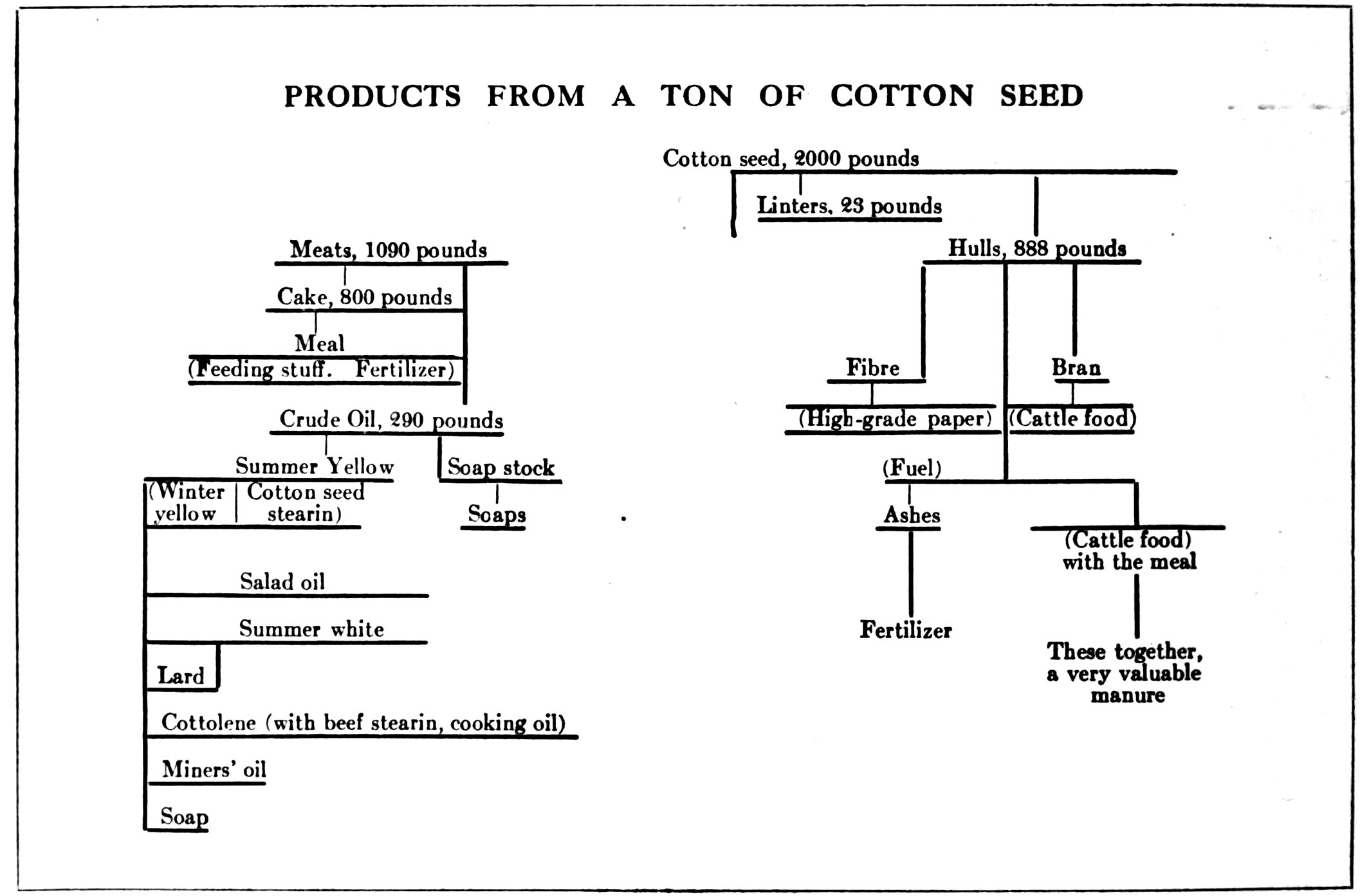
than any other grain. Cotton (Vol. 7,
p. 256), by Professor Chapman, is an
article of which the vast importance
may be judged by the following table
taken from page 261:
Every one of the other cereal and
general crops produced in any part of the
world is treated in the Britannica with
the same fullness of information and with
the same practical detail which characterizes
these articles on wheat, barley and
cotton.
Some of the principal articles on the
routine of farming such as sowing, reaping,
and the like, have already been mentioned
in connection with agricultural
machinery. The articles on individual
countries contain sections on the crops
of each of them, and you will find
Canada (Vol. 5, p. 152), and Germany
(Vol. 11, p. 810), of special interest.
The special features of tropical farming
are described in the articles on tropical
crops.
Fruit and Flower Growing
The article Fruit and Flower Farming
(Vol. 11, p. 260) covers fruit culture
in general, and, in the section of it which
deals with the United
States (Vol. 11, p.
268), the American
fruit crops. This
section describes the wonderful development
of the fruit industry since
cold transportation and cold storage
enabled consumers in every part of the
9country, and in Europe as well, to purchase
fruit grown in whatever state most
advantageously produces any one variety.
You should select, from the
twenty separate articles on individual
fruits, not only those on the varieties
which you are already growing, but
those on any others that are possible in
the part of the country where your land
lies. The section on fruit in the article
on Horticulture (Vol. 13, p. 775) is
devoted to growing on a smaller scale,
in gardens. It contains (Vol. 13, p.
780) a practical calendar to show each
month’s work.
Flower culture is the subject of special
sections in both the articles above named
and there is a descriptive list (Vol. 13,
p. 766) of more than three hundred hardy
annuals, biennials, and perennials, full
of practical information. The calendar
already mentioned indicates the dates
for indoor and out-door operations. From
the many articles on individual flower
plants listed at the end of Part 3 of this
chapter you can make your own choice.
Poultry and Bees
Poultry and their rearing are dealt
with in the articles Poultry and Poultry
Farming (Vol. 22, p. 213), Fowl
(Vol. 10, p. 760),
Turkey (Vol. 27,
p. 467), Guinea
Fowl (Vol. 12, p.
697), Duck (Vol. 8, p. 630), Goose (Vol.
12, p. 241), and Incubation and Incubators
(Vol. 14, p. 359). Bee-keeping and
the honey industry are treated in the articles
Bee (Vol. 3, p. 625) and Honey (Vol.
13, p. 653). Truck farming is treated in
the section dealing with vegetables
(Vol. 13, p. 776), of the article Horticulture.
Apart from the law as to
water rights already mentioned the legal
doctrine most particularly affecting farmers
is that of Emblements (Vol. 9,
p. 308). Grain Trade (Vol. 12, p. 322),
and Granaries (Vol. 12, p. 336), the
latter describing the latest type of grain
elevators, are articles of great interest to
farmers who specialize in cereal crops.
The new system of purchase of grain
by the government, which is working
admirably in Western Canada, protects
the farmer against the speculators who
buy standing crops for less than a fair
price, and it is to be hoped that some
similar plan may be adopted in the
United States.
Economics (Vol. 8, p. 899), by Professor
Hewins, Co-operation (Vol. 7,
p. 82), and Tariff (Vol. 26, p. 422),
deal with topics related to the marketing
of all agricultural products. The articles
on learned societies have an extensive
section (Vol. 25, p. 317) on the agricultural
societies of all countries.
The History of Farming
Agricultural history is, naturally, based
upon the history of vegetable life, and
the fossil plants described in the article
Palæobotany (Vol.
20, p. 524), long as
their appearance preceded
that of man,
greatly affected the nature of the earth’s
crust which he was to occupy.
The earliest of all known writings, the
Code of Khammurabi, described in the
article on Babylonian Law, shows (Vol. 3,
p. 117) that agriculture was the subject
of careful legislation under the oldest
government of which a contemporary
record has survived; and the provisions
as to the working of land on the “metayer”
system, under which the landowner
received from the landholder a
share of the crops, and as to irrigation,
are most explicit and practical. Ancient
Egyptian implements of agriculture are
fully described (Vol. 9, p. 69) in the
article Egypt, and pictures of them
appear on page 72 of the same volume.
If the ancient history of farming interests
you, it is only necessary for you to
turn to the heading “Agriculture,” in
the Index (Vol. 29), where you will find
references to a number of other articles
on the early civilizations.
From these articles, as from the historical
section of the guiding article
Agriculture, and the passages relating
10to agriculture in many of the 6,292 articles
on the histories of races and countries,
the reader may learn that agriculture
has been the key to all history. The
earliest migrations of the human race, as
definitely as the comparatively recent
development of America, Australasia and
the interior of Africa, were based upon
an agricultural impetus. And his reading
upon other subjects in the Encyclopædia
Britannica will often remind him
that the wool and cotton and linen and
leather that we wear, the carpets and
blankets and sheets in our houses, all
originated in farming of one kind or another;
while every food that nourishes us,
save fish and game, is directly an agricultural
product. All the bustle of the
great cities, all the wheels that turn in
the mills, all the intricate mechanism of
industry and commerce, all the world’s
work and thought and happiness, depend
upon the mysterious and inimitable
processes by which the brown soil yields
green growth. For all the progress
science has made, we are no nearer to
replacing these processes by any short
cut of chemistry than were the first farmers
whose husbandry is recorded in history.
If all the little roots ceased for
one year to do their work in the dark, the
human race would hopelessly starve to
death.
The alphabetical list of articles at the
end of Chapter III of this Guide will
make it easy for you to add to this course
of reading, choosing for yourself the line
that will be most attractive to you. In
making your choice, do not forget that
plant-life is a subject you cannot study
too closely. No matter what crop you
make your specialty, you have to educate
the plants that produce it to do their
work, just as carefully as a teacher
trains children. Another fact to keep in
mind is that just as a doctor is dealing
with organs in the human body which he
cannot see, so you are particularly concerned
with the roots down in the soil, and
the more you know about the way they
eat and drink, the better for your farm.
The names of many of the writers of
these articles are given in the table of the
1,500 Contributors to the Britannica,
beginning at page 949 of Vol. 29 (the
index volume); a glance will show you
what authoritative positions they occupy
and how thoroughly they command your
confidence.
[See list of articles on subjects connected
with farming, at the end of Chapter III of
this Guide.]
Stock-raising in the United
States was, until quite recent
years, under the evil influence of
the careless methods which had been
handed down from the old days of the
range-cattle industry. Chicago men still
tell the story of the Chicago banker,
afterwards Secretary of the Treasury,
who declared, in reply to a request for a
loan on the security of range-cattle, that
he “would as soon lend money on a
shoal of mackerel in the Atlantic Ocean.”
The vague possession and the vague
methods of breeding and marketing
which suggested this comparison did not
form the habits of close observation and
incessant care which became necessary
when land and food began to cost money.
The lesson has been learned, and the
present conditions of the industry are
infinitely better for the country at large.
It has been proved that fattening as well
as breeding can be successfully undertaken
in almost every part of the United
11States. Even in the North West, the
tendency to-day is to turn from exclusive
grain growing to a combination of cropping
and feeding. Cattle, and also work
horses of the right type, for which the
demand is always greater than the supply,
are yielding fair profits on many of
the New England farms which had been
neglected for years.
Staying on the Land
One of the most encouraging features
of the present situation is that the
broader distribution of the live-stock
industry encourages
farm-bred boys to
remain at home. It has long been a
popular belief that the attraction of the
cities lies largely in the facilities for
amusement which they offer; but the best
class of young men who have left the
farms have done so because they did not
believe that plowing and sowing and
reaping gave enough scope for their intelligence
and their initiative. When
stock-raising is combined with tillage,
there is not only a greater interest in
farm life and a greater chance to make
general knowledge effective, but there
are also better opportunities for a young
man to make a small venture of his own
while he is still a farm hand. It is certainly
true that stock-raising needs the
young man who is determined to know
something about everything and all there
is to know about one thing. To him the
articles in the Britannica which are indicated
in this chapter should be of the
greatest value, for they cover a broad
range, and they are written by specialists
of the highest authority. They do not
profess to teach what can only be learnt
in the course of practical experience, but
they will make each day’s work more
interesting and more effective.
Cattle
You cannot do better than to begin
your reading with the article (Vol. 4,
p. 337) on the family of animals to
which cattle belong, a family so varied
that it includes so small a creature as
the hare, and so large a one as the
rhinoceros. The article
Cattle (Vol. 5, p. 359),
by Professor Wallace and
Dr. Fream, begins by reminding you
that the idea of cattle owning has always
been so closely associated with the idea
of wealth that the two words “capital”
and “cattle” have the same root, and
that our word “pecuniary” is taken
from the Latin term for cattle. This
article, illustrated with photographs of
the best specimens of bulls and cows of
different breeds, deals with Shorthorns,
Herefords, Devons, Holsteins, Dutch
Belteds, Sussexes, Longhorns, Aberdeen-Angus,
Red Polleds, Galloways, Highlands,
Kerry’s, Dexters, Jerseys and
Guernseys, and has a section on the
rearing of calves. Ox (Vol. 20, p. 398)
is chiefly about the origin of domestic
cattle. Agriculture (Vol. 1, p. 388)
contains information of a more general
kind as to practical stock-raising. The
best methods of mating are described
fully in Breeds and Breeding (Vol. 4,
p. 487), Variation and Selection
(Vol. 27, p. 906), and Heredity (Vol.
13, p. 350), by Dr. Chalmers Mitchell.
Mendelism (Vol. 18, p. 115) will tell you
all about the theory which is nowadays
the great subject of discussion among experts
in breeding. Embryology (Vol.
9, p. 314), by Dr. Hans Driesch, and
Reproduction (Vol. 23, p. 116), by Professor
Vines, contain the results of the
latest investigations, and the article Sex
(Vol. 24, p. 747) describes the recent experiments
undertaken with the hope that
breeders may at some future time be
enabled to vary at will the proportion of
males and females. Telegony (Vol.
26, p. 509) gives you the evidence for and
against the belief that offspring are influenced
by a previous mate of the dam.
Food Preservation (Vol. 10, p. 612)
and Refrigerating (Vol. 23, p. 30)
cover the cold shipping and cold storage
of beef. Leather (Vol. 16, p. 330), by
Dr. J. G. Parker, one of the foremost
12technical experts on this subject, follows
hides through the market to their final
distribution and industrial uses.
Horses and Mules
Notwithstanding the harm that trolley
cars and automobiles and mechanically
propelled agricultural machines have
done to important
branches of the horse
business, and notwithstanding the
competition which American exporters
find in Europe from the Argentine
ranches, there is still an active market
for farm horses and for stock suited to
trucking and light delivery work in cities.
You no doubt find, in whatever part of
the United States your interests lie, that
you need to watch the market very
closely, and that you must always be
ready to change your plans at short
notice. But it is to the quick-witted
man who is always prepared to vary his
methods that the Britannica offers the
greatest practical services. The article
on the horse family in general (Vol. 9,
p. 720) is very interesting, but you will
give more time to the elaborate article
Horse (Vol. 13, p. 712), by Richard
Lyddeker, E. D. Brickwood, Sir William
Flower, and Professor Wallace. The illustrations
are unusually valuable, for
instead of following the usual custom of
making all the photographs the same
size, the Editors of the Britannica showed
good sense and originality by making
each one to scale. The breeds are separately
described, and the sections on
feeding and breaking are full of useful
hints. The history of the thoroughbred
strain is carefully traced, the pedigree of
one famous type being shown in a table
naming more than one hundred ancestors.
The article Horse-Racing (Vol.
13, p. 726), by Alfred Watson, shows how
the sport has influenced breeding, and
the description of American trotting goes
back to the day when “Boston Blue,”
in 1818, trotted a mile in three minutes,
“a feat deemed impossible” at that
period! The English race meetings, in
which American owners and jockeys now
play so conspicuous a part, are described
in special sections, as well as the training
at Newmarket. Riding (Vol. 23, p. 317),
and Driving (Vol. 8, p. 585), are by
practical experts, and Traction (Vol.
27, p. 118) contains an interesting table
analyzing the draft power of the horse.
The section on Arab horses in the article
Arabia (Vol. 2, p. 261) should be read,
for it adds to the information, in the
articles already named, on the breed that
has influenced every variety of horse.
Mule (Vol. 18, p. 959) will tell you
about the varieties not only in the
United States and Mexico, but also in
France, Spain, Portugal, Italy, Asia
Minor, Syria, Egypt, Algeria and North
China. The section on Hybrids (Vol.
13, p. 713) of the article Horse deals
with all the attempts that have been
made to get a perfect type of mule by
introducing various strains of blood.
Sheep and the Wool Market
Sheep (Vol. 24, p. 817) contains
separate descriptions of the 28 best
breeds, discussing their values both for
wool and for the
meat trade. Breeding,
feeding, dipping
and lambing are fully
treated. Sheepdogs and other breeds
useful to the stock-raiser fall under the
article Dog (Vol. 8, p. 374). Wool
(Vol. 28, p. 805), by Professor Aldred
Barker, is an article in which you will at
once be impressed by the splendid thoroughness
that is characteristic of the
Britannica. It goes to the very foundation
of the subject by giving you microscopic
photographs, on a scale of 320 to
1, of each of the six great varieties of
wool, and explaining the structure of the
fibres. The article Fibres (Vol. 10, p.
309) will enable you to compare another
microscopic photograph of wool fibre
with similar pictures of silk, flax, cotton,
jute, and other textile materials. The
article wool deals next with wool-yolk
and wool-fat, and then goes on to
show why greasy wool is better than
13wool washed before shearing. Wool
classing and sorting are next described,
and then scouring. From this point the
treatment of wool hardly comes within
the jurisdiction of the sheep-man, although
he cannot know too much about
the qualities of the yarns obtained from
different kinds of wool. It is interesting
to note in this article that the first fulling
mill in America was built at Rowley,
Mass., in 1643, only thirty-four years
after the first sheep was brought to
America, and only twenty-three years
after the Pilgrims landed on Plymouth
Rock.
Pigs and Pork
The article Swine (Vol. 26, p. 236)
deals with the swine family in general,
and the article Pig (Vol. 21, p. 594), containing
a fine full-page
plate, gives a
detailed account of
the breeds most profitable
on the farm, including the Poland-China,
the Berkshire, the Duroc, and
the Chester White. Eleven breeds in
all are particularized. The breeding and
fattening of hogs, although it is now
successfully followed as a distinct branch
of the live-stock industry, must always
remain in great part a mere branch of
general farming; for the pig’s power of
thriving on many kinds of food, enables
the farmer to utilize produce that cannot
advantageously be shipped, and to
keep his pigs following his cattle over
the fields. Much information will be
found all through the article Agriculture
(Vol. 1, p. 388). Trichinosis
(Vol. 27, p. 266) deals with a disease that
has sometimes seriously affected the pork
market, and been made the excuse, too,
for some very harsh restrictions on
American exportation.
Diseases and Parasites of Live-stock
You will find in the Britannica (Vol.
28, p. 6) a very full and clear account of
the diseases of all domestic animals, by
Dr. Fleming and Professor McQueen,
with special sections on the maladies of
the horse, of cattle, of sheep, and of
pigs, and on the parasites that infest
them. Tuberculosis
(Vol. 27, p.
354) calls for special
study, for it is a
“disease of civilization”
almost unknown among wild
animals in their natural state and
among the uncivilized races of mankind.
The connection between the disease
in cattle and its spread among
human beings is fully explained in this
article. Pleuro Pneumonia (Vol. 21,
p. 838) deals with the lung disease from
which cattle are the only sufferers,
Rinderpest (Vol. 23, p. 348), with the
infectious fever which affects both cattle
and sheep, and Anthrax (Vol. 2, p. 106),
with the terribly infectious carbuncles
communicated from cattle and sheep to
man by the microbes carried in wool and
hides. Glanders (Vol. 12, p. 76) describes
the form in which this disease of
horses and mules afflicts human beings,
the symptoms and course of which, in
the animals themselves, fall under the
subject of horse diseases (Vol. 28, p. 8).
The microbe by which this disease is
carried is shown in the plate facing one
of the pages (Vol. 20, p. 770) of the
article Parasitic Diseases. Foot and
Mouth Disease (Vol. 10, p. 617)
afflicts cattle, sheep, and pigs, and
occasionally human beings.
Among the articles on continents and
countries which contain special information
on stock-raising, you should not miss
the interesting general review of the
European live-stock industry in the
article Europe (Vol. 9, p. 914), the
section on live-stock in Canada (Vol. 5,
p. 153), that in Argentina (Vol. 2, p.
465), in Australia (Vol. 2, p. 950),
and in New Zealand (Vol. 19, p. 627)
The history of stock-raising is fully
treated at the beginning of the article
Agriculture (Vol. 1, p. 388).
How to “Even Up”
When you have read the articles mentioned
in the three parts of this chapter
on Farming, do not turn away with the
idea that you have got from the
14Britannica all that
it can give you to
help you in your
business. Remember
that you have to judge men, as
well as live-stock, in order to succeed,
and that general knowledge is of the
greatest use in doing that. The one
sure sign of the kind of man you cannot
rely upon is that he talks confidently
about subjects of which he really knows
little, and the more you yourself know,
the more readily you can detect the pretentious
people who might make you
think too well of them.
If you turn over the pages of this
guide, and ask yourself, as you glance at
the chapters, in what departments of
general knowledge you are weakest, you
will see what courses of reading will do
most to make you an “evened up” man,
without any weak threads in your intellectual
texture. And, whatever you
read, do not forget that the Britannica
is a book of reference as well as for reading:
that you are debasing your mind
every time you leave unanswered any
question that comes up in the course of
the day’s work or talk, or while you are
reading your newspaper. A vigorous
mind wants an answer whenever it becomes
conscious of a question or of a
doubt, and if you fail to feed it with the
information it asks for, it loses health.
Now that you have the Britannica, the
food is in the store-room, do not leave
it there!
[See list of articles on subjects connected
with stock-raising and other branches
of farming, at the end of Chapter III of
this Guide.]
SEE ALSO CHAPTER I, FOR FARMERS, AND CHAPTER II, FOR STOCK-RAISERS
The admirable set of rules for
dairy farmers issued by the
United States Department of
Agriculture begins by telling you to
“read current literature and keep
posted on new ideas.” And you can
easily see that the information on
dairy-farming and the many subjects
connected with it, supplied by the Britannica,
must cover a much broader field of
new ideas than can be included in any
periodical or dairying manual. The
branches of science in which the greatest
advance has been made since the beginning
of the present century happen to be
those that have most to do with dairying;
and the industry itself has been
completely revolutionized since the days
when cities got their milk from ramshackle
cow-sheds in their suburbs, and
when butter-making was regarded as
one of the “chores” to be done at odd
times.
The key article in the Britannica,
Dairy and Dairy Farming (Vol. 7,
p. 737), deals with the best milking
breeds, the installation, equipment, and
management of a dairy farm, the values
of various kinds of pasturage and fodder;
with the milk trade, with butter-making
and cheese-making, with condensed milk,
skim milk, and milk powder and with
the organization and operation of creameries,
cheeseries, and dairy factories in
general. Such subjects as soil, grass,
hay and other fodder crops fall under
Part I of this chapter, and the articles
dealing with the breeding and rearing
of dairy cattle are mentioned in Part
II, “For Stock-Raisers.”
Dairy-Herd Diseases
15Cattle diseases in general are also
covered by the course of reading suggested
in Part II; but the dairy farmer
has a special interest in contagious
mammitis, milk
fever, contagious
abortion, and cowpox, all of which are
described (Vol. 28, p. 10) in the article
on Veterinary Science. You cannot
study too carefully the article on Tuberculosis
(Vol. 27, p. 354), for this terrible
infection is not only a standing danger
to your herd, but also affects the transportation
and marketing of milk. Dr.
Hennessy, who wrote the article, is an
expert of the first rank and, like most
other great authorities, is not inclined to
encourage the popular exaggeration of
the dangers for which newspaper “sensations”
are responsible.
Milk and the Milk Market
You get to the very foundation of the
supply of milk in Professor Parson’s and
Dr. Edmund Owen’s article Mammary
Gland (Vol. 17, p.
528), in which the
comparative anatomy
of the milk yielding
organ is fully treated. The article
Milk (Vol. 18, p. 451) discusses the
chemistry of many kinds of milk and the
diseases carried by milk, and deals with
the gravest problems of the industry: the
difficulty of sterilizing milk, so that
tuberculosis and typhoid cannot be
carried by it, and the difficulty of sterilizing
cream, so that butter may be quite
safe, without making the milk less nutritious
and the butter less delicate in
flavor. The article Bacteriology (Vol.
3, p. 156), by Professor H. Marshall
Ward and Professor Blackman, goes to
the root of this whole question of infection.
Milk is, on the other hand,
used to convey into the human system
the “friendly microbes,” and the use of
soured milk and cheese for this purpose
is explained in the articles Therapeutics
(Vol. 26, p. 800) and Longevity (Vol.
16, p. 977), which deal with Metchnikoff’s
system of treatment. Pepsin
(Vol. 21, p. 130) describes the process
by which milk is rendered more digestible,
and Infancy (Vol. 14, p. 513)
deals with the preparation of milk to be
sold for the use of young children. There
is so general a demand for prepared milk
which is from every point of view wholesome
that you will find it worth while to
read, in this connection, Food (Vol. 10,
p. 611), Nutrition (Vol. 19, p. 920) and
Dietetics (Vol. 8, p. 214).
Products and Marketing
Butter (Vol. 4, p. 889,) and Cheese
(Vol. 6, p. 22) are brief articles which
you should not overlook, although they
refer you to the key
and article on dairying
for details; and Oils
contains (Vol. 20,
p. 47) an interesting analytical table in
which butter is compared with other
animal fats. Food Preservation (Vol.
10, p. 612) deals with the cold storage of
butter, cheese, condensed milk and milk
powder; and Refrigerating (Vol. 23,
p. 30) with the processes and machinery
employed. Koumiss (Vol. 15, p. 920)
describes the milk-wine or milk-brandy
prepared by fermenting mare’s milk, and
the similar product “kerif” made from
cow’s milk. Although the special developments
of dairying in various parts
of the world are discussed in the article
Dairy and Dairy-Farming, the articles
on individual countries also contain
information of value. The section on
dairying (Vol. 5, p. 154) in the article
Canada, and the account of co-operative
dairying (Vol. 7, p. 87) in Denmark
should not be overlooked.
In reading these articles in Britannica,
and thinking of the present conditions of
this great business, you will be reminded
that dairying is an industry of peculiar
importance to the whole people of the
United States, not only because of the
money made out of it, and not only
because it gives hundreds of thousands of
men employment on the land instead of
in crowded cities, but also because it
16promises to develop the co-operative
action which harmonizes with the best
ideals of democracy. The co-operative
plants which are beginning to be established
by dairy farmers are the only
institutions our modern civilization has
created in which you find the neighborly
spirit that the first American
settlers showed in the days when they
joined to defend themselves against the
Indians. At political meetings, in machine
shops and cotton mills and shoe
factories, you hear unhappy talk about
the relations of capital and labor, about
strikes and trusts, about the man on
top and the man underneath. But where
the farmer’s wagons clatter up to the
separator platform, there is combination
in the best sense of the word. The
Britannica article on co-operation says
that the word “in its widest usage,
means the creed that life may best be
ordered not by the competition of individuals,
where each seeks the interest of
himself and his family, but by mutual
help, by each individual consciously
striving for the good of the social body
of which he forms part, and the social
body in return caring for each individual;
‘each for all, and all for each’ is its
accepted motto. Thus it proposes to
replace among rational and moral things
the struggle for existence by voluntary
combination for life.”
(The more important articles have already been mentioned in the preceding pages, but the following list includes many others in which valuable information will be found.)
- Aal
- Aaron’s Rod
- Abaca
- Abutilon
- Acacia
- Acanthus
- Acaulescent
- Acerose
- Achimenes
- Acinus
- Acorn
- Acorus Calamus
- Acotyledones
- Acrogenæ
- Adonis
- African Lily
- Agave
- Agrimony
- Ailanthus
- Alburnum
- Alder
- Aleurites
- Alexanders
- Algæ
- Algum or Almug
- Alismaceæa
- Allamanda
- Alliaria Officinalis
- Allium
- Almond
- Aloe
- Amadou
- Amanita
- Amaranth
- Amaryllis
- Amentiferæ
- Ammoniacum
- Ampelopsis
- Anatto
- Anemone
- Angelica
- Angiosperms
- Angulate
- Anime
- Anise
- Antirrhinum
- Apiculture
- Apple
- Apricot
- Araucaria
- Arbor Day
- Arbor Vitæ
- Arboretum
- Arboriculture
- Archil
- Aristolochia
- Aroideæ
- Arrowroot
- Artichoke
- Ascus
- Ash
- Asparagus
- Aspen
- Ashpodel
- Aspidistra
- Aster
- Aubergine
- Aucuba
- Auricula
- Autogamy
- Auxanometer
- Averruncator
- Avocado Pear
- Axile or Axial
- Azalea
- Bael Fruit
- Balm
- Bamboo
- Banana
- Baneberry
- Banksia
- Baobab
- Barberry
- Barley
- Bdellium
- Bean
- Bee
- Beech
- Beet
- Begonia
- Benzoin
- Betel-nut
- Bilberry
- Birch
- Bird’s Eye
- Blackberry
- Bladder-wort
- Boletus
- Boll
- Borage
- Boraginaceæ
- Botryis
- Bottle-brush plants
- Bouvardia
- Boxwood
- Bracket-fungi
- Bramble
- Bran
- Brazil Nuts
- Brazil Wood
- Bread-fruit
- Breed and Breeding
- Bromeliaceæ
- Brooklime
- Broom
- Broom-rape
- Bryophyta
- Buchu
- Buck-bean
- Buckthorn
- Buckwheat
- Bulrush
- Bur, or Burr
- Burnet
- Buttercup
- Butter-nut
- Butterwort
- Cabbage
- Cactus
- Caducous
- Cæspitose
- Calabash
- Calabash Tree
- Calceolaria
- Calf
- Camellia
- Campanula
- Candytuft
- Cane
- Cannon-ball Tree
- Capers
- Caprifoliaceæ
- Capsule
- Caraway
- Cardamon
- Cardoon
- Carnation
- Carrageen
- Carrot
- Caryophyllaceæ
- Cashew Nut
- Cassava
- Cassia
- Casuarina
- Catalpa
- Cataphyll
- Catha
- Cattle
- Cayenne Pepper
- Ceanothus
- Cecropia
- Cedar
- Celandine
- Celery
- Centaurea
- Centaury
- Chantarelle
- Chenopodium
- Cherry
- 17Chestnut
- Chicory
- Chive
- Chlorosis
- Chrysanthemum
- Churn
- Cicely
- Cimicifuga
- Cinchona
- Cineraria
- Cinnamon
- Citron
- Cleavers
- Clematis
- Climbing Fern
- Cloudberry
- Clover
- Cloves
- Cocoa, or Cuca
- Cocculus Indicus
- Cock’s-comb
- Cocoa
- Coco de Mer
- Coco-nut Palm
- Codiæum
- Coffee
- Colchicum
- Coleus
- Colleter
- Colocynth
- Colt’s-foot
- Columbine
- Compass plant
- Compositæ
- Convolvulaceæ
- Copaiba
- Copal
- Coppice
- Coriander
- Cork
- Corn
- Corn-salad or Lamb’s Lettuce
- Correa
- Cotoneaster
- Cotton
- Cow-tree
- Cranberry
- Crassulaceæ
- Crazy Weed
- Cress
- Crinum
- Crocus
- Crowberry
- Cruciferæ
- Cryptomeria
- Cucumber
- Cucurbitaceæ
- Cumin or Cummin
- Cupulliferæ
- Cultivator
- Currant
- Custard Apple
- Cyclamen
- Cyperaceæ
- Cypress
- Cystolith
- Daffodil
- Dairy & Dairy Farming
- Dahlia
- Daisy
- Dame’s Violet
- Dammar
- Dandelion
- Daphne
- Darlingtonia
- Date Palm
- Deciduous
- Dewberry
- Diatomaceæ
- Dicotyledons
- Dictyogens
- Dividivi
- Dock
- Dodder
- Dogwood
- Dracæna
- Dragons Blood
- Drainage
- Dropwort
- Duck
- Duckweed
- Dulse
- Duramen
- Durian
- Durra
- Earth-nut
- Earth-star
- Ebony
- Economic Entomology
- Edelweiss
- Eglantine
- Elder
- Elecampine
- Elephant’s foot
- Elm
- Endive
- Ensilage
- Entada
- Ericaceæ
- Espalier
- Esparto
- Eucharis
- Eunonymus
- Euphorbia
- Euphorbiaceæ
- Evergreen
- Everlasting
- Fairy Ring
- Fallow
- Farm
- Farm Buildings
- Fennel
- Fenugreek
- Fern
- Fig
- Filmy Ferns
- Finger-and-toe
- Fir
- Flail
- Flax
- Flower
- Fool’s Parsley
- Forage
- Forests & Forestry
- Forget-me-not
- Fork
- Foxglove
- Freesia
- Fritillary
- Frog-bit
- Fruit
- Fruit & Flower Farming
- Fuchsia
- Fumitory
- Fungi
- Funkia
- Furze
- Fustic
- Gale
- Galls
- Gardenia
- Garlic
- Genista
- Gentian
- Gentianaceæ
- Geoponici
- Geraniaceæ
- Geranium
- Geum
- Gillyflower
- Ginger
- Gladiolus
- Glasswort
- Glaucous
- Gloriosa
- Gloxinia
- Goat
- Golden Rod
- Goose
- Gooseberry
- Goose Grass
- Gorse
- Gourd
- Graft
- Grains of Paradise
- Gram or Chick-pea
- Granadilla
- Grass and Grassland
- Grass of Parnassus
- Grasses
- Greenheart
- Ground Nut
- Groundsel
- Guano
- Guava
- Guelder Rose
- Gulfweed
- Gum
- Gumbo
- Gutta Percha
- Gymnosperms
- Hacienda
- Hackberry
- Harebell
- Harrow
- Hawthorn
- Hay
- Hazel
- Heath
- Hedges and Fences
- Heifer
- Heliotrope
- Hellebore
- Hemlock
- Hemp
- Hen
- Henbane
- Henna
- Herb
- Herbarium
- Hickory
- Hippeastrum
- Hoe
- Holly
- Hollyhock
- Honey
- Honey Locust
- Honeysuckle
- Hop
- Horehound
- Hornbeam
- Horse
- Horseradish
- Horsetail
- Horticulture
- Houseleek
- Huckleberry
- Humus
- Huon Pine
- Hyacinth
- Hydrangea
- Hydrocharideæ
- Hyssop
- Ice-plant
- Iceland Moss
- Idioblast
- Immortelle
- Impatiens
- India Hemp
- Indian Corn
- Insectivorous Plants
- Iridaceæ
- Iris
- Irish Moss
- Iron-wood
- Ivy
- Jarrah Wood
- Jasmine
- Jew’s Ears
- Job’s Tears
- Judas Tree
- Jujube
- Juncaceæ
- Juniper
- Jute
- Kaffir Bread
- Kauri Pine
- Kerguelen’s Land Cabbage
- Kumquat
- Labiatæ
- Labrador Tea
- Laburnum
- Lac
- Lace-bark Tree
- Lancewood
- Larch
- Larkspur
- Lattice Leaf Plant
- Laurel
- Laurustinue
- Lavender
- Leaf
- Leek
- Leguminosæ
- Lemon
- Lentil
- Lettuce
- Lichens
- Lilac or Pipe Tree
- Liliacæ
- Lily
- Lime or Linden
- Liquidambar
- Litchi
- Lobelia
- Loco-weeds
- Locust
- Loosestrife
- Loquat
- Lotus
- Lucerne
- Lupine
- Lycopodium
- Madder
- Magnolia
- Mahogany
- Maidenhair
- Maize
- Mallow
- Malvaceæ
- Mammee Apple
- Mandrake
- Mangel-wurzel
- Mango
- Mangosteen
- Mangrove
- Manila Hemp
- Manna
- Manures
- Maple
- Marcescent
- Mare’s-tail
- Marguerite
- Marigold
- Marjoram
- Mastic
- Mate
- Mattock
- Medlar
- Melon
- Meristem
- Mesquite
- Merino
- Mignonette
- Mildew
- Milkwort
- Millet
- Mimosa
- Mimulus
- Mint
- Mistletoe
- Moly
- 18Momordica
- Moonseed
- Moonwort
- Moraceæ
- Moreton Bay Chestnut
- Mucuna
- Mulberry
- Mushroom
- Mustard
- Myrobalans
- Myrrh
- Myrtle
- Narcissus
- Nard
- Nasturtium
- Nettle
- Nettle Tree
- New England Flax
- Nightshade
- Nut
- Nutmeg
- Oak
- Oat
- Okra
- Oleander
- Oleaster
- Olive
- Onagraceæ
- Onion
- Orach or Mountain Spinach
- Orange
- Orchard
- Orchids
- Orris-Root
- Osier
- Ox
- Oxalis
- Pæony
- Palm
- Palmetto
- Pansy or Heartsease
- Papyrus
- Paraguay Tea
- Parsley
- Parsnip
- Passionflower
- Pea
- Peach
- Pear
- Pellitory
- Pennyroyal
- Pentstemon
- Pepper
- Peppermint
- Pepper Tree
- Persimmon
- Petunia
- Phlox
- Phormium
- Pig
- Pimento
- Pine
- Pine-apple
- Pin-eyed
- Pink
- Pistachio Nut
- Pistil
- Pitcher Plants
- Plane
- Plantain
- Plough and Ploughing
- Plum
- Poinsettia
- Pokeberry
- Pollination
- Polyanthus
- Polygonaceæ
- Polypodium
- Pomegranate
- Pondweed
- Poplar
- Poppy
- Potato
- Potentilla
- Poultry & Poultry Farming
- Primrose
- Primulaceæ
- Privet
- Pteridophyta
- Puff-ball
- Pumpkin
- Purslane
- Pyrethrum
- Quince
- Radish
- Ram
- Ramie
- Ramsons
- Ranch
- Ranunculas
- Ranunculaceæ
- Rape
- Raspberry
- Reaping
- Reed
- Rhododendron
- Rice
- Richardia
- Robinia
- Rocambole
- Roller
- Root
- Rosaceæ
- Rose
- Rosemary
- Rosewood
- Rosin or Colophony
- Royal Fern
- Rubraceæ
- Rubber
- Ruderal
- Rue
- Rush
- Rye
- Sabicu Wood
- Safflower
- Saffron
- Sago
- Sainfoin
- St. John’s Wort
- Salsafy or Salsify
- Salvia
- Sap
- Sapan Wood
- Sarcocarp
- Sarmentose
- Sarracenia
- Satin Wood
- Saxifrage
- Saxifragaceæ
- Scammony
- Scion
- Scorzonera
- Screw-pine
- Scrophulariaceæ
- Scythe
- Sea-kale
- Seawrack
- Sedum
- Secund
- Seed
- Sequoia
- Service Tree
- Sesame
- Shaddock
- Shallot
- Sheep
- Sisal Hemp
- Skirret
- Snake-root
- Snapdragon
- Snowdrop
- Soap-bark
- Soil
- Solanaceæ
- Sorghum
- Sorrel
- Sowing
- Spade
- Spanish Broom
- Spanish Grass
- Spikenard
- Spinach
- Spruce
- Stem
- Stink-wood
- Strawberry
- Strophanthus
- Sudd
- Sumach
- Sundew
- Sunflower
- Sunn
- Sweet Gum
- Sweet Potato
- Sweet-sop
- Swine
- Switch-plants
- Synanthry
- Tallow Tree
- Tamarind
- Tamarisk
- Tea
- Teak
- Teasel
- Terebinth
- Thistle
- Thorn
- Thrashing
- Thrum-eyed
- Thyme
- Tiger-flower
- Toadstool
- Tobacco
- Tomato
- Tonqua Bean
- Toothwart
- Topiary
- Traveller’s Tree
- Tree
- Tree-fern
- Trowel
- Truffle
- Tuberose
- Tulip
- Tulip Tree
- Tumble-weed
- Turkey
- Turmeric
- Turnip
- Turnsole
- Umbelliferæ
- Urticaceæ
- Vanilla
- Vegetable
- Vegetable Marrow
- Venus’s Fly Trap
- Venus’s Looking Glass
- Veratrum
- Verbena
- Vetch
- Vine
- Violet
- Walnut
- Water-lily
- Water-thyme
- Wax-tree
- Wheat
- Whin
- Whortleberry
- Willow
- Willow-herb
- Wintergreen
- Winter’s-bark
- Witch Brooms
- Witch Hazel
- Woad
- Wormwood
- Yam
- Yew
- Yucca
- Zinnia
19
Technical Education for Manufacturer and Merchant
The article on Technical Education
in the new (Eleventh) Edition
of the Encyclopædia Britannica
(Vol. 26, p.
487), written by
Philip Magnus, one
of the greatest educational
authorities
in the world, says
that:
“The widespread appreciation of
the advantages of the higher education
among all classes of the American
people, and the general recognition
among manufacturers, engineers
and employers of labour, of the value
to them in their own work, of the
services of college-trained men, has
largely helped to increase the number
of students in attendance at the universities
and technical institutions.”
A still broader truth is that the men
who have learned to think clearly, by
whatever study or reading they may
have developed that power, possess the
greatest of all advantages. As the
Britannica article on Education indicates,
the true value of education (not
simply school education, but all education)
lies as much in the influence which
intelligently directed study exerts upon
the mind as in the immediate usefulness
of the information acquired, and the
articles in the Britannica not only supply
the most recent and authoritative information,
but are so logically arranged,
one dove-tailing into another, that they
give the reader precisely that orderly
view of knowledge which is the foundation
of all mental training.
Since all of the series of chapters
which immediately follow and which are
intended for merchants and manufacturers,
deal with commerce and manufactures,
it will be for the reader’s convenience
to begin by dealing with those
two subjects in general. But certain
branches of industrial and manufacturing
knowledge are dealt with in special
chapters. The articles on banking and
finance are described fully in this
Guide in the chapter For Bankers and
Financiers, those on insurance in the
chapter For Insurance Men, and those
on law in the chapter For Lawyers.
Three of the legal articles should, however,
be mentioned here, as they are
on especially important subjects: Sale
of Goods (Vol. 24, p. 63), Company
(Vol. 6, p. 795), which deals with the
laws in various countries regulating
corporations, and Employers’ Liability
(Vol. 9, p. 356), on this topic so important
in modern industrial law and in
the relations between capital and labour.
Practical Economics for Practical Men
The broad questions of commercial
and industrial policy are discussed in
Economics (Vol. 8, p. 899), by Prof.
Hewins; Commerce (Vol. 6, p. 766);
Trusts (Vol. 27, p.
334); Monopoly
(Vol. 18, p. 733),
and Trade Organization
(Vol. 27, p.
335), which describes commercial associations
in the United States, the work
of the consular service, and the organizations
in Germany, France, Great
20Britain and other countries. Book-keeping
(Vol. 4, p. 225), with its
up-to-date account of modern accounting
methods, card ledgers and loose
leaf systems; Advertisement (Vol.
1, p. 235), and Mercantile Agencies
(Vol. 18, p. 148) may be named as
specimens of the many practical articles
on business methods which need not
all be enumerated here.
Imports and Exports
Much of what you read and hear
about the tariff systems of the United
States and various other countries and
about their influence
upon trade is so
vague and confusing
that you will be
delighted with the group of clear,
common-sense articles in the Britannica.
Tariff (Vol. 26, p. 422) is by one of the
most famous American economists, Prof.
Taussig of Harvard, and is a very full
and fair discussion of the points in controversy.
Protection (Vol. 22, p. 464)
is by Prof. James of the University of
Illinois, and Free Trade (Vol. 11, p. 89)
by William Cunningham. You should
read with care Customs Duties (Vol.
7, p. 669); Free Ports (Vol. 11, p. 88),
and Bounty (Vol. 4, p. 324). Balance
of Trade (Vol. 3, p. 235) and Taxation
(Vol. 26, p. 458) are both by Sir Robert
Giffen. Exchange (Vol. 10, p. 50), by
E. M. Harvey, a partner in one of the
largest firms of bullion brokers in the
world, deals with the movement of
gold. Commercial Treaties (Vol.
6, p. 771) is by Sir C. M. Kennedy.
Freights are discussed in Affreightment
(Vol. 1, p. 302) by Sir Joseph
Walton. Lien (Vol. 16, p. 594), with its
section on “Stoppage in transitu,” is by
F. W. Raikes; Salvage (Vol. 24, p. 97),
by T. G. Carver, and Blockade (Vol.
4, p. 72), by Sir Thomas Barclay, the
great international lawyer in Paris.
Marine insurance, indemnity, Lloyds,
and other insurance subjects fall
under the chapter of this Guide
For Insurance Men to which you
should refer. Cargo-carrying and merchant
shipping are further covered by
Shipping (Vol. 24, p. 983). This article
is by Douglas Owen, honorary secretary
and treasurer of the Society of National
Research, and author of Ports and
Docks; it contains information about
the great freight carrying lines of the
world that can be found in no other
book. Railroad freighting is covered
by the article Railways (Vol. 22, p.
819), in which there is a special
section (p. 854b) on the new models of
American freight cars.
Manufacturing and Consuming Nations
In the article United States, which
contains more matter than a whole book
of ordinary size and more information
than a dozen ordinary
books, the sections
(Vol. 27, p.
639) on manufactures
and on foreign
and domestic commerce, are by F. S.
Philbrick, Ph.D. The internal commerce
of the United States, as this article
states, is in itself greater than the total
international commerce of the world, and
is so far from exhausting the country’s
power of production and consumption,
that even when coastwise traffic is disregarded,
New York is the most active
port in the world. A section (Vol.
9, p. 916) of the article Europe deals
with European commerce in general.
The articles on the great manufacturing
towns of Europe contain much information
as to industries. Great
Britain’s industries are dealt with
in the article United Kingdom (Vol.
27, p. 691). The industries of England
alone are separately treated in a section
(Vol. 9, p. 426) of the article England.
Germany’s industries are the subject of
sections (Vol. 11, p. 811) of the article
Germany; and it is interesting to note
that although Germany has outranked
France in cotton manufactures since
Mülhausen, Colmar and other important
milling centres of Alsace became
German, France has retorted by
21overtaking and passing Germany in the
production of linen. The sections (Vol.
10, p. 785) on foreign commerce in the
article France show her position as in
the main a self-supporting country,
though only a fourth of the cargoes
loaded and discharged in French
ports are carried under the French
flag. It would be a waste of space
to enumerate here the articles on
Belgium, Switzerland, Italy and other
countries, which you will consult in
relation to those of their exports
in which you are especially interested;
but you should not overlook the article
on Japan. The Britannica has done
commerce a great service in giving to the
world at last a good account of this
extraordinary country.
The body of the article Japan (Vol.
15, p. 156) is by Capt. Brinkley, long
editor of the Japan Mail, whose
opportunities of seeing Japanese life
from the inside have been greater
than those of any other foreign observer.
Baron Dairoku Kikuchi, President
of the Imperial University of
Kyoto, a statesman of great experience
and authority, contributes to the article
a section (Vol. 15, p. 273) dealing with
Japan’s international position. His remarks
upon the commercial morality of
the Japanese are so ingenuous and so
candid that an extract from them cannot
be omitted:
Now when foreign trade was first opened,
it was naturally not firms with long-established
credit and methods that first ventured upon the
new field of business—some few that did failed
owing to their want of experience—it was rather
enterprising and adventurous spirits with little
capital or credit who eagerly flocked to the
newly opened ports to try their fortune. It was
not to be expected that all or most of those
should be very scrupulous in their dealings with
the foreigners; the majority of those adventurers
failed, while a few of the abler men, generally
those who believed in and practised honesty as
the best policy, succeeded and came to occupy an
honourable position as business men.... Commerce
and trade are now regarded as highly
honourable professions, merchants and business
men occupy the highest social positions, several
of them having been lately raised to the peerage,
and are as honourable a set of men as can be met
anywhere. It is, however, to be regretted that
in introducing Western business methods, it has
not been quite possible to exclude some of their
evils, such as promotion of swindling companies,
tampering with members of legislature, and so
forth.
The account (Vol. 15, p. 201) by Capt.
Brinkley of the curious system of creating
branches of Japanese business
houses is another part of this article
which should not be overlooked.
Mill Labour
The proportion of labour cost to the
total cost of production is in most
industries so great that you cannot study
too carefully every
aspect of the labour
question. The chief
articles are Labour
Legislation (Vol. 16, p. 7), jointly written
by the late Dr. Carroll D. Wright,
the great American authority on the
subject, and Miss A. M. Anderson,
Principal Lady Inspector of Factories to
the British government; Trades Union
(Vol. 27, p. 140); Strikes and Lockouts
(Vol. 25, p. 1024); Wages (Vol. 28, p.
229), by Prof. J. S. Nicholson; Profit
Sharing (Vol. 22, p. 423), by Aneurin
Williams and Apprenticeship (Vol. 2,
p. 228), by J. S. Ballin. The article
Employers’ Liability (Vol. 9, p. 356),
has already been mentioned.
22
Practical Men Among the Contributors
The Course of Reading outlined
in this chapter will help anyone
who has to do with the making
or with the buying and selling of
textiles, in three ways, at least, each
of the greatest importance to him—and
possibly in many more. Taking up
these three:—In the first place, it will
teach him many facts about manufacturing
and merchandizing in general,
and about dry goods in particular,
that he could learn nowhere else,
because the scope of the Britannica
is broader than that of any other
book—or, for that matter, than the
scope of any collegiate course can
well be. In the second place, the
number of distinguished men who
have devoted their exclusive attention
to the subjects upon which they write,
and have given to the Britannica the
results of their research
and of their
experience as practical
experts—in many
cases, indeed, as successful
business men—is far greater than
the number of men who form the faculty
of any university in the world. The
fifteen hundred contributors in fact include
no less than 704 connected with the
staffs of 151 different universities, technological
and commercial institutes and
colleges in twenty countries. The reader
thus gets the benefit of contact with
the thought of many, of varied, and always
of authoritative, personalities. In
the third place, the textile trade is
peculiarly an international trade, the
raw materials often traveling from one
end of the world to the other before
manufacture, and making as long a
journey in the finished form, before they
reach the consumer, and the international
character of the Britannica
gives equal weight to the articles which
deal with the textiles and with the
markets of all countries—a statement
which it would certainly not be safe to
make about any other book.
Textile Fibres and their Treatment
The article Fibers (Vol. 10, p. 309), by
C. F. Cross, whose name has been much
before the public in connection with the
recent scientific investigation
of the
subject, compares
the fibres yielded by
all the vegetable
and animal substances
used in textiles. The 18
microscopic photographs on the full
page plates (facing pp. 310 and
311) and the table of vegetable
fibres (p. 311) should be carefully
studied. Cellulose (Vol. 5, p. 606)
deals with the “body” of cotton,
flax, hemp and jute fibres. Carding
(Vol. 5, p. 324) deals with the brushing
and combing of fibres. Spinning (Vol.
25, p. 685) covers both cotton and
linen, and it is curious to note from
this article that in preparing yarns for
the exquisite Dacca muslins one pound
of cotton has been spun into a thread
252 miles long; while the article Dacca
says that a piece 15 feet by 3 was once
woven that weighed only 900 grains.
Yarn (Vol. 28, p. 906) deals with cotton,
23woollen and silk yarns. Weaving (Vol.
28, p. 440), by Prof. T. W. Fox, author
of Mechanics of Weaving, and Alan
Cole, is the first article you should read
in a group dealing with processes applied
to more than one material. The first
section is on the various combinations of
warp and weft, and contains 23 illustrations
showing the chief weaving
“schemes.” A section on weaving machinery
follows, and then one on weaving
as an art, illustrated with a number of
reproductions of famous specimens of
hand-loom work. The whole article is
full of practical every-day information
of the kind the merchant and manufacturer
wants to know. Bleaching
(Vol. 4, p. 49) describes the chemical processes
which have expedited the bleaching
of cotton, wool, linen and silk, which
it used to take all summer to complete.
Dyeing (Vol. 8, p. 744), by Prof.
Hummel, author of The Dyeing of
Textile Fabrics, and Prof. Knecht,
author of A Manual of Dyeing, is
another of the thorough articles which
entitle the Britannica to rank as a great
original work on textiles. Every dye is
separately treated, and the latest models
of dyeing machinery are carefully described.
Finishing (Vol. 10, p. 378)
deals with the processes used for cotton,
woollens, worsteds, pile fabrics, silks and
yarns. Textile-Printing (Vol. 26, p.
694) is by Prof. Knecht and Alan Cole,
author of Ornament in European Silks,
and not only describes all the styles of
printing, but gives sixty recipes for
various shades of colour. The full page
plates reproduce fine specimens of early
printing. The art of textile-printing “is
very ancient, probably originating in the
East. It has been practised in China
and India from time immemorial, and the
Chinese, at least, are known to have
made use of engraved wood-blocks many
centuries before any kind of printing was
known in Europe.”
Cotton and Cotton Fabrics
The elaborate article Cotton (Vol.
7, p. 256) begins by discussing the peculiar
twist of the hairs on the cotton
seed which by facilitating
spinning gives
cotton its predominant
position as a
textile material. The section on cultivation,
by W. G. Freeman, deals with
the soils, bedding, planting, hoeing and
picking, then with ginning and baling.
A section on diseases and pests of the
cotton plant follows, then a discussion
of the improvement of yield by seed
selection. The section on marketing and
supply is by Prof. Chapman, and his
practical study of “futures,” “options,”
and “straddles” shows how greatly the
movement of prices is affected by speculation
and often by artificial manipulation.
Cotton Manufacturing (Vol. 7, p.
281) describes the industry in England,
that of the United States, with a special
section on the recent developments in
the two Carolinas, Georgia and Alabama,
and also the mills in Germany, France,
Russia, Switzerland, Italy and in other
countries, including India, China and
Japan. It is interesting to note (p. 293)
that “Americans were making vast
strides in industrial efficiency even before
the period when American theories
and American enterprise were monopolizing
in a wonderful degree the attention
of the business world” abroad. As far
back as 1875 progress in the United
States was so rapid that the production
for each operative had increased during
the ten years 1865–75, by 100% in Massachusetts
as against only 23% in England.
One explanation of American success is
that the American employer “tries to
save in labour but not in wages, if a
generalization may be ventured. The
good workman gets high pay, but he is
kept at tasks requiring his powers and
is not suffered to waste his time doing
the work of unskilled or boy labour.”
Cotton Spinning Machinery (Vol.
7, p. 301) describes all the machines in
great detail and contains a number of
24full-page plates and other illustrations.
Mercerizing (Vol. 18, p. 150) is another
important article.
Wool, Linen and Silk
Wool, Worsted and Woollen Manufactures
(Vol. 28, p. 805) is by Prof.
Aldred F. Barker. The development in
wool production of
various countries is
first described and
then the wool fibre
is studied and microscopic photographs
reproduced to show the structure of
different varieties. A diagram of a
fleece shows the qualities obtained from
various parts of the animal, ranging from
the shoulders, where the finest is found,
to the hind quarters. Lamb, hogg and
wether wools are compared and the
article discusses shearing, classing, sorting,
scouring, drying, teasing, burring,
mule spinning, combing, drawing and
spinning. The centres of the industry
are then compared, with details as to the
special products of each. The article
contains illustrations of a number of
machines. Articles dealing with certain
sources of wool or of the wool-like hair
used in textiles, and with the finished
products, are: Alpaca (Vol. 1, p. 721),
the history of its manufacture being “one
of the romances of commerce;” Mohair
(Vol. 18, p. 647), which deals with the
hair of the Angora goat, familiar from
discussions of the Underwood Tariff bill,
and dealing with its weaving and the
imitations of the cloth; Llama (Vol.
16, p. 827); and the articles Guanaco
(Vol. 12, p. 649) and Vicugna (Vol. 28,
p. 47), on the two wild animals from
whose hair high priced materials, extraordinarily
warm and light, are woven.
Flax (Vol. 10, p. 484) describes the
cultivation of the crops which are harvested
by being “pulled,” roots and all,
instead of being cut, the process of separating
the capsules from the branches, and
the subsequent stages of preparation.
Linen and Linen Manufactures (Vol.
16, p. 724), by Thomas Woodhouse, takes
up the story where the flax fibre is ready
for market and carries it to the point
where the yarn is delivered for weaving.
The winding, warping, dressing and
beaming, and the looms employed, are
virtually the same processes and machines
that are used for cotton. The
article states that the finest linen threads
used for lace are produced by Belgian
hand spinners who can only get the
desired results by working in damp cellars,
the spinner being guided by touch
alone, as the filament is too fine for him
to see. This thread is said to have been
sold for as much as $72 an ounce.
Jute (Vol. 15, p. 603) deals with the
vegetable fibre which ranks, in its industrial
importance, next after cotton
and flax and with the processes employed
in its manufacture.
Silk (Vol. 25, p. 96) contains illustrations
of cocoons and worms, microscopic
photographs of fibre, and pictures
of the moths which produce wild silk.
The section on the fibre and its production
and preparation is by Frank
Warner, president of the Silk Association
of Great Britain and Ireland; and
that on the silk trade by Arthur Mellor,
a well known manufacturer of Macclesfield,
the great British center. The degree
of fineness to which silk thread can
be spun is stated (Vol. 28, p. 906) to
be such that 450,000 yards of thread
have been produced from one pound of
silk, and this is slightly in excess of
the fineness of the Dacca cotton thread
already mentioned as producing 252
miles for a pound. But at Cambrai the
lace maker’s linen thread already described
has been made as fine as 272
miles to the pound, and the drawing of
platinum wire to the fifty-thousandth
part of an inch in thickness (Vol. 28, p.
738) seems hardly more wonderful than
this. Spider silk is as valuable as the
best qualities of the silkworm product,
but spiders are such fierce cannibals that
it is necessary to keep each one in a
separate cage, and the cost of doing
this has prevented the fibre from being
25generally used (Vol. 25, p. 664). Artificial
or “viscose” silk is described in
the article Cellulose (Vol. 5, p. 609),
and is a textile of which the importance
is rapidly increasing.
Felting is an even older textile process
than weaving, just as weaving, which no
doubt originated in basket making (Vol.
3, p. 481) is older than spinning. The
article Felt (Vol. 10, p. 245) deals with
asphalted felts used for roofing as well
as with the hat felts; and the article Hat
(Vol. 13, p. 60) gives further details as to
both woollen and fur felts and describes
the machinery for hatmaking, which
originated in the United States.
Save that gold, silver and other metals
are occasionally used in cloth or gauze,
Asbestos (Vol. 2, p. 714) is the only
mineral employed in textiles, and its
value for jacketing steam pipes and
boilers and for insulating fabrics and fireproofing
gives it great importance.
Ramie (Vol. 22, p. 875) is not so
largely used in textiles, but experiments
in the production of better fibre are
being made.
Shoddy (Vol. 24, p. 992) is an article
which shows how unfair it is to treat the
re-manufacture of “devilled” fabric as
an illegitimate if not absolutely fraudulent
branch of the textile industry, for
really serviceable cloths are woven from
it, and masses of poor people who would
otherwise be in rags are thus comfortably
clad. “Mungo,” another re-manufactured
cloth, is described (Vol. 28, p.
906) in the article Yarn. Pine-apple
fibre is described (Vol. 10, p. 311) as of
exceptional fineness and is used in yarn
cloths of the best quality. The article
Pine-apple (Vol. 21, p. 625) describes
its culture. Sisal Hemp (Vol. 25, p.
158) is used in bagging as well as cordage,
and the same is true of Phormium
(Vol. 21, p. 471), sometimes called New
Zealand flax. Paper pulp yields a yarn
which is used in some cheap fabrics as
described (Vol. 5, p. 609) in the article
Cellulose already mentioned.
Textile Merchandise
The many varieties of woven cloths
are described in the articles already mentioned
in the manufacture of cotton,
linen, wool, and silk,
and in articles on
special fabrics. Hosiery
(Vol. 13, p.
788) covers the textiles that are produced
by knitting or looping, and gives an
account, with illustrations, of the machinery
employed. Net (Vol. 19, p.
412) covers the textiles of which the
mesh is knotted.
Lace (Vol. 16, p. 37), by Alan Cole,
contains some of the most beautiful full-page
plates and other illustrations to be
found in the Britannica, and is a very
full treatise on the history and the present
state of the lacemaking art.
Flannel (Vol. 10, p. 480) describes
the true flannels made from wool, and
Flannelette (Vol. 10, p. 481) the cotton
imitations and the new fire-resisting
fabrics of this class. Drill (Vol. 8, p.
580) covers both the cotton and linen
tissues sold under this name. Crepe
(Vol. 7, p. 379) mentions the curious
fact that the Chinese and Japanese
makers of soft crepe guard their secret
processes, which are still unknown to
western manufacturers, so carefully that
the different stages of their production
are carried on in towns far distant from
one another.
Carpet (Vol. 5, p. 392) contains full-page
plates of rare specimens and describes
pile carpets, flat-surfaced carpets
and the printed carpetings.
Tapestry (Vol. 26, p. 403) deals with
another luxurious branch of the textile
industry, and is illustrated with photographs
of the finest specimens and
with pictures showing the methods of
weaving. Brocade (Vol. 4, p. 620)
describes and illustrates this stately class
of fabrics. Embroidery (Vol. 9, p. 309)
with six full-page plates and Shawl (Vol.
24, p. 814) deal with other art textiles.
Tartan (Vol. 26, p. 431) describes
the colours and patterns of all Scottish
26clan tartans. Damask (Vol. 7, p. 785)
discusses this fine class of fabrics, the
weaving of which is the subject of a
special section (Vol. 28, p. 454) of the
article Weaving. The enormous consumption
of coarse bags for the packing
of raw cotton and of sugar gives importance
to the articles Bagging (Vol.
3, p. 200) and Sacking and Sack Manufacture
(Vol. 23, p. 975). Canvas (Vol.
5, p. 223) discusses sail cloth and artists’
canvas, and Tarpaulin (Vol. 26, p. 430)
deals with waterproof covers.
The Seventy Articles on Special Fabrics
It is unnecessary to describe one by
one the seventy articles on other fabrics
and tissues, ranging through the alphabet
from Alpaca to
Velveteen; but they
are all included in
the list at the end of
this chapter, and all
are fully described in the Britannica.
Costume (Vol. 7, p. 224) is a long and
important article, with a full page plate
and many other illustrations. The section
on dress in general is by T. A.
Joyce, of the British Museum staff, that
on ancient costumes by H. S. Jones,
director of the British School at Rome,
and that on modern costume by Oswald
Barron, editor of The Ancestor. The
account of underclothing is of especial
interest, as most books on costume altogether
neglect this branch of the subject.
Another section of this article is on
national and official costumes by W.
Alison Phillips, principal assistant editor
of the Britannica. The study of
ceremonial robes is carried into further
detail by the article Robe (Vol. 23, p.
408), with its five richly colored plates,
in one of which the judicial robes of the
U. S. Supreme Court Justices are shown.
Liturgical vestments are dealt with in
Vestments (Vol. 28, p. 27) and in a
series of articles such as Dalmatic (Vol.
7, p. 776) and Alb (Vol. 1, p. 497).
Inventors of Textile Machinery and Great Textile Merchants
Among the biographies which are of
interest in connection with textiles are
those of Arkwright, Richard (Vol. 2,
p. 556), the barber who invented the
spinning frame; Cartwright, Edmund,
(Vol. 5, p. 425), inventor of the power
loom; Crompton,
Samuel (Vol. 7, p.
486), inventor of
the spinning mule;
Salt, Titus (Vol.
23, p. 87), who
created the alpaca industry; Strutt,
Jedediah (Vol. 25, p. 1044), who did much
to perfect the manufacture of cotton; and
of Whitney, Eli (Vol. 28, p. 611), who
went from Yale to Savannah to secure a
position as school teacher and then, being
disappointed, turned his attention to
a device for separating the cotton fibre
from the seeds and refuse, and invented
the gin which has “profoundly influenced
American industrial economic and
social history.” Another name of a great
American inventor who individually rendered
great services to the textile industry
is that of Howe, Elias (Vol. 13, p.
835), who invented the sewing machine.
You will also be interested in the lives
of successful merchants such as Canynges,
William (Vol. 5, p. 223), the
great 15th Century cloth manufacturer
who became a clergyman after making
a large fortune; Mackintosh, Charles
(Vol. 17, p. 250), who introduced lightweight
waterproof garments; Wanamaker,
John (Vol. 28, p. 302), who began
life as an errand boy in a book store; Field,
Marshall (Vol. 10, p. 322), who when
Chicago was a comparatively unimportant
city founded there what has become
the finest dry goods store in the world;
Stewart, A. T. (Vol. 25, p. 912), who
after studying for the ministry in Dublin,
immigrated to New York and gradually
built up the largest retail store in
the city; Pease, Edward (Vol. 21, p.
31), founder of a famous Quaker family
of textile manufacturers in England; and
Claflin, H. B. (Vol. 6, p. 418), who came
from Worcester, Mass., to New York
where he for years controlled “the greatest
mercantile business in the world.”
27If you turn to the Article Worcester
(Vol. 28, p. 823) you will note the
associations of the locality with Elias
Howe, Eli Whitney, Samuel Crompton,
already mentioned, L. J. Knowles,
another inventor who helped to perfect
the power loom, and Erastus Bigelow,
who invented the carpet-weaving machine
(Vol. 6, p. 530) and was one of
the incorporators of the Massachusetts
Institute of Technology. Other lives of
successful textile makers and dealers are
those of Rylands, John (Vol. 23, p.
950), founder of the largest cotton mills
in Lancashire; Dexter, Timothy (Vol.
8, p. 141), the eccentric New England
merchant of the 18th Century who beat
his wife for not weeping heartily enough
at the rehearsal of his funeral; Horrocks,
John (Vol. 13, p. 712), the great
English cotton manufacturer who was
far ahead of his time and died of brain
fever produced by overwork in 1804;
Worth, C. F. (Vol. 28, p. 834), the
famous Paris dressmaker who began
life as a London draper’s apprentice;
Whitely, William (Vol. 28, p. 605),
“the Universal Provider,” of London;
and Tata, J. N. (Vol. 26, p. 448), the
great Parsee textile manufacturer.
- Alb
- Alpaca
- Apprenticeship
- Arkwright, Richard
- Artel
- Asbestos
- Bagging
- Baize
- Bleaching
- Bombazine or Bombasine
- Book-keeping
- Bounty
- Brocade
- Buckram
- Bunting
- Calender
- Calico
- Cambric
- Camel
- Canvas
- Canynges, William
- Carding
- Carpet
- Cartwright, Edmund
- Cellulose
- Chasuble
- Cheese Cloth
- Chenille
- Chintz
- Claflin, H. B.
- Cloth
- Clouting
- Codilla
- Coir
- Commerce
- Corduroy
- Costume
- Cotton
- Cotton Manufacture
- Cotton Spinning Machinery
- Crash
- Cravat
- Crepe
- Cretonne
- Crompton, Samuel
- Dalmatic
- Damask
- Denim
- Dexter, Timothy
- Demurrage
- Diaper
- Die
- Dimity
- Dowlas
- Drill
- Duck
- Dyeing
- Embroidery
- Felt
- Fibres
- Field, Marshall
- Finishing
- Flannel
- Flannelette
- Flax
- Flock
- Floorcloth
- Frock
- Fustian
- Gante
- Gauze
- Gimp
- Gingham
- Girdle
- Glass Cloth
- Guanaco
- Gunny
- Haberdasher
- Hat
- Hessian
- Holland
- Honeycomb
- Horrocks, John
- Hosiery
- Hose-pipe
- Howe, Elias,
- Huckaback
- Jute
- Knitting
- Lace
- Lawn
- Linen
- Llama
- Longcloth
- Manila Hemp
- Macintosh, Charles
- Maniple
- Mantle
- Matting
- Mercantile System
- Mercerizing
- Merchant
- Mohair
- Moleskin
- Mull
- Muslin
- Nankeen
- Net
- Osnaburg
- Padding
- Pease, Edward
- Petticoat
- Phormium
- Pine-apple
- Plaid
- Plush
- Poplin or Tabinet
- Print
- Protection
- Ramie
- Rep
- Ribbons
- Ring
- Robes
- Rylands, John
- Sacking
- Salt, Titus
- Salvage
- Scarf
- Scrim
- Shawl
- Sheet
- Shoddy
- Silk
- Sisal Hemp
- Sleeve
- Spinning
- Stewart, A. T.
- Stocking
- Stole
- Strutt, Jedediah
- Tare and Tret
- Tariff
- Tarpaulin
- Tartan
- Tata, J. N.
- Tapestry
- Technical Education
- Textile-printing
- Ticking
- Tow
- Towel
- Trousers
- Tulle
- Twill
- Veil
- Velvet
- Velveteen
- Vestments
- Vicugna
- Wanamaker, John
- Weaving
- Whiteley, William
- Whitney, Eli
- Wool, Worsted and Woollen Manufactures
- Worth, C. F.
- Yarn
28
A Change in Public Opinion
An appreciation of the science
of mechanical engineering is so
indispensable to the manufacture
and sale of machinery that the
reader of this Guide might simply
have been referred to the chapter For
Engineers as covering the industry, if it
were not that the Britannica contains (as
the list at the end of this chapter shows)
a great number of articles dealing with
individual machines. The amount of
space which the new Britannica devotes
to mechanical subjects, and the great
number of expert contributors whose collaboration
was enlisted in this connection,
are significant from more than one
point of view. All other general encyclopaedias,
including earlier editions of
the Britannica itself, seem to have been
influenced by the old-fashioned fetish of
“pure” scholarship and “pure” science,
treating theory as a
subject of study
much more dignified
than the application
of knowledge to the practical
affairs of life. Until recent days the
great universities of such important
manufacturing countries as England,
Germany and France were almost exclusively
devoted to the teaching of philosophy,
history, Greek and Latin, mathematics
and pure or natural science.
The older universities of the United
States, too, were for a long time reluctant
to recognize the growing importance of
technical education, and the necessity,
apart from technical education, of giving
the general student some knowledge of
mechanics. And it is a significant fact that
the Britannica, the first encyclopaedia
that has ever been published by a university,
should be, although it comes
from one of the oldest of all universities,
the first to give full recognition to the
importance of this department of knowledge.
Men in the machinery trade will welcome
this change of attitude in the Britannica,
not because they crave a public
acknowledgment of the great share of
the world’s work that they are doing,
but because public ignorance of mechanical
subjects results in the abuse of machines
and in unreasonable complaints
against manufacturers when improperly
used machinery fails to do its work. A
curious illustration of the general disregard
of the subject is supplied by the
fact—as true of the United States as of
England, Germany or France—that representative
government is, in practice,
chiefly government by lawyers, and that
in this age of machinery it is the exception
to find in the cabinet which directs
the affairs of any country, a single member
who has any knowledge of mechanics.
The same ignorance is conspicuous in
newspaper offices. Even the most dignified
dailies seem unable to deal with any
news that has to do with machinery without
making ridiculous blunders.
Influence of Automobiles
Fortunately, the automobile is beginning
to stimulate interest in practical mechanics,
for no one can attempt to drive
his own car, or even
to obtain proper
service from his
chauffeur and from
garage workmen, without realizing that
he failed, at school, to learn some of the
most useful of lessons. Before long the
29authorities responsible for our public
schools may realize that it is absolute
barbarism to neglect mechanical teaching
as they do; and the new Britannica is
already doing good service in stimulating
public interest in the subject.
An examination of the articles mentioned
in detail in the following summary,
and a glance at the long list of articles at
the end of the chapter, will show the
comprehensiveness with which the Britannica
treats all types of machinery. The
materials employed are, logically, the
first subjects upon which information
will be desired.
Iron and Steel (Vol. 14, p. 801), by
Professor H. M. Howe of Columbia University,
is a mine of information about
the properties and uses of the different
varieties of the indispensable metal of
which 50,000,000 tons per annum are
employed. In the manufacture of electrical
apparatus Copper (Vol. 7, p. 102)
is largely employed, and for this reason
alone the article has great value for the
manufacturer. Almost as important is
Alloys (Vol. 1, p. 704). Its chief author,
Sir William Chandler Roberts-Austen, is
the greatest living authority on alloys,
and it is full of interesting facts about
new admixtures.
The processes of Annealing, Hardening
and Tempering are described in J.
G. Horner’s article under that title (Vol.
2, p. 70). This authority explains clearly
the difference between hardening and
tempering and gives valuable advice as to
the most efficient methods of hardening.
Founding (Vol. 10, p. 743), also by J. G.
Horner, is fully illustrated, and the question
of the highest economies of machine
moulding are among the practical matters
considered. Forging (Vol. 10, p.
663), with 19 illustrations, discusses fullering,
swaging, upsetting, bending, welding,
pinching, cutting-off, and die-forging.
There is also a separate article,
Welding (Vol. 28), in which the section
on Electric Welding is written by Elihu
Thomson, who invented the process. A
table of energy used in electric welding is
added. See also Brazing and Soldering
(Vol. 4, p. 463).
Manufacturing Methods
The designer of machinery will find
much practical information in Drawing,
Drawing Office Work (Vol. 8, p. 556), and
Sun-Copying (Vol.
26, p. 93). It is a
remarkable fact that
prints identical in
scale with the originals are now made up
to a length of 22 feet.
Bearings (Vol. 3, p. 578), illustrated,
is written by Professor Dalby of the
South Kensington Central Technical
College. The article Tool (Vol. 27, p.
14), by J. G. Horner, is 33 pages in
length and has 79 illustrations. The
whole subject is completely covered. In
the section on Machine Tools are discussed
turning lathes, reciprocating machines,
machines with drill and bore
holes, milling machines, machines for
cutting the teeth of gear wheels, grinding
machinery, sawing machines, shearing
and punching machines, hammers and
presses, portable tools, appliances, wood-working
machines, and measurement. In
regard to the last subject great advances
have lately been made. A thousandth of
an inch is now considered a coarse dimension
in the machine shop, where gauges
within one five-thousandth of an inch are
often used. This article is an invaluable
manual for the machine-shop, and supplies
many hints which should be given
to workmen, for, to use the author’s
words, “a clumsy workman is as much
out of place in a modern machine-shop as
he would be in a watch-factory.” Another
article useful to the mechanic is
Screw (Vol. 24, p. 477), with 10 illustrations,
by J. G. Horner, with a section on
the Errors of Screws, by the late Henry
A. Rowland, the American physicist,
whose skill, shown in the construction of
dividing engines of extraordinary precision
and delicacy, made him famous the
world over. See also Graduation (Vol.
12, p. 312).
Engines and Motors
30The articles on the prime-movers are
an important and noteworthy part of the
new Britannica. Professor Ewing, of
Cambridge University, contributes Air
Engine (Vol. 1, p.
443) and Steam Engine
(Vol. 25, p.
818), both fully illustrated.
The latter has a most interesting
preliminary historical account of engines
from the aeolipile of Hero of Alexandria
(about 130 B.C.) to the steam-turbine,
the most modern type of all. The newest
forms of internal combustion motors, Oil
Engine (Vol. 20, p. 35) and Gas Engine
(Vol. 11, p. 495), are described by Dugald
Clerk, inventor of the Clerk cycle gas
engine, and the articles are fully illustrated.
Under Hydraulics (Vol. 14, p.
91) will be found complete information
as to the construction of water-pressure
engines, water-wheels, turbines, and also
pumps. The article is written by Professor
W. C. Unwin, and has been universally
declared to be the best treatise on
the subject that has yet appeared. There
is a separate illustrated article Water-Motors
(Vol. 28, p. 382), by Professor
Beare of Edinburgh University. See also
Windmill (Vol. 28, p. 710).
Designers and constructors of electrical
machinery will be greatly interested
in C. C. Hawkins’ illustrated article
Dynamo (Vol. 8, p. 764), which explains
fully how the dynamo is constructed and
gives its history from Faraday’s discovery
of the principle in 1831. Dr. Louis Bell,
of the General Electric Co., writes on
Motors, Electric (Vol. 18, p. 910).
Machinery for Special Purposes
In hundreds of articles on manufacturing
and manufactured products there are
excellent descriptions of the machinery
employed. Cotton-Spinning Machinery
(Vol. 7, p. 301), by Professor Fox, of
Manchester University, gives details,
with illustrations, of the modern systems
of spinning, all founded on the inventions
of Paul, Arkwright, Hargreaves and
Crompton, while an historical account of
primitive machines as well as much practical
information, will be found under
Spinning (Vol. 25, p. 685). Weaving
has a section Weaving Machinery (Vol.
28, p. 443). An account
of the special
machinery and appliances
used in the
manufacture of woollens
is included in Professor Barker’s
illustrated article Wool, Worsted and
Woollen Manufactures (Vol. 28, p.
805). In Hosiery (Vol. 13, p. 788) we
learn about framework knitting and
warp-knitting machines. It is recorded
that up to the middle of the 19th century
only a flat web could be knitted, and that
a circular knitting machine of American
origin is the type of machine on which is
produced the seamless hosiery of to-day.
This was introduced by J. W. Lamb in
1863. Rope and Rope Making (Vol. 23,
p. 713), by Thomas Woodhouse, of the
Dundee Technical College, is richly illustrated
with pictures of the most modern
type of machinery for the manufacture of
fibre and wire ropes. The various machines
and apparatus for sugar making
are carefully described in Sugar, Sugar
Manufacture (Vol. 26, p. 35). For milling
machinery see Flour and Flour
Manufacture (Vol. 10, p. 548), by
George F. Zimmer, author of Mechanical
Handling of Material. The latest designs
in agricultural machines, with illustrations,
as well as a history of their development,
will be found under Plough and
Ploughing (Vol. 21, p. 850), Sowing
(Vol. 25, p. 523), Harrow (Vol. 13, p.
27), Reaping (Vol. 22, p. 944), Thrashing
(Vol. 26, p. 887), etc. It is a matter
of interest that the first successful reaping-machine
was invented by a Scotch
clergyman in 1826. For machinery used
in the modern dairy see Dairy and
Dairy Products (Vol. 7, p. 750). The
germ of the sewing machine dates back
to 1755, and the whole story of its development
is told in Sewing Machines
(Vol. 24, p. 744).
|A Vast
Encyclopaedia
of Machinery|
The descriptions of
machinery of various kinds are continued
31under such headings as Brewing, Brewing
Operations (Vol. 4, p. 506), illustrated;
Bellows and Blowing Machines
(Vol. 3, p. 705), illustrated; Pin (Vol.
21, p. 615); Needle
(Vol. 19, p. 338); Typography,
Modern
Practical Typography
(Vol. 27, p. 542),
illustrated; Printing (Vol. 22, p. 350),
illustrated; Bookbinding, Modern Methods
(Vol. 4, p. 218), illustrated; Textile
Printing (Vol. 26, p. 694); Alkali
Manufacture (Vol. 1, p. 674), illustrated;
Refrigerating and Ice Making
(Vol. 23, p. 30); Silk, Silk Manufacture
(Vol. 25, p. 102); Lace, Machine-made
Lace (Vol. 16, p. 44), illustrated;
Carpet, Modern Machinery (Vol. 5, p.
396); Leather (Vol. 16, p. 330), illustrated;
Bicycle (Vol. 3, p. 913), illustrated;
Typewriter (Vol. 27, p. 501), illustrated;
Dredge and Dredging (Vol.
8, p. 562), illustrated; and Paper, Paper
Manufacture (Vol. 20, p. 727), illustrated.
Biographies of many inventors, designers
and builders of machines are included
in the list of articles at the end of
the chapter For Engineers in this Guide,
and are therefore omitted in the following
alphabetical summary.
- Accumulator
- Acetylene Generator
- Aerating Apparatus
- Aeroplane
- Air Brake
- Alternators
- Alloys
- Ammunition Hoist
- Anemometer
- Annealing, Hardening and Tempering
- Archimedes, Screw of Babbitt’s Metal
- Back-starching Mangle
- Bale-breakers
- Band-knife Cutting Machine
- Barbed Wire Machinery
- Barker’s Mill
- Barrel Organ
- Bearings
- Beating Machine
- Beetling Machine
- Bellows and Blowing Machines
- Bessemer Convertor
- Bevel
- Bicycle
- Black-ash Revolving Furnace
- Blast Furnace
- Blocking Machine
- Boiler
- Bolt-screwing Machines
- Book-sewing Machine
- Boring Tools
- Brake, Hydraulic
- Brass
- Brazing and Soldering
- Breaker Card
- Brewing Machinery
- Bronze
- Bundling Press
- Burner
- Butter Worker
- Butyrometer
- Calculating Machines
- Calender Machine
- Calipers
- Calorimeter
- Carburetter
- Carding Engine
- Carpet-making Machinery
- Case-making Machine
- Casing-in Machine
- Centrifugal Machines
- Chisel
- Chronograph
- Chucks
- Churn, Mechanical
- Clepsydra, or Waterclock
- Clock
- Coal-cutting Machines
- Coal-wedging Machines
- Coal-weighing Machine
- Coining Press
- Comber
- Compressed-air Machines
- Continuous Press
- Conveyors
- Copper
- Copying Machines
- Core-making
- Cotton-gin
- Cotton-spinning Machinery
- Cranes
- Crushing Machine
- Cultivator
- Current Meter
- Curvometer
- Cutting Machines
- Cutting Tools
- Damping Machines
- Dash Wheel
- Depth Recorder
- Die
- Differential Machines
- Dividing Engines
- Diving Bell
- Doublers
- Dough Kneaders
- Dough Dividers and Moulders
- Dough Mixers
- Drawing-box
- Drawing-frame
- Drawing-office
- Dredgers
- Dressing Machine
- Drill
- Drop Hammer
- Drying Machine, Horizontal
- Dye-jigger
- Dynamo
- Dynamometer
- Eccentric
- Elevators, Lifts and Hoists
- Error of Screws
- Fans, Rotary
- Fire-engines
- Flour-sifters
- Flying Machines
- Fly-shuttle
- Forging
- Forging Press, Hydraulic
- Founding
- Friction
- Furnace
- Gas Engine
- Gas Plants
- Gas Producers
- Gill Frame
- Glass-blowing Machine
- Glass Press
- Graduation
- Gravity Stamp
- Grinding Machinery
- Gyroscope and Gyrostat
- Hackling and Spreading Machine
- Half-stuff Machine
- Hammer
- Hand Drill, Electric Harrow
- Hat-making Machines
- Hay Elevator
- Hide Mill, or Double-Acting Stock
- Hoe, Horse
- Holden Burner
- Hydraulic Machines
- Hydraulics
- Hydro-extractors
- Ice-making Machines
- Indicator
- Injector
- 32Integrators
- Iron and Steel
- Ironing Machines
- Jigger, Hydraulic
- Jigs
- Jute-Crusher
- Jute-Opener
- Jute-softening Machine
- Kier
- Knitting Machines
- Labour Legislation
- Lace Machines
- Lappet Looms
- Lathe, Automatic
- Laundry Machines
- Lever
- Lifts, Hydraulic
- Linotype Machine
- Liquid-air Machine
- Lithographing Machines
- Loaders
- Lock
- Locomotives
- Loom
- Lubricants
- Luggage-weighing machine, Automatic
- Machine
- Machine Gun
- Machine Moulding
- Mandrel Lathe
- Mangling Machines
- Manometer
- Measuring Machine
- Mercerizing Machines
- Metal-turning Tools
- Meter, Electric
- Micrometer
- Microtome
- Milling Cutters
- Milling Machines
- Milling Stock
- Monotype Machine
- Mortising Machine
- Motors, Electric
- Motor Vehicles
- Mowers
- Mule, Crompton’s
- Nail Machines
- Needle Machines
- Netting Machine
- Oil Engine
- Oil Muffle Furnace
- Opening Machine
- Ore-Breaker
- Pantograph
- Paper-making Machines
- Patent logs
- Patents
- Perpetual Motion
- Phonograph
- Phosphor Bronze
- Pin Machine
- Pig-casting Machine
- Planimeters
- Planing Tools
- Plug and Ring Gauge
- Pneumatic Hammer
- Potter’s Wheel
- Power-looms
- Power Transmission
- Price-computing Weighing Machine
- Printing Presses
- Pulley
- Pumps
- Purifiers
- Rag Boiler, Revolving
- Rag-breaking Engine
- Rake, Horse
- Reaping Machines
- Reciprocating Machines
- Rectifiers
- Reel Paper-Cutter
- Reels
- Refrigerating Machines
- Remontoire
- Reverbatory Furnace
- Rifling Machine
- Ring-frame
- Rock Drill
- Rod Gauge
- Roller Milling Machine
- Roller Washing Machine
- Rolling, Mill
- Rope-making Machines
- Rotary Washing Machines
- Rounding and Backing Machines
- Rusden and Eeles Burner
- Salt-cake Furnace, Mechanical
- Sawing Machines
- Scalpers
- Screw cutting
- Screw-Gill Drawing Frames
- Screw-thread gauge
- Screw
- Screwing Machine
- Scutcher
- Separators
- Sewing Machines
- Shaping Machines
- Shearing and Punching Machines
- Shuttles
- Signal Lever
- Silk-reeling Machine
- Slide-rule
- Slime-tables
- Slotter Tools
- Sowing Machines
- Spinning-jinny
- Splitting Machine
- Steam Engine
- Steam Hammers
- Steam Plough
- Steam Turbines
- Stentering Frame
- Still
- Stocking Frame
- Strength of Materials
- Sugar-making Machinery
- Sugar Weighing Machine, Automatic
- Sulphuric-Acid Plant
- Sun Copying
- Swathe Turners
- Sweep Rake
- Table, Mathematical
- Tea-weighing Machine
- Teasel
- Technical Education
- Testing Machines
- Thermodynamics
- Thrashing Machines
- Throstle
- Tool
- Tractors, Steam and Oil
- Trepans
- Turbine
- Turning Lathes
- Turret Lathe
- Type-setting Machines
- Typewriter
- Units, Physical
- Vacuum brake
- Valve
- Vanners
- Vernier
- Voting Machines
- Vulcanizer
- Washing Machines
- Wash Mill
- Watch
- Water Motors
- Water-pressure Engines
- Water Wheels
- Weaving Machinery
- Weighing Machines
- Welder, Automatic
- Welding
- Welding, Electric
- Winding Machines
- Windmill
- Wire-winding Machine
- Wiring Machine
- Wood-working Machines
- Woolen Mule
33
Elisée Reclus, the great French
student of the origins of civilization,
says, in the Britannica
article Fire (Vol. 10, p. 399), that “human
culture may be said to have begun
with fire, of which the uses increased
in the same ratio as culture
itself.” The industries grouped in
the present chapter all depend upon the
curiously diverse effects of heat; the softening
and tempering of metals, the hardening
of clay and the changes by which
sand becomes glass. It is for the reader
himself to decide whether he wishes to
begin his course of reading by a study of
the article Heat (Vol. 13, p. 135), and
the allied articles to which it refers, and
thus to understand how temperature
plays its dominant part in the most useful
of manufacturing processes.
Knowledge in “Layers”
It is, indeed, one of the most attractive
features of the Britannica that it presents
knowledge in layers. In text-books, the
theoretical and practical
aspects of an
industry are so interwoven
that you
cannot separate them. But in the Britannica,
if you desire only to examine the
finished products of any branch of industry,
as you might see them and hear
them described at an exhibition or in a
manufacturer’s sample room, you can
turn to articles and sections of articles in
which critical comment and elaborate illustrations
put clearly before you the
varieties of, for example, plated ware,
china or glass. Proceeding to the next
“layer,” you find technical information
about the manufacture of these and all
other goods; you have been permitted to
pass from the sample room into the factory,
which is not usually so easy of access.
And in the scientific articles you
arrive at the very substratum and foundation
of knowledge; you have what the
experts in the factory could not give you
if they would: the clear teaching that
only the great masters of science can
supply.
The manufacturer, of course, absolutely
needs to know all that can be
learned about the origin of his materials
and the principles upon which his processes
are based. But the dealer, in his
turn, will be a shrewder buyer, a more
convincing salesman and a better manager
of the salesmen under him, if he
knows the whole history of his wares, of
the ingredients that enter into their composition
and of their manufacture. Factory
experience is hardly more universal
among wholesale men, most of whom
begin as clerks, than among retailers, and
it is impossible for a business man who
has got his foot fairly on the ladder to
drop his work and go through an apprenticeship
or take a thorough course at
a technical college. If, however, he will
for a few months devote his spare time to
the studies he can pursue, unaided, in
the Britannica, the insight he obtains
34will give a new value to all the knowledge
he picks up in the course of his business.
Physics and Chemistry
Some of the Authorities
The departments of physics and physical
chemistry are of course those in
which the Britannica’s scientific contents
especially interest
those to whom this
chapter is addressed,
and the authority of
the Britannica in those departments of
knowledge is shown by a very striking
fact. You may remember that Alfred
Nobel, the great Swedish chemist, who
made a fortune by the invention and
manufacture of dynamite, devoted $9,000,000
to the establishment of the annual
Nobel prizes, to be awarded, irrespective
of nationality, for eminence in
scientific research and in the cause of
peace. In physics and chemistry, Britannica
contributors have won, in eleven years,
seven of these prizes, these winners being:
in 1901, Prof. J. H. van’t Hoff, of the
University of Berlin; in 1902, Prof.
Lorentz, of the University of Leiden; in
1904, Lord Rayleigh, Chancellor of the
University of Cambridge; in 1906, Sir J. J.
Thomson, of the University of Cambridge;
in 1909, Prof. Ostwald, of the University
of Leipzig; in 1911, Prof. Van der Waals,
of the University of Amsterdam. In
other words, you find
that the scientific
committee who
award the Nobel
prizes select for these unique distinctions
the same men whom the editor of the
Britannica selected as contributors. Now
apply another test, in connection with
the subject matter of this chapter. What
is, by general consent, the most exquisitely
finished product of any of the industries
under discussion in the present
section? To this question there can be
but one answer: Optical glass. Where is
the best glass made? At the Zeiss Works
in Jena, Germany. Very well, Dr. Otto
Henker and Dr. Eppenstein, both of the
scientific staff of the Zeiss Works, wrote
the optical articles in the Britannica
which deal with the lens and with aberration
in lenses. You should therefore remember,
in reading the Britannica, that
whether you are only going as far as the
uppermost layer of knowledge, or reaching
down to the very foundations of
science, the men whose articles you are
reading command the respect that you
can pay to them by giving your very
closest attention. Do not imagine that
because the book contains forty-four
million words, it is made to be skimmed;
every article in it is condensed; and you
cannot derive the fullest benefit from
your reading unless you feel, as you
would feel if you were fortunate enough
to be brought into personal contact with
any of these great men, that you have a
privilege of which you must make the
most.
Metals
Other chapters of this Guide also deal
in detail with the scientific side of the industries
mentioned here; and in examining
the groups of industrial articles, those
dealing with metals claim first consideration.
The article Metal
(Vol. 18, p. 198) is devoted
to classification only, and
would not occupy more than ten pages
of this Guide. It contains information
as to the physical properties of the metals,
including a table in which the specific
gravity of each of 42 metals is stated, a
table of comparative ductility under the
hammer, for rolling and for wire drawing,
a table of elasticities, and other tables
showing the ratio of expansion under
heat, the melting and boiling points, and
the relative thermic and electric conductivity.
A section is devoted to the action
of chemical agents upon the simple
metals.
Metallurgy (Vol. 18, p. 203), and
Electrometallurgy (Vol. 9, p. 232), by
W. G. McMillan, lecturer on metallurgy
at Mason College, Birmingham, deal
with all the methods of smelting ores.
Your next reading should be the great
article Iron and Steel (Vol. 14, p. 801),
by Prof. H. M. Howe, of Columbia University,
35containing as much matter as
would fill 110 pages of this Guide. At
the beginning of this article Prof. Howe
disposes of the much discussed question
as to the true distinction between iron
and steel, as to which there has been
great confusion. Before 1860, the word
“steel” was never applied to a metal that
could not be hardened by tempering. But
when the invention of the Bessemer and
open-hearth processes introduced a new
class of iron, “which lacked the essential
property of steel, the hardening power,
yet differed from the existing forms of
wrought iron in freedom from slag,” the
men interested in the new product did
not like to call it “wrought iron,” which
is what it really is, because that name
would confuse it with a lower-priced
grade of metal. They ought to have
coined a new word for it, but they appropriated
the name of steel—so that to-day
“steel” means either true steel or the
low-carbon, slagless variety of malleable
iron. The article is divided into 133 sections,
so that to analyze its contents
would swamp this chapter of the Guide,
but the reader will find in it the clearest
and most authoritative account of the
industry which has yet been published.
Among articles on the commercial
metals are Copper (Vol. 7, p. 102), Lead
(Vol. 16, p. 314), Tin (Vol. 26, p. 995),
Zinc (Vol. 28, p. 981), Aluminium (Vol.
1, p. 767), Nickel (Vol. 19, p. 658), Antimony
(Vol. 2, p. 127), and, on the
precious metals, Gold (Vol. 12, p. 192),
Silver (Vol. 25, p. 112), and Platinum
(Vol. 21, p. 805).
The article Alloys, of which Sir W. C.
Roberts-Austen, long chemist of the
London Mint, is the chief contributor,
with its photomicrographic illustrations,
contains not only an account of the alloys
already generally used in the metal industries,
but also practical information
as to the experiments which have been
made recently with some of the newly
discovered rare earths. In the article
Metallography (Vol. 18, p. 202), by
the same specialist, the microscopic examination
and photography of metals and
alloys is described.
Among articles on the metallic compounds
are Brass (Vol. 4, p. 433), in
which “Dutch metal,” “Mannheim gold,”
“similor” and “pinchbeck” are described;
Bronze (Vol. 4, p. 639), which deals with
steel bronze, phosphor bronze, and other
combinations; Fusible Metal (Vol. 11,
p. 369) is an important compound.
Pewter (Vol. 21, p. 338), by Malcolm
Bell, author of Pewter Plate, etc., is of
historical interest, and of value to the
dealer or collector, while he who wishes
to distinguish between the older and the
more modern electroplated ware is referred
to the article Sheffield Plate
(Vol. 24, p. 824), also by Malcolm Bell.
Electroplating (Vol. 9, p. 237) describes
the art that put an end to the
Sheffield plate industry. Other methods
of coating metals are given under Galvanized
Iron (Vol. 11, p. 428), Tin Plate
and Terne Plate (Vol. 26, p. 1000), and
Gilding (Vol. 12, p. 13). The art of
making gold-leaf is described in Goldbeating
(Vol. 12, p. 202).
In regard to manufacturing processes
there are the separate articles: Forging
(Vol. 10, p. 663), with 19 illustrations;
Founding (Vol. 10, p. 743), with 11 illustrations;
Annealing, Hardening
and Tempering (Vol. 2, p. 70), and
Brazing and Soldering (Vol. 4, p. 463).
These four articles are by J. G. Horner.
And see Welding (Vol. 28, p. 500), also
by Mr. Horner, with a section on Electro-Welding,
by Elihu Thomson, inventor of
the process of electric welding and expert
for the General Electric Co. The article
Tool (Vol. 27, p. 14), another of Mr.
Horner’s valuable contributions, has 79
illustrations and possesses special interest
for the manufacturer of metal-ware as well
as the dealer in hardware.
Metal-Ware
Coming now to the production of metal
wares, the article Metal-Work (Vol. 18,
p. 205), beautifully illustrated, is the
work of three noted experts. The late
36J. H. Middleton, Slade Professor of Fine
Art, Cambridge University, writes on
Methods of Manipulation
in Metal Work
and tells of the metal
work of Greece, Italy, Spain, Germany,
France, England, Persia and Damascus.
J. S. Gardner, an expert metal worker,
deals with Modern Art Metal Work, and
J. G. Horner contributes the section on
Industrial Metal Working, in which he
deals with Plater’s Work, Coppersmith’s
Work, Raised Work, Cast Work, Methods
of Union and Protection of Surfaces. In
connection with the last mentioned subject,
see also Japanning (Vol. 15, p. 275),
Lacquer (Vol. 16, p. 53), and Painter-Work
(Vol. 20, p. 457). Further information
about lacquering, with valuable
formulas, will be found in the article
Japan (Vol. 15, p. 188). Some of the
ornamental forms of metal work are described
in Repoussé (Vol. 23, p. 108), by
M. H. Spielmann, formerly editor of The
Magazine of Art; Inlaying (Vol. 14, p.
574), and Damascening (Vol. 7, p. 783).
See also Grille (Vol. 12, p. 596).
Plate (Vol. 21, p. 789), an article by
H. R. Hall, of the British Museum, H.
Stuart Jones, director of the British
School at Rome, and E. A. Jones, author
of Old English Gold Plate, etc., is a concise,
complete hand-book on work in silver
and gold of any class other than
those of personal ornaments and coins.
It is profusely illustrated with plates and
text-cuts, showing many exquisite models;
and the reader can master the details
of style in different periods and countries.
The subjects of the assay of gold and silver
plate and hall-marks are discussed,
the former being treated more fully in
Assaying (Vol. 2, p. 776), by A. A. Blair,
chief chemist of the U. S. Geological
Survey. The article Roman Art, by H.
Stuart Jones, has a section devoted to
Work in Precious Metals (Vol. 23, p. 483).
Cutlery (Vol. 7, p. 671) is one of the
articles pertaining specifically to hardware
manufacture and trade, in which
general processes of manufacture are described;
and of allied interest are Knife
(Vol. 15, p. 850), Fork (Vol. 10, p. 666),
Spoon (Vol. 25, p. 733), Scissors (Vol.
24, p. 407), Shears (Vol. 24, p. 815),
Razor (Vol. 22, p. 937), Chafing-Dish
(Vol. 5, p. 800), Nail (Vol. 19, p. 153),
Axe (Vol. 3, p. 67), Hammer (Vol. 12, p.
897), Chisel (Vol. 6, p. 247), Wire (Vol.
28, p. 738), and Barbed Wire (Vol. 3, p.
384). Articles describing all forms of
agricultural implements will be found
under their respective headings.
Glassware
Glass (Vol. 12, p. 86) is most complete
in its consideration of the entire subject.
The introductory section by H. J. Powell,
of the Whitefriars
Glass Works, London,
author of Glass
Making, and W. Rosenhain, of the National
Physical Laboratory, London,
deals with the manufacture of optical
glass, blown glass and mechanically-pressed
glass. The necessary qualities of
each kind are stated and the newest processes
of manufacture described, with full
information about materials. The second
part of the article is devoted to the History
of Glass Manufacture, by Mr. Powell
and Alexander Nesbitt, who wrote the
well-known Introduction to the South
Kensington Museum Catalogue of Glass
Vessels. Egyptian, Assyrian, Roman,
Venetian, Bohemian and Oriental glass,
as well as the modern types, are exhaustively
described. The article is
splendidly illustrated. Drinking Vessels
(Vol. 8, p. 580), by Dr. Charles H.
Read, of the British Museum, describes
old forms of glass cups and goblets. It is
most valuable for its information in regard
to styles of different countries and
periods, and the illustrations show many
types.
Stained glass is the subject of the separate
article Glass, Stained (Vol. 12, p.
105), illustrated, by the late Lewis F.
Day, author of Windows, a Book about
Stained Glass. It is both historical and
descriptive in its nature, deals with
37painted and stained glass, contains a table
of examples of important historical
stained glass, and treats of the latest
progress in the art, including the productions
of La Farge and L. C. Tiffany in
this country. The art of fitting and setting
of glass is described in Glazing (Vol.
12, p. 116), illustrated, by James Bartlett.
Here we learn about the setting of
window glass, the use of glass in decoration,
systems of roof glazing and the use
of wire glass.
Full information about glass for optical
purposes will be found under Lens
(Vol. 16, p. 421), illustrated, by Dr. Otto
Henker, of the Carl Zeiss Factory, Jena,
Germany; Lighthouse, Optical Apparatus
(Vol. 16, p. 633), illustrated, by W.
T. Douglass, who erected the Eddystone
and Bishop Rock lighthouses, and Nicholas
G. Gedye, chief engineer to the
Tyne Improvement Commission; Telescope,
Instruments (Vol. 26, p. 561), illustrated,
by H. Dennis Taylor and Sir
David Gill; Photography, Photographic
Objectives or Lenses (Vol. 21, p. 507), illustrated,
by James Waterhouse; Spectacles
(Vol. 25, p. 617).
Chinaware, Pottery and Porcelain
To those engaged in the china ware,
pottery or porcelain manufacture and
trade, the great article Ceramics (Vol.
5, p. 703) will prove
a revelation. It is
the joint product of a number of experts,
both practical and
artistic, including William Burton, chairman,
Joint Committee of Pottery Manufacturers
of Great Britain, Henry R. H.
Hall and Robert Lockhart Hobson, both
of the British Museum, and A. Van de
Put and Bernard Rackham, both of the
Victoria and Albert Museum. It is 85,000
words in length and contains over a hundred
beautiful illustrations, including six
plates in colour. It deals fully with the
artistic and economic phases of the subject,
the methods of manufacture, the
different varieties of ceramics, their history,
decoration, etc. Japanese ceramics
are treated separately in Japan, Ceramics
(Vol. 15, p. 183), illustrated, by the late
Capt. Frank Brinkley.
Clay (Vol. 6, p. 472), by Dr. J. S.
Flett, describes the occurrence, composition
and properties of the various clays
used in ceramics.
Terracotta (Vol. 26, p. 653), illustrated,
by William Burton and H. B.
Walters, of the British Museum, deals
with the artistic use to which baked clay
is put, while Tile (Vol. 26, p. 971), illustrated,
also by William Burton, has great
practical value for the present-day manufacturer.
Kaolin (Vol. 15, p. 672), by F. W.
Rudler, of the Museum of Practical
Geology, London, deals specifically with
china clay and its preparation for the
market. Gilding (Vol. 12, p. 13) contains
material on the subject of the gilding
of pottery and porcelain, and Painting
has a section Painting with Coloured Vitreous
Pastes (Vol. 20, p. 484), by Prof. G.
B. Brown, of Edinburgh University, which
describes the use of these pastes in ceramics.
Enamel (Vol. 9, p. 362), illustrated,
by Alexander Fisher, yields
equally valuable information for those
concerned with the decoration of
china.
In Mural Decoration, by Walter
Crane and William Morris, there is a section
devoted to Wall-Linings of Glazed
Brick or Tiles (Vol. 19, p. 17). Material
of great archaeological interest relating to
earthenware, etc., will be found in such
articles as Aegean Civilization (Vol. 1,
p. 245), illustrated, by D. G. Hogarth, of
the Ashmolean Museum, Oxford; Crete,
Archaeology (Vol. 7, p. 421), illustrated, by
Arthur J. Evans, the famous Cretan explorer,
and Greek Art (Vol. 12, p. 470),
illustrated, by Percy Gardner, the classical
archaeologist.
The following is a partial list in alphabetical
order of articles and subjects
in this field treated in the Britannica.
38
- Adze
- Aegean Civilization
- Ainmuller, M. E.
- Alloy Steels
- Alloys
- Aluminium
- Amphora
- Andiron
- Annealing, Hardening and Tempering
- Antimony
- Anvil
- Armour Plate
- Arms and Armour
- Arretine Ware
- Assaying
- Auger
- Awl
- Axe
- Barbed Wire
- Banko Ware
- Basin
- Beaker
- Belleeck Ware
- Bidri Work
- Binocular Instrument
- Biscuit
- Bismuth
- Bizen Ware
- Bohemian Glass
- Bottle
- Bow Ware
- Bradawl
- Brass
- Brasses, Monumental
- Brazier
- Brazing and Soldering
- Bronze
- Byzantine Glass
- Caffieri, Jacques
- Candlestick
- Capo di Monte Ware
- Capronnier, J. B.
- Cast Work
- Cellini, Benvenuto
- Ceramics
- Chafing Dish
- Chalice
- Chelsea Ware
- China
- China, Art
- Chinese Porcelain
- Chisel
- Churn
- Clay
- Cookworthy, William
- Coperta
- Copper
- Coppersmith’s Work
- Crete
- Crown Glass
- Cup
- Cutlery
- Cultivator
- Damascening
- Damask Steel, or Damascus Steel
- Damascus Ware
- Delft Ware
- Della Robbia
- Derby Ware
- Doulton, Sir Henry
- Dresden, or Meissen, Ware
- Drinking Vessels
- Dwight, John
- Electrolier
- Electroplating
- Electrum
- Enamel Painting
- Etruscan Ware
- Faience
- Fender
- File
- Finiguerra, Maso
- Fireback
- Firing
- Fire-irons
- Flint Glass
- Fork
- Forging
- Founding
- Fusible Metal
- Galvanized Iron
- German (or Nickel) Silver
- Gilding
- Gimlet
- Girandole
- Glass
- Glass, Ancient
- Glass-blowing Machine
- Glass Cutting and Engraving
- Glass, Painted
- Glass-press
- Glass, Stained
- Glazes
- Glazing
- Goblet
- Gold
- Gold and Silver Thread
- Goldbeating
- Gouge
- Gombroon Ware
- Gouthière, Pierre
- Graffito Ware
- Grate
- Greek Art
- Grille
- Hall-marks
- Hammer
- Harrow
- Hatchet
- Henri-Deux, Oiron, or St. Porchaire Ware
- Hispano-Moresque Ware
- Hizen Ware
- Hoe
- Horseshoes
- Ingot
- Inlaying
- Invar
- Iron and Steel
- Iron Work
- Izumo Ware
- Japan, Ceramics
- Japanning
- Jug
- Kaolin
- Kashi
- Kiln
- Kioto Ware
- Knife
- Kuang-Yao
- Kuft Work
- Kutani Ware
- Lacquer
- La Farge, John
- Lang-Yao
- Latten
- Lead
- Lens
- Lighthouse Apparatus, Optical
- Lock
- Lubricants
- Lustred Ware
- Majolica
- Meissonier, J. A.
- Medal
- Metal
- Metallography
- Metallurgy
- Metal Work
- Mezza Majolica
- Minoan, or Kamares, Ware
- Mirror
- Monstrance
- Morel-Ladeuil, L.
- Mural Decoration
- Nail
- Needle
- Nickel
- Niello
- Ormolu
- Owari Ware
- Painter-work
- Palissy, Bernard
- Palissy Ware
- Painting
- Pen
- Persian Pottery
- Pewter
- Photographic Objectives or Lenses
- Pin
- Pitcher
- Plaque
- Plate
- Plated Ware
- Plate-glass
- Plater’s Work
- Platinum
- Plough
- Porcelain
- Pot-hook
- Potteries, The
- Potter’s Marks
- Potter’s Wheel
- Pottery
- Protection of Surfaces
- Raised Work
- Rake
- Razor
- Reaper
- Repoussé
- Roman Art
- Rookwood Ware
- Royal Copenhagen Ware
- Royal Worcester Ware
- Salt Glaze
- Salver
- Samovar
- Saracenic Glass
- Satsuma Ware
- Saw
- Scissors
- Sconce
- Screen
- Screw
- Scythe
- Sèvres Porcelain
- Shears
- Sheet Glass
- Sheffield Plate
- Shovel
- Shuttle
- Sieve
- Silver
- Smith
- Solder
- Spade
- Spectacles
- Spit
- Spoon
- Spade
- Stone Ware
- Table-ware
- Takatori Ware
- Tanagra Figures
- Tankard
- Tazza
- Telescopic Instruments
- Terracotta
- Thrasher
- Tiffany, C. L.
- Tiffany Glass
- Tiles
- Tin
- Tinker
- Tin and Terne Plate
- Tongs
- 39Tool
- Torchère
- Tray
- Tripod
- Trivet
- Tube-making, Glass
- Turkish Pottery
- Tweezers
- Trowel
- Vacuum Cleaner
- Vase
- Venetian Glass
- Wedgewood, Josiah
- Wedgewood Ware
- Whitefriars Glass
- Wire
- Wired Glass
- Yatsushiro Ware
- Yi-Hsing-Yao
- Zinc
Art and Industry
When you think of your home,
making a picture in your mind
of the familiar surroundings associated
in your memory with your
greatest pleasures, you are really thinking
of furniture. Tradition makes the
dwelling itself the tangible symbol of
home, because when a primitive tribe
ceased to be wanderers, the walls that
excluded wild beasts and inclement
weather and gave privacy were conspicuous
evidences of a change for the
better. But in our higher civilization our
way of thinking has changed. Nothing
seems to us more desolate than the bleak
surfaces and harsh angles of an unfurnished
house. Colour and softness and
the curved lines which we instinctively
love because they suggest softness come
into the dwelling with furniture, and culture
has progressed so far that the chair
or bed must be a delight to the eye as
well as to the weary
limbs, that the dinner
table and the
bookcase must be so
designed as to enhance the satisfaction
we find in refreshing body and mind.
You would not get so much pleasure as
you do from your Encyclopaedia Britannica
if its paper and print and pictures
and the colour and texture of the bindings
did not make it one of the chief
adornments of your home; the volumes
might be just as useful in a less pleasing
guise, but you would not feel the same
affection for the book.
Form and Embellishment
To satisfy the spirit of home-love and
house-pride in the making of furniture is
an art, and the idea that furniture can
only be artistic when it is made by hand,
from a design that is to be used but once,
is as nonsensical as it would be to say
that a beautiful etching is not true art
because a press produces it and others
like it. “Fine art is everything which
man does or makes in one way rather than
another ... in order to express and
arouse emotion ... with results independent
of direct utility.” These words
from Sir Sidney Colvin’s delightful Britannica
article Fine Arts (Vol. 10, p.
361), and another passage (p. 370), in
which he speaks of “the artificers who
produce wares primarily for use, in a
form, or with embellishments, that have
the secondary virtue of giving pleasure,”
might well be quoted to the supercilious
and superficial critic
who condemns every
product which machinery
has brought
within the reach of the less fortunately
situated. Furniture, made in one form
rather than another, because that one
form gives greater pleasure, is artistic
furniture whether it is made of machined
pine chemically stained or of handworked
and hand-polished rosewood.
The manufacturer and dealer who ingeniously
minimize the cost of production
and distribution are benefiting the
public just as truly as did Thomas Chippendale,
“at once an artist and a prosperous
man of business,” or Thomas
Sheraton, “the great artistic genius who
40lived in chronic poverty.” The adaptation
and variation of their ideas, under
modern conditions of manufacture, have
given pleasure to tens of thousands for
every one whose home was enriched by
the original products.
Related Subjects
We have, then, in the furniture business,
the combination of an art with an
industry of the most practical and useful
kind, and this art is one which does more
than any other to “express and arouse”
the home-cherishing emotions which solidify
family life. The principles which
underlie architecture, sculpture, painting,
metal work, embroidery and the
weaving of patterns all affect the design
of furniture, since its contours and surfaces
are obtained by the application
of the structural
and decorative laws of all of them,
and it might therefore be said that the
only course of reading in the Britannica
which could fully justify the title of this
chapter would be one which covered all
these diverse fields. The reader can,
however, with the assistance of other
chapters of this Guide, easily find his
way to the Britannica’s articles on each
of these allied subjects, and an indication
of the articles dealing specifically with
furniture will at any rate serve his primary
purpose.
“Art Nouveau” School
The keystone article Furniture (Vol.
11, p. 363) is by James Penderel-Brodhurst,
one of the greatest of living authorities,
to whom many of the subsidiary
articles are also due. The 37 illustrations
on plate paper include two
large views of the most famous and resplendent
piece of furniture ever constructed,
the cylinder desk, now in the
Louvre Museum in Paris, made for Louis
XV by a number of “artist-artificers,”
the chief among them Oeben and Riesener,
with bronze mounts by Duplessis,
Winant and Hervieux. The article explains
the scanty attention paid to furniture
in ancient Egypt, Rome and Greece,
and throughout the Middle Ages in Western
Europe, as due to the routine of life
in centuries during which people spent
their days in the open air, and went to
bed as soon as it was dark, therefore
needing but few household appliances.
The Renaissance was the first era of
sumptuous and elaborately varied furniture;
and it was not until the 18th century
that the art of the cabinet-maker
was fully developed. The English periods
of Queen Anne and early Georgian craftsmanship
and the reigns of Louis XV and
Louis XVI brought the development to
its high-water-mark. Since then, there
has been no really
new departure except
the “art nouveau”
school, which
professed to be free from all traditions
and to seek inspiration from nature alone.
The revolution which was thus attempted
was not successful, and the permanent influence
of the movement will, in all probability,
be less notable for its effect upon
style than for the very great service it
rendered in reviving the use of oak.
Lightly polished, fumed or waxed, this
wood, which was so long neglected, is the
most effective that can be employed at
moderate cost.
Beds
The oldest and most indispensable of
all furnishings is treated in the article
Bed (Vol. 3, p. 612). The Egyptians had
high bedsteads to which
they ascended by steps,
and the Assyrians, Medes
and Persians followed the same custom.
The Greek bed had a wooden frame, with
a board at the head, and bands of hide
laced across, upon which skins were laid.
At a later period, as vase-paintings show,
the Greeks used folding beds. Another
ancient application of an idea commonly
supposed to be of modern origin is found
in the Roman use of bronze beds, and
metal is so much more sanitary than
wood for this purpose that it seems
strange it was afterwards discarded for
many centuries. The bed of the Emperor
Eliogabalus was of solid silver,
41with counterpane and hangings of purple
embroidered in gold. In Pompeii wall-niches
for beds, like those still used in
Holland, are found, and were apparently
closed by sliding partitions as well as by
curtains. To our modern ideas, this arrangement
seems to have been disgustingly
devoid of ventilation, but the four-poster,
with its “tester” roof and its curtains,
which was widely used until the
middle of the 19th century, was not much
better. Mattresses developed very slowly,
for in the 18th century pea-shucks and
straw were the stuffing materials employed
in houses of prosperous people,
and hair had not come into use. The article
gives a full and interesting account
of the quaint custom, instituted by Louis
XI of France, and followed by many of
his royal successors, of a sovereign remaining
in bed while he received the
visits of his ministers and courtiers.
Chests and Chairs
The chair, to us the commonest of objects,
did not come into general use until,
as the articles Bench (Vol. 3, p. 715) and
Stool (Vol. 25, p.
967) indicate, these
two had long been
the usual seats. The
Chest (Vol. 6, p. 106) was also used as a
seat, and was the original form of wardrobe
before hanging space and drawers
were provided. The ecclesiastical chests,
of great length in order that they might
contain, without folding, church vestments
stiff with embroidery, are the most
ornate of all the models of furniture
which have been preserved from the 13th
and 14th centuries. The article Chair
(Vol. 5, p. 801) shows that chairs were
everywhere uncommon until the middle
of the 16th century; and it was not until
the 17th was well advanced that upholstery
began to be employed for them.
The typical Louis XVI chair, with its
oval back and ample seat, descending
arms, round-reeded legs and gay tapestry
was the most beautiful and elaborate
model that has ever been devised. But
it was the original Chippendale design
and the still lighter patterns of Hepplewhite,
Sheraton and Adam that gave us
the slender, compact and easily moved
chairs which will always be the more
numerous. It is interesting to observe
that the revolving chair, commonly regarded
as an office convenience of modern
origin, has a pedigree of no less than four
centuries.
Bookcases and Desks
It would seem that the old English
makers of furniture went somewhat
astray when they gave themselves the
general designation, still surviving, of
“cabinet-makers”; for we learn from the
article Cabinet (Vol. 4, p. 918) that the
elaborate cabinets which have come
down to us from the 16th, 17th and 18th
centuries are almost invariably of Italian,
Dutch and French origin, and it was in
other branches of work that the English
were most successful. The Cupboard
(Vol. 7, p. 634) was
used to contain
books long before
the Bookcase (Vol.
4, p. 221) had assumed a distinct form,
and in the earlier bookcases the volumes
were either placed on their sides, or, if
upright, were ranged with their backs
to the wall and their edges outwards.
Until printing had cheapened books, it
was not the custom to mark the title on
the back, and the band of leather which
closed the volume, like the strap on an
old-fashioned wallet, bore the inscription.
Sheraton’s satinwood bookcases
were among the most elegant of all his
pieces. The Desk (Vol. 8, p. 95) about
the year 1750 had assumed the form
which is now described as a library table—a
flat top with a set of drawers on each
side of the writer’s knees, when its vogue
was interrupted by the invention of the
cylinder-top desk. At first the cover was
a solid piece of curved wood, but the
“tambour,” or series of slats mounted on
canvas proved more serviceable; and the
American roll-top desk is now exported
to all parts of the world. Other articles
dealing with individual pieces of furniture
42are Wardrobe (Vol. 28, p. 323), Sideboard
(Vol. 25, p. 38), Dresser (Vol. 8,
p. 577), Cheffonier (Vol. 6, p. 22),
Cradle (Vol. 7, p. 360), Buffet (Vol. 4,
p. 757), and Mirror (Vol. 18, p. 575).
Technical Articles
Of the more technical articles Timber
(Vol. 26, p. 978) shows the comparative
advantages of all the varieties of wood
used for furniture;
and, as the list at
the end of this chapter
shows, there is a
separate article on each kind. Tool
(Vol. 27, p. 14), by J. G. Horner, is of
great importance. It would fill 75 pages
of this Guide, and contains 79 illustrations.
The furniture maker will find in
it complete information about all the
hand tools and machine tools used in the
industry. Joinery (Vol. 15, p. 476), by
James Bartlett, describes, with practical
diagrams, every variety of joint and dovetail.
Sound guidance for the workshop
will be found in Glue (Vol. 12, p. 143),
Painter-Work (Vol. 20, p. 457), Lac
(Vol. 16, p. 35), Lacquer (Vol. 16, p. 53),
in regard to which there is also information
in the article Japan (Vol. 15, p. 188),
French Polish (Vol. 11, p. 154), Weaving,
Industrial Technology (Vol. 28, p.
440), Dyeing (Vol. 8, p. 744), by Profs.
J. J. Hummel and Edmund Knecht;
Rep (Vol. 23, p. 105), Tapestry (Vol. 26,
p. 403), with numerous illustrations, by
A. S. Cole; Silk, Manufacture (Vol. 25,
p. 102); Plush (Vol. 21, p. 857), Velvet
(Vol. 27, p. 979), Marble (Vol. 17, p.
676), by J. S. Flett; Onyx (Vol. 20, p.
118); and Alabaster (Vol. 1, p. 466).
Decoration and Ornament
Biographical Articles
Although wood, ivory, precious stones,
bronze, silver and gold have been used
from antiquity for the decorations of
furniture, the modern
maker will be
more concerned with
Wood-Carving
(Vol. 28, p. 791), illustrated, by F. A.
Crallan, author of Gothic Wood-carving.
In this article materials and methods are
described, and there is much information
as to the domestic use of wood-carving.
The article will be most valuable to manufacturers
and dealers who have to do
with church fittings. Gilding (Vol. 12,
p. 13) and Carving and Gilding (Vol. 5,
p. 438) impart knowledge of a practical
nature as to these processes. The art of
inlaying is described in Marquetry (Vol.
17, p. 751) and Bombay Furniture (Vol.
4, p. 185); see also Veneer (Vol. 27, p.
982). Materials other than wood used
for inlaying are described, as, for example,
Pearl (Vol. 21, p. 25) for pearl and
mother of pearl; Ivory (Vol. 15, p. 92),
Lapis Lazuli (Vol. 16, p. 199), Tortoiseshell
(Vol. 27, p. 71), Brass (Vol. 4, p.
433), etc. The mention of the last two
materials naturally
suggests the name of
Boulle and the
Britannica’s biography
of that artist. Such biographies,
as anyone interested in the subject knows,
are most difficult to find, and they are included
in much detail in the new Britannica.
Boulle (Vol. 4, p. 321) was the
most distinguished of modern cabinet-makers
before the middle of the 18th
century; and, beginning with that date,
both France and England produced a
number of men whose renown is scarcely
less than that of the great painters, sculptors,
architects or musicians of the
period. The Britannica’s accounts of
their lives, ideas and work will be of much
value and interest to those who make or
deal in furniture. For the French
schools we get the essential facts about,
for example, Oeben (Vol. 20, p. 11), to
whom Louis XV’s famous desk owes its
general plan; Riesener (Vol. 23, p. 324),
his more celebrated pupil, who completed
the desk; Röntgen, David (Vol. 23, p.
693), the maker of “harlequin furniture,”
several of whose ingenious mechanical devices
are described; and Gouthière (Vol.
12, p. 291), the metal-worker whose furniture
mounts are among the most noted
art products of the Louis XV and XVI
periods. Chippendale (Vol. 6, p. 237),
43with whom arose the marvellously brilliant
school of English cabinet-makers,
is the subject of a biography describing
fully the characteristics of his designs;
and the history of this school is continued
under such headings as Hepplewhite
(Vol. 13, p. 305), whose taste at its best
“was so fine and so full of distinction, so
simple, modest and sufficient that it
amounted to genius”; Adam, Robert
(Vol. 1, p. 172), who left so deep and enduring
a mark upon English furniture,
and Sheraton (Vol. 24, p. 841), “the
most remarkable man in the history of
English furniture,” whose extravagant
creations marked the end of the great
school. Many other biographies are included
in the list appended.
- Acacia
- Adam, Robert
- Agate
- Ailanthus
- Alabaster
- Alder
- Algum
- Arabesque
- Arbor Vitae
- Armoire
- Arts and Crafts
- Ash
- Bahut
- Bamboo
- Baroque
- Barry, Sir Charles
- Basin-stand
- Basket
- Bed
- Beech
- Bérain, Jean
- Birch
- Bombay Furniture
- Bonheur du Jour
- Bookcase
- Boulle, André Charles
- Box
- Boxwood
- Brass
- Brocade
- Buffet
- Carving and Gilding
- Casket
- Cassone
- Casuarina
- Cedar
- Chair
- Cheffonier
- Chenille
- Cherry
- Chest
- Chestnut
- Chintz
- Chippendale, Thomas
- Coco-nut Palm
- Coffer
- Console
- Copal
- Copeland, Henry
- Corduroy
- Cradle
- Crash
- Cressent, Charles
- Cretonne
- Crunden, John
- Cryptomeria
- Cupboard
- Curtain
- Cushion
- Cypress
- Damask
- Dammar
- Date Palm
- Design
- Desk
- Divan
- Dresser
- Dumb-Waiter
- Duramen
- Dyeing
- Ebony
- Electroplating
- Elm
- Embossing
- Encoignure
- Etagère
- Fir
- Footman
- Frame
- French Polish
- Furniture
- Gilding
- Gillow, Robert
- Glue
- Gouthière, Pierre
- Halfpenny, William
- Hazel
- Hepplewhite, George
- Hickory
- Holly
- Huon Pine
- Ince, William
- Ingle-nook
- Inlaying
- Iron
- Ivory
- Japan, Art
- Japanning
- Jarrah Wood
- Johnson, Thomas
- Juniper
- Kauri Pine
- Lac
- Lacquer
- Lampstand
- Lapis Lazuli
- Larch
- Leather
- Leather, Artificial
- Le Pautre, Jean
- Lime, or Linden
- Linen-press
- Liquidambar
- Lock
- Lock, Matthias
- Lowboy
- Mahogany
- Mammee Apple
- Manwaring, Robert
- Maple
- Maple, Sir John B.
- Marble
- Marot, Daniel
- Marquetry
- Mastic, or Mastich
- Mayhew, Thomas
- Meissonier, J. A.
- Mirror
- Moreton Bay Chestnut
- Morris, William
- Nettle Tree
- Oak
- Oeben, J. F.
- Olive
- Onyx
- Ormolu
- Ornament
- Osier
- Ottoman
- Overmantel
- Painter-work
- Pearl
- Pergolesi, M. A.
- Pigments
- Pine
- Plane
- Plush
- Prie-dieu
- Rep
- Resin
- Riesener, J. H.
- Rococo
- Röntgen, David
- Rosewood
- Rousseau de la Rottière, J. S.
- Sabicu Wood
- Satin Wood
- Screen
- Sequoia
- Settee
- Settle
- Shearer, Thomas
- Sheraton, Thomas
- Sideboard
- Silk
- Sofa
- Spruce
- Stall
- Stool
- Table
- Tallboy
- Tapestry
- Tea-caddy
- Teak
- Tea-poy
- Textile Printing
- Throne
- Ticking
- Timber
- Tortoiseshell
- Tray
- Triclinium
- Tripod
- Turpentine
- Upholsterer
- Varnish
- Velvet
- Velveteen
- Vernis Martin
- Walnut
- Wardrobe
- Washstand
- Weaving
- What-not
- Willow
- Window-cornice
- Window-seat
- Wine Table
- Wood-carving
44
The purpose of the department
of the Guide in which this chapter
appears, addressed to persons
engaged in certain important occupations,
is not only to show them
how Britannica-reading will enlarge their
knowledge of some aspects and relations
of their business, but also to show
how Britannica-reading will help them to
realize the importance of educating the
general public in regard to that business.
This education of the public is not necessarily
confined to advertising, although
the best form of advertising that can be
used by anyone who sells a good article,
or an article that is good at its price, is
probably to tell the public what it really is
and how it is really made. In the direct
personal intercourse between salesman
and purchaser there is opportunity for
the imparting of information which, if it
possesses genuine interest, will be gladly
received and will stimulate trade. Mere
praise of an article is uninteresting and
unconvincing; while facts that explain
why that article is adapted to a particular
use, and why it is better than another
article sold at a lower price will always
receive attention.
About Selling Leather Goods
All this is especially true of leather
goods, for the public ignorance on the
subject of leather is abysmal. Nothing
is more universally
used, yet ninety-nine
out of a hundred
who use it not only
do not know what lies beneath the surface
of it, but do not know that there is
any difference in value between a natural
grain surface and a mechanically grained
false surface, and it is quite certain that
nearly all the men and women who walk
out of a store after buying skiver would
be nonplussed if they were asked whether
the upper or lower part of a split skin was
the best.
Both the leather merchant and the
public would be delighted to hear some
of the curious things that the Britannica
tells about leather, which is, from any
point of view, one of the most interesting
of all commodities; although few of those
who use it, and perhaps as few of those
who deal in it, ever stop to think how
curious a relation there is between the
original nature of the material and the
qualities of the finished product. In
cattle and sheep, the hide is a garment
that covers every part of the body but
the feet. Adapted to our own use, its
most important service as a garment is
to cover our feet. It is so far a natural
product that no imitation of it possesses
any of its chief merits, and yet so far an
artificial product that when the hide has
been removed from an animal, it requires
treatment in order that it may not lose
the flexibility which makes it, for a
thousand purposes, more valuable than
wood or metal, and in order that it may
not decay.
What Skin Is
Skin is waterproof because its surface
consists of scales, and although in most
quadrupeds, as in man, these scales are
so small as to be invisible,
they will so
resist the entrance of
any tan liquor or other preservative fluid
that they must be scraped away before
the skin can be treated. Under these
horny scales there is a layer of soft cells,
and under this a membrane which makes
the natural grain surface of leather.
Under this, again, lies the “true” skin, in
45In the upper of these two,
the white fibres lie parallel with the grain.
In the lower, the white fibres, which are
here coarser, lie in bundles, bound together
by yellow fibres, so that this layer
is really a woven fabric. The spaces in
the weave are filled with a soft jelly, and
the fibres do not multiply among themselves,
as cells do, but are developed, as
they are needed, from this jelly. Tan
liquor has the peculiar property of converting
this jelly into a “leathery” substance,
which although it does not then
assume the shape of fibres, becomes
nearly as tough as the fibres themselves,
and thus makes leather more solid and
stronger than the original skin; and the
virtue of leather depends largely on the
presence of this jelly.
|Naturally
Woven Fibres|
two layers. The body of an
old bull will have absorbed it, just as fat
is absorbed in old
age, so that the
spaces in the weave
of the fibre are left
vacant, and (as the scaly outer surface of
the skin has been scraped away to admit
the tan liquor) any water with which the
hide comes into contact will be soaked up.
That is why old bull leather is not waterproof
and is lacking in substance. Again,
the weave of this innermost layer of skin,
lying next to the flesh, varies in different
animals. In sheepskin the fibres are very
loosely woven, and for this reason great
care is needed in preparing the leather,
and when the skin is split, the under half
is only fit for the light usage to which
“chamois” leather is restricted. But
however the quality, surface or thickness
of the skin may differ, its true structure
is the same in all animals used for leather,
save the horse, which is exceptional in
possessing, over the loins, a third skin,
very closely woven and very greasy,
which makes horsehide taken from this
part of the body peculiarly waterproof,
pliable and durable.
As you are in the leather business, you
probably knew all these facts already, but
perhaps they were not arranged in your
mind in a form in which you could explain
them to others as clearly as you will
be able to do after reading the articles in
the Britannica from which this general
statement is summarized. And when you
are reading about any other business, or
about any other subject of any kind, you
will find that the Britannica goes to the
root of the subject in the same thorough
way in which it deals with the fibres and
the jelly that make up the substance of
leather. Now for the articles in detail—or
the principal ones; the others are
sufficiently indicated by the list at the
end of this chapter.
Skin (Vol. 25, p. 188), by Dr. F. G.
Parsons, vice-president of the Anatomical
Society of Great Britain and Ireland,
with illustrations from microscopic
enlargements, covers the comparative
anatomy of the skin in all groups of animals,
and the process of skin development
in the embryo. The articles mentioned
in the chapter For Stock-Raisers tell you
about the domestic animals whose hides
are chiefly used for leather. The chapter
on Zoology in this Guide gives a list of the
articles on the other animals whose skins
are tanned for fancy leathers. The main
article Leather (Vol. 16, p. 330), equivalent
to 50 pages of this Guide, is by Dr.
James G. Parker, principal of the Leathersellers’
Technical College, London, and
author of Principles of Tanning and other
standard trade text-books. After explaining
the distinctions between tanned,
tawed, and chamoised leathers, it takes
up the subject of sources and qualities of
hides and skins, and describes the structure
of skin in relation to the finished
product. The characteristics and peculiarities
of hides and skins from different
parts of the world are thoroughly explained.
We learn why hides from animals
bred in mountainous districts are
the best, and where the finest sheep- and
goat-skins come from.
Processes of Tanning
Tanning Materials is the subject of the
next section. These are classified into
pyrogallols, catechols, and subsidiary materials;
46and the article describes their
composition and preparation by grinding,
with explicit directions for their
testing, including the
latest official method
of the International Association of
Leather Trades Chemists. The processes
of making heavy leathers are next discussed.
We learn the many ways of
cleaning, softening, depilating, and fellmongering
(or dewooling) by liming,
rounding and scudding, and finally the
process of actual tanning in its three steps
of colouring, handling, and laying away.
In connection with depilation, it is interesting
to note that it has been discovered
that it is not the lime but the action of
bacteria in the lime which causes the hair
to fall out. The finishing of sole leather,
harness leather and other grades is explained,
also the theory of the formation
of the “bloom” and its removal, as well
as the process of “scouring.” The art of
Currying has a section to itself, and the
preparations for tanning or dressing
hides for trunks and suit cases by bating,
puering, scudding, plumping, drenching
and splitting, receive detailed attention.
The tanning of light leathers, and all the
varieties of basils, skivers, Russia leather,
seal, alligator, snake, frog and kangaroo
leathers, Japan and enamel leathers are
fully treated. Tawing, Wooling, Dressing,
Chrome Tanning, Combination Tannages,
Oil Tanning (Chamoising), Preller’s Helvetia
or Crown Leather, Transparent
Leather, Parchment, Tar and Peat Tanning,
Dyeing, Staining and Finishing,
Glove Leathers, and Bookbinding Leathers
are some of the other sections of this excellent
treatise. Leather, Artificial
(Vol. 16, p. 345) is a separate article.
Chemistry of Leather Manufacture
Tannin, or Tannic Acid (Vol. 26, p.
399) is a general account of the vegetable
products which have the property of converting
raw hide into leather. Specific information
about the materials from which
the pyrogallol tannins are obtained
will be found under Myrobalans (Vol.
19, p. 114), Chestnut (Vol. 6, p. 112),
Dividivi (Vol. 8, p. 332), Sumach (Vol.
26, p. 70), Oak (Vol.
19, p. 931), Galls
(Vol. 11, p. 422) a
full and interesting
account of the insect
produced vegetable excrescence which
yields a high percentage of tannin, by
Francis H. Butler, of the Royal School of
Mines; and Willow (Vol. 28, p. 688).
For the catechol tannins see Hemlock
(Vol. 13, p. 262), Catechu (Vol. 5, p.
507), Mangrove (Vol. 17, p. 572), Mimosa
(Vol. 18, p. 500), Larch (Vol. 16,
p. 211), Birch (Vol. 3, p. 958), which
yields the empyreumatic oil used in the
preparation of Russia leather, to which
the pleasant odor is due.
There are numerous articles in the
Britannica on the chemicals used in the
process of tawing, chrome tanning, etc.,
such as Alum (Vol. 1, p. 766), Acetic
Acid (Vol. 1, p. 135), Glauber’s Salt
(Vol. 12, p. 114), Bichromates and
Chromates (Vol. 3, p. 912).
Dyeing
The chief classes of dyes used for
leather are the acid; basic, or tannic;
direct, or cotton; and mordant dyes, and
these are described at great
length in a valuable article
Dyeing (Vol. 8, p. 744),
equivalent to 20 pages of this Guide, by
the late J. J. Hummel, professor of Dyeing,
University of Leeds, and Dr. Edmund
Knecht, professor of Technological
Chemistry, University of Manchester.
The section on the Theory of Dyeing shows
how the dyeing property of a substance
depends upon its chemical composition.
Separate articles go more deeply into the
chemistry of dyeing materials used with
leather, and some of the more important
of these are Sulphonic Acids (Vol. 26, p.
60), Sulphuric Acid (Vol. 26, p. 65),
Formic Acid (Vol. 10, p. 668), Antimony
(Vol. 2, p. 127), Titanium (Vol.
26, p. 1017), Iron (Vol. 14, p. 796), Logwood
(Vol. 16, p. 922), Fustic (Vol. 11,
p. 375), Brazil Wood (Vol. 4, p. 463),
47and Tumeric (Vol. 27, p. 474). Comparatively
few of the coal-tar colours
have as yet been adapted to leather manufacture,
but their characteristics are discussed
in such articles as Azo-Compounds
(Vol. 3, p. 81), Aniline (Vol. 2, p. 47),
Indulines (Vol. 14, p. 507), Fuchsine
(Vol. 11, p. 273), and Safranine (Vol.
23, p. 1000).
Special Leathers
Parchment (Vol. 20, p. 798), by Sir E.
Maunde Thompson, Principal Librarian,
British Museum, is an interesting historical
account of the skins and their preparation.
Their use as writing material
was widespread at a very early period.
“The Jews made use of them,” says the
article “for their sacred books, and it may
be presumed for other literature also; and
the old tradition
has been maintained
down to our own
day, requiring the
Synagogue rolls to be inscribed on this
time-honoured material.” The difference
between parchment and vellum is explained.
Shagreen (Vol. 24, p. 769)
tells about a species of untanned leather
used for ornamental purposes. It is a
curious fact that the addition of the word
“chagrin,” for anxiety or annoyance, to
the English language was due to the unpleasant
sensation that came from touching
the rasping surface of this leather.
Stamped leather for wall hangings is described
in the section Stamped Leather of
the article Mural Decoration (Vol. 19,
p. 19), by William Morris and Walter
Crane. Shoe (Vol. 24, p. 992) contains
an illustrated section on the Manufacture
of Leather Shoes. Saddlery and Harness
(Vol. 23, p. 988), by Cecil Weatherly,
and Glove (Vol. 12, p. 135) are
treated both from an historical and a
practical point of view. Bookbinding
(Vol. 4, p. 216), illustrated, by C. J. H.
Davenport, of the British Museum, has
a great deal of interesting information
about the leathers used in this art. The
flexible binding, which has been applied
for the first time on a large scale in the
new Britannica, originated when vellum
instead of paper was used for books, and
it possesses the great advantage that
a volume sewed in this way can be
opened flat, and lies flat without being
held.
- Acetic Acid
- Acid dyes
- Aldehyde tanning
- Algarobilla
- Alligator Leather
- Alum
- Angols
- Aniline
- Antimony
- Azo Compounds
- Barkometer
- Basic, or Tannin dyes
- Basils
- Bates
- Bating
- Bichromates and Chromates
- Birch
- Bleaching
- Bloom
- Bookbinding
- Bookbinding Leathers
- Bottle-tanning
- Brazil Wood
- Canaigre
- Catechols
- Catechu
- Chamoising
- Chestnut
- Chestnut Oak
- Chrome Box
- Chrome Tanning
- Colouring Pits, or Suspenders
- Combination Tannages
- Crust Stock
- Currying Apparatus
- Currying Processes
- Dash-wheel
- Depilation
- Direct, or Cotton, Dyes
- Dividivi
- Dongola Leather
- Drenching
- Dressing
- Drum Dyeing
- Dusting Material
- Dyeing
- Enamel Leather
- Erodin
- Fatliquoring
- Fellmongering, or Dewooling
- Finishing
- Formic Acid
- Frog Skin
- Fuchsine
- Fustic
- Galls
- Gambier
- Glauber’s Salt
- Glazing (Glacé leather)
- Glove
- Glove Leathers
- Grinding Machinery and Leaching
- Handlers, or Floaters
- Heavy Leathers
- Hemlock
- Hide Mill, or Double-Acting Stocks
- Hide-powders
- Hides and Skins
- Indulines
- Iron
- Iron Tannage
- Janus Colours
- Japan Leather
- Kangaroo Leather
- Kaspine Leather
- Kips
- Larch
- Leather
- Leather, Artificial
- Levant Morocco
- Liming
- Logwood
- Mangrove
- 48Mimosa, or Golden Wattle
- Mordant dyes
- Morocco Leather
- Myrobalans
- Oak bark
- Oak wood
- Oil Tanning
- Parchment
- Payne and Pullman Process
- Peat Tanning
- Pigskin
- Portmanteau
- Power Transmission, Belts
- Preller’s Helvetia or Crown Leather
- Puering
- Pyrogallols
- Quebracho
- Roans
- Russia Leather
- Saddlery and Harness
- Safranine
- Sammying
- Scudding
- Seal Leathers
- Setting
- Shagreen
- Shoe
- Skin
- Skivers
- Snakeskin
- Splitting Machines
- Staining
- Sulphonic Acids
- Sulphuric Acid
- Sumach
- Sweating
- Tan Liquors
- Tanner’s Beam
- Tanner’s Hook
- Tanner’s Knives
- Tannin, or Tannic Acid
- Tawing
- Tiffany Bate
- Titanium
- Transparent Leather
- Tray Dyeing
- Turmeric
- Upper Leather
- Valonia
- Vellum
- Vidal Colours
- Waxing
- Willow
- Willow Calf
- Tannin Precipitation
- Tanning Materials
- Tar Tanning
- Wilson Scouring Machine
- Wool-rug Dressing
By long established custom, watches
and the higher grade of clocks form
part of the jeweller’s stock, and he
sells a few other articles of utility, such as
purses and bags, but to all intents and
purposes he shares with the artist and
art-dealer the distinction of making a
living by adding pleasure to the lives of
others. The very word “jewelry” carries,
in its root form, the idea of joy; and
when a Senwosri princess, 43 centuries
ago, smiled happily as she raised her
brown arms to fasten the clasp of a new
necklace, the jeweller of Memphis on the
Nile no doubt took his little profit, as the
jeweller of Memphis on the Mississippi
takes his to-day, all the more gladly for
being, in the oriental phrase, a “Distributor
of delights.” Sour philosophers
have always sneered at women for loving
jewels, and most of all for piercing their
ears and noses to vary its display, but
the nose-ring that overhangs a thick
Nubian lip is an expression of the same
charming instinct that makes a child
diversify the arrangement of her daisychains.
And jewelry plays its part in the
higher emotions as well as in the pretty
vanities; witness the engagement ring,
the marriage ring and all the uses, described
in the Britannica, of jewels as
religious symbols.
Specimens Reproduced
The article Jewelry (Vol. 15, p. 364),
by A. H. Smith, the official in charge of
the great jewel collection in the British
Museum, contains
nearly a hundred illustrations,
half of
them on plate paper,
which include examples of every period
and every variety of the jeweller’s art,
and these, with the illustrations in other
articles mentioned in this chapter, are so
full of interest to the jeweller’s customers
that he ought really to keep his Britannica
at his place of business rather than
at his house. It is, at any rate, amusing
to recall that in a speech made by the
Editor-in-chief of the Britannica, on the
occasion of a banquet given to celebrate
the completion of the new edition, he remarked
that when he had chanced to
49take home the proof sheets of this article,
to read them at night, he carefully kept
them out of his wife’s sight lest they
might suggest too tempting possibilities.
The article divides modern jewelry into
three classes:
(1) objects in which gems and stones
form the principal portions, and in which
the work in silver, platinum or gold is really
only a means for carrying out the design
by fixing the gems or stones in the position
arranged by the designer, the metal employed
being visible only as a setting;
(2) when gold work plays an important
part in the development of the design, being
itself ornamented by engraving (now rarely
used) or enamelling or both, the stones and
gems being arranged in subordination to the
gold work in such positions as to give a decorative
effect to the whole;
(3) when gold or other metal is alone
used, the design being wrought out by hammering
in repoussé, casting, engraving,
chasing or by the addition of filigree work,
or when the surfaces are left absolutely
plain but polished and highly finished.
The “Personal Art” Movement
The second of these three classes includes
the work which has completely
revolutionized the theory of design, so
far as the best class of trade is concerned,
since the Paris International Exposition
of 1900 first drew general attention to the
exquisite creations of Lalique and his
school. L. C. Tiffany, in the United
States, and Philippe
Wolfers, in Belgium,
have done more than
any designers other
than the French to extend this new movement;
but in England, Germany, Austria,
Russia and Switzerland there has been a
notable increase of individual effort and
purpose, and a recognition of the possibilities
of personal art as at any rate an
important factor in the business. Side
by side with this development new standards
have been established in mechanical
work. “Nearly every kind of gold chain
now made is manufactured by machinery,
and nothing like the beauty of design or
perfection of workmanship could be obtained
by hand at, probably, any cost.”
The article, equivalent in length to about
35 pages of this Guide, contains a full
review, amplified by the results of the
most recent excavations (some of them
undertaken expressly for the archaeological
purposes of this edition of the Britannica)
of the history of jewelry, Egyptian,
Assyrian, Mycenean, Greek, Etruscan,
Roman, Merovingian, Oriental and
Renaissance.
Rings for Love and Murder
Ring (Vol. 23, p. 349), of which Prof.
Middleton, long art director of the South
Kensington Museum, is the chief contributor,
is another copiously illustrated
article. Among the curious items of information
it contains, there is the unromantic
origin of the engagement ring
(which may be cited by the jeweller to
prove that it should always be a costly
one), the ancient Romans regarding it as
a pledge to assure the donor’s fulfilment
of his promise; the fact that the modern
rheumatism ring had its medieval forerunner
in the rings, blessed by the sovereign,
which were worn as a preservative
against cramp; and the description of the
old poison rings, which were of two kinds:
those merely affording, in the bezel, a
secret receptacle so that the poison might
be always at hand
for suicide, and those
provided with a hollow
point to which,
on touching a spring, the venom ran as
in a snake’s fang, so that the murderer
could give a fatal scratch while shaking
hands with his victim. Brooch (Vol. 4,
p. 641) traces, with many illustrations of
typical specimens, the “fibula” or safety
pin from its origin in Central Europe
during the Bronze Age, through the
modifications which introduced the bow
shape, providing space for thicker folds
of cloth, to the modern ornament. The
long brooch is not a new fashion, for silver
brooches no less than 15 inches in length
have been found in Viking hoards of the
7th, 8th and 9th centuries. Ear-ring
(Vol. 8, p. 798) describes ear “ornaments”
of the most grotesque size. In
Borneo the hole in the ear lobe is stretched
to a calibre of 3¾ inches, but the Masai
50tribes in equatorial Africa far outdo this,
stretching the lobes, year after year, until
they can wear stone ear-plugs weighing
2 lbs. 14 ozs. each, with a diameter of 4½
inches; and they thus achieve the supreme
elegance of making the two long
flaps of flesh meet above their heads. It
is also curious to note the custom of
some oriental tribes of wearing one ear-ring
only. Bracelet (Vol. 4, p. 359) describes
the three distinct models worn by
the Israelites, all of which the Authorized
Version calls “bracelet,” although the
original Hebrew has separate names for
them. Armlets have always been conspicuous
in the regalia of Eastern kings,
and the pair captured at Delhi and taken
to Persia by Nadir Shah in 1739 contain
jewels valued at more than $5,000,000,
including the famous “Sea of Light”
diamond, which, although it weighs only
186 carats as against the 516½ of the
largest fraction into which the Cullinan
stone was cut, is unique as possessing the
finest lustre of any known specimen. The
24 plate illustrations in the article Scandinavian
Civilization (Vol. 24, p. 287),
by Miss B. S. Phillpotts, show some exquisite
designs of clasps, collars and pins
exhumed in Denmark, Norway and Sweden,
and supposed by some authorities to
antedate the oldest Egyptian jewelry.
Precious Metals
The article Gold (Vol. 12, p. 192) is a
thorough workshop treatise, as well as a
detailed study of existing mines and of
the influence their
production exerts
upon the “price,” if
it can be so called,
of a metal which is its own standard of
value. Silver (Vol. 25, p. 112) and
Platinum (Vol. 21, p. 805) are treated
with similar comprehensiveness. The
articles Alloys (Vol. 1, p. 704), Assaying
(Vol. 2, p. 776), Metal (Vol. 18, p.
198), Metallography (Vol. 18, p. 202),
and Metallurgy (Vol. 18, p. 203), all by
noted authorities, are full of information
useful to the jeweller. Metal-Work
(Vol. 18, p. 205), fully illustrated, incidentally
touches upon the art of the
silver- and gold-smith; and this branch of
the subject is also treated in such articles
as Plate (Vol. 21, p. 789), with
over 30 typical illustrations—a most interesting
historical account, by several
well-known experts, of works in gold and
silver which belong to any class other
than those of personal ornament and
coins; and Drinking Vessels (Vol. 8, p.
580), illustrated, by Dr. Charles H. Read
of the British Museum, which discusses
gold and silver cups. Mention must also
be made of the description of American
work in precious metals before the time
of Christopher Columbus, in the section
Archaeology of the article America (Vol.
1, p. 812), by the late Dr. O. T. Mason,
of the National Museum, Washington;
also of Mexico, Ancient Civilization
(Vol. 18, p. 335), by the famous ethnologists,
Dr. E. B. Tylor of Oxford and Dr.
Walter Lehmann, of the Royal Ethnographical
Museum, Munich; Egypt, Ancient
Art (Vol. 9, p. 73), by W. M. Flinders
Petrie; Greek Art (Vol. 12, p. 470),
illustrated, by Dr. Percy Gardner, of Oxford;
Roman Art, Work in Precious
Metals (Vol. 23, p. 483), illustrated, by
H. Stuart Jones, director of the British
School at Rome; Japan, Art, Sculpture
and Carving (Vol. 15, p. 176), by Capt.
Frank Brinkley, author of A History of the
Japanese People; and China, Bronzes
(Vol. 6, p. 215), by C. J. Holmes, formerly
Slade professor of fine art at Oxford.
Filigree (Vol. 10, p. 343) describes
the delicate jewel work of twisted gold
and silver threads, and also the “granulated”
work which consists of minute
globules of gold soldered to form patterns
on a metal surface. In India the filigree
worker has retained the patterns used by
the ancient Greeks and works in the
same way they did. Wandering workmen
are given so much gold, coined or
rough. This is weighed, heated and
beaten into wire, and worked in the
courtyard or on the verandah of the customer’s
house. The worker reweighs the
51complete work when finished and is paid
at a specified rate for his labor. Repoussé
(Vol. 23, p. 108), by M. H. Spielmann,
editor Magazine of Art; Chasing
(Vol. 5, p. 956) and Inlaying (Vol. 14,
p. 574) are other articles dealing with certain
processes in jewel work. The jeweller
also must not overlook two superb articles,
Medal (Vol. 18, p. 1), illustrated,
by M. H. Spielmann, and Numismatics
(Vol. 19, p. 869), which is by three specialists,
and is most fully illustrated by
designs inviting practical use. Enamel
(Vol. 9, p. 362), illustrated, by Alexander
Fisher, author of The Art of Enamelling on
Metals, goes very fully and practically
into this interesting subject, which is
further discussed in Japan, Cloisonné
Enamel (Vol. 15, p. 189). Mosaic (Vol.
18, p. 883), illustrated, by Professor Middleton
and H. Stuart Jones, deals in part
with the ornamentation of jewelry by
this method. In Brazing and Soldering
(Vol. 4, p. 463) the composition of
silver solder used for jewelry is described,
and in Cement there is an account of
Jeweller’s or Armenian Cement (Vol. 5,
p. 659).
Precious Stones
The article Gem treats the subject in
two sections, of which the first (Vol. 11,
p. 560), by F. W. Rudler, of the Museum
of Practical Geology,
London, deals with
Mineralogy and General
Properties. Here
are discussed hardness, specific gravity,
crystaline forms and cleavage, colour, refraction,
chemical composition, etc., and
there is an interesting section on superstitions
in regard to gems, the medical
and magical powers with which they
were reputed to be endowed. These beliefs
are very remarkable, and it has even
been suggested by archaeologists that jewelry
did not have its origin so much in a
love for personal decoration, as in the
belief that the objects used possessed
magical virtue. The article Mineralogy
(Vol. 18, p. 509), by L. J. Spencer, of the
British Museum, and editor of the Mineralogical
Magazine, will be found especially
valuable for reference in the
workshop. It gives, among other things,
the scale of hardness, and nomenclature
and classification of minerals. The crystal
formation of gems as well as their optical
properties—characteristics by which
the genuineness of precious stones may
be tested—are discussed and explained
in the article Crystallography (Vol. 7,
p. 569), with over 100 illustrations, also
by L. J. Spencer. The cutting of gem
stones is treated under Lapidary and
Gem Cutting (Vol. 16, p. 195), by Dr.
George F. Kunz, the famous gem expert
to Tiffany & Co., New York,—an article
of uncommon historical interest and
practical value, in which diamond cutting
is considered at much length.
The second section of the article Gem,
Gems in Art (Vol. 11, p. 562), by Dr. A. S.
Murray, the famous British archaeologist,
and A. H. Smith, gives an account of
precious stones engraved with designs.
The illustrations show more than 90 examples,
including Cretan and Mycenaean
intaglios, Greek, Phœnician and Etruscan
scarabs and scarabæoids, cameos, seals,
Oriental, Christian, and modern gems.
This subject is further discussed in separate
articles, such as Scarab (Vol. 24, p.
301), by Dr. F. Ll. Griffith, the Egyptologist,
an account of the designs which,
originating in Egypt during the Fourth
Dynasty, have exercised a lasting influence
on the design and shape of gems;
Cameo (Vol. 5, p. 104), Intaglio (Vol.
14, p. 680), Seals (Vol. 24, p. 539), illustrated,
by Sir E. Maunde Thompson,
formerly principal librarian, British Museum,
as well as in the articles on ancient
and Oriental civilizations, already mentioned.
Synthetic Stones
The artificial duplication of certain
gems by chemical processes which yield
products identical in
composition and
physical properties
with the natural
stones is a subject of growing importance
52to the jeweller, and the latest developments
are described in Gem, Artificial
(Vol. 11, p. 569), by Sir William
Crookes. This famous chemist and authority
on precious stones does not hesitate
to declare that although the artificial
diamonds so far produced have been
microscopic in size, scientists have now
found the right method and that “there
is no reason to doubt that, working on a
larger scale, larger diamonds will result.”
The artificial production of rubies, sapphires,
Oriental emeralds, amethysts, topazes
and zircons is also discussed. Descriptions
of the several gem stones are
found under their respective headings, for
example Diamond (Vol. 8, p. 158), illustrated,
by H. A. Miers, principal of the
University of London, and former editor
of the Mineralogical Magazine. Here are
given its scientific characters, its uses
(especially for faceting softer precious
stones), distribution, and mining, and the
wonderful history of the most famous
diamonds of the world. Ruby (Vol. 23,
p. 812), the most valued of gem stones,
is often called “Oriental ruby” to distinguish
it from Spinel (Vol. 25, p. 684),
an aluminate stone of inferior hardness,
density and value. It is interesting to
note that many historic stones described
as monster rubies were really spinels.
The great ruby set in the Maltese Cross
in front of the Imperial State Crown of
England is a spinel. Sapphire (Vol. 24,
p. 201) was known to the Greeks as “hyacinthus,”
and the present name was formerly
applied to lapis lazuli. Asteria or
Star Stone (Vol. 2, p. 792) tells how the
luminous star comes to be seen in sapphires,
rubies and topazes. The name
Emerald (Vol. 9, p. 332) is used for a
number of stones, of which the most
valued is not a true emerald at all; see
Corundum (Vol. 7, p. 207). The same is
true of the Topaz (Vol. 27, p. 48), the
more prized Oriental topaz being a yellow
corundum, harder and denser than the
stone from which it takes its name.
“Scotch” or “Spanish” topazes are yellow
or smoke-tinted quartz, or cairngorm.
The Amethyst (Vol. 1, p. 852) is
violet or purple quartz, and the sapphire
of a purple colour is often called an
Oriental amethyst. The many varieties
of the beautiful Zircon (Vol. 28, p. 989),
such as Hyacinth (Vol. 14, p. 25) and
Jargoon (Vol. 15, p. 276) are carefully
described and distinguished. These valuable
articles on the precious stones have
been contributed by F. W. Rudler, of the
Museum of Practical Geology, London.
Pearl (Vol. 21, p. 24) discusses the results
of the latest researches on the cause
of pearl formation, and gives a graphic
account of pearl-fishing.
Semi-Precious Stones
The material in the Britannica on the
semi-precious stones is as complete.
There are many articles, specified in the
list at the end of
this chapter. Alexandrite
(Vol. 1, p.
576) is remarkable
for its property of appearing dark green
by daylight, and red by candle-light,
which makes it especially popular in
Russia where green and red are the military
colors; Chrysoberyl (Vol. 6, p.
320), of which alexandrite is a variety;
Chrysolite (Vol. 6, p, 320), often mistaken
for chrysoberyl; Peridot (Vol. 21,
p. 147), like chrysolite, a variety of olivine;
Beryl (Vol. 3, p. 817), much prized
by the ancients as a gem stone, and of
which the Emerald (see above) and the
Aquamarine (Vol. 2, p. 237) are the
chief “precious” varieties; Tourmaline
(Vol. 27, p 103), the remarkable stone of
as much interest to the physicist as to the
jeweller, on account of its optical and
electrical properties; and Rubellite
(Vol. 23, p. 804), its much prized red
variety Garnet (Vol. 11, p. 470), together
with Almandine (Vol. 1, p. 712),
which, when cut with a convex face is
known as carbuncle; Cinnamon-Stone
(Vol. 6, p. 376), the light red garnet, so
easily mistaken for a variety of zircon
(the article tells how to distinguish them);
Demantoid (Vol. 7, p. 979), the green
53garnet from the Urals, and Pyrope (Vol.
22, p. 695), usually known as Bohemian
garnet; Jade (Vol. 15, p. 122), which occupies
in China the highest place as a
jewel, and whose many varieties are here
clearly distinguished; Jet (Vol. 15, p.
358); Haematite (Vol. 12, p. 804); Moonstone
(Vol. 18, p. 807); Cat’s-Eye (Vol.
5, p. 537), a term applied to several distinct
minerals of which Crocidolite
(Vol. 7, p. 477) has recently become very
popular; Opal (Vol. 20, p. 120), an article
in which the brilliant flashes of
colour in this stone are explained; Quartz
(Vol. 22, p. 715), with its many ornamental
varieties such as Agate (Vol. 1,
p. 368), Amethyst (Vol. 1, p. 852),
Aventurine (Vol. 3, p. 54), Bloodstone
(Vol. 4, p. 85), Cairngorm (Vol.
4, p. 952), Carnelian (Vol. 5, p. 365),
Chalcedony (Vol. 5, p. 803), Chrysoprase
(Vol. 6, p. 320), Heliotrope (Vol.
13, p. 232), Mocha Stone (Vol. 18, p.
637), Onyx (Vol. 20, p. 118), Rock-Crystal
(Vol. 23, p. 433), Sard (Vol. 24,
p. 209), and Sardonyx (Vol. 24, p. 2.18).
Watches and Clocks
The article Watch (Vol. 28, p. 362),
illustrated, by Lord Grimthorpe, the
great authority on watches and clocks,
and Sir H. H. Cunynghame,
vice-president
of the British
Institute of Electrical
Engineers, is full of interest. There
is a very valuable historical account
beginning with the invention of portable
time pieces in the 15th century. The
parts of a modern watch are described,
with details as to the mainspring, different
types of escapement, the balance-wheel
and hair-spring, compensation adjustments
and secondary compensation.
Methods of correcting temperature errors
are discussed, and a simple means for
demagnetizing a watch which has been
near a dynamo is given. The proper materials
used for jewelled bearings are described
in the articles Diamond, Corundum,
etc. Lubricants (Vol. 17, p. 88)
contains a valuable paragraph on the
properties and preparation of the fluid
oils used on the spindles of watches and
clocks.
The article Clock (Vol. 6, p. 536) is by
the same distinguished authorities as
Watch, with an additional section on
Decorative Aspects (p. 552), by James
Penderel-Brodhurst. It is equivalent to
55 pages of this Guide and is fully illustrated.
Among the topics considered are
the earliest clocks and their gradual improvement;
the essential components of
a clock; the mechanics of the pendulum;
methods of compensation, including the
use of the new nickel-steel alloy—described
in the article Invar (Vol. 14, p.
717)—the barometrical error, and methods
of counteraction; suspension of pendulums;
balance, anchor, dead, pinwheel,
detached or free, and gravity escapements;
the remontoire systems for
abolishing errors in the force driving the
escapement; testing of clocks; clock
wheels; striking mechanism; the watchman’s
clock, church and turret clocks,
electrical clocks, miscellaneous clocks, including
magical clocks and other curious
designs. The section on Decorative Aspects
tells about styles of cases and
mountings, the origin and development
of the “grandfather” clock, etc. In connection
with long-period clocks, attention
should be given to the new and ingenious,
if not commercially practical, device invented
by the Hon. R. J. Strutt. Electrified
particles emitted by a radioactive
substance separate two strips of gold leaf,
and these, falling together after the
charge has been conducted away upon
contact with metal, are extended again,
the process being constantly repeated.
If some way could be found to utilize this
motion to work an escapement, we
should have a clock that would go on indefinitely,
since 1000 years must elapse
before even half the small amount of
radium used has disappeared. A description
of this so-called “radium” clock
will be found in Perpetual Motion
(Vol. 21, p. 181).
54
- Agate
- Aigrette
- Aiguillette
- Albite
- Alexandrite
- Alloys
- Almandine
- Amazon-stone
- Amber
- America, Archaeology
- Amethyst
- Andalusite
- Anhydrite
- Apatite
- Apostle Spoons
- Aquamarine
- Arabesque
- Arts and Crafts
- Assaying
- Asteria, or Star-stone
- Aventurine
- Axinite
- Azurite
- Bead
- Benitoite
- Beryl
- Beryllonite
- Biddery
- Bloodstone
- Bort
- Bracelet
- Brazing and Soldering
- Britain, Ornaments
- Bronzite
- Brooch
- Cairngorm
- Cameo
- Campani-Alimenis, M.
- Carbonado
- Carnelian
- Cat’s-eye
- Cellini, Benvenuto
- Cement
- Chain
- Chalcedony
- Chasing
- Chessylite
- China, Art
- Chrysoberyl
- Chrysolite
- Chrysoprase
- Cinnamon-stone
- Clock
- Collar
- Congreve, Sir William
- Coral
- Corundum
- Costume
- Cressent, Charles
- Crocidolite
- Cross
- Crown
- Crystallography
- Cyanite
- Demantoid
- Diallage
- Diamond
- Dioptase
- Drinking Vessels
- Dumortierite
- Ear-ring
- Egypt, Ancient Art
- Electroplating
- Emerald
- Emery
- Enamel
- Epidote
- Euclase
- Felspar
- Filigree
- Finiguerra, Maso
- Fluorescence
- Fluor-spar
- Franklin, Benjamin
- Galileo Galilei
- Garnet
- Gem
- Gem, Artificial
- Gold
- Gold beating
- Göthite
- Gouthière, Pierre
- Greek Art
- Grimthorpe, 1st Baron
- Haematite
- Hiddenite
- Hyacinth, or Jacinth
- Hypersthene
- Inlaying
- Intaglio
- Invar
- Iolite
- Ivory
- Jade
- Japan, Art
- Jargoon
- Jasper
- Jet
- Jewelry
- Knighthood and Chivalry
- Kunzite
- Labradorite
- Lapidary and Gem Cutting
- Lapis Lazuli
- Leucite
- Line-engraving
- Lubricants
- Malachite
- Marot, Daniel
- Meissonier, J. A.
- Medal
- Metal
- Metallography
- Metallurgy
- Metal-Work
- Mexico, Ancient Civilization
- Microcline
- Mineral Deposits
- Mineralogy
- Miniature
- Mint
- Mocha-stone
- Monogram
- Monteith
- Moonstone
- Morel-Ladeuil, Léonard
- Mosaic
- Nepheline
- Niello
- Numismatics
- Oligoclase
- Olivine
- Onyx
- Opal
- Orthoclase
- Palladium
- Paste
- Pearl
- Peridot
- Perpetual Motion
- Phenacite
- Phosphorescence
- Plagioclase
- Plate
- Plated Ware
- Platinum
- Pollaiuolo
- Prehnite
- Pyrope
- Pyroxene
- Quartz
- Regalia
- Repoussé
- Ring
- Rock-crystal
- Roman Art
- Rubellite
- Ruby
- Sapphire
- Sard
- Sardonyx
- Scandinavian Civilization
- Scarab
- Seals
- Sheffield Plate
- Silver
- Sphene
- Spinel
- Spodumene
- Staurolite
- Sunstone
- Tassie, James
- Tiffany, C. L.
- Time, Measurement of
- Time, Standard
- Topaz
- Tourmaline
- Turquoise
- Variscite
- Vesuvianite
- Watch
- Weighing Machines
- Weights and Measures
- Wyon, Thomas
- Zircon
- Zoisite
55
Construction and Operation
Electrical machinery and supplies
include three main groups of
appliances: The apparatus by which
electricity is originally generated; the apparatus
by which current is transmitted
and, if necessary, modified before it is
used; and the infinitely various appliances
for its final employment. In connection
with any one of the latter, information
may be needed as to its structure
and its mechanical or electrochemical
method of operation, or as to its
uses, and in the treatment of these two
aspects of a vast number of subjects the
advantages of the encyclopaedic plan of
the Britannica are obvious. One article
will explain the method by which the
same principles are applied to a number
of different machines. Another article
will deal with a group of appliances all
used for similar purposes; and a reference
to the Index of 500,000
entries (Vol. 29)
will at once guide
the reader who turns
to the name of any electrical appliance to
either kind of information he desires at
the moment, whether he wants to know
how the machine is made and operated,
or what kind of work it does and how
efficiently it does it.
The reader to whom this chapter is addressed
is already familiar with the general
subject of electricity, but he may at
any moment desire to review or to supplement
his general knowledge in connection
with some new appliance which,
for the first time, applies to commercial
use one of the many and intricate laws
of electrical vibration. The whole subject
of the nature and action of electricity
is outlined in the article Electricity
(Vol. 9, p. 179), by Prof. J. A. Fleming,
of the University of London, one of the
world’s foremost authorities. In a space
equivalent to hardly more than 30 pages
of this Guide, the field covered in detail
by many other articles is so concisely and
clearly surveyed that you get a complete
view of the theoretical and practical developments
by which electrical science
and industry have reached their present
position. The same contributor then
considers Electrostatics (Vol. 9, p. 240)
and Electrokinetics (Vol. 9, p. 210);
and, in Conduction, Electric (Vol. 6,
p. 855), deals with metallic, non-metallic,
dielectric and gaseous conductors. One
section of this article is by Sir J. J. Thomson,
winner, in 1906, of the Nobel Prize
for Physics. The form in which metal is
chiefly employed for the conduction of
electricity is the subject of a separate
article, Wire (Vol. 28, p. 738); and the
articles on the individual metals deal with
their electrical properties.
Batteries and Dynamos
The whole subject of the chemical production
of electricity is discussed in
Electrolysis (Vol. 9, p. 217), by W. C.
D. Whetham, of the
technical staff of
Cambridge University.
Battery (Vol.
3, p. 531), fully illustrated, deals with all
the forms of primary battery, and Accumulator
(Vol. 1, p. 126), also illustrated,
by Walter Hibbert, of the London Polytechnic,
with all the secondary types.
The alkaline accumulators, of which the
Edison apparatus is a well known type,
56are the subject of a special section. Turning
to mechanically produced electricity,
the first article to read is Electromagnetism
(Vol. 9, p. 226). This brings you
naturally to the article Dynamo (Vol. 8,
p. 764), by C. C. Hawkins, author of one
of the best practical text-books on the
subject. This copiously illustrated article,
in length equivalent to 50 pages of
this Guide, discusses continuous current
dynamos, lap-winding, commutators, field-magnets,
forgings and castings for magnets,
air-gaps, armature cores, carbon brushes,
cooling surfaces and alternators.
Having thus covered the subject of obtaining
current, the group of articles next
to be considered is that dealing with its
measurement and the examination of resistances.
The general article Units,
Physical (Vol. 27, p. 740), contains a
section on electrical units. Then come
Potentiometer (Vol. 22, p. 205); Meter,
Electric (Vol. 18, p. 291); Voltmeter
(Vol. 28, p. 206), illustrated;
Amperemeter (Vol. 1, p. 879), illustrated;
Ohmmeter (Vol. 20, p. 34);
Wattmeter (Vol. 28, p. 419); Galvanometer
(Vol. 11, p. 428), illustrated;
Electrometer (Vol. 9, p. 234), illustrated;
Electroscope (Vol. 9, p. 239),
illustrated; Wheatstone’s Bridge (Vol.
28, p. 584), illustrated; and Oscillograph
(Vol. 20, p. 347), illustrated.
Lighting Appliances
The commercial supply of current is
covered by a series of articles of which
the first to be read is Electricity Supply
(Vol. 9, p. 193), to which Emile
Garcke, the famous electrical engineer,
contributes a section. Power Transmission,
Electrical (Vol. 22, p. 233), is by
Louis Bell, chief engineer of the General
Electric Co., Boston; and contains full
details as to the use of both two-phase
and three-phase generators in transmission.
Induction
Coil (Vol. 14, p.
502) and Transformers
(Vol. 27, p.
173) are both fully illustrated. Lighting,
Electric (Vol. 16, p. 659) deals with arc, incandescent
and vapour lamps, and with
wiring. The section on household work
gives excellent practical information
about the best arrangements of lights. A
special class of electric light supplies is
discussed in Lighthouse (Vol. 16, p.
627), by W. T. Douglass, who erected the
new Eddystone and the Bishop’s Rock
lights, and by N. G. Gedye, another
practical expert.
The appliances used to convert current
back again into the mechanical
energy from which it had been derived are
described in the article Motors, Electric
(Vol. 18, p. 910). This article divides
continuous current motors into five
classes: Separately excited; series-wound
constant current; series-wound constant potential;
series-wound interdependent current
and potential; and shunt-wound constant
potential. Alternating current motors
are similarly classified as Synchronous
constant potential; induction-polyphase
constant potential; induction monophase
constant potential; repulsion commutating,
and series-commutating.
Trolley Cars and Railroads
Machinery for applying electric power
to transportation, both for trolley cars
and heavy railroad traffic, is described
in the article
Traction (Vol. 27,
p. 118), by Prof.
Louis Duncan, who
designed the first electric locomotives
employed with large loads—those introduced
in 1895 by the Baltimore & Ohio
R.R. for its track in the tunnel under
Baltimore. The article gives, with many
mechanical diagrams, accounts of the appliances
by which the current is taken
from trolley wires, conduits and third
rails, and of the types of motors and controllers
employed. Crane (Vol. 7, p.
368), by Walter Pitt, describes the peculiar
type of “crane-rated” motor, by the
aid of which steam and hydraulic cranes
can be displaced. The electric furnaces
used for the reduction of ores and for
manufacturing processes in which exceptionally
high temperatures are required,
57are treated in Electrometallurgy
(Vol. 9, p. 232), by W. G. M’Millan,
lecturer on metallurgy at Mason
College, Birmingham. Electric machinery
for the refining of metals is dealt with
in the article Electrochemistry (Vol. 9,
p. 208). Under Surgical Instruments
(Vol. 26, p. 133) there is a description of
the apparatus used for cautery and for
illuminating parts of the interior of the
body. The appliances used in Electrotherapeutics
are dealt with under that
heading (Vol. 9, p. 249). Information as
to other medical and surgical apparatus
will be found under Röntgen Rays (Vol.
23, p. 694), X-Ray Treatment (Vol. 28,
p. 887), by Dr. H. L. Jones, of St. Bartholomew’s
Hospital, London; and Fluorescence
(Vol. 10, p. 575), by Prof. J.
R. Cotter, of Trinity College, Dublin.
Telegraph and Telephone
Telegraph (Vol. 26, p. 510), equivalent
in length to 70 pages of this Guide,
and fully illustrated, is by a number of
contributors, and discusses
both land lines
and submarine cables.
The section on
instruments, by H. R. Kempe, electrician
to the General Post Office, London, includes
a full description of the transmitters
and receivers employed in the various
systems of wireless telegraphy. Telephone
(Vol. 26, p. 547) deals with the
fixed and portable instruments, the batteries
and switchboards, the new automatic
exchange “selectors,” and with
special applications of the microphone.
A number of other electric appliances
are discussed in separate articles, such as
Bell (Vol. 3, p. 692), by H. M. Ross, in
which burglar alarm devices are described;
and Ventilation, Fan (Vol. 27,
p. 1011), by James Bartlett; while sparking
plugs and other ignition appliances
are treated under Oil Engine (Vol. 20,
p. 35).
There are also a number of appliances
used mostly in experimental and educational
work. Such, for instance, are
Electrical or Electrostatic Machine
(Vol. 9, p. 176), with many illustrations;
Electrophorus (Vol. 9, p. 237), and
Leyden Jar (Vol. 16, p. 528).
The metals, chemicals and other materials
sold by dealers in electrical supplies,
and their properties and uses, are
described in Copper (Vol. 7, p. 102),
Zinc (Vol. 28, p. 981), Lead (Vol. 16, p.
314), Sulphuric Acid (Vol. 26, p. 65),
Sodium, Compounds (Vol. 25, p. 341);
Chromium (Vol. 6, p. 296); Nitrogen,
Compounds (Vol. 19, p. 715); Sal Ammoniac
(Vol. 24, p. 59), Bichromates
and Chromates (Vol. 3, p. 912), Carbon
(Vol. 5, p. 305), Rubber (Vol. 23, p.
795), and Gutta Percha (Vol. 12, p.
743).
The following is a partial list, in alphabetical
order, of articles of peculiar interest
to dealers in electrical supplies.
- Accumulator
- Amperemeter, or Ammeter
- Armature
- Battery
- Bell
- Bichromates and Chromates
- Carbon
- Chromium
- Condenser
- Conductor, Electric
- Copper
- Dielectric
- Dynamo
- Electricity
- Electrical, or Electrostatic, Machine
- Electricity Supply
- Electrokinetics
- Electrolysis
- Electromagnetism
- Electrometer
- Electrophorus
- Electroscope
- Electrotherapeutics
- Fluorescence
- Fuze, or Fuse
- Galvanometer
- Gutta Percha
- Induction Coil
- Lead
- Leyden Jar
- Lighting
- Meter, Electric
- Motors, Electric
- Nitrogen, Compounds
- Ohmmeter
- Oil Engine
- Oscillograph
- Potentiometer
- Power Transmission
- Röntgen Rays, Apparatus
- Rubber
- Sal Ammoniac
- Sodium, Compounds
- Sulphuric Acid
- Surgical Instruments
- Telegraph
- Telephone
- Thermometry, Electrical
- Traction, Electric
- Tramway
- Transformers
- Units, Physical
- Vacuum Tube
- Ventilation
- Voltmeter
- Wattmeter
- Wheatstone’s Bridge
- Wire
- Zinc
58
A Factor in All Industries
The chemical and drug industry is
not only in itself an enormous
business, but it supplies essential
materials for almost every branch of
manufacturing. Chemical products are
employed in our buildings, our clothing,
our food; we come into the world and go
out of the world with the odour of chemicals
about us. The manufacturer or
dealer cannot analyze all the influences
that affect his market, and when he tries,
as he must, to consider the future of the
trade, to reckon with
the channels of demand
that will arise
in the course of new
applications of chemical products, he is
facing all the problems of all the industries.
The variety of raw materials from
which chemical products are derived, and
the activity with which new sources are
discovered and developed, are almost
as bewildering. Only a century has
passed since coal-tar was first distilled,
and to-day no chemist would venture to
fix the limits of its industrial possibilities.
Electrolysis has been in use since 1804,
and yet the future of the world’s wheat
supply probably depends upon processes,
as yet hardly beyond the experimental
stage, of utilizing atmospheric nitrogen.
In connection with so comprehensive
an industry, the uses of the Britannica
are so manifold that this whole Guide
might be devoted to them. Articles on
every manufacturing process touch upon
the use of chemicals. The articles on
countries, states and cities are full of relevant
information; and there is hardly a
scientific article that would not be helpful.
But the 40 general articles on chemistry,
the 350 on chemical compounds,
and the 75 on manufactured products call
most immediately for attention; and, with
the aid of other chapters in the Guide, the
reader who desires to go further will easily
find his way.
Articles on Chemicals
The article Chemistry (Vol. 6, p. 33),
equivalent to 135 pages of this Guide,
is divided into 6
sections. The first,
History, traces the
general trend of the
science from its infancy to the foundations
of the modern theory. The second
section, Principles, treats of nomenclature,
formulæ, chemical equations and
chemical changes. It provides a brief
but complete introduction to the terminology
and methods of the chemist, and
there is not a line in it which will not
prove of value in some way or other to
the chemical manufacturer. Sections 3
and 4 are devoted to Inorganic and Organic
Chemistry, giving a history of the
subjects and the principles underlying the
structure of compounds, with cross references
to all articles dealing with their
preparation and properties. Sections 5
and 6 deal, respectively, with Analytical
and Physical Chemistry.
Dr. Walter Nernst, professor of physical
chemistry, University of Berlin, is
the author of Chemical Action (Vol. 6,
p. 26), which deals specifically with the
nature of chemical forces and deduces the
laws of chemical statics and kinetics. Of
interest and importance in connection
with the manufacture of chemicals is
Solution (Vol. 25, p. 368), by W. C. D.
Whetham, of Cambridge University, author
of Theory of Solution, etc. Another
theoretical article which will be found
59widely useful is Thermochemistry (Vol.
26, p. 804), by Prof. James Walker, of
Edinburgh University. For further details
see the chapter on Chemistry in
this Guide.
Manufacture of Chemicals
It is possible here to mention only a
small amount of the material dealing with
the manufacture of chemicals. At the
end of this chapter
there is a fuller alphabetical
list. It
may be noted, however,
that the articles on the elements,
metallic and non-metallic, give much consideration
to their compounds, how these
are made and how used in the arts and in
medicine. But in addition to this there
are many noteworthy contributions dealing
with chemical manufacture. For instance,
Alkali Manufacture (Vol. 1,
p. 674), by Dr. Georg Lunge, professor of
technical chemistry, Zurich Polytechnic,
11 pages in length and with 10 illustrations.
The chief processes described are
the Leblanc, ammonia-soda, and electrolytic,
together with others dependent
upon them. The facts about the manufacture
of the carbonate, hydrate, and
sulphate of soda, chlorine, hydrochloric
acid, etc., are fully given. Potassium
(Vol. 22, p. 197) treats of the commercial
compounds of this metal in the same
manner. Nitrogen (Vol. 19, p. 714) explains
the new process for the commercial
manufacture of nitric acid from atmospheric
air—a matter of enormous industrial
importance—and also the conversion
of nitrogen into ammonia, which has been
done successfully only within the past
few years.
The manufacture of chemical products
by the use of electricity is the subject of
Electrochemistry (Vol. 9, p. 208), and
a still larger field is covered by Electrometallurgy
(Vol. 9, p. 232). Both of
these valuable articles are by W. G. M‘Millan,
formerly secretary of the Institute
of Electrical Engineers of Great
Britain. Sulphuric Acid (Vol. 26, p. 65),
illustrated, by Dr. Lunge, describes the
properties, reactions and manufacture of
the most important of all chemicals, including
the more modern contact processes.
Drugs, Origin and Manufacture
As a key to the subject of the origin
and manufacture of drugs, the article
Pharmacology (Vol. 21, p. 347), by Dr.
Ralph Stockman,
professor of materia
medica and therapeutics
in the University
of Glasgow,
presents a great amount of interesting
and valuable information on the action of
chemical substances (apart from foods)
on all kinds of animals, from bacteria up
to man. A short history of pharmacology
is given and a large part of the article
concerns the action of drugs. There is
also a classification of drugs according to
the latest and most scientific methods
into twenty-eight groups, describing the
effects of each group. An appendix to
the article, by Dr. H. L. Hennessy, is
entitled Terminology in Therapeutics, and
is a general explanation of the common
names used in the therapeutic classification
of drugs.
Since therapeutics is concerned with
the remedial power of drugs and the conditions
under which they are to be used,
the article Therapeutics (Vol. 26, p.
793), by Dr. Sir Lauder Brunton, of St.
Bartholomew’s Hospital, London, and
author of the well-known treatise, Modern
Therapeutics, should not be overlooked,
nor Poison (Vol. 21, p. 893), by Dr. Sir
Thomas Stevenson, lecturer on chemistry
and forensic medicine at Guy’s Hospital,
London, wherein all poisons are classified
and their antidotes are indicated.
Pharmacy (Vol. 21, p. 355), by E. M.
Holmes, of the Pharmaceutical Museum,
London, is largely historical in its nature,
and yields much interesting and valuable
information about the pharmacist. We
learn that an Egyptian papyrus of the
date 2300 B.C. gives direction as to the
preparation of prescriptions, and that
diachylon plaster, invented by Menecrates
60in A.D. 1, is used for the same
purposes to-day. A great deal of curious
knowledge about ancient remedies, such
as the thigh bone of a hanged man, moss
grown on a human skull, the ashes of the
head of a coal-black cat, etc., renders this
article especially entertaining. Pharmacopœia
(Vol. 21, p. 353), also by Mr.
Holmes, tells about the pharmacopœias
in use in different countries, the standardization
of drugs, etc.
In the list at the end of this chapter are
noted the numerous separate articles on
drugs, their preparation and use that appear
in the Britannica. Mention should
be made of the articles on the elements,
such as Iron (Vol. 14, p. 799), Arsenic
(Vol. 2, p. 653), Mercury (Vol. 18, p.
158), Iodine (Vol. 14, p. 725), Bromine
(Vol. 4, p. 633), Sodium (Vol. 25, p. 343),
Potassium (Vol. 22, p. 200), Magnesium
(Vol. 17, p. 321), Bismuth (Vol. 4, p. 11).
Separate sections dealing with pharmacology
are found in the articles on
very many plants, such as Aloe (Vol.
1, p. 720), Anise (Vol. 2, p. 55),
Arrowroot (Vol. 2, p. 649), Iceland
Moss (Vol. 14, p. 241), Cinchona
(Vol. 6, p. 369), Coca (Vol. 6, p. 614),
Colchicum (Vol. 6, p. 661), Dandelion
(Vol. 7, p. 801), Hop (Vol. 13, p. 678),
Horehound (Vol. 13, p. 692), Lobelia
(Vol. 16, p. 837), Mint (Vol. 18, p. 557),
Mustard (Vol. 19, p. 97), Peppermint
(Vol. 21, p. 128), etc.
Biographies of Eminent Scientists
The scientific biographies include not a
few subjects which will be of interest,
owing to familiarity with the names, to
those engaged in the
chemical and drug
business. Among
these are Lister,
Baron Joseph L.
(Vol. 16, p. 777), to whose work and
teaching the present importance of the
manufacture of antiseptics is largely
due; Pasteur, Louis (Vol. 20, p. 892);
Curie, Pierre, and Mme. Marie Curie
(Vol. 7, p. 644), the physicists who
first announced the existence of radium;
Liebig, Baron J. von (Vol. 16,
p. 590), the great physiological chemist;
Lunge, Georg (Vol. 17, p. 126), the
noted expert in technical chemistry, already
mentioned as a contributor to the
Britannica, and Glauber, J. R. (Vol. 12,
p. 114), the German chemist who made
a living chiefly by the sale of secret
chemical and medicinal preparations.
- Abel, Sir Frederick A.
- Acacia
- Acenaphthene
- Acetic Acid
- Aceto-Acetic Ester
- Acetone
- Acetophenone
- Acetylene
- Achard, F. C.
- Acid
- Acid Amides
- Aconite
- Acorus Calamus
- Acridine
- Adenine
- Adipocere
- Affinity, Chemical
- Albumin, or Albumen
- Alcohol
- Alcohols
- Aldehydes
- Alembic
- Algaroth, Powder of
- Alizarin
- Alkahest
- Alkali
- Alkali Manufacture
- Alkaline Earths
- Alkaloid
- Alkanet
- Allantoin
- Alloxan
- Alloxantin
- Allyl Alcohol
- Almond
- Aloe
- Alum
- Aluminium
- Amidines
- Amines
- Ammonia
- Ammoniacum
- Amygdalin
- Amyl Alcohols
- Amyl Nitrite
- Anaesthesia and Anaesthetics
- Analysis
- Anatto
- Andrews, Thomas
- Angelica
- Aniline
- Animé
- Anise
- Anthracene
- Anthraquinone
- Antimony
- Antipyrine
- Antiseptics
- Apothecary
- Araroba Powder
- Archil
- Argol
- Aristolochia
- Arnica
- Arrowroot
- Arsenic
- Asafetida
- Asparagine
- Aspen
- Asphodel
- Azo Compounds
- Azoximes
- Baeyer, Adolf von
- Balard, Antoine J.
- Balsam
- Barium
- Base
- Baumé, Antoine
- Bdellium
- Becher, J. J.
- Bell, Jacob
- Belladonna
- Benzaldehyde
- 61Benzine
- Benzidine
- Benzoic Acid
- Benzoin
- Benzophenone
- Benzyl Alcohol
- Berberine
- Bergman, Torbern Olof
- Berthelot, M. P. E.
- Berthollet, C. L.
- Beryllium, or Glucinum
- Berzelius, J. J.
- Betaine
- Betel Nut
- Bhang
- Bibirine or Bebeerine
- Bichromates and Chromates
- Bismuth
- Bittern
- Black, Joseph
- Borage
- Borax
- Boric Acid or Boracic Acid
- Boron
- Boussingault, J. B. J. D.
- Brande, William Thomas
- Bromine
- Brown, S. M.
- Brucine
- Buchu
- Bunsen, P. W. von
- Butyl Alcohols
- Butyric Acid
- Cadmium
- Caesium
- Caffeine
- Cajuput Oil
- Calabar Bean
- Calcium
- Calomel
- Calvert, F. Crace
- Camphors
- Cannizzaro, Stanislao
- Cantharides
- Capsicum
- Capsule
- Caraway
- Carbazol
- Carbide
- Carbohydrate
- Carbolic Acid
- Carbon
- Carbonates
- Carbon Bisulphide
- Carbonic Acid
- Cardamon
- Carvacrol
- Cassia
- Castor Oil
- Catalysis
- Catechu
- Caustic
- Cavendish, Henry
- Cayenne Pepper
- Cellulose
- Cerium
- Chamomile, or Camomile Flowers
- Charcoal
- Chemical Action
- Chemistry
- Chevreul, M. F.
- Chloral
- Chlorates
- Chlorine
- Chloroform
- Chlorpicrin
- Chromium
- Chrysene
- Cimicifuga
- Cinchona
- Cinnamic Acid
- Cinnamon
- Cinnolin
- Citric Acid
- Clark, Thomas
- Cloves
- Coal-tar
- Cobalt
- Coca, or Cuca
- Cocaine
- Coco-nut Palm
- Cod-liver Oil
- Colchicum
- Colcothar
- Collodion
- Colocynth
- Colt’s-Foot
- Columbium
- Combustion
- Condenser
- Conine
- Copaiba
- Copal
- Copper
- Copperas
- Coriander
- Corrosive Sublimate
- Coumarin
- Coumarones
- Creosote
- Cresols
- Crookes, Sir William
- Crotonic Acid
- Croton Oil
- Crystallization
- Cubebs
- Cumin
- Curie, Pierre
- Cyanamide
- Cyanic Acid and Cyanates
- Cyanide
- Cyanogen
- Cytisine
- Dalton, John
- Dammar
- Dandelion
- Daniell, John F.
- Davy, Sir Humphry
- Decolourizing
- Depilatory
- Dessication
- Dewar, Sir James
- Dextrine
- Diazo Compounds
- Didymium
- Digitalis
- Dill
- Diphenyl
- Disinfectants
- Distillation
- Dividivi
- Döbereiner, J. W.
- Dragon’s Blood
- Drug
- Dulong, Pierre Louis
- Dumas, J. B. A.
- Durene
- Earth
- Ecgonine
- Elaterium
- Elecampine
- Electrochemistry
- Electrolysis
- Electrometallurgy
- Element
- Elixir
- Elm
- Epsom Salts
- Equivalent
- Erbium
- Erdmann, Otto Linné
- Ergot, or Spurred Rye
- Erythrite
- Esters
- Ether
- Ethers
- Ethyl
- Ethyl Chloride
- Ethylene
- Eucalyptus
- Eugenol
- Euphorbium
- Eupion
- Europium
- Fehling, Hermann von
- Fennel
- Fenugreek
- Fig
- Filter
- Fir
- Fischer, Emil
- Fittig, Rudolf
- Flamel, Nicolas
- Flavin
- Fluoranthene
- Fluorene
- Fluorescein
- Fluorine
- Formalin, or Formaldehyde
- Formic Acid
- Formula
- Fourcroy, A. F., Comte de
- Foxglove
- Frankland, Sir Edward
- Frémy, Edmond
- Fresenius, Karl R.
- Friedel, Charles
- Fructose, or Fruit-sugar
- Fuchs, Johann N. von
- Fulminic Acid
- Fumaric and Maleic Acids
- Fumitory
- Furazanes
- Furfurane
- Fusel Oil
- Gadolinium
- Galangal
- Galbanum
- Gallic Acid
- Gallium
- Gamboge
- Gannal, J. N.
- Garlic
- Gay-Lussac, J. L.
- Geber
- Gelatin
- Gelsemium
- Gentian
- Geoffroy, E. F.
- Gerhardt, Charles F.
- Germanium
- Gibbs, Oliver Wolcott
- Gilbert, Sir Joseph H.
- Ginger
- Ginseng
- Gladstone, John Hall
- Glaser, Christopher
- Glauber, Johann R.
- Glauber’s Salt
- Glucinum
- Glucose
- Glucoside
- Glutaric Acid
- Glycerin, or Glycerol
- Glycols
- Gmelin (family)
- Gold
- Graham, Thomas
- Grains of Paradise
- Greenheart
- Guaco, Huaco or Guao
- Guaiacum
- Guanidine
- Guarana
- Guelder Rose
- Guimet, Jean B.
- Gum
- Guyton de Morveau, Baron
- Harcourt, W. Vernon
- Hartshorn, Spirits of
- Hashish
- Hellebore
- Helmont, Jean B. van
- Hemp
- Henbane
- Henna
- Henry, William
- Herb
- Hippuric Acid
- Hofmann, A. W. von
- Homberg, William
- Homoeopathy
- 62Hop
- Horehound
- Houseleek
- Hydantoin
- Hydracrylic Acid
- Hydrastine
- Hydrate
- Hydrazine
- Hydrazone
- Hydrocarbon
- Hydrochloric Acid
- Hydrogen
- Hydroxylamine
- Hyposulphite of Soda
- Hyssop
- Iatrochemistry
- Iceland Moss
- Imidazoles, or Glyoxalines
- Indazoles
- Indene
- Indicator
- Indigo
- Indium
- Indole
- Indulines
- Inulin
- Iodine
- Iodoform
- Ipecacuanha
- Iron
- Isatin
- Isomerism
- Isoxazoles
- Jaborandi
- Jalap
- Juniper
- Kámalá
- Kekulé, F. August
- Kelp
- Kermes
- Ketenes
- Ketones
- Kino
- Klaproth, M. H.
- Kolbe, A. W. Hermann
- Kopp, Hermann F. M.
- Kousso
- Kunkel, or Kunckel von Lowenstjern, J.
- Lactic Acid
- Lactones
- Laevulinic Acid
- Lanolin
- Lanthanum
- Laudanum
- Lavender
- Lavoisier, A. L.
- Lead
- Le Blanc, Nicolas
- Lemery, Nicolas
- Lemon
- Liebig, Baron J. von
- Lime
- Linseed
- Liquorice
- Lister, Baron
- Lithium
- Litmus
- Lobelia
- Lunge, Georg
- Madder
- Magnesium
- Magnus, H. G.
- Malic Acid
- Mallow
- Malonic Acid
- Malt
- Mammee Apple
- Mandelic Acid
- Mandrake
- Manganese
- Mangosteen
- Manna
- Marggraf, Andreas S.
- Marignac, Jean C. G. de
- Mastic
- Mayow, John
- Medical Jurisprudence
- Medicine
- Mellitic Acid
- Mandeléeff, Dmitri I.
- Mercaptans
- Mercury
- Mesoxalic Acid
- Methyl Alcohol
- Meyer, J. Lothar
- Meyer, Victor
- Microcosmic Salt
- Mineral Waters
- Mint
- Mitscherlich, E.
- Mohr, K. Friedrich
- Moissan, Henri
- Molybdenum
- Mond, Ludwig
- Morphine
- Mucic Acid
- Murexide
- Murray, John
- Musk
- Muspratt, J. and J. S.
- Mustard
- Mustard Oils
- Myrrh
- Myrtle
- Naphtha
- Naphthalene
- Naphthols
- Naphthylamines
- Nepenthes
- Newlands, John A. R.
- Nickel
- Nightshade
- Niobium
- Nitre
- Nitric Acid
- Nitrobenzene
- Nitro Compounds
- Nitrogen
- Nitroglycerin
- Nobel, Alfred B.
- Nux Vomica
- Officinal
- Oils
- Olefine
- Oleic Acid
- Opium
- Orcin
- Orpiment
- Orris-root
- Oxalic Acid
- Oxazoles
- Oxide
- Oximes
- Oxygen
- Oxyhydrogen Flame
- Palladium
- Palmitic Acid
- Paraffin
- Paraldehyde
- Pasteur, Louis
- Pelouze, T. Jules
- Pennyroyal
- Peppermint
- Pepsin
- Perfumery
- Perkin, Sir W. H.
- Pettenkofer, Max J. von
- Pharmacology
- Pharmacopoeia
- Pharmacy
- Phenacetin
- Phenanthrene
- Phenazine
- Phenol
- Phenolphthalein
- Phosphates
- Phosphorus
- Phthalazines
- Phthalic Acids
- Picene
- Picric Acid
- Picrotoxin
- Pilocarpine
- Pimento
- Pine
- Piperazin
- Piperine
- Piperonal
- Platinum
- Plattner, K. F.
- Podophyllin
- Poison
- Polymethylenes
- Pomade
- Potashes
- Potassium
- Priestley, Joseph
- Primuline
- Propiolic Acid
- Propyl Alcohols
- Proust, Joseph Louis
- Prout, William
- Prussic Acid
- Pumice
- Purin
- Purslane
- Pyrazines
- Pyrazoles
- Pyrene
- Pyrethrum
- Pyridine
- Pyrimidines
- Pyrocatechin
- Pyrogallol
- Pyrones
- Pyrophorous
- Pyrrol
- Pyruvic Acid
- Quassia
- Quercitron
- Quinazolines
- Quinine
- Quinoline
- Quinones
- Quinoxalines
- Radium
- Ramsay, Sir William
- Raoult, François M.
- Rare Earths
- Regnault, H. V.
- Resorcin
- Retene
- Rhamnus Purshiana
- Rhatany, or Krameria Root
- Rhodium
- Rhubarb
- Richter, J. B.
- Roebuck, John
- Roscoe, Sir H. E.
- Rose
- Rouelle, G. F.
- Rouge
- Rubidium
- Ruthenium
- Saccharic Acid
- Saccharin
- Safflower
- Saffron
- Safranine
- Sainte-Claire Deville, E. H.
- Sal Ammoniac
- Salep
- Salicin, Salicinum
- Saliscylic
- Salt
- Saltpetre
- Samarium
- Sandalwood
- Sandarach
- Santonin
- Sarsaparilla
- Scammony
- Scandium
- Scheele, K. W.
- Schlippe’s Salt
- Schönbein, C. F.
- Schützenberger, P.
- Senega
- Senna
- Sesame
- Silica
- Silicon
- Silliman, Benjamin
- Silver
- Snake-root
- Soap
- 63Soap-bark
- Sodium
- Solution
- Spectroscopy
- Spikenard, or Nard
- Spirits
- Sponges
- Squill
- Stahl, G. E.
- Stas, J. S.
- Stearic Acid
- Sterochemistry
- Stero-isomerism
- Stoichometry
- Stramonium
- Strontium
- Strophanthus
- Strychnine
- Styrolene
- Succinic Acid
- Sugar
- Sulphonal
- Sulphonic Acids
- Sulphur
- Sulphuric Acid
- Sumbul, or Sumbal
- Supra-renal extract
- Talc
- Tamarisk
- Tannin or Tannic Acid
- Tantalum
- Tar
- Taraxacum
- Tartar
- Tartaric Acid
- Tellurium
- Tennant, Charles
- Tennant, Smithson
- Terbium
- Terpenes
- Tetrazines
- Tetrazoles
- Thénard, L. J.
- Therapeutics
- Thermochemistry
- Thiazines
- Thiazoles
- Thiophen
- Thomsen, Julius
- Thomson, Thomas
- Thorium
- Thymol
- Thyroid
- Tin
- Tincture
- Titanium
- Toilet Powders
- Toluene
- Tonqua Bean
- Tooth Powders and Pastes
- Triazines
- Triazoles
- Triphenylmethane
- Trophine
- Tungsten
- Turmeric
- Upas
- Uranium
- Urea, or Carbamide
- Urethane
- Urotropin
- Valency
- Valerian
- Valeric Acid
- Vanadium
- Vanilla
- Van’t Hoff, J. H.
- Vaseline
- Vauquelin, L. N.
- Veratrum
- Veronal
- Viburnum
- Vitriol
- Weighing Machines
- Weights and Measures
- Weldon, Walter
- Wenzel, K. F.
- Williamson, A. W.
- Wine
- Wintergreen
- Winter’s Bark
- Wislicenus, J.
- Witch-hazel
- Wöhler, Friedrich
- Wollaston, W. H.
- Wormwood
- Wurtz, C. A.
- Xanthic Acid
- Xanthone
- Xylene
- Yew
- Young, James
- Ytterbium
- Yttrium
- Zinc
- Zirconium
The manufacturer of or dealer in
food products must of necessity be
interested in questions of transportation
by land and sea, of taxation, of
agriculture, stock-raising and fishing, for
example. For all such subjects as these
he is referred to other chapters of this
Guide. Here he will find only the chief
articles on the subjects most closely related
to the study of food products.
But on these he may glean a wealth of
information that will be of greatest value
to him, and from them he can turn
readily and with profit to a survey of the
larger area covered by other chapters.
As a general introduction to the subject
the student should read Dietetics
(Vol. 8, p. 214), by the late Dr. W. O.
Atwater, who was in charge of the Nutrition
Investigation of the U. S. Department
of Agriculture, and R. D. Milner,
also of that Department. This article
deals with the composition and nutritive
values of foods, their fuel value, quantities
of nutriments needed, hygienic and
pecuniary economy of foods (with tables
showing the percentage composition of
common food materials), conditions of
digestibility, and other matters of equal
importance. Nutrition (Vol. 19, p.
920), by Prof. D. N. Paton and Dr. E. P.
Cathcart, both of the University of
Glasgow, discusses more particularly digestion
and the utilization of the different
food constituents.
Food Preservation
After establishing the value and relative
importance of the various substances
used as food, it is of great interest to
everyone in the business to consider the
subject of Food Preservation (Vol.
10, p. 612), an article by Otto Hehner,
formerly president of the Society of Public
64Analysts, in which there are separate
sections on Preservation by Heat (which
includes all canning
processes); by Chemicals;
by Drying;
by Refrigeration; by
Pickling. The sterilization of milk, condensed
milk and milk powder all fall
within the scope of this article. The
preservation of food by cold is described
in fuller detail in the article Refrigerating
and Ice Making (Vol. 23, p. 30), by
T. B. Lightfoot, author of the standard
technical book on that subject. Among
the separate articles on preservative materials
are Vinegar (Vol. 28, p. 96),
Acetic Acid (Vol. 1, p. 135), Citric
Acid (Vol. 6, p. 397), Oils (Vol. 20, p.
43), Salt (Vol. 24, p. 87), Saltpetre
(Vol. 24, p. 93), Sugar (Vol. 26, p. 32),
Borax (Vol. 4, p. 243), Formalin or
Formaldehyde (Vol. 10, p. 667), Benzoic
Acid (Vol. 3, p. 756), Salicylic
Acid (Vol. 24, p. 69), Sulphur, Compounds
(Vol. 26, p. 63), Alcohol (Vol.
1, p. 525).
Adulteration
The objections to the use of some of
these chemicals are discussed in Adulteration
(Vol. 1, p. 218), by Otto Hehner.
This article is about as long as 50
pages of this Guide. There is an interesting
historical introduction, from which
we learn that the first legal statute in
which the adulteration
of food is noticed
dates from the
reign of King John in England (1203).
There is an elaborate account of all the
subsequent legislation in Great Britain,
the United States, and Germany. The
effects upon digestion of the chemical
preservatives mentioned above are shown
in the light of the very latest investigations.
There is a section on colouring
matter in food, with information about
harmless and harmful dyes; and the last
part of the article considers adulteration
as recently applied to the more important
articles of food, such as milk (with tests
for borax and formaldehyde), cream,
butter, cheese, lard, oils, flour and bread,
sugar, marmalade and jams, tea, coffee,
cocoa and chocolate, wine, beer, spirits,
non-alcoholic drinks, and vinegar.
The properties of adulterants and colouring
matters are described in separate
articles, such as Glucose (Vol. 12, p.
141); Saccharin (Vol. 23, p. 970); Paraffin
(Vol. 20, p. 752), which is sometimes
added to coffee when it is roasted;
Alum (Vol. 1, p. 766), often used with
weak and unstable flours in bread making,
and unwholesome, although not strictly
speaking an adulterant; Sago (Vol. 23, p.
1003) and Arrowroot (Vol. 2, p. 649),
which provide adulterants of cocoa;
Chicory (Vol. 6, p. 131), which many
consumers insist upon using in their
coffee; Copper, Compounds (Vol. 7, p.
109), which describes the copper salts
used for colouring canned vegetables;
Anatto (Vol. 1, p. 943) and Turmeric
(Vol. 27, p. 474), two harmless vegetable
colouring matters, much employed; and
Aniline (Vol. 2, p. 47). A full list of
the various other colouring matters will
be found in the article Dyeing (Vol. 8,
p. 744).
Another group of articles will be found
particularly useful in connection with the
manufacture of certain classes of food
products. Among these are Fermentation
(Vol. 10, p. 275), by J. L. Baker, the
noted English analytical and consulting
chemist; Fungi (Vol. 11, p. 333), illustrated,
with its information about molds;
Bacteriology (Vol. 3, p. 156), illustrated,
especially for the material relating
to the nature of toxins (p. 174)—both of
these articles by the late Professor Ward
of Cambridge and Professor Blackman of
the University of Leeds; Medical Jurisprudence,
Food Poisoning (Vol. 18, p.
29), by Prof. H. H. Littlejohn, of the
University of Edinburgh, and T. A. Ingram;
and Poison (Vol. 21, p. 893), by
the late Dr. Sir Thomas Stevenson, of
Guy’s Hospital, London.
The diseases of animals which affect
meat are described in the article Veterinary
65Science (Vol. 28, p. 2), by George
Fleming, author of Animal Plagues, and
Prof. John MacQueen of the London Veterinary
College, which contains sections
on diseases of cattle, sheep and pigs as
well as on the principal parasites of domestic
animals; and there are separate articles
on Anthrax (Vol. 2, p. 106); Foot
and Mouth Disease (Vol. 10, p. 617),
Pleuro-Pneumonia, or Lung Plague
(Vol. 21, p. 838), and Rinderpest (Vol.
23, p. 348).
Special Foods
The article Flour and Flour Manufacture
(Vol. 10, p. 548), by George F.
Zimmer, not only describes the processes
of milling and of
dressing and bleaching
the flour, but
also gives the history of milling from the
earliest times, and deals with the special
customs of different countries. There is
a very full article Bread (Vol. 4, p. 465),
by the same contributor. It is not generally
known that there are in existence
remains of cakes made by the Swiss lake-dwellers
in the Stone Age. The author
says that, in all probability, they were
baked on hot stones. The machine
bakeries of the present day are described;
and there are sections on sanitation of
bakehouses, quality, flavour and colour of
flour, baking powders, methods of dough
making (the ferment-and-dough, the
sponge-and-dough, and other systems),
leavened, unleavened and aerated bread,
and the recently invented Apostolov process,
which among other advantages, permits
the utilization of about 87½% of
the wheat berry in bread making. A
complete modern bread-making plant is
described, together with the latest types
of machine kneaders, dough dividers and
mixers, and baking ovens. There are
also articles on Biscuit (Vol. 3, p. 992),
Macaroni (Vol. 17, p. 192), Vermicelli
(Vol. 27, p. 1024), and Gluten (Vol. 12,
p. 145).
The article Starch (Vol. 25, p. 794)
treats of the manufacture of this most
important alimentary substance. The
materials from which the chief food
starches are made are described in Maize
(Vol. 7, p. 448), Arrowroot (Vol. 2, p.
649), with illustrations showing the appearance
under the microscope of the
substances which pass commercially under
the name of arrowroot or farina;
Sago (Vol. 23, p. 1003), Tapioca (Vol.
26, p. 413), and Cassava (Vol. 5, p. 457).
Oat (Vol. 19, p. 938) has information
about the manufacture of oatmeal.
The article Sugar (Vol. 26, p. 35) is by
two practical experts, Alfred and Valentine
W. Chapman. It deals with the
chemistry, manufacture, history and
statistics of this important food product
as well as with the cultivation of the
sugar cane and beet.
Among articles on the products in the
manufacture of which sugar is employed
is Jams and Jellies (Vol. 15, p. 150), by
Otto Hehner. The author points out
many things of interest, for example why
starch-glucose is an ingredient and not an
adulterant of these products, and he shows
the baselessness of the prejudice against
the use of beet sugar in their manufacture.
The manufacturer of jellies and
preserves will find separate articles on all
the fruits employed, and other information
in Gelatin (Vol. 11, p. 554); in
Irish Moss (Vol. 14, p. 795) as to the
properties of vegetable gelatin; and in
Isinglass (Vol. 14, p. 872), which, besides
its gelatinous qualities, possesses the
property of clarifying wines, beers, and
other liquids. Confectionery (Vol. 6,
p. 898) describes an important industry—which
until the middle of the 19th century
was part of the druggist’s business.
See also Chocolate (Vol. 6, p. 259) and
Jujube (Vol. 15, p. 546).
Salt (Vol. 24, p. 87) covers the manufacture
of salt very fully. It is curious
to note that the termination “wich” in
English place-names points to localities
of ancient salt manufacture, for “wich”
is an old English word meaning saltspring.
This article contains an interesting
section on the Ancient History and
66Religious Symbolism of salt (p. 90), by the
late Dr. William Robertson Smith. The
preservative qualities of salt were held to
make it a peculiarly fitting symbol of any
enduring compact, and in more than one
part of the world cakes of salt have been
used as money.
Dairy Products
Butter and cheese manufacture fall
under the article Dairy and Dairy
Farming (Vol. 7, p. 737), illustrated, by
the late Dr. William
Fream, of Edinburgh
University.
There are sections
on Milk Production; Cheese and Cheesemaking,
including Canadian and American
factory practice and the Babcock
and Russell investigations in Wisconsin
which have opened up a new field for
commercial exploitation (the varieties of
English, French, German, and Italian
cheeses being also described); Butter and
Butter-making, Dairy Factories, Adulteration
of Dairy Produce; The Milk Trade,
American Dairying, etc. Margarine,
the “perfectly wholesome butter substitute”
is the subject of a separate article
(Vol. 17, p. 704).
There is an article on Lard (Vol. 16, p.
214), showing what real leaf lard is, and
how the term is applied in commerce.
Oils (Vol. 20, p. 43), by Dr. Julius Lewkowitsch,
author of Chemical Technology
and Analysis of Oils, Fats, and Waxes,
deals with the fixed oils and fats, and
essential, etheral or volatile oils. Some
of these are among the most important
articles of food, and the oil and fat industry
may be considered as old as the
human race itself. The three processes
of oil extraction are described, also refining
and bleaching, methods of testing,
etc. A list of all oils and fats, including
those that are edible, is given. For the
chief oils used as food see Olive (Vol. 20,
p. 85), Cotton, Cotton-seed (Vol. 7, p.
260), Sesame (Vol. 24, p. 701), Sunflower
(Vol. 26, p. 102), Poppy Oil
(Vol. 22, p. 91).
Other articles on foods deal with the
preparation for the market of such products
as Ginger (Vol. 12, p. 27), Mustard
(Vol. 19, p. 97), Pepper (Vol. 21, p.
127), with the different varieties distinguished,
Cayenne Pepper (Vol. 5, p.
589), Vinegar (Vol. 28, p. 96), Pimento
(Vol. 21, p. 614), Cloves (Vol. 6, p. 562),
Cinnamon (Vol. 6, p. 376), Curry (Vol.
7, p. 649), Caviare (Vol. 5, p. 582), from
which we learn that the finer grades
rarely find their way out of Russia; Ketchup
(Vol. 15, p. 761), Chutney (Vol. 6,
p. 350), Pickle (Vol. 21, p. 584), Vanilla
(Vol. 27, p. 894), Raisin (Vol. 22, p.
864), Currant (Vol. 7, p. 648), Prune
(Vol. 22, p. 518), Fig (Vol. 10, p. 332), and
Guava (Vol. 12, p. 665).
Beverages, Tea and Coffee
The same completeness is displayed in
the Britannica articles on beverages. Tea
(Vol. 26, p. 476), by John McEwan, has
an admirable historical
introduction.
It was not until the
middle of the 17th
century that the English began to use tea.
It is a curious fact that whereas 35 years
ago China practically supplied the world
with tea, to-day Russia alone takes half
of her export. The reason for this is explained.
The characteristics of all varieties
of tea are given and the main facts
about the cultivation and manufacture.
Tea Adulteration and Effects on Health are
other sections of this valuable article.
Coffee (Vol. 6, p. 646) is treated in
very similar fashion by A. B. Rendle and
W. G. Freeman. This beverage, in spite
of fierce religious opposition, became the
national beverage of the Arabians, and
finally appeared in Europe in the 17th
century. The physiological action of
coffee has a section all to itself. Coffee
consumption, roasting and adulteration
are also discussed. It is of interest to
note that while one branch of the Anglo-Saxon
race, namely the people of the
United States, is near the head of the
list of coffee consumers, others, especially
Great Britain, Canada and Australia
“are almost at the foot, using only about
671 lb. of coffee per head each year.” In the
United States “the average consumption
per head is about 11 or 12 lbs. per
annum.”
Cocoa (Vol. 6, p. 628) is an interesting
and valuable article on “the food of the
gods”—the great beverage and dietary
substance which America has given the
world. Modern lovers of chocolate as a
beverage (which is the same as cocoa
save that the fat has not been extracted)
will envy the digestive powers of the
Emperor Montezuma of Mexico who had,
each day, 50 jars of chocolate prepared
for his personal consumption.
Beer (Vol. 3, p. 642), by Dr. Philip
Schidrowitz, member of the Institute of
Brewery Council, confines itself to the
history of this important beverage, the
chemical composition of beers of different
types, and information in regard to production
and consumption. In Brewing
(Vol. 4, p. 506) this same author enters
very fully into the manufacturing operations.
The English and foreign systems
are described and there are many illustrations.
It is curious to note that Pliny,
who is the earliest writer to mention
beer, describes it as scorned by the Romans,
who looked upon it as only fit for
barbarians, and he thought it a more sinful
drink than wine. “So exquisite,” he
says, “is the cunning of mankind in
gratifying their vicious appetites, that
they have invented a method to make
water itself produce intoxication.” The
section on Brewing Chemistry is very
valuable. In connection with Brewing
there is an article on Malt (Vol. 17, p.
499), illustrated and very complete in its
treatment, by Arthur R. Ling, editor
Journal of the Institute of Brewing, and
one on Hop (Vol. 13, p. 677), by the late
Dr. Wm. Fream. Dr. Schidrowitz also
contributes the article Wine (Vol. 28, p.
716). The art of wine-making is thoroughly
described, and there are most interesting
sections on the wines of France,
Spain, Portugal, Germany, Italy, Austria-Hungary,
United States, classifying
the different varieties and affording a full
survey of the industry.
Spirits (Vol. 25, p. 694), illustrated,
and also by Dr. Schidrowitz, is a general
article covering the subject of the distillation
of fermented saccharine and starchy
liquids. The account is both historical
and technical, and there are separate and
more specific articles on Brandy (Vol. 4,
p. 428), Rum (Vol. 23, p. 825), Arrack
(Vol. 2, p. 642), Whisky (Vol. 28, p. 591),
in which the difference between three
main types—Scotch, Irish and American—is
carefully explained; Vodka (Vol. 28,
p. 170), Gin (Vol. 12, p. 26). The many
flavoured and sweetened forms of alcohol
are described in the article Liqueurs
(Vol. 16, p. 744), where we also learn the
difference between a “cordial” and a
“liqueur.” There are separate articles on
Absinthe (Vol. 1, p. 75), Benedictine
(Vol. 3, p. 721), Chartreuse (Vol. 5, p.
954), Curaçoa (Vol. 7, p. 636), Kirsch
(Vol. 15, p. 834), and Vermouth (Vol.
27, p. 1029).
Mineral Waters (Vol. 18, p. 517)
classifies all the great springs according
to their mineral constituents, and discusses
the effects upon digestion of their
use, and their value in medical treatment.
The appended list includes a large
number of articles of interest to the food
producers, including chemical compounds
and flavouring extracts.
- Absinthe
- Acetic Acid
- Acorus Calamus
- Adulteration
- Aerated Waters
- Alcohol
- Aldehydes
- Ale
- Almond
- Alum
- Anatto
- Anchovy
- Angelica
- Aniline
- Anise
- Anthrax
- 68Apple
- Apricot
- Arrack
- Arrowroot
- Artichoke
- Asparagus
- Aspic
- Avocado Pear
- Bacon
- Bacteriology
- Bael Fruit
- Banana
- Bannock
- Barley
- Barm
- Bean
- Bee, Bee-keeping
- Beef
- Beer
- Beet
- Benedictine
- Benzoic Acid
- Bilberry, or Whortleberry
- Biltong
- Birch
- Biscuit
- Bisque
- Bitters
- Blackberry
- Bohea
- Boletus
- Borax
- Brandy
- Brazil Nut
- Bread
- Bread Fruit
- Brewing
- Buckwheat
- Butter
- Butter-nut
- Cabbage
- Caffeine
- Candle
- Capers
- Caraway
- Cardamon
- Carrot
- Cassava
- Cassia
- Cattle
- Caviare
- Cayenne Pepper
- Celery
- Chanterelle
- Chartreuse
- Chasse
- Cheese
- Cherry
- Chestnut
- Chicory
- Chive
- Chocolate
- Chupatty
- Chutney
- Cider
- Cinnamon
- Citric Acid
- Citron
- Claret
- Cloves
- Cocoa
- Coco-nut Palm
- Cod
- Coffee
- Confectionery
- Cookery
- Copper
- Cotton
- Crab
- Cranberry
- Cucumber
- Curaçoa
- Currant
- Curry
- Date Palm
- Dietary
- Dietetics
- Dyeing
- Eel
- Enzyme
- Esters
- Extract
- Fennel
- Fenugreek
- Fermentation
- Fig
- Fisheries
- Flour and Flour Manufacture
- Food
- Food Preservation
- Foot and Mouth Disease
- Formalin, or Formaldehyde
- Fructose
- Fruit
- Fruit and Flower Farming
- Fungi
- Furfurane
- Garlic
- Gelatin
- Gentian
- Ghee
- Gin
- Ginger
- Glucose
- Gluten
- Gooseberry
- Grain Trade
- Ground Nut
- Gumbo
- Guava
- Haddock
- Herring
- Hippocras
- Honey
- Hop
- Horseradish
- Huckleberry
- Hyssop
- Indian Corn
- Iris
- Irish Moss
- Isinglass
- Jams and Jellies
- Jujube
- Juniper
- Junket
- Kava
- Ketchup
- Kipper
- Kirsch
- Koumiss
- Kvass, or Kwass
- Lactic Acid
- Lard
- Lemon
- Lentil
- Liqueurs
- Loaf
- Lobster
- Macaroni
- Mackerel
- Maize
- Malmsey
- Malt
- Maple
- Marchpane
- Margarine
- Marmalade
- Maté
- Meal
- Mealie
- Meat
- Medical Jurisprudence
- Medlar
- Melon
- Milk
- Mineral Waters
- Mint
- Molasses
- Mulberry
- Mulligatawny
- Mushroom
- Mustard
- Nasturtium
- Negus
- Nut
- Nutmeg
- Nutrition
- Oat
- Oils
- Okra
- Oleic Acid
- Olive
- Onion
- Orange
- Oyster
- Palmitic Acid
- Paraffin
- Pea
- Peach
- Pear
- Pemmican
- Pepper
- Pepsin
- Perry
- Pickle
- Pig
- Pilchard
- Pimento
- Pine-apple
- Pistachio-nut
- Plants, Pathology
- Pleuro Pneumonia
- Plum
- Poison
- Pomegranate
- Poppy Oil
- Potato
- Poultry and Poultry Farming
- Prune
- Pudding
- Puff-ball
- Pulque
- Pumpkin
- Punch
- Quince
- Radish
- Raisin
- Raspberry
- Ratafia
- Rice
- Rinderpest
- Rum
- Rye
- Saccharin
- Sago
- Saké
- Salicylic Acid
- Salmon
- Salsify
- Salt
- Saltpetre
- Scone
- Sea Kale
- Sesame
- Shaddock
- Sheep
- Sherbet
- Sherry
- Shrimp
- Sorghum
- Spirits
- Sprat
- Starch
- Steak
- Stearic Acid
- Strawberry
- Sturgeon
- Suet
- Sugar
- Sulphur
- Sunflower
- Syrup
- Tamarind
- Tapioca
- Tart
- Tea
- Terpenes
- Thyme
- Tomato
- Treacle
- Trichinosis
- 69Truffle
- Tunny
- Turmeric
- Vanilla
- Venison
- Vermicelli
- Vermouth
- Veterinary Science
- Vine
- Vinegar
- Vodka
- Walnut
- Wheat
- Whisky
- Wine
- Wintergreen
- Wormwood
- Yeast
For the insurance man, whether
veteran or tyro, the new Encyclopaedia
Britannica has much of
value and importance, and it has it in
quickly available form so that the desired
information may be readily found, whether
the experienced student wants an authoritative
statement on a difficult point,
or the beginner wishes an outline course
of the subject. This availability, whether
for the expert or the novice, is secured by
the Index (the 29th volume), which guides
the reader immediately to desired information,
if he does not find it in the alphabetically
arranged articles in the body of
the book upon first turning up the article
in which he expects the subject to be
treated.
To be more concrete—if you want to
know something about insurance, turn
first to the article Insurance in Volume
14, beginning on p. 656. You find an
elaborate article, which would occupy
about 75 pages if printed in type and on
a page like this Guide.
In other encyclopaedias you would have
no clue to the whereabouts of any information
about insurance except what
would be given in the article Insurance
or in articles to which it might refer you
in that article. For anything else you
would have to guess how the editor’s mind
had worked to find where in the book he
had put other information about insurance;
and to guess how each contributor’s
mental processes have been related to his
interest in insurance so that you might
know whether in some article, on a topic
apparently not related to insurance at all,
the contributor had put in some interesting
and important fact about insurance.
But in the Britannica you have one entire
volume, the 29th, which was made
for the sole purpose of increasing the
practical efficiency of the other 28 volumes.
Under the heading Insurance in
this index, you will find references to
many articles and cross references to
Title Insurance and to Title Guarantee
Companies.
Apart from the fact that he has the initial
assurance that what he gets from the
Britannica in the first place is fuller and
better than he would get from another
work of reference, what are the advantages
offered by the index in this particular
instance?
First: Instead of having a reference to
volume 14 only he has references to volumes
2, 3, 4, 9, 10, 11, 12, 14, 15, 16, 18,
19, 20, 22, 24, 25, 26, 27 and 28,—nineteen
volumes in all,—say a gain of 1800%
in efficiency.
Second: Instead of having one article
Insurance to refer to, he has reference to
specific information in the following articles:
- Annuity,
- Austria,
- Average,
- Barratry,
- Bonus,
- Employers’ Liability,
- Fire and Fire Extinction,
- Friendly Societies,
- Gaming and Wagering,
- Guarantee,
- Income Tax,
- Infanticide,
- Japan,
- Land Registration,
- Lloyds,
- Mensuration,
- Novation,
- Old Age Pensions,
- Post Office,
- Probability,
- Shipbuilding,
- Socialism,
- Switzerland,
- Title Guarantee Companies,
- Tontine,
- Underwriter,
- Unemployment,
- Warranty.
70That is, to 28 new articles,—say 2800%
additional gain.
Observe, too, that this is a gain that
cannot be expressed in figures. The index
references are classified. First there
is a main head Insurance; then subheads,
Fire, Life, Marine, Title, Workmen’s; and
under the subheads special topics arranged
alphabetically.
In brief, the Index facilitates and accelerates
reference to anything in the
Britannica that bears on any desired
topic.
The article Insurance opens with a
definition of that word and with drawing
a distinction between it and “assurance.”
The general history of insurance traces
marine insurance back to Greek commerce
in the 4th century B.C., but shows
that modern methods of marine insurance
were unknown until the 14th century;
that fire insurance dates from the
17th century and especially from the
Great Fire of London in 1666; and that,
although there were a few instances of
life insurance in the 16th and 17th centuries,
it did not become a regular business
until the 18th century and was not
widely extended until the 19th century.
Separate sections of the article deal with
Casualty (or accident) and Miscellaneous
Insurance, Fire Insurance, Life Insurance,
British Post Office Insurance, and Marine
Insurance.
The section on British Post-Office Insurance
will give to the American insurance
man a knowledge of this innovation
in the post-office to which the American
post-office seems to be tending, if one
may judge by the introduction of
postal savings-banks and the adoption of
the parcels-post system.
In the same way the article Old Age
Pensions will make you acquainted with
another radical measure which has been
adopted in Great Britain, Germany,
France, Denmark, Victoria and notably
New Zealand, with fuller description in
the article New Zealand. The importance
of the subject to the American insurance
man lies in the fact that similar
schemes are under consideration or actual
operation in Massachusetts, New Jersey,
and other states of the United States. In
the same way the article on Employers
Liability and Workmen’s Insurance
will give him a wider grasp of the subject
of state insurance, mandatory or elective,
for workmen.
The principal articles on insurance topics
have already been mentioned. It is to
be noted, however, that the actuary will
find important information in the mathematical
articles Mensuration and Probability;
that the article Friendly Societies
is supplemented by such special
articles as Free Masonry, B’nai Brith,
Building Societies, Burial Societies,
Odd Fellows, etc.
In the Classified List of Articles in the
Index Volume the student of insurance
will find on page 893 a list of articles in
the field of economics and social science,
many of which will bear more or less directly
on the subject. Among these articles
and sub-articles are:
- Abandonment
- Accident
- Actuary
- Annuity
- Assets
- Austria
- Average
- Baby-Farming
- Barratry
- Boarding-out System
- Bonus
- Bounty
- Casualty Insurance
- Census
- Charity
- Co-insurance
- Combination
- Communism
- Conflict of Insurance Laws
- Co-operation
- Emigration
- Employers’ Liability
- Eugenics
- Fire and Fire Extinction
- Fire Insurance
- Foundling Hospitals
- F. P. A. Liabilities
- Friendly Societies
- Gaming and Wagering
- General
- Guarantee
- Halley’s Table
- Housing
- Illegitimacy
- Income Tax
- Industrial Insurance
- Infanticide
- Insurance
- Interest factor
- Japan
- Labour Legislation
- Land Registration
- Liability
- Life Insurance
- Lloyd’s
- Maritime Insurance
- Mendicancy
- Mensuration
- Mutual Insurance
- Mortality Rates
- Negative Values
- Net Liability
- Net Premium
- Non-forfeiture
- 71Northampton Table
- Novation
- Old Age Pensions
- Pauperism
- Pawnbroking
- Policy
- Poor Law
- Population
- Post Office
- Premium
- Probability
- Production
- Profit Sharing
- Rates of Mortality
- Reserve
- Salvage
- Selection
- Shipbuilding
- Socialism
- Social Settlements
- Subrogation
- Suicide
- Sumptuary Laws
- Surplus
- Surrender Values
- Switzerland
- Tariff
- Taxation of Insurance
- Title Guarantee Companies
- Tontine
- Trade Unions
- Tramp
- Trusts
- Underwriter
- Unemployment
- Usury
- Wages
- Warranty
- Wealth
Although architecture is more
and more coming to be recognized
as one of the fine arts, it is
at the same time so largely practical and
utilitarian that its theory and methods
may to a great extent be gathered from
systematic reading. In the article Fine
Arts in the Britannica, by Sir Sidney
Colvin, it is well said that “The original
or rudimentary type of the architect,
considered not as a mere builder but as
an artist, is the savage, who, when his
tribe had taken to live in tents or huts
instead of caves, first arranged the skins
and timbers of his tent or hut in one way
because it pleased his eye, rather than in
some other way which was as good for
shelter.” Whether the architect wishes
to learn how the eye may be pleased, to
study critically the history of architecture,
or, like the less imaginative savage
who failed of being the first inspired
architect, to consider comfort and shelter
rather than beauty and charm, he will
find much to help him in the Britannica.
If his interest is chiefly practical, he
should consult the chapter For Builders
in this Guide.
The architect should read first—and
he will constantly be referring to it
afterwards—the article Architecture
(Vol. 2, p. 369), equivalent in length to
235 pages of this Guide and illustrated
by 140 figures, about one-third of which
are photogravures. The article is historical
in the main and a brief outline
of it is as follows:—
- Egyptian
- Assyrian
- Persian
- Greek
- Parthian
- Sassanian
- Etruscan
- Roman
- Byzantine
- Early Christian
- Coptic Church in Egypt
- Romanesque and Gothic in
- Italy
- France
- Spain
- England
- Germany
- Belgium and Holland
- Renaissance: Introduction
- Italy
- France
- Spain
- England
- Germany
- Belgium and Holland
- Mahommedan
- Modern
- Classical Revival in British Architecture
- Classical Revival in Germany
- French Classicism
- Barry’s “Commonsense” Style
- Gothic Revival in England
- 72Gothic Revival in France
- Queen Anne Style
- “Free Classic” Style
- Arts allied to Architecture
- Craftsmanship Ideal
- Architecture in United States (Figures 97, 98, 99, 131, 132, 133, 134, 135, 136, 137, 138)
- English Churches
- English Public Buildings
- English Domestic and Street Architecture
- Recent French Architecture
- Germany
- Other Countries
The part of the article dealing with
Modern Architecture is by H. H. Statham
author of a well-known book on the subject.
Earlier sections are by R. Phené
Spiers, late master of the Royal Academy’s
Architectural School, with sections
on the Romanesque and Gothic in France
by W. R. Lethaby, principal of the Central
(London County) School of Arts and
Crafts.
Before continuing his more systematic
historical readings the student may well
read the article House (Vol. 13, p. 810),
illustrated with 12 figures (3 plates),
including four particularly fine examples
of “half timbered buildings,” and one
English house, the Jew’s House at Lincoln,
dating from the 12th century. An
interesting article on Mural Decoration
(Vol. 19, p. 16) is by a remarkably
distinguished trio: William Morris, poet,
craftsman and painter, John Henry
Middleton, late Slade professor of fine
art, Cambridge, and Walter Crane, the
well-known illustrator and decorator.
This is illustrated with 16 figures in black
and white and with a reproduction in
colours of a wall-painting from a Roman
villa of the early Empire. The article
deals with: reliefs in marble and stone;
marble veneer; glazed bricks or tiles;
hard stucco; sgraffito; stamped leather;
painted cloth; printed hangings and wall-papers;
and painting.
If the student of architecture would
know about the buildings of prehistoric
times, in which there was little architecture
in the sense of a fine art, he should
read the articles Archaeology, (Vol. 2,
p. 344), Lake Dwellings (Vol. 16, p. 91),
Stonehenge (Vol. 25, p. 961) and Stone
Monuments, Primitive (Vol. 25, p. 962),—the
last two of particular interest to
the building engineer because it is so
puzzling a problem how these great
blocks could have been brought such
distances and set in place without modern
appliances.
Early Oriental Architecture
Engineering problems will be the most
interesting in a large part of the student’s
reading about Egyptian architecture.
Supplementing the
4,000 or 5,000 words
on this subject under
Architecture,
accompanied by seven illustrations, there
is much information in the articles
Egypt (Vol. 9, p. 21); Abydos (Vol. 1,
p. 81) and Karnak (Vol. 15, p. 680);
and in the articles Pyramid (Vol. 22,
p. 683), (by W. M. Flinders Petrie) and
Sphinx (Vol. 25, p. 662) by Francis
Llewellyn Griffith, another well-known
Egyptologist. In the former article the
author points out that the outside and
inside work on all the pyramids was excellent
and that the casings were not a
mere veneer but were “of massive blocks,
usually greater in thickness than in
height, and in some cases (as at South
Dahshur) reminding the observer of
horizontal leaves with sloping edges.”
The massive character of the roofing of
the sepulchral chambers is indicated by
Prof. Petrie’s estimate that “in Pepi’s
pyramid it is of three layers of stone
beams, each deeper than their breadth,
resting one on another, the thirty stones
weighing more than 30 tons each.” But
neither Stonehenge nor the pyramid was
really an engineering problem. Here, and
as in all his studies of early architecture,
artist or engineer will find religion and
worship the aim and the reason of the
building even more, if that is possible,
73than in the great European cathedrals of
comparatively recent times.
In the article Babylonia and Assyria
there is a brief section (Vol. 3, p. 108)
on Art, supplementing the treatment
under Architecture. It is interesting
to note that even in Assyria architecture
was trammelled, reactionary, governed by
Babylonian styles and using brick and
clay because Babylon did, although there
was stone in Assyria, and none in Babylonia;
and keeping the heavy brick
platform foundation which the Babylonian
architects had adopted because of
the marshy character of their country,
although there was no need of such construction
in Assyria. Here too the function
of architecture was largely as an
aid to religion: as shown in the article
Nippur (Vol. 19, p. 707), with its description
of the “ziggurat” or artificial
mountain in the shrine, built probably
40 or 45 centuries B. C. One temple was
272 ft. square, with seven storeys, each
smaller than the one below and thus
surrounded by a terrace, each dedicated
to a planet, each coloured a separate
tint, the first probably 45 ft. high, and
the total height 160 ft.
In Assyria great palaces of the 9th,
8th and 7th centuries B. C. have been
found, and these are probably the earliest
large buildings of any architectural importance
not religious in their purpose;
but this distinction must not be carried
too far, for the king was sacrosanct,
half priest and half god, and his palace
was a shrine.
Greece and Rome
Although the main treatment of Greek
and Roman architecture is in the article
Architecture, the student should read
the articles Greek
Art (Vol. 12, p. 470;
equivalent to 70
pages in this Guide;
written by Percy Gardner, author of
Grammar of Greek Art) and Roman Art
(Vol. 23, p. 474; equivalent to 40 pages
of this Guide; written by H. Stuart Jones,
director of the British School at Rome).
The article on Greek Art contains 82
illustrations, many of them halftones.
It makes clear the dependence of the other
fine arts in Greece on architecture—and
on religion—in showing that the greatest
sculptures were adjuncts to temples,
and (p. 471–472) in a discussion of the
architecture of Greek temples calls attention
to four basal principles of Greek
architecture:
(1) Each member of the building
has one function and only one, and this
function controls even the decoration of
that member. Pillars support architraves;
their perpendicular flutings emphasize
this. Moulding at a column’s
base suggests the support of a great
weight.
(2) Simple and natural relations
prevailed between various members of
a construction.
(3) Rigidity of simple lines is
avoided; scarcely any outline is actually
straight. Columns are not equidistant.
(4) Elaborate decoration is reserved
for those parts of the temple which
have, or seem to have, no strain laid
upon them.
The article Temple (Vol. 26, p. 603)
gives plans and general information
about Greek and Roman sacred architecture,
as well as Hebrew, Egyptian and
Assyrian temples; and the reader should
study the article Parthenon (Vol. 20,
p. 869) and the diagram in that article,
and the article Pergamum (Vol. 21, p.
142) and the two plates which accompany
it.
The article Roman Art (Vol. 23, p. 474)
is probably the first brief and authoritative
treatment of a topic long overshadowed
in popular interest by the
earlier art of Greece and the later art
of Italy. It begins with a history of
recent research. Architecture, pre-eminently
the most Roman of the arts as
combining utility with beauty, is outlined
(pp. 476–477 especially) and the main
point in regard to Roman architecture is
brought out as follows: “the specific
74achievement of the Roman architect
was the artistic application of a new set
of principles—those which are expressed
in the arch, the vault and the dome,”
as contrasted with the rectilinear buildings
of the Greeks. The arch, particularly
the triumphal arch, is specifically a
Roman product and is specifically Roman
besides in being an expression of reverence
for governmental authority,—which, it
should, however, be remembered, cannot
be separated from religion. Among the
most important of Roman sculptures and
particularly reliefs are those of the arches,
described in the articles Arch (Vol. 2,
p. 342) and Triumphal Arch (Vol. 27,
p. 297), the latter with eight figures.
The part of the article Aqueduct which
deals with Roman aqueducts (Vol. 2,
pp. 241–243, with 2 plates, 6 illustrations)
will interest the architect as well as the
contractor or engineer. And he should
read the article on the Roman architect
and writer on architecture, Vitruvius
(Vol. 28, p. 150), whose book so strongly
affected the Renaissance.
Before taking up modern architecture
as distinguished from ancient, the student
will do well to examine the architecture
of some more remote peoples—for
instance,
- Aztec (Vol. 5, p. 441 and p. 677)
- Abyssinian (Vol. 12, p. 232)
- Hittite (Vol. 13, p. 537)
- Indian (Vol. 14, p. 428, with 4 plates)
- Japanese (Vol. 15, pp. 181–182)
- Chinese (Vol. 6, p. 214)
- Byzantine (Vol. 4, p. 906, with 2 plates), and the article Constantinople (Vol. 7, p. 3)
Modern Architecture
The last topic will serve as a transition
to the modern architecture of Europe, especially
because the influence of the Byzantine
was so strong
in the early church.
The study of the Italian Romanesque
and Gothic in an elaborate section of
Architecture (Vol. 2, p. 391) may well
be supplemented by reading the articles
on the Italian cities in which this art
is preserved. The following list is roughly
chronological, the cities named first
being those in which there are the oldest
churches.
| Ravenna, Pisa and Venice, for Byzantine Romanesque. |
|---|
| Milan |
for Lombard Romanesque |
| Pavia |
| Brescia |
| Bergamo |
| Piacenza |
| Parma |
| Modena |
| Bari |
for Southern Romanesque |
| Molfetta |
| Palermo |
for Sicilian Romanesque |
| Messina |
| Monreale |
| Cefalu |
| Würzburg, for Romanesque in Germany |
| Genoa |
for Italian Gothic |
| Assisi |
| Orvieto |
| Verona |
| Perugia |
| Siena |
In the same way, for Gothic in other
countries, the student should read:
| Aix-la-Chapelle |
for French Gothic |
| Le Puy |
| Angoulême |
| Arles |
| Nimes |
| St. Denis |
| Noyon |
| Senlis |
| Sens |
| Reims |
| Le Mans |
| Oviedo |
for Spanish Gothic |
| Leon |
| Avila |
| Segovia |
| Lerida |
| Toledo |
| Burgos |
| Seville |
| Salamanca |
| 75_ |
| Durham |
for English Gothic |
| Lincoln |
| Salisbury |
| Gloucester, etc. |
| Aix |
for German Gothic |
| Mainz |
| Worms |
| Spires |
| Cologne |
| Tournai, Louvain, etc., for Belgian, |
and in general, the articles Cathedral,
Nave, Aisle, Choir, Apse, Chevet,
Lady-Chapel, Vault, Flying Buttress,
Pinnacle, Clerestory and Triforium.
The article Cathedral has
plans of Canterbury, Salisbury, Durham,
Ely, Chartres, Sens and Angoulême and
a perspective of Amiens cathedral.
In the same way the student of the
Renaissance architecture may supplement
the section in the article Architecture
(p. 408, etc.) by reference to
the articles on the cities in which the
great Renaissance buildings stand. But
now “the career of the individual has to
be taken into consideration,” so true is
it that the Renaissance in architecture
as in scholarship was intensely individualistic.
The article Architecture
points this out and in this section is
largely biographical in its treatment.
The reader should study the following
separate articles also
- Filippo Brunelleschi
- Florence
- Leone Battista Alberti
- Michelozzo di Bartolommeo
- Bramante
- Rome (for St. Peters: see Fig. 51 in Architecture)
- Borgognone
- Baccio d’Agnolo
- Sangallo
- Pollaiulo
- Michelangelo
- Jacopo Sansovino
- Michele Sanmichele
- Andrea Palladio
- Barocchio da Vignola
- Galeazzo Alessi
- Lombardo
- Domenico Fontana
- Baldassare Peruzzi
For this period, less individual than in
Italy, the reader will find it best to study
the geographical articles. Let him read
- Blois (noting Plate VIII, fig. 84, in the article Architecture)
- Tours
- Chambord
- Orleans
- Chenonceaux
- Fontainebleau
- Paris
- Granada
- Valladolid
- Saragossa
- Malaga
- Salamanca (Plate V., fig. 73 in Architecture)
- Seville (Plate V., fig. 74 in Architecture)
- Escorial (with plan)
- Madrid (Palacio Royal)
- John Thorpe
- Inigo Jones
- Sir Christopher Wren
- St. Paul’s Cathedral (see Fig. 53 in Architecture)
- Greenwich (for Hospital)
- Nicholas Hawksmoor
- Sir John Vanbrugh
- Dean Henry Aldrich
- George and James Dance
- William Kent
- Robert Adam
- Sir William Chambers
76
- Rothenburg (town-hall)
- Augsburg (town-hall)
- Heidelberg (see Plate VII in Architecture)
- Antwerp
- Amsterdam
- Rotterdam
- Haarlem
On Mahommedan Architecture the student
should read not only the section
(Vol. 2, pp. 422–427) in the article Architecture,
with eight illustrations, but
the separate articles
- Indian Architecture (with 4 plates, 17 figures)
- Mosque (with 3 diagrams)
- Minaret
- Cairo
- Constantinople
- Damascus
- Jerusalem
- Mecca
- Kairawan
- Cordova
- Alhambra
- Tabriz
- Isfahan
On the more recent period, the 19th
century, roughly, the student should
supplement the last part of the article
Architecture by reading the following
articles
- Dublin (see also Fig. 85 in Architecture)
- Edinburgh
- Sir John Soane
- A. W. N. Pugin
- Sir George Gilbert Scott
- George S. Street
- William Butterfield
- John Loughborough Pearson
- Alfred Waterhouse
- L. P. Baltard
- J. L. C. Garnier
| George Frederick Bodley |
England |
| R. Norman Shaw |
| William Morris |
| Harvey L. Elmes |
| Charles R. Cockerell |
| Liverpool (and Fig. 86 in Architecture) |
| H. H. Richardson |
United States (and see Plates XV and XVI, and Figs. 97, 98, 99 in article Architecture) |
| Richard M. Hunt |
| Charles F. McKim |
| Stanford White |
| William R. Mead |
| Russell Sturgis |
| Steel Construction |
- Karl Friedrich Schinkel
- Berlin (and Fig. 87 in Architecture)
- Potsdam (and Fig. 88 in Architecture)
- Munich (and Fig. 89 in Architecture)
- Gottfried Semper
- Adolphe Theodore Brongniart
- Jacques Ignace Hittorff (Plate XII in Architecture)
- Sir Charles Barry
- Halifax (Fig. 90 in Architecture)
- Westminster (Houses of Parliament; see Fig. 91 in Architecture)
- Budapest (Fig. 92 in Architecture)
The sections of the article Architecture
dealing with France and Germany
in the last two generations may best
be supplemented by a study of the articles
Paris, Berlin, Vienna, and Budapest.
The following is a brief alphabetical
list of architectural articles and topics
in the Britannica, including topics for
the builder and contractor.
- 77Abacus
- Abated
- Abbey
- Abutment
- Acroterium
- Adam, Robert
- Aedicula
- Aisle
- Aiwan
- Leone Battista Alberti
- Alcove
- Galeazzo Alessi
- Alley
- Almery
- Almonry
- Almshouse
- Alure
- Ambo
- Ambulatory
- Amphiprostyle
- Amphitheatre
- Andron
- Angel-lights
- Antae
- Ante-chapel
- Ante-choir
- Ante-fixae
- Anthemion
- Apophyge
- Apollodorus of Damascus
- Apse
- Apteral
- Aqueduct
- Araeostyle
- Araeosystyle
- Arcade
- Arch
- Architrave
- Archivolt
- Arcosolium
- Arena
- Arris
- Ashlar
- Astragal
- Astylar
- Atrium
- Attic
- Attic Base
- Baccio d’Agnolo
- Back-choir
- Bailey
- Balcony
- Ball-flower
- L. P. Baltard
- Balustrade
- Banker-marks
- Baptistery
- Barbican
- Bargeboard
- Giacomo Barocchio
- Bartizan
- Base
- Basement
- Basilica
- Batement-lights
- Baths
- Batter
- Battlement
- Bay
- Bed-mould
- Belfry
- Bell-cot
- Belvedere
- Bema
- Bench-table
- Bevel
- Bezantée
- Sir A. W. Blomfield
- G. W. Bodley
- Bonding
- Giuseppi Bonomi
- Francesco Borromini
- Bowtell
- Bracket
- Bramante
- Brattishing
- Sir Reginald Bray
- Brick, and Brickwork
- Bridges
- Broach
- Sir I. M. Brunel
- Filippo Brunelleschi
- Building
- Charles Bulfinch
- Bungalow
- William Butterfield
- Buttress
- Cable moulding
- Luigi Cagnola
- Caissons
- Camber
- Campanile
- N. le Camus de Mézières
- Canal
- Canalis
- Cancelli
- Candelabrum
- Canephorae
- Canopy
- Cantilever Foundations
- Capital
- Carpentry
- Cartouche
- Caryatides
- Casement
- Castle
- Cathedral
- Cathetus
- Cauliculus
- Cavaedium
- Cavea
- Cavetto
- Ceiling
- Cella
- Cements
- Chalcidicum
- Sir William Chambers
- Chamfer
- Chancel
- Chapter-house
- Charnel-house
- Chateau
- Chersiphron
- Chevet
- Chevron
- Chimney
- Chimney-piece
- Choir
- Chresmographion
- Cinque Cento
- Cleithral
- Clerestory
- Cloaca
- Cloister
- C. R. Cockerell
- Coenaculum
- Coffer, and Coffer Dams
- Cogging
- Colonnade
- Placido Columbani
- Column
- Compluvium
- Composite Order
- Compound pier
- Conch
- Concrete, Concrete Piers, etc.
- Consisterium
- Construction
- Coping
- Corbel
- Corbie
- Cornice
- Counterfort
- Coursed Rubble
- Cramps
- Crenelle
- Crest
- Crocket
- Crossing
- Cross springer
- Crypt
- Crypto-porticus
- Cubicle
- Cuneus
- Cupola
- Curvilinear
- Cusp
- François de Cuvilles
- Cyclopean Masonry
- Cyclostyle
- Cyma
- Cyrto-style
- Cyzicenus
- Daedalus
- Dais
- Dance (family)
- Decastyle
- Decorated Period
- Dentil
- Diaconicon
- Diastyle
- Diaulos
- Diazomata
- Dikka
- Dinocrates
- Dipteral
- Philibert De l’Orme
- Discharging Arch
- Distyle
- Docks
- Dodecastyle
- Dog-tooth
- Dome
- Donjon
- Door
- Doorway
- Dormer
- Dormitory
- Dosseret
- Dovetail
- Dowels
- Drafted masonry
- Dredging
- Dripstone
- Dromos
- Dungeon
- Early English Period
- Eaves
- Echinus
- Eiffel Tower
- Elevator
- Elizabethan Style
- H. L. Elmes
- James Elmes
- Embrasure
- Engaged Column
- Entablature
- Entasis
- Ephebeum
- Epi
- Epinaos
- Epistyle
- Estrade
- Eupalinus
- Eustyle
- Exedra
- Extrados
- Façade
- Facing
- Fan Vault
- Femerell
- Fenestration
- Feretory
- James Fergusson
- Festoon
- Fillet
- Finial
- Flamboyant Style
- Flèche
- Floor
- Flue
- Flying Buttress
- Pierre F. L. Fontaine
- Domenico Fontana
- Footing
- Foot-stall
- Formeret
- Foundation
- Fountain
- Charles Fowler
- Frater
- Freestone
- Fret
- Frieze
- Frigidarium
- Frontispiece
- Gable
- Gablets
- 78Galilee
- Gallery
- Gargoyle
- J. L. C. Garnier
- Garret
- Garretting
- Gate
- Gatehouse
- Gazebo
- Girder
- Glazing
- Glyph
- Glyptothek
- Godroon
- Gothic
- Grange
- Granite
- Griffe
- Groin
- C. G. Guarini
- Guilloche
- Gutta
- Gutter
- Joseph Gwilt
- Gynaeceum
- Hagioscope
- Half-timber Work
- Hall
- Halving
- Hammerbeam Roof
- J. A. Hansom
- Nicholas Hawksmoor
- Heating
- K. A. von Heideloff
- Helix
- Hemicycle
- Herring-bone
- Hexastyle
- Hip-knob
- Hipped roof
- Hippodamus
- Hippodrome
- J. I. Hittorff
- Hôtel-de-Ville
- Hôtel-Dieu
- Hot-water Heating and Supply
- House
- Hypaethros
- Hypocaust
- Hypostyle
- Hypotrachelium
- Ichnography
- Iconostasis
- Ictinus
- Imbrex
- Impluvium
- Impost
- In-antis
- Indian Architecture
- Intercolumniation
- Interlaced arches
- Intrados
- Jacobean Style
- Jamb
- Jesse
- Joinery
- Joints
- Joggles
- Inigo Jones
- Owen Jones
- Jubé
- Keel-moulding
- Keep
- Keystone
- Label
- Labrum
- Laconicum
- Lacunar
- Lady-Chapel
- Lancet
- Lantern
- Lanterns of the Dead
- Lectern
- Libon
- Lighting
- Lightning Conductor
- Limestone
- Lintel
- Loft
- Louver (Louvre)
- Lucarne
- Lunette
- C. F. McKim
- Machicolation
- Maksoora
- Manor-house
- Marble
- Mastaba
- Mausoleum
- Megaron
- Merlon
- Meshrebiya
- Meta
- Metope
- Mezzanine
- Mihrab
- Minaret
- Minbar
- Minster
- Modillion
- Module
- Monotriglyph
- Mortar
- Mortice
- Mosque
- Mouldings
- Moving Stairs
- Mullion
- Mural Decoration
- Mutule
- Narthex
- Nave
- W. E. Nesfield
- Newel
- Niche
- Notching
- Nymphaeum
- Obelisk
- Octastyle
- Odeum
- Oecus
- Ogee
- Ogive
- Oillets
- Order
- Ordinance
- Oriel
- Orientation
- Orthostatae
- Orthostyle
- Oubliette
- Ovolo
- Pagoda
- Painter-work
- Palace
- Palaestra
- Andrea Palladio
- Palladian
- Panel
- Pantheon
- Parament
- Parapet
- Parascenium
- Parclose
- Pargetting
- John Henry Parker
- Parquetry
- Parthenon
- Parvis
- Patera
- Patio
- Pavement
- Pavilion
- J. L. Pearson
- Paruzzi
- Pedestal
- Pediment
- Pendant
- Pendentive
- Pergamum
- Peripteral
- Peristyle
- Perpendicular Period
- Perpent Stones
- Perron
- Philon
- Piazza
- Pier
- Pilaster
- Pile Foundations
- Pillar
- Pinacotheca
- Pinnacle
- Piscina
- Plan
- Planceer
- Plaster
- Plinth
- Podium
- Poppy Heads
- Porch
- Porticullis
- Portico
- Postern
- Presbytery
- Prick Posts
- Propylaea
- Proscenium
- Prostyle
- Prothesis
- Pseudo-dipteral
- Pseudo-peripteral
- Pteron
- Philon
- A. W. N. Pugin
- Pulpit
- Purlin
- Pycnostyle
- Pyramid
- Pyramidion
- Pythis
- Quadriga
- Quatrefoil
- Quoins
- Rag-stone
- Random
- Rear vault
- Refectory
- Regula
- Reredos
- Respond
- Rib
- George Richardson
- H. H. Richardson
- Thomas Rickman
- River Engineering
- Road
- Rood
- Rough Cast
- Rubble
- Rustication
- Sacristy
- Saddle
- Sangallo (family)
- Sanmichele
- Scabbling
- Scaffold
- Scamilli impares
- K. F. Schinkel
- Sir G. G. Scott
- Scotia
- Sedilia
- Gottfried Semper
- Sepulchre, Easter
- Severy
- Sewerage
- Sexpartite vault
- Shaft
- R. Norman Shaw
- Shoring
- Sill
- Skeleton Construction
- Slaking
- Slip Joints
- Slype
- Sir John Soane
- Soffit
- Solar (Soller)
- Sommer
- Spandril
- Sphaeristerium
- Spina
- Spire
- Spire light
- Springer
- Squinch
- Squint
- Stag Bars
- Stage
- Stained Glass
- Staircase
- 79Stairn
- Stall
- Stanchion
- Steam-Heating
- Steel Construction
- Steeple
- Stele
- Stereobate
- Stillicidium
- Stilted
- Stoa
- Stone, Stone Wash
- Storey
- G. E. Street
- Russell Sturgis
- Style
- Stylobate
- Bartolommeo Suardi
- Sudatorium
- Surbase
- Surveying
- Suspensura
- Systyle
- Tabernacle
- Tablinum
- Tabularium
- Taenia
- Talar
- Talus
- Tambour
- Taper
- Tas-de-charge
- Tegula
- Telamones
- Temenos
- Temple
- Tenon
- Tepidarium
- Terminal Figures
- Terrace
- Tessellated
- Tetrastoön
- Tetrastyle
- Thatch
- Theatre
- Thesaurus
- Tholobate
- Tholos
- John Thorpe
- Timber
- Sir William Tite
- Toran
- Torus
- Tower
- Trabeated
- Tracery
- Trachelium
- Transept
- Transom
- Transverse Rib
- Trapezophoron
- Trefoil
- Trial Boring
- Tribune
- Triforium
- Triglyph
- Triumphal arch
- Tudor flower
- Tudor period
- Tunnel
- Tunnel-vault
- Turning-piece
- Turret
- Under-croft
- Vane
- Vault
- Ventilation
- Verandah
- Verge
- Vesica Piscis
- Vestibule
- Vignette
- Villa
- Viollet-le-Duc
- Vitruvius
- Volute
- Voussoir
- Wall, and Walling, and Wall Coverings
- Alfred Waterhouse
- Water Spray Ventilation
- Wattle and dab
- Wedging
- Well Foundations
- Wind braces
- Window
- Sir Christopher Wren
- James Wyatt
- Xystus
The Builder’s Problems
The rapid increase in population,
and especially in its density, the
congestion in great cities, with the
consequent building up of suburbs; and
the equally rapid upward tendency in the
scale of comfort, are factors of modern
civilization which make the work of the
builder and contractor increasingly complex.
The good builder is probably much
commoner than ever
before, in spite of the
popular impression
that building materials
are poorer and that construction
work is more often “scamped” than they
used to be. Increased transportation
facilities make the builder much less dependent
on local and often inadequate
materials. And there has been a change
in the theory and practice of government:
the old easy-going policy has been abandoned,
and new laws, strictly enforced,
have resulted in such inspection and
control of building operations as would
have seemed tyranny to the builder of a
generation ago and as make modern
buildings, especially in cities, much safer
than ever before. Insurance companies
have done much to the same end.
There is a general prejudice against the
modern builder on the part of the temperamental
“praiser of the past.” Occasionally
similar complaints are made even
against the builders of the past. Kipling
sings:
Who shall doubt the secret hid
Under Cheops’ pyramid
Was that a contractor did
Cheops out of several millions?
Or that Joseph’s sudden rise
To Comptroller of Supplies
Was a fraud of monstrous size
On King Pharaoh’s swart civilians?
The mere duration of the pyramids, undamaged
except by the hand of man, is an
answer to such a charge; and in the Britannica
article Pyramid the reader will
find (Vol. 22, p. 683) that even where the
hidden material was rubbly or of mud
80bricks, “the casings were not a mere
veneer, but were of massive blocks, usually
greater in thickness than in height”—in
other words, that the construction
was of the best character.
But the builder must be a far better-informed
man under present conditions
than ever before. To give him the necessary
information there is a large and
growing literature ranging from builders’
and contractors’ pocket manuals to
special periodicals. This literature is expensive,
and like all special literature puts
the intending purchaser in a difficult position,
for if he buys it all, he must pay
much more than the returns from his purchase
warrant, and he will then have to
read it all and use his own judgment in
deciding what is best. If he does not buy
all, he must be an expert, not merely in
every branch of his business but in the
bibliography of his business, to make a
wise selection,—and if he is sufficiently
expert for this he will probably need no
such library. But he will find, to a remarkable
degree, the best of all that
there is in such special literature in the
Encyclopaedia Britannica, with the
strongest assurance of its being authoritative,
and with the certainty that for an
outlay, small in comparison with what
he would make for such special information
elsewhere, he will get the guidance
that he needs for his work and also information
as excellent on any other
subject that he or any member of his family
may wish to pursue.
The key or foundation article for the
builder or contractor is Building (Vol. 4,
p. 762), by James Bartlett, lecturer on
construction, etc., King’s College, London,
who has contributed other articles
on related topics. The article deals with:
The relation of building to architecture
and with building laws and
special types of plans according
to local governmental requirements
The conditions necessary for a successful
building, namely—ease of
access, good light, good service,
pleasing environment and approaches,
minimum cost with true
economy, and, for office buildings,
ease of arrangement to suit
tenants
Construction, its general principles
Materials of construction, especially
stone and brick
Particular objects of construction
Foundation walls
Footings to walls
General procedure for an intended
building
Builder’s sphere
American building acts
Fire-resisting construction.
This general article is supplemented by
the following articles:
Foundation, containing 13 diagrams
and paragraphs on: load
on foundation; trial boring; construction;
types—concrete piers,
pile foundations, concrete piles,
plank foundations, caissons, well
foundations, coffer dams, dock
foundations, cantilever foundations,
building on sand (at Cape
Henlopen, Delaware)
Caisson
Masonry, with 18 diagrams, and
with special treatment of tools,
including hammers, mallets, saws,
chisels, setting tools, hoisting appliances;
of seasoning stone; of
setting stones; of use of mortar;
of bonding; slip joints; footings;
walling; random; coursed rubble,
ashlar, etc.; backing to stone
work; pointing and stonewash.
There is also a brief vocabulary
of technical terms and a discussion
of methods of facing; joints;
cramps; dowels; joggles; stone
arches; tracery and carving; and
the articles Ashlar, Rag-stone,
Random
Cement, with 3 figures; description
and analysis of Pozzuolanic and
Portland cement; mixing; loading
of kilns; types of kilns; cement
clinker; testing; hydraulic
81lime; Roman cement; natural cements;
Passow cement; uses of
hydraulic cement; calcium sulphate
cements
Concrete, with 16 illustrations and
paragraphs on constituents; proportions;
mixing; moulds; depositing;
strength; durability; convenience
and appearance; resistance
to fire; cost; artificial
stones; steel concrete, including
columns, piles, beams, floor slabs,
etc.; concrete arches
Mortar, with sections on slaking;
hardening; magnesia in mortar;
strengths; adhesion, decay, effects
of salt and frost; legal restrictions;
limes and cements for
mortar
Lime
Brick, with sections on brick-clays
and brick-making
Brickwork, with 15 diagrams; sections
on hollow walls; materials
and labor; varieties of bricks;
strength of brickwork; mortar;
pointing; footing; binding; prevention
of damp; arches and
plates; chimneys and flues; brick
paving
Basement
House, with 17 illustrations
Bungalow
Carpentry, with 36 diagrams showing
joints, notching, cogging,
dovetail, housing, halving, mortise,
tenons, wedging, dowelling,
turning-piece, lintel, floors, strutting,
partition, half timber construction,
braced frame; and descriptive
text on these and other
topics
Steel Construction, with 4 illustrations;
sections on skeleton
and steel-cage construction; local
laws; protection from corrosion;
columns; girders; floors; windbracing;
materials; floor-filling;
partitions; time and cost of construction
Stone, with sections on constitution,
colour, testing, preservatives,
natural bed, seasoning, varieties,
artificial stone
Marble, a descriptive article, about
4000 words long
Granite, with descriptions and analyses
of typical granites
Limestone, about 2500 words
Timber, with paragraphs on: felling
timber, conversion of timber—with
diagram of bastard and
quarter sawing; seasoning; defects;
decay; preservation of
timber; varieties, with description
of the principal coniferous
and hard woods—and separate
articles on Pine, Fir, Larch,
Cedar, Birch, Beech, Chestnut,
Walnut, Elm, Teak, Mahogany,
Maple, etc.
Half-timber Work
Chimney-piece
Scaffold, with 4 figures; sections
on bricklayers’ and masons’ scaffolds,
material, erection, gantries,
derrick towers, cradles, chimney
scaffolds, accidents
Shoring, with 8 figures; sections
on raking shores; braces, horizontal
or flying shores; needle,
vertical and dead, shoring; rules
and sizes for all shores
Staircase, divided into architecture
and construction, the latter having
4 diagrams, description of
dog-legged or newel stair, open
newel stair, geometrical stair,
circular stair, spiral stairs; a defining
vocabulary of technical
terms; concrete and stone; moving
inclines; local building laws
Baluster
Balustrade
Elevator, with 3 illustrations;
paragraphs on history; construction,
essentials of design; safety
devices; traveling staircases;
freight elevators
Parquetry
Ceiling
Roofs, with 23 figures and two
plates; with sections on forms of
roof, trusses, open timber roofs,
mansards; iron roofs, covering
materials—felt corrugated iron,
zinc, lead, copper, “tin,” slate,
tiles, miscellaneous—weight of
roofs, building laws; and separate
82articles on Slate, Tile, Tin,
Tin Plate, etc.
Plaster Work, with paragraphs on
lathing, metal lathing, limes, hair,
substitutes for hair, sand, external
work, rough stucco, roughcast
or pebble-dash, sgraffito, internal
work, three coats, moulding,
cracks, slabs, fibrous plaster.
Joinery, with 13 illustrations, and
treating such topics as: tools and
materials; joints, mitre, dovetail,
etc.; warping; moulding; flooring,
including wood block and
parquet; skirting, dados; picture
rails; windows, bay windows;
shutters; shop-fronts; doors;
church work; ironmongery, including
hinges, locks, etc.
Door
Doorway
Casement
Windows
Glazing
Stained Glass
Wall Coverings, with sections on
marble wall-lining, mosaic, tiles,
metal sheeting, tapestry, wall-papers—and
see Mural Decoration.
Painter-Work, dealing with paint
bases, vehicles, thinners, driers,
pigments, enamel, paints, woodwork
paints, varnish, gums,
French polishes, putty, tools,
workmanship, graining, marbling,
painting on plaster and on iron,
repainting on old work, blistering
and cracking, distemper,
gilding, etc.
Sewerage
Lighting, with sections on oil, gas
and electric lighting
Lightning Conductor
Heating, with sections on open fires,
closed stoves, gas fires, electrical
heating, oil stoves, low pressure
hot water, high pressure hot water,
steam heating, hot water supply,
safety valves, geysers, incrustation,
Lockport central steam
supply
Ventilation, with sections on rate
of air consumption, ventilation of
buildings, with table; chimney
draught; other outlets; inlets;
window and door ventilation; arrangements
in barracks, in public
buildings, exhaust cowls; extraction
of vitiated air; fans; water
spray ventilation; extraction by
hot-air shaft; measurement of
air; systems in public buildings
Both the builder and contractor will
find valuable information to govern their
financial relations with their clients in
the article Building Societies, of which
the American part is by Carroll D.
Wright, late United States Commissioner
of Labor.
The contractor will find the following
articles of importance to him, in addition
to those of more particular interest for
the builder:
- Surveying
- Geodesy
- Bridges
- Cantilever
- Caisson
- Cofferdam
- River Engineering
- Harbour
- Divers and Diving Apparatus
- Docks
- Dredges
- Breakwater
- Tunnel
- Canal
- Road
- Lighthouse
- Irrigation
- Reclamation of Land
and the article Railway, with the other
articles on railway construction listed in
the chapter For Railroad Men in this
Guide.
For an alphabetical list of the principal
articles and topics of interest to builders
and contractors, see the end of the chapter
For Architects in this Guide.
83
All the Arts in One
The decorator and designer is a
specialist in his purposes rather
than in his methods, and his taste
and judgment must be based upon a wide
range of information. His selection and
combination of decorative factors call for
a knowledge of architectural design, of
painting, sculpture, furniture, textiles,
pottery, enamels, embroideries, laces and
all the other arts, crafts and products
that contribute to the perfecting of “the
house beautiful.” The variety of the
materials at his command offers him infinite
possibilities of successful achievement,
and as many temptations to incoherence
and exuberance. The highest
success in decoration can be attained only
when the designer
possesses the resources
of all these
arts and crafts, and
failure perhaps comes oftenest through
too exclusive a use of one medium of expression
because it is the one with which
the designer feels he can most competently
deal. The ideal should be not only
to employ, but to enlarge, the scope of
every contributory medium of form or
colour, as Wagner found new possibilities
in the use of every musical instrument in
one orchestra. This practical usefulness
of versatility is clearly indicated in one
of the articles, characteristic of the Britannica,
where one great expert writes
about the work of another. William
Morris and Walter Crane have been the
leaders of the modern revival of artistic
interest in the daily accessories of life;
and Crane in the Britannica (Vol. 2, p.
701) says of Morris that his influence is
to be attributed to his having “personally
mastered the working details and handling
of each craft he took up in turn, as well as
to his power of inspiring his helpers and
followers. He was painter, designer,
scribe, illuminator, wood-engraver, dyer,
weaver and, finally, printer and paper-maker;
and, having effectively mastered
these crafts he could effectively direct and
criticize the work of others.” Obviously,
few men can afford to devote forty years,
as Morris did, to the close study and actual
practice of all these pursuits, and
still fewer could hope to develop so many
manual dexterities. But any earnest student
can become a competent critic in all
these varied fields, and can retain an
equal appreciation of all the materials and
methods employed, if he will enlarge and
refresh his knowledge by constant reading
of the best authorities. The comprehensiveness
of the Britannica makes it,
for such purposes, invaluable to the designer
and decorator, no matter how
many technical books his working library
may contain.
The Influence of Architecture
Since harmony of proportion, the essence
of architecture, is also the primary
law of interior decoration, the reader of
the present chapter
may well begin his
reading with a number
of the articles
described in the chapter For Architects, of
which only those dwelling most upon the
use of ornament and colour need be separately
mentioned in this connection. The
article Architecture (Vol. 2, p. 369) is
by R. Phené Spiers, formerly master of
the Architectural School of the English
Royal Academy, with sections on special
periods and schools of architecture by
other famous authorities. Oriental architecture,
with its elaboration of detail, is
peculiarly suggestive to the decorator,
who may be surprised to find, in the
Britannica, treatises so highly specialized
as Indian Architecture (Vol. 14, p.
84428), by Dr. James Burgess, editor of the
standard book on the subject, the History
of Indian Architecture; the architectural
part of China, Art (Vol. 6, p. 214), by
Lawrence Binyon, whose work in the
great British Museum collection has
made his reputation as one of the foremost
modern critics; and Japan, Art
(Vol. 15, p. 181), by Capt. Frank Brinkley,
whose many years of study in Japan
have given him an exceptional mastery
of the subject. Among other articles
dealing with the decorative aspects of
architecture are Order (Vol. 20, p. 176),
Capital (Vol. 5, p. 275), and House (Vol.
13, p. 810), with its exquisite full page
plates.
Design and Mural Painting
The article Design (Vol. 8, p. 95), by
W. R. Lethaby, principal of the Central
School of Arts and Crafts, London, contains
a passage which
the decorator may
well bear in mind
when he has to contend
against the typical
client’s unreasoning demand for the
sensationalism which, for the moment, is
accepted as an evidence of originality,
but is always the cause of subsequent
dissatisfaction and complaint. “Modern
use has tended to associate design with
the word ‘original’ in the sense of new or
abnormal. The end of design, however,
is properly utility, fitness and delight.
If a discovery, it should be a discovery of
what seems inevitable, an inspiration arising
out of the conditions, and parallel to
invention in the sciences.” These fifty
words are but a millionth part of the contents
of the Britannica; but alone they
show that the work can practically serve
the designer. Mural Decoration (Vol.
19, p. 16), with its delightful reproduction
in colour of a wall painting preserved
in the National Museum at Rome, and its
other illustrations, is by William Morris
and Walter Crane, with a section on
classical wall paintings by Prof. J. H.
Middleton, Slade professor of fine art at
Cambridge University. The “furnishing”
point of view is considered under other
headings (see below). Here the distinguished
contributors give an interesting
account of marble and stone reliefs, the
oldest method of wall decoration; marble
veneer, especially appropriate to 14th
and 15th century Italian style; wall-linings
of glazed brick or tiles; coverings
of hard stucco; the recently revived
sgraffito method; stamped leather, much
used in rooms of the 16th–18th century
period; painted cloth; printed hangings
and wall-papers, of great antiquity among
the Hindus and Chinese but not common
in Europe until the 18th century; wall-painting,
with description of the characteristic
schemes of mural art in ancient
and modern times, and methods of execution.
In further connection with this subject
the reader should turn to Egypt, Art and
Archaeology (Vol. 9, p. 65), by the noted
Egyptologist, W. M. Flinders Petrie;
Greek Art (Vol. 12, p. 470), by Percy
Gardner; Roman Art (Vol. 23, p. 474),
by H. Stuart Jones; Painting (Vol. 20, p.
459), by Prof. G. B. Brown, of Edinburgh
University, and other authorities;
Sculpture (Vol. 24, p. 488), by Professor
Middleton and other authorities; Mosaic
(Vol. 18, p. 883), by Professor Middleton
and H. Stuart Jones, with a practical section
on Modern Mosaic (p. 888), by Sir
William Blake Richmond, noted for his
accomplishments in decorative art. All
of these articles are richly illustrated.
See further, the chapters on Fine Arts,
Painting and Sculpture.
The Wall and the Floor
Wall-Coverings (Vol. 28, p. 279), by
James Bartlett, of Kings College, London,
deals with the subject in its practical
relation to
house furnishing,
with reference to the
conditions of the
room, the use to which it is to be put, its
lighting aspect, and its outlook. There
is much information about the employment
of marble, mosaic, tiles, metal
sheeting, tapestry, and wall-papers; and
85separate articles will be found on the following
materials: Marble (Vol. 17, p.
676), by J. S. Flett; Tile, Wall and Floor
(Vol. 26, p. 971), illustrated, by William
Burton; Leather (Vol. 16, p. 330), illustrated,
by Dr. J. G. Parker; Tapestry
(Vol. 26, p. 403), by A. S. Cole, an admirable
historical account, fully illustrated,
and giving information on varieties
of design, indications of date, the
marks of makers, modern tapestry weaving,
etc. Bayeux Tapestry (Vol. 3, p.
555) is an interesting historical account
by the antiquarian, J. H. Round, of this
venerable relic executed by order of the
half-brother of William the Conqueror;
it is illustrated with two plates containing
11 views of the tapestry.
In the matter of Floor-coverings there
are the articles Floor-Cloth (Vol. 10, p.
527), Parquetry (Vol. 20, p. 861), and
Carpet (Vol. 5, p. 392), illustrated, by
A. S. Cole, devoted to descriptions of
carpets and rugs as designed and manufactured
in Europe and Oriental countries.
Furniture
The next group of topics begins with
the article Furniture (Vol. 11, p. 363)
with 36 illustrations by J. G. Penderel-Brodhurst.
The
classified Table of
Articles in the Britannica
(Vol. 29, p. 888) indicates over
75 articles on separate pieces of furniture,
but in this general treatise we have
a concise history, describing periods and
styles, with many interesting facts about
the origin and use of different pieces of
furniture from the earliest time to the
“art nouveau” of very recent date.
Some of the noteworthy separate articles,
which have been written by Mr. Penderel-Brodhurst,
are Chair (Vol. 5, p. 801);
Desk (Vol. 8, p. 95); Table (Vol. 26,
p. 325), and Bed (Vol. 3, p. 612). See
also Marquetry (Vol. 17, p. 751).
For those who wish to preserve unity
of style in furnishing a room, these
articles will prove of the highest value.
A full list is appended to this chapter;
and the reader should consult the chapter
in this Guide For the Manufacturer of
Furniture.
Textile Fabrics
The decorator and designer must be
familiar with all manner of fabrics, and
the Britannica contains an immense
fund of information
in regard to the nature,
manufacture
and use of textiles.
For purposes of study a beginning would
perhaps here be made with the article
Weaving, which is in two parts. The
first, Industrial Technicology and Machinery
(Vol. 28, p. 440) with 28 illustrations,
is by T. W. Fox, professor of
textiles in the University of Manchester.
Very useful will be found the classification
of weaving schemes into groups,
from which we learn the distinctive
weaves of plain cloth, twills, satins,
damasks, compound cloths, repps, piled
fabrics, chenille, velvets and plushes,
gauze, etc. All weaving machinery is
described. The second part, Archaeology
and Art, is written by A. S. Cole.
It is a most interesting and valuable
account of the origin of various textiles,
and the periods to which they are appropriate.
There are many illustrations
of typical designs of silk, brocade and
flax weavings.
The investigation of woven fabrics
reveals the fact that the almost endless
variety of effects obtained is due in part
only to the method of weaving. Consequently,
it is necessary for the student,
in order to acquire an expert knowledge
of the character and effect on any textile
product which he wishes to employ,
to have access to the information in the
articles Bleaching (Vol. 4, p. 49) illustrated;
Mercerizing (Vol. 18, p. 150);
Dyeing (Vol. 8, p. 744) illustrated, and
with an elaborate classification of colouring
matters—acid, direct, and developed
colours; Finishing (Vol. 10, p. 378)
illustrated, and Textile Printing (Vol.
26, p. 694), illustrated. The fact that this
fine series of articles has been prepared
86by Dr. Edmund Knecht, professor of
technological chemistry, University of
Manchester, assisted by noted authorities
like the late J. J. Hummel, professor
of dyeing, University of Leeds, and A. S.
Cole, is a guarantee of their great interest
and value.
In the matter of the fabrics themselves,
under Cotton, Cotton Goods and Yarn
(Vol. 7, p. 275) will be found descriptions
of many cotton fabrics, and see
also Silk (Vol. 25, p. 96) illustrated, by
Arthur Mellor and other authorities;
Wool, Worsted, and Woolen Manufactures
(Vol. 28, p. 805) illustrated,
by Prof. A. F. Barker of Bradford Technical
College; Linen and Linen Manufactures
(Vol. 16, p. 724) by Thomas
Woodhouse, head of the weaving and
textile designing department, Technical
College, Dundee. Those who desire a
closer scientific knowledge of fibres may
obtain it from Fibres (Vol. 10, p. 309),
illustrated, by the well-known English
analytical chemist, C. F. Cross. There
are separate articles on Brocade (Vol. 4,
p. 620); Muslin (Vol. 19, p. 93); Canvas
(Vol. 5, p. 223); Chintz (Vol. 6, p. 235);
Cretonne (Vol. 7, p. 431); Gauze (Vol.
11, p. 357) and other textiles. A full
list of these materials is appended.
The article Lace (Vol. 16, p. 37) is
one of the most notable contributions
to the Britannica. It is written by A.
S. Cole, author of Embroidery and Lace,
Ancient Needle Point and Pillow Lace,
etc., and has over 60 illustrations. A
full history of lacemaking is given, and
the article is of the highest interest
throughout. There exists no better manual
on the subject than this, and the
pictures alone will enable the student
to distinguish the different varieties.
Embroidery (Vol. 9, p. 309) by A. F.
Kendrick, keeper of the Victoria and
Albert Museum, and A. S. Cole, has 18
illustrations and describes the characteristics
of the art as practised by different
nationalities. Gold and Silver
Thread (Vol. 12, p. 200), also by A. S.
Cole, is a general and historical account
of the gold and silver strips, threads and
gimp used in connection with varieties
of weaving, embroidery and twisting and
with plaiting or lace-work.
Arts and Crafts
Before taking up the specific objects
of art used in interior decoration and
furnishing, attention must be called to
the many articles of
great value to those
engaged in all arts
and crafts-work
whose success depends upon a sound
knowledge of methods and the principle
of design. In Arts and Crafts (Vol. 2,
p. 700) Mr. Walter Crane gives an account
of the recent movement in the arts of
decorative design and handicraft that
has for its object the adornment of the
house. Handicraft workers will find
valuable material, discussing designs,
methods and tools, in Needlework
(Vol. 19, p. 339); Wood-carving (Vol. 28,
p. 791) fully illustrated, by F. A. Crallan,
author of Gothic Wood-carving; Carving
and Gilding (Vol. 5, p. 438); Metal-Work
(Vol. 18, p. 205) illustrated, by
Professor Middleton of Cambridge University,
with sections on Modern Art
Metal-work by John S. Gardner, and on
Industrial Metal Work by J. G. Horner,
author of Practical Metal Turning;
Medal (Vol. 18, p. 1) illustrated, by M.
H. Spielmann, formerly editor of The
Magazine of Art; Glass, Stained (Vol.
12, p. 105) illustrated, by Lewis Foreman
Day, late vice-president of the Society
of Arts; Spinning (Vol. 25, p. 685) by
Professor Fox; Basket (Vol. 3, p. 481)
with an account of the basket-making
industry and methods employed, by
Thomas Okey, examiner in basket-work
for the City of London Guilds and Institute;
Embossing (Vol. 9, p. 308);
Chasing (Vol. 5, p. 956); Repoussé
(Vol. 23, p. 108); Enamel (Vol. 9, p.
362) a very complete historical and
technical article, fully illustrated, by
Alexander Fisher, author of The Art of
Enamelling on Metals; Japan, Cloisonné
87Enamel (Vol. 15, p. 189); Inlaying (Vol.
14, p. 574). Much knowledge about primitive
shapes and designs may be obtained
from Archaeology (Vol. 2, p. 344) by
Dr. Charles H. Read of the British
Museum, Aegean Civilization (Vol. 1,
p. 245) by D. G. Hogarth, the explorer,
Scandinavian Civilization (Vol. 24, p.
287), and America, Archaeology (Vol. 1,
p. 810) by the late O. T. Mason, of the
National Museum, Washington. These
articles are beautifully illustrated.
Portable Ornaments
Some of the articles on art objects
have already been mentioned; in addition
to them there is Ceramics (Vol. 5,
p. 703), equivalent
to 133 pages of this
Guide, with over 100
illustrations including
10 full-page plates, six of which are
colour. This magnificent article is the
joint contribution of six special authorities
and describes the art of pottery and
porcelain manufacture, potter’s marks,
etc., in all countries and at all periods,
with the exception of Japanese ceramics,
for which see Japan, Art, Ceramics (Vol.
15, p. 183). Glass (Vol. 12, p. 86) has
a section on the History of Glass Manufacture
(p. 97) in which glassware from
the primitive vessels of ancient Egypt
to modern wares is discussed and illustrated.
The authors of this valuable
account are Alexander Nesbitt, who
wrote the descriptive catalogue of glass
vessels for the South Kensington Museum,
and H. J. Powell, of the Whitefriars
Glass Works, London. Plate
(Vol. 21, p. 789) illustrated, is the joint
product of H. Stuart Jones, formerly
director of the British School at Rome;
H. R. H. Hall, of the British Museum,
and E. Alfred Jones, author of Old English
Gold Plate. It contains unusually
full information about hall-marks. There
are also separate articles on Pewter
(Vol. 21, p. 338) and Sheffield Plate
(Vol. 24, p. 824) by Malcolm Bell,
author of Pewter Plate, etc.
Clock has a section Decorative Aspects
(Vol. 6, p. 552), by J. G. Penderel-Brodhurst.
Fan (Vol. 10, p. 168) by the late
J. H. Pollen, author of Ancient and Modern
Furniture and Woodwork, devotes
special attention to styles of fan painting.
Ivory has a well-illustrated section on
Ivory Sculpture and the Decorative Arts
(Vol. 15, p. 95) by A. O. Maskell, author
of Ivories, etc. Mirror (Vol. 18, p. 575);
Frame (Vol. 10, p. 773), and Screen
(Vol. 24, p. 477) are likewise useful
articles for the decorator and furnisher.
Terracotta (Vol. 26, p. 653) illustrated,
by H. B. Walters of the British Museum,
and William Burton, deals with the use
of this material in architecture and sculpture,
describes its manufacture, and contains
an historical and critical discussion
of subjects and types. Byzantine Art
by W. R. Lethaby contains a section,
Metal Work, Ivories, and Textiles (Vol.
4, p. 910).
The subject of Lacquer (Vol. 16, p.
53) is further treated under Japan,
Lacquer (Vol. 15, p. 188), a part of a very
elaborate discussion of all forms of Japanese
art, including especially Painting
and Engraving (Vol. 15, p. 172), which,
as well as China, Art (Vol. 6, p. 213),
will be referred to constantly by all who
are interested in Oriental handiwork
and design.
Biographies
A great number of the biographies in
the Britannica will possess much interest
for the decorator and designer. Some
of the noteworthy
names of modern
times are Morris,
William (Vol. 18, p. 871); Crane,
Walter (Vol. 7, p. 366); Tiffany,
Louis C. (Vol. 26, p. 966); La Farge,
John (Vol. 16, p. 64); Richmond, Sir
William Blake (Vol. 23, p. 307);
Chippendale, Thomas (Vol. 6, p. 237);
Hepplewhite, George (Vol. 13, p. 305);
Sheraton, Thomas (Vol. 24, p.
841); Gibbons, Grinling (Vol. 11, p.
936).
88
- Abbey, E. A.
- Acroliths
- Adam, Robert
- Aegean Civilization
- Ainmuller, M. E.
- Alb
- Alexander, J. W.
- Almuce
- Alto-Relievo
- America, Archaeology
- Amice
- Amphora
- Andiron
- Angerstein, J. J.
- Antimacassar
- Apostle Spoons
- Aquarelle
- Aquatint
- Arabesque
- Arch
- Archaeology
- Architecture
- Armoire
- Art
- Arts and Crafts
- Art Teaching
- Bagging
- Bahut
- Baize
- Ball-flower
- Baroque
- Basin-stand
- Basket
- Basso-relievo
- Bead
- Beaker
- Bed
- Bérain, Jean
- Bezel
- Biretta
- Bleaching
- Blondel, J. F.
- Blum, R. F.
- Bombay Furniture
- Bombazine or Bombasine
- Bonelace
- Bonheur du Jour
- Bookbinding
- Bookcase
- Book-plates
- Boulle, André Charles
- Box
- Bracelet
- Bracket
- Brasses, Monumental
- Brazier
- Brocade
- Brooch
- Buckram
- Buffet
- Bunting
- Byzantine Art
- Cable-moulding
- Caffieri, Jacques
- Calender
- Calico
- Cambric
- Cameo
- Candelabrum
- Candle
- Candlestick
- Canopy
- Canvas
- Capital
- Capronnier, Jean Baptiste
- Carding
- Carpet
- Cartoon
- Cartouche
- Carving
- Carving and Gilding
- Caryatides
- Casket
- Cassock
- Cassone
- Ceiling
- Cellaret
- Cellini, Benvenuto
- Ceramics
- Chair
- Chandelier
- Chasing
- Chasuble
- Chatelaine
- Cheese-cloth
- Cheffonier
- Chenille
- Chest
- Chevron
- Chimere
- Chimney-piece
- China, Art
- Chintz
- Chippendale, Thomas
- Cimabue, Giovanni
- Cinque Cento
- Cloth
- Coffer
- Column
- Composite Order
- Console
- Cookworthy, William
- Cope
- Copeland, Henry
- Copper
- Corduroy
- Corner Copiae
- Cornice
- Corregio
- Cosmati (family)
- Costume
- Cotton
- Cotton Manufacture
- Cotton-spinning Machinery
- Cowl
- Cox, Kenyon
- Cradle
- Crane, Walter
- Crape
- Crash
- Cressent, Charles
- Crest
- Cretonne
- Cross
- Crozat, Pierre
- Crunden, John
- Cupboard
- Curtain
- Cushion
- Dais
- Dalmatic
- Damascening, or Damaskeening
- Damask
- Darly, Matthias
- Decorated Period
- Delacroix, F. V. E.
- Della Robbia
- Denim
- Design
- Desk
- Diaper
- Die
- Dimity
- Diptych
- Dog-tooth
- Domenichino, Zampieri
- Doulton, Sir Henry
- Dowlas
- Drawing
- Drill
- Drinking Vessels
- Duck
- Dumbwaiter
- Dwight, John
- Dyeing
- Early English Period
- Ear-ring
- Egypt, Archaeology
- Electrolier
- Electroplating
- Embossing
- Embroidery
- Enamel
- Encaustic Painting
- Encoignure
- Engraving
- Etagère
- Etching
- Faience
- Fan
- Felt
- Fender
- Festoon
- Fibres
- Filigree
- Fine Arts
- Finiguerra, Maso
- Finishing
- Fireback
- Fire-irons
- Flag
- Flamboyant Style
- Flannel
- Flannelette
- Flock
- Floor
- Floorcloth
- Footman
- Frame
- French Polish
- Fresco
- Frieze
- Furniture
- Fustian
- Ganté
- Gargoyle
- Gauze
- Gem
- Gem, Artificial
- Gesso
- Ghiberti, Lorenzo
- Ghirlandajo
- Gibbons, Grinling
- Gilding
- Gillow, Robert
- Gimp
- Gingham
- Giotto
- Girandole
- Girdle
- Glass
- Glass Cloth
- Glass, Stained
- Glue
- Gobelin
- Goblet
- Gold
- Gold and Silver Thread
- Goldbeating
- Gouache
- Gouthière, Pierre
- 89Graffito
- Grate
- Greco, El
- Greek Art
- Grisaille
- Grotesque
- Guéridon
- Guido Reni
- Gunny
- Halfpenny, W.
- Hallstatt
- Hamerton, P. G.
- Hepplewhite, George
- Heraldry
- Hessian
- Hiroshige
- Hokusai
- Holland
- Honeycomb
- Horn
- Hosiery
- House
- Huckaback
- Icon
- Illuminated Manuscripts
- Illustration
- Impressionism
- Ince, William
- India, Costume
- Indian Architecture
- Ingle-work
- Inlaying
- Intaglio
- Iron-work
- Ivory
- Jack
- Jacobean Style
- Japan, Art
- Japanning
- Jewelry
- Johnson, Thomas
- Jug
- Jute
- Kashi
- Knitting
- Lac
- Lace
- Lacquer
- Lacrymatory
- La Farge, John
- Lampstand
- Lantern
- Lawn
- Leather
- Leather, Artificial
- Lectern
- Leonardo da Vinci
- Le Pautre, Jean
- Line Engraving
- Linen, and Linen Manufactures
- Linen-press
- Lithographing
- Lock, Matthias
- Longcloth
- Lowboy
- Macabre
- Majolica
- Manwaring, Robert
- Marble
- Marot, Daniel
- Marquetry
- Matting
- Mayhew, Thomas
- Mazer
- Medal
- Meissonier, J. A.
- Mercerizing
- Metal-work
- Mezzotint
- Michelangelo
- Miniature
- Mirror
- Mohair
- Moleskin
- Monogram
- Monteith
- Morel-Ladeuil, L.
- Mosaic
- Mouldings
- Mull
- Mural Decoration
- Museums of Art
- Muslin
- Nankeen
- Needlework
- Net
- Niello
- Numismatics
- Oeben, F. F.
- Order
- Ormolu
- Ornament
- Osnaburg
- Ottoman
- Overdoor
- Overmantel
- Padding
- Pagoda
- Painting
- Palissy, Bernard
- Pantograph
- Papier Maché
- Parchment
- Parquetry
- Pastel
- Pearl
- Pedestal
- Pediment
- Pendant
- Pergolesi, M. A.
- Perpendicular Period
- Perugino, Pietro
- Pewter
- Photography
- Phylactery
- Pigments
- Plaque
- Plate
- Plated Ware
- Platinum
- Plumbago Drawings
- Plush
- Poplin or Tabinet
- Poppy-heads
- Porcelain
- Portière
- Poster
- Pot-hook
- Prie-Dieu
- Print
- Process
- Puvis de Chavannes, P. C.
- Raphael Sanzio
- Relief
- Rep
- Repoussé
- Reredos
- Ribbons
- Richmond, Sir W. B.
- Riesener, J. H.
- Ring
- Robes
- Rococo
- Roman Art
- Röntgen, David
- Rousseau de la Rottiere, J. S.
- Rubens, Peter Paul
- Rug
- Sacking and Sack Manufacture
- Salt cellar
- Salver
- Samovar
- Sampler
- Sargent, J. S.
- Scandinavian Civilization
- Scarab
- Scarf
- Sconce
- Screen
- Scrim
- Sculpture
- Seals
- Servan, J. N.
- Settee
- Settle
- Shagreen
- Shawl
- Shearer, Thomas
- Sheffield Plate
- Sheraton, Thomas
- Sideboard
- Silk
- Silver
- Sofa
- Soutane
- Spinning
- Spit
- Spoon
- Stencil
- Stole
- Stool
- Sun Copying or Photo-Copying
- Surplice
- Table
- Tallboy
- Tankard
- Tapestry
- Tarpaulin
- Tartan
- Tassie, James
- Tazza
- Tea-caddy
- Tea-poy
- Tempera
- Terracotta
- Textile-printing
- Throne
- Ticking
- Tiepolo, G. B.
- Tiffany, C. L.
- Tile
- Tintoretto
- Titian
- Tool
- Torchère
- Torque
- Tortoiseshell
- Tracery
- Tray
- Triclinium
- Tripod
- Triptych
- Trivet
- Tudor Period
- Tulle
- Twill
- Uniforms
- Utamaro
- Varnish
- Vase
- Velvet
- Velveteen
- Veneer
- Vernis Martin
- Vestments
- Walker, H. O.
- Wall-coverings
- Wardrobe
- Washstand
- Wax Figures
- Weaving
- Wedgwood, Josiah
- What-not
- Window-cornice
- Window-seat
- Wine Table
- Wood-carving
- Wood Engraving
- Wyon, Thomas
- Yarn
90
There are no less than six distinct
classes of articles in the new
Encyclopædia Britannica which
contain information of peculiar interest
to railroad men:—
1. Articles on continents contain authoritative
and original accounts of trans-continental
routes and traffic. For example
the article Europe has a table in
which the 19 chief avenues of trade are
analyzed, showing the direct distance,
the distance by sea and the distance by
rail from point to point; another table
comparing railroad developments in the
various parts of Europe, and also an account
of the contour of Europe from the
railroad man’s point of view, discussing
the mountain ranges pierced by tunnels
and the passes over which lines have
been carried wholly or largely in the
open.
Six Classes of Articles
2. The articles on separate countries,
on the individual states of the Union, and
on colonies contain detailed accounts of
the railway systems.
For example, the article
France describes
the six great
French railroads, traces their lines and
explains the financial system by which
they were constructed, the concessions
granted to them by the French government,
and the extent to which direct state
ownership and management has been
adopted.
3. The articles on cities show the relation
of each centre to the general railroad
system of the country and describe
the terminals and the methods of urban
communication. For example, in the
article Berlin there is an account of the
Stadtbahn, carried through the heart of
the city, 20 feet above the street, providing
for through traffic as well as for suburban
service.
4. The maps as well as the many
plans of cities, all of which were specially
prepared for the Britannica, show much
more clearly than does an ordinary atlas,
the present development of railroads in
all parts of the world.
5. The articles on various branches of
engineering and mechanics, described in
other chapters of this Guide, are complete
treatises on the technical subjects
connected with railroad construction and
management.
6. The articles devoted exclusively to
the subject, of which a brief account is
given in the present chapter, are those to
which railroad men will naturally first
turn.
The key article is Railways (Vol. 22,
p. 819), equivalent in length to more than
120 pages of this Guide. It is written by
the foremost authorities on the subject
both in the Old World and in the New,
including:
Technical Authorities
Arthur Twining Hadley, president
of Yale University, and author of
Railroad Transportation.
Hugh Munro
Ross, author of
British Railways
and editor of the
Engineering Supplement of the London
Times.
Ray Morris, formerly managing
editor of the Railway Age Gazette of
New York and author of Railroad
Administration.
Lt. Col. H. A. Yorke, C.B., chief
inspecting officer of railways of the
English Board of Trade.
Prof. Frank Haigh Dixon, of
91Dartmouth College, author of State
Railroad Control.
Braman Blanchard Adams, associate
editor of New York Railway Age
Gazette.
William Ernest Dalby, professor
of engineering in the South Kensington
Central Technical College, and author
of The Balancing of Engines, etc.
William Barclay Parsons, formerly
chief engineer to the New York
City Rapid Transit Commission and
advisory engineer of the Royal Commission
on London Traffic.
Maj. Gen. C. E. Webber, founder
of the Institute of Electrical
Engineers.
Emile Garcke, managing director
of the British Electric Traction Co.,
Ltd., author of Manual of Electrical
Undertakings.
The Key Article
The article opens with an introductory
historical summary which describes the
use of railways or tramways before the
invention of the steam locomotive
in mining districts
in England (just as
in the article Mauch
Chunk, Vol. 17, p. 903, early mine transportation
in America is described) and
the way in which their use induced the
development of high speed locomotives
and how the first American trans-continental
railroads were built. The student
will find next a section of general
statistics of railway mileage for the
world, with a summary of American
railway building, especially in the Far
West since 1896. The following section is
on economics and legislation in general,
followed by separate treatment of British
railway legislation and of American railway
legislation. The great problem of
government control and operation of
railways as practised in various European
countries is also discussed and is of interest
in connection with contemporary
American tendencies. The safety of
railway transportation is treated in a
section containing in compact form the
most valuable classified statistics. A
section on Financial Organization compares
American and British conditions in
a most illuminating way.
Of even greater importance to the technical
student are the remaining sections
of this great article, namely:
(1) Construction, with subsections
on Location, Cuttings and Embankments,
Gradients, Curves, Gauge, Permanent Way
(including ballast, ties, fish-plates and
other rail joints, and rails), Bridges,
Rack (or cog) Railways, Cable Railways,
Mono-Rail Systems, Switches and Cross-overs,
Railway Stations (for passengers
and for freight), Round Houses for Locomotives,
and Switching Yards. This treatise
on construction is equivalent to 22
pages of the type and size of this Guide,
and is in itself an adequate brief manual
for the use of the construction engineer,
with valuable illustrations in the text.
(2) Locomotive Power, including
subsections on Fundamental Relations,
Methods of Applying Locomotive Power,
General Locomotive Efficiency, Analysis of
Train Resistance, Vehicle Resistance, Engine
Resistance, Maximum Boiler Power,
Draught, The Steam Engine, Tractive
Force, Engine Efficiency, Piston Speed,
Compound Locomotives, Balancing of Locomotives,
Classes of Locomotives, Current
Developments. This section of the article
is a little longer than the preceding,—it
would fill 25 pages of this Guide,—and
has illustrations, tables, and formulae.
It is written by Prof. Dalby, the principal
British authority on locomotives.
(3) Rolling Stock, dealing with dining,
sleeping, passenger and vestibule
cars, wood and metal, their heating and
lighting and their weight and speed; with
freight cars, their weight and speed; and
with car-couplers and brakes.
(4) Intra-Urban, or city street railways,
elevated and underground, by W.
B. Parsons, formerly chief engineer of
the New York Rapid Transit Commission.
(5) Light Railways for rural and interurban
92service and portable railways.
Other Major Articles
The next article to be read is Tramway
(Vol. 27, p. 159), dealing with the earliest
railways used in coal mines, American
and English, without locomotive power;
and with modern street railways,—surface
lines, steam, cable and electric, the
last being subdivided
into three classes,
overhead or trolley,
open conduit and
closed conduit. The different types of
street cars are discussed, and there are
summaries of legislation and of commercial
results, with general statistics.
The article Traction (Vol. 27, p. 118,
equivalent to more than 20 pages of this
Guide) is by Louis Duncan, formerly
head of the department of electrical engineering
in the Massachusetts Institute
of Technology. It deals principally with
electric traction and thus supplements
the article Tramway. Steam traction, as
treated in the section on Locomotive
Power in the article Railways, by Prof.
Dalby, may be studied further in the
article Steam-Engine (Vol. 25, p. 818),
and especially that part of the article
which deals with locomotives (§ 104, p.
841).
The civil engineer engaged in railway
work will profit by reading, besides the
articles already mentioned: Professor W.
C. Unwin’s article (Vol. 4, p. 533) on
Bridges, especially pp. 545 and 547 seq.,
dealing with railway bridges; and the article
Tunnel (Vol. 27, p. 399), by H. A.
Carson, engineer-in-charge of the Boston
Subway and of the East Boston Tunnel,
which would make about 30 pages if
printed in the form of this Guide. This
article classifies tunnels into river, mountain
and town (subway) tunnels, and
gives special information about rail corrosion
and ventilation in tunnels.
The equipment engineer will add to
the topics already listed (cars, engines,
etc.) the article Signal, § Railway Signalling
(Vol. 25, p. 73; as long as 15 pages
of this Guide), by B. B. Adams, of the
Railway Age Gazette, and H. M. Ross, of
the London Times Engineering Supplement;
and Brake (Vol. 4, p. 414).
Legislation
On the history of railroading and on
statistics there is much information in
the Britannica in local articles. It has
already been remarked
that each
article dealing with
a state of the United States, or any of the
commercial countries of the world, has a
section on Communications, giving railway
mileage and describing the principal railway
lines in the area; and that articles on
cities and towns give accurate and minute
information about railway service. In
pursuing the study of legislation bearing
on railways, and especially on rate legislation,
the student should read the article
Interstate Commerce (Vol. 14, p. 711),
by Prof. Frank A. Fetter of Princeton
University, a part at least of the article
Trusts (Vol. 27, p. 334), by Prof. J. W.
Jenks, of New York University (formerly
of Cornell), parts of the article on the
history of the United States, in the same
volume, especially pp. 315, 316, 353, 367,
394, 395, 396, 406, 407, and, in separate
state articles, the sections on laws and
history, notably North Carolina for
the rate cases of 1907 (Vol. 19, p. 778),
Nebraska for the maximum freight rate
of 1893 (Vol. 19, p. 329), Wisconsin on
radical rate legislation and on physical
valuation for ad valorem tax of railways
(Vol. 28, p. 744).
Biographies
The biographical articles in the new
Britannica also have much important information
for the student of railways.
Among the names of
inventors whose
lives are outlined are:
Thomas Newcomen (Vol. 19, p. 475),
James Watt (Vol. 28, p. 414), Matthew
Boulton (Vol. 4, p. 324), George and
Robert Stephenson (Vol. 25, pp. 888
and 889), Richard Trevithick (Vol. 27,
p. 256), Oliver Evans (Vol. 10, p. 2),
John Ericsson (Vol. 9, p. 740), Peter
Cooper (Vol. 7, p. 80), and Sir Marc I.
93Brunel (Vol. 4, p. 682); among the
names of engineers and railway and
bridge builders George Parker Bidder
(Vol. 3, p. 918), Thomas Brassey (Vol.
4, p. 435), John Cockerill (Vol. 6, p.
625), Erastus Corning (Vol. 7, p. 174),
James Buchanan Eads (Vol. 8, p. 789),
Sir William Fairbairn (Vol. 19, p. 129),
Sir John Fowler (Vol. 10, p. 761),
James Henry Greathead (Vol. 12, p.
398), Sir John Hawkshaw (Vol. 13, p.
99), William Kingsford (Vol. 15, p.
817), Sir Robert Gillespie Reid (Vol.
23, p. 50), John Rennie (Vol. 23, p. 101),
and J. A. Roebling (Vol. 23, p. 450); and
among railway financiers,—to take only
a few American names,—the Vanderbilts
(Vol. 27, p. 885), Jay Gould (Vol.
12, p. 284), Asa Packer (Vol. 20, p. 441)
and E. H. Harriman (Vol. 13, p.
18).
In such articles as Strikes and Lock
Outs (Vol. 25, p. 1024) and Trade
Unions (Vol. 27, p. 140), each with American
sections by Carroll D. Wright, late
U. S. Commissioner of Labor, the reader
will find valuable assistance in studying
railway economics as affected by the
relations of labour and capital.
For marine transportation see the next
chapter in this Guide.
The following is a brief list of articles,
and of sections of articles, of interest to
all railroad men:
- Analysis of Train Resistance
- Anthracite
- Atmospheric Railway
- Ballast
- Balancing of Locomotives
- Blasting
- Bearings
- Bogie
- Boiler
- Boring
- Brake
- Brickwork
- Bridges
- Cable Railways
- Caisson
- Canal
- Cantilever
- Car
- Cement
- Classes of Locomotives
- Coal
- Cog Railways
- Compound Locomotives
- Concrete
- Conveyors
- Cranes
- Cross-overs
- Curves
- Current Developments
- Cuttings
- Dock
- Draught
- Dredge
- Elevators
- Embankments
- Engine
- Engine Efficiency
- Engine Resistance
- Felloe
- Fire brick
- Fish-plates
- Foundations
- Freight
- Fuel
- Gauge
- General Locomotive Efficiency
- Gradients
- Horse Power
- Hydraulics
- Iron and Steel
- Location
- Locomotive Power
- Maximum Boiler Power
- Masonry
- Methods of applying Locomotive Power
- Monorail Systems
- Mortar
- Motors, Electric
- Oil Engine
- Permanent Way
- Pier
- Piston Speed
- Rack Railways
- Rafter
- Rail
- Railways
- Railway Stations
- River Engineering
- Roads and Streets
- Roadbeds
- Rolling Stock
- Roof
- Semaphore
- Sewerage
- Shaft Sinking
- Shoring
- Shovel
- Signalling
- Siphon
- Sleeper
- Smoke
- Steam Engines
- Steel Construction
- Stone
- Strength of Materials
- Switches (or points)
- Switching Yards
- Ties
- Timber
- Traction
- Tractive Force
- Tramway
- Tunnels
- Vehicle Resistance
- Ventilation
- Welding
94
Problems of the Near Future
The immediate future of marine
commerce cannot fail to be very
greatly affected by changed conditions.
No one believes that England,
Germany, France, Russia, Austria, Japan
and China will be able, before the
middle of the century, to establish a
stable adjustment of the international
difficulties which surround them. No
one knows what changes the Panama
Canal may make in the movement of
freights within the first ten years of its
operation. No one
knows to what industry
the United
States may next apply
the methods by
which the country has created the age
of steel.
Coal and the steam engine may both,
within a few years, be displaced as factors
in marine transportation. Sweeping
tariff changes in the United States, in
Great Britain and in Germany may vitally
affect the movement of freights.
Transatlantic passenger traffic, not only
a huge business in itself, but also important,
so long as it is sea-borne, in its
effects upon transatlantic freights, may
become aerial instead of marine.
Technical Subjects
Confronted by the approach of a period
so full of changes, the uttermost alertness
of outlook is merely elementary prudence
on the part of everyone engaged in the
business of marine transportation; and
the new Britannica reviews all the many
fields of knowledge which are of importance
in this connection. It supplies
technical information regarding the construction
of ships, the management of
shipping lines, marine engines of every
kind, shipboard and waterside appliances
for the handling of cargo, the development
of harbours and the dredging
and embankment of rivers, the building
of docks, warehouses and dry docks,
ship canals and canal locks, navigation,
lighthouses, lightships,
buoys, lanes
of traffic, marine insurance,
cold transport—every
conceivable subject with
which shipping men are concerned.
Articles by contributors in twenty different
countries, deal with all the world’s
ports, industries, exports, imports and
shipping. The financial and legal aspects
of the business are exhaustively
covered. Tariffs, legislation affecting
marine transportation, and such questions
of international policy as the command
of the sea, the right of search, and the
position of neutrals in wartime are discussed
by the highest authorities.
In addition to all this, the Britannica
articles on these and similar subjects
contain historical sections which, in conjunction
with the articles on the history
of all countries, show how past changes,
as sweeping as these which are now anticipated,
have affected commerce. Whether
your present position—or the position
you are endeavouring to make for yourself—in
relation to shipping is such that
this coming period of transition promises
to affect you favourably or unfavourably,
you need to be forewarned and forearmed,
prepared to keep what you have
or get what you want.
An Outline of Sea Trade
A course of reading should always
begin with the study of general principles,
in order that in your subsequent and
more detailed examination of the field,
the relative importance of each fact
that you master may be appreciated.
The Britannica provides, in the article
95Commerce (Vol. 6, p. 766), a bird’s-eye
view of the whole subject of marine
transportation. The
article would not fill
more than 16 pages
of this Guide; you
can read it (and digest it as you read
it, so clear is it) in an hour, and yet
it will give you such a grasp of the whole
science—for it is a science—of international
trade that you will spend another
hour in assorting and classifying, in your
own mind, a mass of impressions you had
received before, at school or in the course
of casual reading, impressions which have
not been so useful to you as they should
have been because they had not been
systematically arranged. There is no
text book in existence which outlines the
subject so fully and clearly as does this
one brief article—about one five-thousandth
part of the total contents of the
Britannica.
This article will arouse your interest
in the direct relation between commerce,
past, present and future, and the progress
of civilization. You will realize
that the man who has any part in the
vast shifting of cargoes from one part of
the world to another is distributing
ideas and ideals and ambitions as well
as commodities, and in the article Civilization
(Vol. 6, p. 403), by Dr. Henry
Smith Williams, editor of The Historians’
History of the World, you will see how
harbours receive and send on to the inlands
the influences as well as the manufactures
of the more advanced communities.
From these articles you should turn
to the three great articles which deal
with the methods by which these wonderful
results are accomplished. These
three are Ship, Shipbuilding and Shipping,
all in volume 24, and equivalent to
about 420 or 425 pages of this Guide.
These three articles contain hundreds of
illustrations, more than forty being full
page plates. They are by the most
eminent authorities. Sir Philip Watts,
director of naval construction for the
British Navy, designer of the Dreadnoughts
and the Super-Dreadnoughts of
the British Navy, as well as of the “Mauretania”
and the “Lusitania,” chairman
of the Federation of Shipbuilders, and
naval architect and director of the warshipbuilding
department of Armstrong,
Whitworth & Co., Ltd., wrote the articles
Shipbuilding and Ship (except the
history of ships before the invention of
steamships, which is by Edmund Warre,
provost of Eton, well-known as a writer
on nautical history). The article Shipping
is by Douglas Owen, lecturer at the
Royal Naval War College and author
of Ports and Docks.
In brief, these three articles in length,
contents,—both text and illustrations,—and
authorship, make up a remarkable
book on the subject, valuable either as a
text-book or a work of reference for the
ship builder, the marine engineer or the
student of shipping.
Story of the Ship
Taking the articles separately, the
article Ship begins with a section of
nearly 10,000 words on the early development
of ships. It suggests
that shells floating on the
water or the nautilus may
first have suggested the use
of a hollowed tree-trunk for transportation—the
first boat or “ship” (the word
comes from the same root as “scoop”)
as distinct from a raft. The evolution of
boat building is traced,—from dug-out
to bark- or skin-covered frame, built
like modern racing-shells sometimes ribs
first and then skin laid on and sometimes
shell first and then ribs inserted. In
spite of the great length of the period
during which such boats were used—of
course they are still used by more
primitive peoples,—it is interesting to
notice that there were local variations
which never became general, such as the
outrigger and weather platform, used in
the South Pacific and not found elsewhere.
Egyptian vessels we may study in the
excellent early tomb-paintings still preserved,
96and one of these shows a ship,
not a canoe or large boat, such as was in
use from 3000–1000 B. C., fitted with
oars and a mast in two pieces which could
be lowered and laid along a high spardeck.
The Phoenicians did more than the
Egyptians to develop ship and navigation,
and a Phoenician galley of the 8th
century B. C. is shown in an Assyrian
wall painting. The Phoenicians probably
sailed out of the Mediterranean, to
Britain for tin, or even around Africa.
Greek ships and shipbuilding we know
from a full and varied national literature,
from the figures on coins and vases, and
from the discovery in 1834 at the Peiraeus,
the port of Athens, of records of Athenian
dockyard superintendents for several
years between 373 and 324 B.C. We
have besides descriptions, partly technical,
showing the point of view of the
engineer or architect, written by Roman
authors. The article gives a critical
account of the Greek types of vessels.
The growth of Roman shipping seems
to have been due primarily to political
reasons and to have advanced slowly
but surely,—practical devices being introduced
to solve special difficulties in a
field and on an element where the Romans
were far from being at home. A five-tiered
Carthaginian galley which had
drifted ashore served the Romans as a
model for their first war-ship, and with
crews taught to row in a framework
set up on dry land they manned a fleet
which was launched in sixty days from
the time that the trees were felled.
Mast and Sail
Passing quickly over the remainder of
the earlier period, which the reader will
find treated in full in the article Ship,
he should notice that
the sailing vessel
came into use gradually
for merchant use, but that galleys
(propelled by oars) were long the only
type for warships. There were some
galleys even in the Spanish Armada of
1588. In the meantime the invention
of gunpowder and the development of
artillery brought about changes in size
and in form, with a notable tendency
to more masts and a greater spread of
sail. The discoveries of the 15th and
16th centuries and especially the consequent
expansion of trade in the 17th
century, all tended to increase the size
and efficiency of sailing ships. The
end of the 18th and the beginning of the
19th century marked the highest point
in the development of American sailing
ships. “The Americans with their fast-sailing
‘clippers’ taught the English
builders a lesson, showing that increased
length in proportion to beam gave
greater speed, while permitting the use
of lighter rigging in proportion to tonnage,
and the employment of smaller crews. The
English shipyards were for a long time
unequal to the task of producing vessels
capable of competing with those of their
American rivals, and their trade suffered
accordingly. But after the repeal of the
Navigation Laws in 1850, things improved
and we find clippers from Aberdeen and
the Clyde beginning to hold their own
on the long voyages to China and elsewhere.”
The revolution in marine transportation
by the introduction of steam is
summed up by Sir Philip Watts as
follows:
Before steam was applied to the propulsion
of ships, the voyage from Great Britain
to America lasted for some weeks; at
the beginning of the 20th century the
time had been reduced to about six days,
and in 1910 the fastest vessels could do it
in four and a half days. Similarly, the voyage
to Australia, which took about thirteen
weeks, had been reduced to thirty days or
less. The fastest of the sailing tea-clippers
required about three months to bring the
early teas from China to Great Britain; in
1910 they were brought to London by the
ordinary P. & O. service in five weeks. Atlantic
liners now run between England and
America which maintain speeds of 25 and
26 knots over the whole course, as compared
with about 12 knots before the introduction
of steam.
Iron Hulls
The introduction of iron for wood
began about the same time as the substitution
97of steam for sails, and there was
even more prejudice
against it. This was
due not merely to
the sentiment attaching to the oaken
timbers that typified “hearts of oak,”
or to the “Wooden Walls of England.”
In all seriousness it was objected that
iron would not float! It was feared
that iron bottoms would be more easily
perforated when ships grounded; but
this was found not to be the case when
construction was careful. It was proved
that fouling of iron bottoms from weeds
and barnacles might be remedied by
frequent cleaning and repainting. The
most serious objection against iron was
that it affected the compass; but in 1839
Sir G. B. Airy laid down rules for the
correction of compass errors due to iron
in construction. But even to-day wood is
preferred for the construction of ships
for scientific expeditions to the Polar
regions where the slightest disturbance
of the compass is to be avoided. Iron
and steel (first used in shipbuilding to
any extent in 1870–75) have three advantages
over wooden ships: less weight;
greater durability; greater ease in securing
the necessary general and local
strengths. But while iron was coming
into use largely because it is more durable,
there was a great increase in the
durability of wooden ships, due to the
improved knowledge of wood-preservation.
At the end of the 18th century
15 or 20 years was the average life of
a wooden ship; but there are several
instances of ships built in the first decade
of the 19th century—or even earlier—which
were still in commission at the beginning
of the 20th century.
Early Steamships
Full details are given in regard to the
first ships used for canal and river navigation
in Great Britain and the United
States; the comparatively rapid adoption
of steam vessels on the Irish and
English channels; and the first steamships
to make long trips—the American-built
“Savannah” which crossed the Atlantic
in 1819 in 25 days using steam only
a part of the time,
the “Enterprise”
which went from
London to Calcutta
in 1825 in 103 days (64 under steam), the
“Sirius,” the “Great Western,” etc.
All these were propelled by paddle-wheels.
Jet propulsion had been suggested by
Benjamin Franklin in 1775 and was tried
several times with some success. But
the greater success of the screw-propeller,
perfected by Colonel John Stevens and
Captain John Ericsson, soon caused jet-propulsion
to be abandoned. The screw-propeller
made possible—and was quickly
followed by—great improvements in
engines; the gearing used with paddles
was soon given up for direct-acting engines—compound
about 1854, triple-expansion
in 1874.
Statistics of shipping for all countries
are given in tables and diagrams equivalent
to 18 or 20 pages of this Guide.
A brief summary outline of the remainder
of this article Ship is all that
can be given here.
Merchant Vessels
Sailing Ships
Barges, Smacks or Cutters,
Schooners, Brigs and Brigantines
Steamships
Types: Turtle-back, etc. Cargo
Ships: Modern Developments,
Great Lake Freighters, Oil Tank
Steamers, Motor Tank Vessels.
Passenger Steamers: Ferries,
River and Sound, Cross-Channel,
Ocean Liners (Atlantic: Canadian,
Emigrant Vessels, Liners on
other Routes; Pacific Liners).
Special Vessels (Dredge, Train
Ferries, Ice Breakers, Surveying
Vessels, Lightships, Coastguard
and Fishery Cruisers, Salvage and
Fire Vessels, Lifeboats, Yachts).
Propulsion by Electricity, by
Naphtha Engines, by Internal
Combustion Engines
War Vessels
Battleships and Armour Protection;
98Sir E. J. Reed and the British
Navy Turret Ships; American
Monitor; Sir Nathaniel Barnaby
in England; the work of Sir W.
H. White; Development from
1885 to 1902; The “Dreadnought”
type—in England,
United States, Germany, France,
Japan, Russia, Italy, Austria,
Brazil, Argentina, etc., with
Table, “Development of Some of
the Leading Features of Notable
Armored Battleships from 1860
to 1910.”
Cruisers, Second-Class Cruisers,
Third-Class, Armored Cruisers,
Dreadnought Cruisers, Cruisers in
Different Navies
Gunboats and Torpedo Craft and
Torpedo-boat Destroyers
Submarines: American experiments
in the 18th Century; inventions
of Holland and Nordenfeldt;
the Goubet System in France;
Submarines in different navies.
History of Shipping
The article Shipping (Vol. 24, p. 983)
is devoted to the history and practice
of maritime transportation. It outlines
the early period of
trade, and the contest
for trade among
Spain, Portugal, the
Netherlands and England, especially in
the period after the discovery of America,
when the prizes of commerce became
suddenly so much richer. The Navigation
Act of 1651, confining the trade
between England and her colonies and
the British coasting trade to English
ships, was followed by a rapid growth
of English shipping. The tonnage
doubled between 1666 and 1688. In the
18th century and into the 19th, the
history of shipping was primarily a
contest for trade between France and
England, finally won by the latter. The
19th century, as has already been seen
in the article Ship, was marked by the
adoption of steam as a motive power.
The struggle for supremacy in the Atlantic
trade and in commerce with China
and the Far East between the United
States and Great Britain was won by the
latter largely for this reason—the American
ship-builders clung to the sailing
clipper too long—and they were too
slow in adopting iron instead of wooden
hulls. The American Civil War was an
additional set-back to American commerce.
Other great factors during the
last 50 years in the development of shipping,
treated in the article, may be catalogued
here:
The opening of the Suez Canal in
1869.
Improved apparatus for fire prevention.
Refrigerating machinery, making
possible the shipment of meats
and other foods.
Germany’s merchant marine.
Japanese merchant vessels.
French efforts to get trade.
The shipping combine of 1902.
“Liners” and “Tramps.”
The freight rate question and increased
tonnage.
Special passenger transport: tourists,
emigrants, etc.
Instructions for the Ship-Builder
The third of the main articles is
Shipbuilding (Vol.
24, p. 922) by Sir
Philip Watts. The
article is equivalent
to 200 pages of this
Guide, and the illustrations include
more than 120 working drawings. A
brief outline of the article is all that can
be given here.
Stability: Equilibrium, Stability
of Equilibrium, Transverse Stability,
Small Inclinations, Metacentric
Heights, Inclining Experiment,
Large Inclinations, Curves of Stability,
Effect of Freeboard, Effect of
Beam, Effect of Position on Centre
of Gravity, Geometrical Properties,
Dynamical Stability, Sailing Ships,
Longitudinal Stability, Stability
when Damaged, Stability in any Direction.
Rolling of Ships: Unresisted Rolling—Froude’s
Theory, Resisted
Rolling, Methods of Reducing Rolling
99(Bilge-Keels, Water Chambers,
Gyroscope).
Resistance: Components of Force,
Wake, Frictional Resistance, Law of
Comparison, Model Experiments,
Experimental Results.
Propulsion: Experimental Results,
Cavitation.
Strength: Longitudinal Bending,
Transverse Bending.
Steering: Nature of Forces when
Turning, Heel when Turning, Types
of Rudders, Experimental Results.
Process of Design
- Registration Societies
- Board of Trade Supervision
- Load line and Freeboard
- Loading of Grain and Timber
Ship-yard Work
- Structural Parts
- Materials
- Cranes and Gantries
Course of Construction
- Models
- Laying-off
- Sheer Drawing
- Fairing the Body
- Contracted Method of Fairing
- Fairing the End
- Stern Mould
- Displacement Calculation
- Frame Lines
- Cant Frames
- Double Canted Frame
- Swell for Propeller Shaft
- Mould for Boss Frame Casting
- Shaft Struts
- Sight Edges in Body Plan
- Inner Bottom
- Inner Surface of Frames
- Outside Double Bottom
- Deck Lines
- Framing and Plating behind
Armour
- Laying off Armour of a Warship
- Order of Work
- Keel
- Transverse Frames
- Scrive-Board
- Shoring Ribbands
- Deck Beams
- Longitudinals
- Bilge Keel
- Drawings
- Laying Keel Blocks
- Keels and Frames
- Shell or Outside Plating
Structural Arrangements
Longitudinal System as used in
New London, Conn.; Great Lake
steamer; British cargo steamer; Atlantic
liner; Differences between
war and merchant ships; Auxiliary
Machinery.
A Dictionary of Ships and Shipping
The student should read the article
Navy and Navies (Vol. 19, p. 299) and
refer to the Chapter For Naval Officers.
The following is a partial list of the
articles in the Britannica of particular
value to the marine transportation man.
- Anchor
- Ballast
- Barge
- Belay
- Berth
- Bilge
- Binnacle
- Boat
- Bowline
- Bumboat
- Buoy
- Burgee
- Cable
- Cabotage
- Caique
- Canoe
- Capstan
- Catamaran
- Cleat
- Coble
- Commerce
- Coracle
- C. H. Cramp
- Sir Samuel Cunard
- Dahabeah
- Dhow
- Dinghy
- John Ericsson
- Felucca
- John Fitch
- Robert Fulton
- Gimbal
- Hawser
- Holystone
- T. H. Ismay
- Junk
- Kayak
- Keel
- Lateen
- Life-saving Service
- Lighthouse
- Log
- Mast
- Navigation
- Navigation Laws
- Oars
- Pilot
- Pinnace
- Pirogue
- Polacca
- Poop
- Pram
- Proa
- Punt
- Quarterdeck
- Quay
- Random
- Rigging
- Rowlock
- Rudder
- Sail, and Sailcloth
- Sampan
- Schooner
- Seamanship
- Seamen, Laws of
- Semaphore
- Ship
- Shipbuilding
- Ship Money
- Shipping
- Sloop
- Smack
- Starboard
- Steamship Lines
- Tonnage
- Trinity House
- Turbine
- Wharf
- Sir William H. White
- Yawl
100
What “Engineering” Includes
The history of a word will sometimes
supply the key to the
gradual development of an art.
“Engineering” was originally used to
describe a mere branch of military
science, the construction of fortifications
and the trenching and sapping
needed for their capture. Then
about a century and a half ago the use
of the phrase “civil engineering” came
into use to indicate the broadening of
the engineer’s functions to civil pursuits,
but even then it served for a long time
chiefly to describe surveying, road-making
and bridge building. To-day, the
specialized knowledge of engineers of one
kind or another directs or facilitates
every branch of industry. Consider for
a moment the handling of iron, which,
as the Britannica article Iron and Steel
shows, has become the most indispensable
of all substances save air and water,
because we can find
no substitute for it
that possesses its
strength, the hardness
and the pliability
we can give to it, and its magnetic
properties, upon which all our
electrical work depends. The mining
engineer is concerned with the ore, the
mechanical engineer with the machinery
employed in its treatment; the transportation
of the finished iron or steel
depends upon the skill of the engineers
who construct railroads and ships; the
structural engineer shapes our buildings
from the girders and erects them on the
sites indicated by the surveying engineer;
the sanitary engineer makes them
wholesome, and the electrical engineer
provides them with the many convenient
appliances we need. Various primitive
races have believed that the earth is
supported upon the back of a tortoise,
an elephant, or a fish; but when we
begin to look into the origin of the surroundings
we have made for ourselves,
we cannot carry our examination very
far before we find that almost everything
we possess begins with a blueprint.
It seems a paradox, and yet it is true,
that the more a man’s profession tends
to specialization, the more help he can
get from the comprehensiveness of the
Britannica. He finds it necessary to dig
so deep that the shaft he sinks must
perforce be of narrow diameter, limiting
his daily vision to but a small circle of
the broad sky above him. The engineer
of each class has his own text books, but
at any moment his work may bring him
into temporary relation with allied subjects
which they do not cover, and in
connection with which he may need
trustworthy information. There is certainly
no other book which surveys so
authoritatively and minutely as does the
Britannica the whole field of applied science.
The services rendered by the 73
engineering experts—German, American,
English, French and Italian—who
collaborated in the production of the
work are not to be measured only by the
articles they wrote; for the advice and
101assistance many of them gave the editors
in planning the book as a whole, ensured
such treatment as an engineer
would desire of many subjects indirectly
connected with his work.
Mathematical Articles
The engineer will naturally turn first
to the mathematical articles, which may
be described as text-books of the most
concise and useful
nature, written by
leading mathematicians
of the age.
Algebra (Vol. 1, p. 599) is by Dr. Sheppard,
and G. B. Mathews, formerly professor
of mathematics, University College
of North Wales; Algebraic Forms
(Vol. 1, p. 620) by Major P. A. Macmahon,
formerly president of the London
Mathematical Society; Geometry (Vol.
11, p. 675), Euclidean, Projective, Descriptive,
by Dr. Henrici, professor of
mathematics, Central Technical College
of the City and Guilds of London Institute;
Analytical, by E. B. Elliott, Waynflete
professor of pure mathematics,
Oxford; Line, by B. A. W. Russell,
author of Foundations of Geometry, etc.,
and Dr. A. N. Whitehead of Trinity College,
Cambridge; Axioms, by Dr. Whitehead;
Trigonometry (Vol. 27, p. 271)
by Dr. E. W. Hobson of Cambridge
University; Surveying (Vol. 26, p. 142),
Geodetic Triangulation, Levelling, Topographical
Surveys, and Geographical Surveying,
by Sir Thomas Holdich, formerly
superintendent of Frontier Surveys, India;
Nautical, by Vice-Admiral A. M.
Field, R.N., author of Hydrographical
Surveying, etc.; Geodesy (Vol. 11, p.
607) by Col. A. R. Clarke of the
British ordinance survey, and Prof.
F. R. Helmert of the University of
Berlin; Logarithm (Vol. 16, p. 868) by
Dr. J. W. L. Glaisher, editor of the Quarterly
Journal of Pure and Applied Mathematics;
Mechanics (Vol. 17, p. 955),
Statics, Kinetics, by Dr. Horace Lamb,
professor of mathematics, University of
Manchester; Theory of Structures, Theory
of Machines, Applied Dynamics, by
Dr. W. J. M. Rankine, late professor of
civil engineering, Glasgow University,
and W. E. Dalby, professor of civil and
mechanical engineering, City and Guilds
of London Institute; Dynamics (Vol. 8,
p. 756) by Professor Lamb; Differences,
Calculus of (Vol. 8, p. 223), by
Dr. W. F. Sheppard; Infinitesimal
Calculus (Vol. 14, p. 535) by Dr. A. E.
H. Love, secretary of the London Mathematical
Society; Variations, Calculus
of (Vol. 27, p. 915), by Dr. Love;
Quaternions (Vol. 22, p. 718) by
Alexander McAulay, professor of mathematics
and physics, University of Tasmania;
Diagram (Vol. 8, p. 146), by
Dr. James Clerk Maxwell, the noted
physicist; Mensuration (Vol. 18, p.
135) by Dr. Sheppard; Table, Mathematical
(Vol 26, p. 325), by Dr. J.
W. L. Glaisher; Units, Physical (Vol.
27, p. 738), by Dr. J. A Fleming, professor
of electrical engineering, University
of London; Units, Dimensions of (Vol.
27, p. 736), by Sir Joseph Larmor, secretary
of the Royal Society, England; and
Calculating Machines (Vol. 4, p. 972),
with 24 illustrations, is by Professor
Henrici.
These admirable treatises as well as
the article Drawing, Drawing-Office
work (Vol. 8, p. 556), by Joseph G.
Horner, will be useful to all engineers,
and in the special field of civil engineering
the following partial list of articles
will convey some idea of the scope
of the material to which the professional
man has immediate access.
Articles for Civil Engineers
Bridges (Vol. 4, p. 533), with 72 illustrations,
diagrams, etc., is a thorough
discussion of the subject by Dr. William
C. Unwin, emeritus
professor of engineering,
Central
Technical College,
City and Guilds of London Institute,
author of Wrought Iron Bridges and
Roofs, etc. This article covers the whole
theory of bridge design, and describes
all the typical structures from the timber
102Pons Sublicius of ancient Rome, the
bridge Horatius defended, to the Manhattan
Bridge over the East River at
New York. Roads and Streets (Vol.
23, p. 388); River Engineering (Vol.
23, p. 374), with 26 illustrations, by the
late L. F. Vernon-Harcourt, professor
of civil engineering, University College,
London, and author of Rivers and Canals,
etc.; Jetty (Vol. 15, p. 359), with 6
illustrations, and Pier (Vol. 21, p. 588),
illustrated, also by Prof. Vernon-Harcourt;
Dredge and Dredging
(Vol. 8, p. 562), with 13 illustrations, by
William Hunter, consulting engineer for
Waterworks to Crown agents for the
Colonies.
Hydraulics (Vol. 14, p. 35), with 213
illustrations, is by Prof. W. C. Unwin—an
article in which the whole theory and
practice of water-power, including discussions
of water-motors and turbines,
are brought fully up to date by the
designer of the first water-motors at
Niagara, the section dealing with hydraulic
machines occupying 25 pages;
Hydromechanics (Vol. 14, p. 115) by
Sir Alfred George Greenhill, formerly
professor of mathematics in the Ordnance
College, Woolwich; Ventilation
(Vol. 27, p. 1008), illustrated, by James
Bartlett; Water Supply (Vol. 28, p.
387), with 20 illustrations, diagrams, and
maps, by Dr. G. F. Deacon, formerly
engineer-in-chief for the Liverpool
Water Supply; Aqueduct, Modern Construction
(Vol. 2, p. 244), by E. P. Hill;
Sewerage (Vol. 24, p. 735), with 29 illustrations,
by James Bartlett; Irrigation
(Vol 14, p. 841).
Canal (Vol. 5, p. 168), by Sir E.
Leader Williams, chief engineer of Manchester
Ship Canal during construction,
is an interesting article. There are also
separate articles on great engineering
undertakings, such as Panama Canal
(Vol. 20, p. 667); Manchester Ship
Canal (Vol. 17, p. 550) by Sir E. Leader
Williams; Suez Canal (Vol. 26, p. 22).
It will surprise many readers to learn
that the project of a ship canal across
Central America was considered as early
as 1550, when a book demonstrating its
feasibility was published in Portugal.
Only a year later the King of Spain was
strongly urged, in a memorial presented
by De Gomara, the Spanish historian,
to undertake the work.
Railways and Transportation
Tunnel (Vol. 27, p. 399), with many
plans and illustrations, by H. A. Carson,
in charge of designing and constructing
the Boston Subway; Dock (Vol. 8, p.
353), with illustrations and plans; Caisson
(Vol. 4, p. 957); Breakwater (Vol.
4, p. 475), with 16 illustrations; Harbour
(Vol. 12, p. 935), illustrated;
Reclamation of Land (Vol. 22, p.
954), with 13 illustrations. The last
five articles are by Professor Vernon-Harcourt;
Lighthouse (Vol. 16, p. 627),
with 59 illustrations, by W. T. Douglass,
who erected the Eddystone and Bishop
Rock Lighthouses, and Nicholas G. Gedye,
chief engineer to the Tyne Improvement
Commission; Shipbuilding (Vol.
24, p. 922), with 125 illustrations—a complete
treatise on the subject by Sir Philip
Watts, director of naval construction
for the British Navy; Traction (Vol.
27, p. 119), illustrated,
by Prof. Louis
Duncan, of the Massachusetts
Institute
of Technology; Tramway (Vol. 27, p.
159), illustrated, by Emile Garcke, managing
director of the British Electric
Traction Co., Ltd.; Railways (Vol. 22,
p. 819), a magnificent composite article,
fully illustrated, in which the Introduction
and the sections on Construction and
Rolling Stock are by H. M. Ross, editor
of The Times Engineering Supplement;
General Statistics and Financial Organization,
by Ray Morris, formerly of the
Railway Age Gazette, New York, and
author of Railroad Administration; Economics
and Legislation, by Arthur T.
Hadley, president of Yale University;
American Railway Legislation, by Prof.
Frank H. Dixon, of Dartmouth College,
103author of State Railroad Control; Accident
Statistics, by B. B. Adams, associate
editor, Railway Age Gazette; Intra
Urban Railways, by W. B. Parsons,
formerly chief engineer, Rapid Transit
Commission, New York, and Light Railways,
by C. E. Webber of the Royal
Engineers, and Emile Garcke. No
book on the subject has ever before
contained so great a collection of expert
knowledge as this article presents.
Structural Engineering
In regard to construction, engineers
will find most valuable for reference and
study the elaborate treatises Strength
of Materials (Vol.
25, p. 1007), with 42
diagrams and illustrations,
by Prof.
J. A. Ewing, and Elasticity (Vol.
9, p. 141), with 32 diagrams, by
Prof. A. E. H. Love. Notable articles
in this connection are Iron and
Steel (Vol. 14, p. 801), illustrated, by
Dr. H. M. Howe, professor of metallurgy,
Columbia University; and Steel
Construction (Vol. 25, p. 861), illustrated.
It is interesting to note that
early in the 19th century a tall shot-tower
was built in New York city by
erecting a braced cage of iron and filling
in the panels with masonry. Stone
(Vol. 25, p. 958); Masonry (Vol. 17, p.
841), with 18 illustrations; Brickwork
(Vol. 4, p. 521), with 15 illustrations—these
four articles by James Bartlett,
lecturer on construction at King’s College,
London; Cement (Vol. 5, p. 653),
illustrated, by Bertram Blount, hon.
president, Cement Section of International
Association for Testing Materials,
Budapest; Concrete (Vol. 6, p. 835),
with 16 illustrations, by F. E. Wentworth-Shields,
dock engineer of the
London and South-Western Railway;
Mortar (Vol. 18, p. 875); Foundations
(Vol. 10, p. 733), with 13 illustrations;
Timber (Vol. 26, p. 978); Roofs (Vol.
23, p. 697), with 23 illustrations; Scaffold
(Vol. 24, p. 279) illustrated; Shoring
(Vol. 24, p. 1004), illustrated—the
last six by James Bartlett.
For the Mechanical Engineer
The Engineering Section of the new
Britannica provides an equal wealth
of authentic material for members of
other branches of the
profession. It is impossible
to indicate
the exact lines
of demarcation between
these branches, and many articles
are of use to all engineers alike; but in
the special field of mechanical engineering
there are Thermodynamics (Vol. 26,
p. 808) by Dr. H. L. Callendar, professor
of physics, Royal College of Science,
London; Steam Engine (Vol. 25, p. 818)
by Prof. Ewing, more than 30 pages long,
with 68 illustrations. This article, with
its up-to-date section on turbines, is one
of the many in the engineering department
of the Britannica which have been
said by technical critics to merit separate
publication as text-books. But
such articles are all the more useful because
they form part of one great library
of universal knowledge. Other mechanical
articles are Air Engine (Vol. 1,
p. 443), illustrated, also by Professor
Ewing; Gas Engine (Vol. 11, p. 495),
illustrated, by Dugald Clerk, inventor of
the Clerk Cycle Gas Engine; Oil Engine
(Vol. 20, p. 35), illustrated, also by
Dugald Clerk; Boiler (Vol. 4, p. 141),
with 20 illustrations, by James T. Milton,
chief engineer surveyor to Lloyd’s
Registry of Shipping, and Joseph G.
Horner, author of Plating and Boiler
Making; Injector (Vol. 14, p. 570);
Water Motors (Vol. 28, p. 382), illustrated,
by T. H. Beare, Regius professor
of engineering in the University of Edinburgh;
Windmill (Vol. 28, p. 710), illustrated,
by Professor Unwin; Fuel (Vol.
11, p. 274), illustrated, Solid Fuels by
Hilary Bauermann, of the Ordnance College,
Woolwich; Liquid Fuel, by Sir
James Fortescue-Flannery, formerly president
of the Institute of Marine Engineers;
Gaseous Fuel, by Dr. Georg Lunge,
104professor of technical chemistry at the
Zurich Polytechnic; Gas, Gas for Fuel
and Power (Gas producers) (Vol. 11, p.
490), illustrated, also by Professor Lunge.
Power Transmission (Vol. 22, p. 224),
illustrated, Mechanical, by Professor
Dalby; Hydraulic, by Edward B. Ellington,
chief engineer of the General Hydraulic
Power Co., Ltd.; Pneumatic, by
A. de W. Foote, superintendent of the
North Star Mining Co., California; Pulley
(Vol. 22, p. 641), illustrated, by Dr.
Ernest G. Coker, professor of mechanical
Engineering in the City and Guilds
of London Technical College; Pump
(Vol. 22, p. 645), illustrated; Brake
(Vol. 4, p. 413), illustrated; Tool (Vol.
27, p. 14), with 79 illustrations, by Joseph
G. Horner; Cranes (Vol. 7, p. 368), with
21 illustrations, by Walter Pitt; Elevators
(Vol. 9, p. 263), illustrated, by G. F.
Zimmer, author of Mechanical Handling
of Material; Lubricants (Vol. 17, p. 89)
by R. M. Deeley, joint author of Lubrication
and Lubricants; Pneumatic Despatch
(Vol. 21, p. 865) by H. R. Kempe,
electrician to the General Post Office,
London; Gyroscope and Gyrostat
(Vol. 12, p. 769), illustrated, by Sir Alfred
Greenhill; Motor Vehicles (Vol.
18, p. 914), with 37 illustrations—Light,
by the Hon. C. S. Rolls, late managing
director of the Rolls Royce Co., Ltd.;
Heavy Commercial Vehicles, by Edward
S. Smith, editor of The Commercial Motor;
Railways, Locomotive Power (Vol.
22, p. 842) by Professor W. E. Dalby.
For the Electrical Engineer
The key article describing the general
principles of electrical engineering is
Electricity Supply (Vol. 9, p. 192),
illustrated, by
Emile Garcke, but
at the immediate
service of the electrical
engineer
there also stand Dynamo (Vol. 8, p.
764), with 42 illustrations, by C. C.
Hawkins, author of The Dynamo; Power
Transmission, Electrical (Vol. 22, p.
233) by Dr. Louis Bell, chief engineer,
Electric Power Transmission Dept., General
Electric Co.; Conduction, Electric
(Vol. 6, p. 855), Conduction in Solids
by Professor Fleming; in Liquids, by
W. C. D. Whetham; in Gases, by Sir J.
J. Thomson, a Nobel prize-winner and
professor of experimental physics at
Cambridge; Electrolysis (Vol. 9, p.
217) by W. C. D. Whetham; Electrokinetics
(Vol. 9, p. 210), illustrated;
Electrostatics (Vol. 9, p. 240); Electromagnetism
(Vol. 9, p. 226), illustrated;
Units, Physical, Electrical Units
(Vols. 27, p. 740); Galvanometer (Vol.
11, p. 428), illustrated; Electrometer
(Vol. 9, p. 234), illustrated; Amperemeter
(Vol. 1, p. 879), illustrated; Voltmeter
(Vol. 28, p. 206), illustrated; Ohmmeter
(Vol. 20, p. 34), illustrated; Wattmeter
(Vol. 28, p. 419)—all of these by
Professor Fleming; Potentiometer (Vol.
22, p. 205); Accumulator (Vol. 1, p.
126), with 24 illustrations and diagrams,
by Walter Hibbert, of the London Polytechnic;
Transformers (Vol. 27, p. 173),
with 15 illustrations and diagrams, and
Wheatstone’s Bridge (Vol. 28, p. 584),
illustrated, by Professor Fleming;
Motors, Electric (Vol. 18, p. 910), by
Dr. Louis Bell; Meter, Electric, (Vol.
18, p. 291), by Professor Fleming; Lighting,
Electric (Vol. 16, p. 659), with 16
illustrations, by Professor Fleming, and
a chapter on its commercial aspects,
methods of charging, wiring of houses,
testing meters, etc., by Emile Garcke;
Telegraph (Vol. 26, p. 510), fully illustrated,
Land and Submarine Telegraphy,
by H. R. Kempe; Wireless Telegraphy,
by Professor Fleming, and Commercial
Aspects, by Emile Garcke; Telephone
(Vol. 26, p. 547), illustrated, by H. R.
Kempe and Emile Garcke; Traction,
Electric (Vol. 27, p. 120), illustrated, by
Professor Duncan. An admirable historical
sketch of electricity will be found in
Electricity (Vol. 9, p. 179), by Professor
Fleming, which contains also an account
of the development of electric
theory.
American Practice in Mining
105It is typical of the policy pursued in
making the new Britannica that the Editor
placed the mining section in the
hands of American
experts, since they
are universally regarded
as the best in
the world. This entire
section is a worthy monument to
American learning and practice.
The key-article Mining (Vol. 18, p.
528), fully illustrated, is by Dr. Henry
Smith Munroe, professor of mining in
Columbia University. This covers
every branch of the subject, but further
discussion of its special phases is continued
in Mineral Deposits (Vol. 18,
p. 504) by Dr. James F. Kemp, professor
of geology, Columbia University; Quarrying
(Vol. 22, p. 712) by Dr. F. J. H.
Merrill, formerly state geologist of New
York; Ore-Dressing (Vol. 20, p. 238),
illustrated, by Dr. R. H. Richards, professor
of mining and metallurgy, Massachusetts
Institute of Technology; Shaft-Sinking
(Vol. 24, p. 766), illustrated;
Boring (Vol. 4, p. 251), illustrated;
Blasting (Vol. 4, p. 44), illustrated—the
last three by Robert Peele, professor
of mining in Columbia University.
The Metallurgical Section
Metallurgy (Vol. 18, p. 203) describes
in outline the general sequence
of operations. Assaying (Vol. 18, p.
776) is by Andrew
A. Blair, formerly
chief chemist U. S.
Geological Survey.
See also Metal
(Vol. 18, p. 198). Metalography (Vol.
18, p. 202), illustrated, is an account of
the new and important method of microscopical
examination of alloys and metals
by Sir William Chandler Roberts-Austen;
and Francis H. Neville. Alloys
(Vol. 1, p. 704), with unique photomicrographs
of alloys and metals, is also
by the authors of the article Metallography.
Annealing, Hardening and
Tempering (Vol. 2, p. 70), illustrated, is
by Joseph G. Horner, who also writes
Forging (Vol. 10, p. 663), which has 19
illustrations, Founding (Vol. 10, p. 743),
with 11 illustrations, and Rolling-Mill
(Vol. 23, p. 468), with 8 illustrations. The
material on Fuel has already been mentioned.
Furnace (Vol. 11, p. 358) describes
and illustrates all the latest designs.
Welding (Vol. 28, p. 501) is by
J. G. Horner and Elihu Thomson, who
writes on his own invention, Electric
Welding.
The mining engineer or metallurgist
will have in the new Britannica constantly
at his elbow a complete series of
articles dealing with the mining and
metallurgy of all minerals and metals.
Professor Howe’s exhaustive article Iron
and Steel has already been noted in
another part of this chapter. A few of
the other important articles are Copper
(Vol. 7, p. 103); Gold (Vol. 12, p. 192);
Silver (Vol. 25, p. 112); Lead (Vol. 16,
p. 314); Tin (Vol. 26, p. 995); Zinc
(Vol. 28, p. 981); Manganese (Vol. 17,
p. 569); Aluminum (Vol. 1, p. 767) by
E. J. Ristori, member of Council, Institute
of Metals. Safety-Lamp (Vol. 23,
p. 998) is written by Hilary Bauermann.
The latest mining statistics of all countries
are to be found under their respective
headings.
Biographies of Engineers
Military men are familiar with the
lives and deeds of great soldiers; lovers of
art and literature know something of the
careers of their favorites;
but as a rule
the engineer knows
little or nothing
about the lives of the great ornaments of
his profession, the splendid heroes of
peace who have done much more than
the soldier and the artist to create the
world of to-day. The reason for this is
that engineering biographies are very
scarce, and in this connection the new
Britannica fills a positive gap in the engineer’s
library. There are considerably
more than 100 biographies of great engineers,
living and dead, written in the
most interesting fashion by authoritative
106contributors. Among these articles
are Watt, James (Vol. 28, p. 414) by Professor
Ewing; Arkwright, Sir Richard
(Vol. 2, p. 556); Stephenson, George
(Vol. 25, p. 888); Bessemer, Sir Henry
(Vol. 3, p. 823); Whitworth, Sir Joseph
(Vol. 28, p. 616); Rennie, John
(Vol. 23, p. 101); Lesseps, Ferdinand
de (Vol. 16, p. 494) by Henri G. S. A. de
Blowitz; Eads, James B. (Vol. 8, p. 789);
Edison, Thomas A. (Vol. 8, p. 946);
Ericsson, John (Vol. 9, p. 740); Maxim,
Sir Hiram (Vol. 17, p. 918); Roebling,
John A. (Vol. 23, p. 450); Siemens, Sir
William (Vol. 25, p. 47) by Professor
Ewing; Telford, Thomas (Vol. 26, p.
573); McAdam, John L. (Vol. 17, p. 190),
and Trevithick, Richard (Vol. 27, p.
256).
- Aberration
- Abrasion
- Abscissa
- Absorption of Light
- Acceleration
- Accumulator
- Achromatism
- Acoustics
- Actinometer
- Adhesion
- Adjutage
- Adze
- Aeronautics
- Aether, or Ether
- Aggregation
- Agonic Lines
- Air Engine
- Algebra
- Algebraic Forms
- Aliquot
- Alloys
- Aluminium
- Amicable Numbers
- Amperemeter, or Ammeter
- Anchor
- Angle
- Annealing, Hardening and Tempering
- Anthracite
- Anvil
- Aperture
- Aqueduct
- Archimedes, Screw of
- Architecture
- Arkwright, Sir Richard
- Armature
- Armour Plates
- Armstrong, 1st Baron
- Artesian Wells
- Assaying
- Atmospheric Electricity
- Atmospheric Railway
- Auger
- Autoclave
- Awl
- Axe
- Axis
- Axle
- Baird, James
- Baker, Sir Benjamin
- Ballast
- Ballistics
- Balloon
- Banket
- Barker’s Mill
- Barometer
- Barometric Light
- Battery
- Bazalgette, Sir Joseph William
- Bearings
- Bell, Henry
- Bellows and Blowing Machines
- Bench-mark
- Berlin
- Berthon, Edward Lyon
- Berthoud, Ferdinand
- Bessel Function
- Bessemer, Sir Henry
- Bicycle
- Bidder, George Parker
- Biddery
- Binocular Instrument
- Binomial
- Biquadratic
- Bisectrix
- Blasting
- Bloom
- Bogie
- Boiler
- Boring
- Boulton, Matthew
- Brachistochrone
- Bradawl
- Brake
- Bramah, Joseph
- Brass
- Brassey, Thomas
- Brazing and Soldering
- Breakwater
- Brick
- Brickwork
- Bridges
- Bridgewater, 3rd Duke of
- Bright, Sir Charles
- Brindley, James
- Bronze
- Bronzing
- Brown, Sir John
- Brunel, I. K.
- Brunel, Sir Marc
- Buoy
- Building
- Burns, Sir George
- Bush
- Cab
- Cable
- Caisson
- Caisson Disease
- Calculating Machines
- Caledonian Canal
- Calorescence
- Calorimetry
- Camera Lucida
- Camera Obscura
- Camus, F. J. des
- Canal
- Cantilever
- Capillary Action
- Car
- Cardioid
- Carnegie, Andrew
- Carpentry,
- Cart
- Cartwright, Edmund
- Cash Register
- Catenary
- Causeway
- Caustic
- Cautley, Sir Proby Thomas
- Cement
- Chain
- Chappe, Claude
- Chart
- Chisel
- Chronograph
- Chubb, Charles
- Cinematograph
- Circle
- Cissoid
- Clark, Josiah Latimer
- Clock
- Coal
- Cockerill, W. (and J.)
- Cofferdam
- Cold
- Colour
- Combinational Analysis
- Compass
- Conchoid
- Concrete
- Condensation of Gases
- Conduction, Electric
- Conduction of Heat
- Cone
- Congreve, Sir William
- Conic Section
- Conoid
- Continued Fractions
- Contour, Contour-line
- Conveyors
- Coode, Sir John
- Copper
- Copying Machines
- Cordite
- Corning, Erastus
- Coxwell, Henry Tracey
- Cramp, Charles Henry
- Cranes
- Crank
- Crompton, Samuel
- Cube
- Cubitt, Thomas
- Cubitt, Sir William
- Cunard, Sir Samuel
- Curricle
- Curve
- Cycloid
- Cyclometer
- Cylinder
- Damascening or Damaskeening
- Damask Steel or Damascus Steel
- Density
- Destructors
- Determinant
- Diagonal
- 107Diagram
- Diamagnetism
- Diameter
- Dielectric
- Differences, Calculus of
- Differential Equation
- Diffraction of Light
- Diffusion
- Dimension
- Dispersion
- Divers and Diving Apparatus
- Dock
- Dodecahedron
- Drawing
- Dredge and Dredging
- Drill
- Drummond, Thomas
- Dry Rot
- Dupuy de Lôme, S.C.H.L.
- Dynamics
- Dynamite
- Dynamo
- Dynamometer
- Eads, James Buchanan
- Earth Currents
- Earth, Figure of the
- Edison, Thomas Alva
- Elasticity
- Electrical, or Electrostatic Machine
- Electricity
- Electricity Supply
- Electric Waves
- Electrochemistry
- Electrokinetics
- Electrolysis
- Electromagnetism
- Electrometallurgy
- Electrometer
- Electron
- Electroplating
- Electroscope
- Electrostatics
- Electrotyping
- Electrum
- Elevators, Lifts or Hoists
- Ellipse
- Ellipsoid
- Embankment
- Employers’ Liability
- Energetics
- Energy
- Engine
- Engineering
- Epicycloid
- Equation
- Ericsson, John
- Evans, Oliver
- Explosives
- Fairbairn, Sir William
- Felloe
- Ferguson, James
- Figurate Numbers
- File
- Filter
- Finlay, Sir George
- Fire and Fire Extinction
- Firebrick
- Firth, Mark
- Fitch, John
- Flight and Flying
- Flume
- Flux
- Focus
- Folium
- Forging
- Fortification and Siegecraft
- Fossick
- Foundations
- Founding
- Fourier’s Series
- Fowler, John
- Fowler, Sir John
- Friction
- Frustum
- Fuel
- Fulton, Robert
- Function
- Furnace
- Fusible Metal
- Fusion
- Fuze, or Fuse
- Galvanized Iron
- Galvanometer
- Gas Engine
- Gatling, Richard Jordan
- Gauge, or Gage
- Geodesy
- Geoid
- Geometrical Continuity
- Geometry
- Gimlet
- Girard, Philippe Henri de
- Glazing
- Gnomon
- Gold
- Gooch, Sir Daniel
- Goodyear, Charles
- Gouge
- Graduation
- Gramophone
- Graphical Methods
- Gravitation
- Greathead, James Henry
- Grimthorpe, 1st Baron
- Groups, Theory of
- Guncotton
- Gyroscope and Gyrostat
- Gunpowder
- Hachure
- Hammer
- Harbour
- Harmonic
- Harmonic Analysis
- Harrison, John
- Hartley, Sir Charles Augustus
- Hawkshaw, Sir John
- Hawksley, Thomas
- Hawser
- Heat
- Heathcoat, John
- Heating
- Heliostat
- Hodgkinson, Eaton
- Hodograph
- Holden, Sir Isaac
- Horse-Power
- Hose-pipe
- Hydraulics
- Hydrodynamics
- Hydrography
- Hydromechanics
- Hydrometer
- Hydrostatics
- Hyperbola
- Hypsometer
- Hysteresis
- Icosahedron
- Illumination
- Inclinometer
- Induction Coil
- Infinitesimal Calculus
- Ingot
- Injector
- Interference of Light
- Interpolation
- Invar
- Inversion
- Involution
- Iron and Steel
- Irrigation
- Ismay, Thomas Henry
- Jacquard, Joseph Marie
- Jenkin, H. C. F.
- Jetty
- Joinery
- Joints
- Joist
- Kaleidoscope
- Kiln
- Kinematics
- Kinetics
- Kingsford, W.
- Knife
- Knot
- Krupp, Alfred
- Labour Legislation
- Ladder
- Lamp
- Lantern
- Lath
- Lathe
- Latitude
- Latten
- Lead
- Lemniscate
- Lens
- Lesseps, Ferdinand de
- Lever
- Leyden Jar, or Condenser
- Life-boat
- Light
- Lighthouse
- Lighting
- Lightning Conductor
- Limaçon
- Lindley, William
- Line
- Liquid Gases
- Lock
- Locus
- Logarithm
- Logocyclic Curve, Strophoid, or Foliate
- Longitude
- Loxodrome
- Lubricants
- Lubrication
- Magic Square
- Magnetism
- Magnetism, Terrestrial
- Magnetograph
- Magnetometer
- Magneto-Optics
- Manchester Ship Canal
- Manganese
- Manometer
- Map
- Masham, Baron
- Masonry
- Mathematics
- Matter
- Maxima and Minima
- Maxim, Sir Hiram
- McAdam, John Loudon
- McCormick, Cyrus Hall
- Mechanics
- Mensuration
- Meridian
- Metal
- Metallography
- Metallurgy
- Meter, Electric
- Metric System
- Microscope
- Mill
- Mineral Deposits
- Mining
- Mirror
- Model
- Molecule
- Mortar
- Mortise, or Mortice
- Motion, Laws of
- Motors, Electric
- Motor Vehicles
- Murdock, William
- Myddelton, Sir Hugh
- Nasmyth, James
- Navigation
- Newcomen, Thomas
- Nitro-glycerine
- Nixon, John
- Noble, Sir Andrew
- Number
- Numbers, Partition of
- Numeral
- Objective, or Object Glass
- Octahedron
- Ohmmeter
- Oil Engine
- Optics
- 108Ordinate
- Ore Dressing
- Oscillograph
- Oval
- Painter-work
- Palanquin
- Palmer, Sir Charles Mark
- Panama Canal
- Pantograph
- Parabola
- Parachute
- Parallel Motion
- Pedometer
- Perkins, Jacob
- Permeability, Magnetic
- Permeameter
- Perpetual Motion, or Perpetuum Mobile
- Perspective
- Phonograph
- Photography
- Photometry
- Physics
- Pier
- Piston
- Plaster-work
- Pneumatic Despatch
- Pneumatics
- Polarity
- Polarization of Light
- Pole, William
- Polygon
- Polygonal Numbers
- Polyhedral Numbers
- Polyhedron
- Porism
- Potentiometer
- Power Transmission
- Prism
- Probability
- Projection
- Prony, G. C. F. M. R. de
- Pulley
- Pump
- Pyrometer
- Quadratrix
- Quarrying
- Quaternions
- Radiation, Theory of
- Radiometer
- Rafter
- Railways
- Random
- Rankine, W. J. M.
- Rawlinson, Sir Robert
- Reclamation of Land
- Reflection of Light
- Refraction
- Refrigerating and Ice Making
- Reid, Sir Robert G.
- Rennie, John
- River Engineering
- Rivet
- Roads and Streets
- Roebling, J. A.
- Rolling-mill
- Roofs
- Roulette
- Safes, Strong-rooms and Vaults
- Safety-lamp
- Saw
- Scaffold, Scaffolding
- Scantling
- Schichau, Ferdinand
- Science
- Scissors
- Screw
- Semaphore
- Seppings, Sir Robert
- Series
- Serpentine
- Sewerage
- Sewing Machines
- Sextant
- Shadoof
- Shadow
- Shaft-sinking
- Shears
- Ship
- Shipbuilding
- Shoring
- Shovel
- Shuttle
- Siemens, Sir William (Karl Wilhelm)
- Sieve
- Signal
- Silver
- Siphon, or Syphon
- Sleeper
- Sleigh, Sled, or Sledge
- Smeaton, John
- Smoke
- Solder
- Sound
- Sounding
- Spade
- Spectroscopy
- Speculum
- Sphere
- Spherical Harmonics
- Spheroid
- Sphereometer
- Spiral
- Starley, James
- Statics
- Steel Construction
- Steam Engine
- Stephenson, George
- Stephenson, Robert
- Stereoscope
- Stevenson, Robert
- Stone
- Strength of Materials
- Strutt, Jedediah
- Stucco
- Suez Canal
- Sun Copying, or Photo Copying
- Surface
- Surveying
- Table, Mathematical
- Tacheometry
- Tangye, Sir Richard
- Technical Education
- Telegraph
- Telephone
- Telford, Thomas
- Tetrahedron
- Theodolite
- Thermodynamics
- Thermoelectricity
- Thermometry
- Thomas, Sidney Gilchrist
- Tide
- Timber
- Time, Measurement of
- Time, Standard
- Tin
- Tin-plate and Terne-plate
- Tire
- Tongs
- Tool
- Topography
- Traction
- Tramway
- Transformers
- Tredgold, Thomas
- Trevithick, Richard
- Triangle
- Tricycle
- Trigonometry
- Trisectrix
- Trumpet, Speaking and Hearing
- Tube
- Tunnel
- Turbine
- Tweezers
- Typewriter
- Units, Dimensions of
- Units, Physical
- Vacuum Tube
- Valve
- Vaporization
- Variations, of Calculus
- Vector Analysis
- Ventilation
- Vernier
- Vision
- Voltmeter
- Wagon or Waggon
- Water Motors
- Water Supply
- Watt, James
- Wattmeter
- Wave
- Wedge
- Weighing Machines
- Weights and Measures
- Weir
- Welding
- Well
- Wheatstone’s Bridge
- White, Sir William H.
- Whitney, Eli
- Whitworth, Sir Joseph
- Wilkinson, John
- Windmill
- Witch of Agnesi
- Zero
- Zinc
109
From Manuscript to Book
Supply and Demand Interacting
“An author, even an immortal
genius, is, from the economic
point of view, a producer of
raw material,” says the Britannica article
Publishing, and from the educational
point of view, his product, until it has
undergone the industrial and commercial
processes of reduplication and distribution,
is as undeveloped as the seed lying
hidden in the winter soil. The history
of civilization might, indeed, be divided
into four stages: the period before writing;
the period before printing, when libraries
of manuscripts were almost exclusively
the property of kings and priests; the
period of costly, hand-printed books;
and the period of the power-press, which
began less than a hundred years ago.
Of these four periods, the first is almost
unimaginable. You are sometimes
brought into contact with absolutely
illiterate people. But they live in shadow,
not in total darkness; they get the diffused
light of our age of culture. The
second period, the
era of books in manuscript
we can, however,
to some extent
reconstruct; and by one fantastic supposition
we can even bring it into the
focus of our 20th century. Let it be
assumed that for some reason the printing
of the new Britannica had been enjoined
by the law courts, but that the
original typoscript was available for
consultation—say in a public library at
New York or Chicago. Instead of your
29 volumes, weighing only 80 lbs. and
occupying only about two cubic feet of
space, the walls of a large room would be
lined with partitioned shelves on which
the 300,000 typed sheets and the 7,000
illustrations, on cardboard, would be
ranged. What a mob of students there
would be, waiting their turns to read the
40,000 articles, what a mass of notebooks
would be filled each day! The
impossibility of accomplishing, without
the use of printing, all that the Britannica
does, will present itself very forcibly to
your mind, in another aspect, if you try
to imagine 1,500 separate audiences,
assembled each day to listen to lectures
by the 1,500 contributors to the book.
Any attempt to imagine the Britannica
doing its work in any way but the way
in which it does makes you realize, too,
that if it were not for modern methods
of spreading knowledge,
there would
be no such system
of assembling and
co-ordinating knowledge
as finds its fullest development in
the Britannica. It is not only for
commercial reasons that the demand
must be sufficient to justify the supply;
the 1,500 specialists who laid
aside their usual work in order to
write these articles would never have
combined their efforts if this vast public
of all educated English speaking people
110were not to have been enabled to avail
themselves of the result.
The industrial arts which make it
possible to produce books swiftly and to
sell them at low prices are obviously
subjects of interest not only to those
who do the producing and selling, but
to all who profit by the use of books.
And, as the articles mentioned in this
chapter show, these arts are in themselves
among the most ingenious and
curious of all processes; so that in a
double sense they merit the attention
of everyone to whom the chapters on
Literature in this Guide would appeal.
As the warp of cloth carries the weft, so
the raw material of printers’ paper and
printers’ ink carries the “raw material”
of the writer’s thoughts.
The article on Paper (Vol. 20, p. 725)
is equivalent to 35 pages of this Guide
and is illustrated with 15 diagrams.
The article is divided into three parts:
History, by Sir Edward Maunde Thompson,
director of the British Museum;
Manufacture, by J. W. Wyatt, author
of The Art of Making Paper; and India
Paper, by W. E. Garrett Fisher.
History of Paper
The history of paper, like that of so
many other great inventions, dates back
to an early period in China; and, as is
the case with almost
every great contribution
to civilization
which came
from China, paper came to the Western
world only after many years and only
by chance. In the 8th century of the
Christian era, when paper had been made
in China for 1000 years, some Chinese
paper-makers were taken captives in
Samarkand by Arabs, who thus learned
the methods of its manufacture. The
Arabs and the Persians used linen as a
base for the paper instead of the cotton
the Chinese used; and the name “paper”
was transferred from the Egyptian rush
and the writing material made from its
fibres to the new product. Paper was
manufactured in Europe first by the
Moors in Spain at Xativa, Valencia and
Toledo in the 12th century; and into
Italy also it seems to have been brought
by the Arab occupation of Sicily.
Among other interesting points in regard
to the history of paper are: water-marks
as a sign of age; old papers; variation in
prices of paper; blotting-paper, wrapping
paper, etc. The articles Papyrus
(Vol. 20, p. 743) and Parchment (Vol.
20, p. 798), both by Maunde Thompson,
deal with these earlier writing materials.
Palimpsest (Vol. 20, p. 633) describes
the processes by which writings which
have been scraped or washed from sheets
of vellum, so that the material might be
used again, can sometimes be chemically
restored and deciphered.
Paper Manufacture
In taking up the study of paper manufacture,
the first article to be read is
Fibres by C. F. Cross, the well-known
analytical and consulting
chemist, and
especially the section
in it on Paper-making
(Vol. 10, p. 312). This describes the
treatment of cotton and flax for writing
and drawing papers, wood pulp, esparto,
cellulose and cereal straws for printing-paper,
etc. See also the article Cellulose
(Vol. 5, p. 606) by C. F. Cross.
The section on Manufacture in the article
Paper, already mentioned, should next
be read. Here it is stated that rags,
linen or cotton, were the principal materials
used for paper in Europe until
the middle of the 19th century; and then
when prices rose, because the necessarily
inelastic supply was no longer sufficient,
esparto-grass, wood and straw began
to be used as substitutes. The change
from hand-making to machinery began
in France in 1798 and was accomplished
in England in 1803, with the result that
hand-made paper is now used only where
great durability is the chief requisite,
as for bank-notes and drawing paper.
Actual paper manufacture may be
divided into two processes: the preliminary
cleaning and reduction to pulp; and
111the methods of converting pulp to paper—including
beating, sizing, colouring,
making the sheet or web, surfacing,
cutting, etc. Reduction to pulp is described
in the treatment of esparto,
straw and wood, and there are cuts
showing rag-boiler, rag-breaking engine,
esparto boiler, press-pâte or half-stuff
machine, esparto bleaching and beating
plant, and the Porion evaporator and
the Yaryan multiple-effect evaporator
for soda recovery.
Paper-making proper, after the pulp
has been prepared, is next described.
The first process is beating; and besides
the esparto bleaching and beating plant,
described under bleaching, there are
drawings of the Taylor and Jordan
beaters and a description of them and of
the Kingsland beater. Sizing, loading
and colouring are then explained. The
other main topics of the section on manufacture
are: hand manufacture (with
two illustrations), paper machine, with
pictures of the paper machine, of the
dandy roll, of super-calender and of
reel paper cutters, and paragraphs on
straining, forming the sheet, shake,
water marking and couching, pressing
and drying, surfacing, machine power,
tub-sizing, glazing or surfacing for better
grades, cutting, sheeting, sizes (with
table), standards of quality, the paper
trade, and a list of the best books on
paper.
India Paper
The article Paper closes with a brief
history and description of India paper,
which is of particular interest because
of the adoption and
successful use of this
paper in the new
Encyclopaedia Britannica. In this true
India paper, “the material used is
chiefly rag,” but “the extraordinary
properties of this paper are due to the
peculiar care necessary in the treatment
of the fibres, which are specially beaten
in the beating engine.” The first India
paper was brought to England from
the Far East in 1841 by an Oxford graduate,
and the name India was used merely
to express this Oriental origin, as in
“Indian ink” or in the name “Indians”
as applied to the American aborigines
when their home was thought to be a
part of the East. Just where the paper
came from is not known. It was given
to the Oxford University Press and was
used in printing a very small English
Bible in 1842. This book was only one-third
the usual thickness, and attracted
much attention by its lightness and by
the opacity of the thin tough paper.
In 1874 a copy of this Bible fell into the
hands of Henry Frowde, and experiments were
instituted at the Oxford University paper
mills at Wolvercote with the object of producing
similar paper. On the 24th of August
1875 an impression of the Bible, similar in all
respects to that of 1842, was placed on sale
by the Oxford University Press. The feat of
compression was regarded as astounding, the
demand was enormous, and in a very short
time 250,000 copies of this “Oxford India
paper Bible” had been sold. Many other editions
of the Bible, besides other books, were
printed on the Oxford India paper, and the
marvels of compression accomplished by its
use created great interest at the Paris Exhibition
of 1900. Its strength was as remarkable
as its lightness; volumes of 1500 pages
were suspended for several months by a single
leaf, as thin as tissue; and, when they were
examined at the close of the exhibition, it was
found that the leaf had not started, the paper
had not stretched, and the volume closed as
well as ever. The paper, when subjected to
severe rubbing, instead of breaking into holes
like ordinary printing paper, assumed a texture
resembling chamois leather, and a strip
3 in. wide was found able to support a weight
of 28 lb. without yielding. The success of
the Oxford India paper led to similar experiments
by other manufacturers, and there were,
in 1910, nine mills (two each in England, Germany
and Italy, one each in France, Holland
and Belgium) in which India paper was being
produced. India paper is mostly made upon
a Fourdrinier machine in continuous lengths,
in contradistinction to a hand-made paper,
which cannot be made of a greater size than
the frame employed in its production.
In addition to technical information
in regard to paper the student of the
manufacture of books must know something
about ink.
Ink
112The necessary information he will find
in the article Ink (Vol. 14, p. 571) with
special descriptions of writing inks,
tannin inks, China or Indian
ink, logwood ink, aniline ink,
copying ink, red and blue ink,
marking ink, gold and silver inks, indelible
or incorrodible ink, sympathetic
ink, and, of the most importance for our
present purpose, printing inks.
The process of putting ink on paper
is a subject which in the Britannica
takes much more ink and paper than the
subject of ink or of paper.
Printing
This topic is treated in two main
articles: one dealing with type and the
other with presses. The former, Typography
(Vol. 27, p.
509), is a good sized
treatise in itself, being
equivalent to more than 135 pages
of this Guide. It is divided into two
parts: The History of Typography, by
John Henry Hessels, author of Gutenberg:
an Historical Investigation; and Modern
Practical Typography, by John Southward,
author of A Dictionary of Typography
and its Accessory Arts, and Hugh
Munro Ross, editor of The (London)
Times Engineering Supplement.
The former part of the article, and the
longer, is a very important and elaborate
contribution to the knowledge of early
printing. On these first developments
the student should read the same writer’s
article Gutenberg (Vol. 12, p. 739) and
should notice the great difficulty surrounding
the whole question of the
“invention,” obscured by the fact that
so many of the documents on Gutenberg
exist only in copies, while others seem
to be forgeries by two librarians of the
city of Mainz who were eager to prove
the claims of their fellow citizen Gutenberg
to be the inventor of printing with
movable metal types. See also Mr.
Hessel’s article on Johann Fust (Vol. 11,
p. 373). The honour of the invention of
typography, Mr. Hessels decides, belongs
to Lorens Janszoon Coster of
Haarlem and its date was somewhere
between 1440 and 1446. In Mexico
printing was established in 1544, in Manila
in 1590, and in Cambridge, Massachusetts,
in 1638 or 1639. The early
printers had only a few types of each
character in a fount, and they printed
books, even small quartos, page by page.
This whole treatment of the history
of typography is too elaborate to be
summarized here, but it is interesting
to note that the article gives information
about the history of the earliest types—Gothic,
Bastard Italian, Roman, Burgundian,
etc., with fac-similes of 13
different and characteristic faces between
1445 and 1479; and of different styles
and alphabets—Italic, Greek, Hebrew,
Arabic, Syriac, Armenian, Ethiopic, Coptic,
Samaritan, Slavonic, Russian, Etruscan,
Runic, Gothic, Scandinavian, Anglo-Saxon,
Irish, Music, Characters for the
Blind, Initials, Ornaments and Flowers.
Practical Typography
The second part of the article Typography,
on Modern Practical Typography,
will be of more value,
probably, to most
students of printing
and book-making.
It deals with the following topics:—
Material characteristics of Type. Fount
may consist of 275 “sorts” or characters.
Numbers of sorts vary with different
languages—and with different styles
and writers; Dickens draws heavily on
vowels, Macaulay on consonants. Bill of
type or scheme—how computed.
Logotypes or word character as distinct
from letters.
Parts of a type—face, stem, serif,
beard, shoulder, shank, belly, back, counter,
nick, kern, feet, burr and batter.
Species of letter—short, ascending, descending,
long, superior, inferior, fat-faced,
lean-faced, bastard.
Sizes: classification by names and by
point-system.
Varieties of face: Roman, sanserifs or
grotesques; black; script; old style; Caslon;
influence of William Morris and the
Kelmscott Press; Vale Press.
113Manufacture of type: type metal;
punch, drive and matrix (with illustrations);
type-casting—by hand and machine;
inventions of Bruce, Barth, Wicks,
with description and picture of the Wicks
rotary type-casting machine.
Type-setting by hand. Type case, with
illustration. Composition, justifying. Imposition.
Signatures. Forme, quoin, side-stick,
foot-stick, shooting-stick. Distributing.
Type-setting by machine. Linotype
and Monotype. Earlier machines—the
Paige (in which Mark Twain lost a fortune).
Distributing machines—Delcambre,
Fraser, Empire, Dow, Thorne, Simplex
(with cut). Linotype—with diagrams
and description. Monotype (the
machine used for the Encyclopaedia Britannica)
with illustrations of perforated
strip.
Electrotyping and Stereotyping. Shells.
Turtle, Flong. Wood’s Autoplate process.
See also the articles Electrotyping
(Vol. 9, p. 252) and Electroplating
(Vol. 9, p. 237).
The reader should next turn to the
articles Engraving (Vol. 9, p. 645),
Line-Engraving (Vol. 16, p. 721),
Wood-Engraving (Vol. 28, p. 798)—special
reference to America where this
method is still used for some book and
magazine illustration—to Lithography
(Vol. 16, p. 785) including offset printing;
and Process (Vol. 22, p. 408), for further
information in regard to “printing”
apart from (and before) actual press
work. The last-named of these articles
is by Edwin Bale, art director of Cassell
& Company, Ltd.; it would occupy about
20 pages of this Guide; and it is illustrated
by a plate showing the three-colour
process. The article describes:
(1)—relief processes, line blocks,
swelled gelatin process, typographic
etching, halftone processes,
three colour blocks, colour
filters;
(2)—intaglio processes, monotype,
electrotype, steel-facing, blanketing,
changes in machinery;
(3)—planographic processes, including
woodburytype, stannotype,
collotype or phototype, heliotype
and photolithography. In relation
to lithography there is further
information in the biographical
sketch of Senefelder, its
inventor.
Press-Work
The article Printing (Vol. 22, p. 350)
deals entirely with the subject of press-work,
thus using printing in the narrower
and more correct
sense of the word.
In length this article
is equivalent to 25 pages of this Guide;
and it contains 9 illustrations of presses.
The article is by C. T. Jacobi, author of
Printing, and The Printer’s Handbook of
Trade Recipes. The article gives a
history of the printing press, which was
practically unchanged for a century and
a half, until the Dutch map-maker
Blaeu greatly simplified it. The first
important metal press—earlier ones were
of wood—was invented by Lord Stanhope
nearly two hundred years later. It had
greater power with smaller expenditure
of labour, and its workings, as well as
that of the Blaeu press, and of the Albion,
which was used by William Morris at
Kelmscott, may be readily understood
from the illustrations in the article.
Another hand press is the Columbian,
invented in 1816 by a Philadelphian,
George Clymer, and still in use for heavy
hand work. Power presses began to be
made at the end of the 18th century,
but the presses invented by William
Nicholson (1790) and Friedrich König
(adopted by the London Times in 1814)
printed only on one side at a time, as
did the “double platen” machine of a little
later date. The cylindrical eight feeder
built by Augustus Applegath in 1848 for
the London Times and the Hoe Type Revolving
Machine are described in the
section on the history of power presses,
which closes with the story of Bullock’s
machine (1865) for printing from a continuous
web of paper.
Modern Presses
114The closing section of the article on
printing is devoted to a description
of modern presses.
It opens with a list of the
principal types of presses still
in use, which are classified under the following
seven heads:—
(1)—iron hand-presses like the Albion
or Columbian, for proof-pulling
or limited editions;
(2)—small platen machines for job or
commercial work;
(3)—single cylinder machines
(“Wharfedales”) printing one
side only;
(4)—perfecting machines, usually two
cylinder, printing both sides, but
with two distinct operations;
(5)—two-revolution machines with one
cylinder;
(6)—two-colour machines, with one
cylinder usually, but two printing
surfaces and two sets of inking
apparatus;
(7)—rotary machines for printing
from curved plates upon an endless
web of paper—principally
for newspapers or periodical
work.
These seven classes are next described
in detail and the article illustrates them
all. A cut of an Albion press is given in
an early part of the article, and the
other six presses shown in the cuts are:
The Golding jobber platen machine
Payne & Sons’ Wharfedale stop-cylinder
machine
Dryden & Foord’s perfecting machine
The Miehle two-revolution cylinder
machine
Payne & Sons’ two-colour single cylinder
machine
Hoe’s double-octuple rotary machine
The article closes with a discussion
of the following very practical topics:
the preparation or “make ready” for
printing; recent development in printing
with cross references to the article
Process; and a paragraph on the management
of a printing house.
Proof-Reading
From this closing paragraph and the
article on Printing, the student is referred
to the article Proof-Reading
(Vol. 22, p. 438)
which is by John A.
Black, head press
reader of the 10th edition of the Encyclopaedia
Britannica, and John Randall,
sub-editor of the Athenaeum and of
Notes and Queries and former secretary
of the London Association of Correctors
of the Press, so that this article, like all
the other articles on the subject of book-making,
is written by eminent practical
authorities on the subject.
Bookbinding
The same is true of the article Bookbinding
(Vol. 4, p. 216), which naturally
follows in a systematic course of
study. This is by
Cyril J. H. Davenport,
assistant keeper
of books in the British Museum and
author of History of the Book, etc. This
article is illustrated with 14 figures,
including 8 in halftone, showing typical
fine bindings. The other illustrations
show machines and processes used in
binding. Besides a historical sketch
of book-binding the article treats of the
following topics:
Modern methods and modern binding
designers; machine binding, machine
sewing, rounding and backing, casing,
wiring, and blocking. A case-making
machine, a casing-in machine and a
blocking machine are shown in the illustrations.
A bookbinder or a student of the subject
will find a great deal of very valuable
information elsewhere in the book, particularly
in the article Leather (Vol. 16,
p. 330) by Dr. J. Gordon Parker, principal
of the Leathersellers Technical College,
London, and author of Leather for
Libraries, etc. The article occupies the
equivalent of 55 pages of this Guide;
and the possessor of the Britannica will
be interested to know that the leather
bindings used for its volumes were all
made according to specifications drawn
115up by Dr. Parker, the greatest authority
in the world on tanning, curing and
dyeing leather for book-bindings.
Publishing and Book-Selling
The last stages in getting the author’s
raw material “from him to the ultimate
consumer” are those in which the publisher
and bookseller
play their part; and
for a description of
their functions the
student should refer to the articles on
publishing and book-selling in the Britannica.
The article Publishing (Vol.
22, p. 628) explains that publishing and
book-selling were for a long time carried
on together since “booksellers were
the first publishers of printed books, as
they had previously been the agents for
the production and exchange of authentic
manuscript copies.” The separation
of publishing from book-selling is due to
“the tendency of every composite business
to break up, as it expands, into
specialized departments.” As publishers
became a separate class the work of their
literary assistants also broke up into
specialized departments—proof-reading
and the reading of manuscripts submitted
by authors—or the work of printers’
readers and publishers’ readers.
The importance of the work of the
publisher’s reader is dwelt upon in this
article which sketches besides the growth
of the Society of Authors in England and
of the formation there of the Publishers’
Association and the Booksellers’ Association.
The article also outlines the
methods of publishing in the United States
and gives particular prominence to the
effect on the British market of the introduction
of American books and of
American book-selling methods.
Historical and Miscellaneous Articles
Among other articles of interest to the
manufacturer of books are the following:
Book (Vol. 4, p. 214)
by Alfred William
Pollard, assistant
keeper of books in
the British Museum,
gives a general historical description of
books and in particular calls attention
to the great change in book-prices in the
last thirty years. “About 1894 the number
of medium-priced books was greatly
increased in England by the substitution
of single-volume novels at 6s. each
(subject to discount) for the three-volume
editions at 31s. 6d.... The preposterous
price of 10s. 6d. a volume had
been adopted during the first popularity
of the Waverley Novels and had continued
in force for the greater part of the
century.” To-day, well printed copies
of these novels sell for 1s. in England
and for 35 cents in the United
States.
It may be added that one of the most
striking lessons to be learned from the
Britannica, in relation to the improvements
and economies effected by the
application of the most modern processes
to the manufacture of books, is supplied
by the consideration of the Britannica
itself. The extent of the composition
and machinery involved, the accuracy
of the proof-reading, the novel employment—upon
a large scale—of India paper
and flexible bindings, the beauty of
the illustrations, and, above all, the low
price at which the product is sold, form
a combination of the very latest perfections
of every department of the industry.
Read too Book-collecting (Vol. 4,
p. 221) also by A. W. Pollard; the article
Book Plates (Vol. 4, p. 230) by Egerton
Castle, illustrated with ten cuts of book
plates (which are so well chosen that
book plate collectors have not infrequently
asked the publishers of the Encyclopaedia
Britannica for extra copies so
that they might include them in their
collections); the article Bookcase (Vol. 4,
p. 221) from which the reader may be
surprised to learn that “the whole construction
and arrangement of bookcases
was learnedly discussed in the light of
experience by W. E. Gladstone in the
Nineteenth Century for March 1890;”
and the article Bibliography and BibliOLOGY
116(Vol. 3, p. 908) by A. W. Pollard,
supplemented by the article Incunabula
(Vol. 14, p. 369).
The following alphabetical list of
articles and sections of articles, although
it does not profess to be complete, will
give the student some idea of the large
number of topics connected with the
general subject of the manufacture of
books:
- Albion Press
- Aniline Ink
- Applegath, Augustus
- Autoplate Process
- Backing
- Barth, Henry
- Bastard Letter
- Batter
- Bibliography and Bibliology
- Bill of Type
- Binding
- Black Type
- Blaeu Press
- Blanketing
- Bleaching
- Blocking
- Blue Ink
- Boiling
- Book
- Book-Binding
- Bookcase
- Book-collecting
- Book-Plates
- Bookselling
- Bourgeois
- Breaking
- Brevier
- Bruce, David
- Burr
- Case-making Machine
- Casing
- Casing-in machine
- Caslon Type
- Casting
- Cellulose
- China Ink
- Chinese Paper-makers
- Chiswick Press
- Clymer, George
- Collotype
- Colour Filters
- Colour Process
- Columbian Press
- Composition
- Copying Ink
- Coster
- Couching
- Cutter
- Dandy Roll
- Delcambre Machine
- Distributing
- Distributing Machines
- Dow Machine
- Drive
- Drying
- Electroplating
- Electrotyping
- Empire Machine
- English Type
- Engraving
- Esparto
- Evaporator
- Face
- Flong
- Forme
- Fount
- Fraser Machine
- Fust
- Glazing
- Golding Machine
- Gold Ink
- Goodson
- Gutenberg
- Half Stuff
- Half-tone
- Heliotype
- Hoe, Robert
- Imposition
- Incunabula
- Indelible Ink
- Indian Ink
- India Paper
- Ink
- Intaglio Process
- Italic Type
- Jordan Beaters
- Justifying
- Kelmscott Press
- Kern
- Kingsland Beater
- König, Friedrich
- Lanston Monotype
- Leather
- Line-Engraving
- Linotype
- Lithography
- Logwood Ink
- Machine Presses
- Marking Ink
- Matrices
- Miehle Press
- Minion
- Monoline
- Monotype
- Morris, William
- Nicholson, William
- Nick
- Nonpareil
- Octuple Rotary Machine
- Off-set Printing
- Old-style Type
- Paige Composing Machine
- Paper
- Papyrus
- Parchment
- Pearl (type)
- Perfecting Machine
- Photolithography
- Phototype
- Pica
- Planographic Process
- Platen
- Point System
- Porion Evaporator
- Power Presses
- Pressing
- Press Plate
- Press-work
- Primer
- Price of Paper
- Printing
- Printing Ink
- Process
- Proof-reading
- Publishing
- Pulp
- Punch
- Quality, Standards of Paper
- Rag
- Red Ink
- Reel Paper Cutter
- Relief Process
- Roman Type
- Rotary Presses
- Rounding
- Ruby
- Scheme of Type
- Senefelder
- Serif
- Sewing
- Shake
- Sheeting
- Shells
- Signature
- Silver Ink
- Simplex Machine
- Sizes of Paper
- Sizing
- Soda Recovery
- Stanhope Press
- Stannotype
- Steel-facing
- Stem
- Stereotyping
- Straining
- Super Calender
- Surfacing
- Swelled Gelatin Process
- Sympathetic Ink
- Tachytype
- Tannin Ink
- Thorne Machine
- Three Colour Process
- Tub-sizing
- Turtle
- Type-case
- Typograph
- Typography
- Vale Press
- Water mark
- Wharfedale Presses
- Wicks, Frederick
- Wiring
- Woodbury Process
- Wood Engraving
- Wood’s Autoplate
- Writing Ink
- Yaryan Evaporator
117
The Development of Style
No writer can consider the use he
will make of the tools of his trade—and
the Britannica is certainly
the chief among them—unless he has
very definite views as to the particular
kind of work he is trying to do. Where
writing is regarded as a business, the art
of writing is the art of being read, and the
art of being read lies, nowadays, in convincing
the reader that you have something
fresh to say, rather than in arousing
his admiration of your way of saying
it. Writing is none the less one of the
fine arts: the modern writer must form
his style with the utmost care, and always
guard himself against the temptation
to relax his standards. But the
juggling with words, the “rhythmical sequences
of recurring consonants,” the
musical prose in which sounds are adjusted
as artfully as in verse, presuppose
readers to whom these elaborations are
delightful. Such readers are rare, to-day.
Thirty or forty years ago it was a
matter of course, in thousands of homes,
for some one member of the household to
read aloud to the others. The custom
has almost disappeared, and there has
been a change in public taste, due, perhaps,
in great measure to a change in the
pace at which people read. A book does
not “last” as it did.
Newspaper reading
has trained the eye
and the mind to
swifter consumption. The modern professional
writer adapts himself to the
existing conditions. He knows that those
who ride in automobiles do not peer under
tufts of leaves to look for roadside violets.
But he also knows that they want a
straight, smooth road. He endeavors to
write as concisely as possible, yet to
write so clearly that every point he makes
is made once for all; and he can work
fully as hard, and apply talents fully as
great, in forming a style that pleases by
its simple directness—or, better, that
pleases because the reader does not think
of it as “style,”—as if he were aiming at
the most elaborate ornament.
“Vitalized Observation”
In developing the power of clear and
concise statement, the first essential is to
form the habit of getting your “something
to say” absolutely plain to your
own mind before you attempt to say it.
A writer deliberately strives to be wordy
and vague when he is trying to misrepresent
facts, and it is impossible, when he
is groping for his facts, that he should
avoid wordiness and vagueness. The
Britannica article on Rudyard Kipling
speaks of his “powers
of observation
vitalized by imagination.”
It would be
difficult to find a phrase more tersely describing
the ideal equipment of a writer,
and Kipling’s observation is rapid observation
amplified by deliberate investigation.
He gets a swift impression of the
complex framework of a ship or of the intricate
machinery of a locomotive, and
then, before he writes “The Ship that
Found Herself” or “.007,” he makes as
elaborate a technical study as if he were
writing an engineering article instead of
a story. His imagination so vitalizes the
result that when you read the story, although
it describes beams and valves you
never saw, you recognize the accuracy of
his technical description as you recognize,
in an art gallery, the fidelity of a
portrait, although you never saw the person
portrayed. In using the Britannica,
the investigation by which you amplify
118your personal observation helps you in
four ways. First, you correct your facts
if they need correction. Whatever your
subject may be, you find information so
authoritative that you cannot question
it. Second, you amplify your own observations;
you discover the underlying
causes and relations of the events or
opinions you are about to discuss. Third,
the reading by which you have, consciously
or unconsciously, been influenced
in forming your style, is rendered more
profitable and stimulating by your study
of the Britannica articles in which the
work of all the world’s great writers, past
and present, is analyzed by the most
brilliant critics. |Models of
Style|
Fourth,
you have in the Britannica
itself such examples of
scholarly, forcible, compacted
English as cannot often be found
in contemporary books. It is not within
the province of this Guide to institute
detailed comparisons between these articles
by the leading literary men of the
day and other writings from the same
pens. But the reader will discover for
himself that the editorial policy which
demanded rigorous concision has stimulated,
not hampered, the distinguished
writers whose Britannica articles are, in
case after case, the best of their productions.
Practical Tests
The foregoing summary of the uses of
the Britannica to writers is based upon
reviews of the work which have appeared
in the daily and weekly press; and it may
be supplemented by brief extracts from
one or two letters to the publishers,
written by men whose reputations give
their opinions great weight. In one of
these Horace White, formerly editor of
the Evening Post of New York, spoke
highly of the practical utility of the Britannica.
Joseph Pulitzer, of the New
York World, shortly before his death
wrote: “I want to thank you for the intellectual
pleasure I enjoyed this winter
in examining this extraordinary production.
I have already distributed a dozen
sets in America as presents among editors
and my children. [He afterwards ordered
six more sets.] The work is a liberal education.”
John Habberton wrote: “The
new edition of the Britannica
has already cost me
hundreds of hours that I
should have given to my
work, but I do not regret the outlay, for
I have been richly repaid. There never
was a handier book for a desk or a more
readable one.”
It is not only true that no ordinary
library would supply the information to
be found in the Britannica, but it is as
true, and as relevant, that no ordinary
library presents information in a form as
stimulating to the writer who uses books
as the tools of his trade. The editor-in-chief
of the Britannica had all the
world’s greatest experts in all fields of
human knowledge and endeavour to
choose from. He chose in each instance
the expert whose knowledge was so
thorough, and whose correlation of his
special knowledge with related branches
was so complete, that his articles are not
merely “last word” information but interesting
and alive. You may remember
the new interest you felt in natural science
when you first read an essay by Huxley,
because he had the power of creating enthusiasm.
It is a justifiable figure of
speech to say that, in this sense, the Britannica
has been written by Huxleys.
Perhaps you have ransacked a public library
for some out-of-the-way fact and
finally found it, in skeleton form, and in
crabbed German, in Meyer or Brockhaus
or some other German encyclopaedia. Or
did your search end by finding the fact in
Larousse or La Grande Encyclopédie, in
some clever phrase, so brilliantly written,
so strikingly put, that it was the phrase
and not the fact that you had got—and
you felt that the Frenchman had hidden
the fact, if he ever had had it, in his epigram?
You may have wished, then, for
a third type of encyclopaedia which
should be “German-thorough” and
119“French-interesting.” Such a combination
is the Britannica,—more authoritative,
more up-to-date, more interesting,
than any other book.
The Journalist’s Needs
A newspaper man, reporter or editor,
must be informed at a moment’s notice
on any one of so large a number and so
wide a range of topics that the best library
of reference
obtainable can be
none too good for him. This is especially
true of the man on the smaller newspaper
which does not have the luxury of specialists
on its editorial staff, or of many reporters
dividing among them the work
of gathering news on such lines that each
may work in a field with which he is intimately
acquainted and in which he is
particularly versed. And the rural newspaper
is, besides, further from good public
libraries and financially less able to
have a large office library. The authority,
the scope, the interest and the convenience
of the Britannica make it just the
book to fill these varied needs of the newspaper
man. If he has to write a “murder
story” in which some unusual poison has
been used, he can find a full description of
the origin, the use, the action and the tests
of the drug by turning to the Britannica—instead
of hunting for (and then through)
a text book on medicine. And if, on the
same day, or the next, he must write an
editorial on the tariff, he will find in the
article Tariff, in the articles Free
Trade and Protection, and in that part
of the article United States which deals
with the country’s economic history, the
information that he wants; and he can get
it quickly, and can be sure of its being
authoritative.
If the Britannica is evidently the work
of reference for the writer, how is he to
use it?
It has already been suggested that he
will find authoritative and recent information
on any topic connected with the subject
on which he is writing. It would be
interesting to see—or at least to imagine—how
largely the Britannica might be
used as a source for fiction. A novelist
with an appetite for human documents
like Balzac’s or like that of Charles Reade—with
his many albums full of newspaper
clippings,—could satisfy himself with the
Britannica, taking his characters “from
life” in its biographical and historical articles
and his setting from its geographical
articles.
Literary Criticism
It has already been suggested that the
writer will find in the Britannica the
clearness and conciseness of style which
he cannot but wish to attain in his own
work. Here he has the writings of great
masters of English. He may remember
Robert Louis Stevenson’s story of how he
played “the sedulous ape” to the great
stylists; and in the Britannica he can
read not only an excellent sketch of Stevenson
by Edmund Gosse, his friend and
a well-known essayist, but Stevenson’s
own article on Béranger. He may read
Matthew Arnold on Sainte-Beuve; Walter
Besant on Froissart and on Richard
Jefferies; John Burroughs on Walt Whitman;
G. W. Cable on William Cullen
Bryant; Edmund
Kerchever Chambers
on Shakespeare:
Ernest Hartley Coleridge
on Byron; Sidney Colvin on Giotto,
Leonardo, etc.; Austin Dobson on Fielding,
Hogarth, Richardson, etc.; Henry
van Dyke on Emerson; John Fiske on
Francis Parkman; Richard Garnett on T.
L. Peacock and on Satire; Israel Gollancz
on “The Pearl”; Edmund Gosse on many
literary genres, on Ibsen, etc.; Edward
Everett Hale on James Freeman Clarke
and on Edward Everett; Frederic Harrison
on Ruskin; W. E. Henley on James
Fenimore Cooper; William Price James
on Barrie, Henley and Kipling; Prince
Karageorgevitch on Marie Bashkirtseff;
Stanley Lane-Poole on Richard Burton;
Andrew Lang on Ballads, Molière, etc.;
Henry Cabot Lodge on Albert Gallatin;
E. V. Lucas on Jane Austen and Charles
Lamb; Lord Macaulay on Bunyan, Goldsmith,
120Johnson and Pitt; David Masson
on Milton; Brander Matthews on Mark
Twain; Alice Meynell on Mrs. Browning;
William Minto on Dryden, Pope, Spenser
and Wordsworth; John Nichol on Robert
Burns; Charles Eliot Norton on George
William Curtis; Mark Pattison on Casaubon,
Erasmus, Macaulay and Thomas
More; W. H. Pollock on Thackeray and
de Musset; Quiller-Couch on Thomas
Edward Brown; Whitelaw Reid on Greeley;
C. F. Richardson on Bronson Alcott
and John Fiske; W. M. Rossetti on
Shelley; Viscount St. Cyres on Fénelon
and Madame Guyon; Saintsbury on
French literature, Balzac, Montaigne,
Rabelais, etc.; Carl Schurz on Henry
Clay; H. E. Scudder on Lowell and Harriet
Beecher Stowe; Thomas Seccombe
on Boswell, Dickens, Charles Lever, etc.;
William Sharp (“Fiona McLeod”) on
Thoreau; Clement Shorter on the Brontës,
Crabbe, Cowper and Mrs. Gaskell; W. W.
Skeat on Layamon; E. C. Stedman on
Whittier; Sir Leslie Stephen on Browning
and Carlyle; Richard Henry Stoddard on
Hawthorne; Swinburne on Beaumont and
Fletcher, Congreve, Hugo, Landor, Marlowe,
Mary, Queen of Scots; John Addington
Symonds on the Renaissance,
Machiavelli, Tasso, etc.; Arthur Symons
on Hardy, Mallarmé, Verlaine; W. P.
Trent on Sidney Lanier; A. W. Ward on
Drama; Mrs. Humphry Ward on Lyly;
Theodore Watts-Dunton on Poetry, Sonnet,
Borrow, Wycherley, Matthew Arnold;
Arthur Waugh on William Morris, Walter
Pater; and G. E. Woodberry on American
Literature.
The more you know of the subjects or
authors in this list the more likely you
will be to say what a Western professor
of theology said, in reviewing the articles
in the Britannica dealing with the Bible:
“They are the very authorities that I
would have chosen to write these articles!”
But the Britannica will serve the professional
author in other ways than by
giving him information in special fields
and by keeping before him admirable
models of style. He might well follow any
of the courses suggested in the chapter on
Literature in this Guide; and if he will
read the articles on great authors written
by great authors, already mentioned, he
will have a doubly valuable course in
biographical criticism by the ablest of
literary critics.
Any newspaper writer or contributor
to the periodical press should read such
articles as:
Newspapers and Magazines
Newspapers (Vol. 19, p. 544; equivalent
to 125 pages of this Guide), by Hugh
Chisholm, editor-in-chief of the Britannica,
with sections
on the price of
newspapers by Lord
Northcliffe, on illustrated
papers by Clement Shorter, general
information on American newspapers, and
an elaborate historical account of British,
American and foreign newspapers.
Periodicals (Vol. 21, p. 151; equivalent
to 40 pages in this Guide), by Henry
Richard Tedder, librarian of the Athenaeum
Club of London, treats the subject
under the heads: British, United States,
Canada, South Africa, Australia and New
Zealand, West Indies and British Crown
Colonies, India and Ceylon, France, Germany,
Austria, Italy, Belgium, Holland,
Denmark, Norway, Sweden, Spain, Portugal,
Greece, Russia, and other Countries.
Societies, Learned (Vol. 25, p. 309),
also by H. R. Tedder, deals with the publications
of such societies and classifies
them (with geographical sub-classification
for each head) under Science Generally,
Mathematics, Astronomy, Physics,
Chemistry, Geology, Mineralogy and Palaeontology,
Meteorology, Microscopy, Botany
and Horticulture, Zoology, Anthropology,
Sociology, Medicine and Surgery,
Engineering and Architecture, Naval and
Military Science, Agriculture and Trades,
Literature, History and Archaeology, and
Geography.
Local information in regard to newspapers
and journalism will be found in
121separate local articles. Thus under Boston,
Philadelphia, New York City, New
Orleans, San Francisco, etc., there is
valuable information in regard to these
cities as literary centers and about their
principal periodical publications, including
newspapers; and in the articles on
smaller cities, such as Albany and Springfield,
Mass., there are valuable historical
sketches of the local press of each.
Literary Biographies
The newspaper man should read the
biographies of great American printers
and editors: William Bradford (Vol. 4,
p. 370); Benjamin
Franklin (Vol. 11,
p. 24; equivalent to
20 pages of this
Guide); Isaiah Thomas (Vol. 26, p.
867); Noah Webster (Vol. 28, p. 463);
William Cullen Bryant (Vol. 4, p.
698); James G. Birney (Vol. 3, p. 988);
Gamaliel Bailey (Vol. 3, p. 217); W.
L. Garrison (Vol. 11, p. 477); James
Gordon Bennett (Vol. 3, p. 740);
Thurlow Weed (Vol. 28, p. 466); Gideon
Welles (Vol. 28, p. 506); John
Bigelow (Vol. 3, p. 922); Horace
Greeley (Vol. 12, p. 531); Henry J.
Raymond (Vol. 22, p. 933); George
Ripley (Vol. 23, p. 363); C. A. Dana
(Vol. 7, p. 791); George William Curtis
(Vol. 7, p. 652); Carl Schurz (Vol.
24, p. 386); Samuel Bowles (Vol. 4, p.
344); Joseph R. Hawley (Vol. 13, p.
101); Whitelaw Reid (Vol. 23, p. 52);
George W. Childs (Vol. 6, p. 141); E.
L. Godkin (Vol. 12, p. 174); and Henry
Watterson (Vol. 28, p. 418).
The reading of these biographies will
give the student many interesting starting-points
for studies in American politics,
economics, literature, reform movements
as widely separated as abolition
and the introduction of the merit system
into the civil service. The author should
also read the article American Literature
(Vol. 1, p. 831; equivalent to 35
pages of this Guide), by Professor G. E.
Woodberry, and, if his field is that of the
publicist, he should read the article on
the history of the United States (Vol.
27, p. 663), equivalent to 225 pages of
this Guide; and the allied articles to
which he is referred from that.
The advertising writer will find a valuable
and stimulating article on Advertisement
(Vol. 1, p. 235, equivalent to
20 pages in this Guide), which gives a
history of the subject, deals with posters
and signs, circulars, periodical advertising,
and legal regulation and taxation.
For a full list of articles of particular
usefulness for the author, see the chapter
Literature in this Guide. The following
brief list may serve as the basis for a preliminary
course of reading.
- Alliteration
- Ana
- Anecdote
- Anthology
- Anticlimax
- Antithesis
- Aphorism
- Apologue
- Apophthegm
- Archaism
- Assonance
- Bathos
- Belles-Lettres
- Biography
- Book
- Book-Collecting
- Bookselling
- Burlesque
- Comedy
- Criticism
- Dialogue
- Drama
- Elegy
- Encyclopaedia
- Epic Poetry
- Epigram
- Epilogue
- Epistle
- Essay
- Euphemism
- Fable
- Feuilleton
- Gazette
- Humour
- Hyperbole
- Idyll
- Impromptu
- Index
- Irony
- Lampoon
- Laureate
- Legend
- Libraries
- Limerick
- Litotes
- Lyrical Poetry
- Manuscript
- Melodrama
- Metaphor
- Metonymy
- Metre
- Monologue
- National Anthems
- Newspapers
- Novel
- Ode
- Pamphlets
- Parable
- Paradox
- Paraphrase
- Parody
- Pasquinade
- Periodicals
- Philippics
- Plagiarism
- Pleonasm
- Poetry
- Proof-Reading
- Prose
- Prosody
- Proverb
- Psalm
- Pseudonym
- Pun
- Quatrain
- Quotation
- Reporting
- Rhetoric
- Rhyme
- Rhythm
- Romance
- Saga
- Satire
- Song
- Sonnet
- Squib
- Stanza
- Style
- Tale
- Tract
- Treatise
- Verse
122
The Teacher’s “Factor of Safety”
Every teacher has one pupil who
tries harder than any of the
others to absorb knowledge, and
yet is never content with the progress
made, who knows how hard the
teacher works, and yet is never satisfied
with the teacher—and that pupil
is the teacher’s self. For every other
learner there is a limit to the amount
of knowledge to be acquired, but in
the case of the teacher a “standard” is
supposed to indicate no more than an
indispensable minimum. When you are
trying to make your pupils master a
text-book, the volume seems to contain a
most stupendous mass of learning, and
when one of them asks you a question
about the subject with which the text-book
deals, that particular point is sure
to be one that the text-book does
not cover. What engineers call the
“factor of safety,” the margin by which
the strength of materials must exceed
the stress it is expected to encounter, is,
for the teacher, incalculable. It is, of
course, a favorite
pastime of parents
to send a child to
school primed with
some question “to
ask Teacher,” selecting an enigma that
has been for centuries a battle-ground
for scholars or scientists. And, apart
from these malicious pitfalls, children
themselves seem, quite innocently, to
hit upon questions of extraordinary
difficulty. A rebuff, a careless response,
or, worst of all, an ingenious evasion of
the issue, is fatal to the teacher’s authority
and influence. “Ask me that again,
to-morrow morning,” is the phrase with
which a conscientious teacher often
meets such a contingency. And then
how a fagged brain is tormented that
evening, how the few books available
(and they are likely to be a very few if
there is no public library at hand) are
searched in vain! That is not all. If
it be true that the teacher is the most
diligent, yet always the least satisfied,
of all the teacher’s pupils, it is equally
true that many of the most puzzling
questions with which the teacher is confronted
arise in the teacher’s own mind.
Answers to All Questions
The question-answering power of the
Britannica is therefore of cardinal importance
to the teacher, and is to be considered
not only in connection with the
use of the work for reference, but also in
the selection of such courses of reading
as may be expected to supply information
of the kind that
questions most
often demand. And
this question-answering
power lies in three characteristics of
the work, and may be measured by the
extent to which the three are found in
it: broad scope, unimpeachable authority
and convenient arrangement. Its scope
covers the whole range of human knowledge,
everything that mankind has
achieved, attempted, believed or studied.
Its authority is doubly vouchsafed. The
fact that the Britannica is published by
the University of Cambridge (England),
one of the world’s oldest and most famous
seats of learning, in itself gives such a
123guarantee as no other Encyclopaedia
has ever offered, and the assurance thus
given may be regarded as showing,
chiefly, that there are no errors of omission,
for against the existence of the errors
of commission there is a further guarantee.
The articles are signed by 1,500 contributors,
including the foremost specialists
in every department of knowledge.
Among this army of collaborators, chosen
from twenty countries, there are no less
than 704 members of the staffs of 146
universities and colleges. This means
that by means of the Britannica the
youngest teacher in the most isolated
village is brought into stimulating contact
with the great leaders of the teaching
profession. Its arrangement gives it
the advantages of a universal library,
providing the varied courses of reading
outlined in this Guide, and those also
of a work of reference which yields an
immediate answer to every conceivable
question. The index of 500,000 entries
instantly leads the enquirer to any item
of information in the 40,000 articles.
No teacher could hope to form, in the
course of a lifetime, a collection of separate
books which would contain anywhere
near as much information.
A Library of Text-Books
In another relation, the Britannica is
of daily service to anyone engaged in
educational work. It has already been
remarked that the
teacher needs a “factor
of safety,” a reserve
of knowledge
beyond that which is directly called for
in the ordinary routine of the class room.
But in the very course of that routine,
there is also a need for co-ordinated
knowledge, presented in a form available
for use in teaching, of a more advanced
kind than that in the text-books with
which pupils are provided. And the
Britannica is, in itself, a vast collection
of text-books.
Professor Shotwell, of Columbia University,
recently wrote to the publishers
a letter in which he said: “I shall use
the articles in the Encyclopaedia Britannica
which deal with industrial processes
as a substitute for a text-book in one
of my courses in Social and Industrial
History and have especially in mind
the splendid treatment of the cotton
industry by Professor S. J. Chapman
and others.” A large number of Britannica
articles have, by permission,
been reprinted, word for word, for use
as text-books; and it is impossible to say
how many have been paraphrased, and,
in a form less clear and vivid than the
originals, similarly employed. The writers
of the Britannica have, among them,
done so large a share of the world’s
recent work in research and criticism,
that no one who is engaged in writing
a text-book or in preparing a course of
lectures should fail to use the work as a
check to test the completeness and the
accuracy of independent investigation.
Fortunately, the system of monthly
payments has enabled teachers to purchase
the Britannica to an extent which,
in view of their limited resources, is a
striking evidence of their earnest desire
to perfect their professional equipment.
In some cases two and even three
teachers have combined their efforts in
order that they might jointly possess
the work. But whatever may be the
difficulties to be overcome, it is certain
that the Britannica is, for the teacher,
an instrument as directly productive
as a technical library is for a doctor or
a lawyer.
A professor in an eastern college
wrote to the publishers: “It has become
‘the collection of books’ which Carlyle
might term ‘the true university’”; and
the practical head of a business school in
Pennsylvania says: “By its purchase, I
have secured access to a university
education.” A well known professor of
German calls it “a Hausschatz of amazing
richness and variety,” and adds: “I hope
you will not be sued at law for an attempt
to monopolize the market for profitable
and entertaining literature.” The president
124of a southern university wrote: “It
is the first book to consult, the one book
to own, if you can own but one.” And
a Harvard professor says: “I have been
particularly interested in some of the
recent phases of European history. Concerning
some movements, about which
it is as yet extremely difficult to find
material in books, I have found the Encyclopaedia
most useful.” A teacher in
a theological seminary exclaims: “What
a university of solid training it would
be for a young student, if he would spend
an hour each day reading the work,
volume by volume, and including all
the articles except those of a technical
nature belonging to other departments
than his own!”
This is what teachers have said of the
value to them of the Encyclopaedia
Britannica. Specialists in school-hygiene
and school librarians have also noted
the advantage of the light, handy volumes
printed on India paper—one weighs
no more than two monthly magazines—,
which may be easily held at the proper
angle for eye-focus on a large page.
The teacher will find in this Guide
valuable suggestions about particular
subjects which he may wish to teach or
study,—such as history, literature, language
and biology. In this chapter we
suggest a general course.
The Theory of Education
Let him begin with the article Education
(Vol. 8, p. 951), which is the equivalent
in length of 120 pages of the size
and type of this Guide, and of which
the first part is by James Welton, professor
of education in the University of
Leeds and author of Logical Bases of
Education, etc., the sections on national
systems by G. B. M. Coore, assistant
secretary of the London Board of Education,
and that on the United States
by Nicholas Murray Butler, president of
Columbia University.
This valuable
article begins with a
discussion of the
meaning of the term “Education,” excludes
John Stuart Mill’s extension to
everything which “helps to shape the
human being,” and narrows the meaning
to definitely personal work,—the true
“working” definition for the practical
teacher.
The section on educational theory
might equally well be styled a sketch
of the history of education and will
prove valuable to the teacher preparing
for a licence-examination in this subject
or for a normal training course. It
discusses old Greek education with
special attention to Spartan practice,
Plato’s theory and Aristotle’s, and the
gradual change from the point of view
of the city-state to Hellenistic cosmopolitanism.
The older Roman education,
practical and given by father to son, is
contrasted with the later Hellenized
training, largely by Greek slaves, largely
rhetorical and largely summed up in
Quintilian’s Institutio. The contest between
the pagan system and Christianity
is shown to have culminated in monasticism;
and barbarian inroads stifled
classical culture until the Carolingian
revival under Alcuin in the 8th century
and the scholastic revival (11th to 13th
centuries) of Abelard, Aquinas and
Arabic workings over of Aristotle. Scholastic
education is considered especially
in relation to the first great European
universities and the schools of the Dominicans,
Franciscans and Brethren of
the Common Life, and in contrast to
chivalry, the education of feudalism.
The Renaissance is treated at greater
length, and this is followed by sections
on the influence of the Reformation on
education, and the consequent growth
of Jesuit schools. The keynote of the
story thereafter is reform,—the movement
away from the classics, toward
natural science, and, especially after the
French Revolution, by means of new
methods and theories, notably those of
Rousseau, Pestalozzi, Froebel and Herbart.
The remainder of the article EducaTION
125deals with national systems of
education: French, German, Swiss, Belgian,
Dutch, Scotch, Irish, English,
Welsh and American, with an excellent
bibliography. These, and other, national
systems are also treated from
another point of view in the articles on
the separate countries.
Articles on Great Schools
The article Education should naturally
be followed by a study of the article
Universities (Vol. 27, p. 748—about
100 pages, if printed in the style of this
Guide) by James Bass Mullinger (author
of the History of Cambridge, The Schools
of Charles the Great, etc.) and, for
American universities, by Daniel Coit
Gilman, late president
of Johns Hopkins
University; and
by a reading of articles
on the great universities, as for
instance, Oxford, Cambridge, Aberdeen,
Glasgow, St. Andrews, Dublin, Harvard,
Yale, Columbia, Cornell, Princeton,
Pennsylvania, Michigan, Wisconsin, California,
Leland Stanford, Jr., etc. The
student should then turn to the article
Schools (Vol. 24, p. 359; equivalent to
about 40 pages of this Guide) by Arthur
Francis Leach, author of English Schools
at the Reformation, who gives a summary
of what is known of Greek, Roman and
English schools.
Then,—to supplement these general
articles,—he should read—
On Greek education:
Plato (Vol. 21, p. 808), especially
p. 812 (on Meno) and 818
(on the Republic).
Aristotle (Vol. 2, p. 501).
Sparta (Vol. 25, p. 609, particularly
p. 611).
On Roman education:
Cato (Vol. 5, p. 535).
Quintilian (Vol. 22, p. 761).
On early Christian education:
Clement of Alexandria (Vol.
6, p. 487, particularly p. 488, on the
Paedagogus).
Augustine (Vol. 2, p. 907) and
Jerome (Vol. 15, p. 326), with especial
attention to their early pagan
education and their attitude toward
it as Christians.
Ambrose (Vol. 1, p. 798).
Martianus Capella (Vol. 5, p.
249).
Boetius (Vol. 4, p. 116).
Cassiodorus (Vol. 5, p. 459).
Isidore (Vol. 14, p. 871).
St. Gregory (Vol. 12, p. 566).
Bede (Vol. 3, p. 615).
Monasticism (Vol. 18, p. 687).
On the Carolingian revival:
Alcuin (Vol. 1, p. 529).
Angilbert (Vol. 2, p. 9).
Charlemagne (Vol. 5, p. 891,
especially p. 894).
France (Vol. 10, p. 810).
On the Scholastic revival:
Scholasticism (Vol. 24, p. 346).
Abelard (Vol. 1, p. 40).
John of Salisbury (Vol. 15, p.
449).
Albertus Magnus (Vol 1, p.
504).
Grosseteste (Vol. 12, p. 617).
Thomas Aquinas (Vol. 2, p. 250).
Roger Bacon (Vol. 3, p. 153).
On the Renaissance:
Renaissance (Vol. 23, p. 83).
Dante (Vol. 7, p. 810).
Petrarch (Vol. 21, p. 310).
Boccacio (Vol. 4, p. 102).
Manuel Chrysolaras (Vol. 6,
p. 320).
Manutius (Vol. 17, p. 624).
Thomas More (Vol. 18, p. 822).
Erasmus (Vol. 9, p. 727).
John Colet (Vol. 6, p. 681).
Thomas Linacre (Vol. 16, p.
701).
On the Reformation period and
Counter-Reformation:
Reformation (Vol. 23, p. 4).
Melancthon (Vol. 18, p. 88).
Luther (Vol. 17, p. 133).
Trotzendorff (Vol. 27, p. 308).
Reuchlin (Vol. 23, p. 204).
Ascham (Vol. 2, p. 720).
Rabelais (Vol. 22, p. 769).
Jesuits (Vol. 15, p. 337), especially
p. 342.
La Salle (Vol. 16, p. 231).
126On the Modern period:
Comenius (Vol. 6, p. 759).
Rousseau (Vol. 23, p. 775).
Voltaire (Vol. 28, p. 199).
Pestalozzi (Vol. 21, p. 284).
Froebel (Vol. 11, p. 238).
Herbart (Vol. 13, p. 335).
Wilhelm Von Humboldt (Vol.
13, p. 875).
Andrew Bell (Vol. 3, p. 684).
Joseph Lancaster (Vol. 16, p.
147).
Sir John Fitch (Vol. 10, p.
438).
James Blair (Vol. 4, p. 34).
T. H. Gallaudet (Vol. 11, p.
416).
F. A. P. Barnard (Vol. 3, p.
409).
Henry Barnard (Vol. 3, p. 410).
Horace Mann (Vol. 17, p. 587).
Mark Hopkins (Vol. 13, p. 684).
William T. Harris (Vol. 13, p.
21).
Justin S. Morrill (Vol. 18, p.
869).
Alexander Melville Bell (Vol.
3, p. 684).
S. C. Armstrong (Vol. 2, p. 591).
Booker T. Washington (Vol. 28,
p. 344).
Co-Education (Vol. 6, p. 637).
Blindness (Vol. 4, p. 66).
Deaf and Dumb (Vol. 7, p. 887).
Infant Schools (Vol. 14, p.
533).
Kindergarten (Vol. 15, p. 802).
Museums of Art (Vol. 19, p. 60).
Museums of Science (Vol. 19, p.
64).
Polytechnic (Vol. 22, p. 38).
Technical Education (Vol. 26,
p. 487), an elaborate article, about
40 pages in the form of this Guide,
by Sir Philip Magnus, author of Industrial
Education, member of the
Royal Commission on technical instruction
(1881–1884) and, in 1907,
president of the education section of
the British Association.
The Study of Psychology
Of equal importance with this course
on the history of education, for the student
taking the licence-examination or
for a teacher taking an examination
for a higher grade licence or a principalship,
is a course in Psychology in the
Britannica. This will be found largely
in the great article on Psychology (Vol.
22, p. 547; equivalent in length to 200
pages of this Guide) by James Ward.
The systematic
treatment of the
subject in this article
is particularly
valuable to the teacher, whether the
object desired is to review the entire
subject, sharpening one’s impressions
from a longer course of reading; to get a
general grounding in the subject—for
which a careful study of this one article
will suffice; or to make one’s self more
certain of his comprehension of any part
of the subject. It is not practicable
to give an outline of this article here,
but a few of its special topics are listed
below:
General analysis of the subject
- Attention
- Theory of presentations
- Sensation
- Perception
- Imagination or Ideation
- Mental Association
- Reminiscence and Expectation
- Experimental Investigations on Memory and Association
- Feeling
- Emotion and Emotional Action
- Intellection
- Self-Consciousness
- Relation of Body and Mind
- Comparative Psychology
Besides the general article with its
systematic summary of the subject, the
Britannica contains many briefer articles
on special topics, so that the teacher will
find not only an excellent text-book of
the subject in Prof. Ward’s article, but
also an elaborate dictionary or encyclopaedia
of psychological terms or topics.
Among the topics treated in this “Dictionary
of Psychology” are:
- 127Affection
- Apperception
- Association of Ideas
- Attention
- Category
- Cognition
- Concept
- Connotation
- Deduction
- Definition
- Denotation
- Dream
- Extension
- Hearing
- Idea
- Imagination
- Imitation
- Immortality
- Individualism
- Induction
- Instinct
- Intellect
- Introspection
- Intuition
- Mnemonics
- Motive
- Noümenon
- Object, Subject
- Parallelism
- Perception
- Personality
- Phenomenon
- Pleasure
- Psychophysics
- Recept
- Relativity
- Reminiscence
- Retro-Cognition
- Self
- Sensationalism
- Smell
- Suggestion
- Taste
- Touch
- Vision
- Weber’s Law
- Will
Furthermore, the teacher will find the
Britannica a valuable biographical dictionary.
This he will already have realized,
if he has looked up the biographical
articles mentioned in connection with
the history of education. The following
is a brief outline course in psychological
biography:
- Adamson, Robert
- Aristotle
- Bain, Alexander
- Baldwin, James Mark
- Beneke, F. E.
- Berkeley, George
- Clifford, Wm. K.
- Democritus
- Epicurus
- Fechner, G. F.
- Geulincx, Arnold
- Hamilton, William
- Hartley, David
- Helmholtz, Herman von
- Herbart, Johann F.
- Hobbes, Thomas
- Höffding, Harold
- Hume, David
- Hucheson, Francis
- James, William
- Kant, Immanuel
- Ladd, G. T.
- Lange, F. A.
- Leibnitz, G. W.
- Lewes, George Henry
- Locke, John
- Lotze, R. H.
- Mill, James
- Mill, J. S.
- Müller, Johannes Peter
- Münsterberg, Hugo
- Reid, Thomas
- Ribot, T. A.
- Spencer, Herbert
- Sully, James
- Ward, James
- Wundt, W. M.
The Great Preachers
The minister or candidate for the
ministry will find a valuable course
of reading laid out for him in this
Guide under the heading Bible Study, and
it might be said with little exaggeration
that any systematic course of reading in
the Encyclopaedia Britannica should add
to the efficiency and power of one who
would be an ideal pastor. If the schools
of the Middle Ages could truly call all the
arts and sciences hand-maids and helpers
to Theology, much more truly, in the
present age, should the minister, in order
that he may minister truly, know not
merely the history of the Bible and of the
Church, the results of modern criticism,
and of comparative religion and folk-lore,
but, almost as fully, general history, literature,
philosophy, psychology, education,
something of the fine arts, much of
law and political science, and still more of
social science and economics. In a period
of specialization he cannot afford to be a
specialist—or, it might be nearer the
truth to say that, like every other true
specialist, he must make all knowledge,
all the circle of the sciences, tributary to
his specialty, which
is the knowledge and
the improvement of
the human soul. The
suggestions that follow must necessarily
be fragmentary, and should be considered
as including merely a few topics not
covered in the chapter on Bible Study nor
in the other courses which, as has just
128been suggested, a minister might profitably
pursue.
The article Sermon (Vol. 24, p. 673) is
by Edmund Gosse, librarian of the House
of Lords, biographer of John Donne,
Jeremy Taylor and Dr. Thomas Browne.
The writer is especially conversant with
the English literature of the 17th century,
in the middle of which, to quote his
article, “the sermon became one of the
most highly-cultivated forms of intellectual
entertainment in Great Britain, and
when the theatres were closed at the
Commonwealth it grew to be the only
public form of eloquence.”
Each name on the following list of great
preachers is accompanied by volume and
page reference to the biographical sketch
in the Britannica, containing criticism of
the preacher and a bibliography of his
works and of works about him, so that the
articles supply the basis for a study of
the world’s great preachers.
- British.
- John Wycliffe (Vol. 28, p. 868)
- John Fisher (Vol. 10, p. 427)
- Hugh Latimer (Vol. 16, p. 242)
- John Knox (Vol. 15, p. 878)
- Richard Hooker (Vol. 13, p. 672)
- John Donne (Vol. 8, p. 417)
- Joseph Hall (Vol. 12, p. 847)
- John Hales (Vol. 12, p. 834)
- Edmund Calamy (Vol. 4, p. 967)
- Benjamin Whichcote (Vol. 28, p. 587)
- Thomas Adams (Vol. 1, p. 180)
- Richard Baxter (Vol. 3, p. 551)
- Thomas Manton (Vol. 17, p. 607)
- John Owen (Vol. 20, p. 392)
- Ralph Cudworth (Vol. 7, p. 612)
- Robert Leighton (Vol. 16, p. 398)
- Jeremy Taylor (Vol. 26, p. 469)
- Isaac Barrow (Vol. 3, p. 440)
- Robert South (Vol. 25, p. 463)
- John Tillotson (Vol. 26, p. 976)
- Edward Stillingfleet (Vol. 25, p. 921)
- Benjamin Hoadly (Vol. 13, p. 542)
- Joseph Butler (Vol. 4, p. 882)
- Thomas Boston (Vol. 4, p. 289)
- John Wesley (Vol. 28, p. 527)
- George Whitefield (Vol. 28, p. 603)
- Thomas Chalmers (Vol. 5, p. 809)
- Edward Irving (Vol. 14, p, 854)
- Charles Haddon Spurgeon (Vol. 25, p. 742)
- Edward Bouverie Pusey (Vol. 22, p. 667)
- John Keble (Vol. 15, p. 710)
- John Henry Newman (Vol. 19, p. 517)
- Henry Edward Manning (Vol. 17, p. 589)
- John Clifford (Vol. 6, p. 507)
- George Müller (Vol. 18, p. 961)
- Frederick Temple (Vol. 26, p. 600)
- Archibald Campbell Tait (Vol. 26, p. 363)
- Benjamin Jowett (Vol. 15, p. 527)
- Arthur Penrhyn Stanley (Vol. 25, p. 777)
- J. F. D. Maurice (Vol. 17, p. 910)
- Hugh Price Hughes (Vol. 13, p. 860)
- Andrew M. Fairbairn (Vol. 10, p. 129)
- Norman Macleod (Vol. 17, p. 262)
- American.
- Cotton Mather (Vol. 17, p. 883)
- Increase Mather (Vol. 17, p. 884)
- Richard Mather (Vol. 17, p. 885)
- Jonathan Edwards (Vol. 9, p. 2)
- John Carroll (Vol. 5, p. 409)
- J. L. A. M. L. de Cheverus (Vol. 6, p. 114)
- S. W. G. Bruté (Vol. 4, p. 695)
- John Witherspoon (Vol. 28, p. 759)
- John Woolman (Vol. 28, p. 817)
- Samuel Seabury (Vol. 24, p. 531)
- Francis Asbury (Vol. 2, p. 715)
- Peter Cartwright (Vol. 5, p. 435)
- Matthew Simpson (Vol. 25, p. 135)
- Demetrius A. Gallitzin (Vol. 11, p. 421)
- Alexander Campbell (Vol. 5, p. 127)
- John Winebrenner (Vol. 28, p. 729)
- William A. Muhlenberg (Vol. 18, p. 957)
- William Ellery Channing (Vol. 5, p. 843)
- G. W. Doane (Vol. 8, p. 349)
- Edward Payson (Vol. 21, p. 2)
- Adoniram Judson (Vol. 15, p. 543)
- John Hughes (Vol. 13, p. 860)
- Archibald Alexander (Vol. 1, p. 564)
- Moses Stuart (Vol. 25, p. 1048)
- Nathaniel W. Taylor (Vol. 26, p. 472)
- Leonard Bacon (Vol. 3, p. 152)
- James Freeman Clarke (Vol. 6, p. 444)
- Henry Ward Beecher (Vol. 3, p. 639)
- Hosea Ballou (Vol. 3, p. 282)
- 129Horace Bushnell (Vol. 4, p. 873)
- Phillips Brooks (Vol. 4, p. 649)
- Edward Everett Hale (Vol. 12, p. 832)
- R. S. Storrs (Vol. 25, p. 969)
- Charles Force Deems (Vol. 7, p. 921)
- Edwards Amasa Park (Vol. 20, p. 825)
- David Swing (Vol. 26, p. 237)
- Michael Augustine Corrigan (Vol. 7, p. 197)
- James Gibbons (Vol. 11, p. 936)
- T. DeWitt Talmage (Vol. 26, p. 380)
- Isaac T. Hecker (Vol. 13, p. 194)
- Robert Collyer (Vol. 6, p. 694)
- Henry C. McCook (Vol. 17, p. 205)
- John Fletcher Hurst (Vol. 13, p. 960)
- Dwight L. Moody (Vol. 18, p. 802)
- Washington Gladden (Vol. 12, p. 63)
- John Ireland (Vol. 14, p. 742)
- John Joseph Keane (Vol. 15, p. 706)
- Minot J. Savage (Vol. 24, p. 239)
- Reuben Archer Torrey (Vol. 27, p. 61)
- French.
- John Gerson (Vol. 11, p. 904)
- John Calvin (Vol. 5, p. 71)
- Theodore Beza (Vol. 3, p. 839)
- St. Francis of Sales (Vol. 10, p. 940)
- J. B. Bossuet (Vol. 4, p. 287)
- Louis Bourdalous (Vol. 4, p. 329)
- Esprit Fléchier (Vol. 10, p. 491)
- Jules Mascaron (Vol. 17, p. 836)
- Jean Baptiste Massillon (Vol. 17, p. 867)
- Jean Siffrein Maury (Vol. 17, p. 915)
These lists could easily be made longer
and fuller, but the articles mentioned give
such a view of the great preachers of the
world as cannot fail to stimulate any
minister. Supplementing what has been
said above about the necessity of the
minister’s being a well-rounded man, it
may be worth while to notice that Donne
and Keble and, in a less degree, Doane
and Muhlenberg, were poets as well as
preachers; that Cudworth was known as
the founder of the Cambridge Platonists,
and Jowett as the translator of Plato,
Barrow as a mathematician, second, in
his day, only to Isaac Newton, Edward
Everett Hale as an essayist and writer of
short stories, and McCook as a great
naturalist.
The minister will find the Britannica an
excellent encyclopaedia of comparative
religion and of church history, with the
newest and most authoritative information
on any subject in this field. For a
brief outline course in these topics let him
read:
The article Religion (Vol. 23, p. 61;
equivalent to 50 pages of this Guide), by
Dr. Joseph Estlin Carpenter, principal
of Manchester College, Oxford, and Robert
R. Marett, fellow and tutor of Exeter
College, Oxford, author of the Threshold
of Religion and contributor to the Britannica
of articles on Prayer, Ritual, etc.
This article is made up of: a general introduction
sketching the history of the
study of religions, especially in the last
century, and concluding that “the origin
of religion can never be determined archaeologically
or historically; it must be
sought conjecturally through psychology”;
a section on primitive religion,
which is a remarkable summary of all
that is known of this subject; and a
section on the higher religions which
discusses developments of animism, transition
to polytheism, polytheism, the order
of nature (a half-way stage to monotheism),
monotheism, classification of religions,
revelation, ethics and eschatology
and bibliography.
Another class of articles comprises Ancestor
Worship, Animal Worship,
Animism, Fetishism, Folklore, Magic,
Mythology, Prayer, Ritual, Sacrifice,
Serpent-Worship, Totemism and
Tree-Worship, written by such authorities
as N. W. Thomas, author of Kinship
and Marriage in Australia, etc., Andrew
Lang, Stanley Arthur Cooke and R. R.
Marett.
Certain primitive religions are separately
treated, as in the article Indians,
North American (Vol. 14, especially
pages 471–473), by A. F. Chamberlain,
assistant professor of anthropology,
Clark University, Worcester; in the article
Australia (Vol. 2, especially p.
957); in the article Hawaii (Vol. 13,
pages 87, 88).
130On higher religions there are the following
separate articles (among many):
Babylonian and Assyrian Religion,
by Morris Jastrow of the University of
Pennsylvania; and the articles Anai,
Ishtar, Ea, Marduk, Assur and Gilgamesh,—all
by the same author and all
of particular value as throwing sidelights
on Hebrew Religion.
Egypt (Vol. 9, pp. 48–56), by Allan H.
Gardiner, editor of the New (Berlin)
Hieroglyphic Dictionary.
Hebrew Religion (Vol. 13, p. 176;
equivalent to 40 pages of this Guide), by
Dr. Owen Charles Whitehouse, professor
of Hebrew, Cheshunt College, Cambridge;
and the articles Hebrew Literature,
Jews, etc.
Brahmanism (Vol. 4, p. 381) and Hinduism
(Vol. 13, p. 501), by Julius Eggeling,
Professor of Sanskrit, Edinburgh.
Buddhism, Buddha and Lamaism, by
T. W. Rhys Davids, author of Buddhist
India, etc.
Confucius, by James Legge, author of
The Religions of China.
Sikhism, by Max Macauliffe, whose
book The Sikh Religion is accepted by the
Sikhs as authoritative.
Zoroaster, by Karl Geldner, professor
at Marburg, and the article Parsees.
Mahommedan Religion (Vol. 17, p.
417; equivalent to 45 pages in this Guide),
by G. W. Thatcher, warden of Camden
College, Sydney.
Mahomet, by D. S. Margoliouth,
Laudian professor of Arabic, Oxford;
Mahommedan Institutions and Mahommedan
Laws, by D. S. Macdonald,
professor of Semitic languages, Hartford
Theological Seminary.
Bábiism, by E. G. Browne, professor of
Arabic, Cambridge, and author of History
of the Báb.
Greek Religion (Vol. 12, p. 527), by
L. R. Farnell, fellow of Exeter College,
Oxford, author of Cults of the Greek
States; and such articles as Demeter,
Hecate, Hera, Hermes, Hestia, Nike,
Phoebus, Themis and Zeus.
Roman Religion (Vol. 23, p. 577), by
Cyril Bailey, fellow of Balliol College,
Oxford, and author of The Religion of
Ancient Rome; and such articles as Anna
Perenna, Arval Brothers, Bona Dea,
Concordia, Fama, Faunus, Juno and
Jupiter; and the valuable articles on
Eastern cults in Rome, Great Mother
of the Gods, Attis, Mithras, etc., by
Professor Grant Showerman of the University
of Wisconsin.
Christianity (Vol. 6, p. 280; equivalent
to 35 pages of this Guide), by G. W.
Knox, professor of philosophy and history
of religion, Union Theological
Seminary, New York; Jesus Christ
(Vol. 15, p. 348; equivalent to 35 pages
of this Guide), by the Very Rev. Joseph
Armitage Robinson, Dean of Westminster;
Gospel (Vol. 12, p. 265), by Rev.
V. H. Stanton, Ely professor of divinity,
Cambridge; articles on the separate
gospels; Paul the Apostle (Vol. 20,
p. 938), by the Rev. James Vernon
Bartlett, professor of church history,
Mansfield College, Oxford.
On Church History there is an excellent
key article in volume 6 (p. 331;
equivalent to 45 pages of this Guide).
It begins with an outline of the work of
the great church historians and divides
the subject into three parts: first, up to
590 B.C.,—this part and the general
introduction are by A. C. McGiffert,
professor of church history in Union
Theological Seminary, New York City;
second, the Church in the Middle Ages,
by Albert Hauck, professor of church
history at Leipzig; and The Modern
Church, by W. Alison Phillips, author
of Modern Europe. This sketch may be
filled in by reference to the following
articles (among many):
- Abyssinian Church
- Armenian Church
- Roman Catholic Church
- Papacy
- Orthodox Eastern Church
- Reformation
- England, Church of
- Ireland, Church of131 Scotland, Church of
- Scotland, Episcopal Church in
- Lutherans
- Baptists
- Presbyterianism
- Cameronians
- Congregationalism
- Methodism
- Friends, Society of
- Calvinistic Methodists
- Disciples of Christ
- German Baptist Brethren
- Mennonites
- Moravian Brethren
- Doukhobors
- German Catholics
- Old Catholics
- United Brethren
- United Presbyterian Church
A brief course in theology and dogma
is contained in the following articles:
Theology (Vol. 26, p. 772; equivalent
to 45 pages in this Guide), by the Rev.
Dr. Robert Mackintosh of Lancashire
Independent College, Manchester.
- Atonement
- Baptism
- Confession
- Confirmation
- Conversion
- Dogmatic Theology
- Eschatology
- Eucharist
- Excommunication
- Grace
- Immaculate Conception
- Infallibility
- Inspiration
- Penance
- Predestination
- Purgatory
- Sin
- Transubstantiation
- Worship
On Religious Orders:
- Abbey
- Friars
- Monasticism
- Monk
- Nun
- Sisterhoods
and see also the names of different orders
and hundreds of biographical articles on
saints and heretics, preachers and theologians.
The following alphabetical list includes
only a part of the articles in the
Britannica on religious topics; but it
will serve to show the value of the book
to a clergyman in his own field:
- Abbess
- Abbey
- Abbot
- Abbreviators
- Abecedarians
- Abgar
- Ablution
- Abrahamites
- Absolution
- Abstemii
- Abyssinian Church
- Acephali
- Acerra
- Acoemeti
- Acolyte
- Adamites
- Adiaphorists
- Adoptianism
- Advent
- Adventists, Second
- Advocatus Diaboli
- Agape
- Agapemonites
- Agapetae
- Agapetus
- Agnoetae
- Agnosticism
- Agnus Dei
- Agrapha
- Alb
- Albigenses
- Allah
- All Saints
- All Souls Day
- Allocution
- Almoner
- Almuce
- Altar
- Ambrosians
- Ambrosiaster
- Amen
- Amice
- Amora
- Ampulla
- Anabaptists
- Anathema
- Angel
- Angelus
- Anglican Communion
- Anglo-Israelite Theory
- Annates
- Annunciation
- Anthropomorphism
- Antichrist
- Antinomians
- Antitype
- Apocalypse, Knights of
- Apologetics
- Apostasy
- Apostle
- Apostolic Canons
- Apostolic Fathers
- Apostolical Constitutions
- Apostolici
- Apotactites
- Apotheosis
- Aquarii
- Arabici
- Archbishop
- Archdeacon
- Arches, Court of
- Archimandrite
- Archpriest
- Aristides, Apology of
- Arius
- Ark
- Armenian Church
- Artemon
- Asaph
- Ascension, Feast of
- Asceticism
- Ascitans
- Ash-Wednesday
- Asperges
- Assassins
- Assumption, Feast of
- Asterius of Cappadocia
- Atheism
- Athos, Mount
- Atonement
- Attrition
- Augsburg, Confession of
- Augustinians
- Augustinians Canons
- Augustinian Hermits
- Autocephalous
- Auto da Fé
- Auxentius of Cappadocia
- Azan
- Azymites
- Bábiism
- 132Babylonian Captivity
- Bagimond’s Roll
- Bairam
- Bambino, Il
- Bangorian Controversy
- Baphomet
- Baptism
- Baptists
- Basel, Confession of
- Basel, Council of
- Basilian Monks
- Beatification
- Beguines
- Benedictines
- Benediction
- Benedictus
- Bethlehemites
- Bible Christians
- Bidding-Prayer
- Biretta
- Bishop
- Black Veil
- Bogomils
- Bollandists
- Boy’s Brigade
- Breviary
- Bridgebuilding Brotherhood
- Bridgittines
- Brothers of Common Life
- Cadi
- Calf, The Golden
- Calvary
- Calvinistic Ministers
- Camaldulians
- Cameronians
- Candlemas
- Canon
- Canoness
- Canon Law
- Canonization
- Capuchins
- Cardinal
- Carmathians
- Carmelites
- Carnival
- Carthage, Synods of
- Carthusians
- Cassock
- Catechism
- Catechumen
- Cathars
- Catholic
- Catholic Apostolic Church
- Celestines
- Celibacy
- Cenobites
- Cerdonians
- Chalcedon, Council of
- Chaldee
- Chalice
- Chambre Ardente
- Chant
- Chantry
- Chapel
- Chapter
- Chaplain
- Chasuble
- Chiliasm
- Chimere
- Chrism
- Christ
- Christadelphians
- Christian Catholic Church
- Christian Connection
- Christian Endeavour Societies
- Christianity
- Christian Science
- Christmas
- Church
- Church Army
- Church Congress
- Church History
- Churching of Women
- Churchwarden
- Ciborium
- Cistercians
- Clares, Poor
- Clergy
- Clerk
- Clementine Literature
- Cluny
- Cohen
- Commendation
- Common Order, Book of
- Conclave
- Concord, Book of
- Concordat
- Confession
- Confessional
- Confessor
- Confirmation
- Confirmation of Bishops
- Congregation
- Congregationalism
- Consistory
- Consistory Courts
- Constance, Council of
- Constantinople, Councils of
- Consuetudinary
- Convent
- Conversion
- Convocation
- Cope
- Copts
- Corban
- Corporal
- Corpus Christi, Feast of
- Council
- Cowl
- Cowley Fathers
- Creatianism and Traducianism
- Credence
- Creeds
- Cross and Crucifixion
- Crozier
- Culdees
- Curia Romana
- Curate
- Cyprus, Church of
- Dalmatic
- Davidists
- Deacon
- Deaconess
- Dean
- Decretals
- Dedication
- Deism
- Dervish
- Devil
- Didache, The
- Diocese
- Diognetus, Epistle to
- Dionysius Areopagiticus
- Diptych
- Dirge
- Disciples of Christ
- Dispensation
- Dissenter
- Docetae
- Dogma
- Dogmatic Theology
- Dominicans
- Donation of Constantine
- Donatists
- Dort, Synod of
- Dossal
- Doukhobors
- Doxology
- Easter
- Ebionites
- Ecclesiastical Jurisdiction
- Ecclesiastical Commissioners
- Elder
- Elvira, Synod of
- Ember Days
- Encyclical
- Energia
- England, Church of
- Enthusiasm
- Ephesus, Council of
- Ephod
- Epiphany, Feast of
- Episcopacy
- Eschatology
- Essenes
- Establishment
- Eucharist
- Evangelical Alliance
- Evangelical Association
- Evangelical Church Conference
- Evangelical Union
- Exarch
- Excommunication
- Exorcist
- Extreme Unction
- Fakir
- Faldstool
- Familists
- Fasting
- Fathers of the Church
- Feasts and Festivals
- Febronianism
- Ferrara-Florence, Council of
- Flagellants
- Font
- Franciscans
- Frankincense
- Fraticelli
- Free Baptists, or Freewill Baptists
- Free Church of England
- Free Church of Scotland
- Free Church Federation
- Friars
- Friends, Society of
- Gallicanism
- Gaon
- German Baptist Brethren, or German Brethren (U. S. A.)
- German Catholics
- German Evangelical Synod of North America
- Ghazi
- Giaour
- Glasites
- Glory
- Gnosticism
- Golden Rose
- Good Friday
- Grace
- Gradual
- Grandmontines
- Great Awakening
- Gustavus Adolphus Union
- Habdala
- Haggada
- Hagiology
- Hajj
- Halakha
- Halfway Covenant
- Halisah
- Hallel
- Hanukkah
- Haptara
- Harem
- Hebrew Religion
- Heidelberg Catechism
- Helvetic Confessions
- Hemerobaptists
- Heresy
- Hermas, Shepherd of
- Hermeneutics
- Hermit
- Hesychasts
- Hierarchy
- Hieronymites
- High Place
- Hippolytus, The Canons of
- Holy
- 133Holy Water
- Holy Week
- Homiletics
- Homily
- Hospice
- Houri
- Hours, Canonical
- Housel
- Humanitarians
- Humiliati
- Hussites
- Hymns
- Hypostasis
- Iblis
- Icon
- Iconoclasts
- Ignorantines
- Illuminati
- Image
- Imam
- Imitation of Christ, The
- Immaculate Conception
- Immortality
- In Coena Domini
- Incumbent
- Independents
- Index Librorum Prohibitorum
- Indulgence
- Indult
- Infallibility
- Innocents’ Day
- Inquisition, The
- Inspiration
- Installation
- Institutional Church
- Interim
- Interdict
- Investiture
- Ireland, Church of
- Islam
- Jacobite Church
- Jansenism
- Jehovah
- Jerahmeel
- Jerusalem, Synod of
- Jesuati
- Jesuits
- Jesus Christ
- Jews
- Jihad
- Jubilee, Year
- Jubilee, Year of
- Ka’ba
- Kabbalah
- Kermesse
- Keswick Convention
- Kismet
- Koran
- Koreshan Ecclesia, The
- Kosher or Kasher
- Kyrie
- Labour Church, The
- Lamb
- Lambeth Conferences
- Laodicea, Synod of
- Lateran Councils
- Laud
- Lavabo
- Lay
- Laymen, Houses of
- Lazarites
- Lazarus, St., Order of
- Lection, Lectionary
- Lector
- Legate
- Lent
- Libellatici
- Liber Diurnus
- Liber Pontificalis
- Libertines
- Lights, Ceremonial use of
- Limbus
- Limina Apostolorum
- Lincoln Judgment, The
- Litany
- Liturgy
- Logia
- Low Churchman
- Low Sunday
- Lutheran
- Luther League
- Lyons, Councils of
- Mahdi
- Mahommedan Institutions
- Mahommedan Law
- Mahommedan Religion
- Mandaeans
- Manichaeism
- Maniple
- Manse
- Marabout
- Marburg, Colloquy of
- Marcion and the Marcionite Church
- Maronites
- Marprelate Controversy
- Martyr
- Martyrology
- Matins
- Maundy Thursday
- Maurists
- Mechitharists
- Melchites
- Mendicant Movement and Orders
- Mennonites
- Messiah
- Methodism
- Methodist New Connexion
- Metropolitan
- Midrash
- Millennium
- Minister
- Miracle
- Miserere
- Missal
- Missions
- Mitre
- Moderator
- Monarchianism
- Monasticism
- Monk
- Monophysites
- Monothelites
- Monsignor
- Monstrance
- Montanism
- Moravian Brethren
- Mormons
- Morse
- Mortuary
- Mozarab
- Muckers
- Mufti
- Mysticism
- Mythology
- Nazarenes
- Necrology
- Neo-Caesarea, Synod of
- Neophyte
- Nestorians
- New Jerusalem Church
- New Year’s Day
- Nicaea, Councils of
- Nîmes, Councils of
- Nonconformist
- Nosairis
- Novice
- Nun
- Nuncio
- Oblation
- Oecumenical
- Offertory
- Official
- Old Catholics
- Olivetans
- Ophites
- Oratory
- Oratory of St. Philip Neri, Congregation of the
- Order, Holy
- Orphrey
- Orthodox Eastern Church
- Pallium or Pall
- Palm Sunday
- Pantheism
- Party Royal
- Passion Week
- Pastoral Letter
- Pastoral Staff
- Patarenes
- Paten
- Patriarch
- Patron
- Paulicians
- Pax
- Pectoral
- Peculiar
- Peculiar People
- Pelagius
- Penance
- Penitential
- Penitentiary
- Pentecost
- Peter’s Pence
- Pew
- Philadelphians
- Phylactery
- Piarists
- Pietism
- Pilgrim
- Pilgrimage
- Pirke Aboth
- Pisa, Council of
- Pistoia, Synod of
- Plymouth Brethren
- Poissy, Colloquy of
- Pope
- Prayer, Book of Common
- Prayers for the Dead
- Preaching
- Prebendary
- Precentor
- Preconization
- Predestination
- Prelate
- Premonstratensians
- Presbyter
- Presbyterianism
- Primate
- Primitive Methodist Church
- Prior
- Procession
- Procession Path
- Prolocutor
- Proselyte
- Protestant
- Protestant Episcopal Church
- Protestantenverein
- Provision
- Purgatory
- Purim
- Puritanism
- Qaraites
- Quakers
- Quietism
- Rabbi
- Ramadan
- Ranters
- Rawendis
- Rector
- Recusant
- Reformed Churches
- Reformed Church in America (Dutch)
- Reformed Church in U. S. A. (German)
- Reformed Episcopal Church
- Regium Donum
- Regular
- Relics
- Religion
- Remonstrants
- Requiem
- Reredos
- Retable
- Reverend
- Ritual
- River Brethren
- Robber, Synod
- Rochet
- Rogation Days
- 134Roman Catholic Church
- Rood
- Rosary
- Rota, Court of
- Rubric
- Rum
- Sabbation
- Sabians
- Sacerdotalism
- Sacrament
- Sacramentals
- Sacramentarians
- Sacrarium
- Sacred Heart
- Saint John of Jerusalem
- Salvation Army
- Saragossa, Councils of
- Sardica, Council of
- Schism
- Scillitan Martyrs
- Scotland, Church of
- Scotland, Episcopal Church in
- Sect
- Secular
- See
- Sepulchre, Canons Regular of the Holy
- Servites
- Sexton
- Shakers
- Shiites
- Shrine
- Shrove Tuesday
- Silvestrines
- Sin
- Sion College
- Sisterhoods
- Skoptsi
- Soutane
- Spanish Reformed Church
- Sponsor
- Stations of the Cross
- Stigmatization
- Stole
- Suffragan
- Sufiism
- Sunnites
- Supererogation
- Superintendent
- Surplice
- Syllabus
- Symbol
- Synagogue
- Synagogue, United
- Synazarium
- Syncellus
- Synedrium
- Synod
- Talmud
- Tanna
- Targum
- Templars
- Tenebræ
- Tertiaries
- Testamentum Domini
- Tetragrammaton
- Teutonic Order
- Theism
- Theocracy
- Theology
- Theosophy
- Therapeutae
- Thurible
- Tiara
- Tithes
- Toledo, Councils of
- Tonsure
- Transubstantiation
- Trappists
- Trent, Council of
- Trinitarians
- Trinity Sunday
- Tunicle
- Ulema
- Ultramontanism
- Unction
- Unitarianism
- United Brethren in Christ
- United Free Church of Scotland
- United Methodist Church
- United Methodist Free Churches
- United Presbyterian Church
- Universalist Church
- Ursulines
- Vallombrosians
- Vatican, Council of
- Venerable
- Verger
- Vespers
- Vestments
- Viaticum
- Vicar
- Vienne, Council of
- Vigil
- Wahhabis
- Waldenses
- Wesleyan Methodist Church
- Westminister Synods
- Whitsunday, or Pentecost
- Worship
- Yezidis
- Young Men’s Christian Association
- Zenana
The Britannica adds so largely
to medical literature that, in outlining
the services which the work
can render to those engaged in the prevention
and treatment of disease, it is
desirable to define the limits, rather than
to insist upon the extent, of the plan
adopted by the technical assistant editors
to whom the Editor-in-chief entrusted
the control of this important part of
the undertaking. It is true that the 644
medical articles, many of which might
be described as books in themselves,
cover the whole field of anatomy, physiology,
pathology, therapeutics, surgery,
pharmacology, medical education, medical
jurisprudence and medical biography.
It is also true that the writers who sign
these articles are specialists of world-wide
authority, and that the total
number of words and illustrations in these
articles is as great as would be required
for a complete encyclopaedic hand-book
of medical science. But, notwithstanding
all this wealth of matter and of international
collaboration, the Britannica
does not profess to take the place of the
elementary working library in daily use
by every professional man. “Working
library” is, however, an elastic term,
and it is used here to mean only the handbooks
which constitute an irreducible
minimum, the few without which no
beginner would venture to establish
135himself in practice. Certain manuals
are, to the practitioner, what mathematical
tables are to the engineer; and
it is not the function of the Britannica
to duplicate what the practitioner already
possesses, nor yet, for example, to
include a pharmacopoeia in a book used
by the general public.
The Encyclopaedic Method
On the other hand, no professional
man restricts himself a day longer than
he must to the bare modicum of medical
literature with which
he may have been
forced, at first, to do
his best; and when
he can add anything
to it, there is nothing he will use so
often, or find so helpful, as the Britannica.
It may be well to define in general, its
professional uses, before dealing in detail
with the articles included in this
course of reading.
(1) The system of technical collaboration
is, in the Britannica, organized and
coördinated with a completeness which
gives the medical articles an authority
and impartiality often lacking in isolated
treatises. The contributors were selected
with a view to their recognized ability
only, whereas the publication of medical
works is too often an outcome of the
writer’s ambitions, which, however legitimate
they may be, are no proof of his
capacity.
(2) The Britannica articles were written
for the sole purpose of being used in
their present form. A great part of
current medical literature originates in
lectures to students, and retains too
much of its first form to be satisfactory
to the professional man.
(3) The articles are all based upon
an original and recent survey of knowledge,
and thus contain information which
cannot be found in reprints of standard
medical works insufficiently brought up
to date by additions to earlier editions.
(4) In relation to statistics, to administrative
and legislative provisions regarding
public health, to hospitals and
other public institutions, the broadly
international character of the Britannica,
with its contributions from twenty
different countries, gives a scope which
the private writer cannot attain.
(5) The great number of biographies
of physicians, surgeons and men who
devote themselves exclusively to research,
gives professional men access to
information which they cannot elsewhere
obtain.
(6) Chemistry, bacteriology, general
biology, botany, psychology and other
sciences allied to the more immediate
field of medicine are fully treated by
specialists of the highest authority.
(7) Apart from the definite occupational
diseases (fully discussed in the
Britannica), there is often a relation between
the pathological results of overwork
and the routine of the patient’s business
life. Every branch of industry and commerce
is treated in detail in the Britannica,
and the insight which the physician
may thus gain will often be of service
to him.
(8) The Britannica not only enlarges
the medical library of the practitioner,
but gives him, and the members of his
family, the use of the only complete library
of general information.
Scope of the Medical Section
Specifically, the medical and surgical
section of the Britannica comprises
3 general articles, constituting
broad systematic surveys of the various
provinces of the subject: 103 articles on
anatomy and physiology, which are
partly surgical; 265
articles on pathology;
75 on pharmacology;
21 on public
health, in addition to the articles on
dentistry and on veterinary science,
and 170 biographies. But this comprehensive
scheme does not by any means
include all the material of value to the
medical man. The sister sciences of
chemistry, physics, biology, botany, zoology
and psychology, have much to offer
him. A consultation of the list appended
136to this section will show how the needs
of the physician and surgeon are served
by the Encyclopaedia. It must suffice
here to call attention briefly to some of
the more important contributions.
Taking up, first, the more general
articles, there is Medicine (Vol. 18, p. 41)
containing about 35,000 words. This deals
with the history and development of the
science. Dr. J. F. Payne of the Royal
College of Physicians, London, traces
its history from the earliest known
times to the middle of the 19th century;
and Sir T. C. Allbutt, professor of physic
in Cambridge University, completes
this review with a section on Modern
Progress (p. 55). Of high practical value
is Medical Jurisprudence or Forensic
Medicine (Vol. 16, p. 25), by H. H.
Littlejohn, professor of forensic medicine,
University of Edinburgh, and T. A.
Ingram. This deals solely with that
branch of the science which has to do
with the application of medical knowledge
to certain questions of civil and criminal
law. There are discussions of questions
affecting the civil or social rights of individuals,
and injuries to the person,
the function of the physician in questions
of mutilation, homicide, infanticide, poisoning,
etc. Medical Education (Vol.
18, p. 23) is a useful reference article by
Sir John Batty Tuke, Dr. W. H. Howell,
dean of the medical faculty, Johns Hopkins
University, and Dr. H. L. Hennessy,
furnishing data on the educational qualifications
necessary to the practice of
medicine in Europe and America.
Anatomy, Embryology, and Physiology
Dr. Frederick G. Parsons, vice-president
of the Anatomical Society of Great
Britain and Ireland,
lecturer on Anatomy
at St. Thomas’s
Hospital, London,
contributes the
general article Anatomy (Vol. 1, p.
920) which goes deeply into its history,
and has further sections on Modern
Human Anatomy (Anthropotomy) and
Anatomy, Superficial and Artistic. This
noted authority also writes detailed and
fully illustrated articles on the anatomy
and embryology of the Brain
(Vol. 4, p. 392); Heart (Vol. 13, p.
129); Eye (Vol. 10, p. 91); Ear (Vol. 8,
791); Olfactory System (Vol. 20, p. 77);
Lymphatic System (Vol. 17, p. 166);
Vascular System (Vol. 27, p. 926);
Nervous System (Vol. 19, p. 400);
Muscular System (Vol. 19, p. 51);
Reproductive System (Vol. 23, p. 129);
and Respiratory System (Vol. 23, p.
184) and on the Skeleton (Vol. 25, p.
169); Skin and Exoskeleton (Vol. 25,
p. 188); Skull (Vol. 25, p. 196); Joints
(Vol. 15, p. 483); and Nerve (Vol. 19,
p. 394). Another valuable anatomical
article is Connective Tissues (Vol. 6,
p. 958), by Dr. T. G. Brodie of the University
of Toronto. Prof. Adam Sedgwick
writes a most excellent general
and historical account of Embryology
(Vol. 9, p. 314); and Dr. Hans A. E.
Driesch of Heidelberg University adds to
it a section Physiology of Development
(p. 329), treating of the laws that govern
the development of the organism. The
general article Physiology (Vol. 21,
p. 554) is from the pen of the celebrated
Prof. Max Verworn of the University
of Bonn, and to this there are closely
linked, according to the new plan of
the Britannica, extensive and detailed
accounts of the physiology of the Brain
(Vol. 4, p. 403); Sympathetic System
(Vol. 26, p. 287); Spinal Cord (Vol. 25,
p. 672); Muscle and Nerve (Vol. 19,
p. 44); Respiratory System (Vol. 23,
p. 187); Vascular System (Vol. 27, p.
929); Alimentary Canal (Vol. 1, p. 663);
Blood (Vol. 4, p. 77), etc., by noted
specialists, including Dr. Charles S.
Sherrington, professor of physiology in
the University of Liverpool, Dr. J. S.
Haldane of Oxford University, Dr. L.
E. Hill, lecturer on physiology at the
London Hospital, Dr. P. Chalmers Mitchell,
and Dr. T. G. Brodie of the University
of Toronto.
Articles on Pathology
Drs. D. J. Hamilton and Richard Muir
137are the authors of a brilliant summary of
the whole subject of Pathology (Vol. 20,
p. 913) with over 50
illustrations, including
coloured plates.
The whole story of
the elevation of the science dealing with
the theory and causation of disease from a
mere philosophical abstraction to one of
the natural sciences is admirably told.
For the pathological details of various diseases
and groups of diseases the reader is
referred to Parasitic Diseases (Vol. 20,
p. 770), fully illustrated, by Dr. G. Sims
Woodhead, professor of pathology, Cambridge
University, one of the notable
contributions to the Britannica; Metabolic
Diseases (Vol. 18, p. 195), by
Prof. D. N. Paton of Edinburgh University;
Digestive Organs, Pathology (Vol.
8, p. 262) by Dr. A. L. Gillespie of Edinburgh
and M. Fisher; Kidney Diseases
(Vol. 15, p. 784), by Dr. J. R. Bradford
of University College Hospital, London,
and Dr. Edmund Owen, the famous
English surgeon; Bladder and Prostate
Diseases (Vol. 4, p. 27); Venereal
Diseases (Vol. 27, p. 983)—these two
also by Dr. Owen; Skin Diseases (Vol.
25, p. 190); Insanity (Vol. 14, p. 597),
by Sir John Batty Tuke, president of
the Neurological Society of the United
Kingdom, and medical director of the
New Staughton Hall Asylum, Edinburgh,
Dr. J. Macpherson, and Dr. L.
C. Bruce, author of Studies in Clinical
Psychiatry,—for this article the noted
American specialist Dr. Frederick Peterson
has written a section on Hospital
Treatment of the insane; Neuropathology
(Vol. 19, p. 429), fully illustrated,
by Dr. F. W. Mott, the distinguished
pathologist to the London County Asylums,
and editor of the Archives of
Neurology; Respiratory System, Pathology
(Vol. 23, p. 195), by Dr. Thomas
Harris, author of numerous articles on
this subject, and Dr. H. L. Hennessy;
Blood, Pathology (Vol. 4, p. 82), by Dr.
G. L. Gulland of Edinburgh; Heart,
Disease (Vol. 13, p. 132), by Sir J. F.
H. Broadbent, author of Heart Disease
and Aneurysm, etc.; Eye, Diseases (Vol.
10, p. 94), by Dr. George A. Berry, hon.
surgeon oculist to his Majesty George V;
Vision, Errors of Refraction and Accommodation
(Vol. 28, p. 142), by Dr. Ernest
Clark of the Central London Ophthalmic
Hospital; Ear, Diseases of (Vol. 8, p.
794), by Dr. E. C. Baber, late senior
surgeon, Brighton and Sussex Throat
and Ear Hospital.
Dr. Harriet L. Hennessy is the author
of Gynaecology (Vol. 12, p. 764).
For more specific details there is the
complete list of articles on different diseases
and ailments under their common
names. This includes veterinary diseases,
to which branch of medicine an
admirable introduction is furnished by
Veterinary Science (Vol. 28, p. 2), by
Drs. George Fleming and James MacQueen.
In the articles on diseases there
will be found accounts of the latest
methods of diagnosis and treatment, as,
for example, the Calmette eye-test in
tubercular diseases, serum treatment
and its latest developments, vaccine
therapy, etc.
Therapeutics
The general article Therapeutics
(Vol. 26, p. 793), by Dr. Sir Lauder
Brunton, consulting physician to St.
Bartholomew’s Hospital,
London, author
of Modern Therapeutics,
etc., not only discusses both
rational and empirical therapeutics, but,
taking up the different parts of the body
considers in detail the therapeutic measures
most commonly employed in the
treatment of disease. The subjects of
Electrotherapeutics (Vol. 9, p. 249);
Baths (Vol. 3, p. 514); Balneotherapeutics
(Vol. 3, p. 284); Hydropathy
(Vol. 14, p. 165); Aerotherapeutics
(Vol. 1, p. 270); Massage (Vol. 17, p.
863) and X-Ray Treatment (Vol. 28,
p. 887) have separate articles devoted
to them. The last is by Dr. H. L.
Jones, clinical lecturer on medical electricity
138at St. Bartholomew’s Hospital,
London.
In connection with the subject of
therapeutics, mention must be made of
Pharmacology (Vol. 21, p. 347), by
Professor Stockman of the University of
Glasgow, in which will be found an interesting
history of drugs, and a classification
into 28 groups with a description
of the effect of each remedy. To
this valuable material Dr. H. L. Hennessy
has added a section, Terminology
in Therapeutics (p. 352)—a general explanation
of the common names used in
the classification of drugs. The list at
the end of this chapter indicates the
separate articles on drugs and on materials
from which the principal drugs are
obtained.
Surgery
Dr. Charles Creighton of King’s College,
Cambridge, writes on the history
of Surgery (Vol. 26, p. 125) and the
famous English Surgeon,
Dr. Edmund Owen the
section Modern Practice of
Surgery (p. 129) in which are discussed
antiseptic and aseptic surgery, drainage
tubes, bloodless operations, Röntgen
rays, use of radium, etc. The article
Surgical Instruments and Appliances
(Vol. 26, p. 132) is fully illustrated.
Dr. Owen also contributes articles on
the surgery of the different organs, the
article Bone, Diseases and Injuries
(Vol. 4, p. 200) and many accounts of
diseases and disorders that come within
the province of the surgeon, such as
Appendicitis (Vol. 2, p. 217); Peritonitis
(Vol. 21, p. 171); Hernia (Vol.
13, p. 372); Fistula (Vol. 10, p.
438); Varicose Veins (Vol. 27, p. 920),
and Haemorrhoids (Vol. 12, p. 805).
Sir Alexander R. Simpson, emeritus
professor of midwifery and the diseases
of women and children, University of
Edinburgh, writes on Obstetrics (Vol.
19, p. 962); Dr. Louis Courtauld, formerly
research scholar, Middlesex Hospital
Cancer Laboratories, on Tumour
(Vol. 27, p. 370); Dr. Arthur Shadwell,
of the Epidemiological Society, on Cancer,
with a special account of cancer
research; and H. C. Crouch, teacher of
anaesthetics at St. Thomas’s Hospital,
London, on Anaesthesia and Anaesthetics
(Vol. 1, p. 907).
Medical Biographies
A most interesting, unusual and instructive
course of reading on the history
and development of medicine may
be based on the
biographical articles
alone. In Aesculapius
(Vol. 1, p.
276) we learn how the gods of Greece
effected cures. The life story of Hippocrates
(Vol. 13, p. 518) is worthy of
note, for the “medical art as we now
practice it, the character of the physician
as we now understand it,” both
date from him. For information about
the theory that disease originated from
an irregular or inharmonious motion of the
body corpuscles we turn to Asclepiades
(Vol. 2, p. 722). An account of the man
“out of whom the greater part of medicine
has flowed” is found in Galen (Vol.
11, p. 398). The biography of the
great Arab physician and philosopher
Avicenna (Vol. 3, p. 62) should not be
overlooked, nor the story of the revolt of
Paracelsus (Vol. 20, p. 749). Important
and interesting, too, are the biographies
of Harvey, William (Vol. 13,
p. 42); Sydenham, Thomas (Vol. 26,
p. 277), the father of English medicine,
and Haller, A. von (Vol. 12, p. 855),
whose work marks the beginning of modern
physiology. The work of Morgagni
(Vol. 18, p. 831) in pathological anatomy
marks an epoch in medicine, and the
description in Cullen, William (Vol.
7, p. 616) of his new doctrine of “irritability”
possesses a distinct interest.
The accounts of Jenner, Edward (Vol.
15, p. 319), Hunter, John (Vol. 13, p.
939) and Hahnemann, S.C.F. (Vol. 12,
p. 819) describe momentous events in
the history of medicine at the close of
the 18th century, while among the great
names of the 19th will be found the
139chemist Pasteur (Vol. 20, p. 892),
Koch, Robert (Vol. 15, p. 885), Lister
(Vol. 16, p. 777) and Virchow, Rudolf
(Vol. 28, p. 110).
The Allied Sciences
It has already been noted that the
Britannica will prove an invaluable help
to medical specialists in fields of knowledge
other than their
own. The regret is
often expressed by
physicians that it is
not easy for them to study subjects
outside their profession, even when
these are closely connected with their
work. It is, unfortunately, only too
true, that material for such study is not
readily available. But with so complete
a work of reference at his disposal, and
with its highly authentic information
skillfully compressed into reasonable
space, the medical man now enjoys a
magnificent opportunity to obtain a
full acquaintance with many subjects
that he knows will assist him in the
work.
It would be impossible to name all the
articles here, but the alphabetical list at the
end of this chapter includes them, and
the attention of the physician and surgeon
is directed to Bacteriology (Vol.
3, p. 156), by the late Prof. H. M. Ward
of Cambridge and Prof. V. H. Blackman
of the University of Leeds, and especially
the section Pathological Importance (p.
171), which Prof. Robert Muir of Glasgow
University has written; Biology
(Vol. 3, p. 954), a classic article by the
late Professor Huxley, revised and
brought up-to-date by Dr. P. Chalmers
Mitchell; Heredity (Vol. 13, p. 350),
also by Dr. Mitchell; Mendelism (Vol.
18, p. 115), a brilliant study of the
foundations of an exact knowledge of the
physiological process of heredity, by
Prof. R. C. Punnett of Cambridge; Evolution
(Vol. 10, p. 22) and Longevity
(Vol. 16, p. 974), both by Dr. Mitchell;
Nutrition (Vol. 19, p. 921), by Prof. D.
N. Paton and Dr. E. P. Cathcart of
Glasgow University; Dietetics (Vol. 8,
p. 214), by the world-famous authority
on this subject, the late Prof. W. O. Atwater,
and R. D. Milner, formerly of the
U. S. Dept, of Agriculture; Vegetarianism
(Vol. 27, p. 967), by Dr. Josiah Oldfield,
senior physician to the Lady Margaret
Fruitarian Hospital, Bromley; Climate
in the Treatment of Disease (Vol. 6,
p. 526); Acclimatization (Vol. 1, p. 114),
by the renowned scientist, Dr. A. Russel
Wallace; a very complete and up-to-date
article on Vivisection (Vol. 28, p. 153),
by Dr. Stephen Paget; Psychology (Vol.
22, p. 547), by Prof. James Ward of
Cambridge; Psychical Research (Vol.
22, p. 544), by Andrew Lang, which is the
key to a series of 25 remarkably interesting
articles covering the entire subject;
Hypnotism (Vol. 14, p. 201); Faith
Healing (Vol. 10, p. 135); Suggestion
(Vol. 26, p. 48); Phrenology (Vol. 21, p.
534), by Professor Macalister of Cambridge;
Temperance (Vol. 26, p. 578), by
Dr. Arthur Shadwell; Microscope (Vol.
18, p. 392); Blindness, Causes and Prevention
(Vol. 4, p. 60), by Sir Francis J.
Cambell, principal Royal Normal College
for the Blind, London; Deaf and Dumb
(Vol. 7, p. 880), by Rev. A. H. Payne,
formerly of the National Deaf Mute College,
Washington.
The subject of Dentistry (Vol. 8, p.
50) is covered by the highest American
authority, Dr. Edward C. Kirk, of the
University of Pennsylvania, and a full
account of the anatomy of the teeth will
be found under Teeth (Vol. 26, p. 499),
by Dr. F. G. Parsons. It is, however, in
connection with bacteriology, chemistry,
metallurgy, mechanics and other subjects
with which the dentist is concerned, rather
than in connection with the technics of
his profession, that he will desire to
make use of the Britannica.
140
- Abano, Pietro d’.
- Abattoir
- Abdomen
- Abercrombie, J.
- Abercromby, D.
- Abercromby, P.
- Abernethy, J.
- Abortion
- Abscess
- Abscission
- Abu-l-qasim
- Acclimatization
- Acetic Acid
- Ackermann, J. C. G.
- Acland, Sir H. W.
- Acne
- Aconite
- Acromegaly
- Acron
- Actinomycosis
- Acupressure
- Acupuncture
- Adam’s Apple
- Addison’s Disease
- Adenoids
- Adolescence
- Adulteration
- Aegineta, Paulus
- Aerotherapeutics
- Aesculapius
- Aetius
- Agnew, David Hayes
- Ague
- Ala
- Albumin, or Albumen
- Albuminuria
- Alcohol
- Aldehydes
- Alexander of Tralles
- Alienist
- Alimentary Canal
- Aloe
- Alum
- Amaurosis
- Ambulance
- Amman, J. C.
- Amman, Paul
- Ammonia
- Amuck, Running
- Amyl Nitrite
- Anabolism
- Anaemia
- Anaesthesia and Anaesthetics
- Anatomy
- Anderson, Elizabeth G.
- Anel, Dominique
- Aneurysm, or Aneurism
- Angina Pectoris
- Animal Heat
- Anise
- Ankle
- Ankylosis
- Ankylostomiasis
- Anodyne
- Anthrax
- Antipyrine
- Antiseptics
- Aphasia
- Aphemia
- Apnoea
- Aponeurosis
- Apophysis
- Apoplexy
- Apothecary
- Appendicitis
- Apyrexia
- Araroba Powder
- Aretaeus
- Arm
- Arnica
- Arnott, Neil
- Arrowroot
- Arsenic
- Arteries
- Arthritis
- Articulation
- Arytenoid
- Asafetida
- Ascites
- Asclepiades
- Aselli, or Asselio, Gasparo
- Asphyxia
- Asthma
- Astruc, Jean
- Athetosis
- Athletic Sports
- Atrophy
- Aurelianus Caelius
- Auscultation
- Autopsy
- Avenzoar
- Baby-farming
- Bacteriology
- Baldinger, E. G.
- Baldness
- Balneotherapeutics
- Balsam
- Barthez, P. J.
- Bartholinus, Gaspard
- Baths
- Beddoes, Thomas
- Bedlam, or Bethelem Hospital
- Bedsore
- Bell, Sir Charles
- Bell, John
- Belladonna
- Bellini, Lorenzo
- Bence-Jones, Henry
- Bennett, John Hughes
- Benzoic Acid
- Benzoin
- Beri-Beri
- Bernard, Claude
- Bert, P.
- Bhang
- Bibirine
- Bichat, M. F. X.
- Bilharziosis
- Billroth, A. C. T.
- Biology
- Bismuth
- Blackwater Fever
- Bladder
- Bladder and Prostate Diseases
- Blane, Sir Gilbert
- Blindness
- Blister
- Blood
- Blood-letting
- Boerhaave, Hermann
- Boil
- Bone
- Borax
- Borelli, G. A.
- Boric, or Boracic Acid
- Bow-leg
- Boyer, Alexis
- Brain
- Brasdor, Pierre
- Breast
- Bright’s Disease
- Brocklesby, Richard
- Brodie, Sir B. C.
- Bromine
- Bronchiectasis
- Bronchitis
- Bronchotomy
- Broussais, F. J. V.
- Brown, John
- Brown-Séquard, C. E.
- Bunion
- Burdon-Sanderson, Sir John S.
- Burns and Scalds
- Busk, George
- Cabanis, P. J. G.
- Caesarean Section
- Caffeine
- Caisson Disease
- Cajuput Oil
- Calabar Bean
- Caldani, L. M. A.
- Calomel
- Camphors
- Cancer, or Carcinoma
- Cantharides
- Capsicum
- Carbolic Acid, or Phenol
- Carbonic Acid
- Carbuncle
- Cartilage
- Carus, K. G.
- Castor Oil
- Catabolism
- Catalepsy
- Catarrh
- Catechu
- Caul
- Caustic
- Cephalic Index
- Chadwick, Sir Edwin
- Chamomile
- Charcot, Jean Martin
- Charity and Charities
- Chemistry
- Cheselden, William
- Chicken-pox
- Chilblains
- Chirurgeon
- Chloral
- Chlorates
- Chloroform
- Cholera
- Christison, Sir Robert
- Cinchona
- Clark, Sir Andrew
- Clark, Sir James
- Clay, Charles
- Cleft Palate and Hare-Lip
- Climacteric
- Climate
- Clinic
- Clot, A. B.
- Club-foot
- Coal-tar
- Coca, or Cuca
- Cocaine
- Cock, Edward
- Cod-Liver Oil
- Coelom and Serous Membranes
- Colchicum
- Colic
- Collodion
- Colon
- Colt’s Foot
- Coma
- Combe, Andrew
- Connective Tissues
- Connor, Bernard
- Conolly, John
- Constipation
- Convulsions
- Cooper, Sir Astley P.
- Copaiba
- Corn
- Cornaro, Luigi
- Coroner
- Corpulence
- Corrosive Sublimate
- Craniometry
- Cramp
- Crèche
- Cremation
- Creosote
- 141Cretinism
- Croton Oil
- Croup
- Cruveilhier, Jean
- Cubebs
- Cullen, William
- Cupping
- Curling, T. B.
- Dandelion
- Death
- Delirium
- Dengue
- Dentistry
- Desault, P. J.
- Dextrine
- Diabetes
- Diaphoretics
- Diaphragm
- Diarrhoea
- Dietary
- Dietetics
- Digestive Organs
- Digitalis
- Dilatation
- Dill
- Diphtheria
- Dipsomania
- Disinfectants
- Diuretics
- Dropsy
- Drowning and Life Saving
- Drug
- Drunkenness
- DuBois-Reymond, Emil
- Duchenne, G. B. A.
- Ductless Glands
- Dupuytren, G., baron
- Dwarf
- Dysentery
- Dyspepsia
- Ear
- Eczema
- Elaterium
- Elbow
- Electrocution
- Electrotherapeutics
- Elephantiasis
- Elixir
- Elliotson, John
- Embalming
- Embryology
- Emetics
- Emphysema
- Empyema
- Enteritis
- Epilepsy
- Epistaxis
- Epithelial, Endothelial and Glandular Tissues
- Epsom Salts
- Equilibrium
- Ergot, or Spurred Rye
- Erichsen, Sir John E.
- Erysipelas
- Esmarch, J. F. A. von
- Esquirol, J. E. D.
- Ether
- Ethyl Chloride
- Ettmüller, Michael
- Eucalyptus
- Eugenics
- Eugenol
- Euphorbium
- Evolution
- Excretion
- Extract
- Eye
- Fabricius, Hieronymus
- Face
- Faith Healing
- Fallopius, or Fallopio, Gabriello
- Fusel Oil
- Fauces
- Favus
- Fayrer, Sir Joseph
- Fergusson, Sir William
- Fermentation
- Fernel, Jean François
- Feuchtersleben, E. von
- Fever
- Fibrin
- Filariasis
- Finger
- Fistula
- Flint, Austin
- Floyer, Sir John
- Food
- Foot
- Foot-and-mouth Disease
- Forbes, Sir John
- Formalin, or Formaldehyde
- Formic Acid
- Forster, John C.
- Foster, Sir Michael
- Fothergill, John
- Foundling Hospitals
- Fracastoro, Girolamo
- Freind, John
- Friendly Societies
- Frostbite
- Fructose, or Fruit Sugar
- Fumigation
- Galangal
- Galbanum
- Galen
- Gall
- Gallic Acid
- Galvani, Luigi
- Gamboge
- Gangrene
- Gastric Ulcer
- Gastritis
- Gelsemium
- Giant
- Ginseng
- Glanders, or Farcy
- Glauber’s Salt
- Glycerin, or Glycerol
- Goitre
- Good, John Mason
- Goodsir, John
- Gout
- Gräfe, Albrecht von
- Gräfe, K. F. von
- Graham, Sylvester
- Guaco, Huaco, or Guao
- Guaiacum
- Guarana
- Guinea-worm
- Gull, Sir William W.
- Gymnastics
- Gynaecology
- Haematocele
- Haemophilia
- Haemorrhage
- Haemorrhoids
- Hahnemann, S. C. F.
- Hall, Marshall
- Haller, Albrecht von
- Hallucination
- Hammer-toe
- Hand
- Hart, Earnest Abraham
- Hartshorn, Spirits of
- Harvey, William
- Hashish
- Hawkins, Caesar Henry
- Hay Fever
- Head
- Health
- Heart
- Heberden, William
- Heel
- Henle, F. G. J.
- Hernia
- Herpes
- Hewett, Sir Prescott G.
- Hilton, John
- Hinton, James
- Hip
- Hippocrates
- Hippuric Acid
- Hoffmann, Friedrich
- Holland, Sir Henry
- Homoeopathy
- Hop
- Horehound
- Hospital
- Hufeland, C. W.
- Humane Society, Royal
- Hunger and Thirst
- Hunter, John
- Hunter, William
- Hutchinson, Sir J.
- Hydrastine
- Hydrocele
- Hydrocephalus
- Hydrochloric Acid
- Hydropathy
- Hydrophobia, or Rabies
- Hygiene
- Hypertrophy
- Hypnotism
- Hypochondriasis
- Hysteria
- Iatrochemistry
- Ibn Usaibi’a
- Icthyosis
- Illegitimacy
- Imbecile
- Incubation and Incubators
- Infancy
- Influenza
- Insanity
- Insomnia
- Intestinal Obstruction
- Intestine
- Intoxication
- Iodine
- Iodoform
- Ipecacuanha
- Iron
- Israeli, Isaac ben Solomon
- Jaborandi
- Jalap
- Jaundice
- Jaw
- Jenner, Edward
- Jenner, Sir William
- Joints
- Kala-Azar
- Kámalá
- Kidney Diseases
- Kino
- Kitazato, Shibasaburo
- Knee
- Koch, Robert
- Kousso
- Lactic Acid
- Langenbeck, B. R. K. von
- Lanolin
- Largus, Scribonius
- Laryngitis
- Laudanum
- Lead Poisoning
- Leg
- Leontiasis Ossea
- Leprosy
- Lethargy
- Lichen
- Life
- Ligament
- Linacre, or Lynaker, Thomas
- Ling, Per Henrik
- Linseed
- Lip
- Liquorice
- Lister, Joseph Lister, Baron
- Liston, Robert
- Lithium
- Litmus
- Liver
- Lobe
- Lobelia
- Locomotor Ataxia
- Longevity
- Lumbago
- Lung
- Lupus
- Lycanthropy
- Lymphatic System
- 142Lymph and Lymph Formation
- MacCormac, Sir William
- Mackenzie, Sir Morell
- Magnesium
- Malaria
- Malta, or Mediterranean, Fever
- Mammary Gland
- Marshall, John
- Massage
- Matrix
- Mead, Richard
- Measles
- Medical Education
- Medical Jurisprudence
- Medicine
- Mendelism
- Ménière’s Disease
- Meningitis
- Mercury
- Mesmer, F. A.
- Metabolic Diseases
- Metabolism
- Microscope
- Midwife
- Milk
- Mineral Waters
- Mitchell, Silas Weir
- Monster
- Morphine
- Mortification
- Mott, Valentine
- Mouth and Salivary Glands
- Mumps
- Murrain
- Muscle and Nerve
- Muscular System
- Mushroom
- Mustard
- Mutilation
- Myelitis
- Myxoedema
- Naevus
- Narcotics
- Navel
- Necrosis
- Nepenthes
- Nerve
- Nervous System
- Nettlerash, or Urticaria
- Neuralgia
- Neurasthenia
- Neuritis
- Neuropathology
- Nicotine
- Nightingale, Florence
- Nitroglycerin
- Nose
- Nosology
- Nostalgia
- Nursing
- Nutrition
- Nux Vomica
- Obstetrics
- Oesophagus
- Officinal
- Oils
- Old-age Pensions
- Olfactory System
- Ophthalmology
- Opium
- Orfila, M. J. B.
- Osteology
- Ovariotomy
- Oxalic Acid
- Oxygen
- Ozone
- Paget, Sir James
- Pain
- Palate
- Pancreas
- Paracelsus
- Paraldehyde
- Paralysis, or Palsy
- Paranoia
- Parasitic Diseases
- Parasitism
- Paré, Ambroise
- Pasteur, Louis
- Pathology
- Pediculosis, or Phthiriasis
- Pellagra
- Pelvis
- Pemphigus
- Pennyroyal
- Pepper, William
- Peppermint
- Pepsin
- Peritonitis
- Perspiration
- Phagocytosis
- Pharmacology
- Pharmacopoeia
- Pharmacy
- Pharyngitis
- Pharynx
- Phenacetin
- Phlebitis
- Phosphorus
- Phrenology
- Phthisis
- Physiology
- Picrotoxin
- Pinel, Philippe
- Pinto
- Piperazin
- Pitcairne, Archibald
- Pityriasis Versicolor
- Placenta
- Plague
- Pleurisy, or Pleuritis
- Pleuro-pneumonia, or Lung-plague
- Pneumonia
- Podophyllin
- Poison
- Polypus
- Possession
- Potassium
- Pott, Percivall
- Poultice
- Pringle, Sir John
- Prognosis
- Protoplasm
- Pruritus
- Prussic Acid
- Psoriasis
- Psorospermiasis
- Psychical Research
- Psychology
- Ptomaine Poisoning
- Puberty
- Public Health, Law of
- Puerperal Fever
- Pulse
- Purpura
- Pyrocatechin
- Quain, Sir Richard
- Quarantine
- Quassia
- Quinine
- Quinsy
- Radcliffe, John
- Radioactivity
- Radium
- Raynaud’s Disease
- Relapsing Fever
- Reproductive System
- Resorcin
- Respiratory System
- Rhamnus Purshiana
- Rhatany, or Krameria Root
- Rheumatism
- Rheumatoid Arthritis
- Rhubarb
- Rickets
- Rinderpest
- Ringworm
- Rokitansky, C. von
- Röntgen Rays
- Rush, Benjamin
- Saccharin
- St. Vitus Dance, or Chorea
- Sal-ammoniac
- Salep
- Salicin, Salicinum
- Salicylic Acid
- Salt
- Sanatorium
- Sandalwood
- Sandarach
- Santonin
- Sarsaparilla
- Savory, Sir William S.
- Scabies, or Itch
- Scalp
- Scarlet Fever, or Scarlatina
- Sciatica
- Scrofula, or Struma
- Scurvy, or Scorbutus
- Sea-sickness
- Seborrhoea
- Semmelweiss, I. P.
- Senega
- Senna
- Sepsis
- Serenus, Sammonicus
- Sewerage
- Shock, or Collapse
- Shoulder
- Sibbald, Sir Robert
- Simon, Sir John
- Simpson, Sir James Y.
- Sinew
- Skeleton
- Skin and Exoskeleton
- Skin Diseases
- Skull
- Slaughter-house
- Sleep
- Sleeping-sickness
- Sloane, Sir Hans
- Smallpox
- Smith, T. S.
- Sneezing
- Sodium
- Somnambulism
- Soranus
- Spikenard, or Nard
- Spinal Cord
- Spirits
- Spleen
- Sprue
- Squill
- Stammering, or Stuttering
- Starvation
- Stethoscope
- Stomach
- Stramonium
- Strophanthus
- Strychnine
- Sugar
- Suggestion
- Suicide
- Sulphonal
- Sulphur
- Sumbul, or Sumbal
- Sunstroke
- Supra-renal Extract
- Surgery
- Surgical Instruments and Appliances
- Sweating-sickness
- Sweetbread
- Sydenham, Thomas
- Syme, James
- Sympathetic System
- Syncope
- Tagliacozzi, Gasparo
- Tannic Acid
- Tapeworms
- Tar
- Taraxacum
- Tartar
- Tartaric Acid
- Teeth
- Temperance
- Terpenes
- Tetanus
- Therapeutics
- Thompson, Sir Henry
- Thorax
- Throat
- 143Thymol
- Thyroid
- Tincture
- Tongue
- Tonsillitis
- Toxicology
- Tracheotomy
- Trachoma
- Trance
- Trichinosis
- Tuberculosis
- Tumour
- Typhoid Fever
- Typhus Fever
- Ulcer
- Upas
- Urea
- Urethane
- Uric Acid
- Urinary System
- Urotropin
- Vaccination
- Valerian
- Variation and Selection
- Varicose Veins
- Vascular System
- Vaseline
- Vegetarianism
- Veins
- Venereal Diseases
- Verdigris
- Veronal
- Veterinary Science
- Viburnum
- Vivisection
- Voice
- Wakley, Thomas
- Wart
- Water-supply
- Weights and Measures
- Wells, Sir Thomas S.
- Whitlow
- Whooping-cough
- Willis, Thomas
- Wilson, Sir W. J. E.
- Windpipe
- Wine
- Wintergreen
- Witch-hazel
- Wound
- Wrist
- Wry-neck
- X-Ray Treatment
- Yaws
- Yellow Fever
- Zinc
- Zymotic Diseases
In the days when Marshall and Story,
on the bench of the Supreme Court at
Washington, were listening to Webster’s
thunder; when Chancellor Kent was
scrutinizing precedents in New York, and
Rufus Choate quoting Justinian at Salem,
success at the bar depended upon elaborate
rhetoric and a close study of the Reports.
To-day, sound advice is in greater
demand than brilliant oratory, and questions
of fact are, as a rule, more important
and more perplexing than questions of
law.
The Britannica is the one great Digest
of Facts. Its articles cover all scientific,
industrial, commercial and financial subjects.
Fifteen hundred of the world’s
foremost specialists, chosen from twenty
different countries, deal not only with all
knowledge, but with the practical application
of knowledge in the laboratory, the
machine shop, in the mine, on the ship’s
deck and in the ship’s engine-room, in the
railroad office and on the railroad line.
Bankers and engineers, builders and contractors,
physicians and surgeons and
manufacturers of every kind describe the
work which they have themselves successfully
done. They explain to the lawyer
the details of his client’s own business,
which the client is almost always incapable
of explaining. They enable the lawyer
to test his client’s knowledge and his
client’s good faith. They show the lawyer
what he has to hope or to dread from
expert evidence.
The Volumes as Used by Lawyers
In a mining town in Alaska, where the
workmen were mostly Servians, a lawyer
recently had an unusual case. The Servians
had a church,
which in the absence
of the Servian priest,
was in the charge of
a father or “papa” of
the Russian orthodox church, and he
tried to exclude from their church the entire
congregation because they disobeyed
him. The lawyer brought into court the
Encyclopaedia Britannica to prove the
independence of the Servian Church from
the authority of the Russian Church. The
Britannica was recognized as an authority
by the court, and the Servian congregation
won its suit for the use of its church
building.
A Buffalo lawyer in a recent letter to
the publishers of the Britannica told of
his being retained in a case involving the
qualities of materials used in the construction
of automatic car couplers. He
144read many technical works to get information
on this subject, but “the article
that to me was most instructive was that
on Iron and Steel in the Encyclopaedia
Britannica.” He adds, “In my opinion
the work is invaluable to any person who
desires the means of handy reference to,
and accurate information on, any topic.”
Similar testimony from lawyers all over
the world to the usefulness of the Britannica
could be adduced in great volume.
A brief reference to the different parts
of this Guide will show in a general way
the contents and value of the Britannica
in the many fields in which an attorney
may need, in connection with the preparation
of a case, immediate and authoritative
information on subjects not purely
legal.
But on legal topics, also, the lawyer or
the law student will find much valuable
information.
American Law
He should read the stimulating and
suggestive article on American Law (Vol.
1, p. 828), by Simeon E. Baldwin, governor
of Connecticut,
professor of constitutional
and private
international law at Yale, and formerly
chief justice of the Supreme Court of
Errors, Connecticut. Governor Baldwin’s
article points out the general identity
of origin of American and English
law, with the important exception of territory
formerly French or Spanish,—particularly
Louisiana,—a point on which
the reader will find fuller information in
the articles Louisiana (Vol. 17, p. 57)
and Edward Livingston (Vol. 16, p.
811). Besides he calls attention to the fact
that the state and not the nation is for
the most part the legislative unit and the
legislative authority. And this leads to
a consideration of the great part played
in American jurisprudence by the Civil
War and the consequent changes in the
Federal Constitution, especially the Fourteenth
Amendment, which has been the
basis of so many recent cases in the Supreme
Court and has “readjusted and reset
the whole system of the American
law of personal rights” by transferring
final jurisdiction from state to Federal
courts.
Within the Southern states the Reconstruction
period affected local law in
various ways: by putting political power
into the hands of outsiders (“carpet baggers,”
etc.), by the social revolution consequent
on the abolition of slavery, and
by the commercial assimilation of the
South to the North.
Governor Baldwin points out that the
judicial department has been made partly
administrative by the artificial distribution
under most state constitutions
of governmental powers into executive,
legislative and judicial, overlooking the
administrative, and making the courts
the interpreters of statutes and giving to
them the power of deciding whether or
not statutes are constitutional.
That the police powers of the states are
more and more liberally interpreted by
the Federal Supreme Court is an interesting
tendency, especially when the student
remembers that in the last year or so certain
states (notably Washington, c. 74,
Laws 1911, Compensation of Injured
Workmen) have definitely stated the
police power as the basis of acts which the
state supreme court might otherwise have
declared unconstitutional as depriving of
property without due process of law.
The article on American law is supplemented:
(a) in a general way by the valuable
contribution of James Bryce (author of
The American Commonwealth, and late
British ambassador to the United States)
on the Constitution and Government of
the United States and of the states (Vol.
27, p. 646—an article which would fill
about 50 pages of this Guide).
State Statutes
(b) more particularly, under the articles
on the separate states (as well as on
Alaska, Hawaii, Philippines and Porto
Rico), by the description of the state or
local constitution with an outline of characteristic
and peculiar statutes. For
145instance, in the article Alabama (Vol.
1, p. 459), the first in the Britannica
on a separate state
of the Union, there
is a general sketch of
the constitution and government with
particular attention to these points: term
of judiciary, 6 years; legislative sessions,
quadrennial; law against lobbying; executive
may not succeed himself; sheriffs
whose prisoners are lynched may be impeached;
grandfather clause, practically
disfranchising the negro—with a summary
of Giles v. Harris, 189 U. S. 474;
Jim Crow law; disfranchisement for vote-buying
or selling; Australian ballot law;
anti-pass law; freight rebate law; homestead
exemptions; wife’s earnings separate
property; women and child labour
laws; peonage; liquor laws.
(c) by special articles, such as Homestead
and Exemption Laws (Vol. 13, p.
639), Original Package (Vol. 20, p. 273)
and Interstate Commerce (Vol. 14, p.
711; equal to about 10 pages of this
Guide), by Prof. Frank A. Fetter of
Princeton (formerly Cornell), which deal
with purely American legal topics.
(d) by legal sections in general economic
articles, for instance: in Railways,
the section on American Legislation, by
Prof. F. H. Dixon of Dartmouth, author
of State Railroad Control; in Trusts, by
Prof. J. W. Jenks, the great American authority
on the subject; in Employers’
Liability; in Trade Unions and in
Strikes and Lockouts, both by Carroll
D. Wright, late U. S. Commissioner of
Labor; Bankruptcy, by Edward Manson,
author of Law of Bankruptcy; and in
Insurance (Vol. 14, especially p. 662 c).
(e) by general legal articles like: Common
Law; Criminal Law, by W. F.
Craies, editor of Archbold On Criminal
Pleading; Liquor Laws, by Arthur Shadwell,
author of Drink, Temperance and
Legislation; Medical Jurisprudence, by
H. H. Littlejohn, professor of forensic
medicine in the University of Edinburgh;
Military Law, by Sir John Scott, former
deputy judge-advocate-general, British
Army; Navigation Laws, by James
Williams, of Lincoln College, Oxford;
Press Laws; Seamen, Laws, relating
to, etc.
and (f) by sections and paragraphs on
American law in hundreds of articles on
legal topics—for list see below.
Biographies of Lawyers
The following list of American jurists
does not include all American lawyers
about whom there are separate articles
in the Britannica, but
will serve to suggest a
brief course of biographical
readings
which the lawyer could not duplicate
even in a special and expensive work on
the American bar:
- Samuel Sewall (Vol. 24, p. 733)
- John Rutledge (Vol. 23, p. 945)
- Samuel Chase (Vol. 5, p. 956)
- Francis Dana (Vol. 7, p. 792)
- John Lowell (Vol. 17, p. 76)
- Oliver Ellsworth (Vol. 9, p. 294)
- John Jay (Vol. 15, p. 294)
- Robert R. Livingston (Vol. 16, p. 812)
- Luther Martin (Vol. 17, p. 794)
- Theophilus Parsons (Vol. 20, p. 868)
- John Marshall (Vol. 17, p. 770)
- Edmund Randolph (Vol. 22, p. 886)
- James Kent (Vol. 15, p. 735)
- Edward Livingston (Vol. 16, p. 811)
- Bushrod Washington (Vol. 28, p. 344)
- Roger Brooke Taney (Vol. 26, p. 396)
- Samuel Hoar (Vol. 13, p. 542)
- Horace Binney (Vol. 3, p. 949)
- James Wilson (Vol. 28, p. 693)
- William Pinkney (Vol. 21, p. 627)
- Lemuel Shaw (Vol. 24, p. 813)
- Daniel Webster (Vol. 28, p. 459)
- Simon Greenleaf (Vol. 12, p. 548)
- Henry Wheaton (Vol. 28, p. 583)
- Richard Rush (Vol. 23, p. 857)
- John Bouvier (Vol. 4, p. 336)
- Joseph Story (Vol. 25, p. 969)
- Levi Woodbury (Vol. 28, p. 790)
- James Hall (Vol. 12, p. 847)
- Reverdy Johnson (Vol. 15, p. 462)
- Hugh S. Legaré (Vol. 16, p. 373)
- Rufus Choate (Vol. 6, p. 258)
- Benjamin F. Butler (Vol. 4, p. 881)
- David Dudley Field (Vol. 10, p. 321)
- 146S. P. Chase (Vol. 5, p. 955)
- John J. Crittenden (Vol. 7, p. 471)
- Hamilton Fish (Vol. 10, p. 427)
- Benjamin R. Curtis (Vol. 7, p. 652)
- J. S. Black (Vol. 4, p. 18)
- Judah P. Benjamin (Vol. 3, p. 739)
- John Y. Mason (Vol. 17, p. 840)
- George Ticknor Curtis (Vol. 7, p. 651)
- R. H. Dana (Vol. 7, p. 792)
- Samuel J. Tilden (Vol. 26, p. 970)
- Samuel F. Miller (Vol. 18, p. 464).
- Stephen J. Field (Vol. 10, p. 322)
- W. M. Evarts (Vol. 10, p. 4)
- Francis Wharton (Vol. 28, p. 575)
- Morrison R. Waite (Vol. 28, p. 246)
- T. W. Dwight (Vol. 8, p. 741)
- E. J. Phelps (Vol. 21, p. 363)
- Stanley Matthews (Vol. 17, p. 899)
- L. Q. C. Lamar (Vol. 16, p. 100)
- C. C. Langdell (Vol. 16, p. 172)
- D. W. Voorhees (Vol. 28, p. 211)
- T. F. Bayard (Vol. 3, p. 554)
- Horace Gray (Vol. 12, p. 391)
- Joseph Hodges Choate (Vol. 6, p. 258)
- Melville W. Fuller (Vol. 11, p. 296)
- Wayne MacVeagh (Vol. 17, p. 269)
- John Marshall Harlan (Vol. 12, p. 954)
- Richard Olney (Vol. 20, p. 91)
- Cushman K. Davis (Vol. 7, p. 866)
- Oliver Wendell Holmes (Vol. 13, p. 616)
- David Bennett Hill (Vol. 13, p. 464)
- Elihu Root (Vol. 23, p. 711)
- Philander C. Knox (Vol. 15, p. 882)
Of great value to the student of law, as
widening his scope, would be a course of
more general reading. This should include:
(a) the articles Law, Jurisprudence
and Comparative Jurisprudence, by
Paul Vinogradoff, Corpus professor of
jurisprudence at Oxford.
(b) articles on national and other legal
systems, such as
English Law, History, by the late
Frederick W. Maitland, Downing professor
of English law at Cambridge.
Anglo-Saxon Law, by Paul Vinogradoff.
Germanic Laws, Early, by Professor
Christian Pfister, of the Sorbonne.
Code Napoléon, by Jean Paul Esmein,
professor of law in the University of
Paris,
and Roman Law, probably one of the
most remarkable articles in the new edition
and of the utmost importance (as in
a less degree are the articles Code and
Code Napoléon) to the student of civil
law. It is based on the well-known article
contributed to the Ninth Edition of
the Britannica by James Muirhead, professor
of civil law, Edinburgh; but the
article is actually the work of the reviser,
Henry Goudy, regius professor of civil
law, Oxford, and it may well be called the
best present treatment of the subject.
The article is a brief text-book in itself,
containing matter equivalent in length
to nearly 200 pages of this Guide. The
treatment is historical, beginning with
the almost mythical regal period and
throwing light on the laws before the
XII Tables, but this does not mean that
the later period, legally more important,
is not treated with proper fullness so that
the practical as well as the theoretical is
considered.
Some Legal Systems
Slightly remoter systems are the subjects
of separate articles: Salic Law, by
Professor Pfister of the Sorbonne; Brehon
Laws, by Lawrence
Ginnell, M. P.,
author of a monograph
on the subject;
Welsh Laws; an elaborate article on
the little-known subject Greek Law,
by John Edwin Sandys of Cambridge,
author of History of Classical Scholarship;
Indian Law, by Sir William Markby,
reader in Indian Law at Oxford, formerly
judge of the High Court of Calcutta;
Mahommedan Law (a subject no longer
alien to the American because of the large
number of Mahommedans in the Philippines),
by D. B. Macdonald, professor in
Hartford Theological Seminary, and author
of Development of Muslim Theology;
and Babylonian Law (by C. H. W. Johns,
Master of St. Catharine’s, Cambridge, author
of The Oldest Code of Laws, etc.),
147containing a summary of the famous
code of King Khammurabi.
The following list does not include the
biographies of lawyers and is not a complete
list of all topics pertaining to law
in the Encyclopaedia Britannica, but it
will give some idea of the scope of the
legal department of the work.
- Abandonment
- Abatement
- Abdication
- Abduction
- Abettor
- Abeyance
- Abjuration
- Abode
- Abrogation
- Abscond
- Abstract of Title
- Acceptance
- Acceptilation
- Access
- Accession
- Accessory
- Accommodation Bill
- Accomplice
- Accord
- Accountant-General
- Accretion
- Accumulation
- Accusation
- Acknowledgment
- Act
- Action
- Act of Parliament
- Act of Petition
- Address, The
- Ademption
- Adjournment
- Adjudication
- Adjustment
- Administration
- Administrator
- Admiralty, High Court
- Admiralty Jurisdiction
- Admission
- Adoption
- Adscript
- Adultery
- Advancement
- Adventure
- Advocate
- Advocates, Faculty of
- Advowson
- Affidavit
- Affiliation
- Affinity
- Affray
- Affreightment
- Age
- Agent
- Agistment
- Agnates
- Alabama Arbitration
- Alderman
- Alias
- Alibi
- Alien
- Alienation
- Aliment
- Alimony
- Allegiance
- Alliance
- Allocatur
- Allodium
- Allonge
- Allotment
- Allowance
- Alluvion
- Ambiguity
- Amendment
- Amercement
- American Law
- Amicus Curiae
- Amnesty
- Amortization
- Analyst
- Ancient Lights
- Angary
- Anglo-Saxon Law
- Annates
- Annexation
- Annoy
- Answer
- Apology
- Appanage
- Apparitor
- Appeal
- Appearance
- Appointment, Power of
- Apportionment
- Apportionment Bill
- Appraiser
- Appropriation
- Appurtenances
- Aram, Eugene
- Arbitration
- Arbitration, International
- Arches, Court of
- Aristocracy
- Arraignment
- Array
- Arrest
- Arrestment
- Arrondissment
- Arson
- Art and Part
- Articles of Association
- Assault
- Assembly, Unlawful
- Assessment
- Assessor
- Assets
- Assignment, Assignation, Assignee
- Assize
- Associate
- Assumpsit
- Asylum, Right of
- Attachment
- Attainder
- Attaint, Writ of
- Attempt
- Attestation
- Attorney
- Attorney-General
- Attornment
- Auctions
- Audience
- Autocracy
- Autonomy
- Average
- Avizandum
- Award
- Babylonian Law
- Back-bond
- Bail
- Bailiff and Bailie
- Bailment
- Ballot
- Bank Holidays
- Bankruptcy
- Banns of Marriage
- Bar, The
- Bargain and Sale
- Barmote Court
- Barratry
- Barrington, George
- Base fee
- Basilica
- Basoche
- Bastard
- Bastinado
- Baylo
- Beadle
- Beheading
- Belligerency
- Bench
- Benefice
- Beneficiary
- Bequest
- Bering Sea Arbitration
- Bet and Betting
- Betterment
- Bigamy
- Bill
- Bill of Exchange
- Bill of Sale
- Birth
- Blackmail
- Black Rod
- Blanch Fee, or Blanch Holding
- Blasphemy
- Blinding
- Blockade
- Blue-book
- Boarding-house
- Bocland
- Body-snatching
- Boiling to Death
- Bona Fide
- Bond
- Boot
- Borough
- Borough English
- Bottomry
- Bound, or Boundary
- Brachylogus
- Branding
- Branks
- Brawling
- Breach
- Brehon Laws
- Breviary of Alaric
- Bribery
- Brief
- Britton
- Burgage
- Burgess
- Burglary
- Burial and Burial Acts
- Burke, William
- Burning to Death
- By-law
- Cabinet
- Cadastre
- Camera
- Cangue
- Canon Law
- Canton
- Capital Punishment
- Capitulary
- Capitulation
- Caption
- Captive
- Capture
- Cargo
- Carrier
- Case
- Casus Belli
- Caucus
- Caveat
- Cemetery
- Cessio Bonorum
- Cestui, Cestuy
- Challenge
- Chamberlain
- Chambers
- Champerty, or Champarty
- Chance-medley
- 148Chancery
- Chantage
- Chargé d’affaires
- Charging Order
- Charter
- Chartered Companies
- Charter-Party
- Chattel
- Cheating
- Children, Law relating to
- Children’s Courts
- Chiltern Hundreds
- Chose
- Church Rate
- Churchwarden
- Churchyard
- Cinque Ports
- Circuit
- Citation
- Citizen
- City
- Civil Law
- Civil List
- Civil Service
- Clergy, Benefit of
- Clerk
- Closure
- Code
- Code Napoléon
- Codicil
- Coercion
- Cognizance
- Coif
- Coinage Offences
- Collateral
- Collusion
- Colony
- Comity
- Commercial Court
- Commercial Law
- Commission
- Commissioner
- Commitment
- Common Law
- Common Lodging-House
- Common Pleas, Court of
- Commons
- Commonwealth
- Company
- Compensation
- Compromise
- Comptroller
- Compurgation
- Conacre
- Concert
- Conditional Fee
- Conditional Limitation
- Confarreatio
- Confession and Avoidance
- Confiscation
- Congé d’Elire
- Congress
- Conjugal Rights
- Conquest
- Consanguinity, or Kindred
- Conseil de famille
- Conservator
- Consideration
- Consignment
- Consistory Courts
- Consolidation Acts
- Consort
- Conspiracy
- Constable
- Constituency
- Constitution and Constitutional Law
- Consul
- Consulate of the Sea
- Contempt of Court
- Contraband
- Contract
- Contumacy
- Conversion
- Conveyancing
- Convoy
- Coparcenary
- Copyhold
- Copyright
- Co-respondent
- Coroner
- Corporal Punishment
- Corporation
- Corpse
- Corrupt Practices
- Costs
- Counsel and Counsellor
- Counterfeiting
- County
- County Court
- Court
- Court Baron
- Court Leet
- Court-martial
- Covenant
- Coverture
- Covin
- Credentials
- Crime
- Criminal Law
- Criminology
- Crimp
- Crown Debt
- Crown Land
- Cruelty
- Culprit
- Curator
- Curtesy
- Curtilage
- Custom
- Customary Freehold
- Custos Rotulorum
- Cy-près
- Damages
- Day
- Death
- Debentures
- Debt
- Declaration
- Declaration of Paris
- Declarator
- Decree
- De Donis Conditionalibus
- Deed
- Defamation
- Default
- Defeasance
- Defence
- Defendant
- Del Credere
- Demesne
- Demise
- Democracy
- Demurrage
- Demurrer
- Denizen
- Deodand
- Department
- Deportation or Transportation
- Deposit
- Deputy
- Derelict
- Desertion
- Detainer
- Detinue
- Digest
- Dilapidation
- Diligence
- Diplomacy
- Directors
- Disability
- Discharge
- Disclaimer
- Discovery
- Disorderly House
- Dissolution
- Distress
- District
- Divorce
- Doctors’ Commons
- Document
- Domestic Relations
- Domicile
- Donatio Mortis Causa
- Dower
- Dowry
- Dragoman
- Drawing and Quartering
- Droit
- Duke of Exeter’s Daughter
- Durbar
- Duress
- Earl Marshal
- Earnest
- Easement
- Eavesdrip
- Ecclesiastical Commissioners
- Ecclesiastical Jurisdiction
- Ecclesiastical Law
- Edict
- Ejectment
- Election
- Elections
- Electrocution
- Elegit
- Embargo
- Embassy
- Embezzlement
- Emblements
- Embracery
- Eminent Domain
- Emperor
- Enclave
- English Law
- Englishry
- Entail
- Envoy
- Equity
- Error
- Escheat
- Estate
- Estate and House Agents
- Estate Duty
- Estoppel
- Estovers
- Estreat
- Evidence
- Execution
- Executors and Administrators
- Exequatur
- Exhumation
- Exile
- Expatriation
- Expert
- Express
- Expropriation
- Expulsion
- Extenuating Circumstances
- Exterritoriality
- Extortion
- Extradition
- Factor
- Faculty
- False Pretences
- Faubourg
- Federal Government
- Fee
- Felo De Se
- Felony
- Feoffment
- Ferry
- Fetters and Handcuffs
- Feu
- Fictions
- Fiduciary
- Fieri Facias
- Fine
- Finger Prints
- Fishery, Law of
- Fixtures
- Fiat
- Fleet Prison
- Fleta
- Flotsam, Jetsam and Ligan
- Foreclosure
- Foreign Office
- Foreshore
- 149Forest Laws
- Forfeiture
- Forgery
- Franchise
- Frank-almoign
- Frank-marriage
- Fraud
- Freebench
- Freehold
- Freeman
- Freight
- Fuero
- Gallows, or Gibbet
- Game Laws
- Gaming and Wagering
- Garnish
- Garrote
- Gavelkind
- Geneva Convention
- Germanic Laws, Early
- Gift
- Glebe
- Goodwill
- Government
- Grant
- Gravamen
- Greek Law
- Gross
- Ground Rent
- Guarantee
- Guardian
- Guerrilla
- Guillotine
- Habeas Corpus
- Hanging
- Hanaper
- Handwriting
- Haro, Clameur de
- Hegemony
- Heir
- Heirloom
- Hereditament
- Heriot
- Heritable Jurisdictions
- High Seas
- Highway
- Hinterland
- Hire-Purchase Agreement
- Hiring
- Holiday
- Homage
- Home Office
- Homicide
- Horning, Letters of
- Hotch-pot
- Household, Royal
- Hue and Cry
- Hundred
- Husband and Wife
- Hypothec
- Identification
- Ignoramus
- Ignorance
- Immunity
- Impeachment
- Impotence
- Impressment
- Incendiarism
- Incest
- Inclosure
- Incorporation
- Indemnity
- Indenture
- Indian Law
- Indictment
- Indorsement
- Inebriety, Law of
- Infamy
- Infant
- Infanticide
- In Forma Pauperis
- Information
- Informer
- Inheritance
- Inhibition
- Initials
- Injunction
- Inn and Innkeeper
- Inns of Court
- Innuendo
- Inquest
- Insanity
- Instalment
- Instrument
- Intent
- Interdiction
- Interesse Termini
- Interest
- International Law
- Interpellation
- Interpleader
- Interpretation
- Interstate Commerce
- Intestacy
- Intransigent
- Inventory
- I. O. U.
- Jactitation
- Joinder
- Joint
- Jointure
- Jougs, Juggs, or Joggs
- Judge
- Judge-Advocate-General
- Judgment
- Judgment Debtor
- Judgment Summons
- Judicature Acts
- Jurat
- Jurisdiction
- Jurisprudence
- Jurisprudence, Comparative
- Jury
- Jus primae noctis
- Jus Relictae
- Justice
- Justice of the Peace
- Justiciary, High Court
- Justification
- Juvenile Offenders
- Ketch, John
- Kidnapping
- King’s Bench, Court of
- Knight-Service
- Knout
- Kurbash
- Laches
- Lading, Bill of
- Landlord and Tenant
- Land Registration
- Lapse
- Larceny
- Law
- Law Merchant
- Lease
- Legacy
- Legation
- Legitim
- Legitimacy and Legitimation
- Lesion
- Letters Patent
- Libel and Slander
- Liberty
- Licence
- Lien
- Limitation, Statutes of
- Liquidation
- Liquor Laws
- Local Government
- Local Government Board
- Lodger and Lodgings
- Lord Advocate
- Lord Chamberlain
- Lord Chief Justice
- Lord Great Chamberlain
- Lord High Chancellor
- Lord High Constable
- Lord High Steward
- Lord High Treasurer
- Lord Justice Clerk
- Lord Justice-General
- Lord Keeper of the Great Seal
- Lord President of the Council
- Lords Justices of Appeal
- Lords of Appeal
- Lord Steward
- Lost Property
- Lotteries
- Lynch Law
- Magistrate
- Mahommedan Law
- Maiden
- Maiming
- Maintenance
- Majority
- Mandamus, Writ of
- Mandarin
- Mandate
- Manifest
- Manor
- Mansion
- Manslaughter
- Man-traps
- Mare Clausum and Mare Liberum
- Maritime Territory
- Marriage
- Marshalsea
- Martial Law
- Master and Servant
- Master of the Horse
- Master of the Rolls
- Maxims, Legal
- Mayhem
- Mayor
- Mediation
- Medical Jurisprudence
- Meeting
- Memorandum of Association
- Merger
- Mesne
- Messuage
- Military Law
- Ministry
- Miscarriage
- Misdemeanour
- Misprision
- Mistake
- Monarchy
- Monition
- Mortgage
- Mortmain
- Motion
- Multiplepoinding
- Municipality
- Muniment
- Murder
- Mutiny
- Nationality
- Naturalization
- Navigation Laws
- Negligence
- Negotiable Instrument
- Neutrality
- Next Friend
- Nisi Prius
- Noise
- Nolle Prosequi
- Nonconformity, Law relating to
- Nonfeasance, Misfeasance, Malfeasance
- Nonsuit
- North Sea Fisheries Convention
- Notary or Notary Public
- Notice
- Novation
- Nuisance
- Nullification
- Oath
- Obiter Dictum
- Obligation
- Obscenity
- Office
- Oligarchy
- Ordeal
- Order in Council
- Ordinance
- Ordinary
- Original Package
- 150Ouster
- Outlawry
- Overt Act
- Oyer and Terminer
- Pacific Blockade
- Pandects
- Paraphernalia
- Pardon
- Parish
- Parlement
- Parliament
- Parricide
- Parson
- Partition
- Partnership
- Party Wall
- Passport
- Patents
- Patents of Precedence
- Patron and Client
- Paymaster-General
- Payment
- Payment of Members
- Peace
- Peace, Breach of
- Peace Conferences
- Peine forte et dure
- Peerage
- Penalty
- Penology
- Pension
- Perjury
- Perpetuity
- Person, Offences against the
- Personal Property
- Personation
- Petition
- Picketing
- Pillory
- Pirate and Piracy
- Plaintiff
- Pleading
- Plebiscite
- Pledge
- Plurality
- Plutocracy
- Police
- Police Courts
- Posse Comitatus
- Possession
- Post & Postal Service
- Potwalloper
- Power of Attorney
- Praemunire
- Preamble
- Prerogative
- Prerogative Courts
- Prescription
- Press Laws
- Prime Minister
- Primogeniture
- Principal and Agent
- Prison
- Privateer
- Privilege
- Privy Council
- Privy Purse
- Privy Seal
- Prize or Prize of War
- Probate
- Probation
- Procedure
- Process
- Procès-verbal
- Proclamation
- Proctor
- Procuration
- Procurator
- Profanity
- Prohibition
- Promoter
- Property
- Prorogation
- Prosecution
- Prospectus
- Protectorate
- Provisional Order
- Provost
- Proxy
- Public House
- Puisne
- Purchase
- Quantum Meruit
- Quarantine
- Quare Impedit
- Quarter Sessions
- Queen Anne’s Bounty
- Quorum
- Quo Warranto
- Rack
- Ragman Rolls
- Raid
- Rape
- Rate
- Real Property
- Rebellion
- Receipt
- Receiver
- Recess
- Recidivism
- Recognizance
- Record
- Recorder
- Reeve
- Referee
- Referendum and Initiative
- Refresher
- Regent
- Register
- Registration
- Release
- Remainder, Reversion
- Remand
- Remembrancer
- Rent
- Repairs
- Repeal
- Replevin
- Representation
- Reprieve
- Reprisals
- Request, Letters of
- Requests, Court of
- Rescue
- Reservation
- Residence
- Resident
- Residue
- Respite
- Respondent
- Restraint
- Retainer
- Reward
- Ridings
- Riot
- Robbery
- Roman Law
- Rundale
- Sacrilege
- Salary
- Sale of Goods
- Salic Law and other Frankish Laws
- Salvage
- Sanction
- Satisfaction
- Scandal
- Scavenger’s Daughter
- Schedule
- Scire Facias
- Scot and Lot
- Scrip
- Scrutiny
- Sea Laws
- Seamen, Laws relating to
- Search or Visit and Search
- Secession
- Secret
- Secretary of State
- Security
- Sederunt, Act of
- Sedition
- Seduction
- Seignory or Seigniory
- Seisin
- Senate
- Sentence
- Sequestration
- Sergeant-at-Law
- Serjeanty
- Servitude
- Session
- Set-off
- Settlement
- Sexton
- Share
- Shelley’s Case, Rule in
- Sheppard, John (Jack)
- Sheriff
- Shire
- Sign Manual, Royal
- Simony
- Slander
- Socage
- Soke
- Solicitor
- Solicitor-General
- Sovereignty
- Speaker
- Specification
- Specific Performance
- Spheres of Influence
- Spring-gun
- Spy
- State
- State, Great Officers of
- State Rights
- State Trials
- Statute
- Stipend
- Stocks
- Stocks and Shares
- Stolen Goods
- Subinfeudation
- Succession
- Succession Duty
- Suffrage
- Summary Jurisdiction
- Summons
- Sunday
- Superannuation
- Supercargo
- Supply
- Supreme Court of Judicature
- Surety
- Surrender
- Surrogate
- Suzerainty
- Swearing
- Syndic
- Syndicate
- Taille
- Tally
- Tanistry
- Tenant
- Tenant-right
- Tenement
- Tenure
- Term
- Theatre
- Theft
- Thegn
- Threat
- Tichborne Claimant
- Ticket-of-leave
- Time
- Tipstaff
- Tithes
- Tithing
- Toleration
- Toll
- Tort
- Torture
- Town
- Trade, Board of
- Transfer
- Tread-mill
- Treason
- Treasure Trove
- Treasury
- Treaties
- Trespass
- Trial
- Tribute
- Trover
- Truck
- Trust and Trustees
- 151Turpin, Richard
- Twelve Tables
- Udal
- Ukaz or Ukase
- Ultimatum
- Underwriter
- University Courts
- Uses
- Valuation and Valuers
- Venue
- Verdict
- Vestry
- Veto
- Vicar
- Vice-Chancellor
- Viceroy
- Vidocq, F. E.
- Vigilance Committee
- Vizier
- Vote and Voting
- Voucher
- Wager
- Wainewright, T. G.
- War, Laws of
- Warden
- Warrant
- Warrant of Attorney
- Warranty
- Warren
- Waste
- Water Rights
- Waters, Territorial
- Welsh Laws
- Wergild
- Westminster Statutes
- Wheel, Breaking on the
- Whig and Tory
- Whip
- Whipping or Flogging
- Wild, Jonathan
- Will or Testament
- Witness
- Woolsack
- Works and Public Buildings, Board of
- Wreck
- Writ
- Writers to the Signet
Social History
Of all classes of business men,
bankers and financiers study most
closely the general tendencies of
public opinion and the general course of
industrial and commercial development.
Each day’s financial news reports a position
which has been reached in the path
of a movement of which the origin and
earlier course—and therefore the direction—must
be sought in the record of
past months and years, and
sometimes in the record of
a past century. But the
banker who turns to the
standard histories in his library with the
desire to trace the course of any gradual
and long-continued development is generally
disappointed.
It is only of late that historical investigation
has been directed to social
and commercial activities rather than to
politics and wars. Yet the history of
civilization may be said to lie in the
course of finance and commerce much
more than in party strife and in civil and
international wars. For the latter always
arrest for the moment, even if they
ultimately further, the progress of civilization.
International Finance
The new Britannica has been called
“the most comprehensive of all surveys
of past and present civilization,” and its
treatment of finance and commerce possesses
a breadth and sweep directly due
to the international character of the
book. The American financier knows
that under existing conditions he must
take into account the laws and usages of
foreign countries in regard to banking,
currency, taxation, stock exchange transactions,
corporations and all the other
methods and appliances used in dealing
with money and credit. The Britannica
could not have covered this broad field
authoritatively if its articles had all been
written by Americans instead of being
contributed, as they are, by specialists of
twenty countries. And the very first
step, in examining any question of American
finance, may be to consider what has
been done abroad.
For example, there
has been adopted in
Louisiana a system
of rural credit such as was strongly urged,
for more general use, during President
Taft’s administration. That would seem
to be purely a matter of internal policy.
But for a description of the actual working
of such a system, the sources of information
are in the Britannica article
Raiffeisen (Vol. 22, p. 817), the German
banker who perfected the system of agrarian
credits, in the article Schulze-Delitzsch
152(Vol. 24, p. 383), the Saxon
economist who founded the German central
bureau of co-operative societies, and
in the article Co-Operation (Vol. 7, p.
82), where the Danish system of financing
farmers is described and compared with
the German and French methods.
Systematic reading in the Britannica
on financial subjects should begin with
the article Finance (Vol. 10, p. 347,
equivalent to 20 pages of this Guide), by
C. F. Bastable, professor of political
economy in the University of Dublin,
whose books on economics have been
largely read in the United States. This
article deals with state revenue and expenditure,
or public finance, after pointing
out the prevailing looseness in the
use of the word finance. It is interesting
to know that “in the later middle ages,
especially in Germany, the word finance
acquired the sense of usurious or oppressive
dealing with money and capital.”
So long ago did an unpopular meaning
attach to a term connected with “big
business.” The same is true of the word
usury, which originally meant use, or interest;
and the Britannica in an article on
Usury (Vol. 27, p. 811) says “usury, if
used in the old sense of the term could
embrace a multitude of modes of receiving
interest upon capital to which not the
slightest moral taint is attached.” In
each case there may have been some
reason besides chance for the development
of the unpleasant meaning, and it
has always been the custom of the spendthrift
and the gambler to make the wrong
use of words as well as of business methods.
But what we call public finance was
a century ago called political economy,
“political” being used strictly to apply to
the state, and “economy” in its original
sense of housekeeping or house-rule. The
word “economy” has thus become broader,
as the word “usury” has become narrower,
in significance.
Early Economics
It is curious to see how one page after
another of the historical section of this
article describes theories of finance which
are to-day propounded by popular
agitators as if they were absolutely new
and not only describes
them but
shows how they were
tried and how they
failed. The eastern empires taxed land
produce, usually to the extent of one fourth
or one fifth (two tithes). In Athens, under
a more elaborate system, the state owned
and administered agricultural land and
silver mines, and yet this state ownership,
instead of making for democratic equality,
resulted in too rigid a separation of
classes; and the Athenian attempt to
surtax the rich citizens in order to defray
the cost of public games and theatrical
performances and to equip ships (in this
case a close parallel to certain recent German
legislation) led, as class taxation always
does, to ingenious evasions and, in
the end, increased the power it sought to
restrict.
In Rome, home taxes were suspended
as soon as conquests brought tribute from
Spain and Africa. But taxes were always
the curse of the provinces, and the vexatious
method of the tax “may be regarded
as an additional tax.” “The defects of
the financial organization were a serious
influence in the complex of causes that
brought about the fall of the Republic.”
The early Empire took its revenues from
public lands, from monopolies, from the
land tax, from customs, and from taxes
on inheritances (5%), sales (10%) and
the purchase of slaves (40%). There was
no just distribution of taxation among
the territorial divisions, and the burden
fell too much upon the actual workers and
their employers. In the kingdoms which
succeeded the Empire after its fall, Roman
customs survived in finance, as in
all departments of government; and there
was a want of coherent policy until the
time of Charlemagne, when centralization
produced a better system. But scientific
taxation did not really exist until,
in the 15th century, under Charles VII,
the first French standing army was
153created, and its needs led to a new and
more intelligent system. In England,
the co-ordination and control of public
revenue and expenditure was similarly
due to the growth of the navy. Since
then the tendency has been to include
taxes in general categories; the need for
national credit has developed a system
of national debts; and expenditures and
receipts are now governed by legislative
sanction. Local finance has been revolutionized
by modern business methods, too
slowly adopted it is true, and by the gradual
change from private to public control
of water supply, lighting and transportation.
Taxation and Tariff
The articles Taxation, National
Debt and Tariff should be read after
this article on public finance. Taxation
(Vol. 26, p. 458;
equivalent to 25
pages of this Guide),
by Sir Robert Giffen,
formerly Controller-General of the British
Board of Trade, classifies taxes, points
out that direct and indirect taxes are not
intrinsically different and that such a
classification is merely a matter of convenience,
and the article proceeds to describe
the principal taxes. It should be
supplemented by reading the sections on
finance in the articles on various countries
and especially by the article English
Finance (Vol. 9, p. 458; equivalent
to 25 pages in this Guide), the section
on Finance in the article United States
(Vol. 27, p. 660) and similar sections in
the articles on each of the states of the
Union. These articles give definite information
about public debts, national or
state, but the student should read carefully
the main treatment in the article
National Debt (Vol. 19, p. 266). The
articles Tariff (Vol. 26, p. 422), by Prof.
F. W. Taussig of Harvard, author of The
Tariff History of the United States; Protection
(Vol. 22, p. 464), by Edmund
Janes James, president of the University
of Illinois and author of the well-known
History of American Tariff Legislation;
and Free Trade (Vol. 11, p. 88), by
William Cunningham, author of Growth
of English Industry and Commerce, will be
of great interest. The student should
read besides the sketches in the Britannica
of Henry Clay (Vol. 6, p. 470), by
Carl Schurz, of William McKinley
(Vol. 17, p. 256), Roger Q. Mills (Vol.
18, p. 475), and of other American tariff-leaders,
and, for the tariff reform movement
in England, the articles on Joseph
Chamberlain (Vol. 5, p. 813) and Arthur
J. Balfour (Vol. 3, p. 250). Before
turning from public to private finance the
reader should study the articles Exchequer
(Vol. 10, p. 54) and Treasury
(Vol. 27, p. 228).
Private Finance
For what may be called private finance,
the student should turn first to the article
Banks and Banking (Vol. 3, p. 334;
equivalent to nearly 60
pages in this Guide), by
Sir R. H. I. Palgrave, director
of Barclay & Co.,
Ltd., Bankers; Charles A. Conant, author
of The Principles of Money and Banking;
and Sir J. R. Paget, author of the Law
of Banking. Further information on the
early history of banking in the United
States will be found in the historical
section of the article United States
(Vol. 27, especially p. 697), and in the
article Andrew Jackson (Vol. 15, p. 107)
by Prof. W. G. Sumner of Yale.
Currency
Next in his course of reading, he should
study the article Money (Vol. 18, p.
694; equivalent to 45 pages in this Guide),
by C. F. Bastable.
This deals with: the
functions and varieties
of money, including coined money
and all else that can take its place in
facilitating exchange, in estimating comparative
values, as a standard of value or
of deferred payments, as a store of value;
the determining causes of the value of
money and of the quantity of money
required by a country, the credit theory,
early forms of currency—greenstones,
ochre, shells, furs, oxen, grain; metals
154as money; coinage and state control;
representative money, and credit as
money; economic aspects of the production
and consumption of precious
metals; review of the history of some
important currencies—Greek, Roman,
medieval, English and French coinages
are treated in the article Numismatics
(Vol. 19, pp. 869–911, equivalent to 135
pages of this Guide, with 6 plates and
11 other text illustrations); which discusses
such questions as the constitution
of money; typical currency systems;
statistics of production of gold and silver
since the discovery of America, and
coinage systems. Other relevant articles
are Bimetallism, and Monetary Conferences
for the relation of the metals;
and the articles Gold, Silver, Seigniorage,
Demonetization, Gresham’s Law,
Token Money and Greenbacks. In
the article on the George Junior Republic
(Vol. 11, p. 749), the “children’s
state” at Freeville, N. Y., the student
will find an interesting proof of the relation
of “token” to “real” money. “The
government issued its own currency in
tin and later in aluminium and ‘American’
money could not be passed within the
48 acres of the Republic until 1906,
when depreciation forced the Republic’s
coinage out of use and ‘American’ coin
was made legal tender.”
Banking
For information as to the methods of
financial business the reader should study
the articles Savings Banks (Vol. 24, p.
243) by Sir G. C. T. Bartley,
founder of the National
Penny Bank, and Bradford
Rhodes, founder of the 34th St. National
Bank, N. Y. Friendly Societies (Vol.
11, p. 217); Trust Company (Vol. 27, p.
329), by Charles A. Conant, author of
The Principles of Money and Banking;
Clearing House (Vol. 6, p. 476); Letter
of Credit (Vol. 16, p. 501); Stock
Exchange (Vol. 25, p. 930); Bill of Exchange
(Vol. 3, p. 940); Exchange
(Vol. 10, p. 50); Futures (Vol. 11, p.
375); Time Bargains (Vol. 26, p. 988);
Market (Vol. 17, p. 731), by Wynnard
Hooper, financial editor of The Times,
London, with sections on Movements of
Prices, Cycles, Tendency to Equilibrium,
Disturbance of Equilibrium, Future Delivery,
Corners, Money Market, The Great
Banks, Foreign Loans, and Discount
Houses; Consols (Vol. 6, p. 979); Coupon
(Vol. 7, p. 318); Dividend (Vol. 8,
p. 331); and Premium (Vol. 22, p. 279).
Information on distinctive banking
and business laws in the separate states
will be found in the section on finance
of the article on each state. For instance
in the article Oklahoma (Vol. 20,
p. 60) there is a summary of the bank
deposit guaranty fund.
For insurance see the chapter in this
Guide For Insurance Men.
Lives of Financiers
In financial biography, as in history,
theory and practice, the Britannica is
valuable because of its full, clear and
authoritative
treatment. The student
will find articles
on great financiers,
such as the Astors, the Vanderbilts,
the Barings, the Rothschilds, James
Law, George Peabody, James Fisk, Jay
Gould, E. H. Harriman, James J. Hill,
J. P. Morgan; and on great authors on
the subjects of economics and finance,—for
instance, Malthus, Adam Smith, Walter
Bagehot, Ricardo, Roscher, Boehm
von Bawerk, Thorold Rogers, H. C.
Carey, E. R. A. Seligman, F. A. Walker,
J. W. Jenks, F. W. Taussig, Richmond
Mayo-Smith and A. T. Hadley.
- Account
- Accountants
- Achenwall, Gottfried
- Adams, Henry Carter
- Agio
- Aguado, A. M.
- Alcavala
- Aldrich, N. W.
- Allport, Sir J. J.
- Alstromer, Jonas
- Amortization
- Angel
- Anna
- Annuity
- Arbitrage
- Armour, P. L.
- 155Ashley, W. J.
- Assignats
- Astor, John Jacob (and family)
- Atkinson, Edward
- Attwood, Thomas
- Audit and Auditor
- Backwardation
- Bagehot, Walter
- Balance of Trade
- Bank Notes
- Bank Rate
- Banks and Banking
- Barbon, Nicholas
- Baring (family)
- Barter
- Bastiat, Frédéric
- Bates, Joshua
- Baudrillart, H. J. L.
- Bawbee
- Baxter, Robert Dudley
- Bemis, E. W.
- Bezant
- Biddle, Nicholas
- Bill of Exchange
- Bimetallism
- Blanqui, J. A.
- Bliss, C. N.
- Block, Maurice
- Bodin, Jean
- Bodle
- Boehm von Bawerk
- Boisguilbert, Sieur de
- Book-keeping
- Bourse
- Breaking Bulk
- Brentano, L. J.
- Broker
- Bucketshop
- Budget
- Bullion
- Buying in
- Cairnes, John Elliott
- Call
- Capital
- Carey, Henry Charles
- Carli-Rubbi
- Carrying-over
- Cash
- Chase, S. P.
- Cheque, or Check
- Chevalier, Michel
- Child, Sir Josiah
- Circular Note
- Claflin, H. B.
- Clark, John Bates
- Clearing House
- Cohn, Gustav
- Coin
- Coeur, Jacques
- Colston, Edward
- Combination
- Commerce
- Commercial Treaties
- Consols
- Contango
- Cooke, Jay
- Co-operation
- Cooper, Peter
- Cossa, Luigi
- Coulisse
- Coupon
- Courcelle-Seneuil, J. G.
- Cournot, A.
- Coutts, Thomas
- Cover
- Credit
- Crédit Foncier
- Crockford, William
- Crore
- Crown (coin)
- Cunningham, William
- Custom Duties
- Custom House
- Davenant, Charles
- Decker, Sir Matthew
- Decimal Coinage
- Delessert, J. P. B.
- Delfico, Melchiorre
- Demonetization
- Dewey, Davis Rich
- Dime
- Discount
- Distribution
- Dividend
- Dock Warrant
- Dollar
- Drawback
- Drexel, A. J.
- Ducat
- Ely, Richard Theodore
- Engel, Ernst
- English Finance
- Exchange
- Exchequer
- Excise
- Farr, William
- Farrer, Baron
- Farthing
- Florin
- Field, Cyrus West
- Fisk, James
- Fix, Theodore
- Fouquet, Nicolas
- Franc
- Free Trade
- Friendly Societies
- Futures
- Gabelle
- Gallatin, Albert
- Ganilh, Charles
- Garnier, C. J.
- Garnier, Marquis
- Genovesi, Antonio
- George, Henry
- Giffen, Sir Robert
- Gilds
- Gilbart, James William
- Gioja, Melchiorre
- Girard, Stephen
- Goldsmid (family)
- Gould, Jay (and family)
- Grain Trade
- Greenbacks
- Gresham, Sir Thomas
- Gresham’s Law
- Groat
- Guinea
- Gurney (family)
- Hadley, A. T.
- Hamilton, Alexander
- Hamilton, Robert
- Hanna, M. A.
- Harriman, Edward H.
- Haxthausen, L. von
- Hermann, F. B. W. von
- Hill, James J.
- Horner, Francis
- Horton, Samuel Dana
- Hudson, George
- Hufeland, Gottlieb
- Income Tax
- Ingram, J. K.
- Insurance
- Invoice
- Jakob, L. H. von
- Jenks, J. W.
- Jesup, M. K.
- Jevons, William S.
- Jones, Richard
- Kay, Joseph
- Laing, Samuel
- Lakh
- Laveleye, E. L. V. de
- Law, John
- Lawrence, Amos
- Le Play, P. G. Frédéric
- Leroy-Beaulieu, P. P.
- Leslie, Thomas E. C.
- Letter of Credit
- Levasseur, Pierre Emile
- Levi, Leone
- Lingen, Baron
- Lipton, Sir T. J.
- Lira
- List, Friedrich
- Lloyd’s
- M’Culloch, John R.
- Mackay, John William
- Macleod, Henry Dunning
- Making-up Price
- Malthus, Thomas Robert
- Mark
- Market
- Marshall, Alfred
- Marx, Heinrich Karl
- Mayo-Smith, Richmond
- Mint
- Mohur
- Moidore
- Monopoly
- Monetary Conferences (International)
- Money
- Money-lending
- Moon, Sir Richard
- Moratorium
- Morgan, John Pierpont
- Morris, Robert
- Morton, L. P.
- Mun, Thomas
- National Debt
- Newmarch, William
- North, Sir Dudley
- Octroi
- Overstone, 1st baron
- Par
- Paterson, William
- Pauperism
- Pawnbroking
- Peabody, George
- Pender, Sir John
- Penny
- Penrhyn, 2nd baron
- Peseta
- Petty, Sir William
- Picayune
- Pistole
- Poll-tax
- Pound
- Premium
- Price, Bonamy
- Production
- Profit-sharing
- Protection
- Proudhon, P. J.
- Pyx
- Quesnay, François
- Raiffeisen, F. W.
- Rau, Karl Heinrich
- Rebate
- Reciprocity
- Revenue
- Ricardo, David
- Rockefeller, J. D.
- Rodbertus, K. J.
- Rogers, James Edwin
- Roscher, W. G. F.
- Rothschild (family)
- Royalty
- Rupee
- Sadler, Michael Thomas
- Sage, Russell
- Saint-Simon, Comte de
- Savings Banks
- Say, Jean Baptiste
- Say, Leon
- Schäffle, A. E. F.
- Schmoller, Gustav
- Schulze-Delitzsch, F. H.
- Seigniorage
- Seligman, E. R. A.
- Senior, Nassau William
- Sequin
- Shekel
- Shell-money
- Sherman, John
- Shilling
- Slater, John Fox
- Smith, Adam
- Sou
- Sovereign (coin)
- Spreckels, Claus
- Stag
- Stamp
- Standards Department
- Sterling
- Steuart, Sir J. D.
- Stewart, A. T.
- 156Stock Exchange
- Sumner, W. G.
- Tael
- Tariff
- Taxation
- Taussig, Frank William
- Thornton, Henry
- Thornton, W. T.
- Time Bargains
- Title Guarantee Companies
- Token Money
- Tonnage and Poundage
- Tontine
- Tooke, Thomas
- Torrens, Robert
- Torrens, William Torrens M’Cullagh
- Trusts
- Trust Company
- Tucker, Josiah
- Vanderbilt, Cornelius (and family)
- Wagner, Adolf
- Wages
- Walker, Francis Amasa
- Walras, M. E. L.
- Wanamaker, John
- Watkin, Sir E. W.
- Wealth
- Wells, David Ames
- Window Tax
- Wolowski, L. F. M. R.
- Wright, Carroll D.
- Zollverein
Federal, state and municipal
civil service includes so many specialized
branches that a number of
the chapters in Part 1 of this Guide,
devoted to courses of reading adapted
to various occupations (such as For
Teachers, For Engineers, For Builders
and Contractors) will supply useful indications.
Part 2 of the Guide, containing
classified courses of educational
reading, will point to articles especially
serviceable to those who are preparing
for examinations and, for that reason,
desire to review the ground they covered
at school or college.
Part 4 of the Guide, with its special
references to the subjects to which administration
and legislation are chiefly
directed, should be carefully examined.
There the reader will find lists of articles
dealing with schools and institutions;
the defective classes; crime and alcohol;
revenue and finance; ballot representation
and suffrage; trusts, competition,
co-operation and socialism; labour and
immigration; legislation and the administration
of justice; foreign relations
and the expansion of the United States.
International Comparisons
The present chapter, in order that
repetition may be avoided, deals only
with the aspects of federal, state and
municipal government which are most
closely related to civil service organization.
The article Civil Service (Vol.
6, p. 412) devotes
nearly as much space
to the British as to the
American service,
and its information as to British organization,
examinations, salaries and pensions
will greatly interest those to whom
the details needed for an international
comparison have not been elsewhere
accessible. Until 1855 all British appointments
were by nomination; and
although the service was quite free from
the abominable system of secretly taxing
salaries in order to support party funds,
that was about all that can be said for it.
There was hardly a pretense of selection
for merit. Influential families and the
relatives and personal friends of ministers
of state and of ladies whom kings
delighted to honor monopolized the appointments.
Many posts were pure
sinecures, and in many others the work
was done by a substitute to whom the
nominee paid less than half the salary or
fees he received. Under George III the
system was at its worst, and the discontent
that was aroused in the American
colonies by the maladministration of
colonial affairs was “one of the efficient
causes of the American revolution.”
157The reforms begun in 1855 had by 1870
been so successful that since then open
competition has been the general rule;
and where nomination is still required,
as in the Foreign Office and the Education
Department, searching examinations
must be passed. Women are employed
in the post-office, board of agriculture,
customs, India office, department
of agriculture, local government
board and home office (factory inspectors,
etc.). The age for compulsory
retirement is 65, but the commissioners
may prolong this five years in exceptional
cases. Subjects of examinations,
salaries and pensions are described in
the article. Since 1859 there has been
a superannuation pension of ¹⁰⁄₆₀ of
the annual salary and emoluments to
any one serving 10 years and less than
11, and an additional sixtieth for each
year’s service more than ten.
Civil Service in the United States
In the same article there is an historical
treatment of civil service in the United
States and of its gradual reform and extension
since 1883.
This may well be
supplemented by a
study of the American
party system of
government and of the “spoils system”
under which party loyalty and personal
service to a party machine became the
test of a candidate’s fitness for office.
For this the student should refer to the
section (Vol. 27, p. 646) on Constitution
and Government, of the article United
States, written by James Bryce, author
of The American Commonwealth and
formerly British ambassador to the United
States; see p. 658–659, especially. There
is also much information in the section
History of the same article, especially
paragraphs 168, 169 (p. 697) on the beginnings
of the spoils system in Jackson’s
time, paragraph 333 (p. 722) on the beginnings
of reform under Hayes, and paragraph
343 (p. 724) on Cleveland and
civil service reform, etc.; and biographies
of Andrew Jackson, W. L. Marcy and
Martin Van Buren (for the spoils system)
and of George William Curtis, E. L.
Godkin, Carl Schurz, R. B. Hayes,
Grover Cleveland, Benjamin Harrison,
William McKinley and Theodore Roosevelt.
Information in regard to the civil
service systems of states and cities may
be found in separate state and city
articles,—in addition to the material
on state and city systems in the articles
already mentioned.
“General Information” Papers
The wide-awake student who has
read this far in this chapter and has
referred to the articles mentioned in
the Britannica, will
now be saying to
himself: “There is
evidently much valuable
information in
the encyclopaedia about the history and
status of civil service reform, and this
seems as full and complete for the United
States as for Great Britain. If other
topics are as fully treated in the Britannica,
it will be invaluable to me in preparation
for general information papers
for civil service examinations.” And
he will be right. For instance, the
government employe must know more
about the government and its machinery
and history than does the average “man
in the street”,—and he can learn this
from the Britannica.
As has already been pointed out,
the main treatment of the government
of the United States in the Britannica
is by James Bryce. This means that it
is authoritative and that it is interesting
and that in both these qualities
it is far superior to the usual text book
of “civics” or “civil government.” It
occupies pp. 646–661 of volume 27, and
is equivalent to about 50 pages of this
Guide—so that it is more than a bare
outline. And it is followed by a valuable
bibliography of the subject to guide
the student to the best books on any
special topic which he may wish to
pursue further.
158But this is far from being all the information
in the Britannica on the subject.
The contribution of Mr. Bryce
is only a part of the article United
States. The entire article would take up
nearly 400 pages if printed in the style
of this Guide. It treats the physical
geography, geology, climate, fauna and
flora, population, industries and commerce,
government, finance, army and
history of the country—the equivalent
of 225 pages of this Guide is devoted to
History alone. All parts of this article
contain valuable information about the
country; and this article is supplemented
by hundreds of others:—
(a) Articles on each of the states,
arranged much as in the article United
States with sections on history and government
serving as an authoritative
summary of the salient facts, and making
up a complete course on state “civics,”
government and history;
(b) Articles on cities and towns with
similar treatment of the distinctive
elements in the government of each, and
of the main points in their history;
(c) Separate articles on the important
rivers, lakes, mountains and other topics
in physical geography;
(d) Separate articles on topics in
American history and government: such
as Nullification, State Rights, Fugitive
Slave Laws, Electoral Commission;
and
(e) Biographies of great Americans,
famous in war, politics, administration,
business, science, art, religion,—in short
all fields of activity.
In brief, whether for an examination
on general information, on civics, on
history, or on the special branch of the
civil service to which the student wishes
to be appointed, no book will give as
valuable and complete information as
the Britannica.
A New Departure
It is often said of an article in the
Britannica that it is “the last word on
the subject,” so thoroughly has the
authority of the book been recognized.
This is quite as true of military articles
as of those in any other field; but of the
military articles it may also be said that
they are the first word. Of course, there
have been, in previous
editions of the
Britannica and, to a
less degree in minor
works of general reference, articles on
military history and biography. But in
the new Britannica, for the first time, all
branches of military knowledge are included,
and the spirit of the entire treatment
is comparative and critical. The
military student will find a discussion not
merely of Napoleon’s influence on army
organization or Frederick’s influence on
cavalry (in the articles on these two
leaders), but also of the influence of army
organization on Napoleon (in the articles
on the French Revolutionary Wars and
the Napoleonic Campaigns), and of cavalry
drill on the peculiar generalship of
Frederick (in such articles as Seven
Years’ War, on Hohenfriedberg, and on
Rossbach). Put more concretely, the
novelty consists in the inclusion of articles
on wars, campaigns and battles,
chosen because of their importance in
military as well as in political history,
159and treated from the point of view of the
military critic and with particular attention
to the lessons they contain for the
modern army officer. The care with
which the battles and campaigns of the
American Civil War are analyzed and
criticized will be of singularly great interest
to the American soldier, who will
immediately notice among the contributors
to the military department of the
Britannica such names as those of Capt.
C. F. Atkinson, author of The Wilderness
and Cold Harbour, Major G. W. Redway,
author of Fredericksburg: A Study in War,
Col. G. F. R. Henderson, author of Stonewall
Jackson and the American Civil War,
and Col. F. N. Maude, lecturer in military
history, University of Manchester.
Army
The best starting point for a study of
military affairs in the Britannica
is the article Army
(Vol. 2, p. 592; equivalent
to more than 100 pages of this Guide).
This “key” article may be outlined as
follows:
General History
Early Armies—Egypt (chariots, infantry,
archers). Babylon and Assyria
(horsemen, charioteers, etc.).
Persian, largely cavalry; the first “organized”
army. Greece,—compulsory
service; citizen militia; heavy infantry
the strong arm; phalanx, the Greek
formation. Sparta,—a nation in arms.
Greek mercenaries. Epaminondas and
Thebes—new phalanx tactics, “oblique
order”; development of cavalry. Alexander
and Macedon—a modified Theban
system. Carthage—mercenary
troops led by great generals, with modification
of phalanx for greater elasticity.
Rome—army under the Republic;
its characteristics; under the Empire;
see also separate article Roman
Army (Vol. 23, p. 471), by Professor
F. J. Haverfield of Oxford. The Dark
Ages, the Byzantines, and the development
of Feudalism. Medieval Mercenaries.
Infantry in Feudal Times.
The Crusades. The Period of Transition
(1290–1490), development of English
archers and of professional soldiery,—condottieri,
Swiss, Landsknechts.
The Spanish army: “at the
disposal of its sovereign, trained to the
due professional standard and organized
in the best way found by experience.”
The Sixteenth Century—rise of
the heavy cavalry armed with pistols,
and fall of the pikemen. Dutch System—attention
to minute detail; William
the Silent and Maurice of Nassau.
Thirty Years’ War—the Werbe-system,
small standing army to be increased
by levy at time of need. The
Swedish Army—conscription and feudal
indelta; Gustavus. The English
Civil War—real national armies;
Cromwell and the “New Model” only
an incident without influence on army
organization. Standing Armies. French
pre-eminence after Rocroi. Small field
armies, well-fed and sheltered for economy’s
sake. 18th Century organization:
“linear” formation and its negative
results. Frederick the Great: the
art of war a formal science. The
French Revolution: a “nation in arms,”
a war-machine more powerful than
Frederick’s. The conscription in
France. Napoleon—his attempt to
make a dynastic army out of the “nation
in arms.” The Grande Armée of
1805–1806; development of artillery;
the army corps. The Wars of Liberation:
new Prussian army; excellent
Austrian organization. Armies of
1815–1870. American Civil War,—its
slow decision. Contrast between French
and Prussian staff systems in 1870.
Modern Developments: German model
followed slavishly except in Great Britain
and the United States.
Present Day Armies: The general
accounts of existing armies, and of the
past organizations of each country, are
supplemented by detailed information
in the articles on different countries.
Especial attention should be given to
the military information in the article
on Japan. Army Systems: Compulsory
Service; Conscription; Voluntary Service;
Militia.
Army Organization
The three chief arms—their relative
importance: proportion on peace footing—5
160or 6 guns per 1000 men, 16
cavalry soldiers to 1000 men of other
arms; proportion in war—Russian
(1905) 3½ guns per 1000 men of other
arms, 60 cavalry to 1000 infantry;
Japanese (1905), 2½ field guns per
1000 men, 37 cavalry to 1000 infantry.
Command: Brigade; Division; Army
Corps, its constitution; Army; Chief
Command of group of armies; chief of
general staff and his relations to commander-in-chief—for
example, von
Moltke and King William. Branches
of Administration—war office and general
staff.
Table: Comparative strength of Various
Armies.
- British Army, Indian Army, Canadian Forces.
- Austrian Army.
- French Army.
- German Army.
- Italian Army.
- Russian Army.
- Spanish Army.
- Turkish Army.
- United States Army.
- Armies of minor countries.
Bibliography (2000 words)
Theory and Practice
Next in order the student should turn
to the article War (Vol. 28, p. 305;
equivalent to 40 pages of this Guide), by
Col. G. F. R. Henderson,
well known
for his books on the
American Civil War
(Fredericksburg, Stonewall Jackson, etc.),
with a section on Laws of War, by Sir
Thomas Barclay. Col. Henderson’s article
lays down important general principles.
An analysis of modern conditions
shows that improved methods of communication
have made war a much speedier
process, in which the victorious general
cannot make mistakes at the outset.
That intellect and education count for
more than stamina and courage was the
lesson of the Franco-Prussian War—a
lesson learned by the Prussians before
that war. Modern war is a science and
the amateur has little chance; in this
respect things have changed. “It is impossible
to doubt that had the Boers of
1899 possessed a staff of trained strategists,
they would have shaken the British
Empire to its foundations.” There must
be a concert between diplomacy and
strategy. Civilian war ministers cannot
solve strategic problems. The greater
deadliness of modern warfare, and the
greater moral effect of being under fire
call for better foresight, strategy and
morale. The relation of army and navy
is discussed and the new doctrine of “sea-power”
explained. (See the chapter For
Naval Officers in this Guide). The remaining
topics in the article are: weakness
of allied armies; railways and sea as
lines of operation; amphibious power;
value of unprofessional troops and the
need of professional leaders.
Arms of Service
In the articles Infantry (Vol. 14, p.
517; 2 plates; equivalent to 35 pages of
this Guide) and Artillery (Vol. 2, p.
685; 2 plates; equivalent to 30 pages of
this Guide), both by
Capt. Atkinson, and
in the article Cavalry (Vol. 5, p. 563;
illustrated with 2 plates and 1 cut; in
length equivalent to 30 pages of this
Guide), by Col. F. N. Maude, the
student will find an elaborate treatment
of the history, organization and tactics
(especially since 1870) of each of these
arms. For details of their organization
and equipment he should read the
articles Engineers, Staff, Mounted
Infantry, Supply and Transport (Military),
Officers, Ambulance, Fortification,
Machine Guns, Coast Defence,
Ordnance, Ballistics, Sights,
Rifle, Gun, Pistol, Explosive, Gunpowder,
Guncotton, Cordite and
Nitro-glycerine. In many geographical
articles there are descriptions of the
world’s great fortifications, e. g., Paris,
Antwerp, and Verdun. Other topics
of a more miscellaneous character are
covered by the articles Army Signalling,
Pigeon Post, Signals, War Game,
Manoeuvres, Kite, etc.
161The military use of aeroplanes and
balloons is very fully shown in the articles
Flight and Aeronautics.
Strategy and Tactics
Before taking up a systematic course
in military history, there are two general
articles that the military student should
read: Tactics (Vol.
26, p. 347; equivalent
in length to 20
pages of this Guide),
by Maj. Neill Malcolm, editor of the
Science of War; and Strategy (Vol. 25,
p. 986; equivalent to 35 pages of this
Guide), by Col. F. N. Maude. The
former article should be compared with
the sections on tactics in the articles
Infantry, Cavalry and Artillery.
Major Malcolm makes much of the continuity
of military history, comparing
Metaurus and Ramillies with the fighting
in Manchuria, and Wellington at Maya
with Oyama in his contest with Kuropatkin.
The mistakes that have been
made once should not be made again;
at least the careful student of tactical
history may see to it that if they are
repeated, it is done by his opponent and
not by himself. Modern tactics are
different from ancient because of greater
fire-power and improved methods of
transportation. Cavalry tactics are in
an uncertain condition; there is no recent
practice to serve as a guide, since neither
in South Africa in the Boer war nor in
Manchuria during the Russo-Japanese
conflict was cavalry much used. Infantry
must co-operate to make artillery
bombardment effective. An interesting
discussion of offensive and defensive
fighting is summed up in the words
“To the true general the purely defensive
battle is unknown” and as evidence
are adduced Wellington at Salamanca
and Oyama at Sha-ho. Oyama’s victory
in the latter battle, it is pointed out,
shows the increased ease of the process
of envelopment, which has resulted in
discarding corps artillery in favour of
divisional artillery. The importance—and
the possibility—of the counter stroke;
the danger of using for the relief of one’s
own troops forces which might better
be launched at the enemy’s weakest
spot; and the similar unwisdom of any
negative tactics, adopted to avoid loss,
as in “holding attacks”—are the other
principal points made in the article.
The article Strategy should be read
in conjunction with the articles Army
and War. It is impossible to summarize
or outline it here, but it is worth noting
that the article closes with a definition
and discussion of the following terms:
Base; Line of Communication; Line of
Operations; Exterior Lines; Obstacles.
Military History and Criticism
For a reasoned history of warfare
in more detail than has been given in
the general articles
already alluded to,
the reader will find
some outline like the
following valuable,
the arrangement being roughly chronological
and all words in Italics being titles
of articles in the Britannica.
Marathon; Darius; Miltiades; Herodotus.
Thermopylae; Leonidas; Salamis.
Peloponnesian War; Pericles; Cleon;
Pylos; Brasidas; Alcibiades; Critias;
Thucydides; Xenophon.
Epaminondas; Mantineia.
Philip II of Macedon; Olynthus;
Chaeroneia; Alexander the Great; Arrian.
Pyrrhus.
Roman Army; Caudine Forks; Punic
Wars; Carthage; Hanno; Hannibal;
Hasdrubal; Mago; Trasimene; Fabius
(Cunctator); Cannae; Scipio Africanus;
Scipio Aemilianus; Aemilius
Paulus; Perseus; Marius; Jugurtha;
Sulla; Sertorius; Pompey; Caesar; Antonius
(Mark Antony).
Charles Martel.
Charlemagne.
William I (of England); Hastings;
Standard, Battle of.
Crusades (equivalent to 90 pages of
this Guide); Godfrey of Bouillon;
Raymund of Toulouse; Richard I (of
162England); Philip II (of France);
Saladin; Henry VI (Roman Emperor);
Baldwin I; Frederick II; Louis IX (of
France).
Bouvines.
Bannockburn; Robert Bruce.
Hundred Years’ War; Philip VI;
Edward III; Crécy; John of Bohemia;
Edward (the Black Prince); Calais;
Poitiers; John II (of France); Lancaster,
House of (for John of Gaunt);
Bertrand Du Guesclin; Henry V (of
England); Agincourt; Joan of Arc; 1st
Duke of Bedford (John Plantagenet);
Count of Dunois.
Wars of the Roses; St. Albans;
Towton; Earl of Warwick (Richard
Neville); Edward IV.
Ravenna, battle of; Bayard (the
chevalier); Gaston de Foix; Pescara;
Navarro; Marignan; Francis I (of
France).
Flodden; James IV (of Scotland);
Norfolk, 3rd Duke.
St. Quentin (1557); Coligny; Montmorency
(constable); Emmanuel Philibert.
Alva; William the Silent (Vol. 28,
p. 672); Maurice of Nassau; Farnese
(duke of Parma).
Thirty Years’ War; Maximilian I
(of Bavaria); Frederick V (elector
palatinate; Vol. 11, p. 59); Mansfeld;
Tilly; Wallenstein; Gustavus Adolphus;
Breitenfeld; Lützen; Bernhard
of Saxe-Weimar; duc de Rohan; Frederick
Henry; Gallas; Banér; Piccolomini;
Turenne; Torstensson; Condé;
Freiburg; Mercy; Nördlingen; Wrangel
(1613–1676); Fronde.
Great Rebellion (English Civil Wars
of 1642–52); Charles I (of England);
Prince Rupert; Essex (2nd Earl, Vol.
9, p. 782); Edgehill; John Hotham;
Baron Hopton; Sir William Waller;
Duke of Newcastle (1592–1676); Fairfax
of Cameron (2nd and 3rd Barons);
Sir Bevil Grenville; Oliver Cromwell;
Manchester, 2nd Earl of (Vol. 17, p.
543); Marston Moor; Leven; Skippon;
Argyll, 8th Earl; Montrose; Lord Newark;
Goring; Naseby; John Lambert;
Charles Fleetwood; Dunbar; Thomas
Harrison.
Dutch Wars; Louis XIV; Condé;
Frederick William of Brandenburg;
Turenne; Montecucculi; William III
(of England); Duke of Luxembourg;
Charles of Lorraine (Vol. 17, p. 11).
Vauban.
Grand Alliance, War of; Catinat;
Luxembourg; Vauban; Fleurus; Louvois;
Duc de Boufflers; Coehoorn; William
III of England; Steenkirk; Neerwinden;
Villeroi.
Spanish Succession; Marlborough;
Eugene of Savoy; Villars; Peterborough;
Ruvigny; Catinat; Vendôme;
Blenheim; Ramillies; Oudenarde; Malplaquet;
Berwick.
Polish Succession War.
Austrian Succession; Frederick the
Great; Count von Schwerin; L. A.
Khevenhüller; Duc de Broglie; Traun;
Charles (of Lorraine; Vol. 5, p. 936);
Seckendorf; George II (of England);
Noailles; Conti (Vol. 7, p. 28); Hohenfriedberg;
Fontenoy; comte de Saxe
(marshal); Duke of Cumberland; Ligonier;
Belle-Isle.
Seven Years’ War (with 5 diagrams):
Frederick the Great; Clive;
Amherst; Wolfe; comte de Lally;
Montcalm; Count von Browne; Ferdinand
(of Brunswick); Daun; Zieten;
F. E. J. Keith; Seydlitz; Rossbach;
Soubise (1715–1787); Leuthen; Loudon;
Kunersdorf; Finck; Minden;
Sackville, 1st Viscount; Granby.
American War of Independence;
Lexington; Concord; Bunker Hill; Joseph
Warren; Israel Putnam; Thomas
Gage; William Howe; Ethan Allen;
Ticonderoga; George Washington;
Benedict Arnold; Richard Montgomery;
Long Island; Rufus Putnam; William
Alexander; Trenton and Princeton;
Henry Knox; Brandywine; Germantown;
Burgoyne; Bennington; John
Stark; Saratoga; George Rogers
Clark; Sir Henry Clinton; Monmouth;
John Sullivan; Anthony Wayne; William
Moultrie; Charleston (S. C.);
Francis Marion; Thomas Sumter; Andrew
Pickens; Horatio Gates; Nathanael
Greene; Cornwallis; Kalb; Camden;
King’s Mountain; Daniel Morgan;
163Henry Lee; Tarleton; Eutawville;
Lafayette; Yorktown.
French Revolutionary Wars (with 6
diagrams); Dumouriez; Kellerman
(1735–1820); Custine; Jemappes; Gribeauval;
Neerwinden (1793); Clerfayt;
Vendée; L. N. M. Carnot; Jourdan;
Wattignies; Joubert; Frederick
Augustus, Duke of York; Souham; Moreau;
Kray von Krajova; Vandamme;
Pichegru; Marceau; Charles, archduke
of Austria (Vol. 5, p. 935); Masséna;
Napoleon; Augereau; Serurier; Joubert;
Sir W. Sidney Smith; Kléber;
Alexandria; Oudinot; Suvarov; Borodino;
Macdonald; Marengo; Murat;
Lannes; Berthier; Bautzen.
Napoleonic Campaigns (9 diagrams;
and see, on p. 233 of Vol. 19, “The
Military Character of Napoleon”);
Napoleon; Wrede; Murat; Charles
XIV (Bernadotte); Marmont; Davout;
Ney; Lannes; Soult; Berthier; Angereau;
Dupont de l’Etang; Austerlitz;
Kutusov; Hohenlohe (Vol. 13, p. 572);
Blücher; Lasalle; Massenbach; Kalckreuth;
Scharnhorst; Lefebvre-Desnoëttes;
Count von Bennigsen; Eylau;
Friedland; Grouchy; Mortier; Senarmont;
Oudinot; Massena; Aspern-Essling;
Charles, archduke of Austria;
Bellegarde; Wagram; Beauharnais;
Macdonald; Jerome Bonaparte (Vol.
4, p. 195); Barclay de Tolly; Bagration;
Victor-Perrin; Yorck von Wartenburg;
Lauriston; Wittgenstein; Bautzen;
Schwarzenberg; Gouvion St. Cyr;
Dresden (battle).
Peninsular War; Junot; Murat; Dupont
de l’Etang; Moncey; Palafox y
Melzi; Wellington; Sir John Moore;
Sir David Baird; Talavera; Suchet;
Sebastiani; Foy; Lord Hill; Lord
Lynedoch; W. C. Beresford; Salamanca;
Clausel; O’Donnell; Vitoria;
Sir William Napier.
American War of 1812; Isaac
Brock; Dearborn; Baltimore; Washington;
New Orleans; Andrew Jackson;
Jacob Brown; James Wilkinson;
and for sea-fighting the titles in the
chapter of this Guide: For Naval
Officers.
Waterloo Campaign (with 3 maps);
Napoleon; Murat; Schwarzenberg;
Barclay de Tolly; Wellington; Blücher;
Lord Hill; Anglesey; D’Erlon;
Gneisenau; Gérard; Grouchy; Vandamme;
Thielmann; Bülow (1755–1816);
Ney; Exelmans; Pajol; Picton.
Greek Independence; Ypsilanti;
Mavrocordato; Coraës; Dundonald;
Sir Richard Church.
Russo-Turkish Wars (1828–29);
Paskevich; Diebitsch (1877–78); Osman;
Skobelev; Plevna (with diagram);
Todleben; Shipka Pass.
Crimean War (with 2 diagrams):
Gorchakov; Hess; Raglan; Saint Arnaud;
Canrobert; Pelissier; Menshikov
(1787–1869); Bosquet; Todleben;
Alma; Balaklava; Scarlett; Cardigan;
Inkerman; Sir George Brown; Sir
George Cathcart; Kinglake.
Italian Wars (1848–1870); Radetzky;
Charles Albert of Sardinia
(Vol. 5, p. 938); Durando; Pepe; Victor
Emmanuel; Pelissier; Canrobert;
La Marmora; Napoleon III; Forey;
MacMahon; Bazaine; Wimpffen; Benedek;
Niel; Custozza; Cialdini.
American Civil War; Bull Run; McDowell;
Beauregard; J. E. Johnston;
R. E. Lee; Rosecrans; Lexington, Mo.;
Fremont; Nathaniel Lyon; F. P. Blair,
Jr.; Pope; Burnside; B. F. Butler; McClellan;
A. S. Johnston; G. H.
Thomas; U. S. Grant; C. F. Smith;
Lew Wallace; McClernand; Halleck;
O. M. Mitchel; Shiloh; N. P. Banks;
T. J. (Stonewall) Jackson; Shenandoah;
Fair Oaks; Seven Days; A. P.
Hill; D. H. Hill; J. E. B. Stuart;
Braxton Bragg; Longstreet; Bull Run
(second battle); Ewell; Sigel; Hooker;
Kearny; Fitz-John Porter; Antietam;
E. V. Sumner; Hood; Burnside; Van
Dorn; Fredericksburg; W. B. Franklin;
John F. Reynolds; D. N. Couch;
Stone River; Hardee; A. McD. McCook;
T. L. Crittenden; G. H. Thomas;
J. C. Breckinridge; McPherson; Chancellorsville;
T. F. Meagher; Meade;
Gettysburg; O. O. Howard; Doubleday;
Early; Hancock; Sickles; Vicksburg;
J. H. Morgan; Chickamauga; N.
B. Forrest; Chattanooga; Sheridan;
Wilderness (4 diagrams); Fitz-Hugh
164Lee; J. H. Wilson; G. K. Warren;
John Sedgwick; Merritt; R. H. Anderson;
Spottsylvania; Cold Harbor;
Petersburg; Shenandoah Valley; Cedar
Creek; W. T. Sherman; Marietta; Atlanta;
Slocum; Schofield; Joseph
Wheeler; J. A. Logan; Nashville; Richmond;
Appomatox Court-House; Durham,
N. C.
Seven Weeks’ War (with 2 diagrams):
William I (of Germany);
Moltke; Benedek; Frederick III (of
Germany); Frederick Charles (of
Prussia; Vol. 11, p. 61); Steinmetz;
Blumenthal; Hohenlohe-Ingelfingen
(Vol. 13, p. 573b); Goeben; and see
Italian Wars above.
Franco-German War; Napoleon III;
Niel; Moltke; William I (of Germany);
Steinmetz; Frossard; MacMahon;
Wörth (with plan); Bazaine;
Metz (2 plans); Alvensleben; Canrobert;
Bourbaki; Leboeuf; Manteuffel;
Caprivi; Prince Frederick Charles; Sedan
(with plan); Vinoy; Wimpffen;
Gallifet; Werder; Gambetta; Freycinet;
Aurelle de Paladines; Orleans;
Bourbaki; Le Mans; Chanzy; Faidherbe;
Belfort; Clinchant; Paris.
Servo-Bulgarian War; Alexander of
Bulgaria (Vol. 1, p. 544); Milan of
Servia.
Greco-Turkish War; Edhem Pasha.
Spanish-American War; Joseph
Wheeler; F. V. Greene; Roosevelt;
Miles.
Transvaal (Vol. 27, pp. 203 sqq. for
Boer War of 1899–1902); Kruger;
Cronje; P. J. Joubert; Sir George
White; Buller; Lord Roberts; Lord
Kitchener; J. H. De la Rey; Christian
DeWet; Louis Botha.
Russo-Japanese War (with 4 diagrams);
Kuroki; Kuropatkin; Inouye;
Oku; Nozu; Oyama.
A Military Encyclopaedia
The military student will see from
what has already been said that the Britannica
is not merely a general work of
reference but a valuable
aid in the study
of military history,
biography, theory,
practice and phraseology. The following
alphabetical list names only the chief
of the articles in the Britannica which
make it a military cyclopaedia. As has
been noticed above, many articles are
special treatises in themselves dealing
with many related topics, and—for instance—articles
on wars or campaigns
contain elaborate descriptions of separate
battles. Many topics are treated in the
Britannica, even if they are not in the
following list, and their whereabouts
may be readily learned by turning to
the Index volume.
- Abatis
- Accoutrement
- Acinaces
- Adjutant
- Adjutant-general
- Adye, Sir John Miller
- Aelian (Aelianus Tacticus)
- Aemilius, Paulus
- Aeneas Tacticus
- Aeronautics
- Agincourt, Battle of
- Aide-de-camp
- Albert, Charles, of Sardinia
- Alcibiades
- Alexander
- Alexander the Great
- Alexander, William
- Alexander of Bulgaria
- Alexandria
- Alignment
- Allan, Ethan
- Alma
- Alva
- Alvensleben
- Ambush
- Ammunition
- American Civil War
- American War of 1812
- American War of Independence
- Amherst
- Anderson, R. H.
- Anglesey
- Antietam
- Antonius (Mark Antony)
- Antwerp
- Archery
- Argyll, 8th Earl
- Armet
- Arms and Armour
- Army
- Army Corps
- Army Signalling
- Arnold, Benedict
- Arquebus
- Arrian
- Arsenal
- Artillery
- Asclepiodotus
- Aspern-Essling
- Assegai
- Atlanta
- Augereau
- Augsburg, War of the League of
- Augustus, Frederick, Duke of York
- Aurelle de Paladines
- Austerlitz
- Austrian Succession, War of the
- Aventail or Avantaille
- Bagration
- Bailey
- Baird, Sir David
- Balaklava
- Baldwin I
- Ballistics
- Bandolier
- Banér
- Banks, N. P.
- Bannockburn
- Barbette
- Barclay de Tolly
- Barracks
- Barricade
- Basinet
- Bastion
- Batta
- Battalion
- Battering Ram
- Battle
- Bautzen
- Bayonet
- Bazaine
- 165Bayard (the Chevalier)
- Beauharnais
- Beauregard
- Bedford, 1st Duke of
- Belfort
- Bellegarde
- Belle-Isle
- Benedek
- Bennigsen, Count von
- Bennington
- Beresford, W. C.
- Bernhard of Saxe-Weimar
- Berthier
- Berwick
- Bivouac
- Blair, F. P., Jr.
- Blenheim
- Blockhouse
- Blücher
- Blumenthal
- Blunderbuss
- Bomb
- Bombardier
- Bombardment
- Bonaparte, Jerome
- Borodino
- Bosquet
- Botha
- Boufflers, Duc de
- Boulevard
- Bourbaki
- Bouvines
- Bragg, Braxton
- Brandywine
- Brasidas
- Breckinridge, J. C.
- Breitenfeld
- Brevet
- Brialmont, H. A.
- Brigade
- Brigandine
- Benedetto Brin
- Bronsart von Schellendorf, Paul
- Brown, Sir George
- Brown, Jacob
- Brown Bess
- Browne, Count von
- Bruce, Robert
- Bullet
- Buller
- Bull Run
- Bull Run (second battle)
- Bülow, Dietrich Heinrich
- Bunker Hill
- Burgonet, or Burganet
- Burgoyne
- Burnside
- Busby
- Butler, B. F.
- Cadet
- Cadre
- Caesar
- Calais
- Caliver
- Caltrop
- Camden
- Camp
- Campaign
- Canadian Forces
- Cannac
- Cannon
- Canrobert
- Canteen
- Cantonment
- Capitulation
- Caponier
- Caprivi
- Captain
- Carabiniers
- Carbine
- Cardigan
- Carnot, L. N. M.
- Carronade
- Carthage
- Cartridge
- Carrington, H. B.
- Casemate
- Case-Shot
- Cashier
- Castle
- Catapult
- Cathcart, Sir George
- Catinat
- Caudine Forks
- Cavalry
- Cedar Creek, Va.
- Chaeroneia
- Chancellorsville
- Chanzy
- Chaplain
- Charlemagne
- Charles, Archduke of Austria
- Charles I (of England)
- Charles XIV (Bernadotte)
- Charles Martel
- Charleston, S. C.
- Chassepot
- Chattanooga, Tenn.
- Chesney, C. C.
- Chesney, Sir G. T.
- Chevaux-de-frise
- Church, Sir Richard
- Chickamauga Creek
- Cialdini
- Circumvallation, Lines of
- Clark, George Rogers
- Clausel
- Clausewitz, Karl von
- Claymore
- Cleon
- Clerfayt
- Clinchant
- Clinton, Sir Henry
- Clive
- Coast Defence
- Coastguard
- Coehoorn
- Cold Harbor
- Coligny
- Colonel
- Colours, Military
- Colour-sergeant
- Commander
- Commandeer
- Commando
- Commissariat
- Concord
- Condé
- Condottiere
- Conscription
- Conti
- Coraés
- Cordite
- Cormontaingne, Louis de
- Cornwallis
- Corporal
- Corps
- Couch, D. N.
- Counterscarp
- Countersign
- Court Marshal
- Cox, J. D.
- Crécy
- Crimean War
- Crilias
- Crittenden, T. L.
- Cromwell, Oliver
- Cronje
- Crusades
- Cuirass
- Cuirassiers
- Cumberland, Duke of
- Custine
- Custozza
- Cutlass
- Dagger
- Dannewerk
- Darius
- Daun
- Davout
- Dearborn
- Defile
- Depot
- D’Erlon
- De la Rey
- Devolution, War of
- De Wet
- Diebitsch
- Dirk
- Division
- Dodge, Theodore A.
- Donelson, Fort
- Doubleday
- Dragoon
- Dresden
- Du Guesclin, Bertrand
- Dumouriez
- Dunbar
- Dundonald
- Dunes
- Dunois, Count of
- Dupont de l’Etang
- Düppel
- Durando
- Dutch Wars
- Early
- Echelon
- Edgehill
- Edhem Pasha
- Edward (the Black Prince)
- Edward III
- Edward IV
- Emmanuel Philibert
- Emmanuel, Victor
- Enceinte
- Enfilade
- Engineers, Military
- Ensign
- Epaminondas
- Epaulette
- Essex
- Eugene of Savoy
- Eutawville
- Ewell
- Exelmans
- Explosives
- Eylau
- Fabius (Cunctator)
- Faidherbe
- Fairfax of Cameron
- Fair Oaks, Va.
- Farnese (Duke of Parma)
- Fascine
- Ferdinand (of Brunswick)
- Filibuster
- Finck
- Fleetwood, Charles
- Fleurus
- Flodden
- Flying
- Flying Column
- Foix, Gaston de
- Folard, Jean Charles
- Fontenoy
- Forey
- Forlorn Hope
- Forrest, N. B.
- Fortification and Siegecraft
- Foy
- Francis I (of France)
- Franco-German War
- Franklin, W. B.
- Frederick II
- Frederick III (of Germany)
- Frederick V
- Frederick Charles (of Prussia)
- Frederick Henry
- Frederick the Great
- Frederick William of Brandenburg
- Fredericksburg, Va.
- Freiburg im Breisgau
- Fremont, J. C.
- French Revolutionary Wars
- Freycinet
- Friedland
- Frigate
- 166Fronde
- Frossard
- Fugleman
- Fusilier
- Gabion
- Gage, Thomas
- Gallas
- Galliffet
- Gambetta
- Garrison
- Gates, Horatio
- Gauntlet
- General
- George II of England
- Gerard
- Germantown
- Gettysburg
- Gingall or Jingal
- Glacis
- Gneisenau
- Godfrey of Bouillon
- Goeben
- Gorchakov
- Gorget
- Goring
- Gouvion St. Cyr
- Granby
- Grand Alliance, War of the
- Grant, U. S.
- Grape
- Great Rebellion
- Greco-Turkish War
- Greek Fire
- Greek Independence, War of
- Greene, F. V.
- Greene, Nathanael
- Grenade
- Grenadier
- Grenville, Sir Bevil
- Gribeauval
- Grouchy
- Guards and Household Troops
- Guardship
- Guibert, Comte de
- Guichard, Karl Gottlieb
- Gun
- Guncotton
- Gunner
- Gunpowder
- Gun-Room
- Gustavus Adolphus
- Halbert
- Halleck, H. W.
- Hamley, Sir Edward
- Hancock
- Hannibal
- Hanno
- Hardee
- Harper’s Ferry, W. Va.
- Harrison, Thomas
- Hasdrubal
- Hastings
- Haversack
- Heliograph
- Helmet
- Henderson, G. F. R.
- Henry V (of England)
- Henry VI (Roman Emperor)
- Herodotus
- Herrings, Battle of the
- Hess
- Hill, A. P.
- Hill, D. H.
- Hill, Lord Rowland
- Hohenfriedberg
- Hohenlohe-Ingelfingen
- Holster
- Hood
- Hooker
- Hopton, Baron
- Hostage
- Hotham, John
- Howard, O. O.
- Howe, William
- Howitzer
- Hull, William
- Hundred Years’ War
- Hussar
- Infantry
- Inkerman
- Inouye
- Isly
- Italian Wars
- Jackson, Andrew
- Jackson, T. J. (“Stonewall”)
- James IV (of Scotland)
- Japan, Army
- Jemappes
- Joan of Arc
- John of Bohemia
- John II of France
- Johnston, A. S.
- Johnston, J. E.
- Jomini, Baron A. H.
- Joubert, P. J.
- Jourdan
- Jugurtha
- Junot
- Kalb
- Kalckreuth
- Kearny
- Keith, F. E. J.
- Kellermann
- Khaki
- Khevenhüller, L. A.
- Kinglake
- King’s Mountain
- Kitchener, Lord
- Kite
- Kléber
- Knobkerrie
- Knox, Henry
- Kray von Krajova
- Kriegspiel
- Kruger
- Kunersdorf
- Kuroki
- Kuropatkin
- Kutusov
- Laager
- Lafayette
- Lally, Comte de
- Lambert, John
- La Marmora
- Lancaster, House of
- Lance
- Landsknecht
- Landsturm
- Landwehr
- Langlois, H.
- Lannes
- Lasalle
- Lauriston
- Leboeuf
- Lee, Fitz-Hugh
- Lee, Henry
- Lee, R. E.
- Lefebvre-Desnoëttes
- Legion
- Leipzig
- Le Mans
- Leonidas
- Leuthen
- Leven
- Lexington
- Ligonier
- Linstock
- Logan, J. A.
- Long Island, N. Y.
- Longstreet
- Lorraine, Charles of
- Loudon
- Louis IX (of France)
- Louis XIV
- Louvois
- Lützen
- Luxembourg
- Luxembourg, Duke of
- Lord Lynedoch
- Lyon, Nathaniel
- McClellan
- McClernand
- McCook, A. McD.
- Macdonald
- McDowell
- McPherson
- Macedon
- Machine Gun
- MacMahon
- Mago
- Major
- Malleson, George Bruce
- Malplaquet
- Mameluke
- Manchester, 2d Earl of
- Military Manoeuvres
- Mansfeld
- Manteuffel
- Mantineia
- Marathon
- Marceau
- March
- Marengo
- Marietta, Ga.
- Marignan
- Marion, Francis
- Marius
- Marlborough
- Marmont
- Marston Moor
- Martello Tower
- Martial Law
- Martinet
- Masséna
- Massenbach
- Massinissa
- Matross
- Maurice of Nassau
- Mavrocordato
- Maximilian I (of Bavaria)
- Meade
- Meagher, T. F.
- Menshikov
- Mercenary
- Mercy
- Merritt
- Metz
- Meuse Line
- Milan of Servia
- Miles
- Military Law
- Militia
- Miltiades
- Minden
- Minute Men
- Mitchel, O. M.
- Moat
- Moltke
- Moncey
- Monmouth
- Montalembert
- Montcalm
- Montecucculi
- Montgomery, Richard
- Montmorency (constable)
- Montrose
- Moore, Sir John
- Moreau
- Morgan, Daniel
- Morgan, J. H.
- Morion
- Mortier
- Moselle Line
- Moultrie, William
- Mounted Infantry
- Murat
- Musket
- Muster
- Mutiny
- Napier, Sir William
- Napoleon
- Napoleonic Campaigns
- Napoleon III
- Naseby
- Nashville
- Navarro
- Needle-gun
- Neerwinden
- Newark, Lord
- Newcastle, Duke of
- New Orleans
- Ney
- Niel
- Nitro-glycerine
- 167Noailles
- Nördlingen
- Norfolk, 3rd Duke
- Nozu
- O’Donnell, H. J.
- Officers
- Oku
- Olynthus
- Onosander
- Ordnance
- Orleans
- Osman
- Oudenarde
- Oudinot
- Oyama
- Pajol
- Palafox y Melzi
- Panoply
- Parade
- Parados
- Parallels
- Paris
- Parole
- Partisan
- Paskevich
- Pasley, Sir C. W.
- Patrol
- Pavis, or Pavise
- Pelissier
- Peloponnesian War
- Peninsular War
- Pericles
- Perseus
- Pescara
- Petard
- Peterborough
- Petersburg Campaign
- Petronel
- Petty-Officer
- Phalanx
- Philip II (of Macedon)
- Philip II (of France)
- Philip VI
- Piccolomini
- Pichegru
- Pickens, Andrew
- Picket
- Picton
- Pigeon Post
- Pike
- Pistol
- Platoon
- Pneumatic Gun
- Poitiers
- Polish Succession, War of the
- Polyaenus
- Pompey
- Poniard
- Pontoon
- Pope
- Porter, Fitz-John
- Press Gang
- Propellants
- Punic Wars
- Purser
- Putnam, Israel
- Putnam, Rufus
- Pylos
- Pyrrhus
- Quadrilateral
- Quiver
- Radetzky
- Raglan
- Ramillies
- Range-finder, Telemeter or Position-finder
- Rapier
- Rapparee
- Ravenna
- Raymund of Toulouse
- Razzia
- Reconnaissance
- Redan
- Redoubt
- Regiment
- Retrenchment
- Réveillé
- Reynolds, John F.
- Richard I (of England)
- Ricochet
- Richmond
- Rifle
- Roberts, Lord
- Rocket
- Rohan, duc de
- Roosevelt
- Ropes, J. C.
- Rosecrans
- Roses, Wars of the
- Rossbach
- Rupert, Prince
- Russo-Japanese War
- Russo-Turkish Wars
- Rüstow, Friedrich W.
- Ruvigny
- Sackville, 1st Viscount
- Saint Arnaud
- St. Quentin
- Salade, Sallet or Salet
- Saladin
- Salamanca
- Salamis
- Saratoga, Battles of
- Saxe, Comte de (marshal)
- Scabbard
- Scarlett
- Scharnhorst
- Schiavone
- Schofield
- Schwarzenberg
- Schwerin, Count von
- Scimitar
- Scipio Aemilianus
- Scipio Africanus
- Scout
- Sebastiani
- Seckendorf
- Sedan
- Sedgwick, John
- Senarmont
- Sentinel or Sentry
- Sepoy
- Serjeant
- Sertorius
- Servo-Bulgarian War
- Sérurier
- Seven Days’ Battle
- Seven Weeks’ War
- Seven Years’ War
- Seydlitz
- Shenandoah Valley Campaign
- Sheridan
- Sherman, W. T.
- Shield
- Shiloh
- Shipka Pass
- Sickles
- Siege
- Sigel
- Sights
- Signal
- Silesian Wars
- Sirdar
- Skippon
- Skobelev
- Sling
- Slocum
- Smith, C. F.
- Smith, Sir W. Sidney
- Soubise
- Souham
- Soult
- Sowar
- Spahis
- Spanish-American War
- Spanish Succession, War of The
- Spear
- Spontoon
- Spottsylvania
- Spur
- Spy
- Squadron
- Staff, military
- Standard, Battle of
- Stark, John
- Steenkirk
- Steinmetz
- Stiletto
- Stone River
- Stony Point
- Strategy
- Strelitz
- Stuart, J. E. B.
- Suchet
- Sulla
- Sullivan, John
- Sumner, E. V.
- Sumter, Thomas
- Supply and Transport (Military)
- Sutler
- Suvarov
- Swold
- Sword
- Tactics
- Talavera de la Reina
- Target
- Tarleton
- Tattoo
- Thermopylae
- Thielmann
- Thirty Years’ War
- Thomas, G. H.
- Thucydides
- Ticonderoga, N. Y.
- Tilly
- Todleben
- Torstensson
- Towton
- Transvaal
- Trasimene
- Traun
- Traverse
- Trébuchet
- Trenton and Princeton
- Troop
- Turenne
- Ulan
- Uniforms
- Vandamme
- Van Dorn
- Vauban
- Vedette
- Vegetius
- Vendée
- Vendôme
- Verdun
- Verdy du Vernois
- Veteran
- Vexillum
- Vicksburg
- Victor-Perrin
- Villars
- Villeroi
- Vinoy
- Visor
- Vitoria
- Volunteers
- Wagram
- Wallace, Lewis
- Waller, Sir William
- Wallenstein
- Ward Room
- War Game
- Warrant Officer
- Warren, G. K.
- Warren, Joseph
- Warwick, Earl of
- Washington, George
- Waterloo Campaign
- Wattignies
- Wayne, Anthony
- Weapon
- Wellington
- Werder
- Wheeler, Joseph
- White, Sir George
- Wilderness, Va.
- Wilkinson, James
- William the Silent
- William I (of England)
- William III (of England)
- William I (of Germany)
- Wilson, J. H.
- Wimpffen
- 168Wittgenstein
- Wolfe
- Wood, Sir H. E.
- Worth
- Wrangel
- Wrede
- Xenophon
- Yataghan
- Yeomanry
- Yorck von Wartenburg
- Yorktown, Va.
- Ypsilanti
- Zieten
- Zouave
The scope of a naval officer’s professional
interests is so broad that
the present chapter of this Guide
could not, without duplicating other
chapters, indicate all the aspects of the
Britannica with which he is directly concerned.
And he will find that his use of
the Britannica is simplified by the subdivisions
about to be specified, which virtually
present his subjects under four different
heads. Of course he may be called
upon, in the exercise of his duties, simultaneously
to think and to act in all his
capacities, to concentrate upon the swift
solution of one problem his knowledge of
warfare, of shipbuilding, of navigation
and of mechanical engineering; but his
reading upon these topics naturally divides
itself into these four parts.
Three Other Relevant Chapters
Inasmuch as army officers, even when
they are at sea, are passengers, and, save
in relation to the discipline of their troops,
have nothing to do
with the ship’s management,
it could not
be assumed that the
present chapter
would appeal to them. But naval officers,
when co-operating in a land expedition,
need to employ every kind of knowledge
that is of use to army officers, and as the
chapter For Army Officers in this Guide
would therefore in any case be read by
them, it has seemed convenient to include
in it the description of those articles in
the Britannica which deal with war in
general.
The chapter For Marine Transportation
Men in this Guide is also one to
which the naval officer should refer, as it
deals with ships and navigation in general.
The articles Ship and Shipbuilding
mentioned in that chapter are (except
for the historical section of the former)
by Sir Philip Watts, designer of the
British “Dreadnoughts” and “Super-Dreadnoughts;”
and the article Shipping
is by Douglas Owen, of the Royal Naval
War College at Portsmouth. Obviously
these and many other articles described
in that chapter are of the greatest importance
to naval officers.
The chapter For Engineers in this
Guide describes the articles dealing with
steam engines, internal combustion engines,
electrical machinery and fuels of
all kinds; and it would be a waste of space
to repeat in this chapter a summary of
the Britannica treatment of these subjects.
All three of the chapters mentioned
should therefore be treated as forming
constituent parts of the general plan of
this present chapter, in which the naval
officer will find no repetition of their
contents.
The Key Article
The article to which he will naturally
first turn is Navy and Navies (Vol. 19,
p. 299), by David Hannay,
author of A Short History
of the Royal Navy. This
article is equivalent to 60
pages of this Guide in length. It contains:
169Naval Personnel.
Sketches of the Administrative History
of navies: Athenian; Roman; Byzantine;
Medieval; British, with special
attention to the period since the
Restoration, and the reforms under
James II when Samuel Pepys was secretary;
French—modern navy dating from
the time of Richelieu;
Spanish—a great navy without an
organization before the 18th century;
Dutch—good seamen and well-fed,
led by able admirals, but unorganized,
and unimportant after the 17th century;
United States—the first great extra-European
power on the sea;
Russian—dating from the reign of
Peter the Great, when it was organized
and led by foreigners.
The Balance of Navies in History:
influence of sea-power—“when Napoleon
fell, the navy of Great Britain was
not merely the first in the world; it was
the only powerful navy in existence.”
Modern Rivalry between Italy and
Germany (1871), United States
(1890), Japan; England and the Dual
Alliance—“naval scares” since 1874;
British Naval Defence Act of 1889;
Russia’s navy crushed (1904); new navies
rivalling Great Britain and
France,—Italy, Germany, United
States, Japan.
Latest developments: “Dreadnoughts”;
Building Programmes.
Bibliography (about 1800 words).
Naval Strategy and Tactics.
Historical evolution: inter-relation of
the ship’s capacity and armament.
Early history: ramming demanded
oars for propulsion; small warships,
large fighting crews,—no blockade,
short cruises;
Greek and Roman methods: boarding
introduced by Romans; “bearding,”
that is, fortifying with iron bands
across the bows, an early form of armor
plate.
Sailing ships: ramming discarded;
“line ahead” formation displaces “line
abreast”; principles of fighting tactics—order
at beginning to be kept
throughout, thus no advantage taken of
enemy’s disorder; Clerk’s theories
(1790–97)—not maximum safety but
immediate mêlée the desideratum; Suffren,
Rodney and Howe and their disregard
of accepted tactics.
Improved shipbuilding and modern
times: New problems—steam propulsion,
its gain in speed, but its dependence
on fuel; fleet in being; risk of
transporting troops while enemy is unbeaten;
ramming and pell-mell battles
forbidden by torpedoes; searchlight as
check to torpedoes; failure of attempts
to “bottle up” harbours; gun-fire still
the great factor; position; speed; submarines
still an unknown factor.
Bibliography.
Naval Administration
The first part of this article Navy and
Navies should be supplemented by the
article Admiralty Administration (Vol.
1, p. 195), by Admiral
Sir R. Vesey Hamilton,
and, for the
United States, the
late Admiral W. T. Sampson. The American
part of this article describes the divisions
and the working of the Navy Department,
its bureaus, judge advocate-general,
office of naval intelligence, boards
etc.; and there is additional information
on the subject in such articles as Dockyards,
and United States Naval Academy.
For the legal side of naval administration
the reader should study the article
Admiralty Jurisdiction (Vol. 1, p. 205),
by Sir Walter Phillimore, former president
of the International Law Association
(and author of the Britannica article
Admiralty, High Court of), and, for the
United States, by J. Arthur Barrett; and
also the general articles International
Law (Vol. 14, p. 694), by Sir Thomas
Barclay, author of Problems of International
Practice and Diplomacy, and International
Law, Private (Vol. 14, p. 701),
by Dr. John Westlake, formerly professor
of international law, Cambridge University,
and member for the United Kingdom
170of the International (Hague) Court
of Arbitration; as well as such special
articles as Search (Vol. 24, p. 560), by
Sir Thomas Barclay, and Sea Laws (Vol.
24, p. 535), by Sir Travers Twiss.
Policy, Strategy, Tactics
It has already been noticed that the
closing part of the article Navy and
Navies dealt with strategy and tactics in
a general way. This subject
is treated in fuller detail
by Admiral Sir Cyprian
Bridge, G.C.B. (former Director
of Naval Intelligence,
British Navy, author of Sea-Power and
other Studies) in two articles Sea-Power
(Vol. 24, p. 548) and Sea, Command of
the (Vol. 24, p. 529). Each of these articles
will be of great value and interest
to the naval officer as a summary and
criticism of the theories of Captain A. T.
Mahan and Vice-Admiral P. H. Colomb;
and this will be made evident by the brief
outline of the two articles which follows.
Article, Sea-Power—Use of the
term to mean (1) a state pre-eminently
strong at sea; and (2)—as in this
article—the various factors in a state’s
naval strength. Thucydides as a forerunner
of Mahan; he makes Pericles in
comparing Athenian resources with
those of her enemies comment on the
importance of “sea-power.”
The meaning of sea-power can only
be learned historically. Although there
have been more land-wars, “the course
of history has been profoundly changed
more often by contests on the water.”
Salamis saved Greece and held back
Oriental invasion. The loss of the
Peloponnesian War by Athens was due
to her weakening sea-power. The
First Punic War, Roman rather than
Carthaginian control of the Mediterranean,
was won by Roman naval predominance.
Mahommedan conquest
spread west in Africa only with the
creation of a navy. The crusades could
not have continued had not Mahommedan
naval power sunk as the Venetian,
Pisan, and Genoese grew. The defeat
of Genoa by Venice gave the latter a
right to perform the ceremony of
“wedding the sea” with a ring as
token of “perpetual sway.” Lepanto
(1571) the end of Turkish sea-power.
Spanish and Portuguese sea-power
crushed by English growth and the
loss of the Armada. Early English
naval history: the importance of the
battle of Dover in 1217. Appearance
of standing navies. The New World
and its influence on sea-power. The
sea-power of the Dutch; its sudden
rise; its basis in foreign trade; the
Dutch wars with England resulted in
England’s becoming the first great
naval power, but did not crush the
United Provinces because of their sea-power.
Torrington and the “Fleet in
Being” in 1690. Change in naval operations
in 17th century—the scene
thereafter in the enemy’s waters, not
near the coast of England.
The 18th century. Rise of Russia’s
sea-power—an artificial creation.
Seven Years’ War and its gains to
Great Britain. War of American Independence:
British mistakes—the
enemy’s coast not considered the frontier.
Wars of the French Revolution
and Empire: Great Britain’s advantage
not in organization, discipline or “science,”
but in sea-experience.
The War of 1812. “The British
had now to meet the élite of one of the
finest communities of seamen ever
known.... In any future war British
sea-power, great as it may be, should
not receive shocks like those that it unquestionably
did suffer in 1812.”
Later Manifestations of Sea-Power.
American Civil War—“By dominating
the rivers the Federals cut the Confederacy
asunder; and, by the power
they possessed of moving troops by sea
at will, perplexed and harassed the defence,
and facilitated the occupation of
important points.” Russo-Turkish War
of 1877–78—Turkish control of Black
Sea forced Russians to invade by land
through the difficult Balkans. Chilean
Civil War of 1891—an army defeated
by a navy. Chino-Japanese War of
1894–95—Japanese navy in transport
work and in crushing last resistance.
Spanish-American War: “Spaniards
171were defeated by the superiority of the
American sea-power.”
Article, Sea, Command of the—Sketch
of Sovereignty of the Sea;
Command different from Sovereignty
or Dominion.
Attempts to gain Command: Dutch
Wars.
Strategic Command or Control—largely
the power of carrying out considerable
over-sea expeditions at will.
Seeking the enemy’s fleet. Temporary
command in smaller operations.
Special Historical Articles
As for the army officer, so the Britannica
has for the naval officer many separate
articles on wars, campaigns, battles,
generals, commanders. The following
list of articles will
serve as a guide to a
course of reading
constituting a history of naval warfare,
furnishing the concrete separate facts on
which are based the articles already described.
Ancient History.
Greece: articles Salamis, Themistocles,
Xerxes I, Peloponnesian War,
Pericles.
Rome: articles Punic Wars, Carthage,
Pompey, Actium.
Medieval History.
Crusades; Swold; Dover, Battle of;
Sluys, Battle of; Espagnols sur Mer
(and article Edward III), Chioggia
(and articles Venice and Genoa).
16th Century.
Lepanto (and article Don John of
Austria).
Armada (and articles on Howard,
Hawkins, Drake, Frobisher, Raleigh,
Richard Grenville, and the
other heroes of this first bright
glow of England’s naval glory).
The Era of Sailing Vessels.
Dutch Wars (and articles Tromp,
Robert Blake, Ayscue, De Ruyter,
Cornelius De Witt, William
Penn, George Monk, Sir John
Lawson, James II, Prince Rupert,
First Earl of Sandwich,
Abraham Duquesne).
Grand Alliance, Naval Operations
(and articles Earl of Torrington,
and Beachy Head, Battle of; La
Hogue, Earl of Oxford [Edward
Russell] and Tourville).
Spanish Succession, Naval Operations
(and Château-Renault, Benbow,
Rooke, Cloudesley Shovel,
Duguay-Trouin, Forbin).
Austrian Succession, Naval Operations
(and the articles Edward
Vernon, Lord Anson, Toulon,
Battle of, and Thomas Mathews,
marking the official sanction in
England of an absurd formal system
of tactics).
Seven Years’ War, Naval Operations
(and Boscawen, Byng,
Hawke, Pocock, Quiberon).
American War of Independence,
Naval Operations (and Esek
Hopkins, John Paul Jones, Comte
d’Estaing, Suffren St. Tropez,
Thomas Truxtun, Lord Howe,
John Byron, Hotham, Hyde
Parker, Rodney, Guichen, Comte
de Grasse).
French Revolutionary Wars, Naval
Operations (and First of June,
Battle of, Howe, Villaret de Joyeuse,
Lord Bridport, Lord Hood,
Earl of St. Vincent [John
Jervis], St. Vincent, Battle of,
Lord Keith, Lord Duncan, Nile,
Nelson, Sir Thomas Troubridge).
Napoleonic Campaigns, Naval Operations
(and Baron de Saumarez,
Copenhagen, Battle of, Sir
Hyde Parker, Sir Robert Calder,
Villeneuve, Trafalgar, Lord Collingwood).
American War of 1812 (and John
Rodgers, Isaac Hull, William
Bainbridge, Stephen Decatur,
David Porter, Oliver Hazard
Perry, Sir Philip Broke, Thomas
Macdonough).
And Lissa (1811), closely resembling
Trafalgar, and Navarino, decisive for
Greek Independence.
The Era of Steam.
American Civil War (and Hampton
Roads, Andrew Hull Foote, New
Madrid, D. G. Farragut, D. D.
Porter, W. B. Cushing).
172Chile-Peruvian War.
Chilean Civil War.
Chino-Japanese War (and see Ito).
Spanish-American War (and see the
articles W. T. Sampson, W. S.
Schley, George Dewey, Pascual
Cervera y Topete Cervera).
Russo-Japanese War (and Togo,
Dogger Bank, Tsushima).
Armaments
The subject of armaments is treated in
the articles Ship and Shipbuilding (see
chapter For Marine Transportation Men),
Armour Plates, with illustrations, by
Major William Egerton
Edwards, late lecturer at the Royal
Naval War College, Greenwich, Ordnance,
Ammunition, Torpedo, etc.
The following is an alphabetical list of
articles in the Britannica of especial interest
to naval officers or other students
of naval warfare.
- Actium
- Admiral
- Admiralty Administration
- Admiralty Jurisdiction
- American Civil War
- American War of Independence
- American War of 1812
- Ammunition
- Anson, Lord
- Armada
- Armour Plates
- Arms and Armour
- Ayscue
- Bainbridge, William
- Beachy Head
- Benbow
- Beresford
- Blake, Robert
- Boscawen
- Bridport, Lord
- Broke, Sir Philip
- Byng
- Byron, John
- Calder, Sir Robert
- Camperdown
- Carthage
- Casemate
- Case-shot
- Cervera
- Château-Renault
- Chile-Peruvian War
- Chilean Civil War
- Chino-Japanese War
- Chioggia
- Coaling Stations
- Coast Defence
- Coast Guard
- Codrington
- Coligny
- Collingwood, Lord
- Colomb
- Commodore
- Copenhagen, Battle of
- Crusades
- Cushing, W. B.
- Decatur, Stephen
- d’Estaing
- De Ruyter
- De Saumarez, Baron
- Dewey, George
- De Witt, Cornelius
- Dockyards
- Dogger Bank
- Dover, Battle of (1217)
- Drake
- Duguay-Trouin
- Duilius
- Duncan, Lord
- Duquesne, Abraham
- Dutch Wars
- Edward III
- Espagnols sur Mer
- Farragut, D. G.
- Fireship
- First of June
- Flagship
- Fleet
- Flying Column
- Foote, Andrew Hull
- Forbin
- French Revolutionary Wars
- Frigate
- Frobisher
- Genoa
- Grand Alliance
- Grasse, Comte de
- Grenville, Richard
- Greek Independence
- Guardship Perry,
- Guichen
- Hampton Roads
- Hawke
- Hawkins
- Hood, Lord
- Hopkins, Esek
- Hotham
- Howard
- Howe, Lord
- Hull, Isaac
- International Law
- James II
- Jones, John Paul
- Keith, Lord
- La Hogue
- Lawson, Sir John
- Lepanto
- Liner
- Lissa (1811, 1866)
- Macdonough, Thomas
- Madrid, New
- Mahan
- Marines
- Mathews, Thomas
- Meloria
- Miaoulis
- Midshipman
- Monk, George
- Napoleonic Campaigns
- Nauarchia
- Naucrary
- Naval Operations
- Navarino
- Navy and Navies
- Nelson
- Nile, Battle of the
- Ordnance
- Oxford, Earl of
- Parker, Hyde
- Parker, Sir Hyde
- Peloponnesian War
- Penn, William
- Pepys
- Pericles
- Perry, Oliver Hazard
- Piracy
- Pocock
- Pompey
- Porter, David
- Porter, D. D.
- Privateer
- Punic Wars
- Quiberon, Battle of
- Raleigh
- Range-finder
- Rodgers, John
- Rodney
- Rooke
- Rupert, Prince
- Russo-Japanese War
- Saint-Bon
- Saint Vincent
- Saints, Battle of the
- Salamis
- Sampson, W. T.
- Sandwich, 1st Earl of
- Schley, W. S.
- Sea, Command of the
- Sea Laws
- Seamanship
- Sea-Power
- Search
- Seven Years’ War
- Ship, Shipbuilding
- Shovel, Cloudesley
- Sluys
- Spanish-American War
- Spanish Succession
- Squadron
- Submarine Mines
- Suffren, St. Tropez
- Swold
- Themistocles
- Togo
- Torpedo
- Torrington
- Toulon, Battle of
- Tourville
- Trafalgar
- Tromp
- Troubridge, Sir Thomas
- Truxtun, Thomas
- Tsushima
- U. S. Naval Academy
- Venice
- Vernon, Edward
- Villaret de Joyeuse
- Villeneuve
- Xerxes I
Part II Courses of Educational Reading to Supplement Or Take the Place of School or University Studies — CHAPTER XXXI MUSIC — (1) EVOLUTION OF MUSIC — HARMONIC ORIGINS — THE GOLDEN AGE — THE FIRST ROMANTIC MOVEMENT — THE 17th CENTURY AND AFTER — THE RISE OF THE SONATA — NEW PATHS — (2) THEORETICAL ARTICLES — (3) MUSICAL FORMS — (4) MUSICAL INSTRUMENTS — CHAPTER XXXII THE FINE ARTS: GENERAL AND INTRODUCTORY — CHAPTER XXXIII PAINTING, DRAWING, ETC. — CHAPTER XXXIV SCULPTURE — LIST OF THE PRINCIPAL ARTICLES DEALING WITH THE FINE ARTS — CHAPTER XXXV LANGUAGE AND WRITING — CHAPTER XXXVI LITERATURE, INTRODUCTORY AND GENERAL — CHAPTER XXXVII AMERICAN LITERATURE — CHAPTER XXXVIII ENGLISH LITERATURE — CHAPTER XXXIX GERMAN LITERATURE — CHAPTER XL GREEK LITERATURE — CHAPTER XLI BIBLE STUDY — CHAPTER XLII HISTORY, INTRODUCTORY AND GENERAL — CHAPTER XLIII AMERICAN HISTORY — CHAPTER XLIV CANADIAN HISTORY — CHAPTER XLV ENGLISH, SCOTCH AND IRISH HISTORY — ENGLISH HISTORY — CHAPTER XLVI FRENCH HISTORY — CHAPTER XLVII THE FAR EAST — INDIA — CHINA — JAPAN — CHAPTER XLVIII ECONOMICS AND SOCIAL SCIENCE — CHAPTER XLIX HEALTH AND DISEASE — ALPHABETICAL LIST OF ARTICLES IN THE ENCYCLOPAEDIA BRITANNICA RELATING TO MEDICAL SCIENCE — CHAPTER L GEOGRAPHY AND EXPLORATION — CHAPTER LI ANTHROPOLOGY AND ETHNOLOGY — CHAPTER LII MATHEMATICS — CHAPTER LIII ASTRONOMY — LIST OF ARTICLES IN THE ENCYCLOPAEDIA BRITANNICA ON ASTRONOMY — CHAPTER LIV PHYSICS — ( I ) Matter and Motion — ( II ) Sound — ( III ) Light — ( IV ) Heat — ( V ) Electricity and Magnetism — ARTICLES ON THE PHYSICAL SCIENCES IN THE BRITANNICA, INCLUDING THOSE ON FAMOUS PHYSICISTS — CHAPTER LV CHEMISTRY — CHEMISTRY—GENERAL — INORGANIC CHEMISTRY — ORGANIC CHEMISTRY — BIOGRAPHIES — CHAPTER LVI GEOLOGY — LIST OF ARTICLES IN THE ENCYCLOPAEDIA BRITANNICA OF SPECIAL INTEREST TO STUDENTS OF GEOLOGY — CHAPTER LVII BIOLOGY GENERAL AND INTRODUCTORY — BIOGRAPHIES OF BIOLOGISTS — CHAPTER LVIII BOTANY — Botany: Systematic — Botany: Natural History — CHAPTER LIX ZOOLOGY — LIST OF ARTICLES IN THE ENCYCLOPAEDIA BRITANNICA ON ZOOLOGY — Zoology: General — Zoology, Systematic : Invertebrata — Zoology, Systematic : Vertebrata — Zoology, Natural History : Mammals — Zoology, Natural History : Birds — Zoology, Natural History : Reptiles — Zoology, Natural History : Fishes — Zoology, Natural History : Batrachians — Zoology, Natural History : Insects — Zoology, Natural History : Other Invertebrata — Zoology, Palaeontology — CHAPTER LX PHILOSOPHY AND PSYCHOLOGY
173
175
The general articles on music in
the Encyclopaedia Britannica provide
an illuminative discussion
of broad artistic principles which cannot
fail to stimulate the musical sense
and perception of the professional or
the amateur. The technical and critical
treatment of the subject was directed
by Donald F. Tovey, composer,
pianist, and author of Essays in Musical
Analysis; and no one could be
better fitted for the work of organizing
this department of the Britannica. He
was assisted by W. H. Hadow, the well-known
musical writer and composer,
J. A. Fuller Maitland, musical critic of
The Times (London), E. J. Dent, author
of Alessandro Scarlatti and His Works,
R. H. Legge, principal musical critic on
the Daily Telegraph (London), and others;
and the section treating of musical instruments
was organized and contributed
by Miss Kathleen Schlesinger, the greatest
living authority on the subject.
In mapping out courses of reading
the subject is divided into sections as
follows: (1) Evolution, (2) Theory,
(3) Musical Forms, (4) Musical Instruments.
The article Music (Vol. 19, p. 72),
by Donald Tovey, which contains a masterly
account of the development of the
art from the earliest time down to the
present day, provides the reader with
just that general survey which enables
him to see the whole picture in perspective.
This he will naturally turn to first,
but to fill out the picture there are a
number of other articles which he will
wish to read. In the following scheme
the evolution of the art has been sketched
in skeleton, so that the student may
have before him a guide to the study of
any period in which he is specially
interested. This outline serves to show
how very thoroughly the ground is covered
in the new Encyclopaedia Britannica.
| Subject for Reading |
Article |
| PRE-HARMONIC STAGE |
|---|
| Primitive Music. |
Music (Vol. 19, p. 72). |
| |
Song (Vol. 25, p. 406). |
| Musical sense first awakened by the rhythm of the dance. |
Dance (Vol. 7, p. 795); see also Rhythm (Vol. 23, p. 278). |
| Legendary account of the invention of music by a Judean. |
David (Vol. 7, p. 859). |
| Hebrew music: setting of the Psalms. |
Psalms, Book of (Vol. 22, p. 539 and p. 536). |
| Suggested Jewish origin of some Gregorian Tunes. |
Plain Song (Vol. 21, p. 706). |
| 176Dawn of modern music in Greece. Connection of music with lyric poetry. Terpander of Lesbos (660 B.C.) adds 3 strings to the 4–stringed lyre, giving compass of octave. |
Greek Literature (Vol. 12, p. 509). |
| Characteristics of Greek music. Pythagoras (6th century, B.C.) fixes the intervals of the harmonic series and of the diatonic scale. |
Music (Vol. 19, p. 73); see also Pythagoras (Vol. 22, p. 699). |
| The Greek scale shows a latent harmonic sense, though octaves only allowed. |
Lyre (Vol. 17, p. 178); see also Orchestra (Vol. 20, p. 168); Aulos (Vol. 2, p. 917); Cithara (Vol. 6, p. 395). |
| |
Harmony (Vol. 13, p. 1). |
| Pitch in Greek music. |
Pitch, Musical (Vol. 21, p. 661). |
| Other primitive systems without influence on modern music. |
China, Literature (Vol. 6, p. 228 and p. 215). |
| Chinese adopted Pythagorean system; a lost art recovered in 3rd century, A.D. |
|
| Indian music—Scale of 22 intervals. |
Sanskrit (Vol. 24, p. 181). |
| Siamese music: 7 tone scale; orchestras perform in unison. |
Siam (Vol. 25, p. 5). |
| The music of the North American Indian. |
Indians, North American (Vol. 14, p. 470). |
Biographies of musicians of the primitive, non-harmonic, period in the Britannica
are: Terpander, 7th century B.C.; Pythagoras, 6th century B.C.; Aristoxenus,
4th century; Alypius, 3rd century B.C.; Aristides, Quintilianus, 3rd
century.
The Greeks found that by doubling the melody at the octave a greater sonority
resulted. It was a great step from this to the discovery that two separate tunes
could be combined which should be satisfying to the ear. With this discovery
modern harmony may be said to have begun.
| Subject |
Article |
| Awakening of the harmonic sense. |
Music (Vol. 19, p. 74); Harmony (Vol. 13, p. 1). |
| The Grecian modes modified into the ecclesiastical by Ambrose in the 4th century. |
Plain Song (Vol. 21, p. 705); see also Ambrose (Vol. 1, p. 798), and Gregory (Vol. 12, p. 567). |
| Following Hucbald, “beatus Guido inventor musicae” in the 11th century, invents names for the notes and improves system of notation. |
Guido of Arezzo (Vol. 12, p. 687); see also Hucbald (Vol. 13, p. 847). |
| 177The Troubadour becomes a learned musician in the 13th century. |
Adam de la Hale, 13th century (Vol. 1, p. 171); Machaut (Vol. 17, p. 233). |
| After Dunstable of England and Dufay of the Netherlands had invented counterpoint comes the first great composer, heralding the advent of the “Golden Age.” |
Des Prés, Josquin (Vol. 8, p. 103); see also Binchois, Egidius (Vol. 3, p. 948). |
The First Great Climax
Composers were not long content with the simple combination of two tunes.
They soon found that three tunes so treated afforded a yet richer texture, and the
extension to the elaborate polyphony of 16th century choral music was an inevitable
step. An elaborate system of prohibitions, based on the limitations
of the human voice, and the difficulty of attacking certain
intervals, shackled the composer at every turn and formed the
basis of theories of counterpoint which endured almost to our
time. Despite the restrictions imposed by their rules, the structure raised by the
great composers of the first half of the 16th century was of amazing richness and
complexity.
| Subject of Reading |
Article |
| The Riot of Choral Polyphony in the 16th century. |
Music, The Golden Age (Vol. 19, p. 75); see also Harmony (Vol. 13, p. 2); Instrumentation, Vocal Styles of 16th Century (Vol. 14, p. 651). |
| Musical forms brought to great perfection in this period those in which texture holds first place. |
Contrapuntal Forms, Canonic Forms and Devices, Counterpoint on a Canto Fermo (Vol. 7, p. 42); see also Mass, Polyphonic Masses (Vol. 17, p. 849); Madrigal (Vol. 17, p. 295); Motet (Vol. 18, p. 905). |
| Leaders of musical thought in the “Golden Age.” |
Lasso, Orlando (Vol. 16, p. 237); Tallis, T. (Vol. 26, p. 377); Palestrina (Vol. 20, p. 627). |
Composer of the Golden Age
Composers of the “Golden Age,” following the polyphonic tradition of the
early 16th century, biographies of whom appear in the Britannica, are: Netherlandish:
Arcadelt, Jacob, 1514–1556; Lasso, Orlando, c. 1530–1594; German: Finck,
Hermann, 1527–1558; Eccard, Johann, 1553–1611; Aichinger, Gregor, leader
of Reformation church music, c. 1565–1628; French: Goudimel,
C., c. 1510–1572; English: Wilbye, John, 16th century,
famous for his madrigals; Merbeck, John, d. 1585; Bennett,
John, d.c. 1614; Bateson, T., d. 1630, a composer of madrigals;
Tallis, T., c. 1515–1585, “father of English cathedral
music”; Farrant, R., c. 1530–1581; Byrd, Wm., 1543–1623; Morley, T., 1557–1603;
Gibbons, Orlando, 1583–1625; Italian: Animuccia, Giovanni, c. 1490–1571;
Zarlino, Gioseffo, 1517–1590, fixed the diatonic scale as now accepted; Palestrina,
Giovanni Pierluigi da, 1526–1594; Banchiere, Adriano, c. 1557–1634, fought
against monodist revolt—see below; Anerio (brothers), c. 1560–1620; Artusi,
G. M., 16th century, opposed Monteverdi’s innovations—see below; Spanish: Victoria,
Tommasso L. da, c. 1540–1613.
178
The last word in polyphony seemed to have been said by such masters as
Orlando Lasso, and Palestrina, and a change into new paths was inevitable. Moreover,
men’s minds were craving something more directly stimulating than the passionless
web of ecclesiastical polyphony, which was the glory of the 16th century.
Freedom was sought from the conventions of modal counterpoint. The monodist
revolt was the result.
| Subject |
Article |
| Revolt against the overelaboration of texture. |
Music, The Monodic Revolution (Vol. 19, p. 76); Harmony, Modern Harmony (Vol. 13, p. 4). |
| Prominence given to solo part rather than to choral effect leads to development of the aria. |
Song (Vol. 25, p. 406); Aria (Vol. 2, p. 489). |
| The leader in the new paths, the pioneer of modern harmony. |
Monteverde, Claudio (Vol. 18, p. 778). |
| The first oratorio (1600). |
Oratorio (Vol. 20, p. 161); see also Cavaliere, Emilio del (Vol. 5, p. 563). |
| The first opera (1600). |
Opera (Vol. 20, p. 121); see also Peri, Jacopo (Vol. 21, p. 144). |
| The monodic impulse synchronizes with the startling development of the violin family by the Cremona makers. |
Violin (Vol. 28, p. 103); see also Amati (Vol. 1, p. 783); Guarnieri (Vol. 12, p. 660); Stradivari (Vol. 25, p. 977). |
Famous Monodists
Among distinguished composers of this period and school are: English: Bull,
John, c. 1562–1628; Ford, Thomas, b. 1580; Lawes, Henry, 1595–1662; Italian:
Cavaliere, E. del, c. 1550–1602; Peri, Jacopo, b. 1561; Gabriele, Giovanni, 1557–c.
1612, early experimenter in chromatic harmony; Caccini,
Giulio, 1558–1615; Monteverde, Claudio, 1567–1643; Allegri,
Gregorio, c. 1570–1652; Frescobaldi, Girolamo, 1583–1644,
famous also as a teacher; Agostino, P., 1593–1639;
Cavalli, F., 1596–1676, popularized opera; Carissimi, G., c. 1604–1674, popularized
oratorio; Rossi, Luigi de. All the above have separate articles assigned to them in
the Britannica.
The Second Great Climax
Those who revolted from the traditions of the polyphonic school went, as was
inevitable, too far. A reaction was equally inevitable, for the language of the new
music was unformed and was in danger of being stereotyped into the emptiest of
formulas. The welding of the old and new ideas was all that
was needed to prepare the way for the colossal achievement of
a Bach or a Beethoven. It was a busy period when the rules
of counterpoint were reviewed and revised, when theories of
harmony as a distinct science took shape. But, save for the work of such men as
Purcell, the Englishman (Vol. 22, p. 658), born 100 years before his time, the 17th
century was mainly one of preparation. The next great climax came in the first
half of the 18th century.
| 179 |
| Subject |
Article |
| The renascence of texture, the welding of polyphony and monody. |
Music (Vol. 19, p. 77); Harmony (Vol. 13, p. 4). |
| Publication in 1715 of the famous Gradus ad Parnassum, the first complete theory of counterpoint. |
Fux, Johann Joseph (Vol. 11, p. 375). |
| The first systematic theory of harmony published in 1722. |
Rameau, J. P. (Vol. 22, p. 874). |
| The second great climax in music. |
Music, Bach and Handel (Vol. 19, p. 78). |
| The achievement of Johann Sebastian Bach. |
Bach, J. S. (Vol. 3, p. 124); see also Contrapuntal Forms (Vol. 7, p. 41); Concerto (Vol. 6, p. 825); Overture (Vol. 20, p. 384); Suite (Vol. 26, p. 51); Oratorio (Vol. 20, p. 161); Cantata (Vol. 5, p. 209); Mass, Lutheran Masses (Vol. 17, p. 850); Variations (Vol. 27, p. 912); Instrumentation, Decoration and Orchestral Schemes (Vol. 14, p. 651 and p. 655). |
17th and 18th Century Composers
Composers of the period who have separate notices in the Britannica are: Italian:
Cesti, M. A., c. 1620–1669; Colonna, Giovanni P., c. 1637–1695; Pasquini,
B., 1637–1710; Stradella, Alessandro, 1645–1682; Corelli, Arcangelo, 1653–1713,
first classic of the violin; Steffani, A., 1653–1728; Scarlatti,
Alessandro, 1659–1725, largely created language of
modern music; Pitoni, G. O., 1657–1743; Lotti, Antonio, c.
1667–1740; Clari, G. C. M., c. 1669–1745; Bononcini, G. B.,
c. 1672–1750; Albinoni, T., c. 1674–1745; Astorga, Emanuele
d’, 1681–1736; Durante, Francesco, 1684–1755; Marcello, B., 1686–1739;
Vinci, Leonardo, 1690–1730; Leo, Leonardo, 1694–1744; Logroscino, Nicola, c.
1700–1763; Pergolesi, Giovanni Battista, 1710–1736; Alberti, Domenico, c.
1710–1740; French: Cambert, R., 1628–1677; Lully, Jean-Baptiste, c. 1623–1687,
inventor of the classical French opera style; English: Locke, Matthew, c. 1630–1677;
Blow, John, 1648–1708; Purcell, Henry, 1658–1695; Croft, William,
1678–1727; Handel, George Frederick, 1685–1759; Greene, Maurice, 1695–1755;
German: Bach, Johann Sebastian, 1685–1750; Hasse, Johann A., 1699–1783;
Eberlin, J. E., 1702–1762.
The Third Great Climax
Bach, like Palestrina, seemed to have closed a period; and for nearly a hundred
years after his death his influence on the course of musical development was astonishingly
small. Again men sought new channels of expression and found them in instrumental
music. But a structure less loosely knit than the
suite form was needed if the new ideas were to be adequately
stated, and the sonata grew into being, a form which has sufficed
to this day as a medium for the noblest thoughts of the great
composers. The 18th century saw, too, the reform of the opera by Gluck, a great
development of orchestral resources, and the rise of the string quartette in chamber
music.
| 180 |
| Subject |
Article |
| The new language: evolution of the sonata from the suite. |
Music (Vol. 19, p. 79); Sonata, Sonata Style (Vol. 25, p. 394); see also Scarletti, Dominico (Vol. 24, p. 302); and Bach, K. P. E. (Vol. 3, p. 130). |
| Reform of the opera. |
Opera (Vol. 20, p. 123); see also Gluck (Vol. 12, p. 138); Piccinni (Vol. 21, p. 579); Mozart (Vol. 18, p. 951). |
| The rise of the symphony and the string quartette, development of the sonata. |
Music, The Symphonic Classes (Vol. 19, p. 78); Sonata Forms (Vol. 25, p. 395); Symphony (Vol. 26, p. 290); see also Haydn (Vol. 13, p. 110). |
| The growth of the orchestra. |
Instrumentation, Symphonic (Vol. 14, p. 652); see also Haydn (Vol. 13, p. 110). |
| The third great climax. The perfection of the sonata form. |
Beethoven, L. von (Vol. 3, p. 644); see also Sonata Forms (Vol. 25, p. 397); Instrumentation (Vol. 14, p. 653); Variations (Vol. 27, p. 913); Mass (Vol. 17, p. 850). |
Biographies of the following composers of the period appear in the Britannica:
German and Austrian: Bach, Karl Philipp Emanuel, 1714–1788; Gluck, C. W.,
1714–1787; Hiller, J. A., 1728–1804; Haydn, Franz Joseph, 1732–1809; Dittersdorf,
Karl Ditters von, 1739–1799; Winter, P., c. 1755–1825; Mozart, Wolfgang
Amadeus, 1756–1791; Himmel, F. H., 1765–1814; Beethoven, Ludwig van,
1770–1827; French: Gossec, F. J., 1734–1829; Gretry, A. E. M., 1741–1813;
Mehul, Etienne H., 1763–1817; Lesueur, Jean François, c. 1763–1837; Boieldieu,
F. A., 1775–1834; English: Arne, T. A., 1710–1778, preserved English tradition
in face of Handelian obsession; Boyce, William, 1710–1779; Jackson, W.,
1730–1803; Battishill, J., 1738–1801; Arnold, S., 1740–1802; Dibdin, C., 1745–1814;
Shield, W., 1748–1829; Storace, S., 1763–1796; Attwood, T., 1765–1838;
Wesley, Samuel, 1766–1837, father of modern organ playing; Italian: Scarlatti,
Domenico, 1685–1757; Martini, G. B., 1706–1784; Galuppi, Baldassare, 1706–1785;
Jommelli, N., 1714–1774; Guglielmi, P., 1727–1804; Piccinni, N., 1728–1800;
Sarti, Giuseppe, 1729–1802; Sacchini, A. M. G., 1734–1786; Paisiello, G.,
1741–1816; Boccherini, Luigi, 1743–1805, last real master of suite form; Cimarosa,
D., 1749–1801; Salieri, A., 1750–1825; Cherubini, 1760–1842; Paer, F.,
1771–1839.
Early in the 19th century the wave of romanticism broke over Europe. The
effect on music was not nearly so violent as was the monodic revolt of the 16th–17th
centuries, since the resources and technique of the art had now been developed;
but it was nevertheless striking and showed itself in several directions, but mainly
in two: lyrical and dramatic. The short compositions of Field, Schumann, and
Chopin, and the development of the art song are instances of the former; the whole
range of programme music, of which the symphonic poem is the prototype, is evidence
of the latter; while in opera the reforms started by Gluck were carried to their
logical conclusion by Wagner. Two other movements are also significant; the return
to Bach and a recognition of his amazing modernity, and the pronounced revival
of national characteristics in music, as shown particularly in the new English, Russian,
and Bohemian Schools.
| 181 |
| Subject |
Article |
| The Romantic Period. |
Music, From Beethoven to Wagner (Vol. 19, p. 79). |
| The Romantic in opera. |
Weber, Carl Maria F. E. von (Vol. 28, p. 455); Song (Vol. 25, p. 409). |
| The first great lyrical song writer. |
Schubert, Franz Peter (Vol. 24, p. 379); Song (Vol. 25, p. 409). |
| The Romantic in the symphony. |
Programme Music (Vol. 22, p. 424); see also Berlioz, Hector (Vol. 3, p. 791). |
| The rediscovery of Bach. |
Bach, J. S. (Vol. 2, p. 124); Mendelssohn (Vol. 18, pp. 121–124). |
| Development of song forms. |
Song (Vol. 25, p. 410); see also Schumann, Robert (Vol. 24, p. 384); Wolf, Hugo (Vol. 28, p. 771); Brahms, J. (Vol. 4, p. 390). |
| Discontent with the sonata form. |
Symphonic Poem (Vol. 26, p. 289); Liszt, F. (Vol. 16, p. 780). |
| Gluck’s idea realised; union of music |
Music (Vol. 19, p. 80); Operas, Leit-Motif with drama. (Vol. 20, p. 125); Wagner, W. Richard (Vol. 28, p. 236). |
| The last of the royal line of German composers shows vitality of the sonata form. |
Brahms, Johannes (Vol. 4, p. 389); Sonata Forms, Sonata since Beethoven (Vol. 25, p. 398). |
| Modern Tendencies. |
Music (Vol. 19, p. 82); see also Strauss, Richard (Vol. 25, p. 1003); Debussy, Achille (Vol. 7, p. 906). |
Composers of this period, who have had separate articles assigned to them in
the Britannica, follow: the growth of national schools will be noted.
19th Century Composers
German and Austrian: Gansbacher, J. B., 1778–1844; Kreutzer, K., 1780–1849;
Spohr, Ludwig, 1784–1859; Weber, Carl Maria F. E. von, 1786–1886;
Meyerbeer, G., 1791–1863; Hauptmann, M., 1792–1868; Löwe, J. K. G., 1796–1869;
Schubert, Franz Peter, 1797–1828; Lortzing, G. A.,
1801–1851; Strauss, Johann, 1804–1849, king of valse composers;
Mendelssohn-Bartholdy, J. L. F., 1809–1847; Nicolai,
Otto, 1810–1849; Schumann, Robert Alexander, 1810–1856;
Hiller, F., 1811–1885; Wagner, Richard, 1813–1883; Heller, Stephen,
1815–1888; Franz, Robert, 1815–1892, song composer; Abt, Franz, 1819–1885, art
folk-song; Suppe, F. von, 1820–1895; Raff, J. J., 1822–1882; Cornelius, Carl
August Peter, 1824–1874, song writer; Bruckner, Anton, 1824–1896, Wagnerian
symphonist; Reinecke, C. H. C., 1824–1910; Lassen, Eduard, 1830–1904; Joachim,
Joseph, 1831–1907; Brahms, Johannes, 1833–1897; Bruch, Max, b. 1838; Rheinberger,
J. G., 1839–1901; Goetz, Hermann, 1840–1876; Neszler, V., 1841–1890:
Humperdinck, E., b. 1854; Wolf, Hugo, 1860–1903; Strauss, Richard, b. 1864.
French: Auber, D. F. E., 1782–1871; Herold, L. J. F., 1791–1833; Halevy,
J. F. F. E., 1799–1862; Berlioz, Hector, 1803–1869; David, F., 1810–1876;
Thomas, C. L. Ambroise, 1811–1896; Gounod, C. F., 1818–1893; Offenbach, J.,
1819–1880; Franck, Cesar, 1822–1890, founder of Modern French School; Lalo,
E., 1823–1892; Reyer, E., b. 1823; Lecocq, A. C., b. 1832; Benoit, P. L. L., 1834–1901;
Saint-Saëns, Charles Camille, b. 1835; Dubois, F. C. T., b. 1837; Bizet,
Georges, 1838–1875; Joncieres, V., 1839–1903; Chabrier, A. E., 1841–1894;
Audran, E., 1842–1901; Massenet, J. E. F., 1842–1912; Faure, Gabriel, b., 1845;
Widor, Charles Marie, b. 1845; Godard, Benjamin L. P., 1849–1895; Planquette,
182R., b. 1850; D’Indy,. P. M. T. V., b. 1851; Messager, A. C. P., b. 1853;
Bruneau, Alfred, b. 1857; Chaminade, Cécile, b. 1861; Bemberg, Herman, b.
1861; Debussy, Claude Achilles, b. 1862.
Belgian: The violinist Ysaye, b. 1858.
Italian: Spontani, G. L. P., 1774–1851; Rossini, G. A., 1792–1868;
Donizetti, G., 1798–1848; Bellini, V., 1801–1835; Verdi, Giuseppe, 1813–1901;
Ponchielli, Amilcare, 1834–1886, on whom have modelled themselves, Mascagni,
Leoncavallo, etc.; Boito, Arrigo, b. 1842; Sgambati, G., b. 1843; Leoncavallo,
R., b. 1858; Puccini, G., b. 1858; Mascagni, P., b. 1863.
British: Horsley, Wm., 1774–1858; Smart, Sir George T., 1776–1867; Bishop,
Sir H. R., 1786–1855; Pearsall, R. L. de, 1795–1856; Field, John, 1782–1837,
inventor of the nocturne; Goss, Sir John, 1800–1880; Hatton, J. L., 1800–1886;
Barnett, J., 1802–1890; Benedict, Sir Julius, 1804–1885; Balfe, M. W., 1808–1870;
Wesley, S. S., 1810–1876; Hullah, John P., 1812–1884; Macfarren, Sir
G. A., 1813–1887; Wallace, Wm. V., 1814–1865; Pierson, H. H., 1815–1873; Bennett,
Sir Wm. Sterndale, 1816–1875; Ouseley, Sir F. A. G., 1825–1889; Bache,
F. E., 1833–1858; Clay, F., 1838–1889; Barnby, Sir J., 1838–1896; Stainer, Sir
John, 1840–1901; Sullivan, Sir Arthur S., 1842–1900; Cellier, Alfred, 1844–1891;
Mackenzie, Sir A. C., b. 1847; Parry, Sir C. Hubert H., b. 1848, on whom
fell the mantle of Purcell; Thomas, Arthur Goring, 1850–1892; Cowen, F. J., b.
1852; Stanford, Sir Charles Villiers, b. 1852; Elgar, Sir Edward, b. 1857;
MacCunn, Hamish, b. 1868.
Bohemian: Smetana, F., 1824–1884, founder of modern Bohemian School;
Dvořák, Anton, 1841–1904.
Hungarian: Gung’l, Josef, 1810–1889; Liszt, Franz, 1811–1886; Goldmark,
Karl, b. 1832; Paderewski, I. J., b. 1860.
Polish: Chopin, Frederic François, 1810–1849; Moszkowski, Moritz, b.
1854.
Russian: Glinka, M. Ivanovich, 1803–1857, founder of national school; Dargomijsky,
A. Sergeivich, 1813–1869; Rubinstein, Anton, 1829–1894; Borodin,
A. Porfyrievich, 1834–1887; Moussorgsky, M. Petrovich, 1835–1881; Balakirev,
M. Alexeivich, b. 1836; Tschaikovsky, Peter Ilich, 1840–1893; Rimsky-Korsakov,
N. Andreievich, 1844–1908; Glazunov, A. Constantinovich, b. 1865.
Norwegian: The violinist Bull, Ole, 1810–1880; Kjerulf, Halfdan, 1815–1868;
Svendsen, J. S., b. 1840; Grieg, Edvard Hagerup, 1843–1907.
Danish: Gade, Niels W., 1817–1890.
Sweden: Wennerbert, G., 1817–1901, song writer.
American: Emmett, D. D., started “negro minstrels,” 1815–1904; Foster,
Stephen C., 1826–1864, song writer; Eichberg, Julius, 1824–1893, founded Boston
Conservatory of Music; Buck, Dudley, 1839–1909; MacDowell, Edward Alexander,
1861–1908. For notices of other modern composers and their tendencies—see
Music, Recent Music (Vol. 19, p. 82).
Musical Historians
Famous musical historians and writers on music, whose biographies are in the
Encyclopaedia Britannica, are: Aristoxenus, 4th century B.C.; Praetorius, M.,
1571–1621; Perusch, J. C., 1667–1752; Barnard, John, 17th
century; Hawkins, Sir John, 1710–1789; Gerbert, M., 1720–1793;
Burney, Ch., 1726–1814; Gerber, 1746–1819; Forkel,
J. N., 1749–1818; Baini, G., 1775–1844; Novello, V., 1781–1861;
Callcott, J. W., 1766–1821; Fetis, F. J., 1784–1871; Chorley, H. F., 1808–1872;
Chappell, Wm., 1809–1888; Dwight, John S., 1813–1893; Ambros, A. W.,
1816–1876; Grove, Sir George, 1820–1900.
183
“In the beginning,” said Hans von
Bülow, “was rhythm,” and as Rhythm
(Vol. 23, p. 277) is the skeleton of every
musical phrase and formula, the interesting
article by Donald Tovey on
rhythm in music may well serve as an
introduction to the other subjects in
this section. Passing to the elements,
the articles Sound, Diatonic Scale (Vol.
25, p. 448) and Plain Song (Vol. 21,
p. 705) should be read. In the former
article the physical basis of the modern
scale is determined, while in the latter
an account is given of the modes which
for centuries were the vehicles of musical
expression. In the article Musical Notation
(Vol. 19, p. 86) the steps by which
the present system of recording music
was reached are noted, and in Pitch,
Musical (Vol. 21, p. 660), the whole of
this interesting and vexed subject is
reviewed by Alfred J. Hipkins, a high
authority, formerly hon. curator of the
Royal College of Music. The article
Melody (Vol. 18, p. 96) contains in
addition to a discussion of the terms
a series of useful definitions (e.g., conjunct
and disjunct motion) and several
musical examples. This brings us to
the main articles of this section—Counterpoint
(Vol. 7, p. 315), Harmony (Vol.
13, p. 1) and Instrumentation (Vol. 14,
p. 651). All are by Donald Tovey and
all are brilliant. In particular the article
Harmony deserves the most careful
study, especially interesting being the
sections Tonality and Key-relationship.
The article on counterpoint is mainly
a definition of the principles involved
and is introductory both to Harmony
and to Contrapuntal Forms. In Instrumentation
the question of colour
is discussed from the historical and
aesthetic aspects, accompanied by valuable
analysis of the colour schemes of
various composers from the choral writers
of the “Golden Age” down to Wagner
and Richard Strauss.
Theorists
Famous theorists who have helped to
establish the grammar of music are the
following: Terpander, 7th century B.C.,
founder of Greek music
(Vol. 26, p. 647); Pythagoras,
6th century, B.C., said
to have discovered numerical relation governing
the harmonic series (Vol. 22, p.
699); Alypius, 3rd century B.C. (Vol. 1,
p. 776); Aristides, Quintilianus, 3rd
century A.D.; Hucbald, c. 840–930, inventor
of new notation (Vol. 13, p. 847);
Guido of Arezzo, c. 995–1050, “Beatus
Guido, inventor musicae,” (Vol. 12, p.
687); Agricola, Martin, c. 1500–1556;
Zarlino, G., 1517–1590, fixed the diatonic
scale; Artusi, G. M., 16th century, opposed
monodist revolt; Fux, J. J., wrote
the famous Gradus ad Parnassum, Rameau,
J. P., 1683–1764, to whom the first
systematic theory of harmony is due; Albrechtsberger,
J. G., 1736–1809, the
teacher of Beethoven; Reicha, A. J.,
1770–1836; Richter, E. F. E., 1808–1879;
Curwen, J., 1817–1880, inventor of
tonic sol-fa system; Berlioz Hector,
whose text book on instrumentation is
classic. On all these separate articles will
be found in the Britannica.
Contrapuntal Forms
In making a detailed study of any
particular form, reference should be made
to the critical sections
of the biographies
of those masters
who have done most
towards its development. As has been
seen in the historical section of this
chapter, the Contrapuntal Forms
(Vol. 7, p. 41) were the first to attain to
a high standard of organization in the
hands of such masters as Orlando
Lasso (Vol. 16, p. 237) and Palestrina
(Vol. 20, p. 627). The articles Mass
184(Vol. 17, p. 849), Motet (Vol. 18, p. 905),
Madrigal (Vol. 17, p. 295), Canon
(Vol. 5, p. 190), Chorale (Vol. 6, p. 269),
cover the ground of early choral music.
In tracing their development reference
should be made to the articles on Bach,
J. S. (Vol. 3, p. 127), Beethoven (Vol. 3,
p. 649), Brahms (Vol. 4, p. 390). Oratorio
(Vol. 20, p. 161) and Cantata
(Vol. 5, p. 209) had their beginning in
the work of the followers of Monteverde
in the early 17th century, and their
development may be traced in the work
of Cavaliere (Vol. 5, p. 563), Carissimi
(Vol. 5, p. 338), Purcell (Vol. 22, p. 658),
Bach (Vol. 3, p. 127), Handel (Vol. 2,
p. 912), Brahms (Vol. 4 p. 390), César
Franck (Vol. 11, p. 3), and Sir C.
Hubert Parry (Vol. 20, p. 865).
Suite and Sonata
In instrumental music, the Suite
(Vol. 26, p. 51), of which Boccherini
(Vol. 4, p. 105) was the last master, most
nearly foreshadowed
the Sonata (Sonata
Forms, Vol. 25, p.
394), and together
they tell the tale of the development of
absolute music up to modern experiments
in the more elastic Symphonic
Poem (Vol. 26, p. 289) of which Liszt
(Vol. 16, p. 780) was the first to see the
possibilities. In addition to the articles
Sonata and Sonata Forms the reader
should carefully study that part of the
article Beethoven beginning on page
647 of Vol. 3; also the article Harmony,
Key Relationships (Vol. 13, p. 5) which
contains analyses of several striking key
systems, and further reference should
also be made to the articles Variations
(Vol. 27, p. 912), Symphony (Vol. 26,
p. 290).
Programme Music
To the Romantic movement of the
early part of the 19th century may be
traced the attempt to escape from the
apparent restrictions
of the Sonata Form,
and Schumann’s
(Vol. 24, p. 384) many
Fantasie-Stücke and Chopin’s lyrical
compositions (Vol. 6, p. 268) are prototypes
in little of the tendencies of the
time. On a larger canvas are the Ton-dramen
of Liszt and the symphonic
poems and the elaborate programme
music of modern composers such as
Richard Strauss (Vol. 25, p. 1003);
and though Brahms (Vol. 4, p. 389)
showed clearly enough that the classical
sonata form was a framework sufficiently
elastic to hold the most elaborate and
modern ideas, the direction in which
music has tended is towards the Symphonic
Poem in which, by such devices
as the transformation of themes and
the Leitmotif (Opera, Vol. 20, p. 125)
a still greater elasticity is sought in form
with a greater continuity of idea in
substance. See Programme Music
(Vol. 22, p. 424).
Opera
Supplementing the article Opera (Vol.
20, p. 121) are several which should be
consulted. Aria (Vol. 2, p. 489), Overture
(Vol. 20, p. 384), and
especially Gluck (Vol. 12, p.
139), Mozart (Vol. 18, p.
951), Weber (Vol. 28, p. 457), and
Wagner (Vol. 28, p. 237). These, with
the biographical notices of operatic composers,
which include almost every Italian
composer from the days of Peri (Vol. 21,
p. 144), and French composers from
Lully (Vol. 17, p. 121), give a mass of
information bearing on the development
of this popular form.
Song
Song (Vol. 25, p. 400), the oldest of
art forms, and almost the last to be
rescued from the too narrow formalism
of which the classical Aria
(Vol. 2, p. 489) is the beautiful
example, is so much the
most generally popular that the article
on it in the Britannica will probably
be more widely read than any other on
musical subjects. Written by W. A. J.
Ford, a scholarly musician and teacher
of singing at the Royal College of Music
(London), it provides a brilliant survey
of the evolution of the song from its
earliest beginnings. In connection with
185it the reader will find much to interest
him in the biographical notices of two
famous troubadours of the 13th and 14th
centuries, Adam de la Hale (Vol. 1,
p. 171) and Machaut, G. De (Vol. 17,
p. 233); of Monteverde (Vol. 18, p. 778),
the pioneer of the monodist revolt at
the end of the 16th century, of Scarlatti,
Alessandro (Vol. 24, p. 302), 17th century,
who perfected the aria form, of
Purcell, Henry (Vol. 22, p. 658), the
great English composer of the 17th
century, of Johann Sebastian Bach
(Vol. 3, p. 126) 18th century, of Schubert
(Vol. 24, p. 380), the creator of the
modern song, of Schumann (Vol. 24,
p. 384) who brought a yet greater intimacy
into the form, of Hugo Wolf
(Vol. 28, p. 771), the most clairvoyant
of song writers, of Sir Hubert Parry
(Vol. 20, p. 865), and Sir Charles
Villiers Stanford (Vol. 25, p. 773),
who have respectively done the best
modern work in the English and Irish
tradition, and of the American MacDowell
(Vol. 17, p. 214). Reference
should also be made to the articles
Melody (Vol. 18, p. 96), Accompaniment
(Vol. 1, p. 122), Rhythm (Vol. 23,
p. 277). Suggestive also are the articles
Ballads (Vol. 3, p. 264), Poetry (Vol.
21, p. 889). On the technique of singing
the article Voice (Vol. 28, p. 172) by
Dr. J. G. McKendrick, will be found
very helpful, especially the section on
the Physiology of Voice Production.
One branch of the subject yet remains,
that of musical instruments. Here the
editor of the Britannica had the advantage
of the assistance of Miss Kathleen
Schlesinger (author of The Instruments
of the Orchestra, and the greatest authority
on the subject), who contributed
practically all of the articles in the book
on musical instruments. A list of them
is given below, classified under their
most convenient groupings. From these
articles in the Encyclopaedia Britannica
the reader will get a full account of
every known musical instrument whether
modern or ancient, with its compass, and
scale, and of its connection with other
instruments of the same class; so that
the evolution of every type is clearly
brought out. As a preliminary to a
general study of the subject, the articles
Orchestra (Vol. 20, p. 168), and Instrumentation
(Vol. 14, p. 651) may
conveniently be read. In the former
Miss Schlesinger gives a summary of
the development of the various classes
of instruments and of their concerted
use. In the article Instrumentation,
on the other hand, Donald Tovey illustrates
the principles which govern their
use. This article closes with an interesting
survey of the orchestral schemes
at different periods in the history of the
art. The following classified list of
separate articles on musical instruments
in the Britannica, shows how very completely
this work covers the field:
Stringed Instruments (Vol. 25, p. 1038).
Strings Plucked by Fingers or Plectrum:
Asor; Balalaika; Banjo; Barbiton;
Chelys; Cithara; Citole; Cittern;
Epigonion; Guitar; Harp; Harp-Lute;
Kinnor; Kissar; Lute; Lyre;
Mandoline; Nanga; Pandura; Psaltery;
Rebab; Rotta; Sambuca; Theorbo;
Trigonon; Zither. Strings Set in Vibration
by Friction of the Bow: Crowd;
Double Bass; Fiddle; Geige; Guitar-Fiddle;
Gusla; Nail Violin; Philomel;
Ravanastron; Rebab; Rebec;
Tromba Marina; Vielle; Viol; Viola;
Violin; Violoncello. Strings Struck
by Hammers or Tangents: Clavecin;
Clavicembalo; Clavichord; Clavicytherium;
Dulcimer; Harmonichord;
Harpsichord; Pianoforte; Spinet; Virginal.
Strings Set in Vibration by Friction
of a Wheel: Hurdy-Gurdy; Organistrum.
186Strings Set in Vibration by the
Wind: Aeolian Harp. Appliances: Bow;
Monochord; Mute; Mouthpiece; Keyboard;
Sordino.
Wind Instruments (mouth blown) (Vol.
28, p. 709.)
Wood Wind.
The Pipe Class: Eunuch Flute; Fife;
Flageolet; Flute; Nay; Piccolo; Pipe
and Tabor; Recorder; Syrinx. Single
Reed Class (cylindrical bore): Reed Instruments;
Arghoul; Aulos; Bass Clarinet;
Basset Horn; Batyphone; Clarinet;
Pedal Clarinet. Double Reed
Class (conical bore): Reed Instruments;
Aulos; Bassoon; Bombard; Contrafagotto;
Cor Anglais; Oboe; Pommer;
Shawm; Clarina; Holztrompete; Cromorne;
Rackett; Saxophone; Sordino;
Tibia. To reed instruments also belong
the Bagpipe Class: Askaules; Bagpipe;
Biniou; Chorus; Drone; Platerspiel;
Symphonia.
Brass Wind.
Bombardon; Buccina; Bugle; Cornet;
Euphonium; Helicon; Horn; Lituus;
Ophicleide; Sackbut; Saxhorn;
Serpent; Trombone; Trumpet; Tuba;
to which may be added, though not of
brass or metal: Alpenhorn; Oliphant;
Shofar; see also Mouthpiece; Mute;
Valves.
Wind Instruments (mechanically blown).
Accordion; Barrel-Organ; Concertina;
Harmonium; Orchestrion; Organ;
Physharmonica; Portative Organ;
Positive Organ; Regal; to which,
though mouth blown, may be added
Cheng. See also Free Reed Vibration;
Keyboard.
Instruments of Percussion.
Sounding a Sensible Note: Bell; Bumbulum;
Carillon; Glockenspiel; Gong;
Harmonica; Jews’ Harp; Musical Box;
Parsifal Bell-Instrument; Xylophone.
Not Sounding a Sensible Note:
Castanets; Cymbals; Chinese Pavillon;
Drum; Kettle Drum; Nacaire;
Sistrum; Tambourine; Timbrel; Tom-Tom;
Triangle; Tympanon.
187
The art-student and every other
reader interested in the fine arts
will find in the Britannica the
material for courses of reading of very
great range and of the utmost interest
and value—whether he wishes to study
theory, practice or history.
Theory of Art
Of course no adequate treatment of
the arts, or of any one of them, could
logically, much less advantageously, separate
theory, practice and
history. But the theory
of art, though it may be
inferred or deduced from
many other articles in the book, including
those the most devoted to the practical
or historical, may best and most directly
be studied in three articles, Aesthetics,
Art, and Fine Arts. Of these, the first,
Aesthetics (Vol. 1, p. 277), equivalent
to nearly 40 pages of this Guide, is written
by Professor James Sully, late of
University College, London, and author
of The Human Mind and other psychological
studies. It discusses the meaning
of beauty and the problem of the nature
of pleasure, especially “higher” pleasure,
its relation to play, etc. And the article
closes with a history of Aesthetic Theories,
including those of the following
philosophers, on all of whom the student
will find separate and elaborate critical
biographies in the Britannica: Plato,
who set beauty high, but thought art
a mere trick of imitation and wished it
be censored rather than encouraged in
his model republic; Aristotle, who sets
beauty above the useful and necessary,
but whose aesthetic seems to be applied
to poetry rather than to any other art;
the German philosophers, Kant, Schelling,
Hegel, Schopenhauer, who so
deeply impressed their theories on the
literature of their times, etc. The articles
Art (Vol. 2, p. 657) and Fine Arts
are both by Sir Sidney Colvin, formerly
keeper of prints and drawings, British
Museum. The former begins with a
contrast between art and nature—the
contrast made famous by Pope, by
Chaucer, repeatedly by Shakespeare and
by Dr. Johnson in his definition of Art
as “the power of doing something which
is not taught by Nature or by instinct.”
This definition is in itself an excellent
text for a discourse on the importance
in the study of the fine arts of the best
literature on the subject. But Sir Sidney
Colvin points out that the definition
is incomplete, since Art
is a name not only for the power of doing
something, but for the exercise of the power;
and not only for the exercise of the
power, but for the rules according to which
it is exercised; and not only for the rules,
but for the result. Painting, for instance,
is an art, and the word connotes not only
the power to paint, but the act of painting;
and not only the act, but the laws for
performing the act rightly; and not only
all these, but the material consequences of
the act or the thing painted.
Art is then “Every regulated operation
or dexterity by which organized beings
pursue ends which they know beforehand,
together with the rules and the
188result of every such operation or dexterity.”
And a consideration of the etymology
of the words “Art” and “Kunst” is the
basis of a discussion of the relation of
Science and Art, which is summed up in
these words:
Science consists in knowing, Art consists
in doing. What I must do in order to
know, is Art subservient to Science: what
I must know in order to do, is Science subservient
to Art.
After speaking of dancing, music, drawing,
painting, sculpture, architecture,
poetry, the author says:
Of all these arts, the end is not use, but
pleasure, or pleasure before use, or at least
pleasure and use conjointly. In modern
language, there has grown up a usage
which has put them into a class by themselves
under the name of the Fine Arts, as
distinguished from the Useful or Mechanical
Arts. (See Aesthetics and Fine
Arts.) Nay, more, to them alone is often
appropriated the use of the generic word
Art.... And further yet, custom has
reduced the number which the class-word is
meant to include. When Art and the works
of Art are now currently spoken of in this
sense, not even music or poetry is frequently
denoted, but only architecture,
sculpture and painting by themselves, or
with their subordinate and decorative
branches.
Fine Arts
The article Fine Arts (Vol. 10, p. 355;
equivalent to 70 pages of this Guide)
is divided into the following parts:
General Definition, with
particular attention to
the theory that makes the
arts a form of play and to the definitions
of Plato and Schiller; Classification—architecture,
sculpture, painting, music
and poetry classified as “shaping” and
“speaking” or as imitative and “non-imitative,”
with definitions from the
aesthetic or philosophic point of view of
sculpture and of painting; and Historical
Development, with a criticism of Spencer’s
theory of the evolution and gradual
separation of the arts and of Taine’s
natural history, as well as a critical and
illuminating outline history of the arts.
Whether we include under the fine
arts music and poetry, or with the more
popular usage make the fine arts not five
but three, architecture, painting and
sculpture, the arts may be studied in the
Britannica and there is the basis for this
study in this Guide.
Music is the subject of a separate
chapter.
Poetry is treated in the chapters on
Literature, but it will be well to remind
the student of the philosophy of art of
the remarkable article Poetry (Vol. 21,
p. 877; equivalent to 45 pages in this
Guide) by Theodore Watts-Dunton,
and of the articles on the different poetic
forms, mostly by Edmund Gosse.
Architecture in the Britannica is outlined
in this Guide in the chapter For
Architects.
The two chapters immediately following
this are devoted respectively to
Painting, Engraving and Drawing and
to Sculpture and the Subsidiary Arts.
Of practical value to the art student
as an introduction to these two chapters
are the articles Art Societies, by A. C.
Robinson Carter, editor of The Year’s
Art, and Art Teaching, by Walter
Crane, the English illustrator, who also
contributed the article Arts and Crafts.
For an alphabetical list of articles on
the fine arts see the end of the chapter
on Sculpture.
189
The article Painting (Vol. 20, p.
459; equivalent to 190 pages of
this Guide) is an elaborate “key”
article which may well be the starting
point for more definite study. The art
student who actually wishes to paint or
draw—as distinct from the student of
the history of art—will do well to read
first in this great article its third section,
The Technique of Painting (pp. 482–497),
by Gerard Baldwin Brown, professor of
fine art, Edinburgh, and author of The
Fine Arts. The main topics in this part of
the article are:
The Materials of Painting; The Surfaces
Covered by the Painter; Binding
Materials or Media; The Processes of
Painting, and their Historical Uses;
Painting with Coloured Vitreous Pastes
(with bibliography)—on this method
and on similar processes see the separate
articles Ceramics, with remarkably
valuable and beautiful coloured illustrations;
Mosaic; Enamel; Glass,
Stained. The following sections are
Fresco Painting (with bibliography)—see
Fig. 34, Plate X (facing p. 477);
Fresco-Secco (with bibliography);
Stereochromy or Water-Glass Painting
(with bibliography); Spirit Fresco
or the “Gambier Parry” Process, as
improved by Professor Church (with
bibliography); Oil Processes of Wall
Painting; Tempera Painting on Walls;
Encaustic Painting on Walls (with bibliography);
Encaustic Painting in General
(with bibliography); Tempera
Painting (with bibliography); Water
Colour Painting (with bibliography).
Drawing and Engraving
In connection with this part of the article—theoretically
before it, perhaps,—the
student should
read the articles
Drawing and Engraving.
Drawing (Vol. 8, p. 552), by John R.
Fothergill, editor of The Slade, is a peculiarly
interesting article in its denial of
the possibility of conveying colour by
drawing or monochrome, in its tracing the
development of drawing from the “papery”
and flat first attempts on early
Greek vases to the depth, length and
breadth of the later Greeks or of a
Michelangelo, for its criticism of the
definition of artistic drawing as a process
of selection and elimination from the
forms of nature, and for its discussion of
style or personality in drawing. See also
the articles Caricature, Cartoon, Illustration,
Poster, Plumbago Drawings.
Engraving (Vol. 9, p. 645) is a short
outline article to be supplemented by:
Line-Engraving (Vol. 16, p. 721), by
Philip Gilbert Hamerton, author of
Drawing and Engraving, and more popularly
known as the author of The Intellectual
Life, Human Intercourse and other
essays, and by M. H. Spielmann, formerly
editor of the Magazine of Art; Wood
Engraving, by the same authors; Mezzotint,
by Gerald Philip Robinson, president
of the Society of Mezzotint Engravers;
and Etching.
Supplementing the section in the article
Painting on The Technique of
Painting are the separate articles:
Crayon, Pastel, Palette; Aquatint,
Aquarelle, Encaustic Painting, Fresco,
Gouache, Illuminated Manuscripts
(with 5 plates), by Sir E. Maunde
Thompson, late director British Museum
and author of English Illuminated Manuscripts;
Miniature (with 19 illustrations
in halftone), by the same author, and by
G. C. Williamson, author of History of
Portrait Miniatures, whose articles on the
190miniature painters the Clouets, Cosway,
the Hilliards, George Morland,
Peter Oliver, the Petitots, Pierre
Prieur, John Smart, etc., should also be
read; Panorama, Pastel, by M. H.
Spielmann, Portraiture, by Sir George
Reid, the Scotch artist and late president
of the Royal Scottish Academy, Predella,
Tempera and Triptych.
History of Painting
Although the articles enumerated in
the last paragraph have primarily to do
with technique, there is in them—especially
in such articles
as Miniature
and Portraiture—much
historical and
critical information. And from them the
student may well turn back to the article
Painting to pursue there those topics
which he has not yet covered. These are:
Part I.—A Sketch of the Development of
the Art (pp. 460–478); Part II.—Schools
of Painting, a tabular scheme (pp. 479–481),
and Recent Schools of Painting (pp.
497–518), by M. H. Spielmann, for
British; Léonce Bénédite, keeper of
the Luxembourg Museum, for French;
Fernand Khnopff, painter and etcher, for
Belgian; Prof. J. C. Van Dyck, Rutgers
College, author of History of American
Art, for the United States; and Prof.
Richard Muther, Breslau University,
author of The History of Modern Painting,
on Dutch, German, Austrian, Italian,
Spanish, Danish, Swedish, Norwegian,
Russian and Balkan States.
These parts of the article are illustrated
with ten plates containing 36 figures, including
four prehistoric incised drawings
of animals found in French caves and
remarkable for their technical accuracy
and life; two paintings, a boar and a bison,
reproduced in colours, from the
palaeolithic cave of Altamira—see also
Plates II and III in the article Archaeology
(between pp. 348 and 349, Vol. 2),
Figs. 6, 7 and 8 in Plate accompanying
Anthropology (opposite p. 118, Vol. 2),
and the plates of American antiques in
the article America (Vol. 1, pp. 808–816);
an excellent Egyptian drawing of
birds; the François vase (Greek); a Pompeian
wall painting—see also the reproduction
in colours of a wall-painting from
a Roman villa in the article Mural
Decoration (Vol. 20, p. 22); a wall
painting from Brunswick cathedral; and
typical examples of the work of Hubert
van Eyck, Giotto, Lorenzetti, Masaccio,
Uccello, Pollaiuolo, Piero della Francesca,
Ghirlandajo, Mantegna, Bellini, Giorgione,
Michelangelo, Botticelli, Titian,
Holbein, Watteau, Gainsborough, Rembrandt,
Quintin Matsys, Brouwer, Ruysdael,
Turner, Chardin.
“A rough division of the whole history
of art into four main periods” gives
“first ... the efforts of the older
Oriental peoples, best represented by the
painting of the Egyptians; the second includes
the classical and medieval epochs
up to the beginning of the 15th century;
the third the 15th and 16th centuries, and
the fourth the time from the beginning of
the 17th century onward. In the first
period the endeavour is after truth of
contour, in the second and third after
truth of form, in the fourth after truth of
space.”
The Egyptian artist was satisfied if he
could render with accuracy, and with proper
emphasis on what is characteristic, the
silhouettes of things in nature regarded as
little more than flat objects cut out against
a light background. The Greek and the
medieval artist realized that objects had
three dimensions, and that it was possible
on a flat surface to give an indication of
the thickness of anything, that is, of its
depth away from the spectator, as well as
its length and breadth, but they cannot be
said to have fully succeeded in the difficult
task they set themselves. For this there
was needful an efficient knowledge of perspective,
and this the 15th century brought
with it. During the 15th century the
painter fully succeeds in mastering the
representation of the third dimension, and
during the next he exercises the power thus
acquired in perfect freedom, producing
some of the most convincing and masterly
presentments of solid forms upon a flat
surface that the art has to show. During
this period, however, and to a more partial
extent even in the earlier classical epoch,
efforts were being made to widen the horizon
of the art and to embrace within the
191scope of its representations not only solid
objects in themselves, but such objects as
a whole in space, in due relation to each
other and to the universe at large. It was
reserved, however, for the masters of the
17th century perfectly to realize this ideal
of the art, and in their hands painting as
an art of representation is widened out to
its fullest possible limits, and the whole of
nature in all its aspects becomes for the
first time the subject of the picture.
Early Painting
Following this classification, the article
Painting, after commenting on primitive
art among bushmen, Eskimo and Australians
and on the remarkable
cave drawings
and paintings of
Altamira, Gourdan and Lortet,—even the
paintings are thought to be 50,000 years
old,—discusses the painting of contour in
Egypt and Babylonia, in prehistoric
Greece, in ancient Greece and Italy, and in
the early Christian and early medieval periods.
Of particular interest is the criticism
of Greek drawing.
It may be admitted that in many artistic
qualities it was beyond praise. In beauty,
in grace of line, in composition, we can
imagine works of Apelles, of Zeuxis, of
Protogenes, excelling even the efforts of
the Italian painters, or only matched by
the finest designs of a Raphael or a Leonardo....
The facts, however, remain,
first, that the Greek pictures about
which we chiefly read were of single figures,
or subjects of a very limited and
compact order, with little variety of planes;
and second, that the existing remains of
ancient painting are so full of mistakes in
perspective that the representation of distance
cannot have been a matter to which
the artists had really set themselves....
The problem of representing correctly the
third dimension of space ... had certainly
not been solved.... It is an additional
confirmation of this view to find
early Christian and early medieval painting
confined to the representation of the few
near objects which the older Oriental artists
had all along envisaged.
For more detailed treatment of this
period see the articles: Egypt, Art and
Archaeology (Vol. 9, pp. 65–77), with
many illustrations both of painting and
sculpture, by Dr. W. M. Flinders Petrie,
the eminent Egyptologist; Babylonia
and Assyria, particularly the two plates
of illustrations (opposite pp. 104 and 105,
Vol. 3); Aegean Civilization, especially
the illustrations (Vol. 1, pp. 246–251);
Greek Art (Vol. 12, pp. 470–492), by
Percy Gardner, author of Grammar of
Greek Art,—and, mostly by the same author,
the articles Agatharchus, Panaenus,
Micon, Polygnotus, Protogenes,
Apelles, Aristides of Thebes, Pausias,
Theon, Zeuxis; Roman Art (Vol. 23,
pp. 474–486), especially Plates V (p. 481)
and VI (p. 484); and for the early Christian
and early medieval periods such articles
as Illuminated Manuscripts,
with illustrations, by Sir E. Maunde
Thompson, late director British Museum,
and Miniature. The reader should also
consult the articles China and Japan for
the section on the art of each of these
countries (Vol. 6, pp. 213–216, with two
plates, 17 figures; and Vol. 15, pp. 172–190,
with eight plates, 30 figures—especially
Plates I-IV, pp. 172–177), as
Oriental art in general may be said to
belong to this phase of effort after truth
of contour and of form. See also the
separate articles on Japanese artists,
mostly by E. F. Strange, author of Japanese
Illustration, Hokusai, etc.,—particularly
Korin, Utamaro, Hokusai, Hiroshige,
and Yosai.
The first important individual names
after those of the Greek painters mentioned
above are those of the Proto-Renaissance
of the 13th and 14th century.
For Italy see Pietro Cavallini; in
Florence, Cimabue, by W. M. Rossetti,
author of Fine Art, Chiefly Contemporary;
Giotto, by Sir Sidney Colvin, late keeper
prints and drawings, British Museum;
Gaddi, by W. M. Rossetti; Orcagna, by
the late John Henry Middleton, Slade
professor of fine arts, Cambridge, art
director South Kensington Museum;
Spinello Aretino (Vol. 25, p. 685), and
Angelico, by W. M. Rossetti; in Siena,
Simone Martini; and for Flanders, the
van Eycks (Vol. 10, p. 90), by Sir Joseph
Archer Crowe, author with G. B. Cavalcaselle,
of Early Flemish Painters, etc.
15th Century: Florence
192With the 15th century, and particularly
at Florence, begins the third of the four
periods in the evolution of painting.
“The father of modern painting is the
Florentine Masaccio”: see the article
on him (Vol. 17, p. 833), by W. M. Rossetti,
who says “he led the way in representing
the objects of nature correctly,
with action, liveliness and relief....
All the greatest artists of Italy, through
studying the Brancacci chapel, became
his champions and disciples.” For the
other great Florentine names of the century
see the articles: Masolino da Panicale,
by Rossetti; Brunelleschi, architect,
student of perspective, and, with
Masolino, master of Masaccio; the two
earlier Lippi, by Rossetti; Botticelli, by
Sir Sidney Colvin; Gozzoli, by Rossetti;
Rosselli; Piero di Cosimo (Vol. 21, p.
950); Castagno; Baldovinetti, by Sir
Sidney Colvin; Pollaiuolo; Ghirlandajo,
father and son, by W. M. Rossetti;
and, marking the perfection of art on the
formal side, Bartolommeo, and Rossetti’s
article, Andrea del Sarto (Vol. 1, p.
969).
15th Century: Other Parts of Italy
As for the remainder of Italy, Sienese
art declines in this century, but there is
an advance in Northern Italy and in Umbria.
See the articles:
Franceschi, by
Rossetti, Melozzo,
“the first who practised
foreshortening
with much success,” and Signorelli;
Raphael’s master, Perugino, by Rossetti;
Mantegna, by the same author;
Lorenzo Costa; Francia, by Rossetti;
and at Venice, Gentile, the Vivarini,
Antonello da Messina, Carpaccio,
the Bellini (Vol. 3, p. 700), by Sir Sidney
Colvin.
15th and 16th Centuries: Northern Europe
In Germany and the Low Countries
the art of the 15th and 16th centuries
may be traced in the articles: for Germany—Schongauer;
Dürer, by Sir
Sidney Colvin; Grün; the Holbeins and
Cranach, by Sir Joseph Archer Crowe;
Burgkmair; Grünewald; and for the
Low Countries—Roger
van der
Weyden; his greater
pupil Memlinc, by
Sir J. A. Crowe and
P. G. Konody, art critic of the Observer
and Daily Mail; Goes; Gerard David,
by P. G. Konody; Lucas van Leyden
(Vol. 17, p. 93); Heemskerk; Matsys;
Breughel; Mabuse, by Sir J. A. Crowe;
Floris; Moro; and Bril.
16th Century: Italian Masters
Roughly contemporary with Dürer and
Holbein the younger were the even
greater masters of Italian painting. See
the articles: for Florence—Leonardo
da
Vinci (Vol. 16, p.
444, equivalent to
35 pages of this
Guide), and Michelangelo (Vol. 18, p.
362), both by Sir Sidney Colvin, and
Vasari, painter and biographer of painters;
for Rome—Raphael Sanzio (Vol. 22,
p. 900, with 7 cuts), by the late Prof.
John Henry Middleton, and Giulio
Romano, by W. M. Rossetti; for North
Italy—Luini, Correggio, Parmigiano,
and Moroni, all by Rossetti, and Moretto;
and for Venice—Giorgione, by
Sir Sidney Colvin; Lotto and Palma,
Titian, Tintoretto, and Paul Veronese
(Vol. 20, p. 965), all by W. M. Rossetti.
We have now come to modern times so
far as painting is concerned. The article
Painting says:
The Fourth Period: 17th Century and After
By the 17th century the development of
painting had passed through all its stages,
and the picture was
no longer a mere silhouette
or a transcript
of objects
against a flat background,
but rather an
enchanted mirror of the world, in which
might be reflected space beyond space in infinite
recession. With this transformation
of the picture there was connected a complete
change in the relation of the artist to
nature. Throughout all the earlier epochs of
the art the painter had concerned himself
not with nature as a whole, but with certain
193selected aspects of nature that furnished
him with his recognized subjects. These
subjects were selected on account of their
intrinsic beauty or importance, and as representing
intrinsic worth they claimed to be
delineated in the clearest and most substantial
fashion. In the 17th century, not only
was the world as a whole brought within
the artist’s view, but it presented itself as
worthy in every part of his most reverent
attention. In other words, the art of the
17th century, and of the modern epoch in
general, is democratic, and refuses to acknowledge
that difference in artistic value
among the aspects of nature which was at
the basis of the essentially aristocratic art
of the Greeks and Italians.... The
artist who was the first to demonstrate convincingly
this principle of modern painting
was Rembrandt.... Rembrandt in
his later work attended to the pictorial effect
alone, and practically annulled the objects
by reducing them to pure tone and
color. Things are not there at all, but only
the semblance or effect, or “impression” of
things. Breadth is in this way combined
with the most delicate variety, and a new
form of painting, now called “impressionism,”
has come into being.
See: Rubens, by Henri Hymans, author
of Rubens: sa vie et son œuvre, and P.
G. Konody; Rembrandt, by John Forbes
White and P. G. Konody; and Frans
Hals, by P. G. Konody. These were the
leaders of the great 17th century school—the
Dutch. For the more immediate followers
of Rembrandt see the articles:
Douw, Eeckhout, Flinck, Maes,
Hooch, Meer. For Rubens’ great pupil
and rival and his successors, the articles
Van Dyck and Teniers, both by
Henri Hymans and P. G. Konody, Snyders
and the great animal painter Fyt.
See Brouwer for Hals’ pupil and assistant.
For the genre painters, the articles:
Ter Borch, Metsu, Steen, Wouwermann,
and the Ostade family, by Sir J.
A. Crowe and P. G. Konody. On the
landscapists see the articles: Koninck,
Goyen, Neer, by Sir J. A. Crowe and
P. G. Konody; Ruysdael, Hobbema, by
Sir J. A. Crowe, and Berchem; and, for
animal and landscape, A. Vandevelde,
Cuyp, by Sir J. A. Crowe, and Potter,
by P. G. Konody. The other important
articles for the Dutch school of the 17th
century are: Heem, Heda, Hondecoeter,
Weenix and Huysum, painters
of still life, etc.; W. Vandevelde and
Backhuysen, marine painters; and at
the close of the period, or marking its decline,
Mieris and Netscher.
In the article on Painting this summary
follows the outline of the general development
of painting through the 17th century:
Kinds of Painting
The fact that the Dutch painters have
left us masterpieces in so many different
walks of painting,
makes it convenient
that we should add
here some brief notes
on characteristic modern phases of the
art on which they stamped the impress of
their genius. The normal subject for the
artist, as we have seen, up to the 17th
century, was the figure-subject, generally
in some connexion with religion. The Egyptian
portrayed the men and women of his
time, but the pictures, through their connexion
with the sepulchre, had a quasi-religious
significance.
Portraiture is differentiated from this
kind of subject-picture through stages
which it would be interesting to trace, but
the portrait, though secular, is always
treated in such a way as to exalt or dignify
the sitter. Another kind of figure-piece,
also differentiated by degrees from the
subject-picture of the loftier kind, is the
so-called Genre Painting, in which the human
actors and their goings-on are in
themselves indifferent, trivial, or mean, and
even repellent; and in which, accordingly,
intrinsic interest of subject has disappeared
to be replaced by an artistic interest
of a different kind. Landscape, in
modern times so important a branch of
painting, is also an outcome of the traditional
figure-piece, for at first it is nothing
but a background to a scene in which
human figures are prominent. Marine
Painting is a branch of landscape art differentiated
from this, but supplied at first
in the same way with figure-interest. The
origin of Animal Painting is to be sought
partly in figure-pieces, where, as in Egypt
and Assyria, animals play a part in scenes
of human life, and partly in landscapes, in
which cattle, &c., are introduced to enliven
the foreground. The Hunting Picture, combining
a treatment of figures and animals
in action with landscape of a picturesque
character, gives an artist like Rubens a
welcome opportunity, and the picture of
Dead Game may be regarded as its offshoot.
This brings us to the important
class of Still-life Painting, the relation of
which to the figure-piece can be traced
through the genre picture and the portrait.
194The article then proceeds to sketch the
history and development of different
kinds of painting:
Portraiture:
It is Gentile and Giovanni Bellini ...
who may be regarded as the fathers of
modern portrait painting. Venetian art
was always more secular in spirit than that
of the rest of Italy, and Venetian portraits
were abundant.... Some of the finest
portraits in the world are the work of the
great Venetians of the 16th century, for
they combine pictorial quality with an air
of easy greatness which later painters find
it hard to impart to their creations.
Though greatly damaged, Titian’s equestrian
portrait of Charles V. at Madrid
(fig. 26, Plate VIII.) is one of the very
finest of existing works of the kind. It is
somewhat remarkable that of the other
Italian painters who executed portraits the
most successful was the idealist Raphael,
whose papal portraits of Julius II. and Leo
X. are masterpieces of firm and accurate
delineation. Leonardo’s “Monna Lisa” is
a study rather than a portrait proper.
The realistic vein, which, as we have
seen, runs through northern painting, explains
to some extent the extraordinary
merit in portraiture of Holbein, who represents
the culmination of the efforts in
this direction of masters like Jan van
Eyck and Dürer.... Frans Hals of
Haarlem, one of the most brilliant painters
of the impressionist school that he did
much to found, achieved remarkable success
in the artistic grouping of a number
of portraits.... As portraitists the
other great 17th-century masters fall into
two sets, Rembrandt and Velazquez contrasting
with Rubens and his pupil Van
Dyck.... In the 18th century, though
France produced some good limners and
Spain Goya, yet on the whole England was
the home of the best portraiture. Van
Dyck had been in the service of Charles I.,
and foreign representatives of his style
carried on afterwards the tradition of his
essentially courtly art, but there existed at
the same time a line of native British portraitists
of whom the latest and best was
Hogarth. One special form of portraiture,
the miniature (q.v.), has been characteristically
English throughout....
Genre:
Probably the most excellent painters of
genre are Ter Borch, Metsu and Brouwer,
the two first painters of the life of the upper
classes, the last of peasant existence in
some of its most unlovely aspects. The
pictures of Brouwer are among the most
instructive documents of modern painting....
He is best represented in the
Munich Pinacotek, from which has been
selected fig. 30, Plate IX. Hardly less admirable
are Teniers in Flanders; De
Hooch, Ver Meer of Delft, Jan Steen, A.
van Ostade, in Holland, while in more modern
times Hogarth, Chardin, Sir David
Wilkie, Meissonier, and a host of others
carry the tradition of the work down to
our own day (see Table VIII.)....
Landscape and Marine Painting:
Several of the Dutch masters, even before
the time of Rembrandt, excelled in the
truthful rendering of the scenes and objects
of their own simple but eminently
paintable country; but it was Rembrandt,
with his pupil, de Koningk, and his rival in
this department Jacob Ruysdael, who
were the first to show how a perfectly natural
and unconventional rendering of a
stretch of country under a broad expanse
of sky might be raised by poetry and ideal
feeling to the rank of one of the world’s
masterpieces of painting. Great as was
Rembrandt in what Bode has called “the
landscape of feeling,” the “Haarlem from
the Dunes” of Ruysdael (fig. 31, Plate
IX.) with some others of this artist’s acknowledged
successes, surpass even his
achievement.... Among Turner’s chief
titles to honour is the fact that he portrayed
the sea in all its moods with a
knowledge and sympathy that give him a
place alone among painters of marine....
Animal Painting:
In Holland, in the 17th century, the animal
nature presented itself under the more
contemplative aspect of the ruminants in
the lush water-meadows. True to their
principle of doing everything they attempt
in the best possible way, the Dutch paint
horses (Cuyp, Wouwerman) and cattle
(Cuyp, Adrian Vandevelde, Paul Potter)
with canonical perfection, while Hondekoeter
delineates live cocks and hens, and
Weenix dead hares and moor-fowl, in a
way that makes us feel that the last word
on such themes has been spoken. There is
a large white turkey by Hondekoeter in
which the truth of mass and of texture in
the full soft plumage is combined with a
delicacy in the detail of the airy filaments,
that is the despair of the most accomplished
modern executant.
But animals have been treated more
nobly than when shown in Flemish agitation
or in Dutch phlegmatic calm. Leonardo
da Vinci was specially famed for
his horses, which he may have treated with
something of the majesty of Pheidias....
Still-Life Painting:
There is no finer Rembrandt for pictorial
quality than the picture in the Louvre
representing the carcase of a flayed ox in
a flesher’s booth. As illustrating the principle
of modern painting this form of the
195graphic art has a value and importance
which in itself it could hardly claim....
The way was prepared for it as has been
noticed, by the minute and forcible rendering
of accessory objects in the figure-pieces
and portraits of the early Flemish masters,
of Dürer, and above all of Holbein. The
painting of flower and fruit pieces without
figure interest by Jan Breughel the
younger, who was born in 1601, represents
a stage onward, and contemporary with
him were several other Dutch and Flemish
specialists in this department, among whom
Jan David de Heem, born 1603, and the
rather older Willem Klaasz Heda may be
mentioned. Their subjects sometimes took
the form of a luncheon table with vessels,
plate, fruit and other eatables; at other
times of groups of costly vessels of gold, silver
and glass, or of articles used in art or
science, such as musical instruments and
the like; and it is especially to be noted
that the handling stops always short of
any illusive reproduction of the actual textures
of the objects, while at the same time
the differing surfaces of stuffs and metal
and glass, of smooth-rinded apples and
gnarled lemons, are all most justly rendered....
In this form of painting
the French 18th-century artist Chardin,
whose impasto was fuller, whose colouring
more juicy than those of the Dutch, has
achieved imperishable fame (see fig. 33,
Plate X.); and the modern French, who
understand better than others the technical
business of painting, have carried on the
fine tradition which has culminated in the
work of Vollon. The Germans have also
painted still-life to good result, but the
comparative weakness in technique of British
painters has kept them in this department
rather in the background.
National Schools of Painting
The history of painting since the 17th
century may best be studied in the Britannica
in the order in which “recent
schools” are treated
(Vol. 20, pp. 497–518),
and this plan
will be followed here
in a brief outline, giving only a few out
of many articles for each country.
British
British art in the 17th and 18th centuries
is dependent largely on foreign and
particularly Flemish influences—Van
Dyck in especial. See Rossetti’s
articles on Lely and
Kneller, who, like Holbein
and Van Dyck, were importations,
but, unlike them, were pretty thoroughly
Anglicized. For the first purely English
painter see Austin Dobson’s article Hogarth
(Vol. 13, p. 566). For “the most
prominent figure in the English school of
painting” whose Discourses largely affected
English notions of aesthetics, see
Sir Joshua Reynolds; also the article on
his rival George Romney. And read
Rossetti’s article Gainsborough; and
those on the portrait painters Raeburn
and Sir Thomas Lawrence. On the Norwich
school of landscapists see the articles
Crome, Cotman and George Vincent.
For foreign influences on landscape painting
see Richard Wilson (Vol. 28, p. 695)
for French influence, and John Constable
(Vol. 6, p. 982), by C. J. Holmes,
author of Constable and His Influence on
Landscape Painting, for German. With
the article on the greatest of English
landscapists J. M. W. Turner (Vol. 27,
p. 474), by Sir George Reid, the student
should read Frederic Harrison’s article on
John Ruskin, himself an exquisite
draughtsman, although unable to compose
a picture, whose championship of
Turner and general theories of art so
strongly influenced British painting. See
also the articles on the subject painter
Thomas Stothard and the landscapist
Girtin; and on the genre painters, Sir
David Wilkie, by J. Miller Gray, late
curator of the Scottish National Portrait
Gallery, Mulready, William Collins,
and Frith. See the article William
Blake, by J. W. Comyns-Carr, author of
Essays on Art, for an appreciation of that
remarkable genius, who in his combination
of painting and poetry may be reckoned
a forerunner of the Pre-Raphaelites.
On the P. R. Brotherhood see the articles:
D. G. Rossetti, by F. G. Stephens,
former art-critic to the Athenaeum and,
for Rossetti’s literary work, Theodore
Watts-Dunton; Sir J. E. Millais and
W. Holman Hunt, by Cosmo Monkhouse,
the poet and critic; and Ford
Madox Brown, by W. M. Rossetti, himself
a member of the Brotherhood—see
the article on Rossetti. Of much the
same school were several later men. See,
196for instance, the articles: Lord Leighton,
by Cosmo Monkhouse; William
Morris, by Arthur Waugh; Burne-Jones,
by Lawrence Binyon, poet and
author of monographs on Blake, Crome,
etc.; George Frederick Watts, by
Malcolm Bell, biographer of Burne-Jones;
Walter Crane. On the “Newlyn”
school, see the article Newlyn; on
the etchers, Whistler, by Frederick
Wedmore, author of Whistler’s Etchings,
and William Strang and Sir F. S. Haden,
by Sir Charles Holroyd, artist and
critic; on figure painters, Sir John Gilbert,
Albert Moore, John Pettie, G.
H. Boughton, Alma-Tadema, Sir E. J.
Poynter and Sir W. B. Richmond; for
painters of sentiment, Marcus Stone,
Sir Luke Fildes and Sir Hubert von
Herkomer; among portrait painters, J.
J. Shannon, and C. W. Furse; the decorator
Frank Brangwyn; the realistic
landscapists, H. W. B. Davis, David
Murray, Sir E. A. Waterlow, Vicat
Cole; the more imaginative and romantic
painters of landscape, Alfred W.
Hunt, Cecil Gordon Lawson, John
Linnell, G. H. Mason, Frederick
Walker, Sir Alfred East, J. Buxton
Knight, George Clausen; the “subjective
landscapist” B. W. Leader; the
marine painters Henry Moore, C. Napier
Hemy, James Clarke Hook; the
animal-painters Breton, Riviere, J. M.
Swan, and, for the earlier period, Landseer;
the Scottish artists Orchardson,
by Sir Walter Armstrong, director of
National Gallery of Ireland; John Pettie,
Thomas Faed, David Murray,
Arthur Melville, John Lavery, Robert
Brough, Sir James Guthrie, and
Sir George Reid, of whom we have already
spoken as a contributor to the
Britannica; and the water colorists Sir
John Gilbert, by F. G. Stephens,
former art critic of the Athenaeum,
Henry Moore, Albert Moore, George
Clausen, E. J. Gregory, Birket Foster,
Haag, Kate Greenaway, by M. H.
Spielmann, biographer of Kate Greenaway.
On English illustrators, besides
those already named, Hogarth and Blake
notably, see the articles Thomas Bewick,
Bartolozzi, Flaxman, by Sir Sidney
Colvin, Cattermole, Samuel Prout,
James Ward, Gillray, Bunbury, Rowlandson,
Cruikshank, John Leech,
Richard Doyle, Tenniel, Sir John
Gilbert, Aubrey Beardsley, by E. F.
Strange, Thomas Creswick, Du Maurier,
C. S. Keene, Frederick Walker,
G. J. Pinwell, R. Caldecott, Harry
Furniss, Sir F. C. Gould, E. Linley
Sambourne, Phil May, Leonard Raven-Hill.
French
On French painting of the 17th century
read: on landscape, Poussin, and Claude
of Lorraine (Vol. 6, p. 463), by W. M.
Rossetti; the historical and
religious painters Le Brun
and Le Sueur; and the portraitist
Philippe de Champaigne. For
the 18th century: the articles Watteau
and Fragonard, by P. G. Konody;
François Boucher, Lancret, Vernet
the eldest, Rigaud, Chardin, and
Greuze, by Lady Dilke, author of
French Painters of the 18th Century.
In the 19th century came a classical
reaction: see the article on its leader
Jacques Louis David and his pupils and
imitators J. B. Regnault, Girodet,
Baron Guérin, Prud’hon; then a mediate
movement, on which see Ingres, by
Lady Dilke, and Gros; and then a Romantic
revolt—see Delacroix, Géricault,
Isabey. Other important names
are Ziem, Meissonier and Rose Bonheur,
both by Henri Frantz of the
Gazette des Beaux Arts, Cabanel, Baudry,
Gérôme, Bouguereau, Benjamin
Constant, Cormon, Bonnat and Henner.
On the Barbizon school, see the
articles Barbizon, Theodore Rousseau,
Daubigny, Corot, and Diaz, by D.
Croal Thomson, author of The Barbizon
School, J. F. Millet, by Lady Dilke;
Dupré, Français and Harpignies.
Ranking with Corot and Millet in influence
is Courbet; see the article on Courbet,
197by Henri Frantz of the Paris Gazette
des Beaux Arts, and on Courbet’s followers,
Legros, Fantin-Latour, Ribot, by
Frederick Wedmore, Carolus-Duran.
Contrasted with these nature-lovers are
the more mystic Moreau, Ricard, Delaunay,
Fromentin and Cazin.
The later names we may classify: the
decorative painter—Puvis de Chavannes,
by Henri Frantz; the impressionists—see
the article Impressionism (Vol. 14,
pp. 343–346), by D. S. MacColl, keeper of
the Tate Gallery, and author of Nineteenth
Century Art, and in the article
Painting the discussion on pp. 473–474
of Vol. 20—Manet, by Henri Frantz,
Monet, Degas, Renoir; the plein-airists
Jules Breton, Bastien-Lepage, by
Henri Frantz; Roll, Gervex; the symbolist
Gustave Moreau; the military
painters Alphonse de Neuville and
Detaille; and the “neo-evangelist” Cazin.
Belgium and Holland
The art of Belgium and Holland in the
19th century is to be studied in Prof.
Muther’s sections on these two countries
(pp. 506–509) in
the article Painting,
and in such separate
articles as Leys,
Alfred Stevens (to be distinguished
from the English sculptor), Braekeleer,
Willems, Clays, Portaels, Wauters,
Constantin Meunier, Verlat, the de
Vriendts, Khnopff, already mentioned
as a critic and a contributor to the Britannica,—all
these are Belgians; and, in
Holland, Israëls, Maris, Mauve.
Germany
Going back to the close of the 18th
century for German painters influenced
by Winckelmann, the important articles
are Mengs and Carstens.
See Overbeck, by J. Beavington
Atkinson for the
German “pre-Raphaelite” movement—and
the articles, Peter von Cornelius,
by W. Cave Thomas, author of Mural or
Monumental Education; the Schadows,
by J. B. Atkinson; Veit, and Schnorr.
The other more important names before
1870 are: Bethel, Schwind, Achenbach
and Preller. The glorification of
the Empire and of Prussia is the theme of
the new historical school: see particularly
Menzel. The study of the old masters
is to be seen in Kaulbach and Lenbach.
Among the members of a more modern
school are: Liebermann, Kalckreuth,
Keller, Uhde; of another reaction,
Feuerbach, Thoma, and Böcklin, by
Henri Frantz; and of a sculptural order
Klinger and Stuck.
Austria-Hungary
As for Austria-Hungary, we may here
mention only three
articles: Makart,
Pettekofen, and
Munkacsy, by E. F. Strange.
Italy
In Italy since the great days of the
17th century, we may mention Tiepolo,
Canale and Guardi before
the 19th century, and
in that era Segantini, Giovanni
Costa, and Muzzioli.
Spain
The art of Spain has not been touched
heretofore in this summary. For the
16th century see the articles Coello,
Becerra, Vincente Joanes,
Navarrete, El Greco; and
for the 17th, the Spanish
century, Herrera, his great pupil Velazquez,
by J. Forbes White and P. G.
Konody; Cano, and Zurbaran and
Murillo, both by W. M. Rossetti. In
the 18th century the only great Spanish
artist was Goya y Lucientes, painter
and etcher. On the 19th century see:
Fortuny, by Alfred Lys Baldry, art critic
of the London Globe; Pradilla; Benlliure
y Gil; Sorolla y Bastida; Madrazo
y Kunt; Zuloaga.
Other European Countries
To the other countries of Europe, fully
as their painting is treated in the Britannica,
we can devote
little space here. It
may suffice to mention
the Norwegian
Hans Dahl and the Russians Repin and
Vereschagin.
The United States
On painting in the United States, see
the section in the article Painting, by
198Prof. J. C. Van Dyke of Rutgers College
(Vol. 20, pp. 518–519);
and the articles
J. S. Copley, Benjamin
West, John
Trumbull, Gilbert Stuart, John Vanderlyn,
Washington Allston, Rembrandt
Peale, J. W. Jarvis, Thomas
Sully, Thomas Cole, Asher B. Durand,
J. F. Kensett, F. E. Church,
Chester Harding, Henry Inman, William
Page, G. P. A. Healy, Daniel
Huntington, W. S. Mount, W. M.
Hunt, John La Farge, George Fuller,
Eastman Johnson, Elihu Vedder,
Leonard Ochtman, Winslow Homer,
A. H. Wyant, George Inness, Homer
D. Martin, Swain Gifford, the Morans,
Jervis McEntee, D. W. Tryon,
Albert Bierstadt, W. H. Beard, Blashfield,
J. W. Alexander, W. M. Chase,
Duveneck, Cecilia Beaux, W. H. Low,
H. S. Mowbray, H. O. Tanner, E. C.
Tarbell, R. W. Vonnoh,—and the
Americans who have made their home
and their fame in Europe, like Whistler,
Sargent, E. A. Abbey and J. J. Shannon,
and those whose work is Continental,
or even purely Parisian in tone, like
W. T. Dannat, George Hitchcock, Gari
Melchers, C. S. Pearce, E. L. Weeks
and Walter Gay. On illustrators, see
the articles: Howard Pyle, Frederick
Remington, C. S. Reinhart, W. T.
Smedley, Robert Blum, Charles Dana
Gibson, W. Hamilton Gibson, the wood-engraver
Timothy Cole, the etcher
Joseph Pennell; and for caricature the
article Thomas Nast and the section on
the United States in M. H. Spielmann’s
article Caricature (Vol. 5, pp. 334–335).
For a fuller list of articles on painting,
drawing, engraving, etc., with articles on
sculpture, see the end of the next chapter
Sculpture.
The Main Article
The Britannica article Sculpture
(Vol. 24, p. 488; equivalent to
90 pages of this Guide) is a complete
treatise on the technique and
history of this branch of art by J. H.
Middleton, late professor of Fine Art,
Cambridge, M. H. Spielmann, former
editor of the Magazine of Art, P. G.
Konody, art critic of the Observer and
Daily Mail, and, for French sculpture,
Léonce Bénédite, keeper of the Luxembourg
Museum and author of Histoire
des Beaux Arts. It is illustrated with
10 full page plates as follows: I and II.
Medieval, etc., with examples of the
work of Jacopo della Quercia, Donatello
(2), Andrea Pisano, Michelangelo, Verrocchio
and Leopardo, Luca della Robbia,
Benvenuto Cellini,
Peter Vischer, Bernini,
Goujon, Canova,
Houdon, Coysevox;
III. IV. V. Modern British—Alfred
Stevens, Sir George Frampton,
Lord Leighton, Harry Bates, H. H.
Armstead, G. F. Watts (2), A. Gilbert,
F. W. Pomeroy, E. Onslow Ford, W.
Hamo Thornycroft (2), Alfred Drury,
F. Derwent Wood, Bertram Mackennal,
Albert Toft, Havard Thomas, W. Goscombe
John, W. R. Colton (2), Sir
Charles Lawes-Wittewronge, Sir J. Edgar
Boehm, Thomas Brock; VI. American—J.
Q. A. Ward, D. C. French and E.
199C. Potter, Augustus St. Gaudens, Frederick
MacMonnies; VII. VIII. and IX.
Modern French—Falguière, Barrias, Delaplanche,
Idrac, Becquer, L. Gérôme,
Marqueste, Longepied, Frémiet, Guillaume,
Puech, Saint-Marceaux, Mercié,
Rodin, Michel, Dalou, Aubé, Chapu,
Bloche, Gardet, Bartholomé; and X.
Other Foreign Countries—Sinding, Begas,
Ximenes, Querol, Antokolski, Lambeaux,
Meunier.
Other General Articles
This article opens with an account
of technical methods of sculpture which
should be supplemented by other articles,
which deal also with
history and criticism:
Wood-Carving
(Vols. 28, p. 791),
by Franklyn Arden Crallan, author of
Gothic Wood-carving, with four plates and
with descriptions not merely of Gothic
and Renaissance work in Europe, but
of Coptic, Mahommedan, Persian, Indian
and Burmese, Chinese and Japanese,
and the carving done by savage races;
Ivory (Vol. 15, especially pp. 95–98,
with 5 illustrations), by A. Maskell,
author of Ivories; Chryselephantine;
Metal-Work (Vol. 18, p. 205), (with 9
text cuts and 2 full page plates), by
Prof. J. H. Middleton, Cambridge, and
John Starkie Gardner, author of Armour
in England and Iron Work; Gem (Vol.
11, p. 560; with 2 full page plates containing
76 illustrations, mostly of antique
gems, besides 10 cuts in the text)
by Alexander Stuart Murray, author of
History of Greek Sculpture, Terra Cotta
Sarcophagi, etc., and Arthur Hamilton
Smith, keeper of Greek and Roman
Antiquities, British Museum; Cameo;
Intaglio; Seals (Vol. 24, p. 539; with
9 illustrations), by Sir E. Maunde Thompson,
late director British Museum;
Numismatics (Vol. 19, p. 869; equivalent
to 120 pages of this Guide; with 6 plates—20
Greek coins, 27 Greek and Roman
coins, 23 Roman and Medieval coins,
22 Oriental coins, 8 modern coins and
medals, and 4 Italian medals—and 11
cuts illustrating modern coins) by Reginald
Stuart Poole, formerly keeper department
coins and medals, British
Museum, Herbert Appold Grueber, keeper
of the same department in 1906–1912,
and George Francis Hill, assistant keeper
of this department; Medal (Vol. 18,
especially pp. 1 and 2, with 2 plates,
showing 32 medals), by M. H. Spielmann;
Terra Cotta (Vol. 26, p. 652, with 2
plates, 12 illustrations), by William
Burton, author of English Stoneware and
Earthenware and H. Beauchamp Walters,
assistant keeper Greek and Roman antiquities,
British Museum; Plate (Vol. 21,
p. 789; with 31 illustrations), by H. R. H.
Hall, author of The Oldest Civilization of
Greece, H. Stuart Jones, author of The
Roman Empire, and E. Alfred Jones,
author of Old English Gold Plate, etc.;
Alto-relievo; Basso-Relievo; Relief
and Repoussé, by M. H. Spielmann;
Wax Figures; Effigies, Monumental,
by the late Charles Boutell, author of A
Manual of British Archaeology, and M.
H. Spielmann.
History of Sculpture
Early sculpture is separately treated.
For “Classical” sculpture see the articles
Greek Art by Percy Gardner and
Roman Art by H.
Stuart Jones, both
elaborately illustrated
and devoting
particular attention to statuary, plate;
etc. See also the illustrations in the
articles mentioned in the last paragraph,—especially
Gem, Numismatics, Terra
Cotta; and those in the article Architecture
and subsidiary articles mentioned
in the chapter of this Guide For
the Architect. And on Greek art see the
article Pergamum and the sketches of
the great sculptors of Greece:
- Agasias
- Agesander
- Agoracritus
- Alcamenes
- Antenor
- Apollonius of Tralles200 Archermus
- Bathycles
- Boethus
- Bryaxis
- Bupalus and Athenis
- Butades
- Calamis
- Callimachus
- Canachus
- Cephisodotus
- Chares
- Cresilas
- Critius and Nesiotes
- Damophon
- Demetrius
- Dipoenus and Scyllis
- Endoeus
- Eutychides
- Leochares
- Lysippus
- Lysistratus
- Myron
- Onatas
- Paeonius
- Pasiteles
- Pheidias
- Polyclitus
- Praxias and Androsthenes
- Praxiteles
- Rhoecus
- Scopas
- Silanion
- Strongylion
- Thrasymedes
- Timotheus
See also the article Byzantine Art;
and for sculpture elsewhere the sections
Art in the articles Egypt, China, Japan.
Medieval
For medieval sculpture, almost entirely
an adjunct to architecture and
particularly ecclesiastical architecture,
see, besides the treatment
in the historical part of
the article Sculpture (pp.
490–496), the articles Architecture and
Effigies, Monumental, comparing with
the latter the article Brasses, Monumental
(with 13 illustrations).
Renaissance
The close of the medieval period and
the beginning of the more individualistic
Renaissance are marked by the occurrence
of the names
of great individual
artists, whose biographies
are the best summary of the
sculpture of the period.
See on Italy: the articles Niccola
Pisano (Vol. 20, p. 648); Vittore Pisano
(Vol. 20, p. 649); Andrea Pisano (Vol.
20, p. 647) and the article immediately
following on his son, Giovanni Pisano;
each of these four with an illustration;
Vittore Pisano or Pisanello; Agostino
and Agnolo da Siena (Vol. 1, p. 381);
Orcagna, “the last great master of the
Gothic period,” by J. H. Middleton;
Della Quercia, who “heralds ...
the boldest and most original achievements
of two generations hence,” by E.
T. Strange, assistant keeper, South
Kensington; Ghiberti, “the first of the
great sculptors of the Renaissance”;
Donatello, by P. G Konody; Michelozzo;
Della Robbia family (with 3
illustrations), by J. H. Middleton and
William Burton, author of English
Stoneware and Earthenware; Leonardo,
by Sir Sidney Colvin; Verrocchio, by
J. H. Middleton; Leopardo; Pollaiuolo;
Michelangelo, by Sir Sidney Colvin;
Bandinelli; Ammanati; and in the 16th
century period of decline Giovanni
da Bologna, Lombardo family, Cellini,
by W. M. Rossetti and E. Alfred Jones,
author of Old English Gold Plate, etc.
On the Renaissance in France: Jean
Goujon, Sarrazin.
—In Germany: Veit Stoss, Adam
Krafft, the Vischers.
—In England: the Italian Torrigiano.
—In Spain: Alonzo Cano, Montañes,
Pedro de Mena, Zarcillo.
17th and 18th Century
Some of the names just mentioned
are those of 17th century artists. But
the rococo character
of the period is
best seen in Italy:
see the articles Bernini,
Algardi, and, for France, Girardon
201and Puget. With the 18th century
came a classical revival for which the
great names are Canova and Thorwaldsen:
see the articles on these sculptors,
that on Canova being by W. M.
Rossetti. See also the articles on Thorwaldsen’s
followers, Sergel, Byström
and Fogelberg. The more important
articles on French sculpture in this period
are Pigalle and Houdon, the latter
known to Americans by his portraits of
our Revolutionary worthies. For English
sculpture in the 17th and 18th centuries
see: Nicholas Stone, Roubiliac,
by M. H. Spielmann, Scheemakers,
Nollekens, John Bacon, and, possibly
most important, John Flaxman, by Sir
Sidney Colvin. For Germany: Andreas
Schlüter.
19th Century and Modern Schools
On the 19th century in Germany see
the articles: Schadow, Rauch, Rietschel,
Dannecker, Schwanthaler, and
marking a sharp reaction,
Reinhold
Begas, and the
younger men, known
also as painters,
Franz Stuck and Max Klinger.
On modern British sculpture see the
articles: John Gibson, E. H. Baily,
Thomas Banks, Sir Richard Westmacott,
and Alfred Stevens; and, for
the last thirty years, Jules Dalou,
Lord Leighton, better known as a
painter, E. Onslow Ford and Alfred
Gilbert, the most influential and important
factors in the awakening, and
Thomas Woolner, Marochetti, Sir
Edwin Landseer, Sir J. E. Boehm, J.
H. Foley, H. H. Armstead, Thomas
Brock, W. Hamo Thornycroft, John
M. Swan, Harry Bates, G. F. Watts.
Scores of others are criticized and their
work summarized on pp. 501–508 in the
article Sculpture.
France
The 19th century in France opened with
a pseudo-Roman school,
and among the names of this
period are Pradier, Rude,
P. J. David, Etex, and Carpeaux and
Barye, by Henri Frantz, who mark
a transition. For the more modern
period see Guillaume, Dubois, Falguière,
Mercié, Frémiet, Gustave
Crauck, Dalou, Rodin.
Other European Countries
In addition to the discussion of modern
Belgian sculptors in the section
on Belgium of the article Sculpture
there are separate
articles on Paul de
Vigne, Van der
Stappen, Jef Lambeaux,
Julien Dillens, and Constantin
Meunier. For Italian sculpture
in the 19th century see Bartolini, and
the summary in the article Sculpture
(Vol. 24, p. 513). Separate articles on
Spanish sculptors are Jose Alvarez and
Manuel Alvarez.
American Sculpture
In the United States there was little
sculpture of native origin, and virtually
none of the slightest merit, before the
19th century. The
following list of
articles in rough
chronological order
will supplement the outline in the article
Sculpture (Vol. 24, p. 516): Horatio
Greenough, Hiram Powers, Thomas
Crawford, Henry Kirke Brown,
William Rimmer, E. D. Palmer,
Thomas Ball, L. W. Volk, Harriet G.
Hosmer, J. Q. A. Ward, Launt Thompson,
Larkin G. Mead, G. E. Bissell,
Olin L. Warner, W. R. O’Donovan,
Jonathan S. Hartley, Augustus
Saint-Gaudens, D. C. French, J. J.
Boyle, C. H. Niehaus, Lorado Taft,
W. O. Partridge, Cyrus E. Dallin,
A. P. Proctor, Charles Grafly, F.
W. MacMonnies, George Gray Barnard,
P. W. Bartlett, Hermon A.
MacNeil, Karl Bitter, Borglum.
Summary
This chapter, and the one before, outline
courses on these arts in the Britannica,
but there are many articles
on these topics to which no
reference has been made in
these pages. It may, therefore, be interesting
202to the student of these forms of
art to have before him a list, fairly complete,
of articles in the Britannica dealing
with painting and sculpture. The following
is such a list in alphabetical
arrangement. The student should remember
that the absence from the list—or
from any similar list in the Guide—of
a topic on which he wishes information
does not mean that there is no information
on the subject in the Britannica,
but merely that there may be no separate
article on the subject. In such cases let
him turn to the general index (Vol. 29).
- Abati, N.
- Abbey, E. A.
- Abildgaard, N. A.
- Achenbach, Andreas
- Acroliths
- Adam, L. S.
- Adams, Herbert
- Aertszen, Pieter
- Aetion
- Agasias
- Agatharchus
- Ageladas
- Agesander
- Agoracritus
- Agostino and Agnolo da Siena
- Agricola, C. L.
- Aikman, William
- Albani, Francesco
- Albertinelli Mariotto
- Alcamenes
- Aldegrever, Heinrich
- Alexander, Francis
- Alexander, John White
- Alfani, Domenico
- Algardi, Alessandro
- Allan, David
- Allan, Sir William
- Allori, Alessandro
- Allston, Washington
- Alma-Tadema, Sir L.
- Altdorfer, Albrecht
- Alto-Relievo
- Alvarez, Don José
- Alvarez, Don Manuel
- Amalteo, Pomponio
- Amman, Jost
- Ammanati, Bartolomeo
- Amsler, Samuel
- Andrea del Sarto
- Andreani, Andrea
- Andrieu, Bertrand
- Angelico, Fra
- Anguier, François and Michel
- Angussola, Sophonisba
- Anichini, Luigi
- Anna, Baldasarre
- Ansdell, Richard
- Antenor
- Antiphilus
- Antonello da Messina
- Apelles
- Apollodorus
- Apollonius of Tralles
- Appiani, Andrea
- Aquarelle
- Aquatint
- Archermus
- Aristides of Thebes
- Armstead, H. H.
- Asper, Hans
- Asselyn, Hans
- Audran (family)
- Bacon, John
- Backhuysen, Ludolf
- Badalocchio, Sisto
- Baer, William Jacob
- Bagnacavallo, B.
- Baily, E. H.
- Baldinucci, Filippo
- Baldovinetti, Alessio
- Ball, Thomas
- Bandinelli, B.
- Banks, Thomas
- Barbieri, G. F.
- Barbizon
- Barnard, G. G.
- Barocci, Federigo
- Barry, James
- Bartels, Hans von
- Bartlett, P. W.
- Bartolini, Lorenzo
- Bartolommeo di Pagholo, Fra
- Bartolozzi, Francesco
- Barye, A. L.
- Bassano, Jacopo da Ponte
- Basso-Relievo
- Bastien-Lepage, Jules
- Bates, Harry
- Bathycles
- Batoni, P. G.
- Baudry, P. J. A.
- Beard, William H.
- Beardsley, Aubrey V.
- Beaux, Cecilia
- Beccafumi, Domenico di Pace
- Becerra, Gaspar
- Beck, David
- Beckwith, J. C.
- Beechey, Sir William
- Begas, Karl
- Begas, Reinhold
- Bellini (family)
- Bellows, Albert F.
- Benlliure y Gil, José
- Benson, F. W.
- Berchem, Nicolaas
- Bernini, G. L.
- Besnard, P. A.
- Beverley, W. R.
- Bewick, Thomas
- Bierstadt, Albert
- Bissell, G. E.
- Bitter, K. T. F.
- Blackburn, Jonathan
- Blake, William
- Blakelock, R. A.
- Blanche, J. E.
- Blashfield, E. H.
- Bloemaert, Abraham
- Bloemen, J. F. van
- Blum, R. F.
- Böcklin, Arnold
- Boehm, Sir J. E.
- Boethus
- Bologna, Giovanni
- Bone, Henry
- Bonfigli, Benedetto
- Bonheur, Rosa
- Bonnat, L. J. F.
- Bordone, Paris
- Borglum, S. H.
- Borgognone, Ambrogio
- Bosch, Jerom
- Bossi, Giuseppe
- Botticelli, Sandro
- Bouchardon, Edme
- Boudin, François
- Boudin, Eugène
- Boughton, G. H.
- Bouguereau, A. W.
- Boulanger (family)
- Boulogne
- Boursse, Esaias
- Boyle, John J.
- Bracquemond, Felix
- Bradford, William
- Braekeleer, H. J. A. de
- Brangwyn, Frank
- Brascassat, J. R.
- Bredael, J. F. van
- Breton, Jules A. A. L.
- Breughel, Pieter
- Bridgman, F. A.
- Brierly, Sir O. W.
- Bril, Paul
- Briosco, Andrea
- Brock, Thomas
- Bronzino, Il
- Brough, Robert
- Brouwer, Adrian
- Brown, Ford Madox
- Brown, Henry Kirke
- Brown, John George
- Browne, Hablôt Knight
- Brush, G. de Forest
- Bry, T. (Dirk) de
- Bryaxis
- Bunbury, H. W.
- Bupalus and Athenis
- Burckhardt, Jakob
- Burgkmair, Hans
- Burne-Jones, Sir E. B.
- Burton, Sir F. W.
- Busch, Wilhelm
- Butadeo
- Byström, Johan Niklas
- Cabanel, Alexandre
- Calamis
- Calcar (Kalcker), de
- Caldecott, Randolph
- Callcott, Sir A. W.
- Callimachus
- Callot, Jacques
- Calvart, Denis
- Calvert (3 artists)
- Cambiasi, Luca
- Camphausen, Wilhelm
- Camphuysen, D. R.
- Campi, Guilio
- Camuccini, Vincenzo
- Canachus
- Canale, A. (Canaletto)
- Canini, G. A.
- Cano, Alonzo
- Canova, Antonio
- Cantarini, Simone
- Caracci, Lodovico, Agostino and Annibale
- Caran d’Ache
- Caravaggio, M. A. da
- Caravaggio, P. C. da
- Carducci, Bartolommeo
- Caricature
- Carolus-Duran
- Carpaccio, Vittorio
- 203Carpeaux, J. B.
- Carpi, Girolamo da
- Carpi, Ugo da
- Carstens, A. J.
- Cartoon
- Carving
- Cassana, Niccolo
- Castagno, Andrea del
- Castello, Bernardo
- Castello, G. B.
- Castello, Valerio
- Castiglione, G. B.
- Cattermole, George
- Cavallini, Pietro
- Cavedone, Jacopo
- Cazin, J. C.
- Cephisodotus
- Cesari, Giuseppe
- Cespedes, Pablo de
- Chalmers, G. P.
- Chambers, George
- Champaigne, Philippe de
- Chantrey, Sir F. L.
- Chardin, J. S.
- Chares
- Charlet, N. T.
- Chase, W. M.
- Chassériau, Theodore
- Chiaroscuro
- Chodowiecki, D. N.
- Chryselephantine
- Church, F. E.
- Cibber, C. G.
- Cicognara, Count Leopoldo
- Cignani, Carlo
- Cigoli, L. C. da
- Cimabue, Giovanni
- Cimon of Cleonae
- Cipriani, G. B.
- Civerchio, Vincenzo
- Clarke, T. S.
- Claude of Lorraine
- Clausen, George
- Clays, Paul Jean
- Clouet, François
- Clouet, Jean
- Clovio, G. G.
- Cockx, Hieronymus
- Coello, A. S.
- Cole, Thomas
- Cole, Timothy
- Cole, Vicat
- Colin, Alexandre
- Collaert, Hans
- Collins, William
- Colman, Samuel
- Colman, Sidney
- Conca, Sebastiano
- Conder, Charles
- Constable, John
- Constant, Benjamin
- Conway, Sir W. Martin
- Cooper, Abraham
- Cooper, Alexander
- Cooper, Samuel
- Cooper, Thomas Sidney
- Copley, John Singleton
- Coques (Cocx), Gonzales
- Corenzio, Belisario
- Cormon, Fernand
- Cornelius, P. von
- Corot, J. B. C.
- Correggio
- Cort, Cornelius
- Costa, Giovanni
- Costa, Lorenzo
- Cosway, Richard
- Cotman, J. S.
- Cottet, Charles
- Courbet, Gustave
- Courtois, Jacques and Guillaume
- Cousin, Jean
- Cousins, Samuel
- Coustou (family)
- Couture, Thomas
- Cox, David
- Cox, Kenyon
- Coxcie, Michael
- Coypel
- Coysevox, C. A.
- Cranach, Lucas
- Crane, Walter
- Crauck, Gustave
- Crawford, Thomas
- Crayer, Gaspard de
- Crayon
- Credi, Lorenzo di
- Cresilas
- Crespi, Daniele
- Crespi, Giovanni B.
- Crespi, Giuseppe M.
- Creswick, Thomas
- Critius and Nesiotes
- Crivelli, Carlo
- Crome, John
- Cropsey, J. F.
- Crowe, Sir J. A.
- Cruikshank, George
- Cuyp
- Dahl, Hans
- Dahl, J. C.
- Dahl, Michael
- Dallin, Cyrus E.
- Dalou, Jules
- Damophon
- Danby, Francis
- Daniell, Thomas
- Dannat, William T.
- Dannecker, J. H. von
- Daubigny, C. F.
- Daumier, Honoré
- David, Gerard
- David, J. L.
- David, Pierre Jean
- Davis, C. H.
- Davis, H. W. B.
- De Camp, Joseph
- Decamps, A. G.
- Degas, H. G. E.
- De Haas, M. F. H.
- De Keyser, Thomas
- Delacroix, F. V. E.
- Delaroche, H. (Paul)
- Delaunay, Elie
- Della Bella, Stefano
- Della Colle, Raffaellino
- Della Quercia, Jacopo
- Della Robbia
- De Loutherbourg, P. J.
- Demetrius
- Desiderio da Settignano
- Detaille, J. B. E.
- Dewing, T. W.
- De Wint, Peter
- Diamante, Fra
- Diaz, N. V.
- Dielmann, Frederick
- Diepenbeck, A. van
- Dies, C. A.
- Dietrich, C. W. E.
- Dillens, Julien
- Dipoenus and Scyllis
- Dobson, William
- Dolci, Carlo
- Domenichino, Zampieri
- Donatello
- Doré, L. A. Gustave
- Douw, Gerhard
- Downman, John
- Doyen, G. F.
- Doyle, Richard
- Drawing
- Drouais, J. G.
- Dubois, Paul
- Du Maurier, G. L. P. B.
- Dumont (family)
- Dumont, François
- Duncan, Thomas
- Dupré, Jules
- Durand, Asher Brown
- Dürer, Albrecht
- Duveneck, Frank
- Dyce, William
- Eakins, Thomas
- Earle, Ralph
- Earlom, Richard
- East, Alfred
- Eastlake, Sir C. L.
- Eaton, Wyatt
- Eckersberg, Kristoffer
- Edelinck, Gerard
- Eeckhout, G. van den
- Effigies, Monumental
- Egg, A. L.
- Encaustic Painting
- Endoeus
- Engleheart, George
- Engraving
- Enneking, J. J.
- Etching
- Etex, Antoine
- Etty, William
- Euphranor
- Euphronius
- Eupompus
- Eutychides
- Everdingen, Allart van
- Eyck, Van
- Faed, Thomas
- Faithorne, William
- Falcone, Aniello
- Falconet, E. M.
- Falguière, J. A. J.
- Fantin-Latour, I. H. T.
- Farinato, Paolo
- Feltre, Morto da
- Fernow, K. L.
- Ferrari, Gaudenzio
- Ferri, Ciro
- Feuerbach, Anselm
- Fielding, A. V. Copley
- Fildes, Sir Luke
- Finden, William
- Fiorenzo di Lorenzo
- Fiorillo, J. D.
- Fisher, Alvan
- Flandrin, J. Hippolyte
- Flaxman, John
- Flinck, Govert
- Floris, Frans
- Fontana, Lavinia
- Fontana, Prospero
- Fogelberg, B. E.
- Foley, J. H.
- Foppa, Vincenzo
- Forain, J. L.
- Ford, E. Onslow
- Forster, François
- Fortuny, M. J. M. B.
- Foster, M. Birket
- Foucquet, Jean
- Fragonard, J. H.
- Français, F. L.
- Franceschi, Piero de’
- Franceschini, Baldassare
- Francia
- Franciabigio
- Franck
- Francken (family)
- Frèmiet, Emmanuel
- French, Daniel C.
- Frère, P. E.
- Fresco
- Fresnoy, C. A. du
- Frith, W. P.
- Fromentin, Eugène
- Frost, W. E.
- Fruytiers, Philip
- Führich, Joseph von
- Fuller, George
- Furniss, Harry
- Furse, C. W.
- Fuseli, Henry
- Fyt, Johannes
- Gaddi (family)
- Gainsborough, Thomas
- Gallait, Louis
- Gauermann, Friedrich
- Gaul, G. W.
- Gavarni
- Gay, Walter
- Geddes, Andrew
- Geikie, Walter
- Genelli, G. B.
- Genga, Girolamo
- Gentile da Fabriano
- 204Gentileschi, Artemisia and Orazio de’
- Gérard, Baron F.
- Gérard, J. I. I.
- Géricault, J. L. A. T.
- Gérôme, Jean Léon
- Gervex, Henri
- Ghiberti, Lorenzo
- Ghirlandajo, Domenico
- Ghirlandajo, Ridolfo
- Gibson, C. Dana
- Gibson, John
- Gibson, W. H.
- Gifford, R. S.
- Gifford, S. R.
- Gilbert, Alfred
- Gilbert, Sir John
- Gillot, Claude
- Gillray, James
- Giordano, Luca
- Giorgione
- Giottino
- Giotto
- Girardon, François
- Girodet de Roussy, A. L.
- Girtin, Thomas
- Giulio Romano
- Giunta Pisano
- Giusto da Guanto
- Gleyre, M. C. G.
- Goes, Hugo van der
- Goldschmidt, Hermann
- Goltzius, Hendrik
- Gordon, Sir J. W.
- Gouache
- Goujon, Jean
- Gould, Sir F. C.
- Goya y Lucientes, F.
- Goyen, J. J. Van
- Gozzoli, Benozzo
- Grafly, Charles
- Granet, F. M.
- Grant, Sir Francis
- Gray, Henry Peters
- Greco, El
- Green, Valentine
- Greenaway, Kate
- Greenough, Horatio
- Gregory, Edward John
- Greuze, J. B.
- Grimaldi, G. F.
- Grisaille
- Gros, Antoine Jean
- Grün, Hans Baldung
- Grünewald, Mathias
- Guardi, Francesco
- Guariento (Guerriero)
- Guérin, J. B. P.
- Guérin, P. N.
- Guido of Siena
- Guido Reni
- Guillaume, J. B. C. E.
- Guthrie, Sir James
- Haag, Carl
- Haden, Sir F. Seymour
- Hals, Frans
- Hamerton, P. G.
- Hamon, Jean Louis
- Harding, Chester
- Harding, J. D.
- Harpignies, Henri
- Harrison, T. A.
- Hart, William
- Hartley, Jonathan S.
- Harvey, Sir George
- Hassam, Childe
- Haydon, B. R.
- Hayter, Sir George
- Head, Sir E. W.
- Healy, G. P. A.
- Heda, Willem Claasz
- Heem, Jan Davidsz van
- Heemskerk, M. J.
- Heim, F. J.
- Helst, B. van der
- Hemy, C. Napier
- Hennequin, P. A.
- Henner, J. J.
- Henry, E. L.
- Herkomer, Sir H. von
- Herlen, Fritz
- Herrera, Francisco
- Hersent, Louis
- Hess (family)
- Heusch, Willem
- Heyden, Jan van der
- Hildebrandt, Eduard
- Hildebrandt, Theodor
- Hilliard, Lawrence
- Hilliard, Nicholas
- Hilton, William
- Hiroshige
- Hitchcock, George
- Hobbema, Meyndert
- Hoefnagel, Joris
- Hogarth, William
- Hokusai
- Holbein, Hans (elder)
- Holbein, Hans (younger)
- Holl, Frank
- Hollar, Wenzel
- Holroyd, Sir Charles
- Homer, Winslow
- Hondecoeter, M. d’
- Hone, Nathaniel
- Honthorst, Gerard van
- Hooch, Pieter de
- Hoogstraten, S. D. van
- Hook, James Clarke
- Hoppner, John
- Horsley, J. C.
- Hoskins, John
- Hosmer, Harriet G.
- Hotho, Heinrich G.
- Houbraken, Jacobus
- Houdon, J. A.
- Hovenden, Thomas
- Huchtenburg (family)
- Humphry, Ozias
- Hunt, Alfred William
- Hunt, William Henry
- Hunt, William Holman
- Hunt, William Morris
- Huntington, Daniel
- Hurlstone, F. Y.
- Huysmans (family)
- Huysum, Jan van
- Illuminated MSS.
- Illustration
- Impressionism
- Ingham, C. C.
- Ingres, J. A. D.
- Inman, Henry
- Inness, George
- Isabey, Jean Baptiste
- Israëls, Josef
- Ivory
- Jackson, Mason
- Jameson, George
- Janssen, Cornelius
- Janssens, V. H.
- Janssens van Nuyssen, Abraham
- Jarvis, J. W.
- Joanes, Vicente
- Johnson, Eastman
- Jordaens, Jacob
- Jouvenet, Jean
- Kalckreuth, Leopold von
- Kauffmann, Angelica
- Kaulbach, Wilhelm von
- Kay, John
- Keene, C. S.
- Keller, Albert
- Kensett, J. F.
- Khnopff, F. E. J. M.
- Klinger, Max
- Kneller, Sir Godfrey
- Knight, D. R.
- Knight, John Buxton
- Koninck, Philip de
- Korin, Ogata
- Krafft, Adam
- Kyosai, Sho-fu
- Laer, Pieter van
- La Farge, John
- Lafosse, Charles de
- Lagrenée, L. J. F.
- Lahire, Laurent de
- Lambeaux, Jef
- Lancret, Nicolas
- Landon, C. P.
- Landseer, Sir E. H.
- Lantara, S. M.
- Lanzi, Luigi
- Largillière, Nicolas
- Lathrop, Francis
- La Tour, Quentin de
- Lavery, John
- Lawrence, Sir Thomas
- Lawson, Cecil Gordon
- Leader, B. W.
- Léandre, C. L.
- Lear, Edward
- LeBrun, Charles
- Leech, John
- Legros, Alphonse
- Leighton, Baron Frederick
- Lejeune, Baron L. F.
- Lely, Sir Peter
- Lemoyne, J. B.
- Le Nain
- Lenbach, Franz von
- Leochares
- Leonardo da Vinci
- Leopardo, Alessandro
- Leslie, C. R.
- Le Sueur, Eustache
- Leutze, Emanuel
- Lewis, J. F.
- Leys, Hendrik
- Liebermann, Max
- Limousin, Léonard
- Line Engraving
- Linnell, John
- Linton, W. J.
- Liotard, J. E.
- Lippi
- Lockwood, Wilton
- Lombardo (family)
- Longhi, Pietro
- Lotto, Lorenzo
- Low, Will Hicok
- Lucas, J. Seymour
- Leyden, Lucas van
- Luini, Bernardino
- Lysippus
- Lysistratus
- Mabuse, Jan
- MacCulloch, Horatio
- Macdonald, Lawrence
- McEntee, Jervis
- Maclise, Daniel
- MacMonnies, F. W.
- Macnee, Sir Daniel
- MacNeil, Hermon A.
- Madou, J. B.
- Madrazo y Kunt, Don F. de
- Maes, Nicolas
- Makart, Hans
- Mander, Carel van
- Manet, Edouard
- Manson, George
- Mantegna, Andrea
- Marcantonio
- Maris, Jacob
- Marochetti, Baron Carlo
- Marr, Carl
- Martin, Homer Dodge
- Martin, John
- Martini, Simone
- Masaccio
- Masolino da Panicale
- Mason, G. H.
- Matsys, Quintin
- Mauve, Anton
- May, Phil
- Mead, Larkin G.
- Meer, Jan van der
- Meissonier, J. L. E.
- Melanthius
- Melchers, Gari
- Melozzo da Forli
- Melville, Arthur
- Memling, Hans
- Mena, Pedro de
- 205Mengs, Anthony Raphael
- Menzel, A. F. E. von
- Mercié, M. J. A.
- Merian, Matthew
- Méryon, Charles
- Metcalf, W. L.
- Metsu, Gabriel
- Meulen, A. F. van der
- Meunier, Constantin
- Mezzotint
- Michel, Claude
- Michelangelo
- Michelozzo di Bartolommeo
- Micon
- Mierevelt, M. J. van
- Mieris (family)
- Mignard, Pierre
- Mignon, Abraham
- Milanesi, Gaetano
- Millais, Sir J. E.
- Miller, William
- Millet, Francis Davis
- Millet (Milé), Jean François
- Millet, Jean François
- Miniature
- Mino di Giovanni (da Fiesole)
- Minor, Robert C.
- Models, Artists’
- Monet, Claude
- Montañes, J. M.
- Moore, Albert J.
- Moore, Henry
- Mora, José
- Moran, Edward
- Moran, Thomas
- Moreau, Gustave
- Morelli, Giovanni
- Moretto, Il
- Morghen, R. S.
- Morland, George
- Moro, Antonio
- Moroni, Giambattista
- Mosler, Henry
- Mount, W. S.
- Mowbray, H. S.
- Müller, W. J.
- Mulready, William
- Munkacsy, Michael von
- Murillo, B. E.
- Murphy, John Francis
- Murray, David
- Muziano, Girolamo
- Muzzioli, Giovanni
- Myron
- Nanteuil, Robert
- Nasmyth, Alexander
- Nast, Thomas
- Nattier, J. M.
- Navarrete, J. F.
- Neal, D. D.
- Neer, van der
- Netscher, Gaspar
- Neuville, Alphonse M. de
- Newlyn
- Niehaus, C. H.
- Nicholson, William
- Nicias
- Nicomachus
- Nollekens, Joseph
- Northcote, James
- Oberlander, A. A.
- Ochtman, Leonard
- O’Donovan, W. R.
- Oliver, Isaac
- Oliver, Peter
- Onatas
- Opie, John
- Orcagna
- Orchardson, Sir W. Q.
- Orley, Bernard von
- Ostade
- Oudiné, E. A.
- Overbeck, J. F.
- Pacchia, Girolamo del, and Pacchiarotto, Jacopo
- Pacheco, Francisco
- Paeonius
- Page, William
- Painting
- Pajou, Augustin
- Palette
- Palma, Jacopo
- Palmer, E. D.
- Palmer, Samuel
- Palomino, de Castro y Velasco
- Pamphilus
- Panaenus
- Panorama
- Pareja, Juan de
- Parmigiano
- Parrhasius
- Partridge, J. Bernard
- Partridge, W. O.
- Pasiteles
- Pastel
- Paton, Sir J. Noel
- Paul Veronese
- Pausias
- Peale, C. W.
- Peale, Rembrandt
- Pearce, C. S.
- Pennell, Joseph
- Penni, Gianfrancesco
- Perino del Vaga
- Perkins, C. C.
- Perugino, Pietro
- Peruzzi, Baldassare
- Petitot, Jean
- Petitot, Jean Louis
- Pettenkofen, A. von
- Pettie, John
- Pheidias
- Phillip, John
- Phillips, Thomas
- Picknell, W. L.
- Piero di Cosimo
- Pigalle, J. B.
- Piloty, Karl von
- Pinturicchio
- Pinwell, G. J.
- Piranesi, G. B.
- Pisano, Andrea
- Pisano, Giovanni
- Pisano, Niccola
- Pisano, Vittore
- Pissarro, Camille
- Plimer, Andrew
- Plimer, Nathaniel
- Plumbago Drawings
- Pollaiuolo (family)
- Polyclitus
- Polygnotus
- Pontormo, Jacopo da
- Poole, Paul Falconer
- Pordenone, Il
- Portaels, J. F.
- Porter, B. C.
- Portraiture
- Poster
- Potter, Paul
- Poussin, Nicolas
- Powers, Hiram
- Poynter, Sir E. J.
- Pradier, James
- Pradilla, Francisco
- Praxias and Androsthenes
- Praxiteles
- Predella
- Preller, Friedrich
- Prieur, Pierre
- Prinsep, V. C.
- Proctor, A. P.
- Protogenes
- Prout, Samuel
- Prud’hon, Pierre
- Puget, Pierre
- Puvis de Chavannes
- Pythagoras
- Pyle, Howard
- Raeburn, Sir Henry
- Raffaellino del Garbo
- Raffet, D. A. M.
- Raimbach, Abraham
- Ramsay, Allan
- Ranger, H. W.
- Raoux, Jean
- Raphael Sanzio
- Raven-Hill, Leonard
- Rauch, C. D.
- Redgrave, Richard
- Regnault, Henri
- Regnault, J. B.
- Reid, Sir George
- Reid, Robert
- Reinhart, C. S.
- Reinhart, J. C.
- Relief
- Rembrandt
- Remington, Frederick
- Renoir, F. A.
- Repin, I. J.
- Restout, Jean
- Rethel, Alfred
- Reynolds, Sir Joshua
- Rhoecus
- Ribera, Giuseppe
- Ribot, Théodule
- Ricard, L. G.
- Ricciarelli, Daniele
- Richards, W. T.
- Richmond, Sir W. B.
- Richter, A. L.
- Rietschel, E. F. A.
- Rigaud, Hyacinthe
- Rimmer, William
- Riviere, Briton
- Robert, Hubert
- Robert, L. L.
- Robert-Fleury, J. N.
- Roberts, David
- Robinson, Theodore
- Rodin, Auguste
- Rogers, John
- Roll, A. P.
- Romney, George
- Rops, Félicien
- Rosa, Salvator
- Rosenthal, T. E.
- Rosselli, Cosimo
- Rossellino, Antonio
- Rossetti, D. G.
- Roubiliac, L. F.
- Rousseau, Jacques
- Rousseau, P. E. T.
- Rowlandson, Thomas
- Rubens, Peter Paul
- Rude, François
- Runciman, Alexander
- Russell, John
- Ruysdael, Jacob van
- Ryder, A. P.
- Ryland, W. W.
- Sacchi, Andrea
- Saint-Gaudens, Augustus
- Sambourne, E. Linley
- Sandby, Paul
- Sandrart, Joachim von
- Sandys, Frederick
- Sansovino, Andrea C. del Monte
- Sansovino, Jacopo
- Santerre, J. B.
- Sargent, J. S.
- Sarrazin, Jacques
- Sartain, John
- Satterlee, Walter
- Sayer, James
- Schadow
- Schadow, J. G. and R.
- Schalcken, Godfried
- Scharf, Sir George
- Scheemakers, Peter
- Scheffer, Ary
- Schetky, J. C.
- Schiavonetti, Luigi
- Schirmer, Friedrich W.
- Schirmer, Johann W.
- Schlüter, Andreas
- Schnorr von Karolsfeld
- Schongauer, Martin
- Schreyer, Adolf
- Schwanthaler, L. M.
- Schwartze, Teresa
- 206Schwind, Moritz von
- Scopas
- Scott, David
- Scott, William Bell
- Sculpture
- Sebastiano del Piombo
- Seddon, Thomas
- Segantini, Giovanni
- Sequeira, D. A. de
- Sergel, Johan Tobias
- Severn, Joseph
- Shannon, C. H.
- Shannon, J. J.
- Sharp, William
- Shee, Sir M. A.
- Sherwin, J. K.
- Short, F. J.
- Sigalon, Xavier
- Signorelli, Luca
- Silanion
- Simon, Abraham
- Simon, Thomas
- Simmons, E. E.
- Simson, William
- Sisley, Alfred
- Slodtz, René Michel
- Smart, John
- Smedley, W. T.
- Smillie, J. D.
- Smirke, Robert
- Smith, Colvin
- Smith, John Raphael
- Smybert, John
- Snyders, Franz
- Sodoma, Il
- Solario, Antonio
- Sorolla y Bastida, J.
- Spagna, Lo
- Spinello, Aretino
- Stanfield, W. C.
- Stannard, Joseph
- Stark, James
- Steen, Jan Havicksz
- Steer, P. Wilson
- Stevens, Alfred
- Stevens, Alfred
- Stewart, Julius L.
- Stillman, W. J.
- Stone, Frank
- Stone, Marcus
- Stone, Nicholas
- Stoss, Veit
- Stothard, C. A.
- Stothard, Thomas
- Strang, William
- Strange, Sir Robert
- Strongylion
- Stuart, Gilbert
- Stuck, Franz
- Subleyras, Pierre
- Sully, Thomas
- Swan, J. M.
- Taft, Lorado
- Tait, A. F.
- Tanner, H. O.
- Tarbell, Edmund C.
- Tempera
- Teniers (family)
- Tenniel, Sir John
- Ter Borch, Gerard
- Terra Cotta
- Thayer, Abbott H.
- Theon of Samos
- Thoma, Hans
- Thompson, Launt
- Thomson, John
- Thornhill, Sir James
- Thornycroft, W. Hamo
- Thorwaldsen, Bertel
- Thrasymedes
- Tiepolo, G. B.
- Tiffany, L. C.
- Timanthes
- Timomachus
- Timotheus
- Tintoretto
- Tisio, Benvenuto
- Tissot, J. J. J.
- Titian
- Torrigiano, Pietre
- Triptych
- Troy, J. F. de
- Troyon, Constant
- Trumbull, John
- Tryon, D. W.
- Turner, Charles
- Turner, J. M. W.
- Uhde, F. K. H. Von
- Utamaro
- Vanderlyn, John
- Van der Stappen, C.
- Van der Weyden, R.
- Vandevelde, Adrian
- Vandevelde, William
- Van Dyck, Sir Anthony
- Vanloo, C. A.
- Vanloo, J. B.
- Varley, Cornelius
- Varley, John
- Vasari, Giorgio
- Vedder, Elihu
- Veit, Philipp
- Velazquez, D. R. de Silva y
- Verboeckhoven, E. J.
- Vereshchagin, V. V.
- Verlat, M. M. C.
- Vernet (family)
- Verrocchio, Andrea del
- Vertue, George
- Vien, J. M.
- Vierge, Daniel
- Vigée-Lebrun, M. A. E.
- Vigne, Paul de
- Vincent, George
- Vinton, F. P.
- Vischer (family)
- Vischer, F. T.
- Vivarini (family)
- Volk, L. W.
- Vonnoh, R. W.
- Vouet, Simon
- Vrancx, Sebastian
- Vriendt, J. J. de and A. F. L. de
- Waagen, G. F.
- Waldo, S. L.
- Walker, Frederick
- Walker, H. O.
- Walker, Horatio
- Walker, Robert
- Wappers, E. C. G.
- Ward, James
- Ward, E. M.
- Ward, J. Q. A.
- Ward, William
- Warner, Olin Levi
- Waterhouse, J. W.
- Waterlow, Sir E. A.
- Watteau, Antoine
- Watts, G. F.
- Wauters, Emile
- Wax Figures
- Webster, Thomas
- Weeks, E. L.
- Weenix, J. B.
- Weir, R. W.
- Werner, A. A. von
- West, Benjamin
- Westall, Richard
- Westmacott, Sir R.
- Wheatley, Francis
- Whistler, J. A. McN.
- White, Robert
- Wiles, I. R.
- Wilkie, Sir David
- Willems, F. J. M.
- Willette, L. A.
- Willmore, J. T.
- Wilson, Richard
- Wohlgemuth, Michael
- Wolf, Joseph
- Woodbury, C. H.
- Wood Carving
- Wood Engraving
- Woollett, William
- Woolner, Thomas
- Wouwerman, Philip
- Wright, Joseph
- Wyant, A. H.
- Wylie, Robert
- Yosai
- Zarcillo y Alcaraz, F.
- Zeuxis
- Ziem, F. F. G. P.
- Zoffany, Johann
- Zuccarelli, Francesco
- Zuccaro, Taddeo
- Zuccaro, Federigo
- Zuloaga, Ignacio
- Zurbaran, Francisco
207
Evolution
One of the most interesting subjects
of scientific study developed
during the last century is that of
primitive culture and the gradual advancement
of primitive man from a
state of savagery to comparative civilization.
For this study there are no historical
documents in the ordinary use of the
words “historical” and “document.” The
story must be arrived at by analysis, deduction,
even by guess-work, supplementing
the studies of travelers among
tribes which now are in the lowest stages
of development and farthest from civilization,
and therefore most resemble our
remotest human ancestors. Almost the
very earliest of writers on
evolution, the Roman poet
Lucretius (Vol. 17, p. 107),
who died in 55 B.C., sketched general outlines
of the development of this primitive
civilization in much the same way as
do modern ethnologists. But his description
was imaginary and was fashioned
to fit his and Epicurus’s evolutionary
theories.
The article Civilization (Vol. 6, p.
403) in the Britannica makes the development
of speech the mark of the first
period when mankind was in the lower
stages of savagery. “Our ancestors of
this epoch inhabited a necessarily restricted
tropical territory and subsisted
upon raw nuts and fruit.” The next
higher period in the progress of civilization
began with the knowledge of the use
of fire (p. 404).
This wonderful discovery enabled the developing
race to extend its habitat almost
indefinitely, and to include flesh, and in
particular fish, in its regular dietary. Man
could now leave the forests and wander
along the shores and rivers, migrating to
climates less enervating than those to which
he had previously been confined. Doubtless
he became an expert fisher, but he was as
yet poorly equipped for hunting....
Primitive races of Australia and Polynesia
had not advanced beyond this middle status
of savagery when they were discovered a
few generations ago.
The next great ethnical discovery was
that of the bow and arrow, a truly wonderful
instrument.
The possessor of this device could bring
down the fleetest animal and could defend
himself against the most predatory. He
could provide himself not only with food,
but with materials for clothing and for
tent-making, and thus could migrate at will
back from the seas and large rivers....
The meat diet, now for the first time freely
available, probably contributed, along with
the stimulating climate, to increase the
physical vigour and courage of this highest
savage, thus urging him along the paths of
progress. Nevertheless, many tribes came
thus far, and no further, as witness the
Athapascans of the Hudson’s Bay Territory
and the Indians of the valley of the
Columbia.
After the use of fire and the discovery of
the bow and arrow came the invention
of pottery, the domestication of animals,
and the smelting of iron, all successive
stages in man’s history which “in their
relation to the sum of human progress,
transcend in relative importance all his
subsequent works,”—and this is even
truer if there is included in this period the
development of a system of writing,
which may be reckoned either the end of
the primitive period or the beginning of
the period of civilization proper. These
208two great steps in the story of civilization,
language and writing, are closely
connected in our minds, though so far
separated in time of origin; and their
story as told in the Britannica by the
world’s greatest authorities, English,
American, German, French, Italian, Danish,
etc., is an interesting one for the general
reader, while the articles are invaluable
to the specialist in linguistic
study.
Philology
The starting point for a course of reading
is the article Philology (Vol. 21, p.
414; equivalent to 80 pages in this Guide),
of which the first
part, a general treatment,
is by the
greatest of American philologists, William
Dwight Whitney, editor-in-chief of The
Century Dictionary, and author of Life
and Growth of Language, one of the
most important scientific contributions to
the subject. The second part, on the
comparative philology of the Indo-European
languages, is by Prof. Eduard
Sievers of Leipzig and Prof. Peter Giles
of Cambridge. Both these names are
well known to students of the subject,
the former as that of the author of numerous
valuable works on Germanic phonetics
and metric, and the latter as a
writer on Greek language and as the
author of A Short Manual of Comparative
Philology.
The article begins with a definition of
“philology,” the science of language, and
of “comparative philology,” the comparison
of one language with another, in
order to bring out their relationships,
their structures, and their histories.
Prof. Whitney shows how much the recent
development of linguistic science
owes to the general scientific movement
of the age. “No one,” he says, “however
ingenious and entertaining his speculations,
will cast any real light on the
earliest history of speech.” But he notes
the obvious analogy between speech and
writing, and he puts stress on the “sociality”
of man as the prime factor in his
development of speech. Other topics in
this part of the article are:
Instrumentalities of expression—gesture,
grimace, and voice; “language”
means “tonguiness”—a mute
would call it “handiness”; advantages
of voice over gesture.
Imitation as a factor in development
of language and of writing; onomatopoetic
origin of words.
Development of sign-making:
“Among the animals of highest intelligence
that associate with man and learn
something of his ways, a certain amount
of sign-making expressly for communication
is not to be denied; the dog that
barks at a door because he knows that
somebody will come and let him in is an
instance of it; perhaps, in wild life, the
throwing out of sentinel birds from a
flock, whose warning cry shall advertise
their fellows of the threat of danger,
is as near an approach to it as is
anywhere made.”
Brute speech and human speech:
“Those who put forward language as
the distinction between man and the
lower animals, and those who look
upon our language as the same in kind
with the means of communication of
the lower animals, only much more
complete and perfect, fail alike to comprehend
the true nature of language,
and are alike wrong in their arguments
and conclusions. No addition to or
multiplication of brute speech would
make anything like human speech; the
two are separated by a step which no
animal below man has ever taken; and,
on the other hand, language is only the
most conspicuous among those institutions
the development of which has
constituted human progress.”
Language and culture: “Differences
of language, down to the possession
of language at all, are differences
only in respect to education and culture.”
Development of language signs: the
beginning slow, acceleration cumulative.
The root-stage: first signs must have
been “integral, significant in their entirety,
not divisible into parts.”
209Earliest phonetic forms: the simplest
syllabic combination a single consonant
with a following vowel. See
the article Hawaii (Vol. 13, p. 88) for
a similar language even now in existence:
“Every syllable is open, ending
in a vowel sound, and short sentences
may be constructed wholly of vocalic
sounds.”
Character of early speech: “first
language-signs must have denoted
those physical acts and qualities which
are directly apprehensible by the senses....
We are still all the time drawing
figurative comparisons between material
and moral things and processes,
and calling the latter by the names of
the former.”
Development of language as illustrated
in Indo-European speech.
Laws of growth and change: internal
growth by multiplication of meanings;
phonetic change—the principle
of economy (euphony); borrowing and
mixing of vocabularies.
Classification of languages by structural
types: isolating (Chinese); agglutinative
(Turkish, etc.); inflective
(Indo-European); or—a more elaborate
classification:
Indo-European Languages
Indo-European: on which see part II
of the article Philology and the article
Indo-European Languages (Vol. 14, p.
495; equivalent to
20 pages of this
Guide), by Prof.
Peter Giles,—especially
interesting for the attempt on a linguistic
basis to reconstruct the original
civilization and to discover the home of
the ancestors of this language-stock
which now occupies nearly all of Europe
and is so intimately connected with the
civilization of the last 2500 years. See:
Greek Language (Vol. 12, p. 496), by
Professor Giles, and articles Homer
(Vol. 13, p. 626); Dorians (Vol. 8, p.
423), etc.; but the main treatment of
different Greek dialects is in the article
Greek Language (Vol. 12, p. 496), to
which the student should refer for Arcadian
and Cyprian, Aeolic, Ionic-Attic,
and Doric dialects.
Latin Language (Vol. 16, p. 244), by
Dr. A. S. Wilkins, late professor of Latin,
Owens College, Manchester, and Dr.
Robert S. Conway, professor of Latin,
University of Manchester, with a peculiarly
valuable summary of The Language
as Recorded, which is a linguistic
critique of the style and vocabulary of the
great Roman authors and a comparison
(p. 253) of Latin and Greek prose. And
see the articles on the dialects of ancient
Italy: Italy, Ancient Languages and
People; Etruria, Language; Liguria,
Philology; Siculi; Pompeii, Oscan Inscriptions;
Sabini; Falisci; Volsci; Osca
Lingua; Iguvium; Brutii; Umbria; Picenum;
Samnites, etc., by Prof. Conway,
which will serve the student as a foundation
for this subject, with more recent
revision of all that is known than there
is in Prof. Conway’s books, in the works
of C. D. Buck, or in other authorities.
Romance Languages
For the descendants of Latin, the article
Romance Languages (Vol. 23, p.
504), by Dr. Wilhelm Meyer-Lübke, Professor
of romance
philology in the University
of Vienna;
and the following
separate articles:
Italian Language (Vol. 14, p. 888),
by Graziadio I. Ascoli, professor of comparative
grammar at the University of
Milan, and Carlo Salvioni, professor of
Romance languages in the same university,
with a valuable summary of the
dialects of modern Italy.
French Language (Vol. 11, p. 103),
by Henry Nicol and Paul Meyer, professor
at the Collège de France; particularly
interesting because treated comparatively
with constant reference to
English and French influence on English.
Provençal Languages (Vol. 22, p.
491), by Prof. Paul Meyer.
Spain: Language (Vol. 25, p. 573), by
Alfred Morel-Fatio, professor of Romance
languages at the Collège de France, and
210James Fitzmaurice-Kelly, professor of
Spanish, Liverpool University; describing
the Catalan as well as the Castilian
and the Portuguese.
Rumania: Language (Vol. 23, p. 843).
Teutonic Languages
The general articles Scandinavian
Languages (Vol. 24, p. 291), by Dr.
Adolf Noreen, professor in the University
of Upsala, with
sections on Icelandic,
Norwegian or
Norse, Swedish, and
Danish, and the Scandinavian dialects;
and Teutonic Languages (Vol. 26, p.
673), by Hector Munro Chadwick, Librarian
of Clare College, Cambridge.
More in detail on the Teutonic languages
are the articles:
English Language (Vol. 9, pp. 587–600;
equivalent to 45 pages of this Guide),
by Sir James A. H. Murray, editor-in-chief
of the (Oxford) New English Dictionary,
and Miss Hilda Mary R. Murray,
lecturer on English at the Royal Holloway
College.
Dutch Language (Vol. 8, p. 717), by
Prof. Johann Hendrik Gallée of the University
of Utrecht.
German Language (Vol. 11, p. 777),
Dr. Robert Priebsch, professor of German
philology, University of London, which
deals with modern and ancient, new, middle,
and old, high and low German.
For Indo-Iranian languages, see:
Persia and India
Persia: Language and Literature (Vol.
21, p. 246), by Dr. Hermann Ethé, professor
of Oriental languages, University
College, Wales, dealing
with Zend, and
Old, Middle and
New Persian and
modern dialects of Persian.
Indo-Aryan Languages (Vol. 14, p.
487), by George Abraham Grierson, formerly
in charge of the Linguistic survey
of India, who treats in this article the
relations of Pisaca, Prakrit and Sanskrit,
and contributes the separate articles
Pisaca Languages, Prakrit, Bengali,
Bihari, Gujarati and Rajasthani, Hindostani,
Kashmiri, and Marathi. More
important than these minor dialects are
Sanskrit Language (Vol. 24, p. 156), by
Dr. Julius Eggeling, professor of Sanskrit,
Edinburgh University,—an article equivalent
in length to 90 pages of this Guide;
and Pali (Vol. 20, p. 630), by Prof. T.
W. Rhys Davids of Manchester University,
president of the Pali Text Society.
Armenian Language and Literature
(Vol. 2, p. 571), by Dr. F. C. Conybeare,
author of The Ancient Armenian
Texts of Aristotle, etc.
Lithuanians and Letts, Language
and Literature (Vol. 16, p. 790); Slavs:
Language (Vol. 25, p. 233), by Ellis
Hovell Minns, Lecturer in palaeography,
Cambridge, with a table of alphabets;
and supplementary information in the
articles Russia, Bulgaria, Servia,
Poland, Bohemia, Croatia-Slavonia,
Slovaks, Slovenes, Sorbs, Kashubes,
Polabs.
Albania, Language (Vol. 1, p. 485),
by J. D. Bourchier, correspondent of
The Times (London) in South-eastern
Europe.
Semitic
The material on the Semitic group is
principally in the article
Semitic Languages (Vol.
24, p. 617), by Theodor
Nöldeke, late professor of Oriental languages
at Strassburg. This article deals
with:
Assyrian—see also Cuneiform (Vol.
7, p. 629);
Hebrew—see also Hebrew Language
(Vol. 13, p. 167), by Arthur Ernest
Cowley, sub-librarian of the Bodleian,
Oxford;
Phoenician—see also Phoenicia (Vol.
21, p. 449), by the Rev. Dr. George
Albert Cook, author of Text Book of North-Semitic
Inscriptions, etc.;
Aramaic—and see the separate article
Aramaic Languages (Vol. 2, p. 317);
Arabic, Sabaean, Mahri and Socotri,
Ethiopic, Tigre and Tigrina, Amharic,
Harari and Gurague.
And see the article Syriac Language
211(Vol. 26, p. 309), by Norman McLean,
lecturer in Aramaic, Cambridge.
Hamitic
The article Hamitic Languages (Vol.
12, p. 893) is by Dr. W. Max Müller,
professor in the Reformed Episcopal
Seminary, Philadelphia. See
also the article Egypt,
Language and Writing (Vol.
9, p. 57), by Dr. Francis Llewelyn
Griffith, reader in Egyptology, Oxford;
and the articles: Ethiopia (Vol. 9,
p. 845), by Dr. D. S. Margoliouth, professor
of Arabic, Oxford; Berber, Language
(Vol. 3, p. 766) and Kabyles
(Vol. 15, p. 625) for the Libyan group
of the Hamitic languages.
Other Tongues
On the mono-syllabic languages see
China, Language (Vol. 6, p. 216),
by Dr. H. A. Giles, professor
of Chinese, Cambridge,
and Lionel Giles,
assistant Oriental Department,
British Museum;
Japan, Language (Vol. 15, p. 167),
by Captain Frank Brinkley, late editor
of the Japan Mail; and
Tibeto-Burman Languages (Vol. 26,
p. 928), by Dr. Sten Konow, professor
in the University of Christiania.
The article Ural-Altaic (Vol. 27,
p. 784), by Dr. Augustus Henry Keane,
late professor of Hindustani, University
College, London, gives a general account
of the relationship of Turkish, Finno-Ugrian,
Mongol and Manchu; and is
supplemented by the articles Turks,
Language (Vol. 27, p. 472), by Sir Charles
Eliot, vice-chancellor of Sheffield University;
Finno-Ugrian (Vol. 10, p. 388),
on language of Finns, Lapps and Samoyedes,
Hungary Language (Vol. 13, p.
924), on Magyar, both by Sir Charles
Eliot; and Mongols, Language (Vol. 18,
p. 719), by Dr. Bernhard Jülg, late
professor at Innsbruck.
On the non-Aryan languages of Southern
Africa see the article Tamils (Vol.
26, p. 388), by Dr. Reinhold Rost, late
secretary of the Royal Asiatic Society.
For languages of Malay-Polynesia and
other Oceanic peoples see Malays,
Language (Vol. 17, p. 477), by Sir Hugh
Charles Clifford, colonial secretary of
Ceylon, and joint-author of A Dictionary
of the Malay Language; and the articles
Polynesia, Samoa, Java, Hawaii, etc.
On the Caucasian language see Georgia
(Vol. 11, p. 758) and Caucasia
(Vol. 5, p. 546).
On other European languages see
Basques (Vol. 3, p. 485), by the late
Rev. Wentworth Webster, author of
Basque Legends, and Julien Vinson,
author of Le Basque et les langues Mexicaines;
and for the Etruscan language
Etruria (Vol. 9, p. 854), by Professor
R. S. Conway.
On African languages see Bantu
Languages (Vol. 3, p. 356), by Sir H.
H. Johnston; Bushmen (Vol. 41, p. 871)
and Hottentots (Vol. 13, p. 805); and,
for the intermediate group, the article
Hausa (Vol. 13, p. 69).
On the languages of the North American
Indians see the article Indians,
North American (especially p. 457 of
Vol. 14), by Dr. A. F. Chamberlain,
professor of anthropology, Clark University,
Worcester, Massachusetts.
Alphabet
This list of articles will serve the student
as a guide for the purely linguistic
articles. Besides the general treatment
in the article Philology from which
we started, he should read articles on
such general subjects as Phonetics (Vol.
21, p. 458), by Dr. Henry Sweet, author
of A Primer of Phonetics, A History of
English Sounds since the Earliest Period,
etc. This leads to a study of the article
Alphabet (Vol. 1, p. 723), equivalent
to 30 pages of this Guide,
written by Professor Peter
Giles of Cambridge and
illustrated with a plate and various
fac-similes of early alphabets. This article
is supplemented by Professor Giles’s
articles on all the letters of the alphabet,
which deal with the history and form of
the symbol, the character of the sound
it stands for and, particularly, the development
212and change of the sound in English
and its dialects. For instance the article
on the letter N describes four different
sounds, of which there are two in English—usually
distinguished as n and ng;
explains that in the early Indo-European
language some n’s and m’s could sometimes
be pronounced as vowels; describes
the opposite process, the nasalization of
vowels, especially in French; and closes
by saying: “It is possible to nasalize
some consonants as well as vowels;
nasalized spirants play an important
part in the so-called Yankee pronunciation
of Americans.”
Artificial Languages
From alphabets the student may well
turn to ideal languages in the article
Universal Languages (Vol. 27, p. 746),
by Professor Henry
Sweet, which criticizes
Volapük and
Esperanto and the
Idiom Neutral as being unscientific, not
really international—even from a European
point of view, and still less when one
considers the growing importance of
Japan and China in world-trade and
world-history. Their being based on
national languages Dr. Sweet thinks is a
disadvantage. But in their comparative
success he sees proof that a universal
language is possible. See also Prof.
Sweet’s separate articles Volapük (Vol.
28, p. 178) and Esperanto (Vol. 9, p. 773).
Writing
The article Writing (Vol. 28, p. 852)
deals, chiefly from the anthropological
standpoint, with primitive attempts to
record ideas in an intelligible
form, for example with
“knot-signs,” “message-sticks,”
picture-writing and the like.
The needs, which led to the invention
of these primitive forms of writing,
were: mnemonic, recalling that something
is to be done at a certain time—the
primitive “tickler” was a knotted
string or thong, like our knotted handkerchief
as a reminder, and these knot-strings
were finally used for elementary
accountings, commercial or chronological,
like the use of the abacus in little shops,
or of the similar system in scoring games
of pool; to communicate with some one
at a distance, for which marked or
notched sticks, engraved or coloured
pebbles, wampum belts, etc., were used;
and, third, to distinguish one’s own
property or handicraft whence cattle-brands,
trade-marks, etc. In Assyria,
Egypt and China picture-writing developed
into conventional signs: on these
see Egypt (Vol. 9, p. 60), and China
(Vol. 6, p. 218). All of these are of
great interest to the general reader, but
the article Cuneiform (Vol. 7, p. 629)
by Dr. R. W. Rogers, professor of Hebrew
and Old Testament exegesis, Drew Theological
Seminary, Madison, New Jersey,
has the sort of entertainment in it that
there is in a good detective story, since
it tells how the meaning of the mysterious
wedge-shaped inscriptions on the
rocks at Mount Rachmet in Persia was
discovered.
The subject of writing is treated, also,
in the articles:
Inscriptions (Vol. 14, p. 618); Semitic,
aside from the Cuneiform, by Arthur
Ernest Cowley, sub-librarian of the
Bodleian, Oxford; Indian inscriptions,
by John Faithfull Fleet, author of Inscriptions
of the Early Gupta Kings, etc.;
Greek, by Edward Lee Hicks, Bishop of
Lincoln, author of Manual of Greek
Historical Inscriptions, etc., and George
Francis Hill, author of Sources for
Greek History, etc.; and Latin, by Emil
Hübner, late professor of classical philology
at Berlin, author of Romische
Epigraphik, etc., and Dr. W. M. Lindsay,
of the University of St. Andrews, author
of The Latin Language, etc.
Palaeography (Vol. 20, p. 556),
equivalent to 75 pages of this Guide,
by Sir Edward Maunde Thompson, late
librarian of the British Museum and
author of Handbook of Greek and Latin
Palaeography, etc. The article is illustrated
with 50 fac-similes of typical
handwritings.
213Manuscript (Vol. 17, p. 618), equivalent
to 20 pages of this Guide, by the
same author, with a description of the
various forms of manuscripts, of the
mechanical arrangement of writing in
MSS., and of writing implements and
inks. See, also, Illuminated Manuscripts,
Papyrus, Paper and other
articles mentioned in the chapter in this
Guide For Printers.
Text Criticism
The student of language and literature
and of writing will also find much valuable
information in the article Textual
Criticism (Vol. 26, p. 708),
equivalent to 25 pages of
this Guide, by Professor
J. P. Postgate of the University
of Liverpool, well-known to
Latinists as the brilliant editor of Tibullus
and Propertius. The article gives
examples of the classes of errors occurring
in texts and the methods of restoring
true readings—largely of course by conjecture—and
illustrates such errors and
their correction by the very poorly
printed first editions of the English
poet Shelley.
In the study of language and writing
as in courses on other sciences and arts,
the reader will find an additional interest
in supplementing general and abstract
articles by biographical sketches of the
great men in the science.
The following is a partial list of the
articles in the Britannica on great
philologists:
- Aasen, Ivar
- Adelung, J. C.
- Ahrens, F. H. L.
- Ascoli, G. I.
- Baehr, J. C. F.
- Baiter, J. G.
- Bake, Jan
- Barth, Kaspar von
- Benfey, Theodor
- Bennett, Charles E.
- Bentley, Richard
- Bernhardy, Gottfried
- Bhau Daji
- Blass, Friedrich
- Bleek, W. H. I.
- Bloomfield, Maurice
- Böhtlingk, Otto von
- Bopp, Franz
- Bosworth, Joseph
- Bréal, M. J. A.
- Brown, Francis
- Bücheler, Franz
- Buck, C. D.
- Bugge, Sophus
- Burmann
- Burnell, A. C.
- Burnouf, Eugène
- Buttmann, Philipp Karl
- Carey, William
- Casaubon
- Caspari, K. P.
- Castell, Edmund
- Castiglione, Count
- Castrén, M. A.
- Childers, R. C.
- Cleynaerts, Nicolas
- Cobet, C. G.
- Conington, John
- Cook, A. S.
- Corssen, W. P.
- Cotgrave, Randle
- Creuzer, G. F.
- Csoma de Körös, A.
- Darmesteter, J.
- Delius, N.
- Diez, F. C.
- Döbrowsky, J.
- Döderlein, J. C. W. L.
- Donaldson, J. W.
- Drisler, Henry
- Dunash
- Ebel, H. W.
- Egger, Emile
- Elias, Levita
- Ellis, A. J.
- Ellis, Robinson
- Erasmus
- Erpenius, Thomas
- Ettmüller, E. M. L.
- Facciolati, J.
- Fairuzabadi
- Fleckeisen, C. F. W. A.
- Fleischer, Heinrich L.
- Flügel, G. L.
- Flügel, J. G.
- Forcellini, Egidio
- Freund, Wilhelm
- Freytag, G. W. F.
- Furnivall, F. J.
- Fürst, Julius
- Gabelentz, H. C. von der
- Gaisford, Thomas
- Gayangos y Arce, P. de
- Gildersleeve, B. L.
- Goeje, M. J. de
- Goldstücker, T.
- Goldziher, Ignaz
- Golius, Jacobus
- Goodwin, W. W.
- Greenough, J. B.
- Grimm, J. L. C.
- Grimm, W. C.
- Gudeman, Alfred
- Gutschmid, Baron von
- Hadley, James
- Hagen, F. H. von der
- Haldeman, S. S.
- Hale, W. G.
- Halhed, N. B.
- Hall, Fitzedward
- Hall, Isaac Hollister
- Hasden, B. P.
- Haug, Martin
- Haupt, Moritz
- Henry, Victor
- Herbelot de Molainville, B. d’
- Hervás y Panduro, L.
- Hoffmann, J. J.
- Hopkins, E. W.
- Hottinger, J. H.
- Hübner, Emil
- Humboldt, K. W. von
- Ingram, James
- Jauhari
- Jawaliqi
- Jirecek, Josef
- Jonah, Rabbi
- Jones, Sir William
- Karajich, V. S.
- Kern, J. H.
- Khalil ibn Ahmad,
- Kimbi (family)
- Klaproth, H. J.
- Kuhn, F. F. A.
- Lachmann, Karl
- Lanman, C. R.
- Lassen, Christian
- Legge, James
- Leitner, G. W.
- Liddell, H. G.
- Littré, M. P. E.
- Ludolf, Hiob
- Madvig, J. N.
- Malan, S. C.
- March, F. A.
- Max Müller, F.
- Mayor, J. E. B.
- Ménant, Joachim
- Meyer, P. H.
- Mezzofanti, Giuseppe C.
- Miklosich, Franz von
- Mohl, Julius von
- Monier-Williams, Sir M.
- Morris, Richard
- Munro, D. B.
- Murray, Sir James
- Nettleship, Henry
- Nöldeke, Theodor
- Oppert, Julius
- Paley, F. A.
- Paris, B. P. G.
- Peerlkamp, P. H.
- Peile, John
- Petrarch
- Poggio
- Politian
- Porson, Richard
- Pott, A. F.
- Quatremère, E. M.
- Rask, R. C.
- Reiske, J. J.
- Reland, Adrian
- Rémusat, J. P. A.
- Ribbeck, Otto
- Rieu, C. P. H.
- Ritsche, F. W.
- Rutherford, W. G.
- 214Sale, George
- Salesbury, William
- Sanders, Daniel
- Sayce, A. H.
- Schafarik, P. J.
- Scheler, J. A. W.
- Schiefner, F. A.
- Schleicher, August
- Schultens (family)
- Scott, Robert
- Sellar, W. Y.
- Skeat, W. W.
- Taylor, Isaac
- Ten Brink, B. E. K.
- Teuffel, W. S.
- Thorpe, Benjamin
- Wailly, N. F. de
- Walker, John
- Warren, Minton
- Webster, Noah
- Whitney, W. D.
- Wilkins, Sir Charles
- Wordsworth, Christopher
- Zarncke, F. K. T.
Contributors
The student of literature, like the
student of painting, finds it as
necessary to examine the great
examples of the art as to study the laws
which guide the artist, for the history of
their development, and he will find that
the articles which discuss literature in
the Britannica are themselves literature,
models of the form of artistic expression
which they describe. A list of these contributors
who deal with literary topics
might, indeed, easily be mistaken for a
list of such articles on the great contemporary
writers as the student would most
desire to read. Among these contributors
are, for example: Edmund Gosse,
Theodore Watts-Dunton,
Swinburne,
A. C. Benson, John
Morley, Austin Dobson, Arthur Symons,
J. Addington Symonds, Frederic Harrison,
Walter Besant, William Sharp
(“Fiona Macleod”), Professor George
Saintsbury, Sir Arthur T. Quiller-Couch
(“Q”), William Archer, Israel Gollancz,
Robert Louis Stevenson, Andrew Lang,
Sir Leslie Stephen, E. V. Lucas, Arthur
Waugh, Mrs. Craigie (“John Oliver
Hobbes”), Alice Meynell, Mrs. Humphry
Ward, and—among American
names,—George E. Woodberry, Henry
Van Dyke, Edward Everett Hale, T. W.
Higginson, Brander Matthews, W. P.
Trent, Charles Eliot Norton, Charles
William Eliot, George W. Cable, Lyman
Abbott, Edmund Clarence Stedman,
John Burroughs, Thomas Davidson, Horace
E. Scudder, and Charles F. Richardson.
Before discussing the articles in which
these and many other distinguished contributors
deal with various aspects of
literature, attention may be directed to
the treatment of religious literature in
the Britannica. The Bible is the subject
of a separate chapter in this Guide on
Bible Study, to which the reader is also
referred for the whole literature of Biblical
criticism. Religious literature based
upon the Bible is discussed in the articles
Liturgy (Vol. 16, p. 795), by the Rev.
F. E. Warren; Sermon (Vol. 24, p. 673),
by Edmund Gosse, and Hymns (Vol. 14,
p. 181), by Lord Selborne, equivalent to
35 pages of this Guide. The medieval
miracle plays and mysteries, presenting
incidents from Scripture, are described
in the section on the Medieval Drama
(Vol. 8, p. 497) of the article Drama. On
the literature of other religions, see the
chapter For Ministers.
General Articles
The student of literature in general
may begin his course of reading with the
article Literature (Vol. 16, p. 783), a
concise critical summary by
Dr. James Fitzmaurice-Kelly,
professor of Spanish
language and literature,
Liverpool University, best known as the
editor of Cervantes. Read, after the article
215Literature, the same contributor’s
article Translation (Vol. 27, p. 183).
The student who does not wish to approach
literature from the philosophic
side need not read the articles Aesthetics
and Fine Arts; but even such a one
should read the article Style (Vol. 25,
p. 1055), by Edmund Gosse, essayist,
poet, biographer and librarian of the
House of Lords, and the article Prose
(Vol. 22, p. 450), by the same contributor.
There is a well-known and perfectly
authentic anecdote of Edmund Gosse’s
predecessor as librarian of the House of
Lords, who was once asked in the course
of a newspaper symposium on education,
“What were the principal factors in your
education?” He replied by putting second
only to his university training “the
articles in the Encyclopaedia Britannica
and in the Athenaeum by Theodore Watts-Dunton.”
Certainly the student will be
well repaid by repeated study and analysis
of Watts-Dunton’s article Poetry
(Vol. 21, p. 877; equivalent to 45 pages of
this Guide). The same author’s articles
Sonnet (Vol. 25, p. 414), Matthew Arnold
(Vol. 2, p. 635), and Wycherley
(Vol. 28, p. 863) should be studied with
the article Poetry as supplementing his
literary philosophy.
The greatest of literary forms is amply
represented by the space and the authority
given to it in the Britannica. The article
Drama (Vol. 8, p. 475; equivalent to
225 pages of this Guide) is mainly the
work of Prof. A. W. Ward, master of
Peterhouse, Cambridge, editor of the
Cambridge History of English Literature
and of the Cambridge Modern History;
but some parts of the article are by William
Archer, the dramatic critic, and by
Auguste Filon (“Pierre Sandrié”). This
elaborate article should be supplemented
by the short article Comedy (Vol. 6, p.
759) and by the biographical and critical
sketches of the great dramatists.
Among the many other articles in the
Britannica on the forms of literature are:
Satire (Vol. 24, p. 228), by Richard
Garnett, late librarian British Museum,
with which the student may well combine
the articles Humour and Irony, the articles
Ballade, Ballads (Lang), Bucolics,
Pastoral, Cento, Chant Royal
(with Gosse’s first English chant royal,
“The Praise of Dionysus,” transcribed in
full), Descriptive Poetry, Elegy, Epic
Poetry, Epithalamium, Heroic Verse,
Idyl, Limerick, Lyrical Poetry, Macaronics,
National Anthems, Ode, Ottava
Rima, Pantun, Rime Royal, Rondeau,
Rondel, Sestett, Sestina, Song,
Triolet, Vers De Société, Vilanelle,
Virelay, and—a few of the prose forms,
Biography, Conte, Criticism, Epistle,
Essay, Euphuism, Novel, Pamphlet,
Picaresque Novel, Romance, Tale,
Tract,—nearly all these being by Edmund
Gosse. Two articles of the utmost
importance are Dictionary and Encyclopaedia.
Read the general article
Rhetoric.
Periodical Publications
Periodical publications, especially those
in the English and French languages, have
contained a great part of the best literary
criticism of miscellaneous
essays published
since the first
French review appeared
in 1665 and since the first English
review, consisting wholly of original matter,
was established in London in 1710.
The latter was indebted to France not
only for its model, but for its editor, who
was a French Protestant refugee. Benjamin
Franklin founded the first American
monthly, the Philadelphian General
Magazine in 1741. The article Periodicals
(Vol. 21, p. 151), by H. R. Tedder,
librarian of the Athenaeum Club, London,
contains separate sections on the reviews
and magazines of England, the
United States, Canada, South Africa, West
India and the British Crown Colonies, India
and Ceylon, France, Germany, Austria,
Switzerland, Italy, Belgium, Holland, Denmark,
Norway, Sweden, Spain, Portugal,
Greece, Russia, Bohemia, Hungary and
Japan.
216Newspapers (Vol. 19, p. 544), equivalent
to 140 pages of this Guide, is an article
in which the student will find a full
account of the most fertile, if not the
most studied, form of modern literature
in all parts of the world. See also the
chapter in this Guide For Journalists and
Authors.
The reader should note that of the
many articles on literary forms and rhetorical
figures, only a few are given above,
but they are listed more fully in the Index
Volume, p. 929, where there are more
than 350 such titles. He must remember
also that there are more than 3,000 biographical
and critical articles on authors
in different languages and different periods.
The following are “key” articles on
national literatures:
National Literatures
English Literature, by Henry Bradley,
joint-editor of the New English Dictionary;
Prof. J. M. Manly, University
of Chicago; Prof.
Oliver Elton, University
of Liverpool;
Thomas Seccombe,
author of The Age of Johnson.
American Literature, by G. E.
Woodberry, formerly professor in Columbia
University.
German Literature, by Prof. J. G.
Robertson, University of London, author
of History of German Literature.
| Dutch Literature |
by Edmund Gosse. |
| Flemish Literature |
| Walloons, Literature |
| Belgium, Literature |
| Denmark, Literature |
| Sweden, Literature |
| Norway, Literature |
Iceland, Literature, Classic, by Prof.
Frederick York Powell of Oxford; Recent,
by Sigfús Blöndal, librarian of Copenhagen
University.
French Literature, by George Saintsbury.
Provençal Literature, by Paul
Meyer, Director of the École des Chartes,
Paris, and Prof. Hermann Oelsner, Oxford,
author of a History of Provençal
Literature.
Anglo-Norman Literature, by Prof.
Louis Brandin of the University of London.
Spain, Literature, by Prof. J. Fitzmaurice-Kelly
of the University of Liverpool,
and A. Morel-Fatio, author of
L’Espagne au XVIe et au XVIIe siècles.
Portugal, Literature, by Edgar Prestage,
editor of Letters of a Portuguese Nun,
etc.
Italian Literature, by Prof. Hermann
Oelsner, Oxford, and Prof. Adolfo
Bartoli of the University of Florence, author
of Storia della letteratura Italiana.
Switzerland, Literature, by Prof. W.
A. B. Coolidge.
Hungary, Literature, by Emil Reich,
author of Hungarian Literature, and E.
Dundas Butler, author of Hungarian
Poems and Fables for English Readers, etc.
Poland, Literature, by W. R. Morfill,
late professor of Slavonic Languages, Oxford,
author of Slavonic Literature, etc.
Russia, Literature, also by Prof. Morfill.
Arabia, Literature, by the late Prof. M.
J. de Goeje, University of Leiden, and the
Rev. G. W. Thatcher, warden of Camden
College, Sydney, N. S. W.
Persia, Literature, by Prof. Karl Geldner,
Marburg University, and Prof. Hermann
Ethé, University College, Wales.
China, Literature, by H. A. Giles, professor
of Chinese, Oxford.
Japan, Literature, by Capt. Brinkley.
Hebrew Literature, by Arthur Cowley,
sub-librarian of the Bodleian, Oxford.
Armenian Literature, by F. C.
Conybeare, author of The Ancient Armenian
Texts of Aristotle.
Syriac Literature, by Norman
McLean, lecturer in Aramaic, Cambridge.
Hindostani Literature, by Sir
Charles James Lyall.
Sanskrit, Literature, by Prof. Julius
Eggeling, Edinburgh.
Classics, by Dr. J. E. Sandys, Cambridge,
217author of History of Classical
Scholarship.
Greek Literature: Ancient, by Sir
R. C. Jebb, author of Companion to Greek
Studies; Byzantine, by Prof. Karl Krumbacher,
editor of Byzantinische Zeitschrift
and Byzantinisches Archiv; and Modern, by
J. D. Bourchier, correspondent of The
Times (London) in South-Eastern Europe.
Latin Literature, by Prof. A. S.
Wilkins, of Owens College, Manchester,
and Prof. R. S. Conway, of the University
of Manchester.
Celt, Literature, to which W. J.
Gruffydd, lecturer in Celtic, University
College, Cardiff, contributes the section
on Welsh literature; and E. C. Quiggin,
lecturer in Celtic, Cambridge, contributes
the sections on Irish, Manx, Breton and
Cornish literatures.
Bibliography
This list of the literatures of many
tongues, from each of which translations
have added to the common stock accessible
even to those who can read with ease
only one language, indicates the existence
of a bewildering mass of printed matter,
and just as each language has its literature—using
the word to signify output,
so each subject upon which men write has
its literature—using the word to signify
material for any one branch of study.
Bibliographies are
the charts by which
students are enabled
to navigate these vast seas of knowledge.
The articles Bibliography (Vol. 3, p.
908), by A. W. Pollard, assistant librarian
of the British Museum, and Index (Vol.
14, p. 373) describe the technicalities of
cataloguing and classifying books and
their contents.
The Britannica is itself the most complete
index to the subjects treated by
books and the most complete bibliographical
manual for the student that
could be imagined. The Index of 500,000
entries (Vol. 29) shows to what class any
one of half a million facts belongs, by referring
to the article in which that fact is
treated. At the end of the article a list of
the best books on the subject shows the
student who desires to specialize just
where to go for further details. No less
than 203,000 books are included in these
lists appended to Britannica articles and
many of them are, in themselves, substantial
contributions to literature. The
Shakespeare bibliography would, for example,
fill 30 pages of the size and type
of this Guide; the bibliography of English
history, by A. F. Pollard, of the University
of London, 13 pages, and the bibliography
of French history, by Prof.
Bémont of the École des Hautes Études,
Paris, 8 pages.
A group of articles of great interest to
every student of literature deals with the
methods and appliances by which writings
are preserved and circulated. Manuscript
(Vol. 17, p. 618) is by Sir E.
Maunde Thompson, of the British Museum
Library; Book (Vol. 4, p. 214);
Book-Collecting (Vol. 4, p. 221) and
Incunabula (Vol. 14, p. 369) are by A.
W. Pollard, also of the British Museum
Library. Libraries (Vol. 16, p. 545),
equivalent to 100 pages of this Guide, is
by H. R. Tedder, librarian of the Athenaeum
Club, London. The articles on
printing, binding, publishing and similar
subjects are described in the chapter of
this Guide For Printers.
With this chapter to help him the student
will have little difficulty in devising
his own course of reading in any one literature—starting
with the general treatment,
going from this to the separate
biographies of the great authors mentioned
in the general article, and, when
there is in the national literature that he
is studying some special development of
a literary genre, as of the sermon in the
17th or the satire in the 18th century,
turning to the article in the Britannica
dealing with this form of literature, Satire,
Sermon, or whatever it may be. For
example, what could be more illuminating
to the student of 19th century literature
than the following passages-disconnected
218here—from the article Satire?
Goethe and Schiller, Scott and Wadsworth,
are now at hand, and as imagination
gains ground satire declines. Byron, who
in the 18th century would have been the
greatest of satirists, is hurried by the spirit
of his age into passion and description, bequeathing,
however, a splendid proof of the
possibility of allying satire with sublimity
in his Vision of Judgment.... Miss
Edgeworth skirts the confines of satire, and
Miss Austen seasons her novels with the
most exquisite satiric traits. Washington
Irving revives the manner of The Spectator,
and Tieck brings irony and persiflage to
the discussion of critical problems....
In all the characteristics of his genius
Thackeray is thoroughly English, and the
faults and follies he chastises are those especially
characteristic of British society. Good
sense and the perception of the ridiculous
are amalgamated in him; his satire is a
thoroughly British article, a little over-solid,
a little wanting in finish, but honest, weighty
and durable. Posterity must go to him for
the humours of the age of Victoria, as they
go to Addison for those of Anne’s....
In Heine the satiric spirit, long confined to
established literary forms, seems to obtain
unrestrained freedom to wander where it
will, nor have the ancient models been followed
since by any considerable satirist except
the Italian Giusti. The machinery employed
by Moore was indeed transplanted to
America by James Russell Lowell, whose
Biglow Papers represent perhaps the highest
moral level yet attained by satire.
In no age was the spirit of satire so generally
diffused as in the 19th century, but
many of its eminent writers, while bordering
on the domains of satire, escape the definition
of satirist. The term cannot be properly
applied to Dickens, the keen observer
of the oddities of human life; or to George
Eliot, the critic of its emptiness when not
inspired by a worthy purpose; or to Balzac,
the painter of French society; or to Trollope,
the mirror of the middle classes of
England. If Sartor Resartus could be regarded
as a satire, Carlyle would rank
among the first of satirists; but the satire,
though very obvious, rather accompanies
than inspires the composition.
The list in the preceding chapter of the key articles dealing with national
literatures shows that the Britannica separately treats the literary products
of some 30 countries. To outline 30 courses of reading, mentioning the 3,000
critical and biographical articles, would make this Guide unwieldy. On pp. 929–937
of Vol. 29 the reader will find classified lists of these articles, and only four groups
are selected here for detailed treatment: those on American, English, German and
Greek literature. The main article in the literature of each of the other countries
indicates the characteristic forms, the typical works of the leading writers discussed
in special articles, so that courses of reading as systematic as these four can easily
be planned for other countries by the reader.
| Topic of Study |
Article and Contributor |
| General Summary of the subject, with critical appreciation of main tendencies and great authors. |
American Literature (Vol. 1, p. 831), by George E. Woodberry, formerly professor in Columbia University, biographer of Poe and Hawthorne, author of America in Literature, etc. |
| Colonial Period. |
|
| English writers, especially historical. |
John Smith (Vol. 25, p. 264), by Prof. Edward Arber, editor of English Garner, etc. |
| 219Colonial writers, especially of Puritan New England. |
Massachusetts, History (Vol. 17, p. 858); Connecticut, History (Vol. 6, p. 954). |
| Massachusetts governors and historical writing. |
William Bradford (Vol. 4, p. 370); John Winthrop (Vol. 28, p. 736). |
| The Clergy as writers of History, and of Theology of the Puritan School. |
John Cotton (Vol. 7, p. 255), by Prof. Williston Walker, Yale, author of History of the Congregational Churches in the United States; Thomas Hooker (Vol. 13, p. 674). |
| The Mathers. |
Cotton, Increase, and Richard Mather (Vol. 17, p. 883). |
| Apostle to the Indians. |
John Eliot (Vol. 9, p. 278), by Prof. Walker. |
| Revolt against Puritanism. |
|
| Ethical. |
Thomas Morton (Vol. 18, p. 882). |
| Theological. |
Roger Williams (Vol. 28, p. 682). |
| New England Verse. |
Michael Wigglesworth (Vol. 28, p. 626). |
| The New England Diarist. |
Samuel Sewall (Vol. 24, p. 733). |
| The great New England Philosopher and Theologian; the first American author with a lasting and European reputation. |
Jonathan Edwards (Vol. 9, pp. 3–6), by Prof. Harry Norman Gardiner, editor of Jonathan Edwards—a Retrospect, and Riehard Webster. |
| Edwards’s contemporaries. |
Charles Chauncy (Vol. 6, p. 18). |
| |
Jonathan Mayhew (Vol. 17, p. 935). |
| Edwards’s followers,—the New England theology. |
Joseph Bellamy (Vol. 3, p. 694). |
| |
Samuel Hopkins (Vol. 13, p. 685). |
| The first newspaper in New York. |
William Bradford (Vol. 4, p. 370). |
| A Virginia educator. |
James Blair (Vol. 4, p. 34). |
| The American Quaker preacher. |
John Woolman (Vol. 28, p. 817). |
| A royal governor and historian. |
Thomas Hutchinson (Vol. 14, p. 13). |
| A New York statesman and philosopher. |
Cadwallader Colden (Vol. 6, p. 663). |
| The first great American figure in secular literature,—essayist, pamphleteer, politician, autobiographer. |
Benjamin Franklin (Vol. 11, p. 24), by Richard Webster, late fellow Princeton University, editorial staff, Encyclopaedia Britannica. |
| Revolutionary Period. |
|
| The patriotic orators and Pamphleteers. |
James Otis (Vol. 20, p. 366). |
| |
Patrick Henry (Vol. 13, p. 300). |
| |
John Adams (Vol. 1, p. 176). |
| |
Josiah Quincy (Vol. 22, p. 753). |
| |
James Wilson (Vol. 28, p. 693). |
| “Common Sense.” |
Thomas Paine (Vol. 20, p. 456). |
| James Otis’s Sister. |
Mercy Warren (Vol. 28, p. 330). |
| The Declaration of Independence and its author. |
Independence, Declaration of (Vol. 14, p. 372), and Thomas Jefferson (Vol. 15, p. 301), both by Dr. F. S. Philbrick. |
| Prominent Patriots in New Jersey. |
William Livingston (Vol. 16, p. 813). |
| |
John Witherspoon (Vol. 28, p. 759). |
| A Connecticut Educator and Patriot. |
Ezra Stiles (Vol. 25, p. 919). |
| 220Opponents of Independence. |
Joseph Galloway (Vol. 11, p. 421). |
| “A Westchester Farmer.” |
Samuel Seabury (Vol. 24, p. 531). |
| In Massachusetts. |
Mather Byles (Vol. 4, p. 896). |
| In Maryland. |
Jonathan Boucher (Vol. 4, p. 312). |
| Patriotic Poetry. |
John Trumbull (Vol. 27, p. 324). |
| The “Hartford Wits.” |
Timothy Dwight (Vol. 8, p. 741). |
| Satire and Epic. |
Joel Barlow (Vol. 3, p. 406). |
| “Battle of the Kegs.” |
Francis Hopkinson (Vol. 13, p. 685). |
| A Western Traveler. |
Jonathan Carver (Vol. 5, p. 437). |
| The National Period. |
|
| The Constitution and its Pamphleteers—“The Federalist,” the greatest application of elementary principles of government to practical administration. |
James Madison (Vol. 17, p. 284). |
| |
Alexander Hamilton (Vol. 12, p. 880), by Dr. F. S. Philbrick and Hugh Chisholm. |
| |
John Jay (Vol. 15, pp. 294–296). |
| Importance of the early national period on the development of American literature. |
United States, History, §106 (Vol. 27, p. 688), by the late Prof. Alexander Johnson, Princeton, and C. C. Whinery, assistant editor, Encyclopaedia Britannica. |
| The first professional “man of letters.” |
Charles Brockden Brown (Vol. 4, p. 657). |
| First foreign vogue. |
|
| Essay and History: “The American Goldsmith.” |
Washington Irving (Vol. 14, p. 856), by Richard Garnett, late librarian British Museum. |
| Fiction: “The American Scott.” |
James Fenimore Cooper (Vol. 7, p. 79), by W. E. Henley, poet, critic and essayist. |
| Poetry. |
William Cullen Bryant (Vol. 4, p. 698), by G. W. Cable. |
| The Knickerbocker School. |
New York City, Literature (Vol. 19, p. 615). |
| New York as a literary centre. |
James Kirke Paulding (Vol. 20, p. 958). |
| |
Fitz-Greene Halleck (Vol. 12, p. 854). |
| A Southern novelist and poet. |
W. G. Simms (Vol. 25, p. 123). |
| Cooper’s successor as novelist of the sea. |
Herman Melville (Vol. 18, p. 102). |
| Poetesses of the early 19th century. |
Lydia Huntley Sigourney (Vol. 25, p. 82). |
| |
Alice and Phoebe Cary (Vol. 5, p. 438). |
| The “Literati.” |
N. P. Willis (Vol. 28, p. 686). |
| |
Rufus Wilmot Griswold (Vol. 12, p. 610). |
| The short story. |
Edgar Allan Poe (Vol. 21, p. 875), by David Hannay. |
| Traveler, Translator, Poet. |
Bayard Taylor (Vol. 26, p. 467). |
| New England in the 19th century. |
|
| Boston and Cambridge. |
Boston (Vol. 4, p. 293). |
| |
Harvard University (Vol. 13, p. 38). |
| |
George Ticknor (Vol. 26, p. 936). |
| 221History and Scholarship as affected by European contacts. |
George Bancroft (Vol. 3, p. 307), by Prof. W. M. Sloane, Columbia. |
| |
Edward Everett (Vol. 10, p. 8), by Edward Everett Hale. |
| |
Jared Sparks (Vol. 25, p. 608), by Prof. W. L. Corbin, Wells College. |
| |
J. G. Palfrey (Vol. 20, p. 629). |
| |
W. H. Prescott (Vol. 22, p. 294). |
| |
J. L. Motley (Vol. 18, p. 909). |
| Unitarianism and its Literary Leaders, Influencing and Influenced by Transcendentalism. |
Hosea Ballou (Vol. 3, p. 282). |
| |
William Ellery Channing (Vol. 5, p. 843), by Richard Webster. |
| |
James Freeman Clarke (Vol. 6, p. 444), by E. E. Hale. |
| |
Theodore Parker (Vol. 20, p. 829). |
| Transcendentalism and the Concord School—central figures. |
Amos Bronson Alcott (Vol. 1, p. 528), by Prof. C. F. Richardson, Dartmouth College. |
| |
Ralph Waldo Emerson (Vol. 9, p. 332), by Prof. Henry Van Dyke, Princeton. |
| |
Henry David Thoreau (Vol. 26, p. 877), by William Sharp (“Fiona Macleod”). |
| The Dial. |
Margaret Fuller (Vol. 11, p. 295). |
| |
George Ripley (Vol. 23, p. 363), by Edward Livermore Burlingame, editor of Scribner’s. |
| Brook Farm. |
Brook Farm (Vol. 4, p. 645), by E. L. Burlingame. |
| The author of “Margaret.” |
Sylvester Judd (Vol. 15, p. 536). |
| The great New England Novelist. |
Nathaniel Hawthorne (Vol. 13, p. 102), by Richard Henry Stoddard, poet and essayist. |
| The great New England Poet. |
Henry Wadsworth Longfellow (Vol. 16, p. 977), by Thomas Davidson, author of The Philosophical System of Rosmini. |
| Earlier Romanticism. |
Washington Allston (Vol. 1, p. 709). |
| |
Richard Henry Dana (Vol. 7, p. 792). |
| Oratory. |
|
| In the North. |
Daniel Webster (Vol. 28, p. 459), by Everett P. Wheeler, author of Daniel Webster, etc. |
| |
Rufus Choate (Vol. 6, p. 258). |
| |
Wendell Phillips (Vol. 21, p. 407), by Col. T. W. Higginson. |
| |
Charles Sumner (Vol. 26, p. 81). |
| |
Robert Charles Winthrop (Vol. 28, p. 736). |
| In the South. |
Henry Clay (Vol. 6, p. 470), by Carl Schurz, biographer of Clay. |
| 222Other Southern Orators. |
John C. Calhoun (Vol. 5, p. 1), by Judge H. A. M. Smith, South Carolina. |
| |
Robert Young Hayne (Vol. 13, p. 114). |
| The Pulpit Orator of the North. |
Henry Ward Beecher (Vol. 3, p. 639), by Dr. Lyman Abbott, editor The Outlook. |
| The Abolition Novelist, author of Uncle Tom’s Cabin. |
Harriet Elizabeth Beecher Stowe (Vol. 25, p. 972), by Horace E. Scudder, late editor of the Atlantic Monthly. |
| Another anti-slavery authoress. |
Lydia Maria Child (Vol. 6, p. 135). |
| The New England Poets prominent in the Anti-Slavery Movement. |
John Greenleaf Whittier (Vol. 28, p. 613), by Edmund Clarence Stedman, poet and critic. |
| |
James Russell Lowell (Vol. 17, p. 74), by Horace E. Scudder, biographer of Lowell. |
| Their Contemporary, the “Autocrat.” |
Oliver Wendell Holmes (Vol. 13, p. 616), by J. T. Morse, biographer of Holmes. |
| The American Poet—by the criterion of foreign standards. |
Walt Whitman (Vol. 28, p. 610), by John Burroughs, author of Whitman, A Study. |
| Scholarship and criticism in this Period and the Next: the particularly Important Work done by Americans in Grammar, Language, Text Criticism, etc. |
Francis James Child (Vol. 6, p. 135). |
| |
Cornelius C. Felton (Vol. 10, p. 246). |
| |
George Perkins Marsh (Vol. 17, p. 768). |
| |
William Dwight Whitney (Vol. 28, p. 611), by Benjamin E. Smith, editor Century Dictionary. |
| |
Richard Grant White (Vol. 28, p. 601). |
| |
Horace Howard Furness (Vol. 11, p. 362). |
| |
Francis Andrew March (Vol. 17, p. 688). |
| |
Basil Lanneau Gildersleeve (Vol. 12, p. 12). |
| |
Charles Eliot Norton (Vol. 19, p. 797). |
| The later Poets. |
|
| New England. |
Thomas Bailey Aldrich (Vol. 1, p. 536). |
| |
Julia Ward Howe (Vol. 13, p. 836). |
| |
William Wetmore Story (Vol. 25, p. 970). |
| New York. |
Edmund Clarence Stedman (Vol. 25, p. 861). |
| |
Richard Henry Stoddard (Vol. 25, p. 939). |
| |
Richard Watson Gilder (Vol. 12, p. 12). |
| Pennsylvania. |
Charles Godfrey Leland (Vol. 16, p. 405). |
| |
Silas Weir Mitchell (Vol. 18, p. 618). |
| 223The South. |
Sidney Lanier (Vol. 16, p. 181), by Prof. W. P. Trent, Columbia. |
| The Middle West (especially humorous, light and character verse). |
John Hay (Vol. 13, p. 105). |
| |
Eugene Field (Vol. 10, p. 321). |
| |
James Whitcomb Riley (Vol. 23, p. 343). |
| The Far West. |
Francis Bret Harte (Vol. 13, p. 31). |
| |
Joaquin Miller (Vol. 18, p. 464). |
| |
Edward Rowland Sill (Vol. 25, p. 107). |
| Later Fiction. |
|
| The American Realist. |
W. D. Howells (Vol. 13, p. 839). |
| The American Cosmopolite. |
Henry James (Vol. 15, p. 143). |
| Stories of Italy. |
F. Marion Crawford (Vol. 7, p. 386). |
| Historical Romance. |
Lewis Wallace (Vol. 28, p. 276). |
| Humorous Short Story. |
Francis R. Stockton (Vol. 25, p. 938). |
| Pietistic Novel. |
E. P. Roe (Vol. 23, p. 449). |
| |
J. G. Holland (Vol. 13, p. 587). |
| The Provincial Types— |
|
| Maine. |
Sarah Orne Jewett (Vol. 15, p. 371). |
| New England. |
Mary E. Wilkins (Vol. 28, p. 646). |
| West. |
Edward Eggleston (Vol. 9, p. 17). |
| |
Mary Hallock Foote (Vol. 10, p. 625). |
| |
Francis Bret Harte (Vol. 13, p. 31). |
| South: Tennessee. |
“Charles Egbert Craddock” (Vol. 7, p. 360). |
| Kentucky. |
James Lane Allen (Vol. 1, p. 691). |
| Virginia. |
Thomas Nelson Page (Vol. 20, p. 450). |
| New Orleans. |
George W. Cable (Vol. 4, p. 920). |
| Essayists. |
Thomas Wentworth Higginson (Vol. 13, p. 455). |
| |
Edward Everett Hale (Vol. 12, p. 832). |
| |
Charles Dudley Warner (Vol. 28, p. 326). |
| |
George William Curtis (Vol. 7, p. 652), by Charles Eliot Norton. |
| Humor. |
|
| |
Henry Wheeler Shaw, “Josh Billings” (Vol. 24, p. 813). |
| The American “Hood.” |
John Godfrey Saxe (Vol. 24, p. 258). |
| “Bill Nye.” |
Edgar Wilson Nye (Vol. 19, p. 929). |
| America’s Great Humorist. |
Mark Twain (Vol. 27, p. 490), by Prof. Brander Matthews, Columbia. |
| “Uncle Remus.” |
Joel Chandler Harris (Vol. 13, p. 20). |
| Puck. |
H. C. Bunner (Vol. 4, p. 799). |
| “Mr. Dooley.” |
Finley Peter Dunne (Vol. 8, p. 682). |
| History. |
Francis Parkman (Vol. 20, p. 832), by John Fiske. |
| |
Hermann Eduard Von Holst (Vol. 28, p. 210). |
| |
Francis Lieber (Vol. 16, p. 590). |
| |
C. E. A. Gayarré (Vol. 11, p. 542). |
| |
Henry Charles Lea (Vol. 16, p. 314). |
| 224Historians. |
Henry Martyn Baird (Vol. 3, p. 224). |
| |
John Fiske (Vol. 10, p. 437), by Prof. C. F. Richardson, Dartmouth. |
| |
James Ford Rhodes (Vol. 23, p. 257). |
| |
Henry Cabot Lodge (Vol. 16, p. 860). |
| |
James B. McMaster (Vol. 17, p. 264). |
| |
James Schouler (Vol. 24, p. 377). |
| |
Theodore A. Dodge (Vol. 8, p. 369). |
| |
John Codman Ropes (Vol. 23, p. 718). |
| |
Alfred T. Mahan (Vol. 17, p. 394). |
| |
Albert Bushnell Hart (Vol. 13, p. 30). |
| |
Hubert H. Bancroft (Vol. 3, p. 309). |
| |
Theodore Roosevelt (Vol. 23, p. 711), by Lawrence F. Abbott, New York Outlook. |
| Newspaper Men. |
Newspapers, American (Vol. 19, pp. 566–572). |
| |
Periodicals, United States (Vol. 21, pp. 154–155). |
| New York Tribune. |
Horace Greeley (Vol. 12, p. 531), by Whitelaw Reid. |
| |
Whitelaw Reid (Vol. 23, p. 52). |
| New York Herald. |
James Gordon Bennett (Vol. 3, p. 740). |
| Springfield Republican. |
Samuel Bowles (Vol. 4, p. 344). |
| New York Times. |
H. J. Raymond (Vol. 22, p. 933). |
| New York Sun. |
C. A. Dana (Vol. 7, p. 791). |
| New York Evening Post. |
Edwin Lawrence Godkin (Vol. 12, p. 174). |
| Louisville Courier-Journal. |
Henry Watterson (Vol. 28, p. 418). |
On English literature, with its
vastly longer history and greater
volume, there is much more matter
in the Britannica than on American
literature—or of course any other national
literature. The key article is
English Literature (Vol. 9, p. 607;
equivalent to 120 pages of this Guide),
and an excellent outline for the study
of this subject may be based on this
article which should be supplemented
by the sections on Literature in the
articles Scotland, Canada, etc. A
combination of these with special articles
may be arranged as follows:
Anglo-Saxon
On the period before Chaucer—the
first part of the article English Literature
(Vol. 9, p. 607), by Henry Bradley,
joint-editor of The
New English Dictionary,
etc.; the
same author’s Beowulf (Vol. 3, p.
758), Cædmon (Vol. 4, p. 934) and
Cynewulf (Vol. 7, p. 690), Anglo-Saxon
Chronicle (Vol. 2, p. 34), and
Alfred the Great (Vol. 1, p. 582),
225both by the Rev. Charles Plummer,
author of Life and Times of Alfred the
Great, etc.; Dan Michel of Northgate
(Vol. 18, p. 371); Anglo-Norman Literature
(Vol. 2, p. 31), by Prof. L. M.
Brandin, University of London; Ancren
Riwle (Vol. 1, p. 952); Orm (Vol. 20,
p. 293), by Henry Bradley; Layamon
(Vol. 16, p. 311), by the late Prof. W.
W. Skeat of Cambridge; Havelok the
Dane (Vol. 13, p. 80); Romance, Arthurian
Romance, etc.
Chaucer
On the period from Chaucer to the
Renaissance, see the second part of the
article English Literature (Vol. 9,
p. 611), by Prof. J. M.
Manly, University of Chicago,
author of The Language
of Chaucer’s Legend of Good Women;
The Pearl (Vol. 21, p. 27), by Prof.
Israel Gollancz, King’s College, London,
editor of the Temple Shakespeare, etc.;
Langland (Vol. 16, p. 174); John
Gower (Vol. 12, p. 298), by G. C.
Macaulay, editor of Gower’s works;
Geoffrey Chaucer (Vol. 6, p. 13), by
A. W. Pollard, chief-editor of the “Globe”
Chaucer; John Lydgate, (Vol. 17, p.
156), by Frederick J. Snell, author of
The Age of Chaucer; Thomas Occleve
(Vol. 19, p. 966), by W. S. McCormick,
formerly professor of English, University
College, Dundee; Stephen Hawes
(Vol. 13, p. 93); John Skelton (Vol. 25,
p. 184); Juliana Berners (Vol. 3, p.
801); Thomas of Erceldoune (Vol. 26,
p. 865); John Barbour (Vol. 3, p. 389),
by Professor George Gregory Smith,
Queen’s University, Belfast; Andrew of
Wyntoun (Vol. 28, p. 873); Harry the
Minstrel (Vol. 13, p. 29); John Wycliffe
(Vol. 28, p. 866), by Reginald
Lane Poole, author of Wycliffe and
Movements for Reform, and W. Alison
Phillips; Reginald Pecock (Vol. 21,
p. 33); Sir John Fortescue (Vol. 10,
p. 678), by P. C. Yorke; William Caxton
(Vol. 5, p. 587).
The English versions of the Bible are
dealt with in the chapter of this Guide
on Bible Study; but the article Bible,
English (Vol. 3, p. 894), by Canon
Henson of Westminster Abbey and
Anna C. Paues, lecturer in Germanic
philology at Newnham College, should
be read in connection with the study of
this and earlier periods of English literature.
Elizabethan Literature
Spenser
On English literature in the Elizabethan
age read part 3 of the article
English Literature (Vol. 9, p. 616),
by Prof. Oliver Elton,
University of
Liverpool; also Sir
Thomas More (Vol.
18, p. 822), by Mark Pattison, the essayist
and student of the Renaissance;
William Tyndale (Vol. 27, p. 498);
Roger Ascham (Vol. 2, p. 720), by A.
F. Leach, author of English Schools at
the Reformation, etc.; William Dunbar
(Vol. 8, p. 668), by Prof. G. Gregory
Smith; Sir Thomas Hoby (Vol. 13, p.
553); Raphael Holinshed (Vol. 13,
p. 584); John Foxe (Vol. 10, p. 770);
Sir Thomas North (Vol. 19, p. 759);
Sir Thomas Wyat (Vol. 28, p. 861);
Earl of Surrey (Vol. 26, p. 138);
George Gascoigne (Vol. 11, p. 493);
Nicholas Udal (Vol. 27, p. 554), by
A. F. Leach; Edmund
Spenser (Vol. 25, p. 639,)
by the late Professor William
Minto of Aberdeen, and F. J. Snell,
author of The Age of Chaucer, etc.; Sir
Philip Sidney (Vol. 25, p. 43); John
Lyly (Vol. 17, p. 159), by Mrs. Humphry
Ward; Euphuism (Vol. 9, p. 898);
Michael Drayton (Vol. 8, p. 557), and
Samuel Daniel (Vol. 7, p. 808), all by
Edmund Gosse; William Warner (Vol.
28, p. 327); Edward Fairfax (Vol. 10,
p. 130); Sir John Harington (Vol. 12,
p. 952); Giles and Phineas Fletcher
(Vol. 10, p. 498); Thomas Watson (Vol.
28, p. 413), by E. Gosse; Thomas Lodge
(Vol. 16, p. 860), by Prof. A. W. Ward,
Cambridge; Thomas Campion (Vol. 5, p.
137), by P. Vivian, editor of Campion;
Nicholas Breton (Vol. 4, p. 501); Robert
226Southwell (Vol. 25, p. 517); the
metaphysical poets, John Donne (Vol.
8, p. 417), George Herbert (Vol. 13,
p. 339), Richard Crashaw (Vol. 7,
p. 379), Abraham Cowley (Vol. 7, p.
347), Thomas Traherne (Vol. 27, p.
155), and Henry Vaughan (Vol. 27,
p. 955); William Browne (Vol. 4, p.
667); George Wither (Vol. 28, p. 758);
William Drummond of Hawthornden
(Vol. 8, p. 600); Robert Herrick (Vol.
13, p. 389), by E. Gosse; Richard Lovelace
(Vol. 17, p. 71); Sir John Suckling
(Vol. 26, p. 7); Andrew Marvell
(Vol. 17, p. 805); Edmund Waller (Vol.
28, p. 282), by E. Gosse; and John
Milton (Vol. 18, p. 480), in great part
by David Masson, late professor at
Edinburgh University.
The Drama
Shakespeare
Elizabethan drama—particularly
Shakespeare—deserves a separate paragraph,
especially as its treatment in
the Britannica is so
full. Read in the
article English Literature,
pp. 622–626; in the article
Drama, by Prof. A. W. Ward, Cambridge,
pp. 520–524 of Volume 8; and the
articles: John Lyly (Vol. 17, p. 159),
by Mrs. Humphry Ward; Thomas Kyd
(Vol. 15, p. 958), by E. Gosse; George
Peele (Vol. 21, p. 44); Robert Greene
(Vol. 12, p. 539), by A. W. Ward;
Christopher Marlowe (Vol. 17, p.
741), by A. C. Swinburne and Thomas
Seccombe, author of The Age of Johnson,
etc.; and above all Shakespeare (Vol. 24,
p. 772; equivalent to
80 pages of this
Guide), containing
a biography and sketches of the different
works by E. K. Chambers, editor of the
“Red Letter Shakespeare” and author
of The Medieval Stage, with a discussion
of the portraits of Shakespeare (20 of
which are reproduced), by M. H. Spielmann,
formerly editor of the Magazine of
Art, and of the Shakespeare-Bacon controversy
by Hugh Chisholm, editor-in
chief of the Encyclopaedia Britannica,
and an elaborate, classified bibliography
by H. R. Tedder, librarian of the Athenaeum
Club, London. In his discussion
of the Baconian theory of the authorship
of the plays Mr. Chisholm says:
“No such idea seems to have occurred
to anybody till the middle of the 19th
century.... The most competent special
students of Shakespeare, however they
may differ as to details, and also the most
authoritative special students of Bacon,
are unanimous in upholding the traditional
view.” And he adds that as regards
the effort to account for the positive
contemporary evidence in favour of
the identification of the man Shakespeare
with the author of Shakespeare’s works,
“it is highly significant that it was not
attempted or thought of for centuries.”
See also: Hamlet (Vol. 12, p. 894) for
earlier treatment of the legend, and
Macbeth (Vol. 17, p. 197) for the historical
basis of the play.
For the other dramatists of the time
see the articles Ben Jonson (Vol. 15,
p. 502), by A. W. Ward; George Chapman
(Vol. 5, p. 852), John Webster
(Vol. 28, p. 462), Cyril Tourneur
(Vol. 27, p. 106), and Beaumont and
Fletcher (Vol. 3, p. 592), all by A. C.
Swinburne; Thomas Dekker (Vol. 7,
p. 939), by William Minto and R. B.
McKerrow; Thomas Heywood (Vol. 13,
p. 439); Thomas Middleton (Vol. 18,
p. 416); John Marston (Vol. 17, p. 776);
Philip Massinger (Vol. 17, p. 868);
John Ford (Vol. 10, p. 641), by A. W.
Ward; James Shirley (Vol. 24, p. 990).
16th and 17th Century Prose
For Elizabethan prose writers not already
mentioned, see: the translators,
John Bourchier, Lord Baron Berners
(Vol. 3, p. 800),
Philemon Holland
(Vol. 13, p. 587) and
Giovanni Florio
(Vol. 10, p. 546); and the philosophers
and essayists, Richard Hooker (Vol. 13,
p. 672), by T. F. Henderson, Francis
Bacon, (Vol. 3, p. 135; equivalent to 55
pages of this Guide), by Robert Adamson
227and J. M. Mitchell, Thomas Hobbes
(Vol. 13, p. 545), by G. Croom Robertson,
biographer of Hobbes, Sir Thomas
Browne (Vol. 4, p. 666), Izaak Walton
(Vol. 28, p. 300), Robert Burton (Vol.
4, p. 865), Jeremy Taylor (Vol. 26, p.
469), Thomas Fuller (Vol. 11, p. 296),
William Chillingworth (Vol. 6, p.
162), John Hales (Vol. 12, p. 834),
Ralph Cudworth (Vol. 7, p. 612), by
Henry Sturt, author of Personal Idealism,
etc.; the historian Clarendon (Vol. 6,
p. 428), by P. C. Yorke; and the letter-writer
James Howell (Vol. 13, p.
838).
Dryden
Pepys
On the Restoration period—from 1660
to 1700—see Professor Elton’s chapter
(Vol. 9, pp. 628–631) in the article English
Literature; and the
articles: John Dryden
(Vol. 8, p. 609), by William
Minto and Margaret Bryant; Samuel
Butler (Vol. 4, p. 885), Sir Isaac Newton
(Vol. 19, p. 583), by H. M. Taylor,
Fellow of Trinity College, Cambridge;
Isaac Barrow (Vol. 3, p. 440), John
Ray (Vol. 22, p. 931), by Prof. D. Wentworth
Thompson, University College,
Dundee; Joseph Glanvill (Vol. 12, p.
77), Thomas Burnet (Vol. 4, p. 853),
John Tillotson (Vol. 26, p. 976), Sir
William Temple (Vol. 26, p. 602), by
G. W. Prothero, editor The Quarterly
Review and joint-editor Cambridge Modern
History, Marquess Halifax (Vol.
12, p. 839), by P. C. Yorke; Robert
South (Vol. 25, p. 463), William Sherlock
(Vol. 24, p. 850), Richard Baxter
(Vol. 3, p. 551), John Howe (Vol. 13,
p. 835), George Fox (Vol. 10, p. 765),
John Bunyan (Vol. 4, p. 803), by Lord
Macaulay; 2nd Earl of Rochester
(Vol. 23, p. 427), Sir William Davenant
(Vol. 7, p. 851), Nahum Tate (Vol. 26,
p. 449), Thomas Otway
(Vol. 20, p. 376), Nathaniel
Lee (Vol. 16, p. 361),
Watts-Dunton’s article William Wycherley
(Vol. 28, p. 863), and the two
great diarists John Evelyn (Vol. 10,
p. 5) and Samuel Pepys (Vol. 21, p.
130), by D. Hannay.
Addison, Steele and Swift
Pope
Burns
The Novel
On the 18th century literature see the
chapter in the article English Literature
(Vol. 9, pp. 631–636), by Thomas
Seccombe, author of
The Age of Johnson,
etc.; and the articles:
John Locke (Vol.
16, p. 844), by Prof. Alexander Campbell
Fraser, Edinburgh; Joseph Addison
(Vol. 1, p. 184), by William Spalding and
Austin Dobson; Sir Richard Steele
(Vol. 25, p. 865), by William Minto and
Austin Dobson; Jonathan Swift (Vol.
26, p. 224), by Richard Garnett and
Thomas Seccombe; John Arbuthnot
(Vol. 2, p. 339), Bernard de Mandeville
(Vol. 17, p. 559), by J. M. Mitchell;
Bolingbroke (Vol. 4, p. 161), by P. C.
Yorke; Alexander Pope
(Vol. 22, p. 82), by William
Minto and Margaret Bryant;
Matthew Prior (Vol. 22, p. 359),
by Austin Dobson; John Gay (Vol. 11,
p. 540), Thomas Parnell (Vol. 20, p.
859), Mark Akenside (Vol. 1, p. 454),
James Thomson (Vol. 26, p. 871) and
Thomas Gray (Vol. 12, p. 392), both
by D. C. Tovey, editor of Gray’s Letters;
William Collins (Vol. 6, p. 692), by
Edmund Gosse; Christopher Smart
(Vol. 25, p. 249), William Cowper
(Vol. 7, p. 349) and George Crabbe
(Vol. 7, p. 358), by Clement K. Shorter,
editor of The Sphere, William Blake
(Vol. 4, p. 36), by J. W. Comyns-Carr,
author of Essays on Art; William Shenstone
(Vol. 24, p. 839), Thomas Chatterton
(Vol. 6, p. 10), Thomas Percy
(Vol. 21, p. 136), Thomas Warton (Vol.
28, p. 337), Robert Burns
(Vol. 4, p. 856), by John
Nichol, the biographer of
Burns, Byron and Carlyle; among the
prose writers, forerunners of the novel,
Daniel Defoe (Vol.
7, p. 927), Samuel
Richardson (Vol.
23, p. 300) and Henry Fielding (Vol.
22810, p. 324), both by Austin Dobson,
Tobias Smollett (Vol. 25, p. 278), by
Thomas Seccombe, and Laurence
Sterne (Vol. 25, p. 901), by William
Minto and Austin Dobson; the other
great prose writers of the age, |Johnson|
Samuel
Johnson (Vol. 15, p. 463),
by Lord Macaulay and
Thomas Seccombe,
|Goldsmith|
Oliver
Goldsmith (Vol. 12, p. 214), by Lord
Macaulay and Austin Dobson, Lord
Chesterfield (Vol. 6, p.
109), by Austin Dobson,
and Horatio Walpole
(Vol. 28, p. 288), by W. P. Courtney;
in a lesser group, James Boswell (Vol.
4, p. 297), by Thomas Seccombe,
Frances D’Arblay, “Fanny Burney”
(Vol. 7, p. 826), Hester Lynch Piozzi
(Vol. 21, p. 632), Gilbert White (Vol.
28, p. 599); |History|
the historians David Hume
(Vol. 13, p. 876), by Robert
Adamson and J. M. Mitchell,
William Robertson
(Vol. 23, p. 406) and Edward Gibbon
(Vol. 11, p. 927), by Prof. J. B. Bury,
editor of The Decline and Fall; and the
philosophers, Joseph Butler (Vol. 4,
p. 882), by Robert Adamson and A. J.
Grieve, Yorkshire United Independent
College,
|Philosophy|
William
Paley (Vol. 20, p.
628), Berkeley (Vol.
3, p. 779), by Robert Adamson and J. M.
Mitchell, Thomas Reid (Vol. 23, p. 51),
by Prof. A. Seth Pringle-Pattison, Edinburgh,
David Hartley (Vol. 13, p. 35),
Abraham Tucker (Vol. 27, p. 361),
Thomas Paine (Vol. 20, p. 456), Joseph
Priestly (Vol. 22, p. 322), Richard
Price (Vol. 22, p. 314), by J. M. Mitchell;
William Godwin (Vol. 12, p. 177),
|Politics|
Sir James Mackintosh
(Vol. 17, p. 259), Edmund
Burke (Vol. 4, p. 824), by
John Morley, and “Junius” (Vol. 15,
p. 557),—see also Sir Philip Francis
(Vol. 10, p. 941).
Lake Poets
Byron
Criticism
History
For the 19th century see the last section
of the article English Literature
(Vol. 9, pp. 636–645), by Thomas Seccombe;
and the articles:
William
Wordsworth (Vol.
28, p. 826), by William Minto and Hugh
Chisholm; S. T. Coleridge (Vol. 6, p.
678), by J. Mackinnon Robertson, author
of Modern Humanists, etc., Hugh Chisholm,
and the Very Rev. George David
Boyle; Charles Lamb (Vol. 16, p. 104),
by E. V. Lucas, editor of Lamb; William
Hazlitt (Vol. 13, p. 119), Leigh
Hunt (Vol. 13, p. 934); De Quincey
(Vol. 8, p. 61), by J. Ritchie Findlay,
author of Personal Recollections of De
Quincey; Keats (Vol. 15, p. 708), by
A. C. Swinburne and Margaret Bryant;
Thomas Lovell Beddoes (Vol. 3, p.
614), Thomas Hood (Vol. 13, p. 666),
Landor (Vol. 16, p. 161), by A. C.
Swinburne; Shelley (Vol. 24, p. 827),
by W. M. Rossetti; Southey (Vol. 25,
p. 511), Campbell (Vol. 5, p. 130),
Thomas Moore (Vol. 18,
p. 810), Lord Byron (Vol.
4, p. 897), by E. Hartley
Coleridge, editor of Byron’s Poems;
Francis Jeffrey (Vol. 15, p. 307),
Sydney Smith (Vol. 25, p. 268), J. G.
Lockhart (Vol. 16, p. 853),
William Gifford (Vol. 12,
p. 5), Bentham (Vol. 3,
p. 747), by Dr. T. E. Holland, formerly
professor of international law, Oxford,
Malthus (Vol. 17, p. 515), Henry
Hallam (Vol. 12, p. 851), by Lord
Lochee of Gowrie; William Roscoe
(Vol. 23, p. 726), by W. E. A. Axon,
Manchester Libraries; Lingard (Vol. 16,
p. 728), Henry Hart Milman (Vol. 18,
p. 476), Macaulay (Vol. 17, p. 193),
by Mark Pattison; Thirlwall
(Vol. 26, p. 851),
William Mitford (Vol.
18, p. 620), Grote (Vol. 12, p. 619), by
J. M. Mitchell, edition of Grote’s Greece,
James Mill (Vol. 18, p. 453), Sir
William Napier (Vol. 19, p. 175),
William Cobbett (Vol. 6, p. 606),
Sir Walter Scott (Vol. 24, p. 469),
229by William Minto; |Fiction|
Lever (Vol. 16,
pp. 508–510), Marryat
(Vol. 17, p. 759), Bulwer
Lytton (Vol. 17, p. 185),
by Arthur Waugh; Beaconsfield (Vol. 3,
p. 563), by Frederick Greenwood; Jane
Austen (Vol. 2, p. 936), by E. V. Lucas;
Maria Edgeworth (Vol. 8, p. 934),
Harriet Martineau (Vol. 17, p. 796),
Mary Russell Mitford (Vol. 18, p.
619), Elizabeth Cleghorn Gaskell
(Vol. 11, p. 501) and the Brontës (Vol.
4, p. 637), by C. K. Shorter; Thomas
Love Peacock (Vol. 21, p. 21), by
Richard Garnett; George Meredith
(Vol. 18, p. 160), by Hugh Chisholm;
|Tennyson,
Browning
and Carlyle|
Tennyson (Vol. 26,
p. 630), by E. Gosse;
Elizabeth Barrett
Browning
(Vol. 4, p. 668), by
Alice Meynell; Robert Browning
(Vol. 4, p. 670) and Carlyle (Vol. 5, p.
349), both by Sir Leslie Stephen;
Charles Read (Vol. 22, p. 938),
Dickens (Vol. 8, p. 178), by Thomas
Seccombe; |Victorian
Novelists|
Thackeray
(Vol. 26, p.
716), by W. H. Pollock;
George Eliot
(Vol. 9, p. 275), by Mrs. Craigie (“John
Oliver Hobbes”); Anthony Trollope
(Vol. 27, p. 301), Wilkie Collins (Vol.
6, p. 693), Charles and Henry Kingsley
(Vol. 15, p. 817); Herbert Spencer
(Vol. 25, p. 634), by F. C. S. Schiller,
author of Studies in Humanism,
etc.; |Natural
Science|
John Stuart
Mill (Vol. 18, p. 454), by
William Minto and J. M.
Mitchell; Charles Darwin (Vol. 7,
p. 840), by Prof. E. B. Poulton, Oxford;
Huxley (Vol. 14, p. 17), by Sir
W. T. Thiselton-Dyer; J. R. Green (Vol.
12, p. 534), |History|
William Stubbs
(Vol. 25, p. 1048), E. A.
Freeman (Vol. 11, p. 79)
and J. A. Froude (Vol. 11, p. 252), all
by William Hunt, formerly president
Royal Historical Society; Lecky (Vol. 16,
p. 354), Buckle (Vol. 4, p. 732), Maine
(Vol. 17, p. 432), by Sir Frederick Pollock;
George Borrow (Vol. 4, p. 275),
by Theodore Watts-Dunton; |Arnold|
Edward
Fitzgerald (Vol. 10, p.
443), by E. Gosse; Matthew
Arnold (Vol. 2, p.
635), by Theodore Watts-Dunton and
Sir Joshua Girling Fitch;
|Ruskin|
John Ruskin (Vol. 23,
p. 858), by Frederic Harrison;
Dante Gabriel Rossetti (Vol.
23, p. 747), by Theodore Watts-Dunton
and F. G. Stephens, formerly art-critic
of the Athenaeum; Swinburne (Vol. 26,
p. 234), by E. Gosse; William Morris
(Vol. 18, p. 871), John Addington
Symonds (Vol. 26, p. 286) and Walter
Pater (Vol. 20, p. 910) all by Arthur
Waugh;
|Oxford
Movement|
Newman (Vol. 19, p. 517), by
Arthur Wollaston
Hutton, biographer
of Manning; John
Keble (Vol. 15, p.
710), Edward Bouverie Pusey (Vol. 22,
p. 667), Richard Jefferies (Vol. 15, p.
300), by Sir Walter Besant, biographer
of Jeffries; Thomas Hardy (Vol. 12,
p. 946), by Arthur Symons; Robert
Stevenson (Vol. 25, p. 907), by E. Gosse;
and among later names—the historians
Lord Acton (Vol. 1, p. 159), by Hugh
Chisholm, |History|
Mandell
Creighton (Vol. 7, p. 401),
Morley (Vol. 18, p. 841),
Bryce (Vol. 4, p. 699) and Bury (Vol. 4,
p. 867); the novelists William Black
(Vol. 4, p. 19), Blackmore (Vol. 4, p.
24), M. E. Braddon (Vol. 4, p. 369),
Mrs. Humphry Ward (Vol. 28, p. 320),
Marie Corelli (Vol. 7, p. 143), Hall
Caine (Vol. 4, p. 949), George Gissing
(Vol. 12, p. 52), George Moore (Vol.
18, p. 808), H. G. Wells (Vol. 28, p.
514), William De Morgan (Vol. 8, p.
10), |Fiction|
Rudyard Kipling (Vol. 15, p. 825),
by W. Price James, author
of Romantic Professions,
etc.; the critics and essayists
Walter Bagehot (Vol. 3, p. 198),
230by Richard Garnett, Stopford A. Brook
(Vol. 4, p. 645), Mark Pattison (Vol.
20, p. 937), |Essays and
Criticism|
Leslie
Stephen (Vol. 25,
p. 885), by Thomas
Seccombe, H. D.
Traill (Vol. 27, p. 155), George
Saintsbury (Vol. 24, p. 45), Sidney
Colvin (Vol. 6, p. 748), Watts-Dunton
(Vol. 28, p. 422), R. C. Jebb (Vol. 15,
p. 299), F. W. H. Myers (Vol. 19, p. 111),
Edward Dowden (Vol. 8, p. 456), William
Archer (Vol. 2, p. 362), Richard
Garnett (Vol. 11, p. 471), Edmund
Gosse (Vol. 12, p. 268), Andrew Lang
(Vol. 16, p. 171), G. K. Chesterton
(Vol. 6, p. 111), Arthur Symons (Vol.
26, p. 287),—a list in which it is interesting
to note how many are contributors to
the Encyclopaedia
Britannica; of
poets, |Recent Poetry|
Robert
Bridges (Vol. 4, p. 532), so recently
named poet-laureate, his predecessor Alfred
Austin (Vol. 2, p. 938), William
Watson (Vol. 28, p. 414), by W. Price
James, W. B. Yeats (Vol. 28, p. 909), William
Sharp, “Fiona Macleod” (Vol. 24,
p. 811), Francis Thompson (Vol. 26, p.
869), John Davidson (Vol. 7, p. 863),
Sir W. S. Gilbert (Vol. 12, p. 9), by
Thomas Seccombe; Owen Seaman (Vol.
24, p. 543), Laurence Binyon (Vol. 3,
p. 952), H. J. Newbolt (Vol. 19, p. 463),
Stephen Phillips (Vol. 21, p. 407),
Alice Meynell (Vol. 18, p. 350);
and of the younger
dramatists, |Modern Drama|
Oscar
Wilde (Vol. 28, p.
632), by Hugh Chisholm, Sir A. W.
Pinero (Vol. 21, p. 625), A. H. Jones
(Vol. 15, p. 498), J. M. Barrie (Vol. 3,
p. 435), by W. Price James; G. Bernard
Shaw (Vol. 24, p. 812),—and see
also under Drama (Vol. 8, especially
pp. 534–538).
The article in the Britannica on
German Literature (Vol. 11, p.
783; equivalent to 55 pages of this
Guide) is by Professor John George Robertson,
University of London, author of
History of German Literature. This article
is divided into six sections, and following
this scheme the course of reading
below is divided into six parts, in connection
with each of which the reader
should first peruse the correspondingly
numbered section in the article German
Literature.
Old High German
I. The Old High
German Period, 750–1050:—the
articles
Ulfilas (Vol. 27, p.
565), by Charles Anderson Scott, author
of Ulfilas, Apostle of the Goths; Heliand
(Vol. 13, p. 221), by Henry Bradley,
author of The Story of the Goths; Einhard
(Vol. 9, p. 134), by A. W. Holland;
Notker (Vol. 19, p. 824) and
Hrosvitha (Vol. 13, p. 842), by A.
W. Ward—and see Prof. Ward on the
medieval drama in the article Drama
(Vol. 8, especially p. 497).
Middle Period
II. The Middle High German Period,
1050–1350:—the articles Romance (Vol.
23, p. 500), by George Saintsbury; Waltharius
(Vol. 28, p. 298),
Nibelungenlied (Vol. 19,
pp. 637–640), Gudrun (Vol.
12, p. 668), Dietrich of Bern
(Vol. 8, p. 221), Ortnit (Vol. 20, p. 341),
Wolfdietrich (Vol. 28, p. 772), HelDENBUCH
231(Vol. 13, p. 218), Lay of Hildebrand
(Vol. 13, p. 460), by J. G. Robertson;
Ruodlieb (Vol. 23, p. 854), Arthurian
Legend (Vol. 2, p. 684), Perceval
(Vol. 21, p. 132), and Tristan
(Vol. 27, pp. 292–294), by J. L. Weston,
author of Legends of the Wagner Drama;
Hartmann Von Aue (Vol. 13, p. 37),
Gottfried von Strassburg (Vol. 12, p.
277), Wolfram von Eschenbach (Vol.
28, p. 775), by J. L. Weston; Walther
von der Vogelweide (Vol. 28, p. 299),
Minnesingers (Vol. 18, p. 547), Freidank
(Vol. 11, p. 94), Conrad of Würzburg
(Vol. 6, p. 968).
14th and 15th Centuries
III. The Transition Period, 1350–1600:—the
articles Frauenlob (Vol. 11, p.
42), Reynard the
Fox (Vol. 23, p. 226),
Sebastian Brant
(Vol. 4, p. 431),
Maximilian I. (Vol. 17, p. 922), by A.
W. Holland; Meistersinger (Vol. 18,
p. 86) and Eulenspiegel (Vol. 9, p.
887), by J. G. Robertson; Hans Sachs
(Vol. 23, p. 972), Tauler (Vol. 26, p.
452), Geiler von Kaiserberg (Vol. 11,
p. 553), Erasmus (Vol. 9, p. 727), by
Mark Pattison and P. S. Allen, editor of
the Oxford Erasmus; Reuchlin (Vol. 23,
p. 204), by W. Robertson Smith; Ulrich
von Hutten (Vol. 14, p. 14), by
the Very Rev. G. W. Kitchin, Dean of
Durham; Martin Luther (Vol. 17, p.
133), by Dr. T. M. Lindsay, author of A
History of the Reformation; Erasmus Alberus
(Vol. 1, p. 504), Thomas Murner
(Vol. 19, p. 37), Johann Fischart (Vol.
10, p. 425), Philipp Nikodemus Frischlin
(Vol. 11, p. 232), Jörg Wickram
(Vol. 28, p. 619), Ayrer (Vol. 3, p. 74),
Faust (Vol. 10, p. 210).
Renaissance
IV. The Renaissance, 1600–1740:—the
articles Paul Gerhardt (Vol. 11, p. 768),
Jakob Boehme (Vol. 4, p. 113), Georg
Rudolf Weckherlin
(Vol. 28, p. 464), Martin
Opitz (Vol. 20, p.
129), Georg Philipp Harsdörffer
(Vol. 13, p. 29), Simon Dach (Vol.
7, p. 726), Paul Fleming (Vol. 10,
p. 494), von Logau (Vol. 16, p.
877), Abraham a Sancta Clara
(Vol. 1, p. 72), Johann von Rist
(Vol. 23, p. 366), Andreas Gryphius
(Vol. 12, p. 642), Moscherosch (Vol. 18,
p. 890), Grimmelshausen (Vol. 12, p.
603), Pufendorf (Vol. 22, p. 634),
Thomasius (Vol. 26, p. 868), Christian
Wolff (Vol. 28, p. 774), by Andrew Seth
Pringle-Pattison; Leibnitz (Vol. 16, p.
385), by Prof. W. R. Sorley, Cambridge;
Spener (Vol. 25, p. 638), von Canitz
(Vol. 5, p. 183), Johann Christian
Günther (Vol. 12, p. 730), B. H.
Brockes (Vol. 4, p. 624), and, the dictator
of the pseudo-classic age, Gottsched
(Vol. 12, p. 279).
Classical Period
V. The Classical Period of Modern German
Literature, 1740–1832:—the articles
J. J. Bodmer (Vol. 4, p.
111), Gellert (Vol. 11,
p. 558), Rabener (Vol.
22, p. 773), J. Elias
Schlegel (Vol. 24, p. 329), Klopstock
(Vol. 15, p. 848), Lavater
(Vol. 16, p. 291), Gerstenberg (Vol. 11,
p. 907), Gleim (Vol. 12, p. 118), Götz
(Vol. 12, p. 289), Uz (Vol. 27, p. 828),
Ramler (Vol. 22, p. 876), Hagedorn
(Vol. 12, p. 813), Albrecht von Haller
(Vol. 12, p. 855), E. C. von Kleist (Vol.
15, p. 846), Lessing (Vol. 16, pp. 496–499),
by James Sime, author of A History
of Germany, and J. G. Robertson, and
Lessing’s associates—Winckelmann
(Vol. 28, p. 707), by James Sime and J.
M. Mitchell, Moses Mendelssohn (Vol.
18, p. 120), by Israel Abrahams, author of
A Short History of Jewish Literature, and
C. F. Nicolai (Vol. 19, p. 662)—; Wieland
(Vol. 28, p. 621), by J. G. Robertson;
M. A. von Thümmel (Vol. 26, p.
898), A. von Knigge (Vol. 15, p. 850),
Musäus (Vol. 19, p. 43), Basedow (Vol.
3, p. 461), Pestalozzi (Vol. 21, p. 284),
Hamann (Vol. 12, p. 869).
Sturm und Drang
On the Sturm und Drang period, the articles
Herder (Vol. 13, p. 347), the Stolbergs
(Vol. 25, p. 953), J. H. Voss
232(Vol. 28, p. 215), Hölty (Vol. 13,
p. 620), Bürger (Vol.
4, p. 812), M. Claudius
(Vol. 6, p. 466),—all
of the Göttingen
school; Goethe (Vol. 12, p. 182), by J.
G. Robertson; his imitators and followers,
J. M. R. Lenz (Vol. 16, p. 431), Klinger
(Vol. 15, p. 846), Friedrich (“Maler”)
Müller (Vol. 18, p. 961), Heinse (Vol.
13, p. 216), K. P. Moritz (Vol. 18, p.
838); the great dramatist of the late
Sturm und Drang, Schiller (Vol. 24, p.
324), by J. G. Robertson; A. W. Iffland
(Vol. 14, p. 291), F. Jacobi (Vol. 15, p.
115).
On the classical period proper, the latter
part of the article on Goethe and
Schiller, Immanuel Kant (Vol. 15, p.
662), and J. G. Fichte (Vol. 10, p. 313),
both by Robert Adamson; the historians
Schlosser (Vol. 24, p. 342), Möser
(Vol. 18, p. 895), and Johannes von
Müller (Vol. 18, p. 962), by W. A. B.
Coolidge; the scientists J. G. A. Forster
(Vol. 10, p. 674), Alexander von Humboldt
(Vol. 13, p. 873), by Agnes Mary
Clerke, and Karl Wilhelm von Humboldt
(Vol. 13, p. 875), by Archibald
Henry Sayce; the dramatist Kotzebue
(Vol. 15, p. 919); the novelist Richter,
“Jean Paul” (Vol. 23, p. 313); and the
poet Matthisson (Vol. 17, p. 901).
Romanticism
On the romantic school: the articles
on the founders, August Wilhelm
Schlegel and Friedrich Schlegel
(Vol. 24, p. 328 and
329), Tieck (Vol. 26,
p. 962), Hölderlin
(Vol. 13, p. 583), and Novalis (Vol.
19, p. 829); in the second Romantic
school, the more realistic Heidelbergers
Klemens Brentano (Vol. 4, p. 496), L.
A. von Arnim (Vol. 2, p. 630), J. J. von
Görres (Vol. 12, p. 260), and, owing
much to the interest in folk-literature of
the Heidelbergers, the brothers Grimm
(Vol. 12, pp. 600–602), by Dr. Henry
Sweet of the University of Oxford,
Chamisso (Vol. 5, p. 825); the patriot
poets Körner (Vol. 15, p. 913) and
Arndt (Vol. 2, p. 627); the North Germans
Kleist (Vol. 15, p. 846), Zacharias
Werner (Vol. 28, p. 523), Fouqué (Vol.
10, p. 749), E. T. W. Hoffman (Vol. 13,
p. 561), Eichendorff (Vol. 9, p. 131),
and Rückert (Vol. 23, p. 813) and Wilhelm
Müller (Vol. 18, p. 963), who,
like Byron, found romance, one in the
Orient and the other in Greek struggles
for liberty; and, of the Swabian school,
Uhland (Vol. 27, p. 563), Kerner (Vol.
15, p. 757), Hauff (Vol. 13, p. 65), and
Mörike (Vol. 18, p. 837); and the philosopher
Schelling (Vol. 24, p. 316).
1832–1870
VI. Literature since Goethe, 1832 onwards:—Read
G. W. F. Hegel (Vol. 13,
p. 200, by the late Prof. William Wallace
of Oxford and Prof. J. H.
Muirhead, University of
Birmingham), Schelling’s
successor as a philosophic force in Germany;
the articles on the “Young Germans”
Heine (Vol. 13, p. 213), by J.
Walter Ferrier and J. G. Robertson;
Börne (Vol. 4, p. 255), Gutzkow (Vol.
12, p. 744) and Laube (Vol. 16, p. 276);
and the historians and philosophers D. F.
Strauss (Vol. 25, p. 1002), Gervinus
(Vol. 11, p. 908), W. Menzel (Vol. 18, p.
147) and Feuerbach (Vol. 10, p. 303);
the dramatists—some more closely connected
with the preceding period,—Grabbe
(Vol. 12, p. 306) and Grillparzer
(Vol. 12, p. 596), Immermann
(Vol. 14, p. 335) and Platen-Hallermund
(Vol. 21, p. 804), Holtei (Vol. 13,
p. 619), Raupach (Vol. 22, p. 921) and
Müllner (Vol. 18, p. 965), and, in Austria,
besides Grillparzer, Collin (Vol.
6, p. 690), Münch-Bellinghausen,
“Friedrich Halm” (Vol. 19, p. 2), Bauernfeld
(Vol. 3, p. 538) and Raimund (Vol.
22, p. 861); the novelists Willibald
Alexis (Vol. 1, p. 576), Hauff (Vol. 13,
p. 65) and Zschokke (Vol. 28, p. 1046);
and such poets of the ’30 and the ’48 as
Herwegh (Vol. 13, p. 405), Freiligrath
(Vol. 11, p. 94), Dingelstedt (Vol. 8, p.
275), Hoffmann von Fallersleben (Vol.
23313, p. 561), and, in Austria, a little earlier,
Auersperg, “Anastasius Grün” (Vol. 2,
p. 900); and the possibly greater poets
who were less interested in politics,
Geibel (Vol. 11, p. 550), Lenau (Vol. 16,
p. 417), Strachwitz (Vol. 25, p. 976),
and Droste-Hülshoff (Vol. 8, p. 591).
On the mid-century period:—the articles
on Schopenhauer (Vol. 24, p. 372,
by Prof. Wallace),—the philosopher of
the new age; the natural scientists Vogt
(Vol. 28, p. 172), and Büchner (Vol. 4,
p. 719); the fiction writers Spielhagen
(Vol. 25, p. 667), Gustav Freytag (Vol.
11, p. 212), Ebers (Vol. 8, p. 841), Dahn
(Vol. 7, p. 734), “Charles Sealsfield”
(Vol. 24, p. 543), Gerstäcker (Vol. 11,
p. 906), Storm (Vol. 25, p. 968), Gottfried
Keller (Vol. 15, p. 718); and,
among those who portrayed peasant and
provincial life, Bitzius, “Jeremias Gotthelf”
(Vol. 4, p. 15), Auerbach (Vol. 2,
p. 899), Stifter (Vol. 25, p. 915), Fritz
Reuter (Vol. 23, p. 210); the dramatists
Hebbel (Vol. 13, p. 165) and Otto Ludwig
(Vol. 17, p. 114); in the Munich
School, Bodenstedt (Vol. 4, p. 109),
Scheffel (Vol. 24, p. 315), Baumbach
(Vol. 3, p. 539), Hamerling (Vol. 12, p.
876), Heyse (Vol. 13, p. 438); and the
Platt-Deutsch poet Klaus Groth (Vol.
12, p. 621).
Since 1870
On the period since 1870, see the articles
Lassalle (Vol. 16, p. 235, by Thomas
Kirkup, author of An Inquiry
into Socialism) and
Marx (Vol. 17, p. 807, by
Eduard Bernstein, Socialist deputy on the
Reichstag) for new economic views; and
Lotze (Vol. 17, p. 23), by J. T. Merz,
author of European Thought in the XIXth
Century, and Henry Sturt, author of
Personal Idealism, and Eduard von
Hartmann (Vol. 13, p. 36) for philosophical
compromises between science
and metaphysics and between pessimism
and idealism; the dramatists Anzengruber
(Vol. 2, p. 158), Paul Lindau (Vol.
16, p. 717), and, composer and dramatist,
Richard Wagner (Vol. 28, p. 236), by W.
S. Rockstro, author of A Great History of
Music, and D. F. Tovey, author of Essays
in Musical Analysis; the historians Sybel
(Vol. 26, p. 275), Treitschke (Vol. 27, p.
238), Ranke (Vol. 22, p. 893), Mommsen
(Vol. 18, p. 683) and Burckhardt (Vol.
4, p. 809); and Burckhardt’s friend, the
early friend of Wagner and the type of a
new spirit in German letters, Nietzsche
(Vol. 19, p. 672), by F. C. S. Schiller,
Oxford, author of Studies in Humanism.
The most important names of the last
few years are Sudermann (Vol. 26, p. 20)
and Hauptmann (Vol. 13, p. 68). See,
besides, the articles on Wilhelm Jensen
(Vol. 15, p. 321), Wilhelm Raabe (Vol.
22, p. 765), W. Busch (Vol. 4, p. 869),
Peter Rosegger (Vol. 23, p. 734), Fontane
(Vol. 10, p. 608), Ebner-Eschenbach
(Vol. 8, p. 843), Franzos (Vol. 11,
p. 38), K. F. Meyer (Vol. 18, p. 349),
Richard Voss (Vol. 28, p. 215), Ernst
von Wildenbruch (Vol. 28, p. 633), and
for modern German drama, in the article
Drama (Vol. 8, especially pp. 535–536).
234
In the article Literature in the Britannica,
by Professor James Fitzmaurice-Kelly,
himself a specialist in Spanish
literature, are these sentences:
The evolution of literature is completed
in Greece, and there its subdivisions may
best be studied. Epic poetry is represented
by the Homeric cycle, lyric poetry by Tyrtaeus,
dramatic poetry by Aeschylus, history
by Herodotus, oratory by Pericles,
philosophy by Plato, and criticism by Zoilus,
the earliest of slashing reviewers; and in
each department there is a long succession
of illustrative names. Roughly speaking, all
subsequent literature is imitative.
The Main Article
This testimony to the importance of
Greek literature is all the more weighty
as coming from one whose own field of
criticism is in Romantic literature. The
authority with which such an important
subject as Greek literature is treated in
the Britannica will be apparent to any
classical student who notes the names of
the contributors of the articles mentioned
in the following course of reading.
The key article
Greek Literature
(Vol. 12, p. 507;
equivalent to 65
pages of this Guide) is divided into three
sections: Ancient (p. 507), Byzantine (p.
516) and Modern (p. 524). The second
section, by Prof. Karl Krumbacher of
Munich, author of Geschichte der byzantinischen
Literatur, and the third, by J. D.
Bourchier, correspondent of The Times
(London) in South-Eastern Europe, need
not be dwelt upon here. To the ordinary
student, in spite of the increasing interest
shown in Byzantine and modern Hellenic
literature, “Greek literature” must mean
the literature of ancient Greece, and for
him the first part of the article will be the
foundation of his study of the subject.
This section of the article is by the late
Sir Richard C. Jebb, professor of Greek at
Glasgow and then at Cambridge, known
as the biographer of Bentley, as the
author of an excellent brief history of
Greek literature, and as an authority on
subdivisions of that subject so diverse as
rhetoric and oratory on the one side
and lyric and dramatic poetry on the
other.
Jebb’s article divides ancient Greek
literature into three periods: Early, including
epic, elegiac, iambic and lyric
poetry and coming down to 475 B.C.;
Attic, 475–300 B.C., including tragic and
comic drama and historical, oratorical
and philosophical prose; and Decadence—Alexandrian,
300–146 B.C., and Greco-Roman,
146 B.C.–529 A.D.
Epic
In the first of these periods the student
should supplement Professor Jebb’s treatment
in the article Greek Literature
by the following articles:
Epic Poetry (Vol. 9, p.
681), a general sketch of
the form by Edmund Gosse; Homer (Vol.
13, p. 626; equivalent to 40 pages of this
Guide), by the late Prof. David Binning
Monro of Oriel College, Oxford, editor of
Homer and author of Grammar of the
Homeric Dialect,—and on the “Homeric
question” see also the articles Aristarchus
and F. A. Wolf; Hesiod (Vol.
13, p. 407), by James Davies, formerly
head master Ludlow Grammar School,
and John Henry Freese, formerly fellow
St. John’s, Cambridge; Cycle (Vol. 7, p.
682; last part of the article); and the
cyclic poets, Stasinus, Arctinus, Lesches,
and Creophylus.
Elegy
For the elegy see Edmund Gosse’s article
Elegy; and on the Greek elegists,
the articles Callinus and Tyrtæus for
martial poetry, Mimnermus for melancholy
235verse, Solon for political and
ethical poetry, Theognis
and Phocylides for the
gnomic elegy, and Xenophanes
for the use of the measure in didactic
philosophical verse. On iambic
verse and its Greek writers before the
time of the drama see: Iambic, Archilochus,
Simonides of Amorgos, and
Hipponax.
Lyric Poetry
The third poetic form of the period,
one which unfortunately has come down
to us only in tantalizingly brief fragments—comparable
to the
quotations illustrating
word-usage in
our dictionaries—is the lyric. On this
see the general article Lyrical Poetry,
by Edmund Gosse, on this form in different
literatures, and the sketches of the
Greek lyrists the Aeolians Alcaeus (see
also the article Alcaics) and Sappho, by
Prof. John Arthur Platt, University College,
London; Praxilla and Erinna,
Sappho’s rivals as lyric poetesses; the
Ionian Anacreon (see also the article
Anacreontics, by Edmund Gosse); the
Dorian Alcman; Stesichorus, Arion
and Ibycus; Simonides, who may be
called Panhellenic; Pindar (Vol. 21, p.
617; equivalent to 10 pages of this Guide,
by Sir R. C. Jebb), the only Greek lyrist
whose work has come down to us in any
considerable quantity, and whose poems
are such remarkable examples of metrical
structure; Bacchylides (Vol. 3, p. 121;
equivalent to 9 pages of this Guide; also
by Sir R. C. Jebb, who was one of the
first editors), Pindar’s rival, whose poems
until a few years ago were known to us
only by brief quotations by grammarians,
but who had the good luck to survive in
papyrus lately found in Egypt; and
Timotheus of Miletus, of whose “Persians”
a valuable fragment was found in
1903 in what seems to be the oldest papyrus
in existence.
Attic Literature
Comedy
The Attic period has two important developments—the
drama, tragic and comic,
and the beginnings of a Greek prose.
For the drama read the part of Prof.
A. W. Ward’s article
Drama dealing
with the Greek period
(Vol. 8, pp. 488–493),
and the article Comedy; and the articles
on the great dramatists:—the tragedians
Thespis, Choerilus, Phrynichus and
Pratinas in the earlier period; Aeschylus
(Vol. 1, p. 272; equivalent to 12 pages
of this Guide), by Arthur Sidgwick, fellow
of Corpus Christi, Oxford, and editor
of the Oxford text of Aeschylus; Sophocles
(Vol. 25, p. 424; equivalent to 12
pages of this Guide), by Lewis Campbell,
editor and translator of this poet; and
Euripides (Vol. 9, p. 901; equivalent to
15 pages of this Guide), in the main by
Sir R. C. Jebb; and the comic poets,—the
Sicilian Epicharmus; the
representatives of the Attic
Old Comedy, Cratinus,
Crates, Pherecrates, Eupolis, Phrynichus
(not to be confused with the
tragic poet of that name), Magnes,
Plato (to be distinguished from the philosopher),—all
these known to us only by
allusions and chance quotations—and
Aristophanes (Vol. 2, p. 499; equivalent
to 7 pages of this Guide, by Sir R. C.
Jebb), the only Greek poet of whom we
have complete plays and probably the
greatest of the writers of Greek comedy;
the names—they are little more—of
Eubulus, Antiphanes, Alexis in the
Middle Comedy; and in the New Comedy
or third period, Philemon, Menander
(by J. H. Freese), who was so highly
esteemed and so constantly pilfered from
by the Roman comic writers, and of whose
plays large fragments have been found in
the last few years; Diphilus, Apollodorus
of Carystus, Posidippus, Rhinthon
and Sotades.
History
The prose of the Attic period we may
divide roughly into history, oratory and
philosophy. On the historians
read Logographi,
Greece, Ancient History,
“Authorities” (Vol. 12, p. 454), with
236criticism of the historical accuracy of
Herodotus, Thucydides, Diodorus, Plutarch,
Xenophon, etc., Hecataeus of
Miletus, Herodotus (Vol. 13, p. 381;
equivalent to 10 pages of this Guide), by
the historian George Rawlinson and E. M.
Walker, librarian of Queen’s College, Oxford;
Thucydides (Vol. 26, p. 893; equivalent
to 10 pages of the Guide), by Sir
R. C. Jebb, and Malcolm Mitchell, editor
of Grote’s Greece; Xenophon (Vol. 28, p.
885; equivalent to 7 pages in this Guide),
by E. M. Walker and J. H. Freese;
Ctesias, Philistus, Theopompus, and
Timaeus.
Oratory
On Attic orators read Andocides,
Lysias, Isocrates, Isaeus, Antiphon,
Demosthenes, Aeschines, Hypereides,—most
of these articles
being by Sir R. C. Jebb,
who was particularly versed
in this branch of Greek literature. The
special student of the orators should read
also the articles Greek Law (Vol. 12, p.
501; equivalent to 15 pages in this Guide),
by Prof. J. E. Sandys of Cambridge, author
of A History of Classical Scholarship,
etc.; Sophists (Vol. 25, p. 418, equivalent
to 20 pages of this Guide), by Prof. Henry
Jackson of Cambridge, a well-known
writer on Greek philosophy, and Rhetoric
(Vol. 23, p. 233), by Sir R. C. Jebb.
On Greek philosophical writing see the
articles Pherecydes of Syros, Anaximenes
of Miletus, Anaximander, and
the names great not only in Greek
thought and literature but in the world’s—Plato
(Vol. 21, p. 808; equivalent to
about 50 pages of this Guide), by Lewis
Campbell, editor and critic of many of
the Platonic dialogues, and Aristotle
(Vol. 2, p. 501; equivalent to 70 pages of
this Guide), by Prof. Thomas Case, Oxford,
author of Physical Realism, etc.
For a fuller guide to Greek philosophy
see the chapter in this Guide on Philosophy.
Decadence
The third period of classical Greek literature
was one of Greek thought in unGreek
surroundings—see the article Hellenism,
by E. R. Bevan, author of
The House of Seleucus, etc.,—and this
came to its first and
finest flower in Alexandria,
in Egypt,
under the Ptolemies—see the article
Alexandrian School, especially that
part of it dealing with Literature (Vol. 1,
p. 573). On the writers of the Alexandrian
period see: for poetry, Philetas,
Hermesianax, Asclepiades of Samos,
and the comic poets Sotades and Rhinthon,
already mentioned; Herodas, by
W. G. Headlam, editor of Herodas; the
idyllist Theocritus (Vol. 26, p. 760),
by A. C. Clark, fellow of Queen’s, Oxford;
Theocritus’s followers Bion and Moschus;
the mythologist Callimachus,
who influenced Catullus as much as
Theocritus did the young Virgil; the
didactic poet Aratus, whom Cicero
translated into Latin and whom Virgil
imitated in his Georgics; the epic Apollonius
of Rhodes, and the late tragedian
Lycophron; and for prose the critic
Aristarchus.
In the Greco-Roman period, following
the Alexandrian the principal articles for
the student are: the historians Polybius
and Diodorus Siculus, the satirist
Lucian, the later historians Dionysius
Halicarnassensis, Dio Cassius, Arrian,
Appian, Herodian, Eusebius,
Zosimus, the biographers Plutarch,
Diogenes Laertius, Philostratus, the
rhetoricians Longinus and Dio Chrysostom,
and the emperor philosopher
Marcus Aurelius and his forerunner
the “slave philosopher” Epictetus.
Possibly the most typical output of the
later Greek age is the matchless collection
of short poems known to us as “the
Greek Anthology”; on this see the articles
Epigram and Anthology.
237
It is impossible for the student to
consider the subject of Bible Study
without being impressed by the immense
labour and the profound scholarship
which have been devoted to the
interpretation and discussion of Scripture.
Continued investigation has solved many
difficulties, but has also vastly increased
the mass of evidences and conjectures
which must be weighed in connection
with any doubtful passages. The Britannica
tells us, for example, (Vol. 3,
pp. 903, 904) that the translators of the
King James’s version spent only two
years and nine months over their task,
while the work on the Revised Version
took eleven years for the New Testament
and fourteen for the Old Testament.
The Bible as a Focus of Thought
It is equally true that all the time
which learned men have given to translating
and elucidating the text seems
nothing when it is
compared with the
time that mankind
at large have spent
in reading it. But
the Britannica mentions a report of the
great English Bible Society, the “British
and Foreign,” in which the copies circulated
by it are totalled at more than
198 million, and, for the American Bible
Society and its federated associations,
it gives a total of more than 84 million
copies (Vol. 3, p. 907). It has often
been said that the English Bible is the
only example of a translation that became
more famous than the original,
and it is as true that no other translation
has been the source of so many
secondary translations, for versions in
no less than 530 distinct languages and
dialects have been derived from the English
text. It is interesting to note, although
in this case the English version
has certainly nothing to do with the
matter, that “in Italy, by a departure
from the traditional policy of the Roman
Church, the newly formed, ‘Pious Society
of St. Jerome for the Dissemination of
the Holy Gospels’ issued in 1901, from
the Vatican press, a new Italian version
of the Four Gospels and Acts,” and sold
400,000 copies at 4 cents each.
As a sort of threshold-study, it will
be well to consider three topics: Hebrew
Literature, Hebrew Religion and Biblical
History.
Preliminaries
Hebrew Literature (Vol. 13, p.
169), by Dr. Arthur Cowley, of the
Bodleian Library, Oxford, points out
that the term “Hebrew
Literature” is
loosely used of “all
works written in
Hebrew characters,
whether the language be Aramaic, Arabic,
or even some vernacular not related to
Hebrew;” and that “this literature begins
with, as it is almost entirely based
upon, the Old Testament.” This article
on Hebrew Literature may be supplemented
by the following articles:
Targum, by John Frederick Stenning,
lecturer in Aramaic at Oxford.
| Halakha |
by Israel Abrahams, reader in Talmudic and Rabbinic Literature, Cambridge. |
| Qaraites |
| Talmud |
by Stanley Arthur Cook, lecturer in Hebrew and Syriac, Cambridge. |
| Midrash |
238Seadiah, by Dr. Arthur Cowley.
Maimonides, by Herbert Loewe, curator
of Oriental Literature,
Cambridge.
Hebrew Religion
Quite as important is the article Hebrew
Religion (Vol. 13, p. 176), by
the Rev. Dr. Owen Charles Whitehouse
of Christ’s and Cheshunt
Colleges, Cambridge.
His treatment
of the subject
is comparative and historical. There
is an interesting summary of what is
known and may be inferred about pre-Mosaic
religion; and it is important to
notice that the author does not consider
that the plural Elohim used in certain
Old Testament passages to mean “God”
is to be understood as “a comprehensive
expression for the multitude of gods
embraced in the One God of Old Testament
religion,” but explains the plural
as one “of majesty” like the “we” of
royalty. Blood-offerings and magic
charms against demons and jinns may
be assumed as belonging to the early
Hebrew religion as to the later Arabian
period before Mahomet. Dr. Whitehouse
thinks that there is little or no
trace of totemism but possibly some of
ancestor-worship in the Jews’ religion.
Among the many articles supplementing
this general treatment of Hebrew
religion the following are possibly the
most important:
Circumcision, by Israel Abrahams.
Teraphim, by W. Robertson Smith
and G. H. Box, formerly lecturer in
theology, Oxford.
Baal, by W. Robertson Smith and
Stanley Arthur Cook, editor for Palestine
Exploration Fund.
Calf, The Golden, by S. A. Cook.
High Places.
Feasts and Festivals.
Passover, by Dr. Joseph Jacobs of
the Jewish Theological Seminary of
New York City.
Pentecost, by Dr. O. C. Whitehouse.
Ark, by Stanley Arthur Cook.
Tabernacle and Temple, by Dr.
Archibald R. S. Kennedy, professor of
Hebrew and Semitic languages, Edinburgh.
Ephod, by S. A. Cook.
Urim and Thummim, by G. H. Box.
Prophet, by W. Robertson Smith,
Owen Charles Whitehouse, Adolf Harnack
of Berlin, and Professor A. C. McGiffert
of Union Theological Seminary,
New York.
Jehovah, by George Foot Moore, professor
of history of religion, Harvard.
Messiah, by W. Robertson Smith and
O. C. Whitehouse.
Eschatology, by Dr. A. E. Garvie,
principal of New College, Hampstead.
Angel, by William Henry Bennett,
professor of Old Testament Exegesis in
New and Hackney Colleges, London.
Biblical History
The third topic is history and for
this the student should read the article
Jews (Vol. 15, p. 371), especially the
part on Old Testament History,
by S. A. Cook; the
article Palestine, Physical
Features, by R. A. S. Macalister,
director of excavations for the
Palestine Exploration Fund, Old Testament
History, by S. A. Cook, especially
the treatment of Biblical Religion (pp.
610–611 of Vol. 20); Canaan, by Dr.
Thomas Kelly Cheyne, formerly Oriel
professor of interpretation of Scripture,
Oxford; Hittites, by D. G. Hogarth,
keeper of the Ashmolean Museum,
Oxford.
The Article Bible
But of course the central article for the
Bible student is the article Bible (Vol.
3, p. 849), which is divided into two
main parts—Old
Testament and New
Testament, each of
these being divided
in turn into five parts: Canon, Texts and
Versions, Textual Criticism, Higher Criticism,
and Chronology. This logical
arrangement greatly enhances the value
of the article, which is in itself an excellent
239summary of the subject written
by the following authorities: Dr. Samuel
Rolles Driver, professor of Hebrew,
Oxford, on Old Testament canon and
chronology; John Frederick Stenning,
dean of Wadham College, Oxford, and
lecturer in Aramaic, on Old Testament
texts and versions; Dr. George Buchanan
Gray, professor of Hebrew and Old
Testament exegesis, Mansfield College,
Oxford, on Old Testament textual and
higher criticism; Dr. William Sanday,
professor of Divinity and canon of
Christ Church, Oxford, on New Testament
canon; the Rev. Kirsopp Lake,
author of The Text of the New Testament,
etc., and professor of New Testament
exegesis at Leiden, on New Testament
texts and versions and textual criticism;
Dr. Francis Crawford Burkitt, professor
of divinity, Cambridge, and author of
The Gospel History and its Transmission,
etc., on New Testament higher criticism;
and Cuthbert Hamilton Turner, of
Magdalen College, Oxford, on New Testament
chronology.
The article Bible, English (Vol. 3,
p. 894), by Anna C. Paues, author of
A Fourteenth Century Biblical Version,
and Canon Henson of Westminster
Abbey (on the Revised Version) is accompanied
by a plate with fac-similes of
several early English Bibles and is
besides of special value as giving quotations
from different versions in Anglo-Saxon
and later English. The article
Bible Societies (Vol. 3, p. 905), by the
Rev. Thomas Herbert Darlow, literary
superintendent of the British and Foreign
Bible Society, will also be of value
to the student.
Inspiration
One other general article should be
studied before the articles on different
books of the Bible are taken up. This is—Inspiration
(Vol. 14, p. 645), by Dr.
Alfred Ernest Garvie,
author of Studies
in the Inner Life of
Jesus; it outlines the principal theories of
inspiration—
(1) Mechanical dictation or verbal inspiration;
(2) Dynamic influence or degrees of
inspiration;
(3) Essential inspiration, distinguishing
matters of doctrine and conduct from
the remaining contents of Scripture;
(4) Vital inspiration, emphasizing religious
and moral life.
The Hexateuch
A course of study in the books of the
Bible may well start with the outline
in the article Bible,
especially pages 851–854
for the Old Testament.
For the
Hexateuch the student should read first
the brief article Hexateuch; then what
there is under Bible on pp. 851–852 of
Vol. 3; then under Jews for the early
period; and then the articles:
Genesis, by S. A. Cook; and the
subsidiary articles: Cosmogony, Eden,
Paradise, Adam, Eve, Abel, Cain,
Enoch, Lamech, Noah, Deluge, Ararat,
Ark, Babel, Canaan, Genealogy,
Nimrod, Ham, Shem, Japheth, Abraham,
Beersheba, Melchizedek, Isaac,
Midian, Abimelech, Ishmael, Esau,
Jacob, Jacob’s Well, Bethel, Israel,
Simeon, Shechem, Reuben, Issachar,
Zebulun, Dan, Naphtali, Asher, Gad,
Manasseh, Joseph, Benjamin, Lot,
Moab, Ammonites, Goshen, etc.
Exodus, Book of, by John Frederick
Stenning, and Exodus by S. A. Cook;
and the articles Moses, Aaron, Rameses,
Pithom, Amalekites, Jethro, Passover,
Sinai, Horeb, Decalogue, Sabbath,
Calf (Golden), Tabernacle, Ark,
Urim and Thummim.
Leviticus, by J. F. Stenning and
Levites, by S. A. Cook; and Sacrifice,
Atonement and Day of Atonement,
Moloch, Pentecost.
Numbers, by Dr. James Alexander
Paterson, professor of Hebrew, New
College, Edinburgh; and the articles
Balaam, Hebron.
Deuteronomy, by Dr. Paterson, and
240the articles Ezra, Nehemiah, and
Josiah.
Joshua, by S. A. Cook, and the articles
Amalekites, Gibeonites, Hivites,
Philistines, Gezer, Judah, Caleb,
Shechem.
Judges, Book of, by S. A. Cook, and
the articles, Othniel, Ehud, Deborah,
Gibeon, Abimelech, Jephthah, Shibboleth,
Samson, Ephod, Teraphim,
Micah (of Ephraim).
Samuel, Books of, and Samuel, by
S. A. Cook; and the articles Eli, Shiloh,
Ark, Saul, Jonathan, David, Goliath,
Ahithophel, Jashar, Absalom, Jerahmeel,
Kenites.
Kings, Books of, by S. A. Cook; and
the articles David, Adonijah, Solomon,
Temple, Jerusalem, Abiathar, Joab,
Ephraim, Jeroboam, Rehoboam, Asa,
Omri, Ahab, Jehoshaphat, Jehoram,
Athaliah, Ahaziah, Elijah, Carmel,
Jordan, Elisha, Jehu, Rechabites,
Joash, Azariah, Hosea, Uzziah, Ahaz,
Isaiah, Hezekiah, Manasseh, Josiah,
Jehoiachin, Samaria.
Chronicles, by W. Robertson Smith
and S. A. Cook; and the articles Absalom,
David, Uzziah, Jubilees, Midrash,
Levites and many mentioned above under
Samuel and Kings.
Ezra and Nehemiah, Books of, by
S. A. Cook; the article Ezra; and, as the
books are to be grouped with Chronicles,
that article and Deuteronomy, and the
article Samaritans and those on the
two “apocryphal” books, Ezra, Third
Book of, and Ezra, Fourth Book of,
by Dr. Robert Henry Charles, lecturer
in Biblical studies, Oxford. See also
Synagogue.
The Prophets
For the prophetical books the article
Prophet as an
introduction, and
then:
Isaiah, by T. K. Cheyne; and, for
outline, under Bible, Vol. 3, p. 853; and
Emmanuel (on chap. 7) and Messiah
and Atonement (on chap. 53).
Jeremiah, by T. K. Cheyne; and the
articles Baruch, Zedekiah, Nebuchadrezzar,
Edom, Ammonites, Moab.
Lamentations, by the Rev. Charles
James Ball, lecturer in Assyriology,
Oxford, with peculiarly valuable information
about poetical structure and
acrostic verse, some suggested emendations
of the text, and a summary of the
arguments in regard to the authorship.
Ezekiel, by Professor C. H. Toy of
Harvard University; and the articles
Zedekiah, and, for certain literary
forms, Allegory and Parable.
Minor Prophets
The Minor Prophets: see Vol. 3, p.
853; Vol. 22, p.
443; Vol. 13, p.
183.
Hosea, by W. Robertson Smith and the
Rev. Henry Wheeler Robinson, professor
of church history, Rawdon College,
Leeds; articles Baal, Calf (Golden),
etc.
Joel, by W. Robertson Smith and
T. K. Cheyne; and Eschatology, etc.
Amos, by T. K. Cheyne; Jeroboam,
etc.
Obadiah, by W. Robertson Smith and
H. W. Robinson; and Edom, Eschatology,
etc.
Jonah, by T. K. Cheyne; and the article
Nineveh, and, for an explanation of
the “great fish,” Cosmogony.
Micah, by W. Robertson Smith and
H. W. Robinson; and Samaria, High
Place, Messiah, Eschatology.
Nahum, by G. H. Box; Nineveh, etc.
Habakkuk, by H. W. Robinson;
Chaldaean, etc.
Zephaniah, by S. A. Cook; and Baal,
Moloch, Costume, Oriental (Vol. 7,
p. 226 sq., for chap. 1, v. 8), etc.
Haggai, by W. Robertson Smith and
Dr. A. J. Grieve, professor at the United
Independent College, Bradford; and the
article Temple.
Zechariah, by Julius Wellhausen,
professor at Göttingen, and H. W.
Robinson; and the articles Angel, Temple,
Messiah, Zion, Japheth and Ionians
(for “Javan” of chap. 9, v. 13).
241Malachi, by W. Robertson Smith and
H. W. Robinson.
Psalms
Psalms is by W. Robertson Smith and
Dr. Robert Hatch Kennett, Canon of
Ely and professor of Hebrew,
Cambridge; read the articles
Hallel, David, Solomon,
Temple, Levites (for Levitical
Psalms), Asaph, Chronicles, Ezra,
Psaltery, Liturgy, the section of Hebrew
Hymnody in, and the whole article
Hymns; Bible, English, for the version
of the Psalms in the English Prayer
Book from the Great Bible; and, for
Psalms 9, 10, 25, 34, 37, 111, 112, 119
and 145, and the article Acrostic. See
also R. H. Charles’s article on the apocryphal
book, Solomon, Psalms of.
Wisdom Literature
The student should read the article
Wisdom Literature, by Prof. C. H.
Toy of Harvard as an
introduction to Proverbs,
Job and Ecclesiastes
(and to the
apocryphal Wisdom, Book of—see
article by Professor Toy; Ecclesiasticus,—see
article by William Emery
Barnes, Hulsean professor of Divinity,
Cambridge; Tobit,—see article by St.
George Stock, lecturer University of Birmingham;
and 4th Maccabees—see the
article Maccabees, by Dr. William Fairweather,
editor of Maccabees in the
“Cambridge Bible for Schools.”)
Proverbs, Book of, by C. H. Toy;
and the articles Solomon, Proverb and,
for other famous collections, Publilius,
Erasmus, etc.
Job, by Dr. Andrew B. Davidson, late
professor of Oriental languages, New College,
Edinburgh, and author of a Commentary
on Job, and Prof. C. H. Toy;
and the articles Devil (for the meaning of
“Satan” in chap. 1, v. 6); Sabaeans, Uz,
Behemoth, etc.
Ecclesiastes, by Professor Toy; the
articles Pessimism, Eschatology, Sadducees.
Canticles, by W. Robertson Smith
and H. W. Robinson.
Other Old Testament Books
Esther, by T. K. Cheyne and, on the
“additions,” Dr.
Robert Henry
Charles, Grinfield
lecturer, Oxford;
and the articles
Ahasuerus, Susa, Cosmogony, Purim.
Ruth, by W. Robertson Smith and S.
A. Cook; and the articles Bethlehem,
Caleb, and, for the marriage custom
underlying the story, the article on
Levirate.
Daniel, by John Dyneley Prince, professor
of Semitic languages, Columbia
University, and, for the “additions,” Susannah,
Bel and the Dragon, and The
Song of the Three Children, the Rev. Dr.
Robert Henry Charles; the article Semitic
Languages for the Aramaic of chapters
2 (from verse 4) to 7; Angels, Gabriel,
Michael; Chaldaean and Chaldee;
Belshazzar; Apocalyptic Literature
(for chapters 7–12).
Apocrypha
Before passing to the New Testament
the student should read the article Apocryphal
Literature, by Robert Henry
Charles; and the articles
on the separate
books: Ezra, Third
Book of (1 Esdras) and Ezra, Fourth
Book (or Apocalypse), both by Robert
Henry Charles; Judith, by the same
scholar; Ecclesiasticus, by Dr. W. E.
Barnes; Baruch, by R. H. Charles;
Tobit, by St. George Stock; Jeremy,
Epistle of, by R. H. Charles; Maccabees,
Books of, and Maccabees, by the
Rev. Dr. William Fairweather; Manasses,
Prayer of, by R. H. Charles, and
Manasseh; and Wisdom, Book of, by
C. H. Toy.
New Testament
The general articles preliminary to a
study of the New Testament are:—besides
the part of the article Bible dealing
with New Testament,
Canon, Criticism,
Text, Chronology,
etc.—the following:
Messiah, by W. Robertson Smith and
Dr. Owen Charles Whitehouse, lecturer
242in Hebrew, Cheshunt College, Cambridge.
Jesus Christ, by the Very Rev. Dr.
Joseph Armitage Robinson, dean of
Westminster, constituting a critical outline
of the gospel story.
Christianity, by Dr. George William
Knox, late professor of philosophy and
history of religion, Union Theological
Seminary, New York City.
In outlining a course of study on the
New Testament, the order of the books as
printed in English Bibles will not be followed
absolutely. Here, as in studying
the Old Testament, a rearrangement
may be worth while for topical study.
The Gospels
But first the student should read the
article Gospel, by the Rev. Dr. Vincent
Henry Stanton, professor of divinity,
Cambridge, and author
of The Gospels
as Historical Documents,
etc.; and the article by Dr. Kirsopp
Lake on Tatian the compiler of the
Diatessaron or “Gospel of the Four
Gospels.”
For the gospel story the student should
read the following separate articles:
John the Baptist, Herod Antipas,
Salome, Joseph (Vol. 15, p. 513, col. 2),
Mary, Immaculate Conception, Bethlehem,
Nazareth, Nazarenes, Ebionites,
Galilee, Capernaum, Cana, Jordan,
Peter, Andrew, James, John,
Philip, Bartholomew, Thomas, Matthew,
Judas, Demonology, Possession,
Exorcism, Miracle, Mary Magdalene,
Nathanael, Pharisees, Sadducees,
Sabbath, Passover, Eucharist, Parable,
Caesarea Philippi, Judaea, Jerusalem,
Bethany, Olives, Mount of;
Gethsemane, Pilate, Calvary, Joseph
of Arimathaea.
In studying the separate Gospels, let
the reader follow the order suggested in
the articles Gospel and Jesus Christ.
First he should study the article Mark,
Gospel of, by Dr. Stanton; the article
on St. Mark, by Dr. James Vernon
Bartlett, professor of Church History,
Mansfield College, Oxford, and, for a
summary of the points in the Marcan or
Galilean narrative as contrasted with
the Jerusalem narrative in regard to the
betrayal of Jesus and the period immediately
following, the article on St. Peter
by Dr. Kirsopp Lake.
Matthew, Gospel of St., by Dr.
Vincent H. Stanton, and Matthew, by
Dr. J. V. Bartlett; with particular attention
to the paragraph on additions to
Mark’s narrative in Vol. 15, p. 355, and
to the stress on the Messianic character,
the mention of the church and of St. Peter
as the Rock in chapter 16.
Luke, Gospel of St., by Dr. Stanton,
and the biographical sketch of Luke, by
Dr. Bartlett; and the paragraph on
Luke’s additions to Mark’s narrative in
Vol. 15, p. 356. This is the universal
gospel, just as Mark’s was for extra-Palestinian
use and Matthew’s particularly
for the Jew, as is shown by the incidents
of Zaccheus and of the Samaritan
leper; and Renan’s characterization of
the gospel of the one evangelist who was
not a Jew, “the most beautiful book in
the world,” is quoted twice in the Britannica.
John, Gospel of St., and John (the
Apostle), both by Baron Friedrich von
Hügel, author of The Mystical Element of
Religion: the paragraph on the distinctive
elements of John’s gospel (in Vol. 15, p.
357), such as the story of John the Baptist
(see the article on this “forerunner,”
by G. H. Box, late lecturer in theology,
Oxford); the philosophical prologue (see
the article Logos, by the late Rev. Dr.
Stewart Dingwall Fordyce Salmon, professor
of systematic theology, United
Free Church College, Aberdeen, and the
Rev. A. J. Grieve, professor of New Testament
and church history, Yorkshire
United Independent College, Bradford);
the Judean scene as contrasted with the
predominance of Galilee and Samaria in
the other three (synoptic) gospels, and
the prominence given to great abstract
ideas and symbols—the Light of the
243World, the Living Bread, the Only-Begotten,
the Re-Birth, Eternal Life, the
Way, the Truth, and the Life, Water and
Wine, the Paraclete, and the refrain and
variations on the theme of Love.
Before studying the articles dealing
with the book of Acts, let the reader
consult Dr. Garvie’s article Miracle, for
a study of the supernatural and particularly
for a development of the argument
for miracles from “the congruity of
the miracle with divine truth and grace”;
the miracles of Jesus, and of the apostles,
consist in “the relief of need, the removal
of suffering, the recovery of health and
strength.”
Acts
The article Acts of the Apostles, by
Dr. J. Vernon Bartlett, should be supplemented
by referring again to the article
Luke, and the student
should call to mind that
the probable author was not
a Jew, was a personal friend and traveling
companion of both Paul and Peter, and
was a physician, a trained scientific observer,
as can be seen not only from his
descriptions of disease, but from his accuracy
in geographical, meteorological
and other matters. The importance of
the testimony of the physician to the
miracles of the apostles is brought out
(p. 164, top of column 2) in the article on
the book. For the study of Acts, besides
the article on the book, read the
following separate articles:
Luke, Peter, John, Judas, Aceldama,
Matthias, Pentecost, Tongues,
Gift of; Ananias, Gamaliel, Stephen,
Simon Magus, Philip, Paul, Joppa, Antioch,
Herod, Barnabas, Iconium, Lycaonia,
Mark, Timothy, Silas, Philippi,
Thessalonica, Athens, Areopagus,
Corinth, Aquila, Apollos, Ephesus,
Felix, Ananias, Agrippa.
St. Paul
For a study of the book of Acts, which
was probably written before any one of
the Gospels, one will
need constantly to
refer in the Britannica
to the article on Paul, the Apostle
(Vol. 20, p. 938), by Dr. J. Vernon
Bartlett. This article, equivalent to
55 pages in this Guide, is so important
that it will be well to outline it
here. After an introduction, in which
Paul’s attitude toward Jewish legalism is
made an explanation of the superficially
obvious contrast between Jesus and Paul,
there is a biographical sketch: Paul of
Tarsus, a Roman citizen with Roman
name, talking Latin and not a narrow,
one-sided Jew; his Jewish training; in
Jerusalem, under Gamaliel (see the article
Gamaliel); first impressions as to
Jesus, and Saul as persecutor; the vision
at Damascus and its spiritual content;
his new theory of the law and its universal
value; Christology of Paul,—his deep insight
into Jesus’s character; Paul’s theology
rooted in experience; his early apostolate;
his first missionary journey; the
issue of Gentile Christianity raised;
Paul’s conciliatory spirit; Peter’s visit to
Antioch; Paul’s protest; the second mission
tour; Paul in Europe—Athens, Corinth,
etc.; first missionary letters; as an
ethical teacher; Paul, the Law, the Spirit;
later travels; later letters; Paulinism—its
Christocentric character; apparent contrasts
and contradictions between Paul’s
gospel and Jesus’s gospel—one seen
through the eyes of a conscious sinner,
the other the sinless consciousness of the
Saviour; Paul’s position between Judaeo-Christianity
and Gnosticism—see also
the article Gnosticism, by Wilhelm
Bousset, professor of New Testament
exegesis, Göttingen.
The Pauline Epistles
In general on the Pauline epistles the
student should not only read this article
Paul, but should turn again to the treatment
of New Testament
canon in the article
Bible (Vol. 3,
pp. 872–873), and
should look over the first part of the article
Jesus Christ which finds in 1st
Thessalonians the earliest extant document
of Christianity. Then let him read
the articles:
244Thessalonians, Epistles to the, by
the Rev. James Everett Frame, professor
of Biblical theology, Union Theological
Seminary, New York City. See also in
the article Paul (Vol. 20, pp. 945–946)
for Paul at Thessalonica, and the articles
Eschatology and Apocalyptic Literature
for the doctrine of the “second
coming” or “Parousia,” especially in 2
Thess., chap. 2.
Corinthians, Epistles to the, by the
Rev. Dr. James Hardy Ropes, professor
of New Testament criticism and interpretation,
Harvard; and the articles
Corinth, Apollos, Peter, Asceticism,
Fasting, Eucharist (1 Cor., chap. 11,
vs. 23 sqq. is the oldest extant account of
the Lord’s Supper), Titus.
Galatians, Epistle to the, by the
Rev. Dr. James Moffatt, author of The
Historical New Testament: and the articles
Galatia (for the “South Galatian”
theory), Antinomianism (for Christianity
vs. legalism).
Romans, Epistle to the, by Dr.
Moffatt; and the article Hebrew Religion
for the covenant which Paul here
presents as one of faith and not of
the law.
Ephesians, Epistle to the, by Prof.
J. H. Ropes, pointing out that the theme
is “the unity of mankind in Christ and
hence the unity and divinity of the
Church of Christ”; the article Ephesus;
the articles on Colossians and on 1st
Peter for textual criticism; the article
Marriage for Paul’s influence (Eph. ch.
5, v. 23–32) on the Church’s attitude
toward marriage; and the article Gnosticism
for the tendency in the church
which Paul attacked in this epistle and
in Colossians.
Colossians, by Prof. J. E. Frame; the
article Colossae; Angel (on chap. 2, v.
18); Asceticism (on chap. 2, v. 16).
Philemon, Epistle to, by Dr. Moffatt;
the article Slavery, Rome (Vol. 25,
p. 218) for the status of a runaway like
Onesimus.
Philippians, Epistle to the, by Dr.
Moffatt; the article Philippi; Antinomianism
(on the beginning of chap. 3);
and on the Kenosis or emptying of self of
Christ in Phil. 2, 7, see the article on
Charles Gore (Vol. 2, p. 255), and in
the article Theology the discussion in
column 1 of p. 781 (Vol. 26).
Timothy, First Epistle to; and
Timothy, Second Epistle to, by Dr.
Moffatt; the article Timothy; the articles
Marriage and Celibacy (on 1 Tim. 4,
3); Fasting, the article Gnosticism (for
the “knowledge falsely so-called” of 1
Tim. 6, 20), and the article Pastoral
Epistles on these letters and on that to
Titus. The article Titus has much important
criticism on Timothy.
Titus, The Epistle to, by Dr. Moffatt;
the articles Bishop and Presbyter,
etc.
Hebrews, Epistle to the, by Dr. J.
Vernon Bartlett; and, on authorship, the
articles Paul, Barnabas, Apollos,
Luke, Clement, Stephen; and the articles
Clementine Literature, Hebrew
Religion, Temple, Atonement and
Day of Atonement, Angel, Moses,
Priest, Aaron, Melchizedek, Sacrifice,
Messiah.
The Other Epistles
Before turning to the articles on the
other books of the New Testament, let
the student read a part of the article
Theology, by the
Rev. Dr. Robert
Mackintosh of the
Lancashire Independent
College, Manchester, with special
attention to the paragraphs (end of p.
773 and p. 774, Vol. 26) on Jewish theology,
St. Paul and contents of the New
Testament. Here “Paulinism” is shown
not merely in the Pauline writings but in
the Acts, in 1st Peter (“good independent
Paulinism”), and even in the Apocalypse,
at least as regards the atonement
and Christology. “The Johannine Gospel
and Epistles are later than Paulinism,
and presuppose its leading or less startling
positions.” And the same article
(p. 783) after pointing out that Luther
245and the evangelical revival “went back
to St. Paul” asks “can Christianity not
dig deeper by going back to Jesus?” The
writer also suggests that the German
school of Ritschl in “not idolizing Paulinism”
have “idolized Luther.”
The other principal topics to be studied
are:
James, Epistle of, by the Rev. Dr.
Benjamin Wisner Bacon, professor of
New Testament criticism and exegesis,
Yale; the article on James by the Rev.
Dr. George Milligan, Professor of divinity
and Biblical criticism, Glasgow; and
the articles Revelation, Clement, Hermas,
etc., for the question of date and
relation with other writings; Wisdom
Literature, for earlier writings on the
“Wisdom” and proverbial expressions of
chapter 3; Matthew, for a similar view
of the gospel and the Church; and on
“Justification,” vol. 20, p. 954, in article
Paul.
Peter, Epistles of, by Dr. Kirsopp
Lake; the article on St. Peter, by the
same scholar. For a date earlier than
that of the Epistle of James, see the article
on that book. See also Romans and
Polycarp to supplement what is here
said of the relations of 1st Peter to these
writings; and Eschatology on the expected
“second coming” of 2nd Peter,
chapter 3, vs. 1–13, and Jude, Epistle
of, on its relation to this book.
Jude, Epistle of, by Prof. B. W.
Bacon of Yale; the article on Hegesippus,
the authority for the little we know
of Jude; the articles Eschatology (for
“the last time” of verse 18), Angel
(for vs. 6, 9), Michael, and especially
the articles Apocryphal Literature;
Moses, Assumption of; and
Enoch, Book of, for the allusions in
verses 9 and 14.
Under the head of Johannine are
grouped, besides the fourth gospel, the
three epistles of John and the Revelation.
On these see:
Johannine Writings
John, The Epistles of, by Dr.
Moffatt, and the article on St. John in
regard to authorship,
which may more
probably be assigned
to John the presbyter;
and the articles Antichrist (on 1
John, 2, 22), Gnosticism (for chap. 3,
vs. 4–7), etc.
Revelation, Book of, by the Rev.
Dr. Robert Henry Charles, lecturer in
Biblical studies, Oxford. This book, and
this article, should be studied in connection
with the article, also by Dr. Charles,
on Apocalyptic Literature, and the
canonical apocalyptic passages in Mark
13, Mathew 24, Luke 21 and 2nd Thessalonians
2, as well as the extra-canonical
apocalypses described in Apocalyptic
Literature and in the separate articles
Isaiah, Ascension of, and Hermas,
Shepherd of. Besides see the articles
Eschatology, Millenium. The student
should read the article Nero, even if
“666” does not certainly refer to him, and
the articles Domitian and Vespasian on
the possibility that one of them may have
been “the beast that was and is not, ...
himself also an eighth” (see footnote on
p. 220, Vol. 23).
Apocryphal Literature
As an epilogue the student should read
the articles Apocryphal Literature,
both of the Old and New Testament periods,
by Dr. Charles
and at least the first
part, by Dr. A. C.
McGiffert of Union
Theological Seminary, New York City,
of the article Church History.
A Biblical Encyclopaedia
The study outline sketched in this
chapter will give the student some idea
of the possibilities of the Britannica in
helping him. The
list of articles dealing
with the Bible
on pp. 944–945 of the
Index (Vol. 29) will show that in the
Britannica there is an adequate and
excellent encyclopaedia of the Bible or
text-book of Bible Study.
246
When you turn to the new
Britannica to study history, you
naturally expect to learn a great
deal that will be new to you. But you
can anticipate something more and better
than that. You will find a great deal that
is new to everyone, even to those who
have been reading history for years. For
the contributors to the work, in making a
completely fresh survey of the whole field
of human knowledge, were helping one
another to obtain new light upon the
history of even the earliest periods. As
all the articles were completed before a
single volume was printed, there was
such an opportunity for comparison and
revision as has never before existed.
When research upon one subject had disclosed
new evidence that was of value in
relation to another subject, the contributors
and editors could co-operate as
fully as if they had all been assembled in
a great international congress. And the
result of this collaboration is that the
publication of the new Britannica does
more, at one stroke, to advance historical
knowledge, to solve historical doubts, and
to correct historical mistakes than is done
by isolated historians in the course of a
generation.
Authority
With this idea of combined effort
clearly before you, consider for a moment
the accumulated individual authority
of such individual
specialists as those who
deal with history in the
Britannica. There are, to name only a few,
the Germans Eduard Meyer and Schiemann
of Berlin, Hashagen of Bonn, von
Pastor of Innsbruck, Pauli of Göttingen,
Keutgen of Hamburg, and Count Lützow;
Frenchmen like Mgr. Duchesne,
Luchaire, Valois, Anchel, Halphen, Babelon
and Bémont; the Italians Villari,
Barnabei and Balzani; the Canadians
Doughty, Grant, Dionne and Wrong;
among Americans, J. H. Robinson, W. A.
Dunning, H. L. Osgood, C. H. Hayes, G.
W. Botsford, and J. T. Shotwell of Columbia;
President Emeritus Charles W.
Eliot, and Drs. Edward Channing, F. J.
Turner and Charles Gross of Harvard;
Drs. A. D. Morse, R. B. Richardson and
Preserved Smith of Amherst; Dr. T. F.
Collier of Williams; Professors William
Graham Sumner, G. Burton Adams and J.
C. Schwab of Yale; Prof. Grant Showerman
of Wisconsin; Prof. William MacDonald
of Brown; Profs. Fleming and
Scroggs of Louisiana; Dr. McMaster of
Pennsylvania; Prof. I. J. Cox of Cincinnati;
the late Alexander Johnston of
Princeton; Prof. W. Roy Smith of Bryn
Mawr; Henry Cabot Lodge, Carl Schurz
and James Ford Rhodes; and—to mention
only a few English names—S. R.
Gardiner, Edward Freeman, Thomas
Hodgkin, James Bryce, James Gairdner,
J. D. Bury, C. W. C. Oman, A. F. Pollard,
J. H. Round, H. W. C. Davis, Osmund
Airy, G. W. Prothero, John Morley,
Reginald Lane Poole, J. Holland
Rose, F. J. Haverfield, W. Alison Phillips,
Sir Donald Mackenzie Wallace, R.
Nisbet Bain, W. Warde Fowler, J. L.
Myres, J. S. Reid, W. J. Brodribb and
H. F. Pelham.
So much for the quality of the historical
247matter in the Britannica. The
quantity is equally remarkable.
If the history in the Britannica
was printed in the usual volumes
on heavy paper, containing
100,000 words to a volume,
it would fill about 70 such volumes,
or, say, four good-sized
shelves in an ordinary “unit”
bookcase.
Method of Treatment
Every country and every event from
the earliest syllable of recorded time receives
its proper treatment. Under such
circumstances it is obvious
that in the limits
of this Guide it would
not be possible to give
outlines of courses of historical readings
for all nations and periods. Such
readings in history alone would more
than fill this whole Guide. But the
information is all in the Britannica, and
what has been said above will give the
reader some notion of the authority of
the articles written by natives of nearly
every civilized country in the world, and
some idea of the scope of treatment. The
character of the subject matter of history
and the method of treatment in the Britannica
combine to make minute outlines
less necessary for historical study than
for the pursuit of a course in almost any
other subject. The Britannica, the student
will quickly see, contains in each
instance a “key” article on the history of
each nation—either as a separate article,
like English History or Roman History
or as a historical section of the article
on the country—for instance, in the
article Greece there is a “sub-article,”
so to say, on history (Vol. 12, pp. 440–470),
and in the article United States
a sub-article on American history (Vol.
27, pp. 663–735). The student of any
country’s history should read first such
an article or sub-article, so that he will
get a big outline view of the subject, and
then use it as a basis or starting point for
further reading, looking up in the Index
volume the important topics mentioned
in the main article. These will be:
(1) Articles on the history of parts of
the country he is studying—states, provinces,
counties, kingdoms, duchies, cities
and towns.
(2) Biographies of rulers, statesmen,
soldiers, reformers, etc.
(3) Articles on wars and battles, each
under its proper heading.
(4) Articles on movements and changes,
sometimes of national, sometimes of international
importance, the Renaissance,
political parties, economic, political and
religious revolutions, the Crusades, etc.
(5) Articles on churches, sects and
denominations of historical importance
in the country under consideration.
But although it is impossible to give in
this Guide complete courses of reading
for the history of all countries, it is possible
and desirable to give it in cases
where it would be most useful to the
greatest number of readers.
The following chapter is an outline
course of study in the History of the United
States, which is given in some detail, because
it has a peculiar interest to Americans.
Next is given an outline of a course of
reading in Canadian and then in English
History, then in French History, and
then in the History of the countries of
the Far East, India, China and Japan.
These will show the reader how fully and
authoritatively the history of countries,
whether near or distant, is given in the
Britannica; and if he wishes to pursue his
studies into the record of other countries,
it is certain that with these for
an example, and with the aid of the
Index, he will have no trouble in so
doing.
248
The plan adopted in most of the
chapters of this Guide is to give
a separate account of each of the
more important articles on the subject to
which the chapter is devoted. But in the
case of American history, the articles are
so numerous, and are so accurately dovetailed
to make a continuous story, that
the reader’s convenience has been better
served by reversing this process, and
grouping the articles under the periods
with which they deal. The reader is thus
enabled to turn at once to any one of the
outstanding episodes of the story, and to
find explicit references to those parts of
the Britannica in which the narrative is
continued from one article to another.
The summary has been put in the form
of a table, in order that its contents may
more easily be surveyed. There is a
much fuller summary, in narrative form,
in the Britannica itself in the historical
portion of the article United States
(Vol. 27, pp. 663–735). This is the most
complete condensed history of the country
that has ever been written. It is not
quite so long as this entire Guide; but
from each of its 412 sections the reader
can turn to articles describing in detail
the events consecutively outlined.
It has been taken for granted that the
reader will recognize the natural connection
between this and other chapters of
the Guide. For example, no attempt has
been made in this chapter to indicate the
articles, elsewhere described, which discuss
the history of American industries
and commerce, railroads and shipping,
finance and economics, art and literature.
Again, the particular history of a
city, town, or river may be of the greatest
interest in itself, although the events
with which its name is associated were
not so typical of any period as to give the
article a place in the present chapter.
Similarly, the numerous and elaborate
American biographies are represented, in
this chapter, only by the names of the
foremost statesmen and soldiers of the
periods included in the table. In short,
the articles named are so few, in proportion
to all those which directly relate to
American history, that the general effect
is to make the space which the Britannica
devotes to the subject seem less than
it really is. But it is not the purpose of
this Guide to impress upon the reader the
magnitude of the volumes he is using.
In that respect the Britannica speaks for
itself. The table instances a few of the
main topics of American history, in order
to show the reader how he may plan
fuller courses of reading by combining
other articles on the principle indicated
by these illustrations.
The left hand columns present a brief
outline of the main periods and aspects
of American history. The right hand
columns give the titles of the articles to
be read, the page numbers as well as the
volume numbers (so that when the reference
is to only one section of a long article
the reader can find it at once) and
the names of the contributors.
| 249 |
| Topics for Reading |
Articles |
| The Aborigines. |
|
| Where did they come from, and when? Their food, tools, clothing and customs. How they carried on their wars. Their practical knowledge and religion. What the white man has learned from the Indians. Over 1000 languages and dialects in America. |
America, Ethnology and Archaeology (Vol. 1, p. 810, fully illustrated), by Otis Tufton Mason, late curator, Department of Anthropology, National Museum, Washington; author of Primitive Travel and Transportation, etc. |
| |
Indians, North American (Vol. 14, p. 452), by Dr. A. F. Chamberlain, professor of anthropology, Clark University. |
| Evidence of Asiatic origin. A state of culture in Mexico and Peru, “which in some respects must have put the Spaniards to shame.” |
Archaeology (Vol. 2, p. 349), by Dr. Charles H. Read, keeper of British and Medieval Antiquities and Ethnography, British Museum. |
| The fascinating story of the Aztecs. Did the Asiatic peoples make voyages to America long before Columbus? |
Mexico, Ancient History and Civilization (Vol. 18, p. 329), by Dr. E. B. Tylor, professor of anthropology at Oxford; author of Methods and Results in Mexican Research. |
| The splendid past of Central America. What was accomplished during the 500 years of Mayan culture. An interesting calendar. |
Central America, Archaeology of (Vol. 5, p. 677), by Dr. Walter Lehmann, Royal Ethnographical Museum, Munich. |
| First Voyages of Discovery. |
|
| The Northmen first Europeans to reach American continent, about 1000 A.D. The story of the Icelandic sagas. Was Vinland Nova Scotia? |
Vinland (Vol. 28, p. 98), by Julius E. Olson, professor of Scandinavian languages, University of Wisconsin, editor of Voyages of the Northmen, etc. |
| The accident of Leif’s discovery of the American continent. |
Leif Ericsson (Vol. 16, p. 396), by Dr. C. R. Beazley, professor of modern history in the University of Birmingham, author of The Dawn of Modern Geography. |
| The first colonizer (A.D. 1002). Fate of the colony. The hostile Skraelings. |
Thorfinn Karlsefni (Vol. 26, p. 878), by Dr. C. R. Beazley, author of The Dawn of Modern Geography, etc. |
| Columbus and His Successors. |
|
| Treaty of Tordesillas (1494). |
America, General Historical Sketch (Vol. 1, p. 806), by David Hannay, author of A Short History of the Royal Navy. |
| Columbus thinks he discovers Asia. His voyages and colonies (1492–1504). |
Columbus, Christopher (Vol. 6, p. 741), by Dr. C. R. Beazley, author of The Dawn of Modern Geography, etc. |
| Discovery of the Mainland (1497). |
Cabot, John (Vol. 4, p. 921), by Henry P. Biggar, author of The Voyage of the Cabots to Greenland. |
| How the New World received its name. The beginning of free-lance expeditions. The mystery of the voyage of 1497. |
Vespucci, Amerigo (Vol. 27, p. 1053), by Dr. C. R. Beazley, author of The Dawn of Modern Geography, etc. |
| 250The Discovery of the Pacific (1513). |
Balboa, Vasco Nuñez de (Vol. 3, p. 241). |
| The existence of a new continent distinct from Asia revealed to the world. First circumnavigation of the globe. The Pacific Ocean named (1520). |
Magellan, Ferdinand (Vol. 17, p. 302), by Dr. C. R. Beazley, author of The Dawn of Modern Geography, etc. |
| |
Pacific Ocean, History (Vol. 20, p. 438). |
| The Conquest of Mexico (1519–1521). “The Descendant of the Sun.” Discovery of Lower California. Ingratitude of Charles V. |
Cortes, Hernan (Vol. 7, p. 205). |
| |
California, Lower (Vol. 5, p. 21). |
| Exploration of Guatemala and Yucatan (1528), and the Mississippi (1541). |
Soto, Ferdinando de (Vol. 25, p. 435). |
| France attacks Spain in the New World. |
Las Casas, Bartolomé de (Vol. 16, p. 232). |
| Discovery of the St. Lawrence (1534). How Canada got its name. Early Canadian History. |
Cartier, Jacques (Vol. 5, p. 433), by H. P. Biggar, author of The Voyage of the Cabots to Greenland. |
| |
Canada, History (Vol. 5, p. 156), by Dr. George McKinnon Wrong, University of Toronto. |
| Foundation of Quebec (1608). Discovery of Lake Champlain (1609). Champlain assists Algonquins and Hurons against the Iroquois. The beginning of the murderous conflicts between the French and the Iroquois. |
Champlain, Samuel de (Vol. 5, p. 830), by Prof. Narcisse E. Dionne, Librarian of the Legislature of the Province of Quebec, author of Life of Samuel de Champlain, Founder of Quebec, etc. |
| The Fortunes of New France. Colonial Expansion. Horrors of Indian Warfare. |
Frontenac (Vol. 11, p. 249), by Dr. Arthur G. Doughty, Dominion archivist of Canada, author of The Cradle of New France, etc. |
| Louisiana in possession of France (1682). Discovery of the Ohio River. |
La Salle, René Robert, Sieur de (Vol. 16, p. 230), by Charles C. Whinery, assistant editor, Encyclopaedia Britannica. |
| The first English colony (1583) unsuccessful. |
Newfoundland, History (Vol. 19, p. 482), by Beckles Willson, author of The Romance of Canada, etc. |
| The persistent efforts of Raleigh (1584–1587). First English child born in America (Aug. 15, 1587). |
North Carolina, History (Vol. 19, p. |
| 775). |
North Carolina, History (Vol. 19, p. 775). |
| |
Raleigh, Sir Walter (Vol. 22, p. 869), by David Hannay, author of Short History of the Royal Navy. |
| The first permanent English settlement (1607). |
Virginia, History (Vol. 28, p. 122). |
| |
Jamestown (Vol. 15, p. 148). |
| Colonial Expansion and Development of Imperial Control. |
|
| The Thirteen Original Colonies, their Founders and Leaders, and their early Struggles. |
United States, History (Vol. 27, p. 663), by Dr. Herbert L. Osgood, professor of history, Columbia University, author of The American Colonies in the 17th Century, etc. |
| 251Virginia. |
Virginia (Vol. 28, p. 122). |
| |
Jamestown (Vol. 15, p. 148). |
| |
Smith, John (Vol. 25, p. 264). |
| |
Gosnold, Bartholomew (Vol. 12, p. 265). |
| |
Berkeley, Sir William (Vol. 3, p. 781). |
| |
Blair, James (Vol. 4, p. 34). |
| |
Spotswood, Alexander (Vol. 25, p. 735). |
| North Carolina. |
North Carolina (Vol. 19, p. 775). |
| South Carolina. |
South Carolina (Vol. 25, p. 503). |
| New England. |
New England (Vol. 19, p. 476). |
| Massachusetts. |
Massachusetts (Vol. 17, p. 858). |
| |
Plymouth, Mass. (Vol. 21, p. 863). |
| |
Bradford, William (Vol. 4, p. 370). |
| |
Standish, Miles (Vol. 25, p. 772) |
| |
Alden, John (Vol. 1, p. 533). |
| |
Winslow, Edward (Vol. 28, p. 733). |
| |
Endecott, John (Vol. 9, p. 382). |
| |
Salem (Vol. 24, p. 62). |
| |
Winthrop, John (Vol. 28, p. 736). |
| |
Boston, Mass. (Vol. 4, p. 290). |
| |
Ipswich, Mass. (Vol. 14, p. 739). |
| |
Vane, Sir Henry (Vol. 27, p. 892). |
| |
Hutchinson, Anne (Vol. 14, p. 12). |
| Maine (a part of Massachusetts). |
Maine (Vol. 17, p. 439). |
| |
Popham, Sir John (Vol. 22, p. 88). |
| |
Gorges, Sir Ferdinando (Vol. 12, p. 256). |
| |
Portland, Me. (Vol. 22, p. 120). |
| Rhode Island. |
Rhode Island (Vol. 23, p. 251). |
| |
Williams, Roger (Vol. 28, p. 682). |
| |
Providence (Vol. 22, p. 512). |
| New Hampshire. |
New Hampshire (Vol. 19, p. 496). |
| |
Portsmouth, N. H. (Vol. 22, p. 132). |
| Connecticut. |
Connecticut (Vol. 6, p. 954). |
| |
Hooker, Thomas (Vol. 13, p. 674). |
| |
New Haven (Vol. 19, p. 499). |
| |
Eaton, Theophilus (Vol. 8, p. 838). |
| |
Hartford (Vol. 13, p. 33). |
| Vermont. |
Vermont (Vol. 27, p. 1028). |
| Indian Wars in New England. |
Pequot (Vol. 21, p. 132). |
| |
Philip, King (Vol. 21, p. 389). |
| New York. |
New York (Vol. 19, p. 603). |
| |
Hudson, Henry (Vol. 13, p. 849). |
| |
Iroquois (Vol. 14, p. 839). |
| |
New York (City) (Vol. 19, p. 620). |
| |
Albany (Vol. 1, p. 490). |
| |
Staten Island (Vol. 25, p. 802). |
| |
Long Island (Vol. 16, p. 982). |
| |
Stuyvesant, Peter (Vol. 25, p. 1055). |
| 252New Jersey. |
New Jersey (Vol. 19, p. 508). |
| |
Carteret, Sir George (Vol. 5, p. 413). |
| |
Andros, Sir Edmund (Vol. 2, p. 1). |
| |
Elizabeth, N. J. (Vol. 9, p. 287). |
| Delaware. |
Delaware (Vol. 7, p. 949). |
| |
Lewes (Vol. 16, p. 522). |
| |
New Castle (Vol. 19, p. 472). |
| |
Wilmington (Vol. 28, p. 690). |
| Pennsylvania. |
Pennsylvania (Vol. 21, p. 111). |
| |
Penn, William (Vol. 21, p. 99), by Osmund Airy, author of Charles II, editor of the Lauderdale Papers, etc. |
| |
Friends, Society of (Vol. 11, p. 227). |
| |
Philadelphia (Vol. 21, p. 372). |
| Maryland. |
Maryland (Vol. 17, p. 831), by N. D. Mereness, Ph.D., author of Maryland as a Proprietary Province. |
| |
Baltimore, George Calvert, 1st Baron (Vol. 3, p. 288). |
| |
Baltimore (Vol. 3, p. 290). |
| |
Mason and Dixon Line (Vol. 17, p. 841). |
| Georgia. |
Georgia (Vol. 11, p. 755). |
| |
Oglethorpe, James Edward (Vol. 20, p. 24). |
| |
Savannah (Vol. 24, p. 240). |
| The French and Indian Wars. |
|
| Struggle of the British and the French in America. Pressure of British on the French “paper barriers.” Old-World quarrel carried into the New World. |
United States, History, The Struggle with the French (1690–1760) (Vol. 27, p. 670), by Prof. H. L. Osgood, Columbia University. |
| |
Canada, History (Vol. 5, p. 156), by Prof. G. M. Wrong, author of A Canadian Manor and Its Seigneurs, etc. |
| Capture of Louisburg, 1745. |
Louisburg (Vol. 17, p. 52). |
| Albany Congress of 1754. |
Albany, N. Y. (Vol. 1, p. 490). |
| The Continental Contest of which the French and Indian Wars were a part. |
Seven Years’ War (Vol. 24, p. 715), by Col. F. N. Maude, author of War and the World’s Policy, and David Hannay, author of Short History of the Royal Navy. |
| Western Campaigns. In Pennsylvania and Virginia. |
Pittsburg (Vol. 21, p. 680). |
| |
Braddock, Edward (Vol. 4, p. 369). |
| |
Pontiac (Vol. 22, p. 65). |
| |
Dinwiddie, Robert (Vol. 8, p. 278). |
| |
Shirley, William (Vol. 24, p. 991). |
| The New York Frontier and Fighting there. |
Ticonderoga (Vol. 26, p. 937). |
| |
George, Lake (Vol. 11, p. 748). |
| |
Niagara, Fort (Vol. 19, p. 634). |
| |
Johnson, Sir William (Vol. 15, p. 472). |
| The Campaign against Quebec and its Capture by the British. |
Quebec (Vol. 22, p. 728). |
| |
Wolfe, James (Vol. 28, p. 773). |
| |
Montcalm (Vol. 18, p. 761). |
| 253Colonization on the Pacific Coast. |
|
| Spanish Government in California. Rule of the Missions. “A complete failure save in the acquisition of material wealth.” |
California, History (Vol. 5, p. 17). |
| The Spaniards neglect northwestern America. |
Oregon, History (Vol. 20, p. 247). |
| British Traders seize the opportunity. |
Hudson’s Bay Company (Vol. 13, p. 852). |
| The Colonial Revolt and Events Leading up to It. |
|
| (1763–1783). |
United States, History (Vol. 27, p. 672), by Prof. H. L. Osgood, Columbia University. |
| Immediate Causes: |
|
| The Stamp Act (1765). |
Stamp (Vol. 25, p. 772). |
| Boston Massacre and Boston Tea Party. |
Boston (Vol. 4, p. 296); Hutchinson, Thomas (Vol. 14, p. 13). |
| Suffolk Resolves. |
Milton, Mass. (Vol. 18, p. 492). |
| Mecklenburg Resolutions and “Declaration,” May, 1775. |
North Carolina (Vol. 19, p. 776). |
| Virginia leaders decide on independence to secure foreign assistance. |
Virginia, History (Vol. 28, p. 123). |
| The Leaders of Public Opinion: |
|
| Virginia. |
Henry, Patrick (Vol. 13, p. 300), by N. D. Mereness, author of Maryland, a Proprietary Province. |
| |
Washington, George (Vol. 28, p. 344), by Prof. William MacDonald, Brown University. |
| |
Lee, Richard Henry (Vol. 16, p. 362). |
| Massachusetts. |
Otis, James (Vol. 20, p. 366). |
| |
Adams, Samuel (Vol. 1, p. 180), by Prof. Edward Channing, Harvard. |
| |
Adams, John (Vol. 1, p. 176). |
| New Hampshire. |
Langdon, John (Vol. 16, p. 172). |
| Pennsylvania. |
Dickinson, John (Vol. 8, p. 184). |
| |
Franklin, Benjamin (Vol. 11, p. 24), by Richard Webster. |
| New York. |
Hamilton, Alexander (Vol. 12, p. 881), by Dr. F. S. Philbrick and Hugh Chisholm, editor-in-chief Encyclopaedia Britannica. |
| Conservative Leaders. |
Loyalists, or Tories (Vol. 17, p. 79). |
| |
Galloway, Joseph (Vol. 11, p. 421). |
| |
Seabury, Samuel (Vol. 24, p. 531). |
| |
Tryon, William (Vol. 27, p. 340). |
| |
Johnson, Sir William and Sir John (Vol. 15, p. 472). |
| Why did not the Canadians revolt? |
Quebec Act (Vol. 22, p. 729). |
| 254Declaration of Independence. |
|
| Resolution of Independence adopted July 2. |
Independence, Declaration of (Vol. 14, p. 372), by Dr. F. S. Philbrick. |
| Jefferson’s Declaration adopted July 4. Most of the signatures affixed Aug. 2. One not until 1781. |
|
| Some of the “Signers”: |
|
| Virginia. |
Jefferson, Thomas (Vol. 15, p. 301), by Dr. F. S. Philbrick. |
| |
Lee, Richard Henry (Vol. 16, p. 362). |
| |
Lee, Francis Lightfoot (Vol. 16, p. 362). |
| Massachusetts. |
Hancock, John (Vol. 12, p. 908). |
| |
Adams, Samuel (Vol. 1, p. 180), by Prof. Edward Channing. |
| |
Adams, John (Vol. 1, p. 176), by Prof. Edward Channing. |
| |
Paine, Robert Treat (Vol. 20, p. 456). |
| |
Gerry, Elbridge (Vol. 11, p. 903). |
| New York. |
Livingston, Philip (Vol. 16, p. 813). |
| Pennsylvania. |
Morris, Robert (Vol. 18, p. 871). |
| |
Rush, Benjamin (Vol. 23, p. 857). |
| |
Franklin, Benjamin (Vol. 11, p. 24). |
| |
Wilson, James (Vol. 28, p. 693). |
| New Jersey. |
Witherspoon, John (Vol. 28, p. 759). |
| |
Hopkinson, Francis (Vol. 13, p. 685). |
| Connecticut. |
Sherman, Roger (Vol. 24, p. 851). |
| |
Wolcott, Oliver (Vol. 28, p. 770). |
| Rhode Island. |
Ellery, William (Vol. 9, p. 290). |
| Maryland. |
Carroll, Charles (Vol. 5, p. 409). |
| South Carolina. |
Middleton, Arthur (Vol. 18, p. 415). |
| |
Rutledge, Edward (Vol. 23, p. 945). |
| English Opinion and Policy. |
George III (Vol. 11, p. 740), by Dr. S. R. Gardiner, author of History of England. |
| |
Guilford, Frederick North, 2nd Earl (Lord North) (Vol. 12, p. 691). |
| “Conciliation.” |
Burke, Edmund (Vol. 4, p. 824), by John Morley (Viscount Morley of Blackburn). |
| |
Chatham, Earl of (Pitt) (Vol. 6, p. 1). |
| |
Fox, Charles James (Vol. 10, p. 761), by David Hannay. |
| American Foreign Agents and their work, especially in France, during the war. |
Franklin, Benjamin (Vol. 11, p. 24). |
| |
Deane, Silas (Vol. 7, p. 898). |
| |
Lee, Arthur (Vol. 16, p. 360). |
| |
Jay, John (Vol. 15, p. 294). |
| 255The War for Independence. |
|
| General outline. |
American War of Independence (Vol. 1, p. 842), by Prof. Harry Phelps Johnston, New York University, author of Loyalist History of the Revolution, and, for naval affairs, by David Hannay, author of A Short History of the Royal Navy. |
| American Leaders |
Revere, Paul (Vol. 23, p. 223). |
| In early fighting in Massachusetts |
Warren, Joseph (Vol. 28, p. 330). |
| |
Putnam, Israel (Vol. 22, p. 670). |
| |
Washington, George (Vol. 28, p. 344), by Prof. William MacDonald, Brown University. |
| On the border and in Canada |
Allen, Ethan (Vol. 1, p. 691). |
| |
Montgomery, Richard (Vol. 18, p. 784). |
| |
Arnold, Benedict (Vol. 2, p. 633). |
| |
Schuyler, Philip John (Vol. 24, p. 387). |
| In the Middle States |
Washington, George (Vol. 28, p. 344), by Prof. William MacDonald, Brown University. |
| |
Stirling, William Alexander, Earl of (Vol. 25, p. 925). |
| |
Knox, Henry (Vol. 15, p. 878). |
| |
Stark, John (Vol. 25, p. 798). |
| |
Wayne, Anthony (Vol. 28, p. 432). |
| |
Gates, Horatio (Vol. 11, p. 529). |
| |
Benedict, Arnold (Vol. 2, p. 633). |
| |
Sullivan, John (Vol. 26, p. 57). |
| In the South |
Moultrie, William (Vol. 18, p. 935). |
| |
Morgan, Daniel (Vol. 18, p. 833). |
| |
Marion, Francis (Vol. 17, p. 722). |
| |
Pickens, Andrew (Vol. 21, p. 582). |
| |
Sumter, Thomas (Vol. 26, p. 85). |
| |
Shelby, Isaac (Vol. 24, p. 826). |
| |
Gates, Horatio (Vol. 11, p. 529). |
| |
Lee, Henry (Vol. 16, p. 361). |
| |
Greene, Nathaniel (Vol. 12, p. 588). |
| In the Northwest |
Clark, George Rogers (Vol. 6, p. 442). |
| On Sea |
Jones, John Paul (Vol. 15, p. 499). |
| |
Hopkins, Esek (Vol. 13, p. 684). |
| Foreign Officers in the War |
|
| French |
Lafayette (Vol. 16, p. 65). |
| |
Rochambeau (Vol. 23, p. 425). |
| |
Grasse, Comte de (Vol. 12, p. 369). |
| |
Estaing, C. H. d’ (Vol. 9, p. 789). |
| Polish |
Kosciuszko (Vol. 15, p. 914). |
| |
Pulaski (Vol. 22, p. 640). |
| German |
Steuben (Vol. 25, p. 904). |
| |
Kalb, Johann (Vol. 15, p. 639). |
| 256English Leaders |
|
| On land |
Howe, William (Vol. 13, p. 839). |
| |
Clinton, Sir Henry (Vol. 6, p. 529). |
| |
Burgoyne, John (Vol. 4, p. 819). |
| |
André, John (Vol. 1, p. 968). |
| |
Cornwallis, Charles (Vol. 7, p. 183). |
| |
Tarleton, Sir Banastre (Vol. 26, p. 428). |
| On sea |
Hastings, Marquess of (Lord Rawdon) (Vol. 13, p. 53). |
| |
Howe, Richard (Vol. 13, p. 836). |
| |
Rodney, George Brydges (Vol. 23, p. 447). |
| |
Byron, John (Vol. 4, p. 906). |
| The Principal Engagements of the War, Separately Treated |
|
| Around Boston |
Lexington (Vol. 16, p. 527). |
| |
Concord (Vol. 6, p. 830). |
| |
Bunker Hill (Vol. 4, p. 798). |
| |
Boston (Vol. 4, p. 296). |
| Canada and the Border |
Ticonderoga (Vol. 26, p. 938). |
| |
Crown Point (Vol. 7, p. 519). |
| |
Quebec (Vol. 22, p. 728). |
| Middle States |
Long Island (Vol. 16, p. 984), by C. F. Atkinson, author of The Wilderness and Cold Harbour. |
| |
New York City (Vol. 19, p. 622). |
| |
Trenton and Princeton (Vol. 27, p. 252). |
| |
Brandywine (Vol. 4, p. 430). |
| |
Germantown (Vol. 11, p. 804). |
| |
Saratoga (Vol. 24, p. 205). |
| |
Bennington (Vol. 3, p. 743). |
| |
Valley Forge (Vol. 27, p. 864). |
| |
Monmouth (Vol. 18, p. 727). |
| |
Stony Point (Vol. 25, p. 966). |
| |
West Point (Vol. 28, p. 559). |
| South |
Charleston (Vol. 5, p. 944). |
| |
Camden (Vol. 5, p. 102). |
| |
King’s Mountain (Vol. 15, p. 819). |
| |
Eutawville (Vol. 9, p. 957). |
| |
Yorktown (Vol. 28, p. 936). |
| Governmental History. |
|
| First attempts at Confederation (1776–1789). Article of Confederation (1777–1781). |
United States, History (Vol. 27, p. 681), by Prof. H. L. Osgood, Columbia University. |
| Difficulties of ratification. |
Maryland (Vol. 17, p. 832), by Dr. N. D. Mereness, author of Maryland, a Proprietary Province. |
| 257Necessity for centralization seen (1779–1780). |
Hamilton, Alexander (Vol. 12, p. 880), by Dr. F. S. Philbrick and Hugh Chisholm, editor 11th Edition Encyclopaedia Britannica. |
Recognition of the United States.
Treaty of Versailles (Sept. 1783). |
Franklin, Benjamin (Vol. 11, p. 27), by Richard Webster. |
| |
Adams, John (Vol. 1, p. 176), by Dr. Edward Channing, Harvard University. |
| |
Jay, John (Vol. 15, p. 294). |
| |
Laurens, Henry (Vol. 16, p. 284). |
Struggle for National Government.
The Critical Period.
Government found impossible under the articles (1783–1789). |
United States, History (Vol. 27, p. 684), by Dr. Alexander Johnston, late professor of history, Princeton University, and C. C. Whinery, assistant editor, Encyclopaedia Britannica. |
| Territorial cessions and government. Ordinance of 1787. |
Jefferson, Thomas (Vol. 15, p. 303), by Dr. F. S. Philbrick. |
| Roundabout origin of the Constitutional Conventions: |
Madison, James (Vol. 17, p. 285). |
| Alexandria (1785). |
Alexandria, Va. (Vol. 1, p. 572). |
| Annapolis (1786). |
Annapolis, Va. (Vol. 2, p. 63). |
| Philadelphia (1787). |
Philadelphia, History (Vol. 21, p. 372). |
| The three plans: |
|
| Virginia |
Randolph, Edmund J. (Vol. 22, p. 886). |
| Pinckney |
Pinckney, Charles C. (Vol. 21, p. 616). |
| New Jersey (Paterson) |
New Jersey (Vol. 19, p. 512). |
| Struggle over State Representation. |
Morris, Gouverneur (Vol. 18, p. 869). |
| Origin of the Senate, Connecticut compromise. |
Connecticut, History (Vol. 6, p. 956). |
| Opposition and Ratification. |
Henry, Patrick (Vol. 13, p. 300). |
| |
Hamilton, Alexander (Vol. 12, p. 880), by Dr. F. S. Philbrick and Hugh Chisholm. |
| |
Madison, James (Vol. 17, p. 286). |
| |
Jay, John (Vol. 15, p. 294). |
| Federalists and Anti-Federalists. |
Federalist Party (Vol. 10, p. 235). |
| |
Anti-Federalists (Vol. 2, p. 124). |
| Government Under the Constitution. |
|
| The form of Government established by the Constitution. |
United States, Constitution and Government (Vol. 27, p. 646), by Hon. James Bryce, British Ambassador at Washington, and author of The American Commonwealth. |
| Washington as President (1789–1797). |
Washington, George (Vol. 28, p. 347), by Dr. William MacDonald, professor of American History, Brown University. |
| Development of Democracy (1789–1801). |
United States, History (Vol. 27, p. 688), by Prof. Alexander Johnston and C. C. Whinery. |
| Constitution finally ratified by all the States. |
North Carolina (Vol. 19, p. 777). |
| |
Rhode Island (Vol. 23, p. 252). |
| 258The first Tariff act, 1789, a moderate protective measure. |
Tariff (Vol. 26, p. 425), by Dr. F. W. Taussig, professor Harvard University, author of Principles of Economics, etc. |
| Admission of new States, Vermont and Kentucky. |
Vermont (Vol. 27, p. 1028). |
| |
Kentucky (Vol. 15, p. 746). |
| Hamilton’s efforts for strength and stability. His tendency towards Aristocracy. Opposition of Jefferson. |
Hamilton, Alexander (Vol. 12, p. 881), by Dr. F. S. Philbrick and Hugh Chisholm, editor-in-chief Encyclopaedia Britannica. |
| |
Jefferson, Thomas (Vol. 15, p. 303), by Dr. F. S. Philbrick. |
| Excise troubles (1794). First employment by the Federal Executive of power to enforce Federal laws within the States. |
Whisky Insurrection (Vol. 28, p. 592). |
| |
Gallatin, Albert (Vol. 11, p. 414), by Henry Cabot Lodge, U. S. Senator from Massachusetts, biographer of Washington, Webster, etc. |
| Jay’s treaty with England (1794). Its defects. |
Jay, John (Vol. 15, p. 294). |
| Presidency of John Adams. Alien and Sedition Laws. |
Adams, John (Vol. 1, p. 176), by Prof. Edward Channing of Harvard. |
| Organization of Navy Department (1798). |
Navy and Navies, The United States (Vol. 19, p. 308), by David Hannay. |
| |
Admiralty Administration (Vol. 1, p. 201), by the late Rear-Admiral William T. Sampson, U. S. Navy. |
| Virginia and Kentucky Resolutions. |
Virginia (Vol. 28, p. 124). |
| |
Kentucky (Vol. 15, p. 746). |
| Part in them taken by Jefferson and Madison. |
Madison, James (Vol. 17, p. 286). |
| Idea of Secession present from the beginning. Early threats. |
Secession (Vol. 24, p. 568), by Dr. Walter L. Fleming, professor Louisiana State University. |
| Invention of cotton gin (1793) and its far-reaching consequences, introducing a commercial element into slavery. |
Whitney, Eli (Vol. 28, p. 611). |
| Democracy and Nationality (1801–1829). |
United States, History (Vol. 27, p. 692), by Prof. Alexander Johnston and C. C. Whinery. |
| Election of Jefferson (1800). The Democratic Party called by Jefferson the Republican Party, later and officially the Democratic-Republican, and later still simply the Democratic Party. |
Democratic Party (Vol. 8, p. 2). |
| |
State Rights (Vol. 25, p. 802). |
| The acquisition of Louisiana (1803). |
Louisiana Purchase (Vol. 17, p. 62). |
| The Lewis-Clark expedition (1804); a basis for future acquisition of territory in the far west. |
Lewis, Meriwether (Vol. 16, p. 523). |
| |
Clark, William (Vol. 6, p. 442). |
| |
Oregon, History (Vol. 20, p. 248). |
| War with the Barbary pirates (1805). These robbers first checked by the little American navy. |
Pirate and Piracy, History (Vol. 21, p. 638), by D. Hannay, author of Short History of the Royal Navy. Eaton, William (Vol. 8, p. 839). |
| 259War with Barbary Pirates. |
Derna (Vol. 8, p. 74), by D. G. Hogarth. |
| |
Hull, Isaac (Vol. 13, p. 869). |
| Expedition of Aaron Burr (1806–1807). |
Burr, Aaron (Vol. 4, p. 862). |
| |
Wilkinson, James (Vol. 28, p. 647), by Dr. Isaac Joslin Cox, professor of history, University of Cincinnati. |
| Election of Madison (1808). |
Madison, James (Vol. 17, p. 284). |
| Difficulties with Great Britain. Restrictions of Commerce and right of search. |
Search, or Visit and Search (Vol. 24, p. 560), by Sir Thomas Barclay, author of Problems of International Practice and Diplomacy. |
| The War of 1812. |
|
| Military and naval events. |
American War of 1812 (Vol. 1, p. 847), by David Hannay, author of Short History of the Royal Navy. |
| Principal engagements and Strategic Points. |
|
| In the Northwest |
Mackinac Island (Vol. 17, p. 255). |
| |
Detroit (Vol. 8, p. 116). |
| |
Michigan (Vol. 18, p. 376). |
| |
Toronto (Vol. 27, p. 53). |
| |
Sackett’s Harbor (Vol. 23, p. 974). |
| |
Plattsburg (Vol. 21, p. 825). |
| |
Champlain (Vol. 5, p. 831). |
| |
Niagara, Fort (Vol. 19, p. 635). |
| In the East |
Washington (Vol. 28, p. 352). |
| |
Baltimore (Vol. 3, p. 290). |
| In the Southwest |
New Orleans (Vol. 19, p. 531). |
| Principal Leaders in the War on Land and on Sea. |
|
| American |
Rodgers, John (Vol. 23, p. 447). |
| |
Decatur, Stephen (Vol. 7, p. 910). |
| |
Hull, Isaac (Vol. 13, p. 869). |
| |
Bainbridge, William (Vol. 3, p. 223). |
| |
Porter, David (Vol. 22, p. 113). |
| |
Chauncey, Isaac (Vol. 6, p. 18). |
| |
Perry, Oliver Hazard (Vol. 21, p. 185). |
| |
Brown, Jacob (Vol. 4, p. 659). |
| |
Scott, Winfield (Vol. 24, p. 475). |
| |
Jackson, Andrew (Vol. 15, p. 107). |
| On the other side |
Brock, Sir Isaac (Vol. 4, p. 623). |
| |
Ross, Robert (Vol. 23, p. 740). |
| |
Broke, Sir P. B. V. (Vol. 4, p. 628). |
| |
Tecumseh (Vol. 26, p. 499). |
| Weakness of Madison’s Administration. |
Madison, James (Vol. 17, p. 286). |
| Opposition to the war in New England: The Hartford Convention. |
Hartford (Vol. 13, p. 33). |
| After the War. |
|
| Reaction against Federalist party |
Federalist Party (Vol. 10, p. 235). |
| Acquisition of Florida (1819) |
Florida, History (Vol. 10, p. 545). |
| 260Bank of the United States (1816). |
Banks and Banking, United States (Vol. 3, p. 345), by Charles A. Conant, author of The History of Modern Banks. |
| Tariff revision (1816–1828). |
Tariff (Vol. 26, p. 425), by Prof. F. W. Taussig, Harvard, author of Tariff History of the United States, etc. |
| “The American System”—Clay’s name for the combination of protective tariff and internal improvements begun by Dallas and carried on by himself and the Whig and Republican parties. |
Protection (Vol. 22, p. 465), by Dr. Edmund J. James, president of University of Illinois, author of History of American Tariff Legislation. |
| |
Dallas, A. J. (Vol. 7, p. 768). |
| |
Clay, Henry (Vol. 6, p. 471), by Carl Schurz, biographer of Clay. |
| The Monroe Doctrine (1823). |
Monroe, James (Vol. 18, p. 736). |
| The first weighty international action of the Government—warning to European states at instance of England. |
Monroe Doctrine (Vol. 18, p. 738), by Dr. Theodore S. Woolsey, professor of International Law, Yale University. |
| Admission of new States: |
|
| Indiana (1816) |
Indiana, History (Vol. 14, p. 425). |
| Mississippi (1817) |
Mississippi, History (Vol. 18, p. 602). |
| Illinois (1818) |
Illinois, History (Vol. 14, p. 309). |
| Alabama (1819) |
Alabama, History (Vol. 1, p. 462). |
| Maine (1820) |
Maine, History (Vol. 17, p. 439). |
| Missouri (1821) |
Missouri, History (Vol. 18, p. 613). |
| Fixing the Northwest Boundary: Agreements with Great Britain (1818 and 1827) and with Russia (1825). |
Oregon, History (Vol. 20, p. 248). |
| A nationalizing element in the Republican Party fostered by commercial and manufacturing elements in the East fuses with broad constructionists to form new party (National Republican, later the Whig) under J. Q. Adams and Clay (1824). |
Whig Party (Vol. 28, p. 589), by Dr. Anson D. Morse, professor of history, Amherst College. |
| |
Adams, John Quincy (Vol. 1, p. 178), by Prof. Edward Channing, Harvard University. |
| |
Clay, Henry (Vol. 6, p. 470), by Carl Schurz, author of Life of Henry Clay. |
| |
Anti-Masonic Party (Vol. 2, p. 127). |
| Jackson and the Democratic Party. |
Democratic Party (Vol. 8, p. 2). |
| The “power of the people” established. |
Crawford, W. H. (Vol. 6, p. 386). |
| Free vs. Slave States. |
Missouri Compromise (Vol. 18, p. 614), by Prof. William Roy Smith, Bryn Mawr College. |
| Beginning of a sectional struggle, which Clay and others tried to compromise (1820). |
Missouri, History (Vol. 18, p. 613). |
| Industrial Development and Sectional Divergence. |
United States, History (Vol. 27, p. 697), by Prof. Alexander Johnston and C. C. Whinery. |
| 261Tendencies to Disunion (1829–1851). |
|
| “The reign of Andrew Jackson” (1829–1837). |
Jackson, Andrew (Vol. 15, p. 107), by the late Prof. William G. Sumner, Yale University, author of Life of Andrew Jackson, etc. |
| The Kitchen Cabinet and the Cabinet Crisis. |
Green, Duff (Vol. 12, p. 534). |
| |
Eaton, Margaret O’Neill (“Peggy O’Neill”) (Vol. 8, p. 838). |
| Jackson and the Bank. |
Banks and Banking, United States (Vol. 3, p. 346), by C. A. Conant, author of History of Modern Banks of Issue. |
| The new school of leaders. |
|
| Jackson’s lieutenant and successor. |
Van Buren, Martin (Vol. 27, p. 881), by Prof. William MacDonald, Brown University. |
| Van Buren’s lieutenant in New York. |
Marcy, W. L. (Vol. 17, p. 696). |
| The Jacksonian leader in the Senate. |
Benton, T. H. (Vol. 3, p. 753). |
| Jackson’s War Secretary, 1831–36. |
Cass, Lewis (Vol. 5, p. 455). |
| Jackson’s Attorney-General, Treasurer, and (1835) Chief Justice. |
Taney, R. B. (Vol. 26, p. 396). |
| Jackson’s Secretary of State (1831–33), who drafted the anti-nullification proclamation. |
Livingston, Edward (Vol. 16, p. 811). |
| Georgia and the Cherokees. Opposition in the South to the Protective System. Tariff of 1832. |
Georgia, History (Vol. 11, p. 756). |
| |
Tariff, United States (Vol. 26, p. 425), by Prof. F. W. Taussig, Harvard University, author of Tariff History of the United States. |
| Rise and fall of doctrine of Nullification (1830). |
Calhoun, John C. (Vol. 5, p. 1), by Hon. Henry A. M. Smith, U. S. District Judge, South Carolina. |
| |
South Carolina, History (Vol. 25, p. 504). |
| Nullification not original with Calhoun. |
Nullification (Vol. 19, p. 846), by Prof. Walter L. Fleming, Louisiana State University. |
| The debate in the U. S. Senate on nullification—Webster and Hayne. |
Webster, Daniel (Vol. 28, p. 461), by Everett P. Wheeler, author of Daniel Webster, etc. |
| |
Hayne, Robert Young (Vol. 13, p. 114). |
| Compromise Tariff of 1833. |
Tariff (Vol. 26, p. 425), by Prof. F. W. Taussig, Harvard, author of Tariff History of the United States. |
| Beginning of abolitionist movement (1831). The “Liberator.” |
Slavery, United States (Vol. 25, p. 225), by Dr. J. K. Ingram. |
| Foundation of American Anti-Slavery Society (1831). Its leaders. |
Lundy, Benjamin (Vol. 17, p. 124). |
| |
Garrison, W. L. (Vol. 11, p. 477). |
| 262Dissent from this view and formation of anti-slavery political party (1840). |
Phillips, Wendell (Vol. 21, p. 407), by Thomas Wentworth Higginson, author of History of the United States. |
| |
Liberty Party (Vol. 16, p. 543). |
| |
Birney, James G. (Vol. 3, p. 988). |
| |
Smith, Gerrit (Vol. 25, p. 261). |
| “Dorr’s Rebellion.” |
Rhode Island (Vol. 23, p. 252). |
| Seminole War (1835–1842). |
Osceola (Vol. 20, p. 346). |
| Texas independent of Mexico (1836). |
Texas, History (Vol. 26, p. 692). |
| |
Houston, Sam (Vol. 13, p. 828). |
| Admission of Texas (1845). |
San Antonio, Texas (Vol. 24, p. 126). |
| |
Austin, S. F. (Vol. 2, p. 940). |
| |
Crockett, David (Vol. 7, p. 477). |
| Polk’s Administration. |
Polk, J. K. (Vol. 21, p. 983), by Prof. W. R. Smith, Bryn Mawr College. |
| War with Mexico (1846–1848). |
Taylor, Zachary (Vol. 26, p. 473), by Prof. Isaac J. Cox, University of Cincinnati. |
| The Generals and the Fighting. |
Scott, Winfield (Vol. 24, p. 475). |
| |
Santa-Ana (Vol. 24, p. 184). |
| |
Mexico, History (Vol. 18, p. 340). |
| |
Mexico City (Vol. 18, p. 347). |
| Wilmot Proviso and similar measures. |
Wilmot, David (Vol. 28, p. 691). |
| Cession of California (1848), and Discovery of Gold there. |
California, History (Vol. 5, p. 17). |
| The Gadsden Purchase (1853). |
Gadsden, James (Vol. 11, p. 383). |
| Compromise Measures of 1850. |
Compromise Measures of 1850 (Vol. 6, p. 813), by Prof. W. R. Smith, Bryn Mawr College. |
| Opposition in Georgia. |
Georgia (Vol. 11, p. 756). |
| Fugitive Slave Laws. |
Fugitive Slave Laws (Vol. 11, p. 288). |
| Various political elements join to oppose introduction of slavery into territories (1847–1848). |
Free Soil Party (Vol. 11, p. 87). |
| Tariff Reduction, Walker Bill of 1846. |
Tariff (Vol. 26, p. 425), by Prof. F. W. Taussig, Harvard University. |
| |
Walker, Robert James (Vol. 28, p. 273). |
| Independent Treasury System (1846). |
Polk, J. K. (Vol. 21, p. 983), by Prof. W. R. Smith, Bryn Mawr. |
| Clayton-Bulwer Treaty (1850). |
Clayton-Bulwer Treaty (Vol. 6, p. 475). |
| |
Clayton, John M. (Vol. 6, p. 474). |
| The northern boundary “Fifty-four forty or fight.” |
Oregon, History (Vol. 20, p. 249). |
| |
Washington, History (Vol. 28, p. 357). |
| New Leaders in the ’50’s. |
|
| Northern anti-slavery men. |
Sumner, Charles (Vol. 26, p. 81). |
| |
Seward, William H. (Vol. 24, p. 733). |
| |
Chase, Salmon P. (Vol. 5, p. 955). |
| 263Southern leaders, protecting slavery in the Territories. |
Davis, Jefferson (Vol. 7, p. 867), by Hon. W. W. Henry, late president of the American Historical Association, and Dr. N. D. Mereness. |
| |
Stephens, A. H. (Vol. 26, p. 887). |
| Northern “popular sovereignty leader.” |
Douglas, Stephen A. (Vol. 8, p. 446). |
| Attempt to uphold Fugitive Slave Law of 1850—a death blow to the Whig Party. |
Whig Party (Vol. 28, p. 590), by Prof. A. D. Morse, Amherst College. |
| The American or “Know Nothing” Party. |
Know Nothing Party (Vol. 15, p. 877). |
| Kansas-Nebraska Bill, repealing Missouri Compromise. |
Kansas, History (Vol. 15, p. 658). |
| |
Nebraska, History (Vol. 19, p. 330). |
| Origin of the Republican Party (1854). |
Republican Party (Vol. 23, p. 177), by Prof. A. D. Morse, Amherst College. |
| Opening of Japan (1854). |
Japan, History (Vol. 15, p. 237), by Capt. Frank Brinkley, late editor of “The Japan Mail”; author of Japan; Perry, M. C. (Vol. 21, p. 184). |
| Efforts to obtain Cuba in the interests of Slavery. The Ostend Manifesto (1854). |
Buchanan, James (Vol. 4, p. 716). |
| The election of 1856. |
Fillmore, Millard (Vol. 10, p. 344). |
| |
Fremont, John C. (Vol. 11, p. 97). |
| The Dred Scott decision and its effects (1857). |
Taney, Roger B. (Vol. 26, p. 396). |
| Lincoln and Douglas debates in Illinois. Senatorial contest (1858). |
Lincoln, Abraham (Vol. 16, p. 705), by J. G. Nicolay and C. C. Whinery. |
| |
Douglas, S. A. (Vol. 8, p. 446). |
| |
Freeport, Ill. (Vol. 11, p. 85). |
| John Brown’s Raid (1859). |
Brown, John (Vol. 4, p. 660). |
| Admission of Minnesota and Oregon. |
Minnesota, History (Vol. 17, p. 553). |
| |
Oregon, History (Vol. 20, p. 249). |
| The Presidential Campaign of 1860. |
Bell, John (Vol. 3, p. 686). |
| |
Everett, Edward (Vol. 10, p. 8), by Dr. Edward Everett Hale, author of The Man Without a Country, etc. |
| Lincoln elected with Hannibal Hamlin of Maine as Vice-President. |
Lincoln, Abraham (Vol. 16, p. 703), by John G. Nicolay, author (with John Hay) of Abraham Lincoln—a History, and C. C. Whinery, assistant editor, 11th edition, Encyclopaedia Britannica. |
| |
Hamlin, Hannibal (Vol. 12, p. 896). |
| Secession (1860–1861). |
United States, History (Vol. 27, p. 707), by the late Prof. Alexander Johnston of Princeton and C. C. Whinery. |
| |
Secession (Vol. 24, p. 568), by Prof. W. L. Fleming, Louisiana State University. |
| |
State Rights (Vol. 25, p. 802). |
| 264Organization and administration of the Confederacy. |
Confederate States of America (Vol. 6, p. 899), by Dr. J. C. Schwab, Yale, author of The Confederate States of America. |
| President |
Davis, Jefferson (Vol. 7, p. 867), by Hon. William Wirt Henry and N. D. Mereness. |
| Vice-President |
Stephens, Alexander H. (Vol. 25, p. 87). |
| Other leaders and administrators |
Benjamin, Judah P. (Vol. 3, p. 739). |
| |
Reagan, John H. (Vol. 22, p. 940). |
| |
Cobb, Howell (Vol. 6, p. 606). |
| |
Toombs, Robert (Vol. 27, p. 47). |
| |
Vance, Z. B. (Vol. 27, p. 882). |
| Commissioners to Europe |
Yancey, William Lowndes (Vol. 28, p. 902). |
| |
Mason, James Murray (Vol. 17, p. 839). |
| |
Slidell, John (Vol. 25, p. 241). |
| Secession by popular vote, May (1861). |
Tennessee, History (Vol. 26, p. 624). |
| |
Virginia, History (Vol. 28, p. 124). |
| The people of Virginia divide the State (May, 1861). |
West Virginia, History (Vol. 28, p. 563). |
Battles and Campaigns
The main article American Civil War
(Vol. 1, p. 818), by Capt. Charles F.
Atkinson, author of The Wilderness and
Cold Harbour, is richly supplemented with
detailed accounts of the principal campaigns
and battles, and biographies of
military leaders on both the Federal and
Confederate sides. For battles and campaigns
see: Charleston (Vol. 5, p. 944);
Bull Run (Vol. 4, p.
791), with map and description
of both famous
battles; Lexington,
Mo. (Vol. 16, p. 527); Shenandoah
Valley Campaigns (Vol. 24, p.
834); Yorktown (Vol. 28, p. 936); Seven
Days’ Battle (Vol. 24, p. 707), both
with fine maps, and written by Major
George W. Redway, author of The War
of Secession; Fair Oaks (Vol. 10, p. 133);
Hampton Roads (Vol. 12, p. 906); Donelson,
Fort (Vol. 8, p. 414); Shiloh,
Battle of (Vol. 24, p. 859); Corinth
(Vol. 7, p. 150); New Madrid (Vol. 19,
p. 516); Perryville (Vol. 21, p. 185);
Iuka (Vol. 15, p. 87); Memphis (Vol. 18,
p. 107); New Orleans (Vol. 19, p. 531);
Harper’s Ferry (Vol. 13, p. 14); Antietam
(Vol. 2, p. 124); Fredericksburg
(Vol. 11, p. 68); Stone River,
Battle of (Vol. 25, p. 966); Chancellorsville
(Vol. 5, p. 835), see also Wilderness
(Vol. 28, p. 633); Gettysburg
(Vol. 11, p. 911), with map; Vicksburg
(Vol. 28, p. 21), with maps; Port Hudson
(Vol. 22, p. 117); Baton Rouge
(Vol. 3, p. 521); Helena, Ark. (Vol. 13,
p. 219); Chickamauga Creek (Vol. 6, p.
130), with map; Chattanooga (Vol. 6,
p. 7); Knoxville (Vol. 15, p. 883); Red
River (Vol. 22, p. 969); Wilderness
(Vol. 28, p. 633), with 4 maps, by C. F.
Atkinson, author of The Wilderness and
Cold Harbour; Washington (Vol. 28, p.
352); Marietta, Ga. (Vol. 17, p. 715);
Atlanta (Vol. 2, p. 854); Savannah (Vol.
24, p. 241); Mobile (Vol. 18, p. 636);
Galveston (Vol. 11, p. 431); Franklin,
Tenn. (Vol. 11, p. 34); Nashville (Vol.
19, p. 247); Petersburg (Vol. 21, p. 301),
with two maps, by Major G. W. Redway;
Columbia, S. C. (Vol. 6, p. 738); Appomattox
Court House (Vol. 2, p. 226);
Richmond, Va. (Vol. 23, p. 311).
Union Generals
On the leaders on both sides see the
biographical articles: McClellan,
265George Brinton (Vol. 17, p. 201);
Halleck, Henry Wager
(Vol. 12, p. 854); Grant,
Ulysses Simpson (Vol. 12,
p. 355), by John Fiske
and Capt. C. F. Atkinson; Dix, John
Adams (Vol. 8, p. 346); McDowell,
Irvin (Vol. 17, p. 214); Burnside,
Ambrose Everett (Vol. 4, p. 861);
Hooker, Joseph (Vol. 13, p. 671);
Meade, George Gordon (Vol. 17, p.
945); Pope, John (Vol. 22, p. 87); Buell,
Don Carlos (Vol. 4, p. 751); Rosecrans,
William Starke (Vol. 23, p. 734); Sherman,
William Tecumseh (Vol. 24, p.
851); Thomas, George Henry (Vol. 26,
p. 866); MacPherson, James Birdseye
(Vol. 17, p. 268); Sheridan, Philip
Henry (Vol. 24, p. 847); Slocum, Henry
Warner (Vol. 25, p. 243); Butler, Benjamin
Franklin (Vol. 4, p. 881); Hancock,
Winfield Scott (Vol. 12, p. 909);
Humphreys, Andrew Atkinson (Vol.
13, p. 891); Sedgwick, John (Vol. 24, p.
578); Reynolds, John Fulton (Vol. 23,
p. 226); Warren, Gouverneur Kemble
(Vol. 28, p. 329); Howard, Oliver Otis
(Vol. 13, p. 833); Doubleday, Abner
(Vol. 8, p. 441); Sickles, Daniel Edgar
(Vol. 25, p. 36); Schurz, Carl (Vol. 24, p.
386); Devens, Charles (Vol. 8, p. 120);
Butterfield, Daniel (Vol. 4, p. 890);
Porter, Horace (Vol. 22, p. 116);
Franklin, William Buel (Vol. 11, p.
33); Porter, Fitz-John (Vol. 22, p. 115);
Shields, James (Vol. 24, p. 856); Hunt,
Henry Jackson (Vol. 13, p. 934); Couch,
Darius Nash (Vol. 7, p. 307); Cox,
Jacob Dolson (Vol. 7, p. 352); Meagher,
Thomas Francis (Vol. 17, p. 946); Sumner,
Edwin Vose (Vol. 26, p. 83); Sigel,
Franz (Vol. 25, p. 60); Kearny, Philip
(Vol. 15, p. 707); Smith, Charles Ferguson
(Vol. 25, p. 259); Smith, William
Farrar (Vol. 25, p. 271); Crittenden,
Thomas Leonidas (Vol. 7, p. 471); McClernand,
John Alexander (Vol. 17,
p. 202); Smith, Andrew Jackson (Vol.
25, p. 259); Garfield, James Abram (Vol.
11, p. 464); Wallace, Lewis (Vol. 28,
p. 276); Banks, Nathaniel Prentiss
(Vol. 3, p. 333); Washburn, Cadwalader
Colden (Vol. 28, p. 344); Logan,
John Alexander (Vol. 16, p. 866);
Palmer, John McAuley (Vol. 20, p.
645); McCook, Alexander McDowell,
McCook, Daniel, and McCook, John
James (Vol. 17, p. 205); Smith, Morgan
Lewis, and Smith, Giles Alexander
(Vol. 25, p. 267); Blair, Francis Preston
(Vol. 4, p. 34); Schofield, John
McAllister (Vol. 24, p. 345); Newton,
John (Vol. 19, p. 592); Miles, Nelson
A. (Vol. 18, p. 442); Merritt, Wesley
(Vol. 18, p. 173); Custer, George Armstrong
(Vol. 7, p. 668); Stoneman,
George (Vol. 25, p. 962); Wilson, James
Harrison (Vol. 28, p. 695); Tracy, Benjamin
Franklin (Vol. 27, p. 127); Lyon,
Nathaniel (Vol. 17, p. 173); Farragut,
David Glasgow (Vol. 10, p. 187); Porter,
David Dixon (Vol. 22, p. 113);
Foote, Andrew Hull (Vol. 10, p. 625);
Cushing, William Barker (Vol. 7, p.
667).
Confederate Generals
And, for Confederate leaders: Lee,
Robert Edward (Vol. 16, p. 362); Jackson,
Thomas Jonathan, “Stonewall”
(Vol. 15, p. 110);
Longstreet, James
(Vol. 16, p. 985);
Johnston, Albert
Sidney (Vol. 15, p. 472); Johnston, Joseph
Eggleston (Vol. 15, p. 474); Beauregard,
Pierre G. T. (Vol. 3, p. 599);
Bragg, Braxton (Vol. 4, p. 376); Hood,
John Bell (Vol. 13, p. 665); Polk,
Leonidas (Vol. 21, p. 984); Hardee,
William Joseph (Vol. 12, p. 941); Hill,
Ambrose Powell (Vol. 13, p. 463); Hill,
Daniel Harvey (Vol. 13, p. 464); Ewell,
Richard Stoddert (Vol. 10, p. 40);
Early, Jubal Anderson (Vol. 8, p.
797); Anderson, Richard Henry (Vol.
1, p. 960); Floyd, John Buchanan (Vol.
10, p. 573); Buckner, Simon Bolivar
(Vol. 4, p. 732); Crittenden, George
Bibb (Vol. 7, p. 471); Breckinridge,
John Cabell (Vol. 4, p. 483); Smith,
Edmund Kirby (Vol. 25, p. 260); Lee,
266Stephen Dill (Vol. 16, p. 364); Van
Dorn, Earl (Vol. 27, p. 887); Ashby,
Turner (Vol. 2, p. 730); Stuart, James
Ewell Brown (Vol. 25, p. 1047); Hampton,
Wade (Vol. 12, p. 905); Lee, Fitzhugh
(Vol. 16, p. 360); Wheeler, Joseph
(Vol. 28, p. 586); Forrest, Nathan
Bedford (Vol. 10, p. 673); Morgan,
John Hunt (Vol. 18, p. 834); Mosby,
John Singleton (Vol. 18, p. 890);
Wise, Henry Alexander (Vol. 28, p.
751).
| Topics for Reading |
Articles |
| Political History During the Civil War. |
|
| Paper money (1862). |
Greenbacks (Vol. 12, p. 537). |
| Public lands given to settlers at reduced rates (1862), and granted to agricultural colleges (1862). |
Homestead and Exemption Laws (Vol. 13, p. 639), by Dr. N. D. Mereness. |
| |
Morrill, J. S. (Vol. 18, p. 869). |
| War Tariffs (1862–1864). |
Tariff, United States (Vol. 26, p. 425), by Prof. F. W. Taussig, Harvard, author of Tariff History of the United States. |
| Establishment of National Banking System (1862–1865). |
Banks and Banking, United States (Vol. 3, p. 347), by Charles A. Conant, author of Banks of Issue. |
| Emancipation (1863). |
Lincoln, Abraham (Vol. 16, p. 707), by J. G. Nicolay, biographer of Lincoln, and C. C. Whinery, assistant editor, Encyclopaedia Britannica. |
| Second election of Lincoln (1864). |
McClellan, G. B. (Vol. 17, p. 201). |
| Opposition to the War in the North. |
Knights of the Golden Circle (Vol. 15, p. 868), by Prof. W. L. Fleming, Louisiana State University. |
| |
Vallandigham, C. L. (Vol. 27, p. 862). |
| |
Copperheads (Vol. 7, p. 110). |
| The War Governors of the Northern States. |
Andrew, John A. (Vol. 1, p. 973). |
| |
Curtin, A. G. (Vol. 7, p. 651). |
| |
Morgan, E. D. (Vol. 18, p. 833). |
| |
Seymour, Horatio (Vol. 24, p. 755). |
| |
Morton, Oliver P. (Vol. 18, p. 882). |
| |
Yates, Richard (Vol. 28, p. 908). |
| Assassination of Lincoln (1865). |
Lincoln, Abraham (Vol. 16, p. 709), by J. G. Nicolay and C. C. Whinery. |
| The Reconstruction Period. |
United States, History (Vol. 27, p. 711), by Dr. Frederick J. Turner, professor of history, Harvard University. |
| Organizing the negroes into a political party. |
Freedmen’s Bureau (Vol. 11, p. 75), by Prof. W. L. Fleming. |
| |
Howard, O. O. (Vol. 13, p. 833). |
| Opposition to Reconstruction Measures (1865–1876). |
Ku Klux Klan (Vol. 15, p. 942), by Prof. W. L. Fleming. |
| Thirteenth, Fourteenth and Fifteenth Amendments. |
United States, Constitution and Government (Vol. 27, pp. 647, 658, etc.), by James Bryce, author of The American Commonwealth. |
| 267Character of Reconstruction Government. |
See under History in articles on Southern States. |
| “Scalawags” and “Carpet Baggers.” |
Carpet Bagger (Vol. 5, p. 397). |
| Johnson’s Policy: his impeachment. |
Johnson, Andrew (Vol. 15, p. 461). |
| |
Impeachment (Vol. 14, p. 340). |
| The Legal Tenders. |
McCulloch, Hugh (Vol. 17, p. 207). |
| Grant’s two administrations (1869–1877). |
Grant, U. S. (Vol. 12, p. 357), by Dr. John Fiske, author of American Political Ideas, etc., and C. F. Atkinson, author of Wilderness and Cold Harbour, etc. |
| Beginning of Woman’s Suffrage (1869). |
Woman (Vol. 28, p. 788). |
| Black Friday (1869). |
Gould, Jay (Vol. 12, p. 284). |
| |
Fisk, James (Vol. 10, p. 437). |
| The Alabama Claims, Treaty of Washington (1871). |
“Alabama” Arbitration (Vol. 1, p. 464), by Montague H. Crackanthorpe. |
| The “Virginius” Affair (1873). |
Santiago de Cuba (Vol. 24, p. 193). |
| The Panic of 1873 and the Inflation Bill (1874). |
Greenbacks (Vol. 12, p. 536). |
| Political unrest in the West (1873–1874). |
Farmers’ Movement (Vol. 10, p. 181). |
| Railway abuses. The greatest American political scandal. |
Crédit Mobilier of America (Vol. 7, p. 391). |
| War with the Sioux. Custer massacre (1876). |
Custer, George A. (Vol. 7, p. 668). |
| The Hayes-Tilden Contest (1876). |
Electoral Commission (Vol. 9, p. 172). |
| |
Tilden, S. J. (Vol. 26, p. 970). |
| Withdrawal of Federal troops from the South. |
Hayes, R. B. (Vol. 13, p. 112), by Carl Schurz. |
| Civil Service Reform. |
Schurz, Carl (Vol. 24, p. 386). |
| |
Godkin, E. L. (Vol. 12, p. 174). |
| Monetary Question—Bland-Allison Act (1878). |
Allison, W. B. (Vol. 1, p. 696). |
| Republicans regain control of Congress. |
Conkling, Roscoe (Vol. 6, p. 950). |
| Factions in Republican Party. |
Platt, T. C. (Vol. 21, p. 825). |
| Assassination of Garfield. |
Garfield, James A. (Vol. 11, p. 465), by Prof. John B. McMaster, University of Pennsylvania, author of A History of the People of the United States. |
| Succession of the Vice-President. |
Arthur, C. A. (Vol. 2, p. 683). |
| Anti-Polygamy Act (1882). |
Mormons (Vol. 18, p. 846). |
| |
Utah (Vol. 27, p. 818). |
| Triumph of Civil Service Reform (1883). |
Civil Service, United States (Vol. 6, p. 414). |
| Tariff revision (1883). |
Tariff (Vol. 26, p. 426), by Prof. F. W. Taussig, Harvard University, author of Tariff History of the United States. |
| 268The Presidential campaign of 1884. First election of Grover Cleveland. |
Blaine, James G. (Vol. 4, p. 32), by Charles Emory Smith, late editor Albany Journal and Philadelphia Press, and Postmaster-General of the United States. |
| |
Cleveland, Grover (Vol. 6, p. 501), by Horace White, formerly editor The Evening Post, New York; author of The Tariff Question. |
| Party Breaks. |
Mugwump (Vol. 18, p. 956). |
| Increasing problems of Interstate Commerce. Federal legislation (1887) on interstate commerce. |
Interstate Commerce (Vol. 14, p. 711), by Prof. Frank A. Fetter, Princeton University, author of The Principles of Economics. |
| Labor combinations, social unrest. |
Trade Unions, United States (Vol. 27, p. 150), by Carroll D. Wright, late U. S. Commissioner of Labor. |
| |
Strikes and Lockouts, United States (Vol. 25, p. 1033), by Carroll D. Wright. |
| Republican success in 1888. Benjamin Harrison, president. |
Harrison, Benjamin (Vol. 13, p. 22), by Hon. J. W. Foster, formerly U. S. Secretary of State. |
| Republican policy in Congress. |
Reed, Thomas B. (Vol. 22, p. 973). |
| American control in Samoa (1889). |
Samoa, History (Vol. 24, p. 116). |
| Republican and Democratic Tariffs: Mills Bill (1888), McKinley Act (1890). |
Tariff, United States (Vol. 26, p. 426), by Prof. F. W. Taussig. |
| |
Mills, R. Q. (Vol. 18, p. 475). |
| |
McKinley, William (Vol. 17, p. 256). |
| States powerless to arrest the progress of Industrial Combinations. Federal legislation. Sherman Anti-Trust Law (1890). |
Trusts (Vol. 27, p. 334), by Prof. J. W. Jenks, professor of Economy and Government, New York University, special investigator of Trusts for U. S. Government. |
| Party disruption over free coinage of silver. Sherman Silver Purchase Act (1890). |
Sherman, John (Vol. 24, p. 850), by Prof. W. A. Dunning, Columbia University, author of Essays on Civil War and Reconstruction, etc. |
| |
Bimetallism (Vol. 3, p. 946), by C. F. Bastable, Dublin University, author of Public Finance. |
| Opening of Indian Lands (1889–1898). Formation of Oklahoma. |
Oklahoma, History (Vol. 20, p. 60). |
| Beginning of restriction of Negro suffrage (1890), and adoption of grandfather clauses in constitutions of Southern states. |
United States, Constitution and Government (Vol. 27, p. 647), by Hon. James Bryce. Sections on Government of articles Mississippi, Virginia, North Carolina, Georgia, Alabama, Louisiana and Oklahoma. |
| The campaign of 1892. |
|
| The candidates. |
Harrison, Benjamin (Vol. 13, p. 22), by J. W. Foster, late U. S. Secretary of State. |
| 269Second election of Cleveland. |
Weaver, James B. (Vol. 28, p. 439). |
| Panic of 1893. |
Cleveland, Grover (Vol. 6, p. 502), by Horace White, late editor of The New York Evening Post. |
| Wilson Tariff (1894). |
Tariff, United States (Vol. 26, p. 426), by Prof. F. W. Taussig. |
| Venezuela Boundary Question (1895). |
Cleveland, Grover (Vol. 6, p. 503), by Horace White. |
| New phase of Monroe Doctrine. |
Olney, Richard (Vol. 20, p. 91). |
| The issues of 1896. McKinley’s election. |
McKinley, William (Vol. 17, p. 257). |
| Republicans and Gold Standard. |
Hanna, M. A. (Vol. 12, p. 919). |
| Democrats and Silver. |
Bryan, William J. (Vol. 9, p. 697). |
| Gold Democrats. |
Palmer, J. M. (Vol. 20, p. 645). |
| |
Buckner, S. B. (Vol. 4, p. 732). |
| The Dingley Tariff (1897). |
Tariff, United States (Vol. 26, p. 427), by Prof. F. W. Taussig. |
| Annexation of Hawaii and events leading to it (1898). |
Hawaii, History (Vol. 13, p. 91). |
| War with Spain (1898). |
Spanish-American War of 1898 (Vol. 25, p. 594). |
| Treaty of Paris (1898). The United States finds itself “in a position of increased importance and prestige among the nations of the world.” |
Philippine Islands, History (Vol. 21, p. 399), by Prof. Hiram Bingham, Yale University. |
| |
Porto Rico, History (Vol. 22, p. 126). |
| Regeneration of Cuba (1898–1909). |
Cuba, History (Vol. 7, p. 604), by F. S. Philbrick. |
| Initiative and Referendum first adopted (1898). |
South Dakota, History (Vol. 25, p. 508). |
| |
United States, Constitution and Government (Vol. 27, p. 651), by Hon. James Bryce, author of The American Commonwealth. |
| Discovery of gold in Alaska. |
Alaska (Vol. 1, p. 475). |
| Conservation of National Resources, a new policy. |
Forest and Forestry, United States (Vol. 10, p. 651), by Gifford Pinchot, formerly chief of the Forestry Service, U. S. Department of Agriculture. |
| Assassination of McKinley. The Roosevelt Administration (1901–1909). |
Roosevelt, Theodore (Vol. 23, p. 707), by Lawrence F. Abbott, president of “The Outlook Company.” |
| Isthmian Canal. |
Panama (Vol. 20, p. 666). |
| |
Panama Canal (Vol. 20, p. 666). |
| Panic of 1907. |
Banks and Banking (Vol. 3, p. 348), by Charles A. Conant, author of A History of Modern Banks of Issue. |
| Elkins Law. |
Railways, American Legislation (Vol. 22, p. 829). |
| Eastern Policy. |
Hay, John (Vol. 13, p. 105). |
| |
Root, Elihu (Vol. 23, p. 711). |
270This sketch of American History closes
with the inauguration of President Roosevelt,
for the questions that have arisen
since that date are questions into which
current politics enter, and these are
treated in the chapter of this Guide on
Questions of the Day. Here we need only
say that throughout his study of American
history the reader will constantly—and
easily—find many more articles bearing
on the subject than are mentioned in
the outline given above. In particular
let him note:
—that there are many biographies of
figures prominent in nation and state not
mentioned above;
—that in each article devoted to a
state there is a section on history, which
has a double value, as giving the outline
of the state’s history and as showing its
part in the history of the nation;
—and that there is in articles on cities
and towns a great deal of important information
of historical value, sometimes
merely local, but oftener bearing on the
history of state or nation, or both.
“Young” Rivers and Lakes
All the world thinks of Canada as
the youngest of countries, for the
extraordinary rapidity with which
her western territory has been developed
within recent years surpasses every other
record of agricultural expansion. But in
order to realize how young Canada is, in
another sense, one must examine the less
familiar facts of her geological history.
“The innumerable lakes and waterfalls,”
says the Britannica (Vol. 5, p. 143), prove
“that the rivers have not been long at
work,” and that the country owes its
contours to comparatively recent geological
action. “In many cases the lakes
of Canada simply
spill over, at the
lowest point, from
one basin into the
next below, since in so young a country
there has not yet been time for the rivers
to have carved wide valleys.... Thousands
of these lakes have been mapped;
and every new survey brings to light
small lakes hitherto unknown to the
white man.... For the great extent of
lake-filled country there is no comparison”
in any part of the world. And because
the rivers have not yet worn their beds
to an even slope, there are waterfalls
enough to provide unlimited horse power;
so that the natural advantages of Canada
invite manufacturing just as the fertility
of her soil invites agriculture.
The geographical and geological portions
of the article Canada (Vol. 5, p.
142) must be carefully read in order that
the significance of the historical account
of the country may be fully grasped; and
the same is true of those parts of the article
which deal with agriculture and with
the commerce of which the first developments
were associated with early exploration.
There is ample and authoritative
information on all these subjects in the
article, which is equivalent in length to
85 pages of this Guide. The sections and
their contributors are: Geography, by
Prof. A. P. Coleman, Toronto University;
Population, Commerce, etc., by Prof. W.
L. Grant, Queens University, Kingston;
Agriculture, by E. H. Godfrey, editor of
Census and Statistics Office, Department
of Agriculture, Ottawa; History—to the
271Federation by G. M. Wrong, University
of Toronto, and after the Federation by
G. R. Parkin, author of Imperial Federation
and Life of Sir John Macdonald, etc.,
and Literature—English-Canadian, by L.
J. Burpee, author of The Search for the
Western Sea, and French-Canadian by
William Wood, author of The Fight for
Canada.
Exploration and Settlement
On the early history of Canada the student
should compare what is given in
this Guide on the early history of America
in general and especially
the following
articles: Leif
Ericsson (Vol. 16,
p. 396); Vinland (Vol. 28, p. 98), by Prof.
Julius Emil Olson, University of Wisconsin;
John Cabot (Vol. 4, p. 921); and
Jacques Cartier (Vol. 5, p. 433), both
by H. P. Biggar, author of The Voyages of
the Cabots to Greenland; Samuel de
Champlain (Vol. 5, p. 830), by N. E.
Dionne, librarian of the Legislature of
the Province of Quebec and biographer of
Champlain; Jacques Marquette (Vol.
17, p. 752); Sieur de la Salle (Vol. 16, p.
230), by Charles C. Whinery, assistant-editor
Encyclopaedia Britannica; Frontenac
(Vol. 11, p. 249), by A. G. Doughty,
Dominion archivist of Canada; Louisburg;
Detroit; Sault Ste. Marie;
Mackinac Island; Pittsburg; Nova
Scotia, History; Seven Years’ War
(Vol. 24, especially page 722); Quebec;
Montcalm and Wolfe.
The War Periods
The close of the Seven Years’ War saw
New France ceded to Great Britain. On
English rule down to Canadian Federation,
the student should consult the following
articles: Quebec Act; James
Murray; American War of Independence—and
particularly the articles
on Montgomery and Arnold, leaders in
the nearly successful attempt of the
Americans to capture Canada, and that
on the 1st Baron Dorchester, the British
defender of Quebec; John Graves
Simcoe; Loyalists—and the articles
New Brunswick and Ontario, both
regions largely influenced by the settlement
there of these Loyalists;
American War of
1812—and especially the
articles Isaac Brock, by
Prof. W. L. Grant, Queens University,
Kingston; Erie, Oliver H. Perry,
Sackett’s Harbor, Tecumseh, Lake
Champlain (Vol. 5, p. 830); Fort Niagara
(Vol. 19, p. 634); John Strachan;
Papineau and W. L. Mackenzie for the
two revolts of 1837; Lord Durham;
Lord Sydenham; Robert Baldwin and
Sir Louis Lafontaine, heads of the first
Liberal administrations; Earl Elgin
(Vol. 9, p. 268); Sir A. A. Dorion; John
Sandfield Macdonald, “the Ishmael of
Parliament”; Sir John Beverley Robinson,
head of the Tory “Family Compact”;
and, for Irish-American outrages
on the Canadian border, the article
Fenians.
Federation and Since
On the period since federation (1867),
see the article Federal Government
(Vol. 10, p. 233) for a general description
of this form of administration;
the articles Nova Scotia,
Alfred Gilpin
Jones and Joseph Howe, for local opposition
to federation; Sir Charles Tupper,
who alone in the delegation from Nova
Scotia favoured federation; Thomas
D’Arcy McGee (by A. G. Doughty), a
prominent opponent of Fenianism who
was assassinated by a Fenian; the articles
Hudson’s Bay Company and Sir
G. E. Cartier, by Prof. W. L. Grant,
Queens University, Kingston, for the
extinction of the Hudson’s Bay Company
claims and the transfer of its territories
to the government; Louis Riel for the
Red River Rebellion; Prince Edward
Island for its entrance into the Dominion;
George Brown, a prominent advocate
of federation, by Prof. Grant;
George Monro Grant, author of Ocean
to Ocean; Sir John Macdonald, by G.
R. Parkin, author of Imperial Federation,
and biographer of Macdonald; Sir Francis
272Hincks and Sir Alexander Galt,
financiers; Sir Hugh Allan and Sir
David Macpherson, for the Canadian
Pacific Railway question; Lord Dufferin;
Alexander Mackenzie, head of
a Liberal government from 1873 to 1878
when Sir John Macdonald returned to
power on a platform calling for protection
of Canadian industries; George
Taylor Denison, founder of the “Canada
First” party; Sir Samuel Leonard
Tilley, Macdonald’s minister of finance,
who was principally responsible for the
tariff of 1879; Sir Louis Henry Davies,
Liberal politician and jurist; Lord
Strathcona, by Prof. W. L. Grant,
Baron Mountstephen, Sir William
C. Van Horne and Sir Sandford Fleming
for the completion of the Canadian
Pacific Railway; Louis Riel for the
Second Riel Rebellion; Sir John Thompson;
George Eulas Foster; Sir H. G.
Joly de Lotbinière; Honoré Mercier,
the French leader of Quebec; S. N. Parent;
Sir Mackenzie Bowell, premier in
1894–1896; his successor, Sir Charles
Tupper; Edward Blake, a Liberal
leader who in 1892 left Canadian politics
to take a seat in the British House of
Commons; Sir Oliver Mowat, Blake’s
successor as premier of Ontario; George
William Ross; Sir Daniel Wilson, educational
reformer, by Professor Grant;
Sir Wilfrid Laurier (by J. S. Willison,
author of Sir W. Laurier and the Liberal
Party: A Political History), the great
Liberal leader of the last decade, and
Laurier’s ministers of finance, Sir Richard
John Cartwright and W. S. Fielding,
and his minister of militia Sir Frederick
William Borden; Sir William
Mulock; and Robert L. Borden, long
leader of the Conservative opposition and
premier in 1911.
The British Empire
The student of English history in
the Britannica may well begin
with the summary view in the
article British Empire (Vol. 4, p. 606),
equivalent to 30 pages of this Guide, by
Lady Lugard, wife of the British explorer
and colonial administrator, Sir Frederick
Lugard, herself an authority on colonial
subjects and well-known as colonial
editor of the Times of London. On pp.
608–610 there is a chronological list of
the acquisitions of the Empire, and nothing
will surprise the reader more than
the comparative recentness of the movement
by which two small islands have
expanded into an empire covering nearly
one-fourth of the earth’s land surface.
Except for the Channel Islands, the
Isle of Man, and “the nominal possession
of Newfoundland by Sir Humphrey
Gilbert in 1583, all the territorial acquisitions
of the Empire have been made
in the 17th and subsequent centuries.”
On each of the localities mentioned in
this imposing list the reader will find
a separate article in its proper alphabetical
place in the Encyclopaedia Britannica
dealing with geography, government
and history. Here it will be
possible only to call attention to articles
on the more important branches of the
subject.
Early Britain
On the early inhabitants of the islands
and on British archaeology, read the
elaborate article Celt (Vol. 5, p. 611;
equivalent to 135 pages of this Guide),
273by Prof. William Ridgeway, Cambridge,
author of The Oldest Irish
Epic, and E. C. Quiggin,
lecturer in Celtic, Cambridge,—with
particularly
full treatment of Celtic languages and
literatures,—Gaulish, Irish, Scottish,
Gaelic, Manx, Welsh, Breton and Cornish;
and the article Britain (Vol. 4, p.
583; equivalent to 40 pages of this Guide),
which is illustrated by a map of Roman
Britain and plans of Roman remains.
The treatment of pre-Roman and Roman
Britain is by Professor F. J. Haverfield
of Oxford; and later Britain is described
by Hector Munro Chadwick, librarian
of Clare College, Cambridge, and author
of Studies on Anglo-Saxon Institutions.
Then read:
Wales, History (Vol. 28, pp. 261–268),
by Herbert Murray Vaughan, Keble
College, Oxford.
Scottish History
Scotland, Political History (Vol. 24,
pp. 429–457), by Andrew Lang, author
of History of Scotland from the Roman
Occupation; and, among
many other articles, Scotland,
Church of, (Vol. 24,
460), by the Rev. Dr. Allan
Menzies, St. Mary’s College, St. Andrews,
and such biographies as: Malcolm
III. (Canmore); Alexander I, II
and III (Vol. 1, p. 563); William The
Lion (Vol. 28, p. 665); Wallace, Sir
William (Vol. 28, p. 277), by A. F.
Hutchinson, late rector of the High
School, Stirling; Robert I, the Bruce
(Vol. 23, p. 395); David I and II (Vol.
8, p. 859); James I, II, III, IV and V
(Vol. 15, p. 139); Mary, Queen of
Scots (Vol. 17, p. 817), a striking biography
by the poet and essayist Algernon
Charles Swinburne, author of the tragedies
Chastelard, Bothwell and Mary
Stuart; Bothwell (Vol. 4, p. 303), by
P. C. Yorke; Rizzio (Vol. 23, p. 388);
Darnley (Vol. 7, p. 836), and see also
the article Casket Letters (Vol. 5, p.
449), an examination of the evidence in
this mystery by Andrew Lang; Mar
(Vol. 17, p. 666); Knox, John (Vol. 15,
p. 878), by Dr. Alexander Taylor Innes,
author of John Knox and Studies in
Scottish History; Gowrie (Vol. 12, p.
301), by R. J. McNeill, late editor St.
James’s Gazette; and James I of England—VI
of Scotland (Vol. 15, p. 136); and for
the later period see English History
to supplement Andrew Lang’s account
of the period since the Union under
Scotland, History.
Irish History
Ireland, History (Vol. 14, p. 756),
by Prof. E. C. Quiggin, of Cambridge,
on the early period, and Richard Bagwell,
commissioner of national
education for Ireland and
author of Ireland under the
Tudors, Ireland under the
Stuarts, etc.; and to supplement this
general treatment such separate articles
as St. Patrick (Vol. 20, p. 933) and St.
Columba (Vol. 6, p. 737), both by Dr.
E. C. Quiggin; St. Brendan (Vol. 4, p.
495); Brian (Vol. 4, p. 515); Brehon
Laws (Vol. 4, p. 488), by Laurence
Ginnell, M. P. for North Westmeath and
author of Land and Liberty, etc.; O’Neill
family (Vol. 20, p. 107) and O’Donnell
family (Vol. 20, p. 6), by R. J. McNeill;
Fitzgerald family (Vol. 10, p. 441),
by J. H. Round, author of Feudal
England, etc.; Tyrone, earls of (Vol. 27,
p. 549); Tyrconnell (Vol. 27, p. 548);
St. Leger, Sir Anthony (Vol. 24, p. 23),
by R. J. McNeill; Desmond (Vol. 8,
p. 98); Butler family (Vol. 4, p. 879),
by Oswald Barron, editor of The Ancestor;
Drogheda (Vol. 8, p. 587); Peep-of-day
Boys (Vol. 21, p. 45); Orangemen
(Vol. 20, p. 160); Flood, Henry (Vol.
10, p. 525); Grattan, Henry (Vol. 12,
p. 379); Tone, T. Wolfe (Vol. 27, p. 2)
and Emmet, Robert and Thomas A.
(Vol. 9, pp. 342–343), all by R. J. McNeill;
O’Connell, Daniel (Vol. 19,
p. 990), by the late William O’Connor
Morris, author of Irish History, etc.;
Fenians (Vol. 10, p. 254), by R. J.
McNeill; Butt, Isaac (Vol. 4, p. 889);
Parnell, C. S. (Vol. 20, p. 854), by
274James R. Thursfield, author of Peel, etc.;
Davitt, Michael (Vol. 7, p. 870);
Boycott (Vol. 4, p. 353); Dillon, John
(Vol. 8, p. 273); Plunkett, Sir Horace
Curzon (Vol. 21, p. 857); Redmond,
John E. (Vol. 22, p. 968); and many
articles on Irish towns and counties,
and, on Home Rule and recent political
questions, the biographies of English
viceroys, premiers and chief secretaries,
and the latter part of the article English
History.
On English history the student will
find the Britannica particularly valuable.
The article English History (Vol. 9,
pp. 466–587), is itself equivalent to
about 380 pages of this Guide, and
carries the story through 13 centuries.
This great article—a text-book of the
subject in scope and power—is written
by: Prof. C. W. C. Oman, Oxford,
author of England before the Norman
Conquest, etc., dealing with the period
down to the time of Elizabeth; Prof.
A. F. Pollard, University of London,
assistant editor Dictionary of National
Biography, for the Reformation and the
reign of Elizabeth, 1528–1603; Samuel
Rawson Gardiner, best known as the
historian of the Puritan Revolution,
who deals with the period from 1603 to
1793; W. Alison Phillips, author of
Modern Europe, on the years 1793 to
1837; and Hugh Chisholm, editor-in-chief
of the Encyclopaedia Britannica, for
the period since the accession of Queen
Victoria. And the article closes with a
critical estimate of Sources and Writers of
English History, by Prof. Albert Frederick
Pollard, University of London.
For the period from 600 to 1066 read:
Part 1 of English History (Vol. 8, pp.
466–474); and the separate articles:
Anglo-Saxon Period
For the introduction of Christianity
and the “Kingdoms”—Augustine (Vol.
2, p. 910); Aethelberht (Vol. 1, p. 289);
Edwin (Vol. 9, p. 7), by F. G. M. Beck,
of Clare College, Cambridge; Anglo-Saxons
(Vol. 2, p. 38), by H. M. Chadwick;
Britain, Anglo-Saxon (Vol. 4,
pp. 589–595) and Angli (Vol. 2, p. 18)
and Jutes (Vol. 15,
p. 609), by the same
author; Saxons (Vol.
24, p. 264); Northumbria
(Vol. 19, p. 793); Bernicia
(Vol. 3, p. 802); Deira (Vol. 7, p. 933);
East Anglia (Vol. 8, p. 827); Wessex
(Vol. 28, p. 534); Mercia (Vol. 18, p. 151);
Sussex, Kingdom of (Vol. 26, p. 168),
and Kent (Vol. 15, p. 735), Ecgbert
(Vol. 8, p. 869); Aethelwulf (Vol. 1,
p. 292).
On the Danish invasions and the Anglo-Saxon
period, Viking (Vol. 28, pp. 62–66),
by C. F. Keary, author of The Vikings in
Western Europe; Æthelbald (Vol. 1,
p. 289), Æthelberht (Vol. 1, p. 289)
and Æthelred I (Vol. 1, p. 290);
Alfred the Great (Vol. 1, p. 582), by
Charles Plummer, biographer of Alfred;
Danelagh (Vol. 7, p. 803), by Prof,
Allen Mawer of Armstrong College,
Newcastle-on-Tyne; Edward “the
Elder” (Vol. 8, p. 989), Æthelstan
(Vol. 1, p. 291), Edmund I (Vol. 8, p.
948), Edgar (Vol. 8, p. 933), all by
Prof. Mawer; St. Dunstan (Vol. 8, p.
684), Æthelred II “the Unready”
(Vol. 1, p. 290), by Rev. C. Stanley
Phillips, King’s College, Cambridge;
Sweyn I (Vol. 26, p. 224), by R. Nisbet
Bain of the British Museum; Danegeld
(Vol. 7, p. 803); Canute (Vol. 5, p. 221),
by R. Nisbet Bain; Edmund “Ironside”
(Vol. 8, p. 948), by Rev. C. Stanley
Phillips; Harold I (Vol. 13, p. 11);
Hardicanute (Vol. 12, p. 942); Edward
“the Confessor” (Vol. 8, p. 990), by
Rev. C. Stanley Phillips; Harold II
(Vol. 13, p. 11).
For the Norman Conquest and the
Norman and Angevin kings the student
should read the second section of the
article English History (Vol. 9, pp.
474–486) and, at least, the following
important articles:
William the Conqueror
William Rufus
Henry I
Stephen and Matilda
Henry II
William I, “The Conqueror” (Vol.
27528, p. 659), by H. W. Carless Davis of
Oxford, author of England under the
Normans and Angevins;
Hereward
(Vol. 13, p. 363),
by J. H. Round,
author of Feudal
England, etc.; Feudalism
(Vol. 10, p.
297), by Prof.
George Burton
Adams, Yale University, author of Political
History of England, 1066–1216, etc.;
Domesday Book (Vol. 8, p. 398), by
J. H. Round; William II, “Rufus”
(Vol. 28, p. 661) and Lanfranc (Vol. 16,
p. 169), both by H. W. Carless Davis;
Anselm (Vol. 2, p. 81); Henry I (Vol.
13, p. 279), Stephen (Vol. 25, p. 881),
Matilda (Vol. 17, p. 888), Henry II
(Vol. 13, p. 281), Becket, Thomas (Vol.
3, p. 608), Richard I, “Coeur de Lion”
(Vol. 23, p. 294), all by H. W. Carless
Davis.
John Henry III Edward I to III
In connection with the third section
of the article English History dealing
with the struggle for constitutional
liberty from 1199 to 1337 (Vol. 9, pp.
486–501) the following
supplementary
articles are among
the many to which the student should
turn: John (Vol. 15, p. 439), and Langton,
Stephen (Vol. 16, p. 178), both by
H. W. Carless Davis; Magna Carta
(Vol. 16, p. 314), by A. W. Holland,
late scholar of St. John’s, Oxford;
Henry III (Vol. 13, p. 282), Pembroke
(Vol. 21, p. 78), Montfort, Simon de
(Vol. 18, p. 781), Evesham (Vol. 10, p.
10); Edward I (Vol. 8, p. 991–993), by
Prof. T. F. Tout, University of Manchester,
author of Edward I; Mortmain
(Vol. 18, p. 880); Westminster, Statutes
of (Vol. 28, p. 551); Edward II
(Vol. 8, p. 993); Lancaster, Henry and
Thomas, Earls of (Vol. 16, pp. 144
and 148); Despenser, Hugh Le (Vol.
8, p. 101); Mortimer family (Vol. 18,
p. 879); and Edward III (Vol. 8, p.
994).
Richard II Henry IV to VI
On the Hundred Years’ War (1337–1453)
and contemporary history, see the
section in English History (Vol. 8,
pp. 501–516);
the article Hundred
Years’ War (Vol.
13, p. 893), by Jules
Viard, archivist of the National Archives,
Paris; Sluys, Battle of (Vol. 25, p.
246), by D. Hannay, author of Short
History of the Royal Navy; Crécy (Vol. 7,
p. 389); Poitiers, Battle of (Vol. 21,
p. 898); Edward, The Black Prince
(Vol. 8, p. 999), by Prof. Tout; Wycliffe
(Vol. 28, p. 866), by R. Lane Poole,
author of Wycliffe and Movements for
Reform, and W. Alison Phillips, author
of Modern Europe, etc.; Lancaster,
John of Gaunt, Duke of (Vol. 16, p.
146), by C. Lethbridge Kingsford, biographer
of Henry V; Richard II (Vol.
23, p. 295), also by C. L. Kingsford;
Tyler, Wat (Vol. 27, p. 495); Ball,
John (Vol. 3, p. 263); Lollards (Vol.
16, p. 929), by Dr. T. M. Lindsay,
author of History of the Reformation;
Gloucester, Thomas, Duke of (Vol.
12, p. 130); Norfolk, Thomas Mowbray,
Duke of (Vol. 19, p. 742); Henry IV
(Vol. 13, p. 283), by C. L. Kingsford;
Glendower, Owen (Vol. 12, p. 120);
Northumberland (Vol. 19, p. 787);
Henry V (Vol. 13, p. 284) and Oldcastle,
Sir John (Vol. 20, p. 66), by C. L.
Kingsford; Agincourt (Vol. 1, p. 375);
Henry VI (Vol. 13, p. 285) and Gloucester,
Humphrey, Duke of (Vol. 12,
p. 129), both by C. L. Kingsford; Bedford
John, Duke of (Vol. 3, p. 616); Joan of
Arc (Vol. 15, p. 520), by Prof. J. T. Shotwell
of Columbia University and Hugh
Chisholm, editor-in-chief of the Encyclopaedia
Britannica; Beaufort family
(Vol. 3, p. 585); Cade, John (Vol. 4,
p. 927).
Edward IV and V
Richard III
Henry VII
On the fifth period of English history,
read section 5, The Wars of the Roses
(1453–1497) in the article English
276History (Vol. 9, pp. 516–525); the separate
article, Roses,
Wars of the (Vol.
23, p. 735); and the articles:
York, House
of (Vol. 28, p. 924),
and Lancaster, House of (Vol. 16,
p. 143), both by James Gairdner,
author of The Houses of Lancaster and
York, etc.; York, Richard, Duke of
(Vol. 28, p. 926), Warwick, Richard
Neville, Earl of (Vol. 28, p. 339),
Edward IV (Vol. 8, p. 996), Margaret
of Anjou (Vol. 17, p. 702), Clarence,
George, Duke of (Vol. 6, p. 428),
Edward V (Vol. 8, p. 996), Richard III
(Vol. 23, p. 296), and Buckingham,
Henry Stafford, 2nd Duke of (Vol.
4, p. 726), all by C. L. Kingsford; Henry
VII (Vol. 13, p. 286), by James Gairdner,
author of The Houses of Lancaster and
York, and biographer of Henry VII;
Warbeck, Perkin (Vol. 28, p. 316).
Henry VIII Edward VI Mary Elizabeth
The sixth section of the article English
History, dealing with the years
1497–1528 (Vol. 9, pp. 525–530), should
be supplemented by
the latter part of
James Gairdner’s
article on Henry
VII and by the articles:
Reformation
(Vol. 23, p. 4), by Prof. James Harvey
Robinson, Columbia University, author
of History of Western Europe, etc.; Henry
VIII (Vol. 13, p. 287) and Fox, Richard
(Vol. 10, p. 766), both by Prof. A. F
Pollard; Wolsey, Thomas (Vol. 28, p
779); Catherine of Aragon (Vol. 5
p. 529) and Boleyn, Anne (Vol. 4, p.
159), by P. C. Yorke, Oxford; Cromwell
Thomas (Vol. 7, p. 499); Cranmer
Thomas (Vol. 7, p. 375); Fisher, John
(Vol. 10, p. 427), by Rev. E. L. Taunton,
author of The English Black Monks of
St. Benedict, etc.; More, Sir Thomas
(Vol. 18, p. 822), by Mark Pattison,
late rector of Lincoln College, Oxford;
Howard, Catherine (Vol. 13, p. 832);
Parr, Catherine (Vol. 20, p. 861);
Norfolk, Thomas Howard, 3rd Duke
of (Vol. 19, p. 743); Askew, Anne (Vol.
2, p. 762), by A. F. Pollard; Edward VI
(Vol. 8, p. 996); Somerset, Edward
Seymour, Duke of (Vol. 25, p. 386);
Northumberland, John Dudley, Earl
of Warwick, and Duke of (Vol. 19,
p. 788); Grey, Lady Jane (Vol. 12, p.
590); Mary I (Vol. 17, p. 814) and Gardiner,
Stephen (Vol. 11, p. 460), both
by James Gairdner; Wyat, Sir Thomas
(Vol. 28, p. 862); Pole, Cardinal (Vol.
21, p. 974), by E. L. Taunton; Ridley,
Nicholas (Vol. 23, p. 320); Latimer,
Hugh (Vol. 16, p. 242), by T. F. Henderson,
author of Mary Queen of Scots and
the Casket Letters; Elizabeth (Vol. 9,
p. 282); Mary Queen of Scots (Vol.
17, p. 817), by A. C. Swinburne; Norfolk,
Thomas Howard, 4th Duke of (Vol.
19, p. 744); Armada (Vol. 2, p. 560);
Hawkins, Sir Richard (Vol. 13, p. 99);
Drake, Sir Francis (Vol. 8, p. 473);
Raleigh, Sir Walter (Vol. 22, p. 869);
Leicester, Robert Dudley, Earl of
(Vol. 16, p. 390); Essex, Robert
Devereux, Earl of (Vol. 9, p. 782);
Bacon, Francis (Vol. 3, p. 135), by Prof.
Robert Adamson of Glasgow, and J.
Malcolm Mitchell, University of London;
Burghley, William Cecil, Baron (Vol.
4, p. 816); and—for this whole period
the article England, Church of (Vol.
9, especially pp. 447–448), by William
Hunt, author of History of the English
Church.
James I Charles I The Commonwealth Charles II James II
The seventh part of the article English
History (Vol. 9, pp. 535–542)
deals with the Stuart Monarchy, the
Great Rebellion and
the Restoration (1603–1689).
From the
great wealth of supplementary
material
in the Britannica on
this interesting
period, at least the
following articles should be selected:
Stewart or Stuart family (Vol. 12, p.
911); James I (Vol. 15, p. 136); Gunpowder
277Plot (Vol. 12, p. 727); Bible,
English (Vol. 3, p. 894); Salisbury,
Robert Cecil, 1st Earl of (Vol. 24,
p. 76); Buckingham, George Villiers,
1st Duke of (Vol. 4, p. 722); Thirty
Years’ War (Vol. 26, p. 852); Charles
I (Vol. 5, p. 906) and Laud, William
(Vol. 16, p. 276), both by P. Chesney
York; Ship-Money (Vol. 24, p. 982);
Hampden, John (Vol. 12, p. 900); Pym,
John (Vol. 22, p. 680) and Strafford,
Thomas Wentworth, Earl of (Vol.
25, p. 978), both by P. C. Yorke; Great
Rebellion (Vol. 12, p. 403); Cromwell,
Oliver (Vol. 7, p. 487), by P. C. Yorke,
C. F. Atkinson and R. J. McNeill;
Cromwell, Richard (Vol. 7, p. 498);
for the military operations of the Great
Rebellion, the articles listed under that
heading in the chapter of this Guide
entitled For Army Officers; Monk,
George (Vol. 18, p. 723); Charles II,
(Vol. 5, p. 912); Clarendon, Edward
Hyde, 1st Earl of (Vol. 6, p. 428);
Buckingham, George Villiers, 2nd
Duke of (Vol. 4, p. 724); Cleveland,
Duchess of (Vol. 6, p. 500); Portsmouth,
Duchess of (Vol. 22, p. 131);
Gwyn, Nell (Vol. 12, p. 750); Lauderdale,
Duke of (Vol. 16, p. 279);
Shaftesbury, 1st Earl (Vol. 24, p. 760)
by Osmund Airy, biographer of Charles
II; Dutch Wars (Vol. 9, p. 729); Test
Acts (Vol. 26, p. 665); James II (Vol. 15,
p. 138); Argyll, 9th Earl of (Vol. 2,
p. 484); Monmouth, Duke of (Vol. 18,
p. 725); Tyrconnell (Vol. 27, p. 548).
William and Mary; Anne
On the Revolution and the age of
Anne (1689–1714) see the article English
History (Vol. 9, pp. 542–544),
and William III.
(Vol. 28, p. 662);
Mary II. (Vol. 17,
p. 816); Burnet,
Gilbert (Vol. 4, p.
851); Grand Alliance (Vol. 12, p. 342),
and for additional military articles
the chapter For Army Officers in this
Guide; Anne (Vol. 2, p. 65); Marlborough,
1st Duke of (Vol. 17, p. 737), by
W. Prideaux Courtney; Masham, Lady
(Vol. 17, p. 836); Godolphin (Vol. 12,
p. 174); Somers (Vol. 25, p. 384);
Halifax, 1st Marquess of (Vol. 12,
p. 839); Oxford, 1st Earl (Vol. 20,
p. 403); Bolingbroke, Viscount (Vol.
4, p. 161); Shrewsbury, Duke of (Vol.
24, p. 1016).
George I to IV William IV
The part of the article English History
dealing with the Hanoverian Kings,
1714–1793 (Vol. 9, pp. 544–551) and
that on the Revolutionary
epoch,
the reaction and
the triumph of reform,
1793–1837 (pp. 551–558) are respectively
by S. R. Gardiner and W. Alison
Phillips. They should be supplemented
by S. R. Gardiner’s articles on the four
Georges (Vol. 11, pp. 737–745); South Sea
Bubble (Vol. 25, p. 515); Stanhope,
1st Earl (Vol. 25, p. 773); Walpole,
Horatio (Vol. 28, p. 288); Whig and
Tory (Vol. 28, p. 588); Townshend,
Charles (Vol. 27, p. 111); Caroline
(Vol. 5, p. 380); Pelham, Henry (Vol. 21,
p. 67); Charles Edward, “the Young
Pretender” (Vol. 5, p. 940), by H. M.
Vaughan, author of The Last of the Royal
Stuarts; Methodism (Vol. 18, p. 293);
Wesley, John (Vol. 28, p. 527); Newcastle,
Thomas Pelham Holles, Duke
of (Vol. 19, p. 471); Chatham, William
Pitt, 1st Earl of (Vol. 6, p. 1); Seven
Years’ War (Vol. 24, p. 715) and, for
engagements and commanders in the
war, see the chapter in this Guide For
Army Officers; India, History (Vol. 14,
especially pp. 407–409); Canada, History
(Vol. 5, especially p. 158); Bute,
3rd Earl of (Vol. 4, p. 877); Grenville,
George (Vol. 12, p. 580); Rockingham,
Marquess of (Vol. 23, p. 434); Guilford,
2nd Earl, Lord North (Vol. 12,
p. 691); Wilkes, John (Vol. 28, p. 642);
Burke, Edmund (Vol. 4, p. 824), by
John Morley; Fox, Charles James
(Vol. 10, p. 761); Gordon, Lord George
(Vol. 12, p. 253); Lansdowne, Marquess
of, Lord Shelburne (Vol. 16, p.
278184); Portland, 3rd Duke (Vol. 22,
p. 119); Pitt, William (Vol. 21, p. 667);
French Revolutionary Wars (Vol. 11,
p. 171), Napoleonic Campaigns (Vol.
19, p. 216) and, for leaders and engagements
in these wars, in the Peninsular
War, and in the American War for Independence,
see the chapter in this
Guide For Army Officers; Caroline
Amelia Augusta (Vol. 5, p. 380);
Wellesley, Marquess (Vol. 28, p.
506); Londonderry, Marquess of,
Castlereagh (Vol. 16, p. 969); Canning,
George (Vol. 5, p. 186); Corn Laws
(Vol. 7, p. 174); Cobbett, William
(Vol. 6, p. 606); Wellington, Duke of
(Vol. 28, p. 507); William IV. (Vol. 28,
p. 664); Grey, 2nd Earl (Vol. 12, p.
586); Brougham, Lord (Vol. 4, p. 652);
Parliament (Vol. 20, especially p. 843);
Melbourne, 2nd Viscount (Vol. 18,
p. 90); Peel, Sir Robert (Vol. 21, p. 40).
Victoria
On the reign of Victoria the section
of the article English History (Vol. 9,
pp. 558–582) gives a very full treatment,
which should be
supplemented by the
study of such
articles as: Victoria (Vol. 28, p. 28), by
Hugh Chisholm, editor-in-chief of the
Encyclopaedia Britannica; Albert (Vol.
1, p. 495), by the same author; Palmerston
(Vol. 20, p. 645); Russell, 1st
Earl (Vol. 23, p. 863); O’Brien, William
Smith (Vol. 19, p. 953); Chartism
(Vol. 5, p. 953); Derby, 14th Earl
(Vol. 8, p. 66); Crimean War (Vol. 7,
p. 450); “Alabama” Arbitration (Vol.
1, p. 464); Bright, John (Vol. 4, p. 567);
Cobden, Richard (Vol. 6, p. 607);
Beaconsfield (Vol. 3, p. 563); Gladstone,
W. E. (Vol. 12, p. 66), by G. W.
E. Russell, biographer of Gladstone;
Salisbury (Vol. 24, p. 72); Transvaal,
History (Vol. 27, p. 193); Parnell, C. S.
(Vol. 20, p. 854); Gordon, C. G. (Vol. 11,
p. 249); Rosebery (Vol. 23, p. 731);
Rhodes, C. J. (Vol. 23, p. 254).
Edward VII George V
For the years since Victoria’s death
see the articles: Edward VII. (Vol. 8,
p. 997) and George V. (Vol. 11, p. 745),
and the articles on recent
political leaders:
Balfour (Vol. 3, p.
250); Chamberlain
(Vol. 5, p. 813); Campbell-Bannerman
(Vol. 5, p. 131); Asquith (Vol. 2, p. 769);
and Lloyd George (Vol. 16, p. 832); and
on the reform of the House of Lords
Parliament (Vol. 20, especially pp. 845–847)
and Representation (Vol. 23, especially
pp. 111–113).
The article France in the Encyclopaedia
Britannica includes a
section on History (Vol. 10, pp.
801–906) equivalent to 320 pages of this
Guide, of which the first part, down to
1870, is by Paul Wiriath, director of the
École Supérieure Pratique de Commerce
et d’Industrie, Paris, and the part since
1870 is by J. E. C. Bodley, author of
France, etc. Opposite page 802 are four
coloured historical maps showing France
at the end of the 10th, 13th and 14th
centuries, and the changes in the eastern
frontier from 1598 to 1789. The historical
part of the article closes with a
historiographic section, or critical summary
of French historical writing, by
Charles Bémont of the University of
Paris.
Supplementing this main treatment, see:
Early History of France
279On prehistoric and Roman France,
Gaul (Vol. 11, p. 533), by Prof. F. J.
Haverfield, Oxford, the well-known authority
on Roman
occupation of Britain
and Gaul; Bibracte,
Alesia, Itius
Portus, Druidism, and, on Caesar’s
campaigns, Caesar, Julius; and, on
Roman remains, Arles, Nîmes, Orange,
Architecture, Aqueduct, and Amphitheatre.
On the Franks, the articles Franks
(Vol. 11, p. 35) and Salic Law (Vol. 24,
p. 68), by Prof. Christian Pfister of the
Sorbonne; and the articles, Austrasia,
Merovingians, Childeric, Clovis,
Childebert, Clotaire, Sigebert, Charibert,
Guntram, Fredegond, Brunhilda,
Clotaire II, Dagobert, Pippin
I, II and III, Ebroin, Carolingians,
Charles Martel (Vol. 5, p. 942), Carloman,
Childeric; Charlemagne, Roland,
Einhard, Alcuin; Louis I “the
Pious,” Lothair (Vol. 17, p. 17); Charles
II “the Bald” (Vol. 5, p. 897);
Feudalism; Louis II and III; Charles
III “the Fat” (Vol. 5, p. 898); Odo;
Louis IV (Vol. 17, p. 35), by Dr. René
Poupardin, secretary of the École des
Charles; Lothair (Vol. 17, p. 18); Bruno;
Louis V.
Medieval France
For the Capetian period, the articles Capet
(Vol. 5, p. 251); Robert “the Strong”
(Vol. 23, p. 402); Hugh “the Great”
(Vol. 13, p. 857);
Hugh Capet (Vol.
13, p. 858); Robert
“the Pious” (Vol. 23,
p. 399); Henry I (Vol. 13, p. 290);
Philip I (Vol. 21, p. 378); Louis VI
(Vol. 17, p. 35), by Prof. J. T. Shotwell,
Columbia University; Prof. Shotwell’s
article on Louis VII; Suger; Eleanor
of Aquitaine (Vol. 9, p. 168); Philip
Augustus (Vol. 21, p. 378); Ingeborg;
Albigenses; and for French and English
relations, Richard I and John of England;
Louis VIII; Blanche of Castile
(Vol. 4, p. 40); Prof. Shotwell’s article on
Louis IX “St. Louis”; and the article
Crusades; Philip III “the Bold” (Vol.
21, p. 381); Philip IV; Boniface VIII;
Saisset; Nogaret; Templars; Louis
X; Philip V and Charles IV.
For the Valois line and the history of
the period (1328–1498), the article Hundred
Years’ War; Sluys; Crécy; and
for detail of the war the articles under
that head in the chapter For the Army
Officer in this Guide; and Philip VI (Vol.
21, p. 383); Flanders; Artevelde (Jacob
and Philip van); Dauphiné; Dauphin;
Gabelle; John II (Vol. 15, p.
441); Poitiers; Marcel; Le Coq; States
General; Charles II of Navarre (Vol.
5, p. 924); Charles V (Vol. 5, p. 917);
Jacquerie; du Guesclin; Charles VI;
Armagnac; Isabella of Bavaria (Vol.
14, p. 860); Benedict XIII (Vol. 3, p.
718); John “the Fearless” (Vol. 15, p.
445); Agincourt; Charles VII; Arthur
III of Brittany (Vol. 2, p. 682);
Joan of Arc; Coeur; Agnes Sorel (Vol.
25, p. 432); Brézé; Praguerie; Louis
XI; Balue; Le Daim; Liège, History;
Charles “the Bold” of Burgundy (Vol.
5, p. 932); Charles VIII; Anne of
France (Vol. 2, p. 70); Anne of Brittany
(Vol. 2, p. 69).
16th Century
For the years, 1498–1589, and the Orleans
dynasty, Louis XII and Amboise,
by Prof. Jules Isaac of the Lyons Lycée;
Mary (Vol. 17, p.
824); Francis I
(Vol. 10, p. 934), by
Prof. Isaac; Louise of Savoy; Marignano;
Pavia; Marguerite D’Angoulême
(Vol. 17, p. 706); Étampes (Vol. 9,
p. 803); Du Prat, Anne de Montmorency
(Vol. 18, p. 787); Henry II
(Vol. 13, p. 291); Diane de Poitiers;
Catherine de’ Medici; Francis II;
Guise (Vol. 12, p. 699); L’Hôpital;
Condé; Amboise; Romorantin; Huguenots;
Charles IX; Coligny; Saint
André; St. Bartholomew; Henry
III.
The Bourbons
For the Bourbon kings, beginning
1589—Bourbon (with genealogical chart);
280Henry IV; Duke of Mayenne; Edict
of Nantes (Vol. 19,
p. 165); Sully;
Louis XIII; Marie
de’ Medici; Richelieu, by Prof. J. T.
Shotwell, Columbia University; Concini;
Luynes; Cinque-Mars; Rohan;
Soubise; Jansenism; Thirty Years’
War; and for leaders and engagements
in that conflict the titles listed in the
chapter in this Guide entitled For
Army Officers; Louis XIV, by Prof. A. J.
Grant of Leeds University; Mazarin, by
Prof. H. Morse Stephens, University of
California; Marie Therèse; La Vallière;
Montespan; Maintenon; Duc
de Beaufort; Fronde; Turenne; Retz
and La Rochefoucauld, by Prof. George
Saintsbury of Edinburgh University;
Fouquet; Colbert, by Prof. J. T. Shotwell,
Columbia; Champlain; La Salle;
Louvois; Camisards, by M. Frank
Puaux, president of the Socíeté de l’Histoire
du Protestantisme Français; Jansenism,
by Viscount St. Cyres; Port
Royal; Bossuet; Fenelon; Le Tellier;
Grand Alliance; and for details
of military operations and sketches of
commanders the articles enumerated in
the chapter in this Guide For Army
Officers; Louis XV; Philip II, Duke of
Orleans (Vol. 20, p. 286); Fleury;
Austrian Succession and Seven Years’
War and articles under these heads in
the chapter in this Guide For Army
Officers; Chateauroux; Pompadour; Du
Barry; Comte d’ Argenson (Vol. 2, p.
459), Choiseul; Maupeou; Aiguillon.
The Revolution
On the Revolution and the period immediately
before it, the articles Louis
XVI, by Robert Anchel, archivist to the
Department de l’Eure;
Marie Antoinette;
Beaumarchais;
Maurepas; Turgot; Necker;
Vergennes; Calonne; Diamond
Necklace; Loménie de Brienne;
French Revolution (Vol. 10, p. 154,
equivalent to 58 pages of this Guide), by
Prof. F. C. Montague, University College,
London; Des Moulins; Mirabeau;
Sieyès; Danton; Robespierre; Mounnier;
La Fayette; Montmorin de Saint-Hérem;
Marat; Corday; Talleyrand;
Assignats; Narbonne-Lara; Jacobins;
Girondists; Roland; Brissot; Mountain;
Directory; Babeuf; French Revolutionary
Wars; and for battles and
leaders in these wars the articles mentioned
under this head in the chapter in
this Guide For Army Officers.
The First Empire
On the Napoleonic period, the articles
by J. Holland Rose, author of Napoleonic
Studies, etc., on Napoleon (Vol. 19, p.
190)—equivalent to
65 pages of this
Guide, and on the
principal figures of
the Napoleonic period,—for example,
Bonaparte family, Fouché, Gardane,
Junot; the articles Napoleonic Campaigns,
Peninsular War and Waterloo
and the articles listed under these
two heads in the chapter in this Guide
For Army Officers.
The Kingdom Again
On the Bourbon restoration, Louis
XVIII; Decazes; Duc de Richelieu
(Vol. 23, p. 302);
Duc de Berry; Villèle;
Charles X
(Vol. 5, p. 921);
Martignac; Polignac; Marmont.
On the revolution of 1830 and the rule
of Louis Philippe, the articles Louis
Philippe (Vol. 17, p. 51); Cavaignac;
Thiers; Guizot; Constant; Casimir
Périer; Lafitte; Barrot; Dupont de
L’Eure; Berryer; Saint-Simon; Fourier;
Lamennais; Louis Blanc; Molé.
The Second Empire
On the revolution of 1848 and the
second Empire, besides most of the articles
in the preceding paragraph, Napoleon
III, by Albert
Thomas, author
of The Second Empire;
Crémieux;
Ledru-Rollin; Carnot; Garnier-Pagès;
Montalembert; Ollivier; Rouher;
Favre; Picard; Crimean War;
Italian Wars; Franco-Prussian War;
281and articles listed under those heads in
the chapter in this Guide For Army Officers;
Eugènie; Maximilian of Mexico (Vol.
17, p. 924).
Modern Times
On the Third Republic, 1870 and the
following years, the story in Vol. 10, pp.
873–904 (equivalent
to 100 pages of this
Guide) is to be supplemented
by the articles Thiers; Rémusat;
Simon; Barthélemy; Broglie;
MacMahon; Dufaure; Grèvy; Ferry;
Gambetta; Freycinet; Chambord; Clémenceau;
Brisson; Boulanger; Carnot;
Loubet; Lesseps; Casimir-Périer;
Faure; Ribot; Méline; Waldeck-Rousseau;
Dreyfus; Dupuy; Ribot;
Galliffet; Jaurès; Millerand; Combes;
Delcassé; Rouvier; Pelletan;
Briand; Lemire; Fallières; Poincaré.
Asiatic Characteristics
An account, in this chapter, of the
principal articles dealing with the
history of India, China and Japan,
will sufficiently indicate to the student
the plan adopted in the Britannica’s
treatment of all the countries in the far
East. But before turning to these three
groups of articles, he should read Asia
(Vol. 2, p. 734), which defines the social
and economic position of the Orient in
general, and gives a survey of the field
covered by articles on Eastern countries
other than the three dealt with in this
chapter. This article, equivalent in
length to 65 pages of this Guide, is by Sir
Richard Strachey, the famous Indian
administrator; Sir Charles Eliot, of the
British diplomatic service Sir T. H.
Holdich, of the Indian Frontier Survey;
and Philip Lake, the Oriental geologist.
The general survey
of Asiatic characteristics,
as revealed by
history, with which
the historical section (p. 749) of the article
begins, is noteworthy in connection
with current political questions:
The words “Asiatic” and “oriental” are
often used as if they denoted a definite and
homogeneous type, but Russians resemble
Asiatics in many ways, and Turks, Hindus,
Chinese, etc., differ in so many important
points that the common substratum is small.
It amounts to this, that Asiatics have not
the same sentiment of independence and
freedom as Europeans. Individuals are
thought of as members of a family, state or
religion, rather than as entities with a destiny
and rights of their own. This leads to
autocracy in politics, fatalism in religion,
and conservatism in both.
All three of these are certainly conspicuous
in the history of the first Eastern
country dealt with in this chapter.
In the article India (Vol. 14, p. 375),
(equivalent to 140 pages of this Guide)
there is much of value to the historical
student besides the chapter on History
(p. 395), which is written by Sir William
Wilson Hunter, administrative head of
the statistical survey of India and one of
the editors of The Imperial Gazetteer of
India, and by James Sutherland Cotton,
editor of this same Gazetteer. Particularly
important are the sections, The
People (p. 382), Administration (p. 385),
and Indian Costume (p. 417), illustrated
from pen-and-ink drawings by J. Lockwood
Kipling, known to many as the
illustrator of his son’s book Kim. And
the student of Oriental history will find
it possible to gain a little comprehension—at
282least—of Oriental ways of thought,
Eastern setting and colour, by reading in
the Britannica such articles as Caste
(Vol. 5, p. 464), Hinduism (Vol. 13, p.
501), Brahmanism, Brahman and Brahmana
(Vol. 4, p. 378), all by Prof. Julius
Eggeling, Edinburgh; Buddha and Buddhism
(Vol. 4, p. 737), both by Prof. T.
W. Rhys Davids of Manchester, author
of Sacred Books of the Buddhas, etc.;
Mahomet (Vol. 17, p. 399), by Prof. D.
G. Margoliouth, Oxford; Mahommedan
Institutions and Mahommedan Law
(Vol. 17, p. 411), by Prof. D. S. Macdonald,
Hartford Theological Seminary,
and Mahommedan Religion (Vol. 17, p.
417), by Rev. G. W. Thatcher, Camden
College, Sydney, N. S. W.; Indian Law
(Vol. 14, p. 434), by Sir William Markby,
author of Lectures on English Law, etc.;
and Zoroaster (Vol. 28, p. 1039), by
Prof. Karl Geldner, Marburg, and Parsees
(Vol. 20, p. 866). This list of articles
subsidiary to the history of India
could be prolonged almost indefinitely,
but enough has been given to put the
student on the track of valuable articles
which might otherwise escape his notice.
Before we come to the authentic history
of India there is a legendary period,
the only historic test for which is the rock
inscriptions,—see the article Inscriptions,
Indian (Vol. 14, p. 621), by J. F.
Fleet, author of Inscriptions of the Early
Gupta Kings. On the earliest literary description
of the Aryans in India and their
contests with the Dravidians see the article
Sanskrit, Vedic Period (especially
p. 161 of Vol. 24, on the Rig Veda)—and
in general the articles Aryan and Dravidian.
An interesting reconstruction of
the civilization of the primitive Aryans
on the basis of languages will be found in
the article Indo-European Languages
(Vol. 14, especially pp. 498–500), by Dr.
Peter Giles, Cambridge, author of Manual
of Comparative Philology; and this picture
of Aryan life before the conquest of India
will hold in the main for the earlier period
of the Aryans in India.
Early Buddhism
With the 6th century we come to the
beginning of the Buddhist period. See
the article Jains, the articles on Buddhism
already mentioned,
and the articles:
Asoka, the
great Buddhist emperor
and organizer of the faith, whose
rock inscriptions throughout India are so
valuable as historical records; Kanishka,
the Buddhist king of Kabul and Kashmir;
Fa-Hien and Hsüan Tsang, the Chinese
pilgrims of India, who left important
records of early Buddhism and of Brahmanism,
which was steadily growing in
power and strength.
The Hindu period, overlapping the
Buddhist, is marked by the beginning of
Western influences on India. For the
Persians in India see the articles Persia
(Vol. 21, especially pp. 209–210), Darius
(Vol. 7, p. 832), and Scylax, the Greek
who under Darius’s orders explored the
course of the Indus. Far more important
was the conquest by Alexander the Great
and the establishment of the Hellenistic
empire of the Seleucids in Syria, Bactria
and India: see Alexander the Great
(Vol. 1, especially p. 548), Nearchus,
Alexander’s admiral and navigator, and
Seleucid Dynasty. The first paramount
ruler of India was Chandragupta
(Vol. 5, p. 839), whom the Greeks called
Sandracottus and who crushed the Seleucid
power and founded the Maurya dynasty.
Of his grandson Asoka we have
already spoken in outlining the growth
and decline of Buddhism. In this period
Greek thought and art influenced India
greatly, and in the period immediately
following—2nd century B.C.—northwestern
India was invaded again by western
troops: see Demetrius, Eucratides,
Menander. The records of the next four
centuries are confused and vague; on the
invasions from the North, see Saka and
Yue-Chi, by Sir Charles Norton Edgcumbe
Eliot.
The Yue-Chi founded the Kushan dynasty,
in which the greatest king was
283Kanishka (Vol. 15, p. 653), already mentioned
as a Buddhist ruler whose policy
marked the beginning of the end of Buddhism
in India. On the succeeding dynasty
see the article Gupta; and refer
again to the article Fa-Hien for the Chinese
account of the rule of the second
Gupta king, Chandragupta,—on whom in
legend see Vikramaditya. On the White
Huns and their invasion consult the articles
Ephthalites and Huns. On the
only other great king of this period, who
was paramount monarch of northern India
in the first half of the 7th century and
whose administration was described by
Hsüan-Tsang, see Harsha. On the principal
Deccan dynasties of the Hindu period,
see Chalukya and Rashtrakuta,
and the article Deccan.
Mahommedans and Moslems
For a general notion of the Mahommedan
period in India the student should
read the articles on Mahommedanism already
mentioned,
and for more definite
information about
India, the articles
on the 11th century invader Mahmud of
Ghazni (Vol. 17, p. 397), and on Somnath,
the temple city which he captured and
sacked in 1025. See Deccan and Gujarat
for the Moslem conquest of these
states by Ala-ud-din. For the destruction
of the Tughlak dynasty, which followed
Ala-ud-din’s successors, see Afghanistan
(Vol. 1, especially p. 315) and
Timur (Vol. 26, p. 994), by Major-General
Sir Frederick John Goldsmid. The
“last stand made by the national faith in
India against conquering Islam” was in
Vijayanagar (Vol. 28, p. 62). With the
16th century and the Mogul dynasty, India
is quite definitely Moslem: see Baber,
Humayun, Akbar, Abul Fazl the historian
of Akbar’s reign, Jahangir, Shah
Jahan, and Agra and Indian Architecture
(especially Fig. 17, opposite p. 433,
Vol. 14) for the Taj Mahal, the Mausoleum
built by Shah Jahan for his wife
Mumtäz Mal, and—for the culmination
of the Mogul power, the beginning of its
decay, and the first sign of Moslem bigotry
and intolerance on the part of the
Mogul emperors,—Aurangzeb. His attempt
to conquer the Mahommedan
kings of the Deccan gave the natives an
opportunity to regain power: see the article
Mahrattas, and for the earlier risings
of the Mahrattas, Sivaji. And for
the rise of Afghan power under the
Durani dynasty and the battle of Panipat
in 1761, a crushing defeat for the Mahrattas,
see Afghanistan, History (Vol. 1,
especially p. 316), and Ahmad Shah.
On earlier European settlements in
India see the article India, History (Vol.
14, p. 404), and more particularly for
Portuguese explorations and settlements
the articles Vasco da Gama (Vol. 11, p.
433), Albuquerque (Vol. 1, p. 516), and
Goa the capitol of Portuguese India, the
last article being by K. G. Jayne, author
of Vasco da Gama and His Successors: for
Dutch rule the article Dutch East India
Company (Vol. 8, p. 716); and for the
beginning of British influence in India
the articles East India Company; Surat;
Madras, where the first English fort was
built in 1640 and the first grant, except
for factory use, was made by the English;
Bombay, acquired from Portugal in 1661–65;
Sir John and Sir Josiah Child; Job
Charnock, founder of Calcutta, and the
article on Calcutta.
The British Conquest
On British political history in India in
the 18th century, see the articles on
Pondicherry, Dupleix, French Governor-General
in Pondicherry,
his rival
Clive the founder
of the British Empire
and of the power of the East India
Company in India, Eyre Coote who
took Pondicherry from the French in
1761, Suraj-ud-Dowlah and Calcutta
for the siege of the city and story of the
Black Hole, Plassey, Shah Alam for the
massacre of Patna; and for the period
after Clive the articles Warren Hastings,
Mahrattas for the first Mahratta
war, Hyder Ali and Mysore for the
284first Mysore war; Tippoo Sahib and
Cornwallis for the second Mysore war;
Teignmouth and Bengal, for the permanent
settlement of Bengal under Cornwallis;
Wellesley and Tippoo Sahib
and Seringapatam, Wellington and
Lake (Vol. 16, p. 85) for the campaigns
against the French and natives during
Wellesley’s governor-generalship; Lord
Minto for the years from 1807 to 1813;
Marquess of Hastings, Ochterlony
and Nepal for the war in Nepal; for the
wars of 1817 the articles Pindaris, Mahrattas,
Elphinstone, Sir John Malcolm;
for the administration (1823–28) of
Lord Amherst, the articles Amherst, Burmese
Wars, Bharatpur and Combermere;
for Bentinck’s rule, the articles Bentinck,
Suttee, Thugs by Reinhold Rost,
late secretary of the Royal Asiatic Society,
and Mysore; Metcalfe, for a view
of his short tenure of office; for the
stormy period of the ’40’s, Auckland,
Ellenborough, Afghanistan, Sir W.
H. Macnaghten, Sir R. H. Sale and
Sind; and for the Sikh wars, Hardinge,
Punjab, Sikh Wars, Ranjit Singh, Sir
Hugh Gough, Dalhousie, Sir Henry
Lawrence, Edwardes, Burmese Wars
for the second war of 1852, and Oudh for
its annexation; and for the close of the
Company’s rule, the articles Lord Canning,
Indian Mutiny, Delhi, Lord
Lawrence, Richard Baird Smith, John
Nicholson, Sir Neville Chamberlain,
Cawnpore, Nana Sahib, Lucknow, Sir
Henry Lawrence, Sir J. E. W. Inglis,
Havelock, J. G. S. Neill, Outram, Sir
Colin Campbell.
On India under the Crown, since 1858,
see particularly the articles on the viceroys,
Canning, Elgin, Lawrence, Mayo,
Northbrook, Lytton (see also Shere
Ali and Yakub Khan),—Ripon (see also
Ayub Khan, Earl Roberts, and Abdur
Rahman Khan), Dufferin (see also
Panjdeh for the Russian scare of 1885
and Burma and Burmese Wars for the
dispute with Thebaw), Curzon and
Kitchener, and Minto.
As with India, so with China, the whole
of the article in the Britannica is of value
to the historical student. The article
China (Vol. 6, pp. 166–231) is equivalent
to 200 pages of this Guide. The most
important part for the student of history
is section V. (pp. 188–212) on History:
but such parts of the article as Geography,
with a coloured map, the People (pp. 171–174),
Religion (174–177), Economics (177–181),
Government and Administration
(181–188), Art (213–216) with illustrations,
and Language and Literature (216–231)
are all of importance to help get the
background that is so baffling to an occidental
studying the Far East. As was the
case with India, the study of religions is
particularly important and besides the
section Religion in the article China, the
student should turn to the articles Lao-Tsze,
the founder of a philosophy debased
into Taoism, Mencius, and Confucius,
all by the Rev. James Legge, author of
The Religions of China, and the editor of
The Chinese Classics, and Buddhism and
Lamaism, the latter the form of Buddhism
in vogue in China,—and he should
remember that there are some Mahommedans
in China. In connection with the
latest developments in Chinese history
he should read with great care in the article
China, Section IV, Government and
Administration, especially p. 184 on the
Civil Service, an elaborate merit system.
Section V. of the article China opens
with a treatment by Sir Henry Yule, the
famous Orientalist, of the European
knowledge of China before 1615, particularly
“Cathay” and the early explorers
of Mongolia, Carpini (see Vol. 5, p.
397) and Rubruquis (see Vol. 23, pp.
810–812), and of Cathay itself Marco
Polo (see Vol. 22, pp. 7–10). The internal
history of China begins (Vol. 6, p.
191) with a discussion of Chinese origins:
“anthropological arguments seem to contradict
the idea of any connection with
Babylonians, Egyptians, Assyrians, or
285Indians. The earliest hieroglyphics of
the Chinese, ascribed by them to the
Shang dynasty (second millenium B.C.)
betray the Mongol character of the nation
that invented them by the decided obliquity
of the human eye whenever it appears
in an ideograph.... Our standpoint
as regards the origin of the Chinese
race is, therefore, that of the agnostic....
Their civilization was already old at a
time when Britain and Germany were
peopled by half-naked barbarians, and
the philosophical and ethical principles
on which it is based remain, to all appearances,
as firmly rooted as ever.” Chinese
legendary history goes back to Fu-hi as
the “first historical emperor; and they
place his lifetime in the years 2852–2738
B.C.” |The First
Definite Date|
There is much that is purely legendary
and mythical in these early records,
but with the
year 776 B.C. we
find a veritable record:
in an ode referring
to a wicked emperor there is mention
of “certain signs showing that Heaven itself
is indignant at Yu-wang’s crimes.
One of these signs was an eclipse of the
sun ... the date and month being
clearly stated. This date corresponds
exactly with August 29, 776 B.C.; and
astronomers have calculated that on that
precise date an eclipse of the sun was
visible in North China.” It is an interesting
coincidence that this earliest sure
date in Chinese history is the date of the
first Greek Olympiad, from which time
was reckoned in the Greek calendar—though
there are no certain dates in
Greek history until much later. The first
outstanding event in the history of China
was nearly 20 centuries later—the Mongol
invasion; see the articles Mongols
(Vol. 18, pp. 712–719) and Jenghiz Khan
(Vol. 15, p. 316), both by Sir Robert K.
Douglas, author of The Life of Jenghiz
Khan. On the period immediately following
see Kublai Khan, for the foundation
of the Mongol dynasty, and the section
Medieval Cathay (Vol. 6, p. 189) of
the article China for early exploration
and missionary effort. Mongol rule was
broken in the 14th century by the founder
of the Ming dynasty. |Foreign
Relations|
The Portuguese
arrival at Canton in 1517 marked the
beginning of modern intercourse with
Europe; and see the article Matteo Ricci
by Sir Henry Yule, for the first important
work of a Christian
missionary in China
early in the 17th century.
Immediately
thereafter came the Manchu invasion, on
which see the article Manchuria, by Sir
R. K. Douglas. Trade with Europe on
a large scale began in the second half of
the 18th century; see the article Canton.
British diplomatic missions for the improvement
of the condition of traders in
Canton were unsuccessful, but in 1840
the opium war made China feel the weight
of Great Britain’s power when Hong
Kong was ceded to the English and other
ports were opened to trade: see Lord
Napier, Sir Hugh Gough, and Hong-Kong.
On the T’ai-p’ing rebellion, the
“Arrow” affair, and the second interference
of Great Britain with China, see Sir
H. S. Parkes, Charles George Gordon
(“Chinese Gordon”), Earl of Elgin
(Vol. 9, p. 268), Tseng Kuo-fan, Li
Hung Chang. On the Russian boundary
disputes of 1858 and 1860 see Amur and
Vladivostok.
The history of China since 1875 is told
pretty completely in the article China,
in two sections, the first on 1875–1901
being by Sir Valentine Chirol, author
of The Far Eastern Question. But
in connection with the general treatment
the student should read the articles on
Korea, Annam and Tongking for the earlier
efforts to detach from the Chinese
empire these quasi-vassals; Chino-Japanese
War for the military details of the
struggle by which Japan got command of
the Korean coast-line; Mekong for the
dispute of 1895 with Great Britain;
Kiaochow Bay, Port Arthur and Wei-Hai-Wei
for the seizures of 1897 and
2861898 by Germany, Russia and Great
Britain respectively; John Hay for
America’s part in the Open Door policy;
Peking and Tientsin for details added
to the general account in the article
China, of the “Boxer” rising; Manchuria
for Russian encroachments before,
and Japan for Manchuria after the Russo-Japanese
War.
Japanese in America
The article Japan (Vol. 15, p. 156) is
equivalent to 370 pages of this Guide,—and
is almost entirely the work of Captain
Frank Brinkley, editor of the Japan
Mail, author of Japan, A History of
Japan, An Unabridged Japanese-English
Dictionary, etc. The article is divided
into 10 parts—Geography, People, Language
and Literature, Art, Economic Conditions,
Government and Administration,
Religion, Foreign Intercourse, Domestic
History, and The Claim of Japan; A Japanese
View, by Baron Dairoku Kikuchi, in
which the president of the Imperial University
of Kyoto and of the Imperial
Academy of Japan discusses “the ambition
of the Japanese people ... to be
recognized as an equal by the Great
Powers,” their resenting “any discrimination
against them as an Asiatic people,”
the “misrepresentation, arising from want
of proper knowledge of Japanese character
and feelings,”
that the Japanese
immediately after
the war with Russia
were “ready and eager to fight with the
United States”—whereas the Japanese
have always regarded the Americans
with a special good will, due no doubt to
the steady liberal attitude of the American
government and people towards
Japan and Japanese, and they look upon
the idea of war between Japan and the
United States as ridiculous.
Marks of the Race
Any justifiable discrimination against
the Japanese as Asiatics must of course be
based upon such characteristics of custom
and thought as render Japanese immigration
undesirable, and not upon the
colour of the Japanese skin or any other
peculiarity of appearance. But it is none
the less interesting to turn from Baron
Dairoku Kikuchi’s argument to Capt.
Brinkley’s careful study (p. 164) of the
physical characteristics of the Japanese.
“The best authorities are agreed that the
Japanese do not differ, physically, from
their Korean and Chinese neighbors as
much as the inhabitants of Northern
Europe differ from those of Southern
Europe.” Some of the bodily traits
which distinguish the Japanese from
races of European origin are to be observed
“in the eyes, the eyelashes, the
cheekbones and the beard.”
The eyeball does not differ
from that of an occidental,
but the eye is less deeply
set. The conspicuous peculiarity is that
the upper eyelids are much heavier at the
inner corners than at the outer, making
the eyes apparently oblique; and a fold
of the upper lids hangs over the roots of
the upper lashes. The lashes, too, are
short and scanty, and converge, instead
of diverging as they do in occidentals, so
that the tips are nearer together than the
roots. There is but little hair on the
face (except among the Ainus), and it is
nearly always straight. The cheekbones
are prominent among the lower, rather
than the upper classes. The article proceeds
to discuss the moral characteristics
of the Japanese; attributing to them a
degree of frugality and endurance such
as to make it virtually impossible for any
occidental race, living in reasonable comfort,
to compete with Japanese labour.
As in the study of India and China, it
will be well for the student of Japanese
history to make himself familiar with the
Britannica’s full material on native religion:
see Vol. 15, p. 222, noting especially
that in the section on Shinto it is
said: “The grandson of the sun goddess
was the first sovereign of Japan, and his
descendants have ruled the land in unbroken
succession ever since.”
Foreign intercourse
287In Japanese history two main topics of
study present themselves—foreign intercourse
and domestic or internal history—the
former naturally the more attractive
to the foreign student,
and of additional interest
both because of its
picturesque and romantic
early detail and by reason of its explaining
the sudden emergence of Japan
as a power in world politics. Portuguese
shipwrecked in Japan in 1542 or
1543 opened the country to Portuguese
trade and in 1549 landed the great Jesuit
missionary, Francisco de Xavier: see
the article by K. G. Jayne, author of
Vasco da Gama and his Successors. The
contest between Spain and Portugal for
Eastern trade and between Jesuits and
Franciscans for Japanese converts to
Christianity and the other factors that
resulted in the suppression of Christianity
in 1614 and the consequent persecutions
of converts and missionaries are told in
the article Japan—and so also is the
story of the foothold that Dutch and
English traders got before the Japanese
practically excluded them also, as Christians
rather than as foreigners or traders.
From the middle of the 17th to the beginning
of the 19th century Japan was practically
untouched by Western civilization.
The part of the United States navy
in opening the country to trade in 1853
is described in the article Japan (pp. 237–238)
and in the article Matthew Calbraith
Perry. The article Japan also
devotes much space (p. 238) to the work
done by another American, Townsend
Harris, who was less known than Perry,
but who carried through the immensely
important first commercial treaty.
Recent Wars
The remainder of the story of Japan’s
foreign relations is given in the main article
Japan, but the
student should read
besides the articles
Chino-Japanese War, Manchuria,
and Russo-Japanese War. The last of
these would be equivalent to 40 pages of
this Guide; it is accompanied by the following
plans: General Dispositions after
Nanshan, Liao-Yang, Port Arthur, and
Mukden: and it is a remarkable critical
summary of the military operations of
the war. Read also the biographies of
Katsura, Kodama, Kuroki, Nogi,
Nozu, Okuma, Oyama, Togo, Yamagata.
Domestic History
As for domestic history, it is important
to note that early Japanese history is
more purely mythical and legendary, and
is chronologically untrustworthy
for a longer period
than is Chinese history.
The conventionally
accepted date of the establishment
of the Empire is 660 B. C.; and from
this year all dates are reckoned; but
Japanese annals are self-contradictory
and are proved faulty by Chinese and
Korean records. Even the famed Japanese
invasion of Korea in 200 is possibly
apocryphal, and there are few trustworthy
recorded facts before 400 A.D. or
dates before 500 A.D. In the middle of
the 6th century Chinese influence, through
Korea, became strong, and in 552 Buddhism
was introduced from Korea. A
century later legislative government and
administrative reform began.
On the Japanese feudal system beginning
in the 12th century see: the article
Bushido; in the article Japan the account
of the earlier army; and the articles
Shogun and Mikado. The more important
separate articles for the later
period are: Tokugawa and Arisugawa
for the rival families of the 17th–19th
centuries; Mutsu Hito; Sanjo; Okubo
Toshimitsu; Saigo; Mutsu; Iwakura
Matsukata, the financier; Kato; Komura;
Ito; Enomoto; Itagaki, “the first
to organize and lead a political party in
Japan”; Inouye; Okuma; Yamagata;
Hayashi.
288
Many topics in the field of economics
and social science are
treated with some detail in other
parts of this Guide. For public finance,
for instance, see the chapter For Bankers
and Financiers. Tariffs, trusts, labour
questions and the problems of
population (such as immigration, eugenics,
aliens and race-conflict, the liquor
traffic, penal and charitable institutions)
are among the topics presented in the
course on Questions of the Day. In this
chapter is a brief outline of the entire
subject, including these special topics.
The key article, equivalent to 35
pages in this Guide, is Economics, (Vol. 8,
p. 899), by W. A. S. Hewins, formerly
director of the London School of Economics,
secretary of the tariff commission.
Great Economists
For the history of economic theory in
biographies of great economists, see
Jean Bodin; Thomas Mun; Hobbes;
Sir William Petty;
Sir William Temple;
Sir Josiah
Child; Vauban; Sir
Dudley North; Fénelon; Charles
Davenant; Pierre Boisguilbert;
Montesquieu; François Quesnay;
Benjamin Franklin; Antonio Genovesi;
Sir James Steuart; Josiah
Tucker; Victor Mirabeau; Count
of Carli-Rubbi; Justus Möser;
Pedro Rodriguez; Adam Smith; Anne
Robert Jacques Turgot; Ferdinando
Galiani; Beccaria-Bonesana; Du pont
de Nemours; Gaspar Melchor de
Jovellanos; Gaetano Filangieri;
Alexander Hamilton; Henry Thornton;
Thomas Robert Malthus; Melchiorre
Gioja; Jean Baptiste Say;
David Ricardo; Jean C. L. de
Sismondi; James Mill; Thomas Tooke;
Richard Jones; Robert Torrens;
Friedrich List; J. R. M’Culloch;
Nassau W. Senior; Karl Heinrich
Rau; Henry Charles Carey; Auguste
Comte; Frederic Bastiat; Harriet
Martineau; John Stuart Mill;
Bonamy Price; W. T. Thornton;
Emile de Laveleye; J. E. Cairnes; J.
E. Thorold Rogers; J. K. Ingram;
Walter Bagehot; T. E. Cliffe Leslie;
David Ames Wells; W. Stanley
Jevons; Henry George; Francis Amasa
Walker; W. G. Sumner; L. J. Brentano;
William Cunningham; Eugen
Boehm von Bawerk; Arnold Toynbee;
R. T. Ely; A. T. Hadley; D. R. Dewey;
F. W. Taussig; W. J. Ashley; E. W.
Bemis; and E. R. A. Seligman.
For the chief branches of economic
theory read:
Economic Theory
Value (Vol. 27, p. 867) by Dr. J. S.
Nicholson, professor of political economy,
Edinburgh University, author of Principles
of Political
Economy, etc. This
article, equivalent to
25 pages of this
Guide, distinguishes between utility and
value—to be valuable a “thing must
have some utility; and there must be some
difficulty in its attainment.” There are
three laws of value—supply and demand,
in the discussion of which monopoly-values
and competition-values are considered;
that of cost of production, in which
289cost of raw material and wages are
obvious factors; and that of increasing
cost with increased quantity of production,—upon
which depends the theory of
rent.
Wealth (Vol. 28, p. 437) is by the
same author, who adopts the definition
of wealth connected with the name of
Adolf von Held, based on a study of
consumption, production and distribution
of wealth,—“consumable utilities which
require labour for their production
and can be appropriated and exchanged.”
Consumption (Vol. 7, p. 23) is the
“destruction of utilities.”
Production (Vol. 22, p. 423) is the
creation of utilities.
Capital (Vol. 5, p. 278) is accumulated
wealth available for earning interest
and producing fresh wealth. “It
is not antithetical to labour, but ... the
accumulated savings of labour and of
the profits accruing from the savings of
labour.” The “importance of ability
or brain-work, as against much of modern
theorizing against capitalism,” must
not be overlooked.
Wages (Vol. 28, p. 229), also by Dr.
Nicholson, is equivalent to 17 pages in
this Guide. It distinguishes between
nominal and real wages, describes the
economic wages fund theory, and deals
with such topics as state regulation of
wages, factory legislation, trades unions
and wages, effects of machinery on
wages.
Further information, more particularly
in the field of finance, will be found in:
Banks and Banking (Vol. 3, p. 334),
with a special treatment of American
banking by Charles A. Conant, formerly
treasurer of the Morton Trust Co., New
York City, and author of History of
Modern Banks of Issue, and with the
general description by Sir Robert Palgrave,
director of Barclay & Co., Ltd.,
and editor of the Dictionary of Political
Economy.
Trust Company (Vol. 27, p. 329) is
by C. A. Conant, late treasurer of the
Morton Trust Co., New York.
Money (Vol. 18, p. 694) and Finance
(Vol. 10, p. 347) are by Prof. Charles
Francis Bastable, University of Dublin,
author of Public Finance, etc.
See also the articles on Gold, Silver,
Bimetallism, and Monetary Conferences.
On “Ideal” social systems, see these
four groups of articles:
Anarchism, Socialism, etc.
Anarchism (Vol. 1, p. 914), by Prince
Kropotkin, author of Modern Science
and Anarchism, and a contributor to the
Britannica on Russian
geography; and
Nihilism (Vol. 19,
p. 686), by Sir Donald
Mackenzie Wallace, author of Russia,
and The Web of Empire; and biographies
of William Godwin, Proudhon, Bakunin,
Clémence Louise Michel, Kropotkin,
Most, Reclus (like Kropotkin,
well known as a geographer), Tolstoy,
and on “anarchist” outrages see Chicago
(Vol. 6, p. 125), McKinley, Alexander
II of Russia, M. F. S. Carnot, Elizabeth
of Austria (Vol. 9, p. 285), and Humbert.
Communism (Vol. 6, p. 791), and see
also Robert Owen, New Harmony,
Amana, Shakers, Fourier, Brook Farm,
Considerant, Cabet, Saint-Simon and
Oneida Community; and on Plato’s
“Republic,” Plato (especially pp. 818–819,
Vol. 21); on More’s “Utopia,” the
article Sir Thomas More (especially p.
825, Vol. 18); on Bacon’s “New Atlantis,”
the article Francis Bacon (especially
p. 144, Vol. 3); on Hobbe’s “Leviathan,”
the article Hobbes (especially p. 547,
Vol. 13); on Campanella’s “Civitas Solis”
or “City of the Sun,” the article Campanella
(Vol. 5, p. 121); Samuel Butler
(Vol. 4, p. 887) for “Erewhon” and
“Erewhon Revisited”; and Edward
Bellamy (Vol. 3, p. 694) for “Looking
Backward,” the latest of the well-known
literary pictures of an ideal commonwealth.
Co-Operation (Vol. 7, p. 82), by
290Aneurin Williams, chairman of executive,
International Co-Operative Alliance, and
author of Twenty-eight Years of Co-operation
at Guise; and Building Societies
(Vol. 4, p. 766) and Friendly
Societies (Vol. 11, p. 217), both collaborative
articles by Sir Edward William
Brabrook, late chief registrar of friendly
societies, and Dr. Carroll D. Wright,
late United States Commissioner of
Labor; and for the different co-operative
experiments, see, in addition to the
articles mentioned under Communism
above: Rochdale, Guise, Jean Baptiste,
André Godin, E. V. Neale,
Raiffeisen and Schulze-Delitzsch for
German co-operative banks and rural
credit, Ireland (especially p. 749, Vol.
14), France (especially p. 782, Vol. 10),
Italy (especially p. 14, Vol. 15), Russia
(especially p. 887, Vol. 23, on the Artel);
and for American approaches to co-operation
the articles Hopedale, Pullman
and Mormons (especially p. 846, Vol. 18).
Socialism (Vol. 25, p. 301), by James
Bonar, author of Philosophy and Political
Economy; and supplement this by the
articles Robert Owen; Karl Marx, by
Edward Bernstein, author of Theorie and
Geschichte des Socialismus and formerly
a Socialist member of the Reichstag
and a leader of the German Socialist
movement away from Marx; Rodbertus;
Lassalle; Kettler; Bebel; Liebknecht;
Schmoller; Jaures; Millerand;
Henry George; William Morris;
H. G. Wells; Bernard Shaw; John
Burns; and local articles, especially
New Zealand and Finland.
Tariffs, Trusts, etc.
Among the more interesting general
economic topics are tariffs and trusts,
matters of constant and great importance
both in politics and
business. See the
articles: Tariff
(Vol. 26, p. 422), by
Dr. F. W. Taussig, professor at Harvard,
and author of The Tariff History of the
United States; Free Trade (Vol. 11, p.
88), by Dr. William Cunningham, archdeacon
of Ely, author of Growth of English
Industry and Commerce.
Protection (Vol. 22, p. 464), by E.
J. James, president of the University of
Illinois, author of History of American
Tariff Legislation, etc.
For the history of tariff legislation in
the United States, the articles Alexander
Hamilton, Henry Clay, Federalist
Party, Anti-Federalist Party,
Democratic Party, Whig Party, Republican
Party, J. S. Morrill, McKinley,
etc., and United States History
(Vol. 27) especially § 113 (p. 689),
§ 151 (p. 694), § 195 (p. 701), § 241 (p.
708), § 297 (p. 716), § 314 (p. 718), § 354
(p. 728), § 370 (p. 728), § 373 (p. 729), etc.
And for the English tariff legislation
in the last hundred years, the articles
Corn Laws, John Bright, Cobden,
Joseph Chamberlain, etc.
The article Trusts (Vol. 27, p. 334), by
Prof. J. W. Jenks of New York University
should be supplemented by the article
Gilds (Vol. 12, p. 14), contributed
by the late Professor Charles Gross of
Harvard University, and for American
Trust Legislation, by the articles Interstate
Commerce (Vol. 14, p. 711) and
United States, History (Vol. 27), especially
pages 725–726, 729, 734. See also
under separate state headings.
Labour and Wages
The article on Gilds just referred to
will serve as an introduction to the
subject of labour and labour organizations.
The most important
articles on
modern conditions
are Trade Unions
(Vol. 27, p. 140); Strikes and Lockouts
(Vol. 25, p. 1024); and Labour
Legislation (Vol. 16, p. 7), all with
American sections by Carroll D. Wright,
late U. S. Commissioner of Labor. On
labour legislation see the special article
Employers’ Liability (Vol. 9, p. 356)
and the sections on legislation and miscellaneous
laws in separate state articles.
Statistics, Population, etc.
One of the great branches of economics
is the study of statistics. Advisedly
291we say “study of statistics” and in the
Britannica the student
will find comparatively
few statistical
tables, but
much analysis both of statistics
and of their meaning. For statistics of
population see, for instance, the section
on population in the article United
States or in any one of the state or city
articles. Under Population and Social
Conditions in the article United States
(Vol. 27, pp. 634–638) are treated:
growth of the nation geographically and
in population, with special consideration
of immigration; changes in localities;
urban and rural population; interstate
migration; sexes; vital statistics—death
rate, marriage, families, birth-rate, illiteracy;
religious statistics; occupations;
national wealth. And the state articles
give: total population at each census;
foreign-born and of foreign parentage,—often
with analysis and historical outlines
of immigration and its variation
and character and amount; religious statistics;
negroes and whites, Indians, Asiatics,
etc.; urban population, with list of
larger cities and population of each. In
articles on American cities and towns
population figures are given from the
last census; comparisons are made between
native and foreign-born and the
foreign-born are classified, and, where
there is a predominant element, like
the Germans in Cincinnati and St. Louis,
an estimate of the influence of this
element.
One of the problems of population
peculiar to the United States, particularly
the Southern states, is the negro.
See the article Negro (Vol. 19, p. 344),
especially the part dealing with the
United States, which is by Walter F.
Willcox, professor of social science and
statistics in Cornell University and chief
statistician of the U. S. Census Bureau.
This article and that on Divorce (Vol. 8,
p. 334)—another urgent American problem—are
remarkable examples of the
treatment of a social question from the
point of view of a statistician in a most
interesting and illuminating manner,
although based on dry statistics, and
in a manner all the more satisfying and
accurate because it has carefully
analyzed figures at the back of it.
The status of the negro in different
states is described in the separate state
articles, and there, too, the reader will
find a summary of local divorce laws.
Other articles coming under the head
of population are Infanticide, Illegitimacy,
Legitimacy and Legitimation.
Social Legislation
In the chapter in this Guide on Questions
of the Day attention is called to the
increasing tendency of the state to
control and regulate
matters which a generation
or so ago
were considered outside
the sphere of government. Two
particular economic questions—“social
evils” we sometimes call them—are foremost
in this category and on these the
student of economics should read in
the Britannica:
The article Prostitution (Vol. 22, p.
457), by Dr. Arthur Shadwell, member
of the Council of the Epidemiological
Society and author of Industrial Efficiency
and Drink, Temperance and Legislation,
and the articles Liquor Laws (Vol.
16, p. 759) and Temperance (Vol. 26,
p. 578), also by Dr. Shadwell. These
should be supplemented by accounts of
local legislation against liquor, as for
example in the articles Maine, Kansas,
South Carolina, etc. On the Gothenburg
system of Sweden and Norway see
Vol. 16, pp. 769 and 780, and Vol. 26,
p. 587, where, we learn that the essence
of this method of conducting the retail
traffic is that the element of private
gain is eliminated. See besides biographies
of temperance reformers—e.g.,
Theobald Mathew, Neal Dow, John
B. Gough, etc.
Another great problem which the state
and the municipality are attempting to
292solve, or to help solve, by means of
legislation is that of housing. See the
article Housing (Vol. 13, p. 814), which
comprises not only the topic of city housing
and its faults due to overcrowding,
excessive value of land in great cities,
etc., but the subject of rural housing,
and the experiments in garden cities,
model towns, etc. See also the article
Octavia Hill (Vol. 13, p. 465), and for
American model towns, Hopedale, Pullman,
etc.
Social Welfare
Many movements for social welfare
are of a very different character and are
based on an entirely different principle
from that of repressive
or controlling
legislation. Charities,
education, care of insane, training
of defectives, prison reform—such are a
few of these topics, and the student will
quickly learn that these burdens have
been borne quite as much by the individual
as by the State, and that in many
instances individual initiative has by
long and laborious effort succeeded in
reforming in this field abuses which had
flourished under government care.
Charity
Of prime importance to the student
is the elaborate article on Charity and
Charities (Vol. 5, p. 860), by Dr.
Charles Stewart Loch, secretary
to the council of
the London Charity Organization
Society and author of Charity
Organization, Methods of Social Advance,
etc. This article, equivalent in contents
to 100 pages of this Guide, is made up
of an introduction and six parts, as
follows:
Introduction: “Charity,” as used in
New Testament, means love and mercy—an
ideal social state.
Part I.—Primitive Charity—highly developed
idea of duty to guest or stranger,
whether beggar or vagrant.
Part II.—Charity among the Greeks.
“In Crete and Sparta the citizens were
wholly supported out of the public resources.”
In Athens, charity by: legal
enactment for release of debts; assisted
emigration; gifts of grain; poor relief for
infirm and for orphans of soldiers; pay
for public service; private charity; loan
societies.
Part III.—Charity in Roman Times.
“The system obliged the hard-working to
maintain the idlers, while it continually
increased their number.” “The effect on
agriculture, and proportionally on commerce
generally, was ruinous.”
Part IV.—Jewish and Christian Charity.
In Christianity a fusion of Jewish
and Greco-Roman practice. Summary of
Hebrew Charity. “To mark the line of
development, we compare: 1. The family
among Jews and in the early Christian
church. 2. The sources of relief and the
tithe, the treatment of the poor and their
aid, and the assistance of special classes
of poor. 3. The care of strangers; and,
lastly, we would consider the theory of
alms giving, friendship or love, and charity.”
Part V.—Medieval Charity and its Development.
St. Francis and his influence.
St. Thomas Aquinas. Medieval endowed
charities.
Part VI.—After the Reformation.
“The religious life was to be democratic—not
in religious bodies, but in the whole
people; and in a new sense—in relation
to family and social life—it was to be
moral. That was the significance of the
Reformation.” Organization of municipal
relief. Poor relief acts and statutory serfdom.
Progress of thought in 18th and
19th century: influence of Rousseau, of
Law, of Howard, of Bentham, of Nonconformists,
particularly Friends in England;
Society for Bettering the Condition
of the Poor (1796). The Poor Law.
Movement for Old Age Pensions. Charity
Organization. Hospitals.
American charities and their peculiar
problems.
Other articles bearing on the subject
are:
Poor Law (Vol. 22, p. 74), for the
British system, and Dr. T. A. Ingram’s
articles Unemployment (Vol. 27, p. 578)
and Vagrancy (Vol. 27, p. 837).
Prisons
One of the earliest and most important
definite charitable movements was prison
293reform. On this subject see in the
Britannica the articles,—all
by Major Arthur Griffiths,
British inspector of
prisons,—Prison, Crime, Criminology,
Children’s Courts, Police, Juvenile
Offenders, Deportation, Finger
Prints, Identification. This series of
articles shows both the improvements
in methods of treating criminals, in itself
a means of protecting society, and
the better methods of defense and of
police.
Insane
On the treatment of the insane and
feeble-minded, on the gradual assumption
of responsibility for them by governments,
and on the transition
from the prison-like
asylum to the modern hospital,
see the article Insanity, particularly
part III (Vol. 14, p. 616), on Hospital
Treatment, by Dr. Frederick Peterson,
professor of psychiatry, Columbia
University, author of Mental Diseases,
etc.
Deaf and Blind
As great as the change in treatment
of the insane has been that in the treatment
of the deaf and blind. On this
subject read the
articles; Blindness
(Vol. 4, p. 59), by
Sir Francis J. Campbell, principal of the
Royal Normal College for the Blind;
and Deaf and Dumb (Vol. 7, p. 880), by
the Rev. Arnold Hill Payne, chaplain of
the Oxford Diocesan Mission to the
Deaf and Dumb. Both these authors
have had experience in teaching in the
United States as well as in Great Britain,—one
of the many striking instances of
the wisdom displayed in the choice of
contributors to the Britannica. And see
the articles on Gallaudet (Vol. 11, p.
416), the great teacher of the deaf, and
S. G. Howe (Vol. 13, p. 837), the educator
of the blind.
Biographies
The following list, arranged for the
most part in chronological order, gives
some of the names of reformers and
philanthropists
about whom there
are separate articles.
These biographical sketches will be of
great value for the study of the history
and development of charitable work for
the public welfare.
- John Kyrle
- Thomas Guy
- Thomas Coram
- Adam Anderson
- Gen. Booth
- John Howard
- Tuke (family)
- Baron de Montyon
- Granville Sharp
- Johann Beckmann
- Sir Thomas Bernard
- Robert Owen
- François Charles Marie Fourier
- George Birkbeck
- Elizabeth Fry
- Sir M. H. Montefiore
- Sir Thomas F. Buxton
- Theobald Mathew
- Lucretia Mott
- Joseph Sturge
- Sir Rowland Hill
- B. N. M. Appert
- Gerrit Smith
- Framjee Nasarwanjee Patel
- Victor P. Considerant
- E. Vansittart Neale
- Baroness Burdett-Coutts
- Grace Horsley Darling
- J. B. A. Godin
- John B. Gough
- George Jacob Holyoake
- Madhowdas Vurjcevandas
- Clara Barton
- Louis Adolphe Bertillon
- Henri Cernuschi
- Mary Ashton Livermore
- Sir Francis Galton
- Geo. Thorndike Angell
- Sir D. M. Petit
- George Smith of Coalville
- M. E. L. Walras
- Emily Faithfull
- Lyman Judson Gage
- Octavia and Miranda Hill
- A. Carnegie
- Baron Rowton
- J. D. Rockefeller
- Benjamin Waugh
- Frances E. Willard
- F. A. Bebel
- Charles Booth
- Gabriel Tarde
- Laurence Gronlund
- Samuel Gompers
- Sidney Webb
- Jane Addams
- Helen Gould
294
You may have happened to glance
at one of the text-books written
for the use of medical students
and of doctors, and found that you could
hardly understand a word of it. And yet
you have found, when you consulted a
specialist, and he wanted to explain to
you just what was wrong with some part
of your body, that he could make it all
quite clear to you. The six hundred articles
on health and disease in the Britannica
are written by specialists, most
of them, indeed, by professors in the
leading medical schools; and these contributors
to the Britannica are also the
authors of many of the best text-books
that practising physicians and surgeons
habitually use. But in the Britannica
the specialists were writing for the general
public; and for that reason they have
taken care not to be too technical either
in their point of view or in the language
they use.
Right and Wrong Way to Read
In this present chapter of the Reader’s
Guide, the subject of health and disease
is treated just as the Guide treats any
other department of
knowledge. You may
want to learn something
about it because
it is one of the
most wonderful branches of science, just
as you would take up the course of reading
on astronomy. Or you may feel that
you ought to know more than you do
about your own body, about the way you
should live in order to preserve your
health, and about the causes of the diseases
to which you are exposed. Some
people will tell you that it is unwise to
read about the subject at all. That is
absurd. There are no doubt exceptional
people, with unsound nerves, who will
imagine they must take every patent
medicine they see advertised, and who
long to try every newly discovered serum
that the newspapers tell them about.
The Danger of “Doctoring” Yourself
Again, you may be told that if you try
to learn something about health and disease,
you will be tempted to think you
know as much as the
doctor; and so neglect
to go to him
when you need his
advice. But this objection,
again, applies only to people who
lack good sense. For example, if you read
the article on Dentistry, by Dr. E. C.
Kirk, dean of the Dental Faculty of the
University of Pennsylvania, it will help
you to understand whatever your dentist
may be doing for you. But it will certainly
not give you the idea that you
could fill your own teeth.
When you find your watch has stopped,
you wind it. Then, if it does not start,
you take it to the watchmaker. If, instead
of doing that, you tried to tinker
with it yourself, you would soon be in
trouble. On the other hand, it would be
ridiculous to go to the watchmaker without
first finding out whether the watch
merely wanted winding, and a man ought
to know enough about his watch to connect
the fact that it has stopped with the
probability that he has forgotten to wind
it. The daily winding is his work, not the
watchmaker’s. The chemical and mechanical
295work that is going on within
you is as complicated as anything
in a watch or anything that you
could see in a laboratory or factory.
It is your business (and your most important
business, for if you neglect it, you
will not be able to do anything properly,
for yourself or for anybody else) to keep
this machinery running, and to do that
is not so simple as to wind a watch. Your
body needs food and warmth. It very
probably gets too much of both. Furthermore,
the food is often unwholesome,
and the warmed air is often bad air. But
unless you are a millionaire invalid, you
do not have a private doctor with you at
all hours to watch the food put on your
plate and to ventilate your room.
The Kind of Knowledge You Need
The average watch is better treated
than the average human body, and when
the average body goes wrong, through the
average man’s
thoughtlessness, he
proceeds, without in
the least knowing
what is wrong, to
take violent medicines, or to experiment
with some fad about diet or underclothing
or gymnastics, and to make matters very
much worse. The knowledge he can gain
from the Britannica will tend to keep him
from being careless, and also from trying
to doctor himself when he needs professional
care. Whether you undertake a
complete course of medical reading or
not, it is certainly worth your while to
read the first group of articles mentioned
in this chapter—those which have to do
with the healthy routine of life.
Eating and Drinking
You will find the best introduction to
the subject of diet in general in a section
(Vol. 26, p. 799) of the article Therapeutics,
by Sir Lauder
Brunton. He is
one of the most famous
consulting physicians
in the world, and he gives you advice
which your own doctor will certainly
confirm when he tells you that the way
to avoid indigestion is to masticate your
food well and sip half a pint of hot water
four times a day—when you go to bed,
when you get up, and again about an
hour before luncheon and dinner, instead
of drinking anything with any meal except
your breakfast. If you try that
treatment for a week, you will be glad
that you looked at this chapter of the
Guide. Nutrition (Vol. 19, p. 920), by
Prof. Noel Paton and Dr. Cathcart, describes
the process of nourishment and
shows how important it is to chew the
food thoroughly, not only in order to
break it up, but also in order to combine
with it a sufficient supply of the chemical
juices which come from the glands in the
mouth. Dietetics (Vol. 8, p. 214) shows
what use your body makes of each kind
of food that you eat. This article, by the
late Dr. Atwater of the United States
Department of Agriculture, who conducted
the famous government investigation
of diet, and R. D. Milner,
also of the Department, contains tables
showing the amount of nourishment required
by persons who are doing light or
heavy muscular work, as well as by those
who lead a sedentary life. It will interest
you to see (p. 218) how the food of an
American business man compares with
that of an American working in a lumber
camp. The article Dietary (Vol. 8, p.
212), describing the food given to prisoners,
soldiers and sailors in various parts
of the world, contains some striking information
as to the possibilities of the
simple life. In Sweden prisoners get only
two meals a day, and those consisting
chiefly of porridge or gruel; and the “punishment
diet” in English prisons is one
pound of bread a day, and nothing else
but water. The article Water Supply
(Vol. 28, p. 387), by G. F. Deacon, deals
with the storage and distribution of water,
and shows how it should be filtered for
drinking. Sewerage (Vol. 24, p. 735)
describes the sanitary systems which prevent
the pollution of streams and wells.
Mineral Waters (Vol. 18, p. 517) describes
the great variety of springs from
296which the table-waters in general use are
obtained. Their medicinal values are
also indicated, and in the table which
classifies thirty of the most important
American springs it is curious to see that
nearly all of them lie in the Appalachian
Mountain chain.
Hurtful Foods
Vegetarianism (Vol. 27, p. 967), by
Dr. Josiah Oldfield, describes the various
systems of diet which reject flesh, the
most extreme of which exclude everything
but nuts, fruit and cereals, all to be
eaten raw. Cookery (Vol. 7, p. 74)
shows how the digestibility of food is influenced
by methods of cooking, and unhesitatingly
condemns the general practice
of baking meat. Adulteration
(Vol. 1, p. 218), by Dr. Otto Hehner, describes
the dangers to health which arise
from the use of preservatives as well as
substitutes. For the use of boracic acid,
which has been proved to be slightly unwholesome,
but not really dangerous,
there is at any rate the excuse that it
keeps food from spoiling, but the article
has nothing but
blame for the “coppering”
of vegetables.
“Many years ago some artful, if
stupid, cook found that green vegetables
like peas or spinach, when cooked in a
copper pan, by preference a dirty one,
showed a far more brilliant colour than
the same vegetable cooked in earthenware
or iron. The manufacturer who puts up
substances like peas in pots or tins for
sale produces the same effect which the
cook obtained by the wilful addition of a
substance known to be injurious to
health, namely, sulphate of copper.”
Food Preservation (Vol. 10, p. 612)
also shows the risks of using carelessly
canned goods. Temperance (Vol. 26, p.
578), by Dr. Arthur Shadwell, tells the
story of the reforms that have been
effected since the 18th century days when
London bars used to put up signs inviting
customers to get “drunk for one penny”
or “dead drunk for twopence;” and
Liquor Laws (Vol. 16, p. 759) describes
temperance legislation in all parts of the
world, with a most interesting section on
prohibition in the United States. Drunkenness
(Vol. 8, p. 601) deals specifically
with the effects of excess on the health.
Alimentary Canal (Vol. 1, p. 663), by
Dr. Chalmers Mitchell, describes all the
organs of the body that deal with food.
Digestive Organs (Vol. 8, p. 262), by
Dr. Andrew Gillespie, shows how indigestion
arises, and Dyspepsia (Vol. 8, p.
786) describes the symptoms caused by
habitual indigestion. Metabolic Diseases
(Vol. 18, p. 195), by Dr. Noel
Paton, covers all the maladies arising
from defective nutrition. Corpulence
(Vol. 7, p. 192) tells about the reduction
of superfluous fat, while Fasting (Vol.
10, p. 193) and Hunger and Thirst (Vol.
13, p. 931) discuss the intentional or accidental
cutting down of the usual food
supply. Famine (Vol. 10, p. 166) gives a
most interesting account of the disasters
with which crop failures still threaten
Asiatic countries. The feeding of young
children is, of course, a distinct subject,
and is treated in great detail in the article
Infancy (Vol. 14, p. 513), by Dr. Harriet
Hennessy.
Sleep and the Want of it
Sleep (Vol. 25, p. 238), by Prof. McKendrick,
is an elaborate study of the
curious changes in the action of the brain
and other organs
which take place
during slumber.
Insomnia (Vol. 14,
p. 644) is a practical article on the causes
and treatment of sleeplessness. Between
absolutely lying awake and obtaining a
really good night’s rest there are many
intermediate stages, and the article
Dream (Vol. 8, p. 558) contains a great
deal of curious information about disturbed
sleep. Somnambulism (Vol. 25,
p. 393) shows that when dreams are vivid
enough to produce sleepwalking there
must be nervous trouble calling for immediate
treatment. Narcotics (Vol.
19, p. 239) describes the dangers of the
drugs to produce sleep; and in Hypnotism
297(Vol. 14, p. 201) and Suggestion
(Vol. 26, p. 48) there is a full account of
the treatment frequently used for sleeplessness
and other nervous disorders.
The Right Kind of Air
The effect of climates upon health is
the subject of a special section (Vol. 6, p.
526) of the article Climate. Ventilation
(Vol. 27, p.
1008) shows how to
secure fresh air in
the house without
draughts. Dust (Vol. 8, p. 713), by Dr.
Aitken, the inventor of the ingenious
machine for counting the particles of
dust floating in the atmosphere, gives a
very full account of the impurities in the
air. Heating (Vol. 13, p. 160) contains
descriptions and diagrams of the best
methods of warming houses, and there is
at the end of the article an account of the
system of steam heating employed at
Lockport, N. Y., where buildings anywhere
within three miles of the central
plant are heated at a very moderate cost.
General Hygiene
Baths (Vol. 3, p. 514), and Hydropathy
(Vol. 14, p. 165), and Balneotherapeutics
(Vol. 3, p. 284) describe
all the bathing treatments
in which water,
steam and hot
air are employed.
Electric baths are described in Electrotherapeutics
(Vol. 9, p. 249), and
Aerotherapeutics deals with compressed
air baths. Massage (Vol. 17, p.
863), by Dr. Arthur Shadwell, describes
all the systems of rubbing. Gymnastics
(Vol. 12, p. 752) gives an account of the
Swedish and other systems of hygienic
exercise; and out-door exercises of every
kind are described in the articles mentioned
in the chapter of Readings in Connection
with Recreations and Vacations.
Two other articles which relate to general
hygiene are Disinfectants (Vol. 8, p.
312) and Antiseptics (Vol. 2, p. 146).
The proper care of the hair is indicated in
the article Baldness (Vol. 3, p. 243),
where prescriptions for lotions are given.
Various Diseases
The articles already named cover very
fully the application of medical science
to the ordinary routine of life, and will
help you to regulate
wisely your habits in
regard to eating,
sleeping and to the
general care of your body. It may be
the case that you wish, for your own sake,
or for the sake of some member of your
family, to carry your reading further in
respect to some one disease or some one
part of the body. In the list of articles
at the end of this chapter you will find
more than two hundred, each of which
deals with one disease, such as rheumatism,
catarrh, malaria or neuralgia. In
the case of a very simple trouble you will
find directions for treatment, as for example
in the article Corn, where you are
advised to use a solution of salicylic acid
in collodion, or, for a soft corn, to paint
it with spirits of camphor. Where the
trouble is anything more serious, you
should of course consult a doctor, but you
will understand what he tells you all the
better, and worry less, if you have read
an article, which describes the usual
course of the disease.
Parts of the Body
Again, you may have a special reason
for wishing to learn all you can about
some one part of the body: the eye, the
ear, or the heart. There
are fifty articles, in the list
below, each dealing with
some one organ or part of
the body. The illustrations in these articles
will help you to understand the
exact position of any trouble which you
have read about in the article on a disease
affecting that particular part. Another
set of articles divides the body into groups
of organs, one dealing with the Nervous
System, another with the Muscular
System, another with the Respiratory
System, and so on. Then you have the
five general articles: Anatomy, Physiology,
Pathology, Therapeutics and
Surgery, which outline all medical science.
The article Medicine gives a complete
history of medical science, and its
298section on Modern Progress reviews all
that has been accomplished within recent
years.
More Advanced Study
Beginning with the six articles just
mentioned, and then taking the more detailed
articles in the groups into which
their subjects divide
them, it is quite possible
to follow in the
Britannica a complete
course of reading on medicine and
surgery, and you may desire to do that,
just as someone else likes to read about
geology or astronomy. But do not forget
that no amount of reading can give you
more than a theoretical knowledge. When
your doctor discovers what is the nature
of your illness (which is much the most
difficult part of his work), and when he
gives you the treatment you need, his eye
is comparing what it sees in your case,
and his hand is comparing what it
touches in your case, with the thousands
of observations that he has made in the
wards and in the operating theatre of the
hospital. Without going through the
course that he has gone through in the
dissecting room, and studying the living
body as he has studied it, you can never
know what he knows. But you will be a
more understanding patient, and a better
nurse, if occasion brings nursing for you
to do, if you have learned something of
medical science from the Britannica.
- Abattoir
- Abdomen
- Abortion
- Abscess
- Abscission
- Acne
- Aconite
- Acromegaly
- Actinomycosis (Streptotrichosis)
- Acupressure
- Acupuncture
- Adam’s Apple
- Addison’s Disease
- Adenoids
- Adulteration
- Aerotherapeutics
- Ague
- Ala
- Albuminuria
- Alienist
- Alimentary Canal
- Amaurosis
- Ambulance
- Anaemia
- Anaesthesia and Anaesthetics
- Anatomy
- Aneurysm, or Aneurism
- Angina Pectoris
- Animal Heat
- Ankle
- Ankylosis, or Anchylosis
- Ankylostomiasis
- Anodyne
- Antiseptics
- Aphasia
- Aphemia
- Apnoea
- Aponeurosis
- Apophysis
- Apoplexy
- Apothecary
- Appendicitis
- Apyrexia
- Araroba Powder
- Arm
- Arnica
- Arteries
- Arthritis
- Articulation
- Arytenoid
- Asafetida
- Ascites
- Asphyxia
- Asthma
- Athetosis
- Atrophy
- Auscultation
- Autopsy
- Bacteriology
- Baldness
- Balneotherapeutics
- Balsam
- Baths
- Bedsore
- Belladonna
- Beriberi
- Bhang
- Bibirine
- Bilharziosis
- Blackwater Fever
- Bladder
- Bladder and Prostate Diseases
- Blindness
- Blister
- Blood
- Blood-letting
- Boil
- Bone
- Bow-leg
- Brain
- Breast
- Bright’s Disease
- Bronchiectasis
- Bronchitis
- Bronchotomy
- Bunion
- Burns and Scalds
- Caesarean Section
- Caisson Disease
- Cajaput Oil
- Calabar Bean
- Cancer, or Carcinoma
- Cantharides
- Capsicum
- Carbuncle
- Cartilage
- Castor Oil
- Catalepsy
- Catarrh
- Caul
- Chicken-pox
- Chilblains
- Chirurgeon
- Cholera
- Chamomile, or Camomile Flowers
- Climacteric
- Cleft Palate and Hare-Lip
- Clinic
- Club-foot
- Cod-Liver Oil
- Coelom and Serous Membranes
- Colic
- Colon
- Coma
- Connective Tissues
- Constipation
- Convulsions
- Corn
- Corpulence or Obesity
- Cramp
- Cremation
- Cretinism
- Croton Oil
- Croup
- Cubebs
- Cupping
- Delirium
- Dengue
- Dentistry
- Diabetes
- Diaphoretics
- Diaphragm
- Diarrhoea
- Dietary
- Dietetics
- Digestive Organs
- Digitalis
- Dilatation
- Dill
- Diphtheria
- Dipsomania
- 299Disinfectants
- Diuretics
- Dropsy
- Drowning and Life Saving
- Drug
- Drunkenness
- Ductless Glands
- Dysentery
- Dyspepsia
- Ear
- Eczema
- Elaterium
- Elbow
- Electrotherapeutics
- Elephantiasis
- Emetics
- Emphysema
- Enteritis
- Epilepsy
- Epistaxis
- Epithelial, Endothelial and Glandular Tissues
- Equilibrium
- Ergot, or Spurred Rye
- Erysipelas
- Eucalyptus
- Euphorbium
- Excretion
- Eye
- Face
- Fauces
- Favus
- Fever
- Fibrin
- Filariasis
- Finger
- Fistula
- Food
- Foot
- Frostbite
- Fumigation
- Galangal
- Galbanum
- Gall
- Gamboge
- Gangrene
- Gastric Ulcer
- Gastritis
- Gelsemium
- Ginseng
- Goitre
- Gout
- Guaco, Huaco, or Guao
- Guaiacum
- Guarana
- Guinea-Worm
- Gynaecology
- Haematocele
- Haemophilia
- Haemorrhage
- Haemorrhoids
- Hammer-toe
- Hand
- Hashish
- Hay Fever, or Summer Catarrh
- Head
- Heart
- Heel
- Hernia
- Herpes
- Hip
- Homoeopathy
- Hospital
- Humane Society, Royal
- Hunger and Thirst
- Hydrocele
- Hydrocephalus
- Hydropathy
- Hydrophobia, or Rabies
- Hygiene
- Hypertrophy
- Hypnotism
- Hypochondriasis
- Hysteria
- Icthyosis or Xeroderma
- Imbecile
- Infancy
- Influenza
- Insanity
- Insomnia
- Intestinal Obstruction
- Intestine
- Intoxication
- Ipecacuanha
- Jaborandi
- Jalap
- Jaundice
- Jaw
- Joints
- Kámalá
- Kala-Azar
- Kidney Diseases
- Kino
- Knee
- Kousso
- Laryngitis
- Laudanum
- Lead Poisoning
- Leg
- Leontiasis Ossea
- Leprosy
- Lethargy
- Lichen
- Ligament
- Lip
- Liver
- Lobe
- Locomotor Ataxia
- Lumbago
- Lung
- Lupus
- Lymph
- Lymphatic System
- Malaria
- Malta Fever
- Mammary Gland
- Massage
- Matrix
- Measles
- Medicine
- Medical Education
- Medical Jurisprudence
- Ménière’s Disease
- Meningitis
- Metabolic Diseases
- Midwife
- Mineral Waters
- Morphine
- Mortification
- Mouth and Salivary Glands
- Mumps
- Muscle and Nerve
- Muscular System
- Myelitis
- Myxoedema
- Naevus
- Narcotics
- Navel
- Necrosis
- Nepenthes
- Nerve
- Nervous System
- Nettlerash, or Urticaria
- Neuralgia
- Neurasthenia
- Neuritis
- Neuropathology
- Nose
- Nosology
- Nostalgia
- Nursing
- Nutrition
- Nux Vomica
- Obstetrics
- Oesophagus
- Officinal
- Olfactory System
- Ophthalmology
- Opium
- Ovariotomy
- Pain
- Palate
- Pancreas
- Paralysis or Palsy
- Paranoia
- Parasitic Diseases
- Pathology
- Pediculosis
- Pellagra
- Pelvis
- Pemphigus
- Pepsin
- Peritonitis
- Perspiration
- Phagocytosis
- Pharmacology
- Pharmacopoeia
- Pharmacy
- Pharyngitis
- Pharynx
- Phlebitis
- Phrenology
- Phthisis
- Physiology
- Picrotoxin
- Pinto
- Pityriasis Versicolor
- Placenta
- Plague
- Pleurisy or Pleuritis
- Pneumonia
- Podophyllin
- Poison
- Polypus
- Poultice
- Prognosis
- Pruritus
- Psoriasis
- Psorospermiasis
- Ptomaine Poisoning
- Puberty
- Public Health, Law of
- Puerperal Fever
- Purpura
- Pulse
- Quarantine
- Quassia
- Quinine
- Quinsy
- Raynaud’s Disease
- Relapsing Fever
- Reproductive System
- Respiratory System
- Rhamnus Purshiana
- Rhatany, or Krameria Root
- Rheumatism
- Rheumatoid Arthritis
- Rhubarb
- Rickets
- Ringworm
- St. Vitus’ Dance, or Chorea
- Salep
- Salicin, Salicinum
- Sanatorium
- Sandalwood
- Sandarach
- Santonin
- Sarsaparilla
- Scabies, or Itch
- Scalp
- Scarlet Fever
- Sciatica
- Scrofula, or Struma
- Scurvy
- Sea-Sickness
- Seborrhoea
- Senega
- Senna
- Sepsis
- Sewerage
- Shock or Collapse
- Shoulder
- Sinew
- Skeleton
- Skin and Exoskeleton
- Skin Diseases
- Skull
- Slaughter-house
- Sleep
- Sleeping-sickness
- Smallpox
- Sneezing
- Somnambulism
- Spinal Cord
- Spleen
- Sprue
- Squill
- Stammering or Stuttering
- Starvation
- Stethoscope
- 300Stomach
- Stramonium
- Strychnine
- Sumbul, or Sumbal
- Sunstroke
- Supra-renal Extract
- Surgery
- Surgical Instruments
- Sweating-sickness
- Sweetbread
- Sympathetic System
- Syncope
- Taraxacum
- Teeth
- Temperance
- Tetanus
- Therapeutics
- Thorax
- Throat
- Thyroid
- Tongue
- Tonsillitis
- Toxicology
- Tracheotomy
- Trachoma
- Trichinosis
- Tuberculosis
- Tumour
- Typhoid Fever
- Typhus Fever
- Ulcer
- Upas
- Urinary System
- Vaccination
- Valerian
- Varicose Veins
- Vascular System
- Vegetarianism
- Veins
- Venereal Diseases
- Viburnum
- Vivisection
- Voice
- Wart
- Water-supply
- Whitlow
- Whooping-Cough
- Windpipe
- Wound
- Wrist
- Wry-neck
- X-Ray Treatment
- Yaws
- Yellow Fever
- Zymotic Diseases
A Library of Geography
The Britannica devotes nearly one
fourth of all its space to geographical
subjects. You may miss the
full significance of this statement; therefore
let us put it differently. The matter
in the Britannica on geography is equivalent
to more than 100 ordinary volumes
each containing 100,000 words, which,
put on shelves about 5 feet long, would
fill a section in your
library 5 shelves
high. But by the
use of new India
paper, this same material on geography,
combined with three times as much on
other subjects of importance, occupies
in the Britannica less than 3 feet of
shelf space. The unity of plan and treatment
and the high authority of the
Britannica in these articles are far beyond
comparison with that you could get
in the most wisely and carefully selected
hundred volumes on Geography that
would give an equivalent number of
words.
A Science as well as a Body of Facts
Geographical information is so useful
that the student is likely to overlook
the scientific importance of geography
in itself. The articles
in the Encyclopaedia Britannica
described in this
chapter, besides giving
the fullest information on countries,
cities, towns, rivers, mountains, etc.,
trace the development of the science
from its beginning; and the gradual increase
of geographical knowledge, as
told in the Britannica, is a story of fine
out-of-door adventure, of just the kind
of spirited action that has supplied the
theme of the most popular works of
fiction.
This chapter will suggest an outline
course of reading in geography, systematically
grouping the more important
articles in the Britannica.
The starting point for this course of
study is the article Geography (Vol. 11,
p. 619), equivalent in length to 70 pages
of this Guide, written by Hugh R. Mill,
author of Hints on the Choice of Geographical
301Books, etc. The story that it
tells us is a most interesting one.
What Early Writers Taught about the Earth
The early Greeks thought of the
earth as a flat disk,
circular or elliptical
in outline; and even
in Homeric times
this supposition had
“acquired a special definiteness by the
introduction of the idea of the ocean
river bounding the whole.” Hecataeus
recognized two continents on the circular
disk. Herodotus, traveler and historian
both (see the article Herodotus
Vol. 13, p. 381, by George Rawlinson
and Edward M. Walker), who knew
only the lands around the roughly elliptical
Mediterranean Sea, was certain
that the earth was not a circle because
it was longer from east to west than
from north to south, and he distinguished
three continents, adding Africa
to Europe and Asia. “The effect of
Herodotus’s hypothesis that the Nile
must flow from west to east before
turning north in order to balance the
Danube running from west to east before
turning south lingered in the maps of
Africa down to the time of Mungo Park.”
Aristotle (see also the article Aristotle,
Vol. 2, p. 501, by Thomas Case, president
of Corpus Christi College, Oxford,
and author of Physical Realism, etc.,)
was the real founder of scientific geography.
“He demonstrated the sphericity
of the earth by three arguments,
two of which are important ... only
a sphere could always throw a circular
shadow on the moon during an eclipse;
and that the shifting of the horizon and
the appearance of new constellations ...
as one travelled from north to south,
could only be explained on the hypothesis
that the earth was a sphere....
He formed a comprehensive theory of
the variations of climate with latitude
and season ... speculated on the differences
in the character of races of
mankind living in different climates,
and correlated the political forms of
communities with their situation on a
seashore, or in the neighborhood of
natural strongholds.” The article Ptolemy
(Vol. 22, p. 618), equivalent to 27
pages of this Guide, by the late Sir
Edward Herbert Bunbury, the historian
of ancient geography, and Dr. C. R.
Beazley, author of The Dawn of Modern
Geography, etc., should be studied in
conjunction with the summary, in the
article Geography, of Ptolemy’s achievements.
“He concentrated in his writings
the final outcome of all Greek geographical
learning,” but his great aim was to
collect and compare all existing determinations
of latitude and estimates of
longitude, and to solve the problem of
representing the curved surface of the
earth on the flat surface of a map.
Geography in the Middle Ages
The science of geography was at a
low ebb in Christendom during the
Middle Ages, when verbal interpretation
of the Scriptures led
the Church to oppose
the spherical
theory and also the
theory of the motion of the earth. But
among the Arabs, geography was kept
alive—especially by Al-Mamun (see the
article Mamun) (Vol. 17, p. 533), who
had Ptolemy translated into Arabic.
New World: New Geography
The story of the great discoveries of
the 15th and 16th
centuries is outlined
later in the article
Geography. The
effect on geographical theory was enormous.
The old arguments of Aristotle and the old
measurements of Ptolemy were used by
Toscanelli and Columbus in urging a westward
voyage to India; and mainly on this
account did the crossing of the Atlantic
rank higher in the history of scientific geography
than the laborious feeling out of
the coast-line of Africa. But not until the
voyage of Magellan shook the scales from
the eyes of Europe did modern geography
begin to advance. Discovery had outrun
theory; the rush of new facts made Ptolemy
practically obsolete in a generation,
after having been the fount and origin of
all geography for a millennium.
302In the century and a half after the
discovery of America important theoretical
work was done by Peter Apian,
Sebastian Münster, Philip Cluwer, Nathanael
Carpenter and Bernhard Varenius,
for which see the biographical
articles. The next century (1650–1760)
saw little worth mentioning in geographical
theory or method. Then, with the
sudden burst of activity that so often
follows scientific hibernation, came the
important work of Torbern Bergman,
a Swedish chemist and a pupil of the great
botanist Linnaeus, and the lectures
delivered at Königsberg after 1765 by
the German philosopher Kant. They
both put new stress on physical geography—see
the articles on Bergman
(Vol. 3, p. 774) and Kant (Vol. 15, p.
662). Alexander von Humboldt and
Karl Ritter (see the articles on both)
in the first half of the 19th century
supported, the one the unity of nature,
and the other the comparative method,
thus preparing the way for Darwin’s
evolutionary theory, which “has become
the unifying principle in geography.”
Since the adoption of this theory, some
of the more important names in geographical
theory—each the subject of an article
in the Britannica which the student
should read—are: Baron von Richthofen,
Hermann Wagner, Elisée Reclus and A.
de Lapparent.
Geographical Discovery
Early travel and exploration is a story
of varied interest even when we approach
it from the only side on which we have
material—that is
to say “geographical
exploration
from the Mediterranean centre.”
Early conquest of outlying peoples by
the warlike kings of Egypt and Assyria
may have momentarily increased geographical
knowledge, but it is unimportant
in the large story. The first
great explorers were the earliest traders,
the Phoenicians and their African colonists,
the Carthaginians, who traded
throughout the Mediterranean, possibly
on the east coast of Africa and in the
northern seas, and almost certainly on
the west coast of Africa. For details
supplementing the outline in the article
Geography (p. 623, Vol. 11), see the
articles Phoenicia (Vol. 21, pp. 454–455),
Sidon, Tyre, Ophir, Carthage,
and Hanno, the African explorer. On
the only Greek explorer of eminence see
the article on Pytheas of Marseilles
(Vol. 22, p. 703), who, about 330 B.C.,
explored the British coast and the Baltic,
and may have gone as far north as Iceland.
Alexander the Great (see the biographical
article) and his successors explored
the East, “thus opening direct
intercourse between Grecian and Hindu
civilization.”
The Romans were poor seamen and
accomplished little as explorers. It has
often been pointed out that the Greeks
spoke of the “watery ways” of the sea,
considering it a highway, but that the
Romans, centuries later too, called the
sea “dissociable,” that is “preventing
and hindering intercourse.”
The Arabs and Northmen
The Arabs were the leading geographers
of the Middle Ages, and among their
great travelers on whom there are separate
articles in the
Britannica are Masudi,
Ibn Haukal,
Idrisi, and in the
14th century Ibn Batuta. In the 9th
and 10th centuries, the Norseman Ohthere
rounded the North Cape and saw the
midnight sun; Iceland was colonized
from Norway; Eric the Red discovered
Greenland; and his son Leif Ericsson
sailed along a part of the North American
coast: see the articles Iceland, Greenland,
Vinland, Leif Ericsson and
Thorfinn Karlsefni.
The crusades made Europe a little
more familiar with the East and opened
the way for travel and pilgrimage. In
general see the summary Results of the
Crusades (p. 546, Vol. 7) at the close
of the article Crusades; and particularly
see Benjamin of Tudela (Vol. 3,
303p. 739) for a Jewish traveler of the 12th
century who went as far east as the
frontiers of China.
13th Century
Before the new age of real exploration
began, in the 15th century, there was an
age of travel, especially
in Asia during the 13th
century, which did much
to rouse popular curiosity about the
ends of the earth. Though these travelers
were not scientifically trained,
modern research shows a remarkable
proportion of fact in their stories. The
great names of this era: Joannes de
Plano Carpini, a friend of St. Francis of
Assisi and head of a Catholic mission to
Mongolia; William of Rubruquis, a
Fleming who went to Tartary under
orders from Louis IX of France; Hayton,
King of Armenia, who traveled in
Mongolia about the middle of the century;
Odoric, a Catholic friar of the 14th
century; and Marco Polo,
the first to trace a route across the whole
longitude of Asia, naming and describing
kingdom after kingdom which he had seen;
the first to speak of the new and brilliant
court which had been established at Peking;
the first to reveal China in all its wealth and
vastness, and to tell of the nations on its
borders; the first to tell more of Tibet than
its name, to speak of Burma, of Laos, of
Siam, of Cochin-China, of Japan, of Java,
of Sumatra and of other islands of the
archipelago, of the Nicobar and Andaman
Islands, of Ceylon and its sacred peak, of
India but as a country seen and partially
explored; the first in medieval times to give
any distinct account of the secluded Christian
Empire of Abyssinia, and of the semi-Christian
island of Sokotra, and to speak,
however dimly, of Zanzibar, and of the vast
and distant Madagascar; whilst he carries
us also to the remotely opposite region of
Siberia and the Arctic shores, to speak of
dog-sledges, white bears and reindeer-riding
Tunguses.
See the articles Carpini, Rubruquis,
Hayton, Odoric, and Polo, by C. R.
Beazley, author of The Dawn of Modern
Geography, and Sir Henry Yule, author
of Cathay and the Way Thither and The
Book of Ser Marco Polo.
A little later were the Spaniard Ruy
Gonzalez de Clavijo who traveled to
Samarkand; the Italians Nicola de’Conti
whose travels in India were written by
Poggio Bracciolini, secretary to Pope
Eugene IV, and Ludovico di Varthema,
who made the pilgrimage to Mecca in
1503. See the articles Clavijo, Conti,
Poggio, himself a traveler, and Varthema.
Portuguese Explorers
The construction of the mariner’s
compass gave a new impulse to navigation
and discovery. “Portugal took
the lead along this
new path, and foremost
among her pioneers
stands Prince
Henry the Navigator (1394–1460)....
The great westward projection of the
coast of Africa and the islands to the
north-west of that continent, were the
principal scene of the work of mariners
sent out at his expense; but his object
was to push onward and reach India
from the Atlantic.” The account of
Portuguese discoveries in the article
Geography (p. 625) should be supplemented
by the articles Henry of Portugal
(Vol. 13, p. 296), by C. R. Beazley,
author of Prince Henry the Navigator and
The Dawn of Modern Geography: Diogo
Gomez and Bartolomeu Diaz de Novaes
(Vol. 8, p. 172), also by C. R. Beazley,
Pero de Covilham, Vasco da
Gama, Prester John, by Sir Henry
Yule, and Fernão Mendes Pinto, by
Edgar Prestage, lecturer in Portuguese,
University of Manchester.
Columbus and America
We have now come to a point in the
story where it begins to be more familiar
to us all. “The Portuguese, following
the lead of Prince
Henry, continued to
look for the road to
India by the Cape
of Good Hope. The same end was
sought by Christopher Columbus, following
the suggestion of Toscanelli, and
under-estimating the diameter of the
globe, by sailing due west.” The discovery
and early exploration of America
are told in the following articles, selected
304from a long list—see also the chapter in
this Guide on American History:—
Columbus and Vespucci, both by
C. R. Beazley; Pinzon, dealing with the
three members of the family; Cabot,
by H. P. Biggar, author of The Voyages
of the Cabots to Greenland; Pizarro;
Balboa; Cortez; Soto; Aviles; Cartier,
by H. P. Biggar; Ribault; Hakluyt,
by C. R. Beazley and C. H. Coote,
formerly of the map department, British
Museum; and for exploration in the
Pacific, Magellan, by C. R. Beazley,
Drake, Thomas Cavendish, John
Davis, Sir Richard Hawkins, etc.
Recent American Exploration
Exploration in the United States,
particularly as connected with westward
expansion may be studied to advantage
in the Britannica.
See especially the
articles Daniel
Boone, Rufus Putnam,
George Rogers Clark, William
Clark, Meriwether Lewis, Zebulon
M. Pike, Stephen Austin, Marcus
Whitman, John C. Fremont, F. V.
Hayden, J. W. Powell, and B. L. E.
Bonneville; and also the earlier part
of the historical section in each article
on a state of the Union.
The Far East
In the Orient the principal explorers
mentioned in the article Geography and
treated each in a separate article are:
the Englishmen,
Sir James Lancaster,
Thomas Coryate,
Sir Anthony Shirley, Sir Thomas
Herbert and Sir Thomas Roe; the
German Engelbrecht Kaempfer; and,
among many great Dutch navigators,
Abel Janszoon Tasman. On this period
see also India (especially pp. 404–406,
Vol. 14); Japan, Foreign Intercourse
(p. 224, et seqq., Vol. 15); Francisco
de Xavier; Malay Archipelago (p.
469, Vol. 17); Tasmania; New Guinea,
etc.
Missionaries
The geographical work of missionaries
has been remarkable—perhaps none of it
more so than the survey of China by
Jesuit missionaries. “They first prepared
a map of the country
round Peking, which
was submitted to
the emperor Kang-hi, and, being satisfied
with the accuracy of the European
method of surveying, he resolved to have
a survey made of the whole empire on
the same principles. This great work
was begun in July, 1708, and the completed
maps were presented to the
emperor in 1718. The records preserved
in each city were examined, topographical
information was diligently collected,
and the Jesuit fathers checked their
triangulation by meridian altitudes of
the sun and pole star and by a system
of remeasurements. The result was a
more accurate map of China than existed,
at that time, of any country in Europe.”
There was some 18th century exploration
of importance in Arabia: see the
article Karsten Niebuhr; in Africa:
see the articles James Bruce; John
Ledyard, an American; and Mungo
Park; and in South America: see C. M.
de la Condamine, Pierre Bouguer,
etc. But the Pacific was the great field
of exploration in this century and “the
three voyages of Captain James Cook
form an era in the history of geographical
discovery.” See the articles James
Cook, Comte de La Perouse, Joseph-Antoine
Bruni d’Entrecasteux, William
Bligh, George Vancouver, and
local articles like Hawaii, Tahiti, etc.
Arctic Exploration
The story of Polar exploration is told
in brief in the article Geography (p. 629)
but there are more detailed accounts
in the article
Polar Regions, by
H. R. Mill and Fridtjof
Nansen, the polar
explorer, which is illustrated with maps
of the North Polar and South Polar
regions. This should be further supplemented
by the following biographical
sketches: Pytheas, Cabot, Corte-Real,
Willoughby, Steven Borough, Frobisher,
John Davis, Barents, Hudson,
305Baffin, Scoresby, Bering, James Cook,
John Franklin, Sir W. E. Parry,
Sir John Ross, John Rae, Sir R. J. L.
M. McClure, Sir F. L. McClintock,
Sir E. A. Inglefield, E. K. Kane,
Charles Hall, Nordenskiöld, Nares;
Sir C. R. Markham, DeLong, A. W.
Greely, Nansen, Peary, etc., and on
antarctic exploration the articles Dumont
D’Urville, Charles Wilkes, Sir
James C. Ross, etc. The article Polar
Regions includes an elaborate account
of the physiography of the Arctic region
(p. 954, Vol. 21) and of the Antarctic
(p. 969 of same Vol.), dealing with geology,
climate, pressure, flora, fauna, people,
ocean depths, temperature and salinity,
and marine biological conditions, etc.
Maps
The student of geography should read
with great care the article Map (Vol. 17,
p. 629), equivalent to 110 pages of this
Guide, written by Lieut.
Col. Charles Frederick
Close, author of Text-Book
of Topographical Surveying, Alexander
Ross Clark, lately in charge of the trigonometrical
operations of the British
Ordnance Survey, and Dr. Ernest George
Ravenstein, author of A Systematic Atlas,
etc. The article has 59 illustrations and
it deals with: classification, scale, delineation
of ground, contours, selection
of names and orthography; measurement
on maps; relief maps; globe; map
printing; history of cartography (equivalent
to 55 pages of this Guide), with
reproductions of many early maps;
topographical surveys, summarizing the
work done in different parts of the world;
and map projections.
The maps in the Britannica are of
the utmost value. They include nearly
150 full-page maps, many of them in
colours, all prepared especially for this
edition, and in accordance with the principles
laid down in the article Map.
Physiographic Articles
Of articles on physiographic topics
possibly the most important are those
on the several continents, each accompanied
by a map in colours from the
great German cartographic establishment
of Justus Perthes,
Gotha. Of particular
importance to
the American reader
are the contributions of Prof. W. M.
Davis of Harvard on physiography
in the articles America and North
America, and of J. C. Branner, now
president of Leland Stanford University,
on South America. Then read the
article Ocean and Oceanography, by
Dr. Otto Krümmel, professor of geography
at Kiel and author of Handbuch
der Ozeanographie, and H. R. Mill,
editor of The International Geography.
This single article is equivalent to 65
pages of this Guide. Then study the
articles on the different seas—for instance,
Atlantic Ocean, by H. N.
Dickson, author of Papers on Oceanography,
etc.; Pacific Ocean, by the
same author, with a section on its islands,
and with a map in colours; Dr. Dickson’s
article on the Mediterranean Sea;
the article Great Lakes, the separate
article on each of these lakes, Great
Salt Lake, etc., and the article Lake,
by Sir John Murray, the famous British
geographer, which contains statistical
tables of the important lakes.
Two important general articles are:
Climate and Climatology, with 2
plates, 13 figures and several tables, by
R. DeCourcy Ward, professor of climatology,
Harvard; and Meteorology, by
Dr. Cleveland Abbe, professor of meteorology,
U. S. Weather Bureau. These
articles, both by Americans, deal with
these subjects with particular attention
to American conditions. They should
be supplemented by a study of the
articles: Sky; Atmospheric Electricity;
Clouds, illustrated with remarkably fine
pictures of the different cloud-types;
and the separate articles on meteorological
instruments.
The Britannica Gazetteer
What has already been said, although
it suggests rather than exhausts the
subject of geography in the Britannica,
306will show that the student will find in it
a text-book of geography
which is unparalleled
elsewhere
in size, scope, authority
and interest. Besides, the
Britannica contains the equivalent of a
great gazetteer and atlas. Place-names
are so entered in the Index (Vol. 29)
that their location on maps may be discovered
immediately and the articles on
towns, villages, cities, states, etc., are full
and authoritative. The reader who turns
to an article in the Britannica on some
small town or city with a population
of 5,000 or less finds there within the
limits of a few lines of print the results
of elaborate research and laborious
correspondence with local authorities.
Such articles give not merely location,
population, railway service, commercial
and manufacturing information, description
of buildings, etc., but a historical
sketch of the place, in which every date
and detail has been verified with no sparing
of expense or pains.
The Britannica as a Guide Book
The Encyclopaedia Britannica is not
merely a geographical
text-book and
gazetteer, however.
It is an excellent
guide book. The same care in details
that makes it valuable as a gazetteer
makes it a wonderful companion for
the traveler, full of literary charm and
readableness. Such articles as New
York, Philadelphia, Boston, San
Francisco and St. Louis contain valuable
sketches of the culture, literary and
artistic, of these cities. The world’s
“show” and vacation spots have elaborate
treatment—for instance the English Lake
District, Riviera, Catskills, Lake
George, Yosemite, Grand Canyon, etc.
Besides the student can turn immediately
in the Britannica, as he could in
no book purely geographical, from the
description of a locality, say Mount Vernon,
Stockbridge, Cooperstown, Tarrytown
or Salem, to the biographies that
these articles make him need,—Washington,
Jonathan Edwards, Cooper, Irving
and Hawthorne. See the last chapter
in this Guide for an illustration of this
use of the Britannica.
The following list of general articles on
geography will give the reader an idea of
the great scope of the Britannica in geographical
literature. If this list included
all the geographical articles in the Britannica
it would be nearly 60 times as
long. For a complete list classified by
different continents and countries see the
Index Volume, beginning on p. 895.
- Afterglow
- Aiguille
- Alp
- Anemometer
- Antarctic
- Anthelion
- Anticyclone
- Antilia
- Antipodes
- Antonini Itinerarium
- Aquae
- Archipelago
- Arctic
- Arete
- Arroyo
- Atlantis
- Atmosphere
- Atoll
- Aurora Polaris
- Avalanche
- Bahr
- Bar
- Bayou
- Beach
- Beaufort Scale
- Bench-mark
- Bergschrund
- Berm
- Bight
- Blizzard
- Bog
- Bora
- Bore
- Brazil
- Breeze
- Brickfielder
- British Empire
- Brocken, Spectre of
- Butte
- Buys Ballot’s Law
- Canyon
- “Challenger” Expedition
- Chart
- Chinook
- Cirque
- Climate and Climatology
- Cloud
- Cloudburst
- Coast
- Col
- Combe
- Continent
- Continental Shelf
- Contour, Contour-line
- Coral-reefs
- Cordillera
- Corrie
- Crag
- Creek
- Crevasse
- Cuesta
- Cyclone
- Dalle
- Dawn
- Delta
- Desert
- Dew
- Dip
- Divide
- Doldrums
- Donga
- Down
- Dust
- Eagre
- Earth, Figure of the
- Earth Pillar
- El Dorado
- Esker
- Estuary
- Etesian Wind
- Euroclydon
- Fell
- Ferrel’s Law
- Fjord
- Floe
- Flood Plain
- Fog
- Föhn
- Frost
- Geodesy
- 307Geography
- Geoid
- Giant’s Kettle
- Glacier
- Great Circle
- Gromatici
- Ground Ice
- Gulf Stream
- Hachure
- Hail
- Halo
- Harmattan
- Helm Wind
- Hill
- Horse Latitudes
- Horst
- Hummock
- Hurricane
- Hydrography
- Hygrometer
- Iceberg
- Isabnormal (or Isanomalous) Lines
- Island
- Isles of the Blest
- Isobar
- Isoclinic Lines
- Isodynamic Lines
- Isogonic Lines
- Isotherm
- Isthmus
- Itinerarium
- Jebel
- Jungle
- Kame
- Khamsin
- Kuro Siwo
- Lagoon
- Lake
- Latitude
- Leste
- Levée
- Leveche
- Lightning
- Lithosphere
- Longitude
- Lowland
- Loxodrome
- Maelstrom
- Maestro
- Maidan
- Map
- Marsh
- Massif
- Meridian
- Mesa
- Meteorology
- Mirage
- Mistral
- Monadnock
- Monsoon
- Moor
- Moraine
- Moulin
- Mountain
- Névé
- Norther
- Nullah
- Nunatak
- Nyanza
- Oasis
- Ocean and Oceanography
- Ophir
- Orography
- Pampero
- Peninsula
- Plain
- Plateau
- Playa
- Polder
- Pond
- Prairie
- Quagmire
- Rain
- Rainbow
- Rand
- Ras
- Reef
- River
- Roaring Forties
- Sahel
- St. Elmo’s Fire
- Sargasso Sea
- Savanna
- Sea
- Seiche
- Simoom
- Sirocco
- Sleet
- Snow
- Snow-Line
- Sounding
- Squall
- Steppe
- Storm
- Sudd
- Sunshine
- Surge
- Surveying
- Swallow-hole
- Tacheometry
- Tarn
- Thalweg
- Theodolite
- Thule
- Thunder
- Timber-line
- Topography
- Tornado
- Trade Winds
- Tundra
- Twilight
- Typhoon
- V-shaped Depression
- Volcano
- Wadi
- Waterfall
- Watershed
- Waterspout
- Weather
- Wedge
- Wind
- World
- Zone
308
These two sciences are devoted to
the study of mankind before written
history began; and they have
an interest for every reader who has
asked, when he was a child and had a
story told him: “What happened before
that?” In the chapter in this Guide on
Language and Writing, we have told the
story of those two great inventions which
made civilization possible. The present
chapter is devoted to the story of man
before writing was commonly used—that
is, before historical documents could
exist.
Just as the study of children and their
habits is something new and peculiarly
characteristic of the last generation, so
these sciences of anthropology and ethnology
which deal with the childhood of
the human race are of recent origin. But
in comparison with child-psychology
these two sciences are at a disadvantage
in a very important respect: there are always
children to be studied, but the
childhood of the race is long past and
remote from the student of it, save for
the primitive tribes which can still be
observed, and even these tribes are now
scattered and few, and by contact with
civilization they are rapidly losing the
characteristics which invite scientific
study. A hundred years ago, the opportunities
for experiment and observation
were far greater, but at that time savages
were not seriously studied. There could,
indeed, be no “science of man” before the
evolutionary theory of Darwin, Wallace
and Huxley had been generally accepted.
Throughout this Guide we see how
this theory has affected all our modern
thought, modified our sciences, and even
created new sciences. The Eleventh Edition
of the Encyclopaedia Britannica
may, indeed, be described as the authoritative
and interesting story of the human
activities, critically studied from the
point of view of evolution. The trustworthy
material is chiefly derived from
observations in Australia, in the South
Seas, among the North American Indians
and among the still savage tribes of
Africa, and from studies of the tools and
other remains of early peoples. All broad
conclusions must be based upon the similarity
of customs among races widely
separated by time and place, and upon
the fact that some traces of such customs
are still found among more highly civilized
peoples.
The first article in a course of reading
on the “science of man” in the Britannica
is Anthropology (Vol. 2, p. 108),
equivalent to 40 pages in this Guide, illustrated,
by Prof. Tylor, of Oxford University,
one of the founders of the science,
and author of Researches into the Early
History of Mankind, Primitive Culture,
etc.
Man’s Origin
This great article deals first with
“man’s place in Nature,” the most interesting
branch of the theory of evolution.
Prof. Tylor traces
back the recognition
of man’s structural
similarity to the higher apes to Linnaeus
(1735) and to the less scientific Lord
Monboddo (1774 and 1778), whose simple
literary style as well as his theory of
309the descent of man aroused the amusement
and scorn of Dr. Samuel Johnson,
who said that Monboddo was “as jealous
of his tail as a squirrel.”
Dr. Tylor remarks that:
There are few ideas more ingrained in ancient
and low civilization than that of relationship
by descent between the lower animals
and man. Savage and barbaric religions
recognize it, and the mythology of the
world has hardly a more universal theme.
But in educated Europe such ideas had long
been superseded by the influence of theology
and philosophy, with which they seemed too
incompatible.
But in 1843 Dr. J. C. Prichard, to whom
Tylor gives the title that many would
give to Tylor himself, “founder of modern
anthropology,” insisted that
man is but an animal ... composed
of the same materials, and framed on the
same principles, as the creatures which he
has tamed to be the servile instruments of
his will, or slays for his daily food.
Dr. Tylor shows how Wallace and Darwin
established a theory of human descent,
and sums up the similarities and
dissimilarities in anatomical construction
between man and the man-like apes.
Even more interesting is what the article
says (p. 110) about “assigning to man
his place in nature on psychological
grounds.”
Huxley acknowledged an immeasurable
and practically infinite divergence, ending
in the present enormous psychological gulf
between ape and man. It is difficult to account
for this intellectual chasm as due to
some minor structural difference....
Beyond a doubt, man possesses, and in some
way possesses by virtue of his superior brain,
a power of co-ordinating the impressions of
his senses, which enables him to understand
the world he lives in, and by understanding
to use, resist, and even in a measure rule it.
No human art shows the nature of this human
attribute more clearly than does language
—although other animals have a sort of
language. The article quotes Dr. A.
Russel Wallace’s conclusion that man
stands “apart, as not only the head and
culminating point of the grand series of
organic nature, but as in some degree a
new and distinct order of being.” And
another great anatomist, Prof. St. George
Mivart, says “Man’s animal body must
have had a different source from that of
the spiritual soul which informs it, owing
to the distinctness of the two orders to
which these existences severally belong.”
Dr. Tylor, in citing these authorities, adds
that “man embodies an immaterial and
immortal, spiritual principle which no
lower creature possesses, and which
makes the resemblance of the apes to
him but a mocking simulance.”
The answer to the question “How did
man originate?” depends on the answer
to the question “How did species originate?”
The main points are summed up
in the article Anthropology (on p. 112),
which also deals with the fossil remains of
man, especially skulls, and their bearing
on the question. A more detailed discussion
will be found in the articles Evolution
(Vol. 10, p. 22) and Species (Vol. 25,
p. 616).
Races of Man
The classification of man into different
races is the topic next taken up by Dr.
Tylor in the article Anthropology, and
he deals particularly
with classification by
the “facial angle”
(on which see also the article Craniometry,
Vol. 7, p. 372). Different classifications
are criticized and the article decides
that “Huxley’s division probably
approaches more nearly than any other
to such a tentative classification as may
be accepted.... He distinguishes four
principal types of mankind, the Australioid,
Negroid, Mongoloid and Xanthochroic
(fair whites), adding a fifth variety,
the Melanchroic (dark whites).”
That races are not species, zoologically, is
made plain by the fact that the offspring
of parents of different races are fertile—those
of different species being infertile.
Antiquity of Man
One of the questions connected with
the origin of man is his antiquity. The
Biblical chronology,
as commonly reckoned
and interpreted,
allowed a time since
the appearance of the original stock
310which seemed far too short for the apparent
variation from the original species
(see Chronology, Vol. 6, p. 305). The
natural sciences, notably geology, have
“made it manifest that our earth must
have been the seat of vegetable and animal
life for an immense period of time;
while the first appearance of man, though
comparatively recent, is positively so remote,
that an estimate between twenty
and a hundred thousand years may fairly
be taken as a minimum.” This geological
claim is supported by the evidence of prehistoric
archaeology (see the article
Archaeology, Vol. 2, p. 344). In the
caves of France and Belgium human
bones have been found with the remains
of fossil species of elephant, rhinoceros,
hyena, bear, etc., and “the co-existence
of man with a fauna now extinct or confined
to other districts was brought to yet
clearer demonstration by the discovery in
these caves of certain drawings and carvings
of the animals done by the ancient
inhabitants themselves, such as a group
of reindeer on a piece of reindeer horn,
and a sketch of a mammoth, showing the
elephant’s long hair, on a piece of a
mammoth’s tusk from La Madeleine.”
See Fig. 7, Plate facing p. 118, Vol. 2; the
figures of the reindeer and mammoth,
hairy and with upturned tusks, in Plate
II, article Archaeology (following p.
348, Vol. 2); and of the reindeer in Plate
I (Vol. 19, p. 462), and the old cave
paintings of wild boars and bison from
Altamira, reproduced in colour on Plate
II, the next page. These paintings,
marking by their technical excellence a
high stage of art if not of civilization, are
said by geologists to date back 50,000
years. The student will be repaid for
turning a moment from the article Anthropology
and the question of the antiquity
of man to the article |Cave-Dwellers|
Cave (Vol.
5, p. 573), by the eminent
archaeologist, W. Boyd Dawkins,
and the author of
Cave-hunting and Early Man in Britain.
He reconstructs the civilization of the inhabitants
of the pleistocene caves of the
European continent (p. 576), describes
the carvings and drawings of which we
have just spoken, and says of the cave-dwellers:
If these remains be compared with those
of existing races, it will be found that the
cave-men were in the same hunter stage of
civilization as the Eskimos, and that they
are unlike any other races of hunters. If
they were not allied to the Eskimos by blood,
there can be no doubt that they handed down
to the latter their art and their manner
of life. The bone needles, and many of
the harpoons, as well as the flint spearheads,
arrowheads and scrapers, are of precisely
the same form as those now in use amongst
the Eskimos. The artistic designs from the
caves of France, Belgium and Switzerland,
are identical in plan and workmanship with
those of the Eskimos.... The reindeer,
which they both knew, is represented in the
same way by both. The practice of accumulating
large quantities of the bones of animals
round their dwelling-places, and the
habit of splitting the bones for the sake of
the marrow, are the same in both. The hides
were prepared with the same sort of instruments,
and the needles with which they were
sewn together are of the same pattern. The
stone lamps were used by both. In both
there was the same disregard for sepulture.
All these facts can hardly be mere coincidences
caused by both peoples leading a savage
life under similar conditions. The conclusion,
therefore, seems inevitable that, so
far as we have any evidence of the race to
which the cave-dwellers belong, that evidence
points only in the direction of the Eskimos.
It is to a considerable extent confirmed by a
consideration of the animals found in the
caves. The reindeer and musk sheep afford
food to the Eskimos now in the Arctic Circle,
just as they afforded it to the cave-men in
Europe; and both these animals have been
traced by their remains from the Pyrenees
to the north-east through Europe and Asia
as far as the very regions in which they now
live. The mammoth and bison also have been
tracked by their remains in the frozen river
gravels and morasses through Siberia as far
as the American side of Bering Strait.
Palaeolithic man appeared in Europe with
the arctic mammalia, lived in Europe with
them, and in all human probability retreated
to the north-east along with them.
The antiquity of man may be estimated
also by the time it must have taken
to deposit the soil that overlies traces of
civilization,—for instance in Egypt where
pottery is found 60 feet deep, while inundations
from the Nile probably have
311not averaged more than a few inches in a
century. “The most recent work of
Egyptologists proves a systematic civilization
to have existed in the valley of the
Nile at least 6000 to 7000 years ago.”
Similar testimony is given by examining
the lake-dwellings of Switzerland and the
kitchen middens of Denmark. On these
see the articles Lake Dwellings (Vol.
16, p. 91), by Joseph Anderson, keeper of
the National Museum of Antiquities,
Edinburgh, and Shell-heaps (Vol. 24, p.
832). The latter article, in a description
of the middens of Denmark, says:
Among the bones were those of the wild
bull or aurochs, beaver, seal and great auk,
all now extinct or rare in this region. Moreover,
a striking proof of the antiquity of
these shell-heaps is that they contain full-sized
shells of the common oyster, which cannot
live at present in the brackish waters
of the Baltic except near its entrance, the
inference being that the shores where the
oyster at that time flourished were open to
the salt sea.
The article on Lake Dwellings brings
out very clearly the fact that this, like
other early stages of development, is to
be found at widely different periods of
time: in Switzerland, thousands of years
ago; in Scotland and Ireland (see also the
article Crannog, Vol. 7, p. 377) during
the Christian era; and in New Guinea and
Central Africa within the last few years.
This is in accordance with the fact that
the human race has not “matured” with
equal rapidity all over the earth—that
even now one race is in infancy, another
in childhood, another in a transition
stage like adolescence, and another in the
prime of civilization.
Language
Returning to the article Anthropology,
the next topic treated is Language.
The more important points on
this subject are
stated in another
chapter of this part
of the Guide, on Language and Writing.
Dr. Tylor says:
For all that known dialects prove to the
contrary, on the one hand, there may have
been one primitive language, from which the
descendant languages have varied so widely,
that neither their words nor their formation
now indicate their unity in long past ages,
while, on the other hand, the primitive
tongues of mankind may have been numerous,
and the extreme unlikeness of such languages
as Basque, Chinese, Peruvian, Hottentot
and Sanskrit may arise from absolute
independence of origin. The language
spoken by any tribe or nation is not of itself
absolute evidence as to its race-affinities.
This is clearly shown in extreme cases. Thus
the Jews in Europe have almost lost the use
of Hebrew, but speak as their vernacular
the language of their adopted nation, whatever
it may be.... In most or all nations of
mankind, crossing or intermarriage of races
has taken place between the conquering invader
and the conquered native, so that the
language spoken by the nation may represent
the results of conquest as much or
more than of ancestry.... On the other
hand, the language of the warlike invader or
peaceful immigrant may yield, in a few
generations, to the tongue of the mass of the
population, as the Northman’s was replaced
by the French, and modern German gives
way to English in the United States.
Development of Civilization
The last general topic in the article
Anthropology is Development of Civilization.
In connection with it the student
should read the
article Civilization
(Vol. 6, p. 403), by
Dr. H. S. Williams,
editor-in-chief of The Historian’s History
of the World, and particularly the first
part of it dealing with early times.
Ethnology
The comparatively brief article Ethnology
and Ethnography (Vol. 9, p.
849) takes up the story of man’s progress
at the point where
Anthropology
stops, and deals particularly
with the division of mankind
into separate races. Was pleistocene man
specifically one? The evidence to supply
an answer to this question is of three
kinds: anatomical, physiological and cultural
and psychical. Human bones from
this early period “show differences so
slight as to admit of pathological or other
explanation,” and do not prove that there
were separate species. The physiological
answer, that there was only one species,
is given and explained in the article Anthropology:
species cannot breed with
species, and hybrids are infertile. The
312third answer is also in the negative.
“The works of early man everywhere present
the most startling resemblance.”
Dr. J. C. Prichard is quoted in the article
as saying that
the same inward and mental nature is to be
recognized in all races of men. When we
compare this fact with the observations, fully
established, as to the specific instincts and
separate psychical endowments of all the distinct
tribes of sentient beings in the universe
we are entitled to draw confidently the conclusion
that all human races are of one
species and one family.
If man was specifically one, where did
he originate and how did he spread over
the world? “As to man’s cradle-land
there have been many theories, but the
weight of evidence is in favour of Indo-Malaysia.”
The problem of distribution
“has been met by geology, which proves
that the earth’s surface has undergone
great changes since man’s appearance,
and that continents, long since submerged,
once existed, making a complete land
communication from Indo-Malaysia....
Proofs no less cogent are available of the
former existence of an Eurafrican continent,
while the extension of Australia
in the direction of New Guinea is more
than probable.... The western hemisphere
was probably connected with Europe
and Asia, in Tertiary times.” The
article Ethnology closes with a description
of the four divisions of the human
race proposed by Huxley, which have
already been enumerated.
Separate articles supplementing these
two main articles, Anthropology and
Ethnology, especially in the field of
comparative anatomy, are: Anthropometry
(Vol. 2, p. 119) for physical measurements,
including the Bertillon system
used to identify criminals; Brachycephalic
(Vol. 4, p. 366), or short-headed, a
term applied to Indo-Chinese, Savoyards,
Croatians, Lapps, etc.; Dolichocephalic
(Vol. 8, p. 388), or long-headed, like
Eskimos, negroes, etc.; Mesocephalic
(Vol. 18, p. 179), for the type between the
two; Prognathism (Vol. 22, p. 424), for
jaw protrusion; Craniometry (Vol. 7, p.
372) and Cephalic Index (Vol. 5, p.
684), for the measurement of skulls and
heads; Steatopygia (Vol. 25, p. 860),
for a peculiar heaviness of hips found in
some negro and other savage peoples;
Monogenists (Vol. 18, p. 730), on the
theory that all men are descended from a
common original stock; and Polygenists
(Vol. 22, p. 24) on the opposite
theory.
North American Indians
One of the most elaborate ethnological
articles in the Britannica is of particular
interest to Americans, that on Indians,
North American (Vol. 14, p. 452), by
Dr. A. F. Chamberlain,
professor of anthropology,
Clark University, Worcester,
Mass. It is equivalent to more than 100
pages of this Guide, and there are also
scores of brief articles on different North
American Indian tribes. A few, only, of
the many interesting topics treated in it
may be mentioned:
The name “American Indians”—due
to the mistaken early belief that
the New World was a part of Asia.
“Amerind” a suggested substitute.
Various uses of “Indian.” French
“sauvage” the original of “Siwash.”
Popular fallacies of the origin of the
Indians—Welsh, “lost Ten Tribes,”
etc.
Linguistic stocks. Table of languages.
General description; varied
character; enormous compound words,
like deyeknonhsedehrihadasterasterahetakwa
for “stove-polish.” Indian literature.
Migrations of Indian stocks. Tabular
conspectus of 180 tribes—situation
and population, degree of intermixture,
condition and progress, and authorities
on each.
Population, physical characteristics,
race mixture.
Culture, arts, industries, religion,
mythology and games.
Social organization, contact of Indians
and whites, Indian wars, missions,
Indian talent and capacity, syllabaries
invented by Indians.
313In addition to the articles on Indian
tribes there are many on Indian notables—for
example, Pontiac, Tecumseh,
King Philip, Black Hawk, Brant, and
Sitting Bull.
Central America
Interest in the Indians of Central
America, popularly called Aztecs, is
rather archaeological than ethnological.
See in the Britannica the
article Central America
(Vol. 5, p. 677), by Dr.
Walter Lehmann, directorial
assistant of the Royal Ethnological
Museum, Munich; and the article America,
Ethnology and Archaeology (Vol. 1,
p. 810), by O. T. Mason, late curator,
Department of Anthropology, National
Museum, Washington, dealing with the
Indians of North, Central and South
America in general. The other principal
articles on races or tribes of
unusual ethnographic importance are:
Negro (Vol. 14, p. 344), by Thomas
Athol Joyce, assistant in the Department
of Ethnography, British Museum,—with
a section on the negro in the United
States, by Walter F. Willcox, late chief
statistician, United States Census Bureau;
supplemented by Africa, Ethnology
(Vol. 1, p. 325), by Mr. T. A.
Joyce, with a particularly valuable classified
list (p. 329) of African tribal distribution,
which may be made the basis for
further study by reference to articles on
the separate tribes, such as Berbers,
Kabyles, Mzabites, Tuareg, etc.
Polynesia (Vol. 22, p. 33) for the
Polynesian race; and also Samoa (Vol.
24, p. 115) and Hawaii (Vol. 13, p. 83)
Australia, Aborigines (Vol. 2, p. 954)
and Maori. The following is a list in alphabetical
order of articles on races or tribes:
- Ababda
- Abipones
- Abnaki
- Aborigines
- Acholi
- Afars (Danakil)
- Agaiambo
- Ahom
- Aht
- Ahtena
- Aimak, or Eimak
- Ainu
- Akka
- Alfuros
- Algonquin
- Alur
- Amarar
- Anti, or Campa
- Apache
- Apalachee
- Arabs
- Arapaho
- Araucanians
- Arawak
- Areoi
- Arikara, or Aricara
- Artega
- Ashraf (Shurefa)
- Assiniboin
- Athapascan
- Attacapa
- Awadia and Fadnia
- Aymara
- Aztecs
- Babu
- Badagas
- Baggára
- Bakalai
- Bakhtiári
- Ba-Kwiri
- Ba-Luba
- Bambute
- Banate
- Bangash
- Barabra
- Bari
- Bashkirs
- Basques
- Battakhin
- Battanni
- Battas
- Batwa
- Bazigars
- Bechuana
- Bedouins
- Beja, or Bija
- Bellabella
- Bellacoola, or Bilqula
- Beni-Amer
- Beni-Israel
- Beothuk
- Berbers
- Bertat
- Bhattiana
- Bhils, or Bheels
- Bimana
- Bisharin
- Blackfoot
- Boer
- Bogos (Bilens)
- Bois Brûlés
- Bongo
- Botocudos
- Bozdar
- Brahui
- Bugis
- Bugti
- Buriats
- Bushmen
- Caddo
- Cagots
- Cahita
- Cahokia
- Cakchiquel
- Calchaqui
- Caribs
- Cashibo, or Carapache
- Catauxi
- Catawbas
- Celt
- Chamkanni
- Changos
- Charrua
- Chechenzes
- Chellian
- Cheremisses
- Cherokee
- Cheyenne
- Chickasaws
- Chimesyan
- Chinook
- Chiquitos
- Choctaws
- Cholones
- Chude
- Chukchi
- Chuncho
- Chuvashes
- Circassia
- Cocoma, or Cucamas
- Coeur d’Alêne
- Comanches
- Conestoga
- Conibos
- Copts
- Cree
- Creek Indians
- Crow Indians
- Cunas
- Curetus
- Czech
- Dawari; or Dauri
- Delaware Indians
- Dinka
- Dogra
- Dravidian
- Dualla
- Duk-Duk
- Durani
- Dyaks
- Engis
- Eskimo
- Ewe
- Falashas
- Fang
- Fanti
- 314Fellah
- Fiji
- Fingo, or Fengu
- Finno-Ugrian
- Flatheads
- Fox Indians
- Fula
- Funj
- Furfooz
- Galchas
- Gallas
- Gararish
- Ghilzai
- Gilyaks
- Gipsies
- Golds
- Gonaguas
- Gros Ventres
- Guanches
- Guaranis
- Guatos
- Guatusos
- Guaycurus
- Gumus
- Hababs
- Hadendoa
- Haida
- Hakkas
- Hamitic Races
- Harratin
- Hassania
- Hausa
- Hawawir
- Hazara
- Heroro, or Ovaherero
- Hindki
- Hipurnias
- Hiung-nu
- Hopi
- Hottentots
- Hova
- Huambisas
- Huastecs
- Huichol
- Huron
- Indians, North American
- Iquitos
- Iroquois
- Irulas
- Itza
- Ja’alin
- Jakuns
- Jats
- Jeveros
- Jibitos
- Jicarilla
- Juangs
- Jur (Diur)
- Juris
- Kabbabish
- Kabyles
- Kaffirs
- Kakar
- Kalapuya
- Kalispel
- Kalkas
- Kanaka
- Kanuri (Beriberi)
- Kara-Kalpaks
- Karen
- Kashubes
- Kavirondo
- Kaw (Kansa)
- Kayasth
- Khamtis
- Khattak
- Khazars
- Khevsurs
- Khonds
- Kickapoo
- Kiowas
- Kirghiz
- Klamath
- Koch
- Kolis
- Kols
- Korkus
- Koryaks
- Kotas
- Krumen
- Kubus
- Kumyks
- Kunbis
- Kurumbas
- Kusan
- Kutenai
- Kwakiutl
- Laos
- Lascar
- Latuka
- Legas
- Lepcha
- Lipan
- Lolos
- Madi
- Mahar
- Mahrattas
- Makalaka
- Makaraka
- Malays
- Mandan
- Mandingo
- Maneteneris
- Mangbettu
- Manyema
- Maori
- Marianas
- Mariposan
- Maroons
- Marri
- Masai
- Mashona
- Metabele
- Maya
- Mayoruna
- Menangkabos
- Mensa and Marea
- Meshcheryaks
- Meyrifab
- Miami
- Miaotsze
- Micmac
- Mikirs
- Mishmi (tribe)
- Modoc
- Mohave
- Mohawk
- Mohican
- Mohmand
- Monassir
- Montagnais
- Moors
- Moplah
- Mordvinians
- Moxos
- Mpongwe (Pongos)
- Mundas
- Mundrucus
- Muras
- Musa Khel
- Muskhogean Stock
- Mzabites, or Beni-Mzab
- Nahuatlan Stock
- Namasudra
- Nandi
- Navaho, or Navajo
- Nayar, or Nair
- Negritos
- Negro
- Nez Percés
- Niam-Niam
- Nuer
- Oerlams
- Ojibway
- Omaguas
- Omahas
- Oneida
- Onondaga
- Opata
- Orakzai
- Oraons
- Ostiaks
- Ottawa
- Papuans
- Pariah (caste)
- Parsees
- Pathan (people)
- Pawnee
- Penobscot
- Pequot
- Petchenegs
- Pima
- Polabs
- Ponca
- Pondo
- Potawatami
- Povindah
- Prabhu (caste)
- Pueblo Indians
- Puelche
- Pygmy
- Quiché, or Kichés
- Quichua
- Rajput
- Riffians
- Ruthenians
- Sahos
- Sakai
- Salishan
- Samoyedes
- Santals
- Semang
- Seminole
- Seneca
- Serers
- Shagia
- Shangalla
- Shans
- Shawnee
- Sherani, or Shirani
- Shilluh
- Shilluk
- Shinwari
- Shukria
- Sienetjo
- Sikh
- Sioux
- Slavs
- Slovaks
- Slovenes
- Songhoi
- Sorbs
- Swahili
- Syryenians
- Tajik
- Talaing
- Tamils
- Tarkani
- Tatars
- Tehuelche
- Tembu
- Tibbu, or Tebu
- Todas
- Toltecs
- Troglodytes
- Tshi
- Tuareg
- Tukulor (Tuculers)
- Tunguses
- Tupis
- Turi
- Turki
- Turkoman
- Turks
- Tuscarora
- Uighur
- Unyamwezi
- Ustarana
- Ute (Utah)
- Utman Khel
- Vaalpens
- Veddahs
- Wa
- Wichita
- Wochua
- Wolof (Woloff, Jolof)
- Wyandot (Huron)
- Yaos
- Yusafzai
- Zaimukht
- Zaparos
- Zenaga
- Zenata
Terminology
315The technical terms of nearly every
science are words coined from Latin and
Greek roots, so that the student of these
languages is at an
advantage in learning
any science—its
terms have some meaning to him no matter
how strange the science itself. But in
anthropology and ethnology we come
across such terms as taboo, totem, shaman
and manitou. For their comprehension
Latin and Greek give no aid. Each of
these terms comes into English from the
language of a primitive people to convey
an idea at once too primitive and too
complex to be expressed by any English
word or by a Greek or Latin compound.
“Taboo” is a Malay word meaning both
“unclean” (as that word is used in the
Old Testament) and “sacred”; and the
idea it conveys is characteristic of the
religious and social system found among
the Polynesians and nearly all other
peoples in a comparatively low stage of
civilization, which sets persons or things
apart as sacred or accursed. “Totem”
is a Chippewa (North American Indian)
word denoting an animal, plant, or other
object chosen as the name of a whole family
or tribal division. The word “shaman”
comes from the Ural-Altaic (Tungus),
and means “medicine-man,” a combination
of priest, magician and exorcist.
“Manitou” is another North American
word meaning “spirit” or “genius.”
Taboo and Totem
The practice of taboo and totemism,
although one word comes to us from the
South Seas and the other from the American
Indians, is found
all over the less civilized
world, and—even
more important—it
explains many things in the social
and religious life of more civilized communities.
For instance, the account by
modern students of Greek and Roman
religion has had to be largely rewritten
in the light of what we have learned in
the last two generations about taboo and
totemism.
The articles Taboo (Vol. 26, p. 337)
and Totemism (Vol. 27, p. 79) are both
by Andrew Lang, author of Custom and
Myth and other standard works on folk-lore.
It is unnecessary to outline these
two articles here, as the two words have
been defined, and the importance of the
subject suggested. The reader should
refer to the article on Andrew Lang (Vol.
16, p. 171), in which it is said that “he
explained the irrational elements of mythology
as survivals from earlier savagery....”
idealized “savage animism ...
maintained the existence of high spiritual
ideas among savage races, and instituted
comparisons between savage
practices and the occult phenomena
among civilized races.” His appreciation
of the culture of the savage and his
remarkably interesting style should induce
the student to read Lang’s other and
related articles in the Britannica, especially:
Family (Vol. 10, p. 158), (equivalent
to 27 pages of this Guide), dealing particularly
with the question of marriage
as related to totemism, and the practices
of marrying only out of the tribe or
totem, and of marrying only within the
totem (see the articles Endogamy and
Exogamy, Matriarchate, Polyandry,
Polygamy, Levirate and Couvade).
Name (Vol. 19, p. 157), which discusses
the relation of the name to the totem, the
strange primitive custom of the individual’s
having many names and concealing
his true name, etc.; and also the articles
Fairy (Vol. 10, p. 134) and Mythology
(Vol. 19, p. 128).
Religion
For special forms of superstition, read
the articles Magic, Shamanism, Witchcraft,
Demonology and Lycanthropy,
and in the field of religion,
Religion, Primitive
(Vol. 23, p. 63), by R. R.
Marett, of Oxford University, author of
The Threshold of Religion, etc. This article
puts particular stress on the importance
of ritual in early religion. Compare
also the matter, already mentioned, on
316religion in the article on North American
Indians with the short articles Manitou
(Vol. 17, p. 568) and Ghost Dance
(Vol. 11, p. 925). Besides, the student
should road Ordeal (Vol. 20, p. 173),
Prayer (Vol. 22, p. 256), Ritual (Vol.
23, p. 370), Sacrifice (Vol. 23, p. 980),
Animism (Vol. 2, p. 53), on the attempt
to explain religion as due to the fear and
worship of ghosts—and Fetishism (Vol.
10, p. 295), by N. W. Thomas, government
anthropologist to Southern Nigeria;
Ancestor-Worship (Vol. 1, p. 945),
Funeral Rites (Vol. 11, p. 329) and
Purification (Vol. 22, p. 660), all by
Dr. F. C. Conybeare, author of Myth,
Magic and Morals, etc.; Tree-Worship
(Vol. 27, p. 235) and Serpent-Worship
(Vol. 24, p. 676), both bearing on totemism,
by S. A. Cook, author of Religion of
Ancient Palestine, etc.
Biographical Study
A course of reading on anthropology
may well close with the study in the
Britannica of the lives of some leaders in
this science. The
student will thus be
familiarized with the
theories of each great
anthropologist—and will notice the manifold
appeal of the science by seeing from
what point each approached it—one from
his interest in geology, another from travel,
a third because of his studies in surgery
or biology, another as a psychologist.
- Avebury, 1st Baron
- Bandelier, Adolph F. A.
- Bastian, Adolf
- Brasseur de Bourbourg, C. E.
- Brinton, D. G.
- Broca, Paul
- Catlin, George
- Christy, Henry
- Dawkins, William Boyd
- Deniker, Joseph
- Fletcher, Alice C.
- Hale, Horatio
- Hodgson, B. H.
- Lartet, Edouard
- M’Lennan, John F.
- Mantegazza, Paolo
- Morgan, Lewis Henry
- Mortillet, L. L. G. de
- Prichard, James Cowles
- Schoolcraft, H. R.
- Tylor, Edward B.
- Wagner, Rudolf
- Waltz, Theodor
There is no single book in the
English language, save the Britannica,
in which the whole body
of mathematical knowledge is examined
and classified with special reference to
the inter-relation of its various parts
and to the results obtained in the neighboring
domains of physics, chemistry,
and engineering. Text-books necessarily
have a somewhat narrow purpose, namely
to teach the student how to solve problems
in a single given field; wide views
over the surrounding country can, therefore,
seldom be afforded. The Britannica,
however, does for English readers,
what the Encyclopädie der Mathematischen
Wissenchaften does for German,
and more, in that in the Britannica the
shadowy borderlands are illuminated
and the roads cleared which connect
the mathematical and the experimental
sciences. In fact if anyone possessed
every mathematical text-book that had
ever been published, he would still find
317the articles full of suggestion to him,
for in them the whole subject has been
presented, in all its complex bearings,
logically and as a whole.
History
It is nearly 4,000 years since a mathematician
was last deified in the person
of Amenophis, and as far as can be ascertained
only one other of
his calling ever received
this honour, and he also
was an Egyptian who had entered into
his godship a full thousand years earlier
(Vol. 9, p. 46). To the ancient Egyptians
mathematics owes the first fragmentary
ideas of arithmetic and mensuration,
but little else, for despite their
amazing mechanical achievements very
little record of purely mathematical
knowledge has come down from them.
It was the Greeks, starting with Thales
(600 B.C.), who really created the sciences
of geometry and numbers. To
them we owe the great abstract ideas
which dominate the science. The Greek
period lasted till the capture of Alexandria
by the Mohammedans, A.D. 640,
at which time the Arabian school took
shape, and to it we owe the development
of algebra (al-jebr-wa’l-muqubala, which
means the transposition and removal
[of terms of an equation]). With the
Renaissance the centre of scientific research
shifted to Western Europe and
from then on the boundaries of mathematical
knowledge were rapidly extended,
till to-day the subject is the common
ground on which all the physical sciences
meet. The student is referred to the
article Mathematics (Vol. 17, p. 878),
by A. N. Whitehead, fellow and senior
lecturer in mathematics, Trinity College,
Cambridge, for a brilliant exposition
of the foundations of the subject.
The professed mathematician will, of
course, not need any set guide to his reading,
but it may be well to point out one or
two articles which he will find especially
worthy of his attention.
Leading Articles
The article Probability, (Vol. 22,
p. 376), by Professor Edgeworth, author
of Mathematical Psychics, and numerous
papers on the calculus
of probabilities,
gives, to the
best of our belief,
the only statement of the whole problem
in the English language. That on Algebraic
Forms (Vol. 1, p. 620), by
Major Macmahon, former president of
the London Mathematical Society, includes
a number of results not previously
published. The article Elasticity (Vol.
9, p. 141), by A. E. H. Love, professor
of natural philosophy in the University
of Oxford, embodies the experience of
a distinguished mathematician who has
made this subject the object of his special
study for years. Sir George Darwin
(son of Charles Darwin) in the article
Tide (Vol. 26, p. 938) summed up the
results of his life’s work. The new
electrical theory of the properties of
Matter (Vol. 17, p. 891) is discussed
by Sir J. J. Thomson, professor of physics,
Cambridge, who has done more
than anyone else to develop it. There
are many other valuable articles, e.g.,
Geometry, Axioms (Vol. 11, p. 730),
and Geometry, Non-Euclidean (Vol.
11, p. 724), by A. N. Whitehead; Units,
Dimensions of (Vol. 27, p. 736), by
Professor J. A. Fleming; Energy and
Energetics (Vol. 9, p. 398 and p. 390),
by Sir Joseph Larmor; Groups, by Prof.
Burnside, author of Theory of Groups of
Finite Order. Articles which will be
found highly useful to the engineer are
Mensuration (Vol. 18, p. 134); Earth,
Figure of (Vol. 8, p. 801); Geodesy
(Vol. 11, p. 607); Strength of Materials
(Vol. 25, p. 1007).
Leading Contributors
The mathematician will at once recognize
the peculiar fitness of the contributors
to deal with the subjects allotted
to them, and this
fitness is the more
noticeable in the
following list, arranged
in alphabetical order, which
names and briefly describes the distinguished
318mathematicians who have
collaborated in the Britannica, and indicates
the principal articles written by
each.
H. F. Baker, Fellow and Lecturer of St.
John’s College, Cambridge. Cayley
Lecturer in Mathematics in the University.
Author of Abel’s Theory and
the Allied Theory, etc.:
Differential Equation; Function,
Functions of Complex Variables.
Ludwig Boltzmann, formerly Professor
of Theoretical Physics in the Universities
of Munich, Vienna, and Leipzig.
Author of Lectures on the Theory of
Gas; Lectures on Maxwell’s Theory of
Electricity and Light:
Model.
W. Burnside, Professor of Mathematics,
Royal Naval College, Greenwich.
Hon. Fellow of Pembroke College,
Cambridge. Author of the Theory of
Groups of Finite Order, etc.:
Groups, Theory of
Arthur Cayley, formerly Professor of
Pure Mathematics in the University
of Cambridge. See the biographical
article (Vol. 5, p. 589):
Curve (in part); Determinant;
Equation; Numbers, Partition
of; Surface (in part); Gauss, K. F.;
Monge, G.
George Chrystal, Professor of Mathematics
and Dean of the Faculty of
Arts, Edinburgh University, Hon.
Fellow and formerly Fellow and Lecturer,
Corpus Christi College, Cambridge:
Perpetual Motion; Pascal (in
part); Riemann, Georg.
Col. A. R. Clarke, Royal Medal of Royal
Society 1887; in charge of trigonometrical
operations of the Ordnance
Survey 1854–1881:
Earth, Figure of the (in part);
Geodesy (in part); Map, Projections
(in part).
Agnes Mary Clerke, Author of History
of Astronomy in the 19th Century; The
System of the Stars; Problems in Astrophysics;
and many other astronomical
books. See the biographical article
(Vol. 6, p. 497):
Astronomy, History: Zodiac; Brahe,
Tycho; Copernicus; Flamsteed;
Halley; Huygens; Kepler, etc.
Lt. Col. C. F. Close, head of the Geographical
Section, British General Staff,
formerly British Representative on
the Nyasa-Tanganyika Boundary Commission.
Author of Text-Book of Topographical
Surveying, etc.:
Maps, Projections (in part).
W. E. Dalby, Professor of Civil and Mechanical
Engineering at the City and
Guilds of London Institute, Central
Technical College, South Kensington.
Author of The Balancing of Engines,
etc.:
Mechanics, Applied (in part); and
several engineering subjects.
Sir George H. Darwin, late Fellow of
Trinity College, Cambridge, and Plumian
Professor of Astronomy and
Experimental Philosophy in the University.
President of the British Association,
1905. Author of The Tides
and Kindred Phenomena in the Solar
System, etc.:
Tide.
F. Y. Edgeworth, Professor of Political
Economy in the University of Oxford,
etc. Author of Mathematical Psychics,
and numerous papers on the Calculus
of Probabilities in the Philosophical
Magazine, etc.:
Probability.
E. B. Elliott, Waynflete Professor of
Pure Mathematics, and Fellow of
Magdalen College, Oxford. Formerly
Fellow of Queen’s College, Oxford.
President of the London Mathematical
Society, 1896–1898. Author of Algebra
of Quantics, etc.:
Curve, (in part); Geometry, IV
Analytical Geometry.
C. Everitt, Magdalen College, Oxford:
Algebra, History: Density; Light,
Introduction, History, etc.
319J. A. Ewing, Director of (British) Naval
Education. Hon. Fellow of King’s
College, Cambridge. Formerly Professor
of Mechanism and Applied
Mechanics in the University of Cambridge.
Author of the Strength of Materials,
etc.:
Strength of Materials, and several
engineering subjects.
J. A. Fleming, Pender Professor of Electrical
Engineering in the University
of London. Fellow of University College,
London. Formerly Fellow of
St. John’s College, Cambridge, and
Lecturer on Applied Mechanics in the
University. Author of Magnets and
Electric Currents, etc.:
Units, Physical; and many articles
on Electrical Science.
Rev. A. H. Frost:
Magic Square.
W. Garnett, Educational Adviser to the
London County Council; formerly
Fellow and Lecturer of St. John’s College,
Cambridge. Principal and Professor
of Mathematics, Durham College
of Science. Author of Elementary
Dynamics, etc.:
Energy (in part); Hydrometer;
Kelvin, Lord.
J. W. L. Glaisher, Fellow of Trinity College,
Cambridge. Formerly President
of the Cambridge Philosophical Society
and the Royal Astronomical Society,
Editor of Messenger of Mathematics
and the Quarterly Journal of Pure and
Applied Mathematics:
Logarithm; Table, Mathematical;
Legendre, A. M.; Napier, John.
J. H. Grace, Lecturer in Mathematics
at Peterhouse and Pembroke College,
Cambridge. Fellow of Peterhouse:
Geometry, Line Geometry.
Sir A. G. Greenhill, formerly Professor
of Mathematics in the Ordnance College,
Woolwich. Author of Differential
and Integral Calculus with Applications;
Hydrostatics; Notes on Dynamics,
etc.:
Ballistics; Gyroscope and Gyrostat;
Hydromechanics.
Sir Thomas Little Heath, Assistant-Secretary
to the Treasury, London.
Fellow of Trinity College, Cambridge.
Author of Apollonius of Perga; Treatise
on Conic Sections; The Thirteen Books
of Euclid’s Elements, etc.:
Anthemius; Apollonius of Perga;
Archimedes; Hero of Alexandria;
Pappus of Alexandria; Porism,
etc.
F. R. Helmert, Professor of Geodesy in
the University of Berlin:
Earth, Figure of the (in part);
Geodesy (in part).
O. M. F. Henrici, Professor of Mechanics
and Mathematics in the Central
Technical College of the City and
Guilds of London Institute. Author
of Vectors and Rotors; Congruent Figures,
etc.:
Calculating Machines; Geometry,
I. Euclidean; II. Projective; III.
Descriptive; Perspective; Projection.
E. W. Hobson, Fellow and Tutor in
Mathematics, Christ’s College, Cambridge.
Stokes Lecturer in Mathematics
in the University:
Fourier’s Series; Spherical Harmonics;
Trigonometry.
A. E. Jolliffe, Fellow, Tutor and Mathematical
Lecturer, Corpus Christi College,
Oxford. Senior Mathematical
Scholar, 1892:
Continued Fractions; Maxima
and Minima; Series.
H. Lamb, Professor of Mathematics,
University of Manchester, formerly
Fellow and Assistant Tutor of Trinity
College, Cambridge; Member of Council
of Royal Society, 1894–1896. Royal
Medallist, 1902. President of London
Mathematical Society 1902–1904.
Author of Hydrodynamics, etc.:
Dynamics; Harmonic Analysis;
Mechanics, I. Theoretical; Vector
Analysis; Wave.
320A. E. H. Love, Sedleian Professor of
Natural Philosophy in the University
of Oxford. Hon. Fellow of Queen’s
College; formerly Fellow of St. John’s
College, Cambridge; Secretary to the
London Mathematical Society:
Elasticity; Variations, Calculus
of; Function, Functions of
Real Variables; Infinitesimal Calculus.
W. H. Macaulay, Fellow and Tutor of
King’s College, Cambridge:
Motion, Laws of.
Major P. A. Macmahon, Deputy Warden
of the Standards, Board of Trade.
Joint General Secretary, British Association.
Formerly Professor of Physics,
Ordnance College. President of
London Mathematical Society, 1894–1896:
Algebraic Forms; Combinatorial
Analysis; Cayley, Arthur.
G. B. Mathews, formerly Professor of
Mathematics, University College of
N. Wales, sometime Fellow of St.
John’s College, Cambridge:
Algebra, Special Kinds of Algebra;
Number.
J. Clerk Maxwell, former Professor of
Experimental Physics in the University
of Cambridge. See biographical
article (Vol. 17, p. 929):
Capillary Action (in part); Diagram.
Simon Newcomb, former Professor of
Mathematics and Astronomy, Johns
Hopkins University, etc. See the biographical
article (Vol. 19, p. 474):
Astronomy, Descriptive; and many
other astronomical subjects.
J. H. Poynting, Professor of Physics and
Dean of the Faculty of Science in the
University of Birmingham. Formerly
Fellow of Trinity College, Cambridge.
Joint-author of Text-Book of Physics:
Acoustics; Gravitation (in part);
Sound.
F. Purser, formerly Fellow of Trinity
College, Dublin; Professor of Natural
Philosophy in the University of Dublin;
Member of the Royal Irish
Academy:
Surface (in part).
J. Purser, formerly Professor of Mathematics
in Queen’s College, Belfast.
Member of the Royal Irish Academy:
Surface (in part).
W. J. M. Rankine, former Professor of
Civil Engineering at Glasgow University.
See the biographical article (Vol.
22, p. 894):
Mechanics, Applied (in part).
Hon. B. A. W. Russell, formerly Fellow
of Trinity College, Cambridge. Author
of Foundations of Geometry; Principles
of Mathematics, etc.:
Geometry, VI. Non-Euclidean (in
part).
W. F. Sheppard, Senior Examiner in the
Board of Education; formerly Fellow
of Trinity College, Cambridge; Senior
Wrangler, 1884:
Algebra, Principles of Ordinary
Algebra; Arithmetic; Differences,
Calculus of; Interpolation;
Mensuration.
P. G. Tait, late professor of Natural
Philosophy, Edinburgh University.
Author of Elementary Treatise on Quaternions.
Joint author with Lord Kelvin
of Treatise on Natural Philosophy:
Knot; Quaternions (in part);
Hamilton, Sir William; Maxwell,
James Clerk.
Rev. Charles Taylor, formerly Master
of St. John’s College, Cambridge.
Vice-Chancellor, Cambridge University,
1887–1888. Author of Geometrical
Conics, etc.:
Geometrical Continuity.
H. M. Taylor, Fellow of Trinity College,
Cambridge; formerly Tutor and Lecturer.
Smith’s Prizeman, 1865. Editor
of the Pitt Press Euclid:
Newton, Sir Isaac.
Sir J. J. Thomson, Cavendish Professor
of Experimental Physics and Fellow
of Trinity College, Cambridge. President
321of the British Association, 1909–1910.
Author of A Treatise on the
Motion of Vortex Rings; Application
of Dynamics to Physics and Chemistry:
Matter; and several articles on
Electrical Science.
J. Walker, Christ Church, Oxford. Demonstrator
in the Clarendon laboratory.
Formerly Vice-President of the
Physical Society. Author of The Analytical
Theory of Light, etc.:
Polarization of Light; Refraction,
Double Refraction.
A. N. Whitehead, Fellow and Lecturer
in Mathematics, Trinity College, Cambridge.
Author of A Treatise on Universal
Algebra, etc.:
Geometry VI. Non-Euclidean Geometry
(in part); Geometry VII.
Axioms on Geometry; Mathematics.
These are the men who are responsible
for the mathematical sections of the
Britannica. A fuller list of articles
on mathematical subjects is given
below.
- Abel, Niels Henrik
- Abscissa
- Acceleration
- Agnesi, Maria Gaetana
- Aguillon, F. D.
- Algebra
- Algebraic Forms
- Aliquot
- Allen, or Alleyn T.
- Amicable Numbers
- Anderson, Alexander
- Angle
- Anthemius
- Apollonius of Perga
- Archimedes
- Argument
- Arithmetic
- Autolycus of Pitane
- Axis
- Babbage, Charles
- Baldi, Bernardino
- Ballistics
- Barlow, Peter
- Barrow, Isaac
- Bernoulli (family)
- Bessel Function
- Binomial
- Biquadratic
- Bisectrix
- Boole, George
- Borda, Jean Charles
- Boscovich, Roger J.
- Bouguer, Pierre
- Bowditch, Nathaniel
- Brachistochrone
- Briggs, Henry
- Buxton, Jedediah
- Calculating Machines
- Camus, Charles E. L.
- Cardan, Girolamo
- Cardioid
- Castel, Louis Bertrand
- Catenary
- Cauchy, A. L., baron
- Cayley, Arthur
- Charles, J. A. C.
- Chebichev, P. L.
- Circle
- Cissoid
- Clairault, A. C.
- Clifford, William K.
- Cocker, Edward
- Colburn, Z.
- Combinatorial Analysis
- Conchoid
- Cone
- Conic Section
- Conoid
- Continued Fractions
- Cotes, Roger
- Cremona, Luigi
- Cube
- Curve
- Cycloid
- Cylinder
- Demoivre, Abraham
- De Morgan, Augustus
- Determinant
- Diagonal
- Diagram
- Diameter
- Differences, Calculus of
- Differential Equation
- Dimension
- Diophantus of Alexandria
- Ditton, Humphry
- Dodecahedron
- Dynamics
- Earth, Figure of the
- Elasticity
- Ellipse
- Ellipsoid
- Emerson, William
- Energetics
- Energy
- Epicycloid
- Equation
- Euclid
- Euler, Leonhard
- Fermat, Pierre de
- Figurate Numbers
- Focus
- Folium
- Fourier, J. B. J.
- Fourier’s Series
- Frisi, Paolo
- Frustum
- Function
- Galloway, Thomas
- Galois, Evariste
- Gauss, Karl Friedrich
- Geodesy
- Geometrical Continuity
- Geometry
- Gnomon
- Graphical Methods
- Gravitation
- Greaves, John
- Gregory (family)
- Gregory, Olinthus G.
- Groups, Theory of
- Gunter, Edmund
- Gyroscope and Gyrostat
- Hachette, J. N. P.
- Hamilton, Sir W. R.
- Harmonic
- Harmonic Analysis
- Harriot, T.
- Hero of Alexandria
- Hodograph
- Hutton, Charles
- Huygens, Christiaan
- Hydrodynamics
- Hydromechanics
- Hydrostatics
- Hyperbola
- Icosahedron
- Inaudi, Jacques
- Infinite
- Infinitesimal Calculus
- Interpolation
- Inversion
- Involution
- Ivory, Sir James
- Jacobi, Karl G. J.
- Kelvin, William Thomson, 1st baron
- Kinematics
- Kinetics
- Kircher, Athanasius
- Knot
- Kovalevsky, Sophie
- Lagrange, Joseph L.
- Landen, John
- Laplace, P. S., de
- Lardner, Dionysius
- Legendre, Adrien Marie
- Lemniscate
- Leonardo of Pisa
- Leslie, Sir John
- Lever
- Lie, Marius Sophus
- Limaçon
- Line
- Lobachevskiy, N. I.
- Locus
- Logarithm
- Logocyclic Curve, Strophoid or Foliate
- MacCullagh, James
- Maclaurin, Colin
- Magic Square
- Map
- Mascheroni, Lorenzo
- Mathematics
- Matter
- Maupertuis, Pierre de
- Maxima and Minima
- Maxwell, J. Clerk
- Mechanics
- Mensuration
- Mersenne, Marin
- Monge, Gaspard
- Montucia, Jean-Étienne
- Motion, Laws of
- Murphy, Robert
- Napier, John
- Newton, Sir Isaac
- Nicomachus of Gerasa
- Number
- Numbers, Partition of
- Numeral
- Octahedron
- Ordinate
- Oughtred, William
- Oval
- Pantograph
- Pappus of Alexandria
- 322Parabola
- Peacock, George
- Peirce, Benjamin
- Pell, John
- Perpetual Motion
- Perspective
- Pfaff, J. F.
- Playfair, John
- Plücker, Julius
- Poinsot, Louis
- Poisson, Siméon Denis
- Polygon
- Polygonal Numbers
- Polyhedral Numbers
- Polyhedron
- Poncelet, Jean Victor
- Porism
- Price, Bartholomew
- Prism
- Probability
- Projection
- Quadratrix
- Quaternions
- Recorde, Robert
- Riccati, J. F., count
- Riemann, G. F. B.
- Roberval, G. P. de
- Robins, Benjamin
- Roulette
- Routh, Edward John
- Russell, John Scott
- Salmon, George
- Saunderson, N.
- Serenus of Antissa
- Series
- Serpentine
- Simpson, Thomas
- Simson, Robert
- Smith, H. J. S.
- Smith, Robert
- Snell, Willebrord
- Sphere
- Spherical Harmonics
- Spheroid
- Spiral
- Spottiswoode, W.
- Statics
- Steiner, Jakob
- Stevinus, Simon
- Stirling, James
- Stokes, Sir George G.
- Strength of Materials
- Sturm, J. C. F.
- Surface
- Sylvester, J. J.
- Table, Mathematical
- Tait, Peter G.
- Tartaglia, Niccolo
- Taylor, Brook
- Tetrahedron
- Theodosius of Tripolis
- Thompson, T. P.
- Tide
- Todhunter, Isaac
- Triangle
- Trigonometry
- Trisectrix
- Units, Dimensions of
- Units, Physical
- Variations, Calculus of
- Vector Analysis
- Vernier, Pierre
- Vieta (or Viète), F.
- Wallace, William
- Wallis, John
- Wave
- Witch of Agnesi
- Zero
No greater homage has ever been
paid to the progress of American
science than when the planning
and supervision of the astronomical section
of the new Encyclopaedia Britannica
was entrusted to the late Prof. Simon
Newcomb, who was also the only American
save Benjamin Franklin ever elected
an associate of the French Institute. His
death occurred some time before the
Britannica was completed, but he had
already finished the articles which he had
undertaken personally to contribute, and
read a great number of the other articles
which had, at his suggestion, been assigned
to eminent astronomers in various
parts of the world. His famous hand-book,
Popular Astronomy, has been translated
into all the European languages,
and into Japanese as well; but the unlimited
resources in the way of collaboration
which the editorial organization of
the Britannica put at his disposal, enabled
him to assemble in these volumes a
complete body of astronomical knowledge
which is the greatest of his educational
achievements.
The making of a lens for a great telescope
is the most difficult undertaking in
all craftsmanship, and the mounting of
the telescope itself a triumph of mechanical
ingenuity. Yet the stars and planets
have been guide-posts for the shepherd
and the sailor throughout the ages, and
have told the farmer when to sow and
when to reap, and, even in our day, observations
made by an amateur, through
a common field-glass, have in more than
one instance yielded results of serious
value.
A Few Facts
Progress is from one point of view so
slow that astronomers are now compiling
323data regarding fixed stars of which the
motion cannot be
deduced for centuries
to come; yet
some of the changes to be observed are
so swift that solar prominences often rise
at the rate of 350,000 miles an hour, and
have been seen to rise to that height. The
temperature of the sun’s envelope, 6000°
C., greatly exceeds any that we can artificially
create, and would convert into
gas any substance we know; and for every
unit of heat it sends to the earth, a hundred
million other units, poured into
space, are absolutely lost for any purposes
of mechanical effect.
Astronomy deals with objects so minute
that even a shooting star evolving,
as it passes through our atmosphere, so
much light that we can trace its course
with the naked eye, may be no larger
than a grain of sand; deals, too, with objects
of so shadowy a nature that the
white clouds in our sky are, in comparison,
solid blocks; and deals, again, with
distances and surfaces so vast that numerical
description fails to convey any
impression but one of confusion.
It is not easy to conceive, when we see
a balloon in the air, the remainder that
would exist if the bag, the car, and the
cordage were all subtracted. There
would be, until the gas mixed with the
atmosphere, a sphere of gas. The stars,
our sun included, seem to be masses of
incandescent gas, possessing fairly definite
boundaries, and not far from spherical
in shape; the nebulae seem also to be
masses of incandescent gas, irregular in
form and having no clearly marked limits;
even the nucleus of a comet is apparently
not solid enough to be opaque;
and as the four great planets also seem to
be gaseous, it is probable that only the
smaller bodies, like our earth, the moon,
and Mars, are solid.
To the rule that we can handle none of
the matter that originates beyond the
limits of our atmosphere, the meteorites
supply an exception. Seventy years ago,
a mass of stone, cold and invisible, flying
through the aether of space at the rate of
some hundred thousand miles an hour,
entered our atmosphere, became so hot,
as the air’s friction checked its speed,
that bits of its surface, fused to crust,
flicked off and floated in the air, leaving a
shining trail; then as its speed was reduced
to some three hundred miles an
hour, cooled until it was no hotter than
a laundress likes her iron to be. At Mhow,
in India, as it made a dent in the earth,
it killed a man—the only man known to
history who has died so uncanny a death.
But near Wold Cottage, in Yorkshire,
England, thirty years before, another
meteorite had fallen only ten yards from
a labourer; and only thirty years ago another
arrived on a Yorkshire railway line,
forty yards from a gang of platelayers.
The largest meteoric mass known weighs
about fifty tons, but most of them seem to
have split in the course of their journey;
and at Hessle, a hundred thousand fragments
spread, like grapeshot from a giant
gun, over an area of some thirty square
miles. See Meteorite (Vol. 18, p. 262).
Life on Mars
Although the closest scrutiny has not
discovered in any meteorite a shred of
life, even the lowest, we obtain, from another
source, and by
a different method of
observation, evidence—as
yet inconclusive,—that not
only life, but intelligent life exists beyond
our planet. As in respect of other astronomical
problems, the Britannica is singularly
clear, impartial and authoritative
in its treatment of this question. The
article Mars (Vol. 17, p. 761) was written
by Professor Newcomb, but Professor
Percival Lowell contributes a summary
of the recent investigations and deductions
relating to Mars with which his
name is associated. In 1877, Schiaparelli,
adopting the old belief now abandoned
by all astronomers, that oceans occupied
the darker-coloured regions of Mars, observed
dark streaks connecting these
dark patches, and, believing them to be
324strips of water, described them by the
Italian word “canale,” by which he
meant channels, or natural bodies of
water. An absurd misconception of his
meaning gave wide currency to the idea
that these strips were artificial canals, a
manifest impossibility, as they are many
miles in width. No canal, properly so
called, could be so wide, and no reservoir
could conceivably be so extensive. There
is, in the existence of such patches,
even if they were bodies of water, as no
one now believes them to be, not the
slightest indication of excavation. In
1894, Professor Lowell, an American astronomer
of great authority, established,
for the special purpose of observing Mars,
the Lowell Observatory at Flagstaff, in
Arizona, 7,250 feet above sea level, in
singularly clear, dry air, equipped with a
twenty-four-inch telescope. This observatory
unquestionably commands greater
penetration than any other, and Professor
Newcomb says that the work there upon
Mars “has been continued with such care
and assiduity that its results must take
precedence of all others.” Professor
Lowell’s first announcement that he had
detected evidences of the existence of extensive
artificial canals, which would of
course absolutely prove Mars to be inhabited
by intelligent creatures, was received
with derision by many critics who
jumped to the conclusion that he meant
artificial canals many miles in width.
Fuller statements from Professor Lowell
showed that he believed Schiaparelli’s
wide strips to be not water, but areas of
vegetation lying on each side of artificial
irrigating canals of no extraordinary
width, by a network of which water is
brought to, and distributed throughout,
the temperate and equatorial zones of
Mars from the extreme North and South,
as the polar snow caps melt; and that
this irrigation gives the rainless area a
seasonal fertility, just as the melting of
Abyssinian snows fecundates the distant
valley of the lower Nile. These strips,
according to Professor Lowell and other
observers, are at one season of a bluish-green
colour suggesting prosperous vegetation,
then fade to a paler shade or in
some places to a tawny brown. The
strips are thousands of miles in length,
perfectly straight. No one claims to
have seen the artificial canals, but if there
are areas of vegetation, they must be due
to irrigation performed by waterways. If
continued observations confirm the existence
of these strips, it will become certain
that they are not telescopic illusions, but
the results of engineering operations on
a scale unknown to our planet. The
readings indicated in this chapter will
yield a survey of this special field, as of
all other fields of current research in
astronomy, and give new interest to current
investigations.
A brief account of some of the principal
astronomical articles is printed here in
tabular form, and a fuller list, alphabetically
arranged, follows this topical
outline.
| Topics for Reading |
Article and Contributor |
| Early Interest in the Sky. |
|
| Astral theology—the “assumption of a close link between the movements going on in the heavens and occurrences on the earth.” The history of astrology traced to ancient Babylonia (about 3000 B.C.). |
Astrology (Vol. 2, p. 795), and Babylonian and Assyrian Religion (Vol. 3, p. 114), by Dr. Morris Jastrow, author of Religion of the Babylonians and Assyrians. |
| Story of the Constellations. A Map of the Heavens. |
Constellation—with star-maps and tables (Vol. 7, p. 11), by Charles Everitt, fellow Royal Astronomical Society. See also separate articles on the principal constellations and stars. |
| 325Development of Astronomy. |
|
| Scientific knowledge of the ancient Chinese, Egyptians and Babylonians. Revolutionary cycle of the planets. |
Astronomy, History (Vol. 2, p. 808), by Agnes M. Clerke, author of A Popular History of Astronomy. |
| First conception of the earth as a globe. “The harmony of the spheres.” Identification of morning and evening stars (about 520 B.C.). |
Pythagoras (Vol. 22, p. 699), by Dr. A. S. Pringle-Pattison, author of Man’s Place in the Cosmos, etc. |
| The Greeks measure the earth by astronomical means (about 200 B.C.). |
Eratosthenes of Alexandria (Vol. 9, p. 733), by Sir Thomas Little Heath, author of Treatise on Conic Sections. |
| The first observatory. |
Observatory (Vol. 19, p. 954), by J. L. E. Dreyer, Director of Armagh Observatory. |
| The first systematic astronomer, Ptolemy and his System (A.D. 150). |
Ptolemy, Mathematics (Vol. 22, p. 620), by Prof. George J. Allman, Queen’s, Galway; Copernicus (Vol. 7, p. 100), by Agnes M. Clerke. |
| Revival of heliocentric theory (A.D. 1506–1512). |
Kepler, Johann (Vol. 15, p. 749), by Agnes M. Clerke. |
| Plan of Solar System realized. The founder of descriptive astronomy (1564–1642). |
Galileo Galilei (Vol. 11, p. 406), by Agnes M. Clerke. |
| Newton’s contributions to astronomy and astronomical physics (1585–1586). |
Newton, Sir Isaac (Vol. 19, p. 586), by Henry M. Taylor, Fellow of Trinity College, Cambridge. |
| Continuation of Newton’s work. |
Euler, Leonhard (Vol. 9, p. 887). |
| Nebular hypothesis of Laplace (1796). |
Nebular Theory (Vol. 19, p. 333), by Sir Robert S. Ball, author of The Story of the Heavens, etc. |
| The New Astronomy. |
|
| Work of Wollaston, Fraunhofer, Kirchoff, and Rowland in spectrum analysis. |
Astrophysics (Vol. 2, p. 819), by Dr. Simon Newcomb, late director National Observatory, Washington. |
| Discoveries during recent eclipses. Photographing the Heavens, Star-charts, etc. |
Photography, Celestial (Vol. 21, p. 523), by Prof. H. H. Turner, Oxford, author of Modern Astronomy, etc. |
| Measuring light and heat from the stars,—radio-micrometer. |
Photometry, Celestial, or Stellar Photometry (Vol. 21, p. 530), by Dr. H. H. Turner, Oxford. |
| New method of photographing the sun and the results of this mode of study. |
Spectroheliograph, illustrated (Vol. 25, p. 618), by Dr. George E. Hale, inventor of the spectroheliograph. |
| Principles of Astronomy. |
|
| How the positions and motions of the heavenly bodies are defined. System of co-ordinates. |
Astronomy, Spherical or Geometrical Astronomy (Vol. 2, p. 801), by Dr. Simon Newcomb. |
| Distance of sun from earth the fundamental celestial measurement. |
Parallax (Vol. 20, p. 760), by Dr. Simon Newcomb. |
| 326Methods of determining distances of stars. |
Star, Distances and Parallaxes of the Stars (Vol. 25, p. 789), by Arthur S. Eddington, Royal Observatory, Greenwich. |
| Apparent motion of the heavenly bodies. |
Aberration, Aberration of Light (Vol. 1, p. 54), by Dr. S. Otto Eppenstein, Zeiss Optical Works, Jena, Germany. |
| Eclipses and their recurrence. List of solar eclipses. Methods of computing eclipses. |
Eclipse (Vol. 8, p. 887), by Dr. Simon Newcomb. |
| Diameter of earth as an astronomical unit. Determination of diameter and figure of earth. |
Earth, Figure of the (Vol. 8, p. 801), by Alexander R. Clarke, Ordnance Survey, and Prof. F. R. Helmert, University of Berlin. |
| The Stars. The two Star-Streams. Milky Way. Distribution of stars. |
Star (Vol. 25, p. 785), by Arthur S. Eddington, Royal Observatory, Greenwich. |
| True nebulae. Constitution. How they differ from star-clusters. |
Nebula, illustrated (Vol. 19, p. 332), by Arthur S. Eddington. |
| Comets—origins and orbits. Physical constitution. List of periodic comets. |
Comet, illustrated (Vol. 6, p. 759), by Dr. Simon Newcomb. |
| Shooting Stars. History of meteoric showers. |
Meteor (Vol. 18, p. 260), by W. F. Denning, formerly president, Liverpool Astronomical Society. |
| Constitution of Shooting Stars. |
Meteorite (Vol. 18, p. 262), by Lazarus Fletcher, author of Introduction to the Study of Meteorites. |
| General description of the Solar System. |
Solar System (Vol. 25, p. 357), by Dr. Simon Newcomb. |
| The photosphere, chromosphere and corona, dimensions, temperature, and age of the sun, sun-spots. |
Sun, illustrated (Vol. 26, p. 85), by Dr. Ralph A. Sampson, Astronomer Royal for Scotland. |
| The vast envelope which surrounds the sun. |
Zodiacal Light (Vol. 28, p. 998), by Dr. Simon Newcomb. |
| Are Northern Lights due to emanations from the sun? |
Aurora Polaris, illustrated (Vol. 2, p. 934), by Dr. Charles Chree, president Physical Society of London. |
| Opaque Bodies, members of the Solar System. Their relation to each other. Their spectra, atmosphere, temperatures. First planetoid discovered (Jan. 1, 1801). Groupings of the planetoids. |
Planet, illustrated (Vol. 21, p. 714), and Planets, Minor (Vol. 21, p. 717), both by Dr. Simon Newcomb. |
| The smallest major planet. How it presents the same face always to the sun. |
Mercury (Vol. 18, p. 154), by Dr. Simon Newcomb. |
| Venus: Its peculiar rotation and cloudy atmosphere. Has Venus a satellite? |
Venus (Vol. 27, p. 1013), by Dr. Simon Newcomb. |
| The earth as a member of the solar system. |
Earth (Vol. 8, p. 799). |
| 327Our nearest neighbour. Is it inhabited? Similarity of physical conditions to those of the earth. |
Mars, illustrated (Vol. 17, p. 761), by Dr. Simon Newcomb, with a summary by Professor Lowell, of the observations at Flagstaff. |
| The largest planet. Its belts, spots, markings and surface. Is the great red spot a floating island? |
Jupiter, illustrated (Vol. 15, p. 562), by W. F. Denning, formerly president, Liverpool Astronomical Society. |
| The ringed planet. Physical constitution of rings. |
Saturn (Vol. 24, p. 232), by Dr. Simon Newcomb. |
| Uranus: Its discovery, physical characteristics and satellites. |
Uranus (Vol. 27, p. 788), by Dr. Simon Newcomb. |
| The outermost known planet. Dimensions. Resemblance to Uranus. |
Neptune (Vol. 19, p. 385), by Dr. Simon Newcomb. |
| Wonderful story of its discovery (1845). |
Adams, John Couch (Vol. 1, p. 177).
Leverrier, U. J. J. (Vol. 16, p. 510), by Agnes M. Clerke, author of A Popular History of Astronomy. |
| The moon. Its aspects, phases and constitution. Its mountains and atmosphere. |
Moon, illustrated (Vol. 18, p. 802), by Dr. Simon Newcomb. |
| Development of Practical and Observational Astronomy. |
|
| Current mode of star nomenclature adopted (1603). First planetary transit observed by Gassendi (1631). |
Astronomy, History of Astronomy (Vol. 2, p. 813), by Agnes M. Clerke, author of A Popular History of Astronomy. |
| Astronomical Instruments. |
|
| How co-ordinates used in astronomical research are determined. |
Astronomy, Practical Astronomy (Vol. 2 p. 807), by Dr. Simon Newcomb. |
| Telescope: Discovery and history. Parts and mounting. Great telescopes of the world. |
Telescope, illustrated (Vol. 26, p. 557), by Sir David Gill, formerly Astronomer Royal at the Cape of Good Hope, and H. Dennis Taylor, inventor of the Cooke Photographic Lens. |
| The Transit Circle due to Tycho Brahe. Description and use. |
Transit Circle, illustrated (Vol. 27, p. 181), by J. L. E. Dreyer, Armagh Observatory, author of Planetary Systems from Thales to Kepler, etc. |
| Measuring machines. Importance and use in astronomy. |
Micrometer, illustrated (Vol. 18, p. 381), by Sir David Gill. |
| Measuring the sun’s diameter. |
Heliometer, illustrated (Vol. 13, p. 224), by Sir David Gill. |
| Old time instruments. “Nearly every one of the modern instruments used for the observatories of practical astronomy is part of the perfected astrolabe.” |
Astrolabe, illustrated (Vol. 2, p. 795), by Lady Huggins, author of Life and Work of G. P. Mazzini. |
| Complete list of observatories throughout the world, date of foundation, their equipment and their specialized work. |
Observatory (Vol. 19, p. 953), by J. L. E. Dreyer, director Armagh Observatory, author of Planetary Systems from Thales to Kepler. |
328
- Aberration
- Ablatitious
- Adams, John Couch
- Airy, Sir George B.
- Albategnius
- Albedo
- Albumazar (Abu-Maaschar)
- Algol
- Alidade
- Almacantar
- Altitude
- Amici, Giovanni B.
- Amplitude
- Andromeda
- Andronicus of Cyrrhus
- Anomaly
- Ansa
- Aphelion
- Apse and Apsides
- Aquarius
- Aquila
- Arcturus
- Argelander, F. W. A.
- Aries
- Aristarchus, of Samos
- Armilla
- Astrolabe
- Astrology
- Astronomy
- Astrophysics
- Auriga
- Azimuth
- Bailly, Jean S.
- Baily, Francis
- Bainbridge, John
- Bessel, Friedrich W.
- Bianchini, Francesco
- Binary System
- Biquintile
- Black Drop
- Bode, Johann Elert
- Boötes
- Bradley, James
- Brahe, Tycho
- Brisbane, Sir Thomas M.
- Brünnow, F. F. E.
- Calvisius, Sethus
- Campani-Alimenis, M.
- Cancer
- Canes Venatici
- Canis Major
- Capricornus
- Carrington, R. C.
- Cassini (family)
- Cassiopeia
- Celsius, Anders
- Centaurus
- Cepheus
- Cetus
- Chromosphere
- Clerke, Agnes Mary
- Colure
- Coma Berenices
- Comet
- Comet-Seeker
- Compression
- Conjunction
- Conon
- Constellation
- Copernicus, Nicolaus
- Corona
- Coronium
- Cosmic
- Culmination
- Cunitz, Maria
- Cycle
- Cygnus
- Cynosure
- Declination
- Dee, John
- Deferent
- Delambre, J. B. J.
- De la Rue, Warren
- Delisle, Joseph N.
- Delphinus
- Dial and Dialling
- Dick, Thomas
- Direct Motion
- Diurnal Motion
- Donati, Giovanni B.
- Draco
- Dupuis, Charles F.
- Earth
- Eccentric
- Eclipse
- Ecliptic
- Egress
- Ellipticity
- Elongation
- Encke, Johann Franz
- Ephemeris
- Epicycle
- Epoch
- Equation of the Centre
- Equation of Time
- Equator
- Equinox
- Eratosthenes of Alexandria
- Eridanus
- Eros
- Establishment of a Port
- Evection
- Facula
- Firmament
- Flamsteed, John
- Galileo, Galilei
- Gegenschein
- Gemini
- Geocentric
- Gould, B. A.
- Grant, Robert
- Halley, Edmund
- Hansen, Peter Andreas
- Hansteen, Christopher
- Heliacal
- Heliocentric
- Heliometer
- Hercules
- Herschel, Caroline L.
- Herschel, Sir F. W.
- Herschel, Sir J. F. W.
- Hevelius, Johann
- Hipparchus
- Horizon
- Horrocks, Jeremiah
- Hour Angle
- Huggins, Sir William
- Hydra
- Ideler, C. L.
- Immersion
- Inghirami, G.
- Ingress
- Invariable Plane
- Janssen, Pierre Jules C.
- Jupiter
- Kepler, Johann
- Lacaille, N. L. de
- Lalande, J. J. L. de
- Lamont, Johann von
- Latitude
- Lemonnier, Pierre C.
- Leo
- Leverrier, U. J. J.
- Libra
- Libration
- Lilly, William
- Lockyer, Sir J. Norman
- Longitude
- Longomontanus, C. S.
- Lunation
- Lyra
- Magellanic Clouds
- Mars
- Mayer, Johann Tobias
- Mercury
- Meridian
- Meteor
- Metonic Cycle
- Micrometer
- Mitcel, Ormsby M.
- Mitchell, Maria
- Möbius, August F.
- Moon
- Mouchez, A. E. B.
- Nadir
- Nebula
- Nebular Theory
- Neptune
- Newcomb, Simon
- Node
- Nostradamus
- Nutation
- Observatory
- Occultation
- Olbers, Heinrich W. M.
- Orbit
- Orion
- Parallax
- Penumbra
- Perigee
- Perihelion
- Perseus
- Phoebe
- Photography, Celestial
- Photometry, Celestial
- Piazzi, Giuseppe
- Pickering, E. C.
- Pisces
- Planet
- Planets, Minor
- Pleiades
- Pond, John
- Pons, Jean Louis
- Precession of the Equinoxes
- Prime Vertical
- Pritchard, Charles
- Proctor, Richard A.
- Ptolemy (Claudius)
- Quadrature
- Quetelet, L. A. Jacques
- Ramsden, Jesse
- Regiomontanus
- Reichenbach, G. von
- Repsold, Johann G.
- Retrograde
- Rheticus, or Rhaeticus
- Right Ascension
- Rittenhouse, David
- Robinson, J. T. R.
- Roemer, Ole
- Rosse, William Parsons, 3rd earl of
- Rümker, C. L. C.
- Sabine, Sir Edward
- Sacro Bosco, Johannes de (John Holywood)
- Sagitta
- Sagittarius
- Santini, Giovanni
- Satellite
- Saturn
- Schiaparelli, G. V.
- Schönfeld, Eduard
- Schröter, Johann H.
- Schumacher, H. C.
- Schwabe, Samuel H.
- Scorpio
- Secchi, Angelo
- Serpentarius or Ophiuchus
- Sextant
- Smyth, Charles Piazzi
- Solar System
- Solstice
- Somerville, Mary
- Sosigenes
- Spectroheliograph
- Star
- Stationary
- Stone, Edward Jones
- Struve, E. G. W.
- Sun
- Synodic Period
- Syzygy
- 329Taurus
- Telescope
- Terminator
- Three Bodies, Problem
- Tide
- Time, Measurement of
- Time, Standard
- Tisserand, F. F.
- Transit Circle, or Meridian Circle
- Trepidation
- Troughton, Edward
- Ulugh Beg
- Umbra
- Uranus
- Ursa Major
- Ursa Minor
- Venus
- Vertical
- Virgo
- Vulpecula et Anser
- Walker, Sears Cook
- Walther, Bernhard
- Zach, Baron von
- Zenith
- Zodiac
- Zodiacal Light
- Zöllner, J. K. F.
Early Ideas of the World
More than two thousand years
ago the poet Lucretius, reviewing
the physical knowledge and theories
of the Greeks, described, as the
Britannica tells us, how “the world was
formed by the conjunctions of streams of
atoms, which condensed into the earth,
with its attendant
water, air, and aether,
to form a self-contained
whole,”
and went on to tell how in the changes of
infinite time all possible forms of life appeared,
but only those fittest to survive
persisted. Here we have an unconscious
anticipation of the nebular hypothesis
and the theory of natural selection, two
of the most tremendous of modern speculations.
Four hundred years earlier
Democritus, the greatest of the Greek
natural philosophers, had said: “According
to convention there is a sweet and a
bitter, and according to convention there
is colour. In truth there are atoms and
a void.” Democritus came near announcing
the doctrines of the indestructibility
of matter and the conservation
of energy, yet the conventions which he
assailed persisted for generations: colour,
taste and other qualities of a substance
being regarded as of its essence and as
much realities as the substance itself.
The theories of the Greeks in fact held
the field for centuries, until, during the
Renaissance, men’s minds attacked the
secrets of nature in a more modern
spirit. Yet, long as has been its history,
physical science, as we know it to-day, is
but a few years old, the result of the
feverish activity which has been the obsession
of the generation now passing
(Vol. 24, p. 396).
There are many entertaining touches
in the historical account of the development
of the physical sciences with which
this section of the Britannica is enriched,
for every branch of the subject has been
treated from the historical point of view.
The articles, too, have been written by
masters who can describe clearly because
they see clearly, and no reader, desiring a
sound knowledge of the general principles
on which science rests, and of the conclusions
to which the latest investigations
have directed scientific thought, will go
away empty handed.
The section of the Physical Sciences in
the Britannica covers, of course, an enormous
field which for general purposes
may be conveniently divided into:—
- (i)330
- Matter and Motion
- (ii)
- Sound
- (iii)
- Light
- (iv)
- Heat
- (v)
- Electricity and Magnetism
As a preliminary to any one of these
and to the whole subject the reader will
be well advised to read the article Science
(Vol. 24, p. 396), by W. C. D.
Whetham of Trinity College, Cambridge,
author of Recent Development of
Physical Science; those on Units, Physical
(Vol. 27, p. 738), and Units, Dimensions
of (Vol. 27, p. 736), are also of
fundamental importance; and those on
Space and Time (Vol. 25, p. 525), and
Time, Measurement of (Vol. 26, p. 983),
may profitably be consulted.
Matter
Since all physical phenomena are manifestations,
in one form or other, of matter
in motion, this first division of the
subject is introductory to
all the rest, and should
preferably be studied first.
The latest theories in connection with the
properties of Matter (Vol. 17, p. 891)
are discussed by Sir J. J. Thomson, professor
of experimental physics, Cambridge
University, who has led the way
in the investigation of the electrical theory
of matter. The article is directed to
the establishment of the electronic theory,
and in view of the vast amount of
original work which the author has carried
out in this field, his treatment in the
Britannica should be welcome to all students
of physical science. Supplementing
this are the following: Element, by
Wilhelm Ostwald (Nobel Prizeman in
Chemistry, 1909), especially the concluding
remarks (Vol. 9, p. 253); Atom
(Vol. 2, p. 870); Electricity, Electronic
Theory (Vol. 9, p. 192). Early hypotheses
are described under Science (Vol. 24, p.
397); Molecules (Vol. 18, p. 654); Alchemy
(Vol. 1, p. 521); and modern conceptions
are discussed under Liquid
Gases, Cohesion (Vol. 16, p. 756); and
Spectroscopy (Vol. 25, p. 625). Reference
should also be made to the articles
Density (Vol. 8, p. 46); Diffusion (Vol.
8, p. 255); and especially Gravitation
(Vol. 12, p. 384), by Professor Poynting
of the University of Birmingham, and
Aether (Vol. 1, p. 292), by Sir Joseph
Larmor, secretary of the Royal Society.
Motion
The principal articles dealing with motion
are: Motion, Laws of (Vol. 18, p.
906), which deals mainly with Newton’s
Laws; and Energy (Vol.
9, p. 398), and Energetics
(Vol. 9, p. 390), both by
Sir Joseph Larmor. Of as great importance
from the physical point of view are
Wave (Vol. 28, p. 424), the part of the
article Mechanics dealing with simple
harmonic motion (Vol. 17, p. 975) and
elliptic harmonic motion (p. 978), and
Harmonic Analysis (Vol. 12, p. 956),
all by Professor Lamb of the University
of Manchester. Other articles which
should be consulted are Capillary Action
(Vol. 5, p. 256), and Perpetual
Motion (Vol. 21, p. 180).
The main article Sound (Vol. 25, p.
437) is by Prof. J. H. Poynting of the
University of Birmingham, and very
completely covers the subject; the reader
will, however, wish to refer to several
other articles for supplementary information.
Thus in the article Hearing (Vol.
13, p. 124), the range of audibility is
discussed (see also Tartini, Vol. 26, p.
436, for an account of Tartini’s tones),
while with regard to quality of tone the
reader will find suggestive matter under
Violin (Vol. 28, p. 104). An account of
experiments in balloons on the propagation
of sound, will be found (Vol. 1, p.
267) under Aeronautics. Reference
should also be made to the articles Wave
(Vol. 28, p. 425), Elasticity, Vibrations
and Waves (Vol. 9, p. 158), and Harmonic
Analysis (Vol. 12, p. 956) for a
discussion of the form of sound waves.
For applications of the principles of sound
production, see also the articles Phonograph
(Vol. 21, p. 467), Gramophone
331(Vol. 12, p. 333), and especially Stringed
Instruments (Vol. 25, p. 1038), Wind
Instruments (Vol. 28, p. 709), and other
articles on musical instruments (see the
chapter on Music in this Guide). For
accounts of the researches of Kundt (Vol.
15, p. 946), Lagrange (Vol. 16, p. 75)
and Stokes (Vol. 25, p. 951), see those
articles.
The main article Light (Vol. 16, p.
608) is in four parts. The Introductory
and Historical sections are by C. Everitt;
that on the Nature of Light by Professor
Lorentz of the University of Leiden; that
on its Velocity by the late Simon Newcomb,
the eminent American astronomer.
The different phenomena connected with
the subject may conveniently be grouped
and studied as follows:—
(a) Colour (Vol. 6, p. 728); Intensity,
see Photometry (Vol. 21, p. 525), a brilliant
article by Prof. H. H. Turner, of
Oxford University; Illumination (Vol.
14, p. 320).
(b) Reflection of Light (Vol. 23, p.
2); Absorption (Vol. 1, p. 76); Refraction
(Vol. 23, p. 25); Dispersion (Vol.
8, p. 315); Interference (Vol. 14, p.
685); Polarization of Light (Vol. 21,
p. 932).
(c) Shadow (Vol. 24, p. 738); Diffraction
(Vol. 8, p. 238); Calorescence
(Vol. 5, p. 60); Fluorescence (Vol. 10,
p. 375); Phosphorescence (Vol. 21, p.
476).
(d) Mirror (Vol. 18, p. 575); Lens
(Vol. 16, p. 421); Caustic (Vol. 5, p. 558);
Aberration (Vol. 1, p. 54).
(e) Corona (Vol. 7, p. 184); Halo
(Vol. 12, p. 864); Mirage (Vol. 18, p.
573); Rainbow (Vol. 22, p. 861); Sky
(Vol. 25, p. 202); Twilight (Vol. 26, p.
492)—see also Dust (Vol. 8, p. 713).
(f) Telescope (Vol. 26, p. 557); Microscope
(Vol. 18, p. 392); Objective
(Vol. 19, p. 948); Camera Lucida (Vol.
5, p. 104); Camera Obscura (Vol. 5, p.
104); Binocular Instrument (Vol. 3,
p. 949); Stereoscope (Vol. 25, p. 895).
(g) Vision (Vol. 28, p. 130).
Far reaching developments are described
in Photography (Vol. 21, p. 485)
and Spectroscopy (Vol. 25, p. 619). In
the former article Sir W. de W. Abney
describes in great detail photographic
Processes; Major-General Waterhouse,
Apparatus and Lenses, while A. H. Hinton
discusses the Pictorial aspect of the
subject. There are also valuable articles
on Celestial Photography (Vol. 21, p.
523), by Professor Turner, and on the
SpectroHeliograph (Vol. 25, p. 618), by
the inventor, G. E. Hale, director of the
Solar Observatory of the Carnegie Institution
at Mount Wilson, Cal. The relation
between magnetism and light is
discussed in an article Magneto-Optics
(Vol. 17, p. 388), by Sir J. J. Thomson.
The treatment of this subject in the
Encyclopaedia Britannica has been generally
organized by Prof. H. L. Callendar,
of the Royal College of Science, London,
who was designated by Lord Kelvin as
his successor in this department of the
work. In pursuing the subject the following
order may conveniently be followed:
(a) Heat (Vol. 13, p. 135), Thermometry
(Vol. 26, p. 821), Calorimetry
(Vol. 5, p. 60), and Thermodynamics
(Vol. 26, p. 808), all by Professor Callendar;
Cold (Vol. 6, p. 663).
(b) Conduction of Heat (Vol. 6, p.
890); Radiation, Theory of (Vol. 22,
p. 785); Radiometer (Vol. 22, p. 806).
(c) Fusion (Vol. 11, p. 369); Vaporization
(Vol. 27, p. 897); Condensation
of Gases (Vol. 6, p. 844); Liquid Gases
(Vol. 16, p. 744); Thermoelectricity
(Vol. 26, p. 814).
Historical
We are so accustomed to think of electricity
as the peculiar possession of our
own age (the first crude attempts at an
electric light were only two score years ago)
332that we are apt to forget that the first
experiments in the
science were made at
least 2500 years ago.
The first effort to place it on a true
experimental and inductive basis dates
back more than three centuries to
the publication of the researches
of William Gilbert (see Vol. 12,
p. 9), the most distinguished man of
science of his time, whom Queen Elizabeth
appointed her private physician at
the “usual” salary of £100. A hundred
years later, Volta (Vol. 28, p. 198), who
might be called the patron saint of electricity,
produced the first electric current
with the pile which bears his name.
Meanwhile Benjamin Franklin (Vol. 11,
p. 30) had been experimenting with his
famous kite, and Cavendish (Vol. 5, p.
580) and Coulomb (Vol. 7, p. 508) had
been paving the way for the startling developments
which resulted from Volta’s
invention. In the 19th century Faraday
(Vol. 10, p. 173), Ampère (Vol. 1, p.
878), Ohm (Vol. 20, p. 34), Lord Kelvin
(Vol. 15, p. 721), James Clerk Maxwell
(Vol. 17, p. 929) and other brilliant
investigators in rapid succession developed
the field, until the science and application
of electricity have attained a
position absolutely dominating our daily
life.
Analysis of the Subject
The section of the Britannica treating
this great subject is therefore one of the
most important in the whole work, and
it was in the fullest recognition of the
fact that the editor asked Prof. J. A.
Fleming, of the University of London,
famous for his original work in both the
mathematical and the experimental
branches of the science, to organize the
sections for the new edition. The ground
is generally covered in the four articles, on
electricity, electrostatics, electrokinetics,
and electromagnetism, all contributed by
Prof. Fleming himself. The article
Electricity (Vol. 9, p. 179) is the key
article to the subject, and should be read
first. The two great branches of electrical
theory then follow: (a) Electrostatics
(Vol. 9, p. 240), in connection
with which the article Electrical Machine
(Vol. 9, p. 176) should also be
studied, with reference to Electroscope
(Vol. 9, p. 239) and Electrophorus
(Vol. 9, p. 237). (b) Electrokinetics
(Vol. 9, p. 210) and, supplementing
it, Conduction, Electric (Vol.
6, p. 855). The latter is divided into
three parts: (i.) Conduction in Solids, by
Prof. Fleming; (ii.) Conduction in Liquids
by W. C. D. Whetham; (iii.) Conduction
in Gases, by Sir J. J. Thomson. In connection
with (ii.) should be read Electrolysis
(Vol. 9, p. 217), by W. C.
D. Whetham, and with (iii.) Röntgen
Rays (Vol. 23, p. 694) and Vacuum
Tube (Vol. 27, p. 834), both by Sir J. J.
Thomson, whose article Electric Waves
(Vol. 9, p. 203) is of fundamental importance.
The general principles of electrical
engineering are set out in the article
Electric Supply (Vol. 9, p. 193)
with reference to Dynamo (Vol. 8, p. 764);
Motors, Electric (Vol. 18, p. 910);
Transformers (Vol. 27, p. 173); Accumulator
(Vol. 1, p. 126); Power Transmission,
Electric (Vol. 22, p. 233); Traction,
Electric Traction (Vol. 27, p. 120);
Lighting, Electric (Vol. 16, p. 659); see
also Electrochemistry (Vol. 9, p. 208)
and Electrometallurgy (Vol. 9, p.
232); Telegraph (Vol. 26, p. 510); Telephone
(Vol. 26, p. 547).
A bridge to Magnetism (Vol. 17, p.
321), an article by Shelford Bidwell,
former president of the Physical Society,
is the article Electromagnetism (Vol.
9, p. 226), by Prof. Fleming. This article
leads also to the study of manifestations
in nature of electricity and
magnetism: see the articles Atmospheric
Electricity (Vol. 2, p. 860);
Aurora Polaris (Vol. 2, p. 927);
Earth Currents (Vol. 8, p. 813); and
Magnetism, Terrestrial (Vol. 17, p.
353); and to the applications of its principles
333in the Compass (Vol. 6, p. 804).
An alphabetical list of the articles in
the Britannica on the subjects treated in
this chapter is given below. The biographies
of distinguished physicists, included
in the list, are valuable as containing
accounts of their contributions
to science, and are full of human interest.
- Aberration
- Absorption of Light
- Accumulator
- Achromatism
- Acoustics
- Acre
- Actinometer
- Adhesion
- Aepinus, F. U. T.
- Aether, or Ether
- Aggregation
- Agonic Lines
- Aldini, Giovanni
- Alhazen
- Amontons, Guillaume
- Ampère, A. M.
- Amperemeter or Ammeter
- Anderson, John
- Angström, A. J. and K. J.
- Aperture
- Arago, D. F. J.
- Armature
- Arnaldus de Villa Nova
- Arrhenius, S. A.
- As
- Atmospheric Electricity
- Atwood, George
- Auncel
- Avogadro, Amedeo
- Avoirdupois
- Ayrton, W. E.
- Bache, Alexander D.
- Baker, Henry
- Balance
- Barleycorn
- Barometer
- Barometric Light
- Barrel
- Battery
- Beccaria, G. B.
- Becquerel (family)
- Bell, A. Graham
- Binocular Instrument
- Biot, Jean Baptiste
- Boyle, Robert
- Brewster, Sir David
- Bushel
- Cagniard de la Tour, C.
- Calibration
- Calorescence
- Calorimetry
- Camera Lucida
- Camera Obscura
- Canton, John
- Capillary Action
- Carat
- Carnot, Sadi N. L.
- Carucate
- Caustic
- Cavallo, Tiberius
- Cinematograph
- Claudet, A. F. J.
- Clausius, Rudolf J. E.
- Cold
- Colour
- Compass
- Condensation of Gases
- Conduction, Electric
- Conduction of Heat
- Cornu, Marie Alfred
- Coulomb, C. A.
- Curie, Pierre
- Cyclometer
- Daguerre, L. J. M.
- Dallmeyer, John Henry
- De la Rive, A. A.
- Della Porta, G. Battista
- Demijohn
- Density
- Diamagnetism
- Dielectric
- Diffraction of Light
- Diffusion
- Dimension
- Dispersion
- Dolland, John
- Duhamel, J. B.
- Dynamo
- Earth Currents
- Edison, T. A.
- Electrical or Electrostatic Machine
- Electricity
- Electricity Supply
- Electric Waves
- Electrochemistry
- Electrokinetics
- Electrolysis
- Electromagnetism
- Electrometallurgy
- Electrometer
- Electron
- Electrophorus
- Electroplating
- Electroscope
- Electrostatics
- Electrotyping
- Energetics
- Energy
- Erman, Paul
- Fahrenheit, G. D.
- Fathom
- Fizeau, A. H. L.
- Fluorescence
- Forbes, James David
- Forman, Simon
- Foucault, J. B. L.
- Fraunhofer, J. von
- Fresnel, Augustin J.
- Furlong
- Fusion
- Fuze, or Fuse
- Gallon
- Galvanometer
- Geissler, Heinrich
- Gibbs, J. W.
- Gilbert, or Gylberde, W.
- Glaisher, James
- Graduation
- Gramophone
- Gravitation
- Gray, Elisha
- Grove, Sir William R.
- Guericke, Otto von
- Harris, Sir W. S.
- Hearing
- Heat
- Heliostat
- Helmholtz, H. L. F. von
- Henry, Joseph
- Hertz, Heinrich R.
- Hogshead
- Hooke, Robert
- Hopkinson, John
- Hour-glass
- Hughes, D. E.
- Hydrometer
- Hypsometer
- Hysteresis
- Illumination
- Inch
- Inclinometer
- Induction Coil
- Interference of Light
- Jablochkov, Paul
- Joule, J. P.
- Kaleidoscope
- Kater, Henry
- Kelvin, 1st baron
- Kirchhoff, G. R.
- König, K. R.
- Kundt, A. A. E. E.
- Lambert, J. H.
- Langley, S. P.
- Lantern
- Lens
- Leyden Jar, or Condenser
- Lichtenberg, G. C.
- Light
- Lighting
- Lightning Conductor
- Liquid Gases
- Lodge, Sir Oliver J.
- Magnetism
- Magnetism, Terrestrial
- Magnetograph
- Magnetometer
- Magneto-Optics
- Malus, E. L.
- Manometer
- Mariotte, Edme
- Marum, Martin van
- Matter
- Matteucci, Carlo
- Maxwell, J. Clerk
- Mayer, Julius R.
- Melloni, Macedonio
- Meter, Electric
- Metric System
- Michell, John
- Microscope
- Mirror
- Model
- Molecule
- Morgen
- Morse, S. F. B.
- Motion, Laws of
- Motors, Electric
- Musschenbroek, P. van
- Neckam, A.
- Nicholson, W.
- Nicol, William
- Niepce, J. Nicéphore
- Nobili, Leopoldo
- Nollet, Jean Antoine
- Objective, or Object Glass
- Ohm, Georg Simon
- Ohmmeter
- Olmsted, Denison
- Optics
- Oscillograph
- Ounce
- Papin, Denis
- Peck
- Peltier, J. C. A.
- Permeability, Magnetic
- Permeameter
- Perpetual Motion
- Phonograph
- Phosphorescence
- 334Photography
- Photometry
- Pint
- Plateau, J. A. F.
- Pneumatics
- Poggendorff, J. C.
- Polarity
- Polarization of Light
- Pood
- Potentiometer
- Pound
- Power Transmission
- Prévost, Pierre
- Pyrometer
- Radiation, Theory of
- Radiometer
- Rayleigh, Lord
- Reflection of Light
- Refraction
- Rod
- Röntgen Rays
- Röntgen, W. K.
- Rowland, Henry A.
- Rumford, Count
- Saussure, H. B. de
- Science
- Shadow
- Siemens, E. Werner von
- Sky
- Sound
- Space and Time
- Spectacles
- Spectroscopy
- Speculum
- Spherometer
- Standard
- Stereoscope
- Stewart, Balfour
- Sun or Photo Copying
- Swan, Sir Joseph W.
- Tait, Peter G.
- Talbot, W. H. Fox
- Talent
- Tartini, G.
- Telegraph
- Telephone
- Thermodynamics
- Thermoelectricity
- Thermometry
- Thomson, James
- Torricelli, E.
- Transformers
- Trumpet, Speaking and Hearing
- Tyndall, John
- Units, Dimensions of
- Units, Physical
- Vacuum Tube
- Vaporization
- Vision
- Volta, Alessandro
- Voltmeter
- Wattmeter
- Wave
- Weber, W. E.
- Weighing Machines
- Weights and Measures
- Wheatstone’s Bridge
- Wheatstone, Sir Chas.
- Wiedemann, G. H.
- Young, Thomas
We have traveled far since Chemistry
had as its simple basis four
elements: fire, air, water, and
earth, regarded as perfect and complete
since they embody every essence of which
a body was supposedly capable: for fire
was hot and dry; air, hot and wet; water,
cold and wet; earth, cold and dry. We
have outlived the belief in the philosopher’s
stone which animated the Middle
Ages. Yet these fallacies are but manifestations
of the effort—old as thought—to
reduce the manifoldness of matter to
primordial elements, from which, in one
form or other, every substance should
be capable of being built up. The ultimate
problem of chemistry is, therefore,
the constitution of matter, and the fight
around this is waged on the marches of the
physical and chemical sciences.
Triumphs of Chemistry
The great commercial triumphs of
chemistry are, of course, those due to the
conquest of waste, to the utilization of
by-products which
for thousands of
years had been regarded
as useless.
We are all familiar with the uses to which
the by-products of coal-tar are put; we
swallow one derivative to relieve headache,
we may sugar our tea and flavour
our ice-cream with others; with one derivative
we clean our clothes which have
been dyed with others; and we disinfect
them with yet another. Phenacetin,
saccharin, synthetic vanilla, benzine,
naphthaline, analine dyes, carbolic acid,
are only a few of the many substances
won to the consumer by the chemist in
his laboratory; and this is only one field
of research. The chemist is always busy
(as now with rubber, camphor, etc.),
working at the synthesis of natural products
in the hope that he will be able to
335find a means of manufacturing them in
quantities at a cost which will make
them, commercially possible, and thus
lessen the drain on the world’s natural
supply. In almost every detail of our
lives this science enters so familiarly that
we forget that the many things made
possible by the chemist do not simply
“happen,” but are the result of laborious
research in the laboratory.
It is not possible to attain proficiency
in any experimental science without laboratory
work; but to the student of
chemistry the lucid and original articles
in the Britannica will provide a most
useful commentary on his work with test-tube
and burner. The general reader will
find in these articles an admirable survey
of the subject, and of its bearings on
problems of daily life. The main article
Chemistry (Vol. 6, p. 33) generally
covers the ground, and serves as an introduction
to separate articles on important
divisions of the subject. Following
its arrangement the scheme outlined
below suggests a useful course of reading.
(i.) Chemistry, History (Vol. 6, p. 33).
Supplementary to this section are the articles
Alchemy (Vol. 1, p. 519), Element
(Vol. 9, p. 253), Molecule (Vol.
18, p. 654), Atom (Vol. 2, p. 870); and
reference may also be made to Medicine,
Iatro-chemical School (Vol. 18, p. 50).
(ii.) Chemistry, General Principles
(Vol. 6, p. 39), with reference to Valency
(Vol. 27, p. 847), Chemical Action (Vol.
6, p. 26), Catalysis (Vol. 5, p. 501),
Isomerism (Vol. 14, p. 881), Stereo-isomerism
(Vol. 25, p. 890), Radioactivity
(Vol. 22, p. 793).
(iii.) Inorganic Chemistry (Vol. 6, p.
44). See also Acid (Vol. 1, p. 145), Alkali
(Vol. 1, p. 674), and the list of 138
elements and compounds under this
heading below.
(iv.) Organic Chemistry (Vol. 6, p. 47),
with all the 240 articles enumerated under
this heading below, especially that on
Polymethylenes (Vol. 22, p. 29); see
also Explosives (Vol. 10, p. 81).
(v.) Analytical Chemistry (Vol. 6, p. 60),
with which may be consulted, Blow Pipe
(Vol. 4, p. 89), Distillation (Vol. 8,
p. 318), Electrolysis (Vol. 9, p. 217),
Indicator (Vol. 14, p. 482), Solution
(Vol. 25, p. 368), Stoichiometry (Vol.
25, p. 939).
(vi.) Physical Chemistry (Vol. 6, p. 65)
supplemented by Energetics (Vol. 9,
p. 390), Chemical Action (Vol. 6, p. 26),
Thermochemistry (Vol. 26, p. 804),
Solution (Vol. 25, p. 368), Distillation
(Vol. 8, p. 318), Condensation of
Gases (Vol. 6, p. 844), with the important
articles Photochemistry (Vol. 21, p.
484), Electrochemistry (Vol. 9, p.
208), Metallurgy (Vol. 18, p. 203),
Electrometallurgy (Vol. 9, p. 232),
Assaying (Vol. 2, p. 776).
Among the contributors to the chemical
department of the Britannica are:
Professor Ernest Rutherford, of the
University of Manchester; Walter Nernst,
professor of physical chemistry in the
University of Berlin; W. C. D. Whetham,
author of Theory of Solution, etc.; Prof.
James Walker of the University of Edinburgh;
Johannes Diderik van der Waals,
professor of physics, University of Amsterdam;
W. R. E. Hodgkinson, professor
of chemistry and physics, Ordnance
College, Woolwich, perhaps the greatest
living authority on explosives.
The following is a classified list of
the articles on Chemistry which are contained
in the Britannica. For discussions
of the application of chemistry to
photography, the reader should consult
the article Photography (Vol. 21, p.
485), of which the chemical section is
by Sir W. de W. Abney, adviser in
Science to the English Board of Education.
336
- Affinity, Chemical
- Alchemy
- Alembic
- Allotropy
- Amorphism
- Analysis
- Assaying
- Atmolysis
- Atom
- Blowpipe
- Catalysis
- Chemical Action
- Chemistry
- Combustion
- Condenser
- Crystallization
- Decolourizing
- Desiccation
- Dialysis
- Dissociation
- Distillation
- Electrochemistry
- Electrolysis
- Element
- Elixir
- Equivalent
- Explosives
- Flame
- Formula
- Gas
- Hydrolysis
- Iatrochemistry
- Indicator
- Isomerism
- Matrass
- Molecule
- Photochemistry
- Pigments
- Pyrophorus
- Radioactivity
- Solution
- Stereochemistry
- Stereo-isomerism
- Stoichiometry
- Thermochemistry
- Valency
- Acid
- Algaroth, Powder of
- Alkali
- Alkali Manufacture
- Alkaline Earths
- Alum
- Aluminium
- Amalgam
- Ammonia
- Antimony
- Argon
- Arsenic
- Azoimide, or Hydrazoic Acid
- Azoth
- Barium
- Base
- Beryllium, or Glucinum
- Bichromates and Chromates
- Bismuth
- Bittern
- Borax
- Boric Acid, or Boracic Acid
- Boron
- Brimstone
- Bromine
- Cadmium
- Caesium
- Calcium
- Calomel
- Carbide
- Carbon
- Carbonates
- Carbon Bisulphide
- Carbonic Acid
- Carborundum
- Caustic
- Cerium
- Charcoal
- Chlorates
- Chlorine
- Chromium
- Cobalt
- Colcothar
- Columbium, or Niobium
- Copper
- Copperas
- Corrosive Sublimate
- Didymium
- Earth
- Epsom Salts
- Erbium
- Europium
- Fluorine
- Gadolinium
- Gallium
- Germanium
- Glauber’s Salt
- Glucinum
- Gold
- Gunpowder
- Halogens
- Hartshorn, Spirits of
- Helium
- Hydrate
- Hydrazine
- Hydrochloric Acid
- Hydrogen
- Hydroxylamine
- Hyposulphite of Soda
- Ice
- Indium
- Iodine
- Iron
- Kelp
- Kermes
- Lamp-black
- Lanthanum
- Lead
- Lime
- Lithium
- Magnesium
- Manganese
- Mercury
- Microcosmic Salt
- Molybdenum
- Nickel
- Niobium
- Nitre
- Nitric Acid
- Nitrogen
- Ochres
- Orpiment
- Osmium
- Oxide
- Oxygen
- Oxyhydrogen Flame
- Ozone
- Palladium
- Phosphates
- Phosphorus
- Plaster of Paris
- Platinum
- Potashes
- Potassium
- Radium
- Rare Earths
- Rhodium
- Rouge
- Rubidium
- Rust
- Ruthenium
- Sal Ammoniac
- Salt
- Saltpetre
- Samarium
- Scandium
- Schlippe’s Salt
- Selenium
- Silica
- Silicon
- Silver
- Sodium
- Steam
- Strontium
- Sulphur
- Sulphuric Acid
- Tantalum
- Tellurium
- Terbium
- Thallium
- Thorium
- Tin
- Titanium
- Tungsten
- Ultramarine
- Umber
- Uranium
- Vanadium
- Vermilion
- Vitriol
- Ytterbium (Neo-ytterbium)
- Yttrium
- Zinc
- Zirconium
- Acenaphthene
- Acetic Acid
- Aceto-acetic Ester
- Acetone
- Acetophenone
- Acetylene
- Acid Amides
- Acridine
- Adenine
- Adipocere
- Albumin, or Albumen
- Alcohol
- Alcohols
- Aldehydes
- Alizarin
- Alkahest
- Alkaloid
- Alkanet
- Allantoin
- Alloxan
- Alloxantin
- Allyl Alcohol
- Amidines
- Amines
- Amygdalin
- Amyl Alcohols
- Amyl Nitrate
- Aniline
- Anthracene
- Anthraquinone
- Antipyrine
- Argol
- Asparagine
- Azo Compounds
- Azoximes
- Benzaldehyde
- 337Benzene
- Benzidine
- Benzoic Acid
- Benzoin
- Benzophenone
- Benzyl Alcohol
- Berberine
- Betaïne
- Brucine
- Butyl Alcohols
- Butyric Acid
- Caffeine
- Camphors
- Carbazol
- Carbohydrate
- Carbolic Acid, or Phenol
- Carvacrol
- Cellulose
- Chloral
- Chloroform
- Chlorophyll
- Chlorpicrin
- Chrysene
- Cinnamic Acid
- Cinnolin
- Citric Acid
- Coal-tar
- Cocaine
- Collodion
- Conine
- Coumarin
- Coumarones
- Creosote
- Cresols
- Crotonic Acid
- Cyanamide
- Cyanic Acid and Cyanates
- Cyanide
- Cyanogen
- Cytisine
- Dextrine
- Diazo Compounds
- Diphenyl
- Durene
- Dynamite
- Ecgonine
- Erythrite
- Esters
- Ether
- Ethers
- Ethyl
- Ethyl chloride
- Ethylene
- Eugenol
- Eupion
- Flavin
- Fluoranthene
- Fluorene
- Fluorescein
- Formalin, or Formaldehyde
- Formic Acid
- Fructose, or Fruit-sugar
- Fuchsine
- Fulminic Acid
- Fumaric and Maleic Acids
- Furazanes
- Furfurane, or Furane
- Fusel Oil
- Gallic Acid
- Gelatin or Gelatine
- Glucose
- Glucoside
- Glutaric Acid
- Glycerin
- Glycols
- Guanidine
- Guncotton
- Hippuric Acid
- Hydantoin
- Hydracrylic Acid
- Hydrastine
- Hydrazone
- Hydrocarbon
- Imidazoles or Glyoxalines
- Indazoles, or Glyoxalines
- Indazoles
- Indene
- Indigo
- Indole
- Indulines
- Inulin
- Iodoform
- Isatin
- Isoxazoles
- Ketenes
- Ketones
- Lactic Acid
- Lactones
- Laevulinic Acid
- Litmus
- Malic Acid
- Malonic Acid
- Mandelic Acid
- Marsh Gas
- Mellitic Acid
- Mercaptans
- Mesoxalic Acid
- Methyl Alcohol
- Mucic Acid
- Murexide
- Mustard Oils
- Naphtha
- Naphthalene
- Naphthols
- Naphthylamines
- Nicotine
- Nitrobenzene
- Nitro Compounds
- Nitroglycerin
- Olefine
- Oleic Acid
- Orcin
- Oxalic Acid
- Oxazoles
- Oximes
- Palmitic Acid
- Paraffin
- Paraldehyde
- Phenacetin
- Phenanthrene
- Phenazine
- Phenolphthalein
- Phthalazines
- Phthalic Acids
- Picene
- Picric Acid
- Pilocarpine
- Piperazin
- Piperine
- Piperonal
- Polymethylenes
- Primuline
- Propiolic Acid
- Propyl Alcohols
- Prussic Acid
- Purin
- Pyrazines
- Pyrazoles
- Pyrene
- Pyridine
- Pyrimidines
- Pyrocatechin
- Pyrogallol
- Pyrones
- Pyrrol
- Pyruvic Acid
- Quercitron
- Quinazolines
- Quinoline
- Quinones
- Quinoxalines
- Resorcin
- Retene
- Saccharic Acid
- Saccharin
- Safranine
- Salicylic Acid
- Stearic Acid
- Styrolene
- Succinic Acid
- Sugar
- Sulphonal
- Sulphonic Acids
- Tannin or Tannic Acid
- Tar
- Tartar
- Tartaric Acid
- Terpenes
- Tetrazines
- Tetrazoles
- Thiazines
- Thiazoles
- Thiophen
- Thymol
- Toluene
- Triazines
- Triazoles
- Triphenylmethane
- Tropine
- Urea, or Carbamide
- Urethane
- Uric Acid
- Urotropin
- Valeric Acid
- Verdigris
- Veronal
- Xanthic Acid
- Xanthone
- Xylene
- Abel, Sir Frederick A.
- Achard, F. C.
- Andrews, Thomas
- Baeyer, Adolf von
- Balard, Antoine J.
- Baumé, Antoine
- Becher, J. J.
- Bell, Jacob
- Bergman, Torbern Olof
- Berthelot, M. P. E.
- Berthollet, C. L.
- Berzelius, J. J.
- Black, Joseph
- Boussingault
- Brande, William Thomas
- Brown, S. M.
- Bunsen, R. W. von
- Calvert, F. Crace
- Cannizzaro, Stanislao
- Cavendish, Henry
- Chevreul, M. E.
- Clark, Thomas
- Crookes, Sir William
- Dalton, John
- Daniell, John F.
- Davy, Sir Humphry
- Dewar, Sir James
- Döbereiner, J. W.
- Dulong, Pierre Louis
- Dumas, J. B. A.
- Erdmann, Otto Linné
- Fehling, Hermann von
- Fischer, Emil
- Fittig, Rudolf
- Flamel, Nicolas
- Fourcroy, A. F., de
- Frankland, Sir Edward
- Frémy, Edmond
- Fresenius, Karl R.
- Friedel, Charles
- Fuchs, Johann N. von
- Gannal, J. N.
- Gay-Lussac, J. L.
- Geber
- Geoffroy, E. F.
- Gerhardt, Charles F.
- Gibbs, Oliver Wolcott
- Gilbert, Sir Joseph H.
- Gladstone, John Hall
- Glaser, Christopher
- Glauber, Johann R.
- 338Gmelin (family)
- Graham, Thomas
- Guimet, Jean B.
- Guyton de Morveau
- Harcourt, W. Vernon
- Helmont, Jean B. van
- Henry, William
- Hofmann, A. W. von
- Homberg, William
- Kekulé, F. August
- Klaproth, M. H.
- Kolbe, A. W. Hermann
- Kopp, Hermann F. M.
- Kunkel von Lowenstjern
- Lavoisier, A. L.
- LeBlanc, Nicolas
- Lemery, Nicolas
- Liebig, J. von, baron
- Lunge, Georg
- Magnus, H. G.
- Marggraf, Andreas S.
- Marignac, J. C. G. de
- Mayow, John
- Mendeléeff, Dmitri I.
- Meyer, J. Lothar
- Meyer, Victor
- Mitscherlich, E.
- Mohr, K. Friedrich
- Moissan, Henri
- Mond, Ludwig
- Murray, John
- Muspratt, J. and J. S.
- Newlands, John A. R.
- Nobel, Alfred B.
- Pasteur, Louis
- Pelouze, T. Jules
- Perkin, Sir W. H.
- Pettenkofer, M. J. von
- Plattner, K. F.
- Priestley, Joseph
- Proust, Joseph Louis
- Prout, William
- Ramsay, Sir William
- Raoult, François M.
- Regnault, H. V.
- Richter, J. B.
- Roebuck, John
- Roscoe, Sir H. E.
- Rose (family)
- Rouelle, G. F.
- Sainte-Claire Deville
- Scheele, K. W.
- Schönbein, C. F.
- Schützenberger, P.
- Silliman, Benjamin
- Stahl, G. E.
- Stas, J. S.
- Tennant, Charles
- Tennant, Smithson
- Thénard, L. J.
- Thomsen, Julius
- Thomson, Thomas
- Van’t Hoff, J. H.
- Vauquelin, L. N.
- Weldon, Walter
- Wenzel, K. F.
- Williamson, A. W.
- Wislicenus, J.
- Wöhler, Friedrich
- Wollaston, W. H.
- Wurtz, C. A.
- Young, James
The Province Geology or Sermons in Stones
Shakespeare tells us that “there
are sermons in stones.” No science,
except possibly astronomy, appeals
more to the imagination or carries one
further away from our present workaday
world than geology. While geology
“claims as its peculiar territory the rocky
framework of the globe,” its object is,
says the Encyclopaedia Britannica (Vol.
11, p. 638) “to trace
the structural progress
of our planet
from the earliest beginnings
of its separate existence
through its various stages of growth
down to the present condition of things.”
It goes back millions and hundreds of
millions of years to the first beginnings
of things and unravels complicated processes
by which the earth and each of
the continents on it has been built up.
“It follows, even into detail, the varied
sculpture of mountain and valley, crag
and ravine.” It shows “that the present
races of plants and animals are the
descendants of other and very different
races which once peopled the earth. It
teaches that there has been a progressive
development of the inhabitants.” Dead
and cold though the rocks seem, they are
filled, to one who can read their secret,
with the tragedy of past life. Parts of
Florida are but the graves where millions
of corals, now crushed into massive
limestone, once lived and died; the coal
of Pennsylvania tells of ferns and other
terrestrial plants matted together into
a bed whence they originally grew; “the
snails and lizards which lived and died
within a hollow tree, the insects which
have been imprisoned within the exuding
resin of old forests, the footprints of
birds and quadrupeds, the trails of worms
339left upon former shores—these and innumerable
other pieces of evidence” tell
of the tragedies of former times and
“enable the geologist to realize in some
measure what the faunas and floras of
successive periods have been.”
The foundation for the study of the
whole subject in the Britannica is the
article Geology (Vol. 11, p. 638), equivalent
to 125 pages of this Guide. It is
by the highest authority in the world,
Sir Archibald Geikie, long director
general of the Geological Survey of
the United Kingdom, and director of the
Museum of Practical Geology, London. It
deals with the general principles and gives
an outline of the subject matter of the
science. In particular it treats of,
The historical development of geological
science;
- The cosmical aspects of geology;
- Geognosy;
- Dynamical Geology;
- Geotectonic or Structural Geology;
- Palaeontological Geology;
- Stratigraphical Geology;
- Physiographical Geology.
Age of the Earth
While the student will doubtless be
interested equally in each of these departments,
the general reader will be
especially interested in the
historical development
which—it is worthy of note—is
almost the only concise
account of geological history hitherto
published in English. Especially interesting
is the question, fully discussed,
of the age of the earth. Lord Kelvin
(Vol. 11, p. 653) declared some few years
ago that the time “was more than
twenty and less than forty millions of
years and probably much nearer twenty
than forty.” But the trend of later
investigations, and especially the study
of radio-activity, has led to the belief
that the period must have been much
longer. Sir Archibald Geikie sums up
the evidence as follows (Vol. 11, p. 653):
“In the present state of science it is out
of our power to state positively what
must be the lowest limit of the age of
the earth, but we cannot assume it to
be less, and it may possibly have been
much more than one hundred millions
of years.”
Geological Formations
The general reader will find of interest,
too, the table (Vol. 11, p. 670) representing
the geological record or order
of succession of the
formations of the
earth’s crusts from
the earliest Archean,
through Cambrian, Silurian, Devonian
and Carboniferous to the Post-glacial or
Human of to-day. A separate article is
to be found on each of these different
formations, namely: Archean (Vol. 2,
p. 360); Cambrian (Vol. 5, p. 86); Silurian
(Vol. 25, p. 109); Devonian (Vol.
8, p. 124); Carboniferous (Vol. 5, p.
309); Permian (Vol. 21, p. 176); Triassic
(Vol. 27, p. 258); Jurassic (Vol. 15,
p. 567); Cretaceous (Vol. 7, p. 414);
Eocene (Vol. 9, p. 661); Oligocene
(Vol. 20, p. 81); Miocene (Vol. 18, p.
565); Pliocene (Vol. 21, p. 846); Pleistocene
(Vol. 21, p. 835); Recent, Post-glacial
or Human under article Quaternary
(Vol. 22, p. 718).
Full local geological information is
found in geographical articles. See, for
instance, in the article United States,
the section on Geology (Vol. 27, pp. 624–632),
by Professors R. D. Salisbury and
T. C. Chamberlin of the University
of Chicago; the section Geology in the
article England (Vol. 9, pp. 415–416),
by H. R. Mill, editor of The International
Geography; the section Geology in the
article Africa (Vol. 1, pp. 323–325), by
Walcot Gibson, author of Mineral Wealth
of Africa, etc. These special treatments
are accompanied by sketch maps. Similarly,
the articles on each of the different
states of the Union has a section giving
information on the geology, the flora
and fauna, the climate, and the geography
of the state. And in such articles
on geographic topics as Great Salt
Lake, Niagara, by G. Karl Gilbert,
340and Grand Canyon, by R. S. Tarr,
there is valuable geological information.
Other important articles which the
reader should consult are Petrology
(Vol. 21, p 323), equivalent to 40 pages
of this Guide, largely illustrated, by Dr.
J. S. Fleet, petrographer to the Geological
Survey of Great Britain; Mineralogy
(Vol. 18, p. 509), equivalent to
25 pages of this Guide, by L. J. Spencer,
editor of the Mineralogical Magazine;
Mineral Deposits (Vol. 18, p. 504),
equivalent to 15 pages of this Guide,
by James F. Kemp, professor of geology
of Columbia University, and geologist
to the United States and New York
Geological Surveys; Crystallography
(Vol. 7, p. 569), equivalent to 60 pages
of this Guide, also by L. J. Spencer;
Mining (Vol. 18, p. 528), equivalent to
40 pages of this Guide, by Henry Smith
Munroe, professor of mining, Columbia
University, New York; Palaeontology
(Vol. 20, p. 579), profusely illustrated,
equivalent to 35 pages of this Guide, by
Prof. Henry Fairfield Osborn of Columbia
University, and president of the
American Museum of Natural History
of New York; Palaeobotany (Vol. 20,
p. 524), profusely illustrated, equivalent
to 100 pages of this Guide, written by
three of the leading geological writers
of the day: Dr. D. H. Scott, president
of the Linnean Society, author of
Studies in Fossil Botany; A. E. Steward,
professor of botany of the University
of Cambridge; and Clement Reid, author
of Fossil Flora of Tegelen.
Of more popular interest are the three
articles, Earthquake, Seismometer and
Volcano. The article Earthquake is in
two parts. The first (Vol. 8, p. 817)
is an historical account telling of the
extent and damage done by many earthquakes,
including the terrible San Francisco
earthquake of April 18, 1906, and
that of Calabria and Sicily, December 28,
1908, by F. W. Rudler, president of the
Geologists’ Association; the other part
(Vol. 8, p. 820), by Dr. J. Milne, late
professor of geology in the Imperial
University of Tokio, deals with the physical
theory of earthquakes. The article
Volcano (Vol. 28, p. 178), equivalent
to 45 pages of this Guide, is by F. W.
Rudler, and gives us the reasons for and
the history of volcanic disturbances.
It is of interest both to the scholar and
to the casual reader. Thus we learn
that “while Herculaneum was buried
beneath a flood of mud swept down
from Vesuvius” in 79 A.D., Pompeii
“was overwhelmed in great measure by
loose ashes, capable of removal with
comparative ease.” Nearly everyone of
middle age remembers the famous eruption
of Krakatoa in 1883 and the famous
sunsets of that year. Concerning this
the Britannica article tells us (p. 180):
Enormous quantities of dust ejected from
Krakatoa in 1883 were carried to prodigious
distances, samples having been collected at
more than a thousand miles from the volcano;
whilst the very fine material in ultramicroscopic
grains which remained suspended
for months in the higher regions of the
atmosphere seems to have enjoyed an almost
world-wide distribution, and to have been
responsible for the remarkable sunsets at
that period.
The article Dust (Vol. 8, p. 713), by
John Aitken, inventor of the machine
for counting particles of dust, explains
the mechanical causes of this suspension.
Besides there is much concrete information
about volcanoes in articles on volcanic
regions: for instance, on volcanoes
in the possessions of the United States,
see articles Hawaii, Alaska, Philippines.
The student should read also the articles
on the different minerals, many of
them long and important and all by
well-known authorities. Thus the article
Diamond (Vol. 8, p. 158), illustrated,
equivalent to 20 pages of this Guide,
is by Henry Alexander Miers, editor of
the Mineralogical Magazine. Besides
dealing with the general character of
this stone, the article pays particular
attention to diamond mining in South
Africa, the text being illustrated by
341plates showing the Kimberley and DeBeers
workings. The article Gem (Vol.
11, p. 560), is equivalent to 25 pages of
this Guide. The article Gem, Artificial
(Vol. 11, p. 569) is by the well-known
chemist and physicist, Sir William
Crookes. It tells of the changes
induced by radioactive emanations and
of the artificial production of the diamond,
ruby, sapphire, Oriental emerald,
amethyst and topaz. The reader will
be interested, too, in the article Lapidary
and Gem Cutting (Vol. 16, p. 195),
by Dr. George F. Kunz, gem expert for
Messrs. Tiffany & Co., New York.
There are special biographical articles
in the Britannica on all the well-known
geologists, and in these articles special
stress has been laid on the part played
by the subject of the memoirs in promoting
the science. This is well shown,
for instance, in the articles Agassiz
(Vol. 1, p. 367); Hutton (Vol. 14, p. 16)
and Lyell (Vol. 17, p. 158).
Geology, by its study of earth deposits,
age of rocks, etc., and by its estimate
of the date of certain extinct animals
like the mammoth and hairy elephant,
or of the time when certain animals,
e.g., the elephant and reindeer, were
found in parts of the world where they
no longer occur, is an important adjunct
to the science of anthropology, especially
in the question of the antiquity of man.
On this see the section of antiquity of
man in the article Anthropology (Vol.
2, p. 114), and, in general, the chapter
in this Guide on Anthropology and
Ethnology.
From one point of view geology is
only a branch of geography and the
student of geology should consult the
elaborate article on Geography in the
Britannica, especially all parts dealing
with physical geography or physiography.
For a clue to this part of the book see
the chapter in this Guide on Geography.
The following is a list of the more
important articles on Geology in the
Encyclopaedia Britannica:
- Abich, O. W. H. von
- Abraum salts
- Acadian
- Acmite, or Aegirite
- Agalmatolite
- Agate
- Agglomerate
- Agricola, Georg
- Aikin, Arthur
- Alabaster
- Albertite
- Albian
- Albite
- Alexandrite
- Allophane
- Allport, Samuel
- Alluvium
- Almandine
- Alquifou
- Alunite, or Alumstone
- Amazon Stone, or Amazonite
- Amber
- Amblygonite
- Amethyst
- Amianthus
- Amphibole
- Amphibolite
- Amygdaloid
- Analcite
- Anatase
- Andalusite
- Andesine
- Andesite
- Anglesite
- Anhydrite
- Ankerite
- Annabergite
- Anning, Mary
- Anorthite
- Ansted, David Thomas
- Anthracite
- Apatite
- Aphanite
- Aplite
- Apophyllite
- Aptian
- Aquamarine
- Aragonite
- Archean System
- Archiac, vicomte d’
- Arenig Group
- Argentite
- Argyrodite
- Asbestos
- Assise
- Asteria, or Star-stone
- Atacamite
- Atherstone, W. G.
- Augite
- Autunite
- Aventurine, or Avanturine
- Avonian
- Axinite
- Aymestry Limestone
- Azurite, or Chessylite
- Bagshot Beds
- Baily, William Hellier
- Bain, Andrew Geddes
- Bajocian
- Bakewell, Robert
- Bala Series
- Barrande, Joachim
- Barrett, Lucas
- Barrois, Charles
- Barton Beds
- Barytes
- Barytocalcite
- Basalt
- Basin
- Batholite
- Bathonian Series
- Bathvillite
- Bauxite
- Bed
- Beecher, C. E.
- Belt, Thomas
- Bembridge Beds
- Benett, Etheldred
- Benitoite
- Bernician Series
- Beryl
- Beryllonite
- Beudant, François S.
- Beyrich, H. E. von
- Bigsby, J. J.
- Binney, E. W.
- Biotite
- Bismuthite
- Bitumen
- Blanford, W. T.
- Blende, or Sphalerite
- Bloodstone
- Boase, Henry Samuel
- Bole
- Bomb
- Bone Bed
- 342Bonney, Thomas George
- Boracite
- Born, I. von
- Borolanite
- Bort, or Boart
- Bostonite
- Boucher de Crévecoeur de Perthes, J.
- Boué, Ami
- Boulder
- Boulder Clay
- Bournonite
- Bovey Beds
- Bowerbank, J. S.
- Bracklesham Beds
- Bradford Clay
- Brander, Gustavus
- Breccia
- Breislak, Scipione
- Bristow, H. W.
- Brocchi, G. B.
- Brochant de Villiers, A. J. F. M.
- Brochantite
- Brodie, P. B.
- Brogger, W. C.
- Bromlite
- Brongniart, Alexandre
- Bronn, Heinrich Georg
- Bronzite
- Brookite
- Brucite
- Brückmann, Franz Ernst
- Buch, Baron von
- Buckland, William
- Bunter
- Bytownite
- Cainozoic
- Cairngorm
- Calamine (Smithsonite)
- Calcite
- Callovian
- Cambrian System
- Cancrin, F. L. von
- Caradoc Series
- Carbonado
- Carboniferous System
- Carnelian
- Cassiterite
- Cat’s-eye
- Cave
- Celestine
- Cerargyrite
- Cerussite
- Chabazite
- Chalcedony
- Chalk
- Chalybite
- Charnockite
- Childrenite
- Chlorite
- Chromite
- Chrysoberyl
- Chrysocolla
- Chrysolite
- Chrysoprase
- Cinnabar
- Cinnamon Stone
- Clarke, William B.
- Clay
- Clay-with-Flints
- Clinoclastite
- Clintonite
- Close, Maxwell H.
- Cobaltite
- Colemanite
- Columbite
- Concretion
- Conglomerate
- Connellite
- Conybeare, W. D.
- Copalite, or Copaline
- Cope, Edward D.
- Copper-glance
- Copper-pyrites, or Chalcopyrite
- Coprolites
- Corallian
- Cornbrash
- Corundum
- Cotta, Bernard von
- Covellite
- Crater
- Credner, C. F. H.
- Cretaceous System
- Crocidolite
- Crocoite
- Croll, James
- Crosskey, Henry W.
- Cryolite
- Crystallite
- Crystallography
- Culm
- Cumming, Joseph G.
- Cuprite
- Cyanite
- Dacite
- Dalradian
- Dana, James D.
- Danburite
- Datolite
- Daubeny, Charles G. B.
- Daubree, G. A.
- Davidson, Thomas
- Dawson, Sir John W.
- Dechen, E. H. K. von
- De la Beche, Sir H. T.
- Delesse, A. E. O. J.
- Deluc, Jean Andre
- Demantoid
- Des Cloizeaux, Alfred
- Descloizite
- Deshayes, G. P.
- Deslongchamps, J. A. E.
- Desmarest, Nicolas
- Desnoyers, J. P. F. S.
- Desor, P. J. E.
- Devonian System
- Diabase
- Diallage
- Diamond
- Diaspore
- Dick, Robert
- Diluvium
- Diopside
- Dioptase
- Diorite
- Dolerite
- Dolomieu
- Dolomite
- Dopplerite
- Drift
- Dufrenoy, O. P. A. P.
- Dumont, André Hubert
- Dumortierite
- Duncan, Peter Martin
- Durocher, J. M. E.
- Earth pillar
- Earthquake
- Eclogite
- Egerton, Sir P. de M.
- Ehrenberg, C. G.
- Eichwald, K. E. von
- Elaterite
- Elie De Beaumont
- Emerald
- Emery
- Emmons, Ebenezer
- Enniskillen, 3rd earl of
- Enstatite
- Eocene
- Epidiorite
- Epidosite
- Epidote
- Erubescite
- Erythrite
- Escher von der Linth
- Esker
- Etheridge, Robert
- Ettingshausen, Baron
- Euclase
- Fall-line
- Farey, John
- Faujas de Saint-Fond
- Fault
- Favre, Jean Alphonse
- Felsite
- Felspar
- Fitton, William Henry
- Flint
- Fluor-spar
- Flysch
- Fold
- Forbes, David
- Forchhammer, J. G.
- Foster, Sir C. le Neve
- Fouque, F. A.
- Fournet, J. J. B. X.
- Fox, Robert Were
- Franklinite
- Freestone
- Freieslebenite
- Fulgurite
- Fuller’s Earth
- Fumarole
- Gabbro
- Galena
- Garnet
- Gaudry, Jean Albert
- Gault
- Geikie, Sir Archibald
- Geikie, James
- Geinitz, H. B.
- Gem
- Geology
- Gesner, Abraham
- Geyser
- Giebel, C. G. A.
- Gilbert, Grove K.
- Gilsonite
- Glacial Period
- Glauconite
- Gneiss
- Godwin-Austen, R. A. C.
- Goldfuss, G. A.
- Goniometer
- Göthite, or Goethite
- Granite
- Granulite
- Graphite
- Gravel, or Pebble Beds
- Green, A. H.
- Greenockite
- Greenough, G. B.
- Greensand
- Greisen
- Greywacke
- Griffith, Sir Richard J.
- Groth, P. H. von
- Guettard, J. E.
- Gumbel, K. W. von
- Guyot, A. H.
- Gypsum
- Haast, Sir J. F. J. von
- Haematite
- Haidinger, W. K. von
- Hall, James
- Hall, Sir James
- Halleflinta
- Harkness, Robert
- Harmotome
- Hatchettite
- Hauer, F. von
- Haughton, Samuel
- Hausmann, J. F. L.
- Hayden, F. V.
- Hebert, Edmond
- Heddle, M. F.
- Heer, Oswald
- Heim, A. von St. Gallen
- Helmersen, Gregor von
- Hemimorphite
- Henslow, John Stevens
- Henwood, William Jory
- Heulandite
- Hicks, Henry
- Hiddenite
- Hitchcock, Edward
- Hochstetter, F. C. von
- Holocene
- Hone
- Hopkins, William
- Hornblende
- Horner, Leonard
- Hornes, Moritz
- Hornfels
- Hulke, J. W.
- Humite
- Hunt, Robert
- Hunt, T. Sterry
- Hutton, James
- 343Hyacinth
- Hypersthene
- Idrialin
- Ijolite
- Ilmenite
- Iolite
- Itacolumite
- Jade
- Jameson, Robert
- Jargoon
- Jarosite
- Jasper
- Jet
- Joints
- Jones, T. Rupert
- Jukes, J. B.
- Jurassic System
- Kaolin
- Karrer, Felix
- Karsten, K. J. B.
- Kayser, F. H. E.
- Kenngott, G. A.
- Keuper
- Kidd, John
- Kimeridgian
- King, Clarence
- Kirwan, Richard
- Kjerulf, Theodor
- Kobell, W. X. F. von
- Koenig, K. D. E.
- Koksharov, N. I. von
- Koninck, L. G. de
- Kunzite
- Labradorite
- Laccolite
- Lacroix, A. F. A.
- Lamprophyres
- Lapilli
- Lapis Lazuli
- Lapparent, A. A. C. de
- Lapworth, Charles
- Lasaulx, A. C. P. F. von
- Laterite
- Laumont, F. P. N. G. de
- Lava
- Leadhillite
- Le Conte, Joseph
- Lehmann, J. G.
- Lepidolite, or Lithia-Mica
- Lesley, J. Peter
- Leucite
- Lévy, A. M.
- Lewis, Henry Corvill
- Lias
- Lignite
- Limburgite
- Limestone
- Limonite
- Lindstróm, Gustaf
- Liroconite
- Lister, Martin
- Llandeilo Group
- Llandovery Group
- Llwyd, Edward
- Loess
- Logan, Sir William E.
- London Clay
- Lonsdale, William
- Lory, Charles
- Ludlow Group
- Lyell, Sir Charles
- McCoy, Sir Frederick
- Macculloch, John
- Maclure, William
- Magnesite
- Magnetite
- Malachite
- Mallet, Robert
- Manganite
- Mantell, G. A.
- Marble
- Marcasite
- Marcou, J. B.
- Marl
- Martin, William
- Meek, F. B.
- Meerschaum
- Melaconite
- Mesozoic
- Metamorphism
- Metasomatism
- Meteorite
- Meyer, C. E. H. von
- Mica
- Mica-schist
- Microcline
- Micropegmatite
- Miller, Hugh
- Miller, W. H.
- Millerite
- Millstone Grit
- Mimetite
- Mineral deposits
- Mineralogy
- Miocene System
- Mispickel
- Mocha Stone
- Mofetta
- Mohs, Friedrich
- Mojsisovics von Mojsvar, J. A. G. E.
- Moldavite
- Molybdenite
- Monazite
- Monzonite
- Moonstone
- Morris, John
- Münster, Georg, count zu
- Murchison, Sir R. I.
- Muschelkalk
- Muscovite
- Mylonite
- Napoleonite
- Natrolite
- Naumann, G. A. C. F.
- Neck
- Neocomian
- Nepheline
- Nepheline-syenite
- Nephelinites
- Neumayr, Melchior
- Newberry, J. S.
- Niccolite
- Nicholson, H. A.
- Nicol, James
- Nitre
- Noeggerath, J. J.
- Obsidian
- Oldham, Thomas
- Oligocene System
- Oligoclase
- Olivenite
- Olivine
- Omalius d’Halloy, J. d’
- Onyx
- Oolite
- Opal
- Oppel, C. A.
- Orbigny, A. D. d’
- Ordovician System
- Orthoclase
- Osborn, H. F.
- Oxfordian
- Ozokerite, or Ozocerite
- Palaeozoic
- Parisite
- Parkinson, James
- Peach, C. W.
- Pegmatite
- Pendleside Series
- Pengelly, William
- Peperino
- Peridot
- Peridotite
- Perlite
- Permian System
- Perovskite
- Petalite
- Petrology
- Pharmacosiderite
- Phenacite
- Phillips, John
- Phillips, William
- Phillipsite
- Phlogopite
- Phonolite
- Phosgenite
- Phosphates
- Phosphorite
- Phyllite
- Picrite
- Pictet, de la Rive, F. J.
- Pitchblende, or Uraninite
- Pitchstone
- Plagioclase
- Pleistocene System
- Pliocene System
- Plot, Robert
- Plumbago
- Pneumatolysis
- Pollux, or Pollucite
- Porphyry
- Portlandian
- Portlock, J. E.
- Powell, J. W.
- Pre-Cambrian
- Prehnite
- Prestwick, Sir Joseph
- Prévost, Constant
- Proustite
- Psilomelane
- Pumice
- Purbeckian
- Puy
- Pyrargyrite
- Pyrites
- Pyrolusite
- Pyromorphite
- Pyrope
- Pyrophyllite
- Pyroxene
- Pyroxenite
- Pyrrhotite
- Quartz
- Quartzite
- Quartz-porphyry
- Quarternary
- Quenstedt, F. A. von
- Rammelsberg, K. F. A.
- Ramsay, Sir Andrew C.
- Rath, Gerhard von
- Reading Beds
- Realgar
- Renard, A. F.
- Renevier, Eugène
- Retinite
- Reusch, Hans Henrik
- Reuss, A. E. von
- Rhaetic
- Rhodochrosite
- Rhodonite
- Rhyolite
- Rock
- Rock-crystal
- Roemer, F. A.
- Rogers, H. D.
- Rome de l’Isle, J. B. L.
- Roth, J. L. A.
- Rubellite
- Ruby
- Russell, Israel Cook
- Rutile
- Rutley, Frank
- Salt
- Salter, John William
- Sand
- Sandberger, K. L. F. von
- Sandstone
- Sapphire
- Sard
- Sardonyx
- Satin-spar
- Savi, Paolo
- Scapolite
- Scheelite
- Schists
- Schlotheim, Baron von
- Schorl
- Scolecite
- Scoria
- Scrope, G. J. Poulett
- Sedgwick, Adam
- Seismometer
- Selwyn, A. R. C.
- Sénarmont, H. H. de
- Serpentine
- 344Sharpe, Daniel
- Sill
- Sillimanite
- Silurian System
- Sinter
- Slate
- Smaltite
- Smith, William
- Smithson, James
- Smyth, Sir W. W.
- Sodalite
- Soffioni
- Solfatara
- Sorby, Henry C.
- Speeton Beds
- Sphene
- Spherulites
- Spinel
- Spodumene
- Spratt, Thomas A. B.
- Stalactites
- Stannite
- Staurolite
- Steno, Nicolaus
- Stephanite
- Stibnite
- Stilbite
- Stoliczka, Ferdinand
- Stone
- Stoppani, Antonio
- Stratigraphy
- Strickland, Hugh E.
- Strontianite
- Studer, Bernhard
- Suess, Edward
- Sunstone
- Syenite
- Sylvanite
- Sylvite
- Symonds, William S.
- Szabó von Szentmiklos
- Tachylytes
- Talc
- Tate, Ralph
- Tchihatcheff, P. A. de
- Tertiary
- Tetradymite
- Tetrahedrite
- Theralite
- Thorianite
- Thorite
- Tonalite
- Topaz
- Torbernite
- Torell, Otto Martin
- Torridonian
- Tourmaline
- Trachyte
- Trass
- Tremolite
- Triassic System
- Tridymite
- Trimmer, Joshua
- Tuff
- Turquoise
- Vanadinite
- Variolite
- Variscite
- Veins
- Verneuil, P. E. P. de
- Vesuvianite
- Vivianite
- Vogt, Karl C.
- Volcano
- Waagen, W. H.
- Wachsmuth, Charles
- Wad
- Walcott, Charles D.
- Waltershausen
- Wavellite
- Wealden
- Webster, Thomas
- Wenlock Group
- Werner, A. G.
- Whiteaves, J. F.
- Whitney, J. D.
- Willemite
- Witherite
- Wolframite
- Wollastonite
- Wood, S. V.
- Woodward, John
- Woodward, Samuel
- Woolwich-and-Reading Beds
- Wright, Thomas
- Wulfenite
- Yoredale Series
- Zoelites
- Zincite
- Zircon
- Zirkel, Ferdinand
- Zittel, Karl A. von
- Zoisite
The Britannica tells us that Sir
Thomas Browne, the famous 17th
century physician and author,
once ventured to doubt “whether mice
may be bred by putrefaction,” and Alexander
Ross, the poet scientist of 200 years
ago, commenting on his scepticism wrote,
“So may he doubt whether in cheese and
timber worms are generated; or if beetles
and wasps in cows’ dung; or if butterflies,
locusts, grasshoppers, shell-fish, snails,
eels, and such like, be procreated of putrefied
matter, which is apt to receive the
form of that creature to which it is by
formative power disposed. To question
this is to question reason, sense and experience.
If he doubts of this let him go
to Egypt, and there he will find the fields
swarming with mice, begot of the mud of
Nylus, to the great calamity of the inhabitants”
(Vol. 1, p. 64). To-day science
gives no offhand answer to the question
of the origin of life. Abiogenesis, or
“spontaneous generation,” so-called, finds
a far less simple definition and research
still in vain bends its best energies to solving
this problem of problems.
The subject is so vast, dealing as it
does with all the phenomena manifested
by living matter, that in this Guide that
345branch of the subject which studies the
human organism is separately dealt with
in the chapter Health and Disease. This
chapter, therefore, is confined to the still
enormous subject of biology considered
as dealing with the general problem of
life; botany and zoology are treated in
the following chapters. The student of
either of the two last subjects should preface,
or at least supplement, his studies,
by reading the main general articles included
below.
The Study of Life
The guiding article Biology (Vol. 3, p.
954), which should be read first, serves
as a key to the discussion of the biological
sciences. It is not
long, for the main
divisions of the subject
are treated more
conveniently and logically under their
own appropriate headings. P. Chalmers
Mitchell, secretary of the Zoological Society
of London, who organized the whole
subject for the new Britannica, is the
contributor. Supplementing this, the
article Life (Vol. 16, p. 600), also by
Chalmers Mitchell, should be read, with
those on Protoplasm (Vol. 22, p. 476),
Species (Vol. 25, p. 616), Abiogenesis
(Vol. 1, p. 64), Biogenesis (Vol. 3, p.
952). In the two articles last named the
theory of spontaneous generation is examined
and found wanting, or at best
unproved.
Structure
Living matter may be regarded under
four aspects: structure, distribution, physiology,
evolution. For the first, the article
Morphology
(Vol. 18, p. 863)
leads the discussion,
followed by Cytology (Vol. 7, p. 710),
and Embryology (Vol. 9, p. 314), in
which the growth of cell structures is discussed.
These articles are introductory to
the whole subject. Supplementing them
reference may be made to the Morphology
sections of the articles Plant (Vol.
21, p. 728) and Zoology (Vol. 28, p.
1022).
Distribution
A most fascinating branch is that
which is concerned with the where and
when of the existence of organisms. The
articles in the Britannica
are worthy
of the interest of the
subject. Under Palaeontology (Vol.
20, p. 579) H. F. Osborn, Columbia University,
New York, president of the
American Museum of Natural History,
New York, treats of the archaeology of
the biological sciences, of the extinct species
which once inhabited the earth;
while Clement Reid, of the Geological
Survey of Great Britain, A. C. Seward,
professor of botany, Cambridge University,
and Dr. D. H. Scott, president of
the Linnean Society, perform the same
service for plant life in the article Palaeobotany
(Vol. 20, p. 524). The distribution
of present types is discussed
under Zoological Distribution (Vol.
28, p. 1002), Plants, Distribution (Vol.
21, p. 777), and Plankton (Vol. 21, p.
720), in which Prof. G. H. Fowler of
University College, London, describes a
science which is still young—that of
tracing the drift and distribution of deep
sea life. See also Acclimatization (Vol.
1, p. 114), by Alfred Russel Wallace and
Frank Finn, of the Indian Museum of
Calcutta.
Physiology
The properties, processes, and functions
of living things fall in the province
of Physiology (Vol. 21, p. 554), and kindred
articles; among
the latter the following
may profitably
be consulted: Animal Heat (Vol. 2, p.
48), and Plants, Physiology (Vol. 21, p.
744).
Evolution
The gradual development of species is
considered in a number of valuable articles
such as Evolution (Vol. 10, p. 22),
Heredity (Vol. 13,
p. 350), Reproduction
(Vol. 23, p.
116), Mendelism (Vol. 18, p. 115), Telegony
(Vol. 25, p. 509), Variation and
Selection (Vol. 27, p. 906).
Following is an alphabetical list of the
346general biological articles (those not dealing directly with either Botany or Zoology),
which are to be found in the Britannica:
- Abiogenesis
- Acclimatization
- Acephalous
- Acuminate
- Adaptation
- Aestivation
- Albino
- Alveolate
- Anabolism
- Anastomosis
- Aporose
- Auricle
- Autogeny
- Bathybius
- Biogenesis
- Biology
- Bipartite
- Catabolism
- Chemotaxis
- Cilia
- Cytology
- Embryology
- Enzyme
- Evolution
- Fermentation
- Habitat
- Heredity
- Hibernaculum
- Histology
- Hybridism
- Life
- Longevity
- Mendelism
- Metabolism
- Microtomy
- Monotypic
- Morphology
- Oecology, or Ecology
- Osteology
- Parasitism
- Protoplasm
- Reproduction
- Rhacis, or Rachis
- Species
- Telegony
- Variation and Selection
The life and work of the world’s great biologists may be studied in the Britannica,
and an alphabetical list of the principal articles follows.
- Acharius, Erik
- Adams, A. L.
- Adanson, Michel
- Afzelius, Adam
- Agassiz, A. E.
- Agassiz, J. L. R.
- Aiton, William
- Albinus (Weiss), B. S.
- Aldrovandi, Ulissi
- Allman, George James
- Alpini, Prospero
- Alston, Charles
- Ambrosini, Bartolomeo
- Anderson, James
- Arrenotokous, A.
- Artedi, Peter
- Audebert, J. B.
- Audouin, Jean Victor
- Audubon, John James
- Avebury, J. Lubbock, Baron
- Baer, Karl Ernst von
- Baird, S. F.
- Balfour, F. M.
- Banks, Sir Joseph
- Barton, B. S.
- Bates, Henry Walter
- Bauhin, Gaspard
- Belon, Pierre
- Bentham, George
- Berkeley, M. J.
- Blainville, H. M. Ducrotay de
- Bloch, Mark Eliezer
- Blumenbach, J. F.
- Bonpland, A. J. A.
- Bory de Saint-Vincent, J. B. G. M.
- Bose, L. A. G.
- Brisson, M. J.
- Broderip, W. J.
- Brongniart, A. T.
- Broussonet, P. M. A.
- Brown, Robert
- Buckland, F. T.
- Buffon, G. L. L. de
- Caesalpinus, Andreas
- Camerarius, Joachim
- Camerarius, R. J.
- Camper, Peter
- Candolle, A. P. de
- Carpenter, W. B.
- Cavanilles, A. J.
- Claparède, J. L. R. A. E.
- Cobbold, T. S.
- Cohn, Ferdinand Julius
- Combe, George
- Coues, E.
- Cuvier, Baron
- Darwin, Charles R.
- Darwin, Erasmus
- Daubenton, L. J. M.
- De Bary, H. A.
- Desfontaines, R. L.
- Dillen (Dillenius), J. J.
- Donovan, Edward
- Dryander, Jonas
- Duhamel de Monceau
- Dutrochet, R. J. H.
- Edwards, George
- Eschscholtz, J. F.
- Fabricius, J. C.
- Falconer, Hugh
- Flourens, M. J. P.
- Flower, Sir William H.
- Forbes, Edward
- Forskal, Peter
- Fortune, Robert
- Fraas, Karl Nikolas
- Fries, Elias Magnus
- Fuchs, Leonard
- Gall, Franz Joseph
- Gaudichaud-Beaupré
- Gegenbaur, Carl
- Geoffroy Saint-Hilaire, E.
- Geoffroy Saint-Hilaire, I.
- Gerard, John
- Gervais, Paul
- Gesner, K. von
- Gosse, Philip Henry
- Gould, A. A.
- Gray, Asa
- Gray, John Edward
- Grew, Nehemiah
- Haeckel, E. H.
- Hagenbeck, Carl
- Hales, Stephen
- Hasselquist, Frederik
- Hofmeister, W. F. B.
- Hooker, Sir Joseph D.
- Hooker, Sir William J.
- Huber, François
- Huxley, T. H.
- Hyatt, Alpheus
- Jäger, Gustav
- Jesse, Edward
- Jussieu, De (family)
- Kaup, Johann Jakob
- Kirby, William
- Kölliker, R. A. von
- Kühne, Willy
- Lacépède, B. G. E. de La Ville, comte de
- Lamarck
- Latreille, P. A.
- Lawes, Sir John B.
- Leeuwenhoek, A. van
- Leidy, Joseph
- Lindley, John
- Linnaeus
- Lombroso, Cesare
- Ludwig, K. F. W.
- Macgillivray, W. and J.
- Malpighi, Marcello
- Marsh, O. C.
- Martius, C. F. P. von
- Martyn, John
- Michaux, André
- Milne-Edwards, Henry
- Mivart, St. George J.
- Mohl, Hugo von
- Morgagni, G. B.
- Müller, F. von, baron
- Müller, J. P.
- Naegeli, K. W. van
- Nees von Esenbeck
- Newton, Alfred
- North, Marianne
- Nuttall, Thomas
- Oken, Lorenz
- Ormerod, Eleanor A.
- Owen, Sir Richard
- Pennant, Thomas
- Pringsheim, Nathanael
- Quatrefages de Bréau
- Ray (or Wray), John
- Réaumur, R. A. F. de
- Richardson, Sir John
- Romanes, G. J.
- Royle, John Forbes
- Sachs, Julius von
- Saint-Hilaire, A. de
- Saussure, N. T. de
- Schleiden, M. J.
- Schultze, M. J. S.
- Schwann, Theodor
- Senebier, Jean
- Sibthorp, John
- Siebold, C. T. E. vo
- Sowerby, James
- Spallanzani, Lazaro
- Sprengel, Kurt
- Spurzheim, J. C.
- Swammerdam, Jan
- Swartz, Olof
- 347Thomson, Sir C. W.
- Thunberg, K. P.
- Thuret, G. A.
- Tiedemann, Friedrich
- Torrey, John
- Tournefort, J. P. de
- Treviranus, G. R.
- Tylor, E. B.
- Virchow, Rudolf
- Wagner, Rudolph
- Wallace, A. Russel
- Waterton, Charles
- Weismann, August
- White, Gilbert
- Williamson, W. C.
- Willughby, Francis
- Wilson, Alexander
- Wolff, C. F.
- Wood, John George
- Yarrell, William
There are many gardeners and
lovers of gardens, but comparatively
few have even the most
elementary knowledge of botany. How
many, for instance, know or remember
that in the leaves of plants are situated
the kitchens in which they prepare their
food, or more than vaguely recognize the
presence of a nervous system in plant
organisms (Vol. 21, p. 747)? The majority,
indeed, ignore the fact that a little
study will add a hundred-fold to their
enjoyment, and that, unlike most scientific
subjects, botany can be studied with
a minimum of trouble or toil, and with
the simplest apparatus. His own garden,
the woods and fields, will give the inquirer
ample subjects for his investigations,
and, as in every other undertaking,
the longer he pursues it the more he will
see, and the more intense will be his
pleasure in the contemplation of the
garden of his cultivation.
Botany is, of course, one branch of an
enormous subject. The student will,
therefore, do well to familiarize himself
with the general articles which cover the
science of living matter, as outlined in
the chapter on Biology. In that chapter
references have in fact already been
given to certain sections of the strictly
botanical articles. The general arrangement
of the subject in the Britannica is
as follows:—(i.) articles dealing with the
broad aspects of the science; (ii.) articles
on “systematic” botany treating of the
various families of plants; (iii.) articles
describing members of their families.
General Principles
Following the most convenient and at
the same time the most logical course,
the article Botany (Vol. 4, p. 299) gives
a key to the treatment
of the whole
subject in the Britannica.
This is by
A. B. Rendle, keeper of the Department
of Botany, British Museum, who acted
as general adviser to the editor in the arrangement
of this branch of biology in
the Britannica. The main article on the
subject is under the heading Plants
(Vol. 21, p. 728), by a number of eminent
authorities. The article is divided as
follows: Classification, by A. B. Rendle;
Anatomy and History and Bibliography,
by A. G. Tansley, lecturer in botany in
the University of Cambridge; Physiology,
by J. R. Green, formerly lecturer on plant
physiology, University of Liverpool;
Pathology, by H. M. Ward, formerly professor
of botany, University of Cambridge;
Ecology, which comprises the
study of the relations of the individual
plant, or species, or the plant community,
with its habitat, by C. E. Moss, curator
of the Cambridge University Herbarium;
Cytology, which treats of the cell structure
of plant organisms, by H. W. T.
Wager, president of the Botanical section
of the British Association, 1905; Morphology,
by S. H. Vines, professor of
botany, University of Oxford, and president
348of the Linnean Society, 1900–1904;
Distribution, by Sir W. T. Thiselton-Dyer,
director of the Kew Botanical Gardens.
Supplementary to the article Plants are
the following, which should all be read
carefully: Root (Vol. 23, p. 712), Stem
(Vol. 25, p. 875), Leaf (Vol. 16, p. 322),
Flower (Vol. 10, p. 553), Fruit (Vol. 11,
p. 254). A very important article is that
on Palaeobotany (Vol. 20, p. 524),
which treats of the distribution, etc., of
plant life in prehistoric periods. The
contributor is Clement Reid of the
Geological Survey of England and Wales,
an original investigator in this important
field. The advances in the study of
minute plant organisms in the past few
years have been very great and they
receive treatment in the brilliant article
Bacteriology (Vol. 3, p. 156), by Prof.
H. M. Ward of Cambridge University,
and V. H. Blackmann, professor of botany
in the University of Leeds.
Other articles in the Britannica which
refer to the general principles of the science
will be found enumerated at the
end of this chapter.
Divisions and Classification
The student must, of course, make
himself familiar with the primary divisions
of the vegetable kingdom. These
are considered in order
below. By far
the biggest and the
most important is
that of the Angiosperms. They will be
treated first.
Angiosperms: Dicotyledons
The division Angiosperms (Vol. 2, p.
9) includes all those flowering plants
whose seeds are enclosed in capsules.
This division is again
divided into two
classes: the Dicotyledons
(Vol. 8, p.
185), which are distinguished by the
presence of a pair of seed-leaves or cotyledons
in the embryo contained in the
seed; and the Monocotyledons (see Vol.
2, p. 13), which contain only one. The
former embraces most of the flowerbearing
plants, and includes the following
families:—Boraginaceae (Vol. 4, p. 242)
to which order belongs such plants as
forget-me-nots, borage, heliotrope, etc.
Caprifoliaceae (Vol. 5, p. 290), which
include elder, honeysuckle, etc. Caryophyllaceae
(Vol. 5, p. 439), with the
pinks, carnations, etc. Compositae (Vol.
6, p. 811), which is the largest order in
this division and includes one-tenth of
the whole number of flowering plants,
with such varieties as lettuce, dandelion,
artichoke, sunflower, chrysanthemum,
etc. Convolvulaceae (Vol. 7, p. 67),
among which are the convolvulus, sweet
potato, bindweed. Crassulaceae (Vol.
7, p. 380), which include a quantity of
African plants. Cruciferae (Vol. 7, p.
521), with the wallflower, stock, mustard,
cabbage, radish, nasturtium, etc. Cucurbitaceae
(Vol. 7, p. 611), among
which are the cucumber, melon, etc.
Cupuliferae (Vol. 7, p. 635), with the
hazel, oak, beech, alder. Ericaceae
(Vol. 9, p. 739), with the rhododendron,
arbutus, whortleberry, heather. Euphorbiaceae
(Vol. 9, p. 892), which include
the castor-oil plant, box, euphorbia, etc.
Gentianaceae (Vol. 11, p. 601), with the
gentian, yellow-wort, bog-bean, etc. Geraniaceae
(Vol. 11, p. 762), whose name
is derived from the geranium. Labiatae
(Vol. 16, p. 3), with peppermint, marjoram,
thyme, sage, ground-ivy. Leguminosae
(Vol. 16, p. 381), which embrace
gorse, furze, scarlet runner, mimosa,
acacia, rest-harrow, etc. Malvaceae
(Vol. 17, p. 517), with the mallow, hibiscus,
hollyhock. The Moraceae (Vol. 18,
p. 814), with the fig, mulberry, banyan,
etc. Onagraceae (Vol. 20, p. 104), including
the evening primrose, fuschia,
etc. Polygonaceae (Vol. 22, p. 26),
with dock, rhubarb, buckwheat, etc.
Primulaceae (Vol. 22, p. 341), including
primrose, cowslip, pimpernel. Ranunculaceae
(Vol. 22, p. 895), with the varieties
buttercup, clematis, aconite, larkspur,
columbine, marsh marigold, anemone.
Rosaceae (Vol. 23, p. 722), to
which the rose gives the name, and which
349include strawberry, raspberry, apple,
pear, plum, spiraea, blackthorn, etc.
Rubiaceae (Vol. 23, p. 808), with gardenias,
chincona, coffee, madder. Saxifragaceae
(Vol. 24, p. 263), saxifrage,
japonica, gooseberry, hydrangea. Scrophulariaceae
(Vol. 24, p. 485), with
veronica, foxglove, snapdragon, etc. Solanaceae
(Vol. 25, p. 356), which embrace
henbane, tobacco, deadly nightshade,
cape gooseberry, capsicum. Umbelliferae
(Vol. 27, p. 575), to which
belong ivy, carrot, hemlock, celery, caraway,
parsley. Urticaceae (Vol. 27, p.
805), which include the nettle tribes.
Angiosperms: Monocotyledons
The Monocotyledons include the Alismaceae
(Vol. 1, p. 671), to which belong
the arrow-head, the water plantain, the
butomus (so called
because the leaves
cut the tongues of
oxen feeding on
them), and other water plants. Aroideae
(Vol. 2, p. 640), so called from the Arum
family. The Bromeliaceae (Vol. 4, p.
632), including pineapple, Spanish-moss.
Cyperaceae (Vol. 7, p. 692), with bulrush,
cotton grass, etc. Grasses (Vol.
12, p. 369), a most valuable article.
Hydrocharideae (Vol. 14, p. 112), which
include a number of water plants. Iridaceae
(Vol. 14, p. 793), which include besides
the iris, the crocus, gladiolus, etc.
The Juncaceae (Vol. 15, p. 555), or Rush
family; and the Liliaceae (Vol. 16, p.
683), which include asparagus, hyacinth,
star of Bethlehem, fritillary, bluebell, etc.
Other Divisions
Another big division is that of the
Gymnosperms (Vol. 12, p. 754). These
have naked seed pods; that is to say, the
seeds are not enclosed
in capsules.
The best known and
largest division of
this class contains the conifers: pines,
firs, cedars, larches, etc.
Pteridophyta (Vol. 22, p. 605), or
spore-producing plants, including the
fern families as the largest and most important
of its members.
Bryophyta (Vol. 4, p. 700), the second
great sub-division of the vegetable kingdom,
comprises the mosses and liverworts.
Algae (Vol. 1, p. 585), plants usually
devoid of differentiation into roots, stem,
and leaf, coming under the general class of
Bryophyta, and including sea-weeds as
the main group.
Lichens (Vol. 16, p. 578), compound
dual organisms, part algae and part fungus,
interesting because the dual organism
enables the plant to live where neither
of its compounds could live alone. Iceland
moss, valuable both for its nutritive
and medicinal qualities, comes under
this division.
Fungi (Vol. 11, p. 333), an enormous
class, comprising, according to Saccardo,
32,000 different species.
Bacteria (see Bacteriology, Vol. 3, p.
156), minute organisms, also known as
microbes, bacilli, etc., technically called
Schizomycetes.
Insectivorous Plants (Vol. 14, p.
644), more correctly termed Carnivorous,
belong to a number of distinct natural
orders, but agree in the extraordinary
habit of adding to the supplies of nitrogenous
material offered them by the soil
and atmosphere by the capture and consumption
of insects and other small animals.
These are the main divisions, and from
the articles describing them the student
will acquire a sound knowledge of the
characteristics which distinguish each.
As a matter of fact, interest in botany as
a subject is first inspired by the particular
rather than the general—that is to say,
the love of individual flowers leads to the
study of their habits and life history,
thence to a comparison which leads to
the recognition of similar characteristics
in plants having apparently widely different
functions, so that the following
section of the subject, touching the
natural history of plants, though really
placed last in a logical course of reading
in botany, will contain much that is already
350known to the student who wishes
to pursue the subject systematically.
Natural History
In the Britannica from the various
articles concerning the natural history of
individual plants it is easy to trace back
to what family and
main division each
plant belongs. To
the student beginning
the subject it will be most suggestive
to look up the accounts of the plants
which are cultivated in his garden, or
which he can find near his home, and
find out the family relationship between
subjects which appear to differ very
widely both in habits and characteristics.
From the outline given above in the paragraph
devoted to systematic botany an
indication will be given him of the surprises
which are in store for him as he
pursues his investigation. He would not
at first suspect, for example, that asparagus
and hyacinths were cousins, that
roses, apples, and blackthorn are closely
related, or that chrysanthemums and
artichokes have any connection with one
another, let alone cabbage and wallflowers.
An excellent scheme to arouse
the interest of the young student would
therefore be to encourage him to pick out
from the list below the names of plants
with which he is familiar and of which
he can get specimens, and thence work
backward until the meanings of the main
divisions of the vegetable kingdom are
clear to him.
In the natural history section of the
following list will be found in alphabetical
order the plants which have separate articles
in the Britannica. Many plants
besides these are of course described.
They will be found in the Index, where
the volume and page on which a description
will be found are given.
CLASSIFIED LIST OF ARTICLES IN THE BRITANNICA ON BOTANY
(For biographies of botanists, see the end of the chapter on Biology)
Botany: General
- Acaulescent
- Acerose
- Acinus
- Acorn
- Alburnum
- Angulate
- Ascus
- Autogamy
- Auxanometer
- Axile, or Axial
- Bacteriology
- Botany
- Boll
- Bur, or Burr
- Caducous
- Caespitose
- Cane
- Capsule
- Cataphyll
- Chlorosis
- Colleter
- Corn
- Cystolith
- Deciduous
- Fairy Ring
- Flower
- Fruit
- Galls
- Glaucous
- Graft
- Herb
- Herbarium
- Humus
- Idioblast
- Leaf
- Marcescent
- Meristem
- Nut
- Palaeobotany
- Pin-eyed
- Pistil
- Plants
- Pollination
- Root
- Ruderal
- Sap
- Sarcocarp
- Sarmentose
- Scion
- Secund
- Seed
- Stem
- Synanthy
- Thorn
- Thrum-eyed
- Tree
- Vegetable
- Witch brooms
- Acotyledones
- Acrogenae
- Algae
- Alismaceae
- Amentiferae, or Amentaceae
- Angiosperms
- Aroideae (Arum family)
- Boraginaceae
- Bromeliaceae
- Bryophyta
- Caprifoliaceae
- Caryophyllaceae
- Compositae
- Convolvulaceae
- Crassulaceae
- Cruciferae
- Cucurbitaceae
- Cupuliferae
- Cyperaceae
- Diatomaceae
- Dicotyledons
- Dictyogens
- Ericaceae
- Euphorbiaceae
- Fungi
- Gentianaceae
- Geraniaceae
- Grasses
- Gymnosperms
- Hydrocharideae
- Insectivorous Plants
- Iridaceae
- Juncaceae
- Labiatae
- Leguminosae
- Lichens
- Liliaceae
- Malvaceae
- Moraceae
- Onagraceae
- Polygonaceae
- Primulaceae
- Pteridophyta
- Ranunculaceae
- Rosaceae
- Rubiaceae
- Saxifragaceae
- Scrophulariaceae
- Solanaceae
- Umbelliferae
- Urticaceae
351
- Aal
- Aaron’s Rod
- Abaca
- Abutilon
- Acacia
- Acanthus
- Achimenes
- Acorus Calamus
- Adonis
- African Lily
- Agave
- Agrimony
- Ailanthus
- Alder
- Aleurites
- Alexanders
- Algum, or Almug Tree
- Allamanda
- Alliaria officinalis
- Allium
- Almond
- Aloe
- Amadou
- Amanita
- Amaranth
- Amaryllis
- Ammoniacum, or Gum Ammoniac
- Ampelopsis
- Anatto
- Anemone
- Angelica
- Animé
- Anise
- Apple
- Apricot
- Araucaria
- Arbor Vitae
- Archil
- Aristolochia
- Arrowroot
- Artichoke
- Ash
- Asparagus
- Aspen
- Asphodel
- Aspidistra
- Aster
- Aubergine
- Aucuba
- Auricula
- Avocado Pear
- Azalea
- Bael Fruit
- Balm
- Bamboo
- Banana
- Baneberry
- Banksia
- Baobab
- Barberry
- Barley
- Bdellium
- Bean
- Beech
- Beet
- Begonia
- Benzoin, or Gum Benjamin
- Betel Nut
- Bilberry
- Birch
- Bird’s Eye
- Blackberry
- Bladder-wort
- Boletus
- Borage
- Botrytis
- Bottle-brush Plants
- Bouvardia
- Boxwood
- Bracket-fungi
- Brazil Nuts
- Brazil Wood
- Bread-fruit
- Brooklime
- Broom
- Broom-rape
- Buchu, or Buka Leaves
- Buck-bean, or Bog-Bean
- Buckthorn
- Buckwheat
- Bulrush
- Burnet
- Buttercup
- Butter-nut
- Butterwort
- Cabbage
- Cactus
- Calabash
- Calabash Tree
- Calceolaria
- Camellia
- Campanula
- Candytuft
- Cannon-ball Tree
- Capers
- Caraway
- Cardamom
- Cardoon
- Carnation
- Carrot
- Cashew Nut
- Cassava
- Cassia
- Casuarina
- Catalpa
- Catha
- Cayenne Pepper
- Ceanothus
- Cecropia
- Cedar
- Celandine
- Celery
- Centaurea
- Centaury
- Chantarelle
- Chenopodium
- Cherry
- Chestnut
- Chicory
- Chive
- Chrysanthemum
- Cicely
- Cimicifuga
- Cinchona
- Cineraria
- Cinnamon
- Citron
- Cleavers
- Clematis
- Climbing Fern
- Cloudberry
- Clover
- Cloves
- Coca, or Cuca
- Cocculus Indicus
- Cock’s-comb
- Cocoa
- Coco de Mer
- Coco-nut Palm
- Codiaeum
- Coffee
- Colchicum
- Coleus
- Colocynth
- Colt’s-foot
- Columbine
- Compass Plant
- Cotton
- Copaiba, or Copaiva
- Copal
- Coriander
- Cork
- Corn-salad
- Correa
- Cotoneaster
- Cow-tree
- Cranberry
- Cress
- Crinum
- Crocus
- Crowberry
- Cryptomeria
- Cucumber
- Cumin, or Cummin
- Currant
- Custard Apple
- Cyclamen
- Cypress
- Daffodil
- Dahlia
- Daisy
- Dame’s Violet
- Dammar, or Dammer
- Dandelion
- Daphne
- Darlingtonia
- Date Palm
- Dewberry
- Dividivi
- Dock
- Dodder
- Dogwood
- Dracaena
- Dragon’s Blood
- Dropwort
- Duckweed
- Dulse
- Duramen
- Durian
- Durra
- Earth-nut
- Earth-star
- Ebony
- Edelweiss
- Eglantine
- Elder
- Elecampane
- Elephant’s Foot
- Elm
- Endive
- Entada
- Esparto, or Spanish Grass
- Eucharis
- Euonymus
- Euphorbia
- Evergreen
- Everlasting, or Immortelle
- Fennel
- Fenugreek
- Fern
- Fig
- Filmy Ferns
- Finger-and-toe
- Fir
- Flax
- Fool’s Parsley
- Forget-me-not
- Foxglove
- Freesia
- Fritillary
- Frog-bit
- Fuchsia
- Fumitory
- Funkia
- Furze, Gorse, or Whin
- Fustic
- Gale
- Gardenia
- Garlic
- Genista
- Gentian
- Geranium
- Geum
- Gillyflower
- Ginger
- Gladiolus
- Glasswort
- Gloriosa
- Gloxinia
- Golden Rod
- Gooseberry
- Gourd
- Grains of Paradise
- Gram, or Chick-pea
- Granadilla
- Grass of Parnassus
- Greenheart
- Ground Nut
- Groundsel
- 352Guava
- Guelder Rose
- Gulfweed
- Gum
- Gumbo, or Okra
- Gutta Percha
- Hackberry
- Harebell
- Hawthorn
- Hazel
- Heath
- Heliotrope, or Turnsole
- Hellebore
- Hemlock
- Hemp
- Henbane
- Henna
- Hickory
- Hippeastrum
- Holly
- Hollyhock
- Honey Locust
- Honeysuckle
- Hop
- Horehound
- Hornbeam
- Horseradish
- Horsetail
- Houseleek
- Huckleberry
- Huon Pine
- Hyacinth
- Hydrangea
- Hyssop
- Iceland Moss
- Ice-plant
- Impatiens
- Iris
- Irish Moss, or Carrageen
- Iron-wood
- Ivy
- Jarrah Wood
- Jasmine, or Jessamine
- Jew’s Ears
- Job’s Tears
- Judas Tree
- Jujube
- Juniper
- Jute
- Kaffir Bread
- Kauri Pine
- Kerguelen’s Land Cabbage
- Kumquat
- Labrador Tea
- Laburnum
- Lac
- Lace-bark Tree
- Lancewood
- Larch
- Larkspur
- Lattice Leaf Plant
- Laurel
- Laurustinus
- Lavender
- Leek
- Lemon
- Lentil
- Lettuce
- Lilac, or Pipe Tree
- Lily
- Lime, or Linden
- Liquidambar, or Sweet Gum
- Litchi, or Lee-Chee
- Lobelia
- Loco-weeds, or Crazy Weeds
- Locust-tree
- Loosestrife
- Loquat
- Lotus
- Lucerne
- Lupine
- Lycopodium
- Madder, or Dyer’s Madder
- Magnolia
- Mahogany
- Maidenhair
- Maize, or Indian Corn
- Mallow
- Mammee Apple
- Mandrake
- Mangel-Wurzel
- Mango
- Mangosteen
- Mangrove
- Manila Hemp
- Manna
- Maple
- Mare’s-tail
- Marguerite
- Marigold
- Marjoram
- Mastic, or Mastich
- Maté, or Paraguay Tea
- Medlar
- Melon
- Mesquite, or Honey Locust
- Mignonette
- Mildew
- Milkwort
- Millet
- Mimosa
- Mimulus
- Mint
- Mistletoe
- Moly
- Momordica
- Moonseed
- Moonwort, or Moonfern
- Moreton Bay Chestnut
- Mucuna
- Mulberry
- Mushroom
- Mustard
- Myrobalans
- Myrrh
- Myrtle
- Narcissus
- Nasturtium
- Nettle
- Nettle Tree
- Nightshade
- Nutmeg
- Oak
- Oat
- Oleander
- Oleaster
- Olive
- Onion
- Orach, or Mountain Spinach
- Orange
- Orchids
- Orris-Root
- Osier
- Oxalis
- Paeony
- Palm
- Palmetto
- Pansy, or Heartsease
- Papyrus
- Parsley
- Parsnip
- Passionflower
- Pea
- Peach
- Pear
- Pellitory
- Pennyroyal
- Pentstemon
- Pepper
- Peppermint
- Pepper Tree
- Persimmon
- Petunia
- Phlox
- Phormium, or New Zealand Flax
- Pimento
- Pine
- Pine-apple
- Pink
- Pistachio Nut
- Pitcher-plants
- Plane
- Plantain
- Plum
- Poinsettia
- Pokeberry, or Pokeweed
- Polyanthus
- Polypodium
- Pomegranate
- Pondweed
- Poplar
- Poppy
- Potato
- Potentilla
- Primrose
- Privet
- Puff-ball
- Pumpkin
- Purslane
- Pyrethrum
- Quince
- Radish
- Ramie
- Ramsons
- Ranunculus
- Rape
- Raspberry
- Reed
- Rhododendron
- Rice
- Richardia
- Robinia, or Locust-tree
- Rocambole
- Rose
- Rosemary
- Rosewood
- Rosin, or Colophony
- Royal Fern
- Rubber
- Rue
- Rush
- Rye
- Sabicu Wood
- Safflower
- Saffron
- Sago
- Sainfoin
- St. John’s Wort
- Salsafy, or Salsify
- Salvia
- Sapan Wood
- Sarracenia
- Satin Wood
- Saxifrage
- Scammony
- Scorzonera
- Screw-pine
- Sea-kale
- Seawrack
- Sedum
- Sequoia
- Service Tree
- Sesame
- Shaddock
- Shallot
- Sisal Hemp
- Skirret
- Snake-root
- Snapdragon
- Snowdrop
- Soap-bark
- Sorghum
- Sorrel
- Spanish Broom
- Spikenard, or Nard
- Spinach
- Spruce
- Stink-wood
- Strawberry
- Strophanthus
- Sudd
- Sumach
- Sundew
- Sunflower
- Sunn, or India Hemp
- Sweet Potato
- Sweet-sop
- Switch Plants
- Tallow Tree
- Tamarind
- Tamarisk
- Tea
- Teak
- 353Teasel
- Terebinth
- Thistle
- Thyme
- Tiger-flower
- Toadstool
- Tobacco
- Tomato
- Tonqua Bean
- Toothwort
- Traveller’s Tree
- Tree-fern
- Truffle
- Tuberose
- Tulip
- Tulip Tree
- Tumble-weed
- Turmeric
- Turnip
- Vanilla
- Vegetable Marrow
- Venus’s Fly-trap
- Venus’s Looking-glass
- Veratrum
- Verbena
- Vetch
- Vine
- Violet
- Walnut
- Water-lily
- Water-thyme
- Wax-tree
- Wheat
- Willow
- Willow-herb
- Wintergreen
- Winter’s-bark
- Witch-hazel
- Woad
- Wormwood
- Yam
- Yew
- Yucca
- Zinnia
At the very outset of his zoological
studies the reader will find that
the doctors still differ as to the
best and most scientifically logical system
to be employed in classification. So
important is it that the connotation and
denotation of every zoological designation
should be definite, that Sir Edwin
Ray Lankester devotes the title article
Zoology (Vol. 28, p. 1022) mainly to a
discussion of systems of classification,
and besides there is a separate article
Zoological Nomenclature (Vol. 28, p.
1021) by P. Chalmers Mitchell, Secretary
of the Zoological Society of London, university
demonstrator in comparative
anatomy and assistant to the Linacre
Professor at Oxford, and adviser to the
editor in the organization of the whole
subject of zoology in the Britannica.
The Britannica articles may be classified
in three divisions: dealing with
(i) General Principles, (ii) Systematic,
(iii) Natural History.
General Principles
The student should read at any rate
some of the general articles mentioned in
the chapter on Biology; and these will
prepare him for the difficult questions
involved in the articles
Zoology and
Zoological Nomenclature.
Supplementary
to these are the following:
Animal (Vol. 2, p. 48), in connection
with which should be read the
article Protista (Vol. 22, p. 476)
where the borderland between the animal
and vegetable kingdoms is further discussed,
and the very valuable article
Protozoa (Vol. 22, p. 479) in which
E. A. Minchin, professor of protozoology
in the University of London, discusses
the minute animal organisms, which in
the last decade have proved immensely
important in the study of parasitic diseases.
In Larval Forms (Vol. 16, p.
224), and Metamorphosis (Vol. 18,
p. 221) Prof. Adam Sedgwick, of the
Imperial College of Science and Technology
in London, discusses the early
history of larvae and their change from
larval to adult growth. The articles
Metamerism (Vol. 18, p. 215), by Sir
Edwin Ray Lankester, and Regeneration
of Lost Parts (Vol. 23, p. 36),
by P. Chalmers Mitchell, discuss the
capacity for repeating parts (as in the
case of the common earth worm) and for
the formation of new parts to take the
place of those lost by accident or injury.
The article Monster (Vol. 18, p. 740)
by Dr. Charles Creighton will be found
very suggestive.
Protective Modifications
The eyes of most of us are shut to
the wonders of the animal kingdom.
We know by hearsay that the colouring
354of an animal or insect, brilliant and
startling though it
often be, is designed
by nature for protection
by enabling
it to assimilate itself to that of its surroundings.
But how many of us have
taken the trouble to verify this? The
articles Colours of Animals, Bionomics
(Vol. 6, p. 731), by Prof. Poulton of
Oxford, and Mimicry (Vol. 18, p. 495),
by R. I. Pocock, superintendent of the
Zoological Gardens in London, will suggest
to the reader many objects for
observation. Especially interesting in
the former article is the section on the
use of colour for warning and signaling.
In connection with these articles, those
on Egg (Vol. 9, p. 13) and Feather
(Vol. 10, p. 224), by W. P. Pycraft, of
the British Museum, may be read, and
Nidification (Vol. 19, p. 666), by Prof.
Alfred Newton of Cambridge University,
and Hans Gadow, Strickland curator
and lecturer on zoology in the University
of Cambridge; especially those sections
concerned with the precautions
taken by the birds for protection and
concealment. A very fascinating subject
is discussed in the articles dealing
with the distribution and movements of
animal life. These are Zoological Distribution
(Vol. 28, p. 1002), by the
well-known zoologist Richard Lydekker;
Migration (Vol. 18, p. 433), by Hans
Gadow; and Plankton (Vol. 21, p. 720),
by G. H. Fowler of University College,
London. Reference to these articles
has already been made in the chapter
on Biology. Closely connected with
them is the article on Palaeontology
(Vol. 20, p. 579), by Prof. H. F. Osborn,
Columbia University and American Museum
of Natural History, in which the
distribution of prehistoric life is discussed;
and, as will be seen from the list below,
all the principal species now only found
in fossil remains are described in separate
articles.
Intelligence of Animals
The editor succeeded in getting the
psychologist, Prof. C. Lloyd Morgan,
of the University of Bristol, who has
made a specialty of
this particular subject,
to write extremely
illuminating
articles on Instinct and on Intelligence
in Animals (Vol. 14, pp. 648 and
680). Interesting as throwing a side
light on either the instinct or intelligence
of birds, is the section on their song in
the article Song (Vol. 25, p. 413). It is
hardly possible to look through any of
these articles, or those on mimicry and
colour, above alluded to, without coming
across some striking and interesting fact,
as for instance, the sudden change from
a divine melody to an anxious croak in
the utterance of the male nightingale as
soon as the brood is hatched. These articles
will be read for their great interest by
many who do not intend systematically
to pursue the subject of Zoology.
Animals in Captivity
The housing of animals in captivity is
discussed in the articles Aquarium (Vol.
2, p. 237), by Professor G. H. Fowler,
University College,
London; Aviary
(Vol. 3, p. 60), by
D. Seth-Smith, curator
of birds to the Zoological Society
of London; and Zoological Gardens
(Vol. 28, p. 1018), by P. Chalmers Mitchell.
The first two contain some very
useful hints for the care of small aquaria
and aviaries; and young people who like
to have aquaria at home, and are often
disappointed by their failure to keep
alive some of their specimens, especially
larval and other surface-swimming animals,
will find one of their difficulties
solved. These surface-swimming animals
die of exhaustion from their unaided
efforts to keep off the bottom, lacking
the support given in their surroundings
by the natural flow of the water, native
tides, and surface currents. The article
describes a very simple arrangement by
which this motion of the water can be
simulated.
355Other articles which will be found
very interesting are those on Hibernation
(Vol. 13, p. 441) and on Incubation
and Incubators (Vol. 14, p. 359).
In the latter many will be surprised to
note that incubators have been in use
in Egypt from time immemorial under
the name Mamal. In one district of
Egypt alone 90,000,000 eggs are annually
hatched out in these old time incubators,
of which the secret has been handed
down, jealously guarded, from father
to son. In the article Taxidermy (Vol.
26, p. 464), Montagu Browne, a practical
taxidermist, deals with the artistic
as well as the technical aspects of the craft.
Classification and Divisions
Turning to the articles of the chief
divisions of the animal kingdom, the most
useful arrangement will be to enumerate
them in their order.
As has been already
said, zoologists do
not yet agree as to
the best system of classification; the one
which is given in the Britannica is that
upon which the very eminent zoologists
who have contributed the special articles,
agree as being the most suitable. There
are two main grades. The Protozoa
(Vol. 22, p. 479) contain the animalcules,
mainly microscopic. These are
the most elementary forms of life and
consist of single cells. The other and
more important grade is that of the
Metazoa, which are built up of many cells.
Protozoa
The main subdivisions (called phyla)
of the Protozoa are: phylum i. Sarcodina
(Vol. 24, p. 208); phylum ii. Mastigophora
(Vol. 17, p.
873); phylum iii.
Sporozoa (Vol. 25,
p. 734); phylum iv. Infusoria (Vol. 14,
557).
Metazoa
Coming next, the Metazoa in their
order are, as follows: phylum i. Porifera
(see Sponges, Vol. 25, p. 715); phylum ii.
Hydromedusae or
Hydrozoa (Vol. 14,
pp. 135 and 171)
which include aquatic animals of the
coral kind; phylum iii. Scyphomedusa
(Vol. 24, p. 519) which include groups of
shell fish; phylum iv. Anthozoa (Vol. 2,
p. 97) with the corals; phylum v. Ctenophora
(Vol. 7, p. 592) including the
jelly fish; phylum vi. Platyelmia (Vol.
21, p. 826) a group of animals in which
creeping first became habitual; phylum
vii. Nematoidea (see Nematoda, Vol.
19, p. 359) which include certain kinds
of worms; phylum viii. Chaetognatha
(Vol. 5, p. 789) an isolated class of
transparent pelagic organisms; phylum
ix. Nemertina (Vol. 19, p.
363) worm families; phylum x. Mollusca
(Vol. 2, p. 669) shell-bearing
animals.
Phylum xi. Appendiculata (Vol. 2,
p. 220) which include the sub-phyla
Rotifera (Vol. 23, p. 759), Chaetopoda
(Vol. 5, p. 789), and Arthropoda (Vol.
2, p. 673), the sub-phylum which comprises
practically the whole insect family.
Important articles on animals in this
class are: Hexapoda (Vol. 13, p. 418)
which include the wasp, beetle, and other
families; the Crustacea (Vol. 7, p. 552)
which cover a field wide enough to
embrace species as different outwardly
as lobsters, wood-lice, and minute water
fleas; and Arachnida (Vol. 2, p. 287)
the spider family. Phylum xii. Echinoderma
(Vol. 8, p. 871) with all the sea-urchins
and star fish.
Phylum xiii. Vertebrata (Vol. 27,
p. 1047) to which man belongs as an
order of a sub-class of a class of a sub-phylum.
The most important sub-phylum
of the Vertebrata is the Craniata
(see Vol. 27, p. 1048). The sub-phyla
Hemichorda (Vol. 13, p. 257), Urochorda
(see Tunicata, Vol. 27, p. 379), and
Cephalochorda (see Amphioxus, Vol.
1, p. 886) deal with the lower orders of
Vertebrata. The sub-phylum Craniata
comprises the following classes: class i.
Pisces, see Ichthyology (Vol. 14, p.
243) with the fishes; class ii. Batrachia
(Vol. 3, p. 521), with the frog tribe;
class iii. Reptilia (see Reptiles, Vol. 23,
356p. 136); and in close connection with
this—class iv. Aves (see Bird, Vol. 3,
p. 959, and Ornithology, Vol. 20, p.
299); class v. Mammalia (Vol. 17, p. 520)
to which man belongs.
Phylum xiv. Mesozoa (Vol. 18, p. 187)
minute parasitic animals intermediate
between the Protozoa and the Metazoa.
Phylum xv. Polyzoa (Vol. 22, p. 42)
aquatic animals forming colonies by
budding. Phylum xvi. Acanthocephala
(Vol. 1, p. 109) including the parasitic
worms. Phylum xvii. Podaxonia
(Vol. 28, p. 1023), and phylum xviii.
Gastrotricha (Vol. 11, p. 526) minute
animals living at the bottom of ponds
and marshes.
Natural History
This is an outline of the main division
of the animal kingdom in their order as
now classified. The subject of zoology
is so vast that the student will probably
confine himself to one branch of the
subject, perhaps to one small fraction
of a division, of
which he proposes to
investigate the complete
natural history.
As will be seen from the list below,
which is classified, the Britannica offers
an immense amount of material bearing
on the subject. But of course the study
of any one sub-class needs a general
knowledge of the foundations of zoological
science, so that some acquaintance
with the principles on which the animal
world is classified is indispensable. As
in Botany, it will be easy to see from
the article on any individual animal to
which family it belongs so that the young
student can work back from the particular
to the general and find out the whole
relationship of the subject in which he
is interested by reference to the “systematic”
article.
(For biographies of Zoologists, see the end of the chapter on Biology)
- Abomasum
- Acetabulum
- Animal
- Aquarium
- Aviary
- Beak
- Breeds and Breeding
- Carapace
- Colours of Animals
- Comparative Anatomy
- Conch
- Contractile Vacuole
- Crepuscular
- Dew-claw
- Dewlap
- Dorsiventral
- Dredge
- Egg
- Feather
- Grub
- Herd
- Hibernation
- Incubation and Incubators
- Instinct
- Intelligence in Animals
- Karyogamy
- Larval Forms
- Meganucleus
- Membranelle
- Metamerism
- Metamorphosis
- Micronucleus
- Migration
- Mimicry
- Mongrel
- Monster
- Moult
- Nest
- Nidification
- Plankton
- Proboscis
- Pylome
- Quill
- Regeneration of Lost Parts
- Sex
- Song (of Birds)
- Taxidermy
- Vermin
- Zoology
- Zoological Distribution
- Zoological Gardens
- Zoological Nomenclature
- Acanthocephala
- Acineta
- Actinozoa
- Algae
- Amoeba
- Annelida
- Anthozoa
- Appendiculata
- Aptera
- Arachnida
- Arcella
- Arthropoda
- Articulata
- Aspirotrochaceae
- Brachiopoda
- Campodea
- Cephalopoda
- Chaetognatha
- Chaetopoda
- Ciliata
- Coccidia
- Coelentera
- Coleoptera
- Crustacea
- Ctenophora
- Cystoflagellata
- Dendrocometes
- Desmoscolecida
- Difflugia
- Dinoflagellata
- Diptera
- Echinoderma
- Echiuroidea
- Ectospora
- Endospora
- Entomostraca
- Epistylis
- Filosa
- Flagellata
- Foraminifera
- Gastropoda
- Gastrotricha
- Gephyrea
- Globigerina
- Gnathopoda
- Gregarines
- Gymnostomaceae
- Haemosporidia
- Haplodrili
- Heliozoa
- Hemiptera
- Heterokaryota
- Hexapoda
- Hydromedusae
- Hydrozoa
- Hymenoptera
- 357Infusoria
- Kinorhyncha
- Labyrinthulidea
- Lamellibranchia
- Lepidoptera
- Malacostraca
- Mastigophora
- Medusa
- Mesozoa
- Mollusca
- Molluscoida
- Mycetozoa
- Myonemes
- Myriapoda
- Myzostomida
- Nematoda
- Nematomorpha
- Nemertina
- Neuroptera
- Nummulite
- Opalina
- Orthoptera
- Paramecium
- Pedipalpi
- Pelomyxa
- Pentastomida
- Peripatus
- Perissodactyla
- Phoronidea
- Planarians
- Platyelmia
- Polyp
- Polyzoa
- Priapuloidea
- Proteomyxa
- Protista
- Protogenes
- Protomyxa
- Protozoa
- Pseudopod
- Pycnogonida, or Pantopoda
- Radiata
- Radiolaria
- Rhizopoda
- Rotifera
- Sarcodina
- Scaphopoda
- Scyphomedusae
- Sipunculoidea
- Sponges
- Sporozoa
- Stentor
- Thyrostraca
- Thysanoptera
- Thysanura
- Trematodes
- Trypanosomes
- Vampyrella
- Vorticella
- Amphibia
- Artiodactyla
- Amphioxus
- Balanoglossus
- Batrachia
- Bovidae
- Caecilia
- Carnivora
- Cetacea
- Chaetosomatida
- Chiroptera
- Cyclostomata, or Marsipobranchii
- Cyprinodonts
- Edentata
- Equidae
- Hemichorda
- Hyracoidea
- Insectivora
- Marsupialia
- Monodelphia
- Monotremata
- Pecora
- Proboscidea
- Pterobranchia
- Ratitae
- Rodentia
- Ruminantia
- Salmon and Salmonidae
- Sauropsida
- Selachians, or Elasmobranchii
- Suina
- Tardigrada
- Teleostomes
- Tunicata
- Tylopoda
- Ungulata
- Vertebrata
- Aard-vark
- Aard-wolf
- Addax
- Agouti
- Alpaca
- Ant-eater
- Antelope
- Anthropoid Apes
- Aona
- Ape
- Argali
- Armadillo
- Ass
- Aurochs
- Avahi
- Aye-aye
- Babirusa
- Baboon
- Badger
- Bandicoot
- Bandicoot-rat
- Bantin
- Barbary Ape
- Bat
- Bear
- Beaver
- Beluga
- Bharal
- Binturong
- Bison
- Black Ape
- Black Buck
- Boar
- Bongo
- Bottlenose Whale
- Bronco
- Buck
- Buffalo
- Bushbuck
- Ca’ing Whale
- Calf
- Camel
- Capuchin Monkey
- Capybara
- Caracal
- Cat
- Catarrhine Ape
- Cattle
- Cavy
- Chacma
- Chamois
- Cheeta
- Chevrotain
- Chimpanzee
- Chinchilla
- Chiru
- Civet
- Clouded Leopard
- Coati
- Colugo
- Coyote
- Coypu
- Dasyure
- Deer
- Diana Monkey
- Dingo
- Dog
- Dolphin
- Dormouse
- Douroucouli
- Dromedary
- Dugong
- Duiker
- Echidna
- Eland
- Elephant
- Elk
- Ermine
- Eyra
- Fallow-deer
- Ferret
- Field-mouse
- Filander
- Flying-fox
- Flying Squirrel
- Foussa
- Fox
- Galago
- Galeopithecus
- Gaur
- Gayal
- Gelada
- Genet
- Gerbil
- Gerenuk
- Gibbon
- Giraffe
- Glutton, or Wolverine
- Gnu
- Goat
- Gopher
- Goral
- Gorilla
- Green Monkey
- Grison
- Grivet
- Groove-toothed Squirrel
- Ground-squirrel
- Guanaco
- Guenon
- Guereza
- Hamster
- Hare
- Hartebeest
- Hedgehog
- Heifer
- Heron
- Hind
- Hippopotamus
- Horse
- Hound
- Howler
- Humpback-whale
- Hunting Dog
- Hyena
- Ibex
- Ichneumon
- Indri
- Jackal
- Jaguar
- Jaguarondi
- Jennet
- Jerboa
- Jumping-hare
- Jumping-mouse
- Jumping-shrew
- Kangaroo
- Kangaroo-rat
- Kinkajou
- Kit-fox
- Klipspringer
- Koala
- Kudu
- Langur
- 358Lemming
- Lemur
- Leopard
- Linsang
- Lion
- Llama
- Loris
- Lynx
- Macaque
- Macrauchenia
- Mammalia
- Manati
- Mandrill
- Mangabey
- Manul
- Mare
- Markhor
- Marmoset
- Marmot
- Marshbuck
- Marsupial Mole
- Marten
- Merino
- Mink
- Mole
- Mole-rat
- Mole-shrew
- Mona Monkey
- Monkey
- Moose
- Mouflon
- Mouse
- Mule
- Muntjac
- Musk-deer
- Musk-ox
- Musk-rat
- Musk-shrew
- Mustang
- Nilgai
- Ocelot
- Octodon
- Okapi
- Opossum
- Orang-utan
- Oribi
- Oryx
- Otter
- Ox
- Paca
- Palla
- Palm-civet
- Panda
- Pangolin
- Panther
- Pariah Dog
- Patas Monkey
- Peccary
- Père David’s Deer
- Phalanger
- Pica
- Pig
- Pithecanthropus Erectus
- Platypus
- Pluto Monkey
- Pocket-gopher
- Pocket-mouse
- Polecat
- Pony
- Porcupine
- Porpoise
- Potoroo
- Potto
- Pouched-mouse
- Prairie-marmot
- Primates
- Proboscis-monkey
- Prongbuck
- Puma
- Quagga
- Rabbit
- Raccoon
- Raccoon-dog
- Ram
- Rat
- Ratel
- Reedbuck
- Reindeer
- Rhinoceros
- Rhytina
- River-hog
- Rocky-Mountain Goat
- Roebuck
- Rorqual
- Sable Antelope
- Saiga
- Saki
- Seal
- Serow
- Serval
- Sheep
- Shrew
- Sifaka
- Sirenia
- Skunk
- Sloth
- Snow-leopard
- Souslik
- Sperm-whale
- Spider-monkey
- Spiny Squirrel
- Springbuck
- Squirrel
- Squirrel Monkey
- Star-nosed Mole
- Suricate
- Swine
- Tahr
- Takin
- Tapir
- Tarsier
- Tenrec
- Thylacine
- Tiger
- Tiger-cat
- Timber-Wolf
- Tree Kangaroo
- Tree-shrew
- Udad, Aoudad, or Audad
- Uakari
- Vampire
- Vervet
- Vicugña
- Viscacha
- Vole
- Wallaby
- Walrus
- Waltzing Mouse
- Wanderu
- Wart-hog
- Waterbuck
- Water-deer
- Water-opossum
- Weasel
- Whale
- Wolf
- Wombat
- Yak
- Zebra
- Albatross
- Auk
- Beccafico
- Bird
- Birds of Paradise
- Bittern
- Blackbird
- Blackcock
- Bullfinch
- Bunting
- Bustard
- Buzzard
- Canary
- Capercally
- Cassowary
- Chaffinch
- Cockatoo
- Cock-of-the-Rock
- Condor
- Coot
- Cormorant
- Crane
- Crossbill
- Crow
- Cuckoo
- Curassow
- Curlew
- Diver
- Dodo
- Dove
- Duck
- Eagle
- Eider
- Emeu
- Falcon
- Fieldfare
- Finch
- Flamingo
- Flycatcher
- Fowl
- Frigate-bird
- Fulmar
- Gadwall
- Gannet
- Gare-fowl
- Garganey
- Goatsucker
- Godwit
- Golden-eye
- Goldfinch
- Goose
- Gos-hawk
- Grackle
- Grebe
- Greenfinch
- Greenshank
- Grosbeak
- Grouse
- Guacharo
- Guan
- Guillemot
- Guinea Fowl
- Gull
- Harpy
- Harrier or Hen Harrier
- Hawfinch
- Hawk
- Hen
- Heron
- Hoactzin, or Hoatzin
- Honey-eater
- Honey-guide
- Hoopoe
- Hornbill
- Humming-bird
- Ibis
- Icterus
- Jabiru
- Jacamar
- Jacaná
- Jackdaw
- Jay
- Kakapo
- Kestrel
- Killdeer
- King-bird
- Kingfisher
- Kinglet
- Kite
- Kiwi, or Kiwi-Kiwi
- Knot
- Lammergeyer
- Lapwing
- Lark
- Linnet
- Loom, or Loon
- Lory
- Love-bird
- Lyre-bird
- Macaw
- Magpie
- Mallemuck
- Manakin
- Manucode
- Martin
- Megapode
- Merganser
- Mew
- 359Moa
- Mocking-bird
- Moor-hen
- Morillon
- Motmot
- Mouse-bird
- Nestor
- Nightingale
- Noddy
- Nonpareil
- Nutcracker
- Nuthatch
- Ocydrome
- Oriole
- Ornithology
- Orthonyx
- Ortolan
- Osprey
- Ostrich
- Ousel, or Ouzel
- Owl
- Oyster-catcher
- Parrot
- Partridge
- Peacock
- Pelican
- Penguin
- Petrel
- Pheasant
- Pica
- Pigeon
- Pipit
- Pitta
- Plover
- Pochard, Pockard, or Poker
- Pratincole
- Ptarmigan
- Puff-bird
- Puffin
- Quail
- Quezal, or Quesal
- Rail
- Raven
- Razorbill
- Redbreast, or Robin
- Redshank
- Redstart
- Redwing
- Rhea
- Rifleman-bird
- Roller
- Rook
- Ruff
- Sand-grouse
- Sandpiper
- Scaup
- Scoter
- Screamer
- Scrub-bird
- Secretary-bird
- Seriema, or Cariama
- Shearwater
- Sheathbill
- Sheld-drake
- Shoe-bill
- Shoveler
- Shrike
- Siskin
- Skimmer
- Skua
- Snake-bird
- Snipe
- Sparrow
- Spoonbill
- Starling
- Stilt, or Long-legged Plover
- Stork
- Sugar-bird
- Sun-bird
- Sun-bittern
- Swallow
- Swan
- Swift
- Tanager-bird
- Tapaculo
- Teal
- Tern
- Thrush
- Tinamou
- Titmouse
- Tody
- Toucan
- Touracou
- Tree-creeper
- Trogan
- Tropic-bird
- Trumpeter
- Turkey
- Turnstone
- Vulture
- Wagtail
- Warbler
- Waxwing
- Weaver-bird
- Wheatear
- Whitethroat
- Wigeon, or Widgeon
- Woodchuck
- Woodcock
- Woodpecker
- Wren
- Wry-neck
- Zosterops
- Adder
- Alligator
- Alytes
- Amphisbaena
- Anaconda
- Asp
- Basilisk
- Boa
- Chameleon
- Cobra
- Cockatrice
- Crocodile
- Cryptobranchus
- Dragon
- Gecko
- Iguana
- Lizard
- Proteus
- Python
- Rattlesnake
- Reptiles
- Sea-serpent
- Snakes
- Sphenodon
- Tortoise
- Viper
- Anchovy
- Angler
- Barbel
- Beluga
- Bitterling
- Bleak
- Bream
- Brill
- Burbot
- Carp
- Cat-fish
- Char
- Chub
- Cichlid
- Coal-fish
- Cod
- Dace, Dare, or Dart
- Dog-fish
- Dory, or John Dory
- Eel
- Electric Eel
- File-fish and Trigger Fish
- Flat-fish
- Flounder
- Fluke
- Flying-fish
- Gar-fish
- Globe-fish
- Goby
- Goldfish
- Goramy, or Gouramy
- Grampus
- Grayling
- Gudgeon
- Gurnard
- Gwyniad
- Haddock
- Hag-fish
- Hair-tail
- Hake
- Halibut
- Hammer-Kop, or Hammerhead
- Herring
- Horse Mackerel
- Ichthyology
- Kipper
- Lamprey
- Ling
- Loach
- Lump-sucker
- Mackerel
- Mahseer, or Mahaseer
- Menhaden
- Miller’s Thumb
- Minnow
- Mormyr
- Mullet
- Muraena
- Murray Cod
- Narwhal
- Opah
- Parr
- Parrot-fishes
- Perch
- Pike
- Pike-perch
- Pilchard
- Pilot-fish
- Pipe-fishes
- Plaice
- Pollack
- Pollan
- Pout
- Ray
- Ribbon-fishes
- Roach
- Rudd, or Red-eye
- Salmon
- Sand-Eel
- Sea-horse
- Sea-wolf
- Shad
- Shark
- Sheepshead
- Silverfish
- Smelt
- Sole
- Sprat
- Stickleback
- Sturgeon
- Sun-fish
- Sword-fish
- Tench
- Trout
- Tunny
- Turbot
- Vendace
- Weever
- Whitebait
- Whitefish
- Whiting
- Wrasse
360
- Axolotl
- Batrachia
- Frog
- Newt
- Salamander
- Siren
- Surinam Toad
- Tadpole
- Toad
- Tree Frog
- Acarus
- Alder-fly
- Ant
- Ant Lion
- Aphides
- Bee
- Beetle
- Bird-louse
- Bug
- Butterfly and Moth
- Caddis-fly and Caddis-worm
- Caterpillar
- Chafer
- Cicada
- Cochineal
- Cockroach
- Cricket
- Cuckoo-spit
- Death-watch
- Dragon-fly
- Earwig
- Entomology
- Fire Brat
- Fire-fly
- Flea
- Fly
- Glow-worm
- Gnat
- Grasshopper
- Ground-pearl
- Harvest-bug
- Harvester
- Hemimerus
- Ichneumon-fly
- Insect
- Katydid
- Lacewing-fly
- Lantern-fly
- Leaf-insect
- Locust
- Louse
- Mantis
- Mantis-fly
- May-fly, or Ephemeridae
- Mosquito
- Moth
- Palmer
- Phylloxera
- Saw-fly
- Scale-insect
- Scorpion-fly
- Snake-fly
- Springtail
- Stick-insect
- Stone-fly
- Tarantula
- Termite
- Ticks
- Tsetse-fly
- Wasp
- Water-boatman
- Water-scorpion
- Weevil
- Wireworm
- Abalone
- Asterid
- Barnacle
- Bêche-de-Mer, or Trepang
- Book-scorpion
- Centipede
- Chiton
- Cockle
- Cowry
- Crab
- Crayfish
- Cuttle Fish
- Earthworm
- King-crab
- Leech
- Lobster
- Millipede
- Mite
- Mussel
- Nautilus
- Octopus
- Oyster
- Prawn
- Scorpion
- Sea-urchin
- Shrimp
- Snail
- Spider
- Starfish
- Tapeworms
- Teredo
- Water-flea
- Wood-louse
- Worm
- Amblypoda
- Anclyopoda
- Anthracotherium
- Archaeopteryx
- Arsinoïtherium
- Creodonta
- Dinotherium
- Diplodocus
- Dryopithecus
- Ganodonta
- Glyptodon
- Graptolites
- Ichthyosaurus
- Iguanodon
- Litopterna
- Machaerodus
- Mammoth
- Mastodon
- Megatherium
- Multituberculata
- Mylodon
- Odontornithes
- Oreodon
- Ostracoderms, or Ostracophores
- Palaeontology
- Palaeospondylus
- Palaeotherium
- Phenacodus
- Phorohacos
- Plesiosaurus
- Pterodactyles
- Sparassodonta
- Tillodontia
- Titanotheriidae
- Toxodontia
- Trilobites
361
Definitions
Philosophers, says Plato, are
“those who are able to grasp the
eternal and immutable”; their pursuit
is wisdom. The history of philosophy
is, therefore, the history of the ideas
which have animated successive generations
of man; so that in the wide sense the
investigation includes all knowledge; the
natural as well as
the moral sciences;
and the Greeks, to
whom the western world owes the direction
of its thought, so understood it. The
several divisions of Philosophy (Vol. 21,
p. 440), as we reckon them, were all fused
by Plato in a semi-religious synthesis,
with resulting confusion. Aristotle, the
encyclopaedist of the ancient world, saw
that the several issues should be regarded
as separate disciplines, and became the
founder of the sciences of logic, psychology,
ethics, and aesthetics. His “first
philosophy,” or, as we should say, “first
principles,” which stood as introductions
to his separate special inquiries, gradually
acquired the name metaphysics. In
more recent times the natural sciences:
biology, physics, chemistry, medicine,
etc., have been regarded as outside the
strict boundaries of the philosophic
schools; and theology, is excluded on the
ground that its subject matter is so extensive
that it may be looked upon as a
separate science. The main divisions of
philosophy are: Epistemology (Vol. 9,
p. 701), which is concerned with the nature
and origin of knowledge, i. e., the possibility
of knowledge in the abstract; Metaphysics
(Vol. 18, p. 224), the science of
being, often called Ontology (Vol. 20,
p. 118), dealing, that is to say, with being
as being; and Psychology (Vol. 22, p.
547), the science of mind, an analysis of
what “mind” means.
Some Important Articles and Their Writers
Metaphysics and Logic
It will be of interest to the reader if,
at this point, we enumerate some of the
more important articles in the Britannica
covering this
field with the names
of their authors. Andrew
Seth Pringle-Pattison,
professor of
logic and metaphysics in the University
of Edinburgh, wrote the general article
Philosophy, which is a key to the whole
subject, as well as the articles Mysticism
(Vol. 19, p. 123), Scepticism (Vol.
24, p. 306), Scholasticism (Vol. 24, p.
346), Spinoza (Vol. 25, p. 687), and
others. Of fundamental importance is
the article Logic (Vol. 16, p. 879), which
would occupy 124 pages of this Guide. It
is divided into two parts: the first, by
Thomas Case, president of Corpus Christi
College, Oxford, formerly professor of
moral and metaphysical philosophy in
that university, treats of the science generally,
and examines in detail the processes
of inference. The second, by H.
W. Blunt, of Christ
Church, Oxford, and
formerly fellow of All
Soul’s, gives a brilliant
account of the history of logic, that
is, the history of the ideas which have
been the basis of all attempts to regulate
these processes of inference. This account
is unique in that it is the first
362critical review of the types of logical
theory that has been attempted. A lucid
discussion of a most difficult subject
is that given under Metaphysics (Vol.
18, p. 224); equivalent to 100 pages in
this Guide by Professor Case, to whom,
as one of the most distinguished of
modern Aristotelians, the article Aristotle
(Vol. 2, p. 501) was also assigned.
The life and work of Plato are examined
in a valuable article (Vol. 21, p. 808), the
equivalent in length to 54 pages of
this Guide, by the late Professor
Lewis Campbell, of St. Andrews, one
of the best known Platonists of the
time.
Henry Sturt, author of Personal Idealism
and many other books, is responsible
for brilliant discussions of Utilitarianism
(Vol. 27, p. 820), Nominalism (Vol.
19, p. 735), Metempsychosis (Vol. 18,
p. 259), Space and Time (Vol. 25, p.
525), etc. And F. C. S. Schiller, of
Corpus Christi College, Oxford, who,
under the wider, and historically more
significant title “Humanism,” has further
developed the pragmatic philosophy of
William James, contributed the articles
on Pragmatism, Herbert Spencer, and
Nietzsche.
Psychology
The very important article on Psychology
(Vol. 22, p. 54), equal to nearly
200 pages of this Guide was contributed
by James Ward,
professor of mental
philosophy, Cambridge,
who has devoted his whole
life to psychological research. In addition
to Psychology he also contributed
the articles Herbart (Vol. 13,
p. 335), and Naturalism (Vol. 19, p. 274).
James Sully, the well-known psychologist,
former professor of the philosophy
of the mind and logic, at University College,
London, contributes the article
Aesthetics (Vol. 1, p. 277). The article
Ethics (Vol. 8, p. 808), equivalent to
about 100 pages of this Guide, and Will
(Vol. 28, p. 648), both of primary importance,
were the work of the Rev. H.
H. Williams, lecturer in philosophy, Hertford
College, Oxford.
Very interesting articles are Association
of Ideas (Vol. 2, p. 784), Dream
(Vol. 8, p. 588), Instinct (Vol. 14, p. 648)
and, very important, Weber’s Law (Vol.
28, p. 458), which expresses the relation
between sensation and the stimulus which
induces it.
Of recent years the psychology of
crowds has received a good deal of attention;
in fact, the need of an understanding
of the phenomena attending it is of
increasing importance in this age of universal
suffrage. Interesting light is
thrown upon the subject in the articles
Suggestion (Vol. 26, p. 48), by W. M.
McDougall, Wilde reader in mental philosophy
at Oxford; Imitation (Vol. 14,
p. 332); and Religion (Vol. 23, p. 66).
A line of inquiry of vital importance to
the social body is examined in the articles
Criminology (Vol. 7, p. 464), by
Major Griffith, for many years H. M. Inspector
of Prisons, in which Lombroso’s
theory of the possession by criminals of
special anatomical and physiological
characteristics is criticized, and the problem
is shown to be one of abnormal psychology;
see also Cesare Lombroso (Vol.
16, p. 936). For discussions of other
forms of abnormal psychology, see the
chapter For Physicians and Surgeons in
this Guide, and in particular the article
Insanity (Vol. 14, p. 597).
Psychical Research
Perhaps more popular, certainly more
sensational, than the more legitimate
branches of psychology, is that classed
under Psychical
Research (Vol. 22,
p. 544). The title
article was written
by Andrew Lang, who wrote Poltergeist
(Vol. 22, p. 14), as well as articles
on Second Sight (Vol. 24, p. 570), Apparitions
(Vol. 2, p. 209), etc. The article
Divination (Vol. 8, p. 332) was
written by Northcote Thomas, government
anthropologist to Southern Nigeria,
and author of Thought Transference and
363other books; and Mrs. Henry Sidgwick,
formerly principal of Newnham College,
Cambridge, and secretary to the Society
for Psychical Research, was responsible
for the article Spiritualism (Vol. 25, p.
705). Among the biographical articles in
this section, interest will be felt in the
biography of Daniel Dunglas Home, the
original of Robert Browning’s poem,
“Sludge the Medium.”
Classification
We now may classify the principal subjects
belonging to the main divisions
of philosophy, the sciences of epistemology,
metaphysics, and
psychology. The wider
phases of thought
roughly belonging to the division of metaphysics
are, in their historical order:
Platonism (see Plato, Vol. 21, p. 808),
and Aristotelianism (see Aristotle, Vol.
2, p. 501), the two great Greek systems
of the classical period; Neoplatonism
(Vol. 19, p. 372), the last school of pagan
philosophy, which grew up mainly among
the Greeks of Alexandria from the 3rd
century A.D. onwards; Scholasticism
(Vol. 24, p. 346), which gave expression
to the most typical products of medieval
thought; Idealism (Vol. 14, p. 281), the
philosophy of the “absolute,” which,
though it has given a tinge to philosophic
thought from the days of Socrates to the
present time, is in its self-conscious form
a modern doctrine; Materialism (Vol.
17, p. 878), which regards all the facts of
the universe as explainable in terms of
matter and motion; Realism (Vol. 22, p.
941), which is a sort of half-way house
between Idealism and Materialism; Pragmatism
(Vol. 22, p. 246), the philosophy
of the “real,” which expresses the reaction
against the intellectualistic speculation
that has characterized most of modern
metaphysics. Logic (Vol. 16, p. 879),
the art of reasoning, or, as Ueberweg expresses
it, “the science of the regulative
laws of thought,” clearly belongs to the
division of epistemology. Aspects of psychology,
since they depend essentially
upon perceptions of the human mind in
relation to itself or its environment, are
Ethics (Vol. 9, p. 808), or moral philosophy,
the investigation of theories of good
and evil; and Aesthetics (Vol. 1, p.
277), the philosophy or science of the
beautiful, of taste, or of the fine arts.
History of Thought Personal
The articles enumerated will give the
reader a clear idea of the drift of thought
currents throughout the course of history,
and they will
introduce him to the
detailed discussions
of the various systems
which have
been propounded by the little band of men
who have contributed something vital to
the treasury of thought. Each has been
in and out of fashion at different times.
In the Britannica the contributions to
philosophic thought by the great philosophers
are discussed in biographical articles,
to which we now turn.
Breaking the Ground
The father of Greek philosophy and
indeed of European thought was Thales
of Miletus (Vol. 26, p. 720), who founded
the Ionian School
(Vol. 14, p. 731) at
the end of the 7th
century B.C. He
first, as far as we know, sought to go behind
the infinite multiplicity of phenomena
in the hope of finding an all embracing
infinite unity. This unity he decided
was water. Heraclitus (Vol. 13, p.
309), the “dark philosopher,” nicknamed
from his aristocratic prejudices “he who
rails at the people,” later selected fire.
The never ending fight between advocates
of the “One” and the “Many” had
therefore begun. Sophistry (see Sophists,
Vol. 25, p. 418) has now an unpleasant
connotation, inherited from the
undisciplined reasonings of the schools of
which Protagoras (Vol. 22, p. 464),
Gorgias (Vol. 12, p. 257), Parmenides
of Elea (Vol. 20, p. 851), and Zeno, also
of Elea (Vol. 28, p. 970), were leaders.
The “science of the regulative laws of
thought” had not yet been developed and
fallacies were the rule rather than the
364exception. Protagoras, the first of the
Sophists, in his celebrated essay on
Truth, said that “Man is the measure of
all things, of what is, that it is, and what is
not, that it is not.” In other words, there is
no such thing as objective truth. After
nineteen-hundred years we are still seeking
the answer to Pilate’s question, “What
is truth?” Gorgias, in his equally famous
work on Nature or on the Nonent (notbeing)
maintained that “(a) nothing is,
(b) that, if anything is, it cannot be
known, (c) that, if anything is and can
be known, it cannot be expressed in
speech.” The paradoxes with which
Zeno, the pupil and friend of Parmenides,
adorned his arguments are proverbial.
Who has not heard of Achilles and the
tortoise? And it is a little curious that
in quite modern times his sophisms have,
after centuries of scornful neglect, been
reinstated and made the basis of a mathematical
renaissance by the German professor
Weierstrass, who shows that we
live in an unchanging world, and that
the arrow, as Zeno paradoxically contended,
is truly at rest at every moment
of its flight (Vol. 28, p. 971).
The Socratic Schools
The teaching of Socrates (Vol. 25, p.
331) was oral, and his philosophy is
handed down to us in the refined and
elaborated system
which Plato (Vol.
21, p. 808) developed
in his dialogues. The
“One” and the “Many” were united
in the philosophy of Plato. To him
we owe a debt which is simply incalculable,
for, as is shown in the Britannica,
“to whatever system of modern
thought the student is inclined he will
find his account in returning to this wellspring
of European thought, in which all
previous movements are absorbed, and
from which all subsequent lines of reflection
may be said to diverge.” The germs
of all ideas, even of most Christian ones,
are, as Jowett remarked, to be found in
Plato. The teaching of Socrates bore
fruit in strangely divers forms. Plato,
his legitimate successor, and the expounder
of his philosophy, has been referred
to, but there were other very different
developments. The Cynics (Vol.
7, p. 691), of whom Diogenes (Vol. 8, p.
281) is the notorious prototype, uncouthly
preached the asceticism which
was to become so fashionable in a later
era; but, their central doctrine, “let man
gain wisdom—or buy a rope,” contains
more than a germ of truth. The Cyrenaics
(Vol. 7, p. 703), under Aristippus
(Vol. 2, p. 497), starting from the two
Socratic principles of virtue and happiness,
differed from the Cynics in emphasizing
the second. The Megarians
(Vol. 18, p. 77), the “friends of ideas,”
as Plato called them, united the Socratic
principles of virtue (as the source
of knowledge) with the Eleatic doctrine
(Vol. 9, p. 168) of the “One” as opposed
to the “Many.” Their strength
lay in the intellectual pre-eminence of
their members, not so much in the doctrine,
or combination of doctrines, which
they inculcated.
Aristotle
Plato had done much, he had laid the
foundation of modern thought; it remained
to classify it and to systematize
it. This task was
reserved for Aristotle
(Vol. 2, p. 501),
one of the greatest geniuses of any age.
He invented the sciences of logic, ethics,
aesthetics, and psychology, as separate
sciences. He was at once a student, a
reader, a lecturer, a writer, and a book
collector. He was the first man whom
we know to have collected books, and he
was employed at one time by the kings of
Egypt as consulting librarian. His system
of aesthetics still remains the best
foundation of the critic’s training. The
fundamental difference between Aristotle
and Plato is that Platonism is a
philosophy of universal forms, and Aristotelianism
one of individual substances.
As Professor Case puts it in the
Britannica: “Plato makes us think
first of the supernatural and the kingdom
365of heaven, Aristotle of the natural and the
whole world.” His inquiries, therefore,
pre-eminently implied that “transvaluation
of all values,” of which Nietzsche
was to boast more than two thousand
years later. A contemporary of Aristotle,
whose philosophy occupies a
somewhat independent position, is Epicurus
(Vol. 9, p. 683). His advice to a
young disciple was to “steer clear of culture.”
His system, in fact, led him to
go back from words to realities in order
to find in nature a more enduring and a
wider foundation for ethical doctrine;
“to give up reasonings, and get at feelings,
to test conceptions and arguments
by a final reference to the only touchstone
of truth—the senses.” A famous
Roman who subscribed to the doctrines
of Epicurus was the poet-philosopher-scientist,
Lucretius (Vol. 17, p. 107),
whose theories in his poem De Rerum
Natura so curiously anticipated much of
modern physics and psychology.
The Last Greek Schools
Two schools remain to be considered
before the Greek philosophy can be dismissed:
the Stoics (Vol. 25, p. 942) and
the Neoplatonists
(see Neoplatonism,
Vol. 19, p. 372).
The Stoics caught
the practical spirit of the age which had
been evoked by Aristotle and provided a
popular philosophy to meet individual
needs. They showed kinship with the
Cynics, but under the inspiration of
their founder, Zeno of Citium, they
avoided the excesses of that school, and
formulated a system which fired the
imagination of the time and finally bequeathed
to Rome the guiding principles
which were to raise her to greatness.
Zeno is regarded as the best exponent of
anarchistic philosophy in ancient Greece,
and he and his philosophers opposed the
conception of a free community without
government to the state-Utopia of Plato;
see Anarchism (Vol. 1, p. 915). Of Neoplatonism
Adolph Harnack says in the
Britannica (Vol. 19, p. 372):
Judged from the standpoint of empirical
science, philosophy passed its meridian in
Plato and Aristotle, declined in the postAristotelian
systems, and set in the darkness
of Neoplatonism. But, from the religious
and moral point of view, it must be
admitted that the ethical “mood” which
Neoplatonism endeavored to create and
maintain is the highest and purest ever
reached by antiquity.
The most famous exponents of this system
were Plotinus (Vol. 21, p. 849), an
introspective mystic, and Porphyry (Vol.
22, p. 103), who edited Plotinus’s works
and wrote his biography. Neoplatonism,
coming as it did early in our era, formed
a link between the pagan philosophy of
ancient Greece and Christianity.
Medieval Ecclesiasticism
With the death of Boetius (Vol. 4, p.
116), in 524 A.D.,
and with the closing
of the philosophical
schools in Athens
five years later, intellectual darkness settled
over Europe and hung there for centuries.
When in the Middle Ages, the
speculative sciences once again attracted
men’s minds, Christianity had already
impressed its mark. Scholasticism
(Vol. 24, p. 346) as a system began with
the teaching of Scotus Erigena (Vol. 9,
p. 742) at the end of the 9th century, and
culminated three centuries later with
Albertus Magnus (Vol. 1, p. 504), with
his greater disciple Thomas Aquinas
(Vol. 2, p. 250), whose ideas have animated
orthodox philosophic thought in
the Catholic Church to this day, and with
Meister Eckhart (Vol. 8, p. 886), the
first of the great speculative mystics (see
Mysticism, Vol. 19, p. 123).
Modern Ideas
With the Reformation an assertion of
independence made itself heard. Man’s
relation to man assumed an importance
comparable to that
of his relation to
God; and the first
steps on the path which was to lead to the
rationalism of the French Encyclopaedists
and of the English Utilitarians were
taken by Albericus Gentilis (Vol. 11, p.
603), and Hugo Grotius (Vol. 12, p. 621).
366In England, Francis Bacon (Vol. 3,
p. 135) was independently working out
the same problems. In philosophy his
position was that of a humanist. The
remarkable success of Grotius’s treatise
De Jure Belli et Pacis brought his views
of natural right into great prominence,
and suggested such questions as: “What
is man’s ultimate reason for obeying laws?
Wherein exactly does their agreement
with his rational and social nature exist?
How far and in what sense is his nature
really social?” The answers which
Hobbes (Vol. 13, p. 545), who was
considerably influenced by Bacon, gave
to these fundamental questions in his
Leviathan marked the starting point of
independent ethical inquiry in England.
|The Utilitarians|
From this time on
the drift of thought
in England, though
of course often profoundly affected by
the speculations of continental philosophers,
mainly ran in utilitarian channels;
and the succession of ideas may be traced
through Locke (Vol. 16, p. 844), whose
influence on the French Encyclopaedists
was far reaching, Hume (Vol. 13, p. 876),
Jeremy Bentham (Vol. 3, p. 747) with
his famous principle of the “greatest happiness
for the greatest number,” J. S.
Mill (Vol. 18, p. 454), and Herbert
Spencer (Vol. 24, p. 634), with his philosophy
of the “unknowable.”
Back to Dreams
Meanwhile, on the continent of Europe,
Descartes (Vol. 7, p. 79), in the
Discourse of Method, had stated his famous
proposition “Cogito,
ergo sum,” and had laid
down those fundamental
dogmas of logic, metaphysics, and
physics, from which started the subsequent
inquiries of Locke, Leibnitz (Vol.
16, p. 385), and Newton (Vol. 19, p. 583).
But Cartesianism (Vol. 5, p. 414), as
Dr. Caird points out in the Britannica,
includes not only the work of Descartes,
but also that of Malebranche (Vol. 17, p.
486) and of Spinoza (Vol. 25, p. 687), who,
from very different points of view, developed
the Cartesian theories, the former
saturated with the study of Augustine,
the latter with that of Jewish philosophy.
The Rights of Man
There follows a group of men whose
speculations left a deep mark on the
course of events in Europe and America:
Voltaire (Vol. 28,
p. 199), Montesquieu
(Vol. 18, p.
775), Jean Jacques
Rousseau (Vol. 23, p. 775), and Denis
Diderot (Vol. 8, p. 204). The antiecclesiastical
animus which informed the
writings of the first, the Esprit des Lois
of the second, the Contrat Social of the
third, and the famous encyclopaedia of
the last, had political results, but their
influence on metaphysical inquiry was
practically nil.
Transcendentalism
Outstanding, of course, in the 18th
century was the influence of Immanuel
Kant (Vol. 15, p. 662), who summed up
the teachings of
Leibnitz and Hume,
carried them to their
logical issues, and
immensely extended them. In fact,
Kant and his disciple Fichte (Vol. 10, p.
313), as Prof. Case shows in the article
Metaphysics (Vol. 18, p. 231), “became
the most potent philosophic influences on
European thought in the 19th century,
because their emphasis was on man.”
They made man believe in himself and
in his mission. They fostered liberty and
reform, and even radicalism. They almost
avenged man on the astronomers,
who had shown that the world is not
made for earth, and therefore not for
man. Kant half asserted, and Fichte
wholly, that Nature is man’s own construction.
The Kritik and the Wissenschaftslehre
belonged to the revolutionary
epoch of the “Rights of Man,” and produced
as great a revolution in thought as
the French Revolution did in fact. Instead
of the old belief that God made the
world for man, philosophers began to
fall into the pleasing dream “I am everything,
and everything is I”—and even
367“I am God.” The term Transcendentalism
(Vol. 27, p. 172) has been specially
applied to the philosophy of Kant and
his successors, which is based on the view
that true knowledge is intuitive, or supernatural.
The famous Transcendental
Club founded, 1836, by Emerson (Vol.
9, p. 332) and others in New England,
was not “transcendental” in the Kantian
sense; its main theme was regeneration,
a revolt from theological formalism, and
a wider literary outlook; see also Brook
Farm (Vol. 4, p. 645), Thoreau (Vol. 26,
p. 877), A. Bronson Alcott (Vol. 1, p.
528), and Margaret Fuller (Vol. 11,
p. 295).
Idealism
Schelling’s position (Vol. 24, p. 316),
like that of his disciple Hegel (Vol. 13,
p. 200), differed from the transcendentalism
of Kant and
Fichte in regarding
all noumena, or
things comprehended (Vol. 19, p. 828),
as knowable products of universal reason—the
Absolute Ego, and, the absolute
being God, nature as a product of universal
reason, “a direct manifestation
not of man but of God.” This was the
starting point of noumenal idealism in
Germany, and showed a reversion to the
wider opinions of Aristotle. Hegelianism
in which this idealism is carried to its
limit is professedly one of the most
difficult of philosophies. Hegel said
“One man has understood me and even
he has not.” His obscurity lies in
the manner in which, as William Wallace
shows in his article on the philosopher
(Vol. 13, p. 204), he “abruptly hurls us
into worlds where old habits of thought
fail us.” The influence of Hegel on
English thought has been wide and
lasting.
Realism
Schopenhauer (Vol. 24, p. 372) was
essentially a realist. He led the inevitable
reaction against the absorption of
everything in reason which
is the keynote of the Kantian
system. In the very
title of his chief work, The World as
Will and Idea, he emphasizes his position
in giving “will” equal weight with “mind”
or “idea” (Vorstellung). His “Will to Live”
embodies a wholesome practical idea.
Eduard von Hartmann (Vol. 13, p. 36) in
his sensational Philosophy of the Unconscious
established the thesis: “When the
greater part of the Will in existence is
so far enlightened by reason as to perceive
the inevitable misery of existence,
a collective effort to will non-existence
will be made, and the world will relapse
into nothingness, the Unconscious into
quiescence.” He thus goes a step further
in pessimism than did Schopenhauer,
and the essence of his doctrine is the will
to non-existence—not to live, instead of
a will to live. German realism is,
however, so strongly coloured by the
idealistic cast of the national thought
that we have to go to France and England
for the most thorough-going statement
of the realist position. In France
the eclecticism of V. Cousin (Vol. 7, p.
330) marked a doctrine of comprehension
and toleration, opposed to the
arrogance of absolutism and to the dogmatism
of sensationalism which were the
tendencies of his day. In England a
reversion to Baconian ideas produced
the natural or intuitive realism of Reid
(Vol. 23, p. 51), Dugald Stewart
(Vol. 25, p. 913), Sir William Hamilton
(Vol. 12, p. 888) and their followers,
and led to the synthetic philosophy
of Herbert Spencer (Vol. 25, p.
634).
Materialism
The materialists go a step further than
the realists. In its modern sense materialism
is the view that all we know is
body (or matter), of
which the mind is
an attribute or
function. This attitude was induced
by the rapid advances of the natural
sciences, and by the unifying doctrine of
gradual evolution in nature. It was
also heralded by a remarkable growth
in commerce, manufactures, and industrialism.
The leaders of the movement
368were Büchner (Vol. 4, p. 719) whose
Kraft und Stoff became a text book of
materialism, and Haeckel (Vol. 12, p. 803)
who in his Riddle of the Universe asserts
that, sensations being an inherent property
of all substance, neither mind nor
soul can have an origin.
The 19th Century and Beyond
In the inquiries of Lotze (Vol. 17, p. 23),
and Fechner (Vol. 10, p. 231), the latter
an experimental psychologist, lies the
germ of much of the
speculative thought
of the present day.
Lotze, as the well-known
psychologist
Henry Sturt says in his article in the
Britannica (Vol. 17, p. 25), “brought
philosophy out of the lecture room into
the market place of life.” He saw that
metaphysics must be the foundation
of psychology, and that the current
idealist theories of the origin of knowledge
were unsound; and he concluded that
the union of the regions of facts, of laws,
and of standards of values, can only
become intelligible through the idea of
a personal deity. Like a brilliant meteor
Nietzsche (Vol. 19, p. 672) flashed
across the philosophic sky. His theories
of the super-man are known to everyone.
His brilliant essays are all in the nature
of prolegomena to a philosophy which,
embodied in a master work, the “Will
to Power,” was to contain a transvaluation
of all existing ethical values. Unfortunately
he did not live to complete
the work, which remains a fragment;
but the drift of his thought is clearly
indicated. One other system should
be mentioned, that of Positivism (Vol.
22, p. 172), which its founder, Auguste
Comte (Vol. 6, p. 814) hoped would
supersede every other system. Comte’s
philosophy confines itself to the data
of experience and declines to recognise
a priori or metaphysical speculations.
The system of morality which he built
up on it, and in which God is replaced
by Humanity, has largely failed, in spite
of the brilliant ideas which animate it,
because it is in many of its aspects
retrograde. A most interesting review
of present day tendencies in the regions
of Metaphysics will be found at the end
of that article, with special reference to
the brilliant work of Wundt (see also
Vol. 28, p. 855), who constructing his
system on the Kantian order—sense,
understanding, reason, exhibits most
clearly the necessary consequence from
psychological to metaphysical idealism.
His philosophy is the best exposition
of modern idealism—that we perceive
the mental and, therefore, all we know
and conceive is mental.
The Historical Clue
This sketch of the course of events in
philosophical speculation will at least
enable the reader to follow the historical
clue to the evolution
of ideas. Every student
must, in order
to attain a true perspective,
know the genealogy of the ideas
he is studying. It will therefore be best
that he first read the general articles
referred to in the beginning of this
chapter, supplementing them by the
accounts given of the separate systems
under the headings of their authors.
A list of the philosophical and psychological
articles (more than 500 in number)
in the Britannica will be found in
the Index (Vol. 29, p. 939) and it is not
repeated here.