During the days that Parsons had passed nursing
his resentment, Carrington had been busy. Despite
the bruises that marked his face (which, by the way, a
clever barber had disguised until they were hardly visible)
Carrington appeared in public as though nothing had
happened.
The fight at the courthouse had aroused the big man
to the point of volcanic action. The lust for power that
had seized him; the implacable resolution to rule, to
win, to have his own way in all things; his passionate
hatred of Taylor; his determination to destroy anyone
who got in his path—these were the forces that drove
him.
Taylor had brought matters to a sudden and unexpected
crisis. Carrington had planned to begin his campaign
differently, to insinuate himself into the political life of
Dawes; and he had gone to the courthouse intending to
keep in the background, but Taylor had forced him into
the open.
Therefore, Carrington had no choice, and he instantly
accepted Taylor’s challenge. After reentering the courthouse,
154
following the departure of Taylor, Carrington
had insisted that Judge Littlefield have Taylor taken into
custody on a contempt of court charge. Littlefield had
flatly refused, and the resulting argument had been what
Neil Norton had overheard. But Littlefield had not
yielded to Carrington’s insistence.
“That would be ridiculous, after what has happened,”
the judge declared. “The whole country would be laughing
at us. More, you can see that public sentiment is
with Taylor. And he forced me to publicly admit that
you were to blame. I simply won’t do it!”
“All right,” grinned Carrington, darkly; “I’ll find another
way to get him!”
And so for the instant Carrington dismissed Taylor
from his thoughts, devoting his attention to the task of
organizing his forces for the campaign he was to make
against the town.
He held many conferences with Danforth and with
three of five men who had been elected to the new city
council—that political body having also been provided
under the new charter. Three of the members—Cartwright,
Ellis, and Warden—were Danforth men, cogs
of that secret machine which for more than a year Danforth
had been perfecting at Carrington’s orders.
Some officials were appointed by Mayor Danforth—at
Carrington’s direction; a chief of police, a municipal
judge, a town clerk, a treasurer—and a host of other
155
office-holders inevitable to a system of government which
permits the practice.
Carrington dominated every conference; he made it
plain that he was to rule Dawes—that Danforth and all
the others were subject to his orders.
Only one day was required to perfect Carrington’s
organization, and on Thursday evening, with everything
running smoothly, Carrington appeared in the palm-decorated
foyer of the Castle, a smugly complacent smile
on his face. For he had won the first battle in the war
he was to wage. To be sure, he had been worsted in a
physical encounter with Taylor, as the bruises still on
his face indicated, but he intended to repay Taylor for
that thrashing—and his lips went into an ugly pout when
his thoughts dwelt upon the man.
He had almost forgotten Parsons; he did not think
of the other until about eight o’clock in the evening, when,
with Danforth in the barroom of the Castle, Danforth
mentioned his name. Then Carrington remembered that
he had not seen Parsons since he had throttled the man.
He ordered another drink, not permitting Danforth to
see his eyes, which were glowing with a flame that would
have betrayed him.
“This is good-night,” he said to Danforth as he raised
his glass. “I’ve got to see Parsons tonight.”
Yet it was not Parsons who was uppermost in his mind
when he left the Castle, mounted on his horse; the face
156
of Marion Harlan was in the mental picture he drew
as he rode toward the Huggins house, and there ran in his
brain a reckless thought—which had been uttered to Parsons
at the instant before his fingers had closed around
the latter’s throat a few days before:
“I was born a thousand years too late, Parsons! I am
a robber baron brought down to date—modernized. I
believe that in me flows the blood of a pirate, a savage, or
an ancient king. I have all the instincts of a tribal chief
whose principles are to rule or ruin! I’ll have no law
out here but my own desires!”
And tonight Carrington’s desires were for the girl who
had accompanied him to Dawes; the girl who had stirred
his passions as no woman had ever stirred them, and who—now
that he had seized the town’s government—was
to be as much his vassal as Parsons, Danforth—or
any of them. He grinned as he rode toward the Huggins
house—a grin that grew to a laugh as he rode up the
drive toward the house; low, vibrant, hideous with its
threat of unrestrained passion.
The night had been too beautiful for Marion Harlan
to remain indoors, and so, after darkness had swathed
the big valley back of the house, she had slipped out,
noting that her uncle had gone again to the chair on the
front porch. She had walked with Parsons along the
butte above the valley, but she wanted to be alone now, to
157
view the beauties without danger of interruption. Above
all, she wanted to think.
For the news that Parsons had communicated to her
had affected her strangely; she felt that her uncle’s revelations
of Carrington’s character amounted to a vindication
of her own secret opinion of the man.
He had been a volcanic wooer, and she had distrusted
him all along. She had never permitted that distrust to
appear on the surface, however, out of respect for her
uncle—for she had always thought he and Carrington
were firm friends. She saw now, though, that she had
always suspected Carrington of being just what her
uncle’s revelation had proved him to be—a ruthless,
selfish, domineering brute of a man, who would have no
mercy upon any person who got in his way.
Reflecting upon his actions during the days she had
known him in Westwood—and upon his glances when
sometimes she had caught him looking at her, and at other
times when his gaze—bold, and flaming with naked
passion—had been fixed upon her, she shuddered,
comparing him with Quinton Taylor, quiet, polite, and
considerate.
Loyally, she hated Carrington now for the things he
had done to Parsons. She mentally vowed that the next
time she saw Carrington she would tell him exactly what
she thought of him, regardless of the effect her frank
opinion might have on her uncle’s fortunes.
158
But still she had not come to the edge of the butte for
the purpose of devoting her entire thoughts to Carrington;
there was another face that obtruded insistently in
the mental pictures she drew—Quinton Taylor’s. And
she found a grass knoll at the edge of the butte, twisted
around so that she could look over the edge of the butte
and into the big basin that slumbered somberly in the
mysterious darkness, staring intently until she discovered
a pin-point of light gleaming out of it. That light, she
knew, came from one of the windows of the Arrow ranchhouse,
and she watched it long, wondering what Taylor
would be doing about now.
For she was keeping no secrets from herself tonight.
She knew that she liked Taylor better than she had ever
liked any man of her acquaintance.
At first she had told herself that her liking for the man
had been aroused merely because he had been good to her
father. But she knew now that she liked Taylor for himself.
There was no mistaking the nameless longing that
had taken possession of her; the insistent and yearning
desire to be near him; the regret that had affected her
when she had left the Arrow at the end of her last visit.
Taylor would never know how near she had come to accepting
his invitation to share the Arrow with him. Had
it not been for propriety—the same propriety which had
inseparably linked itself with all her actions—which she
must observe punctiliously despite the fact that girls of
159
her acquaintance had violated it openly without hurt or
damage to their reputations; had it not been that she must
bend to its mandates, because of the shadow that had
always lurked near her, she would have gone to live at
the Arrow.
For she knew that she could have stayed at the Arrow
without danger. Taylor was a gentleman—she knew—and
Taylor would never offend her in the manner the
world affected to dread—and suspect. But she could not
do the things other girls could do—that was why she
had refused Taylor’s invitation.
She had thought she had conquered her aversion for
the big house—the aversion that had been aroused because
of the story Martha had told her regarding its former
inhabitants, but that aversion recurred to her with
disquieting insistence as she sat there on the edge of the
butte.
It seemed to her that the serpent of immorality which
had dragged its trail across hers so many times was never
to leave her, and she found herself wondering about the
house and about Carrington and her uncle.
Carrington had bought the horse for her—Billy; and
she had accepted it after some consideration. But
what if Carrington had bought the house? That would
mean—why, the people of Dawes, if they discovered
it—if Carrington had bought it—might place their own
interpretation upon the fact that she was living in it.
160
And the interpretation of the people of Dawes would be
no more charitable than that of the people of Westwood!
They would think——
She got up quickly, her face pale, and started toward
the house, determined to ask her uncle.
Walking swiftly toward the front porch, where she
had seen Parsons go, she remembered that Parsons had
told her he had arranged for the house, but that might
not mean that he had personally bought it.
She meant to find out, and if Carrington owned the
house, she would not stay in it another night—not even
tonight.
She was walking fast when she reached the edge of the
porch—almost running; and when she got to the nearest
corner, she saw that the porch was quite vacant; Parsons
must have gone in.
She stood for an instant at the porch-edge, a beam of
silvery moonlight streaming upon her through a break in
the trees overhead, convinced that Parsons had gone to
bed; and convinced, likewise, that, were she to disturb
him now to ask the question that was in her mind, he
would laugh at her.
She decided she would wait until the morning, and
she was about to return to the edge of the butte, when
she realized that it had grown rather late. She had not
noticed how quickly the time had fled.
She turned, intending to enter the house from one of
161
the rear doors through which she had emerged, when a
sound reached her ears—the rapid drumming of a horse’s
hoofs. She wheeled, facing the direction from which
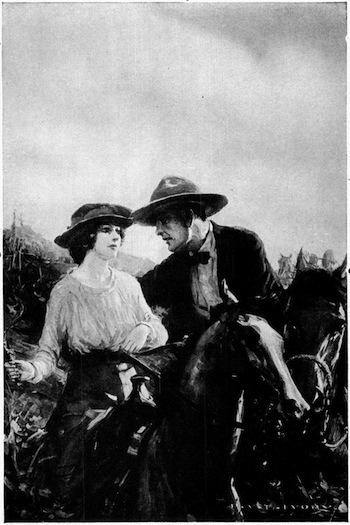
the sound came—and saw Carrington riding toward her,
not more than fifty feet distant.
He saw her at the instant her gaze rested on him—an
instant before, she surmised, for there was a huge grin
on his face as she turned to him.
He was at her side before she could obey a sudden impulse
to run—for she did not wish to talk to him tonight—and
in another instant he had dismounted and was
standing close to her.
“All alone, eh?” he laughed. “And enjoying the
moon? Do you know that you made a ravishing picture,
standing there with the light shining on you? I saw you
as you started to turn, and I shall remember the picture
all my life! You are more beautiful than ever, girl!”
Carrington was breathing fast. The girl thought he
had been riding hard. But, despite that explanation for
the repressed excitement under which he seemed to be
laboring, the girl thought she detected the presence of restrained
passion in his eyes, and she shrank back a little.
She had often seen passion in his eyes, identical with
what glowed in them now, but she had always felt a certain
immunity, a masterfulness over him that had permitted
her to feel that she could repulse him at will.
Now, however, she felt a sudden, cringing dread of him.
162
The dread, no doubt, was provoked by her uncle’s revelation
of the man’s character; and, for the first time during
her acquaintance with Carrington, she felt a fear of him,
and became aware of the overpowering force and virility
of the man.
Her voice was a little tremulous when she answered:
“I was looking for Uncle Elam. He must have
gone in.”
His face was not very distinct to her, for he was standing
in a shadow cast by a near-by tree, and she could not
see the bruises that marred the flesh, but it seemed to her
that his face had never seemed so repulsive. And the
significance of his grin made her gasp.
“That’s good. I’m glad he did go in; I did not come
to see Parsons.”
She had meant to take him to task for what he had
done to her uncle, but there was something in his voice
that made thoughts of defending Parsons seem futile—a
need gone in the necessity to conserve her voice and
strength for an imminent crisis.
For Carrington’s voice, thick and vibrant, smote her
with a presentiment of danger to herself. She looked
sharply at him, saw that his face was red and bloated
with passion and, taking a backward step, she said shortly:
“I must go in. I—I promised Martha——”
His voice interrupted her; she felt one of his hands on
her arm, the fingers gripping it tightly.
163
“No, you don’t,” he said, hoarsely; “I came here to
have a talk with you, and I mean to have it!”
“What do you mean?” she asked. She was rigid and
erect, but she could not keep the quaver out of her voice.
“Playing the innocent, eh?” he mocked, his voice dry
and light. “You’ve played innocent ever since I saw you
the first time. It doesn’t go anymore. You’re going to
face the music.” He thrust his face close to hers and
the expression of his eyes thrilled her with horror.
“What do you suppose I brought you here for?” he
demanded. “I’ll tell you. I bought the house for you.
Parsons knows why—Dawes knows why—everybody
knows. You ought to know—you shall know.” He
laughed, sneeringly. “Westwood could tell you, or the
woman who lived in the Huggins house before you came.
Martha could tell you—she lived here——”
He heard her draw her breath sharply and he mocked
her, gloating:
“Ah, Martha has told you! Well, you’ve got to face
the music, I tell you! I’ve got things going my way here—the
way I’ve wanted things to go since I’ve been old
enough to realize what life is. I’ve got the governor, the
mayor, the judges—everything—with me, and I’m
going to rule. I’m going to rule, my way! If you are
sensible, you’ll have things pretty easy; but if you’re
going to try to balk me you’re going to pay—plenty!”
She did not answer, standing rigid in his grasp, her
164
face chalk-white. He did not notice her pallor, nor how
she stood, paralyzed with dread; and he thought because
of her silence that she was going to passively submit.
He thought victory was near, and he was going to be
magnanimous in his moment of triumph.
His grip on her arm relaxed and he leaned forward
to whisper:
“That’s the girl. No fuss, no heroics. We’ll get
along; we’ll——”
Her right hand struck his face—a full sweep of the
arm behind it—burning, stinging, sending him staggering
back a little from its very unexpectedness. And
before he could make a move to recover his equilibrium
she had gone like a flash of light, as elusive as the moonbeam
in which she had stood when he had first come
upon her.
He cursed gutturally and leaped forward, running with
great leaps toward the rear of the house, where he had
seen her vanish. He reached the door through which she
had gone, finding it closed and locked against him. Stepping
back a little, he hurled himself against the door,
sending it crashing from its hinges, so that he tumbled
headlong into the room and sprawled upon the floor. He
was up in an instant, tossing the wreck of the door from
him, breathing heavily, cursing frightfully; for he had
completely lost his senses and was in the grip of an insane
rage over the knowledge that she had tricked him.
165
Parsons heard the crash as the door went from its
hinges. He got out of bed in a tremor of fear and opened
the door of his room, peering into the big room that adjoined
the dining-room. From the direction of the
kitchen he caught a thin shaft of light—from the kerosene-lamp
that Martha had placed on a table for Marion’s
convenience. A big form blotted out the light, casting a
huge, gigantic shadow; and Parsons saw the shadow on
the ceiling of the room into which he looked.
Huge as the shadow was, Parsons had no difficulty in
recognizing it as belonging to Carrington; and with chattering
teeth Parsons quickly closed his door, locked it,
and stood against it, his knees knocking together.
Martha, too, had heard the crash. She bounded out of
bed and ran to the door of her room, swinging it wide,
for instinct told her something had happened to Marion.
Her room was closer to the kitchen, and she saw Carrington
plainly, as he was rising from the débris. And she
was just in time to see Marion slipping through the doorway
of her own room. And by the time Carrington got
to his feet, Martha had heard Marion’s door click shut,
heard the lock snap home.
Martha instantly closed the door of her own room,
fastened it and ran to another door that connected her
room with Marion’s. She swung that door open and
looked into the girl’s room; heard the girl stifle a shriek—for
the girl thought Carrington was coming upon her
166
from that direction—and then Martha was at the girl’s
side, whispering to her—excitedly comforting her.
“The damn trash—houndin’ you this way! He ain’
goin’ to hurt you, honey—not one bit!”
Outside the door they could hear Carrington walking
about in the room. There came to the ears of the two
women the scratch of a match, and then a steady glimmer
of light streaked into the room from the bottom of the
door, and they knew Carrington had lighted a lamp. A
little later, while Martha stood, her arms around the girl,
who leaned against the negro woman, very white and
still, they heard Carrington talking with Parsons. They
heard Parsons protesting, Carrington cursing him.
“He ain’ goin’ to git you, honey,” whispered Martha.
“That man come heah the firs’ day, an’ I knowed he’s a
rapscallion.” She pointed upward, to where a trap-door,
partly open, appeared in the ceiling of the room.
“There’s the attic, honey. I’ll boost you, an’ you go
up there an’ hide from that wild man. You got to, for
that worfless Parsons am tellin’ him which room you’s in.
You hurry—you heah me!”
She helped the girl upward, and stood listening until
the trap-door grated shut. Then she turned and grinned
at the door that led into the big room adjoining the
kitchen. Carrington was at it, his shoulder against it;
Martha could hear him cursing.
“Open up, here!” came Carrington’s voice through
167
the door, muffled, but resonant. “Open the door, damn
you, or I’ll tear it down!”
“Tear away, white man!” giggled Martha softly.
“They’s a big ’sprise waitin’ you when you git in heah!”
For an instant following Carrington’s curses and demands
there was a silence. It was broken by a splintering
crash, and the negro woman saw the door split so that
the light from the other room streaked through it. But
the door held, momentarily. Then Carrington again
lunged against it and it burst open, pieces of the lock
flying across the room.
This time Carrington did not fall with the door, but
reeled through the opening, erect, big, a vibrant, mirthless
laugh on his lips.
The light from the other room streamed in past him,
shining full upon Martha, who stood, her hands on her
hips, looking at the man.
Carrington was disconcerted by the presence of Martha
when he had expected to see Marion. He stepped back,
cursing.
Martha giggled softly.
“What you doin’ in my room, man; just when I’se
goin’ to retiah? You git out o’ heah—quick! Yo’ heah
me? Yo’ ain’t got no business bustin’ my door down!”
“Bah!” Carrington’s voice was malignant with baffled
rage. With one step he was at Martha’s side, his
hands on her throat, his muscles rigid and straining.
168
“Where’s Marion Harlan?” he demanded. “Tell me,
you black devil, or I’ll choke hell out of you!”
Martha was not frightened; she giggled mockingly.
“That girl bust in heah a minute ago; then she bust
out ag’in, runnin’ fit to kill herself. I reckon by this time
she’s done throw herself off the butte—rather than have
you git her!”
Carrington shoved Martha from him, so that she staggered
and fell; and with a bound he was through the
door that led into Martha’s room.
The negro woman did not move. She sat on the floor,
a malicious grin on her face, listening to Carrington as he
raged through the house.
Once, about five minutes after he left, Carrington returned
and stuck his head into the room. Martha still
sat where Carrington had thrown her. She did not care
what Carrington did to the house, so long as he was
ignorant of the existence of the trap-door.
And Carrington did not notice the door. For an hour
Martha heard him raging around the house, opening and
slamming doors and overturning furniture. Once when
she did not hear him for several minutes, she got up and
went to one of the windows. She saw him, out at the
stable, looking in at the horses.
Then he returned to the house, and Martha resumed
her place on the floor. Later, she heard Carrington enter
the house again, and after that she heard Parsons’ voice,
169
raised in high-terrored protest. Then there was another
silence. Again Martha looked out of a window. This
time she saw Carrington on his horse, riding away.
But for half an hour Martha remained at the window.
She feared Carrington’s departure was a subterfuge, and
she was not mistaken. For a little later Carrington returned,
riding swiftly. He slid from his horse at a little
distance from the house and ran toward it. Martha was
in the kitchen when he came in. He did not speak to her
as he came into the room, but passed her and again made
a search of the house. Passing Martha again he gave
her a malevolent look, then halted at the outside door.
The man’s wild rage seemed to have left him; he was
calm—polite, even.
“Tell your mistress I am sorry for what has occurred.
I am afraid I was a bit excited. I shall not harm her; I
won’t bother her again.”
He stepped through the doorway and, going again to a
window and drawing back the curtain slightly, Martha
watched him.
Carrington went to the stable, entered, and emerged
again presently, leading two horses—Parsons’ horse and
Billy. He led the animals to where his own horse stood,
climbed into the saddle and rode away, the two horses
following. At the edge of the wood he turned and looked
back. Then the darkness swallowed him.
For another half-hour Martha watched the Dawes trail
170
from a window. Then she drew a deep breath and went
into Marion’s room, standing under the trap-door.
“I reckon you kin come down now, honey—he’s
gone.”
A little later, with Marion standing near her in the
room, the light from the kerosene-lamp streaming upon
them through the shattered door, Martha was speaking
rapidly:
“He acted mighty suspicious, honey; an’ he’s up to
some dog’s trick, shuah as you’m alive. You got to git
out of heah, honey—mighty quick! ‘Pears he thinks
you is hid somewhares around heah, an’ he’s figgerin’ on
makin’ you stay heah. An’ if you wants to git away,
you’s got to walk, for he’s took the hosses!” She shook
her head, her eyes wide with a reflection of the complete
stupefaction that had descended upon her. “Laws
A’mighty, what a ragin’ devil that man is, honey! I’se
seen men an’ men—an’ I knowed a nigger once that
was——”
But Martha paused, for Marion was paying no attention
to her. The girl was pulling some articles of wearing
apparel from some drawers, packing them hurriedly
into a small handbag, and Martha sprang quickly to help
her, divining what the girl intended to do.
“That’s right, honey; doan you stay heah in this house
another minit! You git out as quick as you kin. You
go right over to that Squint man’s house an’ tell him to
171
protect you. ’Cause you’s goin’ to need protection, honey—an’
don’t you forgit it!”
The girl’s white face was an eloquent sign of her conception
of the danger that confronted her. But she spoke
no word while packing her handbag. When she was
ready she turned to the door, to confront Martha, who
also carried a satchel. Together the two went out of the
house, crossed the level surrounding it, and began to
descend the long slope that led down into the mighty
basin in which, some hours before, the girl had seen the
pin-point of light glimmering across the sea of darkness
toward her. And toward that light, as toward a beacon
that promised a haven from a storm, she went, Martha
following.
From a window of the house a man watched them—Parsons—in
the grip of a paralyzing terror, his pallid
face pressed tightly against the glass of the window as he
watched until he could see them no longer.