THANKSGIVING DAY AT ERROLSTRATH—KATE'S RETURN—CUSTER'S
BATTLE WITH "BLACK KETTLE"—KATE TELLS HER
STORY—THE ORIGIN OF INDIAN CORN—A WOLF HUNT WITH
GENERAL CUSTER—A WOLF STORY BY THE COLONEL
Five months had made their sad passage at
Errolstrath ranche since Kate was carried off by
the Indians. It was now November, and Thanksgiving,
that day so sacred to every New Englander's
heart, was rapidly approaching; it lacked
but one week of its advent. Notwithstanding
the sadness which still hovered over Errolstrath,
the great healer, Time, had poured balm
into the wounded hearts. There still remained
the tender remembrance of the light which the
absent one always brought into the house, and
the parents still strove to fulfil their obligations
to those who were left to them, so Thanksgiving
was kept as it had been ever since the
settlement of the family on the ranche.
The mince pies had been baked, the cider
bottled, and all that was lacking to make up
the complement of the great dinner was a turkey.
As, however, the woods were full of them
around Errolstrath, no uneasiness was felt in
regard to the presence of the magnificent bird
when he was wanted.
Joe, upon whom the family depended to
keep the larder well supplied with game, intended
to go and kill a wild turkey the next
day. Thanksgiving came the second day following
on the twenty-fifth, so there was ample
time to procure the principal dish for the coming
event.
Joe had long since ceased to hunt for mere
amusement. He had become a veritable pot-hunter,
not in the general sense in which the
word is used, that is, a man who only kills his
game on the ground, but he hunted only when
the family needed a change of diet, and desired
some kind of game.
It was Rob's duty that month to bring the
cows home and milk them, a duty at which
the boys took turn and turn about each month.
That evening he was returning home with his
charge, and was riding, as usual, one of the
buffalo ponies. As he was going along the
bank of the Oxhide, in the long grass which
grew in some places higher than a man's head,
his animal suddenly stumbled with both feet,
into a prairie dog's hole, and Rob was incontinently
thrown over his head, falling into the
long grass without receiving any injury. As
he started to his feet again, he felt something
struggling in his hands, for he had involuntarily
clutched at the ground when the pony so unceremoniously
tumbled him off, and to his great
surprise, he discovered that he had accidentally
caught a large wild turkey! He held on to
the bird manfully, although it tried its hardest
to get away from him; and holding it by the
legs, he walked on to the corral and drove the
cows in. Then, still leading his pony, he arrived
at the house, and called his mother and Gertrude
out, exclaiming:—
"I've got the turkey for Thanksgiving, and I
didn't have to shoot it, either!"
Joe, hearing the noise, came down from his
room, and learning what had caused the racket,
said:—
"By jolly, Rob, you are a lucky dog; but if
any one read of the way you caught it, they
wouldn't believe it. I never heard of such a
thing before. I sha'n't have to hunt one to-morrow
now, and I'm glad of it, for I want to
go to the fort to try to find out how the Indian
war is coming on."
"Well, Joe," said his mother, "as you needn't
shoot one now, suppose you kill and pick it
while Rob is milking, then hang it up somewhere
so that the lynxes can't get it, and in the
morning Gertie and I will get it ready for the
oven."
Joe then took it from Rob, who was still holding
the struggling creature by the legs, and
taking it to the woodpile, he chopped off its
head, then he picked it, and hung it up in the
smoke-house as the safest place until his mother
was ready for it in the morning.
Thanksgiving day opened clear and cool, but
not at all cold, for November in Kansas is one
of the most delightful months in the whole year.
The Indian summer is then at its height, and the
amber mist hangs in light clouds on every hill,
giving to all objects a smoky hue. This mist
rests particularly on the bluffs bordering that
stream to which General John C. Fremont gave
the name of "The Smoky Hill Fork of the
Republican." He first saw it in the late autumn
of 1843, when on his exploring expedition to the
Rocky Mountains, and it is into that river that
the Oxhide empties itself only a short distance
from Errolstrath ranche.
It was intended to have dinner served promptly
at noon, and Mrs. Thompson had so announced
to her husband and children, who were all anxious
for twelve o'clock to strike.
About ten, while she and Gertrude were busy
in the kitchen, the boys out in the yard, and
Mr. Thompson in the timber, marking some trees
he planned to cut down, there rode up to the
front porch a strange-looking figure on a roan
pony which was evidently nearly blown in consequence
of the pace at which it had been driven.
The strange object was seemingly a girl, but
she was one mass of rags over which was thrown
a red blanket, Indian fashion. Her hair was
unkempt, and she sat crossways on her animal,
like a savage.
Mrs. Thompson, hearing the sound of a horse's
hoofs on the buffalo sod in front of the house,
went out with her dish-cloth in her hand to see
who the intruder might be. Looking at her, she
at first thought one of the Pawnee boys had come
for Joe, but when she heard in a sad and apparently
disappointed tone a voice which she could
never have forgotten: "My heavens! mamma,
don't you know me?" she recognized it as that
of her lost daughter Kate. The cloth dropped
from her hand, and she fell prone upon the porch,
overcome by the shock.
Just as Gertrude, who had heard her mother's
smothered groan, ran out with a tin dipper of
water to dash into her face, Kate dismounted,
and rushing to where her mother was lying, she
threw her arms around her neck and began to
sob violently.
It was then that Gertrude, for the first time,
saw her sister Kate, and she, too, immediately
fell upon her lovingly, and for some moments
there was weeping, laughing, kissing, and hugging.
The boys, in the back part of the house,
and their father in the stable, hearing the voices,
hurried to the veranda, and in another second
all were kissing and hugging the ragged girl,
each one trying to outvie the other in their joy
at the return of the pet of the household.
They fairly dragged Kate into the sitting-room,
where, for a few minutes, they looked at her in a
dazed sort of way. Her mother was the first to
come to her senses.
"The first thing to do," she said, "is to get
some decent clothes on the child; then as soon
as Mr. Tucker comes we will have dinner. Oh!
my, what a Thanksgiving it will be!"
Kate was soon made comfortable in clean linen,
and a dress of her sister's, for she had outgrown
all that were of her own wardrobe five months
before.
At this moment Mr. Tucker rode up to the
door, and allowing Rob to take his horse to the
stable, the old man walked into the house. He
was the only invited guest on the Thanksgivings
at Errolstrath. All his family were long since
dead, and he was alone in the world; besides,
being a New Englander, he had not forgotten
how to appreciate the most important festival
of Yankee Land.
He was wonderfully taken aback when he saw
that Kate had returned, and he congratulated her
with his eyes full of tears; for he was a man with
a warm heart, though his early life in the days of
the old trappers had given him a rough looking
exterior.
Kate looked like the dear Kate of old, as all
sat down to a real Thanksgiving dinner. She
was much browner than when she left Errolstrath,
because of her constant outdoor life in the
Indian village.
"Oh! Kate," said her mother, as the happy
girl took her accustomed place at the table,
between her father and Gertrude, "how earnestly
I have prayed that you might be restored
to us; I felt at times almost in despair, but
the thought of the good God's promises to the
patient, cheered me up, and I knew that in
His own time my prayer would be answered.
What a different Thanksgiving this is from
what we all have expected, when we thought
of Kate's vacant chair! Only think, we have
never yet been separated on this blessed day
during all the years we have lived at Errolstrath!
But we little thought that we should be
together to-day."
"We have much to be thankful for," said Mr.
Thompson; "excellent crops, good luck with our
stock, and to cap the climax, our beloved Kate is
restored to us."
The Thanksgiving dinners at Errolstrath were
composed of those conventional dishes which
make up the celebration of the festival in New
England, and the one at Errolstrath that day was
perfect in its resemblance to those of the old
homestead in Vermont.
While they were discussing the good things on
the table, Kate was told how Rob had got the
turkey for the dinner, and also how matters had
progressed at the ranche during her absence, for
she was very anxious to know. Her father said
that he had raised the largest crop of corn since
he had been on the creek; that the wolves had
carried off two calves from Errolstrath, but that
many of the neighbors had suffered a great
deal more from their depredations, and that a
grand wolf hunt was contemplated by the whole
neighborhood, for something had to be done to
thin out the ravenous creatures. Gertrude told
how many chickens she had, but Joe gave
them all the best news they had heard for a
long time.
"I was over at Fort Harker yesterday," he said,
"and I heard that General Custer had attacked
the camp of Black Kettle, the Cheyenne chief, on
the Washita in the Indian Territory, and completely
wiped them out. The war is ended, and
the savages are suing for a peace which General
Sheridan says they will be sure to keep this time.
The commanding officer told me that Custer
would soon arrive at the fort, and that the settlers
need have little more fear; that they may
go anywhere now without expecting to lose
their hair. He said that Sheridan had been promoted
to the rank of lieutenant-general for the
brilliant success of his winter campaign, and that
he would shortly be at Fort Harker on his way
to Washington."
"Well, that is glorious news," said Mr. Tucker.
"No more stealing pretty little girls from their
homes, eh?"
When Joe had finished his joyous piece of
intelligence, the family adjourned to the big sitting-room,
and Kate was asked to tell the wonderful
story of her capture and escape. She
seated herself in her favorite chair, an old Boston
rocker, brought from Vermont and nicely cushioned
at the back, and was making ready to
begin, when her mother said:—
"What in the world, Kate, possessed you to go
away from the house that day and to tell none of
us where you intended to go?"
"Why," answered Kate, "I remembered that
you were very fond of raspberries, and I thought
that, as they must be ripe, I would saddle Ginger
and go up to the patch to get some, for I
wanted to surprise you. I took my little Indian
basket—"
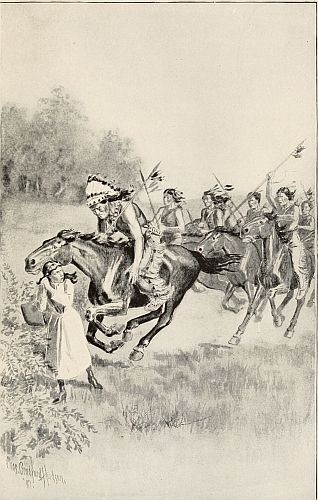 "I had nearly filled my basket."
"Buffalo Bill found your basket on the trail the
other side of Bluff Creek ford," interrupted Joe,
"and that is how we came to know that the
Indians had captured you."
"I remember now," said Kate, "that I held on
to it for a long time and then dropped it. I
don't know why I kept it in my hand. Well,
as I was saying, I rode out to the patch, tied
Ginger to a sumac bush, and began to pick the
berries, which were ripe as I had expected. I
had nearly filled my basket when with a dash
that nearly frightened me out of my senses, a
band of Indians came from the other side of the
big ledge, and before I knew where I was, I
found myself in front of a horrible-looking savage,
and the whole band started south as tight
as their ponies could go. I remember hearing
Ginger give a snort, as he jerked up by the
roots the bush I had tied him to, and fairly flew
towards the ranche—"
"There, mother," said Joe, "that's just what I
told you when Ginger came home with the sumac
fastened to his bridle!"
"Oh, if I could only have jumped on Ginger's
back," continued Kate, "before the Indians had
got me, they never would have had the ghost of
a chance of catching me. But they came upon
me before I had the least idea they were anywhere
near.
"We rode all that afternoon, halting for a
few moments, long after dark, for the Indians
to change ponies, as they had some loose ones
with them. We kept on at a good gait all that
night, until about daylight, when we stayed for
more than an hour on the other side of the
Arkansas River, to graze the ponies among the
sand hills, and for the Indians to eat their breakfast.
They were quite kind to me; gave me
some dried buffalo meat, and brought me some
water from the stream in a horn, and tried to
make me understand that they did not intend
to harm me.
"Of course, I was frightened at the idea of being
carried off by the horrid savages, but I tried
to keep my senses, and watched every tree and
rock on the trail. I looked at the sun to learn
which way we were going, and determined in
my mind that I would escape at the first
opportunity.
"On the tops of the highest points of the hills,
I saw the stone monuments, which Joe had often
told me were placed by the savages on their
travels from place to place, as marks to show
where water and wood are to be found."
"Yes," said Mr. Tucker; "you can see those
piles of stones on every hill about here; and from
them you can always see water or timber, indicating
where to camp."
"They were to be seen on every divide we
crossed," continued Kate; "and besides, I saw lots
of the compass-plant, or rosin-weed, the leaves of
which, Joe had told me, always pointed north, so
I felt satisfied if I could ever escape, I would
have no trouble in finding my way back to the
Oxhide.[2] After a long, wearisome ride, until the
next morning, we arrived at the Canadian River,
which the Indians called the 'Mai-om,' or Red,
and on the bank of which was the village consisting
of about a hundred lodges.
"There I was turned over to the women, who
treated me very decently, and I immediately began
to study the language, for I knew that that
would help me in getting into their good graces.
I willingly took hold of the work which falls to
the lot of the squaws in every camp, and taught
them how to cook after the white style. You
may imagine I had plenty to do, for the warriors
liked the biscuit I used to make, and they sometimes
had a good deal of flour for which they had
traded with the white men who bought their furs.
"I made friends of the dogs in the village,
and there were hundreds of them, some of them
miserable curs, but they could make more noise
than a pack of wolves; and I thought if I could
teach them to know me, they would not bother
me when I attempted to run away; for you know
that they are the most watchful animals imaginable.
At night, not the slightest sound escapes
their well-trained ears, and at the approach of a
human being, they set up the most terrific barking
and howling you ever heard. Well, I soon
made friends with every one of them, and I could
go around the village after dark, and they would
not utter a growl.
"I watched very closely the large herd of
ponies,—there were more than two hundred
belonging to the village,—to find out which
one of them was the fleetest, and had the most
endurance. I picked out the little roan I rode
here, and, Joe, I will make him a present to you;
for if you had not taught me so much about
plants, and the methods of the Indians, and before
all things else, taken such pains with me
when I wanted to ride a pony, I never should
have been able to run away and come home
safely."
"Thank you, Kate," said Joe. "We have kept
Ginger just as finely as ever for you, and he is
the best pony in the whole country, I don't care
how many the Indians may have."
Kate went on with her wonderful experience.
"Near the tepee where I slept I found an old
elm tree that had a great hollow in it near the
roots, and I determined to make it my storehouse
for the food I should need when I ran
away. I did not, of course, begin to hide anything
in it until I had been in the village for over
four months. Then I used to save little by little
of my portion of the dried buffalo meat, as I
knew that it would keep for a long time without
spoiling.
"We ate all sorts of things that at first rather
disgusted me; puppy-stew, for instance. Now,
mother and Gertrude, don't laugh; I really soon
learned to like it, though I never expect to be
compelled to eat it again. It is the cleanest
thing the Indians have, if you will only get over
the natural prejudice against eating dog. Why,
just think, the puppies are only sucklings when
they are eaten; they have tasted nothing but their
mother's milk, and the mothers are fed on buffalo
meat only.
"I suppose that you, mother and Gert, want
to know how puppy-stew is prepared? Well,
when the little things are rolling fat, as round as
a ball of butter, the old woman who has charge
of the lodge takes them up and feels them all
over, and if satisfactory, she chokes them to death
by literally hanging them to a tree with a buffalo
sinew. When dead, they are singed before the
fire, just as you singe a fowl; the entrails are
taken out, and then the flesh is boiled in a pot,
and eaten as hot as possible. The savages, particularly
the old squaws, can take up in their buffalo-horn
spoons, meat which would scald a white
person to death, and swallow it without the
slightest difficulty. I suppose that that, and
their constant brooding over a smoky fire in the
tepees, makes them look so old and wrinkled
at an early age. They are the most horrid-looking
witches you ever saw, and they would need
no 'fixing up' to play the part in Macbeth."
"Talking of curious dishes eaten by the Indians,"
said Mr. Tucker, "up in Oregon, where
I was trapping a good many years ago, the
squaws make what I call Indian jelly-cake. They
take the black crickets, roasted, which form a
large portion of their subsistence, and make a
kind of bread of them, after having ground them
on a flat stone. They then spread on it the
boiled berries of the service tree or bush, and if
it was not manipulated by their very dirty hands,
it would be very palatable."
"The Indians of the great plains," continued
Kate, "live almost exclusively on meat; they
gather a few berries sometimes, but their principal
diet is buffalo meat.
"After I had been in the village for over four
months, I began to think of trying to escape.
My clothes were becoming more ragged every
day, and I was obliged to resort to the blanket
as a covering, though I kept what I had worn
there as long as I could.
"One day there was a great feast in the village,
with dancing and carousing, which the warriors
kept up until long after midnight, and consequently
slept very soundly. Now, thought I, is
my time. So after I found out that the old
squaw with whom I lodged was sound asleep, I
crept up, and looked out to see what kind of a
night it was. The moon was low down in the
western heavens, but bright enough for me to see
the trail, so I determined to make the attempt.
I took a piece of buffalo robe for a saddle, and
went out to the herd to catch the pony on which
I had had my eyes for such a long time, and had
petted whenever I was not watched. The dogs,
of course, had come out of their holes to see what
was going on, having heard my almost noiseless
footsteps; but recognizing me instantly, they
did not set up their customary howl. They went
back to sleep without making any trouble, and I
walked out to the herd about a quarter of a mile
away, and soon found the little roan I wanted.
He came up to me without a neigh, luckily, and
I fastened the piece of robe on him, tucked the
dried buffalo meat, which I had taken from my
hiding-place, into my bosom, and jumping on,
started at a pace which, if I had not been a good
rider, would have tossed me off before I had gone
half a dozen yards.
"The pony seemed to know just what I required
of him, for he ran on a good lope, with his
belly almost touching the ground, and in a little
while I had crossed the ford of the Canadian,
and was going up the divide on the other side
as fast as I dared to force him. I took a glance
at the north star to get my bearings, for I dared
not follow the broad trail, as the Indians would
be sure to track me, and struck across the country,
up one hill and down the other until day
began to break. Then I stayed a few seconds
at a small branch to let my pony drink and to
take a swallow myself, and on I went, not daring
to let him graze yet.
"Mile after mile the noble little fellow carried
me until late that afternoon. Of course
I watered him at every creek I came to, but did
not halt until it had grown quite dark. Then
I took him about a mile down into a piece of
timber, unsaddled him and let him graze for
more than an hour. I kept my ears open, fearing
every moment to hear the sound of ponies'
hoofs, for I felt confident that the Indians would
follow me the moment they discovered that I was
gone.
"When I thought he had sufficiently rested,
and I had eaten a small piece of the meat, I
mounted him again and started on a lope northward.
I kept the little gallop, changing into
a brisk walk once in a while, until I could see by
the daylight the long silvery line of the Arkansas,
looking like a white snake in its many windings.
Then I felt pretty safe, after I had stopped and
watched the trail back as far as I could, which
was for more than two miles. I could see nothing
like dust, nor hear a sound, so I began to
hope that I had really escaped, and my heart
began to feel lighter than it had for many a long
month.
"I crossed the Arkansas, which the Indians
call 'Mit-sun,' meaning Big, and it was up to
my pony's breast, but he struggled through
splendidly, though I got my moccasins wet, for
the water came to my knees. I did not mind
that, as I had often got wet through in the Canadian
where we used to go swimming almost every
morning while at the village. The squaws are
very fond of the water in that way, but are not
so clean with their hands as I would many a
time have liked them to be.
"On the other side of the divide separating
the Arkansas from the Smoky Hill, I halted in
a box-elder grove to rest my roan, and rest myself,
for I was nearly worn out. I felt very safe
then, for I knew that I was approaching the
settlements on Plum Creek, and if I had known,
what Joe has just told us, that the war was over,
I might have been at my ease all the way from
the Arkansas.
"Early this morning I came to Bluff Creek,
at the very spot where I had crossed with the
Indians, and how my heart fluttered when I knew
I was so near dear Errolstrath! From that
creek I rode slowly, as I knew I had nothing to
fear from the Indians, for the settlements were
too thick, and besides it was daytime, when the
Indians rarely attack.
"I often got off my pony when it grew too
dark to see, to feel the leaves of the compass-plant,
that I could always find without much
hunting on every hill. Now, mamma and father,
don't you think that I have made a famous
ride?"
"We all think so," said her father; "it is one
of the most remarkable on record, and we rejoice
more than even you can imagine, to have our
dear daughter back again, well as ever, after such
an experience."
"Why don't the Indians raise corn?" inquired
Rob, in a general way; "it is so easily grown out
here on the plains."
"Some of the tribes do," replied Mr. Tucker.
"The Sioux and the Mandans have always had
their corn-fields, but as usual the women have to
do all the work. Do you know, Rob, that the
corn is a native plant of North and South
America, yet it has never been found wild?"
"Do tell us about it," said Mrs. Thompson;
and Kate asked if there were not some legend
connected with it, "for there is not a thing that
they eat, without its wonderful story."
"Certainly," replied Mr. Tucker. "There is a
beautiful legend among the Sioux, which I
learned from them when I was among them in
1840, and as it is not late yet, if you like, I will
tell it to you."
"Do! do!" all exclaimed in chorus.
"Of course," began Mr. Tucker, "among the
Indians the origin of corn is wrapped up in the
supernatural legends of the race, of which there
are several, differing materially, however, in their
details. Strange as it may seem, nowhere in all
the vast domain of both Americas, has a wild
species of corn been discovered; and yet the
inhabitants of these continents have used it from
the earliest times, of which even history has no
record. Yet, at some time in the unchronicled
past it must have grown wild. An unknown
benefactor of his race—one whose name not
even tradition preserves, excepting in unintelligible
myths—saw somewhere, the feathery tassels
and glossy blades with their silken ears amidst
the foliage of a sedgy river bank, and owing to
his first care, the wild plant, after many ages,
has become the maize of commerce, and the king
of all the cereals of the nineteenth century.
"When Columbus found the New World, corn
was the staple food of all tribes of Indians from
the far north to the extreme south, who attempted
to cultivate the soil at all.
"The celebrated Père Marquette, the Catholic
priest who passed his life among the savages,
met with it at every point, on his memorable
journey down the Mississippi River, in 1763. It
has been exhumed from tombs of a greater antiquity
than those of the Incas of Peru. Darwin
discovered heads of it embedded in an ancient
beach that had been upheaved eighty-five feet
above the sea-level.
"That Indian corn is indigenous to America,
has never been questioned by botanists, for
Europe knew nothing of it until Columbus
returned home from our shores.
"Longfellow has poetically told of one of the
Indian traditions of the origin of corn, in his
Hiawatha's Fasting.
"The legend was first transmitted to the white
men by Rattlesnake, and strange to say, he was a
chief of the Kansas or Kaw tribe of Indians.
He related it on an island at the mouth of the
Kansas River, in 1673, as is recorded in the old
French manuscript of an early traveller.
"It states that a band of a hundred Kansas
Indians in returning from a successful raid on the
Shawnees, of whom they had taken several prisoners,
halted on the island, taking advantage of the
thick timber which grew in groups, as a convenient
spot to torture their captives.
"Père Marquette, whom the Indians called
'The White Prophet,' happened to be there most
opportunely; for through the respect and veneration
in which the monk was held, he saved the
lives of the hapless Shawnees, who were set at
liberty. That evening while eating their supper
of cooked hominy, the good priest asked for the
legend which told of the origin of Indian corn,
and Rattlesnake gave it, as he said he had often
heard it at his mother's knee.
"It is the same story the Sioux told me, but I
will follow the language of the old manuscript,
for I have often read it.
"Once when the world was young, and there
were but few red men in it, there was a chief
whose wife bore him many children. Every
summer added one and sometimes two to his
family. They became so numerous that the
father could not give them sufficient food, and
the hungry children were continually crying. By
great patience and skill in hunting, however, the
chief at length raised a large family, until his
eldest son reached the stature of manhood.
"In those days the red men all lived in peace
and friendship. There was no war, and no scalp-locks
hung from the doors of the lodges. The
eldest son had the fear of the Great Spirit in his
heart, and, like his father, he toiled patiently in
the chase that he might assist in procuring food
for his brothers and sisters.
"In those days all of the promising young men,
at their entrance into manhood, had to separate
themselves from the tribe, and retire into the
forest, to see if the Great Spirit would grant
them some request. During this time there was
to be neither eating nor drinking, but they were
to spend the hours in thinking intently on the
request they were making of the Manitou.
"When the young man had gone a long distance
in the forest, he began to pray to the
Great Spirit, and to ask for a favor which he had
long cherished in his heart for the occasion. He
had often felt how frequently the chase had disappointed
the red men, and how often their
families had gone to sleep hungry, because they
had no meat. He had always determined when
his fasting and dreaming hour should come, that
he would ask the Great Spirit to give the red
men some article of food more certain than the
meat obtained in the chase.
"All that day the youth prayed, and thought
of his request, and neither water nor food entered
his mouth.
"At night, with a bright hope in his young
heart, he lay down to sleep. Soon he had a
vision. He saw a magnificently attired youth
coming toward him. He was clad in robes of
green, and green plumes hung gracefully about
his comely countenance.
"'My dear young friend,' said the stranger,
'the Great Spirit has heard your prayer, but the
boon you ask is a great boon; and you must pass
through a heavy trial of suffering and patience
before you will see the realization of your wish.
"'You must first try your strength with me,
and suffer nothing to enter your lips until I am
overcome, before you will receive your reward.
Come, the night wears apace, let us wrestle amid
the trees.'
"The chief's son had a big heart, and knew no
fear, so he closed with his graceful antagonist.
He found him endowed with muscles like the
oak, and he had the wind of a wolf, that never
was exhausted by effort. Long and long they
wrestled, but so equal was their strength that
neither could claim any decided advantage.
'Enough, my friend, for this time. You have
struggled manfully. Still resist your appetite,
give yourself up wholly to prayer and fasting,
and you will receive the gratification of your
desires. Farewell until to-morrow night, when I
will return to wrestle with you again.' Then
the young visitor, with his green plumes waving
over his head, took his flight toward the skies,
the green and yellow vestments with which he
was clad expanding like wings.
"When the Indian awoke, he found himself
panting like a stag when chased by the wolves,
and the perspiration dropped from his body;
yet his heart was light, for he knew a sign had
come from the Manitou. Although he was
very hungry that day, and some berries and
grapes tempted him sorely, he refrained from
touching them, resisting successfully these natural
desires.
"Night came, and the young Indian closed
his eyes in sleep; and lo! there was a continuance
of his former vision. He saw coming
toward him the graceful being he had seen on
the previous night. The silken wings of green
and gold swept through the air with great
velocity, and the green plumes on his head
waved rhythmically in their beauty.
"They again wrestled, as before, and although
the Indian had neither eaten nor drunk, he felt
his strength greater than in the previous conflict;
and he obtained some signal advantage
over his celestial competitor. They were struggling
together when the morning commenced
to look upon the world, and he of the green
plumes thus addressed the Indian youth:—
"'My friend, on our next trial you will be
the victor. Now, listen how I instruct you to
take advantage of your conquest. When my
efforts cease I shall die. Strip me of my yellow
garments and bury me in soft and new-made
earth. Visit my grave week by week,
for in a little time I shall return to life in the
form of a plant, which you will readily recognize
by its resemblance to me. Let no weeds
or grass be near me to keep the dew and sunshine
from my green leaves, and once a month
draw the fresh earth to my body, that it may
grow and strengthen. When ears have shot
from my side, and the silk which shall fall from
their tops commences to dry, then pull the ear,
strip it of its garments as you will strip me
when I am dead. Place the milky grains before
the fire which will cook the outside, without
destroying any of the juicy substance. Then
all the race of man will have a sweeter and
stronger food than they have ever known before.
There shall be no more hunger upon the
earth excepting among those who have a lazy
spirit, or whom the Bad Manitou claims as his
own.'
"When the Indian awoke, he felt very weak
from hunger, and it required all the resolution
of which he was master to restrain the gratification
of his appetite, but he passed the day in
fasting and prayer, and at nightfall laid himself
down to sleep.
"True to his promise, his friend of the green
plumes again appeared in his trance, and again
the wrestle commenced. The young Indian was
exceedingly weak from his long fasting, but when
engaged in the conflict he felt his heart grow big
within him; his arms became as strong as the
young oaks of the forest, and after a short struggle
he threw his antagonist to the ground. The
young Indian stood by the side of his adversary
who said that he was dying, and told him to
remember the instructions he had given him.
The young Indian accordingly stripped the body
of its vesture of mingled green and yellow, and
carefully digging a grave, deposited it in the soft
earth. He thought that the earth adhered to his
hand in a strange manner, and at that moment
he awoke, and found in his hand a seed such as
he had never before seen.
"The Indian then knew that the Manitou had
heard his prayer, and that the grain was the body
of his friend. He then went from the forest to
the prairie, made soft the earth, and planted the
strange seed sent to him in his dream.
"He then returned to his father's lodge, and
the whole family were anxious to know if he had
received any sign from the Great Spirit, but he
evaded all inquiries and kept his important secret.
Every morning, before the sun's bright rays had
looked upon the earth, he was beside the grave
of the seed, and carefully kept the grass and
weeds away.
"On the morning of the ninth day, the faithful
youth saw a green plant shooting from the
earth, and as he gazed on its green blades, he
knew at once the friend with whom he had
wrestled.
"Once each month he drew the fresh earth to
the stalks, which grew day by day until they far
overtopped his own stature, and then there began
to protrude from their sides the shoots from
which a mass of silken fibres issued. In a short
time the plant began to dry, as had been foretold
to him, and then he invited his father, mother,
brothers, and sisters to the spot and showed them
what the Great Spirit had sent him at his fasting
season. He then pulled one of the two ears
and roasted it before the fire.
"The whole family tasted the new food, and
they liked it. The other ear was kept for seed,
and in a few years the red man had plenty of the
new food which the Manitou had sent him."
"That is a beautiful story," said Mrs. Thompson,
and the others all agreed with her. "Kate,
you must be very tired; don't you want to go to
bed and sleep like a Christian once more?"
"No," replied the young girl, "my muscles are
'like the oak trees in the forest,' as were those
of the Indian who got the corn from the spirit
with the green wings. Besides, it's only seven
o'clock, and I want to look at you all for some
time yet."
Before eight o'clock, Buffalo Bill and Colonel
Keogh came over from the fort, as they had
heard from some one from Oxhide that Kate
had come home, and they wanted to see her.
They were both surprised at her excellent condition,
and Bill ventured the remark that the
Indians had certainly used her much better than
they would have used him had he been in her place.
"I've no doubt of that," said Mr. Tucker; "they
would have had a roasting frolic if they had
caught you instead of our little friend Kate!"
"Well," said Colonel Keogh, "the war is ended,
and I guess we have had the last trouble in Kansas
that we shall ever have. The Indians are
going peacefully to their reservations, where the
Government will feed them, which is cheaper
than fighting them, at anyrate! General Custer
is at the fort, and he has heard so much of Joe
that he wants to see him, and take him on a wolf
hunt in a day or two."
"I'll go, Colonel, for sure, for they are carrying
off calves and hogs every night from some
of the ranches on this creek," said Joe.
"Talking about wolves," said Colonel Keogh,
"I never saw so many together in all my life as
I did after the battle of the Washita. We found
the bunch of ponies belonging to the Indians,
numbering about twelve hundred, and General
Custer ordered them all to be killed, as a necessity,
to prevent other savages from getting them.
A Plains Indian without a horse to ride is as
helpless as a child. He won't walk, and it was
thought that by killing all the ponies we found, it
would cripple the savages as effectually as if we
killed the same number of warriors. The bunch
was driven into a narrow cañon near their camp,
and as they huddled against the high rocky wall,
a detachment of the cavalry was detailed to shoot
them. We camped near there for a few days,
and at night the wolves would congregate there
to feed upon the dead bodies of the ponies. I
suppose they came from a distance of a hundred
miles, for you know a wolf thinks nothing of
going that far for a good meal. It happened to
be the time of the full moon, and just after nightfall
a lot of us used to go and ride on top of the
bluff to watch the wolves come to the feast. I
think it is no exaggeration to say that five thousand
of the hungry creatures gathered there
every evening, as long as any flesh remained on
the bones of the slaughtered ponies. Such snapping,
snarling, growling, and fighting was never
heard before. You could hear them for two miles
easily. Some of them were so pugnacious and
ravenous that they actually killed and devoured
each other! I do not believe such a scene was
ever witnessed before or will be again."
"You have all heard that Sheridan has been
promoted to be lieutenant-general, and Sherman
to be general, as Grant has been elected to
the Presidency?" said Buffalo Bill. "Sheridan
received notice on Kansas soil of his well-deserved
promotion, and it makes the place classic ground.
I will tell you how it was. Of course, official
notice of the promotion was daily expected, as
it had been seen in the papers from Washington,
but the mails were very irregular in the
vast uninhabited region south of the Arkansas.
It was carried by the scouts from Fort Hays,
the nearest railroad point, and they also took
despatches to the scattered military posts that
had been established temporarily, in the form of
camps, cantonments, or wherever a detachment
of troops happened to be. Early one morning
General Sheridan, accompanied by two officers of
his personal staff, left Camp Supply in the Indian
Territory for Fort Hays, to take the railroad
for Washington, where he had been ordered to
report. When the party had arrived at the foot
of a high mountain, just on the border of this
state, they saw far ahead of them on the trail
made by the troops in going into the field, a dark
object moving rapidly toward them. As the distance
between them lessened, they noticed that
it was a horseman whose animal, flecked with
foam, and with distended nostrils, was straining
every muscle to reach the ambulance. In a few
moments the sound of the horse's hoofs were distinctly
heard on the hard trail, and when he had
approached near enough, its rider, the excited
scout, recognized Sheridan among the occupants
of the ambulance. He rose in his stirrups and
waved his hat in one hand, while in the other
he held up a piece of yellow paper, crying out
at the top of his voice:—
"'Hurrah for the lieutenant-general!' The
paper he handed to Sheridan was a telegram from
the President, informing him of his promotion."
"Well," said Colonel Keogh, looking at the
old-fashioned clock in the corner of the room,
"I had no idea it was so late. It's nearly ten.
Come, Cody; we must get back to the fort."
Then saying good-night to all, with an admonition
to Joe not to forget the wolf hunt, of which
he said he would send him word, they mounted
their horses and rode off.
Mr. Tucker was to remain until morning, so
they all retired, after having passed one of the
most cheerful Thanksgivings in their lives.


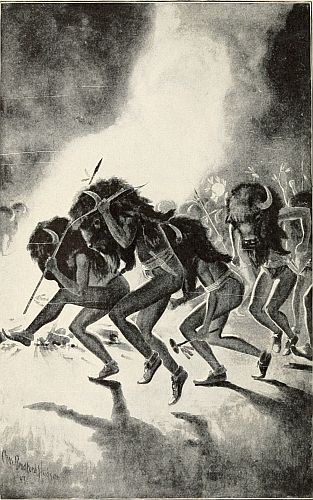 "The most indescribable antics were gone through."