AN APPARITION
THE next morning Frieda received a
message from her brother-in-law
asking her to give him half an hour
of her time, whenever it was convenient to
her.
In a way she had anticipated this request,
although it had come sooner than she expected.
Frieda knew that Frank was fond of her and
regarded himself as her brother. She had
no other. Also, she held a wise idea inside her
blonde head, believing that men were apt to
stand together in many difficulties of the
kind in which she and her husband were now
involved.
However, Frieda did not, of course, anticipate
the news of her husband's having immediately
followed her to Europe. She had not written
to him or to any friend in Chicago since her
sudden departure. But she had made up her
mind that the last interview between herself
and Henry was their final one. There could
be no reason for their ever meeting again.
She supposed, of course, that there were
certain matters that would have to be arranged
in the future, but Frieda was not given to
troubling herself over details. Someone
else had always attended to such things for
her, in order that she might have her way.
Later, Jim Colter, or Frank, or a lawyer—Frieda
was entirely vague as to the method
to be employed—would have to see that she
was released from the cause of her unhappiness.
For since arriving at Jack's house not thirty-six
hours before, Frieda had been happier than
she had for several months. Therefore,
during the night she had decided for the
hundredth time, that her husband must be the
sole cause of all the upsetting emotions which
had been recently troubling her. So soon as
she could learn to forget Henry and put the
recollection of him entirely out of her mind,
she would again become the perfectly care
free and irresponsible Frieda of the old days at
the Rainbow Ranch.
As she was not fond of getting up in the
mornings and usually did pretty much what
she liked in her sister's house, Frieda had
not gone down to breakfast. However, she
sent word to her brother-in-law that she
would be glad to see him in her own sitting
room between eleven and twelve o'clock.
Whether it was done intentionally or not,
Frieda put on a frock in which she looked
particularly young. It was a simple white
muslin, with sprays of blue flowers and folded
kerchief fashion across Frieda's white throat.
Nothing could really make Frieda appear
demure; her lips were too full and crimson;
her nose was too retrousée and her hair held
too much pure sunlight. But she could look
very innocent and much abused, and this was
the impression she subconsciously wished to
make. One must not believe that Frieda
actually thought out matters of this kind, but
she was one of the women who acted on what
is supposed to be feminine instinct.
Frank thought Frieda looked about sixteen
instead of twenty-two when he arrived to talk
matters over with her. So at once it struck
him as absurd that he was forced to discuss
so serious a question as leaving her husband
with a mere child like Frieda. Instead of
argument Frank began with persuasion.
First he invited Frieda to tell her side of the
story, which he had heard in part from Jack.
Although he had said at the time of his wife's
confidence, that Frieda had not made much
of a case for herself, on hearing her story from
Frieda's own lips he offered no such criticism.
When Frieda ended she was crying, so that
Frank sympathetically took her hand to console
her as any other man would. Then, while
holding her hand, he attempted a mild argument
in favor of the Professor, finally concluding:
"Frieda, your husband is coming to Kent
House some time this afternoon. Since it is
really your duty to see him and talk over the
misunderstanding between you, I feel sure
you will."
Nevertheless, Frieda gently but obstinately
shook her head.
"I'm sorry to disappoint you, Frank, and
Jack too, if she really feels as you do, but I
never mean to see Henry again."
However, until lunch time Frank remained
in the blue sitting room discussing the foolishness
of her position with Frieda; afterwards
he felt that he had never presented any
subject so skillfully in his career as a member
of Parliament, as he argued her own case with
his sister-in-law. Frieda never questioned
him, never contradicted him, only she continued
to shake her head and to repeat
gently, "I'm sorry, Frank, but I can't."
Several times Lord Kent attempted severity
because his severity usually influenced most
people. It influenced Frieda, but only to
such an outburst of tears, that he was forced
to spend the next five minutes in apologizing
in order to comfort her.
At one o'clock Jack, appearing at the door,
immediately recognized the situation. Both
Frank and Frieda appeared exhausted.
Frieda announced that she would not come to
lunch, but would prefer to lie down all the
afternoon. As a matter of fact the possibility
that her husband might make his appearance
at Kent House was the real reason which
kept Frieda in her own room, although offering
the excuse of a headache.
Therefore, about four o'clock, when Professor
Henry Tilford Russell finally did
arrive, he was able to see only Lord and Lady
Kent, his brother-in-law and sister-in-law.
Personally, Jack was uncertain how she
should greet him. Of what actual unkindness
he was guilty of to Frieda she was not yet
certain. Nevertheless, the fact remaining
that he had not made her little sister happy
filled Lady Kent with resentment and dislike.
Certainly, Professor Russell should have
realized how much older he was than
Frieda and not expected her to conform to his
dullness and routine.
As a matter of fact Jack also would have
preferred not to have to come in contact with
her sister's husband until she understood
the situation between them more thoroughly.
Yet, when Professor Russell was announced,
it was she who was forced to go first into the
drawing room.
There must have been a delay of about five
minutes since she had waited that length of
time for her husband, who chanced to have
gone out to the stables to give an order.
Then, fearing to appear intentionally rude,
Jack approached their visitor alone.
He could not have heard her as she entered,
for he was sitting in a large chair with his
head resting in his hand and looked so
exhausted, possibly from his trip, that Lady
Kent forgot for the moment to be angry.
When he aroused himself and later held out
his hand, she took it at once, although a
moment before she had not been sure whether
she ought, because of her own loyalty to
Frieda.
"Is Frieda well? If you only realized the
relief to find she is safe here with you! At
first I did not know where the child had gone,"
Professor Russell began so simply, that any
human being would have been disarmed.
It will be remembered, that in the last
volume of the "Ranch Girls At Home Again,"
Professor Russell is introduced to the Ranch
girls by Ralph Merritt, who told them of the
Professor's intense dislike for girls. At first
he appeared to regard Frieda only as a child
and therefore made an exception of her.
Then, later, after his accident at Rainbow
Mine when his leg was broken and Frieda
undertook to keep him amused, an amazing
friendship developed between them which
finally resulted in their marriage.
In replying to his question Jack found
herself answering as reassuringly as if Frieda
really had been a runaway child, since this
seemed to be the spirit in which her husband
thought of her.
"She will see me?" he asked eagerly. But
when Jack shook her head he did not appear
surprised, being evidently accustomed to
Frieda's vagaries.
Moreover, Lord Kent then came into the
room.
Afterwards, Professor Russell related his
side of the difficulty between himself and his
wife. His story did not after all differ so
much from Frieda's account, for he put the
blame upon himself, as she had done.
"I was too old for her; we ought never to
have married. The fault was all mine," he
ended so despondently, that Jack felt as if she
could not accept the very conclusion she had
reached the day before.
Professor Russell could not be persuaded
to remain long—not even for tea. It was
agreed, however, that he would spend the
next few weeks in London and that later they
might reach some decision. In the meantime
Jack promised to do her best to persuade her
sister to have at least one interview with her
husband.
Lord Kent followed his brother-in-law to
the door.
"Frieda is a spoiled baby; you have simply
been too good to her. Some day she will
wake up and find this out for herself," he
declared.
But Professor Russell only shook his head
sadly and departed.
Even after learning of her husband's
departure Frieda still refused to join her
family. What she was thinking about alone
in her own apartment no one knew, since she
asked that no one disturb her.
However, at half past five, realizing that
her husband then must be safely on his way
back to London, Frieda decided that she
could endure her own rooms no longer.
Without a word to anyone, she put on a long,
light weight blue coat and a small, close
fitting, blue turban and passing down
through the long halls and through a side
entrance vanished into the outdoors.
It was Frieda's plan merely to walk about
in the gardens until she could persuade herself
into a calmer frame of mind. She was sure,
of course, that she cared nothing for her
husband and yet all afternoon she had found
herself wondering if he were not worn out by
his journey. Ordinarily he was not a good
traveler and he must also have suffered
through being compelled to desert his summer
classes at the University in order to seek her.
Frieda discovered one of the gardeners at
work in the flower beds and, as he persisted
in talking with her, she started down one of
the shaded avenues along the edge of the park
in order to be alone. She did not often walk
for any distance, since she had never been
so fond of exercise as the other girls.
But Frieda felt unexplainably restless and
out of sorts. This was foolish because, having
made up her mind that she wanted her freedom
and being determined to gain it, there
was no point in worrying.
Frieda kept walking hurriedly on. It was
a beautiful, soft afternoon, with the first hint
of twilight in the sky and in the atmosphere.
Kent Park covered several acres and Frieda
wandered further from the house than she
knew. After a time the road which she had
taken curved into a path leading into the
woods. There was a fairly heavy forest
near by, which was a part of the Kent estate
and she strolled into this.
Later, Frieda sat down for a few minutes.
She was in no hurry to return home, except
in time for dinner which was at a late hour,
according to the English custom. Not that
she meant to appear at dinner, but that Jack
or Olive would be sure to seek her at that
time.
Frieda made rather a charming picture
amid the scene she had unconsciously chosen
for herself. She was sitting on the trunk of a
tree which had fallen from the weight of
years and infirmities. There was a little
clearing behind her and, as she had taken off
her hat, the sun shone on her bowed head
and shoulders. She wished very much that
she could stop thinking about a number of
things, for Frieda was one of the people who
resent having to grow up and there are more
of them in this world than we realize.
Then, suddenly, Frieda heard an odd noise,
which at least startled her sufficiently to
bring the result she had been wishing for,
since it made her stop thinking of unpleasant
things. The noise was not loud
and it would have been difficult to have
explained exactly what the sound was. Only
Frieda for the first time realized that she had
been unwise in having come so far away from
the house without mentioning to anyone
where she was going.
The woods in which she was resting was a
portion of the game preserves belonging to the
Kent Estate, or a portion of land set apart
for hunting at certain times of the year on
English estates. But no one is supposed to
hunt on this land except the owner of the
estate and the friends whom he may care to
invite.
Frieda, of course, had stayed long enough
in England on other visits to understand that
poachers are more or less frequent. She
thought perhaps the noise she had heard
was a man in hiding, who had been hunting
and feared she might report him. The fact
that it was summer time, when hunting was
infrequent, made no impression upon her.
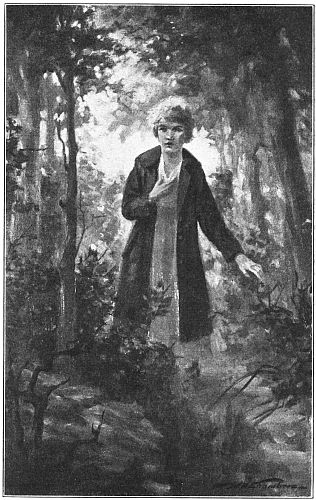 In a Few Moments She was in a Panic
At first, however, she was not seriously
frightened, although she concluded to hurry
back to Kent House as quickly as possible.
But when she started back through the
woods, whoever it was in hiding evidently attempted
to follow her. The faster she walked,
the faster the footsteps came on behind.
However, Frieda did not turn her head to
discover her pursuer. She had been nervous
and worried all day, or she might not have
become so alarmed. Instead of looking back
she continued hurrying on faster and faster
until, in a few moments, she was in a panic.
Then she started to run and to her horror
realized that a man was also running with
long, easy strides behind her.
Frieda was totally unaccustomed to looking
after herself in any emergency, and had never
been compelled to do so—even in small
adversities. Now she had a sudden impulse
to call out for someone, but had only sufficient
breath to increase her speed. If she
could get a little nearer the house, one of the
servants could be sure to come to her
assistance.
But Frieda had run only a few yards when,
as a perfectly natural result of her panic, she
tripped over some roots hidden in the underbrush
and fell forward with her face amid the
leaves and twigs and with one leg crumpled
under her.
She must have struck her chin for she felt
a dull pain and a queer numbness in her side.
However, when she tried to disentangle herself
and jump up quickly the pain became more
acute. Nevertheless, for one instant Frieda
struggled and then lay still, for her pursuer
had already reached her and was bending
over her, for what purpose Frieda did not
know.
Then she heard a slow, inexpressibly familiar
voice say:
"I am afraid I have frightened you, my
dear. I do trust you have not injured yourself."
Then a pair of strong, gentle hands
attempted to lift her.
Naturally, Frieda's first sensation was one
of amazement; the second, relief; and the
third, anger.
She managed, however, with assistance to
sit in an upright position. Then she began
brushing off the twigs and dirt which she felt
had been ground into her face. Finally she
recovered sufficient breath and self control
to be able to speak.
"Henry Russell!" she exclaimed, trying
to reveal both dignity and disdain, in spite
of her ridiculous position, "will you please
tell me why you are hiding in Frank's woods
like a thief, and why, when I refused to see
you, you terrified the life out of me by chasing
me until I nearly killed myself. I think, at
least, I have broken my leg," she ended
petulantly.
Professor Henry Tilford Russell flushed
all over his fair, scholarly face. Taking off
his soft grey hat, he ran his hand over the
top of his head, where the hair was already
beginning to grow thin.
"My dear Frieda, you do me an injustice,"
he began, "although I know my actions do
appear as you have just stated them. The
truth is I found myself unable to go away at
once from Kent House. I am not fond of London.
I dreaded the loneliness there; also I
longed for a sight of you to know for myself
that you were well. So I wandered about
through the grounds at some distance from
the house and finally entered these woods.
When you came into them alone and so
unexpectedly, it seemed as if I must speak to
you. I started toward you and you ran. I
did not think my pursuit would alarm you.
It was one of the many things, Frieda, I
should have understood and did not."
In spite of the fact that the fault of the
present situation was undoubtedly Professor
Russell's, there was an unconscious dignity
and graciousness about him as he made his
apology, which Frieda recognized was
undoubtedly lacking both in her appearance
and emotions. She felt extremely cross and
her leg hurt. She could not go up to the
house assisted by a husband whom she had
just scornfully refused to see, and yet she
did not believe she could walk alone.
"Very well, Henry; now that you have
accomplished your purpose, I hope you will
be good enough to leave me," Frieda
demanded, believing that she would rather
suffer anything than a continuance of her
present humiliation.
But Professor Russell did not stir.
"I prefer to see you safely through the
woods. When we are nearer the house I may
be able to find someone to take my place."
Professor Russell then leaned over and
lifted Frieda to her feet. As a result she
found that her leg was not broken or sprained,
but only bruised, and that walking was
possible if she moved slowly.
However, Frieda suffered considerable pain
and she was not accustomed to bodily discomfort.
At first she tried not to rest her
weight upon the Professor's arm, for he had
put his arm under hers and was attempting
to support her almost entirely. But, by and
by, as the pain grew worse, she found herself
growing more dependent and, as a matter of
fact, her dependence seemed perfectly natural.
Once it occurred to her that, during her first
acquaintance with Professor Russell, he had
been hurt and in more ways than one had
leaned upon her. No one ever had asked any
kind of care from her before, and in those
days she had at least thought that she had
fallen in love with the Professor. At least
she had insisted upon marrying him, when
her entire family had opposed the union.
There was no conversation between the
husband and wife, except that several times
Professor Russell, without waiting to be asked,
stopped for Frieda to rest.
Then, by and by, when they had reached
the edge of the woods, he saw one of the men
servants at a little distance off and signalled
to him.
"There are many things I would like to
talk over with you, Frieda, but this is not the
time. Neither do I want you to think I
meant to take an unfair advantage of you by
forcing myself upon you without your knowledge.
I think I scarcely realized myself just
what I was doing. I am sorry you felt compelled
to run away from home because we
sometimes quarreled. I do not know just
how much I was in the wrong at those times,
but I fear you were not happy with me or
you would not have let the fact that we
differed about a good many things have made
you wish to leave me. Please remember,
Frieda, if there is ever a time when you wish
to talk matters over with me, I shall be glad
to come to you. I will not come again unless
you summon me."
Then, as the man servant had by this time
reached them, Professor Russell gave Frieda
into the man's charge.
The next instant, bowing to her as if he
had been a stranger, he turned and started
in the opposite direction.
Frieda did not remember whether she even
said good-bye. She did think, however, that
she would have liked to have reminded Henry
to hold his shoulders straighter. Really he
was not so old—only something over thirty.
He seemed to have been one of the persons
born old, caring always more for books than
people—more for study than an active life.
Frieda actually felt a little sorry for him.
Always she must have been a disturbing
influence in his life. Perhaps in his way he
had been good to her, or at least had intended
to be. She wished that she had told him to
go back home because she could write to him
there, or in case she ever wished to see him,
she could also go home. She intended to go
to the Rainbow ranch in the autumn.