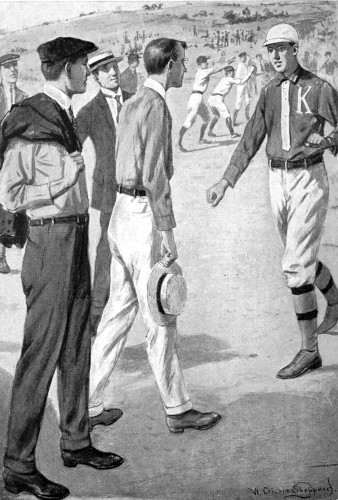
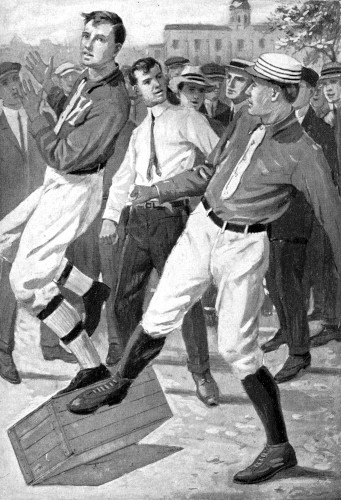
"Play ball!"
These two words, uttered in a loud, authoritative tone, sent a sort
of electric thrill through the impatient audience, which was only
waiting for the first opportunity to expend its superfluous energy in a
hair-raising yell.
The Stars having won the toss, Tony Tippen went to his place on the
mound, while Dave Brandon, smiling in his usual good-natured fashion,
walked briskly to the plate.
"He'll have to show the best in the shop to faze old Dave," chuckled
Tom Clifton to Catcher Phil Brentall. "'Jack Frost' couldn't do it,
could you, Jack? Ah! Tippen is going to let 'er fly. Watch him."
The boys were already watching with wide, staring eyes. They saw the
pitcher "winding up." Then almost instantly the ball seemed to smack
into the catcher's mit.
"Strike one!" called the umpire.
"Suffering doughnuts!" gasped Tom. "Why didn't he swing on it?"
"I've heard it is hard to lam the ball when Tippen is on deck," said
"Jack Frost." "Cheer up, Tom. The game isn't lost yet."
Once more the pitcher sent in the ball.
"Strike two!"
"Great Scott!" breathed Tom. "Gee! I hope Dave takes a chance on the
next."
Dave Brandon had no intention of being caught napping a third time. He
had been stunned into momentary inaction by Tippen's terrific speed and
the quickness with which he delivered the ball. Doggedly determined, he
faced the pitcher, realizing that the eyes of hundreds were upon him,
and that he was there for the good of the school. Out of the corner of
his eye he caught a glimpse of Professors Hopkins and Ivins and Mr.
Rupert Barry. Warily, he watched the cool, grinning face of Tippen.
But the inshoot which Dave half expected did not come. Instead Tony
Tippen slipped over a tantalizing slow ball, and Dave's vicious lunge
came a fraction of a second too late.
"Three strikes and out!" bawled the umpire, amid shouts of approval
from the Star crowd.
The rest of the inning passed quickly, not a player reaching first.
The members of the school team looked glum but resolute as they
sallied out into the field. They had not started off with the dash and
brilliancy many expected.
"But never mind," said First Baseman Tom Clifton, fiercely. "We've
eight more innings coming to us."
"Batter up!" commanded the umpire.
John Hackett, looking very important indeed, strode to the plate. "Jack
Frost" rubbed a little dust on the ball. He raised his arm in the air,
brought it down again, and a snappy drop was speeding toward the batter.
John Hackett made a mighty swing—and missed.
"Rah, rah, rah for 'Jack Frost'!" came from the field.
Jack was a little nervous. He had not yet gained his usual control of
the ball. The next two went wide of the plate.
Hackett, however, landed on the fourth. But the pitcher scooped up the
bounder which resulted and retired the batter at first.
Kirk Talbot was the next to face the pitcher.
At the very first ball delivered he sent a hot line drive whipping
straight toward Charlie Blake. Charlie, though still struggling against
a feeling of nervousness, easily made the catch.
Jeff Wilber, right fielder of the Stars, reached first on balls; but
Nat Wingate's effort to advance him was nipped by Dave Brandon's clever
catch of a high fly in left field.
"Ha, ha!" chuckled Tom Clifton. "It will take more'n Tony Tippen's
pitching to win this game. You can bet we'll get on to his curves
before long. Who's up—you, Blake? Don't let Nat rattle you. He's
beginning his holler already."
Charlie selected his favorite bat. He reflected that when Nat Wingate
tried to rattle a fellow he generally made a pretty good job of it. He
tried to deaden his ears to the sarcastic quips which the captain of
the Stars was now hurling toward him.
"It's easy, Tippen!" bawled Nat. "He couldn't hit a stuffed pillow.
You've got him going."
"I'll bet he'll be going to first the next minute," muttered Tom,
hotly. "My, I hope we do soak it to this crowd."
"Shoot 'em over—shoot 'em over!" howled John Hackett.
And the imperturbable Tippen did shoot 'em over with a maddening skill
and persistency which made the high school rooters fairly gasp.
It seemed but a moment before the players found themselves trooping out
upon the field again with a dull and deadly feeling that Tony Tippen
was more than living up to his reputation. The crowd, ready to voice
its approval or disapproval, yelled earnestly at every opportunity.
It was not until the ending of the fourth inning, however, that the
Kingswood rooters had a chance to strain their lungs to the breaking
point. Tony Tippen, one of the hardest hitters on the Stars, had
reached first in safety.
At the instant "Jack Frost" got into action he was off on a wild break
for second.
A yell rose on the air as Big Bill Steever smashed the oncoming
sphere, sending it directly toward Third Baseman Fred Benson. Benson's
practiced eye told him it would be impossible to catch the runner at
second—Tippen's long legs were taking him over the ground at too great
a speed.
His gloved hand pulled in the bounding ball. Instantly he whipped it
over to Tom, at first, then sprang back to his place on the sack.
"Send it here, Tom; send it here!" he yelled.
Charlie Blake, shortstop, was keenly alive to the possibilities of the
situation. Day after day, Coach Steele had drilled into his men the
importance of backing up players. "Even if it proves unnecessary nine
times out of ten, on the next occasion it may prevent the scorer from
chalking down a run," he said.
"When Tom gets excited he's apt to throw wild," reflected Blake.
Before Tony Tippen had touched second and was tearing on toward third
Blake was off to back up the baseman.
A hundred throats poured forth volleys of encouragement to Tippen; and
above the shrieks and yells the voices of Nat Wingate and John Hackett
could be heard.
"Go it, Tippen; go it!" howled the former.
"Hi, hi, hi! Come all the way around!" screeched Hackett.
Kirk Talbot was dancing up and down in an excess of joy.
"Here's where we bring in the first run!" he yelled. "Ha, ha! I thought
so!"
The ball had beaten Bill Steever to first, while Benson had judged his
throw so nicely that Tom Clifton was able to return it without moving
an inch from his position.
But the horse-hide had no sooner left Tom's hand than he realized, with
a sinking feeling, that it would sail over the third baseman's head.
The purple and white pennants were not waving now. The Kingswood boys
looked on in gloomy silence. The shouts of their opponents soared
higher as Benson leaped off the ground in a vain effort to stop the
speeding ball.
He saw Tony Tippen slipping past and making a break for home.
"Gee whiz!" he groaned.
The swelling din from the field struck harshly on his ears. But with a
frantic dash, Shortstop Blake got into the path of the ball, leaped for
it and caught it and, although partly off his balance, sent it whirling
toward home plate.
Phil Brentall watched the runner and the ball racing toward him. The
hot volley of sarcasm and the wild blasts sent up through megaphones in
the Wingate camp could not shake his nerves.
"Slide for it, Tony; slide for it!" roared Nat.
"Slide for it!" echoed Hackett, desperately.
For an instant the tumult was stilled.
Tony Tippen obeyed instructions, literally hurling himself with
outstretched arms toward the plate. From amidst a cloud of yellow dust
his hand shot forward. Then, just as victory seemed certain, a hard
thump jarred his shoulder. The ball had won the race.
"Runner out!" called the umpire.
The Star adherents left off shouting as the high school lads began.
Caps were thrown recklessly in the air; purple and white pennants waved
frantically; and as Blake, flushed with pride, walked in from the field
he heard his name rolling out on waves of sound.
"Not so badly done, sir," remarked Mr. Rupert Barry, who sat on a
bench between the president of the Kingswood High and solemn-looking
Professor Ivins.
"Dear me," said the latter. "I can't understand why the boys get so
dreadfully excited."
"It is one of the very annoying features of the sport," returned Mr.
Barry. "They distract everybody's attention."
"If they would only enter into their studies with the same enthusiasm
we might have a race of intellectual giants," said Professor Ivins,
gravely.
"Young Blake is one of those rare combinations who seem to be able to
do both," remarked President Hopkins, smilingly.
"The catcher who tagged that boy out is now going to bat," said Mr.
Barry, looking up from his score-card. "I don't understand how it is,
President Hopkins—your boys don't seem able to hit. I know Anthony
Tippen has quite a reputation; but surely, with all their practice,
sir, they ought to do better than this. By George—a most ridiculous
spectacle! That chap has actually missed another."
"Strikes me it's a most dangerous game," said Professor Ivins. "I
declare, I should like to get a little further away, where those
balls—what do they call them?—yes, yes: foul tips—a most ridiculous
appellation, by the way—would not be so likely to hit us. I read of a
case——"
"Strike two!" came from the umpire.
"Disgusting—disgusting!" snorted Mr. Barry. "An exhibition well worth
missing. Sir?"
Professor Hopkins seemed quite pained.
"I was saying that Tippen looks bigger and stronger than any of our
players."
His manner was almost apologetic.
"There are plenty of boys in the high school quite as big," snapped Mr.
Barry. "If the coach knows his business, why didn't he select some of
them?"
"Three strikes! Batter out!"
Mr. Barry thumped the bench vigorously with his knotted cane.
"I'm not sure that I shall wait to see the finish of the game," he
announced, stiffly.
"I quite agree with you," added Professor Ivins, rising. "If it is your
pleasure, gentlemen——"
"Not yet," answered Mr. Barry. He consulted his score-card. "Alfred
Boggs," he said. "I hope he does better than his predecessor."
But "Alf," as the right fielder was generally called, didn't. He simply
fanned the air vigorously and was retired.
"Now 'Jack Frost,'" exclaimed Bob Somers, "see if you can't be the
first to solve Tippen's delivery."
"Get those glum looks off your faces, fellows," admonished Coach
Steele. "I'll admit Tippen is a mighty good lad; but, remember, they
haven't put a run across the plate yet."
"And won't, either!" cried Tom.
The team eagerly watched "Jack Frost," as he faced his rival. The Star
crowd still kept up their yells and quips. Frost, however, scarcely
heard them. He had a burning ambition to send a "grass-cutter" safely
out of reach of the shortstop.
"Gee, if I only get half a chance!" he murmured.
With every nerve at high tension he waited.
Striking vigorously at the first pitched ball, an electrifying crack
filled his heart with glee.
But the sphere, instead of taking the course he had hoped, launched
itself fiercely upward and in the direction of the three gentlemen on
the bench. The catcher, dashing his mask to the ground, sprinted hard.
"Foul ball! Batter out!" told the story.
As Jack threw his bat spitefully aside he observed a small body of
freshmen dragging the bench into safer territory, with three dignified
gentlemen following close behind.
"If he only drives them away it would be worth losing the game,"
chuckled Benny Wilkins.
"I hope it gave 'em a jolly good scare," observed "Crackers" Brown,
sourly. "They haven't any business to be watching a game like this."
"Ha, ha! That's so," laughed Benny. "When is a game not a game?"
"When the Kingswood Stars play the Ramblers?"
"Oh, you rude thing. No; when it's punk. Isn't the way our chaps play
ball enough to make Barry plant corn on his lot?"
"Get out, you croakers!" snapped Harry Spearman.
"The game isn't over yet," put in little Joe Rodgers, whose generally
smiling face looked grave. "Just wait till Dave Brandon gets another
chance at bat."
"We've been doing nothing else but wait," growled "Crackers." "So far,
it's been a sad, sad spectacle."
"Oh, cheer up," said Benny. "Who grabs the stick now?"
"Con Fuller."
The Stars were swooping in from the field.
"Hurry up, fellows; crack out a few runs, and finish the game!" sang
out Nat. "Tippen can't win it all alone."
"I need just one more chance," said John Hackett. "When it's my turn to
bat if I don't knock down one of those out-fielders I won't eat any
more pie until to-night."
Con Fuller, a big, aggressive-looking boy, smiled grimly.
"Just watch me, Hackett!" he called. "Here's where the cover gets
knocked off the ball."
"Oh, my, a good dollar and a quarter ball gone to waste," grinned
Benny. "Don't do that, Con. Just dent it. Say, have you noticed how
fierce Roycroft and Lawrence look? I wonder if it's Guffin's or——"
"Rah, rah, rah! Boom!"
A furious blast rising from hundreds of throats made it evident that
Con Fuller's boast had almost come true. The cover was still on the
ball, and it probably wasn't even dented, but those who had been
looking in the right direction saw the sphere sailing far over the left
fielder's head and stout Dave Brandon making a wild effort to overtake
it.
"A three-bagger, sure," groaned Phelps.
But, as the shouting crowd calmed down, they saw that Dave Brandon's
rapid recovery and accurate throw had held the runner at second.
"Well, that's going some, anyway!" cried Nat, hilariously.
"Bet if I was at bat now I could bring him in," said Hackett. "If you
don't do some good stick work, Sam Manning, there'll be trouble."
Manning, vigorously chewing gum, had a determined glint in his eye.
"Frost is melting; Frost is melting; the pace is too warm for Frost!"
shouted Kirk Talbot. "He's getting weak; his nerve is gone! Hi, hi, hi!"
"One ball!"
"I told you so!" snickered Kirk.
"One strike!"
"Take it easy, Sam. That was only an accident," advised John Hackett.
"Two strikes!"
"Lam it, you pirate; lam it!" howled Nat.
Manning smiled curiously. Then, as the ball again shot toward him, he
bunted just inside the third base line.
Baseman and pitcher dashed simultaneously toward it. Benson, however,
stopped the ball, which he tossed to "Jack Frost" with the laconic
remark:
"Too late."
Fuller and Manning played off the bases as far as they dared, worrying
the pitcher to the best of their ability.
"Two men on the circuit and none down!" yelled John Hackett. "Don't
be afraid to take a chance, fellows. Go it, Fuller; get right off to
third!"
The number of gloomy faces among the high school contingent increased.
"I've a dreadful fear that the Ramblers are going to pieces," muttered
Benny, disconsolately. "Dave Brandon will never, never print the
article I'm going to write. Hello—I reckon this settles it!"
George Marlow, left fielder of the Stars, had connected with the ball
so successfully that next instant all three bases were occupied.
The Stars found their voices once more. A vociferous din, in which
megaphones and tin horns added to the volume, came from all parts of
the field.
"Ah, here's where I do it!" cried John Hackett. "Watch me, Nat. If I
don't everlastingly smack the pill I'll work an hour overtime at the
store."
"I can stand Hackett's blow because it only makes you grin," mumbled
"Crackers." "He knows enough not to mean what he says."
"Say, John looks as dangerous as a regular league player, doesn't he?"
The Stars' coacher near first was bawling out his orders with
monotonous regularity.
It was an anxious moment for the High. With none out, the situation
looked mighty serious, especially as one of Nat's strongest batters
stood at the plate. Two balls and a strike were called before John
Hackett got into action. The tall player then swung with all his force.
A terrific bounder shot off in the direction of first base.
At the crack of the bat Conway Fuller, with lowered head, started for
home. The rousing cheers of the Stars rose to frantic heights; the
purple and white rooters stood glum and silent. Tom Clifton sprang
off his base to intercept the ball. The yells—the sight of the
wildly-excited boys—made only an indistinct impression on his mind.
For the moment, to him, nothing existed but the ball lashing viciously
over the ground.
It smacked resoundingly into his gloved hand. Without straightening up,
Tom drove it unerringly home and sprang back to the sack.
There was a different sound to the cheers which now reached his
ears. They had a volume which made the preceding shouts fade into
insignificance. Fuller was out at the plate, and Brentall had whipped
the ball back to him.
John Hackett was straining every muscle to reach the bag in safety.
But, as an object whizzed past his head and a dull thud sounded, he
realized that his effort had been in vain.
In spite of a feeling of intense disappointment, he slapped Tom Clifton
on the shoulder.
"Good work, old boy; good work—a corking double play!"
Tom's eyes sparkled. Volleys of cheers for Clifton rang pleasantly in
his ears.
"Thanks, Hackett," he replied. "I guess we can play a little when we
try."
Sam Manning on third, not discouraged by Fuller's failure to score,
launched forward as Kirk Talbot singled. The followers of Nat Wingate
went wild with glee. The first run for the Stars was marked down on the
score-board, and there were two on bases.
"Jack Frost" seemed to lose some of his control, while the high tension
was evidently affecting several of the other players. Right Fielder Alf
Boggs fumbled Jeff Wilber's hot liner. Once again the score-keeper made
an entry.
"And still two on bases," groaned Joe Rodgers.
"The school team is going to be defeated, sir," Mr. Rupert Barry was
saying to President Hopkins. "I've no doubt they will be white-washed."
"Dear me—white-washed!" exclaimed Professor Ivins, somewhat startled.
He looked around, as though half expecting to see colored men with
pails and brushes. "White-washed!" he repeated. "Do you mean the fence?"
"No!" snorted Mr. Barry. "The baseball nine."
"Dear me—extraordinary!" murmured the elderly professor, in puzzled
tones. "Doubtless it is another of those preposterous expressions
connected with baseball parlance. Is it, I might ask, a—a general
custom to refer——"
"I fear it will be whenever these boys play the Stars," said Mr. Barry,
grimly.
It was a disastrous inning for the school team. Before big Bill
Steevers' pop fly fell into the hands of "Jack Frost" the Stars had
three runs to their credit.
"Never mind, fellows," said Bob Somers, cheerily. "It's a part of the
game."
"Of course," laughed Dave. "If it weren't for Tony Tippen we'd probably
have twice that many runs ourselves."
"A game's never lost until it's over," said Coach Steele. "You're
playing against a pitcher of unusual ability. But don't let that
discourage you for a moment."
The end of the eighth inning found the score four to nothing in favor
of the Stars.
"We'll simply have to do something now," growled Tom Clifton. "Just
listen to Nat Wingate howling. If we don't, maybe he and Hackett won't
go strutting around town proud as peacocks."
"Roycroft, if you'd been in this game there might be a different story
to tell," grumbled "Crackers"—"eh, Earl?"
"I'm not saying anything," answered the former football guard.
"But I am," put in Owen Lawrence. "These chaps seem to be weak on the
stick work."
"You never faced Tony Tippen," sniffed Benny Wilkins.
"Well, if I couldn't do any more than sideswipe the air I'd be sorry.
Who's up?"
"Charlie Blake."
"Then we might as well go home."
Charlie, fully determined to do his share toward staving off a
disastrous defeat, stilled a nervous flutter at his heart.
"Better to make a try than stand still and hear the umpire yell, 'Three
strikes and out!'" he reflected.
He aimed at the second ball, and perhaps no one on the lot was more
surprised than he to hear a sharp crack and to see the horse-hide
whirling off into space.
Spurred on by a furious din from the purple and white, he sped down the
first base line long before the ball was returned to the infield.
The players who had looked so gloomy a few moments before brightened
up amazingly. After all, Tony Tippen could be hit. It was a pleasant
surprise to many.
"Oh, ginger! If we'd only started this thing in the earlier innings!"
groaned Tom Clifton, as he picked up a bat. "If Blake could do it, so
can I."
With all his judgment, he aimed at the first ball which cut the plate.
It was the hardest swing of which Tom Clifton was capable. The ball,
struck squarely, flew to the left of second base. Nat Wingate, leaping
in the air with upraised hand, stopped its onward progress. The sphere
rolled to the ground.
With a swift dive, Nat recovered it, stepped on the base and shot the
ball to first.
It was the nearest the high school team came to scoring that day, Bob
Somers, the next batter, going out on a foul.
The Kingswood Stars and their friends were warm and happy. Tony Tippen
became the hero of the hour. He accepted his honors modestly.
But Nat Wingate and John Hackett, who came in for their share of
lionization, did not take the victory so quietly.
"Now let somebody call us 'Pie-eaters'!" jeered Nat. "I say, Clifton,
do we need some dieting? Won't you join us at a doughnut party
to-night?"
"Get out!" retorted Tom, angrily. "One more inning, and we'd have had
you going."
"Oh, yes; you'd have had us going around the bases one after another."
Over by the bench Mr. Barry was punctuating some remarks with emphatic
motions of his knotty cane.
"Extraordinary—extraordinary! Not even one of them got as far as
second base!"
"I suppose you will not come again, sir?" ventured Professor Ivins.
"I most certainly shall," answered Mr. Barry. "But I hope to goodness
I'll see a more cheering sight on the next occasion."
The boys who happened to hear these remarks told their companions.
As fast as though the air had wafted the words from one point to
another the school had them on the tip of its tongue. And they grew in
importance in the process of traveling about.
"Never mind, fellows," remarked Bob Somers, as they gathered in
the gymnasium. "There are two more games with the Stars before the
inter-scholastic championship begins."
A boy rushing wildly into the doorway attracted his attention.
"Hello, Benny! What's up?" drawled Dave Brandon.
"An awful lot!" cried Wilkins, breathlessly. "What do you think? Luke
Phelps just told me he heard that Mr. Barry said he was so disgusted he
thought of withdrawing his offer—honest fact. Say, Brandon, does that
article of mine have to be typewritten?"
"I'm not so sure the 'Reflector' will touch very heavily on recent
sporting matters," answered Dave, smiling.
"Is Phelps in the room?"
Tom Clifton's gruff voice rose clearly.
"Sure! Just came in. What's the row?" answered a voice.
"Who told you what Mr. Barry said?"
Phelps pushed his way between the groups toward the players.
"Everybody. No one caught his exact words, but they must have been
something pretty hot. There are enough rumors floating around to hurt
your eyes if they could be seen. It's been a fierce day, hasn't it?"
When Tom Clifton walked home that evening he passed the field for the
use of which the club was fighting.
It had never looked more alluring. He stopped to gaze over its broad
green expanse with wistful eyes. His glances wandered from one
no-trespassing sign to another. They looked much more formidable now
than they ever had before.
"Great Scott!" murmured Tom. "What a beginning—four to nothing!"