Previous to the production of raisins in California within the last
twenty years, the raisin industry of the world was entirely confined to
the Mediterranean district of Europe and Asia. At that period, however,
raisin grapes became more disseminated, and raisins were produced to
begin with in small quantities in widely distant countries, such as
Chile, Australia and California. By virtue of their climatic conditions,
the Mediterranean countries were the only parts of Europe where
raisin culture could be successfully carried on, though it is almost
certain that the original home of the raisin grapes must be looked for
elsewhere. In searching for the original habitat for the ancient varieties
of raisin grapes, we must look further east to ancient Persia, or
to the tablelands of Western Asia generally. In remotest antiquity,
grape culture was carried on there, and in the ancient records of
travelers in those countries we find mentioned dried and seedless
grapes. We can trace the origin of two varieties of raisin grapes to the
beginning of our era, which must then already have attained perfection.
As has been mentioned before, Pliny spoke of a small, sweet and
remarkable grape grown by the Greeks, evidently the “currant;”
he also mentions Uva Zibebae and Uva Alexandria.
The Latins generally spoke of Uvae Apiariae or Uvae Muscae, our
present Muscatels or dried grapes generally. This carries us back
fully nineteen centuries. But we may well believe, even in want of
records, that the drying of grapes was practiced centuries before.
Leaving remote antiquity, it was only in the Mediterranean basin,
and in comparatively modern times, that the drying of grapes developed
to an important industry, and in more recent times yet that grapes
were exported to Northern Europe. While thus the industry is old,
it was not until the eleventh century, at the time of the Crusades, that
it became important. The returning knights brought with them
taste for and acquaintance with the products of the East. Northern
Europe became the consumers of raisins, regarding them as the
greatest luxuries, only to be afforded by the rich. It has been reserved
for our time to make the raisin a necessity even in humbler homes.
The perfection to which the raisin industry has attained is of modern
origin not yet half a century old.
The raisin districts of the world are not large, and while for
centuries every effort was made to extend the planting of raisin grapes
and their curing into raisins, few of these efforts have been crowned
with success. While raisin grapes may grow and be turned into
raisins in almost every part of the Mediterranean basin, experience
has demonstrated that it has only proved a paying business in
comparatively few localities. The reasons of this are not fully
apparent; but they are evidently dependent both upon climatic conditions
and upon the capability of the natives to learn and profit by the
experiences of others, and upon their enterprise in venturing upon a
new industry. On the other hand, it is not likely that, even with
extensive experiments and with the aid of large capital, the growing
and curing of the raisin grapes could be very extensively extended.
The question there as well as here is not one alone of agricultural
consideration, but a financial problem dependent upon the labor
supply, the facilities for shipping, climatic conditions during the curing
season, etc. Such being the case, all the more interest is attached to
those localities and districts where the raisin industry flourishes, and
where there is every probability that it will remain a success.
Extent and Age of the District.
—Malaga has been known to
export raisins since 1295 A. D., but must have been a raisin-producing
district centuries before. The raisin cult, then, is no doubt of
Phœnician origin, and has been practiced in the same locality for two
thousand years or more. Under the Romans the raisin industry
was continued, but appears to have deteriorated and later on to
have been abandoned altogether, as the local tradition credits the
Moors with having re-introduced the raisin grape into Velez Malaga.
The raisin district of Malaga extends along the southern coast of
Spain for a distance of sixty or seventy miles. The district is subdivided
into several other districts. Thus, the subdistrict of Malaga
proper occupies a plain eighteen miles long by nine miles wide, in the
northeast corner of which is situated the town of Malaga.
The best part of the whole district is, however, found at Velez
Malaga, situated northeast of Malaga proper. It was here the raisin
grape was first planted by the Romans or Phœnicians, and it was here
also the devastating phylloxera first made its appearance. The raisin
vineyards extend here not over a vega or plain, but occupy the fertile
country along the coast or the litoral towards Malaga proper.
Beyond Velez Malaga to Algaroba, the Muscatel grape is of inferior
quality, and is greatly superseded by the red Muscats, principally
exported to France.
Another district is Marbella, on the coast, and in the interior we
find Ronda and Albuñol. Of the principal towns in these districts, the
population of Malaga is 120,000, that of Velez Malaga 24,000, of Marbella
7,700, and of Ronda 19,000.
Climate.
—The climate of Malaga is the very mildest. Frost is
almost unknown, and is never heavy. The average temperature of
Malaga during the winter months of November to January is 56 degrees
Fahrenheit, while that of Pau in France is 41, and that of Nice 47.
Malaga is well sheltered on the north and east by mountains, but is open
to the south. It is the most equitable climate of Europe, although the
winds are sometimes trying. The summer is very tempered. The air
is, however, moist, and fog, while rare, is not entirely absent. Rain
sometimes falls during the growing season of the grapes, and quite
frequently during the drying season. But the fog is warm and not
specially injurious to the grapes, the latter often growing within reach
of the spray on the seashore.
Soil.
—The soil of the Malaga vineyards varies considerably, the
best being a reddish clayey loam with much sand and gravel. But we
have also other varieties of soil, such as the white ash, gray alluvial
soils, and the very sandy loam on the hills.
Location of the Vineyards.
—In former years, the vineyards were
principally located on the hillsides, only occasionally extending to
the level plains. Of late, however, the hillside vineyards have
suffered from the phylloxera and various other diseases, and many
of them have been dug up. The lowland vineyards are now the
best, although even they are, by far, not free from disease. Few
of the vineyards are located on entirely level ground, there being
but little such in the district. The nature of the country is rolling,
with small valleys or flats. The raisin grapes grow apparently well
both inland and on the coast. According to Consul Marston, about
eighty per cent of the vineyards are situated on rolling land, ten per
cent on lowland and ten per cent on the very coast. The vineyards on
the coast are actually within reach of the spray.
The vineyards are generally small, none being over eighty acres
in extent. Most contain, perhaps, from three to four acres each;
while from twenty to forty acres is considered a good-sized vineyard.
Varieties of Grapes.
—The principal variety used is the Gordo
Blanco or Muscatel. It is identical with the grape known by us under
that name, and which was imported to us from Malaga. But several
types are found, although none superior to the Gordo Blanco.
Characteristics of the Raisins.
—The Malaga raisins were, until
lately, the finest raisins in the world, and for the present have only
the California raisins to compete with. They are characterized by
great sweetness, deep bluish color, great size and by good keeping
qualities. The best raisins are those called Dehesas, being produced
on the valley lands of the districts.
Yield of Grapes.
—The yield of Malaga vineyards varies of course.
The best yield eight or nine tons of grapes to the acre,—just like those
of California. But there is a great difference between new and old
vineyards. In many vineyards where formerly the yield was nine tons,
the soil has been so exhausted by continuous croppings that to-day,
even with manuring, two or three tons of grapes must be considered a
high yield.
Distances of the Vines.
—The older vineyards had their vines set
seven feet by seven feet, but of late the vines are planted generally
eight feet by four feet, thus much closer than by us in California.
Pruning.
—The pruning of the vineyard is performed very much
as in California. Formerly the soil had to be removed from the
vines before they could be pruned; now this is not necessary except
while the vines are very young. The various branches are pruned
back to a few inches, with two eyes each, while the heads are elevated
only a few inches above the ground.
Manuring and Fertilizing.
—The Malaga vineyardist fully understands
the value of manuring his vineyards, and uses for this purpose
not only all fertilizers available at home, but also imports directly from
distant countries. The most valued fertilizers are the Mexican and
Chilean guanos or phosphates. The Mexican phosphate costs in
Malaga sixty-five dollars per ton; still it is used by all the principal
vineyardists, who know the value of fertilizers. In fact, concentrated
fertilizers are a necessity to the Malaga vineyards; without them they
could not be cropped. Even the most virgin soil is exhausted in ten
years’ time by constant croppings of raisin grapes; no paying crops
could be expected if fertilizers were not used yearly. This fertilizing
of the soil is, however, of recent origin, and fifty years ago was almost
unknown.
When home manures are used, it is placed in holes dug round
the roots of the vines, which, after exposure to the air for several
months, are again filled up at the advent of spring, generally in March,
before the vines start to bud.
Drying-floors, or Sequeros.
—The raisins, when picked, are dried
on so-called sequeros, or drying-floors, characteristic of the Malaga
district. These floors are of different sizes and lengths in different
vineyards, but everywhere constructed on the same general principles.
Where an incline or a hill is found, the floor may simply be built
on the slope, with no artificial elevation; but, where the ground is
level, the structure of the sequero is different. The floor must
always face the south, and the back is raised to give the floor
the proper slope. The sequero thus consists of four walls, the front
one of which is only a foot high, and the back wall from six to
eight feet high. The side walls slope between these, generally with
an angle of forty-five degrees. In length, these floors vary from forty
to fifty feet, according to the different ideas of the vineyardists. The
whole interior is filled with black gravel, and is tamped hard. These
sequeros are divided in beds, fourteen feet or so wide, by tiles that are
sunk, thus forming walks of several feet in width, and which also serve
for leading off the rainwater. Around every little bed of this kind are
small upright tiles to prevent the rainwater entering from the walks.
Finally, in the center of the bed, is a long row of upright tiles, high
enough to support either boards, mats, or more generally canvas, in
order that they may shed the rain into the tile walks. The value of
such floors is evident. Being covered with canvas, etc., every night,
the heat is preserved, and every morning, when the sun rises, the
grapes are yet warm. The drying on such beds has never,
in fact, been interrupted. The drying-floors are also useful in case of
too hot weather, when the grapes can be properly sheltered with canvas
and prevented from being cooked; when finally dried, the covering,
again, will serve to keep the moisture from too quickly evaporating.
Drying and Curing.
—When the grapes are picked, the best
vineyardists separate the bunches immediately in three different
grades. Each grade is placed by itself on the gravelly drying-ground,
and remains there to dry. When half dried, they are taken bunch
by bunch by a workman, who picks out bad or overdried berries and
rubbish, and in putting the bunch back turns it over. In ten days
the grapes are generally dried, provided the weather has been favorable.
Every night the canvas covering is slid down over the sequero,
and the grapes protected from dew and cold, or rain. The drying is
sometimes greatly hastened by the Terral or hot winds blowing from
the plains of La Mancha, a wind very similar in its effect to the desert
wind of Riverside and Santa Ana, in California.
Packing.
—The raisins in Malaga are packed by the large growers
themselves, and every such grower packs almost to a man. The generally
accepted idea that a few packers living in Malaga pack all the raisins
is erroneous. This is not the case.[2] Nearly all packers there are also
growers owning their own vineyards. The raisins are all packed in 22-pound
boxes or in quarters, etc., according to the demands of the trade.
The various raisin brands packed in Malaga are different according
to the different markets that are to be supplied. Thus for England we
have: Finest Dehesa, three crown; finest Dehesa, two crown; finest
Dehesa, one crown; Dehesa; Choice layers; London layers, three
crown; London layers, two crown; London layers, one crown.
For France again we have: 1 Imperiaux; 1 Royaux; Couches;
Surchoix; Choix; Ordinaire; Surcouches, etc.
The loose raisins or Brena and the seedless or Escombro generally
go to the continent or even to the United States. The old terms
Garoon or Sun are now never used.
For American markets we have: Imperial Dehesa; Royal finest
Dehesa; finest Dehesa; fine Dehesa; Dehesa; London layers, three
crown; London layers, two crown; London loose, one, two and three
crown.
Boxes are generally made from fir imported from Portugal, at fifteen
cents each. Of late years, however, they are also received from Canada,
and cost only seven cents each.
Labor.
—The labor in Malaga is the most expensive in Spain, the
best laborer being paid forty cents per day, while in Denia the labor
is obtained for fifteen cents only; but it must be remembered that the
packing of the Malaga raisins is a much more particular work than
the packing of the dipped Denias.
The price paid for Malaga raisins at the packing-house is at an
average of seven cents per pound for the best, or from one to two cents
more than what is paid in California. The lower grades bring from
two and a half cents upwards.
Extent of the Districts.
—The Valencia raisins, or, as they are called,
the Lexias or Spanish dipped raisins, are produced in the province of
Valencia, situated on the east coast of Spain. The district contains
three sub-districts, the southern one, the Alicante district, extending
from Villa Joyosa in the north to Elche in the south. The raisins of
the Alicante district are inferior to those produced in the other districts,
both as regards quality and quantity. The most northerly
district is the Valencia district proper, extending from Cullera in the
south to Castellon in the north. North of the latter place the Muscat
grape does not come to perfection, and even within this district comparatively
few raisins are now produced as compared with a few years
ago. But the bulk of all the raisins produced in the province are
exported from Valencia city, and hence these raisins are known as
Valencias, while in reality they come principally from Denia.
The bulk of the Valencia raisins come from the central district, or
the Denia sub-district, comprising the land between Villa Joyosa in
the south and Cullera in the north, or about thirty miles on each side
of the town of Denia. Towards the interior the raisin district extends
at the most nine miles, but the average is less, so that the whole
district over which the Denia vineyards are spread includes only an
area of 350 square miles, equal to ten townships of land, or about
224,000 acres. A large part of this land is not cultivated, and consists
of mountains and waste places only suitable as watersheds. The town
of Denia is the principal town of the sub-district, and has now a population
of about 2,600 people. It is situated about half way between
Valencia in the north and Alicante in the south, on the shore of the
Mediterranean, in about the latitude of Sacramento in California, or
thirty-eight degrees, fifty minutes north. Being one of the oldest
towns in Spain, Denia was first founded by the Phœnicians, who here
established the worship of Diana, from which word the name Denia is
a corruption. The Phœnicians also introduced the grapes, and possibly
also the drying of raisins; but the local tradition gives the honor of
the latter industry to the Moors, who are said to have brought with
them the variety of grape known as the Muscat of Alexandria.
During a part of the year, Denia is the export harbor for the raisins of
the district. This is only possible in the early part of the raisin season,
as then only are the winds favorable,—the so-called harbor being
nothing but a roadstead. Later in the season, when storms and rains
set in, all the raisins are shipped to Valencia by railroad, and from
there exported by steamers and sailing vessels.
Among other industries of the Denia district are the cultivation of
onions, the manufacture of cotton goods, its sardine fisheries, etc., all
giving work to the vineyard workers during a time of the year when
there is nothing or but little to do in the vineyards and packing-houses.
The raisins of Denia are not all of the same quality, but vary according
to the locality where grown. The whole district is dotted with
small villages, all producing raisins. The principal ones of these are,
besides Denia proper, Jabea, Jaraco, Jerrea, Oliva, Pedreguer, Jalon,
Gandia, Ondara, Vergel, etc. Of these, Denia proper produced in
1876 over 2,500 tons of raisins, Jabea 1,700 tons, Oliva 1,600 tons,
Pedreguer 1,000 tons, Retoria 900 tons, Jalon 850 tons, Ondara and
Benisa 800 tons each. But, besides these, there are some twenty odd
more villages or smaller raisin centers, which produce from 200 to 700
tons each, or an aggregate of 20,000 tons of raisins.
Soils and Appearance of the Districts.
—The soils of the province of
Valencia, where the vineyards are situated, are of various kinds, such
as cretaceous and calcareous soils, containing admixtures of clay, sand
and gravel. The color is often red, changing to gray where irrigation
has been practiced, but much of the soil is of an ashy white color,
similar to that of bottom lands generally. In many of the lower
situated plains, the soils are blackish or dark gray, especially so where
stable or other manures have been used for years.
Many vineyards are situated on the hillsides or on the rolling lands,
where the gravelly soils produce raisins of smaller size and in less
quantity, but sweeter and finer flavored. But the largest bulk of the
vineyards are on comparatively level land, which can be and which is
irrigated. The raisins produced on these low grounds in the moist and
cool valleys are larger, but not of equal flavor and sweetness. In wet
seasons, the hillsides are preferred, the valley lands then being too wet
and cold. Accordingly, as the seasons are wet and cold, or dry and
warm, the various localities produce raisins of different qualities, which
again are valued and paid for differently. The extent of the valley or
plain lands decides the extent of the raisin districts, and of late years
the rolling vineyards have decreased in quantity, while those on the
plains have increased, until at the present time almost all the plain
lands are occupied with raisin vineyards, especially in the Denia sub-district.
Climate.
—The climate of Denia and its surroundings is rather cold
and windy; damaging spring frosts, as well as early fall rains, frequently
interfere with the setting of the grapes and with the harvesting
of the crop; it has even happened several times that the entire
crop has been seriously injured by one of these, or by both causes
combined. Farther north, or in the Valencia district proper, the
climate is milder, and frost is rare. Oranges are here at home, while
the culture of raisin grapes becomes less every year. North of Castellon
the climatic conditions are such that no raisin culture is possible.
As compared with the climate of Malaga, that of Denia is much less
favorable to the raisin grape. The production of sun-dried and
undipped raisins in Denia is not possible, and, although it has been
attempted several times, it has seldom succeeded. The rainfall of
Denia averages twelve inches per year. The rainiest months are those
of November, February and April, but the heaviest rainfall at one
time occurs quite frequently in the first week of September, while
light showers are not uncommon in August, at that time doing much
damage to the grapes or the just exposed raisins.
Irrigation.
—Not only is irrigation necessary to grow the vines successfully
and to produce an abundance of grapes, but the irrigation
in the province of Valencia is necessary to the health and longevity of
the vines. Nowhere else in Spain is the water so abundant, and no
saving of the water is necessary in the majority of the districts.
Through an abundance of water, the soil on the lowlands has now
filled up to such an extent, that in the best vineyards the surface
water is only from five to eight feet from the surface of the ground.
Those vines which could not be irrigated have gradually become diseased,
and the hillside vineyards are being rapidly abandoned and
devoted to something else. Upon the abundance and constancy of the
water depends the prosperity of the whole province, and there is
hardly a more prosperous country in Spain. To show the close connection
between irrigation and raisin production in Spain, it will no
doubt interest many to know something of the irrigation system
and the irrigation districts of the province of Valencia, than which no
more important ones are found in Spain.
The district of Alicante is supplied with water from the river
Monegre, and the Elche district from the river Minalapo. In the
northern part of the province is the Murviado irrigation district, taking
its water from the river Palencia. The Jucar irrigation district, situated
immediately south of the huerta of Valencia, takes its water from the
Jucar river, distributing 850 cubic feet of water per second upon some
50,000 acres of land.
The Valencia irrigation district consists of 26,350 acres of land
close to the town of Valencia, and is watered by the river Guadalaviar,
or, as it is generally called, the Turia. The water is distributed
through eight canals, each carrying from 35 to 120 cubic feet of
water per second, the combined low-water discharge of all the canals
being from 250 to 350 cubic feet of water per second. Of the importance
of irrigation in this district, we can judge when we learn that the
above 26,350 acres contain 72,000 inhabitants and sixty-two villages,
or an average of 1,774 people per square mile, not including the city
of Valencia itself, with a population of 120,000 people. It is also
remarkable that this enormous population on a territory not as large as
the arable land surrounding any one of our principal inland towns in
California, is not alone due to the irrigation and care of the land, but
to the minute subdivision of the land, which makes this culture and
irrigation possible. It is a practical illustration of the value of the
colony system as inaugurated in California, showing what we can
expect of our inland plains when they become fully irrigated and the
land properly subdivided.
Quality of the Raisins.
—It has already been stated that the grapes
grown in Denia are the Muscat of Alexandria, which were introduced
there by the Moors. Farther south, in the Alicante district, other
varieties are more common, but play no important part in the raisin
production of the district. The Valencia raisins are inferior to those
of Malaga, the want of heat requiring them to be dipped in lye before
drying. This, again, gives these raisins a peculiar reddish, semi-transparent
color, which unfits them for table raisins. The Valencia raisins
are principally used for cooking; even the best grades of Valencias
are inferior to the inferior grades of Malaga raisins. During the last
season (1889) large quantities of Denia grapes were cured on the
Malaga style, and with great success. Large quantities of such sun-dried
Denias were sent in bulk to Malaga, and there repacked for
export to the United States, the Malaga crop having so diminished that
the usual demand could not be supplied. Years in which such sun-drying
is possible in Denia are rare.
Planting and Care.
—The Muscat cuttings are planted generally in
February. The best cuttings are considered to be those taken from
vines at least six years old. The cuttings are set at various distances
according to the richness of the soil. The richer the soil the less
room is given the vines. Thus the vines are set either five by eleven
feet or five by twelve feet, or, in other words, they are set in rows
eleven or twelve feet apart, with the vines five feet apart in the row.
The depth of the cutting is regulated by the moisture of the surface
soil, but averages eighteen inches. The vines begin to bud in the
middle of March, and are from the start subject to great care and constant
cultivation. The first operation after the cutting is planted is to
cut off the top bud as soon as the vine starts to grow, leaving the two
shoots only from the two lower buds. No more shoots are allowed to
grow the first year. Next winter the smaller of these two branches
is cut off completely and the remaining branch is pruned back to two
eyes. In the second year the young shoots from the vine are allowed
to grow to ten inches or so long, when all are cut away except two
of the strongest. Next winter again these are pruned so to leave
only two eyes on each, or four buds on the whole vine. In the succeeding
years the branches are gradually increased in number, but
always pruned back to two eyes. After the vine is five years old, it
is seldom increased as to branches; it is then always pruned back to
the same number of spurs. It can be said that the Denia growers
pay less attention to the quality of the raisins, and prune more to
attain quantity. They leave more spurs on their vines than do those
in Malaga, and in this respect resemble many of our own California
growers, who frequently leave from twelve to fifteen spurs on a vine.
The vines in Denia are also raised higher above the ground than in
Malaga, very much as we have been in the habit of pruning our own
vines. At the age of three years the vines come into bearing; but
no fine raisins are made until the vines are five or six years old.
Dipping and Scalding.
—The dipping process is one of the greatest
importance, and gives the peculiar characteristics to the Valencia or
Denia raisins. As a similar process will sometime or other be more
generally used in California, a more detailed description may prove
interesting to California growers. We can probably not do better
than to imitate them, although in mechanical appliances we will
readily improve upon their methods. The dipping is always done at
the drying ground or secadero. The larger part of the dipping apparatus,
or the kettles, are placed under the ground so as to save heat
and fuel. A trench eight or nine feet in length is dug to the depth of
three or four feet. At one end is built a chimney protruding three or
four feet above the level of the ground. In the other end of the
trench is built a brick wall with an opening for feeding the fire.
Some trenches are lined inside with bricks, making them more permanent
and solid. On the top of this flue, and on a level with the
ground, are built the kettles or boilers, containing not less than twenty
gallons each. The boiler nearest the fire entrance is destined to contain
a solution of lye or ashes, the one next to the chimney being for
boiling water only.
The lye is made from the ashes of burnt vine cuttings, together with
lime and sometimes some salt, by men who have acquired the art
from years of experience, and who know by the appearance of the
scalded grapes whether the solution is too strong or too weak.
If too weak, the skins of the grapes will be insufficiently cut, which
will delay the drying of the grapes, and cause them to rot if the
weather is damp and foggy. If, again, the lye solution is too strong,
the skin will be destroyed and the berries seriously injured.
The grapes to be dipped should be perfectly ripe. If dipped before,
they will become inferior both as to color and taste. The perfect
ripeness is a most important point. The grapes are picked in baskets
of about ten pounds each, and carried to the scalder. The man
nearest him on the right fills a perforated ladle with about twenty
pounds of the grapes. The ladle is made either of wire netting or of
tin or zinc, with large perforated holes about three-eighths of an inch
wide. There is a scalder at each boiler. The first scalder dips the
grapes in the scalding water for a second, and immediately hands them
to the second scalder, who dips the same ladle in the boiling lye
solution for not over two seconds. The grapes are then carefully
turned out on trays to dry.
The dipping first in scalding water is of the greatest importance,
both in washing off the dust of the grapes and in preparing them to
receive the alkali wash with more effect. Since the hot-water process
was introduced, the Valencia raisins have materially improved in
quality. The grapes are never rinsed in cold water after being
dipped, and it is more than likely that the lye prevents molding, as,
according to A. B. Butler, dipped raisins are sometimes exposed to
the rain for three weeks without being totally ruined. In California,
our dipped and washed raisins spoil quickly if exposed to rain. The
object of dipping is, of course, to slightly crack the skins so as to
allow the water to readily evaporate. Dipped raisins dry sometimes
in five days, while undipped raisins would require as many weeks.
Efforts to produce sun-dried raisins without dipping them have
repeatedly been made in Denia; but they are invariably spoiled by
the rain, and lately two firms were ruined in their attempts to dispense
with the dipping process.
Drying and Curing.
—After the grapes have been properly dipped,
the drying proceeds very quickly. The grapes are immediately spread
on cane trays or cañezos, about six feet long by three or four feet
wide. These cane trays are made of the common Italian reed or
Arundo donax, which grows everywhere, even in California, and is
here incorrectly known as bamboo. The trays are made either of
split or of entire canes tied strongly together. These trays are placed
flat on the ground, only leaving enough space around each one to
allow the workmen free access to the tray on all sides. After having
been exposed to the sun for three days, the grapes are turned, in
order to dry evenly on both sides. On the fifth day, the raisins are
turned again, and, if the weather has been favorable, many of the
raisins are then ready to pack. A day or two after this, all the
raisins are ready, and are collected and housed. If, again, the
weather has been unfavorable, the drying is very much delayed. At
the approach of rain, the mats or trays are taken up and piled on
the top of each other, under sheds previously made. Every drying
ground has stationary appliances for this purpose. These simply
consist of poles stuck in the ground, and extending five or six feet
above the same. Other cross-rafters or scantlings are nailed between
the poles, thus forming rows of roofless sheds eight or nine feet wide,
of greater or shorter length. Painted canvas, or simply mats or empty
reed trays, are used as covers, under which the raisin trays are piled.
Under and between each tray are placed five little cubes of wood, for
the purpose of lifting the tray and preventing it from pressing too
heavily on the grapes underneath.
Packing and Disposing of the Crop.
—When at last the raisins are
dried, they are either stored by the producer, or, as is more generally
the case, are taken to the merchant or packer who has supplied the
grower’s wants during the year in anticipation of the coming crop.
There are thus a number of special packers in Denia, who own large
and splendid packing-houses in which the crop is yearly handled. The
grower never packs himself, the enhanced value of the raisins not
being sufficient to warrant the trouble. One of the best and by far
the largest packing-houses in Denia is owned by J. D. Arquimbau.
A more perfectly equipped establishment is not found anywhere else.

Views from Col. Wm. Forsyth’s Raisin Vineyard, Near Fresno: Residence, Lake,
Raisin Dryer, Packing House.
All of the packing is done by women, while the men do the carting
of the raisins from the vineyards to the packing-houses. During the
balance of the year, when there is no more work in the packing-houses,
these very men occupy themselves with the sardine fishery, while
their wives then dress the sardines and pack them in oil. They have
thus work all the year round,—an absolute necessity in a country
where the wages are so small, and where the poor man has no chance
to save up a capital. The wages paid for packing in Denia is only
fifteen cents per day; while in Malaga the same work commands from
forty to sixty cents per day. In some of the warehouses in Denia,
from two to three hundred women are employed, as well as a number
of men. The boxes now used are halves of twenty-eight pounds, or
quarters of fourteen pounds each. The large or whole boxes of fifty-six
pounds each are no longer in use. The raisins are all packed “off-stalk,”
or, as we say, “loose.” Bunch or stem raisins, or “on-stalk”
raisins, are seldom seen. This great improvement in packing is of
recent origin, and is due entirely to the influence of English merchants.
Some thirty years ago, the raisin industry of Valencia had so deteriorated,
that it threatened to entirely cease. The cause of the deterioration
was principally the habit of the buyers to pay for crops, not
according to the quality of the raisins, but according to the quantity.
The small farmer with a few hundred pounds of raisins carefully cured
was paid less, or at least not any more, than the man who had hundreds
of tons carelessly cured. As a consequence, it was to no one’s
interest to take any particular pains in curing. The raisins deteriorated;
no care was paid to packing; anything, almost, stalks, dirt and
bruised berries were dumped in boxes together; brands, trade-marks
and labels were unknown. The whole business was apparently going
to ruin. The orders from England became less and less every year.
Those from America almost ceased. The “equality price” or “average
price,” which has been so much in vogue in California, actually
ruined the Valencia raisin industry. We ought to take a lesson from
them, and change this system in time, or we will be in the same bad fix
as they were.
The improvement in Valencia raisins was entirely due to the energetic
efforts of English gentlemen. Mr. George Graham, agent for an
English firm, established himself in Valencia, investigated the raisin
business, and, seeing the true cause of the ruin, set himself to
work to remedy the same. He introduced better methods in
growing, curing and packing; and through his efforts a better
price was paid for a better grade of raisins, and it was not
long before the raisin business was on an entirely different footing.
The object of the grower was from that on, not only to increase
the quantity, but to increase the quality as well. To begin with, the
raisins were shipped off-stalk or loose; but the boxes were not faced.
Now the raisin boxes are all faced, and the raisins are carefully
selected and assorted. As a consequence, the Denia trade has of late
years increased enormously, until at present all the land available has
been planted to raisins. There is at present but little or no first-class
raisin land left in Denia, and it looks as if the raisin production there
could not be further expanded.
Export and Production.
—Although the raisin industry had long
existed in the province of Valencia, it was only in late years that it
assumed an importance. They were already known as Duracinae by
the Romans. Re-introduced or improved by the Arabs or Moors, it
soon became a prominent industry, and the export of raisins to England
was already of some consequence in the time of William and
Mary. In the year 1638, Lewis Roberts, in his merchant map of
commerce, informs us that Denia raisins cost eighteen rials or three
shillings per hundred weight. In 1664, Gandia raisins were quite
famous, and were known as Pasas. At the end of the last century,
the raisins from Denia and Liria reached forty thousand quintals, or
two thousand tons, distributed as follows: Spain, six thousand; France,
six thousand; England, twenty-eight thousand,—equal to one million,
four hundred and thirty thousand boxes, forty thousand quintals, or
two thousand tons. In 1862, the raisin export from Valencia had
dwindled down to seven thousand tons. In 1876, it had again risen
to nineteen thousand tons, and in 1883 to forty thousand tons. Of
these, nine hundred and seventy-nine thousand boxes were exported
to the United States, one million, three hundred and eighty-five thousand
were sent to England, and four hundred and thirty-six thousand
found their way to other parts of Europe and Spain. In 1888, the yield
was two million, three hundred and sixteen thousand boxes of twenty-eight
pounds each, equal to thirty-two thousand, four hundred and
twenty-four tons. If packed in twenty-pound boxes, this crop would
have equaled three million, two hundred and forty thousand, four
hundred boxes, or four times as much as California produced at the
same time. The crop of 1889 is calculated to have reached two million,
eight hundred thousand boxes of twenty-eight pounds each.
When we remember that this class of raisins is as yet hardly produced
in California, and that the nine hundred and seventy-nine thousand
boxes or more imported could and should be supplied by us, it
would seem that our fears of overproduction will not immediately be
realized. The tendency of the raisin market is now to supplant these
Valencia dipped raisins with California undipped or sun-dried raisins,
the California Sultanas being considered superior for the same purpose
that Valencias were formerly used.
Historical and Geographical Notes.
—The principal and only raisins
of any great commercial importance which are produced by Greece
are the currants. We have already spoken of their name, and its
supposed origin from the town of Corinth, and of their having been
mentioned by Pliny in the year 75 A. D. The currants must thus
very early have been of considerable importance as a commercial
product, although the great increase in their production is of more
recent date. The crusades which brought the nations of the North
in contact with the Orient and the South also spread the knowledge
of the Grecian currants to the distant parts of Europe. After the
Latin conquest, currants became a commercial article, and we have
every reason to suppose that, as early as the beginning of the thirteenth
century, currants had reached the English shores, and that in the
middle of the fourteenth century the English trade was fully established.
Raysins of Corauntz were quoted in 1374 at two pence and
three farthings per pound, equivalent to one dollar and twenty-five
cents in our money at its present value. In 1513, the first English
consul was appointed at Chios, and from that time on a direct traffic
was maintained between the Grecian Islands and the North of Europe.
In 1582, Hakluyt writes that efforts had been made to introduce the
coren plant or vine into England, but that the same failed to fruit.
The first introduction of the Zante vine into England is supposed by
Anderson to have taken place in 1533. In the end of the sixteenth
century, the currant traders were in full intercourse with the Venetians
on the Island of Zante, and the Turks on the mainland or Morea. In
1581, the Levant Company received a monopoly in the trade of the
small fruits called currants, being the raysins of Corinth. According
to Wheler, who traveled in the Ionian Islands in 1675, Zante produced
enough currants to charge five or six vessels, Cephalonia three
or four, and Nathaligo, Missolonghi and Patros one each. Some few
were also brought down from the Gulf of Lepanto.
As to the native home of the currants, opinions have considerably
differed. Some have supposed Zante or Naxos to have been the original
home of this grape; while others, with better reasons, have held
that their original home was Corinth. Beaujour, who was French
consul in Greece in 1790, says: “The fruit is not indigenous to Morea.
No writer before the sixteenth century mentions it, and the result of
my inquiries is that the currant came from Naxos into the Morea about
1580. It is true no such plant now exists in Naxos, but it has similarly
disappeared from the territory of Corinth, though it is very certain
it was cultivated there in former days, when the Venetians held the
country.” This account does not agree with the statements of Comte
Grasset St. Sauveur, consul to the Ionian Islands from France in 1781.
He states, in his History of the Ionian Islands, that “the first plants
were imported from Corinth to Zante about two centuries ago” (or about
1580). There are no exact records of the time or of the introducer;
but the date is fixed by the regulations of the Senate of Venice relating
to custom duties. It is likely this introduction took place not much
before 1553, and was caused by the hostility of the Turks, who then
held Morea, to the merchant vessels of the other nations of Europe,
who in fact forbade them any entrance to the Gulf of Corinth, the
principal export place for the currants. Thus John Locke, who in
1553 describes Zante, speaks of other products of the island, but not
of currants.
Hakluyt states that, in 1586, the chief commodities of the island
were “oyle and currants.” The latter, then, must have been introduced
some time in the middle of the sixteenth century. Lithgow, a
Scotch traveler who in 1609 visited the islands and published an
account of the same in 1633, informs us that, besides oyle and wine,
Zante produced one hundred and sixty thousand chickens of currants,
each chicken of gold being equal to nine shillings of English money.
And he adds that the custom duties on those currants amounted to
twenty-two thousand piasters (one piaster is equivalent to six shillings),
a sum of money which those Islanders could not have afforded (they
having been, not above sixty years ago, but a base, beggarly people,
and in an obscure place) if it were not that in England there are some
who cannot digest bread, etc., without these currants. This seems to
imply that, since the introduction of the currant culture in the Island
of Zante about the year 1550, the Zanteans had suddenly become
comparatively wealthy. So suddenly had this important industry
spread, that in 1610, according to Sandys, the chief export of both
Zante and Cephalonia was currants. In 1612, Coryat says that
“Zante is famous for its wine, oile and currants.” Fynes Moryson,
in his “Itinerary” published in 1617, states that “the English merchant
vessels exported currants from Zante and Cephalonia, and from
Petrasso in the Gulfe of Corinth.” Tavernier says, in 1678, that,
“Corinth exports great quantities of currants. Patras does the same,
which is all the trade from those two places.” In 1682, Wheler states
that “the ports of Patros, Nathaligo and Missolonghi, all three
together having enough to lade only one good ship every year.”
Randolph, in 1689, mentions that currants were first planted on the
plains of Corinth, and that the plain about Vostizza produced corn,
currants and wine. Of Zante, he says that it produced two thousand
tons of currants. Thus it will seem as if, through the fostering care of
the Venetians, the currant trade was transplanted from the mainland
of Morea to the Islands of Zante and Cephalonia, there to become of
almost national importance. Until the Turks were expelled from
Morea, the latter never made any serious efforts to recover the lost
trade. First in later times the culture of currants has again spread on
the mainland, especially on the northern shore of the Gulf of Corinth,
and to-day the combined production of the Morean vineyards is
largely in excess of that of the Ionian Islands.
In our times the currants are exported either from the mainland of
Greece, the Morea, the ancient Peloponnesus, or from the Grecian
Islands,—Cephalonia and Zante. In Morea, the principal ports for the
exportation of the currants are Patras and Vostizza, although other
ports export a few. Even the Islands of Ithaca and Santa Maura
contribute a few. Efforts have been made to extend the culture of the
currant vine, and introduce it to other islands, but not with any great
degree of success. This is entirely attributed to climatic conditions.
Characteristics and Quality.
—The currants are small, seedless raisins
produced from the currant grape, which again is characterized by small
clusters, which, when perfect, are very compact like the heads of
Indian corn or maize. The skin of the berries is thin, the pulp very
sweet, with a strong flavor and aroma. The raisins are similarly
aromatic and very sweet, sometimes semi-transparent, but generally
dark violet. The flavor of the raisins is entirely distinct from the
Muscatel, and is very superior to that of the also seedless Sultana
raisins.
Soil and Irrigation.
—The soil best suited to the currant grape is a
calcareous marl, which must be of good depth, loose, and easily
worked. Such marls are also prized for their great power of retaining
moisture. But vineyards are planted in Cephalonia, Zante and
Ithaca in the most different soils and situations. They are found in
gray marls, in red clay, on the plains and among the hills, in fact,
in the most widely different situations. The soil of Zante contains a
small percentage of sulphate of lime or gypsum, which is by many
considered indispensable for the successful and profitable culture
of the currant vine. The currant vine thrives especially in low and
rich land which can be irrigated, and irrigation is quite essential to
the perfect development of the grapes. Many vineyards, however,
are not irrigated, the irrigation, of course, only being practicable on
the plains. This irrigation is practiced from October to the end of
December, often while the natural rainfall supplies the artificial watering.
The lands are generally small freeholdings, owned by the
peasants. The most valuable currant vineyards are situated on the
rich and level valley lands.
Preparation of the Land for Irrigation.
—The preparation of the
land for a currant vineyard is expensive, as the land is hardly ever
level enough to admit of the vines being immediately planted. The
surface is therefore first leveled and divided up in smaller cheeks or
flats, each one surrounded by a bank. The whole is covered with a
network of ditches, which are necessary for the perfect irrigation of
the soil. Where there is water enough, the vineyards are irrigated in
November and December, and are then flooded as often as practicable,
the water sometimes standing on the ground for weeks in succession.
In perfectly arranged vineyards, the irrigation is so managed that the
water flows from one check to another, and is first shut off at the
advent of the New Year, when the pruning and cultivation begins.
By this plentiful irrigation, the ground becomes thoroughly soaked,
and remains saturated until the next season, when rain again sets
in and fills the irrigation canals. No summer irrigation is used in
old vineyards, and in young vineyards only in case of great necessity.
Distances of the Currant Vines.
—The vines are set at various distances,
in some places four feet each way, in others again six by
ten, giving a various number of from 740 to 2,622 to the acre. In
some places, the old practice of planting the vines in groups of four
still exists. Each group consists of four vines one and a half feet
apart, and each group distant six feet from each other either way.
Of late, however, the vines are planted farther apart, probably because
the soil is becoming exhausted, a favorite way being to have the vines
closer one way than the other.
Care of Cuttings, Planting and Grafting.
—Great importance is
attached to procuring cuttings from a distance, or in getting new
strains. Cuttings from the nearest vineyard are never used, as they
are considered to produce inferior vines, and not do as well. To
procure cuttings or vines, the old vines are sometimes cut a few
inches below the surface of the soil, causing the parent plant to
throw off numerous suckers or shoots, which the following winter are
separated and used as we do rooted vines here in California. Three
or four years will elapse before they come into regular bearing. Some
vineyards are produced by grafting the black currant on the wine
grape, and many wine vineyards that do not pay are thus transformed
into paying raisin vineyards. The grafted vines come into bearing
much sooner than those grown from cuttings. The grafting is performed
in Zante as follows: The soil is dug away from the main
trunk of the old vine to the depth of from twelve to eighteen inches,
and the trunk cut off square at the bottom of the pit. Two or three
scions are then inserted in the trunk, and made to slightly project
above the ground, in no case with more than two or three eyes.
Clay is then applied to the joint of the graft, and the trunk slightly
covered with leaves, and the hole then filled up with soil. The
grafting is done in the spring, and the cuttings must be kept dormant
in dark and cool cellars.
Pruning the Vines.
—The pruning is done in the fall, just as soon as
the leaves have fallen, and is performed in two parts. In December,
the vines are cleaned of all small, weakly or dead branches, and at
that time only the large and strong branches are left. In February,
the regular cutting back commences, two or three eyes being left on
every spur. There are as many different ideas of pruning the vines
in Greece as there are in California, each one having his favorite
methods and theories as to what is proper and what is not. Some
vineyardists prefer to delay the second pruning until after the vines
have started to bud out, and, when the young shoots are two weeks
old, the old wood is so cut that the bleeding of the vine will not run
down on the bud. Bleeding is at any time considered injurious.
The principal pruning is therefore conducted in February, as being
the time most suitable to the currant grape and conducive to the best
crops. Mr. Manoti, a very intelligent Zanteote currant grower, told
Dr. Davy (Ionian Islands, page 343) that he had at one time experimented
with pruning the currant vine at different times of the year.
Those pruned in December yielded very few grapes, which were large;
those pruned in April gave plenty, but very small berries. Again,
those pruned in February were in every way the best. Mr. Manoti
added that if he had told one of his neighbors of his experiments they
would have laughed at him, and said, “Whoever thinks of pruning
the uva passa (or currant) in December or April.” This shows how
much the growers are opposed to experimenting and improving upon
the methods which have been handed down to them from their forefathers.
As we have shown, the currant vines are all very closely pruned,
very much in the same way as our Muscats. Seldom more than three
spurs are allowed to remain, each one with two or three eyes. Summer
pruning or topping the branches is never practiced on the currant
vines, but generally on the wine grapes. On the contrary the currant
branches are carefully guarded, and in order that they may not break
are tied to stakes from four to five feet high.
Care of the Vineyard.
—After irrigation is over, the vineyards are
dug over. The soil is dug up around the vines and placed on top of
the ground in small heaps, which process is considered beneficial both
to the roots of the vines and to the soil. In April, this soil is all put
back, and the ground leveled. Each vine is staked. By the middle
of April, the vines are in leaf. By the middle of July, the first fruit
is ripe, and by the middle of August the harvest has everywhere
begun. The stakes for the vines are imported at a cost of $15 or $16
per thousand, and constitute the most expensive item in the construction
of a currant vineyard.
The mildew or oidium, which some fifty years ago spread all over
the world, destroyed many of the vineyards before the sulphuring was
discovered as a sure remedy. Sulphuring the vines is now regularly
practiced in all the vineyards; but there is a popular belief that the
raisins are no longer of the same fine and pure flavor as they used to
be before the advent of the oidium and the sulphur.
Ringing the Branches.
—A process much used in the currant vineyards
is the ringing of the branches. At the time of blossoming, some
of the main branches are cut in such a way that a small ring of bark
is separated from the branch near its base. The sap which ascends
in the interior of the branch, but which returns by the bark, is
thus prevented from returning, and must remain in the branch. The
effect is that a large number of clusters are formed with berries both
larger and sweeter than those not thus treated. But the practice is not
without its drawbacks. In the dry lands of Cephalonia, where it was
first introduced, it was soon discovered that the ringed vines began
to fail after two or three years, and the method had to be modified or
abandoned. In Morea, where the soil is moister and richer, the ringing
did not prove as dangerous, and is yet practiced, though great care
is taken that the same branch is never girdled or ringed in two successive
years. Only the strongest vines are able to resist the exhausting
effects of the process; the weaker ones should never be forced to
overproduce.
The exhalations of fig-trees and pomegranate bushes are considered
most beneficial to the currant grape, and the former are found everywhere
among the plantations, especially along roads and ditches.
Drying and Curing.
—The drying and curing of the currant grapes
are done on drying grounds. These are simply leveled places covered
with fresh cow dung, or cow dung first mixed with water into a
paste. When this paste is dried, it presents a smooth surface, firm
but elastic, and entirely free from smell. This kind of drying ground
is considered the best kind. Inferior drying grounds are simply made
of the cleared soil. The currants dried on the latter are always full of
sand and dirt to an alarming extent, and bring an inferior price in
the market. The bunches are turned several times until dry, when
they are raked over with a wooden rake or broom, by which process
the stalks are separated from the berries. The berries are now
gathered, and the better qualities are winnowed in machines like
our fanning-mills. The next step is to sweat the currants, which is
simply done by piling them in air-tight rooms. The currants are here
put in large piles, which by sweating and pressure become so hard
and solid that, when removing the berries, a sharp spade is used for
digging. The vintage begins in July in Zante; Cephalonia grapes
ripen almost one week earlier.
Cost of Currant Vineyards in Greece.
—In the Grecian Islands and
Morea, the best vineyard land varies between $80 and $125 per acre for
unimproved land. To prepare the land for the vineyard and irrigation,
it will cost, in extreme cases, from $20 to $50 more. The first year’s
cultivation and care of the young vines is, of course, different according
to locality, but the average is seldom less than $50 per acre. The
value of already planted property or a vineyard in good bearing is
seldom less than $320 per acre, and often as high as $650 per acre,—four
stremmas. Strange enough, in calculating the cost of a vineyard
in Greece, no one ever takes into consideration the price of the plantation
or the capital invested. The interest on the same is never considered
by the natives. In this respect they resemble our own farmers,
who, in calculating the expenses of their farms, never take into consideration
the labor of themselves and family. Of course, it is almost
impossible to obtain exact calculations of profit. The following will
serve as a sample: An acre of vineyard planted to currants yields
3,200 pounds. The price obtained for the same is two cents per
pound, or $64. The labor for the year on one acre is estimated at $45,
leaving a yearly profit of $19 per acre. In reality, however, this is
not a true statement, as it does not consider the interest on the capital.
If the same should be added, it is evident that there would be but little
or no profit in the growing of currants. The industry simply enables
the peasant who pursues the work to live and support his family, and
possibly to pay his taxes. Only the very best land and the best vineyards
can pay enough to enable its owner to save up a capital, generally
a difficult thing in Greece for any one but a merchant or government
officer.
As a rule, the cost of producing one hundred pounds of currant
raisins is not less than $1.35. Whatever the merchant pays above this
to the producer will be for the benefit of the producer. But, as a rule,
this way of buying direct is not in use. The merchant sells on commission,
and what this means we who have had experience in the
raisin business in this State all know. We will see how a calculation
of an acre of currants will look, when all the expenses are taken into
consideration:
| One acre of currants equals 3,200 pounds at three cents per pound |
|
$96.00 |
| Expense on 3,200 pounds at $1.35 |
$43.00 |
|
| Packing and hauling |
7.50 |
| Freight, insurance, duty, etc. |
22.50 |
| Interest on capital invested |
15.00 |
| Merchant charges say |
8.00 |
| |
$96.00 |
In this instance the poor currant raiser has had no other profit than
the five per cent interest on his capital invested; he has, in other
words, come out even. But figures, sometimes, are apt to lie. The
profit, no doubt, is small to the producer, but it must still be some.
He makes, no doubt, fair wages according to his own ideas, and as he
has paid for his capital in labor, and probably never handled a dollar
of the same, he considers himself comparatively well-to-do. But, as
currant vineyards sometimes sell, and sell high, too, it is simply unaccountable
that the interest is never taken into consideration in estimating
the profits of the grower. The currant industry is, I believe, the
only one in the world in which this is not done. I have thus extensively
dwelt upon the profits and expenses of this industry in its
native country, on account of the many attempts to introduce the
growing of currants here in California. The question with us is, will
it pay. Our advantage is that our currants would be protected; but
still it is very doubtful if currant plantations would ever pay enough to
warrant us to engage in the same. The price paid at present is too
low, and, as long as Muscatels bring a higher price, it will probably be
the favorite grape with us.
Consumption and Production.
—The importation of currants to England
was, at the end of the last century, about 3,600 tons. In 1832
this had risen to 7,135 tons, in 1864 to 37,151 tons, and in 1876 to
48,595 tons. As regards the production of currants in Greece, the
average yield from 1816 to 1826 was, for Cephalonia, 2,000 tons,
for Zante 3,000 tons, and for Morea 4,000 tons or over. From
that time on the exportations from Zante and Cephalonia increased,
while the export of Morea decreased. Thus, in 1833, Zante and
Cephalonia exported about 11,000 tons, and Morea only 2,000 tons,
this principally on account of the Greek revolution. In 1840, the
three places exported 14,206 tons, which again in 1849 had risen to
30,850 tons, in 1858 to 32,950 tons, in 1868 to 55,283 tons, and in 1876
to 86,104 tons. This large crop was exported as follows: England,
60,263 tons; Germany, 1,475 tons; Holland, 4,847 tons; Trieste, 3,241
tons; America, 11,225 tons; Belgium, 4,105 tons; Various, 948 tons.
Since that time the production of currants has increased greatly
in Greece, especially on the mainland, and now it reaches yearly from
126,000 to 130,000 tons. During the last four years the production
has been about as follows (according to L. C. Crowe in the California
Fruit-grower): 1884, 130,000 tons; 1885, 114,000 tons; 1886, 126,000
tons; 1887, 127,000 tons.
In 1886 this crop was produced in the following places:
| Gulf of Corinth |
7,000 |
tons. |
| Vostizza |
10,000 |
“ |
| Patras |
12,000 |
“ |
| Gastuni, Pergos, Olympia |
38,000 |
“ |
| Kyparissia, Figliatra, Gargaliano |
17,000 |
“ |
| Ligudista, Pylos, Modone and Corone |
9,000 |
“ |
| Kalamata and Nisi |
14,000 |
“ |
| Missolonghi, Ætolico, Lepanto |
2,500 |
“ |
| Nauplia and Argos |
600 |
“ |
| Total for Morea and Acarnania |
110,000 |
“ |
| Ionian Islands, Cephalonia, Ithaca, Santa Maura |
10,500 |
“ |
| Zante |
6,000 |
“ |
| Total |
126,000 |
“ |
Of this crop the United States imported as follows (the freight to
New York in 1886 ranging from 17s. 6d. to 20s. per ton, gross): 1883,
13,895 tons; 1884, 10,175 tons; 1885, 8,283 tons; 1886, 8,755 tons.
In the United States, the consumption of currants has increased
largely during the last twenty-five years. In 1874, we imported
14,141,797 pounds of currants; but in 1888 the importations had
increased to 30,636,424 pounds, valued at $1,176,532. The duty is now
one cent per pound in this country; while in England it is seven shillings
per hundred pounds.
The currants exported to the United States are known as Provincial
currants or American staple, and are not considered the best quality;
they are grown principally in Trifylla and Pylia and are shipped from
the ports Zante and Patras. Some come also from Vostizza, Catacolo,
Kalamata, Nauplia and Cephalonia. The Kalamata currants are inferior
and are mostly exported to France for brandy and wine making.
The choicest currants are those grown in Zante, and there known as
“Cascalina.” They go mostly to England, while the other products
of the islands go to Belgium, Holland and Northern Germany.
Currants in California.
—California has so far not cut any figure as
a currant-producing country, not because the currants will not grow
here, but because no one has ever seriously engaged in their culture.
Currant grapevines are scattered all over the State; but, to our knowledge,
no plantations are larger than an acre or two. In Fresno, a few
acres of currants are found in the Mirabelle Vineyard east of town,
and a few hundred vines are also grown on the Raisina Vineyard in the
Central Colony. Outside of these we know of only scattered vines.
These currants are all of the white variety, which is considered inferior
to the black currant of Zante and the mainland of Greece. When
dried, they produce a most beautiful semi-transparent raisin, entirely
seedless, with a very thin skin and of very fine flavor. The yield,
however, has from some cause or other not been equal to expectations,
and, the price of currants being lower than that of other raisins, the
former has not been considered as profitable as the Muscatels. Until
we import the true black currant from Zante and find the most
suitable locality to grow them, it is not likely that currant culture will
make much headway in this country. We have, however, no doubt
that, with our various climates, many places will be found in California
where the currant will yield enough to pay, provided our raisinmen
will be satisfied with a reasonable profit.
Districts in Smyrna: Their Extent and Climate.
—The port of
Smyrna, so famous for its dried figs, is hardly less renowned for the
immense quantity of raisins and dried grapes of different kinds which
are shipped from there to all parts of the world. While Smyrna figs
are better known than Smyrna raisins, the latter are by far the most
important industry. Thus from 1880 to 1881 the raisin crop exported
from Smyrna was valued at $4,602,388; while the value of the fig crop
did not exceed $1,646,998, or about three million dollars less than the
former. Since that time the raisin trade has yet further increased,
until it to-day reaches one hundred thousand tons of raisins and dried
grapes. Unlike the figs, which are only grown in the interior valleys
some thirty to sixty miles from Smyrna, the grapes which produce
the raisins are grown in the immediate vicinity of the town. The
large territory which exports the Smyrna raisins can, however, be
divided into several sub-districts, each one having some characteristics
of its own, both as regards quality of raisins, time of ripening, etc.
These districts are: Chesme, Vourla, Yerly and Carabourna. The
principal variety of grape grown in these districts is the Sultana, a
seedless grape with enormous bunches. Many other varieties are
found there also, such as “black” and “red,” the latter said to be
identical with the Spanish Muscat of Alexandria, which I doubt.
The Chesme district is situated to the west on the peninsula near
Smyrna, its principal port for exportation of the crop being the town
of Chesme. The Chesme raisins are considered inferior to those of
the other districts. Three-fourths of the raisins from the district are
exported to Hamburg, Bremen, Stettin, Amsterdam, and to Trieste
in Austria. The latter town is the main distributing point for most
of the raisins grown in the eastern Mediterranean raisin districts.
The Carabourna or Karabournou district produces the best raisins,—both
of the Sultanas, the red and the black. The district is situated
to the east and north on the same peninsula as Chesme. The district
is rough and hilly, but the whole is cultivated to vines. The Carabourna
“Elemês” go about one-half to Russia, the balance to England
and Trieste.
The Vourla district consists of a fertile plain lying on the isthmus
between the Bay of Smyrna and Scala Nova or Ephesus. The export
place is the port of Vourla, one of the finest harbors on the coast of
Asia Minor, and often the meeting place for fleets of the Western
nations of Europe during their remonstrances in Turkish waters.
The Yerly district immediately surrounds the town of Smyrna, and
extends from Nymphio in the east to Tourbali in the south and Sivri-Hissar
in the west, thus bordering the Vourla district. Yerly Sultanas
are the earliest in the market, sometimes being ready in the first weeks
of August.
Small quantities of raisins also come from Tyra, Bairdir, Aidin and
other places in the fig districts in the interior. The Island of Samos,
off the coast of Asia Minor, produces raisins of several kinds, such
as Sultanas, black raisins, principally for distilling abroad, and Muscatel
raisins, the latter reaching three thousand tons in favorable
seasons. The Island of Cos or Stanchio is also famous for its Sultana
raisins, said to be the finest of any produced in Turkey.
The climate of the Smyrna raisin districts is very mild, allowing
farm labor to be performed the year round. The temperature seldom
falls below the freezing point, while from the middle of May to the
middle of September it ranges from 70 to 90 degrees Fahrenheit in the
shade. During the summer, the Imbat or seabreeze tempers the
heat and makes the climate pleasant to live in. The grapes begin to
ripen about July first, the Sultana grapes being the earliest. The
rainfall is abundant during the rainy months of the year, September
to April, and averages twenty-five inches, varying from fifteen inches
in dry seasons to thirty-three inches in very wet years. The following
table of the rainfall is taken from the consular reports published in
1884:
Table showing the monthly rainfall in the city of Smyrna, in inches and hundredths
of inches, during the nineteen years ending with 1882.
Compiled by W. E. Stevens, Consul at Smyrna.
| Year |
Jan. |
Feb. |
Mar. |
Apr. |
May. |
Jun. |
Jul. |
Aug. |
Sep. |
Oct. |
Nov. |
Dec. |
Year-
ly
total. |
| 1864 |
3.59 |
1.53 |
.58 |
3.75 |
1.59 |
.80 |
2.40 |
.50 |
3.30 |
3.51 |
6.80 |
1.49 |
29.84 |
| 1865 |
7.07 |
9.05 |
4.43 |
1.42 |
.23 |
.34 |
.10 |
... |
... |
1.27 |
2.67 |
.10 |
26.69 |
| 1866 |
1.40 |
1.78 |
1.79 |
.20 |
.95 |
.63 |
.13 |
.06 |
.39 |
.08 |
3.84 |
3.91 |
15.16 |
| 1867 |
2.63 |
3.14 |
1.16 |
.37 |
1.37 |
.67 |
... |
... |
... |
1.54 |
5.76 |
7.08 |
23.72 |
| 1868 |
8.30 |
.32 |
11.24 |
.92 |
.83 |
.67 |
.27 |
.07 |
.52 |
1.30 |
4.92 |
.84 |
30.20 |
| 1869 |
3.21 |
.74 |
12.07 |
1.78 |
.19 |
.59 |
.04 |
... |
.08 |
1.81 |
3.46 |
.80 |
24.77 |
| 1870 |
5.79 |
2.81 |
2.29 |
2.24 |
.07 |
... |
... |
.47 |
3.95 |
4.45 |
.18 |
6.73 |
28.98 |
| 1871 |
11.10 |
1.19 |
1.29 |
.66 |
1.09 |
.39 |
... |
... |
.07 |
1.36 |
7.04 |
4.58 |
28.77 |
| 1872 |
3.17 |
1.46 |
.50 |
4.18 |
3.09 |
.60 |
... |
... |
2.82 |
... |
3.65 |
4.76 |
24.23 |
| 1873 |
2.41 |
5.64 |
2.08 |
.50 |
2.38 |
.16 |
... |
... |
... |
2.50 |
2.92 |
2.62 |
21.21 |
| 1874 |
.14 |
5.82 |
1.92 |
.40 |
.15 |
... |
... |
... |
.02 |
.30 |
10.31 |
8.99 |
28.05 |
| 1875 |
4.58 |
9.48 |
5.78 |
1.36 |
... |
... |
... |
... |
.15 |
2.87 |
4.86 |
3.96 |
33.04 |
| 1876 |
2.88 |
1.45 |
2.53 |
3.12 |
.42 |
1.76 |
.54 |
... |
.08 |
.94 |
5.75 |
8.48 |
27.95 |
| 1877 |
3.08 |
2.92 |
4.84 |
1.11 |
3.47 |
.94 |
.11 |
.36 |
.61 |
4.00 |
6.09 |
5.98 |
33.51 |
| 1878 |
6.27 |
2.10 |
3.00 |
4.97 |
.29 |
.13 |
.40 |
.63 |
1.22 |
... |
.44 |
8.50 |
27.95 |
| 1879 |
4.28 |
2.69 |
1.61 |
.35 |
2.36 |
.01 |
... |
... |
1.38 |
2.71 |
4.06 |
1.81 |
21.26 |
| 1880 |
1.61 |
.30 |
2.87 |
1.69 |
2.69 |
.18 |
.04 |
... |
1.32 |
.60 |
4.09 |
2.49 |
17.88 |
| 1881 |
6.15 |
3.92 |
1.74 |
.80 |
1.45 |
... |
.10 |
... |
... |
5.47 |
.15 |
4.72 |
24.50 |
| 1882 |
1.27 |
1.17 |
1.04 |
3.45 |
.66 |
.09 |
... |
... |
... |
1.02 |
7.89 |
4.56 |
21.25 |
| Average |
4.15 |
3.03 |
3.30 |
1.75 |
1.22 |
.42 |
.22 |
.11 |
.84 |
1.88 |
4.47 |
4.34 |
25.73 |
As will be seen, most of the vineyards are situated within the reach
of the seabreezes, some even being almost on the edge of the waters of
the Mediterranean. The best vineyards are those which are situated
inland from seven to twenty miles from the coast. The vineyard districts
are all rough and hilly, except those in the Vourla district,
which are on comparatively level ground. While some vineyards
stretch from the seashore, others reach an elevation of four hundred
feet or over. The soil varies with the districts. The best soil for the
Sultanas is considered to be hippurite limestone soil, common in some
districts. This white, marly soil is in places mixed with a yellow-ocher-colored
loam, with sand and gravel. The abundance of the
rainfall makes irrigation unnecessary, and no vines are grown with
irrigation.
Care of the Vines.
—While no general irrigation is needed, the young
vines are watered by hand in years of exceptionally light rainfall.
The vines are generally grown from rooted cuttings, which have
been planted in trenches the year before. Previous to the planting of
a vineyard, the soil is dug to the depth of three or four feet. If
this can be done the year before planting, it is considered better, as
resulting in a quicker and stronger growth of the vines.
In older vineyards, the vines are set in rows six or seven feet apart,
and with three or four feet between the rows. The vines are not grown to
standards, but from branching stalks from one to two and a half feet
high, with an average height of one and a half feet from the ground.
No stakes are used, and only occasionally is there seen a prop under
heavier loaded branches.
The pruning is done in the winter, when the vines are comparatively
dormant. The superfluous branches are then cut away, and the
remaining ones are cut to two or three eyes each. The cultivation was,
until lately, performed in the simplest way with pick and spade. The
first digging is done in January, at which time also the ground is
manured. This is done by digging pits and trenches in the vineyard,
which are filled with goat and camel dung. These trenches remain
open for a month or more, and are after that time filled in. The
first digging in the soil is done in November, the second one in January
and February, when, in leveling the ground, it is at the same time dug
over again one foot or more. The third or last digging is performed
in March, when simply the weeds are spaded under. Of late
years, vineyardists from other Mediterranean districts have settled in
Smyrna and brought with them better methods. Greek farmers have
especially done much to improve the old ways of cultivation used by
the slovenly or ignorant natives.
In May, the young shoots are pinched back after the grapes have set
well and began to develop. The pinching of the ends produces a
second crop, which, besides being later, also consists of smaller
grapes than the first. All sterile and inferior shoots are then cut off,
and this is repeated during the summer in order that the vines may not
be weakened unnecessarily. The vines come into bearing in the third
year, begin to pay expenses in the fourth year, and leave a profit in
the fifth year after being set out. In the seventh and eighth years the
vines are considered in full bearing.
The Sultana grapes begin to ripen in July. The vintage begins
towards the end of July, and lasts until the middle of August.
Other varieties of grapes are later, lasting from the middle of August
to the end of September, their vintage seldom lasting as late as the first
week of October. The first raisins are ready about August 1st, and
the last Sultanas are all in by September 1st, the other varieties of
raisins coming in later.
Dipping, Drying and Curing.
—The curing of the grapes into
raisins requires great care, and nowhere is any more skill shown than
in Smyrna. Its raisins are the most beautiful of any, their splendid
appearance and transparency being due to the process employed. The
drying is done on drying-floors, which sometimes consist of the bare
ground only, at other times of elevated beds of earth a foot or so
high. When the soil is not naturally hard and suitable for drying-floors,
it is first prepared by cutting off the weeds, and is then
watered and packed until a smooth and hard surface is produced.
This hard bed is sometimes left bare, and at other times covered with
matting. In other places the grapes are dried on canvas, or on
trays made of the Italian reed, or of grasses. These trays are raised
on props three or four inches above the ground, and are loose so that
they may be put on top of each other to exclude the sun, rain or fog,
according to locality and season. Great stress is laid upon having the
grapes fully ripe. Before thus exposed, the grapes are dipped in a
solution of lye and oil, and upon the skill in this performance depends
the beauty and value of the raisins. A potash is made from the
ashes of the vine cuttings of the previous year. About one gallon of
this potash solution is mixed with from twenty to twenty-five gallons
of water, making a weak lye solution of a strength of from five to six
degrees in Beaume’s “Lyeometer.” A similar strength would be
obtained by dissolving one pound of pearl ash in ten gallons of
water. Tubs of wood or zinc of the size of two and a half by two
feet are used for dipping. To every such tub of twenty-five gallons is
added from one-fourth to two gallons of olive oil. The latter quantity
is used in the Karabournou district, where the finest raisins are made.
When of proper strength as regards both oil and lye, the wash runs
off from the bunches smoothly; when, again, the wash runs off in
small globules, there is a deficiency of either oil or potash. The
grapes are loaded in small baskets of twenty-five pounds each, and
immersed in the wash for half a minute. They are then taken out and
spread either on the ground or on trays or canvas. In the interior,
where the sun is hot, the reed mats are placed on top of each other to
exclude the sun. The same is also done if rain or fog is feared. After
a few days of exposure, and when partially dried, the raisins are sprinkled
every morning with the same lye solution, but without oil. The
Sultanas are dried in from five to eight days. This dipping process is
also used for the larger Muscatels, but the lye is made stronger, probably
reaching the proportion of about one and a half pounds of pearl
ash to five gallons of water. The carefully dipped raisins have a pure
greenish amber color, and a peculiar flavor. They are worth twenty
per cent more than undipped fruit.
The Sultanas of the better grades are now sold off-stalk or loose. The
finest brands are the Chesme elemê, or Chesme select. Elemê means
choice or select, and is used both for raisins and figs. The yield of an
acre of Sultana vines varies in different vineyards, according to the
quality of the soil. A good yield is considered about seven tons of
fresh grapes, or about two and a third tons of raisins.
The price of the Smyrna Sultanas fluctuates considerably; but it
may be said that the best grades are always from twenty-five to thirty
per cent higher than the dipped raisins of Valencia. Thus, in 1843,
dipped Valencias brought six and a quarter cents, while the
Smyrna Sultanas brought ten cents. In 1844, the Valencias were
quoted at ten cents, while the Sultanas brought twenty cents per
pound. Of late years, the Smyrna Sultanas have fluctuated between
four and a half and twelve and a half cents per pound.
Production and Export.
—The production of Smyrna raisins and
dried grapes has enormously increased during the last few years. In
1844, the average crop was only from six to eight thousand tons. In
1868, this had increased to nineteen thousand tons, and in 1871 we find
the export from Smyrna to be forty-eight thousand tons. In 1881,
this had grown to seventy-five thousand tons (according to the consular
report of Consul-General G. H. Heap of Constantinople). Of the
districts already mentioned, Chesme and Vourla produce about three
times as much as Yerly and Carabourna. A somewhat varied estimate
of the Smyrna raisin crop is given by Consul W. E. Stevens of
Smyrna, in his report dated February 28, 1884. According to him, the
raisin crop of Smyrna should amount to one million, nine hundred
thousand hundred weight or ninety-five thousand tons. These two
consular estimates would give Smyrna as follows: 1871, forty-eight
thousand tons; 1872, thirty-one thousand tons; 1879, seventy-five
thousand tons; 1881, forty-nine thousand tons; 1884, ninety-five thousand
tons. This, of course, includes all kinds of raisins. As regards the
Sultana raisins, the reports of the two consuls also differ. By Consul
Stevens, it is estimated to be thirty-two thousand, five hundred tons,
or sixty-five million pounds; while Consul Heap puts the figures at only
nineteen million, four hundred thousand pounds, or only nine thousand,
seven hundred tons. We have no means to verify the statements, but
are inclined to think the higher figure the more correct. If it is true
that the raisin yield of Smyrna to-day reaches one hundred thousand
tons, it would be absurd to think that only ten per cent should be
Sultanas, which is the principal raisin grape of the district. It is
more probable that at least one-third of the whole crop consists of Sultanas.
About eighty per cent of all the Sultana raisins go to England,
ten per cent are consumed by Eastern Europe and Russia, a small part
only going to the United States.
Cost of Vineyards in Smyrna.
—The cost of vineyards in the Smyrna
district varies just as it does elsewhere. Bearing vineyards change
hands at from three hundred to four hundred and fifty dollars per acre.
The yearly labor on an acre of vines, including pruning, cultivation and
drying, amounts to fifty dollars an acre or more. The average yield
per acre averages from about eighty-five to ninety dollars, leaving a
profit of from thirty to forty dollars, equal to from about eight to ten
per cent on the capital invested. I believe, however, that these figures
may be modified, and that the profit on an acre of average vineyard
often reaches from fifty to sixty dollars. The fact that an acre of vineyard
sells for four hundred and fifty dollars indicates that it must not
only give a fair but a good interest on that sum. The raisins from
one acre of a Smyrna vineyard are sold for $88. The interest
on the par value of an acre ($450) for one year at five per cent is
$22.50. The other expenses during the year amount to $50, leaving,
as net profit, $6.50. The above is a low estimate copied from English
statements.
Other Varieties of Raisins.
—Besides Sultanas, Smyrna produces an
enormous quantity of raisins of other kinds. The demand for these
has been and is constantly increasing, the most being shipped to manufacturers
of wines, distilled liquors of all kinds, jellies, jams, etc.
These varieties are known as Large Black and Large Red. These
varieties are grown in all the Smyrna districts, and in quantity far exceed
the Sultanas. The following will give an idea of how this trade has
increased of late. Red and Black Smyrna raisins in tons: 1868, 12,795;
1876, 15,500; 1881, 40,000; 1883, 45,000; 1888, 60,000. The price
varies from three to four cents per pound in the local market. Judging
from the constantly increased export of these kinds of raisins, it is not
likely that the production of the same is likely to soon be overdone.
Lipari and Belvidere.
—Of the Mediterranean countries, Italy produces
the smallest quantity of raisins. We cannot imagine this to be
on account of unsuitable soil and climate, but more on account of the
tardiness of its people to take kindly to new industries and improve
upon their older methods. In former years the raisins from Southern
Italy were much exported to Northern Europe; to-day the trade is
insignificant. In the sixteenth century, the raisins from Lipari and
Belvidere were of considerable repute, but were, however, considered
inferior to the Spanish raisins. The Island of Lipari, to-day principally
known on account of its volcanoes, produces yet so-called Lipari
currants of larger size than those from Morea. They are of much
inferior quality, being hard and dry and of oblong shape.
Pantellaria.
—The Island of Pantellaria, between Sicily and Africa,
also produces raisins of somewhat better quality, which, if better
packed, would favorably compare with the Lexias of Valencia and
Denia. The Pantellarias, or Belvideres, as they are known in the
market, are principally consumed in Northern Italy and Southern
France. They are sweet and good raisins, which, if carefully and
intelligently handled, would rapidly improve in quality.
Calabria.
—Since the destruction of the Calabrian raisins through the
mildew, the raisin production of this peninsula has largely increased.
In 1876, it had reached eight thousand tons, but must now probably be
double that amount. The Calabrian raisins produced on the mainland
of Italy are of good quality, and are principally exported to
France.
Characteristics.
—The Chile or Huasco raisin is one of the finest
raisins in the world, and in the opinion of the author superior to both
Spanish and California raisins. They excel in sweetness and aroma
as well as flavor; their skin is thin, and the seeds are small. The
color is entirely different from sun-dried California or Spanish raisins,
being yellowish amber with a fine and thin bluish bloom, indicating
that they have been dried in the shade or in partial shade without
dipping in lye or other solutions.
Location.
—The number of acres devoted to raisin culture in Chile is
not known. The grapes for this purpose are grown almost exclusively
in the valley of the Huasco, back of the port of Huasco in the province
of Atacama. There appear to be two distinct valleys of the same
name, one situated only twenty minutes’ ride from the port of Huasco
on the Pacific Ocean, the other farther inland about sixty miles from
the coast. In the former place, the culture of the raisin grape is very
limited, the whole valley and town only containing four hundred
people, of which not all are occupied with the raisin industry. The
interior valley is more extensive, and the largest quantity of the
Huasco raisins come from this place. The port of Huasco is situated
in latitude twenty-seven degrees, thirty minutes south, longitude
seventy-one degrees, sixteen minutes west.
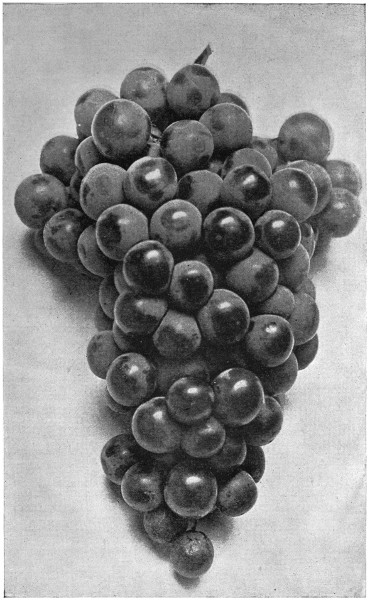
Muscatel or Gordo Blanco Raisin Grape, Second Crop. Two-thirds Natural Size.
Varieties.
—The grape used for raisins is a variety of the Muscat,
very similar to the Muscat of Alexandria. Grapevines transplanted
to California resemble this variety very much, but, according to Professor
Hilgard, set their fruit better, and do not suffer so much from
colure. It is said that these grapes were imported to Chile long ago
by the Spanish conquerors, and it is supposed they grew the vines
from seed brought from Spain, and selected the best of the seedlings.
In this way the slight difference of the Huasco grape from the Muscat
of Alexandria can be accounted for.
Soils.
—The soil in the coast valley consists of a reddish, sandy loam,
which changes to a fine yellow sand, of great richness. This sand
covers the hills almost everywhere in the vicinity of the Huasco river,
the nature of the country being a rolling one.
Climate.
—The climate is notoriously dry, and rain falls only very
seldom between June and September, is of short duration and very
scant. In the interior valley, rain is said to be seldom known, and
the climate there can be called entirely rainless. Dew is abundant in
the winter, but the summers are warm and dry.
Irrigation.
—Near the coast no irrigation is required, but in the interior
valley the grapes are irrigated three times a year, first when the buds
begin to swell, second when they begin to blossom, and lastly when
the fruit is well advanced.
The Vineyard.
—The vines are planted six feet one way by eight feet
the other, and the intermediate space is often planted to alfalfa, giving
three crops of hay each year. The heads are kept low, the vines are
pruned heavily, and only two eyes left on each cane. Sometimes
whole branches are cut away, especially if they do not bear well.
The vines are grown both on hillsides and in the valleys on the bottom
lands. Many of the vineyards are surrounded by elevated arbors or
trellises, over which the vines are trained, to keep off the heavy spring
winds which otherwise would break the branches,—windbreaks, in
fact. The cultivation of the Huasco vines is of the most primitive
kind. The land is poorly cultivated, and the fact that alfalfa is grown
between the rows of the vines indicates that the industry is not highly
developed. On the other hand, it is not impossible that the crowding
together of various things on the land may help to give the grapes a
certain flavor or aroma.
There is said to be a great difference between the various Huasco
grapes, some being very superior to others. The inferior kinds are
called simply Muscats, while the better kinds are the Huascos. It is
not known if these varieties come from different kinds of grapes, but
it is likely that this is the case. Vines of the best variety transplanted
to other localities than the Huasco valley give invariably indifferent
results, and produce raisins inferior to the Huasco.
Drying and Curing.
—The poorer qualities are simply dried on boards
or on the roofs of the houses in the sun; but the fine and most valuable
raisins are dried in the shade. When ripe, the bunches are carefully
picked and taken to open sheds with thatched roofs, and there hung
up to dry. The raisins are turned at intervals, and when ready are
packed in twenty-five-pound boxes without any great care or skill. The
best Huasco raisin sells at fifty cents per pound in the local market,
and is decidedly the most high-priced raisin known. The best variety
is scarce even in Chile, and in Chilean statistics I could not find any
quoted. The following houses in Huasco are dealers in fruits and
raisins: Juan Quijada, Ramon F. Martinez, and José Manuel Balmaceda.
The export from the port of Huasco in 1885 amounted only to
$685,853. How large a portion of this was raisins is not known.
Early History.
—While the planting of raisin grapes and the production
of raisins in California dates back some thirty odd years, the raisin
industry cannot be said to be as yet twenty years old. Already, in
1851, Col. Agoston Haraszthy grew Muscatel vines from seeds of
Malaga raisins. On the 25th of March, 1852, he imported the Muscat
of Alexandria from Malaga, and ten years later, during a visit to that
place on September 27, 1861, he selected cuttings of the Gordo Blanco
which afterwards were grown and propagated on his San Diego county
vineyard. The same year he imported Sultana vines from Malaga, and
white and red Corinth from Crimea. Col. Haraszthy was thus the first
one to introduce the raisin-vines in this State. Another importation of
the ovoid Muscat of Alexandria was made in 1855 by A. Delmas and
planted at San José, according to a statement made by his son D. M.
Delmas,[3] the prominent San Francisco lawyer. G. G. Briggs of
Davisville also imported Muscatel grapes from Malaga in Spain; while
R. B. Blowers of Woodland, Yolo county, started his raisin vineyard
in 1863 from Gordo Blanco cuttings received from Col. Haraszthy.
In 1876, W. S. Chapman, imported the best Muscatels from Spain for
his colonists in the Central California Colony in Fresno, which proved in
no way different from those already growing there. Who produced the
first raisins in California will probably never be satisfactorily known.
According to page 88 of the Report of the State Agricultural Society
of California, 1863, cured raisins were exhibited by Dr. J. Strentzel at
the State Fair in 1863.[4] The first successful raisin vineyards in the
State were those planted by G. G. Briggs at Davisville in Solano
county, and by R. B. Blowers at Woodland in Yolo county. Both
these gentlemen grew the raisin grapes on a large scale, and shipped
raisins extensively. The Briggs vineyard consisted mainly of Muscats
of Alexandria, while the Blowers vineyard contained the Gordo
Blanco. Both these vineyards produced raisins as early as 1867; but
it was not until 1873 that their raisins cut any conspicuous figure in the
market. That year six thousand boxes were produced in the State, the
majority by far coming from these two vineyards.
Later Planting.
—In 1873, in the fall, the Muscat vines were first
brought to the Fresno raisin district, where twenty-five acres of Muscat
of Alexandria were planted in the Eisen vineyard. A few years later,
or in 1876 and 1877, T. C. White planted the Raisina Vineyard in the
Central California Colony near Fresno from Gordo Blanco Muscatels
brought from R. B. Blowers’ vineyard at Woodland. The following
year, or in 1877-78, Miss M. F. Austin began improving her Hedgerow
Vineyard, also in the same colony, with grapes of the same kind as
Messrs. White and Blowers. Robert Barton had also planted some
twenty-five acres of Muscat grapes, but did not make raisins until
later. The year 1879 saw the first planting of the A. B. Butler vineyard,
now the largest vineyard in the State. J. T. Goodman had
begun improving his place at the same time; while Col. William Forsyth
entered upon raisin-grape growing between 1881 and 1882, most
of his grapes, however, being planted a year or two later. From that
time the raisin vineyards in Fresno multiplied rapidly, and about 1886
and 1887 raisin production became recognized as the principal industry
of the district.
The history of the development of the raisin industry in the other
districts of the State runs very much the same. Riverside had entered
the field in 1873, when the founder of that colony, Judge John Wesley
North, planted there the first raisin-vines of the variety Muscat of
Alexandria. But raisin-grape growing did not become general until
1875 and 1876, when the largest vineyards in the colony were planted.
In El Cajon valley in San Diego county, the first raisin vines of the
Muscat of Alexandria variety were planted in 1873 by R. G. Clark; but
the raisin industry did not get a good start until some six or seven
years ago, while most of the vineyards were planted from 1884 to 1886.
In Orange county, raisin grapes were planted at the same time as in
Riverside and El Cajon by MacPherson Bros., near Orange, now called
MacPherson. The raisin industry developed rapidly, and Robert MacPherson,
the largest grower and packer in the district, and at one time
in the State, handled yearly over one hundred thousand boxes, while
the yearly crop of the district rose to one hundred and seventy thousand
boxes.
In Central California, the raisin industry is gradually spreading from
the original center around Fresno, the greater freedom from rain and
the better facilities for irrigation being great inducements for the settlers
to engage in the growing and curing of the raisin grapes. The
San Joaquin valley is especially adapted to the production of raisins,
the Fresno raisin district being by far the largest, and now producing
almost one-half of the raisin crop of the State. In San Bernardino
county and district, the raisins are also grown to great profit and with
great facility, and are of equal quality with those of the interior of the
State. But the raisin industry is here gradually giving way to the
culture of oranges and other citrus fruits, and the increase in the raisin
acreage has therefore not been so great as in the San Joaquin valley.
In El Cajon, irrigation is not used, and the raisins produced there are
very similar to the Malaga raisins, but through absence of irrigation
the crops are smaller than in any of the other districts in the State.
In Los Angeles and Orange county district, the raisin industry has
suffered immensely from the ravages of the vine plague, an as yet
entirely mysterious disease, and the output of raisins there has dwindled
down to almost nothing. But the farmers of the district are ready
to replant whenever there are any prospects that the vines will do well
again.
In the interior of California, north of Solano and Yolo counties, large
quantities of raisin grapes have been planted during the last few years,
both in the foothill valleys, out on the plains, and in the bottom lands
of the Sacramento, Yuba and Feather rivers, etc. Raisins of very good
quality have been produced in that part of the State for years in
limited quantities, but it is yet a question to what extent that section
can compete with the central and southern parts of the State. In Sutter
county around Yuba City the cultivation of a seedless raisin grape
is advancing rapidly, the raisins made from it being of excellent
quality and finding a ready market.
Acreage and Crops.
—The quantity of raisin-vines planted cannot
be estimated correctly; but it is certain that at least sixty-five thousand
acres of Muscat vines are now set out in the State, including grapes in
bearing, as well as vines lately set out.
California enjoys a climate peculiarly adapted to the culture and
curing of the raisin grape. The summers are warm and rainless, the
winters again moderately rainy. The interior is free from injurious
fogs and heavy dews, while the most southern coast is only visited
by warm fogs, which are not greatly harmful to the grapes. Irrigation
is practiced almost everywhere, except in El Cajon valley, and
in some of the northern districts of the State, but even there it
is no doubt that judicious irrigation would be beneficial and greatly
increase the crop. The demand for California raisins has kept pace
with the improvements in curing and packing, and has steadily
increased from year to year. What the future has in store only the
future can tell, but it is almost certain that first-class raisins will always
be in demand, while inferior grades may from time to time bring lower
prices. The ruling price of raisins in sweatboxes, as they may be
had from those growers who do not pack themselves, has been from four
to five cents per pound. Of late years, the tendency is developing to
pay according to quality, and from three to seven cents was the ruling
price for unpacked raisins in sweatboxes during last season (1889).
This practice will greatly promote the raisin industry and encourage
growers to grow large grapes and fine bunches, and to cure their raisins
well. It will also benefit the buyers, who will know what they pay
for, and who will be able to furnish better grades, and more of the best
grades than formerly, when good, bad and indifferent raisins brought
five cents per pound.
The raisin crop of 1889 did not exceed one million boxes. Should
we venture upon a statement as to the distribution of the same among
the various counties or districts of the State, the following figures
would be found as near correct as it is possible to get them:
| Fresno district |
475,000 |
twenty- |
pound |
boxes. |
| Tulare |
15,000 |
“ |
“ |
“ |
| Kern |
4,000 |
“ |
“ |
“ |
| Yolo and Solano |
120,000 |
“ |
“ |
“ |
| Scattering |
25,000 |
“ |
“ |
“ |
| San Bernardino |
265,000 |
“ |
“ |
“ |
| Orange and Los Angeles |
8,000 |
“ |
“ |
“ |
| San Diego |
75,000 |
“ |
“ |
“ |
| |
987,000 |
“ |
“ |
“ |
Location and Acreage.
—The district is situated north of San Francisco
Bay, bordering on it as well as on the Sacramento river, and is
a part of the Sacramento valley. The number of acres overreaches
seven thousand, and is increasing yearly. The principal vineyards are
those of the late G. G. Briggs at Davisville, Solano county, with three
hundred acres, and at Woodland in Yolo county, four hundred and sixty
acres; E. Gould, also at Davisville, two hundred acres; H. M.
Larou, at same place, about fifty acres; sundry vineyards around
Davisville, fifty acres; around Woodland and Capay valley, some
four hundred acres;—or in full bearing more than two thousand
acres. The district comprises the southern part of Yolo and the
northern part of Solano counties. The grape used for raisins is
principally the Muscat of Alexandria, except the vineyard of R. B.
Blowers, which is composed exclusively of Gordo Blanco. The
Muscat of Alexandria is generally preferred, as it makes a fine raisin
and bears well.
Soil and Climate.
—The soil varies somewhat; the best is a deep gray,
alluvial bottom-land soil; other soils are not much thought of for
Muscatel raisin grapes. The average depth of water is about eighteen
feet from the surface. It is not necessary, as a rule, to first level the
land, as the ground is very level naturally. The rainfall averages
thirteen inches. The most rain falls in January and February; the
least falls in August. There is seldom a shower in the summer, but
about November 1st rains are almost always certain to interfere with
the drying of the grapes. Sometimes the rain comes in October, when
it causes considerable damage to the grapes and partially dried raisins.
There is very little dew in summer time, but plenty in October and
also some in September. The temperature is considerably modified
by the nearness of the bay. It reaches in the hottest part of
the summer one hundred and fourteen degrees Fahrenheit in the
shade, but only for a day or two. The average highest is about
ninety degrees Fahrenheit in the shade, while the heat almost every
day in July and August shows eighty-five degrees Fahrenheit in the
shade. Thus this district is considerably cooler than the San Joaquin
valley and San Bernardino county, but warmer than Los Angeles and
San Diego districts. There are heavy frosts in winter, when at times
even the thermometer falls to eighteen degrees Fahrenheit, although
this is the extreme low temperature, six or seven degrees of frost being
more common. There is spring frost in April one year in every three
or four, and the vineyards are then smoked to prevent injury to the
vines. Irrigation is not needed to produce crops, only to produce larger
crops, as it increases the yield fifty per cent. Generally two irrigations
a year are needed, the first one in early summer, the other later, when
the berries have begun to ripen. Water from ditches is used and
carried to the vines in furrows only, no flooding being practiced.
The Vineyard.
—In planting, cuttings are used principally, but
rooted vines are preferred by some. The distances most common are
ten by ten feet each way, one vineyard being set ten feet by sixteen
feet. The vines bear the third year. The ground is plowed and
cross-plowed, the first plowing being from the vines, and the second
to the vines. Harrowing and cultivating both ways are secondary
operations, continued to the middle of May, but seldom later. Hoeing
the vines finishes the work of the soil in the middle or end of May.
In pruning, the crowns are never raised over six inches above the
ground, from seven to eight spurs are left on large vines, and each spur
is pruned to two or three eyes each. Formerly more eyes, say from four
to five, were left on each cane, but it was found that this was too
many, hence the change to two or three eyes. Summer pruning is
practiced by some, but not by all; there is yet a controversy in regard
to its usefulness. When practiced, the vines are cut six or eight
inches from the tops, and this is done not later than June. Sulphuring
is in use everywhere; the vines are sulphured two times, once
before and once after the bloom. Sulphured vines do not suffer from
mildew. Colure, or the dropping of the young berries, is not common,
the Muscat of Alexandria even setting well. The leaf-hopper
(Erythroneura comes) is more common in some years than in others.
They eat the leaves and cause the grapes to sunburn. Grasshoppers
have never caused any damage. Grape moths are more or less common,
but never troublesome. Black-knot is often seen on neglected
vines, but is rare in old vineyards well cared for.
The Crop.
—The grapes ripen in September, generally from the first
to the tenth. The drying and curing occupies three weeks. The
bunches are placed on trays made of pine two feet by three. Several
growers have artificial dryers, which are needed for curing the second
crop. The sweatboxes are large enough to contain seventy pounds of
raisins, and are eight inches deep. In the Briggs raisin vineyard,
the following brands are packed: three crown Layer Muscatels; two
crown Layer Muscatels; one and two crown Loose Muscatels; Dehesas
and Seedless Muscatels. The raisins are seldom sold in sweatboxes,
and no fixed price is known for such raisins. Most growers pack their
own raisins. The oldest raisin vineyard is that started by the late
G. G. Briggs, and now owned by his widow. The most renowned
vineyard was that owned by R. B. Blowers of Woodland, which has
of late years been mostly replaced by other crops. Raisin land can
be had for from one hundred to one hundred and fifty dollars per
acre. This is vacant land of the very best quality. An average
profit of fifty dollars per acre is realized, although some have made
more money out of their vines. A yield of two or three tons of grapes
per acre is common. As regards prices of labor, etc., the following
were those most common last season: Man and team, who boards
himself and animals, three dollars and twenty-five cents per day, can
plow one and a half acres of vineyard well. Pruning, one man, one
dollar per day, can prune three hundred vines, or three-fourths of
an acre. Laborers generally board themselves. The raisins of this
district were the first ones in the State or on this continent to attract
attention, and they were the first which successfully competed with
Spain. The crop of 1889 reached one hundred and twenty thousand
boxes.
General Remarks.
—The Muscatel and Sultana raisin grapes grow
almost everywhere in the State, and it is therefore natural enough that
the planting of raisin-vines should have increased considerably of late
years, even in localities situated outside of those raisin districts mentioned,
which have already made a success of the raisin industry.
Below will be found a few notices from various such places which
aspire to raisin fame, some of which have yet to make their reputation
in this line. These notices are partly taken from the San Francisco
Chronicle, which paper went to the trouble and expense of collecting
such statistics at the beginning of the year. It must be remembered,
however, that these statements are more or less approximate. As will
be seen, all these localities here mentioned lie in the interior or the
Sacramento valley proper, enjoying an inland climate. The climate
in this valley is somewhat like that of the San Joaquin valley, of
which it is an extension. Only the heat in summer is less, the rain
in winter is more profuse, the showers in the spring of the year are
later and those of the fall are earlier.
Placer County.
—At Rocklin J. P. Whitney has two hundred and fifty
acres of raisin grapes, and is the largest raisin-maker in the county.
There are not over three hundred and fifty acres of Muscats devoted to
raisin-making in the county, and the total output this year was about
four hundred tons, most of which was shipped directly East. The
first carload of Muscat raisins sent East was shipped from the
Whitney vineyard about ten years ago. A large area of Muscat and
other vineyards will be planted this season, but none for raisin-making.
Yuba County.
—The raisin industry has received but little attention
in Yuba county, although it has long been known that raisins of
superior quality can be produced here. The area in raisin-vines is
about three hundred acres, which will probably be increased by several
hundred acres this season. Less than a hundred acres are in
bearing. The raisin vineyards planted last season are chiefly at
Colmena, midway between Marysville and Wheatland. The Muscatel
grape is planted to some extent, but the favorite grape is the Thompson
Seedless, a new variety of great promise.
Sutter County.
—The raisin industry of Sutter county dates back to
the year 1876, and the venture was first made by the late Dr. S. R.
Chandler three miles south of this city. The area now in raisin vineyard
is about six hundred acres, three-fourths of which are in bearing.
The crops marketed and prices received are about as follows:
Three thousand twenty-pound boxes at $1.65 per box; eight hundred
sacks of one hundred pounds each, at five cents a pound; five hundred
and twenty-five sacks of dried grapes of one hundred pounds
each, at three cents a pound. The home consumption is extensive,
but is not estimated. The county is well adapted to raisin growing
and curing, and received the second prize at the late Oroville State
Citrus Exposition. Muscatel and Thompson Seedless are the favorite
grapes. The soil of this county is very rich and warm, and no irrigation
has been practiced.
Colusa County.
—In the immediate vicinity of Colusa there are about
one hundred and fifty acres in bearing, and fully one hundred acres
more will be set out the coming season. The crop of raisins in 1888
was very insignificant; but in 1889 the Colusa canneries packed forty
tons in boxes. The prices ranged from $1.75 to $2.25 per box, according
to quality. These figures refer only to the territory lying within
a radius of eight miles of Colusa. Some of the finest raisin grapes
in the county are grown near College City, and the entire output was
at least eighty tons of raisins. Many of the people around Orland are
reported as going into the business on a large scale. The ranchers in
and near the foothills are also producing raisins of excellent quality.
A single vineyard of fifteen hundred acres is being planted in one
place in the foothills.
Butte County.
—While Butte produces a fair quality of raisins, her
vineyards are yet young and are just coming into bearing. The older
vines are those of General Bidwell, at Chico, covering about one hundred
acres, and those of Oroville and Mesilla valley, embracing about
the same area. A large number of young vines have been set out
during the past two years, and these number 52,200 near Oroville,
77,480 at Palermo, 67,200 at Thermalito, 20,570 at Wyandotte, 25,000
at Central House, 50,500 at Gridley, and something over 50,000 near
Chico. These have nearly all been planted within the past two years,
but a limited number are three years old. In the foothills are a number
of small vineyards, but it is impossible to ascertain the acreage
and product, though the total of each is not large. Practically the
bearing vines of Butte number between 300 and 400 acres. The one
and two year old vineyards embrace about 350 acres, so that a conservative
estimate for the total raisin vineyards of the county, young
and old, would be 700 acres. The raisins are all boxed and sold
directly by the vineyardists, the local demand taking nearly the whole
crop. The area to be planted this year will not exceed 250 acres.
Tehama County.
—The area planted to grapes in Tehama county is
over ten thousand acres. The greater part of the fruit grown is used
for wine, and probably one-third for raisins. All the raisins produced
here are packed in boxes, and a large portion is used in home consumption,
while the remainder is shipped. Probably about ten thousand
boxes in bulk and packed will cover the yield.
Shasta County.
—The raisin industry of Shasta county is only in its
infancy. There are 147 acres planted to raisin grapes within a radius
of fifteen miles from Redding. The largest acreage of raisin grapes
is in Happy valley. There are patches of grapes all through the foothills.
Probably not over one thousand boxes of raisins were shipped.
The planting of raisin grapes continues every year. Raisins are made
by many small growers, and sold here at an average of six cents per
pound.
General Remarks.
—The San Joaquin valley is well adapted to
raisins along its whole length almost, but especially in its central and
southern parts. The farther we go south in the valley, the drier is the
climate, and the less is the rainfall in the autumn of the year, both
conditions favoring the curing of the grapes. The present raisin
center is around Fresno City, where over twenty-five thousand acres
are planted to raisin grapes, principally Muscatels; but from this
locality the industry has been constantly spreading, until at present the
other counties in the valley, viz., Merced, Tulare and Kern, can show a
good acreage of young vines. Next after Fresno, Tulare county
produces the largest quantity of raisin grapes, and produces raisins
of the very highest quality. The principal raisin vineyards in that
county are situated in the Mussel Slough district, on the rich bottom
lands formed by the former delta of Kings river; of late, the planting
of raisin grapes has extended to other parts of the county as well. In
Kern county few old raisin vineyards exist, the oldest one being situated
on the Livermore ranch, being a part of the Haggin and Carr tract.
Several hundred new acres have been planted there this spring, especially
in the Rosedale, Lerdo and Virginia Colonies, as well as on the
plains near Delano. I need here hardly say that the raisins of Fresno,
Tulare, Kern and Merced counties should be all classed together, as the
climate in these various localities is one and the same, with only a slight
and gradual change as to rainfall as we go south in the valley. If there
will, in the course of time, be found some difference as regards quality
in the raisins of these various localities in the San Joaquin valley, this
difference will not be due to any great difference in the climate, but to
the variety of soil on which the grapes are grown. The raisins are only
grown on the level lands, situated from three to four hundred feet above
the sea.
Extent and Location.
—The Fresno district contains about thirty
thousand acres, out of which about twelve thousand are in good or full
bearing. Merced county has about two thousand acres, nearly all very
young vines. Kern county has probably about one thousand acres,
also very young vines, and some thirty acres of old vines. Tulare
county has about seven thousand acres of Muscats, a large part of which
is in full or good bearing. Many vineyards, large and small, are being
planted in these counties this year, but enough attention is not paid
to proper soil and to locality, and here, as elsewhere in the State, many
of these vineyards will not turn out as the owners expect they will.
In Fresno county, the old vineyards are planted principally around
Fresno City, while in late years other raisin districts or sub-districts are
growing into prominence around Malaga, Sanger, Selma, Fowler and
Madera. The varieties used are principally the Gordo Blanco Muscatel,
much mixed with the Muscat of Alexandria. There are some few
acres of Sultanas and White Corinths, and of late many Malagas
have been planted.
Soils and Climate.
—There are several different varieties of soils in the
district,—the red or chocolate-colored sandy loam principally east of
the railroad, the white, ashy soil west of the railroad, and the very
sandy soil, generally occurring in elevated ridges. We have also the
deep, gray-colored bottom land in the river bottoms or along the rivers
and creeks. The best grades of the chocolate and reddish loams,
and of the river bottom soil, is considered the best for raisins. The
very sandy soil and the alkali soil should not be used for raisin
purposes. The climate is warm and dry during the summer, while the
winters are not very rainy. From seven to ten inches of rain are an
average in Fresno; south to Kern the rainfall decreases, five and
a half inches being an average around Delano. Towards the northern
end of the valley, the rainfall increases, and in Merced county varies
between ten and twenty inches, fifteen inches being a high average.
In no portion of the raisin-producing portion of the valley can raisin
grapes be grown without irrigation, the natural rainfall being entirely
insufficient. The lowest temperature is about eighteen degrees Fahrenheit
in Fresno, generally in January, while the highest is one hundred
and eighteen degrees Fahrenheit in the shade in July and August. The
lowest temperature is reached once in from three to five years, and the
highest quoted is similarly scarce. The high average in summer
time is one hundred and ten in the shade, and for three months of the
year the thermometer every day can be counted on to vary between one
hundred and one hundred and ten in the shade. In the winter,
twenty degrees Fahrenheit is often reached, and the end of December
and January may be counted on as being cold and frosty. These
figures all refer to the level plain land, where the most of the vineyards
are planted, and not to the foothills or the thermal belt, nor to the
high Sierra Nevada, where snow and ice are common, and where
glaciers cover many of the highest mountain peaks. The most rainfall
occurs from December to February, and the rain continues more or
less scattering to April and May. There is only very seldom a shower
in the summer, one perhaps in three years. In the mountains, the fall
rains commence about the middle of August, on the plains again in
October and November, sometimes even later. Dew is rare in summer
time, but common from the beginning of October. Fog is rare, sometimes
an unwelcome visitor in November, but never known at any
other time of the year. Spring frosts are almost unknown, and occur
only once in from five to eight years.
Irrigation.
—Irrigation is practiced wherever raisins are grown. The
water is taken from the rivers,—from Kings river in the Fresno
district, and from the Merced, Kaweah and Kern rivers, etc., in the
other districts. Before irrigation was begun in the Fresno districts,
there were from fifty to sixty feet of dry soil before the natural water
level was reached; but this has been so changed through a few
years of constant irrigation, that now in places the land is subirrigated
or moist to the surface, while in places even the soil requires to be
drained, and no other irrigation is now needed except to allow the
water to flow in the main or secondary canals, from which it seeps and
keeps the soil filled with water, the moisture rising from below. The
irrigation when practiced is done by flooding or by irrigating in furrows.
New land must be irrigated until it becomes subirrigated; but, when
once this is done, no separate irrigation becomes necessary. Many
vineyards planted on subirrigated land which was once dry land have
never since been irrigated.
The Vineyard.
—The general distance of the vines is eight by
eight or ten by ten feet, varying in different vineyards. Of late, there
have been some efforts made to improve upon these distances, and to
have them planted closer one way than the other, say five by ten or six
by twelve feet. The vines begin to bear the second and third years,
and if planted on proper soil should pay the fourth year and give
an income the fifth year. Some vines have been known to pay the
third year, there being much difference in this respect. Both cuttings
and rooted vines are used, rooted vines having been preferred during
the last few years. The ground is plowed in various ways in the
winter time, according to the ideas of the owner. Cross-plowing is
sometimes practiced. The general rule is to first plow one way, and
then to cross-cultivate repeatedly until the soil is level and the weeds
are destroyed. In wet places, the cultivation is kept up until July, but
in proper places the working of the soil is finished in the early part of
June.
Pruning and Other Operations.
—The heads of the vines are kept
low,—from six to sixteen inches above the ground. The canes are cut
to two or three eyes, and the number of canes left vary from five to
fifteen or more. The pruning is done between December and February.
Summer pruning is practiced by some, but not by all growers, there
being considerable difference of opinion as to the value of this operation.
Sulphuring is practiced by all growers, some sulphuring only
once, but the best vineyards are sulphured three or more times.
Oidium or mildew never appears in sulphured vineyards. Some few
growers sulphur with great success against the colure or dropping of
the grapes. Leaf-hoppers are common, but do no great harm. Grasshoppers
and grape caterpillars were troublesome one or two seasons, but
have not reappeared of late. Black-knot is common in many places.
The Crop.
—The grapes begin to ripen in the middle of August, or
from the middle of August to the first of September, and at the latter
date the first boxes of cured and packed raisins are generally heralded
through the press. The first grapes dry in from seven to ten days, but
the later grapes require three weeks or more. The drying continues
through September, and for the second crop through October and even
in November, or until the rains set in. The grapes are dried on trays
two by three or three by three feet. The sweatboxes are generally two
by three feet and from six to eight inches high. A large number of
brands are packed, such as Imperial Clusters, Dehesas, Layers, Loose
and Seedless. The common price for raisins in sweatboxes is from three
and a half to six cents, five and five and a half cents being the average
for good layers. Good land for raisin purposes can be had for one hundred
dollars per acre, but nearer the town of Fresno is held higher.
Bearing raisin vineyards have changed hands at as high as $1,000 per
acre. From one hundred to two hundred and fifty boxes of raisins are
realized per acre, and the profits vary from seventy-five to two hundred
and fifty dollars per acre, according to location, soil, management, etc.
From thirty to fifty dollars per acre is spent yearly in many vineyards.
Few dipped raisins are produced. Some dipped Sultanas have brought
seven cents in the San Francisco market. Last season about four hundred
and seventy-five thousand boxes were produced in the Fresno
district, and some twenty thousand boxes more in the other parts of
the San Joaquin valley.
Location and Acreage.
—San Bernardino county, California, is entirely
an inland county, sheltered by low and high hills from the ocean.
Fogs and dew are rare, in places unknown, and the county offers
unusual advantages for raisin-growing. The vineyards are widely
distributed through the county in different localities or raisin centers,
all of which are greatly similar as to climatic conditions, except as
regards altitude. The San Bernardino vineyards are the highest
elevated above the sea of any in California. Below will be found a list
of the raisin centers in the county, with the number of acres and their
altitude above the sea. It must be understood that each locality has a
large extension as regards altitude, and varies in many instances several
hundred feet; this fact being indeed a characteristic of the San Bernardino
county vineyards. The raisin centers in San Bernardino county
are:
| Riverside, |
1,500 |
acres. |
Altitude |
above |
sea, |
900 |
to |
1,000 |
feet. |
| Redlands, |
800 |
“ |
“ |
“ |
“ |
1,200 |
“ |
1,600 |
feet. |
| Highlands, |
400 |
“ |
“ |
“ |
“ |
|
1,500 |
feet. |
| Ontario, |
500 |
“ |
“ |
“ |
“ |
983 |
“ |
2,350 |
feet. |
| Cucamonga, |
—— |
“ |
“ |
“ |
“ |
900 |
“ |
1,500 |
feet. |
| Etiwanda, |
700 |
“ |
“ |
“ |
“ |
|
1,200 |
feet. |
There are several other localities where raisin vineyards are found in
smaller quantities, and it is safe to estimate the number of acres in the
county at over five thousand. Nearly all these vineyards are situated
on mesa lands, by which is meant the lands situated between the river
bottoms and the foothills. As a consequence, the surface water is never
near the top, but generally far down, and even continued irrigation would
not be liable to raise it much higher, as the water will as rapidly drain
off through the substrata, which generally consists of sandy soil and
gravel. The land is in fact well drained, and differs in this respect from
the plains of the San Joaquin valley. In Riverside, the surface water
is from thirty to fifty feet down, and only in one or two vineyards
situated deep down in the arroyo is the surface water as shallow as ten
feet. These latter vineyards are never irrigated. In Redlands the
surface water is at an average of thirty feet on the mesa lands. In
Ontario the surface water is even deeper, and found at from seventy to
eight hundred feet, and the shallowest water in the district is, according
to Mr. W. E. Collins, twenty-five feet below the surface. It is the
general belief in the San Bernardino district that deep water is necessary
for, or at least beneficial to, raisin grapes, and that shallow
surface water is conducive to all kinds of diseases. In this I cannot
agree, as contrary to my own experiences and to the experiences of
the Spanish growers.
Climate.
—As regards temperature, there is some difference in the
various districts. A true comparison between them and other districts
is almost impossible, as the signal service thermometers are placed at
unequal heights above the ground, and in localities with very different
characteristics. It can, however, be said that the winter climate of
the district is much milder during the winter than that of the plains of
the San Joaquin valley, and very similar to the Orange county and
the San Diego districts. In Riverside and Redlands, the thermometer
seldom reaches one hundred and nine degrees Fahrenheit in the shade
during the summer, and in winter seldom goes below twenty-four
degrees Fahrenheit, while twenty-eight or twenty-seven degrees Fahrenheit
is no unusual occurrence once every year, but is considered the
extreme of the season. It may thus be seen that raisin vineyards and
orange orchards may be and actually are grown side by side in every
part of San Bernardino county, and this is a distinct characteristic
of the district, which, however, it shares with Orange and San Diego
counties. The warmest months are August and September, and
October is generally fine for drying. So is November, and only twice
(in 1885 and 1889) has there been any serious difficulty in drying the
grapes. In two other years the crop has suffered slightly, but during the
majority of seasons in the months of November there has not been any
rain on the mesa lands, and it is this absence of fall rains which makes
it possible for the raisin-grower to dry his crop without any other
appliances than raisin-trays. Dew and fogs are very rare, and occur
only very seldom during the summer months. When they do occur
at this time, they are of but short duration, and last perhaps only
from five to seven o’clock in the morning. In the fall of the year, in
October and November, the desert wind blows warm and dry, and
hastens the drying of the raisins. It may blow three or four
times during the season, but has also been known to be entirely
absent. The rain in the winter season is light, in Riverside twelve
inches being an exceptionally wet season. From six to eight inches
are the usual rainfall, while again the actual average for Riverside is
six and one-fourth inches. In Ontario the rainfall in 1887 was 8.21
inches, and in 1888 9.23 inches.
Irrigation.
—In Riverside grapes cannot be grown without irrigation
on the mesa lands, with the exception of one or two localities in the
arroyo. In the Ontario district, raisin grapes may be grown without
irrigation in the center of the valley, but on the mesas, higher on the
sides, they must be irrigated, and even in localities where they could
be grown without artificial irrigation the same is always practiced
whenever it can be obtained. Less water is, however, needed than
in the San Joaquin valley, but more than would suffice in El Cajon.
Through the nature of the gravelly subsoil, the raisin land cannot fill
up with water. Seepage is only possible to a limited degree; summer
irrigation is always required. The vines are irrigated three times a
year, in April, June and August. The system of furrows is used, and
a ten-inch flow is considered enough to irrigate one acre of grapes
during one day and night each time. In Ontario the raisin grapes are
irrigated every five weeks, not, however, while they are in bloom, as
it is considered best to wait until the berries are well set. In Redlands,
one irrigation after the winter rain ceases is considered enough, even
on soil with thirty feet to water.
Soils.
—The soil in San Bernardino county varies considerably.
In Riverside and Redlands the best soil is a reddish loam, with some
sand and gravel. But in Riverside we also find sandy soil of lighter
color and strength, which, however, is less suited to grapes. In
Ontario the soil varies from a heavy clayey adobe to a lighter but very
rich sandy loam of a grayish color. The very sandy soil in some
river bottoms, especially around Lugonia, has, through experience,
been found to be entirely unsuited to the raisin grapes.
The Vineyards.
—The variety used for raisins is nearly entirely the
Muscat of Alexandria, although several vineyardists call these grapes
incorrectly the Gordo Blanco. I saw nowhere this variety, but I
suppose some must have been imported there. In planting, cuttings
have been preferred, probably because they are the cheapest, and
because the value of rooted vines has not been properly understood.
The vines are set, almost everywhere, eight by eight, only in a few
vineyards nine by nine feet. There is, however, a growing belief
that eight by ten feet or eight by twelve feet is better than the old
accepted eight by eight feet. But I believe that this tendency to give
the vines greater room will, in course of time, be followed by the
opposite tendency to plant them closer, at least one way, and give
more room the other way. The Muscat of Alexandria begins to bear
in three years, and in four years will pay fifty dollars per acre. The
practice of plowing is, in Riverside, to first plow towards the vines in
the fall, and then, when the vegetation has begun in the spring, the
soil is turned back towards the center of the space between the rows,
or from the vines. Then the soil is cultivated with chisel-tooth
cultivators, both crosswise and lengthwise, also similarly after every
irrigation. But this practice is not entirely the same everywhere, and
the different vineyardists have here as elsewhere different ideas, even
in regard to the most common farm or vineyard practices. Pruning
was formerly done much closer than now, but it was found that by
close pruning the vines bore less. To-day from fifteen to twenty spurs
are left on the strongest vines, and on every spur about two eyes.
From twenty to twenty-five spurs were found to be too much; with
such quantity of spurs the vines produce smaller and inferior grapes.
Some vines which were pruned with twenty-five spurs last year have
this year been given nine or ten spurs only, so as to enable them again
to recover and grow strong, when the quantity of spurs will again be
increased to fifteen. Summer pruning is used by some, but not by
others. It does not, according to observation, injure the vine, but
produces always a second crop, which is difficult to cure. Sulphuring
the vines is practiced by some, but not by all, growers. A great many
cannot see the use and value of sulphur. No one sulphurs for colure
or the dropping of the grape, which is quite a common occurrence.
The vines, however, never suffered from the leaf-hopper nor the grape
caterpillars, but sunscald is not uncommon, nor is black-knot.
The Crop.
—The Muscat grapes begin to ripen in Riverside later
than in the San Joaquin valley, and picking commences between the
10th and the 30th of September. Highlands is said to be two weeks
later than Riverside. The first crop is ready to turn in two weeks,
and is ready for the sweatbox in three weeks’ time. For drying, trays
are used, and about twenty pounds are placed on each tray. These
trays are all made of pine or fir. Redwood has been found unsuitable,
as imparting both a color and a taste to the raisins if accidentally wet
by early showers in the fall. Size of trays, two by three feet, with a
cleat nailed at the short ends, but none at the long ends of the trays.
Sweatboxes receive the raisins when they leave the trays. Formerly
the sweatboxes were much larger and deeper than now, eight or even
twelve inches in depth not being unknown. Of late sweatboxes are
made two by three feet, or of the exact size of the trays, and not over
six inches in depth. A greater depth makes the boxes too heavy to
handle, and also causes the bunches to break. The packing of the
raisins in Riverside and in the Southern California raisin districts
generally is done by the method known as “top up.” That is, the
first raisins are placed in the bottom of the box and successive layers
are placed on top, until finally the top layer is put on the last. The
lever press for the compression of the layers is a Riverside invention.
A modification of this press is now in use in nearly all districts where
the “top-up” method of packing is practiced. The brands packed
are as follows: Three Crown London Layers, Two Crown London
Layers, Three Crown Loose Muscatels, Two Crown Loose Muscatels,
and Muscatels in sixty-pound sacks; also Seedless Muscatels in sacks
of sixty and thirty pounds respectively. Cotton sacks are commonly
used for the two latter brands. The brands are apt to vary from year
to year, according to the fancy or ideas of the packers, new ones of
which are in the field every year. Only those who both produce and
pack have anything like established brands. The prices paid for
raisins in sweatboxes have varied in different years. In 1887 and 1888,
the price was from four and one-half to five cents per pound. In 1889,
the price rose to five and five and three-fourths cents, and in one or two
instances six cents were paid.
The Profits and Other Items.
—The profit varies, of course, greatly,
but an average profit may be considered to be from about $125 to $150
per acre. The yield of an acre is variable, but from eight to ten tons of
fresh grapes is said not to have been uncommon. In some cases the yield
has been much higher and the profit larger. I have from trustworthy
source the statement that one vineyardist who owns only a few acres,
I believe only five, and who has given all his time and attention to
these vines, has realized as much as $430 per acre. This I quote only
as an instance of what might be done with care and expense in an
exceptionally favored locality. Some few growers have realized $250
profit on each of a few acres, which also is to be considered exceptional.
I believe my former statement of $150 per acre as being
reliable and attainable by all San Bernardino county raisin-growers
who have good land, and who give their vines sufficient care. As
another instance of a high yield, I copy below an account of the
vintage of C. Newton Ross of Etiwanda, San Bernardino county, California.
The article appeared in the Press and Horticulturist of Riverside,
September 27th, and I have every reason to consider it trustworthy.
The writer adds that the yield is extraordinary. “Mr. Ross has
seventeen acres of 8,000 vines five years old from which he picked
8,648 trays of grapes that average twenty-five pounds to the tray,
or a total of 108 tons of grapes, which will make thirty-six tons of
raisins,—equal to 3,600 boxes,—over 200 boxes to the acre. This is
the first picking only, and it is estimated that the second crop will be
half as large as the first, which will give a total yield of 318 boxes to
the acre. Mr. Ross has sold his first crop at five and one-half cents per
pound in the sweatbox, which will give him an income of $242 an
acre on the first crop, and half as much more on the second crop if he
succeeds in saving it in good shape, or a total income of $363 per acre
on his crop. Mr. Ross estimates that $50 an acre will cover the entire
cost of taking care of the vineyard and putting the crop in the sweatbox,
and this would leave him a net income of $313 an acre for his
vineyard, which is ten per cent on $3,130 per acre.” But, I may add,
it is not likely that such a profit can be realized year after year.
As regards care of the vineyard and expenses of running the same,
they vary, of course, and are estimated at from twenty dollars
upwards. But the best vineyardists spend from thirty to forty dollars
per acre in the care of an acre, but in this do not include interest,
trays bought, etc., nothing in fact but “care.”
Vines were first planted in Riverside by Judge John Wesley North
in 1873. Vacant land that is suitable for raisins may be had with
water for $250 per acre. Some land with choice locations is held at
higher prices. The highest yield of raisins in San Bernardino has
been 290,000 boxes in 1888. Of this Riverside produced 150,000 boxes,
Etiwanda 30,000 boxes, and Ontario 15,000 boxes. The raisin shipments
from Riverside during the fall of 1889, up to December 12th, amounted,
according to the Daily Press, to 216,000 boxes. There was a balance
on hand of 7,000 boxes, making the total production 223,000 boxes.
It is estimated that the value of this crop was $3,500,000 at wholesale.
Later advices give to the county 265,000 boxes as last season’s crop.
The San Bernardino raisins are superior both as regards quality and
size, and raisin growing and curing is a profitable business, eminently
suited to the settler with small means, who cannot invest large capital,
nor can afford to wait long for a return. No dipped or sulphured
raisins have ever been produced in the district, although dipped raisins
would prove profitable. Especially does this refer to the second crop,
which ripens enough to make good raisins, but which cannot be cured
when the early rains set in.
General Remarks.
—On account of the vine disease which has been
injuring the Orange county raisin and wine vineyards, this district has
a special interest to every one engaged in grape-growing. While the
country has received a hard blow through the injury and destruction
of so many of its vineyards, still it is likely that it will recover and
rise as soon as the vine disease leaves.
Location.
—The Orange county raisin district lies close to the sea.
Of all raisin districts, it is nearest the ocean, the average distance of
the raisin vineyards from the latter being eight to twelve miles, some
few perhaps a little more. As will be seen, the district resembles in
this respect some of the Mediterranean districts, such as Malaga and
Smyrna, where the vineyards come within actual reach of the sea
fogs. On one side of the Orange county district we have the ocean,
on the opposite side it is bordered by rather high foothills, beyond
which are the San Bernardino county vineyards, some forty to sixty
miles away.
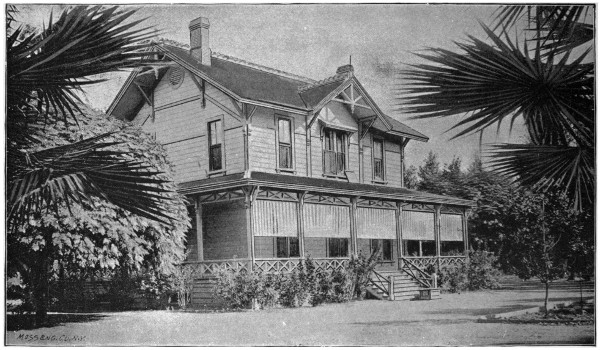
A Raisin-grower’s Residence at Fresno.
Climate.
—The nearness to the ocean modifies the climate much.
The temperature is more even all the year round than anywhere else
on the coast where raisins are grown. The extreme of heat is 105
degrees; in fact, July 27, 1889, it was 104 degrees Fahrenheit in the
shade, while in the winter it seldom goes lower than 28 degrees
Fahrenheit, and indeed very, very rarely as low as that. In many
places there is no frost at all, except, perhaps, one in April, which, of
course, cannot but prove damaging to the vines. This absence of
heavy frost, which is beneficial to every other semi-tropical product,
is not favorable to the vine. The grape requires heavy frost to become
dormant. The farther south we go the less frost and the less grapes,
at least of the Asiatic kind. There are, as we know, native grapes even
in tropical countries, but they are adapted to their surroundings and
cannot be considered here. The proximity to the coast modifies the
air considerably. With 100 degrees Fahrenheit in the shade, which
is an exception here, I felt as warm as I do in the San Joaquin valley
with the mercury at 114;—the two extremes in both places affect us
just the same. The air here is certainly much more moist, which again
must have a marked effect upon the vine, and in no small degree
promote fungoid growths, or parasites generally. In this respect, then,
the coast vineyard must certainly be at a disadvantage. The fog is
not an unusual visitor in the district between the coast and the foothills,
which, in fact, covers the whole area ever planted in raisin
grapes. For days in succession every morning is foggy, and the fog
condenses on the leaves of the trees and falls under them in real
showers, making the adjoining and underlying road wet. For a few
days again the sun will rise bright, again to be followed by foggy
mornings. By from nine to eleven o’clock the fog is again gone and
the sun shines brightly. Every evening and morning there is a heavy
dew, and every branch, leaf or grass is then dripping wet. Several
mornings when the fog was in I found the thermometer at 62 degrees
Fahrenheit, while at noon it rose to over 100.
Soils and Ripening.
—The soil here is the very best, and I doubt if the
same fine quality of soil is found anywhere else in California over the
same extended territory. I ride for miles and miles, everywhere the
finest and richest loam of a gray color, sometimes a little drawing
towards slate blue, sometimes again towards yellowish. It is immensely
rich, and can hardly be improved. There is, however, especially near
Orange, a different kind of soil consisting of the sand loam, but intermixed
with very coarse gravel. This soil is warmer but consequently not
so rich. The grapes ripen on it two weeks earlier, but yield only one-half
as much as those on the richest loam along the creeks. The vines
planted here were alone the Muscat of Alexandria. Strangely enough
I find no traces of Sultanas or currant, which latter, it seems, should
be especially adapted to the coast climate.
The Vineyards.
—In planting a vineyard, rooted vines were seldom
used. Cuttings grew so readily and so well that they were much
preferred. I am told that five per cent loss was unusual. It must be
remarked that the moister is the air the better it is for any kind of
cuttings. The moisture sustains and nourishes the wood while it is
making roots. As to distances, I remarked nothing new. Eight by
eight or eight by ten feet seems the generally adopted way. The
nature of the soil and climate make higher cultivation a necessity.
McPherson Bros., who packed the largest quantity of raisins and
owned the finest vineyards, told me that they plowed and cross-plowed
and cultivated from fourteen to sixteen times every season;
in fact they never ceased working the ground. The pruning was
begun in December, or as soon as the leaves began to turn and fall.
To begin with, only a few spurs were left on every vine, and on every
spur three eyes, including the bottom eyes, but experience taught that
that way was not the very best. Gradually more space was given the
vines, and now from fifteen to twenty spurs to a vine in full bearing
is considered proper. Summer pruning is only practiced in some of
the vineyards where the ground is quite wet. The most profitable
vineyards were irrigated. The nearer the coast the more moisture
there is in the soil. Thus three miles west of Santa Ana the ground
is always moist enough to grow grapes, but as we come nearer the
foothills to the east, the moisture is farther down. At Tustin, Orange,
and especially at McPherson, irrigation was practiced in all first-class
vineyards. Some were irrigated in the winter only, and this was
considered the best; others again were irrigated also once in summer,—a
practice the best vineyardmen considered unnecessary and even
injurious. I found land near the town of Santa Ana moist one inch
below the surface, where no irrigation had even been practiced.
Sulphuring was used everywhere to counteract the oidium. For this
purpose powdered sulphur was dusted through the vines as soon as
the grapes were as large as small shot. From three to four sulphurings
were used every year with a week between each. Sulphuring
for the colure or dropping of grapes was not known; in fact I am
informed that this colure was seldom known. Besides mildew, there
are few enemies to the vine here. Grasshoppers, leaf-hoppers and
grape moths have never been known to molest the vines. When the
late vine-plague struck the country the vineyardists were entirely
unused to fight any enemy of the vines besides the oidium. Sunscald
of the berries was not known.
The Crop and its Curing.
—The grapes begin to ripen in the end of
August, say about the twenty-fifth, on the gravelly soil, but on the
cooler and richer bottom land very much later, or about the middle
of September. The harvest then begins; the grapes are picked on
trays two and a half by three feet and placed to dry in the sun; the
drying takes two or three weeks or more, and is accomplished with
some difficulty. Two years the grapes had to be carried out to the
Mojave desert, to be dried there. The trays are placed among the
vines in such a way that the trays from three rows are placed in one.
To protect them from the fog and dew, they are covered with canvas.
This is done in two ways. One way is to put small pegs on one side
of the trays. The long canvas is furnished at intervals with rings,
which are slipped over the pegs and thus held steady on one side.
In the daytime the other end of the canvas is simply thrown back
over the pegs; in the night-time the canvas is again turned over the
trays, resting directly on the grapes. The other and better way is to
run three wires along the row of trays, one on each side of the trays.
The canvas is furnished with rings on each long side, which are made
to run on the wire. The center wire is run a little higher up, and here
and there simply supported by posts. It takes comparatively little
time every evening to run the canvas along the wires and cover the
trays. The expense is considerable, both in furnishing and preparing
the canvas, and in maintaining and operating it. The peculiar climatic
conditions of the district, however, necessitate some such contrivance
for the drying of the grapes. The vines seldom bear a second crop of
any importance. Sometimes in October the district is visited by a
warm and dry desert wind called the Santa Ana wind. It comes
from the cañon of the Santa Ana river, and originates, no doubt, in
the Mojave desert, and rising high up in the air is again precipitated
over the hills on the lowlands towards the ocean. This Santa Ana
wind is always welcome. It hastens the drying of the grapes just as
the Terral or land winds from the plains of La Mancha hasten the
drying of the grapes of Malaga in Spain.
Yield and Profits.
—The yield is quite small on the gravelly soil, at
the most being three tons of green grapes to the acre, on richer land
from six to seven tons, and in rare instances ten tons to the acre. I
heard of one vineyard where the owner had sold from twenty acres
of Muscatels thirty-three tons of raisins and fifty-six tons of green
grapes, equal to about 155 tons from the lot. Another lot of three-year
Muscatels bore ten tons to the acre,—indeed a very unusual yield
anywhere for Muscatels. I hear reports of some wonderful yields and
high profits, but am informed by the most experienced and trustworthy
that $125 per acre is an average profit which can be relied
upon year after year. The first Muscat vines were planted near
Orange, now the station of McPherson, about 1873, by McPherson
Bros. The acreage in grapevines in the Orange county district was
about 8,000 acres; but probably over half of it is wine grapes. The
highest output of raisins was 170,000 boxes of twenty-pounds each.
Location and Acreage.
—The El Cajon and Sweetwater valleys are
the raisin centers of San Diego county. The former contains about
four thousand acres of Muscat vines, the latter about five hundred
acres. Magnificent-looking Muscat grapes are also grown within
three miles of San Diego. Escondido is by many pronounced superior
for raisin grapes to any of the other places; but El Cajon is the present
center of the raisin industry, and is likely to remain so for years. The
raisin-growing section of the two valleys lies from about fifteen to
seventeen miles from the coast line, and at an altitude of from 450 to
500 feet. The arable land in El Cajon valley contains 50,000 acres,
or perhaps less, and consists of the rolling bottom of the valley, but
which can in no way be classed as bottom land. The land partakes
more of the characteristics of mesa or upland, and extends on all
sides, slightly undulating upon the sides of the hills. Lower hills
and behind them, again, higher hills surround the valley, and the
high peaks beyond the Cuyamaca Mountains reach 4,500 feet or more.
None of these hills or mountains in sight are covered with timber of
any kind, and even the valleys are without the usual sycamores. Only
in the very narrow bottom of the creek is there a vegetation of willows
and shrubbery.
Climate and Rainfall.
—The rainfall of the valley varies considerably.
It has been known to be as little as six inches and as much as
twenty, the average probably being about twelve inches, distributed
as generally elsewhere in California,—during the winter months. In
summer time it seldom rains,—perhaps a shower in two or three years.
September is the warmest month, or at least the month with the
greatest number of warm days. The highest temperature reached in
the shade in El Cajon is 105 degrees Fahrenheit, and in Sweetwater
valley 108, and the coldest in the winter twenty-four degrees Fahrenheit
on the upper mesa land, while on the lower land, close to the
river, the temperature falls low enough to kill orange trees, probably
somewhere about eighteen degrees Fahrenheit. September is freer
from fog than any other month. During the other summer months
there is fog in the morning two days out of three. The fog, however,
is warm and pleasant to all but consumptives, but, nevertheless, leaves
behind a soaking dew on all vegetation, and is even heavy enough to
moisten the dust on the roads. The moisture on this mesa land—by
which is meant all the land between the hills, which are too steep
to be plowed, and the actual river bottom lands—is near the surface.
In the El Cajon and Sweetwater valleys, the water is found on this
mesa at from eight to twenty feet, or at an average of from twelve to
fifteen feet. On little hills or knobs in the valley the water is found
at about the same depth. It is strange that with the water so near
the surface no perennial vegetation of either shrubbery or trees should
be found on this land. The grapevines will grow on it without irrigation;
in fact none is used anywhere now, but no doubt it would prove
profitable to irrigate somewhat, so as to increase the crops of grapes.
Water can be had through the Cuyamaca flume, but has so far not
been used. The vines do not grow after August 1st, and may stop
growing sooner.
Soils.
—The soils of the district are of four kinds: First, reddish
clay mixed with gravel, the color changing between light chocolate
and deep reddish. This soil is considered by many the most desirable.
Second, a steel or slate gray adobe with much gravel of a coarse
nature. Third, black adobe with little gravel. Fourth, alluvial sandy
soil, apparently consisting of decomposed granite mixed with much
vegetable matter. This soil is coarse, of a dark steel-gray color, very
easily worked; it is considered the best for raisins, but it contains
streaks where they will not grow and prove profitable. The last-named
soil goes gradually over into common alluvial soil of a sandy
nature. The two last-named soils are found principally in the Sweetwater
valley.
The Vines and the Vineyard.
—In planting, cuttings are generally
used, not because they are most preferred, but because good rooted
vines cannot be obtained. The distance to, and the difficulty of
reaching, this district was formerly such that roots would suffer in
transit and would rapidly dry, while cuttings could be had handy
and fresh. The vines, originally planted eight by eight feet, have
been given more distance of late, some vineyardists planting them eight
by twelve feet, while others prefer twelve by twelve or ten by twelve
feet. The varieties used are the Muscat of Alexandria only. This
variety happened to be the one that was imported first from Riverside,
I believe, and it was afterwards propagated by every one. The variety
as grown in El Cajon is the type of Muscat of Alexandria with oblong
berries, large clusters with loosely hanging berries and large strong
stems. The shape of the vines is erect, with a few center shoots,
strong and upright. The vines commence bearing the second year,
and are said to pay expenses of caring for in the third year, but I
think it would be safer to say in the fourth year.
As regards cultivation and plowing, many plow both ways and
harrow and cultivate crosswise several times until the 1st of June,
when, on account of the dryness of the soil, no more weeds start and
no cultivation of any kind is needed. The large majority of the vineyards
are splendidly kept, not a weed being seen anywhere for miles
around. Winter pruning commences as soon as the leaves fall. In
former years from five to nine spurs were left in pruning and two or
three eyes on each spur, but it has been found profitable and judicious
to leave more spurs, so as to take the sap in the spring, and now from
twelve to fifteen spurs with two or three eyes each are left every winter.
Spring or summer pruning has only been practiced the last two
seasons, and being found very profitable is now adopted by everybody.
The vines are not pinched, but headed well back as soon as the grapes
are well set. This method has in this district the following advantages:
It gives better shade to the bunches on account of the production of a
strong second growth; it causes the bunches to fill better, and, finally,
it leaves more room between the rows of the vines. I was told that
any of these three advantages would warrant the system of summer
pruning to be generally adopted. The valley has been unusually free
from any insect pest, such as leaf-hoppers (Erythroneura comes) caterpillars,
grasshoppers, etc., but suffers from mildew, not, however, to
the extent that the presence of almost daily fogs would lead us to
suppose. Sulphuring is now practiced to some extent, but not as
much as it should be. The sulphur is applied with bellows as soon as
the berries are the size of shot, but not before. Sulphuring for colure,
or the dropping of the grapes when very small, is not practiced, nor
was it ever suspected that it would help. Colure is quite common,
much more so on sandy soil. Sunscald is frequent but not bad. I
saw quite a number of grapes scalded on every vine, but not enough
to warrant any special measures to be taken as a protection. The
grapes have during this and last year ripened by the first days of
September, but it is generally much later, or at about the 10th of
September, when the vintage usually commences. The picking was,
until last year, done by white labor, but the same was so very difficult
to obtain that Chinese were then employed. They gave satisfaction
to some, while to others not. Some of the principal growers are this
year (1889) going to employ Chinese help at $1.25 per day, at which
price they board themselves.
The Crop.
—The grapes are dried on redwood trays made of sawed
redwood shingles, three-eighths of an inch thick. The trays are made
two by three feet. The best growers are this year going to assort the
grapes when putting them on the trays. This was never done before,
but will be of great advantage. A tray will average eighteen pounds
of fresh grapes, which will take about one month to dry,—never less
than three weeks. There is but little second crop, generally none
that can be saved. September is the warmest month, or else the grapes
could not be dried. At a temperature of 103 degrees Fahrenheit, it
was found that grapes scalded or cooked while on the trays. This is,
however, very rarely the case. From ninety-five to one hundred
degrees is considered the best temperature at which the best raisins
are made. The sweatboxes used formerly were two by three feet and
ten inches deep; but of late eight inches and six inches in depth is
considered the best, on account of the facility with which they can be
handled. As to packing, many advocate twenty-pound boxes, that
are only four and one-half inches deep, contending that they will hold
twenty pounds of loose raisins. Few Dehesas are put up, the general
brands being three crown London layers, and three crown loose
Muscats. Some are also put up in fancy paper boxes. This year the
valley has two packing companies, who buy raisins in sweatboxes, and
pay from four to five and a half cents per pound. The yield per acre
is from two to three tons of green grapes, I should say this year nearer
two than three tons. I saw, however, some that would average five
tons per acre, but this land was favorably situated in a moister place
than is generally found in Sweetwater valley, and the vines were yet
growing on August 21st. I heard of much greater yields, so extraordinary
indeed that they are not likely to return again. From five to
seven tons to the acre is a really rare yield, even on the best land,
where the water is within six or seven feet of the surface. This shows
me conclusively that judicious irrigation would materially increase the
crop, and greatly improve the uniform size of the berries. The profit
on an acre of bearing Muscat vines is from fifty to one hundred and
twenty-five dollars per acre. The latter is the most any one realized,
and thirty-five dollars is considered a good profit. The expense of
running a vineyard is hard to ascertain, but those best informed told me
that forty dollars per acre would be an average; this of course includes
everything. The small amount of weeds and the absence of irrigation
materially lessens the expenses of the El Cajon vineyards.
Good vineyard or raisin land can be had for seventy-five dollars
per acre. No vineyards in bearing have changed hands. Last year’s
(1888) pack of the whole of San Diego county was variously estimated
at from twenty to thirty thousand boxes, and this year at sixty thousand
boxes of twenty pounds each.
The unanimous verdict of the best growers in El Cajon is that want
of moisture is the greatest drawback to raisin culture there. And I
agree with them in this, but also think it might to some extent be
remedied, as water for irrigation is close at hand. At last I must say
a few words as to the quality of the El Cajon and Sweetwater valley
raisins. They are very sweet, highly flavored, the skin is thin, and
the seeds are small and few. But while some of the berries are of very
large size, there are comparatively few which would be considered
large, and even the best bunches have too many small berries. The
grapes that had plenty of water were simply magnificent, and a general
irrigation system would greatly improve the size of the grapes, as
well as the quality of the crop. The best selected raisins from this
valley must be counted as among the very best. The constant fog
injures the bloom on the raisins to some extent, and most raisins that
I saw were in this respect deficient; but their color generally was very
good. The Sweetwater valley raisins are in this respect finer than
those of El Cajon; they are also farther inland, and have less fog.
The Escondido raisins are said to be superior, but I saw none of them.
While many vines have been planted in this locality of late, only one
or two small vineyards are in bearing.
Of late raisin grapes have been planted in considerable quantities in
Salt river valley and in Gila river valley in Arizona, but the outcome
of the venture is yet unknown, at least to us. The growers of Arizona
claim for their localities the advantage of great earliness, as the grapes
ripen there in July, or a month earlier than in California.
In the Argentine Republic in South America it is said that the Spanish
immigrants have planted many raisin grapes during the last few
years. In Australia we are also informed that dipped raisins, and perhaps
even sun-dried ones, have been produced, but even there the
result is unknown to us. So far these raisins have cut no figure in the
general market, but it is not improbable that many localities in those
vast countries will be found where Muscat grapes can be profitably
grown and cured.
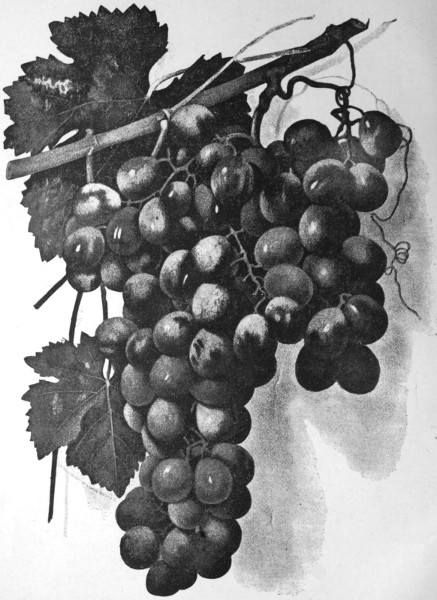

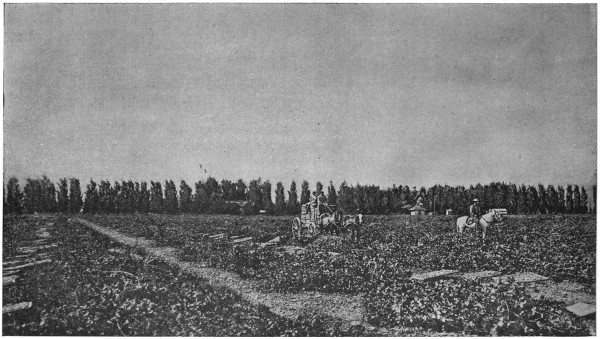
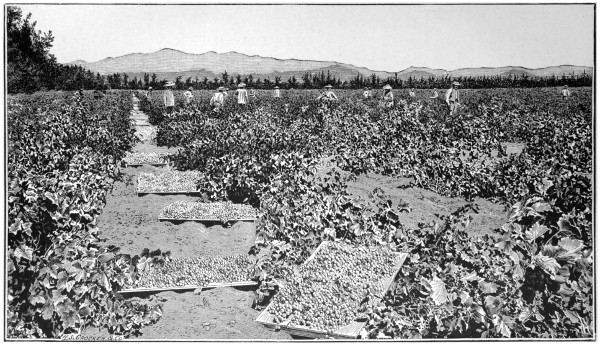
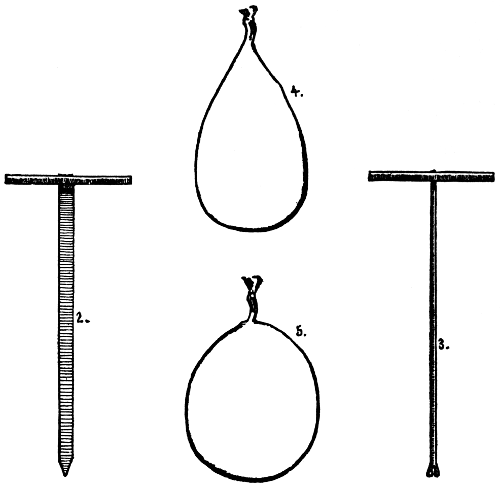
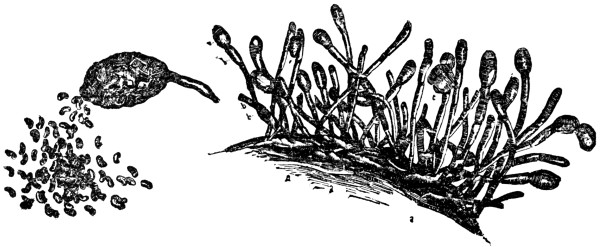
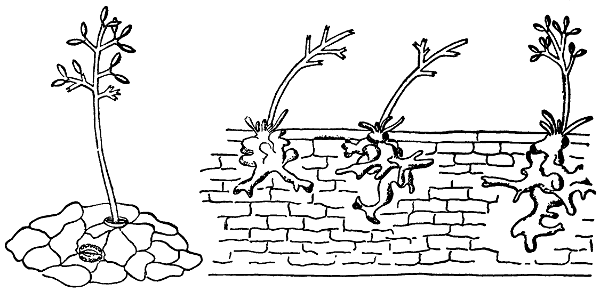
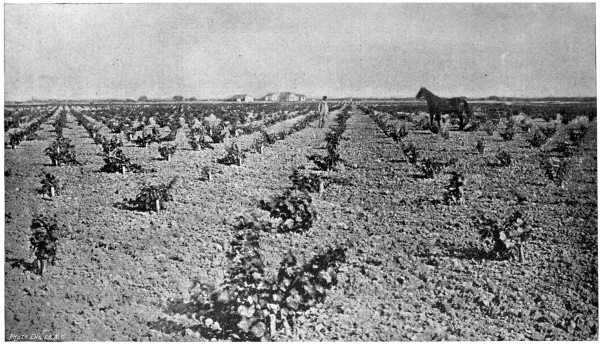
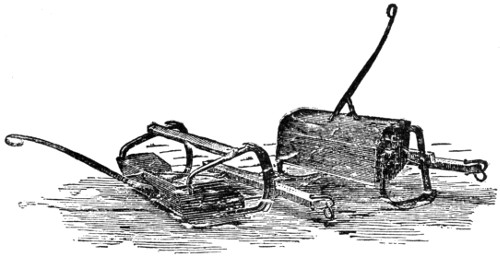
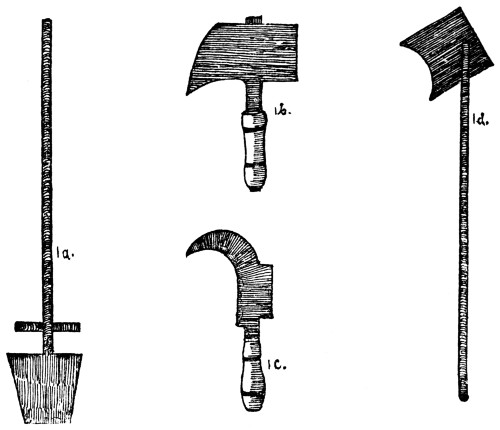
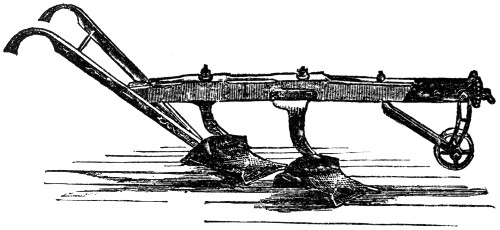
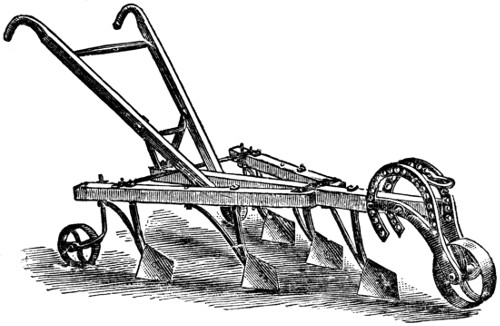
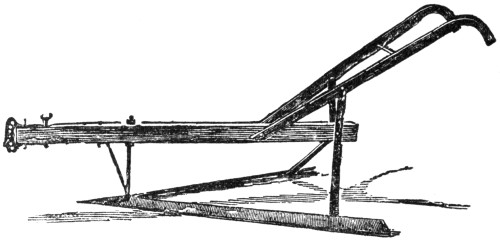
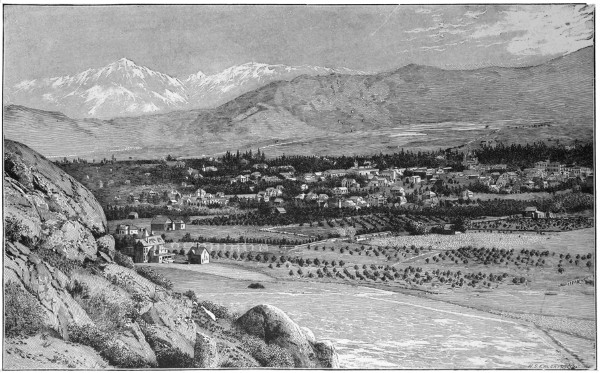
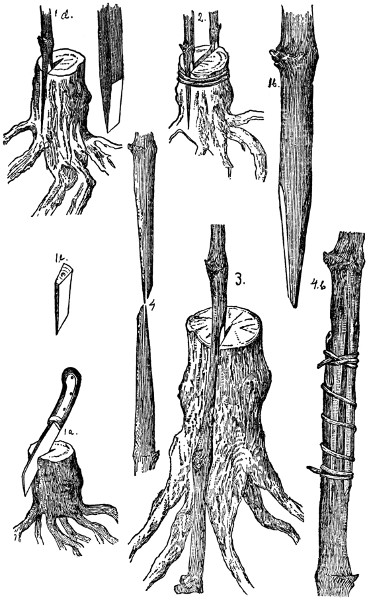
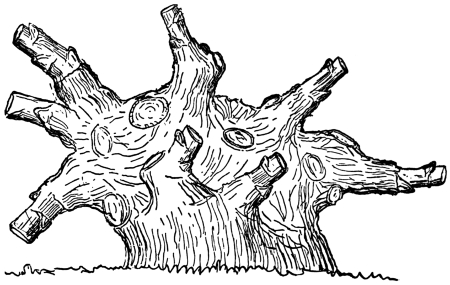

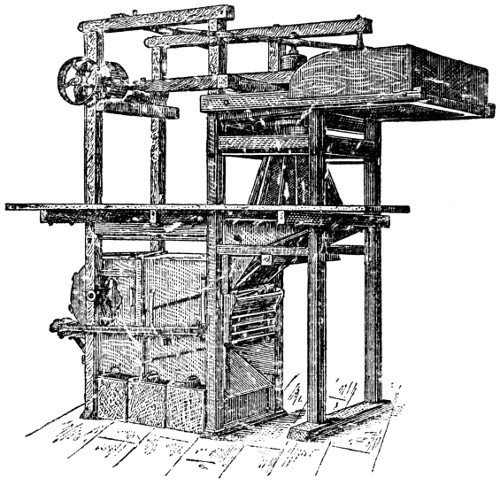
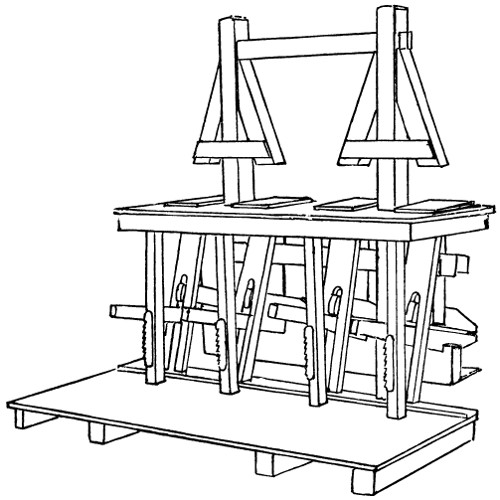
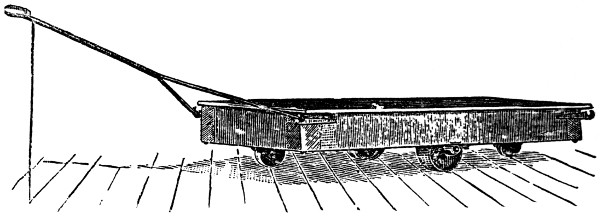
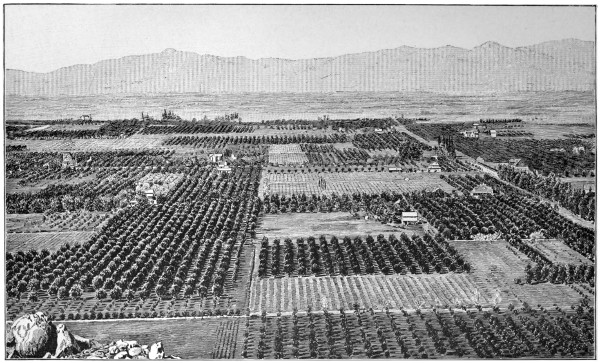

 CALIFORNIA.