REGULATION
At the time that these lines are being written the railroads of the United
States are entering a veritable no man’s land. The ponderous Newlands
committee of Congress has begun its hearing and accomplished little; so
little that it has asked and received an extension of time of nearly
eleven months in which to go into the entire question more thoroughly. We
all hope it does. The Adamson bill, establishing the so-called eight-hour
day for certain favored classes of railroad employees, is statute, but its
constitutionality is yet to be established. And the railroads are
preparing to fight it, in its present form, and to the bitter end. General
sympathy seems to be with them; it is quite probable that even the four
brotherhoods that fought for the measure—unlike the Pears Soap boy—are
not quite happy now that they have received it.
In the midst of all this confusion President Wilson, assured of a second
term of office and so of a reasonable opportunity to try to put a concrete
plan into effect, has emerged with his definite program, not radically
different from that which he evolved last August at the time of the
biggest of all crises between the railroads and their labor, but which was
warped and disfigured until its own father might not know it. His plan, as
now is generally known, provides not alone for the eight-hour day for all
classes of railroad employees, but includes the most important feature of
compulsory arbitration referred to in an earlier chapter.[17]
It now looks as if the United States was upon the threshold of the
eight-hour day—in many, many forms of its industrial life. I believe
that, in his heart, the average railroader—executive or employee—favors
it, fairly and honestly and efficiently applied. It has been charged as
the first large step forward toward the government operation of our
railroads, yet I cannot see it as nearly as large a step as the extension
of the maximum weight of packages entrusted to the parcel post, a system
which if further extended—and apparently both legally and logically
extended—might enable a man to go up to Scranton and place enough postage
stamps upon the sides of a carload of coal to send it to his factory
siding at tidewater. Compared with this the eight-hour day is as nothing
as a step toward government operation or ownership. A genuine eight-hour
day is, of course, a long step toward the nationalization of our
railroads—quite a different matter, if you please.
President Wilson’s entire plan, as it has already been briefly outlined,
forms a very definite step toward such nationalization. It at once
supersedes the indefinite quality of the Newlands committee hearings—no
more indefinite at that than the average hearing of a legislative
committee. When the Wilson plan has been adopted, fully and squarely and
honestly, either by this Congress or by the next, it will then be the
order of the day to take up some of the next steps, not so much, perhaps,
toward the nationalization of our railroads as toward the further
bettering of their efficiency and their broadening to take advantage of
some of their great latent opportunities as carriers of men and of goods.
The men who control our railroads today look forward to such a definite
program with hope, but not without some misgivings. For, after all, we are
by no means nationally efficient, and there seems to be a wide gulf
between the making of our economic plans and their execution. No wonder,
then, that the railroads are dubious. They are uncertain. They have been
advised and threatened and legislated and regulated until they are in a
sea of confusion, with apparently no port ahead. The extent of the
confusion is indicated not alone by their failure to handle the traffic
that has come pouring in upon them in the last days of the most active
industrial period that America ever has known, but by the failure of their
securities to appeal to the average investor—a statement which is easily
corroborated by a study of recent Wall Street reports. And what would be a
bad enough situation at the best has been, of course, vastly complicated
by the labor situation.
We already have reviewed some of the salient features of that situation;
we have seen, of organized labor, the engineer and the conductor at work;
and of unorganized labor, the section-boss and the station agent. We have
seen the equality of their work and the inequality of their wage. It is
futile now to attempt to discuss what might have happened if the pay
envelopes of all these four typical classes of railroad employees had been
kept nearer parity. As a matter of fact the disagreeable and threatening
situation between the railroads and the employees of their four
brotherhoods is largely of their own making. If, in the past, the
railroads had done either one of two things there probably would be no
strike threats today, no Adamson legislation, no president of the United
States placed even temporarily in an embarrassing and somewhat humiliating
position. The railroads, in the succession of “crises,” as we have already
studied them, must have foreseen the inevitable coming of the present
situation. They could have fought a strike—and perhaps won it—at any
time better in the past than at the present. The brotherhoods have gained
strength and the efficiency of unison more rapidly than the railroads. And
even if the railroads at some time in the past had fought the issue and
lost it, they at least would have had the satisfaction of having fought a
good fight and an honest one. Institutions are builded quite as frequently
on defeats as upon successes.
Or the railroads might have sedulously recognized the nonunion worker in
their ranks and by a careful devotion to his position and his pay envelope
kept his progress equal to that of his unionized brother. True, that would
have cost more in the first place, but it now looks as if the railroad
would have to pay the amount in the last place—and the accrued interest
is going to be sizable.
It is not yet too late to do this last thing; it is a principle for which
the railroaders should fight, into the last ditch. The greatest of the
many fundamental weaknesses of the Adamson bill is the bland way in which
it ignores this principle—the way in which, as we already have seen, it
singles out the four great brotherhoods for the generous protection of the
so-called “eight-hour day,” and leaves all the other railroad workers out
in the cold. Or is it a method of proselyting by which the four
brotherhoods hope to force the other branches of railroad workers into
organization?
It is not too late for the men who control our railroads to offset such
brutal forms of proselyting by raising the status of their unorganized
labor—voluntarily and in advance of possible legislation, if you please;
with a generosity of heart that cannot fail to make a warm appeal to
public sentiment. It is not too late for our railroads, on their own part,
to consider labor from as scientific and as modern a viewpoint as they do
their physical and financial problems. It is not too late for them to
raise up high executives who shall make labor, its emoluments and its
privileges, its possibilities of evolution their whole study. In an
earlier chapter of this book we discussed this matter in detail; called
attention to the lack of new blood of the right sort coming to the ranks
of the railroad, to the opportunity of fixing wages upon a purely
scientific as well as a cost-of-living basis; suggested even the broad
possibilities of the bonus system as well as the abandonment of the
complicated double basis of payment to trainmen which has crept into
effect.
Upon these foundations the pay envelopes of the railroad worker in the
future must be figured. If the railroads themselves are incapable of so
establishing it—and in full fairness to them it must be stated that the
time may have passed when they were capable of accomplishing this, unaided
at least—then the national government must step in and do it. The
Interstate Commerce Commission may be asked to establish, with compulsory
arbitration, not only a minimum but a maximum rate which the railroad may
pay its various classes of employees—and so still another great step will
be taken in the nationalization of our system of transportation. Call it
socialism, if you like; I do not, but I do feel that it is another large
step toward nationalization.
Moreover, the very consideration of the topic brings us at once to the
greatest immediate necessity of the railroad—unified regulation.
Unified regulation is the crux of the railroad situation today, from the
railroad executive’s, the investor’s, and the patron’s point of view. Your
wiser executive is holding the question of increased rates in abeyance for
the moment. He is devoting his best thought and his best energy toward
simplifying and bettering railroad control. He has a frank, honest motive
in so doing. Not only will he build toward permanence of the great
national institution with which he is connected but he will begin also to
induce Capital—the wherewithal with which to build up properties and
pay-rolls and possibilities—to come once again toward the bedside of the
sick man.
Capital is a sensitive creature. Conservative is far too mild a word to
apply to it. Capital takes few chances. And the steady and continued talk
of the plight of the railroad has driven Capital away from the bedside of
the sick man. Yet Capital, if unwilling to take chances, rarely overlooks
Opportunity. And if Capital be convinced that Opportunity is really
beckoning to the Railroad, that fair treatment is to be accorded to the
patient at last, he will return there himself and place his golden purse
in the sick man’s hand. Only the wary Capital will demand assurances—he
will demand that the Railroad’s two nurses, Labor and Regulation, be asked
to mend their manners and that that fine old physician, Public Sentiment,
be called to the bedside.
Let us cease speaking in parables, and come to the point:
Railroad regulation today is, of course, an established factor in the
economic existence of this nation. Already it is all but fundamental. It
came as a necessity at the end of the constructive and destructive period
of American railroading. I connote these two adjectives advisedly, for
while the railroad in a physically constructive sense was being built it
also was doing its very best to destroy its competitors. It had hardly
attained to any considerable size before the natural processes of economic
evolution began to assert themselves. Certain roads, stronger than
others, still stronger grew. And as they stronger grew, the sense of
power, the economic value of power, came home the more clearly to them. To
gain power meant, first of all, the crushing of their opponents, if not by
one means then by another.
This is not the time or place to discuss the great evils that arose from
the unbridled savagery of cut-throat competition in the seventies, the
eighties, and the early nineties. The whole rotten record of rebates, of
sinister political advantages gained through bribery of one form or
another, has long since been bared. The illegitimate use of the railroad
pass in itself makes a very picturesque chapter of this record.
Such a condition of affairs could not go forward indefinitely. In this day
and age it is a wonder that it existed as long as it did exist. Out of
this turmoil and seething chaos was born Railroad Regulation. She was a
timid creature at first, gradually feeling her increasing strength,
however, and not hesitating to use it. For a long time she had a dangerous
enemy, a fellow who up to that time had allied himself almost invariably
with railroads and railroaders—the practical politician. Eventually this
fellow took upon himself the rôle of best friend to Railroad Regulation.
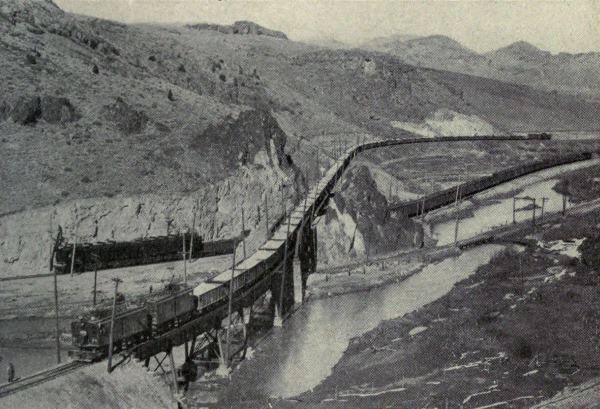
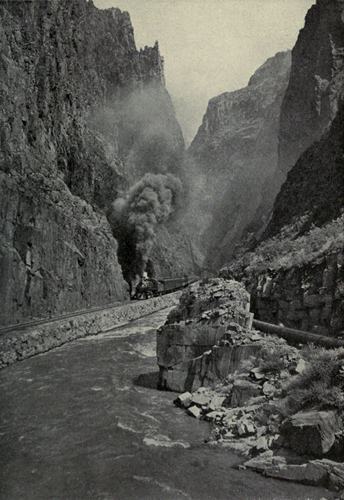
THE ROYAL GORGE, GRAND CANYON OF
THE ARKANSAS, COLORADO
The most remarkable chasm in the world
traversed by a railroad.
The effect of the railroad pass upon the dishonest newspapers was only a
little less potent than upon the dishonest politician. Put in its
kindliest light it was a softening influence in the editorial sanctum.
When it was gone a sterner spirit began to assert itself in a large
portion of the press. The railroad was being called to account for its
sins more sharply than ever before. And a smarting politician who went
before a legislature with some measure striking hard at a railroad could
be reasonably assured of a large measure of support from the Fourth
Estate.
In the golden age of journalism both editors and reporters spent their
vacations in delightful, but distant, points. It was a pretty poor sort of
journalist who paid his fare when he wished to ride upon the cars.
Generally his own office took care of his rather extensive and extravagant
demands for travel. If, however, he happened to be employed upon one of
the few honest newspapers who had conscientious scruples about accepting
free transportation, either wholesale or retail, from the railroads, he
generally had recourse to the local politicians. There were aldermen in
New York, in Philadelphia, and in Chicago, undoubtedly politicians in
numerous other cities, who carried whole pads of blank railroad passes in
their pockets. It was only necessary for them to fill these out to have
them good for immediate transportation. The effect of this transportation
upon the political welfare of the railroads in city halls, in courthouses,
in state capitols, even in the national capitol itself—can well be
imagined.
There was another evidence of this golden stream of free transportation.
It was having a notable effect upon the passenger revenues of the
railroads, particularly in the relation of these revenues to the cost of
operating the trains. It was no unusual thing for a popular evening train
from some state metropolis up to its capital, to be chiefly filled with
deadheads. The railroads grew alarmed at the situation. It was beginning
to overwhelm them. They looked for someone to help them out of it. They
found that someone in Railroad Regulation—that spiritual young creature
who had been brought into the world and clothed with honesty and idealism.
Railroad Regulation came to their aid. Railroad Regulation abolished the
pass—the illegitimate use of the pass, at any rate. Long before this time
she had made rebating and bribery cardinal and unforgivable sins.
The effect upon the dishonest politician as well as the dishonest
newspaper was pronounced. The reaction was instant. If this new creature,
Railroad Regulation, possessed so vast a strength, the roads should be
taught to feel it. They would be shown exactly where they stood. And so it
was that viciousness, revenge, and a crafty knowledge of the inborn
dislike of the average human mind to the overwhelming and widespread
corporation seized upon Railroad Regulation.
Now the railroads were indeed to be regulated. The spiritual creature was
given not one iron hand but eventually forty-six. In addition to the
Interstate Commerce Commission down at Washington, each of forty-five
separate states gradually created for themselves local railroad-regulating
commissions. The efficiency of these boards was a variable quality—to say
the least. But if each of them had been gifted with the wisdom of Solomon
as well as with the honesty of Moses, the plan would not have worked,
except to the great detriment of the welfare of the railroads. No
railroader today will deny that it has worked in just such detrimental
fashion. He will tell you of instance after instance of the conflicts of
authority between the various regulatory boards of the various states
through which his property operates; of the still further instances where
these conflict with the rulings and orders of the Federal board at
Washington.
Railroaders have large faith in the Interstate Commerce Commission. They
believe that is both fair and able, a great deal more able than most of
the state regulatory boards. Yet even if all the state boards were as
efficient as those of Massachusetts or Wisconsin—to make two shining
examples—the system still would be a bad one. Today these state boards,
in many cases under the influence, the guiding power, or the orders of
erratic state legislatures, are imposing strange restrictions upon the
railroads under their control. In sixteen states there are laws regulating
the type of caboose a freight train must haul. Linen covers are required
for head rests in the coaches in one commonwealth; in another they are
forbidden as unsanitary. Oklahoma and Arkansas are neighbors, but their
regulations in regard to the use of screens in the day coaches of their
railroads are not at all neighborly. In one of them screens are required;
in the other, absolutely forbidden. It, therefore, is hard work to get a
train over the imaginary line which separates Arkansas and Oklahoma
without fracturing the law. According to a man who has made a careful
study of the entire subject, thirty-seven states have diverse laws
regulating locomotive bells, thirty-five have laws about whistles and
thirty-two have headlight laws. The bells required range from twenty to
thirty-five pounds and one state absolutely insists upon an automatic
bell-ringing device. The five-hundred candle-power headlights that are
good enough for Virginia may be used across the border in Kentucky, but
not in North Carolina, which will not permit lights under fifteen-hundred
candle-power. And South Carolina insists that the headlight shall be
ten-thousand candle-power or a searchlight strong enough to discern a man
at eight hundred feet. Nevada goes still further and says that the light
must show objects at a distance of a thousand feet.
Even the lowly caboose, the “hack” of the freight-trainmen, has not
escaped the attention of state legislators. While many states are quite
content with the standard eighteen-foot caboose mounted on a single
four-wheel truck, thirteen of them demand a minimum length of twenty-four
feet—Missouri twenty-eight and Maine twenty-nine—while fifteen insist
that there must be two of the four-wheel trucks. The legislators at eight
commonwealths have solemnly decreed that caboose platforms be fixed at
twenty-four inches in width, Illinois and Missouri require thirty inches,
while Iowa and Nebraska are content with eighteen and with twenty inches
respectively. A legislator’s lot cannot be an entirely happy one when it
comes to determining these details of railroad equipment. But then compare
his lot with that of the man who must operate the railroad—who finds that
one state compels the continuous ringing of the locomotive bell while a
train is passing through one of its towns; despite the fact that an
adjoining state makes such an act a criminal offense. The life of a man
who must operate a railroad over some seven or eight of these states is
certainly cast upon no bed of roses.[18]
Yet these are but the smaller troubles which await him. Take the question
of the so-called “full-crew” law: Beginning only a very few years ago a
wave of legislation swept over the country, compelling the railroads to
increase the number of brakemen that they carried upon each of their
trains. The carriers protested bitterly against the measure. They said
that it was arbitrary, expensive, illogical, unnecessary. But it was
indorsed by the labor organizations, and the politicians fell in line.
Twenty-two states passed the law. Governors Foss of Massachusetts, Cruce
of Oklahoma, and Harmon of Ohio vetoed it. So did Governor Hughes of New
York. Later Governor Sulzer of New York signed it. It also became
operative in Ohio. The people of Missouri, speaking through their
referendum, threw it out. But in twenty states it became and remains
statute—a greatly increased operating charge against the railroads which
operate through them. The “full-crew” law in Pennsylvania, in New York,
and in New Jersey costs the Pennsylvania Railroad an extra $850,000 a
year—five per cent, if you please, on $17,000,000 worth of capital.
The “full-crew” legislation has been followed more recently by an attempt
at legislation regulating the length of trains—freight trains in
particular. Some of the men who engineered the first crusade have been
responsible for the second. They have volunteered the suggestion that the
railroads have sought to offset the effects of the “extra crew” by
lengthening the trains. And they have countered by proposing statutes
suggesting that all freight trains be limited to fifty cars, about half of
the present maximum.
To the average man this will seem as logical as if the state were to step
in and tell him how long he must take to reach his office in the morning
or how long he must wear a single pair of shoes. To the railroader the
injustice of the thing comes home even more sharply. For these ten years
or more he has been working to increase the efficiency of his plant. He
has believed that one of the straightest paths to this end has been in
increasing the capacity of his trains—just as the carrying capacity of
merchant ships has steadily been increased. He has made this possible by
enlarging his locomotives and his cars, by laying heavier rails, by
rebuilding his bridges and by ironing out the curves and reducing the
grades in his tracks, by multiplying the capacity of his yards and
terminals—all at great cost. These things have made the 100-car,
5,000-ton capacity freight train not merely a possibility, but to his mind
an economic necessity as well. And this despite the interesting opinion of
Mr. Harrington Emerson which I have given in an earlier chapter.
Last winter, when the state of Illinois seriously considered the
legislation limiting train-lengths, the president of one of its greatest
railroads went down into the southern part of the state and said:
“Do you wish us to discard these strong new locomotives that we have been
building? Do you wish us to return to the small engines of a quarter of a
century ago? It would be inefficient, wasteful to use our modern
locomotives for the short-length trains. And sooner or later you would
have to bear the cost of the discarded equipment. State laws may be
erratic. Economic laws never are. They are as fixed as the laws of nature
or of science.”
And the state of Illinois took heed of what this man and his fellows said
and killed the piece of ridiculous legislation. But it is by no means
killed in some of the other states of the Union.
The conflicts between state authorities that we noticed already have borne
directly upon the railroad’s earnings. The conflicting intrastate rates
have borne far more deeply and far more dangerously upon them. Indiana
long since fixed the demurrage penalty at one dollar a day for each car
which a railroad failed to furnish a shipper; North Dakota made it two
dollars; while Kansas and North Carolina fixed it at five dollars a day.
Unscientific is hardly the word for such rate-making. And how shall one
term Kansas’ action, withholding passenger-fare legislation until she
found whether or not the supreme court of Nebraska would permit the
two-cent-a-mile bill of that state to stand?
If these rank discrepancies in the manhandling of rates by the various
states affected only their own territories it would be quite bad enough.
Unfortunately they play sad and constant havoc with the interstate
rates.[19] These are delicate and builded, many times, upon local or
state conditions. And this despite the fact that the vast majority of
freight traffic is interstate, rather than intrastate. The majority of the
grain from the farm lands of Nebraska or Minnesota is not destined for
Omaha in the one case, or Minneapolis in the other; yet these sovereign
states take upon their solemn shoulders the regulating of grain rates—to
the ultimate discomfiture and cost of the other portions of the land.
I have but to refer you to Justice Hughes’s decision in the so-called
Minnesota rate case. He showed how this arbitrary local outgrowth of the
obsolete doctrine of states’ rights worked to the utter and absolute
detriment of the nation as a whole. And yet in the six long years while
that case was pending the Great Northern and Northern Pacific companies
lost more than $3,000,000—a sum of money never to be recovered from their
shippers—as a result of the state’s unsustained reductions in freight
rates.[20] No better argument has ever been framed for the nationalization
of our railroads, for making the powers of the Interstate Commerce
Commission absolute and supreme.
No wonder, then, that the railroaders are praying that a way may be found
and found soon for lifting the entire authority over them out of the hands
of the forty-five present state boards of control—who never have agreed
and who apparently can never be made to agree on any one form of
procedure—and placing it in the hands of the very competent regulating
board down at Washington, enlarged and strengthened for its new burdens.
The Interstate Commerce Commission has never shown a tendency toward freak
rulings. Its time has been taken with genuinely important matters. On
these it has raised itself to its present high degree of efficiency. It
has shown itself capable of studying the details of complicated
transportation problems and rendering decisions of great practical sense.
But the scope, and therefore the efficiency, of the Interstate Commerce
Commission are closely hemmed in by existing laws. The latest “crisis”
between the railroads and the four great brotherhoods of their employees
brought this limitation sharply to the fore. It is therefore equally
essential that the power and scope of the Federal commission be broadened
as well as being made superior to those of the state regulating
boards.[21] And it is gratifying to note the progress that President
Wilson already is making toward the first of these necessary immediate
reliefs to the railroads of the land.
If President Wilson shall succeed in persuading Congress that the entire
control of the railroads should be placed in the hands of an enlarged and
strengthened Interstate Commerce Commission, he will have earned the
thanks of every man who has made an honest study into the situation. Such
a commission, clothed with the proper powers, could and would do much not
only toward relieving the railroads’ immediate necessities in regard to
both physical betterment and the enlargement of their pay-rolls, but in
enabling them to grasp some of the opportunities which we have outlined in
previous chapters—opportunities requiring a generous outpouring of money
at the beginning. If I mistake not, public sentiment is going to demand
that, if the railroads be granted the relief of unified regulation, they
shall be prompt in their acceptance of at least some of these great
avenues of development.
We have heard much in late years of the banker control of our railroads
and of absentee landlordism in their management. The two things are not to
be confused. Banker control is not, in itself, a bad thing. Absentee
landlordism invariably is. There are good stretches of railroad in every
part of the country that today are failing to render not alone the proper
income returns to their owners but, what is worse, service to their
communities, because of this great canker, this lack of immediate
executive control and understanding. And it is significant in this close
connection of two phases of the railroad situation that it was the banker
control in New York of the one-time Harriman system—the Union Pacific,
the Southern Pacific, the Oregon Short Line, etc.—that gave to it at one
fell swoop, five presidents—one at San Francisco, one at Omaha, one at
Portland, one at Tucson, and one at Houston—each a young, vigorous man
equipped with power and ability. The good effects of that far-seeing
move—that instant wiping out of the charges of absentee landlordism that
were being lodged against the Harriman system—are still being felt.
It is not banker control that is essentially bad for our railroads. It is
banker control together with an utter lack of vision, that has cost them
so many times their two greatest potential assets—public interest and
public sympathy. Banker control plus vision may readily prove itself the
best form of control for our carriers. And that our bankers do not
entirely lack vision may be argued by the far-seeing and
opportunity-grasping way in which our bankers of the newer school are
today reaching for American development in South America, in China, in the
Philippines, and in other parts of the world.
Back of the President, back of the Newlands committee and its rather
dazzling sense of importance, sits the nation. It is far superior to any
mere committees of its own choosing and it is weighing the entire
railroad situation as perhaps it never before has been weighed. It is
considering the enlargement and the strengthening of the Interstate
Commerce Commission—together with it a feasible method for the Federal
incorporation of our roads—this last a vital necessity in the mind of any
man who has ever tried to finance an issue of securities for an interstate
property with each separate state trying to place its own regulations—in
many cases both onerous and erratic—upon them. With the spirit of
Congress willing, there still remains the very large question of how far
its power would extend, in attempting either to reduce the power of the
state boards or to make them more amenable to the Federal commission. Our
states have been most jealous of their sovereign rights. And it is easy to
conceive that their aid and cooperation—so very necessary to the success
of the entire ultimate project of the nationalization of our railroads—is
not to be obtained by the mere wishing.[22]
President Wilson has set the beginnings for the plan and set them well. As
I write it is still up to Congress to undo its mischievous legislation
which, if it is made to include an eight-hour day, should render a genuine
eight-hour day, one applicable to every class of railroad
employee—although it would be difficult to imagine a railroad
superintendent or general manager or president quitting at the end of the
short-term service. They are schooled to harder things.
And with the eight-hour day must come these other things to which we have
already referred, not once but several times. First among these are the
matters so closely correlated in President Wilson’s program that they
cannot be separated from the eight-hour day: arbitration—compulsory
arbitration, if you please—the strengthening of the power of the
government to seize the railroads and operate them in a time of national
panic or military necessity, the enlargement of the powers and the
personnel of the Interstate Commerce Commission. With all these things
accomplished, and the situation just so much strengthened, it will then
become the duty of the railroads to reach out more generously toward their
opportunities for further development as the transport service of a great
and growing people. It will be necessary for them to attract, to train, to
reward new executives of every sort; to further their credit by deserving
credit, to show outwardly in a more potent way the thing that so many of
them have believed they inwardly possess—true efficiency, both for
service and for growth.
Please do not forget this great point of growth—of development, you may
prefer to put it. In my mind, men, institutions, nations, even railroads
never stand still; they either grow, or else they decline, they shrink,
they die. But the Railroad, as the greatest servant of a great people,
cannot die without bringing death to the nation itself. Therefore he
must grow. He must plan. He must announce his plans. He must bring
Public Sentiment to his aid. Law can do many things—but few of these
latter ones. Public Sentiment may accomplish every one of them, and almost
in a crack of a finger. No wonder that Capital—that conservative
fellow—longs to have him stand at the bedside of the Railroad.
The sick man is not without his ambitions—you may be sure of that. He
sees his opportunities, perhaps more clearly than ever before in the
course of his long life. He is anxious to be up and at them. But before
this can be done, some of these things, which we have outlined so briefly
here, will have to come to pass. There are reckonings to be made, huge
doctors’ bills to be met—and the American public will have to help meet
them.
The alternative?
There are many panaceas suggested; but I fear that most of these are but
nostrums. Ingenious, many of them are, nevertheless. And some of them come
from men who speak with both authority and experience. One man proposes to
have the entire Federal taxes paid through the railroad, which, in turn,
would recoup itself through its freight and passenger rates. He makes an
interesting case for himself. Another suggests a Federal holding company
for all the railroads of the United States and makes his suggestion read
so cleverly and so ingeniously that you all but forget that he is drawing
only a thin veil over government ownership. Of government ownership I am
not going to treat at this time; not more than to say that to almost all
American railroaders—big and little, employers and employed, stockholders
and bondholders—it represents little less than death itself to the sick
man of American business. In my own opinion it is, at the least, a major
operation—an operation whose success is extremely dubious.
INDEX
Adamson Bill, object and effect of, 235-239.
Aliens, value of, in railroad work, 74 ff.
American Railway Association, cooperation of, with government, 211.
Arbitration, compulsory, 240, 258;
in wage disputes, 57 ff.
Architectural problems in relation to increase of passenger traffic, 107 ff.
Atlantic coast, service of railroads in defense of, 192.
Automobile: effect of the, on railroad traffic, 134 ff.;
as a freight feeder of the railroad, 158;
operated on railroad tracks, 151.
Betterments and additions, amount needed for, 18 ff., 22, 26.
See also Railroads.
Branch-lines and their relation to automobile competition, 142;
opportunities neglected by railroads, 152, 156.
Brotherhoods, 90 ff.;
influence of, on wages, 95, n.;
strength of, 238.
See also Labor.
Canals, advantages of, to railroads, 176.
Capital, 4;
relation of, to earnings, 17;
Conductor, efficiency of the present-day, 45.
Cooperation of public vital to railroads, 179.
Cost of living, how influenced by railroads, 6.
De Luxe trains, economic wisdom of, 228.
Deficits, how met, 18.
See also Railroads.
Droege, John A., 211, 214.
Efficiency, 12, 15;
relation of, to economy, 13.
Eight-hour day legislation, 220, 236, 257.
Electricity as motive power, 105, 125, 129;
advantages of, 113 ff.;
in Boston, 114;
in Chicago, 117;
in Philadelphia, 119;
to freight traffic, 131;
to railroad systems as a whole, 129, 132;
to suburban systems, 121;
transformation of gravity pull into motive energy, 131.
Elliott, Howard, 179.
Embargoes: cause of, 9;
effect of, 15, 159;
motor truck, value of, in case of, 160.
Emerson, Harrington, 99.
Employees, number of, in interests allied to railroads, 5;
number of, on steam railroads, 5.
Engineer, efficiency of the present-day, 33 ff.
Engineering problems in relation to increase of passenger traffic, 109.
Excess-fare trains, 222, 226;
pending inauguration of, on western railroads, 227.
Extensions, difficulty of raising funds for, 26, n.
Freight and passenger traffic, economic difference between, 232.
Freight cars, number and condition of, in use, 24;
number needed per year, 22, n.
See also Railroads.
Freight feeder for railroad, automobile and motor truck recommended as, 158, 162.
Freight gateways as housing places of affiliated industries, 166.
Freight terminals, development of, 169.
Full-Crew Bill, the, 219;
legislation regarding, 247.
German railroads, efficiency of, 188.
Government ownership, 259.
Grade crossings, extent of removal of, 20-21.
Grain, cost of transportation of, 8.
Grand Central Station, the, 107, 110.
Gray, Carl R., 179, 211.
Harriman, E. H., 179.
Harrison, Fairfax, 211.
Hill, James J., 19, 21, 179.
Hine, Major Charles, 212.
Holden, Hale, 179.
Hustis, James H., 179.
Interstate Commerce Commission, effectiveness of, 253;
enlargement of powers of, 258.
Labor, bonus payments, 97 ff.;
brotherhoods, affiliation of labor with, 90;
improvement in quality of, 31;
relations of organized, with the railroads, 30, 56;
unorganized labor, interests and responsibilities of, 62 ff.;
wage adjustments between railroads and employees, 56 ff.;
wages of, 92 ff.
Labor question, the, 3, 4.
Legislation, conflict of state, 245 ff.
Liquor, opposition of railroads to its use by employees, 31.
Locomotives, number ordered per year, 24, n.
Markham, Charles H., 179, 211.
Mellen, Charles S., 196.
Military Reserve Corps among railroad men, 212.
Negro, value of the, in railroad work, 73.
Nonunion labor, employment of, 238.
Noonan, William T., 179.
Operation, what it involves, 18.
See also Railroads.
Pacific coast, service of railroads in defense of, 200.
Panic of 1907, effect of, 26.
Passenger and freight traffic, economic difference between, 232.
Passenger-mile, statistics of, 17;
unit of traffic, 17.
Passenger rates, increases in, 220;
prospects for future increase in, 229, 233.
See also Railroads.
Passenger service, state of, 25, n.
See also Passenger-mile.
Pullman cars, comparison of, with European cars, 224.
Pullman Company, control by, of sleeping and parlor cars, 224.
Railroad fares, effect of automobile on rate of, 139 ff.
Railroads, and national defense, 181;
army operation of, in case of war, 207;
as military lines of communication, 191 ff.;
banker control of, 254;
betterments and additions, expenditures for, 18;
capitalization of, 14;
car famine now existing, 22, n., 23;
condition of, in case of present-day war, 185;
in Middle West and South, 19;
congestion, effect of, on, 15;
cooperation of public vital to, 179;
cost of living, how affected by, 6;
credit of, affected, 16;
debt of American farmer to, 8;
deficits, how met, 18;
depreciation fund, an asset, when, 28;
development extent of, yet needed, 21;
difficulties under which they labor, 2;
double-track, military value of, 202;
needed, 21;
earnings of, in relation to capital, 17;
efficiency, as applied to, 12;
emergencies, ability of, to meet, 214;
employees, number of, on, 5;
equipment, 25;
federal incorporation of, 256;
flexibility of equipment of, 210;
freight and passenger traffic, economic difference between, 232;
German military use of, 188;
governmental operation of, in case of war, 206;
inadequacy of, to meet needs of nation, 15, n.;
labor and tax, 31 ff.;
locomotives, condition of, in operation by, 25, and note;
losses, extent of, 29;
necessity and value of, to the country, 217;
operating, cost of, in relation to capital and earnings, 17;
opportunity of, 105;
passenger rates, part played by, in cost of operation, 232;
part played by, in Civil War, 182;
possibilities of development for, 151 ff., 158, 163, 166, 171, 176;
receiverships of, 10-12;
regulation of, 235, 240 ff.;
rehabilitation, extent of, needed, 29;
relations of, with employees, 30;
resources of, need for study of, 177;
service of, in defense of Pacific coast, 200;
service of, in defense of Atlantic coast, 192;
superiority of, in 1898, over those in Civil War, 184;
seizure of, by government, 258;
trained officials necessary for efficient handling of, 208;
upkeep, failure of, to meet, 23;
value of, to the nation, in time of war, 181;
wealth of the nation, how affected by, 6;
See also Labor.
Rate increases, need of, 219.
Regulation of railroads, 4, 235;
confusion resulting from present methods, 237;
essential and advantageous, 241 ff.;
unified, 240.
Section boss, the, 62 ff.
See also Labor.
Standard unit container, a factor in freight traffic, 163.
See also Railroads s. v. “Possibilities of development.”
State railroad commissions, ineffectiveness of, 244.
Station agent, the, 62 ff., 77 ff.
See also Labor.
Supervisor, the, 66.
See also Labor.
Telegraph, value of the, in time of war, 181.
Telephone, effectiveness of the, in national crisis, 181.
Terminals, development of, 106.
Ton-mile, statistics of, 17;
unit of traffic, 17.
Tonnage-mile costs, 101.
See also Labor; Wages.
Track foreman, the, 62 ff.
See also Labor.
Traffic tides and congestion, 217.
Trains, legislation regulating length of, 101, 248.
Union Pacific Railroad, military value of, 200.
Vanderlip, Frank A., 32, n.
“Vital area” of country, how served by railroads, 192, 195.
Wage adjustments and arbitration, 56 ff.
Wages, bonus payments, 97, 102;
hour basis, the, 100;
maximum and minimum rates of, 240;
mile basis, the, 100;
“piece-rate” principle, the, 100 ff.;
rate of, discussed, 92 ff.
See also Labor.
Waterways: development of inland, 171;
objectionable provisions of navigation law, 172;
vessels, need of, 175.
Wealth of nation, how affected by railroads, 6.
Willard, Daniel, 179, 211.
Footnotes:
[1] “Not only have the developments of the last fifteen months disclosed
the enormous productive capacity of the people and industry of this
country, but they have also shown that when it is being fully utilized the
facilities of the railroads are not adequate to the demands which it
causes to be made upon them. To sum up, then, the industry and commerce of
the country grew rapidly throughout the ten years ending in 1907, and
almost throughout that period the facilities of the railroads were
increased so rapidly that they proved adequate to the demands made upon
them. At last, however, the traffic did catch up with the facilities, the
result being the great car shortage of 1906-1907. The year 1916, unlike
the year 1906, marks the beginning, not the approach of the end, of a
period of industrial and commercial activity and growth. There will
doubtless be a painful and violent readjustment after the war ends, but
there will be another period of industrial expansion after the
readjustment is passed.
“Since our railroad facilities have proved inadequate at the beginning of
the present period of prosperity, will they not prove inadequate to the
demands which will be made upon them as soon as the period of readjustment
is over. And if they prove inadequate at the beginning of a period of
prosperity, what kind of a situation will they cause to develop if
industry steadily grows more active and traffic heavier, as it did for
several years prior to 1906?
“There seems to be only one rational answer to this question. No matter
how favorable to a period of prolonged and great prosperity other
conditions may be, progress in industry and commerce will be sharply
arrested, and there will not be any long continuance of prosperity, if the
facilities of transportation are not greatly increased. The net operating
income of the railroads during the year now closing has been
unprecedented, probably averaging more than six per cent on the investment
in road and equipment. In the past whenever it has averaged over five per
cent there has resulted a largely increased investment in new facilities.
In view of the large net earnings now being made the expenditures during
1916 for new mileage and trackage, for new equipment and other improvement
have been relatively small.”—Railway Age Gazette.
[2] Frank A. Vanderlip, President of the City National Bank, New York
city, in an address delivered in Washington, late in October, 1916, called
attention to the fact that in the year just closing, $400,000,000 had been
invested in new industrials in America, but practically not a dollar for
railroad investment. The only new capital which the railroads have been
able to obtain has been through borrowing. On top of this Congress has
taken the extraordinary responsibility of advancing the wages of the
railroad trainmen. The extent of the railroad business is such that it
ought to be building 200,000 freight cars a year. Last year (1915) they
built 74,000, in 1916 the total was little, if any, greater. And week
after week the reports are published, showing the car famine in America.
[3] “In the five years, ending with 1906, the number of locomotives
ordered by the railroads of the United States was almost 22,400, or almost
4,500 per year. During the five years, ending with 1916, the number
ordered has been less than 14,000, or about 2,800 a year.
“In the five years, ending with 1906, the total number of freight cars
ordered was almost 1,100,000, an average of over 218,000 a year. During
the five years, ending with 1916, the number ordered has been only about
740,000, or an average of about 148,000 a year.”—Railway Age Gazette.
[4] The winter which ushered in 1917 has seen not only great freight
congestion, and in consequence many embargoes, but a serious impairment of
passenger service, particularly in the northern and eastern sections of
the United States. This impairment has taken the form of constant and
irritating passenger train delays. These have come despite a winter more
mild and open, particularly in the East, than we have had for a number of
years. They have been so constant and so pronounced as to arouse much
comment as to their possible causes. By some they have been attributed to
labor disaffection, and by others, to the congestion caused by the
abnormal movement of freight. But the railroaders who know best feel that
the real cause is in “engine failure.” In the hard years of stringent
economy through which our carriers have just passed they not only failed
to purchase sufficient new locomotives, but to repair and maintain
properly the ones already in their roundhouses. And in February,
1917—after eighteen months of grilling traffic—these locomotives have
begun to bend and break under the strain. After all, a locomotive is not
so very much different from a man. There comes a limit to its endurance.
[5] “Some question has been raised repeatedly as to whether the condition
of railroad net earnings really has been the cause of the decline in new
construction, and in the acquisition of new equipment. For example, in the
hearings before the Newlands Committee at Washington some of the members
of the committee have called attention to the fact that the stocks of many
of the better managed and more prosperous railroads have steadily sold
above par, that their bonds also have commanded what seem to the
questioners figures which indicate a good market for bonds, and it has
been asked whether any cases can actually be cited where strong railroad
companies have sought and have failed to sell at good prices securities to
raise money for improvements. Points of this kind having been raised, the
Railway Age Gazette recently addressed a letter to the presidents of
several of the leading railroads of the country, asking them to give
specific examples of how the condition of earnings and of the money market
during recent years has interfered with their raising money for extensions
and improvements. There has not been time as yet for replies to all these
inquiries to be received. Some have been received, however, and they
contain significant information. One letter which has been received is
from the president of an important and relatively strong, prosperous and
conservatively managed railroad in the Northwest. He says in part:
“‘This company has been for some time, and is now desirous of building
about four hundred miles of extensions of its railroad in sections of the
Northwest that are not at present adequately served by transportation
facilities; but, because of its inability to dispose of its securities, at
a price that, as a business proposition, would warrant their sale, has
been unable to make these much needed extensions.
“‘Until within the past few years this company was able to dispose of its
four per cent bonds at approximately par, and in common with other first
class securities, these were considered by the purchasers to be a good
investment; but in the last few years we have found it practically
impossible to dispose of these bonds at a price that would meet the
demands of an economical and proper administration of its financial
affairs.
“‘In 1915 in order to secure funds required for needed improvements and
betterments, we were compelled to issue bonds drawing five per cent, and
for improvements on our Chicago division we were unable to find purchasers
for its bonds, and were compelled to issue notes due in three years,
bearing interest at five per cent for that purpose.’
“Another letter which has been received is from the president of one of
the greatest railroad systems, not only of the eastern part of the United
States, but of the world, a system which has been managed with notable
conservatism and ability, and which has regularly paid substantial
dividends. The president of this railroad says:
“‘Replying to your letter regarding cases where railroads had found it
impracticable to do any new construction work because of their inability
to get the public to invest in their securities, much depends upon how
this question is put. Railroads cannot issue bonds and stock and throw
them on the market to discover whether the public will take them or not. I
know of no instance where any company with sound credit and good earnings
had any difficulty in selling its securities to the public, provided the
rate was satisfactory, compared with others, but there have been very many
cases where the railroads have discovered, through consultation with
investors and bankers, that there was no market for railroad securities,
except on terms too onerous for the railroads to accept, and, further,
because many railroads, including our own, suffered such a reduction in
earnings that they were not warranted in offering securities to the public
or proceeding with large items of construction work or large orders for
equipment.
“‘For instance, in the case (of an important subsidiary property), I know
that for a long period we had to defer selling bonds on more than one
occasion, although the construction work was proceeding, because market
conditions were not favorable. Its mortgage bonds would be guaranteed by
(its owners), but in lieu of selling them, we temporarily authorized
short-term borrowing at lower interest rates. For the period 1908 to 1915
the general experience of most of the railroads was that they had not
sufficient business, or earnings, to furnish a credit basis to make proper
additions to their property and equipment, nor was there sufficient
prospect of any increased traffic to justify proceeding with any great
expenditure program. During this period, short-term financing had to be
resorted to because of the impossibility of selling capital stock on any
basis, or mortgage bonds, except on onerous conditions.’”—Railway Age
Gazette.
[6] “The bitter fight now raging as to the content and enforcement of the
Adamson Act should not make us lose sight of certain things which are more
fundamental in railroading than either wages or hours. The transportation
service of this country has been the best in the world, partly because it
gave us a free field for able and ambitious men. Rising from the commonest
sort of day labor, these executives command the respect and obedience of
the rank and file, but sometimes forget to cooperate. That is the root
cause of the present-day troubles. It is natural that a corporation
president should stand for the interests of the company, but if the men
are to be bound up heart and soul in loyalty to the work, then their
interests are, and must be, part of the interests of the company. A
railroad cannot be run exclusively by presidents, superintendents, and
managers; there must be engineers and firemen of training and long
experience. As a practical matter, this means that these occupations must
hold many capable men during their entire working lives. In a country of
free institutions this situation cannot be held down by autocratic rule.
If the men have no say in the company, they will try to get one in the
union. The great mistake of American railroad presidents during the last
thirty years has been to force this growth of factionalism, to make it
plain that the union was the means by which the men could get ahead. The
railroad brotherhoods secured one concession after another in hours,
wages, and operating rules, concessions which the nonunion men could not
get. The limits of this method have about been reached. Cannot railroad
executives save the future by definitely abandoning this policy of quarrel
and drift, by making themselves the true leaders of all their men? We
think they can. They have had too much of a caste point of view and have
been too much absorbed in other things. It is time to change. The general
alternatives have been well stated by Edward A. Filene, a leader of the
new mercantile New England, in these words:
“‘If American employers are farsighted they will begin to put as much hard
thinking into the problem of men as they have put into the problem of
machinery, for, finally, that contentment of labor which is based upon a
welfare that springs from justice and frank dealing is the only soil from
which permanently prosperous business can spring.
“‘All of the initiative in solving the labor problem must not in the
future come from the employees. If the employers of America do not solve
the labor problems by business statesmanship, the employees of America
will determine the outcome by force; and what labor cannot get in the
future by the physical force of strikes, it may be able to get through the
legal force of legislation and the income-taxing power.’
“If our railroad employers, among others, will learn and apply the wisdom
expressed in this excerpt, all will yet be well.”—Collier’s Weekly.
[7] Already it has been followed by several other railroad and express
systems—conspicuous among these, the Southern Pacific, the Union Pacific,
the Erie, Wells Fargo & Co. Express, and the American Express Company. The
Union Pacific’s plan, embracing an expenditure of approximately $2,500,000
in bonus payments, differs from those of the other railroads, except the
Erie, in that it does not make a distinction between the men who belong to
the brotherhoods or other forms of union labor, and those who are not
“contract labor.” The Union Pacific’s plan also embraces a scheme of group
insurance, in the benefits of which its employes participate without cost
to themselves. Insurance plans, of one sort or another, have recently
become popular, and are being recognized as a logical outgrowth of the
pension systems which have long since become part of the fiber and
structure of the older and more conservative of our railroad and express
companies.
[8] The filing of further plans for the development of its main passenger
terminal in Chicago would indicate decidedly that the Illinois Central had
not overlooked the possibility of the electric development of its great
suburban territory there. For the plans now not only include the new
terminal, itself, but the complete electrification of the suburban service
on the main line, as well as the South Chicago, Blue Island, Kensington
and Eastern branches—all told, some forty miles of line—and involving
for electric equipment alone the expenditure of about $25,000,000. The
railroad is to give up a large portion of the ground occupied by the
existing station to permit of the widening and extension of the Lake Front
Park, and its approaches. An interesting part of the whole terminal scheme
is that which provides that the entire portion of the Illinois Central
tracks between the present main passenger terminal at Twelfth street,
which, in a general way, will become the site of the new one, and Randolph
street—reaching the entire eastern edge of the Loop District—will become
an elongated suburban station. From the several platforms of this station
subways will pass under Michigan avenue, and so enable commuters to avoid
the heavy automobile traffic of that great thoroughfare.
The new terminal is to be planned large enough to accommodate eventually
the many passenger trains of the several large railroads that now enter
the LaSalle and Dearborn stations. If this is ever brought to pass the
city of Chicago will have accomplished a real economic benefit. For the
land occupied by these two great stations and their yards is not alone a
considerable acreage, but the terminals themselves have acted as real
barriers to the most logical growth of the so-called Loop District—the
busy heart of commercial Chicago. Barred on the east by Lake Michigan, and
on the north and west by the Chicago River, this commercial center would
have grown south long ago had it not been for these two great terminals.
Their removal, therefore, would not only accomplish a passenger traffic
consolidation—of great advantage to the through traveler—but would open
a great downtown area for the development of Chicago’s heart.
[9] Definite announcement has been made by the Milwaukee that it will
begin the extension of its electric-equipped main line through the
Cascades to Puget Sound early in the summer of 1917. This will mean that
for a time there will be a “gap” for about 400 miles in the vicinity of
Spokane, where steam will continue to be used as a motive power. For a
number of miles west of Spokane the Milwaukee’s main passenger line has
trackage rights over the Oregon-Washington system. This fact, and the fact
that electrification is best justified economically in mountainous
districts is responsible for this “gap.” It is probable that it will not
continue to exist for many years more.
At the present time the very high cost of electric locomotives suitable
for hauling heavy freight and passenger trains for long distances is
making the Milwaukee—today the unquestioned leader in this great
progressive policy of electrification—move both slowly and surely.
According to the last annual report of the road the most recent lot of
twenty engines cost an average of $114,396.30 each—or about four or five
times the cost of the largest steam locomotive. Despite the tremendous
initial expense of these electric engines, their remarkable performances
more than justify their cost.
[10] To a very prominent hotel in the White Mountains five years ago,
ninety per cent of the patrons came by train; last year ninety-five per
cent of the guests arrived in their motor cars.
“Talk about getting folks to go to California, or even to the Rocky
Mountains,” said the veteran passenger traffic manager of one of the
greatest of our transcontinental carriers, when he was in Boston a few
weeks ago and heard of this, “we can and will advertise, but we are up
against two tremendous competitors: The first of these is New York City,
which is a tremendous permanent and perpetual attraction to all the rest
of America 365 days out of the year. The second is the automobile, the
family car, if you please, into which has gone the recreation money which
otherwise might have been going into the ticket wickets of our railroads.
Think of it, there were 900,000 pleasure cars built and sold in the United
States last year, while the experts are placing 1,250,000 as the figure
for 1917! More than $1,500,000,000—an almost incredible sum—was spent by
Americans last year on automobiles, and all the things which directly
pertain to them. What chance has the railroad against such a giant of a
competitor?”
[11] “The railroad that neglects its branch-line service is playing with
fire vastly more than it may suppose,” said a distinguished railroad
economist only the other day. “It may feel that it has an economic right
to neglect branch-line opportunities because of the limited revenue
opportunities that these feeders ofttimes present. But it must not
overlook one thing—the patent fact that many of the voters, the men and
women whose sentiment expressed in their ballots may build or ruin the
future of so many of our overland carriers, reside upon these same branch
lines. Indeed, one may say that the manufacture of sentiment upon
branch-line railroads is a business well worth the attention of a keen
traffic-man. For it may be just that very amount of sentiment that might
swing the balance for or against a railroad.”
[12] “Something more than a nation-wide railroad strike would have been
required to interfere seriously with the business of the Norton Grinding
Company, of Worcester, Mass., of the Halle Brothers Company, of Cleveland,
the American Telephone and Telegraph Company, and some other far-sighted
concerns,” says a circular issued by the White Automobile Company at the
time of the strike crisis in August, 1916. In meeting the threatened
emergency of having all freight shipments blockaded, these companies
outlined a new example in industrial preparedness.
“The Worcester machinery makers and the great Bell institution increased
their fleets of trucks by having the machines delivered overland to avoid
all chance of strike congestion, while the Cleveland department store
planned its own transportation system between the Atlantic seaboard and
the Sixth City.
“The situation confronting the Norton company was one which demanded
immediate action, and in which normal methods were of no avail. When a
general suspension of all the ordinary facilities for moving goods seemed
imminent, the Norton company placed its order for three five-ton trucks
with the Seymour Automobile Company, The White Company’s Worcester dealer,
and it was stipulated in the contract that the trucks should be delivered
in Worcester within three days, independent of railroad service.
“The trucks were shipped by boat from Cleveland to Buffalo, and then
driven overland to Worcester. The 500-mile journey was completed in the
remarkably short time of forty-eight hours, with a gasoline consumption of
better than eleven miles to a gallon. Stops were made only for the purpose
of replenishing the gasoline and oil supply, and for meals for the
drivers.”
[13] “The effect of the improvements wrought as the result of the
self-propelled vehicle’s influence is already strikingly apparent. When
Franklin County, New York, voted $500,000 in bonds to improve its system
of roads, twenty-five cans of milk, weighing one hundred and twenty pounds
each, constituted the average two-horse load. After the money raised by
the bond issue had been spent, motor-trucks hauled fifty cans to the load.
With the sum of $28,000 the twelve-mile stretch of road leading from
Spottsylvania Court House to Fredericksburg was improved. In a single year
$14,000 was saved in draying.
“The estimated cost of hauling the corn, wheat, oats, potatoes, cotton,
and hay crops of the country is annually $153,000,000. No one knows how
much of that vast sum could be saved if motors were able to ply between
the farm and the railroad station. Very few cities have compiled
statistics. Some light is shed on the subject in a report prepared by the
Chicago municipal markets—not so much on the influence of good roads as
on the reduction in haulage costs, which is effected by self-propelled
vehicles running on fine pavements. It appears that it costs eleven and
one-quarter cents to carry one ton a mile by motor in the city of Chicago,
and seventeen and three-quarter cents by horse. The average cost of
delivering a package by the department stores, grocery stores, and meat
markets of the city is approximately eight cents by motor and sixteen
cents by horse for each mile.
“Apply these figures to the cities of the entire country, and consider
further that motor-trucks can deliver goods directly from the farm to the
city retailer, and it seems not unreasonable to expect that the cost of
living must at least be held stationary, if it is not actually reduced by
the wider introduction of mechanical road vehicles. Surely, the horse must
eventually disappear in our towns, at least, if the city consumer pays an
average of one dollar and ninety cents for vegetables which the farmer
sells for one dollar; if it costs more to haul by horse one hundred pounds
of produce five miles from Chicago wharves to the householder or the
retail store than to ship it by boat from the shores of Lake Michigan to
Chicago; if it costs nearly half as much to deliver a ton of coal by horse
from the railroad tracks to the business district of Chicago as it does to
ship it four hundred miles by rail from southern Illinois to the
city.”—Waldemar Kaempffert in Harper’s Magazine.
[14] “During 1916 the largest movement of troops took place in the United
States, since the Spanish-American war. It began early in the year when
regular army detachments of cavalry, infantry, artillery and engineers
were sent to the border on March 11, March 20, May 9 and June 11. The
transportation of these organizations was accomplished in an excellent
manner, in exceptionally good time, and without accidents of any nature.
On May 9, the militia of Arizona, New Mexico, and Texas, were called to
the border, and on June 18, 1916, the National Guard troops of all the
other States were called into the service of the United States, and
directed to assemble at their state mobilization camps. From these points
to designated stations on the frontier transportation arrangements were
under the direction of the War Department. The troops began leaving their
mobilization camps about midnight on June 26. On July 1 there were en
route to the border from various sections of the United States, 122 troop
trains, carrying over 2,000 freight, passenger, and baggage cars, with a
total strength of 36,042 men. On July 4, 101 troop trains were en route,
and 52,681 militia troops (not including Arizona, New Mexico, and Texas)
were either at the border or on the way thereto. From the beginning of the
movement up to July 31, 111,919 militia troops were moved to the
international boundary.
“Some idea of the task imposed upon the railroads of the country by the
transportation of the National Guard may be had when it is considered that
350 trains were necessary to carry the first 100,000 troops. Over 3,000
passenger cars, including standard Pullman and tourist cars and coaches,
were provided, and in addition about 400 baggage cars, most of which were
equipped as kitchen cars for serving hot meals en route, 1,300 box cars,
2,000 stock cars, 800 flat cars, and approximately 4,900 locomotives and
crews, not including switching engines, yard engines and their crews. The
call upon the railroads for the transportation of the militia occurred in
the fortnight which includes the Fourth of July, the time of the greatest
density of passenger travel in the eastern States. Instructions were
issued by all railroads concerned that the movement of troop trains was to
be given preference over other travel, and it is believed that this was
done in all cases.
“To have effected the entire movement of all the troops in tourist
sleepers would have required approximately 3,000 cars, or five times as
many as were in existence. The Pullman Company, by utilizing some standard
sleeping cars, made available for the movement 623 tourist cars. In all
cases where it was possible to do so tourist equipment was furnished, and
where they were not immediately available the troop were met en route and
transferred to tourists in every possible case. Official reports from all
military departments show that no organization moved in coaches in less
space than three men to every four seats, and wherever possible two seats
for each man. The total number of men transported in coaches averaged 30
men to each coach.
“Although the movement of organized militia came at a time when the
commercial traffic on the railroads was the largest in years, it was
accomplished with very little interference with regular train service, and
with no congestion whatever, either at initial or terminal points or en
route. In July there were moved into the Brownsville, Texas, district 106
special trains, composed of 1,216 cars of passengers and 1,201 cars of
freight for the army, in addition to 680 cars of army supplies, handled in
freight trains, and the usual commercial traffic. This district is reached
only by one single-track line, and all rolling stock had to be returned
over the same line.
“The concentration of the militia on the Mexican border and the
mobilization for the great war in 1914 are not comparable, as all civil
traffic was suspended in Europe to make way for military movements, and
the distances involved in the movement to the Mexican border were very
much greater than those in Europe. The longest run in Germany was about
700 miles, and in France much less, whereas the distances traveled by the
troops in the United States varied from 608 miles, in the case of
Louisiana troops, to 2,916 miles in the case of Connecticut troops. The
majority of the troops came from northern and northeastern states and were
carried over 2,000 miles, in most cases in remarkably fast time. For
example, the Seventh New York Infantry with 1,400 men, equipment,
ammunition, and baggage left New York at 2 p. m. on June 27, and arrived
at San Antonio, Texas, at 8:30 p. m., on June 30, a distance of 2,087
miles. Shipments of freight were made from Washington and vicinity to the
border in four days, from New York and vicinity in five days, and from the
Great Lakes in a little more than forty-eight hours.
“As a specific example showing how the cooperation of the railroad
companies assisted the army, there may be cited the case of the first
motor trucks purchased for the expeditionary forces in Mexico.
Twenty-seven trucks were purchased under bid in Wisconsin on March 14.
They were inspected and loaded in fourteen cars; the men to operate them
were employed and tourist cars furnished for them, following which a train
was made up which left Wisconsin at 3:11 a. m., on March 16. It arrived at
Columbus, N. M., 1,591 miles away, shortly after noon on the 18th; the
trucks were unloaded from the cars, loaded with supplies, and sent across
the border, reaching General Pershing’s command with adequate supplies of
food before he had exhausted the supplies taken with him from
Columbus.”—From the report of Quartermaster-General Henry G. Sharpe, of
the United States Army, as reprinted in the Railway Age Gazette.
[15] “When railroads were started in England, they were influenced by
stage coach precedents. They put the engineer behind the iron horse and
called him a driver, they called the railroad car a coach or a van. They
imitated the class distinction of the four-in-hand, and then charged by
the mile. Coach travel cost by the mile. There were no terminal charges,
no road upkeep charges. It was a piece rate proposition, a price per mile
proposition as to revenues. The great difference between horse coaches and
railroads was overlooked. Probably 90 per cent of stage coach expenses,
whether of capital investment or operation, lies in the coaches, horses
and harness. Even in the modern railroad, in the United States, only 20
per cent of the capital and 20 per cent of the operating expense are in
the moving trains. Classified passenger and classified freight rates based
on distance are founded on one-fifth of the real cost. This is not all.
The cost of the other four-fifths has been increasing steadily from the
start. Yard expenses are increasing far more rapidly than road expenses.
The cost of terminals is growing with the square of the population. What
is more serious, both will continue to rise. Getting so much for nothing,
both passengers and shippers congregate in the big cities, and add still
further to the congestion, to the increased cost of the part of
railroading.
“Every railroad man, every banker, every investor, every student of
transportation knows that rates should be increased because the roads can
no longer stand the drain of deferred obsolescence, or unremunerative
investments, especially in terminals.
“Rates ought to be based on four elements and probably a fifth added. The
four basic elements are. (1) Cost of collecting the traffic; (2) Cost of
transporting the traffic; (3) Cost of insurance or classification; (4)
Cost of delivering the traffic.
“Only (2) and (3) now enter into rates. It is as cheap to arrive at New
York at the Pennsylvania, or New York Central Station, as to drop the
train in Newark or Tarrytown. It is as cheap to ship freight to a New York
dock as to unload it from the car at a country siding.
“In the New York Subway the cost of (1), (3) and (4) sinks to a vanishing
point, and nothing is left but the flat cost of running trains and a flat
revenue per passenger.
“In steam railroads operation costs of both (1) and (2) are very great,
but not made up by revenue. The fifth element that ought to govern charges
is a principle that even frogs know all about, but which human beings
operating railroads have not yet learned, namely, to put on flat and
expand when prices are high so as to accumulate a surplus to tide over the
lean years. This fifth element is really included in (3) classification.
Railroads now have different rates for different commodities, but $1.80 a
bushel wheat and $0.20 cotton are not the same as $0.50 wheat and $0.05
cotton. The wheat raised and the cotton grown, and the iron made into pig
iron at $30.00 a ton can afford to pay rates that vary with the price.
“Piece rates applied to traffic is the tuberculosis that is gradually but
surely consuming our railroads.”—Harrington Emerson.
[16] As an evidence of the fact that the sick man of American business has
by no means lost his ability to render service, consider what might have
seemed to travelers a minor detail of ordinary service, and yet was in
reality a tremendous task. On a certain snowy morning in January, 1917,
traffic into New York was unusually heavy. The great automobile show was
just opening, folk were flocking to it from all corners of the country.
The facilities of even as great a railroad as the New York Central were
severely taxed. Its Twentieth Century Limited was in three sections, the
Detroiter in two, Train Six in three. On these and two other trains due
into the Grand Central Station between 8 and 9:40 a. m., 1,200 persons
were served with breakfast. This breakfast required sixteen dining-cars,
eighty-two stewards, cooks, and assistants, and 105 waiters. Advance
advice was received of the requirements, the cars assembled, the crews
brought together, and everything made ready to attach the cars to the
train at Albany in the early morning. And this was all in addition to the
regular dining-car service of the road.
[17] And now Congress has adjourned without passing the supplementary
feature of the Adamson bill—the all important requirement of arbitration
in labor disputes.
[18] “Fifteen States have laws designed to secure preferential treatment
for their freight by prescribing a minimum movement for freight cars.
Several of these require a minimum movement of fifty miles a day, though
the average daily movement throughout the nation is only twenty-six miles.
One state imposes a penalty of ten dollars an hour for the forbidden
delay. Though under the Federal law there is no demurrage penalty for
failure to furnish cars to a shipper, several states have penalties
running from one dollar to five dollars per car per day. The result is
that the railroads are compelled to discriminate against Interstate
Commerce and against commerce in the states that have no demurrage
penalties.
“One by-product of all this chaotic regulation has been an increase in ten
years of eighty-seven per cent in the number of general office clerks
employed by the railroads, and an increase of nearly 120 per cent (over
$40,000,000) in the annual wages paid to them. During this period the
gross earnings of the roads increased only fifty per cent. In the fiscal
year of 1915 the railroads were compelled to furnish to the national and
state commission and other bodies over two million separate
reports.”—Harold Kellock in The Century Magazine.
[19] Illinois a few years ago passed a statute limiting passenger fares
within her boundaries to two cents a mile. To this, the Business Men’s
League of St. Louis filed a complaint with the Interstate Commerce
Commission, stating that a discrimination had been created against St.
Louis. The Federal board had made most of the interstate passenger fares
in the central portion of the country average two and one-half cents. This
made the fare from Chicago to St. Louis (in Missouri) $7.50, while the
fare from Chicago to East St. Louis (directly across the river, but in
Illinois) only $5.62. A similar complaint was received from Keokuk, Iowa,
also just across the Mississippi from Illinois. After reviewing these
complaints the Federal Commission held that two and four-tenths cents was
a reasonable rate for interstate fares in this territory and required the
railroads to remove the discrimination against St. Louis, Mo., and Keokuk,
Iowa. The decision was limited, however, to the points involved in the
complaint. The supplemental report covers all points in Illinois.
“‘In our original report in this proceeding,’ Commissioner Daniels says,
‘it was shown how the lower state fares within Illinois furnished a means
whereby passengers could and did defeat the lawfully established
interstate fares between St. Louis and Illinois points. This was done by
using interstate tickets purchased at interstate fares from St. Louis to
an east side point in Illinois, and thence continuing the journey to any
Illinois destination on a ticket purchased at the lower state fare.
“‘We deem it advisable to point out that the interstate fares between St.
Louis and Keokuk on the one hand and interior Illinois points on the
other, made on a per mile basis of two and four-tenths cents, would
likewise be subject to defeat if the state fares to and from interior
Illinois points intermediate to the passengers’ ultimate destination be
made upon a basis lower than the fares applying between St. Louis or
Keokuk and such Illinois destination. It would be necessary merely for the
passenger who desired to defeat the interstate fare to shift the
intermediate point at which to purchase his state ticket. The burden and
discrimination which a lower basis of fares within the state casts upon
the interstate commerce would not be removed merely by an increase in the
intra-state fares to and from the east bank points.
“‘And not only this burden, but the direct undue prejudice to St. Louis
and Keokuk will also continue if the east side cities while on the face of
the published tariff paying fares to and from Illinois points upon the
same basis as do St. Louis and Keokuk can in practice defeat such fares by
paying lower state fares in the aggregate to and from Illinois
destination, by virtue of such an adjustment of fares.’”
As soon, however, as the railroads attempted to put this edict of the
Interstate Commerce Commission into effect the state courts of Illinois
stepped in and tied their hands. At the present time the matter is still
involved in much litigation. And a man may buy a ticket from Chicago to
East St. Louis for $5.62, and for ten-cent trolley fare cross the Eads
bridge into St. Louis. This is, of course, a great injustice to the
railroads—an inequality which must sooner or later be adjusted, and the
sooner, the better.
[20] “A curious light was thrown on this condition in connection with the
Shreveport rate case. Texas, in order to keep Louisiana merchants from
competing in its markets, had fixed a number of rates within the State
applying between points of production and jobbing centers and markets in
the direction of the Louisiana line. These rates were substantially lower
than the interstate rates from Shreveport, Louisiana, to the same Texas
points of consumption. The United States Supreme Court sustained the
Interstate Commerce Commission in raising the Texas rates so that
Louisiana business men could get a square deal.
“Thereafter Senator Shepard, of Texas, introduced a bill in the Senate to
abolish the doctrine of the Shreveport case. In a hearing on this bill it
developed that while Louisiana was protesting against rate discrimination
on the part of Texas, the city of Natchez, in Mississippi, was making a
similar protest against the action of Louisiana in fixing rates which
excluded the business men of Natchez from the Louisiana markets. Moreover,
one of those who appeared in favor of the bill was Judge Prentice,
chairman of the Virginia Railroad Commission, which was at that time
complaining that the state rate-fixers in North Carolina had discriminated
against Virginia cities.
“In short, an appalling condition of interstate warfare was revealed that
was hurting business generally and killing railroad development.”—Harold
Kellock in The Century Magazine.
[21] When one comes to consider the possibility of the Interstate Commerce
Commission being made supreme in these matters of railroad regulation, he
must assume that the members of this Commission are to be held immune from
interference; save by the actual and necessary processes of the higher
courts. The objection by Senator Cummins, of Iowa, recently to the
Senate’s affirmation of the reappointment of Commissioner Winthrop M.
Daniels, is in this connection, most illuminating and disquieting. Senator
Cummins was careful to say that he held no quarrel against Mr. Daniel’s
character or personality. He added that he would be glad to vote for a
confirmation of appointment to any other government position.
Unfortunately, Commissioner Daniels had written several of the
commission’s opinions advocating recent raises in railroad rates. For this
offense the Senator from Iowa sought to punish him by blocking his
reappointment. Fortunately, however, Mr. Cummins carefully conceived
revenge failed of execution. The Senate promptly and generously confirmed
the President’s appointment. But the episode shows clearly a great
potential danger to which the members of this Commission, as well as all
other regulatory boards, are subject if their honest opinions, as
expressed in decisions, run counter to the whim of popular opinion.
[22] “No one who has traveled about the world will seriously contend that
there is any other country where the quality and quantity of rail
transportation is so good or so abundant as in the United States. In most
European countries rail transportation is furnished by the government at
great cost to the public, both directly in the form of heavier taxes and
indirectly in the form of high rates. In this country it is furnished by
the investment of private capital. This capital is supplied by about
2,000,000 persons. It is absolutely at the mercy not only of the Federal
Government, but, within their boundaries, of the legislatures of
forty-eight States. How much it may earn depends upon the whim of these
masters. How much it may lose has never been determined; for when a
certain point is reached the courts step in and administer the bankrupt’s
business.
“Last year the railways of the country earned about $1,000,000,000 net, a
greater sum than ever before in their history. It was less than six per
cent on railroad property devoted to the use of the public.
“The record earnings of the railroads in 1916 are being used and will be
used to urge Government ownership. But how about the lean years? If in the
most prosperous year of their lives the railroads of the country cannot
earn six per cent, what happens in poor years? Ask the courts. They know.
“It is possible now, by right administration, to make particular railroads
yield liberal returns to investors; but under Government ownership there
could be no such incentive to careful management; the bad would be lumped
with the good; the profits in one quarter would be required to meet the
deficits in another; the Government would have to assume all necessary
capital, and this would by so much impair the Government’s borrowing
power.
“If the people of this country can once be brought to appreciate the
importance of maintaining the quality and expanding the quantity of rail
transportation they will see to it that private enterprise is supported,
not hampered, in furnishing this most vital of public services. They will
manifest overwhelmingly a wish that the roads be set free from the
conflicting authorities of forty-eight masters and be controlled by only
one, greater than all the rest put together. They will demand that the
Federal Government allow such rates as will permit earnings sufficient to
attract private capital actually needed to supply public service. They
will insist that the Federal control and regulation of transportation
shall be as constructive and helpful as Federal control and regulation of
banking. It is painful to look at the Federal Reserve system and then to
contemplate the plight into which haphazard regulation has brought the
railroads.”—The New York Sun.