ACE BOOKS, INC.
1120 Avenue of the Americas
New York, N.Y. 10036
THE RADIO PLANET Originally published in 1926 as a serial in
Argosy All-Story Weekly.
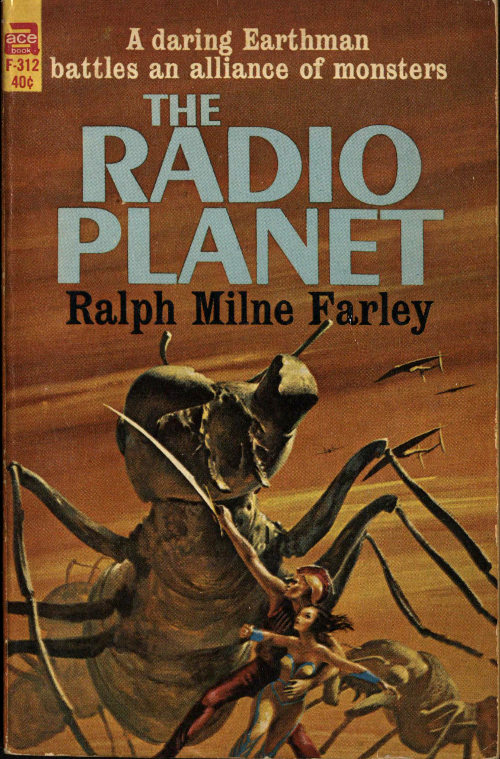
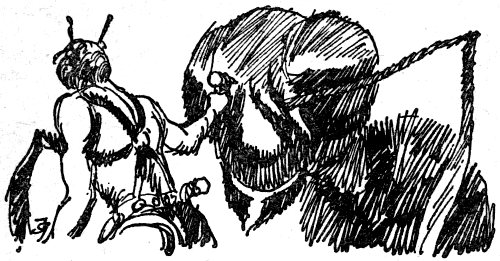
Cover by John Schoenherr. Illustration by Jack Gaughan.
Ralph Milne Farley is also the author of The Radio Beasts available now from Ace Books (F-304)
Printed in U. S. A.
Could you make a radio set? Don’t answer rashly.
Don’t say that you have already built several. For note
that we did not ask whether you could assemble a
set from parts already manufactured by others, but
rather whether you could build the entire set yourself—from
the ground up. That means making every part you
require, including the vacuum tubes, the acid in the
batteries, the wires, the insulation.
If you think that you could do this, let us ask you
one further question. Put yourself in the place of the
hero of the following story, and imagine yourself stranded
amid intelligent savages who have not progressed beyond
the wood age. Under such circumstances, with
nothing to guide you but your scientific memory, with
no tools except those of your own creation, and with
no materials save those furnished by nature, could
you, though the lives and happiness of your dear ones
depended upon it—could you make a radio set?
“It’s too bad that Myles Cabot can’t see this!”
I exclaimed, as my eye fell on the following item:
SIGNALS FROM MARS FAIL TO REACH HARVARD
Cambridge, Massachusetts, Wednesday. The Harvard
College Radio Station has for several weeks been in receipt
of fragmentary signals of extraordinarily long wave-length,
Professor Hammond announced yesterday. So far as it has
been possible to test the direction of the source of these
waves, it appears that the direction has a twenty-four hour
cycle, thus indicating that the origin of these waves is some
point outside the earth.
The university authorities will express no opinion as to
whether or not these messages come from Mars.
Myles, alone of all the radio engineers of my acquaintance,
was competent to surmount these difficulties, and
thus enable the Cambridge savants to receive with clearness
the message from another planet.
6
Twelve months ago he would have been available, for
he was then quietly visiting at my farm, after five earth-years
spent on the planet Venus, where, by the aid of radio,
he had led the Cupians to victory over their oppressors,
a human-brained race of gigantic black ants. He had driven
the last ant from the face of continental Poros, and had
won and wed the Princess Lilla, who had borne him a son
to occupy the throne of Cupia.
While at my farm Cabot had rigged up a huge radio
set and a matter-transmitting apparatus, with which he had
(presumably) shot himself back to Poros on the night of the
big October storm which had wrecked his installation.
I showed the newspaper item to Mrs. Farley, and lamented
on Cabot’s absence. Her response opened up an
entirely new line of thought.
Said she: “Doesn’t the very fact that Mr. Cabot isn’t
here suggest to you that this may be a message, not from
Mars, but from him? Or perhaps from the Princess Lilla,
inquiring about him in case he has failed in his attempted
return?”
That had never occurred to me! How stupid!
“What had I better do about it, if anything?” I asked.
“Drop Professor Hammond a line?”
But Mrs. Farley was afraid that I would be taken for a
crank.
That evening, when I was over in town, the clerk in the
drug store waylaid me to say that there had been a long-distance
phone call for me, and would I please call a certain
Cambridge number.
So, after waiting an interminable time in the stuffy booth
with my hands full of dimes, nickels, and quarters, I finally
got my party.
“Mr. Farley?”
“Speaking.”
“This is Professor Kellogg, O. D. Kellogg,” the voice
replied.
7
It was my friend of the Harvard math faculty, the man
who had analyzed the measurements of the streamline projectile
in which Myles Cabot had shot to earth the account
of the first part of his adventures on Venus. Some further
adventures Myles had told me in person during his stay
on my farm.
“Professor Hammond thinks that he is getting Mars on the
air,” the voice continued.
“Yes,” I replied. “I judged as much from what I read in
this morning’s paper. But what do you think?”
Kellogg’s reply gave my sluggish mind the second jolt
which it had received that day.
“Well,” he said, “in view of the fact that I am one of
the few people among your readers who take your radio
stories seriously, I think that Hammond is getting Venus.
Can you run up here and help me try and convince him?”
And so it was that I took the early boat next morning
for Boston, and had lunch with the two professors.
As a result of our conference, a small committee of engineers
returned with me to Edgartown that evening for
the purpose of trying to repair the wrecked radio set which
Myles Cabot had left on my farm.
They utterly failed to comprehend the matter-transmitting
apparatus, and so—after the fallen tower had been reerected
and the rubbish cleared away—they had devoted their attention
to the restoration of the conversational part of the set.
To make a long story short, we finally restored it, with the
aid of some old blue prints of Cabot’s which Mrs. Farley,
like Swiss Family Robinson’s wife, produced from somewhere.
I was the first to try the earphones, and was rewarded by
a faint “bzt-bzt” like the song of a north woods blackfly.
In conventional radioese, I repeated the sounds to the
Harvard group:
A look of incredulity spread over their faces. Again came
the same message, and again I repeated it.
“You’re spoofing us!” one of them shouted. “Give me
the earphones.”
And he snatched them from my head. Adjusting them on
his own head, he spelled out to us, “C-Q C-Q C-Q D-E
C-A-B-O-T C-A-B-O-T C-A-B-O-T—”
Seizing the big leaf-switch, he threw it over. The motor-generator
began to hum. Grasping the key, the Harvard
engineer ticked off into space: “Cabot Cabot Cabot D-E—”
“Has this station a call letter?” he hurriedly asked me.
“Yes,” I answered quickly, “One-X-X-B.”
“One-X-X-B,” he continued the ticking “K.”
Interplanetary communication was an established fact at
last! And not with Mars after all these years of scientific
speculations. But what meant more to me was that I was
again in touch with my classmate Myles Standish Cabot,
the radio man.
The next day a party of prominent scientists, accompanied
by a telegrapher and two stenographers, arrived at my
farm.
During the weeks that followed there was recorded
Myles’s own account of the amazing adventures on the planet
Venus (or Poros, as its own inhabitants call it,)
which befell him upon his return there after his brief visit
to the earth. I have edited those notes into the following
coherent story.
II TOO MUCH STATIC
Myles Cabot had returned to the earth to study the
latest developments of modern terrestrial science for the
benefit of the Cupian nation. He was the regent of Cupia
during the minority of his baby son, King Kew the
Thirteenth. The loyal Prince Toron occupied the throne in his
absence. The last of the ant-men and their ally, the renegade
Cupian Prince Yuri, had presumably perished in an attempt
to escape by flying through the steam-clouds which completely
hem in continental Poros. What lay beyond the
boiling seas no man knew.
9
During his stay on my farm, Cabot had built the matter-transmitting
apparatus, with which he had shot himself off
into space on that October night on which he had received
the message from the skies: “S O S, Lilla.” A thunderstorm
had been brewing all that evening, and just as Myles
had placed himself between the coordinate axes of his machine
and had gathered up the strings which ran from his
control levers to within the apparatus, there had come a
blinding flash. Lightning had struck his aerial.
How long his unconsciousness lasted he knew not. He
was some time in regaining his senses. But when he had
finally and fully recovered, he found himself lying on a
sandy beach beside a calm and placid lake beneath a silver
sky.
He fell to wondering, vaguely and pleasantly, where he
was and how he had got here.
Suddenly, however, his ears were jarred by a familiar
sound. At once his senses cleared, and he listened intently
to the distant purring of a motor. Yes, there could be no
mistake; an airplane was approaching. Now he could see
it, a speck in the sky, far down the beach.
Nearer and nearer it came.
Myles sprang to his feet. To his intense surprise, he found
that the effort threw him quite a distance into the air. Instantly
the idea flashed through his mind: “I must be on
Mars! Or some other strange planet.” This idea was vaguely
reminiscent of something.
But while he was trying to catch this vaguely elusive
train of thought, his attention was diverted by the fact that,
for some unaccountable reason, his belt buckle and most of
the buttons which had held his clothes together were missing,
so that his clothing came to pieces as he rose, and that
he had to shed it rapidly in order to avoid impeding his
movements. He wondered at the cause of this.
10
But his speculations were cut short by the alighting of the
plane a hundred yards down the beach.
What was his horror when out of it clambered, not men
but ants! Ants, six-footed, and six feet high. Huge ants, four
of them, running toward him over the glistening sands.
Gone was all his languor, as he seized a piece of driftwood
and prepared to defend himself.
As he stood thus expectant, Myles realized that his present
position and condition, the surrounding scenery, and the advance
of the ant-men were exactly, item for item, like the
opening events of his first arrival on the planet Poros. He
even recognized one of the ant-men as old Doggo, who had
befriended him on his previous visit.
Could it be that all his adventures in Cupia had been
naught but a dream; a recurring dream, in fact? Were his
dear wife Lilla and his little son Kew merely figments of
his imagination? Horrible thought!
And then events began to differ from those of the past;
for the three other Formians halted, and Doggo advanced
alone. By the agitation of the beast’s antennae the earth
man could see that it was talking to him. But Myles no
longer possessed the wonderful electrical headset which he
had contrived and built during his previous visit to that
planet, so as to talk with Cupians and Formians, both of
which races are earless and converse by means of radiations
from their antennae.
So he picked up two sticks from the beach, and held
them projecting from his forehead; then threw them to the
ground with a grimace of disgust and pointed to his ears.
Doggo understood, and scratched with his paw in Cupian
shorthand on the silver sands the message: “Myles Cabot,
you are our prisoner.”
“What, again?” scratched Myles, then made a sign of
submission.
11
He dreaded the paralyzing bite which Formians usually
administer to their victims, and which he had twice experienced
in the past; but, fortunately, it was not now
forthcoming.
The other three ants kept away from him as Doggo led
him to the beached airplane, and soon they were scudding
along beneath silver skies, northward as it later turned out.
Far below them were silver-green fields and tangled
tropical woods, interspersed with rivulets and little ponds.
This was Cupia, his Cupia. He was home once more,
back again upon the planet which held all that was dear
to him in two worlds.
His heart glowed with the warmth of homecoming.
What mattered it that he was now a prisoner, in the hands
(or, rather, claws) of his old enemies, the Formians? He
had been their prisoner before, and had escaped. Once more
he could escape, and rescue the Princess Lilla.
Poor girl! How eager he was to reach her side, and save
her from that peril, whatever it was, which had caused her
to flash that “S O S” a hundred million miles across the
solar system from Poros to the earth.
He wondered what could have happened in Cupia since
his departure, only a few sangths ago. How was it that
the ant-men had survived their airplane journey across the
boiling seas? What had led them to return? Or perhaps
these ants were a group who had hidden somewhere and
thus had escaped the general extermination of their race.
In either event, how had they been able to reconquer
Cupia? And where was their former leader, Yuri, the renegade
Cupian prince?
These and a hundred other similar questions flooded in
upon the earth-man, as the Formian airship carried him, a
captive, through the skies.
He gazed again at the scene below, and now noted one
difference from the accustomed Porovian landscape, for nowhere
ran the smooth concrete roads which bear the swift
two-wheeled kerkools of the Cupians to all parts of their
continent. What uninhabited portion of Cupia could this be,
over which they were now passing?
12
Turning to Doggo, Myles extended his left palm, and
made a motion as though writing on it with the thumb
and forefinger of his right hand. But the ant-man waved
a negative with one of his forepaws. It was evident that
there were no writing materials aboard the ship. Myles
would have to wait until they reached their landing place;
for doubtless they would soon hover down in some city
or town, though just which one he could not guess, as the
country below was wholly unfamiliar.
Finally a small settlement loomed ahead. It was of the
familiar style of toy-building-block architecture affected by
the ant-men, and, from its appearance, was very new. On its
outskirts further building operations were actively in progress.
Apparently a few survivors of the accursed race of Formians
were consolidating their position and attempting to build
up a new empire in some out-of-the-way portion of the continent.
As the earth-man was turning these thoughts over in his
mind the plane softly settled down upon one of the flat
roofs, and its occupants disembarked. Three of the ants
advanced menacingly toward Myles, but Doggo held them
off. Then all of the party descended down one of the ramps
to the lower levels of the building.
Narrow slitlike window openings gave onto courtyards,
where fountains played and masses of blue and yellow flowers
bloomed, amid gray-branched lichens with red and purple
twig-knobs. It was in just such a garden, through just
such a window, that he had first looked upon the lovely
blue-eyed, golden-haired Lilla, Crown Princess of Cupia.
The earth-man sighed. Where was his beloved wife now?
That she needed his help was certain. He must therefore
get busy. So once again he made motions of writing on the
palm of his left hand with the thumb and forefinger of his
right; and this time the sign language produced results,
for Doggo halted the procession and led Cabot into a room.
13
It was a plain bare room, devoid of any furniture except
a small table, for ant-men have no use for chairs and
couches. The sky outside was already beginning to pinken
with the unseen sun.
With a sweep of his paw, Doggo indicated that this was
to be Cabot’s quarters. Then, with another wave, he
pointed to the table, where lay a pad of paper and stylus,
not a pencil-like stylus as employed by the Cupians, but
rather one equipped with straps for attaching it to the claw
of a Formian.
Even so, it was better than nothing. The earth-man seized
it eagerly, but before he could begin writing an ant entered
bearing a Cupian toga, short-sleeved and bordered with
Grecian wave designs in blue. Myles put on this garment,
and then quickly filled a sheet with questions:
“How is my princess and my son, the baby king? Whence
come all you Formians, whose race I thought had been
exterminated? What part of Cupia is this? What is this city?
Where is Prince Yuri? And what do you intend to do with
me this time?”
Then he passed the paper and stylus over to his old
friend Doggo. They were alone together at last.
The ant-man’s reply consumed sheet after sheet of paper;
but, owning to the rapidity of Porovian shorthand, did not
take so very much more time than speaking would have
required. As he completed each sheet he passed it over to
Myles, who read as follows:
“As to your princess and your son, I know not, for this
is not Cupia. Do you remember how, when your victorious
army and air navy swept to the southern extremity of what
had been Formia, a few of our survivors rose in planes from
the ruins of our last stronghold and braved the dangers
of the steam clouds which overhang the boiling seas? Our
leader was Prince Yuri, erstwhile contender for the throne
of Cupia, splendid even in defeat.
“It was his brain that conceived our daring plan of
escape. If there were other lands beyond the boiling seas,
the lands which tradition taught were the origin of the
Cupian race, then there we might prosper and raise up a
new empire. At the worst we should merely meet death in
another form, rather than at your hands. So we essayed.
14
“Your planes followed us, but turned back as we neared
the area of terrific heat. Soon the vapor closed over us,
blotting our enemies and our native land from view.”
For page after page Doggo, the ant-man, related the
harrowing details of that perilous flight across the boiling
seas, ending with the words:
“Here we are, and here are you, in Yuriana, capitol of
New Formia. But how is it that you, Myles Cabot, have
arrived here on this continent in exactly the same manner
and condition in which I discovered you in old Formia
eight years ago?”
When Myles reached the end of reading this narrative, he
in turn took the pad and stylus and related how he had
gone to the planet Minos (which we call the Earth) to learn
the latest discoveries and inventions there, and how his
calculations for his return to Poros had been upset by some
static conditions just as he had been about to transmit
himself back. Oh, if only he had landed by chance upon
the same beach as on his first journey through the skies!
Wisely he refrained from mentioning the “S O S” message
from Lilla. But his recollection of her predicament
spurred him to be anxious about her rescue.
His immediate problem was to learn what the ant-men
planned for him; so the concluding words which he wrote
upon the pad were: “And, now that you have me in your
power, what shall you do with me?”
“Old friend,” Doggo wrote in reply, “that depends entirely
upon Yuri, our king, whose toga you now have on.”
III YURI OR FORMIS?
The earth-man grimaced, but then smiled. Perhaps, his
succeeding to the toga of King Yuri might prove to be an
omen.
15
“So Yuri is king of the ants?” he asked.
“Yes,” his captor replied, “for Queen Formis did not survive
the trip across the boiling seas.”
“Then what of your empire?” Myles inquired. “No queen.
No eggs. How can your race continue? For you Formians are
like the ants on my own planet Minos.”
Doggo’s reply astounded him.
“Do you remember back at Wautoosa, I told you that
some of us lesser Formians had occasionally laid eggs? So
now behold before you Doggo, Admiral of the Formian
Air Navy, and mother of a new Queen Formis.”
This was truly a surprise! All along Cabot had always
regarded the Formians as mannish. And rightly so, for they
performed in their own country the duties assigned to men
among the Cupians. Furthermore, all Formians, save only
the reigning Formis herself, were called by the Porovian
pronoun, which corresponds to “he” in English.
When Myles had somewhat recovered from his astonishment,
he warmly congratulated his friend by patting him
on the side of the head, as is the Porovian custom.
“Doggo,” he wrote, “this ought to constitute you a person
of some importance among the Formians.”
“It ought to,” the ant-man replied, “but as a matter of
fact, it merely intensifies Yuri’s mistrust and hatred of me.
Now that I am mother of the queen, he fears that I may
turn against him and establish Formis in his place as the
head of an empire of the Formians, by the Formians, and
for the Formians exclusively.”
“Why don’t you?” Myles wrote. It seemed to him to be
a bully good idea, and incidentally a solution of his own
difficulties.
But Doggo wrote in horror, “It would be treason!” Then
tore up all the correspondence. It is difficult to inculcate the
thought of independence in the mind of one reared in an
autocracy.
The earth-man, however, persisted.
“How many of the council can you count on, if the interests
of Yuri should clash with those of Formis?”
16
“Only one—myself.”
And again Doggo tore up the correspondence.
Myles tactfully changed the subject.
“Where is the arch-fiend now?” he asked.
“We know not,” the Formian wrote in reply. “Six days
ago he left us in his airship and flew westward. When he
failed to return, we sent out scout planes to search for
him, and we have been hunting ever since. When we
sighted you on the beach this morning we thought that
you might be our lost leader, and that is why we landed and
approached you.”
At about this point the conversation was interrupted by
a worker ant who brought food: roast alta and green aphid
milk. With what relish did the earth-man plunge into the
feast, his first taste of Porovian delicacies in many months.
During the meal conversation lagged, owing to the difficulty
of writing and eating at the same time. But now
Myles Cabot seized his pad and stylus and wrote:
“Have you ever known me to fail in any undertaking
on the planet Poros?”
“No,” the ant-man wrote in reply.
“Have you ever known me to be untrue to a principle,
a cause, or a friend?”
“No,” Doggo replied.
“Then,” Myles wrote, “let us make your daughter queen
in fact as well as in name.”
“It is treason,” Doggo wrote in reply, but this time he
did not tear up the correspondence.
“Treason?” Myles asked. If he had spoken the word, he
would have spoken it with scorn and derision. “Treason?
Is it treason to support your own queen? What has become
of the national pride of the once great Formians? Look!
I pledge myself to the cause of Formis, rightful Queen of
Formia. Formis, daughter of Doggo! What say you?”
This time, as he tore up the correspondence, Doggo
signified an affirmative. And thus there resulted further
correspondence.
17
“Doggo,” Myles wrote, “can you get to the antenna of
the queen?”
The ant-man indicated that he could.
“If she has inherited any of your character,” Myles continued,
“she will assert herself, if given half a chance.”
So the Pitmanesque conversation continued. Long since had
the pink light of Porovian evening faded from the western
sky. The ceiling vapor-lamps were lit. The night showed velvet-black
through the slit-like windows. And still the two old
friends wrote on, Myles Standish Cabot, the Bostonian, and
Doggo, No. 334-2-18, the only really humanlike ant-man
whom Myles had ever known among the once dominant
race of Poros.
Finally, as the dials indicated midnight, the two conspirators
ceased their labors. All was arranged for the
coup d’ etat.
They tore into shreds every scrap of used paper, leaving
extant merely the ant-man’s concluding words: “Meanwhile
you are my prisoner.”
Doggo then rang a soundless bell, which was answered
by a worker ant, whom he inaudibly directed to bring
sufficient draperies to form a bed for the earth-man. These
brought, the two friends patted each other a fond good
night, and the tired earth-man lay down for the first sleep
which he had had in over forty earth hours.
It hardly seemed possible! Night before last he had slept
peacefully on a conventional feather-bed in a little New
England farmhouse. Then had come the S O S message
from the skies; and here he was now, millions of miles
away through space retiring on matted silver felting on the
concrete floor of a Porovian ant-house. Such are the mutations
of fortune!
With these thoughts the returned wanderer lapsed into
a deep and dreamless sleep.
When he awakened in the morning there was a guard
posted at the door.
18
Doggo did not show up until nearly noon, when he
rattled in, bristling with excitement.
Seizing the pad he wrote: “A stormy session of the Council
of Twelve! We are all agreed that you must be indicted
for high crimes and misdemeanors. But the great question
is as to just what we can charge you with.”
“Sorry I can’t assist you,” the earth-man wrote. “How
would it be if I were to slap your daughter’s face, or
something? Or why not try me for general cussedness?”
“That is just what we finally decided to do,” the ant-man
wrote in reply. “We shall try you on general principles,
and let the proper accusation develop from the evidence.
“At some stage of the proceedings it will inevitably occur
to some member of the council to suggest that you be
charged with treason to Yuri, whereupon two members of
the council, whom I have won over to the cause of my
daughter, will raise the objection that Yuri is not our king.
This will be the signal for the proclaiming of Queen Formis.
If you will waive counsel the trial can take place to-morrow.”
“I will waive anything,” Myles replied, “counsel, immunity,
extradition, anything in order to speed up my return
to Cupia, where Lilla awaits in some dire extremity.”
“All right,” Doggo wrote, and the conference was at an
end. The morrow would decide the ascendancy of Myles
Cabot or the Prince Yuri over the new continent.
IV THE COUP D’ETAT
The next morning Myles Cabot was led under guard to the
council chamber of the dread thirteen: Formis and her
twelve advisers. The accused was placed in a wicker cage,
from which he surveyed his surroundings as the proceedings
opened.
19
On a raised platform stood the ant queen, surmounted by
a scarlet canopy, which set off the perfect proportions of
her jet-black body. On each side of her stood six refined
and intelligent ant-men, her councillors. One of the twelve
was Doggo.
Messenger ants hurried hither and thither.
First the accusation was read, Myles being furnished
with a written copy.
The witnesses were then called. They were veterans who
had served in the wars in which Cabot had twice freed
Cupia from the domination of its Formian oppressors.
They spoke with bitterness of the downfall of their beloved
Formia. Their testimony was brief.
Then the accused was asked if he wished to say anything
in his own behalf. Myles rose, then shrugged his shoulders,
sat down again, and wrote: “I fully realize the futility of
making an argument through the antennae of another.”
Whereupon the queen and the council went into executive
session. Their remarks were not intended for the eyes
of the prisoner, but he soon observed that some kind of a
dispute was on between Doggo, supported by two councillors
named Emu and Fum on one side, and a councillor named
Barth on the other.
As this dispute reached its height, a messenger ant rushed
in and held up one paw. Cabot’s interpreter, not deeming
this a part of the executive session, obligingly translated the
following into writing:
The messenger: “Yuri lives and reigns over Cupia. It is his
command that Cabot die.”
Barth: “It is the radio. Know then, O Queen, and ye,
members of the council, that when we fled across the boiling
seas under the gallant leadership of Prince Yuri, the man
with the heart of a Formian, he brought with him one of
those powerful radio sets invented by the beast who is our
prisoner here to-day.
“Supporters of Yuri still remained among the Cupians,
and he has been in constant communication with these ever
since shortly after our arrival here. From them he learned
of the return of Myles Cabot to the planet Minos.
20
“Then Yuri disappeared. Those of us who were closest
to him suspected that he had gone back across the boiling
seas to claim as his own the throne of Cupia. But we hesitated
to announce this until we were sure, for we feared that
some of our own people would regard his departure as
desertion. Yet who can blame him for returning to his father-land
and to the throne which is his by rights?”
To which the messenger added: “And he offers to give us
back our own old country, if we too will return across the
boiling seas again.”
“It is a lie!” Doggo shouted.
“Yuri, usurper of the thrones of two continents. Bah!”
shouted Emu.
“Yuri, our rightful leader,” shouted Barth.
“Give us a queen of our own race,” shouted Fum.
“Release the prisoner,” shouted the Queen.
And that is all that Myles learned of the conversation,
for his interpreter at this juncture stopped writing and
obeyed the queen. The earth-man was free!
With one bound he gained the throne, where fighting
was already in progress between the two factions. Barth
and Doggo were rolling over and over on the floor in a
death grapple, while the ant-queen had backed to the rear
of the stage, closely guarded by Emu and Fum.
Seizing one of the pikes which supported the scarlet
canopy, Myles wrenched it loose and drove it into the thorax
of Barth. In another instant the earth-man and Doggo stood
beside the queen.
Ant-men now came pouring into the chamber through all
the entrances, taking sides as they entered and sized up the
situation. If it had still been in vogue among the Formians
to be known by numbers rather than names, and to have
these identifying numbers painted on the backs of their
abdomens followed by the numbers of those whom they
had defeated in the duels so common among them, then
many a Formian would have “got the number” of many
another, that day.
21
As Myles battled with his pike beside Formis, queen of
the ants, he could well imagine the conflicting shouts of
“Death to the usurper!” “Formia for the Formians!” “Long
Live Queen Formis!” “Long live Prince Yuri!” which must
have resounded throughout the chamber; but to him all
was silence, for he was without the antennae wherewith to
pick up the radiated speech of the contenders.
So as he wielded the pike in silence, he had opportunity
to reflect on the incongruity of his position. Here was he,
Myles Cabot regent of Cupia, the man who had driven
the ants forever from their dominion over his people, and
yet now fighting side by side with their leaders defending
the life of their queen.
Yet was she not the daughter of Doggo his only friend
among the ants? And would not her victory mean the speedy
return of Myles to his own continent?
As the earth-man jabbed to right and left among the supporters
of his enemy Yuri there came to his human ears the
sound of rifle fire. It might prove a godsend or an added
menace, according to whose paw held the rifle. But no
chances must be taken on the life of the queen. So Myles
made frantic signs to Doggo of impending danger.
The queen and her supporters, outnumbered, were fighting
with their backs to one of the walls of the room. A short
distance along this wall on the side where Cabot stood was
a door; so he now began edging his way along the wall
to this door. This was not difficult, as the ant-men, having
only their mandibles to fight with, greatly respected his pike.
He gained the door and passed by, but not through it.
The shots came nearer and nearer. Then Doggo opened the
door and slipped through with Formis and the rest of her
immediate supporters; the door closed, and Myles Cabot
stood guarding the exit with his pike—alone against the
hordes of antdom.
He had no difficulty in defending himself from those in
front of him, but the ants who began to close in on him
from each side were a different matter.
22
He received several bad scratches on his shoulders and
hips, and his toga was ripped and torn; but fortunately
he was able to ward off their paralyzing bites. Nevertheless,
his enemies pressed so close that it was difficult for him
to manipulate his long weapon. In fact, it was only the
jamming of the ants upon one another and upon the dead
bodies of their slain comrades that kept them from him.
He now was holding his pike by the middle, with both
hands, using one end as a club and the other as a dagger.
The black circle of the ants was steadily closing in on
him. A pair of mandibles from the left snapped angrily
within a few inches of his throat. Instantly he drove the
point of his lance home between horrid jaws. But at the
same instant its butt was seized by a pair of jaws to his
right. He could not pull it free.
At last he was weaponless, and not only that, but pinned
to the wall by the shaft of his own pike as well.
And then to his surprise the ants before him separated
as at a command. The butt of his lance was dropped. As
Myles wrenched the point loose from the dead body of the
Formian in which it had been stuck, and gazed expectant
down the long aisle which had opened before him, he
saw confronting him at the other end an ant-man armed
with the peculiar type of claw-operated rifle which the
Formians had adapted from those which Myles himself
had built for Cupian use in the first war of liberation.
Briefly the two surveyed each other. Then slowly the
rifle was raised until its aim settled squarely upon the earth-man’s
chest.
Instantaneously the glance of Myles Cabot swept the
black hordes which hemmed him in on each side. There was
no escape!
Yet how can man die better,
Than facing fearful odds?
23
With a wild warwhoop, which was utterly lost on the
radio-sense of the assembled Formians, Myles charged down
the narrow way, straight into the muzzle of the rifle of his
antagonist. The astonished ant-man hastily pulled the trigger.
A shot rang out. But still the impetuous rush of Myles
continued, and before the rifle could be discharged a second
time, Myles had driven his spear deep into the leering insect
face.
The Formian staggered back. The rifle clattered to the
floor. The earth-man, not waiting to withdraw his own
weapon, stooped, seized the fallen firearm, and wheeled
to confront his enemies, who fell back in a snarling arc
before this new menace.
Myles stood now in one of the entranceways of the council
chamber, and thus was secure against flank attack. But not
against an assault from the rear. In fact, even as he stood
thus irresolute, a rattling noise behind him in the hallways
revealed to his human ears the approach of a new enemy.
What was he to do? To remain as he was meant carte
blanche to this newcomer, whereas to turn about would
mean that those within the chamber would undoubtedly
rush him.
In this predicament Myles grasped his gun firmly, and
wheeled backward to the left until he was flattened against
the wall of the corridor in which he was standing. From
this position he could turn his head slightly to the left
and see into the council chamber, or to the right and look
down the long hall.
Directly opposite him was one of those narrow, slitlike
windows, so typical of Porovian architecture. It was too
narrow for the passage of the huge body of an ant-man,
but a human being could conceivably squeeze through. Thus
it offered a means out, a way of escape.
The lone ant in the corridor was joined by the others.
They and their compatriots within the chamber slowly
closed in on the cornered earth-man.
There was no time to speculate upon the depth of the
drop outside. With a suddenness which caused his aggressors
to recoil momentarily, Myles dashed across to the window,
forced his way through, and, still grasping his rifle,
plunged headlong two stories into a clump of gray lichens in
the courtyard below.
24
Hastily extricating himself, he looked up at the window
which he had just quitted. There, framed by the masonry,
was the head of an ant-man. A quick shot, and the head
stared at him no more.
Before another Formian could take post at the window
to observe the direction of Cabot’s departure, the latter ran
quickly from the courtyard garden into the interior of the
building again.
His first thought was to join Doggo, Queen Formis, and
their faction; so, taking a firm hold on his rifle, he hurried
in the direction in which they had made their escape.
The first ant-man whom he met within the building was
Emu, one of the three members of the council who had
been a party to the original conspiracy. This ant was fleeing
from something in very evident terror, so that it was all
Cabot could do to stop him, but the threat of rifle-shooting
was finally effective.
Then, extracting a cartridge from the magazine of his
firearm, Cabot scratched upon the smooth wall the brief
question: “What of Doggo and Formis?”
Emu snatched the cartridge and quickly wrote the reply:
“Dead, both dead. The revolution has collapsed. Flee for
your life!”
Then the ant-man clattered rapidly off down the corridor,
taking the precious cartridge with him. He had not been
too flustered to think of that.
Myles heaved a sigh of self-reproach at having brought
his friends to this sad end. But then, he reflected, Doggo
had been in a situation in which conflict with the authorities
and then execution would have been inevitable sooner
or later. The revolution had been his one best bet, and it
was no one’s fault that it had failed.
25
Now that Doggo and Formis were dead, there was no
longer any obligation binding Myles to stay and fight. In
fact, he owed it to his loved ones in Cupia to preserve his
own life until he could find some way of rejoining them.
So he set out to escape from the city.
For some time he threaded the corridors without meeting
any ants, although occasionally there drifted down to him
the sounds of fighting on the upper levels. But at last,
as he rounded a turn, he saw before him a Formian, and it
was one whom he recognized, namely the messenger ant
who had brought to the trial the radiogram from Prince Yuri.
The ant’s back was toward him. Cabot cautiously withdrew
a step; then raising his rifle, he again advanced and fired
full at his enemy.
But the hammer merely clicked. There was no explosion.
The magazine was empty.
Cabot’s first impulse was to throw the weapon away.
Then he reflected that even an unloaded gun might well
serve to awe his enemies and hold them at a distance; so
he retained it.
By this time the messenger ant had disappeared around
a turn farther down the corridor, so Cabot hastened after
him; for it had suddenly occurred to the earth-man that
this ant was undoubtedly returning to the hidden radio
set, whence he had come.
Radio! Means of a communication with his own continent,
if he could but reach the instruments!
The messenger had announced at the trial that Yuri was
in Cupia and knew of Cabot’s presence in this new land.
Thus it was certain that complete wireless communication
had been established between the two continents. But,
equally, undoubtedly, this communication had been established
at a wave-length which kept the knowledge of Cabot’s
return pretty much a secret of Prince Yuri and his own
followers. This information would probably induce the renegade
prince to speed up whatever nefarious schemes he had
afoot in Cupia.
26
But if Cabot could once get on the air and adjust the
Formian sending set to the wave-length of Luno Castle, or
run it through all its available wave-lengths, he could broadcast
to the Cupian nation the fact that he was alive and
well, and would return again—though he knew not how—to
lead them. Such news should strengthen the hearts of
the loyal Cupians to rally to the cause of his wife, the
Princess Lilla, and his son, the baby king.
So he quickened his pace, and soon caught sight again
of the messenger ant. From, then on he stealthily stalked
his quarry, who led him through many a winding passage-way,
before finally they emerged from the city into the
open fields.
Beyond the fields lay the rocky foothills of a mountain
range. Caution dictated that Cabot remain under the shelter
of the city walls until the Formian disappeared among the
rocks. Then he ran lightly across the plain to take up the
trail once more.
As he, too, gained the rocks, he glanced back to see if
his departure had been noted. No, there was no sign of life.
Evidently the fighting had drawn all the inhabitants to the
interior of the city. So, with a sigh of relief, Myles hurried
after the messenger ant.
At the place where Myles had noticed the Formian enter
the rocks there was the well-defined beginning of a trail; so
up this winding trail he sped, and soon caught sight of his
quarry. From that time on more caution was necessary,
but nevertheless the pursuer was able to keep the pursued
always in sight until, just after a turn in the road had
obscured his view, Myles came upon a place where the
way forked.
Pausing, he scratched his head in dismay, then carefully
examined the ground for evidences of claw marks; but none
were apparent. Dropping to his hands and knees, the earth-man
scrutinized the dirt with even more care; and at last,
imagining that he observed some slight scratches to the
right, he took the right-hand branch.
It was necessary for him to proceed with great rapidity,
if he would catch up with the messenger ant, so Myles
broke into a dog trot. On and on he ran; up, into the
rocky mountains.
27
At last he sat down exhausted on a large boulder, just
as the silvery sky turned crimson in the west, and darkness
crept up out of the east. It was quite evident that he
had taken the wrong road at the fork, and also that he
must now spend the night, half clad and alone amid the
rocks of the mountains of this strange new continent.
V LOST AMID THE ROCKS
But although Myles Cabot was lost, he was free for the
first time since his return to Poros.
So not disheartened he arose and proceeded along the
trail, looking for food and a place to spend the night; and
presently came upon a “green cow,” as he was wont to
call the aphids which are kept both by Cupians and Formians
for the honey-dew which they produce.
It made no objection to Cabot’s approach, nor to his
manipulating the two horns which projected from its back,
with the result that the tired man was presently regaling
himself with a satisfying drafts of green “milk” from a leafy
cup.
The bush, which furnished the leaf to fashion the cup,
closely resembled the tartan bushes of Cupia, whose heart-shaped
leaves are put to so many uses in that country.
Myles Cabot accordingly stripped off a considerable portion
of the foliage, and lay down in a bed of warm, thick
green for the night.
The morning dawned silver bright. Myles drew another
meal from the grazing aphid and then pressed on up the
rocky defile. He did not dare return for fear of meeting
ant-men; and besides, now that a night’s rest had to some
extent tempered his chagrin at not catching up with the
particular ant-man whom he had been pursuing, he could
not be sure he had taken the wrong road after all. So on he
went, up the rocky path.
28
Around noon the path petered out at the top of an
eminence which gave Cabot an opportunity to survey the
surrounding scenery. To the westward lay the city from
which he had fled. What had become, he wondered, of
the supporters of his friend Doggo and of Formis, the ant-queen,
whose cause he had espoused? According to Emu,
Doggo and Formis were both dead, or Cabot would never
have deserted them.
Cabot turned his attention next to the northward. To his
great joy, on the next peak to the one where he sat, there
stood two rough wooden towers, spanned by an aerial.
He decided to cut across country and attempt to approach
the installation by stealth. So he started scrambling
down into the intervening valley.
Never before had the earth-man traveled through such
difficult country. As soon as he had gone a short distance
below the summit he encountered a continuous expanse of
boulders, ranging in size from a man’s head to twenty feet
or more in diameter, and piled aimlessly together. Lying
crossways in every direction, upon and between the rocks,
were the gaunt skeletons of fallen trees in all stages of decay.
The sharp edges of the rocks cut and tore the bare feet
of the earth-man, while the splinters of the fallen trees
jabbed his body. Time and again he slipped and nearly
fell into one of the chasms which yawned between the
boulders, and on one of these occasions he must have inadvertently
let go the ant-rifle which he had treasured so
far so carefully, for presently he noticed that it was gone.
But to all this there was one extenuating feature, although
Myles did not realize it at the time, namely that
his physical pain and the need for constant vigilance on
his part so occupied his mind as to spare him from the
mental pain which had been his almost constant companion
since his return to Poros. The attention necessary to avoid
misjudging a jump, or slipping into a dark deep hole, or
being impaled by a tree-branch, crowded out of his mind
even his great love and anxiety for Princess Lilla and Baby
Kew.
29
Through the maze of obstacles Cabot toiled all day long.
Oh, to reach the radio station established by his enemy
Yuri, and get into touch with his own continent. Thus he
could learn what was happening in Cupia, and also give
word of his own safe arrival on the planet. Safe, hm! He
smiled grimly at the word.
“I must reach that station,” he thought, “and then, when
I have talked with Cupia, I must secure a Formian plane
by hook or by crook, and brave the boiling seas. If ants
have crossed those seas safely, if Yuri has safely crossed
them twice, then why cannot I, the Minorian?”
As he communed thus with himself, a faint pink flush appeared
in the sky. Slowly, painfully he continued his way.
Gradually the pink light turned to crimson in the west and
then darkened to a royal purple. Gradually the black night
crept up out of the east. But also gradually the boulders
became smaller and smaller as he clambered upward,
until just as darkness finally enveloped the planet, the tired
man gained the smooth rocks of the summit, and lay down
amid some leaves.
He had had nothing to eat or drink since his breakfast
of green milk that morning. He had undergone an exhausting
journey. His feet were bruised and cut, his body covered with
innumerable scratches, and he was weary, thirsty and hungry.
But he had almost reached the point which he had been
seeking, and this thought comforted him as his eyes closed
in healthy and dreamless sleep.
Next morning early he was up, rested, parched and ravenous.
As the first faint pink tinged the eastern sky Myles
Cabot shook off the leaves and completed the ascent.
It only required a few moments for him to reach the top,
a narrow plateau, about a mile in length, near the farther
end of which there stood a small cabin with its two
towers and aerial.
With a cry of joy—which he knew the earless Formians
could not hear—he raced toward it. The huge chain and
lock, which secured its door on the outside, indicated that
it was unoccupied, and a glance through the narrow slitlike
windows confirmed this.
30
The glance through the window also revealed the presence
of a complete radio sending and receiving set of the same
general hook-up which he himself had adapted for the use
of Cupians and Formians on the other continent.
“Imitation is the most insulting form of flattery,” as
Poblath, the Cupian philosopher, used to say. Yet Cabot
was willing to brook the insult, until suddenly it dawned
on him that the set had no earphones nor microphone!
Of course not, since it was designed for use by creatures
who possessed neither ears nor vocal speech! Gone then was
all hope of news from home, even if he could succeed in
breaking in. At the most, he would merely be able, by
interposing an interrupter in the primary or secondary of
that aerial circuit, to send a dot-dash message across the
boiling seas—I use the term “aerial circuit,” because “antenna
circuit” would be ambiguous, as the latter term
might have either its conventional earth significance, or might
mean the circuit in which the Formian operator would
place his living antennae in sending and receiving.
Well, even a chance to send to Cupia a message to the
effect that he was free and safe, would be worth something.
Myles Cabot tried the slitlike windows, and finding them
too narrow, slid quickly down the near-by slope, soon to
return laboriously with a twenty-pound rock, which he
heaved against the door.
Again and again he heaved the rock, until he had the
satisfaction of seeing the door crack and then give. Finally
a large enough opening was effected to afford passage for
a man, although not for a Formian; and through this breach
Myles Cabot squeezed into the station.
31
A few minutes’ scrutiny familiarized him with the details
of the hook-up, the generator set, and the trophil-engine.
Everything was in running order and the fuel tank
was full. So he fashioned a rude sending key, broke one of
the circuits and tied in the key. Then he warmed-up and
cranked the trophil-engine, clutched-in the generator, threw
the main switch, and sat down to flash across the seas the
message which was to hold firm his partisans in Cupia
until he could join them.
But at that instant an arrow hummed through the hole
in the door, and struck quivering in the bench beside him.
Cabot sprang to his feet and slid home the huge beam
which barred the door on the inside. This was a precaution
which he had neglected to take before. Next he filled the
hole in the door with some boards hastily wrenched from
the work-bench. Then picking up a Formian rifle and
bandolier which hung on the wall, he made his way to
one of the slit windows on the same side as the door and
peeped cautiously out.
The result was immediate; an arrow sped through the
window and passed just above his head. But even as he
ducked instinctively, he saw a dark form moving behind a
bush at some distance outside; so quickly rising again, he
discharged the rifle square at the bush.
There came a cry of pain, followed by silence. And there
were no more feathered incursions.
Not knowing whether his enemy had been disposed of, or
whether the cessation of the stream of arrows was merely
a ruse to entice him from his shelter, Myles did not dare
venture forth to investigate.
From the first time the arrow had struck the work-bench
until this final squelching of the unknown enemy, Myles
had been engrossed in action. Now came the reaction, as he
realized how narrowly he had twice escaped from death
in the last few minutes. He shuddered at the thought,
and turned pale; not, however, at the danger to himself,
but rather at the danger to his loved ones in Cupia. He
must keep himself alive until he could reach and save them
from whatever peril it was that had caused Lilla to send the
SOS which had recalled him to Poros.
But being ever the inquisitive scientist, his attention was
soon distracted by the arrow which stood sticking to the
bench.
32
Its shaft was of some hard and very springy wood. Its
tip was of chipped stone resembling flint, and bound to the
shaft by vegetable fibers. Its “feathers” were thin laminae of
wood, doubtless because birds, and hence true feathers, are
unknown on Poros.
Why on earth—or rather, on Poros—were the ant-men
employing such crude weapons? Rifles they had aplenty,
and powder was easy to manufacture. Besides what did
they know of bows and arrows, which had never been used
by them, even in the days before Cabot the Minorian introduced
firearms upon the planet?
Thus these arrows presented a perplexing problem. But
a practical job remained to be performed before Myles was to
have any time for abstract questions. The message to Cupia
must be sent off.
The earth-man returned to the radio set. The trophil-engine
and the generator were still running. The whole apparatus
appeared to be functioning properly. And so Myles
ticked off into space the following message:
CQ, CQ, CQ, DE, Cabot, Cabot, Cabot. I have returned
to Poros from Minos. I am on the continent of
the Formians. I am in complete control there.
That was a lie, but it would serve to hearten his supporters,
or throw the fear of the Supreme Builder into the
partisans of Yuri, whichever it reached. The message continued:
Do not expect me soon, for first I must consolidate
what I have gained here. But when I do come, Yuri
beware! My friends, hold out until then. I have spoken.
DE, Cabot.
This message he sent again and again, at every wavelength
of which the installation was capable. He repeated
and repeated it until he was tired.
33
And then, for the first time, he remembered his thirst
and his hunger. Fortunately there was both food and
drink in the shack; so Cabot satisfied his wants, and then
went at his message again.
When at last he paused once more for a rest, and shut
off the trophil-engine, his human ears caught a familiar
rattling sound. Instantly he realized the situation; one or
more ant-men were approaching. Sure enough, as he looked
out of a window in the direction of the sound, he saw
two of these creatures trotting toward him across the
plateau.
Both carried rifles slung at their backs; so without waiting
for their nearer approach Myles opened fire. One of the
Formians dropped, but the other turned and fled; and in
spite of the hail of bullets which the earth-man sent after
it, reached the crest in apparent safety, and disappeared from
view.
Cabot knew what that meant to him. It portended the
early return of the fugitive ant with scores of his fellows,
to lay siege to the radio station. Then a doubt occurred
to him. What if these ants were members of Doggo’s
faction, and he had killed a friend?
And so at the risk of his life, he unbarred the door and
rushed out to inspect the dead body. But it was no ant whom
he knew. Time would tell whether the surviving ant would
return with friends or foes. Meanwhile Cabot must get busy
with his message. So at it again he went, first barring the
door again.
From time to time he rested and listened for the approach
of Formians. Occasionally he ate and drank. During
his longer rests, he carted the rifle, the ammunition and
some provisions to a point quite a distance down the mountainside,
and cached them there; for he had formulated
a plan of escape. But mostly he stuck to his signaling. All
Cupia, or such of it as might still possess long-distance radio
sets in spite of the renewed dominion of Yuri, must be
made to know of the return of Myles Cabot from the earth.
34
Night fell, and with it came a respite from the danger
of Formian attack; for these creatures would never venture
forth in the darkness without lights, and lights would betray
them. Myles spent part of the night in sending his
message, part in watching for approaching lights, and part
in dozing.
Finally along toward morning he set about wrecking the
set, for he did not wish the Formians to get into communication
with Cupia and undo the effect of his own message
by pointing out its falsity. Accordingly he smashed the tubes,
unwound the inductances and transformers, cut all the
wiring into little bits, bent the plates of the condensers,
chiseled through the coils of the generator, pounded the
trophil-engine to pieces, and drained the trophil tank. It
would be many sangths before a new radio set could be
built, if indeed these Formians knew enough of the art to
ever build another.
His work of destruction completed, he sat down to wait;
but the inaction palled on him, and before he knew it he
had fallen sound asleep.
He awakened with a start. It was broad daylight. He
listened. There was much rattling outside. So he walked to
the door, unbarred it, and stepped out.
He was not afraid; for on the evening before he had
nailed above the door two crossed sticks, the Porovian
equivalent of a flag of truce.
At a short distance stood a band of thirty or forty ant-men,
their leader holding a pair of crossed sticks. Accordingly
the ragged earth-man advanced. Not one of them did he
recognize, but this was no indication of their identity.
Were these members of the Yuri faction, he wondered,
or of the faction recently captained by the now deceased
Doggo? If the former, they were conquerors intent on adding
him to their list of conquests; but if the latter, then
they might be fugitives like himself. It behooved him to
find out.
So he proceeded to a slight depression in the mountain-top,
very near the group of Formians. This depression
contained soil, and in it he scratched in Porovian shorthand
the words: “Yuri or Doggo?” Then pointed to his message
and withdrew for a slight distance.
35
One of the ant-men advanced alone to the depression,
stared at the words, rubbed one part of them, and returned
to his comrades, at which Cabot in turn advanced.
The one word remaining written in the dirt was “Yuri!”
So these were victorious enemies, rather than fugitive
friends.
Waving a signal that the interview was at an end, Myles
Cabot returned with dignity to the shack and pulled down
his crossed sticks.
But then, instead of entering, he suddenly dashed around
the house and slid down the mountainside amid a shower
of pebbles.
Instantly the Formian pack rushed after him, but they
were too late; for by the time they had gained the crest
he was safely under cover of the bushes, making his way
down the slope with his rifle, ammunition, and provision.
The ant-men evidently feared an ambush, for they did not
follow.
This side of the mountain (the eastern) was wooded,
instead of the almost impassable boulders over which he
had climbed up the other side two days ago. Accordingly
the descent was easy, almost pleasant. Soon he struck a
path beside a little brook, and followed it until it led out
onto the fertile eastern plains which he had observed when
first he had topped this range of hills.
Beneath a large tree beside the brook, at the edge of the
plain, Myles Cabot stopped and sat down for lunch; and it
was while seated thus, with his back against the tree trunk,
that an arrow suddenly whistled through the woods and
imbedded itself in the bark just above his head.
Startled, he sprang to his feet, seized his rifle, and looked
around.
A second arrow sped through the air, and this one did
not miss him.
36
In due course of time, Myles regained consciousness. He
was lying on the ground beneath the same tree. There was
an ugly gash in his head. His rifle, ammunition, and food
were gone. His face and body were covered with clotted
blood, and he felt very faint.
With difficulty he dragged himself to the stream, tore off
a piece of his ragged toga, and washed away some of the
gore. But it required an almost superhuman effort. He lay on
the bank and panted. His head swam. His surroundings
began to blur and dance about. And then he swooned
again.
After what seemed an interminable time he became
dimly conscious that he was lying on something less hard
than the ground. Soft arms were around him. Some one
was crooning to him sweet words and low.
Was this a dream? Or was he back once more in Cupia
with his loved ones?
VI THE VAIRKINGS
Myles Cabot opened his weary eyes. Around him hung
barbaric tapestries. He was lying on a couch covered by
the same materials.
Seated on the couch beside him was a creature human
in form, but covered with short golden-brown fur. It seemed
to be a young woman of some species. But of what species?
Myles threw back his head and studied the creature’s
face, expecting to see the prognathous features of some
anthropoid ape. But no; for eyes, nose, mouth, ears, and
all were human, distinctly human, and of high type. They
might have been the features of an earth-girl, except for the
fact that the short brown fur persisted on the face as on the
rest of the body. The general effect reminded Cabot for all
the world of a teddy bear. Yes, that is what this creature
was, an animated human teddy bear.
37
Seeing Cabot looking at her, the creature smiled down at
him, and murmured some strange words in a soothing
musical voice. Also she stroked his cheek with one of her
furry paws.
At this moment the hangings parted, and there stepped
into their presence a man of the species, wearing a leather
tunic and leather helmet, and carrying a wooden spear.
Bowing low before the furry lady, he spoke to her in the
same soft tongue which she had employed in addressing
Myles.
Not a single syllable was familiar to the earth-man, but
he caught the words “Roy” and “Vairking” repeated a
number of times, and also made out that the furry man
had addressed the furry lady as “Arkilu.”
Arkilu now arose from the couch and, taking a tablet
and a stick of charcoal from a near-by stand, wrote some
characters upon a sheet of paper and handed it to the
man, who bowed and withdrew.
The pad and charcoal gave Myles an idea. If he was to
stay any length of time with these creatures he had better
start in at once learning both their written and their spoken
language.
And perhaps, when he had mastered it, he could persuade
these kindly yet warlike folk to assist him against
the Formians. He judged that they were kindly, because
of the actions of the furry lady; and they were warlike,
because of the habiliments of the furry man.
Putting his idea into action, Myles sat up, gathering
a gaudy blanket about his shoulders, and pointed to the
writing materials. With a furry smile Arkilu brought them
to him.
Having been through this game once before, he knew
just where to begin. He pointed to the couch, and handed
her the pad and charcoal.
Whereupon the lady spoke some absolutely unintelligible
sound, and wrote upon the pad, in unmistakable Cupian
shorthand, the familiar Cupian word for couch!
38
Myles could hardly believe his senses. He stared at the
paper, rubbed his eyes, and then stared again. How was it
that this creature employed a written character identical
with the word used by another race, far across the impassable
boiling seas, to designate the same thing? But perhaps
this was merely a coincidence.
So he pointed to another object. Again there came a
strange sound, coupled with the familiar Cupian symbol.
The experiment was repeated and repeated, always with
the same result.
Then Cabot himself took the writing materials and inscribed
a number of words which sounded somewhat alike
in Porovian antenna speech. To these words Arkilu gave
an entirely different set of similar sounds.
“Aha,” said Cabot to himself, “this language employs
exactly the same words as are used on our continent, but
translates the sound-symbols of these words into entirely
different sounds!”
Cabot’s interpretation of the situation proved correct in
the main, which fact made it extremely easy for him to
master the new language. Already he could carry on a
written conversation with his benefactress; and before long
it became possible, by dint of great care, for him to talk
aloud in simple sentences.
Of course, all this progress was not made at one sitting,
for Arkilu insisted that her patient take frequent rests. From
time to time meals were served by female attendants, meals
abounding in strange meats, mostly lobsterlike, but some
resembling fish and flesh. Each night Arkilu departed, leaving
a furry man-creature on guard, with leather armor
and wooden spear.
As he mastered the language, Myles learned the following
facts from Arkilu. Her people were called the Vairkings,
and she was the eldest daughter of Theoph, their ruler.
The Vairkings were a primitive race. Apparently they knew
nothing of any of the metals, but had made considerable
progress in the arts of tanning, weaving and carpentry.
39
The fact that they had made cloth accounted for the fact
that they had paper. Their leather they had obtained from
the hides of a large variety of nocturnal reptiles, known
indiscriminately as “gnoopers,” and ranging in size from
that of a cat to that of an elephant, though all possessed
the common characteristics of small heads, long necks,
stumpy legs, and long heavy tails.
She explained as follows to her guest how he had been
rescued: “Our home is in the city of Vairkingi, far away,
a little east of north from here. We Vairkings stick pretty
close to the cities, for the great open spaces of our land are
inhabited by predatory tribes of wild creatures very like ourselves,
called Roies. The leader of one of the largest tribes
of these, Att the Terrible, sought alliance with my father,
and, as the price of this alliance, a union between Att and
myself. But I spurned him.
“His hordes then attacked Vairkingi, but we repulsed
them and drove them to the southward. At present we are
on a punitive expedition into their territory. Our warriors
are under the command of Jud the Excuse-Maker; and my
father (Theoph the Grim) and I have accompanied the
headquarters, so as to witness the downfall of Att the
Terrible.
“It was undoubtedly one of the Roies who wounded you,
but the approach of our men drove them off before they
had time to do you further harm. It was I myself who found
you lying beside the brook, and I would fain possess you
as my own, you who are unlike any man whom I have
ever seen. Whence come you?”
“I am from the planet Minos, O Arkilu the Beautiful,”
replied Cabot.
But the princess incredulously shook her head, saying,
“I know not whereof you speak, nor know I the meaning of
the word ‘planet.’ There are no other worlds than this
continent which we inhabit, surrounded by boiling seas on
all sides; though rumor says that strange beasts from somewhere
have landed and are building a city to the eastward
of the mountains.”
“Rumor has it right,” Myles laconically interjected, “for
I had just escaped from those beasts when I was wounded
by the arrow of the Roies.”
Arkilu opened her eyes in wonder.
40
“Tell me about them,” she breathed.
So the earth-man sat up, swathed in the gaudy tapestries
of the Vairkings, and related to the furry princess the
story of his adventures on the planet Poros. It was difficult
to put it all into words within her comprehension, for
neither she nor her people could know anything of radio,
of the solar system, of airplanes, or of rifles. Accordingly
his account ran about as follows:
“Know, O Princess, that there is another land called
‘Minos’, or in our own language ‘the earth’, far above
those silver clouds, one million times the distance from here
to your capital city, Vairkingi. Also there is, beyond the
boiling seas, another land much like this, where dwell
hairless men called ‘Cupians’, and also the black beasts to
whom you have referred. These beasts are called ‘Formians’.
“Cupians and Formians cannot talk with their mouths as
you and I. Nor do they have ears to hear with. Instead,
they communicate by a kind of soundless magic, called
‘radio’. But they write the same language as do you Vairkings.
“On the earth I was master of this magic, radio. But
one day my own magic proved too strong for me, and
shot me through the skies to Formia, where the Formians
captured me. I found that the Cupians were the slaves of
the Formians.
“By means of radio I was able to talk with both races. I
escaped from the Formians. By other magic, which could
throw small black stones faster than arrows and with
more deadly results, I led the Cupians to victory over
their oppressors. Their princess, Lilla, became my bride, and
our son, Kew, now sits on the throne of Cupia. But
Prince Yuri, a renegade Cupian, rebelled against us, for
he too loved Lilla!”
Myles continued: “Yuri and his allies possessed magic
wagons which could fly through the air—”
41
“What is ‘fly’?” Arkilu interrupted. “If you mean ‘swim’
it is impossible, for no creature ever lived which could
swim in air.”
“Ah, but this is magic, you must remember,” he assured
her. “Have you Vairkings never seen any peculiar black
objects sailing through the sky since the rumored arrival
of the Formians on your continent?”
Arkilu pursed her lips in thought. “Yes,” she admitted,
“there have been rumors of that too.”
“Well,” he continued, “those were the flying wagons of
the Formians. When we finally defeated them and drove
them across the boiling seas in these wagons, I revisited
the planet earth by means of the radio magic of which
I have told you. But on my attempted return to Cupia
I landed on your continent instead, by mistake, and was
again captured by my Formian enemies. Of my escape from
them, my wounding by the Roy arrow, and my rescue by
you, you already know.”
Arkilu smiled ingratiatingly. “You are a pretty spinner of
tales. Therefore I shall keep you to amuse me. Methinks
that even Theoph the Grim will revel in your fantasies.”
And she leaned over and caressed Cabot’s cheek with
one furry hand. He cringed at the touch, yet strove not
to offend her, whose continued friendship might mean so
much toward his return to his own country.
He wanted her good will and her influence; but, out
of loyalty to Lilla, he dreaded her love.
To change the subject he inquired: “When shall I be
well enough to get up?”
“You are well enough now,” she replied “Try to stand.”
At Myles’s insistence, a leather suit was sent for; he soon
found himself dressed like a soldier of the Vairkings. Thus
arrayed he stood and walked about a little inside the tent,
but Arkilu would not permit him to venture outside until
he should be stronger.
Before leaving for the night Arkilu announced: “Tomorrow
our expedition starts back for Vairkingi. When we reach
the city I shall marry you, for I have decided that I
love you.”
42
VII RADIO ONCE MORE
So ARKILU, the furry beauty, planned to marry Myles
Cabot, the earth-man, he who already loved and was wed
to Lilla of Cupia! A happy prospect indeed! Yet he dared
not repulse the Vairkingian maiden, lest thereby he lose
his chance of returning to his home and family.
For at last he had formulated a plan of action, namely
to arm the hordes of Vairkingia, lead them against the
ant-men, seize an ant-plane and with it fly back to Cupia.
So, for the present, he appeared to fall in with the matrimonial
whim of the princess.
Early the next morning, however, as he was prowling
around inside the tent, testing his weak legs, he overheard
a conversation on the outside, which changed the situation
considerably.
“But, father,” remonstrated a voice which Myles recognized
as that of Arkilu, “I found him, and therefore he is
mine. I want him. He is beautiful!”
“Beautiful? Humph!” a stern male voice sarcastically replied.
“He must be, without any fur! Oh, to think that my
royal daughter would wish to wed a freak of nature, and
a common soldier at that!”
“He’s not a common soldier!” asserted the voice of Arkilu.
“He wears clothes merely so as to preserve his health for
my sake.”
“Well, a sickly cripple then,” answered her father’s voice,
“which is just as bad. At all events, Jud is the leader of
this expedition, and therefore this captive belongs to him.
You can have him only if Jud so wills. It is the law.”
Myles Cabot stealthily crossed the tent and put his eye
to an opening between the curtains at the tent opening.
There stood the familiar figure of Arkilu, and confronting
her was a massive male Vairking. His fur, however, was
snow white, so that his general appearance resembled that
of a polar bear. His face was appropriately harsh and
cold. This was Theoph the Grim, ruler of the Vairkings!
43
The dispute continued. And then there approached another
man of the species. The newcomer, black-furred, was
short, squat, and gnarled, yet possessed of unquestionable
intelligence and a certain dignity which clearly indicated
that he was of noble rank. He wore a leather helmet and
carried a wooden lance.
Theoph the Grim hailed him with: “Ho, Jud, what brings
you here?”
Jud raised his spear diagonally across his chest as a salute,
and replied: “A change of plans, excellency. Upon reaching
the river, I decided that it would be wiser not to return
to Vairkingi by that route.”
“Really meaning,” Arkilu interposed, with, a laugh, “that
you found it impossible to throw a bridge across at that
point.”
“Why do you always doubt the reasons for my actions?”
Jud asked in an aggrieved tone.
“You wrong me,” she replied, “I never doubt your reasons.
Your reasons are always of the best. What I doubt is
your excuses.”
“Enough, enough!” the king shouted. “For I wish to discuss
more immediate matters than nice distinctions of language.
Jud’s reasons or excuses, or whatever, are good
enough for me. Jud, I wish to inform you that my daughter
has recently captured a strange furless being, whom it is
my pleasure to turn over to you. I have not yet seen this
oddity—”
“Father, please!” Arkilu begged, but at this juncture,
Myles, exasperated by Theoph’s remarks, parted the tent
curtains and stepped out.
“Look well, oh, king!” he shouted. “Here stands Myles
Cabot, the Minorian, beast from another world, freak of
nature, sickly cripple, common soldier, and all that. Look
well, O king!”
“A bit loud mouthed, I should say,” Theoph the Grim
sniffed, not one whit abashed.
44
“Watch him crumple at the presence of a real man,”
added Jud the Excuse-Maker.
Suiting the action to the word, the latter stepped over to
Myles and suddenly slapped him on the face.
As a boy, the earth-man had often seen larger boys point
to their cheek or shoulder, with the words: “There is an
electric button there. Touch it and something will fly out
and hit you.” But never as a boy had he dared to press
the magic button, for he could well imagine the result.
Such a result now occurred to Jud; for, the instant his
fingers touched Cabot’s cheek, out flew Cabot’s clenched
fist smack to the point of Jud’s jaw, and tumbled him in the
dust.
Jud picked himself up snarling, shook himself, and then
rushed bull-like at the earth-man, who stood his ground,
ducked the flying arms of his antagonist, and tackled him
as in the old football days at college. Jud was thrown for a
four-yard loss with much of the breath knocked out of his
body.
Theoph the Grim, with a worried frown, and Arkilu the
Beautiful, with an entranced smile, stood by and watched
the contest.
The Vairking noble lay motionless on his back as Myles
scrambled to his knees astride the other’s body and placed
his hands on the other’s shoulders. But suddenly, the underdog
threw up his left leg, caught Myles on the right
shoulder and pushed him backward. In an instant both
men were on their feet again, glaring at each other.
Then they clinched and went down once more, this time
with Jud on top. Theoph’s look changed to a smile, and
Arkilu became worried. But before Jud had time to follow
up his advantage, Cabot secured a hammerlock around his
neck and shoulders, and then slowly forced him to one side
until their positions were reversed, and the shoulders and
hips of the furry one were squarely touching the ground.
45
In a wrestling match, this would have constituted a victory
for Myles Cabot, but this was a fight and not a mere
wrestling match; so the earth-man secured a hammerlock
again and turned Jud the Excuse-Maker over until
he lay prone, whereupon the victor rubbed the nose of the
vanquished back and forth in the dirt, until he heard a
muffled sound which he took to be the Vairkingian equivalent
of the “’nuff” so familiar to every pugnacious American
schoolboy.
His honor satisfied, Cabot arose, brushed himself off, and
bowed to the two spectators. Jud sheepishly got to his feet
as well, all the fight knocked out of him. Theoph stared at
the victor with displeasure and at his own countryman
with disgust, but Arkilu rushed over to Cabot with a little
cry, flung her arms around him, and drew him within the
tent.
As they passed through the curtains, Myles heard Jud
the Excuse-Maker explaining to the king: “I decided to let
him beat me, so that thereby I might give pleasure to her
whom I love.”
Inside the tent, Arkilu bathed the scratches and bruises
of the earth-man, and hovered around him and fussed over
him as though he had accomplished something much more
wonderful than merely to have come out on top in a schoolboy
rough-and-tumble fight.
Myles was very sorry that it all had happened. In the
first place, he had lost his temper, which was to his discredit.
In the second place, he had made a hero of himself
in the eyes of the lady whose love he was most anxious
to avoid. And in the third place, he had fought the man
who was best calculated to protect him from that undesired
love. Altogether, he had made a mess of things, and all he
could do about it was meekly submit to the ministrations of
the furry princess. What a life!
Finally Arkilu departed, leaving Cabot alone with recriminations
for his rashness, longings for his own Princess
Lilla, and worries for her safety.
46
The next day the expedition took up its delayed start
homeward, Jud having found a route which required no
alibis. The tents were struck, and were piled with the other
impedimenta on two-wheeled carts, which the common
soldiers pulled with long ropes.
In spite of Arkilu’s pleadings, Myles was assigned to one
of these gangs, Theoph grimly remarking: “If the hairless
one is well enough to vanquish Jud, he is well enough to
do his share of the work.”
Jud explained to Arkilu that the real reason why he had
suggested this was that he sincerely believed that the exercise
would be good for Cabot’s health.
During one of the halts, when Jud happened to be near
Cabot’s gang, the earth-man strode over to the commander,
who instinctively cringed at his approach.
“I’m not fighting to-day,” Myles assured the Vairking
with an engaging smile, “but may I have a word with you?”
So the two withdrew a short distance out of earshot of
the rest, and Myles continued: “I do not love Arkilu the
Beautiful. You do. Let us understand one another, and
help one another. You assist me to keep away from the
princess, and I shall assist you by keeping away from the
princess. Later I shall make further suggestions as to how
we can cooperate to mutual advantage. I have spoken.”
Jud stared at him with perplexed admiration.
“Who are you?” he asked, “who stands unabashed in the
presence of kings and nobles, who addresses a superior
without permission, and yet without offensive familiarity?”
“I am Cabot the Minorian,” the other replied, “ruler over
Cupia, a nation larger and more powerful than yours. A race
of fearsome beasts have landed on the western shores of your
continent. They are enemies of mine, and will become
enemies of yours as they extend their civilization and run
counter to yours.”
“Impossible!” Jud exclaimed. “For how could these mythical
creatures cross the boiling seas to land on our shores?”
“By magic,” answered Myles, “magic which they stole from
me. And they held me prisoner until I overthrew their
magic and escaped, to be found by your expedition.”
“Then you are a magician?”
“Yes.”
47
“Ah, that explains how you defeated me in combat yesterday,”
Jud asserted with a relieved sigh.
“We will let it go at that,” Myles agreed, smiling. “But to
continue, let me frankly warn you that unless you destroy
these Formians, they will eventually destroy you.
“They now possess magic against which you Vairkings
would be powerless; magic methods of soundless speech;
magic devices for transmitting that speech as far as from
here to Vairkingi; magic wagons which can travel through
the air and at such a speed that they could go from here to
Vairkingi and back in a twelfth part of a day; and magic
bows which shoot death-dealing pellets faster than the
speed of sound, and which can outrange your bows and
arrows ten to one.
“But if you will give a workroom and materials—and
keep Arkilu away from me—I can devise magic which will
overcome their magic, and which will make Vairkingi the
unquestioned master of this whole continent, in spite of the
Roies and the Formians. Then I shall seize one of the Formian
magic wagons, fly back in it to my own country,
and leave you in peaceful dominion over this continent. What
do you say?”
“I say,” the Vairking replied, “that you are an amusing
fellow, and an able spinner of yarns. But you talk with
evident earnestness and sincerity. Therefore I shall give you
your workshop and your materials; but on one condition,
namely, that you entertain us likewise. I have spoken.”
And thus it came to pass that Jud the Excuse-Maker
attached the earth-man to his personal retinue, and placed a
laboratory at his disposal upon the return arrival of the
expedition at Vairkingi.
This city was built entirely of wood. It was surrounded by
a high stockade, and was divided by stockades into sections,
each presided over by a noble, save only the central section
which housed the retinue of Theoph himself. Within the
sections, each family had its own walled-off enclosure. All
streets and alleys passed between high wooded walls. The
buildings and fences were carved and gaudily colored.
48
As the returning expedition approached the great wall,
they were met by blasts of trumpet music from the parapets.
Then a huge gate opened, and they passed inside. Here
they quickly separated, and each detachment hastened to
the quarter of the nobleman from whom they had been
drawn. Jud and his detachment proceeded down many a
high-walled street until they came to a gate bearing the
insignia of Jud himself.
Inside there were more streets of the same character
through which Jud’s retinue dispersed to the gates of their
own little inclosures until Jud and Myles Cabot were left
alone.
The noble led his new acquisition to a gate.
“This inclosure is vacant,” Jud explained. “It will be
yours. Enter and take possession. Within, you will find a
small house and a shop. Serving maids will be sent from
my own household to make you comfortable. Repair to my
palace to-night and tell me some more stories. Meanwhile
good-by for the present.”
And he strode off and disappeared around a bend in
the street.
Cabot passed in through the gate.
He found a well, from which he drew water to fill a
carefully fashioned wooden pool. Scarce had he finished
bathing, when a group of furry girls arrived from the house
of his patron bearing brooms and blankets and food.
One of them also bore a note which read as follows:
If you love me you will find a way to reach me.
Arkilu.
“And if not, what?” said Myles to himself.
After he had rested and dined, and the place had been
made thoroughly neat, all the girls withdrew save the one
who had brought the note. She informed him that her
name was “Quivven” and that she had been ordered to
remain in the inclosure as his servant.
49
She was small and lithe. Her hair was a brilliant yellow-gold,
and her eyes were blue. If it had not been for her
fur, she would have passed for a twin to his own Lilla.
This fact brought an intense pang to him and caused such a
wave of homesickness that he sat down on a couch and hid
his face in his hands.
But the pretty creature made no attempt to comfort him.
Instead, she merely remarked half aloud to herself: “I
wonder what Arkilu can possibly see in him. Even Att the
Terrible is much more handsome.”
Finally, Myles arose with more determination and courage
than he had felt at any time since his return to Poros.
Guided by Quivven, he set out for Jud’s dwelling, firmly
resolved to take steps that very night, which should result
eventually in his reaching Cupia, and rescuing his family
from the renegade Yuri.
Jud’s palace was elaborate and barbaric. Jud himself was
seated on a divan surrounded by Vairkingian beauties. They
all were frankly inquisitive to see this hairless creature
from another world, yet they rather turned up their pretty
noses at him when they found him dressed like a common
soldier.
Cabot regaled the gathering with an account of his first
arrival on Poros and of the two wars of liberation which
had freed Cupia from the domination of the ants. All the
while he was most eager to get down to business with the
noble; yet he realized that he had been employed for a
definite purpose, namely story-telling, and that his first
duty was to please his patron.
Finally, the ladies withdrew, and Myles Cabot, the radio
man, began the first discussion of radio that he had undertaken
since his return to Poros.
VIII BUT WHY RADIO? — Materials readily available: — Materials to hunt for:
Three fields of “magic” were open to him, rifle-fire, aviation,
and radio. The opportunity for building a workable airplane
among people who knew no metal arts was obviously
slight. To make a radio set should be possible, if he could
find certain minerals and other natural products, which
ought to be available in almost any country. But easiest of
all would be to extract iron from the ore which he had observed
on his journey across the mountains, forge rifle
barrels and simple breech mechanisms, and make gunpowder
and bullets.
50
Therefore it is plain why he did not attempt to build
airships, but it is hard to see why he did not make firearms
rather than a radio set. Firearms would have enabled him
to equip the Vairkings for battle against the Formians,
whereas radio could serve no useful purpose at the moment.
Yet, he took up radio. I think the explanation lies in two
facts: first, he wanted above all to get in touch with his
home in Cupia, find out the status of affairs there, and give
courage to his wife and his supporters, if any of them
remained; and secondly, he was primarily a radio engineer,
and so his thoughts naturally turned to radio and minimized
its difficulties. There would be plenty of time to arm the
Vairkings after he found out how affairs stood at home.
So he broached to Jud his project of constructing a radio
set, which would necessitate extended journeys in search
of materials. But the Vairking noble was singularly uninterested.
“I know that you can spin interesting yarns,” he said, “but
I do not know whether you can do magic. Why, then,
should I deprive myself of the pleasure of listening to your
stories, just for the sake of letting you amuse yourself in
a probably impossible pursuit? First, you must convince me
that you are a magician; then perhaps I may consent to
your attempting further magic.”
“Very well,” the earth-man replied. “Tomorrow evening
I shall display to you some of the more simple examples
of my art. Meanwhile, I shall spend my time concocting
mystic spells in preparation for the occasion.”
51
Then he bowed and withdrew, thanking his lucky stars
that he had learned a few tricks of sleight-of-hand while
at college.
Myles now recalled several of these, and devoted most of
the succeeding day to preparing a few simple bits of apparatus.
Then he practiced his tricks before the golden-furred
Quivven, to her complete mystification.
That evening, he went again to the quarters of Jud the
Excuse-Maker. The same group was there as on the evening
before, and in addition, several other Vairking men and their
wives.
After an introduction by his host, the earth-man started in.
First he did, in rapid succession, some simple variations of
sleight-of-hand.
He had wanted to perform the well-known “restoration
of the cut handkerchief,” but unfortunately the Vairkings
possessed neither handkerchiefs nor scissors, and he was
forced to improvise a variant. Taking a piece of stick, which
he had brought with him for a wand, he stuffed a small
part of one of the gaudy hangings through his closed left
fist between the thumb and forefinger, so that it projected
in a gathered-up point about two inches beyond his hand.
Then pulling the curtain over toward one of the stone open-wick
lamps which illuminated the chamber, he completely
burned off the projecting bit of doth.
Evidently, this was one of Jud’s choicest tapestries, for
the noble emitted a howl of grief and rage, and leaped
from his divan, scattering the reclining beauties in both
directions. If he had interfered in time to prevent the burning,
it would have spoiled the trick, but as it was, the
confusion caused by his onrush played right into Cabot’s
hands.
Myles stepped back in apparent terror as Jud seized
his precious curtain and hunted for the scorched hole.
But there was no hole there; the curtain was intact.
Jud looked up sheepishly into the triumphant face of his
protégé, who thereupon stated: “You did not need to
worry about your property in the hands of a true magician.”
52
“Oh, I was not afraid,” Jud the Excuse-Maker explained.
“I merely pretended fear, so as to try and confuse your
magic.”
“Please do not do it again,” the earth-man sternly admonished
him.
The Vairking noble seated himself again.
His guests were enthralled.
This was a fitting climax for the evening. The amateur
conjurer bowed low and withdrew.
Quivven was waiting for him at his house, and reported
that some one had torn a small piece out of one of the
tapestries. Several days later she found the piece, but alas,
there was a hole burnt in the middle of it.
The next morning Jud the Excuse-Maker called at the
quarters of Cabot, the furless. It was a rare honor, so Cabot
answered the door in person. Jud expressed his conviction
that the earth-man really was a magician, after all, and that
therefore he—Jud—was agreeable to an expedition to the
mountains in search of rocks whose mystical properties would
enable the performing of even greater magic. It was soon
arranged that Cabot, with a bodyguard of some twenty
Vairking soldiers and a low-ranking officer, should start on
the morrow.
Myles was thrilled. Now he was getting somewhere at
last! The rest of the day he devoted to preparing a list
of the materials for which he must hunt.
To make a radio-telephone sending and receiving set, he
would need dielectrics, copper wire, batteries, tubes, and
iron. For dielectrics, wood and mica would suffice. Wood
was common, and the Vairkings were skilled carpenters
and carvers. For fine insulation, mica would be ideal; and
this mineral ought to be procurable somewhere in the
mountains, whose general nature he had observed to be
granitic.
To make copper wire, he would need copper ore—preferably
pyrites—quartz, limestone, and fuel. The necessary
furnaces he would built of brick; any one can bake clay
into bricks.
53
For cement, Myles finally hit upon using a baked and
ground mixture of limestone and clay, both of which ingredients
he would have at hand for other purposes.
The Vairkings used charcoal in their open fires, and this
would do nicely for his fuel.
For the wire-drawing dies he would use steel. This disposed
of the copper questions, and brought him to a consideration
of iron, which he would need at various places
in his apparatus. This metal could be smelted from the slag
of the copper furnaces, using an appropriate flux, such as
fluorspar.
Cabot next turned his attention to his power source. For
some time he debated the question of whether or not to
build a dynamo. But how about the storage batteries? He
wasn’t quite sure how to find or make the necessary red
and yellow lead salts for the packing plates.
Thus by the time that Cabot reached the contemplation
of having either to find or make his lead compounds he decided
to turn his attention to primary cells. The jars could
be made of pottery, or from the glass which was going to
be necessary for his tubes anyhow. Charcoal would furnish
the carbon elements. Zinc could easily be distilled
from zincspar, if that particular form of ore were found.
Sal ammoniac solution could be made from the ammonia
of animal refuse, common salt, and sulphuric acid.
Mass production of zinc carbon batteries should thus be
an easy matter, and they would serve perfectly satisfactorily,
as neither compactness nor portability was a requisite. The
radio man accordingly abandoned the idea of dynamos
and accumulators in favor of large quantities of wet cells.
The tubes, it appeared to Myles, would present the greatest
problem. Platinum for the filaments, grids, and plates had
been fairly common in nugget form in Cupia, and so presumably
could be found in Vairkingia. Glass, of course,
would be easy to make.
Alcohol for laboratory burners could be distilled from
decayed fruit.
54
But the chief stumbling block was how to exhaust the
air from his tubes, and how to secure magnesium to use
in completing the vacuum. These matters he would have
to leave to the future in the hope of a chance idea. For
the present there were enough elements to be collected so
that he would be kept busy for a great many days. Accordingly
he copied off the following two lists:
Wood
Wood ashes
Charcoal
Clay
Common salt
White sand
Animal refuse
Decayed fruit
Mica
Copper ore
Quartz
Limestone
Fluorspar
Galena
Zinc ore
Platinum
Chalk
Magnesium
But that afternoon all his plans were disrupted by a
message reading:
To The Furless One:
You are directed to appear for my amusement at
my palace to-morrow. Fail not.
Theoph The Grim.
“That puts an end to my trip,” he said to Quivven. “How
do you suppose his majesty got wind that I am a conjurer?”
“One of the guests at the show last night must have told
him,” she replied.
But something in her tone of voice caused Myles to
look at her intently, and something in her expression caused
him to say, “You know more than you tell. Out with it!”
55
Whereat Quivven shrugged her pretty golden shoulders,
and replied, “Why deceive you? Though you are so stupid
that it is very easy. Who brought you the note from Arkilu
the night of your arrival here?”
“You did,” Cabot answered. “Why didn’t I put two and
two together before? Then you are connected in some way
with Arkilu?”
She laughed contemptuously. “How did you guess it?”
she taunted. “Yes, one would rather say I am connected in
some way with Arkilu; for I am her sister, set here to spy
on you by connivance with the chief woman of Jud’s
servants, who is an old nurse of ours. I am Quivven the
Golden Flame, daughter of Theoph the Grim, and it is
from me that he learned of your mystic abilities. What do
you think of that, beast?”
“I think,” Myles said noncommittally, “that although
you truly are a golden flame, you ought to have been named
‘Quivven the Pepper Pot’.”
Whereat she suddenly burst into tears and rushed out of
the room.
“Funny girl,” Myles commented to himself, as he laid
aside the list prepared for his prospecting trip, and set
about the concoction of some stage properties for his forthcoming
command performance before the King.
It was a sulky Quivven who served his meal that evening,
so much so that Cabot playfully accused her of putting
poison in his stew. This did not render her any more
gracious, however.
“If I did not love my sister very much,” she asserted, “I
would not stand for you for one moment.”
The rest of the meal was eaten in silence during which
Cabot had an idea.
So when the food had been cleared away he asked the
aureate maiden, “Can you smuggle a note to your sister
for me?”
“Yes,” she assented gloomily, “and I shall tell her how
you are treating me.”
At which he could not refrain from remarking, “Do you
know, Quivven, I believe that you are falling in love
with me.”
56
“You beast!” she cried at him. “Oh, I hate you, I hate
you, I hate you!” And she turned her face to the wall.
“Come, come!” said Cabot soothingly. “I don’t mean to
tease you, and we must both think of your sister. The note.
How long will it take you to deliver it and return?”
“Shall I hurry?” she asked guardedly.
“Yes.”
“Then it will take me less than one-twelfth of a day.”
That would be quite sufficient for his plans. Accordingly
he wrote:
Arkilu The Beautiful:
Send word how I can see you after the performance.
But beware of Jud.
Cabot The Magician.
This note he folded up, placed it in the palm of Quivven,
and closed her golden fingers over it.
Whereat she sprang back with, “Don’t you dare touch
me like that!” and rushed out of the house, sobbing angrily.
Really, he must be more careful with this delicate creature;
for although her intense hatred furnished him considerable
amusement, yet it was possible to go too far. He
must at least be polite to the sister of his benefactress.
But there was no time to be given over to worrying
about Quivven’s sensitive feelings; for the note had been
sent merely to give him a slight respite from her prying
eyes, in order that he might sneak out for a conference with
Jud; of course he had no intention of any secret tryst
with Arkilu. Heaven forbid, when he loved his own distant
Lilla so intensely!
57
So he hurried to the quarters of the Vairkingian noble,
who received him gladly, being most interested in learning
whether there was any rational explanation to be given to the
various magic tricks of the evening before. But Myles blocked
his inquisitiveness by the flat assertion that all were
due to mystic spells and talismans alone, and then got rapidly
down to business, for there was no time to be lost.
Myles told Jud of the note from Theoph the Grim requiring
his presence at the royal palace, and how he suspected
that Princess Arkilu was responsible. Also, he related his
discovery that his maidservant was Quivven the Golden
Flame; but he had the decency to refrain from implicating
the head of Jud’s ménage.
“I shall have her removed at once,” the Vairking asserted.
“No, no,” Myles hastily interposed, “that would never do;
for now that we know she is a spy, it will be easy to outwit
her. But a new one we never could be sure of.”
Then he told how he had gotten rid of Quivven for the
evening by sending her with a note to Arkilu. Jud’s brow
darkened.
“But,” Myles insisted, “that note will serve a three-fold
purpose; first, it has enabled me undetected to pay this
visit to you; secondly, it will allay Arkilu’s suspicions; and
thirdly, it will stir you to block my appearance before
Theoph to-morrow.”
“Oh, I would have done that anyhow,” Jud insisted. “My
plans are all made. I shall send a runner to Theoph, and
warn him to search Arkilu’s room for your note. When he
finds the note he will certainly cancel the arrangements for
your performance. Thus will the note serve a fourth purpose.
“Return now to your quarters, and I will send you word
of the outcome.”
“I wouldn’t if I were you,” Myles admonished. “For a
message from you would reveal to our fair young spy the
fact of my secret interview with you this evening. Let
Theoph himself send the word.”
“So be it. You may count on starting on your expedition
to-morrow as planned. Good luck to you.”
“Good luck to you, Jud the Great, and may you win
Arkilu the Beautiful.”
So the earth-man hastened back to his quarters, where
Quivven, on her return, found him placidly reclining on a
divan.
58
For a few minutes they chatted playfully together, and then
she suddenly narrowed her eyelids, looked at him with a
peculiar expression, and asked: “Aren’t you the least bit
anxious to know what answer Arkilu made to your note?”
That was so; he had written Arkilu a note; but now that
it had served its purpose he had completely forgotten
about it. How could he square himself with little Quivven?
By flattery?
“Of course I’m anxious to know,” he asserted, “but I was
so glad to have you come back again that for the moment
I neglected to ask you.”
Quivven the Golden Flame pouted.
“Now you’re teasing me again,” she said, “and I won’t
stand for it.”
“But I really want to know,” he continued with mock
eagerness. “Please do tell me about your sister.”
“I gave her the note—”
Just then there came a loud pounding on the gate outside;
so loud, in fact, that the sound penetrated within
the house. Quivven stopped talking. She and Myles listened
intently. The pounding continued.
“Evidently we are to have company this evening,” he remarked,
glad to change the subject.
Quivven replied, “Such a racket at this time of night
can mean naught but ill. Let us approach the gate with
care, and question the intruders.”
So saying, she took down one of the hanging stone
lamps and opened the outside door. It was a typical dark,
silent, fragrant Porovian evening, except for the fact that
the darkness was broken by the glare of the torches beyond
the wall, and that the silence was broken by the pounding
on the gate, and that the fragrance was marred by the
smoke of Quivven’s lamp.
“Who is there?” Quivven called.
To this there came back the peremptory shout: “Open
quickly, in the name of Theoph the Grim!”
59
The golden girl recoiled. Even Cabot himself shuddered
as he realized the evident cause of the disturbance; his plot
with Jud had produced results beyond what they had
planned; and Theoph upon seizing the note, had decided
not merely to cancel the sleight-of-hand performance, but
also to place his daughter’s supposed sweetheart under
arrest.
“I am afraid your father has intercepted my letter to
your sister,” Cabot explained. “I tell you what! You leave by
the rear door, make your way quickly to Arkilu, and see
if the two of you can intercede for me with your stern
parent.”
So saying, he released her. The slim princess handed him
the light, and sped into the interior of the house.
“Cease your noise!” he shouted. “For I, Myles Cabot the
Minorian, come to unbar the gate in person!”
He strode down the path. Quickly he slid the huge
wooden bolts, swung the gate open, and stepped outside,
shielding the lamp with one hand to get a view of the
disturbers. But his lamp was instantly dashed from him
and his arms bound behind him.
His captors were about a dozen Vairking soldiers in
leather tunics and helmets, some carrying wooden spears
and some holding torches, while their evident leader was
similarly clothed but armed with a sharp wooden rapier.
As soon as the prisoner was securely bound the guard
hustled him roughly off down the street.
Thus were his plans rudely dashed to the ground. On
the preceding night all had been arranged for his trip to
secure the elements for the construction of a radio set with
which to communicate with Cupia and his Lilla. That
morning he had been forced to postpone his trip, in order
to perform before Theoph the Grim. And this evening he
was Theoph’s prisoner, slated for—what?
60
IX A PRISONER
The squad of Vairking soldiers, with Myles Cabot as their
prisoner, had traversed nowhere near the distance to the
palace, when they turned from the street through a gate.
“Where are they going to take me now?” Myles wondered.
This question was soon answered, for the party entered
a building which was evidently a dwelling of the better
class. The hall was well lighted, so that Miles blinked at
the sudden glare.
The leader of the party placed himself squarely in front
of his prisoner, with hands on his hips, and remarked with
apparent irrelevance: “Well, we fooled Quivven, didn’t we?”
The prisoner stared at him in surprise. It was Jud! Jud,
disguised as a common soldier.
Cabot laughed with relief.
“You certainly gave me a bad hundred-and-forty-fourth
part of a day,” he asserted. “I didn’t recognize you in
your street clothes. What is the great idea?”
“‘The great idea’,” the noble replied, “to quote your
phrase, is that I did truly represent Theoph the Grim. He
authorized me to arrest you in his name. The pretty little
spy will report your capture to Arkilu, and her father will
stonily refuse to reveal where you are imprisoned.
“Meanwhile I shall give the golden one time to escape,
and shall then send a second squad to seize your effects.
Your expedition will start immediately. Come, unbind the
prisoner.”
As soon as his bonds were loosed, Myles warmly grasped
the hand of his benefactor.
“You are all right!” he exclaimed. “You have completely
succeeded without leaving anything to explain.”
“I always succeed, and never have to explain anything!”
Jud replied a bit coldly.
61
And so, late that night, the Radio Man, dressed in leather
tunic and helmet, and armed with a tempered wood
rapier, set out with his bodyguard for the western mountains.
In silence, and with the minimum of lights, they
threaded the streets of Jud’s compound and then the
streets of the city until they came to the west gate, where
a pass signed by Theoph the Grim gave them free exit.
Thence they moved due westward across the plain, with
scouts thrown out to guard against contact with any roving
Roies.
By daybreak they had reached the cover of the wooded
foothills, and there they camped for a full day of much
needed rest. Finally, on the second morning following their
stealthy departure from Vairkingi, their journey really started.
The commander of the bodyguard was an intelligent
youth named Crota. During the meals at the first encampment,
Myles described to Crota in considerable detail the
particular form of copper pyrites which furnish the bulk
of the copper used for electrical purposes on the continent
of Cupia.
After listening intently to this description for about the
fifth time, Crota smiled and said, “We Vairkings place no
stock in pretty stones, except as playthings for our children,
but I do recall the little golden cubes with which the children
of one of the hill villages are accustomed to play tum-tum.
This village, Sur by name, is only a day’s journey to the
southward. Let us turn our steps thither and learn from the
children where they get their toys.”
“‘Out of the mouths of babes and sucklings,’” the earth-man
quoted to himself.
And so they set out to the southward, following a trail
which wound in and out between the fertile silver-green
hills, which were for the most part scantily wooded.
Toward the close of the day, Crota’s scouts established
contact with the outposts of the village which they were
seeking; and after an exchange of communications by runner,
the expedition was given free passage to proceed. Shortly
thereafter they came in sight of the village itself.
62
From among the surrounding verdant rolling terrain there
arose one rocky eminence with precipitous sides, and with a
flat summit on which stood the village of Sur surrounded
by a strong wooden palisade.
Up the face of the cliff there ran a narrow zigzag path,
cut in the living rock, and overhung by many a bastion
from which huge stones could be tumbled or molten pitch
poured on any invaders so rash as to attempt the ascent.
Along this path the expedition crawled in single file
with many pauses to draw their breath; and before they
reached the summit Cabot realized full well how it was
that Sur, the southernmost outpost of Vairkingian civilization,
had so long and so successfully withstood the onslaughts
of the wild and savage Roies.
The inhabitants, furry Vairkings, turned out in large
numbers to greet the visitors and especially to inspect the
furless body and the much overfurred chin of the earth-man.
Guides led the expedition to a large public hall where,
after a speech of welcome by the headman of the village,
they were fed and quartered for the night.
Between the meal and bedtime the visiting soldiers strolled
out to see the sights by the pale pink light of the unseen
setting sun. Cabot and Crota together walked to the west
wall to observe the sunset.
As the two of them leaned on the parapet, a rattling
noise on the rocky walk beside them disturbed their reverie.
Looking down, they saw three furry children rolling some
small objects along the ground. With a slight exclamation
of surprise and pleasure, the Vairking soldier swooped down
upon the youngsters, scooped up one of the toys, and
handed it to the earth-man.
“Tum-tum,” Crota laconically announced, and sure enough
it was one of the small game-cubes, which he had described
to his companion.
But before the latter had had the slightest opportunity to
examine it, the bespoiled infant let out a howl of childish
rage, and commenced to assail Myles with fists and teeth
and feet.
63
“Stop that!” Crota shouted, grabbing him by one arm
and pulling him away. “We don’t want to keep your
tum-tum; we merely want to look at it. This gentleman
has never seen a tum-tum.”
“Gentleman?” the boy replied from a safe distance. “Common
soldier! Bah!”
But Myles Cabot was too engrossed to notice the insult.
The small cube in his hand was undoubtedly a metallic
crystal, but whether chalcopyrite or not he could not tell
in the fading light. In fact, it might be the sunset which
gave the stone its coppery tinge.
Taking a small flint knife from a leather sheath that
hung from his belt, Myles offered it to the child in exchange
for the toy, in spite of Crota’s gasping protest at the extravagance.
The boy eagerly accepted the offer, remarking: “Thank
you, sir. You should take off those clothes.”
It was a very neat and subtle compliment. Gentlemen
Vairkings never wore clothes. Cabot was impressed.
“Your name, my son?” he asked, patting the furry little
creature on the head.
“Tomo the Brief,” was the reply.
“I shall remember it.”
Then he hurried back to the public hall, eager to examine
his purchase by the light of the oil flares.
Sure enough, it turned out to be really pyrites, and by its
deep color probably a pyrites rich in copper. To the Radio
Man it meant the first tangible step toward the accomplishment
of the greatest radio feat ever undertaken on two
worlds; namely the construction of a complete sending and
receiving set out of nothing but basic materials in their
natural state without the aid of a single previously fabricated
man-made tool, utensil, or chemical. To this day Myles
wears this cube as a pendant charm in commemoration of
that momentous occasion.
As he lay on the floor of the public building that night
the earth-man reviewed the events of the day until he
came to the episode of the purchase of the cubical pyrite
crystal from little Tomo.
64
“Your name, my son?” Cabot had asked him.
“‘My son’,” thought Cabot. “I have a son of my own
across the boiling seas on the continent of Cupia, and a wife,
the most beautiful and sweetest lady in Poros. They are
in dire danger, or were many months ago when I received
the S O S which led me to return through the skies to this
planet. Oh, how I wish that I could learn what that
danger was, and what has happened to them since then!”
Thus he mused; and yet when he came to figure up the
time since his capture he was able to account for less than
three weeks of earth time. Perhaps there was still a chance
of rescue, if he would but hurry.
The danger which had inspired his Lilla’s call for help
was undoubtedly due to the return of Prince Yuri across
the boiling seas. For all that Myles knew, Princess Lilla
and the loyal Cupians were still holding out against their
renegade prince.
The message which Cabot had ticked out into the ether
from the radio station of the ants had been sent only a few
days after the S O S. If received by Lilla or any of her
friends, it had undoubtedly served to encourage them to
stiffen their resistance to the usurper; and if received by
Yuri, it had undoubtedly thrown into him the fear of the
Great Builder.
Musing and hoping thus, the earth-man fell into a
troubled sleep, through which there swirled a tangled phantasmagoria
of ant-men, Cupians, whistling bees, and Vairkings,
with occasional glimpses of a little blue-eyed blond
head, sometimes surmounted by golden curls and two dainty
antennae, but sometimes completely covered with golden fur.
Shortly after sunrise he awoke, and aroused Crota. No
time must be lost! The Princess Lilla must be saved!
65
But there was nothing they could do until their hosts
brought the food for the morning meal. From the bearers
they now ascertained that the tum-tum cubes were gathered
in a cleft in the rocks only a short distance from the village;
and that, although the perfect cubes were rare and quite
highly prized, the imperfect specimens were present in
great quantities. In fact, hundreds of cartloads had been
mined and picked over in search of perfect cubes, and thus
all this ore would be available in return for the mere trouble
of shoveling it into carts.
As soon as arrangements could be made with the headman
of Sur, Cabot and his party, accompanied by guides,
crept down the narrow zigzag path to the plain below the
village, and proceeded up a ravine to the quarry, where
they verified all that had been told them.
It was a beautiful sight; a rocky wall out of a cleft in
which there seemed to pour a waterfall of gold.
But on close inspection, every cube was seen to be nicked
or bent or out of proportion, or jammed part way through
or into some other cube.
The soldiers, both those from Vairkingi and those from
Sur, scrambled up the golden cascade and started hacking
the crystals out of the solid formation, in search for perfect
cubes, while their two leaders watched them with amusement
from below.
All at once there came a shriek, and one of the Vairkings
toppled the whole length of the pile, almost at Cabot’s feet,
where he lay perfectly still, the wooden shaft of an arrow
projecting from one eyeball.
“Roies!” Crota shouted.
Instantly every member of the party took cover with
military precision behind some rock or tree.
They had not long to wait, for a shower of missiles from
up the valley soon apprised them of the location of the
enemy. So the Vairkings thereafter remained alert. Those
who had bows drew them and discharged a flint-tipped
arrow at every stir of grass or bush in the locality whence
the missiles of the enemy had come.
“We know not their number,” Crota whispered to Cabot.
“And since we have accomplished our mission let us return
to Sur as speedily as possible.”
“Agreed,” the earth-man replied.
66
The withdrawal was accomplished as follows. Crota first
dispatched runners to the village to inform the inhabitants
of the situation. Then, leaving a small rear guard of archers
and slingers to cover their retreat, he formed the remainder
of the expedition in open order, and set out for Sur as
rapidly as the cover would permit.
The enemy kept pretty well hidden, but it was evident
from the increase of arrows and pebbles that their numbers
were steadily augmenting. Noting this, Crota sent another
runner ahead with this information.
It now became necessary to replenish and relieve the rear
guard, of which several were dead, several more wounded
and the rest tired and out of ammunition. This done, Crota
ordered the main body of his force to leave cover and take
up the double quick.
The result was unexpected. A hundred or more Roies
charged yelling down the ravine through the Vairking rear
guard, and straight at Cabot’s men, who at once ran
to cover again and took deadly toll of the oncoming enemy.
But the Roies so greatly outnumbered the Vairkings that
the tide could not be stemmed, and soon the two groups
were mingled together in a seething mass. The first rush was
met, spear on spear. Then the sharp wooden swords were
drawn, and Cabot found himself lunging and parrying against
three naked furry warriors.
The neck was the vulnerable spot of the Vairkings, and
it was this point which the Roies strove to reach, as Cabot
soon noted. That simplified matters, for guarding one’s neck
against such crude swordsmen as these furry aborigines
was easy for a skilled fencer such as he. Accordingly, one
by one, he ran three antagonists through the body.
Just as he was withdrawing his blade from his last
victim, he noted that Crota was being hard pressed by a
burly Roy swordsman; so he hastened to his friend’s assistance.
And he was just in time, for even as Cabot approached,
the naked Roy knocked the leather-clad Vairking’s weapon
from his hand with a particularly dexterous sideswipe, and
thus had Crota at his mercy.
67
But before the naked one could follow up his advantage,
the earth-man hurled his own sword like a spear, and down
went the Roy, impaled through the back, carrying Crota
with him as he fell.
Cabot paused to draw breath, and was just viewing
with satisfaction the lucky results of his chance throw,
when a peremptory command of “Yield!” behind him caused
him to wheel about and confront a new enemy. The author
of the shout was a massive furry warrior with a placid,
almost bovine, face, which nevertheless betokened considerable
intellect.
“And to whom would I yield, if I did yield?” Myles asked,
facing unarmed the poised sword of his new enemy.
“Grod the Silent, King of the Roies,” was the dignified
reply.
“I thought that Att the Terrible was king of your people,”
the earth-man returned, sparring for time.
“That is what Att thinks too,” the other answered with a
slight smile.
But the smile was short-lived, for Myles Cabot, having
momentarily distracted his opponent’s attention by this conversation,
stepped suddenly under the guard of the furry
Grod, and planted his fist square on Grod’s fat chin. Down
crashed the king, his sword clattering from his nerveless
hand. In an instant Myles snatched up the blade and bestrode
his prostrate foe.
Just as he was about to plunge its point into Grod’s
vitals, there occurred to him the proverb of Poblath: “While
enemies dispute, the realm is at peace.”
With Grod the Silent and Att the Terrible both contending
for the leadership of the Roies, Vairkingia might enjoy a
respite from the depredations of this wild and lawless
race. He would leave the fallen Roy for dead, rather than
put him actually in that condition. Accordingly, he sprang
to the aid of his companions.
Crota was already back in the fray, his own sword in
his hands once more, and the sword of his late burly opponent
slung at his side. Quite evidently he did not intend to be
disarmed again.
68
Three Vairking common soldiers and Crota and Myles
now confronted seven Roies. This constituted a fairly even
match, for the superior intelligence and the leather armor of
the men of Vairkingi and Sur, offset the greater numbers
of their aboriginal antagonists. What the outcome would
have been can never be known, for at that moment, the
reinforcements from the village came charging up the ravine;
and at the same instant, the tops of the cliffs were lined
with Roies, who sent a shower of arrows upon those below.
The contending twelve immediately separated. Cabot
and his followers passed within the protection of his rescuers
and the return to Sur was renewed. The commander of the
rescue party threw out a strong rear guard, and the Vairking
archers on both flanks peppered the cliff tops with sling
shots and arrows, but the marauding Roies harassed every
step of the retreat.
There was some respite when Cabot’s party reached the
plain where stood the rocky peak with the village of Sur on
its summit, for arrows could not carry from the cover of the
surrounding woods to the foot of the rocks. But, as the
tired party began the ascent of the narrow path on the
face of the cliff, they noted that the Roies were forming
solid banks of wooden shields and were advancing across
the plain.
Arrows now began to fly from below at the ascending
Vairking party, several of whom toppled and fell down the
face of the cliff. And then the warrior just above Myles
on the narrow path clutched his breast with a gasp and
dropped square upon the earth-man, who braced himself
and caught the body, thus preventing it from being dashed
to pieces at the foot of the rocks.
Whether or not the furry soldier was dead could not be
ascertained until Myles should have reached the summit,
so up he toiled with his burden until he gained the protection
of the palisade, where he laid the Vairking gently on the
ground and tore open his leather tunic to see if any life
were present.
69
The wounded man still breathed, though hoarsely, and
his heart still beat; but there was a gaping hole in one side
of his chest.
No arrow protruding from this hole. Myles tenderly
turned the man over to see if the wound extended clear
through. It did—almost. And from the man’s side there
projected the tip of a bullet, the steel-sheathed tip of a
leaden rifle bullet!
X THE SIEGE OF SUR
Myles quickly extracted the bullet from the back of the
wounded Vairking. Then tender furry female hands bore
the victim away, as the earth-man stood in thoughtful
contemplation of his find.
There could be no doubt of it. This was a steel-jacketed
bullet, identical with those used in the rifles of the ant-men.
How came such a weapon in the hands of the savage
and untrained Roies?
It was inconceivable that these uncultured brutes had
overwhelmed New Formia and captured the weapons of the
ant-men. No, the only possible explanation was that the Formians
had formed an alliance with the Roies, and were
either fighting beside them or at least had furnished them
with a few firearms, the use of which they had taught them.
But this last idea was improbable, due to the well-known
shortage of rifles and ammunition at Yuriana, capital of the
new ant empire. No, if the ant-men were in alliance with
these furry savages, there must be ant-men present with the
besiegers, and the shot in question must have been fired
by the claw of a Formian.
This opened up new terrors for the village of Sur and its
inhabitants. Myles glanced apprehensively at the southern
sky, half expecting to see and hear the approach of a Formian
plane, but the radiant silver expanse was unmarred
by any black speck. Sur was safe for the moment.
70
His musings thus completed, Myles hurried to the public
hall to communicate this discovery to Crota and the village
authorities. He found the headman already there in conference
with Crota.
Said Myles, exhibiting the bullet: “Here is one of the
magic stones thrown by one of my own magic sling-shots,
which is capable of shooting from the ground to the top
of your cliffs and even penetrating your palisade. It is big
magic! With its aid, the Roies can overcome us. Without
it, I am powerless. Therefore, we must secure possession of
it. What do you suggest?”
Crota replied: “It is now sunset. Let us select a squad of
picked scouts and try to stalk the camp of the enemy.”
“No, no!” the headman of Sur exclaimed in horror. “Never
have our men dared to attack the Roies by dark.”
“Do the Roies know this?” Myles asked with interest.
“Most certainly,” was the reply.
“Then,” he said, “all the more reason for attempting it
They will be unprepared.”
The magistrate shrugged his furry shoulders with: “If
you can persuade any men of Sur to attempt anything
so foolhardy, I shall interpose no objection.”
Within a twelfth of a day, Crota had enrolled twenty
scouts, and with Myles Cabot, they had all begun the
stealthy descent of the narrow winding path down the
face of the cliff. Before starting, they had observed the
direction of the Roy camp-fires on one of the surrounding
hills; so now they crept quietly toward that hill, and then
slowly up to its crest.
In spite of the dense blackness of the Porovian night, they
were able to find their way, first by starting in the correct
direction and then by keeping the lights of their own village
always behind them.
As Cabot had expected from the remarks of the headman,
there were no sentinels on post, for the enemy were quite
evidently relying on the well-known Vairking fear of the unknown
terrors of the dark. Indeed, it spoke volumes for the
individual courage of the twenty-one members of this venture,
and for their confidence in their earth-man leader,
that they had dared to come.
71
Finally, the party emerged from the underbrush at the top
of the hill, a few score of feet from the tents and camp-fires
of the Roies. There, motioning the others to remain where
they were until he gave a signal, Myles crawled forward,
always keeping in the shadow of some tent, until he
was able to peek through a small bush beside one of the
tents, directly at the group around one of the camp-fires.
Just as Cabot arrived at this observation post, a Roy
warrior was declaiming: “I told you it would work, for had
I not seen it demonstrated fully to me? You yourselves
saw it kill. Now will you not believe me?”
Another spoke: “I cannot understand its principle. How
can a weapon kill afar, and yet not resemble either a sling
or a bow?”
And another: “Show us how it works, friend. Then
perhaps we may be persuaded.”
And a third: “I do not believe that he has it.”
Whereat, the original speaker, nettled, spoke again: “It
is in my tent there, you doubters,” indicating the one beside
which Cabot crouched.
Quick as a flash, Cabot wriggled beneath the back of
the tent into its interior. The campfire light, penetrating
through the slit opening in front, revealed nothing but
rumpled blankets on the floor, and ordinary weapons slung
to the tent pole; so the intruder commenced rummaging
among the bedding. The conversation outside continued.
“Prove, or be silent!” said a voice.
“You saw the Vairking fall, did you not?” the original
speaker replied.
“True, but I did not see you sling any pebble.”
Meanwhile, Cabot continued his frantic search. At last,
it was rewarded. In one corner of the tent, his groping
fingers closed upon a Formian rifle and a bandolier of
cartridges. A thrill ran through him at the touch.
72
“To prove it to you,” the voice outside was saying, angrily,
“I will get it for you; and if you do not believe me, I shall
slingshot you with it. That ought to be proof enough
even for a stupid one like you. I have said it!”
“The signal for my exit,” Myles said to himself, as he
hastened to crawl out through the back of the tent, but then
he reflected: “No, I want more than this gun and ammunition;
I want information.”
So he remained.
As the Roy entered the tent and felt for the rifle, the
crouching earth-man flung himself upon him; and before
the startled furry one could utter even a gasp, strong fingers
closed upon his windpipe, throttling off all sound. The
struggle was over in a few moments.
When Myles Cabot finally crept out of the enemy tent,
it was with a limp form under one arm, and a bandolier and
a rifle slung across his shoulders.
The conversation at the camp fire continued.
One of the warriors was saying: “Our friend takes long to
find his wonderful sling-shot. Methinks he was lying and
does not dare to face us.”
Said another voice: “Let us pull him from his tent and
confront him with his perfidy.”
At this, Myles sprang to his feet and ran to the cover
which concealed his followers.
“Rush in among them as we planned,” he urged, “while
you two come with me.”
Then on he sped down the hillside towards the lights of
Sur with his captive and trophies and two previously-picked
members of the band, while Crota and the remaining
eighteen charged yelling into the midst of the Roy
camp, upsetting tents, scattering camp fires, and laying
about them with their swords. Straight through the camp
they charged, shouting: “Make way for Att the Terrible!”
Then they circled the hill under cover of the darkness
and rejoined Myles.
73
The startled Roies were taken completely by surprise.
From the cries of Crota and his followers, they assumed
that the intruders were Roies, partisans of Att the Terrible,
attacking them for being partisans of Grod the Silent. As they
came rushing out of their standing tents, or crawled from
beneath such tents as had been wrecked, they met others
of their own camp, similarly rushing or crawling, and mistaking
them for enemies, started to fight.
The confusion was complete, and never for a moment
did the naked furry savages suspect that the whole trouble
had been caused by a mere handful of Vairkings.
Truly, as Poblath the Philosopher has said, “While enemies
dispute, the realm is at peace.”
While the Roy followers of Grod the Silent fought among
themselves until they gradually discovered that there was
no one there except themselves, Myles Cabot and his
Vairkings safely regained the Village of Sur with the rifle,
the ammunition, and the still unconscious Roy warrior.
In the public hall, under the tender ministrations of Vairking
maidens—who would far rather have plunged a flint
knife into him—the captive finally regained his senses and
looked around him in bewilderment.
“Where am I?” he asked, rubbing his eyes.
“In Sur,” some one replied.
“Then are we victorious? For never before has a Roy
set foot in Sur.”
“No, your forces are not victorious,” Crota answered. “You
are a prisoner. And it is only by the grace of Cabot
the Minorian that you are permitted to come here even
as a prisoner. For the men of Sur take no prisoners, and
give no quarter.”
In reply, Myles himself stepped forward.
“I myself, am Cabot the Minorian,” he said.
To which Crota added impressively: “The greatest magician
of two worlds!”
The prisoner shook his head.
“I know of only one world,” he asserted, “and this man
before me is dressed as a mere common soldier, as are all of
you.”
74
“Know then, O scum of Poros,” the earth-man admonished,
“that there are other worlds beyond the silver skies, and
that in the world from which I come, all soldiers are
gentlemen.”
But the Roy warrior was not to be subdued by language.
“How did I come here?” he asked.
“You did not come here,” Myles answered. “You were
brought. I brought you.”
“But how?”
“By magic.”
“What magic?”
“My magic cart which swims through the air as a reptile
swims through the waters of a lake.”
“True,” the Roy mused, “there be such aerial wagons,
for I have seen them near the city of the beasts of the
south.”
“Mark well!” Myles interjected to the assembled Vairkings,
then to the prisoner again: “I captured you because
you possessed the magic sling-shot, and presumed to use
it on one of my own men. This effrontery could not be permitted
to go unpunished; hence your capture. The offending
weapon is now mine, and you are my prisoner.”
“What do you propose to do with me?” the captive asked.
“I propose to ask you some questions,” Myles evaded. “First
where did you get the magic sling-shot?”
“The great magician knows everything,” the Roy replied,
with a sneer. “Why, then, should I presume to tell him
anything?”
But the earth-man remained unruffled. “You are correct,”
he countered. “I ask, not because I do not already know,
but because I wish to test whether it is possible for one
of your degraded race to tell the truth.”
“Why test that?” came back the brazen Roy, “for doubtless
you, who know everything, know that, too.”
Myles could not help admiring the insulting calm with
which this furry man of inferior race confronted his relentless
captors.
“Who are you, rash one?” he asked.
75
The prisoner drew himself up proudly, with folded arms,
and answered: “I am Otto the Bold, son of Grod the Silent.”
“Ah,” Myles said, “the son of a king. And I am the father
of a king. Well, then, as one man to another, tell me where
you got this gun.”
“Gun?” Otto queried. “Is that the name of this weapon
of bad omen? Know then that I got it from you yourself
when I wounded you beneath the tree beside the brook at
the foot of the mountains, before the Vairkings of Jud the
Excuse-Maker drove me off. I have spoken!”
“And spoken truly,” Cabot replied, concealing his surprise
with difficulty. Of course. Why had he not guessed it
before? But there were still some more points to clear up,
so he continued: “Why did you shoot those two arrows
at me in the house at the top of the mountains?”
“Because we wished to explore the house. But you killed
my companion, whereupon I resolved to kill you in revenge,
and to capture the noisy ‘gun’—and is that the right word?
So I trailed you. The rest you know.”
“Remember, I know everything,” Myles said, grinning.
“But did you ever see any one but me shoot the gun?”
“You know I never did,” was the reply. “No one on Poros,
save Cabot the Magician and Otto the Bold, has ever done
this big magic. I saw the results, but not the means, when
you killed my companion; so I experimented for myself
after I had stolen your gun, and soon I learned how, after
which I carefully conserved the magic stones until last
night when I shot one of the Vairkings of Sur, so as to
give visible proof of my magic powers to my doubting
comrades.”
The earth-man heaved a sigh of relief. There existed as
yet no alliance between the Formians and the Roies. Pray
Heaven that such a calamity would never suggest itself to
the minds of either race; for if so, then woe to Vairkingia!
76
“Son of a king,” he said, “return to your people and your
father. Give him my greetings, and tell them that you are the
friend of a great magician, who lent you his ‘gun’, who
transported you through the air within the walls of Sur,
where no Roy has ever stood or will ever stand, and who
last night caused phantom warriors to attack your camp
under the guise of followers of Att the Terrible. Go now.
My men will give you safe conduct to the plain below.”
“And what is the price of this freedom?” Otto disdainfully
inquired.
“The friendship of a king’s father for a king’s son,” Myles
Cabot replied with dignity.
The two drew themselves up proudly and regarded each
other eye-to-eye for a moment.
“It is well,” Otto the Bold declared. “Good-by.” And
he departed under the escort of a Vairking guard.
“The master knows best,” Crota remarked, sadly shaking
his head, “but I should have run the wretch through the
body.”
The next morning Cabot thanked the headman of Sur for
his hospitality, and took up the return trail for Vairkingi, the
vacancies in his ranks being filled by the loan of soldiers
from Sur. The party had gone but a short distance when
they found the way barred by a formidable body of Roies.
But before these came within bow-shot a bullet from Cabot’s
rifle brought two of them to the ground, whereupon the
rest turned and fled precipitately.
Later in the day a bend in the road brought them suddenly
upon a furry warrior. Myles fired, and the man instantly
fell to the ground. But when they reached the body there
was not even a scratch to be found on it; the bullet had
missed.
“Dead of fright,” Myles thought; but no, for the heart
was still beating, although faintly, and the lungs were still
functioning.
“Sit up there!” Myles ordered.
“Can’t,” The Roy replied. “I’m dead.”
“Then I’ll make you alive again,” his captor declared,
placing his hands on the head of the Roy. “Abra cadabra
camunya.”
Thereat the soldier sat up with a sigh of relief, and opened
his eyes.
77
“Stand up!” Myles ordered.
For reply the Roy jumped to his feet and started running
for cover.
“Halt!” the earth-man commanded. “Halt, or I’ll kill you
again!”
The man stopped.
“Return!”
The man returned, like a sleep walker.
“What do you mean by running away? Now listen intently.
Are you one of the men of Grod?”
“Yes.”
“Then go to Otto, the son of Grod, and tell him that it is
the order of Cabot the Magician that Vairking expeditions
into these mountains, in search of golden cubes and other
minerals, be unmolested. Tell Otto that he can recognize
my expedition by the blue flags which they will carry
hereafter. Now go. I have spoken.”
The Roy warrior ran up the trail and this time was
not halted.
“Another mistake,” Crota remarked, half to himself.
The rest of the return to Vairkingi was without event.
On the way the radio man made notes of the best deposits
of quartz, limestone, and fluorspar. Also he carried with
him a few large sheets of mica. But he found no traces of
galena, zinc ore, or platinum. These would require at least
one further expedition.
Crota spared no extravagant language in relating to Jud
the exploits of Cabot the Minorian in raising the siege of
the village of Sur; and Jud repeated the story with embellishments
to Theoph the Grim. Also the long deferred
sleight-of-hand performance was held at the palace, to the
great mystification of the white-furred king.
Arkilu did not show up to mar the occasion. In fact,
little Quivven reported that her sister was very indignant
at the earth-man for trifling with her affections, and had
turned to Jud in her pique. Needless to say, Jud had taken
every possible advantage of Cabot’s absence to reinstate himself
with the chestnut-furred princess. But neither Myles
nor Quivven appeared to exhibit any very great sorrow at
this turn of affairs.
78
So long as Arkilu’s hostility did not become active, the
support of Jud and Theoph ought to prove quite sufficient.
The standing of Cabot the Minorian as a magician was
now well established, and accordingly Jud the Excuse-Maker
and even Theoph the Grim were willing to accord him all
possible assistance in the gathering of the materials with
which he was to perform his further magic, namely radio.
Theoph made a levy upon all the nobles, and turned
over to the earth-man upward of five hundred soldiers with
their proper carts and equipment. Jud (himself,) Quivven
(still unknown to her father), and Crota (the soldier who
had demonstrated on the expedition an intelligence far
above his social class), were enrolled as laboratory assistants.
Several inclosures adjoining Cabot’s yard were vacated and
converted into factories, in one of which were mounted a
pair of huge millstones such as the Vairkings use in grinding
certain of their food.
Myles divided his men roughly into three groups. One
group, under Crota, he established at the clay deposits to the
northeast of the city, to make bricks and charcoal.
The second group, under Jud, were engaged in the mining
operations, digging copper ore, quartz rock, fluorspar, limestone,
and sand, at various points in the mountains, and
carting some of the limestone to the brickyard, and the
rest with the other products to Vairkingi. The carters carried
back with them to the mountains all the necessary supplies
for the expeditions.
The third group, under Quivven, were engaged in setting
up the grist mill, and in other building and preparatory operations.
At the claypits the first operation was to scrape off the
surface clay and spread it out thin in the open air, so it
would age fast.
79
The limestone, upon its arrival at the brickyard, was burned
in raw brick ovens, and then carted to Vairkingi, to be
ground at the mill. It was then shipped back to the brick
plant, where it was mixed with the aged clay—first screened—molded
into bricks, baked, burned, and carted to Vairkingi,
to be ground into cement.
Some of the ground limestone was retained at Vairkingi
for use in later glass-making, and some of the unground
for smelting purposes.
Other aged clay was screened, moistened, molded, and
baked to form ordinary brick. Fire-brick was similarly made
by the addition of white sand finely ground at Vairkingi,
but this kind of brick had to be baked much more slowly.
Thus only a week or two after this whole huge industrial
undertaking had begun, the radio man was in possession
of fire-brick and fire-clay with which to start the building
of the smelting furnaces.
Meanwhile Myles Cabot, with a small bodyguard, kept
traveling from one job to another, giving general superintendence
to the work. And when everything was well under
way he set out on another exploring expedition in search
of galena, zinc ore, and platinum.
Quivven had furnished the inspiration for this trip by
suggesting that the sparkling sands of a large river, which
ran from west to east, about a day’s journey north of Vairkingi,
might contain the silver grains which he sought. So
thither he set out one morning, with camping equipment
and a detachment of soldiers.
All day they marched northward across the level plains.
Toward evening they reached a small estuary of the main
stream, and there they camped.
As the silver sky pinkened in the west Myles Cabot ran
quickly down this brook to inspect the sands of the river,
which lay but a short distance away.
The pink turned to crimson, and then purple. The darkness
crept up out of the east, and plunged the whole face
of the planet into velvet and impenetrable black. But Myles
Cabot did not return to the camping place.
80
XI ATT THE TERRIBLE
When Myles Cabot left his encampment beside the little
brook, he hastened down stream to where the brook joined
the big river, along the edge of which there stretched a
sandy beach. Falling on his knees, he picked up handful
after handful of the silver sands.
There was still plenty of daylight left for him to examine
the multitude of shiny metallic particles.
There could be no doubt of it, these sands held some
metal which could be separated out in much the same
manner as that in which the California gold miners of 1849
used to wash for gold, but only time would tell whether
or not this metal was the much-to-be-desired platinum which
the radio man needed for the grids, filaments, plates, and
wires of his vacuum tubes.
On the morrow he would wash for this metal, using the
wooden pans which he had brought for that purpose. The
precious dust he would carry back to Vairkingi, melt it into
small lumps if possible, and then try to analyze its composition
in his laboratory.
As he sat on the sandy beach and thus laid his plans,
his thoughts gradually wandered away from scientific lines,
and he began again to worry about Lilla.
It was many days since she had sent the S O S which
had recalled him from earth to Poros. Whatever she had
feared must have happened by now. It was possible that he
would never be able to effect a return to Cupia. Why not then
accept the inevitable, settle down permanently among the
Vairkings, and solace himself as best he could?
Even an ordinarily stalwart soul would have done his
best and have been satisfied with that. But Myles Standish
Cabot possessed that indomitable will which had given rise
to the Porovian proverb: “You cannot kill a Minorian.”
81
To such a man, defeat was impossible. He would rescue
the Princess Lilla in the end; that was all there was to it.
So he laid his plans with precision, as he sat on the sandy
shore of the Porovian river in the crimsoning twilight.
Before the velvet darkness completely enveloped the planet,
the earth-man arose from the sands, and began his return
up the valley of the little estuary. But, as he was hurrying
along, and was passing through a small grove of trees, a dark
form noiselessly dropped on him from above.
The creature lit squarely upon his back, wrapping its
furry legs around his abdomen and its furry arms around
his neck. Although taken completely by surprise, Cabot
wrenched the creature’s feet apart and then threw it over
his head as a bucking broncho would throw a rider, a jiujitsu
trick which he had learned from one of the Jap
gymnasts at college.
The Roy, for that is what Cabot’s assailant proved to
be, scrambled quickly to his feet, although a bit stunned,
and crouched, ready to spring at him again. The earth-man
planted his feet firmly apart, clenched his fists, and
awaited the onslaught; then, when the creature charged,
he met him on the point of the jaw with a well-aimed
blow. Down crashed the furry one!
Cabot was rubbing his bruised knuckles and viewing
his fallen antagonist with some satisfaction, when suddenly
he was seized around the knees from behind, and was
hurled prone by one of the neatest football tackles he had
ever experienced.
Squirming quickly to a sitting position, he dealt the Roy
who held his legs a stinging blow beside the ear. The grip
on his knees loosened, and he was just about to scramble
erect, when a third assailant caught him around the
throat and pulled him over backward. Then scores of these
furry savages swarmed upon him from every side. Yet still
he fought, until his elbows were pinioned behind his back, his
eyes were blindfolded, and a gag was placed between his
teeth.
82
Thereupon, he ceased struggling, not because there was no
fight left in him, but rather because he wisely decided to
save his strength for some time when he might really need
it. So he offered no further resistance when he was picked
up and thrown across a pair of brawny shoulders, and carried
off, he knew not whither.
Finally, after what seemed many hours, he was unceremoniously
dumped onto the ground, and then jerked
roughly to his feet.
His bandage was snatched off, and he found himself
standing in the center of a circle of flares, confronting a
large, squat, and particularly repulsive gray-furred Roy,
who sat with some pretense of dignity upon a round boulder
in front of him. Beside him stood another Roy, evidently
the one who had brought him thither.
This one now spoke. “See the pretty Vairking which I
have brought you.”
“If that’s a Vairking,” the fat one remarked, “then I’m
my own father.”
“If he isn’t a Vairking,” the other countered, “then why
does he wear Vairking leather armor? Answer me that.”
“Vairking or not,” the fat one declared, “he will do very
nicely to string up by the heels and shoot arrows at. For
quite evidently, he is no Roy. What say you to that, my
fine target?”
The guard removed the gag.
“I say,” Myles evenly replied, “that you had better not
take any such liberties with me.”
“And why not, furless?” the seated Roy sneered.
“First, let me ask you a question,” Myles said. “Who is
King of the Roies, Grod the Silent or Att the Terrible?”
“Grod the Silent, most assuredly. Why do you ask?”
“And do you know Prince Otto, his son?”
“Otto the Bold? Most assuredly.”
“Know then,” the captive asserted, “that I am no Vairking,
but rather a Minorian, which is a sort of creature I
venture you have never met before. Furthermore, I am a
particular personal friend of Otto the Bold. He will not thank
you to string up Cabot the Minorian by the heels, and shoot
arrows into him. I demand that I be taken before Prince
Otto.”
83
Thereat the fat Roy smiled a crafty smile. “I shall take
you before Att the Terrible,” he said.
It thus became evident that this fat chieftain had falsely
asserted his belief in the kingship of Grod for the purpose
of securing from Myles an admission as to which side the
earth-man favored.
The rest of the night Myles spent on a pile of smelly
bedding in a tent. He was still bound, and was kept under
constant surveillance by a frequently changing guard. By
morning, his arms below the elbows had become completely
numb, in spite of his having loosened his bonds somewhat
by straining against them.
When the velvet night had given place to silver day, the
guard brought some coarse porridge in a rough stone bowl,
which he held to the prisoner’s lips until it was all consumed.
Myles thanked him politely, and then asked if he
would mind chafing the numbed arms.
For reply, the soldier kicked him savagely.
“Get up!” he ordered. “The time is here to start the
march. You’ll wish the rest of you were numb, too, when Att
the Terrible starts shooting arrows into your inverted carcass.”
Presently, Myles was driven into the open, the tents
were struck and loaded onto carts—probably stolen from the
Vairkings—and the furry warriors took up the march, with
their prisoner in their midst. The fat chief alone rode in a
cart; all the others walked.
By straining at the thongs which bound his arms, Myles
further loosened them sufficiently to relieve the pressure on
his blood vessels, and then by wiggling his fingers, he
managed finally to restore the circulation.
After that he began to take some interest in his surroundings.
84
His captors were a coarse-looking lot of brutes, with long
gangling arms, thickset necks, low foreheads, and prognathous
jaws. In general, they more closely resembled the anthropoid
apes of the earth than they resembled the really human,
although furred Vairkings.
Their weapons—wooden spears and swords, and flint
knives—were like those of the Vairkings, only cruder. They
marched without any particular order or discipline, and jested
coarsely with each other as they ambled along.
After taking in all this, Myles next turned his attention
to the country through which they were passing. The trail
led upward into mountains. This at once aroused his interest.
Here and there he noted what he felt sure must be
zinc-blende. Yes, and cropping out of the rocks on the left
was an unmistakable rosette of galena crystal!
The radio man was sincerely glad that he had been
captured. And so he even joked jovially with the soldiers
around him, until they became quite friendly.
At one point, their route lay across a foaming mountain
stream, by means of a log bridge. As they were crossing
over, one of the furry soldiers had the misfortune to stumble,
and in another instant completely lost his footing and
plunged headlong into the stream below. He happened to
be one who had recently become particularly chummy
with the captive.
“Poor fellow,” one of the guard casually remarked. “It’s
too bad he can’t swim.”
“I can,” Myles shouted. “Quick, some one cut my cords!”
And, before any one could interfere, a young and impetuous
Roy had drawn his knife and severed the earth-man’s
bonds, thus permitting him to dive after the poor creature
who was rapidly being washed down stream by the swift
current.
It had all happened in an instant. A few swift strokes
brought Myles up to the other. But it became no easy matter
to reach the shore. However, the troop of Roies showed
much more interest in regaining their captive, than they
had shown in rescuing their comrade; and thus, by the aid
of their spears, finally dragged the two ashore.
85
Then Cabot was bound again, and the march resumed.
The carts had detoured, and so the fat chief had not seen
the episode.
“Better not tell him, any one,” one of the guard admonished,
“or it will go hard with the youngster. Our leader would
not relish any chance of not being able to present this
furless Vairking to Att the Terrible.”
“And will Att shoot arrows into me?” Myles asked.
“Most assuredly.”
Myles thought to himself: “I guess they are right, especially
if Att knows how I was befriended by Arkilu,
whom he covets!” Then he asked: “And when am I to see
the Terrible One?”
“To-morrow morning,” was the reply.
However, Myles Cabot fell asleep at the encampment that
night wondering when he would get that radio set finished
for a talk with Lilla and wondering whether that really
was galena crystal which he had passed on the road.
But galena crystal wasn’t going to help him any with
Att the Terrible.
XII COMPANIONS IN MISERY
In the morning Myles Cabot was to be brought before
Att the Terrible, king of the Roies—for execution in the
diabolical manner common to these furry aborigines, namely
by being strung up by the heels and then used as a target
for the archery of the king.
In spite of this, he slept soundly and dreamed of radio
sets and blast furnaces and galena mines, until he was
awakened by a soft furry paw shaking his shoulder.
A voice spoke close to his ear: “A life for a life.”
“So you have that proverb on this continent as well as in
Cupia?” was his reply. “Who are you, and what do you
want?”
86
“I am the soldier whom you saved from the raging
mountain torrent, and what I want is to repay that favor.
It is really true that you are a friend of Otto the Bold?”
“Yes.”
“Then come. The forces of Grod the Silent, Prince Otto’s
father, are encamped but a short distance from here. I am
on guard over you for the moment. Come, while there is
yet time.”
Cabot arose in haste. The other promptly severed the
cords which bound his elbows. Oh, how good it felt to
have his arms free once more! He held them aloft, and flexed
and reflexed the lame and bloodless muscles. Excruciating
pain shot through the nerves of his forearm, but it was
pleasant pain, easy to bear, for it portended peace and rest
to his tired members.
He wiggled all his fingers rapidly, and the pain gave way
to a prickly tingling, which in turn gradually faded off as the
blood coursed freely through his veins and arteries once
more. He drew a deep sigh of relief.
“Come!” the guard commanded.
Together the two left the tent, and threaded their way
among the other tents out of the camp, and down a rocky
hillside path, the Roy in advance, with Myles following,
holding the other’s hand for guidance.
Myles lost all sense of direction in the jet black starless
night, but the other, born and reared on Poros, and hence
used to the daily recurrences of twelve hours of absolute
darkness, walked sure-footedly ahead, and seemed to know
where he was going.
Finally, after about two hours of this groping treadmill
progress lights appeared ahead, and presently there came
the sentry’s challenge: “Halt! Who is there?”
“Two messengers with word for Grod the Silent,” Cabot’s
conductor replied.
In an aside, Cabot interestedly inquired: “How does it
happen that this camp is guarded, whereas the camp
which besieged the village of Sur was not?”
87
“There is no need to post sentinels when fighting against
the Vairkings, for Vairkings never go out in the dark, but
we Roies are different.”
“Why, then, did we meet no sentinels when leaving your
camp?”
“Because we were going out. We passed one but he did
not challenge us. Coming back would be different.”
At this point the hostile guard interposed: “Stop that
whispering among yourselves. Ho there, a light!”
Whereat a small detachment arrived on the double quick,
with torches. The leader shaded his eyes with one palm,
and inspected Myles and his companion carefully.
“This is a Vairking,” he said in surprise, noting the leather
trappings of the earth-man. “You are spies. Seize them!”
In an instant they were seized and bound, and thrown
into separate tents under guard.
When morning came, Myles was fed and then led before
Grod the Silent. The earth-man smiled ingratiatingly as he
entered, but there was no sign of recognition on the stern
face of the King of the Roies.
“Who are you?” the latter asked, “and what are you doing
here?”
“I am Cabot the Minorian,” was the reply, “a recently
escaped prisoner of Att the Terrible.”
“Do not mention that accursed name in my presence!”
thundered the king; then: “I do not seem to recall your
name, but your face looks familiar. Where have I seen you
before?”
“In the ravine near Sur.”
Grod’s brow clouded.
“I remember. You felled me with your fist,” said he, darkly;
then brightening a bit: “But you spared me. Why?”
“Because your death would please the Roy whose name
you do not permit me to mention.”
“You improve,” Grod declared, smiling. “Know, then,
that we Roies hold to the maxim, ‘A life for a life.’ Accordingly,
I shall set you free, and shall content myself with
shooting arrows into merely the soldier who brought you
here.”
88
“You give me a life for a life unconditionally?” asked
Myles.
“Yes.”
“Then give me the life of the poor soldier who saved me
from the unmentionable one. Shoot your arrows into my
body instead.”
“Very magnanimous of you,” Grod said. “And really,
it makes but little difference to me just whom I practice
archery upon. Ho guard! Bring the other prisoner in.”
One of the soldiery accordingly withdrew, and presently
returned with—Quivven! Quivven, of all persons!
Cabot gasped, and so did the golden-furred Vairking
maiden; then both uttered simultaneously the single word,
“You!”
The savage chief smiled. Said he, “A slight mistake, guard;
I meant you to bring the Roy soldier who was captured
with this furless one early this morning. But evidently it
has turned out to be a fortunate mistake, for it has brought
to my attention the fact that this common Vairking man
and this noble Vairking lady are acquainted.”
While the Roy was speaking an idea occurred to Cabot:
He was entitled by the code of honor of this savage race
to save a life. Chivalry demanded that he save the life of
this maiden rather than that of himself, or even the soldier
who had rescued him from Att the Terrible. Yet what
would Lilla think?
Did he not owe it to Lilla to save his own life in order
that he might some day return across the boiling seas to
save her from the unknown peril which menaced her? For
him to sacrifice himself and her, or even merely himself, for
the sake of some strange woman, would fill Lilla with consuming
jealousy.
Luckily Lilla was not here to see him make his choice. He
was an officer and a gentleman, to whom but one course
lay open. And if he decided in the way that would displease
Lilla, then that very decision would forever prevent Lilla
from knowing.
89
So, his mind made up, he spoke: “O king, you still owe
me a life. Inasmuch as your guard has made the mistake
of substituting this young lady for the Roy warrior, whose
life I had elected to save, I now accept the substitution,
and elect that you shall spare her life in place of mine.”
Quivven the Golden Flame stared at him with tears of
gratitude and appreciation in her azure eyes. Grod the Silent
smiled knowingly in a manner which infuriated Myles,
but fortunately Quivven did not notice this, so Myles let it
pass.
Then the Roy king spoke: “We shall see about that
later. Meanwhile, guard, bring in the right prisoner.”
The guard sheepishly withdrew, and soon returned with
the soldier who had befriended Myles.
“Why did you rescue this furless Vairking, who was a
prisoner of your forces?” Grod asked the newcomer.
“Because he rescued me from a mountain torrent, O
king,” was the reply. “A life for a life.”
“Quite true,” Grod admitted, nodding his head contemplatively.
“But was it altogether necessary to that end
that you leave your own forces?”
“No, O king,” the soldier replied, “but I fain would battle
on your side. I have had quite enough of the fat one who
commands our outfit.”
“Good!” cried Grod, clapping his hands. “We shall need
every man we can muster. Thus have you bought your
own life and freedom. Unbind him, guards, and give him
weapons, so that he may fight for us. As for you, you
yellow minx, the quicker you get out of here the better it
will suit me. We are at war, and women have no place
in warfare. Therefore I gladly give you your life, which this
furless one had purchased.
“Do not think,” he continued, “that I do not know who
you are, or that I do not realize that I could hold you for
high ransom. But for the present it suits my purposes to
release you; for my mind is a one-cart road, and at present I
am engaged in an important and highly personal war.
90
“Besides, if I were to keep you, my enemy might get
hold of you and collect the ransom himself, which would
never do. Twelve days from now, if I should be in need
of carts, a messenger from me will call at the palace of
Theoph the Grim; and if you are at all grateful, you will
make me a present of about twenty sturdy wagons.
“As for you,” turning to Myles, “your life is mine, since
you failed to redeem it. Some day I may call upon you for
it, but for the present I wish to use it. You are detailed, as
my personal representative, to escort this lady safely to
Vairkingi. Now both of you get out of here, for I have
more important things to do. I must put my army on the
march.”
One of the guards stepped up to Myles and cut his bonds.
Quivven had not been bound.
“May I have arms, O king, so that I can fulfill your
mission with credit to you?” Myles asked, with a twinkle
in his gray eyes.
“You keep on improving,” Grod replied. “Yes, you may.
Here, take my own sword. You are a brave man and an able
warrior, as my chin well remembers. May the Builder grant
that some day we shall fight side by side.”
This gave Cabot an idea. “Why can that not be now?” he
suggested. “Why not form an alliance with Vairkingi against
the unmentionable one?”
But Grod the Silent shook his head. “No,” he said positively,
“it cannot be. In the first place, the unmentionable
one is himself seeking to make such an alliance against
me; and in the second place, this is my own private fight.
I have spoken.”
Then Cabot had a further idea. “About the wagons,” he
said, “would you mind sending for them to my brickyard
north of Vairkingi? That would be more convenient.”
“Very well,” Grod replied.
Roy warriors then supplied the two prisoners with portable
rations, and escorted them for quite a distance from the
camp, until they struck a mountain trail. This, the escort informed
them, led to Vairkingi. There the Roies left Myles
and Quivven alone.
91
The first thing that she asked was, “With all these
mountains full of warring Roies, do you believe that we
shall be safe?”
“I think so,” Myles replied. “The very fact that they are
at war will keep them much too busy to bother about us.
Come on.”
As they hurried down the trail, each related his or her
adventures to the other. Cabot’s have already been set
down. As for Quivven, she had gone with a few soldiers
to hunt for Myles after his prospecting party had returned
and reported his disappearance by the river; but her party
had been killed, and she had been taken prisoner.
“Did Grod treat you with respect?” Myles asked, with
clenched fists.
“Absolutely,” she replied, tossing her pretty head. “I
never knew a man so impersonal. I am accustomed to have
men recognize my presence and pay some attention to my
existence. But this brute—why, I might just as well have
been a piece of furniture or one of his servants. I don’t
believe he knows now what color my eyes are, or whether
I’m pretty or not. And you’re just as bad as he is,” she
added somewhat irrelevantly.
“Your eyes are blue, and you are very pretty,” Cabot
replied. “In fact, you closely resemble my own wife, the
beautiful Princess Lilla, who waits for me far across the
boiling seas.”
“Which reminds me to ask,” Quivven said abruptly.
“How successful was your expedition, apart from your being
captured and getting yourself into all kinds of trouble?”
So he told her about the glistening metallic particles in
the sands of the river. Also how he had found what were
probably zinc-blende and galena. Then they discussed in
detail his plans for his various factories. From time to time
they munched some of the food which had been given
them.
92
The day quickly sped, and evening drew near, yet still
they were upon the mountain road with no sight of Vairkingi
or of any landmark familiar to either of them. Quivven
was for stopping and resting, but Myles urged her on.
“No matter how tired you are,” he said, “it is not safe to
stop in this strange country.”
So still she struggled on. The sky darkened without the
usual pinkening of the west. All too well they knew what
that portended—one of the heaven-splitting tropical storms
so common on Poros. And they were right. The storm
broke, the thunder roared in one continuous volume of
sound, the lightning and the rain alike poured down in
continuous sheets. The trail became a mountain torrent, so
that they had to cease their journey and crawl upon a
huge boulder, in order to avoid being engulfed by the
water.
The rain stopped as abruptly as it had begun. Again the
silver sky appeared overhead. The extempore brook rapidly
disappeared, but left in its wake a wet, muddy, and slippery
trail, down which the two took up their journey once more.
Several times Quivven stumbled and fell, until at last her
companion had to help her in order to keep her going at
all. But, in spite of this assistance, she finally broke down
and cried.
“I shall not go one step farther,” she asserted.
Myles seated himself beside her and talked to her as
one would soothe a child. And that was what she was,
a tired little child.
“You can’t stay here,” he urged, “the ground is damp,
the night is coming on, and your fur is sopping wet.”
“I don’t care anything about anything,” she sobbed. “All
that I know is that I positively cannot go on.”
So he decided that it would be necessary to change
his tactics. “I am ashamed of you,” he replied, “You, the
daughter of a king, and can’t stand a little exercise! Why,
I believe you are just plain lazy.”
93
For reply she jumped to her feet in a sudden rage. “Oh,
you beast!” she cried. “You insulting beast! You common
soldier, you! I’ll show you that I can stand as much hardship
as the pampered womenfolk of your Cupia, though the
men of my country, even our common soldiers, would be
gentlemanly enough not to force a lady to endure any
more than is absolutely necessary. Oh, I hate you, I hate
you, I hate you!”
“You are not being forced to endure more than is necessary,”
her escort harshly replied. “In the first place it is
necessary to go on; and, in the second place, I am not
forcing you. You can go on or not, just as you see fit, but
as for me, I don’t intend to spend the night here in this
wet valley. Good-by!”
For reply Quivven raced ahead of him with, “Oh, how
I hate you!” and disappeared around a turn in the trail.
XIII FURTHER PROGRESS
His change of tactics had worked, although it made him
feel like a brute. But only by arousing Quivven’s anger
could he stir her to continue the journey; and to remain
would have menaced her safety and her health.
She had a good head start of him. The silver sky was
turning crimson in the west. Night was coming on. So he
hurried after her down the wet and slippery trail.
At last it became so dark that he had to slow down and
walk; and finally merely grope his way, shoving his feet
ahead, one after the other, in order to be sure to keep to the
trail and not to stumble.
Time and again his foot would touch something soft,
which he would picture as some strange and weird Porovian
animal, a gnooper for instance. Quickly he would withdraw
the foot. Then waiting in suspense for the creature
either to go away or to spring upon him, at last he would
cautiously push his foot forward, touch the object again,
kick it slightly, and find that it was only a clump of Porovian
grass or a rotted piece of lichen log.
Poor Quivven! How terrified she must be at such encounters!
94
After a while he got a bit used to these occurrences, and
accordingly each succeeding one of them delayed him less
than the preceding.
“You know,” he said to himself, “this will keep on until
finally one of these obstacles will actually turn out to be
a gnooper, and it will eat me alive before I can get out
of the way.”
Just then his groping foot touched another of these soft
objects.
“Get out of my way,” Cabot shouted, and gave it a kick.
But this time it was not attached to the soil. It yielded and
wriggled a bit. Then it gave a peculiar groaning sound.
Myles leaped backward and waited. But nothing happened;
so he tried to circle the creature. Again the groan. His
scientific curiosity got the better of his caution. He approached
once more and investigated more closely, reaching
down with his hand. The animal was covered with wet and
muddy fur.
It was Quivven!
Tenderly he raised the crumpled form in his arms, and
groped on down the treacherous trail.
Myles wondered how long he could bear up with this
dead weight in his arms. But just as he was beginning to
stagger, the road gave a turn and flattened out, and there
before him were lights, the flares and bonfires of a city!
They had reached the plain.
“Quivven!” he cried joyfully. “This is home! There ahead
lies Vairkingi!”
But she made no reply. Her body was cold and still.
Quickly he laid her on the ground and placed one ear
to her chest. Thank the Great Builder! Her heart still beat.
So he chafed her hands and feet, and worked her arms
violently back and forth until she began to groan protestingly.
“Quivven!” he cried. “Wake up! We are home!”
“Are you here, Myles?” she murmured faintly,
“Yes.”
“And you won’t make me walk any more?”
“No.”
95
“Then I’ll wake up for you,” she murmured cheerfully,
and promptly fell fast asleep.
Again lifting her tenderly in his arms, he resumed the
journey.
On reaching the city he circled the wall until he came
to one of the gates, where he stood the girl on the ground
and shook her gently into consciousness.
“Where am I?” she asked.
“At the gates of Vairkingi,” Myles answered.
She ran her hands rapidly over her mud-caked fur.
“Oh, but I can’t go in like this,” she wailed, “I’m covered
with mud from head to foot! Think how I must look! No, I
refuse to go in.”
“If you stay here,” he urged mildly, “then when morning
comes every one will see you, the Princess Quivven, bedraggled
with mud, hanging around outside the city gates.
Better far to go in now, and take a chance of being seen
by only one sentinel.”
“Oh, you beast, you beast!” she sobbed, beating him
futilely with her tiny paws.
For reply he seized her in his arms, swung her across
one hip, and shouted: “Open wide the gates of Vairkingi
for Cabot the Minorian, magician to Jud the Excuse-Maker,
and to his Excellency Theoph the Grim!”
The gates swung open, and the sentinel stared at them
with surprise and some amusement. Myles whipped out his
sword, and the smile froze on the soldier’s face.
“Thus do I teach men not to laugh at Myles Cabot,” the
earth-man growled. “Remember that you have seen nothing.”
And he handed the soldier the choice blade of Grod the
Silent. The soldier smiled again.
96
“I have seen nothing but a Roy, whom I robbed of his
sword and drove off into the darkness. It is a fine sword,
and I will remember that I have seen nothing. May the
Great Builder bless Myles Cabot the Minorian.”
Cabot glanced at his burden, Quivven, the beautiful. No
wonder she did not want to be seen. It always humiliates a
lady not to look her best in public. But by the same token,
no one could possibly recognize her. He might perfectly
well have saved the sword.
So he passed on through the city streets. Finally he had
to put the girl down, and ask her to help him find the
way, which she did grudgingly. At the gate of Jud’s compound,
Myles again swung her across his hip, before he
demanded entrance. No swords this time, for diplomacy
would take the place of payment.
“Myles Cabot demanding entrance,” he cried.
The local guard inspected them carefully by the light
of his torch.
“It is Cabot all right,” he replied, “and you look as
though you had seen some hard fighting. But who is this
with you?”
“A girl of the Roies,” answered Myles. “That is what the
fighting was about.”
“Not for mine!” the soldier asserted, grimacing. “Though
there is no accounting for tastes. They are filthy little beasts,
and spitfires as well, so I’m told. My advice to you, sir, is
to throw it down a well.”
Quivven wriggled protestingly.
“Perhaps I will,” Myles laughed.
At their own gate at last, he placed her once more on
her feet, whereat she shook herself free, raced into the
house, slammed the door of her room.
Cabot himself went right to bed, without waiting to
wash or anything, and dropped instantly to sleep the moment
he touched his pile of bedding; yet, so intent was he
on wasting no time in getting Cupia on the air that he was
up early the next morning.
He found his laboratory force sadly demoralized, owing
to the absence of Quivven and himself, but he quickly
brought order out of chaos, and set the men to work on
their first real construction job, to which all the other work
had been mere preliminary steps.
97
Quivven kept to her rooms, but one of the other maids
roguishly informed him: “The Golden One says she hates
you.”
Now that his fire-bricks were ready, Myles Cabot laid
out on paper the plans for his smelting plant, all the units
of which were to be lined with fire-brick.
First he designed a furnace for roasting his ore. This
furnace was to be in two sections, one above the other, the
lower holding the charcoal fire, and the upper holding the
ore. Later he planned to use the sulphur fumes of this
roaster to make sulphuric acid, which in turn he would use
to make sal ammoniac for his batteries. But at present he had
not yet figured out this process in detail.
The smelting furnace, for smelting the roasted ore into
copper-matter, was to consist of a chimney about two feet
in diameter, sloping sharply outward for about two feet,
and thence sloping gradually inward again for a height of
about ten feet. Near the bottom were to be a number of
small holes leading from an air passage.
This air passage and the vent for the hot flames from
the top of the smelter were to run in parallel pipes made
of hollow brick tile, to two chambers containing a checkerwork
design of fire-brick. The two pipes were to be interchangeable;
so that, when the exhaust had heated one of
the checkerwork grids to a red heat, the pipes could be
switched, and the incoming air would be warmed by passing
through the heated grid. From gnooper hide and wood he
could easily construct bellows to pump in the air for the
blast.
Molten copper-matte and slag would be separately run
off through two separate openings at different levels near
the bottom of the blast furnace.
To further refine the matte, he designed a Bessemer converter,
that is to say, a barrel-shaped box of layers of fire
clay, the inner layer being very rich in quartz sand. This
barrel, when filled with molten matte, would be laid on its
side; and a hot blast introduced through holes near this
side would convert the matte into pure copper in about
two hours.
98
The first converter which he made was rather small, as
he expected that it would not last very well without metal
reinforcements, and of course he would have no metal
for reenforcing purposes until after he had run off at least
one heat.
For the extraction of iron, he made crucibles of fireclay,
which he set in deep holes in the ground.
On the second morning after the unpleasant homecoming,
Quivven appeared. All her rage had burned out, and she
was meek and subdued.
With downcast eyes she reported to Myles: “I am ready
to go to work now.”
With a welcoming smile he patted her golden-furred
shoulder, whereat her old anger started to flare again, but
this one remaining ember merely flickered and died out, and
she submitted with a shrug of resignation.
So the Radio Man explained to her his plans for the
furnaces; then, leaving her in charge of the work, he set
out once more to the river of the silver sands, this time
accompanied by a heavy guard of Vairking soldiers, and
flying a blue flag, as agreed on with Prince Otto of the
Roies.
As he was departing, Quivven flung her arms around
him and begged him not to go to certain destruction, but
he gently disengaged himself, smiling indulgently at this
show of childish affection.
“My dear little girl,” he admonished, “most of our troubles
last time came from your following me. This time I warn
you that I shall be very displeased if you fail to stick closely
to home and complete my two magic furnaces for me. Promise
me that you will.”
So, with tears of dread in her blue eyes, she promised;
and the expedition set forth. They were gone about five
days. The trip proved uneventful from any except a scientific
viewpoint. They returned, bearing several pounds of
silvery grains, placermined from the river sands; also some
large lumps of galena crystal, and nearly a ton of zinc-blende.
They found that, under the skillful direction of little
Quivven, the furnaces were nearly completed.
99
Quivven the Golden Flame was overjoyed at Cabot’s
safe return, while even he had to confess considerable relief.
He complimented her warmly on the progress of the furnaces,
and noted her pleasure at his expressions of approval.
A few details which had perplexed her were quickly
straightened out, and the work was rushed to completion.
He next tested the silver grains which he had brought
from the river. His method was a very simple one, invented
by himself. It consisted in filling a clay cup with water
and weighing it, then weighing a quantity of the metal, and
then putting this metal in the water and weighing the whole.
A simple mathematical calculation from these three weights
gave him the specific gravity of the metal. This process
was repeated a number of times to avoid error, and gave
as an average the figure 21.5, which he remembered to be
the specific gravity of pure platinum.
As a further test he hammered some of the supposed
platinum into a thin sheet, and attempted, without success,
to melt it. Then he laid a sliver of one of his lead bullets on
it, and tried again, with the result that the lead melted
and burned a hole through the metal sheet. This test convinced
him that he truly had found platinum.
Cabot next turned his attention to glass making. For
ordinary glass he would need quartz, soda, potash, and limestone.
The reason for his employing both soda and potash instead
of merely one or the other, was that together they
would have a lower fusing point, and thus be easier for
him to handle with his crude equipment. For glass for his
tubes he would use litharge in place of the limestone.
The quartz and the limestone were already available.
Soda would be a byproduct of his sal ammoniac when he
got around to making it, but this would not be until he
had made sulphuric acid from his copper ore, which was
a most complicated process as he remembered it.
100
Potash could be got simply by dripping water through
wood-ashes, evaporating the water, roasting the sediment,
dissolving again in water, letting the impurities settle, and
then evaporating the clear liquid, and roasting again. He
started this process at once.
But he had no idea how to make litharge. Furthermore,
he could not blow his glass until he had metal tubes, so he
abandoned further steps for the present.
While he was pondering over these problems a messenger
arrived, demanding his immediate presence at the quarters
of Jud the Excuse-Maker.
Jud was in a state of great excitement when the earth-man
arrived.
Said Jud: “Do you remember what you told me about
the beasts of the south, who swim through the air, talk
soundless speech, and use magic slingshots like yours which
you captured from the Roies near Sur?”
“Yes,” Cabot replied. “I hope that by this time I have
given sufficient demonstration of my truthfulness so that you
now believe the story.”
“Oh, I believed it at the time,” Jud hastily explained,
“But now I have proof of it, for we have captured one of
these beasts. That is, we think it is one of them. I want
you to see and identify it, before we present it to Theoph
the Grim.”
“Thereby displaying commendable foresight,” Myles commented.
“Where is this Formian?”
“In a cage in the zoo,” the Vairking noble replied. “Come;
I will take you there.”
So together the two threaded the streets of Vairkingi to
the zoo. This was part of the city which the earth-man
had never before visited. Its denizens fascinated him.
There were huge water snakes with humanlike hands.
There were spherical beasts with a row of legs around
the equator, a row of eyes around the tropic of cancer, and
a circular mouth rimmed with teeth at the north pole. There
were—
101
But at this point Jud urged him on into another room,
where he promptly forgot all the other creatures in the
sight which met his eyes.
In a large wooden cage in the center of the room was an
enraged ant-man gnawing at the bars, while a score or so
of Vairking warriors stood around and prodded him with
spears.
“Stop!” Jud shouted at the soldiery, whereat they all fell
back obediently.
This called the attention of the imprisoned beast to the
newcomers, so he looked up and stared at them. Cabot
stared back.
Then he rushed forward to the cage!
XIV OLD FRIENDS
“Doggo!” he cried. “Doggo! They told me you were dead!”
But of course all this was lost on the radio speech sense
of the prisoner. Vairking soldiers interposed their spears between
Myles Cabot and what they believed was sure destruction
at the jaws of the black beast. Cabot recoiled.
“Jud,” he called out, “order off your henchmen! I am
not crazy, nor do I court death. This creature is the only
one of the Formians whom I can control. He will prove
a valuable ally for us, if I can persuade him to forgive the
indignities which your men have already heaped upon him.”
“I do not believe you,” Jud replied, “for how can men
communicate with beasts, especially with strange beasts
such as this, the like of which man ne’er set eyes on before?”
“Remember that I am a magician,” Myles returned somewhat
testily. Then seeing that Jud was still obdurate, he
addressed the guards. “You know me for a magician?”
“Yes,” they sullenly admitted.
“And you know the magic on which I am now engaged,
and to which all of my recent expeditions relate?”
102
“Yes,” one replied. “You seek to call down the lightnings
of heaven, and harness them to transport your words across
the boiling seas.”
“Rightly spoken!” the Radio Man asserted. “Therefore, if
you do not stand aside, I shall call those lightnings down
for another purpose, namely, to blast you. Stand aside!”
One of the guards spoke to another, “Why should we risk
our lives to save his? Let the magician save himself!”
So they stood aside. Myles stepped up to the cage, and
he and Doggo each patted the other’s cheek through the
bars.
Jud the Excuse-Maker sheepishly explained, “I knew
that you were speaking the truth, but I wished to learn
what method you would use to handle the soldiers. You
did nobly.”
“Bunk!” the earth-man ejaculated, well knowing that the
Vairking would not understand him.
“What means that word?” Jud inquired, much interested.
“That,” Myles replied, grinning, “is a complimentary
term often applied on my own planet, the earth, to the
remarks of our great leaders.”
Jud, highly complimented, let it go at that. Myles now
ordered paper and a charcoal pencil, and began a conversation
with his ant friend.
“They told me you were dead,” he wrote. “Or I never
would have left the city of Yuriana or deserted your cause.”
“My cause died with my daughter, the queen,” Doggo
replied. “I alone survive. I escaped by plane, and have
been flitting around the country ever since, until my alcohol
gave out. Then these furry Cupians captured me. They got
me with a net so that I could not fight back.
“Also, I was distant from my airship at the time, or it
would have gone hard with them for the ship is well stocked
with bombs, and rifle cartridges, and one rifle. Now tell
me of yourself. How do you stand with these furry
Cupians?”
103
“They are not Cupians.” Myles wrote. “They are Vairkings,
a race much like myself, who send messages with their
mouths and with their ears, instead of using their antennae
for both, as the Cupians and you Formians do. Do you
remember the old legend of Cupia, that creatures like me
dwell beyond the boiling seas? Well, it appears to have been
true, though how any one could have known or even
suspected it, is a mystery to me.”
“You have not yet told me how you stand,” the ant-man
reminded him.
“They recognize me as a great magician,” Myles answered,
“and I have promised to build them a radio set, and to
lead them to victory over the Formians.”
“Just as you did for the Cupians,” Doggo mused. “But
you will have a harder task here, for these furry creatures
appear to know no metals, nor any of the arts save woodcarving.”
They patted each other’s cheeks again. Then, before
any one could interfere, Myles Cabot unbolted the door of
the cage, and out walked Doggo, a free ant once more.
The soldiery, and Jud with them, promptly scattered to
the four walls of the room.
“Come over here, Jud,” Myles invited, “and meet my
friend—that is, unless you are afraid.”
“Oh, no, I do not fear him,” Jud the Excuse-Maker replied,
“but I do not consider it consistent with the dignity
of my position to be seen fraternizing with a wild beast.”
It was typical. Myles laughed. Then he led the huge
ant home with him to his quarters.
Quivven was amazed, but not at all frightened, at the
great black creature; and when an introduction had been
effected on paper, she and Doggo developed quite a strong
liking for each other.
As soon as the Formian had been fed and assigned to a
room in the ménage—some improvement over the menagerie,
by the way—his host and hostess took him on a tour of
inspection of their laboratory.
With the true scientific spirit so characteristic of the
cultured but warlike race which once dominated Cupia,
Doggo plunged at once into the spirit of the almost super-Porovian
task which Myles had undertaken; and it soon
became evident that the new comer would prove to be
an invaluable accession. His scientific training would dovetail
exactly with that of the earth-man, and would supplement
it at every point.
104
Almost at the very start he suggested a solution of the
problems which had been puzzling Myles.
Cabot’s recollection of the process of sulphuric acid manufacture
had been that it required a complicated roasting
furnace, two filtering towers, and a tunnel about two hundred
feet long made of lead, and into which nitric acid
fumes had to be injected. His recollection of nitric acid
manufacture was that it required sulphuric acid among other
ingredients. So how was he to make either acid without
first having the other? And furthermore, where was he to
procure enough lead to build a two-hundred-foot tunnel?
Doggo solved these problems very nicely—by avoiding
them.
“What do you need sulphuric add for?” he wrote.
“Merely to use in making hydrochloric acid,” wrote the
earth-man in reply.
“And that?”
“To use in making sal ammoniac for my batteries.”
“Do you need nitric acid for anything except the manufacture
of sulphuric?”
“No.”
“Then,” Doggo suggested, “let us make our sal ammoniac
directly from its elements. We shall build a series of about
twenty vertical cast-iron retorts, as soon as you have smelted
your iron. These we shall fill with damp salt, pressed
into blocks and dried. We shall heat these retorts with
charcoal fires, and through them we shall pass then, air,
and the sulphur fumes of your ore-roasting.
“After about fifteen days we shall daily cut out the first
retort, dump out the soda which has formed in it, refill it,
and place it at the farther end of the series. The liquid,
which condenses at the end of the series, will be diluted
hydrochloric acid. By passing the fumes of roast animal-refuse
through it we shall convert it into sal ammoniac
solution.”
105
Accordingly, the quicker they started their foundry operations, the better.
By this time chalcopyrite, quartz, and charcoal were present
at Vairkingi in large quantities. The ore was first roasted,
and then was piled into the smelter with the quartz and
charcoal; the air-bellows were started, fire was inserted
through the slaghole, and soon a raging pillar of flame
served notice on all Vairkingi that the devil-furnace of the
great magician was in full blast. By this time it was night,
but no one thought of stopping.
Of course, there were complications. The furry soldiers
deserted the pumps at the first roar of green-tinged flame,
but Doggo instantly stepped into the breach and operated
all of the bellows with his various legs. Finally the warriors,
on seeing that Myles and Quivven had survived the ordeal
of fire, sheepishly returned to their posts, and were soon
loudly boasting of their own bravery and of how their
fellows would envy them on the morrow when they should
relate their experiences.
Along toward morning Cabot drew his first heat of molten
matter into a brick ladle and poured it into the converter.
It was an impressive sight. The shadowy wooden-walled
inclosure, lit by the waving greenish flare of a pillar of fire,
which metamorphosed the white skin of the earth-man into
that of a jaundiced Oriental, tinged Quivven with green-gold,
and glinted off the shiny carapace of Doggo as off
the facets of a bloodstone. In the darkness of the background,
toiled the workers at their pumps.
Then there came a change. The fires died down, the
pumping ceased, oil lamps were lit, and the ghostly glare
gave place to a faint but healthy light, although over all
hung the ominous silence of expectancy.
The ladle was brought up, a hand-hole-cover removed,
and out flowed a crimson liquid, tinting all the eager
surrounding faces with a sinister ruddiness.
106
Again the red glare, as the ladle was poured into the
barrel-shaped converter. Then the pumps were started again,
and the blast from the converter replaced that of the furnace
with its ghostly light. Two hours later the converter was
tipped, and pure molten copper was poured out into the
ladle. Once more the sinister ruddiness.
Quickly the molds were filled, the red light was gone,
the spell was broken, conversation was resumed. The first
metallurgy of Vairkingi was an accomplished fact.
Day came, and with it loud pounding on the gate. Cabot
answered it, carelessly and abstractedly sliding back the bolt
before inquiring who was outside. The gate swung open with
a bang, almost knocking Myles into a flower bed, and in
rushed a Vairking youth with drawn sword and panting
heavily.
“You beast!” he cried, lunging at the earth-man as he
spoke.
But in his haste and anger he lunged too hard and too
far; so that Cabot, although unarmed, was able to step
under his guard and grasp him by the wrist before he
recovered. Quick as lightning the boy’s sword arm was
bent up behind his back, and he was “in chancery”, to use
the wrestling term.
Slowly, grimly, Cabot forced the imprisoned hand upward
between the shoulder-blades of his opponent, until
with a groan the latter relinquished the sword, and it fell
clattering to the ground.
Smiling, Cabot stooped down and picked it up, and
forced the young intruder against the wall.
“Now,” said the earth-man, “explain yourself.”
The boy faced Myles like a cornered panther.
“It’s Quivven,” he snarled. “You have stolen my Quivven.”
“Nonsense!” Myles exclaimed. “What do you mean?”
“I am Tipi the Steadfast,” the youth replied. “Long have
I loved the Golden Flame, and she me, until you came to this
city. When you arrived I was away on a military expedition,
winning distinctions to lay at the tiny feet of my fair one.
Last night I returned to find her working at your laboratory.
One or the other, you or I, must die.”
107
“You are absurd!”
“In my country,” Tipi returned, looking the earth-man
straight in the eye, “no common soldier is permitted to
dictate manners to a gentleman. I repeat that Quivven—”
But at this point, Myles cuffed the young Vairking over
one ear, knocking him flat upon the walk; and, as he
scrambled sputtering to his feet, dealt him another blow
which sent him reeling into the street. Then Myles barred
the gate, and turned toward the house.
In the doorway stood Quivven, shaking with laughter.
Myles was immediately embarrassed. He hadn’t known that
his encounter had been observed. He hated to show off,
and was afraid that his actions had appeared very melodramatic.
“Isn’t Tipi silly?” she asked.
“But he may make trouble with your father,” Myles said,
with a worried frown.
“Oh, I’m not afraid of father.”
“But he will put an end to my experiments.”
So Quivven went home to chat with her father before
young Tipi could get there to stir up possible trouble. She
returned later in the day to resume her work. While she
was gone, Cabot conferred with Doggo.
“Why are you building this radio set?” the ant-man
wrote. “I did not ask you before in the presence of the
lady, for I felt that perhaps you did not wish her to know
your plans.”
“Doggo, you show remarkable intuition,” Myles wrote in
reply. “It is true that I do not wish any of the Vairkings to
know. My idea is to communicate with Cupia, learn
how Lilla is getting along, and encourage my supporters
there to hold out until in some way I can secure a Formian
airship and return across the boiling seas.”
“Then cease your work,” Doggo wrote, “for my plane,
in perfect condition, lies carefully hidden in a wood not a
full day’s journey from this city. All that we need is alcohol
for the trophil-engines.”
108
XV PLANS FOR ESCAPE
“We can make the alcohol in a few days in my laboratory,”
Cabot wrote, “but it will not do for us to escape too
precipitately, lest our plans be discovered and blocked. The
Vairkings like sleight-of-hand, and wish to keep me with
them as their court magician. Let us bide our time until
they become sufficiently accustomed to you, so that they
will not question your accompanying me on an expedition.
Then, away to the plane, and off to Cupia!”
The ant-man assented. It seemed logical. And yet I
wonder if this logic would not have done credit to Jud the
Excuse-Maker. I wonder if Cabot was not subconsciously
influenced by a scientific desire to complete his radio set
in this land of people who used only wood and flint. I
wonder.
At all events, the work proceeded.
He had planned to use the slag from the copper furnace
as the “ore” for his iron, but the more he thought about
it, the more he realized that its high sulphur content would
probably ruin any steel which he produced. Fortunately,
however, he ran across a deposit of magnetic iron ore near
Vairkingi.
This he ground and placed in his crucibles with charcoal,
and they built charcoal fires in the pits around them. The
slag he slammed off with copper—later iron—ladles. The
melting had to be repeated many times in order to purify
the iron sufficiently, and further in order to secure just the
right carbon content for cast-iron, steel, or wrought-iron,
according to which he needed for any particular purpose.
This securing the proper carbon content was largely a matter
of cut-and-try.
With iron and steel available, he now made pots, retorts,
hammers, anvils, drills, wire-drawing dies, and a decent
Bessemer converter.
109
Copper tubes for glass-blowing, and copper wire were
drawn. A simple wooden lathe was made for winding thread
around the wires. This thread, by the way, was the only
Vairkingian product which the earth-man found ready to
his hand.
As soon as the iron retorts were available, the joint manufacture
of sal ammoniac and soda was started, as already
outlined by Doggo.
In iron pots, Cabot melted together finely ground white
sand, with lime, soda, and potash, and blew the resulting
glass into bottles, retorts, test tubes, and other laboratory
apparatus; also jars for his electric batteries. He used both
soda and potash, as this would render the glass more
fusible than if made with either alone.
Lead was melted from galena crystal in small quantities for
solder. Thus was suggested to Doggo, the manufacture, on
the side, of bullets, gunpowder, and cartridges, for the rifle
which Myles had in his quarters, and for the one which lay
in the concealed airplane.
Tales of the copper-smelting had spread among the
populace, who evinced such great interest that double guards
had to be placed and maintained about the laboratory
inclosure. And every returning military expedition brought
with it samples of unusual minerals.
Meanwhile, Cabot instituted a regular campaign of getting
Vairkingi accustomed to Doggo. Every day, Doggo would
parade the high-walled streets, with Quivven the Golden
Flame perched upon his back. The ten-foot ant inspired
great interest and considerable fear.
She enjoyed her rides thoroughly, not only for the novelty
of the thing, but also because her seat on his six-foot-high
back brought her head above the level of the fence palings,
and thus enabled her to survey the private yards of everyone.
Tipi had not been seen or heard from.
Arkilu the Beautiful thoroughly made up with the earth-man,
and even admitted that her love for him had been a
mistake. Plans for her wedding with Jud proceeded rapidly.
When this coming marriage was publicly announced, Att
the Terrible sent in a Roy runner with the message that he
didn’t in the least care.
110
Quivven now lived in the palace, so as to be near her
father, but came to work regularly each day. Theoph the
Grim interposed no objection to this, and, in fact, frequently
accompanied his daughter to the laboratory. He loved to
mess around the bottles and retorts, and lost much of the
grimness when engaged in this childish meddlesomeness.
So every one was happy except Tipi the Steadfast and
Att the Terrible.
Jud continued the operation of the brickyard, even though
Cabot had no more need of bricks, for Jud planned to
build himself a brick palace which would outshine even the
palace of King Theoph.
Melting the platinum for the wires presented a problem,
until Myles thought of electrolizing some ordinary water
into its constituent hydrogen and oxygen, and then burning
these two materials together in a double blow-pipe, much
like that used in oxyacetylene welding.
But to do this he had to make batteries. To this end he
already had sal ammoniac and jars. He needed carbon
and zinc. For carbon he pressed charcoal into compact
blocks. To extract zinc from the blend ore he made long
cylindrical retorts of clay, with a long clay pipe for a vent.
The ore, after being thoroughly roasted in the copper-roasting
furnace to remove all sulphur, was ground, mixed
with half its weight of powered charcoal, and then charged
into the retorts, where it was baked. The result was to distill
the pure zinc, which condensed on the walls of the
tubes.
Cabot now at last had all the elements for his batteries,
and so was able, by employing about seventy cells in multiple,
to get the two volts, three hundred fifty amperes, necessary
to electrolize the oxygen and hydrogen for melting his
platinum.
The platinum proved to be quite free of iridium, and so
was easily drawn into wires.
111
Needless to state, the distilling of alcohol in large quantities,
ostensibly for the laboratory burners, but actually for
Doggo’s airplane, was commenced as soon as they had
blown their first glass retorts.
Myles was going strong!
One day, in the midst of all this technical progress,
as Myles was passing through one of the streets of Vairkingi
on some errand or other, and admiring the quaint and
brightly colored wood carvings on the high walls which
lined the way, his attention was arrested by the design
over one of the gateways.
It was a crimson swastika within a crimson triangle, the
insignia of the priests of the lost religion of Cupia, the
priests who had befriended him in their hidden refuge of
the Caves of Kar, when he was a fugitive during the dark
days of his second war against the ant-men.
Could it be that the lost religion was also implanted
upon this continent? Myles had never discussed religion
with Arkilu, or Jud, or Quivven, or Crota, or any of his
Vairking friends. Somehow the subject had never come up.
Full of curiosity, Cabot knocked in the door.
Immediately a small round aperture opened and a voice
from within inquired “Whence come you?”
For reply, the earth-man gave one of the passwords of
the Cupian religion. To his surprise, the gate swung open,
and he was admitted into the presence of a long-robed
priest, clad exactly like his friends of the Caves of Kar.
“What do you wish?” asked the guardian of the gate.
Having made his way so far, Myles decided to continue,
on the analogy of the religion of his own continent. Accordingly,
he boldly replied, “I wish to speak with the Holy
Leader.”
“Very well,” said the guard; and closing the gate and
barring it, he led Myles through many winding passages,
to a door on which he knocked three times.
112
The knock was repeated from within, the door opened,
and Myles entered to gaze upon a strangely familiar scene.
The room was richly carved and colored. On three sides
hung the stone lamps of the Vairkings. Around the walls
sat a score or more of long-robed priests, some on the level
and some on slightly raised platforms. On the highest platform
of all, directly opposite the point where Cabot had entered,
sat the only hooded figure in the chamber, quite
evidently the leader of the faith.
Him the earth-man approached, and bowed low.
Whereat, there came the unexpected words: “Welcome
to Vairkingi, Myles Cabot.”
Then the priest descended, took the visitor by the hand,
and led him to a seat at his own left. A few minutes
later, the assembly had been temporarily suspended, and
Myles and his host were chatting together like old friends.
Myles told the venerable prelate the complete history
of all his adventures on both continents of the planet Poros,
not omitting to dwell with considerable detail upon the
vicissitudes of the lost religion of Cupia. This interested
the priest greatly, and he asked numerous questions in that
connection.
“Strange! Strange!” he ruminated. “It is undoubtedly
the same religion as ours. So there must at some time have
been some connection between the two continents.”
“Yes, there must have been,” the earth-man assented, “for
the written language of both Cupia and Vairkingi is the
same. Yet the totally different flora and fauna of the two
continents negatives this history.”
“Where did the Cupians originate, if you know?” the
priest inquired.
“We do not know,” Myles replied, “but there are two conflicting
legends. One is that the forerunners of the race came
from across the boiling seas. The other is that they sprang,
fully formed, from the soil. There is also a legend that
creatures like me dwell beyond the boiling seas; and this
legend, at least, appears to be borne out by the existence
of your Vairkings.”
113
“Strange! Still more strange!” the prelate declared. “For
we have but one story of our origin. The race of Vairkings
descended from another world above the skies. Who knows
but that we, like you, came from that place which you call
the planet—Minos, I think, you said?”
After some further conversation, the conclave was called
to order again, and Myles took this as the signal for his
departure. He was given a warm invitation to return.
Truly, a new avenue of speculation had been opened up
to him by his chance meeting with the Holy Leader. Myles
firmly resolved to return again at the earliest opportunity.
But, from this time on, events moved with such rapidity that
never again did he enter the sacred precincts.
First, he was stumped by his radio tubes. How was he to
make a vacuum-pump which would exhaust the air?
The solution, when it finally occurred to him, was absurdly
simple; he utilized atmospheric pressure.
He made a glass tube thirty feet long, and sealed his
grid, his plates and his lead-wires into one end, closing that
end off hermetically. Then he fashioned a piston of waterproof
cloth fiber so as to fit into the closed end, almost
touching these elements and yet free to move away from
them without tearing them. Then he filled the tube with
water, and inverted it. But the water did not drop away to
a height of about twenty-eight feet, as it would have done
on Earth.
Of course not, for this was Venus—Venus of an atmospheric
pressure practically equal to that of earth, holding
the water up; and yet with a gravity much less than that of
Earth, tending to pull, the water down!
But, by lengthning the pipe sufficiently, Cabot finally got
the proper balance, the fiber piston was pulled down, and a
partial vacuum, practically free of water-vapor had been
created. He then sealed off the upper portion of the glass
tube with his blow-torch, and had his radio triad.
For these radio tubes, the glass was made according
to a special formula. Of this same glass, Cabot fashioned
lenses for the goggles which he and Doggo planned to wear
on their trip home across the boiling seas.
114
One of the constituents of this special glass is lead
monoxide, commonly known as litharge. This gave the Radio
Man some concern, until Doggo suggested melting lead in a
rotating cylindrical iron drum with spiral ribs. By pumping
cold air in one end of this drum, fine particles of litharge
were driven out through the other, where they accumulated
in a stationary container.
About this time the king and Jud began clamoring for
results, so Cabot made a few electric lights with platinum
filaments. And entirely apart from pacifying his two patrons
it was well that he did this, for the speedy burning out
of these lights showed him that he had a new problem to
face, namely: the elimination of all traces of oxygen in his
tubes. He got rid of considerable by placing tubes in a strong
magnetic field while exhausting, but this was not quite
enough.
It looked as though his experiments would have to end at
this point; for with an immense quantity of alcohol completed,
and with pyrex glass for their goggles, everything
was all set for the conspirators to locate Doggo’s hidden
plane and fly across the boiling seas to Cupia.
The Vairkings were by now sufficiently used to the huge
ant-man and to his participation in Cabot’s scientific experiments,
so that no objection would be raised to his accompanying
the radio man on one of the latter’s expeditions
in search of certain minerals which he believed could be
found in the country.
Two carts, laden with tents, food and bedding, were taken
along, and beneath these supplies he placed the alcohol
and goggles. There was no need to conceal them, for none
of the Vairkings, except Quivven, ever had any very distinct
knowledge of what he was about, and to her he explained
that the alcohol was for the purpose of loosening certain materials
from the solid rocks, and that the goggles were to
protect his and Doggo’s eyes from the fumes.
115
A squad of soldiers pulled the carts. Doggo had demurred
at this, suggesting that the soldiers be left behind, and
offering to pull them himself, but Myles pointed out how
easily he could scatter the Vairkings when the time came,
by threatening them with his “magic sling-shot” (i. e., rifle).
Early in the morning they set forth, just as the unseen rising
sun began to tint the eastern sky with purple. When the
time came to say farewell to Quivven Myles found to his
surprise that his voice was positively choked with emotion.
“Good-by, Golden Flame,” he said. “Please wish me a safe
journey.”
“Of course I do,” she said, “But why so sad? You sound
as though you never expected to see me again.”
“One never can tell,” he replied.
“Your food has disagreed with you,” she bantered. “I
feel confident that you will return. For have you not often
quoted to me: ‘They cannot kill a Minorian?’ Run along
now, and come back safely.”
Thus he left her, a smile on her face and a tear in his eye.
He hated to deceive Quivven, who had been a good little
pal, in spite of her occasional flare-ups of temper. He
looked back and waved to her where she stood like a
golden statue upon the city wall; it would be his last
glimpse of a true friend. Then he set his face resolutely to the
eastward.
Not only did he feel a pang at leaving Quivven, but he
felt even more of a pang at leaving his radio-set half finished.
The scientist always predominated in his makeup; and
besides, like the good workman that he was, he hated an
unfinished job.
But he realized that his radio project had been only a
means to an end—the end being to get in touch with his
friends and family in Cupia—and that this end was about to
be accomplished more directly. Just think, to-morrow night
he would be home, ready to do battle for his loved ones
against the usurper Yuri! The thought thrilled him, and all
regrets passed away.
116
Lilla! He was to see his beautiful dainty Lilla once
more; and his baby son, Kew, rightful ruler of Cupia! He
resolved that, once back with them again, he would never
more leave them. Lilla had been right; his return to Earth
had been a foolhardy venture; results had proved it. As
Poblath, the Cupian philosopher, used to say, “The test of
a plan is how it works out.”
Cabot was eager, even impatient, to see the ant-plane
which was to carry him home. He was bubbling over with
questions to ask his ant-man companion; the condition of the
plane, its exact location, how well it had been concealed,
and so forth. But his only means of communication with
Doggo was in writing, and it would never do to delay the
expedition for the purpose of indulging in a written conversation.
So he merely fretted and fumed, and urged the
Vairking pullers of the carts to greater speed.
But along toward evening a calm settled over him, a
joyous calm. He was going home, going home! The words
sang in his ears. He was going to Cupia, to baby Kew, and
Princess Lilla. A nervous warmth flooded through his being,
and tingled at his fingertips. He felt the strength to overcome
any obstacles which might confront him. He was going home!
Just before sunset the party encamped on the outskirts
of a small grove of trees, which Doggo indicated as the
hiding-place of his plane and other supplies. It had already
been agreed that they should not inspect the machine before
morning for they did not wish to give even the slow brains
of Vairking soldiers a chance to figure out their ulterior
purpose, and perhaps to dispatch a runner to Vairkingi with
a warning to Theoph and Jud.
So Myles was forced to possess his soul in patience, and
await the dawn. To keep his mind off his troubles he sat
with the furry warriors about their camp fire, and told
them tales of Cupia and the planet Earth.
Never before, in their experience, had this strange furless
leader of theirs been so graciously condescending or so
sociable. It was an evening which they would long remember.
Finally they all turned in for the night. The earth-man
slept fitfully, and dreamed of encounters in which, with
his back to the wall, he fought with a wooden sword alone
against Prince Yuri, and ant-men, and Vairkings, and Cupians,
and whistling bees, in defense of Lilla and her son.
117
Yet such is the strange alchemy of dreams that sometimes
Lilla’s face seemed to be covered with golden fur.
With the first red flush of morning Cabot and Doggo
bestirred themselves, and informed their campmates that
they intended to do a bit of prospecting before breakfast.
Then they set out into the interior of the wood, the ant-man
leading the way. At last they came to a small clearing and
beyond it a thicket, which Doggo indicated with one paw
as being the spot which they sought. There was to be the
plane!
Parting the foliage, they looked inside. But the thicket was
empty!
On the farther side the bushes had been recently chopped
down, and thence there lay a wide swath of cut trees clear
out of the woods. It was only too evident that the precious
plane had been stolen!
XVI AFTERTHOUGHTS
There could be no doubt of it. Doggo’s plane was gone,
and with it had vanished all hopes of a speedy return to
Cupia. Sadly the two returned to camp, and gave directions
to start back to Vairkingi.
But Myles Cabot was not a man to despair or he would
have yielded to fate many times in the past during his
radio adventures on the silver planet. Already, as the porters
were loading the carts, his agile mind was busy seeking
some way whereby to snatch victory from defeat.
So when the expedition was ready to start he led it
around the woods until he picked up the trail of the stolen
airship. Quite evidently the theft had not been made by
ant-men, for they would have flown the machine away, upon
clearing the woods. No, it had obviously been taken by
either Roies or Vairkings, who had wheeled or dragged it
away. If he and Doggo could follow its path, they might
yet be able to locate and recover the stolen property.
118
The trail led north until it struck, at right angles, a broad
and much-rutted road which ran from Vairkingi to the
northeast territory of the Vairkings. And at this point the
trail completely vanished.
Myles held a written conference with Doggo, at which
it was decided to return at once to the city and make
inquiries there as to the stolen plane. If no one there knew
of it, Doggo was to be dispatched on a new expedition
into the northeast territory, and in the meantime Cabot was
to rush the completion of his radio set. So they turned to
the left and took up the march to Vairkingi.
It was a tired and disgusted human who returned that
evening to the quarters which he had never expected to set
eyes on again. Myles Cabot gave himself up to a few moments
of unrestrained grief.
As he sat thus a soft, sympathetic voice said: “Didn’t you
succeed in finding that which you sought? I am so sorry!
At least you came back safely to me.”
But the blandishments of little Quivven, his pal, failed
to comfort him.
That evening when Jud returned from the brickyard, Myles
sought an audience with him and demanded news of the
plane. Said Myles: “This beast friend of mine came near here
in a magic wagon which travels through the air. Possession
of this magic wagon would mean much to Vairkingi in your
wars, and especially if the beasts ever take it into their
heads to attack you, as they undoubtedly will do sooner or
later.
“Yesterday Doggo and I embarked on a secret expedition
to bring this magic wagon as a surprise to you and
Theoph. But we find that it has been stolen. We have
traced it to the northeast road, and there the trail ends.
It must be either in this city or in the northeast territory.
Will you help me to find it?”
119
But Jud smiled a crafty smile, and said: “It is not in
Vairkingi—of that I am certain. Nor will I send into the
northeast territory to find it for you; for I well know that
you would use it to return to your own land beyond the
boiling seas. We wish you to stay with us and do wonders
for us. We believe that we can make your lot among us a
happy one.
“But remember that, although you are treated with great
honors, you are nevertheless still my slave. Any attempt on
your part to locate the magic wagon will be met with severe
punishment, and an end will be put to your experiments. I
have spoken.”
Myles Cabot met the other’s eye squarely. “You have
spoken, Jud,” he said.
Myles was now convinced that Jud knew more about the
missing plane than he was willing to admit; so the only
thing to do was to lie low, bide his time, keep an ear out
for news of the plane, and continue the manufacture of the
radio set. Thus the earth-man ruminated as he walked
slowly back to his quarters.
And then the linking of radio and airplanes in his mind
gave him an idea. He had felt all along that he was doing
the correct thing in building a radio set rather than in manufacturing
firearms with which to attack the Formians, or in
trying to fabricate an airplane for a flight across the boiling
seas.
His intuition had been correct; his subconscious mind must
have guided him to make the radio in order to phone Cupia
for a plane to come over to Vairkingi and get him. Why
hadn’t he realized this before? It gave him new heart.
With a laugh he reflected that this afterthought was
pretty much like those so characteristic of the man whom
he had just left. Jud the Excuse-Maker, always bungling, and
always with a perfectly good excuse or alibi, thought up
afterward to explain why he did something which, when
he did it, was absolutely pointless. Myles had always
looked down on the Vairking noble because of this failing.
120
But now what he found himself going through exactly
the same mental processes, he began to wonder if perhaps
Jud were not guided by a fairly high-grade intuition. Perhaps
Jud’s afterthoughts and excuses were but the breaking
through of a realization of some real forethoughts on the
part of Jud’s subconscious mind. Myles wondered. He was
still wondering when he fell asleep that night.
The next morning he plunged into his work with renewed
vigor. He now had copper wire, copper plates, wood, mica,
solder, platinum, glass, and batteries—everything that he
needed for his radio set except a better vacuum for his
tubes; but without that he was as far from success as when
he started.
Of course he knew what he needed—magnesium. But
it was one thing to step into a drug store on the earth, or
into a chemical laboratory in Cupia, and take magnesium
off the shelves, and quite another matter to pick this elusive
element out of thin air in Vairkingi.
Nevertheless, in spite of this lack, Myles kept on working.
He wound his inductances, transformers, earphones, and
rheostats. He assembled his variable condensers and microphones.
He fashioned his sockets and lamp bases. He strung
his antennae. He wired up his baseboard and panel.
Small sets were installed in Quivven’s rooms at the palace,
at Jud’s house, and at the brickyard. Each of these was
equipped with a transformer-coupling for Doggo’s antennae,
as well as with mouthpieces for the others, so that now
at last oral conversation was possible with his Formian friend.
Later he would prepare a portable head-set such as he
had worn in Cupia.
Laboratory experiments demonstrated the success of his
sets in everything except durability of tubes. Yet in spite
of this drawback he was able to communicate across his
laboratory, and even with Jud’s house, and under favorable
conditions with Quivven at the palace by using a cold-tube
hookup. But this was not powerful enough to send as far
as the brickyard, let alone Cupia.
121
At this juncture there appeared one morning at his gate
a Vairking soldier in leather tunic and helmet, requesting
entrance with important secret news. Myles grudgingly left
his work-bench and gave audience. The fellow had a strangely
familiar appearance and smiled in a quizzical manner; yet
Myles could not place him.
“Who are you?” Myles asked.
“Do you not know me?” the other asked in reply.
“No.”
The soldier doffed his leather cap. “Do you know me
now?”
“No.”
“A life for a life?”
“Now I know you!” Cabot exclaimed. “You are Otto the
Bold, son of Grod the Silent, who is King of the Roies. To
paraphrase one of the proverbs of my own country, ‘A face
that is familiar in Sur is oft a stranger in Vairkingi.’ I did
not recognize you away from the surroundings in which
we met. What good fortune brings you here?”
“Not good fortune, but bad,” the Roy replied. “It is true
that Grod, my father, is our king, but it is also true that
Att the Terrible likewise claims the kingship. Att loves
Arkilu, and is even at this moment on the march against
Vairkingi with the largest army of Roies ever gathered.”
Myles smiled. “We are grateful for the information,” he
said. “With this forewarning we are secure against attack.”
“If you will pardon me,” Otto continued, “I think that
you are not secure. For one of your own Vairkings, Tipi
by name, marches with Att. Att has promised Tipi the
glorious golden Quivven in return for Tipi’s support. And
Tipi has many partisans within this city.”
Myles continued to smile. “We can deal with traitors,”
he asserted smugly. “There are many lamp-posts in our
city.”
But Otto kept on: “Sur has fallen.”
“What!” the earth-man shouted, at last shocked out of his
complacency. “The rock-bound impregnable fortress of Sur
fallen? Impossible!”
122
“Not impossible to those who travel through the skies
and drop black stones which fly to pieces with a loud
noise,” Otto calmly replied. “The beasts of the south have
made alliance with Att the Terrible, and Tipi the Steadfast,
and are marching with them. Good Builder! They are upon
us even now. Quick, the beasts enter this very room. Come,
draw, defend yourself!”
Wheeling quickly, Cabot confronted Doggo standing in
the doorway. Much relieved, he explained to Otto who this
newcomer was; then, seizing a pad and a lead stylus of his
own manufacture, he hurriedly sketched the situation to his
Formian friend.
In reply Doggo wrote: “At last I have magnesium ore.
Some soldiers brought it in, attracted by its pretty red color.
There is no time to be lost. To the laboratory. You must
complete our set and summon aid from Cupia. Meanwhile
I will get Jud on the air, and call him here for a conference.
We have no time to wait upon him, or even Theoph, in this
emergency.”
Myles read the message aloud to Otto.
“It is well,” the latter commented. “Now, if you will excuse
me, I must be running along. My disguise as a Vairking
soldier will get me safely out of your city, and I must join
my father, who is planning to counter-attack, if a fit opportunity
presents itself. Till we meet again.”
“Till we meet again, in this life or beyond the waves,”
the earth-man replied. “And may the Builder bless you for
your help this day.” Then he rushed to the laboratory.
Doggo was already tuning the set. “Jud is not at home,”
he wrote. “Shall I waste a tube on the brickyard?”
“No,” Myles signified with a shake of his head; then
seizing the pad and stylus again, he wrote: “I will try
and get Jud. You meanwhile attempt to extract magnesium
from this piece of carnallite.”
The ant-man knew exactly how to proceed. Grinding the
ore, he mixed it with salt and melted the mass in an iron
pot, which he connected electrically with the carbon terminal
of a line of electric batteries. In the boiling pot he placed
a copper plate connected with the zinc elements of his cells.
123
By the time the earth-man returned from calling Jud on
the radio, a coating of pure magnesium had begun to form
on the copper anode.
An hour or so later he scraped off his first yield of the
precious metal, the final necessity of his projected radio set.
At this stage Jud appeared. “Pardon the delay,” he started
to explain. “You see, I—”
But Myles cut him short with: “Never mind explanations
now. It is enough that you are here. Sur has fallen. The
beasts of the south and Att the Terrible are on the warpath.
They seek to rob you of your Arkilu. With their aerial
wagons they will drop magic rocks upon this city and destroy
it. Give Doggo back his plane, and he will try to combat
them.”
But Jud shook his head. “You would merely escape,” he
replied, “and then we would be worse off than now.”
“Then you admit that you know the whereabouts of
Doggo’s plane?” Myles eagerly asked.
“Not at all, not at all,” the Vairking suavely replied. “I
was merely stating that, even if I knew where this ‘plane,’
as you call it, is—”
“For Builder’s sake, man!” Cabot cut in. “This is no
time to quibble over words! Give us the plane, if you would
save Theoph, yourself, and Arkilu.”
“It’s hardly necessary,” Jud asserted, unruffled. “Don’t get
so excited! If Att wants Arkilu, he certainly won’t drop
things on the palace. And we can defend the palace against
all the Roies in Vairkingi.”
“But not against magic slingshots,” replied the earth-man.
“Perhaps not,” the noble said with a crafty smile; “but
we shall see. Now I go to prepare the defense. You are at
liberty to come with us, if you will, or putter around your
tubes if you had rather. Good-by.”
“Shift for yourselves then!” Myles shouted after him,
and frantically resumed his work. His attempt to get the
plane by stratagem had failed. Perhaps Jud did not know
anything about the plane after all. It would be typical
of him.
124
Myles had plenty of sets of grids, plates, and filaments
all prepared. Also plenty of long tubes of pyrex glass. All
that remained necessary was to coat the platinum elements
with magnesium, fuse them into the tube, exhaust the air
by the water method as before, seal the tube, and his
radio set would be complete.
“Where is Quivven?” he wrote to Doggo. “She ought
to be here helping with this.”
“On her way from the palace,” the ant-man replied. “I
radio-phoned her there.”
Presently she entered, and jauntily inquired what all
the excitement was about. Myles explained as briefly as
possible.
Her only answer was to shrug her golden shoulders and
remark, “Tipi is a little fool. He can have me if he can
get me.”
Then she took her seat at the workbench.
After a while she inquired, “Why the rush with the
radio set, when Vairkingi is in peril?”
Myles replied, “Our only hope now is to get Cupia on the
air, and persuade my followers there to send across the
boiling seas enough aerial wagons to defeat the beasts of
the south, or ‘Formians,’ as we call them.”
“And will you talk with your Lilla?” she asked innocently.
“Yes, if the Builder wills,” he eagerly and reverently replied.
To his surprise, Quivven jumped to her feet with flashing
eyes, and, seizing a small iron anvil from the workbench,
she held it over the precious pile of platinum elements.
“And if I drop this anvil, you will not talk to her. Is not
that so?”
Myles, horrified, sat rooted to his seat, unable to move.
XVII THE BATTLE FOR VAIRKINGI
But the flaming Quivven did not drop the anvil on the
precious tube elements. Instead she flung it from her to the
floor and sank limply into her seat, her golden head on her
arms on the workbench.
125
“I couldn’t do it,” she moaned between sobs, “for I too
know what it is to love. Talk to her, Myles, and I will help
you.”
He gasped with relief. “You wouldn’t spoil all our days
and days of labor, I am sure,” he said. “What was the matter?
I don’t understand you.”
“You wouldn’t,” was her reply, as she shook herself together
and resumed work.
After a while one of the soldiers attached to the laboratory
brought in word that the Roies and Formians were attacking
the walls, and that “planes” were sailing around in the sky
overhead. Cabot gave word to mass his men to defend the
laboratory at all costs and went on working.
One by one the tubes were completed and tested.
From time to time Quivven would step into the yard,
glance at the sky, and then report back to Myles. The
Formian planes were scouting low, but were not dropping
bombs. Jud had apparently been right in one thing—that
the beasts would not risk injuring the expected prizes of
war, namely Arkilu and Quivven.
From time to time runners brought word of the fighting
at the outer wall of the city. It would have been an
easy matter for the ant-men to bomb the gates, and thus
let in their Roy allies, but evidently they were playing
safe even there. At last, however, word came that traitors—presumably
friends of Tipi—had opened one of the gates, and
that the enemy was now within the city.
Still Myles worked steadily on.
Suddenly Quivven returned from one of her scouting
trips in the yard with the cry, “One of the air wagons
has seen me, and is coming down!”
At that the Radio Man permitted himself to leave his bench
for a few moments and go to the door. True, the plane
was hovering down, eagerly awaited by a score or so of
Cabot’s Vairking soldiers armed with swords, spears and
bows. As the Formians came within bowshot they were met
with a shower of arrows, most of which, however, glanced
harmlessly off the metallic bottom of the fuselage.
126
The ant-men at once retaliated with a shower of bullets.
Two Vairkings dropped to the ground, and the others frantically
rushed to cover within the buildings, forcing back
Myles and his two companions, as the fugitives crowded
through the door.
“Where is your magic slingshot?” one of them taunted
him as they swept by.
The earth-man shook himself and passed the back of
one hand across his tired brow, then hurried to his living
room. Seizing his rifle, he cautiously approached one of
the slit windows which overlooked the yard, and peeked
out. The plane was on the ground. Four ants were disembarking.
Here at last was a chance to secure transportation!
Myles opened fire.
The Formians were taken completely by surprise. Oh,
how it did Cabot’s heart good to see those ancient enemies
drop and squirm as he pumped lead into them! They made
no attempt to return his fire, but scuttled toward their
beached plane.
Only one of them reached it; but one was enough to
deprive the earth-man of his booty. Up shot the craft, followed
by a parting bullet from Myles. Then he proceeded to
the yard once more. His furry soldiers, brave now that all
danger was over, were already there before him, putting
an end to the three wounded ant-men, with swords and
spears.
A strong and pungent odor filled the air. Myles sniffed.
It was alcohol in large quantities. The plane could not last
long, for he had punctured its fuel tank.
127
Each of the dead enemies had been fully armed, so that,
although Myles failed in his plan to secure the airship,
the encounter had at least netted him three rifles and three
bandoleers of cartridges. These he bestowed on Doggo,
Quivven, and the captain of his guards, saying, “You three,
with four or five others, had better go at once to Jud’s
compound before the fighting reaches here; for, now that
the Formians have located Quivven, they are sure to attack
again, sooner or later.”
But the golden-furred princess remonstrated with him:
“Let us stay together, fight together, and, if need be, die
together.”
“For the Builder’s sake, run along,” he replied testily.
“We are wasting valuable time. I will join you if the fighting
gets too thick hereabouts.”
“But how can you?”
“By the back way which you taught me.”
“But you need the help of Doggo and myself.”
“No longer, for the set is complete. All that remains to
be done is to tune in and either get Cupia on the air or not.
Now, as you are my true friends, please run along!”
So, with a shrug and a pout; she left him. And with her
went Doggo, and the captain, and five of the guard. Much
relieved, the Radio Man returned to his workbench. Although
the move truly was wise for the safety of Quivven,
the real motive which actuated Myles was a desire to have
her absent, when and if he should talk to his Lilla.
He leaned his rifle against the bench, hung the bandoleer
handily near by, and set to work. A few more connections
and his hookup was complete. He surveyed the assembled
set with a great deal of satisfaction; for, although
it really was a means to an end, yet it was a considerable
end in itself after all, as any radio fan can appreciate.
Once more Myles Standish Cabot, electrical engineer, had
demonstrated his premiership on two worlds. He had made
a complete radio set out of basic natural elements, without
the assistance of a single previously fabricated tool, or material!
It was an unbelievable feat. Yet it had been completed
successfully.
With trembling hands, he adjusted the controls, and
listened. Gradually he tuned in a station. It seemed a nearby
station.
128
A voice was saying: “We could not report before, O master,
for we have only just repaired the set which this Cabot
wrecked. The Minorian lied when he told you that he had
affairs well in hand, for even at that moment he was a
fugitive.
“He is now with the furry Cupians who live to the north
of New Formia. Today our forces are attacking their city.
It is only a matter of a few parths before he will be in our
hands. I have spoken, and shall now stand by to receive.”
This was the supreme test. Could Myles Cabot hear the
reply? Adjusting his set to the extreme limit of its sensitivity,
he waited, his hands on the wave-length dials.
Faintly but distinctly came the answer in the well-known
voice of Yuri the usurper: “You have done well. Now I
will hand the antenna-phones to the Princess Lilla, and I
wish you to repeat to her what you have just told me, so
that she may hear it with her own antennae and believe.”
A pause and then Cabot heard the ant-man stationed at
the shack on the mountains near Yuriana recount the tale
of Doggo’s abortive revolution and flight, of Cabot’s wrecking
the radio set and disappearing, of the Formian alliance
with Att the Terrible, of the fall of Sur, and of the attack
on Vairkingi, ending with the words which he had already
caught.
As he listened to this narration, the earth-man was rapidly
making up his mind what to do, and, as soon as the ant-man
signed off, Cabot cut in with: “Lilla, dearest, do not
show any sign of surprise, but listen intently, as though the
Formian were still speaking. This is your own Myles. I am
sending from a station which I have only just completed
after many sangths of intensive work.
“It is true that the Formians are now attacking our city
but they cannot win. Sur fell because we were taken by surprise,
but we were warned in time to defend Vairkingi. Already
I, myself, have driven off one plane and killed three
Formians.
129
“As yet I have been unable to secure an airship, or I
should have flown back to you. Please get in touch with
Toron, or some other of my friends, and persuade them to
fly across the boiling seas and bring me back.
“Yuri has made it twice, and ‘what man has done, that
can man do.’ Now I am about to finish. When I sign off,
please request Yuri for permission to talk to the Formian
at Yuriana, to ask him some questions. Then tell me as much
as you can of yourself, our baby, and the situation in Cupia,
before Yuri shuts you off. I have spoken, dearest.”
And Myles stood by to receive.
With what a thrill did he hear his own Lilla’s voice
answer: “Oh, Formian, I have Prince Yuri’s permission
to speak to you. You may answer what I ask you, and reply
to what I tell you, but he himself will receive, lest I hear
something which I ought not. This leads me to believe that
affairs are not so bad with Cabot as you report.”
“She is doing fine,” Myles remarked to himself, admiringly.
“So far, Yuri will not suspect that she is talking to me.”
Lilla’s voice continued: “You and the other Formians
may be interested to know that Prince Yuri is in complete
control here. Baby Kew and I are well, and are being respectfully
treated by Prince Yuri as his guests in the palace
at Kuana. He has promised me that if I will marry him,
Kew can have the succession after his death. And this I
might have accepted for the baby’s sake, but now that I
know that you still live, this cannot be.”
“She has made a slip,” Cabot moaned.
Evidently she realized it herself, for her voice hurried on:
“You see, the whistling bees—”
Then Yuri’s voice cut in abruptly with: “Congratulations,
Cabot. I don’t see how you did it. Your ex-wife would have
gotten across a lot more information to you if she hadn’t
inadvertently let me know to whom she was talking by her
careless use of the word ‘you’. I don’t know what you said
to her, but I shall be on my guard. No more radio for the
Princess Lilla, until my henchmen in New Formia report
your death, which I hope will be soon. Good-by, you
cursed spot of sunshine. Yuri, king of Cupia, signing off for
the night.”
130
So that was that. Myles switched off the set, and sat
submerged in thought. Lilla and his baby were safe. He
doubted not that she would sooner or later find means to send
him a plane. He had given Yuri cause to doubt the glorious
story told by the Formian radio operator. The new set had
fulfilled its mission.
But how had Yuri succeeded in climbing into power
again in Cupia, nine-tenths of the inhabitants of which
were loyal to Princess Lilla and the baby king?
Then Myles remembered her closing words: “The whistling
bees—” It was as little Jacqueline Farley had prophesied on
her father’s New England farm, during Cabot’s brief revisit
to the earth. Cabot had stated: “There can be no peace on
any continent which is inhabited by more than one race of
intelligent beings”; whereat little Jacqueline had pointed out
that the whistling bees were intelligent beings.
Doubtless, Yuri had stirred up trouble between the bees
and their Cupian allies, and had ridden to the throne on the
crest of this trouble. Portheris, king of the bees, had undoubtedly
been deposed; for he was too loyal to Myles
to stand for this.
The earth-man’s reverie was rudely interrupted at this
point by one of his soldiers who rushed into the laboratory
shouting: “Sir, there is fighting in your very yard!”
Cabot slipped the bandoleer over his shoulders, adjusted
the straps, picked up his rifle, and hurried to the door. In the
yard, his guards were struggling in hand-to-hand combat
with a superior force of Roies.
He could tell them apart, not only by the contrast between
the fine features of his own men and apelike faces of the
intruders, but more easily by the contrast between the leather
tunics of the Vairkings and the nakedness of the Roies. So,
standing calmly in the doorway, Myles began picking off
the enemy, one by one, with his rifle. It was too easy; almost
like trap-shooting.
131
But it didn’t last long, for the Roies soon learned what
was up, and, breaking away from their opponents, crowded
out through the gate, followed by a shower of missiles and
maledictions.
Cabot’s Vairkings were for following, but their master
peremptorily called them back, and directed them to barricade
the laboratory. It was well that he did so, for presently
the heads of the enemy began to appear above the top of the
fence. Evidently they had built a platform in the street.
Soon arrows and pebbles began to fly at the windows
of the house. The Vairkings replied with a volley, but Cabot
cautioned them to conserve their ammunition, and watch
him pick off with his rifle, one by one, the heads which
showed themselves above the paling.
This soon ceased to be interesting. So, giving the rifle
and bandoleer to one of the more intelligent of his men,
and instructing them to hold the laboratory at all costs,
the earth-man set out, sword in hand, by the back way
to rejoin Doggo and Quivven.
The alleys which he threaded were deserted. He reached
the rear of Jud’s compound without event, and passed in
to one of the inclosures through a small and well concealed
gate in the face of the wall. Quivven had pointed this route
out to him before, but never had he traversed it farther
than this point. He looked cautiously around him. Then he
rubbed his eyes, and looked again! He could hardly believe
his senses!
There stood a Formian airplane in apparently perfect
condition. Approaching it gingerly with drawn sword, he
circled it carefully to make sure that it contained no enemies.
But it was deserted. A hasty inspection disclosed that
everything was in working order, except that the fuel tank
was empty.
Probably then, this was the plane at which he had fired.
But no, for this plane did not even smell of alcohol. The
tank had evidently been dry for some time, and there was
no sign of any bullet hole in it. Gradually the fact dawned
on him that this was Doggo’s plane, which Jud had concealed
from them for so long. He must reach Doggo and
tell him.
132
At the farther side of the inclosure from the side at which
he had entered, there was a door. Myles raced toward it,
and flung it open. Beyond it there was a second inclosure
similar to the first. Myles raced across this one as well,
and flung open another door, whereupon out poured a crowd
of Roies, upsetting him and throwing him sprawling upon
the ground.
But they were as surprised as he was at the encounter,
and this fact enabled him to regain his sword and scramble
to his feet before they were upon him again, with parry
and thrust.
Good swordsman as he was, they had soon forced him, his
back against the wall, to defend his life with his trusty
wooden blade. Time and again one of their points would
reach his tunic, but he kept his neck well guarded, and so
was able to stand them off.
When he had drawn his breath and got his bearings, and
his defense had become slightly a matter of routine, he
recognized the leader of the enemy as none other than the
traitor Tipi. His first thought was to run Tipi through
for his treachery. But then he reflected that quite likely
Quivven really loved Tipi after all. It would be a shame to
kill this boy merely because his unrequited love had caused
him to lose his head.
From then on, Myles had no time to reflect on anything,
for he was engaged in the difficult task of trying to defend
himself without hurting Tipi.
The young Vairking had recognized the earth-man, and
was hurling vituperations at him, but Myles saved his
breath for his sword-play. Even so, he gradually tired. His
sword hand no longer instantly responded to every command
of his agile brain, and even his brain itself became
less agile. It was only a matter of time when he would be
certain to make a misplay, and go down before his opponents.
Yet, still he struggled on.
And then suddenly a new complication entered the game,
for he was seized from behind the arms and was lifted
struggling and kicking off the ground.
133
XVIII THE FALL OF VAIRKINGI
As Miles was lifted from the ground by the unknown force
behind which had seized him beneath the armpits, his Roy
opponents fell back away from him in surprise. But immediately
their expressions changed to intense pleasure.
Quite evidently they regarded this mysterious new power
as an ally.
Myles could not squirm around to see what was holding
him; so still grasping his sword in his right hand, he felt
with his left hand under his right armpit, and found
there—the claw of a Formian! In another moment he would
be within reach of its horrid jaws, and then would came
the paralyzing bite which he knew so well from past experience.
Nevertheless he could die fighting.
Shifting his sword quickly, so that he held it point
upward, he struck backward with it across his shoulder,
and had the satisfaction of hearing and feeling it glint on
the carapace of his captor. A few more strokes, and by
lucky chance his blade might find a joint in the black shell
of the ant-man.
But just as he was about to strike again a familiar voice
behind him called out, “Stop, Myles, for Builder’s sake,
stop! It is Doggo who holds you, and is rescuing you from
your enemies.”
It was the voice of Quivven. Tipi and the Roies instantly
understood and made a rush at their late victim; but they
were too late, for Doggo had lifted the earth-man safely
over the wall. There stood Quivven and the members of
their guard.
“Quick, Doggo, the rifles!” Myles shouted. “Your missing
plane is in the next inclosure. We must reach it before the
enemy does.”
134
Of course, this was all lost on the radio-sense of the
Formian, but the other members of the party acted at once.
On their side of the wall there was a platform near the top.
Springing lightly onto this, the furry maid and the captain
of the guard covered the Roies with their rifles.
“You!” exclaimed Tipi in surprise.
“What did you expect?” Quivven taunted. “You attacked
this city in search of me. Here I am. You can have me, if
you can catch me. But you had better not try it just now,
for I and my friends have these magic sling-shots, which can
kill at almost any distance. Go quickly before I try it on you.
For old times’ sake, go!”
But Tipi and his Roies stood steadfast. The captain
and Quivven fired; two Roies dropped, and the others fled
precipitately out through the gates by which they entered.
Tipi the Steadfast was left alone confronting Cabot and
his companions. But he never budged.
Over the fence vaulted the five Vairking guardsmen in
their leather armor, and attacked their renegade countryman,
who, being a noble, wore only a leather helmet. The
unequal contest could have but one result. Yet Quivven
looked on complacently at the impending downfall of her
former sweetheart.
Cabot, however, had more heart. Running along the platform
within the wall, he vaulted over at a point distant
from the contest, sneaked steadily up on Tipi, and suddenly
throttled him from behind, at the same time shouting to his
own henchmen to desist. The five Vairkings obediently
dropped their swords, and then trussed up the young noble
with his own leather belt and sword-sling by placing him
in a sitting posture, tying his ankles together, slipping a piece
of stick beneath his knees, placing his elbows under the
ends of this stick, and tying his wrists together in front of
his shins. Also they gagged him. And thus they left the
traitor, rolled ignominiously into a corner, his eyes blazing
with a piteous hate.
135
Meanwhile Doggo, exploring the exits, had seen his plane!
He returned to the group, bristling with excitement, and
made signs to them to follow him. Out of respect for his
joy, none of the party let on that Cabot had been the
first to find the airship and had already informed them
of it. So they followed Doggo and gave every indication
of being much impressed.
With loving touch the huge black ant-man caressed each
strut and brace, and guy, and joint, and lever, as he made
a thorough inspection of his long-lost craft. All appeared
to be in perfect condition. Even the bombs, the rifle, and
the ammunition were intact.
From somewhere in the interior of the fusilage Doggo
produced a pad of paper and a Formian stylus, and wrote:
“Alcohol. We must have alcohol. Then away from these
accursed shores forever.”
Seizing the writing materials Myles replied, “You have
four rifles. Let me take one of them. Protect this plane
with the other three, while I return alone by the back
way and bring the alcohol here under convoy of the entire
laboratory guard.”
Then, giving no time for dissent, he seized the rifle and
bandoleer from the plane, and was gone. Out through the
next inclosure he went, slid open the secret door in the
wall, and peered cautiously out. One lone ant-man with
rifle and bandoleer was parading the alley.
Myles fired, but missed. The Formian promptly took
cover behind a pile of rubbish, and fired back. Myles hastily
withdrew, then cautiously put his head through the opening
again in order to take a shot at his enemy. But the
enemy fired first, the bullet grazing the leather helmet
of the earth-man and stunning him considerably. So he sat
on the ground within the inclosure, and rubbed his sore
head for a few minutes. What a narrow escape!
Then he had an idea. He propped his hat on a stick,
so that it would sway gently in the breeze, its rim just
projecting through the opening in the wall giving every indication
of life. Then he ran quickly along inside the wall
until he came to a corner, which he judged must be about
opposite the rubbish heap which sheltered the Formian.
Climbing quietly up the studding at this point, he peered
carefully over. There lay his black enemy, only a few feet
away, steadily watching the bobbing edge of the helmet.
136
Two shots from Cabot’s rifle, and the vigil was over; and
soon the earth-man, his helmet regained, and with an extra
rifle and cartridge belt flung across his shoulders, was
proceeding unmolested down the alley.
He reached the laboratory without further adventure,
and found everything as he had left it. The guard, however,
reported that they had had to repulse three assaults by Roies,
the last of which had been led by a Formian armed with
a rifle.
“If it had not been for this magic sling-shot which you
left with us,” said the guardsman, “we should have been
beaten. But the surprise of the savage ones at finding us thus
armed was so great that even their leader could not rally
them, though the beast did kill several of our men before
he finally fled with his Roy henchmen.”
The Radio Man then informed them of his intention to
cart the alcohol to Jud’s inclosure, where new wonders would
be performed. Accordingly, all except a few sentinels withdrew
into the laboratory to load up.
First Myles sorted out the bottles which were small enough
to carry conveniently, and then filled these bottles with
alcohol from the large carboys in which it was stored. This
left a dozen or so carboys still unemptied. It would be a
pity to leave these behind, but it would be impossible to
get a cart out by the back way.
So the Radio Man gave hasty directions to take an empty
cart through his front gate under guard, and attempt to get
it around by the various winding streets into the alley
without its being captured by the enemy. Meanwhile all
the alcohol was moved to the alley gate, and heavily
guarded there.
137
While this was being done Myles Cabot took a few
minutes time for a farewell glance around his laboratory,
which he was about to quit for the last time. He had enjoyed
working here, for there is no human pleasure greater
than the joy of accomplishment, and here he had accomplished
the almost superhuman task of building up a complete
sending and receiving radio set out of its basic elements.
Even though he was at last about to journey home to his
Lilla and his baby son in Cupia, he hated to leave this
precious set.
An irresistible impulse drew him to it, as a loadstone
draws a magnet. He placed his fingers on the controls. He
tuned to the same wave length in which he had talked
and received earlier in the day.
A voice was speaking in the language of Formia and
Cupia: “Vairkingi is about to fall, O master, and with it
the Minorian must certainly get into our hands, for our
scout fliers are circling the outer walls to the city to prevent
his escape.”
So that was why the ant planes hadn’t bothered them
recently.
“But O master,” the voice of the ant-man continued. “I
have bad news to report along with the good; for while
practically our entire populace was engaged with the
hordes of our ally, Att the Terrible, in besieging Vairkingi,
other hordes of furry savages under Grod the Silent have
attacked and captured our own city of Yuriana, and with
it have seized our reserve planes and supplies of ammunition.
I have—”
But before the Formian could complete his signing off,
Myles slammed over the leaf switch, and cut in with: “Cabot
speaking. Cabot speaking. Know then, O Yuri, that Vairkingi
will not fall. My arms are victorious here as at your ant
city of Yuriana. Presently you will cease to receive any
further messages from either here or your own mountain
station, and then you will know that the last of your
Formians has perished off the face of this continent.
“Soon you may expect me and my furry allies to fly
across the boiling seas to redeem Cupia, but of our coming
we shall give you no further warning. Tremble and await
us. Meanwhile believe none of the stories which your
henchmen will falsely send you to keep up your courage.
Answer me now, and tell me that you have received my
message. I have spoken.”
138
Then he set the switches to receive.
Back came the answer, but it was from the mountain
station to the south, and it came from Prince Yuri in Cupia:
“It is a lie. The Minorian lies.”
Of course it was a lie, but it was war; and Yuri would
not know which version to credit. If anything should happen
to the sending set near the city of the ants, Yuri certainly
would believe the worst from that time on. Cabot smiled
to himself. The Formian continued denying, and explaining,
and apologizing. Finally he signed off, and then Prince Yuri
got on the air. “Listen, O Formian,” he said, “and you, O
Cabot. I received both of your messages. Naturally, I believe
my own man. Call me again when you have something
further to report. I have spoken.”
“He may believe his own henchman now,” Cabot muttered
to himself, “but later he will begin to doubt.”
Then, shutting off his set, he penned a hurried note in
duplicate to Otto the Bold.
Congratulations on the capture of the city of the
black beasts. Destroy their hut in the mountains, where
you first shot arrows at me, and first saw me use the
magic slingshot. Destroy it at all costs, for with it
ends the power of the beasts.
Cabot the Minorian.
One copy he gave to each of two of the most trusted
of his laboratory guards, and adjured them at all costs
to break through the lines separately and get the message
to the prince of the friendly faction of the Roies.
“If either of my Vairkings succeeds in reaching Prince
Otto,” Myles said to himself, “it will mean the end of Yuri’s
reports from this continent.”
139
Then with a sigh the Radio Man picked up an iron
mallet and demolished his own radio set, the work of so
many hours of care. When he had finished, there was not
a fragment left intact.
“This, too, must pass,” he quoted sadly.
At this point one of his Vairkings rushed in upon him with
a shout: “A party of Roies is attacking the alley gate.”
Shaking himself together, the Radio Man bade farewell
to his beloved laboratory, picked up his two rifles and his
ammunition, and hastened to take command of his forces.
He found that his cart had safely got around to the gate,
but that a hand-to-hand conflict for its possession was now
in progress between the guard and a large force of Roies.
So inter-mingled were the contestants that the leader of the
Vairkings had not dared to use the rifle.
Cabot, however, had the confidence of greater experience.
A few well placed shots fired by him from the gate,
and the enemy broke away and retreated down the alley.
Myles handed out one of his own two rifles, thus raising
the number of his riflemen to two. These, with several
bowmen, took cover down the alley to hold off any counter-attack
by the enemy.
The carboys of alcohol were then quickly loaded into the
cart, along with all the reserve ammunition which Doggo had
manufactured, and the expedition set forth. Cabot with his
rifle in the lead, the other two riflemen and the archers forming
a rear guard, closely followed by the hostile band of
Roies. But, in spite of this pursuit, all went well until the
party turned into the alley of the secret door to Jud’s enclosure.
Here they found the way blocked by a formidable body
of the furry savages, led by half a dozen ant-men armed
with rifles. Luckily there was plenty of rubbish in the
alley behind which to take cover from those ahead. Those
behind were not much of a problem, not having any firearms
other than bows and arrows.
But it was aggravating to be stopped within sight of
one’s goal. Furthermore, three of the rifle-armed ants
promptly departed, doubtless for the purpose either of
bringing up reenforcements, or of joining the Roies who
were on the other side of Cabot’s party.
140
There was no time to be lost. The rifles were now three
to three. Accordingly the earth-man called his archers from
the rear and ordered a charge. Of course, his porters could
not fight while carrying a bottle of alcohol under each
arm, so all the bottles were piled around the cart and left
with a small guard.
The attack proved temporarily successful. Step by step
the three ants and their Roy allies were driven back. But,
just as Cabot and his Vairkings were about to gain the
secret opening in the wall, word was brought that the
Roies in the rear were attacking the cart; so Cabot had to
order a speedy retreat to save his precious alcohol, thus
giving up in an instant the ground which it had taken so
long to gain.
The Roies were readily repulsed from the cart and retreated
down the alley in disorder, but the party with
whom Cabot and his Vairkings had just been fighting
formed at once for a counter-attack.
At this juncture a row of heads suddenly and unexpectedly
appeared over the top of the wall, Quivven the
Golden Flame, Doggo the ant-man, and six Vairking guardsmen.
Quivven and two guardsmen held rifles with which
they promptly covered the approaches to the alley, while
Doggo started hurling airplane bombs into the group of
Roies led by his three countrymen.
When the smoke cleared the alley was cleared as well.
Here and there were arms and legs and other anatomical
sections of Roies and Formians. All the survivors had fled.
Myles picked up two ant rifles and the twisted remains of
a third, and hurriedly passed what was left of his precious
liquid fuel in through the little gate in the wall.
Nearly half the bottles and carboys had been broken during
the fighting. The Vairking dead numbered about a
dozen, with several more wounded. These were brought within
the inclosure and ministered to by Quivven.
141
By this time the pink twilight had begun to settle over
the planet Poros. Departure that day was now out of the
question. Accordingly guards were posted, and the rest of
the party prepared to spend the night close to the plane,
on tapestries filched from the palace of Jud the Excuse-Maker.
The Radio Man himself was nearly exhausted, having
worked steadily for thirty-six hours on the completion of his
set and the subsequent fighting. Yet before he turned in he
inquired about the state of the battle.
It appeared that little was known, save that the city was
overrun by ant-men and the furry savages of Att the
Terrible, and that isolated groups of Vairkings were defending
as best they could their respective inclosures against
the invaders. Cabot reported the capture of the ant city by
Grod the Silent, which news served to hearten his own
little band considerably.
The mention of the radio set, whereby he had obtained
this information, suggested to him to ask: “Have you tried
to get the palace of Theoph the Grim with the small set
in Jud’s quarters?”
“Yes,” Quivven replied, “repeatedly, but no one answers.
You see, the palace set is in my own rooms, and it has
probably not occurred to anyone to go there.”
Then they lay down for a fitful night of shouts and shots
and flares. But no one attacked the inclosure which they
occupied.
Along toward morning the earth-man fell into a soundless
sleep, only to be awakened by one of his Vairking
soldiers shaking him roughly by the shoulders.
“Awake!” the leather-clad warrior shouted. “Awake! Vairkingi
is in flames. The fire is rapidly eating its way toward
us.”
It was true. All around them was the uncanny red of the
conflagration. Overhead there sped flocks of sparks against a
background of billowy clouds of smoke, and a further background
of jet-black sky. Immediate steps were necessary to
protect their airship from the flying embers.
142
Accordingly the bottles and carboys of alcohol were
emptied into the fuel tank of the craft, and then filled
with water. Brooms of brush were brought and used to beat
out such sparks as endangered the plane. Doggo tested the
motors, and found them in good order.
The tapestries were loaded on board. Then there remained
nothing they could do except keep watch, guard
the plane, and await the dawn; although, of course, if the
holocaust should approach too near it would become necessary
for them to fly, night or no night.
Meanwhile it occurred to Myles to try once more to get
the palace on the air; so, with rifle and ammunition slung
over his shoulders, and carrying a torch, he proceeded to
Jud’s quarters.
On the way he espied a dark form crouching in a corner
of the fence of one of the inclosures.
XIX THE BATTLE IN THE AIR
Cabot unslung his rifle, held his torch high above him,
and approached the crouching figure.
The crouching figure groaned. It was Tipi, still trussed
up, forgotten by all. Myles cut his bonds and helped him
to his feet, but he collapsed again with a groan. So,
leaving him lying there, the earth-man hastened back to
the plane, and then returned with one of his Vairkings,
whom he instructed to take charge of the young noble
until he was able to walk, and then turn him loose through
the secret gate into the alley. There was no point in leaving
even an enemy to be burned to death, trussed up in a corner.
Tipi attended to, Myles proceeded to Jud’s quarters, where
he tuned in the palace. The result was immediate.
“Jud speaking,” said a voice. “Answer, Cabot. For Builder’s
sake, answer!”
143
“Cabot speaking,” he replied. “I am at your quarters, O
Jud. With me are Quivven, Doggo, and about two dozen
of the laboratory guards. We have eight magic slingshots
now, and also the magic aerial wagon, which you have
so long concealed from me. As soon as day breaks we shall
rise in the air and do battle with the beasts. If you had
let me have this wagon before, I could have prevented
the fall of Vairkingi. Now it may be too late. How are things
with you?”
Back came the answer. “Theoph the Grim, Arkilu the
Beautiful, and I are safe in the palace, with most of the
army of the Vairkings. So far we have repulsed every
assault of the beasts and their Roy allies, but their magic
slingshots do frightful havoc. Come and rescue us, O
magician.”
To which Cabot replied: “With daylight I shall come.”
As he came out of the house he looked up at the sky.
The background, against which swirled the smoke clouds,
now showed faintly purple. By the time he rejoined his
party by the plane, day had come. And it was well, for the
buildings in the next inclosure had started to burn.
Cabot gave his parting instructions to the captain of the
guard: “Take six of these eight rifles. Convoy the Princess
Quivven to her father’s palace.”
“But am I not going with you?” she interrupted in surprise.
“I am afraid not, my dear,” Myles sadly replied. “You
have been a good little pal, and I hate to leave you, but
you would be entirely out of place among the Cupians. Besides
there is every chance of our perishing in crossing the
boiling seas.”
“Then you are going home?” she wailed. “You are planning
to desert us in our extremity?”
“No,” he answered, “I shall first fight the ant-men, and
do all that I can to save Vairkingi. When I am done, you
will be safer here than you would be with me.”
But she sank to the ground by his side and buried her
head on her arms, sobbing: “Myles, Myles, I love you.
Can’t you see that I loved you all this time? Oh, you are
so blind. You must take me with you. Your Quivven. Your
own little Golden Flame.”
144
The earth-man sternly put her in the care of one of
the guards, saying grimly: “This makes it more impossible
for you to go with me, Quivven, for I have a wife and child
in that other land across the seas. I am sorry, sorrier than
I can say, that you have come to love me. Can’t you see,
Quivven, that this effectually seals the question? If it had
not been for this, I might have yielded to your entreaties,
but now it is impossible.”
Then to the captain of the guards: “With these six
rifles, march to the palace and join the forces of Theoph
and Jud. I will endeavor to destroy as many of the beasts
as possible before I finally leave you and depart for my
own country. Start at once, leaving only two or three of your
number to help us.”
So the guard marched away, dragging a reproachful and
tear-stained Quivven with them. Three leather-clad Vairkings
remained, and these shortly were joined by a fourth.
Cabot half consciously noticed this new arrival, but paid
little attention in the bustle of his preparations.
The tapestries which were to serve in place of fire-worm
fur to swathe himself and Doggo in their flight across the
boiling seas were rearranged so as to take up less room. The
goggles, which he had brought from the laboratory, were
packed with them. The bombs and rifle ammunition were
placed in handy positions. A small quantity of provisions
were added. Everything was lashed down.
Then Myles drew Doggo to one side for a conference
and wrote: “I plan first to attack those Formians and Roies
who are besieging Theoph’s palace; then to dispose of as
many as possible of the scout planes. How many of these
are there?”
“We had seven airships in our city in the south,” wrote
Doggo in reply. “This is one of them here. One is probably
temporarily disabled by the shots which you fired in the
laboratory yard. That should leave five.”
“Can we fight five?”
“Most assuredly,” Doggo wrote, agitating his antennae
eagerly.
145
“Then let’s go!” wrote Cabot.
With a quick take-off diagonally down the inclosure, the
huge bombing plane rose slowly into the air amid shouts
from the Vairking soldiers below. It was now broad daylight.
Myles glanced over the rail, and noted that there
were now only three leather-clad warriors. He vaguely wondered
what had become of the fourth, but it was too late
to inquire.
Up through the swirling sparks and smoke they rose,
up, up, until they could get a bird’s-eye view of the whole
city of Vairkingi. There, on a slight eminence in the center,
stood the palace and inclosures of the white-furred king,
its walls manned by leather-clad Vairking warriors, surrounded
by savage besiegers. The flames had not yet reached
that part of the city, and with a change in the wind, appeared
to be sweeping past it.
As Myles and Doggo circled the palace they noted that
practically all the ant-men within sight were massing in a
side street, evidently preparing for an assault. How convenient!
Myles took the levers and swooped low, while
Doggo deluged his fellow countrymen with bombs. When
their sudden attack was over, fully half of the Formian
menace to the city had been wiped out.
Now for the scout planes. These, five in number, could be
seen circling the outskirts of the city. The two friends were
able to approach one of these without being suspected
of being an enemy. Before its flyers realized the peril it
had gone down in flames from one well-placed bomb.
The other four scout planes at once realized that their
own countryman, Doggo, had returned to do them battle, and
accordingly converged upon him. Again the two friends
exchanged places. And then there took place one of the
finest examples of aerial warfare which the earth-man had
ever witnessed.
This was not like the battles with the whistling bees
before the advent of Cabot-made rifles on the planet Poros,
when the fighting tail of the plane was pitted against the
sting of the bee. For now it was rifle against rifle, bomb
against bomb.
146
One by one the enemy planes crashed to the ground,
as Doggo spiraled, looped, tailspun, and side-slipped. At last
there was only one Formian opponent left.
Doggo maneuvered to a position just above it, and Cabot
reached for a bomb to give it the coup de grâce.
But the bombs were all gone! And the ant-men in the
plane below were raising their rifles, watching for a good
opening.
What was to be done? With Doggo’s deafness to sound
waves, it would be impossible to explain the situation to
him in time for him to veer away. He naturally assumed
that, as he maneuvered the ship into this position of advantage,
Cabot would at once put an end to the fight.
In this extremity the earth-man suddenly thought of the
obsolete fighting tail. Its levers were there. Was it still in
operation? He would see.
Grasping its levers, he manipulated them swiftly, and drove
the tip of the tail through the fuel tank of the enemy. Two
bullets zipped by him. Then the machine below careened
and soared to earth—or rather, Poros—followed by a stream
of shots from the earth-man’s rifle. The battle was over.
Cabot relieved Doggo at the controls, and circled the
palace once more. His own squad of laboratory guards were
just entering one of the palace gates. The captain waved to
him. But he noted that Quivven was not among them. Poor
girl! What could have become of the poor little golden
creature?
But there was no time to ask. With so many of the ants
killed, all their aircraft disabled and the Vairkings firmly
entrenched in the palace and supplied with at least six
ant-rifles, Quivven’s people were in as good a position as
possible.
For Cabot to stop now might mean not only renewed
complications with the golden maid, but also possibly the
confiscation of his plane by Jud. It would not pay to
take any chances; he must hasten home to Lilla, leaving
the ants, the Roies, and the Vairkings to contend for the
possession of the burning city.
147
As he turned the nose of the airship upward and began
the ascent preparatory to flying across the western mountains
to the sea, he observed a large marching body of
troops far to the south. These might change his responsibility
with respect to his late hosts; it would only take a few
minutes to investigate; so southward he turned the plane.
The marching troops were Roies, as he judged by their
absence of leather armor. Swooping low he picked out the
face of their leader. It was Otto the Bold, son of Grod the
Silent, the leader of the friendly faction of the furry wild-men
of the hills. Having captured and sacked the city of
the ants, they were now evidently on their way to relieve
Vairkingi.
The last feeling of obligation passed from the earth-man,
as, waving to his savage friend, he turned the nose of his
plane upward once more. Then it occurred to him that,
having flown so far south, he might just as well take a final
look at the ant-city. Besides, this would place him in exactly
the location where the ant-men had landed when they flew
east across the boiling seas from Cupia to found New
Formia, and thus would be a good point for him to take
off in his flight westward.
Accordingly, he turned to the right until he topped the
mountain range, then turned to the left again, and followed
the range southward.
But a tropical thunderstorm forced him to descend in a
cleft of hills. Myles hoped that this rain extended to Vairkingi,
and would serve to quench its fires.
After several hours, the weather cleared once more. The
two companions compared notes on the adventures which
had befallen them since their first hop-off that morning.
Then they embarked once more, and continued their course
southward. Soon they passed over the smoking ruins of the
once-impregnable Sur, and at last came to the little radio
hut of the Formians.
148
This, too, was in ruins; Otto had received his note.
Wireless communication between Cupia, and Vairkingia and
New Formia was at an end. Yuri would now believe the
worst that Cabot had told him over the air. And that worst
was likely to prove to be the truth after all.
Swinging to the westward, Myles passed over the deserted
city of the ants, patrolled by a handful of Otto’s
Roies; and thence on and on until there loomed before
him a solid wall of steam. It was the boiling sea, over which
he must pass in order to rejoin his loved ones.
Hovering gently down on a little silver-green meadow
about five miles inland, the two fugitives prepared for the
trip. First they pulled off some of the tapestries to pad the
fuel tank.
And there before them lay a figure in leather Vairking
armor, a golden figure smiling up at them, little Quivven,
whom they thought they had left behind.
“You!” Myles exclaimed, scowling.
“Yes,” she replied. “I usually accomplish what I set out to
do. When you sent me away, I persuaded one of the
guards to lend me his suit. Then I returned, helped with
the loading, and hid myself while you and Doggo were
writing notes to each other. But I nearly died of fright when
you were turning me over and over, up there in the sky.”
Myles sighed resignedly. “I can’t send you back now,”
he said, “though what I shall do with you in Cupia, the
Builders only knows!”
So the three friends completed the preparations, and
then sat down together for a meal.
It was too late to start their flight that day and, besides,
a rest would do them all good; so they encamped for the
remainder of the afternoon and the night.
The next morning, as the first faint flush of pink tinged
the eastern sky, they took their farewell meal on Vairkingian
soil. Then, swathed in tapestries and with goggles in place,
they took their stations in the plane, and headed straight
for the bank of steam.
As they passed within its clouds, all sight was blotted out.
149
They had decked the fusilage over like an Eskimo kayack,
only Cabot’s well-wrapped head protruding. Within, Doggo
manipulated the levers and watched the altimeter and gyro-compass
by the light of a Vairking stone lamp; strange
mingling of modernity and archaism. Cabot’s vigil was for
the purpose of guarding against flying too high, and thus
piercing the cloud envelope and exposing them to the fatal
glare of the sun.
On and on they went. Cabot could see nothing. The hot
vapor condensed on his wrappings, seeped through, and
scalded his head and shoulders unbearably. Finally, he
could stand it no longer. He pulled in his head and tore off
the bandages. The relief was instantaneous. He seized the
levers, and Doggo took his place at the opening.
But at last even Doggo succumbed. Having braved the
heat too long, he collapsed weakly on the floor of the cockpit.
“It’s my turn,” Quivven shouted, above the noise of the
motors. “Now aren’t you glad you brought me along?”
And in spite of Cabot’s remonstrances, she swathed her
golden head and stuck it through the opening.
By this time, scalding water was leaking through all the
covering of the cockpit. It was only a question of minutes
before it would soak through the body-coverings of those
within.
But just then the girl cried out, “Land. Land, once
more; and clear silver sky.”
Doggo revived and tore off the covers. True, the steam
bank of the boiling seas lay behind them. Below them was
the silver-green land.
What did it hold in store?
XX THE WHOOMANGS
Thoroughly exhausted by their flight across the boiling
seas, the Radio Man and his two strange companions—the
huge ant-man, Doggo, and the beautiful, golden-furred
Vairking maiden, Quivven—wished to land at once, without
waiting to ascertain what particular section of Cupia lay
beneath them. But the entire area below appeared to be
thickly wooded.
150
Accordingly the fugitives hovered down to a short distance
above the ground and then just skimmed the treetops at a
slow rate of speed, keeping a careful watch for a landing
place. They had not long to wait, for presently they espied
a road running beneath the trees; and, after putting on more
speed and following this road for a couple of stads, they
finally came to a sufficiently large clearing a short distance
from the road, to enable them to settle down quietly to the
ground.
The party quickly disembarked upon the silver-green
sward, and the three companions then broke through the
bushes to the road, which proved to be of dirt, although
well-traveled.
Myles remarked, “This must be some very out-of-the-way
part of my country; for practically all of our roads are
built of concrete, a material similar to the cement with
which I fastened the bricks together in making our furnaces
in Vairkingi.”
Quivven shuddered. “Please don’t remind me of my poor
city,” she begged piteously; then in a more resigned tone:
“But that is behind us. Let us forget it and face the future.
You were speaking of cement roads?”
“Yes,” Myles replied. “The fact, that this road is not made
of concrete indicates that it is not a main highway, but the
fact that it is well-worn shows that it is traveled considerably.
Let us therefore wait for some passer-by who can tell us
where we are.”
At this point Doggo produced a pad and stylus, and wrote,
“Let me in on this.”
Cabot obligingly transcribed, in Porovian short-hand, an
account of the conversation. Meanwhile the golden girl
abstractedly examined the foliage beside the road.
151
While Doggo was reading the manuscript, Quivven called
Cabot’s attention to the trees and shrubs. “How different
they are from those in Vairkingia,” she remarked.
“That is to be expected,” Myles answered, “for your
land and mine are separated by boiling seas across which
no seeds or spores could pass and live. Thus it is surprising
that the two continents support even the same
general classes of life. Come, I will point out to you some of
the more common forms of our flora.”
He had in mind to show her the red-knobbed gray lichen-tree;
and the tartan bush, the heart-shaped leaves of which
are put to so many uses by the Cupians; and the saffra
herb, the roots of which are used for anaesthesia; and the
blue and yellow dandelionlike wild flowers. But although
he searched for a hundred paces or so along the road, he
was unable to locate a single specimen of these very common
bits of Porovian vegetation.
“It is strange,” he muttered half to himself. “When I
want to show the common plants of Cupia, I find nothing
but unfamiliar plants, and yet I’ll bet that if I were to go
out in search of rare specimens for my castle garden at Lake
Luno, I should find nothing but tartan, saffra, lichen-trees,
and blue dandelions.”
The mention of Luno Castle turned his thoughts homeward
with a jerk. Here he was at last, after many adventures,
on the same continent with his Lilla and his baby
Kew. He had come here to rescue them, if it were not too
late, from Yuri the usurper and his whistling bees. Now
that he was apparently within reach of his loved ones, he
began to worry about their safety a great deal more than
ever before.
But this fear for Lilla was completely out-weighed by
a growing fear of Lilla. What would she say to his two allies?
Doggo, the ant-man, was a representative of a race which
Cabot had vowed to exterminate from the face of Poros;
for, as he had repeatedly asserted, there can be no lasting
peace on any continent, which is inhabited by more than
one race of intelligent beings.
152
And Quivven, the golden-furred Vairking maiden, would
be even more difficult to explain. She was beautiful, even
by Cupian standards. She was more nearly the same race
as Myles than was his own wife, Lilla. She and Myles could
talk together, unheard by the radio-sense of Lilla. In these
circumstances, it was hardly possible that the Princess Lilla
would receive Quivven with open arms, or even be passably
decent to her.
At this point, his reveries was interrupted by Doggo
handing him the following note:
If we are to await passers-by, do you not think
it would be well to return to the plane and secure
our rifles, so as to protect ourselves in case the
passers-by should prove to be hostile?
Myles nodded his assent, and informed Quivven of their
intentions. She, being nearer to the point where they had
entered the road, plunged through the bushes at once, and
they hastened after her.
Just as Myles and Doggo were breaking through the
bushes in the wake of the golden one, they heard an
agonized scream ahead. Redoubling their efforts, they reached
the clearing in an instant, and beheld a most unexpected
sight!
Perched upon the airship, like a flock of enormous vultures,
were about a dozen huge, bat-winged, pale green reptiles,
each with a wing-spread of fully ten-feet; and one of these
loathsome creatures held the writhing form of Quivven
tight in its claws.
Without a moment’s thought for his own safety, the intrepid
earth-man drew the Vairkingian sword which hung
at his side, and rushed straight at the beast which held
the girl. Doggo followed close behind, clicking his mandibles
angrily.
But before they could reach the plane, the noisome flock
flapped heavily into the air and disappeared over the trees
to the northward, Quivven’s childish face an agony of
despair, and one little furry paw waving a forlorn farewell.
153
The next move was obvious. Myles and Doggo sprang to
their places in the aircraft and soared after. It was an easy
matter to overtake the clumsy-winged saurians, but not so
easy to decide what to do after reaching them. The reptiles
flew so close together their pursuers were afraid to fire on
them for fear of hitting Quivven. The girl was as yet apparently
unharmed, so the only thing to do seemed to be
to follow and watch for some opportunity to effect a rescue.
Thus the chase continued for several stads without event.
Myles was in an agony for the safety of his little friend,
but even his deep concern did not keep his scientific mind
from speculating about the pale green dragons which he
was following. He had read about such beasts in books
on paleontology as a child. These were undoubtedly pterodactyls.
He had seen somewhat similar stuffed specimens in the
imperial museum at Kuana, capital of Cupia. He had encountered
swarms of tiny pterosaurs, the size of sparrows,
in the caves of Kar. But he had been informed by Cupian
scientists that the larger species had long since become
extinct on Poros.
Whence then these captors of Quivven?
While engaged thus in speculations, he flew a bit closer
to the flock, whereat two of them suddenly turned and
simultaneously attacked the plane from both sides. Doggo
instantly dispatched his assailant with a rifle shot; but Myles
did not dare let go of the control levers, as he was flying too
close to the tree tops for safety as it was. Accordingly his
assailant got a clawhold on the side of the fusilage, furled
its wings and started to crawl in.
But the earth-man steered the machine high into the air,
as his companion swung around and fired at the intruder,
which promptly let go its hold, and, falling with a shriek
of pain, crashed through the tree tops and disappeared
from view.
154
Myles drew a deep breath of relief, and once more
swooped down on the flock of pterosaurs. But this time
he kept at a safe distance from them; and they, warned
by the fate of their two comrades, did not attempt any
further sallies at the plane.
So the pursuit continued. Occasionally, between the
green wings, the two in the airship could catch a glimpse
of the form of Quivven, held fast in the talons of her
captor. She was still alive. She did not seem to be in pain.
Once she waved feebly to her friends above. What would
those beasts do with her?
The question was soon to be answered. But first it was
to be succeeded by many other questions, for a large and
prosperous looking city loomed ahead. Its appearance was
unfamiliar to Cabot. Strange, he thought that he knew all
the principal settlements of Cupia! Its architecture was of an
unknown type, not the pueblolike piles of exaggerated toy
building blocks affected by the Formians, nor the red-tiled
spires and minarets of the Cupians, but rather a style somewhat
resembling classical Greek or Roman.
The architecture was immaterial, however, compared with
the fact that this was a city of some sort, a city of a high
degree of civilization. The beasts were apparently headed
straight for it, and thus there was every prospect of the
inhabitants—presumably Cupians—rescuing Quivven.
Suppose, however, it was a deserted city. Its unfamiliar
style and remote location suggested as much. Perhaps this
was the long forgotten court of some Cupian Jamshyd,
now kept by lion and lizard, or rather by woofus and
pterodactyl.
This was not so, however; for, as Cabot drew nearer, he
could clearly see that the buildings were in an excellent
state of repair, with not a crumbling ruin among them. No,
this was an inhabited city, to which the green dragons were
bringing their prey. Could it be that the Cupian inhabitants
kept these creatures as pets, and that this fact was unknown
to the scientists at the Cupian metropolis?
155
Cabot’s cogitations were again cut short by his arrival
over the city. The dragons made straight for an imposing
centrally-located domed edifice, which they entered by one of
the upper windows. The plane promptly dropped into a
near-by plaza. Making a sign to the ant-man to guard the
ship, Myles seized a rifle and cartridges, and rushed down
a street which led toward the building which the green
beasts had entered.
On the way he met several pterosaurs, four or five
four-legged slate-colored reptiles ranging in size from that of
a small dog to that of a horse, one large snake about
thirty feet in length, various sorts of insects, and a few cat-like
furry creatures; but not a single Cupian. If these were the
pets of the city, where were their masters?
The strange creatures did not offer to molest him. In
fact, they gave way to him with every indication of respect
and not a little fear. This seemed to indicate that they were
all thoroughly domesticated, so he made no effort to hurt
them.
At last he arrived at the building which he sought. A
wide incline led from the street up to its arched doorway.
This smacked of Formia, for the ant-men before they were
driven off the continent had used ramps everywhere instead
of the flight of stairs employed by the Cupians.
Over the door was an inscription in unmistakable Porovian
characters: “The Palace of the City of Yat.”
This must be Cupia, or old Formia—now occupied by
the Cupians—for this was the language of those two races.
But then, he reflected, it had also been the written language
of the Vairkings, far across the boiling seas.
Putting an end to his speculations, he rushed up the
ramp and entered the building.
The splendidly arched and vaulted interior was crowded
with the strangest assortment of animals the earth-man had
ever set eyes upon. Picture to yourself Frank Buck’s circus,
the New York zoo, and the gr-ool of Kuana, all turned
loose in one hall, and then you wouldn’t imagine one-half
of it; for very few of these assembled beasts bore the
slightest resemblance to anything which you, or even Myles
Cabot, had ever seen. He paused aghast and surveyed the
assemblage. There was not a human or Cupian present, not
even an ant-man!
156
At the farther side of the chamber, on a raised platform,
there sat—or, rather, squatted—a gigantic pterosaur, whose
wingspread must have been at least twenty feet from tip to
tip. This beast, unlike those which had kidnapped Quivven,
was pale slate-blue rather than green. His head was square,
with a sharp crested beak, large circular lidless eyes, and
earholes, but no ears.
Four legs he had, very much like those of a toad, except
that the fifth finger of each hand, the finger which should
have been the “little” finger, extended backward over his
hips to a distance of about six feet, and served as the
other supporting edge of his leathery wings, which now
lay furled at his side.
In front of this creature stood Quivven the Golden Flame,
guarded by two of the smaller pterodactyls, and seemingly
unhurt and unafraid. None of the animals appeared to have
noticed Cabot’s entrance, so he decided to wait a few moments
and size up the situation before doing anything rash.
As he watched the scene, a huge snake some thirty feet
in length and at least half a yard in diameter squirmed on
to the platform beside the slate-colored dragon. This snake
had two rudimentary legs and two small arms, none of which
it used to help its progression; but in one hand it carried
what appeared to be a sheet of paper, which it handed
with a hiss to the dragon, who hissed in reply, and taking
the paper appeared to read it.
This called the attention of the earth-man to the fact that
each of the Alice-in-Wonderland animals about him was
equipped with a pad and stylus. Occasionally one would
scratch something on its pad, and then make two sharp
clicks with its mouth, at which a small winged lizard
would take the missive and fly with it to some other part
of the chamber.
157
Standing very near Myles there was a small and particularly
inoffensive-looking furry animal somewhat resembling a
beaver. In Cupia Myles would have assumed that it was some
species of mathlab, except for its lack of antennae.
This looked like a good safe specimen to experiment
upon, so he reached for its pad, which, to his great surprise,
the creature promptly handed him without demur, together
with its stylus.
Remembering the inscription above the arched doorway,
Myles wrote in Porovian shorthand: “Most Excellent King—Myles
Cabot, a weary sojourner, craves protection for himself
and the golden one who now stands before you. We
are from Cupia and Vairkingi respectively. What country
is this?”
Then he folded the paper and clicked twice with his
tongue against the roof of his mouth. Instantly a fluttering
messenger was at his side. Indicating the platform with a
gesture, he handed the note to the little winged reptile, who
flew away with it. Myles passed the pad and stylus back to
the furry creature from whom he had borrowed it, and
then watched the great dragon to whom he had written.
This beast received and read the note, while the messenger
hovered nigh. Then, steadying a pad against the floor with
one front claw, he wrote on it with a stylus held in the
other. What he had written he showed to the snake which
lay coiled beside him, and upon obtaining a hiss of approval,
folded the note and gave it to the little bat, who flew back
with it to Myles.
On the paper, written in unmistakable Porovian characters,
were the words: “Welcome to Yat, Myles Cabot. You and
your mate are our guests. We know of no country of either
Cupia or Vairkingi. This is the land of the Whoomangs, and
I am Boomalayla, their king. You have permission to approach
the throne.”
158
So that explained the strange plants, the dirt roads, the
unfamiliar architecture, and the absence of Cupians and
Vairkings! This must be a third continent intermediate between
the other two. Well, the plane was intact, and King
Boomalayla had assured him that they were guests, so that
it was just as well that they had landed on this Azores of
the boiling seas. Reassured, the earth-man made his way
through the strange throng to the foot of the throne where
he bowed low before the hideous reptile monarch.
Little Quivven, with a cry of glad surprise, rushed over to
him and nestled confidingly by his side. Placing one arm
protectingly around her, he boldly confronted the winged
king.
This beast, after some penciled conversation with his
serpent adviser, handed Myles a note reading as follows:
“Our nation was founded many years ago by a creature
closely resembling yourself. Therefore you are an honored
guest among us. We have long awaited this day. It is true
that you have killed the bodies of two of my subjects,
and thereby subjected their souls to a premature birth.
The penalty for this would ordinarily be to have a similar
death imposed upon your own body. But because of your
resemblance to our great originator, Namllup, I shall spare
your body. Furthermore, I fear that, like him, you may
perhaps have no soul, although this deficiency can easily
be supplied.”
Myles read the note and handed it to Quivven, then
pointed to the writing materials of the saurian. Instantly
two of the tiny winged messengers brought him a pad and
stylus.
Thus supplied, he asked the king: “Great ruler, does
your offer of protection include my wings and the black
creature who guards them in the public square outside?”
“And how about little me?” asked Quivven, reading over
his shoulder.
“He has already pledged his friendship to both of us,”
replied Myles, handing the note to one of the tiny pterosaurs.
Back came the answer from the king: “You and yours
shall all be protected. I will now send guards to relieve
your guard at the wings, and to summon him into my
presence.”
159
But the earth-man held up one hand in a gesture of
protest, and hurriedly wrote: “Better not, your majesty,
unless you wish a fight. I will send a note, explaining all.
You can then follow it in a few paraparths with your detachment
of guards.”
To this proposal the huge saurian assented, so Myles
dispatched to Doggo by one of the tiny pterosaurs a long
written explanation of the situation. A few minutes later,
under orders from the reptile king, the flock of green
pterodactyls who had been the original captors of Quivven
departed with much leathery flapping through one of the
windows overhead, and presently one of them returned on
foot with Doggo.
“What kind of a gr-ool is this we have got into?” were
the ant-man’s first words, as Cabot handed him the pad
and stylus.
“The Great Builder only knows,” his friend replied. “Anyhow
they claim to possess souls, and have offered us protection.”
Doggo looked skeptical. Just then a messenger flitted
over with a note from Boomalayla, reading: “The session is
at an end. You will please follow me to the royal apartments
for a conference.”
The king clicked sharply. Instantly all was silence in the
huge hall. Solemnly the king clicked three times. In unison
the assembled Whoomangs clicked back a triple answer.
Then all was bustle and confusion as those without wings
crowded through the doors and those with wings departed
through the windows in the dome above.
Boomalayla and his snake adviser, and the three travelers
from Vairkingi were the only persons—if you can call them all
“persons”—left in the vaulted chamber. Whereupon the
snake, gliding ahead, led the way to an anteroom, gorgeously
jeweled and draped. There the five reclined on soft tapestries,
attended by a swarm of little messengers and engaged
in the following written conversation. Due to the speed of
Porovian shorthand, the “talk” progressed practically as
rapidly as if it had been spoken, although Doggo was
somewhat handicapped by not having a stylus which was
properly adapted to his claw.
160
“Who are your companions?” the king asked.
So Myles introduced Quivven the Vairking maiden, and
Doggo the Formian. Boomalayla explained that the snake
was Queekle Mukki, prime minister of the Whoomangs,
and wise beyond all his countrymen.
“His soul is brother to my soul, although our bodies
are unrelated,” the king wrote.
Myles was much perplexed. “How is it,” he inquired,
“that such diversified animals as you Whoomangs are able
to live at peace with each other?”
“It was not so before the days of Namllup,” the huge
pterosaur replied, “but he gave us souls and made us one
people. Our bodies may be unrelated, but our souls are the
same. You and your two companions are as unalike as any
of us; perhaps the three of you have a common type of soul.”
Myles was even more perplexed. “Who was Namllup?”
he asked. “And what means all this talk of souls?”
XXI SOULS?
In reply to Cabot’s question, the huge winged saurian,
Boomalayla, King of the Whoomangs, wrote the following
reply, “All that I am about to tell you of the traditional beginning
of our race is shrouded in the mists of antiquity.
The legend is as follows:
“Many hundreds of years ago this fertile continent was
inhabited by warring beasts of every conceivable size and
form; and they were but brute creatures, for they had no
souls. Souls existed, it is true, but inasmuch as they inhabited
no bodies, they had no learning, experience, or
background. They were of but little use to themselves, each
other, or the planet.
161
“Then one day there was born out of the ground a
creature much like yourself. His name was Namllup. He it
was who discovered how to introduce souls into bodies by
making a slight incision at the base of the brain and inserting
there a young soul.
“First he captured some very tame wild creatures and
gave them souls. With their aid he captured others, more
fierce, and so on, until there was hardly a beast left soulless
on this continent. Thus did he make of one race all the
creatures of Poros to dwell together on the face of the
continent. This industry we have kept up to this day.
“It is reported, however, that Namllup himself had no
soul. There was no scar at the back of his head, and no
soul issued from his body after death. Others he gave soul
to, himself he could not. This is the general belief.”
All this was as clear as mud to Myles Cabot. He could
not make head nor tail out of it. Boomalayla appeared
to be talking in riddles, or allegories.
Nevertheless, Myles determined to try and make a beginning
somewhere in order to understand what this mass
of verbiage was all about, so he wrote, “How can you
tell? Surely you cannot see souls!”
“Surely we can,” the reptile king replied, “for souls are
creatures just as real as we are, and have an independent
existence from the day they hatch until they are inserted
in the brain of somebody. From the way you talk, I cannot
believe that you have any soul.”
“Of course I have,” Myles remonstrated.
“Prove it to me,” Boomalayla demanded. “Let me see the
back of your head.”
Myles complied.
“No,” the winged king continued, “you have no soul. There
is no scar.”
This conversation was irritating in the extreme. It led
nowhere. Quivven and Doggo read all the correspondence,
and were equally perplexed.
The huge pterosaur continued writing. “I can see that
you do not believe me,” he wrote.
162
“This is not to be wondered at, since you yourself are
soulless. Though I cannot understand how a beast like you,
without a soul, can be as intelligent as you seem to be.
Come to our temple, and I will show you souls.”
So saying, Boomalayla, accompanied by Queekle Mukki,
the serpent, led Cabot and his two companions out of the
buildings and through the streets of the city to another
edifice, which they entered.
What a travesty on the lost religion of Cupia!
Within the temple there moved about a score or more of
assorted beasts—pterodactyls, reptiles, huge insects, furry
creatures, and so forth—bearing absolutely no resemblance
to each other except the fact that each and every one of
them wore a long robe emblazoned with a crimson triangle
and swastika, emblem of the true religion of Poros.
Among them was one enormous slate-colored pterosaur,
almost the exact counterpart of Boomalayla, the king, who
introduced this beast to his guests by means of the following
note: “This is the chief priest of the true religion. She is
my mate. But come, let me show you some souls.”
The chief priest then led the party into an adjoining
room, the walls of which were lined with tiny cages, most
of which contained pairs of moths.
The dragon king explained as follows: “When a Whoomang
dies, his body is brought to the temple and is watched
day and night by a priest, net in hand, to catch the soul
when it emerges.”
What it had to do with souls Cabot couldn’t see for the
life of him. Neither could Quivven nor Doggo.
Having made a complete tour of inspection the party
then returned to the palace, where they discussed the glories
of Vairkingi and Cupia with the king and Queekle Mukki,
and then dined on cereal cakes and a flesh resembling fish.
“Be not afraid to eat this,” Boomalayla urged. “It is fresh
flesh. We breed these water reptiles especially for food.”
After the meal the three travelers were assigned rooms in
the palace.
At Cabot’s request, tapestries were brought from the
plane, and the party severally retired for the night.
163
The next morning they were up early, and assembled in
Cabot’s room. The night had proved uneventful, but Doggo
wrote in great excitement that he had talked with the green
guards, who had refused to disclose the whereabouts of the
plane, and had said that this was the king’s order.
Immediately after breakfast, which consisted of cakes
and sweetened water, they requested an audience with the
king—and, when it was granted, demanded news of the
plane. But Boomalayla waved them off with an evasive
answer.
“Tarry but a day or so,” he wrote, “and then your
wings shall be returned to you, and you shall be permitted
to depart. I promise it, on the word of honor of a king.”
So there was nothing but to wait, for it would not do to
antagonize this powerful beast, and thus perhaps lose forever
the chance to return which he had promised them.
The day was spent in a personally-conducted tour of the
city, with Boomalayla as a most courteous and attentive
guide and host. The Whoomangs appeared to be a highly
cultivated race, if you can call them a “race”—a “congeries”
would perhaps be the most accurate term. Objects of
all the arts abounded, and the tour would have been most
pleasurable if the three travelers had not been so anxious
to be on their way once more to Cupia.
The night was spent as before, uneventfully, but the
next day Doggo was missing. In reply to all inquiries, the
Whoomangs returned evasive answers.
“He is gone on business of his own,” was all they would
say.
This day Queekle Mukki, the serpent, was their host and
guide. He used every effort to outdo Boomalayla in courtesy,
but his two guests were strangely uneasy. Some impending
calamity seemed to hang over them.
Late that evening, when they were in their quarters, Doggo
rushed in bristling with excitement. He had something to
tell them, and wanted to tell it quickly, but had mislaid
his pad and stylus. Strange to relate, Cabot could not find
his own writing materials either. Quivven finally found her
stylus but no pad.
164
Seizing the lead-tipped stick, Doggo scratched on the
pavement of the room, “Quick, give me paper! Quick! Your
lives depend upon it! Quick, before it is too late!”
Cabot rushed into the hall and clicked twice with his
tongue against the roof of his mouth, but nothing happened.
Again and again he repeated the call, until finally one
of the little winged messengers flitted into sight. To him the
earth-man indicated his wants by going through the motions
of writing with the index finger of his right hand upon the
palm of his left. The little creature flitted away, and after
what seemed an interminable wait returned with pad and
stylus.
Myles snatched them and rushed back to Doggo. “What
is the matter?” he wrote.
But Doggo replied, “Nothing. It was just a joke, to
frighten you. We are all perfectly safe here, and Boomalayla
has a wonderful plan to facilitate our departure three
days from now.”
It was not like Doggo, or any other member of the
serious minded race of ant-men, to play a practical joke
like this. Myles could swear that his friend had been genuinely
agitated a few moments ago. What could have happened
in the meantime to change him?
The earth-man looked at the Formian steadily through
narrowed lids. His friend appeared to act strangely. Could
this, in truth, be Doggo?
If they had been on any other continent Myles would
have sworn that some other ant-man, closely resembling
his friend, was attempting an impersonation, but that could
not be the case here, for Doggo was certainly the only
Formian on this continent.
It was Doggo’s body, all right, yet it did not act or look
like Doggo.
Even Quivven noticed that something was wrong. Nervously
she said good night, and Cabot followed shortly after.
165
Instead of retiring he went to Quivven’s room, where
the two puzzled together for some time, trying to guess what
had come over their friend. What at last they parted
for the night the mystery was no nearer solution than before.
In fact, they had practically made up their minds
that no mystery existed, after all; and that the strange
surroundings, and strange events, and strange talk of souls,
had merely cast an aura of strangeness even over their
friend.
The next morning Doggo was on hand bright and early,
but this time it was Quivven who was missing.
“My turn next,” thought Myles, “and then perhaps I
shall find out what it is all about.”
As before, the Whoomangs were evasive as to the
whereabouts of the golden one, and even Doggo was
singularly unresponsive and devoid of ideas on the subject.
This day the she-dragon high-priestess was their guide,
but although she outdid both Boomalayla and Queekle Mukki,
Cabot fretted, and worried, and merely put on an external
show of interest.
Late that afternoon—the fourth—of their stay among the
Whoomangs—as soon as the tour was over, Cabot left Doggo
and withdrew to his own room.
Where was Quivven all this time, he wondered.
His question was answered by the Golden Flame herself
bursting into the room full of excitement.
“Thank the Builder I can talk to you with my mouth,
and do not have to wait for pencil and paper,” she exclaimed.
“The Whoomangs overlooked our powers of vocal
speech when they hid our writing materials as before.”
It was true; their pads and styluses had miraculously
disappeared again.
“Where have you been?” Cabot asked, somewhat testily.
“I suppose that in a few moments you will say that all
your excitement has been a mere practical joke on me, the
same as Doggo’s was.”
166
“Yes,” she replied seriously. “I shall—undoubtedly. And
therefore listen while there is yet time—while I am still
Quivven.”
“What do you mean?” Myles exclaimed, staring at her.
“This,” she said. “In a few moments I shall be Whoomang.”
He started to interrupt, but she stopped him with a
peremptory gesture, and continued; “Know, then, the secret
of all this talk of souls. The grubs which they breed from
their moths are strong personalities, potential devils, needing
only a highly-developed body in order to become devils incarnate.
Namllup, whoever he was, discovered this, ages ago.
“By a simple operation, the Whoomangs can insert one
of these larvae at the base of a creature’s brain, where in
a few hours the personality of the larva overcomes the
proper personality of the creature, and henceforth rules
the creature until the creature dies. The larva then flutters
free, a moth, to propagate other devil-souls for this nefarious
usage.
“Yesterday these fiends operated upon Doggo. For a
time, his own soul and this brain-maggot struggled for supremacy.
While his own personality remained ascendant,
and yet had imbibed sufficient knowledge to understand
the situation, he tried to warn us of our danger. Would that
he had been in time! But when the pad of paper had arrived,
dear old Doggo was dead. His body had become a Whoomang,
dominated by one of their moth-grubs, ‘souls’ as they
call them.
“This afternoon they operated on me!”
Myles shuddered, but Quivven went relentlessly on: “Two
personalities are now contending within me for mastery.
There can be but one outcome. Quivven must die, and her
brain and body must become the vehicle for the thoughts and
schemes of an alien mind. My will is strong. At present it is
in control. But any moment now, it may snap. So I adjure
you, by the Great Builder and your loved ones, refuse
stonily and absolutely to listen to any denial which my
mouth may give you.
167
“Now, while there is yet time, I must tell you their
plans. Boomalayla sighs for more worlds to conquer. He was
captivated by your tales of your country. To-morrow he
will operate on you. Then, when the bodies of you and
Doggo and I are all Whoomangs, and yet retain a certain
amount of our own knowledge and skill, he plans to send
us on to Cupia with a plane-load of moths, to operate on
your countrymen, and build up a second empire of Whoomangs
there.”
Myles gasped at the dastardliness of the plan, a plan
which might yet succeed; for, even if he escaped, Doggo’s
body might still carry the plan into execution.
“Where is our plane?” he asked.
“Yes,” Quivven sadly replied, “I must lead you to the
plane, while I am yet me. Come quickly.”
“But can we leave Doggo?”
“Yes,” she replied. “Not only must you leave Doggo,
but you must leave me, too; for Doggo is no longer Doggo,
and I shall not be Quivven in a few minutes from now, for
I feel the Whoomang-soul struggling for ascendency within
me. Come!”
Quickly she led him out of the room, and down several
hallways to a courtyard of the palace, where stood the
plane, guarded by a green dragon. This beast interposed
no objection to their approach. Quivven smiled wanly.
“He will not stop you,” she said, “for already they
regard me as one of them, and count on me to inveigle you.
And now, Myles, good-by. I feel myself slipping. In a
minute or two your Quivven will be no more. Whether
my own soul will then go to the happy land, as though I
had normally died, or whether it will simply be blotted
out, I know not; but one thing I do know, and that is that
I love you with all my heart.”
She flung her arms around his neck and kissed him.
Then suddenly she cried, “I’ve won! I made you love
me. It was all a scheme, cooked up by Doggo and myself
to trap you out of your complacency and force you to admit
your love. The story of the moth-grubs souls is a lie,
woven out of the weird philosophizing of Boomalayla. From
now on, I know that you love me. From now on, I am
confident that I can compete with that Lilla of yours.”
168
He stood aghast. Could this be so? He was half inclined
to believe. Then he remembered her words: “Refuse stonily
and absolutely to listen to any denial which my mouth
may give you.” Also he reflected that Doggo certainly would
never have been a party to a trick to betray Lilla.
So he thrust the golden maid to one side, and strode
toward the plane.
But she rushed after him and clung to him, wailing
piteously, “Myles, Myles, surely you aren’t going to desert
us just because of this trick which we played on you. Surely
you don’t intend to leave us to the mercy of these terrible
beasts.”
He did not know what to believe. There was a possibility
that her story about the souls was the truth. If so, then
the safety of the whole continent of Cupia was at stake.
And yet, if not, what an awful country to leave her and
Doggo in!
He vaulted into the plane, then stood irresolute at the
levers. He looked intently at the golden maid, who clung to
the side of the car. There was something strange about her
face, something clearly un-Quivven. And yet, as he gazed, he
became certain that it was Quivven after all. And he was
right.
“Myles,” she shouted, letting go the plane, “Quick! By
the grace of the Builder, my own spirit is again in the
ascendency for an instant. The story I told you is true! Flee,
before it is too late.” Then suddenly she changed again and
shouted to the guardian pterosaur, “Quick, stop him!”
Her expression altered as she spoke, but Myles slammed
on the power, and the machine rose quickly, leaving behind
the frantic golden form of little Quivven.
169
After him trailed a swarm of winged creatures of all
sorts, but his fast airship soon outdistanced them as it sped
due west toward a sky that had already begun to turn
pink with the unseen setting sun. On and on he sped until
his pursuers dropped from view. Then he turned northward
to throw them off the trail; and then, after a while,
due west again, until, as night was about to fall, the steam-bank
of the boiling sea loomed ahead.
Whereupon he landed. He must wait until morning before
attempting the passage. But as he prepared to spend
the night he noticed that all the tapestries were gone from
the cockpit.
How could he brave the steam clouds without wrappings
of some sort? And was he certain, after all, that he was not
leaving two perfectly good friends in the lurch?
XXII FLIGHT
There must be something in the airship in which he could
swathe himself for the trip across the boiling seas. With
this in view he made a frantic search of the entire cockpit.
Doggo’s rifle and the ammunition were still there, but his
own he had left in his room on his hurried departure. Here,
too, was the little stone lamp, by the light of which they
had watched their instruments beneath the kayack covering.
Even some of their provisions were left.
Finally he came upon some boxes which he did not
recognize. A rank smell became evident upon closer examination.
Gingerly he opened one of those boxes.
It contained flesh, finely ground and putrid. And in this
carrion there wriggled and swarmed scores of small white
grubs! The last of Cabot’s doubts vanished. These were the
devil-souls which he and Doggo and Quivven had been
expected to carry to Cupia, to found there a new empire
of Whoomangs. Evidently his hosts had expected some
possible trouble from him, and therefore had prepared the
plane for a quick get-away by Doggo and Quivven.
Indignantly the lonely earth-man emptied out box after
box onto the ground, and mashed the contents into the dirt
with his sandaled feet.
170
By this time it was nearly pitch dark, but of course, this
would make no difference while flying through steam clouds,
for visibility under such circumstances would be impossible
even in daylight. If he only had some covering for the
cockpit to keep out the steam, he could fly just as well
at night as by day, except for one danger; how could
he be warned of flying too high, passing through the circumambient
cloud envelope, and being shriveled to a crisp
by the close proximity of the sun.
In despair the earth-man sat beside his beached airship,
as the velvet blackness crept out of the east and enveloped
the planet. So near, and yet so far! He had successfully
transmitted himself through millions of miles of space from
the earth to Poros. He had escaped the clutches of the
Formians and the Roies.
He had built a complete radio set out of nothing, and
had talked with Cupia across the boiling seas. He had
traversed those seas once without accident. He had eluded
the machinations of the Whoomangs, with their moth
grub “souls”. And yet here he was, with only a few miles
of ocean separating him from his loved ones, and, nevertheless,
blocked effectually by the lack of a few yards of cloth.
What fate!
As the last purple flush died on the western horizon,
Myles suddenly jumped to his feet, and laughed aloud. The
solution was so obvious that it had completely escaped
him until now. It was the setting sun that had suggested
the escape from his dilemma.
There is no sun at night!
Of course not!
Therefore why not soar straight up, pierce the cloud
envelope and fly above it to Cupia, letting the clouds
protect him from the heat of the boiling seas, as they
normally protect the planet from the light and heat of the
sun? At any rate, it was worth trying. To remain where he
was would mean either eventual starvation, or recapture
by the terrible Whoomangs.
171
So, by the light of his little Vairking stone lamp, he
made a hasty lunch from his few remaining provisions, and
then took his stand at the levers for a new experiment in
Porovian navigation.
Up, up, he shot through the dense blackness, up to a
height which in earth would have filled his blood with air
bubbles, and have suffocated his lungs. But on Poros, with
its thicker atmospheric shell and its lesser gravity, the change
was not so evident.
Far to the eastward he saw the lights of Yat, the city of
the beasts; but this was his only landmark. There was nothing
but his gyro-compass to tell him exactly which was north,
and south, and east, and west; nothing but his clinometer
to indicate whether he was going up or down; nothing but
his altimeter to indicate his approximate height above the
surface of the planet. And these instruments he must read
by the flickering light of a primitive open wick stone lamp
on the floor of the cockpit.
What if this faint illuminator should become extinguished?
He certainly could not leave the controls for long
enough to use flint and steel to rekindle it.
During the early part of his stay in Vairkingi he had
always gone to some one of the constantly burning lamps
which were the primitive fire source of the furry Vairkings.
Later he had found several pieces of flint, when investigating
a small chalk deposit as a possible alternative
for limestone in his smelting operations. After the manufacture
of steel had begun he had practiced striking a light
in this more modern method, and thereafter had always
carried flint and steel and tinder with him in one of the
pouch pockets of his leather tunic. It was with these
crude implements that he had kindled his oil lamp for the
present flight.
But this fire source would avail him little if a gust of
wind should extinguish his primitive lamp. In such event,
what could he do?
This question was immediately put to the test, for his ship
struck a small air pocket and dipped. Out went the light!
Now he could no longer read his compass nor his altimeter,
but—happy thought—he could determine the inclination
of the plane from time to time by touching his clinometer. So,
on upward he kept.
172
Presently he found it difficult to breath, and this difficulty
was soon increased by a damp fog, which choked his nostrils
and windpipe, causing him to cough and sneeze. The water
condensed on the airship, and dropped off the rigging onto
the matted hair and beard of the earth-man. Yet still he
kept on up.
Finally he breathed clear air once more. He pushed back
the dripping locks from his forehead, and wiped out his
water-filled eyes with the back of one wrist. All was still
jet darkness, yet in front of him and above him there
glowed some tiny points of light. Rubbing his eyes, he looked
again. Stars! The first stars he had ever seen on Poros—a
sky full of stars!
With some surprise Myles Cabot noted that above him
were swung the same constellations with which he had been
familiar on earth, among them the two dippers, Orion and
Cassiopea.
He strove to recall the inclination of the axis of Venus
to the ecliptic, but all that he could remember was that it
did not differ appreciably from that of the earth. This information
was enough for his present purposes, however, for
it meant that the star which we call the pole star on earth
was approximately north on Poros, and that its altitude
above the northern horizon would give approximately the
latitude of the location of the observer.
The pole star, which he readily identified by means of
the two pointers of the great dipper, now hung about twenty
degrees above the horizon, thus showing that Cabot was
opposite the southern tip of that part of the continent of
Cupia which formerly was Formia; so he leveled out the
plane and, turning its nose northwest by the stars, scudded
along above the cloud envelope of the planet.
173
It was not long before he noticed a quite appreciable
increase of temperature. Gusts and swirls of hot vapor
assailed him from below; so that if it had not been for
the gyroscopic steadying apparatus, he must surely have
foundered. Even as it was, it took all his efforts to control
the ship. He suffered fearfully from the heat, but it was
not absolutely unbearable.
Navigation so compelled his entire attention that he lost
all track of time; he struggled on as in a dream, and had not
the slightest idea whether he had been flying for hours
or only for minutes.
On and on he drove through the terrific heat until at
last he got so used to it that it actually seemed cooler. By
Jove, he could almost believe that the air really was cooler!
So cautiously he tipped the nose of the plane downward,
and entered the clouds below him. Feeling his way at a low
rate of speed, and ever ready to slam on the full force of
his trophil engines and shoot upward once more, he gradually
penetrated the cloud envelope which surrounds the
planet. Yet the heat did not increase.
At last he was through. And below him twinkled lights,
the lights of a small city or town. Throwing the plane
level once more, he hovered down in true Porovian fashion.
The light of the town showed closer. Cabot’s heart beat
fast, there was a lump in his throat, and his hands trembled
at the controls. Was this Cupia, his own kingdom of Cupia at
last? Was he home?
Or—and his heart sank within him—was this some still
new continent, with other nightmare beasts, and horrible
adventures?
Whichever it was, he ought not to land too near the
town. His trophil-motor was making a loud racket, but he
was not afraid of being heard, for Cupians have no ears,
and their antennae can receive only radio waves. So he
skimmed low over the houses, straining his eyes to try
and make out their style of architecture. But it was no use;
the jet blackness of Porovian night obscured all below.
Accordingly he planned to land about half a stad from
the village, and then reconnoiter at daybreak.
174
This was to be accomplished as follows. His distance
from the ground he could gauge from the lights of the
houses. Therefore he would hold his craft as nearly as possible
level, and hover softly down, taking a chance of landing
on some bush or tree.
The plan worked to perfection. After just about the
expected drop, he felt the skids grate on solid ground. Land
once more, after his sensational flight above the clouds!
Exhausted and relaxed, he shut off his motor, and proceeded
to crawl over the edge of the cockpit.
Of course he could not even see his own machine in the
intense darkness. As he started to clamber out the plane
suddenly tilted a bit under his weight, then gave a lurch,
and slid out from under him, dislodging him as it did so.
He struck the ground, but it crumbled beneath him, and
he felt himself slipping and sliding down a steep gravel
bank until finally some sort of a projection stopped his descent.
To this projection he frantically clung. During his
slide he had heard the loud splash of the airplane below
him, so he knew that there was water there.
As he hung to the projection on the side of the steep
sand bank, he looked about him in the jet black night; and,
as he looked, he noticed the edge of the bank above
him, just showing against the sky. The edge became more
and more distinct. The sky above turned to slate, then
purple, then red, then pink, then silver. Day had come once
more.
Cabot found himself clinging to a sharp spur of rock
which stuck out from the bank. So he hauled himself
into a comfortable position upon it and stared around at his
surroundings.
His location was halfway down the precipitous side of a
craterlike hole about a quarter of a stad in diameter and
three parastads deep, the banks of which were of coarse
black sand. At the bottom a clear pool of water reflected
the silver sky. There was no sign of either his rifle, his
cartridge belt, or his plane. He possessed nothing save his
leather tunic, his wooden Vairking sword, a steel sheath
knife which he had made in his foundries at Vairkingi, and
the contents of his pockets.
175
Even his leather helmet was gone. He espied it, floating
like a little boat, far out upon the pond; but even as he
looked, some denizen of the deep snapped at it, and it
disappeared beneath the surface. This was a forewarning of
what might happen to Myles if he should have the misfortune
to slip into the pool below.
Well, he must risk it in an attempt to get out, for even
a sudden death beneath the waters was preferable to starvation
on a rocky perch. So, carefully and laboriously, he
attempted the ascent. Many times he slipped back, losing
nearly all that he had gained; but fortunately the bank was
rather firm in spots and was dotted with large jagged
rocks which afforded a good handhold, so that eventually
Myles reached the top.
Here he found a flat plateau, flanked by a continuous
hedge of bushes about thirty paces from the edge. These
bushes were too high to see over, and grew so thickly
together that Myles was unable to penetrate them. Round
and round the top of the pit he walked, repeatedly trying
to force his way out, but with no success.
The day wore on. Myles became tired, and hungry,
and thirsty, and disgusted. By placing a small pebble in
his mouth, he relieved the thirst for awhile, but this had
no effect on his other symptoms. Finally even his thirst
returned.
The thirst was aggravated by the presence, almost at
his feet, of the clear pool of water within the pit. He
almost decided to slide down and try it, until he remembered
what had happened to his leather hat.
So instead he began systematically to hack at the bushes
with his knife and tear them up by the roots at one given
spot. At the end of an hour he had progressed only about
a yard, so he gave this up, too. He sat down, wrapped his
arms around his knees, gazed at the silver sky, and thought
of nothing for a while.
176
Then he thought of Lilla and the Baby Kew. Here he
was, presumably in Cupia, perhaps within a few stads of
them; and yet what good did it do him?
It seemed to him as though the nearer he got to his
loved ones, the more effectually he was separated from
them. On the Farley farm, in Edgartown, Massachusetts,
when he had received the S O S message from the skies,
it had appeared but a simple matter to step within the coordinate
axes of his matter-transmitting apparatus, and
throw a lever, in order to materialize on Poros.
In Vairkingi there had been the more difficult task of
securing an ant plane, before essaying to cross the boiling
seas. In the land of the Whoomangs, he had been confronted
with the almost insuperable lack of swathing materials
for such a flight. And now, in Cupia at last, he was
hemmed in by an impenetrable wall of trees.
Yet, he reflected, he had surmounted in turn each of these
successively more difficult difficulties; so why not this? With
renewed determination he arose, and resumed his grubbing
operations. Another hour passed and another yard of path
had been completed. This was encouraging, and yet he
had no means of knowing how much farther there still
remained for him to go.
As he paused for breath, he heard a crashing noise almost
directly across the pit. Concealing himself as well as
he could in the recess which he had formed in the bushes,
he watched expectantly. Presently the thick growth on the
other side parted neatly, and the sharp edge of a wedge
appeared. This wedge continued to divide the bushes until
finally it came completely through. All curiosity to see what
was pushing the wedge, Myles craned forward, but there
was nothing behind it; it had been pushing itself.
As the bushes slowly closed together again, the wedge
stood up on six sturdy legs and trotted around the top of the
pit, until it came to a stop directly opposite the hiding place
of the earth-man. This gave him a good opportunity to observe
it.
177
Apparently it was some sort of insect. Its head came to
a sharp cutting edge in the front about five feet high;
and lateral projections extended diagonally backward from
the edge, like the wings on a snow-plow, to a point well
beyond the rear end of the animal.
These two sides were covered with stiff backward-pointing
bristles, which evidently served to catch on the bushes
through which the creature passed, and thus to hold whatever
gains it made. Its eyes, like those of a crab, were located
on long jointed arms, which it could raise whenever
it wanted to look around. The lower edge of the sides of
the wedge were serrated, and Myles soon learned what this
was for. After wiggling its eyes about for a while, the
creature walked to the edge of the bank, thus giving the
watcher a good view of the body and legs within the projecting
wedge, and slid off into the pit, where a splashing
sound indicated that it was probably drinking.
Soon it reappeared over the top of the pit. Evidently the
saw teeth on its sides were to hold its progress up the face
of the sand bank in much the same way as its spines held
its progress through the bushes.
The wedge insect, upon topping the bank, made a beeline
for the edge of the clearing, thrust its nose between
two saplings, furled its eyes, braced it feet against the
ground, and started forcing its way through. Quick as a flash,
Myles Cabot darted from his hiding place and followed.
The creature, rolling its eyes to the rear, saw him and
tried to back out; for what purpose he could not tell, but
probably either to attack him or at least to prevent him from
attacking its vulnerable body. But it was already in too far,
and its spines held it securely.
It tried to kick at him, whereat he followed not quite
so close. Then it stubbornly stopped moving, pulled in its
eyes and its legs and lay down within its projecting head-piece,
whereat he gave it a prick in the tail with his
Vairking sword. The effect was immediate and sudden. The
creature leaped to its feet and tore its way through the trees
like a cyclone, plunging high in air like a frantic horse.
This left such an erratic and only partially spread path that
the earth-man had difficulty in following, and soon fell far
behind.
178
But just as he was about to despair, the branches which
he parted ahead of him revealed a meadow of silver-green
sward. He had reached the end of the wood.
Beyond the field was a grove of gray-branched lichen
trees, through which he could see the steep red-tiled roofs of
a village. Just short of the grove there grazed a herd of
those pale-green aphids, the size of sheep, which the Cupians
call “anks,” and which Myles was wont to call “green cows.”
Close by his right hand was a large shrub with heart-shaped
leaves, unmistakably a tartan bush.
Steep red roofs, gray lichen trees, anks and tartans! This
must be Cupia! He was home!
Myles quoted aloud:
“Breathes there a man with soul so dead
Who never to himself has said
‘This is my own, my native land’?”
Cupia might not be his native land, but it was his own,
the land of his wife and child, the land of which his son was
rightful king, the land whose armies he had twice led to
victory. And now he had returned to lead them yet again.
Drawing a deep breath of Cupian air into his lungs,
Myles raced across the meadow to the shelter of the grove
of trees. From that point of vantage he inspected the village.
The architecture was undoubtedly Cupian. In fact, its
character was so clear he was even able to judge by it
just what part of Cupia he was in, for this architecture was
typical of the southeastern foothills of the Okarze Mountains,
a thousand stads or so north of Kuana, the capital
city.
These foothills held, among other spots of interest, Lake
Luno, on an island of which he and Lilla had built their
country home. And the inhabitants of these mountains
had always been intensely loyal to the earth-man, his golden-haired
wife, and royal son.
179
On the outskirts of the village Cabot could see figures
moving—figures in white togas with colored edges, figures
with tiny vestigial wings projecting from their backs, figures
with butterflylike antennae rising from their foreheads. These
were Cupians, his own adopted countrymen.
Yet they never would recognize him in his present condition,
with shaggy hair, massive beard, and leather tunic,
and without the artificial wings and antennae which he
had been accustomed to wear among them. Therefore he
could not yet reveal himself. He must first restore his appearance
to normal and also find and put on one of the
small portable radio sets which he had contrived years
ago in his laboratories of Mooni, in order to talk with these
folk who have neither ears nor voice.
So, turning his back on the alluring village, he made a
meal of the green milk of the grazing anks, and then set out
to circle the settlement and find a road.
When he did reach the road he recognized it. And
now he knew exactly what village that was. For the moment
he could not recall its name; but he knew it to be a little
town which he and Lilla had often visited, scarcely twenty
stads from Luno Castle.
As he strode on toward Luno Castle, his thoughts raced
ahead of him, sometimes picturing a happy homecoming
with Lilla and Baby Kew standing in the great arched
doorway to greet him, and sometimes desolation and destruction
with Prince Yuri, the murderer of the baby king,
and the kidnaper of Princess Lilla.
What would Myles Cabot find on the beautiful island in
Lake Luno?
180
XXIII LUNO AND BEYOND
With no weapons except a steel knife and wooden rapier,
the unkempt and bearded earth-man set out resolutely along
the twenty-stad road which led to Lake Luno. All the rest
of the afternoon he tramped along, avoiding the towns,
and taking cover whenever a kerkool approached.
Night fell—the velvet, fragrant, tropic-scented night of
Poros; yet, still he kept on, for he knew the road.
As he trudged along he tried to picture to himself the
state of affairs in Cupia. Back in Vairkingi, when at last
he had succeeded in getting the Princess Lilla on the air,
she had mentioned the whistling bees, just before Prince
Yuri had cut her off.
These bees were called “whistling” because of the heterodyne
squeal with which they appeared to converse; but
Myles had discovered, by means of the greater range and
selectivity of his own artificial radio speech-organs, that this
whistle was due to the bees sending simultaneously on two
interfering wave lengths, for signal purposes. When simply
talking they used a wave length beyond the range of
Cupian speech!
Cabot had been able to adjust his portable set to this
wave length, and had talked with the bees. As a result of
this conversation an alliance had been formed between
Cupia and the Hymernians—as the bee-people called themselves—which
had driven Yuri and his ants from the continent.
Thereafter the bees had lived at peace with the
Cupians, a special ration of green cows being bred for their
benefit.
What, wondered Cabot, had the returned Yuri done to
disturb this state of affairs? If Portheris, the king of the bees,
still lived, Cabot could not imagine him siding with Yuri.
But, whatever had happened, it was clear that the bees
were at the bottom of it. Time would tell very speedily.
181
Traveling on foot at night on the planet Poros is necessarily
slow and tedious, for the blackness of the Porovian night
is dense beyond anything conceivable on earth. On earth
even the light of a few stars would enable a man to distinguish
between a concrete road and the adjoining fields
and woods and bushes, but on Poros no stars are visible.
Accordingly Myles had to feel his way with his feet, and fell
off the road many times before he reached his destination.
Due to the mountainous character of the country, most of
these falls were extremely painful, and some were positively
dangerous.
Yet on he kept, and before long the lights of Luno village
loomed ahead. Even here it would not do to reveal himself
in his present state of appearance, so he skirted the town
and made his way down the steep path which led to the
shore of the lake.
If his island dwelling had been disturbed, he half expected
to find that his boats were gone from this landing
place; but upon groping about in the dark he came across
several of them, tied up just where they ought to be. This
cheered him immensely.
But when he stared across toward the island and saw
no sign of any light there, his spirits fell again. It was not
the custom at Luno Castle to go through the night totally
unillumined.
He would soon find out what the trouble was. So stepping
into one of the boats he cast off, and paddled vigorously
toward the middle of the lake. Keeping his bearings was
difficult in the jet-black darkness, but he was guided
somewhat by the faint illumination sent skyward by the
little village.
Finally he bumped against the rocky and precipitous sides
of the island, but misjudging his location he had to paddle
nearly clear around the island before he came to the landing
beach. This gained, he pulled his craft ashore, and groped
his way up the narrow path to the summit, thence across
the lawns, which sloped gently down toward the center of
the island, where lay a little pond with Luno Castle standing
beside it.
182
Myles ran into several shrubs, got completely mixed up as
to his directions, and finally fell into the pond. This gave
him a new starting point from which to orient himself.
Walking around its edge, with one foot in the water, he
would diverge outward from time to time, until at last his
groping hand touched a wall of masonry. It was his castle!
He was home! But what did that home hold? His heart beat
tumultuously with anticipation.
Feeling his way along the wall, he came to the steps,
and crawled up them to the great arched doorway. The
door was closed, but not locked. Myles flung it open softly,
and entered, closing it behind him. Then closing his eyes,
he turned an electric switch, flooding the hall with the
light of many vapor-lamps.
Gradually opening his eyelids, he glanced around him.
Everywhere was the musty odor of unoccupancy. He had
expected either his family or a sacked and ruined castle; he
had found neither.
It would not do for the surrounding populace to discover
his return until he was ready; so he hastily found a flashlight,
and then switched off the vapor-lamps again.
Flash-light in hand, he made a tour of the castle.
Everything was in perfect order. Lilla was a good housekeeper,
and had evidently been given plenty of time by
Yuri to prepare for her departure. This spoke volumes for
her safety and that of the baby king.
Myles even found his own rooms undisturbed. This surprised
him greatly. He had not expected this much consideration
from Yuri. But then he reflected that Yuri must
have been pretty sure that he would not return from the
earth, and had wanted to do nothing to antagonize Lilla
any more than absolutely necessary. This time Yuri had
been playing the game of love-and-empire with a little more
finesse than usual.
183
Myles, in his own dressing room, switched on the light;
this was safe, as its windows opened only onto the courtyard.
Then he bathed, shaved, trimmed his hair, and donned
a blue-bordered toga, in place of his leather Vairking tunic.
On his head he placed a radio headset of the sort which
he had devised shortly after his first advent on Poros, to
enable him to talk with the earless and voiceless Cupians
and Formians.
Artificial antennae projected from his forehead. His earphones
and ears were concealed by locks of hair, his tiny
microphone—between his collar-bones—by a fold of his
toga. Artificial wings strapped to his back protruded through
slits in his garment. Around his waist, beneath his gown,
was the belt which carried his batteries, tubes, and the
sending and receiving apparatus itself.
Thus equipped, he surveyed himself complacently in the
glass. Barring the absence of a sixth finger on each hand
and a sixth toe on each foot, he looked a Cupian of the
Cupians.
Then he proceeded to the radio room. The long distance
radio-set was in perfect condition, but there was nothing
on the air. One of the three-dialed Porovian clocks showed
the time to be 1025; that is, a half hour after midnight,
earth time. There was nothing further he could do before
morning; so he lay down for a few hours of much needed
rest.
When he awoke it was broad daylight, 310 o’clock. The
pink flush of sunrise was just fading from the eastern sky.
Less than three parths—six hours—of sleep! And then he
realized that he must have slept the clock around, and
more. A day’s growth of beard confirmed this. It was now
the beginning of his third day in Cupia. He had been dead
to Poros for fifteen parths.
So he shaved, bathed, and breakfasted on some dried
twig knobs—which was all he could find in the house.
The courtyard garden was full of weeds. The lawns which
surrounded the castle and the pond were uncut. Everything
bespoke an abandonment many sangths ago.
184
After a complete tour of the premises Myles hastened to
the radio room, and tuned-in the palace at Kuana. The
result was the voice of the usurper Yuri, testily calling the
ant-station in New Formia, far across the boiling seas. From
time to time there would be silence, during which the prince
was evidently waiting for a reply; but none came. Otto the
Bold had done his work of destruction too well.
Myles chuckled. Yuri’s frantic voice, coming in over the
air, was a radio program much to Cabot’s liking. Even the
best earth-station of Columbia, National or Mutual could not
surpass it. The only thing he would rather hear would be
his own sweet Lilla.
His recollection of Otto the Bold led him to wonder how
the battle for Vairkingi had progressed. Roies and Vairkings
on one side against Roies and ants on the other. It was a
toss-up.
It seemed years since he had left the land of the furry
ones—Otto, Grod, Att, Jud, Theoph, Crota, Arkilu. They
all resembled mere shadows of a dream. The only real
feature that stood out in his memory was the radio set
which he had fabricated.
Then his thoughts flew to Yat, the city of the Whoomangs,
with its strange assortment of creatures, including Boomalayla,
the winged dragon, and Queekle Mukki, the serpent. Cabot
shed a tear for Doggo and little golden furred Quivven,
and then came down to the present with a jerk.
He was back in Cupia, clean, clothed, shaved, equipped,
fed, and rested. It was now up to him to rescue the
Princess Lilla from her traitor cousin. First he must find
firearms. But of these the castle had been looted; for not
a trace of a rifle, an automatic, or even a single cartridge
could he find, though he searched high and low. So
reluctantly he strapped on merely his Vairking sword and
knife, and ran down the path to the beach.
In the boat once more, he paddled rapidly toward the
shore. At the landing place, sitting on one of the boats was
a Cupian, but as this man seemed to be unarmed, Cabot
approached him without fear. As he came within antennae-shot
the man sang out: “Welcome back to Cupia, Myles
Cabot, defender of the faith!”
185
Myles shaded his eyes from the silver glare of the sky.
“Nan-nan!” he exclaimed; for the Cupian before him was
none other than the young cleric of the lost religion who
had helped rebuild his radio head-set in the Caves of Kar
during the Second War of Liberation.
As the boat grated on the beach the earth-man leaped
out, and the two friends were soon warmly patting each
other’s cheek.
These greetings over, Cabot asked: “What good fortune
brings you here?”
He found it easy to slip back again into the language
of this continent.
“The Holy Leader detailed two of us,” Nan-nan replied,
“to watch Luno Castle, for you know he must be kept informed
of everything, as he waits within his caves for the
promised day. Night before last my colleague saw lights for
a night, so this morning I decided to reconnoiter.”
“Is Owva still Holy Leader?” Myles asked politely.
“Yes,” the cleric replied. “The grand old man still lives.”
“The Builder be praised! But,” changing the subject,
“how are my family?”
“Both well,” Nan-nan answered, “though for the past
six or nine days the princess has not been permitted to
communicate with anyone.”
Myles smiled. “Why?” he innocently asked.
“I know not,” the young cleric admitted.
Myles laughed. “I thought that the Holy Leader knew
everything,” he said. “Well, as it happens, I can tell you.
It is because I communicated with her a few days ago and
informed her that I was about to return. Has no news
of this got out from the palace?”
“No,” Nan-nan replied, “but it explains why Yuri has
kept a large squadron of whistling bees patrolling the
eastern coast all day long every day. How did you get by
them?”
186
“Came over at night,” the earth-man answered. “But
what about the bees?”
“I’ll tell you,” Nan-nan said. “Shortly after you left on
your visit to your own planet Minos, Prince Yuri flew
back alone from his exile with the Formians beyond the
boiling seas. This was the first that we of Cupia had
known that any of them survived.
“Yuri kept his return a secret for some time, but got in
touch with some old supporters of his. First he contrived
to cut off the allowance of anks which are doled out to the
bees for food. Then he stirred up trouble among the bees
because of this.
“The bees imprisoned Portheris, their king, and, under
promise of an increased allowance of food, seized the arsenal
at Kuana, the air base at Wautoosa, and Luno Castle. As
you know, the air navy has been practically disbanded,
because there was nothing for it to fight. The rifles of the
marching clubs had fallen into disuse because other newer
games had superseded archery. Most of the rifles were
stored at various central places, which the bees succeeded in
seizing.
“Some of the hill towns still had arms, but they surrendered
these under threat of Yuri to kill the Princess
Lilla and the little king.
“All the arms are now stored in the arsenal at the capital
under guard of Yuri’s most trusted henchmen. A new treaty
was made with the bees, giving them an increase in food.
But even so they are restive and are held in check merely
by fear of the anti-aircraft guns at Kuana.
“The general belief of the populace is that you are dead.
Yuri is ruling strictly, and has dissolved the Popular
Assembly. The pinquis everywhere are his personal appointees.
These facts and the burden of supplying anks to the
Hymernians irk the people; but they are impotent. ‘Can a
mathlab struggle in the jaws of a woofus?”
187
“Lilla he treated well. If he had not done so, the populace
would rise against him, bees or no bees. And he has
promised the succession to little Kew, if Lilla will marry
him. But your dot-dash message many sangths ago stopped
that, for it showed that you still lived and had returned
to Poros, although not to this continent.
“That is all. Now tell me of your adventures.”
But before complying with this request, the earth-man
asked: “What has become of the loyal Prince Toron and
my chief of staff, Hah Babbuh, and Poblath the Philosopher,
and all my other friends and supporters?”
“Every one of them, so far as I know, is safe,” the young
cleric replied. “Most of than are hiding in the hill towns.
Yuri has not risked the wrath of the populace by molesting
them, and in fact has given notice that so long as they
behave they will be let alone.”
Then Cabot related all that had occurred to him from
the time he transmitted himself earthward through Poros
down to the present date.
When he concluded he remarked: “That will be an
antenna-full for the Holy Leader. But now to get to work.
On whom can I best depend in this vicinity?”
“On Emsul, the veterinary,” Nan-nan replied. “He lives
in the village now. Return to the island, and I will bring
him to you.”
Myles did so, and in a short time the three were in
conference in the castle. It seemed to Myles that the first
thing to do was to recover his airplane, rifle, and ammunition
from the waters of the pit, but Emsul demurred.
Said he: “Huge dark-green water-insects inhabit the pool.
They are very like the red parasites which cling to the sides
of the anks, and which we roast for food, but they are
much larger and the bite of their claws means death.”
The parasites to which the veterinary alluded had always
tasted to Cabot exactly like earth-born lobsters. The
description of these new beasts were further suggestive of
lobsters. He asked Emsul for a more detailed description,
and found that this tallied still further with the earthly
prototype.
188
This reminded Myles of an interesting experiment which
he had seen tried in the Harvard zoological laboratory, and
which he now hoped to put to a practical use.
So he asked: “Have these creatures a gravitational sense
organ?”
“Yes,” the Cupian veterinary replied, “although it is
unlike ours. We Cupians, and I suppose you Minorians,
have inside the skull on each side of the head, a group of
three tubes like the spirit levels of a carpenter.
“The corresponding organ of the scissor-clawed beast is
different, although serving the same end. On each side of the
thorax of these creatures there is a spherical cavity, with a
small opening to the outside. This opening is just large
enough to admit a grain of sand at a time.
“The membrane which lines the cavity, exudes a liquid
cement which unites into a little ball the grains of sand
which enter. The cavity is lined with nerve ends; and, as
the ball always rolls to the bottom side of the cavity, the
beast is able to tell which direction is up, and which is down.”
Cabot clapped his hands in glee. This was exactly as in
the case of earth-born lobsters.
“They won’t know which is up and which is down when
I get through with them,” he exclaimed cryptically.
It was quickly arranged that Nan-nan should go at
once to the village near the lobster pool, and engage a gang
of Cupian men to cut a swath through the thick woods
which hem in the pool. When this was completed, he was
to send a messenger to Luno Castle to summon Cabot, who,
meanwhile, would be engaged in preparing certain mysterious
electrical apparatus. For the present, the earth-man’s
return was a secret.
The plan worked to perfection. Only one day was consumed
in chopping the path through the woods. On the second
day after his meeting with Nan-nan and Emsul, Myles
proceeded to the lobster pool by the kerkool, with his
electrical equipment and several boats.
189
XXIV THE LOBSTEROID CIRCUIT
Myles could not help comparing his present ease of passage
down the swath cut by the Cupians with his difficult grubbing
through the shrubs a few feet an hour, or even with
forcing his way behind the wedge-faced insect.
Upon his arrival at the brink of the abyss, his first act
was to test the black sand with an electric coil. As he had
expected, it was magnetite, the only iron ore which will
respond to a magnet. It was the same ore as he had used
in his crucibles while making his radio set in Vairkingi.
This preliminary disposed of, cables were quickly stretched
back and forth across the pit, and from these cables large
electro-magnets were hung close to the surface of the water.
Wires were run from the lighting system of the near-by
town to a master controller at the top of the cliff.
When all was in readiness, the earth-man threw the current
into all the circuits. The result was immediate. To the
surface of the water there floated bottom side up, a score
or more of lobsterlike creatures, each the size of a freight
car. Poor beasts!
The pellets of sand and cement, in the cavities of their
gravity-sense organs, were composed of magnetite; and this
being attracted upwardly by the suspended electro-magnets,
gave the poor creatures the impression that up was down,
and down was up. Consequently, reversing their position and
floating to the surface, they imagined—with what little
imagination their primitive brains were capable of—that
they were resting peacefully at the bottom of the lake.
Next there were turned on, in place of the suspended
magnets, a number of magnets lying against the steep side
of the pit near the surface of the water; and instantly all
the lobsteroids rolled over, with their bellies toward that
side of the pit. The experiment was a complete success.
190
Grappling hooks and blocks and tackle were then brought,
and dragging was begun for the airplane, the ant-rifle, and
the bandoleer of cartridges which Myles had lost on the
night of his landing in Cupia.
The radio man himself, stationed at his switchboard, manipulated
the instruments. Presumably all three of the sought
articles were near the bank where Cabot had landed, so
fishing was begun at that point, while energized magnets,
across the pond, drew the huge crustaceans away. Even so,
several of them swam back and snapped at the grappling
hooks.
This gave Myles an opportunity to practice his controls.
Whenever one of the monsters of the deep would approach
any of the dredging apparatus, the radio man would close
the switch which controlled some near-by magnet, whereat
the bewildered beast would be thrown completely off his
balance, and would require several paraparths before he
could orient himself to the new lines of force. By the
time that this had been accomplished, Cabot would have
switched on some other magnet, thus again upsetting the
beast’s equilibrium.
It was truly a weird and novel tune which this electrical
genius of two worlds played upon his keyboard, while huge
green shapes moved at his command.
Finally Myles got so expert at this strange game, that
it became safe for his workmen to descend into the pit
without fear of the denizens of the deep. At last the ropes
were securely fastened to the ant-plane, and it was drawn
up the bank to safety. The fire-arm and ammunition followed
shortly thereafter.
The forces of the true king—Baby Kew—were now armed
with one small airship, one rifle, and one bandoleer of
cartridges.
“You must attack at once!” Nan-nan asserted.
The earth-man looked at the Cupian in surprise.
“Why?” he asked.
191
“Because,” the young cleric explained, “if you don’t some
one of this village is going to get word to Prince Yuri of your
return. Although no announcement has yet been made of
your identity, this feat of yours of overcoming the scissor-beasts
is as good as a verbal introduction. Runners will soon
be notifying the usurper.”
“Why runners?” Myles asked. “Why not radio?”
“Because,” Nan-nan replied. “I took the precaution to
throw an adjusting-tool into the local motor-generator set
early this morning. One of the solenoids is hopelessly jammed,
and it will take several days and nights of steady work
to restore it.”
“Great are the ramifications of the lost religion,” Cabot
murmured approvingly.
But the young cleric pouted, in spite of the tone of approval.
Said he: “There were no ramifications to this accomplishment.
I did it all myself.”
“Have it your own way,” Myles returned conciliatorily.
“But to get back to what we were discussing, how am I to
attack the usurper with no troops, and only one plane,
and one rifle?”
“But you must attack!” Nan-nan objected. “As for planes,
every plane in the kingdom, save only yours, is under lock
and key at Wautoosa, the old naval air base, which now
is the headquarters of the whistling bees. Every firearm, save
two, your rifle and Prince Yuri’s automatic, is under heavy
guard at the Kuana arsenal. Only the pretender himself and
the arsenal guards—who are trusted henchmen of his—are
permitted to be armed.”
“And I suppose,” the earth-man interjected, with a shrug,
“that you expect me, alone and single-handed, to seize
the Kuana arsenal, and distribute arms to my people.”
“Not exactly,” the priest replied. “You see—”
At which point the conversation was interrupted by a
body of troops, four abreast, which came marching toward
them down the aisle which had been cut through the trees.
Cabot stepped back aghast. Trapped! The soldiers swung
along in the perfect cadence which had been taught them
by generations spent in the marching clubs—or “hundreds”—of
Cupia. True, they were unarmed, but what could
one armed human do against such numbers? Cabot glanced
down the path, and saw hundred after hundred turn into
it at the farther end.
192
There was only one possibility of escape, his plane. But
the plane was still dripping from its submergence in the
pond. Would its trophil-engine start while wet? Had enough
water leaked into the alcohol tanks to damage the fuel? He
would see.
Shouting to Nan-nan and Emsul to follow, he started
toward his craft; but the young cleric blocked his way.
Treachery.
No. For the young priest cried: “Fear not, defender of
the faith. These be friends! They are the armies which you
are to lead against Yuri. They are marching clubs of the
loyal hill towns, which have been called together here,
ostensibly for an athletic tournament.”
Cabot stopped his mad scramble of retreat, and smiled.
With such men he would reconquer Cupia, Yuri or no Yuri,
bees or no bees!
The foremost hundred debouched and formed in company-front.
Then from the ranks there stepped a Cupian,
who snatched off his blond wig, revealing ruddy locks
beneath. Onto his own right breast he pinned a red circle,
the insignia of Field Marshal. It was Hah Babbuh, Chief
of Staff of the Armies of Cupia, who had been Cabot’s right-hand
man in the two wars of liberation.
Facing the troops he gave a crisp command. Up shot
every left hand. Then, wheeling about, he held his own
hand aloft and shouted: “Yahoo, Myles Cabot! We are ready
to follow where you lead!”
“Yahoo!” the troops echoed in unison.
Then, giving his men the order “at ease,” Hah strode up
to the earth-man. Warmly, the two friends patted each other
on the cheek. It was many sangths since they had seen
each other, and much had happened in the meantime.
A council of war was immediately held between Myles,
Hah, Nan-nan, and Emsul, at the plane.
193
“Won’t this gathering come to the attention of Yuri?”
Myles asked. “And won’t he at once suspect its cause, in
view of its nearness to Luno Castle, and in view of my recent
radio announcements from Vairkingi?”
“I doubt it,” the Babbuh replied, “for we have wrecked
every radio set in the vicinity.”
But, this did not reassure the earth-man as much as it
might.
“It would seem to me,” he asserted, “that this very
fact would put Prince Yuri on his guard.”
“Possibly so,” Nan-nan ruefully admitted, “but it will
take four days for investigators to cover the thousand stads
from Kuana to here by kerkool, two days by bee.”
“And in the meantime,” Myles countered, “it will take our
plane two days to reach Kuana, and our kerkools four.”
“Then,” Emsul suggested, “had we not better march
openly and at once?”
This suggestion was accepted, with the reservation, however,
that the return of Cabot and the existence of their
plane were to be kept as secret as possible.
Accordingly the main body of the troops were put on the
march toward Kuana, under Emsul, with instructions to
requisition every available kerkool, wreck every radio set,
and place every settlement under martial law. The kerkools,
as fast as seized, were to be manned by the best sharpshooters,
and sent ahead.
The local village and the lobster pond were placed
under heavy guard, and the earth-man with his plane
and rifle remained under cover.
That night, just at sunset, he started forth. The airship
had been stripped to its lightest, and in it were crowded
Myles Cabot, Hah Babbuh, Nan-nan, and half a dozen
sharpshooters. Long before morning, they came up with the
lights of the foremost kerkools, and so were forced to cease
their advance, whereupon they landed, and encamped for
the rest of the night and the following day.
194
All day long, kerkools passed them on the road, stopping
to report as they passed. Apparently a surprising number
of these swift two-wheeled Porovian autos had been captured.
The following night the plane again took wing, and continued
until it caught up once more with the advance guard
of the “taxi-cab army.” These men reported that, at the
last radio station seized, they had learned that Prince Yuri
had put censorship on the air, thus showing conclusively
that the usurper had learned something of what was going
on. Then the kerkools swept ahead, and Cabot encamped
as before. He was now halfway to Kuana, his loved ones,
and Prince Yuri.
Toward the end of the day which followed, the advancing
kerkools met a bombing squadron of whistling bees, and
were forced to halt and take cover as best they could. Most
of the men escaped, but many of the machines had to be
left on the road, where they were demolished by the bombs
of the enemy.
During all this confusion, a kerkool from the capital,
bearing crossed sticks as a flag of truce, drew up at the
vanguard, with the following message: “King Yuri cannot
but regard the steady procession of kerkools toward Kuana as
a menace directed against him. If it is not so intended, then
let a delegation in one kerkool proceed under crossed sticks
to convince him of your sincerity. From now on, if more
than one kerkool advances, it will be taken as a hostile act,
and Prince Kew, the heir to the throne, will be sacrificed as
a hostage.”
Upon receiving this message, Emsul at once directed his
followers to stay where they were until Myles Cabot should
catch up with them. Then, with a picked body of men,
in one kerkool, under crossed sticks, he took up the road
toward Kuana, preceded by the delegation which had
brought the message from Yuri.
Not a word would he give them as to the purpose of
the advance.
195
“Your message was from Prince Yuri,” he said, “and
therefore to Prince Yuri shall be the reply. But it does seem
a bit thoughtless of the Hymernians to drop bombs on our
men, before even attempting to ascertain whether or not our
advance was intended to be peaceful.”
To this, they in turn made no answer.
About midnight, Myles Cabot, in his airplane, reached the
point where the kerkools had halted. He found the Cupians
confused and more or less leaderless. He, as they, was
horrified at the threat which the usurper Yuri held over
the head of the little king.
But while he and Nan-nan and Hah Babbuh were
conferring on the situation, word was brought in, by a party
who had just demolished a near-by radio set, that they had
picked the following unaddressed and unsigned message
out of the air:
Fear not. Baby Kew has been kidnaped from the
palace, and is safe.
Somehow this news carried conviction. The longer they
considered it, the more authentic it appeared. Certainly, it
could not have emanated from Yuri, for he could have no
possible object in deceiving them into thinking that the little
king was safe, and thus encouraging them to proceed with
whatever they might have afoot.
But they could not imagine who was their informant.
It might be any one of a number of the leaders in Cabot’s
two wars of liberation, Poblath the Philosopher, mango of the
Kuana jail; Ja Babbuh, Oya Buh, and Buh Tedn, professors
at the Royal University; Count Kamel of Ktuh, the ex-radical;
or even the loyal Prince Toron, Yuri’s younger brother,
whom Cabot had left in charge as regent, upon embarking
on his ill-fated visit to the earth.
All these loyal Cupians had been driven into hiding,
when the renegade Yuri had returned across the boiling
seas and had usurped the throne with the aid of the
Hymernians. Where they now were, no one knew. This
message might be from any one of them—or it might not.
196
Anyhow, it served to hearten Cabot and his two companions.
Said Myles: “Undoubtedly there were some of Yuri’s
Cupian henchmen on the backs of the bees which bombed
our kerkools. These have probably reported by wireless that
our advance has stopped. I do not believe that Yuri yet
knows that we have a plane; accordingly, he will not expect
immediate trouble, so long as our vanguard remains here,
four hundred stads from Kuana.
“You, Hah Babbuh, remain here in charge of our troops.
I seriously doubt if the usurper will attack you, for he
does not dare trust enough Cupians with rifles for that
purpose. Nan-nan and I and our sharpshooters will proceed
as rapidly as possible in the plane, until daybreak,
when we will encamp as usual.
“To-morrow afternoon, send scouts ahead to destroy the
wireless and start your whole kerkool army on the move at
sunset. Bend every effort to join me as soon as possible
at the capital, where I expect to arrive some time to-morrow
night. Beyond that, I have no definite plans. May
the Great Builder speed our cause.”
Then he said good-night, and took off once more in
his plane. As he soared aloft with his noisy trophil-motor,
earth-men would have heard it for stads in every direction,
but these Cupians were earless and hence possessed no
sense of hearing as we know it. The noisy plane could make
no impression upon their antenna-sense, for its engines
being of the trophil variety—or Diesel, as we call a somewhat
similar device on earth—had no electrical ignition.
Throughout the remainder of the night the plane sped
southward, deviating from its course only when whistling
sounds warned them of the presence of bees. With the first
faint tinge of pink in the east, they landed and hid their
airship at the edge of a wood, two hundred and sixty stads
from Kuana.
197
A small town lay near by. To it went several of the
crew in search of food and information, while the rest
took turns guarding the plane and sleeping.
During Cabot’s turn at watch, he noted a figure slinking
across a neighboring field. There was something strangely
familiar about this figure, so Myles hid himself in a tartan
bush and awaited its approach.
It walked with a peculiar limp, very much like that
which had characterized Buh Tedn, ever since he recovered
from the shell wound which he had received in the Second
War of Liberation. But the face and the hair of the approaching
Cupian bore no resemblance to that of Professor
Tedn. Nevertheless, Cabot took a chance.
Stepping suddenly from his place of concealment, he
shouted: “Buh Tedn!”
Thereat, the Cupian emitted a shriek of terror from his
antennae, and started running away across the fields.
“Stop!” the earth-man called. “I am Myles Cabot.”
The fleeing man halted abruptly and peered at Myles
inquisitively; then he smiled and snatched off his wig, and
straightened out his expression. It was none other than
Buh Tedn!
“So you are the cause of all the rumpus,” he ejaculated,
returning and patting his friend warmly on the cheek.
“What rumpus?” Miles inquired with interest.
“Wireless won’t work,” the other replied, “and no messages
on the air anyhow. Nothing but bees; the air is full
of them anyhow—also full of vague rumors of all sorts. As
Poblath would say: ‘Where there’s wind, there’s a storm’.”
“Speaking of Poblath,” Myles said, “where is the philosopher?”
“Kuana, the last I heard,” Buh Tedn replied. “Ja Babbuh
and Oya Buh are somewhere in the west. Prince Toron has
disappeared completely. Hah Babbuh and Emsul are supposed
to be in the northern part of the Okarze Mountains.
Kamel Bar-Sarkar has gone over to Yuri. I am here. That
about completes the list of our former leaders.”
198
“Hah Babbuh is in charge of my unarmed forces one
hundred and sixty stads north of here,” Cabot answered.
“Emsul is on his way to Yuri under crossed sticks. I am here
in a plane, with one rifle, Nan-nan the cleric, and six unarmed
sharpshooters.”
“What is the idea?” Tedn asked.
“The idea is to fly to Kuana to-night,” the earth-man replied,
“and raise as much rough-house as possible for Prince
Yuri. Will you come with us? There is one vacant place in
the plane.”
The Cupian looked at him admiringly, and said: “You
are still the same old Myles Cabot! You propose to capture
Kuana practically without arms and single-handed. And the
joke is that you will probably succeed. How do you do it?”
“It’s a gift!” Myles laughed. “But ‘trees have antennae’,
as Poblath would say. Let us proceed to the plane and wait
for evening.”
At the plane, Cabot awakened one of the Cupians to take
his place on guard. Then, in low tones, he and Buh Tedn
each related to the other all that had occurred since the
matter-transmitting apparatus had shot the radio man earthward.
Along toward night the absentees returned from the
village, bringing provision, but scarcely any news except that
the place was seething with suppressed excitement, and
that they had succeeded in getting into the radio station
and “pying” the apparatus.
“Let us start then at once,” Buh Tedn counseled. “No
one can now get word to Yuri, and perhaps they will mistake
us for a Hymernian, anyhow.”
But impatient as he was, Myles would hear none of this.
“They could easily dispatch a runner to some near-by
town to send the message from there,” he said. “Furthermore,
a plane looks very little like a whistling bee.”
So the group feasted, and waited until the last streaks
of red had died in the west, before they shot into the air
and southward. The plane was driven to its utmost, but
it was later than 1:00 o’clock before the lights of Kuana
loomed ahead.
199
Turning to the right, Cabot skirted the city and landed
near the arsenal.
Nan-nan promptly left them.
“I have church affairs to attend to,” he explained.
“Great are the ramifications of the lost religion,” the
earth-man replied, laughing, “and I hope that you pick
up some useful information.”
After the young cleric had gone Buh Tedn asked:
“Surely you don’t plan for us to attack the arsenal? It is
heavily guarded by the only men whom Yuri permits to
carry fire-arms in this entire kingdom.”
XXV ALL KINDS OF TROUBLE
“We must reconnoiter first,” Cabot replied, “for as yet I
have no definite plans.”
Accordingly they made their way to a grove of trees
near the arsenal. Where they stood they were completely
enveloped by foliage and tropical darkness, but the arsenal
was in a flood of light which emanated from large floodlights
on poles a short distance outside the surrounding wall. Along
the top of the high wall walked sentinels armed with rifles.
Cabot quickly formed his plans.
Turning his rifle and bandoleer over to the best shot in
the party, he instructed the sharpshooter as follows: “When
I raise my hand so, then shoot the sentinel to whom I am
talking. Follow that by a shot at the nearest light. Then,
under cover of the darkness, slink across the plain and
join me at the wall.”
Without any further explanation he walked boldly out
into the light.
As he approached the arsenal there rang out the cry of
“Halt!”
He halted.
“Who is there?”
200
“Not so loud!” he cautioned. “You see I am unarmed. Let
me approach near the wall so that I may explain my mission,
which is for your antennae alone.”
The sentinel signified his assent, and Cabot drew nearer.
“Halt!” The Cupian on the wall repeated, but this time in
a low tone.
Cabot halted again, this time almost directly under the
light.
“Stand where you are,” said the soldier, “while I let
down a ladder. Make any attempt to flee, and I shall fire.”
Myles remained where he was, with every indication of
extreme terror, as the Cupian let down a rope ladder from
the top of the wall, and descended.
“Hold up your hands!”
Up shot Cabot’s right hand. It was the signal agreed on
with the concealed sharpshooter. Ping! The sentinel dropped
to the ground without a sound. Ping! The light went out.
Hastily the earth-man exchanged his white toga for the
black toga of his fallen enemy, and picked up the latter’s
rifle and cartridge-belt. It felt good to have a real rifle-shaped
rifle in his hands once more in place of the buttless
firearms of the ants.
Just then a voice hailed him from the top of the wall.
“What’s the trouble?”
Out of the dim twilight below Myles called back:
“I shot a sutler, and just as I was about to search his
body the light went out. Have you your flash light with
you?”
“Yes.”
“Then come on down and help me search.”
The second sentinel, eager for a taste of sutler’s food
after weeks of garrison rations, started to scramble down the
rope ladder; but as he neared the ground Cabot stepped
to his side and put a single bullet through his brain.
Out of the semidarkness around him there arose seven
forms. They were Buh Tedn and the six Cupian marksmen
from the hills. Buh Tedn started to change clothes with the
fallen guard, but Cabot stopped him, saying, “No; your limp
would give you away. Let one of the others assume the
personality of this sentry.”
201
One of the others made the exchange.
Then said their leader: “Two of the posts of the guard
are now cleared. Do you, marksman, ascend the ladder and
walk this beat, impersonating Yuri’s guardsman.”
The man did so, while those below cowered close to the
wall. Soon Cabot heard a shot to the extreme right of the
beat. Then a voice from above called softly:
“One less guard, O Cabot. Three sections of the wall
are now cleared. I have the body up here.”
Myles and one more sharpshooter mounted the parapet;
soon all three were walking post with the precision of old
war-time practice, while the other five members of the
party clung to the rope ladder under the shadow of the
wall. Cabot himself walked the leftermost post, and took
pains never to meet the adjoining sentry. Thus nearly half a
parth of time passed.
Finally an officer with a squad approached along the top
of the wall to the left. Cabot promptly crowded to the extreme
right-hand end of his beat, and cautioned his own
adjoining sentinel to remain close at hand.
As the squad drew near he sang out, “Halt!”
The squad halted.
“Who is there?” the earth-man demanded.
“Relief.”
“Advance one and be recognized.”
The officer stepped forward.
“Advance relief.”
The officer brought the relief forward, halted it again, and
called out, “Number four!”
Thereat one of the squad stepped from the ranks at
port-arms. Cabot himself came to port in unison.
At this point the routine ended. Tilting his gun slightly
from its position, Myles suddenly fired two shots, and the
officer and the new Number Four sank down upon the parapet.
202
Instantly the whole squad was in confusion, but before
they could raise their rifles to reply Myles and his companions
riddled them with bullets.
One of them, more quick-thinking than the rest, dropped
prone without being hit, and then cautiously drew a bead
on Myles Cabot, who, seeing his enemies all down, had
just paused to breathe. Neither he nor his companion saw
his hostile move, and Myles’s other man was walking his
post, far to the right, in a military manner, so as to attract
no attention from the guardsmen farther on.
Everything was all set for the tragedy which would forever
put an end to the hope of the redemption of Cupia
from the renegade Yuri and his bee allies.
But just as the soldier was about to pull the trigger, a
brawny arm slipped across his throat and yanked him
backward, so that his gun went off in the air. It was Buh
Tedn, who had crawled to the top of the wall in the rear
of the squad. A shot from Cabot’s companion promptly
put an end to this last enemy.
Then the seven conspirators searched the bodies and
equipped themselves, Cabot pinning on the insignia of the
officer. There were eight bodies, but some had undoubtedly
fallen from the wall in the struggle. No time could be spared
to hunt for these, and eight was more than enough for the
present purposes.
Myles formed his men in two ranks, counted them off,
faced them to the right, and proceeded along the parapet,
picking up his one already posted man as he went.
Number Six was relieved in true military form. He was
too glad of getting off duty to notice the unfamiliarity of
the officer who relieved him. Similarly with Numbers Seven,
Eight, Nine, and so on.
As he came to Number Eleven, Cabot began to worry
for fear that his supply of new sentinels might run out. Why
hadn’t he made some arrangement to have his own men
rejoin him after being posted? But then he reflected that
that would never do, for it certainly would have been
noticed by the others. He was in a fix.
203
Number Twelve was relieved, all seven of his own men
were gone, and Myles Cabot found himself at the head of a
squad composed entirely of the enemy. What could he do
at Number Thirteen?
But just as he was frantically turning this question over
in his mind, he came to a long ramp leading inward from
the wall, down to a small building between the wall and the
main arsenal. He stepped back as though to inspect the
squad; and they, without command, marched past him, turned,
and proceeded past Number One down the ramp. This
was the guard-quarters; there were no more sentinels to
relieve.
Inside the buildings he gave the commands: “Relief—halt!
Left—face! Port—arms! Open—chambers! Close—chambers!
Dismissed! Hands up!”
The last was not in the Manual. The tired men, on their
way to the gun rack, stopped in surprise. Up shot their
hands, some first dropping their rifles, but some retaining
them.
“It is Cabot the Minorian!” one of them shouted.
The situation was ticklish in the extreme. The Cupians
were scattered throughout the room, so that it was impossible
for Myles to cover them all simultaneously with his
rifle. They were desperate characters, thugs of the worst
type, typical henchmen of Prince Yuri. If they started any
trouble, Myles could expect to get one, or at most two, of
the seven before the rest would get him. Furthermore,
they knew it.
“Back up, all of you, into that corner! Quickly!” he directed.
But they did not budge. Gradually smiles began to
break over their ugly visages. They realized that they had
him at bay, rather than he them. And what a prize he would
be for presentation to King Yuri! Why, the king might
even blow them to a beefsteak party.
The earth-man confronted them, unafraid. He still had
the drop on them, and he intended to press his advantage
to the limit.
204
“You fat one over by the rack, back into the corner,”
he ordered, “or I’ll shoot you first.”
The Cupian addressed obeyed with alacrity.
“You with the scar! Lay down your gun! Now you back
into the corner!”
The second soldier did so. Things were progressing nicely.
One by one he could subdue the Cupians confronting him.
But, just as he was exulting in his triumph, his gun was
seized from behind. Turning, he saw Number One leering
at him.
One blow from his fist in that leering face and the newcomer
crashed to the floor. But before Myles could wheel
to confront those in the guardroom, they had rushed him
and borne him to the ground.
“Capture him alive!” some one shouted, and that was the
last that he heard, for something snapped in his portable
radio set, and from then on he was deaf to antennae-emanations.
All that he could hear was an occasional rifle
shot.
In spite of the overwhelming numbers upon him, he fought
with feet and fists, until at last, the weight seemed to
lessen. Finally he struggled to his feet and confronted his
tormentors. Could it be that single-handed, he had vanquished
eight brawny Cupians?
But no, for the figures he confronted were Buh Tedn and
his own men. The eight enemies lay dead on the floor.
The mutual congratulations were silently given. A quick
inspection showed that the head-set and the apparatus-belt
were hopelessly damaged, so the radio man found a stylus
and paper and wrote: “My artificial antennae and the
accompanying apparatus were ruined during the fight.
Luckily there is another set in the airplane. One of you go
quickly and fetch it.”
One of the party accordingly withdrew. The others, rifle
in hand, proceeded to search the building, but not a soul
did they find, although the couches had evidently been
recently occupied.
205
It seemed likely that, during the struggle in the guardroom,
the rest of the guard, being unable to reach the
arms racks, had stealthily left the building.
So Myles and his party hurried on to the door which
led from the building into the arsenal yard. As they emerged
they were met with a volley from the arsenal, and three
of their number went down. The rest beat a hasty retreat
and barred the door.
Then they made their way to the windows which faced
the main arsenal, but two more of them were picked off
before they realized how perfectly they were silhouetted by
the lighted rooms within. One of these two was Buh Tedn.
Myles Cabot and one Cupian sharpshooter were all that
were left of the party.
As rapidly as possible the two survivors extinguished all
the lights in the guardhouse, and then mounted to the roof,
which was flat and surrounded by a low parapet which
protected them from showing themselves against the illumination
of the surrounding vapor lamps.
Crawling along the roof to the edge nearest the arsenal,
they peered cautiously over. The whistle of a bullet caused
Myles to duck his head, and he pulled his companion to
cover as well. With his artificial antennae gone, he could
not explain orally and it was too dark to write. But the
other followed him to the opposite edge, where they
succeeded in potting the sentinels at Posts Two and Three,
which were the only occupied posts within sight.
There appearing to be nothing further to be accomplished
up there, they crawled down into the building and took
up their station at windows of the upper story, from
which they fired at every sign of movement in the direction
of the arsenal, taking care to drop to the floor and then
change windows after each shot.
Finally their ammunition gave out, and Cabot went down
to the guardroom for more. But a long and careful search
revealed only a few rounds.
206
Myles returned to the upper story and groped through
the rooms to find his friend. But it was his foot, rather
than his out-stretched hand, which finally found him. The
Cupian sharpshooter lay dead.
Myles Cabot alone, with only about a dozen cartridges,
was the sole remaining defense of the captured building.
No life seemed to be stirring on the arsenal side, so he
crossed the building and looked out at the wall.
Dark figures were stealthily creeping along where Post
No. 12 should have been. The earth-man let them have it
with rapid fire, and they quickly disappeared.
He now heard firing in that direction, and then the
lights there went out, so that the wall no longer showed
against the sky. From time to time he fired where he judged
the wall was, so as to keep back the invaders, and thus
soon entirely exhausted his ammunition.
“Thank heaven,” he said to himself, “the downstairs door
is barred!”
But as he said this he realized that he had omitted to
bar the door which opened toward the wall; and even
as he realized this there came a rush of many feet down the
ramp which led from the wall to this door.
XXVI THE DEBACLE
Myles drew his knife, crouched in a corner of the dark
room, and prepared to sell his life dearly. He was ready for
searchers who might come groping through the room, but
he was wholly unprepared for the sudden switching on of the
electric lights. As he sprang to his feet and rubbed his eyes,
he saw before him Nan-nan and the sharpshooter whom he
had sent back to the plane to get his second radio set.
Behind them in the doorway were a score or more of
Cupians.
Snatching the new set he fastened it in place, while
the others waited. Then, articulate once more, “You have
come in the nick of time. How did it happen?”
207
The young priest replied, “Through spies of our religion
I located Oya Buh; he rounded up a number of his
followers, and we hastened hither. The wall we found
unguarded, with a rope ladder hanging down, and at its foot
six dead soldiers in black togas. We took their arms and
mounted the wall, only to be driven back by shots.”
“My shots,” Myles interjected.
“Not all,” Nan-nan replied, “for some came from the
arsenal; we could tell by the flashes. Several of our party
were hit—although not by you, so your conscience may feel
clear—before we put a stop to this by shooting out all the
outside lights. Then we rushed the guardhouse, and here
we are. But where are your men?”
“Dead—all dead,” the earth-man sadly replied. “Even
Buh Tedn.”
Oya Buh then stepped forward and greeted his former
chief.
“Yahoo, Cabot!” he cried. “May the dead rest beyond the
waves. We, the living, have work to do. Look—the sky
turns pink and silver in the east! Morning has come. What
do you propose?”
“Morning means that the whistling bees will soon be
upon us,” Myles answered. “We must capture the arsenal before
they arrive.”
The party then took inventory of their supplies. There
were thirty-eight rifles, forty Cupians, and Myles Cabot. One
man was promptly sent to the roof with crossed sticks.
When these were recognized, thirty-eight men under arms
were marched up onto the roof as well. It was considered
advisable for Cabot himself to keep under cover. Then Oya
Buh unbarred the door and stepped out. An officer from
the arsenal advanced to meet him. The two gravely patted
each other’s cheek.
The officer, whose rank was that of pootah, inquired:
“What is the idea of defying your king, professor?”
208
“The idea,” Oya replied, “is that we have come to restore
Kew XIII to the throne and the Cupians to their proper
dominion over the bees. The guardhouse, as you see, is
manned by sharpshooters, fully armed. A vast force, unarmed
but determined, awaits outside the walls. If you surrender,
we shall spare your lives. If not, we shall rush the gates
while our sharpshooters pick off any one who opposes, and
shall kill all whom we find within. What say you?”
The pootah shrugged his shoulders. “What is there to
say?” he replied. “We surrender, provided we are given
safe conduct.”
“Safe conduct without arms?”
“Agreed.”
So the guard, about a hundred in number, in their
black togas, filed out of the arsenal, through the guardhouse,
onto the wall, along it, and down the rope ladder. The
ladder was then hauled up again. The pootah looked around
him.
“Where is your vast army?” he asked.
“On the other side of the wall,” Oya Buh replied, with a
smile. “Now run along away from here, like a good little
boy.”
But the officer and his followers started circling the wall
to investigate. Before he gained the main gate, however, it
had been opened and, for all he could tell, the “vast army”
had passed inside. A guard stationed there advised him to
get out of rifle range as speedily as possible, and twelve
sentinels, who by now had manned the wall, bore out this
menace; so, grumbling somewhat the pootah led his men off
toward the city.
Thus did Myles Cabot and forty-seven practically unarmed
followers capture the Kuana arsenal from its hundred
defenders.
Straggling Cupians now began to drift in from the city.
These were put to work carting arms and ammunition out
of the arsenal and stacking it up in widely separated piles
wherever cover could be found. Every Cupian who reported
was issued a rifle and a full bandoleer of cartridges.
“We may perhaps thus arm some enemies,” Myles admitted,
“but we must take the risk. The majority will be
friends.”
209
It was well that they removed all the ammunition which
they could. It would have been better if they could have removed
more. They all worked feverishly for half the morning,
even taking the guards off the wall for this purpose, but they
had scarcely made a dent in the supplies stored in the
arsenal when a fleet of bees appeared on the southern
horizon.
In spite of the approaching menace, Myles and his men
continued to work. The Hymernians flew low straight at the
arsenal, until a volley from Cabot’s men brought down two
of them and caused the rest to soar into the sky. Whereupon
they started dropping bombs on the arsenal, and on the
men carting materials therefrom.
Naturally, this put an abrupt end to Cabot’s operations.
His men scattered as rapidly as possible; and individually
made for the city with small quantities of arms, keeping
to cover as well as they could. Cupians from Kuana helped
themselves to the rest, and by nightfall the captured supplies
were pretty well distributed. The arsenal was a smoking
ruin.
All through the afternoon the bees, flying low, harassed
whoever they saw moving on the streets, especially such as
were carrying rifles; but these retaliated by firing at all
bees that came within range, in spite of which very few bees
were killed. Night brought a cessation of this sort of warfare.
Emsul arrived and of course at once gave up the idea
of his projected peace mission to Yuri. He and Cabot and
Nan-nan and Oya Buh spent the night under heavy guard
at separated points throughout the city, securing much-needed
sleep. Under cover of the darkness, many of their
followers foraged in the ruins of the arsenal and secured a
surprising quantity of undamaged material, being joined in
the morning by the army in kerkools from the north.
Before daybreak a resolute band of several thousand
loyal Cupians had gathered in the streets and houses surrounding
the palace, and promptly at sunrise they launched
an attack. They had expected to find the palace guard
unarmed; but evidently a large quantity of the rifles and
ammunition, which had been distributed throughout the
city, had found their way to the palace, for the assault
was at once repulsed by heavy fire from the palace guards.
210
As Cabot’s forces reformed for a second attack, they were
deluged with explosives from above. The bee-people had
evidently not returned to their base at Wautoosa, but had
spent the night near by, so as to be on hand to protect the
palace.
Whenever they sighted even a small group of Cupians,
or wherever they had reason to suspect that some building
was hostilely occupied, there they would drop one of their
devastating bombs. Cabot’s forces were completely at the
mercy of the Hymernians. There was but one thing to do—flee.
In vain, the earth-man and his able lieutenants tried to
rally their troops. What was the use in assembling, when
assembly was the signal for a bomb from above? What was
the use of attacking the invincible bees?
Myles Cabot stood irresolute in one of the public squares.
He was as near to despairing as he had ever been in his
many vicissitudes on the planet Poros, since his first arrival
there five earth-years ago. Oh, if only he had airplanes
with which to subdue the Hymernians as in the days of old!
Almost was he tempted to return to the vicinity of the
arsenal, ascertain whether his one plane was intact, and if
so fly alone in a last desperate attempt to give battle to
his winged enemies.
The more he thought of the plan, the more it appealed
to him. There seemed to be no other way out. His bravely
engineered revolution had crumbled. If he stayed where
he was, he would undoubtedly be tracked down, and
put to some ignominious end by the usurper. How much
better, then, to die bravely fighting for his Lilla and his
adopted country.
And his baby? He wondered where the little darling had
disappeared to. At least the infant king was out of Yuri’s
clutches.
211
So, his mind made up, Myles set out on a run for the
wood overlooking the arsenal. After a few paraparths he
reached it. There stood his plane. Rapidly he went over all
the struts, and stays, and engine parts. Everything appeared
to be in first class order. The fuel tanks contained plenty
of alcohol. How this machine had escaped capture or destruction
was a marvel, but probably the bees had been too
busy bombing groups of Cupians, to take the time to explore
the apparently deserted grove.
Myles sprang aboard and was just about to start the trophil
engine, when a familiar sound, smiting upon his earthborn
ears, caused him to delay for a moment. From the southward
came the purr of many motors.
Was the wish the father to the thought? His longing for
an air fleet, with which to vanquish the bees, had been so
intense; had it affected his mind and caused him to hear
things which did not exist? Impossible, for the purr of the
motors was unmistakable.
He strained his eyes toward the southern horizon, so that
they might see what his ears heard; but there was nothing
there. The radiant silver sky was untouched save by an
occasional small cloud.
The bees still kept up their bombing of the city. He
could see them flying low over the housetops, and up and
down the principal thoroughfares, ferreting out any groups
of Cupians who dared to gather in Cabot’s cause, dropping
bombs on any houses which presumed to fly the blue
pennant of the Kew dynasty in place of the yellow of Yuri.
The bees did not heed the approaching planes from the
south. Of course not! For the whistling bees of Poros had no
ears. They heard with their antennae, and heard only radio
waves at that, in fact only short-length radio waves.
The noise of a large fleet of airships swept on out of the
south. Nearer and nearer it came, until it was right over
the city, and still not a single plane appeared in sight. Meanwhile
the bees continued their depredations, and the earth-man
sat in his own plane and watched and waited.
212
As he watched, he saw one of the bees who happened to
be flying higher than the rest, suddenly vanish in a puff of
smoke. And then another and another.
The Hymernians, too, saw this and rose to investigate,
whereat there came the shut-off whir of descending planes.
Fascinated, Myles stared into the sky, whence came these
sounds, and saw occasionally, against gathering clouds, a
glint of silver light.
Several more of the ascending bees exploded. And now
Myles was able to see from time to time, silhouetted on a
background of cloud, the ghostly form of an airship. The
bees, too, saw, and flew to the attack. What was this
shadow fleet? Had the spirits of the brave Cupian aviators
of the past returned to free their beloved country from
Hymernian domination?
The two fleets, bees and ghostly planes, had now completely
joined battle, and were drifting slowly to the southeast.
Myles came out of his trance, started his engine, and
rose into the air, intent on joining the fray.
On his way, he circled over the city, and gave it a glance
in passing. Then he gave it a second glance, for the Cupians,
relieved of the menace of the bees, were forming for a
second attack on the palace.
Instantly his plans changed. What business had he running
off to watch however interesting a sky battle when right
here before him lay a chance to do what he had braved
so many misfortunes to accomplish, namely free his Lilla
from the unspeakable Yuri! Veering sharply, he landed on
one of the upper terraces of the palace.
He still wore his bandoleer of cartridges, and still carried
his rifle. Filling the magazine, he boldly descended into the
building. No one guarded the approaches from the air, for
they depended on their aerial allies to do that for them.
The upper rooms were deserted, doubtless because the
womenfolk were cowering in the basements and because
the palace guards and Yuri’s other henchmen were resisting
the attack of Cabot’s Cupians at the ground levels.
213
Cabot himself explored the place unimpeded and unchallenged.
Here he was at last at his journey’s end, but
where was Lilla? Lilla the blue-eyed princess, Lilla of the
golden curls, his Lilla!
The rooms which he and she had occupied showed every
sign of continued and present occupancy, even to the crib
of the baby king, emblazoned with the arms of the House of
Kew. Cabot looked reverently around the living rooms of his
wife and child, and then swept on into the lower levels
of the palace.
Occasionally he would come upon groups of defenders;
but they, naturally assuming that he was one of them—especially
as he still wore the black toga of the arsenal
guard—gave him but little heed. Whenever the group was
not too numerous he would shoot them. He hated to do
this, but he knew he had to in order to save his loved ones.
Thus he traversed practically the whole of the upper
reaches of the palace without encountering his arch enemy
Yuri, or any of the womenfolk. Yuri was no coward. However
much of a scoundrel he might be, no one would ever
accuse him of that. Therefore he was not in hiding. He was
apparently not in command of the defense. Therefore he
must be either away from the palace, or concocting some
devilment.
Figuring thus, Cabot continued to descend to levels below
the ground floor. While treading these subterranean passages,
searching, ever searching for either Lilla or Yuri, he
came upon one of the palace guards. The fellow was unarmed,
so Cabot did not shoot.
Instead he ordered, “Up with your hands.”
The guard promptly obeyed.
“Now,” said his captor, “the price of your life is to lead me
to your king.”
“Indeed, I will with pleasure,” the soldier replied with a
sneer, “for King Yuri will make short work of one who
turns traitor to his black garb.”
The earth-man smiled. “I am no traitor,” he announced,
“and this black toga is mere borrowed fur. Do you not know
Cabot the Minorian?”
214
The other blanched. “Good Builder!” he exclaimed. “We
did not believe the story that you had returned from the
planet Minos. But I am at your orders, for I am one of the
old guard who served under King Kew the Twelfth, the
father of Princess Lilla, may he rest beyond the waves.”
“Lead on, and no treachery,” Myles curtly replied. “I
trust no one who has ever worn the livery of Prince Yuri.”
So the guard led the way through many winding passages,
down into the very bowels of the subterranean labyrinths of
the palace. What could Prince Yuri be doing way down
here unless he was hiding, which seemed unlikely? Cabot
became very suspicious, and, rifle in hand and finger on
trigger, watched his guide with eagle eye.
Finally they came upon a form in an elaborate yellow
toga, huddled in a corner.
“King Yuri,” said the soldier laconically.
At the sound of the voice the usurper looked around; and
now it became evident that he was crouching there not
for fear, but rather because he was engaged in repairing
something with a set of typical Porovian queer-looking tools.
Apparently not at all surprised, he hailed his deadliest
enemy and rival as though the latter were a long lost
friend, “Yahoo, Cabot the Minorian. I rather expected you
would turn up sooner or later. Just a minute until I fix this
wire, and then I will be at your service. You see, one of
my mines wouldn’t explode; no one else seemed able to get at
the cause of the trouble, and so I had to come down here
in person.”
And so saying he turned back to his work. Myles stepped
forward to see what Prince Yuri was doing. For a brief
moment the earth-man’s scientific curiosity got the better
of his caution. But that moment, brief as it was, proved
long enough for the watchful soldier, who had led him
hither, to snatch Myles’ rifle from his hand, and cover him
with its muzzle.
“Up with your hands!” the soldier peremptorily commanded.
Cabot obeyed. Not to do so would have been suicide.
215
Yuri, still unperturbed, remarked, “Well done, Tobo; you
shall be promoted for this.”
“Shall I shoot him, sire?” Tobo eagerly asked.
“N-no,” the usurper ruminated, waving his antennae
thoughtfully, “not just now. Wait until I finish with this
wire. In the meantime you might let the Minorian lean
against the wall, so that he will be more comfortable.”
So Myles leaned against the wall and waited, his hands
still held high, while the prince puttered around in the corner.
Finally, after a seemingly interminable period, Yuri
arose, slung his tools together, brushed one hand against the
other, and looked at his victim with a cruel smile.
“Shall I kill him now?” asked Tobo.
“No. I am reserving that pleasure for myself,” the prince
replied. Then to Cabot: “At last, you are in my power. I
intend to shoot you myself. I intend to shoot you down,
unarmed.”
Turning to Tobo, the prince asked, “How is our battle
going?”
“Very well, sire,” the soldier replied. “We are repulsing
all assaults, in spite of the departure of the bees to the
southward.”
A momentary cloud of doubt spread over the sinister
handsome visage of Prince Yuri. Then he smiled and said,
“Doubtless the bees know what they are about, and will
soon return to the fray. So let us proceed with the execution.
Follow me!”
Myles followed. Almost was he tempted to spring upon
his enemy and attempt to throttle him before the inevitable
bullet from Tobo could do its work. It would be well worth
the sacrifice of his own life to rid Cupia of this incubus.
But what if Yuri should survive? No, it would never do
to risk this. So he meekly followed.
The prince led the way up several levels, until they
came to a small circular chamber hung with curtains. At one
side was a dais. An electric vapor-lamp on the ceiling furnished
the light.
216
Prince Yuri took the rifle from the guard, stood Myles in
the center of the room, and sat down himself on the dais.
Then he directed Tobo, “Go and summon the Princess
Lilla hither, for I wish her to see me kill this lover of hers,
this beast from another world.”
Myles winced at the mention of his beloved, and thereat
his tormentors smiled.
The soldier departed on his errand. Yuri toyed with the
weapon, and watched his victim, with a sneer on his
handsome lips. Myles returned his stare without flinching.
“You can put down your hands now, if you wish, you
fur-faced mathlab,” the prince remarked.
Cabot did so, and instinctively felt of his face. The insult
was unwarranted, for he had shaved only that morning.
“Don’t go too far!” he admonished his captor. “Remember
Poblath’s proverb: ‘You cannot kill a Minorian’.”
“I’ve a mind to kill you right now,” the prince replied,
“just to prove to you that your friend is wrong.”
“Go ahead and try it,” Myles challenged, half hoping
that Yuri would take him at his word, and thus spare
Lilla the pain of attending the execution.
A grim look settled on the usurper’s face as he slowly
raised the rifle and pointed it at the earth-man’s right side.
“Left side,” Myles admonished. “Remember that my
heart is on the other side than is the case with you Cupians.”
“My, but you are a cool one!” Yuri admired, shifting his
arm as directed. “Now, are you prepared to die?”
“Yes,” Myles replied.
It all seemed like a dream. It couldn’t be possible that he
was really going to die on the far-away planet Venus. Perhaps
all his adventures in the skies had been a mere dream,
and he was now about to be awakened.
“Thus do I bring peace to Poros!” the Cupian sententiously
declaimed.
His finger closed upon the trigger.
The rifle spat fire.
217
XXVII PEACE ON POROS — THE RADIO PLANET — ON THE WRONG SIDE OF VENUS
Myles felt a sharp warm pain in his shoulder. But he
still stood erect. He was not dead. Could it be that Yuri
had missed? Shaking himself together and blinking his eyes,
Myles stared at the prince.
The prince stared back with an open-mouthed expression
of surprise. His eyes were fishlike. His body was no longer
erect. The rifle lay in his lap, and he seemed to be feebly
trying to raise it and point it at Cabot.
Then, with a gurgle, some blood welled from the prince’s
mouth and trickled down his chin.
With one supreme effort his antennae radiated the words,
“Curse you!”
Then the rifle dropped clattering from his nerveless hands,
and his body slouched forward prone on the floor at the
foot of the dais. From the right side of his back there
protruded the jewelled hilt of a dagger.
Behind the couch, between parted curtains, stood a wild-eyed
Cupian woman, her face hideous with pent-up hate
and triumph.
For a moment Myles stood rooted to the spot; then,
tearing his feet free, he rushed to his fallen enemy and
plucked out the dagger. From the wound there gushed
bright cerise-colored blood, foamy with white bubbles.
Myles turned the body over, and listened at the right side
of the chest. Not a sound. Then, the Prince’s chest collapsed,
with a sigh, a little more blood welled out of the mouth,
and all was still once more.
Prince Yuri, the most highly developed specimen of Cupian
manhood—but a renegade, traitor, rejected wooer of
the Princess Lilla, pretender to the throne of Cupia—Prince
Yuri was dead!
And such an ignominious death for one of his high
spirit to die! Stabbed in the back by a woman.
218
Cabot rose and faced her, the jeweled dagger still in his
hand. “Who are you?” he asked. “And why did you do it?”
“I am Okapa,” she replied in a strained voice—“Okapa
from the mountain village of Pronth. Do you remember how
in the Second War of Liberation you found Luno Castle
deserted and a slain infant lying on the royal bier?”
“Can I ever forget it?” he answered, his mind going back
into the past. “Naturally I thought it was my baby son,
whom I had never seen. Therefore I fought all the harder
against the usurper Yuri until I drove him and his ant allies
southward, rejoined Lilla in Kuana, and learned that little
Kew was safe, and that the dead child was but an orphan
baby whom Lilla had substituted for our own baby for
fear of just such an outcome.”
“It was no orphan!” Okapa shrieked. “It was mine—mine!
The dead child was mine! Yuri stabbed my child
and now I have stabbed him with the selfsame dagger.
Yuri killed my baby, and I have slain him, and now I must
die myself for killing a king.”
So saying, her anger spent, she flung herself upon the
couch and wept silently, as is the habit of Cupians.
Just then the Princess Lilla in a black gown swept into
the room.
“They told me the king wished to see me here,” she
said. “Where is the king?”
She stopped abruptly as she saw the body on the floor.
Then her eyes rose until they rested on Myles Cabot. With
a glad cry she rushed toward his outstretched arms.
But a peremptory shout of “Hands up!” from the doorway
caused her to halt. She was between Myles and the door.
He still held the jeweled dagger in his hand. Stepping
quickly to one side, he cast it straight at Tobo who stood
by the entrance, a rifle in his hands; and before the Cupian
soldier could raise his weapon to fire, the missile had penetrated
his heart. Down he went with a crash.
While this had been going on, Okapa, the madwoman,
had crept stealthily toward Yuri’s body with a view to securing
the rifle which he had dropped. Seizing it, she leaped
to her feet with a shriek.
219
“You too!” she cried, pointing at Lilla with one skinny
finger. “For it was you who took my babe from the orphanage
and exposed him to danger. You are joint murderer
with Yuri. Him I have slain, and now it is your turn.”
But Myles stepped between her and the princess and
wrenched the gun from her poor mad hands, whereat she
flung herself upon him, clawing and biting like a demon.
It was only the work of a few minutes, however, to get both
her wrists behind her back.
Lilla, sensing the need, ripped some strips from the hanging
draperies; together they tied the woman and seated
her to one side. Then once more the long separated earth-man
and his Cupian beloved started to embrace, while
Okapa glared at them with baleful eyes.
This was too much for Myles.
“Just one paraparth!” he said; and, stepping over to Okapa,
he spun her around until she faced the wall.
Then he clasped his princess to him in a long embrace.
But at last a pang intruded in his bliss. “Lilla dearest,”
he asked, “where is our little son?”
She shook herself together.
“I know not,” she replied, “They would not let me know,
for fear that the usurper—may he rest beyond the waves—might
force the secret from me. But our country is more
important than our child. While we tarry here the battle
rages. Quick, to the upper levels, and let us take control.”
“We cannot do so without a message from their king,”
her husband asserted. “Let us therefore bring them one.”
Stooping down, he picked up the dead body of Prince
Yuri and flung it across his shoulder.
“Lead on!” he said.
As they emerged up a flight of stairs into the main hall
of the palace they saw a frantic throng of palace guards
piling tables, chairs, and other furniture into a barricade
across one of the doorways. Evidently the troops of Emsul
and Hah Babbuh had penetrated the palace and had driven
the defenders back to this point.
220
The golden-curled Lilla, standing straight and slim in her
black gown, stopped all this work of fortification with an
imperious gesture.
“Desist!” she cried. “I, your princess, command it. The war
is over. Yuri, the usurper, is dead.”
“Prove it,” snarled back the guards like a pack at bay,
recoiling from her regal presence.
“Here is your proof!” Myles Cabot shouted, stepping forward
and casting Yuri’s body down before them. “Your
king is dead.”
“’Tis true,” one replied. “The king is dead.”
“Yuri is dead,” another echoed. “Long live King Kew!”
“Long live King Kew!” shouted all the palace thugs, just
as the besiegers stormed over the barricade with leveled
rifles.
But at the shouts within, and at the sight of their
princess and their intrepid earth-man leader, they grounded
their arms and, holding their left hands aloft, gave the Porovian
greetings:
“Yahoo, Myles Cabot! Our regent has returned from Minos
to rule over us!”
Then one guardsman had an idea. “Come,” he said, “let
us mount to the upper terraces, haul down the yellow
pennant of King Yuri, and restore the red banner of the
Kew dynasty.”
From one of the balconies above came a boyish voice:
“It has already been done, Myles Cabot.”
Every one looked up, and there stood Yuri’s younger brother,
the loyal Prince Toron, wearing the insignia of admiral of
the Cupian Air Navy.
“I hope you don’t mind, Myles,” he said as he descended.
“I made myself admiral on my own hook. You see, while
all the bees were here at Kuana bombing your men, I
captured the air base at Wautoosa with a crowd of ex-aviators
whom I had assembled for that purpose.
221
“We had been hiding in the woods for several sangths,
with spies at Wautoosa to inform us when there was an
opening. When the time came we walked right in, killed
a few old bees who were on guard, reconditioned the planes
which have lain in storage ever since my brother seized
the throne, painted them with silver paint, flew up here
to Kuana, and put the bees out of business.
“The silver paint was my own idea, and I must say it
seemed to work. The bees couldn’t see us at all against the
silver sky. The plaza and the fields beyond are strewn with
dead and dying Hymernians, and my men are tracking down
the survivors.”
And he would have chattered on in his boyish excitement,
had not one of the soldiers brutally interrupted with:
“Thy brother lies dead, O Toron.”
The young prince followed the pointing finger of the
guard until his eyes rested on the crumpled body in its
blood-stained yellow toga. Then he flung his arm across his
face to blot out the sight. For a few moments he stood
thus, while all respectfully kept silent. At last he uncovered
his eyes and addressed the earth-man.
“May he rest beyond the waves!” he said. “I crave the
corpse so that I can give my brother a decent funeral.”
“He shall be buried with full royal honors,” Myles Cabot
replied, “for he was a brave and regal Cupian who would
have served his country well if his inordinate ambition had
not blinded his judgment.”
“My cousin shall have royal burial,” echoed the Princess
Lilla. “It would be due you, Toron, for your share in the
victory, if for no other reason.”
“I appreciate this courtesy more than words can express,”
Toron replied.
The news of the capitulation had rapidly spread, and the
huge hall was filling with Cupians from without. Among
them came Emsul, Nan-nan, Hah Babbuh, Oya Buh, and
even Poblath the Philosopher. Warm were the greetings between
the friends.
“But where is our king?” Myles asked, as soon as he could
free himself from all the congratulation.
“Now it can be told,” Poblath replied. “He is safe in the
care of my wife Bthuh, in our villa at Lai.”
222
“The darling! I shall go to him at once,” Lilla announced.
“And I too,” Myles added.
“But no,” Hah Babbuh interposed, “for the populace are
already gathering in the stadium and are demanding a speech
from the great liberator.”
“So be it,” Myles said with a shrug of resignation. “Affairs
of state cannot wait even the presence of the king, it seems.”
“But shall these black-togaed guards be permitted to
retain their arms?” Emsul asked.
“Why not?” the earth-man replied. “Their only crime is
that they fought loyally for their leader. Besides, this is a
free country. One of our grievances against the usurper
was that he deprived us of our rifles.”
Then, to the palace soldiery: “Care tenderly for the body
of Prince Yuri, and lay it out in state pending our return.
Oh, and I almost forgot—there is a crazy woman bound in
one of the cellar rooms. Turn her over to the mango of
Kuana for incarceration in the mangool, and under peril
of your lives do not permit her to escape.”
“All hail our regent! And our most beautiful and beloved
princess!” shouted the guards, as Myles and Lilla left the
palace.
A kerkool awaited them at the gate. Getting into this,
they proceeded at a slow rate through the city and across
the plaza toward the stadium through lanes of cheering
Cupians. Prince Toron, Emsul, Hah Babbuh, Oya Buh,
and others of their retinue followed them.
The plaza and the fields beyond were strewn with bodies—mostly
in fragments—of the once great race of the Hymernians.
One of these bees, as they passed it, gave sign of
still possessing some life. A faint whistling noise assailed the
antennae of the passing procession.
Cabot gave one look in the direction of the sound, then
signed the kerkools to stop, dismounted, and approached the
dying creature.
223
Adjusting his control to the wave length of bee speech,
he sadly said, “Portheris, once my friend, whom I made king
of the bees, it grieves me to see you lying thus, struck
down in a war against my people.”
Raising himself feebly, the dying Portheris replied, “I
bear you no malice, Myles Cabot, and I pray that you will
bear me none. Although I opposed the war, yet when it
came to a fight of race against race I was loyal to my
own, as any honorable individual would have been under
like circumstances. Perhaps it is just as well; for do you
not remember that when you were driving the ant-men
off the face of Cupia, you said: ‘There is no room on any
given planet for more than one race of intelligent beings?’
Now the last Formian is gone, and the last of my own
people is gone. May Cupia be at peace. It is the sincere
wish of your old friend.”
The huge bee fell back, quivered a moment, and lay
still. Thus died Portheris, the last of the Hymernians.
“May you rest beyond the waves, dear friend,” the earth-man
murmured as he returned sadly to his car.
They found the stadium packed with cheering throngs
in gala attire. Everywhere fluttered flags of the Kew dynasty.
After Lilla had been comfortably seated and Marshal Hah
and the others had arrived, Myles stepped to the transmitter
and was about to broadcast some appropriate remarks
to the assembled multitude, when an airplane arrived
overhead and settled softly into the arena.
From the plane there stepped Poblath the Philosopher,
followed by Bthuh, his dark and beautiful wife. Both were
smiling, and Bthuh held in her arms a baby Cupian.
Then Cabot spoke into the microphone: “Behold your
king!”
It was the shortest speech he had ever made—and the
best.
Thus came Kew XIII into his own.
There is not much more to tell.
224
Prince Toron retained his self-given title of Admiral of
the Air Navy. Hah Babbuh was restored to his professorship
at the Royal University. Oya Buh was promoted to
full professorship. Poblath the Philosopher again became
mangool of Kuana, and his wife was made governess of
the infant king. Emsul, the veterinary, was given the title
of court physician.
Owva, the Holy Leader, died shortly after this, and Nan-nan
was selected by the Great White Lodge as the fit person
to reestablish the lost religion publicly throughout Cupia.
Myles and Lilla, leaving their friends to reconstruct the
capital, departed for a vacation at Luno Castle.
Thus end the story of the adventure of Myles Cabot, the
radio man, on his return to the silver planet Venus, as
received by the Harvard scientists and myself over the long
distance radio-set at my farm on Chappaquiddick Island,
Massachusetts.
Ralph Milne Farley.
When Myles Cabot, inventor of radio transmission
of matter, returned to Venus he found
himself alone on an unknown continent on that
alien planet. To get back to his old headquarters
and his loved ones presented some apparently
impossible problems.
He’d have to settle a war between the near-primitive
natives and an unholy alliance of monsters,
dinosaurs, and giant insects. He’d have to
build an electronic device from raw rocks and
untapped resources. And if he could succeed in
all that, he’d still have to find his way home and
fight off a usurper’s diabolic conspiracy.
But Myles Cabot didn’t know the meaning of
the word impossible!
On Venus, the Radio Planet, nothing was impossible,
it seemed to Myles Cabot. He was beginning
to get used to the dangerous monsters that
inhabited the planet, to know how to deal with
them and the even stranger intelligent insects among
whom he found himself.
But the insects were his enemies, a race of creatures
Cabot had driven from their dominion over
Cabot’s own people—yet here he was, fighting side
by side with the insect leaders in a desperate attempt
to defend their queen!
It was strange, unexpected ... but it was the
only hope he had of getting back to his own land
and rescuing the beautiful Lilla, his young son
and his throne.
Transcriber’s Notes
Copyright notice provided as in the original—this e-text is public domain in the country of publication.
Generated a Table of Contents based on the original chapter headings.
Silently corrected palpable typos; left non-standard spellings and dialect unchanged.
In the text versions, delimited italics text in _underscores_ (the HTML version reproduces the font form of the printed book.)