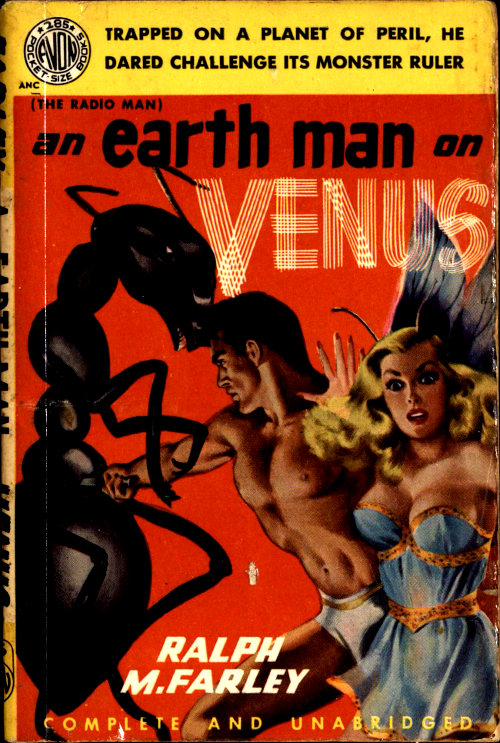
High Adventure and Strange Romance on a World of Mystery — AN EARTHMAN ON VENUS
When Myles Cabot accidentally transmitted
himself to the planet Venus, he found
himself naked and bewildered on a mystery
world where every unguarded minute
might mean a horrible death.
Man-eating plants, tiger-sized spiders, and
dictatorial ant-men kept Myles on the run
until he discovered the secret of the land—that
humanity was a slave-race and that
the monster ants were the real rulers of
the world!
But Cabot was resourceful, and when his
new found love, the Kewpie-doll princess
Lilla, called for help, the ant-men learned
what an angry Earthman can do.
AN EARTHMAN ON VENUS is a science-fiction
adventure packed with the
excitement of an Edgar Rice Burroughs,
and the science-vision of an H. G. Wells.
You won’t be able to put it down once
you start it.
{Originally titled “THE RADIO MAN”}
by
RALPH MILNE FARLEY
AVON PUBLISHING CO., INC.
119 West 57th Street, New York 19, N. Y.
Published by Arrangement with the Author
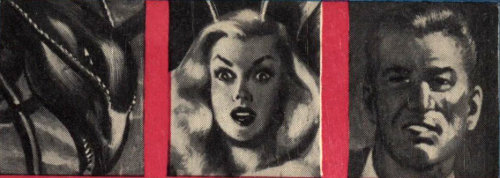
On the planet VENUS you will meet—
THIS EARTHMAN
MYLES CABOT, a good-looking young Boston radio experimenter, who accidentally broadcast himself bodily to another world.
THESE GIANT ANTS
QUEEN FORMIS, a twelve-foot-high monster, who ruled a world from an egg-laying couch, and could conceive of no mercy for her human slaves.
DOGGO, who became Myles Cabot’s friend through a curious accident and who first showed Myles the ropes on that queer planet.
SATAN, who was given that name by Myles for the unpleasant reason that he deserved it—and who lived up to it.
THESE VENUSIAN PEOPLE
PRINCESS LILLA, the lovely girl with the Kewpie wings, who held the key to the throne of Venus and the key to Myles’ heart simultaneously.
YURI, the suave scoundrel who wouldn’t hesitate to sell out his whole race to get Lilla’s hand by force.
TORON, who tipped Myles off to Lilla’s private intentions in order to save himself from slavery.
BTHUH, the beautiful lady who conspired to win Myles for herself, though she had to help his deadliest enemies to do it.
The Radio Man. Copyright, 1924 and 1939, by Frank
A. Munsey Company. Copyright, 1948, by Ralph Milne
Farley.
Avon Reprint Edition
An Earthman on Venus. Copyright, 1950, by Avon
Publishing Co., Inc.
Never had I been so frightened in all my life!
It was a warm evening late in August, and
I was sitting on the kitchen steps of my
Chappaquiddick Island farmhouse, discussing the drought with
one of the farm hands. Suddenly there appeared in the sky over
our heads a flaming fiery mass, rushing straight downward toward
us.
“Here’s where a shooting star gets me,” I thought, as I instinctively
ducked my head, just as though such a feeble move
as ducking one’s head could afford any possible protection from
the flaming terror. The next instant there came a dull crash,
followed by silence, which in turn was broken by the hired man
dryly remarking: “I reckon she struck over to Cow Hill.” Cow
Hill was the slight elevation just back of our farmhouse.
So the meteor hadn’t been aimed exactly at me, after all.
If that thing had hit me, some one else would be giving to the
world this story.
We did nothing further about the meteor that night, being
pretty well shaken up by the occurrence. But next morning, as
soon as the chores were done, the hired man and I hastened to
the top of Cow Hill to look for signs of last night’s fiery visitor.
And, sure enough, there were plenty of signs. Every spear of
grass was singed from the top of the hill; the big rock on the
summit showed marks of a collision; and several splinters of
some black igneous material were lying strewed around. Leading
from the big rock there ran down the steep side of the hill
a gradually deepening furrow, ending in a sort of caved-in hole.
We could not let slip such a good opportunity to get some
newspaper publicity for our farm. And so on the following
Friday a full account of the meteoric visitation appeared in the
Vineyard Gazette, with the result that quite a number of summer
folks walked across the island from the bathing beach to
look at the hole.
4
And there was another result, for early the following week
I received a letter from Professor Gerrish, of the Harvard Observatory,
stating that he had read about the meteor in the
paper, and requesting that I send him a small piece—or, if
possible, the whole meteor—by express, collect, for purposes of
analysis.
Anything for dear old Harvard! Unfortunately all the black
splinters had been carried away by tourists. So I set the men
to work digging out the main body. Quite a hole was dug before
we came to the meteor, a black pear-shaped object about the size
of a barrel. With rock tongs, chains and my pair of Percherons,
we dragged this out onto the level. I had hoped that it would
be small enough so that I could send the whole thing up to
Harvard and perhaps have it set up in front of the Agassiz
Museum, marked with a bronze plate bearing my name; but its
size precluded this.
My wife, who was present when we hauled it out, remarked:
“It looks just like a huge black teardrop or raindrop.”
And sure enough it did. But why not? If raindrops take on
a streamline form in falling, why might not a more solid meteor
do so as well? But I had never heard of one doing so before.
This new idea prompted me to take careful measurements and
to submit them to Professor O. D. Kellogg, of the Harvard
mathematics department, who was summering at West Chop
near by. He reported to me that the form was as perfectly
streamlined as it was possible to conceive, but that my surmise
as to how it had become so was absurd.
While making these measurements I was attracted by another
feature of the meteor. At one place on the side, doubtless where
it had struck the big rock, the black coating had been chipped
away, disclosing a surface of yellow metal underneath. Also
there was to be seen in this metal an absolutely straight crack,
extending as far as the metal was exposed, in a sidewise direction.
At the time the crack did not attract me so much as the metal.
I vaguely wondered if it might not be gold. But, being reminded
of Professor Gerrish’s request for a sample of the meteor, I had
one of the men start chiseling off some pieces.
5
The natural spot to begin was alongside of the place where
the covering was already chipped. It was hard work, but finally
he removed several pieces, and then we noticed that the crack
continued around the waist of the meteor as far as had been
chipped. This crack, from its absolute regularity, gave every indication
of being man-made.
Our curiosity was aroused. Why the regularity of this crack?
How far did it go? Could it possibly extend clear way around?
Was it really a threaded joint? And if so, how could such a
phenomenon occur on a meteorite dropped from the sky?
Forgotten was the second crop mowing we had planned to do
that day. Hastily summoning the rest of the help, we set to work
with cold chisels and sledges, to remove the black coating in a
circle around the middle of the huge teardrop. It was a long
and tedious task, for the black substance was harder than anything
I had ever chipped before. We broke several drills and
dented the yellow metal unmercifully, but not so much but
what we could see that the threaded crack did actually persist.
The dinner hour passed, and still we worked, unmindful of
the appeals of our womenfolk, who finally abandoned us with
much shrugging of shoulders.
It was nearly night when we completed the chipping and
applied two chain wrenches to try and screw the thing apart.
But, after all our efforts, it would not budge. Just as we were
about to drop the wrenches and start to chisel through the metal
some one suggested that we try to unscrew it as a left-handed
screw. Happy thought! For, in spite of all the dents which we
had made, the two ends at last gradually untwisted.
What warrant did we have to suppose that there was anything
inside it? I must confess, now it is all over, that we went
through this whole day’s performance in a sort of feverish
trance, with no definite notion of what we were doing, or why;
and yet impelled by a crazy fixed idea that we were on the
verge of a great discovery.
And at last our efforts had met with success, and the huge
teardrop lay before us in two neatly threaded parts. The inside
was hollow and was entirely filled with something tightly
swathed in silver colored felt tape.
6
Breathless, we unwound over three hundred feet of this silver
tape, and finally came to a gold cylinder about the size and
shape of a gingersnap tin—that is to say, a foot long and three
inches in diameter—chased all around with peculiar arabesque
characters. By this time Mrs. Farley and my mother-in-law and
the hired girl had joined us, attracted by the shouts which we
gave when the teardrop had come apart.
One end of the cylinder easily unscrewed—also with a left-handed
thread—and I drew forth a manuscript, plainly written
in the English language, on some tissue-thin substance like
parchment.
Everyone clustered around me, as I turned to the end to see
who it was from, and read with astonishment the following
signature: “Myles S. Cabot.”
But this name meant nothing to anyone present except myself.
I heard one of the hands remark to another:
“’Twarn’t no shootin’ star at all. Nothin’ but some friend of
the boss shootin’ a letter to him out of one of these here long-range
guns.”
“Maybe so,” said I to myself.
But Mrs. Farley was quivering with excitement.
“You must tell me all about it, Ralph,” said she. “Who can
be sending you a message inside a meteor, I wonder?”
My reply was merely: “I think that there is a clipping in one
of my scrapbooks up in the attic which will answer that question.”
There was! I found the scrapbook in a chest under the eaves,
but did not open it until after chores and supper, during which
meal I kept a provoking silence on the subject of our discovery.
7
When the dishes were finally all cleared away, I opened the
book on the table and read to the assembled household the following
four-year-old clipping from the Boston Post.
CITIZEN DISAPPEARS Prominent Clubman Vanishes from Beacon Street Home
Myles S. Cabot of 162 Beacon Street, disappeared from his bachelor
quarters late yesterday afternoon, under very mysterious circumstances.
He had been working all day in his radio laboratory on the top floor
of his house, and had refused to come down for lunch. When called to
dinner, he made no reply: so his butler finally decided to break down the
door, which was locked.
The laboratory was found to be empty. All the windows were closed
and locked, and the key was on the inside of the door. In a heap on the
floor lay a peculiar collection of objects, consisting of Mr. Cabot’s watch
and chain, pocket knife, signet ring, cuff links and tie pin, some coins, a
metal belt buckle, two sets of garter snaps, some safety pins, a gold pen
point, a pen clip, a silver pencil, some steel buttons, and several miscellaneous
bits of metal. There was a smell in the air like one notices in electric
power houses. The fuses on the laboratory power line were all blown out.
The butler immediately phoned to police headquarters, and Detective
Flynn was dispatched to the scene. He questioned all the servants thoroughly,
and confirmed the foregoing facts.
The police are working on the case.
WAS PROMINENT RADIO ENTHUSIAST
Myles S. Cabot, whose mysterious disappearance yesterday has shocked
Boston society, was the only son of the late Alden Cabot. His mother was
a Sears of Southboro.
The younger Cabot since his graduation from Harvard had devoted himself
to electrical experimenting. Although prominent in the social life of
the city, and an active member of the Union, University, New York Yacht,
and Middlesex Hunt Clubs, he nevertheless had found time to invent novel
and useful radio devices, among the best known of which is the Indestructo
Vacuum Tube.
He had established at his Beacon Street residence one of the best equipped
radio laboratories in the city.
His most recent experiment, according to professional friends, had been
with television.
Mr. Cabot substituted two circuits for the usual television circuit, one
controlling the vertical lines of his sending and receiving screens, and the
other the horizontal, thus enabling him to enlarge his screen considerably,
and also to present a continuous picture instead of one made up of dots.
The effect of perspective he obtained by adding a third circuit.
The details of this invention had not been given out by Mr. Cabot prior
to his disappearance.
His nearest relatives are cousins.
The last was a particularly gentle touch, it seemed to me.
Well, his cousins hadn’t yet inherited his property, although
they had tried mighty hard; and perhaps this mysterious message
from the void would prevent them from ever doing so. I
hoped that this would be the case, for I liked Myles, and had
never liked those cousins of his.
Myles had been a classmate of mine at Harvard, though later
our paths drifted apart, his leading into Back Bay society and
radio, and mine leading into the quiet pastoral life of a farm
on Chappaquiddick Island off the coast of Massachusetts. I
had heard little of him until I read the shocking account of his
sudden disappearance.
8
The police had turned up no further clues, and the matter
had quickly faded from the public sight. I had kept the Post
clipping as a memento of my old college chum.
I was anxious to learn what had become of him these four
years. So I opened the manuscript and proceeded to read aloud.
In the following chapters I shall give the story contained in
that manuscript—a story so weird, and yet so convincingly
simple, that it cannot fail to interest all those who knew Myles
Cabot. It completely clears up the mystery surrounding his disappearance.
Of course, there will be some who will refuse to
believe that this story is the truth. But those of his classmates
and friends who knew him well will find herein unmistakable
internal evidence of Myles Cabot’s hand in this narrative conveyed
to me in the golden heart of a meteorite.
2 stranded in space
Thus wrote Myles Cabot:
My chief line of work, since graduating
from Harvard, was on the subject of television.
By simultaneously using three sending sets and three
receiving sets, each corresponding to one of the three dimensions,
any object which I placed within the framework of my
transmitter could be seen within the framework of my receiver,
just as though it stood there itself.
All that prevented the object from actually being made to
stand there was the quite sufficient fact that no one had yet,
so far as I was then aware, invented a means for dissolving
matter into its well-known radiations, and then converting these
radiations back into matter again.
But at just this time, by a remarkable coincidence, there came
into my hands a copy of an unpublished paper on this subject
by Rene Flambeau.
9
The prior experiments of De Gersdorff are well known; he
had succeeded by means of radio waves, in isolating and distinguishing
the electro-magnetic constituents of all the different
chemical elements. Flambeau went one step further, and was
able to transmit small formless quantities of matter itself, although
for some reason certain metals, but not their salts, appeared
to absorb the electrical energy employed by him, and
thus be immune to transportation.
As I could already transmit a three-dimensional picture of an
object, and as Flambeau had been able to transmit formless
matter, then by combining our devices in a single apparatus I
found I could transmit physical objects unchanged in form.
But this apparatus produced one unexpected phenomenon—namely,
that whenever I employed excessive power, my sending
set would transmit objects placed slightly outside its normal
range, and certain small quantities thereof would turn up in
other portions of my laboratory than within my receiving set.
To test this phenomenon further, I secured some high voltage
equipment and arranged with the Edison Company for its use.
On the afternoon when the installation was completed, I
started to place a small blue china vase in position to send it.
Something must have become short-circuited, for there came a
blinding flash, and I knew no more.
How long the unconsciousness lasted, I have no means of
telling. I was a long time regaining my senses, but when I had
finally and fully recovered I found myself lying on a sandy
beach, beside a calm and placid lake, and holding in my hand
the small blue vase.
The atmosphere was warm, moist and fragrant, like that of
a hothouse, and the lap-lapping of the waves gave forth such
a pleasing musical sound that I lay where I was and dozed off
and on, even after I had recovered consciousness.
I seemed to sense, rather than really to see, my surroundings.
The sand was very white. The sky was completely overclouded
at a far height, and yet the clouds shone with such a silvery
radiance that the day was as bright as any which I had ever
seen with full sunlight on earth, but with a difference, for here
the light diffused from all quarters, giving the shadowless effect
which one always notes in a photographer’s studio.
To my right lay the lake, reflecting the silvery color of the
sky. Before me stretched the beach, unbroken save for an occasional
piece of driftwood. To my left was the upland, covered
with a thicket of what at first appeared to be dead trees, but
on closer scrutiny were seen to be some gigantic species of the
well-known branched gray lichen with red tips, which I used to
find on rocks and sticks in the woods as a child.
10
No birds were flying overhead, I suppose because there were
no birds to fly. I fell to wondering, vaguely and pleasantly,
where I was and how I got there; but for the moment I remained
a victim of complete amnesia.
Suddenly, however, my ears were jarred by a familiar sound.
At once my senses cleared and I listened intently to the distant
purring of a motor. Yes, there could be no mistake—an airplane
was approaching. Now I could see it, a speck in the sky, far
down the beach.
Nearer and nearer it came.
I sprang to my feet, and to my intense surprise found that
the effort threw me quite a distance into the air. Instantly the
thought flashed through my mind: “I must be on Mars!” But
no, for my weight was not nearly enough lighter than my
earthly weight to justify such a conclusion.
For some reason my belt buckle and most of the buttons
which held my clothes together were missing, so that my clothing
came to pieces as I arose, and I had to shed it rapidly in
order to avoid impeding my movements. I wondered at the
cause of this.
But my speculations were cut short by the alighting of the
airplane a hundred yards down the beach. It seemed to land
vertically, rather than run along the ground, but I could not be
sure at that distance. What was my horror when out of it clambered
not men but ants! Ants, six-footed and six feet high.
Huge ants, four of them, running toward me over the glistening
sands.
Gone was all my languor as I seized a piece of driftwood and
prepared to defend myself as well as I could. The increase in
my jumping ability, although slight, coupled with an added
buoyancy, might enable me to prolong the unequal encounter.
The ants came slowly forward, four abreast, like a cavalry
formation, while I awaited their onslaught, grasping the stick of
driftwood firmly in my hand. When nearly upon me they executed
right-by-troopers and started circling in an ever-narrowing
circle.
11
Suddenly the ants wheeled and converged from all four
points of the compass, clicking their mandibles savagely as they
came. The whole movement had been executed with uncanny
precision, without a single word of communication between the
strange black creatures; in fact, without a single sound except
the clicking of their mandibles and a slight rattling of their
joints. How like a naval attack by a fleet of old-fashioned Ford
cars, I thought.
When within about ten feet of me, they made a concerted
rush; but I leaped to one side, at the same time giving one of
my antagonists a crack with my club as they crashed together in
the center. This denouement seemed to confuse them, for they
slowly extricated themselves from their tangle and withdrew
for a short distance, where they again formed and stood glaring
at me for a few minutes, clicking their jaws angrily.
Then they rushed again, this time in close formation, but
again I jumped to one side, dealing another blow with my club.
Whereupon the fighting became disorganized, the ants making
individual rushes, and I leaping and whacking as best I could.
I scored several dents in the armor of my opponents, and
finally succeeded by a lucky stroke in beheading one of them.
But at this the other three came on with renewed vigor. Although
each ant wore some sort of green weapon slung in a
holster at its side, they fought only with their mandibles.
The slight difference in gravity from that to which I had
been accustomed finally proved my undoing; for, although it
increased my agility, it also rendered me a bit less sure on my
feet, and this was enhanced by the rapid disintegration of the
soles of my shoes. The result was that, at last I slipped and fell,
and was immediately set upon and pinned down by my enemies.
One of the ants at once deliberately nipped me in the side
with his huge mandibles. An excruciating pain shot through
my entire body; and then, for the second time that day, I lost
consciousness.
When I came to, I found myself lying in the cockpit of an
airplane, speeding through the sky. One of my ant captors was
standing on a slight incline at the bow of the ship, operating
the control levers with his front feet; and the other two were
watching the scenery. The dead ant was nowhere to be seen.
No one was paying any attention to me.
12
I was not bound, and yet I was unable to move. My senses
were unusually keen, and yet my body was completely paralyzed.
I had no idea as to what sort of country we were flying over,
for I could not raise my head above the edge of the cockpit. I
didn’t know where I was going, but I certainly was on my way
all right. And not so all right, at that.
Overhead was the same silvery glare, without a patch of blue
sky. No sound came from my sinister, indifferent captors. The
only noise was the throbbing of the motors.
As to the time of day, or how long I had been on board, I
had no idea; and what was more, I didn’t particularly care.
Rather a pleasant sort of a jag, if it were not for the intense pain
of lickering-up.
After a while the pleasant sensation wore off, and my throat
began to feel dry. I tried to call to the ants, but of course could
not, because of the paralysis; and finally desisted even the attempt,
when I remembered that the ants were speechless and
hence probably unable to hear.
By a coincidence, however, one of the creatures seemed to
sense my needs, and brought me some water in a bowl, gently
holding up my head with one of his forepaws so that I could
drink. This action touched my heart, and also filled me with
hope that the ants might not turn out to be such bad captors
after all.
Then I fell to studying them. First of all, I noticed that each
ant carried on the back of his thorax a line of peculiar white
characters, somewhat like shorthand writing; and below it several
rows of similar writing, only smaller in size.
The peculiar green-colored weapon, slung in a holster on the
right-hand side of each ant, I had already noticed during the
fight. But, apart from the white marks and the green weapons,
my captors were absolutely naked; and so far as I could see
they were exactly like the ordinary black ants to which I had
been accustomed on earth, only of course magnified to an enormous
size.
I studied the faces which the ants now occasionally turned
toward me. These faces were sinister and terrifying. They recalled
to my memory the fright which I had once had when, as
a child, I attended an entomological movie and was suddenly
confronted with a close-up of the head of some common insect.
13
But the ant who had brought me the water had a human look
which relieved him of much of his terrible grimness. In fact,
he struck me as vaguely familiar. Ah! Now I had it! A certain
stolidity of movement, amounting almost to a mannerism, reminded
me of one of my Harvard classmates, a homely good-hearted
boy whom we had all known by the nickname of
“Doggo.” And so, from then on, I instinctively thought of that
particular ant as named Doggo.
Then, for the first time, it struck me as strange that these
ants, instead of scuttling aimlessly over the ground, or having
wings of their own to fly with, as in the mating season on earth,
were utilizing a carefully and scientifically built airplane, apparently
of their own make. And it struck me as even more
strange that I had not wondered about this before.
But then the events of that day had occurred with such startling
rapidity—from the flash in my Beacon Street laboratory,
through my awakening beside that strange lake, the approach
of the airplane, my fight with the ants, and my second lapse
from consciousness, down to my present predicament—that I
was to be excused for not considering any particular phase of
my adventures as being more extraordinary than any other.
Now, however, that I had had time to draw my breath and
collect my thoughts, it dawned on me with more and more
force that here I was, apparently on some strange planet of
which the ruling race, apparently of human or superhuman
intelligence, were not men. And they were not even some other
mammal, but were insects—ants, to be more specific. For all that
I knew, I was the only mammal—or perhaps even the only
vertebrate—on this entire planet.
Then I remembered a remark by Professor Parker in Zoology
1 in my freshman year at Harvard: “The two peaks of development,
in the chain of evolution from the amoeba upward, are
the order of hymenoptera (bees, wasps and ants) among insects,
and the order of primates (men and monkeys) among mammals.
In any other world it is probable that evolution would
produce a ruling race, in much the same way that man has been
produced upon the earth; and it is a toss-up whether this ruling
race would develop along the lines of the hymenoptera, or in a
form similar to the mammals; but one or the other seems inevitable.”
“Well,” said I to myself, “old Parker is certainly vindicated,
at least with respect to one planet.”
14
Thus I mused, as the airplane sped along. Then the purr of
the motors lulled me to sleep, and for the third time that day I
became unconscious.
When I awoke the sky was losing its luminous silver quality.
On one side it was faintly pink, and on the other the silver color
merged into a duller gray. The airship still sped along.
Doggo brought me another bowl of water, and I found, to
my joy, that I could now lift my head enough to drink without
any further assistance than to have Doggo hold the bowl. At this
sign of recovery, one of the other ants advanced menacingly as
if to bite me again. But Doggo jumped between us, and after
much snapping of mandibles and quivering of antennae by both,
the other ant desisted.
This event decided me that Doggo was a friend worth cultivating,
but I was at a loss how to make advances which would
be understood. Finally, however, I determined to attempt stroking
the huge ant in a way which I had found to be very effective
in making friends with animals.
Accordingly, when Doggo came near enough, by a great effort
I overcame my paralysis sufficiently to reach up and touch
him on the side of his head just behind one of his great jaws.
Apparently this pleased the ant, for he submitted to the caress,
and finally lifted me to a sitting position, so that the patting
could be continued with greater ease.
I later learned that this patting, to which I had resorted purely
by accident, is a universal custom of this planet, corresponding
to shaking hands on earth, and signifying greetings, friendship,
farewell, bargain binding, and the like.
The other ant-man occasionally would advance menacingly
toward me with his head lowered, but each time Doggo would
step between us, and lower his own head and agitate his antennae,
at which the other would desist. I nicknamed the other
Satan, because of his diabolical actions.
In my new sitting position I was now able to see over the
side of the airship. We were passing above gray woods, with
occasional silver-green fields, in which were grazing some sort
of pale green animals, too far below to be easily distinguishable.
Through the woods and fields ran what appeared to be roads,
but as nothing was moving on them, I could not tell for sure.
15
Suddenly my attention was distracted from the view by the
frantic action of the ant-man who was steering the ship. He
seemed to be having difficulty with his controls. And then, so
quickly that it gave us no warning, the ship reared up in the
air and made a complete loop. That is, I merely suppose it made
a complete one, for when the loop was half done, I dropped out
and fell like a plummet.
I remember a momentary exultation at being free from my
captors, and a certain spiteful joy at the thought that I should
undoubtedly be dashed to pieces and thus rob them of their
prey. Then I had just begun to wonder whether I shouldn’t
prefer captivity to death, when I struck—
And was not dashed to pieces.
I still lived, for I had been thrown slantwise into a net of
some sort, and was now swaying gently back and forth like a
slowing pendulum. Hooray! I was both free and safe.
But my joy was short lived, for I soon discovered that the
fine silken strands of the net were covered with a substance
like sticky fly paper, which held me firmly. The more I struggled,
the more I drew other strands of the net toward me to
entangle me. At last I paused for breath, and then the truth
dawned on me: I was caught in a gigantic spider web! And
sure enough, there came the spider toward me from one corner
of the web.
He wasn’t a very large spider. That is to say, judging by the
size of my previous captors, I should have expected that the
spiders of this world would be as big as the Eiffel Tower. He
was quite large enough however, having a body about the size
of my own, and legs fully ten feet long. I call him a “spider,”
for that is the earth word which comes closest to describing him.
With great assiduity he began wrapping me up into a cocoon,
a process which he seemed to enjoy much more than I. But it
did me no good to struggle, for any part of me which showed
any indications of moving was immediately pinioned with a
fresh strand of rope.
At last the job was finished, and I was completely enveloped
with a layer of thick coarse sticky silk cloth, translucent but not
transparent.
16
3 out of the frying pan
When I had dropped from the airplane into
the spider web, the time had been nearly
evening. All night, off and on, I struggled,
but to no avail. Finally, shortly after daylight, something startled
me by falling—plop—into the net close beside me. Another
victim, thought I. Well, at least I should have company.
But this other creature was not any more inclined to take its
captivity calmly than I had been. It thrashed and struggled
violently, until finally it tore a rent in the upper end of my
shroud, so that I could see out.
My companion in misery was an orange-and-black-striped bee
about the size of a horse. He was buzzing frantically and slashing
about with his sting, while the spider hopped around him
with great agility, dodging the thrusts of the sting, and applying
a strand of silk here and there, whenever an opportunity offered.
Thus gradually the bee’s freedom of motion became less and
less, as strand after strand were added to his bonds.
But the spider, getting bolder as his captive’s struggles diminished,
finally misjudged one thrust; and the imprisoned bee,
putting all his effort into the stroke, drove his sting home. The
spider toppled from the web, and the fight was unexpectedly
at an end.
And now the bee and I were free, if we only could get free.
Of the two of us, I had the easier task, for my cocoon had dried
during the night and was now no longer sticky. But it was still
very tough.
Slowly, inch by inch, biting, clawing, tearing, I gradually
enlarged the hole near my head, until finally I was able to step
out and jump to the ground, which was about ten feet away, a
drop equivalent to a little less than eight feet on the earth, not
much difference, it is true, but every little bit helped.
17
I now decided to assist my rescuer, the bee, to escape. A rash
decision, one would say, and yet the bee seemed to realize that
I was helping him, for not once did he strike at me. Picking up
a tree branch, I hacked at the cords which bound him, until
finally he was able to fly away, trailing a large section of the
web after him.
As he left, I noticed that one of his hind legs was gone from
the knee down, and that he bore a peculiar scarlike mark on
the under side of his abdomen. I should know him, if ever I
were to meet him again.
The web had been stretched between two large gray leafless
trees of the sort I had observed near the beach, but without the
red tips to the branches. Nearby was a wood of similar but
slightly smaller trees, bordering on a field of thickly matted
silver-green grass, very similar in color. In this field were grazing
a herd of pale green insects a little larger than sheep, with
long trailing antennae.
These creatures swayed from side to side, lifting first one
foot after another as they munched the matted grass. On the
sides of some of them clung one or more bright red parasites,
resembling lobsters in size and appearance; but their green
hosts did not seem to mind or even notice them. Nor did they
notice me, for that matter, as I passed between them across the
field.
On the further side of the field was a road, built of concrete,
resembling in every way such concrete roads as we have on
the earth; and along it I set out, whither I knew not.
Now, I had had nothing to eat since I found myself on the
sandy beach the previous morning. Also I had fought two battles
on an empty stomach. The day was hot and moist, my feet were
bare—as was the rest of me—and I felt discouraged and depressed.
Still, I trudged along.
“Can it be true,” said I, “that only yesterday I rejoiced at
freedom from the ant-men?”
Now I was alone and lost—lost on a strange planet. Oh, how
I longed for the sight of my late captors. Better even captivity
than this!
18
For a while the road ran between silver-green fields; then
entered a wood. On the gaunt gray trees hung a tangle of
tropical vines, and between the trees grew some kind of small
shrub with large heart-shaped leaves, on each leaf of which
there sat motionless one or more purple grasshoppers about
four inches in length.
In the distance I occasionally caught sight of some strange
sort of bird—as I thought—flitting in tandem pairs from tree
to tree. A multitude of tiny lizards, resembling miniature kangaroos,
hopped about on the concrete and by the side of the road.
For a while the strange fauna and flora stimulated my curiosity
and kept my mind off my troubles; but then I rapidly lost
interest in everything. My stomach gnawed. My knees wobbled.
My mind began to cloud. And from that time on, I wandered
as in a dream, for I know not how many hours.
I vaguely remember falling on the roadway, and then crawling
along for a while. Silly thoughts obsessed my brain, such as
wondering whether my tail light was lit, and what made the
weather so foggy. Finally I collapsed utterly, and had just
strength enough to drag myself off the concrete lest I be run
over by some passing car.
As I lay there in the bushes by the side of the road, there came
to my nostrils a smell which partially revived me—a smell
seemingly of griddle cakes and maple syrup. Opening my eyes
again and following my nose, I discovered that this pleasant
odor emanated from a large bowl-shaped leaf only a few feet
away.
Upon dragging myself toward it, I discovered that in the
bottom of the bowl there was a brown mass, looking very much
like a stack of wheats, covered with some sticky substance. But
unfortunately this delectable dish was quite obscured by little
hopping lizards, now much bemired and hopping no more.
So I reached out my hand to brush them away, and instantly
the leaf closed upon my arm like a steel trap.
My brain cleared at once, and I began a frantic struggle to
extricate my hand; but it was too late, for with a gentle massaging
motion the plant commenced to swallow my arm.
Inch by inch my arm descended into that rapacious maw. It
was the steady slowness of the procedure that was so nerve-wracking,
for without a pause my arm disappeared at a rate of
about an inch a minute.
19
I braced my feet against the plant and pulled, but this cut
off the circulation in my arm. Then I wiggled my fingers rapidly
so as to keep my hand from going to sleep, whereupon the
plant swallowed all the faster.
The mouth of the plant had closed very much like a clam
shell, so, just before my shoulder disappeared, I braced my body
crosswise of the jaws, in the hope that this maneuver would
prevent the swallowing process from proceeding any further.
But the plant merely opened its flexible lips, and closed them
the other way, taking a firm grip on my chest, and just missing
getting hold of my right ear. I craned my neck as far as I
could to the left, and shrieked aloud with terror.
Was it for this that I had escaped the ant-men and the spider—to
be eaten alive by a plant?
The soft jaws now fastened on the back of my head and
began gently drawing that in, too. At last only my nose was
free. In a minute that, too, would be enveloped, then strangulation
and death.
At this moment something fell upon me, and I felt the plant
quiver and shake. The swallowing ceased. Then the soft lips
were torn away from one side of my head, and I heard a
familiar rattling sound.
A few seconds later the plant went limp, releasing my arm,
and I lay upon my back, free once more, gazing upward into
the eyes of my old friend and captor.
“Doggo, Doggo!” I cried with joy, but he did not seem to
hear me. Nevertheless he picked me up gently in his mandibles
and trotted off with me down the road.
After about a quarter of a mile, we turned aside into a field,
and there was Satan, the other ant-man, standing beside a
crumpled airship and the dead body of its pilot. Satan did not
seem overjoyed to see me, but Doggo rummaged through the
wreckage and finally produced a bowl, into which he put some
water and some medicine, which revived me greatly. Then he
laid me on a pile of grass, covered me with leaves and stood
guard over me as the pink twilight deepened and the night fell.
20
As it began to grow dark I could hear an occasional tinkle like
the sound of a Japanese wind bell, first on one side and then
on another. This music gradually increased, until it assumed
the volume of a fairy orchestra. I had never heard such dainty
bewitching tunefulness in my entire life. Many weeks later I
learned that this was the song of the large purple grasshoppers I
had seen; but even the knowledge of its source has never robbed
the sound of its sweet mystery for me.
The fading silver radiance of the sky shed a moonlike light
over all below. A faint breeze sprang up, gently fanning the
moist fragrant hot-house air against my cheeks. The foliage
around us waved like a sea of silver grain. And the tune of that
elfin melody quickly lulled me into a soft and dreamless sleep,
secure in the confidence that a faithful friend was watching near.
The next morning I was awakened by Doggo stripping off
my leafy coverlet. Satan was not to be seen, but grazing near
us were some more of those peculiar large green insects, with
long trailing antennae, which I had seen in my flight from the
spider web.
As I sat up, Doggo presented me with a bowl of pale green
liquid. But I was at a loss to know what to do with it. Was
I supposed to wash in it, or drink it, or to rub it in my hair?
My friend solved the question by lifting it to my mouth. So
I drank, and found the taste sweetish and agreeable.
All morning we stayed by the wrecked machine, apparently
waiting for something. Satan did not show up. Around noon,
Doggo took the bowl and approached one of the green beasts
grazing near. I followed with interest.
Two horns projected upwardly from the tail of the beast, one
of which Doggo proceeded to stroke with his paw; and to my
surprise, a green liquid spouted from the animal, quickly filling
the bowl. So that is where my breakfast had come from! Green
milk from green cows! Strange! And yet how much more
logical than on earth, where a red cow eats green grass under
a blue sky and produces white milk, from which we get yellow
butter.
Shortly after lunch I heard the hum of a motor, and presently
Satan landed near us with a new plane. This strange plane of
the ant-men stopped abruptly, hovered for a moment, and then
settled just where it was, like a helicopter.
Doggo carried me aboard, and we started, Satan at the levers
and Doggo standing guard over me. But whether this was to
protect me from Satan, or to keep me from falling out again,
I could not say.
21
We cruised along for several hours over much the same sort
of country as I had seen before, except that we crossed several
rivers, and once a small lake.
At last the ship hovered and landed on top of what seemed
to be a helter-skelter pile of exaggerated toy building blocks,
exactly in keeping with the size of the ants. As far as the eye
could see on all sides, these blocks were heaped. They resembled
a group of Pueblo Indian dwellings.
Doggo and the fierce ant-man whom I called Satan now
picked me up in their jaws, the former gently and the latter
not so gently, and carried me out of the airplane and down an
inclined runway into the interior of the edifice. The passage
was long, narrow, dark and winding, but presently we emerged
into a room about thirty feet square by ten feet high, lighted
by narrow windows opening toward the western sky. That is,
I call it “western,” for it was in this direction that the sky turned
pink at eventide.
In this room I was laid on the floor. The unpleasant ant-man
departed, and Doggo placed himself on guard in the doorway.
Presently two strange ant-men entered, carrying a couch,
which they set down in one corner of the room. Then they
walked several times around me, viewing me from all sides
with evident interest, until, at a stiffening and quivering of
Doggo’s antennae, they hurriedly left the room. I noticed that
Doggo no longer carried the green weapon, which seemed
strange, as he was evidently on guard.
Then I fell to wondering about the couch. It was a simple
affair, and yet quite evidently intended for a bed. Upholstered
with some kind of dark blue cloth, at that!
“What need have ants of a bed?” I mused. “Certainly they
cannot lie down; and, even if they could, such a couch as this
would be of little use to one of them, for this is only a man-size
couch, whereas these ants are about ten feet in length!”
My perplexity was tinged with a hope that there might be
human beings here.
22
My perplexity and my hope were both increased by the return
of one of the ants who had brought the couch, this time bearing
a sleeveless shirt or toga of white matted material, like very thin
silk felt, reaching about to my knees, with a Grecian wave design
in light blue around the bottom edge and around the neck
and armholes. But what increased my perplexity still further,
and at the same time destroyed most of my hope, was the presence
of two vertical slits, with the same blue trimming, in the
upper part of the back.
The two ant-men watched with great interest while I put this
toga on, and were evidently pleased to find that I knew how to
do so. The messenger ant then withdrew, and presently returned
with a bowl of green milk, which I drank as usual.
By this time it had become quite dark outside, but the room
still remained light, due to two long glass bulbs, set in the ceiling,
and containing some sort of incandescent substance. At
that time I little guessed what a part those bulbs would come
to play in my life! They resembled the fluorescent lamps familiar
on earth.
These lamps showed that the inhabitants of this planet were
well advanced in electrical engineering. Was it not strange,
then, that they had not developed radio and communicated
with the earth? And yet not so strange, either, when one considers
that they had no sense of hearing.
Dismissing these thoughts from my mind, I lay down on the
couch. Then Doggo was relieved as sentinel by a new ant-man,
who carefully and inquisitively inspected me, but from a safe
distance. This guard, too, was without any green weapon.
Finally the two lights went out, and I slept, my last thoughts
being to wonder what was in store for me, and what was the
significance of the couch and the strange blue-and-white article
of clothing.
4 go to the ant, thou sluggard
As I slowly awakened the next morning, I
vaguely remembered a terrible nightmare
of the night before.
But no, it was no dream, for I opened my eyes upon the same
plain concrete room with its slit windows. I was lying on the
same couch. The same strange ant-man was standing guard at
the door. During the night some one had placed over me a
blanket of some sort of light fleecy wool felt.
23
As I lay in bed I studied the walls of the room and noticed,
what I had not seen before, three dials sunk in the opposite
wall close to the ceiling. Each dial had twelve numbers or letters
around the edge, and also a single pointer. The pointer of
the right dial was slowly revolving left-handedly; the pointer
of the middle dial was turning even more slowly; while that of
the left dial appeared motionless. Absent-mindedly I started to
time the right-hand pointer.
“One chimpanzee. Two chimpanzee. Three chimpanzee,” I
counted in sing-song; that being a formula which I had been
taught as a child, to count the time between a lightning flash
and the resulting thunder, in order to estimate the distance of
the stroke.
For, if carefully done, each chimpanzee equaled one second of
time, and each second meant one quarter-mile of distance. Of
course the real object of the game was to distract the child’s
mind from his fear of the lightning.
I now found that it took about fifty chimpanzees for the right
pointer to move one of the twelve graduations. This fact I
verified by several trials.
I fell to wondering what the device was for.
It looked and acted like a gas meter or electric meter.
Then I dismissed the meter from my mind, and considered
my predicament. For some reason I thought of my father, Alden
Cabot, now many years dead. The old man had been a stern
puritanical character, abhorring sloth and frivolity.
How often had I heard him rebuke some act of laziness with
his favorite Biblical quotation: “Go to the ant, thou sluggard;
consider her ways and be wise.”
“Wouldn’t father be pleased,” thought I, “for I have certainly
gone to the ant, all right! But now the big question is how to
get away from them.”
By this time the sentinel noticed that I was awake, and immediately
brought me my breakfast, consisting of a bowl of the
sweet green liquid and a bowl of dark reddish-brown paste,
about the consistency of mashed beans, and having a rich flavor
not unlike beef gravy.
After breakfast Doggo took his turn as guard. I patted his
head, and then went over to the windows to see the view, if any.
24
The windows overlooked a courtyard completely enclosed by
piled-up Puéblo buildings. In the yard was a fountain, surrounded
by beds of plants quite unlike any that I had ever seen
before. The prevailing color of the foliage was gray and silver
green. Many of the twigs bore knobs of red or purple, and a
few of the plants had brilliantly colored blue and yellow flowers
somewhat similar to those of dandelions.
For a long time I aimlessly gazed upon this beautiful garden.
The warm moist fragrant atmosphere was not conducive to
hurry or to excitement. But finally even the beauties of the view
palled upon me, and I returned to the blue couch.
Just then Doggo ushered into the room, with great deference,
four ant-men slightly smaller than himself, but more refined
looking than he, if one can appreciate such differences among
ants. That is, they were more slender and delicate, like machines
built for precision rather than for strength.
They evidently were a bit afraid of me, for after eyeing me
furtively from the door they appeared to confer with Doggo,
though not an audible word passed between them. To assure
them that I was perfectly harmless, Doggo walked over to me
and permitted himself to be patted; after which the committee
drew near and inspected me carefully, agitating their antennae
at each newly discovered peculiarity.
They appeared chiefly perplexed by my forehead and my back,
to examine which, they lifted up my toga. They counted my
fingers several times, and then counted my toes.
But the thing about me which amazed them the most was my
ears. These they studied for a long time, with much inaudible
consultation, as I judged by the motions of their antennae.
Finally they took their departure, and Doggo came to me
bristling with excitement, and apparently having much important
information to impart; but, alas, he did not know my language,
and he had no language at all. I patted him again, but
this time it did not soothe him, for he broke away from me
impatiently and returned to his station by the door.
Left to myself, I fell to studying the meter again, watching
the counter-clockwise rotation of its hands. Even the left pointer
had moved a bit since early morning.
25
Now I noticed, what I might have surmised on the analogy of
an earthly gas meter, that each graduation of the central dial
represented one complete revolution of the pointer on its right;
and this principle presumably extended to the dial on its left.
Then I counted chimpanzees again, and found that the right
hand pointer was still rotating counterclockwise at the rate of
about fifty chimpanzees per graduation. Counterclockwise!
Why, perhaps this machine was a clock!
I made a hasty mental calculation: “One graduation equals
fifty seconds. Twelve graduations—one complete rotation—equal
six hundred seconds—ten minutes. Thus one graduation of
the middle dial represents ten minutes, and its complete circuit,
represents two hours. By the same token, a complete circuit of
the left dial would represent twenty-four hours—one day!”
My guess was apparently correct.
At that time it did not occur to me as strange that a day on
this planet should be twenty-four hours as on earth.
The figure to the left of the top of each dial was a single
horizontal line, presumably standing for unity; for a single line,
either horizontal or vertical, is the almost universal symbol for
unity.
“Then,” said I, “the next figures must be two, the next figure
three, and so on around to twelve. Eureka! I can now count up
to twelve with these creatures; thus establishing, in writing at
least, the beginning of a possible basis of communication.”
Eager to test my newfound knowledge, I beckoned to Doggo.
He came to my side.
Scratching the ant figure five upon the floor with a small
pebble which I found in a corner—for I could not reach the
dials to point to their figures—I held up five fingers. The effect
was electrical. Greatly excited, Doggo rushed to the door. But,
pausing on the threshold, he returned; held up three legs, looking
at me almost beseechingly, as I thought; and, when I wrote
an ant figure three on the floor, his joy knew no bounds. He
patted me on the side of my head for a moment, to show his
appreciation, and then rushed once more from the room.
And now, for the first time, I was left unguarded, but I had
no thought of escape; in the first place, because it would be
unfair to my friend; and in the second place because escape
merely from the room would be useless.
26
Presently Doggo returned with the committee of four, and
put me through my paces. He would hold up a certain number
of legs, and I would scratch the corresponding character upon
the pavement. Finally, as a crowning stunt, I wrote down five
and six, pointed to them, and then wrote down eleven. The
committee were much impressed.
Then Doggo had me put on and take off my toga for them.
Evidently he was trying to convince them I was a reasoning
human being like themselves, though what the disrobing performance
had to do with it I could not see for the life of me.
At last the committee left, and after that a very nice luncheon
was served; more green milk, some baked cakes and honey.
Real honest to goodness honey, like we have on earth. You can’t
appreciate how these little touches of similarity to good old terra
firma appealed to me, thoroughly homesick after three whole
days’ absence.
After luncheon, Doggo brought me a pad of paper and a
pointed stick like a skewer, with its tip incased in some lead-like
metal. This stick could thus be used as a pencil. He himself
was similarly equipped, except that his pencil had a strap
for attachment to his left front claw. The difference between
the two pencils attracted my attention and excited my wonder,
but I could not account for it.
Instruction began at once. I would point to some object;
Doggo would make marks on his pad; and then I would copy
them on mine, adding the name in English. These additions
puzzled and annoyed my instructor; but I persisted, for otherwise
I might forget the meaning of his scratch marks.
When a vocabulary of about twenty concrete nouns had been
accumulated, Doggo took away my sheet, and then pointed to
the articles in turn, while I wrote down their ant names, as well
as I could remember them. Fortunately I have a good visual
memory, for I was no more able to invent sounds for the ant
words, than I would have been able to read aloud a Chinese
laundry ticket.
After several hours of this absorbing sport, Doggo produced
a book! With rare presence of mind, I figured that as ant-men
wrote with their left hands and had counterclockwise clocks,
their books would probably begin at the wrong end; so accordingly
I opened at the back. And, sure enough, the last page was
numbered one. This proof of my intelligence pleased my instructor
greatly.
27
On page one was a picture of an ant-man. Under it was
printed the word which Doggo had given me as equivalent to
himself. Next came the same word, followed by a strange word.
Then these two words were repeated, followed by two others.
Reasoning by the analogy of my primary school days at home,
I decided that these words were: “Ant-man. An ant-man. This
is an ant-man.” But I was wrong, for on this basis, the next line
made no sense; for, reading from right to left the next line
would be: “An ant-man is this.”
Oh, I had it! “Ant-man. The ant-man. I see the ant-man.
The ant-man sees me.” To test it, I wrote down the word for
“I,” and pointed to myself. Doggo, who had been watching me
intently as I studied the page, now showed unmistakable signs
of pleasure at this evidence of my intelligence; and, departing,
soon returned with a large furry beetlelike creature about two
feet square, called a “buntlote”—so I learned later—which he
set on the floor before me with every expectation of extreme
gratitude on my part. I tried to appear grateful; but could not
figure out what I was supposed to do with the beast!
The buntlote, however, had much more definite views on the
subject, for he ambled over to me and patted me on the side
with one of his front paws. I looked inquiringly at Doggo, who
indicated that I was supposed to feed the buntlote with some
of the remains of my luncheon, which was still on the couch.
The buntlote, after satisfying his hunger, curled up in a corner
and went to sleep, whereupon I returned to my studies.
Evidently ant-men kept pets the same as humans; but whether
this buntlote was supposed to be a dog, or a cat, or what, I did
not know.
Doggo then taught me how to write “buntlote,” and the
words for food, mouth, and eat—my first verb, by the way—and
so on.
By supper time I was in a position to carry on a very elementary
conversation with my instructor, but only by pad and pencil,
of course, for not a word nor a sound had I ever heard him
utter.
And since their speech was not articulate, their written language
could not, of course, be phonetic. It must be ideographic,
like the Chinese. The fact that each word consisted in but a
single character lent color to this surmise.
28
And yet I noticed that all of the characters which I had so
far learned could be decomposed into distinguishable parts, and
that there were only about thirty of these parts in the aggregate.
This fact certainly pointed to a phonetic alphabet of thirty
sounds, for it was inconceivable that these highly cultivated animals
possessed only thirty ideas. And yet how could an unspoken
language be phonetic? I gave up the puzzle.
Supper came, the lights went on, and my buntlote uncurled
and ambled over to be fed. I decided to regard him as a cat, and
so named him Tabby.
At this meal Doggo joined me, and as we ate, my attention
was again attracted to the white marks on his back, which to
my surprise I now noticed were exactly like those on the clock.
They must be his license number: “334-2-18.”
If the large figures represented his license number, I thought,
what did the small figures stand for? The license numbers of the
cars he had run into, perhaps? I little guessed how near this
came to being the truth.
That night I went to bed well satisfied with my progress. But,
alas, although Doggo proved to be an indefatigable teacher, I
did not get on so well during the succeeding days.
But I did make progress in one thing however; namely, in
acquiring a beard. Although facilities for washing and bathing
were provided in a little alcove off my room, and although a
fresh toga was forthcoming from time to time, yet my captors
did not furnish either a razor or a mirror. Of course ants have
nothing to shave, and they cannot be blamed for not caring to
look at themselves in the glass. I tried my best to explain to
Doggo what I wanted, but it was no use.
If this manuscript is ever discovered, let the reader try to
figure out how to explain by sign language to a person who has
never seen either a razor or a looking glass, that you want them.
When the beard got well under way, the committee of four
were recalled to view it. They were even more impressed with
my beard than they had been with my ears, and made frequent
visits to take notes on its growth.
29
This convinced me that they had never before seen any men,
or at least any unneat ones, and so my hope for human companionship
received another blow. Yet if there were no men on
this planet, how account for the fact that when I drew a sketch
of a table and a chair these were at once forthcoming, together
with a written name for each?
Of course all my time was not spent in lessons. Sometimes I
played with Tabby and sometimes I took long walks. Gradually
I became more of a guest than a prisoner or even a curiosity,
and so I was given the run of the entire city, which was built
as one large connected house; a veritable jumble of rooms, passageways,
ramps and courtyards.
But this freedom nearly proved my undoing.
One day when I had strolled unusually far from my own
quarters, I met my old enemy, Satan, in one of the courtyards.
Instinctively I shrank back, but he gave every indication of
wishing to be friendly, even to the extent of turning his head
on one side to be patted. Distasteful as the act was to me, I
decided that discretion was the better part of valor, and so
patted him gingerly.
Apparently as a reward for this service, he beckoned me to
follow him. And so I did, through many a winding corridor.
Our way finally led to the outskirts of the city, to a grating
guarded by a sentinel, whom Satan promptly relieved. When
the old guard had gone, Satan, to my great surprise, opened the
gate and motioned me to step out.
This was indeed a favor, for, although I had been able to get
plenty of fresh air in the courtyard flower gardens and on the
roofs, yet I had felt cramped and restrained, and had longed
for the freedom of a run in the open fields. So, patting him
again, to show my gratitude, I rushed out and turned several
handsprings for joy on the silver sward.
As I regained my feet, what should I see to my dismay but
a squad of ant-men issuing from the gate and rushing toward me
at full speed, with Satan at their head, his savage jaws snapping
with hate. I stood astounded for a moment, and then turned
and fled.
At an earthly speed of running a man would have little hope
of distancing one of these creatures, but the added buoyancy
of this strange planet gave me a slight advantage over them,
until I had the misfortune to stub my toe on something and fall.
Whereupon the pack closed over me.
The fall stunned me, and as my brain darkened, I felt the
sharp mandibles of my enemy fasten upon my throat.
30
5 a vision
The full measure of Satan’s perfidy was now
evident. Under the guise of pretended
friendship he had lured me to the city gate
and had persuaded me to step outside. Then hastily calling a
detachment of the guard, he had informed them that I had
escaped. He had led them in pursuit of me, and my flight had
furnished sufficient verification of his accusation.
So now, I was entirely in his power. He was free to kill me
without fear of the consequences, for the whole squad would
back up his story that I had fled and that he had been forced
to slay me for the purpose of preventing my escape.
Why he did not bite me at once and end my life I do not
know. Perhaps he wished first to gloat over me. At any rate,
after I came out of my daze, he loosened his hold on my throat
and, planting his front feet upon my prostrate body, threw his
head aloft, as if singing a paean of victory, although of course
no sound came.
Then suddenly he sprang away from me entirely. And now
I discovered the meaning and use of the peculiar green weapons
which every ant-man carried slung in a holster at his side when
out of doors. These supposed weapons were nothing more nor
less than green umbrellas which Satan and the others were now
hastily putting up in very evident terror.
Sitting up weakly, I tried to figure out what had so frightened
them as to cause them to desist abruptly from their attack
on me. But I could discern nothing except a patch of sunlight,
the very first I had seen, by the way, since my advent on the
planet. My late antagonists were apparently watching this—to
me—very pleasant sight, with every indication of extreme
fear. Looking above, I saw a small bit of blue sky.
31
The patch of sunlight passed close by me and proceeded toward
a small herd of green cows who were grazing near by.
And, as it passed among them, the shifting of their feet stopped,
and every cow on whom the light had rested shuddered, wilted
and dropped in evident agony upon the ground.
Then I realized that this planet must be very close to the
center of the solar system, and protected from the intense heat
of the sun only by the dense, silvery clouds which surrounded
it. I was now nearly certain, as I had surmised before from the
prevailing silver-gray and the gravity slightly less than that on
earth, that this must be the planet Venus.
I was still gazing abstractedly at the stricken cows in the
wake of the solar heat, when I was rudely called to my senses
by the ant pack closing over me once more. And once again the
mandibles of Satan fastened on my throat.
But the best laid plans of mice and men—and even ant-men—gang
aft aglee. With all his clever scheming, Satan had made
one fatal mistake: he had reckoned without the faithful Doggo.
As Satan’s jaws were about to pierce my jugular, again he
dropped me, and stood at attention, as if in response to a peremptory
command from a military superior. I looked up and
saw that the rest of the guard were also standing at attention,
while rapidly approaching up from the city gate came my old
friend, Doggo, with antennae erect and quivering. Once more
he had saved my life.
How I regretted the blows which I had struck him in the
fight at the beach on my first day upon this planet, and how
glad I was that his had not been the head which I had severed
in that spirited encounter.
Presently, as if in response to another command, Satan slunk
away, and the squad of ant soldiers returned to the city, while
Doggo came and stood solicitously at my side. When I had
rested sufficiently I rose to my feet, and together we returned
to my quarters.
It was time for my lesson, but I was in no mood for study,
so I gloomily pushed the books and papers to one side and
went and stood by one of the windows, gazing aimlessly at the
beautiful garden below.
It is always darkest before dawn. As I stood there at the
window, with my spirits at a low ebb, there came to my eyes
a vision which changed the entire course of my life.
For, crossing the courtyard below me, was what seemed to
be a human being! Here at last was some one for me to talk to!
32
But was it a human being, after all? He, or she, or it, stopped
just in front of my window, and began daintily to pluck a
bouquet of flowers, so that I had ample opportunity to study
the creature. It wore a blue and white toga, similar to the one
which the ant-man had furnished me. And now I saw the reason
for the slits in the back, for through them protruded a pair
of tiny rudimentary butterfly wings of iridescent pearly hue.
The complexion of this dainty creature was a softer pink and
white than ever I had seen on any baby. Its hair was closely
cropped and curly and brilliantly golden. But the most attractive
thing about it was the graceful way in which it swayed and
pirouetted, as if before a mirror there unless in its own imagination.
This pirouetting led me to suppose that the creature
whether human or not, was probably feminine.
Is there any more beautiful sight in the world, or in any world
for that matter, than a beautiful girl admiring herself and preening
herself, and acting altogether natural and girlish, when she
thinks that she is alone and unobserved?
But was this a girl? She was pretty enough to be an angel,
or a fairy, and the little wings suggested something along that
line.
Then I began to notice certain other things about her which
puzzled me. In the first place, she had an extra little finger on
each hand, and six toes on each of her bare little feet, yet this
fact did not in the least detract from their dainty slimness.
Then, too, there projected from her forehead two tiny antennae,
such as one sees on pictures of elves. Also she apparently had
no ears. Anyhow, the lack of ears was hardly noticeable, though
the absence of the little pink tip just barely showing below the
edge of short hair, did give a slightly unfinished look to that
part of her head.
Antennae and wings! This must be either a fairy, or some
new and beautiful kind of creature.
She bore such a close resemblance to a human being, that my
lonely spirit was cheered by the thought that at last there was
a possibility of speech and human companionship on this planet.
33
So intent had I been on drinking in this vision of beauty
below my window that I had not noticed Doggo approach me
and place himself at my side. I was terribly fearful lest the girl
should go away without my finding out who she was and how
I might see her again. So, forgetting my manners and even the
fact that she was of an unknown race, I plucked up sufficient
courage to address her.
“My dear young lady,” I began; but I got no further, for
without noticing me in the least, she picked up her flowers and
left the courtyard. Then I turned, and there was Doggo standing
beside me. So he, too, had seen the fairy!
Seizing my pad and paper I wrote: “What is that?”
And he replied: “It is a Cupian.”
“Are there many Cupians?” I wrote.
“Yes,” he answered.
“Am I a Cupian?” I asked.
His answer: “We do not know. It puzzles us.”
That afternoon I made more progress with my studies than
I had made in weeks. For now I was no longer fitting myself
merely for a bare existence in an ant civilization; but rather
I was preparing for communication with—and I hoped, life
among—creatures closely resembling my own kind.
The beautiful Cupian was evidently, like the ant-men, devoid
of hearing. Apparently she lived here in the ant city, and so
undoubtedly understood the ant language.
But to make sure, I asked Doggo on my pad: “Do Cupians
read and write this kind of writing?”
And he answered: “Yes.”
At this I certainly did tackle my work with a vim. It was
clear now that if I wished to communicate with her, I must
perfect myself in the written language of the ants; and so I
set myself assiduously to the task.
Every day at about the same hour she came and picked the
blue and yellow flowers and the red and purple twig knobs
of the garden below my window. And every day I sat in the
window and watched her, and racked my brains for some tactful
way in which to attract her attention.
Of course I raised the question with Doggo, but he kept putting
me off by saying, in substance: “It is not yet time.”
This I took to mean that I could not yet write fluently enough
to converse with her, and so I redoubled my efforts at my
studies.
34
So rapid was my progress now, under the spur of my desire
for human companionship, that within a very few days I was
able to graduate from my primers and read real books.
One of the first real books which they brought me was a
history of their world; and this interested me greatly, as it furnished
a setting for the experiences which shortly were to crowd
upon me. The book confirmed my theory that this world was
the silver planet, Venus.
Finally I reached a point where my interest was such that I
could not wait to wade further through the voluminous pages;
so, taking my pad and pencil I asked Doggo: “Tell me briefly
about the more recent events on Poros.” For so they called the
planet, though of course, I did not yet know the sound of this
word, nor even whether it had a sound. “Tell me more particularly
about the great war.”
“Well,” he replied, also in writing, of course, “A little over
five hundred years ago the entire inhabited part of the planet
Poros, that is to say the continent which is surrounded by the
boiling sea, was divided up into twenty or more warring kingdoms
of Cupians and one small queendom of ant-men, namely
Formia.
“The Formians, who were possessed of all the virtues, became
more and more vexed with the increasing degeneracy of
their neighbors, until, for purely altruistic reasons, the Formians
began a conquest to extend their culture.
“When the first convenient excuse offered, we declared war
on one of the Cupian nations, which we proceeded to attack
through the territory of a neutral state.”
“But wasn’t this wrong?” I interjected.
He admitted: “I suppose that you are right and that it really
was a violation of all treaties and of the solemn customs of the
planet. But it was all in a noble cause.
“The other nations did not have sense enough,” he continued
“to rally to combat the common menace, and so the Formians
gradually conquered them one by one, until at last Formia was
mistress of all Poros.
35
“There must have been some very able statesmen in the Imperial
Council at that time, judging by the terms imposed by
our conquering nation. We erected a fence, or ‘pale,’ across the
middle of the entire continent; and all the Cupians, regardless
of their former boundaries, were organized into a single nation
to the north of this pale. The nation was named Cupia, after
the creatures who composed it, and Kew the First was made its
king.”
Kew, so I later gathered from the book, was a renegade
Cupian, who had always greatly admired the conquerors, and
had even gone so far as to assist them in their conquest.
“The ant-men,” Doggo went on, “took over all the territory
to the south of the pale, and prospered greatly. We were naturally
a more industrious race than the sport-loving Cupians, and
now had in addition the services of slaves, for by the terms of
the Treaty of Mooni, every male Cupian upon coming of age
has to labor for two years in Formia.
“There have followed nearly five hundred years of peace, a
peace of force, it is true, and yet a peace under which both
countries had enjoyed prosperity; in recognition of which fact
the anniversary of the signing of the treaty is annually celebrated
throughout the continent.
“The present reigning monarch of Cupia is Kew the Twelfth,
the first after a long line of docile kings to give us any trouble
in the enforcement of the treaty; but even he keeps within the
law.
“The statutes of Cupia are enacted by a popular Assembly,
while those of Formia are promulgated by an appointive Council
of Twelve; but the laws of both countries must receive the
approval of the Queen of Formia.”
Such were the salient features of the recent history of Poros.
Every day I watched for the fair Cupian at the appointed
hour. I learned to know her every feature and every curve of
her supple girlish body. I noted that her eyes were azure blue.
I noticed the dainty way in which the tip of her little pink
tongue just touched each edible red twig knob which she placed
between her lips, and many another individual mannerism.
A great many beautiful girls have I met in the course of my
brief existence. Boston society need yield the palm to none on
this score. Yet I had gone to all the teas and dinners and dances
perfunctorily, merely because it was done; and had always regarded
women as an awful bore.
How few women are interested in radio engineering, for instance,
or even have a sympathetic feeling for it!
36
But now all was changed, and I didn’t in the least care
whether or not this girl was interested in radio engineering, or
what she was interested in; provided I could eventually interest
her in me. For I longed for human companionship.
Of course on days when tropical thunderstorms swept the
city, as happened frequently, I did not expect her. But on such
days I missed this, my one contact with humanity, and felt
vaguely uneasy.
Yet I did not fully realize how much even these daily visits
of hers to my garden had come to mean to me, until one perfectly
pleasant day, when the Cupian girl failed to show up at
the expected hour.
I waited and waited, and fretted and fretted, but still she
did not come. Doggo was unable to offer any consolation, and
my lessons went very badly.
The next day the committee of four made one of their visits
of inspection. I had now progressed far enough in my mastery
of their language so that Doggo was able to explain to me the
reason for the existence of this committee.
“These four,” wrote he, “are the professors of biology, anatomy,
agriculture, and eugenics from the University of Mooni,
the center of education of all Poros. Immediately upon your
capture, this committee was speedily dispatched by the university
authorities to make a thorough study of you. They were
to determine whether you are a Cupian or some new and
strange kind of beast, and whether your particular breed could
be put to any good use.”
“How interesting,” I wrote on my pad. “And have they
reached any conclusions?”
“It is for them to question you,” he replied. “Come, I will
write down, for you to answer, the things they wish to know.”
So then, through the medium of Doggo’s pad, they questioned
me at length about myself, the earth, how I had come to
Poros, and my progress since landing. But their procedure mystified
me. How did Doggo know what they wanted him to say?
Was he a mind reader?
When they had asked me all they cared, they gathered together
in a corner, apparently holding an inaudible conference
on the results.
It was evident that there was something of great moment in
the air.
37
And so there was, for presently they withdrew and returned
with the young girl, the girl whose presence on this planet had
inspired me to master at last the ant language!
Eagerly I sprang forward with my stylus and paper, anxious
to start a conversation with this fair creature. And then I was
halted by the sight of her face.
To my dying day nothing can ever wipe from my memory
the deeply engraved picture of the look of absolute horror and
loathing which she gave me, as she recoiled from the contamination
of my presence. Then she fainted dead away, and was
carried out by the four professors.
Oh, how I longed for her, the one human-like creature that
I had seen on Poros, and yet what an impassable gulf separated
us! The gulf between the understandings and mentalities and
means of communication of two distinct worlds! I was determined,
nevertheless, to see her again. But how? That was the
question!
6 radio plays its part
I have already told you how dismayed I was
at the horror displayed by the pretty Cupian
when she was led into my presence. It is
neither flattering nor reassuring to have a lady register fear and
disgust upon seeing you for the first time. It is even worse if
the lady happens to be the most divinely beautiful creature you
have ever seen; and still more unbearable if she happens to
furnish the one human touch on an entire planet.
Yet, was she to be blamed?
I was heavily bearded, whereas male Cupians, so Doggo said,
wore their hair on the top half of their heads only. I had peculiar
mushroomy growths—my ears—on the sides of my face.
I had one finger too few on each hand, and one toe too few on
each foot. And I was devoid of antennae.
38
Altogether I must have looked like a strange and ferocious
wild beast, all the more repulsive because of its resemblance to
a Cupian being. And if I had then known what I do now as to
the reason why she had been brought to my quarters, I should
have been even more sympathetic with her viewpoint.
But, although her horror was entirely justified, this fact in no
way mitigated my chagrin. With great care I drafted a letter
of apology which I sent to her by Doggo, only to have her
return it unopened, with the statement that Cupian ladies had
nothing to do with the lower beasts.
Oh, if I could only talk, if she could only hear my words, I
felt sure that I could break down her hostility. How did these
creatures communicate, anyhow? They undoubtedly had some
means, for had I not seen Doggo halt Satan when the latter had
been about to kill me? And had I not seen Doggo place on
paper the questions which the four professors had wished to
ask of me?
And then I remembered the speculations of some earth scientists,
which had been running in the newspapers shortly before
my departure from that sphere. The opinion had been expressed
that insects communicate by very short length radio
waves. I had made a note to investigate this subject later, but
at that time I had been too engrossed with my machine for the
transmission of matter to be able to give the question of insect
speech more than a mere passing thought. It had not crossed
my mind again until, immediately after my sad meeting with
the beautiful Cupian, I was racking my brains for some means
of talking with her.
Radio! The very thing!
How strange that I, a radio engineer, whose life was the
capture and subjugation of the Hertzian wave, should have
missed this solution for so long!
The solution certainly was plausible: If fireflies can produce
a ninety-five per cent efficient light, and if electric eels can
generate a current sufficient to kill a horse, why should not an
insect be able to send out and receive radio messages over short
distances? If animals can create light and electricity in their
bodies, why can they not create radio? Perhaps Doggo could
enlighten me.
“Doggo,” wrote I, only I called him by his number, 334-2-18,
instead of Doggo, “can ant-men and Cupians communicate in
any way other than writing?”
39
“Of course they can,” he replied. “They use their antennae
to talk and to hear.”
Or “to send and to receive”; I don’t know just which way to
translate the words which he used, but I caught his meaning.
“In my world,” I wrote, “people send with their mouths, and
receive with their ears. Let me show you how.”
So speaking a few words aloud, I wrote on my pad: “That
constitutes our kind of sending.”
But he shook his head, for he hadn’t received a single word.
He then sent, and of course this time it was I who failed to
receive. But at least we had made a beginning in interplanetary
communication, for we had each tried to communicate. Was
it not strange that all this time, while I had been accusing the
inhabitants of this planet of deafness and dumbness, they had
been making the same accusation against me?
At this moment the electric lights went on, and they gave
me an inspiration.
Pointing at them, I wrote: “Where are those things made?
Is there a department at the university devoted to that subject?”
He answered: “There is a department of electricity at Mooni,
with an electrical factory attached to the department.”
“That,” I said, “was my line of work on earth. Do you suppose
that you could take me to Mooni? If you could, I believe
that I can construct electrical antennae which will turn your
kind of message into my kind, and vice versa, thus enabling us
actually to talk together.”
“I doubt very much,” he replied, “whether anything you do
will ever enable you to talk or to hear, for you have no antennae.
Of course no one can either talk or hear without antennae. But
there will certainly be no harm in giving you a chance to try.”
So a petition was drawn up and signed by Doggo and me,
humbly begging the Council of Twelve to assent to my transfer.
In due course of time, the professor of anatomy—of the four
professors who had so often examined me—visited us again,
bringing with him a new ant-man, the professor of electricity.
They were both very skeptical of my theories, but were glad
to assist in obtaining my transfer, as that would give them
better facilities for studying me, and also an opportunity to
exhibit me to the students.
40
There seemed to be some doubt, however, as to the advisability
of taking me away from the beautiful girl. But the reason
for this I could not guess at that time, as I was sure that the
farther away I was, the better it would certainly suit her.
Before the two ant professors left, I wrote for them the still
unanswered question: “What conclusions have been reached as
to the sort of animal I am?”
They replied: “The majority opinion is that you must have
come from some other continent overseas. The presence of the
boiling ocean, which entirely surrounds continental Poros, has
prevented us Porovians from ever exploring the rest of our
world. And even the airplanes do not dare penetrate the steam
clouds which overhang the sea.
“But there is a tradition that a strange race, something like
the Cupians, live beyond the waves. You must be one of that
race, since it is inconceivable that you could have come from
another planet.
“A minority, however, are of the opinion that passage across
the boiling seas is just as absurd, no more and no less, than a
trip through interplanetary space, and this minority are inclined
to give credence to the theory that you come from Minos, the
planet next further from the sun.”
In other words, the Earth.
All this conversation was in writing, of course, and was very
slow and tedious. From their statements I gathered that the
professor of anatomy was one of the minority; so I gave him
some evidence to support his point of view.
“Things weigh more where I come from,” wrote I, “and in
my world a year consists of 265 days.”
This was, of course, in duodecimal notation. The 265 in Porovian
notation means (2 × 144) plus (6 × 12) plus 5, which
equals 365 in earth notation. Because of the twelve fingers, the
Cupians count in twelves, and the Formians have adopted the
same system.
My statements about the earth impressed him greatly, and
confirmed his belief that I was a Minorian.
Then the professors withdrew, after promising to assist in
trying to obtain my transfer.
41
While waiting for the decision of the Council of Twelve,
time would have hung heavy on my hands if Doggo had not
thoughtfully procured for me a book entitled “Electricity for
the Newly Hatched.” Of course I needed no instruction in elementary
electricity, nor even in advanced electricity, but I did
need an introduction to the technical terms and electrical symbols
of the ant language. And this the book gave me.
The council were a long time in deciding, for many important
matters were pending, and my petition had to await its
regular turn. At last, however, Doggo brought me the joyful
news that my transfer to the University of Mooni had been
approved, and that he was to be permitted to accompany me.
I saw the beautiful girl only once more before my departure.
She came to my courtyard to pick flowers, as she had regularly
done before the fatal day of our meeting. But this time she
noticed my presence at the window, and hastily left the garden
with her head tossed high and a disdainful sneer on her lips.
This made me more determined than ever to make good in
my new venture.
The day of departure finally arrived, and Doggo and I prepared
to make the trip. I took Tabby, while Doggo took a
strange animal of a sort I had never seen before. I had never
known that Doggo had a pet, but have since learned that an
excess of pets is one of the worst vices of the Formians. In fact,
one of their professors who has devoted his life to the subject,
reports that the Formians possess some fifteen hundred species
of domesticated animals, many of which do not exist at all in
a wild state, and most of which have absolutely no practical use.
Doggo’s little beast was a mathlab, closely resembling a rabbit
in size and appearance, except that it had antennae instead of
ears, and had brick-red fur. These creatures are very docile and
affectionate, but breed rapidly, and thus are not so expensive
nor so much esteemed as some of the rarer varieties of beetle
such as Tabby.
A closely related animal, slightly larger, black in color, and
not so tame, is kept for its flesh, and also for its eggs, which are
a staple article of Porovian diet. In their wild state both species
are preyed upon by a fierce carnivore named the woofus, so
that their great fecundity is all that saves them from absolute
extinction.
42
Mooni lies about one hundred stads east of Wautoosa, the
city where I had been residing. The journey was made in a
kerkool, a two-wheeled automobile, whose balance is maintained
by a pair of rapidly rotating gyroscopes, driven by the same
motor which propels the vehicle. The fuel, as I later learned,
is a synthetic liquid resembling alcohol, and supposed to be
extremely poisonous.
There were no seats, for ant-men do not sit down, but a
chair for me had thoughtfully been added to the equipment.
The chauffeur, or kerko as they call him, wore goggles very
much like those used on the earth, and similar pairs were provided
for Doggo and me.
The trip was easily and pleasantly made in about one Porovian
hour.
The way lay through rolling fields, where grazed herds of
green cows guarded by huge spiders; and through fragrant
woods, where I saw many strange animals, taken unawares by
the swift approach of our kerkool. Many questions were on the
tip of my pencil, but conversation was difficult, for the motion
of the kerkool jiggled my pad.
At Mooni there was a large crowd of ant-men awaiting our
arrival, and mingled with them were many Cupians, the first
that I had seen other than the girl at Wautoosa. They were a
handsome race, and I began to wonder what chance I could
possibly have in competition with them as an aspirant for the
hand of one of their women, even if I were to shave, grow
wings and antennae, and cut off my ears. Their complexions
ranged from pink-and-white to tan; and their hair, sometimes
close and sometimes curly, ran through all the colors of human
hair.
The ant professor of electricity met us at the city gate, and
introduced me to the crowd with a few inaudible remarks,
which were received in silence. Then he showed me to my
quarters, where I had a chance to wash up, put on a clean toga,
and take a much-needed rest.
That evening a dinner was given in my honor at a large
banquet hall. At the head table stood the president of the ant
university, the committee of four ant-men who had examined
me so often, the ant professor of electricity, a visiting Cupian
professor, Doggo, and myself. At the other tables stood other
and lesser members of the faculty, and students both Cupian
and Formian.
43
I was the cynosure of all eyes, and—so Doggo informed me
in writing—the subject of most of the speeches. I had to take
his word for it that there were speeches; for, so far as I could
tell, not a word was said. I could not even watch the speaker
rise and give his talk, for all were already standing.
Altogether it was a very dull occasion for me, in spite of my
being the lion of the evening. Besides, I was eager to be done
with the preliminaries, and get busy with my real work.
The food was plenteous and varied. Among the dishes which
I remember were a highly seasoned stew of the red lobster-like
parasite which afflicts the aphids, minced wild mathlab with
mathlab egg sauce, and something resembling mushrooms, only
not so rich.
Several of the Cupian maidens in the audience made eyes at
me. Not that they thought me prepossessing with my big black
beard, but rather in much the same spirit that would induce
an earth maiden to flirt with a gorilla in a cage, just to see what
effect it would have on the beast. It had absolutely no effect on
me, for the picture of the girl at Wautoosa was ever present in
my mind.
So I was glad when the banquet was over and I could go to
my room, and my bed, and pleasant dreams in which a Cupian
damsel and I walked hand in hand through a roseate future.
No guard was placed over me at Mooni, but Doggo shared
my room.
The next morning I was inducted into the laboratory. The
critical point of my career had arrived. Was I to succeed and
become a nine days’ wonder and perhaps distinguish myself
sufficiently to find favor in the eyes of the beautiful girl at Wautoosa,
or was I to fail and return discredited? Heaven only
knew; but time would tell.
The ant superintendent of the laboratory assigned me a
bench, a kit of tools, and two Cupian slaves as assistants. He
was most deferential and did all that he could to help me, but
my handicaps were many. I was not versed in their electrical
machinery. I was unaccustomed to their tools, which looked for
all the world as though they had been copied from the monstrosities
which appear weekly in the Official Gazette of the
United States Patent Office. All my conversations with either
superiors or subordinates had to be carried on in writing, in a
strange language, which I had only just recently and just barely
mastered.
44
But, worst of all, most of my time had to be devoted to appearing
before classes as a horrible example of what nature can
do in an off moment, to being examined both physically and
in writing by committees of scientists, to entertainments staged
in my honor, and sight-seeing about the city.
My hosts were determined to do everything in their power
to make me enjoy my visit; when if they had but known it, my
only desire was to devote myself to my self-appointed task, so
that I could speedily return to Wautoosa, which held all that
was dear to me on this planet.
From time to time I would inquire about her of Doggo, and
he would assure me that she was due to stay indefinitely at
Wautoosa, and would certainly be there upon my return.
In spite of vexatious interruptions, my work gradually progressed.
I found that although all electric current on Poros is
derived from dynamos of a multisolenoidal oscillating type, and
although batteries are unknown, yet the Porovians do possess
efficient storage batteries, in which a very large amount of current
can be stored in a very small space. These I used for my A
batteries.
For my B and C batteries I constructed dry cells, to the
amazement of my associates, who could not figure out where
the current came from. Even though my main experiment failed,
this feat of plucking electricity out of nowhere, as it were, would
make my fame secure on Poros.
The sight-seeing trips included the various factories, each
under the control of the appropriate university department. For
the Formians are well skilled in all the arts, although the fine
work has to be done by Cupian slaves, whose fingers are more
efficient than the claws of the ant-men. Only practical arts are
employed in Formia, although the Cupians go in for painting,
sculpture, architecture, et cetera.
I slung the three batteries on a belt about my waist. This belt
also carried a tube and my tuning apparatus, of a particularly
selective type which I had designed on earth, and for which I
now have a United States patent pending, unless my patent attorneys
have abandoned it through want of word from me.
45
I now adapted this design to an unusually short wave length,
in order to comply with what I remembered to be the speculations
of earth scientists on the method of insect communication.
My tubes were of the Indestructo type invented by me on earth,
or they never could have withstood my subsequent adventures.
From a skull cap I suspended two earphones and a microphone,
and on top of the cap I mounted a small pancake coil.
The microphone gave me more trouble than any other part of
the set, as carbon of the exact sort required seemed hard to get
on Poros. But finally, after testing several hundred other materials,
I hit upon a very common light silvery metal which did
just as well. This metal I am unable to identify, but I think that
it is one of the platinum group, more probably osmium.
I spent four months of earth time in the laboratories of
Mooni, growing more and more homesick for Wautoosa. If it
had not been for the consoling assurances of the faithful Doggo,
I do not believe that I could have stood it, so many were the
interruptions to my work.
Of all the diversions offered me, only one interested me at
all, and that was the Zoo, or gr-ool—i.e., animal place—as they
termed it. And the most amusing part of the gr-ool was the
monkey house. Of course there are no monkeys on Poros, but
I refer to this place as a monkey house, because that is what it
would correspond to on earth.
Here were kept specimens of all the wild species of ant
known on the planet. Except in size and color, I could discover
no features which would distinguish any of them from the ant-men.
One day, seeing my interest, Doggo wrote down for me:
“Some of the species are very intelligent, so much so that
they were formerly bred in large quantities for slaves, before the
treaty of Mooni supplied Formia with a superior substitute.”
“Did it ever occur to anyone,” I asked, “that these creatures
might be either immature or degenerate Formians?”
He was horrified.
“These wild ants,” he explained, “are the basis of one of the
great intellectual disputes of this planet—namely, as to whether
or not we are merely a superior species of ants, or whether we
are an entirely distinct type of being, specially created, and not a
part of the animal kingdom at all.
46
“Most of the university men hold that we are related to these
brutes, and this is likewise the more modern view. But fortunately
there is an influential body of opinion, high in the politics
of this country, which considers that such a view is too degrading
to admit of acceptance. And accordingly the Council of
Twelve is even now seriously considering a law intended to
prohibit the teaching of this dangerous doctrine.”
“How about the Cupians?” I asked. “Have they any such
evolutionary problem?”
“No,” he wrote, “fortunately for them, they have no problem
of evolution, for they are the only non-egg-laying creatures on
Poros, and so do not regard themselves even as mammals.”
Whereat I wondered to myself whether it was not probable
that it was this distinctiveness of the Cupians which had inspired
the jealous Formians to deny their own obvious kinship to the
ants.
In addition to the gr-ool I frequently visited the stuffed specimens
in the museum of their Department of Biology.
The absence of any birds either here or at the gr-ool, perplexed
me, until I reflected that birds are merely a specialized form of
flying lizards on my own earth, and that their occurrence even
on earth was merely a not-to-have-been-expected accident. Creatures
similar to pterodactyls were among the extinct species on
exhibit at Mooni, but birds had never been known on Poros,
although I could have sworn to having seen some sort of small
bird flitting in tandem pairs in the woods on my second day on
the planet.
But to get back to radio. By the way, that is how I always
felt during my trips to the gr-ool and my other diversions: oh,
to get back to radio!
One of the Cupian slaves who was assisting me turned out
to be Prince Toron, second nephew of King Kew XII. Toron’s
older brother, Yuri, was the crown prince, as the king was a
widower and childless, except for a daughter, Lilla. Toron’s
term of slavery was nearly completed, and he was anxious to
return to Cupia; where a day’s work was only two parths, or
Porovian hours, instead of five as prevailed here.
47
Think of the degradation of having a prince of the royal
house of Cupia held as a slave in the factories of an alien race!
Think of the further degradation involved in the fact that no
one saw anything improper in the situation! They even celebrated
annually, as Peace Day, the anniversary of the treaty
which had imposed this indignity upon them.
“Toron,” I wrote one day, “would not war be infinitely better
than such a peace?”
“Yes,” he admitted, “there is some sentiment among the
younger men of my country against the rule of the ant-men,
but the ant-men are all-powerful and promptly suppress treason
with an iron hand. So I am afraid that our cause is hopeless.”
As the time for the completion of my experiment drew near,
I thought of my massive beard, and I decided that it must be
removed before I again faced the beautiful girl at Wautoosa.
Also my hair needed attention. Cupian hair does not have to be
cut and does not grow at all on the face, which must be a great
convenience to them.
With the aid of Toron and a pair of wire clippers, I managed
to trim my hair to a respectable state, leaving long locks, however
to obscure my ears. I also clipped my beard as close as
possible and then finished the job with a sharp laboratory knife
of the sort of copper commonly—but erroneously—called “tempered”
on earth, and some lubricating grease.
And behold, with the minor exception of wings, fingers, toes
and antennae, I was as presentable appearing a Cupian as any
one would wish to see. Thereafter I kept the knife, and shaved
daily, later making myself real soap for the purpose.
The change in my appearance resulted in more delay, for
I was immediately exhibited to all the classes again and was
forced to write a long essay on haircuts and shaving as practiced
upon my own planet, Minos.
Interest in me had lagged somewhat, and I had been given
more time with my work, but now interest revived again and
interrupted me considerably.
Nevertheless, my apparatus was at last completed and I was
ready for the test. The next day my work was to be inspected
by a committee of ant scientists, so with trembling fingers I
adjusted the controls and bade Toron speak to me.
The result was—silence!
48
7 a hunting trip
My radio set was a failure! I could not hear
Toron, and he could not hear me. All my
labor of four months in the laboratories of
Mooni had gone to waste.
Perhaps the Porovian scientists were right, and the earth
scientists were wrong, and insects did not communicate by radio
waves after all. Yet I was unwilling to give up.
So I begged Toron to talk in as many different ways as he
could, and at last was rewarded by a slight squeak in my earphones.
Then I myself tried, talking now loud, now soft,
now high, now low, until at last, when I yelled at a particularly
high pitch, Toron reported that he too had heard. The earth
scientists were vindicated! Communication was established!
The sounds had been received and sent at the very shortest
wave length within the powers of my apparatus, so I now determined
to reduce that wave length still further.
Late into the night I worked frantically; and Toron, catching
some of my contagious enthusiasm, worked with me.
At first I experimented with various sizes and shapes of coil
antennae, but I was confronted with weak signals of short
wave length. Any change in my apparatus which reduced my
wave length also reduced my receptivity; and any change which
increased my receptivity likewise increased my wave length. So
I was between the devil and the deep sea. Finally I tried condenser
antennae without plates; two rods. And then we were
rewarded by speech, clear, distinct and unmistakable.
We ceased our work, exhausted. But before turning in for
the night, Toron taught me how to say in Porovian language
the following sentence: “The planet Minos sends to the planet
Poros, and informs Poros that Minos was right. Communication
between Porovians is electrical.”
49
I told him that my name was Myles S. Cabot, a fact which
I had previously had no means of imparting to any one. Then
we separated for the night.
The next morning the committee were astounded at my success.
Although I was most anxious to get back to Wautoosa at
once, the committee insisted on my remaining and demonstrating
my apparatus, and this took several weeks more.
But at last I was permitted to return.
On my arrival I was informed that the girl was still there, so
at once I requested an interview. At first she refused to receive
me, but Doggo, who acted as go-between, finally succeeded in
arousing her interest by hinting to her that the scientists at
Mooni had discovered that I was really a Cupian after all. And
a very handsome one at that, now that they had succeeded in
completely removing my former deformities. So at last she
reluctantly consented. Apparently she had heard no news of
the great doings at Mooni.
I planned for this meeting with even more care and application
than I had spent upon my radio apparatus. Everything that
Doggo and I were to say and do was carefully rehearsed. My
speeches, of course, had to be learned by rote, for I had as yet
no opportunity to study the spoken language of Poros.
We built a head frame of heavy wire concealed in my hair,
and arranged the phones so that they would lie unobserved
under the locks which covered my ears. The batteries, tubes,
tuning-apparatus and one rod were on my back, carried by a
belt and hidden beneath my toga. The other rod and a dummy
mate to it were affixed to my forehead and camouflaged to
resemble Cupian antennae. My small microphone was located
between my collar bones, where the front edge of my toga just
concealed it. Of course, I could have mounted both of my real
rods on my forehead, but that would have reduced the capacity
enough so as to have increased my wave length out of the
required range. Hence the seemingly unnecessary complication
of my arrangement.
The need for tuning-apparatus requires some explanation.
Porovians tune for the slight difference in individual wave
length, by moving their antennae; but this, of course, was not
practicable to me, so I employed for this purpose a microscopically
small variable condenser on my belt.
50
To complete my disguise we even went to the extent of
fastening artificial wings to my back, so that, except for the
slight peculiarity of my hands and feet, I looked and sounded
like a real Cupian.
Then we were ushered into the presence of the lady. She was
a beautiful and regal figure, as she sat poised upon a richly
upholstered dais, garbed in the Grecian simplicity of the Cupian
national costume. In her arms snuggled a pet mathlab, which
I noted with a twinge of jealousy.
She was unmistakably taken aback by the change in my appearance,
and only a hasty glance at my hands and feet convinced
her that she was not being made the victim of a practical
joke. But she quickly recovered her dignity, and frigidly awaited
our advances.
Doggo opened the conversation.
“Gracious lady,” he said, “Myles Cabot and I pay our most
humble respects. As you can see, he is now a full-fledged Cupian,
with the minor exception of fingers and toes. The object of this
interview is that he may reassure you, and apologize for the
fright which he caused you when last you two met.”
I then stepped forward. In spite of my transformation she
cringed a bit, I must admit. Evidently she still remembered my
horrible beard, for she kept studying my face inquiringly.
I spoke my memorized piece, as follows: “Gracious lady, I
am your everlasting slave, from whom you need fear no harm.”
And then she spoke! The sweetest, most tinkling, silvery voice
that I have ever heard. Somehow I had known that her voice
must be like that. Of course, I did not yet understand the
spoken language of this planet; but I stood enchanted.
Doggo afterwards wrote out for me the substance of her
remarks, which were that she was thrown in contact with me
against her will, but that if I comported myself circumspectly
she would condescend to tolerate my acquaintance, or words to
that effect. Never once did her cold manner relax, and yet I
fancied the merest twinkle of interest in her heaven-blue eyes.
We withdrew, fully satisfied that an opening had been made.
Doggo at once wanted to report the occurrence to headquarters,
whereas I insisted that the affair concerned no one
but myself.
“Why should headquarters care?” I asked.
51
His reply astounded me. It took paper and pencil and a
great deal of explaining before I finally grasped the horrible
fact that the Cupian girl had been brought to Wautoosa so that
the Formians might breed us like cattle, in an attempt to perpetuate
my peculiar species. No wonder that she still revolted
from me, in spite of my more presentable appearance.
“Teach me to talk,” I pleaded on paper, “in order that I may
explain to her that she has nothing to fear from me, and that I
will guard her honor with my life.”
Doggo could not understand my sentiments, but he had
enough friendship for me so that he respected them on my
account. Accordingly he set to work instructing me, chiefly by
making me read aloud and take dictation. The language turned
out to be phonetic, after all. In fact, it is very like Pitman shorthand,
although not quite so compact.
As I already knew the written language pretty thoroughly, I
made rapid progress in the radiated language, so that in a very
few weeks I became really proficient. Now I learned the names
“Cupian” and “Formian” and a great many other words which
I have used earlier in this narrative, although only their written
forms were known to me at that time.
I was now able to write my name phonetically. Heretofore
I had used for my name the plural of the character for their unit
of measure, stad, a poor pun for Myles.
Every few days I saw the lady briefly. At first our conversations
were very formal, consisting on my part almost entirely
of set speeches committed to memory. But gradually as I mastered
the language I became able to understand her and to
improvise a bit.
One afternoon, about fifty days after my return from Mooni,
I said to Doggo, doubtless apropos of something that was in my
lesson:
“Tell me, have you any name of your own? I have called
you Doggo right along, and you haven’t seemed to mind it; so
it has never occurred to me before to ask your real name.”
52
“No,” he replied, “I have no name. That is why I felt highly
honored when you called me one. Cupians have names, but
we Formians, except in the case of our Queen Formis, have
merely numbers. These numbers are in three parts, the first
part representing the year of hatching, the second the month
of hatching, and the third the serial registration number of the
individual. Thus my number ‘344-2-18’ means that I was the
twentieth Formian hatched in the second month of the four
hundred and eighty-fourth year following the Great Peace.”
Let me explain here, that a year on Poros is made up of
twenty months of twelve days each. A day is twelve parths,
or about twenty-two and a half earth hours; so that a parth is
about one hour and fifty-two and a half minutes of earth time.
I would have asked him then what was the meaning of the
other and smaller numbers on his back, but I was more interested
in learning about the beautiful lady. It was strange that
I had never asked her name of either herself or Doggo. But I
had always called her “gracious lady,” with never a thought of
any further title.
Now I inquired: “If Cupians have names, what then is the
name of the gracious lady?”
At this question Doggo’s antennae quivered with suppressed
excitement.
“Never ask that question again of any one,” he adjured me.
“Do not even ask the lady herself. There are reasons of state
against your being told.”
To relieve this strained situation, I changed the subject, saying:
“Oh, by the way, it has occurred to me to ask the cause
of the accident to our airplane on the day of my capture.”
Whereat Doggo, mollified, explaining as follows: “Our airplanes
are stabilized entirely by gyroscopes.”
I interjected: “On my planet, Minos, we depend upon the
shape and design of the wings.”
“Be that as it may,” Doggo continued, “we use gyroscopes.
On the particular occasion in question the gyroscopes broke
down, thus crippling the plane as completely as if it had lost a
wing, and so bringing it to the ground.”
As we were on the subject, I asked: “What is the reason for
the peculiar shape of your flying-machines?” For I had noticed
that they were built with long flexible tails, so that the general
appearance was that of a dragon fly.
53
“Oh,” Doggo explained, “the tail is the fighting element of
a Porovian airship. The green cows, whose milk furnishes such
an important part of the diet of us Formians, are preyed upon
by the enormous bees, such as the one who fell into the same
spider-web with you shortly after your arrival on this planet.
These bees are chiefly noted for their honey and for the peculiar
shrill noise which they radiate, on which account they are called
‘whistling bees.’
“Airplanes exist for the sole purpose of combating these
predatory creatures. By one of the terms of the treaty of Mooni,
the Cupians are not allowed to possess planes, and accordingly
all of the policing of the air has to be done by the Imperial
Air Navy of the Formians. This city, Wautoosa, where we are
now staying, is the barracks for the air navy, and contains nothing
else, which accounts for the absence of visiting Cupians here.
I am a high ranking naval officer, an eklat, whereas the one
you call ‘Satan’ is only a pootah.”
Thus explained Doggo. I gathered that the ranks of eklat and
pootah correspond respectively to commander, and lieutenant
junior grade, on earth.
I having done my share to relieve the tension caused by my
asking of Doggo the name of the Cupian girl, he now in turn
invited me to go on a bee hunt, which I accepted purely for
politeness’ sake, as I did not care to travel far from the lady.
But perhaps such a diversion would be just as well, until I had
made more progress in mastering the spoken language.
So, about a week after the conversation above related, I embarked
with two young officers for a part of the country where
it had been reported that several bees were preying upon the
flocks. Doggo remained behind at Wautoosa, because of certain
important military duties.
The trip took almost an entire day, and we put up for the
night at a small farming village. The farmer ants displayed a
true rustic interest in my peculiarities, which the two young
bar-pootahs, or ensigns, took great pleasure in showing off. My
fame had evidently reached this community, but with it a myth
to the effect that my electrical antennae could discharge not
only speech, but also death-dealing lightning at will.
I treasured this piece of information—it might come in handy
some time.
Early the next morning we started forth to the field where
the most recent bovicides had taken place, and concealed our
plane in some woods by the edge of the field. We had not
long to wait, for soon we were rewarded by a whistling sound,
at which we sailed out to meet the enemy.
54
“The nations’ airy navies grappling in the central blue,” of
which Tennyson sings, can’t hold a candle to a battle between
an ant flyer and a whistling bee.
At the start we circled each other, each looking for an opening,
and each trying to get on the back of the other. In this
game the airplane had a certain advantage, for it was provided
with grappling hooks both above and below, and could work
its tail either up or down to strike at its antagonist. Whereas
the bee, of course, had legs only on the bottom side, and could
bend his sting only downward. Thus even if the bee should
alight on the top of the plane, the fight would still remain
fairly even. But if the plane should alight on top of the bee,
it would be all over for the poor bee.
In addition, the plane had its fuel tank and its control levers
located way to the front, as far as possible out of reach of the
sting of the bee. But the bee had the advantage of unified control;
that is to say, one of the ant ensigns flew the machine, while
the other manipulated the fighting tail; whereas the bee controlled
both his sting and his wings with a single brain.
Round and round we circled, first the plane on top and then
the bee. The two young ant-men were accomplished flyers, so
that loop-the-loops, tail-spins, direct drops and other maneuvers
were possible, and it took all of these expedients to elude our
antagonist. But at last the bee made some slight misplay, and
instantly we were upon his back with the grappling hooks sunk
in his sides and in a moment our fighting tail was driven home
and the battle was over. The grappling hooks were then released,
and the carcass cast to the ground.
Upon our alighting shortly thereafter, one of the ant-men
exclaimed: “We certainly are in luck, for there is the bee’s honey
pot!”
And sure enough, there in front of us was a silk lined opening
in the ground, more than a yard in diameter. And now I
learned whence came the honey which the Formians had frequently
served me. For it seems that these huge bees, as large
as horses, burrow into the ground to the depth of ten or twelve
feet, line the hole with silk of their own spinning, and then
use it as a reservoir for their most excellent honey. This, in spite
of their carnivorous proclivities, is almost identical to the honey
made by bees on earth.
55
One of the bar-pootahs now uncoiled a long hose from the
airship and stuck the end into the honey reservoir, while the
other started up the motor; and soon we were filling one of
our spare tanks with the luscious syrup, of which there were
about one hundred gallons in the hole.
But we had made one mistake, for this was not the hole of
our late victim. It belonged instead to another bee, who suddenly
appeared angrily on the scene. If we had not been warned
by his whistling, we should have been out of luck; and as it
was, we barely had time to scramble aboard and rise from the
ground before he was upon us.
Then began a repetition of our former fight, but with a difference,
as we soon noticed, for this bee was a master of aerial
tactics. Once, when we were nearly upon his back, he darted
ahead, and then rose and halted, so that we nearly drove our
ship onto the point of his sting. But fortunately, our pilot caught
the idea of the maneuver almost before it was executed, and
quickly threw us into a left-handed spiral, thus not only escaping
the deadly sting, but also giving the bee a bad bruise with one
of our wings as we shot by.
A move like this would, of course, be rendered entirely impossible
by the steadying influence of the gyroscopes, were it
not for the fact that the control apparatus is so arranged that the
gyroscopes maintain their position, while the whole rest of the
machine spirals around them.
For a while thereafter we had the advantage, and finally by a
clever shift descended squarely upon the back of the bee. But,
just as our hooks were about to take hold, the bee again darted
forward and looped in front of us, turning over at the same
time, so that he was right side up above us. Then, as we passed
under him, he dropped upon the front of our machine out of
reach of our tail.
“My, but that was a well executed move!” one of the bar-pootahs
exclaimed. “I never saw a whistling bee do that before.”
Airmen are ever appreciative of a clever opponent, on Poros
as on Earth, and even in defeat. These were the last words my
friend ever spoke, for at that moment he was impaled by the
enemy. The next stroke punctured the fuel tank, the other ant-man
jumped, and the plane crashed to earth, pinning me beneath it.
56
I lay stunned for a few moments, and then the angry bee
bunted the wreck to one side, pulled me from beneath it, and
brandished his sting above me, preparatory to driving it into my
vitals.
8 the conspiracy
Just as the sting was about to pierce my
breast I recognized the bee. It was the same
one which had been my companion in the
spider web, and which I had rescued. There was the leg-stump
and the scarred abdomen. What irony of fate that this bee
should have now returned to kill me!
“Don’t!” I shrieked aloud. “Was it for this that I saved you
from the spider?”
And it almost seemed as though he heard me and understood
me, for he stayed his rapier in mid air. Then he recognized
me, too. At least he must have done so, for in no other way can
I explain his sudden clemency. Instead of finishing his stroke,
the bee withdrew his sting, gazed intently on me for several
seconds, and then flew heavily away.
Once more my life was saved!
When I had recovered my breath, I struggled weakly to my
feet and looked about me. The plane was a hopeless wreck.
The impaled bar-pootah was still in his place at the levers. The
one who had jumped was lying crushed and silent near by. I
was alone in a small open spot in the woods.
After ascertaining that the crushed ant-man was beyond all
help, I started off in as nearly a straight direction as I could,
lining up first one pair of trees and then another in order to
keep from traveling in a circle. The absence of any direct sunlight
made orientation very difficult, for without any shadows
to judge by it was impossible to tell north from south or east
from west.
57
Again, as on my second day on this planet, I noticed the
peculiar fauna of the woods, and especially the strange birds
which seemed to fly in tandem pairs. Finally, as I passed through
a small clearing, a pair flew near me, and to my surprise I found
that it was not a pair at all, but rather a single animal. In fact
it was not a bird at all, but rather a reptile of some sort, resembling
a lizard with a wing where each leg should be—a veritable
flying snake about three feet long.
As this peculiar winged creature fluttered near and saw me,
it uttered a shrill squeak and rushed at my head. The squeak
was answered in various directions, and almost immediately
several more flying snakes began to converge upon me from all
sides. Luckily for me there was a stout stick lying close at hand,
and seizing this I began to defend myself.
More and more of the strange aerial snakes arrived, and
soon I was surrounded by a swarm of them, all striving to strike
at my head, regardless of my frantic attempts to beat them off.
I was rapidly tiring from my efforts, when a diversion offered,
in the form of a new enemy—a lavender colored hairless cat-like
beast about the size of a large dog—which bounded into
the clearing with a blood-curdling scream.
Forgotten were the flying snakes, as I clambered into a tree,
just barely in time to escape this new onslaught. And forgotten,
apparently, was I by them. For they scattered to the four winds
of heaven, leaving me alone with the purple beast, which paced
screaming beneath my tree. I felt perfectly safe where I sat, for
the creature did not appear to be a climber, but its hideous
howls were most annoying until I noticed that the noise came
entirely from my headset. So I switched off the current, and
instantly all was silence.
But even the silence and the comparative safety of the tree
were not particularly pleasant. The beast was anything but
pretty, resembling a mountain lion except that it was lavender
colored and hairless, with antennae and webbed feet.
So this was the woofus, of which I had heard so much, the
most dreaded carnivore of all Poros! One of these, it was said,
was easily a match for three or four ant-men; so what chance
had I, perched in my tree, if my captor chose to hang around
until hunger and thirst should force me to descend?
58
But this question never was answered; for, luckily for me,
something else presently attracted the attention of the woofus,
and it trotted off into the woods. I switched on my radio, and
heard its screams gradually fade away in the distance.
When all was silent again I descended, and picked up the
line of trees which I had been following when I entered the
clearing. Soon I came to another clearing. There in the center
lay a crippled airplane and beside it the dead body of a huge
ant. It was my own plane. I had traveled in a circle, after all.
In despair I sat down on the side of the airship. How was I
ever to get out of this woods?
And then the fading daylight gave me a clue. To one side
the silver gray of the sky was darkening, while to the other it
was assuming a pinkish hue. I could now tell east from west,
and if I hurried, and if the way was not too far, I could follow
a straight line out of the wood while it was still light. So off I
set, due west toward the pink of the unseen setting sun. Just
as the pink light finally died out before me and all became jet
black on every hand, I reached a concrete road at last and sat
down exhausted on its edge.
I must have slept; for the next thing that I knew I was flooded
by a bright light, and then a kerkool stopped beside me, and
I was hailed by a cheery “Yahoo!”
The driver was a lone ant-man.
I struggled sleepily to my feet.
“Yahoo!” I said. “Whither?”
“To Wautoosa,” he replied. “Can I accommodate you?”
“You certainly can,” said I, “for I am from Wautoosa myself,
and have just been in an airplane wreck, which killed both my
companions, two bar-pootahs of the Imperial Air Navy.”
“Crawl in, then,” said he.
So I accepted his invitation and promptly fell sound asleep
again in the bottom of the kerkool, where my new host had the
decency to let me lie undisturbed.
In the morning we stopped at a roadside tavern, where I was
awakened for breakfast. The driver of the kerkool was a rich
farmer ant on the way to Wautoosa on government business
from one of the southern provinces. He had heard of me, and
was very much interested in my recent adventures; and I in
turn was glad to find that I could talk with him quite fluently.
We spent the morning chatting pleasantly as we rode along; and
stopped for lunch at another tavern, where we ate a particularly
delectable mess of fried mashed purple grasshoppers, served
with honey.
59
In the afternoon conversation lagged a bit; and finally, to
kill time, my host undertook to teach me how to drive the kerkool.
The control was not unlike that of an earth automobile, so
I caught on readily enough, and in fact drove the machine for
the last hour or so, and into Wautoosa, which we reached just
before supper-time.
There I bade farewell to the ant and proceeded at once to
headquarters to report the loss of the plane to the winko, or
admiral of the entire air navy. Then I returned to my quarters,
where I bathed and changed, and had supper with Doggo, to
whom I related the sad fate of his friends.
Tabby was there and was glad to see me. But I should not
say “see,” for these pet buntlotes of the ants are totally blind,
being guided entirely by their sense of smell, which is very
keen. They smell with their antennae, as well as hear, these two
senses being commingled in much the same way as we are
taught on earth to regard the two components of radio waves:
namely, electrostatic and electromagnetic.
But enough of Tabby’s methods of perception; Doggo informed
me to my joy that the Cupian lady had been moved to
quarters adjoining my own; and had expressed herself as no
longer unfriendly toward me.
The next morning I called upon her.
I had now made sufficient progress with the spoken language,
so that we were able to chat quite pleasantly together. She had
me tell my entire adventures since my arrival on the planet,
and punctuated my narrative with many pretty “ohs” and “ahs”
at the various points at which my life was endangered and then
spared. We parted very good friends, it seemed to me. At least
she no longer regarded me as a repulsive wild beast, which was
some consolation and encouragement.
In the succeeding days we became better and better acquainted,
she telling me a great deal about her planet, and I in turn telling
her about my life on earth. But I—warned by Doggo—never
once suggested that she tell me who she was; and she on her
part showed no inclination to do so.
Doggo, at my insistence, made no report to headquarters that
her hostility to me had ceased.
60
Frequently she and I dined together. Our favorite dish was a
stew of alta, the mushroomlike plant which the ant-men cultivate
underground on beds of chopped tartan leaves. The secret
of growing this plant had been carefully guarded by the Formians
and has never been learned by the Cupians. It tastes much
like chestnuts, only not so rich, and forms the chief part of ant
diet, much like rice among the Japanese.
All this time I had seen nothing of my old enemy Satan; in
fact, I had seen nothing of him since he had tried to kill me
many months ago. I had dismissed him from my mind, and so
was much surprised when one day he swaggered into my quarters
in a particularly truculent mood. Doggo was with me at the
time, and bristled up at the other’s approach. It was plain that
the two did not care for each other.
“How is your pet mathlab from the planet Minos?” sneered
Satan.
Now, to call a person a “mathlab” is one of the worst insults
that can be offered on the planet Poros. It is as bad as to call a
man a skunk, a sandless puppy, and a cur all at once in the
United States, or a chameau in France. And although the insult
was directed at me, yet it was spoken to my friend Doggo and
it was he who had been really insulted.
Doggo kept his temper admirably, but answered the sneer
with another sneer: “You forget yourself to speak so to a superior
officer. My only explanation is that you have been chewing
some saffra root.”
The saffra is a peculiar narcotic plant which is cultivated on
Poros both for its anesthetic qualities and also for use in much
the same way as alcohol is employed on earth. So that Doggo
had virtually accused Satan of being drunk, which was both
a charitable way of explaining Satan’s insubordinate language
and a deadly insult in itself.
Satan clicked his jaws in rage, and hurled at Doggo the
words: “I’ll get your number.”
To which Doggo calmly replied: “I’ll get yours.”
And to my surprise, the two rushed at each other and started
fighting.
61
Never before having seen a duel between two ant-men, I did
not then know how common duels are, nor that they transcend
all rank. The proper formality for challenging to a duel is to
say, as Satan had, “I’ll get your number,” and the proper formality
for accepting the challenge is to speak as Doggo had
spoken.
The battle was a sort of combined wrestling bout and fencing
match, the two huge creatures tumbling over and over on the
floor, each trying to get his mandibles at the other’s neck and
each parrying with his own mandibles the thrusts of the other.
Finally, to my horror, Satan slipped by Doggo’s guard and
fastened his jaws on Doggo’s throat. He could easily and instantly
have severed Doggo’s head, but he apparently preferred
to hold him for a moment and gloat over his victim, and this
delay gave me the opportunity to come out of my coma, seize
a chair, and rush to Doggo’s rescue.
But, to my surprise, it was Doggo himself who ordered me
back.
“This is a duel to the death,” he said, “and it is not etiquette
for any one to interfere.”
Satan turned his horrid eyes to me and remarked:
“Wait a few minutes until I finish your friend, and I will get
your number, too.”
“Go to it!” I replied in English, not then knowing the correct
formalities, but being perfectly willing to try my chances again
with my old enemy.
“What was that peculiar remark?” asked Satan. “Mathlab
language? Or perchance the way that half-wits talk on Minos?”
Keeping my temper, I answered: “What I said was for you to
come and get my number if you can.”
This diversion proved unfortunate for Satan. He should have
severed Doggo’s head while he had him in his power; for, while
his attention was distracted by his conversation with me, Doggo
suddenly wrenched loose and with a snap rolled Satan’s head
upon the floor.
Then Doggo shook himself, went to the door, and called
for assistance; and shortly three ant soldiers entered, two of
whom removed the dead body, and the third of whom brought
a paint pot and brush, with which he proceeded to paint on
Doggo’s back, under Doggo’s own number and the string of
smaller ones, the number which had been Satan’s in life.
62
So this was the meaning of the small numbers and also of
the formal words used in challenging and accepting the challenge
to a duel; Doggo had got Satan’s number in truth. And
now, so far as I knew, I had no enemy on all Poros.
A few days later, in one of the corridors, I ran across the
first male Cupian whom I had ever seen at Wautoosa. He was
even handsomer than the Cupians whom I had met at the University
of Mooni. In fact, he was the most handsome Cupian
man that I have ever seen, either before or since. He had curly
chestnut hair, a straight nose, and regal features and bearing.
But he seemed furtive and in a great hurry. Dragging me
into a near-by room, he closed the curtains.
“Place your antennae close to mine,” he cautioned, “and
radiate very softly. This is a matter of life and death to one
who is very dear to both of us.”
“The beautiful Cupian?” I gasped.
“The very same,” he replied. “The Princess Lilla, daughter of
King Kew of Cupia, illegally detained as a prisoner by the
Formians.”
So that was why her identity was sealed!
“And who are you?” I asked.
“I am her unhappy cousin, Yuri, next in succession to the
throne of Cupia,” he answered.
Yes, I had heard of him from his younger brother, Prince
Toron, who had been my assistant in the laboratories of Mooni.
Yuri continued: “I have long loved the beautiful princess,
but she ignored me. And so, blinded to all sense of right and
wrong by my passion, I arranged with the Department of
Eugenics at Mooni to have her kidnaped into Formia, for the
purpose of forcing her to marry me and thus inaugurate a strain
of perfect Cupians.”
I knew, from Toron, of Yuri’s great influence among the ant-men,
due to his being the leader of the court party in Cupia
who believed in the most abject adherence to the treaty of
Mooni. And I could well believe that a splendid race would
spring from this pair, the two most perfect specimens of all
Cupia.
63
Yuri went on with his tale: “All of Cupia was turned upside
down searching for the princess, but of course no searching
by Cupians was possible in Formia, and the authorities of the
latter country gave out no intimation that they knew the whereabouts
of the princess. My implication in Lilla’s kidnaping was
unknown to her; and so, on meeting me here at Wautoosa, she
hailed me as a possible rescuer.”
I could restrain my indignation no longer.
“What duplicity!” I shouted. “I am tempted to try to get your
number.”
But Yuri held up a restraining hand.
“Quiet, for Lilla’s sake!” he implored. “I do not blame you,
for I am deserving of censure. But hear me out. Hear how I
plan, with your aid, to atone for my crimes.
“Just as my suit was progressing admirably, you—Myles
Cabot—arrived on this planet, and the plans of the Department
of Eugenics abruptly changed from merely mating the two most
beautiful Cupians to a really much more interesting experiment
with a strange new breed.”
I shuddered, and Yuri smiled.
He went on: “At first I was jealous of you, and quite naturally
so. Satan was a particularly loyal henchman of mine, and it was
my influence that fostered and perpetuated his original hostility
toward you. But now Satan is dead, so let the past stay gone.
I no longer bear you any ill will, for I have seen that the Princess
Lilla is even more averse to the stranger from Minos than
she ever was to her devoted cousin. So now I am willing to take
a chance on you as a rival, and enlist your support and assistance
in my efforts to rescue our beloved princess from the
Formians, and return her to her own country.”
All this he hurriedly told me in the room into which he had
dragged me. Of course I was horrified at the part which he
had played; but, appreciating his change of heart, I assured him
that I was willing to help him rescue the Princess.
Then he outlined his plans.
9 the rescue
The idea was for Yuri to return to Cupia, as
that would make the ant-men less suspicious.
Ever since the Department of Eugenics
had changed their plans with respect to the princess,
Yuri had been carefully watched for fear that he would do the
obvious thing and try to return her to Cupia. In fact, although
he had made up his mind many days ago to enlist my support,
yet he had been so closely shadowed that it was only now that
he had been able to make my acquaintance and snatch a few
hurried words with me. And even now every moment that we
spent together rendered the danger of our detection just so much
more imminent.
64
“On my return to Cupia,” he said, “I shall wait at the Third
Gate, where the guard will be duly bribed to let you through
if you should succeed in reaching it. Of course, the Formians
will trust Lilla much more freely with Myles Cabot than they
would with Prince Yuri, due to their intense desire to perpetuate
the race of Minos, so you will have plenty of opportunity to
convey these plans to Lilla and to arrange for her flight.
“All the details have been carefully thought out. I will leave
my kerkool behind at the kerkool-ool at Wautoosa for you to
use.
“One of the city gates opens directly from the kerkool-ool onto
the main traveled highway, and the guard there is a henchman
of mine, who has already been instructed to let you pass. I have
even had the forethought to prepare a forged passport which
will get you and Lilla safely by ant-men who might see fit
to stop you and question you on the road.”
I assented to all these arrangements. How glad I was of an
opportunity to be of service to Lilla! Yuri might be willing to
take a chance with me as a rival, based on the well-known fact
that the princess had greeted me with horror at our first meeting
and had with difficulty been induced to associate with me even
after my triumphant return from Mooni with my means for
radio communication. But Yuri did not know how splendidly
we had been getting along together during the past few sangths,
and I thought it just as well not to tell him. Here was a chance
to do a favor for Princess Lilla and at the same time free myself
from my ant captors.
So I assured Yuri that I would cooperate to the utmost.
We patted each other’s cheeks to bind the bargain; and then,
he first and I a few minutes later, sneaked out of the room, without
either of us being observed.
I hastened to the quarters of the princess and told her the
entire plan, to which she gladly agreed.
65
A few nights later it was an easy matter for Lilla and me to
meet by prearrangement at the city kerkool-ool. With my false
antennae and artificial wings, I looked very much like a Cupian
as it was; and, with the addition of automobile goggles, which
the kerkool-oolo (garage-keeper) supplied me, I would have
been willing to challenge anyone to tell me from the genuine
article.
Yuri’s kerkool was very similar to the ant-man’s kerkool in
which I had returned from my ill-fated bee hunt, but it was
smaller and provided with seats very much like those of an
earthly automobile. This was a great relief, as it was very tiring
to drive a kerkool standing up, as is the habit among the ant-men.
We settled ourselves in the car, thanked the attendant, and
soon were on the open road headed for the Cupian boundary
and freedom.
Thus far our plans had been carried out like clockwork, and
yet this fact made it seem all the more likely that there was
trouble ahead. I was filled with suspense and excitement; and
evidently my companion was under much the same strain, for
she clung to my left arm with both her little hands. I could
feel her heart beating heavily and rapidly against my side, and
every now and then she would shiver, although the night was
warm. I longed to draw her to me and comfort her, but the
kerkool demanded all my attention; and besides she was a
princess of the royal house of Cupia, and I—why, I was probably
merely an educated animal.
Yet her intimate presence thrilled me, and her confiding trust
gave me courage to face any dangers. No longer was she the
haughty regal princess; she was now merely a very frightened
little girl; and, manlike, I gloried in my protective strength.
It was a long time since I had taken an automobile ride with
a girl. The night was warm and moist and fragrant, as are all
nights of Poros. I had not been a drinking man on earth, and
on the planet Venus I have never chewed the saffra root, but
I can never wish for a more intoxicating and exhilarating experience
than that ride through the warm fragrant velvet blackness
of the Porovian night, with my princess snuggled close at
my side.
66
There wasn’t much opportunity for conversation, however, for
I was such a novice with these machines that I had to keep
pretty much of my entire attention on the control levers and on
the road ahead.
All went nicely until at a turn of the road I saw a Formian
standing ahead of me, holding up one paw as the signal for us
to stop. So I halted the kerkool.
“Who are you?” he asked.
But I had already prepared the replies to such an expected
catechism, and so answered readily enough: “We are Jodek and
Janek, students at the University of Mooni, now bound for the
Royal University of Cupia.”
Jodek and Janek being two very common names on Poros,
like Smith and Jones on the earth.
“This road does not run from Mooni,” said the sentinel, “but
rather from Wautoosa; and I well know that there are no
Cupians at Wautoosa.”
“Then that very piece of knowledge of yours,” I countered,
“should convince you that we are not from Wautoosa. As a
matter of fact, we are from Saltona”—which was the name of
the farming village where I had hunted the whistling bees—“where
we were sent by the university authorities to study a new
breed of green cows which has been produced there. We left
Saltona early this morning and came through Wautoosa about
an hour ago. See, here is our pass.”
And I showed him an official Formian pass signed by one
of the Council of Twelve, and authorizing Jodek and Janek,
with one kerkool and their baggage to leave the country by the
Third Gate.
So far as I could see, there was not the slightest flaw in my
story, nor even anything to arouse his suspicion. But evidently
the ant-man thought differently, for he proceeded to question
me in detail.
“Whose kerkool is that?”
This was a question which I had not expected. It suddenly
occurred to me that, as this was Yuri’s kerkool, it might bear
some identifying royal insignia which I had not noticed. And
yet it would probably be unwise to admit that it was his, for
such an admission might suggest to an intelligent sleuth hound
such as my inquisitor seemed to be, that my companion might
be the Princess Lilla.
67
What seemed a happy inspiration came to my mind, and I
answered: “This kerkool belongs to Prince Toron of Cupia, now
assigned to the same department in which we have been studying
at Mooni.”
“And what department may that be?”
“Agriculture, of course.”
“Is that how you came to be studying the cows?”
“Yes.”
I heard Lilla gasp, and felt her hands tighten convulsively
on my arm. Evidently I had made some misplay.
Several more questions he asked, at which I got more and
more rattled.
Then abruptly he said: “There is something wrong here. For
some unaccountable reason I suspected you from the first, and
evidently my suspicions were correct. Your passport is invalid.
It is dated three days ago and purports to be signed by No.
340-7-11. Yet he ceased to be a member of the Imperial Council
over a sangth ago. Then this is not the kerkool to which I have
been accustomed as Prince Toron’s. You see, I am recently
from Mooni myself. Prince Toron is assigned to the electrical,
and not the agricultural, department; and, anyhow, they don’t
teach about cows under the head of agriculture. Accordingly
your entire story breaks down, and I shall be compelled to hold
you until I can notify my superiors. You see—”
I saw all right. And I didn’t intend to permit him to finish
his harangue. So while his attention was still directed upon his
own good opinion of himself as a detective, I threw the car into
full speed ahead, thus putting an end to the sentry’s conversation.
In fact, it nearly put an end to the sentry himself. But,
instead of having sense enough to run him down, I instinctively
steered around him.
Of course, he immediately gave the alarm, and soon Lilla
informed me that she could see the lights of a pursuing kerkool
behind us on the road.
Then I began to have difficulty with the controls of the car.
It started to wabble uncertainly, although it did not decrease its
speed.
“Do you understand these machines?” I asked.
“Yes,” she replied, “I frequently have driven one.”
“What seems to be the matter with it now?”
68
She thought a moment intently, and then answered: “It seems
to me that the gyroscopes are slowing down. If this be so, we
must come to a stop directly, or the kerkool will overturn.”
I decided to take her advice; and so, stopping the kerkool
as quickly as possible, we each seized a small spotlight with
which the car was equipped, and struck off into the dense woods
that lined the road.
A few moments later I heard the pursuing car crash into
our deserted one. I had hoped that my maneuver might effectively
wreck our pursuers, but apparently it did not do so, for
soon I heard the sounds of ant-men following us through the
wood.
As we were not using our lights, they could not follow us
by sight, and, as we were not talking, they could not follow us
by sound, for of course they could hear nothing but radiations
from our antennae, regardless of how we crashed through the
underbrush. Luckily I thought of this and so did not waste any
time in trying to be noiseless.
The sound of the ant-men grew fainter and fainter behind
us, until suddenly we stumbled into a network of ropes. It
was an old and stale spider’s web. Immediately a bright idea
occurred to me, and flashing on my light, I hunted for, and
found, the spider’s cave; and into it I led the princess.
The tunnel of the spider was about four feet in diameter. I
crawled ahead on my hands and knees, and the princess followed
me.
“They’ll never think to look for us in a deserted spider nest,”
said I in a low voice, and was just about to add some more
reassuring words when Lilla broke in with “Quick, Myles
there’s something following us!”
“Get behind me,” I cautioned as I hurriedly wheeled and
crawled past her.
True! Something was following us down the passage. I
switched on my flash-light, and found myself face to face with
a huge spider. So the nest had not been deserted after all!
The spider steadily approached. I held my ground, and Lilla
cowered behind me. One touch of his horrid spit meant certain
death, as I well knew, and yet how could I combat him? At
least, I could die fighting.
69
And when he had killed us both, there was the satisfaction
of knowing that Yuri would never learn what had become of us
and would always picture us together somewhere, safe from his
clutches. And who knows but perhaps he would be right, if
God provided the same heaven for both Cupians and earth folk.
All these thoughts ran through my head in much less time
than it takes to set them down. And then I prepared to defend
myself, or rather to defend the beautiful creature who depended
upon me.
I had no weapon. I did not even have anything to use for a
weapon, except the folding umbrella which hung at my side.
These umbrellas are of a very light but strong construction.
The ribs and handle are made of alloy steel of a great springiness.
The covering is remarkable opaque silk cloth. When open
they are about four feet in diameter and closely resembled an
ordinary parasol such as we have on earth. But when closed they
are scarcely larger than a rolled-up copy of a magazine.
Accordingly, in the folded condition in which it hung at my
side, it was not likely to prove of much value for defensive
purposes; so I endeavored to extend it to its full length, and
had to open it first in order to do so. The opened umbrella
entirely filled the tunnel, with its point toward the spider and
its handle toward me. In an instant I realized that I had effectively
blocked the way against my adversary.
The umbrella, although not much good as a sword, might
prove quite valuable as a shield.
And so it turned out. The spider hurled himself against it,
rending the silk cover, but driving the ends of the ribs firmly
into the walls of the passageway. The spring steel proved
strong enough to withstand his onslaught, so Lilla and I withdrew
out of reach of his legs and waited further developments.
We had not long to wait, for soon we heard the radiations of
ant-men outside the entrance.
“They must have gone in here,” said one, “for it is here that
I saw their lights flash and heard the scream.”
A light appeared at the opening, and I could see that the
spider had turned around and was now facing the other way.
Evidently our pursuers could see this, too, for one of them
remarked, “The spider has got them cooped in there. Come,
you keep his attention diverted while we go around behind and
dig them out.”
70
I seized Lilla by the hand.
“Come on,” I whispered, “I don’t know where this tunnel
leads to, but let us at least go down it as far as possible, and
perhaps barricade ourselves with your umbrella at the bottom.”
So we resumed our crawl. The way seemed endless; but the
further we went the more my spirits brightened.
“Princess,” I said, “it is very likely that they will miss the
tunnel in their digging. Or, if they find it, they will have the
spider to cope with, for he seems to be a wild species, and not
the domestic kind which the Formians keep to guard their herds
of aphids. Or, if they get by the spider, they may hesitate to
crawl through a dark tunnel. Come on!”
The air smelled stale and musty, but at last, to our surprise,
began to get fresh again. And then the ground felt rough under
my knees. A twig snapped, and I found that I could stand erect.
We were out in the woods again! And no Formian pursuers
within sight or earshot.
Close beside the exit was a thicket of tartan bushes, that
plant with the large heart-shaped leaf so beloved of the purple
grasshoppers.
“The safest place for us,” I whispered, “will be right here
by the mouth of the tunnel. If they follow us through they
will never think to look for us close at hand, and the thickness
of the foliage will prevent their discovering us accidentally.”
So together we plunged into the center of this bower of
hearts. Then we lay down and listened.
Presently we heard voices at the mouth of the tunnel, and
I heard the crashing of the ants in the underbrush, but so thick
was our leafy covering that we could not catch even a glimmer
of their spotlights.
Their voices became fainter and fainter in the distance, and
at last we knew we were safe, at least for this night. But, as
their conversation died away, another sound came to our antennae:
the distant howl of a woofus, answered from another
quarter by the cry of his mate. Lilla shuddered at my side as
we listened to this new menace grow nearer and nearer.
But at last this, too, died away; and when my straining ears
could no longer catch the slightest sound of it I was surprised
to find that I was holding the princess clasped tightly in both
my arms.
71
She, too, noticed where she was, and yet made no effort to
draw away.
“I was so frightened, Myles,” said she softly. “You will take
care of me, won’t you, dear?”
For answer I held her close. She heaved a little sigh, and like
a tired baby nestled down to sleep in my arms.
And thus, all through the perfumed tropical night, I held
and watched over the beautiful creature who had made life on
Poros mean more to me than it had ever meant on earth.
“Gather ye rosebuds while ye may,” I thought, “for she is the
princess royal of all Cupia; and you, for all that the professors
have decided, may not be even human!”
The fairy orchestra of the wood grasshoppers played its sweetest
wind-bell tunes, which earthly ears alone could hear. Delicate
fragrances crept in on an occasional breeze. The night was
velvet soft. And in my arms lay sweetly breathing, in perfect
peace and trust, the dearest being any world could hold.
Thus we lay in our bower of leafy hearts, until the invisible
sun rose over Poros the next morning. When Lilla finally
awakened it was with the sweet dewey smile of a little child.
I kissed her lightly on the cheek, and she smiled again and
said: “You are very good to me, Myles Cabot; better than I
deserve, who treated you so.”
“It is morning, my princess,” said I, “and we must be on our
way.”
She gave a slight shudder. “That is so,” she regally replied.
“I am a princess.”
The spell was broken, and we arose, and set out together
through the wood, traveling due west, for we had left the road
on the east side the night before. In this way I hoped to reach
the road again and continue along it to the border. We were
able to tell the points of the compass in the early morning light,
owing to the pinkness of the eastern sky and the darkness of the
western.
Reaching the road in safety, we set out northward along it, I
blessing my sense of hearing which enabled me to keep a keen
ear out for approaching kerkools, each one of which we dodged
by hiding in the woods at the side of the road.
72
In this manner, we kept on without further adventure for
the entire day, slaking our thirst at an occasional brook, and
staving off hunger by means of certain edible plants with which
the princess was well acquainted.
At last, on topping a slight rise, we saw before us a long
wall stretching away out of sight in the distance to both right
and left.
“Is this the pale of which I had heard so much?” I asked.
“It is,” Lilla replied, “and beyond it lies Cupia, and safety.
Look! Directly before us at the foot of the hill is the Third
Gate.”
With a cry of joy, we rushed down the hill, hand in hand
together. Sure enough, there stood Yuri talking with the Cupian
sentinel. Just beyond the gate stood a kerkool.
Yuri greeted the princess respectfully and assisted her into the
car, the sentinel offering no objection.
But as I sought to follow her, the sentinel stepped before me
and drew a short broadsword, which he held menacingly in
his hand.
“Yuri,” I called, “this guard won’t let me pass. Please tell
him that it is all right.”
Yuri turned around in his seat in the car, and gradually a
mocking smile spread over his features. Then he spoke to the
sentinel.
“I don’t know the fellow,” he declared. “Probably he is an
escaped Cupian slave. You had better arrest him.”
The princess shrieked, Yuri’s car shot ahead, and they disappeared
northward, leaving me staring after them with mouth
agape.
Perhaps I could have argued it out, or even fought it out with
my bare hands, with the Cupian sentinel; but at that minute
a Formian sentinel emerged from the guardhouse at the gate,
to take his tour of duty. Together the pair seized and shackled
me, and placed me in a cell.
Thus, just as my hopes had been highest, they were dashed
to the ground. Here was I, alone, in chains, still in Formia,
awaiting transportation to the south again; while my beloved,
free, was speeding northward with my deceitful rival!
73
10 before Queen Formis
And so, while my princess was borne northward
by her cousin and lover, Prince Yuri,
I was led southward in chains, a prisoner
charged with high treason against the Ant Empire. Yuri had
tricked me, and had used me as a cat’s-paw to rescue his sweetheart
from her captors. But if I had not been so blindly in love,
I should have seen through him, and could have married Lilla
at peace under Formian auspices.
Yet, somehow, I did not feel sorry for what I had done. I
had set Lilla free. I had won her love and trust for one night,
and I was prepared to pay the penalty. In fact, I was glad to
pay the penalty, for I realized that marriage between her, a
princess, and me, a commoner, would of course never have been
possible.
Back in my old room again in Wautoosa! It seemed like
home, somehow; and yet how different from before, for now
I was no longer a guest, but a prisoner.
Tabby, my pet buntlote, was glad to smell me again; and my
conscience gave me a twinge for having so unceremoniously
left her behind. Yet if I had taken her with me, what would
have become of her in the wreck of the kerkool and the flight
through the spider’s tunnel?
Doggo was overwhelmed with grief at the jam I was in; and
he was reproachful, too.
“Why did you do it?” he would ask again and again; and,
in spite of my repeated and detailed explanations, would reiterate:
“Why did you do it, when all was going so well here?”
Guards were placed over me again, as on my first arrival on
the planet. But this time, instead of being high ranking officers
such as Doggo, they were mere common soldier ants, who
jested coarsely at me and without sympathy.
74
I complained to Doggo, and he promptly put a stop to their
tormenting; and, when they found that I was still in the good
graces of one of their eklats, they became on the surface quite
deferential, although they continued to annoy me in many
petty and underhanded ways.
Doggo spent a great deal of his time with me, and kept me
posted on the latest news from Kuana, the capital of Cupia. In
fact, he even dispatched one of his bar-pootahs to ascertain for
me just how the princess fared.
Report had it that the princess was almost constantly in the
company of Prince Yuri, and that he was hailed as a popular
hero for having rescued her. That she seemed unaccountably
sad—which item cheered me. That the king was momentarily
expected to announce her betrothal to Prince Yuri—which item
did not cheer me. That an influential faction, headed by Prince
Toron, insisted upon an explanation being demanded from
Queen Formis because of the detention of Princess Lilla by the
ant-men. And that only the new popularity of Prince Yuri was
able to control this movement of his younger brother.
Oh, what a fool I had been not to have told Lilla that Yuri
had been responsible for her imprisonment at Wautoosa! Now,
of course, she believed him a hero, rather than the scoundrel he
was. But how could he satisfactorily explain to her his repudiation
of me?
No, if she retained the slightest friendly feeling for me, she
could not regard him as anything other than a double-crossing
crook. And did not the reports state that she seemed sad? Why
else than either because of my fate or because she did not look
forward with pleasure to a union with Yuri? But if the latter,
then why did she associate with him? It must be that he was
holding over her head a threat of some sort. My poor princess
of the butterfly wings and graceful antennae!
I tried to get word to her, but Doggo informed me that
criminals were not allowed the privilege of letter-writing.
My interest was so centered in the beautiful Lilla that it never
occurred to me to inquire as to my own fate, but Doggo insisted
on bringing it to my attention. He had obtained his own assignment
as my defense counsel, and so it was up to him to discuss
with me the coming trial.
75
I was accused of high treason against the empire, in that I
had assisted in the escape of a Cupian slave, had uttered a
forged pass, had obstructed the highway, had nearly run down
a pinqui, and had—presumably—slandered the Formians to a
member of the royal house of Cupia.
Doggo said that I clearly had no defense, as all the items,
except the slander, were easily provable; but that he should
attempt to argue that the accusations were void for inconsistency,
due to the fact that the same person was described in them
as being both a slave and royalty. So far as I was concerned,
this line of defense seemed absolute bunk, but no more so than
many equally silly sounding legal rules on earth.
The trial was to take place at the Imperial City before Queen
Formis and the Council of Twelve, for apparently I had committed
a most important and serious crime. In case of conviction,
which seemed certain, Her Majesty would have the choice
of two punishments. First, laying eggs in me, Or secondly,
casting me into “The Valley of the Howling Rocks.” Both
sounded very interesting and were reserved for the worst criminals.
All of the ant-men of the entire nation of Formia are raised
from eggs laid by the ruling monarch. The vocation of any
given ant-man is determined long before he is hatched, or even
before his egg is laid.
From an elaborate system of records, kept in the Imperial
City, the Council of Twelve is able to determine, as to each
batch of eggs, whether it should produce professors, farmers,
laborers, officers, soldiers, servants, or what; and the eggs are
accordingly laid in appropriate food. Sort of “tell me what you
eat, and I will tell you what you are.”
The young ants, when fully grown and in the cocoon stage,
are transported by truckloads to the part of the empire where
they are to be trained and where their life is to be spent. Thus
the pupae for soldiers and officers are sent to Wautoosa, for
instance.
Not only is occupation determined in advance, but so also,
to a large extent, is sex. Thus only enough males are produced
to supply the queen’s harem, the rest of the royal offspring
being sexless females. Whenever a queen dies, the council immediately
chooses several likely larvae and changes their food
so as to produce fully developed females; the first of these to
reach maturity being queen, and the rest being killed.
76
The food chosen for the production of the higher classes of
ant-men consists of condemned criminals. This was where I
came in.
At this point in the explanation an idea occurred to me.
“Do you really mean to say, Doggo,” I gasped, “that you are
a lady and not a man—that the whole nation of Formians are
females?”
“Yes,” he replied, “and furthermore the more highly developed
of us occasionally lay eggs, though of course we never try
to hatch them, for that would be even worse a treason than the
one with which you are charged. I myself even have laid eggs,
but it is generally supposed that such eggs would not hatch.”
I could hardly believe it. A nation of Amazons! I could not
help continuing to regard them as males.
But to go on with the alternative penalties. I have described
the egg-laying. The other penalty, namely the Valley of the
Howling Rocks, supplied a most diabolical form of punishment.
This valley extends about a mile along the international boundary
line, so that the pale stops at one end and begins again at
the other. Its sides are steep and unscalable, and into it are
cast the worst criminals of both countries. Some undetermined
natural cause within the valley sets up such a terrific din that
the victims are driven crazy and perish because of the sound.
I thought that I should prefer any noise, however awful, to
the alternative of having eggs laid in me; but Doggo assured
me that the valley was by far the worse of the two. However,
my wishes finally prevailed, and Doggo promised to try and
secure the valley punishment, in event of a conviction.
In due course the time arrived for the trial, and I was led
in chains to the Imperial City. Doggo accompanied me, and
brought along Tabby, too, to console me. For some reason I
could not get at all excited over the performance, it seemed
so absurdly like the trial of “Alice in Wonderland.” As she
is reported to have exclaimed, “Why, you’re nothing but a
pack of cards!” so I was often tempted to exclaim, “Why, you’re
nothing but a nest of ants!”
As a matter of fact, I was much more interested in how my
princess was getting on than I was in my own impending fate.
77
On the day of the trial I was led into the awful presence of
Queen Formis. She stood nearly twice the size of any other
Formian, and her dignity was enhanced by a raised platform
surmounted by a scarlet canopy, which set off the perfect proportions
of her jet-black body.
Grouped on each side of her stood six ant-men, whose refined
and intelligent appearance made even my professional friends
of the University of Mooni look like common worker ants by
comparison.
Ant messengers hurried to and fro, doing the bidding of the
dread thirteen; while several large clumsy ants, of a type which
I had never seen before, wandered aimlessly about the chamber.
“The Royal Husbands,” Doggo informed me.
So these were the drones of Formia. They were very stupid
looking fellows, who appeared to be accorded great privileges
but no deference.
My jailers led me to the foot of the throne, where, under
instructions from Doggo, I made a low obeisance to the Queen.
Then I was locked into a wicker cage at one side, and the trial
began.
First, one of the council read the accusation, and then the
witnesses were called, each being permitted to tell his story in
his own way, and not being subjected to cross-examination by
Doggo; though any member of the court could ask him questions.
On the whole, the procedure seemed much fairer than a
trial on earth. For the evident object here was to ascertain the
whole truth, unhampered by rules of evidence, rather than to
afford a sparring match between rival attorneys.
The keeper of the kerkool-ool at Wautoosa testified in substance
as follows: “The prisoner came at me unawares, overcame
me, and trussed me up in a corner, where it took me a
parth and a half to escape from my bonds. While I lay bound,
Cabot stole Prince Yuri’s car. I saw no one with Cabot, and
in fact did not see Cabot take the car, but I judged that he took
it, for later I found it gone.”
“I object!” I cried.
“Keep quiet!” Doggo growled.
No one else paid any attention to my interruption.
The witness continued: “Immediately upon getting loose I
notified the winko.”
78
One of the winko’s attendants then took the stand and corroborated
him in this. It was a well-framed-up story, and I
had no inclination to get the keeper of the kerkool-ool into
trouble by disputing it.
The traffic sentinel ant gave an exact and straightforward
account of how he had stopped us and had trapped me into
many damaging statements. Also how I had tried to run him
down with kerkool, which was not exactly the truth; but
doubtless it had seemed that way to him. Then he produced
the forged pass, which was handed around and carefully inspected
by the council.
Several ant-men then testified as to their pursuit of us, including
the wrecking of their own car by means of ours. They
had tried to dig into the tunnel and had failed, so they killed
the spider with a long pole. They had confidently expected to
find us behind the umbrella. Never before having seen a
double-ended spider cave, they had not scattered through the
woods to cut off our retreat.
Even so, they could not account for our escape, especially
as they had kept the road from there to the border constantly
patrolled by kerkools from that time on until my arrest at the
Third Gate. You see, they had slipped up by not realizing that
I possessed the sense of hearing, which had enabled me to
avoid the patrols.
The Cupian sentinel at the Third Gate had claimed his official
privilege of refusing to testify, but the ant sentinel quoted
his Cupian colleague as saying that he had let the Princess
Lilla pass through because he had no authority over members
of the royal family, but had duly arrested me as required by
law. No mention was made of Prince Yuri’s presence at the
gate to “rescue” her from me.
I tried to get Doggo to object on the ground of hearsay,
for this was the first and only attempt by the prosecution at
identifying my companion in flight, and hence was most damaging;
but Doggo replied that hearsay testimony was perfectly
allowable on Poros, unless one could impeach either the absent
or the present witness. How much more sensible than the rule
in America.
Then I was called upon.
“Do I have to take the stand?” I asked.
“No,” answered Doggo, “but if you don’t your silence will
be used against you.”
79
Again a more sensible rule than that which prevails in
America; only all these Formian improvements over American
criminal practice were decidedly to my own disadvantage.
I was just about to tell how Yuri had planned Lilla’s rescue
with me when something stayed me. I wish now that it had
not, for to have told the truth at this time would have prevented
a tragedy which later occurred! But my New England
spirit of fair play deterred me, and I decided to settle with Yuri
myself and personally; though how I ever hoped to escape
from the ants, in order to do so, I did not stop to consider.
So I spoke as follows: “Everything testified so far is the
truth. But I wish to ask Your Majesty, in all respect, just what
justification had Formia to detain the Princess of Cupia as a
slave? You should have treated her as visiting royalty; and
in that capacity she had a perfect right to command my assistance,
and I had a perfect right to obey. Let me tell the rulers
of Formia that—”
But I got no further, for the queen thundered: “Stop! I
find the prisoner guilty by his own admission. Further evidence
is superfluous, and I shall proceed to sentence. Has any one
any suggestions to make on this subject?”
Whereupon my old friend the Professor of Anatomy stepped
forward. Doggo had evidently primed him to do me a good
turn, for he said:
“The prisoner is neither a Cupian nor a Formian, nor is it
apparent just what sort of animal he is. He seems to be a
reasoning species, and so can be tried for a crime and accorded
the same privileges of trial as in the case of a member of either
of the two recognized reasoning species of this planet. But, as
he is an unknown type of creature, it is extremely likely that his
flesh would prove harmful to the royal babies. Accordingly,
for the good of the Empire, I advise that Your Majesty impose
the more severe of the alternative sentences, namely, the Valley
of the Howling Rocks.”
As no one else present had any suggestion to make, Queen
Formis and the council conferred together for a few moments,
and then the sentence was announced. As I hoped, it was the
Valley. The professor had done well!
80
Convicted criminals on Poros are not kept in suspense day
after day, as on earth. We started for the Valley the very next
morning. Apparently an execution is an important state occasion
on this planet, for a long line of kerkools trailed out of
the Imperial City, carrying the queen, several of the council,
and some lesser dignitaries, as well as Doggo, Tabby, myself,
and my guards.
Doggo was deeply touched by grief. But, for myself, I was
still unable to get up any very great excitement over the affair.
Perhaps I am a fatalist, but I could not believe that I was really
going to die. It all seemed like a dream from which I was
soon about to awake. And even if I should appear to die on
this planet, was it not likely that I would awake on the earth
again in my Boston laboratory, and thus put an end to a very
interesting set of imaginary adventures?
But at this thought a pang stabbed my heart, and I resolved
that I had rather actually die than have it turn out that my
meeting with the Princess Lilla had not been a fact.
The authorities permitted me to write her a note of farewell,
and Doggo guaranteed to deliver it personally, thus assuring
that it would get past Yuri. Into this letter I crowded all my
pent-up love, and urged her to feel no regrets at my having
been sacrificed in her behalf, as that sacrifice was gladly and
happily given.
Then I patted my little pet Tabby farewell, turned her over
to Doggo’s care, and was led by my executioners to the edge
of the abyss. It was a harmless enough looking gulch, but the
scores of human skeletons and ant shells, scattered about the
bottom, bore mute witness to its dread possibilities.
And witness, not mute, was borne by the volume of noise
which rolled up over the edge of the valley. I had thought that
I had heard the limit of stupendous sound when years ago I
stood at the brink of the Niagara, but the roar which arose
from the Valley of the Howling Rocks dwarfed even Niagara
by comparison.
And into this chaos infernal I was about to be lowered. It
was of course impossible to hear spoken farewells, so I patted
the side of Doggo’s head good-by, at which last demonstration
he turned away broken-hearted. But the others seemed to be
thoroughly enjoying the spectacle. Then my shackles were
removed, so as to give free play to my amusing antics during
the torture, a strong rope was placed under my arms, and I was
lowered into the pit.
81
Even as I passed over the edge, my thoughts consisted chiefly
in wondering, not what fate was in store for me, but rather
what it was that made the noise. Always I shall remain an
inquisitive scientist, I suppose.
The noise became unbearable. Looking upward as the ropes
spun me around, I saw the horrid face of the ant queen,
leering over the edge. She lifted up a paw. To my surprise, the
Formians who held the ropes began to raise me again. A reprieve?
Life again on the planet Poros, with a possible chance
of seeing my princess once more?
No—merely a respite! Or, rather, a cat-and-mouse game
which they were playing with me.
Several times more I was lowered into the pit, was held there
until I could scarcely bear the noise, and then was hauled up
again for a brief breathing space. But finally my feet were permitted
to touch the bottom, and the rope was pulled from
beneath my arms.
That awful noise—I cannot describe the agony of it! Madly
I dashed back and forth, trying to avoid it; but there was no
escape.
“Lilla! Lilla!” I shrieked in agony, but the terrific din kept
even me from hearing my own words.
I stumbled on a boulder—and, falling, struck my head
against a sharp rock.
Then blessed oblivion!
11 the valley of the shadow of death
Driven crazy by the awful noise, I had
finally fallen, as many a victim of the Valley
of the Howling Rocks had done before.
In falling I had knocked my head against a stone and had
become unconscious.
82
At last I gradually came to; and the first thing that I noticed,
and that brought me out of my stupor with a jerk, was
the fact that absolute silence reigned.
I sat up and looked around. Yes, I was still in the same
valley, surrounded by whitened bones and rusted carapaces.
But the oppressive din had ceased. Had the death-dealing howls
been purely an artificial creation, and had they been turned off
at my supposed decease?
My late executioners had gone, so I was free to escape, if
escape were possible. But first I wished to find out why the
noise had stopped. Ever the incorrigible scientist! So I arose
to my feet, and instantly noticed that my headset was off, and
was trailing on the ground. It must have been knocked off
when my head struck the rock.
I was just about to replace the phones over my ears, when
I heard a roar proceeding from them. And then I realized
that the awful sound for which the valley was famous was not
sound at all, but consisted merely in radiations of some sort,
which had been caught and translated into sound by my radio
apparatus. There were some advantages, after all, in my
possessing a different kind of sense of hearing from that prevalent
on Poros.
So I switched off my current, and then replaced my headset.
The next problem was to get out of the valley. Not being confused
by the howling roar, I had an advantage over the many
victims who had preceded me. Undoubtedly it was this quite
natural confusion which had rendered it impossible for victims
in the past to climb the walls, and so had given these walls
their undeserved reputation for unscalability. Even as it was,
quite a while elapsed before I found sufficient crevices conveniently
placed, so that I could make my way to the top.
Finally I stood at the rim, a free man!
And then I voluntarily went back down again into that valley
of death. Why? Because, being primarily an inquisitive
scientist, I wanted to procure samples of the howling rocks,
for purposes of analysis if ever I should be in a laboratory
again. So I collected several different kinds of fragments and
did them up in a knotted corner of my toga.
83
Once more I scaled the steep walls, and stood again at the
rim. I was free! No one would ever look for me, as I was
officially dead. I could pass as a Cupian, for my disguise was
still intact, and I had freshly shaved that morning so as to
make a presentable corpse.
Life on Poros was ahead of me, and Poros held the Princess
Lilla!
The only fly in the ointment was that I had lost my sense of
direction, and so did not know whether I now stood on the
Formian or on the Cupian side of the pale. Accordingly, I
proceeded with caution. After skirting the Valley of the Howling
Rocks, I followed the pale, hoping to come at last to some
gate which would furnish a clue as to which side I was on.
A strong wind was blowing, as is usual on Poros, and I
knew that of course it blew toward the sea. But, as I did not
know whether the sea lay east or west from here, the wind was
of no assistance in enabling me to orient myself.
The pale was a thirty-foot sheer wall of glazed concrete,
running in practically a geodesic line across the country, sometimes
through woods and sometimes through green fields.
Where it ran through the woods, the trees and bushes along
it—at least on the side which I was on—had been cut away
for quite a wide swath, evidently for the purpose of preventing
any one from using them to surmount the walls.
As I could see no one on top of the wall in either direction,
I followed this cleared space, which made traveling considerably
easier. There was no fear of detection except when I
passed through open fields, but I had to do this quite frequently.
One field contained a herd of the milk-giving aphids, which
I had nicknamed “green cows.” Their presence convinced me
that I must still be in Formia, until I reflected that I did not
know but that the Cupians also raised them.
At last I came to a road which ran along by the pale for a
way and then curved off again. Down this road I walked until
I saw ahead of me, where the road topped a slight rise, two
ant-men coming toward me. Instantly I concealed myself in a
tartan bush at one side.
Soon I heard their approach; and, suddenly noticing that I
could not hear their voices, I switched on my apparatus, which
had been disconnected ever since I had replaced my headset in
the Valley of the Howling Rocks. Thanks to my Indestructo
tube, the apparatus was still intact.
84
And now a strange low growl almost drowned out what
they were saying, so that with difficulty I distinguished the following
words: “I could swear that I saw a Cupian approaching
on the road ahead of us; but now he is nowhere to be seen.”
Then the other said: “Never mind what you saw. Do you
hear what I hear? We had better be on our guard, for it
sounds like the roar of some absolutely new and strange animal.”
“It sounds to me,” replied the other, “more like the awful
valley, only much softer. It seems to come from this tartan
bush. Shall we investigate?”
As he mentioned the valley, I instantly realized what was the
cause of the trouble. The radioactive fragments tied up in the
corner of my toga had revealed my presence. If I wanted to
escape, I would have to leave my precious samples behind.
With a sigh I undid the knot, dropped the pieces on the
ground, and dashed through the back of the bush, just as the
ant-men broke in through the front of it. It was lucky for me
that my pursuers had no ordinary sense of hearing, or they
would have heard my departure.
Safe in another bush, I listened to their amazed remarks at
finding the stones. But, after puzzling and debating for some
time, they finally resumed their journey.
I was about to return for my specimens, when I reflected that
they might attract other attention, and might even serve as a
clue to suggest that I was a convict, escaped from the awful
valley, so I reluctantly left them lying where they were.
Instead of continuing along the road, however, I now retraced
my steps to the wall, for the presence of the ant-men had
made me certain that I was still in Formia, and hence it became
necessary for me to find some place where I could get
through to the other side. Accordingly, I proceeded along beside
the wall.
The day was warm and moist, as are all days on Poros, but
as I went on the weather got hotter, damper and more oppressive.
Finally the sky began to turn dark.
“Aha!” said I. “Now it is evening, and I shall be able to get
my bearings by the pink light in the west.”
85
But no pink light appeared on any hand. Never before had
I seen a night descend like this upon this planet. Then with
a crash the sky was split in two by a living flame, and the
storm broke in all its fury.
The roar of the thunder was like a continuous artillery barrage.
Spiral vorticles of wind hurled the rain in my face and
nearly twisted me off my feet, as I anchored myself to a tree
trunk to withstand its fury.
But fortunately the storm was as brief as it was severe, and
soon I was again pressing on beneath silver skies.
In spite of the storm, the weather kept on getting more and
more oppressive, until, on cresting a hill, I saw before me the
cause of all the trouble. About two stads ahead there rose a
solid wall of vapor, stretching away to the horizon on each
side and to the silver clouds above, and giving forth such an
intense heat in my direction that I could scarcely bear it. Every
now and then a few drops of scalding water would fall on me
from above.
This must be the Boiling Sea, of which I had heard so much
and which surrounds all continental Poros. It was an impressive
sight.
The pale ended only about a stad ahead, and yet for the life
of me I could not summon up courage enough to try and pass
around its end. In fact, I could not conceive how the wall ever
could have been built even that far, in the face of that terrific
heat.
Later I learned that it had been built little by little behind a
huge screen of woven fire-worm fur, and only during off-shore
breezes at that.
Well, there was nothing for me to do but turn around and
retrace my steps, back to the Valley of the Howling Rocks and
beyond, in search for an opening through the wall.
I was well beyond the Valley when my earthly ears caught
the sound of an approaching kerkool, and as the road was fortunately
passing through the woods at the time, I hid myself
in a convenient tartan bush.
But this time I displaced one of the huge leaves sufficiently
so that, with one eye, I could cover the road. What was my
joy to note, as the car passed, that it was of Cupian make and
held Cupians!
86
When the kerkool was safely out of sight and hearing, I
resumed my march, and soon came in view of a city of a type
so different from any which I had previously seen on Poros
that it might well have belonged to another world.
I sat down in a hillside pasture beside the road, amidst
gently grazing aphids, and gazed upon the beautiful sight. The
city was set upon a rounded hill. On the very summit stood
a group of monumental white buildings, ornamented with
domes, minarets and stately columns. From this group down to
the foot of the hill and across the plain toward where I sat
there stretched a plaza of well kept silver sward, flanked by
walks and ornamental trees.
The road ran square to the nearer edge of this park, where
it forked abruptly and skirted both sides of the lawn. Flanking
this divided road, and extending around the base of the hill,
stood a multitude of houses; gray concrete or stucco, with high
pitched red tile roofs. Nothing more different from the ant
cities to which I was accustomed could be imagined.
That I was at last in Cupia, the country of my princess, there
could now be no question. And, as if to resolve my last possible
doubt, night now fell, and the pink sky on my left assured me
that I was, in truth, north of the pale and that the hated country
of my captivity lay far behind me.
As the silver gray faded overhead, I realized that I had had
nothing to eat since a condemned man’s conventional hearty
meal early that morning. So, utilizing the few remaining minutes
of daylight, I fashioned a tartan leaf into a rude cup and
filled it with green milk from the contented cows.
Then, laying my weary body upon the ground and covering
myself with tartan leaves, I turned in for the night and slept
the healthy sleep of utter exhaustion.
The next morning I awakened greatly refreshed, and after
breakfasting from the friendly aphids, set off to enter the
beautiful city.
I was badly in need of a shave and my toga was mussed and
soiled. But my disguise was still intact, and without too much
scrutiny I might still pass as a Cupian. Yet I did not dare ask
where I was, not knowing what the Cupian customs might be
with regard to strangers.
87
My first desire was to procure a shaving knife and a clean
toga, but I had no idea how to go about it. In Formia there
had been no shops; everything necessary had simply been
“issued,” as in the army, but without even the need of signing
a receipt. But quite likely the Cupian custom was different.
Then, too, I wanted lodgings and a job, but did not know
how to go about this either.
Fortunately, however, I overheard a conversation between
two Cupians which gave me a clue as to how to proceed.
“Yahoo, Jodek,” one of them hailed the other. “How is it
that you are in Kuana today?”
My heart gave a bound. Kuana, the capital city of Cupia,
and home of my princess! Fate was indeed repaying me well
for all the hard knocks it had given me.
The one addressed as Jodek answered: “I have walked in
from Ktuth to register for a job here in Kuana. Can you direct
me to the Ministry of Work?”
And the two friends walked away, chatting together, while
the germ of an idea sprouted in my mind. I too would be from
Ktuth, looking for a job.
Occasionally I passed some very officious looking person
armed with a short broadsword.
I assumed these were pinquis, or Porovian policemen.
Finally, when I felt sure that Jodek had had plenty of time
in which to report, I approached one of these policemen, told
him that I was from Ktuth, and asked him the way to the
Ministry of Work.
“Too bad about all the trouble at Ktuth, isn’t it?” said he.
I assented vaguely.
“Do you think that it was the fault of Count Kamel?” he
continued.
He was getting entirely too garrulous and was likely at any
moment to trap me into some damaging slip. I was just about
to reply irrelevantly that Duke Lucky Strike was entirely to
blame, when whom should I see walking down the street but
my enemy and betrayer Yuri! And at that instant he too saw
me!
88
Let me digress for a moment. I find that in writing down
this account of my adventures I frequently use earth words instead
of the more exact Porovian synonym. Thus I have just
said “count” and “duke,” although these words are not strictly
accurate. I might have said “barsarkar” and “sarkar” instead;
but I believe that a clearer impression will be created on my
readers—if this manuscript ever reaches the Earth—by occasionally
using Earth words where this does not involve too
great a stretch in their meaning.
Well, as I was saying: Here, to my surprise and horror, came
the last person on Poros whom I desired to see, namely Prince
Yuri. Each of us was equally astonished to see the other, but
Yuri was the first to recover his presence of mind.
“Pinqui,” he shouted peremptorily to the Cupian policeman,
“arrest that man and take him to the mang-ool. I myself will
answer to the mango. And tell the mango that I forbid conversation
with the prisoner.”
Then, turning to me with a smile, Yuri remarked:
“Welcome to Kuana, my friend. You are as welcome here as
a spot of sunlight, and have just as bad a habit of turning up.
The last I heard of you, you were condemned to death. How
you escaped from the ant-men I know not, but perhaps you
will find that Cupian justice is surer than Formian.”
Then to the officer, as I started to reply. “Pinqui, if he says
a word to me, to you, or to any one, strike him on the antennae!
I have spoken.”
And he strode majestically away, as the pinqui seized me
roughly by the arm and led me to the mang-ool, or jail, of the
city of Kuana.
At the mang-ool the pinqui turned me over to the mango, to
whom he repeated Yuri’s message, whereupon I noticed a
peculiar vindictive expression creep across the jailer’s face.
Then I was led to a cell and locked in. Once more I was out
of luck. A few minutes ago I had been free, and full of joy
at finding myself in the city of my princess; now I was in the
toils again, and—what was worse—in the power of the man
who was my deadly rival for Lilla’s love, and who for aught
that I knew, was already betrothed to her.
At all events, he was, the most powerful single individual in
all Cupia, next to his uncle the king.
I was certainly in a jam! And, to make matters worse, my
jailer evidently had a thoroughly vicious personality.
89
12 a victim of Yuri
But the malevolence of the jailer was not
directed against me, for as he turned away,
after locking me in my cell, he softly radiated
the joyous information; “Any one who is an enemy of
Prince Yuri has nothing to fear from Poblath.”
Then he was gone. Evidently, in spite of Yuri’s popularity,
there were some Cupians who saw through him. And Poblath,
the mango, must be one of these. Shortly afterwards he returned
with food, and spoke softly as he placed it before me.
“‘Walls have antennae,’” he quoted, “so I will not radiate
loudly to you. Be discreet. Do nothing to anger Yuri. Bide
your time. And if I can be of any particular service, let me
know. ‘Common enmity maketh close friends.’”
Evidently Poblath was greatly given to Porovian proverbs.
About one parth (i.e., Porovian hour) later the mango
brought Prince Yuri to my cell. Yuri had come to gloat over
me and to give in my presence his directions for my discomfiture.
“Poblath,” he declared, “this man Cabot is a dangerous criminal.
The charges against him are so serious that I must lay
them in person before King Kew. Cabot is a deaf-mute, born
without antennae; but he has concocted, with diabolical cleverness,
some artificial electrical antennae. No one is to be permitted
to talk with him; and, to make sure of this, I now
command you to take from him his apparatus.”
My jaw dropped with horror at the thought; but the jailer
quickly came to my rescue.
“Oh, sire,” he said, “the ancient law! I will see that no
communication is had with him, but the ancient law prohibits
depriving any person of his antennae.”
Yuri replied: “This is not a person; it is an animal. And
furthermore, his apparatus is not antennae, strictly speaking.”
90
Poblath was equal to the occasion. “The ancient law applies
equally to animals, as you well know, my prince. And, as for
his antennae, they are antennae to me, unless King Kew rules
otherwise.”
“Leave his antennae, then,” snapped Yuri, “and remove his
belt.”
But Poblath was obdurate, and stood upon his rights. “If
his belt serves his antennae, I demand a kingly ruling. I have
spoken.”
Yuri scowled.
“A ruling you shall have,” he gritted, as he turned away.
“Meanwhile, keep the prisoner by himself.”
“Your will is law,” Poblath answered, with mock meekness.
So at last I had a friend in Cupia. When the mango returned
to bring me my supper I determined to take him into my confidence.
“Poblath,” I said, as a feeler, “who rescued the Princess Lilla
from the Formians?”
“It was Prince Yuri,” he replied. “It is the one decent act
of his life, though his beautiful cousin does not seem to be
particularly grateful to him for it.”
“Then she is not yet betrothed to him?” I asked.
“Not yet, nor ever!” was the emphatic answer.
“Poblath,” I declared, “Yuri did not rescue the princess. I
did it. Can you get word to her that I am here?”
“By the blue-horned woofus!” he ejaculated. “Can I? Just
watch me!”
“If you straighten this out,” I said, “I shall be most eternally
grateful.”
At which the mango quoted sententiously. “‘He who expects
gratitude hath not conferred a favor.’” Then he hurried
away.
Late that evening he returned to my cell with a most exquisite
specimen of Cupian femininity, whom he introduced as
Bthuh, maid in waiting to Princess Lilla.
If Lilla was all that was desirable in a blonde, Bthuh was
all that was desirable in a brunette; full lips, clear olive skin,
dark languorous eyes, a seductive form. A chestnut baby-doll,
with smoldering southern passion underneath. She was a red
rose, overripe. Although my allegiance never wavered for an
instant from the lovely Lilla, yet I must confess that the presence
of this exotic beauty strangely stirred me. And she smiled
at me, as though she thought me not half bad, either.
91
Then she spoke: “I am betrothed to Poblath, although
secretly because my rank of sarkari (duchess) should prevent
an alliance with a commoner. That brink, Yuri, (this was a
particularly choice epithet to apply to Yuri, for “brink” is the
name of the little hopping lizard that infests the concrete roads)—that
brink has been trying to make love to me, though in a
most unflattering way, in spite of my rank. His standing is
such that I dare not oppose him openly; but Poblath and I are
friends of yours, since you are an enemy of our enemy. You
may tell us your story without fear.”
So I told them in detail my entire adventures on this planet,
from my finding myself beside the silver lake on the day of
the explosion in my Boston laboratory, down to date, omitting
of course the more intimate passages between myself and the
Princess Lilla. When I finished, I could see that I was assured
of their cooperation; not only because of our common hatred
of Prince Yuri, but also because of the merits of my own case.
“The next step,” Poblath announced, “is for Bthuh to tell
her mistress that you are here. Once the princess knows this,
we can be sure that she will confide in Bthuh, and thus we
can learn definitely where matters stand.”
Then the two lovers withdrew, leaving me to spend a far
happier night than I had had any reason to expect.
The next day passed uneventfully. Evidently Yuri was having
some difficulty in getting his desired ruling from the king
relative to my antennae.
Nightfall again brought with it the dark and beautiful Bthuh,
to her tryst with the mango, Poblath. And Bthuh brought news
of the princess, who sent word to be of good cheer, for her
father, the king, was to inspect the Kuana jail on the morrow.
Just what good this would do me I could not see; but I took
Lilla’s word for it that this was good tidings.
Preparatory to the visit, I obtained materials from Poblath
and shaved.
92
On the next day, the third day of my imprisonment, Kew
XII, King of Cupia, attended by his suite, inspected the Kuana
jail, and in due course was conducted to my cell. The king was
a broad shouldered, narrow hipped, athletic figure, looking
like a well preserved earth-man of about fifty years of age. His
complexion was bronzed, his nose slightly aquiline, and his
hair iron gray, short and furry. His eyes were black and piercing,
and his mouth and jaw firm. Justice, but not mercy, sat
upon his kingly brow.
He and I studied each other calmly for a few moments. And
then I lost my calm, for in the royal suite stood my princess!
I was about to cry out to her when her expression stayed me;
so instead I merely acknowledged her presence with a bow,
and said: “My life is, as ever, at the service of the Princess
Lilla.”
Whereat the king turned to his daughter and asked: “Who
is this man who seems to know you, and who claims the honor
of being a servitor of the royal house?”
But before she could answer, one of the suite stepped forward
and declared: “I know the prisoner, sire, and he is none
other than Myles Cabot, a great scientist from the planet Minos,
recently feasted and honored at the University of Formia.
Surely his imprisonment must be a mistake.”
My new defender was the Cupian professor who had stood
at the head table at the banquet in my honor my first night in
Mooni.
“Then,” declared the king, “this must be the Cabot of whom
Prince Yuri spoke, urging us to consent that he be deprived of
his artificial antennae. A great scientist he must be to have
designed such an apparatus; but Yuri assures us that he is
likewise a great criminal and a dangerous enemy of the Kew
dynasty, of which facts Yuri has promised us full particulars
shortly. Speak, man, and tell us your version of your crimes.”
I hesitated, but the princess answered my unspoken thought:
“My good fellow, you need not fear to tell everything to my
father, the king.”
So I told. I told the whole story of my life on Poros, omitting
nothing except my love for the Princess Lilla. It was nearly a
whole parth in the telling, and all those present hung on every
word.
When I was done, the king, amazed, turned to his daughter
and inquired: “Can this be true? Is the crown prince such a
scoundrel that he would abduct the princess royal, and then
falsely claim the credit for her rescue?”
93
To which Lilla replied: “I know nothing of Prince Yuri’s
complicity in my abduction, though it seems to fit in with his
other acts. But I do know that he has claimed undeserved
credit, which is an unforgivable breach of the Cupian ethics of
fair play.”
The king called to one of his courtiers: “Go, forthwith, and
order the prince to repair immediately to our quarters. We
shall sift this matter to the bottom. And”—turning on me—“if
your story proves false, it will go hard with you; but if
your story proves to be true, it will go hard with Prince Yuri.”
And he swept from my presence, followed by his suite. And
last of all by the Princess Lilla, who turned and smiled sweetly
on me, just as she was leaving.
No further word came from the palace all that day, but
late that afternoon Prince Yuri visited the jail with a number
of his courtiers. He was furiously angry. Poblath was with
him, endeavoring to calm him down and to divert him from
seeing me, but Yuri was insistent.
As the door of my cell was flung open, the prince started
to abuse me.
“How dare you malign a member of the ruling house?” he
thundered. “How dare you lie, and involve the Princess Lilla
in your lies? I have a mind to kill you on the spot, and thus
rid the planet of your foul presence.”
And he would have gone on if I had not had a sudden
inspiration.
“Yuri,” said I, “you woofus, brink, mathlab! I’ll—get—your
number!”
The effect was electrical. The prince’s face went white with
rage. Then he calmed, and a smile overspread his face.
“Pardon me, sir, but I’ll get yours,” he replied with a low
bow.
Poblath interjected: “You poor fool, Cabot! Prince Yuri is
the best duelist in all Cupia.”
“‘A brink may hop once too often beneath the kerkool,’” I
quoted. “But come, I see that we do not rush at each other
as they do in Formia. What are supposed to be the formalities
here?”
“You will learn soon enough,” Yuri growled, scowling ominously.
94
But Poblath more kindly explained: “Each of you chooses
an attendant, and then the attendants tie you together, and you
kill with knives.”
This reminded me of Mark Twain’s “Gatling guns at fifteen
paces.” I chose Poblath, and Yuri chose one of his own suite.
A peculiar harness was then produced, consisting of a double
belt. One half of this was buckled around Yuri’s waist; but
when they came to buckle me into the other half, my radio
apparatus, which was concealed beneath my toga, furnished an
obstacle, and so there was nothing for me to do but take it off.
This, of course, would render me entirely deaf during the fight,
which fact might prove somewhat disadvantageous.
But before they took away my hearing they explained fully
to me just how the duel would be conducted. And I cautioned
Poblath to keep a firm hold of my apparatus and not let it
get into the hands of any of Yuri’s henchmen even for an instant.
“Otherwise,” I said, “the ancient law might easily become
violated.”
Then I shed my antennae, and stood once more, an earth-man,
ready to battle for my existence against the inhabitants of
Poros.
We were belted together, face to face, waist touching waist.
Each of us held a short sharp dagger in his left hand—Cupians
being a left-handed race—while the right hand of each of us
seized the left wrist of his opponent. The idea was for me to
try and stab Yuri to death before he could stab me, and vice
versa.
Yuri had the advantage on the offensive, for he held his
dagger in his strong hand, whereas I held mine in my weak.
But conversely, I had the advantage on the defensive, for it was
my strongest hand which warded him off.
No spoken signal could be given, because of my receiving
set being off. So Poblath held up his hand and both of us
watched it. Then when he let it fall we started to wrestle.
95
Yuri might be the most perfect physical specimen in all
Cupia, but I was from a planet where the greater attraction of
gravity necessitated a greater strength on the average. However,
I soon perceived that these Porovian duels are not to be won
by strength alone. There were tricks and feints by which one’s
opponent could be tired out. And I was a mere novice, while
Yuri was regarded as the most expert duelist on all Poros.
We tumbled and rolled about the floor, with first his knife
and then mine near its mark. At last we both struggled to our
feet again and swayed back and forth for a moment.
And then, gradually, Yuri’s dagger began to descend. Strain
as I would, I could not stay its slow and steady progress toward
my heart. A gleam of exultation filled the eye of my opponent.
The point of his knife pricked my breast, and began to enter. In
a few seconds it would be over and I should fall a victim to
an alien race.
A strange train of ideas ran through my affrighted mind:
“Alien race. Japanese. Jiujitsu. The very thing! The ulnar
nerve!”
Suddenly shifting my grip on his wrist, I forced my thumb
into the sensitive spot; and instantly his knife, about to pierce
my heart, dropped instead from his nerveless fingers and clattered
harmlessly to the floor.
And now what was the etiquette of the situation?
I turned my glance from Yuri’s eyes to those of Poblath and
saw the latter frantically motioning me to kill. To kill! Nothing
would give me greater pleasure.
But as I returned to the task, I noted the Princess Lilla standing
in the crowd, with a look of terror on her face. Her appealing
eyes showed that she was speaking to me, probably urging
me to spare the prince.
So she cared for the scoundrel after all!
In disgust, I threw my own knife into a corner, and signaled
to Poblath to remove the belts. He did so, reproachfully, and
then handed me my receiving set.
Something prompted me to put it on in haste, and it is well
that I did so, for as I snapped the ear phones in place, I heard
Yuri shout: “Quick, two of you cover Cabot and the mango.”
Instantly each of us was forced to the wall with a sharp broadsword
at our breast; while Yuri seized the princess, and surrounded
by the rest of his suite, made a hasty exit from the
cell room.
96
13 kidnaped
As Yuri surrounded by his bodyguard,
dragged Princess Lilla from the room, I
had an inspiration; I remembered the
superstitious legend about me, which prevailed among the
farmer ants of Formia.
“Halt!” I shouted. “My electrical antennae can kill as well
as radiate speech. Let no man move a foot, if he would escape
the lightnings of heaven, which I have power to loose upon
you.”
The whole party stopped dead in their tracks and watched
me, fascinated.
“Drop your points!” I ordered the two who guarded Poblath
and me. “Quick, before I blast you!”
They obeyed, and I walked fearlessly across the room.
“Let one man stir, and you all die,” I continued as I pushed
between the guards and wrenched the princess from her cousin’s
nerveless arms. “Now, out of here, all of you!”
In sheer relief, like men awakened from a trance, they bolted
through the door.
“Fine work,” Poblath remarked, himself greatly relieved, “but
you should have detained them all as prisoners.”
“Good riddance of bad rubbish,” I replied, “and besides, who
knows how soon one of them might have moved, and not have
been blasted, and thus have spoiled my entire bluff?”
The princess clung to my arms. Then, raising her eyes to
mine with a smile, she said: “Again, you have saved me, Myles
Cabot, and again I am yours.”
“And I am always yours, my princess,” I replied.
She stamped her foot. Then said sadly: “Ever you remind
me that I am a princess. And as a princess I must demand more
respect from you, Myles Cabot.”
Gently I released her, and she lingeringly departed, leaving
me alone with Poblath. I felt let down and futile, the victim
of an anticlimax. What next?
97
And then ensued a period of waiting. Days passed, and I
still remained an inmate of the Kuana jail. No word from
Princess Lilla. No word from King Kew. No word of Prince
Yuri, although rumor had it that he had fled into Formia, fearing
the wrath of the king.
I heard that a group of the younger politicians in the popular
assembly, headed by Prince Toron, had suggested to the king
that he demand an apology from Queen Formis for the first
abduction of the princess, and that he demand extradition of
Yuri on the charge of attempting the second.
But King Kew was in a ticklish position, being the ruler of
a subject race, and holding his position merely by grace of
Formis, whom he hated, as she well knew. If he were to
present any such demand as this, the least that he could expect
would be an immediate counterdemand for my surrender. Formis
might demand his abdication in favor of Yuri. Even war
might result, which the Cupians were unarmed to resist. This
would mean tons of explosives dropped upon Kuana from
Formian airplanes, thousands of Cupians ground between fierce
mandibles, and then another treaty more degrading even than
that of Mooni.
So King Kew resorted to diplomacy, rather than to ultimatums;
and finally reached a tacit understanding, whereby Queen
Formis disclaimed responsibility for the kidnaping and made a
gift to the Princess Lilla, and whereby Prince Yuri was permitted
to remain undisturbed in Formia, and I in Cupia.
Upon the consummation of the agreement between the two
countries, I was let out of prison and conducted to the royal
palace, where I was received in honor by the king and princess.
The palace was one of the monumental white buildings on the
brow of the hill around which the city of Kuana is built, the
rest of the group being the university.
Lilla greeted me cordially as an old friend; but of course in
the presence of the king neither of us dared show any stronger
sentiments.
King Kew patted me warmly on the cheek.
“Well done, Myles Cabot!” he declared. “We welcome to
Kuana the scientist of Minos. Formis, by her treachery, has lost
your great abilities, and Cupia is the gainer thereby. The old
hag may gnash her mandibles in vain, but—”
98
“Father, father,” the princess interjected remonstratingly, “do
be careful! Remember that you occupy your throne merely by
the grace of the conquerors.”
“And by the disgrace of my ancestors,” he added grimacing.
“But father,” she continued, “‘walls have antennae.’ Even
now, word of your utterances may be on the way to the Imperial
City.” And she laid, her golden curly head beguilingly
on his broad shoulder.
Somewhat mollified, the king murmured, “I know. I know.
And I must be careful. But the enslavement of my people irks
me, even though I spring from a line of eleven servile kings.
Would that there were some way of striking off the yoke and
ridding the face of Poros of these beasts with human minds and
woofus hearts!”
“Spoken like a king!” I cried. “Know then, King Kew and
Princess Lilla, that if ever such a day comes, Myles Cabot can
be counted on to fight in the vanguard of the army of liberation.”
“Brave words,” Lilla replied in a subdued tone, “but foolish
as well. We are only brinks; Formis is a woofus, and it is
futile to struggle against fate.”
She sighed.
Kew sat down heavily on his throne and put his head in his
hands. I considered it tactful to withdraw.
Quarters were found for me near by the palace and the Ministry
of Work assigned me, for my two parths a day, to the machine
shop of the Department of Mechanics at the University.
Tickets were issued to me as an advance on my pay, and this
enabled me to make many necessary purchases from the government
shops, to replace the articles borrowed during my incarceration
in the mangool, and to buy presents for Poblath and
his fiancee. Among my purchases was the most elaborate and
expensive silk toga which I could obtain in the city, so as to
enhance my standing and dignity at court functions.
A few days after my release the king honored me with an
invitation to dinner with him and the princess alone; and this
was followed, within a few days, by a banquet to some of the
leading nobles—sarkars and barsarkars—and professors of the
University—babbuhs.
99
On this latter occasion I met the Cupian professor who had
stood at the head table at the banquet at Mooni, and who had
later identified and befriended me at the Kuana jail. He was
Hah Babbuh, Professor of Mechanics, head of the department
to which I was attached.
He now sat at my right, and we speedily became great friends,
a fact which was shortly to play an important part in my life
and in the history of the whole planet.
It was on his recommendation that I had been assigned to
his department by the Minister of Work.
Time sped rapidly during the succeeding days. My duties,
which consisted in machine design, were interesting, though a
bit out of my line. Of the twelve parths which make up a
Porovian day, about four were required for sleep, and only two
for work, thus leaving six, the equivalent of nearly twelve earth
hours, for meals and recreation.
Recreation is the chief vocation of Cupia, and is conducted
under the direction of the Minister of Play, who is the most
important member of the king’s cabinet.
I was duly assigned to a “hundred” (i.e. athletic club) consisting
of one hundred and forty-seven members, under the
leadership of an elective pootah, assisted by two bar-pootahs.
The hundreds are grouped together by twelves, into thousands,
each led by an elective eklat; and so the grouping continues on
the analogy of the defunct armies of the Cupian nations which
existed prior to the great war of the Formian conquest. As I
have already intimated, a similar organization obtains in the
imperial air navy of the ant-men.
The games are mostly athletic in their nature, consisting in
running, jumping, throwing stones at a mark, strap-dueling
with blunt knives dipped in pitch, wrestling et cetera. Sons
normally enter their father’s hundred as soon as there is a
vacancy, and wives and daughters are organized into auxiliary
hundreds. Teams, representing each hundred, compete annually
within their thousand, the winning teams compete within their
regiment, and so on up. Badges are awarded to the final winners,
and a special prize to the hundred whose members capture
the most badges. Then there is competitive marching in complicated
evolutions in squads of twelve, conducted by each
hundred as a whole.
100
This organized recreation is entirely optional, except as to the
marching, which in my hundred occurred only twice a sangth,
i.e., every sixty days; so I had plenty of time to spend as I saw
fit. I made frequent visits to the Department of Electricity, and
became quite intimate with its professor, Oya Buh.
I also became acquainted with Ja Babbuh, Professor of Mathematics.
The observatory fascinated me. Never for a moment is the
huge telescope, with its revolving cylinder of mercury, left
unguarded. Here sits constantly Buh Tedn, or one of his assistants,
while four students scan the sky for an occasional rift in
the clouds. This vigil, maintained throughout the ages, and a
similar vigil at Mooni, have resulted in a knowledge of space
comparable with ours, in spite of the clouds which envelop
Poros. The Porovians have long been of the opinion that both
Mars and the Earth are inhabited, but that the other planets
are not.
Constant demands were made on me to lecture before the
students, and to submit to physical examinations; but, as all
this came during my work time, it did not interfere with my
recreation.
The wing of the palace devoted to Lilla and her attendants,
lay near to my quarters and not far from the machine shop, and
could be reached by an outside door without passing through
the rest of the palace. Thither I came as a frequent visitor, by
invitation of the princess. In fact, to be perfectly frank, I spent
nearly my entire spare time there.
She had an unquenchable sunny disposition, and a keen
sense of humor. She had no particular accomplishments, and
yet possessed that trait, often overlooked and yet more valuable
than any mere parlor tricks, of tactfulness, sympathy, ability to
smooth over the rough places of life, and to enrich with her
personality every gathering which she favored with her presence.
I certainly was on the top of the world—or rather of the
planet Poros—and to make my contentment complete my old
ant friend Doggo was detailed as attache of the Formian ambassador,
and brought with him my pet buntlote and Lilla’s
pet mathlab, which we had left behind in Wautoosa.
101
Meanwhile my scientific attainments were attracting considerable
attention, until finally Lilla informed me that her father
had reached the conclusion that these attainments would furnish
an excuse for elevating me to the lesser nobility. The real
basis for my elevation was of course my rescue of the princess,
but the king had not dared to give this reason, for fear of
offending the sensibilities of Queen Formis.
In due course of time my promotion occurred, and I became
a barsarkar, entitled to wear a red circle over where my heart
ought to be, i.e., on the right side of my toga.
Lilla gave a special dinner to celebrate this, and invited Bthuh
and Poblath. In fact, she was always getting up special occasions
on one pretext or another, for she was very fond of devising
new ways of cooking alta and mathlab and the red lobsterlike
aphid-parasite, and of trying these dishes on her friends.
We played at a four-handed game resembling checkers, and a
pleasant time was had by all. After the game we sat on a little
veranda in the warm soft evening air, two pairs of lovers blissfully
happy.
Doggo had not been invited. He would not have fitted in.
Being a sexless female, what could he know of love? And then,
too, I had begun to learn that, except in educational circles,
where “science knows no national boundaries,” there was very
little fraternizing between the Cupians and their conquerors.
The social barrier between Doggo and me, which resembled
the pale between our two countries, was the only drawback to
an otherwise idyllic life.
But as Poblath would say: “The cloudiest day may have its
sunshine,” meaning just the opposite to our “every cloud has its
silver lining.” For one day I received a letter from King Kew
announcing, as a special mark of his favor, my betrothal to—the
Duchess Bthuh!
Horrified, I rushed to the apartments of my Princess, and
obtained entrance. She, too, had heard the news, and was in
tears.
“My rank or not, Bthuh or no Bthuh, you are mine, mine!”
she sobbed as she clung to me, while I covered her with kisses.
“If it were not for Yuri and your criminal record, we could
flee into Formia; but here in Cupia my father is supreme. If
you were still a commoner, you could marry or not as you
chose, within your own class; but as a barsarkar you must
marry as the king directs.”
102
“Isn’t there anything we can do about it?” I demanded.
“Nothing,” she replied. “A princess cannot marry lower
than a full sarkar, which is a rank that you can attain only by
performing some distinguished service for your country. Our
only hope lies in accepting fate for the present, and in striving
to get you a sarkarship before the wedding. And think of poor
Bthuh! This will be as much of a blow to her and to Poblath
as it is to us.”
But, to our surprise and consternation, Bthuh took the news
very philosophically.
“The king’s will be done,” she said with a pretty little pout
and shrug. “Myles Cabot is not a bad match after all; and,
if rank prevents him from having the princess and prevents me
from having the mango, why not solace ourselves with each
other?”
And she glanced shyly up at me.
But somehow the idea did not appeal to me at all.
I must have looked at Bthuh with much the same expression
of horror as the princess had worn the day of our first meeting
at Wautoosa when I was still an unkempt earth man, for Bthuh
laughed and said: “Come, come, Myles, do not look thus. Am
I so horrible that you cannot learn to love me, even to please
our gracious king?”
“Bthuh! Stop that foolishness at once!” ordered Lilla. “You
make me sick.”
But Bthuh insolently replied: “Cannot I flirt with my own
betrothed, O princess?” She left the room, smiling.
“She is merely trying to hide a broken heart,” I apologized.
Whereat Lilla wheeled on me furiously and said: “Don’t
you dare stand up for that creature!”
So I desisted.
I certainly was in a fix! Engaged to girl whom I didn’t love,
but who had apparently determined to put up with me.
Estranged from the girl whom I did love. Forced to play false
with the first man who had befriended me in Cupia. And no
way out in sight. What was I to do?
I thought of renouncing my rank. But this, I found, was
impossible; and, besides, such a step would put the princess
even further out of my reach.
Bthuh bore up nobly; much too nobly, in fact.
103
Poblath sent me a brief note reading: “I expected no gratitude,
but I did expect a square deal,” and then refused to receive
me when I hastened to the mang-ool to explain.
I took Hah Babbuh into my confidence, but he had no suggestion
to offer, for I had as yet done nothing to deserve a
sarkarship.
As time passed I saw less and less of Lilla and more and
more of Bthuh, but I managed to keep from being left alone
with the latter.
The date of our wedding was set, and drew nearer and
nearer. We were to be married in state by the king himself. I
could not help admitting that my bride was an exquisite creature.
But I did not, could not, love her; though, if I had never
met the Princess Lilla, I could doubtless have lived very happily
with Bthuh. But how can the eagle’s lover mate with a
parakeet?
At last the eve of my wedding arrived. After supper I
dragged my footsteps to the quarters of the princess, to spend
with her the last few parths which I should ever be free to
spend, for on the morrow I was to become a married man.
Bthuh, my affianced bride, met me, and the princess was nowhere
to be seen.
“Oh Cabot, Cabot,” entreated Bthuh as she seized my hands
and gazed into my eyes. “Cannot you bow to the inevitable?
Is life with me such a horrible fate? I can be very sweet if you
will but let me try. You have never once kissed me yet. Is that
the way to treat your betrothed? Kiss me, Cabot, kiss me, kiss
me, kiss me!”
And, still holding me with her amber eyes, she slid her hands
up my arms and drew her fragrant presence close to me.
But I broke away abruptly from her spell and demanded:
“Where is my princess? Surely you will not rob me of my last
few hours of freedom.”
Bthuh shrugged her pretty shoulders. “Your princess, it is
always your princess! Well, what should I care? For tomorrow
you are mine, wholly mine, and even a princess will not pirate
the husband of a sarkari. Find her yourself and gather flowers
while it yet is day.” And with another shrug she left the salon.
104
“Tomorrow? Why, tomorrow I may be myself with yesterday’s
seven thousand years,” I quoted softly as I pulled the signal
cord for the maid.
The maid informed me that her mistress had not been seen
since early morning. It was not like Lilla thus to leave her
whereabouts unknown for such a long time. So I rushed out
into the streets and began to make inquiries.
If I had been less agitated I suppose that I would have been
more systematic; but as it was, I soon learned from a pinqui
that the princess had been seen walking southward over the
plaza shortly before noon. So I hastened down to the plaza and
started questioning people.
At last my search was rewarded, for several people reported
that they had seen a woman apparently much agitated, picked
up by an ant-man and carried southward. So hiring a kerkool
at the nearest garage, I started in pursuit.
A few stads outside the city I came upon an ant kerkool
lying beside the road. Gyroscope trouble, evidently. I parked
my car and got out to investigate.
As I was standing there gazing at the fallen kerkool, a
bandage was suddenly thrown about my eyes from behind.
Then I smelled the pungent anaesthetic fumes of decoction of
saffra root, and my struggles ceased.
14 in disgrace
I awakened to find myself lying bound in a
wood. The time was apparently the next
morning. My first thought was to worry
about Lilla. My next was to wonder who was to blame for my
seizure. Yuri, undoubtedly.
But, if so, had he not misplayed? If he had let me alone, I
should by this time be marrying the Sarkari Bthuh; and, once
married to her, I could no longer interfere between Lilla and
Yuri. Lilla might even consent to marry the prince out of
pique.
105
My thoughts were interrupted by the return of my captor,
who proved to be an ant-man, numbered 356-1-400. He was a
young ant, and bore no duel numbers. I started to speak, but he
warned me to be silent; to make sure of my obedience, he bit
me savagely. Once more, as on my first day on this planet, I
experienced intense pain, followed by oblivion, and then conscious
paralysis.
When I awoke paralyzed, I found that my captor was carrying
me. The fact that he was an ant-man confirmed my suspicions
of Yuri. But the fact that he was carrying me furtively
through the woods, instead of on the main highway, convinced
me that I was still in Cupia.
My bonds were still on, but had become very loose. Immediately
I decided that my one chance of escape lay in concealing
my recovery from the paralysis, when this recovery should
occur. So I awaited my opportunity.
Thus we proceeded for about a parth and a half, when suddenly
my captor halted and pricked up his antennae. I too
listened. Directly ahead of us there came a long-drawn howl,
the call of a woofus. Nearer came the sound.
We were in a field at the time, and I could see that the ant-man
was looking around for a likely tree, in which to take
refuge. But the bordering woods were all scrub, with not a
single sizable tree in sight, so my captor laid me down and
advanced toward the sound of the oncoming woofus, evidently
determined to bluff it out and attack before being attacked.
Then the purple terror bounded into the open. One lone ant-man
is no match for a woofus. Though my captor fought
bravely, he was slowly driven back, contesting every parastad
of the way. When the two were nearly upon me, I realized that
my languor was gone. I undid my bonds. I stood erect. Then I
found a heavy stick.
My captor was entirely engrossed in his conflict. Now was
my chance to crush him with my club, and then escape while
the woofus devoured his remains. Fate was indeed kind to
me once more. So I crept stealthily forward, and then brought
my club down with a crash on the head of—
The woofus. For my sense of fair play, my sporting sense,
had abruptly changed my mind, and I had rescued the underdog,
instead of killing him. Now I was again his captive, undoubtedly
destined this time to have eggs laid in me by Queen
Formis.
106
The ant-man stood for a moment astounded, and then
wheeled around. I still held my club. There was now no reason
why I should not kill him too, if I could. But he did not
charge.
Instead he said: “Let us not fight. You have saved my life,
and so I owe you yours. ‘A life for a life.’ No one shall ever
say that 356-1-400 is ungrateful. Go in peace. Look, a mist
approaches. My excuse shall be that I lost you in the fog. If
you too are grateful, you will tell the same story.”
Then the fog, a frequent phenomenon of Poros, closed upon
me, and I saw my captor no more. I lay down, covered myself
with tartan leaves to keep off the wet, and waited for the fog
to lift.
And the next thing I knew, it was morning.
In spite of my long fast—since supper two days ago—I felt
refreshed by my sleep, and at once set out through the woods
in as nearly a straight line as I could, in the hope of striking
a road. The straight line was easy, as the eastern sky was still
faintly pink; and likewise it was easy to head north along the
road, when I finally reached one. But when at last I came to a
city, it turned out to be Ktuth rather than Kuana.
Before seeking food or anything else, except a much-needed
drink of water, I found a pinqui and asked him if he had heard
any recent news from Kuana, relative to the disappearance of
the princess.
“News from Kuana? Disappearance?” he repeated in surprise.
“Surely not. The princess has been here safe and sound
for two days, and left only a few paraparths ago by the Kuana
road!”
So I had just missed her! If I had entered the city a bit later,
I should have passed her on the road!
My tickets were not sufficient to hire a kerkool; and besides
now that I knew Lilla was safe, I was in no hurry to face
Bthuh, whom I had left waiting at the joining-stand, as it were.
So, after breakfast, I set out on foot for Kuana, thirty stads
away, carrying some lunch.
107
Around noon, when I had just eaten my lunch on a stone
by the side of the road, a kerkool passed me, headed for Kuana.
I hailed its single occupant, and was given a lift the rest of the
way. He turned out to be the Chief of Pinquis of Ktuth, bound
for a conference with the mango of Kuana. I welcomed the
chance to get inside the Kuana jail, face to face with my old
friend Poblath, for this opportunity would enable me to give
him my long-deferred explanation of my relations—or rather
lack of relations—with his Bthuh.
It was three days since I had shaved, and I must have presented
an uncanny sight. In fact, the Chief had intimated as
much, as I got aboard his kerkool. So, when Poblath saw me,
his jaw dropped, and he seemed convulsed with fear.
“Go away, dead man,” he begged. “I confess it all. I did
hire the ant-man to assassinate you. But, now that you have
my confession, return in peace to the land beneath the boiling
seas, and leave me alone!”
So that was why I had been kidnaped. Well, at least it let
Yuri out of being an absolute fool.
“Poblath, old friend,” I replied, “I am not dead. The ant-man
lost me in the fog. And I have returned, not to curse you,
but rather to thank you, for you have saved me from an unwished
marriage.”
And then I got across the explanation, which he had so long
denied me. When I had finished, there was no longer any
doubt in Poblath’s mind that I was still his friend; and he
warmly patted my jaw, the conventional Porovian token of
friendship.
But I fancied that his sweetheart, Bthuh, would not be so
easy to appease.
From the jail I went to my rooms for a shave and a clean
toga, and then repaired to the garage where I had rented the
kerkool, my intention being to try and arrange to pay for the
loss on the installment plan.
But to my surprise, the kerkooloolo informed me that my
kerkool had been found, with its gyros still running, standing
beside the wrecked ant-car, and had been brought back to
Kuana intact, so that all I owed was an extra day’s rent, for
which he would gladly trust me until next ticket-day.
On returning again to my rooms, I found a messenger with
a peremptory summons to attend the king forthwith, in spite
of the fact that it was now nearly time for the evening meal.
Evidently, old Kew had heard of my return.
108
He had! When I entered the audience chamber, I entered
the presence of an awful wrath. Kew was seated on his royal
couch, and standing beside him was a she-woofus named Bthuh.
Never before had I so stirred a woman’s rage, and I hope never
to do so again.
The king demanded an explanation, which I gave readily
enough, but which did not convince him in the least.
“Cabot Barsarkar,” he spoke, “I do not believe you. Concern
for the safety of the princess is very commendable. But, if it
were that which actuated you, you would have inquired first
from me, and would have learned that she had left a note with
me, giving word of her departure for Ktuth.
“No, you took the absence of the princess as a mere convenient
excuse to desert your bride at the joining-stand, unmindful
of the high honor which I was conferring on you in
giving the hand of a sarkari to you, lately a commoner, nay,
even a beast from another world. Whether or not she will still
have you, is for the lady to say; but, as for me, you have greatly
incurred the royal displeasure, and I am almost minded to
revoke your rank. You came to us from among those accursed
Formians, under whose thraldom I am chafing. Verily, I believe
the ancient proverb: ‘No good cometh out of Formia.’
Go! I have spoken.”
“But I have not spoken,” interjected Bthuh, ever the disrespectful.
“Know, base earth-thing, that no one can injure the
pride of Bthuh with impunity. You who could have given me
your love, or even merely your hand, and have received in return
a love, the passion of which is unequaled on this planet,
chose instead to mete out to me, who am your social superior,
the worst insult which a man can give to a woman.
“I condescend to link myself with a commoner, and for reward
am treated as dirt, am ground under heel like a brink.
Never can you wipe out this insult. Never shall I reconsider
my present determination not to marry you.”
“For this relief, much thanks,” said I to myself.
“But you still have me to cope with,” she continued, “you
brink! Mathlab! Earth-man!”
A particularly delicate touch, putting “earth-man” as the
climax of a list of distasteful creatures!
“Bthuh will have her revenge,” she concluded, “never fear.
Now I have spoken.”
109
I drew a long breath, as one who has just finished receiving
a flogging. So that was over. (The lady is now a very good
friend of mine, and begs me to tone down this transcription of
her tirade. But why not tell the story just as it happened?)
As I respectfully withdrew from the audience chamber, an
attendant softly radiated into my antennae that the princess
desired to see me at once in her apartments. More trouble!
But I was wrong, for Lilla received me most tenderly and
graciously. Supper was laid for two. I took her in my arms.
At last we seated ourselves side by side on a couch by the
table, and the meal was served.
“I was unable to bear your marriage to another,” she explained,
“especially as you did not seem to be trying to do anything
about it.”
“But how can a mathlab struggle in the jaws of a woofus?”
I interjected, quoting one of Poblath’s proverbs.
Lilla smiled indulgently, and continued her story. “There
was no one here whom I could trust, so I finally called upon
Doggo. He met me on the outskirts of the city, and carried me
to Ktuth in his kerkool; then returned to Kuana, to try and
devise with you some means of escaping from Bthuh. But his
kerkool broke down en route, and he had to continue on foot;
and, by the time that he reached the city, you had disappeared.
When you failed to show up for the wedding, Bthuh acted
like one drunk with saffra-root, and has continued so ever since.
Doggo sent word to me at Ktuth, and I returned.”
Then I told her my adventures, she sympathizing tenderly
with my misfortunes, and thrilling at my conquest of the
woofus.
“Now that Poblath is our friend again, we have little to fear
from Bthuh,” she said. “Bthuh is a mad little wanton, and will
cool off if let alone. But Poblath, for all his philosophy, is a
commoner, and so was to have been expected to misunderstand
the situation.”
I wanted to say that Lilla herself had entertained exactly the
same misunderstanding as Poblath, but instead I merely remarked,
“I too am a commoner, Lilla dearest.”
“You are not!” she indignantly replied, “you are a barsarkar,
and have the heart of a king. Could the Princess Lilla love a
commoner?”
110
“The Princess Lilla once spent a whole night in the arms of
a commoner,” I remonstrated.
“And was just as safe and free from insult as she would
have been in the arms of her mother,” she added. “But Yuri
believed otherwise, or said that he did; and threatened that,
unless I would by my silence assent to his version of my rescue,
he would tell the king, who would have believed the worst
and would have cast me out. So, as long as I thought that you
were hopelessly doomed, I held my peace. But I was very sad.”
After the meal, Lilla and I sat for a long time together on
her little balcony, discussing plans.
“I shall marry you,” assented my princess, “even if we have
to flee together to islands beyond the boiling seas.”
That was all very well, but quite impractical. The boiling
seas were impassable—unapproachable even. Formia was barred
to us by my criminal record, and by the presence and influence
there of Yuri. Cupia was barred to us by the wrath of King
Kew, due to my treatment of his favorite. And Formia and
Cupia constituted the entire world. For us to hide disguised
was impossible, because of my own earth-born deformities.
So, although I gloried in Lilla’s love, my joy was sobered
by a realization that marriage between us was impossible.
And what about the situation when King Kew should die,
and Prince Yuri should succeed to the crown? We had that to
look forward to.
15 a new game
But with Lilla’s love and trust, I could not
despair. As I kissed her good night, with
her warm throbbing girlish body held fast
in my arms, a single star shone down upon us for an instant,
through a rift in the circumambient clouds. Was it my own
planet, the earth? I wondered.
111
During the succeeding days I saw much of Lilla and nothing
of Bthuh. And ever I racked my brains for an idea which
would point the way out of my difficulties. My only hope was
to perform such a distinguished service for my adopted country
that the king would relent, would forgive me, and would promote
me to the rank of sarkar.
The most distinguished service which a Cupian can render
is to invent a new and popular game, so I set about to do something
in that line. And at last the idea came, a whiz of an
idea! As Hah Babbuh, head of the Department of Mechanics,
had advised me to seek this means of distinction, so it was to
him that I first confided my plans.
At my request, Prince Toron, who had aided me so efficiently
in devising my radio set in the laboratories of Mooni, was detailed
to assist me in this new endeavor. He and a young draftsman
and a young chemist set to work with me to build the
new game.
And what was this new game? Target shooting with army
rifles. Explosives were already known on Poros, being used
for blasting and for airplane bombs. With the aid of the young
chemist, I adapted these explosives to be sufficiently slow
burning to drive a rifle-bullet without injuring the gun.
In a surprisingly short time we had turned out a crude rifle
which would actually shoot. The heads of the Mathematics
and Astronomy Departments, Ja Babbuh and Buh Tedn, were
then let in on the secret, for the purpose of computing trajectories
and designing the sights and wind leaf, which they did
by an adaption of the principles employed in computing the
orbits of celestial bodies.
A hundred and forty-seven rifles were then turned out and
presented to my athletic club.
My club tried out the rifles; and, when at last they began to
get bull’s-eyes, they went wild over the new sport. The king
heard, and relented sufficiently to send for me and compliment
me.
After being thoroughly tried out in my hundred, rifle shooting
was next introduced into the clubs to which my three
assistants belonged, and became popular there, as well. The
idea spread, and soon all the clubs throughout the kingdom
were clamoring for guns. The mechanical laboratory at Kuana
was made over into a huge arsenal, and the chemical laboratory
into a huge munitions factory, while the athletic clubs of
Kuana and the vicinity detailed some of their members to work
overtime in my two plants. The Cupians will always work
overtime in the cause of play.
112
Target practice soon became the national sport of Cupia. The
craze even reached such dimensions that Queen Formis finally
dispatched a special mission to Kuana to study the movement
and report whether it could not be put to some practical use.
The report of that mission is now one of my most treasured
possessions, and a framed reproduction of their conclusions now
hangs upon my office wall.
The ant mission concluded, and so reported to their queen,
that the new game had absolutely no practical application, but
that if it kept the crazy Cupians quiet and took their minds
off their troubles, it might prove a valuable contribution toward
simplifying the enforcement of the treaty of Mooni. And so,
indeed, it seemed. Toron neglected politics to become a proficient
shot, and his anti-Formian movement rapidly subsided.
All of which was exactly as I had planned.
The collapse of the Toron movement so pleased the exiled
Prince Yuri that he sent a special ambassador to his brother,
offering to assist in introducing the new sport to the Cupians
at Mooni. But “I fear the Greeks even when ferrying doughnuts,”
as we used to say at Harvard. So Yuri’s kind offer was
declined. We did, however, present a sample rifle and some
of our powder to the authorities of the Imperial University of
the ant-men at their request, for we could not very well refuse.
Finally King Kew himself condescended to sit in at the
conferences between Hah Babbuh, Bub Tedn, Ja Babbuh,
Toron, and myself. He had been brooding a good deal recently
on the indignities inflicted on his people by Queen Formis,
with whom he had had several disputes lately; and the committee-work
seemed to divert and cheer him up greatly. But
still I was not made a sarkar, although I learned from Lilla
that Hah Babbuh had urged this on the king. The influence
of Bthuh Sarkari was still too strong. In fact, it was rumored
that she now aspired to make herself Queen of Cupia.
Well, I did not mind. Better even one of her sons on the
throne than Yuri!
113
Having got the new game well under way, I next turned to
my old love, radio. First I obtained some stones from the
Howling Valley, which was easy, because of my deafness to
radio-waves; but I was unable to put them to any practical use.
Then I devised a simple wave trap for absorbing the ordinary
carrying waves of Porovian speech. Also I arranged a variable
condenser, which could so alter the capacity of the Cupian antennae
that selective sending and reception were possible.
These two devices were combined in a small box which
could easily be carried on a man’s head and be coupled to his
antennae. My third invention on these lines was a broadcasting
set, whereby the normal Cupian sending range of four parastads—about
fifty yards—was increased to half a stad—about
half a mile.
And now, in my frantic quest for a sarkarship, I introduced
a still further new game, namely marching evolutions on an
extended scale. Strictly speaking, this was really an adaptation
of an old game, rather than the creation of a new, for marching
formations had always been popular in Cupia; but my
three new radio devices made it possible to perform these
evolutions by twelves of thousands.
We tried it out in our own twelve thousand. The commander
broadcast his orders to the selectively tuned headsets of the
eklats, and they in turn to the pootahs, each of whom then
directed his hundred at ordinary wave length. The regimental
evolutions went through like clockwork, and this idea spread
to the other twelve thousands of the country.
But still I was not made a sarkar.
I then turned my attention to the construction of two huge
engines, one of which we mounted on a kerkool and one on a
concrete base in the courtyard of the university machine shop.
The purpose of these engines was for the present kept secret.
But I had a feeling that they would win me the sarkarship, even
if everything else failed.
As a result of my inventions, King Kew sufficiently unbent
to invite me to occupy the reviewing stand with him on Peace
Day, when the annual athletic prize-giving was to take place.
This was a signal honor which even sarkars might envy, but it
was not a sarkarship.
114
The morning of the five hundredth anniversary of the Peace
of Mooni—three hundred and fifty-eight in Porovian notation—dawned
clear and dazzling. By 460 o’clock—9:00 o’clock in
earth time—the whole plaza and the fields beyond were
jammed with marching clubs.
The Minister of Play, who stood with me on the reviewing
platform at the crest of University Hill—along with the rest
of the cabinet, Prince Toron, and a few leading nobles and
professors—sadly remarked that he was afraid the maneuvers
would have to be given up.
I replied with a smile that I guessed not; though he was
unable to figure out how evolutions could be possible with that
huge crowd.
Pistol shooting had recently been introduced as a tentative
subject for next year’s games, and our committee of five all
wore revolvers strapped to our sides, as a special badge in
recognition of our responsibility for the gala occasion.
The housetops and roads were crowded with Cupian femininity.
All was ready for the grand opening. I adjusted the
controls of the big sending set, and dispatched Poblath, who
had been detailed as my aide for the day, to inform the king
that the time had arrived for his address.
As King Kew XII stepped up on the stand, at just 500 o’clock—10:00
in earth time—practically the entire male population
of Cupia gave him the United States Army present arms in
absolute unison. It was an inspiring sight.
I noticed that the king seemed extremely pale and nervous,
but I did not give this much thought at the time.
Then I yielded the sending set to him, and he began his
speech of welcome, a very different speech from what had been
expected, but one which will go down in history, and which
every Cupian school boy throughout the ages will commit to
memory, as American boys do the Gettysburg Address.
Thus spoke King Kew: “Three hundred and fifty-eight years
ago today our forefathers submitted to the indignities of the
treaty of Mooni, and the stigma of that infamous treaty attached
to the Kew dynasty, which was then founded. For
twelve generations, Cupia has been under the dominion of a
race of animals—animals possessed of human intelligence, it
is true, but still merely lower animals.
115
“Now the parth of our deliverance is at hand. Those rifles
which you hold were designed not for play, but rather for the
killing of Formians. The bullets which have been issued to
you this day contain the highest explosive known to Porovian
science. With these weapons you are invincible. Today, with
your support, Cupia will become free, and the Kew Dynasty
will wipe out forever the stigma of its birth.
“Are you men or slaves? If you be slaves, you will bow to
Formis, your sons and descendants forever will wearily serve
out their time in her workshops, she will have veto power over
all your laws, your present king will give his body as food for
her maggots, and your future kings will cower before her. But
if you be men, you will today offer up your lives for your country,
that Cupia may at last be free!”
A murmur, as of an angry sea, arose from the crowd and
smote upon my antennae. The sporting nature of the proposition
appealed to them fully as much as any sentiments of
patriotism.
The king turned to me. I saluted. And, in front of that huge
assemblage, he pinned upon my breast the long-forgotten insignia
of field marshal of the armies of a nation. Simultaneously
Prince Toron and the three professors displayed the
insignia of general. Hah Babbuh stepped to my side as my chief
of staff, while the other three donned their selective tuners and
descended from the platform to take command of their several
corps. The stage was all set for the final denouement.
The king spoke again: “Let all Cupians who are willing to
die for king and country raise their hands aloft.”
Up shot every hand on the hill and plain below.
I seized the phones and shouted: “Then forward into ant
land, for Cupia, King Kew, and Princess Lilla!”
“For Cupia, King Kew, and Princess Lilla!” shouted my
army in reply and the march toward Formia began.
But some Cupian had betrayed us, for at this instant there
appeared, at the crest of the hill overlooking the city, a horde
of ant-men, who debouched in perfect order on the fields beyond
the plain. Thank God that they had not arrived before
the king’s speech!
116
But even as it was, things were bad enough; our advance
companies recoiled in terror before the black assault. Five
hundred years of servile peace are not well calculated to develop
a nation of fighters. I saw Toron frantically trying to
rally his troops, but in vain. It had been easy enough to plan
to attack the ant-men, but five hundred years of submission had
bred a tradition of Formian omnipotence, and this tradition at
once revived when the Formians appeared.
I gazed with horror at the scene. Here were thousands upon
thousands of presumably intelligent human beings, armed with
the most powerful weapons which modern science could produce,
and yet retreating in superstitious fear before a handful
of unarmed ants. Had the high resolves of a few paraparths ago
degenerated to this?
Why didn’t my men use their rifles? Let them fire a few
shots, and they would realize their power.
So seizing the phones again I tuned them to Toron’s wavelength,
and radiated: “For God’s sake stop! Never mind your
whole army. Just hold two or three men. Get them to use their
rifles on the enemy. Use your own pistol, too.”
Toron did not know who God was, but he sensed the agony
of my appeal, and he gathered the idea. Seizing the nearest
Cupian by the shoulder, he swung him around, at the same
time discharging his own revolver. An ant-man exploded.
The Cupian, fascinated, fired his own rifle with equal success.
Then, at Toron’s peremptory command, a few more of his men
halted long enough to try their rifles on the enemy.
At each shot, one Formian exploded. The effect was splendid.
Our men stopped, formed ranks again, opened fire, and advanced
once more toward Formia. The tradition of Formian
invincibility was destroyed forever.
Messengers now came with word that hundreds of kerkools
were bringing up ant reenforcements over all the roads leading
from the border. But what could jaws avail them against dumdum
bullets?
I learned later that the ants had attacked certain outlying
towns of our country earlier in the day, expecting to make
easy work of them, and to wreak a vengeance on the unprotected
inhabitants. But our casualties there had been surprisingly
light. In the village of Beem, in the Okarze Mountains,
rocks were used on the attackers, and the chance remark, “Fine
target practice!” had suggested to some bright local mind the
use of rifles, with which the ant-men had been repulsed with
ease. At Bartlap, one of the enemy had indiscreetly mentioned
that rifles were the cause of the war, and immediately rifles were
effectively produced. In most of the other instances the Formians
had been recalled to reenforce the attack on Kuana.
117
Now a new development occurred, for a fleet of airships appeared
on the horizon, and presently high explosive bombs
began dropping with frightful havoc among my astounded
troops, who once more broke and ran. In a few paraparths the
planes would be over the city.
I dispatched Poblath on the run to the university, and soon
my human sense of hearing was rewarded by a sharp crack-crack-crack
from the Mechanics Building.
The first plane toppled and fell. The second. And then the
third. The others, sensing a power beyond their ability to
combat, wheeled and withdrew. Our armies reformed and
once more advanced toward Formia. The first of my huge
secret machines, an anti-aircraft gun, had spoken.
Soon messengers brought word that intense fighting was in
progress for the possession of the Third Gate. Of course it
would be many days before our forces could reach the western
two gates, but the bulk of the populations of both countries
lived near the Third Gate, due to the mountainous nature of
the country to the west.
Then came news that the Formians at the Third Gate had
been flanked by some of our men who had surmounted the
pale with scaling ladders. The Third Gate fell into the hands
of Cupia. Our victorious armies were on enemy soil.
It was war to the hilt! And the fact that the Formians had
invaded and attacked first, satisfied the sporting sense of all Cupia.
A special detachment of Mooni-trained aviators and mechanics
had gone at once to the three planes as soon as we had shot them
down, and now one of them arose into the air fully repaired.
The moment had arrived for the final master stroke in the
new Cupian national game—war. For the second huge machine
in the courtyard of the Department of Mechanics was a sixteen
inch barbette coast artillery rifle, which had been trained upon
the Imperial City of the ant queen, by exact elevation and
azimuth, carefully computed by Buh Tedn.
118
The huge gun boomed forth. Again and again it boomed, as
our spotting plane reported for adjustment of fire. Finally,
just at nightfall, the signal came to cease firing. The Imperial
City, from which Queen Formis had been directing her troops,
had been totally destroyed, and with it presumably the queen
and her friend and ally, the renegade Yuri.
Our armies still pressed forward into Formia, protected from
air attack by the three repaired planes and by the anti-aircraft
gun, which had been sent forward by kerkool. I was jubilant.
But not so, apparently, King Kew.
“What is the matter, sir?” I asked. “Why do you look so
sad on this glorious day of deliverance? Are you thinking of
our poor boys who have fallen?”
“No,” he replied, “I did not dare tell you before, for fear
that your well known impetuosity would disrupt our plans.
But now you can know. The Princess Lilla has been missing
since morning. The fact that all of her clothes are intact, except
her sleeping robe, leads me to think that she must have been
kidnaped during the night.”
“My God!” I ejaculated in English. Then turning the command
over to Hah Babbuh, and instructing him to move his
headquarters to the Third Gate in the morning, I hastened to
the apartments of my sweetheart.
Bthuh met me there in tears and said: “My princess is dead!
My princess is dead! Last night, through connivance with me,
Prince Yuri drugged her with saffra root and spirited her away
to the Imperial City of Formia. I knew all your plans, except
the purposes of your two huge cannons, or I should have warned
Yuri of those, too. I thought merely to spoil your victory and so
gain my revenge. The old king, too, had spurned my amorous
advances, and so I declared war on Cupia. But Cupia has won
in spite of me, and as a punishment for my guilt my beloved
mistress has been killed.”
There could be no doubt of it. Every living thing in the
city of the queen had been destroyed. My victory was turned to
ashes. In despair I sank upon a couch.
But comforting arms stole around my shoulders, and a soft
voice spoke in my antennae: “Cabot, can you ever forgive me? I
love you so that I would willingly give back to you your princess,
just to make you happy. But, alas, she is lost to us forever.
Cannot we solace ourselves with love for each other? Cabot,
Cabot, I love you so, my dear.”
And her fragrant, voluptuous, intoxicating presence wrapped
itself around my tired body and despondent soul.
119
16 Cabot tells the world — PARTIAL LIST OF BEST-SELLING TITLES AVON BOOKS
There on the same couch on which I had
often caressed the Princess, I held in my
arms her betrayer, the lovely Bthuh. So soon
does love forget.
So soon love does not forget! Casting aside the seductive
betrayer of my princess, I sprang to my feet, resolving never to
give up hope until I actually saw Lilla’s dead body, and even
then to remain true to her in death. Bthuh’s last chance had
come and gone. She had played her last card and lost.
Although it was now night, I at once called my aide, and summoned
a squad out of my own hundred, which had been retained
as the king’s bodyguard. Then, requisitioning a fleet of
kerkools, we set out for the Imperial City, leaving Poblath with
his former love, Bthuh.
“Tame her if you can, and good luck to you,” was my parting
admonition.
The trip was made in record time. By the light of our flash
lamps we found that the ruins were guarded by several hundred
ant-men; so we sent for reenforcements to be furnished in the
morning, and then we bivouacked for the night, taking turns
keeping awake and sniping at the enemy whenever they showed
a light or came within the beams of ours.
Early in the morning, a company of Cupians reported to me,
and we at once began the assault of the ruins, carrying our
objective with but little difficulty.
Then came the individual fighting in the corridors, and in
this the ant-men were not at so great a disadvantage. They
ambushed our soldiers. They pushed rocks on them from above.
And, all in all, they made away with nearly half our force, before
the remaining handful of defenders broke and fled from
the city.
Our survivors were put to work exploring. The mangled body
of Queen Formis was hailed with joy, but no signs were discovered
of either Yuri or Lilla, although occasionally we would
come upon an enemy straggler and kill him.
120
Finally on rounding a turn, whom should I meet face to face
but the ant-man who had let me go after I had rescued him
from the woofus. I recognized him at once.
“Yahoo! Number 356-1-400,” I hailed him, “a life for a
life.”
“Nay,” he replied, “for you owe me nothing on that score.
But if you will spare me, I will repay you well.”
“Your life is already yours,” I said.
“Then,” said he, “I will lead you to the princess.”
I could have embraced the uncouth creature for joy. But,
suspecting a trap, I gathered nearly a squad of my soldiers
before following the ant-man. He led us into the subterranean
depths of the city. Several times we had to remove fallen fragments
which barred our way, and once had to wait until explosives
could be obtained to blast a passage. But at last we
came within sight of an undamaged dungeon, where Lilla lay
chained, alive and well.
Yet even as we hailed her through a crack in the debris, we
saw two ant-men enter the dungeon through another passage,
unchain the princess, and carry her away.
Quick as a flash I remembered my revolver, and opened fire
through the crack, blasting one of her abductors. But as I
drew a bead on the other, my weapon was knocked from my
hand. Turning angrily. I beheld our guide standing over me.
“I fulfilled my bargain,” he said, “when I showed you the
princess. Now I owe you no more. Those Formians are my
fellow countrymen, and I have saved one of them, at least, from
the horrible death.”
“And lost me my princess,” I shouted angrily.
We were now surrounded by my squad with drawn rifles,
but they did not dare fire, for fear of hitting me. I was at the
mercy of our guide. He had too much respect for the dum-dum
bullets, however, and was easily hauled off of me and placed
under arrest.
My men then proceeded to hack their way into the dungeon,
and we at once followed the trail of the princess. This was not
easy, for the city was a total wreck. A hundred ways presented
themselves, through which her captor might have crawled. So
we withdrew and threw a cordon around the entire city, dispatching
a few searching parties again into the interior. This
was made possible by additional reenforcements from headquarters.
121
As luck would have it, the ant-man finally made his appearance,
with Lilla held tightly in his jaws, at the very point in the
line of sentries where I happened to be. Instantly a dozen rifles
covered him.
But he radiated the peremptory command: “Stop! Put down
your rifles.”
“Put them down!” I ordered.
“Now,” he continued, “if a rifle is raised again, I bite, and
the princess dies. She lives only on condition that I am given
safe passage, with her as my prisoner. Once within our lines
she will be treated well, for she will prove a valuable hostage
to support the demands of Formis for a return to power.”
“Formis is dead,” I objected.
“One Formis is dead,” he replied. “But there are always
maggots which we can fatten to make a new queen.”
At this point Lilla interjected faintly: “Bite, oh Formian,
for I would die, rather than betray my country.”
But I said: “You may proceed. Not a rifle will be raised
against you, for the princess must be saved.”
Nothing however had been said about revolvers, and evidently
the ant-man was unacquainted with that weapon. As he
passed through our lines, keeping a careful watch on the rifles
of our sentries, I fired my revolver from the hip and the ant
dropped dead. A moment later Lilla was clasped safely in my
arms.
Tenderly we greeted each other. She was parched and hungry,
and our first task was to give her food and drink, which were
easily found among the ruins.
Then came explanations. She had awakened to find herself
in the dungeon about noon of the day before. Yuri had informed
her that the Cupian attack had been met and stopped, and that
airplanes were about to destroy Kuana. Then he had been hurriedly
called away, and she had seen no one since. She could
hardly believe us when we told her that the attack had been
a success, that Queen Formis was dead, and that the power of
Formia was broken forever.
122
When she had rested, I at once sent her home under guard in
a kerkool, and myself proceeded to headquarters to learn how
the war was progressing. Much as I longed to accompany her,
my first duty was to my adopted country.
To Number 356-1-400, before leaving, I gratefully offered
an honorable freedom in Cupia, but he scornfully replied that
he would rather die fighting for his own country. I respected
his attitude, and so gave him a safe-conduct through our lines
to rejoin his own troops. Later in the war his number was
reported to me as being among the casualties.
At headquarters I found Hah Babbuh in fine spirits. The
power of Formia was broken indeed!
Wautoosa had fallen into our hands and, with it, a number
of planes, which thus were added to our steadily growing air-force.
Kerkools were patrolling all the roads, shooting ant-men
at sight.
Hah was particularly jubilant over what had happened at
Mooni. Early on Peace Day, the Cupian students had somehow
received word of what was afoot. Joining with the slaves, they
had slightly outnumbered the ant-men there present and had
captured the University after a fierce struggle, thus preventing
the ant-men from removing or destroying the priceless gems
of knowledge stored there. When our vanguard arrived, our
students were already in control.
In the days that followed, our advance progressed. City after
city fell into our hands, in sufficient numbers and containing
sufficient supplies, so that we did not have to give any thought
to the quartering or feeding of our men. All that was necessary
was a steady stream of ammunition proceeding from Kuana to
our outposts.
I had given strict orders that Doggo and Yuri were to be
taken alive, the former because I wished to spare him as a
friend, the latter because I looked forward with extreme pleasure
to seeing him executed for treason. But neither was captured.
The numbers of all dead ant-men were taken and turned in,
but Doggo’s number was not among them. And to this day I
do not know what became of him or of Yuri.
It was my ambition to exterminate the entire race of ant-men
from the face of Poros, with the single exception of my friend
Doggo. But this wish was not to be gratified. For, as the Formians
retreated southward, our lines of communication became
more and more extended, and our troops more and more undisciplined.
123
Gradually the Formians obtained rifles, particularly from the
two cities which they had bombed. Then they made a stand and
sent out snipers, and this netted them more rifles.
Our people began to grumble. The widows and orphans of
the slain did not appreciate the honor which had been thrust
upon them. The sport-loving Cupians in the field chafed under
military restraint, and demanded to be returned home to their
games. And a considerable number of the populace were even
heard to say that two years slavery to Formia was far better
than a life-long slavery in the army of a military dictator—meaning
the four or five weeks since the war had started.
So, reluctantly, King Kew concluded a new peace with what
was left of Formia. A new pale was set up far to the south of the
old. Formia had to bear the entire cost of the war. Ant-men
were forbidden to carry arms or to enter Cupia, and all their
airships were confiscated. The Kings of Cupia reserved a veto
power over Formian laws forever. But King Kew wisely decided
not to demoralize Cupia by the introduction of Formian
slaves.
Our University set up a branch at Mooni, in order that the
glamour of that name might not be lost. Our bravest soldiers
and our war widows, were rewarded by grants of land and of
city residences in the captured territory, which almost completely
alleviated the popular discontent.
Not until the treaty was concluded did I return from the
field. The papers were signed in the same hall at Mooni which
had witnessed the degradation of Cupia five hundred years
ago; for “defeat is bitterest at the scene of a former victory,”
as Poblath remarked. And on the occasion of the present treaty,
Kew, surrounded by his generals and in the presence of the
signatories, was crowned King of all Poros. This idea, by the
way, was due to Poblath, the philosopher, and it won him a
barsarkarship, which came in very handy.
There was much decorating with medals and handing out of
promotions. Needless to state, the King made me a sarkar; and
the Assembly, not to be outdone, voted to make me a winko,
or field marshal, for life!
124
Now marriage was possible between Lilla and me. And also
between Bthuh and Poblath, for Bthuh had proven to be a good
sport and had finally accepted him; and as Lilla had prophesied,
Bthuh settled down and became a most quiet and domestic wife.
The proudest and happiest moment of my entire life was
when, upon the joining-stand of Kuana in the presence of the
assembled multitude, King Kew pronounced the words which
made Lilla my wife.
We spent our honeymoon camping out on a most beautiful
rocky island in the middle of Lake Luno, which nestled in the
hills and surrounded by deep woods, about a thousand stads to
the northward of Kuana. I had discovered the place by accident,
while on an airplane trip to an isolated mountain community
immediately after the war, for the purpose of conferring decorations
on the first company which had stood its ground against
the onslaught of the ant-men.
The walls of the island rise sheer some nine parastads from the
water’s edge, save where in one spot a sloping lawn runs through
a cleft in the rocks down to a sandy beach. The interior of the
island slopes gently from the cliffs down from all sides to a
little pond in the center, and is about equally divided between
lawn and stately grove. Here Lilla and I plan to build.
Here we spent many golden days, swimming and fishing and
climbing, but mostly just looking into each other’s eyes.
At our first dip in the water, I was horribly embarrassed.
In the first place, I had to shed my headset, which always puts
me at a disadvantage. And, in the second place, my wings
came unstuck and fell off, and my matted hair exposed my
ears, so that I stood before her an earth-man, with all my horrible
earthly deformities. Yet, still she loved me.
Our honeymoon was idyllic and ideal. But all good things
must end, and we finally had to return to the city to take up
my duties, for added to my honors was a place in the Royal
Cabinet as Minister of Play, the former incumbent having died
during my absence.
125
I have various projects in hand for my adopted country.
Already a network of radio stations is going up throughout the
land. A systematic extermination of the whistling bee is under
way by means of anti-aircraft artillery. Various earth devices are
being tested out in our laboratories as fast as I can recall them
to memory. And I have resumed, but with great precautions,
my experiments on the wireless transmission of matter, in which
work Toron is assisting.
Lilla and I occupy her old suite in the palace, and entertain
constantly; among our most frequent guests are my old friend
Poblath and his completely tamed wife.
But often I wonder what has become of Doggo and Yuri. In
spite of present prosperity, Cupia is not safe, if the renegade
prince still lives on the planet. But I hope that Doggo survives,
and that we shall meet again.
Fate now seems to be through with its hard knocks. But
happy as I am, I occasionally wonder what is going on in dear
old Boston, whether America’s World War allies ever repaid
the billions which they borrowed, whether our country joined
the League of Nations in time to save the world from a second
World War, etc., etc. And I have a yearning to write home.
Of course, the obvious step for me was to attempt communication
by radio, so I built a particularly powerful sending set
with long wave length. But the lack of any reply convinced me
that my signals were not being received on earth.
So recently I got together my old committee of five: Hah
Babbuh, Buh Tedn, Ja Babbuh, Toron and myself; and together
we designed a super gun and a streamline projectile, and computed
the necessary powder-charge and principles of aiming, so
that we could shoot the projectile to the earth.
Then I prepared this manuscript in quadruplicate, with three
of which copies I shall try to reach the world. For this purpose,
each copy will be placed in a gold cylinder and be swathed in
the fur of the fire-worm, that peculiar creature which dares to
live almost at the edge of the boiling seas, because its matted
fur is the most perfect insulator against heat known on Poros.
The swathed cylinder will then be packed into the interior
of the projectile, and a covering put on, especially calculated to
resist the devouring heat of passage through the atmosphere of
the two planets. The projectile will be weighed, its center of
gravity will be determined, and its moments of inertia will be
tested, the firing data being corrected accordingly. It will be
placed in the gun.
Then, at exactly the appointed time, the gun will be discharged,
and may God speed my message on its way to you, my
earth-brethren.
The EndMyles S. Cabot.
For Unique Reading Entertainment, We Invite Your Attention to TheseFANTASY BOOKSSelected from AVON’S Hundreds of Better-Selling Titles
JUST PUBLISHED
INTO PLUTONIAN DEPTHSStanton A. Coblentz
On far-off Pluto, love is a crime ... as two explorers from Earth discover when they get involved with that planet’s dangerous Third Sex!
SEVEN FOOTPRINTS TO SATANA. Merritt
An explorer discovers the devil himself in the heart of New York.
PRINCESS OF THE ATOMRay Cummings
Giants invade America, and a beautiful girl comes from a meteor world to warn her friends of the coming of an atomic tyrant.
THE GREEN GIRLJack Williamson
When the sun vanished, a young scientist’s dream girl became the key to the world’s fight for existence!
OUT OF THE SILENT PLANETC. S. Lewis
One of the finest interplanetary novels ever written.
AVON GHOST READERAnthology
Original collection featuring Lovecraft, Merritt, Heard and many more.
THE LURKING FEARH. P. Lovecraft
Eleven great horror stories by a modern Poe.
THE STONE OF CHASTITYMargery Sharp
A gay adventure about a rural legend and a modern experiment.
THE GIRL WITH THE HUNGRY EYESAnthology
New fantasy stories by Leiber, Long, Wellman, Tenn, Miller and Grendon.
THE DAUGHTER OF FU MANCHUSax Rohmer
The mystery of the East makes an unholy pact with the science of the West!
TERROR AT NIGHTAnthology
Great fantasy stories by Dunsany, Wakefield, Lovecraft, Bierce, etc.
GLADIATORPhilip Wylie
A powerful tale of a superman’s struggle for world mastery.
25c per copy
On sale at your newsdealer. Or you can order direct from AVON BOOK SALES CORP., 119 W. 57th St., New York 19, N. Y., at 5c per copy extra for wrapping and forwarding.
HAVE YOU SEENOUT OF THIS WORLD ADVENTURES
THE NEW, DIFFERENT, SCIENCE-FICTION MAGAZINE
Here is the new and unique magazine of science-fiction fantasy stories. In answer to the requests of the vast audience that loves the thrill of discovery on unknown worlds and the unfolding of the atomic horizon, AVON has produced this exciting new periodical. Among the top-notch stories by leading writers in the second number, now on sale, are:
RAIDERS OF THE SOLAR FRONTIER by A. Bertram Chandler
An unusual and startling short novel about the strange invaders from outside the solar system who sought to undermine the civilized planets—with nothing to stop them save an unarmed planetoid of exiled outcasts!
UNDER MARTIAN SANDS by Basil Wells
Adventure-filled novelette about a lost world lying unsuspected beneath the dusty ruins of an abandoned Martian city.
THE CITY OF SINGING CUBES by Bryce Walton
They sought a super-weapon on that far-off world, but what they found was even more than they expected.
CELESTIAL LANDFALL by Walt Sheldon
For thousands of years they had cruised the universe crushing all opposition—only to be stopped by a band of club-swinging savages!
And other first-rate science-fiction stories by J. Harvey Haggard,
Len Moffatt, John & Dorothy De Courcy and others.AND a special, unique feature:
A FULL-COLOR PICTORIAL STORY SECTION
Featuring Three Complete Fantasy Stories of adventure on far worlds and in exotic lands, depicted in Complete Life Color.
ONLY “OUT OF THIS WORLD ADVENTURES” HAS THIS UNIQUE COMBINATION
At your local newsdealer—25c per copy. Or you can order direct
from Avon Book Sales Corp., 119 W. 57th St., New York 19, N. Y.
at 5c extra per copy to cover cost of wrapping and forwarding.
The Best SCIENCE-FICTION, FANTASY
and
WEIRD FICTION
AVON FANTASY READER
An exciting series of original anthologies, packed with the best
and most hard-to-obtain novelettes and short stories of strange
worlds and unusual adventures. Tales of the forgotten past and
the unknown future by the leading imaginative writers.
Here are some of the still available numbers and the leading
stories in each:
No. 2—THE DAY OF THE DRAGON by Guy Endore, also Howard, Keller, etc.
No. 3—BLACK THIRST by C. L. Moore, also Merritt, Lovecraft, etc.
No. 4—THE ARRHENIUS HORROR by P. Schuyler Miller, also Bond, Smith, etc.
No. 6—THE METAL MAN by Jack Williamson, also Merritt, McClusky, etc.
No. 7—SHAMBLEAU by C. L. Moore, also Rohmer, Leiber, etc.
No. 8—QUEEN OF THE BLACK COAST by Howard, also Bradbury, Flagg, etc.
No. 9—THE MAN FROM THE MOON by Otis Adelbert Kline, also Miller, Wandrei, etc.
No. 10—BIMINI by Bassett Morgan, also Howard, Lovecraft, etc.
No. 11—MOGGLESBY by T. S. Stribling, also Quinn, Bradbury, etc.
No. 12—THE CAPTURED CROSS-SECTION by Miles J. Breuer, also Howard, Rohmer, etc.
No. 13—THE FORGOTTEN PLANET by Sewell Peaslee Wright, also Grimshaw, Wandrei, Cummings, etc.
No. 14—YLLA by Ray Bradbury, also Keller, Dwyer, Harding, etc.
Each number of the AVON FANTASY READER is a new and
different collection edited exclusively for AVON by Donald A.
Wollheim, one of America’s best-known fantasy authorities.
Send 35c for each number you want, plus 5c each
for packaging and handling. Order direct from
AVON BOOK SALES CORP.
119 West 57th St. New York, 19, N. Y.
133 MeyersNaughty 90’s Joke Book
139 MaughamLiza of Lambeth
169 ShulmanThe Amboy Dukes
177 CaldwellMidsummer Passion
178 Paul CainFast One
179 LustgartenBlondie Iscariot
182New Avon Bedside Companion
183 DortortBurial of the Fruit
185 AlgrenNever Come Morning
187 Vina DelmarLove Trap
188 W. Somerset MaughamFools and Their Folly
191 Maxwell BodenheimReplenishing Jessica
193 D. H. ClarkeImpatient Virgin
197 PettitSon of the Grand Eunuch
200 Lawrence GouldYour Most Intimate Problems
201 ZinbergStrange Desires
203 W. S. MaughamQuartet
204 Hugh WalpolePortrait of a Man with Red Hair
205 Howard FastThe Last Frontier
206 MorlièrePalace of Pleasure
207 RothmanVirgie Goodbye
209 DelmarNew Orleans Lady
211 Robert BlochScarf of Passion
212 W. R. BurnettIron Man
213 Donald H. ClarkeNina
214 A. MerrittFox Woman
216 Philip WylieGladiator
217 HahnMiss Jill from Shanghai
218 Alfred DrakeGin Rummy and Canasta
219 Raymond ChandlerFinger Man
220 IrishI Married a Dead Man
221 Ludwig LewisohnDon Juan
222 AlgrenNeon Wilderness
223 James HiltonThree Loves Had Margaret
224 Bernard V. DryerPort Afrique
225 J. L. StephensonAnyone Can Have a Great Vocabulary
226 Jerome WeidmanI Can Get It for You Wholesale!
227 Dr. A. BasslerJust What the Doctor Ordered
228Gilbert & Sullivan Operas
229 AnthologyAll About Girls
230 H. MeyersThe Big Fights
231 John O’HaraButterfield 8
232 Donald H. ClarkeAlabam’
233 Robin MaughamThe Servant
234 Tiffany ThayerThe Old Goat
235 A. MerrittSeven Footprints to Satan
236 Emile ZolaVenus of the Counting House
237 Donald H. ClarkeTawry
238 D. H. LawrenceThe First Lady Chatterley
239 BrushBad Girl from Maine
240 WillinghamEnd as a Man
241 WeidmanWhat’s In It for Me?
242 LockridgeUntidy Murder
243 PaulMysterious Mickey Finn
244 Irving ShulmanCry Tough
245 Agatha ChristieThe Big Four
247 AswellMidsummer Fires
248 D. H. LawrenceLove Among the Haystacks
249 Valentine DaviesIt Happens Every Spring
251 Elizabeth Barrett BrowningSonnets from the Portuguese
252 James T. FarrellA Hell of a Good Time
253 Donald H. ClarkeConfidential
255 AnthologyTropical Passions
257 Pierre LouysAphrodite
258 John O’HaraHope of Heaven
259 AnthologyFor a Night of Love
260 James FarrellYesterday’s Love
262 E. FitzgeraldRubaiyat of Omar Khayyam
263 Herbert AsburyThe Gangs of New York
264 F. NebelSix Deadly Dames
265 Vicki BaumMortgage on Life
266 Ward GreeneDeath in the Deep South
267 Nelson NyeA Bullet for Billy the Kid
268 Paul CainSeven Slayers
269 I. S. YoungJadie Greenway
270 Donald H. ClarkeThe Chastity of Gloria Boyd
272 Robert BriffaultEuropa
278 Robert TerrallA Killer Is Loose Among Us
281 Stanton CoblentzInto Plutonian Depths
AFN 1 Ray CummingsPrincess of the Atom
AFN 2 WilliamsonThe Green Girl
MANY MORE IN PREPARATION
ON SALE AT YOUR NEWSDEALER OR DIRECT FROM AVON BOOK SALES CORP., 119 W. 57TH ST., NEW YORK 19, N. Y. ENCLOSE 25c PER TITLE PLUS 5c EACH FOR WRAPPING AND FORWARDING.
THE LOST SCIENTIST AND THE KEWPIE-DOLL PRINCESS
The planet Venus is many millions of miles away
from us, but for Myles Cabot of Boston it was too
dangerously close! For a queer radio accident transmitted
the young scientist instantaneously to that
mystery world—unarmed, naked, and with no
means to get home!
But Myles Cabot was an ingenious young man and
when he got over his shock at finding himself in
a world inhabited by eagle-sized bees, six-foot-high
ants, and blood-thirsty flowers, he set out to
carve himself a kingdom of his own.
There were people on that world, Kewpie-doll men
and women, who seemed to be deaf and dumb—until
he learned the odd secret of their bodies.
These people were slaves of the all-powerful ants,
and Myles Cabot realized that until he had overthrown
their monster masters, there could be no
safety for himself.
AN EARTHMAN ON VENUS is exciting adventure,
a science-fiction thrill-o-minute novel by the well-known
fantasy writer Ralph Milne Farley.
Printed in the U. S. A.
Transcriber’s Notes
Copyright notice provided as in the original—this e-text is public domain in the country of publication.
Generated a Table of Contents based on the original chapter headings.
Silently corrected palpable typos; left non-standard spellings and dialect unchanged.
In the text versions, delimited italics text in _underscores_ (the HTML version reproduces the font form of the printed book.)