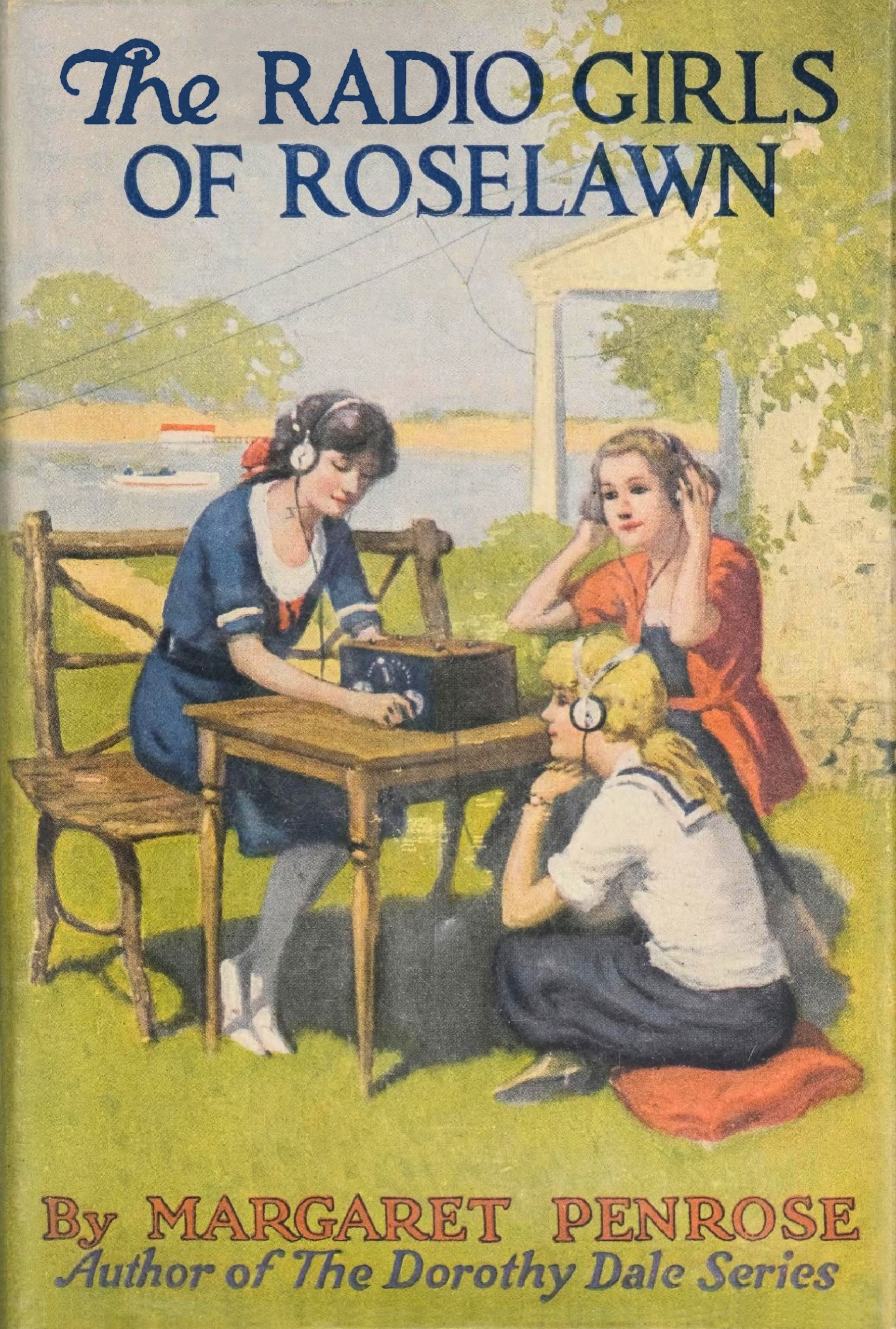
THE RADIO GIRLS OF ROSELAWN OR A Strange Message From the Air
BY
MARGARET PENROSE
Author of “The Radio Girls on the Program,” “The Radio Girls on Station Island,” “Dorothy Dale Series,” “Motor Girls Series,” etc.
ILLUSTRATED
NEW YORK
CUPPLES & LEON COMPANY
PUBLISHERS
BOOKS FOR GIRLS
By MARGARET PENROSE
12mo. cloth. Illustrated.
RADIO GIRLS SERIES
THE RADIO GIRLS OF ROSELAWN
THE RADIO GIRLS ON THE PROGRAM
THE RADIO GIRLS ON STATION ISLAND
DOROTHY DALE SERIES
DOROTHY DALE: A GIRL OF TO-DAY
DOROTHY DALE AT GLENWOOD SCHOOL
DOROTHY DALE’S GREAT SECRET
DOROTHY DALE AND HER CHUMS
DOROTHY DALE’S QUEER HOLIDAYS
DOROTHY DALE’S CAMPING DAYS
DOROTHY DALE’S SCHOOL RIVALS
DOROTHY DALE IN THE CITY
DOROTHY DALE’S PROMISE
DOROTHY DALE IN THE WEST
DOROTHY DALE’S STRANGE DISCOVERY
DOROTHY DALE’S ENGAGEMENT
MOTOR GIRLS SERIES
THE MOTOR GIRLS
THE MOTOR GIRLS ON A TOUR
THE MOTOR GIRLS AT LOOKOUT BEACH
THE MOTOR GIRLS THROUGH NEW ENGLAND
THE MOTOR GIRLS ON CEDAR LAKE
THE MOTOR GIRLS ON THE COAST
THE MOTOR GIRLS ON CRYSTAL BAY
THE MOTOR GIRLS ON WATERS BLUE
THE MOTOR GIRLS AT CAMP SURPRISE
THE MOTOR GIRLS IN THE MOUNTAINS
The blonde girl in the porch swing
looked up with shining eyes and flushed face from
her magazine to look at the dark girl who swung
composedly in a rocking chair, her nimble fingers
busy with the knitting of a shoulder scarf. The
dark girl bobbed her head in agreement.
“So’s the Sphinx, but it’s awfully out of date,
Jess.”
Jessie Norwood looked offended. “Did I ever
bring to your attention, Miss Drew——”
“Why don’t you say ‘drew’ to my attention?”
murmured the other girl.
“Because I perfectly loathe puns,” declared
Jessie, with energy.
“Good! Miss Seymour’s favorite pupil. Go
on about the wonder beast, Jess.”
“It is no beast, I’d have you understand. And
it is right up to date—the very newest thing.”
“My dear Jessie,” urged her chum, gayly, “you
have tickled my curiosity until it positively wriggles!
What is the wonder?”
“Radio!”
“Oh! Wireless?”
“Wireless telephone. Everybody is having one.”
“Grandma used to prescribe sulphur and
molasses for that.”
“Do be sensible for once, Amy Drew. You and
Darry——”
“That reminds me. Darry knows all about it.”
“About what?”
“The radio telephone business. You know he
was eighteen months on a destroyer in the war,
even if he was only a kid. You know,” and Amy
giggled, “he says that if women’s ages are always
elastic, it was no crime for him to stretch his
age when he enlisted. Anyhow, he knows all
about the ‘listening boxes’ down in the hold. And
that is all this radio is.”
“Oh, but Amy!” cried Jessie, with a toss of her
blond head, “that is old stuff. The radio of to-day
is very different—much improved. Anybody
can have a receiving set and hear the most wonderful
things out of the air. It has been brought
to every home.”
“‘Have you a little radio in your home?’”
chuckled Amy, her fingers still flying.
“Dear me, Amy, you are so difficult,” sighed
her chum.
“Not at all, not at all,” replied the other girl.
“You can understand me, just as e-e-easy! But
you know, Jess, I have to act as a brake for your
exuberance.”
“Don’t care,” declared Jessie. “I’m going to
have one.”
“If cook isn’t looking, bring one for me, too,”
suggested the irrepressible joker.
“I mean to have a radio set,” repeated Jessie
quite seriously. “It says in this magazine article
that one can erect the aerials and all, oneself. And
place the instrument. I am going to do it.”
“Sure you can,” declared Amy, with confidence.
“If you said you could rebuild the Alps—and improve
on them—I’d root for you, honey.”
“I don’t want any of your joking,” declared
Jessie, with emphasis. “I am in earnest.”
“So am I. About the Alps. Aunt Susan, who
went over this year, says the traveling there is
just as rough as it was before the war. She
doesn’t see that the war did any good. If I were
you, Jess, and thought of making over the
Alps——”
“Now, Amy Drew! Who said anything about
the Alps?”
“I did,” confessed her chum. “And I was
about to suggest that, if you tackle the job of rebuilding
them, you flatten ’em out a good bit so
Aunt Susan can get across them easier.”
“Amy Drew! Will you ever have sense?”
“What is it, a conundrum? Something about
‘Take care of the dollars and the cents will take
care of themselves?’”
“I am talking about installing a radio set in our
house. And if you don’t stop funning and help
me do it, I won’t let you listen in, so there!”
“I’ll be good,” proclaimed Amy at once. “I
enjoy gossip just as much as the next one. And
if you can get it out of the air——”
“It has to be sent from a broadcasting station,”
announced Jessie.
“There’s one right in this town,” declared Amy,
with vigor.
“No!”
“Yes, I tell you. She lives in the second house
from the corner of Breen Street, the yellow house
with green blinds——”
“Now, Amy! Listen here! Never mind local gossips.
They only broadcast neighborhood
news. But we can get concerts and weather reports
and lectures——”
Amy painfully writhed in her chair at this
point. “Say not so, Jess!” she begged. “Get
lectures enough at school—and from dad, once
in a while, when the dear thinks I go too far.”
“I think you go too far most of the time,” declared
her chum primly. “Nobody else would
have the patience with you that I have.”
“Except Burd Alling,” announced Amy composedly.
“He thinks I am all right.”
“Pooh! Whoever said Burd Alling had good
sense?” demanded Jessie. “Now listen!” She
read a long paragraph from the magazine article.
“You see, it is the very latest thing to do.
Everybody is doing it. And it is the most wonderful
thing!”
Amy had listened with more seriousness. She
could be attentive and appreciative if she
wished. The paragraph her chum read was interesting.
“Go ahead. Read some more,” she said. “Is
that all sure enough so, Jess?”
“Of course it is so. Don’t you see it is printed
here?”
“You mustn’t believe everything you see in
print, Jess. My grandfather was reported killed
in the Civil War, and he came home and pointed
out several things they had got wrong in the
newspaper obituary—especially the date of his
demise. Now this——”
“I am going to get a book about it, and that
will tell us just what to do in getting a radio set
established.”
“I’ll tell you the first thing to do,” scoffed
Amy. “Dig down into your pocketbook.”
“It won’t cost much. But I mean to have a
good one.”
“All right, dear. I am with you. Never let it
be said I deserted Poll. What is the first move?”
“Now, let me see,” murmured Jessie, staring
off across the sunflecked lawn.
The Norwood estate was a grand place. The
house, with its surrounding porches, stood in Roselawn
upon a knoll with several acres of sloping
sod surrounding it and a lovely little lake at the
side. There was a long rose garden on either side
of the house, and groups of summer roses in
front. Roses, roses, roses, everywhere about the
place! The Norwoods all loved them.
But there were more roses in this section of the
pretty town of New Melford, and on that account
many inhabitants of the place had gotten into the
habit of calling the estates bordering the boulevard
by the name of Roselawn. It was the Roselawn
district, for every lawn was dotted with
roses, red, pink, white, and yellow.
The Norwoods were three. Jessie, we put first
because to us she is of the most importance, and
her father and mother would agree. Being the
only child, it is true they made much of her. But
Jessie Norwood was too sweet to be easily spoiled.
Her father was a lawyer in New York, which
was twenty miles from New Melford. The Norwoods
had some wealth, which was good. They
had culture, which was better. And they were a
very loving and companionable trio, which was
best.
Across the broad, shaded boulevard was a
great, rambling, old house, with several broad
chimneys. It had once been a better class farmstead.
Mr. Wilbur Drew, who was likewise a
lawyer, had rebuilt and added to and improved
and otherwise transformed the farmhouse until
it was an attractive and important-looking
dwelling.
In it lived the lawyer and his wife, his daughter,
Amy, and Darrington Drew, when he was home
from college. This was another happy family—in
a way. Yet they were just a little different
from the Norwoods. But truly “nice people.”
When Amy Drew once gave her mind to a
thing she could be earnest enough. The little her
chum had read her from the magazine article
began to interest her. Besides, whatever Jessie
was engaged in must of necessity hold the attention
of Amy.
She laid aside the knitting and went to sit
beside Jessie in the swing. They turned back to
the beginning of the article and read it through
together, their arms wound about each other in
immemorial schoolgirl fashion.
Of course, as Amy pointed out, they were not
exactly schoolgirls now. They were out of school—since
two days before. The long summer vacation
was ahead of them. Time might hang idly
on their hands. So it behooved them to find something
absorbing to keep their attention keyed up
to the proper pitch.
“Tell you what,” Amy suggested. “Let’s go
down town to the bookstore and see if they have
laid in a stock of this radio stuff. We want one
or two of the books mentioned here, Jess. We
are two awfully smart girls, I know; we will both
admit it. But some things we have positively got
to learn.”
“Silly,” crooned Jessie, patting her chum on the
cheek. “Let’s go. We’ll walk. Wait till I run
and see if Momsy doesn’t want something from
down town.”
“We won’t ask Mrs. Drew that question, for
she will be pretty sure to want a dozen things,
and I refuse—positively—to be a dray horse. I
‘have drew’ more than my share from the stores
already. Cyprian in the car can run the dear,
forgetful lady’s errands.”
Jessie scarcely listened to this. She ran in and
ran out again. She was smiling.
“Momsy says all she wants is two George
Washington sundaes, to be brought home in two
separate parcels, one blonde and one brunette,”
and she held up half a dollar before Amy’s eyes.
“Your mother, as I have always said, Jess, is
of the salt of the earth. And she is well sugared,
too. Let me carry the half dollar, honey. You’ll
swallow it, or lose it, or something. Aren’t to
be trusted yet with money,” and Amy marched
down the steps in the lead.
She always took the lead, and usually acted as
though she were the moving spirit of the pair.
But, really, Jessie Norwood was the more practical,
and it was usually her initiative that started
the chums on a new thing and always her “sticktoitiveness”
that carried them through to the end.
Bonwit Boulevard, beautifully laid out, shaded
with elms, with a grass path in the middle, two
oiled drives, and with a bridle path on one side,
was one of the finest highways in the state. At
this hour of the afternoon, before the return rush
of the auto-commuters from the city, the road was
almost empty.
The chums chatted of many things as they went
along. But Jessie came back each time to radio.
She had been very much interested in the wonder
of it and in the possibility of rigging the necessary
aerials and setting up a receiving set at her
own house.
“We can get the books to tell us how to do it,
and we can buy the wire for the antenna to-day,”
she said.
“‘Antenna’! Is it an insect?” demanded Amy.
“Sounds crawly.”
“Those are the aerials——”
“Listen!” interrupted Amy Drew.
A sound—a shrill and compelling voice—reached
their ears. Amy’s hand clutched at
Jessie’s arm and held her back. There was nobody
in sight, and the nearest house was some
way back from the road.
“What is it?” murmured Jessie.
“Help! He-e-elp!” repeated the voice, shrilly.
“Radio!” muttered Amy, sepulchrally. “It is
a voice out of the air.”
There positively was nobody in sight. But
Jessie Norwood was practical. She knew there
was a street branching off the boulevard just a
little way ahead. Besides, she heard the throbbing
of an automobile engine.
“Help!” shrieked the unknown once more.
“It is a girl,” declared Jessie, beginning to run
and half dragging Amy Drew with her. “She is
in trouble! We must help her!”
CHAPTER II A ROAD MYSTERY
Like a great many other beautiful streets,
there was a poverty-stricken section, if
sparsely inhabited, just behind Bonwit
Boulevard. A group of shacks and squatters’
huts down in a grassy hollow, with a little brook
flowing through it to the lake, and woods beyond.
It would not have been an unsightly spot if the
marks of the habitation of poor and careless folk
had been wiped away.
But at the moment Jesse Norwood and her
chum, Amy Drew, darted around from the broad
boulevard into the narrow lane that led down to
this poor hamlet, neither of the girls remembered
“Dogtown,” as the group of huts was locally
called. The real estate men who exploited Roselawn
and Bonwit Boulevard as the most aristocratic
suburban section of New Melford, never
spoke of Dogtown.
“What do you suppose is the matter, Jess?”
panted Amy.
“It’s a girl in trouble! Look at that!”
The chums did not have to go even as far as
the brow of the hill overlooking the group of
houses before mentioned. The scene of the action
of this drama was not a hundred yards off the
boulevard.
A big touring car stood in the narrow lane,
headed toward the broad highway from which
Jessie and Amy had come. It was a fine car, and
the engine was running. A very unpleasant looking,
narrow-shouldered woman sat behind the
steering wheel, but was twisted around in her
seat so that she could look behind her.
In the lane was another woman. Both were
expensively dressed, though not tastefully; and
this second woman was as billowy and as generously
proportioned as the one behind the wheel
was lean. She was red-faced, too, and panted
from her exertions.
Those exertions, it was evident at once to
Jessie and Amy, were connected with the capturing
and the subsequent restraining of a very active
and athletic girl of about the age of the chums.
She was quite as red-faced as the fleshy woman,
and she was struggling with all her might to get
away, while now and then she emitted a shout for
help that would have brought a crowd in almost
no time in any place more closely built up.
“Oh! What is the matter?” repeated Amy.
“Bring her along, Martha!” exclaimed the
woman already in the motor-car. “Here come a
couple of rubber-necks.”
This expression, to Jessie’s mind, marked the
driver of the automobile for exactly what she
was. Nor did the face of the fat woman impress
the girl as being any more refined.
As for the girl struggling with the second
woman—the one called “Martha”—she was not
very well dressed. But she looked neat and clean,
and she certainly was determined not to enter the
automobile if she could help it. Jessie doubted,
although she had at first thought it possible, if
either of these women were related to the girl
they seemed so determined to capture.
“What are they—road pirates? Kidnapers?”
demanded Amy. “What?”
The two chums stopped by the machine. They
really did not know what to do. Should they
help the screaming girl? Or should they aid the
fleshy woman? It might be that the girl had
run away from perfectly good guardians. Only,
to Jessie’s mind, there was something of the refinement
that pertained to the girl lacking in the
appearance of these two women. She was not
favorably impressed by them.
“What is the matter with the girl?” she asked
the woman in the car.
Although she said it politely, the woman flashed
her a scowling glance and said:
“Mind your own business!”
“My!” gasped Amy at this, her eyes opening
very wide.
Jessie was not at all reassured. She turned to
the fleshy woman, and repeated her question:
“What is the matter with the girl?”
“She’s crazy, that’s what she is!” cried the
woman. “She doesn’t know what is good for
her.”
“I’ll learn her!” rasped out the driver of the
car.
“Don’t!” shouted the girl. “Don’t let them
take me back there——”
Just then the fleshy woman got behind her. She
clutched the girl’s shoulders and drove her harshly
toward the car with her whole weight behind the
writhing girl. The other woman jumped out of
the car, seized the girl by one arm, and together
the women fairly threw their captive into the
tonneau of the car, where she fell on her hands and
knees.
“There, spiteful!” gasped the lean woman.
“I’ll show you!”
She hopped back behind the steering wheel.
The fleshly woman climbed into the tonneau and
held the still shrieking girl. The car started with
a dash, the door of the tonneau flapping.
“Oh! This isn’t right!” gasped Jessie.
“They are running away with her, Jess,” murmured
Amy. “Isn’t it exciting?”
“It’s mean!” declared her chum with conviction.
“How dare they?”
“Why, to look at her, I think that skinny
woman would dare anything,” remarked Amy.
“And—haven’t—you seen her before?”
“Never! She doesn’t live around here. And
that car is strange.”
The car had turned into the boulevard and
headed out of town. When the girls walked back
to the broad highway it was out of sight. It
was being driven with small regard for the speed
laws.
“I guess you are right,” reflected Amy. “I
never saw that car before. It is a French car.
But the woman’s face——”
“There was enough of that to remember,” declared
Jessie, quite spitefully.
“I didn’t mean the fat woman’s face,” giggled
Amy. “I mean that the other woman looked
familiar. Maybe I have seen her picture somewhere.”
“If my face was like hers I’d never have it
photographed,” snapped Jessie.
“How vinegarish,” said Amy. “Well, it was
funny.”
“You do find humor in the strangest things,”
returned her chum. “I guess that poor girl didn’t
think it was funny.”
“Of course, they had some right to her,” Amy
declared.
“How do you know they did? They did not
act so,” returned the more thoughtful Jessie. “If
they had really the right to make the poor girl go
with them, they would not have acted in such
haste nor answered me the way they did.”
“Well, of course, it wasn’t any of our business
either to ask questions or to interfere,” Amy
declared.
“I don’t know about that, Amy,” rejoined her
chum. “I wish your brother had been here, or
somebody.”
“Darry!” scoffed Amy.
“Or maybe Burd Alling,” and Jessie’s eyes
twinkled.
“Well,” considered Amy demurely, “I suppose
the boys might have known better what to
do.”
“Oh,” said Jessie, promptly, “I knew what to
do, all right; only I couldn’t do it.”
“What is that?”
“Stopped the women and made them explain
before we allowed them to take the girl away.
And I wonder where she was going. When and
where did she run away from the women? Did
you hear her beg us not to let them take her
back—back——”
“Back where?”
“That is it, exactly,” sighed Jessie, as the two
walked on toward town. “She did not tell us
where.”
“Some institution, maybe. An orphan asylum,”
suggested Amy.
“Did you think she looked like an orphan?”
“How does an orphan look?” giggled Amy. “I
don’t know any except the Molly Mickford kind
in the movies, and they are always too appealing
for words!”
“Somehow, she didn’t look like that,” admitted
Jessie.
“She fought hard. I believe I would have
scratched that fat woman’s face myself, if I’d
been her. Anyway, she wasn’t in any uniform.
Don’t they always put orphans in blue denim?”
“Not always. And that girl would have looked
awful in blue. She was too dark. She wasn’t
very well dressed, but her clothes and their colors
were tasteful.”
“Aren’t you the observing thing,” agreed Amy.
“She was dressed nicely. And those women were
never guards from an institution.”
“Oh, no!”
“It was a private kidnaping party, I guess,”
said Amy.
“And we let it go on right under our noses and
did not stop it,” sighed Jessie Norwood. “I’m
going to tell my father about it.”
Amy grinned elfishly. “He will tell you that
you had a right, under the law, to stop those
women and make them explain.”
“Ye-es. I suppose so. But a right to do a
thing and the ability to do it, he will likewise tell
me, are two very different things.”
“Wisdom from the young owl!” laughed Amy.
“Well, I don’t suppose, after all, it is any of our
business, or ever will be. The poor thing is now
a captive and being borne away to the dungeon-keep.
Whatever that is,” she added, shrugging
her shoulders.
CHAPTER III INTEREST IN RADIO SPREADS
Over the George Washington sundaes at the
New Melford Dainties Shop the girls discussed
the mysterious happening on Dogtown
Lane until it was, as Amy said, positively
frayed.
“We do not know what it was all about, my
dear, so why worry our minds? We shall probably
never see that girl again, or those two
women. Only, that lean one—well! I know I
have seen her somewhere, or somebody who looks
like her.”
“I don’t see but you are just as bad as I am,”
Jessie Norwood said. “But we did not come to
town because of that puzzling thing.”
“No-o. We came to get these perfectly
gorgeous sundaes,” declared Amy Drew. “Your
mother, Jess, is almost as nice as you are.”
“We came in to get radio books and buy wire
and stops and all that for the aerials, anyway.
Of course, I shall have to send for most of the
parts of the house set. There is no regular radio
equipment dealer in New Melford.”
“Oh, yes! Wireless!” murmured Amy. “I
had almost forgotten that.”
They trotted across the street to the bookstore.
Motors were coming up from the station now,
and from New York. They waved their hands
to several motoring acquaintances, and just outside
Ye Craftsman’s Bookshop they ran into Nell
Stanley, who they knew had no business at all
there on Main Street at this hour of the afternoon.
Nell was the minister’s daughter, and there
were a number of little motherless Stanleys at the
parsonage (Amy said “a whole raft of them”)
who usually needed the older sister’s attention,
approaching supper time.
“Oh, I’ve a holiday,” laughed Nell, who was
big and strong and really handsome, Jessie
thought, her coloring was so fresh, her chestnut
hair so abundant, her gray eyes so brilliantly intelligent,
and her teeth so dazzling. “Aunt Freda
is at the house and she and the Reverend told me
to go out and not to show myself back home for
hours.”
“Bully-good!” declared Amy. “You’ll come
home to dinner with me, and we will spend the
evening with Jess helping her build a radio thing
so we can do without buying the New Melford
Tribune to get the local news.”
“Oh, Jess, dear, are you going to have a
radio?” cried Nell. “It’s just wonderful. Reverend
says he may have to broadcast his sermons
pretty soon or else be without an audience.”
The pet name by which she usually spoke of her
father, the Reverend Doctor Stanley, sounded all
right when Nell said it. Nobody else ever called
the good clergyman by it. But Nell was something
between a daughter and a wife to the hard
working Doctor Stanley. And she certainly was
a thoughtful and “mothering” sister to the little
ones.
“But,” Nell added, “you are too late inviting
me to the eats, Amy, honey. It can’t be done.
I’m promised. Mr. Brandon and his wife saw
me first, and I am to dine with them. Then they
are going to take me in their car out to the Parkville
home of their daughter—Oh, say! If your
radio isn’t finished, Jess, why can’t you and Amy
come with us? The Brandon car is big enough.
And they tell me Mrs. Brandon’s daughter has
got a perfectly wonderful set at her home. They
have an amplifier, and you don’t have to use
phones at all. Has your radio set got an amplifier,
Jess?”
“But I haven’t got it yet,” cried Jess. “I only
hope to have it.”
“Then you and Amy come and hear a real one,”
said Nell.
“If the Brandons won’t mind. Will they?”
“You know they are the loveliest people,” said
Nell briskly. “Mrs. Brandon told me to invite
some young friends. But I hadn’t thought of
doing so. But I must have you and Amy. We’ll
be along for you girls at about seven-forty-five,
new time.”
“Then we must hurry,” declared Jess, as the
minister’s daughter ran away.
“I’m getting interested,” announced Amy. “Is
this radio business like a talking machine?”
“Only better,” said her chum. “Come on. I
know several of the little books I want to get.
I wrote down the names.”
They dived down the four steps into the basement
bookshop. It was a fine place to browse,
when one had an hour to spare. But the chums
from Roselawn were not in browsing mood on
this occasion.
They knew exactly what they wanted—at least,
Jessie Norwood did—and somewhat to their surprise
right near the front door of the shop was
a “radio table.”
“Oh, yes, young ladies,” said the clerk who
came to wait upon them only when he saw that
they had made their selections, “we have quite a
call for books on that topic. It is becoming a fad,
and quite wonderful, too. I have thought some
of buying a radio set myself.”
“We’re going to build one,” declared Amy with
her usual prompt assurance.
“Are you? You two girls? Well, I don’t
know why you shouldn’t. Lots of boys are doing
so.”
“And anything a boy can do a girl ought to do
a little better,” Amy added.
The clerk laughed as he wrapped up the several
books Jessie had charged to her father’s account.
“You let me know how you get on building
it, will you?” he said. “Maybe I can get some
ideas from your experience.”
“We’ll show ’em!” declared Amy, all in a glow
of excitement. “And why do you suppose, Jess,
folks always have to suggest that girls can’t do
what boys can? Isn’t it ridiculous!”
“Very,” agreed Jessie. “Although, just as I
pointed out a while ago, it would have been handy
if Darry or Burd had been with us when we saw
that poor girl kidnaped.”
“Of course! But, then, those boys are college
men.” She giggled. “And I wager Burd is a
sea-sick college man just now.”
“Oh! Have they gone out in the Marigold?”
cried Jessie.
“They left New Haven the minute they could
get away and joined the yacht at Groton, over
across from New London, where it has been tied
up all winter. Father insisted that Darry
shouldn’t touch the yacht, when Uncle Will died
and left it to him last fall, until the college year
was ended. We got a marconigram last night
that they had passed Block Island going out. And
now—well, Burd never was at sea before, you
know,” and Amy laughed again.
“It has been rather windy. I suppose it must
be rough out in the ocean. Oh, Amy!” Jess
suddenly exclaimed, “if I get my radio rigged
why can’t we communicate with the Marigold
when it is at sea?”
“I don’t know just why you can’t. But I guess
the wireless rigging on the yacht isn’t like this
radio thing you are going to set up. They use
some sort of telegraph alphabet.”
“I know,” declared Jessie with conviction.
“I’ll tell Darry to put in a regular sending set—like
the one I hope to have, if father will let me.
And we can have our two sets tuned so that we
can hear each other speak.”
“My goodness! You don’t mean it is as easy
as all that?” cried Amy.
“Didn’t you read that magazine article?” demanded
her chum. “And didn’t the man say that,
pretty soon, we could carry receiving and sending
sets in our pockets—maybe—and stop right on
the street and send or receive any news we
wanted to?”
“No, I sha’n’t,” declared Amy. “Pockets
spoil the set of even a sports skirt. Where you
going now?”
“In here. Mr. Brill sells electrical supplies as
well as hardware. Oh! Amy Drew! There is a
radio set in his window! I declare, New Melford
is advancing in strides!”
“Sure! In seven league boots,” murmured
Amy, following her friend into the store.
Jessie had noted down the things she thought
it would be safe to order before speaking to her
father about the radio matter. Mrs. Norwood
had cheerfully given her consent. Amy had once
said that if Jessie went to her mother and asked if
she could have a pet plesiosaurus, Mrs. Norwood
would say:
“Of course, you may, dear. But don’t bring it
into the house when its feet are wet.”
For the antenna and lead-in and ground wires,
Jessie purchased three hundred feet of copper
wire, number fourteen. The lightning switch Mr.
Brill had among his electric fixtures—merely a
porcelain base, thirty ampere, single pole double
throw battery switch. She also obtained the
necessary porcelain insulators and tubes.
She knew there would be plenty of rope in the
Norwood barn or the garage for their need in
erecting the aerials. But she bought a small
pulley as well as the ground connections which
Mr. Brill had in stock. He was anxious to sell
her a complete set like that he was exhibiting in
the show window; but Jessie would not go any
farther than to order the things enumerated and
ask to have them sent over the next morning.
The girls hurried home when they had done
this, for it was verging on dinner time and they
did not want to miss going with Nell Stanley and
the Brandons to Parkville for the radio entertainment.
Mr. Norwood was at home, and
Jessie flew at him a good deal like an eager Newfoundland
puppy.
“It is the most wonderful thing!” she declared,
as she had introduced the subject to her chum.
She kept up the radio talk all through dinner.
She was so interested that for the time being she
forgot all about the girl that had been carried
away in the automobile. Mr. Norwood had not
been much interested in the new science; but he
promised to talk the matter over with Momsy
after their daughter had gone to the radio
concert.
“Anyhow,” said Jessie, “I’ve bought the books
telling how to rig it. And we’re going to do it
all ourselves—Amy and I. And Mr. Brill is
going to send up some wire and things. Of
course, if you won’t let me have it, I’ll just have
to pay for the hardware out of my allowance.”
“Very well,” her father said with gravity.
“Maybe Chapman can find some use for the hardware
if we don’t decide to build a radio station.”
As they seldom forbade their daughter anything
that was not positively harmful, however,
there was not much danger that Jessie’s allowance
would be depleted by paying a share of the
monthly hardware bill. Anyhow, Jessie as well
as Amy, went off very gayly in the Brandon car
with the minister’s daughter. Mr. Brandon drove
his own car, and the girls sat in the tonneau with
Mrs. Brandon, who did not seem by any means
a very old lady, even if she was a grandmother.
“But grandmothers nowadays aren’t crippled
up with rheumatism and otherwise decrepit,”
declared Amy, the gay. “You know, I think it is
rather nice to be a grandmother these days. I
am going to matriculate for the position just as
soon as I can.”
They rolled out of town, and just as they turned
off the boulevard to take another road to Parkville,
a big car passed the Brandon automobile
coming into town. It was being driven very rapidly,
but very skillfully, and the car was empty
save for the driver.
“What beautiful cars those French cars are,”
Mrs. Brandon said.
“Did you see her, Jess?” cried Amy, excitedly.
“Look at her go!”
“Do you speak of the car or the lady?” laughed
Nell Stanley.
“She is no lady, I’d have you know,” Amy rejoined
scornfully. “Didn’t you know her when
she passed, Jess?”
“I thought it was the car,” her chum admitted.
“Are you sure that was the woman who ran off
with the girl?”
“One of them,” declared Amy, with confidence.
“And how she can drive!”
Naturally Mrs. Brandon and Nell wished to
know the particulars of the chums’ adventure.
But none of them knew who the strange woman
who drove the French car was.
“She is not at all nice, at any rate,” Jessie said
emphatically. “I really wish there was some way
of finding out about that girl they carried off, and
what became of her.”
CHAPTER IV STRINGING THE AERIALS
Parkville was reached within a short
time. It was still early evening. The girls
from Roselawn and their host and hostess
found a number of neighbors already gathered
in the drawing-room, to listen to the entertainments
broadcasted from several radio stations.
They were too late for the bedtime story; but
from the cabinet-grand, like an expensive talking
machine, the slurring notes of a jazz orchestra
greeted their ears as plainly as though it were
coming from a neighboring room instead of a
broadcasting station many miles away. Amy confessed
that it made her feet itch. She loved to
dance.
There was singing to follow, a really good
quartette. Then a humorist told some of his own
funny stories and an elocutionist recited a bit from
Shakespeare effectively. The band played a popular
air and the amused audience began singing the
song. It was fine!
“I’m just as excited as I can be,” whispered
Jessie to Nell and Amy. “Isn’t it better than our
talking machine? Why! it is almost like hearing
the real people right in the room. And an amplifier
of this kind is not scratchy one bit.”
“There is no static to-night,” said Mr. Brandon,
who overheard the enthusiastic girl. “But it
is not always so clear.”
Jessie and Amy were too excited over this new
amusement to heed anything that suggested “a fly
in the ointment.” When they drove home they
were so full of radio that they chattered like
magpies.
“I would put up the aerials and get a set myself,”
Nell declared, “only we don’t really need
any more talking machines of any kind at our
house. Dear me! I sometimes wonder how the
Reverend can write his sermons, there is so much
noise and talk all the time. I have tacked felt all
around his study door to try to make it sound-proof.
But when Bob comes in he bangs the outer
door until you are reminded of the Black Tom
explosion. And Fred never comes downstairs
save on his stomach—and on the banisters—and
lands on the doormat like a load of brick out of
a dumpcart. Then Sally squeals so!” She sighed.
“Nell Stanley,” Amy said, “certainly has her
own troubles.”
“I do not see how the doctor stands it,” commented
Mrs. Brandon sympathetically.
“The Reverend is the greatest man in the
world,” declared Nell, with conviction. “He is
wonderful. He takes the most annoying things
so composedly. Why, you remember when he
went to Bridgeton a month ago to speak at the
local Sunday School Union? Something awfully
funny happened. It would have floored any man
but the Reverend.”
“What happened?” asked Amy. “I bet it was
a joke. Your father, Nell, always tells the most
delightful stories.”
“This isn’t a story. It is so,” chuckled Nell.
“But I suppose that was why they asked him to
amuse and entertain the little folks at one session
of the Union. Father talked for fifteen minutes,
all about Jacob’s ladder, and those old stories.
And not a kid of ’em went to sleep.
“He said he was proud to see them so wide
awake, and when he was closing he thought he
would find out if they really had been attentive.
So he said:
“‘And now, is there any little boy or any little
girl who would like to ask me a question?’
“And one boy called out: ‘Say, Mister, if the
angels had wings why did they walk up and down
Jacob’s ladder?’”
“Mercy!” ejaculated Mrs. Brandon. “What
could he say?”
“That is it. You can’t catch the Reverend,”
laughed Nell, proudly. “And nothing ever confuses
him or puts him out. He just said:
“‘Oh, ah, yes, I see. And now, is there any
little boy or any little girl who would like to
answer that question?’ And he bowed and
slipped out.”
The laughter over this incident brought them
into Roselawn, where Jessie and Amy got out,
after thanking the kindly Brandons for the evening’s
pleasure. Nell lived a little further along,
and went on with Mr. and Mrs. Brandon.
“If I can find the time,” called Nell Stanley, as
the car started again, “I am coming over to see
how you rig your aerials, Jessie.”
“If I am allowed to,” commented Jessie, with a
sudden fear that perhaps her father would find
some objection to the new amusement.
But this small fear was immediately dissipated
when she ran in after bidding Amy good-night.
She found her father and mother both in the
library. The package of radio books had been
opened, and Mr. and Mrs. Norwood was each
reading interestedly one of the pamphlets Jessie
had chosen at the bookshop.
The three spent an hour discussing the new
“plaything,” as Mr. Norwood insisted upon calling
it. But he agreed to everything his daughter
wanted to do, and even promised to buy Jessie a
better receiving set than Brill, the hardware man,
was carrying.
“As far as I can see, however, from what I read
here,” said Mr. Norwood, “a better set will make
no difference in your plans for stringing the
aerials. You and Amy can go right ahead.”
“Oh, but, Robert,” said Mrs. Norwood, “do
you think the two girls can do that work?”
“Why not? Of course Jessie and Amy can.
If they need any help they can ask one of the men—the
chauffeur or the gardener, or somebody.”
“We are going to do it all ourselves!” cried
Jessie, eagerly. “This is going to be our very
owniest own radio. You’ll see. We’ll put the
set upstairs in my room.”
“Wouldn’t you rather have it downstairs—in
the drawing-room, for instance?” asked her
mother.
“I know you, Momsy. You’ll be showing it off
to all your friends. And pretty soon it will be
the family radio instead of mine.”
Mr. Norwood laughed. “I read here that the
ordinary aerials will do very well for a small
instrument or a large. It is suggested, too, that
patents are pending that may make outside aerials
unnecessary, anyway. Don’t you mind, Momsy.
If we find we want a nice, big set for our
drawing-room, we’ll have it in spite of Jessie.
And we’ll use her aerials, too.”
The next day Brill sent up the things Jessie had
purchased, but the girls could not begin the actual
stringing of the copper wires until the morning
following. Ample study of the directions for the
work printed in the books Jessie had selected
made the chums confident that they knew just
what to do.
The windows of Jessie’s room on the second
floor of the Norwood house were not much more
than seventy-five feet from the corner of an ornamental
tower that housed the private electric plant
belonging to the place. It was a tank tower, and
water and light had been furnished to the entire
premises from this tower before the city plants
had extended their service out Bonwit Boulevard
and through Roselawn.
Jessie’s room had been the nursery when
Jessie was little. It was now a lovely, comfortable
apartment, decorated in pearl gray and pink, with
willow furniture and cushions covered with lovely
cretonne, an open fireplace in which real logs could
be burned in the winter, and pictures of the girl’s
own selection.
Her books were here. And all her personal
possessions, including tennis rackets, riding whip
and spurs, canoe paddle, and even a bag of golf
sticks, were arranged in “Jessie’s room.” Out of
it opened her bedroom and bath. It was a big
room, too, and if the radio was successful they
could entertain twenty guests here if they
wanted to.
“But, of course, father is getting a set with
phones, not with an amplifier like that one out at
Parkville,” Jessie explained to her chum. “If we
want to use a horn afterward, we may. Now,
Amy, do you understand what there is to do?”
“Sure. We’ve got to get out our farmerette
costumes. You know, those we used in the school
gardens two years ago.”
“Oh, fine! I never would have thought of
that,” crowed Jessie.
“Leave it to your Aunt Amy. She’s the wise
old bird,” declared Amy. “I always did like
those overalls. If I climb a ladder I don’t want
any skirt to bother me. If the ladder begins to
slip I want a chance to slide down like a man. Do
the ‘Fireman, save my cheeld’ act.”
“You are as lucid as usual,” confessed her
chum. Then she went on to explain: “I have
found rope enough in the barn for our purpose—new
rope. We will attach the end of the aerial
wires with the rope to the roof of the old tower.
It will enable us to make the far end of the aerials
higher than my window—you see?”
“Necessary point; I observe. Go ahead, Miss
Seymour.”
“Please don’t call me ‘Miss Seymour,’” objected
Jessie, frowning. “For the poor thing has
a wart on her nose.”
“No use at all there. Not even as a collar-button,”
declared Amy. “All right; you are not
Miss Seymour. And, come to think of it, I wonder
if it was Miss Seymour I was thinking of last
night when I thought that woman driving the kidnapers’
car looked like somebody I knew? Do
you think——?”
“Oh! That horrid woman! I don’t dislike
Miss Seymour, you know, Amy, even if she does
teach English. I think she is almost handsome
beside that motor-car driver. Yes, I do.”
“Wart and all?” murmured Amy.
But they were both too deeply interested in the
radio to linger long on other matters. They laid
out the work for the next morning, but did nothing
practical toward erecting the wires and attendant
parts that day. Amy came over immediately
after breakfast, dressed in her farmerette costume,
which was, in truth, a very practical suit
in which to work.
The girls even refused the help of the gardener.
He said they would be unable to raise the heavy
ladder to the tower window; and that was a fact.
“All right,” said the practical Jessie, “then we
won’t use the ladder.”
“My! I am not tall enough to reach the things
up to you from the ground, Jess,” drawled Amy.
“Silly!” laughed her friend. “I am going up
there to the top window in the tower. I can stand
on the window sill and drive in the hook, and hang
the aerial from there. See! We’ve got it all fixed
on the ground here. I’ll haul it up with another
rope. You stay down here and tie it on. You’ll
see.”
“Well, don’t fall,” advised Amy. “The ground
is hard.”
It had been no easy matter for the two girls to
construct their aerial. The wire persisted in
getting twisted and they had all they could do to
keep it from kinking. Then, too, they wanted to
fasten the porcelain insulators just right and had
to consult one of the books several times. Then
there came more trouble over the lead-in wire,
which should have been soldered to the aerial but
was only twisted tight instead.
The girls worked all the forenoon. When one
end of the aerial was attached properly to the
tower, Amy ran in and upstairs to her chum’s
room and dropped a length of rope from one of
the windows. Jessie came down from her perch
and attached the house-end of the aerial to the
rope. When Amy had the latter hauled up and
fastened to a hook driven into the outside frame
of Jessie’s window, the antenna was complete.
At that (and it sounds easy, but isn’t) they got
it twisted and had to lower the house-end of the
aerial again. While they were thus engaged, a
taxicab stopped out in front. Amy, leaning from
her chum’s window, almost fell out in her sudden
excitement.
“Oh, Jess! They’ve come!” she shouted.
“What do you mean?” demanded Jessie. “We
were not expecting anybody, were we?”
“You weren’t, but I was. I forgot to tell you,”
cried Amy. “They just went around Long
Island and came up the East River and through
Hell Gate and got a mooring at the Yacht Club,
off City Island.”
“Who are you talking about?” gasped her
chum, wonderingly.
“Darry——”
“Darry!” ejaculated Jessie with mixed emotions.
She glanced down at her overalls. She
was old enough to want to look her best when
Darrington Drew was on the scene. “Darry!”
she murmured again.
“Yes. And Burd Alling. They telephoned
early this morning. But I forgot. Here they
come, Jess!”
Jessie Norwood turned rather slowly to look.
She felt a strong desire to run into the house and
make a quick change of costume.
CHAPTER V THE FRECKLE-FACED GIRL
Of the two young fellows hurrying in from
the boulevard one was tall and slim and
dark; the other was stocky—almost
plump, in fact—and sandy of complexion, with
sharp, twinkling pond-blue eyes. Burdwell
Alling’s eyes were truly the only handsome feature
he possessed. But he had a wonderfully
sweet disposition.
Darry Drew was one of those quiet, gentlemanly
fellows, who seem rather too sober for
their years. Yet he possessed humor enough, and
there certainty was no primness about him. It
was he who hailed Jessie on the ground and Amy
leaning out of the window above:
“I say, fellows! Have you seen a couple of
young ladies around here who have just finished
their junior year at the New Melford High with
flying colors? We expected to find them sitting
high and dry on the front porch, ready to receive
company.”
“Sure we did,” added Burd Alling. “They
have taken the highest degree in Prunes and
Prisms and have been commended by their instructors
for excellent deportment. And among all
the calicos, they are supposed to take the bun as
prudes.”
Amy actually almost fell out of the window
again, and stuck out her tongue like an impudent
urchin. “A pair of smarties,” she scoffed.
“Come home and fret our ears with your college
slang. How dare you!”
“I declare! Is that Miss Amy Drew?” demanded
Burd, sticking a half dollar in his eye
like a monocle and apparently observing Amy for
the first time.
“It is not,” said Amy sharply. “Brush by! I
don’t speak to strange young men.”
But Darry had come to Jessie and shaken
hands. If she flushed self-consciously, it only
improved her looks.
“Awfully glad to see you, Jess,” the tall young
fellow said.
“It’s nice to have you home again, Darry,”
she returned.
Amy ran down again then, in her usual harum-scarum
fashion, and the conversation became general.
How had the girls finished their high-school
year? And how had the boys managed to stay a
whole year at Yale without being asked to leave
for the good of the undergraduate body?
Was the Marigold a real yacht, or just a rowboat
with a kicker behind? And what were the
girls doing in their present fetching costumes?
“The wires!” cried Burd. “Is it a trapeze?
Are we to have a summer circus in Roselawn?”
“We shall have if you remain around here,”
was Amy’s saucy reply. “But yon is no trapeze,
I’d have you know.”
“A slack wire? Who walks it—you or Jess?”
“Aw, Burd!” ejaculated Darry. “It’s radio.
Don’t you recognize an aerial when you see it?”
“You have a fine ground connection,” scoffed
Burd.
“Don’t you worry about us,” Jessie took heart
to say. “We know just what to do. Go upstairs
again, Amy, and haul up this end of the contraption.
I’ve got it untwisted.”
A little later, when the aerial was secure and
Jessie went practically to work affixing the ground
connection, Darrington Drew said:
“Why, I believe you girls do know what you
are about.”
“Don’t you suppose we girls know anything at
all, Darry?” demanded his sister from overhead.
“You boys have very little on us.”
“Don’t even want us to help you?” handsome
Darry asked, grinning up at her.
“Not unless you approach the matter with the
proper spirit,” Jessie put in. “No lofty, high-and-mighty
way goes with us girls. We can be
met only on a plane of equality. But if you want
to,” she added, smiling, “you can go up to my
room where Amy is and pull that rope tauter. I
admit that your masculine muscles have their
uses.”
They were still having a lot of fun out of the
securing of the aerials when suddenly Burd Alling
discovered a figure planted on the gravel behind
him. Hi swept off his cap in an elaborate bow,
and cried:
“We have company! Introduce me, Amy—Jess.
This young lady——”
“Smarty!” croaked a hoarse voice. “I don’t
want to be introduced to nobody. I want to
know if you’ve seen Bertha.”
“Big Bertha?” began Burd, who was as much
determined on joking as Amy herself.
But Jessie Norwood, her attention drawn to the
freckle-faced child who stood there so composedly,
motioned Burd to halt. She approached and
in her usual kindly manner asked what the strange
child wanted.
It really was difficult to look soberly at the
little thing. She might have been twelve years
old, but she was so slight and undernourished
looking that it was hard to believe she had reached
that age. She had no more color than putty.
And her sharp little face was so bespatted with
freckles that one could scarcely see what its real
expression was.
“Bertha who?” Jessie asked quietly. “What
Bertha are you looking for?”
“Cousin Bertha. She’s an orphan like me,”
said the freckled little girl. “I ain’t got anybody
that belongs to me but Bertha; and Bertha
ain’t got anybody that belongs to her but
me.”
Burd and Amy were still inclined to be amused.
But Darry Drew took his cue from Jessie, if he
did not find a sympathetic cord touched in his own
nature by the child’s speech and her forlorn appearance.
For she was forlorn. She wore no denim uniform,
such as Amy had mentioned on a previous
occasion as being the mark of the usual “orphan.”
But it was quite plain that the freckle-faced girl
had nobody to care much for her, or about her.
“I wish you would explain a little more, dear,”
said Jessie, kindly. “Why did you come here to
ask for your Cousin Bertha?”
“’Cause I’m asking at every house along this
street. I told Mrs. Foley I would, and she said
I was a little fool,” and the child made the statement
quite as a matter of course.
“Who is Mrs. Foley?”
“She’s the lady I help. When Mom died Mrs.
Foley lived in the next tenement. She took me.
She brought me out here to Dogtown when she
moved.”
“Why,” breathed Amy, with a shudder, “she’s
one of those awful Dogtown children.”
“Put a stopper on that, Amy!” exclaimed
Darry, promptly.
But the freckle-faced girl heard her. She
glared at the older girl—the girl so much better
situated than herself. Her pale eyes snapped.
“You don’t haf to touch me,” she said sharply.
“I won’t poison you.”
“Oh, Amy!” murmured her chum.
But Amy Drew was not at all bad at heart,
or intentionally unkind. She flamed redly and
the tears sprang to her eyes.
“Oh! I didn’t mean—Forgive me, little girl!
What is your name? I’ll help you find your
cousin.”
“My name’s Henrietta. They call me Hen.
You needn’t mind gushin’ over me. I know how
you feel. I’d feel just the same if I wore your
clo’es and you wore mine.”
“By ginger!” exclaimed Burd Alling, under his
breath. “There is philosophy for you.”
But Jessie felt hurt that Amy should have
spoken so thoughtlessly about the strange child.
She took Henrietta’s grimy hand and led the
freckled girl to the side steps where they could
sit down.
“Now tell me about Bertha and why you are
looking for her along Bonwit Boulevard,” said
Jessie.
“Do you wear these pants all the time?” asked
Henrietta, suddenly, smoothing Jessie’s overalls.
“I believe I’d like to wear ’em, too. They are
something like little Billy Foley’s rompers.”
“I don’t wear them all the time,” said Jessie,
patiently. “But about Bertha?”
“She’s my cousin. She lived with us before
Mom died. She went away to work. Something
happened there where she worked. I guess I
don’t know what it was. But Bertha wrote to
me—I can read written letters,” added the child
proudly. “Bertha said she was coming out to see
me this week. And she didn’t come.”
“But why should you think——”
“Lemme tell you,” said Henrietta eagerly.
“That woman that hired Bertha came to Foleys
day before yesterday trying to find Bertha. She
said Bertha’d run away from her. But Bertha
had a right to run away. Didn’t she?”
“I don’t know. I suppose so. Unless the
woman had adopted her, or something,” confessed
Jessie, rather puzzled.
“Bertha wasn’t no more adopted than I am.
Mrs. Foley ain’t adopted me. I wouldn’t want
to be a Foley. And if you are adopted you have
to take the name of the folks you live with. So
Bertha wasn’t adopted, and she had a right to run
away. But she didn’t get to Dogtown.”
“But you think she might have come this way?”
“Yep. She’s never been to see me since we
moved to Dogtown. So she maybe lost her way.
Or she saw that woman and was scared. I’m looking
to see if anybody seen her,” said the child, getting
up briskly. “I guess you folks ain’t, has
you?”
“I am afraid not,” said Jessie thoughtfully.
“But we will be on the lookout for her, honey.
You can come back again and ask me any time
you like.”
The freckle-faced child looked her over curiously.
“What do you say that for?” she demanded.
“You don’t like me. I ain’t pretty.
And you’re pretty—and that other girl,” (she said
this rather grudgingly) “even if you do wear overalls.”
“Why! I want to help you,” said Jessie, somewhat
startled by the strange girl’s downright way
of speaking.
“You got a job for me up here?” asked Henrietta
promptly. “I guess I’d rather work for you
than for the Foleys.”
“Don’t the Foleys treat you kindly?” Amy ventured,
really feeling an interest in the strange
child.
“Guess she treats me as kind as a lady can when
she’s got six kids and a man that drinks,” Henrietta
said with weariness. “But I’d like to wear
better clo’es. I wouldn’t mind even wearing them
overall things while I worked if I had better to
wear other times.”
She looked down at her faded gingham, the
patched stockings, the broken shoes. She wore
no hat. Really, she was a miserable-looking little
thing, and the four more fortunate young people
all considered this fact silently as Henrietta moved
slowly away and went down the path to the street.
“Come and see me again, Henrietta!” Jessie
called after her.
The freckled child nodded. But she did not
look around. Darry said rather soberly:
“Too bad about the kid. We ought to do
something for her.”
“To begin with, a good, soapy bath,” said his
sister, vigorously, but not unkindly.
“She’s the limit,” chuckled Burd. “Hen is some
bird, I’ll say!”
“I wonder——” began Jessie, but Amy broke
in with:
“To think of her hunting up and down the
boulevard for her cousin. And she didn’t even tell
us what Bertha looked like or how old she is, or
anything. My!”
“I wonder if we ought not to have asked her
for more particulars,” murmured Jessie. “It is
strange we should hear of another girl that had
run away——”
But the others paid no attention at the moment
to what Jessie was saying. It was plain that Amy
did not at all comprehend what her chum considered.
The lively one had forgotten altogether
about the unknown girl she and Jessie had seen
borne away in the big French car.
CHAPTER VI SOMETHING COMING
That afternoon Mr. Norwood brought
home the radio receiving set in the automobile.
The two girls, with a very little
help, but a plethora of suggestion from Darry
and Burd, proceeded to establish the set on a
table in Jessie’s room, and attach the lead-in wire
and the ground wire.
Jessie had bought a galena crystal mounted, as
that was more satisfactory, the book said. After
all the parts of the radio set had been assembled
and the connections made, the first essential operation,
if they were to make use of the invention at
once, was to adjust the tiny piece of wire—the
“cat’s whisker”—which lightly rests on the crystal-detector,
to a sensitive point.
Jessie, who had read the instruction book carefully,
knew that this adjustment might be made
in several different ways. One satisfactory way
is by the use of a miniature buzzer transmitter.
“What are we going to hear?” Amy demanded
eagerly. “How you going to tune her, Jess?”
“As there are only three sets of head phones,”
grumbled Burd, “one of us is bound to be a stepchild.”
“We can take turns,” Jessie said, eagerly.
“What time is it, Darry?”
“It points to eight, Jess.”
“Then there is a concert about to start at that
station not more than thirty miles away from here.
We ought to hear that fine,” declared the hostess
of the party.
“What is the wave length?” Amy asked.
“Three-sixty. We can easily get it,” and Jessie
adjusted the buzzer a little, the phones at her
ears.
Eagerly they settled down to listen in. At
least, three of them listened. Darry said he felt
like the fifth wheel of an automobile—the one
lashed on behind.
“I shall have to get an amplifier—a horn,”
Jessie murmured.
At first she heard only a funny scratchy sound;
then a murmur, growing louder, as she tuned the
instrument to the required wave length. The
murmurous sound grew louder—more distinct.
Amy squealed right out loud! For it seemed as
though somebody had said in her ear:
“—and will be followed by the Sextette from
Lucia. I thank you.”
“We’re just in time,” said Burd. “They are
going to begin the concert.”
String music, reaching their ears so wonderfully,
hushed their speech. But Darry got close
to his sister, stretching his ear, too, to distinguish
the sounds. The introduction to the famous composition
was played brilliantly, then the voices of
the singers traveled to the little group in Jessie
Norwood’s room from the broadcasting station
thirty miles away.
“Isn’t it wonderful! Wonderful!” murmured
Amy.
“Sh!” admonished her chum.
When the number was ended, Burd Alling removed
his head harness and gravely shook hands
with Jessie.
“Some calico, you are,” he declared. “Don’t
ever go to college, Jess. It will spoil your initiative.”
“You needn’t call me by your slang terms.
‘Calico,’ indeed!” exclaimed Jessie. “Calico
hasn’t been worn since long before the war.”
“You might at least call us ‘ginghams,’” sniffed
Amy.
“Wait!” commanded Jessie. “Here comes
something else. You take my ear-tabs, Darry.”
“Wait a moment,” cried Amy, who still had
her phones to her ears. Then she groaned horribly.
“It’s a lecture! Oh! Merciful Moses’
aunt! Here! You listen in, Darry!”
“What’s it all about?” asked her brother.
“A talk on ‘The Home Beautiful,’” giggled
Burd, “by One of the Victims. Come on, Darry.
You may have my phones too.”
As all three seemed perfectly willing to let him
have their listening paraphernalia, Darry refused.
“Your unanimity is poisonous,” he said. “The
Greeks bearing gifts.”
“Let’s get a rain check for this,” suggested
Burd.
“It will last only twenty minutes, according to
the schedule,” Jesse said, with a sigh. It was
such a fine plaything that she disliked giving it up
for a minute.
They talked, on all kinds of subjects. The
boys had had no time before to tell the girls about
the Marigold. Just such another craft it was evident
had never come off the ways!
“And it is big enough to take out a party of a
dozen,” Darry declared. “Some time this summer
we are going to get up a nice crowd and sail
as far as Bar Harbor—maybe.”
“Why not to the Bahamas, Darry?” drawled
his sister.
“And there, too,” said Darry, stoutly. “Oh,
the Marigold is a seaworthy craft. We are going
down to Atlantic Highlands in her next. Burd’s
got a crush on a girl who is staying there for the
summer,” and he said it wickedly, grinning at his
sister.
“Sure,” his chum agreed quickly, before Amy’s
tart tongue could comment. “She’s my maiden
aunt, and I’ve got a lot of things to thank her
for.”
“And she can’t read writing, so we have to go
to see her,” chuckled Darry.
“Send us a snapshot of her, Darry,” begged
Jessie, not unwilling to tease her chum, for it was
usually Amy who did the teasing.
“I should worry if Burd has a dozen maiden
aunts,” observed Amy scornfully, “and they all
knitted him red wristlets!”
“How savage,” groaned Darry. “Red wristlets,
no less!”
The girls had news to relate to the boys as
well. The church society was going to have a
summer bazaar on the Fourth of July and a prize
had been offered by the committee in charge for
the most novel suggestion for a money-making
“stunt” at the lawn party.
“I hope they will make enough to pay Doctor
Stanley’s salary,” Darry said.
“We want to raise his salary,” Jessie told him.
“With all those children I don’t see how he gets
on.”
“He wouldn’t ‘get on’ at all if it wasn’t for
Nell,” said Amy warmly. “She is a wonderful
manager.”
The boys departed for City Island and the
Marigold the next morning; but they promised
to return from their trip to Atlantic Highlands
in season for the church bazaar.
For the next few days Jessie and Amy were
busy almost all day long, and evening too, with the
radio. They even listened to the weather predictions
and the agricultural report and market
prices!
The Norwood home never had been so popular
before. People, especially Jessie’s school
friends, were coming to the house constantly to
look at the radio set and to “listen in” on the
airways. The interest they all took in it was amusing.
“You see, Momsy,” laughed Jessie, when she
and her mother were alone one day, “if my radio
set were downstairs here, I wouldn’t have much
use of it. Even old Mrs. Grimsby has been in
twice to talk about it, and yesterday she came upstairs
to try it.”
“But she won’t have one in her house,” Mrs.
Norwood said. “I don’t know—I didn’t think
of it before, Jessie. But do you suppose it is
safe?”
“Suppose what is safe, dear?”
“Having all those wires outside the house?
Mrs. Grimsby says she would not risk it.”
“Why not, for mercy’s sake?” cried Jessie.
“Lightning. When we had a shower yesterday
I was really frightened. Those wires might draw
lightning.”
“But, dear!” gasped Jessie. “Didn’t I show
you the lightning switch?”
“Yes, child. I told Mrs. Grimsby about that.
Do you know what she said?”
“Something funny, I suppose?”
“She said she wouldn’t trust a little thing like
that to turn God’s lightning if He wanted to strike
this house.”
“O-oh!” gasped Jessie. “What a dreadful idea
she must have of the Creator. I’m going to tell
Doctor Stanley that.”
“I guess the good doctor has labored with Mrs.
Grimsby more than once regarding her harsh
doctrinal beliefs. However, the fact that such
wires may draw lightning cannot be gainsaid.”
“Oh, dear, me! I hope you won’t worry
Momsy. It can’t be so, or there would be something
about it in the radio papers and in those
books. In one place I saw it stated that the aerials
were really preventative of lightning striking
the house.”
“I know. They used to have lightning rods on
houses, especially in the country. But it was found
to be a good deal of a fallacy. I guess, after all,
Mrs. Grimsby has it partly right. Human beings
cannot easily command the elements which Nature
controls.”
“Seems to me we are disproving that right in
this radio business,” cried Jessie. “And it is
going to be wonderful—just wonderful—before
long. They say moving pictures will be transmitted
by radio; and there will be machines so
that people can speak directly back and forth,
and you’ll have a picture before you of the person
you are speaking to.”
She began to laugh again. “You know what
Amy says? She says she always powders her
nose before she goes to the telephone. You never
know who you may have to speak to! So she is
ready for the new invention.”
“Just the same, I am rather timid about the
lightning, Jessie,” her mother said.
CHAPTER VII THE CANOE TRIP
Of course, Jessie Norwood and Amy Drew
did not spend all their time over the radio
set in Jessie’s room. At least, they did
not do so after the first two or three days.
There was not much the girls cared to hear
being broadcasted before late afternoon; so they
soon got back to normal. Not being obliged to
get off to school every day but Saturday and Sunday,
had suddenly made opportunity for many
new interests.
“Or, if they are not new,” Amy said decisively,
“we haven’t worn them out.”
“Do you think we shall wear out the radio,
honey?” asked Jessie, laughing.
“I don’t see how the air can be worn out. And
the radio stuff certainly comes through the air.
Or do the Hertzian waves come through the
ground, as some say?”
“You will have to ask some scientist who has
gone into the matter more deeply than I have,”
Jessie said demurely. “But what is this revived
interest that you want to take up?”
“Canoe. Let’s take a lunch and paddle away
down to the end of the lake. There are just
wonderful flowers there. And one of the girls
said that her brothers were over by the abandoned
Carter place and found some wild strawberries.”
“M-mm! I love ’em,” confessed Jessie.
“Better than George Washington sundaes,”
agreed her chum. “Say we go?”
“I’ll run tell Momsy. She can play with my
radio while we are gone,” and Jessie went downstairs
to find her mother.
“I tell you what,” said Amy as, with their paddles,
the girls wended their way down to the little
boathouse and landing. “Won’t it be great if they
ever get pocket radios?”
“Pocket radios!” exclaimed Jessie.
“I mean what the man said in the magazine
article we read in the first place. Don’t you remember?
About carrying some kind of a condensed
receiving set in one’s pocket—a receiving
and a broadcasting set, too.”
“Oh! But that is a dream.”
“I don’t know,” rejoined Amy, who had become
a thorough radio convert by this time. “It
is not so far in advance, perhaps. I see one man
has invented an umbrella aerial-receiving thing—what-you-may-call-it.”
“An umbrella!” gasped Jessie.
“Honest. He opens it and points the ferrule
in the direction of the broadcasting station he is
tuned to. Then he connects the little radio set,
clamps on his head harness, and listens in.”
“It sounds almost impossible.”
“Of course, he doesn’t get the sounds very
loud. But he hears. He can go off in his automobile
and take it all with him. Or out in a boat——Say,
it would be great sport to have one in
our canoe.”
“You be careful how you get into it yourself
and never mind the radio,” cried Jessie, as
Amy displayed her usual carelessness in embarking.
“I haven’t got on a thing that water will hurt,”
declared the other girl.
“That’s all right. But everything you have on
can get wet. Do be still. You are like an eel!”
cried Jessie.
“Don’t!” rejoined Amy with a shudder. “I
loathe eels. They are so squirmy. One wound
right around my arm once when I was fishing down
the lake, and I never have forgotten the slimy
feel of it.”
Jessie laughed. “We won’t catch eels to-day.
I never thought about fishing, anyway. I want
strawberries, if there are any down there.”
Lake Monenset was not a wide body of water.
Burd Alling had said it was only as wide as “two
hoots and a holler.” Burd had spent a few weeks
in the Tennessee Mountains once, and had brought
back some rather queer expressions that the natives
there use.
Lake Monenset was several miles long. The
head of it was in Roselawn at one side of the Norwood
estate and almost touched the edge of Bonwit
Boulevard. It was bordered by trees for
almost its entire length on both sides, and it was
shaped like a enormous, elongated comma.
The gardener at the Norwood estate and his
helper looked after the boathouse and the canoes.
The Norwood’s was not the only small estate that
verged upon the lake, but like everything else
about the Norwood place, its lake front was artistically
adorned.
There were rose hedges down here, too, and as
the two girls pushed out from the landing the
breath of summer air that followed them out
upon the lake was heavy with the scent of June
roses.
The girls were dressed in such boating costumes
as gave them the very freest movement,
and they both used the paddle skillfully. The
roomy canoe, if not built for great speed, certainly
was built for as much comfort as could be
expected in such a craft.
Jessie was in the bow and Amy at the stern.
They quickly “got into step,” as Amy called it,
and their paddles literally plied the lake as one.
Faster and faster the canoe sped on and very
soon they rounded the wooded tongue of land
that hid all the long length of the lower end of
the lake.
“Dogtown is the only blot on the landscape,”
panted Amy, after a while. “It stands there right
where the brook empties into the lake and—and
it is unsightly. Whee!”
“What are you panting for, Amy?” demanded
her chum.
“For breath, of course,” rejoined Amy.
“Whee! You are setting an awfully fast pace,
Jess.”
“I believe you are getting over-fat, Amy,” declared
Jessie, solemnly.
“Say not so! But I did eat an awfully big
breakfast. The strawberries were so good! And
the waffles!”
“Yet you insisted on bringing a great shoe box
of lunch,” said her friend.
“Not a great shoe box. Please! My own shoes
came in it and I haven’t enormously big feet,”
complained Amy. “But we must slow down.”
“Just to let you admire Dogtown, I suppose?”
said Jessie, laughing.
“Well, it’s a sight! I wonder what became of
that freckle-faced young one.”
“I wonder if she found her cousin,” added Jessie.
“That was a funny game; for that child to go
hunting through the neighborhood after a girl.
What was her name—Bertha?”
“Yes. And I have been thinking since then,
Amy, that we should have asked little Henrietta
some more questions.”
“Little Henrietta,” murmured Amy. “How
funny! She never could fill specifications for such
a name.”
“Never mind that,” Jessie flung back over her
shoulder, and still breathing easily as she set a
slower stroke. “What I have been thinking about
is that other girl.”
“The lost girl, Bertha?”
“No, no. Or, perhaps, yes, yes!” laughed Jessie.
“But I mean that girl the two women forced
to go with them in the motor-car. You surely remember,
Amy.”
“Oh! The kidnaped girl. My! Yes, I
should say I did remember her. But what has
that to do with little Henrietta? And they call
her ‘Hen,’” she added, chuckling.
“I have been thinking that perhaps the girl
Henrietta was looking for was the girl we saw
being carried away by those women.”
“Jess Norwood! Do you suppose so?”
“I don’t know whether I suppose so or not,”
laughed Jessie. “But I think if I ever see that
child again I shall question her more closely.”
She said this without the first idea that little
Henrietta would cross their way almost at once.
The canoe touched the grassy bank at the edge of
the old Carter place at the far end of the lake
just before noon. An end of the old house had
been burned several years before, but the kitchen
ell was still standing, with chimney complete. Picnic
parties often used the ruin of the old house
in which to sup. It was a shelter, at least.
“I’ve got to eat. I’ve got to eat!” proclaimed
Amy, the moment she disembarked. “Actually,
I am as hollow as Mockery.”
“Well, I never!” chuckled Jessie. “Your
simile is remarkably apt. And I feel that I might
do justice to Alma’s sandwiches, myself.”
“Where’s the sun gone?” suddenly demanded
Amy, looking up and then turning around to look
over the water.
“Why! I didn’t notice those clouds. It is
going to shower, Amy, my dear.”
“It is going to thunder and lightning, too,” and
Amy looked a little disturbed. “I confess that I
do not like a thunderstorm.”
“Let us draw up the canoe and turn it over.
Keep the inside of it dry. And we’ll take the
cushions up to the old house,” added Jessie, briskly
throwing the contents of the canoe out upon the
bank.
“Ugh! I don’t fancy going into the house,”
said Amy.
“Why not?”
“The old place is kind of spooky.”
“Spooks have no teeth,” chuckled Jessie. “I
heard of a ghost once that seemed to haunt a
country house, but after all it was only an old
gentleman in a state of somnambulism who was
hunting his false teeth.”
“Don’t make fun of spirits,” Amy told her,
sepulchrally.
“Why not? I never saw a ghost.”
“That makes no difference. It doesn’t prove
there is none. How black those clouds are!
O-oh! That was a sharp flash, Jessie, honey.
Let’s run. I guess the haunts in the old Carter
house can’t be as bad as standing out here in a
thunder-and-lightning storm.”
“To say nothing of getting our lunch wet,”
chuckled Jessie, following the dark girl up the
grassy path with her arms filled to overflowing.
“Ah, dear me!” wailed Amy, hurrying ahead.
“And those strawberries we came for. I am
afraid I shall not have enough to eat without
them.”
The ruin of the Carter house stood upon a
knoll, several great elms sheltering it. The dooryard
was covered with a heavy sod and the ancient
flower beds had run wild with weeds.
The place did have rather an eerie look. Most
of the window panes were broken and the steps
and narrow porch before the kitchen door had
broken away, leaving traps for careless feet.
The thunder growled behind them. Amy quickened
her steps. As she had said, she shuddered
at the tempest. What might be of a disturbing
nature in the old farmhouse could not, she thought,
be as fearsome as the approaching tempest.
CHAPTER VIII CARTER’S GHOST
On the broken porch of the abandoned house
Amy stopped and waited for her chum
to overtake her. When she looked back
she cried out again. Forked lightning blazed
against the lurid clouds. It was so sharp a display
of electricity that Amy shut her eyes.
Jessie, still laughing, plunged up the steps and
bumped right into the sagging door. It swung
inward, creakingly. Amy peered over her chum’s
shoulder.
“O-oh!” she crooned. “Do—do you see anything?”
“Nothing alive. Not even a rat.”
“Ghosts aren’t alive.”
“Nothing moving, then,” and Jessie proceeded
to march into the rather dark kitchen. “Here’s
a table and some benches. You know, Miss Allister’s
Sunday School class picnicked here last
year.”
“Oh, I’ve been here a dozen times,” confessed
Amy. “But always with a crowd. You know,
honey, you are no protection against ghosts.”
“Don’t be so ridiculous,” laughed Jessie. She
had put down the things she had brought up from
the lakeside, and now turned back to look out of
the open door. “Oh, Amy! It’s coming!”
There was a crash of thunder and then the rain
began drumming on the roof of the porch. Jessie
looked out. The clearing about the house
had darkened speedily. A sheet of rain came
drifting across the lake toward the hillock on
which the house stood.
“Do shut the door, Jessie,” begged Amy Drew.
“How ridiculous!” Jessie said again. “You
can’t shut the windows. There!”
Another lightning flash blinded the girls and
the thunder following fairly deafened them for
the moment. But Jessie did not leave her post
in the doorway. Something at the edge of the
clearing—some rods away, at the verge of the
thick wood—had impressed itself on Jessie’s sight
just as the lightning flashed.
“Come away! Come away, Jess Norwood!”
shrieked Amy.
“Come here,” commanded Jessie. “Look.
Don’t be foolish. See that thing moving down
there by the woods? Is it a human being or an
animal?”
“Oh, Jessie! Maybe it is a ghost,” murmured
Amy.
But her curiosity overcame her fears sufficiently
for her to join Jessie at the doorway.
Through the falling rain the chums were sure that
something was moving down by the woods.
“It’s a dog,” said Amy, after a moment.
“It’s a child,” declared Jessie, with conviction.
“I saw its face then.”
“Perhaps it is the Carter ghost,” breathed Amy.
“I never heard whether this haunt was a juvenile
or an adult offender.”
“I guess you are not much afraid after all,”
said her chum. “Yes, it is a child. And it is getting
most awfully wet.”
“Wait! Wait!” the girl from Roselawn cried.
“Don’t run away from me.”
Whether the child heard and understood her or
not, it gave evidence of being greatly frightened.
She covered her face with her hands and sank
down on the wet sod, while the rain beat upon her
unmercifully. There was no shelter here, and
Jessie Norwood herself was getting thoroughly
wet.
In a calm moment that followed the child piped,
without taking down her hands.
“Are—are you the ha’nt?”
“What a question!” gasped Jessie, and seized
the crouching figure by the shoulder. “Do I feel
like a ghost? Why, it’s Henrietta!”
The clawlike hands dropped from the freckled
face. The little girl stared.
“Goodness! I seen you before. You are the
nice girl. You ain’t a ghost.”
“But you are sopping wet. Come up to the
house at once, child.”
“Ain’t—ain’t there ghosts there?”
“If there are they won’t hurt us,” said Jessie
encouragingly. “Come on, child. I am getting
wet myself.”
But little Henrietta hung back stubbornly.
“Mrs. Foley says ha’nts carry off kids. Like my
Bertha was carried off.”
“We have some nice lunch,” said Jessie, quickly.
“You’ll forget all about the silly ghosts when you
are helping us eat that.”
This invitation and prospect overcame the fear
of ghosts in Henrietta’s mind. She began to trot
willingly by Jessie’s side. But already the rain
had saturated the girl from Roselawn as well as
the child from Dogtown.
“Two more bedrabbled persons I never saw!”
exclaimed Amy, when they arrived upon the porch.
“Do come in. There is wood here and we can
make a fire on the hearth. You can take off that
skirt, Jess, and get it dry. And this poor little
thing—well, she looks as though she ought to be
peeled to the skin if we are ever to get her dry.”
She hustled Henrietta into the house, but kindly.
She even knelt down beside her and began to unfasten
the child’s dress after lighting the fire that
she had herself suggested. “Spooks” were evidently
wiped from Amy’s memory; but she flinched
every time it lightened, as it did occasionally for
some time.
“Say!” said the wondering Henrietta hoarsely.
“I’m just as dirty as I was the other day. You
don’t haf to touch me.”
“Oh, dear me!” cried Amy. “This child is
never going to forgive me for that. Won’t you
like me a little, Henrietta?”
“Not as much as that other one,” said the
freckle-faced girl frankly.
Jessie, who was taking off her own outer garments
to hang before the now roaring fire, only
laughed at that.
“Tell us,” she said, “why you think your cousin
was carried off?”
“That lady she lived with was awful mad when
she came to Foleys looking for Bertha. She said
she’d put Bertha where she wouldn’t run away
again for one while. That’s what she said.”
“Oh, my dear!” exclaimed Amy suddenly. “Do
you suppose—Child! did the woman come to your
house——”
“Foley’s house. I ain’t got a house,” declared
Henrietta.
“Well, to Mrs. Foley’s house in a big maroon
automobile?” finished Amy.
“No’m. Didn’t come in a car at all. She came
on foot, she did. She said Bertha was a silly to
run away when nothing was going to hurt her.
But she looked mad enough to hurt her,” concluded
the observant Henrietta.
“Oh!” exclaimed Amy again. “Was she dark
and thin and—and waspish looking?”
“Who was?” asked the child, staring.
“The woman who asked for Bertha,”, explained
Jessie, quite as eagerly as her chum.
“She wasn’t no wasp,” drawled Henrietta, with
indescribable scorn. “She was big around, like a
barrel. She was fat, and red, and ugly. I don’t
like that woman. And I guess Bertha had a right
to run away from her.”
Jessie and Amy looked at each other and nodded.
They had both decided that the girl, Bertha,
was the one they had seen carried off in the big
French car.
“And you don’t know what Bertha was afraid
of?” asked Jessie.
“I dunno. She just wrote me—I can read writing—that
she was coming to see me at Foley’s.
And she never come.”
“Of course you did not hear anything about her
when you searched up and down the boulevard the
other day?” Amy asked.
“There wouldn’t many of ’em answer questions,”
said the child gloomily. “Some of ’em
shooed me out of their yards before I could ask.”
Amy had undressed the child now down to one
scant undergarment. She looked from her bony
little body to Jessie, and Amy’s eyes actually filled
with tears.
“Aren’t you hungry, honey?” she asked the
waif.
“Ain’t I hungry?” scoffed Henrietta. “Ain’t
I always hungry? Mrs. Foley says I’m empty as
a drum. She can’t fill me up. That’s how I came
over here to-day.”
“Because she didn’t give you enough to eat?”
demanded Amy, in rising wrath.
“Aw, she’d give it me if she had it. But the
kids got to be fed first, ain’t they? And when
you’ve got six of ’em and a man that drinks——”
“It is quite understandable, dear,” Jessie said,
with more composure than her chum could display
at the moment. “So you came over here——”
“To pick strawberries. Got a pail half full
down there somewhere. The thunder scared me.
Then I saw youse two up here and I thought you
was the Carter ha’nt sure enough.”
“Let’s have some lunch,” cried Amy quickly.
She got up and began to bustle about. She
opened the two boxes they had brought and set
the vacuum bottle of hot cocoa on the bench.
There were two cups and she insisted upon giving
one of them to Henrietta.
“I don’t believe I could drink a drop or eat a
morsel,” she said to Jessie, when the latter remonstrated.
“I feel as if I was in the famine section
of Armenia or Russia or China. That poor little
thing!”
She insisted upon giving Henrietta the bulk of
her own lunch and all the tidbits she could find
in Jessie’s lunchbox. The freckle-faced girl
began systematically to fill up the hollow with
which she was accredited. It was evident that
the good food made Henrietta quite forget the
so-called ha’nts.
The rain continued to fall torrentially; the
thunder muttered almost continually, but in
the distance; again and again the lightning
flashed.
Jessie Norwood fed the fire on the hearth until
the warmth of it could be felt to the farther end
of the big old kitchen. She and Henrietta were
fast becoming dried, and their outer clothing could
soon be put on again.
“I wonder if Momsy was scared when the storm
broke,” ruminated Jessie. “She thinks the aerial
may attract lightning.”
“Nothing like that,” declared Amy cheerfully.
“But I wish we had a radio sending set here and
could talk to her——”
“Ow! What’s that?”
Even Henrietta stopped eating, looked upward
at the dusty ceiling, and listened for a repetition
of the sound. It came in a moment—a sudden
thump—then the thrashing about of something on
the bare boards of the floor of the loft over the
kitchen.
“O-oh!” squealed Amy, jumping up from the
table.
“What can it be?” demanded Jessie Norwood,
and her face expressed fear likewise.
Henrietta took another enormous bite of sandwich;
from behind that barrier she said in a
muffled tone:
“Guess it’s the Carter ha’nt after all!”
CHAPTER IX HENRIETTA IS VALIANT
Jessie Norwood tried to remember that
she should set little Henrietta a good example.
She should not show panic because of
the mysterious noise in the loft of the abandoned
Carter house.
But as the thrashing sounds continued and
finally the cause of it came tumbling down the
enclosed stairway and bumped against the door
that opened from the kitchen upon that stairway,
Jessie screamed almost as loud as Amy.
Amy Drew, however, ran out into the rain.
Neither Jessie nor the little freckle-faced girl
were garbed properly for an appearance in the
open; not even in as lonely a place as the clearing
about the old Carter house. To tell the truth,
Henrietta kept on eating and did not at first get up
from the table.
“Aren’t you scared, child?” demanded Jessie,
in surprise.
“Course I am,” agreed the little girl. “But
ha’nts chase you anywhere. They can go right
through keyholes and doors——”
“Mercy! Whatever it is seems determined to
come through that door.”
“There ain’t no keyhole to it,” said Henrietta
complacently.
The banging continued at the foot of the stairs.
Amy was shrieking for her chum to come out of
the house. But Jessie began to be ashamed of her
momentary panic.
“I’m going to see what it is,” she declared, approaching
the door.
“Maybe you won’t see nothing,” said Henrietta.
“Mrs. Foley says that ha’nts is sometimes
just wind. You don’t see nothing. Only you feel
creepy and cold fingers touch you and a chilly
breath hits the back o’ your neck.”
“I declare!” exclaimed Jessie. “That Mrs.
Foley ought not to tell you such things.”
She looked about for some weapon, for the
sounds behind the door panels seemed to suggest
something very material. There was a long hardwood
stick standing in the corner. It might have
been a mop handle or something of the kind.
Jessie seized it, and with more courage again
walked toward the door.
Bang, bang, thump! the noise was repeated.
She stretched a tentative hand toward the latch.
Should she lift it? Was there something supernatural
on the stairway?
She saw the door tremble from the blows delivered
upon it. There was nothing spiritual about
that.
“Whatever it is——”
To punctuate her observation Jessie Norwood
lifted the iron latch and jerked open the door. It
was dusky in the stairway and she could not see
a thing. But almost instantly there tumbled out
upon the kitchen floor something that brought
shriek after shriek from Jessie’s lips.
“Hi!” cried Henrietta. “Did it bite you?”
Jessie did not stop to answer. She seized her
skirt drying before the fire and wrapped it around
her bare shoulders as she ran through the outer
door. She left behind her writhing all over the
kitchen floor a pair of big blacksnakes.
The fighting snakes hissed and thumped about,
wound about each other like a braided rope.
Probably the warmth of the fire passing up the
chimney had stirred the snakes up, and it was evident
that they were in no pleasant frame of mind.
“What is it? Ghosts?” cried Amy Drew, standing
in the rain.
“It’s worse! It’s snakes!” Jessie declared,
looking fearfully behind her, and in at the door.
She had dropped the stick with which she had so
valiantly faced the unknown. But when that unknown
had become known—and Jessie had always
been very much afraid of serpents—all the girl’s
valor seemed to have evaporated.
“Mercy!” gasped Amy. “What’s going on in
there? Hear that thumping, will you?”
“They are fighting, I guess,” replied her chum.
“Where’s Hen?”
“She’s in there, too. She didn’t stop eating.”
At that Amy began laughing hysterically. “She
can’t eat the snakes, can she?” she shrieked at last.
“But maybe they’ll eat her. How many snakes are
there, Jess?”
“Do you suppose I stopped to count them?
Dozens, maybe. They came pouring out of that
dark stairway——”
“Where is the child?” demanded Amy, who had
come up upon the porch, and was now peering in
through the doorway.
The sounds from inside, like the beating of a
flail, continued. Amy craned her head around
the door jamb to see.
“Goodness, mercy, child!” she shouted. “Look
out what you are doing! You will get bitten!”
The noise of the thrashing stopped. At least,
the larger part of the noise. Henrietta came to
the door with the stick that Jessie had dropped
in her hand.
“I fixed ’em,” she said calmly. “I just hate
snakes. I always kill them black ones. They
ain’t got no poison. And I shut the door so if
there’s any more upstairs they won’t come down.
You can come back to dinner.”
“Well, you darling!” gasped Jessie.
Her chum leaned against the door jamb while
peal after peal of laughter shook her. She could
just put out her hands and make motions at the
freckled little girl.
“She—she—she——”
“For pity’s sake, Amy Drew!” exclaimed Jessie.
“You’ll have a fit, or something.”
“She—she didn’t even—stop—chewing!” Amy
got out at last.
“Bless her heart! She’s the bravest little
thing!” Jessie declared, shakingly. “We two
great, big girls should be ashamed.”
“I guess you ain’t so much acquainted with
snakes as I am,” Henrietta said, sliding onto the
bench again. “But I certainly am glad it wasn’t
Carter’s ha’nt.”
“But,” cried Amy, still weak from laughing,
“it was the ghost. Of course, those snakes had
a home upstairs there. Probably in the chimney.
And every time anybody came here to picnic and
built a fire, they got warmed up and started moving
about. Thusly, the ghost stories about the
Carter house.”
“Your explanation is ingenious, at any rate,”
admitted Jessie. “Ugh! They are still writhing.
Are you sure they are dead, Henrietta?”
“That’s the trouble with snakes,” said the child.
“They don’t know enough to keep still when
they’re dead-ed. I smashed their heads good for
’em.”
But Amy could not bear to sit down to the bench
again until she had taken the stick and poked the
dead but still writhing snakes out of the house.
The rain was diminishing now and the thunder
and lightning had receded into the distance. The
two older girls ate very little of the luncheon
they had brought. It was with much amazement
that they watched Henrietta absorb sandwiches,
cake, eggs, and fruit. She did a thorough job.
“Isn’t she the bravest little thing?” Jessie whispered
to her chum. “Did you ever hear the like?”
“I guess that girl we saw run away with, was
her cousin all right,” said Amy. “How she did
fight!”
At that statement Jessie was reminded of the
thing that had been puzzling her for some days.
She began asking questions about Bertha, how
she looked, how old she was, and how she was
dressed.
“She’s just my cousin. She is as old as you girls,
I guess, but not so awful old,” Henrietta said.
“I don’t know what she had on her. She ain’t
as pretty as you girls. Guess there ain’t none
of our family real pretty,” and Henrietta shook
her head with reflection.
“What happened to her that she wanted to
leave that dreadful fat woman?” asked Amy,
now, as well as her chum, taking an interest in the
matter.
“There wasn’t a thing happened to her that I
know of,” said Henrietta, shaking her head again.
“But by the way that lady talked it would happen
to her if she got hold of Bertha again.”
“How dreadful,” murmured Jessie, looking at
her chum.
“I don’t see how we can help the girl,” said
Amy. “She has been shut up some place, of
course. If I could just think who that skinny
woman is—or who she looks like. But how she
can drive a car!”
“I think we can do something,” Jessie declared.
“I’ve had my head so full of radio that I haven’t
thought much about this poor child’s cousin and
her trouble.”
“What will you do?” asked Amy.
“Tell daddy. He ought to be able to advise.”
“That’s a fact,” agreed Amy, her eyes twinkling.
“He is quite a good lawyer. Of course,
not so good as Mr. Wilbur Drew. But he’ll do at
a pinch.”
CHAPTER X THE PRIZE IDEA
When the two girls paddled back up the
lake after their adventure at the old Carter
house, Henrietta squatted in the middle
of the canoe and seemed to enjoy the trip
immensely.
“I seen these sort of boats going up and down
the lake, and they look pretty. Me and Charlie
Foley and some of the other boys at Dogtown
made a raft. But Mr. Foley busted it with an
ax. He said we had no business using the coal-cellar
door and Mrs. Foley’s bread-mixing board.
So we didn’t get to go sailing,” observed the
freckle-faced child.
Almost everything the child said made Amy
laugh. Nevertheless, like her chum, Amy felt
keenly the pathos of the little girl’s situation.
Perhaps with Amy Drew this interest went no
farther than sympathy, whereas Jessie was already,
and before this incident, puzzling her mind
regarding what might be done to help Henrietta
and improve her situation.
The girls paddled the canoe in to a broken
landing just below the scattered shacks of Dogtown,
and Henrietta went ashore. It was plain
that she would have enjoyed riding farther in the
canoe.
“If you see us come down this way again,
honey,” Amy said, “run down here to the shore
and we will take you aboard.”
“If Mrs. Foley will let you,” added Jessie.
“I dunno what Mrs. Foley will say about the
strawberries. I told her I’d bring home some if
she’d let me go over there. And here I come
home without even the bucket.”
“It is altogether too wet to pick wild strawberries,”
Jessie said. “I wanted some myself.
But we shall have to go another day. And you can
find your bucket then, Henrietta.”
The chums drove their craft up the lake and in
half an hour sighted the Norwood place and its
roses. Everything ashore was saturated, of
course. And in one place the girls saw that the
storm had done some damage.
A grove of tall trees at the head of the lake
and near the landing belonging to the Norwood
place was a landmark that could be seen for several
miles and from almost any direction on this
side of Bonwit Boulevard. As the canoe swept
in toward the dock Amy cried aloud:
“Look! Look, Jess! No wonder we thought
that thunder was so sharp. It struck here.”
“The thunder struck?” repeated Jessie, laughing.
“I am thunderstruck, then. You mean——Oh,
Amy! That beautiful great tree!”
She saw what had first caught Amy’s eye. One
of the tallest of the trees was split from near its
top almost to the foot of the trunk. The white
gash looked like a wide strip of paper pasted down
the stick of ruined timber.
“Isn’t that too bad?” said Amy, staring.
But suddenly Jessie drove her paddle deep into
the water and sent the canoe in a dash to the landing.
She fended off skillfully, hopped out, and
began to run.
“What is the matter, Jess?” shrieked Amy.
“You’ve left me to do all the work.”
“Momsy!” gasped out Jessie, looking back for
an instant. “She was scared to death that the
lightning would strike the house because of the
radio aerial.”
Her chum came leaping up the hill behind her,
having moored the canoe with one hitch. She
cried out:
“No danger from lightning if you shut the
switch at the set. You know that, Jessie.”
“But Momsy doesn’t know it,” returned the
other girl, and dashed madly into the house.
She had forgotten to tell her mother of that
fact—the safety of the closed receiving switch.
She felt condemned. Suppose her mother had
been frightened by the thunder and lightning and
should pay for it with one of her long and torturing
sick headaches?
“Momsy! Momsy!” she cried, bursting into the
hall.
“Your mother is down town, Miss Jessie,” said
the quiet voice of the parlor maid. “She drove
down in her own car before the storm.”
“Oh! She wasn’t here when the lightning
struck——”
“No, Miss Jessie. And that was some thunder-clap!
Cook says she’ll never get over it. But
I guess she will. Bill, the gardener’s boy, says it
struck a tree down by the water.”
“So it did,” Jessie rejoined with relief. “Well,
I certainly am glad Momsy wasn’t here. It’s all
right, Amy,” she called through the screen doors.
“I am glad. I thought it was all wrong by the
way you ran. Now let’s go back and get our rugs
and the rest of the junk out of the canoe. And,
oh, me! Ain’t I hungry!”
Jessie ignored this oft-repeated complaint,
saying:
“We should have remembered about the bazaar
committee meeting. Momsy would go to that.
Do you know, Amy, she thinks she can get the
other ladies to agree to have the lawn party out
here.”
“Here, in Roselawn?” asked her chum.
“Right here on our place.”
“How fine!” ejaculated Amy. “But, Jessie, I
wish I could think of some awfully smart idea to
work in connection with the lawn party. That
lovely, lovely sports coat that Letterblair has in
his window has taken my eye.”
“I saw it,” Jessie admitted. “And the card
says it goes to the girl under eighteen who suggests
the best money-making scheme in unusual
channels that can be used by the bazaar committee.
Yes, it’s lovely.”
“Let’s put on our thinking-caps, honey, and try
for it. Only two days more.”
“And if we win it, shall we divide the coat
between us?”
“No, we’d cast lots for it,” said Amy seriously.
“It is a be-a-utiful coat!”
That evening after dinner Jessie climbed upon
the arm of her father’s big chair in the library,
sitting there and swinging her feet just as though
she were a very small child again. He hugged
her up to him with one arm while he laid down
the book he was reading.
“Out with it, daughter,” Mr. Norwood said.
“What is the desperate need for a father?”
“It is not very desperate, and really it is none
of my business,” began Jessie thoughtfully.
“And that does not surprise me. It will not be
the first time that you have shown interest in
something decidedly not your concern.”
“Oh! But I am concerned about her, Daddy.”
“A lady in the case, eh?”
“A girl. Like Amy and me. Oh, no! Not
like Amy and me. But about our age.”
“What is her name and what has she done?”
“Bertha. Or, perhaps it isn’t Bertha. But we
think so.”
“Somehow, it seems to me, you have begun
wrong. Who is this young person who may be
Bertha but who probably is not?”
Jessie told him about the “kidnaped” girl
then. But it spilled out of her mouth so rapidly
and so disconnectedly that it is little wonder that
Mr. Norwood, lawyer though he was, got a rather
hazy idea of the incident connected with the
strange girl’s being captured on Dogtown Lane.
In fact, he got that girl and little, freckled Henrietta
Haney rather mixed up in his mind. He
found himself advising to have the child
come to the house so that Momsy could see her.
Momsy always knew what to do to help such
unfortunates.
“And you think there can be nothing done for
that other girl?” Jessie asked, rather mournfully.
“Oh! You mean the girl you saw put in the
automobile and taken away? Well, we don’t
know her or the woman who took her, do we?”
“No-o. Though Amy says she thinks she has
seen somebody who looks like the woman driving
the car before.”
“Humph! You have no case,” declared Mr.
Norwood, in his most judicial manner. “I fear
it would be thrown out of court.”
“Oh, dear!”
“If your little acquaintance could describe her
cousin so that we could give the description to the
police—or broadcast it by radio,” and Mr. Norwood
laughed.
Jessie suddenly hopped down from the chair
arm and began a pirouette about the room, clapping
her hands as she danced.
“I’ve got it! I’ve got it!” she cried. “Radio!
Oh, Daddy! you are just the nicest man. You
give me such fine ideas!”
“You evidently see your way clear to a settlement
of this legal matter you brought to my
attention,” said Mr. Norwood quite gravely.
“Nothing like that! Nothing like that!” cried
Jessie. “Oh, no. But you have given me such a
fine idea for winning the prize Momsy and the
other ladies are offering. I’ve got it! I’ve got
it!” and she danced out of the room.
CHAPTER XI BELLE RINGOLD
Whether Jessie Norwood actually
“had it,” as she proclaimed, or not, she
kept very quiet about her discovery of
what she believed to be a brand new idea. She
did not tell Amy, even, or Momsy. That would
have been against the rules of the contest.
She wrote out her suggestion for the prize idea,
sealed it in an envelope, and dropped it through
the slit in the locked box in the parish house,
placed there for that purpose. It was not long to
wait until the next evening but one.
She rode down to the church in Momsy’s car,
an electric runabout, and waited outside the committee
room door with some of the other girls
and not a few of the boys of the parish, for there
had been a prize offered, too, for the boy who
made the best suggestion.
“I am sure they are going to use my idea,”
Belle Ringold said, with a toss of her bobbed
curls.
Did we introduce you to Belle? By this speech
you may know she was a very confident person,
not easily persuaded that her own way was not
always best. She not only had her hair bobbed in
the approved manner of that season, but her
mother was ill-advised enough to allow her to
wear long, dangling earrings, and she favored a
manner of walking (when she did not forget)
that Burd Alling called “the serpentine slink.”
Belle thought she was wholly grown up.
“They couldn’t throw out my idea,” repeated
Belle.
“What is it, Belle, honey?” asked one of her
chums.
“She can’t tell,” put in Amy, who was present.
“That is one of the rules.”
“Pooh!” scoffed Belle. “Guess I’ll tell if I
want to. That won’t invalidate my chances.
They will be only too glad to use my idea.”
“Dear me,” drawled Amy, laughing. “You’re
just as sure as sure, aren’t you?”
Miss Seymour, the girls’ English teacher in
school, came to the door of the committee room
with a paper in her hand. A semblance of order
immediately fell upon the company.
“We have just now decided upon the two suggestions
of all those placed in the box, the two
prize ideas. And both are very good, I must say.
Chippendale Truro! Is Chip here?”
“Yes, ma’am,” said Chip, who was a snub-nosed
boy whose chums declared “all his brains were in
his head.”
“Chip, I think your idea is very good. You
will be interested to learn what it is, girls. Chip
suggests that all the waitresses and saleswomen at
the lawn party wear masks—little black masks as
one does at a masquerade party. That will make
them stand out from the guests. And the committee
are pleased with the idea. Chip gets the
tennis racket in Mr. Brill’s show window.”
“Cricky, Chip! how did you come to think of
that?” demanded one of the boys in an undertone.
“Well, they are going to be regular road-agents,
aren’t they?” asked the snub-nosed boy.
“They take everything you have in your pockets
at those fairs. They ought to wear masks—and
carry guns, too. Only I didn’t dare suggest the
guns.”
Amid the muffled explosion of laughter following
this statement, Miss Seymour began speaking
again:
“The girl’s prize—the sports coat at Letterblair’s—goes
to Jessie Norwood, on whose
father’s lawn the bazaar is to be held on the afternoon
and evening of the Fourth of July.”
At this announcement Belle Ringold actually
cried out: “What’s that?”
“Hush!” commanded Miss Seymour. “Jessie
has suggested that a tent be erected—her father
has one in his garage—and that her radio
set be placed in the tent and re-connected. With
an amplifier the concerts broadcasted from several
stations can be heard inside the tent, and
we will charge admission to the tent. Radio is a
new and novel form of amusement and, the committee
thinks, will attract a large patronage.
The coat is yours, Jessie.”
“Well, isn’t that the meanest thing!” ejaculated
Belle Ringold.
“Did I hear you say something, Belle?” demanded
Miss Seymour, in her very sternest way.
“Well, I want to say——”
“Don’t say it,” advised the teacher. “The decisions
upon the prize ideas are arbitrary. The
committee is responsible for its acts, and must
decide upon all such matters. The affair is
closed,” and she went back into the committee
room and closed the door.
“Well, isn’t she the mean thing!” exclaimed
one of those girls who liked to stand well with
Belle Ringold.
“I am sure your idea was good as good could
be, Belle,” Jessie said. “Only I happened to have
the radio set, and—and everything is rigged right
for my idea to work out.”
“Oh, I can see that it was rigged right,”
snapped Belle. “Your mother is on the committee,
and the lawn party is going to be at your
house. Oh, yes! No favoritism shown, of
course.”
“Oh, cat’s foot!” exclaimed Amy, linking her
arm in Jessie’s. “Let her splutter, Jess. We’ll
go to the Dainties Shop and have a George Washington
sundae.”
“I am afraid Belle is going to be very unpleasant
about this thing,” sighed Jessie, as she and her
chum came out of the parish house.
“As usual,” commented Amy. “Why should
we care?”
“I hate to have unpleasant things happen.”
“Think of the new coat,” laughed Amy. “And
I do think you were awfully smart to think of
using your radio in that way. Lots of people, do
you know, don’t believe it can be so. They think
it is make-believe.”
“How can they, when wireless telegraphy has
been known so long?”
“But, after all, this is something different,”
Amy said. “Hearing voices right out of the air!
Well, you know, Jess, I said before, I thought it
was sort of spooky.”
“Ha, ha!” giggled her chum. “All the spooks
you know anything about personally are blacksnakes.
Don’t forget that.”
“And how brave that little Hen was,” sighed
Amy, as they sat down to the round glass table in
the Dainties Shop. “I never saw such a child.”
“I was trying to get daddy interested in her and
in her lost cousin—if that was her cousin whom we
saw carried off,” Jessie returned. “Come to think
of it, I didn’t get very far with my story. I must
talk to daddy again. But Momsy says he is much
troubled over a case he has on his hands, an
important case, and I suppose he hasn’t time for
our small affairs.”
“I imagine that girl who was kidnaped doesn’t
think hers is a small affair,” observed Amy Drew,
dipping her spoon into the rich concoction that
had been placed before her. “Oh, yum, yum!
Isn’t this good, Jess?”
“Scrumptious. By the way, who is going to
pay for it?”
“Oh, my! Haven’t you any money?” demanded
Amy.
“We-ell, you suggested this treat.”
“But you should stand it. You won the prize
coat,” giggled Amy.
“I never saw the like of you!” exclaimed
Jessie. “And you say I am not fit to carry money,
and all. Have you actually got me in here without
being able to pay for this cream?”
“But haven’t you any money?” cried Amy.
“Not one cent. I shall have to hurry back to
the parish house and beg some of Momsy.”
“And leave me here?” demanded Amy.
“Never!”
“How will you fix it, then?” asked Jessie, who
was really disturbed and could not enjoy her
sundae.
“Oh, don’t let that nice treat go to waste, Jess.”
“It does not taste nice to me if we can’t pay
for it.”
“Don’t be foolish. Leave it to me,” said Amy,
getting on her feet. “I’ll speak to the clerk. He’s
nice looking and wears his hair slicked back like
patent leather. Lo-o-vely hair.”
“Amy Drew! Behave!”
“I am. I am behaving right up, I tell you. I
am sure I can make that clerk chalk the amount
down until we come in again.”
“I would be shamed to death,” Jessie declared,
her face flushing almost angrily, for sometimes
Amy did try her. “I will not hear of your doing
that. You sit down here and wait till I run back
to the church——”
“Oh, you won’t have to,” interrupted Amy.
“Here come some of the girls. We can borrow——”
But the girl who headed the little group just
then entering the door of the Dainties Shop was
Belle Ringold. The three who followed Belle
were her particular friends. Jessie did not feel
that she wanted to borrow money of Belle or her
friends.
CHAPTER XII THE GLORIOUS FOURTH
“Never mind,” whispered Amy Drew
quickly, quite understanding her chum’s
feelings regarding Belle and her group.
“I’ll ask them. It’s my fault, anyway. And I
only meant it for a joke——”
“A pretty poor joke, Amy,” Jessie said, with
some sharpness. “And I don’t want you to borrow
of them. I’ll run back to the church.”
She started to leave the Dainties Shop. Sally
Moon, who was just behind Belle Ringold, halted
Jessie with a firm grasp on her sleeve.
“Don’t run away just because we came in, Jess,”
she said.
“I’m coming right back,” Jessie Norwood
explained. “Don’t keep me.”
“Where you going, Jess?” drawled another of
the group.
“I’ve got to run back to the church to speak to
mother for a moment.”
“Your mother’s not there,” broke in Belle.
“She was leaving in her flivver when we came
away. The committee’s broken up and the parish
house door is locked.”
“Oh, no!” murmured Jessie, a good deal
appalled.
“Don’t I tell you yes?” snapped Belle. “Don’t
you believe me?”
“Of course I believe what you say, Belle,”
Jessie rejoined politely. “I only said ‘Oh, no!’
because I was startled.”
“What scared you?” demanded Belle, curiously.
“Why, I—I’m not scared——”
“It is none of your business, Belle Ringold,” put
in Amy. “Don’t annoy her. Here, Jessie,
I’ll——”
The clerk who waited on them had come to the
table and placed a punched ticket for the sundaes
on it. He evidently expected to be paid by the two
girls. The other four were noisily grouping themselves
about another table. Belle Ringold said:
“Give Nick your orders, girls. This is on me.
I want a banana royal, Nick. Hurry up.”
The young fellow with the “patent leather”
hair still lingered by the table where Jessie and
Amy had sat. Belle turned around to stare at
the two guilty-looking chums. She sneered.
“What’s the matter with you and Jess, Amy
Drew? Were you trying to slip out without paying
Nick? I shouldn’t wonder!”
“Oh!” gasped Jessie, flushing and then paling.
But Amy burst out laughing. It was a fact
that Amy Drew often saw humor where her chum
could not spy anything in the least laughable.
With the clerk waiting and these four girls, more
than a little unfriendly, ready to make unkind
remarks if they but knew the truth——
What should she do? Jessie looked around
wildly. Amy clung to a chair and laughed, and
laughed. Her chum desired greatly to have the
floor of the New Melford Dainties Shop open at
her feet and swallow her!
“What’s the matter with you, Amy Drew?
You crazy?” demanded Belle.
“I—I——” Amy could get no farther. She
weaved back and forth, utterly hysterical.
“If you young ladies will pay me, please,”
stammered the clerk, wondering. “I’d like to wait
on these other customers.”
“I want my banana royal, Nick,” cried Belle.
The other three girls gave their orders. The
clerk looked from the laughing Amy to the trembling
Jessie. He was about to reiterate his demand
for payment.
And just then Heaven sent an angel! Two, in
very truth! At least, so it seemed to Jessie
Norwood.
“Darry!” she almost squealed. “And Burd
Alling! We—we thought you were at Atlantic
Highlands.”
The two young fellows came hurrying into the
shop. They had evidently seen the girls from outside.
Darry grabbed his sister and sat her down
at a table. He grinned widely, bowing to Belle
and her crowd.
“Come on, Jessie!” he commanded. “No matter
how many George Washington sundaes you
kids have eaten——”
“‘Kids’! Indeed! I like that!” exploded
Amy.
But her brother swept on, ignoring her objection:
“No matter how many you have eaten,
them is always room for one more. You and
Amy, Jessie, must have another sundae on me.”
“Darry!” exclaimed Jesse Norwood. “I
thought you and Burd went to his aunt’s.”
“And we came back. That is an awful place.
There’s an uncle, too—a second crop uncle. And
both uncle and auntie are vegetarians, or something.
Maybe it’s their religion. Anyway, they
eat like horses—oats, and barley, and chopped
straw. We were there for two meals. Shall we
ever catch up on our regular rations, Burd?”
“I’ve my doubts,” said his friend. “Say,
Nick, bring me a plate of the fillingest thing there
is on your bill of fare.”
“In just a minute,” replied the clerk, hopping
around the other table to have Belle Ringold and
her friends repeat their orders.
Belle had immediately begun preening when
Darry and Burd came in. That the two college
youths were so much older, and that they merely
considered Amy and Jessie “kids,” made no difference
to Belle. She really thought that she was
quite grown up and that college men should be
interested in her.
“We had just finished, boys,” Jessie managed
to say in a low tone. “We had not even paid for
our sundaes.”
Darry and Burd just then caught sight of the
punched check lying on the table and they both
reached for it. There was some little rivalry
over who should pay the score, but Darry won.
“Leave it to me,” he said cheerfully. “Girls
shouldn’t be trusted with money anyway.”
“Oh! Oh!” gurgled Amy, choked with laughter
again.
“What’s the matter with you, Sis?” demanded
her brother.
Jessie forbade her chum to tell, by a hard stare
and a determined shake of her head. It was all
right to have Darry pay the check—it was really
a relief—but it did not seem to Jessie as though
she could endure having the matter made an open
joke of.
The four settled about the little table. But the
Ringold crowd was too near. Belle turned sideways
in her chair, even before they were served,
and, being at Darry’s elbow, insisted upon talking
to him.
“Talk about my aunt!” said Burd Alling, grinning.
“I’ll tell the world that somebody has a
crush on Sir Galahad that’s as plain to be seen as
a wart on the nose of Venus.”
“Of all the metaphors!” exclaimed Amy.
Jessie feared that Belle would overhear the
comments of Burd and her chum, and she hurried
the eating of her second sundae.
“I must get home, Darry,” she explained.
“Momsy has gone without me in her car and will
be surprised not to find me there.”
“Sure,” agreed Burd quickly. “We’ll gobble
and hobble. Can’t you tear yourself away,
Darry?” he added, with a wicked grin.
Amy’s brother tried politely to turn away from
Belle. But the latter caught him by the coat
sleeve and held on while she chattered like a
magpie to the young college man. She smiled and
shook her bobbed curls and altogether acted in a
rather ridiculous way.
Darry looked foolish, then annoyed. His sister
was in an ecstasy of delight. She enjoyed her big
brother’s annoyance. She and Jessie and Burd
had finished their cream.
“Come on, Darry,” Burd drawled, taking a hint
from the girls. “Sorry you are off your feed and
can’t finish George Washington’s finest product.
I’ll eat it for you, if you say so, and then we’ll
beat it.”
He reached casually for Darry’s plate; but the
latter would not yield it without a struggle. The
incident, however, gave Darry a chance to break
away from the insistent Belle. The latter stared
at the two girls at Darry’s table, sniffed, and
tossed her head.
“Yes, Mr. Drew,” she said in her high-pitched
voice, “I suppose you have to take the children
home in good season, or they would be chastised.”
“Ouch!” exclaimed Burd. “I bet that hurt you,
Amy.”
Darry had picked up both checks from the table.
Belle smiled up at him and moved her check to
the edge of her table as Darry rather grimly bade
her good-night. He refused to see that check, but
strode over to the desk to pay the others.
“That girl ought to get a job at a broadcasting
station,” growled out Darry, as they went out
upon the street. “I never knew before she was
such a chatterbox. Don’t need any radio rigging
at all where she is.”
“Oh, wouldn’t it be fun to get a chance to work
at a broadcasting station?” Amy cried. “We
could sing, Jess. You know we sing well together.
‘The Dartmoor Boy’ and ‘Bobolink,
Bobolink, Spink-spank-spink’ and——”
“And ‘My Old Kentucky Blues,’” broke in
Burd Alling. “If you are going to broadcast anything
like that, give us something up to date.”
“You hush,” Amy said. “If Jess and I ever
get the chance we shall be an honor to the program.
You’ll see.”
That the two young fellows had returned so
much earlier than had been expected was a very
fortunate thing, Jessie and Amy thought. For
their assistance was positively needed in the work
of making ready for the Fourth of July bazaar on
the Norwood place, they declared.
There were only three days in which to do
everything. “And believe me,” groaned Burd
before the first day was ended, “we’re doing everything.
Talk about being in training for the scrub
team!”
“It will do you good, Burdie,” cooed Amy,
knowing that the diminutive of Burd Alling’s
name would fret him. “You are getting awfully
plump, you know you are.”
“I feel it peeling off,” he grumbled. “Don’t
fear. No fellow will ever get too fat around you
two girls. Never were two such young Simon
Legrees before since the world began!”
But the four accomplished wonders. Of course
the committee and their assistants and some of
the other young people came to help with the
decorations. But the two girls and Amy’s older
brother and his friend set up the marquees and
strung the Japanese lanterns, in each of which was
a tiny electric light.
“No candle-power fire-traps for us,” Jessie
said. “And then, candles are always blowing
out.”
About all the relaxation they had during the
time until the eve of the Fourth was in Jessie’s
room, listening to the radio concerts. Mr. Norwood
brought out from the city a two-step
amplifier and a horn and they were attached to the
instrument.
The third of the month, with the help of the
men servants on the Norwood place, the tent for
the radio concert was set up between the house
and the driveway, and chairs were brought from
the parish house to seat a hundred people. It was
a good tent, and there were hangings which had
been used in some church entertainment in the
past to help make it sound-proof.
They strung through it a few electric bulbs,
which would give light enough. And the lead
wire from the aerials, well grounded, was brought
directly in from overhead and connected with the
radio set.
“I hope that people will patronize the tent generously,”
Jesse said. “We can give a show every
hour while the crowd is here.”
“What are you going to charge for admission?”
Amy asked.
“Momsy says we ought to get a quarter. But
ten cents——”
“Ten cents for children, grown folks a quarter,”
suggested Amy. “The kids will keep coming
back, but the grown folks will come only once.”
“That is an idea,” agreed Jessie. “But what
bothers me is the fact that there are only concerts
at certain times. We ought to begin giving the
shows early in the afternoon. Of course, the
radio is just as wonderful when it brings weather
reports and agricultural prices as when Toscanini
sings or Volburg plays the violin,” and she
laughed. “But——”
“I’ve got it!” cried her chum, with sudden animation.
“Give lectures.”
“What! You, Amy Drew, suggesting such a
horrid thing? And who will give the lecture?”
“Oh, this is a different sort of lecture. Tell a
little story about the radio, what has already been
done with it, and what is expected of it in the
future. I believe you could do it nicely, Jess.
That sort of lecture I would stand for myself.”
“I suppose somebody has got to attend to the
radio and talk about it. I had not thought of
that,” agreed Jessie. “I’ll see what the committee
say. But me lecture? I never did think of doing
that!” she proclaimed, in no little anxiety.
CHAPTER XIII THE BAZAAR
When she had talked it over with Momsy
and Miss Seymour, however, Jessie Norwood
took up the thought of the radio
lecture quite seriously. Somebody must explain
and manage the entertainment in the radio tent,
and who better than Jessie?
“It is quite wonderful how much you young
people have learned about radio—so much more
than I had any idea,” said the school teacher. “Of
course you can write a little prose essay, Jessie,
get it by heart, and repeat it at each session in
the tent, if you feel timid about giving an off-hand
talk on the subject.”
“You can do it if you only think you can, Jessie,”
said her mother, smiling. “I am sure I have
a very smart daughter.”
“Oh, now, Momsy! If they should laugh at
me——”
“Don’t give them a chance to laugh, dear.
Make your talk so interesting and informative
that they can’t laugh.”
Thus encouraged, Jessie spent all the forenoon
of the Fourth shut up in her own room making
ready for the afternoon and evening. She had
already made a careful schedule of the broadcasting
done by all the stations within reach of her
fine radio set, and found that it was possible, by
tuning her instrument to the wave lengths of different
stations, to get something interesting into
every hour from two o’clock on until eleven.
Naturally, some of the entertainments would
be more interesting or amusing than others; but
as New Melford people for the most part were
as yet unfamiliar with radio, almost anything out
of the air would seem curious and entertaining.
“Besides,” Burd Alling said in comment on
this, “for a good cause we are all ready and willing
to be bunkoed a little.”
“Let me tell you, Mr. Smarty,” said Amy,
“that Jessie’s lecture is well worth the price of
admission alone. Never mind the radio entertainment.”
“I’ll come to hear it every time,” agreed Burd.
“You can’t scare me!”
The radio had been carefully tried out in the
tent the evening before. The boys had got the
market reports and the early baseball scores out
of the air on Fourth of July morning, before the
bazaar opened. When Jesse came out after
luncheon to take charge of the radio tent, she
felt that she was letter perfect in the “talk” she
had arranged to introduce each session of the
wireless entertainment.
No admission was charged to the Norwood
grounds; but several of the older boys had been
instructed to keep an oversight of the entire place
that careless and possibly rough youngsters should
do no harm. The Norwoods’, like the Drews’,
was one of the show places of the Roselawn section
of New Melford. Boys and girls might do
considerable harm around the place if they were
not under discipline.
The girls and boys belonging to the congregation
of Dr. Stanley’s church were on hand as
flower sellers, booth attendants, and waitresses.
Ice-creams and sherbets were served from the
garage; sandwiches and cake from the house
kitchen, where Mrs. Norwood’s cook herself
presided proudly over the goodies.
In several booths were orangeade, lemonade,
and other soft drinks. The fancy costumes and
the funny masks the girls and boys wore certainly
were “fetching.” That the masks were the result
of a joke on Chip Truro’s part made them none
the less effective.
Amy was flying about, as busy as a bee. Darry
and Burd were at the head of the “police.” Miss
Seymour took tickets for the radio tent, and after
the first entertainment, beginning at two o’clock,
she complimented Jessie warmly on the success of
her talk on radio with which the girl introduced
the show.
The lawns of the Norwood place began to be
crowded before two o’clock. Cars were parked
for several blocks in both directions. Special
policemen had been sent out from town to patrol
the vicinity. Dr. Stanley’s smile, as he walked
about welcoming the guests, expanded to an almost
unbelievable breadth.
The noisy and explosive Fourth as it used to
be is now scarcely known. Our forefathers did
not realize that freedom could be celebrated without
guns and firecrackers and the more or less
smelly and dangerous burning of powder.
“Now,” stated Burd Alling pompously, “we
celebrate the name of the Father of his Country
with a dish of fruit ice-cream. How are the
mighty fallen! A George Washington sundae,
please, with plenty of ‘sundae’ on it. Thank you!”
Then he gave up twice the price that he would
have had to pay at the Dainties Shop down town
for the same concoction to the young lady in the
Columbine skirt and the mask.
“Young Truro had it right,” grumbled Darry.
“It’s a hold-up.”
“But you know you like to be robbed for a
good cause,” chuckled Amy, who chanced to hear
these comments. “And remember that Doctor
Stanley is going to get his share out of this.”
“Right-o,” agreed Burd. “The doctor is all
right.”
“But we ought to pony up the money for his
support like good sports,” said Darry, continuing
to growl.
“You’d better ask him about that,” cried Amy.
“Do you know what the dear doctor says? He is
glad, he says, to know that so many people who
never would by any chance come to hear him
preach give something to the support of the
church. They are in touch with the church and
with him on an occasion like this, when by no other
means could they be made to interest themselves
in our church save to look at the clock face in the
tower as they go past.”
“Guess he’s right there,” said Burd. “I reckon
there are some men on the boulevard whose only
religious act is to set their watches by the church
clock as they ride by to town in their automobiles.”
However and whatever (to quote Amy again),
the intentions were that brought the crowd, the
Norwood place was comfortably filled. The
goodies were bought, the sale of fancy goods
added much to the treasury, and a bigger thing
than any other source of income was the admission
to the radio shows.
The children were not the most interested part
of the audience in the tent. From two o’clock
until closing time Jessie Norwood presided at
eight shows. She sometimes faced almost the
same audience twice. Not only did some of the
children pay their way in more than once, but
grown people did the same. Curiosity regarding
radio science was rife.
Doctor Stanley came more than once himself to
listen. And the minister’s boys wanted to take
the radio set all apart between shows to “see how
it went.”
“I bet we could build one our own selves,”
declared Bob Stanley.
“I betcha!” agreed Fred.
“Only, it will cost a lot of money,” groaned
the minister’s oldest son.
“You can do it for about ten dollars—if you
are ingenious,” said Jessie encouragingly.
“Gee whiz! That’s a lot of money,” said
Fred.
The girl knew better than to suggest lending
them or giving them the money. But she told
them all the helpful things she could about setting
up the radio paraphernalia and rigging the wires.
“I guess Nell would help us,” Bob remarked.
“She’s pretty good, you know, for a girl.”
“I like that!” exclaimed Jessie.
Bob Stanley grinned at her impishly.
In the evening when the electric lights were
ablaze the Norwood lawns were a pretty sight
indeed. People came in cars from miles away. It
was surprising how many came, it seemed, for the
purpose of listening to the radio. That feature
had been well advertised, and it came at a time
when the popular curiosity was afire through reading
so much about radio in the newspapers.
Among the hundreds of cars parked near by
were those of several of the more prosperous
farmers of the county. One ancient, baldheaded,
bewhiskered agriculturist sat through three of the
radio shows, and commented freely upon this
new wonder of the world.
“The telegraph was just in its infancy when I
was born,” he told Jessie. “And then came the
telephone, and these here automobiles, and flying
machines, and wireless telegraph, and now this.
Why, ma’am, this radio beats the world! It does,
plumb, for sure!”
The surprise and the comments of the audience
did not so much interest Jessie Norwood as the
fact that the money taken in by the tent show
would add vastly to the profit of the bazaar.
“You sure have beaten any other individual
concession on the lot,” Amy told her at the end
of the evening. “You know, Belle Ringold
bragged that she was going to take in the most
money at the orangeade stand, because it was a
hot night. But wait till we count up! I am sure
you have beaten her with
the
radio tent, Jess.”
CHAPTER XIV JEALOUSY
Jessie Norwood had not much personal
desire to “beat” either Belle Ringold or any
other worker for the bazaar; but she confessed
to a hope that the radio show had helped
largely to make up the deficit in church income
for which the bazaar had been intended.
Miss Seymour had added up after each show
the amount taken in at the door of the tent. Before
the lights were put out and the booths were
dismantled she was ready to announce to the
committee the sum total of the radio tent’s earnings.
“Goody! That will beat Belle, sure as you
live,” Amy cried when she heard it, and dragged
Jessie away across the lawn to hear the report
of the sum taken from the cash-drawer under the
orangeade counter. Groups of young people
milled around the “concession” which served the
delicious cooling drinks.
“Walk right up, ladies and gentlemen—and
anybody else that’s with you—and buy the last
of the chilled nectar served by these masked
goddesses. In other words, buy us out so we can
all go home.” It was Darry Drew up on a stool
ballyhooing for the soft drink booth.
“Did you ever?” gasped the young collegian’s
sister. “He is helping that Belle Ringold. I am
amazed at Darry!”
“He is helping the church society,” said Jessie,
composedly.
But she could easily believe that Belle had deliberately
entangled Darry in this thing. He never
would have chosen to help Belle in closing out her
supply of orangeade.
There she stood behind her counter, scarcely
helping wait on the trade herself, but aided by
three of her most intimate girl fiends. Belle gave
her attention to Darry Drew. She seemed to consider
it necessary to steady him upon the stool
while he acted as “barker.”
“Come away, do!” sniffed Amy to Jessie.
“That brother of mine is as weak as water. Any
girl, if she wants to, can wind him right around
her finger.”
But Jessie did not wholly believe that. She
knew Darry’s character pretty well, perhaps better
than Amy did. He would be altogether too easy-going
to refuse to help Belle, especially in a good
cause. Belle Ringold was very shrewd, young
as she was, in the arts of gaining and holding the
attention of young men.
But Darry saw his sister coming and knew that
Amy disapproved. He flushed and jumped down
from the stool.
“Oh, Mr. Drew! Darrington!” cried Belle,
languishingly, “you won’t leave us?” Then she,
too, saw Amy and Jessie approaching. “Oh,
well,” Belle sneered, “if the children need you, I
suppose you have to go.”
Burd, who stood by, developed a spasm of
laughter when he saw Amy’s expression of countenance,
but Jessie got her chum away before there
came any farther explosion.
“Never you mind!” muttered Amy. “I know
you’ve got her beaten with your radio show. You
see!”
It proved to be true—this prophecy of Amy’s.
The committee, adding up the intake of the various
booths, reported that the radio tent had been
by far the most profitable of any of the various
money-making schemes. By that time the booths
were entirely dismantled and almost everybody
had gone home.
Belle and her friends had lingered on the Norwood
veranda, however, to hear the report. It
seemed that Belle had not achieved all that she had
desired, although with the restaurant department,
her stand had won a splendid profit. Of course,
the money taken in at the radio tent was almost
all profit.
“She just thought of that wireless thing so as
to make the rest of us look cheap,” Belle was
heard to say to her friends. “Isn’t that always
the way when we come up here to the Norwoods’?
Jess skims the cream of everything. I’ll never
break my back working for a church entertainment
again if the Norwoods have anything to do with
it!”
Unfortunately Jessie heard this. It really
spoiled the satisfaction she had taken in the fact
that her idea, and her radio set, had made much
money for a good cause. She stole away from
her chum and the other young people and went
rather tearfully to bed.
Of course, she should not have minded so
keenly the foolish talk of an impertinent and unkind
girl. But she could not help wondering if
other people felt as Belle said she felt about the
Norwoods. Jessie had really thought that she
and Daddy and Momsy were very popular people,
and she had innocently congratulated herself
upon that fact.
The morning brought to Jessie Norwood more
contentment. When Momsy told her how the
ladies of the bazaar committee had praised Jessie’s
thoughtfulness and ingenuity in supplying the
radio entertainment, she forgot Belle Ringold’s
jealousy and went cheerfully to work to help
clear up the grounds and the house. Her radio
set was moved back to her room and she restrung
the wires and connected up the receiver without
help from anybody.
When Mr. Norwood came home that evening
both she and Momsy noticed at once that he was
grave and apparently much troubled. Perhaps,
if their thought had not been given so entirely
to the bazaar during the last few days, the
lawyer’s wife and daughter would before this
have noticed his worriment of mind.
“Is it that Ellison case, Robert?” Mrs. Norwood
asked, at the dinner table.
“It is the bane of my existence,” declared the
lawyer, with exasperation. “Those women are
determined to obtain a much greater share of the
estate than belongs to them or than the testator
ever intended. Their testimony, I believe, is
false. But as the apportionment of the property
of the deceased Mr. Ellison must be decided by
verbal rather than written evidence, the story
those women tell—and stick to—bears weight
with the Surrogate.”
“Your clients are likely to lose their share,
then?” his wife asked.
“Unless we can get at the truth. I fear that
neither of those women knows what the truth
means. Ha! If we could find the one witness,
the one who was present when the old man dictated
his will at the last! Well!”
“Can’t you find her?” asked Momsy, who had,
it seemed, known something about the puzzling
case before.
“Not a trace. The old man, Abel Ellison, died
suddenly in Martha Poole’s house. She and the
other woman are cousins and were distantly related
to Ellison. He had a shock or a stroke,
or something, while he was calling on Mrs. Poole.
It did not affect his brain at all. The physicians
are sure of that. Their testimony is clear.
“But neither of them heard what the old man
said to the lawyer that Mrs. Poole sent for. McCracken
is a scaly practitioner. He has been
bought over, body and soul, by the two women.
You see, they are a sporty crowd—race track
habitues, and all that. The other woman—her
name is Bothwell—has driven automobiles in
races. She is a regular speed fiend, they tell me.
“Anyhow, they are all of a kind, the two women
and McCracken. As Ellison had never made a
will that anybody knows of, and this affidavit regarding
his dictated wishes is the only instrument
brought into court, the Surrogate is inclined
to give the thing weight.
“Here comes in our missing witness, a young
girl who worked for Mrs. Poole. She was examined
by my chief clerk and admitted she heard
all that was said in the room where Ellison died.
Her testimony diametrically opposes several
items which McCracken has written into the unsigned
testament of the deceased.
“You see what we are up against when I tell
you that the young girl has disappeared. Martha
Poole says she has run away and that she does
not know where she went to. The girl seems
to have no relatives or friends. But I have my
doubts about her having run away. I think she
has been hidden away in some place by the two
women or by the lawyer.”
“Oh, Daddy!” exclaimed Jessie, who had been
listening with interest. “That is just like the girl
I tried to tell you about the other night—little
Henrietta’s cousin. She was carried off by two
women in an automobile. What do you think,
Daddy? Could Bertha be the girl you are looking
for?”
CHAPTER XV CAN IT BE POSSIBLE?
“What is this?” Mr. Norwood asked,
staring at his eager daughter. “Have
I heard anything before about a girl
being carried away?”
“Why, don’t you remember, Daddy, about
Henrietta who lives over in Dogtown, and her
cousin, Bertha, and how Bertha has disappeared,
and—and——”
“And Henrietta is the champion snake killer
of all this region?” chuckled Mr. Norwood. “I
certainly have a vivid remembrance of the snakes,
at any rate.”
“Dear me!” cried Momsy. “This is all new to
me. Where are the snakes, Jessie?”
“Gone to that bourne where both good and bad
snakes go,” rejoined her husband. “Come, Jessie!
It is evident I did not get all that you wanted
to tell me the other evening. And, it seems to me,
if I remember rightly, you got so excited over
your radio business before you were through that
you quite forgot the snakes—I mean forgot the
girl you say was run away with.”
“Don’t joke her any more, Robert,” advised
Momsy. “I can see she is in earnest.”
“You just listen here, Daddy Norwood,” Jessie
cried. “Perhaps you’ll be glad to hear about
Bertha. She is little Henrietta Haney’s cousin,
and Henrietta expected Bertha to come to see
her where she lives with the Foleys in Dogtown.
“Well, the day that Bertha was expected, she
didn’t come. That was the day Amy and I first
thought of building our radio. And when we
were walking into town we heard a girl screaming
in Dogtown Lane. So we ran in, and there was
this girl being pulled into an automobile by two
women.”
“What girl was this?” asked Mr. Norwood,
quite in earnest now. “A girl you and Amy
knew?”
“We had never seen her before, Daddy. And
I am not positive, of course, that she was Bertha,
Henrietta’s cousin. But Amy and I thought it
might be. And now you tell about two women
who want to keep a servant girl away from you,
and it might be the same.”
“It might indeed,” admitted Mr. Norwood
thoughtfully. “Tell me what the two women
looked like. Describe them as well as you can.”
Jessie did so. She managed, even after this
length of time, to remember many peculiarities
about the woman who drove the big car and the
fleshy one who had treated the girl so roughly.
Mr. Norwood exclaimed at last:
“I should not be at all surprised if that were
Martha Poole and Mrs. Bothwell. The descriptions
in a general way fit them. And if it is so,
the girl Jessie and Amy saw abused in that way
is surely the maid who worked for Mrs. Poole.”
“Oh, Robert! can it be possible, do you think?”
cried his wife.
“Not alone possible, but probable,” declared
Robert Norwood. “Jessie, I am glad that you
are so observant. I want you to get the little
girl from Dogtown some day soon and let me talk
with her. Perhaps she can tell me something
about her cousin’s looks that will clinch the matter.
At least, she can tell us her cousin’s full
name, I have no doubt.”
“It’s Bertha for a first name,” said Jessie,
eagerly. “And I supposed it was Haney, like
Henrietta’s.”
“The girl I am looking for is not named Haney,
whatever her first name may be. Anyway, it is
a chance, and I mean to get to the bottom of this
mysterious kidnaping if I can, Jessie. Let me
see this little Henrietta who kills snakes with
such admirable vigor,” and he laughed.
It was, however, no inconsiderable matter, as
Jessie well understood. In the morning she hurried
over to the Drew house to tell Amy about
it. Both had been interested from the very beginning
in the mystery of the strange girl and her two
women captors. There was something wrong
with those women. Amy said this with a serious
shake of her head. You could tell!
And when, on further discussion, Jessie remembered
their names—Poole and Bothwell—this
fact brought out another discovery.
“Bothwell! I never did!” ejaculated Amy
Drew. “Why, no wonder I thought she looked
like somebody I knew. And she drives a fast
car—I’ll say she does. Jess Norwood! where
were our wits? Don’t you remember reading
about Sadie Bothwell, whose husband was one of
the first automobile builders, and she has driven
in professional races, and won a prize—a cup, or
something? And her picture was in the paper.”
“That is the person Daddy refers to,” Jessie
agreed. “I did not like her at all.”
“Ho! I should say not!” scoffed Amy. “And
I wasn’t in love with the fat woman. So she is
a race track follower, is she?” Then Amy giggled.
“I guess she wouldn’t follow ’em far afoot!
She isn’t so lively in moving about.”
“But where do you suppose they took Bertha—if
it was Henrietta’s cousin we saw carried off?”
“Now, dear child, I am neither a seventh
daughter of a seventh daughter nor——”
“Nor one of the Seven Sleepers,” laughed Jessie.
“So you cannot prophesy, can you? We will
go down to Dogtown this afternoon and see if
Mrs. Foley will let us bring Henrietta back to
see Daddy.”
“The child hasn’t been up to see you at all, has
she?” asked Amy.
“Why, no.”
“Maybe the woman won’t want her to come.
Afraid somebody may take little Hen away from
her. Did you see the child’s hands? They have
been well used to hard work. I have an idea
she is a regular little slave.”
“Oh, I hope not. It doesn’t seem to me as
though anybody could treat that child cruelly.
And she doesn’t seem to blame Mrs. Foley for
her condition.”
“Well, Hen knows how to kill snakes, but maybe
she is a poor judge of character,” laughed
Amy. “I’ll go with you and defend you if the
Foley tribe attack in force. But let’s go down
in the canoe. Then we can steal the cheeld, if
necessary. ‘Once aboard the lugger!’ you know,
‘and the gal is mine’.”
“To hear you, one would think you were a real
pirate,” scoffed Jessie.
At lunch time Nell Stanley had an errand in
the neighborhood, and she dropped in at the Drew
house. The three girls, Mrs. Drew being away,
had a gay little meal together, waited on by the
Drew butler, McTavish, who was a very grave
and solemn man.
“Almost ecclesiastic, I’ll say,” chuckled Nell,
when the old serving man was out of the room.
“He is a lot more ministerial looking than the
Reverend. I expect him, almost any time, to say
grace before meat. Fred convulsed us all at the
table last evening. We take turns, you know,
giving thanks. And at dinner last evening it was
the Reverend’s turn.
“‘Say, Papa,’ Fred asked afterward—he’s
such a solemn little tike you have no idea what’s
coming—‘Say, Papa, why is it you say a so much
longer prayer than I do?’
“‘Because you’re not old enough to say a long
one,’ Reverend told him.
“‘Oh!’ said Master Freddie, ‘I thought maybe
it was ’cause I wasn’t big enough to be as wicked
as you and I didn’t need so long a one.’ Now!
What can you do with a young one like that?”
she added, as the girls went off into a gale of
laughter.
But she had other news of her young brothers
besides this. Bob and Fred were enamored
of the radio. They were ingenious lads. Nell
said she believed they could rig a radio set with a
hair-pin and a mouse-trap. But she was going to
help them obtain a fairly good set; only, because
of the shortage of funds at the parsonage, Bob
and Fred would be obliged themselves to make
every part that was possible.
So she drew from Jessie and from Amy all they
knew about the new science, and Jessie ran across
to her house and got the books she had bought
dealing with radio and the installation of a set.
Jessie and Amy got into their outing clothes
when Nell Stanley had gone and embarked upon
the lake, paddling to the landing at despised Dogtown.
It was not a savory place in appearance,
even from the water-side. As the canoe drew
near the girls saw a wild mob of children,
both boys and girts, racing toward the broken
landing.
“Why! What are they ever doing?” asked
Jessie, in amazement, backing with her paddle.
“Chasing that young one ahead,” said Amy.
They were all dressed most fantastically, and
the child running in advance, an agile and bedrabbled
looking little creature, was more in masquerade
than the others. She wore an old poke
bonnet and carried a crooked stick, and there
seemed to be a hump upon her back.
“Spotted Snake! Spotted Snake! Miss Spotted
Snake!” the girls from Roselawn heard the
children shrieking, and without doubt this opprobrious
epithet referred to the one pursued.
CHAPTER XVI SPOTTED SNAKE, THE WITCH
“What are they trying to do to that poor
child?” repeated Jessie Norwood, as
the crowd swept down to the shore.
“Spotted Snake! Spotted Snake!” yelled the
crowd, and spread out to keep the pursued from
running back. The hump-backed little figure with
poke-bonnet and cane was chased out upon the
broken landing.
“She will go overboard!” shrieked Jessie, and
drove in her paddle again to reach the wharf.
Amy, who was in the bow sheered off, but brought
the side of the canoe skillfully against the rough
planks.
“What are they doing to you, child?” Amy
cried.
“Goin’ to drown the witch! Goin’ to drown
the witch!” shrieked the rabble in the rear. “Spotted
Snake! Spotted Snake!”
“It’s little Henrietta!” screamed Jessie suddenly.
“Oh, Amy!”
Amy, who was strong and quick, reached over
the gunwale of the canoe and seized upon the
crooked figure. She bore it inboard, knocking
off the old bonnet to reveal Henrietta’s freckled
little face. The cloak and the hump under it
were likewise torn off and went sailing away on
the current.
“For pity’s sake, Henrietta!” gasped Jessie.
“Yes’m,” said the child composedly. “Did you
come to see me?”
“Not expecting to see you in this—this shape,”
hesitated Jessie.
Amy went off into a gale of laughter. She
could not speak for a minute. Jessie demanded:
“Who are those awful children, Henrietta?”
“Part Foleys, some McGuires, two Swansons,
the Costeklo twins, and Montmorency Shannon,”
was the literal reply.
“What were they trying to do to you?”
“Drown me,” said Henrietta composedly. “But
they ain’t ever done it yet. I always manage to get
away. I’m cute, I am. But once they most nearly
burned me, and Mrs. Foley stopped that. So now
they mostly try to drown the witch.”
“‘The witch’?” murmured the amazed Jessie.
“Yep. That’s me. Spotted Snake, the witch.
That’s cause I’m so freckled. It’s a great game.”
“I should say it was,” marveled Jessie, and
immediately Amy began to laugh again. “I don’t
see how you can, Amy,” Jessie complained. “I
think it is really terrible.”
“I don’t mind it,” said Henrietta complacently.
“It keeps ’em busy and out from under their
mothers’ feet.”
“But they shriek and yell so.”
“That don’t hurt ’em. And there’s plenty of
outdoors here to yell in. Where we moved from
in town, folks complained of the Foleys because
they made so much noise. But nobody ever complains
here in Dogtown.”
As Amy said, when she could keep from laughing,
it was a great introduction to Henrietta’s
home. They went ashore, and Henrietta, who
seemed to have a good deal of influence with the
children, ordered two of the boys to watch the
canoe and allow nobody to touch it. Then she
proudly led the way to one of the largest and certainly
the most decrepit looking of all the hovels
in Dogtown.
Mrs. Foley, however, was a cheerful disappointment.
She was, as Amy whispered, a “bulgy”
person, but her calico wrapper was fairly clean;
and although she sat down and took up her youngest
to rock to sleep while she talked (being too
busy a woman to waste any time visiting) she impressed
the girls from Roselawn rather favorably.
“That child is the best young one in the world,”
Mrs. Foley confessed, referring to “Spotted
Snake, the Witch.” “Sometimes I rant at her
like a good one. But she saves me a good bit,
and if ever a child earned her keep, Hen earns
hers.”
Jessie asked about the missing cousin, Bertha.
“Bertha Blair. Yes. A good and capable girl.
Was out at service when Hen’s mother died and
left her to me. Something’s wrong with Bertha,
or she surely would have come here to see Hen
before this.”
“Did Bertha Blair work for a woman named
Poole?” Jessie asked.
“That I couldn’t tell you, Miss. But you
take Hen up to see your father, like you say you
want to. The child’s as sharp as a steel knife.
Maybe she’ll think of something that will put
him on the trace of Bertha.”
So they bore Spotted Snake away with them
in the canoe, while the Dogtown gang shrieked
farewells from the old landing. Henrietta had
been dressed in a clean slip and the smartest hair
ribbon she owned. But she had no shoes and
stockings, those being considered unnecessary at
Dogtown.
“I believe Nell could help us find something
better for this child to wear,” Amy observed, with
more thoughtfulness than she usually displayed.
“What do you think, Jess? Folks are always
giving the Stanleys half-worn clothes for little
Sally, more than Sally can ever make use of. And
Hen is just about Sally Stanley’s size.”
“That might be arranged,” agreed Jessie. “I
guess you’d like to have a new dress, wouldn’t
you, Henrietta?”
“Oh, my yes! I know just what I would like,”
sighed Henrietta, clasping her clawlike hands.
“You’ve seen them cape-suits that’s come into
fashion this year, ain’t you? That’s what I’d
like.”
“My dear!” gasped Amy explosively.
“I don’t mind going barefooted,” said Henrietta.
“But if I could just have one dress in
style! I expect you two girls wear lots of stylish
things when you ain’t wearing sweaters and overall-pants
like you did the other day. I never had
anything stylish in my life.”
Amy burst into delighted giggles, but Jessie
said:
“The poor little thing! There is a lot in that.
How should we like to wear nothing but second-hand
clothes?”
“‘Hand me downs’,” giggled Amy. “But mind
you! A cape-coat suit! Can you beat it?”
“I saw pictures of ’em in a fashion book Mrs.
McGuire sent for,” went on Henrietta. “They
are awful taking.”
Little Henrietta proved to be an interesting
specimen for the Norwood family that evening.
Momsy took her wonted interest in so appealing
a child. The serving people were curious and
attentive. Mr. Norwood confessed that he was
much amused by the young visitor.
A big dictionary placed in an armchair, raised
little Henrietta to the proper height at the Norwood
dinner table. Nothing seemed to trouble
or astonish the visitor, either about the food or
the service. And Jessie and Momsy wondered at
the really good manners the child displayed.
Mrs. Foley had not wholly neglected her duty
in Henrietta’s case. And there seemed to be,
too, a natural refinement possessed by the girl that
aided her through what would have seemed a trying
experience.
Best of all, Henrietta could give a good description
of her missing cousin. Her name was Bertha
Blair, and that was the name of the girl Mr.
Norwood’s clerk had interviewed before she had
been whisked away by Martha Poole and Sadie
Bothwell.
In addition, Mr. Norwood had brought home
photographs of the two women, and both Jessie
and Amy identified them as the women they had
seen in Dogtown Lane, forcing the strange girl
into the automobile.
“It is a pretty clear case,” the lawyer admitted.
“We know the date and the place where the missing
witness was. But the thing is now to trace the
movements of those women and their prisoner
after they drove away from Dogtown Lane.”
Nevertheless, he considered that every discovery,
even a small one, was important. Detectives
would be started on the trail. Jessie and Amy
rode back to Dogtown in the Norwoods’ car with
the excited Henrietta after dinner, leaving her
at the Foleys’ with the promise that they would
see her soon again.
“And if those folks you know have any clothes
to give me,” said Henrietta longingly, “I hope
they’ll be fashionable.”
CHAPTER XVII BROADCASTING
Darry and Burd were planning another
trip on the Marigold, and so had little
time to give to the girl chums of Roselawn.
Burd wickedly declared that Darry Drew
was running away from home to get rid of Belle
Ringold.
“Wherever he goes down town, she pops up
like a jack-in-the-box and tries to pin him. Darry
is so polite he doesn’t know how to get away.
But I know he wishes her mother would lock her
in the nursery.”
“It is her mother’s fault that Belle is such a
silly,” scoffed Amy. “She lets Belle think she is
quite grown up.”
“She’ll never be grown up,” growled out Darry.
“Never saw such a kid. If you acted like her,
Sis, I’d put you back into rompers and feed you
lollipops.”
“You’d have a big chance doing anything like
that to me, Master Darry,” declared his sister,
smartly. “Even Dad—bless his heart!—would
not undertake to turn back the clock on me.”
Before the two young fellows left Roselawn
again, they did the girls a favor that Amy and
Jessie highly appreciated. It was done involuntarily
but was nevertheless esteemed. Mark
Stratford drifted up the Bonwit Boulevard in his
big and shiny car and halted it in front of the Norwood
place to hail Darry and Burd.
“Here’s the millionaire kid,” called out Alling.
“Know him, girls? He’s quite the fastest thing
that lingers about old Yale. Zoomed over the German
lines in the war, stoking an airplane, although
at that time he was only a kid. Mark Stratford.
His family are the Stratford Electric Company.
Oodles of money. But Mark is a patient soul.”
“‘Patient’?” repeated Jessie, wonderingly, as
she and Amy accompanied the young fellows down
to the street.
“Sure,” declared Burd. “Most fellows would
be impatient, burdened with so much of the filthy
lucre as Mark has. But not he. He is doing his
little best to spend his share.”
However, and in spite of Burd’s introduction,
Mark Stratford proved to be a very personable
young man and did not look at all the “sport.”
Jessie considered that Burd was very probably
fooling them about Mark. The young folks were
talking like old friends in five minutes. In five
minutes more they had piled into the car for a
ride.
Mark’s car “burned up the road” so fast that
in half an hour they came to Stratfordtown where
the huge plant of the Electric Company lay, and on
the border of which was the large Stratford
estate.
Jessie and Amy did not care anything about the
beauties of the show place of the county. While
riding over the girls had discussed one particular
topic. And when Mark asked them where they
wanted to go, or what they preferred to see, Jessie
spoke out:
“Oh, Mr. Stratford! take us to the plant and
let us go into the radio broadcasting room. Amy
and I are just longing to see how it is done.”
“Oh, that!” exclaimed Mark Stratford.
“We’re crazy about radio, Mr. Stratford,”
agreed Amy.
“Some radio fiends, these two,” said Darry.
And he told his friend to what use the girls had
already put Jessie’s set for the benefit of the
church bazaar.
“If you girls want to see how it’s done, to be
sure I’ll introduce you to the man in charge. Wait
till we drive around there.” Stratford was as
good as his word. It was a time in the afternoon
when the Electric Company’s matinee concert was
being broadcasted. They went up in the passenger
elevator in the main building of the plant to
a sort of glassed-in roof garden. There were
several rooms, or compartments, with glass partitions,
sound-proof, and hung with curtains to cut
off any echo. The young people could stare
through the windows and see the performers in
front of the broadcasting sets. The girls looked
at each other and clung tightly to each other’s
hand.
“Oh, Amy!” sighed Jessie.
“If we could only get a chance to sing here!”
whispered Amy in return.
It did not mean much to the boys. And Mark
Stratford, of course, had been here time and time
again. A gray-haired man with a bustling manner
and wearing glasses came through the reception
room and Mark stopped him.
“Oh, Mr. Blair!” the collegian said. “Here
are some friends of mine who are regular radio
bugs. Let me introduce you to Miss Jessie Norwood
and Miss Amy Drew. Likewise,” he added,
as the gentleman smilingly shook hands with the
girls, “allow me to present their comrades in
crime, Darry Drew and Burdwell Alling. These
fellows help me kill time over at Yale, to
which the governor has sentenced me for four
years.”
“Mr. Blair?” repeated Jessie, looking sideways
at her chum.
“Mr. Blair?” whispered Amy, who remembered
the name as well as Jessie did.
“That is my name, young ladies,” replied the
superintendent, smiling.
“You don’t know anything about a girl of our
age named Blair, do you, Mr. Blair?” Jessie
asked hesitatingly.
“I have no daughters,” returned the superintendent,
and the expression of his face changed
so swiftly and so strangely that Jessie did not
feel that she could make any further comment
upon the thought that had stabbed her mind.
After all, it seemed like sheer curiosity on her
part to ask the man about his family.
“Just the same,” she told Amy afterward, when
they were in the automobile once more, “Blair is
not such a common name, do you think?”
“But, of course, that Bertha Blair couldn’t be
anything to the superintendent of the broadcasting
station. Oh, Jessie! What a wonderful program
he had arranged for to-day. I am coming
over to-night to listen in on that orchestral concert
and hear Madame Elva sing. I would not
miss it for anything.”
“Suppose we could get a chance to help entertain!”
Jessie sighed. “Not, of course, on the
same program with such performers as these the
Stratford people have. But——”
They happened to be traveling slowly and
Mark overheard this. He twisted around in his
seat to say:
“Why didn’t you ask Blair about it? You have
no idea how many amateurs offer their services.
And some of them he uses.”
“I’ll say he does!” grumbled Burd. “Some of
the singers and others I have listened in on have
been punk.”
“Well, I’ll have you know that Jessie and I
wouldn’t sing if we could not sing well,” Amy
said, with spirit.
“Sure,” agreed Burd, grinning. “Madame Elva
wouldn’t be a patch on you two girls singing
the ‘Morning Glories’ Buns’ or the ‘Midnight
Rolls’.”
“Your taste in music is mighty poor, sure
enough, Burd,” commented Darry. “Jessie sings
all right. She’s got a voice like a——”
“Like a bird, I know,” chuckled Alling. “That
is just the way I sing—like a Burd.”
“I’ve heard of a bird called a crow,” put in
Mark Stratford, smiling on the two girl chums.
Jessie thought he had a really nice smile. “That
is what your voice sounds like, Alling. You
couldn’t make the Glee Club in a hundred and
forty years.”
“Don’t say a word!” cried Burd. “I’ll be a
long time past singing before the end of that term.
Ah-ha! Here we are at Roselawn.”
They got out at the Norwood place and the girls
insisted upon Mark coming in to afternoon tea,
which Amy and Jessie poured on the porch. The
chums liked Mark Stratford and they did not
believe that he was anywhere near as “sporty”
as Burd had intimated. Naturally, a fellow who
had driven a warplane and owned an airship now
and often went up in it, would consider the driving
of a motor-car rather tame. As for his college
record, Jessie and Amy later discovered that
Mark was a hard student and was at or near the
head of his class in most of his studies.
“And he drives that wonderful car of his,” said
Amy, with approval, “like a jockey on the track.”
The girl chums did not forget the concert they
expected to enjoy that evening, but Darry and
Burd left right after dinner for the moorings of
the Marigold at City Island. They took Mark
Stratford and some other college friends with
them for a three days’ trip on the yacht.
Jessie and Amy were eager to see the Marigold;
but their parents had forbidden any mixed
parties on the yacht until either Mr. and Mrs.
Drew, or Mr. and Mrs. Norwood could accompany
the young people. That would come later
in the summer.
Amy ran over to the Norwood place before
half past eight. The concert, Mr. Blair had told
them, was to begin at nine. Jessie had learned a
good deal about tuning in on the ether by this
time; and there is no other part of radio knowledge
more necessary if the operator would make
full use of his set.
“The bedtime story is just concluded, Amy,”
Jessie said when her chum came in. “Sit down.
I am going to get that talk on ‘Hairpins and Haricots’
by that extremely funny newspaper man—what
is his name?”
“I don’t know. What’s in a name, anyhow?”
answered her chum, lightly.
Amy adjusted the earphones while her friend
manipulated the slides on the tuning coil. They
did not catch the first of the talk, but they heard
considerable of it. Then something happened—just
what it was Amy had no idea. She tore off
the ear-tabs and demanded:
“What are you doing, Jess? That doesn’t
sound like anything I ever heard before. Is it
static interference?”
“It certainly is interference,” admitted Jessie,
trying to tune the set so as to get back upon the
wave that had brought the funny talk about ‘Hairpins
and Haricots.’
But it did not work. Jessie could not get in
touch with the lecture. Instead, out of the ether
came one word, over and over again. And that
word in a voice that Jessie was confident must
come from a woman or a girl:
“Help! He-lp! He-e-lp!”
Over and over again it was repeated. Amy
who had put on her head harness again, snatched
at her chum’s arm.
“Listen! Do you hear that?” she cried in an
awed tone.
CHAPTER XVIII A MYSTERY OF THE ETHER
Jessie knew that by carefully moving the
slides on her tuning coil she could get into
touch again with the talk to which she and
Amy had been listening. But now the broadcasted
cry for “Help!” seemed of so much importance
that she wanted to hear more of this
air mystery.
“He-lp!” The word came to their ears over
and over again. Then: “I am a prisoner. They
brought me here and locked me in. There is a
red barn and silo and two fallen trees. He-lp!
Come and find me!”
They listened and heard it repeated, almost
word for word. A red barn and a silo and two
fallen trees. These points the strange voice insisted
on with each repetition.
“I can’t believe it!” declared Amy.
“It is a girl. I am sure it is a girl. Oh, Amy!”
gasped Jessie. “Suppose it should be the girl
whom we saw carried off by those two awful
women?”
“Bertha Blair?”
“Yes. Of course, I suppose that is awfully far-fetched——”
“Wait! Here it comes again,” whispered
Amy.
“Come and find me! Help! I am a prisoner!
The red barn and the silo with the two fallen
trees.”
How many times this was repeated the girls did
not know. Suddenly something cluttered up the
airways—some sort of interference—and the
mystery of the ether died away. No matter what
Jessie did to the tuning coil she could not bring
that strangely broadcasted message back to their
ears.
“What do you know about that?” demanded
Amy, breathlessly.
“Why—why,” murmured her chum, “we don’t
know much of anything about it. Only, I am sure
that was a girl calling. It was a youthful voice.”
“And I feel that it is Bertha Blair!” exclaimed
Amy. “Oh, Jessie, we must do something for
her.”
“How can we? How can we find her?”
“A red barn with a silo and two fallen trees.
Think of it! Did you ever see a place like that
when you have been riding about the country?”
“I—nev-er—did!” and Jessie shook her head
despondently.
“But there must be such a place. It surely is
not a hoax,” said Amy, although at first she had
thought it was a joke. “And there is another
thing to mark, Jess.”
“What is that?”
“The place where this girl is kept a prisoner
has a broadcasting station. You can’t talk into a
radio set like this. There has to be electric power
and a generator, and all that—such as Mark
Stratford showed us there at Stratfordtown.”
“Of course.”
“Then don’t you think, Jessie, the fact that it
is a broadcasting plant where the girl is imprisoned
must narrow the inquiry a good deal?”
“How clever you are, dear,” declared Jessie.
“But a red barn with a silo and two fallen trees!
Why, Amy! we don’t know in which direction to
look. Whether to the north, south, east or west!”
“No-o. I suppose——Oh, wait, Jess!” cried
the excited Amy. “We don’t really know where
those women took that girl we saw carried off.
They drove out the boulevard as far as we could
see them. But, do you remember, we met that
Mrs. Bothwell again in the big French car that
very evening?”
“When we went to Parkville with Nell and
the Brandons!” Jessie said eagerly. “I remember
she passed us. You pointed her out to me.”
“And she turned out of the very road we took
to go to Parkville,” said Amy, with confidence.
“I believe that red barn with the silo must be
over beyond Parkville.”
“It might be so,” admitted her chum, thoughtfully.
“I have never been through that section of
the state. But Chapman knows every road, I
guess.”
“Doesn’t your father know the roads, too?”
“But Daddy and Momsy have gone to Aunt
Ann’s in New York and will not be back to-night,”
Jessie explained.
“Anyhow we couldn’t go hunting around in the
dark after this broadcasting station, wherever it
is,” Amy observed.
“Of course not,” her chum agreed, taking the
harness off her head. “Come down to the telephone
and I’ll see if Chapman is in the garage.”
They ran downstairs, forgetting all about the
radio concert they were to have heard, and Jessie
called up the garage to which a private wire was
strung.
The chauffeur, who had served the Norwoods
ever since they had had a car, answered Jessie’s
request quickly, and appeared at the side door.
Amy was just as eager as Jessie to cross-question
the man about a red barn with a silo. He had to
ask the girls to stop and begin all over again,
and——
“If you please, Miss Jessie,” he added, widely
a-grin, “either let Miss Amy tell me or you tell
me. I can’t seem to get it right when you both
talk.”
“Oh, I am dumb!” announced Amy. “Go
ahead, Jess; you tell him.”
So Jessie tried to put the case as plainly as
possible; but from the look on Chapman’s face
she knew that the chauffeur thought that this was
rather a fantastic matter.
“Why, Chapman!” she cried, “you do not know
much about this radio business, do you?”
“Only what I have seen of it here, Miss Jessie.
I heard the music over your wires. But I did not
suppose that anybody could talk into the thing and
other folks could hear like——”
“Oh! You don’t understand,” Jessie interrupted.
“No ordinary radio set broadcasts. It
merely receives.”
As clearly as she could she explained what sort
of plant there must be from which the strange
girl had sent out her cry for help.
“Of course, you understand, the girl must have
got a chance on the sly to speak into the broadcasting
horn. Now, all the big broadcasting stations
are registered with the Government. And
if secret ones are established the Government
agents soon find them out.
“It might be, if the people who imprisoned this
girl are the ones we think, they may have a plant
for the sending out of information that is illegal.
For instance, it might have some connection with
race track gambling. One of the women is interested
in racing and the other in automobile contests.
If the broadcasting plant is near a race
course or an autodrome——”
“Now you give me an idea, Miss Jessie!” exclaimed
Chapman suddenly. “I remember a stock
farm over behind Parkville where the barns are
painted red. And there is a silo or two. Besides,
it is near the Harrimay Race Course. I could
drive over there in the morning, if you want to go.
Mr. Norwood won’t mind, I am sure.”
“Would you go, Amy?” Jessie asked, hesitatingly.
“Sure! It’s a chance. And I am awfully
anxious now to find out what that mysterious voice
means.”
CHAPTER XIX A PUZZLING CIRCUMSTANCE
Jessie’s parents being away, Amy ran home
and announced her desire to keep her chum
company and was back again before ten
o’clock. There was not much to be heard over
the airways after that hour. They had missed
Madame Elva and the orchestra music broadcasted
from Stratfordtown.
“Nothing to do but to go to bed,” Amy declared.
“The sooner we are asleep the sooner
we can get up and go looking for the mysterious
broadcasting station. Do you believe that cry
for help was from little Hen’s cousin?”
“I have a feeling that it is,” Jessie admitted.
“Maybe we ought to take Spotted Snake, the
Witch, with us,” chuckled her chum. “What do
you say?”
“I think not, honey. We might only raise hopes
in the child’s mind that will not be fulfilled. I
think she loves her cousin Bertha very much; and
of course we do not know that this is that girl
whose cry for help we heard.”
“We don’t really know anything about it. Maybe
it is all a joke or a mistake.”
“Do you think that girl sounded as though she
were joking?” was Jessie’s scornful reply. “Anyway,
we will look into it alone first. If Chapman
can find the stock farm with the red barn——”
“And there are two fallen trees and a silo near
it,” put in Amy, smiling. “Goodness me, Jess!
I am afraid the boys would say we had another
crazy notion.”
“I like that!” cried Jessie Norwood. “What is
there crazy about trying to help somebody who
certainly must be in trouble? Besides,” she added
very sensibly, “Daddy Norwood will be very
thankful to us if we should manage to find that
Bertha Blair. He needs her to witness for his
clients, and Momsy says the hearing before the
Surrogate cannot be postponed again. The matter
must soon be decided, and without Bertha
Blair’s testimony Daddy’s clients may lose hundreds
of thousands of dollars.”
“We’ll be off to the rescue of the prisoner in
the morning, then,” said Amy, cuddling down into
one of her chum’s twin beds. “Good-night!
Sweet dreams! And if you have a nightmare
don’t expect me to get up and tie it to the bedpost.”
The next morning Chapman brought around
the car as early as half past eight, when the girls
were just finishing breakfast.
“Don’t eat any more, Amy,” begged Jessie. “Do
get up for once from the table feeling that you
could eat more. The doctors say that is the
proper way.”
“Pooh! What do the doctors know about eating?”
scoffed Amy. “Their job is to tend to you
when you can’t eat. Why? honey! I feel lots better
morally with a full stomach than when I am
hungry.”
They climbed into the car and Chapman drove
out the boulevard and turned into the Parkville
road. It was a lovely morning, not too hot and
with only a wind made by their passage, so that the
dust only drifted behind the car. They passed
the home of Mr. and Mrs. Brandon’s daughter
and saw the aerials strung between the house and
the flagpole on the garage.
“Keep your eyes open for aerials anywhere,
Amy,” said Jessie. “Of course wherever that
broadcasting station is, the aerials must be observable.”
“They’ll be longer and more important than the
antenna for the usual receiving set, won’t they?”
eagerly asked Amy.
“Of course.” Then Jessie leaned forward to
speak to Chapman, for they were in the open car.
“When you approach the stock farm you spoke
of, please drive slowly. We want to look over
all the surroundings.”
“Very well, Miss Jessie,” the chauffeur said.
Passing through Parkville, they struck a road
called a turnpike, although there were no ticket-houses,
as there are at the ferries. It was an old
highway sweeping between great farms, and the
country was rolling, partly wooded, and not so
far off the railroad line that the latter did not
touch the race track Chapman had spoken of.
The car skirted the high fence of the Harrimay
enclosure and then they ran past a long string
of barns in which the racing horses were housed
and trained for a part of the year. There was
no meet here at this time, and consequently few
horses were in evidence.
“I like to see horses race,” remarked Amy.
“And they are such lovely, intelligent looking
creatures. But so many people who have anything
to do with horses and racing are such hard-faced
people and so—so impossible! Think of
the looks of that Martha Poole. She’s the limit,
Jessie.”
“Neither she nor Mrs. Bothwell is nice, I admit.
But don’t blame it on the poor horses,”
Jessie observed, smiling. “I am sure it is not their
fault. Mrs. Poole would be objectionable if she
was interested in cows—or—or Pekingese pups.”
Chapman turned up a hilly road and they came
out on a ridge overlooking the fenced-in track.
The chauffeur shifted his position so as to glance
behind him at the girls, the car running slowly.
“Now look out, Miss Jessie,” he advised. “We
are coming to the old Gandy stock farm. That’s
the roof of the house just ahead. Yonder is the
tower they built to house the electric lighting plant
like what your father used to have. See it?”
“Yes, yes!” exclaimed Jessie. “But—but I
don’t see any aerials. No, I don’t! And the red
barn——”
“There it is!” cried Amy, grabbing at her
chum’s arm. “With the silo at the end.”
The car turned a corner in the road and the
entrance gate to the estate came into view. Up
the well kept lane, beyond the rambling house of
weathered shingles, stood a long, low barn and
a silo, both of a dull red color. And on either side
of the entrance gate were two broken willow trees,
their tall tops partly removed, but most of the
trunks still lying upon the ground where they had
fallen.
“Ha!” ejaculated the chauffeur. “Those trees
broke down since I was past here last.”
“Do drive slower, Chapman,” Jessie cried.
But she drew Amy down when the girl stood
up to stare at the barn and the tower.
“There may be somebody on watch,” Jessie
hissed. “They will suspect us. And if it is either
of those women, they will recognize you.”
“Cat’s foot!” ejaculated Amy. “I don’t see
any signs of occupancy about the house. Nor is
there anybody working around the place. It
looks abandoned.”
“We don’t know. If the poor girl is shut up
here——”
“Where?” snapped Amy.
“Perhaps in the house.”
“Perhaps in the barn,” scoffed her chum. “Anyway,
every window of that tower, both the lower
and the upper stories, is shuttered on the
outside.”
“Maybe that is where Bertha is confined—if it
is Bertha.”
“But, honey! Where is the radio? There is
nothing but a telephone wire in sight. There is
no wireless plant here.”
“Dear me, Amy! don’t you suppose we have
come to the right place?”
The car was now getting away from the Gandy
premises. Jessie had to confess that there was
no suspicious looking wiring anywhere about the
house or outbuildings.
“It does not seem as though that could be the
place after all. What do you think, Chapman?”
she added, leaning forward again. “Don’t you
think that place looked deserted?”
“It often does between racing seasons, Miss
Jessie,” the man said. “Whoever owns it now
does not occupy it all the year.”
Suddenly Jessie sat up very straight and her
face flamed again with excitement. She cried
aloud:
“Chapman! Isn’t there a village near? And
a real estate office?”
“Harrimay is right over the hills, Miss Jessie,”
said the chauffeur.
“Drive there at once, please,” said the girl.
“And stop at the office of the first real estate
agent whose sign you see.”
“For goodness sake, Jess!” drawled Amy, her
eyes twinkling, “you don’t mean to buy the Gandy
farm, do you?”
CHAPTER XX SOMETHING DOING AT THE STANLEYS’
Chapman drove the automobile down into
Harrimay only ten minutes later. It
was a pretty but rather somnolent place,
just a string of white-painted, green-blinded houses
and two or three stores along both sides of an
oiled highway. It was a long ten-minute jitney
ride from the railway station.
“Perkins, Real Estate” faced the travelers
from a signboard as they drove into the village.
Chapman stopped before the office door, and the
eager Jessie hopped out.
“I’m coming, too! I’m coming, too!” squealed
Amy, running across the walk after her.
“Do be quiet,” begged her chum. “And for
once let me do the talking.”
“Oui, oui, Mademoiselle! As I haven’t the
least idea what the topic of the conversation will
be, I can easily promise that,” whispered Amy.
A high-collared man with eyeglasses and an
ingratiating smile arose from behind a flat-topped
desk facing the door and rubbed his hands as he
addressed the two girls.
“What can I do for you, young ladies?”
“Why, why——Oh, I want to ask you—”
Jessie stammered. “Do you know who owns the
farm over there by the track? The Gandy
place?”
“The old Gandy stock farm, Miss?” asked the
real estate man with a distinct lowering of tone.
“It is not in the market. The Gandy place never
has been in the market.”
“I just wish to know who owns it,” repeated
Jessie, while Amy stared.
“The Gandys still own it. At least old man
Gandy’s daughter is in possession I believe. Horse
people, all of them. This woman——”
“Please tell me her name?”
“Poole, Martha Poole, is her name.”
“Oh!” cried Amy, seeing now what Jessie
wanted.
But Jessie shook her head at her chum warningly,
and asked the man:
“Do you know if Mrs. Poole is at the place
now?”
“Couldn’t say. She comes and goes. She is
always there when the racing is going on. It is
supposed that some things that go on there at the
Gandy place are not entirely regular,” said the
real estate man stiffly. “If you are a friend of
Mrs. Poole——”
“I am Jessie Norwood. My father, Mr. Robert
Norwood, is a lawyer, and we live in the Roselawn
section of New Melford.”
“Oh, ah, indeed!” murmured the real estate
man. “Then I guess it is safe to tell you that the
people around here do not approve of Mrs. Poole
and what goes on at the Gandy place during the
racing season. It is whispered that people there
are interested in pool rooms in the city. You
know, where betting on the races is conducted.”
“I do not know anything about that,” replied
Jessie, in some excitement. “But I thank you for
telling me about Martha Poole.”
She seized Amy by the arm and hurried back to
the automobile.
“What do you think of that?” gasped Amy,
quite as much amazed as was her chum.
“I do wish Daddy was coming home to-day.
But he isn’t. Not until dinner time, anyway. I
do believe, Amy Drew, that poor Bertha is hidden
away somewhere at that farm.”
“But—but——how could she get at any sending
station to tell her troubles to—to the air?”
and Amy suddenly giggled.
“Don’t laugh. It is a very serious matter, I
feel sure. If the poor girl actually isn’t being
abused, those women are hiding her away so that
they can cheat Daddy’s clients out of a lot of
money.”
“Again I ask,” repeated Amy, more earnestly,
“how could that girl, whoever she is, get to a sending
station? We did not see the first sign of an
aerial anywhere near that house and barn, or
above the tower, either.”
“I don’t know what it means. It is a mystery,”
confessed Jessie. “But I just feel that what we
heard over the radio had to do with that missing
girl—that it was Bertha Blair calling for help,
and that in some way she is connected with that
red barn and the silo and the two fallen trees. We
traced the place from her description.”
“So we did!”
“And unless it is all a big hoax, somewhere
near that place Bertha is held a prisoner. If that
Martha Poole is in with some crooked people
who break the state gambling law by radio, sending
news of the races to city gambling rooms,
she would commit other things against the law.”
“Oh!” cried Amy. “Both she and that Mrs.
Bothwell look like hard characters. But there
were no aerials in sight!”
Jessie thought for a moment. Then she flashed
at her chum:
“Well, that might be, too. Some people string
their aerials indoors. I don’t know if that can
be done at a sending station. But it may be.
They are inventing new things about radio all
the time. You know that, dear.”
“I know it,” agreed Amy.
“And if that broadcasting station up there at
the Gandy farm is used for the sending of private
racing information, in all probability the people
who set it up would want to keep it secret.”
“I see! So they would.”
“It is not registered, you can make up your
mind. And as it is only used much when the
racing season is on at the Harrimay track, the
Government has probably given it little attention.”
“Could they find it, do you think, Jessie?”
asked her chum.
“I have read that the Government has wonderful
means of locating any ‘squeak-box’, as they
call it, that is not registered and which litters up
the airways with either unimportant or absolutely
evil communications. These methods of tracing
unregistered sending stations were discovered during
the war and were proved thoroughly before
the Government allowed any small stations to be
established since.”
“Do you suppose the police knew that that
woman was sending racing news to gambling
rooms from up there at her farm?”
“We don’t know that she is. Mr. Perkins was
only repeating gossip. And we did not see aerials
up there.”
“But you say that maybe they could have rigging
for the station without any aerials in the
open?”
“It might be. I am all confused. There certainly
is a mystery about it, and Daddy Norwood
ought to know at once. Oh, Chapman! That
was thunder. We must hurry home.”
“Yes, Miss Jessie,” said the chauffeur, looking
up at the clouds that had been gathering. “I
think I can get you home before it rains.”
He increased the speed of the car. They had
circled around by another way than the Parkville
road, and they came through the edge of New
Melford. When the automobile shot into Bonwit
Boulevard and headed toward Roselawn
the first flash of lightning made the girls jump.
Chapman stepped on the accelerator and the
car shot up the oiled way. The thunder seemed
to explode right overhead. Before the first peal
rolled away there was another sharp flash. Although
the rain still held off, the tempest was
near.
“Oh!” gasped Jessie, covering her eyes.
“There’s the church,” said Amy. “We’ll soon
be home now.”
Even as she spoke another crackling stroke
burst overhead. The green glare of it almost
blinded them. The thunder shook the air. Jessie
screamed.
“See! See! Look at the parsonage!” she
cried in Amy’s ear.
“Why, the boys must have already strung their
wires and got a radio set established,” said Amy.
“Look at the window—that attic window!”
Jessie exclaimed. “Don’t you see what I see,
Amy Drew?”
“It’s smoke!” said the other girl, amazed.
“The house is afire! In the attic! That lightning
must have struck there. It must have been
led in by the wires, just as Momsy feared.”
“Then the boys never closed their switch!”
cried Amy. “Oh! I wonder if Doctor Stanley
or Nell knows that the house is on fire?”
CHAPTER XXI A GREAT TO-DO
“Chapman! Stop!” shouted Jessie. “We
must tell them!”
The chauffeur wheeled the car in toward
the curb and stopped as quickly as he could.
But it was some distance past the church and the
parsonage.
The girls jumped out and ran back. They saw
Dr. Stanley come out on the porch from his study.
He was in his house gown and wore a little
black cap to cover his bald spot. It was a little
on one side and gave the good clergyman a
decidedly rakish appearance.
“Come in here, children! Hurry! It is going
to rain,” he called in his full and mellow voice.
“Oh, Doctor! Doctor!” Jessie gasped. “The
fire! The fire!”
“Why, you are not wet. Here come the first
drops. You don’t need a fire.”
“Nor you don’t need one, Doctor,” and Amy
began to laugh. “But you’ve got one just the
same.”
“In the kitchen stove. Is it a joke or a conundrum?”
asked the smiling minister, as the two
chums came up under the porch roof just as the
first big drops came thudding down.
“Upstairs! The radio!” declared the earnest
Jessie. “Don’t you know it’s afire?”
“The radio afire?”
“The lightning struck it. Didn’t you feel and
hear it? The boys must have left the switch to
the receiver open, and the lightning came right
in——”
“Come on!” broke in Amy, who knew the way
about the parsonage as well as she did about her
own house. “We saw the smoke pouring out of
the window,” and she darted in and started up
the front stairway.
“Why, why!” gasped the good doctor. “I can
hardly believe Nell would be so careless.”
“Oh, it isn’t Nell,” Jessie said, following her
chum. “It is the boys.”
“But she always knows what the boys are up
to, and Sally, too,” declared the minister, confident
of his capable daughter’s oversight of the
family.
The girls raced up the two flights. They
smelled the smoke strongly as they mounted the
second stairway to the garret. Then they heard
voices.
“They’ve got it right in the old lumber room,
Jess!” panted Amy.
“But why don’t they give the alarm?”
“Trying to put it out themselves. We ought
to have brought buckets!”
“There is no water on this floor!”
Amy banged open the door of the big room in
which they knew, by the arrangement of the outside
wires, Bob and Fred must have set up the
radio set. Amy plunged in, with Jessie right behind
her. The room was unpleasantly filled with
smoke.
“Why don’t you put it out?” shrieked Amy,
and then began to cough.
“Hullo!” Bob Stanley exclaimed out of the
smother. “We want to put it in, not out. Hullo,
Jess. You here, too?”
“The fire! The smoke!” gasped Jessie.
“Shucks,” said Fred, who was down on his
knees poking at something. “We can’t have the
windows open, for the rain is beating this way.
We’ve got to solder this thing. Did you have
trouble with yours, Jess?”
“Sweetness and daylight!” groaned a voice behind
them.
Dr. Stanley stood in the doorway. He was a
heavy man, and mounting the stairs at such a
pace tried his temper as well as his wind.
“Is this what started you girls off at such a
tearing pace? Why, the boys borrowed that soldering
outfit from the plumber. It’s all right.”
“I am so sorry we annoyed you,” said Jessie,
contritely.
But Amy had begun to laugh and could say
nothing. Only waved her hands weakly and
looked at the clergyman, whose cap was much
more over his ear than before.
“Right in the middle of Sunday’s sermon, young
ladies,” said the minister, with apparent sternness.
“If that sermon is a failure, Amy and Jessie,
I shall call on one of you girls—perhaps both of
you—to step up into the pulpit and take my place.
Remember that, now!” and he marched away in
apparent dudgeon; but they heard him singing
“Onward Christian Soldiers” before he got to the
bottom of the upper flight of stairs.
“But it certainly was a great to-do,” murmured
Jessie, as she tried to see what the boys were
doing.
She was able to advise them after a minute.
But Amy insisted upon opening one of the windows
and so getting more of the smoke out of the
long room.
“You boys don’t even know how to make a fire
in a fire-pot without creating a disturbance,” she
said.
Nell came up from the kitchen where she had
been consulting the cook about the meals, and
Sally came tagging after her, of course, with a
cookie in one hand and a rag doll in the other.
“This Sally is nothing but a yawning cavity
walking on hollow stilts,” declared Nell, who
“fussed” good-naturedly, just as her father did.
“She is constantly begging from the cook between
meals, and her eyes are the biggest things about
her when she comes to the table.”
“Ain’t,” said Sally, shaking her curls in
denial.
“Ain’t what?” asked Jessie.
“Ain’t—ain’t if you please,” declared the little
girl, revealing the fact that her sister had tried to
train her in politeness.
When the girls stopped laughing—and Sally
had finished the cookie—Nell added:
“Aunt Freda came last night to dinner and we
had strawberry fool. Cook makes a delicious
one. And Sally could eat her weight of that
delicacy. When I came to serve the dessert Sally
was watching me with her eagle eye and her
mouth watering. I spooned out an ordinary dishful,
and Sally whispered:
“‘Oh, sister! is that all I get?’
“So I told her it was for Aunt Freda, and she
gasped:
“‘What! All that?’”
The boys got the thing they wanted soldered
completed about this time, and Bob ran down the
back way with the fire-pot. The rain began to
lift. As Nell cheerfully said, a patch of blue sky
soon appeared in the west big enough to make a
Scotchman a kilt, so they could be sure that it
would clear.
Jessie and Amy walked home after seeing the
Stanley boys’ radio set completed. Their minds
then naturally reverted to the adventures of the
morning and what they had heard so mysteriously
out of the ether the evening before. Jessie had
warned her chum to say nothing to anybody about
the mysterious prisoner and the stock farm over
by Harrimay or of their suspicions until she had
talked again with Mr. Norwood.
Momsy came home that afternoon from Aunt
Ann’s, but Mr. Norwood did not appear. The
Court was sitting, and he had several cases which
needed his entire attention. He often remained
away from home several days in succession at
such times.
“And one of the most important cases is that
one he told us about,” Momsy explained. “He is
greatly worried about that. If he cannot find
that girl who lived with Mrs. Poole——”
“Oh, Momsy!” exclaimed Jessie, “let us find
Daddy and tell him about what Amy and I heard
over the radio. I believe we learned something
about Bertha Blair, only we could not find her
this morning.”
She proceeded to explain the adventure which
included the automobile trip to Harrimay and
the Gandy farm. Momsy became excited. It did
not really seem to her to be so; but she agreed
that Daddy Norwood ought to hear about it.
When they tried to get him on the long distance
telephone, however, the Court had closed for the
day and so had the Norwood law office. He was
not at his club, and Momsy did not know at which
hotel he was to spend the night. There
really seemed to be nothing more Jessie could do
about the lost witness. And yet she feared that
this delay in getting her father’s attention would
be irreparable.
CHAPTER XXII SILK!
Belle Ringold and Sally Moon came
up to the Norwood place the next forenoon
and found Jessie and Amy in a porch
hammock, their heads together, writing a letter
to Jessie’s father. Jessie had tried to get Robert
Norwood at his office right after breakfast, but a
clerk had informed her that Mr. Norwood was
not expected there until later. He would go
direct to court from his hotel.
“And they have no more idea where he went
to sleep than Momsy had,” Jessie had explained
to her chum when Amy appeared, eager and curious.
“He is so busy with his court work that
he does not want to be disturbed, I know. But it
seems to me that what we heard over the radio
ought to be told to him.”
It was Amy who had suggested the writing of
the letter and having it taken into town by Chapman,
the chauffeur. The coming of Belle and
Sally disturbed the chums in the middle of the
letter.
“Glad we found you here, Amy,” said Belle.
“You never are at home, are you?”
“Only to sleep,” confessed Amy Drew. “What
seems to be the trouble, ladies? Am I not to be
allowed to go calling?”
“Oh, we know you are always gadding over
here,” said Sally, laughing. “You are Jessie’s
shadow.”
“Ha, ha! and likewise ho, ho!” rejoined Amy.
“In this case then, the shadow is greater than the
substance. I weigh fifteen pounds more than
Jess. We’ll have to see about that.”
“And I suppose your brother, Darrington, is
over here, too?” asked Belle, her sharp eyes glancing
all about the big veranda.
“Wrong again,” rejoined Amy, cheerfully.
“But if you have any message for Darry you can
trust me to deliver it to him.”
“Where is he?”
“Just about off Barnegat, if his plans matured,”
said Amy composedly.
“Oh!” cried Belle. “Did he go out on that
yacht? And without taking any of us girls?” and
she began to pout.
“No mixed parties until the family can go
along,” Amy said promptly. “Jess and I, even,
haven’t been aboard the Marigold.”
“Oh, you children!” scoffed Belle. “I shouldn’t
think that Darry and Burd Alling and that Mark
Stratford would want little girls tagging them.
Why, they are in college.”
Belle really was a year older than the chums;
but she acted, and seemed to feel, as though she
were grown up. Amy stared at her with wide
eyes.
“Well, I like your nerve!” said she. “Darry’s
my brother. And I’ve known Burd Alling since
he and Darry went to primary school. And so
has Jess. I guess they are not likely to take
strangers off on that yacht with them before they
take Jess and me.”
Belle tossed her head and laughed just as
though she considered Amy’s heated reply quite
childish.
“Oh, dear me,” she proclaimed. “To hear
you, one would think you were still playmates, all
making mud pies together. I don’t know that you
and Jess, Amy Drew, ever will be grown up.”
“Hope not, if we have to grow into anything
that looks and acts like you,” grumbled Amy.
But Jessie tried to pour oil on the troubled
waters. “Just what did you come for, Belle?” she
asked. After all, she must play hostess. “Is it
anything I can do for you?”
“Some of us older girls are going to have a box
party down at the Carter Landing on Lake
Monenset the first moonlight night. Sally and I
are on the committee of arrangements. We want
to talk it over with Darrington and Burd and
get them to invite Mark Stratford.”
“Humph! You’ll have to use long distance
or radio,” chuckled Amy.
“Now, don’t interfere, Amy!” said Belle
sharply.
“Wait,” Jessie said, in her quiet way. “Don’t
let us argue over nothing. The boys really are
off on their boat. We do not know just when
they are coming back. Why don’t you write
Darry a note and leave it at the house?”
“Humph! I wonder if he’d get it?” snapped
Belle, with her face screwed up as though she had
bitten into something awfully sour.
“Well! I like her impudence,” muttered Amy,
as Belle and Sally disappeared. “I don’t see how
her mother ever let her grow up.”
“It is not as bad as all that,” her chum said
gravely. “But it is awfully silly for Belle and
those girls who go with her to be thinking of the
boys all the time, and trying to get the older boys
to show an interest in them. That is perfectly
ridiculous.”
“You’re right,” said Amy, bluntly. “And
Darry and Burd think that Belle is foolish.”
“Now, let’s finish this letter to Daddy,” Jessie
said, hastily. “And then, oh, Amy Drew, I have
an idea!”
“Another idea?” cried her friend.
“I don’t know whether there is anything in it
or not. But listen. Don’t you think we might
get Henrietta, take her over to the Gandy place,
and look around again for Bertha?”
“We-ell, I admit that kid has got sharp eyes.
But how could she see into those buildings that
are all shut up any better than we could when we
were over there?”
“You don’t just get my idea, honey. If the
girl who radioed her message, and which we
heard, is Henrietta’s cousin, she will know Henrietta’s
voice. And if Henrietta calls her from
outside, maybe she can shout and we will hear
her.”
“That is an idea!” exclaimed Amy. “It might
work, at that.” Then she laughed. “Anyway,
we can give Hen a ride. Hen certainly likes riding
in an automobile.”
“And Nell has got an almost new dress and
other things for her. Let us go down to the
parsonage and get them. And while Chapman
goes to town with this letter we’ll paddle around
to Dogtown and get Henrietta.”
“Fine!” cried Amy, and ran home for her hat.
A little later, when she had returned from the
parsonage with the bundle and the chums were
embarked upon the lake, Jessie said:
“I hope the poor little thing will like this dress
that Nell was so kind as to find for her. But,
to tell the truth, Amy, it seems a little old for
Henrietta.”
“Is it a cape-coat suit?” giggled her friend.
“It is a little taffeta silk, and Nell said it was
cut in a style so disgracefully freakish that she
would not let Sally wear it. It was bought at one
of those ultra-shops on Fifth Avenue where they
have styles for children that ape the frocks their
big sisters wear.”
“Let’s see it,” urged Amy, with curiosity.
“Wait till you see it on Henrietta. There are
undies, too, and stockings and a pair of shoes that
I hope will fit her. But consider! Taffeta silk
for a child like Henrietta.”
There could be no doubt that the girls from
Roselawn were welcome when they landed at
Dogtown and came to the Foley house. The
greater number of the village children seemed to
have swarmed elsewhere; but little Henrietta was
sitting on the steps of the house holding the next-to-the-youngest
Foley in her arms.
“Hush!” she hissed, holding up an admonishing
finger. “He’s ’most gone. When he goes I’ll
lay him in that soap-box and cover him with the
mosquito netting. Then I can tend to you.”
“The little, old-fashioned thing,” murmured
Amy. “It isn’t right, Jess.”
Jessie understood and nodded. She was glad
that Amy showed a certain amount of sympathy
for Henrietta and appreciation of her. In a few
moments the child was utterly relaxed and Henrietta
got up and staggered over to the soap-box
on wheels and laid the sleeper down upon a
pillow.
“He ought to sleep an hour,” said little Henrietta,
covering Billy Foley carefully so that the
flies could not bite his fat, red legs. “I ain’t got
nothing to do now but to sweep out the house,
wash the dishes in the sink, clean the clinkers out
of the stove, hang out a line for clothes, and make
the beds before Mrs. Foley and the baby get back.
I can talk to you girls while I’m doing them
things.”
“Landy’s sake!” gasped Amy, horrified.
But Jessie determined to take matters in her
own hands for the time being, Mrs. Foley not
being present. She immediately unrolled the bundle
of things she had brought, and Henrietta
halted on the step of the house, poised as though
for flight, her pale eyes gradually growing rounder
and rounder.
“Them ain’t for me?”
“If they fit you, or can be made to fit you,
honey,” said Jessie.
“Oh, the poor child!” exclaimed Amy softly,
taking care that Henrietta should not hear her.
“Silk!” murmured Henrietta, and sat down
on the step again, put her arms out widely and
squeezed the silk dress up to her flat little body as
though the garment was another baby.
“Silk!” repeated the poor little thing. “Miss
Jessie! How good you are to me! I never did
have a thing made of silk before, ’cepting a
hair ribbon. And I never had any too many of
them.”
CHAPTER XXIII DARRY’S BIG IDEA
When Mrs. Foley and the baby arrived
home there stood upon the platform at
the back door of the house a most amazing
figure. She knew every child in Dogtown,
and none of them had ever made such an appearance.
She almost dropped the baby through
amazement.
“For love of John Thomas McGuire!” burst
forth the “bulgy” woman, finally finding her voice.
“What’s happened to that child? Is it an angel
she’s turned into? Or is she an heiress, I dunno?
Hen Haney! what’s the meaning of this parade?
And have you washed the dishes like I told you?”
“You must forgive her, Mrs. Foley,” Jessie
said, coming down to meet the woman and taking
the baby from her. “Go and see and speak to the
child,” she whispered. “She is so delighted that
she has not been able to talk for ten minutes.”
“Then,” said Mrs. Foley solemnly, “the
wor-r-rld has come to an end. When Hen Haney
can’t talk——”
But she mounted heavily to the platform. Little
Henrietta stood there like a wax figure. She
dared not move for fear something would happen
to her finery.
Every individual freckle on her thin, sharp face
seemed to shine as though there was some radiance
behind it. Absurd as that taffeta dress was for a
child of her age, it seemed to her an armor against
all disaster. Nothing bad (she had already acclaimed
it to Amy and Jessie) could happen to
her with that frock on. And those silk stockings!
And the patent-toed shoes! And a hat that
almost hid the child’s features from view!
“Well, well, well!” muttered the amazed Mrs.
Foley. “If anybody had ever told me that you’d
have been dressed up like—like a millionaire’s
kid! When I took you away from your poor
dead mother and brought you out here, Hen
Haney, to be a playfellow of me little Charlie,
and Billy, and—and—Well, anyway, to be a playmate
to them. Ha! You never cleaned out the
stove-grate, did you?”
She had looked into the kitchen and saw the
dishes in the sink and the gaping stove hearth, and
shook her head. Jessie thought it time to intercede
for the little girl.
“You must forgive her, Mrs. Foley, and blame
me. I made her dress up in the things we
brought. I was sure you would want to see her
in her Sunday clothes.”
A deep sigh welled up from Henrietta’s chest.
“Am I going to sure enough keep ’em to wear
Sundays?” she asked.
“If Mrs. Foley will let you,” said the politic
Jessie. “You can keep them very carefully. It is
really wonderful how well they fit.”
“Sure,” sighed Mrs. Foley, “she’s better
dressed than me own children.”
“But you told us your children were all boys,”
Amy put in quickly.
“Aw, but a time like this I wish’t I had a daughter,”
declared the woman, gazing at Henrietta
almost tenderly. “What a sweet little colleen she
might be if she had some flesh on her bones and
something besides freckles to color her face. Yes,
yes!”
“I am awfully glad, Mrs. Foley,” said Jessie
quickly, “to see how much you approve of what
we have tried to do for Henrietta. So I am bold
enough to ask you to let us take her up to my
house for over night. Momsy wants to see her
in these new clothes, and——”
“Well, if Mrs. Momsy—Or is it Mr. Momsy,
I dunno?”
“Why, Momsy is my mother!”
“The like o’ that now! And she lets you call
her out o’ name? Well, there is no understanding
you rich folks. Ha! So you want to take little
Hen away from me?”
“Only for over night. It would be a little
vacation for her, you know.”
Mrs. Foley looked back into the kitchen and
shook her head. “By the looks o’ things,” she
said, “she’s been having a vacation right here.
Well, she’ll be no good for a while anyway, I can
see that. Why, she can’t much more than speak
with them glad rags on her.”
“Come on,” said Henrietta, and walked down
the steps, heading toward the lake.
Amy burst into laughter again, and even Mrs.
Foley began to grin.
“She’s as ready to go as though you two young
ladies was her fairy god-mothers. Sure, and
maybe ’tis me own fault. I’ve been telling her for
years about the Good Little People that me
grandmother knew in Ireland—or said she knew,
God rest her soul!—and she has always been
looking for banshees and ha’nts and fairies to
appear and whisk her away. She is a princess in
disguise that’s been char-r-rmed by a wicked witch.
All them stories and beliefs has kept her contented.
She’s a good little thing,” Mrs. Foley
ended, wiping her eyes. “Go along with her and
tell your Mrs. Momsy to be good to her.”
So they got away from Dogtown with flying
colors. Henrietta sat, a little silk-clad figure, in
the bottom of the canoe and shivered whenever
she thought a drop of water might come inboard.
“She ought to have worn her old clothes in the
canoe,” Amy suggested, but with dancing eyes.
“O-o-oh!” gasped Henrietta, pleadingly.
“It is going to take dentist’s forceps to ever get
the child out of that dress,” chuckled Jessie. “I
can see that.”
They got back to Roselawn in good season for
dinner. Chapman had returned from town, but
had not brought Mr. Norwood home. Jessie’s
father, it seemed, had left the courtroom early
in the afternoon and had gone out of town on
some matter connected with the Ellison case.
That case, as Jessie and her mother feared, was
already in the court. A jury had been decided
upon, as the defendants, Mrs. Poole and Mrs.
Bothwell, had been advised by McCracken, their
lawyer, to demand a jury trial.
The plaintiffs would have to get in their witnesses
the next day. If Bertha Blair was ever
to aid the side of right and truth in this matter,
she must be found and brought to court.
“And we don’t know how to find her. If she is
hidden away over there at that Gandy farm, how
shall we ever find it out for sure?” wailed Jessie.
“I hoped Daddy would get my letter and come
and take charge of the search himself.”
“Your idea of taking Henrietta over there and
letting her call Bertha is a good one,” declared
Amy stubbornly. “Aren’t you going to do it?”
“Yes. We’ll drive over early. But it is only
a chance.”
They could not interest Henrietta in her Cousin
Bertha that evening, save that she said she hoped
Bertha would come and see her before she had
to take off the silk dress and the other articles of
her gay apparel.
She scarcely had appetite for dinner, although
Momsy and Jessie tried their very best to interest
Henrietta in several dishes that were supposed
to appeal to a child’s palate. Henrietta was
polite and thanked them, but was not enthusiastic.
She found a tall mirror in the drawing-room
and every time they missed her, Jessie tiptoed
into that long apartment to see Henrietta
posing before the glass. The child certainly did
enjoy her finery.
The suggestion of bedtime only annoyed Henrietta.
But finally Jessie took her upstairs and
showed her the twin beds in her own room, one
of which the visitor was to occupy, and so gradually
Henrietta came to the idea that some time
she would have to remove the new clothes.
They listened in on the radio that evening until
late, using the amplifier and horn that Mr. Norwood
had bought. Henrietta could not understand
how the voices could come into the room
over the outside wires.
“I’ll tell Charlie Foley and Montmorency
Shannon about this,” she confided to Jessie and
Amy. “I guess you don’t know them. But they
are smart. They can rig one of these wireless
things with wires, I bet. And then the whole of
Dogtown will listen in.”
“Or, say! Maybe they won’t let poor folks
like those in Dogtown have radios? Will they?”
“This is for the rich and poor alike,” Jessie
assured her.
“Provided,” added Amy, “that the poor are
not too poor.”
They finally got Henrietta to bed. She went to
sleep with the silk dress hanging over a chair
within reach. After Amy had gone home Jessie
retired with much more worriment upon her
mind than little Henrietta had upon hers.
Everybody was astir early about the Norwood
and Drew places in Roselawn that next morning.
At the former house Jessie and Henrietta aroused
everybody. At the Drew place “two old salts,” as
Amy sleepily called them from her bedroom window,
came rambling in from a taxicab and disturbed
the repose of the family.
“Where did you leave that Marigold?” the
sister demanded from her window. “You boys
go off on that yacht, supposedly to stay a year,
and get back in forty-eight hours. You turn up
like a couple of bad pennies. You——”
“Chop it, Sis,” Darry advised. “See if you
can get a bite fixed for a couple of started castaways.
The engine went dead on us and we sailed
into Barnegat last night and all hands came home
by train. Mark has the laugh on us.”
Fortunately the cook was already downstairs
and Amy put on a negligee and ran down to sit
with the boys in the breakfast room and listen
to the tale of their adventures.
“Oh! But,” she said, after a while, “there’s
been something doing in this neighborhood, too.
At least, our neighbors have been doing something.
Do you know, Darry, Jess is bound to find
that lost girl we were telling you about? Mr.
Norwood goes into court to-day on that Ellison
case, and he admits himself that he has very little
chance of winning without the testimony of Bertha
Blair.”
“Fine name,” drawled Darry. “Sounds like a
movie actress.”
“Let me tell you,” Amy said eagerly.
She related how she and Jessie had tried to find
Bertha after hearing what they believed to be the
lost girl’s voice out of the air. Darry and Burd
listened with increasing wonder.
“What won’t you kids do next?” gasped Darry.
“I wish you wouldn’t call us kids. You are as
bad as Belle Ringold,” complained his sister.
“Is she hanging around here yet?” demanded
Darry. “I don’t want to see that girl. I know
I’m going to say something unpleasant to her
yet.”
“She is right after you, just the same,” Amy
said, suddenly giggling. She told about the coming
moonlight box-party down the lake.
“We’ll go right back to the Marigold, Burd,”
said Darry promptly. “Home is no place for us.
But tell us what else you did, Sis.”
When Amy had finished her tale her brother
was quite serious. Particularly was he anxious to
help Jessie, for he thought a good deal of his
sister’s chum.
“Tell you what,” he said, looking at Burd,
“we’ll hang around long enough to ride over to
the stock farm with the girls, sha’n’t we?”
“What do you think you can do more than they
have done?” asked Burd, with some scorn.
“I have an idea,” said Darry Drew slowly. “I
think it is a good one. It even beats using that
little Hen Haney for a bait. Listen here.”
And he proceeded to tell them.
CHAPTER XXIV A RADIO TRICK
Jessie was of course delighted to see Darry
and Burd in Amy’s company when her chum
appeared on the Norwood premises after
breakfast. Jessie had dressed Henrietta, and the
child was preening herself in the sun like a peacock.
The boys scarcely recognized her.
At once Burd Alling called her the Enchanted
Princess. That disturbed little Henrietta but
slightly.
“I expect I am a ‘chanted princess,’” she admitted
gravely. “I expect I am like Cinderella.
I know all about her. And the pumpkin and rats
and mice was charmed, too. I hope I won’t get
charmed back again into my old clothes.”
“You could not very well help Mrs. Foley in
that dress, Henrietta,” Jessie suggested.
“No. I suppose not. But if I could just find
my cousin Bertha maybe I would not have to help
Mrs. Foley any more. Maybe Bertha is rich,
and we could hire somebody to take care of Billy
Foley and to clean out the kitchen stove.”
She was more than eager to ride along with the
others to look for Bertha Blair. As it chanced,
Jessie did not have to call for Chapman and the
Norwood car when the time to go came. For
who should drive up to the house but Mark
Stratford, who had come home with Darry and
Burd from the yacht cruise and had driven over
from Stratfordtown in his powerful car?
It was a tight fit for the six in the racing car,
but they squeezed in and drove out through the
Parkville road while it was still early morning.
Meanwhile Darry had explained his idea to the
others, and they were all eager to view the surroundings
of the Gandy stock farm.
“If Bertha is there she’ll know me if I holler;
of course, she will,” agreed little Henrietta.
“But she never will know me by looking at me.
Never!”
“So she’ll have to shut her eyes if she wants to
know you, will she, kid?” chuckled Burd.
There really did not seem to be any need for
the child to call when the party stopped before
the closed gate, for there was not any sign of occupancy
of either the house or surrounding buildings.
The shingled old house offered blank windows to
the road, like so many sightless eyes. There were
no horses in the stables, for the windows over the
box-stalls were all closed. And the tower the
girls had marked before seemed deserted as well.
“Just the same, the voice spoke of the red barn
and that silo and those two fallen trees there.
Chapman says the trees must have fallen lately.
And yet there isn’t an aerial in sight, as we told
you,” said Jessie.
“Let’s look around,” Darry said, jumping out,
and Burd and Amy went with him. Mark turned
around in the driver’s seat to talk with Jessie.
“You know, it’s a funny thing that the girl’s
name should be Bertha Blair,” the young man
said. “I heard you folks talking about her before,
and I said something about it to our Mr.
Blair at the factory. He’s had a lot of trouble
in his family. Never had any children, he and his
wife, but always wanted ’em.”
“His younger brother married a girl of whom
the Blair family did not approve. Guess she was
all right, but came from poor kind of folks. And
when the younger Blair died they lost trace of his
wife and a baby girl they had. Funny thing,”
added Mark. “That baby’s name was Bertha—Bertha
Blair. When I told the superintendent
something about your looking for such a girl because
of a law case, he was much interested. If
you go over there again to the sending station,
tell the superintendent all about her, Miss Jessie.”
“I certainly will,” promised the Roselawn girl.
“But we haven’t even found Bertha yet, and we
are not sure she is here.”
Darry and the others had entered the grounds
surrounding the stock farm buildings and they
were gone some time. When they came back even
Amy seemed despondent.
“I guess we were fooled, Jess,” she said.
“There is nobody here—not even a caretaker. I
guess what we heard over the radio that time was
a hoax.”
“I don’t believe it!” declared Jessie. “I just
feel that Bertha Blair, little Henrietta’s cousin,
is somewhere here.”
“And maybe she can’t get away,” said Henrietta.
“I’d like to help Bertha run away from
that fat woman.”
“Let’s take the kid in and let her call,” suggested
Burd.
“Sure you didn’t see any aerial, Darry?”
Mark asked, showing increased interest in the
matter.
“Not a sign,” said Drew, shaking his head.
“That tower——”
“Yes. It would make an ideal station. But I
went all around it. I can’t see the roof, for it is
practically flat. And if what I suggested was
there, we will have to get above the level of the
roof to see it.”
Mark suddenly got out and opened his tool-box.
He brought forth a pair of lineman’s
climbers.
“Thought I had ’em here. I’ll go up that telegraph
pole and see what I can see,” and he began
to strap them on.
“Good as gold!” cried Burd admiringly. “You
have a head on you, young fellow.”
“Yes,” said Mark dryly. “I was born with it.”
He proceeded to the tall telegraph pole and
swarmed quickly up it. The others waited, watching
him as he surveyed the apparently deserted
place from the cross-piece of the pole. By and
by he came down.
“It’s there, Darry,” he said confidently. “Your
big idea was all to the good. That folding wireless
staff you use on the Marigold is repeated right
on the top of that tower. When they use the
sending set they raise the staff with the antenna
and—there you have it.”
“Oh! Then she’s in the tower!” cried Amy.
“At least, she was in the tower if she sent her
message from this station,” agreed Darry.
“How shall we find out—how shall we?” cried
Amy, excitedly.
“If Mr. Stratford is quite sure that he sees the
aerials upon that roof, then I am going to get
the tower door open somehow,” declared Jessie,
with her usual determination.
“It is there, Miss Jessie,” Mark assured her.
“Come on, Henrietta,” said Jessie, helping the
little girl to jump down from the car. “We are
going to find your Cousin Bertha if she is here.”
“You are real nice to be so int’rusted in
Bertha,” said Henrietta.
“I am interested in her particularly because
Daddy Norwood needs her,” admitted the older
girl. “Come on now, honey. We’ll go up to that
tower building and you shout for Bertha just as
hard as you can shout. She will know your voice
if she doesn’t know you in your new dress,” and
she smiled down at the little girl clinging to her
hand.
CHAPTER XXV JUST IN TIME
It seemed as though if there really was anybody
left in charge of the Gandy house and
premises, such a caretaker would have appeared
before this to demand of the party of
young folks from Roselawn what they wanted.
As Jessie Norwood walked up the lane, with little
Henrietta by the hand and followed by Darrington
Drew, she saw no person at any window or
door.
The tower might have been abandoned years
before, as far as appearance went. But Mark
Stratford’s discovery seemed to make it plain that
the tower was sometimes in use.
Jessie noted that the tower stood on a knoll
behind the house from which vantage the race
track some quarter of a mile away might be seen.
With good field glasses one might stand in the
second story of the tower and see the horses
running on the track. Then, if there was a sending
radio set in the tower, the reports of races
could be broadcasted in secret code to sets tuned
to the one in the tower.
Of course, if the radio instrument was so illegally
used, it was only so used while the races
were being held at the Harrimay Track. Then the
folding aerials were raised and made use of. The
cry for help that had been broadcasted and which
Jessie and Amy had heard might have been sent
out from this station some night when Martha
Poole or her friends had neglected to shut off the
aerial by dropping it flat upon the roof of the
tower.
The question now was, had Bertha stolen her
way into the tower at that time, or was she held
prisoner there? Evidently Martha Poole and
Sadie Bothwell were determined to hold the girl
until after the court had settled in their favor
the Ellison will case.
Jessie and those with her came to the foot of
the tower. All the lower windows were boarded
up and the door was tightly closed. There were
shades at the upper windows, and they fitted
tightly.
“You call Bertha, honey,” said Jessie. “Tell
her we’ve come to let her out. Did you try that
door, Darry?”
“Not much! We don’t want to be arrested for
trying to commit burglary.”
“Shout for Bertha, Henrietta,” commanded
Jessie.
Immediately the little girl set up a yell that,
as Burd declared, could have scarcely been
equaled by a steam calliope.
“Bertha! Bertha Haney! Come out and see
my new dress!”
That invitation certainly delighted Amy and
Burd. They sat in the car and clung to each other
while they laughed. Little Henrietta’s face got
rosy red while she shouted, and she was very
much in earnest.
“Bertha! Bertha Haney! Don’t you hear me?
I got a new dress! And we’ve come to take you
home. Bertha!”
Suddenly the lower door of the tower opened
a crack. An old, old woman, and not at all a
pleasant looking woman, appeared at the crack.
“What you want?” she demanded. “Go ’way!
Martha Poole didn’t send you here.”
Jessie spoke up briskly. “We’ve come to see
Bertha. This is her little cousin. You won’t refuse
to let her see Bertha, will you?”
“There ain’t nobody here but a sick girl. She
ain’t to be let out. She ain’t right in her head.”
“I guess that is what is the matter with you,”
said Darry Drew, sternly. He had come nearer,
and now, before the woman could shut the door,
he thrust his foot between it and the jamb.
“We’re going to see Bertha Blair. Out of the
way!”
He thrust back the door and the old woman
with it. They heard a muffled voice calling from
upstairs. Little Henrietta flashed by the guardian
of the tower and darted upstairs.
“Bertha! Bertha! I’m coming, Bertha! I got
a new dress!”
“You better go up and see what’s doing, Jess,”
said Darry. “I’ll hold this woman down here.”
Jessie was giggling, although it was from
nervousness.
“And I thought you did not want to be considered
a burglar?” she said as she passed hastily
in at the door.
“Oh, well, we’re in for it now,” Darry called
after her. “Be as quick as you can.”
Jessie found a door open at the top of the
flight. Henrietta was chattering at top speed
somewhere ahead. The rooms were dark, but
when found the room in which Henrietta
was, she likewise found a girl bound to a chair in
which she sat, with a towel tied across her mouth
which muffled her speech.
Jessie had the girl free and the towel off in
half a minute. She saw then that the prisoner
was the girl she and Amy had seen carried away
by Martha Poole and Sadie Bothwell, out of Dogtown
Lane.
“Oh, Miss! is this little Hennie? And have
you come to take me away?” gasped Bertha.
“Surely. Are you Bertha Blair?”
“Yes, ma’am. Hennie calls me Bertha Haney.
For I lived with her mom after my mother died.
But my name’s Blair.”
“My father is Robert Norwood, the lawyer,”
said Jessie swiftly. “He wants you to testify in
court about what you heard when that old man
made his will at Mrs. Poole’s house.”
“Oh! You mean Mr. Abel Ellison? A gentleman
came and asked me about that once, and
then Mrs. Poole said I’d got to keep my mouth
shut about it or she’d put me away somewhere so
that I’d never get away.”
“So I ran away from her,” said Bertha, “and
tried to go to Dogtown and see Hennie and the
Foleys. Why! wasn’t you one of the girls, Miss,
that saw Mrs. Poole putting me into that car?”
“Yes,” sighed Jessie. “I saw it, but couldn’t
stop it.”
“Well, they brought me right out here, and
I’ve been here ever since. When Mrs. Poole isn’t
here that old woman comes and keeps me from
running away.”
“But once,” Jessie suggested, “you had a chance
to try to send out a cry for help?”
“There’s a radio here. They used it one
night. Then I tried to call for help over it. But
they heard me and stopped it at once.”
“Just the same, that attempt of yours is what
has brought us here to-day. I will tell you all
about it later. Come, Bertha! We will get you
away from here before Mrs. Poole comes. And
we must take you to the city to see my father at
once.”
As they left the tower and the ugly old woman,
they heard the latter calling a number into the
telephone receiver. She was probably trying to
report the outrage to Mrs. Poole.
“But the woman will never dare call the police,”
Darry assured Jessie. “You tell your father all
about it, and he’ll know what to do.”
“And we must see Daddy Norwood as soon as
possible,” the girl said. “I must take Bertha to
him. The case is already in court.”
“I’ll fix that for you, Miss Jessie,” Mark
Stratford said. “I can get you to town just as
quickly as the traffic cops will let me—and they
are all my friends.”
Darry considered that he should go, too. So
they dropped Amy and little Henrietta, with Burd
Alling, at Roselawn, and after a word to Momsy,
started like the flight of an arrow in Mark’s
powerful car for New York.
Jessie and Bertha Blair had never ridden so
fast before. Mark Stratford knew his car well,
and coaxed it along over the wed-oiled roads of
Westchester at a speed to make anybody gasp.
But haste was necessary. They knew where
the court was, and they arrived there just after
the noon recess. Mrs. Norwood had reached her
husband’s chief clerk by telephone, and he had
communicated the news to the lawyer. Mr. Norwood
had dragged along the prosecution until the
missing witness arrived. Then he introduced
Bertha Blair into the witness chair most unexpectedly
to McCracken and his clients.
If Mr. Norwood’s side of the argument needed
any bolstering, this was supplied when Bertha was
allowed to tell her story. The judge even advised
the girl, or her guardians if she had any, that she
had a perfectly good civil case against Martha
Poole for imprisoning her in the tower on the
Gandy farm.
These matters, however, did not interest Jessie
Norwood and her friends much. They had been
able to assist Mr. Norwood in an important legal
case, and naturally everybody, both old and
young, was interested in Bertha Blair, the
girl who had been imprisoned. Momsy said she
would put on her thinking cap about Bertha’s
future.
Meanwhile Bertha and little Henrietta went
back to the Foleys for a while. Henrietta was
bound to be the most important person of her
age in all of Dogtown. No other little girl there
was the possessor of such finery as she had.
What Mark Stratford had said to Jessie about
Superintendent Blair kept recurring to the Roselawn
girl, and she felt that she should tell the man
who had charge of the Stratford Electric Corporation
radio program about the girl who had been
rescued from the horsewoman. As we meet Jessie
and Amy and Bertha and all their friends in another
volume, called “The Radio Girls on the
Program; Or, Singing and Reciting at the Sending
Station,” in all probability Jessie Norwood will do
just that.
“You girls,” Darry Drew said to Jessie and
Amy, “have got more radio stuff in your heads
than most fellows I know. Why, you are as good
as boys at it.”
“I like that!” exclaimed his sister. “Is there
anything, I’d like to know, that girls can’t beat
boys at?”
“One thing,” put in Burd Alling solemnly.
“What’s that?”
“Killing snakes,” said Burd.
“Wrong! Wrong!” cried Jessie, laughing.
“You ought to see little Henrietta attack a flock
of snakes. She takes the palm.”
“Think of it, a little girl like that going after
snakes!” murmured Burd. “She must have
nerve!”
“She has,” declared Jessie. “And she is as
clever as can be, too, in spite of her odd way of
expressing herself.”
“I wonder what they’ll do about Bertha Blair,”
came from Darry.
“She certainly had an adventure,” observed
Burd. “Maybe the movie people will want her—or
the vaudeville managers. They often pick
up people like that, who have been in the limelight.”
“I don’t think Momsy will allow anything of
that sort,” returned Jessie. “I’m sure she and
Daddy will think up something better.”
Suddenly Amy, who was resting comfortably
in the porch hammock, leaped to her feet.
“I declare! I forgot!” she cried.
“Forgot what?” came in a chorus from the
others.
“Forgot that special concert to-day—that one
to be given over the radio by that noted French
soprano. You know who I mean—the one with
the unpronounceable name.”
“Oh, yes!” ejaculated Jessie. “Let me see—what
time was it?” She consulted her wrist
watch. “I declare! it starts in five minutes.”
“Then come on and tune in. I’ve been thinking
of that concert ever since it was advertised.
Miss Gress, the music teacher, heard her sing in
Paris and she says she’s wonderful. Come on.
Will you boys come along?”
“Might as well,” answered Darry. “We
haven’t anything else to do.”
“And I like a good singer,” added Burd.
In another moment all were trooping up to
Jessie’s pretty room where she had her receiving
set. The necessary tuning in was soon accomplished
and in a minute more all were listening
to a song from one of the favorite operas, rendered
as only a great singer can render it. And
here, for the time being we will say good-bye to
the Radio Girls of Roselawn.
THE END
THE RADIO GIRLS SERIES
By MARGARET PENROSE
12mo. Cloth. Illustrated. Jacket in full colors
Price per volume, 65 cents, postpaid
A new and up-to-date series, taking in the
activities of several bright girls who become
interested in radio. The stories tell of thrilling
exploits, out-door life and the great part the
Radio plays in the adventures of the girls and
in solving their mysteries. Fascinating books
that girls of all ages will want to read.
1. THE RADIO GIRLS OF ROSELAWN or A Strange Message from the Air
Showing how Jessie Norwood and her chums became interested
in radiophoning, how they gave a concert for a worthy local charity,
and how they received a sudden and unexpected call for help out
of the air. A girl who was wanted as a witness in a celebrated law
case had disappeared, and how the radio girls went to the rescue is
told in an absorbing manner.
2. THE RADIO GIRLS ON THE PROGRAM or Singing and Reciting at the Sending Station
When listening in on a thrilling recitation or a superb concert
number who of us has not longed to “look behind the scenes” to see
how it was done? The girls had made the acquaintance of a sending
station manager and in this volume are permitted to get on the program,
much to their delight. A tale full of action and not a little
fun.
3. THE RADIO GIRLS ON STATION ISLAND or The Wireless from the Steam Yacht
In this volume the girls travel to the seashore and put in a vacation
on an island where is located a big radio sending station. The big
brother of one of the girls owns a steam yacht and while out with a
pleasure party those on the island receive word by radio that the
yacht is on fire. A tale thrilling to the last page.
Send For Our Free Illustrated Catalogue
CUPPLES & LEON COMPANY, Publishers
New York
Everybody Should Read
NOBODY’S
GIRL
By HECTOR MALOT
NOBODY’S GIRL, published in France under the title
“En Famille,” follows “Nobody’s Boy” as a companion
juvenile story, and takes place with it as one of the
supreme juvenile stories of the world. Like “Nobody’s
Boy” it was also crowned by the Academy, and that
literary judgment has also been verified by the test of
time.
Noble-minded little Perrine, left destitute and alone in the
slums of Paris, must find her rich grandfather, several days’
journey away, or no one knows what might happen to her.
Even when she finds him, in the midst of his great factories, he
may hate her because he had driven her father away from home
and disinherited him. How she had the courage to go on and
on until she reached Maraucourt, and obtained work in her
grandfather’s factory, and at last found a way into his heart, is
through every step a story of the most absorbing interest to all
lovers of childhood. She triumphs over all discomforts, perils
and schemers with a firm faith in right things, and the perseverance
of one unable to do wrong things. This disposition at
last enables her to work great benefits for the people and ensures
her the happiness of life lived at its best. This is one of the
greatest of inspirational stories.
Loyal ideals, with their inspiring sentiments, are preserved
through the most discouraging conditions. The
building up of a little girl’s life is made a fine example for
every child.
12 mo. Illustrated. Beautiful cloth binding, stamped in gold with cover inlay and jacket in colors
Price per volume, $1.50 net
CUPPLES & LEON COMPANY, Publishers,
New York
ROSEMARY
JOSEPHINE LAWRENCE
12mo. Illustrated, Beautiful cloth binding, stamped in gold with cover inlay and jacket in colors.
Price $1.50 Net.
This lively story of charming little girls
awakens the fancy and stimulates the ambition
of all little readers to be approved of
their associates, and to win the admiration
of their worthiest friends. The inspiration
to do one’s best in both work and play, with
due regard for the comfort and welfare of
others, is one of the fine merits of this story.
ROSEMARY
Rosemary Willis is twelve years old, the eldest of three sisters.
She is charming, quick and radiant, with a snappy temper. As
she is the responsible one, she has many hard struggles to do the
right thing in the right way. Sarah is two years younger. She
is the peculiar one, with her love for all kinds of animals about the
farm, and her unsocial, stubborn disposition. Her unruly ideas lead
her into numerous troubles before she changes her mind. Shirley
is the baby and pet of six years. As she gets her own way so often,
she is badly spoiled and receives many hard knocks before she begins
to appreciate the comfort and interest of others. Dr. Hugh is their
big brother, who has the care of them in the absence of their parents,
and he ranges in their estimation all the way from terrible tyrant
to wonderful, necessary brother. There are others who help
complicate as well as untangle troubles, and fill up the experience
of the story with interesting glimpses of life.
Send for Our Free Illustrated Catalogue.
CUPPLES & LEON COMPANY, Publishers
New York
THE JANE ALLEN COLLEGE
SERIES
By EDITH BANCROFT
12mo. Illustrated. Beautiful cloth binding, stamped in gold with cover inlay and jacket in colors
Price per volume, $1.50 net
This series is a decided departure from
the stories usually written of life in the
modern college for young women. An
authoritative account of the life of the college
girl as it is lived today.
1. JANE ALLEN OF THE SUB TEAM
When Jane Allen left her home in Montana,
to go East to Wellington College,
she was sure that she could never learn to
endure the restrictions of college life.
2. JANE ALLEN: RIGHT GUARD
Jane Allen becomes a sophomore at Wellington College, but
she has to face a severe trial that requires all her courage and character.
The result is a triumph for being faithful to an ideal.
3. JANE ALLEN: CENTER
Lovable Jane Allen as Junior experiences delightful days of work
and play. Jane, and her chum, Judith, win leadership in class
office, social and athletic circles of Sophs and Juniors.
4. JANE ALLEN: JUNIOR
Jane Allen’s college experiences, as continued in “Jane Allen,
Junior,” afford the chance for a brilliant story. A rude, country
girl forces her way into Wellington under false pretenses.
5. JANE ALLEN: SENIOR
Jane and Judith undertake Social Service, wherein they find
actual problems more thrilling than were those of the “indoor
sports.”
Send For Our Free Illustrated Catalogue
CUPPLES & LEON COMPANY, Publishers
New York
THE PATSY CARROLL SERIES
By GRACE GORDON
12mo. Illustrated. Beautiful cloth binding, stamped in gold with cover inlay and jacket in colors
Price per volume, $1.50 net
This fascinating series is permeated with
the vibrant atmosphere of the great outdoors.
The vacations spent by Patsy Carroll
and her chums, the girl Wayfarers, in
the north, east, south and west of the wonderland
of our country, comprise a succession
of tales unsurpassed in plot and action.
PATSY CARROLL AT WILDERNESS LODGE
Patsy Carroll succeeds in coaxing her father to lease one of the
luxurious camps at Lake Placid, for the summer. Established at
Wilderness Lodge, the Wayfarers, as they call themselves, find they
are the center of a mystery which revolves about a missing will.
How the girls solve the mystery makes a splendid story.
PATSY CARROLL UNDER SOUTHERN SKIES
Patsy Carroll and her three chums spend their Easter vacation
in an old mansion in Florida. An exciting mystery develops. It is
solved by a curious acrostic found by Patsy. This leads to very
exciting and satisfactory results, making a capital story.
PATSY CARROLL IN THE GOLDEN WEST
The Wayfarers journey to the dream city of the Movie World
in the Golden West, and there become a part of a famous film
drama.
PATSY CARROLL IN OLD NEW ENGLAND
Set in the background of the Tercentenary of the landing of the
Pilgrims, celebrated in the year 1920, the story of Patsy Carroll in
Old New England offers a correct word picture of this historical
event and into it is woven a fascinating tale of the adventures of
the Wayfarers.
Send For Our Free Illustrated Catalogue
CUPPLES & LEON COMPANY, Publishers
New York
THE GIRL SCOUT SERIES
By LILIAN GARIS
12mo. Cloth. Illustrated. Jacket in full colors
Price per volume, 65 cents, postpaid
The highest ideals of girlhood as advocated
by the foremost organizations of America
form the background for these stories and while
unobtrusive there is a message in every volume.
1. THE GIRL SCOUT PIONEERS or Winning the First B. C.
A story of the True Tred Troop in a Pennsylvania
town. Two runaway girls, who
want to see the city, are reclaimed through
troop influence. The story is correct in scout
detail.
2. THE GIRL SCOUTS AT BELLAIRE or Maid Mary’s Awakening
The story of a timid little maid who is afraid to take part in
other girls’ activities, while working nobly alone for high ideals.
How she was discovered by the Bellaire Troop and came into her
own as “Maid Mary” makes a fascinating story.
3. THE GIRL SCOUTS AT SEA CREST or The Wig Wag Rescue
Luna Land, a little island by the sea, is wrapt in a mysterious
seclusion, and Kitty Scuttle, a grotesque figure, succeeds in keeping
all others at bay until the Girl Scouts come.
4. THE GIRL SCOUTS AT CAMP COMALONG or Peg of Tamarack Hills
The girls of Bobolink Troop spend their summer on the shores of
Lake Hocomo. Their discovery of Peg, the mysterious rider, and
the clearing up of her remarkable adventures afford a vigorous plot.
5. THE GIRL SCOUTS AT ROCKY LEDGE or Nora’s Real Vacation
Nora Blair is the pampered daughter of a frivolous mother. Her
dislike for the rugged life of Girl Scouts is eventually changed to
appreciation, when the rescue of little Lucia, a woodland waif,
becomes a problem for the girls to solve.
Send For Our Free Illustrated Catalogue
CUPPLES & LEON COMPANY, Publishers
New York
THE RUTH FIELDING SERIES
By ALICE B. EMERSON
12mo. Illustrated. Price per volume, 65 cents, postpaid
Ruth Fielding was an orphan and came to live
with her miserly uncle. Her adventures and
travels will hold the interest of every reader.
RUTH FIELDING OF THE RED MILL
or Jasper Parloe’s Secret
RUTH FIELDING AT BRIARWOOD HALL
or Solving the Campus Mystery
RUTH FIELDING AT SNOW CAMP
or Lost in the Backwooods
RUTH FIELDING AT LIGHTHOUSE POINT
or Nita, the Girl Castaway
RUTH FIELDING AT SILVER RANCH
or Schoolgirls Among the Cowboys
RUTH FIELDING ON CLIFF ISLAND
or The Old Hunter’s Treasure Box
RUTH FIELDING AT SUNRISE FARM
or What Became of the Raby Orphans
RUTH FIELDING AND THE GYPSIES
or The Missing Pearl Necklace
RUTH FIELDING IN MOVING PICTURES
or Helping the Dormitory Fund
RUTH FIELDING DOWN IN DIXIE
or Great Days in the Land of Cotton
RUTH FIELDING AT COLLEGE
or The Missing Examination Papers
RUTH FIELDING IN THE SADDLE
or College Girls in the Land of Gold
RUTH FIELDING IN THE RED CROSS
or Doing Her Bit for Uncle Sam
RUTH FIELDING AT THE WAR FRONT
or The Hunt for a Lost Soldier
RUTH FIELDING HOMEWARD BOUND
or A Red Cross Worker’s Ocean Perils
RUTH FIELDING DOWN EAST
or The Hermit of Beach Plum Point
RUTH FIELDING IN THE GREAT NORTHWEST
or The Indian Girl Star of the Movies
RUTH FIELDING ON THE ST. LAWRENCE
or The Queer Old Man of the Thousand Islands
CUPPLES & LEON COMPANY, Publishers
New York
THE BETTY GORDON SERIES
By ALICE B. EMERSON
Author of the Famous “Ruth Fielding” Series
12mo. Cloth. Illustrated. Jacket in full colors
Price per volume, 65 cents, postpaid
A new series of stories by Alice B. Emerson
which are bound to make this writer more
popular than ever with her host of girl readers.
Everyone will want to know Betty Gordon and
all will love her.
1. BETTY GORDON AT BRAMBLE FARM
or The Mystery of a Nobody
At the age of twelve Betty is left an orphan
in the care of her bachelor uncle, who sends
her to live on a farm.
2. BETTY GORDON IN WASHINGTON
or Strange Adventures in a Great City
In this volume Betty goes to the National Capitol to find her
uncle and has several unusual adventures.
3. BETTY GORDON IN THE LAND OF OIL
or The Farm That Was Worth a Fortune
From Washington the scene is shifted to the great oil fields of
our country. A splendid picture of the oil field operations of today.
4. BETTY GORDON AT BOARDING SCHOOL
or The Treasure of Indian Chasm
An up-to-date tale of school life. Betty made many friends, but a
jealous girl tried to harm her. Seeking the treasure of Indian
Chasm makes an exceedingly interesting incident.
5. BETTY GORDON AT MOUNTAIN CAMP
or The Mystery of Ida Bellethorne
At Mountain Camp in mid-winter Betty Gordon found herself
in the midst of a mystery involving a girl whom she had previously
met in Washington.
Send For Our Free Illustrated Catalogue
CUPPLES & LEON COMPANY, Publishers
New York
The Motor Girls Series
By MARGARET PENROSE
Author of the highly successful “Dorothy Dale Series”
12mo. Illustrated. Price per volume, $1.00 postpaid.
Since the enormous success of our “Motor
Boys Series,” by Clarence Young, we have
been asked to get out a similar series for
girls. No one is better equipped to furnish
these tales than Mrs. Penrose, who, besides
being an able writer, is an expert automobilist.
The Motor Girls or A Mystery of the Road
The Motor Girls on a Tour or Keeping a Strange Promise
The Motor Girls at Lookout Beach or In Quest of the Runaways
The Motor Girls Through New England or Held by the Gypsies
The Motor Girls on Cedar Lake or The Hermit of Fern Island
The Motor Girls on the Coast or The Waif from the Sea
The Motor Girls on Crystal Bay or The Secret of the Red Oar
The Motor Girls on Waters Blue or The Strange Cruise of the Tartar
The Motor Girls at Camp Surprise or The Cave in the Mountain
The Motor Girls in the Mountains or The Gypsy Girl’s Secret
CUPPLES & LEON CO., Publishers,
New York
The Dorothy Dale Series
By MARGARET PENROSE
Author of “The Motor Girls Series”
12mo. Illustrated. Price per volume, $1.00 postpaid.
Dorothy Dale is the daughter of an old
Civil War veteran who is running a weekly
newspaper in a small Eastern town. Her
sunny disposition, her fun-loving ways and
her trials and triumphs make clean, interesting
and fascinating reading. The Dorothy
Dale Series is one of the most popular series
of books for girls ever published.
Dorothy Dale: a Girl of To-day
Dorothy Dale at Glenwood School
Dorothy Dale’s Great Secret
Dorothy Dale and Her Chums
Dorothy Dale’s Queer Holidays
Dorothy Dale’s Camping Days
Dorothy Dale’s School Rivals
Dorothy Dale in the City
Dorothy Dale’s Promise
Dorothy Dale in the West
Dorothy Dale’s Strange Discovery
Dorothy Dale’s Engagement
CUPPLES & LEON CO., Publishers,
New York
TRANSCRIBER’S NOTE
Punctuation, hyphenation, and spelling were made consistent when a
predominant preference was found in the original book; otherwise they
were not changed.
Simple typographical errors were corrected; unbalanced quotation
marks were remedied when the change was obvious, but several remain
unbalanced.
Some hyphens in words have been silently removed, some added,
when a predominant preference was found in the original book.
Except for those changes noted below, all misspellings in the text,
and inconsistent or archaic usage, have been retained.
Pg 84: “Monsy” replaced by “Momsy”. Pg 112: Duplicate “the” removed from “with the the radio tent”. Pg 113: “organeade” replaced with “orangeade”.