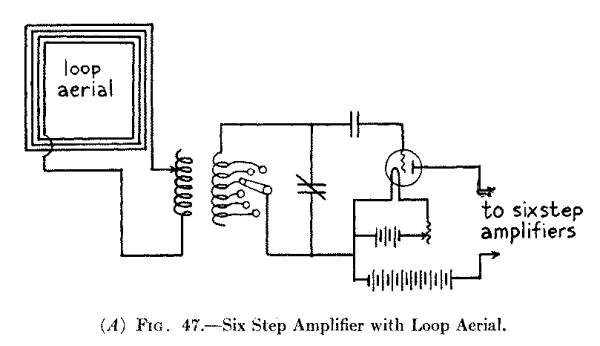
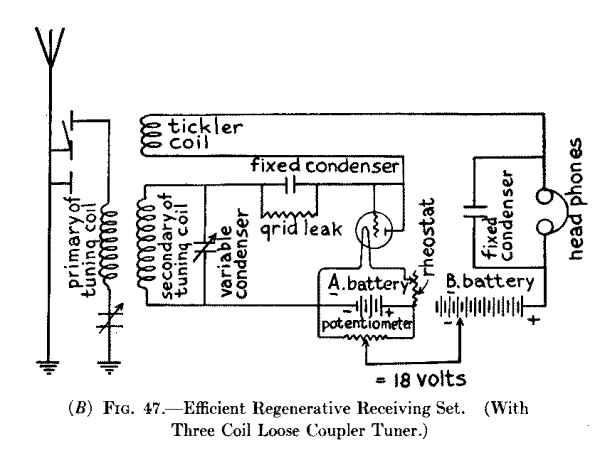
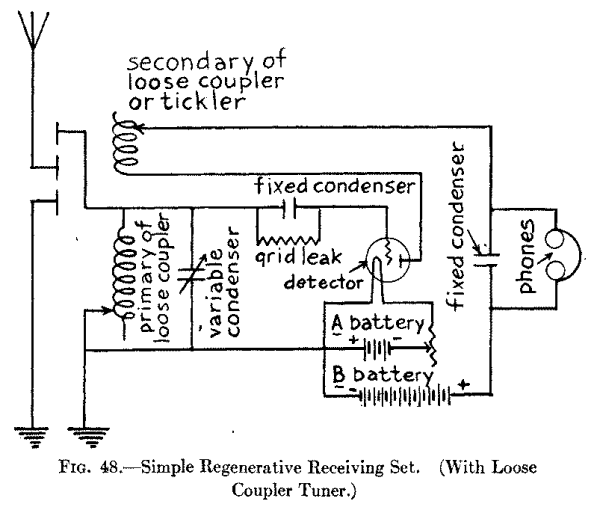
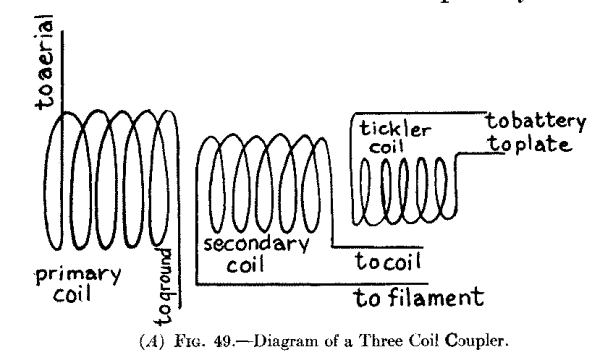
A BATTERY.--See Battery A.
ABBREVIATIONS, CODE.--Abbreviations of questions and answers used
in wireless communication. The abbreviation of a question is
usually in three letters of which the first is Q. Thus Q R B is the
code abbreviation of "what is your distance?" and the answer
"My distance is..." See Page 306 [Appendix: List of
Abbreviations].
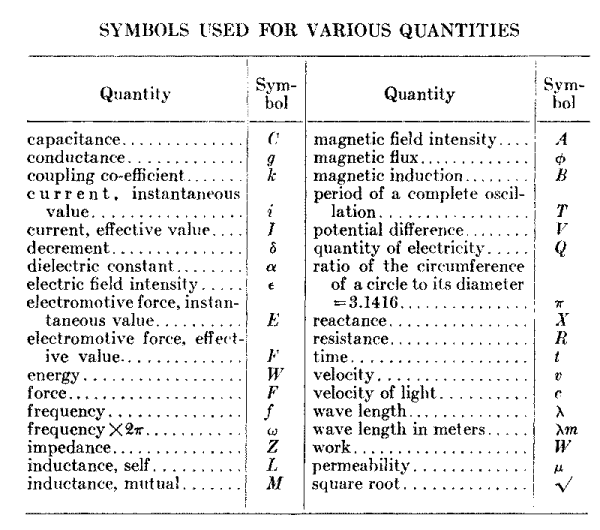
ABBREVIATIONS, UNITS.--Abbreviations of various units used in
wireless electricity. These abbreviations are usually lower case
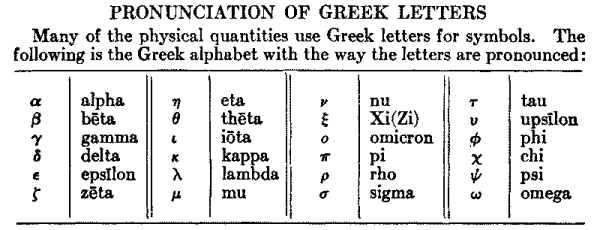
letters of the Roman alphabet, but occasionally Greek letters are used
and other signs. Thus amperes is abbreviated amp.,
micro, which means one millionth, [Greek: mu], etc. See
Page 301 [Appendix: Useful Abbreviations].
ABBREVIATIONS OF WORDS AND TERMS.--Letters used instead of words
and terms for shortening them up where there is a constant repetition
of them, as A.C. for alternating current; C.W. for
continuous waves; V.T. for vacuum tube, etc. See Page
312 [Appendix: Abbreviations of Common Terms].
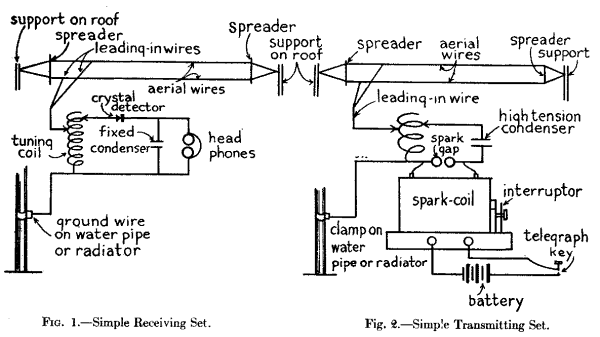
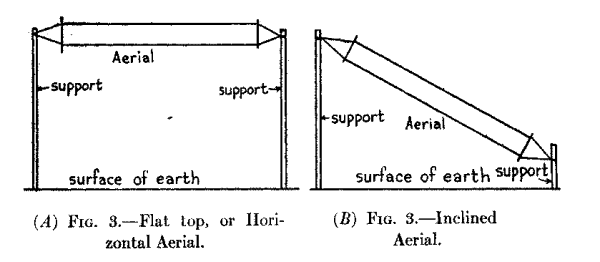
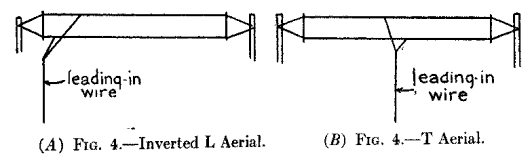
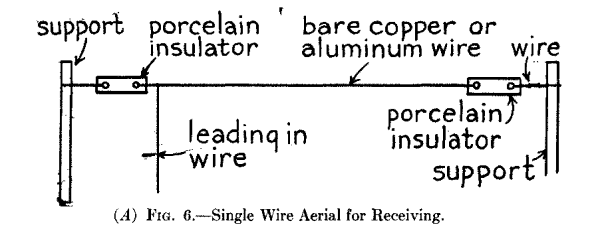
AERIAL.--Also called antenna. An aerial wire. One or more
wires suspended in the air and insulated from its supports. It is the
aerial that sends out the waves and receives them.
AERIAL, AMATEUR.--An aerial suitable for sending out 200 meter wave
lengths. Such an aerial wire system must not exceed 120 feet in length
from the ground up to the aerial switch and from this through the
leading-in wire to the end of the aerial.
AERIAL AMMETER.--See Ammeter, Hot Wire.
AERIAL, BED-SPRINGS.--Where an outdoor aerial is not practicable
bed-springs are often made to serve the purpose.
AERIAL CAPACITY.--See Capacity, Aerial.
AERIAL COUNTERPOISE.--Where it is not possible to get a good ground
an aerial counterpoise or earth capacity can be used to
advantage. The counterpoise is made like the aerial and is supported
directly under it close to the ground but insulated from it.
AERIAL, DIRECTIONAL.--A flat-top or other aerial that will transmit
and receive over greater distances to and from one direction than to
and from another.
AERIAL, GROUND.--Signals can be received on a single long wire when
it is placed on or buried in the earth or immersed in water. It is
also called a ground antenna and an underground
aerial.
AERIAL, LOOP.--Also called a coil aerial, coil antenna, loop
aerial, loop antenna and when used for the purpose a direction
finder. A coil of wire wound on a vertical frame.
AERIAL RESISTANCE.--See Resistance, Aerial.
AERIAL SWITCH.--See Switch Aerial.
AERIAL WIRE.--(1) A wire or wires that form the aerial. (2) Wire
that is used for aerials; this is usually copper or copper alloy.
AERIAL WIRE SYSTEM.--An aerial and ground wire and that part of the
inductance coil which connects them. The open oscillation circuit of a
sending or a receiving station.
AIR CORE TRANSFORMER.--See Transformer, Air Core.
AMATEUR AERIAL OR ANTENNA.--See Aerial, Amateur.
ALTERNATOR.--An electric machine that generates alternating
current.
ALPHABET, INTERNATIONAL CODE.--A modified Morse alphabet of dots
and dashes originally used in Continental Europe and, hence, called
the Continental Code. It is now used for all general public
service wireless communication all over the world and, hence, it is
called the International Code. See page 305 [Appendix:
International Morse Code].
ALTERNATING CURRENT (A.C.)--See Current.
ALTERNATING CURRENT TRANSFORMER.--See Transformer.
AMATEUR GROUND.--See Ground, Amateur.
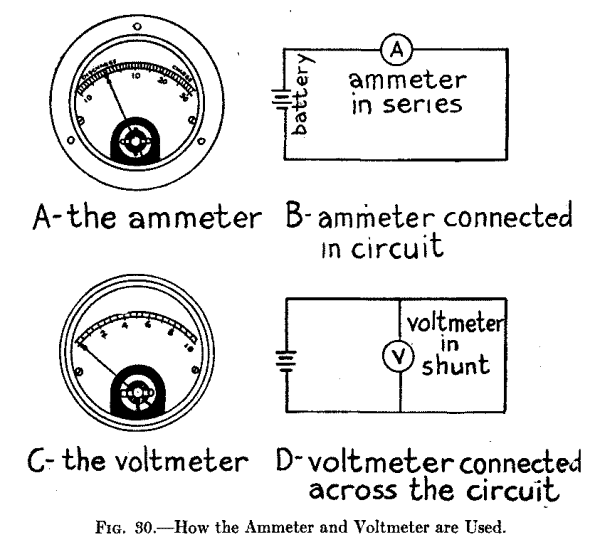
AMMETER.--An instrument used for measuring the current strength, in
terms of amperes, that flows in a circuit. Ammeters used for measuring
direct and alternating currents make use of the magnetic
effects of the currents. High frequency currents make use of the
heating effects of the currents.
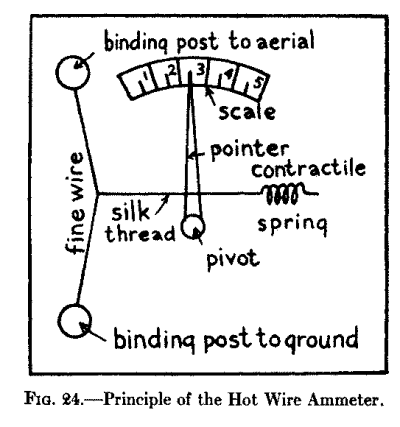
AMMETER, HOT-WIRE.--High frequency currents are usually measured by
means of an instrument which depends on heating a wire or metal strip
by the oscillations. Such an instrument is often called a thermal
ammeter, radio ammeter and aerial ammeter.
AMMETER, AERIAL.--See Ammeter, Hot Wire.
AMMETER, RADIO.--See Ammeter, Hot Wire.
AMPERE.--The current which when passed through a solution of
nitrate of silver in water according to certain specifications,
deposits silver at the rate of 0.00111800 of a gram per second.
AMPERE-HOUR.--The quantity of electricity transferred by a current
of 1 ampere in 1 hour and is, therefore, equal to 3600 coulombs.
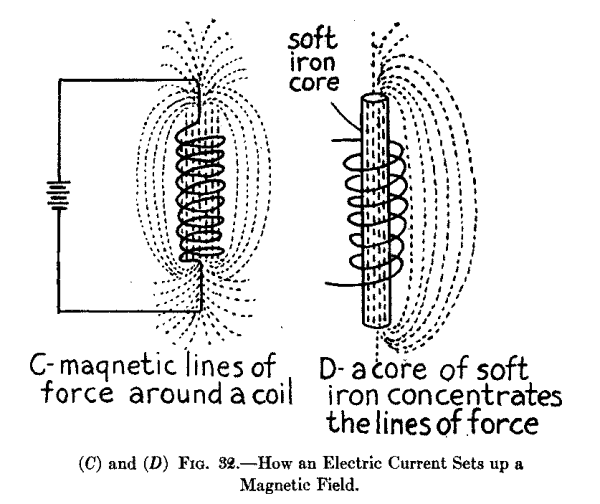
AMPERE-TURNS.--When a coil is wound up with a number of turns of
wire and a current is made to flow through it, it behaves like a
magnet. B The strength of the magnetic field inside of the coil
depends on (1) the strength of the current and (2) the number of turns
of wire on the coil. Thus a feeble current flowing through a large
number of turns will produce as strong a magnetic field as a strong
current flowing through a few turns of wire. This product of the
current in amperes times the number of turns of wire on the coil is
called the ampere-turns.
AMPLIFICATION, AUDIO FREQUENCY.--A current of audio frequency that
is amplified by an amplifier tube or other means.
AMPLIFICATION, CASCADE.--See Cascade Amplification.
AMPLIFICATION, RADIO FREQUENCY.--A current of radio frequency that
is amplified by an amplifier tube or other means before it reaches the
detector.
AMPLIFICATION, REGENERATIVE.--A scheme that uses a third circuit to
feed back part of the oscillations through a vacuum tube and which
increases its sensitiveness when used as a detector and multiplies its
action as an amplifier and an oscillator.
AMPLIFIER, AUDIO FREQUENCY.--A vacuum tube or other device that
amplifies the signals after passing through the detector.
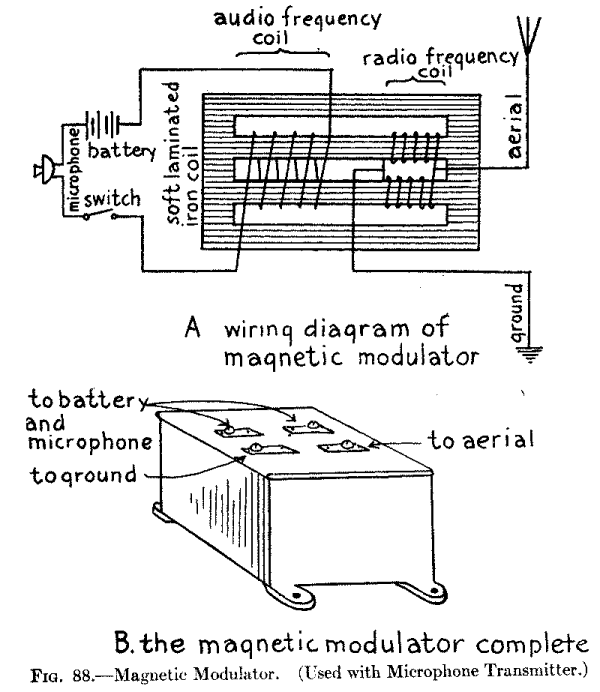
AMPLIFIER, MAGNETIC.--A device used for controlling radio frequency
currents either by means of a telegraph key or a microphone
transmitter. The controlling current flows through a separate circuit
from that of the radio current and a fraction of an ampere will
control several amperes in the aerial wire.
AMPLIFIERS, MULTI-STAGE.--A receiving set using two or more
amplifiers. Also called cascade amplification.
AMPLIFIER, VACUUM TUBE.--A vacuum tube that is used either to
amplify the radio frequency currents or the audio frequency
currents.
AMPLITUDE OF WAVE.--The greatest distance that a point moves from
its position of rest.
AMPLIFYING TRANSFORMER, AUDIO.--See Transformer, Audio
Amplifying.
AMPLIFYING MODULATOR VACUUM TUBE.--See Vacuum Tube, Amplifying
Modulator.
AMPLIFYING TRANSFORMER RADIO.--See Transformer, Radio
Amplifying.
ANTENNA, AMATEUR.--See Aerial, Amateur.
ANTENNA SWITCH.--See Switch, Aerial.
APPARATUS SYMBOLS.--See Symbols, Apparatus.
ARMSTRONG CIRCUIT.--See Circuit, Armstrong.
ATMOSPHERICS.--Same as Static, which see.
ATTENUATION.--In Sending wireless telegraph and telephone messages
the amplitude of the electric waves is damped out as the distance
increases. This is called attenuation and it increases as the
frequency is increased. This is the reason why short wave lengths will
not carry as far as long wave lengths.
AUDIO FREQUENCY AMPLIFIER.--See Amplifier, Audio
Frequency.
AUDIO FREQUENCY AMPLIFICATION.--See Amplification, Audio
Frequency.
AUDIBILITY METER.--See Meter, Audibility.
AUDIO FREQUENCY.--See Frequency, Audio.
AUDIO FREQUENCY CURRENT.--See Current, Audio Frequency.
AUDION.--An early trade name given to the vacuum tube detector.
AUTODYNE RECEPTOR.--See Receptor, Autodyne.
AUTO TRANSFORMER.--See Transformer, Auto.
BAKELITE.--A manufactured insulating compound.
B BATTERY.--See Battery B.
BAND, WAVE LENGTH.--See Wave Length Band.
BASKET WOUND COILS.--See Coils, Inductance.
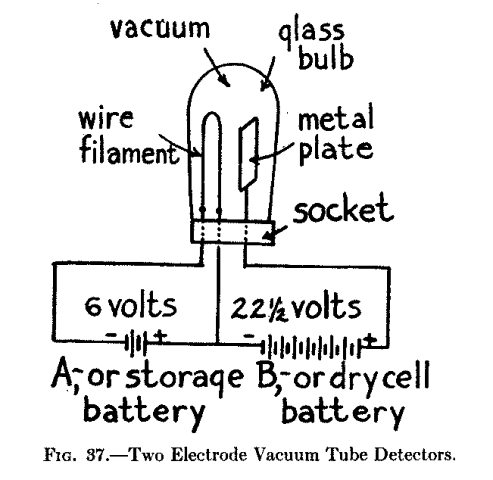
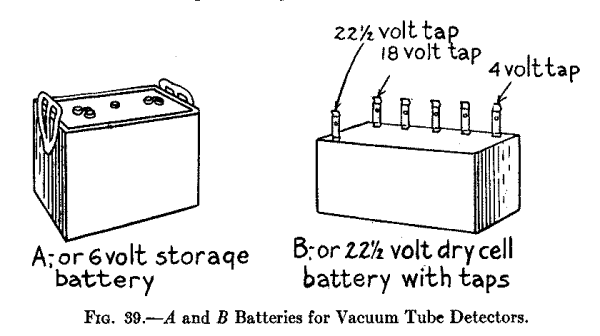
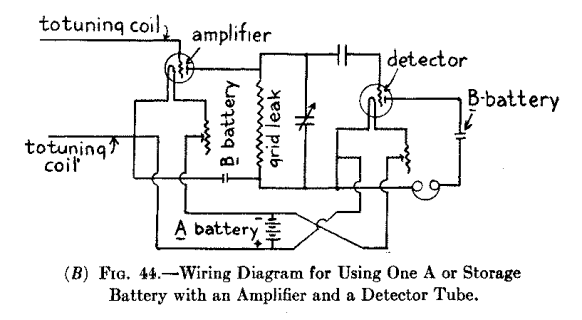
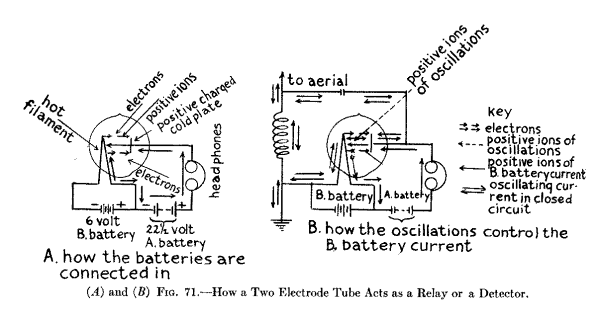
BATTERY, A.--The 6-volt storage battery used to heat the filament
of a vacuum tube, detector or amplifier.
BATTERY, B.--The 22-1/2-volt dry cell battery used to energize the
plate of a vacuum tube detector or amplifier.
BATTERY, BOOSTER.--This is the battery that is connected in series
with the crystal detector.
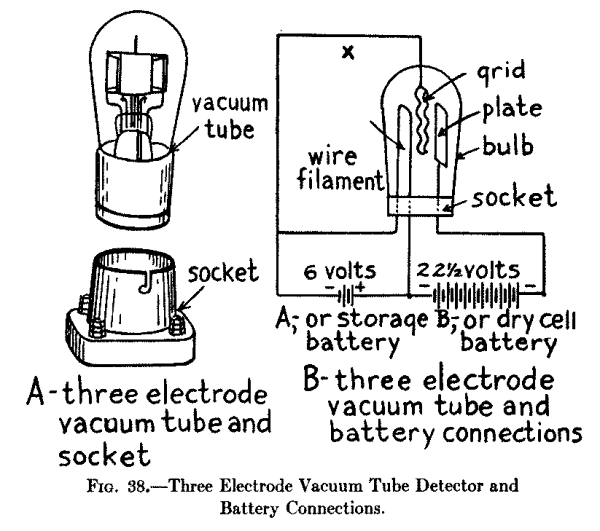
BATTERY, C.--A small dry cell battery sometimes used to give the
grid of a vacuum tube detector a bias potential.
BATTERY, EDISON STORAGE.--A storage battery in which the elements
are made of nickel and iron and immersed in an alkaline
electrolyte.
BATTERY, LEAD STORAGE.--A storage battery in which the elements are
made of lead and immersed in an acid electrolyte.
BATTERY POLES.--See Poles, Battery.
BATTERY, PRIMARY.--A battery that generates current by chemical
action.
BATTERY, STORAGE.--A battery that develops a current after it has
been charged.
BEAT RECEPTION.--See Heterodyne Reception.
BED SPRINGS AERIAL.--See Aerial, Bed Springs.
BLUB BLUB.--Over modulation in wireless telephony.
BROAD WAVE.--See Wave, Broad.
BRUSH DISCHARGE.--See Discharge.
BUZZER MODULATION.--See Modulation, Buzzer.
BLUE GLOW DISCHARGE.--See Discharge.
BOOSTER BATTERY.--See Battery, Booster.
BROADCASTING.--Sending out intelligence and music from a central
station for the benefit of all who live within range of it and who
have receiving sets.
CAPACITANCE.--Also called by the older name of capacity. The
capacity of a condenser, inductance coil or other device capable of
retaining a charge of electricity. Capacitance is measured in terms of
the microfarad.
CAPACITIVE COUPLING.--See Coupling, Capacitive.
CAPACITY.--Any object that will retain a charge of electricity;
hence an aerial wire, a condenser or a metal plate is sometimes called
a capacity.
CAPACITY, AERIAL.--The amount to which an aerial wire system can be
charged. The capacitance of a small amateur aerial is from
0.0002 to 0.0005 microfarad.
CAPACITY, DISTRIBUTED.--A coil of wire not only has inductance, but
also a certain small capacitance. Coils wound with their turns
parallel and having a number of layers have a bunched
capacitance which produces untoward effects in oscillation
circuits. In honeycomb and other stagger wound coils the capacitance
is more evenly distributed.
CAPACITY REACTANCE.--See Reactance, Capacity.
CAPACITY UNIT.--See Farad.
CARBON RHEOSTATS.--See Rheostat, Carbon.
CARBORUNDUM DETECTOR.--See Detector.
CARRIER CURRENT TELEPHONY.--See Wired-Wireless.
CARRIER FREQUENCY.--See Frequency, Carrier.
CARRIER FREQUENCY TELEPHONY.--See Wired-Wireless.
CASCADE AMPLIFICATION.--Two or more amplifying tubes hooked up in a
receiving set.
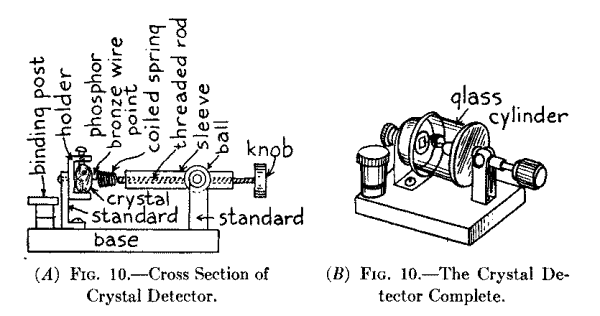
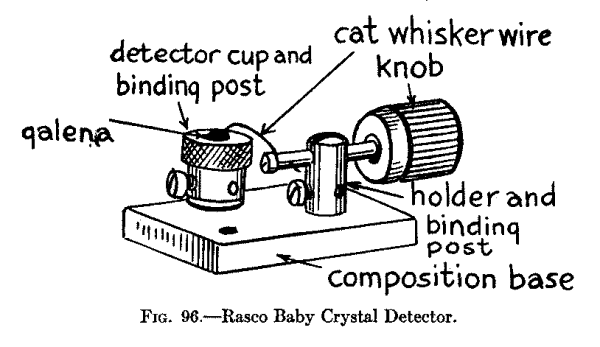
CAT WHISKER CONTACT.--A long, thin wire which makes contact with
the crystal of a detector.
CENTIMETER OF CAPACITANCE.--Equal to 1.11 microfarads.
CENTIMETER OF INDUCTANCE.--Equal to one one-thousandth part of a
microhenry.
CELLULAR COILS.--See Coils, Inductance.
C.G.S. ELECTROSTATIC UNIT OF CAPACITANCE.--See Centimeter of
Capacitance.
CHARACTERISTICS.--The special behavior of a device, such as an
aerial, a detector tube, etc.
CHARACTERISTICS, GRID.--See Grid Characteristics.
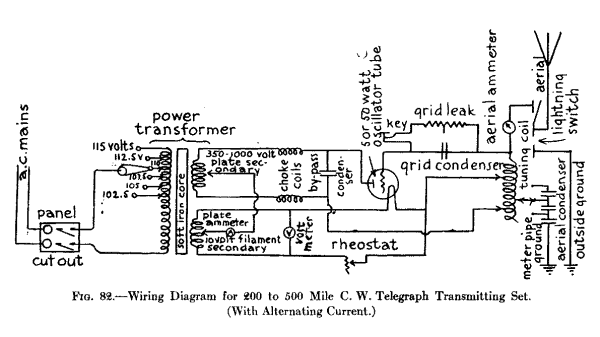
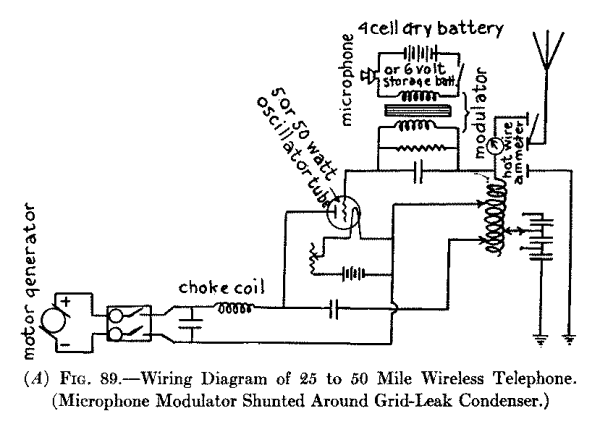
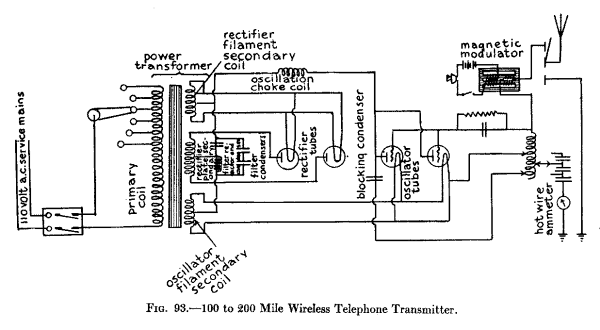
CHOKE COILS.--Coils that prevent the high voltage oscillations from
surging back into the transformer and breaking down the
insulation.
CHOPPER MODULATION.--See Modulation, Chopper.
CIRCUIT.--Any electrical conductor through which a current can
flow. A low voltage current requires a loop of wire or other conductor
both ends of which are connected to the source of current before it
can flow. A high frequency current will surge in a wire which is open
at both ends like the aerial.
- Closed Circuit.--A circuit that is continuous.
- Open Circuit.--A conductor that is not continuous.
- Coupled Circuits.--Open and closed circuits connected
together by inductance coils, condensers or resistances. See
coupling.
- Close Coupled Circuits.--Open and closed circuits connected
directly together with a single inductance coil.
- Loose Coupled Circuits.--Opened and closed currents
connected together inductively by means of a transformer.
- Stand-by Circuits.--Also called pick-up circuits.
When listening-in for possible calls from a number of stations, a
receiver is used which will respond to a wide band of wave
lengths.
- Armstrong Circuits.--The regenerative circuit invented by
Major E. H. Armstrong.
CLOSE COUPLED CIRCUITS.--See Currents, Close Coupled.
CLOSED CIRCUIT.--See Circuit, Closed.
CLOSED CORE TRANSFORMER.--See Transformer, Closed Core.
CODE.--
- Continental.--Same as International.
- International.--On the continent of Europe land lines use
the Continental Morse alphabetic code. This code has come to be
used throughout the world for wireless telegraphy and hence it is now
called the International code. It is given on Page 305.
[Appendix: International Morse Code].
- Morse.--The code devised by Samuel F. B. Morse and which is
used on the land lines in the U. S.
- National Electric.--A set of rules and requirements devised
by the National Board of Fire Underwriters for the electrical
installations in buildings on which insurance companies carry risks.
This code also covers the requirements for wireless installations. A
copy may be had from the National Board of Fire Underwriters,
New York City, or from your insurance agent.
- National Electric Safety.--The Bureau of Standards,
Washington, D. C., have investigated the precautions which should be
taken for the safe operation of all electric equipment. A copy of the
Bureau of Standards Handbook No. 3 can be had for 40 cents from
the Superintendent of Documents.
COEFFICIENT OF COUPLING.--See Coupling, Coefficient of.
COIL AERIAL.--See Aerial, Loop.
COIL ANTENNA.--See Aerial, Loop.
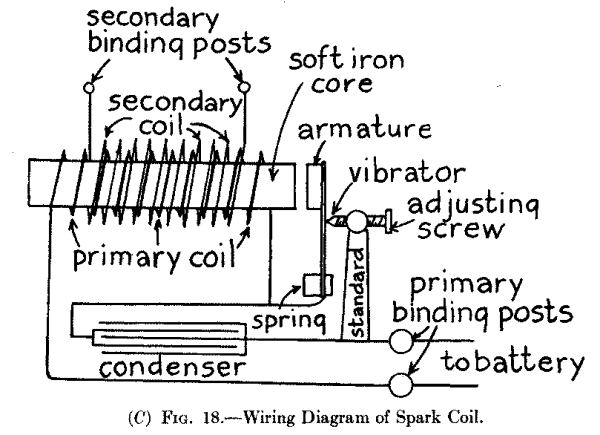
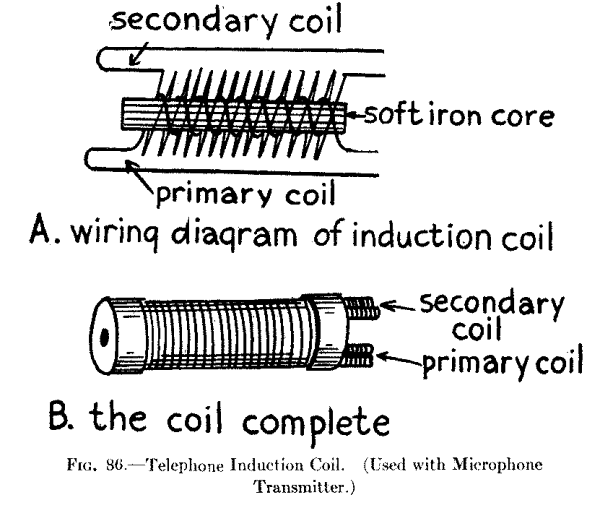
COIL, INDUCTION.--An apparatus for changing low voltage direct
currents into high voltage, low frequency alternating currents. When
fitted with a spark gap the high voltage, low frequency currents are
converted into high voltage, high frequency currents. It is then also
called a spark coil and a Ruhmkorff coil.
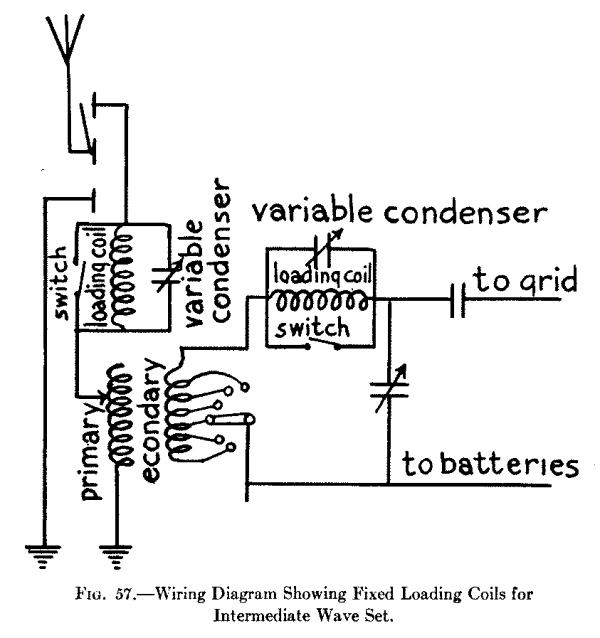
COIL, LOADING.--A coil connected in the aerial or closed
oscillation circuit so that longer wave lengths can be received.
COIL, REPEATING.--See Repeating Coil.
COIL, ROTATING.--One which rotates on a shaft instead of sliding as
in a loose coupler. The rotor of a variometer or
variocoupler is a rotating coil.
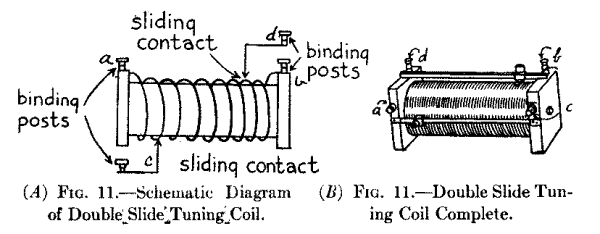
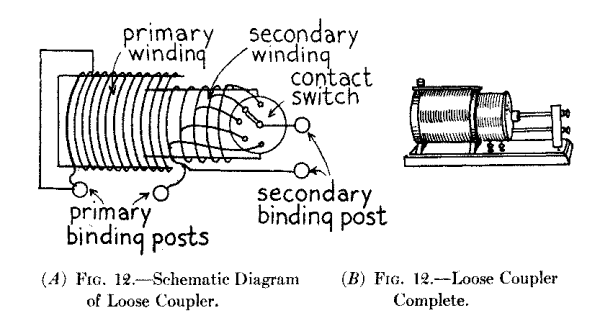
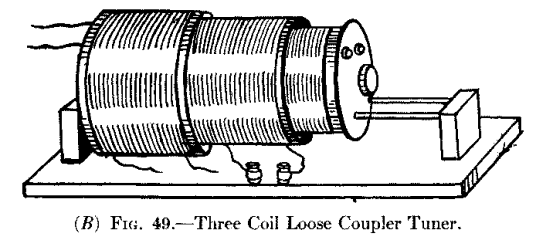
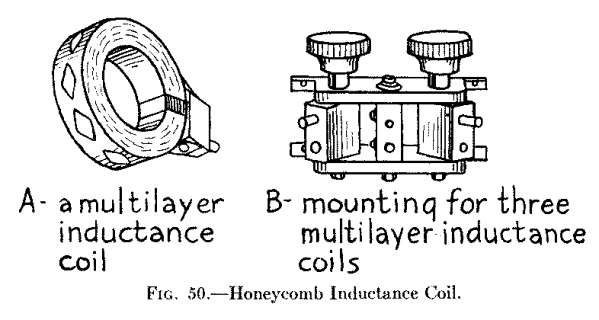
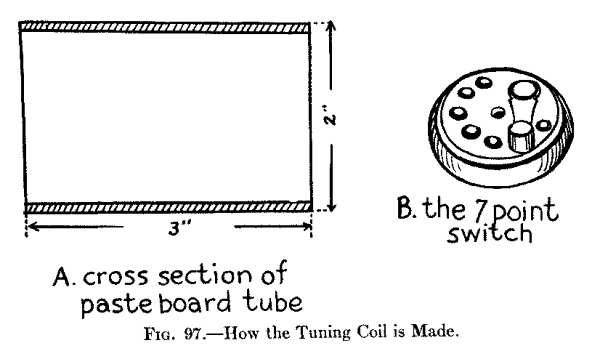
COILS, INDUCTANCE.--These are the tuning coils used for sending and
receiving sets. For sending sets they are formed of one and two coils,
a single sending coil is generally called a tuning inductance
coil, while a two-coil tuner is called an oscillation
transformer. Receiving tuning coils are made with a single layer,
single coil, or a pair of coils, when it is called an oscillation
transformer. Some tuning inductance coils have more than one
layer, they are then called lattice wound, cellular,
basket wound, honeycomb, duo-lateral, stagger
wound, spider-web and slab coils.
COMMERCIAL FREQUENCY.--See Frequency, Commercial.
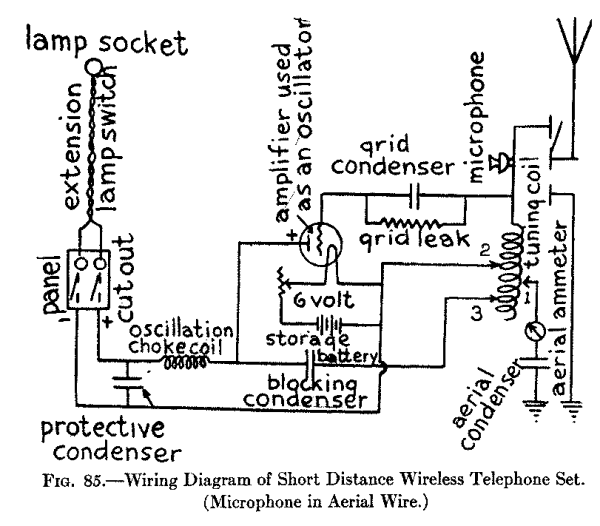
CONDENSER, AERIAL SERIES.--A condenser placed in the aerial wire
system to cut down the wave length.
CONDENSER, VERNIER.--A small variable condenser used for receiving
continuous waves where very sharp tuning is desired.
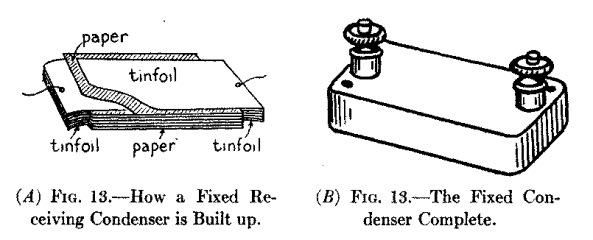
CONDENSER.--All conducting objects with their insulation form
capacities, but a condenser is understood to mean two sheets or
plates of metal placed closely together but separated by some
insulating material.
- Adjustable Condenser.--Where two or more condensers can be
coupled together by means of plugs, switches or other devices.
- Aerial Condenser.--A condenser connected in the
aerial.
- Air Condenser.--Where air only separates the sheets of
metal.
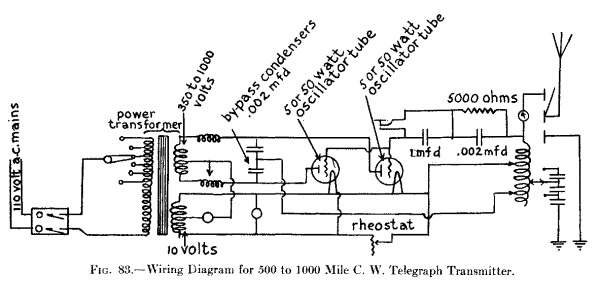
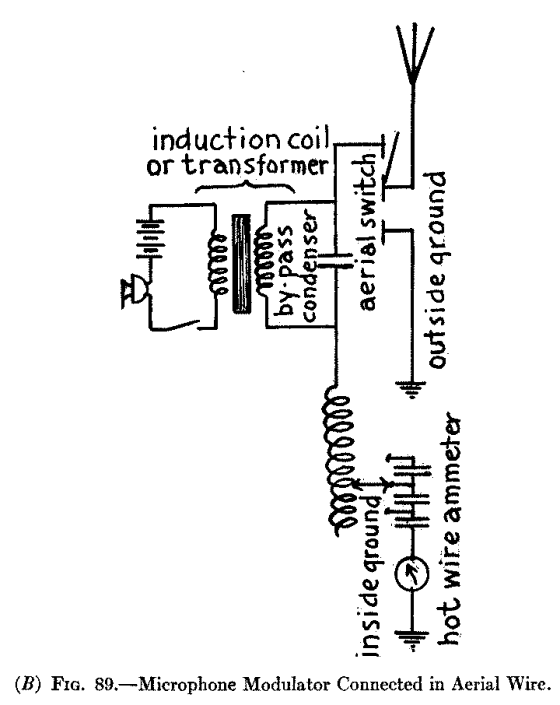
- By-Pass Condenser.--A condenser connected in the
transmitting currents so that the high frequency currents cannot flow
back through the power circuit.
- Filter Condenser.--A condenser of large capacitance used in
combination with a filter reactor for smoothing out the pulsating
direct currents as they come from the rectifier.
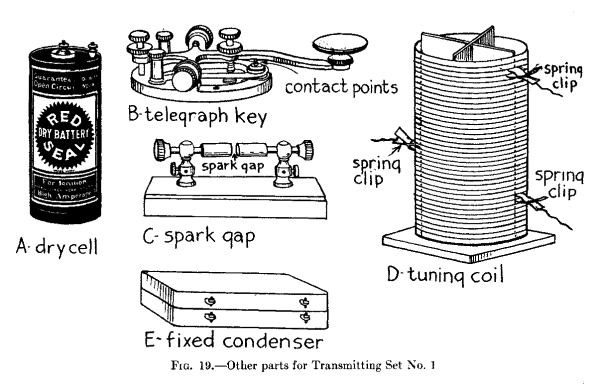
- Fixed Condenser.--Where the plates are fixed relatively to
one another.
- Grid Condenser.--A condenser connected in series with the
grid lead.
- Leyden Jar Condenser.--Where glass jars are used.
- Mica Condenser.--Where mica is used.
- Oil Condenser.--Where the plates are immersed in oil.
- Paper Condenser.--Where paper is used as the insulating
material.
- Protective.--A condenser of large capacity connected across
the low voltage supply circuit of a transmitter to form a by-path of
kick-back oscillations.
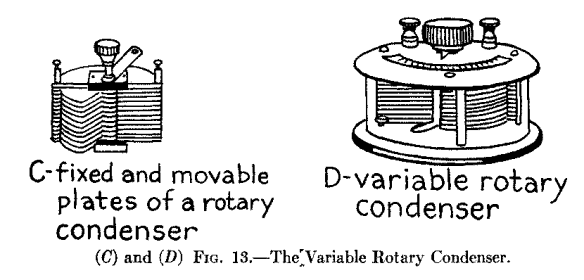
- Variable Condenser.--Where alternate plates can be moved
and so made to interleave more or less with a set of fixed
plates.
- Vernier.--A small condenser with a vernier on it so that it
can be very accurately varied. It is connected in parallel with the
variable condenser used in the primary circuit and is used for the
reception of continuous waves where sharp tuning is essential.
CONDENSITE.--A manufactured insulating compound.
CONDUCTIVITY.--The conductance of a given length of wire of uniform
cross section. The reciprocal of resistivity.
CONTACT DETECTORS.--See Detectors, Contact.
CONTINENTAL CODE.--See Code, Continental.
COULOMB.--The quantity of electricity transferred by a current of 1
ampere in 1 second.
CONVECTIVE DISCHARGE.--See Discharge.
CONVENTIONAL SIGNALS.--See Signals, Conventional.
COUNTER ELECTROMOTIVE FORCE.--See Electromotive Force,
Counter.
COUNTERPOISE. A duplicate of the aerial wire that is raised a few
feet above the earth and insulated from it. Usually no connection is
made with the earth itself.
COUPLED CIRCUITS.--See Circuit, Coupled.
COUPLING.--When two oscillation circuits are connected together
either by the magnetic field of an inductance coil, or by the
electrostatic field of a condenser.
COUPLING, CAPACITIVE.--Oscillation circuits when connected together
by condensers instead of inductance coils.
COUPLING, COEFFICIENT OF.--The measure of the closeness of the
coupling between two coils.
COUPLING, INDUCTIVE.--Oscillation circuits when connected together
by inductance coils.
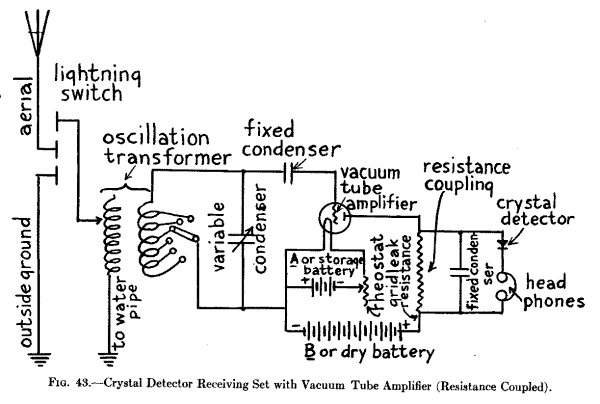
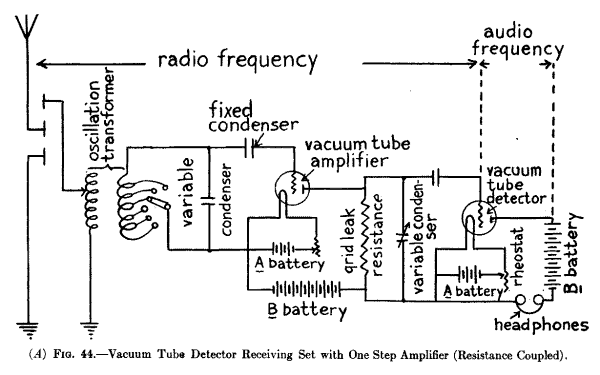
COUPLING, RESISTANCE.--Oscillation circuits connected together by a
resistance.
CRYSTAL RECTIFIER.--A crystal detector.
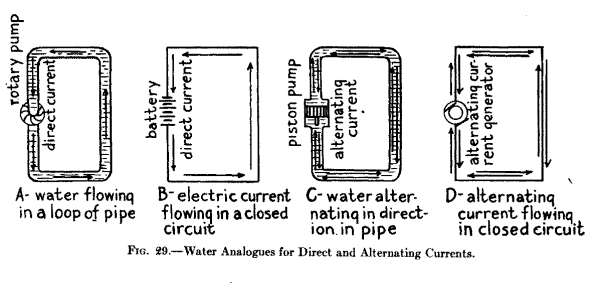
CURRENT, ALTERNATING (A.C.).--A low frequency current that
surges to and fro in a circuit.
CURRENT, AUDIO FREQUENCY.--A current whose frequency is low enough
to be heard in a telephone receiver. Such a current usually has a
frequency of between 200 and 2,000 cycles per second.
CURRENT, PLATE.--The current which flows between the filament and
the plate of a vacuum tube.
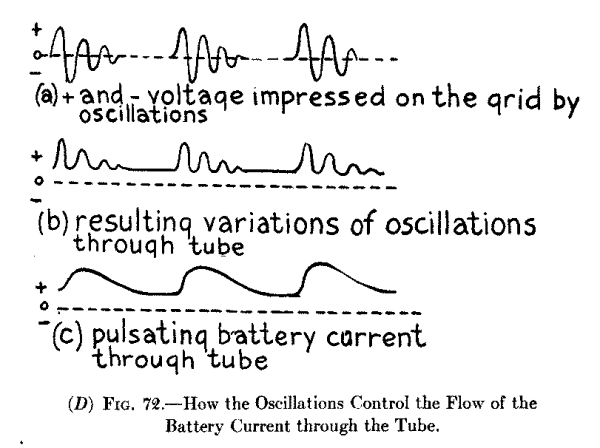
CURRENT, PULSATING.--A direct current whose voltage varies from
moment to moment.
CURRENT, RADIO FREQUENCY.--A current whose frequency is so high it
cannot be heard in a telephone receiver. Such a current may have a
frequency of from 20,000 to 10,000,000 per second.
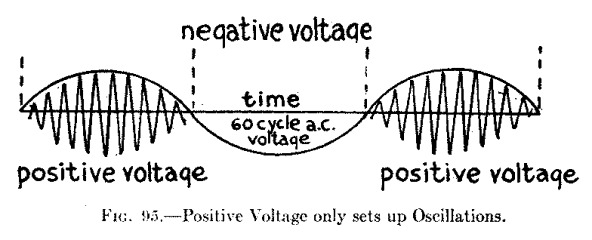
CURRENTS, HIGH FREQUENCY.--(1) Currents that oscillate from 10,000
to 300,000,000 times per second. (2) Electric oscillations.
CURRENTS, HIGH POTENTIAL.--(1) Currents that have a potential of
more than 10,000 volts. (2) High voltage currents.
CYCLE.--(1) A series of changes which when completed are again at
the starting point. (2) A period of time at the end of which an
alternating or oscillating current repeats its original direction of
flow.
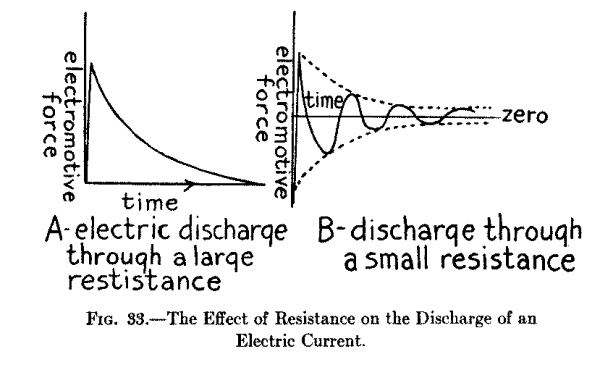
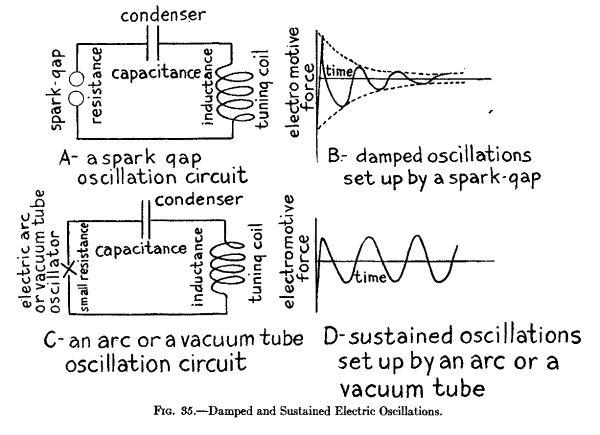
DAMPING.--The degree to which the energy of an electric oscillation
is reduced. In an open circuit the energy of an oscillation set up by
a spark gap is damped out in a few swings, while in a closed circuit
it is greatly prolonged, the current oscillating 20 times or more
before the energy is dissipated by the sum of the resistances of the
circuit.
DECREMENT.--The act or process of gradually becoming less.
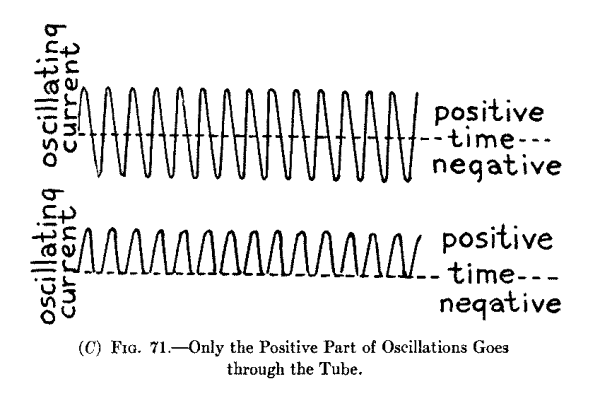
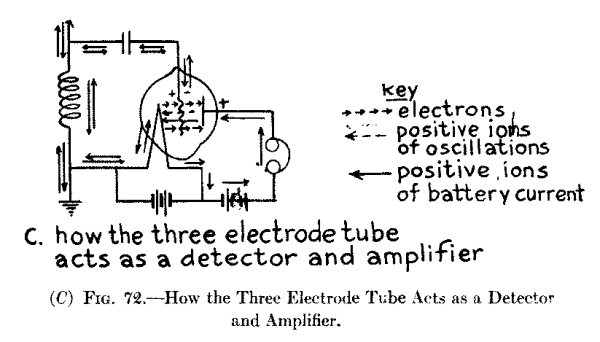
DETECTOR.--Any device that will (1) change the oscillations set up
by the incoming waves into direct current, that is which will rectify
them, or (2) that will act as a relay.
- Carborundum.--One that uses a carborundum crystal
for the sensitive element. Carborundum is a crystalline silicon
carbide formed in the electric furnace.
- Cat Whisker Contact.--See Cat Whisker Contact.
- Chalcopyrite.--Copper pyrites. A brass colored mineral used
as a crystal for detectors. See Zincite.
- Contact.--A crystal detector. Any kind of a detector in
which two dissimilar but suitable solids make contact.
- Ferron.--A detector in which iron pyrites are used as the
sensitive element.
- Galena.--A detector that uses a galena crystal for the
rectifying element.
- Iron Pyrites.--A detector that uses a crystal of iron
pyrites for its sensitive element.
- Molybdenite.--A detector that uses a crystal of sulphide
of molybdenum for the sensitive element.
- Perikon.--A detector in which a bornite crystal
makes contact with a zincite crystal.
- Silicon.--A detector that uses a crystal of silicon for its
sensitive element.
- Vacuum Tube.--A vacuum tube (which see) used as a
detector.
- Zincite.--A detector in which a crystal of zincite
is used as the sensitive element.
DE TUNING.--A method of signaling by sustained oscillations in
which the key when pressed down cuts out either some of the inductance
or some of the capacity and hence greatly changes the wave length.
DIELECTRIC.--An insulating material between two electrically
charged plates in which there is set up an electric strain, or
displacement.
DIELECTRIC STRAIN.--The electric displacement in a dielectric.
DIRECTIONAL AERIAL.--See Aerial, Directional.
DIRECTION FINDER.--See Aerial, Loop.
DISCHARGE.--(1) A faintly luminous discharge that takes place from
the positive pointed terminal of an induction coil, or other high
potential apparatus; is termed a brush discharge. (2) A
continuous discharge between the terminals of a high potential
apparatus is termed a convective discharge. (3) The sudden
breaking-down of the air between the balls forming the spark gap is
termed a disruptive discharge; also called an electric
spark, or just spark for short. (4) When a tube has a poor
vacuum, or too large a battery voltage, it glows with a blue light and
this is called a blue glow discharge.
DISRUPTIVE DISCHARGE.--See Discharge.
DISTRESS CALL. [Morse code:] ...---... (SOS).
DISTRIBUTED CAPACITY.--See Capacity, Distributed.
DOUBLE HUMP RESONANCE CURVE.--A resonance curve that has two peaks
or humps which show that the oscillating currents which are set up
when the primary and secondary of a tuning coil are closely coupled
have two frequencies.
DUO-LATERAL COILS.--See Coils, Inductance.
DUPLEX COMMUNICATION.--A wireless telephone system with which it is
possible to talk between both stations in either direction without the
use of switches. This is known as the duplex system.
EARTH CAPACITY.--An aerial counterpoise.
EARTH CONNECTION.--Metal plates or wires buried in the ground or
immersed in water. Any kind of means by which the sending and
receiving apparatus can be connected with the earth.
EDISON STORAGE BATTERY.--See Storage Battery, Edison.
ELECTRIC ENERGY.--The power of an electric current.
ELECTRIC OSCILLATIONS.--See Oscillations, Electric.
ELECTRIC SPARK.--See Discharge, Spark.
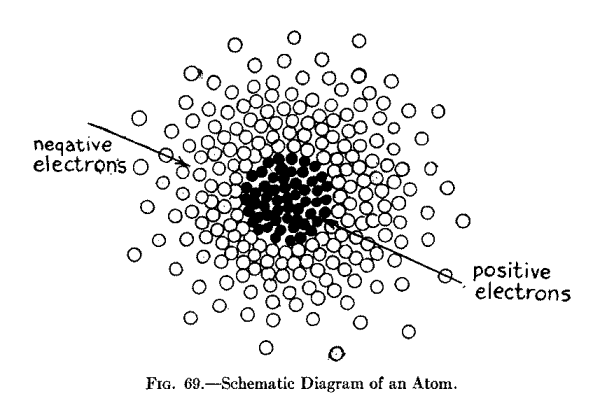
ELECTRICITY, NEGATIVE.--The opposite of positive
electricity. Negative electricity is formed of negative electrons
which make up the outside particles of an atom.
ELECTRICITY, POSITIVE.--The opposite of negative
electricity. Positive electricity is formed of positive electrons
which make up the inside particles of an atom.
ELECTRODES.--Usually the parts of an apparatus which dip into a
liquid and carry a current. The electrodes of a dry battery are the
zinc and carbon elements. The electrodes of an Edison storage battery
are the iron and nickel elements, and the electrodes of a lead storage
battery are the lead elements.
ELECTROLYTES.--The acid or alkaline solutions used in
batteries.
ELECTROMAGNETIC WAVES.--See Waves, Electric.
ELECTROMOTIVE FORCE.--Abbreviated emf. The force that drives
an electric current along a conductor. Also loosely called
voltage.
ELECTROMOTIVE FORCE, COUNTER.--The emf. that is set up in a
direction opposite to that in which the current is flowing in a
conductor.
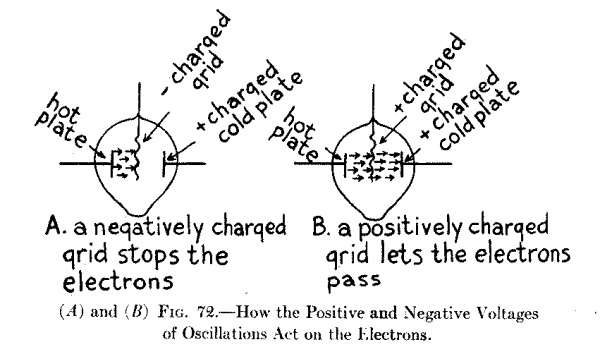
ELECTRON.--(1) A negative particle of electricity that is detached
from an atom. (2) A negative particle of electricity thrown off from
the incandescent filament of a vacuum tube.
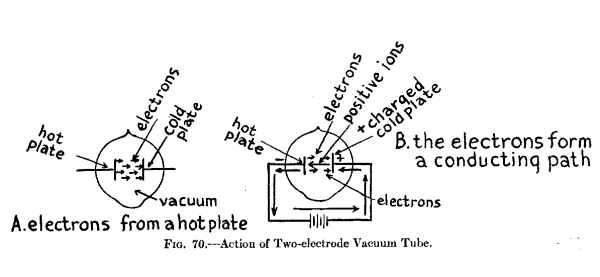
ELECTRON FLOW.--The passage of electrons between the incandescent
filament and the cold positively charged plate of a vacuum tube.
ELECTRON RELAY.--See Relay, Electron.
ELECTRON TUBE.--A vacuum tube or a gas-content tube used for any
purpose in wireless work. See Vacuum Tube.
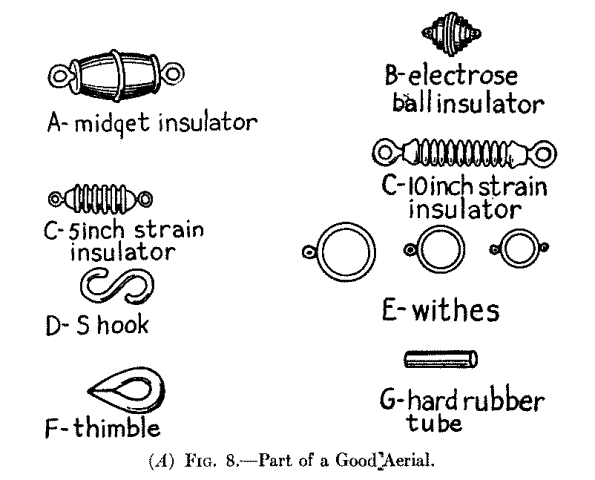
ELECTROSE INSULATORS.--Insulators made of a composition material
the trade name of which is Electrose.
ENERGY, ELECTRIC.--See Electric Energy.
ENERGY UNIT.--The joule, which see, Page 308
[Appendix: Definitions of Electric and Magnetic Units].
FADING.--The sudden variation in strength of signals received from
a transmitting station when all the adjustments of both sending and
receiving apparatus remain the same. Also called swinging.
FARAD.--The capacitance of a condenser in which a potential
difference of 1 volt causes it to have a charge of 1 coulomb of
electricity.
FEED-BACK ACTION.--Feeding back the oscillating currents in a
vacuum tube to amplify its power. Also called regenerative
action.
FERROMAGNETIC CONTROL.--See Magnetic Amplifier.
FILAMENT.--The wire in a vacuum tube that is heated to
incandescence and which throws off electrons.
FILAMENT RHEOSTAT.--See Rheostat, Filament.
FILTER.--Inductance coils or condensers or both which (1) prevent
troublesome voltages from acting on the different circuits, and (2)
smooth out alternating currents after they have been rectified.
FILTER REACTOR.--See Reactor, Filter.
FIRE UNDERWRITERS.--See Code, National Electric.
FIXED GAP.--See Gap.
FLEMING VALVE.--A two-electrode vacuum tube.
FORCED OSCILLATIONS.--See Oscillations, Forced.
FREE OSCILLATIONS.--See Oscillations, Free.
FREQUENCY, AUDIO.--(1) An alternating current whose frequency is
low enough to operate a telephone receiver and, hence, which can be
heard by the ear. (2) Audio frequencies are usually around 500 or
1,000 cycles per second, but may be as low as 200 and as high as
10,000 cycles per second.
- Carrier.--A radio frequency wave modulated by an audio
frequency wave which results in setting of three radio
frequency waves. The principal radio frequency is called the carrier
frequency, since it carries or transmits the audio frequency
wave.
- Commercial.--(1) Alternating current that is used for
commercial purposes, namely, light, heat and power. (2) Commercial
frequencies now in general use are from 25 to 50 cycles per
second.
- Natural.--The pendulum and vibrating spring have a
natural frequency which depends on the size, material of which
it is made, and the friction which it has to overcome. Likewise an
oscillation circuit has a natural frequency which depends upon its
inductance, capacitance and resistance.
- Radio.--(1) An oscillating current whose frequency is too
high to affect a telephone receiver and, hence, cannot be heard by the
ear. (2) Radio frequencies are usually between 20,000 and 2,000,000
cycles per second but may be as low as 10,000 and as high as
300,000,000 cycles per second.
- Spark.--The number of sparks per second produced by the
discharge of a condenser.
GAP, FIXED.--One with fixed electrodes.
GAP, NON-SYNCHRONOUS.--A rotary spark gap run by a separate motor
which may be widely different from that of the speed of the
alternator.
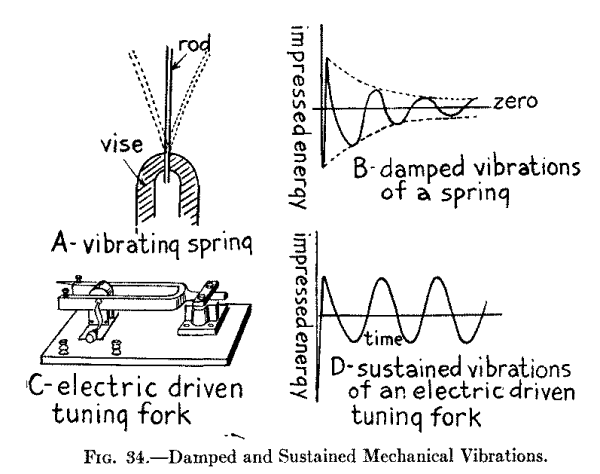
GAP, QUENCHED.--(1) A spark gap for the impulse production of
oscillating currents. (2) This method can be likened to one where a
spring is struck a single sharp blow and then continues to set up
vibrations.
GAP, ROTARY.--One having fixed and rotating electrodes.
GAP, SYNCHRONOUS.--A rotary spark gap run at the same speed as the
alternator which supplies the power transformer. Such a gap usually
has as many teeth as there are poles on the generator. Hence one spark
occurs per half cycle.
GAS-CONTENT TUBE.--See Vacuum Tube.
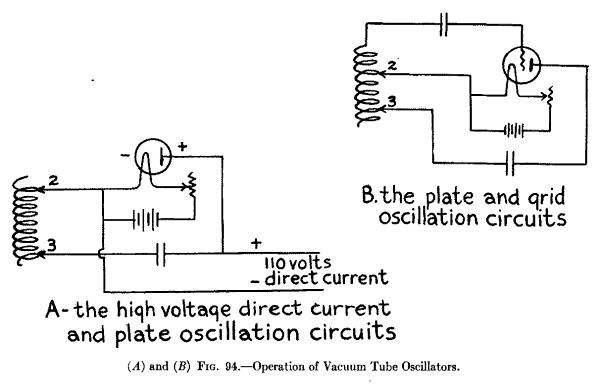
GENERATOR TUBE.--A vacuum tube used to set up oscillations. As a
matter of fact it does not generate oscillations, but changes
the initial low voltage current that flows through it into
oscillations. Also called an oscillator tube and a power
tube.
GRID BATTERY.--See Battery C.
GRID CHARACTERISTICS.--The various relations that could exist
between the voltages and currents of the grid of a vacuum tube, and
the values which do exist between them when the tube is in operation.
These characteristics are generally shown by curves.
GRID CONDENSER.--See Condenser, Grid.
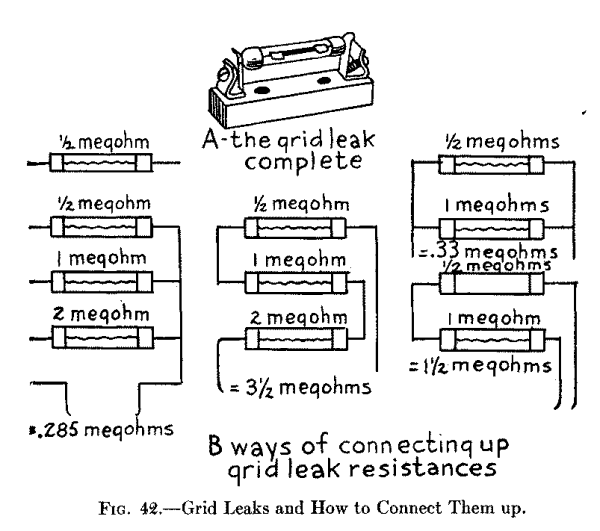
GRID LEAK.--A high resistance unit connected in the grid lead of
both sending and receiving sets. In a sending set it keeps the voltage
of the grid at a constant value and so controls the output of the
aerial. In a receiving set it controls the current flowing between the
plate and filament.
GRID MODULATION.--See Modulation, Grid.
GRID POTENTIAL.--The negative or positive voltage of the grid of a
vacuum tube.
GRID VOLTAGE.--See Grid Potential.
GRINDERS.--The most common form of Static, which see. They
make a grinding noise in the headphones.
GROUND.--See Earth Connection.
GROUND, AMATEUR.--A water-pipe ground.
GROUND, WATERPIPE.--A common method of grounding by amateurs is to
use the waterpipe, gaspipe or radiator.
GUIDED WAVE TELEPHONY.--See Wired Wireless.
HARD TUBE.--A vacuum tube in which the vacuum is high, that
is, exhausted to a high degree.
HELIX.--(1) Any coil of wire. (2) Specifically a transmitter tuning
inductance coil.
HENRY.--The inductance in a circuit in which the electromotive
force induced is 1 volt when the inducing current varies at the rate
of 1 ampere per second.
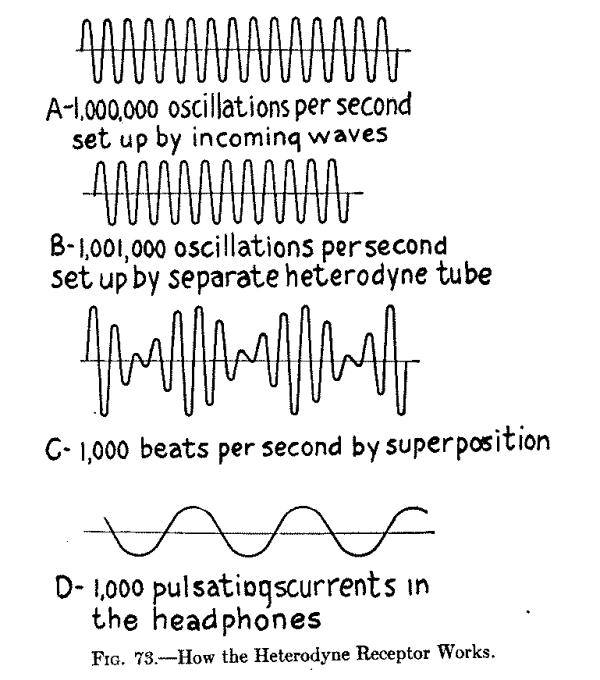
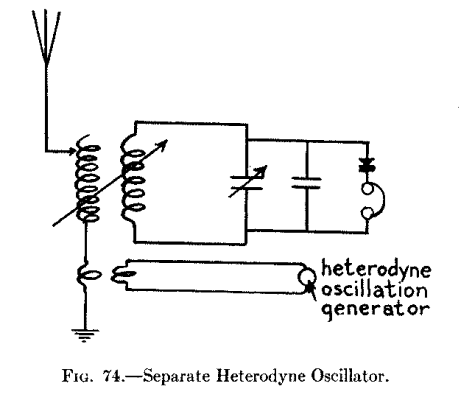
HETERODYNE RECEPTION.--(1) Receiving by the beat method. (2)
Receiving by means of superposing oscillations generated at the
receiving station on the oscillations set up in the aerial by the
incoming waves.
HETERODYNE RECEPTOR.--See Receptor, Heterodyne.
HIGH FREQUENCY CURRENTS.--See Currents, High Frequency.
HIGH FREQUENCY RESISTANCE.--See Resistance, High
Frequency.
HIGH POTENTIAL CURRENTS.--See Currents, High Potential.
HIGH VOLTAGE CURRENTS.--See Currents, High Potential.
HONEYCOMB COILS.--See Coils, Inductance.
HORSE-POWER.--Used in rating steam machinery. It is equal to 746
watts.
HOT WIRE AMMETER.--See Ammeter, Hot Wire.
HOWLING.--Where more than three stages of radio amplification, or
more than two stages of audio amplification, are used howling noises
are apt to occur in the telephone receivers.
IMPEDANCE.--An oscillation circuit has reactance and also
resistance, and when these are combined the total opposition to
the current is called impedance.
INDUCTANCE COILS.--See Coils, Inductance.
INDUCTANCE COIL, LOADING.--See Coil, Loading Inductance.
INDUCTIVE COUPLING.--See Coupling, Inductive.
INDUCTIVE REACTANCE.--See Reactance, Inductive.
INDUCTION COIL.--See Coil, Induction.
INDUCTION, MUTUAL.--Induction produced between two circuits or
coils close to each other by the mutual interaction of their magnetic
fields.
INSULATION.--Materials used on and around wires and other
conductors to keep the current from leaking away.
INSPECTOR, RADIO.--A U. S. inspector whose business it is to issue
both station and operators' licenses in the district of which he is in
charge.
INTERFERENCE.--The crossing or superposing of two sets of electric
waves of the same or slightly different lengths which tend to oppose
each other. It is the untoward interference between electric waves
from different stations that makes selective signaling so difficult a
problem.
INTERMEDIATE WAVES.--See Waves.
IONIC TUBES.--See Vacuum Tubes.
INTERNATIONAL CODE.--See Code, International.
JAMMING.--Waves that are of such length and strength that when they
interfere with incoming waves they drown them out.
JOULE.--The energy spent in 1 second by a flow of 1 ampere in 1
ohm.
JOULE'S LAW.--The relation between the heat produced in seconds to
the resistance of the circuit, to the current flowing in it.
KENOTRON.--The trade name of a vacuum tube rectifier made by the
Radio Corporation of America.
KICK-BACK.--Oscillating currents that rise in voltage and tend to
flow back through the circuit that is supplying the transmitter with
low voltage current.
KICK-BACK PREVENTION.--See Prevention, Kick-Back.
KILOWATT.--1,000 watts.
LAMBDA.--See Pages 301, 302. [Appendix: Useful
Abbreviations].
LATTICE WOUND COILS.--See Coils, Inductance.
LIGHTNING SWITCH.--See Switch, Lightning.
LINE RADIO COMMUNICATION.--See Wired Wireless.
LINE RADIO TELEPHONY.--See Telephony, Line Radio.
LITZENDRAHT.--A conductor formed of a number of fine copper wires
either twisted or braided together. It is used to reduce the skin
effect. See Resistance, High Frequency.
LOAD FLICKER.--The flickering of electric lights on lines that
supply wireless transmitting sets due to variations of the voltage on
opening and closing the key.
LOADING COIL.--See Coil, Loading.
LONG WAVES.--See Waves.
LOOP AERIAL.--See Aerial, Loop.
LOOSE COUPLED CIRCUITS.--See Circuits, Loose Coupled.
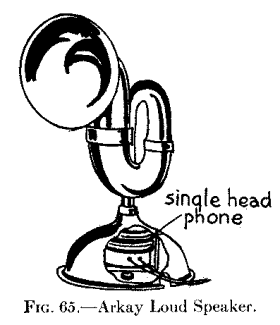
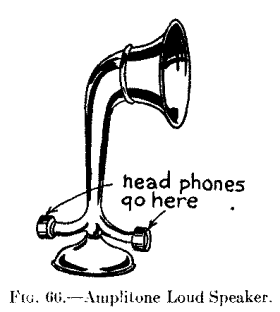
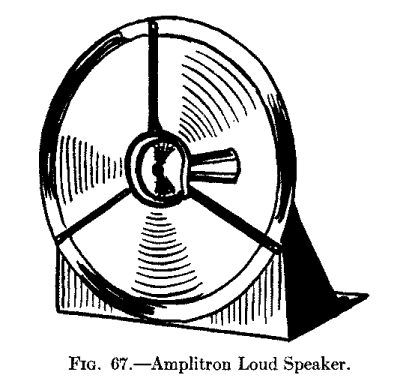
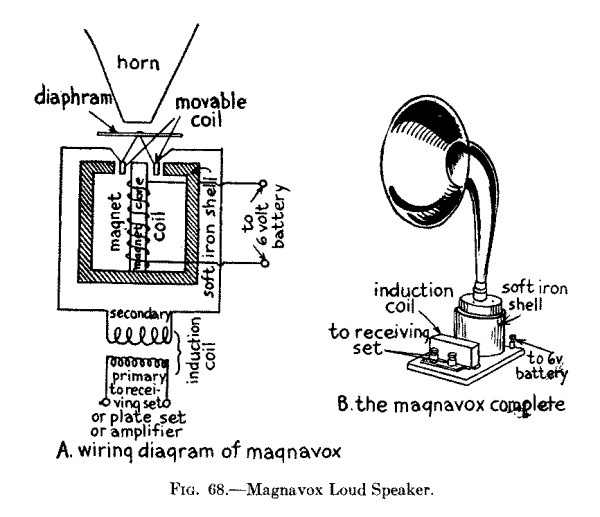
LOUD SPEAKER.--A telephone receiver connected to a horn, or a
specially made one, that reproduces the incoming signals, words or
music loud enough to be heard by a room or an auditorium full of
people, or by large crowds out-doors.
MAGNETIC POLES.--See Poles, Magnetic.
MEGOHM.--One million ohms.
METER, AUDIBILITY.--An instrument for measuring the loudness of a
signal by comparison with another signal. It consists of a pair of
headphones and a variable resistance which have been calibrated.
MHO.--The unit of conductance. As conductance is the reciprocal of
resistance it is measured by the reciprocal ohm or
mho.
MICA.--A transparent mineral having a high insulating value and
which can be split into very thin sheets. It is largely used in making
condensers both for transmitting and receiving sets.
MICROFARAD.--The millionth part of a farad.
MICROHENRY.--The millionth part of a farad.
MICROMICROFARAD.--The millionth part of a microfarad.
MICROHM.--The millionth part of an ohm.
MICROPHONE TRANSFORMER.--See Transformer, Microphone.
MICROPHONE TRANSMITTER.--See Transmitter, Microphone.
MILLI-AMMETER.--An ammeter that measures a current by the
one-thousandth of an ampere.
MODULATION.--(1) Inflection or varying the voice. (2) Varying the
amplitude of oscillations by means of the voice.
MODULATION, BUZZER.--The modulation of radio frequency oscillations
by a buzzer which breaks up the sustained oscillations of a
transmitter into audio frequency impulses.
MILLIHENRY.--The thousandth part of a henry.
MODULATION, CHOPPER.--The modulation of radio frequency
oscillations by a chopper which breaks up the sustained oscillations
of a transmitter into audio frequency impulses.
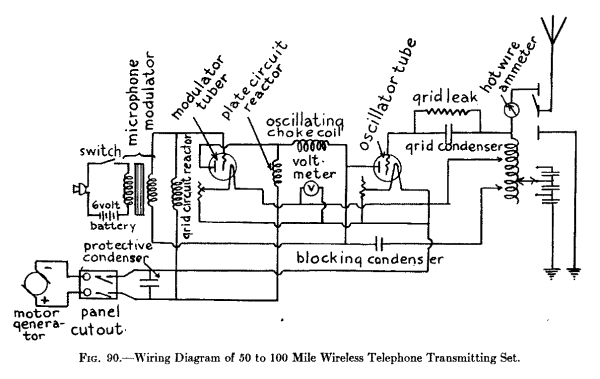
MODULATION, GRID.--The scheme of modulating an oscillator tube by
connecting the secondary of a transformer, the primary of which is
connected with a battery and a microphone transmitter, in the grid
lead.
MODULATION, OVER.--See Blub Blub.
MODULATION, PLATE.--Modulating the oscillations set up by a vacuum
tube by varying the current impressed on the plate.
MODULATOR TUBE.--A vacuum tube used as a modulator.
MOTION, WAVE.--(1) The to and fro motion of water at sea. (2) Waves
transmitted by, in and through the air, or sound waves. (3) Waves
transmitted by, in and through the ether, or electromagnetic
waves, or electric waves for short.
MOTOR-GENERATOR.--A motor and a dynamo built to run at the same
speed and mounted on a common base, the shafts being coupled together.
In wireless it is used for changing commercial direct current into
direct current of higher voltages for energizing the plate of a vacuum
tube oscillator.
MULTI-STAGE AMPLIFIERS.--See Amplifiers, Multi-Stage.
MUTUAL INDUCTION.--See Induction, Mutual.
MUSH.--Irregular intermediate frequencies set up by arc
transmitters which interfere with the fundamental wave lengths.
MUSHY NOTE.--A note that is not clear cut, and hence hard to read,
which is received by the heterodyne method when damped waves or
modulated continuous waves are being received.
NATIONAL ELECTRIC CODE.--See Code, National Electric.
NATIONAL ELECTRIC SAFETY CODE.--See Code, National Electric
Safety.
NEGATIVE ELECTRICITY.--See Electricity, Negative.
NON-SYNCHRONOUS GAP.--See Gap, Non-Synchronous.
OHM.--The resistance of a thread of mercury at the temperature of
melting ice, 14.4521 grams in mass, of uniform cross-section and a
length of 106.300 centimeters.
OHM'S LAW.--The important fixed relation between the electric
current, its electromotive force and the resistance of the conductor
in which it flows.
OPEN CIRCUIT.--See Circuit, Open.
OPEN CORE TRANSFORMER.--See Transformer, Open Core.
OSCILLATION TRANSFORMER.--See Transformer, Oscillation.
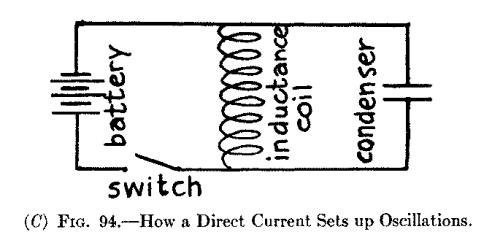
OSCILLATIONS, ELECTRIC.--A current of high frequency that surges
through an open or a closed circuit. (1) Electric oscillations may be
set up by a spark gap, electric arc or a vacuum tube, when they have
not only a high frequency but a high potential, or voltage. (2) When
electric waves impinge on an aerial wire they are transformed into
electric oscillations of a frequency equal to those which emitted the
waves, but since a very small amount of energy is received their
potential or voltage is likewise very small.
- Sustained.--Oscillations in which the damping factor is
small.
- Damped.--Oscillations in which the damping factor is
large.
- Free.--When a condenser discharges through an oscillation
circuit, where there is no outside electromotive force acting on it,
the oscillations are said to be free.
- Forced.--Oscillations that are made to surge in a circuit
whose natural period is different from that of the oscillations set up
in it.
OSCILLATION TRANSFORMER.--See Transformer.
OSCILLATION VALVE.--See Vacuum Tube.
OSCILLATOR TUBE.--A vacuum tube which is used to produce electric
oscillations.
OVER MODULATION.--See Blub Blub.
PANCAKE OSCILLATION TRANSFORMER.--Disk-shaped coils that are used
for receiving tuning inductances.
PERMEABILITY, MAGNETIC.--The degree to which a substance can be
magnetized. Iron has a greater magnetic permeability than air.
PHASE.--A characteristic aspect or appearance that takes place at
the same point or part of a cycle.
PICK-UP CIRCUITS.--See Circuits, Stand-by.
PLATE CIRCUIT REACTOR.--See Reactor, Plate Circuit.
PLATE CURRENT.--See Current, Plate.
PLATE MODULATION.--See Modulation, Plate.
PLATE VOLTAGE.--See Foliage, Plate.
POLES, BATTERY.--The positive and negative terminals of the
elements of a battery. On a storage battery these poles are marked +
and - respectively.
POLES, MAGNETIC.--The ends of a magnet.
POSITIVE ELECTRICITY.--See Electricity, Positive.
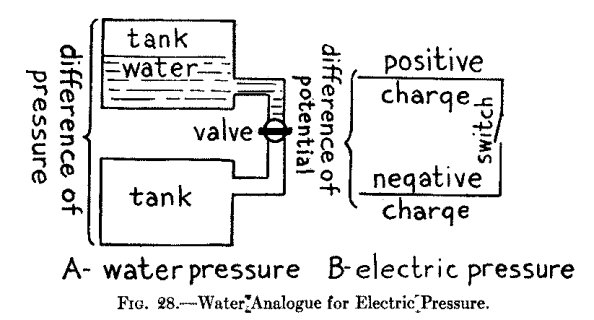
POTENTIAL DIFFERENCE.--The electric pressure between two charged
conductors or surfaces.
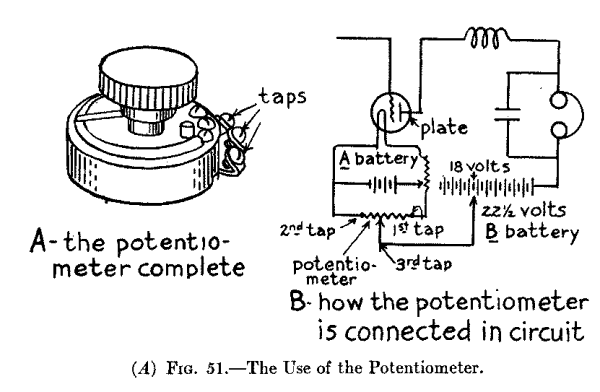
POTENTIOMETER.--A variable resistance used for subdividing the
voltage of a current. A voltage divider.
POWER TRANSFORMER.--See Transformer, Power.
POWER TUBE.--See Generator Tube.
PRIMARY BATTERY.--See Battery, Primary.
PREVENTION, KICK-BACK.--A choke coil placed in the power circuit to
prevent the high frequency currents from getting into the transformer
and breaking down the insulation.
Q S T.--An abbreviation used in wireless communication for (1) the
question "Have you received the general call?" and (2) the notice,
"General call to all stations."
QUENCHED GAP.--See Gap, Quenched.
RADIATION.--The emission, or throwing off, of electric waves by an
aerial wire system.
RADIO AMMETER.--See Ammeter, Hot Wire.
RADIO FREQUENCY.--See Frequency, Radio.
RADIO FREQUENCY AMPLIFICATION.--See Amplification, Radio
Frequency.
RADIO FREQUENCY CURRENT.--See Current, Radio Frequency.
RADIO INSPECTOR.--See Inspector, Radio.
RADIOTRON.--The trade name of vacuum tube detectors, amplifiers,
oscillators and modulators made by the Radio Corporation of
America.
RADIO WAVES.--See Waves, Radio.
REACTANCE.--When a circuit has inductance and the current changes
in value, it is opposed by the voltage induced by the variation of the
current.
REACTANCE, CAPACITY.--The capacity reactance is the opposition
offered to a current by a capacity. It is measured as a resistance,
that is, in ohms.
RECEIVING TUNING COILS.--See Coils, Inductance.
RECEIVER, LOUD SPEAKING.--See Loud Speakers.
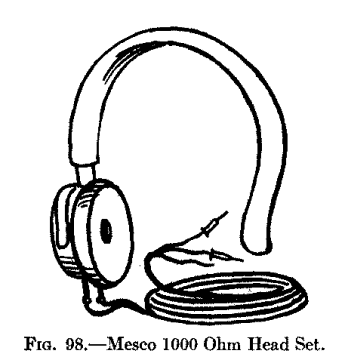
RECEIVER, WATCH CASE.--A compact telephone receiver used for
wireless reception.
REACTANCE, INDUCTIVE.--The inductive reactance is the opposition
offered to the current by an inductance coil. It is measured as a
resistance, that is, in ohms.
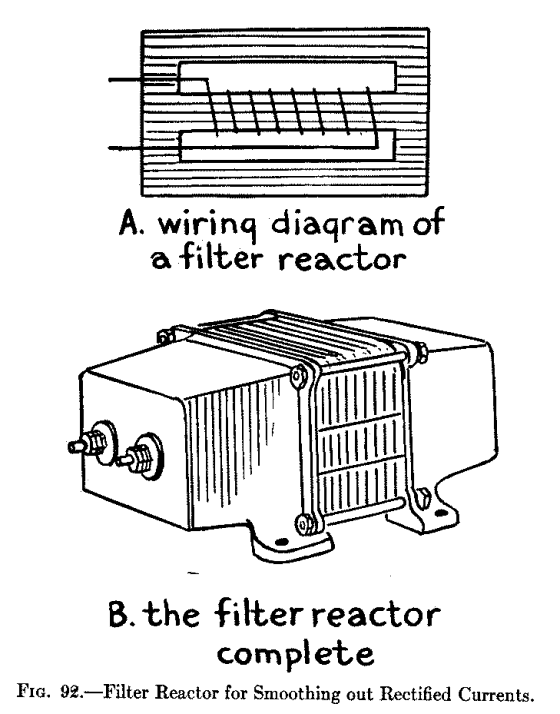
REACTOR, FILTER.--A reactance coil for smoothing out the pulsating
direct currents as they come from the rectifier.
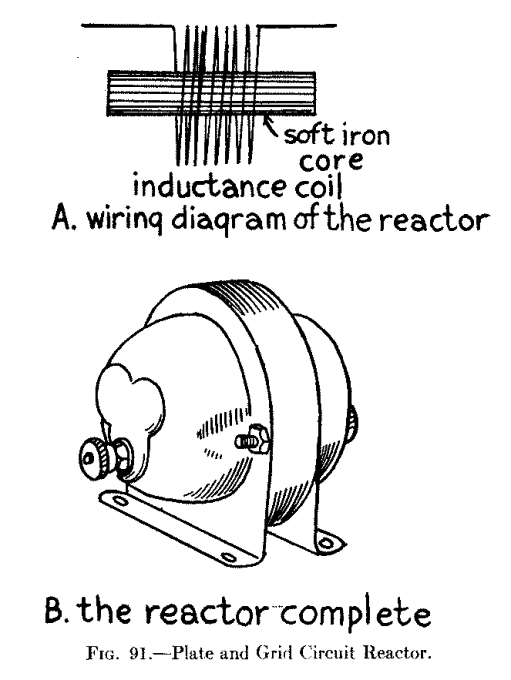
REACTOR, PLATE CIRCUIT.--A reactance coil used in the plate circuit
of a wireless telephone to keep the direct current supply at a
constant voltage.
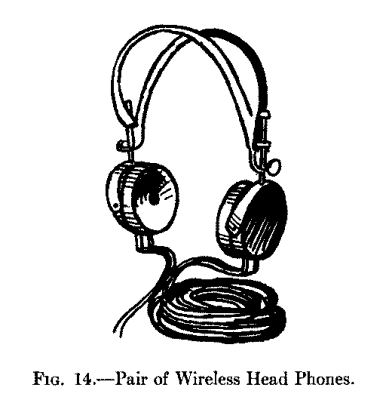
RECEIVER.--(1) A telephone receiver. (2) An apparatus for receiving
signals, speech or music. (3) Better called a receptor to
distinguish it from a telephone receiver.
RECTIFIER.--(1) An apparatus for changing alternating current into
pulsating direct current. (2) Specifically in wireless (a) a
crystal or vacuum tube detector, and (b) a two-electrode vacuum
tube used for changing commercial alternating current into direct
current for wireless telephony.
REGENERATIVE AMPLIFICATION.--See Amplification,
Regenerative.
RECEPTOR.--A receiving set.
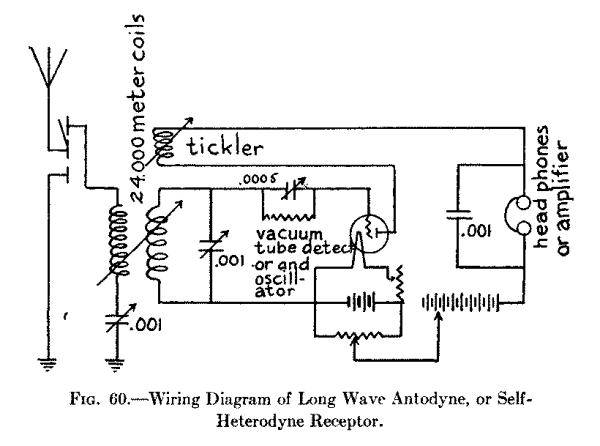
RECEPTOR, AUTODYNE.--A receptor that has a regenerative circuit and
the same tube is used as a detector and as a generator of local
oscillations.
RECEPTOR, BEAT.--A heterodyne receptor.
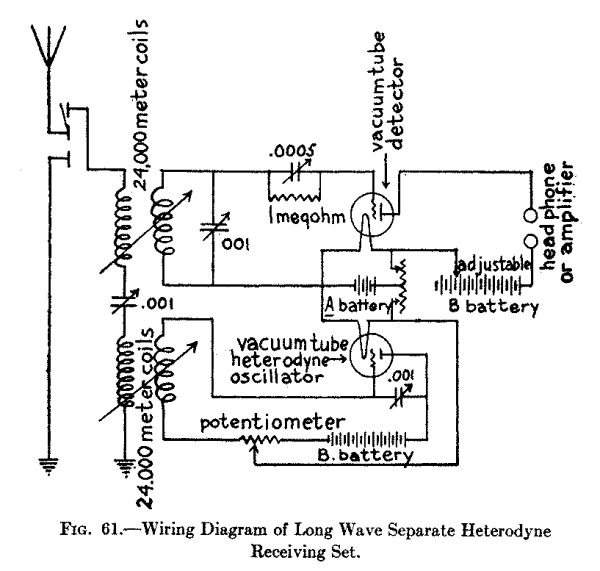
RECEPTOR, HETERODYNE.--A receiving set that uses a separate vacuum
tube to set up the second series of waves for beat reception.
REGENERATIVE ACTION.--See Feed-Back Action.
REGENERATIVE AMPLIFICATION.--See Amplification,
Regenerative.
RELAY, ELECTRON.--A vacuum tube when used as a detector or an
amplifier.
REPEATING COIL.--A transformer used in connecting up a wireless
receiver with a wire transmitter.
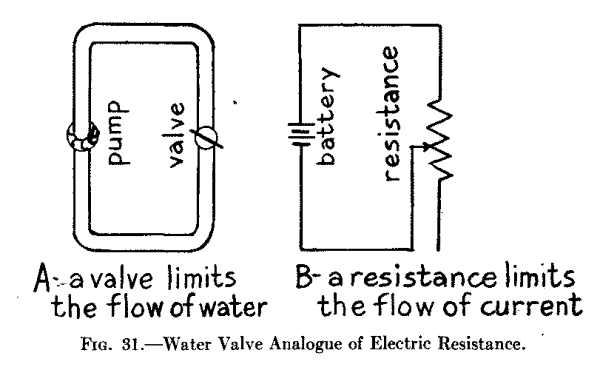
RESISTANCE.--The opposition offered by a wire or other conductor to
the passage of a current.
RESISTANCE, AERIAL.--The resistance of the aerial wire to
oscillating currents. This is greater than its ordinary ohmic
resistance due to the skin effect. See Resistance, High
Frequency.
RESISTANCE BOX.--See Resistor.
RESISTANCE COUPLING.--See Coupling, Resistance.
RESISTANCE, HIGH FREQUENCY.--When a high frequency current
oscillates on a wire two things take place that are different than
when a direct or alternating current flows through it, and these are
(1) the current inside of the wire lags behind that of the current on
the surface, and (2) the amplitude of the current is largest on the
surface and grows smaller as the center of the wire is reached. This
uneven distribution of the current is known as the skin effect
and it amounts to the same thing as reducing the size of the wire,
hence the resistance is increased.
RESISTIVITY.--The resistance of a given length of wire of uniform
cross section. The reciprocal of conductivity.
RESISTOR.--A fixed or variable resistance unit or a group of such
units. Variable resistors are also called resistance boxes and
more often rheostats.
RESONANCE.--(1) Simple resonance of sound is its increase set up by
one body by the sympathetic vibration of a second body. (2) By
extension the increase in the amplitude of electric oscillations when
the circuit in which they surge has a natural period that is
the same, or nearly the same, as the period of the first oscillation
circuit.
RHEOSTAT.--A variable resistance unit. See Resistor.
RHEOSTAT, CARBON.--A carbon rod, or carbon plates or blocks, when
used as variable resistances.
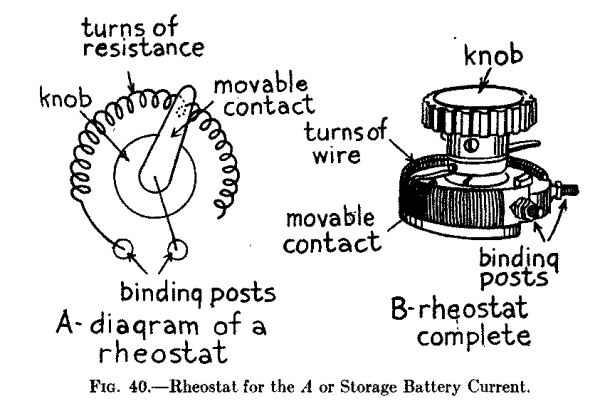
RHEOSTAT, FILAMENT.--A variable resistance used for keeping the
current of the storage battery which heats the filament of a vacuum
tube at a constant voltage.
ROTATING COIL.--See Coil.
ROTARY GAP.--See Gap.
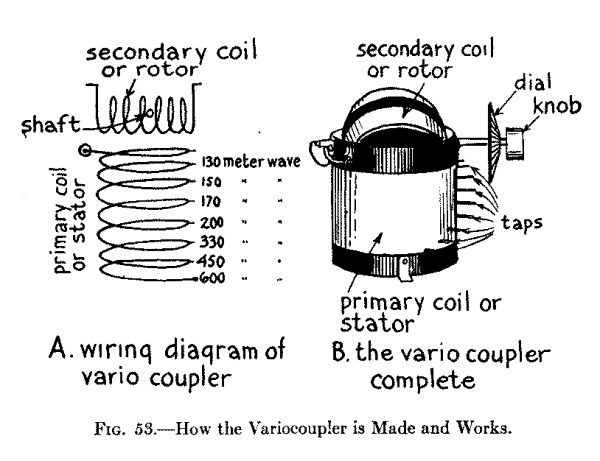
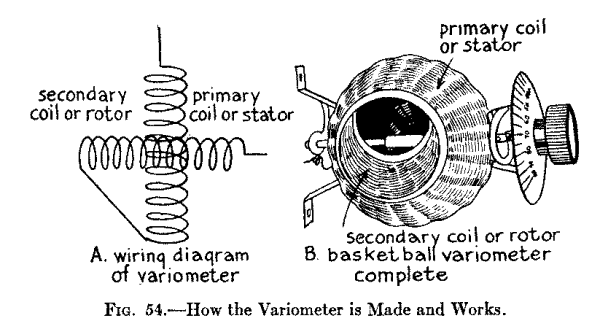
ROTOR.--The rotating coil of a variometer or a variocoupler.
RUHMKORFF COIL.--See Coil, Induction.
SATURATION.--The maximum plate current that a vacuum tube will
take.
SENSITIVE SPOTS.--Spots on detector crystals that are sensitive to
the action of electric oscillations.
SHORT WAVES.--See Waves.
SIDE WAVES.--See Wave Length Band.
SIGNALS, CONVENTIONAL.--(1) The International Morse alphabet and
numeral code, punctuation marks, and a few important abbreviations
used in wireless telegraphy. (2) Dot and dash signals for distress
call, invitation to transmit, etc. Now used for all general public
service wireless communication.
SKIN EFFECT.--See Resistance, High Frequency.
SOFT TUBE.--A vacuum tube in which the vacuum is low, that is, it
is not highly exhausted.
SPACE CHARGE EFFECT.--The electric field intensity due to the
pressure of the negative electrons in the space between the filament
and plate which at last equals and neutralizes that due to the
positive potential of the plate so that there is no force acting on
the electrons near the filament.
SPARK.--See Discharge.
SPARK COIL.--See Coil, Induction.
SPARK DISCHARGE.--See Spark, Electric.
SPARK FREQUENCY.--See Frequency, Spark.
SPARK GAP.--(1) A spark gap, without the hyphen, means the
apparatus in which sparks take place; it is also called a spark
discharger. (2) Spark-gap, with the hyphen, means the
air-gap between the opposed faces of the electrodes in which sparks
are produced.
- Plain.--A spark gap with fixed electrodes.
- Rotary.--A spark gap with a pair of fixed electrodes and a
number of electrodes mounted on a rotating element.
- Quenched.--A spark gap formed of a number of metal plates
placed closely together and insulated from each other.
SPIDER WEB INDUCTANCE COIL.--See Coil, Spider Web
Inductance.
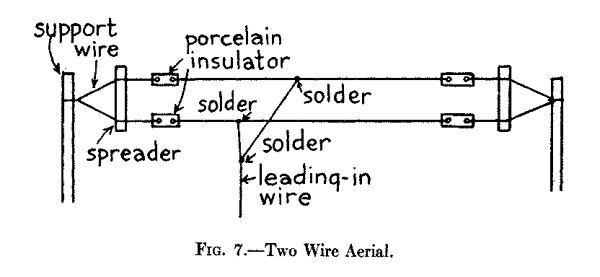
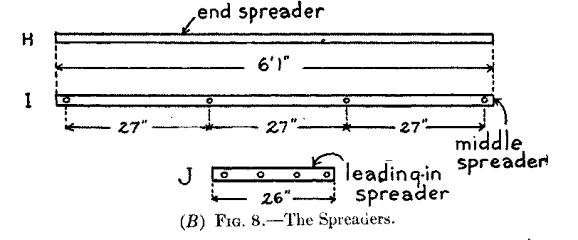
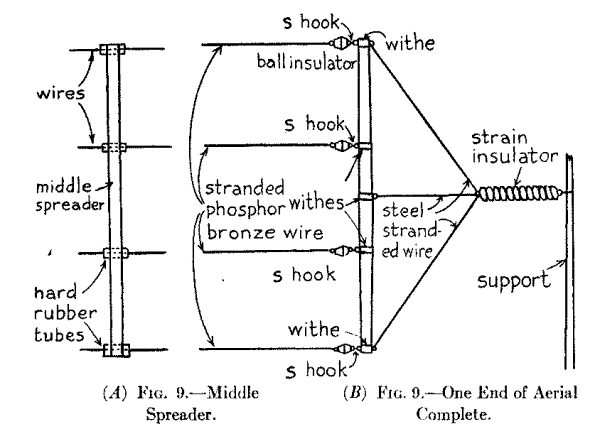
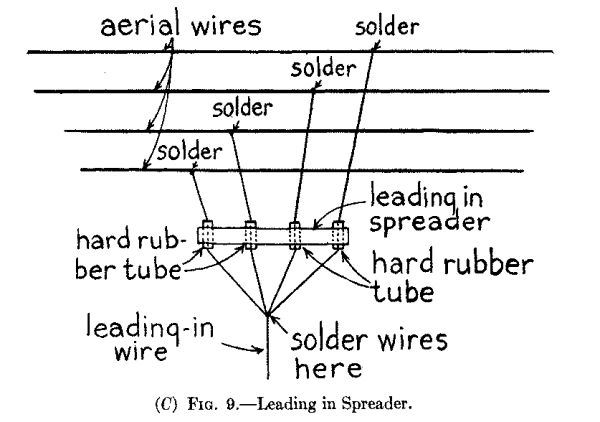
SPREADER.--A stick of wood, or spar, that holds the wires of the
aerial apart.
STAGGER WOUND COILS.--See Coils, Inductance.
STAND-BY CIRCUITS.--See Circuits, Stand-By.
STATIC.--Also called atmospherics, grinders, strays, X's,
and, when bad enough, by other names. It is an electrical disturbance
in the atmosphere which makes noises in the telephone receiver.
STATOR.--The fixed or stationary coil of a variometer or a
variocoupler.
STORAGE BATTERY.--See Battery, Storage.
STRAY ELIMINATION.--A method for increasing the strength of the
signals as against the strength of the strays. See Static.
STRAYS.--See Static.
STRANDED WIRE.--See Wire, Stranded.
SUPER-HETERODYNE RECEPTOR.--See Heterodyne, Super.
SWINGING.--See Fading.
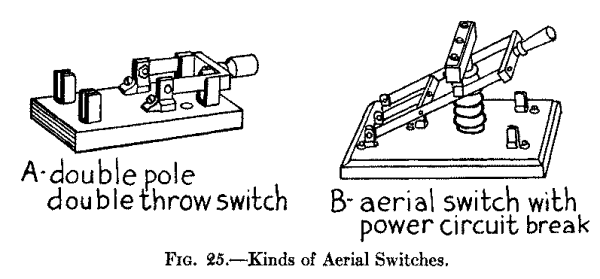
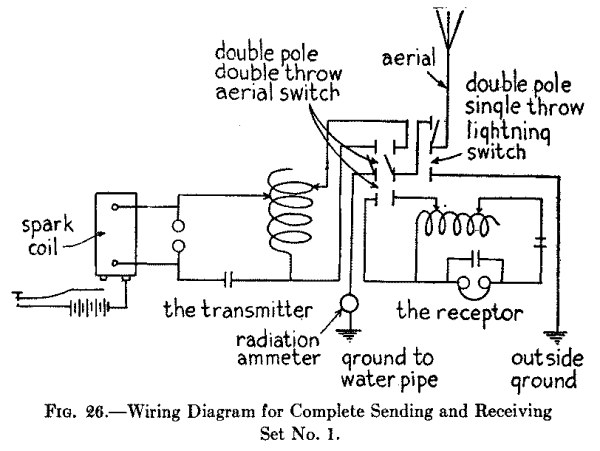
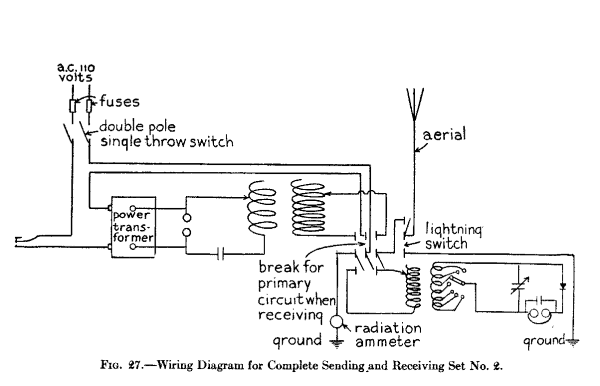
SWITCH, AERIAL.--A switch used to change over from the sending to
the receiving set, and the other way about, and connect them with the
aerial.
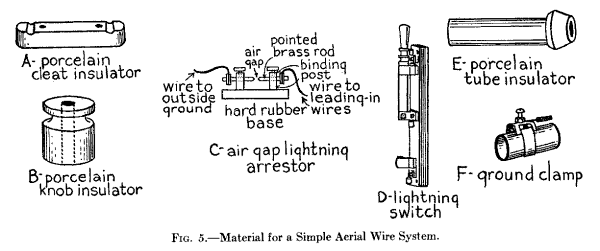
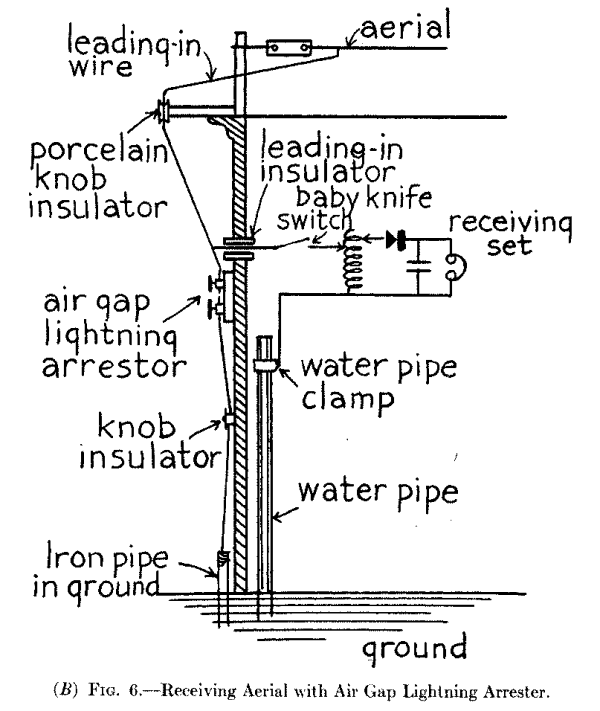
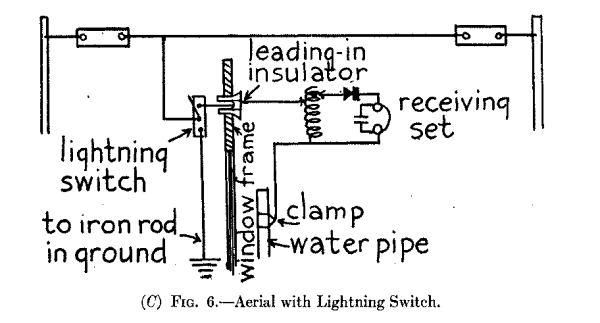
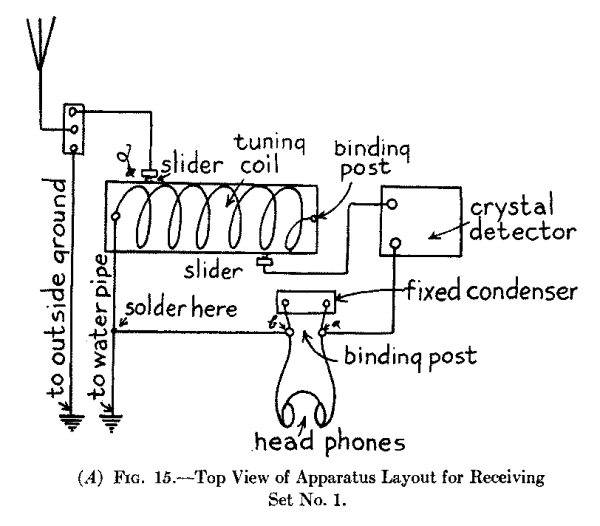
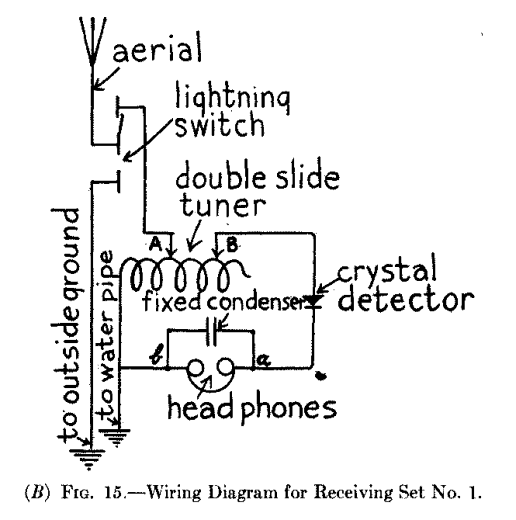
SWITCH, LIGHTNING.--The switch that connects the aerial with the
outside ground when the apparatus is not in use.
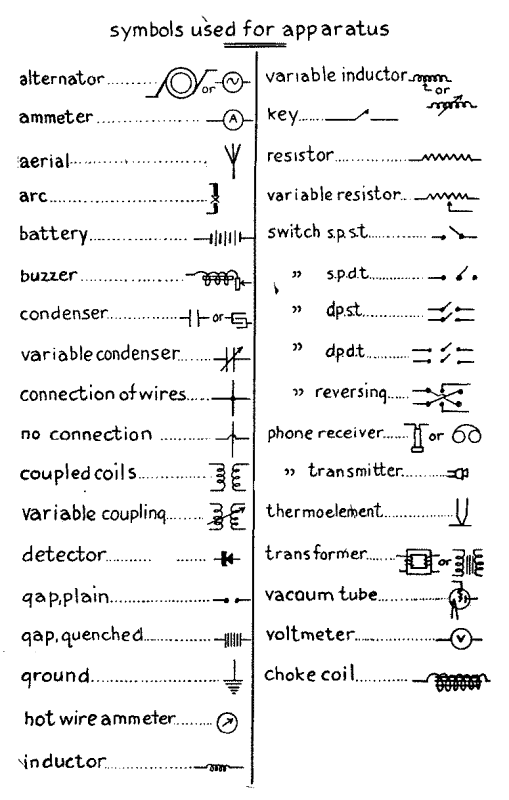
SYMBOLS, APPARATUS.--Also called conventional symbols. These
are diagrammatic lines representing various parts of apparatus so that
when a wiring diagram of a transmitter or a receptor is to be made it
is only necessary to connect them together. They are easy to make and
easy to read. See Page 307 [Appendix: Symbols Used for
Apparatus].
SYNCHRONOUS GAP.--See Gap, Synchronous.
TELEPHONY, LINE RADIO.--See Wired Wireless.
THERMAL AMMETER.--See Ammeter, Hot Wire.
THREE ELECTRODE VACUUM TUBE.--See Vacuum Tube, Three
Electrode.
TIKKER.--A slipping contact device that breaks up the sustained
oscillations at the receiving end into groups so that the signals can
be heard in the head phones. The device usually consists of a fine
steel or gold wire slipping in the smooth groove of a rotating brass
wheel.
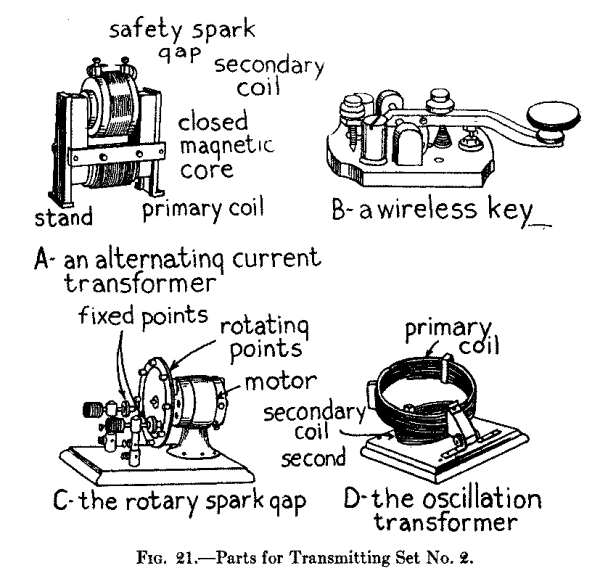
TRANSFORMER.--A primary and a secondary coil for stepping up or
down a primary alternating or oscillating current.
- A. C.--See Power Transformer.
- Air Cooled.--A transformer in which the coils are exposed
to the air.
- Air Core.--With high frequency currents it is the general
practice not to use iron cores as these tend to choke off the
oscillations. Hence the core consists of the air inside of the
coils.
- Auto.--A single coil of wire in which one part forms the
primary and the other part the secondary by bringing out an
intermediate tap.
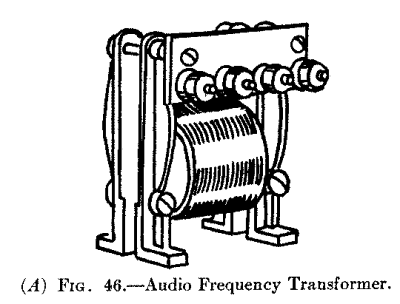
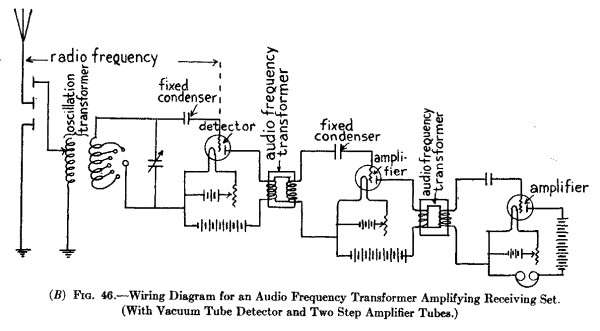
- Audio Amplifying.--This is a transformer with an iron core
and is used for frequencies up to say 3,000.
- Closed Core.--A transformer in which the path of the
magnetic flux is entirely through iron. Power transformers have closed
cores.
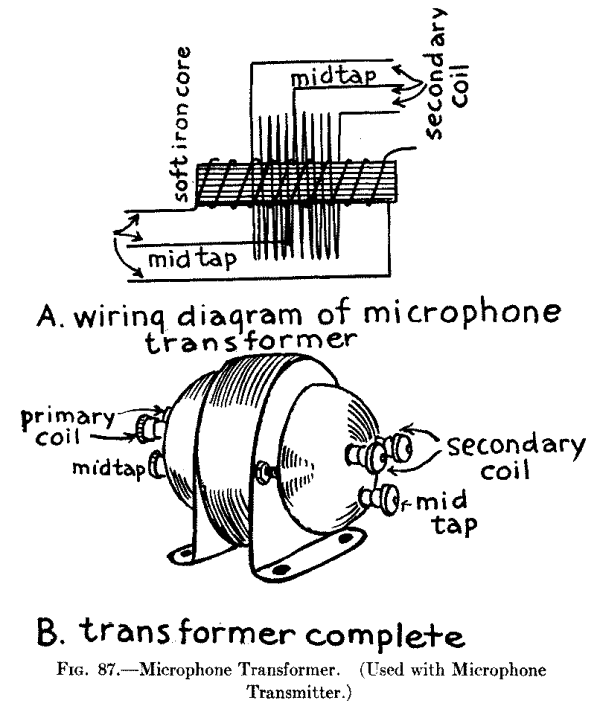
- Microphone.--A small transformer for modulating the
oscillations set up by an arc or a vacuum tube oscillator.
- Oil Cooled.--A transformer in which the coils are immersed
in oil.
- Open Core.--A transformer in which the path of the magnetic
flux is partly through iron and partly through air. Induction coils
have open cores.
- Oscillation.--A coil or coils for transforming or stepping
down or up oscillating currents. Oscillation transformers usually have
no iron cores when they are also called air core
transformers.
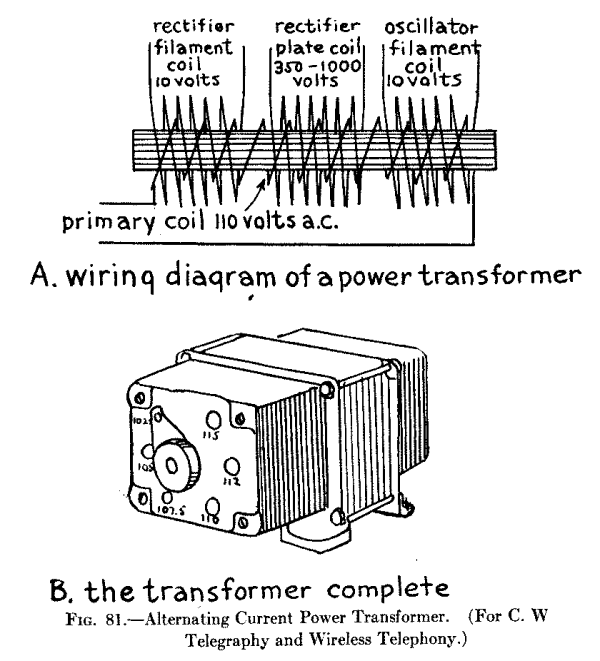
- Power.--A transformer for stepping down a commercial
alternating current for lighting and heating the filament and for
stepping up the commercial a.c., for charging the plate of a vacuum
tube oscillator.
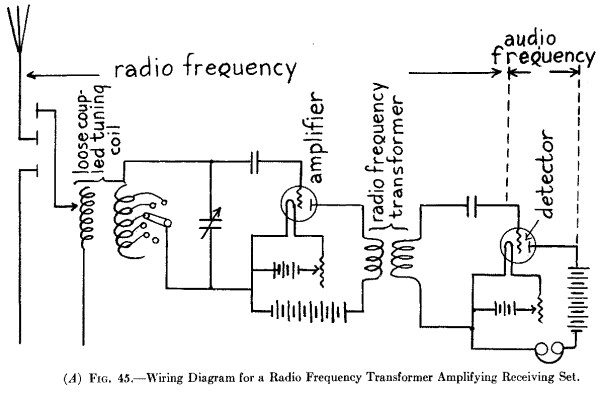
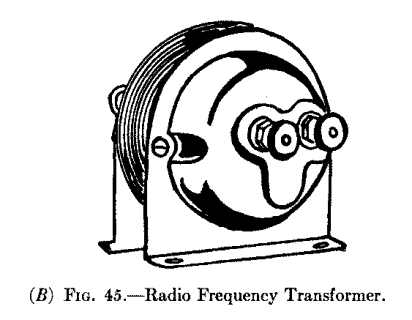
- Radio Amplifying.--This is a transformer with an air core.
It does not in itself amplify but is so called because it is used in
connection with an amplifying tube.
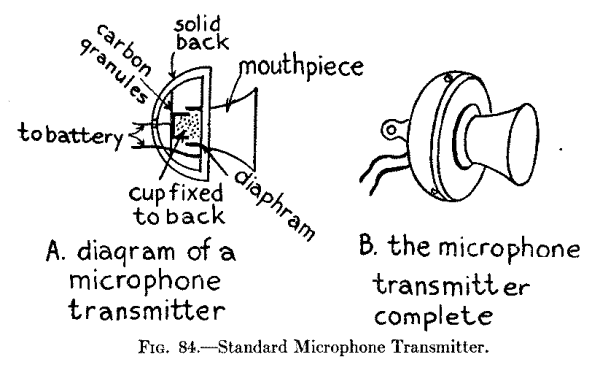
TRANSMITTER, MICROPHONE.--A telephone transmitter of the kind that
is used in the Bell telephone system.
TRANSMITTING TUNING COILS.--See Coils, Inductance.
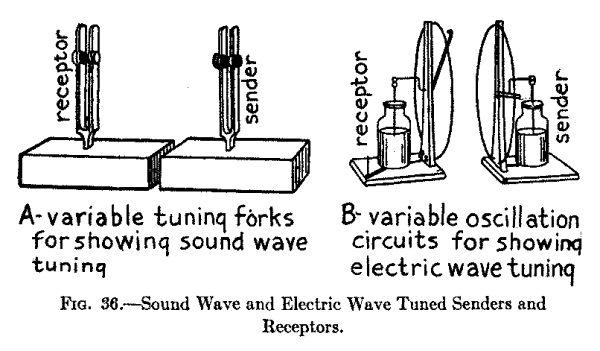
TUNING.--When the open and closed oscillation circuits of a
transmitter or a receptor are adjusted so that both of the former will
permit electric oscillations to surge through them with the same
frequency, they are said to be tuned. Likewise, when the sending and
receiving stations are adjusted to the same wave length they are said
to be tuned.
- Coarse Tuning.--The first adjustment in the tuning
oscillation circuits of a receptor is made with the inductance coil
and this tunes them coarse, or roughly.
- Fine Tuning.--After the oscillation circuits have been
roughly tuned with the inductance coil the exact adjustment is
obtained with the variable condenser and this is fine
tuning.
- Sharp.--When a sending set will transmit or a receiving set
will receive a wave of given length only it is said to be sharply
tuned. The smaller the decrement the sharper the tuning.
TUNING COILS.--See Coils, Inductance.
TWO ELECTRODE VACUUM TUBE.--See Vacuum Tube, Two
Electrode.
VACUUM TUBE.--A tube with two or three electrodes from which the
air has been exhausted, or which is filled with an inert gas, and used
as a detector, an amplifier, an oscillator or a modulator in wireless
telegraphy and telephony.
- Amplifier.--See Amplifier, Vacuum Tube.
- Amplifying Modulator.--A vacuum tube used for modulating
and amplifying the oscillations set up by the sending set.
- Gas Content.--A tube made like a vacuum tube and used as a
detector but which contains an inert gas instead of being
exhausted.
- Hard.--See Hard Tube.
- Rectifier.--(1) A vacuum tube detector. (2) a two-electrode
vacuum tube used for changing commercial alternating current into
direct current for wireless telephony.
- Soft.--See Soft Tube.
- Three Electrode.--A vacuum tube with three electrodes,
namely a filament, a grid and a plate.
- Two Electrode.--A vacuum tube with two electrodes, namely
the filament and the plate.
VALVE.--See Vacuum Tube.
VALVE, FLEMING.--See Fleming Valve.
VARIABLE CONDENSER.--See Condenser, Variable.
VARIABLE INDUCTANCE.--See Inductance, Variable.
VARIABLE RESISTANCE.--See Resistance, Variable.
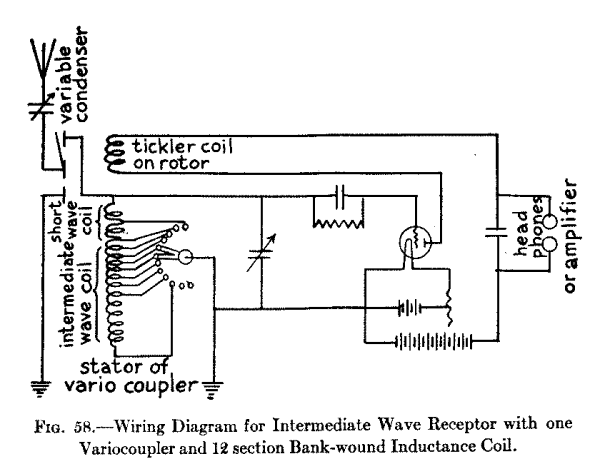
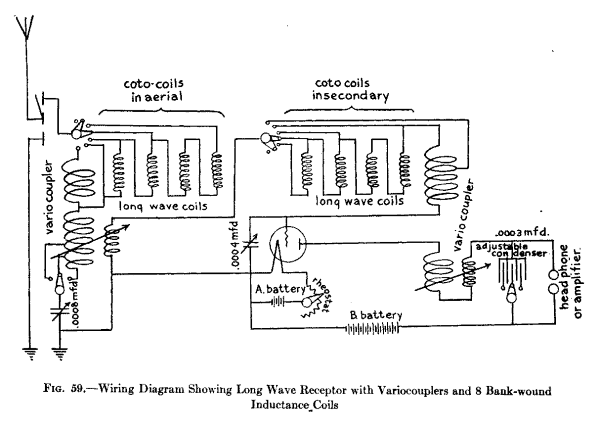
VARIOCOUPLER.--A tuning device for varying the inductance of the
receiving oscillation circuits. It consists of a fixed and a rotatable
coil whose windings are not connected with each other.
VARIOMETER.--A tuning device for varying the inductance of the
receiving oscillation currents. It consists of a fixed and a rotatable
coil with the coils connected in series.
VERNIER CONDENSER.--See Condenser, Vernier.
VOLT.--The electromotive force which produces a current of 1 ampere
when steadily applied to a conductor the resistance of which is one
ohm.
VOLTAGE DIVIDER.--See Potentiometer.
VOLTAGE, PLATE.--The voltage of the current that is used to
energize the plate of a vacuum tube.
VOLTMETER.--An instrument for measuring the voltage of an electric
current.
WATCH CASE RECEIVER.--See Receiver, Watch Case.
WATER-PIPE GROUND.--See Ground, Water-Pipe.
WATT.--The power spent by a current of 1 ampere in a resistance of
1 ohm.
WAVE, BROAD.--A wave having a high decrement, when the strength of
the signals is nearly the same over a wide range of wave lengths.
WAVE LENGTH.--Every wave of whatever kind has a length. The wave
length is usually taken to mean the distance between the crests of two
successive waves.
WAVE LENGTH BAND.--In wireless reception when continuous waves are
being sent out and these are modulated by a microphone transmitter the
different audio frequencies set up corresponding radio frequencies and
the energy of these are emitted by the aerial; this results in waves
of different lengths, or a band of waves as it is called.
WAVE METER.--An apparatus for measuring the lengths of electric
waves set up in the oscillation circuits of sending and receiving
sets.
WAVE MOTION.--Disturbances set up in the surrounding medium as
water waves in and on the water, sound waves in the air and electric
waves in the ether.
WAVES.--See Wave Motion.
WAVES, ELECTRIC.--Electromagnetic waves set up in and transmitted
by and through the ether.
- Continuous. Abbreviated C.W.--Waves that are emitted
without a break from the aerial. Also called undamped
waves.
- Discontinuous.--Waves that are emitted periodically from
the aerial. Also called damped waves. Damped.--See
Discontinuous Waves.
- Intermediate.--Waves from 600 to 2,000 meters in
length.
- Long.--Waves over 2,000 meters in length.
Radio.--Electric waves used in wireless telegraphy and
telephony.
- Short.--Waves up to 600 meters in length.
- Wireless.--Electric waves used in wireless telegraphy and
telephony.
- Undamped.--See Continuous Waves.
WIRELESS TELEGRAPH CODE.--See Code, International.
WIRE, ENAMELLED.--Wire that is given a thin coat of enamel which
insulates it.
WIRE, PHOSPHOR BRONZE.--A very strong wire made of an alloy of
copper and containing a trace of phosphorus.
WIRED WIRELESS.--Continuous waves of high frequency that are sent
over telephone wires instead of through space. Also called line
radio communication; carrier frequency telephony, carrier current
telephony; guided wave telephony and wired wireless.
X'S.--See Static.
ZINCITE.--See Detector.