The Project Gutenberg eBook, The Quiver, 2/1900, by Various
E-text prepared by Delphine Lettau, Julia Neufeld,
and the Online Distributed Proofreading Team
(http://www.pgdp.net)
(By permission of Messrs. Henry Graves and Co., Pall Mall, S. W.)
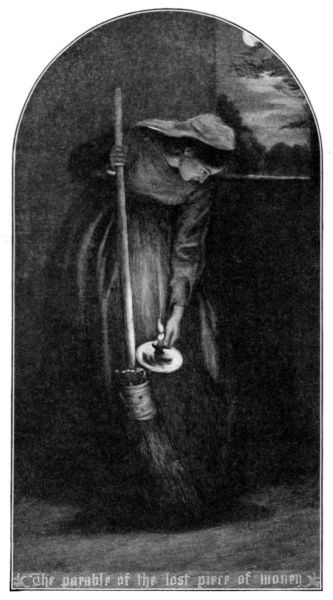
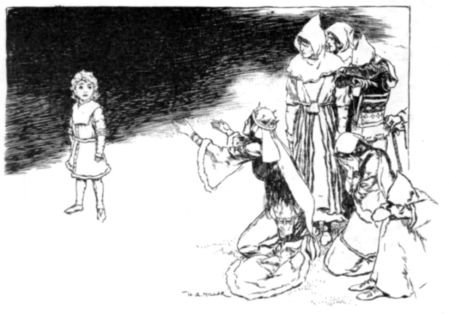
THE LOST PIECE OF MONEY.
(By the late Sir John E. Millais, P.R.A.)
PICTORIAL SERMONS.
(By permission of William Coltart, Esq.)
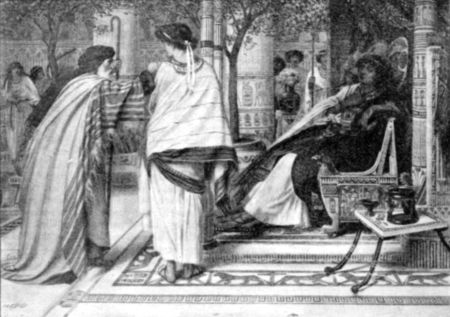
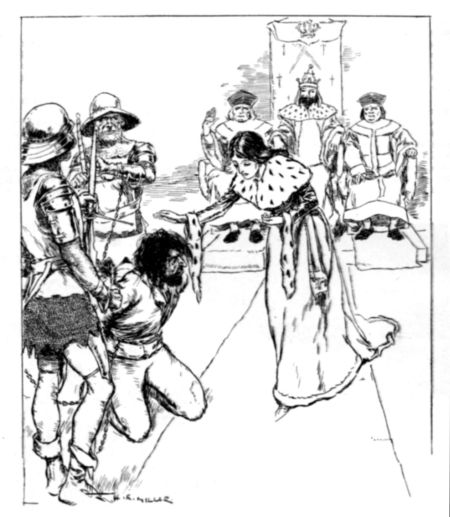
JOSEPH INTRODUCING JACOB TO PHARAOH.
(By Sir Edward J. Poynter, P.R.A.)
With truth and beauty as
the objects of his art,
the painter, whatever
be the subject he is
endeavouring to depict,
becomes a guide and
helpmeet to his fellow-men.
His art is "twice
blessed," blessing "him
that gives and him that
takes." The contemplation
of a beautiful and
pure work of art acts as
a charm upon the mind oppressed with
care and trouble. A landscape on canvas,
reflecting the sunshine of the countryside,
suggesting its freedom of atmosphere,
its "fair quiet and sweet rest,"
when seen in the midst of the toil and
grime of a great city, is a sedative to
the jaded nerves of the busy worker; it
reminds him of the glories of nature
which lie outside the boundaries of the
man-made wilderness of houses, and
brings him for the moment into close
commune with Nature herself. A glimpse
of blue sea, of clear running stream, or
some sweet pastoral scene, carries with it
a breath of fresh air, invigorating and
refreshing, to those who gaze upon its
brightness through the murky atmosphere
of the city streets.
The painter, indeed, has a power which
competes closely with the eloquence of the
preacher, or the soothing rhythm of the
poet; it raises the man who approaches
his work with a receptive heart from
his own petty self, enlarges his sympathies
and his hopes, calms his troubles,
and sends him back refreshed and invigorated
to his struggle with the cares
and troubles of his daily life.
A great picture is not so much one that
displays the technical skill of the painter
as his power to appeal to the emotions
of those who look at it. Truth is at all
times simple, and he who would expound
it, either in sermon, poem, or picture,
must do so in language which can be
readily understood of the people. This
does not make his task any the lighter,
for any straining after effects of simplicity
betrays his own lack of truth;
simplicity must be spontaneous—from the
heart.
Judging a picture, then, by this standard
of simplicity and truth, we look
first of all for these qualities; we look
to see if the artist is sincere in his representation
of the scene he presents to us.
If we find this to be so, then we receive
the work as a contribution to the truth
we are seeking. Some painters force
us to recognise their skill as colourists,
as draughtsmen, as archæologists—they
have insisted upon their accuracy in
these respects, but oftentimes at the
sacrifice of all spirituality; their pictures
are representations of costume, of architecture—what
you will—but the true
spirit of art is lacking; they are merely
skilfully painted canvases.
In no direction is this more apparent
than in pictures dealing with religious
subjects. In such works we especially
want to feel immediately we look at
them, "Here is an honest effort to realise
the true spirit of the subject: here is
something which is helpful, inspiring,
good." We do not want to be forced to
admire the accessories before we realise
this; that should follow in due course,
and will, if the picture has been designed
and executed in the right
spirit. As in a spoken sermon we fail
to grasp the teaching as we should if we
see the framework upon which the
preacher has built up the fabric of his
oration, so in a pictorial sermon we lose
the good that is in it if we are impressed
first of all with the details of
technique or composition. The appeal to
the heart should come first—that to the
head should be secondary.
(By permission of the Artist. Copyright reserved.)
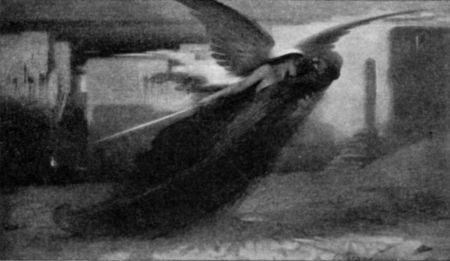
"AND THERE WAS A GREAT CRY IN EGYPT."
(By Arthur Hacker, A.R.A.)
The helpfulness and interest of Biblical
pictures to young and old is acknowledged
by all. The pictorial Bible is a
never-ending source of delight, and its
influence is extraordinary in its extent
and power. Our ideas of Scriptural scenes
and incidents have often been formed
more by the illustrations than by the
Biblical narrative itself, and we have
often been almost pained in after-life on
seeing the attempts of other artists to
depict scenes which differ materially
from those for which we acquired a
fondness in our early days, although we
recognise the fact then that many of
these favourite pictures are in no wise
worthy of their subjects. After all, pictorial
Bibles are, as a rule, unsatisfactory.
More's the pity! The range of subjects
is so vast, and the artists employed
have seldom succeeded in impressing
their representations with any degree
of the dignity attaching to them. Even
the versatile genius of Gustavo Doré could
not respond successfully to the gigantic
work, although of the few artists who
have grappled with it, he creates the
greatest amount of interest.
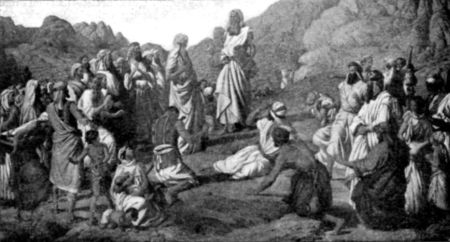
(From the Fresco in the House of Lords.)
MOSES' DESCENT FROM SINAI.
(By J. R. Herbert, R.A.)
An interesting volume has recently
been published in which are gathered
together pictures, by modern artists of
varied nationality, which illustrate the
Bible story from Genesis to Revelation,
and which affords an excellent opportunity
of studying the manner in which
Biblical subjects have impressed artists
of different countries and temperaments.[1]
Each has chosen to illustrate
the portion of Scripture which appealed
to his own particular inclination, and
the result is a collection of pictures
which cannot fail to interest all who
examine it. There are reproductions of
the vast conceptions of John Martin,
which so impressed his contemporaries—"Belshazzar's
Feast," "The Fall of
Babylon," and "The Fall of Nineveh"—with
their hundreds of figures struggling,
writhing, fighting, and dying
amid the gorgeous palaces and the
buildings of those wonderful cities of
old. The curiously eccentric genius of
Turner is shown in his "Deluge" and
"Destruction of Sodom"—in the one,
the swirling rush of the destroying
torrent sweeping away crowds of
doomed humanity; in the other, the
glare and smoke of the burning City
of the Plain, the tottering columns of
the buildings, and the wild hurryings of
the affrighted citizens. Now the sensuous
dancings and frivolities of "The World
before the Flood," by William Etty,
R.A.: and now the grim pictures of the
Biblical tragedies from the brushes of
the masters of the French School. Here
the calm, peaceful creations of Burne-Jones
and Rossetti—decoratively beautiful—and
then the prettily human pictures
of Dyce and Herbert. The modern
German artists who delight in representing
Christ living among and appealing
to the people of our day—the
school in which Herr Fritz von Uhde
stands pre-eminent—are represented by
"Christ's Call to the Sick and Weary,"
by Herr A. Dietrich.
From this series of pictures we have
selected some typical works with which
to illustrate this article, and these will
serve to show the variety and interest
of the whole.
The President of the Royal Academy,
Sir Edward J. Poynter, delights in
rendering classic scenes and stories on
his canvases, and of late years has
turned his attention almost entirely
to such; but twenty or so years ago
he painted several religious pictures,
and was one of the artists chosen
by Messrs. Dalziel to illustrate their
great edition of the Bible. Egypt
seems especially to have fascinated him,
for, in addition to the picture of
"Joseph Introducing Jacob to Pharaoh,"
he painted another large canvas dealing
with the captivity, in which crowds
of Israelites are dragging a great,
clumsy trolley on which is placed an
enormous stone lion for the decoration
of a temple. In this picture, as in the
one illustrated on page 387, the artist has
exhibited his love for Egyptian architecture,
with its massive pillars covered
with mysterious symbols. But in the
latter work Sir Edward Poynter has
made the human element predominant;
and the simple, pathetic figure of the patriarch,
leaning heavily on his staff and on
the shoulder of his long-lost son, stands
out in contrast with the languorous
splendour of the Pharaoh.
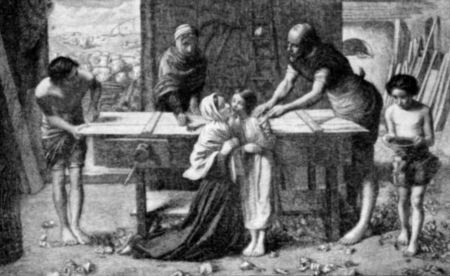
CHRIST IN THE HOUSE OF HIS PARENTS.
(By the late Sir John E. Millais, P.R.A.)
Vastly impressive and weird is Mr.
Hacker's "And there was a great cry
in Egypt." This artist has on more
than one occasion exhibited works of a
religious nature at the Royal Academy;
but none better than the one before
us and "The Annunciation," purchased
for the Chantrey Collection, and now in
the National Gallery of British Art.
The picture reproduced on page 388 illustrates
the passage in Exodus (xii. 30):
"And there was a great cry in Egypt;
for there was not a house where there
was not one dead." It is in its suggestiveness
that the picture tells: we see
none of the horrors of the last plague;
they are only suggested in the title.
The silent, sorrowing figure of the
Angel of Death, sweeping through the
city with flaming sword in hand and
trailing robe of black—symbol of the
train of sorrow he leaves behind him—is
noble and dignified. Carried along
on swift wings through the deserted
streets of the stricken city, the destroyer
touches in each household the
doomed "first-born," and only that
weird, heart-breaking cry rising on the
night air tells of the sorrow and misery
that mark his track.
The next illustration (page 389) deals
with the incident of Moses' second descent
from Sinai, bearing the re-written tables
of the law, and is the work of J. R.
Herbert, R.A. It forms one of the series
of frescoes in the House of Lords.
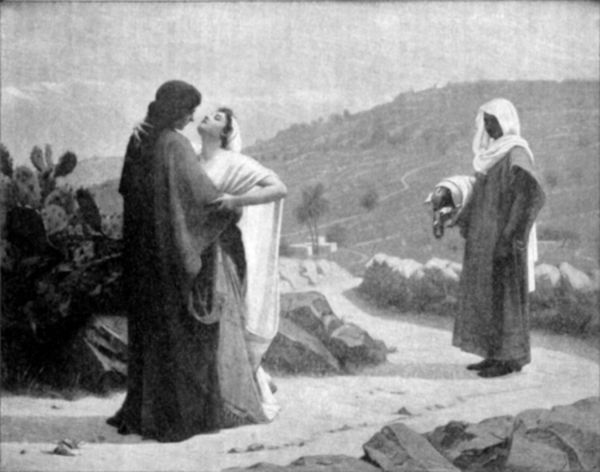
"Ruth and Naomi" (page 393) is one
of the best of the Scriptural subjects
treated by the late P. H. Calderon, R.A.,
and hangs in the Walker Art Gallery at
Liverpool. The passage illustrated is
that in which Ruth makes her impassioned
appeal: "Intreat me not to
leave thee, or to return from following
after thee: for whither thou goest, I
will go; and where thou lodgest, I will
lodge: thy people shall be my people,
and thy God my God"; and the artist
has imparted to the beautiful figure of
Ruth all the intensity and passion to
which the words give utterance.
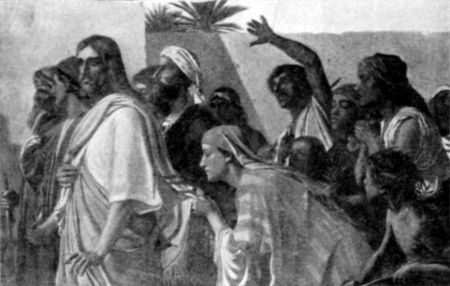
(By permission of Miss Armitage.)
FAITH.
(By the late E. Armitage, R.A.)
We now pass on to the New Testament—the
section most favoured by
artists, for the attraction of its central
Figure is as overpowering for the painter
of to-day as it has been to those of the
intervening ages. The picture on page
390 of "Christ in the House of His
Parents," by the late Sir John Millais, is
one of the earliest and most noted of
the painter's works. When exhibited at
the Royal Academy in 1850 (Millais was
then but twenty years of age), it had
for its inscription, "And one shall say
unto him, What are these wounds in
thine hands? Then he shall answer,
Those with which I was wounded in
the house of my friends" (Zechariah
xiii. 6). The picture aroused a veritable
storm of hostile criticism, scorn and
contumely being poured on painting and
painter alike. Charles Dickens, in his
Household Words, pronounced it as
"mean, odious, revolting, and repulsive,"
and other critics found fault
with it in equally strong language.
It was then that the title of "The Carpenter's
Shop" was scornfully bestowed
upon it, and by which it has since
been generally known: it has, however,
long been recognised as one of
the most wonderful contributions to
modern British art, quite apart from
any consideration of the age of the
artist when he painted it. The perfect
draughtsmanship, the wonderful colouring,
the marvellous skill displayed in
the whole composition, were all overlooked
by the contemporary critics; all
they considered was the—to them—execrable
taste of the artist in representing
Christ in an ordinary carpenter's
shop! The beautiful allegories contained
in the work were all ignored, and
abuse for the conception alone given
place.
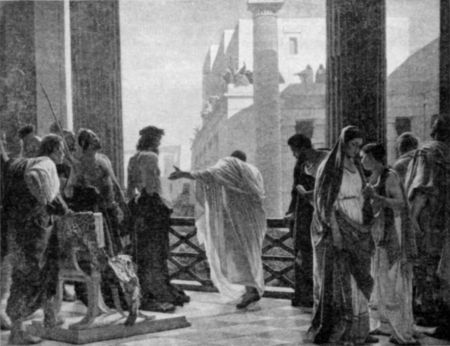
"ECCE HOMO!"
(By Professor Ciseri.)
And yet, when it is examined, what
is there to find fault with in this
respect? Absolutely nothing. The artist
set himself to paint from nature; the
work appeals directly to the observant
eye by its simple force; even the symbols
are not intricate when carefully
considered. The Child, whilst playing
with the pincers in His father's workshop,
has injured His hand on a rusty nail
protruding from the wood on the bench.
Joseph draws back the fingers to examine
the wound (the symbolism of
which is obvious enough), and Mary, with
grief and motherly anxiety portrayed
on every line of her face, seeks to
soothe the Boy, and with a piece of
linen prepares to bind up the hand.
St. John is coming with a bowl of
water with which to bathe the injury,
and St. Anne leans forward to remove
the tool which contributed to the hurt.
On the ladder against the wall rests
a dove—the emblem of peace—and
through the open doorway can be seen
a flock of sheep huddled close to a
fence, emblematical of the faithful, the
Church of Christ. Farther out in the
meadow is a well—the well of Truth.
(Reproduced by permission from the Original Painting in the possession of the Liverpool Corporation.)
RUTH AND NAOMI.
(By P. H. Calderon, R.A.)
The picture was painted on commission
for Mr. Farrar, the well-known dealer,
for the sum of £250—a large sum in
those days for a work by a young man.
This picture will form the subject of
one of the fine art plates offered to
readers of The Quiver, on conditions
which are stated elsewhere in this
number. Lord Leighton's well-known
painting "The Star in the East," and the
masterpieces of four other eminent artists,
will also be included; the whole forming
a set of sacred pictures, suitable for
framing, of permanent value and interest
for every Christian home as well as
every Sunday school and
mission hall.
The other picture by
Millais, which is reproduced
as the frontispiece
to this number, was
based upon a drawing
which the artist made
for Messrs. Routledge, in
1853, for a series of "The
Parables of our Lord."
The painting, however,
was not made until 1862,
when it was exhibited at
the Royal Academy. It
was afterwards totally
destroyed in a gas explosion
at Baron Marochetti's
house.
The picture "Faith," by
the late E. Armitage,
R.A. (see page 391), is an
excellent illustration of
the passage, "For she
said within herself, If I
may but touch His garment,
I shall be whole."
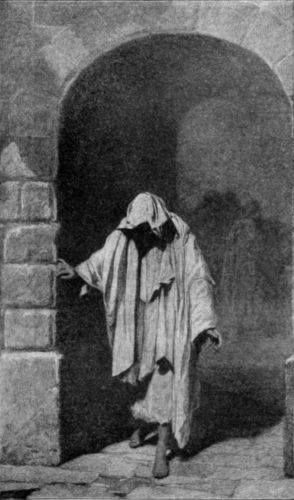
The tragedy of the betrayal,
and the perfidy of
Judas, have been the
subjects of innumerable
pictures; and that of
"Judas," by Henry Tidey,
which we reproduce, is
typical of many. The
betrayer is represented
here when leaving the
house in which is being
held the sacred feast on
the night of the betrayal.
The pose of the man reveals
the shame which he
is feeling; hesitating yet
as to whether his fell purpose
shall be accomplished.
(In the possession of Mrs. Noble.)
JUDAS GOING OUT.
(By Henry Tidey.)
The illustration on page
392 shows us the memorable
scene when Pilate
exclaims to the multitude
surrounding the palace, "Behold the
Man!" The work of a modern Italian
artist, this picture is an admirable
rendering of the tragic event, the subdued
patience of the central Figure
contrasting strongly with that of the
subservient prefect.
Arthur Fish.
[New Serial Story.
FOR THE SAKE OF HER CHILD.
By Scott Graham, Author of "The Link between Them," Etc.
CHAPTER I. — Dependent upon Charity.
I t was a radiant June morning, and
the fashionable watering-place—Beachbourne—was
looking its
best in the brilliant sunshine.
Smart carriages dashed past,
well-dressed cyclists careered
gaily along, and the High
Street shops were thronged
with fashionable customers.
A tall, refined-looking girl, whose exquisitely
fitting garb lent additional elegance
to her graceful figure, came along the pavement,
holding by the hand a pretty, fair-haired
child of six, likewise beautifully
dressed. At a confectioner's window the
child suddenly stopped. "Oh, mummy, do
buy me one of those dear little chocolate
pigs! I haven't had any sweets for ever so
long!"
"Don't tease, Doris. I have no money to
buy sweets."
The child opened great eyes of wonder.
"Why, mummy, you've got shillings, sovewins,
great heaps of them, in your purse! I saw
them!" she remonstrated. And, indeed, Mrs.
Burnside's dainty, silver-mounted purse was
literally bulging with coin.
"They all belong to auntie, and she wants
them to pay her bills." And she turned
resolutely from the enticing window, whereupon
Doris, who was tired with the walk
and the heat, burst into loud crying.
As her mortified mother strove to check
her, a young man in a professional frock-coat
and tall hat, who was passing, turned
to see the cause of the uproar. Mrs. Burnside's
fair face flushed. "My little girl is very
naughty this morning, Dr. Inglis," she said,
answering the inquiry in his grey eyes. They
were but slightly acquainted, occasionally
meeting in society.
"I want—a choc'late pig," wailed Doris.
"Mummy won't buy me one—unkind
mummy!"
"Hush, Doris," rebuked the young doctor.
"A chocolate pig! If that's all the trouble——"
and he fingered the few coins in his vest
pocket. "May she have one, Mrs. Burnside?"
So Doris got her wish; and, once inside
the confectioner's, she fancied so many things
that very little remained to Dr. Inglis
out of a shilling; and he needed all
his shillings badly. But he loved children,
and already May Burnside's blue eyes had
begun to haunt him, She held out her
beautifully gloved hand with a grateful
smile; and he noticed how thoroughbred
she looked as she went with the now happy
Doris down the sunny street.
There was a shadow on the young man's
face as he sped home to his scanty luncheon.
He was too poor to take a house, so he
rented three rooms in a sedate-looking villa
in a side street. Doctors simply swarmed at
Beachbourne, and sometimes Harold Inglis
doubted the wisdom of trying to work up a
connection there. The eldest son of an impoverished
country squire, he had to depend
upon his own exertions; and, after a brilliant
college career, came to Beachbourne, hoping to
work up a practice, as he was too poor to
buy one. Could he have taken a fine house
and kept a carriage, he might have succeeded;
for he was a gentleman to the backbone,
and had a pleasant face and manner. But
he remained almost unknown, and, after
a year of heart-breaking disappointments,
found himself barely able to live.
Before sitting down to the bread and
cheese awaiting him in the bare little
sitting-room, he thriftily changed his frock-coat
for an old boating blazer. Dress was a
terribly heavy item in his expenditure; the
well-cut clothes, the glossy hat, and the
snowy linen prescribed by medical etiquette
being only procured at the cost of semi-starvation.
To the hungry labourer or
vagrant many people will give a meal; but,
to my mind, the gentleman who has to go
hungry that he may be well-dressed is far
more deserving of pity. And many a professional
man has to go hungry in these sad
days when "all the markets overflow."
Meanwhile May and Doris Burnside were
bound for Victoria Square, the most fashionable
locality in Beachbourne. Mrs. Burnside
resided with her aunt, Miss Waller, a sprightly
spinster of fifty, who lived at the very
top of her handsome income, and was a
leader of local fashion. A smart footman
opened the door, and the beautiful drawing-room
they entered was a great contrast to
Dr. Inglis's bare sitting-room.
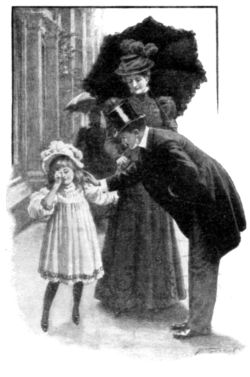
"I want a choc'late pig," wailed Doris.—p. 395.
Miss Waller, a good-looking woman with
white hair, and very richly dressed, turned
round from a fine old Chippendale writing-table.
"Oh! there you are." Then, as
Doris began some childish babble about
the chocolate pig, she added impatiently,
"Ring for Mary to take that child upstairs.
I wish you wouldn't bring her in
here!"
Miss Waller had no love for children; and
Doris was too well trained to defy her great-aunt.
Still hugging her precious sweets,
she was whisked away; whilst the
spinster, producing a gilt-edged account-book,
methodically entered the sums
paid by her niece that morning out of
a twenty-pound note. Every halfpenny
was accounted for, and when May
closed her purse just one solitary sixpence
remained in it which she could
really call her own. Sometimes she had
not even that.
"I've ordered the carriage for three,"
announced Miss Waller. "We must call
on Lady Lee, and the Amberys, and it's
Mrs. Edgell's 'at home' day. Put on
your grey dress and your new hat."
"Yes, aunt," meekly responded
May.
"And to-morrow you must unpick
my green dinner-dress. I
intend to have it dyed."
"Yes, aunt," repeated Mrs. Burnside,
as she went to the door.
"Yes, aunt," was what she was
obliged to say all day long;
to have said "No, aunt," would
have been a complete reversal of
all the Victoria Square traditions.
To do good by stealth is unfashionable
nowadays, and when
Miss Waller, to her great disgust,
found herself obliged to offer a
home to her widowed niece and
her child, she took care that all
Beachbourne should know and
extol her generosity.
"How delightful for Mrs. Burnside
to have such a luxurious
home!" remarked many people who
saw the aunt and niece that afternoon,
gorgeously arrayed; for it
was known that, but for Miss
Waller, May would have been obliged to earn
a living. Many a tired governess or poor
shop-assistant looked enviously at the pretty
girl dashing by in the smart carriage—the
pretty girl who was dressed in silk and
chiffon, but had only sixpence in her pocket!
The daughter of a struggling country doctor,
May had fallen in love at eighteen with a
handsome but dissipated assistant of her
father's, who persuaded her into a clandestine
marriage. She knew Arthur Burnside was
far from steady, but it seemed noble and
heroic to marry him that she might undertake
his reformation. Poor foolish child! she
failed to realise that if a man is too weak
to stand alone, without some woman to prop
him up continually, the chances are that he
will bring ruin upon both. May shuddered to
recall those four miserable years of ill-treatment,
disgrace, and privation, which ended
in the death of her husband, and left her
absolutely penniless. Her father was dead,
his other children were scattered, and, but for
Miss Waller, she and Doris might have starved.
Yet, despite the outward prosperity of her
new life, she found the bread of dependence
so bitter that, but for Doris, she would have
tried to earn her living. She was not highly
educated, and could only have hoped for a
subordinate post; but it was so galling never
to have a garment to wear or a coin to
spend, save through her aunt's bounty, that
she often thought she would be happier as a
nurse or parlourmaid. She mixed as an equal
with rich and fashionable people, and had
to talk as if want of money were absolutely
unknown, though she could not even afford
to buy her child a few sweets. She dared
not ask her aunt for pocket-money, for she
well knew that, though Miss Waller supplied
her with fashionable clothes, it was only
because she could not bear to be disgraced
by shabby relations, and she secretly grudged
every penny spent on her niece. Yet she
dared not quarrel with her aunt, who was
her only hope for a good education for her
child. May was resolved that Doris should
be so accomplished that, if needful, she
could earn her bread. "Oh, if only I had
not been so idle at school! If I had practised,
and talked to Fräulein more!" poor May
thought to herself, with unavailing regret, as
the country roads flitted by.
But she had little leisure for these sad
thoughts. She had to brace herself to play
her part in three crowded drawing-rooms,
as if she had not a care in the world. Miss
Waller was well pleased with the admiration
her graceful niece always excited in society;
and, thanks to May, the spinster received
many invitations which might not otherwise
have arrived. Miss Waller had a horror of
being classed as a frump; instead, she prided
herself on being exceedingly modern and up-to-date.
"Just fancy that plain little Daisy Edgell
being engaged to a Liverpool man with
heaps of money!" she remarked as they
rolled homewards. "We met him at the
Hubbards' last year, if you remember."
"I thought him very ugly and commonplace."
"Perhaps—but so rich! I wish you could
be as lucky, May. What a pity there are so
few really eligible men at Beachbourne!"
"If there were ever so many, aunt, I
couldn't bear to marry again."
"And, pray, why not? You're only twenty-five;
surely you are not going to mourn all
your days for that precious husband of
yours?" cried the spinster sharply.
"It is just because my first marriage was
so unhappy that I never wish to marry again.
As to marrying for money—I couldn't do it!"
"What nonsense! Isn't it done every day?
It's all very fine to talk, May, but you know
my income is only for my life, and I've hardly
saved anything, so that when I die you'll be
left without a home; and then what's to become
of you and Doris? You must marry
again—there's nothing else for it."
It was not the first time May had listened
to such counsels; and she was well aware
that, should her aunt die prematurely, she
herself would again be homeless. Miss Waller
was not the woman to deny herself in order
to save money for her niece. She must have
the fine house and carriage, the handsome
dress, and the dinner-parties which her soul
loved; and she found May very useful in
arranging flowers, writing letters, and making
not a few articles of personal adornment for
her aunt with her clever fingers.
Their nearest way home lay through the
quiet street in which Harold Inglis lived—or,
rather, starved—and, as he chanced to be at
the surgery window mixing a powder, he saw
the carriage driving by. The sinking sun
was burnishing May's golden-brown hair; and
her profile, beneath her gauzy hat, looked
very fair and sweet. He sighed, as he went
back to his powder, for the contrast between
her lot and his own seemed a little
too glaring. He did not know that all the
time she had only sixpence in her purse,
while he could actually boast of half-a-crown!
CHAPTER II. — Two Heavy Hearts.
Doris was never allowed to partake of
meals with Miss Waller, who disliked
having to regulate her conversation
according to inquisitive childish ears.
The little girl lived in the upper regions with
Mary, who divided the duties of lady's maid
and nurse. After breakfast one morning,
May, having done what was required by Miss
Waller, went upstairs to give Doris the
lessons which, so far, formed her sole instruction.
She found the child flushed and
heated after a combat with Mary.
"She's that cross, I can't do anything with
her," grumbled the maid, who dutifully imitated
her mistress in hating children. "She
wouldn't eat her nice egg at breakfast, and
she's pulled all her dolly's hair off—see."
"I'm afraid she's not well," said the
mother gravely, as the child buried her face
in May's skirt, sobbing fretfully. Her little
hands were burning, her cheeks flushed, and
red spots showed on the peach-like skin.
"Ask Miss Waller if Jane may go for the
doctor," May continued, dreading lest she had
taken measles.
Miss Waller gave permission to summon
the family physician, Dr. Ellis, who was the
most fashionable practitioner in Beachbourne,
and drove his carriage and pair; but Jane
returned to say that both the doctor and his
partner were out.
"Then go and fetch the nearest doctor at
once!" commanded Miss Waller. "I must
know whether it's infectious or not, so that
I may take precautions. How vexing it
will be," she complained to her niece, "if
Doris is laid up for weeks, and the house
placed in quarantine, just as all the gaieties
are beginning! There's the Mowbrays' dinner
next week, and Lady Lee's picnic, and the
Clares' musical party—oh, dear!"
Not a word of sympathy for the poor child!
May clenched her hands passionately in her
struggle to restrain an angry reply. It was
in moments like this that her shackles seemed
absolutely intolerable.
Presently Jane returned, followed by Harold
Inglis, the first disengaged doctor she could
find. May was glad not to behold an absolute
stranger, and stood by anxiously until he had
examined the little patient, whose malady he
pronounced to be chicken-pox. He wrote a
prescription, gave a few simple directions,
and then followed May downstairs to reassure
Miss Waller, who was eager "to know the
worst," as she put it.
She was very gracious at being relieved
from anxiety, and remarked blandly, "It
was very kind of you to come so promptly,
Dr. Inglis. Our usual medical attendant is
Dr. Ellis, but he was out. As it's such a
trifling matter, don't trouble to see Doris
again. If you will be good enough to send
in your account for this visit, I will settle it
at once."
And she bowed him out, as if determined
to quench any hope he might entertain of
being privileged to attend in Victoria Square.
Although, of course, medical etiquette forbade
his interfering with Dr. Ellis's patients, he
felt somewhat disappointed as he went away.
He was so weary of waiting in his dingy
sitting-room for the patients who never came!
May ventured a word to her aunt when
they were alone. "I wish we could help Dr.
Inglis to find a few patients, aunt! He seems
so nice and kind."
"There are far too many doctors in Beachbourne!"
pronounced the spinster. "I shall
certainly not leave Dr. Ellis—he gives such
delightful dinner-parties!"
Harold plodded dejectedly home, to learn,
as usual, that nobody had called during his
absence; and, after thriftily changing his
coat, he entered his little surgery, to find a
packet on the table which had come by post.
It was the manuscript of an article on throat
affections, which he had sent to a medical
paper in the hope of earning a little money.
It had entailed great labour and research,
only to be rejected with the curt intimation
that the editor had no opening for such a
subject.
"What can I do?" he distractedly asked
himself. "I've called on everybody I can
scrape acquaintance with; I've joined the
local clubs; I'm a Volunteer and a Freemason—what
more can I do to bring myself into
notice?"
"A note for you, sir," said the maid-of-all-work,
appearing at the door.
He snatched it eagerly, hoping to find a
summons; but, alas! it was only a bill from
a jobbing-tailor whom he had employed to
renovate various garments sub rosa. He had
no money to pay it; although it went sorely
against the grain to keep the poor man from
his due. He paced in distress up and down the
narrow room, wishing he dare start out for
a long walk, to distract his thoughts. But
he dreaded to leave, lest in his absence some
desirable patient might send for him. And
so, hanging about listlessly, unable to settle
to anything, the dismal morning passed, like
too many others; and Ann brought in his
meal of bread and cheese, from which he rose
nearly as hungry as he sat down. He looked
at himself in the spotty pier-glass. His cheeks
were falling in, and there were hollows beneath
his eyes, due entirely to insufficient nourishment.
A card stuck in the frame reminded him
that Mrs. Ormsby-Paulet was "at home"
that afternoon. "It's a tennis party—shall
I go?" he debated. It seemed a mockery
to mingle in a scene of gaiety with such a
leaden weight at his heart; but a prosaic consideration
decided him. "There'll be a good
tea, at least, and if I make myself very agreeable,
perhaps they'll ask me to stay to dinner.
Besides, I may get to know some people who'll
employ me."
He dressed himself carefully, and sallied
forth; informing the servant of his destination,
in case anybody should send for him.
Despite his thin cheeks, there was not a
better-looking man at "The Dene" that
afternoon; for he looked a gentleman to the
backbone, and as such, his hostess—who was
very short of men—smiled upon him graciously.
"So glad you were able to
come," she cooed. "Miss Waller,"
to the spinster, who had just
arrived, "may I introduce my
friend, Dr. Inglis?"
"I have already made his
acquaintance," was the suave
answer; and then Harold, to
his surprise, was greeted by
Mrs. Burnside, looking very fair
and sweet in a cool white linen
gown. He had not expected to
meet her; he naturally supposed
her place to be by the
bedside of her sick child. In
truth, she was only present at
her aunt's urgent entreaty.
"I'm afraid she must be rather
heartless," thought the young
doctor, feeling oddly disappointed.
He had not hitherto
attributed want of feeling to
the owner of those pathetic blue
eyes. Nevertheless, as sets were
being made up, he asked her to
be his partner, she being famed
in Beachbourne as a tennis-player.
She complied; but the set was
not a success. He could not
have believed that Mrs. Burnside
could play so badly; they
were beaten by six games to two.
"I am so sorry," she said
humbly, as they quitted the
court. "I know it was all
my fault; but I really couldn't
play—I was thinking of Doris
all the time."
Her lips quivered, so that he
could no longer imagine her
heartless. "Your little girl will
be well in a few days—there is really no cause
for anxiety," he answered gently, angry with
himself for having misjudged her.
"That is what Aunt Caroline says, and she
insisted on my coming," plaintively returned
May; but just then Miss Waller appeared,
resplendent in mauve satin, with a stout,
black-haired, middle-aged, and shrewd-looking
man, very carefully dressed, in tow.
"I came to look for you, dear," she began
very sweetly to her niece, merely giving a
cold bow to Harold. "I want to introduce
Mr. Lang to you. He knows our friends the
Wingates in town."
With that, the excellent spinster turned
away; and May, finding no resource save
to accept the basket-chair in the shade
proffered by the stranger—as Harold had
prudently effaced himself—prepared for a
tête-à-tête with a man she had never seen
before in her life.
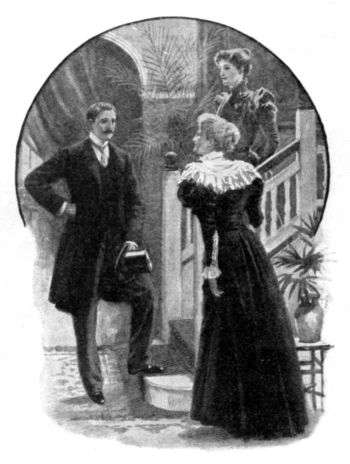
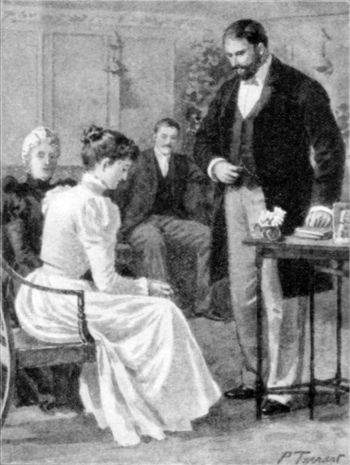
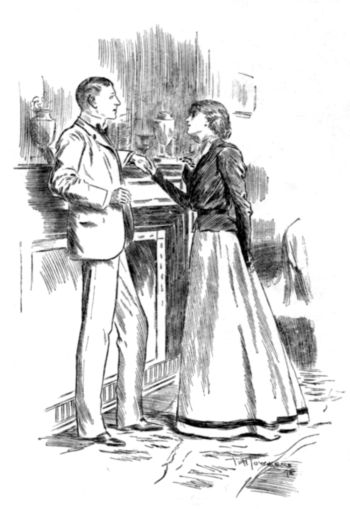
"It was very kind of you to come so promptly, Dr. Inglis."
CHAPTER III. — "Manners Maketh Man."
"Do you mind my smoking?" began Mr.
Lang, after a moment's keen scrutiny
of the graceful figure beside him.
Hardly waiting for permission, he
produced a gold case and lighted a cigarette.
"Been playing tennis, haven't you?" he continued
in an off-hand way. "Stupid game,
not half so good as golf—you should try golf."
"I have tried it, and I don't like it."
"Beginners seldom do. It's a fine game,
for all that. You live with your aunt, don't
you?"
"Yes, in Victoria Square."
"Do you like Beachbourne?"
She hesitated a moment before replying,
"Yes."
"I suppose it's like all these provincial
towns—heaps of gossip and scandal, eh? But
you should be in London now, Mrs. Burnside.
There hasn't been as gay a season for years.
I shouldn't be here now, I can tell you, but
I got a touch of fever last time I was at
Johannesburg, and, as I can't quite shake it
off, my doctor ordered me complete rest for a
fortnight. So I came down here to stay with
the Stevensons. I met them last year at
Homburg, and ever since they've been pestering
me with invitations to Beachbourne."
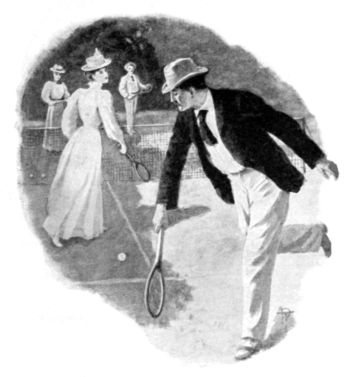
The set was not a success.—p. 399.
"Oh, have you been out in Africa?" returned
May, thinking it best to ignore his flattering
reference to his entertainers.
"Spent nearly twenty years there. I can
remember when there wasn't a gold mine on
the Randt. And, though I've come back to
England for good now, I generally run over
about twice a year. It's just a nice little
trip to the Cape, and they really do you very
well on the mail steamers," he condescendingly
added, as he lighted another cigarette. "By-the-bye,
this case is made of African gold—a
nugget I found myself in the claim which
was the beginning of the Springkloof Mine.
You've heard of the Springkloof, of course?"
She shook her head, and he looked at her
with evident pity for her ignorance. "I didn't
think there was anybody nowadays
who hadn't heard of the
Springkloof!"
"I'm afraid you'll think us
rather behind the times at Beachbourne,"
she said, as she rose, hoping
to shake off her new
acquaintance; but
he rose, too, and
kept by her side as
she strolled through
the beautiful
grounds, speaking
first to one friend
and then to another.
"Not many pretty
girls here, I must
say," he observed
disparagingly, as
they approached the
house, in quest of
the tea-room.
"Are you an admirer
of beauty?"
asked May, with a
rather sarcastic
glance at his tubby
figure.
"Quite so. I love
the best of everything
there is. As
soon as I can find
a girl pretty
enough, I intend to
marry," he replied
with perfect gravity.
"It's rather lonely
all by myself in
Palace Gardens. Do
you like the Palace
Gardens houses, Mrs. Burnside?"
"I've never been in one, and I don't even
know where they are. I know very little
about London, and very few people there—just
the Wingates, and one or two others."
"Are the Wingates any relation?"
"Oh, no, only old friends of my aunt's. I
hardly know them."
"Well, it's not much loss. I don't mean
any disrespect to your aunt, but old Mother
Wingate isn't a woman I should ever wish
to confide in, myself. She's always trying to
catch me for one of her plain daughters—dear
Maggie or dear Amy! By the way,
what's your Christian name, Mrs. Burnside?"
"May."
"And, by Jove, it suits you! So often
girls' names don't. You find Lily as black
as a crow, and Rose as sallow as she can
be, and Queenie a little, insignificant dowdy
with a turned-up nose!"
He talked in this carping strain while he
consumed a fair amount of refreshments,
none of which, however, were good enough
for his critical taste. He evidently thought
a great deal about eating and drinking, for
he incidentally mentioned that he gave his
chef two hundred a year.
"What a waste!" was on the tip of May's
tongue, as she thought how useful even a
tenth of that sum would be to herself. The
tea was cosily set out on a number of little
tables in the spacious, old-fashioned dining-room.
Gay groups were seated at each, and
not far off was Harold Inglis, talking cheerfully
with two of his host's daughters. May
glanced from him to her companion, noticing
how common and plebeian Mr. Lang
looked when contrasted with him.
As she quitted the table Harold, who
had apparently been lying in wait, crossed
over to speak to her. "Would you like to
play again, Mrs. Burnside? I can easily
make up a set, if you wish."
But at this moment appeared Miss Waller,
apparently from nowhere, to throw cold
water on the proposal. "I think you had
better not run about any more this hot
afternoon, love. You really must not tempt
her, Dr. Inglis."
"There's croquet," suggested Harold; "shall
we play at that?"
And, though in general she detested
croquet, May assented quite eagerly, only
anxious to shake off Mr. Lang. Miss
Waller could not well interfere again, and
Mr. Lang did not play croquet, but he and
the spinster sat on a garden seat close
by till the game was finished, rendering it
difficult for Harold to say a word which the
watchful pair did not overhear. Divining
from her erratic play that May's mind was
still running upon her sick child, he seized the
opportunity, when they were both searching
for a ball which had rolled into the shrubbery,
to say kindly: "Don't fret about Doris. I
assure you there's no need. The malady
must run its course, and she'll be all right
afterwards. Only you must be careful she
doesn't get a chill."
"I wish she could have you to attend her,
instead of Dr. Ellis. She detests him because
he once deceived her about a powder
she had to take. But my aunt likes him——"
"I believe he is a very clever man,"
hurriedly interposed Harold, mindful of professional
etiquette. "Doris will be quite safe
with him; indeed, she hardly needs a doctor."
"My aunt is always at home on Tuesdays—I
hope you will come to see us," responded
May, grateful for his manifest sympathy.
She knew he had few friends in Beachbourne,
and resolved to do what she could to introduce
him.
His face lighted up unmistakably. "Thank
you so much, Mrs. Burnside! I shall be delighted
to come, and I'll not forget Tuesday."
Miss Waller was in a most complacent
frame of mind as they drove home through
the beautiful June evening. "What a fortunate
thing I forbade you to be so foolish
as to stay at home to nurse Doris!" she
began. "Mr. Lang is a man worth knowing;
he made an enormous fortune in South
Africa—a million at least—and Mrs. Stevenson
says his house in Palace Gardens is simply
lovely. I'll ask him to dinner, to meet some
nice people."
May's delicate face flushed. "He's not a
gentleman!" she said.
"I daresay he was not of much extraction
originally, but what does that matter nowadays?
Money levels all distinctions; and I
can see Mrs. Stevenson would be only too
glad to catch him for Edith."
"I thought his manner insufferably rude!"
"My dear, that's because he's so run after
in London; it always spoils a man to have
dozens of girls angling for him. But he was
undoubtedly struck by you; and I don't
think you were very wise to go and play
croquet with that Dr. Inglis as you did. He
has agreeable manners, but he has not a
penny-piece; and I don't believe he'll ever
get a practice here."
"I'm sorry for him, aunt, and—and I
thought it only civil to ask him to call——"
Miss Waller's brow contracted. "I think
you might have consulted me first. At best
he is only a detrimental, and there are far
too many here already; but you always
were quixotic, May!"
CHAPTER IV. — Lulu.
Whit Sunday—which was late that
year—was simply glorious, the heat
being tempered by a delicious sea
breeze. A vivacious, dark-eyed girl,
who accompanied Harold Inglis along the
parade after morning service, stopped again
and again to gloat over the sapphire sea,
tumbling in, foam-crested. "How jolly for
you, Harold, living in this delicious place!"
she exclaimed. "You ought to look better than
you do; you are much thinner than you were."
He evaded the subject, not wishing to
sadden his favourite sister, Lulu, with his
shifts and privations. She had come down
to Beachbourne to spend Whitsuntide with
her brother, glad to escape from the stuffy
London office in which she had to work
hard for a living.
"Oh, Harold! who are these smart people
coming along?"
They had already passed many well-dressed
groups of residents, but none presenting so
imposing an appearance collectively as did
stately Miss Waller, in heliotrope, May Burnside,
in an exquisite costume of pale grey silk
and chiffon, Doris, a vision of childish prettiness
in white muslin, and two or three
equally well-dressed men, conspicuous amongst
whom was Mr. Lang. Harold's colour rose
as he lifted his hat, whilst Lulu eagerly
exclaimed, "Oh! who is that pretty girl in
grey? She looks quite fit for the Park!"
He explained, secretly glad that his sister
should admire his divinity; but it was fortunate
he could not hear what Miss Waller
was meanwhile saying to her niece: "Who
is that common-looking girl with Dr. Inglis?
She is most atrociously dressed."
It must be confessed that poor Lulu, who
had little money for dress, fell far below the
Victoria Square standard. "Looks like a
little dressmaker," sneered one of the men.
"A dressmaker would have better clothes,"
observed Miss Waller. Her eyes dwelt complacently
on her niece's graceful figure, as she
spoke, and she was pleased to see how close
Mr. Lang—who had overtaken them in
coming out of church—kept to May's elbow,
despite the black looks of Doris, who disliked
him. The child was now quite well again,
some days having elapsed since the garden
party.
"What are you going to do this afternoon.
Mrs. Burnside? Will you come for a drive?"
presently asked Mr Lang.
But May did not approve of Sunday driving.
"I promised to take Doris to the flower
service, thank you."
"Why, you've been to church once already,
Doris! You'd much better persuade your
mother to bring you for a drive with me,"
cajoled he; but the child burst out, "No, I
don't like you, and I don't want to drive with
you!" so resolutely that he could not press it.
Miss Waller frowned angrily. "Really,
May, the way you spoil Doris is beyond all
reason. She is the rudest little girl I ever
saw!" And, to soothe the plutocrat's wounded
feelings, she insisted upon his coming home
to luncheon with her. He was now a constant
visitor in Victoria Square, for, having
terminated his stay with the Stevensons, he
had taken rooms at the principal hotel.
Whilst May, in her costly gown, sat chafing
beneath Mr. Lang's glances of insolent admiration,
at her aunt's luxuriously appointed table,
Harold and Lulu Inglis were very merry and
happy over the plainest fare in his bare sitting-room.
They had not met for a long
time, and a cheap Whitsuntide excursion
was the reason of her presence now. As
soon as they had finished, they started for
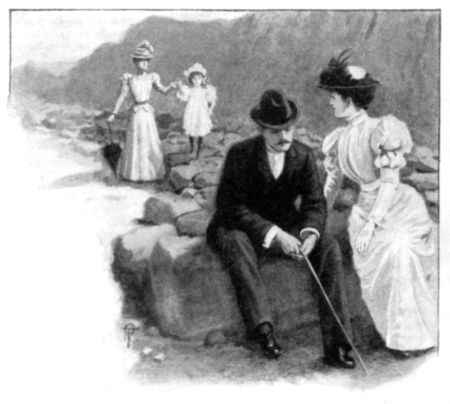
the shore. Sitting on a big stone, beneath
the shade of the cliffs, they had a delightful
chat, until Lulu suddenly exclaimed: "Oh,
Harold! Here's that pretty girl in grey we
saw this morning!"
Doris, who loved the sea, had coaxed her
mother to come down on the shore after
the service, and, seeing his companion, May
bowed to Harold, and would have passed on,
but he detained her. "May I introduce my
sister, Miss Lucy Inglis, Mrs. Burnside?"
There was something so frank and friendly
about Lulu that very soon, as Doris announced
she was tired and wanted to rest, they were
all seated upon the big stone, upon which
Miss Inglis insisted on spreading her jacket,
to protect May's dainty dress. Whilst his
sister expatiated on the delights of Beachbourne,
and wondered why her raptures
evoked so little response from the young
widow, Harold sat pondering whether he
dare invite Mrs. Burnside to come to tea in
his bare and shabby rooms.
To his delight, she instantly accepted the
invitation; eager, in truth, to escape from
the hated society of Mr. Lang. Harold
then turned to Doris, gaily asking whether
she would come too.
"Yes, I will," she answered with childish
bluntness. "I like you, but I don't like Dr.
Ellis—nasty man!—and I hate Mr. Lang."
"You shouldn't hate anybody, Doris," reproved
May.
"But Mr. Lang calls me Little Crosspatch,
and it's very rude of him to call me names,
mummy."
"Bravo, Doris!" cried Lulu mischievously,
as they turned to go. "Stick up for your
rights—you'll be a 'New Woman' when you
grow up."
"I hope so," said May, in a low voice, to
the amazement of Miss Inglis, who exclaimed,
with a glance at the costly equipment of the
speaker: "I should never have expected you
to utter such a wish, Mrs. Burnside!"
May smiled with quiet bitterness. "I have
no wish to see Doris speak on a platform,
or go in for a man's profession; but I do
feel, more and more, that it is better for
women to be independent, whether they marry
or not."
"Why, that's just what I always say!"
cried Lulu delightedly. "All women can't
marry nowadays—there are not enough men
to go round. Besides, what is more contemptible
than to see girls sitting idle, with
their hands folded, waiting for somebody to
come along and marry them? No, every
girl ought to be able to earn her own living,
and then she's safe, whatever happens!"
Needless to say, such maxims would have
been entirely abhorrent to Miss Waller, who
regarded working-girls with detestation, as
May well knew.
CHAPTER V. — "A Beautiful Anomaly."
Arrived at his rooms, Harold did the
honours; not without fears lest May
should miss the luxuries of her home.
But she enjoyed the change of surroundings
with all the zest of a schoolgirl,
and Doris, being made much of, was as good
as gold. Harold himself had not spent such
a delightful hour since he came
to Beachbourne, but his hour
of bliss was all too short; for
soon a summons came from a
patient, and, though it was only
a greengrocer in the next street,
patients were too precious to
be slighted. So he departed,
begging Mrs. Burnside to remain
with Lulu until his
return.
Left alone, the two girls
settled down for a cosy
chat; Doris being quite
absorbed in an illustrated
book Harold had produced
picturing the wonders of
the microscope.
"Dear old Harold!" began
his sister. "Don't think
me silly, Mrs. Burnside,
but I'm proud of him,
knowing how hard he
worked for his degree.
Will he ever get a good
practice here, do you
think?"
"I hope so; but it takes
time," answered May,
rather embarrassed.
"Have you many brothers
and sisters?"
"There are six of us altogether—a formidable
number, isn't it? But, I'm glad to say, we're
all doing something, and don't cost dear old
dad a penny. I remind Esther of that—she's
my eldest sister—when she grumbles, and
wishes we were back at Mallowfield Hall."
"That was your father's place, wasn't it?"
"Yes, our ancestors lived there centuries
ago. This is the house." And she produced
a photograph of an imposing mansion standing
in a spacious park, a residence which even
Miss Waller would have acknowledged to be
a magnificent property.
"What a lovely place! And you had to
leave it?"
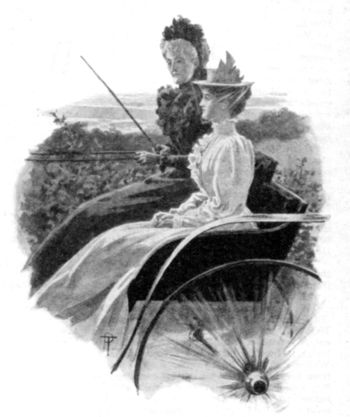
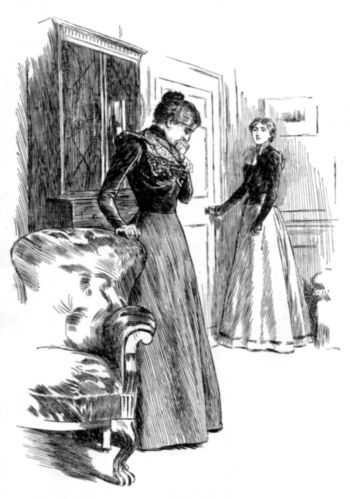
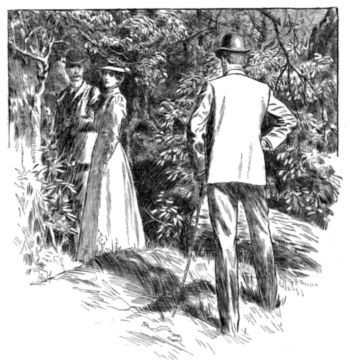
"He's not a gentleman," she said.—p. 401.
"Yes, my grandfather was dreadfully
extravagant, and since father came into
power the agricultural depression was the
finishing stroke. It was cruelly hard to
leave the dear old place, but the mortgagees
foreclosed, and we all had to turn out.
Dad and mother went to live in Cornwall,
where she owns a tiny cottage. Harold
passed as a doctor, Jack's at Johannesburg,
and Ted's in Australia. Then Connie, my
youngest sister, is companion to an old lady,
and Esther and I share a cupboard of a
flat with an old schoolfellow, Mabel Bryan,
whose partner I am in a typewriting office.
Esther, who's awfully clever, as well as
handsome, and knows several languages, is
corresponding clerk to a firm of shippers.
She gets a hundred a year, and I manage to
make about a pound a week; but I'm not
clever, and have to do the best I can. We
work awfully hard, but I really think we
are happier than if we had nothing to do."
"I'm sure you are," sighed May, as her
eye fell upon her own dearly purchased finery.
"I must say, I think it very plucky of you
to take it as you do."
Lulu opened her eyes, for she was not
accustomed to pity. "I'm proud to be a
working-woman, and even if I were rich like
you, Mrs. Burnside, I couldn't bear to sit with
my hands folded."
"Rich like me!" May echoed drearily.
"I'm not rich; I owe everything I possess
to my aunt."
"But she's rich, so it must be the same
thing," persisted Lulu.
Just then Harold came hurrying in. "I
was as quick as I could be, Mrs. Burnside,"
he began, manifestly pleased to find May
still there. With an alarmed glance at the
clock, she arose to go, and said cordially—
"I should be so pleased, Dr. Inglis, if you
would bring your sister to see me on Tuesday
afternoon."
"Many thanks, Mrs. Burnside, but I must
return by the excursion train on Tuesday
morning," returned Lulu; and May dared not
urge the point. To invite the Inglises to any
meal but afternoon tea was out of her power,
for Miss Waller disapproved of promiscuous
guests at luncheon and dinner. So, bidding
a cordial farewell to Lulu, May set forth with
Doris to Victoria Square, escorted by happy
Harold.
"I call her a beautiful anomaly!" Lulu
observed later on to her brother, when he
asked what she thought of Mrs. Burnside.
"At first, seeing how she was dressed, I concluded
she was only a fashionable butterfly,
caring for nothing but amusement. But from
her talk I could see I had been unjust, and
that there's nothing she would like better than
being useful and independent. Poor thing!
Her face is one of the saddest I ever saw."
"I believe she has a very uncomfortable
time of it with Miss Waller, who is a Tartar,
from all accounts."
"Then why does she stay with her?"
"What else can she do, with that child?"
An unpleasant quarter of an hour awaited
May within her aunt's door, which she
entered with a sinking heart. Doris was
instantly bundled off to bed, after which Miss
Waller—in thin, high tones, very different
from her suave society accents—moralised on
May's enormities in absenting herself without
notice, whilst Mr. Lang vainly awaited her
return. He had just gone, evidently vexed at
her non-appearance.
"Mr. Lang has no jurisdiction over me!"
May was irritated into retorting at last, whereupon
her aunt's frown became portentous.
"Mr. Lang is my friend, and, as such, I insist
that you treat him with respect! Pray, who
are you, to set your will against mine? I paid
for the very dress you have on, and every
article you possess, and but for me you and
Doris would be in the workhouse!"
May would not trust herself to reply, but
went away to her own room, there to shed
some very bitter tears. As she eyed her tall
figure in the glass, arrayed in the beautiful
garments for which she had to pay so dearly,
she heartily envied the three happy girls in
their flat, as described by Lulu. How fortunate
they were, to be able to do as they pleased,
and indebted to no living soul for anything!
"Oh, to be free!—to be free!" she panted,
realising her slavery as she had never realised
it before.
CHAPTER VI. — Bijou's Mistress.
When bright-faced Lulu had returned
home, brief though her visit had
been, Harold missed her inexpressibly.
To vary the monotony
of his dreary rooms, he paid his promised call
in Victoria Square, to find himself promptly
relegated to the background by Miss Waller,
who perfectly understood how to snub people
without being unladylike. May, who made
tea, hardly uttered a word; and the lion of
the occasion was Mr. Lang, who expatiated
on the riches of South Africa and his own
importance on the Randt.
"You're nowhere unless you've got money
nowadays," he confidently asserted.
"Oh, but"—expostulated a meek little
clergyman's wife, looking rather shocked,
"surely culture goes for something—and descent—and——"
"Culture, descent, my dear madam! We
haven't time to bother about such things at
Johannesburg! They'd be no use to a man
there!"
"I'm sorry to hear it," Harold was provoked
into saying. "My brother Jack is out there,
and I shouldn't like him to come back less of
a gentleman than he went!"
"What's he doing?" disdainfully drawled
the plutocrat.
"He is in the office of the Victorina Mine."
"Ah! a good property that—not equal to
the Springkloof, though. I know the Victorina
manager; perhaps next time I go
out, I may look your brother up."
"How kind of you, Mr. Lang!" gushed Miss
Waller; but Harold never said a word.
"Well now, Miss Waller," said Mr. Lang,
"it's time I was returning to London, and
don't you think you ought to give Mrs. Burnside
a little taste of dissipation before the
season closes?"
"I should have taken her to London before,
but dear May always says she doesn't like
town," answered the spinster, who always
posed as a most affectionate aunt in public.
"I must leave you to try your persuasions."
As she spoke, she darted a glance at her
niece which plainly said, "Refuse to go, if
you dare!"
"London is so hot now—and Doris——" faltered
the girl in manifest dismay. The clergyman's
wife took her departure, but Harold sat
doggedly on, determined to hear the result.
"Doris could be left behind perfectly well,"
rejoined Mr. Lang, who disliked the child as
much as she disliked him.
"We shall be very pleased to see a little
of London under your auspices, Mr. Lang,"
interrupted Miss Waller, in a sub-acid tone.
"I know of some nice rooms near Hyde Park,
which will be quieter than a hotel, and I'll
write about them to-night."
May said no more; but Harold perceived
an expression of absolute despair flit over
her features for a moment, and his heart
swelled with pity for her.
He paced his lonely sitting-room many times
that evening, lamenting his own impotence.
A few patients, poor people to whom he was
at home for an hour, mornings and evenings,
came to consult him for a fee of one shilling,
medicine included; but even these were few
in number. He had the very deepest sympathy
with the poor; but to be wasting
his time here when, in a few days, Mrs.
Burnside would be staying close to that
man in Palace Gardens!
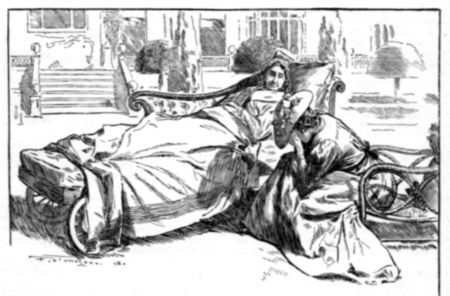
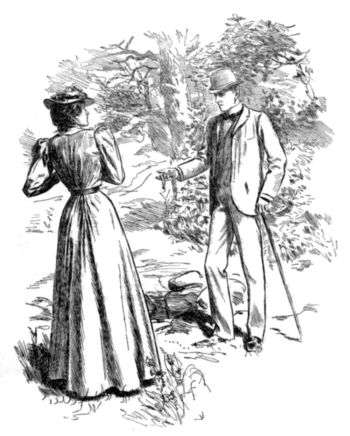
"Harold! Here's that pretty girl in grey."—p. 402.
There was a ring at the bell, and the landlady
entered, announcing, with a smile, "Miss
Geare and Miss Pepper." A little, round-faced,
white-haired lady, with curiously wandering
light-blue eyes, then tripped into the
room, carrying something carefully in her
arms; followed by a forbidding, tall, dark-haired
female, to whom Harold took an instant
and hearty dislike.
"Oh, doctor!" began the little lady, in a
breathless, excited way, with hardly any
stops, "I saw your plate on the door, and
I've come to see if you can cure my darling
little Bijon; a great cruel cabman has just
driven over him, and I'm afraid his poor
leg's broken. Will you look?"
Harold could hardly restrain a smile. "I
am not a veterinary surgeon, madam."
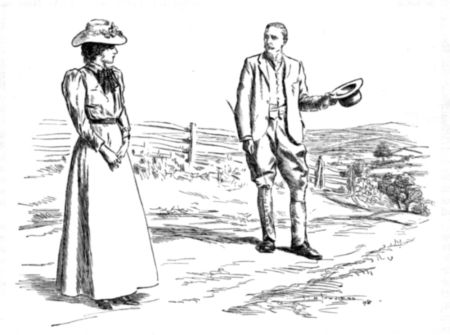
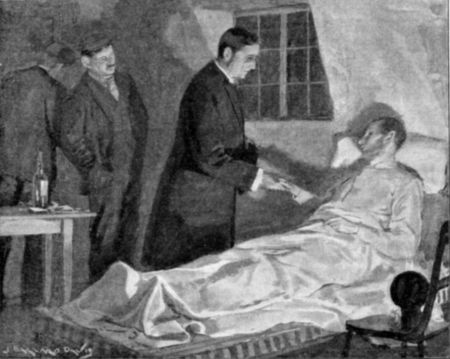
Harold perceived an expression of despair flit over her features.—p. 405.
"I told you it was no use coming here,"
growled Miss Pepper, the companion, in a
voice as unamiable as her face.
"Oh, but poor Bijou is in such pain!"
With that Miss Geare burst into passionate
tears and again entreated Harold's aid. To
end the tiresome scene, he examined the
dog, unprofessional though it might be, and,
finding one of its legs was broken, improvised
splints and set it carefully. Miss Geare's
gratitude was excessive.
"And you will come and see Bijou, won't
you?" implored the old lady. "He must
have attention until he gets well, and I live
at Lyndhurst Lodge, Murray Road."
Harold demurred, as being unprofessional.
"Then come to attend me," eagerly responded
Miss Geare. "I'm often rather ailing; and
you can give Bijou a look at the same time."
She looked at him so pleadingly that he could
not find it in his heart to say
no. She brightened up at
his consent, and asked for a
cab, in which to take home
her injured darling, and
then laid a sovereign and
a shilling on the table.
"I don't think I am entitled
to charge for attending
the dog," said Harold,
crimsoning. "Certainly,
this is far too much."
"Watson, the veterinary
surgeon, never would have
charged a guinea," indignantly
added Miss Pepper;
but Miss Geare was resolute,
and when she had
departed, it was certainly
pleasant to see the gold
piece on the table, sovereigns
being sadly scarce
with him, poor fellow!
He instituted inquiries,
and learnt that Miss Geare
belonged to a good family,
and was well-off, but somewhat
"queer." In early
youth she was engaged to
an officer, who was killed
at Delhi, and had become
gradually more and more
eccentric, until now she
only lived for her dogs and
cats. Miss Pepper, it was
added, tyrannised over her
shamefully, as though she
were the mistress and Miss
Geare the companion.
The old lady was warm-hearted,
though rather
fickle, and, having taken a
fancy to Harold, contrived
to secure him several fresh and welcome
patients. Miss Geare herself was far from
strong, and afforded a legitimate exercise for
Harold's skill, which salved his conscience in
the matter of Bijou. But Miss Pepper remained,
from first to last, distinctly hostile.
[END OF CHAPTER SIX.]
CHILDISH MEMORIES OF LEWIS CARROLL. — By One of his Alices.
So many children will
grieve over the
sad event—the
death that deprived
them of one of
the best and kindest
friends that children ever
came across—the children
who have followed "Alice"
through all the wonderful
adventures of "Wonderland"
will be saddened by
the thought that the hand
which held the pen that
gave them such amusement
is now still for
ever; and the children
now grown up who knew
Lewis Carroll personally
will look back into the
years agone and remember
his delightful stories, and his never-ceasing
kindness towards them in their
youthful days.
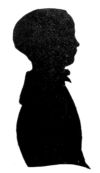
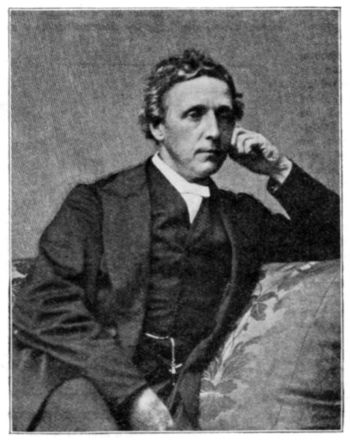
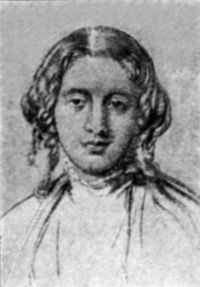
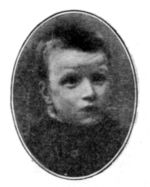
LEWIS CARROLL.
(At the age of 8.)
To my mind Oxford will never be quite the
same again, now that so many of the dear
old friends of one's childhood have "gone
over to the great majority." My poor old
father, though always wishing to go for little
excursions back to the old University town
where so many years of his life had been spent,
came back to his country rectory in the Cotswold
Hills bemoaning the loss of the "many
who had gone before," and how the familiar
forms of his old college friends were, alas!
no more to be seen.
Often, in the twilight, when the flickering
firelight danced on the old wainscoted wall,
have we—father and I—chatted over the old
Oxford days and friends, and the merry times
we all had together in Long-Wall Street. I
was a nervous, thin, remarkably ugly child,
and, for some years, I might say, I was quite
alone in the nursery, my small, fat baby-brother
being much more appreciated than
myself. I was left almost entirely to the
kind and gentle mercy of Mary Pearson, my
own particular attendant, and though father,
of course, had commenced his friendship with
Mr. Dodgson (Lewis Carroll) long before, I
only remember him first when I was about
seven, and from that time until we went to
live in Gloucestershire, he was one of my
most delightful friends.
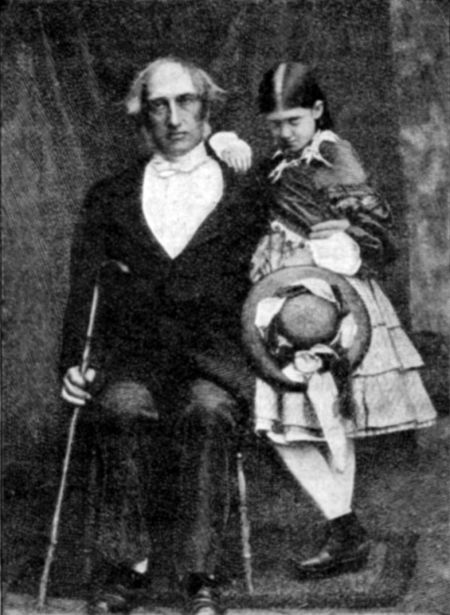
(From a Photo by Lewis Carroll.)
THE AUTHOR AND HER FATHER (THE REV.
E. A. LITTON).
I shall never forget when, sitting on a
rustic seat with Mr. Dodgson under a
dear old tree in the Botanical Gardens, I
heard for the first time the delightful and
ever-entertaining story of Hans Andersen's
"Ugly Duckling." I was devoted to books,
and could read quite well for so small a child,
but I cannot explain the delightful way in
which Mr. Dodgson read and told his stories:
as he read, the characters were real flesh
and blood—living figures. This particular story
made a great impression on me, and, being
very sensitive about my ugly little self, it
greatly interested me. I remember his impressing
upon me that it was better to be
good, truthful, and to try not to think of self,
than to be a pretty, selfish child, spoilt and
disagreeable, and he, from that story, gave me
the name of "Ducky," which name clung to
me for many years; in fact, from that day
Mary Pearson always called me "Miss Ducky."
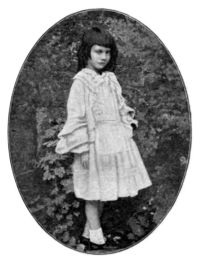
(From a Photo by Lewis Carroll.)
THE ORIGINAL OF "ALICE IN WONDERLAND."
Many a time has Mr. Dodgson said, "Never
mind, little Ducky; perhaps some day you will
turn out a swan."
I always attribute my love for animals to
the teaching of Mr. Dodgson: his stories of
animal life, his knowledge of their lives and
histories, his enthusiasm about birds and
butterflies, passed many a tiresome hour away.
The monkeys in the Botanical Gardens were
our special pets, and, oh! the nuts and biscuits
we used to give them! He entered into the
spirit of the fun as much as "Ducky" did.
Then there were the mornings spent in the
Christ Church and Merton meadows: Mary and
I took our daily walks abroad there. Years
have passed since then, and I have travelled
in many climes, but I always think that the
recollections of the days of one's childhood
never fade. One's views of life, persons, and
things were so fresh, so different from the
judgment of things in later years.
Those meadows were, to me, full of the
loveliest field-flowers—daisies, the beautiful
"snake-flower"—so rare, I understand now—the
golden buttercups, the masses of dandelions
with the added, never-failing fun of
blowing the downy seeds away.
Nurse Mary always took thread and a needle
in her pocket; these were for the making of
daisy-chains, and, oh! the wreaths we strung
as we sat in the soft grass, with the dear old
Broad Walk quite close, and when we raised
our eyes the lovely vision of Merton College,
with its covered walls of Virginian creeper!
It all comes back to me so vividly, though it is
now far away in the past years. And how
delighted we were to see the well-known
figure in his cap and gown coming, so swiftly,
with his kind smile ready to welcome the
"Ugly Duckling" sitting in the grass! I
knew, as he sat beside me, that a fairy-tale
book was hidden in his pocket, or that I
should hear something nice—perhaps a new
game or a puzzle—and he would gravely accept
a tiny daisy bouquet for his coat with as much
courtesy as if it had been the finest hot-house
boutonnière. I was very proud when, between
us, we had made a chain of cuckoo-flowers
and daisy heads long enough to twine round
my hat.
These meadows and the walk along the wall
were remarkable then for the quantity of snails
of all kinds that, on fine days and damp days,
came out to take the air, and to me they were
objects of great dislike and horror. Mr. Dodgson
so gently and patiently showed me how
silly I was, how harmless the poor snails were,
and told me so much about the shells they
carried on their backs, and showed me how
wonderfully they were made, that I soon got
over the fright and made quite a collection
of discarded shells; which collection finally
took up its abode in a little crimson-paper
trunk that Mr. Dodgson found at old Mrs.
Green's toyshop and bought for me.
About this time also father had added to
my nursery literature "Ministering Children,"
"Sandford and Merton," and "Rosamund; or,
The Purple Jar." All these were shown in
great glee to my kind friend, who (as I knew
he would) read to me from them.
Two or three times I went fishing with him
from the bank, near the Old Mill opposite Addison's
Walk (Oxford), and he entered quite into
my happiness when a small fish came wriggling
up on the end of my crooked pin and line, just
ready for the dinner of the little white kitten,
"Lily," he had given me.
In those days Addison's Walk had, in season,
its banks covered with pretty periwinkles—white
and blue—and there were strict laws not
to pick them. I, childlike, could not resist the
temptation, and one day, Mary being seated at
work near by, "Ducky," left to play alone,
gathered a bunch of the coveted beauties, hid
them under her little spencer (a small coat of
those days), and trotted by Mary's side, half-frightened,
to the lodge of the gruff old porter,
who sat reading his paper, glancing always at
the passers through his doorway. Nothing
escaped his notice. Mary went through and
then I, half-trembling, with the periwinkles
closely clasped to my side. The street gained, I
was safe, but (alas! there is always a "but"),
Mr. Dodgson, going to see a friend in the
college, came up to me, saying, "Why so
flushed, little Alice? And what is that hanging
below your jacket?"
The flowers had not gained anything by their
hot pressure under my jacket, and it was a
very much ashamed, sad little girl who stood
convicted of flower-theft!
"Ducky, come with me"; and, taking my
unwilling hand, he led me back to the grim old
custodian of the cloisters, to whom I had to
deliver up the now faded periwinkles, and promise
future goodness and "never to do so any
more." Then Mary took me in hand, and the
quiet little "weep" I indulged in while going
home was much enhanced by the sound of
Mary's voice telling me: "Miss Ducky, you
are an awful naughty child; you have quite
disgusted Mr. Dodgson, and you shall go to
your bed without supper." This threat she
carried out.
On Sunday afternoons
father used to take me for
a walk to St. John's College
gardens, or, perhaps, New
College gardens, and as
they—father and Mr. Dodgson—were
great friends, he
often joined us. And how
I enjoyed all the bright
sunshine and the shade of
the mulberry-trees! And
then father, tired from his
morning services, snatched
a "forty-winks." I revelled
in stories of small men and
maidens, stories so entertaining
that I thought
I could never read "line
upon line" any more; and
then there were the stories
of the other little Alice
who bore the same initials
as myself, and who was so
pretty and behaved so well;
who sat before the wonderful
photographing machine
and came out a pretty little
beggar girl! I am afraid I
was rather envious of this
child and a tiny bit jealous, but I took the
greatest interest in what she did and said.
And I remember all this perfectly.
Before me, as I write, is a likeness of Mr.
Dodgson; in fact, two photographs. These
are just as I remember him. It was his
sweet smile and face that endeared him so
much to his youthful friends, his never-failing
interest in their childlike joys and sorrows.
Mr. Dodgson was a very quiet, reserved man,
and cared little for society, such as large
parties and receptions; but to come and go as
he liked in the homes of those with whom he
was intimate, these visits were some of the
pleasures he allowed himself. He also made
very welcome the visits of his child-friends, and
it was a great treat to go to see him in his
rooms in Christ Church College.
My dear father (the Rev. E. A. Litton, a
very well known man in the old Oxford days
of sixty years ago) was much attached to Mr.
Dodgson, and they used to meet frequently to
discuss points that interested them both. I
was always allowed, if I bore a good record in
the nursery, to join father when he went to
Christ Church, and I knew that, sooner or later
during the visit, something good would be for
me. The delicious slices of cake and bread-and-butter,
the glass of creamy milk; the soft pile
of cushions on the sofa if I felt tired, and the
glittering little glass balls of his wonderful
game of "Solitaire," for me to play with; the
lovely picture-books which I was so careful not
to tear or hurt in any way; and then to be
allowed to look at the portraits of other little
friends who knew and visited him as I did!
THE FIRST EARRING.
(From a Drawing by Lewis Carroll.)
Mr. Dodgson was a great admirer of photography
and he inspired father with a like
enthusiasm, and I am the happy possessor of
a photograph (reproduced on page 407) that
our dear friend took at Christ Church of
father and me. Such a good likeness of
father and me, such a lanky, long-legged,
shy child, with very short petticoats, low
shoes, and a huge flap hat! More than forty
years has this been taken—the two dear friends
gone for ever and only the photograph remaining
as souvenir of the dear old past—it is
almost as fresh as the day it was taken!
Other likenesses were taken, but, though I
have hunted about, I cannot find them. Also,
to my great sorrow, I have lost several long,
illustrated letters written to me with the hope
of shaming me out of several bad habits and
faults. One in particular was the sucking
of my thumb, and this Mr. Dodgson
always teased me about very much. One
day I received a long letter with funny
little pictures of a small family of birds who
would suck their thumbs (claws). They looked
so comical in a row, on a branch, with their
claws in their beaks, and the father- and
mother-birds
below with a
pot of bitter
aloes, a birch-rod,
and long
muslin bags to
tie up the claws
in. The next
picture showed
the little birds
weeping, with
their claws in
bags, the father
and mother enjoying
a good
repast, and the
naughty little
birds "had
none"! And so
on all the way
through this
most interesting
pictorial letter,
till the little
birds had no
claws left. All
sucked away!
The story was
quite as interesting
as the pictures,
and I
think it did me
good, as Mary
Pearson always
read this letter
to me whenever
I sucked my thumb more than usual, and
protested my thumbs were disappearing as
the birds' claws did, and I was terribly
frightened; for Mr. Dodgson used to say Mary
was quite right, and I should be spoken of as
"the little girl without thumbs."
My hair was a great trouble to me as a
child, for it would tangle and Mary was not
over and above patient as I twisted and
turned when she wished to dress it. So one
day I received a long, blue envelope addressed
to myself (letters are always so delightful to
children—they raise them almost to the ranks
of the "grown-ups"), and there was a story-letter,
all full of drawings, from Mr Dodgson.
The first picture was of a little girl—hat off
and tumbled hair very much en évidence—asleep
on a rustic bench under a big tree by
the side of a river (supposed to be the dear
old seat in the Botanical Gardens), and two
birds holding an evidently most important
conversation above in the branches, their
heads on one side, eyeing the sleeping child.
The next picture, the two birds, flying with
twigs and straw, preparing to build a nest;
the child still sleeping and the birds chirping
and twittering with the delight of building
their nest in the
tangled hair of
the child. Next
came the
awakening. The
work complete,
the mother-bird
on her nest, the
father-bird flying
round the
frightened child.
And then, lastly,
hundreds of
birds—the air
thick with them;
the child fleeing;
small boys with
tin trumpets
raised to their
lips, and Nurse
Mary, with a
basket of
brushes and
combs, bringing
up the rear! All
this, with the
well-drawn-out
story, cured me
of this fault,
and Mary, in
after-life, told
me she "had no
more trouble;
just to open the
letter and show
the unhappy
child in the picture, and I was 'passive as a
lamb.'" Sometimes father would say, patting
my head, "Any more nests to-day, Ducky?
Birds would not have a chance now with this
smooth little head."
LEWIS CARROLL.
(The Rev. C. L. Dodgson.)
I have grieved greatly that these picture-stories
are no more, and, from several
letters which I have seen from other little
girls—now grown up and far away in different
parts of the world, their letters of a like kind
have also gone astray and been lost amidst
the movings, changings, and chances
of life.
In after years my father often told
me another story of Mr. Dodgson,
which I, being so young, had forgotten.
In the very early part of
the time in which I knew him, he
one day called in Long-Wall Street
to fetch father to go with him to
"The Union" to look into some
particular subject together. Mr.
Dodgson was anxious I should go as
well, as, perhaps, we might all take
a walk, and as I promised to be
most obedient and good, I was told
to go and get my hat. I trotted
along, and, "The Union" reached,
was put in a comfortable chair to
wait till they were ready to go on
the proposed walk. It was hot, and
I was tired, and the crackling of
papers turning over and the hum of
voices lulled me to sleep. I slept on,
oblivious of all, and, I suppose, the
two friends, talking intently, forgot
my existence and, in earnest conversation,
left "The Union"—and me,
sleeping quietly, quite alone.
Mr. Dodgson left father in Long-Wall
Street, and then went to his
rooms in Christ Church. Suddenly,
so the story goes, he thought, "We
went out three; we came back two;
where is three?"
And then it flashed across him that
there had been no "three" left in Long-Wall
Street—only his friend—and so "three" must
have been left somewhere on the road. Though
it was just the hour of dinner, this good friend
trudged back to "The Union," intent upon
finding the lost lamb, and there I was still
asleep, coiled up, as he expressed it, "like a
dormouse." I was taken home tired and a
little cross; it was past my supper-time;
I was hungry, and quite ready for the white
sheets and pillows that lead to dreamland.
But, always thoughtful for others, Mr. Dodgson
strayed into the ever-famous and delightful
shop of Boffins in "The High," and a sugared
Bath-bun and a glass of jelly revived my
drooping spirits and raised my courage to
meet Mary. I was soon given into her care,
and my adventures, as told by Mr. Dodgson,
made me quite a heroine, and I felt myself a
person of some importance with a history.
I had a daily governess, a dear old soul,
who used to come every morning to instruct
my youthful mind. I disliked particularly
the large-lettered copies in my writing-book,
and, as I confided this to Mr. Dodgson, he
came and set me some copies himself. I
remember two were, "Patience and water-gruel
cure gout." (I wondered what "gout"
could be.) "Little girls should be seen and
not heard." (This I thought unkind.) These
were written many times over, and I had to
present the pages at the end of the week
to him without one blot or smudge.
ALICE AND HUMPTY DUMPTY.
(From a Photograph.)
Magdalen College always, to my childish
mind, was a most lovely and beautiful place,
and my favourite walking ground in hot
weather because of the splendid trees. I also
had a great admiration for the many and
brilliant-flowered balconies of some of the
Fellows of the College, which looked into
High Street just before the Bridge of Magdalen
commenced. One particularly was the
show window of the set, flaming with the
most varied colours—vivid geraniums, lobelias,
mignonette, and two tiny mirrors, cleverly
inserted amongst the flowers, so that the
person inside could see who was passing,
either way, up or down the street, without
being seen himself.
I was quite at home in these rooms, as
they also belonged to a friend of my father,
a Mr. Saul; he was a Fellow of Magdalen,
and I always admired him so much, and
thought he could never be unhappy living
in such charming rooms. I can see him
now, with his cheery laugh and white hair,
and his very portly figure, and, oh! the
musical instruments that were here, there,
and everywhere! Mr. Dodgson and father and
myself all went one afternoon to pay him a
visit. At that time Mr. Saul was very much
interested in the study of the big drum, and,
with books before him and a much heated
face, he was in full practice when we arrived.
Nothing would do but that all the party
must join in the concert. Father undertook
the 'cello, Mr. Dodgson took a comb and paper,
and, amidst much fun and laughter, the walls
echoed with the finished roll, or shake, of
the big drum—a roll that was Mr. Saul's
delight. All this went on till some other
Oxford Dons (mutual friends) came in to see
"if everybody had gone suddenly cracked."
I meanwhile, perched amongst the flowers
and mirrors, joined in the fun by singing
and clapping my hands with delight at the
drum, comb, and 'cello. When all had
quieted down, a large musical-box was wound
up for my edification; such a treat it was for
me to listen to the beautiful airs!
THE AGE OF INNOCENCE.
(From a Drawing by Lewis Carroll.)
Music is, and always has been, the chief
delight of my life, and father always greatly
encouraged this taste in me. Many a time,
in our walks amongst the Cotswolds in the
long years after, father would say, "Ducky,
do you remember poor old Saul and his big
drum? And the fun we all had together, and
how Dr. Bully thought we had all gone in for
Littlemore Asylum? Oh, the dear old days,
child! The dear old days!"
And then we would walk
on quite silently, father
wrapped in the past, till
we reached the ivy-covered
rectory and the lights, and
the daily routine of life was
taken up once more.
One more story of my
childhood, and then I shall
have to write "Finis" to
what to me is so delightful—the
shutting of one's eyes
in the twilight and the wandering
back into the past
with the many near and
dear friends—some now
scattered far and wide,
others gone into the "weird
unknown." Gone, but ever
present in the loving
memories of friends.
Not very far away from
Wadham College (in my
remembrance) was a road
leading to "The Parks";
this was also a very nice
walk, and the hedges, when
I was a small girl, were full
of "ragged robin," wild
roses, and other field flowers. Yellow butterflies
and, sometimes, "peacock" butterflies,
could also be found there. So, to the mind
of eight years old, it was a "happy hunting
ground" for "eyes that could see and look for
things," and my pockets were generally filled
with great treasures on returning—which
treasures, alas! Mary Pearson always dubbed
"Miss Ducky's aggravating rubbish."
Now father had a great friend living near
Park Crescent, and one of the bonds of sympathy
(and a great one it was) between father,
Mr. Dodgson, and the little old gentleman,
was mathematics. This friend, whose name I
have forgotten, lived in one of a row of houses
at the top of Park Crescent, and many were
the times we all three took this particular
walk together to see the old scholar. My
delight was resting in the pleasant little parlour
of the housekeeper, into whose charge I
was always given. She had very beady black
eyes, a bunch of keys at her waist, and a most
wonderful cap with bouquets of flowers intermixed
with lace at each of her ears, and funny
little grey curls and combs (like those of the
present day) to fasten them back. I always
was most polite to her and put on my very best
manners. To me she was a most potential personage,
and her coltsfoot wine and old-fashioned
rock cakes, with which she always regaled me
with no sparing hand, were so delicious! Nowhere
else did these particular dainties seem
to me so good. Perhaps hunger (which is
always the best sauce) had something to do
with it; but I know I munched the cakes and
gazed intently at the swaying grasses and
flowers on her head, as she told me that she
made all the cakes herself, and also could
sometimes make, when little girls were
"extra good," "almond toffee" of the most
appetising description.
56. THE WALKING STICK OF DESTINY.
Ch. 6.
Hush! The Baron slumbers! Two men with
stealthy steps are removing his strong-box.[2]
It is very heavy and their knees tremble, partly
with the
weight, partly with
fear. He snores and
they both start; the
box rattles, not a moment is to be lost; they hasten
from the room. It was very, very hard to get the
box out of the window but they did it at last;
though not without making noise enough to waken
ten ordinary sleepers: the Baron, luckily
for them, was an extraordinary sleeper.
At a safe distance from the castle, they sat
down the box, and proceeded to force off the lid.
Four mortal hours[3] did Mr Millon Smith and
his mysterious companion labor thereat; at
sun rise it flew off with a noise louder than the
A PAGE FROM THE "UMBRELLA BOOK."
(Written and Drawn by Lewis Carroll.)
I was always ready to go this walk with
father, and I well remember one occasion on
which we went. It must have been about July,
for it was very hot, and the roses and other
flowers were all out. Mr. Dodgson and father
enjoyed a chat, while I—with a mind full
of rock cakes, the bright sunshine and all the
pretty things of nature in the hedges, and
(oh! happy thought!) perhaps the wonderful
toffee at the walk's end—danced along till
the little garden gate was reached and we all
passed through. I always shared my goodies
with other people when I could, and I had
promised to save some rock cakes for father
and Mr. Dodgson, for upstairs they were
always much too intent on conversation to
think about "refreshments of life," and these
things of which I am writing happened
before "afternoon teas" of four o'clock were
ever thought of.
The toffee was there—rather sticky, owing to
the hot weather, but the almonds looked white
and cool; and the green plate of cakes and the
jug with a dog's face for a spout—all were there
just ready for the flushed, tired, little girl. I
quite remember the cap that day, for it had
bunches of pink May with "Quaker" grass, and
the old lady told me it was her best summer
cap and had cost six shillings at Oliver's in Corn
Market Street. I thought she must be a very
rich woman indeed, and told Mr. Dodgson so
that afternoon, when we were once more together.
I remember his laugh as he said, "The
female mind is full of vanity." I wondered
what a "female mind" meant, and father said
little girls asked too many questions (he often
told me this part of the story afterwards, when
I was grown up), and that I should not know
what it was, even if I were told. Mr. Dodgson
said, "Alice, all things come to those who wait;
some time, if God spares you to grow up, you
you will learn many things."
LEWIS CARROLL IN HIS STUDY AT CHRIST CHURCH.
But the pleasant hour spent with the old
housekeeper came to an end, and the bell was
rung, which meant that I had to gather myself
together and go home. Two small parcels of
toffee and cakes were given into my willing,
open, little hands; a towel was hastily found
to wipe away my general stickiness; and then
I went away from this dear little home into
"The Parks" with Mr. Dodgson and father,
homewards.
It was hot, and I was tired: I am sorry to say
that father said I was "very cross." My little
blue shoes, fastened with straps and tiny pearl
buttons, would come undone, and all the brightness
and flowery hedges had lost their charm
for the now overdone "Ducky."
Mr. Dodgson lagged behind, and I saw him
looking intently in the hedges and all about,
as if he were searching for something. This
aroused my curiosity. At length, stooping
down, he gathered up something in his handkerchief.
I could not see what he had found,
but I felt very much interested. Holding the
tied-up handkerchief above my head, he said,
"This is for my other little Alice; she is a
brave girl, and does not cry like a baby at
being a wee bit tired. Oh! such a curious,
lovely little flower is tied up here!"
At this he waved the handkerchief above my
head, and I, so anxious to see what was in it,
skipped after him, forgetting the tears and the
tired legs. "Tell me what it is," was my
breathless request.
No answer. Mr. Dodgson danced on, and I
followed, father laughing at the two of us.
When we were near dear old Wadham College
(not a great distance from Long-Wall Street),
Mr. Dodgson said to me, with much solemnity,
"Alice, did you ever hear of a 'Bella perennis,'
most wonderfully and beautifully made?"
I was awestruck, and whispered, "Never.
Is that it?"
He nodded, and we went on again till the
steps of our house came in view. By this time
I was quiet and wondering, and hoping I should
be allowed to see inside the handkerchief, and
look at this wonderful, mysterious creation.
Inside our hall was an old oaken bench, and
there Mr. Dodgson sat down; I in front of him,
in my favourite attitude, with my long, skinny
arms clasped behind my back. I dare not
speak as the knots were very, very slowly
untied, and—oh! only a tiny, withered, half-dead,
little daisy appeared to my astonished
view! "Where is the beautiful 'Bella something?'"
I cried, with a half-sob rising in my
throat; I was so bitterly disappointed.
"This is the 'Bella perennis,' child. See
how beautifully and carefully it is made: one
of God's fairest small field-flowers."
I took it in my hand, and, giving Mr. Dodgson
a big hug, I passed through the baize
door, leaving my dear, kind friend with father.
I never forgot that walk! It made a very
deep impression on my childish mind, not easily
effaced in the long after-years. If people only
knew what the sympathy of a "real, grown-up
friend" is to a shy child, what courage it gives
to the trembling little heart! How few
children would be set down as shy and stupid,
and be thoroughly misunderstood (as some are
now), if only there were more like Mr. Dodgson,
who, though one of the cleverest of men,
could yet stoop to win the love and confidence
and enter into the joys and sorrows
of his numerous child friends!
Perhaps I have wearied many who may read
this, and it is time I should close these past
chapters of my "childish memories," shut up
the book, and lay down the pen; but it has
been an inexpressible pleasure to recall, as far
as I can, all Mr. Dodgson's kindness to me
and father. Alas! alas! that life should
change—on and on—all the dear, old, familiar
places and faces disappear. "Old Tom" still
chimes his daily hours; but the dear footsteps
will never more be heard turning in at
the door of the old staircase leading to his
rooms in Christ Church College. Those cheerful
rooms, where so many delightful hours
were spent, will know him no more. All is
gone now: only the memory, and the deep
respect and love his child friends bore him,
remain.
Father died on August 27th, 1897, and Mr.
Dodgson on January 14th, 1898; and we, who
are left behind, can only hope we may meet
them once more in the realms that never
change.
Edith Alice Maitland.
THE CHESTNUTS, GUILDFORD.
(Where Lewis Carroll died on January 14th, 1898.)
GREAT ANNIVERSARIES — By the Rev. A. R. Buckland, M.A., Morning Preacher at the Foundling Hospital.
IN MARCH
THE REV. JOHN WESLEY.
(From the Portrait by
G. Romney.)
The March
calendar is
rich in great
names; let
us take a selection
in pairs, beginning
with illustrious
divines.
There died at
Longleat on March
19th, 1710, Thomas
Ken, some-time
Bishop of Bath and
Wells. The English-speaking
world is not
likely altogether to
forget him, so long
at least as his Morning
and Evening Hymns are sung. He is one
of the uncanonised saints of the English
Church, as well as one of the prelates whose
names enter into English history. For Ken
was amongst the seven bishops sent to the
Tower by James II., and one of the Non-jurors
deprived under William of Orange.
The goodness of the man in an age of sore
temptation has been felt by every generation
since his death. On March 2nd, 1791,
John Wesley died.
His life is one of the
most astonishing in
the religious history
of the English people.
In its contrasts (such,
for example, as between
his life as a
College Don at Oxford
and during his
mission to Georgia),
in its multitudinous
labours, in its immediate
influence upon
religion in England,
and in the far-reaching
results of his work both in America and
in Great Britain, it is without parallel. He
is a figure in the religious history not so
much of our own land as of the whole world,
wherever the Anglo-Saxon race has set its foot.
SIR ISAAC NEWTON.
From divines let us pass to men of science.
Sir Isaac Newton, one of the most illustrious
natural philosophers, and one of those for
whom room must always be found in even the
briefest list of the greatest Englishmen, died
on March 20th, 1727. There is no more distinguished
name
amongst the sons of
Cambridge University.
It was by
the choice of the University
that he came
into touch with the
political life of the
nation, for in 1688 he
was sent by it to the
Convention Parliament.
Newton's name
will never seem amiss
in such company as
that of Ken and
Wesley, for he was
a profound believer
in the Christian faith
and a diligent student
of the Bible. Newton
was Master of the Mint; and this office was
also held by Sir John Herschel, who was
born on March 7th, 1792. His fame is not
dimmed in comparison with that of his
father, Sir William Herschel. Although
the son's career was not so striking as that
of the "Hanoverian fiddler," his scientific
acquirements were of singular breadth. At
Cambridge, as a very young man, he agreed
with two other undergraduates that they
would "do their best to leave the world
wiser than they found it." The compact
seemed presumptuous, but in the case of
Herschel it was well kept.
DAVID LIVINGSTONE.
(From the Painting in the
possession of the London
Missionary Society.)
Two illustrious philanthropists belong to
this month. Thomas Clarkson—still another
Cambridge man—was born on March 26th,
1760. Whilst at the University he won the
Vice-Chancellor's prize for a dissertation on
the question, "Is it lawful to make slaves
of men against their will?" Working at this
essay, he became so impressed with the duty
of fighting the slave-trade that he resolved
to give himself up to the work. He lived
to see his ends attained as regards Great
Britain. There is a natural link between
Clarkson's work for the African, and the
life-work of David Livingstone (born March
19th, 1813). Livingstone was very far from
being merely an explorer, or an explorer with
missionary instincts; he knew that to kill the
slave-trade in Africa
the country must be
opened up, and he
gave his life to another
side of the same
work which Clarkson
had toiled for.
ABRAHAM LINCOLN. JEFFERSON DAVIS.
(Two Notable Americans.)
March is a great
month in the independent
history of
the United States,
and in the official
lives of its Presidents.
It has its sad
memories, too,
though memories
that no
longer appeal
to passion. It
was in March, 1861, that Jefferson
Davis and Abraham Lincoln found
the North and the South just on
the brink of open war. It was in
March also, in the year 1852, that Mrs.
Stowe's "Uncle Tom's Cabin" was
first published. That is one of the
few literary anniversaries that will
always be connected with political
history.
MRS. BEECHER STOWE.
(At the time she wrote "Uncle
Tom's Cabin.")
India offers us two memorable names.
John Lawrence, Henry's younger
brother, was born on March 24th, 1811.
One of the wisest of Indian administrators,
he would have been great
had the Mutiny never occurred. As
it is, other achievements are forgotten
in the promptitude and
skill which marked his conduct
then. He is buried in Westminster
Abbey, and near him lies Sir James
Outram, "the Bayard of India,"
who died on March 11th, 1863.
BUST OF LORD LAWRENCE IN
WESTMINSTER ABBEY.
So much for men; now for organisations.
On March 8th, 1698-99,
was founded the Society for
Promoting Christian Knowledge.
On March 13th, 1701, the Lower
House of Canterbury Convocation
appointed the committee to "inquire
into ways and means for
promoting the Christian religion in
our foreign plantations," which
led to the founding of the Society
for the Propagation of the Gospel.
The British and Foreign Bible
Society was founded on March 7th, 1804.
On March 4th,
1824, at a meeting
held at the
London Tavern,
under the presidency
of Archbishop
Manners-Sutton,
"The Royal
National Institution
for the
Preservation of
Life from Ship-wreck"
was
launched. Its
present title,
the Royal National
Lifeboat
Institution,
was adopted in
1854.
(Photo: Cassell and Co., Ltd.)
BRITISH AND FOREIGN BIBLE SOCIETY'S PREMISES.
CHRISTABEL'S REBELLION. — AN EPISODE.
By E. S. Curry, Author of "The Twins," Etc.
Nora was putting on her
hat in her own room;
Christopher, her little
son, was being dressed
in the nursery to accompany
her; Christabel,
his twin sister, was
in her own pertinacious
way arguing with her
mother. The Twins, known as
Punch and Judy, had reached
the age of two. Each had a
will, and a method of making it known—though
in this respect Judy caused most
perplexity to her young parents. She was
now asserting it.
"Me go too, mummie," in a decided tone,
for the sixth time.
"No, Judy—not this time. Your turn next,"
Nora said cheerfully.
She did not like separating the twins, but
one was as much as she could reasonably take
to an afternoon tea party. They must learn
some time to be divided, she thought sadly,
after reflecting on the woes of the world.
"Me s'all go, mummie," in beautifully clear
accents, with a charming smile.
"Shall you, dear? Yes, next time," Nora
said, bending over the vivid little face, just
the height of her dressing-table.
"If we're not back when father comes in,"
she went on, suggesting solace, "will you take
care of him, Judy, and love him?"
"Yuv father," murmurously assented the
baby, busy with a knot in her pink pinafore.
"And don't take off your pinafore, Judy,"
said her mother.
"Goin' out to tea," responded Judy. "Off!"
releasing one little white serge shoulder from
the enclosing cotton.
Nora moved about her room for a few more
minutes before she went to the nursery to
pick up her little son. Judy, trotting after,
was kissed at the top of the staircase, and,
with a sombre fire in her brilliant eyes, watched
the descent of Christopher. His air of triumph
as he stamped his booted feet on every stair
was no doubt aggravating.
It was a cold March day, and, as she noted
his gaitered legs, Judy glanced down at her
own bare toes. At the sight of his hat,
firmly set upon the soft fair curls, Judy
lifted her chubby hands to her own bare
head—bare but for its clustering brown waves
with their tips of gold. A deep sense of unfair
treatment, of unjust neglect, flitted
across the baby's mind. A great determination
filled it.
Nurse went through the open nursery door
in a busy manner. It was Jane's afternoon out,
and there was a good deal to tidy up. In two
minutes Judy, after a fashion of her own,
was at the bottom of the wide staircase, a
lonely little figure, standing for a moment on
the rug before the log fire. Finding the hall
door shut and the drawing-room door open,
the baby stepped into the conservatory, and
was soon trotting down the drive. Her
shoulders were set sturdily to a great effort.
No one seeing her could possibly mistake
their expression. She was going out to tea.
Outside the gates, left open for the exit of a
carriage, Judy paused. Just before her, four
roads crossed. Three she knew well—one led
to the village, the other two were the routes
of daily outings. The fourth was forbidden
to the nurses because of a big public-house
a quarter of a mile away—a rendezvous of
trippers from London. Along this road the
little figure turned.
A bicyclist rang his bell and startled her,
whizzing close by her, as she did not move
from the middle of the road. A man in a
cart evaded her, pausing to look down with
interest at the bare-headed little traveller.
"My! she's a little 'un to be about alone,"
he thought, turning in his seat to look after
the purposeful little figure. He scratched his
head and thought of his own baby, about the
same size, and for a moment was tempted to
turn his cart and go after her.
"She hadn't ought to have been let go
out by herself," he thought, indignant with
some neglectful guardian. "A little gipsy
child, p'raps—never taught not to run in the
middle of the road."
Unwitting of the kindly thought that followed
her, Judy ran on—now and then pausing
for a second to glance about her, her bare
feet and uncovered head seeming to reck
nothing of the cold spring wind. A timber
waggon, drawn by three huge horses, and
guided by a carter cracking his whip, made
her flit in momentary tremor, with hunched
shoulders, to the side of the road, from which
security she, however, surveyed their passage
with sparkling eyes. Holding out her arms in
ecstatic approval, she urged shrilly. "Gee-gee—go,
go"; and the carter glanced at her
bright face, under its touzled waves of hair,
admiringly.
"She's a spirit of her own," he thought,
bestowing a momentary wonder on her lone
condition as he passed.
The dust from the grinding wheels settled,
and Judy pursued her way. Who can tell
what thoughts were directing her progress,
or whether she ever wondered where the tea
she was in search of was to come from? She
went on.
Presently a wayside inn, withdrawn a little
from the road, with its sign-post shaking and
creaking in the wind before it, came into view.
Judy stopped and put
her finger in her mouth,
considering. This was a
house. Here was tea.
In a doorway stood a
man, round and red-faced.
He had no coat,
and his waistcoat had
seen better days, whilst
a battered felt hat was
on his head. He was
gazing into space, with
little sharp eyes set under
overhanging, beetling
brows.
Judy drew nearer.
Something in his appearance
fascinated her.
Possibly its untidy dishevelment
touched a
fellow-feeling and appealed
to her reckless
mood. At that moment
nothing was doing, and
the potman was smoking
a dirty pipe when Judy
drew near and surveyed
him. For a moment or
so the two looked at
each other in silence.
Judy spoke first.
"Tea!" she demanded
imperiously.
"Tea!" he repeated,
amazed. And then he
stooped and touched the
velvet of her cheek
softly with his hand, and
lifted the waves of her
overshadowing hair.
"Who are you?" he
asked.
"Tea," answered Judy,
and a little appeal had
crept into her tone and into the beautiful dark
eyes. The potman's resemblance to her friend
the gardener was not so great, on nearer
acquaintance, as she had at first thought.
"You want your tea, missy? Is that it?"
And, receiving a little nod and a charming
smile, he lifted himself and scratched his
head.
"There ain't no tea—but there's some milk"
(his face suddenly brightening), "and one of
them big buns. It's a bit stale—but if she's
hungry."
He disappeared, and Judy, after a second's
pause of indecision, elected not to follow him.
The interior into which he had vanished was
not inviting. There was a little porch to the
closed front door, with wooden seats on either
side, and these now caught Judy's vision.
Trotting thither, she essayed to climb.
"My! she's a little 'un to be about alone."
"Up," she demanded, when the potman returned,
carrying a mug of milk and a very
large scone.
Safely seated, with the mug beside her,
and the scone held carefully in both hands,
she remarked in cheerful accents—"Out to
tea," looking at him for corroboration.
"Out to tea? Yes, missy—where do you
come from?" he answered. "What's yer
mother thinking of to let yer out alone?"
he asked.
Judy opened her mouth and fastened her
little white teeth into the big stale bun,
condescending no answer to inconvenient
questions. The potman sat down opposite her
and proceeded in his attempts.
"What's yer name, missy?" he asked again.
"Ain't yer got one?" as Judy, disregarding
him, seemed bent on demolishing the bun.
She nibbled all round it, holding it with both
hands, serenely callous to her companion's
beguilements.
"Doody," at last she vouchsafed, in a pause
for rest, looking interestedly at the pattern
she had vandyked.
"That's a funny name. Ain't you got
another?" he inquired.
A reminiscent smile broke over the vivid
face.
"Daddy's Kistabel," she murmured softly,
removing her eyes from his face and considering
another bite.
"An' yer daddy might do worse nor kiss
you, I reckon," admiringly; "but it's a rummy
one, too."
The flash of the dark eyes opposite was
irresistible. It awoke good thoughts in the
potman's mind.
"You've runned away, I reckon?" he
observed, bending forward.
Judy looked all over the ugly face thus
presented to her immediate vision. Its
corrugated surface fascinated her. Stretching
one hand out, she softly touched the
knobbly nose and laughed aloud, hunching
her shoulders in glee.
Her own flower-like face was an equal
attraction to the potman.
"Lilies an' roses ain't in it with her," he
murmured admiringly. "An' eyes as big as
plums and as dark as—stout."
"Where do yer live?" he next essayed.
"D'ink," said Judy, occupied with the
problem of what was to be done with the
bun whilst she drank from the mug beside
her. "'Old!" she commanded, holding out
the bun, as she realised that her own dangling
legs made a very unstable, insufficient
knee.
"Bless yer, missy, look at my 'ands!" the
potman answered.
Judy looked, bending her dainty face with
keen interest above the members, encrusted
with dirt and neglect, held out before
her.
"Dirty!" she exclaimed delightedly, lifting
sympathetic eyes to the equally dirty face,
and she laughed again in keen enjoyment.
Dirt always commanded Judy's suffrages.
"'Old!" she commanded again, undaunted
by the sight presented to her; and with
sweet and dainty curvings of her soft fingers
she pressed the nibbled scone upon the
greasy palms. Then the potman handed her
the mug and Judy drank.
"Out to tea?" she said again, a little
doubtfully, as, her draught finished, she
recovered her scone.
But the rosy mouth paused half-open, and
Judy's eyes fixed themselves observantly on
an advancing figure.
"Man," she said, directing the potman's
gaze to the road. It was a policeman passing
by, and the potman stood up alertly.
"Here," he called, "here's a little gel."
And the two men stood solemnly regarding
Judy. "I 'xpect she's lost," he suggested
slowly.
The policeman's eyes fixed themselves on
the dainty embroidery of Judy's little petticoat,
visible under her lifted skirt—a contrast
to the bare and dusty ankles it enclosed.
The dragged-aside cotton pinafore, from
which one arm was freed, revealed the
elaborate smocking with which nurse was
wont to ornament the simple frock. Lastly,
Judy's face came in for careful scrutiny.
"How did you pick her up?" he asked.
"She come."
"Which direction?"
"Along the road, trotting along all by herself."
"Then I'll take her back. Seems to me
she is uncommon like one of a pair I sometimes
see—beauties, both of them; though
how the mischief——Come with me, missy," he
wheedled, stooping and holding out his arms.
"Out to tea," said Judy.
"Yes, so you are. You been out to tea,
ain't you?" he sympathised. And Judy,
satisfied, holding out her arms, allowed herself
to be annexed.
But she was not carried off without a
little scene.
In the policeman's arms a sudden recollection
of her "manners" flashed across her
mind.
"Bye, bye," she said, holding out one hand
in a dignified fashion to the potman. With
the other she still retained the bun.
"Bye, bye, missy," he responded, much
gratified.
"Bye, bye," Judy repeated; and then, her
vivid face all dimpling into smiles, she flung
herself forward and clasped her arms round
his neck. What to Judy were dirt and
knobbliness? Both were fascinating, both
were associated with the delight of having
her own way. With a fervid embrace and a
wet kiss Judy bestowed her gratitude.
There was weeping and wringing of hands
and the rush of petticoats up and down and
in and out, and flying figures darting about,
when the policeman, with Judy in charge,
arrived at the gates of Mount Royal. Judy's
father had just come from the train, and
was trying to find out from his agitated
household what was the matter, when the
tall, dark figure with the little pink one in
his arms appeared.
"Oh, Judy!" reproached nurse, pallid to her
lips, snatching her charge from the policeman's
arms and agitatedly examining all her limbs.
"Such a disgrace!" she exclaimed, looking
angrily at the policeman.
"I thought I knew her, miss," he said politely,
grinning. Nurse had haughtily snubbed him
once or twice in her walks.
"Bye, bye," she said.
"Out to tea," Judy said triumphantly, as she
was caught up into her father's embrace.
* * * * * *
Christopher, breaking away from nurse's
attentions, on his return home, stamped loudly
round the nursery floor to attract the envious
attention of Judy.
Judy's attire had been remodelled throughout,
as a prelude to the hour in the drawing-room
before bed-time; and she was now sitting
on the window seat in a mood of subdued and
passive triumph. "Go agen," she had murmured
softly two or three times to herself, too much
occupied with the sweets of memory to heed,
as she otherwise would have done, Punch's
aggravations.
Stamping round being deprived of its attraction,
Punch paused and approached his sister.
"Poor Doody," he said pityingly.
Judy's eyes flashed in the manner which
always made Punch conscious of wonder that
he had felt called upon to speak. He hastened
to appease her.
"Punch's boots a-comin' off," he said.
"Doody don't want no boots," she said shrilly;
"never don't want no boots, Doody don't."
"No," agreed Punch, in the tone of one who
humours. "Ain't been out to tea," he suggested.
"Has!" screamed Judy. "Doody has!"
The blue eyes looked searchingly into the
dark ones, and, with a qualm of disappointment,
Punch felt the force of truth.
"Cake?" he asked presently, after silently
observing her.
Judy shook her head violently, the violence
intended to hide the mortification of having
to confess the absence of the delicacy.
"Punch did," he said. "Cake, an' tea,
an'——"
"Bun?" burst in Judy; and then it was
Punch's turn to look disappointed. Buns had
not been provided at his entertainment.
"Doody did," went on Judy; "an' milk,
an'——"
"Punch had tea," interrupted Christopher.
"An' man," went on Judy, with immense
emphasis.
Christopher looked at her solemnly, as he
dived into the recesses of his memory; not a
man had graced his tea-party!
"Man?" persisted Judy, searching his eyes
with her blazing orbs.
There was a silence.
"Punch are goin' to muvver," the boy then
announced cheerfully, freeing his legs from
Judy's petticoats with a vigorous kick.
"Man!" shrieked Judy after his retreating
figure, too much taken by surprise to lift
herself so suddenly. Then she, too, got up,
shook herself, and with a dash was through
the nursery door.
"Out to tea agen," she sang out, trotting
fast along the corridor.
But alas! for Judy. All the doors and
gates were fast, and for a week they were
kept carefully closed.
"Man!" shrieked Judy.
(Photo: H. S. Mendelssohn,
Pembridge Crescent, W.)
COUNTING NOT THE COST
By the Rev. C. Silvester Horne, M.A.
"When His disciples saw it, they had indignation, saying, To what purpose is this waste? For this ointment
might have been sold for much, and given to the poor."—St. Matthew xxvi. 8, 9.
Blessed is the love that
counteth not the cost
of sacrifice! Thus I
read the meaning of
the Master's recognition
of this act of
homage—the form in
which a devout and
eager spirit of reverence
found expression
and articulation. This
woman, by surrendering
herself to the
impulse of adoration
and affection, laid
herself open to the
criticisms of the self-constituted champions of
common sense, utility, and philanthropy. We
shall see, as we look at her story, how, in the
regard of Heaven, what I might venture to
call a genuine and spontaneous extravagance
ranks higher than a legal and mechanical
economy.
There is a truth we have not anything
like exhausted yet in the great words of
Christ, "He who saves [or hoards] his life
shall lose it." Parsimony, if we knew it,
impoverishes as well as extravagance. If
the prodigal had turned miser, he would
have remained just as far from the father's
house. We do not accuse the disciples for
a moment of selfishness or greed. If they
misconstrued Mary's motive, let us beware
lest we misconstrue theirs. Say they were
honest and genuine, but that they lacked
insight and that emancipation from the
commercial spirit which saves men from estimating
all precious and lovely things at
their market value.
We need the lesson. No century has needed
it more. While love in self-forgetfulness
and holy passion is spending itself in the
tenderest offices that an overflowing heart
has suggested, the disciples are engaged in
problems of valuation, working out calculations
in arithmetic—so much ointment at so
much per pound. But that would have been
condemned by many who would yet ask
themselves seriously whether their main contention
was not right. Their blunt and rude
interruption showed lack of feeling; it was
vulgar and inexcusable. Granted. But if
they had quietly sympathised with the good
intention, and yet afterwards had clearly
represented that here love had loved "not
wisely but too well," and had done better if
it had selected some more practical method
in which to exhibit its reality, would they
not have commanded a very general assent?
Would not nine out of every ten have said
that she could have laid out the money to
better advantage, and that it was a holier
thing to clothe and feed the persons of the
poor than even to anoint the person of the
Christ?
Now let me say that I do not think we can
understand our Saviour's commendation of this
deed of love, and this apparent disregard of
principles of utility and practical philanthropy,
unless we take at once a large and a deep
view of life—its purpose and the methods of
its education. The pressure of the material
necessities is constant and urgent, I know;
but God does not mean us to believe that the
supreme questions of life are "What shall
we eat, and what shall we drink, and wherewithal
shall we be clothed?"
When Christ propounded His query to the
multitudes on the mount, "Is not the life
more than meat, and the body than the
raiment?" He demanded in reality their
assent to the proposition that the spiritual
life is the supremely important. The fact
of the matter is, God has never treated man
as if he were made to eat and drink because
to-morrow he must die. The world is not
designed simply to promote our physical
well-being, and conducted on purely utilitarian
principles, as if it were some sort of
gigantic store in which all men were shareholders,
and the sole business of which was
to produce certain annual profits. That mode
of regarding the universe is popular, but
false.
Have you ever asked yourselves the
question, "What do the spring flowers
mean?" I have sometimes tried to fancy
men gloomily riding to the city and sulkily
pointing to the wealth of ephemeral beauty
that has glorified the world, and demanding,
"To what purpose is this waste?" There the
flowers bloom, so fragile, so delicate, so
short-lived; here to-day, and faded and gone
to-morrow: to-day, a quivering point of
beauty and fragrance, to-morrow touched by
the withering finger of decay. And so "they
bloom their hour and fade," and we say in
wonder, "To what purpose was this waste?"
What did it all mean? One sudden, genuine
gush of sacred feeling; one burst of almost
overpowering glory that shone steadfast for
one brief hour and then faded into nothingness.
Why lavish such wealth of colour and
sweetness on fabrics so short-lived as the
flowers of spring? Ah, why, indeed! Long
years before man brake the first poor spikenard
vessel of worship and adoring love at
the feet of the Eternal, God poured His
precious gifts of bloom and scent in bewildering
profusion and prodigality upon
the listless sons of earth.
I have sometimes wondered whether man
might not have gone on conceiving of the world
as no more than so much food, and clothing,
and shelter, if God had not startled him by
this annual miracle of spring to ask the
question, "To what purpose is this waste?"
Just so soon as man found himself appealed
to in the higher faculties and senses, did he
begin to suspect himself above the brute;
did he begin to discover beneath the form
of things a gracious and bountiful Spirit,
whose attitude to him found voice in these
tender and winsome words of Nature's lips.
Flowers "born to blush unseen and waste
their sweetness on the desert air"—to what
purpose are they? Surely, surely (as Mary's
offering of sweet spikenard) they are God's
approach to man, if only we would accept
them as such. That is the inner meaning
of this sudden gush of sacred feeling; that
is the purpose of this "waste."
We are reaching, then, this conclusion, that
if love is the soul of life, you must expect
no mere dead level of respect, but occasional
inevitable outbursts of feeling, love's sweet
surprises; times when the ordinary prescribed
channels through which habitual affection
flows are inadequate, and when there must
be room for the sweet extravagances of
love. The strong, deep love of a father may
no doubt be felt in the steadfast care that
provides food and clothing, and shelter, and
all things necessary for his child. But, after
all, home would not be home if there were
not room for the rarer gifts, and the
moments of sublime abandon, when all the
love of the heart breaks forth in unconstrained
demonstration of affection.
Life that is love cannot be reduced to
formalities; there must be a place in it for
the spontaneous, the unpremeditated, the
irresistible impulse. Love cannot live and
thrive amid conventions merely. It has an
etiquette of its own. It must be allowed to
make its own proprieties. If you cannot
appoint to it an object, and command one
mortal to love another, neither can you
prescribe the manner of its operation. You
cannot control its whims, and freaks, and
fancies. It has ten thousand devices that are
all enigmas to the uninitiate.
"Love only knoweth whence they came, and comprehendeth love."
Its sanities are stark madness to the
matter-of-fact man of affairs. He curtly
denominates nonsense what to love is
inspiration. He stares in blank incredulity
at the simple and magnificent prodigalities
of love, and begins to wonder whether he
is himself quite sane to-day, and to ask in
sheer stupor, "To what purpose is this
waste?"
It would not do, perhaps, to make too
searching a scrutiny into private personal
histories, or it might transpire that, after
all, behind even the most stolid of
demeanours there lay experiences which
memory treasures still, and which are the
vindication to them of Mary's sublime extravagance.
Yes, perhaps those you least
suspect—the level-headed men who are
feared for their hard thinking and steely,
immovable stolidity, have secret drawers somewhere,
with strangely unintelligible relics of
a yesterday that was the greatest day of their
life—and the least defensible day on any
rationalistic view of it! On that day they lost
either their head or their heart, or both, and
love and reverence found expression; and the
spikenard that they broke that day is the one
precious memory in what people with unconscious
irony are calling a successful career. Yes,
the one thing they are proud to have done,
the one thing they sometimes think may
stand them in stead in a world where wealth
and fame will be as nothing, is a thing which
none could justify on commercial principles—which
stands in conflict with the great aims
and efforts of their lives—an action that sprang
inevitably from a spendthrift love, and of
which the world in which they move might
well demand, "To what purpose is this
waste?" I venture to say that by that very
chapter of their history the possibility is
proved that, some day, they may discover a
more amazing loveliness and a more overpowering
love; and may offer even nobler
offerings of life and treasure at His feet, and
go forth again, not in shame, but in holy
pride and devout thanksgiving that at last
they have learned to love with a love that
counteth not the cost of sacrifice.
I have seen this exquisite story quoted as a
defence of mere ritual. The method is obvious.
The hardened lover of simplicity is represented
as one of the disciples; and beholding
the beauty of architecture, and the stateliness
of the ceremonial, and listening to the
superb eloquence of the liturgy and grandeur
of the music, he asks, "To what purpose is
this waste?"
There is a superficial justification for such
teaching. But it is only superficial. For if
from this incident it be attempted to establish
a precedent for permanent elaborate
ritual of worship, it must be said this incident
goes to prove its impossibility. For ask
yourselves, What gave this deed its peculiar
and unrivalled power and influence? There
is only one answer. It lies in its solitariness.
It was spontaneous. It was unique. It
could not bear repetition. To repeat it
were to rob it of its bloom.
We repudiate, then, the idea that the form
of this deed can become the basis of Christian
worship. But we are now able to
consider the truth that, when love realises
itself thus in deeds of worship, it often
receives assurances that it has done more
than it knew. God interprets our poor intentions
so liberally, so largely. He reads
into our broken speech such divine meanings.
It is ever so. We give a cup of cold water to
a thirsty bairn; and lo! we have done it
unto Him! We utter our coarse earthly
strains of music; and, one day, He bids us
hearken! Then there falls upon our ears
ravishing heavenly music; and when we
could fall down and worship, He tells us it
is our own.
Heaven's great melodies are perhaps no
more than earth's poor ones, composed in
pure love and praise of God, redeemed from
their limitations and imperfections in the
home of all true worship. So Mary struck her
trembling chord, and waited fearful; broke
her spikenard, and then marvelled at her
own daring; and while, when love had spent
itself, a colder mood began to question the
propriety, and to strike fear to her woman's
heart, Jesus spake and said, "In that she
hath poured this ointment on Me, she hath
done it for My burial."
Would she ever have dreamed, think you,
that she was doing what He said? Would she
ever have dared to entertain the thought that
He would bear to the grave the incense of her
adoration, and that with the final victory of His
resurrection her love and worship would have
eternal association? Would she ever have
dreamed, here in Simon's house, where she was
esteemed so meanly and treated so basely—here,
amid the splendour of a rich man's entertainment—that
in the days when the world had
no feasts for Him, but only a cross and a tomb,
that then the perfume of her love, the fragrance
of her offerings, would surround His form and
sweeten His resting-place. Never; but so it
was, for the Divine Love caught up the simple
act of worship, and gave it eternal distinction.
Yea, He who had come to seek the love of men
deigned to associate with the time of His own
immortal sacrifice this sacrifice of hers.
It were, perhaps, to require too much of this
story to make it convey the great truth that in
Christ's sacrifice all our sacrifices have a place.
Yet, verily, every true sacrifice hath association
with His. Every death to self is an anointing
of the Holy One to His burial. He gathers up
the perfume of all simple deeds of lowly
sacrifice; for this is His reward. Only from
the great Love does our love flow. We love
because He loved. His sacrifice is the basis of
all sacrifice; and all true sacrifice of ours hath
this relation to His own. We did not think
when we did it of anything but that we must
do it unto Him; and in grace He showed us
afterwards that we had indeed anointed Him—we
had in our own poor way honoured the
Divine sacrifice.
It would but mar the solemn influence of such
a sacred reflection to deduce the obvious and
inevitable lessons. I forbear to treat it thus.
I can only say, let us pray and let us strive to
love Him with the love that counteth not the
cost of sacrifice.
CHAPTER I. — ISHBEL.
One is pretty safe to address a man
in Skye as Macdonald! If
that fails, then try MacLeod,
and if this produces no result,
then there is still Nicolson to
fall back on. An error in all three is next
door to an impossibility! But Ishbel had not
any of these three names, though she lived
with her maternal grandfather, who was a
MacLeod.
Ishbel was a changeling. Anyone would
tell you so in Skye—if, perhaps, one or two
smiled in the telling. Her grandmother,
Catriona MacLeod, said so, and Catriona had
the second sight, and saw more than most
people. She was held in Skye to see, indeed,
beyond that veil which mercifully hides the
future. Catriona had early said the girl
was a changeling. Her daughter, poor
Kirstie, died at the baby's birth, her father
Roderick McNeill, was drowned—tragedy and
sorrow surrounded the baby, and then the
little green folk stole it, and Ishbel was the
changeling popularly supposed to be left in
its place.
She was always an odd child, Catriona said,
with ruddy tawny locks, and sloe-eyes, elfish
and silent, doing queer, uncanny, unaccountable
things, with moods of sadness and moods
of mirth. She grew up in Skye, and would
never leave it, though she had her chance to
do so.
Ishbel lived with Catriona till she was
nineteen, and helped her with her spinning
and knitting; she also milked the cows, and
worked about the house. The girl's head
was full of her grandmother's teaching; she
believed in the fairies, though she rarely
spoke of them. Her cousin Duncan often
found her seated in the fairy-ring on the
knowe, above the sheiling, picking the green
grass absently, and gazing "frae her."
Some day, she thought, she would hear
the tap of fairy feet in their revels, hear
a tiny voice which would beckon her
to an entrancing world, very different even
from lovely Skye. Very often she thought
she had been on the brink of meeting the
little green folk, and then someone had
come and interrupted her. There was that
night coming home over the muir from
Portree—the stream, richly brown with the
peat over which it gurgled, the air heather-scented,
the mountains fading into the lovely
purple of the night's embrace—everything
hushed, save her own footfall. Ishbel had
seemed to hear a voice calling her then, and
had wandered up amongst the heather, her
face eager and expectant. And there above
her on the heather knoll, "the wee folks'
knowe," seeming to float between the grey
lichen-covered boulders—surely these were
tiny white figures, beckoning to her?
She almost ran, in her eagerness, but, just
as she approached, Duncan's voice hailed her
from the high road. What was she doing
there? And was that the way home?
Ishbel almost wept as she descended. For
she could see nothing near the boulders then
but waving cotton-grass amongst the bog and
heather. It was lovely September now, and
the hill-sides were a glory of tawny colouring,
the fading heather and bracken, purple and
brown, and orange, and gold, and dusky indescribable
grey. Sunset came early, and
tinged and stained the loch, the Cuchillans
stood out sharply in their lovely serrated outline,
against a background of pure gold—they
were almost friendly and neighbourly, and
approachable; it was in winter that they
lowered and sulked in the mist, or frowned
blackly from amongst the lashing swirls of
rain.
Ishbel had gone to fetch fodder for the
cows, and the fodder was a great pile of pale
yellow bracken, which she bound together and
fastened on her back. Carrying this, she
passed up the road, pausing now and then to
lean her load on one of the rough dykes
which bordered the muir. It was nearing
evening, and shadows were creeping over the
heather—the burn, amber-coloured under
the sun, looked dark and sullen-brown
now, and had begun its hoarse night-song,
for it only sings in the dark. The
deer hear and love this song as they creep
down cautiously, light-footedly, turning
startled graceful heads from side to side, and
they pause a moment, poised with listening
ear, before they bury thirsty soft noses into
the cool rushing water. The deer did not
mind Ishbel! But it was scarcely dark enough
for the deer to come yet. There was still a
chance of the passing tourist from Sligachan,
coming from Coruisk, the far-famed. Ishbel,
pausing to rest the high load of bracken on
the dyke—the crushed yellow fern making
a lovely setting to her tawny locks and
black sloe-eyes—suddenly perceived two men
approaching, and waited for their coming
with something of the deer's startled look.
One was Duncan MacLeod, her cousin, short,
swarthy, black-browed, with a twinkle of
cunning in his grey eyes, and a Highland sing-song
voice; and the other? Yes, yes, she had
seen the other at the Portree games, and he
had tossed the caber further than even Colin
MacNeil, and his name was Rory MacPhee!
Ishbel remembered him very well, and a little
smile melted over her red lips, and lurked in
the depths of her lovely eyes as Duncan made
him known to her. Rory had rented the
small farm next to Catriona's, and he was
coming to supper. It was time she, Ishbel,
was home.
Duncan did not offer to take the fodder from
her, though he thought he was in love with
Ishbel, and meant to marry her. Women
were used to burdens in Skye. But Rory
MacPhee, saying nothing, began to untie the
rope at the girl's waist, and he swung the
mass lightly over his own shoulders.
"Och! that is not needful," Duncan said.
And what he thought was "Amadan!"
(stupid!)
"It is too heavy for a lass."
That was all; but Rory and Ishbel did not
meet each other's eyes, and they walked home
silent through the creeping dusk.
By the red peat-glow in the cottage she
looked lovelier than ever; MacPhee ate little,
and his mind was in a curious turmoil.
Catriona's remarks, and Duncan's slow efforts
at conversation—for the Highlander is desperately
cautious at making friends, and Rory
came from as far away as above Portree, seven
miles off—fell on strangely dull ears.
What had come to him?
Rory asked himself the question all next
day, for, amidst even the sordid duties of
examining the new byres and out-houses,
there floated before his mind only one picture—a
girl's slim figure in a short faded green
skirt, leaning against a dyke, with her small
head crushed against a background of faded
fern, and the shy lovely eyes looking into
his face.
Ishbel! They said she was a changeling.
Well, changeling and all, he loved her!
CHAPTER II. — ISHBEL'S PROMISE.
"It is no use at all to go against the lass.
I hef said so before now. And there
are many lasses in Skye, as good as
she, and with, maybe, a cow or two,
or a few pounds to bring with her. There is
Sheila Macdonald—Sheila will hef as much
as three hundred pounds!"
"As if I would look at a squinting woman"—and
Duncan threw down the fishing-rod he
held, furiously—"I will hef none but Ishbel,
and if she will not hef me, I will do someone
an injury!"
His mother went on peeling potatoes, deliberately.
"Rory MacPhee is stronger and bigger than
you," she remarked. "And he has the eye of
a hawk, and his fist is like iron. You will
never take Ishbel from him by force. But
perhaps, now, there might be a little plan—chust
a little plan."
He picked up the rod. His cunning eyes
grew intent. Catriona resumed, in her high-pitched
voice, speaking without a pause in her
occupation: "The best thing would be that
they would quarrel. And I will tell you a
way. He does not like to hear that they are
all saying she is a changeling; and he does
not like her to talk of the good folk. When
she told him the story of the kelpie that followed
Ross MacRae over the muir, and
drowned him at last in the Rowan Pool, he
was angry, and called it all nonsense, and said
that she should not repeat such folly. And
Ishbel did not like that. She was asking me
about the Cave of Gold only yesterday, and
when it was that anyone might see the fairies
dancing, and if the tide would suit to go. So
I told her it was on Midsummer's Night at
twelve o'clock, and she is just mad to go!
Chust as mad! But Rory was there, too, and
I was listening at the door, after, and I heard
him say that it was all just talk and folly,
and that he would not have her go; that it
was too late, and that squalls came on, and
our boat was not good at all. She begged
and prayed that he would take her, and he
said, 'No'! Chust always, 'No'!"
"Very well, then," Duncan cried impatiently,
as she paused, "I suppose she is so mad
with love that she gave it up."
"She is pretty mad with the love," his
mother agreed, "and so she gave in. 'And
I am going to Portree, Ishbel,' I heard him
say, 'to see what Mr. Campbell, the agent, is
wishing to say to me, and you will promise
not to go when I am away?—for it is not good
for a lass like you to be out so late. And
you will promise me?' And she promised.
He said he would bring her a new brooch—like
a claymore, that the man at Oban is
making with the Iona pebbles—and they
kissed, and he is gone."
"Very well, what then?" Duncan cried
irately. "I hear they are to be married when
he comes back. What else, mother?"
Catriona had dropped her potatoes into the
pot, and she swung it over the open peats,
glowing redly in the dark little cottage.
"Well, if I were you, Duncan, I would get
out the boat, and I would offer to take her
to the cave. And I will be telling her more
stories to-night, when we are spinning. The
lass is a changeling, sure enough, and she will
go. When Rory comes back, he will hear,
and he will be mad with her, and they will
quarrel. You can go over to Uig that day"
("Discretion being the better part of valour,"
evidently, in Catriona's eyes). "They will
quarrel, and will break it off, and she will
come to you, in time."
Duncan considered the plan slowly. Yes,
it suited him excellently well. He wanted
no noisy quarrel, no measuring of strength.
He, too, remembered Rory's muscles at the
Portree games. But this secret working in
the dark, in MacPhee's absence, was quite to
his taste.
He made up his mind now that his mother
was a woman of much wisdom. He graciously
told her he approved, and she should have
a little present on his next trip to Portree.
Her stories to Ishbel of the cave were to be
many and enticing!
CHAPTER III. — IN THE CAVE OF GOLD.
"Duncan, Duncan, but I hef promised!"
It was the next night, and Ishbel
stood before the cottage in her dark
wincey skirt and green cotton jacket,
her face turned up to her cousin's. All last
night, all through the day, old Catriona's
stories had haunted her. The old woman had
gone cunningly to work. She began, in a rambling
way, once they were both seated at the
spinning-wheel, by remarking that to-morrow
would be Midsummer's Night, and the fairies
would be holding high frolic in the Cave of
Gold. She herself was old, and frail, and feeble,
else how gladly would she have gone! She had
the second sight—she would perhaps see what
no other could! For, with a branch of rowan—and
she had a branch of dry rowan in her
kist, ready for her burial—or a naked dagger—Duncan's
big knife would do—there was no
danger! To see the little green folk dancing!
And—here her voice fell, and she glanced into
all the dark shadows of the kitchen, and up
by the oak settle near the window—perhaps
to hear the faint and far-off skirl of Angus
Macdonald's pipes! They said that sound
was heard still. At first Ishbel had risen uneasily,
saying she would go and see if there
were enough oat-cakes for supper—or was
that anyone in the barn?
But Catriona bade her be seated, sharply—the
girl should not escape her thus—and then
she asked if she (Catriona) had ever told Ishbel
the story of Angus Macdonald and the Cave
of Gold? No, Ishbel answered unwillingly,
and sat down again, the wheel idle, the soft
grey carded wool lying in her lap. Catriona,
spinning fast—with the low dirl of the wheel
acting as a sort of accompaniment to her voice—told
the story. She spoke in Gaelic, of course,
and it is difficult to put in English the creeping,
insidious fear and mystery of the tale.
How the piper, Angus Macdonald, loved a
MacLeod of Dunvegen, a follower of the great
MacLeod, and how this lady-love's father
would have none of him, but set him some of
those foolish and impossible tasks so dear
to the story-teller of all ages and climes and
nationalities.
One task bade him enter the Cave of Gold
at midnight, on Midsummer's Night, and play
"MacLeod of Dunvegen," passing through
the little dancing folk, and penetrating far
into the mystery of the cave's windings, where
no Skye man had ever been. Macdonald, of
course, took up the challenge, and with his
tartan ribbands waving wildly from the pipes,
and the mouth-piece at his lips, he was seen
standing at the shingly edge of the cave, his
kilt tossing against his brown knees in the
sudden gust of wind. The men who rowed
him up saw this, and heard the first wild
pealing notes. Thus, playing proudly and
happily, he entered the cave with his dog
at his heels. They waited and watched, and
listened, and at last heard one awful cry!
Then there was silence. He had passed the
fairies, but—
"Never home came he!"
Then, changing her tone, Catriona told of
the only woman who had ever caught sight
of the wee green folk, and how, ever after,
riches and wealth were hers, and she had
never a wish unsatisfied! It was the going
on into the inner caves
that had undone the
piper! The lass who had
seen the fairies was a certain
Eilidh Macdonald,
and she married a chief,
and went to live far
away in Oban, and all
her days she was clad
in green silk. Yes, all
her days!
"How did she go?"
Ishbel cried.
"In a boat, with a
man. It is easy, if the
man is strong, and you
hef the rowan with you.
Last of all, Eilidh died,
and she wished to be
buried beside Flora Macdonald's
granite cross
at Kilmuir, and they
granted her even that!
She lies near the great
Flora, who saved the
Prince. And all through
seeing the wee green
folk in the Cave of
Gold!"
"Grandmother, would
you lend me the rowan
branch if—if I were to
go?" Ishbel whispered
in the dusk. "Would
you, grandmother?"
Her own voice seemed
to terrify her then, and
Rory's face rose up before
her; but the old
woman got up without a
word, and, going to her
kist, took something,
rolled in a fine kerchief,
from it, with the smell
of bog-myrtle in its folds, and she laid the
brown faded leaves and the red, dry berries
on Ishbel's lap.
"There it is! But you will give it me back
safe?—or else ill will befall us all!"
"I will give it you back," Ishbel whispered.
She had the rowan in her pocket as she
stood with Duncan, tampering with her
conscience and her promise now.
"It was a very foolish thing to promise,"
he said craftily. "Besides, Rory was afraid
of the squalls, that is all—and there will be
no squalls at all! You can come with me, and
see if there is anything, and if my mother's
stories are true. If not, there is no harm done.
It is a lovely cave whateffer."
Ishbel yielded, as Catriona knew she would
yield. Would she see anything? Would the
wee folk be there?
"I will hef none but Ishbel."—p. 127.
She found herself in the little boat, and
rowing towards the cave before she knew she
had consented. The night seemed only a paler
day. They rowed close into the shore, till
they discovered a place where the rock-face
was cleft, and showed a pale light within.
There was just space for the boat to float in,
passing through a low, overhanging archway.
Ishbel drew her breath sharply and clasped
her hands, as Duncan paused, watching her
face, once they were through it.
"It is a pretty boat to take a lass out in."
They were in a deep circular basin, the
water, a lovely pale green, darker in the
shadows. The rocky sides were cut, here and
there, into long narrow openings, into one of
which Catriona's piper must have wandered;
here Ishbel saw the water lying dark and
mysterious, shadow-haunted.
Bending over the edge of the boat, she
could see the yellow sand far below; in bright
sunshine her own fair face would have been
reflected. Tiny jelly-fish edged with lilac spots,
and with long white fringe, floated beside
the seaweed, like strange jewels, and far above
them they could see the pale opalescence of
the summer sky, soft, exquisite, pearly. Fringing
the opening were ferns and heather, and
tall fox-gloves, but the fairy bells did not
stir in the breathless air. Were the wee folk,
the good folk, the green folk, lurking within?
If she watched, would she see a tiny face
peep out? She waited—watched—and waited—and
the time passed.
"Duncan, I do not see anything!" Ishbel
spoke at last, breathlessly, eagerly. She had
forgotten Rory, she had forgotten everything
but her desire. "Row me further in, Duncan."
He pushed the boat forward, and Ishbel sat
with her dark blue eyes—they seemed black
in the shadow—strained eagerly forward,
listening, waiting. Nothing moved, except
that now and then little waves would break
with a plashing ripple against the boat. Far
up on the rocks, a passing breath of wind
now and then swayed the flowers and the
grasses; but no fairy face peeped anywhere,
there was no tap of dancing feet, no note of
elfin music.
"Duncan, Duncan, there is nothing, nothing
at all!"
The note of bitter disappointment in her
voice roused Duncan. Once or twice he had
essayed to speak, having no desire for a silent
adventure, but Ishbel had raised her little
brown hand sharply. He might disturb the
fairies. At last the silence had chilled even
her. It was all of no use. She could see and
hear nothing.
"We will chust be going home then," he
said practically, caring not at all for her disappointment,
for, of course, it was all "foolishness."
"Maybe they are not dancing to-night;
we will better chust go home."
"She said I would be sure to see them."
There was a sob in her voice; as he pushed
the boat out, she crushed the rowans bitterly
in her lap, and they fell into the bottom of
the boat. She remembered Rory suddenly, as,
once outside, she noticed that the weather
had changed during her long waiting, that
the light seemed obscured, that there were
white horses leaping in the distance, and that
the wind swept sharply in their faces as they
looked seaward. It would be dangerous now
to keep quite close to the rocks, for a heavy
groundswell had risen. Duncan, glancing
round, expended some forcible Gaelic, for he
knew he would need all his muscles to row
the clumsy boat, if they were to be safe, and
he hated trouble. He would have to keep out
to sea to avoid the rocks.
During the long pull home, through the
now angry waters, Ishbel sat quite silent.
When Duncan bade her "Bale!" almost
furiously, the boat having an ugly leak, she
did so almost mechanically.
Nothing seemed to matter. There were no
fairies, and she would have to tell Rory she
had broken her word!
They found a sandy, sheltered bay at last
where they could land. Duncan alone knew
how hard had been the struggle against wind
and tide in the clumsy and leaky craft; but
Ishbel did not see a tall waiting figure on the
shore, till she was preparing to leap from
the boat.
Then a strong hand took hers, and she
glanced, with a startled cry, to see Rory himself,
grim, grave, silent, with something new
in his face which chilled her through and
through. How was he there?
He helped Duncan to pull up the boat, almost
disdainfully, looking at it when it lay out of
the water with a kind of scornful rage.
"It is a pretty boat," he said then in Gaelic,
"a pretty boat to take a lass out in, I will
be saying that, Duncan MacLeod."
MacLeod called to Ishbel sharply, making
no reply, and all three walked up to the
cottage in heavy silence. The night, grown
gusty and wet, seemed to have changed as
suddenly and mysteriously as Ishbel's life.
At the door she paused and faced her lover;
his silence galled and tormented her.
"Well!" she said, "well!"
If she had pleaded with him—been penitent,
sorrowful! Alas! it was no penitent face
which met his, and jealousy and wrath broke
forth fiercely, sweeping love aside.
"Are you asking what I am thinking,
Ishbel?" he cried, "of the lass who promised
me, and who broke her word, and went out
with Duncan MacLeod? Well, I am thinking
chust nothing at all of her! I hef warned her
that the boat was not safe, and of the squalls,
and that it was not the thing for a lass like
her to go so late; and she had promised, and yet
she went! And this was the claymore brooch
made of Iona pebbles I hef bought for you;
and it can go there!" He flung the little
packet remorselessly into the heather. "And
as for yourself, I think nothing of you at all,
and everything is over. And I am sailing for
New Zealand with Mr. Campbell to-morrow.
He asked me, and I said 'No,' but I will go
now, and will walk into Portree this very
night! Beannachd leibh (good-bye)."
He had turned away then, furiously. It had
all passed as suddenly, swept up as unexpectedly
as had the squall outside the Cave
of Gold. Ishbel stood as if dazed, staring
straight before her. A Highlander's rage is
like a Highland storm; one bends before it
instinctively. Ishbel did so now.
Rory did not look back. Duncan, in the
doorway, saw him stride on to the road,
through the little patch of oats before the
door. He set his face towards the high road
for Portree. In a very few moments the
sound of his footsteps died away and the
night swallowed him. That was all right,
Duncan thought. New Zealand! Capital!
CHAPTER IV.
"There follows a mist, and a weeping rain, And life is never the same again!"
Ishbel might have thought of these words,
if she had known them, on the morrow
and on many morrows that followed.
For Rory MacPhee was not the man to
come back, or to speak lightly. He sailed
with the agent to Glasgow—was believed to
have started for New Zealand within the
week. There, as far as his Skye friends were
concerned, he vanished. They were the days
of rare and slow communication, and Rory
never wrote.
But Ishbel did not marry her cousin, as
everyone expected, including MacLeod. She
answered him "No," listlessly, but quite
doggedly, and nothing that he could say, or
that Catriona could threaten, served to change
her. Once the old woman muttered vengefully
that she would never see the fairies, for she
had lost her luck, and Ishbel turned on her
almost fiercely.
"It is all false," she cried in Gaelic, "for
there are no green folk at all, and I do not
care!"
The mystery and the charm had fled; she
no longer dreamed on the green grass circle,
no longer wondered at the night-song of the
burn, no longer watched for the kelpies under
the boulders in the burns or in the Rowan
Pool. Belief in the fairies had faded on the
night in which Rory left her. Except in the
little bald, white kirk on the hill-side, Ishbel
never sang. Song dies on the lips when care
and sorrow lie heavy on the heart.
It was five years now since that fatal visit
to the Gave of Gold—Ishbel never mentioned
it—and she was returning, in the soft,
golden haze of a September evening, from the
castle. Catriona was growing feeble, and
Ishbel did everything; the old woman only
spinning a little, and wandering out to gather
sticks and twigs for the fire. The girl had
been taking up carded wool to the castle, and
giving the great London ladies there a
spinning lesson.
Before the cottage came in view, with its
surrounding field of poor and thinly growing
oats and yellow daisies (there being, indeed, a
far more plentiful crop of the latter), she paused
to look up the fairy knoll. There, on the top
was the fairy ring. Something made Ishbel
suddenly turn and mount the little hill.
The sea-loch lay beneath her, tinged with
red; the sky was a wonder and a glory, but
Ishbel was not looking at the sky, or at the
loch. She was thinking how strange it was
that she should go on living, and living much
as usual, when all that was best and fairest
in life was gone.
She sighed, looking down at the burn, plashing
and leaping over the grey boulders. There
was that story about the kelpies; her grandmother
rarely spoke of them now. Were there
really no kelpies—no brownies? And yet——
A step behind her made her start violently,
and she gave a sharp cry. A man's tall figure
was there, not ten yards off, and there flashed
across Ishbel suddenly the thought that perhaps,
after all, it was all true, for this was a
ghost! And if there were ghosts, why not
wee folk and kelpies?
"I believe it is Ishbel, herself. Do you
not know me, Ishbel?"
He spoke in a new voice. The fluent Gaelic
was gone, and the stiff, translated English;
he spoke easily, with a strange accent. And
yet, ah! she knew him at once! It was
Rory! Rory, well-dressed, handsome, upright,
with a different and more independent carriage,
but Rory all the same!
Ishbel rose and stood quite wordless for a
moment. And then—"You are a great
stranger," she said. "It is a very long time,
I believe, since you hef been in Skye."
He almost smiled. He was looking down
at her earnestly, intently. Was it possible
that she should be so little changed? Had
the five years been a dream? Just as he
remembered her—with the pale, clear skin,
the deep sloe-eyes, the ruddy crisp hair, the
little droop of the head! Ishbel! The girl
he had turned his back on, and been furious
with, and quite forgotten—oh, yes! quite
forgotten, though he had come back to the
Winged Island—well, just to see how all the
old folks were!
"It is five years," he said deliberately,
"five years! Are you—are you married,
Ishbel?"
The girl raised her eyes and looked at him.
It was getting dark, and the burn was
beginning its night-song. Ishbel noticed that,
and remembered just how the water used to
sing, quite suddenly. The lovely, indescribable
breath of the muir wind swept in their faces.
How sweet it was—how entrancing! And
oh! me, the velvety deeps of her eyes, the
little half-sad, half-humorous mouth!
Was she married? Was she?
He repeated the question, but with a new
and eager ring in his voice, and Ishbel shook
her head.
"Though there will have been a good many
marriages since you left. There was Mari
MacLean and Dougal Nicolson, and there was
Colin——"
"What about MacLeod, your cousin?"
"He is to be married this year," she said,
"to an English lass."
"So you did not marry him, after all,
Ishbel?"
"Who said that I would?" she cried, as if
stung. "You knew better than that! Who
said that I would?"
"He did; and that you would go with him
that night, if he asked you. And you did,
Ishbel! It was very cruel, but——" Rory
paused then, and suddenly spoke in Gaelic,
as if it all came back to him. "But I am
beginning to think that I was cruel, too.
Was I?"
He waited, watching her.
Ishbel nodded gently. She also spoke in
Gaelic, as if they had parted only yesterday.
"Yes, you were cruel, Rory, and you were
very hasty. It is true that I was a foolish
lass, but you might have given me another
chance. I believed in my grandmother's
stories. I wanted to see the good folk." She
looked away, and sadness and disillusion
crept over her face. "But I do not believe
in them any more, not any more."
"Poor little Ishbel. Poor wee lassie!"
It could not be five years. It could not!
They had only parted yesterday!
"But it does not matter," Ishbel said,
rousing, "and now perhaps you will call and
see my grandmother? Are you on your way
to Uig?"
He did not answer that.
"Ishbel," he said, "I was very cruel, and
I was just as angry as a man could be, and
for five years I have been mad and sore; but
deep down, deep down, I never forgot you.
I hated him, but I loved you. I will come and
see your grandmother; but—first—first, will
you give me a kiss, Ishbel, for the sake of
the old days?"
Would she? Perhaps, after all, he did not
wait for her consent. He had her in his arms,
and they closed round her, and Isabel's head
fell on his shoulder with a little sob that was
an epitome of all the five years' sorrow and
heartache.
Catriona heard his story in silence.
"Muirnean (darling)," Rory whispered,
"I love you; and when I leave Skye, you
will come too, or I will be staying on here
with you. You shall choose Ishbel—you shall
choose; and to-morrow I will buy you something
better than the claymore brooch that
I was cruel enough to throw away!"
They walked down to the cottage, and
Catriona, who was never surprised at anything,
shook hands sourly with him; she
heard his story in silence, and nodded consent
when he told her that he and Ishbel were to
be married, after all. He could look after the
croft, she said, or buy Colin MacDougal's farm,
just above, if he had money enough. Would
he have money enough? For Duncan kept
her very close now. Rory laid a packet smilingly
in her lap, and said he thought he had
money enough.
Next forenoon Catriona saw him coming
up the road; Ishbel ran to meet him, and
together they wandered off to the burn-side.
They came back by-and-by, and Ishbel stood
smiling in the cottage door, her arms full of
rowan branches; Rory had a spray in his
coat, and the red berries nestled under her
chin.
"I have brought you back luck," the girl
cried happily. "We found the rowans down
by the pool. And Rory says that there are
maybe good folk in the world, after all! Who
knows, grandmother?"
Catriona's peat-brown old face was bent
over her wheel. She allowed there might be
one or two, with a half-grunt of satisfaction.
THE REAL EAST LONDON. — By the Lord Bishop of Stepney.
(Photo: H. V. Hornville, Gawber Street, E.)
THE "MOTHERS'" GARDEN PARTY GROUP.
(Showing the Bishop in the Background.)
East London
is a very
different
place from
what many
people expect
it to
be. There
are not a
few who
still think
that they
will have
their
throats cut
if they venture
into
it, and I
remember
one visitor
who
turned up
very late for dinner one night at
Oxford House, and gave as the reason
for his lateness that his landlord had
got one side of him and his landlady
on the other, and had held him by his
coat-tails to prevent him coming to be
murdered in Bethnal Green.
OLD "OXFORD HOUSE."
As a matter of fact, East London is
probably, by daylight or by night, one of
the safest parts of London, except in a
very few selected streets, well known to
the police; and one of my predecessors,
the much-lamented Bishop Billing, was
quite right when he used to say to the
West-End mother, anxious about her
daughter's safety, if she came to work in
East London, "See her as far as Temple
Bar, and then she will be all right."
What strikes one at first is the extreme
brightness and cheerfulness of the people,
often under very adverse circumstances.
I remember giving a series of garden-parties
when I was Rector of Bethnal
Green, in the little garden attached to the
rectory. There was not much room for
anything, and the only amusements were
skittles and races, whilst tea and cake
and bread-and-butter were the simple
refreshments; but not only—as you will
see by the photograph—were the visitors
very content with themselves, but one
of them, from one of the poorest streets,
met me the day after a "party" and
said:
"Rector, we did enjoy ourselves yesterday."
"I am very glad of it," I replied.
(Photo: Cassell and Co., Ltd.)
"OXFORD HOUSE"—THE PRESENT BUILDING.
"But we very nearly didn't come."
"Why not?" I asked.
"Oh! You see, a man down our
street, 'e said, 'Don't go—the Rector only
wants to show you a few old gravestones.'
But we tell 'im now we couldn't have
enjoyed ourselves better if we'd been at
Marlborough 'Ouse."
Then the children of East London are
truly delightful. Poor little bairns! they
often get pale enough spending the year
in those crowded courts and alleys—and
few things are doing better work in
London than the Children's Country
Holiday Fund, which sends about thirty-one
thousand each year for a fortnight
into the country—but still nothing daunts
their spirits or dims their affection. Often
have I been cheered through an afternoon's
visiting by a group of children who
would spend their half-holiday afternoon
in waiting quite quietly outside a sick-room
in order to knock at the door of the
next sick case to which they were quite
'cute enough to know that I was going,
and so on right down the street. Many of
the clergy organise Band of Hope entertainments,
and teach the children to act
little plays of their own, and there are no
quicker and apter pupils than the children
of East London, as the prizes carried
off yearly at the Crystal Palace will
show.
The East-End boy, again, is quite a
character; we had four hundred at
Oxford House in one club, besides some
hundreds of others in brigades. When
you told an East-End mother that fact,
she would generally say, "My word, I find
one quite enough!" And certainly, on a
Whit Monday, when one had at least a
hundred and fifty to convoy to London
Bridge and get safely down to some
friend's house and back again, they were
a fine handful.
(Photo: Cassell and Co., Ltd.)
THE PEOPLE'S PALACE.
One day I noticed the express stopping
pretty often, and wondered why, as it was
not advertised to stop anywhere. At last
the guard came to see me at a wayside
station, with a very red face, and said
he would hold me responsible for what
my boys were doing; he said that they
had pulled the danger connecting-rod
three times. I went round to see what
was happening, and asked whether any
of them had done it. "Oh, yes," said a
little chap at once; "it was me; I was
only 'anging my 'at up on it!"
Few things abash the East-End boy.
At the end of the journey, my friend,
who lived near a very magnificent house,
was showing us through the rooms, and
I heard a little boy say confidentially
to his neighbour, without meaning to
be overheard, "'Em! just like our little
back parlour at home!" The good result
of all the trouble which such expeditions
involved, was shown by the contempt
they displayed—as they marched
back crowned with flowers, with horses
curveting round them, and cabs charging
through them, in consequence of the inspiriting
notes of the band—for the groups
of drunken men and women we used to
meet, who had spent their Bank Holiday
in quite another way. Once implant in
a boy the love of a "better way" of
spending a holiday, and you have got a
long way on the road to make him love
"a better way" of spending his life
altogether. Satan finds some mischief
still for idle hands to do, but if those
hands are employed in handling a musket,
or playing a flute, or clinging on to a
horizontal bar—they have ceased to be
idle at all.
But space will soon fail me if I go
through all the component parts of the
population in detail. The young girls,
with their limbs aching for active recreation
after long confinement in factories
or workshops, have been graphically
depicted by Sir Walter Besant, and few
people are doing more good in the district
than those ladies who, at great
trouble, often with real self-sacrifice, are
running girls' clubs every evening for
the girls after their work.
As, of course, is well known, it was one
great object of the People's Palace to
provide this sort of innocent recreation
for the people, and though it has thrown
its strength lately rather into its excellent
technical classes, it has not left
out of sight its original mission.
The gymnastic instructor at the People's
Palace told me a year or two ago that he
had no better and more spirited class
than a large factory girls' class; and I
have seen the magnificent Queen's Hall
filled to overflowing for a nigger entertainment
on a Saturday night, and more
than half-full for a sacred concert on
Sunday afternoon.
When one is asked, then, what is the
matter with East London, and what lies
behind those great thoroughfares, which
look so broad and inviting on a fine
summer's afternoon, one can only reply
by taking one's questioner away from
the broad thoroughfares into the crowded
streets and alleys which lie behind them
and between. Here is a photograph of a
crowded back street, which gives an idea
of what is going on, say, of a Sunday
morning during the Bird Fair in Slater
Street, or the Dog Fair at the top of
Bethnal Green Road, or the old clothes
sale down by
Petticoat Lane.
We are too thick
on the ground,
that is what it is;
the census does
not rise, because
it can't rise: we
are crammed so
full that we can
take no more.
I remember once
a young ladies'
school used to
send roses once a
week from a
pretty suburb of
London; they
used to bring them
to school in the
morning from
their gardens,
make them at
twelve into bouquets,
send them
up by three, and
they were in East
London homes by
five. As I used
to take the bouquets
of beautiful
flowers round on
trays—followed, I may say, by a mob of
children yelling for a flower, for old and
young have a touching love for flowers in
East London—I always found that I required
four bouquets for each house, for
each house contained at least four families.
This is a fact which escapes the notice of
the casual visitor, who sees a harmless-looking
house outside, but does not know
what is inside.
We are overcrowded, and what overcrowding
means from the point of view of
health and morality only those who reside
in the district and the local medical officer
really know. I used to have sent me by
the excellent Medical Officer for Bethnal
Green—Dr. Bate—the death-rate each
month compared with the death-rate for
the whole of London, and there is no
reason that I know of to account for
the 22-27 per 1,000 registered for Bethnal
Green compared with the 18 per 1,000
of the rest of London, except the
overcrowded and sometimes insanitary
conditions in which the people live.
(Photo: Cassell and Co., Ltd.)
A CROWD IN PETTICOAT LANE.
Things, however, are much better than
they used to be. The London County
Council has done a good deal in pulling
down rookeries and rehousing large areas—as,
for instance, the famous Boundary
Street area between Shoreditch and
Bethnal Green. The Mansion House Council
for the Dwellings of the Poor has
done much through its local committees
to stimulate local effort; and the district
authorities are far more active than they
were, and alive to the responsibilities
which fall upon them.
Many an afternoon have I spent with
the Sanitary Committee of the Vestry
of Bethnal Green, condemning insanitary
property, and many are the sad sights
which I have seen when I have been
round with them.
I remember vividly one or two large
houses abutting on a little court. As
we went with difficulty through the
narrow passages and looked into the different
rooms, we found women sitting
silent and patient, too busy to say much
to us, pasting match-boxes together, for
which they were to get twopence-farthing
a gross. Needless to say that these
houses had to be condemned; but the
difficulty is by no means over when such
dwellings are condemned. As a man
said caustically and truly at a meeting
held on the subject, "A rat in a
hole is better than a rat out, any
day"; and great consideration has to be
shown in not turning out too quickly those
who have found these poor tenements
their home before provision has been
made elsewhere for them.
If those in the West-End and other
places who have property in the slums
would only look after it themselves, and
not be content with taking the rents
without seeing that the places for which
they take their money are fit to house
men and women, and not mere animals,
great progress would be made. We should
be happy to show them the best models
on which to rebuild their houses, or they
may see for themselves by observing the
pretty two-storeyed houses now built,
which constitute Hart's Lane, abutting
on the Bethnal Green Road, and
which, being always in demand, pay, we
hope, the intelligent landlord who built
them.
But it is not merely that we are too
thick on the ground; for a long time we
were too much left to ourselves. Those
that ate jam lived in one place and
those that made it lived in another, and
naturally therefore the "city of the poor,"
left to itself, generated standards, habits,
and traditions of its own, some of which
are the reverse of edifying.
Take, for instance, the prevalence of
drink and gambling. A young man came
to me one night in East London with
a face as pale as death. I had known
him as a boy, but he had dropped out
of our club system on growing too old
for the boys' club, and had got drawn
into a drinking set. "Save me!" he
cried, as he fell upon his knees and took
my hand. He had, he said, been led in
the public-house to put his money on
horses of which he knew nothing, and
had finally spent nine pounds belonging
to a shop club, of which he was treasurer.
He had to meet his mates next
morning; he was only twenty-one, of
respectable parents, and engaged to a
respectable girl, and with only three
months to run out of his apprenticeship.
"If you don't help me, sir, I am ruined
for life!"
I did lend him the money, to be repaid
by instalments, but the story will show
the dangers to our young population,
and the need of strong and definite
work among them from their earliest
years. With a public-house at every
corner, and a bookmaker's clerk waiting
for them during dinner hour, what chance
have the poor lads and girls unless
someone will go down and live among
them and teach them better things? I
remember running-in a man who had
the insolence to stand outside Oxford
House and take money from boys and
girls, as well as men and women, during
dinner hour, and though he was fined
five pounds at once, he had more than
twenty pounds on him in coppers and
small silver. The fine ought to be raised,
as the present maximum—five pounds—is
easily paid, and they think nothing of
it, and go on again just the same next
day.
(Photo: Cassell and Co., Ltd.)
THE GREAT HALL AT THE PEOPLE'S PALACE.
It was no doubt the growing necessity of
bringing a higher standard of life into
the "city of the poor" and bridging
over the gulf between rich and poor,
establishing counter-attractions to the
public-house and the gambling-hell, which
led Canon Barnett, some fifteen years
ago, to suggest the formation of settlements
among the poor. His visit to
Oxford in 1884, backed up by Bishop
Walsham How and Miss Octavia Hill,
led to the establishment of Toynbee Hall
in Whitechapel, and later on in the
same year of Oxford House in Bethnal
Green. Of the former excellent institution,
which still owes so much to its
founder and present Warden, Canon
Barnett, much has been written in past
years, and, as space is limited even in
The Quiver, I have only room to say a
few words more about Oxford House. It
was founded on a definite Church basis,
and its workers were and are members
of the Church of England, but it threw
open its clubs and its doors to men of
all creeds and all kinds.
When I was myself called to be Head
of the House in 1880, it was situated in a
back street in Bethnal Green, and consisted
of a disused Church school knocked
into rooms. As residents increased, we
found so small a house quite inadequate,
and the present Oxford House was built
on a disused site in the next street, and
opened by the Duke of Connaught five
or six years ago. It has had a full complement
of twenty men ever since, and
the acquisition of the rectory of Bethnal
Green when I became Rector of Bethnal
Green in 1895, enabled us for some time
to have thirty workers—all laymen with
the exception of myself.
(Photo: Cassell and Co., Ltd.)
A VIEW OF BETHNAL GREEN MUSEUM.
The residents do whatever work is entrusted
to them by the Head, in the
daytime working at the Charity Organisation
offices, Children's Country Holiday
Fund, Sanitary Aid Committee; in the
evening running boys' clubs and men's
clubs and Church Lads' Brigades, visiting
in the London Hospital on Mondays,
visiting the sick and others in the parish
of St. Matthew's, now specially connected
with the House, and doing innumerable
odd jobs for the parish clergy round,
with whom they are all on the most
friendly footing.
And that brings me lastly to the definitely
religious work of East London.
It is here that the result of leaving for
so long one million people to themselves
shows itself in the most disastrous form.
The habit of church-going or chapel-going
has been almost entirely lost, and
it is only after the most patient efforts
on the part of the clergy and others
that it can be brought again into the
district. After sampling on several occasions
eighty men (invited to the garden
parties spoken of above) out of different
streets taken in turn, I discovered that
only about one in eighty went either to
church or chapel, and out of a thousand
boys of the age of fourteen or fifteen
who were questioned on entering one of
our large boys' clubs, nine hundred were
found to have "g.n." written after their
names, which means "goes nowhere."
Now, to the readers of The Quiver I
know that this will seem a very appalling
thing, and will show that we have what
is practically, from a religious point of
view, a pagan population at our very
doors.
On whom, then, does the great stress
and strain of converting this pagan population
fall? Let us give all credit to the
good work done by Nonconformists in
the district, with whom we are on excellent
terms: let us acknowledge the
wonderful gatherings in Mr. Charrington's
Hall: and in the Pavilion, under the
preaching of Mr. George Nokes; the good
work by Dr. Stephenson in his Children's
Homes; and by Dr. Barnardo in his boys'
work at Stepney Causeway; and by other
workers scattered up and down the district;
but I think all would admit that
the great strain and stress of the work
falls upon those who actually live in the
very midst of the people, each of them
with their seven thousand to ten thousand,
and sometimes twenty thousand, souls to
look after.
It is they whose door-bell rings continuously;
it is they to whom everyone
comes in the hour of distress, whether
they attend the church or not; and it
is they and the band of workers they
have gathered round them who are laying
deep the foundations of the future City
of God, and who are working, with a
few exceptions, day and night to bring
wanderers into the fold.
The people are not irreligious, only
non-religious, and all they need is patient
and loving work in their midst. To
attend a parish gathering is like going
to a happy family party, on such excellent
terms are the clergy and their
workers with the people, and when in
some churches you find five hundred
East-End communicants in the early
morning on Easter Day, no one can question
the self-sacrifice and earnestness of
those who have once been thoroughly
converted.
The great need, of course, is more
workers and it is to supply more workers
that the East London Church Fund
exists. It is spent wholly on workers,
not on buildings at all; and it is my
earnest desire, with the help of the
Bishop of Islington, who is an experienced
East-End worker himself, and who
has now taken over the North London
district, to raise that fund to £20,000 this
year to meet the urgent appeals for
more workers which come to us from
the poorer parts of East and North
London. The Fund covers an area of
1,800,000 people, most of whom are poor.
(Photo: C. E. Fry and Son, Gloucester Terrace, S.W.)
CANON BARNETT.
(Warden of Toynbee Hall.)
Such, then, so far as it can be described
in a short article, is East London, with
all its virtues and its vices, its aspirations,
its hopes, its possibilities, and its
failings. It is a land flowing with milk
and honey, with the milk of human
kindness and the honey of human love;
but, like the old Canaan, it is not yet
fully occupied by the host of God. When
Christianity is, however, fully "in possession,"
we shall see a great deepening and
ripening of all the good that lies there,
and the East London Church of the future
will have a character of its own, and will
shed a new glory on the Christianity
which has slowly converted the world.
CHAPTER XIII. — "ANTHONY MUST KNOW."
"And you liked her,
Kitty?" said Anthony
Trevithick.
It was the morning
after his return,
and Lady Jane had
left them alone.
"I liked her
amazingly," said
Lady Kitty; "and,
what is more surprising, she liked me."
"It would be surprising if she didn't, Kitty"—looking
at her with brotherly fondness.
"Do you know, Kitty, I used to like you because
you were pretty, and couldn't help being
charming?"
Lady Kitty made a mocking bow.
"But still there is some change in you of
late. What is it? You have given up being
smart and cynical and all that. You are
ever so much lovelier now than I remember
you."
Lady Kitty laughed, but her eyes softened.
"I'm glad you think I'm lovelier, Anthony."
He looked at her sharply.
"What is it, Kitty?"
"Something that must not be told yet,
Anthony."
"Oh, it is that!"
His voice had an incredulous relief in it.
"It is really that, Kitty?"
Lady Kitty laughed up at him out of her
chair, and her glance was at once shy and
proud.
"Yes, it is that, Anthony."
"Do I know him, Kitty?"
"Very well, Anthony. But no one knows
yet—only he and I."
"Who, Kitty?"
"Ask Mr. Leslie, Anthony."
"It isn't Jack, Kitty? You don't mean to
say it is Jack! Why—you deceitful little
person!—Jack was just the one man you
never tried to make captive to your bow and
spear; at least, so far as I could see."
"My poor Anthony, you never saw very
far where I was concerned."
"No, then, Kitty, I didn't."
His face was a little rueful as he said it.
"But I am glad beyond measure," he went
on. "There is, perhaps, only one thing could
make me happier."
He stooped and touched Lady Kitty's soft
cheek with his lips.
"You can tell Jack, Kitty," he said. "We
are like sister and brother, aren't we?"
"I am very fond of you, Anthony. Next
to your mother—excluding Jack, of course—I
think I'm as fond of you as anyone."
"I'm glad you're fond of my mother, Kitty.
She doesn't care for many people."
"I've been trying to get up courage to tell
her, Anthony. I hate to keep her in the dark."
"It will be a blow to her, Kitty."
They both laughed and blushed a little
consciously.
"Yes, I'm afraid it will."
"But Pamela, Kitty—tell me about Pamela.
Did she ever talk about me?"
"I can't say that she did, Anthony."
"I suppose she wouldn't," said the lover, a
little disappointed, nevertheless.
"You're fond of her, Anthony?" said Lady
Kitty, looking up at him with eyes of alarm.
"Really fond of her?"
"I love her and she loves me. As soon as
I have established Uncle Wilton comfortably
with Knowles to look after him, I shall
go to claim her."
"She knows you love her, Anthony?"
"Oh, yes, she knows."
The young fellow laughed happily, and
there was no shadow of doubt or of apprehension
in his eyes. He had begun to walk up
and down the room now, impatiently, as if
he wanted to be off.
"Why didn't you claim her before you
went off to nurse your uncle, Anthony? Uncertainty
of that kind is hard on a girl."
"I did write. Not, indeed, to her, but to
her father, and gave him a broad hint of the
state of the case. I have often wondered he
never sent me a word: he was such a good
sort."
"He has been very ill, Anthony."
"Ill? My mother never told me."
"He was at death's door,
but is out of danger; he
must be getting strong again
by this time."
"My poor little Pam—and
all of them! They adore
their father, and they had
no one to help or comfort
them!"
"Why didn't you write to
Pamela herself?"
"My mother asked me not
to till I came back. But
now all that is over. I am
going to her at once."
"You say you wrote to
her father, Anthony? Do
you know I have a kind of
idea she said you had not
written?"
"I wrote, Kitty, all right,
and put it in the letter-box
in the hall the night before
I left. You must have mistaken
what she said. Of
course, her father's illness
explains his not having
written. And now there is
no use in writing. I can be
there almost as soon as a
letter."
Lady Kitty's face was
troubled as she looked at
him.
"You're quite sure you
posted the letter, Anthony?
Perhaps they didn't get it.
Letters sometimes go wrong,
don't they?"
"Not one out of a million.
What are you thinking of,
Kitty?"
Lady Kitty jumped up out of her chair and
went to him.
"My poor old Anthony," she said, "there's
something horribly wrong. I wish I hadn't
to tell you. Pamela's engaged to a Lord
Glengall."
"My poor old Anthony, there's something horribly wrong."
Trevithick looked at her as if he could not
take in what he heard.
"You are mad, Kitty," he said slowly.
"She is engaged to me."
"I have her word for it, Anthony. There
is something wrong, I am sure. She has just
written it to me."
"Show me the letter, Kitty."
She went to an escritoire in the corner of
the room, found the letter, and brought it to
him. He read it with staring eyes.
"She won't marry him," he said when he
had finished.
"My poor Anthony!"
"An engagement is nothing. She was
engaged to me. She let me kiss her. He is a
man with money—I remember now. Do
women sell their souls for money, Kitty?"
"Some women might, Anthony, but I
don't think Pamela would. There is something
wrong, Anthony, I am sure of it."
"I am going to find out, Kitty."
Something in the attitude smote her.—p. 446.
He turned his angry, miserable young face
upon her, and her heart was wrung for
him.
"I am going over there to-night, Kitty."
"You will do nothing rash, Anthony?"
"If I find that anything but her own will
has come between us, I will do my best to
win her back from him. I have the right,
Kitty. I was the first, and she let me kiss
her."
"You say she was engaged to you, Anthony?
Do you mean formally?"
"Everything but formally. Ah! I wish I
had settled it then—put a ring on her before
them all. It was my mother. She made me
promise to do nothing till I came back."
"Oh! she knew, then?"
"I told her, Kitty, and she was bitterly
angry. And I, mad that I was, I yielded to
her will. Afterwards, when I heard she had
found them out, and got
Pam over here, I thought
her heart had softened
to me after all those
years, and that she was
helping me towards my
happiness."
"Why did she make
you promise that?"
"I am ashamed to say
it, Kitty—because she
persuaded me you cared
for me, and ought not
to be told suddenly. I
beg your pardon, Kitty;
I was not ass enough to
think it of myself!"
"Ah!" said Lady Kitty
again, and her eyes were
thoughtful, "and poor
little Pam was miserable.
I don't believe they ever
had that letter, Anthony."
"If she was miserable
for me"—and the lover's
face lightened—"she loves
me still, and she must
give up the other man
for me. If she loves me,
he has no right to her. I am going to find
out, Kitty."
"Where are you going now, Anthony?"
"There are twenty things to be done. I
have to see Uncle Wilton and tell him I
am going. Knowles understands what to do
for him, and to call Dr. Berners if he were
ill."
He took up her hand and kissed it.
"You've been a good little girl to me, Kitty,"
he said. "Afterwards I am going to fight
for my love."
As the door closed behind him Lady Kitty
went thoughtfully upstairs and knocked at
Lady Jane's boudoir door.
"May I come in, Auntie Jane?" she said;
"are you very busy?"
Lady Jane looked up from her books with
an air of expectation, as if there might be
something pleasant to hear; but her expression
changed immediately.
"What is the matter, Kitty?" she asked.
"A good deal. Anthony has been telling
me that he is in love with Pamela Graydon."
"My darling——"
Kitty lifted her hand.
"It only affects me in so far as it affects
Anthony. Pamela is engaged to Lord Glengall."'
"I remember him. I saw him when I
was there. He looked like a ploughman,
and I thought he was one. I suppose she
marries him for the title."
"She marries him—if she does—because
she is in love with Anthony, and thinks he
has played her false."
"You are too romantic, Kitty."
"It is the first time I have been called
so. Forgive me for something I must ask
you. Are you at the root of the mischief?"
"What do you mean, Kitty?"
"I begin to have a glimmering of why
you brought her here."
"Kitty, tell me first. Do you not mind at
all about Anthony?"
"Not in the way you mean. He never
cared for me, not in that way. It is no
use trying to bring these things about."
"It has been my dream, Kitty, since you
were quite a little girl. I never loved
Anthony; but if you were his wife, I think
I should begin to love him. I thought you
cared for him always."
"I should not have let you think that.
Some of all this trouble is my fault. It is
better to be open all the way through. I
kept it from you because I feared the sharp
disappointment it would be to you."
"That you did not love Anthony?"
"More than that, Auntie Janie, I loved
someone else. I couldn't help it. I would
have pleased you, if I could, but it did
not seem to be in my hands. There is
a fatality about such things. We might
have cared for each other if we had not
always known you wanted us to."
Lady Jane looked about her with a
bewildered air, as though her world were
crumbling.
"I have thought of it for so many years,"
she said at last, "that I cannot realise how,
between you, you have destroyed the one
solid hope of my life."
"I love you so much, Auntie Janie, that
I think I would have married Anthony,
without love, to please you, if there had
not been someone else."
Lady Jane turned and looked at her, and
her face was tragical.
"I would not have wished that, Kitty. A
marriage without love! You don't know
what it is, child, especially if there has
been—or might have been—someone else. I
only wanted you to have the wish of your
heart, and to bind you closer to me at the
same time."
"Nothing can ever undo our love, Auntie
Janie—nothing, nothing."
"Wait till your husband intervenes, Kitty.
Who is it, by the way? I have seen no
sign of such an one in our circle."
"It is Mr. Leslie," said Lady Kitty with
bent head.
"Anthony's friend? Yes, I know you
liked him, but I thought it was for Anthony's
sake."
"I am so sorry," Lady Kitty said again.
Then she went on, with a timidity foreign
to her: "Anthony is very unhappy, Auntie
Janie. Can nothing be done?"
Lady Jane turned away her head.
"What do you expect me to do, Kitty?"
"He is your own son, and he loves
Pamela Graydon. She loves him too. Why,
it was written on her face, if only I had
had eyes to see. Yet she has engaged
herself to another man! What is the meaning
of it?"
"I am bad at riddles, Kitty."
"Anthony will unravel it—unless you will.
Forgive me, Auntie Janie, but he had better
know—that his letter to Mr. Graydon remained
unposted. I do not know if there is
anything else, but there is that."
"How do you know that, Kitty?"
"I couldn't help knowing it. A few days
after Anthony had gone you sent me to
the little inner drawer of your desk to find
Madame Lefevre's address. Anthony's letter
to Mr. Graydon lay on the top with the
address uppermost. I never thought of it
again till to-day."
"What do you want me to do, Kitty? It
is quite true that I abstracted the letter from
the hall-box before it was emptied for the
night-post. If you go to my desk again you
will find the letter there with its seal unbroken.
I guessed what it might contain.
Curiously enough, the habits of a lifetime
kept me from opening the letter, though I
had stolen it."
Lady Kitty made a deprecating gesture,
but the elder woman went on coldly:
"I wrote myself to Mr. Graydon—a merely
formal letter explaining Anthony's absence.
Afterwards I made an excuse of the
Verschoyles—people I had almost forgotten—to
go myself and see for myself. They lived
in a barbarous way, as I thought they would;
and I mistook Miss Graydon's fiancé for an
elderly mountain farmer. Then I asked the
girl over here with the design—which you
frustrated to some extent—of making her
detest us. I also told her that you and
Anthony were to be married, and that you
had always been lovers."
"Auntie Janie!"
"Yes, Kitty; you may as well know the
full extent of my wickedness."
"But how could you do it? I have always
known you as a proud and honourable woman."
"I did it first of all for your sake, Kitty.
I did think you cared for Anthony; and I
thought that if this entanglement were out
of the way he would care for you. I was mistaken
all round."
"I ought to have spoken, Auntie Janie. Ah!
I see now how much trouble can come from
even a little deceit."
"What do you want me to do, Kitty?"
"Anthony must know."
"You have no thought but for Anthony."
"The wrong must be undone—if it is
possible now."
"He will turn his back on me for ever."
"He will remember that you are his mother."
"I have given him no motherhood. All I
had I gave to you—and I have lost you, too."
"You have not lost me. Whatever you did
we should be the same."
"You think that now. But we can never
be the same. However, about Anthony. I
daresay I can live without Anthony. What
do you want me to do?"
"He must be told. Shall I tell him, Auntie
Janie?"
"No, I will tell him myself. You had better
keep out of it. I shall tell him as soon as he
comes here. Where is he?"
"He went to let his uncle know he was called
away. He will soon be back."
"Send him here when he comes in. And
now, Kitty, go. I have business to do."
Lady Kitty went to the door slowly, and,
as she turned the handle, looked back at the
tall figure standing in the middle of the room.
Something in the attitude smote her. She
went back impulsively, and flung her arms
round Lady Jane.
"If you love me at all as you loved me
yesterday, be comforted," she cried. "I know
it all came through your love for me, and
my wretched deceit, and I shall always love
you, always."
She could not say if there was an answering
caress.
"Things will come right," she whispered,
"and Anthony will forget his anger. We
have all need of forgiveness."
"I shall never ask Anthony's," said Lady
Jane. "And I do not pretend to repent.
But he will marry that man's daughter in
spite of me, and I shall be punished. Go now,
Kitty. If Anthony has come in, send him to
me."
Lady Kitty went. As the door closed behind
her, after a last glimpse of the erect figure,
she had an odd fancy about a picture she
remembered to have seen of a ship going
down at sea with all its flags flying.
CHAPTER XIV. — "IT IS TOO LATE."
But as the days passed the happiness
which Pamela had expected did not
come. Perhaps at first the atmosphere
of approval in which she lived
made a species of false happiness; but in a
very short space of time things became
workaday, and the future, with a husband
old enough to be her father, showed itself
naked of glamour.
Her soul was loyal to her betrothed, though
her heart betrayed her. She kept perpetually
within her sight his unselfishness, his patience,
his simple-mindedness, his devotion. And
yet, if her bridegroom were to be no paladin
at all, but a certain ordinary young gentleman
of ordinary good looks and good qualities,
instead of Lord Glengall, how wildly happy
she could have been! It was something she
dared not think upon—what might have been,
instead of what was going to be.
It was another hot summer, and Pamela's
step grew languid, and her eyes had heavy
rings about them. Her white cheeks, that
were so firm and full of health, lost something
of their glow.
She spurred herself up to be brisk and
cheerful, and apologised for her flagging
energy with accusations against the weather.
And all the time Lord Glengall watched her
with the anxiety of a loving dog in his eyes.
They were to be married at the beginning
of September, to have a month's honeymoon
at Killarney, and then to take Mr. Graydon
abroad, that so he might escape the damp
of the Irish winter.
In August, Pamela was to go to Dublin to
see about her frocks. They were not to be
very many nor very magnificent. Afterwards,
said her bridegroom, there would be a visit
to Paris, and plenty of shopping.
Pamela loved pretty things as well as any
girl, and none the less because they had
never been within her reach. But now her
interest in such matters seemed feeble. The
times when she derived a certain quiet happiness
from her engagement were when she
talked with Lord Glengall about what was
to be done for the others.
"Is there nothing for yourself, Pam?"
he asked once; "you never ask for anything
for yourself."
And then he stroked the soft pale cheek
with a loving finger, and the concern in his
eyes grew deeper.
Once he said to Pamela that he wished it
were all done, and that he was free to take
care of her; but as he said it, putting a
protecting arm about her, he felt a quick
shudder run through her.
"What is it, Pam?" he asked anxiously.
"Someone walking on my grave," said
Pamela lightly.
"Don't talk about such things, child," he
implored. "You have all your life, the life
that I am going to endeavour to make so
happy, before you. What have you to do
with graves?"
And yet another time he said to her that
he could almost wish that he might give her
his love and his care and his fortune without
marriage.
"I suppose I couldn't adopt you, Pam?"
he said lightly, yet his mood was a serious
one.
"Ah! don't talk about such things," said
Pam, in her turn, and her heart was sore lest
she had grieved him. "No girl could have
a happier fate than to be your wife."
And since she felt what she said for the
moment she contrived to set his fears at
rest.
It was the most humdrum betrothal from
the point of view of young and romantic
persons. Lord Glengall was no ardent wooer.
His manner was more the manner of a father
than of a lover, and his moments of greatest
contentment were only marked by a deeper
quiet. While Pam and he were much together,
their talk, unlike the talk of young lovers,
was of everything but themselves. Lord
Glengall had plans for the disposal of the
great wealth he had brought from the gold-fields;
but they were plans in which personal
ambition had no share.
Mr. Graydon was still languid after his
illness, and during those summer days a
great quietness seemed to have descended
upon Carrickmoyle.
"Sorra's in it!" said Bridget, complaining.
"'Tis as if there wasn't a bit of young life
about the place. 'Tis more like as if there
was goin' to be a funeral thin a weddin'."
"I'll tell you what, Miss Sylvia," she protested
to her prime favourite; "there's one-legged
Grady the gardener, above at his
Lordship's, an' his mouth is dry axin' me.
I declare I'll take him, if only to make a
bit av a stir. They say he used to bate the
first wife wid the wooden leg, but he'll not
look crooked at me, never fear."
Sylvia, too, shared in the depressing quiet,
and even the dogs lay and blinked all day in
the hot sun, and were too lazy to go out on
the bog for a dip in the icy-cold water.
Sylvia had her troubles. Her friend Miss
Spencer, to whom she was oddly attached, was
failing. No illness of a violent kind, but
simply a wasting away and decline had seized
upon the poor little spinster; and it was a
case in which doctor's prescriptions were of
no use. Miss Spencer's time had come.
Sylvia visited her friend indefatigably,
sitting with her long hours daily, within
doors if the weather were bad, by her wheeled
sofa on the lawn during the fine hot days.
She took her grief with a certain bitterness
of wrath against that man of long ago
who had wronged the poor little lady so
irreparably. It made her curt of speech, and
little disposed to notice what was happening
where other folk were concerned, and her
engrossment made Pamela's lot more lonely.
Sylvia's court had in no way diminished
its loyalty or its numbers, but just for the
present the young men were put on one
side, and accepted their position. They were
able to sympathise with one another, for their
lady had never bestowed a mark of preference
on any one over the others, that jealousy
could be excited. But their absence from
Carrickmoyle, while it sensibly brightened
other houses, made that more lonesome.
Pamela had not seen Miss Spencer for some
time, when one day Sylvia announced to her
that the old lady wished to see her.
"You must go, of course," she said, with
the brusqueness of grief. "I shall come afterwards
and relieve you, so that you will be at
home in time for Glengall."
Pamela went over after lunch, and found
Miss Spencer on the sofa on the open lawn
of Dovercourt, with its delightful views of
the distant hills.
"It is a fine world to be leaving," said the
old lady, nodding at the distances, when she
had made Pamela take the low chair beside
her.
Pamela had noticed at once an indefinable
change in Miss Spencer. The old, half-crazy,
brooding look had disappeared, and though
the face seemed vanishing and melting away
in its wasting and fragility, the eyes were
clear, as if a film had rolled off from them.
Pamela said nothing. The change in Miss
Spencer, even since she had last seen her,
shocked her.
"There, there, child!" said the little woman,
patting her hand. "Why talk about gloomy
things on such a day as this, and with your
great day approaching? But what is the
matter?"—scrutinising her closely—"you don't
look very bride-like."
"It is the heat," said Pamela languidly; "I
haven't felt very lively since it set in so
hot."
"I remember the time I would have danced
at my wedding in the crater of Vesuvius.
Things are not the same nowadays. There,
child," she went on kindly, "you will have
some tea? I shall have more made for Minx,
when she comes. She told you I wanted to
see you?"
"Yes," said Pamela, "and I shall like the
tea, Miss Spencer. It was hot crossing the
bog. I shall go home through the woods."
The tea was brought, and when Pamela
had had hers, Miss Spencer, who had been
watching her with kind intentness all the
time, said suddenly—
"I made my will yesterday, Pam."
Pamela looked up in surprise.
"I have provided for Minx. I have left
her this place, and a good deal of money. She
will look after my poor for me."
Pamela nodded her head.
"I've left you nothing, Pam. But I've given
Mary what will start her in housekeeping.
You are going to marry a rich man."
"You are good to think of Mary."
"It is easier to do now than if I had lived
longer. Between my legacy and what Glengall
will do she need not want."
"She deserves to be happy."
"But what is the matter with you, Pam?
Why aren't you happy?"
"I am happy."
"With that face, child! There was a woman
once—perhaps you know her—whose lover
went away and never came back. Perhaps he
was dead; perhaps he had forgotten. You
look as if your lover had never come back."
Pamela covered her face with her hands.
"There, child! I don't want to distress you,
but I am in trouble about you. What if he
came back, after all?"
"He never will."
"He looked as if he would. Anyhow, if he
never did, it would be better to be like that
woman—a little cracked, perhaps, and always
expecting her lover, till she woke up one day
dying, and in her right mind—it would be
better to be like her than to marry without
love."
Pamela trembled, but her face was hidden.
"Tell me, Pam. You won't mind confiding
in an old woman who has only a few days
more to live. What did you do it for? It
wasn't the money, and all it could bring,
attracted you?"
"Tell me, Pam. You won't mind confiding in an old woman."
"No, oh, no!"
"I thought not. What was it?"
"You don't know how good he is."
"That's not enough, Pam, though it might
serve if your heart were free. What is that
to make you give up your life, your freedom
to think, to hope, to pray? It will be one long
struggle, Pamela. You will be like a creature
in prison, for whom the free world were
paradise enough."
"I know Glengall is good," she went on.
"Another girl might come to love him, in
spite of his grey hairs, but not you, Pam.
One sees clearer when one is going to leave all
this. Why did you do it, Pam?"
"It is too late to ask."
"Why, Pam?"
"Partly because my father must winter
abroad and we had no money. Partly, too, because
I was angry with—with someone I loved,
and I thought I would get rid of the anger
and the thought of him if I were married."
"Minx would have taken care of your father.
It was a useless sacrifice, Pamela."
She looked at her a minute hesitatingly.
"My people, those of them who survive, are
rich. I could take care of you, too, Pam."
"It is too late to make any difference."
"It is not too late while you are yet free."
"You don't know how good he is. And he
has ordered his future life so that I shall
always be the centre of it. I can't break his
heart."
"If Lord Glengall knew, he would be the
first to set you free."
"He would, because he is all unselfishness.
But he will never know."
"How will you keep it from him?"
"I shall learn to love him."
"My poor Pam!"
"Ah!" cried Pamela sobbing. "Don't try
to turn me back. Because I am unhappy, and
a burden to myself, would you forbid me
making another person happy, and he one
worthy of all happiness?"
"It is not too late, Pam."
"It is too late. And here is Sylvia. See
how punctual she is. She grudges me this
half-hour alone with you."
Sylvia looked curiously at her sister's haggard
and tear-stained eyes, but made no comment.
She had little sympathy with Pamela's languid
looks this summer. She was one who
had never felt a wound, and so had scant
comprehension of the troubles of her sister,
whose lot, indeed, she considered a highly
desirable one.
After a few minutes Pamela stood up and
took her leave.
She went by the shady paths through the
woods, and Pat, who had accompanied her,
scurried hither and thither in pursuit of many
a pair of bright eyes and many a white scut.
She was in no hurry to get home. After the
disturbance of her conversation with Miss
Spencer, she dreaded the meeting with her
fiancé.
It had been a shock to her to learn that, if
she had not been so precipitate, her father would
still have been safe; for Miss Spencer's life was
to be counted by weeks, and Sylvia's tenderness
for him could be trusted.
The green glades of the wood were exquisite.
She looked about her—at the roof of branches
against the blue-and-white sky, at the green
moss, dotted with harebells, and flecked by
broad patches of sunlight on its velvety
shade. The birds were singing their last love-songs,
and the wood was full of the music of
many waters.
Ah! With an overwhelming revulsion of feeling
it came upon the girl that if she were only
free, with her life in her hands, the beauty of
the free world were, as Miss Spencer had said,
paradise enough. If she were but free, if she
were but free!
She had come to the Wishing Well in the
wood. She put up her hand to her throat.
Round it was a slender little chain of jewels
and gold which Lord Glengall had given her.
It was choking her.
She took it off stealthily, and laid it on the
moss at her feet. Then she took a bracelet—his
gift also—from her arm. Then she drew
off her engagement ring of diamonds and
emeralds, and added it to the glittering heap.
If only she could remove those other bonds
as easily! And all the time she hated herself
for the wish.
Mechanically she stooped down, and, taking
the water in her hand, drank of it. She wished
she might forget what had happened here, and
the poisoned sweetness of glances and words
during those months of last winter.
"I must forget—I must forget," she wailed,
half aloud. "It lasted such a little while.
There was no time for it to take hold upon
my life."
And then her hands fell to her side, for there
was a quick step beside her, and, turning,
she saw Anthony Trevithick.
CHAPTER XV. — THE WOOD OF STRANGE MEETINGS.
"Pamela!"
He had come back, and his eyes
and his voice were full of fire.
"Pamela! What have you done
to yourself, my sweetheart? You are not the
Pamela I left."
She had turned towards him as irresistibly
as the needle to the pole. But at his words
a quick shiver ran through her. Her eyes
turned from him and darkened. Her head
drooped.
"You have come too late," she said, almost
under her breath; and her voice was cold.
"Look at me, Pam. I have so much to tell
you that you must hear. You must not be
angry with me. We have been cheated and
tricked. I wrote to your father to say I
would come and ask for you, Pam, the road
being clear."
"He never had your letter."
"It was not posted, Pamela. I must tell
you, Pam, though it is hard. You have a
right to know. My mother intercepted the
letter."
"She detested me. I knew it from the
first moment her cold eyes rested upon me."
"She does not like me, Pam, much. But
that will not part us."
"Ah!" said Pam, and her voice was almost
a cry. "But we are parted. She could not
do it, but I have done it by my own act."
His foot knocked against the heap of
trinkets on the moss.
"What are these, Pam?" he asked wonderingly.
"Give them to me," she implored. "They
are mine. And you must go away, Sir
Anthony, and never come again."
"Why, I see"—holding the jewels in his
hand—"they are his gifts. But you have
thrown them off!"
His eyes blazed suddenly.
"It is an omen, Pam. Let him follow his
jewels. What right has he to buy you?
You had given yourself to me."
"Ah!" cried Pam, still stretching out her
hands for the jewels. "You don't know what
you are talking about. He is the best man in
all the world; and our wedding-day is fixed,
and my wedding-dress is
ordered."
The young man flung
the jewels on the
ground.
The young man flung the jewels on the ground.
"There," he said, "let
them lie where I found
them. Why should we
think of them? It is
all a bad dream, Pamela,
but not so bad as it
might have been—not
so bad as it might have
been. Why, you are
talking folly, Pam,
about wedding-days and
wedding-dresses. It is
our wedding-day you
must think of, and the
wedding-dress you will
wear for me."
He held out his arms
to her imploringly, and
for a moment, with a
dazed look, she seemed
as if she must come.
Then she pushed him
off with a gesture of
her two hands.
"No," she said.
"Love is not everything—love
is not everything.
There is honour,
there is loyalty, there
is faith. And you,—you
have your cousin to
think about. She is
sweet and lovely. I felt
it, though I——"
She broke off suddenly.
"Though you loved
me and were jealous";
and he laughed masterfully. "All wrong, my
Pam! I never cared for Kitty in that way,
nor she for me. She is going to marry my
chum, Jack Leslie. They have been in love
with each other for years."
"Your mother told me——"
His face darkened.
"I know. I shall forgive her when you
have yielded your will to mine."
"That will never be."
"Never, Pam? Ah! yes, it will. If I had
come here and found that you loved this
other man, I could have done nothing but
leave you. I came full of anger and fury.
All through the journey I had been goading
myself to a jealous madness; but the minute
I saw you here beside the well where I told
you I loved you, I knew you were mine. I
can afford to forgive Lord Glengall."
"What do you propose to do?"
"I shall go to the house and explain to
your father about the missing letter. I was
on my way there when I turned aside to the
Wishing Well and found you."
"My father loves Lord Glengall."
"He loves you better, Pam. He will not
want you to marry him, loving me."
"You take too
much for
granted."
"Oh, no, I
don't, Pam! You
are not the girl
to love me seven
months ago and
love another man
to-day. And your
eyes betray you,
darling!"
"And if my
father chooses
Lord Glengall before
you?"
"Then I will
tell him the
choice does not
rest with him. I
will go to Lord
Glengall himself."
"And if he
should refuse to
listen to you?"
"Then I will
come to you,
Pamela, my beloved."
She suddenly
turned on him her
beautiful, stormy
eyes, and her
face was full of
tragedy.
"And I shall
send you away,"
she said. "It is
no question of
loving. I shall
not see you any more, Tony"—using the
familiar name unconsciously—"never, I hope,
after to-day. And I love you; I do love you,
and if I might love you for ever I should be
the happiest woman on earth. No, don't come
near me, for I am saying good-bye to you.
I decline to purchase my happiness, and even
yours, at the cost of unhappiness to the best
man I ever knew. Ah! go now, my love,
and do not tempt me any more. You will
soon forget me."
She turned as if to go, but before
Anthony Trevithick could make any effort
to detain her, a quiet voice spoke beside
them.
"I came to meet you, Pamela. I expected
to find you alone. Who is this gentleman?"
Pamela turned quickly, and put her hand
into the hand of her betrothed.
"It is Sir Anthony Trevithick, Lord Glengall."
The two men bowed coldly.
"I will take Miss Graydon home now,"
said Lord Glengall, drawing her hand through
his arm. "I am grateful to you for having
taken care of her."
"I will take Miss Graydon home now," said Lord Glengall.
The two stood looking at each other, and
the air was as if charged with a storm.
"I am staying in the neighbourhood,"
said Sir Anthony stiffly. "I shall hope to
see your lordship later on."
"Come," whispered Pamela to her betrothed,
"come away. I will explain to you."
She stole one glance at the hot and angry
face of her young lover. Then, without a
word, she passed out of his sight down one
of the wood paths, still clinging to Lord
Glengall's arm.
They walked in silence for a few minutes.
Then she lifted her eyes to her companion's
sad face.
"You heard what I said," she half-whispered.
"I am not afraid of you; I was loyal."
"Yes, you were loyal, Pam, in the spirit,
but loyalty without love is poor comfort. It
is not enough for me."
"I do love you."
"I believe you do, Pam, but there are
different kinds of love. Is this that other
you once told me about?"
"Yes."
"I thought so. You have had few opportunities
for meeting men in your quiet life.
This is the lad who was your father's
pupil?"
"The son of his old friend, Sir Gerald
Trevithick."
"I ought to have met him when he was
here. But I was finishing up in Australia.
He is honest, Pam—is he?"
"I am sure he is—now. Before I thought
he was false."
"How did it come that he went away like
that, having made you love him?"
"He was called away to a sick uncle. He
wrote to father to explain, but the letter
never reached him."
"You are sure he wrote?"
"Yes, he has told me. His mother——You
saw her once?"
"A frozen-looking woman, dressed like an
empress, who came one day. She was so
haughty to me that I very soon removed
myself."
"That was her."
"My poor little Pam!—that was the woman
you went to visit afterwards? I had not
realised it. I never thought of her after
that day."
"She made me very unhappy. From the
first she had a quiet way of making me
feel not of her world, and afterwards she
was horrid—about papa. She told me—falsehoods,
too."
"Why didn't you come home, Pam?"
"I wouldn't let them know that the visit
had been so horrible. Papa was pleased for
me to go. Then he fell ill, and I came
away."
"What did she tell you, Pam?"
"She told me Sir Anthony was engaged
to his cousin. It was she who intercepted
his letter to papa, in which he said he
would come back."
"Ah! there are such women. But why
didn't he speak fully and frankly before he
went?"
"I do not know. There was some reason.
He spoke of something that stood in the
way."
Lord Glengall frowned, with his eyes on
the ground.
"I shall find out the reason," he said.
"Ah! no," cried Pamela, clinging to his
arm. "Let it be. I have told him he must
go away. I belong to you, and not to him."
A little spasm of pain passed over the
irregular features.
"Don't try me too much, Pamela, or I
might take you at your word."
"I want you to take me at my word."
"I am sure you do—at this moment."
"Now and always."
"My little Pam! Still mine till I give
you up of my own free will. You will trust
me to do what is for the best?"
"I will trust you for ever. You are not
going to give me up?"
Again his face contracted.
"Not unless I ought to, Pam. Not unless
the lad is straight and can prove himself
worthy of you. If I feel he can make you
happier than I can, I will give you to him.
If not, I will keep you in spite of yourself,
and trust to my love to make you forget
him."
"I think that might easily come true."
"Don't make it hard for me, Pam, if I
have to cede my right to another. Pamela"—she
had lifted her hands to him in her
emotion—"where is your ring?"
Pamela wrung her hands in her trouble.
"Do not be angry with me," she entreated.
"I took it off in the wood, there where you
found me. It is there still."
"Pamela," his voice was stern. "Did he
remove your ring?"
"No, no. A thousand times, no! How
could you think I would let him?"
"Forgive me, child—I ought to have known
you better. But why did you take off the
ring?"
She looked to left and right, as though
seeking a way of escape, and answered nothing.
"I see," said Lord Glengall, and his
face had a look of suffering. "You took
it off because it irked you to wear it. You
wanted to be free."
"It was only a mood."
"A bad mood for me, child. Why could
you not have trusted me, and have told me I
had asked too much? It would have been
kinder."
"I shall never forgive myself," cried Pam.
"I am going back for the ring, Pam. Run
away home now, and I shall bring it. Run
now—I can keep you in sight till I see you
within the door of Carrickmoyle. I shall not
be long."
"The ring is on the ground, by the well,"
said Pamela, her head hanging like the head
of a sensitive child caught in the act of
wrongdoing. "You will find it there, and
my necklet and bracelet also."
Her voice stumbled as she made her full
confession.
"Poor Pam!" said Lord Glengall.
"Ah!" she said, "if you would only forget
about it. There was never any man like
you. If I do not love you now, it is only
because he came first. I shall love you in
time. I could not help it."
"Kiss me, Pam, before you go. I have not
asked you for kisses when I might."
"I have done nothing but hurt you," she
cried, conscience-stricken. Then she lifted her
face for his kiss.
"I have done nothing but hurt you," she said.
"And I have been hurting you, quite unconsciously,
all the time. It is the old story
of May and December. But, thank God! it
is not too late."
He lifted his hat again, with the reverential
gesture characteristic of him. As he
stood bare-headed, a glint of the dying sun
fell on his hair and forehead. It made him
look old and dusty and tired.
Then Pamela went away slowly across the
park to the house, while he stood watching
her. When she had entered the house, he
went back down the wood path.
As he went slowly and sadly, he felt something
thrust against him. He looked down.
It was Pamela's dog, Pat, who had remained
behind, hunting an elusive rabbit, and had
only just come up with their trail. The dog
jumped about him with demonstrations of
joy.
Lord Glengall stooped down and patted the
rough head.
"I am not to be your new master, after
all, old fellow," he said.
Pat licked his hand vigorously, and then
looked up inquiringly into his face.
"She has gone home," said Lord Glengall
in answer, "and I should be a bad substitute."
But Pat manifested very unmistakably that
he was going to accompany this friend of his
back into the woods.
"Ah! good little beast," said Lord Glengall,
oddly comforted. "It is good to have a dog
sorry for one, Pat."
[END OF CHAPTER FIFTEEN.]
Illustrated from Photographs.
Curious Charitable Gifts
I t is a well-known and
pleasing fact that
several millions of
pounds are annually
devoted,
throughout the
kingdom, to the
purposes of public
charity, but few
people are aware
to what a great
extent charitable
gifts in kind are
nowadays sent to philanthropic institutions.
These "donations" vary in value
from a few pence to hundreds of pounds;
and although the greater number consist
of ordinary articles which are easily disposed
of, yet some most extraordinary
gifts are frequently received, of which
the outside public hears little.
Quite recently two mummified hands—one
with the forearm attached—both
authoritatively stated to be over 3,000
years old, were sent to the Church
Army by a West-End physician, who
brought them from Egypt, and they
will doubtless be the means of an appreciable
accession to the funds of the
organisation when disposed of.
The Salvation Army also receives some
curious articles at times. Jewellery of
various kinds often finds its way to the
Headquarters, and some little time ago
a deaf-and-dumb convert presented a
perfect model in cork of one of the
barracks, showing the soldiers marching
in and the roughs gathered around;
whilst a travelling showman who recently
joined the Army begged to be allowed
to hand the officers his stock-in-trade,
which included two remarkable-looking
effigies used in his ventriloquial entertainments.
The most singular donations received
by the Army, however, are presented at
the harvest festivals. General Booth's
followers are exceptionally energetic at
such times, and it is no uncommon thing
for the proceeds of the gifts collected
for a festival service in a poor neighbourhood
to amount to some seventy or eighty
pounds, half of which is retained for
the local funds, whilst the remainder
is sent to Headquarters as a donation
towards the general expenses. An impromptu
barn is frequently erected in
the meeting-room with the front open
to the audience, and in this the gifts
are displayed to the best advantage.
In addition to fruit, flowers, and vegetables,
presents of live stock are often
made which are not always acceptable.
For instance, at one place a calf was given,
and was accommodated in a temporary
stall on the platform. But it did not
appear to enjoy the service. Whenever
the band played, it made such a terrible
noise that eventually it had to be escorted
to a quiet corner outside. Birds of many
descriptions have also joined in these
services; and a Russian cat which was
presented on such an occasion kept up
harvest celebrations during the night, we
are told, by devouring a pound of beef
sausages, which represented another,
though humbler, gift.
MUMMIFIED REMAINS PRESENTED TO THE CHURCH ARMY.
Many people will question the advisability
of allowing live stock to be present
at such services. The important fact
remains, however, that gifts of this
nature frequently serve to attract large
crowds of the very people the Army
officers wish to influence. But difficulties
sometimes arise through the thoughtlessness
of enthusiastic donors. At Chester
recently a live donkey was led up four
flights of stairs to the barracks, and
handed over as a free-will offering.
When the service concluded, it was discovered
to be impossible for the animal
to walk down again; and, to use the
words of the officer, they "had to tie
the thing up in a knot, wrap it up in a
sack, and lower it gently and gracefully
over the banisters!" We may hope that
the patient animal did not suffer any ill
effects from his attendance at the service.
Some most curious articles are also
occasionally received by the Poor Clergy
Relief Corporation, which, as is well-known,
does a most useful work by
making grants in money and clothing
to clergymen in temporary distress,
and to the widows and children of
clergymen who are left insufficiently
provided for. These articles comprise
revolvers, respirators, artificial teeth and
wigs, feeding-bottles, military and naval
uniforms, silk-worm cocoons, and bicycles,
and all are turned to account either by
direct gift or by realisation at a jumble
or auction sale. An amusing incident,
the secretary states, recently occurred in
the clothing department in connection
with an involuntary gift. The matron
was filling a large bag for a poor family
whilst a carpenter was in the room
engaged on some repairs. He had placed
his cap—which was a good one—on the
table, and the matron, thinking it part
of the stock, promptly annexed it and
despatched it with the other things. It
was gratefully acknowledged! Of course,
the carpenter had to be provided with
a new cap, which he has since been careful
to place in his pocket when working
in the building.
(Photo: Russell and Sons, Baker Street, W.)
A STACK OF OLD CLOTHING.
(At the Offices of the Poor Clergy Relief Corporation.)
But the institution which receives the
greatest number of gifts in kind is undoubtedly
Dr. Barnardo's well-known
Home for Waifs and Strays in Stepney
Causeway. During last year alone
9,651 parcels were delivered from various
supporters, containing in the aggregate
over 97,000 articles of various kinds!
When it is also stated that the sales of
these goods realised, in the same twelve
months, the grand total of £1,850, some
idea will be gathered of the enormous
number of articles dealt with every year,
and the welcome addition which they
bring to the income of the Homes.
The gifts come from all quarters of the
globe. Even such far-distant countries as
India, China, Corea, Burmah, and Japan
contribute their quota, and many a
pathetic history and much amazing
romance is embodied in the articles
received.
One of the most valuable, and certainly
one of the most remarkable, of the
donations which have found their way
to Stepney Causeway was ex-King Theebaw's
ivory throne, sent a year or two
ago by a gentleman in Rangoon. The
throne was somewhat in the form of a
large armchair, and was ordered by the
king in the palmy days of his despotism.
According to his edict, only the very
best craftsmen were employed to fulfil
the commission, and only the finest and
soundest tusks were used. The design
was exceedingly elaborate, and both time
and special talent were needed for the
task, which it took years to accomplish.
But, such is the irony of Fate, when the
work was practically finished the king
was deposed, and the completed throne
never passed into his possession. After
some little time it came into the hands of
the Rangoon donor who so generously presented
it to Dr. Barnardo. This interesting
piece of furniture was estimated to be
worth some £500. The detail of the work
was exquisite, a delicate tracery covering
nearly the whole, with some most
beautiful and elaborate carving in high relief
lying behind it.
The little figures inside
appeared to be
executed with the utmost
thoroughness, and
the chair was an eloquent
testimony to
the genius and
patience of the native
workmen.
From the same
country a number of
quaint silver goods
are constantly received
from a resident
Englishman and his
native wife, both of
whom take a very
keen interest in the
work of saving the
waifs of the slums.
Owing to the extensive
fluctuations in the
value of the rupee,
and to the low rate
of exchange in England,
they find it
more advantageous to
purchase native goods which will
realise good prices in London
than to send their donations in
cash.
A HANDSOME PIECE OF INDIAN NEEDLEWORK.
(Worked in Gold and Silver Braid and Sequins.)
Dr. Barnardo has little difficulty
in disposing of such gifts. There
is a special trade department at
Stepney Causeway, consisting of
a show-room and several large
and airy stores. These storage
rooms, which are not open to the
general public, contain a most
extraordinary collection of gifts,
including such articles as bedsteads,
false hair and teeth, old
pictures, jewellery, a microscopic
cabinet, a three-manual organ, an
oak lectern, boxes of geological
and ornithological specimens, air
pillows, sewing and sausage
machines, a bottled snake, as
well as a great variety of clothing
both new and secondhand.
A GROUP OF CURIOUS GIFTS.
(From Ephesus, New Zealand, and India.)
Amongst the more valuable of
the articles which have recently
been received may be mentioned a
number of exceedingly dainty and
costly Eastern shawls, and a cape
constructed entirely from birds'
feathers, which is supposed to be
the only one of its kind in England.
This handsome cape originally belonged
to a Spanish lady, and is now more than
a hundred years old. Each feather was
worked in separately, and the various
colours are so beautifully blended that
the worker must have possessed considerable
artistic talent as well as great
patience, for it contains some thousands
of tiny feathers of various hues. Another
piece of work that must have entailed an
immense amount of time and care is a
sample of Indian needlework, of which
we give a photograph. The ground is
coarse black cloth, but the design is so
cleverly worked in gold and silver braid
and sequins that the result is a most
handsome example of native embroidery,
which needs to be seen to be fully appreciated.
THE RECEIVING ROOM AT STEPNEY CAUSEWAY.
From India also come the two models
of native types photographed in the
group shown on the preceding page.
They are most delicately moulded, every
detail being scrupulously attended to.
The figure on the left is ten inches in
height, and represents a grass-cutter,
whilst that on the right depicts an
Indian water-carrier, and both bear the
name of the modeller—Buckshar Paul of
Krishnagar.
A different form of Indian work may
be seen in the candlestick in the same
illustration, which is moulded in brass
in the form of a serpent, and forms
a curious and certainly not inartistic
ornament. Standing beside this is an
ordinary-shaped box with a diamond
design on the lid, and this article is
specially interesting, owing to its having
been constructed of sixteen different
varieties of wood grown in New
Zealand. It is a far cry from this
fertile colony to the historic city of
Ephesus, but we are carried thither
in order to explain the presence of
the two odd-looking pieces of ware (representing
an ancient vase and lamp) to
be seen in the forefront of the same
photographic group. They were selected
at random from a number of such
articles which Dr. Barnardo has in his
possession awaiting a remunerative purchaser.
The extraordinary character of
the gifts received at the institution is
well exemplified in these articles, which
were actually discovered in the ruins
of the Temple of Diana by the well-known
antiquarian, the late Mr. F.
Wood. Each piece is authenticated by
the signature of the excavator, which
is affixed, and they were presented to
Dr. Barnardo by Mr. Wood's widow
about three years ago.
A striking instance of the wonderful
changes wrought by time is shown in
the generous gifts in money and kind
recently received from the descendants of
the mutineers of the Bounty. Here is
romance pure and unadulterated, and
Dr. Barnardo may well have said that
the following letter which recently
came into his hands read like "something
out of a book." It appears that
the captain of a British vessel wrote to
him from Australia as follows: "I called
in our passage through the Pacific at
Pitcairn Island. A number of the
natives came off, and when they learned
I was bound to Great Britain, they
desired me to take some presents for
you, consisting of a case full of fancy
articles made by themselves. I have
already despatched this case to you,
and I now enclose postal orders for
£5 10s. 8d., being the cash, less a
spurious two-shilling piece, which the
islanders had collected for your institution."
The case contained six walking-sticks,
eighty cocoanut-shell baskets,
as well as a quantity of shells and a
large number of bananas. These gifts
form undoubted evidence of the Christian
and philanthropic spirit of the
present Pitcairn Islanders, and at the
same time bear valuable testimony to
the world-wide appreciation of Dr.
Barnardo's life-work.
A CORNER OF THE CLOTHES STORE.
(At Dr. Barnardo's Homes.)
A walk through the storage rooms is
amply repaid by the number and the limitless
variety of the articles to be seen
therein. Here is an organ constructed by
an amateur after seven years of assiduous
work. It is unique in its way, the pipes
being made of cardboard; but whether
the gift of the ingenious organ-builder
was an altogether disinterested one is
not for me to state. I heard it whispered
that the cleverly constructed instrument
refused to work properly, and was somewhat
of the nature of a white elephant
to the present owners. Another example
of tireless ingenuity is to be seen in the
three large brass models of engines which
adorn a corner of the same room. The
mechanism of these engines is perfect in
every way, and the models are of considerable
value.
In close proximity to them is a dinner
service of Worcester china, dated 1794,
and consisting of 150 pieces. This will
doubtless soon be "discovered" by a
lover of old china, who will also see
another "find" near by equally worthy
of attention. I refer to a dessert service
of seventeen pieces, which originally
formed a wedding present before it
found its way to Stepney Causeway.
The service is more than fifty years old,
and its chief value lies in the exquisite
pictures to be found on each plate.
The design is different in every case,
and when it is added that the pictures
are hand-painted the munificence of the
kindly donor will be recognised.
But it is impossible to give an adequate
idea of the curiously mixed contents of
the stores. Cumbersome articles such
as mail-carts, rocking-horses, Bath-chairs,
and water-beds will be found adjacent
to billiard balls, pipes, samples of inlaid
ebony work and other "small" goods;
whilst near at hand will be found piles
upon piles of articles of dress of all sorts
and conditions. It is not surprising that
a number of assistants are kept constantly
employed in receiving, listing, sorting,
and selling these miscellaneous gifts,
which are sent by a grateful public
as a small donation to the good and
beneficent work which has for so many
years been carried on by means of the
Homes.
A. Palfrey Hollingdale.
CLASSIFYING THE MISCELLANEOUS GIFTS.
(A View at Stepney Causeway.)
His strange Repentance. — AN ADDRESS TO YOUNG MEN.
By the Venerable Archdeacon Madden.
(Photo: Elliott and Fry, Baker Street, W.)
ARCHDEACON MADDEN.
It was close upon midnight. I was
alone in my study, busy clearing
off a pile of letters that had been
waiting all day for a "leisure
moment." In the midst of my
work a vigorous ring of the door-bell
resounded through the house, followed
by such a peremptory ran-tan at the
knocker that I jumped to my feet and
rushed to the door to see what was
the matter. There I found two rough-looking
men, who lost no time in stating
their business. "We want your reverence,"
they said, "to come and see a
poor young fellow who is dying; the
doctor has given him up, and he is crying
out for a minister to come and pray
with him." I could not refuse such an
appeal, and off I started with the men.
They led me to a narrow street in my
parish and into one of the most dingy
houses in the street. After groping my
way, by the aid of lighted matches, up
a dark flight of stairs, I found the dying
man in a dirty back bedroom.
He could not have been more than
thirty years of age. He was propped
up in bed, and the grey look of death
was upon his face.
As I entered he turned eagerly to me,
and, holding out his hand, said, "I'm
dying, and I am not ready—not ready!"
Just as I was about to speak he suddenly
gasped out, "John, John! hand
me those things on the table." John
came forward and laid upon the bed a
sporting paper, a pack of cards, a set
of dice, a bottle of whisky, and some
race lists.
There was a deliberation about the
whole business which convinced me that
the matter had been talked over between
the men. When all were spread out in
due order, the dying man again turned
to me and said, "Look, vicar, those
things have been the ruin of me; and
they have been a curse to me, and I
want to turn my back upon them all—I
want you to help me to do it." Again
I was about to speak, when suddenly,
stooping down, he gathered them all up
and thrust them into my hands with
the words "Shove them up my back."
I was so staggered by the request that
I stammered out "What—what do you
mean?" "I want you," he said, "as
God's minister to shove them up underneath
my shirt. I want to put them
behind my back. I want God to see that
I have done with them for ever." I did
not know whether to laugh or cry. It
was all so absurd and yet so pathetic.
The man was in dead earnest. He had
evidently thought over it, and meant it
as an "act" of true repentance. He was
undoubtedly a man who had "come
down in the world," and it was not all
ignorance.
I said to him, "I will do what you
wish, but I will kneel down first, and you
will repeat a prayer after me." I knelt
and he repeated after me these words:
"Father, I have sinned against heaven
and before Thee. I renounce all my sins—from
the bottom of my heart I renounce
them all. Father, receive Thy prodigal
son, and forgive me for Jesus Christ's
sake. Amen."
I then rose from my knees and carried
out his wishes. To us all in that chamber
of death it was a most solemn sacramental
rite. I, indeed, verily believed that
it was the outward and visible sign of
the inward and spiritual grace of a true
repentance. There I held the things that
had cursed his young manhood, ruined a
promising career, and brought him down
to poverty and a premature grave; and
as I held those emblems of evil behind
his back I told him of a Saviour who
"carried our sins"—upon whom the
Lord had laid the iniquities of us all.
Little by little he gasped out his tale
of sin: the gambling, the betting, and
the "horsey set" he had got amongst as a
youth; then drinking and bad company;
then "striding came ruin and poverty
like a weaponed warrior." Deserted,
degraded, he crawled into this wretched
room, sick in mind and body, to die forsaken
and forgotten by all his old boon
companions except John.
The scene of that night has left an
indelible impression upon my heart and
mind. I believe the merciful God accepted
that strange outward act as an evidence
of sincere repentance. To the very last
he would have us hold those instruments
of sin between his shirt and his bare back,
and as I held them there he died calling
upon God.
When I passed out of that house of
death into the streets and the morning
light, I prayed, as I had never prayed
before, that God in His mercy might deliver
this fair England of ours from the
deadly and degrading vice of gambling.
It is over ten years since my midnight
visit to that gambler's death-bed. I remember
still one sentence of the ruined
man: "It doesn't pay, sir! It doesn't
pay!" Aye! and even if it does pay
some few, what then? Is it not ill-gotten
gain? And if so, what shall it
profit such a man, though he gain the
whole world and lose his own soul?
The vice of gambling does not stand
alone. It is the mother of sins; the
sordid and the sensual too frequently
go hand in hand. Lying, blasphemy,
impurity, dishonesty, trickery, double-dealing,
follow in its train.
The gambler who, by a stroke of "luck,"
becomes rich in an hour, is tempted to
spend his winnings in riotous living. It
is with him a case of "luxury" to-day,
despair and drink to-morrow.
A general atmosphere of blackguardism
seems ever to pervade the race-course.
Here is a cutting from the daily press
of August last:—
"Blackguardism at the Alexandra
Park Races.—Fourteen brutal assaults,
committed on the Alexandra Park race-course
on Saturday afternoon, have been
reported to the police, the assaults in
several cases having been accompanied
by robbery. One of the gentlemen
assaulted was a professional man well
known in the neighbourhood. He was
standing at a refreshment bar in the
grand stand when he was half-killed
by roughs. Another person who was
assaulted was a member of the Jockey
Club staff; but many frequenters of the
course were heard to express pleasure at
this, in the hope that it would lead to
some better provision being made for
the exclusion of well-known roughs from
the rings and stands."
I have seen more than one young man
of my acquaintance stand in the felon's
dock, and I know they were brought
there by betting. I have heard the wail
of wife and children in the court as
the culprit was hurried from the dock
to his cell. And what was left for him
to do when he was released from prison?
Who will employ a man with the stigma
of "imprisonment for dishonesty" resting
upon him? He sinks lower and lower,
dragging his poor wife and has little
children down with him in his degrading
descent—down to abject misery.
"In addition, too, to the frightful
injustice to wives and children caused
by betting and gambling, and the results
on the home life," says a recent Report of
the Convocation of York, "they have an
injurious effect on those who are addicted
to them, deadening their spiritual life, and
making them indifferent to higher joys
and nobler pursuits while the passion
lasts. An example of this is afforded by
Greville, who, in his memoirs, says:
'Thank God! the races are over. I
have had all the excitement and worry,
but have neither won nor lost. Nothing
but the hope of gain would induce me
to go through the demoralising drudgery,
which I am aware reduces me to a level
of all that is most disreputable and
despicable, for my thoughts are eternally
absorbed in them. It is like dram-drinking;
having once begun, you cannot leave
it off, though I am disgusted all the
time with my occupation.'"
And it is useless, my brother, to juggle
with your conscience in this matter.
Gambling is a vice, whether it be for
penny points or for "ponies." The
question of the amount of the bet has
nothing to do with the sin of gambling.
The principle is what we look at.
"The wrong of gambling lies not in
the excessive indulgence in an intrinsically
innocent practice, but in the surrender
to chance of acts which ought
to be controlled by reason alone, and
decided by the will in accordance with
the moral laws of justice or benevolence."
Brother men! shun this vice. It is
the certain road to ruin. Do not be
lured to your doom by this terrible
fascination. Shake off its spell, renounce
its tyranny: "It doesn't pay! It doesn't
pay!"
"It doesn't pay, sir! It doesn't pay!"
It is an accursed thing. It degrades
the mind, it demoralises the whole moral
being, and, if not renounced, means
everlasting ruin.
This is no time for smooth words.
Gambling is a growing evil in the land.
Women and children, as well as men,
have become entangled within its meshes,
and are being dragged down to perdition.
It destroys all that is noble and
unselfish in the human heart. It
paralyses the will, stultifies the reason,
and stifles every holy emotion in the
soul. The man who "prepares a table
for fortune and fills up mingled wine
to destiny," who makes chance his idol
and gain his god, will live to curse the
day of his birth. Be wise, therefore,
O ye sons of men and seek the Lord
your God with all your hearts; for "the
blessing of the Lord, it maketh rich, and
He addeth no sorrow with it."
Told in Sunshine Room.]
THE PRINCE'S MESSAGE. — A Fairy Parable. By Roma White. — Rise, Gracious God, and Shine.
Once upon a time
there was a
country all sweet
with the honey-smell
of white
clover, and all
full of music with
the song of birds.
Rain and wind
swept it now and
then; but, when
they had passed
the warm joy of
sunshine came
again, and the shadows of sailing, snowy
clouds drifted purple over the soft green
sides of the hills where the young kids played
round their quiet mothers, so that all the
people who lived in the beautiful country
felt its loveliness thrill their hearts.
But surrounding the clover-fields and the
bright gardens and the sunny meadows was
a band of black darkness, and those who had
passed into the darkness never came back.
Everybody who sang and laughed and loved
in the sunshine knew that some day their
turn would come to step alone into the
strange country of night that girdled the
land like an impenetrable curtain; and sometimes
one or another would come and look
sadly and tearfully on the darkness, and then
turn back with bowed head, and try to
forget it. And sometimes a sound of low,
sad singing would approach it, and men and
women, with tears running down their faces,
would accompany some dear one, whose time
in the bright country was finished, to the
edge of the silent darkness and watch him
pass away into it, never to return; and
though they held out beseeching hands after
him, and strained their sight that they might
perceive whither he had gone, the darkness
never gave up its secret; only continued to
lie, hushed and mysterious, round the land
where the apple-blossom budded and the
young lambs played.
Now the King of the country had seven
daughters and an only son. The daughters
were very beautiful, but the son was fairer
than the day. His hair was as golden as the
noontime of the South, and his eyes were
blue and laughing as the summer sea, and
his mother loved him better than life, from
the day when he lay in a little white and
silver cradle by her side.
The royal children played together in the
gardens and courts of the palace, and sometimes
the Queen gathered them about her
and told them tales of the fairies and the
dewy rings which they danced into greenness
on summer nights; or she would tell them
of brave kings who had done their duty, and
loving queens whose names had been blessed
by their subjects. And the children would
ask questions about the dark belt that encircled
the country, of which they had heard,
but which they had never seen. And then
the Queen would shake her head and fold
her arms tightly about them one by one,
but the child that she pressed most closely
to her was her only boy.
But one day a great fear fell upon the
kingdom, and all the palace was hushed and
still. It was told that the little Prince's
days were numbered, and that he must soon
pass away. And a few hours later twilight
fell over the land, and through the twilight
came the solemn steps of mourners and the
sound of tears. And the lilies bent their white
heads, and the roses nestled sadly together
among their green leaves as the royal procession
swept wailing by through the dusk.
And for a few moments a child's voice spoke,
and then it ceased as the little Prince
went bravely away, alone, into the darkness,
and those who had loved him were left
behind.
The little Prince went bravely ... into the darkness.
They returned by-and-by to the palace, and
the King took up his royal duties again,
and the seven Princesses went back to their
lessons and to their play. Sometimes they
would talk, with sudden sobs, of their brother,
and then they would forget him while tending
to their flowers and watching the wild
birds on the wing. The King, too, now and
then, would rest his face upon his hands,
and be very silent for a while. But his
kingdom claimed him, and he had not the
time always in which to mourn.
Only the Queen never forgot, for the little
Prince had been her only son. Night after
night she went alone to the edge of the
darkness, and tried to pierce it with her
longing eyes, and to beat it away with her
mother's hands; but it was always motionless
and impassable, and seemed to extend into
endless night.
But one evening, as she knelt there, quiet
for very weariness, there came a sweet smell
through the dusk, as if the spices of wild
thyme were crushed out by some approaching
tread; and the sleeping flowers that had
hung heavily under the weight of her falling
tears, lifted their faces and unfolded their
closed petals, as if they were dreaming of
the morning sun. And then, all at once,
fragrance and warmth and light were about
the Queen; and, looking up, she saw the
radiant figure of a wise, quiet man.
His voice spoke to her, and she heard
many echoes in it, so that it stirred her
memory strangely. It was as if she listened
to the notes of a thrush on a dewy morning,
or to the south wind among the summer trees
by night.
"Why do you mourn here, all alone?" he
asked her gently.
Her tones shook as she answered him.
"I am weeping for my only son, who has
gone away from me into this darkness by
which we stand."
For a moment the wise man was silent;
his grave, tender eyes looked down into hers.
"You try to beat the darkness away with
your hands," he said by-and-by, "and you
feel only that it is like solid rock to your
touch. You strain your sight to pierce it,
and, as you gaze, you realise its blackness,
and it becomes deeper to your eyes. Why,
then, do you stay upon its margin?"
"I stay because I hope and pray that, by
dwelling near it, I may catch a glimpse of
my only son; that I may hear his voice
speak to me, or feel for a moment the
warm, clinging touch of his little hands. I
stay because I crave for a message from
him, to tell me that he loves me still."
Then there was pity in the wise man's
eyes, and it was the sweet pity of a mother
who sees a child cry over a broken toy.
"Your son has many messages far you,"
he said, "but you cannot find or read them
here; and, if you stay, your eyes will soon
grow too dim to see, and the darkness will
hold itself all about your heart. Turn your
face and footsteps back to your people and
your king, and seek there a message from
your son which shall speak of consolation."
The Queen was silent then, and her feet
and hands were still. She looked up at the
wise, quiet man, and, as she looked, she
saw that his eyes were like those of the
child who had passed away, and she caught
at the hem of his robe with trembling
fingers.
"My sentence is—Forgiveness!"
"Who are you?" she cried. "Who are
you, with your wise words, and your eyes
like those of my son, who was but a little,
little child?"
Then into the face of the man came a
wonderful look, so that the Queen, seeing it,
bent her head and bowed her forehead upon
her hands. And it seemed to her, for a
moment, as if strange sweet scents blew to
her, and the darkness broke away into long
alleys of light and bloom. And then there
was a hush, and when she looked up again
the wise man was gone.
But she remembered that he had given her
the sweetest promise in the world—the promise
of a message from her only son; and,
believing him, she went away from the belt
of darkness, and turned again to the palace,
to her children, and to her king.
And as she passed along the road she came
across a poor cripple who had fallen and hurt
himself by the way. His wounds bled, and
he looked up at the Queen with wistful eyes.
So she went, herself, to the nearest stream
to fetch water for him, and she gave him
some to drink, and bound up the poor bruises,
and soothed him with gentle words. And as
she tended him, she forgot for a moment the
darkness into which her son had passed, and
only remembered that the land, in spite of
its beauty, was full of suffering and tears,
and that she had her work to do among her
people; and she looked with her shining
mother's eyes into the cripple's face, and bade
him be comforted.
And then, all at once, a wonderful thing
happened. The cripple spoke, in faltering
tones, to thank her; and his voice thrilled
her, for it was the voice of her little son.
Wondering and grave, the Queen passed
on. Some blue butterflies flew by, circling
in the still air. As she looked at them her
heart was suddenly stirred to reverence and
gratitude and joy for the beauty of their
silken burnished wings. And as the thrill of
tenderness shook her, it seemed, all at once,
as if a glow were across her path, and as if,
through the glow, she heard the child-laughter
of the little Prince who had passed away.
And so it happened, day after day, as the
weeks sped by. Whenever the heart of the
Queen was stirred to holiness by deeds and
thoughts which were true and lovely and
pure there came to her all the tender
sweetness of memory and of communion, so
that she knew that beyond the darkness
her little son still sent his thoughts to her
in love. But whenever she went to the belt
of gloom to weep his voice was silent, and
it seemed to her as if he had gone away
for ever.
And one day there came a strange beggar
to the palace gates, with wild, wicked eyes
and hatred of all men in his heart; and he had
sworn to injure the King because the King was
great and good. He kept his vow, and
struck at the kind King as he was passing
through the gates. But the Queen saw the
raised dagger, and sprang in front of her
husband, so that she received the blow herself.
Then the Queen lay in strange silent illness,
and the court met to judge the deed. The
beggar crouched, terrified and trembling, before
them; but, ere sentence could be given, a
sweet woman's voice bade those who condemned
him to pause, and the judges saw
that the Queen had risen from her bed of
sickness and stood among them.
"Wait!" she cried, "wait! I, who have
borne the pain, must speak the sentence."
She paused, and, crossing to the beggar,
laid her hand upon his head.
"My sentence is—Forgiveness!"
Her voice rang out like a sweet silver
trumpet in the court-room, and everybody
was very still. Then, all at once, the beggar
burst into tears.
But nobody else spoke or moved. Only
the tears of the beggar flowed down until
they made a tiny crystal pool, and the
Queen, who bent over him, saw into the
pool as into a mirror.
And she beheld the margin of the country
and the deep black fog which lay beyond;
and as she looked, the fog broke away into
long gleaming alleys of flowers with shining
mists above them, as if of a rising sun, and,
among the bloom, the face of the little Prince
smiled fully upon her once again.
Then, all at once, she heard the voice of the
wise, quiet man, and she perceived that he
stood again by her side.
"What does it all mean?" she asked him
breathlessly; "what does it all mean?"
The beggar, whose face was pressed to the
hem of her robe; the court, who still remained
hushed and motionless; and the King, whose
eyes reverenced her, all waited for the wise
man's reply. It came to them softly, like the
murmur of pine needles in a south wind.
"There can be no Death where there is
Love."
Our Roll of Heroic Deeds
We record this month a signal act of heroism which took place a few years ago in a coal-pit near Dalkeith. The mine was
suddenly flooded, a vast volume of water rushed through the workings, and it was only after some hours of dangerous
and most difficult work that the imprisoned miners were rescued. It was then discovered that Walker, a boy of twelve,
had been left behind, and immediately James Nolans volunteered to save him. Nolans had to be forcibly pushed through
the rushing torrent by some of his comrades; then he had to grope about under the water to find a rail which he used for
the purpose of guidance, and, after narrowly escaping death from drowning, he eventually discovered the terrified lad.
Even then it was doubtful whether they would escape alive; but after a plucky dash through the water, and by the help of
some old ladders hastily fastened together, they managed to regain their comrades, who never expected to see them again.
Words byWilliam Hurn, 1813. Music byH. Walford Davies, Mus.D. (Organist of the Temple Church.)
With majesty.
1. Rise, gracious God, and shine In all Thy saving might! And prosper each design, To spread Thy glorious light: Let healing streams of mercy flow, That all the earth Thy truth may know. Amen.
2. O bring the nations near, That they may sing Thy praise; Let all the people hear And learn Thy gracious ways: Reign, mighty God, assert Thy cause, And govern by Thy righteous laws.
3. Put forth Thy glorious power; The nations then will see! And earth present her store In converts born to Thee. God, our own God, His Church will bless, And earth will teem with fruitfulness.
N.B.—The last verse should be sung ff in unison.
TEMPERANCE NOTES AND NEWS. — By a Leading Temperance Advocate. — THE CARE OF THE INEBRIATE. — ANOTHER GOOD IDEA. — BEER IN THE HAY AND HARVEST FIELDS. — COMING EVENTS. — "GIVE THE BOY A CHANCE." — AMONG THE RAILWAY MEN.
The present year has brought into operation
a new Act of Parliament dealing
with the habitual drunkard. The unfortunate
men and women of the type
of the notorious Jane Cakebread have been the
despair of stipendiary magistrates for years
past. At the time of writing the working of
the new Act has not settled into shape, so it
is all too early to forecast its probable results.
Meanwhile we tender our congratulations to
Dr. Norman Kerr, F.L.S., for it is to this
humane and philanthropic physician we are
indebted for anything like an intelligent
treatment of the confirmed dipsomaniac.
Dr. Kerr was born at Glasgow in 1834, and
graduated at Glasgow University in 1861.
While yet a student he took a keen interest
in temperance and established a society for
his fellow-students. From that time to the
present, his active services to the reform
have been steadily maintained. He takes a
prominent part in the work of the Church
of England Temperance Society, the United
Kingdom Alliance, and the National Temperance
League. It is, however, as an authority
on dipsomania that he is best known. He is
the founder and President of the Society for
the Study and Cure of Inebriety, and it was
at his instigation that a highly successful
Colonial and International Congress on Inebriety
was held in Westminster Town Hall
in July, 1887. Dr. Kerr has written largely
on the subject, and his learned work on
"Inebriety: Its Etiology, Pathology, Treatment,
and Jurisprudence," speedily passed
into several editions. He is almost as well
known in the United States as at home.
The gist of Dr. Norman Kerr's views may be
best indicated by the opening sentence of the
volume referred to. He writes:—
"No disease is more common than inebriety,
and yet none is so seldom recognised. No
disease is more widespread. In the whole
circle of even an extensive acquaintance it
may happen that no member has been
known to have suffered from any of the
leading diseases which prevail in our islands,
that no one has been laid low by phthisis or
cancer. But there are very few families in
the United Kingdom which have not had at
least one relative who has been subject to
inebriety."
(Photo: William Whiteley, Bayswater, W.)
DR. NORMAN KERR.
The latest new effort to popularise temperance
amongst women is a scheme prepared
by the Durham and Northumberland County
Union of the British Women's Temperance
Association. It takes the form of a summer
school to be opened at Barnard Castle, where
ladies may study temperance in its scientific
aspects, and receive various aids as to the
methods of imparting this knowledge. The
forenoons will be given to lectures, the
afternoons to recreation, excursions, etc. Full
particulars may be obtained from Mrs.
Richardson, The Gables, Newcastle-on-Tyne.
This is an age of specialists, and Mr. John
Abbey is certainly the specialist of the
temperance propaganda in relation to
agriculture. The son of a yeoman, he very
early turned his attention to the importance
of "soberising" our harvest fields. By his
writings, his speeches, and the invention of
teetotal drinks called Stokos, Hopkos, and
Cokos, he has gradually produced a wonderful
change in agricultural circles. It is Mr.
Abbey's habit to go the round of the agricultural
shows in their season, where he pitches
his tent, in which he dispenses his drinks,
distributes his literature, and discusses "the
why and because" of his movement with
all and sundry. From the many letters received
by him, we are permitted to quote one
from a correspondent who farms seven hundred
acres:—
"I am glad to tell you that we have done
harvest without a drop of beer being given
to the men, and they appear to like Stokos
better this year than ever. They usually
had eight gallons or more a day, and worked
well with it, and throughout the excessive
heat we had not a man ill. Years ago the
men would get beer into the field, and there
was a great deal of drunkenness among them,
but now I am thankful to say that Stokos
has, by virtue of its excellent qualities,
practically driven the beer out of the field,
and work goes on delightfully."
(Photo: A. E. Coe, Norwich)
MR. JOHN ABBEY.
It may be mentioned that this agricultural
work is only a detail of Mr. Abbey's life,
for he is the Organising Secretary of the
Church of England Temperance Society for
Norwich Diocese, having previously held a
similar appointment far many years in Oxford
Diocese.
MR. ABBEY'S TENT AT THE NORFOLK AGRICULTURAL SHOW.
(Distributing Temperance Drinks.)
On April 13th a concert will be given at
Stafford House, under the patronage of
H.R.H. the Duchess of York, in aid of the
Church of England Temperance Society
Juvenile Union. On April 19th the annual
meeting of the Guild of Hope will be held
at Grosvenor
House, the
Duke of Westminster
in the
chair. On
May 1st the
annual meeting
of the
National Temperance
League will
be held in
Exeter Hall,
the Archbishop
of
Canterbury
presiding. In
July there will
be two fêtes
at the Crystal
Palace—one on the 5th by the National Temperance
Choral Society, and the other on the
29th, under the direction of the Church of
England Temperance Society.
During the past decade the Church of
England Temperance Society has developed
a wonderful leaning towards practical effort.
Its Police Court Mission has been of incalculable
service, and has received the hearty
recognition of such able magistrates as the
late Mr. Montagu Williams, Sir John Bridge,
Mr. A. de Rutzen, and others. The Police
Court Missionaries have for some time been
gravely concerned as to what to do with
young boys brought up for their first offences.
Last June the Church of England Temperance
Society established a Boys' Shelter Home
at Gunnersbury. To this institution boys are
now remitted instead of to prison. Here they
have a chance of learning some useful industry,
situations are found for them, and they
are thus given a new start in life. The Bishop
of London opened the Home, which is
managed under the direction of a small sub-committee
of the London Diocesan Church
of England Temperance Society.
THE BOYS' SHELTER HOME.
(Established by the Church of England Temperance Society for first
offenders.)
(Photo: Debenham and Gould, Bournemouth.)
MR. ROBERT SAWYER.
One of the most interesting, and certainly
one of the most useful, temperance organisations,
specially catering for a distinct class
of workers, is the United Kingdom Railway
Temperance Union. It commenced in a very
humble way in 1882, and in a sense owes its
origin to Mr. S. Cutler, an earnest man employed
by the Metropolitan Railway Company,
who approached the Church of England
Temperance Society to see if something could
be done to bring together the different railway
men who were in sympathy with temperance
work. As the result of a conference, the Union
was started, and it has remained in connection
with the Church of England
Temperance Society
ever since. To-day it
has branches on nearly
every line of railway in
the United Kingdom;
and every grade of the
service, from the influential
director down
to the humble bookstall
lad, is represented in the
membership. The railway
men were fortunate
in securing the interest
of Mr. Robert Sawyer,
Recorder of Maidenhead,
at the commencement
of their operations, for
besides contributing very
largely from his purse,
Mr. Sawyer, as President
of the Union,
practically devotes his
life to the interests of
railway men. He is
literally "in journeyings
oft," and has a most
able lieutenant in Mr.
A. C. Thompson, the
first and only Secretary
of the Union. The railway men run a little
temperance journal of their own, appropriately
entitled On the Line. One has only
to glance through its attractive pages to see
that the Union is very much alive. For those
who are employed on railways temperance
is certainly an excellent thing, and there can
be no doubt also that the safety of the travelling
public is helped not a little by the hard
work of Mr. Sawyer and his cheery comrades.
SCRIPTURE LESSONS FOR SCHOOL AND HOME — March 19th. —Christ the Good Shepherd. — Christ the Door. — March 26th. —Review Lesson. — Christ, Lord of All. — April 2nd. —Raising of Lazarus. — Faithful unto Death — April 9th. —The Anointing in Bethany. — Give the Best you have to God. — Our New Waifs. — Stooping to Conquer. — The "Welcome." — "Nobody's Own." — New Books. — A Wolf-Boy. — Memorial to a Medical Missionary. — Self-control. — An Ever-Recurring Question. — The Circulation of the Bible.
INTERNATIONAL SERIES
With Illustrative Anecdotes and References.
To read—St. John x. 1-16.Golden Text—Ver. 11.
Last lesson showed Christ
as source of light—giving
sight to the eyes
and heart of blind man;
to-day's shows Him as
"Love," the Good Shepherd,
giving His life for
His sheep.
I. Christ the Door of
the Fold (1-10). Connection
with healing of blind man.
Pharisees were bad shepherds—he found the true.
They drove him away—Christ the Good Shepherd
took him into His fold.
Explanation of the different parts of the parable.
The sheepfold—Christ's Church on earth (ver. 16).
The door—Christ Himself, the only way to God.
The sheep—the people of Christ (Ps. c. 2).
The shepherds—God's ministers, feeding and leading
the flock (1 Pet. v. 2) in the right way.
The porter—God's Spirit opening hearts to Christ.
Illustration: Christ is as a Good Shepherd. How?
He comes to the sheep in the fold. He calls
by name, and goes before to lead them. They
recognise voice, trust Him, and follow.
Contrast between Christ and the Pharisees.
They are robbers (St. Matt. xxiii. 14, etc.), blind
guides, hypocrites, leading men to ruin. Now
thirsting to kill Him. Christ is the way of
salvation. Thief takes life; shepherds protect life.
He gives life, here and hereafter.
Application. Whosoever believeth in Him shall
have everlasting life.
II. Christ the Good Shepherd (11-16). His name.
Good, i.e. beautiful, noble, loving. He is perfect
in contrast with imperfect ministers; true as opposed
to false; good as giving His life. Mere hirelings
desert the flock in danger.
His work. Knows each intimately—cares for
wants. Dies that they may be saved. Seeks
wanderers. Folds all safely in fold at last.
Lessons. The privileges of Christ's flock.
1. Safety in the fold of His Church.
2. Succour in time of want and danger.
3. Sympathy. They know Him, and He knows
them.
It is said that the ancient city of Troy had but one
way of entrance. In whatever direction the traveller
went, he would find no way into the city but the one
which was legally appointed, and the only one which
was used by those who went in and out. There is only
one right way to the favour of God, to the family of
God, to the presence of God in prayer, and, finally, to
the City of God in eternity, and that one way is
Christ. "I am the way," He declares, "and no man
cometh unto the Father but by Me."
Golden Text—St. John x. 27.
Christ's divine nature been seen in twelve
lessons with the results ensuing therefrom.
I. True Light (i. 1-14). Showing Father's
eternal glory, power, wisdom. Dwelling as man
among men to lighten their souls.
II. First Disciples (i. 29-42). Divinity testified
by God's voice at His baptism. Faith shown by
new disciples who saw Lamb of God.
III. First Miracle (ii. 1-11). Divinity shown
by almighty power and glory in sympathy.
IV. First Convert (iii. 1-17). Christ as Teacher
unfolds divine mysteries. He knows for He has
seen. Nicodemus, a Pharisee, believes.
V. First Samaritan (iv. 5-26). Divinity shown
by omniscience. Gives water of life. Samaritan
woman and others believe.
VI. First Child (iv. 46-54). Christ gives fresh
life to sick child. Nobleman believes.
VII. Christ's Authority (v. 17-29). Shares Father's
counsels. Appointed Judge. All men honour Him.
VIII. Multitude Fed (vi. 1-14). He Who made
world, supplies His people's wants. As God, He
multiplies food; as Man, cares for and sympathises.
IX. Feast of Tabernacles (vii. 14, 28-39).
Christ as God, gives life, also refreshment (like
water) to soul by Holy Ghost. Thus, Three
Persons in Godhead share work of man's salvation.
X. Freeing from Sin (viii. 13, 31-36). Divine
power alone can free from bondage of sin and
Satan. This Christ gives. Many believed on Him.
XI. Healing Blind (ix. 1-11). Christ's divine
light opens eyes and heart. Blind man saved.
XII. Good Shepherd. Christ, Himself God, the
way to God. Gives life by laying down His life.
One fold, one flock, one Shepherd.
Lessons. 1. Jesus Christ, the same yesterday,
to-day, and for ever.
2. No man cometh to the Father but by Me.
3. Lord, I believe, help Thou my unbelief.
During the last moments of a godly woman, speech
had left her; but she managed to articulate the word
"Bring." Her friends, in ignorance of her meaning,
offered her food, but she shook her head, and again
repeated the word "Bring." Thinking she desired to
see some absent friends, they brought them to her; but
again she shook her head; and then, by a great effort,
she succeeded in completing the sentence—
"Bring forth the royal diadem, And crown Him Lord of all"—
and then passed away to be with Jesus.
To read—St. John xi. 32-45.Golden Text—Ver. 25.
Gospel began with miracle at joyful family
gathering. To-day's lesson tells of sad gathering
of family and friends at a funeral. He would
again show divine power.
I. Death Triumphant (32-37). Scene of sorrow
at Bethany, two miles from Jerusalem. Little
family, Lazarus and two sisters. Had received
Christ before (St. Luke x. 38). Now the breadwinner
has been taken ill and dies. Sickness,
death, bereavement, all causes of sorrow and sadness.
Had sent for Christ, but He had delayed
to come (ver. 6). At last He arrives, but body
had been buried. Martha meets Him first (ver.
21), then Mary. Both utter same reproach—had
He been in time, their brother need not have
died. Their faith weak. Thought of Him as
Good Physician—did not fully realise His almighty
power. How did this affect Christ? He was
troubled, He sighed, He wept. His best friends not
yet learned Who He was and what His power.
To them sorrow, suffering, death, seemed to have
triumphed. Was it so?
II. Death Vanquished (38-44). Scene of joy. A
Conqueror of death is there. See actions of the
different people. Christ commands removal of stone.
Martha remonstrates—the body begun to corrupt—four
days dead (no coffin, only wrapped in
linen). Showed unbelief, after Christ's words
(ver. 23). Mary watches in silence, trusting in
Christ to do right. Jews, expectant, roll away the
stone as bidden. Then Christ speaks; thanks
God for hearing His prayer; cries aloud to
Lazarus. The dead man comes forth, is released
from grave-clothes, and restored to his home.
Death is swallowed up in victory.
Result. Many of the Jews believed. God's
glory is manifested.
Lessons. 1. Christ a loving Friend. Can be
touched with the feeling of our infirmities.
2. Christ a living Saviour. Taught Martha, comforted
Mary, restored Lazarus. Gives eternal life.
In the excavations made at the buried city of
Pompeii, the remains of a Roman soldier were found
at one of the gates. Embedded in the once molten
lava which swept down upon the doomed city was
found the skeleton of the soldier whose post of duty
was at the gate, still grasping a sword in its bony
fingers. When the panic came upon the city, and those
who could made good their escape, he had remained
faithful to his sense of duty, and with resolute courage
faced a fearful death. The Christian soldier can face
death with equal courage, for he has obtained victory
over sin and death through Jesus Christ his Lord.
To read—St. John xii. 1-11.Golden Text—St.
Mark xiv. 8.
Christ again at Bethany, preparing for His
sufferings and death. Chief priests and Pharisees
took counsel to kill Him (xi. 53). His friends
gather in numbers to give Him a public welcome.
I. Christ's Friends (1-3, 7-9). The feast. Took
place at Bethany, at house of Simon, once a leper.
The family of Bethany all present—showed their
regard for Christ in different ways. Lazarus,
honoured guest, at the table with Him. Martha
giving of her skill in house-keeping (St. Luke x.
38). Mary giving a costly present.
The anointing. Mary comes behind Christ—having
fetched an alabaster box full of precious
ointment—breaks the box, pours it on His head
(St. Mark xiv. 3) and His feet (ver. 3), wiping
them with her hair. The house is filled with
sweet smell. Why did she do this? It was an
act of love. Christ had done much for them—stayed
with them, above all restored their
brother to life. Another reason: Christ had
lately spoken of His death as soon coming.
This thought quickened her love to intensity.
She must give it outward expression. She had
kept it for His burial (ver. 7), but gives it
now. It was an act of self-denial. Did not stay
to count the cost, to think how little she need
give. Gave the best gift she had. Would keep
back nothing from Him. The act was approved
and accepted. She did what she could.
Lessons. 1. Christ's death draws men's hearts
(xii. 32). Therefore send the Gospel to all.
2. True love delights in self-denial. Deny self,
take up cross and follow Christ.
3. Offerings accepted by God. Alms as well as
prayers come before Him (Acts x. 4).
II. Christ's Enemies (4-6, 10, 11). Judas
grudges the gift—calls it waste—professes zeal
for the poor. What was his real motive?
Covetousness. Had been made treasurer of monies
given to and spent by Christ and apostles.
Hoped to get something out of it for himself.
Was it waste? Gifts given to Christ cannot be
wasted. Others will take note and copy. This
loving gift has led multitudes to do what they
can. Missionaries to give up lives for Christ,
many to give money, work, service, etc. Even
cup of water only given for His sake rewarded.
Chief priests. Consult out of envy to kill
Lazarus. His rising led many to believe in
Christ. Their power became less.
Lesson. Take heed, and beware of covetousness.
Which are we: friends or foes of Christ?
It matters not how poor the offering, if given in
the right spirit. A legend tells how once a little boy
in church had no money to place among the offerings.
So he gave a rosy apple, the only gift he had it in
his power to offer. Presently, when the alms were removed,
there was found among them an apple of gold.
The simplest gift is in the sight of God as pure gold.
SHORT ARROWS
Notes of Christian Life & Work
In accordance
with the
announcement
in our
December number,
we left it entirely
to our readers to
select the new
Quiver waifs. All
the votes have now
been received, and
arranged, with the
result that Rose
Heelis heads the
list of the candidates
for Miss
Sharman's Orphan
Home, whilst John
Harrison is the
successful candidate
for Dr. Barnardo's
Home.
JOHN HARRISON.
(The new Quiver Waif at Dr.
Barnardo's Home.)
Our readers will doubtless be interested in the
portrait of each to be found on this page, but it is
unnecessary to repeat the particulars concerning
these little ones which were given at the time we
invited the votes. The support of the new waifs
will involve a total annual expenditure of £31 (£15
for Rose Heelis and £16 for John Harrison), and for
this amount we are relying upon the generosity of
our readers. Contributions to the special Waifs'
Fund will be gladly received, and duly acknowledged
month by month in our pages. Such
contributions should be addressed to the Editor
of The Quiver, La Belle Sauvage, Ludgate Hill,
London, E.C. A list of the donations to the
fund during the month of January will be found
on page 480.
A peculiar feature connected with the Ancient
and Honourable Artillery Company of Boston is
that each officer, at the end of his term of command,
which lasts a year, returns to the ranks
as a private; thus there are something like a
score of gentlemen who have had full control of
the regiment, and who are now once more content
to obey. Here is a lesson for those who serve in
the Church Militant. We cannot all be colonels
and generals—there must be a few private soldiers!—and
it is certain that he who cannot obey is
not fit to command. Much energy and temper is
wasted by those who fight against sin and sorrow
through unwillingness to take what is called a
subordinate position. Surely this is to forget the
Saviour's words—"If any man desire to be first,
the same shall be last of all, and servant of all."
ROSE HEELIS.
(The new Quiver Waif at Miss Sharman's Home.)
Sixteen years ago, the first restaurant for women
in the City of London was started at 16, Jewin
Street. The "Welcome" was opened in a five-storeyed
house in the very midst of factories. It
is now the centre of help of every kind for a class
brought before the public in Sir Walter Besant's
"Children of Gibeon." Hundreds of women frequent
this place to refresh their jaded and chilled
bodies with soup and bread at three halfpence or
excellent meat-puddings at twopence. In cases
of distress and starvation free dinner tickets are
granted. Who can tell how many women this
aid has saved from crime when hunger has driven
them to the verge of stealing? The work of the
"Welcome" is not limited to care for the bodies of
City toilers. Three rooms are used for dinner and
tea, three others for evening classes of various kinds.
From six to half-past nine clubs, musical drill, sewing
and improvement classes, services of song,
missionary or Gospel temperance meetings, attract
an attendance averaging from 270 to 300. The
largest number come on Thursday evening, which
is devoted to Bible classes. To many whose days
are spent in hot workrooms the shady gardens
lent on Saturdays by kind friends are like a new
world. One girl asked if she could see the strawberry
trees; another, why the bunches of grapes
were tied to the top of glass-houses. The revelation
of a new world outside their own limited
sphere helps to raise the ambition to live a new
and higher life.
(Photo: Cassell and Co., Ltd.)
IN THE "WELCOME" CLUB AT MIDDAY.
Many regiments in the British army are called
after and said to be owned by this or that
prince or princess. There is "The Princess of
Wales's Own," "Princess Charlotte's Own," and
so on. One regiment, however, rejoices in the
nickname of "Nobody's Own," because it is not
named after anybody. It is a grand thing to
think that no Christian can be called "Nobody's
Own," for we are all called after Christ and
owned by our Father in heaven.
Elsewhere in this number will be found an
illustrated article on "Childish Memories of Lewis
Carroll," and we venture to think that readers
of those reminiscences will require no pressing to
turn to the biography of this universally favourite
author, just published by Mr. Fisher Unwin under
the title "The Life and Letters of Lewis Carroll."
Mr. S. D. Collingwood, who is responsible for the
work, frankly admits that it is impossible to give
a really adequate presentation of the extraordinarily
complex character of his late uncle. He has,
however, produced a most able and interesting
sketch, which includes many characteristic letters,
and is profusely illustrated. Quite a different
life-story is also before us in the form of the Rev.
George Adam Smith's biography of his friend, the
late Professor Henry Drummond (Hodder and
Stoughton). No one could lay down this book
without feeling that Drummond was in every
sense a great man—with a great intellect, a great
heart, and a constant, burning desire to be about
his Father's business. It is true that he made
mistakes, that he put forth certain theories not
generally acceptable, and which he himself modified
in later years, but throughout his life his honesty
of purpose was unquestionable. His influence and
power as a preacher and teacher were remarkable,
and many of those whom he reached through his
addresses and books will feel indebted to Dr. Smith
for this critical and comprehensive story of his life.—From
Messrs. Smith, Elder and Company comes
a new story from our own contributor, Katharine
Tynan, entitled "The Dear Irish Girl," of which
we need say no more than that it is the love story
of a most winning Irish lassie, written in the
bright, entertaining style so well-known to our
readers.—"Helps to Godly Living" (Elliot Stock)
is the happy title of an excellent little work
which consists of helpful and comforting extracts
from the writings and addresses of the present
Archbishop of Canterbury, selected and arranged
by the Rev. J. H. Burn, B.D.—A pathetic
interest attaches to the two dainty volumes of poems
by the late Dr. J. R. Macduff, entitled "Matin
and Vesper Bells" (Cassell), in that the author did
not live to see their completion. Many of the
poems have been already published independently
in various forms, but we believe that this collected
edition of Dr. Macduff's tender and inspiring verse
will be heartily welcomed.—We have also to
acknowledge the receipt of a tastefully produced
volume entitled "The More Excellent Way"
(Henry Frowde), in which the Hon. Mrs. Lyttelton
Gell has carefully arranged the choicest extracts
from the works of ancient and modern authors
on "The Life of Love"; a collection of addresses
on the Beatitudes by the Rev. J. R. Miller, D.D.,
entitled "The Master's Blesseds" (Hodder and
Stoughton); an interesting and instructive work
on medical missionary work amongst the blind
in India, entitled "They Shall See His Face"
(Bocardo Press, Oxford); "Aids to Belief" (Elliot
Stock), a series of studies on the divine origin of
Christianity by the Rev. W. H. Langthorne;
and a volume of sermons by the late Charles H.
Spurgeon, which have been published by Messrs.
Passmore and Alabaster under the title "The
Metropolitan Tabernacle Pulpit."
(Photo supplied by the Missionary Leaves Association.)
THE WOLF-BOY OF SECUNDRA.
AS A BOY. AS A MAN.
What was to be done with such a boy! The
magistrate sahib of Bulandshahr had heard of
Romulus and Remus, but rational people rejected
the legend of their infancy. Yet here was a child
of five or six years of age, crawling on the ground
before him, and the statement of several witnesses
that he had been smoked out of a wolf's den
could not be disputed. These men were natives
of India. Whilst travelling in a jungle of the
Bulandshahr district, they saw a queer though
undoubted specimen of humanity crawl into a
hole. By the magistrate's order a fire was
lighted at the mouth. Out sprang a snarling and
indignant mother-wolf, which, after scattering the
bystanders, fled for life. Behind her ran on all fours
a little boy, who was speedily secured and conveyed
to the magistrate. He was imbecile. He
would eat no food but raw meat, and he tore any
clothing placed on him into shreds. The magistrate
sent him to the Church Missionary Orphanage at
Secundra, a refuge for between four and five hundred
children, nearly all infants picked up in the
streets or by the roadside. There this child, who
was found on Saturday, February 4th, 1867, grew up
into manhood. On the same principle that Robinson
Crusoe called his man Friday, the wolf-boy
was named Sanichar, or Saturday. By degrees
a certain amount of intelligence and a decided
religious instinct developed. He became gentle
and sociable, and ready with cheerful unselfishness
to share the many little presents he received
with his companions. He attached himself with
great affection to one of the caretakers. On the
death of this man, Sanichar in dumb sorrow and
bewilderment looked from one to another of his
friends for an explanation. They pointed to the
grave, and then to the sky. The boy was deeply
impressed, and ever afterwards, if he felt ill, he
would feign sleep, and point first to the ground
and then to the sky. He never learnt to speak,
but perhaps he was trying to convey the impression
that he looked forward to following his dear
friend. Two other wolf-boys and one wolf-girl
were brought to the Secundra orphanage, but
they died soon afterwards. Whether they had
been cast out by their parents or kidnapped by
the inveterate robber-wolves of the district could
not be discovered. They were a witness that
tenderness, too often lost in heathenism, may be
found in one of the most rapacious beasts. With
hundreds of little outcasts under Christian care,
they tell of a Father above who remembers even
though parents may forget their children.
THE LOCKHART MEMORIAL.
(In Lewisham Congregational Church.)
Medical missions have come into deservedly
increasing prominence of late years; and a few
months ago a beautiful tablet was erected in
Lewisham Congregational Church to the memory
of Dr. Lockhart, the first Protestant medical
missionary to China, who went out about the
year 1838. The tablet is a beautiful piece of work
in alabaster and marble, and is carved in the form
of a triptych, i.e. in three panels, the medallion
portrait occupying the centre. On the left hand
panel appears the following inscription:—"In
affectionate memory of Dr. Lockhart, first medical
missionary to China, founder of hospitals at Macao,
Shanghai and Pekin, who served the London
Missionary Society with untiring zeal for twenty-six
years in the mission field, and with unabated
devotion in England to the last day of his life.
Member of this church for thirty-seven years.
Deacon and Church Secretary. Born October
3rd, 1811. Died April 29th, 1896." The following
inscription appears on the right hand panel:—"This
memorial is erected by those who admired
him as a strong man, loved him as a friend, hold
his services in grateful memory, and who pray
that his zeal for missions and his devotion to the
Church may inspire all who shall ever worship
within these walls." The tablet is placed on the
wall of the church near the vestry door, where
Dr. Lockhart used often to stand before the
service, watching the people enter.
A man who lately came over from
America told the writer that on board the
steamer one of the passengers went up to
another in the smoking-room and asked
him to have a drink with him. The man
thus invited continued reading a newspaper
and made no reply. The other man
again asked him to drink with him. No
answer again. A third invitation was then
given in these words: "Sir, I have asked
you in as friendly a way as possible to
drink with me, and each time you went
on with your reading, and had not the
civility to answer me. Now I ask you
for the third time if you will drink wine,
whisky, or anything else with me?" The
man then put aside his paper and answered
very quietly: "Do you see that glass, sir?
Well, if I were to take even a quarter of
it, I could not leave off until I had drunk
all the liquor on board. This is why I
would not drink with you." All present
admired the man's self-control, and learned
a striking lesson on the danger of putting
temptation in a brother's way.
Two friends of the writer were sitting in
a close carriage, discussing the problems of
life—where we came from and whither we are
going. The driver of the carriage went rather too
near another vehicle. "Where are you going to?"
shouted the driver of the latter. The occupants
of the carriage looked at each other and remarked,
"That is just what we were wanting to know."
So it is that the great problems of life cannot be
ignored, for they are reflected in the small incidents
of daily existence. Particularly is this the case
with the question whence we came and whither
we are going. This can never be shelved.
Few people have any idea of the enormous
number of Bibles published annually in this
country. Mere figures of so many millions mean
little to most folks. But it may give some more
adequate idea of the vast number to put it as
follows: The British and Foreign Bible Society,
of Queen Victoria Street, alone publish above
a million and a half of Bibles every year, or more
than 4,100 every day. Now, if each of these
4,100 Bibles was of the average thickness of one
and a half inches, they would, if piled upon one
another, reach to a height of 6,159 inches. As the
top of St. Paul's cross is about 364 feet or so above
the level of St. Paul's Churchyard, this huge pile of
Bibles would reach to a height nearly one and a
half times as great as the top of the famous cross!
Or we might represent the whole lot by one
immense Bible, which would be 66 feet by 47 feet by
14 feet, and would reach from the steps leading to
St. Paul's right to the top of the pillars there!
And this would but represent the output for a
single day of only one of the great Bible circulating
mediums of this country!
A BIBLE 66 FT. BY 47 FT. BY 14 FT.
(Representing one day's output of the British and
Foreign Bible Society.)
OUR INTERNATIONAL LEAGUE OF PEACE. — THE QUIVER FUNDS. — OUR FINE ART PLATES. — ROLL OF HONOUR FOR SUNDAY-SCHOOL WORKERS. — DEVONSHIRE,
We are glad to be able to report that requests
for forms are steadily being
received, and a goodly number have
been returned filled with signatures.
To those of our readers who are striving to obtain
the distinction of being the first to send in a
thousand names (for which a prize of Ten Pounds
is offered) we would say that it is not necessary
for all the signatures to be given together. They
should be forwarded in batches of fifty or a
hundred, and credit will be given for every name
so sent. The following letter which we have
received from a correspondent at Birmingham
is of interest, as it emphasises the fact that the
Ten Pounds we offer will not only act as an
incentive to activities on behalf of peace, but
may also at the same time benefit some local
charity. "Please send me," the correspondent
writes, "some sheets of the International League
of Peace. If I am fortunate enough to get the Ten
Pounds, I am going to give it to some good society—whichever
our clergyman thinks best. Trusting
to hear from you by return."
The following is the form in which our memorial
has been issued:—
"We, the undersigned, desire to express our
earnest sympathy with the peace proposals
contained in the recent Rescript of his Imperial
Majesty the Czar of Russia, and hereby authorise
the attachment of our names to any international
Memorial having for its object the
promotion of Universal Peace upon a Christian
basis."
This may be copied at the head of blank sheets
of paper, and the signatures placed beneath; but
we shall be very pleased to send (post free) any
number of printed forms on receipt of an application
addressed to the Editor of The Quiver, La
Belle Sauvage, London, E.C.
The objects of our League have already been
endorsed, amongst other prominent men, by the
Lord Bishop of London, the Rev. Hugh Price
Hughes (President of the Wesleyan Conference),
the Rev. Samuel Vincent (President of the Baptist
Union of Great Britain and Ireland), and Pastor
Thomas Spurgeon of the Metropolitan Tabernacle.
The following is a list of contributions received
from January 1st, 1899, up to and including
January 31st, 1899. Subscriptions received after
this date will be acknowledged next month:—
For "The Quiver" Waifs' Fund: R. Hutchinson,
Boston Spa, 2s. 6d.; Readers of The Christian, per
Morgan and Scott, £5; Miss Renée Benson, Grenoble,
1s. 6d.; J.J.E., Govan (134th donation), 5s.; A Glasgow
Mother (104th donation), 1s.; E.A., 2s. 6d.; R.S., Crouch
End, 5s.
For Dr. Barnardo's Homes: A Scotch Lassie, 5s.;
Baby George, 2s. 6d.; J.R., 5s.; E.H., Devon, 2s.;
Gertie, Finsbury Park. 3s.; M.A.C, 5s., An Irish Girl,
10s. 6d.; Madame Scaravaglioné, 10s.; A.K., 5s.; A
Warwickshire Lass, 5s.; Anon., 2s. The following
amounts have been sent direct:—R.H.B.P., 4s.; A.H.,
10s; M.M.Q., £5; E.A.H., 7s. 6d.; A.W.O., 4s.; M. M.,
5s.; M.E.B., 15s.; J H.W., 5s.; "Inasmuch," 6s.; T.P.,
Leamington, £1.
For The Children's Country Holiday Fund: Madame
Scaravaglioné, 10s.; J. and E.H., £1.
For Miss Weston's Homes, Portsmouth: J. and E.H., £1.
For The Robin Dinners: Alice Bishop, 3s.
For St. Mark's Hospital, City Road, E.C.: A Thank-offering,
1s.
The Superintendent of the St. Giles Christian Mission
asks us to acknowledge the receipt of a parcel of
clothing from Oakham, Rutland.
Doubtless many of our readers are interested in
the announcement which has been appearing for
several months past on our wrapper to the effect
that certain coupons will entitle the holder to
receive a set of Fine Art Plates for a trifling sum.
We desire to supplement that announcement by
stating that the pictures will be of sacred subjects,
and will, moreover, be printed on specially
prepared plate paper in order to obtain the best
possible results. The selected paintings are by
Lord Leighton, Sir John Millais, Edward Armitage,
R.A., Ford Madox Brown, W. C. T. Dobson, R.A.,
and William Dyce, R.A., and the series will form
an admirable selection of the best-known works
of these famous artists—well worthy of a permanent
place in every home.
The Special Silver Medal and Presentation Bible
offered for the longest known Sunday-school service
in the county of Durham (for which applications
were invited up to January 31st, 1899)
have been gained by
Mr. John J. Bailey,
Newgate Street, Barnard Castle,
who has distinguished himself by fifty-six years'
service, principally in the Sunday School of the
Barnard Castle Parish Church.
As already announced, the next territorial county
for which claims are invited for the Silver Medal is
and applications, on the special form, must be
received on or before February 28th, 1899. We
may add that Kent is the following county
selected, the date-limit for claims in that case
being March 30th, 1899. This county, in its turn,
will be followed by the territorial county of
Cheshire, for which the date will be one month
later—viz. April 30th, 1899.
The names of members recently enrolled will be
found in our advertisement pages.
THE QUIVER BIBLE CLASS. — (BASED ON THE INTERNATIONAL SCRIPTURE LESSONS.) — FOOTNOTES: — Transcriber's note:
QUESTIONS.
49. From what parable of our Lord do we gather that
the sheepfolds in ancient times were large and surrounded
by a high fence?
50. By what illustration does our Lord teach us that it
is through Him alone we can be saved? Quote passage.
51. In what way does our Lord contrast His care of
His people with the neglect shown by the Jewish
teachers?
52. Quote passage which shows that Jesus had never
attended any of the public Jewish schools?
53. In what words does our Lord speak of the Scriptures
as God's revelation of Himself to man?
54. What were the two miracles performed by our
Lord at Cana of Galilee?
55. What was especially remarkable in the miracle of
raising Lazarus from the dead?
56. What reason did our Lord give for His delay in
going to Lazarus when he was ill?
57. What was the effect of the miracle of raising
Lazarus?
58. What reason have we for supposing that Simon the
Leper was the husband of Martha, the sister of Lazarus?
59. What information does St. John give as to the
character of Judas Iscariot?
60. What prophecy concerning our Lord was delivered
by Caiaphas, the High Priest?
ANSWERS TO QUESTIONS ON PAGE 383.
37. In a desert (or uninhabited) place near Bethsaida
on the north-west side of the Sea of Galilee (St.
Luke ix. 10).
38. It was known as the Sea of Chinnereth
(Numb. xxxiv. 11; Josh. xii. 3).
39. Because St. Philip was a native of the district of
Bethsaida (St. John i. 44, and vi. 5).
10. The Jews thought that Jesus was the son of
Joseph the carpenter, and born in Galilee; whereas they
had been taught that no one would know of the birthplace
or parentage of the Messiah (St. John vii. 27, 41;
St. Luke iv. 22).
41. They sent officers to arrest Jesus (St. John vii. 2, 32).
42. Because on the last day of the Feast special
sacrifices were offered for all Israel, and the priest,
having taken water from the Pool of Siloam, poured it
upon the altar (St. John vii. 37).
43. Because they understood that, as the "Light of the
World," Jesus claimed to be the Messiah (St. John viii.
12; Isaiah ix. 2, and lx. 1).
44. "When ye have lifted up the Son of Man" (St.
John viii. 28).
45. Jesus appears to have made the Jews unable to see
Him, and so passed out of the Temple, going through the
midst of them (St. John viii. 59; 2 Kings vi. 18).
46. That the disciples believed in the doctrine of
"transmigration of souls," which was taught by the
Jewish Rabbis at that time (St. John ix. 2; Josephus,
"Ant." xviii. ch. 1, sec. 3).
47. By telling him to go and wash in the Pool of
Siloam (St. John ix. 7).
48. The Jews excommunicated the man whose sight
Jesus had restored—that is, they shut him out of the
synagogue—thus depriving him of all religious privileges
(St. John ix. 22, 34).
[1] "Sacred Art: The Bible Story Pictured by Eminent
Modern Painters." Edited by A. G. Temple, F.S.A. (Cassell
& Co., Ltd.)
[2] Of it's contents, as afterwards appears were very small. vide
page 27, note (1).
Minor typographical errors have been corrected without note. Irregularities and inconsistencies in the text have been retained as printed.
Missing page numbers are page numbers that were not shown in the original text.
The illustrations have been moved so that they do not break up paragraphs, thus the page number of the illustration might not match the page number in the List of Illustrations.
The cover for the eBook version of this book was created by the transcriber and is placed in the public domain.