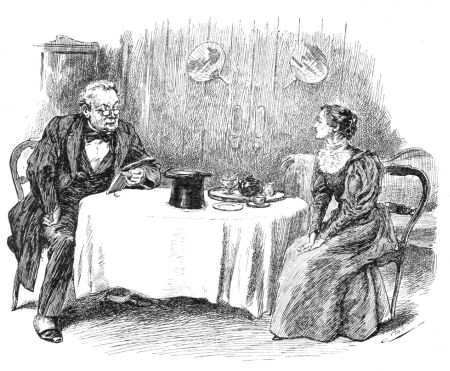
Miss Crane was too much astonished to speak.
Miss Crane lived in No.
13, King's Parade.
Doubtless at some
remote period
King's Parade was
a street of fashion
and celebrity, but
at the time we speak of its chief characteristic
was that air of shabby gentility inseparable
from houses in whose windows at intervals
appear cards announcing "Furnished Apartments."
Miss Crane was teacher of music by profession,
and had what is termed "a good connection."
By turns, music was her chief pleasure and pain.
During the day she patiently listened to endless
varieties of mistakes in the same exercises and
scales; in the evening, seated at her own piano,
she forgot all the cares and worries of her daily
round of duty.
Everyone has a sacred ambition, as well as a
secret romance, hidden in his heart. Miss Crane's
ambition was to save up enough money to ensure
independence, and she believed that to possess an
income of £100 per annum would be the realisation
of her dreams. For many years she had steadily
saved and worked for this purpose, and now, at
the age of forty-five, was not very far from having
her desire fulfilled.
Miss Crane was a little woman, with very pretty
hands, small and white. Years of patient drudgery
had left some lines on her forehead and had taken
the colour from her cheeks, but had not been able
to spoil the sweet kindliness of her eyes and smile.
She usually wore black gowns, made simply of
soft, fine materials, her lace frill fastened by a
small silver brooch, which she always pinned in
with loving care.
One day, towards the end of the summer term,
she came in more than usually tired, and sat
leaning back wearily in her chair, waiting for the
maid to bring in her supper. She heard below
stairs the scolding voice of the landlady and the
querulous crying of children. Through the open
window came the strains of a barrel-organ playing
with irritating liveliness. She closed her eyes
wearily as the servant came clattering up the stairs
and burst open her door with noisy familiarity.
"Please, miss," began the servant, laying down
the tray, "there were a gentleman t'see you when
you was out."
"Indeed!" cried Miss Crane, opening her eyes
with a start and sitting upright. "A gentleman
to see me! Did he leave his card?"
"No, miss," answered the girl. "He seemed
disappointed like when I told 'im you was hout,
and 'e said e'd call back again in th' evenin', as 'e
wanted to see you particular."
"Very strange," cried Miss Crane. "Well!
that will do now. Will you please come up in
about ten minutes to clear away the tea-things, as
I shouldn't like the room to look untidy if the
gentleman calls again?"
Miss Crane drank her tea in great perplexity.
A gentleman to see her! Such a thing had not
happened for more than twenty years. Who
could it be? Miss Crane's hand instinctively
touched her silver brooch, as her thoughts turned
to days long past.
A knock, a loud and impressive knock, at the
hall-door roused her from her reverie. She stood
up, listening eagerly, expecting she knew not
what. The maid came slowly upstairs from the
kitchen and opened the hall-door. There was an
indistinct sound of a gruff voice, and then the
footsteps of two people coming up the stairs.
The servant opened the door, saying—
"Mr. Spinner, miss."
A tall, imposingly rotund man walked in,
hat in hand, his fat and rosy face all smiling
affability.
"So sorry to disturb you, madam," he began,
bowing.
"Not at all," murmured Miss Crane, wondering
greatly who he could be. "Won't you sit down?"
"Thank you. I think I will."
He took a chair, sat down, carefully spreading
out the skirts of his frock-coat, and, crossing his
legs, looked condescendingly round the room.
Miss Crane, with heightened colour, waited
expectantly.
"I am well aware," began Mr. Spinner presently,
"that the name of business has to ladies a very
unpleasant sound; but I venture to say that Miss
Crane will find the little matter which has brought
me here this evening far from being a disagreeable
subject."
"Indeed!" murmured Miss Crane.
"But before I proceed further, allow me to consult
my notes." Mr. Spinner took out a spectacle
case, placed his glasses carefully on the bridge of
his nose, glanced at Miss Crane through them,
then taking a note-book from his breast pocket,
opened it, and taking out a paper, cleared his
throat and continued: "You are, I believe, Miss
Letitia J. Crane, eldest daughter of the late Rev.
Joshua Crane, M.A., formerly curate of St. Mary,
in the parish of Tulberry."
"Yes, certainly, I am," cried Miss Crane.
"Then, madam, without troubling you about
details, partly because business details are unwelcome
to ladies, and partly because I am obliged
to catch the 7.25 train up to town, I shall briefly
tell you what I am certain, from my previous
knowledge of human nature, will be welcome news
to you, and that is——"
"What?" demanded Miss Crane with some
impatience.
"It is that your uncle, the late John Crane, of
No. 8, Harbourne Street, Liverpool, who died on
the 27th of last month, has left you a sum which,
invested as it is at present, brings in an income of
£700 per annum—of," reiterated Mr. Spinner with
impressive solemnity, "£700 per annum."
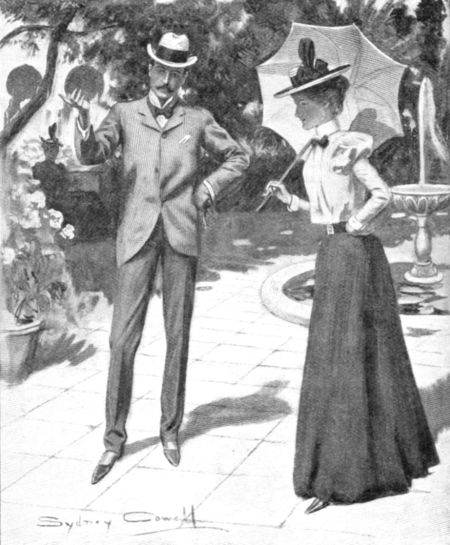
Miss Crane was too much astonished to speak.
"It is a fact, I assure you, madam," continued
Mr. Spinner, rising from his chair and placing a
card on the table. "Allow me to give you my
card with the address of my place of business.
Perhaps you could find time to call to see me
some time to-morrow, when I shall be most happy
to show you your uncle's will, and, in short, make
myself useful in helping you in any way in my
power."
"I cannot believe it," cried Miss Crane. "Are
you quite sure there is no mistake?"
Mr. Spinner smiled indulgently.
"None whatever, and if it should be a convenience
to you," he said, with a glance round the
neat poverty of the room, "I shall be happy to
advance you any reasonable sum as a proof of the
truth of my statement."
"No, thank you," replied Miss Crane, flushing
somewhat proudly. "I do not require it."
"Quite right! Quite proper!" said Mr. Spinner,
taking up his hat. "Then I may expect to have
the pleasure of seeing you to-morrow at, let us
say, 11.30 a.m."
"Yes," said Miss Crane, "I shall certainly call
at that hour."
"Then I may say good-bye, and," he added,
shaking her hand with impressive fervour, "pray
accept my heartiest congratulations on your good
fortune."
The bang of the hall-door as Mr. Spinner closed
it after him awoke Miss Crane from her stupor of
astonishment.
For a few moments she sat motionless. Then
she burst into a fit of violent weeping. Good
fortune had come at last, but had come too late
to bring happiness. All her youth had been
crushed beneath the weight of poverty, and,
bitterest remembrance of all! she had seen those
dearest to her die before their time, fading
uncomplainingly away, for want of a little of the
sunshine of prosperity. During all these years
she had thought of them as happy to be at rest
from toil and misery. In her poverty she had
never felt as lonely as she did now, in time of
her prosperity. Especially, a passionate longing
seized her for her mother. What delight to have
been able to gratify those simple wishes so often
repressed! How happy they could have been
together! She had wanted so little, but that
little had been ever denied her.
And Frank Whitman! The force of poverty
had swept him far apart. He had not been strong
enough to battle against the stream. She heard
of him sometimes as a man rising in his profession,
prosperous and respected. His marriage with the
daughter of a rich shipowner had been, everyone
said, "the making of him." And yet Miss Crane
remembered the evening he had given her that
silver brooch, and the words he had then spoken.
"Instead of thanking God for His goodness to
me," sobbed Miss Crane, "I am wickedly ungrateful,
but I do wish I had mother with me
now."
Next morning, Miss Crane took a more cheerful
view of things. She sent word to her pupils that
she could not see them that day, but she had not
yet sufficient belief in her good fortune to feel
justified in telling them of it. It was so near the
end of term that she did not like putting them
to the disadvantage and inconvenience of changing
to another teacher, and besides, she had not
courage to cut herself adrift from her usual
routine. Custom is a very strong rope indeed.
As she travelled up to town, she constructed
castles in the air of all the delights now possible
to her—the house in the country, the really good
piano, a silk dress, a thing she had always secretly
desired, for she had an instinctive love of dainty
dress, and the sight of a beautiful thing gave her
positive joy.
The further she went, the grander she became:
until after her interview with Mr. Spinner, she
actually felt bold enough to enter a fashionable
shop, and, unawed by the magnificence of the
attending maidens, she chose, paid for, and put
on "the sweetest little French bonnet possible."
On leaving the shop, she met an old pupil, who,
after a preliminary stare, greeted her warmly,
declaring she had never seen Miss Crane looking
so well, and asked her home to lunch.
Altogether, Miss Crane's day in town was a
complete success. She had been more wildly
extravagant than she could have believed it
possible the day before: there was something
positively intoxicating in the fact that there was
now no need any more to count every penny.
She knew it was false charity to give money indiscriminately
to beggars, and yet she could not
resist brightening, even for the moment, the face of
misery and want. "To-morrow, I shall be prudent
again," she declared, as over and over again she
stopped to slip a silver coin into some grimy hand.
In the evening, she sat, tired but very contented,
considering where she ought to go for
her holidays. The world was open to her now;
it was difficult to decide which part to visit
first. Entrancing visions of Italy especially
bewildered her, but she felt still too timid to
venture far from home, though that home was
but two shabby little rooms in a cheap lodging-house.
Like a bird caged for long, though the
door stood open, she feared to fly away.
Presently a thought struck her, her cheeks
glowed—she stood up and walked uneasily about
the room. At length she muttered to herself, "I
shall go there! I should like to see him once
again!"
The place she had decided to go to was Stockton,
the seaside town in which Doctor Frank Whitman
lived. She had known his wife long ago, when a
girl. She had heard there were a number of
children. Perhaps the family would receive her
kindly, and she would find in them the friendship
and companionship without which her money was
valueless.
Stockton was by the sea: to sit in the sunshine,
on the sands, looking on the waves, would
in itself be a delight. Miss Crane wished she
could start on the morrow, but this, of course,
was not possible. Ten days more of drudgery
must be first endured, then liberty at last!
These last days passed rapidly enough, for they
were fully occupied, and at length, on the 1st
of August, Miss Crane found herself seated in the
train, with a ticket to Stockton in her hand, a new
portmanteau beside her, and her heart beating
with excitement at being off at last.
When she reached Stockton and was driving
from the station to her lodgings, she eagerly
looked out of the window, half hoping, half
fearing to recognise Frank Whitman in each
passer-by.
She remained indoors that evening and the
following morning, but in the afternoon she unpacked
the contents of the portmanteau and
dressed to go out.
"After all, how little dress can do!" she murmured
to herself, as she stood critically examining
her reflection in the looking-glass. "I wonder
if he will remember me!"
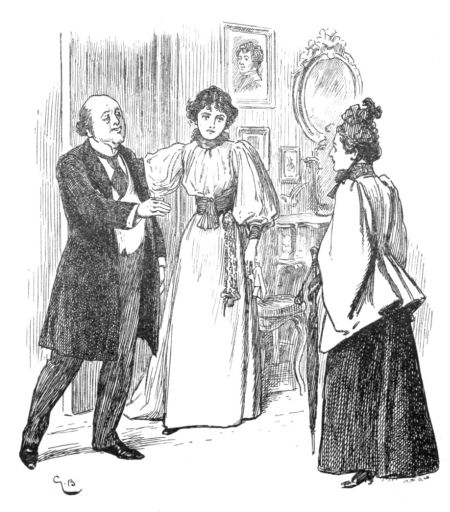
The blood rushed to Miss Crane's face.
The day was brilliantly bright, with a fresh
breeze blowing strongly from the sea. The
shadows of the fleeting clouds passed swiftly
by. The sunshine glittered on the dazzling
waters rippling in one long white line along the
margin of the bay. Along the horizon stood the
ruddy sails of the fishing-smacks.
Miss Crane walked on slowly, enjoying the
warmth, brightness, and freshness of the day.
She had little difficulty in finding Victoria Villa,
the residence of Doctor Frank Whitman. It was
a large red-brick house, square, well-built and
prosperous-looking, standing in its own grounds,
with greenhouses, tennis-grounds, and all the
usual belongings of provincial respectability and
wealth.
Miss Crane's courage failed her as she came up
to its entrance.
"What shall I do," she thought, "if Frank and
Bessie have forgotten me, or if they should not
like to know a poor little music teacher like
me?"
She stood, hesitating, fearing to push open the
massive iron gate.
"I cannot go in to-day," she said half aloud,
and turned nervously away.
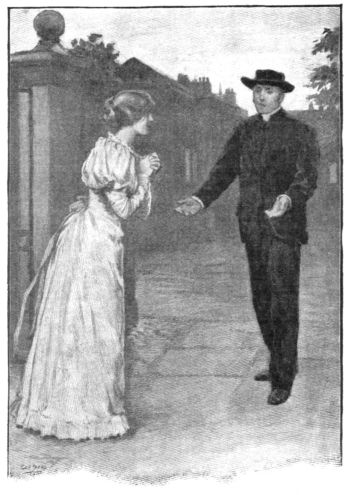
At this moment, a girl came quickly up the
road, a pretty girl of some eighteen summers,
wearing a white dress and shady hat, and carrying
a tennis racket in her hand. As she passed, she
glanced at Miss Crane, and the expression of her
eyes was precisely like that of Frank Whitman's
twenty years ago.
Miss Crane started. The thought, "It is his
daughter!" flashed across her brain. She turned
and hurried after her. The girl, hearing the
footsteps behind, stopped, and looked inquiringly
at Miss Crane, who hesitatingly began, "Might I
trouble you to direct me to Doctor Whitman's
house?"
"There it is," answered the girl smilingly.
"And I am almost sure father is in at present.
Will you come with me? I am just going home."
She spoke with a strangely familiar accent, she
smiled with the same merry glance, quick and
soft, which Miss Crane had remembered so long.
By the time they had reached the hall-door
Miss Crane had confided how she had come
hoping to find old friends, and then had felt too
timid to enter their house. "And," she ended,
"if I had not met you, my dear, I believe I
should have gone straight home."
The girl laughed merrily, and then warmly
assured Miss Crane that Mrs. Whitman would be
sure to be delighted to see her. "And," she
asked, "you said you used to know papa also a
little, long ago, didn't you?"
"Yes," replied Miss Crane. "I knew him also."
"Here, mother," cried Miss Whitman, as she
opened the drawing-room door; "here is an old
friend to see you!"
Miss Crane advanced into the room. A tall,
fashionably-dressed woman came to meet her
with outstretched hand.
"What!" she exclaimed. "Letitia Crane!
Well! I am glad to see you. What a time it is
since we've met. But you've hardly changed at
all. I should have known you anywhere. Sit
down here and let us have a good long chat about
the old days. Ida! go and tell your father that
Miss Crane is here; I'm sure she'd like to see
him."
Miss Crane sat down, grateful for being received
with such cordiality. It was difficult to talk, her
whole being seemed concentrated in listening.
She heard Ida go downstairs, open the study door,
and then came the sound of a voice she had not
heard for twenty years.
"How silly I am!" she thought, as she tried to
concentrate her attention on what Mrs. Whitman
was saying.
Presently footsteps came up the stairs. The
door opened, and Ida, followed by her father,
came into the room. The blood rushed to Miss
Crane's face, and for a second she could not see.
"So glad to see you again," said Doctor Whitman,
in tones of bland cordiality.
Miss Crane could scarcely reply, her astonishment
was so complete. Where was the man she
remembered? The young fellow with the merry
laughing eyes, the thick curling hair, the careless
dress, the active step! The man who now stood
before her was a portly, middle-aged figure, all
immaculate linen and broadcloth; bald-headed,
red-faced, with bland affability smilingly displaying
an excellent set of false teeth. The ideal
which Miss Crane had worshipped so long faded
away for ever like some phantasm that had never
had any being, save in her own mind. Only in
Ida's eyes and Ida's smile lingered a mocking
image of the past.
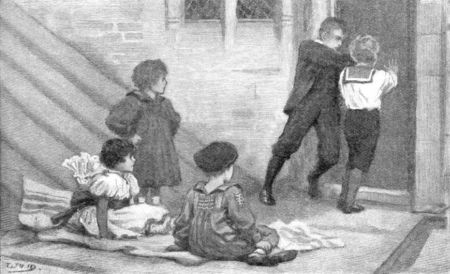
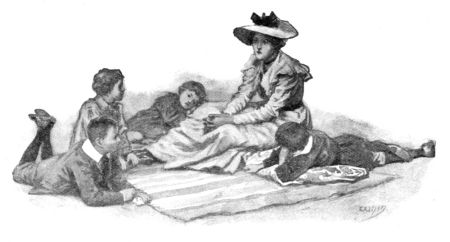
Miss Crane's time passed very pleasantly at
Stockton. Most of the day she sat on the beach
watching the children bathe and play about the
sands.
Ida came down to bathe every morning, and
afterwards used to sit talking to Miss Crane while
drying and brushing her beautiful hair in the
sunshine. One day, after sitting thoughtfully
quiet for some time, Ida, in a somewhat embarrassed
tone of voice, began—
"Are you fond of going to evening service, Miss
Crane?"
"Well! my dear, you know that usually I have
not time to do so on week-days. But why do you
ask?" replied Miss Crane.
"Because," said Ida, "there is such a sweet
little church not very far from here out in the
country, and such a delightful service every
evening, and," she added with heightened colour,
"the curate, Mr. Archdale, preaches such beautiful
sermons that I would like you to hear him!"
"I should like to hear him very much indeed,"
replied Miss Crane, smiling. "If you will not
expect me to praise him too much!" Then,
pitying Ida's confusion, she continued: "Perhaps,
sometimes, he will allow me to play the organ in
his church. It is the only thing I miss here. At
home there is a little church quite close by, where
the organist allows me to practise whenever I
choose."
"Oh! I shall ask Cyril—I mean Mr. Archdale,"
cried Ida, blushing deeply. "I'm sure he will be
delighted to allow you to practise whenever you
like."
Thus it happened that almost every evening
Miss Crane and Ida walked together to the little
country church; and then, after service was over,
Miss Crane sat down at the organ and played,
while Ida and Mr. Archdale listened to her, as
they sat in the porch or strolled about beneath the
lime-trees; though it was curious, thought Miss
Crane, how seldom it was, for people who professed
to love music, that they remembered what she
had played. Then in the increasing twilight the
three walked back to Stockton together quietly,
too happy to talk or laugh much.
The mornings on the beach were spent in talking
of "Cyril," for the subject interested Miss Crane
almost as much as it did Ida. She was touched
by the young people's confidence in her, and their
love revealed their characters in the most favourable
light to her. Her love for Ida equalled her
admiration of her, and she believed Mr. Archdale
to be almost worthy of her.
The holidays were drawing to a close, and Miss
Crane decided that she ought to delay no longer
in telling her pupils of her change of circumstances;
but, always reticent about her own concerns, she
put off doing so from day to day. Even to Ida
she had never spoken of her good fortune.
There was a charming house quite close to the
church, which Miss Crane had determined to buy—quite
an ideal old maid's cottage, she thought it,
with its red-brick walls hidden by climbing roses,
its garden sloping down to the riverside, and its
cosy little rooms quaintly furnished with old oak.
Its late owner had died and it was now to be sold,
with all its belongings.
Miss Crane determined to buy it, and then, when
everything was arranged, to astonish Ida, Mr.
Archdale, and the Whitmans by inviting them to
dinner in her new house, and then telling them
the delightful news of her good fortune.
She felt very happy in anticipation of this
coming pleasure.
She was never tired of imagining the joyful surprise
Ida would be sure to show, and the merry
days they would have together, arranging the new
house.
On the day fixed for seeing the house-agent and
finally deciding on the purchase, Miss Crane had
asked Ida not to expect to see her, "for," she said
gaily, "though but a humble little music teacher,
I have some business matters to see about."
"Then," cried Ida, "I shall come and see you in
the evening, for Cyril has determined to speak to
father in the morning, and I must tell you how
everything goes off, though I'm not in the least
afraid, notwithstanding all Cyril's forebodings."
"Why? What is he afraid of?" asked Miss
Crane.
"Well, you know," said Ida, in melancholy tones,
"Cyril is not very rich. Clergymen never are, are
they?"
"But," remonstrated Miss Crane, "surely he
has some means or he wouldn't think of marrying?"
"He has," answered Ida; "he has £300 a year,
which seems to me a great deal of money, but
whether it will do so to papa is the question."
"Oh!" cried Miss Crane cheerfully. "Your
father is a rich man, and very proud of his pretty
little daughter; he will make it all right for you,
never fear."
Ida flung her arms round Miss Crane's neck,
called her "the dearest old thing in the world,"
and at last, promising to come the following
evening, hurried away.
The next day was very stormy. The wind blew
in great gusts from the east, rolling the waves in
dashing breakers against the rocks. The rain
descended in torrents. It was one of those days
which sometimes come in autumn, precursor of the
deadly tempests of the winter.
Miss Crane sat indoors, a shawl over her
shoulders, writing letters round to her various
employers and pupils, announcing the change in
her circumstances. She had just closed the last
envelope, and was putting the stamp on it, when
the door burst open, and Ida rushed wildly into
the room, her hair blown about her shoulders by
the wind, and her waterproof cloak streaming
with rain.
"Why, Ida, my dear!" exclaimed Miss Crane,
aghast. "What is the matter?"
Ida threw herself on the sofa, sobbing violently.
"Oh! I don't know whatever I shall do," she
began, as Miss Crane knelt down in alarm beside
her. "Papa has been most dreadfully cross and
angry with me, and he called Cyril a——" She
stopped, her voice choked with sobs.
"A what?" demanded Miss Crane.
"He—he called him a——" said Ida, with
another burst of indignant sobs, "a beggarly
curate!"
"Then he does not personally object to Mr.
Archdale?" said Miss Crane soothingly.
"How could anybody object to Cyril personally?"
cried Ida, angrily rolling up her pocket-handkerchief
into a tight, wet little ball and rubbing
her eyes with it. "No; it is all on account of
him not having enough money. He says he will
never let me marry a man that has not at least
£1,000 a year. And where is Cyril to get all
that! Unless he is made a bishop, and he hasn't
a chance of being made that until after years and
years and years of waiting, when he is old and
quite bald!"
At this mournful idea Ida's face again squeezed
up into dismal lines and puckers, and her sobs
broke forth with renewed strength.
Suddenly Miss Crane became so motionless, so
quiet, that at last Ida's curiosity overcame her
grief; she put down her pocket-handkerchief and
looked at Miss Crane with pained astonishment
at her want of sympathy.
Miss Crane came out of her reverie with a start.
"Don't cry any more, it will all come right," she
said, with a forced smile.
"That's what everyone says!" cried Ida in the
tone of injured friendship. "But I did think you
would have sympathised with one."
She arranged her hair, put on her hat, and
stood up as if to go away, expecting Miss Crane
would make her stay; but Miss Crane sat
motionless, staring fixedly out of the window.
"Good-bye, then!" said Ida stiffly.
"Good-bye, my dear," replied Miss Crane.
"I never saw anyone so horrid and unsympathising,"
muttered Ida, as she closed the door
after her. "I wouldn't have believed it."
Miss Crane sat for more than an hour motionless,
thinking. She sighed deeply now and again.
At length she stood up, and, taking the pile of
letters she had written, tore them all up into
fragments; then, putting on her bonnet and
waterproof cloak, she went out and did not return
home until late at night.
"Why, miss!" cried the landlady, as she came
in white, tired, and wet; "you'll get your death
stayin' out of doors such a day as this!"
"No," said Miss Crane gently. "It will do me
no harm. I was obliged to go to town on business.
I am sorry to have to tell you that I must leave
you on Saturday."
"I'm sorry indeed to hear it," said the landlady.
"Isn't that very suddint like?"
"Yes," agreed Miss Crane; "it is very sudden."
On Saturday, as Miss Crane was packing her
trunk, suddenly Ida came bounding up the stairs
into the room, all radiant with smiles and gaiety
and flung her arms round Miss Crane's neck,
exclaiming—
"What do you think has happened I Oh! it's
just too delightful. Somebody has given Cyril
£700 a year—somebody who refuses to give
his name. We're all dying with curiosity to find
out who it can be. I'm certain it is somebody
who has heard Cyril preach. Don't you
think it is?"
"Yes," agreed Miss Crane. "Very likely it is."
"And now," continued Ida, "everything is
settled so nicely, and we're to
be married at once. I only wish
we had room at home to ask
you to stay with us for the
wedding. You dear old thing!
I believe I was cross and horrid
to you the other day, but really
I was so distracted that I didn't
know what I was saying. And now, dear, I must
be off, for Cyril is waiting for me."
She kissed Miss Crane and hurried off.
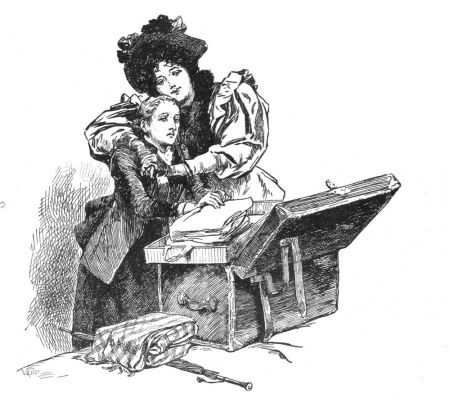
Ida flung her arms round Miss Crane's neck.
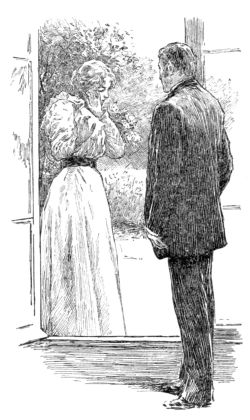
Miss Crane stood in the window watching, with
dim eyes, the young pair walking down the street.
A kitten came and, mewing, rubbed its soft little
head against her foot. She stooped, stroked it
gently, saying—
"Pussy, are you lonely too? for I am—very."
PARABLES IN MARBLE.
A story is told of a late Bishop
of Peterborough, to the effect
that at a public dinner he said
that he once bought a picture
of a sunset on a river, which he hung in
his study; it was a bad picture, but it
had a beautiful influence over him, and
he confessed that when he looked at the
picture "a curate might play with him."
FAITH.
(By Alfred Drury.)
The Bishop without doubt knew a
good work of art when he saw one, and
his knowledge informed him that technically
his "sunset on a river" was bad;
but it appealed to his sentiment and
occupied its place on the study wall in
spite of its defects. In this respect,
most people are with the Bishop; it is
not so much the quality of a work of
art that makes it popular, but the particular
strain of sentiment it contains
that touches a responsive chord in the
hearts of those who look at it. The
English public are sentimentalists first
and foremost in art, and the artist who
receives the greatest acclamation is he
who is most skilful in this direction.
And if this is so in respect to painting,
how much more so is it with regard to
sculpture. Public enthusiasm is rarely
roused by the sculptor's art. Next to
the architectural room at the Royal
Academy, the sculpture hall is the least
frequented, and we fear it must be said
that the majority of those who do go
there go because it is the coolest place
in the exhibition.
This, of course, is matter for regret,
for there are as ennobling and inspiriting
works of art to be seen there as in
the picture galleries. The sculptor has
the power to appeal to our ideals and
aspirations to as great an extent as the
painter, limited though he be by his
materials. (It can at once be realised
that the worker in marble has not the
same freedom as he who uses paint and
canvas—he has greater difficulties to surmount,
less subjects to choose from, and
far narrower scope in which to express
his thoughts.) We have had "sermons in
stones" which have been quite as powerful
as any preached by painter or poet.
The classical tradition has undoubtedly
affected the sculptor more than it has
his brother-artist of the brush; it has
weighed him down, and made his work
cold and lifeless; and men and women
of to-day want art that is living, helpful
in their daily straggles, responsive
to those aspirations which every one of
them possesses in a measure. As a distinguished
member of the Royal Academy,
now dead, once wrote, "We have aspirations,
we reverence something more
than the ordinary life of mortals; we
have before our eyes an ideal of truthfulness,
piety, honour, uprightness, love,
and self-sacrifice greater than any which
exists on earth." To appeal to these
emotions by a beautiful and living art
should be the object of our artists, and
those who do can be sure of receiving
the approval and the gratitude of the
toilers of the world. This has been
proved over and over again by the
votes taken at Canon Barnett's picture
exhibitions as to the most popular works
shown, when men like Mr. G. F. Watts,
R.A., and the late Sir Edward Burne-Jones
have been first favourites. And
this probably accounts in a measure for
the public indifference to works of
sculpture. The sculptor has for the
most part neglected subjects which
appeal to the hearts of the people of
his day, and based his work on classic
models and precepts.
In saying this we do not in any wise
belittle the great works
of the past. It is impossible
to look on the
mighty works of the
ancient Egyptian
workers in stone without
feeling the sense
of awe which the
people of those days
must have experienced—and
were intended to
experience—when gazing
upon them. Mystery
is the keynote of
Egyptian sculpture,
mystery deep and unfathomable.
Look
upon those inscrutable,
gigantic faces in the
British Museum; coldly
inhuman; giants of
stone, indifferent to the
passions which pulsate
in the human breast.
Mighty works indeed—parables
impossible of
interpretation!
Look, too, at the
works in the Assyrian
galleries of the same
collection. Marvellous
of execution, they again
draw forth admiration
for the skill of their
creators, for their
dexterous records of
the life of those far-off
days, for the massive
and imposing
decorativeness of the
semi-human lions and bulls. And then,
coming down the ages, consider the
beauty of form of the works of the
sculptors of classic days; the wondrous
productions of the Greeks, the perfection
of line and grace of these representations
in stone of the "human form divine."
Masterpieces of the world which will
never be excelled as works of art,
they, nevertheless, do not appeal to the
hearts of the people, and in adhering
to the style of ancient Greece our
sculptors have themselves to blame for
the lack of popular sympathy.
MOTHERHOOD.
(By Alfred Gilbert, R.A. In the possession of Sir Henry Doulton.)
The sculptors of Italy who shared in
the revival of art in the fifteenth
century understood this. Without
sacrificing in the least the beauty of
the classic artists, they infused into their
work that touch of sentiment—either
religious or frankly human—which won
for them the admiration of their contemporaries,
and enables them, though
long since dead, to speak to us through
their art. The charming creations of
Donatello, the delightful child-forms of
Lucca della Robbia, the gigantic creations
of Michelangelo—gigantic both in
conception and execution—appeal to us
primarily for the humanity which they
reflect: admiration for their beauty
follows in due course.
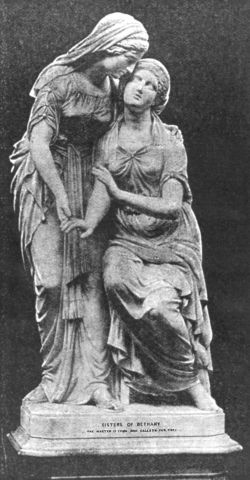
THE SISTERS OF BETHANY.
(By Warrington Woods.)
Until comparatively recent years English
sculptors have failed to appreciate this
public taste, and the public work all
through our country has been deplorably
lacking either in sentiment or art. The
ghastly figures which are exposed in
London streets rouse no enthusiasm,
and only claim attention because of the
men of which they are memorials.
Curiously enough the only really
beautiful piece of allegorical sculpture
in our city is the work of a
Frenchman, and that is smothered
under a hideous cupola! I refer to
the charming little group symbolising
"Charity," on the drinking
fountain by the Royal Exchange.
This beautiful figure of a woman
and two children the work of Dalou,
was originally shown in stone, but
the ravages of the London climate
destroyed the features of the figures,
and it was only when replaced by
a bronze cast of the original model
a year or two ago that its full
beauty could be appreciated by the
present generation. The symbolism
is not intricate, the parable can be
read by the most ignorant, and
understood by all, but it is "a
thing of beauty," and therefore a
joy for ever.
The English sculptors who are
claiming attention to-day are men
influenced largely by the spirit of
"modernity." They are giving us
works which appeal to our sentiment
as well as to our sense of
beauty. Look, for instance, at the
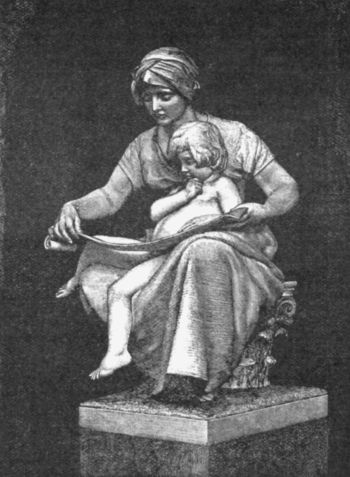
charming group by Mr. Alfred
Gilbert, R.A., which is illustrated
on page 345. One wishes that the
original could be placed in position
where people could see it every
day. It is a simple subject, but
what greater lesson can be enforced
upon us than that of the holiness
and purity of a mother's love and
solicitude for her child? There is
in one of the public squares of
Paris a group very similar to this
by Delaplanche. A mother is again
giving her child its first lesson
in reading. Tender and pure in sentiment,
it is an object lesson to all who
behold it.
The nobleness and dignity of labour
provide our sculptors with a manifold
variety of subjects, but there are not
many English artists who have availed
themselves of it. Among these, however,
is the distinguished Royal Academician,
Mr. Hamo Thornycroft. "The
Sower Scattering Seed" is but the representation
of an English farm "hand,"
but it would be difficult to find a piece
of work among English sculptures to
excel it in grace and beauty of line. The
artist has executed another work of "A
Mower"—again an English farm-labourer,
leaning on his scythe—which is another
example of his skill in the adaptation of
a subject which can be understood and
appreciated by every man, down to him
who actually wields the scythe.
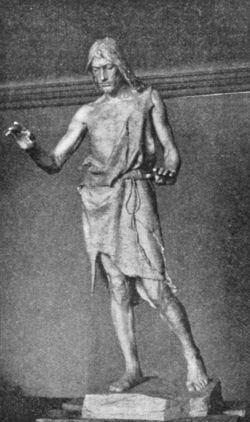
ST. JOHN THE BAPTIST.
(By W. Goscombe John.)
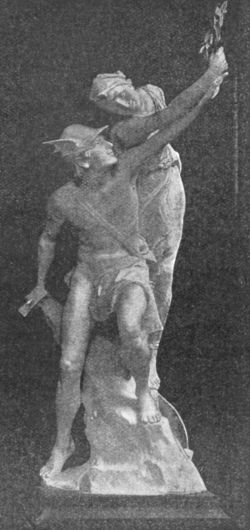
THE MOUNTAIN OF FAME.
(By A. C. Lucchesi.)
Biblical subjects have found exponents
in sculpture to a very large extent from
the days of the Renaissance downwards.
The old Italians decorated their churches
with such to almost as great an extent
as the painters of their time did; and
many sculptors to-day find their inspiration
in Scripture in like manner. We
have chosen some for illustration in this
paper—two by living artists, and one
by Warrington Woods, a sculptor who
lived some years ago, when "classic"
style and subject were deemed necessary
by the workers in the sculpturesque
arts. "The Sisters of Bethany"
is infected by this spirit, but is, nevertheless,
pleasing to a certain extent.
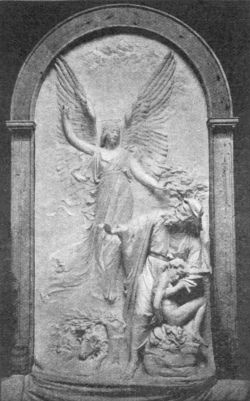
The "Faith" of Mr. Alfred Drury, is,
on the other hand, distinctly pictorial
and frankly illustrative of the subject.
The "St. John the Baptist," by Mr.
Goscombe John, another of our rising
sculptors, is a beautiful figure which
belongs to the Marquis of Bute, and
stands in the centre of a fountain basin
in the garden of St. John's Lodge,
Regent's Park.
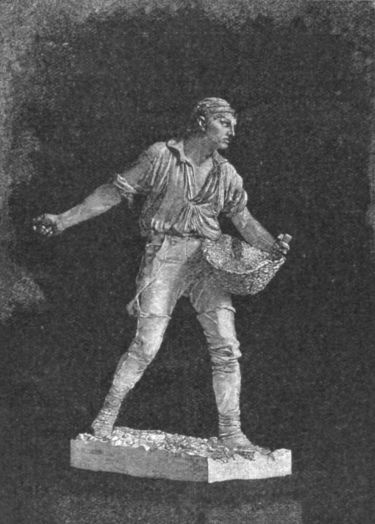
THE SOWER.
(By W. Hamo Thornycroft, R.A.)
On page 347 is the most ambitious of the
allegorical works among our illustrations,
and is the work of Mr. A. C. Lucchesi, a
young sculptor of whom great things may
be expected. "The Mountain of Fame"
represents a warrior, who, struggling to
acquire the laurel wreath, has in his
efforts thrown away sword and shield
and is reaching after the honour which
is held temptingly before him by the
figure of Fame. Almost within his
grasp, it yet eludes him, and the rough
path up which he has stumbled has
not yet brought him to the summit. His
weapons, cast aside in the assurance of
victory, are left behind; but the wreath
is still not his, and he is helpless against
further dangers which may await him;
the eagerness for fame may prove
his ruin and all his strivings end
in disaster. Readers of Miss Olive
Schreiner's "Story of an African Farm"
will remember the beautiful parable
upon this subject, and I asked the sculptor
if this had influenced him at all
in the work. The suggestion was almost
a revelation to him, for, although he
had read the book and remembered
vividly this particular passage, yet confessed
that it was quite out of his mind
when he modelled this group. But the
influence of the story is distinctly
visible.
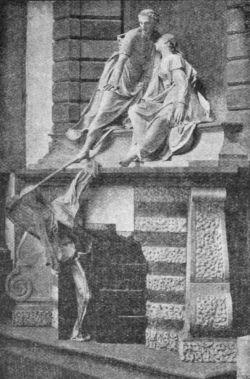
(Photo: York and Son, Notting Hill, W.)
THE NIGHTINGALE MONUMENT IN WESTMINSTER
ABBEY.
(By Roubiliac.)
Memorial sculpture, of course, forms a
large part of a sculptor's work, and the
example by Mr. Armstead illustrated on
this page is typical of a great many of
the kind. The most beautiful and dignified
monument we possess is without
doubt Alfred Stevens' great work in St.
Paul's Cathedral in memory of the Duke
of Wellington—one that can never be
sufficiently admired, contrasting as it
does with the grandiose monuments of
the last century in the same building and
at Westminster Abbey.
We illustrate on this page one of
the most curious monuments in the
latter building. It is the work of
Roubiliac, a Frenchman who worked
in England in the eighteenth century.
The tomb is that of Joseph Gascoigne
Nightingale, of Minehead, Somersetshire,
and of the Lady Elizabeth, his wife,
who died soon after her marriage.
From the dark recesses of the tomb
below issues the skeleton form of Death,
in the act of hurling his lance at the
wife, while the husband leans forward
with extended arm to ward off the fatal
blow from his loved partner, who is sinking
to rest beside him.
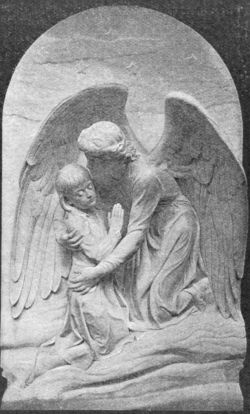
MEMORIAL TO AN ONLY DAUGHTER.
(By H. H. Armstead, R.A.)
Death, however, can be represented
far better than by a ghastly skeleton, as
Mr. George Frampton, A.R.A., has proved
in his dignified "Angel of Death" which
stands in the Camberwell Art Gallery.
This figure of a young man, carrying the
traditional scythe across his shoulder and
an hour-glass in his hand, reminds us
of Mr. Watts' constant representation of
the "grim messenger"—no longer "grim,"
however, but beautiful, erect, inviting—the
harbinger of the land where there
shall be no more tears, neither sorrow
nor sighing.
Arthur Fish.
CHAPTER X. — STRANGERS IN A STRANGE LAND.
London was under drizzle
when the four-wheeler
containing
Mr. Graydon
and Pamela drew
up at Lady Jane
Trevithick's house
in Brook Street.
As the time
came for saying
good-bye to her
father, Pamela's heart sank lower and lower.
By the time the cab stopped it was a mere
dead weight of foreboding and depression.
One minute she looked at her father with
blank despair. It was in her heart to put her
arms about his neck and cling to him and
refuse to leave him, as she had done when a
small child and insubordinate to nursery rule.
But the minute's glance checked the impulse.
He was not thinking of her: he was wholly preoccupied:
as she watched him, his lips moved
as if in conversation with someone.
"'Ere you are, sir. This is the 'ouse," said
the old cabman, not offering to budge from his
box.
Mr. Graydon jumped out and knocked at the
door. While his hand yet held the knocker
the door was flung open by a pompous
servant.
"Here, my man, lend me a hand with this
lady's luggage. The jarvey seems old and
incapable," he said brightly to the functionary.
The man came out unwillingly into the
rainy street. The sight of the four-wheeler
with its poor little trunk brought a look of
amazed contempt to his face. But Mr.
Graydon was not thinking of him.
When the luggage had gone in, he took his
daughter from the cab.
"No, thank you. You need not wait," he
said to the cabman as he followed Pamela up
the steps.
"Her ladyship is in the drawing-room, sir,"
said the servant, impressed, despite himself, by
the shabby visitor's easy air of command.
"Ah, thank you, I am not coming in. Good-bye,
Pam, darling. I'll get the night-mail back.
Be sure and enjoy yourself, and give Lady Jane
my kindest regards."
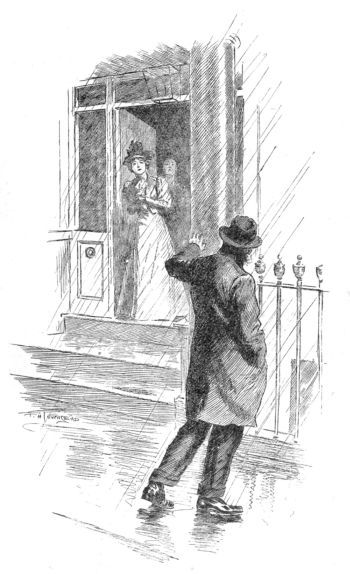
He kissed her hastily, unconscious of the
supercilious eyes of the footman. Then he
turned towards the wet street.
Pamela stood in the hall, looking after him
with her miserable heart in her eyes. He went
down the steps with his hands deep in his
shabby overcoat pockets—for he carried no
umbrella—and his soft hat pulled down over
his eyes. Another minute and he would be
out of sight. A wave of intolerable loneliness
rushed over his daughter's heart as she
saw him vanishing and leaving her alone
among strangers.
"Papa, papa!" she cried.
The genial, kind face was turned back to her
for an instant. Her father's hand waved a
farewell. Then he was out of sight, and she
became conscious that the weary footman,
forcedly polite, was holding the door open for
her.
"Her ladyship is in the drawing-room," he
repeated, and there was rebuke in his voice.
Pamela drew back, and he shut the door.
"Poor little Pam!" said her father as he
walked along briskly. "She will be home-sick
to-night; to-morrow she will be better content,
and the day after she will begin to enjoy
herself."
"And now, let me see," he said. "This turn
is it, for Hill Street? I ought to know the
way, though it is so many years since I took it.
I hope I shall catch his lordship before dinner.
If I'm obliged to disturb him, he'll be in a
horrible rage, and things won't be propitious.
Anyhow, at the worst, I'll have time to eat
something at the station before I catch the
mail. Perhaps his lordship will ask me to
dinner if things go well."
He smiled so cheerfully, showing a row of
even white teeth, that a wretched girl, carrying
an infant, was moved to beg of him. He
handed her a shilling, to her unbounded
amazement.
"There goes part of my dinner," he said to
himself. "Never mind: she needs it." And
then to the astonished beggar: "Go home,
my girl, with that poor little chap. It is no
night for him—or you either—to be out."
Presently he came to a huge house, showing
a dim light here and there in its black front.
He knocked with a tremor of heart.
When last he had knocked there he
had stood at the threshold of new
life and joy. The rain dripped from
his soft hat and hung in beads of
moisture on his grey moustache. It
soaked unheeded into his thin overcoat.
The door was opened by an old
man-servant. He peered in wonder
at the shabby-looking stranger, who
stepped so unquestioningly within
those gloomy portals.
"Is his lordship in town?" asked
the intruder. "Why, Thorndyke!
It is surely Thorndyke?"
"Yes, I am Thorndyke," said the
man. "But I don't think I know
you, sir. Let me see."
He turned on the electric light
into the front part of the hall, and
brought his dim old eyes nearer to
Mr. Graydon's face.
"Why, it is Master Archie!" he
said quaveringly. "Master Archie
after all those years! And how
are you, sir? Are you well?"
"Quite well, Thorndyke. Can
I see my uncle? I want very
particularly to see him."
"He's none too pleasant," whispered
the old man. "He has a
touch of gout, and the little
master's been ill. They've ordered
him to Cannes."
"Indeed! I'm sorry for that.
I thought he was a hearty little
chap."
"So he was, so he was, till a
few months gone. He's never
recovered a heavy chill he took
at the beginning of the winter.
His lordship's bound up in him,
and it do fret him to see Master
Lance dwindle."
"Ah! I am very sorry," said
Mr. Graydon, and a cloud came over his
face. "I am sorry for the boy and for his
lordship, too. Health is a great blessing,
Thorndyke."
"It is, indeed, sir. I am glad you have
yours. Come in here, sir, and I'll let his
lordship know."
He opened the door of a room lined with
books in heavy bindings, and motioned Mr.
Graydon to enter. The atmosphere was close
and warm, though the fire was low in the
grate. But Mr. Graydon did not notice that
his wet coat was steaming, and that he felt
damply and uncomfortably warm. He had
other things to think of.
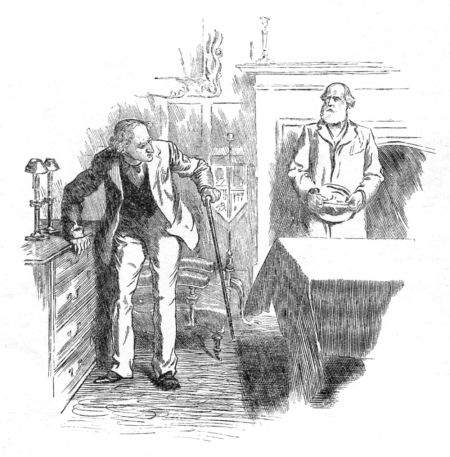
Presently the door was sharply opened, and
a red-faced, irascible-looking old man came in.
He glared fiercely at his visitor as he hobbled
to a chair.
"Well, Archibald," he said, using the name
as if it were distasteful to him. "To what am
I indebted for the honour of your visit after all
those years?"
"I would have come before, sir, but for your
own words."
"I'm not unsaying my words. They are as
good now as they were then."
"Twenty-five years is a long time. Can't
you forget and forgive?"
"I neither forget nor forgive. You did me
an injury past forgiveness."
"It was no injury; Mary had chosen me."
"You chose your own lot
in life. I have not interfered
with it. Why do you come
here?"
The old man grinned fiercely as if he
had had a spasm of pain, and bit his under
lip hard.
"I am sorry to have come when you are
not well."
"Your visit would have been unpleasant at
any time. Why do you come?"
Mr. Graydon took up his soft hat.
"I came partly out of hard necessity,
partly because I hoped that after all the
years you would have forgiven me. But
there is no use in my staying, I see. I am
sorry to have troubled you, sir."
"Say out what you have got to say, man.
I don't know whether you know that I have
an heir in your place? You have buried
yourself so that you may well not know."
"I am glad you have a son, sir."
The old lord grunted.
"Your business, man, your business. I
can't wait on you all night, and in five minutes
the dinner-bell will ring."
"My business is very simple. I have three
girls. One of them would marry after my own
heart and hers; but poverty stands in the
way. I was brought up as your heir. I
thought perhaps that, remembering that fact,
you would help my girl."
"You mean by giving her a dowry?"
"You are very rich."
"The time was, Archibald, when I would
have given ten years of life to have heard you
ask this and to have refused you. I refuse
you now, but it is because everything is for
the boy. I am old, and even my appetite
for revenge has deserted me."
"You owe me no revenge, sir."
"We think differently. Why did you cross
my path? Why didn't you marry that woman
who wanted you—Dunallan's daughter?"
Mr. Graydon looked thunderstruck.
"You have forgotten, sir; Lady Jane married
my friend Gerald Trevithick."
"Because she couldn't marry you. He was
an idiot to marry her. Everyone saw her infatuation
but he and—am I to believe?—you."
"Impossible," muttered Mr. Graydon; "I
barely knew her. I never thought of her."
The old lord waved away his words contemptuously.
"She had no money, but she had connections,
and she would have had ambitions
if she had married you and not Trevithick.
The woman was head over ears in love with
you, man."
"I can't believe it, sir. But let it be. It
is all five-and-twenty years ago."
"And Mary is dead, and you have three
girls."
"Yes, sir."
"Are they strong—are they healthy?"
"Yes, thank God. They are all a father's
heart could desire."
"Ah! you have scored again. You married
the woman we both desired. You have
strong children, and I—my boy is not strong."
His face twitched with more than the pain
of his gout.
"I am very sorry, sir. I hoped he was
strong."
"I didn't ask for your pity, Archibald."
"I can't help being sorry, all the same."
"But you've outwitted me. I married a
peasant—almost a peasant—that my heir in
your place might be strong. He is—not
strong."
Again the bitter spasm crossed his face,
and the sight of it wrung Mr. Graydon's
kind heart.
"I pray that he may become strong," he
said earnestly; "God is good."
"Anyhow," cried the old man with sudden
fury, "I shall not break up his inheritance. If
he lives to do that himself one day, let him.
It is like enough he would. He does not
take after me. But he is my only son."
The dinner-bell pealed loudly through the
house.
"Go!" said the old lord. "You have upset
me. I shall not be the better of your
visit for a week. Go back to your girls, and
come here no more. Be thankful they are
strong. Money is not everything."
He shuffled out of the room, and Mr.
Graydon followed him.
"Show this gentleman out, Thorndyke,"
he said, and went without a word of farewell.
"Let me get you a little refreshment,
Mr. Archie," said the old servant. "Do, sir!
Dear, dear! you are very wet, and to think
you have to turn out again without your
dinner!"
"No, thank you, Thorndyke. I shall do
very well till I get to Euston. I shall
have some dinner there before the train
starts."
"You are going back to Ireland to-night,
sir?"
"Yes, Thorndyke, I must."
"Dear, dear! and you are very wet. Can
we do nothing for you, sir? My wife—I
married Mrs. Ellis, the housekeeper; you remember,
sir?—would be so fretted to see
you going off like this. Do let me get you
something, sir?"
"Nothing, thank you, Thorndyke, nothing.
But it is very kind of you, all the same. I
remember your wife very well. She was
good to me in old days. Give her my love,
Thorndyke, and good-bye."
"Good-bye, till happier times, sir," said the
old servant, as Mr. Graydon went out in the
streaming night.
The lights of a hansom blinked through
the rain as he turned north-eastward. He
put his hand in his pocket and took out a
few coins, and looked at them.
"No," he said, "I can't afford it. I must
walk part of the way, and 'bus the rest. I
shall just have time to do it."
But by the time he got to Euston he could
only snatch a few fragments of food. And
so it was wet, chilled, and half-fed that he
made his return journey.
His uncle's suggestion about Lady Jane
disturbed him oddly, though he tried to
thrust it from him as impossible; but it recurred
again and again.
"After all," he thought at last, "it might
explain why she sought us out, and why she
wanted Pamela. If I unwittingly did her
the injury that she should have cared for
me, who had no love to give her, it would
be like a woman's generosity to repay me
in that way. Ah! but women are better
nowadays. She must have been a happy
woman with Gerald, happier than with
a worthless fellow like me, who could
bring her neither honour nor glory. Ah! if
it is true, and she should repay my Pam
with happiness, how wonderful it would
be! And there is no goodness which is
impossible to a woman, praise be to the
Source!"
Despite the damp and discomfort, his
thoughts made him fall asleep with a smile
on his face.
CHAPTER XI. — AN EVENTFUL EVENING.
"Why did you do it, Auntie Janie?"
asked Lady Kitty.
"Do what, darling?" answered
Lady Jane in the tone that was
reserved especially for her pet.
"Better leave her to me, Auntie Janie."
"Why, ask that poor little thing here.
You know you don't like her a bit, and
she's as home-sick as ever I saw anyone.
Why don't you pack her off home
again?"
"I asked her because—because—they were
kind to Anthony, and it was only civil to
do it, and because it ought to be a pleasure
to the girl herself."
"Now you know you didn't, Auntie Janie,
and you needn't tell me. It's not like you
to do a shady thing first, and then tell a
story about it."
"Kitty!"
"Yes, I know it's shocking of me. But
I've always found you straight. Where you
disliked you disliked, and made no pretence
about it. But now you're playing a part
for some reason or other, and I don't like
you in a part."
"I think you're a rude, spoilt child,
Kitty."
"I know I'm spoilt by you, and you're
forcing me to be rude. It isn't like you, as
I said before, and so I thought I'd ask you
why you did it. You've become tortuous,
Auntie Janie, ever since the day Anthony
left for Washington. I don't recognise you
as a tortuous person, and, frankly, it makes
me uncomfortable."
"What fault have you to find, Kitty, with
me as hostess?"
Lady Jane put down the pen she had
been holding in her hand all this time, and
came over from her writing-table as though
she foresaw that the discussion would take
time.
She looked down at Lady Kitty, who was
basking in front of the fire, and her cold
eyes grew maternal.
"You're fond of me, Kitty, I believe."
"It would be odd if I wasn't. I'm selfish
to the heart's core, but I'm really not bad
enough not to be fond of you."
"I don't think you're selfish, Kitty. It is
only a pose of yours. But I am glad you
are fond of me. Few people are. My life
has been a mistake, Kitty. I was not formed
for happiness. If I had to do it over again,
perhaps I would make an effort to live otherwise.
But this is not what I meant to say.
You think that child unhappy?"
"Anyone can see it with half an eye."
"She went off cheerfully enough with Mrs.
Molyneux to see the flowers."
"Yes, it was a relief to her. Mrs. Molyneux
is an old dear, and she won't feel out
of it with her. She has been feeling horribly
out of it with you and me."
"Perhaps, Kitty, I mean her to feel out
of it. Perhaps I mean her to be unhappy."
"Oh! say you didn't, Auntie Janie," said
Lady Kitty, suddenly lifting up a flushed face.
"Say you didn't. If you really meant that,
I think I should have to throw you over,
and take up the cudgels for the girl. Only
my loyalty to you has kept me from doing
it before. She's a nice little thing, and I
am sure she is as jolly as a kitten when she
gets fair play."
Lady Jane winced.
"We are both talking nonsense, Kitty.
But if what I said were true, how would you
defend your—your new friend against me?"
"Upon my word I don't know. I couldn't
dress her up in my frocks and jewels; for
she's as proud as she's poor. And I couldn't
tell her to stand up against going to places
where she's perfectly unhappy. And I couldn't
say what would be the kindest thing—'Run
away, little baa-lamb, to your woods and
mountains; the world is no place for you.'"
"Yet you expect me to say it."
"No, I suppose I really don't. Let me
see. Her visit is half-way through. Let me
take her round now to places she'll enjoy.
She'd simply love to see the Tower and
Hampton Court, and to look at the shops in
Regent Street, and have tea at Winter's."
"I hardly know you in this amiable mood,
Kitty."
"I hardly know myself. Still, there it is.
Perhaps I'm rather sick of the world, and
have a longing for Arcadian pleasures."
"I can't very well go out and leave my
guest alone. Yet we are pretty full for the
next couple of weeks. I have been thinking
myself very good-natured for taking a brace
of young women about."
"I daresay," said Lady Kitty. "Yes, we
are rather full. I don't mind shirking some
of the engagements."
"And I, others?"
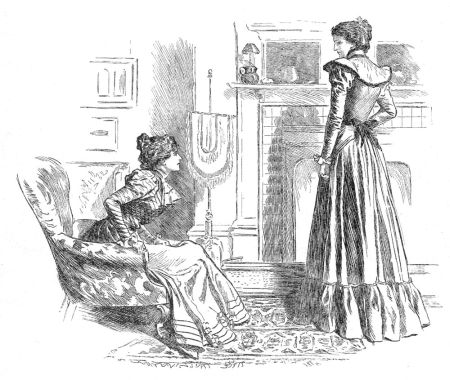
"Better leave her to me, Auntie Janie.
She's afraid of you."
"Do you begin to-night?"
Lady Kitty's face fell.
"I'm afraid I can't stay at home to-night
without perjuring myself."
"Mildred Sefton is going. Let her take
you, and I shall stay at home—if, indeed,
you think Miss Graydon would not enjoy the
'at home.'"
"She wouldn't without a proper frock.
You'll be good to her, Auntie Janie?"
"I shall try to, my dear."
"And to-morrow she and I will take up
our rôle of town mouse and country mouse."
"Poor Kitty!"
"I shall like it. She likes me already, and
I have an odd fancy to make her like me
better."
"You amazing Kitty! But are you going
to carry out those extraordinary expeditions
from east to west unchaperoned?"
"I shouldn't mind at all. We aren't so
particular nowadays, you know. However,
I daresay Captain Leslie would go with us
with joy. He admires the little Pam."
"And he is Anthony's friend."
"Yes, of course, one doesn't mind bothering
him any more than one would Anthony."
When Lady Kitty announced at dinner
that she was going to take Pamela a
round of sight-seeing, Pamela's weary face
brightened.
"You would like it better than meeting
a lot of dull people who are desperately
uninteresting to you."
"I should love it," said Pam, with two
sudden dimples dancing into her cheeks.
"We haven't been doing our duty by you,"
went on Lady Kitty. "It would be an everlasting
disgrace to us if you went home
without seeing the sights."
"But won't it be a great bother for you?"
"On the contrary. I have long desired to
see the Tower."
"You don't mean to say you never have?"
said Pamela, staring.
"Well, you know, the people in a place
never see the sights of it, unless they are
obliged to by an amiable visitor."
"You will have such gay times with Kitty,
to-morrow," said Lady Jane, with the faintest
suggestion of enmity underlying the smooth
words, "that you will not mind, I hope, having
only my society for to-night?"
"Is Lady Kitty going out?" asked Pamela,
and a cloud fell on her face.
"She must," said Lady Jane shortly. "We
shall have some music," she went on, "and
afterwards you must get to bed early to prepare
for a tiring day to-morrow. So we shall not
find the evening too long without Kitty."
Yet after dinner, when Lady Kitty, radiant,
in her smartest gown, floated into the drawing-room
and found Pamela alone, it was not the
face of one who anticipated a pleasant evening
that she beheld.
"How exquisite you look!" cried Pamela,
forgetting her bad quarter of an hour to come.
"I never thought anyone could look so
beautiful."
Lady Kitty kissed her emphatically.
"There," she said, "I'm not the kissing sort,
but you are a dear little thing to admire
another girl so rapturously. Not but what
you can afford to."
Pamela still gazed at her with eyes of wonder,
and said nothing.
"We are going to have such a lovely day
to-morrow, and don't forget it," whispered
Lady Kitty; for there was the frou-frou of
Lady Jane's skirt in the distance. Then quite
suddenly she kissed Pamela again.
"Thank you," she said, "for what your eyes
are saying. I don't mind telling you, as a
great secret, that I want very particularly to
look well to-night."
She laughed as she floated away towards
Lady Jane, who was just coming in, and,
taking up her warm cloak, wrapped herself
in it.
"Good-night, you people, and be happy,"
she called back to them.
Lady Jane gazed rather uneasily after her
as she went.
"Kitty seems excited," she said. "I hope
she hasn't been overdoing it lately."
"I think she looks very well and happy,"
said Pamela.
"Ah!" replied Lady Jane, as if it were
hardly Pamela's business to have an opinion,
and vouchsafed no further remark.
After she had turned over an evening paper,
and tea had been brought, she went to the
piano and began to play. She was a good
musician, and Pamela, who had never heard
good music, listened entranced. Then Lady
Jane sang song after song, as if she had no
listener; and as Pamela watched her, warmed
with the emotion of the music, she felt that
she could understand Lady Kitty's affection
for the proud and cold woman.
At last Lady Jane stopped abruptly and
came over to the fire. Pamela sat with bent
head in the firelight till suddenly she lifted
her eyes like wet violets. A sharp pang of
memory shot through Lady Jane's heart. She
turned away, and when she looked at Pamela
her eyes were cold and cruel.
"You don't get much music at—at—I'm
afraid I've forgotten the name?"
"Carrickmoyle," said Pamela.
"Ah! Carrickmoyle."
"No, we never hear any—except the squeaky
old harmonium on Sundays. We have no
piano."
"Nor newspapers, nor books, nor society,
nor pictures?"
"Very few novels," said Pamela, "except old
ones, but plenty of books. My father always
says that newspapers are worthless reading,
that they divide one's interest into snippets.
But," she made haste to add, "he only
really cares for classical literature. I suppose
we have no society and no pictures. But
the country is delightful."
Lady Jane yawned as if Pamela's answer
did not interest her.
"What a pity!" she went on in tones of
subtle disparagement. "What a great pity
that your father cannot give his daughters
the things which make life really worth
living."
Pamela flushed.
"Our lives are very happy. But that our
dear mother died young, I should say we are
the happiest girls alive."
Again Lady Jane stifled a yawn.
"Anthony must have missed his music,"
she went on, "while he was with you. He
is devoted to music."
"He never said——" began Pamela lamely.
"Of course he wouldn't," said Lady Jane.
"By the way," she went on, "has Kitty told
you how things are between her and
Anthony?"
Pamela flushed, and then grew pale again.
Fortunately she was not called upon for an
answer.
"No, I see she hasn't," went on Lady Jane;
"and, of course, the boy would be equally
reticent. He has been in love with Kitty all
his life. She is his ideal. Anthony cannot bear
your modern damsel, romping about among
the pursuits of men till she has neither voice
nor complexion left. A delicate and graceful
creature like Kitty is his ideal."
Pamela made no comment on this confidence.
She never thought of not believing it, as a
more sophisticated girl might.
"Ah!" she said in her own heart, "I was
the entanglement, after all, and she was the
true love."
And then she remembered oddly Sylvia's
contemptuous disbelief in the love of young
men.
"I'm afraid you are tired," said Lady Jane,
as the conversation threatened to become
more and more difficult. "Shall we say
'Good-night'? You must be fresh for Kitty
to-morrow."
Pamela accepted her release thankfully.
When she had reached her own room, and
was alone, she knelt and hid her face in the
bed-clothes, and considered Lady Jane's
astounding disclosure.
It did not seem to her that it admitted
of doubt. Anthony's own conduct bore it out
fully. For the moment he had had a fancy
for her. She was not yet at the point of
doubting its genuineness—but when he went
away he forgot her, and his allegiance returned
to its lawful owner.
The humiliation was bitter, but it did not
stir her resentment at the moment nearly so
much as Lady Jane's insolence about her
father.
"And to think," cried Pamela hotly, "that
I have eaten the woman's bread and endured
such a horrible time here simply
because I would not go home and let them
know things had not been right! And to
think how my father loved Sir Gerald
Trevithick and his people for his sake! I
shall never cease to hate the name from
henceforth."
And yet her thoughts took a sudden
turn, in spite of her; and, in spite of herself,
her heart cried out for Anthony, and again
for Anthony. And though she poured seas of
scorn upon herself, her heart still betrayed
her.
The next morning Lady Kitty knocked at
her door very early for that fashionable
damsel.
"Are you up, stay-a-bed?" she cried. "It
is an enchanting
day, and we have
the loveliest programme
for it."
"Come in," said
a voice, unlike
Pamela's.
Lady Kitty came
in on a scene of
confusion. Pamela
had her small
trunk open on the
floor, and was ramming
things into
it wildly. She had
her hat on, and
her face seemed
to have become
pinched with
trouble out of its
usual soft beauty.
Her lips were set,
and her eyes
looked unutterable
woe.
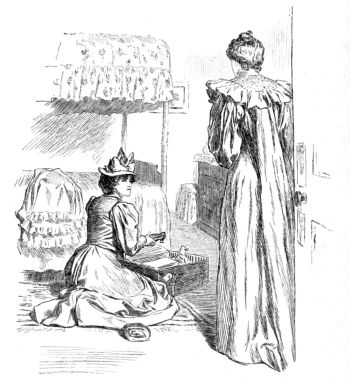
Lady Kitty came in on a scene of confusion.
"My father is
very ill," she said
in a dull voice.
"I am going to
catch the express
at Euston. You
will tell Lady Jane
I could not wait
to see her."
"You poor child!
When did you hear
it?"
"The letter
came by the first
post."
"You are not going without breakfast?
Those lazy creatures must have it ready to
time for once."
She rang the bell sharply, and a maid
came.
"Breakfast immediately for Miss Graydon,"
she said. "We shall be in the dining-room
in three minutes. Tell Dibber it must be
on the table."
And it was. Pamela ate a few mouthfuls
and swallowed a cup of tea. Then the cab
was at the door, and her miserable eyes were
looking out on the sunshiny street.
"Good-bye, good-bye," she said.
"When you can, send me a word to say
how he is," said Lady Kitty.
Pamela stepped back into the dining-room,
and put her arms round Lady Kitty's
neck.
"No matter, no matter!" she cried. "I
love you. You've been human to me in this
house, and I love you."
And then Pamela was gone.
CHAPTER XII. — PAMELA SAYS "YES."
It was May now, and the evenings were
long and sweet. Eight o'clock rang
from the clock-tower at Glengall, and
Pamela Graydon stood by the Wishing
Well in the woods and looked down into the
little cup of clear water. Memory was very
keen in her this delicious, scented evening.
No word had come from Anthony Trevithick,
and Pamela had ceased to expect any long
ago. On her father's account as much as
on her own she was filled with dull anger
against him—an anger that hurt.
She had had no communication with the
house in Brook Street, except her hastily
scribbled line to Lady Kitty when Mr. Graydon
began to creep back out of the shadow
of death, and the answering letter, full of a
sympathy which would have surprised some
in Lady Kitty's world, if they could but have
read it.
"Anthony thinks of getting his Uncle Wilton
moved home as soon as possible," was one of
Lady Kitty's bits of news. "He will never
be very strong again, but he is out of danger.
Of course, they will have to go warily, so
Anthony will hardly be here before full
summer."
"He, may stay away for ever, so far as I
am concerned," had been Pamela's comment
as she thrust the letter into her little old
desk. Indeed, at the time, in the extremity
of her relief at her father's illness having
taken a turn for the better, her love affair
seemed a paltry thing and not worth thinking
upon.
But now that the strain was over her loneliness
returned. She looked with sad eyes
upon the summer landscape, and the moan of
May wood-doves from near and far seemed
to be the voice of her pain.
She often wondered if she could be the
Pamela of a year ago—so gay and careless.
Her sadness of late had passed unnoticed—they
had all been sad—but whereas Sylvia's
spirits had gone up with a bound, and Mary's
mood was one of quiet and thankful joy,
the great fear being removed, Pamela, after
the first relief, felt only a flatness and dulness
of the spirit which seemed never likely to lift;
for Pam looked to her future with all the
hopelessness of very young girlhood.
She sat down on a mossy tree trunk and
listened with her chin in her hand to the
last song of the thrush.
"Pamela," said a voice close by her, "the
dews are falling, child, and you will take
cold."
"Oh, Lord Glengall!" Pamela looked up
startled, and then stretched a friendly hand
to him.
"No; it is not a bit damp," she said. "Just
feel it. I am going home presently. Sit down
here. There is room for you."
But he stood watching her seriously and
made no response to her invitation.
"You have been to Carrickmoyle?" she
said.
"Yes, I saw him for a few minutes." There
was no necessity to specify who the "him"
was. He had been so much in all their
minds.
"He was very comfortable," Lord Glengall
continued. "Sylvia was reading to him, and
his little fire was bright. He grows every
day more like himself."
"Yes," said Pamela simply. "It is good
to see him growing stronger. One can rest
in it, and be glad, without looking forward
too much."
"You mean to the winter?"
"Yes; twenty things may happen before
then to help us. We have nearly five months
before the doctor says he must go abroad.
I am not going to think about it."
"Lord Downside may even yet find a
human heart in him," said Glengall, watching
her seriously.
"Lord Downside—who turned him into
the street, wet and hungry, to meet almost
his death!" cried Pain, with an angry sob.
'The tender mercies of the wicked.' I
shall always think of Lord Downside when
I hear that."
"You look as if you needed a change yourself,
Pam."
The deep-sunk eyes looked at her with
an anxious tenderness, but Pamela did not
notice.
"I shall pull up now," she said. "Carrickmoyle
in summer is good enough for anyone."
"But the winter, Pam—the winter?"
"Let us forget the winter for a little
while," answered Pamela, surprised at his insistence.
"I am very rich, Pam," he said, and then
stopped.
"Ah! that is what you are aiming at,"
said Pam, looking up at him with repentant
affection; "and I was feeling cross with you
because you wouldn't let the winter be."
"He won't mind taking—a loan—from
his old friend? At interest, if he likes. Eh,
Pam?"
"Oh! a thousand per cent., if you like,"
cried Pam airily, but her eyes were dewy.
"You may as well charge a big interest, for
you know it would be a loan that would
hardly have the faintest chance of ever being
repaid."
"Oh! I don't know about that," said Lord
Glengall, digging a hole in the ground with
the toe of his boot.
"You are an optimist," laughed Pam, and
her tone was tender.
"He will take it, you think?"
"He never will."
"I have neither chick nor child. Is my
gold to lie rotting while the friend I love—wants
for it?"
He substituted "wants" at the last moment
for another word, and Pamela understood.
"I daresay it is foolish," she said, "but I
am afraid we shall not be able to persuade
him."
"If not, Pam, there is one other way."
"Ah! no," she
cried, putting out
both hands as if to
push him off; "not
that way, Lord
Glengall."
She closed her eyes
at the moment, and
like a sudden stab
there came the
thought of the
young lover who
had kissed her in
this place, deadly
sweet and deadly
cruel as well.
"I beg your pardon,
Pam," said
Glengall's quiet and
patient voice. "Of
course, I am too
old."
"Oh! no, but I
am not the right
person—that is all.
You must marry
someone who loves
you. I—I am the
wrong person."
"We won't talk
about it, then," said
Glengall, turning
away his head.
"We must find
some other way,
Pam."
Pamela jumped up and ran to him,
and, as she had often done, thrust her
arm into his.
"You are a thousand times too good
for a stupid, ungrateful girl like me."
She hugged his arm to her unconsciously.
"I should be a thousand
times a happier girl if I did love you and
married you. Indeed, it oughtn't to be hard
to love you."
Lord Glengall patted her head.
"Thank you, Pam," he said, "for being
sorry for me. I don't deserve your goodness;
I am a selfish old fellow for wanting a
lovely young creature like you. Ah! Pam,
we should form those ties when we are
young. Then we should not feel useless and
lonely old blocks when we have left our
youth behind."
"You're not going to be unhappy?" cried
Pam, still hugging his arm.
Lord Glengall laughed.
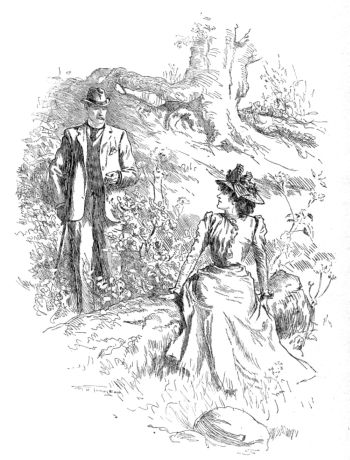
Pamela looked up startled.
"No, Pam," he said. "I don't pretend to
be like a young fellow, all fire and despair.
I should have liked to take care of you,
little girl, and to have the right to take
care of you all. But we must find another
way."
They walked back together to Carrickmoyle
in the old friendly fashion, and no one seeing
them could have guessed that Glengall was
a rejected lover; but that night Pam was
thoughtful.
The next morning she was alone with her
father. Mr. Graydon lay on a couch, from
which he could see the mountains through
the open window, and Pamela, on the rug
by his side, was trying to teach Mark Antony
to balance a straw on his nose.
"Let him alone, Pam," said her father.
"He's too old and fat to learn tricks."
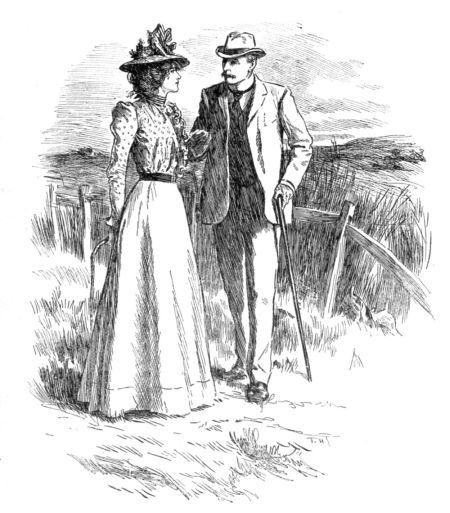
"Is it 'Yes'?" said Lord Glengall.
"Then he shan't have his bone; Pat deserves
it better. Pat has learned three new
tricks since you've been getting well."
"It is good to be getting well again. I
don't think I realised before how beautiful the
world is."
"Our bit of it," said Pam.
"And yet I am no coward. When my
time comes, I shall not be afraid to go. If
only I could feel that you children were provided
for!"
"Did that trouble you—then?" said Pam, in
a low voice.
"It did," answered her father, "though I
tried hard for faith and trust."
"Dear, darling dad!" cried Pamela suddenly.
"Would it make you happier if I
were to marry Lord Glengall?"
"I thought we had settled all that, Pam."
"Oh, yes, in that old life," said Pamela
dreamily, "before you were ill. But things
are altered now. It is just as well we don't
know what's before
us."
"But I am getting
well, my little Pam."
"Ah, yes, thank
God! You are getting
well," said Pam.
"But you haven't
told me if it would
make you happier
for me to marry
Lord Glengall."
"You would be
safe," said Mr.
Graydon wistfully,
"and he would take
care of the others.
But—but—it is not
a question of making
me happy, or of anyone
but yourself,
little Pam. Could
you be happy?"
"Sometimes I
think I could," said
Pamela. "It would
be an end of trouble;
it would be peace."
"Poor Pam! you talk as if you
had been through storms."
Pam shook her head.
"Never mind, darling dad. I
think I shall say 'Yes' then, after
all."
"He has asked you, Pam?"
"Yes, he has asked me. You
don't think, dad, that he would
like Sylvia just as well?"
"He seems to prefer you, Pam."
"I should love him for a
brother-in-law."
"If you feel like that, don't
think of him for a husband."
"He would never deceive nor betray me,"
said Pamela, with a sigh.
"Poor little girl!" said her father, and then
said no more.
A day or two later, as Lord Glengall was
leaving Carrickmoyle, he was overtaken by
Pamela.
"I'm coming with you a bit," she said.
"I want to give the dogs a run."
"I'll be proud of your company. Shall we
take the wood-path?"
"No," said Pamela, with a little shudder.
"I hate the wood. Let us cross the bog."
"Why, what has come to you, child? I
thought you were a perfect wood-nymph."
"I'm tired of the wood," said Pam, shortly.
They walked on till they were out in the
road through the bog. Then Pamela suddenly
spoke what was in her mind.
"Lord Glengall," she said, "do you still want
me to marry you?"
"Why, it was only on Wednesday I asked
you. You don't suppose I've had time to
change my mind?"
"Because—I've changed mine. I want to
say 'Yes.'"
"'Yes,' Pam? Is it 'Yes'?" said Lord
Glengall, turning and facing her. "Are you
quite sure you mean 'Yes'?"
"Quite, quite sure," said Pam.
"What's come over you to make you say
it, when you said 'No' the other day? You're
doing it of your own free will, Pam?"
"Quite of my own free will."
Lord Glengall stooped and kissed the cool
cheek, almost as her father might.
"And you won't want to unsay it later on,
Pam?"
Pam shook her head.
"I'll be very good to you, little Pam—God
helping me."
"I know you will," said Pain. "But why
did you like me instead of Sylvia?"
"I don't know, I'm sure. Pam. I never
thought of that." He laughed out. "It's
lucky I didn't. Pam. What chance should I
have had with Sylvia, and all those boys about
her?"
"What, indeed?" said Pamela, but she
looked mysterious.
A moment later she pulled up again sharply.
"Now that we're engaged," she said, "I've
something to tell you. Lord Glengall."
A wave of the loveliest rose flowed over
her face, but her eyes were down.
"What is it, Pam?" he said quietly, but
he felt a sharp pang as he watched her. She
would never flush like that for him, he felt
sure. Ah, his lost youth! What would he
not have given to recall it?
"I think I ought to tell you," she said, looking
on the ground at her feet, "that I have
cared for someone else."
"Very much, Pam?"
"Very much."
"Is it all over, Pam?"
"It is all over."
"Was it—a matter of money, Pam?
Could nothing be done? I don't want
you to marry me at the cost of your own
happiness."
Pamela was pulling a wild yellow iris to
pieces. He put his hand under her chin, and
lifted her face till he could look into her
eyes.
"Tell me, tell me, Pam. Be brave and
truthful with me. It is my happiness as well
as yours. Is there nothing that can be done?"
"There is nothing."
He let her go, and stood away again, and his
face was full of trouble. Pamela looked at
him for a moment. Then she made a step
forward, and drew his arms about her.
"I told you because I thought I must," she
said. "But it is all over and done with. I
am going to be so happy with you, so happy!"
He looked down at her and his face was
transformed.
"Don't make me too happy, Pam," he said.
"It is too much for an old hulk like me."
And so they went home through the summer
evening, Pamela saying to herself over and
over again that she was really happy. Now
she need not dread the autumn for her father,
for had not Glengall said that together they
would take him to the Riviera, or farther
afield to Algiers, and so would make him
strong again? And had he not thought, even
in his first content, of poor Mary and her hopeless
love affair? Mick was to exchange into
a home regiment, and a little money would
smooth the way for their marriage, so that
the two need not wait till some day far distant,
when they should look in each other's
faded faces and feel that this was not the
love of long ago. Sylvia, too, was to have
fine frocks and gaiety as befitted her beauty
and her youth. And to think that she, Pamela,
was the wonder-worker, the magician, to give
her beloved ones the things that lay nearest
their hearts—she, Pamela, who had always
desired to give!
Only Sylvia, of them all, did not congratulate
Pamela with approval.
"I don't believe you'll make him half
as happy as I should have done," she said.
"But never mind—it is your score, and I
accept it."
And then she went off with a frown to refuse
young St. Quentin for the fifth time, as she
had already refused his superior officer.
"I'll do my best to make him happy," Pamela
said, remembering before she slept. "Help
me to make him happy," she cried, lifting her
heart and her eyes.
And so she fell asleep placidly, quite unlike
a girl who had been asked in marriage and
had accepted only a few hours ago. Just for
that one night she was troubled with no
thought of Anthony Trevithick.
[END OF CHAPTER TWELVE.]
We Can. — A Short Address to the Members of the Fourth Form at Harrow.
By E. W. Howson, M.A.

Let me try to picture a
scene for you. It is
a spring day, towards
the end of March, and
a group of friends are
walking along one of
the high roads leading
to Jerusalem. They
are going, like many
others, to attend the
Feast of the Passover, in the Holy City,
during the following week. Slightly in front
of the rest walks Jesus Christ. There is
something unusual, almost alarming, in His
aspect, and the disciples who are following
behind are watching Him with awe and
wonder as He strides along with rapid steps.
He is evidently possessed and agitated by
some deep emotion, some inflexible purpose,
which they do not fully comprehend. His
thoughts are not their thoughts. They do not
know what He knows—that in a few short
days He, their Lord and Master, whom they
fondly dream is destined to win an earthly
crown, will be tried like a common felon
and nailed to the bitter cross. They are
thinking of a triumph and a throne, and
are already discussing the honours which they
hope to share. He is thinking of something
widely different—of agony, desertion, and
death.
Presently, two of His disciples—James and
John—step forward, with their mother, Salome,
to ask Him a question. Jesus looks round
and says to her, "What wilt thou?" Salome,
who, like many mothers, was ambitious for
her sons, replies, "Grant that these my two
sons may sit, the one on Thy right hand,
and the other on Thy left, in Thy kingdom."
The other disciples, who overheard her
words, are annoyed at the request, which
appears to them pushing and selfish. Why
should James and John be singled out for
special favour? They expect and hope that
Jesus will rebuke them. Instead of which,
He says gently, but very seriously, "Ye
know not what ye ask. Can ye drink of
the cup that I drink of? and be baptised
with the baptism that I am baptised with?"
It was a stern and searching challenge, and
a coward would have hesitated to meet it.
But James and John were no cowards. They
took up the challenge at once, and simply
and promptly they answered. Δυνάμεθα—"We
can." The request may have been selfish, but
the answer was brave; and, what was more,
they were destined to seal that promise with
their blood.
It is this answer—this one word (for in the
Greek it is but one word), Δυνάμεθα, "We
can"—which I wish to consider with you for
a few minutes this evening.
For an answer like this is a key to character,
and shows of what sort of stuff the men
were made who gave it. You will find as
you grow older that men may be roughly
divided into two classes—those who face difficulty
with a can, and those who face it with
a can't. The former are the material from
which heroes are made; the latter may be
good, kind and pure, but sooner or later they
fall behind, and become the followers, not the
leaders, in the work of life.
There is an old Latin proverb—"Possunt
quia posse videntur," "They can because
they think they can." Nothing could be
more true. For let a man only believe he
can do a thing, and he is already half-way
to the achievement of his purpose. It is the
half-hearted, the faint-hearted, who fail. Belief
is the thing we want. "All things are
possible to him that believeth." You know
this is true in your games. You know that the
boy who goes shivering and shaking to the
wicket is pretty sure to return after a few
overs clean bowled. But it is equally true
of every department of life. Napoleon said
that the word "impossible" ought to be
removed from the dictionary, and the boy or
man who, when duty calls him, can answer
calmly and deliberately, "I can," is the one
who not only deserves but commands success.
"So nigh is grandeur to our dust,
So near is God to man,
When duty whispers low 'Thou must,'
The youth replies—'I can.'"
You remember, no doubt, the old Greek
fable of Perseus—how, when he was a boy of
fifteen, the goddess Athene appeared to him
in a dream and showed him the hideous head
of the Gorgon writhing with snakes. "Can
you," she asked him, "face this wicked monster,
and will you some day try to slay it?" "Yes,"
he said, "I can; if thou wilt help me, I can."
And though Athene told him of all the long
journey, and all the terrible perils in the way,
he did not shrink or falter, but when he
came to be a man he nobly fulfilled his
resolution and promise. And this is only an
allegory. It means, that if a man or boy has
sufficient will and determination, there is no
danger, no difficulty, no temptation, which he
may not overcome by the assistance of divine
support. Pray, every one of you, for God's
best gift of a strong will. It is worth, believe
me, all the knowledge, wealth, and popularity
in the world.
Now, of course, I do not pretend that you
and I are called on in our daily school life
to act the hero or the martyr on the grander
scale. Our life is cast in quiet ways. And
yet, as surely as our Lord asked James and
John, so He asks each one of us, "Can you
drink of My cup? Can you be baptised with
My baptism?"
What, then, is this cup, what is this baptism
in your school life here at Harrow?
For if we dare not share it we cannot be
called His disciples. "No pain, no gain." "No
sweat, no sweet." So ran the old sayings,
and if we cannot bear His cross most
assuredly we shall not deserve His crown.
Let me, then, take a few homely instances to
show what I think is the meaning of Christ's
question here at Harrow for you.
You are, let us suppose, in your house
with three or four other boys. You have
all been talking together about your games,
when suddenly the conversation takes a bad
turn, and something is said, perhaps in jest,
which is coarse or irreverent. The speaker
is an influential boy, and you are rather
proud to claim his acquaintance. It would
be easy for you to join in the laugh; it
will please him, it will show that you are as
"knowing" as the rest. There is the temptation—it
is a very common one; but the
question is, can you resist it? Can you
refuse the expected smile? Can you sacrifice
the cheap popularity? Can you boldly say
"Shut up"? Can you walk quietly out of
the room? Can you? Very well, then, if so,
you can drink the cup of Christ.
Do you think this is asking too much of
you? Let me tell you, then, a story—it is a
well-known one, but it will bear repetition—of
an Eton boy. He was captain of the
boats at Eton about fifty years ago, and it
was the custom then at boat suppers for
coarse and indecent songs to be sung.
Patteson (for that was the boy's name) said
that if he was present those songs should
not be sung. He went to the supper as
usual, and a boy got up to sing one of those
songs. Patteson jumped up then and there
and walked out of the room. I have not
a doubt he was laughed at for his pains,
and that he lost some of his popularity; but
the protest was successful, and, so far as I
know, the practice has never, from that day
to this, been revived. Some thirty years
later Patteson, who had learnt to drink the
cup of Christ at school, became a bishop—a
missionary bishop—and met a martyr's death
in the far islands of the Pacific Ocean, a
loyal servant of his Master to the last.
Or again—to take another instance—you
have been playing a game and you have
come back in a hurry rather late. You have
an exercise to show up, and you have not
left yourself time to finish it. Another
boy in the house has already done his, and
the work lies there on the table before your
eyes. You are tempted to take it and copy
it. It will save you from punishment. No
one will be the wiser—except God (and for
the moment you forget that). Other boys
have often done it. Perhaps your friend
offers to lend it you, and would think you
something of a prig and simpleton to say no.
Can you reject the temptation and refuse to
look at it? Can you show up your exercise
unfinished and bear the punishment it
involves? Can you? If so, you can drink
the cup of Christ.
Or, once more, we will say that you are
waiting with your form for a master
outside the form-room door. While you
wait, an unpopular and helpless boy is being
teased and pestered. I daresay his appearance
is odd, and he is sensitive and excitable
and easily provoked. You are tempted to join
with the rest and add one more jest at his
expense. It will, perhaps, sting him to the
quick and make the tears start to his
eyes, but you will earn a laugh and get the
credit of being thought amusing. Can you
check that jest? Can you speak up in
defence of the weaker side? Can you take
his part and protect him? Can you do more?
Can you take the trouble, when the rest are
gone, to say that you are sorry for him and
give him a word of encouragement and
sympathy? Can you? If so, you can drink
the cup of Christ.
"They are slaves who fear to speak
For the fallen and the weak;
They are slaves who dare not be
In the right with two or three."
I know it is the fashion to say that the
life of a boy at a public school is one long
round of unbroken pleasure. There could not
be a greater mistake. You are not all—you
are not any of you—always happy. You have
every now and then a cup of bitterness to drink.
You may have had a quarrel with your best
friend, and you find it hard, almost impossible,
to forgive. You are too proud to make
the first apology: he would think he had gained
his point; and so bad blood gets worse, and
soon you are barely on speaking terms. You
have been trying to turn over a new leaf, to
break off some bad habit which is growing
on you like a creeper on a tree—to give up
swearing, perhaps; to say your prayers more
regularly—and then someone says, with a
sneer, that you are turning "pi." You know
how the sneer tells. Or perhaps you have
been idle and you determine to make a fresh
start. You prepare your work carefully, but
when you are put on to construe your memory
fails; you get turned, and your master thinks
you still idle and will not believe that you
have tried.
Such are some of your common trials. They
may make you very unhappy, but they are
God's way of testing you. Can you, He seems
to say, do this and that for Me? Can you give
up that bad habit, can you bear ridicule, can
you do your duty patiently in spite of failure?
Oh! answer boldly, "Yes—with Thy help we
can." Never give up hope. Fight on and
on. Despair is the devil's triumph. When
he sees you throw up your hands and give
way, he chuckles; for he knows that you are,
or soon will be, at his mercy.
The fact is, we cannot go to heaven in an
easy-chair, and these trials are, indeed, the
hammer strokes which harden the metal of
your character. Shirk and evade them, and
you will never be a strong and useful man.
Bear them, and you will be able to tackle
other and fiercer temptations in the larger
battle of life—to be brave and pure in your
regiment, honest in business, valiant and self-denying
in the Church.
But more than this lies in this little word
Δυνάμεθα, "We can." For perhaps, as you grow
older, you will be called upon to fill some
high office of trust and responsibility. Will
you, then, at that critical moment, prove
worthy of the opportunity, or will you let
false modesty, indolence, or nervousness, tempt
you to decline it, and let the chance slip
by which God has given you of useful service?
Will you be one of those contemptible
people who say, "No, thank you, it isn't good
enough," or, "No, I'm afraid of what others
would think or say of me"? Will you not
rather rise to the occasion, in a spirit of
alacrity, and say, "Yes, I can. I will not be
content to lag in the poor-spirited ruck, who
die unwept, unhonoured, and unsung. I, too,
will take my part in the front rank, and strike
as stout a blow as I can for the cause of
truth and right"?
But if you are to give such an answer as
this (and I trust you will), remember that
you must give it relying on that strength
which is greater than your own. If you don't,
you will be ambitious and selfish, and I daresay
successful, and nothing better. Listen to
what Christ says: "Without Me ye can do
nothing." It is His strength, His spirit, which
alone can give the full force and the right
direction to our wills. With Him everything,
without Him nothing. "I can," said St. Paul
in one of his bursts of enthusiasm, "I can do
all things," but then he is careful to add,
"through Christ which strengtheneth me."
There is the secret, that is the only talisman
of true success. Let us, then, pray to Him
morning by morning, evening by evening, to
give us His help.
"Be Thou our guard on peril's brink,
Be Thou our guide through weal and woe,
And make us of Thy cup to drink,
And teach us in Thy path to go.
For what is earthly shame or loss?
His promises are still our own,
The feeblest frame can bear His cross,
The lowliest spirit share His throne."
This, then, as I understand it, is the message
contained in the words "We can." And whenever
a fierce temptation comes upon you, as
it will, perhaps, even to-morrow, and you are
inclined to say to yourself, "No, I can't
face this unpopularity; I can't do this irksome
duty; I can't resist this temptation any
longer; I can't go on fighting any more," then
turn a deaf ear to Satan's whispers, and answer
boldly, "I can."
THE WONDERFUL PURSE — A FAIRY PARABLE FOR THE CHILDREN.
By Myra Hamilton.

"Caleb! Where are you?"
"Here, mother," he cried,
suddenly rising from one of
the hay-cocks upon which
he had been resting. He
took the little bundle from
her hand without one word
of thanks, and then he
slowly untied the red cotton
handkerchief and began to
eat his dinner.
"What is the matter with you, my lad?"
his mother asked him. "You seem very
cross to-day."
Caleb nodded his head moodily.
"I feel cross," he assented. Then he looked
searchingly at his mother.
"Don't you want to be rich?" he demanded.
The old woman was horrified at the thought
of it.
"Rich? Heaven forbid! I am quite content
to live in our little cottage by the
stream. I do not dread the cold winter
approaching, for you are such a good son to
me that I know I shall lack naught."
Caleb moved uneasily. This simple statement
did not correspond with his preconceived
notion of prosperity, so he tried to
explain his views more fully to his mother.
"I want gold," he said firmly. "Bushels
and bushels of it! Enough to buy me fine
clothes, horses, carriages and food—heaps of
different kinds of food that I might eat continuously.
That is what I call being rich!"
The old woman packed the empty plate up
in the handkerchief before she spoke.
"You will never be happy with those
thoughts in your head," she said, sadly.
"Money is not the only thing to live for
in the world, dearie." Then she walked to
his side and laid a wrinkled hand upon his
arm. "Don't you bother about the hay any
more to-day," she said kindly. "You go and
have some fishing. I will give it a toss over."
So this discontented young man walked off
to amuse himself, and left his mother to
labour under the burning sun to finish his
work, and as he sat on the bank patiently
waiting for a fish to bite, a shrill voice
suddenly addressed him.
"A penny for your thoughts," the voice
said.
Caleb looked about him in amazement. The
only living thing he could see was a frog,
and, of course, he was aware that frogs had
not the gift of conversing with human beings;
so he went on with his meditation and paid
no attention to the mysterious question.
The frog hopped angrily about, and then it
repeated its remark.
"I did not know that a frog could speak,"
said Caleb, feeling very astonished; "I have
never heard one do so before."
"Oh, really!" said the frog patronisingly.
"You do not know everything yet. You
are far too young. A friend of mine, who is
a most cultivated sparrow, tells me you were
grizzling for money this afternoon. Money
indeed! What good could it do you, do you
think?"
"Money buys everything worth having,"
replied Caleb promptly.
"No, it doesn't," snapped the frog, looking
very important. "For it does not buy
ME! When you are older and wiser, you
will find there are many things in the world
that gold cannot purchase. Wealth has many
advantages certainly," he went on reflectively.
"It was through money that I lost my first
wife."
"Indeed," said Caleb, politely. "How was
that?"
"The frog I selected to wed," explained his
companion, "was a very well-bred frog,
though unfortunately rather greedy. She
was always delighted to discover fresh food
at the bottom of the stream, and one day she
thought she had found quite a new kind of
dainty. As she did not wish to give me a
share of it, she swallowed it hurriedly, and it
stuck in her throat and choked her. Just
before she died, she confessed to me what she
had done, and I, from her description of it,
knew it was a penny-piece she had attempted
to eat. Now, what would you say," the frog
went on calmly, "if I gave you the power
to be as rich as you liked, to possess more
gold than you knew how to spend, to gratify
every wish your heart contains?"
"Can you really do this?" gasped Caleb,
incredulously. "I have not met you before.
I cannot understand why you are so good
to me."
The frog puffed himself out with pride.
"I am accustomed to judge character by
faces," he replied. "I can see that you will
never settle down here or be content without
money. I, as the head of our family,
am allowed to offer our wonderful purse to
any mortal I may choose to confer such an
honour upon. If you like to accept it, you
are welcome to do so."
Caleb was quite bewildered at this stroke
of good luck. "For how long may I keep it?"
he asked.
"Until you realise there are certain things
in the world that cannot be bought by gold;
until you weary of the sight of riches, until
you loathe the purse," said the frog solemnly.
"Then I shall keep it for ever!" declared
Caleb.
But the old frog shook his head. "No you
won't," he replied gravely. "You will want
to get rid of it very soon, I think."
"Where shall I find this extraordinary
gift?" asked Caleb cautiously.
"When you get home, look under the
pillow of your bed and you will discover a
shabby green purse lying there," said the
frog. "As long as you desire money, you
will be able to take out of it as much as
you require, but when you have learnt your
lesson thoroughly the purse will cease to
supply you. Then it must be returned to me,
and I will guard it until I meet another
mortal as discontented as yourself. Farewell!
I wish you a short period of wealth, for you
will never enjoy it."
Caleb hastened back to the cottage, and ran
up to his room, where he easily found the
wee purse. It was so small that the young
man felt dubious when he opened it, and he
was greatly relieved to see that there was
one gold piece inside. He drew it out and
peered in again. There was another coin
waiting in precisely the same place. This he
also removed, but still there came another.
When he found the supply of gold did not
fail him, he rushed downstairs to tell his
mother of his good fortune. But she, poor
soul, did not appreciate the change in his
position.
"There is trouble to come, lad," she
prophesied, as she heard of his wealth.
"I suppose you will leave your old mother
now, and go out into the world. You won't
want to waste your riches here."
"I was thinking," Caleb admitted nervously,
"that it would be fine to go about a little,
but you must come too."
His mother shook her head decidedly. "No,
I shall stay here," she replied, "for I am too
old to wander amid strange scenes. Let
me hear of you, dearie, from time to time,
for I shan't live much longer, I know. I
shall have Volta the orphan to live with me,
and then we shall be able to manage the work."
"No, mother, no," interrupted Caleb. "You
forget I am rich now. I will engage servants
to labour for you. You must never do anything
again."
But his mother declared she wished to live
as she had done hitherto. Servants and fine
clothes would worry her, she told him, and
she could not bear to be idle all day long.
Her way of participating in her son's good
fortune would be to hear of his grand doings
occasionally, and to look forward to the time
when he would return to sit by her side and
describe the wonderful things he had seen.
Caleb bought a suit of clothes from the
village tailor and a horse from the landlord
of the inn, and then he set off. As he
rode down the lane the birds sang to one
another, "Here comes silly Caleb!" but
he was too full of his own importance to
realise they were mocking him, and when
the tall branches of the trees bent forward
and whispered to him, "Go back! Go back!"
he set spurs to his horse and galloped
on. His mother watched him out of sight.
She hoped he would wave his hand to her
from the top of the hill, but he was so
occupied with his own thoughts that he only
remembered he had promised to do so when
it was too late.
Caleb rode for many hours, until he reached
a beautiful town, where he arranged to
purchase a castle. He installed himself in
one that stood deep in the shadow of the
wood, and he supplied himself with servants,
horses, and carriages. He had decided not to
travel, for he did not want to learn anything
about foreign lands—he only desired to
live grandly, to eclipse his neighbours and
make them envious of his wealth.
He had almost forgotten his mother. He
never sent her news of himself, although,
at first, he occasionally ordered one of his
servants to ride to the cottage and carry her
some gold. He was so ashamed of her humble
origin that he would not admit he was her
son, and when the man returned from his
errand Caleb used to avoid him, for fear he
had discovered the secret of his birth.
At last the young fellow grew very discontented,
for he had no interests in his life;
so he determined to marry. He was sure that
no high-born lady would wed him, for, in spite
of his riches, he was only the son of a peasant
woman, so he made up his mind to select a
poor girl who would be properly impressed
with his position.
As he had no acquaintances, he decided to
walk slowly over the land and ask the first
damsel he met to be his wife. So he called
his dogs together, and away they went upon
this extraordinary search for a bride, but for
a long time they saw nobody.
On the way home, however, Caleb
encountered a young maiden, who
was tripping merrily along with a
bundle of sticks balanced upon her
head. As she stood aside to allow
this grand gentleman to pass her,
her face seemed so familiar that
Caleb thought he had seen her
before. He looked at her critically;
she was certainly very pretty, young,
and graceful, so he promptly raised
his plumed cap and addressed her.
"I fear those sticks are too heavy
for you," he remarked. "Will you
allow me to carry them for you?"
But she shook her head. "I am
used to them," she explained. "Besides,
I could not trouble you so
much. You are a great lord, and I
am only a poor country girl."
Caleb was not very quick with his tongue,
and as he wondered what to say she gave
him a little nod and hastened away.
The next day he met her again, and the
day following also; for he was really in love
with this peasant girl.
One day he brought her a handsome
silver casket full of rare jewels, but she just
glanced at them and then laid them aside.
"What are they?" she asked innocently.
"Bits of glass?"
"Bits of glass?" he exclaimed in astonishment
at her ignorance. "No; they are
precious stones, and worth a fortune. I hope
you will accept them," he added.
But she shook her head. "They are useless
to me," she declared candidly. "If they
are so valuable, why do you wish to part with
them? I should not know what to do with
such jewels if they were mine."
Caleb could not understand his companion
at all. For the first time since he possessed
the wonderful purse he had encountered
somebody who did not appreciate his wealth.
She looked so fascinating as she sat in
the sunshine, with the contents of the jewel-case
glittering in her lap, that Caleb fell on
his knees before her and entreated her to
marry him. He talked of his estate and
his money, but his words made no impression.
"I do not care for you, my lord," she said.
"Neither do you really love me. It is my
beauty that attracts you."
"But I am rich," he objected; "I have——"
"Yes, I know," she interrupted impatiently;
"you have gold, land, and jewels—in fact,
everything that money can purchase. But
you cannot buy affection. If we loved each
other, I would marry you, even though you
were the poorest beggar in the land. Although
I am honoured by your proposal, it
cannot be. Besides, I should not be a fit
wife for one so great."
"I do not care for you, my lord."
So Caleb went back to his lonely castle
and she to her cottage in the wood, but he
did not despair. He could not believe that
he was to take her refusal seriously, so the
next day he sent her many valuable presents,
but when she returned them all he knew she
was in earnest.
That evening, as he sat by his solitary fireside
brooding over his disappointment, he recalled
the girl's words, and then he realised that
he was pining for something that money
was powerless to give him. He looked at
the presents she had rejected, and, at last,
he understood the limit of wealth.
In his loneliness and sorrow his thoughts
recurred to his aged mother. He felt he had
neglected her, and determined to pay her
an unexpected visit. So early the next morning
he called for his horse and rode quickly
away.
Sitting by his mother's bedside.
But when he reached the little cottage he
thought it was deserted. The garden was
overgrown, the gate flapped uneasily on its
broken hinges, and the hens scratched among
the flowers. He drove them out, and then he
opened the door and peeped inside. His
mother lay upon her bed; her face was very
thin, and her breath came in quick, short
gasps, and she seemed very ill.
"Mother, what has happened?" Caleb asked,
as he sat by her bedside and gently stroked
her hand. "Did you never receive the money
I sent to you and Volta?" he added, as he
looked in vain for the pretty little orphan.
"The gold your servant brought us stands
untouched on the mantelpiece," explained the
old woman proudly. "It was useless to me.
I only needed news of you, my dear boy. I
sent Volta to watch over you, for I hoped
she would be able to influence you, but now
that you have returned I am sure she will
hasten back. Did you not see her?"
Then Caleb realised who the beautiful
maiden had been. It was his little playfellow,
but his wealth had made him forget
his past life so completely that he had not
recognised her. He understood everything
now. His gold could not buy health for his
mother, nor could he use it to win Volta's
love. He longed to begin his old life over
again, so he rose to his feet and walked to
the door.
"Mother, dear," he said, "I am tired of my
wealth. I am going to the stream to throw
back my purse. It has been a curse to me."
When he drew near the water, he pulled
the shabby little case out of his pocket and
opened it curiously. All had happened as
the frog prophesied. The purse was empty
now, for he had learnt his
lesson thoroughly. As he
threw it into the stream he
saw a little frog dive hurriedly
down after it, and,
while he watched, all his fine
clothes slipped away from him
and he was once more clad in
his peasant's rags.
He wanted to see his beautiful
maiden again, and, as
he opened the cottage door,
he was delighted to find
her sitting by his mother's
bedside.
"Volta," he said as he approached
her, "I am poor
now. Will you be my wife,
although I have neither a
fine castle nor jewels to offer
you?"
She smiled sweetly at him
as she replied shyly, "Your
wealth was nothing to me,
Caleb. When I refused to
marry you, it was because I felt you did not
care for me. I was afraid, too, of your grandeur.
I know I should not have been a suitable
bride for you, but now all is changed."
Very soon they were married, and the
young couple settled down to live in the
cottage with Caleb's mother. The old woman
was completely contented with the love her
son and daughter-in-law bestowed upon her.
And later on, in the winter evenings, everybody
would gather round the fire, and Caleb would
take his children upon his knees as he related
the strange things he used to do while he was
the possessor of the wonderful purse.
Illustrated from Photographs.]
Vanished Arts From the Christian Home. — LEATHER-WORK FRAME (1850).
We who
live in
the
present
generation
of this
best of
all possible
worlds,
as we may
well deem
it, considering
that we
have no
experience
of any
other, are
apt to look
back on
those who
preceded
us as benighted
beings who walked by very dim lights,
had few artistic perceptions, and only
the most humdrum of occupations. Girls
who were born before Waterloo were
not very much educated, and not at all
emancipated, and when we think of them
we are apt to wonder how their lives
dragged on without railways, without
gas, without circulating libraries, magazines,
or tennis.
On the whole, however, these old-fashioned
lasses had no time to be dull.
One whose brain was as bright as ever
when Queen Victoria celebrated her first
Jubilee in 1887 was questioned by a girl
of the period as to her occupations when
in her teens and afterwards. "My dear,"
she said, "there were always babies in
our old house at home, and your father
was the youngest of them. I had the
baby clothes to make, and they wore
out so fast! When I was tired of
plain hemming and sewing, I used to
embroider the cap crowns or quill up
the clean cap borders." And this woman's
mind was not in the least dwarfed or
stunted by much needlework; she lived
and travelled a good deal on the Continent
afterwards, and kept well abreast
of the literature of her day to the very
end.
Fine needlework may certainly be
counted among the vanished arts, for our
muslin embroidery is now Swiss, and
made by machine, and our delicate
stitchery accomplished by a "Singer"
or a "Willcox and Gibbs'." No longer,
like the Martineaus of Norwich and their
contemporaries, do we make the fine
linen shirts of our fathers and brothers;
and no longer, happily, are middle-class
girls obliged to laboriously copy the new
music and songs that their wealthier
relatives and friends have purchased.
That is a distinct change for the better.
A kind of work that late in the
last and early in this century was
thought very highly of, and occupied a
good deal of time, was called filigree.
A Christmas present for Grandmamma
or for Mamma's birthday might be a
tea-caddy or a workbox, the frame of
which was produced by the cabinetmaker
in rosewood or mahogany and
lined with tinfoil, or lead, or satin paper,
as the case might be. Rims of polished
wood were seen at the corners, and
received the lock and hinges, but the
surface was sunk and had to be filled
in with tiny rolls of gilt-edged paper
made in long lengths for the purpose.
These rolls were closely packed together,
and produced an appearance of fine gilt
tracery, as seen in the illustration below.
Unless very roughly treated, or kept in a
palpably damp place, they did not come
out of position. In the absence of all
Oriental goods, which were never seen in
those days unless in families connected
with the East India Company, they were
considered handsome, and no one not in
the secret could have guessed how the
effect was obtained.
Here and there in great houses a few
fine lacquered or Chinese cabinets might
be seen, principally brought home as
loot, for they were most plentiful in
military and naval families. They were
much admired and very highly esteemed,
and some ingenious individual hit on a
mode of making very passable imitations
of them in a small way; and it was not
entirely a feminine industry, but one
in which the sterner sex could find indoor
occupation during wet weather and
long evenings without loss of dignity.
Small tables and the doors of corner
cupboards were frequently treated in
this manner, especially the latter, which
were seldom looked at very closely and
did not get much handled. The work
was called imitation lacquer, and the
materials were collected during summer
and autumn.
Very thin leaves were selected, such
as the crimson foliage of the Herb Robert
when it grows in stony places, silver-weed,
which is to be found in hilly
districts such as Derbyshire and the
Lake Country, and the leaves of the
sloe or blackthorn, which in late autumn
turn yellowish and assume curious fade
green tints. They were most carefully
and smoothly dried between
sheets of blotting-paper under heavy
weights or in the thick volumes of
bound-up music then to be found in
every house, and when quite dry they
were so thin that the ordinary finger
might be passed over them without
feeling an inequality of surface. The
piece of wood—table top, cupboard door,
or what not—intended
to be ornamented
was made
perfectly smooth,
and the delicate
leaves were fixed
on it as taste dictated
with clean,
strong gum. If
any stalks were required
to connect
leaves, they were
painted in; and
when this was
done, well pressed,
and quite dry, all
the interstices
were filled up by
means of a small
camel's-hair brush
with a black or
dark brown varnish,
probably
shellac. Another
coat very often
had to be put on,
and when all was
perfectly smooth
and flat two or
three coats were
laid all over by
way of finish, and
when perfectly
dry and hard the
article looked remarkably
well.
A SAMPLE OF BERLIN WOOL WORK.
Berlin wool work on canvas, either
in raised cross or tent stitch, was a
great resource to ladies, and largely
used for furnishing purposes. Of course,
it was the latter-day equivalent of
the old tapestry, and tent stitch was
usually worked in frames, while really
good workers could accomplish cross
stitch in their hands without drawing
up or cockling. Figure-pieces were
often framed and hung as pictures,
and fearful and wonderful they generally
were. Many of the floral wreaths,
however, were really artistic, especially
those that depicted carnations, tulips,
and poppies. Some designs were absurdly
impossible, and a writer in the
'forties describes them as peacocks or
birds of Paradise resting on their talons
on the petals of passion-flowers. Shading
was a matter of taste—good, bad, and
indifferent.
The bride of that day generally took
many monuments of her own and her
family's industry to her new home in
the shape of wool-worked cushions, chair
seats, screens, and sometimes borders to
table covers and curtains. Preparing
them was a great pleasure, and she was
very proud of them when done. They
were quite in the taste of the day, and
none of us in such matters lives twenty
years before our time.
Another kind of decorative furnishing
very highly prized was the leather work
which made such handsome frames for
mirrors and was also much used for
brackets, and those dark articles formed
a very welcome relief to the amount of
gilding in vogue during the days of the
Third Empire in France, which was copied
almost ad nauseam in England. They
entailed an amount of attention from
duster and feather brush that would
drive modern mistresses and maids
crazy; but that is a detail.
TENT-STITCH FIGURE PICTURE (1797).
(Christ and the Woman of Samaria.)
The modelling and cutting of leaves,
flowers, and berries in leather was really
hard work, and required hands endowed
with a good deal of muscular strength.
The skilled worker was always a
student of nature, and found models
in some of her loveliest forms. Vine
leaves and tendrils, with or without
bunches of grapes, oak leaves and
acorns, convolvulus blossoms and
leaves (see illustration at head of
article), passion-flowers and roses,
were great favourites. The leather
used was tanned sheepskin and
cowhide, technically known as basil
and skiver; the tools were few, being
principally a sharp strong pair of
scissors, a stout penknife, a stiletto
and a veiner. The best work was
often accomplished with the fewest
tools, for it is very rarely that the
craftsman or artist who can afford
to buy every possible accessory
turns out anything worth
looking at. A large board
or old deal table, a basin
of water, sponge, wire,
tacks, hammer, stain, glue,
and varnish, were all
needed, and the work was
not quite of a kind for the
family circle, as it was best
pursued in a room with no
carpet to spoil, and where
no one could be disturbed
by the tap-tapping of the
hammer. Very good work
may be seen from time to
time at the various "Arts
and Crafts" exhibitions, and
leather embossing is a good
deal used. Professor Herkomer
has some wonderful
embossed leather on the
dining-room chairs in his
House Beautiful at Bushey,
and it was all done by a
lady. Work in leather cannot
therefore be classed
altogether among the lost
arts; it is being modified,
and may some day be revived
in all its glory by
women who have plenty of
leisure and love to have
something to show for their handiwork.
It must not be forgotten that even in an
age that has witnessed such a revival
of learning as this there are still girls
of active temperament who are neither
students nor great readers.
TENT-STITCH FLOWER PICTURE (1825).
Shell work was accomplished by sticking
small shells, chiefly the halves of
little pink or white bivalves on to a
coloured background with very strong
glue. A shallow box was the favourite
article, and it was then glazed and used
as an ornament much as cases of stuffed
birds are. How long it lasted is proved
by the specimen photographed, which
was worked in 1805.
The wealth of flowers in the present
day is quite a modern feature of luxury.
Even twenty years ago, except in summer,
they were the
prerogatives of
the wealthy who
had gardeners
and greenhouses
and plenty of
artificial heat.
Lovers of
flowers consequently
had wax
models of them,
and very beautiful
they were
when natural,
though unfortunately
they had
to be covered
with glass
shades. The lady
who could make
them really well
was very much
thought of, and
it was an occupation
that
could be pursued
at any
time, except in
severely cold
weather and a hard frost. The Pantheon
in Oxford Street was the great place for
obtaining the sheets of wax, shaved off
a block with a sharp plane, which was
a delicate operation seldom attempted
by an amateur. The rose wax was
peculiarly thin, almost of the consistence
of a real rose petal. The chief tools were
small, sharp scissors and a few bone or
steel pins with solid glass heads, some
dry colours and cotton wool to rub them
on with. The worker simply took a rose,
snowdrop, violet, or whatever flower she
preferred, pulled it carefully to pieces,
laid each portion on her sheet of wax
and cut out by it as closely as possible,
previously wetting her scissors. The
petals were moulded in the hollow of the
hand with the head of a pin after being
coloured, and curled over where desirable,
with the steel part wetted like
the scissors. The wire stalk was covered
by a narrow strip of green wax neatly
rolled and rubbed smooth, crooked over
at the top and a sort of little wax centre
formed on this crook on which the flower
was literally built petal by petal. Experience
taught which flowers were feasible
and which were not. Roses usually
turned out well, so did scarlet japonica,
apple blossom,
snowdrops, and
daffodils. Primroses
were
almost unattainable.
Lilies
of the valley
had each separate
blossom
made in a tiny
mould. All
scraps of wax
were collected
in a stone jar
(a strong jam-pot),
and, as the
great crux was
to obtain
natural-looking
leaves, this wax
was carefully
melted over or
near the fire,
well mixed and
coloured with
indigo and ochre
in proportion to
the tint of green
required. Suppose
a few violet leaves were wanted,
fresh ones of two or three sizes were
gathered and the upper side thoroughly,
but not lavishly, moistened with sweet
or salad oil. Then a brush was dipped
in the liquid green wax and passed over
the surface, which was allowed to cool
and then a wire stalk was laid on to form
the mid-rib of the leaf. Two or three
more layers of wax were added, and when
quite cold the natural leaf was removed,
and a very exact facsimile made its
appearance. A well-arranged vase (see
illustration on page 309) or basket of wax
flowers, closely copied from nature was
very pretty and acceptable in the absence
of the real blossoms. The wax was
rather expensive, though the tools were
not, the average price being from one
shilling to one shilling and sixpence per
dozen small sheets.
Sampler-making was a fine art practised
in silk or wool on fine woollen or
silk canvas. Its primary use was to
teach how to make capital and small
letters and figures, which were practically
applied to the marking of linen;
but occasionally the geography of England
was attempted, as shown in the
illustration below, and probably no girl
who had marked in the outlines and
names of the counties ever forgot their
respective positions.
All these home occupations had their
day and fulfilled their purpose. They
added to the household attractions, and
made the rooms look as if women lived
there and took a pride in them. Very
often the nimble fingers worked all the
more quickly and efficiently while an
interesting book was being read aloud.
We often say that in those days—which,
after all, are not so very long ago—girls
were delicate and unhealthy, took but
little exercise, and were too much given
to sedentary occupations. But it was
only the foolish (who carry everything
to excess) of whom this was true. There
was a good deal of running about the
house, and the sons and daughters would
have known very little of their relations
and friends a few miles off, if they had
not walked to see them, perhaps to spend
the day, or to go one day and return
the next. Few families were without
sundry poor people in whom they were
interested, and if they lived at the other
end of the parish, it was an object for a
walk to take an old woman a milk pudding,
or a little delicacy to a sick child.
Houses were more roomy than they are
now, certainly the population was not
quite so thick on the ground, and in
persistent bad weather, when outdoor
exercise was impossible for the girls, there
were fine games of battledore and shuttlecock
in the hall or schoolroom or some
half-empty apartment
cleared for the purpose.
And it was a point of
skill, as well as honour,
to see who could keep
up longest with a skipping-rope,
and, though
the little ones shared
the fun, it was by no
means confined to them.
Small daily duties
well done, and the
change of work that is
as good as play, made
life satisfactory as well
as pleasant. Amusements
were rare and
costly; they are not
invariably cheap now,
but apparently we must
have them, whatever
may be neglected in
consequence. We cannot
exactly go back to
all the ways of our
"foremothers," but we
need not despise them,
and already there are
signs that the finger of
common-sense is pointing
back to that lost
era of domesticity in
which so many English
virtues grew up and
nourished.
E. C.
TEMPERANCE NOTES AND NEWS — By a Leading Temperance Advocate. — TEMPERANCE AND THE SOLDIERS. — VETERAN STANDARD BEARERS. — AN INTERESTING EXPERIMENT. — THE PARLIAMENTARY OUTLOOK. — A LITERARY MAN'S TESTIMONY. — COMING EVENTS.
Photo: Gillman and Co., Ltd., Dublin.
THE HON. CONRAD
DILLON.
What a fascinating
book
might be
written about the
story of temperance
work in the
Army! Long before
any attempt
at organised
effort, the gallant
Havelock had
seen the necessity
of inculcating
"sober
habits" among
our brave defenders.
Coming
to our own times,
Miss Sarah
Robinson, Mrs.
Daniells and her daughter at home, and the
Rev. J. Gelson Gregson in India, have laboured
with more or less success to bring about a
change in the state of affairs. The National
Temperance League did a vast amount of
pioneer work through its military agent, the
late Samuel Sims. The formation of the Army
Temperance Association a few years back, gave
the movement a position which
even the most sanguine of its
friends would not have ventured
to expect. There can be
little doubt that this result is
largely due to the far-seeing
intelligence which its devoted
Honorary Secretary, the Hon.
Conrad Dillon, has brought to
the work. His sagacious counsels,
unfailing tact, and extraordinary
power of attracting
the sympathetic co-operation of
the commanding officers, have
combined to place the work
upon a footing from which it
is scarcely likely to be displaced.
At the autumn manœuvres
on Salisbury Plain the
Army Temperance Association
was much in evidence, and a
number of most successful
meetings were addressed by the
Hon. Conrad Dillon and the
popular secretary of the Association,
Mr. Clare White. The
Patron of the Association is the
Duke of Cambridge; the President
is the Duke of Connaught;
the Chairman of the Council is Field-Marshal
Lord Roberts, and the Chairman of the Executive
Committee is General Sir Martin Dillon,
K.C.B. The Association publishes an attractive
periodical entitled On the March, and its
comparatively small subscription list is supplemented
by a Government grant of £500. It
speaks volumes for the thoroughly satisfactory
nature of the work done that the Government
actually parts with this little plum annually.
The amount might easily be doubled in view of
the saving to the nation which the improved
stamina of the Army has effected, an improvement
most certainly traceable to the efforts of
temperance workers.
ON SALISBURY PLAIN.
(Working the Field Telegraph.)
The close of the year was marked by the death
of some notable pioneers of temperance. The
Rev. G. H. Kirwood, M.A., was for upwards of
fifty years identified with the cause in Hereford,
and the Rev. Isaac Doxsey for even a
longer period in the metropolis. Charles Pollard,
of Kettering, could be credited with sixty
years' untiring advocacy; John Faulkner, of
Derby, had been an abstainer for fifty-five
years; and William Symington, of Market
Harborough, had reached the patriarchal age of
eighty-nine. Apart altogether from the noble
work which these lamented worthies accomplished,
their long lives present a concrete
argument as to the benefits of total abstinence
which it will take a great deal to explain away.
May the example of their consistent perseverance
prove an incentive to young men to
follow in their steps!
THE COLONY FOR INEBRIATE WOMEN, DUXHURST.
The Industrial Farm Colony at Duxhurst,
Reigate, which owes its establishment mainly
to the self-sacrificing devotion of Lady
Henry Somerset, is an experiment which
cannot fail to command the sympathy of everyone
interested in the reclamation
of inebriate women.
To take the poor creatures
away from their sordid surroundings,
and place them
in village homes with the
attraction of out-door occupation,
are the salient features
of the work. Floriculture,
gardening, bee-keeping, and
poultry-keeping, are all engaged
in; and, as some of the
poor women must perforce
bring their very young babies
with them, a "Children's
Nest" is part of the scheme.
Dr. Walters, the medical officer,
in a recent report gives
some interesting particulars
of sixty-four inmates:—
"Forty-eight were married
women; sixteen were single.
"Twenty-nine drank spirits
alone; fifteen drank beer and
malt liquors; eleven drank any form of
alcohol; four drank wine and spirits; three
drank beer and spirits; one drank beer and
wine; one took opium.
"Sufficient time has not yet elapsed to be
able to speak with confidence regarding the
ultimate cure of the thirty-three cases that
are now marked as doing well.
"Regarding
the failures:—Ten
only stayed
the full time:
two of these had
been in homes
previously; one
had been in an
asylum, four
were so broken
in health that
they were removed
by the
medical officer
as unfit for
treatment, seven
were removed
by their friends
before the full
period had expired."
The members of the National British
Women's Temperance Association raise a considerable
sum annually in aid of this beneficent
institution, but financial help is much
needed if the work is to be maintained with
anything like efficiency.
ONE OF THE KITCHENS AT DUXHURST.
The reassembling of our legislators at St.
Stephen's will once again give interest to
the legislative aspect of the temperance question.
The friends of Sunday closing are lending
all their energies to a determined effort
to "get something" in the new session of
Parliament. We may also expect the usual crop
of private members' notices dealing with varied
phases of legislative control; and then the
Report of the Royal Commission, from which
great things are anticipated, will be sufficient to
keep all interested parties on the alert. As if
this were not enough, Sir Wilfrid Lawson may
be counted upon to peg away at his project for
bringing the House itself under the operation
of the licensing laws; so for the next few
months we shall find our morning papers
liberally besprinkled with items of interest
from a temperance standpoint.
As considerable interest has been taken in
our recent references to the editor-in-chief
of the New English Dictionary, we may remark
that Dr. Murray makes no secret of his views.
Speaking at a public meeting of teachers
held in Oxford in 1894, he said that he
claimed to be a teetotaller of more than fifty
years' standing; and the great dictionary-maker
added:—"I am perfectly convinced that
I have been able to do my work in the world
to a large extent owing to this fact; and that
if I were to take stimulants I should be less
able to do my work, and certainly my brain
would be less fitted to deal with the complicated
and somewhat difficult questions which often
puzzle me a good deal."
Workers may like to make a note of the
following important fixtures:—The annual
meeting of Miss Weston's Royal Naval Temperance
Society, Town Hall, Portsmouth,
February 1st; Sunday Closing Demonstration,
Birmingham, February 6th; Sunday Closing
Mission, Sheffield, February 1st to February
15th; Sunday Closing Mission, Salisbury,
February 13th to February 28th; a lecture on
"The Scientific Evidence for Total Abstinence,"
by Dr. William Carter, at Liverpool, February
6th; and the annual meetings of the Church
of England Temperance Society, Memorial
Hall, Islington (March 13th), Exeter Hall
(April 25th), and the People's Palace (May 2nd).