When Sydney Smith, towards the close of his life,
considered the changes which had passed over
the country within his recollection, he said
that he wondered how the young men of his
time had managed to preserve even a decent
appearance of cheerfulness. Sydney Smith
died in 1845, just at the beginning of those
deeper and wider changes of which he suspected nothing; for, though
he was a clear-headed man in many ways, he was no prophet—he saw
the actual and the present, but was unable to feel the action of the invisible and potent forces which
were creating a future to him terrible and almost impossible. Had he possessed the prophetic spirit,
he would have been another Jeremiah for the destruction of the old forms of society; the levelling up
and the levelling down destined to take place would have been pain and grief intolerable to him.
I have always maintained that the eighteenth century lingered on in its ways, customs, and modes of
thought until the commencement of Queen Victoria’s reign, and I regard myself with a certain complacency
as having been born on the fringe of that interesting period. I might also take pleasure in
remembering that one who has lived through this reign has been an eyewitness, a bystander, perhaps in
some minute degree an assistant, during a Revolution which has transformed this country completely from
every point of view, not only in manners and customs, but also in thought, in ideas, in standards; in the
way of regarding this world, and in the way of considering the world to come. I do not, however, take
much pleasure in this retrospect, because the transition has taken place silently, without my knowledge;
it escaped my notice while it went on: the world has changed before my eyes, and I have not regarded
the phenomenon, being busily occupied over my own little individual interests. I have been, indeed, like
one who sits in a garden thinking and weaving stories, nor heeding while the shadows shift slowly across
the lawns, while the hand of the dial moves on from morning to afternoon. I have been like such a one,
and, like him, I have awakened to find that the air, the light, the sky, the sunshine have all changed, and
that the day is well-nigh done.
Do not expect in this volume a Life of Queen Victoria. You have her public life in the events of
her reign: of her private life I will speak in the next chapter. But I can offer you no special, otherwise
unattainable, information; there will be here no scandal of the Court; I have climbed no backstairs; I
have peeped through no key-hole; I have perused no secret correspondence; I have, on this subject,
nothing to tell you but what you know already.
Do not again look in these pages for a résumé of public events. You may find them in any Annual
or Encyclopædia. What I propose to show you is the transformation of the people by the continual
pressure and influence of legislation and of events of which no one suspected the far-reaching action. The
greatest importance of public events is often seen, after the lapse of years, in their effect upon the
character of the people: this view of the case, this transforming force of any new measure, seldom
considered by statesman or by philosopher, because neither one nor the other has the prophetic gift—if it
could be adequately considered while that measure is under discussion—would be stronger than any
possible persuasion or any arguments of expediency, logic, or abstract justice.
I propose, therefore, to present a picture of the various social strata in 1837, and to show how the
remarkable acts of British Legislation, such as Free Trade, cheap newspapers, improved communications,
together with such accidents as the discovery of gold in Australia, and of diamonds at the Cape, have
altogether, one with the other, so completely changed the mind and the habits of the ordinary Englishman
that he would not, could he see him, recognise his own grandfather. And I hope that this sketch may
prove not only useful in the manner already indicated, but also interesting and fresh to the general readers.
W. B.
Easter Sunday, 18th April 1897.
CHAPTER I QUEEN AND CONSTITUTION
“The wise woman buildeth her house.”—Book of Proverbs.
In 1837 the Queen mounted the throne. It was a time of misgiving and of
discontent. The passing of the Reform Act of 1832 had not as yet produced
the results expected of it; there were other and more sweeping reforms in the
air: the misery and the oppression of the factory hands, the incredible cruelty
practised on the children of the mill and the mine, the deep poverty of the
agricultural districts, the distress of the trading classes, formed a gloomy portal
to a reign which was destined to be so long and so glorious. Thus, in turning
over the papers then circulated among the working-classes of the time, one
observes a total absence of anything like loyalty to the Crown. It has vanished. A blind hatred has
taken its place. What is loyalty to the Crown? To begin with, it is something more than an
intelligent adhesion to the Constitution; it regards the Sovereign as personifying and representing the
nation; it ascribes to the Sovereign, therefore, the highest virtues and qualities which the nation itself
would present to the world. The King, among loyal people, is brave, honest, truthful, the chief support
of the Constitution, the Fountain of Honour. To obey the King is to obey the country. To die for the
King is to die for the country. The Army and the Navy are the King’s Army and Navy. The King
grants commissions; the King is supposed to direct military operations. The King is the First Gentleman
in his country. When one reads the words which used to be addressed to such a man as Charles the
Second one has to remember these things. Charles the Second, unworthy as he was in his private life,
was still the representative of the nation. Therefore, to ascribe to that unworthy person these virtues
which were so notoriously lacking was no more than a recognition of the fact that he was King. Has,
then, personal character, private honour, truth, principle, nothing to do with kingcraft? Formerly,
nothing or next to nothing. Now, everything. Another George the Fourth would now be impossible.
But he has been made impossible by the private character of his niece.
Consider a little further the question of loyalty. I say that in 1837 among the mass of the people,
even among the better class, there was none. Indeed the loyalty of the better sort had suffered for more
than a hundred years many grievous knocks and discouragements. The first two Georges, good and
great in official language, were aliens; they spoke a foreign tongue; they saw little of the people; yet
they were tolerated, and even popular in a way, because they steadfastly upheld the Constitution and the
Protestant religion. The third George began well; he was a Prince always of high moral character,
strong principle, and great sincerity. Since Edward the Confessor or Henry the Sixth there had been no
Sovereign so virtuous. But his constant endeavours
to extend the Royal Prerogative, his
obstinate treatment of the American Provinces
against the impassioned and reiterated entreaties
of Chatham, Burke, and the City of London, his
stubborn refusal to hear of Parliamentary Reform,
his desire to govern by a few families, his
long affliction and seclusion, destroyed most of
the personal affection with which he began.
His successor, the hero of a thousand caricatures,
a discredited voluptuary, never commanded the
least respect except in official addresses; nor
did William the Fourth, old, without force or
character, without dignity. Wherefore, in
1837, when the cry of “Our Young Queen”
was raised, it met with little response from the
great mass of the people.
THE DUKE OF KENT
In its place there was an eager looking
forward to Revolution and a Republic. There
can be no doubt that in the thirties and the
forties there were many who looked forward to
a Republic as actually certain; that is to say,
as certain as the next day’s sun. The Chartists
numbered many strong Republicans in their
body, though the Law of Treason forbade them to put forward the establishment of a Republic
as one of their aims. There were newspapers, however, which spoke openly of a Republic as a
matter of time only. The great European upheaval of 1848, save for the miserable fiasco of the
Chartist meeting, left this country undisturbed. Not a single Republican rising was attempted in Great
Britain. Those living men who can remember thirty or forty years back, can very well recall the
Republican ideas which were floating about in men’s minds. Where are those ideas now? They are
gone; they exist no longer, save, perhaps, among a very small class. I do not know even if they have an
organ of their own. The reason is, that as the Chartist movement—the agitation for Reform—was due
mainly to the widespread distress and the discontent of the country, so, when the distress vanished, the
desire for change vanished also.
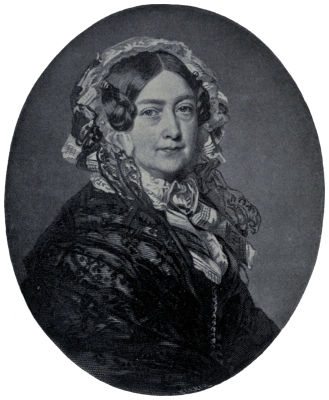
THE DUCHESS OF KENT
In this account of transformation the return to loyalty must be noted first. It is not only loyalty to
the Queen herself, though that is universal, but to the Crown. There is a general feeling that the
Leader of the Nation—not the Imperator, Dictator, or Emperor, but a nominal Leader, such as our
own, one under whose presidency the Government is carried on, who is not, however, the Government—is
more conveniently the heir of a certain family rather than a person elected by the country at large at
regular intervals. The United States think differently. This, however, is what seems to us. We do
not want a great popular election convulsing the country once every four years with a desperate party
struggle; we have already quite as many elections as we want; we are quite satisfied if our President
succeeds when his time comes, gives his name to the events of his reign, and continues in the
Presidential chair for life. We ask of him only to make himself as good a figure-head as he can; we
expect him to observe his coronation oath; and we beg him, if he wishes to stay where he is, not
on any account to intrigue or scheme for the
extension of the Royal Prerogative.
On the other hand, we willingly agree to
attribute to a Sovereign all the glories of the
reign; as if he himself commanded the armies
and the fleets; as if he himself enlarged Science
and Learning and Philosophy; as if he himself
were a leader in Literature, Science, and Art.
This is because the Sovereign is the representative
of the Nation. In the same way the
disasters and miseries of the reign must also be
placed to his account, as if he himself were the
author and the cause of everything. Thus by far
the greater part of the distress and discontent
which prevailed during the first years of the
Reign (1837–48) was attributed in the minds
of the people as due to the Sovereign and the
monarchical forms of Government.
With the gradual return of loyalty gradually
grew quieter the old clamours for the abolition
of the House of Lords. I will show you
some other reasons why this clamour ceased. First
of all, in times of prosperity political changes
are never demanded. A revolution presupposes a
time of want, distress, or humiliation. We have enjoyed a time of general prosperity for many years.
I believe that Americans find it hard to understand the continued existence of our Upper House.
Well, but something may be said for that. Thus, the House of Lords contains about 650 possible
members; of these about thirty, or even less, and those including the Law Lords, do the whole work
of the House. These thirty are in a sense representatives of the whole number, not regularly elected, but
allowed to be the representatives. It is quite conceivable—even by the strongest advocate of popular
election—that a body of 650 gentlemen, all of the best possible education, nearly all advanced in years,
all independent in their circumstances, all wealthy, with no private interests to advance, unconnected with
commercial enterprise, with no companies to support, no schemes of money-making in the background,
might elect out of their own body a Second Chamber of much greater weight and moral authority than
any body elected by the multitude. In such a House, one would argue, there is no place for bribery,
jobbery, or corruption. In fact, there are none of these things.
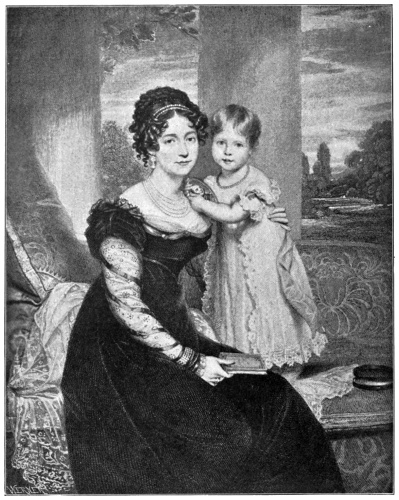
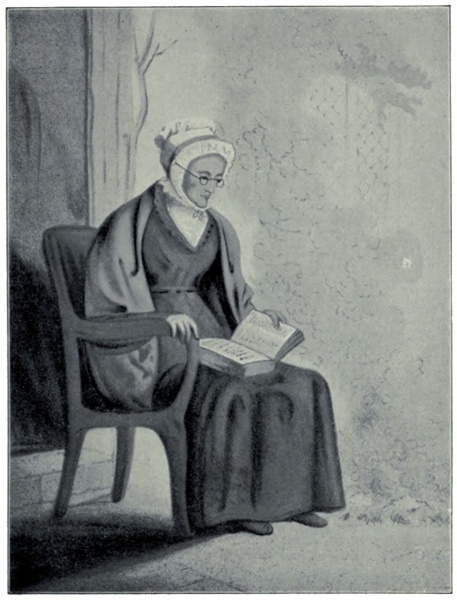
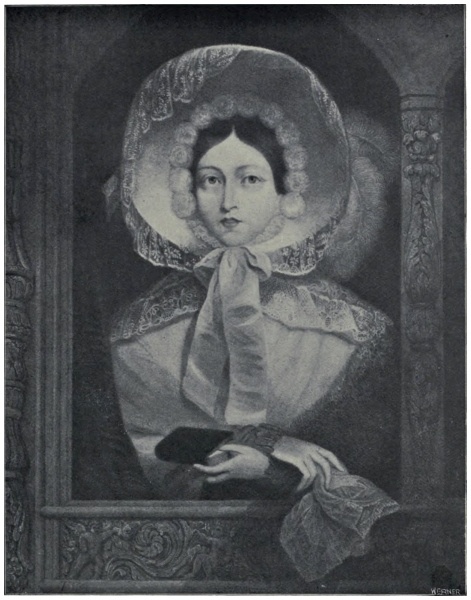
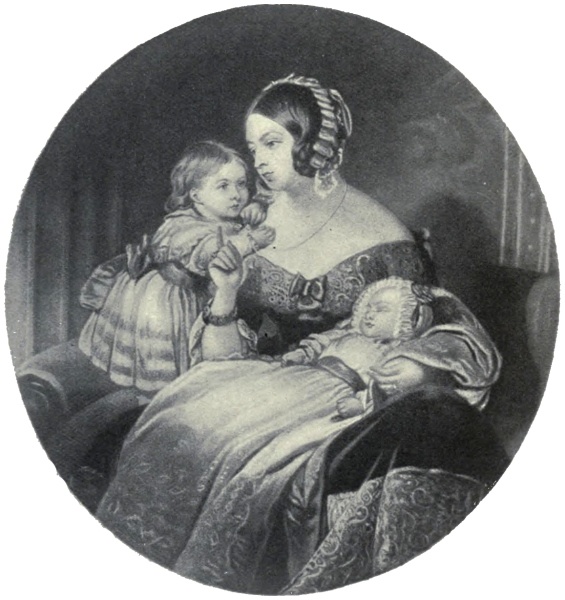
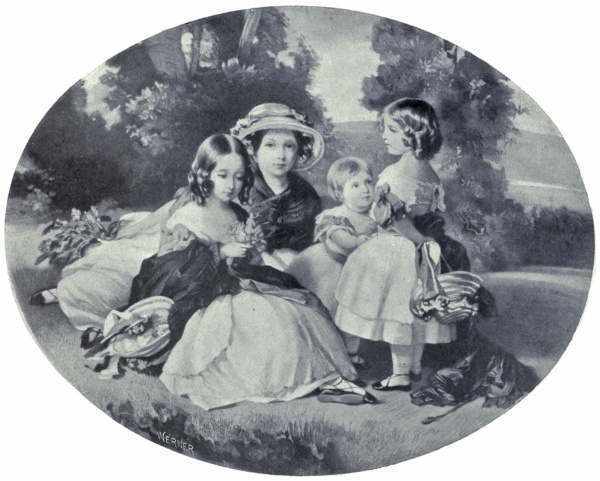
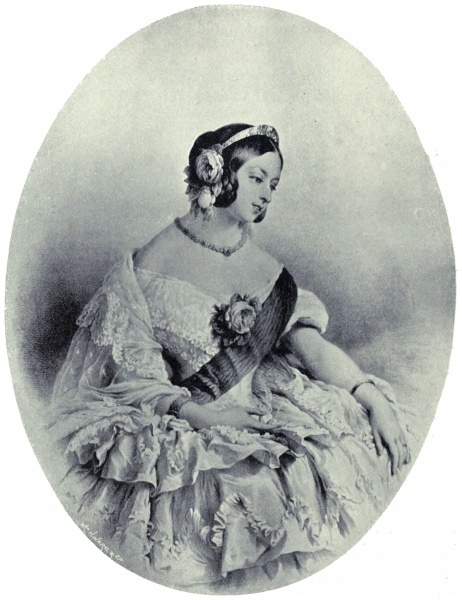
THE DUCHESS OF KENT AND PRINCESS VICTORIA, AGE 2
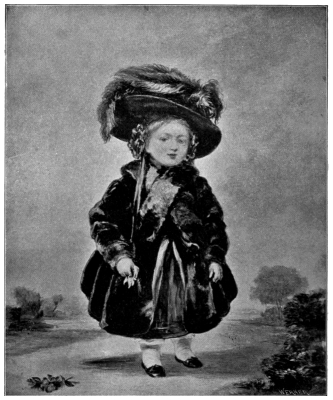
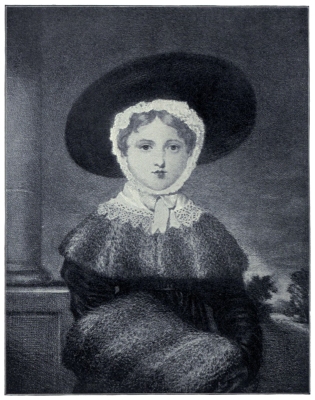
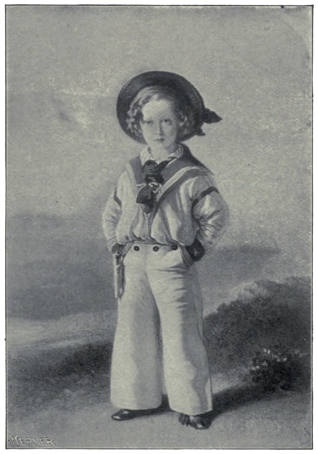
THE PRINCESS VICTORIA, AGE 4
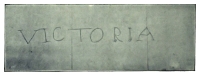
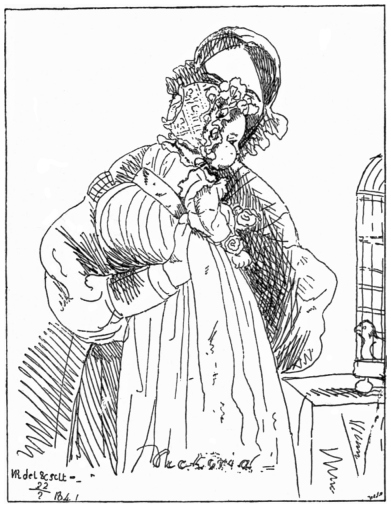
AUTOGRAPH OF PRINCESS VICTORIA, AGE 4
But, it is objected, a caste is created, and there should be no such thing as a caste. Perhaps not; if
we were to start anew, we would have none. Australia has none, nor New Zealand; in our case, however,
the caste is two thousand years old and more.
It is venerable by reason of its age; it would be
extremely difficult to remove it; moreover, it is a
caste rendered innocuous by the simple provision
that the younger sons do not belong to it; none
but the Head has any power or authority by reason
of belonging to it; it is a caste, not of so many
families, but of so many men. Moreover, English
people like old institutions; this House of Peers,
therefore, is not only kept on, but is rendered
popular by the continual infusion of new blood—the
continual election to the House of new men
with no family connection or influence. Among
the recently made Peers there are successful men
of business: engineers, physicians, manufacturers.
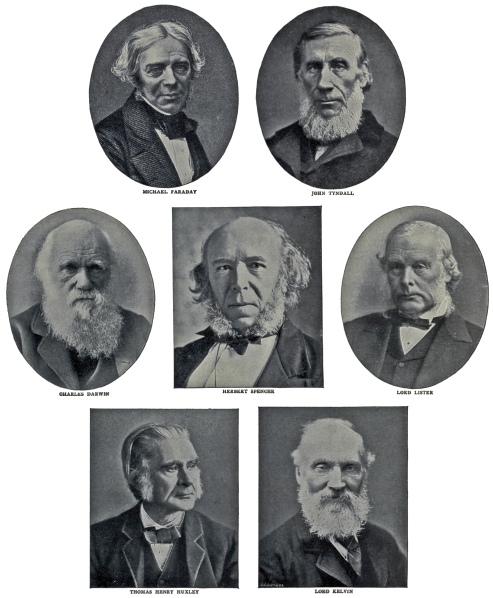
Tennyson, Lister, Leighton, Kelvin, show that a
peerage is at last open to literature, science, and
law.
Again, it is objected that the House of Lords
can oppose a popular measure. So can every Upper
House. But the Peers, though they often send back
measures amended, never refuse to assent to measures
which are understood to be desired by the mass of
the people.
Again, any profligate may sit in the House.
This is an objection which is met by the simple fact
that a Peer of well-known bad character would not
dare to present himself in the House of Lords. But the Peers represent Norman blood and feudal ideas.
Nothing of the kind. Most of the Lords are of quite recent creation, and are sprung from families
obscure and even humble. Here is an instance. I was once conversing with a bricklayer, an elderly
man, who had formerly been a prize-fighter. He began to talk of a certain noble family. “My father,”
he said, “used to go poaching with his grandfather. They were both employed on the same farm. His
grandfather went into the town
of —— and set up a shop for
game—hares and rabbits and such—which
my father poached for
him till he got took and went to
prison.” The sequel is obvious.
The man who started the shop and
made the other man do the work
and undergo the risk for him, got
on; his son started life in a higher
plane, showed abilities, grew rich,
and was eventually created the first Peer of his family. This is
perhaps an extreme case; but the point is that Englishmen are constantly
working their way to the front by sheer ability and without
any family influence whatever; that when they are well to the front
they receive
Peerages;
that
the whole family is thereby raised in the social
scale; and that every Peer represents a network
of cousins, nephews, and relations, who
rejoice in his rank because it lends them too a
certain social superiority.
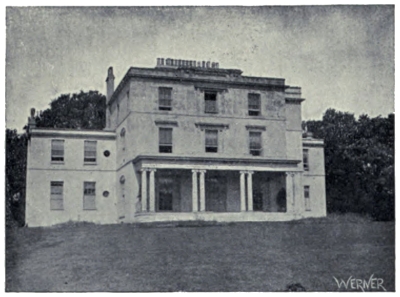
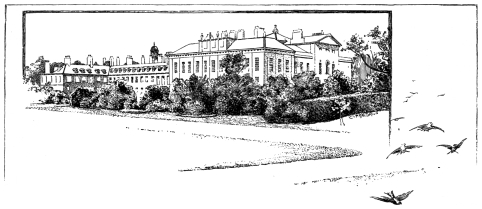
PIERREPONT PARK, BROADSTAIRS, KENT
One of the early Residences of the Queen
Victoria
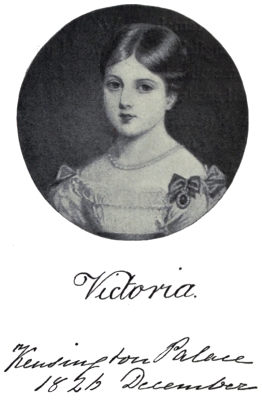
Kensington Palace
1826 December
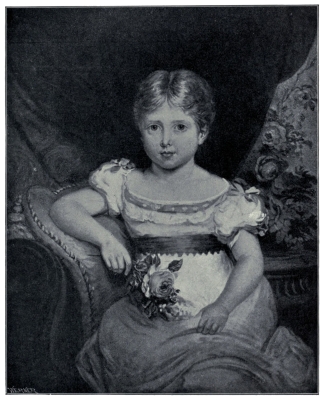
PRINCESS VICTORIA, AGE 6
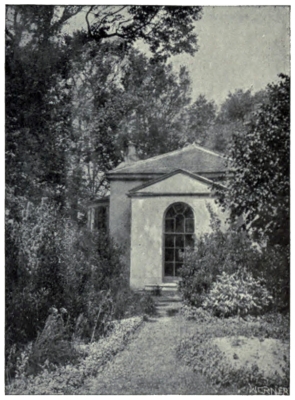
THE MUSIC-ROOM AT PIERREPONT PARK
For these and other reasons, the outcry
against the House of Lords has ceased. It
will perhaps revive
again, but
in some milder
form; for the
old assertion of
rank, the former
haughtiness of
the aristocrat, has
been greatly mitigated:
in the last
century it was
complained at
Bath that noble
Lords would not
even enter the
society of plain gentlemen; it is now understood that whatever may be a man’s rank, he cannot be any
more than a gentleman. Rank gives him precedence: a seat in the House of Lords, but no more; this
is all he can claim.
A third cry, which used to be loud and general, but is now greatly reduced in volume, is the disestablishment
of the Church of England. A large and powerful society has been working for this end for
many years. Members have been sent up to the House, pledged to bring about these results. Yet the
Church remains. When the Irish Church was disestablished, nearly thirty years ago, every one said that
the English Church would go next. What excellent prophets we are. How many similar predictions do
I remember! The Irish Church was disestablished because it was not the Church of the people, but of a
small section. The English Church remains, because it is the Church of the majority, and is without
doubt becoming more so every year. The Churches are crammed with people—of the better sort: the
working-man, though as a rule he does not go to Church, has learned during the last sixty years to regard
the Establishment with friendliness and respect, if not with gratitude and affection.
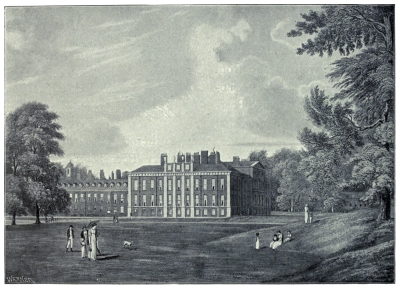
KENSINGTON PALACE IN 1819
We see in this country at the present day a loyalty to the Crown, to equal which we must go back
to the reign of Queen Elizabeth; and for the same principal reasons, a Sovereign personally respected and
beloved, a period of marvellous expansive
prosperity and advancement of
every kind. We see the Republican
form of Government no longer advocated;
the House of Lords no longer
attacked; the old cry for the disestablishment
of the Church growing daily
weaker; the See of Canterbury extending
everywhere its authority, and
promising to become the Rome of
the Episcopal Church.
I call attention to another point.
Everybody knows that a great part of
the history of this country consists of
the long and never-ending struggles
of the King to extend his prerogative,
and of the people to maintain their
rights. To observe that the reign of
Queen Victoria presents not one single instance of a desire on the Queen’s part to extend her powers—those
powers are much less than those of the President of the United States—she has been contented
with them. Again, she has welcomed every act of reform; she has always shown a perfect trust
in the whole people; she has clung to no small clique of families; she has admitted no reservation
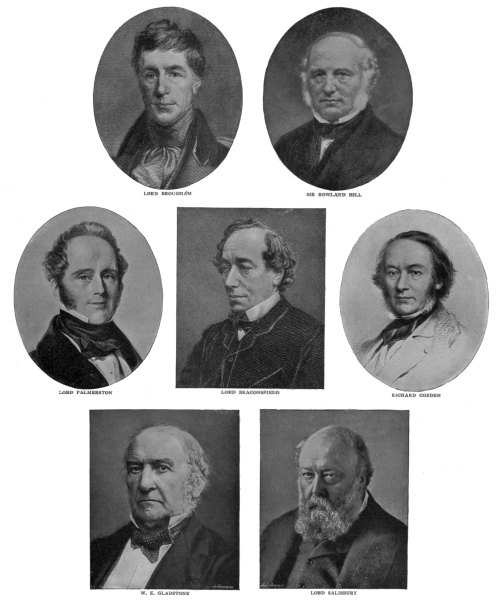
of aristocratic caste; she has willingly received as her ministers such men as Gladstone, Disraeli,
John Morley, James Bryce, and others who have no pretensions whatever to aristocratic descent;
she has been, in a word, entirely loyal to the Constitution: she has lived, not for herself, but for
the Empire.
It is impossible here to avoid saying—what every one else writing on this subject has already said—something
about the extent and population of the British Empire. Under the Union Jack at this
moment there lie the British Islands, Egypt, India, Burmah, a part of Borneo, Australia, New Zealand,
the Dominion of Canada, the West Indies, South, East, and West Africa, with innumerable islands
scattered over the face of the whole globe. A great deal of this territory has been acquired since the
year 1837: at that time vast tracts of it were worthless deserts, for which no one ventured to predict a
future. Australia contained a few thousand whites; New Zealand, not half a dozen; South Africa
was the Cape and nothing more; Canada contained only the two divisions; there was no emigration—there
was no thought of emigration. The exports and imports of the country, though they were
thought large at the time, were only worth a hundred millions sterling, against four hundred millions
at the present day. The national debt in 1837 amounted to 30 per cent of the wealth of the whole
country: at present it is 7¼ per cent on that wealth. In 1837 there were 28,000 merchant ships
belonging to Great Britain and her colonies: at present there are about the same number, but with
four times the tonnage. And so on with tables of figures which show the advance made by the country
in every branch of industry and enterprise. Above all things, we may look round and observe that,
just as on the site of Fort Dearborn of 1837 now stands the splendid city of Chicago of 1897, so,
where there was nothing in 1837 but wild plain and lonely hill, there now stand crowded and busy
cities like Melbourne and Sydney: there now lie bathed in the golden sunlight populous colonies like
Manitoba and British Columbia: there now look upward in their youth of hope nations like New
Zealand. Great Britain in sixty years has become the mother of four nations. Yet a little while, a few
years, and these nations—federated Canada, federated Australia, federated South Africa, United New
Zealand—will be four independent nations, proud, strong, eager to meet whatever fortune may send
them, with the prayers and the blessings of the little Island whence they sprang.
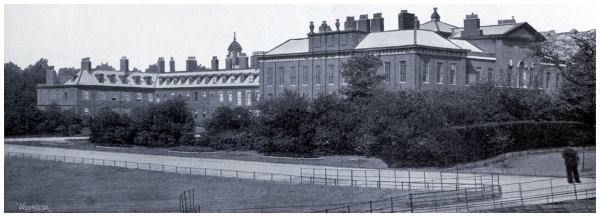
KENSINGTON PALACE IN 1897
It remains to be seen what reception they will get from the United States; whether there will be
only five independent Anglo-Saxon countries allied with each other and the mother country by bonds
never to be broken, while the sixth still holds aloof; or whether the five shall become six, all independent,
neither one before nor after the others, and so the unity of the race be preserved, and its destiny
as the leader of the world be assured.
As for the public and the private life of the Queen I have told you that I know no more than you
yourselves. That she ascended the throne, a young girl of eighteen; that she married happily; that
she has been blessed with many children; that she has lost her husband and two of her children, and
more than two of her grandchildren, you know already. Despite the fierce light that beats upon the
throne, there is nothing—absolutely nothing—in her long occupation of that seat which has to be
concealed or defended. No prince has ever occupied a throne with greater loyalty to his people’s liberties;
nay, those liberties have increased and broadened without a word from the Queen to stay their advance.
Religious disabilities have vanished: the Catholic, the Dissenter, the Jew, the Atheist are on the same
level with the Anglican; the Franchise has widened, without a sign of opposition from the Queen. It
may be said that she has been admirably advised. Perhaps you will acknowledge, however, that it is the
first characteristic of a noble mind that it can understand, and will listen to, advice.
Foreigners cannot, perhaps, fully understand the depth and the reality of that loyalty of which I have
spoken—it is a personal as well as constitutional loyalty—they can, however, understand, and they will
acknowledge, that there has never lived upon the earth a woman who in her lifetime has created, and has
inspired, and has possessed so much affection, respect, and confidence from all parts of the world.
Of the good woman what sayeth the wise King Lemuel—who wrote too little—from the oracle
which his mother taught him?
She spreadeth out her hand to the poor; Yea, she reacheth forth her hand to the needy. Strength and dignity are her clothing, And she laugheth at the time to come. She openeth her mouth with wisdom, And the law of kindness is on her tongue. Her children rise up and call her blessed: A woman that feareth the Lord, she shall be praised. Give her of the fruit of her hands, And let her works praise her in the gates.
CHAPTER II TRANSFORMATION OF THE PEOPLE
“Bless thee, Bottom! bless thee! thou art translated.”—Midsummer Night’s Dream.
“Above all things, gentlemen,” says Goldsmith’s prisoner for debt, “let us guard
our liberties.”
What were the liberties of the people? They were very real; but they
did not open the debtor’s prison; nor did they include representation. You
will hardly believe that the old condition of things should have lasted so long.
Before the Reform Act of 1832 the only persons who had votes at elections
were freeholders; in some boroughs the electors were the Mayor and Corporation;
some were “pocket” boroughs, in which the territorial magnate of the
neighbourhood nominated the Member; in some there were only two or three electors, who openly put
up the seat to the highest bidder. The House of Commons was a body made up almost entirely of
younger sons or cousins of the Lords, who voted as they were ordered; many of the members held places
under Government—they voted as they were told; many of the members were bribed on every important
occasion. On the declaration of the American War of Independence it was in such a House Mr. Burke
vainly thundered and protested that taxation in a free country could only go with representation. Alas!
the liberties of the country had no other guard than the House of Commons; and the House betrayed
the country. It took sixty years of almost continual struggle to get the Reform Act of 1832; yet in a
country of twenty millions no more than 440,000 had votes. There are now six million voters; that is
to say, the suffrage is practically universal. There are people still outside the wide limits of the franchise,
but they are, as a class, so poor, so held down by the hourly necessities of finding food, that they can
hardly be considered as suffering any loss of dignity by having no votes. For my own part, I do not
think that the suffrage should be a matter of right, nor should it depend upon income or rent; I think
that a man before he is allowed to vote should show that he possesses some knowledge of the history of
his country and its constitution. I do not expect any one to agree with me, but that is my opinion.
PRINCESS VICTORIA, AGE 8
Consider, next, the changes in the conduct of
elections. Formerly the election was open and
public: it occupied several weeks; during the whole
time the town was filled with violence, clamour,
drunkenness, and bribery; the elector had to fight his
way to the hustings; the mob, which took sides with
impartial ferocity, fought each other and hustled the
electors. Since it was proclaimed how every man
voted, electors had to vote against their conscience
for the sake of their private interests—for instance, in
the great Westminster election of 1784 the King let
his tradesmen understand clearly how he expected
them to vote; a contested election cost many thousands;
no one could sit in the House who had not
an estate worth £300 a year at least; Roman Catholics,
Dissenters, and Jews were not permitted to become
Members of Parliament.
On the other hand, an election of the present
day is conducted with perfect order. There is no
shouting; there is no fighting; at eight o’clock in
the morning an office is thrown open; a policeman
stands outside to direct the voters; almost everybody
in the electoral district records his vote. He receives
a paper with the names of the candidates upon it; he marks the name for which he votes, folds
the paper, and gives it to a clerk, who in his presence drops the paper into a box. At the close of the day
the voting papers are opened and counted. The election is over. There has been no bribery, nobody
knows how any man has voted, and the whole business is complete in one day.
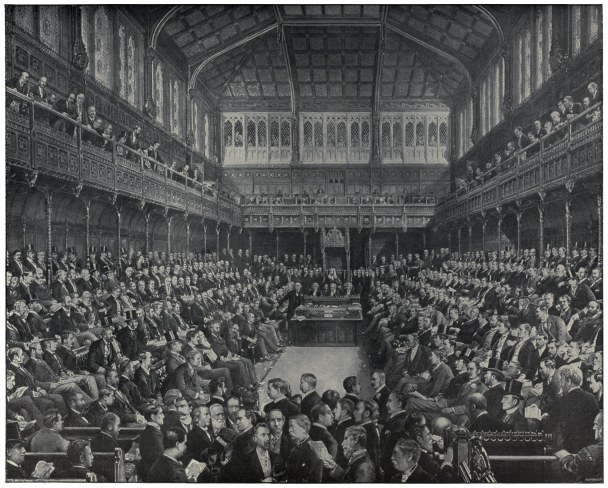
In changing the franchise and the mode of election we have changed the House of Commons itself.
It represents the people—not one class only, but the whole people. There are in it younger sons of Lords;
they no longer come in as nominees, but on their own merits; there are no pocket boroughs; there is no
property qualification, some of the Members are lawyers, some literary men, some tradesmen, some working-men;
all the nation is represented in that assembly. The House is no longer the rich man’s club as it
used to be, but it represents the nation; it is no longer a fortress of prejudice and conservatism, but it
represents the nation. And consider the vast accession of dignity and self-respect to the working-classes
when they realise that the government of the country is really and actually in their own hands, and that
they can bring in their own Members of Parliament without coercion and without fear.
A WATER-COLOUR DRAWING BY PRINCESS VICTORIA, AGE 12
The next change is in education. Sixty years ago the mass of the country was uneducated.
Millions could neither read nor write; millions could read a little and could not write at all. The whole
country is now educated—in every rural village, in every crowded city street, there is a school, and the
children are compelled to come in. In addition to the schools there are village libraries, institutions with
lending libraries, public libraries where the best literature of the past and the present is freely offered to
the people. They can carry home the books, they can have as many books as they are able to read. We
are creating new readers by the million. Are we, it is often asked, creating also a whole nation of
students? Hardly. Education does not create students, who are born, not made. Besides, we do
not want to become a nation of students. The hard work of the world is not done by students or
philosophers. Education, however, teaches us something of
our own ignorance, something of the source of information,
something of humility. Above all, education falling on a
kindly soul gives the lad a new recreation for his evenings:
instead of horse-play along the streets, instead of drinking at a
bar, instead of “keeping company” with a girl every evening,
he reads. He does not read for instruction, he pursues no
course of study, he reads just for recreation; but such is the
character of the reading found for him that he imbibes a
great amount of information, learns manners, and acquires a
higher standard of morals. The circulation of the penny
weeklies proves that he reads; there are a hundred of them
at least; their circulation is enormous, some of them attaining
to half a million. If we buy some and look at them we
find them “scrappy”; they are not vicious, or immoral, or
seditious, they are the exact opposites of these; but they are
scrappy; it would seem as if their readers, which is probably
the fact, are incapable of a sustained argument, and like to be
stimulated by short stories of adventure, odds and ends of
history, and so forth. Think,
however, of the change from a nation which was in great part
illiterate in 1837 to a nation which knows something of history
and something of geography, and which now reads with
avidity. Hardly a cottager now but takes in his weekly newspaper.
Lloyd’s Weekly News is, I believe, the most widely
circulated of them. It claims more than a million readers;
it owns a great pine-forest in Norway to supply its paper, and
it is a most respectable paper, popular and full of news, taking
one side strongly, but never scurrilous. If you want to
understand the English rustic of the day, send for the last
number of Lloyd’s and read it through. I am sure that after
reading this journal your appreciation of the British rustic will
be distinctly raised. And you will own that he is changed
indeed.
AN ETCHING BY HER MAJESTY
Consider, next, the widening of the world. I think that
it is the tendency of those who live in a small country to
make it smaller by their own seclusion. The rustic, for
instance, formerly knew nothing of the world but his farm and
his village and the nearest market town, whither he carried
produce or drove the pigs on market day. This town—which once a week was enlivened by the crowd
attending the market; the farmers at the Corn Exchange or the cattle-sheds; the cries of the people at the
stalls; the farmers’ ordinary at the principal inn—was, to the rustic, a metropolis, a centre of gaiety. There
came rumours, it is true, of an outer world. Somewhere or other there was a king; a recruiting-sergeant
carried off a young man here and there; there were recollections of the great wars when wheat went up
to 103s. a quarter, when farmers became squires, and squires became peers, but the rustic remained where
he was. The village was so full that wages ran down, even while wheat went up;
in Devonshire, a man of eighty years assures me that the wages of the agricultural
labourer in his youth were 7s. a week, with a two or four roomed cottage, and a
pound or two to be made at harvest time. Such a man, with his
family, never tasted meat all his life, except sometimes a piece of
fat pork. His children lived chiefly on oat-cake. The man’s
drink was rough harsh cider. It seems incredible how strong
men, of splendid physique, could have been made out of such materials.
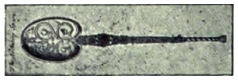
THE CORONATION SPOON
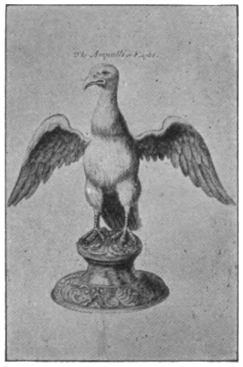
THE AMPULLA OR RECEPTACLE FOR THE HOLY OIL
FOR ANOINTING
This man’s position is now so far improved that he receives about twenty
shillings a week, with harvest allowances; that he has an allotment on which he
grows his vegetables; that he keeps poultry and a pig; that he eats meat of some
kind every day; that his wife and children go warmly clad.
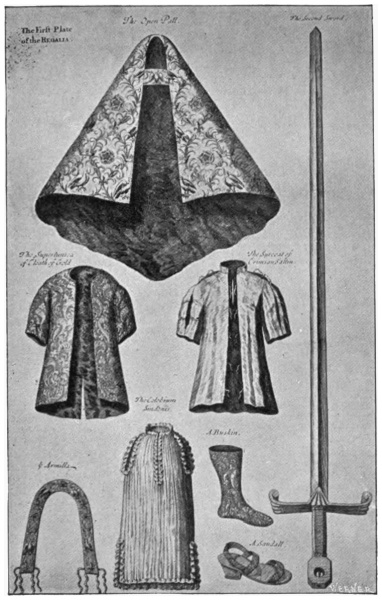
THE CORONATION VESTMENTS
What has caused this change? The widening of the world. How the world was first discovered by
the English rustic to be so wide and so empty, I do not know. It was during the twenty years between
1815 and 1835 that the discovery began; at first it spread very slowly; the rustic heard of it at the
market town; he met with a sailor who talked about the splendid chances beyond the seas; he heard
letters read from settlers in Canada and Australia; here and there one, greatly daring, left the village, and
was considered as good as dead till letters arrived entreating all—father, mother, brothers, and sisters—to
leave their home and join him. At last they began to go, and the
tide of immigration set in that has never since stopped or slackened.
In the year 1815 the emigration from this country amounted to no
more than 2000; in 1825 it was 25,000; in 1850 it was nearly
300,000. From 1815 to 1896 I do not think that the emigrants
from these shores have amounted to less than 10,000,000; of these
more than one-half have gone to the United States. These emigrants
do not, for the first generation at least, forget their native land and
the kin they have left behind them. Imagine, then, the difference
between a village closed absolutely to the outer world, into which
there penetrates no voice, no rumour, no report from without, and
a village where every family has got sons and daughters in the lands
across the sea.
The world has been widened for us by the rise of the other
nations of our race. It has also been widened by the railway and by
the cheap post. Small as is our island compared with the great
continent of America, there was formerly no knowledge of any part
of it outside the native place; at the present moment the people can
get about all over the country—to the seaside, to London, to the Lakes,
to Wales; everywhere there are excursion trains and cheap tickets;
the children learn by their annual treats to look out every year for new and interesting places; to the
people the excursion is an event which excites and stimulates them all. You may see them by thousands
in the ruins of an old abbey, trying to reconstruct the past splendours; or among the ruins of a Norman
Castle; or in the gardens and galleries of some great house which is thrown open to them; or by the
seashore, rowing, sailing, bathing; or in some park, where the children dance and sing and try to persuade
the deer to let them come near. In one small town of Lancashire, a town of factories, the people
spend £30,000 a year on their excursions; they descend upon the Lincolnshire watering-places, which
are small and ill-provided, and they eat up the town and the farms all round; they invade the hotels of
Ambleside and Grasmere, and eat up all that therein is; they reduce the Isle of Man to famine; they leave
the coast of Northumberland empty and cleared out, with an emptiness like that caused by the locust.
Such is the effect of the world’s widening.
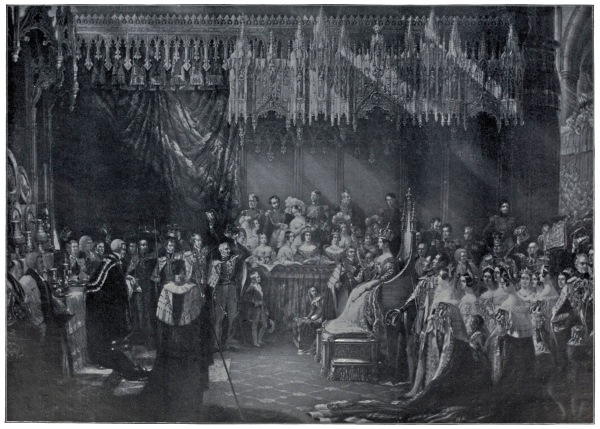
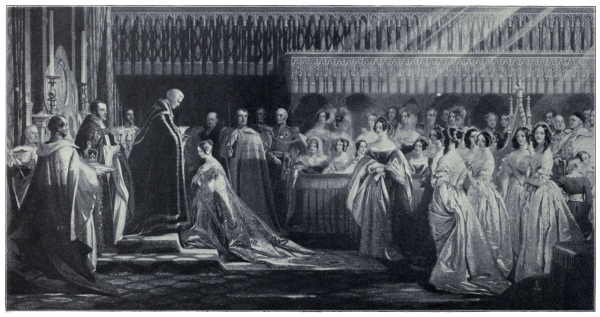
Painting by Sir George Hayter
THE CORONATION
Painting by C. R. Leslie, R.A.
THE QUEEN RECEIVING THE SACRAMENT AFTER HER CORONATION
Consider next the cheap post. The people have begun to write to each other. Formerly there
was little or no communication by letter. It is true that a cheap and easy way was practised, by means
of which a young man could communicate to his friends the simple fact of his safety. It was to address
a letter to his mother; if she took that letter in it would cost her eightpence at least, but she knew
there was nothing written within, therefore she refused to take the letter, which was undelivered, but
she knew from the address outside that her son was safe. Now, however, letters pass freely into the
village; they convey information, as to work and pay, that the newspapers have not yet learned to
furnish; wherever workmen are wanted, thither sets in a stream in search of work. Some years ago
a mischievous fund was raised, called the Lord Mayor’s Fund, for the unemployed. A rumour of this
fund ran through the whole length and breadth of the land; all the unemployed came up to London
from all parts to share in the money so raised; it was distributed chiefly in soup tickets; the men took
the tickets, sold them, and drank the contents. The point, however, to notice is that the people, before
the proposed fund was started, knew all about it, and had begun to come up in order to claim
their share.
I have spoken of the rise in wages. To this I will return presently. Meantime observe that with
the rise of wages there has also arrived an extraordinary cheapness in food. The price of wheat, between
the years 1786 and 1837 was never lower than 39s. a quarter, and rose to 106s., 113s., 119s., and even
126s. a quarter. It was over 70s. a quarter for seventeen years of that time, and over 50s. for forty
years; it is now about 20s. With the price of grain, other things have fallen; tea, which sixty years
ago was five shillings a pound, can now be had for eighteenpence; sugar, of which the commonest kind
formerly cost ninepence a pound, is now about twopence; cheese, butter, rice, and other products are
now imported, and are sold at a half of their former price; meat comes over from New Zealand, frozen, in
unknown quantities; clothing is half the price it was; the working-man’s wages, therefore, which have
more than doubled, represent a much greater purchasing power. He stands, therefore, upon a higher level
of comfort. Another thing—a very important thing—has been done for the rustic. By an Act passed quite
recently village councils—parish councils—have
been founded. To these councils, elected
by the working-classes from themselves, are
entrusted the governing of the parish: the
lighting, paving, cleaning of the streets, the
order and police, and all matters belonging to the
daily life of the place. On these councils the
squire and the parson may sit, if they are elected;
but they have no more power than the others.
So far, it is reported that without the presence
of the squire or parson the new councillors
flounder. This, however, was to be expected.
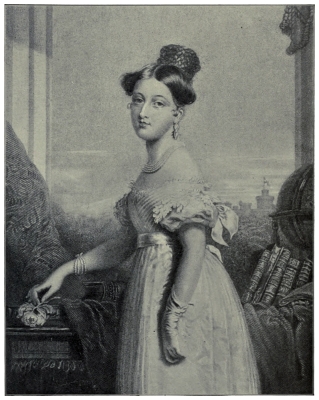
Painting by Sir G. Hayter
PRINCESS VICTORIA, AGE 16
In the year 1837 any person who owed
another any sum of money, however small, was
liable to be arrested for debt, and if he would
not pay he could be thrown into prison and
kept there till he did pay. Thousands of
unfortunate debtors were kept in prison for the
whole of their lives on account of some miserable
debt which, if they had been out of prison,
they could have paid off in a short time.
There was a devilish malignity about the law
which enabled an attorney to roll up a bill of
costs (which the prisoner had to pay), on this
pretence and that, like a snowball increasing
as it rolled; the warders of the prison demanded
fees and “garnish,” in default of which the prisoner was turned into the “poor side,”
where the privations and misery and enforced idleness were terrible. If a working-man got into prison,
as was always happening, there was no hope for him: the costs went mounting up, he could do no work,
he must sit down and starve. Outside the prison, what became of his wife and children? In the year
ending 5th January 1830, 7114 persons were sent to the prisons of London for debt; in 1840 the number
of prisoners for debt were 1732 in England; in Ireland, under 1000; in Scotland, under 100. By the
Act of 1861 imprisonment for debt was forbidden, except in case of debt fraudulently contracted; in 1887,
by the Bankruptcy Act imprisonment for debt was virtually abolished altogether. A terror was removed
from life when the walls of the Fleet and the Queen’s Bench were taken down and the gates thrown open.
The recovery of small debts is now entrusted to the County Court, where the Judge makes an order that
so much should be paid weekly or monthly. If the debtor breaks that order, he is liable to imprisonment
for contempt of Court.
The English working-man has been accused of servility. Such a charge could never be brought
against the working-man of London, or of the North; that servility existed in some of the agricultural
districts was undoubtedly true. How should it be otherwise when a man’s daily bread, his work, his
home, his wage, depended wholly on one man—the squire? His village was his prison; he could go
nowhere else; there was no work for him out of his village; the squire was his “overlord,” to use the
old phrase; he was not legally, yet he was in reality, ascriptus glebæ, bound to the soil; he looked for
help in sickness and in trouble to the great house
whose ladies looked after the village, helping,
feeding, clothing, and admonishing. The man was
like a child in leading-strings, or at best like a
schoolboy under rule and discipline. With the
cause of that servility, the fact itself is vanishing.
The depression in agriculture seems also, on
the whole, turning out favourably for the agricultural
labourer; the farms are worked more
economically and want fewer hands; but the superfluous
hands have left the village—there are now
no more than are wanted day by day; if an odd
piece of work turns up it is difficult to find a man
to do it. The men are therefore valued in proportion
to their paucity of numbers; their wages,
for the same reason, are going up; they live more
comfortably, they have more money to spend, they
are more independent.
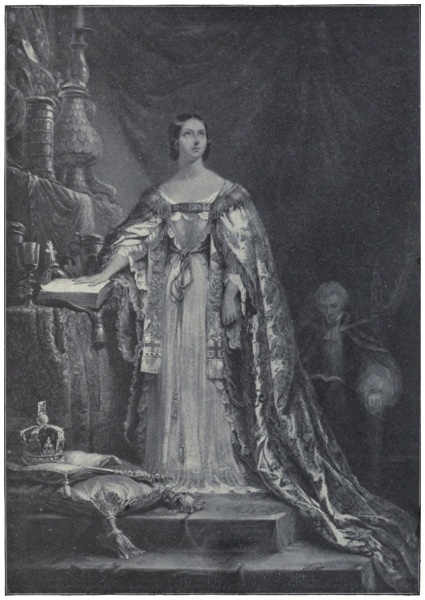
Painting by Sir George Hayter
TAKING THE OATH TO MAINTAIN THE PROTESTANT TRUTH
The old laws forbidding workmen from making
combinations or “Covins” for the advancement of
wages were passed in the fourteenth century, and
remained in force until the year 1825, when they
were at last repealed. You think, then, that
nothing remained for the workpeople but to
form as many combinations as they pleased. You
are quite wrong. There was still the right of
holding public meeting. Until that was acquired—it
was only fully granted a few years ago—the repeal of the old law was practically valueless. The
right of forming trades unions has been acquired entirely during the present reign. Now the trades
union is not popular; it has been ruthlessly enforced; the treatment of blacklegs has been cruel;
yet no one can deny that the position of the working-man has been enormously improved, his
independence advanced, his wages increased, by the union. The Agricultural Union has not done so
much: partly because the countryman is difficult to manage; partly because it would appear that he wants
another kind of union. Thus the skilled agriculturalist is a man who knows a great deal, he cannot be
replaced except by one like himself; the best chance, therefore, is to stimulate emigration and keep down
his own numbers.
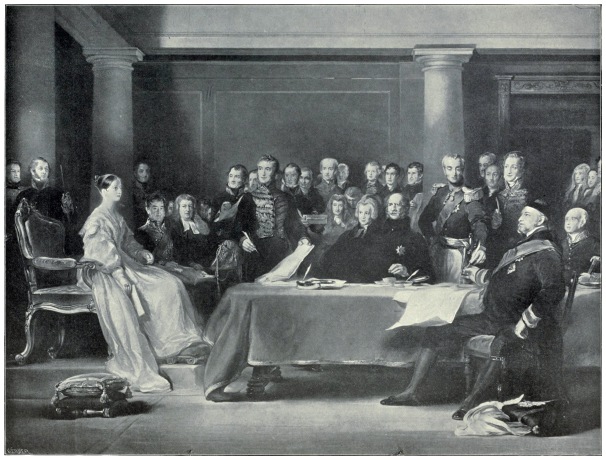
Painting by Sir David Wilkie
THE QUEEN’S FIRST COUNCIL
I have not mentioned among the forces making for advance the abolition of flogging. As a matter
of fact flogging is not abolished, but it is only inflicted upon civilians as a punishment for robbery with
violence. About thirty-five years ago there was a common form of robbery called “garrotting,” in which
violence and brutality were commonly exhibited. By the advice of the judges the garrotter, on conviction,
was flogged. It is maintained that the flogging practically stopped the garrotting. However that
may be, there is no doubt that the ruffian who suffers that punishment dislikes it extremely. But this
punishment did not affect the respectable classes. In the Army and the Navy, on the other hand, where
flogging was practised continually, it did affect them; and it seems wonderful that, in the face of the
prejudice against the service which these
punishments created, we should have been
able to maintain an Army at all. It is,
however, just to state that flogging in the
Army had been enormously reduced: in
1869 there were only 21 soldiers flogged out
of our whole army of 150,000, while an able
seaman of the first class could not be flogged
at all; and in the same year, in the whole of
the navy of 80,000 men only 8 were flogged.
By the Army Discipline Act of 1879 flogging
was finally abolished. But, I repeat, I do not
consider this reform as affecting materially
the mind of the English working-man.
Now read through this long list of
reforms, every one of them exercising
steady, continual, irresistible influence
upon the individual. What changes do
you expect to find in him?
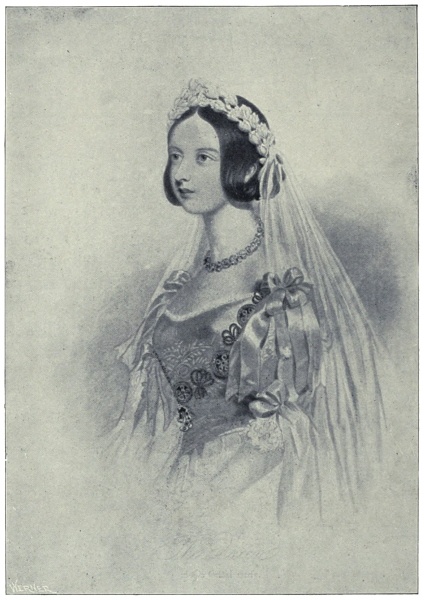
THE QUEEN IN BRIDAL DRESS
He has become, in fact, more independent,
more responsible; he knows so
much more that he feels his own ignorance;
he is not so easily led by a demagogue;
it is not so easy to inflame his
passions; he thinks and asks questions; he
is better fed, better clothed; he walks
more upright; he is no longer a machine;
he understands the power of combination;
he sits at the table of his parish council on equal terms with the squire and the vicar; he no longer
regards his native village as the place to which he is bound; he has friends in various parts of the world;
they come home from time to time and they tell him of these countries—Republics all, except in name—where
there are no squires and no landlords; and he asks himself whether it is better to stay on in
the old place, or to try for a bigger thing beyond the seas.
Changed as he is, and certain to change yet more and more in the immediate future, do not forget
that the English working-man, even of the town, feels a great shrinking about leaving the old home. In
a village this seems natural; the place is calm and lovely, the ancient church with its gray tower standing
in the churchyard, where the rooks and pigeons and blackbirds keep up a continual chorus; the village
green, the village inn, the gabled cottages, the gates that lead to the Hall, the fields and hedges, the
stream, and the hills, and the hanging woods—these things enter into the very heart and soul of the
Englishman; he loves them all, he cannot choose but love them, though he would not know how to
express his affection; in the churchyard he knows the mounds that belong to his own people; in the
tavern he sits among his cronies on the polished settle beside the fire, his mug before him, his pipe in his
mouth. In his heart he wants no other life. These things he could not find in America or Australia or
New Zealand. Yet he is changed, and if you wait for twenty years you will no longer recognise him for
what he was. He is getting a touch from America, a thought from Australia, a custom from New
Zealand; he will be a citizen of the world, and, if I read the signs aright, he will become before another
generation the owner and the master of agricultural England.
Painting by Sir George Hayter
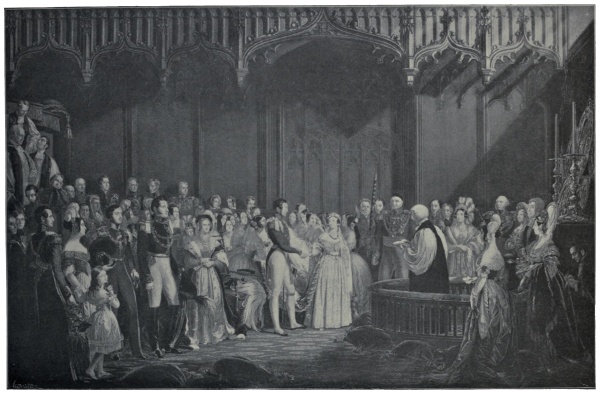
THE MARRIAGE OF THE QUEEN TO PRINCE ALBERT
Let us leave the village and turn to the town.
There are two books in our literature which tell of English factory life in the early part of this
century. One of these is Disraeli’s Sybil; the other is Mrs. Trollope’s Michael Armstrong. I fear that
these two books are not read so much as they should be; partly, perhaps, because we do not love to dwell
too much on the shameful side of history. The condition of the working-man before the Victorian
era is indeed a very shameful part of history. The record of the factory and the mine is very black.
Let me show you something of what it was. I tell you beforehand, that the story proves that power
over his fellow-men must never be entrusted to any man; for he will abuse that power—he will
become an oppressor and a tyrant.
He began this oppression with the children. He has a mill, a factory, a mine; in which he made
the children work. He worked them so cruelly; he gave them such long hours, such poor food, such
wretched clothing, that he lowered the vitality of these unfortunate children so that an epidemic broke
out among them; it carried off thousands. This frightened the owner of these children, because, if they
all died, what would become of his mill?
Then the House of Commons interfered—very reluctantly—because to stand between the master and
his man was felt to be a dangerous innovation. It interfered, however, and passed a law which forbade
children under nine to be employed in a factory, and limited their hours to twelve, exclusive of an hour
and a half for rest and food; so that by this merciful Act a little girl of ten might be, and actually was,
made to work from six in the morning till half-past seven at night. Can one conceive a readier method
of destroying strength, youth, self-respect, everything? But the injured millowner got over this law.
He was not forced to make the children work continuously. He therefore made the children work in
relays, so that they had half the night as well as half the day to work in. This went on for thirty years
before the nation was moved by the injustice and cruelty of the thing. An Act was passed that no
children should work between 8.30 P.M. and 5.30 A.M.; that children under thirteen should not work
more than 48 hours a week or eight hours a day; and that those under eighteen should not work more
than 68 hours a week or 11⅓ hours a day. As I told you, the man who had the power exercised it
cruelly, heartlessly, ruthlessly, for the conversion of his people into slaves.
Paintings by Winterhalter
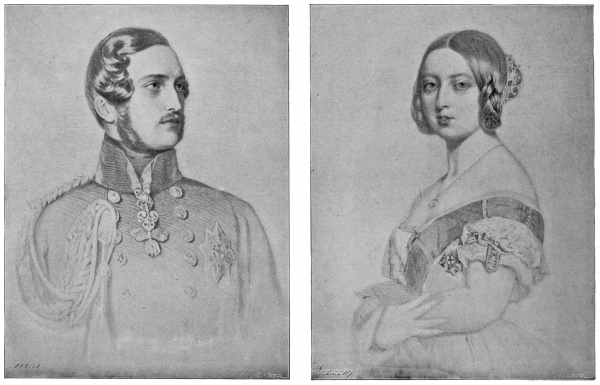
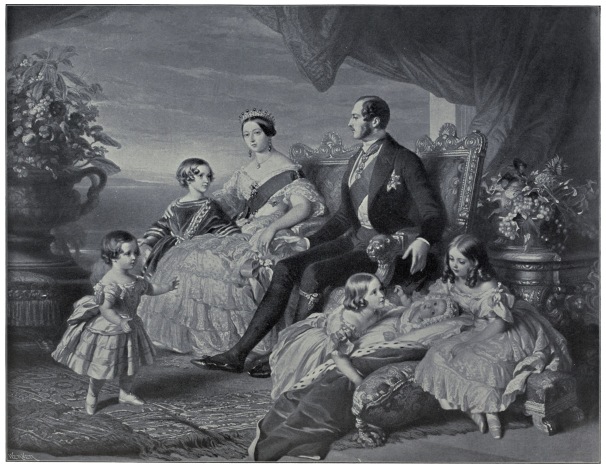
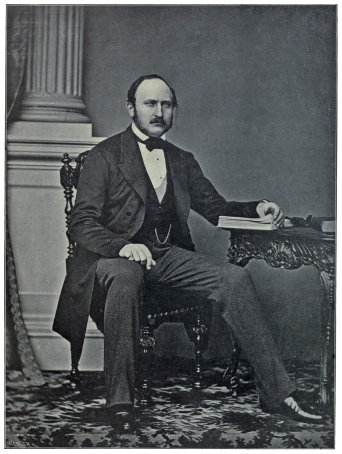
PRINCE ALBERT AND QUEEN VICTORIA AT THE TIME OF THEIR MARRIAGE
Then, because the Act spoke of the factory or the mill, and not of the mine, they took the little
children and dropped them into the coal-pit. When the boy or the girl was six years of age—six! think
of it—they took the little thing and put it in a dark passage, underground, with instructions to open and
shut a door in order to let the trucks come and go. All day long—for twelve hours—that innocent infant
was kept in the dark opening and shutting the doors. They worked from four in the morning till four in
the evening; when they were taken up they were stupid, and cared for nothing but to sleep. When
they grew older they pushed the trucks with their heads; when they grew older still the lads became
hewers of coal: the girls—now women—continued to push the trucks with their heads or to drag them,
clad in nothing but a pair of short trousers. This was done in a Christian country which boasted of
having abolished slavery. Observe that there was no chance for these children ever to learn anything,
ever to do anything, except to continue all their lives in the coal-pit; they were doomed to brutish
ignorance, to unremitting toil, without holidays, except on Sunday—day after day, week after week, year
after year, till they could push
the truck no longer, till the
pick fell from their hands.
The chimney-sweep’s case
was almost as bad as the miner’s.
He too was taken at a very
early age, and his duty was to
climb the chimney, sweeping
it as he went up. It is not
a pleasant thing to climb a
chimney choked with soot; it
abraded hands, elbows, and
knees: sometimes the little
wretch could get no higher;
if he failed he was beaten
unmercifully. There was a
curious prejudice against sweeping with a brush: the child was allowed to go unwashed, though the neglect
of cleanliness was certain to bring on a dreadful disease. It was not till four years after the Queen began
her reign that an Act was passed protecting the children and substituting the brush for the human body.
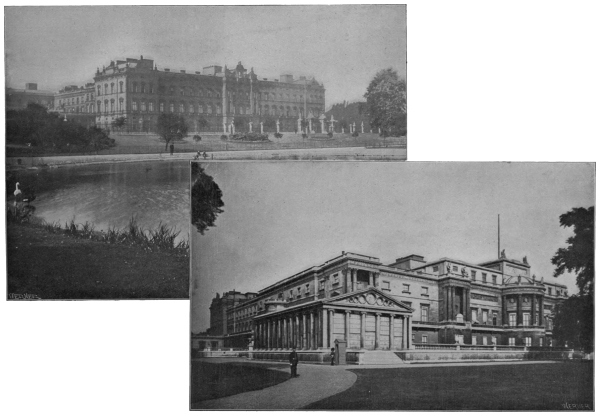
BUCKINGHAM PALACE—FRONT VIEW
BUCKINGHAM PALACE—GARDEN VIEW
This was the treatment of children in mill, in mine, in town. There were other lines and branches
of cruelty because children are helpless. But these examples will suffice.
Let us leave the children and turn to the men. The change for the better began, I believe, with the
ideas of the French Revolution, at first eagerly caught by the English working people: it was continued
by the long agitation for the Reform Act of 1832 and the fierce resistance of the Duke of Wellington and
the Bishops: these ideas and this agitation taught the people how to combine and act together. They
also taught the people to hate a Government in which they had no share or part or lot. A great many—though
still the minority—could now read; the papers they read were bitterly hostile to the ruling
powers. As I have already pointed out, there was no loyalty at all among the working-men of the
Thirties; they did not pretend any.
Their papers were revolutionary; the
things they said of the Queen and the
Prince Consort were revolting; the
aristocracy, according to them, were
open and shameless; the clergy were
pampered hypocrites. What has happened
since then? The people have
been admitted to their share in the
Government; they can do what they
like: if they choose they can alter the
Constitution. Do they choose? Not
at all; they have become loyal; they have
become, comparatively, conservative.
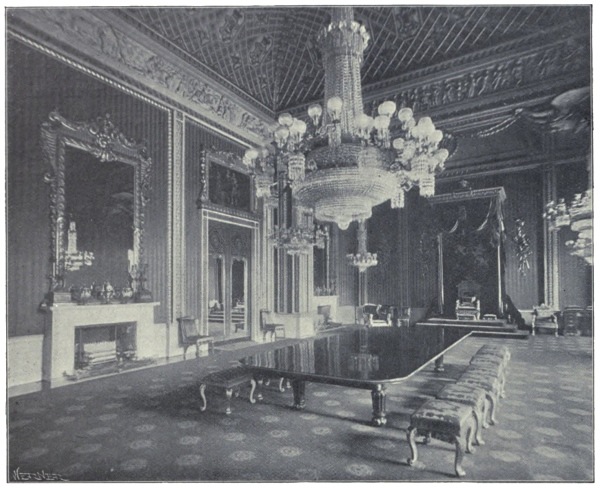
THRONE ROOM, BUCKINGHAM PALACE
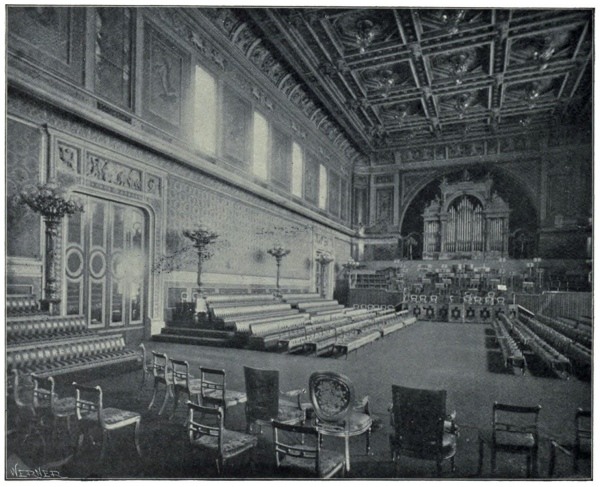
BALL AND CONCERT ROOM, BUCKINGHAM PALACE
The recreations of the working-man,
apart from the tavern, were boxing
and dog-fighting. Single-stick, wrestling,
quarter-staff, cock-fighting, had
to a great extent gone out. Boxing
remained, every man knew how to handle his fists: you may remember that in Tom Brown at Oxford,
there is a serious discussion on the knotty question whether a gentleman can, or cannot, always lick a cad.
Dear me, this kind of talk is now so
old-world. However, a man was always
supposed to be ready to strip and engage—gentleman
or cad. Dickens’s stories
contain many instances of the rough-and-ready
“turn up.” The change is a
gain from one point of view; it is a loss,
from another, that the noble art of self-defence
has fallen out of practice; it is,
further, a gain as well as a loss, that it
shows signs of returning to favour.
There are still fairs left. Several
fairs were held in the neighbourhood
of London. Bartholomew’s, degenerated
into a scene of drunkenness and disorder,
still continued. Greenwich Fair continued,
and Deptford Fair; there was
also a fair at Barnet; but the fairs had
practically gone out of the life of the
country. It was a mark of the times that the working-classes no longer delighted in the noise and the
ribaldry that disgraced the later years of the London fairs.
I have spoken of education in the rural districts. Long before the young rustic could learn to read,
the townsmen had the chance of some education. There were many charity schools: there were the schools
of the National Society and of the British and Foreign Society: there were also the Sunday Schools.
Criminal procedure does not, perhaps, affect the average civilian. At the same time one learns that
before 1836 it was actually forbidden that a prisoner should defend himself before the jury by counsel.
Imagine, if you can, a timid, shrinking girl, called upon to plead for her life in open court after being
maddened by jargon which she did not understand and formalities which only filled her with bewilderment.
It is said that the judges themselves repaired this evil: it is quite possible. Our judges have
always been superior to the laws they have had to administer; but then the prisoner was at the mercy of
the judge; he might, or he might not, find a remedy for the speechlessness and the incapacity of the
prisoner.
If you take up a bundle of old newspapers you will find that every one of them has got a red stamp
upon it. This was the tax upon newspapers.
It was a penny a copy in
1760; in 1815 it was actually fourpence
a copy; in 1836 it was reduced
to a penny; in 1855 it was
totally abolished. There was, in
addition, a tax on paper, which was
repealed in 1861. It is wonderful
how newspapers continued to exist
at all with an impost so crushing:
it is still more wonderful how
working-men’s papers could hold
their own. In fact, their circulation
was very small; they were
weekly, not daily; they were taken
in at taverns where the men could see
them, not by the men themselves.
It is not one of the least reforms
of this reign which has placed in the
hands of everybody a cheap newspaper, full, large, with copious intelligence, and educated commentary.
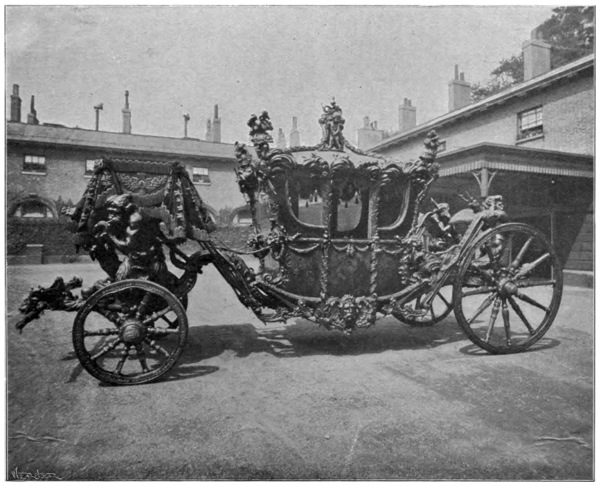
QUEEN’S STATE COACH
The outcome of the national discontent was the organisation called Chartism. Look at the working-man
of the present day. He has received an education sound and thorough, up to a certain point,
at the Board School; he has had the chance of continuing his education after leaving school at evening
classes. He has also had the chance of joining a Polytechnic, which is a kind of technical University,
teaching everything; and a kind of public school, in which athletics of all kinds are practised and encouraged.
There are a great many thousand lads in the Polytechnics, and they are as fine young fellows
as one can desire to see. They are skilled in technical work; they are taught by the best men in their
own subjects; they do not drink or frequent taverns; they do not loaf about the streets. I do not pretend
that these lads are representatives of their own class; I admit that they are the flower of the flock.
The working-man has now free libraries and reading-rooms, where he can sit and read or borrow books
to take away. There is no longer any revolutionary talk among those who converse; there is Socialism,
of course, but that is very different. It would be difficult indeed for a young man to escape some of the
Socialist ideas which are in the air, and are producing unexpected and far-reaching results. Here, however,
except among a few foreigners, we have no Anarchists. The wages are better, the hours are
shorter; there is a Saturday half-holiday; there are four Bank holidays in the year, besides Christmas
Day and Good Friday. Everything is cheaper—food and clothes of all kinds. Lectures, concerts,
dramatic recitals, debates, dances, are got up everywhere by the working-men for themselves.
The working-man’s attitude towards the Church, to which I have already alluded, has quite changed
of late years. He formerly regarded it with a ferocious hatred, being taught by the papers they published
for him that the clergy believe nothing, and wallow in ease and luxury at his expense. “Why,” said one
of them to me twenty years ago, “if the Church was abolished we should all get our breakfast for
nothing.” That kind of talk has now vanished. If the Sunday morning orator still denounces Christianity
with perfervid vehemence—as he used to do in the Whitechapel Road—the working-man listens with a
smile and presently goes on to the next ring, where the Socialist preaches universal happiness to come as
soon as we can get the much-desired equal division; and him, too, he leaves presently with another smile.
He is not in the least moved by either orator.
Canon Barnett’s Church in Whitechapel is an example of what may be done with a parish composed
entirely of working-people. They do not attend his services, I believe. But he has educated them into
an audience which listens intelligently to the best and most thoughtful and most cultivated scholars and
teachers of the day; they flock every year to a Loan Exhibition of Pictures which he collects for them;
he gives them receptions, concerts, discussions; he has built Toynbee Hall in their midst as a settlement
and place of culture. Some of them he has made students and scholars: it is not too much to say that
Canon Barnett’s parishioners are intellectually far above the average of the class supposed to be their
superiors—that of the shopkeepers and the traders. However, it would not be fair to take these people as
an average of our working-man. When I think of the mass of the people as they were sixty years ago—how
ignorant they were, how drunken, how brutal, how dangerous to order and to government, how
unruly, how disloyal—I cannot but claim for the men of the present a change nothing short of transformation!
There is still much to be done, the Millennium is not yet reached; but there is no comparison—none—between
the people of 1837 and the people of 1897; and the advantage is all on one side.
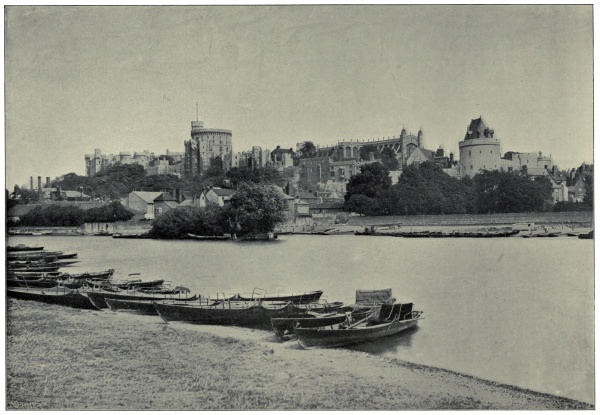
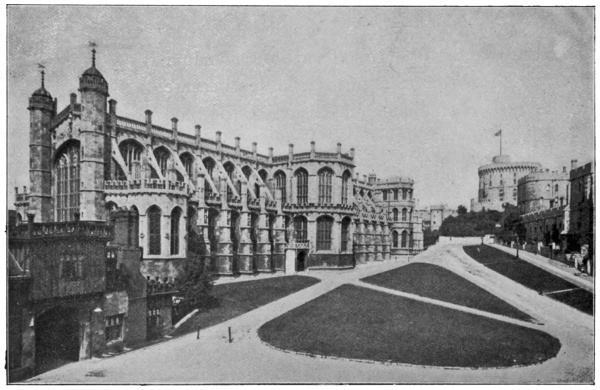
WINDSOR CASTLE FROM THE RIVER
CHAPTER III TRANSFORMATION OF THE BOURGEOIS
“Will you mock at an ancient tradition?”—Henry V.
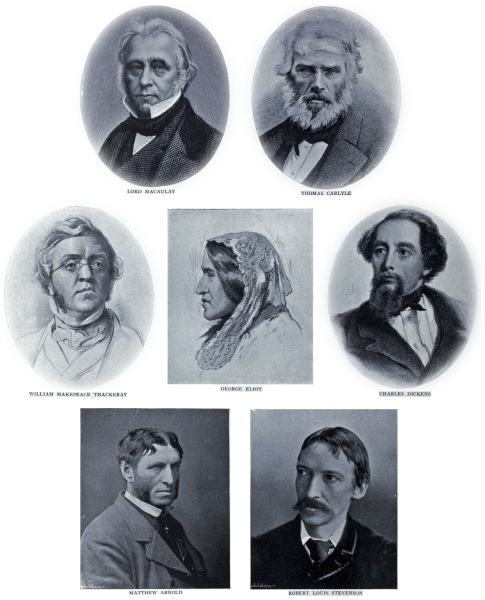
When one speaks of the Bourgeois, one means the class which Matthew Arnold was
never tired of ridiculing as without culture, ideals, or standards. For my own
part, I think it would be more useful to recognise, first, that there are certain
occupations in life which can be carried on very well without ideals; that the
advent or genesis of ideas among certain people would inevitably spoil them for
their humble work; and that it is sufficient for the State if they remain on the
side of order, with due respect to law and justice. Now, whatever the short-comings
of these people with respect to culture, no one can complain of them
with respect to their love of order.
A craftsman—a man who makes anything—may cultivate himself to the highest, and remain a craftsman;
he may be an artist; he may be a poet; he may nourish himself upon the noblest thoughts, and
yet remain a craftsman. Out of the trade of shoemakers have sprung poets, artists, and actors. Cobblers
have been fierce politicians. But a man who sells the shoes which another man makes cannot, in the
nature of things, cultivate lofty standards or æsthetic ideals. His occupation, which has in it something
servile, forbids it. And I have here to speak of the English tradesman, and to show the transformation
which has fallen upon him too.
Let us consider the daily life of a London shopkeeper early in the present century. He had a shop
in Cheapside. The shop occupied the front part of the ground-floor: at the back was the “parlour,” the
family living-room, which looked out upon a small churchyard, in which funerals were conducted almost
daily; the ground was covered with bones and bits of coffins; once a month or so the sexton made a bonfire
of the wood. Upstairs were the bedrooms—the best bedroom in front, which nobody ever occupied
because there were no guests. Here the tenant of the house lived, he and his family; they had no change,
and desired none, from day to day. An apprentice lived with them, slept under the counter, and made
himself useful in the house as well as in the shop—washing
plates and dishes after meals and running
errands for his mistress. One servant was
kept; she and the daughters and the mistress of
the house were all occupied perpetually in making
things; they made puddings, cakes, jam, preserves,
pickles, cordials, perfumes, washes, and
home-made wines—thin and pallid fluids named
after cowslip, primrose, raspberry, and currant.
When they were not making or cooking they
were sewing; all the women of the house sewed
perpetually—they were slaves to the needle:
they sat round the table in the parlour, with a
single candle, and sewed in silence all through
a winter evening. The girls had been to school;
they went to a private school in the suburbs,
where they learned various small feminine accomplishments;
they learned from their mother
certain maxims which should regulate the conduct
of every maiden. And on Sunday they
turned out for church in toilettes whose splendour
highly gratified the pride of their father, because
they seemed to challenge all Cheapside to spend
more money upon the daughters’ dress. Yet he
knew, and all the neighbours knew, that this finery
was all contrived at home—hats trimmed, ribbons
and streamers put in place, and the lovely sleeve
designed by the girls themselves. At church they
enjoyed a service which we should call lugubrious.
The psalms were read, two hymns were sung but
slowly, and the sermon, an hour long, was an
argument on doctrine; but there was the pleasure
of sitting in the Sunday best, which made one
forget the doctrine and enjoy the hymns.
QUEEN IN ROYAL CLOSET, ST. GEORGE’S CHAPEL, WINDSOR
Painting by Landseer
THE QUEEN, THE PRINCE OF WALES, AND PRINCESS ROYAL
All day long in the week, and during a good part of the evening, the good man served in his shop.
It was a shop of which survivals may still be found in various parts of London—a shop with a round
window furnished with many small panes of glass; the window was not garnished with the choicest
wares which this dealer had to sell—not at all; he prided himself on keeping much better things within
than those which he chose to show. After dark the window was illumined by two or three candles.
He breakfasted, for the most
part, on tea and toast; he dined
at one o’clock, plentifully if
not luxuriously; it was not
the custom, among his class, to
invite friends to dinner. The
house, in fact, was regarded as a
kind of sacred harem, to which
no one was invited. Friends,
however, were taken to the
tavern. Unless he was a
Dissenter, this citizen was a
member of the Vestry, and
served all the parish offices.
On Sunday he dined more
plentifully than on a week
day: he was a member of a
club which met once a week;
there he exchanged sentiments
which we should call commonplace,
but they were expected;
any other sentiments would have affected his friends painfully, with doubt and misgiving.
These sentiments were based upon convictions fixed and unalterable. He believed—long before any
Reform Bill—that the only land of liberty was Great Britain; that British armies were irresistible,
and British fleets were ever victorious;
that the greatest enemy to mankind
was the Pope; that the greatest crime
conceivable was not to pay your
debts, especially debts contracted with
a tradesman of Cheapside; that the
greatest disgrace was to become bankrupt.
A debtor’s prison he regarded
as the chief safeguard and stay of
British trade; he would listen to no
sentimental nonsense about locking up
debtors—every debtor ought to be
locked up, ought to be flogged, ought
to be hanged!
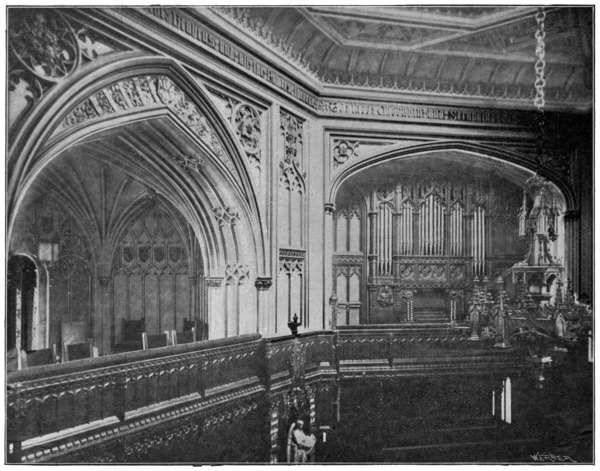
THE QUEEN’S PRIVATE CHAPEL, WINDSOR
ST. GEORGE’S CHAPEL
He entertained no sympathy with
trades unions: the working-man was
the servant of his employer; it was not for him to regulate his own wages and his hours; he was to take
what he could get, what the generosity of his master, what the conditions of trade, allowed him to have.
This man, of whom there were many hundred thousands in the country, read no books; he was
quite ignorant of what we call everything, that is, of literature, science, art, music, history. Something
he knew of what was going on, because there were newspapers at the tavern, which he sometimes read.
But he took in no newspaper,
and he read no books. There
were no books in his house at
all; his girls read no books.
A book of Family Prayers
there was; and for Church
purposes, Prayer Books and
Bibles, but no books. And
so this man, with all his
household, lived and died, as
Matthew Arnold pointed out,
without culture, without ideals,
without standards, without aspirations.
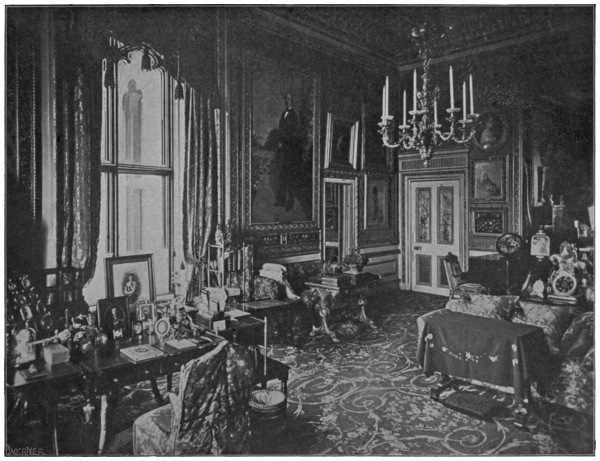
QUEEN’S PRIVATE SITTING ROOM, WINDSOR
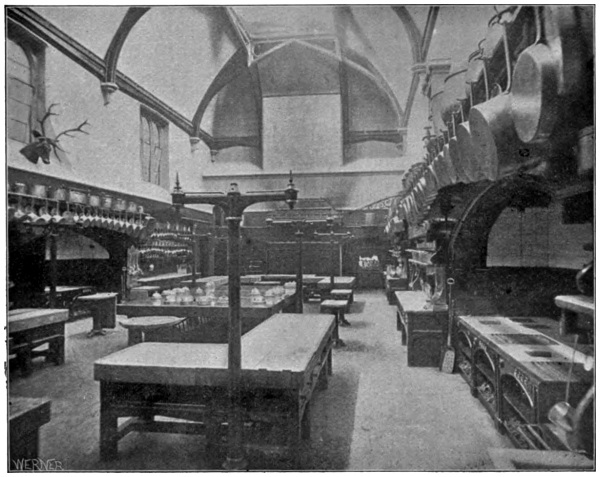
THE ROYAL KITCHEN, WINDSOR
He had become, after the
Mob Riots of the eighteenth
century, a prodigious coward.
Formerly, as in 1715, when a
mob appeared in the street, he
had run to the mug-house or
tavern, seized a club, and sallied
forth to disperse that mob. Gradually he lost courage; he stayed at home; he was sleek and fat and
unwarlike; when the mob came along he put up his shutters, locked his door, and sat behind it trembling.
However, the establishment of the New Police
sufficiently repressed the mob, and made the question
of the civic valour no longer necessary.
For holidays, he had none, that is to say, he
felt no need of any change year after year; he
lived the daily routine, and would not alter it if
he could. Some of his neighbours—a few—had
begun to go in the summer to Brighton or to
Margate. Not our friend; he stayed where he
was, with his nose over the churchyard, and said
that London air was best. Once a year he might
take his family to Bagnigge Wells or over to Vauxhall;
on summer evenings he would walk with
them in the pleasant fields outside the city walls;
he wanted no other holiday. Nor did his people.
His daughters married and left him; but he and
his wife kept on where they were until the end.
The man himself, ill-educated, vulgar, incapable of understanding anything except that which lies
on the surface, unfortunately stood in the eyes of the world to represent the City: the trading merchants
had gradually withdrawn from the Corporation, leaving it to the shopkeepers, so that for a time the
Mayor and Corporation of the greatest city of the world were drawn from a narrow, vulgar part of the
community. Not only the city, but trade itself fell into contempt during this interval. You may
remember that Thackeray is filled with contempt
of trade, with his Alderman Gobble and the
purse-proud merchants.
One point must be acknowledged in favour
of this man. He was a great stickler for what
he called morals—not including that part of
morals which deals with the treatment of dependents.
Private character he expected of his
friends: a young man who came courting his
daughters had to bring with him an unsullied
private character. You may note, if you please,
because the virtue is the foundation of all trade,
that in his private expenditure he was thrifty.
How, then, has this man been affected by
the changes of sixty years?
First, his trade is entirely altered. The
extension of machinery has affected every line
of trade. In watchmaking, for instance, the
best watches were made in Clerkenwell: they
cost from six pounds to a hundred and twenty
pounds; a machine-made watch can now be
obtained for twenty shillings. So with stuffs,
velvets, silks, ribbons, everything: machinery
has largely increased the production and as
largely diminished the cost. This means, as
one effect, that less capital is required to embark
in trade. Free Trade, which has done such
great things for this country, though we make
no converts, has largely affected the retail trade.
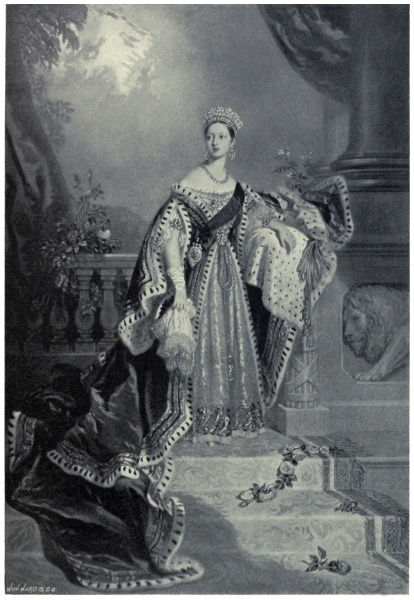
THE QUEEN IN ROYAL ROBES
Apart from his trade the English tradesman’s private life has been completely changed. He no
longer lives next to a noisome burial-ground in the city; he has a villa in a suburb; he goes into town
every morning and comes out in the evening; the old evenings with the city cronies are things of the
past. In his suburb there is very little social life even for his children; for himself there is none. He
does not frequent theatres or concerts; he stays at home. In the morning he reads a newspaper; in the
evening he reads books and plays cribbage. As for his children they have forgotten the former stage;
they are well educated; they go into the professions; they are artistic and become Art students; they are
as well read as can be desired; they are in the stream of modern ideas.
Not only this, but the social position of the tradesman has been raised: here and there one may find
a huge palace devoted to the sale of everything; the palace has been created by the genius of one man, and
is controlled by the mind of one man. It is impossible to feel anything but respect and admiration for a
man of such great ability, who has created interests so vast and so commanding.
The shopkeeper has, for the most part, abandoned the Corporation; he no longer seeks office in the
city; when he does, he is a man who can hold his own with the merchants who have once more taken
over the municipality; the City is the gainer by the change, and so is the London tradesman, because
what advances the reputation of the City also advances him.
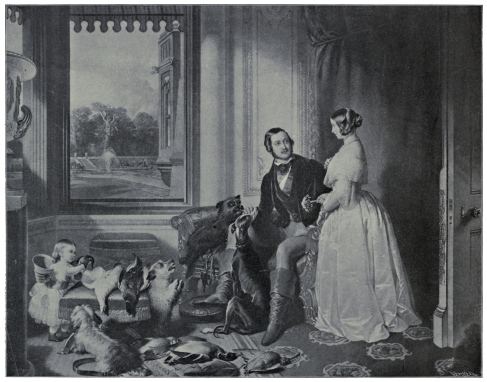
Painting by Sir Edwin Landseer
ROYAL GROUP, WINDSOR, 1843
The forces which have changed the common people have also acted upon himself and his family:
the widening of the world, improved communication, and cheap postage and the rest. His young
people are not concerned with the polytechnics, but they are moved by the spirit of athletics that drag
all the youth of this country into the playing-fields. They career over the country on bicycles; they
play golf, lawn-tennis, cricket, football; they are not shut out from suburban society by the old exclusiveness
with which “wholesale people” formerly regarded “retail people.” The playing-field is a leveller;
there is no rank in a football team.
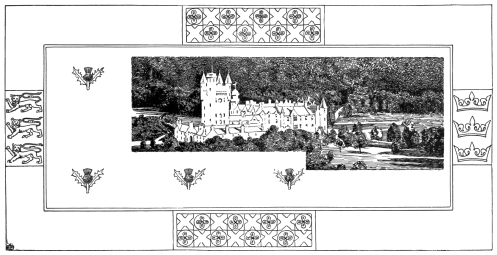
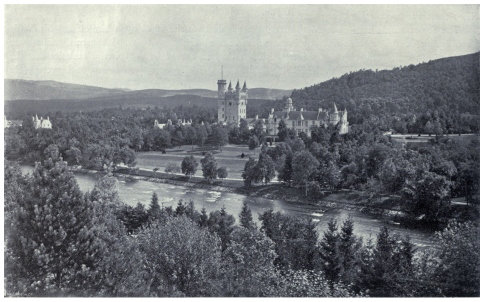
BALMORAL CASTLE
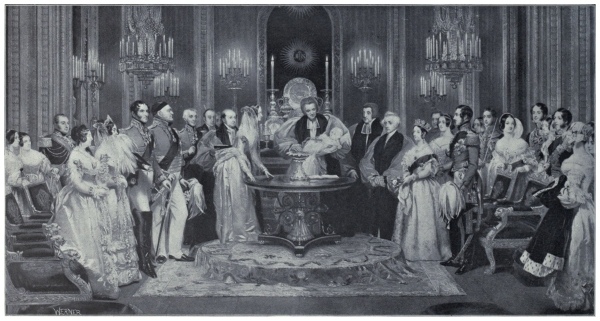
Painting by C. R. Leslie
BAPTISM OF THE PRINCESS ROYAL
Let us not forget to remark how large a knowledge of geography is possessed by our friend of Cheapside.
You would be amazed at the extent: sure and certain I am that the average American citizen
cannot compare with my man in this respect. He has learned this knowledge by following day after
day the wars and rumours of wars which assail the country continually. Since the accession of Queen
Victoria, we have carried on war in Canada, at the Cape, in India, in New Zealand, on the West Coast
of Africa, in the Crimea, in Egypt, in China, in Abyssinia, in Dahomey, in Burmah, in Afghanistan, in
Chitral, and I know not where beside. This good man, with his newspaper and his atlas, gets up his
geography from day to day and from war to war.
Painting by F. Winterhalter
ROYAL GROUP, 1848
There is perhaps a “seamy” side to trade of every kind. With that I have no concern whatever; I
have only to show here how the events of sixty years have affected the London tradesman, and this, I
venture to hope, I have succeeded in doing. Again, it must be understood that I am talking of the
better class—not necessarily the richer class—of London retail dealers. There are, I believe, those who
live for making money, and have no other care or thought. For them order, law, peace, justice exist for
no other purpose than to allow the most perfect freedom for the besting of the customer. The old
Cheapside trader was narrow and stupid; these people are neither narrow nor stupid; they are sharp;
they exist in every trading city; they are purse-proud and ostentatious; they flourish their wealth at
the “Grand Hotels”; they wear the finest fur and the richest silk—and, if you please, we will say
no more about them.
CHAPTER IV TRANSFORMATION OF THE PROFESSIONS
“I charge you by the law, Whereof you are a well-deserving pillar.”
Merchant of Venice.
Sixty years ago there were three professions and two services. The two
services were the Army and the Navy; the three professions were the Church,
Law, and Medicine.
The Church was the natural home of the scholars: a few scholars drafted off
into the Law; there were also a few in the House, where they made apt
quotations from Horace, and delighted the members by giving a Virgilian turn
to a debate. Nowadays—alas!—were a scholar to venture on a Latin quotation,
the House would not understand.
It is pleasant to look back upon the quiet, uneventful, peaceful life of the early Victorian scholar.
He began at a public school, where he needed no stimulus in the way of stripes; he devoured books; he
acquired scholarship by a kind of intuition; he wrote Latin verses, in which every hexameter had a
Virgilian phrase and every pentameter reminded one of Ovid; he wrote Greek Iambics more easily than
the most rapid English poet ever composed blank verse; he thought in Latin; he made jokes in Greek.
This boy gained, of course, a School scholarship and entered one of the Colleges of Oxford or Cambridge.
Here he obtained one of the College scholarships; one of the University scholarships; all the prizes
that there were for Latin and Greek compositions; and at last took the highest degree possible in
Classical Honours. This done, a Fellowship was the next step. This place was worth about £300
a year, with rooms, commons, and dinner free. There were no duties attached: if he chose to take
Orders and to remain unmarried he might keep his Fellowship for life. He did take Orders: he was
appointed College Lecturer in Classics; he remained Lecturer for ten years, when the Tutor took a
College Living; he then succeeded to the Tutorship, which was worth three or four thousand a year.
He then had two courses open to him: he might remain Tutor long enough to amass a considerable
fortune, and then take a College Living and retire into the country; or he might wait on, presently
retire, and either finish his days as a Fellow, or be perhaps elected to the Mastership, a post both
dignified and well endowed. By this time he had passed the period when men most desire to marry:
he was settled in most excellent rooms; he had a free library; his habits were fixed; the College Port
was renowned; he was too comfortable to run the risk of change. Therefore he stayed where he was,
within the walls of the old College, and younger men took the College Livings. He never wrote
anything to prove his own learning or to advance the learning of others; he produced nothing except a
few Greek epigrams. And when at last he died there was for a brief period a memory of one who
had been among them—a great scholar—and then oblivion closed over him and he was gone. Such was
the life of the Don. Sometimes he retired from the College
and took the Head Mastership of a school, but not often.
Painting by Count D’Orsay
THE ONLY EQUESTRIAN PORTRAIT OF HER MAJESTY
All the clergy were not College Dons and great scholars.
Yet there was always, at that period, a flavour of scholarship
about them: the beneficed clergy of the country were
generally younger sons of the country gentry, because almost
every family had a church living in its gifts, and these
livings were too valuable to be bestowed out of the family.
A young man who took a curacy in the country without
family influence probably found himself stranded for life on
eighty pounds a year. Those of the benefices which did not
belong to private patrons were either in the gift of the Lord
Chancellor, with whom interest was required; or of the
Bishop, who had his own relations to provide for: of the
sons, nephews, and cousins, for instance, of Dr. Sparke, sometime
Bishop of Norwich, it was said “as the Sparkes fly
upwards;” or of some college at Oxford or Cambridge which
wanted them for its Fellows. The only chance for such a
man was to attract attention as a preacher in some town. But
this chance came to few; therefore for half the clergy at least
their profession was a starveling. Yet those who had no interest entered it, in hopes and under the pressure of
a call which they believed to be real, and not to be disobeyed under penalties too awful to be contemplated.
Meantime it is now nearly fifty years since Charles Kingsley, who could never shake off the prejudice of
small middle-class gentility, uttered the sneer that the modern way of making your son a gentleman was
to send him to Oxford first and to put him in Holy Orders next. He here expressed, however, a common
feeling about the clergy, which was that they should be scholars first, gentlemen next, and Divines last.
And there is no doubt that the social position of the Church, and, therefore, the adhesion of all the better
classes to the Church, has proved of the greatest value, in times of religious decay, towards maintaining
the Church in her position of ascendency.
The administration of the parish was still that of the eighteenth century. That is to say, the Church
was there, before all people, with open doors, offering its services, its sermons, its offices, freely to all who
chose to accept them. It was not considered the business of the clergy to run after those who refused
their offices. As for the piety and the reputation of the clergy, their lives were pure; there was commonly
no scandal: they were supposed, however, to be addicted to wine, and in the City there were some who
were known as “three bottle men.”
In opinions the majority were of the
Evangelical type, with Calvinistic
leanings: they preached sermons
wholly on points of doctrine. The
general belief was that mere membership
in the Church was of no
importance at all, and that the
salvation of the soul was an independent
and separate transaction
carried on between the individual
and his Creator. This kind of
preaching has not yet wholly ceased,
but it is rare: such preachers are
no longer heeded.
COUNCIL CHAMBER, OSBORNE HOUSE
BILLIARD-ROOM, OSBORNE HOUSE
Let us compare the Church of
the present day. It is no longer a
Church of scholars: there are still
some learned members in it, but the
old presumption that a clergyman
must be a scholar, is quite lost and forgotten; rather the presumption is the other way, that a clergyman
is not a scholar. The young scholars of the day do not, as a rule, take upon them Holy Orders: there
are too many openings for their intellectual activities. Moreover, the prizes are not what they were.
Agricultural depression has ruined the fellowships, cut down by one half the country livings, destroyed
the value of Deaneries and Canonries.
The Bishoprics still, however, keep
their value, and a profession cannot
be thought very poor which numbers
so many prizes as the Church
of England, with her Archbishops
and her Bishops. Preaching, which
was formerly so important a part of
Church work, has decayed deplorably.
The reason is the development
of the parish work, which
now occupies the whole time of the
clergy, leaving them no time for
meditation and study. For, since
the people will not come to the
clergy, the clergy condescend to
stoop to the people. At the present
moment the Church is the centre of
numberless institutions and associations
which aim at civilising the
people rather than making them
religious. The clergy preside over clubs for the lads, clubs for the girls, temperance associations, mothers’
meetings, sales of clothing, lectures, concerts, care of the poor and of the sick, benefit societies, visiting
organisations, Sunday schools, country holiday funds, convalescent homes, and a thousand other things.
Now the working people, and especially the very lowest class, regard this activity with a kind of admiring
wonder; they see these young fellows—many of whom are not clergy, but live among them—working
morning, noon, and night for no reward: they are touched by this devotion; their lads would follow
them to the death. I do not say that this example makes them religious, but it fills them with that new
feeling towards religion which has been already considered.
The doctrines held by the present clergy are
in most cases High Church, with which, personally, I
have no kind of sympathy. At the same time, one
must admit that the modern views have destroyed the
dreadful terrors about Election and Predestination: in
the Anglican, as in the Roman Church, once more the
Fold protects.
PORTRAIT OF THE QUEEN IN ROYAL ROBES
In Law and Medicine, fewer changes have been
made. In the former, a barrister was not allowed to
make a friend of an attorney, or to take his hand, or to
visit at his house. The low class attorney-at-law, of
whom there were a great many, practised with impunity
all kinds of iniquities and conspiracies; he was, indeed,
an enemy to the human race; he was usurer; he was
the concoctor of civil actions, which he dragged on
interminably;—it was he who filled the prisons with
unfortunate prisoners; he robbed the widow and defrauded
the fatherless; he took advantage of difficulties
which he aggravated—he charged what he pleased.
The power of the attorney—now called solicitor—for
mischief is very greatly curtailed;—a taxing master
looks after his bills; he can no longer clap a debtor
into prison; he is liable to be struck off the rolls for
misconduct.
In Medicine the physician never claimed so great
a superiority over the surgeon. If he did, that superiority
has vanished. Great are the recent triumphs of surgery: not so great, perhaps, those of medicine.
In those days the surgeon operated in the presence of the physician; he did not aspire to the medical
degree; he could not be called “Doctor.” There were no anæsthetics in those days; operations of all
kinds were limited by the patient’s power of endurance: a long operation killed, because there is a
limit to the endurance of pain. The discoveries of the laboratory have placed the treatment of all disease
on a new and more scientific footing. Fortunately, I am not called upon in this place to do more than
indicate changes that only a medical student could properly explain. We can, however, all understand
the ward, clean and neat, with regulated temperature; the patients under the care of bright and
cheerful nurses; the hospitals “walked” not by the young ruffians of the “Bob Sawyer” type, but keen
and eager students, with whom science is more than a mere profession, and the causes of diseases more
than their cure.
OSBORNE HOUSE, ISLE OF WIGHT
Sixty years ago, I said, there were only three professions. How many are there now, recognised as
on an equal footing of dignity and importance with these three?
Formerly, Architecture was not considered a profession. I remember long ago, in the Sixties,
listening to a group of men who were discussing whether architecture had any claims at all to be a
profession—certainly the local architect was also the house-agent—and whether a gentleman could
belong to it. I believe they agreed that it was only a trade.
THE ROYAL YACHT “VICTORIA AND ALBERT”
Formerly, there was no profession of science at all. At Cambridge there were chairs of Mathematics,
of Chemistry, and of other branches. But there was no profession of any branch of science. No man set
up a laboratory and said “I am a chemist by profession”; there were none of the great Schools for
Physical Science, such as now exist at Cambridge, at South Kensington, at Newcastle, and at other places;
no young men began by “going in” for science, as they do at present. That profession which offers the
noblest prizes of fame and name, together with
a sufficiency of income, has been created in all its
numerous branches within the last sixty years.
The British Association made the world familiar
with the claims and the work of the new science.
Such men as Humphry Davy, Faraday, Darwin,
Huxley, Tyndall, and so many others, who will
be accounted the chief luminaries of this age,
planted firmly the claims of science in the
minds of the people, and raised the position
of science to the same level as that of Latin
and Greek scholarship. All these physicists,
electricians, zoologists, biologists, chemists, and
the rest have come into existence during the
Queen’s reign. The teaching of science at
our Universities and Schools, the multiplication
of new Colleges in all the Colonies, as well
as at home, have created places for these students and a demand for their teaching: they have also
created a demand for new books, which only these teachers were able to supply.
Formerly, again, the position of teacher in a school, except when one was Headmaster of Eton,
Harrow, or Winchester, was one of curious contempt. The reason for this contempt was simple: it was
the connection between a schoolmaster and his floggings. That connection has now ceased. At a few
schools, the Head exercises the old business with the birch: it is regarded as a custom or a usage
rendered venerable by antiquity. “I was swished,” said a young fellow the other day, “nineteen times
when I was at school. I have always regretted that I didn’t make it twenty.” But the assistant masters
have no power of inflicting personal chastisement.
This old contempt has vanished: the profession is now regarded with great respect, and carries with
it a proper amount of social consideration. No young man, formerly, who could by any possibility get
into any other line of life, would take a place as assistant master even in a public school. If he did, it
was in hopes of obtaining a boarding-house and making a rapid fortune. The position is now literally
run after by young University men of the greatest distinction and the best credentials as to scholarship.
The present Headmaster of Harrow, writing to the papers some time ago, made this suggestive observation.
I quote from memory—“I believe that I have at Harrow, at this moment, the best collection of assistants
that were ever gathered together at any public school. Yet I am certain that if they were all to resign,
I could replace them very shortly by another collection equally good.” So ready, so eager, are the young
scholars of the day to become masters in the public schools. Sixty years ago they would have stayed on
at Oxford or Cambridge, and led the life already described of the Scholar, the Fellow, and the College
Tutor.
Another new profession, though to the younger men it seems an old profession, is that of engineering.
There are many branches of engineering: one constructs piers, jetties, railways, bridges, great works like
the Forth Bridge, or smaller bridges, tunnels, roads, embankments, and the like. Another devises and
constructs machinery of all kinds, another controls electricity: there must be an engineer in every factory
as in every little steamer. Great prizes in money and fortune belong to this profession. It is eminently
a learned profession: to attain unto any degree of eminence in it one must be a good mathematician.
Other new professions are those of the actuary and the accountant. And there are “followings” once
not allowed to be professional, such as that of the painter and the sculptor, the work of literature, music,
acting, etc. A young man may enter any one of these branches of mental achievement: he may choose
his own department; he will occupy as good a social position as the young barrister; he will belong to the
professional class. As for the prizes in some of them, if they are not equal to those of the Bar or the
Church, they are considerable; in some kinds of literature, such as educational books, fiction, and the
drama, successful writers command incomes which would be considered incredible by Douglas Jerrold
and the wits of the early Victorian era.
To recapitulate. Where there were three professions sixty years ago there are now dozens: given a
young man of ability and activity, it is difficult not to find for him an opening where he will get a chance
of gaining a splendid prize of success. For the man of exceptional ability, the Church leads him to a
Bishopric with a life peerage and £10,000 a year; the Bar leads him to an income of £10,000 a year,
and, if he pleases, a peerage; Medicine may give him £15,000 a year, also with a peerage, or a
baronetcy, if he wishes one; all the other professions have their splendid prizes and their magnificent
chances which are open to a young man of ability. Compared with the condition of 1837, we are like the
occupants of a broad expanse of country which has been suddenly widened in all directions by the removal
of walls and fences and the abolition of prohibitions.
One thing remains with the new as with the old professions: they all demand an apprenticeship and a
training. No one can enter the Law, or Medicine, or any other, without being able to pay, over a period
of five years, at least a thousand pounds, probably two thousand when all is done. Until this condition is
removed, which is not likely to happen, it is not true to say, or to think, that every career in this country
is open to every boy.
CHAPTER V TRANSFORMATION OF WOMAN
“A perfect Woman, nobly planned, To warn, to comfort, and command; And yet a Spirit still, and bright With something of angelic light.”
Wordsworth.
Let me present to you, first, an early Victorian girl, born, indeed, about the Waterloo
year; next, her granddaughter, born about 1875.
The young lady of 1837 has been to a fashionable school: she has learned
accomplishments, deportment, and dress. She is full of sentiment: there was an
amazing amount of sentiment in the air about that time—she loves to talk and
read about gallant knights, crusaders, and troubadours; she gently touches the
guitar—her sentiment, or her little affectation, has touched her with a graceful
melancholy, a becoming stoop, a sweet pensiveness; she loves the aristocracy,
even though her home is in that part of London called Bloomsbury, whither the belted earl cometh
not, even though her papa goes into the City; she reads a deal of poetry, especially those poems which
deal with the affections, of which there are many at this time; on Sunday she goes to church religiously
and pensively, followed by a footman carrying her Prayer Book and a long stick; she can play on
the guitar and the piano a few easy pieces which she has learned; she knows a few words of French,
which she produces at frequent intervals; as to history, geography, science, the condition of the people,
her mind is an entire blank; she knows nothing of these things. Her conversation is commonplace,
as her ideas are limited; she cannot reason on any subject whatever because of her ignorance,—as she
herself would say, because she is a woman. In her presence, and indeed in the presence of ladies
generally, men talk trivialities. There was indeed a general belief that women were creatures incapable
of argument, or of reason, or of connected thought. It was no use arguing about the matter. The
Lord had made them so. Women, said the philosophers, cannot understand logic: they see things,
if they do see them at all, by instinctive perception. This theory accounted for everything—for those
cases when women undoubtedly did “see things.” Also, it fully justified people in withholding from
women any kind of education worthy the name. A quite needless expense, you understand.
THE QUEEN RECEIVING THE CRIMEAN VETERANS AT BUCKINGHAM PALACE
The girl who lived in Bloomsbury Square, or in the suburbs—say Clapham Common—had, in
those days, to make herself happy with slender and simple materials. There were very few concerts:
I think the Philharmonic was already in existence; Oratorios were sometimes performed: it was
not every girl who liked what was then called classical music; the general cultivation of music was
poor and meagre, and within very narrow limits: people liked songs, it is true, especially pathetic songs.
These, like the poetry of the Keepsake and Friendship’s Offering, mostly turned on the domestic affections.
The young ladies recognised this sentiment, bought or copied those songs, and sang the most mournful of
ditties. Everybody, in every class which respected itself and claimed gentility of any kind, talked about
the opera, to which the well-to-do young lady was taken once a year, solemnly. This gave her the
right for the rest of the year to talk about the repertoire, and to speak with disrespect of the leading
singers.
The theatre was very seldom visited; indeed there were reasons why it was not desirable that young
ladies should go to the theatre; if they did go it was an event very much discussed both before and after.
There were only one or two theatres that respectable people could possibly attend, and the one part of
the house where ladies could be seen was the dress circle. Now in the Thirties, if my information is
correct, there were good actors, but the plays were monstrously bad. The Queen, however, used to like
going to the theatre. If you walk down to those north of the Strand, you may see how the road was
widened for her to go to the Adelphi melodramas. The reading of girls was carefully selected for them;
in serious circles—there were many circles in 1840 privileged to be serious—fiction was absolutely
forbidden; its place was taken by religious biography: wonderful to think how large a part was played
by religious biography about that time. I do not know what books besides these biographies and records
of “conversation” were allowed, but I imagine that there were not many. At all events, a young woman
must not be allowed to read anything which would suggest to her the wickedness of the world, the
realities of the world, the truth about men and women, or the meanings of humanity. She was to leave
her mother’s nest not only innocent—girls do still leave their mothers in innocence—but also in a state of
ignorance, which was then mistaken for a state of grace. How far she really was ignorant no one but
herself could tell; one imagines
that there may have been some
knowledge behind that demure
countenance that was not generally
suspected.
Painting by Winterhalter
THE FOUR ROYAL PRINCESSES
PRINCESS ROYAL, PRINCESS ALICE, PRINCESS LOUISE, AND PRINCESS HELENA
As for her accomplishments,
they comprised, apart from the
knowledge of a few pieces on
the guitar and the piano, some
slight power of sketching or
flower-painting in water-colours.
Of course it was nothing better
than the amusement of an
amateur. As for attempting
literature, no one, with very few
exceptions, ever thought of it.
There was then but a limited
demand for women’s literary
work—a very limited demand—yet
there had already been some
very fine work done by women.
Mrs. Ellis was writing those
famous and immortal works of hers on the Women of England, the Mothers of England, the Wives of
England, the Daughters of England,—so far as I know, for the subject is inexhaustible, the Housemaids of
England. These essays, which I fear, dear reader, you have never seen, endeavoured to mould woman
on the theory of recognised intellectual inferiority to man. She was considered beneath him in
intellect as in physical strength; she was exhorted to defer to man, to acknowledge his superiority—not
to show herself anxious to combat his opinions. At this very time, one woman at least—Harriet
Martineau—was proving to the world that there were exceptions to the inferiority of the sex in matters
of reason; while another woman—Marian Evans—already grown up, was shortly to enter the field with
another illustration of the same remarkable fact.
It has been often charged against Thackeray that his good women were insipid. Thackeray, like
most artists, could only draw the women of his own time, and at that time they were undoubtedly
insipid. Men, I suppose, liked them so. To be childishly ignorant; to carry shrinking modesty so far
as to find the point of a shoe projecting beyond the folds of a frock indelicate; to confess that serious
subjects were beyond a woman’s grasp; never even to pretend to form an independent judgment; to know
nothing of Art, History, Science, Literature, Politics, Sociology, Manners;—men liked these things;
women yielded to please the men; her very ignorance formed a subject of laudable pride with the
Englishwoman of the Forties.
Painting by Winterhalter
“FIRST MAY 1851”
THE DUKE OF WELLINGTON PRESENTING A BIRTHDAY GIFT TO HIS GODSON, PRINCE ARTHUR
As for doing serious work, the girl of that period shrank appalled at the very thought. To earn
one’s livelihood was the deepest degradation; the most sincere pity was felt for those unhappy girls
whose fathers died or failed, or left them unprovided, so that they must needs do something. It was pity
mingled with contempt. Even this meek and gentle maiden of the early Victorian period could feel—and
could show—the emotion of contempt. Readers of Cranford will remember how the unfortunate
lady opened a tea shop; those ladies who were too old or too ignorant for teaching—“going out” as
a governess—sometimes set up a
“fancy” shop, where children’s
things—lace, embroideries, things in
wool and pretty trifles—were sold.
I remember such a shop kept by
two gentlewomen, old, reduced, decayed;
but they were very sad,
always in the lowest depressions;
I fear it was but a poor business.
There were no professions open to
women. Those who did not marry—they
were comparatively few—stayed
at home with one of the
brothers, generally the eldest, and as
often as not, such an unmarried
sister proved the angel of the
house. Sometimes, to be sure, the
lot was hard, and she was made to
feel her dependence. In general, I
like to believe, the single woman of
the family, in whom all confided, in
whom all trusted,—the nurse of the
sick; the contriver and designer of the girls’ frocks; the maker of fine cakes and the owner of choice
recipes; who knew all the branches of a numerous family; who kept together the brothers and cousins
who would fly apart but for her,—was as much valued as she deserved to be.
THE QUEEN IN GALA COSTUME
There were many ways of “going out” as a governess. The most miserable lot of all was considered—and
no doubt was—to be a resident teacher in a girls’ school. In this position there was no
society of any kind; there was no chance of meeting young men; there was no pleasure; there was an
enforced and unnatural pretence at virtue; there was no hope of change, no hope of happiness, no
hope of love; there was not even any chance of making money. One might also become a visiting
governess and undertake the children of a house for the day: this gave liberty for the evening. One
might become a resident governess in a house: this exposed a girl to the insolence of the servants, the
advances of the sons, the caprices or snubs of her employer. Novels of thirty years ago are full of the
down-trodden governess. One pities her, because the position, even at the best, must have been beastly—indeed,
I remember very well—and the position intolerable for snubs and slights. At the same time,
her employer complained that she was meek to exasperation, and resigned to a point which maddened.
I have known ladies who were quite carried away: they became speechless in trying to tell of the
meekness of a governess. Again, a girl might teach music, if she knew any—a thankless task when the
stupidities of the pupils were visited on the teacher. A woman was not allowed to teach dancing: for a
most praiseworthy reason, you cannot teach dancing without showing more than the tips of the toes—half
the foot perhaps—where, then, is feminine modesty? This accomplishment was therefore taught
by a professor, generally a man who had played in his youth some small part in the operatic ballet;
he carried a little “kit” or small fiddle, with which he discoursed a scraping, watery kind of music,
while his nimble feet
showed the way, and
his thin legs cut single or double
capers which the girls admired, but
were not naturally invited to imitate.
Nor could a woman teach writing and
arithmetic—I cannot possibly explain why.
For some unknown reason these useful
arts were always taught by men. Yet
women could add up; women could
write, even in the year 1840. One such
teacher of arithmetic and penmanship I
knew. He practised entirely in girls’
schools. He was proud of his profession,
which he ranked with those of Divinity
and Law. He was full of innocuous
jokes and, so to speak, non-alcoholic
stories. He died about twenty years
ago, ruined, he told me, by the introduction
of women into the profession.
Painting by Winterhalter
PRINCE OF WALES, AGE 7
I say, then, that in the year 1840, so
far as I can remember, there was hardly
a single occupation in which a gentlewoman
could engage, except that of teaching.
Miniature painting can hardly
be called an exception, because it is
given to so few to be painters. She could
not lecture or speak in public. St. Paul’s
admonition to women, that they
must not “chatter” in church, interpreted to forbid public-speaking in church, was extended to
every kind of public-speaking. No woman so much as dreamed of speaking in public at this time.
Later on, a Mrs. Clara Balfour astonished people by lecturing in Literary Institutes. I believe she
was the first. I remember hearing her lecture. The people sat with gloomy faces: when they
came away they shook their heads. “Irregular, my dear madam.” “Sir, it is irreligious.” “Madam,
it was an unfeminine and revolting Exhibition.” These comments were heard on the stairs. This
system of artificial restraints certainly produced faithful wives, gentle mothers, loving sisters, able
housewives. God forbid that we should say otherwise, but it is certain that the intellectual attainments
of women were then what we should call contemptible, and the range of subjects of which
they knew anything was absurdly narrow and limited. I detect the woman of 1840 in the character
of Mrs. Clive Newcome, and, indeed, in Mrs. George Osborne and other familiar characters of
Thackeray.
Of Society in 1840 let me speak only of the wealthier City class—the people who lived in big
houses in Bloomsbury or in the suburbs. They had “evenings” with a little music; they were very
decorous. The young men stood round the wall or in the doorways. The little music included those
songs of the affections already mentioned. There was a little refreshment handed about, or set out in
the dining-room. It consisted of sandwiches, cake, and negus. Sometimes there was a dinner party.
The company were invited for half-past six. The dinner—always the same, or nearly the same—consisted
of salmon cutlets, haunch of mutton, boiled fowl, and tongue; birds of some kind, and pudding of one or
two kinds. The dishes were put on the table; everybody helped each other. Nobody drank anything
until the host had first taken wine with him; there was nothing to
drink at dinner except sherry. After dinner the port went round
once; the ladies retired,—this was about half-past seven or a quarter
to eight. The men closed up; fresh decanters were placed on the
table, and they drank port steadily till half-past ten, i.e. for three long
hours. Then they went upstairs to the drawing-room; and, as if
the port was not enough, they had brandy and water hot.
I have spoken of the wealthier class, but there was,
and there is still, an immense number of girls belonging to the
ranks where care and thrift were necessary in all things. In this
class the unfortunate girls were slaves to the needle. All day
and all the evening they were engaged in making and mending
and darning. Families were large: there were little children
and big boys; and the pile of linen and of stockings waiting to
be mended seemed never to grow less, while the pile of things that
had to be made grew steadily greater.
A generation that has grown up with a sewing-machine cannot
understand this slavery. Think of this machine which sews up a
length of three feet in a minute, and of the time that was formerly
required to do the same work by hand. It is not too much to say that the sewing-machine set
free millions of girls. What they are doing with their freedom is considered in the next few pages.
It was, at the best, an artificial and unnatural life. There was something Oriental in the seclusion
of women in the home, and their exclusion from active and practical life; it led to many a rude
awakening, many a shattered idol, many a blow which embittered the rest of life.
LORD MACAULAY
THOMAS CARLYLE
WILLIAM MAKEPEACE THACKERAY
GEORGE ELIOT
CHARLES DICKENS
MATTHEW ARNOLD
ROBERT LOUIS STEVENSON
REPRESENTATIVE WRITERS OF THE REIGN
I must not forget, in considering the Englishwoman of 1840, her extraordinary cowardice. It was
impressed upon her from childhood that she was a poor, weak creature—that she needed protection
even in broad daylight. Therefore, when a young lady of fortune went abroad, unless she drove in her
carriage she had a hulking footman walking behind her. If she was not a lady of fortune, she was
escorted by a maid; she could go nowhere by herself; she saw danger at every corner, and was
ready to scream at meeting a strange man in the open street. Nor must we forget her little affectations:
she could not help them; they were part of her education. For instance, it was a very common
affectation with girls that they could not eat anything at all, such was their extraordinary delicacy
and elevation above the common mortal. So they sat at dinner with a morsel upon their plates, which
they left untouched. Some girls made up for this privation by a valiant lunch; some habitually
lived low, and practised, though in no religious spirit, abstemious austerities. I think, however,
that the girl who wished to be thought consumptive,
cultivated a hectic bloom, and coughed and
fainted, carried affectation perhaps too far.
THOMAS HOOD
ALFRED LORD TENNYSON
ELIZABETH BARRETT BROWNING
WILLIAM MORRIS
ROBERT BROWNING
REPRESENTATIVE POETS OF THE REIGN
Such was the woman of 1840: in London,
among the richer sort, a gentle doll, often good
and affectionate, unselfish and devoted, religious,
charitable, tender-hearted; sometimes, through
the shutting up of all the channels for intellectual
activity, snappish, impatient, and shrewish; in
the country, in addition to these qualities, a housewife
of the very first order.
Let us turn to the Englishwoman—the young
Englishwoman—of 1897.
STATUE OF THE QUEEN IN KENSINGTON PALACE GARDENS. BY PRINCESS LOUISE
She is educated. Whatsoever things are
taught to the young man are taught to the young
woman. The keys of knowledge are given to
her; she gathers of the famous tree. If she wants
to explore the wickedness of the world she can
do so, for it is all in the books. The secrets of
Nature are not closed to her; she can learn the
structure of the body if she wishes. The secrets
of science are all open to her if she cares to study them. At school, at college, she studies just
as the young man studies, but harder and with greater concentration. She has proved her ability
in the Honours Tripos of every branch; she has beaten the Senior Wrangler in mathematics; she
has taken a first-class in classics, in history, in
science, in languages. She has proved, not that
she is man’s equal in intellect, though she claims
so much, because she has not yet advanced any
branch of learning or science one single step,
but she has proved her capacity to take her place
beside the young men who are the flower of
their generation—the young men who stand in
the first class in Honours when they take their
degree. It is from such young men that our
best statesmen, our judges, our ablest lawyers, our
historians, our scholars, our divines, are taken,
and among them the young Englishwomen of
the day stand inter pares.
STATUE IN HOUSE OF PARLIAMENT. BY GIBSON
MICHAEL FARADAY
JOHN TYNDALL
CHARLES DARWIN
HERBERT SPENCER
LORD LISTER
THOMAS HENRY HUXLEY
LORD KELVIN
REPRESENTATIVE SCIENTISTS AND PHILOSOPHERS OF THE REIGN
She has invaded the professions. She cannot
become a priest, because the Oriental prejudice
against women still prevails, so that women in
High Church places are not allowed to sing in
the choir, or to play the organ, not to speak of
preaching. For some reason or other, women
have never written nobly on religion. They have
written powerful religious novels, but there has never been among them a Dean Stanley or a Hooker.
Nay, more, I have never heard of a woman carrying her classical studies into the ecclesiastical domain;
and unless one is a scholar, it seems impossible to write nobly of religion. In the same way, she cannot
enter the Law, because the portals of the Law are closed in her face by the Inns of Court, which will not
allow her to become a barrister, and by the Law Institute, which will not allow her to become a solicitor.
Some day she will get over this restriction, but not yet. For a long time she was kept out of medicine.
That restriction is now removed; she can, and she does, practise as a physician or a surgeon, generally
the former. I believe that she has shown in this profession, as in her university studies, she can
stand, inter pares, among her equals and her peers, not her superiors. There is no branch of literature
in which women have not distinguished themselves. None, it is true, in which they have attained
the same distinction as a few men—a very few men; but among those called the foremost in their
generation, woman stands their equal. In music they compose, but not greatly; they play and
they sing divinely. The acting of the best among them is equal to that of any living man. They
have become journalists, in some cases of very remarkable ability; in fact, there are thousands of women
who now make their livelihood by writing in all its branches.
Painting by W. Simpson
HER MAJESTY’S VISIT TO THE AMERICAN SHIP “RESOLUTE,” 1856
There are artists of all kinds—oil painters, water-colour painters, black-and-white artists, sculptors,
workers in pastel, carvers; in a word, every art that exists is practised successfully by women. As for
the less common professions—the accountants, architects, actuaries, agents—they are rapidly being taken
over by women.
It is no longer a question of necessity; women do not ask themselves whether they must earn their
own bread, or live a life of dependence. Necessity or no necessity they demand work, with independence
and personal liberty. Whether they will take upon them the duties and responsibilities of marriage, they
postpone for further consideration. I believe that, although in the first eager running there are many
who profess to despise marriage, the voice of nature and the instinctive yearning for love will prevail.
THE ROYAL VISIT TO THE GREAT EXHIBITION, 1851
Personal independence: that is the keynote of the situation. Mothers no longer attempt the old
control over their daughters: they would find it impossible. The girls go off by themselves on their
bicycles; they go about as they please; they neither compromise themselves nor get talked about. For
the first time in man’s history it is regarded as a right and proper thing to trust a girl as a boy insists upon
being trusted. Out of this personal freedom will come, I daresay, a change in the old feelings of young
man to maiden. He will not see in her a frail, tender plant which must be protected from cold winds;
she can protect herself perfectly well. He will not see in her any longer a creature of sweet emotions and
pure aspirations, coupled with a complete ignorance of the world, because she already knows all that she
wants to know. Nor will he see in her a companion whose mind is a blank, and whose conversation is
insipid, because she already knows as much as he knows himself. Nor, again, will he see in her a housewife
whose whole time will be occupied in superintending servants or in making, brewing, confecting
things with her own hand. For the young woman of the present day can make nothing: she cannot
make her own dresses, she cannot trim her hat, she cannot cook, she cannot compound things delectable;
the rolling-pin she knows nothing about, or the pastry-board. Love will be changed indeed. Man and
woman will be of the same stature and of the same strength! I think not; there will always be the same
differences in kind, but not so great in degree. The man will always look upon the world from his own
point of view, the woman from hers; and these are never the same. Perhaps the greatest change is
that woman now does thoroughly what before she only did as an amateur. I have said that she cannot
make her own dresses. That is true, as a general rule; but the woman who can, does so professionally and
thoroughly: and the woman who sews now, sews more beautifully, turning out work equal to that of her
ancestress, the Anglo-Saxon lady. So, also, if a girl takes up painting, she “goes through the mill”; she
studies it in earnest, she studies it as a man would. And so with everything; the shallow amateurish
pretences are gone; women are thorough, women are professional.
I have spoken above of certain little affectations of sixty years ago. These have vanished. The
Englishwoman of to-day enjoys an excellent appetite, and tackles her dinner valiantly; she has not yet
learned to be critical over the dishes or over the wine, that will doubtless arrive. As for pretending to
be hectic or consumptive she would scorn such a shallow mockery; her desire, on the other hand, is
to appear strong and healthy.
There have been certain losses in this development. For instance, there has appeared among us, for
the first time in the history of woman, the girl who does not care about her personal appearance. She
wears uncompromising spectacles, instead of a dainty pince-nez, she cuts her hair short, she wears a jacket
all angles; there is no roundness in her figure, there is no sweet look of Venus in her face. Now, even
on the philosophic countenance of Hypatia men loved to discern that sweet and gracious look of Venus,
which made her philosophy palatable and her lectures tolerable. Fortunately, this girl is as yet very
scarce; generally, it is whispered, there are certain sufficient reasons for her indifference to dress; and it
has even been remarked of her that, if she did not study and do her best to uglify herself, it would still be
impossible, by any arrangement of hair or costume, for her to beautify herself.
CHAPTER VI THE COUNTRY TOWN
“I saw the people that were therein, and how they dwelt after the manner of the Zidonians, quiet and secure, and had no dealings with any man.”—Book of Judges.
Let us leave London, and visit a certain English country town—a market town—as
it was in the year 1837. We will then consider the place as it is to-day.
In 1837 it is a quiet town with no industries except those created by the
requirements of an agricultural centre. This not only causes a certain amount of
activity and trade, but also gives rise to such industries as saddlery, farm implements,
etc. The town consists chiefly of two or three streets running parallel, the
larger and more important being the High Street. In the middle of the High
Street is a square or place, where once a week is held a market, at which all kinds
of things are exposed for sale, from poultry to shoe laces. A corn exchange, a branch bank, the town
hall, one or two shops, and the principal inn, fill up the square. The inn boasts a large wooden porch,
whose pillars are painted to resemble stone. A covered way leads to the stables and stableyard. Within,
there is a hall, imperfectly lighted, in which one finds a fly-blown map of the country, a huge pike in a
glass case, a stuffed otter, doors leading to the coffee-room and commercial room, a glass partition
separating the bar-parlour, with the bar itself in front, and a broad, low staircase leading to the upper
rooms. Here, on market day, the farmers hold their ordinary, with deep and long potations to follow.
Here the lodge of Freemasons holds its monthly meetings in the winter, with a cheerful time of refreshment
after labour. Here the county balls are held twice a year. There is a close, confirmed smell always
lingering in the house; it suggests not so much beer and tobacco, which belong to a humbler house of
entertainment, as hot brandy and water. The cold meats displayed under glass beside the bar look as if
they were imbibing and assimilating that smell. If the windows were sometimes open, one feels, it would
make that cold chicken fresher, and would enliven that cold roast beef. When you order dinner at this
hostelry let it be of the simplest. Avoid their soup, of which they have but one kind; be careful as to
their fish, which has not only travelled fifty miles by train, but has also waited longer than is good for it;
but you may trust them entirely in the matter of roast beef and mutton, fowls and “birds.” As regards
wine, you will avoid most carefully claret; it is a thick and strong liquid, very heavily “fortified” with
brandy. No one in England, as yet, has learned what claret means; they buy it, and they pour brandy
into it. Their sherry is a fiery compound, which you must regard with an uncomfortable suspicion; this
also has been “treated” with brandy. In the year 1837, if you ask for champagne (which is extremely
unusual) you expect a wine sweet and cloying, pink in colour, and served in long narrow glasses which
make it look very pretty. In 1837 we all, even among those who have travelled, belong to the age of
sweet champagne. We regard the wine, not as the exhilarator-in-chief
at human banquets, but as a feminine luxury, suitable
for weddings, christenings, Christmas Day, and such other
family gatherings in which women take their parts. For
ourselves, we shall order what is expected of us, namely stout,
with our dinner,—good, thick, foaming stout,—which is without
doubt the finest drink ever invented as a companion to
beefsteak or to a roast leg of mutton. We shall perhaps, for
the good of the house, have a pint of the fiery sherry with the
admirable apple pie, seasoned with cloves, which they will
presently bring us; and then, for the serious business of the
evening, we shall call the landlord and consult him. Which
is it to be? Does he recommend the 1820? Has he,
perchance, a few bottles left of 1798, though that is almost
past praying for? Does he think the 1828 sufficiently
matured? Would he recommend that he should set before
us some of his Tawny? These questions—these difficulties—are
recognised as matters of the greatest importance. There
are two of us, we are moderate men; a bottle a head is our humble limit, we must not throw away
this moderation upon an inferior bottle. Finally, we yield to him. In port, this landlord, we know
from former experience, hath a conscience; he brings us, not the most expensive wine, as a low-class
practitioner would do, but the wine which he thinks will please us best. He carries the bottle in
his own arms, as if it were a baby; he draws the cork as an actor on the stage opens a letter—with
importance; he decants it as if it were liquid elixir, leaving off at the precise moment when a drop
from the turbid dregs of the bottle might sully the perfect purity of the splendid purple which he calls
upon you to admire, holding the decanter before the light. We take our two bottles; we sit down to
dinner at six, so that when the bottles are empty it is no more than nine. We ring the bell and order
brandy and water before we go to bed. We hold up the bottle to the light. It is the light of candles,
not gas; no nasty, new-fangled gas is allowed in this old inn; and, indeed, those who have once
used wax candles can never desire any better or softer light.
PRINCE ALBERT, AGE 4
In the bedroom the furniture is simple. There is a vast four-poster, with its heavy
furniture and valance and curtains. The bed is provided with feather mattresses, deep and soft
and sinking, and pillows as deep. There is a washhand-stand, there are two chairs, there is a
dressing-table with a looking-glass, there is a chest of drawers. There is nothing else—not a
writing-table, not an easy chair; a bedroom is a place, if you please, to sleep in, not to sit in
or to work in. If a guest wants to work, let him have a private room and pay for it, unless he can write
in the public room.
LORD BROUGHAM
SIR ROWLAND HILL
LORD PALMERSTON
LORD BEACONSFIELD
RICHARD COBDEN
W. E. GLADSTONE
LORD SALISBURY
REPRESENTATIVE STATESMEN OF THE REIGN
If a bottle of port was considered a sufficient allowance of drink for a moderate man, what
was it for a toper? The amount of drinking in these country inns was, in fact, incredible. Men
who were considered quite temperate, as a rule, would sit drinking at a public dinner half the night
through. They drank, not weak potations of whisky and Apollinaris, but strong fiery port, which
they liked, as Tennyson is reported to have liked it, strong and black and sweet. Not for such drinkers
as these did mine host produce his best and rarest; a
more common and a ranker liquid did for them. The
public dinner was rare. There was generally in the
bar-parlour, however, the town toper. He was a man
whose father had amassed money in trade and left his
son a small fortune, enough to keep him in idleness.
The small fortune proved, as usual, a danger and a
pitfall; idleness led to temptation, temptation led him
to the bar-parlour. We may see him sitting in the
wooden armchair, where he spends all his evenings.
He is close upon fifty—the toper’s limit. A tumbler
of rum and water is on the table beside him. He is
silent, for very good reasons. He smiles upon the
company to show how sober he is. He has been
drinking all day long, and is now quite full and quite
drunk; yet at ten o’clock he will get up and walk home
by himself without so much as a reel or a lurch. He
presents to the world when he goes out into it a nose of
a kind that you cannot find now, a red, even a purple
nose, largely swollen, covered with red blotches; it is
a nose enlarged and painted by rum.
PRINCE CONSORT IN ROYAL ROBES
The tradesmen of the town have their club, which
meets every night, but not in the tavern; they frequent
a place of lesser repute, where they are alone. They
are shy of admitting strangers. It is not known how
much they drink; but one hears of families where there
are daughters who, on the arrival of the familiar footstep, hurry out of the way.
The town is eight miles from any other town. A stage-coach passes through every day, but
there is very little done to encourage it. The oldest inhabitant has lived here, man and boy, for eighty
years, but he has never seen any other town. The coach drives merrily down the High Street, with the
horn blowing: the coachman pulls up at the inn, the passengers all get down and have a drink, the horses
are changed, the coachman mounts, the guard blows his horn, and the excitement of the day is over.
The interests of the town are wholly self-centred: it is not conscious of any other place. There were wars
twenty years ago. There is a fellow, somewhere, who fought at Waterloo; but nobody asks him questions.
A weekly paper, published at the nearest town, comes over on Sunday mornings and gives them news of
the outer world; but, indeed, the news of the outer world drops on their ears like the murmurs
of the ocean in the shell, it means nothing.
The yearly holiday has not yet reached this place. The vicar, the lawyer, the doctor, want no
holiday, and take none. The schoolmaster takes his in his garden. Year after year, month after month, day
after day, they do the same things in the same way, they have the same talk. As for books they have
none, only a dozen or so in a row. Boys who are fond of books are regarded askance; they are
dragging down upon their heads a terrible future; no money is to be made by reading books. Boys who
are fond of making music, who take to a piano as other boys do to a cricket bat, are considered
as in a dangerous way. It is remarkable, and is to me inexplicable, how this country, where formerly
every gentleman played some instrument, came to regard music with suspicion. The fact, however, is
undoubted. In the same way, a boy who could draw and paint was looked upon with mingled pity and
contempt. There was a great deal of caste in the profession chosen by the boys. The vicar’s son went
to Oxford or Cambridge and took orders; the lawyer’s eldest son was articled to his father; the doctor’s
eldest son was articled to his father; in the principal shops the eldest son was brought up to carry on the
shop. The professional people, who called themselves gentlemen, would not associate with the shopkeepers;
the county people would not associate with the professional people; thus society was hedged
about and kept in gradations. As regards other professions, the banks took some of the young men; one
or two turned out to be clever, got scholarships, and went to the universities, there to settle down for life
on a College Fellowship; necessity compelled a few into teaching, then considered the last refuge of the
destitute; the boy who could draw was articled to an architect in the nearest big town; some went up
to London and became clerks; here and there one or two, greatly daring, disappeared altogether beyond
the seas.
DRAWING-ROOM AT ST. JAMES’S PALACE, 1861—THE LAST ATTENDED BY THE PRINCE CONSORT
As for the girls, they stayed at home. Their place was at home, they knew nothing solid in the
way of book learning; but, like the London girls, they were accomplished. They could play a little and
sing a little, they could do all kinds of fine work, they made all the family pies and cakes, they could distil,
they could pickle and preserve, they could make and mend. They stayed at home; out of three or four,
one remained unmarried. For her stretched along the road on the west of the town a row of tiny villas,
each with its pretty little
garden in front full of flowers—dahlias,
peonies, geraniums—and
the garden behind with
its vegetables and its fruit trees.
The unmarried one lived here,
alone but not lonely. She it
was who made most of the
society of the place. Sometimes,
when there was not
enough money, she remained
living with the eldest brother—a
responsibility which he
was never known to refuse.
Religion played a great part
in their lives. Most of the
girls were “serious”: they
attended a Thursday evening
sermon, which proved it; they
read books about election and
the elect, which they applied
serenely to other people. They
were taught that all the people—outside,
in the street—in
the world were destined to
endless torments: all but a
very few, including themselves.
They believed it, or
said they did; and the words
never caused them a shudder,
a gleam of pity, a thought of
remonstrance. That is what
they called believing the
doctrine.
Photo by H. N. King
LAST PHOTOGRAPH OF THE PRINCE CONSORT
The Church in 1837 is
venerable, but tottering. Within there are high pews, long pews, square pews, pews with a fireplace,
pews in the chancel; the organ is in the west gallery where the choir sits. In the middle there is a
“three-decker” i.e. a pulpit, a reading-desk, and a clerk’s desk, one above the other. The original east
window has been destroyed and is replaced by a modern thing. The charity children sit round the
altar rails. The once open roof is squared down and plastered over, half the windows are bricked up,
one aisle has been pulled down and rebuilt in brick.
Photo by H. N. King
STATUE OF QUEEN AND PRINCE CONSORT AT WINDSOR
Photo by Valentine
THE ALBERT MEMORIAL, LONDON
These ladies read little; they went nowhere. London was unknown to them, save for one short visit.
They were full of prejudice. They would not visit their right-hand neighbour, because her money—not
much of it—came from the drapery trade; nor their left-hand neighbour, because one must draw the line
above the farmer’s daughter. They were full of little pretensions. Their papa was formerly the vicar—a
gentleman and a scholar; or he was a solicitor, who, though himself sprung from a shop, was a gentleman
by right of his profession; therefore his daughters refused to visit their cousins. It was truly wonderful
to watch the social hedges raised everywhere.
Photo by Mayall
A FAMILY GROUP
(Standing) PRINCE AND PRINCESS OF WALES DUKE AND DUCHESS OF HESSE
(Seated) PRINCESS CHRISTIAN THE QUEEN PRINCESS BEATRICE DUKE OF CONNAUGHT PRINCESS ROYAL
Somehow or other these hedges troubled the younger folk little. The young man came along in due
course. He came to tea, he brought his flute, he stayed to supper—bread and cheese and beer, with a glass
of hot brandy and water afterwards. He gazed upon one of the girls; one Sunday evening he presented her
with a rose in the church porch. The vicar that evening demonstrated the impossibility of hoping to
escape, but the girl with the rose in her hand sat tremulous, flushed, happy. After the sermon the
young man walked home with her, the sister giving up her place and walking with the brother. The
young man stayed to supper—cold lamb and a lettuce, with beer and a glass of hot brandy and water. They
talked of the sermon of despair, and the text,
with no escape possible. While they talked, the
spring of love was welling up in the girl’s young
heart—thus is the soundest theology mocked by
Nature. In two or three months there followed
the wedding, with the breakfast and the pink
champagne.
Not every country town has experienced
this decline; some few have escaped, but all
have suffered more or less which depend entirely
on the agricultural interest. Of one class I
speak with great sympathy—the Nonconformist
ministers. They were none too well paid in the
most palmy days. The chapel contained perhaps
a hundred and twenty members; these members
paid two shillings a quarter each for his seat, or
eight shillings a year. There was no endowment;
the minister therefore received forty
pounds a year. This was increased by voluntary
gifts from the richer members of the congregation,
so that the minister probably reckoned on a
hundred or a hundred and twenty pounds a year
for his stipend. Now, alas! there are no richer
members, there are no voluntary offerings; the
poor man has to keep himself and his family on
forty pounds a year.
Photo By Gunn & Stuart
H.R.H. THE PRINCE OF WALES
Photo by Gunn & Stuart
H.R.H. THE PRINCESS OF WALES
What is this country town like after all these years? There are a few changes in the buildings, but
not many. The market-place, the corn exchange, the cross, the old inn, are all there. The church
has been restored; the pillars have been deprived of their plaster and are once more of polished stone, the
high pews are replaced by low benches, the roof is opened up, the east window is restored, other
windows are in course of restoration; it is now a noble and very beautiful old church. The organ and
choir have been sent to the chancel; the “three-decker” has made way for a small and richly-carved
pulpit; there is light, colour, brightness in the church and its decorations, a light and colour which appear
also in the service.
The other changes in the town are not so apparent. You will find, however, that the farmers’
ordinary is no longer held—the times are now too bad. Nor do gentlemen drink port all the evening; the
old port is all gone. The inn is a house of call for bicyclists, who drink beer or tea; there are not so
many finely appointed dog-carts driving in and out—landlords, like their tenants, are badly hit. The market
is not so well attended—there are fewer rustics. The saddler especially is a melancholy man, because the
agricultural depression has struck him hard—a man can go on using an old saddle for years. All the
shopkeepers, however, are gloomy, their shops hardly yield them a living. The lawyer’s income has suffered
grievously, so has the doctor’s; their daughters have left the town and are getting their own living by
working at something or other. All the young men have gone. Everybody leaves the town who can, for
it is a place of decay.
Yet is the town really brighter and better than before; far and wide its arms stretch out to its sons
who have gone away. Some are ranching in Canada, some are fruit farming in California, some are
practising medicine on Ocean Liners or in colonial towns, some are teaching in schools and colleges at
home and in the colonies, some are labourers on farms in Manitoba or British Columbia, soon to be themselves
owners of farms. The town is poorer, there are fewer people; yet, apart from money, it is a far
richer place than it was, with broader minds, with fewer prejudices, and greater knowledge.
CHAPTER VII THE DAY OF NEW IDEAS
“Voices call us—whither? Ah! whither?”
It is doubtful business to ascribe new ideas to a whole people. For change of
ideas is more gradual than change of manners. We may go on for a long
time acting under one influence and thinking that we believe in another. But
from all that has gone before, I think we may assume a change in the governing
beliefs and sentiments of the nation greater than any change since the time
of Queen Elizabeth, when the old faith gave way to the new and with the
new faith came new courage, new arts, new enterprise, a new literature.
As to our religion, that has indeed changed. The Calvinist, the old Evangelical,
lingers yet here and there, but he is comparatively rare; even in the narrower sects there has
been a broadening influence at work. In the Anglican faith—the Church of England—which is apparently
destined to absorb all other forms, we have agreed tacitly to talk no more about the salvation of
our souls, neither to talk about it, nor to think about it; to believe ourselves to be one flock in one
fold, with one shepherd. Whether this change conduces to the higher spiritual life, I cannot venture
to affirm or to deny; I am no theologian. That the world has become, through this change, through
the cessation of the awful question which formerly poisoned life, far, very far happier than it was, I do
declare without hesitation and from my own personal knowledge and experience. There was no very
high spiritual life, formerly, so far as I remember, among those who sought the hardest to limit the
mercy of Heaven; they led the common life of the lower slopes, with trade in their minds and trade on
their souls. There is no very high spiritual life under the changed conditions; still the common folk
live the common life. Here and there among the clergy is found a Stanley; here and there among the
crowd one lights upon a saint. Always there is the common life for the multitude; always there is the
saintly life for the chosen few, whether the leader is St. Francis or Calvin, whether the head of the
Church be the Pope, or the Archbishop of Canterbury, or John Wesley. Let us teach men and women
to live well, with full consideration for each other—which
is the most comprehensive virtue; the
life which thinks of others is the happiest.
Photo by Russell & Sons
H.R.H. THE DUKE OF YORK
Photo by Russell & Sons
H.R.H. THE DUCHESS OF YORK
Another ingredient in happiness is physical
comfort. We are all much better fed than we
were, better housed, better clad; all along the line
the standard of comfort has been advanced. The
huge barracks in which the working-classes of the
great cities now live are not pretty, but consider
how much more comfortable they are than the
old court of tumble-down cottages with a street
about four feet wide. The new barracks are fully
provided with water, they are kept in a sanitary
condition as good as any palace of prince or peer,
they are light and airy. Go into any of the old
courts—there are a few still at Westminster—and
see for yourselves the dirty, dilapidated dens in
which the people formerly lived. Then, while
you think of the advanced standard of comfort,
remember the cheap bread, the cheap tea, the cheap
meat, the cheap butter, cheese, bacon, eggs, fruit,
which are now offered to the working-man. Not
only have his wages gone up, but their purchasing
power has advanced as well. If instead of eighteen
shillings a week he now gets thirty, and if a shilling
now could buy twice as much as a shilling sixty
years ago, the standard of comfort for this man and
his family has been advanced indeed.
This standard of comfort, this increase in solid
happiness, has by long custom and usage become
the right of the people. They consider it as much their right as any of the liberties secured by Act of
Parliament. This new right constitutes a danger, because a national disaster might run food up to famine
prices, and then we should see, what we have not seen for a long time, the tigerish side of the Anglo-Saxon.
THE JUBILEE PROCESSION (1887) LEAVING BUCKINGHAM PALACE
Photo by Hughes & Mullins
HER MAJESTY THE QUEEN IN JUBILEE DRESS, 1887
We have learned that the old revolutionary cry has quite died away and is almost forgotten. This
also is partly the result of the increased comfort. At the same time the advance of democratic ideas has
been most marked. Slowly but surely, the whole power in the country has passed into the hands of the
Commons. The dominant idea at the present moment of our people is that the country must be governed
for them and by them. This would have seemed a most terrible thing sixty years ago. That we should
be governed by working-men! Incredible! It is, however, the fact; we are governed by the people.
Only, what the prophets did not understand, the governing power is delegated by the people to representatives,
who are not, as a rule, working-men; one or two working-men are in the House and doing well.
The people, however, are very chary of electing one of themselves; they prefer to send to the House as
their representatives such men as John Morley and James Bryce, scholars and students, responsible persons,
whom they know and can trust; they will not send demagogues and wind-bags and political adventurers.
You have seen how they treat the House of Lords; so long as it gives no trouble it may remain, but only
on condition that it is recruited from new families. If it were to obstruct any really popular movement—which
the House will not do—we should see what would happen. Meantime, the people look abroad
and judge for themselves. They observe that the great colonies are all Republics, and are doing well under
republican institutions. If we were not doing well under our institutions, it is quite certain that the
revolutionary cry would be heard again.
THE JUBILEE PROCESSION (1887) APPROACHING TRAFALGAR SQUARE
THE JUBILEE PROCESSION (1887) IN REGENT STREET
Copyright Foster & Dickinson
THE GOVERNMENT SIDE OF THE HOUSE OF LORDS ON THE NIGHT OF THE DIVISION ON THE HOME RULE BILL, 8th September 1893
The Lord Chancellor about to ‘Put the Question’
As regards work and wages, the people are firmly persuaded that they are entitled to be the dictators.
They think that they have a right to exact what wages they think are fair, and to work for such hours as
they think right. There have been desperate struggles, in which the employers have lost huge sums of
money, while the men have suffered terrible privations. It is not for me to discuss in this place the right
or the wrong of Trades Unions; it is enough to state that the working-men hold this belief, and are ready,
whenever it is possible, to act upon it.
Copyright Foster & Dickinson
THE CONSERVATIVE BENCHES OF THE HOUSE OF LORDS ON THE NIGHT OF THE DIVISION ON THE HOME RULE BILL, 8th September 1893
The Marquis of Salisbury speaking
It is sometimes maintained that the British workman is a socialist; well, it is certainly true that
socialism exists in his ranks; yet he is not a socialist. Out of the vague socialism which floats about
everywhere are springing up ideas, not adopting the theory of universal equality of work and pay, whether
to the able man or to the fool, but ideas as to the rights of labour, ideas as to the power and the share
which should be allotted to Capital. That these questions should be discussed by the working-classes,
whom they so closely concern, appears to me most wholesome for the State. Capital was formerly a
despot; Capital took what it pleased, and tossed the workman what it pleased. Capital can do so no
longer; Capital has now to reckon with a rival power, far greater than itself in strength as soon as it
proves equally great in resolution. I believe so fully in the sense of justice which underlies everything in
our working-man’s mind, that I do not believe that, however strong he will be, he will ignore the rights
of Capital.
A GARDEN PARTY AT BUCKINGHAM PALACE
As to the educational and informing influences of which we have already spoken, they are only
beginning to be felt. Everywhere is to be seen the working lad studying in the Free Library side by side
with those who only read for amusement. The young fellow who studies is going to rise in the world;
he will become an employer, or he will become a political leader. We may reckon upon seeing the
House of Commons, in fifty years, filled with such popular leaders sent up by the constituents. They will
not be necessarily demagogues; they will not be necessarily adventurers seeking fortune and place by
politics (fortunately members of the House of Commons are unpaid, this discourages the adventurers); they
will, however, be leaders of the people, sprung from the people.
Copyright S. Hildesheimer & Co., Ltd.
THE HOUSE OF COMMONS DURING THE HOME RULE DEBATE
Mr. Gladstone addressing the House
Everything points, I repeat, to the advance of democratic ideas in all directions. For instance, most
of the Civil Service is now open to competitive examination; the lads of the Polytechnics will get these
appointments. There are some branches not yet open; these will also be thrown open. The law and
medicine now require a five years’ training, at a cost of over a thousand pounds; these professions will be
thrown open to the lads who can pass the examinations. It is now impossible for a poor lad to enter the
army or the navy; by changes in the management and daily life of a regiment or a ship, poor lads will be
enabled to win commissions.
Photo by Hughes & Mullins
A BREAKFAST PARTY AT OSBORNE
PRINCESS MARIE VICTORIA OF EDINBURGH
PRINCESS ALEXANDRA OF EDINBURGH
PRINCESS BEATRICE OF EDINBURGH THE QUEEN
PRINCESS ALICE OF HESSE
DUKE OF CONNAUGHT
PRINCESS HENRY OF BATTENBERG
PRINCESS IRENE OF HESSE
These changes for the lads and working-men I foresee very clearly. With regard to the position of
women I also foresee important changes. At the present moment there is a wild and insensate game of
“grab” going on. Women admit of no restrictions, they claim everything. They are not satisfied with
the whole intellectual field, they would overrun the field of physical labour. They take the men’s work
at half the pay, they drive the men out of the country, they remove from themselves the possibility of
marriage, they deny the country that increase of population which the country has a right to expect.
This folly will presently cease; calmer and more sensible counsels will prevail. It will be recognised that
Nature assigns limitations and prescribes certain kinds of work for men, and certain other kinds for women.
Above all, it will be remembered that if a man owes himself to his country as a soldier or a workman, so
a woman owes to her country the duties of maternity.
SIR J. E. MILLAIS, F.R.A.
SIR E. J. POYNTER, F.R.A.
G. F. WATTS, R.A.
LORD LEIGHTON
J. M. W. TURNER, R.A.
JOHN RUSKIN
SIR EDWIN LANDSEER, R.A.
REPRESENTATIVE ARTISTS OF THE REIGN
Such is the contrast between the English of 1837 and the English of 1897. I am not ignorant that
there are still many, and great, improvements to be effected; but I hope that my readers who have followed
me will acknowledge that we are not only advanced, but that we are advancing in new directions which
will lead the country into paths hitherto unsuspected, or contemplated with dread. I regard these steps
without anxiety; that is to say, I recognise the dangers if these lines are pushed out too far. In all human
efforts there is danger; if we always thought of the danger we should effect nothing. There is weakness,
unworthiness, among the best of men; yet, with my countrymen, the prospect which opens out before
them is so splendid that it makes one forget the danger.
* * * * *
I would offer this book as a small tribute towards the reconciliation of the Anglo-Saxon
race. It is not only with England that we have to do—not only with what Shakespeare called
This royal throne of kings, this scepter’d isle, This earth of majesty, this seat of Mars, This other Eden.
We have to do with other nations, soon to become great nations: Canada, Australia, South Africa,
New Zealand, all with the same language, the same laws, the same institutions, the same literature, the
same ancestors.
* * * * *
You who read these pages who are not the Queen’s subjects cannot, perhaps, fully understand
the depth and the reality of that loyalty of which I have spoken—it is a personal as well as constitutional
loyalty. You do, however, understand, and you will acknowledge, that there has never lived upon the
earth a woman who in her lifetime has created, and has inspired, and has possessed as much affection,
respect, and confidence from all parts of the world.
THE COMMEMORATION A RECORD OF RECORD DAYS
By Charles Palmer
“O you that hold A nobler office upon earth, Than arms, or power of brain, or birth Could give the warrior kings of old.”
Tennyson.
All the national pride and the power, the love of country, the growth of Empire,
the loyalty, and the kinship which has characterised the reign of Queen Victoria,
was exemplified or expressed in the memorable events that marked the Sixtieth
Anniversary of Her Majesty’s Accession to the Throne. To tell the story of
those days of joyous enthusiasm, which culminated in the triumphal progress of
the Sovereign to London’s Cathedral of St. Paul’s on 22nd June 1897, is to
write the record of a time of unexampled rejoicing throughout the Empire, and
of scenes of pomp and splendour in the British Capital such as perhaps the world,
and certainly England, had never before witnessed.
To attempt to trace the inception of so unique and historic a celebration would be impossible. It
had no discernible beginning. The spirit of loyalty to the Throne, of love and devotion towards its
illustrious occupant, had grown with advancing years, keeping pace with the artistic, the material, and the
moral development of the Victorian Era.
On 23rd September 1896 Her Majesty’s reign had exceeded that of any other English monarch,
George III., whose fourth son, Edward Duke of Kent, was the father of the Queen, having died in the
fifty-ninth year of his occupancy of the throne. It was the Queen’s expressed desire, however, that the
national rejoicing which would naturally signalise so auspicious a day should be postponed until the sixtieth
anniversary of her accession. As soon as the Royal wish in this regard was made known, spontaneous
preparations commenced over all her vast Empire with a view to celebrating in a manner worthy the
nation and the nation’s Sovereign so great and glorious a reign. Side by side with extension of Empire
there had been the growth of Imperial sentiment among the masses of the English people, and of love for
the mother-country on the part of her Colonial sons. The invitation to the Premiers of Australia, Canada,
the Cape, New Zealand, and Newfoundland to visit England and take a personal share in the national
celebration was one which consequently met with a ready and hearty response. They were to bring with
them representatives of the fighting forces of the Colonies and Dependencies—of the brave fellows who
were helping to maintain that Greater Britain beyond the seas—and were to come as guests of the nation.
They came, and they brought with them something else more valuable than all—the desire for closer
union and for a united defence. Canada, through its Premier, Mr. Laurier, unfolded a scheme of preferential
tariffs for the commerce of the mother-country; and Sir Gordon Sprigg carried with him the
request that Cape Colony should be permitted to contribute towards the maintenance of the Imperial
Navy—proofs of practical loyalty which none could mistake.
THE ROYAL PROCESSION—THE QUEEN’S CARRIAGE LEAVING BUCKINGHAM PALACE
In England and in the capital it was felt that some good work should be inaugurated which might
form a lasting memorial of a memorable time, and at the right moment the Prince of Wales broached a
scheme for freeing the great London hospitals from debt, and providing these voluntary institutions with a
more sufficient income—a proposal that at once received support from all sections of the people.
THE ROYAL PROCESSION
PRINCES AND NOTABLES ASSEMBLING IN THE COURT OF BUCKINGHAM PALACE
There was yet another scheme which owed its origin to the kindly thought of a member of
the Royal Family, one that awoke responsive feelings in every heart, for it was the poor of London
whom the gracious Princess of Wales considered above all others. She wrote, on 29th April 1897,
from Marlborough House, to the Chief Magistrate of the City, urging that “in the midst of the
many schemes and preparations for the commemoration of the Queen’s Diamond Jubilee, when
everybody comes forward on behalf of some good cause,” it seemed to her “one class had been overlooked,
namely, the poorest of the poor in the slums of London.” The Princess pleaded that the
poor beggars and outcasts “should be provided with a dinner or substantial meal” during the week
of the 22nd of June, and headed the subscription list with £100.
As the historic 22nd of June drew nearer, London put on the gayest and brightest attire. From
every house-top and window floated the Union Jack, or fluttered flags and bunting, while on the
line of route mapped out for the triumphal progress of the Sovereign decorations had been arranged
on a scale of beauty and magnificence never equalled in the history of the capital. Wherever
timber could be safely fashioned into temporary seats, there stands had been erected,—some of
immense size holding as many as five thousand persons, others of towering height, some on roofs
of Government offices, and some resting against sides of church steeples, or built on the few vacant
spots to be found amid the bricks and mortar of an overcrowded city. For days the streets were
thronged with eager sightseers from all parts of England, from Europe and America. Foreign
Princes, distinguished Ambassadors, and special Envoys arrived at the invitation of the Sovereign and
the Government; there is feasting and jubilation, and London for once at any rate is the gayest
of gay cities.
THE ROYAL PROCESSION—THE QUEEN’S CARRIAGE WITH THE CELEBRATED TEAM OF EIGHT CREAMS
Sunday 20th June 1897, the Sixtieth Anniversary of the Queen’s Accession to the Throne, was
observed as a day of general Thanksgiving throughout the country. In the morning Her Majesty,
attended by many of her children, went to St. George’s, Windsor, to return thanks in the historic
chapel of the Castle for all the blessings and glories of her reign. In London the members of the
House of Peers were present in their robes of scarlet and ermine in Westminster Abbey; Her Majesty’s
“faithful Commons” went to the Church of St. Margaret’s, near neighbour to the Abbey; and the
Judges attended St. Paul’s Cathedral, at which the Prince and Princess of Wales were also worshippers.
THE ROYAL PROCESSION
THE ROYAL CARRIAGE LEAVING THE GROUNDS OF BUCKINGHAM PALACE
When Commemoration Day broke, dull and cloudy, London was already awake; and thousands
were pouring in from the suburbs to take their places on the line of route, the privileged on seats
and stands, the rest by the roadside. Those who had slept out in the open in St. James’s Park, anxious
to be the first to greet their Sovereign on this auspicious day, saw the Royal Standard floating under
the gray sky and above Buckingham Palace, where the Queen had passed the night. Soon there is
life and movement behind the great gates, a passing to and fro of servants in brilliant scarlet liveries,
and the coming of Royal carriages bringing the distinguished guests who are to ride in the Royal
procession. The crowds grow denser under the line of trees standing out in the green perspective
of the Park; as the morning wears on, although there is no sun, the heat becomes stifling and
oppressive. There is the marching and counter-marching of troops to the sounds of military
music, the slow approach of those “war-worn veterans,” the pensioners of Chelsea Hospital, for whom
kindly forethought has provided benches within the
Palace gates, and the hurrying here and there of Court functionaries
and Chiefs of Police, until, just as Big Ben, in the
Clock Tower of the House of Commons, chimes out the first
quarter after nine, the strains of the National Anthem herald
the approach of the Colonial procession. It had been so
arranged that these sturdy representatives of the guardians
of peace and power over-sea should be the first to reach
the Cathedral, there to line the roadways, so as to be able
to gaze upon the Queen’s cortege as it went by and
then to fall in behind; thus not only seeing, but ultimately
participating in, the Sovereign’s progress.
Cheers rend the air as, by way of the tree-shaded Mall,
comes this mighty force of Empire personified, this moving
column from the greatest volunteer army the world has
ever seen. Men in red coats, men in blue, soldiers in the
serviceable Kharki, men with glistening helmets, or with
turbans, carrying guns or holding lances,—the stern Zaptiehs
from Cyprus, the diminutive and yellow-skinned Dyaks
from North Borneo, the troops from Hong-Kong in their
curious hats sitting like mushrooms on their heads, those
big-limbed fighters the Hausas and the Maoris, the handsome forms of the Australian troopers, the Cape
Mounted Rifles (fit bodyguard for the Colony’s Premier), the Rhodesian Horse, whose participation in
the recent troubles in South Africa secures for them a cheer of particular heartiness,—men from Natal,
from Canada, from every quarter where the British flag flies and the English tongue is heard, move along
between the unbroken lines of a joyous people, ready to acclaim them brothers in patriotism and loyalty
as well as by blood and the ties of race.
MILITARY TYPES
GRENADIER GUARDS, NEW SOUTH WALES LANCERS, WEST INDIAN REGIMENT
It is a stirring scene, one which makes the pulse beat faster, and the face flush with pride and
excitement. But a greater and a grander is yet to come. While these brave sons are on their way to
St. Paul’s, the Queen is preparing for her historic and triumphal progress along the same gaily-decked
streets, now packed with a moving mass of loyal people. There is but a short interval of increased
expectancy between the passing of the Colonials and the appearance of the front of the military pageant
which is to accompany Her Majesty to the steps of the Cathedral, where praise and thanksgiving are to
be rendered to an Almighty God for the blessings of an unparalleled reign.
THE ROYAL PROCESSION
THE ROYAL CARRIAGE PASSING ALONG PALL MALL
It is the British Army in miniature, at the head of which, by desire of the Prince of Wales, rides the
tallest man in the service, Captain O. Ames of the Life Guards, proud of his six feet eight inches, and
having as an escort four troopers of exceptional stature. Blue-jackets dragging their naval guns are
followed by detachments of Cavalry regiments; and then in imposing array, in what seems to be a
never-ending line, mounted men pass in review—Hussars, Dragoons, Lancers, and Horse Artillery—with
bands playing and pennants flying, and high above the martial music rises the proud cheers of a people
justly glorying in this spectacle of military strength.
MILITARY TYPES
SERGEANT GORDON, V.C., FIRST WEST INDIAN REGIMENT
With the appearance of the foreign suite, aides-de-camp, equerries, and gentlemen in attendance
on the Royal personages, the procession gains in stateliness and colour, every nation contributing its
distinctive and gorgeous uniforms, making up a moving picture of unequalled splendour as these high
dignitaries, some hundreds in number, precede the first of the Royal carriages. In these latter are seated
the special Envoys of Greece and Central America, Mexico
and Brazil, Chang Yin Hun, the Chinese Ambassador, in
handsome Eastern robes; Mr. Whitelaw Reid, the United
States special Ambassador, affording a contrast amid all
this magnificence by the plainness of his black coat and
prosaic silk hat. Next follow the great Officers of State and
yet more carriages containing Royal Princesses, the Queen’s
children and her children’s children, Princesses from every
Court in Europe, and the widowed daughters of Her
Majesty—the Empress Frederick, whose beloved consort
formed so noble a figure in the other procession ten years
earlier, and Princess Henry of Battenberg, discarding for this
joyous day her sombre attire and dressed in white. Sixteen
carriages, all drawn by four horses, richly caparisoned and
with postillions, serve to carry this noble company. Next
come the Royal Princes and representatives, mounted and
riding three abreast, the Duke of Fife and the Marquis of
Lorne being among the first of this exalted group, which
numbers forty in all, and includes in its later ranks the
Prince of Naples, Prince Albert of Prussia, the Grand Duke
Serge of Russia, the Archduke Francis Ferdinand of Austria-Hungary,
and the Grand Duke of Hesse, all present to do honour to England’s Queen.
An escort of Indian Cavalry, richly dressed and splendidly horsed, follows, and then there is a slight
break in the procession, for the seventeenth and last carriage is that containing the beloved Sovereign on
whom all thoughts and hearts are centred.
Elaborate arrangements had been made so that Her Majesty, just before leaving Buckingham Palace,
might send a simultaneous message to her subjects throughout the world, and these are the words, simple
but sincere, which were transmitted over the private wire from the Palace to the Central Telegraph
Department in St. Martins-le-Grand, thence to be flashed to the farthest corner of the British Empire:—“From
my heart I thank my beloved people. May God bless them. V.R. & I.”
Let history record the fact, happy and significant as it is. During all that parade of military pomp
and Royal splendour the sun had been hidden behind a haze of clouds, but at 11.15, just as a gun mounted
in the Park booms the signal that the Queen is passing from under the portals of Buckingham Palace, there
is a sudden burst of brilliant sunshine, which illumines that scene of inspiring grandeur and spreads itself
over the carriage in which is seated Her Majesty, the Princess of Wales, and Princess Christian. Cheers
burst forth from countless loyal throats, mingling with the strains of the National Anthem, as the Queen’s
carriage is drawn along by eight cream-coloured horses, covered with trappings of crimson and gold,
ridden by richly-apparelled postilions, and attended by grooms in gold-embroidered livery.
THE ROYAL PROCESSION
SCOTTISH PIPERS AND COLONIAL TROOPS PASSING NATIONAL GALLERY
In front rides the Commander-in-Chief, Viscount Wolseley, his breast ablaze with decorations.
On the right of the Royal carriage are the Prince of Wales and the Duke of Connaught, and on the left
the veteran Duke of Cambridge, chief personal aide-de-camp to Her Majesty. In the rear is carried the
Royal Standard, and following are high Court Officials, the Queen’s Colonial bodyguard, a squadron of
Horse Guards, a troop of Life Guards, and a detachment of the Royal Irish Constabulary.
MILITARY TYPES
AN OFFICER IN HONG-KONG REGIMENT
In Pall Mall the reception is one of exceptional loyalty and enthusiasm. “Clubland” is decorated
with a richness and profusion testifying, as surely as do the shouts of welcome which greet the Royal
progress, that in the ranks of wealth and fashion are
to be found some of Her Majesty’s most devoted subjects.
The chorus of acclamation is passed on by the
crowds thronging the roadside, and is taken up by the
Peers and County Councillors seated on immense stands
in front of and facing the National Gallery.
At last Temple Bar, the boundary of the City, is reached,
and here waits the Lord Mayor in Civic State, ready
to offer fealty to his Sovereign by rendering up that famous
pearl-hilted sword which Queen Elizabeth presented to
the Corporation. The Royal carriage passes the Law Courts,
where the learned judges and lawyers raise cries of welcome,
and comes to a stand just within the City precincts, on
the north side of the memorial which marks the site of the
old City gates. Bowing low, with grace and deference the
Chief Magistrate with both hands presents the sword.
The Queen bends over the side of her carriage, lightly
touches the emblem of authority, and, with a smile and
softly-spoken words, once more consigns it to the Lord
Mayor’s keeping. With an agility which the Queen good-humouredly
remarks to the Prince of Wales, the Chief
Magistrate, still wearing a long gold-embroidered robe of purple velvet, mounts his horse and, bare-headed,
rides off towards the Mansion-House, sword in hand, while the people applaud approvingly.
Then the Royal procession continues on its way along Fleet Street, and thence to Ludgate Hill, with
its choice decorations of bright purples and delicate greens, its hanging garlands, its laurel festoons, and
its gaily-bedecked masts.
Here is the very apotheosis of all the splendour and magnificence of the day; for, as that mighty
cavalcade surrounding and accompanying Queen Victoria reaches the summit of the hill, its stateliness
and beauty is rivalled by such a picture of ecclesiastical pomp and circumstance, of grandeur and dignity,
as was never before witnessed in connection with the rites of the Established Church. The solemn act
of worship and thanksgiving is to be performed in the broad open space outside St. Paul’s, and on the
steps leading to the west door of the Cathedral are grouped the highest dignitaries of the Church, in all
their wealth of ornate vestments, waiting to receive the Sovereign; while gathered around are the military
band and immense surpliced choir, a brilliant company of distinguished guests, including the Premier of
England and the members of the Imperial Government, soldiers in brave array, and yeomen of the guard
in their picturesque attire, a front line of splendid uniforms being formed by the corps of gentlemen-at-arms
in their crimson cloth coats heavy with bullion adornments, their burnished helmets with nodding
plumes of white, holding in hand richly-chased halberts.
THE ROYAL PROCESSION
LORD ROBERTS REVIEWING THE PROCESSION AS IT APPROACHES ST. PAUL’S
From the outset of her reign the Queen showed her interest in the first line of defence of her island kingdom, and repeatedly
held Royal reviews at Spithead. The most noteworthy of these were in 1856, at the close of the Crimean War, when Britain’s
sea-power was displayed in 254 vessels of all sizes—the last occasion when “the wooden walls of Old England” took a prominent
part; and in 1887, the Jubilee year, when it was believed that the iron bulwarks of Britain’s shores had attained their ultimate
strength and power. Great as was the fleet then shown to Her Majesty’s Royal guests and her gratified people, it was weak compared
with the vast array of 26th June 1897, when no fewer than a hundred and sixty vessels flew their pennants to the breeze, and in
combined strength and powers, both of defence and attack, surpassed all other fleets which have ever been gathered together at any
one corner of Neptune’s domain. These splendid squadrons, ready at a few days’ notice for mobilisation for active service, should
need arise, are independent of the 125 vessels which constitute the British fleets in commission in all parts of the world.
THE NAVAL REVIEW AT SPITHEAD, JUNE 26, 1897
Disposition of the Ships.—The ships were anchored, with free space to swing with the tide, in five lines, each extending to rather
over five and a half sea miles. In addition to these regular lines, there were, just outside the entrance to Portsmouth Haven, flotillas
of small Government craft. The first line, nearest the shore of the mainland, consisted of torpedo boats and, on its western flank, of
training brigs, the latter about the only representatives of the pure sailing-ships left to our navy; the second line was composed of
destroyers and gunboats; the third line, of third-class cruisers, torpedo gunboats, and gunboats; the fourth and fifth, of battleships and
cruisers. A sixth line was constituted by the war-ships sent by foreign Governments in honour of the great naval event and of the
Queen’s Diamond Jubilee; while a seventh was composed of a representative fleet of our unsurpassed mercantile marine. If the
latter be numbered with the British fleet, together with pleasure steamers and yachts which sailed and steamed in and out of the
lines the whole day long, it may be reckoned that there were nearly three hundred vessels in the Solent.
It is the centre of this wondrous throng which furnishes the most striking portion of a gorgeous
picture, for here at the foot of the steps stand the Archbishops of Canterbury and York, wearing
dark purple copes; the Bishop of London, with a cope of salmon pink and gold, and on his head a
skull-cap of cloth of gold; the Bishop of Winchester in a gown of dark velvet; the Dean of Westminster
and the Canons of the Abbey attired in their coronation copes of purple velvet with gold devices; and the
Dean of St. Paul’s and the Canons enveloped in scarlet copes emblazoned with the sacred monogram
“I.H.S.,” surrounded by a halo of gold-embroidered tongues of fire. Here, too, is the Archimandrite
of the Greek Church in more sable vestments, and a hat
with black hangings descending down the back as far as
the waist, a style of head-dress closely resembling that of
the Archbishop Antonius of Finland. Behind the open
masonry of the western portico sit hundreds of guests on
rudely-constructed stands, and in the windows and on the
roofs of the large business houses that encroach so near
to the Cathedral are assembled thousands of eager spectators.
To this great scene of colour and animation the
Queen approaches, amid the plaudits of her people, re-echoed
by those assembled at the Cathedral front. A railed
space is kept clear, while the one carriage containing the
Sovereign passes within the enclosure to the foot of the
steps, accompanied by those bearing the Royal Princes and
Princesses and noble ladies in attendance.
Again the sun bursts forth in radiant beams as the
National Anthem is thundered out by the military bands. A
copy of the brief service, in morocco binding, is handed
to the Queen, and the choir, assisted by the military bands,
breaks out into that song of holy praise, “Te Deum Laudamus.”
It is a setting composed for the occasion by Dr.
Martin, the Cathedral organist, and the music is full of power and beauty. Subdued are the strains
where the notes of praise change to those of prayer; first the male voices are heard in stately unison,
and then the bright tones of the boys take up the song, but the whole vocal and instrumental strength
joins in overwhelming power for the closing words, “O Lord, in Thee have I trusted, let me never
be confounded.” All stand uncovered while this is sung, and Her Majesty remains seated, holding a
white sunshade over her bowed head, but the Princesses by standing up in their carriages participate in
this act of Royal Thanksgiving.
MILITARY TYPES
THE NIGER COMPANY CONSTABULARY
With united voices Dean Gregory, the Canons, and Minor Canons of St. Paul’s offer the prayer “O
Lord, save our Queen,” to which the great choral force makes answer, “And mercifully hear us when we
call upon Thee.” The Lord’s Prayer is recited by the Dean, and then the Bishop of London, standing
immediately in front of the Sovereign, invokes the Divine favour—“O Lord, our heavenly Father, we give
Thee hearty thanks for the many blessings which Thou hast bestowed upon us during the sixty
years of the happy reign of our gracious Sovereign Lady, Queen Victoria. We thank Thee for progress
made in knowledge of Thy marvellous works, for increase of comfort given to human life, for kindlier
feeling between rich and poor, for wonderful preaching of the Gospel to many nations; and we pray that
these and all other Thy gifts may be long continued to us, and our Queen, to the glory of Thy Holy
Name, through Jesus Christ our Lord. Amen.”
THE NAVAL REVIEW—THE ROYAL SALUTE
Exactly at two o’clock the Victoria and Albert slipped her moorings, and, with the
Royal Standard flying, left the harbour, preceded, as an advance guard, by the Trinity
yacht Irene. When passing the Victory the band on board the latter played the National
Anthem, while the boys on the old three-decker St. Vincent manned the yards and
cheered. The Prince of Wales’s yacht was followed by the Carthage, with the foreign
Princes and Court functionaries; the Enchantress, with the Lords of the Admiralty; the
Wildfire, with the Colonial Premiers and Mr. and Mrs. Chamberlain; the El Dorado,
with the Ambassadors; the Danube, with the Members of the House of Lords; and the
Campania, with the Members of the Commons. At ten minutes past two the Royal
Squadron reached Spithead, and there came out of the lace of gray mist a symphony of
explosions. The salute of the fleet to His Royal Highness had begun. It seemed as
if there were a roll of Titanic drums, and then a sharp crack, which pierced the ear.
Smoke curled up in wreaths from the ships’ sides and drifted away to leeward in curious
streaks. Anon it belched from the snake-heads of the smaller guns in circles which
floated high in the silver sky. It was the finest thing in the way of a tattoo human
ear has probably ever heard, except perhaps the awful salvos of heaven’s artillery. Only
the thin refrain of the cheering of the tars, who lined the bulwarks of the battleships,
could be heard as the Royal Squadron passed along the waterway between the international
fleet and the big British battleships and cruisers. A quarter of an hour later
the Royal Squadron turned into the waterway between the battleships, torpedo gunboats,
and again came the diapason, weird in its strangely regular irregularity. Folds of
white smoke curled and slid up from the sides of the great ships, and the even gray sky
overhead began to warp into folds, with just here and there a little glimpse of blue out of
the fleecy smoke, bearing with it a gleam of sunshine from a broken cloud overhead.
An awe-inspiring silence falls over that vast throng as the Archbishop of Canterbury, with hand
uplifted and head uncovered, pronounces the Benediction, while the Sovereign, to whom all hearts go out
in love and sympathy, bows her venerable head.
Few have remained unmoved spectators of that solemn and impressive scene; but every man turns
pale with emotion, and the eyes of the women fill with tears when Dr. Martin, having turned to the
mighty numbers which occupy the surrounding buildings, has raised his baton, the signal has been
understood, and the populace has risen in one great body to join with the crowned heads, the princes, the
statesmen, the bishops, and all the noble and brilliant assembly fronting the Cathedral, in voicing the
music of the Old Hundredth.
Little wonder that the beloved Sovereign, seated there in her half-mourning attire in the midst of all
that throng of dazzling colour, is overcome with the might and the power of that final outburst of praise
and thanksgiving. The tears fall fast down that kindly face, and the hands are seen to tremble.
But there is a greater and a grander scene yet to come. A hush as of death, which succeeds the
“Amen” of the grand old hymn, is broken by a cry which at once changes thoughts of worship into
shouts of almost frenzied loyalty. “Three Cheers for the Queen.” Whose voice utters this welcome
summons?—welcome to feelings bursting for expression, welcome to hearts throbbing in the throat with
half-hysterical excitement. Some say it was the Archbishop of Canterbury (Dr. Temple) who gave the
call, others that the voice came from the group of foreign princes.
Whoever it was, the word is obeyed with electric power. Stately bishops wave their caps in air,
soldiers raise their swords on high, flags and handkerchiefs flutter from the surrounding houses, and with
one mighty voice “Hurrah! Hurrah! Hurrah!” is hurled forth by the great throng.
And what of the Queen, the gracious lady, the centre of all this overwhelming enthusiasm. Her
face is pale, but radiant; and, although the tears course down her cheeks, there is a look of inexpressible
pride and thankfulness in the Sovereign’s eyes. Her eldest son comes forward to whisper—words maybe
of comfort and courage—to his beloved mother, and the Duke of Cambridge also draws nearer to Her
Majesty.
“God Save the Queen” is given out by the massed bands and voices, and all the people join in
singing. Then there is more joyous cheering, and then the end of the ceremony, so grand and impressive,
so heart-stirring, and so wonderful that those who witnessed it are for the moment dazed by its overwhelming
effects.
Once more there is movement in the procession, for the Queen has yet to meet countless thousands
of her people; and with remarkable precision the great cortege sets out on its way, to the accompaniment
of the music of instruments and that grander music, the plaudits of a happy and contented people. The
Sovereign is driven through the City, and past the Mansion-House, where the Lord Mayor has already
arrived, and where the Lady Mayoress briefly welcomes the Queen and hands her a bouquet of mauve and
white orchids in a silver basket. The procession proceeds over the river by way of London Bridge,
through the ancient borough of Southwark, the High Street, the Borough Road, and Westminster Bridge
Road, over the Thames again, and then under the shadow of the Houses of Parliament, where the “faithful
Commons” are assembled on a stand of immense construction, along Parliament Street, across the Horse
Guards’ Parade, where, as throughout the whole route, space is kept for the procession by a thin red line
of military, ’neath the welcome shade of Mall’s avenue of trees, to the massive entrance gates of
Buckingham Palace.
THE ROYAL PROCESSION—THE CEREMONY AT ST. PAUL’S
Following is the order of that portion of the Procession known as the “Queen’s Procession”:—
First Carriage (Pair of Horses).
Señor Don Demetrio Iglesias, Costa Rica; Herr von
Brauer, Baden; M. Ramon Subercasseaux, Chile; and
M. Ran Gabé, Greece.
Second Carriage (Pair).
M. E. Machain, Paraguay; Señor Canevaro, Peru;
M. M. Mijatovitch, Servia; and M. Medina, Central
America.
Third Carriage (Pair).
Don Antonio Mier y Celis, Mexico; Dr. Alberto
Nin, Uruguay; Dr. Cruz, Guatemala; and M. de Souza
Correa, Brazil.
Fourth Carriage (Pair).
His Excellency Chang Yin Hun, Chinese Ambassador,
H.S.H. The Prince Charles de Ligne, Belgian Ambassador
Extraordinary; Count van Lynden, Netherlands; and
Monsignor Sambucetti (Papal Envoy).
Fifth Carriage (Pair).
His Excellency Hon. Whitelaw Reid, United States
Special Ambassador; Duke of Sotomayor, Spanish Special
Ambassador; and General Davout, Duc d’Auerstadt,
French Ambassador Extraordinary.
Sixth Carriage (Pair).
Lady Suffield, Lady-in-Waiting to H.R.H. The Princess
of Wales; Count Seckendorff, Chamberlain to H.I.M.
The Empress Frederick; Lord Colville of Culross, K.T.,
G.C.V.O., Chamberlain to H.R.H. The Princess of Wales;
and Earl of Kintore, G.C.M.G., Lord-in-Waiting to the
Queen.
Seventh Carriage (Pair)
Earl of Lathom, G.C.B., Lord Chamberlain; Earl of
Pembroke and Montgomery, G.C.V.O., Lord Steward;
Princess Hatzfeldt-Trachenberg, Mistress of the Robes
to H.I.M. the Empress Frederick; and Dowager Lady
Churchill, Lady of the Bedchamber.
Eighth Carriage (Pair)
Duchess of Buccleuch, Mistress of the Robes; Princess
Ena of Battenberg; Princess Alice of Battenberg, and
Princess Alice of Albany.
Ninth Carriage (Pair)
Prince Alexander of Battenberg; Princess Feodore of
Saxe-Meiningen; Princess Victoria of Schleswig-Holstein;
Prince Arthur of Connaught; and Princess Victoria
Patricia of Connaught.
Tenth Carriage (Pair)
Duke of Albany; Princess Aribert of Anhalt; Princess
Louis of Battenberg; Princess Margaret of Connaught;
and Princess Beatrice of Coburg.
Eleventh Carriage (Pair)
Princess Adolph of Schaumburg-Lippe; Princess
Frederick Charles of Hesse; and Hereditary Princess of
Saxe-Meiningen.
Twelfth Carriage (Four Horses)
Princess of Bulgaria; Duchess of Teck; Princess
Frederica of Hanover; and Princess Charles of Denmark.
Thirteenth Carriage (Four)
Grand Duke of Mecklenburg-Strelitz; Princess Henry
of Prussia; Duchess of York; Princess Victoria of Wales.
Fourteenth Carriage (Four)
Grand Duchess of Mecklenburg-Strelitz; Grand
Duchess of Hesse; Grand Duchess Serge of Russia; and
Princess Louise (Duchess of Fife).
Fifteenth Carriage (Four)
Duchess of Albany; Duchess of Connaught; Duchess
of Saxe-Coburg and Gotha; Princess Henry of Battenberg.
Sixteenth Carriage (Four Black Horses)
Duke of Saxe-Coburg and Gotha; Princess Louise,
Marchioness of Lorne; Princess of Naples; and H.I.M.
the Empress Frederick of Germany.
H.R.H. the Princess Christian of Schleswig-Holstein,
in a State Carriage drawn by Eight Cream-coloured Horses.
H.R.H. the Prince of Wales.
H.R.H. the Duke of Connaught,
General Officer Commanding the Troops.
H.R.H. the Duke of Cambridge.
Capt. of Escort.
The Standard.
Field Officer of Escort.
Chief of the Staff, Major-General Lord Methuen, C.B., C.M.G.
Earl of Coventry, Master of the Buckhounds.
Marquis of Lothian, K.T., Gold Stick of Scotland.
General Earl Howe, G.C.B., Gold Stick in Waiting.
Duke of Portland, G.C.V.O., Master of the Horse.
Lieut.-Colonel Sir A. J. Bigge, K.C.B., C.M.G., Equerry
to the Queen and Private Secretary.
Lieut.-Colonel Right Hon. Sir F. I. Edwards, K.C.B.,
Keeper of the Purse and Extra Equerry to the Queen.
Lieut.-Colonel A. Davidson, M.V.O., Equerry in Waiting.
Major-General Sir J. C. McNeill, V.C., K.C.M.G.,
Equerry in Waiting.
Major-General Sir H. P. Ewart, K.C.B., Crown Equerry.
Major d’Albuquerque,
Personal A.D.C. to H.R.H. Duke of Oporto.
Lieutenant de Mellos, Personal A.D.C. to H.R.H. Duke of Oporto.
Colonel Duval Telles, A.D.C. to H.M. King of Portugal.
A.D.C. to the French Special Ambassador.
A.D.C. to the French Special Ambassador.
A.D.C. to the French Special Ambassador.
A.D.C. to H.R.H. Prince Henry of Prussia.
A.D.C. to H.R.H. Prince Henry of Prussia.
Admiral of the Fleet Sir J. E. Commerell, G.C.B., V.C.,
Groom-in-Waiting to the Queen, in attendance on
H.R.H. Prince Henry of Prussia.
Captain Evers, in attendance on H.R.H. Prince
Waldemar of Denmark.
Captain G. L. Holford, C.I.E., Equerry to H.R.H.
Prince of Wales, in attendance on H.R.H. Prince
Eugene of Sweden and Norway.
Maj.-Gen. A. Ellis, C.S.I., Equerry to H.R.H. Prince of
Wales, in attendance on Prince Waldemar of Denmark.
Colonel Sir Nigel Kingscote, K.C.B., Extra Equerry to
H.R.H. Prince of Wales.
Captain Hon. A. Greville, Extra Equerry to H.R.H.
Prince of Wales, in attendance on the Duke of
Sotomayor, Special Ambassador of Spain.
Colonel Lord Wantage, K.C.B., V.C., Extra Equerry
to H.R.H. Prince of Wales.
General Sir H. Lynedoch Gardiner, K.C.V.O., Groom-in-Waiting
and Extra Equerry to the Queen, in attendance
on H.R.H. Prince Rupert of Bavaria.
H.E. Herr von Schon, in attendance on H.R.H. Duke
of Saxe-Coburg and Gotha.
General Sir Dighton Probyn, G.C.V.O., K.C.B., K.C.S.I.,
V.C., Comptroller and Treasurer to H.R.H. Prince
of Wales.
Major Cavaliere Viganoni, A.D.C., in attendance on
H.R.H. Crown Prince of Italy.
Lieut.-General Terzaghi, First A.D.C., in attendance on
H.R.H. Crown Prince of Italy.
Captain Cavaliere Merli Miglietti, A.D.C., in attendance
on H.R.H. Crown Prince of Italy.
Baron von Hotwitz, in attendance on H.H. the Prince
and H.R.H. Princess Frederick Charles of Hesse.
His Excellency Count Otto Traun, in attendance on
H.I. and R.H. Archduke Francis Ferdinand of Austria.
Baron von Roeder, in attendance on H.R.H. Princess of
Saxe-Meiningen.
Earl of Gosford, K.P., Lord-in-Waiting to H.R.H.
Prince of Wales.
Lord Harris, G.C.I.E., Lord-in-Waiting to the Queen,
in attendance on H.I.M. Empress Frederick.
Earl of Clarendon, Lord-in-Waiting to the Queen, in
attendance on T.R.H. Crown Prince and Princess of Italy.
THE ROYAL PROCESSION
THE ROYAL CARRIAGE AND SUITE PASSING HOUSES OF PARLIAMENT
THE ROYAL PROCESSION—THE INDIAN PRINCES ENTERING BUCKINGHAM PALACE GATES
It is calculated that considerably over a million persons saw the Royal procession, but so admirable
was the conduct and the temper of the vast multitude that the accidents along the six miles of route were
comparatively insignificant, and no loss of life was recorded.
At night the Queen gave a State Banquet to her royal and distinguished guests at Buckingham
Palace. London was brilliantly illuminated with gas and electric devices, and on all the highest
eminences of England bonfires were lighted, forming a ring of fire round the coast. More than a
hundred of these joyous beacons could be counted from the Malvern heights, and some seventy blazed
on the heights discernible from the top of the Crystal Palace.
THE ROYAL PROCESSION—THE QUEEN’S RETURN TO BUCKINGHAM PALACE
On Wednesday, 23rd June, Her Majesty, none the worse for the fatigue of that never-to-be-forgotten
day, received the Lord Chancellor and the Peers, the Speaker and the Members of the House of
Commons, at Buckingham Palace, where they presented loyal and dutiful addresses. Subsequently the
Queen journeyed to Windsor, and on her way received 10,000 school children in St. James’s Park. At
night the streets and buildings were again illuminated, and by Royal Command a gala performance was
given at the Opera House, Covent Garden, attended by the Prince and Princess of Wales, the foreign
Princes and Princesses, and all the special Envoys.
There were yet other interesting events to be crowded into these times of national rejoicing. On the
following day, the 24th, 300,000 of the poorest in London were fed; and the Princess of Wales, accompanied
by the Prince and two of her daughters, visited many of the dining-halls, drank to the health of
the old people, and spoke kindly words.
If the Tuesday of the week of Diamond Jubilee, with its gorgeous pageant through the streets of
London, gave proof of military power and Imperial greatness, the Naval Review on the Saturday, when
the Prince of Wales, on behalf of the Queen, passed down lines of battleships moored a length of 25
miles, afforded significant evidence of unparalleled naval strength. In the quiet waters of the Solent
rode at anchor these maritime leviathans in five columns, each nearly five miles long, every battleship
decorated with brilliant bunting and manned by England’s Blue-jackets,—ironclads, torpedo vessels, cruisers,
gunboats, and torpedo-boat destroyers, sea-engines of destruction of every kind were there, and yet that
immense collection of British war-vessels formed but a portion of the Queen’s Navy scattered over the
waters of the globe. Foreign nations sent a brave array of battleships in honour of the occasion, thousands
of spectators crowded steamers in the waterway between the southern coast and the Isle of Wight, while
the shores were black with sightseers.
THE QUEEN PLANTING A TREE AT BUCKINGHAM PALACE ON THE SIXTIETH ANNIVERSARY OF HER ACCESSION, 29TH JUNE 1897
Copyright by J. Thompson
A LATE PORTRAIT OF HER MAJESTY, 1897
At about two o’clock in the afternoon the Prince of Wales, wearing the uniform of an Admiral of the
Fleet, accompanied by his brother, the Duke of Saxe-Coburg, and his son, the Duke of York, passed out
of Portsmouth Harbour on the Royal yacht, Victoria and Albert. At the same moment the signal was
given to “man ship” and fire a Royal salute. The first to obey the order is the flagship Renown, carrying
the pennant of Fleet-Admiral Sir Nowell Salmon, in supreme command; then follow in turn all the guns
of that mighty fleet, until the booming of ordnance sounds like the roaring of many thunders. Ships
bearing foreign Princes, Colonial Premiers, and Ambassadors proceed in the wake of the Royal yacht,
which, as it passes each vessel of the Fleet, is cheered by officers and men, hat in hand. When the Prince
of Wales had completed his inspection of those unbroken lines, one mighty and overpowering Hurrah! is
given by all on a signal from the Renown. Although later in the day a tropical thunderstorm broke over
that “Nineteenth-Century Armada,” and the weather continued unpropitious, at night every ship was
outlined with incandescent lamps, the shape of each man-o’-war being plainly shown by the electric glow.
As the Royal yacht slowly passed to her anchorage, half-way down the line of battleships, the sun blinked
with a golden glitter, and the breeze from the west stretched every pennant and flag. The play of colour
was like that of an old English garden in the first blush of summer, of the African veldt after rain, or the
swaying rainbow sheen of the flower-strewn grasses and uplands of Australia. Then came once more that
strangely joyous clapping of hands or the guns from the phanto-ships in unison with hearts beating with
gratified loyalty on the long line of vessels on the outer verge. The Prince of Wales held a reception on
board the Victoria and Albert of all the flag officers of the fleet and the officers representing the foreign
fleets. While this function was going on, the Dunera weighed anchor to make around the fleet. The
sun shone with brilliancy, and the dancing pale green waves mocked the happy hearts of a proud people.
At no period of the long day did the magnificent lines of the vessels stand out with such vivid and
coloured brilliancy. The low mainland, dressed in its nearest front with shapely woods, formed a nice
background to the sun-glinted funnels and hulls of the ships.
To complete as far as possible this brief record of national rejoicing, mention must be made of the
Queen’s visit to Kensington, the place of her birth, and of the garden party given on the same day, 28th
June 1897, at Buckingham Palace. Seated at the entrance to a marquee erected on the lawn, the
Sovereign received her guests, the Princes and Princesses from European and Eastern Courts and the
flower of the English nobility. It was a brilliant gathering, forming a fitting conclusion to that panorama
of scenes of splendour and beauty which the capital of the Empire had contributed in celebration of sixty
years of a beneficent and illustrious reign.
LONG MAY SHE REIGN
Printed byR. & R. Clark, Limited, Edinburgh
Transcriber’s Notes
Punctuation and spelling were made consistent when a predominant
preference was found in this book; otherwise they were not changed.
Simple typographical errors were corrected; occasional unbalanced
quotation marks retained.
Ambiguous hyphens at the ends of lines were retained; occurrences
of inconsistent hyphenation have not been changed.
Table of Contents added by Transcriber and placed into
the Public Domain.
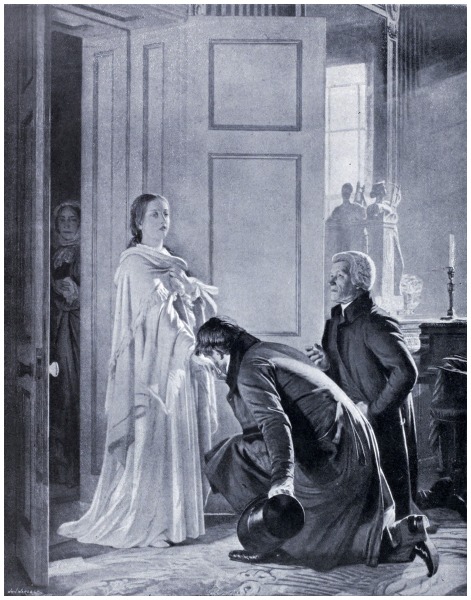

 1897