The Habitations of Cruelty.

In March, 1892, we arrived at a huge Cantonment
about midnight. As there was no dak bungalow
at the place, we spread our rugs on the
settees in the ladies’ waiting-room, and slept
till morning. The dak bungalow is an institution
kept up by the Government for the convenience
of military men and their families, although other
travellers take advantage of its shelter, and was
preferable to an hotel for our purpose, for our meals
were served in our private rooms always, and we could
lead a very retired life. After breakfast in the dining-room,
we went out and engaged a cab, explaining, as
was our custom, to the driver, that we were Christian
missionaries, and in accordance with the teachings of
our religion, we were searching out the most despised
and disreputable of women, to tell them of God’s care
for them and to see what we could do for them;
therefore we wished him to drive us to see the chakla
women of the Cantonment. He looked a little bewildered,
and then drove off with us.
After traversing a considerable distance, he entered a
public garden, and began to drive slowly, that we might
enjoy the flowers and foliage. We called to him, bidding
him drive on rapidly, as we did not care to see the
sights of the Cantonment. He nodded assent, and
touching his horse with the whip, drove away in another
direction. Presently he paused before another object to
which he was accustomed to take visitors. Then we
called him from his seat to the cab window, and told
him that if he took us out of our way again, we should
be obliged to leave his cab, call another, and dismiss
him. We made sure he understood exactly what we
wished, and he admitted that he did, but intimated that
he scarcely thought it a proper place for us to visit.
However, he consented, and drove off, and in a few
moments brought us to an open field where two regiments
were encamped. Fortunately, some drill of an
unusual sort was going on, and a good many people had
driven out to witness it; this, therefore, absorbed the
attention of all. The Lord appointed all our seasons
for us during our Indian investigations.
Taking a road leading to the back part of the camp,
we left our cab and driver where several other cabs were
standing, and walking along together, observed by no
one, entered one of the ten little tents we found enclosed
in a sort of fence of matting. The women received us
cordially, although with real astonishment at such
unusual visitors. The mahaldarni was not a bad-meaning
woman in many regards, and she told us, with great
satisfaction, of a sister of hers who had been promoted
from the rank of a common soldiers’ woman to be a
mahaldarni, saying that she had left off her wickedness,
prayed four times a day and read her Koran. She
joined with her girls in expressions of utter abhorrence
of the examinations to which the girls were subjected,
saying, “Shame! Shame!”
She told us how the soldiers, when in drink, knocked
the poor girls about in a most cruel manner, and reaching
her own conclusion as to the meaning of our call,
advised us not to join their number, telling us that the
city was far preferable. She and the girls told of the
heavy fines to which they would be liable if they did
not go to the examinations, or attempted to leave the
Lock Hospital when held there. She said if they made
any fuss about the fine, then they would be imprisoned.
A military guard was placed within the enclosure, in one
of the tents; but he had either gone to sleep, or
wandered out to get a view of the exercises that were
going on near by. We gave a simple gospel talk
through our interpreter, and she sang and prayed with
the girls; then we made our way to the women of the
adjoining Rest Camp.
Again we entered the enclosure surrounding the little
tents, and reached the women without attracting the
attention of the guard. They told the same story of
compulsion and fines continually hanging over their
heads. Almost every Cantonment girl we ever questioned,
was held to her wretched life by debt and fines, so
that she could not think of getting free without being
apprehended on account of them. Here likewise they
warned us not to join them, but go rather to the city.
Again we talked of Jesus, the Friend of the oppressed,
and after song and prayer, bade them good-bye.
Returning to our cab, we told our driver to take us to
the Lock Hospital; and after a long drive under the
burning sun, we stopped before buildings enclosed
within a very high brick wall with broken glass on its
top to prevent the escape of inmates. A large, strongly-spiked
gateway, with double doors, gave the impression
of a veritable prison; and there, standing in the open
gateway, was an uniformed armed guard. Previous experiences
had not led us to expect anything quite so
formidable, although there was generally some sort of a
guard or watchman at hand, and the native physician
usually resided on the premises. We had often said,
and promised God, that, sacred as was the nature of the
work, we would never prevaricate in order to cover up
our real object, if closely questioned. We were not
ordinary detectives, playing a part, but Christian
women, and the difference was not to be lost sight of.
Our interpreter had not been instructed as to the full
significance of our work, but was content to ask few
questions if only she might be allowed to follow her bent
freely and preach the gospel, which we gladly encouraged
and helped in every way possible, for we should have
felt that our mission was very incomplete had we met
these women solely to hear their pitiful stories, and never
utter a word to them of the love of the Heavenly Father,
in the midst of such distressing surroundings. Our
interpreter always carried religious tracts with her; and
while we were hesitating to know how to encounter the
armed sentinel, in the simplicity of her holy zeal she
walked up to him, gave him a tract, and said a few
words of a helpful nature. The guard noticed no more
than that some ladies were being delayed at the gate,
so he motioned us through, continuing his consideration
of the leaflet, and forgetting to ask our errand. How
easy for God to hide his own as He had hidden us again
and again that day from guard and sentinel! We have
frequently been asked how we escaped observation. We
can only say that we made but little effort on our own
part to do this, and trusted the Lord to do it all for us.
A dozen women gathered around us in a ward of the
hospital that day. With them we had a little service,
as usual, after which they eagerly poured out their sad
life stories, and told of the oppressions of the system
under which they were held in an evil life. The hospital
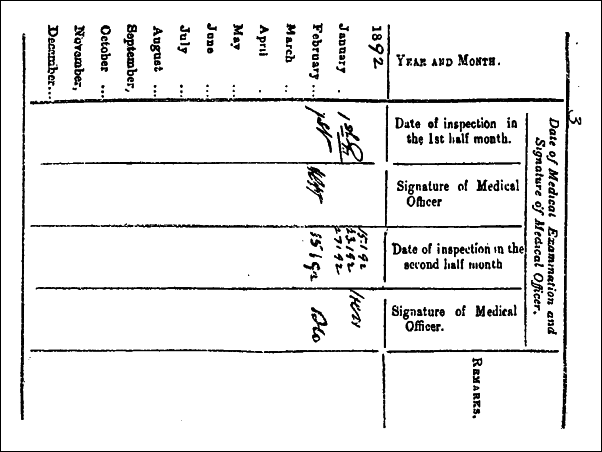
nurse showed us through the wards and the examination
room, where we found the grim rack for the
torture of the examination, brutal to the patient, but
convenient for the surgeon to do as much villainy as
possible in a given length of time. No diseases are so
rife or dreadful in their consequences but that their
compulsory treatment, when it involves the indecent
exposure of woman or man, is worse in its effects than
the disease itself. And this in the case of actual disease.
What, then, can be said as an excuse for such exposure
simply to find out whether there be disease? Yes,
further, what possible plea can be made when the object
of such compulsory exposure is to discover whether the
subject is “fit”[4] for a life of infamy?
Mrs. Butler has well expressed the encouragement to
vice that the compulsory examination of women leads to
in the following words: “We all approve of healing
disease and taking care of the sick, no matter what has
brought on their disease, no matter how sinful and
degraded they may be. The Abolitionists have always
pleaded for plenty of free hospital accommodation
for men and women afflicted with this curse. But it
will be clear to you that this law is not for simple
healing, as Christ would have us heal, caring for all,
whatever their character, and whatever their disease.
This law is invented to provide beforehand, that men
may be able to sin without bodily injury—if that were
possible, which it is not. If a burglar, who had broken
into my house and stolen my goods, were to fall and be
hurt, I would be glad to get him into a hospital and
have him nursed and cured; but I would not put a
ladder up against my window at night and leave the
windows open, in order that he might steal my goods
without danger of breaking his neck.”
But to return to the Lock Hospital mentioned. The
nurse produced the records for our examination. In the
correspondence book was the copy of a letter from the
military surgeon, informing the Cantonment magistrate
of six girls suspected of disease, and asking that they be
apprehended and sent to the hospital for examination.
That looked simple enough, and why not?
Imagine yourself the one apprehended, and the case
assumes a different aspect. A policeman comes to your
door and reads a warrant for your arrest as a common
prostitute; you ask on what authority; you are informed
that the name of the informant is not made public,
because if a man can be induced to help trace out
diseases—it being regarded as a “point of honour” to
inform other men where danger lurks—his confession
must not be made known, it would injure his reputation.
(We are now describing the exact conditions always
existent where there is compulsory examination of
women.)
You contend that you have a right to your good
name, and that it is a principle of justice that no one can
be punished on secret and unproved evidence, and that
it is punishment of the worst sort to be taken by a
policeman through the streets to a hospital used exclusively
for the treatment of a certain class of disorders.
You are then informed that unless you will go at once
without any trouble, you will be taken out of the town
in which you live, set down as a common vagrant by the
roadside, and if ever again found within the limits of the
city in which your parents, brothers, and sisters live,
you will be arrested and put in jail. What will you
do? Yet these were exactly the laws under which
these poor women, among whom we were spending
the day, lived.
By such a system of delivering over the bodies of
women as public property, any woman of humble circumstances
upon whom any man of lecherous design
casts his eyes, could be made to come to his terms of
existence by the aid of the police force, if necessary, and
magistrates of evil design could condemn any woman to
a life of prostitution. And in this hospital all this wicked
compulsion was set down in a book, every page of which
was headed, “Prostitutes attending Voluntary Inspections.”
From the Lock Hospital we drove to a large chakla,
and talked with a group of about twenty girls, among
them a little girl of twelve, and another of four. Everywhere
we went among the degraded women of India, we
found children in the chaklas, these Government-regulated
brothels, with their ever-present guards, so that
Englishmen knew perfectly that children were being
trained under Government regulation for prostitution.
The advocates of licensed prostitution for India are fond
of insisting as an excuse for licensing the evil, that it
does no great harm because the recruits come from “the
prostitute caste.” Repeatedly we made enquiries of
Englishmen, native physicians, and in one case applied
to the census office for some information concerning
this special class. Its existence was practically denied,
excepting those cases which can be found in every land,
in which women of all classes may fall into shame and
train their daughters after their own evil ways. It is
scarcely necessary in this connection to mention the
temple and nautch girls of India, who are found in civil
lines. They are a wholly distinct class from the enslaved
women who are set apart to minister to the vices of the
British soldiers. Among the latter we found Hindus of
all castes, from high-caste Brahmins down; and we also
found Mohammedans, Arabs, Egyptians, Afghans, Kashmiris,
Jewesses,—recruits, in fact, from those among
whom “caste” does not prevail. If it were true that all
these chakla women constitute one caste, for what object
did the Government of India, in times past, provide
invariably (so far as our observation extends) for a record
of the “caste” of the women to whom registration tickets
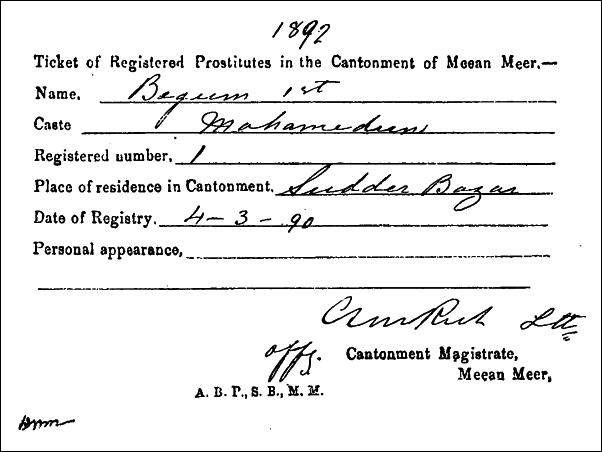
were given? The ticket which we purchased of a woman
at Meean Meer in 1892 (a fac-simile of which is given in
this volume, Appendix B) recorded her “name,” “caste,”
“registered number,” “place of residence,” “date of
registry,” and “personal appearance.”[5]
But there is a class in India being trained to prostitution,
though not a “caste,” properly speaking, and
they are getting their training in the brothels established
and managed by Englishmen, and many of the candidates
in this class are the children of Englishmen, who
have been deliberately placed there, or allowed to go
there, by their inhuman fathers. This is, properly
speaking, the prostitute class of India, those born to
their fate; the reader may judge whether the existence
of the class justifies licensing it for the purpose.
In the chakla we sang, “Where He leads me I will
follow,” and its interpretation constituted our Gospel
message. With tears in their eyes the girls assured us,
with characteristic gesture, that we were “on their eyes
and on their hearts”; in other words, had won their affections;
and spoke feelingly of the honour it was to them
that Englishwomen should come to see them, saying
that usually Englishmen forbade their wives to even look
at them. One girl said that when at Cawnpore missionaries
used to come to them, and that for days after
their visits her heart was so sore that it seemed as if it
would burst. The girls stood in the doorway, many of
them with streaming eyes, and waved good-bye as we
departed, begging us to come again soon.
We hastened to the railway station for the three
o’clock train. When we alighted, we spoke a few kind
words to our cabman, for he had served us most faithfully,
all these hours under the mid-day glare of the sun,
after so unpromising a beginning. We wished to pay
him well, and asked him to set his own price on his
services. The simple, rough native man hesitated a
moment, stammered something unintelligible, burst into
tears, and averting his face with noble shame, said, “I
don’t want anything at all. I never saw anything like
this before; I would like to help, too.” Thrusting a
coin into his unwilling hand, ample for both fee and
present, we hastened to our seats in the car, and were
soon rolling away to our next destination. We wrote
up our notes of the day’s doings on the way, and arrived
at our next field of operations the following morning at
two o’clock, stealing into another Cantonment unobserved,
excepting by the Heavenly Father, without
whom not even a sparrow can fall. We give this
history of one day as a sample; the work was heavy
and painful; but we encouraged each other often with
the words, “Even if we fall by the way, we could not die
in better work.”
We visited a Rest Camp at Meerut. As usual, we
had no difficulty in passing the sentinels; God took
care of that. We learnt from official records that the
regiment had only been in India two weeks; yet the
complete paraphernalia of vice was at hand. There
were fourteen little tents for women, and near their
quarters a huge tent pitched for those who wished to
smoke opium. Think of it, fathers and mothers, boys
of the age of from eighteen years upwards, supplied by
their superior officers, before they could have made a
demand for the same, with every convenience for giving
themselves over to debauchery! The sight of their fresh
young faces touched us deeply.
At another place, away up on the northern frontier,
we found only five girls; the others had somehow
escaped their cruel bondage. As we entered the gateway
of the mud wall that surrounded their quarters, a
native man standing near threw up his hands in great
astonishment, exclaiming, “O God! (‘Allah’), how
wonderful that ladies should come to such a place!” It
was a dreary, weird scene. The evening was piercingly
cold, and we were well wrapped. The old mahaldarni
and her girls were trying to warm themselves by a
wretched little pot of charcoal, stretching their thin
fingers by turns over the coals.
While we talked, the sudden night of a country
without a twilight came on, although it was not really
very late. One of the girls lighted a native lamp of the
rudest sort—a bit of wick floating in an earthenware cup
of oil—and set it in a niche in the wall. The room was
unfurnished excepting the charpoy, or cot bed, on which
we sat. The girls and mahaldarni sat, native fashion,
on the floor, their cotton chuddars and skirts fluttering
in the cruel wind that came in at the open archway, for
door there was none.
They said the men of their regiment were very bad,
and often when drunk beat them and robbed them, not
only refusing to pay them any money, but even taking
away their cotton quilts and selling them to their own
native servants for a few pice with which to buy drink.
They described the case of one woman who was beaten
terribly by a soldier, and cut in the arms and breast;
after this, several of the girls had effected their escape.
We have often spoken of this as one of the most deeply
shaded pictures in our memory, not only because of the
dreary, comfortless surroundings, but because of the
cruelty and oppression that weighed these helpless women
down, from which there seemed no hope of escape. We
talked to them out of the fullness of our sympathy, and
promised to pray and work in their behalf, that they, and
others like them, might have an opportunity to turn to a
good life.
But turning from the physical injury inflicted on these
poor women, we wish to present a view of their mental
sufferings. It has been urged by many advocates of the
regulation of vice that the whole nature of a woman was
changed by her sinful life—that she had no sensitiveness
and no deep sense of the degradation of her position.
We utterly deny this on behalf of the scores of women
with whom we have talked in India—whether of high or
of low caste, Hindoo or Mohammedan, and of whatever
nationality; whether brought up in virtue and afterwards
betrayed, or brought up from infancy in vicious
surroundings. We deny it even in regard to the mahaldarnis
placed over the women, whom avarice might
blind, and the ordinary routine duties of their position
might harden. Yet when their womanly feelings were
appealed to, they always responded, and felt shame with
and for the women under their care.
In all our conversations there was shown a most
remarkable patience, on the part of the women, in
regard to the various inconveniences and hardships
which the regulations entailed upon them. The fire of
their hatred and indignation all centred upon the
heart of the regulations, the examinations, and the violation
of womanhood which these examinations were
felt to be. It is of no use for any one to deny to us that
these women have deep feelings in regard to their
wrongs and their shame. We have felt the beating of
their aching hearts against our own; we have heard
histories that throbbed with the strong agony of betrayed
innocence; we have seen a hopeless woe in eyes
that will haunt us for ever.
At Peshawar, the women said, when speaking of the
great hardship of being turned out of the Cantonment,
“Where can we go to? We are prostitutes.
No one would give us work.” And again, “Every
one under this Government is treated well but ourselves;
we only are despised.”
We do not present these facts with any thought of
taking our position with those who argue that the
better regulation of vice implies a better protection of
the degraded women; but rather to show that in the
working out of such regulations the woman is absolutely
lost sight of, and only the prostitute is considered.
Every interest in the woman’s character, happiness,
health, life itself, is made subservient to the health and
convenience of the British soldier. Every assertion
that would put a humanitarian gloss on the regulation
of vice is utter hypocrisy.
At Meerut, where there were a good many women
present, one, without any question whatever on our
part, suddenly broke forth into the most intense expressions
of disgust at the Governmental regulation of vice,
in which those girls gathered about her sympathized,
one especially taking part in the conversation from
time to time, and corroborating what was being said.
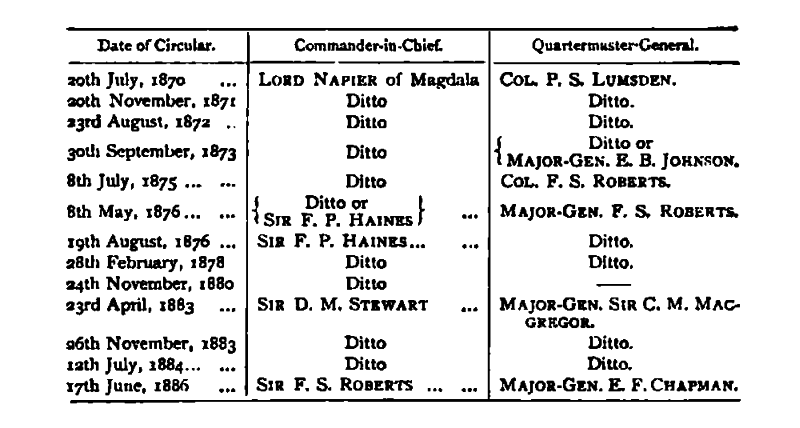
She said, “The Queen does not approve of this; it is
the Commander-in-Chief and the officers who are doing
these things! Oh, what a shame that the Government
does these things!” Then she burst into a passion of
indignation, describing in vivid language and with a
natural eloquence of gesture the whole shameful proceeding,
and the humiliation to which they were subjected.
Words fail to convey the force, and fire, and pathos
with which that poor, untaught woman pleaded the
cause of her sisters. It was one voice out of many
protesting against this cruel wrong, and representing
the undying dignity of a woman’s nature, even when
forced into a deeper abyss than she ever voluntarily
chose to enter. We asked if the other women felt as
this one did, and they all answered indignantly, “We
all hate it.” The first woman cried out, “It is very
disgusting; oh, shame!” We told them it was a grief
to us that those who called themselves Christians should
do such things, and that they ought not to bear the
name. She replied bitterly, “Yes; the Commander-in-Chief,
the Colonel, and all of them, all the way down—your
Christian men!—they all favour these things.
The Queen does not countenance it, for she has
daughters of her own; and she cares for her daughters
in India also. It is the Commander-in-Chief” (meaning
Lord Roberts).
The accounts we have given in previous pages reveal
the extremely tender age at which some of these girls
were thrust into a life of shame by court proceedings
under the Contagious Diseases Acts, when they were
openly enforced. Two Benares girls declared they were
taken up by the police at fourteen, and one Sitapur girl
said she was sold to a mahaldarni at eleven. Much has
been said of the horrors of child-marriage in India, and
these atrocities should not be minimized, even though
we bear in mind the usually slender type of Eastern
manhood; but what shall we say when the robust
British soldier has had placed at his mercy a little girl
of fourteen years old, of the delicate Oriental type; and
this done by regular process of law “to preserve his
health”?
Then again considering the heathen training of these
women, we were led to expect that we should find
blindness of the moral sense in relation to this sort of
wrong-doing. On the contrary, they expressed great
shame and humiliation, never tried to justify their sinful
acts, spoke almost universally of their hatred of the life,
shed bitter tears, and told us how burdened their hearts
were in thinking of their sins. Unlike what we met
elsewhere in speaking of religion to the natives, they had
little desire for controversy. With not a single exception,
we were made welcome, treated courteously, and
listened to and blessed for our message. Even in the
case of the mahaldarnis we found them not inaccessible,
but inclined to expressions of contempt for the whole
system of regulation, and of apology for being the hirelings
of such a system—an excuse which must have
more weight than in a country where industries are
open to women. Rahiman of Meerut was an exception.
She said she considered her business perfectly legitimate,
because she was in a “Government position.”
Several times we asked the women, “What do you
wish us to do for you?” and were surprised at the
answer. Desperately poor as many were, there was
never an appeal for money; rather they said, “Pray for
us;” or, “If you would build us homes, so that we could
go to them, and not sin any more, what more could we
ask?” and, “If you will help us to have the examinations
stopped.” Above all, we were astonished at the
appeals made to us concerning the latter outrage. We
told none of them our whole object in coming among
them, yet with great care they described and expressed
their abhorrence of the examinations, as well as the
wickedness and illegality of them; and in two or three
instances they mentioned that they had heard of ladies
interested in their behalf, and suggested the possibility
that we might do something for them. In one instance
several of the women, after telling us of their humiliation,
clasped their hands together, and lifting their eyes
to heaven, prayed to God that He would “help us to
help them.” They invariably exonerated the Queen
from all blame in this matter, saying, “She is a woman
herself; she would not do this. She cares for her
daughters in India.”
Says Mrs. Josephine Butler: “It is impossible not to
think of the fathers and mothers of the young Englishmen,
mere boys, who go out to India as soldiers, and
who are trained in this disgusting manner by the
military authorities; not only in the indulgence of their
vices, but in cowardly and brutal cruelties towards the
weaker sex. It seemed a grand object indeed on the
part of Lord Roberts and his subordinates to aim at
sending back their discharged soldiers to England free
from physical disease, regardless of their manliness,
their moral character, their respect for women, and
decent habits of life! Would not the loss of these be
bought too dearly by the mere exemption from physical
disease, even if this could be made possible?”
After months of toil, we were now far up towards the
north-western frontier of India. We requested our
cabman to drive us to the quarters of the Government
women of the Cantonment. We left the cab just outside
the narrow street. As we walked past the native shops
and turned into a little sort of lane, a woman shouted
in great concern from her doorway to us, “Why do you
come here? Don’t come here; all are prostitutes who
live here.” With a smile of re-assurance we replied,
“We know it, and you are just the women we are
seeking; we have a message for you.”
With surprise, she then welcomed us most warmly
and invited us in, saying she would go and call all the
women and bring them to hear the message. In a few
minutes chairs had been borrowed for us to sit upon,
and nine native women were clustered on the floor at
our feet.
We both exclaimed regarding the remarkable personal
appearance of the woman who had addressed us first.
She closely resembled, in fine bearing and apparent
intellectuality, a much-beloved mutual friend in Chicago,
a woman of more than local fame in scientific pursuits;
it touched us deeply. With utmost simplicity and confidence
this woman came and seated herself by Mrs.
Andrew’s side, leaning her arm across her lap, and many
a time during the interview that followed, her earnest,
wistful eyes met ours, while Mrs. Andrew gently stroked
her shoulder, her heart almost breaking with pity as the
woman told her sad story.
A plaintive native song was sung by our interpreter,
and tears flowed freely. After that the simple Gospel
message was given. They told us then some of the
painful details of the conditions under which they were
living, saying that they must either meet these conditions
or be expelled from the Cantonment, and added, “If we
are expelled, where shall we go? we must leave all our
friends, and no one will give us work. It means great
hardship; we would starve.” Speaking of the hateful
examinations, they said the Queen had forbidden these
things, but the officers yet compelled them to go on.
The woman at Mrs. Andrew’s side told us the following:
“Some time ago a lady in Calcutta saw a
woman weeping as she was going to the Lock Hospital
with other women. The lady asked her why she wept.
She told why she was obliged to go, and how she hated
the examinations.
“The lady could not understand this, but took the
woman home with her, and closely questioned into the
matter. Then the lady said to her, ‘This ought not to
be,’ and promised that she would do all she could for
them. Then the lady went home to England and
talked to the Queen. She spoke with wonderful power
in behalf of the poor women of India. She said to the
Queen that she (the Queen) was a woman, and these in
India were women, and their shame was the Queen’s
shame, and for them to be outraged was as though she
(the Queen) was outraged, that it was a shame for women
to be treated so when a woman was Queen. Then the
Queen ordered it to be stopped. But the officers still
carry it on.” This she added sorrowfully, all the other
women joining in the assertion. Then a sudden thought
came into the woman’s face, and she asked: “Are you
like that lady of Calcutta, going to try to do something
to help us?” We told them we would work and pray
for them that help might come and homes be provided
for them. They blessed and thanked us over and over.
We told them, “We are your sisters;” they replied,
“We are your slaves.”
Then the woman whom we have especially described
lifted her hand and with impressive solemnity uttered a
vow that she would no longer lead a life of shame.
The next morning we went back to the same place
and stopped before the open door. The old mother was
sitting on the floor by a little charcoal fire preparing the
breakfast. The two daughters of the house were putting
their simple little abode in order for the day. The
penitent one came forward and smiled so faint a welcome,
and seemed so embarrassed at our coming, that
we at first thought she was offended; but they exclaimed
almost instantly, “We were awake at midnight last night
talking of you, and we said it must have been the true
God who had sent you to tell us of your religion.” We
replied that they had been sorely on our hearts, so that
we could not sleep, and that we too were awake at midnight,
talking of them and praying for them. They then
poured out blessings upon us, with hands clasped in
prayer.
As we talked earnestly and lovingly to them, through
our interpreter, the one who had made the solemn vow
came forward and knelt beside Mrs. Andrew, who was
standing, and timidly took her hand. Mrs. Andrew laid
it on the poor girl’s shoulder as on the day before, but
the interpreter said, “Put your hand on her head; she is
asking you to bless her.” Tears streamed from the eyes
of the penitent, and she shook with sobs as Mrs. Andrew
fervently blessed her in the name of our God, and
pleaded with Him for the way to open for her escape
from bondage. Then in like manner the other daughter
came and was blessed. Then the poor old mother threw
herself with her forehead on the ground, laying her hands
on Mrs. Andrew’s feet, and while Mrs. Andrew prayed
over her, groaned and cried bitterly, saying, “I am a
sinner, I am a sinner. For twenty-five years I led
a life of shame, and brought up my daughters to it.”
We then wrote down their names, promising to pray
for them, a pledge which we have faithfully kept ever
since.