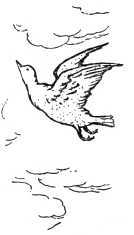
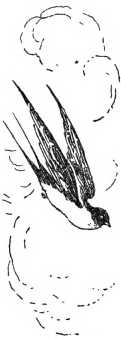
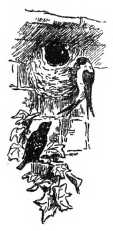
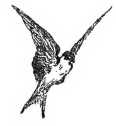
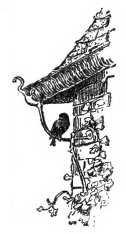
The swallow was in a bad temper. He sat on the roof close by the
starlings' box and drooped his bill.
"There is not a fly left to chase," he whined piteously. "They are all
gone, and I am so hungry—so hungry!"
"This morning I could not get a single worm," said the starling, and
shook his head wisely.
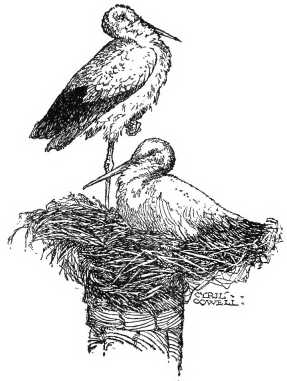
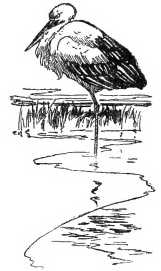
The stork came strutting along, and stood on one leg in the ploughed
field just outside the garden, and looked most melancholy.
"I suppose none of you have seen a frog?" he asked. "There isn't one
down in the marsh, and I have not had any breakfast to-day."
Then the thrush flew up and perched on the roof of the starlings' box.
"How crestfallen you all are," he said. "What is the matter with you?"
"Ah," answered the starling, "there's nothing else the matter, only
the leaves are beginning to fall off the trees, and the butterflies
and flies and worms are all eaten up."
"Yes, that is bad for you," said the thrush.
"Well, isn't it just as bad for you, you conceited creature?" said the
swallow.
But the thrush piped gaily and shook his head.
"Not quite," he said. "I have always the fir trees, which don't lose
their leaves; and I can live very many weeks yet on all the delicious
berries in the wood."
"Let us stop squabbling," said the stork. "We had better consider
together what we are to do."
"We can soon agree about that," answered the starling, "for we have no
choice. We must travel. All my little ones can fly quite well now;
we have been drilling every morning down in the meadow. I have already
warned them that we shall be starting off one of these days."
The other birds thought this very sensible—all except the thrush, who
thought there was no hurry. So they agreed to collect next day down in
the meadow, and hold a grand review of the party that was to travel.
They flew off, each to his own quarters; but up under the roof sat the
sparrow, who had heard all they had been saying.
"Ah, if only I could travel with them!" he said to himself. "I should
so like to see foreign lands. My neighbour the swallow has told me how
delightful it is. Such a lot of flies and cherries and corn, and it's
so delightfully warm. But no one asks me to fly with him. I am only
a poor sparrow, and the others are birds of wealth and position."
He sat thinking it all over for a long time, and the more he thought
the sadder he became. When the swallow came home in the evening, the
sparrow asked if he could not get him leave to travel with them.
"You? You want to go with us?" asked the swallow, laughing at him
scornfully. "You would soon be sick of it. It means flying, flying
over land and sea, over hill and dale. Many and many a mile we fly in
one journey without a rest. How do you imagine your short wings are
going to support you so long as that?"
"Oh, but I should so like to go with you," the sparrow pleaded.
"Couldn't you get leave for me to fly with the rest? I have such a
longing for it. I must go with you."
"I believe you are mad," said the swallow. "You forget who you are."
"Oh no," said the sparrow.
But the swallow took it upon him to instruct him about his position in
society.
"Don't you see," he said, "the rich merchant who lived here in the
country during the summer has now moved into town, and the baron who
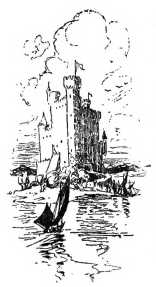
lives on Tower Island has done the same? The painter who was staying
out here is also by this time in Copenhagen; and they won't come out
here again till next spring. We birds of high station act in the same
way. As soon as ever we smell winter, we make our way to lands where
life is more enjoyable—to the warm south. But you poor wretches must
of course stay at home and suffer. That is how things are arranged in
this world. It is just the same with day labourers, and cottagers, and
other poor folks."
The sparrow said nothing to this long speech; but when the swallow
dropped asleep in his nest, he lay awake and wept over his hard
fate. He had still not quite given up hope of going with them all the
same.
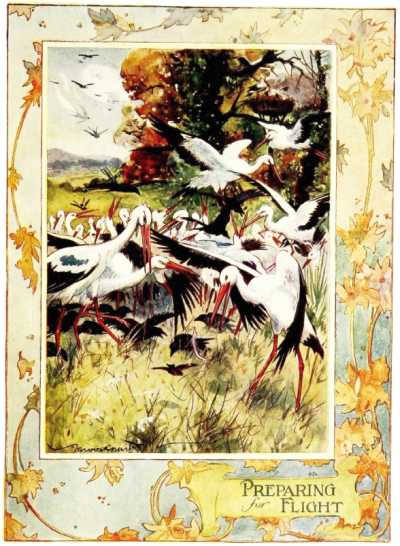
Next day the birds came flying from all directions, and settled down
in the meadow. There were starlings and storks and swallows, besides
many little singing-birds. But neither the cuckoo nor the nightingale
was there, for they had left long ago. "Fall in!" commanded an old
stork. He had been ten times in Egypt, and was therefore reckoned the
wisest of them all.
All the birds lined up, and then the oldest and most experienced went
round and saw if they had their travelling equipment in order. All
those who had their wings rumpled, or had lost some of their
tail-feathers, or did not look strong and well, were dismissed or
chased away. If they did not obey commands at once, they were beaten
to death without mercy.
You may be sure there was a great disturbance when they discovered the
sparrow, who had flown up without being noticed, and had planted
himself in the ranks with the others.
"A creature like that!" the starling called out. "He wants to go
too!"
"Such a pair of wings!" said the swallow. "He thinks that with them he
can fly to Italy!"
And all the birds of passage began to scream at once and laugh at the
poor sparrow, who sat quite terrified in the midst of them.
"I know quite well," he said humbly, "that I am only a poor little
sparrow. But I should so like to see the warm, pleasant lands you are
going to. Try to take me with you. I will use my wings as well as
ever I can. I implore you to let me come!"
"He has some cheek, hasn't he?" said the old stork. "But he shall be
allowed to keep his miserable life. Chase him away at once, and then
let us be off!"
So the birds chased the sparrow away, and he hid his miserable self
under the eaves.
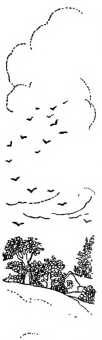
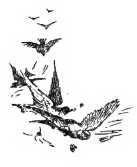
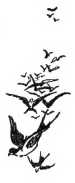
When the review was over, the birds of passage began to make off.
Company after company, they flew away through the air, whilst the
sparrow peered out from under the eaves and gazed sadly after them.
"Now they have all gone," he said. "No one but me is left behind."
"Me too!" screamed the crow.
"And me," said the chaffinch.
"And me too, if you please," peeped the tomtit.
"Yes," said the sparrow, "that is how it is. It is just as the swallow
says—all we poor birds must stay here and suffer."
The winter had come. Over all the fields lay the snow, and there was
ice on the water. All the leaves lay dead and shrivelled on the
ground; and there were no flowers, except here and there a poor frozen
daisy, which stood gleaming white among the yellow grass.
And the flies and the gnats, and the butterflies and the cockchafers
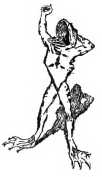
were dead. The snake lay torpid, and so did the lizard. The frog had
gone into his winter quarters at the bottom of the pond, sitting deep
in the mud, with only his nose sticking up into the air. And that was
how he intended to sit the whole winter through.
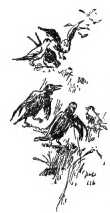
The birds who had remained behind had not, after all, such a very bad
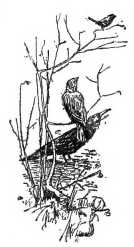
time of it. The crows held great gatherings every evening in the wood,
and screamed and chattered so loudly one could hear them ever so far
away. The chaffinch and the tomtit hopped about cheerfully enough in
the bushes, and picked up what they could find. The sparrow alone was
always out of sorts. He sat on the ridge of the roof and hunched
himself up, but the whole time he was thinking about the birds of
passage.
"They are there by this time," he said to himself. "Here we have ice
and snow; but down south, in the pleasant, warm countries, they have
endless summer. Here I have a job to find even some dry bread; but
there they have more than they can manage to eat. Ah, if one only
had gone with them!"
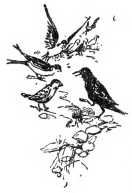
"Come down and join us," called the chaffinch and the tomtit.
But the sparrow shook his head, and remained sitting on the ridge of
the roof.
"I am consumed with longing, I can't endure it!" he screamed, and he
took a long flight to cool his blood.
But it was of no use. Wherever he came, it seemed to him that
everything was so wretched and bare.
Out in the field the lark was flying up to the sky and singing its
trills.
"Good-morning, sparrow," it twittered. "I am glad to see that you have
not gone away. I am also staying on, as long as I can stand it. It is
so delightful at home here, even in winter. Only see how the trees
have decked themselves out with hoarfrost, how the ice glistens, and
how gleaming white the snow is!"
"It is miserable," said the sparrow. "Poverty and want everywhere."
But the lark did not hear a word of what he said; he flew on his way,
singing joyously.
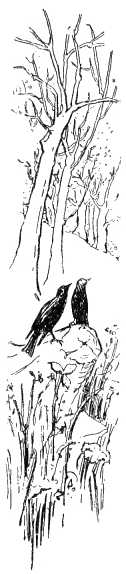
"Craw!" screamed the black jackdaws. "The winter is not so bad after
all." And then they walked proudly round the field and looked about on
all sides, for they knew that they cut a fine figure against the white
snow.
"The winter is really quite peaceful," said the field-mouse, as he
stuck his nose out of his hole. "If only it doesn't stay too long, the
food will last. I filled my pantry well last summer, and as long as
one has food one can always keep warm."
The sparrow heard it all, but it did not do him a bit of good.
"They seem to be contented enough with their lot," he said to himself,
"and I suppose it is all right for them. But this miserable life of
mine does not satisfy me!"
So he flew home in the sulks, and settled himself again on the ridge
of the roof.
"Oh, I know what I will do," he cried suddenly. "I will creep into the
swallow's nest and sleep there to-night, then I can dream that I am a
swallow."
And he did so, and dreamt all night that he was flying over hill and
dale, over land and sea, all the way to Italy. He thought he was so
light, so free, and his wings carried him as straight as an arrow
through the air. It was the most delightful dream he had ever had.
After this he crept every evening into the swallow's nest, and lay
there till ever so late in the morning. When he came out, he sat
crunched up on the ridge of the roof or in the bare lime tree. If the
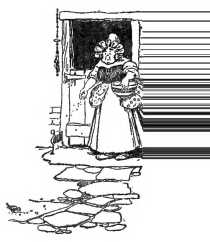
gardener's wife had not thrown out some crumbs to him now and then, he
would certainly have starved to death. For he didn't care a rap about
anything; he merely longed for the evening to come, so that he could
dream again. Every evening he dreamt the same thing, but he never
grew tired of it.
"This is nearly as good as actually going with them," he thought. "If
only I could dream in the daytime in the same way."
But in time his head got quite muddled, and he paid no attention to
anything.
Little by little the winter was slipping away, and now it was gone
altogether. The days grew longer, and there was more warmth in the
sunshine.
"What! are you still here?" said the sun. And he stared so hard at the
snow that at last it grew quite bashful, and melted away and sank into
the earth.
"Wait a moment," said the cloud to the sun; "we must have a thorough
cleaning before your turn comes."
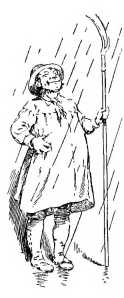
So it fell like a sousing rain on the earth, washing the leaves of the
trees and bushes, and collecting into quite a little lake on the ice.
"Now I am coming! now I am coming!" said the real lake, which lay
below, under the ice.
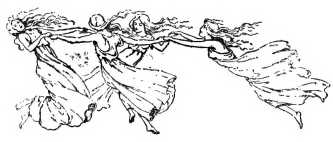
It heaved its breast, and with a great sigh the roof of ice burst,
and all the little scales began hopping and dancing like boys who have
escaped from school.
Then the sun broke out from the cloud, and a thousand little green
shoots peeped up from the earth.
"Lend me your wings," said the winter to the storm; "I must be off."
And away it flew to the cold lands right away in the north, where
there is winter always.
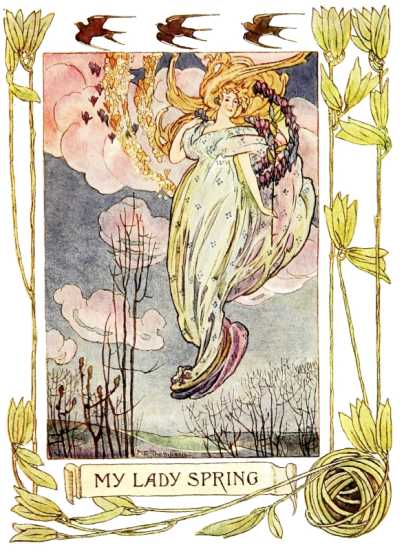
At last a message came from my Lady Spring that now they might expect
her any day.
The only person who saw nothing of what was going on was the sparrow.
The whole day he lay there in the swallow's nest, only flying out for
a quarter of an hour to take a little bit of food. He hadn't the least
idea that it was now going to be summer again. He had grown quite
silly, and imagined that he was the swallow.
But one day the swallow came back.
"Chee! chee!" he peeped; "is everything in order to receive us?"
This is what he wished first of all to see about, and so he flew all
day long over cornfield and meadow.
"There are not many gnats here yet, but they may still come," he said
in the evening when he came home.
Then he peeped into the starlings' box to say "How-do" to his
neighbours; but it chanced that at the moment there was no one at
home, so he got ready to go to bed.
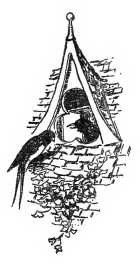
But when he was going to creep into his nest he noticed there was
somebody there already.
"What's this?" he said. "Who has taken the liberty to borrow my nest?"
"It is not yours," said the sparrow, who was lying there. "I am the
swallow, and I have just come home from Africa. You may take my word
for it, it was delightful there. I have heaps of things to tell you."
The swallow sat for a moment quite speechless. Then he screamed out in
a furious passion,—
"You may take my word for it, I shall have something to say to you,
you wretched sparrow! I might have guessed it was you who had the
impudence to steal my nest. I noticed you were a little cracked even
last year. Now, look sharp and come out of that. At once, I say!"
But it was no good the swallow's screaming and threatening. The
sparrow was quite sure that he was in the right. He went on telling
the swallow how he had just come home from Africa, and was so tired he
really must have a quiet time to sleep.
"I will have my revenge," said the swallow as he flew away.
And there in the nest the sparrow lay asleep, dreaming of the warm,
delightful land with all the gnats and flies and cherries.
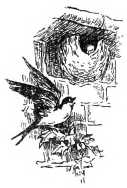
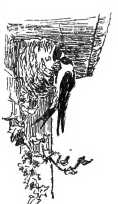
He was still lying fast asleep when, in the middle of the night, the
swallow came back. He had filled his broad bill with mud, and quite
quietly began to wall up the hole into the nest. To and fro he flew
the whole night long, and by the time the sun rose the hole was quite
closed up.
"Now he's happy," thought the swallow, as he began to build himself a
new nest.
Three days later the swallow and the starling met in the meadow. They
said, "How do you do?" and told each other all they had gone through
since they last saw one another.
"The most remarkable thing comes last," said the swallow. "Just fancy!
When I came home I found the sparrow had taken my nest, and I could
not get him to come out."
"Well, I never!" cried the starling. "What on earth did you do to
him?"
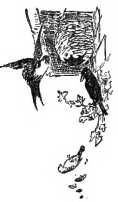
"Come and see," answered the swallow.
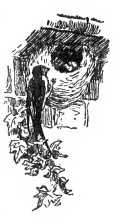
They both flew off to the nest, and the swallow told him how he had
taken his revenge. Then they pecked a hole with their bills, and out
fell the poor sparrow to the ground quite dead.
"It serves him right," said the swallow.
And the starling nodded, for he thought so too.
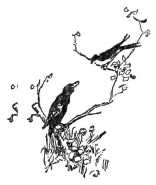
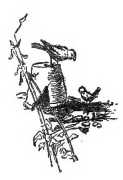
But the chaffinch and the tomtit stood below on the ground and gazed
at the dead bird.
"Poor sparrow!" said the chaffinch. "I am sorry for him."
"He couldn't expect a better fate," said the tomtit. "He was
ambitious; and that is what one has no right to be when one is only a
sparrow."