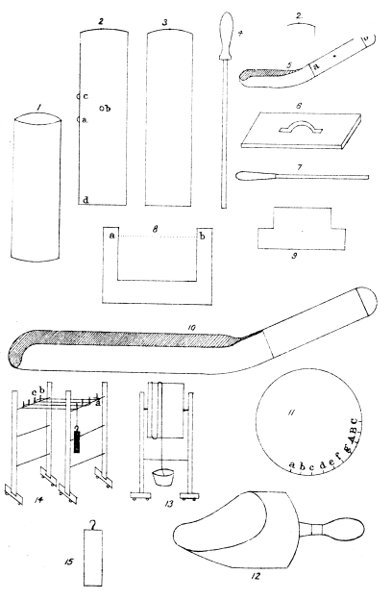
Rockets are charged in choked cases, on a spindle, to leave a hollow up
the middle, through which the fire may be communicated to nearly the
whole of the composition at once: this causes the sudden generation of
an enormous quantity of elastic vapour, which, being unable to escape
instantly through the contracted aperture left for its exit, exerts its
pressure in the contrary direction, and hurries the rocket forward. A
stick, attached to it, guides it, like the rudder of a vessel, or tail
of a bird, or fish; while its weight and leverage keep the centre of
gravity a little below the case, and prevent the rocket from pitching
over. Its manufacture, therefore, from the commencement of cutting the
paper for the case, to its finish of fitting on the stick, requires an
accurate adjustment of all its parts. Disregarding the trade names of
pound, ounce, &c., which, now that moulds are dispensed with, are
useful only for enabling the makers, from tradition, to understand each
other; the internal diameter, instead of the external, as formerly, may
be selected, from which to compute the relative measures. Taking the
bore of the case as unity, the proportions will be as follow:—
| 1 | Internal diameter of case. |
| 11⁄2 | External diameter. |
| 8 | Length of case. |
| 6 | Length of spindle. |
| 3⁄5 | Bottom diameter of spindle. |
| 64 | Length of stick. |
| 1⁄2 by 1⁄2 | Thickness and breadth of stick. |
These proportions are most readily calculated by taking the diameter in
eighths of an inch. Selecting, for instance, a 6⁄8 rocket, we have, 6⁄8,
inner diameter; half as much again, 9⁄8, outer diameter.
Taking the numerator as inches: 6 inches, length of case; 3⁄4 of this,
or, which is the same, 1⁄2 the outer diameter, as inches, 41⁄2 inches,
length of spindle; putting 20 for the denominator, instead of 8 (8 being
2⁄5 of 20), 6⁄20 of an inch, bottom diameter of spindle; 6 × 8,
(numerator multiplied by denominator) = 48 inches, length of stick; 3⁄8
by 3⁄8, size of stick.
The following table exhibits the usual sizes in inches.
Name of
Rocket. |
Inner
Diameter. |
Outer
Diameter. |
Length
of Case. |
Length of
Spindle. |
Bottom
Diam. of
Spindle. |
Length of Stick. |
Size of Stick. |
| 10/8 | 10/8 | 15/8 | 10 | 71⁄2 | 10/20 | 10 times 8=80 | 5/8 by 5/8 |
| 9/8 | 9/8 | 131⁄2/8 | 9 | 63⁄4 | 9/20 | 9 times 8=72 | 41⁄2/8 by 41⁄2/8 |
| 8/8 | 8/8 | 12/8 | 8 | 6 | 8/20 | 8 times 8=64 | 4/8 by 4/8 |
| 7/8 | 7/8 | 101⁄2/8 | 7 | 51⁄4 | 7/20 | 7 times 8=56 | 31⁄2/8 by 31⁄2/8 |
| 6/8 | 6/8 | 9/8 | 6 | 41⁄2 | 6/20 | 6 times 8=48 | 3/8 by 3/8 |
| 5/8 | 5/8 | 71⁄2/8 | 5 | 33⁄4 | 5/20 | 5 times 8=40 | 21⁄2/8 by 21⁄2/8 |
| 41⁄2/8 | 41⁄2/8 | 63⁄4/8 | 41⁄2 | 33⁄8 | 41⁄2/20 | 41⁄2 times 8=36 | 21⁄4/8 by 21⁄4/8 |
| 4/8 | 4/8 | 6/8 | 4 | 3 | 4/20 | 4 times 8=32 | 2/8 by 2/8 |
| 3/8 | 3/8 | 41⁄2/8 | 3 | 21⁄4 | 3/20 | 3 times 8=24 | 11⁄2/8 by 11⁄2/8 |
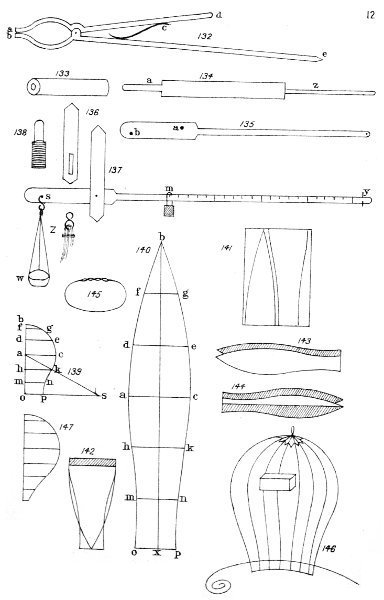
Have the former, fig. 7, a brass tube 6⁄8 of an inch external diameter;
the gauge, fig. 8, with a 9⁄8 aperture; procure some imperial brown
paper, 70 lb. or 84 lb., the thicker and heavier the better. The best
kind is made of old ropes, is air-dried, and rough. This is not easily
obtained now. The smooth machine-made, cylinder-dried answers very well.
The sort used for laying under carpets, and which is 5 feet broad, is
almost equal to the original rough imperial, and should be procured, if
possible, in preference to the smooth. Cut it into strips 6 inches wide.
Paste the pieces well, and roll the cases as hard as possible, with the
rolling board fig. 6, till they fit the gauge. Lay them by for a few
hours to get partially dry. They must, then, be choked or strangled,
about half a diameter from one end of the case, that end that lay
nearest to the left hand in rolling, till they assume the shape of the
neck of a vial. For this purpose have a cylindrical piece of deal,
alder, or any kind of wood, fig. 24, about 9 or 10 inches long, made to
fit easily into the case; cut it into 2 pieces, a and b; b may be an
inch and a half long; round off the ends, just cut. In a, fasten a
screw, the solid wire, or uncut part of which, is 1⁄4 of an inch thick;
saw, or file off the head, and slightly taper the part projecting; in
the piece b bore a hole to just fit the wire of a. Slip b upon a, and
push them into the case, so that the interval between the two reaches
within about 1⁄2 an inch of one end of the case; slightly draw out b, to
leave a neck, or hollow, round which to form the choke; fix a staple, or
screw-eye in a post: tie to it one end of a piece of cord, about a yard
long, and 1⁄10 of an inch thick; fasten the other end round the middle
of a stick, for a handle; take hold of the stick with the right hand;
hold the case in the left; pass the cord round the space left vacant and
gradually tighten it, turning the case round and round, so as to pinch
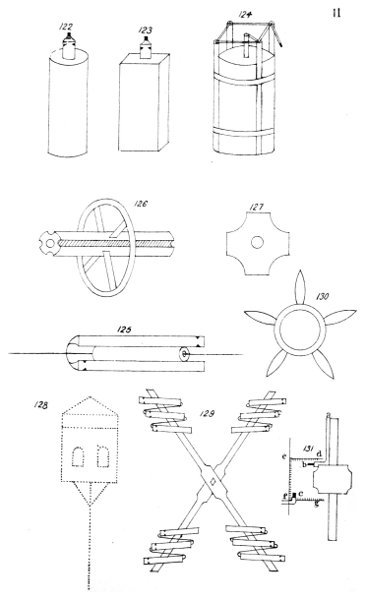
it in equally on all sides, till it assumes the shape of fig. 23. Hitch
a piece of string, about 1⁄16 of an inch thick, a few times round the
neck, until it is filled up flush with the other part of the case,
remove the choker, and hang the case up to dry. A hitch is made by
simply bending the string backwards into a loop, like fig. 22; passing
it round the choke; pulling it tight; looping it again, again passing it
round the choke, and so on. The first loop is called a half hitch, and
will not hold of itself; the second loop completes the hitch, and makes
it hold: the remaining hitches are for filling up the choke, and
restoring the cylindrical shape. Practise, by hitching the string upon
your thumb, 4 or 5 times: it will hold after the second loop; but push
it off at the end, and it will all fall loose again.
A case must not be choked when wet, or it will tear; nor must it be too
dry, or it will be difficult to choke it at all. The drier, however, it
can be choked, the better. Experience is the only guide. If properly
dry, the wrinkles of the choke will be small, and perfectly regular.
Should the string stick to the case, chalk it; but this is not likely to
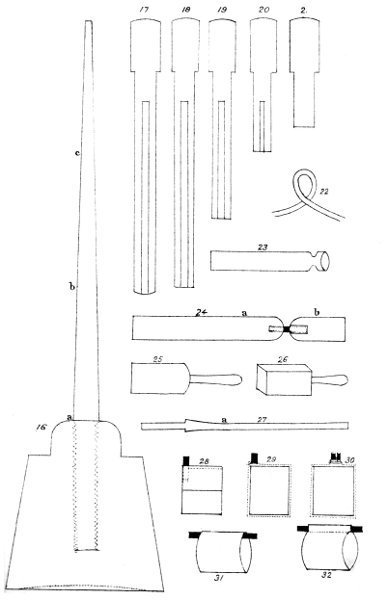
occur unless the paper is too wet. Have a foot, fig. 16, turned of ash,
or beech, or box, with a hemispherical nipple, 6⁄8 of an inch diameter,
as drawn. Bore it with a twist drill, or nosebit, to the depth of an
inch and a half. Procure a brass, iron, or steel wire, but preferably
brass, 6 inches long, and 3⁄10 of an inch diameter, and perfectly
straight. Cut, on one end of it, a screw, 11⁄2 inch long, fix it in a
vice, wet the screw with glue, and screw the foot on. File the 41⁄2
inches gradually tapering. The object of tapering it is simply to make
it deliver. A cylindrical hollow up the rocket would answer as well, but
the spindle could not be got out. The more conically true it is tapered,
of course, the better. Finish it off with a very fine file, and smooth
it with glass paper. The block into which it is screwed may be larger
than drawn; the bottom should be turned slightly concave, to make it
stand firm, on the same principle as the bottoms of plates, cups, &c.,
are made with a rim. The block and spindle are better if cast in
gun-metal, in one solid piece: the pattern to give to the caster should
be in one solid piece of wood. After casting, the rough parts must be
filed smooth; not many turners will be found willing to undertake to
turn it.
The next articles required are a setting-down piece, fig. 17; three
hollow rammers, or drifts, figs. 18, 19, and 20; and one solid rammer,
fig. 21. They are simply cylindrical pieces of wood, turned with a head,
to bear the blows of the mallet. Beech, or box free from knots, will
answer. The lengths of figs. 18, 19, 20, and 21, are to be 8, 6, 4, and
2 diameters, respectively, exclusive of the head; that is, 6, 41⁄2, 3,
and 11⁄2 inches. The hollow drifts are to have a cylindrical, not
conical, hole, bored up them, with a nosebit, or twist drill, to within
one inch of the handle, so as to clear the spindle by 1⁄2 an inch, to
allow of any dust being driven up it. The hollow in figs. 17 and 18 must
be large enough to fit the spindle loosely at a; in fig. 19, a trifle
smaller, to fit loosely at b; and in fig. 20, a trifle smaller still, to
fit loosely at c.
The next requisite is a mallet, fig. 25, which may be of ash, or beech.
It may be a cylinder, 5 inches long, and 3 inches diameter, with a
handle about 5 inches long, and 1 inch diameter. Let it be turned at the
end slightly concave, like the bottom of fig. 16, that it may be set to
stand upright, like a wine bottle. Or the head may be made 3 inches
square, like fig. 26; or, a small carpenter's mallet, about a pound and
a quarter weight, will answer.
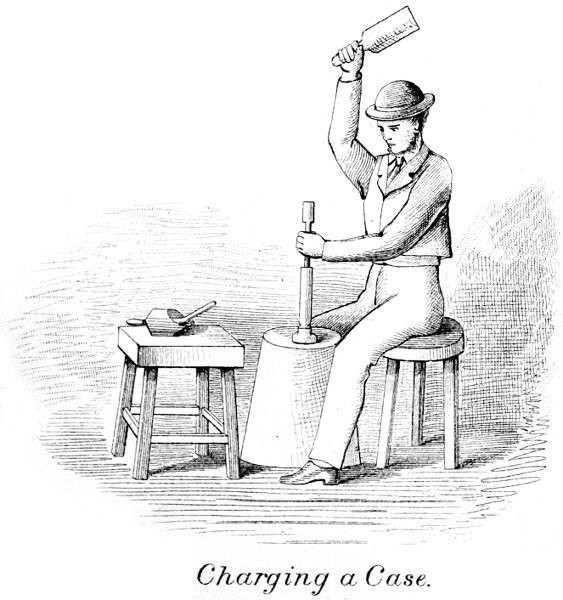
The first requisite is a solid block of wood, 6 or 8 inches square, and
18 or 20 high. This is indispensable. A piece of an old oak gate post,
answers well. It must be set upon the ground, or on a flag stone, not on
a floor. It is impossible to ram a rocket properly on the floor, because
of the vibration. It is, also, necessary to sit, not stand, at the work.
Put the setting down piece, fig. 17, into the case; press the case over
the spindle, and give the head a few blows with the mallet; this will
smooth out the wrinkles of the choke, which is all that fig. 17 is used
for. Now put in a very little powdered clay, and mallet it with fig. 18;
as much clay as will reach up 1⁄12 of an inch will be sufficient; its
object is to preserve the choke from burning, and getting enlarged. One
cannot be too precautious with rockets. Now put in a scoop of rocket
fuse, insert drift, fig. 18, and mallet the fuse in firm, with about a
dozen and a half blows, or till it offers a resistance to the hand. The
blows must be light and numerous, not slow and heavy, like driving a
post into the ground. 18 blows with a momentum of 3, will consolidate
the fuse: 3 violent blows, with a momentum of 18, would perhaps bend the
case, or drive the dust up into your eyes. The mallet need not be
lifted above 4 or 5 inches at a time. If the rocket is not rammed firm
throughout, it will, upon lighting, explode.
As soon as the case is charged about 11⁄2 inch, make a pencil or ink
mark, round the drift, where it stands level with the top of the case,
for future guidance; then charge another 11⁄2 inch with the second
rammer, fig. 19, and mark it in like manner; proceed in the same way
with fig. 20. It is obvious that if fig. 19 were used too soon it would
get split by the spindle being driven up it, and the spindle would be
bent or broken, hence the advisability of marking the drifts to know
when to lay aside one, and take the other. Just before you get to the
top of the spindle, put in the solid rammer to feel how high the spindle
reaches near the top of the case; hold it by the thumb and finger to
keep the distance, and mark it down the outside of the case, by
indenting the case with the edge of the drift. Exactly 11⁄3 diameter,
that is, in this case, exactly 1 inch, above this indentation make
another mark: then as soon as you have covered the spindle, till you can
no longer see it, with the use of fig. 20, begin charging with the
solid drift, fig. 21, till the composition inside is level with the top
mark. This being done drive in a little dry clay, till the case is full.
Remove the rocket from the spindle, by giving it a turn or two round to
the right, not backwards; then bore a hole through the clay, till you
can see the composition, with a 3⁄16 inch shell-bit. The shell-bit
should be fixed in a handle, and kept for the purpose. It is not
advisable to use a stock and bit, unless the bit is shielded, as it is
apt to bore too deeply. The bit may be fixed in a handle, by boring a
large hole in the handle, and pouring in melted lead, or pressing in
plaster of paris.
Instead of driving in dry clay on the top of the composition, a little
plaster of paris may be pressed in; this, when dry, will allow of a
perfectly clean hole being bored through it; whereas the clay is apt to
crumble, and chip out. The object of the clay, or plaster, is to prevent
the composition, which, containing much charcoal, does not bind well,
from getting disturbed, and the solid part diminished, which would cause
the stars to be ignited while the rocket was ascending, or the fuse,
perhaps, to blow through at the beginning. A piece or two of naked
quickmatch is to be inserted in the hole through the clay or plaster,
and a long piece is to be pushed up the core, or hollow, of the rocket,
as far as it will go; it is, then, to be cut off flush with the mouth,
and fastened to the side with a little dab of wetted meal powder,
pressed on it with the blade of a knife. If the rocket is intended to be
lit with a port-fire, take a circular piece of touch-paper, about 2
inches diameter, slightly paste it all over, lay it in the left hand,
press the mouth of the rocket down upon it, and smooth the edges of the
touch-paper up round the case. Otherwise, smear the end of the case with
the sash-tool dipped into meal paste, and when dry, paste a bit of
touch-paper round it, and twist to a point, like a squib. The appearance
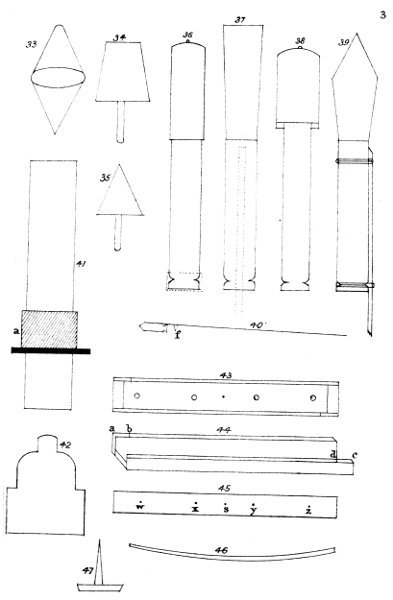
of the rocket is shown at fig. 36; the dotted line round the mouth shows
the touch-paper.
In driving with the hollow rammers, it generally happens that a little
of the fuse gets driven up the hole; this, if allowed to accumulate, is
very troublesome to remove; it should, therefore, be knocked out every
time, by holding the drift in the left hand, and giving the head a rap
or two with the mallet.
The whole of the composition ought to be put in in about 12 scoops: try
2 or 3 scoops till you get one of the right size, then write upon the
handle what-sized rocket it belongs to. These directions may appear
minute, but they will save much trouble if attended to.
As it is convenient to know, beforehand, about what quantity of
composition will be required for any particular rocket, the following
formula will be useful:—
E3 / 9 = drams.
Where E denotes the size of the rocket, in eighths of an inch.
Required the quantity of fuse for a 6⁄8 rocket.
(6 × 6 × 6) / 9 = 4 × 6 = 24 drams = 11⁄2 ounce.
For a 3⁄8 rocket?
(3 × 3 × 3)/9 = 3 drams.
The same weights denote the quantity of stars which the rocket will
safely carry: thus an ounce and a half of stars may be put into the
head of a 6⁄8 rocket; and 3 drams into a 3⁄8 rocket. Along with the
stars is to be put in 1⁄9 the weight of the stars of bursting powder;
this may be pure meal powder; or a mixture of 8 meal powder, 1 fine
charcoal, well sifted together: or half meal, half grain; thus the
quantity of bursting powder for a 6⁄8 rocket will be 24⁄9 = 22⁄3 drams;
and for a 3⁄8 rocket, 3⁄9 = 1⁄3 of a dram. It is advisable to keep
nearly to these directions, for the weight of the stars; but it is not
necessary to be minutely exact; but to ascertain whether the head is too
heavy or not, take a table knife, or any thing an inch broad, and lay
the rocket flat and horizontally upon it in such a manner that the
commencement of the head lies close to the back edge of the knife, the
cutting edge lying towards the choke: if the head pitches over, it is
too heavy, and some of the stars must be taken out; if it balances, it
is correct.
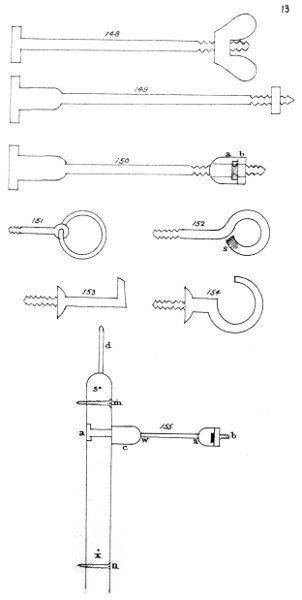
Rockets should be fired from two staples, or two screweyes, fixed in a
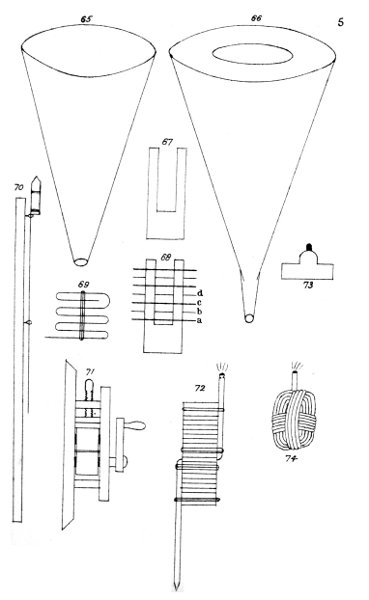
post, one near the top, the other half a yard below, as in fig. 70. They
should never be propped against a wall, a chairback, a gate, or
railing, as they might fall, especially on a windy night, after the
touch-paper was lit, and before the fuse had caught. Every possible care
should be taken in guiding them, as it is too late to think about any
mischief they may cause, after they have once started.
In making rockets, it is essential, above all things, to have good nitre
and charcoal. The best way, with fresh materials, is to weigh out as
much nitre, charcoal, and sulphur, as will make one small rocket. Have
the nitre as fine as possible, and dry it over the fire in a 6-inch
frying pan, which should be kept for the purpose. If the rocket ascends
well you will know that the articles are pure, and you can proceed to
use them; but if the rocket does not rise, you may conclude the articles
are adulterated, the nitre with salt, or that the charcoal is perhaps
merely deal sawdust, burnt in a retort. In this case you must buy the
nitre in crystals, and the charcoal in sticks. To powder the nitre, put
it into a pipkin, pour on it a little water, set it on the fire, make
the water boil, and keep stirring the nitre with a piece of wood, until
it is dry and of a fine powder. Charcoal is best ground up in a
coffee-mill. It must first be broken into small pieces, about the size
of coffee-beans. After being ground it should be sifted through the
sieve, the interstices of which are about 1⁄40 of an inch square. To get
a correct idea of this size, lay down a line on paper, an inch long:
mark it off into eight equal parts by taking the divisions from a
foot-rule; then carefully divide one of the eighths into five equal
parts. But the best way is to make a square deal sieve, about 8 inches
square, and 3 inches deep; then nail on the bottom a piece of perforated
zinc, with quarter-inch flemish tacks. The perforations are circular,
and should be 20 to the inch, measured diagonally; that is, a
diamond-shaped inch, or inch rhombus, consisting of 20 oblique rows,
each row containing 20 holes; 20 times 20 = 400. These holes will be
about the same size as the ones mentioned in the sieve, because the
solid parts between the perforations are also about 1⁄40 of an inch. A
strip of deal, 1⁄4 of an inch thick, should be nailed round the bottom,
to keep the zinc tight. A square box for a receiver, and another for a
lid, should also be constructed, otherwise you will be smothered in
sifting charcoal. Making use of the perforated zinc sieve just
described, all the charcoal that goes through, fine and coarse, should
be used for rockets. It need not be shaken much, but brushed through
with a sash-tool. Construct a second sieve with 15 perforations to the
lineal inch. Iron borings for gerbes should be sifted through this; use
all that goes through. Construct, also, a third sieve with 9
perforations to the lineal inch. Nothing can equal iron and steel for
making sparks; but neither will keep long from rusting, after coming in
contact with nitre. Coke grains, about the size of pinheads, are a fair
substitute. Beat coke into lumps about as large as peas, then grind it
in a coffee-mill, and brush it through the 9-perforation sieve; sift the
fine dust from what passes through: throw the dust away, and keep the
grains. Porcelain may be powdered in an iron mortar, for gerbes; brush
through the 9-perforation sieve; sift out the dust with a fine sieve;
throw it away and keep the grains. The intense heat of the focus of the
choke renders them incandescent; and, from their weight, they are
projected to a considerable distance. They are inferior, however, to
coke grains, as the latter are to steel filings. We may say,
alliteratively; positive, porcelain; comparative, coke; superlative,
steel.
Zinc may be obtained with half-inch perforations; a size useful for
garden sieves, bottoms of soap boxes, &c.
Before grinding a fresh substance in a coffee-mill, it must be taken to
pieces, brushed clean, and screwed up again. Fine lawn or hair sieves
should be used for sifting chemicals; excellent sieves may be made with
book-muslin: the cylinders may be 4 inches diameter, 3 deep; the muslin
should be cut into a circular form, and hemmed round a piece of string;
it may then be slipped over the drum or cylinder, and secured; or it may
be pasted up and round the sides, and if above 4 inches diameter, two
pieces of string may be crossed over the middle to strengthen it.
Charcoal may be made by putting some dry pieces of willow, alder,
poplar, sycamore, maple, or almost any kind of wood, except the pine or
turpentine tribe, into an old iron saucepan, covering them with
perfectly dry sand, and setting the saucepan in the middle of a fire, to
remain red hot till the wood is completely burnt through. Remove when
judged sufficiently charred; and when cold, not before, pour away the
sand.
Sulphur is used in the state of sublimed sulphur, sulphur sublimatum, or
flowers of sulphur, and, when mixed with nitre, requires no preparation;
but as it is always more or less impregnated with sulphuric acid, as is
readily shown by testing it with litmus paper, it might, on coming into
contact with chlorate of potash, cause spontaneous combustion. To
prevent this, it is necessary to wash the sulphur. For this purpose put
it into a pan, and pour upon it boiling water, in which some salts of
tartar (carbonate of potash) have been dissolved; stir it well and break
down all lumps. Let it stand to subside; pour off the supernatant
liquor; fill up with cold water and let it stand, to again subside. Make
a conical bag, fig. 33, with a piece of linen or calico, sewed at the
top, round a ring or hoop of wire, or cane, or whalebone; fasten a
string to it, by which to hang it up. Put the washed sulphur into it,
and hang it under a water-tap; turn the water gently on, and let it drip
all night; this will wash away every trace both of acid and alkali.
Afterwards hang the bag up three or four days till the sulphur is dry;
it may then be bottled, and kept exclusively for colours.
Oxalate of soda may be made thus—procure 3 lbs. of carbonate of soda,
the common washing soda used by the laundress, not bicarbonate of soda;
boil it up in a saucepan with just as little water as will suffice to
dissolve it. Dissolve, in another vessel, 1 lb. of oxalic acid in
boiling water, and pour it into a deep jar, capable of holding two or
three quarts; a wash-hand jug will answer. Now put to this the dissolved
carbonate of soda, with a table-spoon, a spoonful at a time. A violent
effervescence takes place. The soda is to be slowly added till
effervescence ceases. It should be tested with a strip of litmus paper,
to see if the acid is perfectly neutralized.
To prepare litmus paper, dissolve 1⁄4 of an ounce of litmus in an ounce
and a half of water; when thoroughly dissolved, and the water is of a
dark blue colour, take some white blotting paper, and with a sash-tool
or camel's-hair pencil, go over it on both sides with the litmus
solution. When dry, wet some of these prepared pieces, with the brush
dipped into vinegar: this will turn them red. Dry, and preserve both.
They may be cut into strips, half an inch broad; the blue strips will be
tests for acids; the red, for alkalies. Wet a strip of the blue, and
touch it with oxalic acid, it will turn red; wet a strip of the red, or
the piece just reddened, with carbonate of soda, it will turn blue.
To make sulphuret of copper, procure some thin sheet copper, about as
thick as a card; cut it into pieces, and put it into a crucible, with
sulphur, a layer of sulphur, and a layer of copper alternately, till
full. Set the crucible in a clear fire, and keep it red hot for an hour.
Remove it; when cold, break it up, and grind it in a coffee-mill. Sift
it in a lawn or book-muslin sieve as fine as possible. Half-a-pound of
copper and a quarter of a pound of sulphur may be employed.
There is a black sulphide or sulphuret of copper produced by passing
sulphuretted hydrogen through a solution of protoxide of copper: this is
useless.
For want of a coffee-mill, charcoal may be beaten in a leather bag, with
a hammer.
A variety of rocket fuses will be found in the Tables; the first is as
good as any, and will answer for all sizes from 3⁄8 to 12⁄8. As a rule,
the fiercer fuses, containing meal powder, may be used for small
rockets; but are, by no means, necessary.
A rocket, when starting, makes a roar; but this is not on account of the
fierceness of the fuse, but of the extent of the surface ignited. Rocket
composition, laid in a train, burns very slowly.
Rocket stars are made in three or four ways. First cut, or chopped, or
naked stars. This mode is used for nitre stars only: chlorate of potash
stars require different methods. It is a singular circumstance that,
though chlorate of potash stars are much fiercer than nitrate of potash
stars, yet the latter light without any trouble, while the former, if
made in the same way, would be almost sure to miss.
Wet the composition with thin starch, or dextrine solution, or gum
water, sufficiently to bind; press it into a flat mass, on a slate, or
Dutch tile, with a knife, or small trowel, till about 3⁄8 of an inch
thick. Indent the surface with the edge of the knife, in parallel lines,
about 3⁄8 of an inch apart, and cross these with equidistant
indentations, at right angles. Set the mass by, to dry gradually. When
nearly dry, break it up into little 3⁄8 cubes, and lay them out, to dry
thoroughly. The broken edges will be rough, and will catch easily.
Take a sheet of note paper, and cut it into four equal parts; each part
will be about 41⁄2 inches by 31⁄2. Paste and roll them on a 31⁄2/8
brass tube, so as to have the cases 41⁄2 inches long. To make these
into pill-boxes, perfectly true, like those used by the druggist, they
must be cut in the lathe. For this purpose, turn a cylindrical piece of
wood, fig. 27, which is to fit easily into the case, except at a, where
it is to be turned sloping a little larger, so that when the case is
slipped over it, it will bite at the part a; otherwise, on putting the
chisel to it, it would slip round, without getting cut. Mark the case,
with a black-lead pencil, at every half-inch; suspend it in the lathe;
and cut it at the marks. Next procure a 7⁄16 inch punch, with which to
cut out the bottoms. These are to be made of card, or bristol-board. Lay
the card on a piece of sheet-lead, or the grain end of a piece of beech,
and give it a smart blow or two with a hammer; keep on punching till the
punch contains a dozen or more discs, then push them out. When a number
are ready, press them into the pill-boxes, with a rammer that fits
loosely.
The composition is to be put into these dry, and driven in with a solid
rammer, and the little mallet, before described.
This was the original way of making them, but is perfectly unnecessary.
Roll the tubes as directed, of two thicknesses of paper, with a little
bit to lap over. Cut them across, with one sharp clip, with a strong
pair of scissors. This will slightly flatten them; but they may readily
be restored to the cylindrical form, by slipping them on a piece of
wood, and rounding them to shape with the fingers. No bottoms need be
provided, no punch used.
Rest the box on a flat surface, put in some composition, and drive it in
with a brass or boxwood drift and the little mallet, till half full, as
in fig. 28. Then fill up the box with more colour, set a little bit of
match upright in the side, and mallet it in, till the box is almost
full. The drift for this must be cut flat on one side, to allow for the
match. On the top put a very little dry meal powder, or shell-fuse, and
press it in with the finger. Cut a piece of double-crown, about an inch
broad, and long enough to go rather more than once round the pill-box:
paste it all over; lay the pill-box on it, and roll it up; tuck in one
end, to make a bottom, and press the other end round the match, and on
the meal powder, or shell-fuse, till it assumes the form of fig. 29.
Set the pill-box on a flat surface, put in a very little meal powder or
shell-fuse, then some composition, and mallet it in till full. Roll
this up in a piece of double-crown as before; tuck in the bottom, and
set by to dry; when dry, put into the other end—the end containing the
film of meal or shell-fuse—a piece or two of thin match, and tie it in,
as in fig. 30. Dry pill-boxes are best for making chameleon stars; these
are half one colour and half another. Make a dozen stars, half yellow
and half green, and a dozen more half blue and half crimson; put these
into a rocket; they will burst green and crimson, and change to blue and
yellow.
The cases are the same as before. To fill them, damp the composition as
for Roman candle stars; put a bit of quickmatch into the case, as at
fig. 31, and press in the composition. This is usually done with the
fingers, but is not very pleasant work, especially with lac solution. A
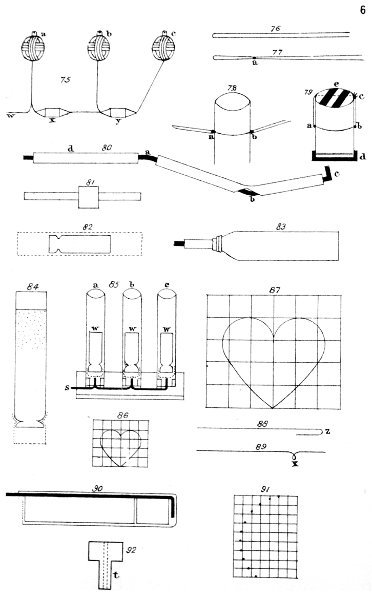
cleaner way, though more tedious, is to fit the case on to a little
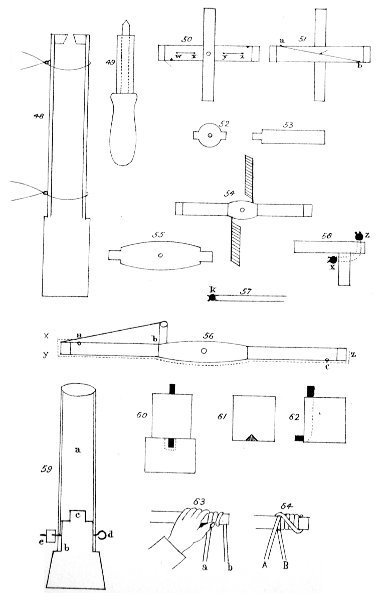
foot, with a side notch in it, fig. 60; then slightly mallet in the
composition. Or a notch may be cut in the side of the box, fig. 61, and
the match put in, as fig. 62, and slightly malleted.
Instead of making the cases entirely of writing paper, they may be made
half of writing paper and half of coloured double-crown, to indicate the
colour of the star.
Another way is to sift a thin layer of French chalk over a sheet of
paper, and to roll the stars in it, one by one, as they are punched.
When dry, brush off the superfluous chalk, and prime with a bit of
match, tied across the mouth.
Pump and drive the stars exactly as for roman candle stars, They may be
31⁄2/8 diameter, and 5⁄8 long; or they may be formed with figs. 1, 2,
and 3, and the side pin of fig. 2 may be removed to c, in which case the
stars will be 5⁄8 diameter, and 31⁄2/8 deep; the former will be an
oblong cylinder, the latter an oblate. Cut a strip of red, blue, green,
or yellow double-crown, of a suitable breadth, and long enough to go
twice round the star. Paste the strip all over, or gum it at the edge
only, and lay the star upon it, as at a, fig. 41, with a bit of match
behind it; then roll it up and put by to dry. When pasted, it shrinks
and holds the match tight; when gummed at the edge this is not always
the case; it may then have a piece of thin binding-wire twisted round
it. It will have the appearance of fig. 32. In fig. 31, the match is
embedded, and dries in the damped composition; in the enveloped stars
the stars are dried first, and the match lies outside and blows through.
Enveloped stars show well in the air.
The word envelope, as used in these pages, must not be confounded with
the same word as applied to the coverings for letters. It is rather
synonymous with the term wrapper; you lay an ounce of tobacco on a piece
of paper, roll it up and tuck in the ends. So with cases: you roll them
up in a piece of paper, and leave an inch vacant at each end to receive
quickmatch, &c. This is termed the envelope, that is, the wrapper.
Heads for small rockets may be made of two or three rounds of paper
rolled dry, and secured on the inner and outer edges with paste. After
sticking it on the case, which it may be made to fit, as in fig. 36,
pinch the top in like a choke, only tight, and tie it round with twine
or flax. For coloured rocket heads, 6⁄8 and upwards, the head may be
enlarged by fixing a collar round the top of the case. To make the
collar for a 6⁄8, roll a case on a 9⁄8 former, and when dry cut it into
short lengths in the lathe, as recommended for pill-boxes; if unprovided
with a lathe, saw it with a fine-toothed saw. The advantage of the
enlarged head is, that it brings the stars nearer to the rocket, and
prevents it from being top-heavy. Another way is to make the heads
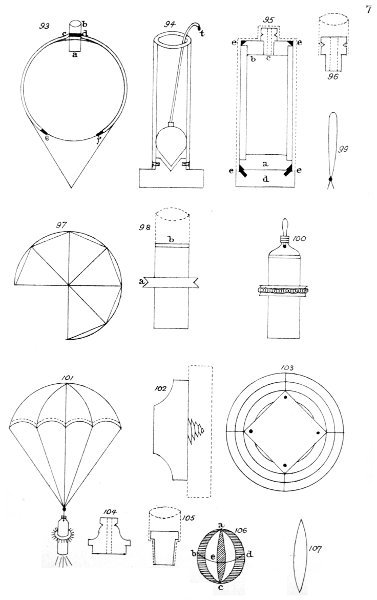
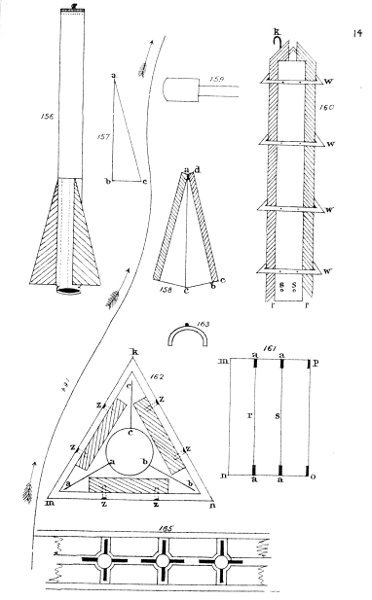
tapering, and the tops conical, as in fig. 39. One part is rolled on
fig. 34, the other on fig. 35; or, a cone may be made of a circular
piece of paper, without a former. Cut the circle, along the radius, to
the centre; bend it into a cone; secure the edge with sealing-wax, and
paste paper over it to overlap the rim: snip the edge with the scissors;
paste it inside, and secure it to the other part. But the quickest way
of all is to make a long paper bag, which may be made to fit to the
greatest nicety. For this purpose take a tape-measure; or lay down, on
the edge of a strip of writing paper, 7 or 8 inches long, and 1 inch
broad, 6 inches, divided into eighths, transferred from a foot-rule.
Suppose the 6⁄8 rocket has a collar, which, on being measured by the
paper just alluded to, is found to be 42⁄8 inches round; add to this
3⁄8 for lapping over, making 45⁄8 inches. Cut a piece of imperial brown
45⁄8 broad, and as long as the case, 6 inches. Make this into a paper
bag, 21⁄8 inches broad. Be careful that the corners are perfect; a
strip of double-crown may be pasted over them. When dry, pinch the mouth
open till cylindrical, and merely allow the stars to drop in without
forcing them; this will keep the top edge of a wedge shape, fig. 37, and
answer the purpose of a cone. If the paper is thin, the bag must be made
of two thicknesses; the paper will, then, require to be 9 inches by 6;
43⁄8 of this will have to be kept dry, and the other 45⁄8 pasted.
A head, made in this way, if required to hold gold rains, or serpents,
can instantly be reduced to a cylindrical shape, by pushing the
rocket-case right up it, to the top; this will cause the corners to
stick out, like two horns; press them down, and secure them with
sealing-wax. Attach a cone, if desired.
Heads made like figs. 38 and 39 may be of three thicknesses of paper,
pasted all over.
Fig. 39 shows the manner of tying on the sticks. No variation must be
made in their lengths, and it is not advisable to alter their size. To
adapt it to the wood, however, a slight alteration might be permitted.
For instance, instead of 3⁄8 square, it might be 21⁄2/8 by 31⁄2/8,
a slight increase one way, compensated by a slight diminution the other.
It must, however, on no account, be so increased and diminished, as to
approach the shape of a lath, as such stick would vibrate, and cause the
rocket to quiver. When the heads are a paper bag of the shape of fig.
37, the stick must be tied on, as indicated by the dotted lines.
If the stick is suited to the rocket, it will, when suspended on the
finger almost against the mouth, as at f, fig. 40, lie, not quite
horizontal, but slightly sloping downward. The wood should be dry pine,
free from knots. The sticks are generally cut with a carpenter's
cutting-gauge. If the learner has a lathe he will find a 6-inch
circular saw convenient for cutting them.
For amateurs, a 6⁄8 rocket is a good size; large enough, and small
enough. If 5⁄8 and 4⁄8 are made, two hollow drifts will be sufficient;
for 3⁄8, one hollow drift. Very small rockets, 2⁄8, are made for
children; they are rammed solid, and a hole is pushed up them with a
bradawl.
Rockets in former times, before the present days of competition, were
charged in moulds. These were of gun-metal, bored truly cylindrical,
furnished with hinges, to open and admit the case; they were then
screwed up, and might be charged as hard as possible. Names were given
them according to the bore of the mould, that is, the external diameter
of the cases; a 4⁄8 was termed an ounce rocket; a 5⁄8, a two ounce; a
6⁄8 a quarter pound; a 71⁄2/8 a half pound; a 9⁄8, a pound; a 12⁄8, a
two pound.
These names were determined by the weight of a leaden ball of the same
diameter as the bore. Now a sphere of lead, 71⁄2 inches diameter = 90
lbs., or 1440 ounces; consequently one of 15 inches = 720 lbs., similar
solids being to each other as the cubes of their like dimensions: the
latter sphere being twice the diameter from top to bottom; twice the
diameter from left to right; and twice the diameter from front to back;
2 × 2 × 2 = 8.
The external diameter of the rocket being 71⁄2 inches, the internal
would be 5 inches, and this would be a 90-pounder: hence, for an inch
rocket, we have the proportion,
53 : 1440oz. :: 13 : 11·52oz.
so that a 12-ounce, or 3-quarter-pound rocket, ought to be a trifle
above an inch.
Required the weight of a 6⁄8 rocket. 5 inches = 40⁄8.
403 : 1440oz. :: 63 : 4·86oz.
So that a 6⁄8 is a trifle too large for a quarter-pound.
If, conversely, we require to know the size of a half-pound, or 8-ounce
rocket,
1440oz. : 403 :: 8oz. : 3200/9
and ∛(3200/9) = ∛(9600/27) = (∛9600)/3 = 7·08
So, properly, a half-pounder is a trifle over 7⁄8. The names in use
enable the makers to understand each other, but they are not
mathematically correct, and are of no utility to an amateur.
The following table shows the true weight of leaden spheres, the
dimensions being taken in inches.
| Weight. | Diameter. | Weight. | Diameter. | Weight. | Diameter. |
| 1 dram | ·264 | 1 oz. | ·664 | 1 lb. | 1·672 |
| 2 drams | ·332 | 2 " | ·836 | 1¼ " | 1·8 |
| 4 " | ·418 | 4 " | 1·056 | 1½ " | 1·91 |
| 8 " | ·528 | 8 " | 1·328 | 1¾ " | 2·02 |
| 12 " | ·604 | 12 " | 1·52 | 2 " | 2·112 |
And 2⁄3 of the above numbers multiplied by 8, give the correct names for
rockets in eighths of an inch.
Required the true size of a half-pounder.
(1·328 × 2 × 8)/3 = 7·08.
A trifle above 7⁄8, as before stated.
A cast-iron ball 6 inches in diameter weighs 30lb.
Cast iron is about 40⁄63 the weight of lead.
5280 feet = 1 mile; 3280 feet = 1 kilometre.