FROM
Their first RISE and SETTLEMENT in the Island of Providence, to the present Time.
With the remarkable Actions and Adventures of the two Female Pyrates
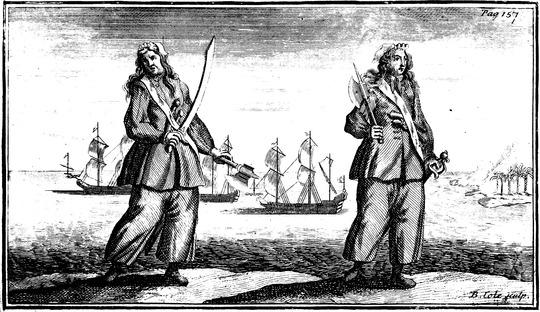
Mary Read and Anne Bonny;
Contain'd in the following Chapters,
Introduction.
Chap. I. Of Capt. Avery.
II. Of Capt. Martel.
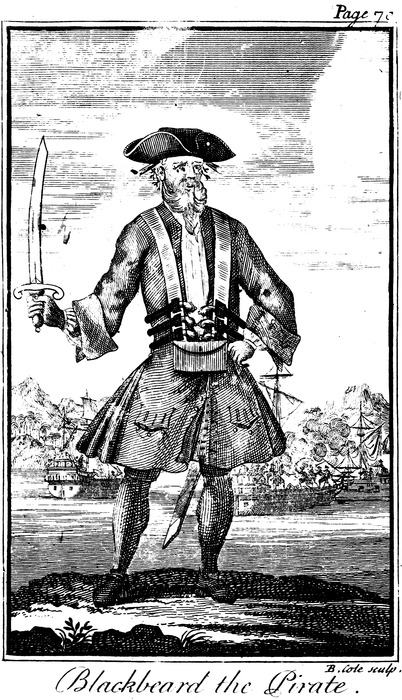
III. Of Capt. Teach.
IV. Of Capt. Bonnet.
V. Of Capt. England.
VI. Of Capt. Vane.
VII. Of Capt. Rackam.
VIII. Of Capt. Davis.
IX. Of Capt. Roberts.
X. Of Capt. Anstis.
XI. Of Capt. Worley.
XII. Of Capt. Lowther.
XIII. Of Capt. Low.
XIV. Of Capt. Evans.
XV. Of Capt. Phillips.
XVI. Of Capt. Spriggs.
And their several Crews.
To which is added.
A short ABSTRACT of the Statute and Civil
Law, in Relation to Pyracy.
The second EDITION, with considerable ADDITIONS
By Captain Charles Johnson.
LONDON:
Printed for, and sold by T. Warner, at the Black-Boy in
Pater-Noster-Row, 1724.
THE PREFACE.
HAVING taken more than ordinary Pains in
collecting the Materials which compose the
following History, we could not be satisfied
with our selves, if any Thing were wanting to
it, which might render it entirely satisfactory
to the Publick: It is for this Reason we have subjoined to
the Work, a short Abstract of the Laws now in Force against
Pyrates, and made Choice of some particular Cases, (the
most curious we could meet with) which have been heretofore
tried, by which it will appear what Actions have, and
what have not been adjudged Pyracy.
It is possible this Book may fall into the Hands of some
Masters of Ships, and other honest Mariners, who frequently,
by contrary Winds or Tempests, or other Accidents incident
to long Voyages, find themselves reduced to great Distresses,
either through Scarcity of Provisions, or Want of
Stores. I say, it may be a Direction to such as those, what
Lengths they may venture to go, without violating the Law
of Nations, in Case they should meet other Ships at Sea, or
be cast on some inhospitable Shore, which should refuse to
trade with them for such Things as are absolutely necessary
for the Preservation of their Lives, or the Safety of the
Ship and Cargoe.
We have given a few Instances in the Course of this
History of the Inducements Men have to engage themselves
headlong in a Life of so much Peril to themselves, and so
destructive to the Navigation of the trading World; to remedy
which Evil there seems to be but two Ways, either to
find Employment for the great Numbers of Seamen turn’d
adrift at the Conclusion of a War, and thereby prevent
their running into such Undertakings, or to guard sufficiently
the Coast of Africa, the West-Indies, and other
Places whereto Pyrates resort.
I cannot but take Notice in this Place, that during this
long Peace, I have not so much as heard of a Dutch Pyrate:
It is not that I take them to be honester than their
Neighbours; but when we account for it, it will, perhaps, be
a Reproach to our selves for our want of Industry: The Reason
I take to be, that after a War, when the Dutch Ships
are laid up, they have a Fishery, where their Seamen find
immediate Business, and as comfortable Bread as they had
before. Had ours the same Recourse in their Necessities,
I’m certain we should find the same Effect from it; for a
Fishery is a Trade that cannot be overstock’d; the Sea is
wide enough for us all, we need not quarrel for Elbow-room:
Its Stores are infinite, and will ever reward the Labourer.
Besides, our own Coast, for the most Part, supply the Dutch,
who employ several hundred Sail constantly in the Trade,
and so sell to us our own Fish. I call it our own, for the
Sovereignty of the British Seas, are to this Day acknowledged
us by the Dutch, and all the neighbouring Nations;
wherefore, if there was a publick Spirit among us, it would
be well worth our while to establish a National Fishery, which
would be the best Means in the World to prevent Pyracy,
employ a Number of the Poor, and ease the Nation of a
great Burthen, by lowering the Price of Provision in general,
as well as of several other Commodities.
I need not bring any Proofs of what I advance, viz. that
there are Multitudes of Seamen at this Day unemploy’d; it
is but too evident by their straggling, and begging all over the
Kingdom. Nor is it so much their Inclination to Idleness, as
their own hard Fate, in being cast off after their Work is
done, to starve or steal. I have not known a Man of
War commission’d for several Years past, but three times her
Compliment of Men have offer’d themselves in 24 Hours;
the Merchants take their Advantage of this, lessen their
Wages, and those few who are in Business are poorly paid,
and but poorly fed; such Usage breeds Discontents amongst
them, and makes them eager for any Change.
I shall not repeat what I have said in the History concerning
the Privateers of the West-Indies, where I have
taken Notice they live upon Spoil; and as Custom is a second
Nature, it is no Wonder that, when an honest Livlyhood is
not easily had, they run into one so like their own; so that
it may be said, that Privateers in Time of War are a Nursery
for Pyrates against a Peace.
Now we have accounted for their Rise and Beginning, it
will be natural to enquire why they are not taken and destroy’d,
before they come to any Head, seeing that they are
seldom less than twelve Men of War stationed in our American
Plantations, even in Time of Peace; a Force sufficient
to contend with a powerful Enemy. This Enquiry,
perhaps, will not turn much to the Honour of those concern’d
in that Service; however, I hope I may be excus’d, if what
I hint is with a Design of serving the Publick.
I say, ’tis strange that a few Pyrates should ravage the
Seas for Years, without ever being light upon, by any of our
Ships of War; when in the mean Time, they (the Pyrates) shall
take Fleets of Ships; it looks as if one was much more diligent
in their Affairs, than the other. Roberts and his Crew,
alone, took 400 Sail, before he was destroy’d.
This Matter, I may probably set right another Time,
and only observe for the present, that the Pyrates at Sea,
have the same Sagacity with Robbers at Land; as the latter
understand what Roads are most frequented, and where it is
most likely to meet with Booty, so the former know what
Latitude to lie in, in order to intercept Ships; and as the
Pyrates happen to be in want of Provisions, Stores, or any
particular Lading, they cruise accordingly for such Ships,
and are morally certain of meeting with them; and by the
same Reason, if the Men of War cruise in those Latitudes,
they might be as sure of finding the Pyrates, as the Pyrates
are to find the Merchant Ships; and if the Pyrates are not to
be met with by the Men of War in such a Latitude, then
surely down the same Latitude may the Merchant Ships arrive
safely to their Port.
To make this a little plainer to my Country Readers,
I must observe that all our outward bound Ships, sometime
after they leave the Land, steer into the Latitude of
the Place they are bound to; if to the West-India Islands,
or any Part of the Main of America, as New-York,
New-England, Virginia, &c. because the Latitude is
the only Certainty in those Voyages to be found, and then
they sail due West, till they come to their Port, without
altering their Course. In this West Way lie the Pyrates,
whether it be to Virginia, &c. or Nevis, St. Christophers,
Montserat, Jamaica, &c. so that if the Merchant
Ships bound thither, do not fall a Prey to them one
Day, they must another: Therefore I say, if the Men of War
take the same Track, the Pyrates must unavoidably fall into
their Mouths, or be frighted away, for where the Game is,
there will the Vermin be; if the latter should be the Case,
the trading Ships, as I said before, will pass unmolested and
safe, and the Pyrates be reduced to take Refuge in some of
their lurking Holes about the uninhabited Islands, where
their Fate would be like that of the Fox in his Den, if they
should venture out, they would be hunted and taken, and if
they stay within they must starve.
I must observe another Thing, that the Pyrates generally
shift their Rovings, according to the Season of the Year;
in the Summer they cruise mostly along the Coast of the Continent
of America, but the Winters there, being a little
too cold for them, they follow the Sun, and go towards the
Islands, at the approach of cold Weather. Every Man
who has used the West-India Trade, knows this to be
true; therefore, since we are so well acquainted with all
their Motions, I cannot see why our Men of War under a
proper Regulation, may not go to the Southward, instead of
lying up all the Winter useless: But I shall proceed too far
in this Enquiry, I shall therefore quit it, and say something
of the following Sheets, which the Author may venture
to assure the Reader that they have one Thing to recommend
them, which is Truth; those Facts which he himself was
not an Eye-Witness of, he had from the authentick Relations
of the Persons concern’d in taking the Pyrates, as well
as from the Mouths of the Pyrates themselves, after they
were taken, and he conceives no Man can produce better
Testimonies to support the Credit of any History.
It will be observed, that the Account of the Actions of
Roberts runs into a greater Length, than that of any other
Pyrate, for which we can assign two Reasons, first, because
he ravaged the Seas longer than the rest, and of Consequence
there must be a greater Scene of Business in his Life: Secondly,
being resolved not to weary the Reader, with tiresome
Repetitions: When we found the Circumstances in Roberts’s
Live, and other Pyrates, either as to pyratical Articles, or
any Thing else, to be the same, we thought it best to give them
but once, and chose Roberts’s Life for that Purpose, he having
made more Noise in the World, than some others.
As to the Lives of our two female Pyrates, we must confess
they may appear a little Extravagant, yet they are
never the less true for seeming so, but as they were publickly
try’d for their Pyracies, there are living Witnesses
enough to justify what we have laid down concerning them;
it is certain, we have produced some Particulars which were
not so publickly known, the Reason is, we were more inquisitive
into the Circumstances of their past Lives, than other
People, who had no other Design, than that of gratifying
their own private Curiosity: If there are some Incidents and
Turns in their Stories, which may give them a little the
Air of a Novel, they are not invented or contrived for
that Purpose, it is a Kind of Reading this Author is but
little acquainted with, but as he himself was exceedingly
diverted with them, when they were related to him, he
thought they might have the same Effect upon the Reader.
I presume we need make no Apology for giving the Name
of a History to the following Sheets, though they contain nothing
but the Actions of a Parcel of Robbers. It is Bravery
and Stratagem in War which make Actions worthy of
Record; in which Sense the Adventures, here related will
be thought deserving that Name. Plutarch is very circumstantial
in relating the Actions of Spartacus, the Slave,
and makes the Conquest of him, one of the greatest Glories
of Marcus Crassus; and it is probable, if this Slave had
liv’d a little longer, Plutarch would have given us his
Life at large. Rome, the Misstress of the World, was no
more at first than a Refuge for Thieves and Outlaws; and
if the Progress of our Pyrates had been equal to their Beginning;
had they all united, and settled in some of those
Islands, they might, by this Time, have been honoured with
the Name of a Commonwealth, and no Power in those Parts
of the World could have been able to dispute it with them.
If we have seem’d to glance, with some Freedom, at the
Behaviour of some Governors of Provinces abroad, it has
been with Caution; and, perhaps, we have, not declar’d as
much as we knew: However, we hope those Gentlemen in the
same Station, who have never given Occasion for the like
Censure, will take no Offence, tho’ the Word Governor is
sometimes made use of.
P. S. It will be necessary to add a Word or two to this
Preface, in order to inform the Reader, that there are several
material Additions made to this second Impression,
which swelling the Book in Bulk, must of Consequence add a
small Matter to its Price.
The first Impression having been received with so much
Success by the Publick, occasioned a very earnest Demand
for a second: In the mean Time, several Persons who had
been taken by the Pyrates, as well as others who had been
concerned in taking of them, have been so kind to communicate
several Facts and Circumstances to us, which had
escaped us in the first Impression. This occasioned some Delay,
therefore if we have not brought it out, as soon as
wish’d, it was to render it the more compleat.
We shall not enter into a Detail of all the new Matter
inserted here, but the Description of the Islands St. Thome,
&c. and that of Brasil are not to be passed by, without
a little Notice. It must be observed, that our speculative
Mathematicians and Geographers, who are, no
doubt, Men of the greatest Learning, seldom travel farther
than their Closets for their Knowledge, &c. are
therefore unqualified to give us a good Description of
Countries: It is for this Reason that all our Maps and
Atlasses are so monstrously faulty, for these Gentlemen are
obliged to take their Accounts from the Reports of illiterate
Men.
It must be noted also, that when the Masters of Ships
make Discoveries this Way, they are not fond of communicating
them; a Man’s knowing this or that Coast, better
than others, recommends him in his Business, and
makes him more useful, and he’ll no more discover it than a
Tradesman will the Mystery of his Trade.
The Gentleman who has taken the Pains to make these
Observations, is Mr. Atkins, a Surgeon, an ingenious
Man in his own Profession, and one who is not ty’d down
by any narrow Considerations from doing a Service to the
Publick, and has been pleased generously to communicate
them for the good of others. I don’t doubt, but his Observations
will be found curious and very serviceable to
such as Trade to those Parts, besides a Method of Trade is
here laid down with the Portuguese, which may prove
of great Profit to some of our Countrymen, if followed according
to his Plan.
It is hoped these Things will satisfy the Publick, that
the Author of the following Sheets considered nothing so
much as making the Book useful;—tho’ he has been informed,
that some Gentlemen have rais’d an Objection against
the Truth of its Contents, viz. that it seems calculated
to entertain and divert.—If the Facts are related
with some Agreeableness and Life, we hope it will not be
imputed as a Fault; but as to its Credit, we can assure them
that the Sea-faring Men, that is all that know the Nature
of these Things, have not been able to make the least
Objection to its Credit:—And he will be bold to affirm,
that there is not a Fact or Circumstance in the whole Book,
but he is able to prove by credible Witnesses.
There have been some other Pyrates, besides those whose
History are here related, such as are hereafter named,
and their Adventures are as extravagant and full of Mischief,
as those who are the Subject of this Book.—The
Author has already begun to digest them into Method, and
as soon, as he receives some Materials to make them compleat,
(which he shortly expects from the West-Indies). If
the Publick gives him Encouragement he intends to venture
upon a second Volume.
THE CONTENTS. — INTRODUCTION. — CHAP. I. Of Captain AVERY, and his CREW. — CHAP. II. Of Captain MARTEL, and his CREW. — CHAP. III. Of Captain TEACH, alias BLACK-BEARD. — CHAP. IV. Of Major STEDE BONNET, and his CREW. — CHAP. V. Of Capt. EDW. ENGLAND, and his CREW. — CHAP. VI. Of Capt. CHARLES VANE, and his CREW. — CHAP. VII. Of Capt. RACKAM, and his CREW. — The LIFE of MARY READ. — The LIFE of ANNE BONNY. — CHAP. VIII. Of Capt. HOWEL DAVIS, and his Crew. — CHAP. IX. Of Capt. BAR. ROBERTS, and his CREW. — CHAP. X. Of Capt. ANSTIS, and his CREW. — CHAP. XI. Of Capt. WORLEY, and his CREW. — CHAP. XII. Of Capt. GEO. LOWTHER, and his CREW. — CHAP. XIII. Of Capt. LOW and his CREW. — CHAP. XIV. Of Capt. JOHN EVANS and his CREW. — CHAP. XV. Of Capt. JOHN PHILLIPS, and his CREW. — CHAP. XVI. Of Captain SPRIGGS, and his CREW.
THE Danger of
Commonwealths from an Increase of Pyrates, 17.
Pyrates in the Times of Marius and Sylla, 18.
Takes Julius Cæsar, 19. The Barbarity of those
Pyrates, ib. They spare Cæsar, and why, ib. His
Behaviour amongst them, ib. Cæsar obtains his Liberty
for a Ransom, ib. Attacks and takes the Pyrates, 20.
Hangs them at Troy, ib. They increase again to a
prodigious Strength, ib. Plunder at the Gates of
Rome, 21. The mock Homage they paid the Romans, ib.
Pompey the Great, appointed General against them, 22.
A prodigious Fleet and Army assign’d him, ib. His
Conduct and good Fortune, ib, The Gallantry of those
Pyracies, 23. Receive an Overthrow, ib. Barbarouse,
a Pyrate, his Beginning, ib. His great Strength,
24. Selim Eutemi, King of Algiers, courts his
Friendship, ib. Makes himself King, and how, ib.
The King of Tunis overthrown by him, ib. Leaves
the Inheritance to his Brother, ib. The West-Indies
commodious for Pyrates, and why, 24, 25. The
Explanation of the Word Keys, 25. The Pyrates conceal
their Booty on them, ib. The Pyrates Security in
those Parts, 26. The Rise of Pyrates since the Peace
of Utrecht accounted for, 26, 27. An Expedition
from Jamaica, to plunder the Spaniards, 28. The
Spaniards sue for Justice to the Government of
Jamaica, ib. The Plunderers turn Pyrates, 29. The
Spaniards make Reprisals, ib. The Names of Ships
taken by them, ib. The plunder’d Seamen join the
Pyrates, ib. Providence fixed on as a Place of
Retreat by them, 30. That Island described, ib. The
Lords Address to her late Majesty for securing
Providence, ib. An Order of Council in this Reign to
the same Purpose, 31. A List of Men of War employ’d
for the Defence of
the Plantations, 32. Captain Woods Rogers made
Governor of Providence, ib. The King’s Proclamation
for suppressing Pyrates, 33, 34. How the Pyrates used
the Proclamation, 34. Great Divisions amongst them,
35. How made quiet, ib. Several of the Pyrates
surrender to the Governor of Bermudas, ib. The Fate
of the rest, ib. Woods Rogers his Arrival at
Providence, ib. Vane’s Behaviour, 36. Woods Rogers
employs the pardon’d Pyrates, ib. Their Conduct,
ib. Some of them hang’d for new Pyracies, 37. Their
strange Behaviour at the Place of Execution, ib. Some
Proceedings betwixt the English and Spaniards, 38.
The Spaniards surprize the Greyhound Man of War,
and how, ib. Quit her, 39. The Crew of a Spanish
Guarda del Costa hang’d at Jamaica, and why, ib.
Sir Nicholas Laws his Letter to the Alcaldes of
Trinidado, 39, 40. Mr. Joseph Laws, Lieutenant of
the Happy Snow his Letter to the Alcaldes of
Trinidado, 41. The Alcaldes Answer to the
Lieutenant’s Letter, 41, 42. The Lieutenant’s Reply
to the Alcaldes Answer, 42, 43. The Alcaldes
Answer again, 43. Some Account of Richard Holland,
ib. Prizes taken by him, 44.
ROmantick Reports of his Greatness, 45, 46. His
Birth, 46. Is Mate of a Bristol Man, 47, For what
Voyage design’d, ib. Tampers with the Seamen, ib.
Forms a Plot for carrying off the Ship, 47, 48.
Executes it, and how, ib. The Pyrates take a rich
Ship belonging to the Great Mogul, 50. The Great
Mogul threaten the English Settlements, 51. The
Pyrates steer their Course back for Madagascar, 52.
Call a Council. Put all the Treasure on Board of
Avery’s Ship, ib. Avery and his Crew treacherously
leaves his Confederates; go to the Isle of Providence
in the West-Indies, 53. Sell the Ship, go to
North-America in a Sloop, 54. They disperse, Avery
goes to New-England, ib. From thence to Ireland,
ib. Avery afraid to expose his Diamonds to sale. Goes
over to England, ib. Puts his Wealth into Merchants
Hands, of Bristol, 55. Changes his Name. Lives at
Biddiford, ib. The Merchants send him no Supplies,
ib. Importunes them. Goes privately to Bristol, they
threaten to discover him, ib. Goes over to Ireland,
sollicites them from thence, 56. Is very poor, works
his Passage over to Plymouth, walks to Biddiford.
Dies a Beggar, ib. An Account of Avery’s
Confederates, ib. Their Settlement at Madagascar,
57. They meet other Pyrates; an Account of them, ib.
The
Pyrates arrive to great Power. The Inhabitants
described, 58. Their Policy, Government, &c. Places
describ’d, 59. The Arrival of Captain Woods Rogers
at that Part of the Island, 61. Their Design of
surprizing his Ship, 62. One of these Princes
formerly a Waterman on the Thames, 63. Their
Secretaries, Men of no Learning. Could neither write
nor read, ib.
WAY to suppress Pyrates, 64. The Increase of Pyrates
accounted for, 65. Where Martel learned his Trade,
ib. The Names of several Prizes taken, by him, 65,
66, 67. His Strength at Sancta Cruz, 67. His Manner
of fortifying himself there, ib. Is attack’d by the
Scarborough Man of War, 68. His defence by Land and
Sea, ib. His desperate Escape, 69. His miserable
End, ib.
HIS Beginning, 70. His Confederacy with Hornygold,
ib. The Confederacy broke, 71. Takes a large Guiney
Man, ib. Engages the Scarborough Man of War, ib.
His Alliance with Major Stede Bonnet, ib. Deposes
his new Ally, ib. His Advice to the Major, ib. His
Progress and Success, 72. Takes Prizes in Sight of
Charles-Town, 73. Sends Ambassadors to the Governor
of Carolina, upon an impudent Demand, ib. Runs his
Ship aground designedly, 74. His Cruelty to some of
his own Companions. Surrenders to the King’s
Proclamation, 75. The Governor of North-Carolina’s
exceeding Generosity to him, ib. He marries, ib.
The Number of his Wives then living, ib. His
conjugal Virtues, 75, 76. Makes a second Excursion in
the Way of pyrating, 76. Some State Legerdemain
betwixt him and the Governor, ib. His modest
Behaviour in the River, 77. His Frolicks on Shore,
ib. The Merchants apply for a Force against him, and
where, 78. A Proclamation with a Reward for taking or
killing of Pyrates, 79, 80. Lieutenant Maynard sent
in pursuit of him, 80. Black-beard’s good
Intelligence, 81. The Lieutenant engages
Black-beard, ib. A most execrable Health drank by
Black-beard 82. The Fight bloody; the Particulars of
it, 82, 83, 84. Black-beard kill’d, 84. His Sloop
taken, ib. The Lieutenant’s Conduct, 84, 85. A
Reflection on the Humours of Seamen, 85.
Black-beard’s Correspondents discover’d
by his Papers, ib. Black-beard’s desperate
Resolution before the Fight, ib. The Lieutenant and
Governor no very good Friends, 86. The Prisoners
hang’d, ib. Samuel Odel saved, and why, ib. The
good Luck of Israel Hands, 87. Black-beard’s
mischievous Frolicks, ib. His Beard described, ib.
Several Instances if his Wickedness, 88, 89. Some
Memorandums taken from his Journal, 89. The Names of
the Pyrates kill’d in the Engagement, 90. Of those
executed, ib. The Value of the Prize, ib.
BRED a Gentleman, 91. Supposed to be disorder’d in
his Senses, ib. His Beginning as a Pyrate, ib.
Takes Prizes, 92. Divisions in his Crew, ib.
Meets Black-beard, ib. Is deposed from his Command,
93. His melancholy Reflections, ib. Surrenders to
the King’s Proclamation, ib. His new Project, ib.
Saves some Pyrates marroon’d, 94. Begins the old
Trade again, 95. An Account of Prizes taken by him,
95, 96. Colonel Rhet goes in Quest of Pyrates, 97.
Yates the Pyrate surrenders, 98. An Engagement
betwixt Colonel Rhet and Major Bonnet, 100. An
Account of the kill’d and wounded, ib. The Prisoners
carried to Charles-Town, ib. The Major and the Master
Escape, ib. Taken again by Colonel Rhet, 101. A
Court of Vice-Admiralty held, ib. The Names of those
arraign’d, 102, 103. The Form of their Indictment,
104. Their Defence, 105. The Names of those who
received Sentence, 106. An excellent Speech made by
the Lord Chief Justice on pronouncing Sentence on the
Major, 107to112.
HIS Beginning and Character, 113, 114. A most
barbarous Action of his Crew, 114, 115. The Names of
Prizes taken by him, 115, 116. The Misfortunes of his
Confederates, 116, 117. England’s Progress half round
the Globe, 117, 118. A short Description of the Coast
of Malabar, ib. What they did at Madagascar, 118.
Takes an East-India Man, ib. The Particulars of
the Action in Captain Mackra’s Letter, 119to122.
Captain Mackra ventures on Board the Pyrate, 122.
Is in Danger of being murder’d; 123. Preserv’d by a
pleasant Incident, ib. The Pyrates Generosity to
him, ib. Captain England
deposed, and why, 124. Maroon’d on the Island
Mauritius, ib. Some Account of that Island, ib. The
Adventures of the Company continued, 124to126.
Angria, an Indian Pyrate, 127. his Strength by
Land and Sea, ib. The East-India Company’s Wars
with him, 127, 128. The Pyrates go to the Island of
Melinda, 129. Their barbarous Behaviour there, ib.
Hear of Captain Mackra’s Designs against them, ib.
Their Reflections thereupon, 130. Sail for Cochin,
a Dutch Settlement, ib. The Pyrates and the Dutch
very good Friends, 131. Mutual Presents made betwixt
the Pyrates and the Governor, ib. The Pyrates in a
Fright, 133. Almost starv’d, ib. Take a Prize of an
immense Value, 134. Take an Ostend East-India Man,
ib. A short Description of Madagascar, 135, 136. A
prodigious Dividend made by the Pyrates, 136. A
Fellow’s Way of increasing his Diamonds, ib. Some of
the Pyrates quit, and join the Remains of Avery, ib.
The Proceedings of the Men of War in those Parts,
137, 138. Some Dutch Men petition to be among the
Pyrates, 138. The Pyrates divided in their Measures,
139. Break up, ib. What became of them, 139, 140.
VANE’s Behaviour at Providence, 141. The Names of
Prizes taken by him, 141, 142. Is deserted by his
Consort Yates, 143. Yates surrenders at
Charles-Town, ib. A Stratagem of Vane’s, 144.
Black-beard and Vane meet, 145. They salute after
the Pyrates Manner, ib. Vane deposed from his
Command, and why, 146. 15 Hands degraded, and turned
out with him, ib. A Sloop given them, 147. They
sail in Quest of Adventures, and take Prizes, ib. Vane
cast away upon an uninhabited Island, ib. Meets with
an old Acquaintance, 148. Vane seiz’d with a Qualm of
Honour, ib. Ships himself on Board a Vessel, passing
for another Man, ib. Is discover’d, with the Manner
how, 149. Carried to Jamaica, and hang’d, ib.
RACKAM’s beginning as a Pyrate, 150, 151. An Account
of Prizes taken by him, 151. Is attack’d by a
Spanish Guard Ship, ib. His Stratagem to escape,
152. More Prizes taken by him, 153. Is taken, and
how, 154. Tried, condemned,
and executed at Jamaica, ib. The Names of his Crew
condemn’d with him, 154. An extraordinary Case of
nine taken with him, ib. Some Account of the
Proceedings against them, 154, 155.
MARY Read’s Birth, 157.
Reasons for dressing her in Breeches, 158. Waits
upon a Lady; goes into the Army, 159. Her Behaviour
in several Engagements, ib. She falls in Love with
her Comrade, ib. Her Sex discovered; the two Troopers
married, 160. Settles at Breda, ib. Her Husband
dies, she reassumes the Breeches, ib. Goes to
Holland. To the West-Indies, 161. Turns Pyrate.
Anne Bonny, another Pyrate, falls in Love with her,
162. Her Adventures to165.
ANNE Bonny born a Bastard,
166. Her Mother’s Intrigues strangely discover’d,
167. Her Father lies with his own Wife, by mistake,
169. She proves with Child; the Husband jealous, 170.
He separates from his Wife; lives with Anne Bonny’s
Mother, 171. Anne Bonny put into Breeches for a
Disguise, how discovered, ib. The Father becomes
poor. Goes to Carolina, 172. Improves his Fortune.
Anne Bonny marries against his Consent. Her fierce
Temper, ib. Goes to Providence with her Husband,
ib. Enticed to Sea in Men’s Cloaths, by Rackam the
Pyrate, 173. Reproaches Rackam with Cowardice at
his Execution, ib.
THE Original of Davis, 174. Is taken by the Pyrate
England, ib. England’s Generosity to him, 175. Is
cast into Prison at Barbadoes, and why, ib. Goes
to Providence, ib. Employ’d in a trading Vessel,
seizes the Ship, 176. An Instance of his great
Courage and good Conduct, 177, 178. Goes to Cape de
Verd Islands, ib. Take several Prizes, ib. Take the
Fort of St. Jago by Storm, 180. A Council call’d,
ib. Sail for Gambia, 181. Takes Gambia Castle by
Stratagem, 181to184. Meets La Bouche, a French
Pyrate, 184. His Adventures with Cocklyn the
Pyrate, at Sierraleone, 185. The Fort attack’d and
taken, by three Confederate Pyrates, 186. The Pyrates
quarrel and part, ib. The laconick Speech of Davis
to them, ib. His fierce Engagement with a large
Dutch Ship, 187. An Account of several Prizes taken
by him, ib. A Description of
the Island of St. Thome, Del Principe, and
Annobono, from188to204. The Dutch Governor
of Acra taken by Davis, 205. Davis well received by
the Governor of Princes, ib. His Stratagem to come at
the Wealth of the Island, 206. Is counterplotted and
kill’d, by an Ambuscade, 207.
HIS Beginning, 208. Elected Captain in the Room of
Davis, 209. The Speech of Lord Dennis at the
Election, ib. Lord Sympson objects against a
Papist, ib. The Death of Davis reveng’d, 210.
Roberts sails Southward, in Quest of Adventures, 211.
The Names of the Prizes taken by them, ib. Brasil
describ’d, from211to221. Roberts falls into a
Fleet of Portuguese, 221. Boards and takes the
richest Ship amongst them, 222. Make the Devil’s
Islands, 223. An unfortunate Adventure of Roberts,
224. Kennedy’s Treachery, 225. Irishmen excluded by
Roberts and his Crew, 230. Articles sworn to by
them, ib. A Copy of them from, 230to233. Some
Account of the Laws and Customs of the Pyrates, 233,
234. An Instance of Roberts his Cunning, 234. He
proceeds again upon Business, and takes Prizes, 235.
Narrowly escapes being taken, 236. Sails for the
Island Dominico, ib. Another Escape, 237. Sails
for Newfoundland, ib. Plunders, sinks and burns22Sail in the Harbour of Trepassi, ib. Plunders ten
Sail of French Men, 238. The mad Behaviour of the
Crew, 238, 239. A Correspondence hinted at, 240.
The Pyrates caress’d at the Island of St.
Bartholomew, ib. In extream Distress, 241, 242. Sail
for Martinico, 243. A Stratagem of Roberts, ib. The
insolent Device in his Colours, 244. And odd
Compliment paid to Roberts, ib. Three Men desert the
Pyrates, and are taken by them, 245. Their Tryal,
245, 246. Two executed, and one saved, 247. The
Brigantine deserts them, 248. Great Divisions in the
Company, 248, 249. A Description of Sierraleone
River, 250. The Names of English settled there,
and Way of Life, 251, 252, 253. The Onslow,
belonging to the African Company taken, 254. The
Pyrates Contempt of Soldiers, ib. They are for
entertaining a Chaplain, ib. Their Skirmish with the
Calabar Negroes, 256. The King Solomon, belonging
to the African Company, taken, 258. The Frolicks of
the Pyrates, ib. Take eleven Sail in Whydah Road,
259. A comical Receipt given by the Pyrates, 260. A
cruel Action of Roberts, 261. Sails for Anna Bona,
262. The Progress of the Swallow Man of War, in
Pursuit of Roberts, from262to267. Roberts his
Consort taken, 267. The
Bravery of Skyrme, a Welch Pyrate, 268. The
surly Humour of some of the Prisoners, 268, 269. The
Swallow comes up with Roberts, 270. Roberts his
Dress described, 271. Is kill’d, 272. His
Character, ib. His Ship taken, 273. The Behaviour
of the Pyrates, when Prisoners, 275. A Conspiracy of
theirs discovered, 276, 277. Reflections on the
Manner of trying them, 278, 279, 280. The Form of the
Commission for trying the Pyrates, 281. The Oath
taken by the Commissioners, 282. The Names of those
arraign’d taken in the Ship Ranger, 282, 283, 284.
The Form of the Indictment, 284, 285. The Sum of the
Evidence against them, 285, 286. Their Defence, 287,
288. The Names of the Prisoners of the Royal Fortune,
288, 289, 290. Proceedings against them, 291to304. Harry Glasby acquitted, 304. The particular
Tryal of Captain James Skyrme, 304, 305. Of John
Walden, 305to308. Of Peter Scudamore, 308to311. Of Robert Johnson, 311, 312. Of George Wilson,
312to317. Of Benjamin Jeffries, 317, 318. Of
John Mansfield, 318, 319. Of William Davis, 319to321. The Names of those executed at Cape Corso, 321,
322. The Petition of some condemn’d, 323. The Courts
Resolution, ibid. The Form of an Indenture of a
pardon’d Pyrate, 324. The Names of those pardon’d
upon Indenture to serve seven Years, 325. The Pyrates
how disposed of, 326. The dying Behaviour of those
executed, 326to329.
HIS Beginning as a Pyrate, 330. A most brutish
Action supposed to be committed by his Crew, 331.
Civil Discords amongst them, 332. The Pyrates Term
of Round Robin explain’d, ib. They land on an
uninhabited Island, ib. A Petition for Pardon agreed
on, ib. The Form of that Petition, 333. Their
Diversions, and Manner of living on the Island, 334,
335. Their mock Tryal of one another, 336to338.
They put to Sea again, 338. Their Petition not
answer’d, ib. The Morning Star Wreck’d, ib. Anstis
narrowly escapes being taken, 339. A Plot
discover’d, ib. The Crew gathers Strength again,
340. Surprised by the Winchelsea Man of War at
Tobago, ib. Fire one of their Ships, ib. Anstis
escapes, ib. Is killed by a Conspiracy of his own
Men, 341. The Ship surrender’d at Curaco, ib.
Several hang’d there, ib. Fen hanged at
Antegoa, ib. The good Luck of those who
fled to the Woods, ib.
HIS mad Beginning, 342. His Success, 343, 344.
Bind themselves by Oath to take no Quarters, 344. A
false Alarm at James-Town, 345. Worley catches a
Tartar, ib. The desperate Resolution of the Pyrates,
346. Worley hanged, ib.
HIS Beginning, 347. Plots with Massey, 349.
Massey’s Conduct, 350, 351. Lowther’s Proposal,
351. A Copy of Articles drawn up, and sworn to, 352.
The Pyrates going by the Ears, 354. How Rogues are
made Friends, ib. Lowther and Massey part, 355. A
Digression concerning Massey’s mad Conduct, 355to357. Lowther and Low meet, 358. An Alliance
betwixt them, ib. A List of Prizes taken by them,
359. An unlucky Adventure at Cape Mayo, 359, 360.
Lowther and Low break the Alliance, and part, 361.
The Bravery of Captain Gwatkins, ib. The Pyrates
much reduced, 362. Winter in North-Carolina, ib.
Put to Sea again, ib. Make for the Island of
Blanco, 363. The Island described, ib. Are surprised
and taken, 364. Lowther escapes, ib. The Names of
the Prisoners, and Fate, ib. Lowther’s Death, 365.
LOW’s Original, 366, 367. The Virtues of his Family,
ib. His bold Beginnings, 368. Declares War against
the whole World, ib. His Success, 369, 370. Like to
perish by a Storm, 371, 372. Sail for the Western
Island, 373. Treats with the Governor of St. Michael
for Water, ib. Several Instances of their wanton
Cruelty, 374. Low’s Consort taken, and how, 376. A
horrid Massacre committed by Low. 376, 377. Takes a
Multitude of Prizes, 377. Another barbarous
Massacre, 379. More Cruelties, 379, 380. Low and
his Consort attack’d by the Greyhound Man of War,
380, 381. Low deserts his Consort, 381. The Consort
taken, ib. Carried to Rhode Island, 382. The Names,
Age, and Places of Birth, of the Prisoners, 382, 383.
A Compliment paid to Captain Solgard, by the
Corporation of New-York, 384. The Resolution of the
Mayor and Common-Council, ib. The Preamble of the
Captain’s Freedom, 385. More Instances of Low’s
Cruelty, 388, 389. His Adventures continued to390.
BEGINS with House-breaking, 391. Seizes a Sloop,
392. Robs a House the same Night, ib. Put to Sea,
and take valuable Prizes, 393. Evans shot dead by his
Boatswain, 394, His Death reveng’d, ib. The Company
breaks up, 395.
PHILLIPS his Original, 396. How he became a Pyrate,
ib. His Return to England accounted for, ib. Ships
again for Newfoundland, ib. Deserts his Ship in
Peter Harbour, 397. He and four others seize a
Vessel, ib. Sail out a pyrating, ib. Articles sworn
to upon a Hatchet, ib. A Copy of the Articles, 397,
398. Ill Blood amongst them, and why, 399. Are
almost starved, ib, Take Prizes, ib. Phillips
proposes to clean at Tobago, and why, ib. Meets an
old Acquaintance, 400. Frighten’d from the Island,
ib. A Conspiracy to run away with the Prize, ib. A
Skirmish, ib. The Carpenter’s Dexterity in cutting
off Legs, ib. Fern kill’d by Phillips, and why,
401. The Danger of attempting an Escape among the
Pyrates, ib. Captain Mortimer’s Bravery, and hard
Fate, 401, 402. Captain Mortimer’s Brother escapes,
and how, 402. Cheeseman’s Steps for overthrowing the
Pyrates Government, 403. A Digression concerning
Newfoundland, and its Trade, 403, 404. The Pyrates
recruited with Men from thence, 405. Phillips his
Conscience pricks him, ib. Dependence Ellery, a
Saint, oblig’d to dance by the Pyrates, 406. A brave
Action perform’d by Cheesemen, 407. Carries the
Pyrate Ship into Boston, 408. The dying Declarations
of John Rose Archer, and William White, 408, 409.
SPRIGGS his Beginning, 411. How he set up for
himself, ib. Sweats his Prisoners for Diversion,
412. The Pyrates mistake in drinking Healths, 413.
Take Hawkins a second time, 414. Burn his Ship,
and why, ib. An odd Entertainment given him by the
Pyrates, ib. Captain Hawkins how disposed of, 414,
415. Spriggs barbarous Usage of his Prisoners, 415,
416. Takes a Ship loaden with Horses, 416. An odd
Frolick of the Pyrates, ib. Two particular Relations
of Pyracy, from417to424.
INTRODUCTION. — By the KING, — A PROCLAMATION, for suppressing of PYRATES. — S. Jago de la Vega, Febr. 20. A Letter from his Excellency Sir Nicolas Laws , our Governor, to the Alcaldes of Trinidado on Cuba , dated the 26 th of Jan. 1721-2. — A Letter from Mr. Joseph Laws , Lieutenant of his Majesty’s Ship, Happy Snow, to the Alcaldes of Trinidado . — The Answer of the Alcaldes of Trinidado , to Mr. Laws ’s Letter. — Mr. Laws ’s Reply to the Alcaldes Letter. — The Answer of one of the Alcaldes to Mr. Laws ’s Reply .
AS the Pyrates in the West-Indies have
been so formidable and numerous,
that they have interrupted the
Trade of Europe into those Parts;
and our English Merchants, in particular,
have suffered more by their
Depredations, than by the united
Force of France and Spain, in the late War: We do
not doubt but the World will be curious to know
the Original and Progress of these Desperadoes,
who were the Terror of the trading Part of the
World.
But before we enter upon their particular History,
it will not be amiss, by way of Introduction,
to shew, by some Examples drawn from History,
the great Mischief and Danger which threaten
Kingdoms and Commonwealths, from the Increase
of these sort of Robbers; when either by the Troubles
of particular Times, or the Neglect of Governments,
they are not crush’d before they gather
Strength.
It has been the Case heretofore, that when a single
Pyrate has been suffered to range the Seas, as
not being worth the Notice of a Government, he
has by Degrees grown so powerful, as to put them
to the Expence of a great deal of Blood and Treasure,
before he was suppress’d. We shall not examine
how it came to pass, that our Pyrates in the West-Indies
have continually increased till of late; this is an
Enquiry which belongs to the Legislature, or Representatives
of the People in Parliament, and to them
we shall leave it.
Our Business shall be briefly to shew, what from
Beginnings, as inconsiderable as these, other Nations
have suffered.
In the Times of Marius and Sylla, Rome was in
her greatest Strength, yet she was so torn in Pieces
by the Factions of those two great Men, that every
Thing which concerned the publick Good was
altogether neglected, when certain Pyrates broke
out from Cicilia, a Country of Asia Minor, situate
on the Coast of the Mediterranean, betwixt Syria on
the East, from whence it is divided by Mount Tauris,
and Armenia Minor on the West. This Beginning
was mean and inconsiderable, having but two
or three Ships, and a few Men, with which they
cruised about the Greek Islands, taking such Ships as
were very ill arm’d or weakly defended; however,
by the taking of many Prizes, they soon increased
in Wealth and Power: The first Action of their’s
which made a Noise, was the taking of Julius Cæsar,
who was as yet a Youth, and who being obliged to
fly from the Cruelties of Sylla, who sought his Life,
went into Bithinia, and sojourned a while with Nicomedes,
King of that Country; in his Return back
by Sea, he was met with, and taken, by some of
these Pyrates, near the Island of Pharmacusa: These
Pyrates had a barbarous Custom of tying their Prisoners
Back to Back and throwing them into the Sea;
but, supposing Cæsar to be some Person of a high
Rank, because of his purple Robes, and the Number
of his Attendants, they thought it would be
more for their Profit to preserve him, in hopes of
receiving a great Sum for his Ransom; therefore
they told him he should have his Liberty, provided
he would pay them twenty Talents, which they
judg’d to be a very high Demand, in our Money,
about three thousand six hundred Pounds Sterling;
he smiled, and of his own Accord promised them
fifty Talents; they were both pleased, and surpriz’d
at his Answer, and consented that several of his
Attendants should go by his Direction and raise the
Money; and he was left among these Ruffians with
no more than 3 Attendants. He pass’d eight and
thirty Days, and seemed so little concerned or
afraid, that often when he went to sleep, he used
to charge them not to make a Noise, threatening,
if they disturbed him, to hang them all; he also
play’d at Dice with them, and sometimes wrote
Verses and Dialogues, which he used to repeat,
and also cause them to repeat, and if they did not
praise and admire them, he would call them Beasts
and Barbarians, telling them he would crucify them.
They took all these as the Sallies of a juvenile Humour,
and were rather diverted, than displeased at
them.
At length his Attendants return’d with his Ransom,
which he paid, and was discharged; he sail’d
for the Port of Miletum, where, as soon as he was
arriv’d, he used all his Art and Industry in fitting
out a Squadron of Ships, which he equipp’d and
arm’d at his own Charges; and sailing in Quest of
the Pyrates, he surpriz’d them as they lay at Anchor
among the Islands, and took those who had
taken him before, with some others; the Money he
found upon them he made Prize of, to reimburse
his Charges, and he carry’d the Men to Pergamus or
Troy, and there secured them in Prison: In the mean
Time, he apply’d himself to Junius, then Governor
of Asia, to whom it belonged to judge and determine
of the Punishment of these Men; but Junius
finding there was no Money to be had, answered
Cæsar, that he would think at his Leisure, what
was to be done with those Prisoners; Cæsar took his
Leave of him, returned back to Pergamus, and commanded
that the Prisoners should be brought out
and executed, according to Law in that Case provided;
which is taken Notice of, in a Chapter at the
End of this Book, concerning the Laws in Cases of
Pyracy: And thus he gave them that Punishment in
Earnest, which he had often threatned them with
in Jest.
Cæsar went strait to Rome, where, being engaged
in the Designs of his own private Ambition, as
were almost all the leading Men in Rome, the Pyrates
who were left, had Time to increase to a prodigious
Strength; for while the civil Wars lasted,
the Seas were left unguarded, so that Plutarch tells
us, that they erected diverse Arsenals full of all
manner of warlike Stores, made commodious Harbours,
set up Watch-Towers and Beacons all along
the Coasts of Cilicia; that they had a mighty Fleet,
well equipp’d and furnish’d, with Galliots of Oars,
mann’d, not only with Men of desperate Courage,
but also with expert Pilots and Mariners; they
had their Ships of Force, and light Pinnaces for
cruising and making Discoveries, in all no less than
a thousand Sail; so gloriously set out, that they
were as much to be envied for their gallant Shew,
as fear’d for their Force; having the Stern and
Quarters all gilded with Gold and their Oars plated
with Silver, as well as purple Sails; as if their
greatest Delight had been to glory in their Iniquity.
Nor were they content with committing Pyracies
and Insolencies by Sea, they committed as great
Depredations by Land, or rather made Conquests;
for they took and sack’d no less than four hundred
Cities, laid several others under Contributions,
plundered the Temples of the Gods, and inriched
themselves with the Offerings deposited in them;
they often landed Bodies of Men, who not only
plundered the Villages along the Sea Coast, but
ransacked the fine Houses of the Noblemen along
the Tiber. A Body of them once took Sextillius and
Bellinus, two Roman Prætors, in their purple Robes,
going from Rome to their Governments, and carried
them away with all their Sergeants, Officers and
Vergers; they also took the Daughter of Antonius
a consular Person, and one who had obtained the
Honour of a Triumph, as she was going to the
Country House of her Father.
But what was most barbarous, was a Custom they
had when they took any Ship, of enquiring of the
Person on Board, concerning their Names and
Country; if any of them said he was a Roman, they
fell down upon their Knees, as if in a Fright at
the Greatness of that Name, and begg’d Pardon for
what they had done, and imploring his Mercy, they
used to perform the Offices of Servants about his
Person, and when they found they had deceived
him into a Belief of their being sincere, they hung
out the Ladder of the Ship, and coming with a shew
of Courtesy, told him, he had his Liberty, desiring
him to walk out of the Ship, and this in the Middle
of the Sea, and when they observed him in Surprize,
as was natural, they used to throw him overboard
with mighty shouts of Laughter; so wanton
they were in their Cruelty.
Thus, while Rome was Mistress oft he World, she
suffered Insults and Affronts, almost at her Gates,
from these powerful Robbers; but what for a while
made Faction cease, and roused the Genius of that
People, never used to suffer Wrongs from a fair
Enemy, was an excessive Scarcity of Provisions in
Rome, occasioned by all the Ships loaden with Corn
and Provisions from Sicily, Corsica, and other Places,
being intercepted and taken by these Pyrates, insomuch
that they were almost reduced to a Famine:
Upon this, Pompey the Great was immediately appointed
General to manage this War; five hundered
Ships were immediately fitted out, he had fourteen
Senators, Men of Experience in the War, for his
Vice-Admirals; and so considerable an Enemy,
were these Ruffians become, that no less than an
Army of a hundred thousand Foot, and five thousand
Horse was appointed to invade them by Land;
but it happened very luckily for Rome, that Pompey
sail’d out before the Pyrate had Intelligence of a
Design against them, so that their Ships were scattered
all over the Mediterranean, like Bees gone out
from a Hive, some one Way, some another, to
bring Home their Lading; Pompey divided his Fleet
into thirteen Squadrons, to whom he appointed
their several Stations, so that great Numbers of the
Pyrates fell into their Hands, Ship by Ship, without
any Loss; forty Days he passed in scouring the
Mediterranean, some of the Fleet cruizing along
the Coast of Africk, some about the Islands, and
some upon the Italian Coasts, so that often those
Pyrates who were flying from one Squadron, fell
in with another; however, some of them escaped,
and these making directly to Cilicia, and acquainting
their Confederates on Shore with what had
happened, they appointed a Rendezvous of all the
Ships that had escaped at the Port of Coracesium, in
the same Country. Pompey finding the Mediterranean
quite clear, appointed a Meeting of all his Fleet at
the Haven of Brundusium, and from thence sailing
round into the Adriatick, he went directly to attack
these Pyrates in their Hives; as soon as he came
near the Coracesium in Cilicia, where the Remainder of
the Pyrates now lay, they had the Hardiness to
come and give him Battle, but the Genius of old
Rome prevailed, and the Pyrates received an entire
Overthrow, being all either taken or destroyed; but
as they made many strong Fortresses upon the Sea
Coast, and built Castles and strong Holds up the
Country, about the Foot of Mount Taurus, he was
obliged to besiege them with his Army; some Places
he took by Storm, others surrendered to his
Mercy, to whom he gave their Lives, and at length
he made an entire Conquest.
But it is probable, that had these Pyrates receiv’d
sufficient Notice of the Roman Preparation against
them, so as they might have had Time to draw
their scattered Strength into a Body, to have met
Pompey by Sea, the Advantage appeared greatly on
their Side, in Numbers of Shipping, and of Men;
nor did they want Courage, as may be seen by their
coming out of the Port of Coracesium, to give the
Romans Battle, with a Force much inferior to their’s;
I say, had they overthrown Pompey, it is likely they
would have made greater Attempts, and Rome,
which had conquer’d the whole World, might have
been subdued by a Parcel of Pyrates.
This is a Proof how dangerous it is to Governments
to be negligent, and not take an early Care
in suppressing these Sea Banditti, before they gather
Strength.
The Truth of this Maxim may be better exemplified
in the History of Barbarouse, a Native in
the City of Mitylene, in the Island of Lesbos, in the
Egean Sea; a Fellow of ordinary Birth, who being
bred to the Sea, first set out from thence upon
the pyrating Account with only one small Vessel,
but by the Prizes he took, he gain’d immense Riches,
so that getting a great Number of large Ships,
all the bold and dissolute Fellows of those Islands
flock’d to him, and listed in his Service, for the
Hopes of Booty; so that his Strength was increased
to a formidable Fleet: With these he perform’d
such bold and adventurous Actions, that he became
the Terror of the Seas. About this Time it happened
that Selim Eutemi, King of Algiers, having refused
to pay the accustomed Tribute to the Spaniards,
was apprehensive of an Invasion from thence;
wherefore he treated with Barbarouse, upon the Foot
of an Ally, to come and assist him, and deliver him
from paying this Tribute; Barbarouse readily came
into it, and sailing to Algiers with a great Fleet,
he put part of his Men on Shore, and having laid a
Plot to surprize the City, he effected it with great
Success, and murder’d Selim in a Bath; soon after
which, he was himself crowned King of Algiers;
after this he made War upon Abdilabde, King of
Tunis, and overthrew him in Battle; he extended
his Conquests on all Sides; and thus from a Thief
became a mighty King: and tho’ he was at last kill’d
in Battle, yet he had so well established himself upon
that Throne, that, dying without Issue, he left
the Inheritance of the Kingdom to his Brother,
another Pyrate.
I come now to speak of the Pyrates infesting the
West-Indies, where they are more numerous than in
any other Parts of the World, on several Reasons:
First, Because there are so many uninhabited
little Islands and Keys, with Harbours convenient
and secure for cleaning their Vessels, and abounding
with what they often want, Provision; I mean
Water, Sea-Fowl, Turtle, Shell, and other Fish;
where, if they carry in but strong Liquor, they
indulge a Time, and become ready for new Expeditions
before any Intelligence can reach to hurt
them.
It may here perhaps be no unnecessary Digression,
to explain upon what they call Keys in the
West-Indies: These are small sandy Islands, appearing
a little above the Surf of the Water, with only
a few Bushes or Weeds upon them, but abound
(those most at any Distance from the Main) with
Turtle, amphibious Animals, that always chuse
the quietest and most unfrequented Place, for laying
their Eggs, which are to a vast Number in the
Seasons, and would seldom be seen, but for this,
(except by Pyrates:) Then Vessels from Jamaica
and the other Governments make Voyages, called
Turtling, for supplying the People, a common and
approved Food with them. I am apt to think these
Keys, especially those nigh Islands, to have been once
contiguous with them, and separated by Earthquakes
(frequently there) or Inundations, because
some of them that have been within continual
View, as those nigh Jamaica, are observed within
our Time, to be entirely wasted away and lost, and
others daily wasting. There are not only of the
Use above taken Notice of to Pyrates; but it is
commonly believed were always in buccaneering
pyratical Times, the hiding Places for their Riches,
and often Times a Shelter for themselves, till their
Friends on the Main, had found Means to obtain
Indemnity for their Crimes; for you must understand,
when Acts of Grace were more frequent,
and the Laws less severe, these Men continually
found Favours and Incouragers at Jamaica, and
perhaps they are not all dead yet; I have been
told many of them them still living have been of
the same Trade, and left it off only because they
can live as well honestly, and gain now at the hazard
of others Necks.
Secondly, another Reason why these Seas are
chose by Pyrates, is the great Commerce thither
by French, Spaniards, Dutch, and especially English
Ships: They are sure in the Latitude of these trading
Islands, to meet with Prizes, Booties of Provision,
Cloathing, and Naval-Stores, and sometimes
Money; there being great Sums remitted
this Way to England; (the Returns of the Affiento,
and private Slave-Trade, to the Spanish West-Indies:)
And in short, by some one or other, all the Riches
of Potosi.
A third Reason, is the Inconveniency and Difficulty
of being pursued by the Men of War, the
many small Inlets, Lagoons and Harbours, on these
solitary Islands and Keys, is a natural Security.
’Tis generally here that the Pyrates begin their
Enterprizes, setting out at first with a very small
Force; and by infesting these Seas, and those of
the Continent of North-America, in a Year’s Time,
if they have good luck on their Sides, they accumulate
such Strength, as enables them to make
foreign Expeditions: The first, is usually to Guiney,
taking the Azores and Cape de Verd Islands in their
Way, and then to Brazil and the East-Indies, where
if they meet with prosperous Voyages, they set
down at Madagascar, or the neighbouring Islands,
and enjoy their ill gotten Wealth, among their
elder Brethren, with Impunity. But that I may
not give too much Encouragement to the Profession,
I must inform my maritime Readers, that the
far greater Part of these Rovers are cut short in the
Pursuit, by a sudden Precipitation into the other
World.
The Rise of these Rovers, since the Peace of
Utrecht, or at least, the great Encrease of them, may
justly be computed to the Spanish Settlements in the
West Indies; the Governors of which, being often
some hungry Courtiers, sent thither to repair or
make a Fortune, generally Countenance all Proceedings
that bring in Profit: They grant Commissions
to great Numbers of Vessels of War, on
Pretence of preventing an interloping Trade, with
Orders to seize all Ships or Vessels whatsoever,
within five Leagues of their Coasts, which our English
Ships cannot well avoid coming, in their Voyage
to Jamaica. But if the Spanish Captains chance to
exceed this Commission, and rob and plunder at
Discretion, the Sufferers are allowed to complain,
and exhibit a Process in their Court, and after great
Expence of Suit, Delay of Time, and other Inconveniencies,
obtain a Decree in their Favour, but
then when the Ship and Cargo comes to be claim’d,
with Costs of Suit, they find, to their Sorrow,
that it has been previously condemn’d, and the
Plunder divided among the Crew; the Commander
that made the Capture, who alone is responsible,
is found to be a poor raskally Fellow, not
worth a Groat, and, no doubt, is plac’d in that
Station for the like Purposes.
The frequent Losses sustain’d by our Merchants
abroad, by these Pyrates, was Provocation enough
to attempt something by way of Reprisal; and a
fair Opportunity offering it self in the Year 1716,
the Traders of the West-Indies, took Care not to slip
it over, but made the best Use of it their Circumstances
would permit.
It was about two Years before, that the Spanish
Galleons, or Plate Fleet, had been cast away in
the Gulf or Florida; and several Vessels from the
Havana, were at work, with diving Engines, to fish
up the Silver that was on board the Galleons.
The Spaniards had recovered some Millions of
Pieces of Eight, and had carried it all to the Havana;
but they had at present about 350000 Pieces
of Eight in Silver, then upon the Spot, and were
daily taking up more. In the mean time, two
Ships, and three Sloops, fitted out from Jamaica,
Barbadoes, &c. under Captain Henry Jennings, sail’d
to the Gulf, and found the Spaniards there upon the
Wreck; the Money before spoken of, was left on
Shore, deposited in a Store-House, under the Government
of two Commissaries, and a Guard of
about 60 Soldiers.
The Rovers came directly upon the Place, bringing
their little Fleet to an Anchor, and, in a Word,
landing 300 Men, they attack’d the Guard, who
immediately ran away; and thus they seized the
Treasure, which they carried off, making the best
of their Way to Jamaica.
In their Way they unhappily met with a Spanish
Ship, bound from Porto Bello to the Havana, with
a great many rich Goods, viz. Bales of Cochineal,
Casks of Indico, and 60000 Pieces of Eight more,
which their Hands being in, they took, and having
rifled the Vessel, let her go.
They went away to Jamaica with their Booty,
and were followed in View of the Port, by the Spaniards,
who having seen them thither, went back
to the Governor of the Havana, with the Account
of it, who immediately sent a Vessel to the Governor
of Jamaica to complain of this Robbery, and
to reclaim the Goods.
As it was in full Peace, and contrary to all Justice
and Right, that this Fact was committed, they
were soon made sensible that the Government at
Jamaica would not suffer them to go unpunished,
much less protect them. Therefore they saw a
Necessity of shifting for themselves; so, to make
bad worse, they went to Sea again, tho’ not without
disposing of their Cargo to good Advantage, and furnishing
themselves with Ammunition, Provisions,
&c. and being thus made desperate, they turn’d
Pyrates, robbing not the Spaniards only, but their
own Countrymen, and any Nation they could lay
their Hands on.
It happened about this Time, that the Spaniards,
with three or four small Men of War, fell upon our
Logwood Cutters, in the Bay of Campeachy, and
Bay or Honduras; and after they had made Prizes
of the following Ships and Vessels, they gave the
Men belonging to them, three Sloops to carry them
home, but these Men being made desperate by their
Misfortunes, and meeting with the Pyrates, they
took on with them, and so encreas’d their Number.
The LIST of Ships and Vessels taken by the Spanish Men
of War in the Year 1716.
The Stafford, Captain Knocks, from New-England, bound for London.
Anne, ——— Gernish, for ditto.
Dove, ——— Grimstone, for New-England.
A Sloop, ——— Alden, for ditto.
A Brigantine, ——— Mosson, for ditto.
A Brigantine, ——— Turfield, for ditto.
A Brigantine, ——— Tennis, for ditto.
A Ship, ——— ——— Porter, for ditto.
Indian Emperor, Wentworth, for New-England.
A Ship, ——— Rich, Master.
Ditto, ——— Bay.
Ditto, ——— Smith.
Ditto, ——— Stockum.
Ditto, ——— Satlely.
A Sloop, ——— ——— Richards, belonging to New-England.
Two Sloops, ——— ——— belonging to Jamaica.
One Sloop ——— ——— of Barbadoes.
Two Ships ——— ——— from Scotland.
Two Ships ——— ——— from Holland.
The Rovers being now pretty strong, they consulted
together about getting some Place of Retreat,
where they might lodge their Wealth, clean
and repair their Ships, and make themselves a kind
of Abode. They were not long in resolving, but
fixed upon the Island of Providence, the most considerable
of the Bahama Islands, lying in the Latitude
of about 24 Degrees North, and to the Eastward
of the Spanish Florida.
This Island is about 28 Miles long, and eleven
where broadest, and has a Harbour big enough to
hold 500 Sail of Ships; before which lies a small
Island, which makes two Inlets to the Harbour; at
either Way there is a Bar, over which no Ship of
500 Tun can pass. The Bahama Islands were possess’d
by the English till the Year 1700, when the
French and Spaniards from Petit Guavus, invaded them,
took the Fort and Governor in the Island of Providence,
plunder’d and destroy’d the Settlements, &c.
carried off half the Blacks, and the rest of the
People, who fled to the Woods, retired afterwards
to Carolina.
In March 1705-6, the House of Lords did in
an Address to her late Majesty, set forth,
‘That the
French and Spaniards had twice, during the Time
of the War, over run and plundered the Bahama
Islands, that there was no Form of Government
there: That the Harbour of the Isle of Providence,
might be easily put in a Posture of Defence, and
that it would be of dangerous Consequence, should
those Islands fall into the Hands of the Enemy;
wherefore the Lords humbly besought her Majesty
to use such Methods as she should think
proper for taking the said Island into her Hands,
in order to secure the same to the Crown of this
Kingdom, and to the Security and Advantage
of the Trade thereof.
But, however it happened, no Means were used
in compliance to that Address, for securing the Bahama
Islands, till the English Pyrates had made Providence
their Retreat and general Receptacle; then
’twas found absolutely necessary, in order to dislodge
that troublesome Colony; and Information
being made by the Merchants to the Government,
of the Mischief they did, and were likely to do,
his Majesty was pleased to grant the following
Order.
Whitehall September 15, 1716.
‘COmplaint having been made to his Majesty,
by great Number of Merchants, Masters of
Ships and others, as well as by several Governors
of his Majesty’s Islands and Plantations in the
West-Indies; that the Pyrates are grown so numerous,
that they infest not only the Seas near Jamaica,
but even those of the Northern Continent
of America; and that, unless some effectual Means
be used, the whole Trade from Great Britain to
those Parts, will not be only obstructed, but in
imminent Danger of being lost: His Majesty has,
upon mature Deliberation in Council, been pleased,
in the first Place, to order a proper Force
to be employ’d for the suppressing the said Pyrates,
which Force so to be employed, is as
follows.
‘A List of his Majesty’s Ships and Vessels employed,
and to be employed, at the British Governments
and Plantations in the West-Indies.
Place where.
Rates,
Ships,
Guns.
Jamaica,
5
Adventure,
40
Now there.
Diamond,
40
Sail'd from hence thither 5th of last Month.
Ludlow Castle,
40
To carry the Governor.
Swift Sloop,
Now there.
6
Winchelsea,
20
Surveying the Coast of the West-Indies, and then to return Home; but, during her being at Jamaica, is to join the others, for Security of the Trade, and intercepting Pyrates.
Barbadoes,
5
Scarborough,
30
Now there.
Leeward Islands,
6
Seaford,
Now there.
Tryal Sloop,
6
Virginia,
6
Lime,
20
Now there.
5
Shoreham,
30
Order'd Home.
Pearl,
40
Sailed thither from Home the 7th of last Month, and is to cruise about the Capes.
New-York,
6
Phoenix,
30
Now there.
New-England,
Squirrel,
20
Rose,
20
Order'd Home.
‘Those at Jamaica, Barbadoes and the Leeward
Islands, are to join upon Occasion, for annoying
the Pyrates, and the Security of the Trade: And
those at New-England, Virginia and New-York, are
to do the like.
Besides these Frigots, two Men of War were ordered
to attend Captain Rogers, late Commander of
the two Bristol Ships, called the Duke and Dutchess,
that took the rich Acapulca Ship, and made a Tour
round the Globe. This Gentleman received a Commission
from his Majesty, to be Governor of the
Island of Providence, and was vested with Power
to make Use of all possible Methods for reducing
the Pyrates; and that nothing might be wanting,
he carried with him, the King’s Proclamation of
Pardon, to those who should return to their
Duty by a certain Time; the Proclamation is as
follows;
GEORGE R.
WHereas we have received Information, that several
Persons, Subjects of Great Britain, have since
the 24th Day of June, in the Year of our Lord 1715,
committed divers Pyracies and Robberies upon the High-Seas,
in the West-Indies, or adjoyning to our Plantations,
which hath and may Occasion great Damage to the Merchants
of Great Britain, and others trading into those
Parts; and tho’ we have appointed such a Force as we
judge sufficient for suppressing the said Pyrates, yet the
more effectually to put an End to the same, we have thought
fit, by and with the Advice of our Privy Council, to Issue
this our Royal Proclamation; and we do hereby promise,
and declare, that in Case any of the said Pyrates, shall
on or before the 5th of September, in the Year of our Lord
1718, surrender him or themselves, to one of our Principal
Secretaries of State in Great Britain or Ireland,
or to any Governor or Deputy Governor of any of our
Plantations beyond the Seas; every such Pyrate and Pyrates
so surrendering him, or themselves, as aforesaid, shall have
our gracious Pardon, of and for such, his or their Pyracy,
or Pyracies, by him or them committed before the fifth of
January next ensuing. And we do hereby strictly charge
and command all our Admirals, Captains, and other Officers
at Sea, and all our Governors and Commanders of
any Forts, Castles, or other Places in our Plantations, and
all other our Officers Civil and Military, to seize and take
such of the Pyrates, who shall refuse or neglect to surrender
themselves accordingly. And we do hereby further declare,
that in Case any Person or Persons, on, or after, the
6th Day of September 1718, shall discover or seize, or
cause or procure to be discovered or seized, any one or more of
the said Pyrates, so refusing or neglecting to surrender themselves
as aforesaid, so as they may be brought to Justice,
and convicted of the said Offence, such Person or Persons,
so making such Discovery or Seizure, or causing or procuring
such Discovery or Seizure to be made, shall have and
receive as a Reward for the same, viz. for every Commander
of any private Ship or Vessel, the Sum of 100 l. for
every Lieutenant, Master, Boatswain, Carpenter, and
Gunner, the Sum of 40 l; for every inferior Officer, the
Sum of 30 l. and for every private Man, the Sum of 20 l.
And if any Person or Persons, belonging to and being
Part of the Crew of any such Pyrate Ship or Vessel, shall on
or after the said sixth Day of September 1718, seize
and deliver, or cause to be seized or delivered, any Commander
or Commanders, of such Pyrate Ship or Vessel, so
as that he or they be brought to Justice, and convicted of
the said Offence, such Person or Persons, as a Reward for
the same, shall receive for every such Commander, the Sum
of 200 l. which said Sums, the Lord Treasurer, or the
Commissioners of our Treasury for the Time being, are hereby
required, and desired to pay accordingly.
Given at our Court, at Hampton-Court, the
fifth Day of September, 1717, in the
fourth Year of our Regin.
God save the KING.
Before Governor Rogers went over, the Proclamation
was sent to them, which they took as Teague
took the Covenant, that is, they made Prize of the
Ship and Proclamation too; however, they sent
for those who were out a Cruising, and called a
general Council, but there was so much Noise and
Glamour, that nothing could be agreed on; some
were for fortifying the Island, to stand upon their
own Terms, and Treating with the Government upon
the Foot of a Commonwealth; others were also
for strengthening the Island for their own Security,
but were not strenuous for these Punctillios, so that
they might have a general Pardon, without being
obliged to make any Restitution, and to retire,
with all their Effects, to the neighbouring British
Plantations.
But Captain Jennings, who was their Commadore,
and who always bore a great Sway among
them, being a Man of good Understanding, and
good Estate, before this Whim took him of going
a Pyrating, resolved upon surrendering, without
more ado, to the Terms of the Proclamation, which
so disconcerted all their Measures, that the Congress
broke up very abruptly without doing any
Thing; and presently Jennings, and by his Example,
about 150 more, came in to the Governor of
Bermudas, and had their Certificates, tho’ the
greatest Part of them returned again, like the Dog
to the Vomit. The Commanders who were then
in the Island, besides Captain Jennings abovementioned,
I think were these, Benjamin Hornigold, Edward
Teach, John Martel, James Fife, Christopher Winter, Nicholas
Brown, Paul Williams, Charles Bellamy, Oliver la
Bouche, Major Penner, Ed. England, T. Burgess, Tho. Cocklyn,
R. Sample, Charles Vane, and two or three others:
Hornigold, Williams, Burgess and la Bouche were afterwards
cast away; Teach and Penner killed, and their
Crews taken; James Fife killed by his own Men;
Martel’s Crew destroyed, and he forced on an uninhabited
Island; Cocklyn, Sample and Vane hanged;
Winter and Brown surrendered to the Spaniards at
Cuba, and England lives now at Madagascar.
In the Month of May or June 1718, Captain
Rogers arrived at his Government, with two of his
Majesty’s Ships, and found several of the abovesaid
Pyrates there, who upon the coming of the Men
of War, all surrendered to the Pardon, except
Charles Vane and his Crew, which happened after
this Manner.
I have before described the Harbour to have two
Inlets, by Means of a small Island lying at the
Mouth of it; at one of which, both the Men of
War entered, and left the other open, so that Vane
slip’d his Cable, set Fire to a large Prize they had
there, and resolutely put out, firing at the Man
of War as he went off.
As soon as Captain Rogers had settled himself in
his Government, he built a Fort for his Defence,
and garrisoned it with the People he found upon
the Island; the quondam Pyrates, to the Number of
400, he formed into Companies, appointed Officers
of those whom he most confided in, and then
set about to settle a Trade with the Spaniards, in
the Gulf of Mexico; in one of which Voyages,
Captain Burgess abovementioned, died, and Captain
Hornigold, another of the famous Pyrates, was
cast away upon Rocks, a great Way from Land,
and perished, but five of his Men got into a Canoe
and were saved.
Captain Rogers sent out a Sloop to get Provisions,
and gave the Command to one John Augur, one
of the Pyrates, who had accepted of the Act of
Grace; in their Voyage they met with two Sloops,
and John and his Comrades not yet forgetting
their former Business, made Use of their old Freedom,
and took out of them in Money and Goods,
to the Value of about 500 l. after this they
steered away for Hispaniola, not being satisfy’d whether
the Governor would admit them to carry on
two Trades at once, and so thought to have bidden
Farewel to the Bahama Islands; but as ill Luck would
have it, they met with a violent Turnado, wherein
they lost their Mast, and were drove back to one of
the uninhabited Bahama’s, and lost their Sloop; the
Men got all ashore, and lived up and down in the
Wood, for a little Time, till Governor Rogers
happening to hear of their Expedition, and where
they had got to, sent out an armed Sloop to the
aforesaid Island; the Master of which, with good
Words and fair Promises, got them on Board,
and brought them all to Providence, being a eleven
Persons, ten of which were try’d at a Court of Admiralty,
convicted, and hanged by the other’s Evidence,
in the Sight of all their former Companions
and fellow Thieves. The Criminals would
fain have spirited up the pardoned Pyrates, to
rescue them out of the Hands of the Officers of
Justice, telling them from the Gallows, that, They
never thought to have seen the Time, when ten such Men as
they should be ty’d up and hanged like Dogs, and four
hundered of their sworn Friends and Companions quietly
standing by to behold the Spectacle. One Hamphrey Morrice
urged the Matter further than the rest, taxing
them with Pusilanimity and Cowardice, as if it
were a Breach of Honour in them not to rise and
save them from the ignominious Death they were
going to suffer. But ’twas all in vain, they were
now told, it was their Business to turn their Minds
to another World, and sincerely to repent of
what Wickedness they had done in this. Yes, answered
one of them, I do heartily repent; I repent I
had not done more Mischief, and that we did not cut the
Throats of them that took us, and I am extremely sorry
that you an’t all hang’d as well as we. So do I, says
another: And I, says a third; and then they were
all turned off, without making any other dying
Speeches, except one Dennis Macarty, who told the
People, That some Friends of his had often said he should
die in his Shoes, but that he would make them Lyars, and
so kicked them off. And thus ended the Lives,
with their Adventures, of those miserable Wretches,
who may serve as sad Examples of the little Effect
Mercy has upon Men once abandoned to an evil
Course of Life.
Least I be thought severe in my Animadversions
upon the Spanish Proceedings in the West-Indies, in
respect to their Dealings with us; I shall mention
an Instance or two, wherein I’ll be as concise as possible,
and then transcribe some original Letters from
the Governor of Jamaica, and an Officer of a Man of
War, to the Alcaldees of Trinidado, on the Island
of Cuba, with their Answers, translated into English,
and then proceed to the particular Histories
of the Pyrates and their Crews, that have made
most Noise in the World in our own Times.
About March 1722, one of our Men of War
trading upon the Coast, viz. the Greyhound Galley,
Captain Walron, the said Captain invited some of the
Merchants to Dinner, who with their Attendants and
Friends came on Board to the Number of 16 or 18 in
all; and having concerted Measures, about six or
eight dined in the Cabin, and the rest were waiting
on the Deck. While the Captain and his Guests
were at Dinner, the Boatswain Pipes for the Ship’s
Company to dine; accordingly the Men take their
Platters, receive their Provisions, and down they
go between Decks, leaving only 4 or 5 Hands besides
the Spaniards, above, who were immediately
dispatched by them, and the Hatches laid on
the rest; those in the Cabin were as ready as their
Companions, for they pulled out their Pistols and
shot the Captain, Surgeon and another dead, and
grievously wounded the Lieutenant; but he getting
out of the Window upon a Side-Ladder, thereby
saved his Life, and so they made themselves
Masters of the Ship in an Instant: But by accidental
good Fortune, she was recovered before she was
carry’d off; for Captain Walron having mann’d a Sloop
with 30 Hands out of his Ship’s Company, had sent
her to Windward some Days before, also for Trade,
which the Spaniards knew very well; and just as the
Action was over they saw this Sloop coming down,
before the Wind, towards their Ship; upon which the
Spaniards took about 10000 l. in Specie, as I am informed,
quitted the Ship, and went off in their
Launch unmolested.
About the same Time, a Guard le Coast, of Porto
Rico, commanded by one Matthew Luke, an Italian,
took four English Vessels, and murthered all the
Crews: He was taken by the Lanceston Man of
War, in May 1722, and brought to Jamaica, were
they were all but seven deservedly hanged. It is
likely the Man of War might not have meddled
with her, but that she blindly laid the Lanceston on
Board, thinking she had been a Merchant Ship,
who thereupon catched a Tartar. Afterwards in
rummaging there was found a Cartridge of Powder
made up with a Piece of an English Journal, belonging,
I believe, to the Crean Snow; and upon Examination,
at last, it was discovered that they
had taken this Vessel and murthered the Crew;
and one of the Spaniards, when he came to die, confessed
that he had killed twenty English Men with
his own Hands.
Gentlemen,
‘THE frequent Depredations, Robberies, and
other Acts of Hostility, which have been
committed on the King my Royal Master’s Subjects,
by a Parcel of Banditti, who pretend to
have Commissions from you, and in Reality are
sheltered under your Government, is the Occasion
of my sending the Bearer Captain Chamberlain,
Commander of his Majesty’s Snow Happy,
to demand Satisfaction of you for so many notorious
Robberies which your People have lately
committed on the King’s Subjects of this Island;
particularly by those Traytors, Nicolas Brown
and Christopher Winter, to whom you have given
Protection. Such Proceedings as these are not
only a Breach of the Law of Nations, but must
appear to the World of a very extraordinary
Nature, when considered that the Subjects of a
Prince in Amity and Friendship with another,
should give Countenance and encourage such vile
Practices. I confess I have had long Patience, and
declined using any violent Measures to obtain
Satisfaction, hoping the Cessation of Arms, so
happily concluded upon between our respective
Sovereigns, would have put an effectual Stop to
those Disorders; but on the contrary, I now find
the Port of Trinidado a Receptacle to Villains
of all Nations. I do therefore think fit to acquaint
you, and assure you in the King my Master’s
Name, that if I do meet with any of your
Rogues for the future upon the Coast of this
Island, I will order them to be hanged directly
without Mercy; and I expect and demand of
you to make ample Restitution to Captain Chamberlain
or all the Negroes which the said Brown
and Winter have lately taken off from the North-Side
of this Island, and also of such Sloops and
other Effects as they have been taken and robbed
of, since the Cessation of Arms, and that you
will deliver up to the Bearer such English Men
as are now detained, or otherwise remain at Trinidado;
and also expect you will hereafter forbear
granting any Commissions, or suffer any such
notorious Villains to be equipp’d and fitted out
from your Port: otherwise you may depend upon
it, those that I can meet with, shall be esteemed
Pyrates, and treated as such; of which I thought
proper to give you Notice, and am, &c.
Genlemen,
‘I Am sent by Commadore Vernon, Commander
in Chief of all his Majesty’s Ships in the
West-Indies to demand in the King our Master’s
Name, all the Vessels, with theirs Effects, &c.
and also the Negroes taken from Jamaica since the
Cessation of Arms; likewise all Englishmen now
detained, or otherwise remaining in your Port of
Trinidado, particularly Nicholas Brown and Christopher
Winter, both of them being Traytors, Pyrates
and common Enemies to all Nations: And
the said Commadore hath ordered me to acquaint
you, that he is surprized that the Subjects of a
Prince in Amity and Friendship with another,
should give Countenance to such notorious Villains.
In Expectation of your immediate Compliance,
I am, Gentlemen,
Off the River Trinidado, Feb. 8. 1720.
Your humble Servant, Joseph Laws.
Capt. Laws,
‘IN Answer to yours, this serves to acquaint
you, that neither in this City, nor Port, are
there any Negroes or Vessels which have been taken
at your Island of Jamaica, nor on that Coast,
since the Cessation of Arms; and what Vessels
have been taken since that Time, have been for
trading in an unlawful Commerce on this Coast;
and as for those English Fugitives you mention,
they are here as other Subjects of our Lord the
King, being brought voluntarily to our holy Catholick
Faith, and have received the Water of
Baptism; but if they should prove Rogues, and
should not comply with their Duty, in which
they are bound at present, then they shall be
chastized according to the Ordinances of our
King, whom God preserve. And we beg you will
weigh Anchor as soon as possible, and leave this
Port and its Coasts, because upon no Account you
shall be suffered to trade, or any Thing else; for
we are resolved not to admit thereof. God preserve
you. We kiss your Hand.
Trinidado, Feb. 8, 1722.
Signed, Hieronimo de Fuentes,
Benette Alfonso del Manzano.
Gentlemen,
‘YOUR refusing to deliver up the Subjects of
the King my Master, is somewhat surprizing,
it being in a Time of Peace, and the detaining
them consequently against the Law of Nations.
Notwithstanding your trifling Pretence
(for which you have no Foundation but to forge an
Excuse) to prevent my making any Enquiry into
the Truth of the Facts I have alledged in my
former, I must tell you my Resolutions are, to
stay on the Coast till I have made Reprizals; and
should I meet any Vessels belonging to your Port,
I shall not treat them as the Subjects of the Crown
of Spain, but as Pyrates, finding it a Part of your
Religion in this Place to protect such Villains.
Off the River Trinidado, Feb. 8. 1720.
Your humble Servant, Joseph Laws.
Captain Laws,
‘YOU may assure your self, I will never be
wanting in the Duty of my Post. The
Prisoners that are here are not in Prison, but
only kept here to be sent to the Governor of the
Havana: If you (as you say) command at Sea, I
command on Shoar: If you treat the Spaniards,
you should happen to take, as Pyrates, I will do
the same by every one of your People I can
take up: I will not be wanting to good Manners,
if you will do the same. I can likewise act the
Soldier, if any Occasion should offer that way,
for I have very good People here for that purpose.
If you pretend any Thing else, you may execute
it on this Coast. God preserve you. I kiss your
Hand.
Trinidado, Feb. 20. 1720.
Signed, Bennette Alfonso del Menzano.
The last Advices we have received from our
Plantations in America, dated June 9th, 1724,
gives us the following Account, viz. That Captain
Jones in the Ship John and Mary, on the 5th of the
said Month, met with, near the Capes of Virginia,
a Spanish Guard del Coast, commanded by one Don
Benito, said to be commissioned by the Governor
of Cuba: She was manned with 60 Spaniards, 18
French Men and 18 English, and had an English Captain
as well as Spanish, one Richard Holland, who formerly
belonged to the Suffolk Man of War, which
he deserted at Naples, and took Shelter in a Convent.
He served on Board the Spanish Fleet under
Admiral Cammock, in the War in the Mediterranean;
and after the Cessation of Arms with Spain, settled
with several of his Countrymen (Irish) in the SpanishWest-Indies. This Guard del Coast made Prize of
Captain Jones’s Ship, and kept Possession of her
from 5th to the 8th, during which Time she took
also the Prudent Hannah of Boston, Thomas Mousell
Master, and the Dolphin of Topsham, Theodore
Bare Master, both laden and bound for Virginia:
The former they sent away together with three
Men and the Mate, under the Command of a
Spanish Officer and Crew, the same Day she was
taken; the latter they carried off with them, putting
the Master and all the Crew aboard Captain
Jones’s Ship. They plundered Captain Jones of
thirty six Men Slaves, some Gold-Dust, all his
Cloaths, four great Guns and small Arms, and
about four hundred Gallons of Rum, besides his
Provisions and Stores, computed in all to 1500 l.
Sterling.
CHAP. I. OF Captain AVERY , And his CREW.
NONE of these bold Adventurers were
ever so much talked of, for a while, as
Avery; he made as great a Noise in the
World as Meriveis does now, and was looked upon
to be a Person of as great Consequence; he was represented
in Europe, as one that had raised himself
to the Dignity of a King, and was likely to be the
Founder of a new Monarchy; having, as it was said,
taken immense Riches, and married the Great Mogul’s
Daughter, who was taken in an Indian Ship,
which fell into his Hands; and that he had by her
many Children, living in great Royalty and State;
that he had built Forts, erected Magazines, and
was Master of a stout Squadron of Ships, mann’d
with able and desperate Fellows of all Nations; that
he gave Commissions out in his own Name to the
Captains of his Ships, and to the Commanders of
his Forts, and was acknowledged by them as their
Prince. A Play was writ upon him, called, the Successful
Pyrate; and, these Accounts obtained such
Belief, that several Schemes were offered to the
Council for fitting out a Squadron to take him;
while others were for offering him and his Companions
an Act of Grace, and inviting them to England,
with all their Treasure, least his growing
Greatness might hinder the Trade of Europe to the
East-Indies.
Yet all these were no more than false Rumours,
improved by the Credulity of some, and the Humour
of others who love to tell strange Things; for,
while it was said, he was aspiring at a Crown, he
wanted a Shilling; and at the same Time it was
given out he was in Possession of such prodigious
Wealth in Madagascar, he was starving in England.
No doubt, but the Reader will have a Curiosity
of knowing what became of this Man, and what
were the true Grounds of so many false Reports
concerning him; there fore, I shall, in as brief a Manner
as I can, give his History.
He was born in the West of England near Plymouth
in Devonshire, being bred to the Sea, he
served as a Mate of a Merchant-Man, in several
trading Voyages: It happened before the Peace of
Ryfwick, when there was an Alliance betwixt Spain,
England, Holland, &c. against France, that the French
in Martinico, carried on a smugling Trade with the
Spaniards on the Continent of Peru, which by the
Laws of Spain, is not allowed to Friends in Time
of Peace, for none but native Spaniards are permitted
to Traffick in those Parts, or set their Feet on
Shore, unless at any Time they are brought as Prisoners;
wherefore they constantly keep certain Ships
cruising along the Coast, whom they call Guarda del
Costa, who have the Orders to make Prizes of
all ships they can light of within five Leagues of
Land. Now the French growing very bold in Trade,
and the Spaniards being poorly provided with Ships,
and those they had being of no Force, it often fell
out, that when they light of the French Smuglers,
they were not strong enough to attack them, therefore
it was resolv’d in Spain, to hire two or three
stout foreign Ships for their Service, which being
known at Bristol, some Merchants of that City,
fitted out two Ships of thirty odd Guns, and 120
Hands each, well furnished with Provision and Ammunition,
and all other Stores; and the Hire being
agreed for, by some Agents for Spain, they were
commanded to sail for Corunna or the Groine, there
to receive their Orders, and to take on Board some
Spanish Gentlemen, who were to go Passengers to
New-Spain.
Of one of these Ships, which I take to be call’d the
Duke, Capt. Gibson Commander, Avery was first Mate,
and being a Fellow of more Cunning than Courage,
he insinuated himself into the good Will of several
of the boldest Fellows on Board the other Ship, as
well as that which he was on Board of; having sounded
their Inclinations before he opened himself,
and finding them ripe for his Design, he, at length,
proposed to them, to run away with the Ship,
telling them what great Wealth was to be had upon
the Coasts of India. It was no sooner said than
agreed to, and they resolved to execute their Plot
at Ten a Clock the Night following.
It must be observ’d, the Captain was one of those
who are mightily addicted to Punch, so that he
passed most of his Time on Shore, in some little
drinking Ordinary; but this Day he did not go on
Shore as usual; however, this did not spoil the Design,
for he took his usual Dose on Board, and so
got to Bed before the Hour appointed for the Business:
The Men also who were not privy to the Design,
turn’d into their Hammocks, leaving none upon
Deck but the Conspirators, who, indeed, were
the greatest Part of the Ship’s Crew. At the Time
agreed on, the Dutchess’s Long-Boat appear’d, which
Avery hailing in the usual Manner, was answered by
the Men in her, Is your drunken Boatswain on Board?
Which was the Watch-Word agreed between them,
and Avery replying in the Affirmative, the Boat
came aboard with sixteen stout Fellows, and joined
the Company.
When our Gentry saw that all was clear, they
secured the Hatches, so went to work; they did
not slip the Anchor, but weigh’d it leisurely, and
so put to Sea without any Disorder or Confusion,
tho’ there were several Ships then lying in the Bay,
and among them a Dutch Frigate of forty Guns,
the Captain of which was offered a great Reward
to go out after her; but Mynheer, who perhaps
would not have been willing to have been served so
himself could not be prevail’d upon to give such
Usage to another, and so let Mr. Avery pursue his
Voyage, whither he had a Mind to.
The Captain, who by this Time, was awaked, either
by the Motion of the Ship, or the Noise of
working the Tackles, rung the Bell; Avery and
two others went into the Cabin; the Captain, half
asleep, and in a kind of Fright, ask’d, What was
the Matter?Avery answered cooly, Nothing; the
Captain replied, something’s the Matter with the Ship,
Does she drive? What Weather is it? Thinking
nothing less then that it had been a Storm, and
that the Ship was driven from her Anchors: No, no,
answered Avery, we’re at Sea, with a fair Wind and
good Weather. At Sea! says the Captain, How can
that be? Come, says Avery, don’t be in a Fright, but put
on your Cloaths, and I’ll let you into a Secret: —
You muse know, that I am Captain of this Ship now, and
this is my Cabin, therefore you must walk out; I am
bound to Madagascar, with a Design of making my
own Fortune, and that of all the brave Fellows joined
with me.
The Captain having a little recovered his Senses,
began to apprehend the meaning; however, his
Fright was as great as before, which Avery perceiving,
bad him fear nothing, for, says he, if you
have a Mind to make one of us, we will receive you,
and if you’ll turn sober, and mind your Business,
perhaps in Time I may make you one of my Lieutenants,
if not, here’s a Boat a-long-side, and you
shall be set ashore.
The Captain was glad to hear this, and therefore
accepted of his Offer, and the whole Crew being
called up, to know who was willing to go on Shore
with the Captain, and who to seek their Fortunes
with the rest; there were not above five or six who
were willing to quit this Enterprize; wherefore
they were put into the Boat with the Captain that
Minute, and made their Way to the Shore as well
as they could.
They proceeded on their Voyage to Madagascar,
but I do not find they took any Ships in their Way;
when they arrived at the N. E. Part of that Island,
they found two Sloops at Anchor, who, upon seeing
them, slip’d their Cables and run themselves ashore,
the Men all landing, and running into the Woods;
these were two Sloops which the Men had run away
with from the West-Indies, and seeing Avery, they
supposed him to be some Frigate sent to take them,
and therefore not being of Force to engage him,
they did what they could to save themselves.
He guessed where they were, and sent some of his
Men on Shore to let them know they were Friends,
and to offer they might join together for their common
Safety; the Sloops Men were well arm’d, and
had posted themselves in a Wood, with Centinels
just on the out-side, to observe whether the Ship
landed her Men to pursue them, and they observing
only two or three Men to come towards them
without Arms, did not oppose them, but having
challenged them, and they answering they were
Friends, they lead them to their Body, where they
delivered their Message; at first, they apprehended
it was a Stratagem to decoy them on Board,
but when the Ambassadors offered that the Captain
himself, and as many of the Crew as they should
name, would meet them on Shore without Arms,
they believed them to be in Earnest, and they soon
entered into a Confidence with one another; those
on Board going on Shore, and some of those on
Shore going on Board.
The Sloops Men were rejoiced at the new Ally,
for their Vessels were so small, that they could not
attack a Ship of any Force, so that hitherto they
had not taken any considerable Prize, but now they
hop’d to fly at high Game; and Avery was as well
pleased at this Reinforcement, to strengthen them,
for any brave Enterprize, and tho’ the Booty must
be lessened to each, by being divided into so many
Shares, yet he found out an Expedient not to suffer
by it himself as shall be shewn in its Place.
Having consulted what was to be done, they resolved
to sail out together upon a Cruize, the Galley
and two Sloops; they therefore fell to work
to get the Sloops off, which they soon effected, and
steered towards the Arabian Coast; near the River
Indus, the Man at the Mast-Head spied a Sail, upon
which they gave Chace, and as they came nearer to
her, they perceived her to be a tall Ship, and fancied
she might be a Dutch East-India Man homeward
bound; but she proved a better Prize; when they
fired at her to bring too, she hoisted Mogul’s Colours,
and seemed to stand upon her Defence; Avery only
canonaded at a Distance, and some of his Men
began to suspect that he was not the Hero they
took him for: However, the Sloops made Use of
their Time, and coming one on the Bow, and the
other on the Quarter, of the Ship, clapt her on Board,
and enter’d her, upon which she immediately struck
her Colours and yielded; she was one of the Great
Mogul’s own Ships, and there were in her several
of the greatest Persons of his Court, among whom it
was said was one of his Daughters, who were going
on a Pilgrimage to Mecca, the Mahometans thinking
themselves obliged once in their Lives to visit
that Place, and they were carrying with them
rich Offerings to present at the Shrine of Mahomet.
It is known that the Eastern People travel with
the utmost Magnificence, so that they had with
them all their Slaves and Attendants, their rich
Habits and Jewels, with Vessels of Gold and Silver,
and great Sums of Money to defray the Charges
of their Journey by Land; wherefore the Plunder
got by this Prize, is not easily computed.
Having taken all the Treasure on Board their
own Ships, and plundered their Prize of every
Thing else they either wanted or liked, they let
her go; she not being able to continue her Voyage,
returned back: As soon as the News came to the
Mogul, and he knew that they were English who
had robbed them, he threatened loud, and talked
of sending a mighty Army with Fire and Sword,
to extirpate the English from all their Settlements
on the Indian Coast. The East-India Company in
England, were very much alarmed at it; however,
by Degrees, they found Means to pacify him, by
promising to do their Endeavours to take the Robbers,
and deliver them into his Hands; however,
the great Noise this Thing made in Europe, as well
as India, was the Occasion of all these romantick
Stories which were formed of Avery’s Greatness.
In the mean Time our successful Plunderers agreed
to make the best of their Way back to Madagascar,
intending to make that Place their Magazine
or Repository for all their Treasure, and to
build a small Fortification there, and leave a few
Hands always ashore to look after it, and defend
it from any Attempts of the Natives; but
Avery put an End to this Project, and made it altogether
unnecessary.
As they were Steering their Course, as has been
said, he sends a Boat on Board of each of the Sloops,
desiring the Chief of them to come on Board of
him, in order to hold a Council; they did so,
and he told them he had something to propose to
them for the common Good, which was to provide
against Accidents; he bad them consider the Treasure
they were possess’d of, would be sufficient for
them all if they could secure it in some Place on
Shore; therefore all they had to fear, was some
Misfortune in the Voyage; he bad them consider
the Consequences of being separated by bad Weather,
in which Case, the Sloops, if either of them
should fall in with any Ships of Force, must be
either taken or sunk, and the Treasure on Board
her lost to the rest, besides the common Accidents
of the Sea; as for his Part he was so strong, he
was able to make his Party good with any Ship
they were like to meet in those Seas; that if he met
with any Ship of such Strength, that he could
not take her, he was safe from being taken, being
so well mann’d; besides his Ship was a quick Sailor,
and could carry Sail, when the Sloops could not,
wherefore, he proposed to them, to put the Treasure
on Board his Ship, to seal up each Chest with 3
Seals, whereof each was to keep one, and to appoint
a Rendezvous, in Case of Separation.
Upon considering this Proposal, it appeared so
seasonable to them, that they readily came into it,
for they argued to themselves, that an Accident
might happen to one of the Sloops and the other
escape, wherefore it was for the common Good.
The Thing was done as agreed to, the Treasure
put on Board of Avery, and the Chests seal’d; they
kept Company that Day and the next, the Weather
being fair, in which Time Avery tampered
with his Men, telling them they now had sufficient,
to make them all easy, and what should hinder
them from going to some Country, where they
were not known, and living on Shore all the rest of
their Days in Plenty; they understood what he
meant: And in short, they all agreed to bilk their
new Allies, the Sloop’s Men, nor do I find that any
of them felt any Qualms of Honour rising in his
Stomach, to hinder them from consenting to this
Piece of Treachery. In fine, they took Advantage
of the Darkness that Night, steer’d another Course,
and, by Morning, lost Sight of them.
I leave the Reader to judge, what Swearing and
Confusion there was among the Sloop’s Men, in
the Morning, when they saw that Avery had given
them the Slip; for they knew by the Fairness of
the Weather, and the Course they had agreed to
steer, that it must have been done on purpose: But
we leave them at present to follow Mr. Avery.
Avery, and his Men, having consulted what to do
with themselves, came to a Resolution, to make the
best of their Way towards America; and none of them
being known in those Parts, they intended to divide
the Treasure, to change their Names, to go ashore,
some in one Place, some in other, to purchase some
Settlements, and live at Ease. The first Land they
made, was the Island of Providence, then newly
settled; here they staid some Time, and having
considered that when they should go to New-England,
the Greatness of their Ship, would cause much
Enquiry about them; and possibly some People
from England, who had heard the Story of a Ship’s
being run away with from the Groine, might suspect
them to be the People; they therefore took a
Resolution of disposing of their Ship at Providence:
Upon which, Avery pretending that the Ship being
fitted out upon the privateering Account, and having
had no Success, he had received Orders from
the Owners, to dispose of her to the best Advantage,
he soon met with a Purchaser, and immediately
bought a sloop.
In this Sloop, he and his Companions embarq’d,
they touch’d at several Parts of America, where no
Person suspected them; and some of them went on
Shore, and dispersed themselves about the Country,
having received such Dividends as Avery would give
them; for he concealed the greatest Part of the Diamonds
from them, which in the first Hurry of plundering
the Ship, they did not much regard, as not
knowing their Value.
At length he came to Boston, in New-England, and
seem’d to have a Desire of settling in those Parts,
and some of his Companions went on Shore there
also, but he changed his Resolution, and proposed
to the few of his Companions who were left, to sail
for Ireland, which they consented to: He found out
that New-England was not a proper Place for him,
because a great deal of his Wealth lay in Diamonds;
and should he have produced them there, he would
have certainly been seiz’d on Suspicion of Pyracy.
In their Voyage to Ireland, they avoided St.
George’s Channel, and sailing North about, they put
into one of the Northern Ports of that Kingdom;
there they disposed of their Sloop, and coming on
Shore they separated themselves, some going to Cork,
and some to Dublin, 18 of whom obtain’d their Pardons
afterwards of K. William. When Avery had remain’d
some Time in this Kingdom, he was afraid to offer his
Diamonds to sale, least an Enquiry into his Manner
of coming by them should occasion a Discovery;
therefore considering with himself what was best
to be done, he fancied there were some Persons at
Bristol, whom he might venture to trust; upon
which, he resolved to pass over into England; he
did so, and going into Devonshire, he sent to one of
these Friends to meet him at a Town called Biddiford;
when he had communicated himself to his
Friends, and consulted with him about the Means
of his Effects, they agreed, that the safest Method
would be, to put them in the Hands of some Merchants,
who being Men of Wealth and Credit in
the World, no Enquiry would be made how they
came by them; this Friend telling him he was very
intimate with some who were very fit for the Purpose,
and if he would but allow them a good Commission
would do the Business very faithfully.
Avery liked the Proposal, for he found no other
Way of managing his Affairs, since he could not
appear in them himself; therefore his Friend going
back to Bristol, and opening the Matter to the
Merchants, they made Avery a Visit at Biddiford,
where, after some Protestations of Honour and Integrity,
he delivered them his Effects, consisting of
Diamonds and some Vessels of Gold; they gave
him a little Money for his present Subsistance, and
so they parted.
He changed his Name and lived at Biddiford,
without making any Figure, and therefore there
was no great Notice taken of him; yet let one
or two of his Relations know where he was, who
came to see him. In some Time his little Money
was spent, yet he heard nothing from his Merchants;
he writ to them often, and after much Importunity
they sent him a small Supply, but scarce
sufficient to pay his Debts: In fine, the Supplies
they sent him from Time to Time, were so small,
that they were not sufficient to give him Bread,
nor could he get that little, without a great deal
of Trouble and Importunity, wherefore being
weary of his Life, he went privately to Bristol, to
speak to the Merchants himself, where instead of
Money he met a most shocking Repulse, for when
he desired them to come to an Account with him,
they silenced him by threatening to discover him,
so that our Merchants were as good Pyrates at
Land as he was at Sea.
Whether he was frightened by these Menaces,
or had seen some Body else he thought knew him,
is not known; but he went immediately over to
Ireland, and from thence sollicited his Merchants
very hard for a Supply, but to no Purpose, for he
was even reduced to beggary: In this Extremity
he was resolved to return and cast himself upon
them, let the Consequence be what it would. He
put himself on Board a trading Vessel, and work’d
his Passage over to Plymouth, from whence he travelled
on Foot to Biddiford, where he had been but
a few Days before he fell sick and died; not being
worth as much as would buy him a Coffin.
Thus have I given all that could be collected
of any Certainty concerning this Man; rejecting
the idle Stories which were made of his fantastick
Greatness, by which it appears, that his Actions
were more inconsiderable than those of other Pyrates,
since him, though he made more Noise in
the World.
Now we shall turn back and give our Readers
some Account of what became of the two Sloops.
We took Notice of the Rage and Confusion,
which must have seized them, upon their missing
of Avery; however, they continued their Course,
some of them still flattering themselves that he
had only out sailed them in the Night, and that
they should find him at the Place of Rendezvous:
But when they came there, and could hear no Tydings
of him, there was an End of Hope. It was
Time to consider what they should do with themselves,
their Stock of Sea Provision was almost spent,
and tho’ there was Rice and Fish, and Fowl to
be had ashore, yet these would not keep for Sea,
without being properly cured with Salt, which
they had no Conveniency of doing; therefore,
since they could not go a Cruizing any more, it
was Time to think of establishing themselves at
Land; to which Purpose they took all Things out
of the Sloops, made Tents of the Sails, and encamped
themselves, having a large Quantity of Ammunition,
and abundance of small Arms.
Here they met with several of their Countrymen,
the Crew of a Privateer Sloop which was commanded
by Captain Thomas Tew; and since it will be
but a short Digression, we will give an Account
how they came here.
Captain George Dew and Captain Thomas Tew, having
received Commissions from the then Governor
of Bermudas, to sail directly for the River Gambia
in Africa; there, with the Advice and Assistance
of the Agents of the Royal African Company,
to attempt the taking the French Factory at Goorie,
lying upon that Coast. In a few Days after they
sailed out, Dew in a violent Storm, not only sprung
his Mast, but lost Sight of his Consort; Dew therefore
returned back to refit, and Tew instead of proceeding
on his Voyage, made for the Cape of Good
Hope, and doubling the said Cape, shaped his Course
for the Straits of Babel Mandel, being the Entrance
into the Red Sea. Here he came up with a large
Ship, richly laden, bound from the Indies to Arabia,
with three hundred Soldiers on Board, besides
Seamen; yet Tew had the Hardiness to board
her, and soon carried her; and, ’tis said, by this
Prize, his Men shared near three thousand Pounds
a Piece: They had Intelligence from the Prisoners,
of five other rich Ships to pass that Way, which
Tew would have attacked, tho’ they were very
strong, if he had not been over-ruled by the Quarter-Master
and others.—This differing in Opinion
created some ill Blood amongst them, so that
they resolved to break up pyrating, and no Place
was so fit to receive them as Madagascar; hither they
steered, resolving to live on Shore and enjoy what
they got.
As for Tew himself, he with a few others in a
short Time went off to Rhode Island, from whence
he made his Peace.
Thus have we accounted for the Company our
Pyrates met with here.
It must be observed that the Natives of Madagascar
are a kind of Negroes, they differ from those
of Guiney in their Hair, which is long, and their
Complexion is not so good a Jet; they have innumerable
little Princes among them, who are continually
making War upon one another; their Prisoners
are their Slaves, and they either sell them,
or put them to death, as they please: When our
Pyrates first settled amongst them, their Alliance
was much courted by these Princes, so they sometimes
joined one, sometimes another, but wheresoever
they sided, they were sure to be Victorious;
for the Negroes here had no Fire-Arms, nor did
they understand their Use; so that at length these
Pyrates became so terrible to the Negroes, that if
two or or three of them were only seen on one Side,
when they were going to engage, the opposite Side
would fly without striking a Blow.
By these Means they not only became feared,
but powerful; all the Prisoners of War, they took
to be their Slaves; they married the most beautiful
of the Negroe Women; not one or two, but as many
as they liked; so that every one of them had as
great a Seraglio as the Grand Seignior at Constantinople:
Their Slaves they employed in planting Rice,
in Fishing, Hunting, &c. besides which, they had
abundance of others, who lived, as it were, under
their Protection, and to be secure from the Disturbances
or Attacks of their powerful Neighbours;
these seemed to pay them a willing Homage. Now
they began to divide from one another, each living
with his own Wives, Slaves and Dependants, like
a separate Prince; and as Power and Plenty naturally
beget Contention, they sometimes quarrelled
with one another, and attacked each other at
the Head of their several Armies; and in these
civil Wars, many of them were killed; but an Accident
happened, which obliged them to unite
again for their common Safety.
It must be observed that these sudden great Men,
had used their Power like Tyrants, for they grew
wanton in Cruelty, and nothing was more common,
than upon the slightest Displeasure, to cause
one of their Dependants to be tied to a Tree and
shot thro’ the Heart, let the Crime be what it
would, whether little or great, this was always
the Punishment; wherefore the Negroes conspired
together, to rid themselves of these Destroyers,
all in one Night; and as they now lived separate,
the Thing might easily have been done, had not a
Woman, who had been Wife or Concubine to one
of them, run near twenty Miles in three Hours,
to discover the Matter to them: Immediately upon
the Alarm they ran together as fast as they could,
so that when the Negroes approached them, they
found them all up in Arms; wherefore they retired
without making any Attempt.
This Escape made them very cautious from that
Time, and it will be worth while to describe the
Policy of these brutish Fellows, and to shew what
Measures they took to secure themselves.
They found that the Fear of their Power could not
secure them against a Surprize, and the bravest Man
may be kill’d when he is asleep, by one much his inferior
in Courage and Strength, therefore, as their
first Security, they did all they could to foment
War betwixt the neighbouring Negroes, remaining
Neuter themselves, by which Means, those who
were overcome constantly lied to them for Protection,
otherwise they must be either killed or
made Slaves. They strengthened their Party, and
tied some to them by interest; when there was no
War, they contrived to spirit up private Quarrels
among them, and upon every little Dispute
or Misunderstanding, push on one Side or other to
Revenge; instruct them how to attack or surprize
their Adversaries, and lend them loaded Pistols or
Firelocks to dispatch them with; the Consequence
of which was, that the Murderer was forced to
fly to them for the safety of his Life, with his
Wives, Children and Kindred.
Such as these were fast Friends, as their Lives
depended upon the safety of his Protectors; for as
we observed before, our Pyrates were grown so
terrible, that none of their Neighbours had Resolution
enough to attack them in an open War.
By such Arts as these, in the Space of a few
Years, their Body was greatly increased, they then
began to separate themselves, and remove at a
greater Distance from one another, for the Convenience
of more Ground, and were divided like Jews,
into Tribes, each carrying with him his Wives and
Children, (of which, by this Time they had a large
Family,) as also their Quota of Dependants and
Followers; and if Power and Command be the
Thing which distinguish a Prince, these Ruffians
had all the Marks of Royalty about them, nay more,
they had the very Fears which commonly disturb
Tyrants, as may be seen by the extream Caution
they took in fortifying the Places where they
dwelt.
In this Plan of Fortification they imitated one
another, their Dwellings were rather Citadels than
Houses; they made Choice of a Place overgrown
with Wood, and scituate near a Water; they raised
a Rampart or high Ditch round it, so strait and
high, that it was impossible to climb it, and especially
by those who had not the Use of scaling Ladders:
Over this Ditch there was one Passage into
the Wood; the Dwelling, which was a Hut, was
built in that Part of the Wood which the Prince,
who inhabited it, thought fit, but so covered that
it could not be seen till you came at it; but the
greatest Cunning lay in the Passage which lead to
the Hut, which was so narrow, that no more than
one Person could go a Breast, and contrived in so
intricate a Manner, that it was a perfect Maze or
Labyrinth, it being round and round, with several
little cross Ways, so that a Person that was not
well acquainted with the Way, might walk several
Hours round and cross these Ways without being
able to find the Hut; moreover all along the Sides
of these narrow Paths, certain large Thorns which
grew upon a Tree in that Country, were struck
into the Ground with their Points uppermost, and
the Path it self being made crooked and serpentine,
if a Man should attempt to come near the Hut at
Night, he would certainly have struck upon these
Thorns, tho’ he had been provided with that Clue
which Ariadne gave to Theseus when he entered the
Cave of the Minataur.
Thus Tyrant like they lived, fearing and feared
by all; and in this Scituation they were found by
Captain Woods Rogers, when he went to Madagascar,
in the Delicia, a Ship of forty Guns, with a Design
of buying Slaves in order to sell to the Dutch at
Batavia or New-Holland: He happened to touch upon
a Part of the Island, where no Ship had been
seen for seven or eight Years before, where he met
with some of the Pyrates, at which Time, they
had been upon the Island above 25 Years, having
a large motly Generation of Children and Grand-Children
descended from them, there being about
that Time, eleven of them remaining alive.
Upon their first seeing a Ship of this Force and
Burthen, they supposed it to be a Man of War
sent to take them; they therefore lurked within
their Fastnesses, but when some from the Ship came
on Shore, without any shew of Hostility, and offering
to trade with the Negroes, they ventured to
come out of their Holes, attended like Princes;
and since they actually are Kings De Facto, which
is a kind of a Right, we ought to speak of them
as such.
Having been so many Years upon this Island,
it may be imagined, their Cloaths had long been
worn out, so that their Majesties were extreamly
out at the Elbows; I cannot say they were ragged,
since they had no Cloaths, they had nothing to
cover them but the Skins of Beasts without any
tanning, but with all the Hair on, nor a Shoe nor
Stocking, so they looked like the Pictures of Hercules
in the Lion’s Skin; and being overgrown with
Beard, and Hair upon their Bodies, they appeared
the most savage Figures that a Man’s Imagination
can frame.
However, they soon got rigg’d, for they sold
great Numbers of those poor People under them,
for Cloaths, Knives, Saws, Powder and Ball, and
many other Things, and became so familiar that
they went aboard the Delicia, and were observed
to be very curious, examining the inside of the
Ship, and very familiar with the Men, inviting them
ashore. Their Design in doing this, as they afterwards
confessed, was to try if it was not practicable
to surprize the Ship in the Night, which
they judged very easy, in case there was but a
slender Watch kept on Board, they having Boats
and Men enough at Command, but it seems the
Captain was aware of them, and kept so strong a
Watch upon Deck, that they found it was in vain
to make any Attempt; wherefore, when some of
the Men went ashore, they were for inveigling them,
and drawing them into a Plot, for seizing the Captain
and securing the rest of the Men under Hatches,
when they should have the Night-Watch,
promising a Signal to come on Board to join them;
proposing, if they succeeded, to go a Pyrating together,
not doubting but with that Ship they
should be able to take any Thing they met on the
Sea: But the Captain observing an intimacy growing
betwixt them and some of his Men, thought
it could be for no good, he therefore broke it off
in Time, not suffering them so much as to talk together;
and when he sent a Boat on Shore with an
Officer to treat with them about the Sale of Slaves,
the Crew remained on Board the Boat, and no Man
was suffered to talk with them, but the Person deputed
by him for that Purpose.
Before he sailed away, and they found that nothing
was to be done, they confessed all the Designs
they had formed against him. Thus he left them
as he found them, in a great deal of dirty State
and Royalty, but with fewer Subjects than they
had, having, as we observed, sold many of them;
and if Ambition be the darling Passion of Men, no
doubt they were happy. One of these great Princes
had formerly been a Waterman upon the
Thames, where having committed a Murder, he fled
to the West-Indies, and was of the Number of those
who run away with the Sloops; the rest had been
all foremast Men, nor was there a Man amongst
them, who could either read or write, and yet
their Secretaries of State had no more Learning
than themselves. This is all the Account we can
give of these Kings of Madagascar, some of whom
it is probable are reigning to this Day.
CHAP. II. OF Captain MARTEL , And his CREW.
I Come now to the Pyrates that have rose since
the Peace of Utrecht; in War Time there is no
room for any, because all those of a roving
advent’rous Disposition find Employment in Privateers,
so there is no Opportunity for Pyrates;
like our Mobs in London, when they come to any
Height, our Superiors order out the Train Bands,
and when once they are raised, the others are suppressed
of Course; I take the Reason of it to be,
that the Mob go into the tame Army, and immediately
from notorious Breakers of the Peace, become,
by being put into order, solemn Preservers
of it. And should our Legislators put some
of the Pyrates into Authority, it would not only
lessen their Number, but, I imagine, set them upon
the rest, and they would be the likeliest People to
find them out, according to the Proverb, set a Thief
to catch a Thief.
To bring this about, there needs no other Encouragement,
but to give all the Effects taken aboard a
Pyrate Vessel to the Captors; for in Case of Plunder
and Gain, they like it as well from Friends, as Enemies,
but are not fond, as Things are carry’d, of ruining
poor Fellowes, say the Creoleans, with no Advantage to
themselves.
The Multitude of Men and Vessels, employ’d
this Way, in Time of War, in the West-Indies, is another
Reason, for the Number of Pyrates in a Time
of Peace: This cannot be supposed to be a Reflection
on any of our American Governments, much
less on the King himself, by whose Authority such
Commissions are granted, because of the Reasonableness,
and absolute Necessity, there is for the
doing of it; yet the Observation is just, for so many
idle People employing themselves in Privateers, for
the sake of Plunder and Riches, which they always
spend as fast as they get, that when the War
is over, and they can have no farther Business
in the Way of Life they have been used to, they
too readily engage in Acts of Pyracy, which being
but the same Practice without a Commission, they
make very little Distinction betwixt the Lawfulness
of one, and the Unlawfulness of the
other.
I have not enquired so far back, as to know the
Original of this Rover, but I believe he and his
Gang, were some Privateer’s Men belonging to the
Island of Jamaica, in the preceeding War; his Story
is but short, for his Reign was so; an End having
been put to his Adventures in good Time,
when he was growing strong and formidable. We
find him Commander of a Pyrate Sloop of eight
Guns, and 80 Men, in the Month of September, 1716,
cruising off Jamaica, Cuba, &c. about which Time
he took the Berkley Galley, Captain Saunders, and
plundered him of 1000 l. in Money, and afterwards
met with a Sloop call’d the King Solomon, from
whom he took some Money, and Provisions, besides
Goods, to a good Value.
They proceeded after this to the Port of Cavena, at
the Island of Cuba, and in their Way took two Sloops,
which they plundered, and let go; and off the
Port fell in with a fine Galley, with 20 Guns,
call’d the John and Martha, Captain Wilson, which
they attacked under the pyratical Black-Flag,
and made themselves Masters of her. They put
some of the Men ashore, and others they detain’d,
as they had done several Times, to encrease their
Company; but Captain Martel, charged Captain
Wilson, to advise his Owners, that their Ship would
answer his Purpose exactly, by taking one Deck
down, and as for the Cargo, which consisted chiefly
of Logwood and Sugar, he would take Care it
should be carry’d to a good Market.
Having fitted up the aforesaid Ship, as they design’d,
they mounted her with 22 Guns, 100 Men,
and left 25 Hands in the Sloop, and so proceeded
to Cruize off the Leeward Islands, where they met
with but too much Success. After the taking of
a Sloop and a Brigantine, they gave Chase to a
stout Ship, which they came up with, and, at Sight
of the Pyrate’s Flag, she struck to the Robbers,
being a Ship of 20 Guns, call’d the Dolphin, bound
for Newfoundland. Captain Martel made the Men
Prisoners, and carry’d the Ship with him.
The middle of December the Pyrates took another
Galley in her Voyage home from Jamaica, call’d
the Kent, Captain Lawton, and shifted her Provisions
aboard their own Ship, and let her go, which
obliged her to Sail back to Jamaica for a Supply for
her Voyage. After this they met with a small Ship
and a Sloop, belonging to Barbadoes, out of both
they took Provisions, and then parted with them,
having first taken out some of their Hands, who
were willing to be forced to go along with them.
The Greyhound Galley of London, Captain Evans, from
Guiney to Jamaica, was the next that had the Misfortune
to fall in their Way, which they did not
detain long, for as soon as they could get out all her
Gold Dust, Elephant’s Teeth, and 40 Slaves, they
sent her onwards upon her Voyage. . . . . .
They concluded now, that ’twas high Time to
get into Harbour and refit, as well as to get Refreshments
themselves, and wait an Opportunity
to dispose of their Cargo; therefore ’twas resolved
to make the best of their Way to Santa Crux,
a small Island in the Lattitude of 18, 30, N. ten
Mile long, and two broad, lying South-East of
Porto Rico, belonging to the French Settlements.
Here they thought they might lye privately enough
for some Time, and fit themselves for further Mischief.
They met with a Sloop by the Way, which
they took along with them, and in the Beginning
of the Year 1716-17, they arrived at their Port,
having a Ship of 20 Guns, a Sloop of eight, and
three Prizes, viz. another Ship of 20 Guns, a Sloop
of four Guns, and another Sloop last taken; with
this little Fleet, they got into a small Harbour, or
Road, the N. W. Part of the Island, and warp’d
up two Creeks, which were made by a little Island
lying within the Bay; (I am the more particular
now, because I shall take Leave of the Gentlemen,
at this Place.) They had here bare 16 Foot Water,
at the deepest, and but 13 or 14, at the shallowest,
and nothing but Rocks and Sands without,
which secured them from Wind and Sea, and
likewise from any considerable Force coming against
them.
When they had all got in, the first Thing they
had to do, was to Guard themselves in the best
Manner they could; they made a Battery of four
Guns upon the Island, and another Battery of two
Guns on the North Point of the Road, and warp’d
in one of the Sloops with eight Guns, at the Mouth
of the Channel, to hinder any Vessels from coming
in; when this was done they went to Work on
their Ship, unrigging, and unloading, in order to
Clean, where I shall leave them a while, till I bring
other Company to ’em.
In the Month of November, 1716, General Hamilton,
Commander in chief of all the Leeward Carribee
Islands, sent a Sloop Express to Captain Hume,
at Barbadoes, Commander of his Majesty’s Ship,
Scarborough, of 30 Guns, and 140 Men, to acquaint
him, that two Pyrate Sloops of 12 Guns each,
molested the Colonies, having plundered several
Vessels. The Scarborough had bury’d twenty Men,
and had near forty Sick, and therefore was but in
ill State to go to Sea: However, Captain Hume
left his sick Men behind, and sailed to the other
Islands, for a supply of Men, taking 20 Soldiers
from Antegoa; at Nevis, he took 10, and 10 at
St. Christophers, and then sailed to the Island of Anguilla,
where he learned, that some Time before,
2 such Sloops had been at Spanish-Town, otherwise
called, one of the Virgin Islands: Accordingly, the
next Day, the Scarborough came to Spanish-Town, but
could hear no News of the Sloops, only, that they
had been there about Christmas, (it being then the
15th of January.)
Captain Hume, finding no Account could be had of
these Pyrates, designed to go back, the next Day,
to Barbadoes; but, it happened, that Night, that
a Boat anchor’d there from Santa Crux, and informed
him, that he saw a Pyrate Ship of 22 or 24
Guns, with other Vessels, going in to the North
West Part of the Island aforesaid. The Scarborough
weigh’d immediately, and the next Morning came
in Sight of the Rovers, and their Prizes, and stood
to them, but the Pilot refused to venture in with
the Ship; all the while the Pyrates fir’d red hot
Bullets from the Shore. At length, the Ship came
to an Anchor, along Side the Reef, near the Channel,
and cannonaded for several Hours, both the
Vessels and Batteries: About four in the Afternoon,
the Sloop that guarded the Channel, was
sunk by the Shot of the Man of War; then she
cannonaded the Pyrate Ship of 22 Guns, that lay
behind the Island. The next Night, viz. the 18th,
it falling Calm, Captain Hume weigh’d, fearing he
might fall on the Reef, and so stood off and on for
a Day or two, to block them up. On the 20th,
in the Evening, they observed the Man of War to
stand off to Sea, and took the Opportunity to
warp out, in order to slip away from the Island;
but at Twelve o’Clock they run a-ground, and
then seeing the Scarborough about, standing in again,
as their Case was desperate, so they were put into
the utmost Confusion; they quitted their Ship, and
set her on Fire, with 20 Negroes in her, who
were all burnt; 19 of the Pyrates made their
Escape in a small Sloop, but the Captain and the
rest, with 20 Negroes, betook to the Woods,
where ’twas probable they might starve, for we
never heard what became of ’em afterwards: Captain
Hume released the Prisoners, with the Ship and
Sloop that remained, and then went after the two
Pyrate Sloops first mentioned.
CHAP. III. OF Captain TEACH alias BLACK-BEARD.
EDward Teach was a Bristol Man born, but had
sailed some Time out of Jamaica in Privateers,
in the late French War; yet tho’ he
had often distinguished himself for his uncommon
Boldness and personal Courage, he was never raised
to any Command, till he went a-pyrating, which
I think was at the latter End of the Year 1716,
when Captain Benjamin Hornigold put him into a
Sloop that he had made Prize of, and with whom
he continued in Consortship till a little while before
Hornigold surrendered.
In the Spring of the Year 1717, Teach and Hornigold
sailed from Providence, for the Main of America,
and took in their Way a Billop from the Havana,
with 120 Barrels of Flower, as also a Sloop from
Bermuda, Thurbar Master, from whom they took only
some Gallons of Wine, and then let him go; and
a Ship from Madera to South-Carolina, out of which
they got Plunder to a considerable Value.
After cleaning on the Coast of Virginia, they returned
to the West-Indies, and in the Latitude of
24, made Prize of a large French Guiney Man,
bound to Martinico, which by Hornigold’s Consent,
Teach went aboard of as Captain, and took a Cruize
in her; Hornigold returned with his Sloop to Providence,
where, at the Arrival of Captain Rogers, the
Governor, he surrendered to Mercy, pursuant to
the King’s Proclamation.
Blackbeard the Pirate.
Aboard of this Guiney Man Teach mounted no
Guns, and named her the Queen Ann’s Revenge; and
cruising near the Island of St. Vincent, took a large
Ship, called the Great Allen, Christopher Taylor Commander;
the Pyrates plundered her of what they
though fit, put all the Men ashore upon the Island
above mentioned, and then set Fire to the Ship.
A few Days after, Teach fell in with the Scarborogh
Man of War, of 30 Guns, who engaged
him for some Hours; but she finding the Pyrate
well mann’d, and having tried her strength, gave
over the Engagement, and returned to Barbadoes,
the Place of her Station; and Teach sailed towards
the Spanish America.
In his Way he met with a Pyrate Sloop of ten
Guns, commanded by one Major Bonnet, lately a
Gentleman of good Reputation and Estate in the
Island of Barbadoes, whom he joyned; but in a few
Days after, Teach, finding that Bonnet knew nothing
of a maritime Life, with the Consent of his own
Men, put in another Captain, one Richards, to
Command Bonnet’s Sloop, and took the Major on
aboard his own Ship, telling him, that as he had not
been used to the Fatigues and Care of such a Post, it would
be better for him to decline it, and live easy and at his Pleasure,
in such a Ship as his, where he should not be obliged to
perform Duty, but follow his own Inclinations.
At Turniff ten Leagues short of the Bay of Honduras,
the Pyrates took in fresh Water; and while
they were at an Anchor there, they saw a Sloop
coming in, whereupon, Richards in the Sloop called
the Revenge, slipped his Cable, and run out to meet
her; who upon seeing the black Flag hoisted,
struck his Sail and came to, under the Stern of
Teach the Commadore. She was called the Adventure,
from Jamaica, David Harriot Master. They took
him and his Men aboard the great Ship, and sent
a Number of other Hands with Israel Hands, Master
of Teach’s Ship, to Man the Sloop for the pyratical
Account.
The 9th of April, they weighed from Turniff,
having lain there about a Week, and sailed to the
Bay, where they found a Ship and four Sloops,
three of the latter belonged to Jonathan Bernard, of
Jamaica, and the other to Captain James; the Ship
was of Boston, called the Protestant Cæsar, Captain
Wyar Commander. Teach hoisted his Black Colours,
and fired a Gun, upon which Captain Wyar and all
his Men, left their Ship, and got ashore in their
Boat. Teach’s Quarter-Master, and eight of his
Crew, took Possession of Wyar’s Ship, and Richards
secured all the Sloops, one of which they burnt
out of spight to the Owner; the Protestant Cæsar
they also burnt, after they had plundered
her, because she belonged to Boston, where some
Men had been hanged for Pyracy; and the three
Sloops belonging to Bernard they let go.
From hence the Rovers sailed to Turkill, and then
to the Grand Caimanes, a small Island about thirty
Leagues to the Westward of Jamaica, where they
took a small Turtler, and so to the Havana, and
from thence to the Bahama Wrecks, and from the
Bahama Wrecks, they sailed to Carolina, taking a
Brigantine and two Sloops in their Way, where
they lay off the Bar of Charles-Town for five or six
Days. They took here a Ship as she was coming
out, bound for London, commanded by Robert Clark,
with some Passengers on Board for England; the
next Day they took another Vessel coming out of
Charles-Town, and also two Pinks coming into Charles-Town;
likewise a Brigantine with 14 Negroes aboard;
all which being done in the Face of the
Town, struck a great Terror to the whole Province
of Carolina, having just before been visited
by Vane, another notorious Pyrate, that they
abandoned themselves to Dispair, being in no
Condition to resist their Force. They were
eight Sail in the Harbour, ready for the Sea,
but none dared to venture out, it being almost
impossible to escape their Hands. The inward
bound Vessels were under the same unhappy Dilemma,
so that the Trade of this Place was totally
interrupted: What made these Misfortunes
heavier to them, was a long expensive War, the
Colony had had with the Natives, which was but
just ended when these Robbers infested them.
Teach detained all the Ships and Prisoners,
and, being in want of Medicines, resolves to demand
a Chest from the Government of the Province;
accordingly Richards, the Captain of the Revenge
Sloop, with two or three more Pyrates, were
sent up along with Mr. Marks, one of the Prisoners,
whom they had taken in Clark’s Ship, and very insolently
made their Demands, threatning, that if
they did not send immediately the Chest of Medicines,
and let the Pyrate-Ambassadors return,
without offering any Violence to their Persons,
they would murder all their Prisoners, send up
their Heads to the Governor, and set the Ships
they had taken on Fire.
Whilst Mr. Marks was making Application to the
Council, Richards, and the rest of the Pyrates,
walk’d the Streets publickly, in the Sight of all
People, who were fired with the utmost Indignation,
looking upon them as Robbers and Murtherers,
and particularly the Authors of their
Wrongs and Oppressions, but durst not so much
as think of executing their Revenge, for fear
of bringing more Calamities upon themselves,
and so they were forced to let the Villains pass
with Impunity. The Government were not long
in deliberating upon the Message, tho’ ’twas the
greatest Affront that could have been put upon
them; yet for the saving so many Mens Lives,
(among them, Mr. Samuel Wragg, one of the
Council;) they comply’d with the Necessity,
and sent aboard a Chest, valued at between 3 and
400 l. and the Pyrates went back safe to their
Ships.
Blackbeard, (for so Teach was generally called, as
we shall hereafter shew) as soon as he had received
the Medicines and his Brother Rogues, let go the
Ships and the Prisoners; having first taken out of
them in Gold and Silver, about 1500 l. Sterling,
besides Provisions and other Matters.
From the Bar of Charles-Town, they sailed to North-Carolina;
Captain Teach in the Ship, which they
called the Man of War, Captain Richards and Captain
Hands in the Sloops, which they termed Privateers,
and another Sloop serving them as a Tender.
Teach began now to think of breaking up the
Company, and securing the Money and the best
of the Effects for himself, and some others of his
Companions he had most Friendship for, and to
cheat the rest: Accordingly, on Pretence of running
into Topsail Inlet to clean, he grounded his
Ship, and then, as if it had been done undesignedly,
and by Accident; he orders Hands’s Sloop
to come to his Assistance, and get him off again,
which he endeavouring to do, ran the Sloop on
Shore near the other, and so were both lost.
This done, Teach goes into the Tender Sloop,
with forty Hands, and leaves the Revenge there;
then takes seventeen others and Marroons them
upon a small sandy Island, about a League from
the Main, where there was neither Bird, Beast
or Herb for their Subsistance, and where they must
have perished if Major Bonnet had not two Days
after taken them off.
Teach goes up to the Governor of North-Carolina,
with about twenty of his Men, surrender to his
Majesty’s Proclamation, and receive Certificates
thereof, from his Excellency; but it did not appear
that their submitting to this Pardon was from
any Reformation of Manners, but only to wait a
more favourable Opportunity to play the same
Game over again; which he soon after effected,
with greater Security to himself, and with much
better Prospect of Success, having in this Time cultivated
a very good understanding with Charles Eden,
Esq; the Governor above mentioned.
The first Piece of Service this kind Governor
did to Black-Beard, was, to give him a Right to
the Vessel which he had taken, when he was a
pyrating in the great Ship called the Queen Ann’s
Revenge; for which purpose, a Court of Vice-Admiralty
was held at Bath-Town; and, tho’ Teach had
never any Commission in his Life, and the Sloop
belonging to the English Merchants, and taken in
Time of Peace; yet was she condemned as a Prize
taken from the Spaniards, by the said Teach. These
Proceedings shew that Governors are but Men.
Before he sailed upon his Adventures, he marry’d
a young Creature of about sixteen Years of
Age, the Governor performing the Ceremony. As
it is a Custom to marry here by a Priest, so it is
there by a Magistrate; and this, I have been informed,
made Teach’s fourteenth Wife, whereof,
about a dozen might be still living. His Behaviour
in this State, was something extraordinary;
for, while his Sloop lay in Okerecock Inlet, and he
ashore at a Plantation, where his Wife lived, with
whom after he had lain all Night, it was his Custom
to invite five or six of his brutal Companions
to come ashore, and he would force her to
prostitute her self to them all, one after another,
before his Face.
In June 1718, he went to Sea, upon another
Expedition, and steered his Course towards Bermudas;
he met with two or three English Vessels in
his Way, but robbed them only of Provisions,
Stores and other Necessaries, for his present Expence;
but near the Island aforementioned, he fell
in with two French Ships, one of them was loaden
with Sugar and Cocoa, and the other light, both
bound to Martinico; the Ship that had no Lading
he let go, and putting all the Men of the loaded
Ship aboard her, he brought home the other with
her Cargo to North-Carolina, where the Governor
and the Pyrates shared the Plunder.
When Teach and his Prize arrived, he and four
of his Crew went to his Excellency, and made Affidavit,
that they found the French Ship at Sea,
without a Soul on Board her; and then a Court
was called, and the Ship condemned: The Governor
had sixty Hogsheads of Sugar for his Dividend,
and one Mr. Knight, who was his Secretary, and
Collector for the Province, twenty, and the rest was
shared among the other Pyrates.
The Business was not yet done, the Ship remained,
and it was possible one or other might
come into the River, that might be acquainted
with her, and so discover the Roguery; but Teach
thought of a Contrivance to prevent this, for,
upon a Pretence that she was leaky, and that she
might sink, and so stop up the Mouth of the Inlet
or Cove where she lay, he obtained an Order
from the Governor, to bring her out into the
River, and set her on Fire, which was accordingly
executed, and she was burnt down to the
Water’s Edge, her Bottom sunk, and with it,
their Fears of her ever rising in Judgment against
them.
Captain Teach, alias Black-beard, passed three or
four Months in the River, sometimes lying at Anchor
in the Coves, at other Times sailing from one
Inlet to another, trading with such Sloops as he
met, for the Plunder he had taken, and would often
give them Presents for Stores and Provisions
took from them; that is, when he happened to be
in a giving Humour; at other Times he made bold
with them, and took what he liked, without saying,
by your Leave, knowing well, they dared not
send him a Bill for the Payment. He often diverted
himself with going ashore among the Planters,
where he revelled Night and Day: By these
he was well received, but whether out of Love
or Fear, I cannot say; sometimes he used them courteously
enough, and made them Presents of Rum
and Sugar, in Recompence of what he took from
them; but, as for Liberties (which ’tis said) he
and his Companions often took with the Wives
and Daughters of the Planters, I cannot take
upon me to say, whether he paid them ad Valorem,
or no. At other Times he carried it in a lordly
Manner towards them, and would lay some of them
under Contribution; nay, he often proceeded to
bully the Governor, not, that I can discover the
least Cause of Quarrel betwixt them, but it seemed
only to be done, to shew he dared do it.
The Sloops trading up and down this River,
being so frequently pillaged by Black-beard, consulted
with the Traders, and some of the best of the
Planters, what Course to take; they, saw plainly
it would be in vain to make any Application to
the Governor of North-Carolina, to whom it properly
belonged to find some Redress; so that if
they could not be relieved from some other Quarter,
Black-beard would be like to reign with Impunity,
therefore, with as much Secrecy as possible,
they sent a Deputation to Virginia, to lay the Affair
before the Governor of that Colony, and to solicit
an armed Force from the Men of War lying there,
to take or destroy this Pyrate.
This Governor consulted with the Captains of
the two Men of War, viz. the Pearl and Lime,
who had lain in St. James’s River, about ten Months.
It was agreed that the Governor should hire
a couple of small Sloops, and the Men of War,
should Man them; this was accordingly done,
and the Command of them given to Mr. Robert
Maynard, first Lieutenant of the Pearl, an experienced
Officer, and a Gentleman of great Bravery
and Resolution, as will appear by his gallant Behaviour
in this Expedition. The Sloops were well
mann’d and furnished with Ammunition and small
Arms, but had no Guns mounted.
About the Time of their going out, the Governor
called an Assembly, in which it was resolved to
publish a Proclamation, offering certain Rewards
to any Person or Persons, who, within a Year after
that Time, should take or destroy any Pyrate: The
original Proclamation being in our Hands, is as
follows.
By his Majesty’s Lieutenant Governor, and,
Commander in Chief, of the Colony and
Dominion of Virginia,
A PROCLAMATION,
Publishing the Rewards given for apprehending,
or killing, Pyrates.
WHereas, by an Act of Assembly, made at a
Session of Assembly, begun at the Capital in Williamsburgh,
the eleventh Day of November, in the
fifth Year of his Majesty’s Reign, entituled, An Act to encourage
the apprehending and destroying of Pyrates:
It is, amongst other Things enacted, that all and every Person,
or Persons, who, from and after the fourteenth Day of
November, in the Year of our Lord one thousand seven
hundred and eighteen, and before the fourteenth Day of
November, which shall be in the Year of our Lord one
thousand seven hundred and nineteen, shall take any Pyrate,
or Pyrates, on the Sea or Land, or in Case of Resistance,
shall kill any such Pyrate, or Pyrates, between the Degrees
of thirty four, and thirty nine, of Northern Latitude, and
within one hundred Leagues of the Continent of Virginia,
or within the Provinces of Virginia, or North-Carolina,
upon the Conviction, or making due Proof of
the killing of all, and every such Pyrate, and Pyrates,
before the Governor and Council, shall be entitled to have,
and receive out of the publick Money, in the Hands of
the Treasurer of this Colony, the several Rewards following;
that is to say, for Edward Teach, commonly
call’d Captain Teach, or Black-Beard, one hundred
Pounds, for every other Commander of a Pyrate Ship,
Sloop, or Vessel, forty Pounds; for every Lieutenant, Master,
or Quarter-Master, Boatswain, or Carpenter, twenty
Pounds; for every other inferior Officer, sixteen Pounds,
and for every private Man taken on Board such Ship,
Sloop, or Vessel, ten Pounds; and, that for every Pyrate,
which shall be taken by any Ship, Sloop or Vessel, belonging
to this Colony, or North-Carolina, within the Time
aforesaid, in any Place whatsoever, the like Rewards
shall be paid according to the Quality and Condition
of such Pyrates. Wherefore, for the Encouragement of
all such Persons as shall be willing to serve his Majesty,
and their Country, in so just and honourable an Undertaking,
as the suppressing a Sort of People, who may be
truly called Enemies to Mankind: I have thought fit,
with the Advice and Consent of his Majesty’s Council,
to issue this Proclamation, hereby declaring, the said
Rewards shall be punctually and justly paid, in current
Money of Virginia, according to the Directions of the
said Act. And, I do order and appoint this Proclamation,
to be published by the Sheriffs, at their respective
County-Houses, and by all Ministers and Readers,
in the several Churches and Chappels, throughout this
Colony.
Given at our Council-Chamber at Williamsburgh,
this 24th Day of November, 1718,
in the fifth Year of his Majesty’s Reign.
GOD SAVE THE KING.
A. SPOTSWOOD.
The 17th of November, 1718, the Lieutenant
sail’d from Kicquetan, in James River in Virginia,
and, the 21st in the Evening, came to the Mouth of
Okerecock Inlet, where he got Sight of the Pyrate.
This Expedition was made with all imaginable
Secrecy, and the Officer manag’d with all the Prudence
that was necessary, stopping all Boats and
Vessels he met with, in the River, from going up,
and thereby preventing any Intelligence from reaching
Black-Beard, and receiving at the same time an
Account from them all, of the Place where the Pyrate
was lurking; but notwithstanding this Caution,
Black-beard had Information of the Design, from
his Excellency of the Province; and his Secretary,
Mr. Knight, wrote him a Letter, particularly concerning
it, intimating, That he had sent him four of his
Men, which were all he could meet with, in or about Town,
and so bid him be upon his Guard. These Men belonged
to Black-beard, and were sent from Bath-Town to
Okerecock Inlet, where the Sloop lay, which is about
20 Leagues.
Black-beard had heard several Reports, which happened
not to be true, and so gave the less Credit
to this, nor was he convinced till he saw the
Sloops: Whereupon he put his Vessel in a Posture
of Defence; he had no more than twenty five Men
on Board, tho’ he gave out to all the Vessels he
spoke with, that he had 40. When he had prepared
for Battle, he set down and spent the Night
in drinking with the Master of a trading Sloop,
who, ’twas thought, had more Business with Teach,
than he should have had.
Lieutenant Maynard came to an Anchor, for the
Place being shoal, and the Channel intricate, there
was no getting in, where Teach lay, that Night;
but in the Morning he weighed, and sent his
Boat a-head of the Sloops to sound; and coming
within Gun-Shot of the Pyrate, received his
Fire; whereupon Maynard hoisted the King’s Colours,
and stood directly towards him, with the
best Way that his Sails and Oars could made. Black-beard
cut his Cable, and endeavoured to make a
running Fight, keeping a continual Fire at his
Enemies, with his Guns; Mr. Maynard not having
any, kept a constant Fire with small Arms, while
some of his Men laboured at their Oars. In a little
Time Teach’s Sloop ran a-ground, and Mr. Maynard’s
drawing more Water than that of the Pyrate,
he could not come near him; so he anchored within
half Gun-Shot of the Enemy, and, in order to
lighten his Vessel, that he might run him aboard,
the Lieutenant ordered all his Ballast to be thrown
over-board, and all the Water to be staved, and
then weigh’d and stood for him; upon which Black-beard
hail’d him in this rude Manner: Damn you
for Villains, who are you? And, from whence came you?
The Lieutenant made him Answer, You may see by
our Colours we are no Pyrates.Black-beard bid him
send his Boat on Board, that he might see who he
was; but Mr. Maynard reply’d thus; I cannot spare
my Boat, but I will come aboard of you as soon as I can,
with my Sloop. Upon this, Black-beard took a Glass
of Liquor, and drank to him with these Words:
Damnation seize my Soul if I give you Quarters, or take any
from you. In Answer to which, Mr. Maynard told
him, That he expected no Quarters from him, nor should
he give him any.
By this time Black-beard’s Sloop fleeted, as Mr.
Maynard’s Sloops were rowing towards him, which
being not above a Foot high in the Waste, and consequently
the Men all exposed, as they came near
together, (there being hitherto little or no Execution
done, on either Side,) the Pyrate fired a
Broadside, charged with all Manner of small Shot.
——A fatal Stroke to them! The Sloop the
Lieutenant was in, having twenty Men killed
and wounded, and the other Sloop nine. This
could not be help’d, for there being no Wind, they
were oblig’d to keep to their Oars, otherwise
the Pyrate would have got away from him, which,
it seems, the Lieutenant was resolute to prevent.
After this unlucky Blow, Black-beard’s Sloop
fell Broadside to the Shore; Mr. Maynard’s other
Sloop, which was called the Ranger, fell a-stern,
being, for the present, disabled; so the Lieutenant
finding his own Sloop had Way, and would soon
be on Board of Teach, he ordered all his Men
down, for fear of another Broadside, which must
have been their Destruction, and the loss of their
Expedition. Mr. Maynard was the only Person
that kept the Deck, except the Man at the Helm,
whom he directed to lye down snug, and the Men
in the Hold were ordered to get their Pistols and
their Swords ready for close fighting, and to
come up at his Command; in order to which,
two Ladders were placed in the Hatch-Way
for the more Expedition. When the Lieutenant’s
Sloop boarded the other, Captain Teach’s Men
threw in several new fashioned sort of Grenadoes,
viz. Case Bottles fill’d with Powder, and small
Shot, Slugs, and Pieces of Lead or Iron, with a
quick Match in the Mouth of it, which being
lighted without Side, presently runs into the Bottle
to the Powder, and as it is instantly thrown
on Board, generally does great Execution, besides
putting all the Crew into a Confusion; but by
good Providence, they had not that Effect here;
the Men being in the Hold, and Black-beard seeing
few or no Hands aboard, told his Men, That they
were all knock’d on the Head, except three or four; and
therefore, says he, let’s jump on Board, and cut them to
Pieces.
Whereupon, under the Smoak of one of the
Bottles just mentioned, Black-beard enters with
fourteen Men, over the Bows of Maynard’s Sloop,
and were not seen by him till the Air cleared;
however, he just then gave a Signal to his Men,
who all rose in an Instant, and attack’d the Pyrates
with as much Bravery as ever was done upon such
an Occasion: Black-beard and the Lieutenant fired
the first Pistol at each other, by which the Pyrate
received a Wound, and then engaged with Swords,
till the Lieutenant’s unluckily broke, and stepping
back to cock a Pistol, Black-beard, with his Cutlash,
was striking at that Instant, that one of Maynard’s
Men gave him a terrible Wound in the Neck
and Throat, by which the Lieutenant came off
with a small Cut over his Fingers.
They were now closely and warmly engaged,
the Lieutenant and twelve Men, against Black-beard
and fourteen, till the Sea was tinctur’d with
Blood round the Vessel; Black-beard received a Shot
into his Body from the Pistol that Lieutenant Maynard
discharg’d, yet he stood his Ground, and fought
with great Fury, till he received five and twenty
Wounds, and five of them by Shot. At length,
as he was cocking another Pistol, having fired several
before, he fell down dead; by which Time
eight more out of the fourteen dropp’d, and all the
rest, much wounded, jump’d over-board, and call’d
out for Quarters, which was granted, tho’ it was
only prolonging their Lives for a few Days. The
Sloop Ranger came up, and attack’d the Men that
remain’d in Black-beard’s Sloop, with equal Bravery,
till they likewise cry’d for Quarters.
Here was an End of that couragious Brute, who
might have pass’d in the World for a Heroe, had
he been employ’d in a good Cause; his Destruction,
which was of such Consequence to the Plantations,
was entirely owing to the Conduct and Bravery
of Lieutenant Maynard and his Men, who might
have destroy’d him with much less Loss, had they
had a Vessel with great Guns; but they were
obliged to use small Vessels, because the Holes
and Places he lurk’d in, would not admit of others
of greater Draught; and it was no small Difficulty
for this Gentleman to get to him, having grounded
his Vessel, at least, a hundred times, in getting
up the River, besides other Discouragements,
enough to have turn’d back any Gentleman without
Dishonour, who was less resolute and bold than
this Lieutenant. The Broadside that did so much
Mischief before they boarded, in all Probability saved
the rest from Destruction; for before that
Teach had little or no Hopes of escaping, and
therefore had posted a resolute Fellow, a Negroe
whom he had bred up, with a lighted Match, in
the Powder-Room, with Commands to blow up
when he should give him Orders, which was as soon
as the Lieutenant and his Men could have entered,
that so he might have destroy’d his Conquerors:
and when the Negro found how it went
with Black-beard, he could hardly be perswaded
from the rash Action, by two Prisoners that were
then in the Hold of the Sloop.
What seems a little odd, is, that some of these
Men, who behaved so bravely against Black-beard,
went afterwards a pyrating themselves, and one
of them was taken along with Roberts; but I
do not find that any of them were provided for,
except one that was hanged; but this is a Digression.
The Lieutenant caused Black-beard’s Head to be
severed from his Body, and hung up at the Bolt-sprit
End, then he sailed to Bath-Town, to get Relief
for his wounded Men.
It must be observed, that in rummaging the Pyrate’s
Sloop, they found several Letters and written
Papers, which discovered the Correspondence
betwixt Governor Eden, the Secretary and Collector,
and also some Traders at New-York, and
Black-beard. It is likely he had Regard enough
for his Friends, to have destroyed these Papers
before the Action, in order to hinder them from
falling into such Hands, where the Discovery would
be of no Use, either to the Interest or Reputation
of these fine Gentlemen, if it had not been his
fixed Resolution to have blown up together, when
he found no possibility of escaping.
When the Lieutenant came to Bath-Town, he made
bold to seize in the Governor’s Store-House, the
sixty Hogsheads of Sugar, and from honest Mr.
Knight, twenty; which it seems was their Dividend
of the Plunder taken in the French Ship; the latter
did not long survive this shameful Discovery, for
being apprehensive that he might be called to an
Account for these Trifles, fell sick with the Fright,
and died in a few Days.
After the wounded Men were pretty well recover’d,
the Lieutenant sailed back to the Men of
War in James River, in Virginia, with Black-beard’s
Head still hanging at the Bolt-sprit End, and fiveteen
Prisoners, thirteen of whom were hanged.
It appearing upon Tryal, that one of them, viz.Samuel Odell, was taken out of the trading Sloop,
but the Night before the Engagement. This poor
Fellow was a little unlucky at his first entering upon
his new Trade, there appearing no less than 70
Wounds upon him after the Action, notwithstanding
which, he lived, and was cured of them all. The
other Person that escaped the Gallows, was one
Israel Hands, the Master of Black-beard’s Sloop, and
formerly Captain of the same, before the Queen
Ann’s Revenge was lost in Topsail Inlet.
The aforesaid Hands happened not to be in the
Fight, but was taken afterwards ashore at Bath-Town,
having been sometime before disabled by
Black-beard, in one of his savage Humours, after
the following Manner.—One Night drinking in
his Cabin with Hands, the Pilot, and another Man;
Black-beard without any Provocation privately draws
out a small Pair of Pistols, and cocks them under
the Table, which being perceived by the Man, he
withdrew and went upon Deck, leaving Hands,
the Pilot, and the Captain together. When the
Pistols were ready, he blew out the Candle, and
crossing his Hands, discharged them at his Company;
Hands, the Master, was shot thro’ the Knee,
and lam’d for Life; the other Pistol did no Execution.
—Being asked the meaning of this, he
only answered, by damning them, that if he did not
now and then kill one of them, they would forget who
he was.
Hands being taken, was try’d and condemned,
but just as he was about to be executed, a Ship
arrives at Virginia with a Proclamation for prolonging
the Time of his Majesty’s Pardon, to
such of the Pyrates as should surrender by a limited
Time therein expressed: Notwithstanding the
Sentence, Hands pleaded the Pardon, and was allowed
the Benefit of it, and is alive at this Time in
London, begging his Bread.
Now that we have given some Account of Teach’s
Life and Actions, it will not be amiss, that we
speak of his Beard, since it did not a little contribute
towards making his Name so terrible in those
Parts.
Plutarch, and other grave Historians have taken
Notice, that several great Men amongst the Romans,
took their Sir-Names from certain odd Marks
in their Countenances; as Cicero, from a Mark or
Vetch on his Nose; so our Heroe, Captain Teach,
assumed the Cognomen of Black-beard, from that
large Quantity of Hair, which, like a frightful Meteor,
covered his whole Face, and frightened America
more than any Comet that has appeared there
a long Time.
This Beard was black, which he suffered to grow
of an extravagant Length; as to Breadth, it came
up to his Eyes; he was accustomed to twist it with
Ribbons, in small Tails, after the Manner of our
Ramilies Wiggs, and turn them about his Ears: In
Time of Action, he wore a Sling over his Shoulders,
with three brace of Pistols, hanging in Holsters
like Bandaliers; and stuck lighted Matches
under his Hat, which appearing on each Side of
his Face, his Eyes naturally looking fierce and
wild, made him altogether such a Figure, that
Imagination cannot form an Idea of a Fury, from
Hell, to look more frightful.
If he had the look of a Fury, his Humours and
Passions were suitable to it; we shall relate two
or three more of his Extravagancies, which we
omitted in the Body of his History, by which it
will appear, to what a Pitch of Wickedness, human
Nature may arrive, if it’s Passions are not
checked.
In the Commonwealth of Pyrates, he who goes
the greatest Length of Wickedness, is looked upon
with a kind of Envy amongst them, as a Person of
a more extraordinary Gallantry, and is thereby
entitled to be distinguished by some Post, and if
such a one has but Courage, he must certainly be
a great Man. The Hero of whom we are writing,
was thoroughly accomplished this Way, and some
of his Frolicks of Wickedness, were so extravagant,
as if he aimed at making his Men believe he
was a Devil incarnate; for being one Day at Sea,
and a little flushed with drink:—Come, says he,
let us make a Hell of our own, and try how long we can
bear it; accordingly he, with two or three others,
went down into the Hold, and closing up all the
Hatches, filled several Pots full of Brimstone, and
other combustible Matter, and set it on Fire, and
so continued till they were almost suffocated, when
some of the Men cried out for Air; at length he
opened the Hatches, not a little pleased that he
held out the longest.
The Night before he was killed, he set up and
drank till the Morning, with some of his own
Men, and the Master of a Merchant-Man, and having
had Intelligence of the two Sloops coming to
attack him, as has been before observed; one of
his Men asked him, in Case any thing should happen
to him in the Engagement with the Sloops,
whether his Wife knew where he had buried his
Money? He answered, That no Body but himself and
the Devil, knew where it was, and the longest Liver should
take all.
Those of his Crew who were taken alive, told
a Story which may appear a little incredible;
however, we think it will not be fair to omit it,
since we had it from their own Mouths. That
once upon a Cruize, they found out that they had
a Man on Board more than their Crew; such a one
was seen several Days amongst them, sometimes
below, and sometimes upon Deck, yet no Man in
the Ship could give an Account who he was, or
from whence he came; but that he disappeared
little before they were cast away in their great
Ship, but, it seems, they verily believed it was
the Devil.
One would think these Things should induce
them to reform their Lives, but so many Reprobates
together, encouraged and spirited one another
up in their Wickedness, to which a continual
Course of drinking did not a little contribute;
for in Black-beard’s Journal, which was taken, there
were several Memorandums of the following
Nature, sound writ with his own Hand.—
Such a Day, Rum all out:—Our Company somewhat
sober:—A damn’d Confusion amongst us!—Rogues
a plotting;—great Talk of Separation.—So I look’d
sharp for a Prize;—such a Day took one, with a great
deal of Liquor on Board, so kept the Company hot, damned
hot, then all Things went well again.
Thus it was these Wretches passed their Lives,
with very little Pleasure or Satisfaction, in the
Possession of what they violently take away from
others, and sure to pay for it at last, by an ignominious
Death.
The Names of the Pyrates killed in the Engagement,
are as follow.
Edward Teach, Commander.
Phillip Morton, Gunner.
Garrat Gibbens, Boatswain.
Owen Roberts, Carpenter.
Thomas Miller, Quarter-Master.
John Husk,
Joseph Curtice,
Joseph Brooks, (1)
Nath. Jackson.
All the rest, except the two last, were wounded and
afterwards hanged in Virginia.
John Carnes, Joseph Philips,
Joseph Brooks, (2) James Robbins,
James Blake, John Martin,
John Gills, Edward Salter,
Thomas Gates, Stephen Daniel,
James White, Richard Greensail.
Richard Stiles, Israel Hands, pardoned.
Cæsar, Samuel Odel, acquited.
There were in the Pyrate Sloops, and ashore in a
Tent, near where the Sloops lay, 25 Hogsheads of
Sugar, 11 Teirces, and 145 Bags of Cocoa, a Barrel
of Indigo, and a Bale of Cotton; which, with
what was taken from the Governor and Secretary,
and the Sale of the Sloop, came to 2500 l. besides
the Rewards paid by the Governor of Virginia, pursuant
to his Proclamation; all which was divided
among the Companies of the two Ships, Lime and
Pearl, that lay in James River; the brave Fellows
that took them coming in for no more than their
Dividend amongst the rest, and was paid it within
these three Months.
CHAP. IV. OF Major Stede Bonnet , And his CREW. — The Lord Chief Justices’s SPEECH, upon his pronouncing Sentence on Major STEDE BONNET.
THE Major was a Gentleman of good Reputation in the
Island of Barbadoes, was Master of a plentiful
Fortune, and had the Advantage of a liberal Education.
He had the least Temptation of any Man to follow such a
Course of Life, from the Condition of his
Circumstances. It was very surprizing to every one, to
hear of the Major’s Enterprize, in the Island were he
liv’d; and as he was generally esteem’d and honoured,
before he broke out into open Acts of Pyracy, so he was
afterwards rather pitty’d than condemned, by those that
were acquainted with him, believing that this Humour of
going a pyrating, proceeded from a Disorder in his
Mind, which had been but too visible in him, some Time
before this wicked Undertaking; and which is said to
have been occasioned by some Discomforts he found in a
married State; be that as it will, the Major was but
ill qualify’d for the Business, as not understanding
maritime Affairs.
However, he fitted out a Sloop with ten Guns and 70
Men, entirely at his own Expence, and in the Night-Time
sailed from Barbadoes. He called his Sloop the
Revenge; his first Cruize was off the Capes of
Virginia, where he took several Ships, and plundered
them of their Provisions, Cloaths,
Money, Ammunition, &c. in particular the Anne,
Captain Montgomery, from Glascow; the Turbet from
Barbadoes, which for Country sake, after they had
taken out the principal Part of the Lading, the Pyrate
Crew set her on Fire; the Endeavour, Captain Scot,
from Bristol, and the Young from Leith. From
hence they went to New-York, and off the East End of
Long-Island, took a Sloop bound for the
West-Indies, after which they stood in and landed
some Men at Gardner’s Island, but in a peaceable
Manner, and bought Provisions for the Company’s Use,
which they paid for, and so went off again without
Molestation.
Some Time after, which was in August 1717, Bonnet
came off the Bar of South-Carolina, and took a Sloop
and a Brigantine bound in; the Sloop belonged to
Barbadoes, Joseph Palmer Master, laden with Rum,
Sugar and Negroes; and the Brigantine came from
New-England, Thomas Porter Master, whom they
plundered, and then dismiss’d; but they sailed away
with the Sloop, and at an Inlet in North-Carolina
careened by her, and then set her on Fire.
After the Sloop had cleaned, they put to Sea, but came
to no Resolution what Course to take; the Crew were
divided in their Opinions, some being for one Thing,
and some another, so that nothing but Confusion seem’d
to attend all their Schemes.
The Major was no Sailor as was said before, and
therefore had been obliged to yield to many Things that
were imposed on him, during their Undertaking, for want
of a competent Knowledge in maritime Affairs; at length
happening to fall in Company with another Pyrate, one
Edward Teach, (who for his remarkable black ugly
Beard, was more commonly called Black-Beard:) This
Fellow was a good Sailor, but a most cruel hardened
Villain, bold and daring to the last Degree, and would
not stick at the perpetrating the most abominable
Wickedness imaginable;
for which he was made Chief of that execrable Gang,
that it might be said that his Post was not unduly
filled, Black-beard being truly the Superior in
Roguery, of all the Company, as has been already
related.
To him Bonnet’s Crew joined in Consortship, and
Bonnet himself was laid aside, notwithstanding the
Sloop was his own; he went aboard Black-beard’s Ship,
not concerning himself with any of their Affairs, where
he continued till she was lost in Topsail Inlet, and
one Richards was appointed Captain in his Room. The
Major now saw his Folly, but could not help himself,
which made him Melancholy; he reflected upon his past
Course of Life, and was confounded with Shame, when he
thought upon what he had done: His Behaviour was taken
Notice of by the other Pyrates, who liked him never the
better for it; and he often declared to some of them,
that he would gladly leave off that Way of Living,
being fully tired of it; but he should be ashamed to
see the Face of any English Man again; therefore if
he could get to Spain or Portugal, where he might
be undiscovered, he would spend the Remainder of his
Days in either of those Countries, otherwise he must
continue with them as long as he lived.
When Black-beard lost his Ship at Topsail Inlet,
and surrendered to the King’s Proclamation, Bonnet
reassumed the Command of his own Sloop, Revenge, goes
directly away to Bath-Town in North-Carolina,
surrenders likewise to the King’s Pardon, and receives
a Certificate. The War was now broke out between the
Tripple Allies and Spain; so Major Bonnet gets a
Clearence for his Sloop at North-Carlina, to go to
the Island of St. Thomas, with a Design (at least it
was pretended so) to get the Emperor’s Commission, to
go a Privateering upon the Spaniards. When Bonnet
came back to Topsail Inlet, he found that Teach and
his Gang were gone, and that
they had taken all the Money, small Arms and Effects of
Value out of the great Ship, and set ashore on a small
sandy Island above a League from the Main, seventeen
Men, no doubt with a Design they should perish, there
being no Inhabitant, or Provisions to subsist withal,
nor any Boat or Materials to build or make any kind of
Launch or Vessel, to escape from that desolate Place:
They remained there two Nights and one Day, without
Subsistance, or the least Prospect of any, expecting
nothing else but a lingering Death; when to their
inexpressable Comfort, they saw Redemption at Hand; for
Major Bonnet happening to get Intelligence of their
being there, by two of the Pyrates who had escaped
Teach’s Cruelty, and had got to a poor little Village
at the upper End of the Harbour, sent his Boat to make
Discovery of the Truth of the Matter, which the poor
Wretches seeing, made a signal to them, and they were
all brought on Board Bonnet’s Sloop.
Major Bonnet told all his Company, that he would take
a Commission to go against the Spaniards, and to that
End, was going to St. Thomas’s therefore if they
would go with him, they should be welcome; whereupon
they all consented, but as the Sloop was preparing to
sail, a Bom-Boat, that brought Apples and Sider to sell
to the Sloop’s Men, informed them, that Captain Teach
lay at Ocricock Inlet, with only 18 or 20 Hands.
Bonnet, who bore him a mortal Hatred for some Insults
offered him, went immediately in pursuit of
Black-beard, but it happened too late, for he missed
of him there, and after four Days Cruize, hearing no
farther News of him, they steered their Course towards
Virginia.
In the Month of July, these Adventurers came off the
Capes, and meeting with a Pink with a Stock of
Provisions on Board, which they happened to
be in Want of, they took out of her ten or twelve
Barrels of Pork, and about 400 Weight of Bread; but
because they would not have this set down to the
Account of Pyracy, they gave them eight or ten Casks of
Rice, and an old Cable, in lieu thereof.
Two Days afterwards they chased a Sloop of sixty Ton,
and took her two Leagues off of Cape Henry; they were
so happy here as to get a Supply of Liquor to their
Victuals, for they brought from her two Hogsheads of
Rum, and as many of Molosses, which, it seems, they had
need of, tho’ they had not ready Money to purchase
them: What Security they intended to give, I can’t
tell, but Bonnet sent eight Men to take Care of the
Prize Sloop, who, perhaps, not caring to make Use of
those accustom’d Freedoms, took the first Opportunity
to go off with her, and Bonnet (who was pleased to
have himself called Captain Thomas,) saw them no
more.
After this, the Major threw off all Restraint, and
though he had just before received his Majesty’s Mercy,
in the Name of Stede Bonnet, he relaps’d in good
Earnest into his old Vocation, by the Name of Captain
Thomas, and recommenced a down-right Pyrate, by
taking and plundering all the Vessels he met with: He
took off Cape Henry, two Ships from Virginia, bound
to Glascow, out of which they had very little besides
an hundred Weight of Tobacco. The next Day they took a
small Sloop bound from Virginia to Bermudas, which
supply’d them with twenty Barrels of Pork, some Bacon,
and they gave her in return, two Barrels of Rice, and a
Hogshead of Molossus; out of this Sloop two Men enter’d
voluntarily. The next they took was another Virginia
Man, bound to Glascow, out of which they had nothing
of Value, save only a few Combs, Pins and Needles, and
gave her instead thereof, a Barrel of Pork, and two
Barrels of Bread.
From Virginia they sailed to Philadelphia, and in
the Latitude of 38 North, they took a Scooner, coming
from North-Carolina, bound to Boston, they had out
of her only two Dozen of Calf-Skins, to make Covers for
Guns, and two of their Hands, and detained her some
Days. All this was but small Game, and seem’d as if
they design’d only to make Provision for their Sloop
against they arrived at St. Thomas’s; for they
hitherto had dealt favourably with all that were so
unhappy as so fall into their Hands; but those that
came after, fared not so well, for in the Latitude of
32, off of Delaware River, near Philadelphia, they
took two Snows bound to Bristol, out of whom they got
some Money, besides Goods, perhaps to the Value of 150
Pounds; at the same Time they took a Sloop of sixty
Tons bound from Philadelphia to Barbadoes, which
after taking some Goods out, they dismissed along with
the Snows.
The 29th Day of July, Captain Thomas took a Sloop
of 50 Tons, six or seven Leagues off Delaware Bay,
bound from Philadelphia to Barbadoes, Thomas Read
Master, loaden with Provisions, which they kept, and
put four or five of their Hands on Board her. The last
Day of July, they took another Sloop of 60 Tons,
commanded by Peter Manwaring, bound from Antegoa to
Philadelphia, which they likewise kept with all the
Cargo, consisting chiefly of Rum, Molosses, Sugar,
Cotton, Indigo, and about 25 Pound in Money, valued in
all to 500 Pound.
The last Day of July, our Rovers with the Vessels
last taken, left Delaware Bay, and sailed to Cape
Fear River, where they staid too long for their
Safety, for the Pyrate Sloop which they now new named
the Royal James, proved very leaky, so that
they were obliged to remain here almost two Months, to
refit and repair their Vessel: They took in this River
a small Shallop, which they ripped up to mend the
Sloop, and retarded the further Prosecution of their
Voyage, as before mentioned, till the News came to
Carolina, of a Pyrate Sloop’s being there to carreen
with her Prizes.
Upon this Information, the Council of South-Carolina
was alarmed, and apprehended they should receive
another Visit from them speedily; to prevent which,
Colonel William Rhet, of the same Province, waited on
the Governor, and generously offered himself to go with
two Sloops to attack this Pyrate; which the Governor
readily accepted, and accordingly gave the Colonel a
Commission and full Power, to fit such Vessels as he
thought proper for the Design.
In a few Days two Sloops were equipped and manned: The
Henry with 8 Guns and 70 Men, commanded by Captain
John Masters, and the Sea Nymph, with 8 Guns and 60
Men, commanded by Captain Fayrer Hall, both under the
entire Direction and Command of the aforesaid Colonel
Rhet, who, on the 14th of September, went on Board
the Henry, and, with the other Sloop, sailed from
Charles-Town to Swillivants Island, to put
themselves in order for the Cruize. Just then arrived a
small Ship from Antigoa, one Cock Master, with an
Account, that in Sight of the Bar he was taken and
plundered by one Charles Vane, a Pyrate, in a
Brigantine of 12 Guns and 90 Men; and who had also
taken two other Vessels bound in there, one a small
Sloop, Captain Dill Master, from Barbadoes; the
other a Brigantine, Captain Thompson Master, from
Guiney, with ninety odd Negroes, which they took out
of the Vessel, and put on Board another Sloop then
under the Command of one Yeats, his Consort, with 25
Men. This prov’d
fortunate to the Owners of the Guiney Man, for
Yeats having often attempted to quit this Course of
Life, took an Opportunity in the Night, to leave Vane
and to run into North-Edisto River, to the Southward
of Charles-Town, and surrendered to his Majesty’s
Pardon. The Owners got their Negroes, and Yeats and
his Men had Certificates given them from the
Government.
Vane cruised some Time off the Bar, in hopes to catch
Yeats, and unfortunately for them, took two Ships
coming out, bound to London, and while the Prisoners
were aboard, some of the Pyrates gave out, that they
designed to go into one of the Rivers to the Southward.
Colonel Rhet, upon hearing this, sailed over the Bar
the 15th of September, with the two Sloops before
mentioned; and having the Wind Northerly, went after
the Pyrate Vane, and scoured the Rivers and Inlets to
the Southward; but not meeting with him, tacked and
stood for Cape Fear River, in Prosecution of his
first Design. On the 26th following, in the Evening,
the Colonel with his small Squadron, entered the River,
and saw, over a Point of Land, three Sloops at an
Anchor, which were Major Bonnet and his Prizes; but
it happened that in going up the River, the Pilot run
the Colonel’s Sloops aground, and it was dark before
they were on Float, which hindered their getting up
that Night. The Pyrates soon discovered the Sloops, but
not knowing who they were, or upon what Design they
came into that River, they manned three Canoes, and
sent them down to take them, but they quickly found
their Mistake, and returned to the Sloop, with the
unwelcome News. Major Bonnet made Preparations that
Night for engaging, and took all the Men out of the
Prizes. He shewed Captain Manwaring, one of his
Prisoners, a Letter, he had just wrote, which he
declared he would send to the Governor
of Carolina; the Letter was to this Effect, viz.
That if the Sloops, which then appeared, were sent out
against him, by the said Governor, and he should get
clear off, that he would burn and destroy all Ships or
Vessels going in or coming out of South-Carolina. The
next Morning they got under Sail, and came down the
River, designing only a running Fight. Colonel Rhet’s
Sloops got likewise under Sail, and stood for him,
getting upon each Quarter of the Pyrate, with Intent to
board him; which he perceiving, edged in towards the
Shore, and being warmly engaged, their Sloop ran
a-ground: The Carolina Sloops being in the same shoal
Water, were in the same Circumstances; the Henry, in
which Colonel Rhet was, grounded within Pistol shot
of the Pyrate, and on his Bow; the other Sloop grounded
right a-head of him, and almost out of Gun-Shot, which
made her of little Service to the Colonel, while they
lay a-ground.
At this Time the Pyrate had a considerable Advantage;
for their Sloop, after she was a-ground, listed from
Colonel Rhet’s, by which Means they were all covered,
and the Colonel’s Sloop listing the same Way, his Men
were much exposed; notwithstanding which, they kept a
brisk Fire the whole Time they lay thus a-ground, which
was near five Hours. The Pyrates made a Wiff in their
bloody Flag, and beckoned several Times with their Hats
in Derision to the Colonel’s Men, to come on Board,
which they answered with chearful Huzza’s, and said,
that they would speak with them by and by; which
accordingly happened, for the Colonel’s Sloop being
first a float, he got into deeper Water, and after
mending the Sloop’s Rigging, which was much shattered
in the Engagement, they stood for the Pyrate, to give
the finishing Stroke, and designed to go directly on
Board him; which he prevented, by sending a Flag of
Truce, and
after some Time capitulating, they surrendered
themselves Prisoners. The Colonel took Possession of
the Sloop, and was extreamly pleased to find that
Captain Thomas, who commanded her, was the individual
Person of Major Stede Bonnet, who had done them the
Honour several Times to visit their own Coast of
Carolina.
There were killed in this Action, on Board the Henry,
ten Men, and fourteen wounded; on Board the Sea
Nymph, two killed and four wounded. The Officers and
Sailors in both Sloops behaved themselves with the
greatest Bravery; and had not the Sloops so unluckily
run a-ground, they had taken the Pyrate with much less
loss of Men; but as he designed to get by them, and so
make a running Fight, the Carolina Sloops were
obliged to keep near him, to prevent his getting away.
Of the Pyrates there were seven killed and five
wounded, two of which died soon after of their Wounds.
Colonel Rhet weigh’d the 30th of September, from
Cape Fear River, and arrived at Charles-Town the 3d
of October, to the great Joy of the whole Province of
Carolina.
Bonnet and his Crew, two Days after, were put ashore,
and there not being a publick Prison, the Pyrates were
kept at the Watch-House, under a Guard of Militia; but
Major Bonnet was committed into the Custody of the
Marshal, at his House; and in a few Days after, David
Hariot the Master, and Ignatius Pell the Boatswain,
who were designed for Evidences against the other
Pyrates, were removed from the rest of the Crew, to the
said Marshal’s House, and every Night two Centinals set
about the said House; but whether thro’ any Corruption,
or want of Care in guarding the Prisoners, I can’t say;
but on the 24th of October, the Major and Hariot
made their Escape, the Boatswain refusing to go along
with them. This made
a great Noise in the Province, and People were open in
their Resentments, often reflecting on the Governor,
and others in the Magistracy, as tho’ they had been
brib’d, for conniving at their Escape. These Invectives
arose from their Fears, that Bonnet would be capable
of raising another Company, and prosecute his Revenge
against this Country, for what he had lately, tho’
justly, suffered: But they were in a short Time made
easy in those Respects; for as soon as the Governor had
the Account of Bonnet’s Escape, he immediately issued
out a Proclamation, and promised a Reward of 700 Pounds
to any that would take him, and sent several Boats with
armed Men, both to the Northward and Southward, in
pursuit of him.
Bonnet stood to the Northward, in a small Vessel, but
wanting Necessaries, and the Weather being bad, he was
forced back, and so return’d with his Canoe, to
Swillivants Island, near Charles-Town, to fetch
Supplies; but there being some Information sent to the
Governor, he sent for Colonel Rhet, and desired him
to go in pursuit of Bonnet; and accordingly gave him
a Commission for that Purpose: Wherefore the Colonel,
with proper Craft, and some Men, went away that Night
for Swillivant’s Island, and, after a very diligent
Search, discovered Bonnet and Hariot together; the
Colonel’s Men fired upon them, and killed Hariot upon
the Spot, and wounded one Negro and an Indian. Bonnet
submitted, and surrender’d himself; and the next
Morning, being November the 6th, was brought by
Colonel Rhet to Charles-Town, and, by the
Governor’s Warrant, was committed into safe Custody, in
order for his being brought to his Tryal.
On the 28th of October, 1718, a Court of
Vice-Admiralty was held at Charles-Town, in
South-Carolina, and, by several Adjournments,
continued to Wednesday, the 12th of November
following, for
the Tryal of the Pyrates taken in a Sloop formerly
called the Revenge, but afterwards the Royal James,
before Nicholas Trot, Esq; Judge of the
Vice-Admiralty, and Chief Justice of the said Province
of South-Carolina, and other Assistant Judges.
The King’s Commission to Judge Trot was read, and a
Grand Jury sworn, for the finding of the several Bills,
and a learned Charge given them by the said Judge,
wherein he 1st shewed, That the Sea was given by God,
for the Use of Men, and is Subject to Dominion and
Property, as well as the Land.
2dly, He particularly remark’d to them, the
Sovereignty of the King of England over the British
Seas.
3dly, He observed, that as Commerce and Navigation
could not be carried on without Laws; so there have
been always particular Laws, for the better ordering
and regulating marine Affairs; with an historical
Account or those Laws, and Origine.
4thly, He proceeded to shew, that there have been
particular Courts and Judges appointed; to whose
Jurisdiction maritime Causes do belong, and that in
Matters both Civil and Criminal.
And then 5thly, He particularly shewed them, the
Constitution and Jurisdiction of that Court of
Admiralty Sessions.
And lastly, the Crimes cognizable therein; and
particularly enlarged upon the Crime of Pyracy, which
was then brought before them.
The Indictments being found, a petit Jury was sworn,
and the following Persons arraigned and tried.
Stede Bonnet, alias Edwards, alias Thomas, late
of Barbadoes, Mariner.
Robert Tucker, late of the Island of Jamaica,
Mariner.
Edward Robinson, late of New-Castle upon Tine,
Mariner.
Neal Paterson, late of Aberdeen, Mariner.
William Scot, late of Aberdeen, Mariner.
William Eddy, alias Neddy, late of Aberdeen,
Mariner.
Alexander Annand, late of Jamaica, Mariner.
George Rose, late of Glascow, Mariner.
George Dunkin, late of Glascow, Mariner.
*Thomas Nicholas, late of London, Mariner.
John Ridge, late of London, Mariner.
Matthew King, late of Jamaica, Mariner.
Daniel Perry, late of Guernsey, Mariner.
Henry Virgin, late of Bristol, Mariner.
James Robbins, alias Rattle, late of London,
Mariner.
James Mullet, alias Millet, late of London,
Mariner.
Thomas Price, late of Bristol, Mariner.
James Wilson, late of Dublin, Mariner.
John Lopez, late of Oporto, Mariner.
Zachariah Long, late of the Province of Holland,
Mariner.
Job Bayly, late of London, Mariner.
John-William Smith, late of Charles-Town, Carolina,
Mariner.
Thomas Carman, late of Maidstone in Kent,
Mariner.
John Thomas, late of Jamaica, Mariner.
William Morrison, late of Jamaica, Mariner.
Samuel Booth, late of Charles-Town, Mariner.
William Hewet, late of Jamaica, Mariner.
John Levit, late of North-Carolina, Mariner.
William Livers, alias Evis.
John Brierly, alias Timberhead, late of Bath-Town
in North Carolina, Mariner.
Robert Boyd, late of Bath-Town aforesaid, Mariner.
*Rowland Sharp, of Bath-Town, Mariner.
*Jonathan Clarke, late of Charles-Town, South
Carolina, Mariner.
*Thomas Gerrard, late of Antegoa, Mariner.
And all, except the three last, and Thomas Nicholas,
were found Guilty, and received Sentence of Death.
They were most of them try’d upon two Indictments, as
follows.
THE Jurors for our Sovereign Lord the King, do upon
their Oath present, that Stede Bonnet, late of
Barbadoes, Mariner, Robert Tucker, &c. &c. The 2d
Day of August, in the fifth Year of the Reign of our
Sovereign Lord George, &c. By Force of Arms upon the
High-Sea, in a certain Place called Cape James, &c.
did pyratically, and felloniously set upon, break,board, and enter, a certain Merchant Sloop, called the
Frances, Peter Manwaring Commander, by Force, &c.
upon the High-Sea, in a certain Place, called Cape
James, alias Cape Inlopen, about two Miles distant
from the Shore, in the Lattitude of 39, or
thereabouts; and within the Jurisdiction of the Court
of Vice-Admiralty, of South-Carolina, being a Sloop
of certain Persons, (to the Jurors, unknown) and
then, and there, pyratically, and felloniously did make
an Assault, in, and upon the said Peter Manwaring,
and others his Mariners, (whose Names to the Jurors
aforesaid, are unknown,) in the same Sloop, against the
Peace of God, and of our said now Sovereign Lord the
King, then, and there being, pyratically and
felloniously, did put the aforesaid Peter Manwaring,
and others, his Mariners, of the same Sloop, in the
Sloop aforesaid, then being, in corporal Fear of their
Lives, then and there, in the Sloop aforesaid, upon
the High-Sea, in the Place aforesaid, called Cape
James, alias Cape Inlopen, about two Miles from the
Shore, in the Lattitude of 39, or thereabouts, as
aforesaid, and within the Jurisdiction aforesaid;
pyratically, and felloniously, did steal,
take, and carry away the said Merchant Sloop, called
the Frances, and also twenty six Hogsheads, &c. &c.
&c. being found in the aforesaid Sloop, in the Custody
and Possession of the said Peter Manwaring, and
others, his Mariners of the said Sloop, and from their
Custody and Possession, then and there, upon the
High-Sea aforesaid, called Cape James, alias Cape
Inlopen, as aforesaid, and within the Jurisdiction
aforesaid, against the Peace of our now Sovereign Lord
the King, his Crown and Dignity.
This was the Form of the Indictments they were
arraigned upon, and tho’ they might have proved several
more Facts upon the major Part of the Crew, the Court
thought fit to prosecute but two; the other was for
seizing in a pyratical and felonious Manner, the Sloop
Fortune, Thomas Read Commander; which Indictment
running in the same Form with the above-mentioned, it
will be unnecessary to say more of it.
All the Prisoners arraigned, pleaded Not Guilty, and
put themselves upon their Tryals, except James
Wilson, and John Levit, who pleaded Guilty to both
Indictments, and Daniel Perry, to one only. The Major
would have gone through both the Indictments at once,
which the Court not admitting, he pleaded Not Guilty to
both Indictments, but being convicted of one, he
retracted his former Plea to the second Indictment, and
pleaded Guilty to it.
The Prisoners made little or no Defence, every one
pretending only that they were taken off a Maroon
Shore, and were shipped with Major Bonnet to go to
St. Thomas’s; but being out at Sea, and wanting
Provisions, they were obliged to do what they did by
others; and so did Major Bonnet himself, pretend that
’twas Force, not Inclination, that occasioned what had
happened. However,
the Facts being plainly proved, and that they had all
shared ten or eleven Pounds a Man, excepting the three
last, and Thomas Nichols, they were all but they,
found Guilty. The Judge made a very grave Speech to
them, setting forth the Enormity of their Crimes, the
Condition they were now in, and the Nature and
Necessity of an unfeigned Repentance; and then
recommended them to the Ministers of the Province, for
more ample Directions, to fit them for Eternity, for
(concluded he) the Priest’s Lips shall keep Knowledge,
and you shall seek the Law at their Mouths; for they
are the Messengers of the Lord. Mat. II. 57. And the
Ambassadors of Christ, and unto them is committed the
Word [or Doctrine] of Reconciliation, 2 Cor. V. 19.
20. And then pronounced Sentence of Death upon them.
On Saturday November the 8th, 1711. Robert Tucker,
Edward Robinson, Neal Paterson, William Scot, Job
Bayley, John-William Smith, John Thomas, William
Morrison, Samuel Booth, William Hewit, William Eddy,
alias Neddy, Alexander Annand, George Ross, George
Dunkin, Matthew King, Daniel Perry, Henry Virgin, James
Robbins, James Mullet, alias Millet, Thomas Price,
John Lopez, and Zachariah Long, were executed at the
White-Point near Charles-Town, pursuant to their
Sentence.
As for the Captain, his Escape protracted his Fate, and
spun out his Life a few Days longer, for he was try’d
the 10th, and being found Guilty, received Sentence in
like Manner as the former; before which Judge Trot,
made a most excellent Speech to him, rather somewhat
too long to be taken into our History, yet I could not
tell how to pass by so good and useful a Piece of
Instruction, not knowing whose Hands this Book may
happen to fall into.
MAjor Stede Bonnet, you stand here convicted upon two
Indictments of Pyracy; one by the Verdict of the Jury,
and the other by your own Confession.
Altho’ you were indicted but for two Facts, yet you
know that at your Tryal it was fully proved even by an
unwilling Witness, that you pyratically took and
rifled no less than thirteen Vessels, since you
sail’d from North-Carolina.
So that you might have been indicted, and convicted of
eleven more Acts of Pyracy, since you took the
Benefit of the King’s Act of Grace, and pretended to
leave that wicked Course of Life.
Not to mention the many Acts of Pyracy you
committed before; for which if your Pardon from Man
was never so authentick, yet you must expect to answer
for them before God.
You know that the Crimes you have committed are evil
in themselves, and contrary to the Light and Law of
Nature, as well as the Law of God, by which you are
commanded that you shall not steal, Exod. 20. 15. And
the Apostle St. Paul expresly affirms, That Thieves
shall not inherit the Kingdom of God, 1 Cor. 6. 10.
But to Theft you have added a greater Sin, which is
Murder. How many you may have killed of those that
resisted you in the committing your former Pyracies,
I know not: But this we all know, That besides the
Wounded, you kill’d no less than eighteen Persons out
of those that were sent by lawful Authority
to suppress you, and put a Stop to those Rapines that
you daily acted.
And however you may fancy that that was killing Men
fairly in open Fight, yet this know, that the Power
of the Sword not being committed into your Hands by
any lawful Authority, you were not impowered to use any
Force, or fight any one; and therefore those
Persons that fell in that Action, in doing their Duty
to their King and Country, were murdered, and their
Blood now cries out for Vengeance and Justice
against you: For it is the Voice of Nature, confirmed
by the Law of God, That whosoever sheddeth Man’s
Blood, by Man shall his Blood be shed. Gen. 9. 6.
And consider that Death is not the only Punishment due
to Murderers; for they are threatened to have their
Part in the Lake which burneth with Fire and Brimstone,
which is the second Death, Rev. 21. 8. See Chap. 22.
15. Words which carry that Terror with them, that
considering your Circumstances and your Guilt, surely
the Sound of them must make you tremble; For who can
dwell with everlasting Burnings? Chap. 33. 14.
As the Testimony of your Conscience must convince
you of the great and many Evils you have committed, by
which you have highly offended God, and provoked most
justly his Wrath and Indignation against you, so I
suppose I need not tell you that the only Way of
obtaining Pardon and Remission of your Sins from God,
is by a true and unfeigned Repentance and Faith in
Christ, by whose meritorious Death and Passion, you can
only hope for Salvation.
You being a Gentleman that have had the Advantage of a
liberal Education, and being generally esteemed a Man
of Letters, I believe it will be needless for me to
explain to you the Nature of Repentance
and Faith in Christ, they being so fully and so often
mentioned in the Scriptures, that you cannot but know
them. And therefore, perhaps, for that Reason it might
be thought by some improper for me to have said so much
to you, as I have already upon this Occasion; neither
should I have done it, but that considering the Course
of your Life and Actions, I have just Reason to fear,
that the Principles of Religion that had been instilled
into you by your Education, have been at least
corrupted, if not entirely defaced, by the Scepticism
and Infidelity of this wicked Age; and that what Time
you allowed for Study, was rather applied to the
Polite Literature, and the vain Philosophy of the
Times, than a serious Search after the Law and Will
of God, as revealed unto us in the Holy Scriptures:
For had your Delight been in the Law of the Lord, and
that you had meditated therein Day and Night, Psal. 1.
2. you would then have found that God’s Word was a
Lamp unto your Feet, and a Light to your Path, Psal.
119. 105. and that you would account all other
Knowledge but Loss, in Comparison of the Excellency
of the Knowledge of Christ Jesus, Phil. 3. 8. who to
them that are called is the Power of God, and the
Wisdom of God, 1 Cor. 1. 24. even the hidden Wisdom
which God ordained before the World, Chap. 2. 7.
You would then have esteemed the Scriptures as the
Great Charter of Heaven, and which delivered to us
not only the most perfect Laws and Rules of Life,
but also discovered to us the Acts of Pardon from
God, wherein they have offended those righteous Laws:
For in them only is to be found the great Mystery of
fallen Man’s Redemption, which the Angels desire to
look into, 1 Pet. 1. 12.
And they would have taught you that Sin is the
debasing of Human Nature, as being a Derivation
from that Purity, Rectitude, and Holiness, in which
God
created us, and that Virtue and Religion, and
walking by the Laws of God, were altogether preferable
to the Ways of Sin and Satan; for that the Ways
of Virtue are Ways of Pleasantness, and all their
Paths are Peace, Prov. 3. 17.
But what you could not learn from God’s Word, by reason
of your carelesly, or but superficially considering
the same, I hope the Course of his Providence, and
the present Afflictions that he hath laid upon you,
hath now convinced you of the same: For however in your
seeming Prosperity you might make a Mock at your Sins
Prov. 3. 17. yet now that you see that God’s Hand hath
reached you, and brought you to publick Justice, I hope
your present unhappy Circumstances hath made you
seriously reflect upon your past Actions and Course of
Life; and that you are now sensible of the Greatness of
your Sins, and that you find the Burden of them is
intolerable.
And that therefore being thus labouring, and heavy
laden with Sin, Mat. 11. 28. you will esteem that as
the most valuable Knowledge, that can shew you how
you can be reconciled to that Supreme God that you have
so highly offended; and that can reveal to you Him who
is not only the powerful Advocate with the Father for
you, 1 John 2. 1. but also who hath paid that Debt
that is due for your Sins by his own Death upon the
Cross for you; and thereby made full Satisfaction for
the Justice of God. And this is to be found no where
but in God’s Word, which discovers to us that Lamb of
God which takes away the Sins of the World, John 1.
29. which is Christ the Son of God: For this know,
and be assured, that there is none other Name under
Heaven given among Men, whereby we must be saved, Acts
4. 12. but only by the Name of the Lord Jesus.
But then consider how he invites all Sinners to come
unto him, and, that he will give them rest, Matt. 11.
28. for he assures us, that he came to seek and to
save that which was lost, Luke 19. 10, Mat. 18. 11.
and hath promised, that he that cometh unto him, he
will in no wise cast out, John 6. 37.
So that if now you will sincerely turn to him, tho’
late, even at the eleventh Hour, Mat. 20. 6, 9. he
will receive you.
But surely I need not tell you, that the Terms of his
Mercy is Faith and Repentance.
And do not mistake the Nature of Repentance to be
only a bare Sorrow for your Sins, arising from the
Consideration of the Evil and Punishment they have
now brought upon you; but your Sorrow must arise from
the Consideration of your having offended a gracious
and merciful God.
But I shall not pretend to give you any particular
Directions as to the Nature of Repentance: I consider
that I speak to a Person, whose Offences have proceeded
not so much from his not knowing, as his slighting
and neglecting his Duty: Neither is it proper for
me to give Advice out of the Way of my own Profession.
You may have that better delivered to you by those who
have made Divinity their particular Study; and who, by
their Knowledge, as well as their Office, as being the
Ambassadors of Christ, 2 Cor. 5. 20. are best
qualified to give you Instructions therein.
I only heartily wish, that what, in Compassion to your
Soul, I have now said to you upon this sad and solemn
Occasion, by exhorting you in general to Faith and
Repentance, may have that due Effect upon you, that
thereby you may become a true Penitent.
And therefore having now discharged my Duty to you as a
Christian, by giving you the best Counsel
I can, with respect to the Salvation of your Soul, I
must now do my Office as a Judge.
The Sentence that the Law hath appointed to pass upon
you for your Offences, and which this Court doth
therefore award, is,
That you, the said Stede Bonnet, shall go from hence
to the Place from whence you came, and from thence to
the Place of Execution, where you shall be hanged by
the Neck till you are dead.
And the God of infinite Mercy be merciful to your
Soul.
CHAP. V. OF Capt. Edward England , And his CREW. — A LETTER from Captain Mackra , dated at Bombay, Nov. 16, 1720.
EDward England went Mate of a Sloop that sail’d out
of Jamaica, and was taken by Captain Winter, a
Pyrate, just before their Settlement at Providence;
from whence England had the Command of a Sloop in the
same laudable Employment: It is surprizing that Men of
good Understanding should engage in a Course of Life,
that so much debases humane Nature, and sets them upon
a Level with the wild Beasts of the Forest, who live
and prey upon their weaker Fellow Creatures: A Crime so
enormous! That it includes almost all others, as
Murder, Rapine, Theft, Ingratitude, &c. and tho’ they
make these Vices familiar to them by their daily
Practice, yet these Men are so inconsistent with
themselves, that a Reflection made upon their Honour,
their Justice, or their Courage, is look’d upon as an
Offence that ought to be punished with the Life of him
that commits it: England was one of these Men, who
seem’d to have such a Share of Reason, as should have
taught him better Things. He had a great deal of good
Nature, and did not want for Courage;
he was not avaritious, and always averse to the ill
Usage Prisoners received: He would have been contented
with moderate Plunder, and less mischievous Pranks,
could his Companions have been brought to the same
Temper, but he was generally over-rul’d, and as he was
engaged in that abominable Society, he was obliged to
be a Partner in all their vile Actions.
Captain England sail’d to the Coast of Africa,
after the Island of Providence was settled by the
English Government, and the Pyrates surrendered to
his Majesty’s Proclamation; and took several Ships and
Vessels, particularly the Cadogan Snow belonging to
Bristol, at Sierraleone, one Skinner Master, who
was inhumanly murthered by some of the Crew, that had
lately been his own Men, and served in the said Vessel.
It seems some Quarrel had happened between them, so
that Skinner thought fit to remove these Fellows on
Board of a Man of War, and at the same Time refused
them their Wages; not long after they found Means to
desert that Service, and shipping themselves aboard a
Sloop in the West-Indies, was taken by a Pyrate, and
brought to Providence, and sailed upon the same
Account along with Captain England.
Assoon as Skinner had struck to the Pyrate, he was
ordered to come on Board in his Boat, which he did, and
the Person that he first cast his Eye upon, proved to
be his old Boatswain, who star’d him in the Face like
his evil Genius, and accosted him in this Manner.—
Ah, Captain Skinner! Is it you? The only Man I
wished to see; I am much in your Debt, and now I shall
pay you all in your own Coin.
The poor Man trembled every Joint, when he found into
what Company he had fallen, and dreaded the Event, as
he had Reason enough so to do; for the Boatswain
immediately called to his Consorts,
laid hold of the Captain, and made him fast to the
Windless, and there pelted him with Glass Bottles,
which cut him in a sad Manner; after which they whipp’d
him about the Deck, till they were weary, being deaf to
all his Prayers and Intreaties, and at last, because he
had been a good Master to his Men, they said, he should
have an easy Death, and so shot him thro’ the Head.
They took some few Things out of the Snow, but gave the
Vessel and all her Cargo to Howel Davis the Mate; and
the rest of the Crew, as will be hereafter mentioned in
the Chapter of Captain Davis.
Captain England took a Ship called the Pearl,
Captain Tyzard Commander, for which he exchanged his
own Sloop, fitted her up for the pyratical Account, and
new christen’d her, the Royal James, with which he
took several Ships and Vessels of different Nations at
the Azores and Cape de Verd Islands.
In the Spring, 1719, the Rovers returned to Africa,
and beginning at the River Gambia, sailed all down
the Coast; and between that and Cape Corso, took the
following Ships and Vessels.
The Eagle Pink, Captain Rickets Commander belonging
to Cork, taken the 25th of March, having 6 Guns and
17 Men on Board, seven of which turned Pyrates.
The Charlotte, Captain Oldson, of London, taken
May the 26th, having 8 Guns and 18 Men on Board, 13
of which turned Pyrates.
The Sarah, Captain Stunt, of London, taken the
27th of May, having 4 Guns and 18 Men on Board, 3 of
which turned Pyrates.
The Bentworth, Captain Gardener, of Bristol,
taken the 27th of May, having 12 Guns and 30 Men on
Board, 12 of which turned Pyrates.
The Buck Sloop, Captain Sylvester, of Gambia,
taken the 27th of May, having 2 Guns and 2 Men on
Board, and both turned Pyrates.
The Carteret, Captain Snow, of London, taken the
28th of May, having 4 Guns and 18 Men on Board, 5 of
which turned Pyrates.
The Mercury, Captain Maggott, of London, taken
the 29th of May, having 4 Guns and 18 Men on Board, 5
of which turned Pyrates.
The Coward Galley, Captain Creed, of London,
taken the 17th of June, having 2 Guns and 13 Men on
Board, 4 of which turned Pyrates.
The Elizabeth and Katherine, Captain Bridge of
Barbadoes, taken June the 27th, having 6 Guns and
14 Men on Board, 4 of which turned Pyrates.
The Eagle Pink being bound to Jamaica, the Sarah
to Virginia, and the Buck to Maryland, they let
them go, but the Charlotte, the Bentworth, the
Carteret, and the Coward Galley, they burnt; and
the Mercury, and the Elizabeth and Katherine were
fitted up for Pyrate Ships, the former was new nam’d
Queen Ann’s Revenge, and commanded by one Lane,
and the other was call’d the Flying King, of which
Robert Sample was appointed Captain. These two left
England upon the Coast, sail’d to the West-Indies,
where they took some Prizes, clean’d, and sail’d to
Brasil in November; they took several Portuguese
Ships there, and did a great deal of Mischief, but in
the height of their Undertakings, a Portuguese Man of
War, which was an excellent Sailor, came a very
unwelcome Guest to them, and gave them Chace; the Queen
Ann’s Revenge got off, but was lost a little while
after upon that Coast; and the Flying King, giving
herself over for lost, ran ashore: There were then 70
Men on Board, 12 of which were kill’d, and the rest
taken Prisoners, of whom the Portuguese hang’d 38, of
which 32 were English,
three Dutch, two French, and one of their own
Nation.
England, in going down the Coast, took the
Peterborough Galley of Bristol, Captain Owen; and
the Victory, Captain Ridout; the former they
detained, but plundered the latter, and let her go. In
Cape Corso Road, they saw two Sail at Anchor, but
before they could reach them, they slipp’d their Cables
and got close under Cape Corso Castle, these were the
Whydah, Captain Prince, and the John, Captain
Rider: The Pyrates upon this made a fire Ship of a
Vessel they had lately taken, and attempted to burn
them, as tho’ they had been a common Enemy, which if
effected, they could not have been one Farthing the
better for it; but the Castle firing warmly upon them,
they withdrew, and sail’d down to Whydah Road, where
they found another Pyrate, one Captain la Bouche, who
getting thither before England arrived, had
forestall’d the Market, and greatly disappointed their
Brethren.
Captain England, after this Baulk, went into a
Harbour, clean’d his own Ship, and fitted up the
Peterborough, which he call’d the Victory; they
liv’d there very wantonly for several Weeks, making
free with the Negroe Women, and committing such
outragious Acts, that they came to an open Rupture with
the Natives, several of whom they kill’d, and one of
their Towns they set on Fire.
When the Pyrates came out to Sea, they put it to a Vote
what Voyage to take, and the Majority carrying it for
the East-Indies, they shap’d their Course
accordingly, and arrived at Madagascar, the Beginning
of the Year 1720. They staid not long there, but after
taking in Water and Provisions, sail’d for the Coast of
Malabar, which is a fine fruitful Country in the
East-Indies, in the Empire of the Mogul, but
immediately subject to its own Princes: It reaches from
the Coast of Canara to Cape
Camorin, which is between 7° 30, and 12° North
Lattitude, and in about 75° East Longitude, counting
from the Meridian of London. The old Natives are
Pagans, but there are a great Number of Mahometans
inhabiting among them, who are Merchants, and generally
rich. On the same Coast, but in a Province to the
Northward lies Goa, Surat, Bombay, where the
English, Dutch, and Portuguese have Settlements.
Hither our Pyrates came, having made a Tour of half the
Globe, as the Psalmist says of the Devils, Going about
like roaring Lions, seeking whom they might devour.
They took several Country Ships, that is, Indian
Vessels, and one European, a Dutch Ship, which they
exchanged for one of their own, and then came back to
Madagascar.
They sent several of their Hands on Shore with Tents,
Powder, and Shot, to kill Hogs, Venison, and such other
fresh Provision as the Island afforded, and a Whim came
into their Heads to seek out for the Remains of
Avery’s Crew, whom they knew to be settled somewhere
in the Island.—Accordingly some of them travell’d
several Days Journey, without hearing any Intelligence
of them, and so were forc’d to return with the Loss of
their Labour, for these Men were settled on the other
Side of the Island, as has been taken Notice of under
the Chapter of Avery.
They stay’d not long here, after they had clean’d their
Ships, but sailing to Juanna; they met two English,
and one Ostend India Men, coming out of that Harbour,
one of which, after a desperate Resistance, they took;
the Particulars of which Action is at length related in
the following Letter, wrote by the Captain from
Bombay.
WE arrived the 25th of July last, in
Company of the Greenwich, at Juanna, (an Island not
far from Madagascar) putting in there to refresh our
Men, we found fourteen Pyrates that came in their
Canoes from the Mayotta, where the Pyrate Ship to
which they belong’d, viz. the Indian Queen, two
hundred and fifty Tons, twenty eight Guns, and ninety
Men, commanded by Capt. Oliver de la Bouche, bound
from the Guinea Coast to the East-Indies, had been
bulged and lost. They said they left the Captain and
40 of their Men building a new Vessel to proceed on
their wicked Design. Capt. Kirby and I concluding it
might be of great Service to the East-India Company
to destroy such a Nest of Rogues, were ready to sail
for that Purpose the 17th of August, about Eight
o’Clock in the Morning, when we discovered two Pyrate
Ships standing into the Bay of Juanna, one of thirty
four, and the other of thirty Guns. I immediately went
on Board the Greenwich, where they seem’d very
diligent in Preparations for an Engagement, and I left
Capt. Kirby with mutual Promises of standing by each
other. I then unmoor’d, got under Sail, and brought two
Boats a-head to row me close to the Greenwich; but he
being open to a Valley and a Breeze, made the best of
his Way from me; which an Ostender in our Company,
of 22 Guns, seeing, did the same, though the Captain
had promised heartily to engage with us, and I believe
would have been as good as his Word, if Capt. Kirby
had kept his. About half an Hour after Twelve, I
called several times to the Greenwich to bear down to
our Assistance, and fir’d Shot at him, but to no
Purpose. For tho’ we did not doubt but he would join
us, because when he got about a League from us, he
brought his Ship to, and look’d on, yet both he and
the Ostender basely deserted us, and left us engaged
with barbarous and inhuman Enemies, with
their black and bloody Flags hanging over us, without
the least Appearance of escaping being cut to Pieces.
But God, in his good Providence, determin’d otherwise;
for notwithstanding their Superiority, we engaged ’em
both about three Hours, during which, the biggest
received some Shot betwixt Wind and Water, which made
her keep off a little to stop her Leaks. The other
endeavoured all she could to board us, by rowing with
her Oars, being within half a Ship’s Length of us above
an Hour; but by good Fortune we shot all her Oars to
Pieces, which prevented them, and by consequence saved
our Lives.
About Four o’Clock, most of the Officers and Men
posted on the Quarter-Deck being killed and wounded,
the largest Ship making up to us with all Diligence,
being still within a Cable’s Length of us, often giving
us a Broadside, and no hopes of Capt. Kirby’s coming
to our Assistance, we endeavoured to run ashoar; and
tho’ we drew four Foot Water more than the Pyrate, it
pleased God that he stuck fast on a higher Ground than
we happily fell in with; so was disappointed a second
time from boarding us. Here we had a more violent
Engagement than before. All my Officers, and most of my
Men, behaved with unexpected Courage; and as we had a
considerable Advantage by having a Broadside to his
Bow, we did him great Damage, so that had Capt. Kirby
come in then, I believe we should have taken both, for
we had one of them sure; but the other Pyrate (who
was still firing at us) seeing the Greenwich did
not offer to assist us, he supplied his Consort with
three Boats full of fresh Men. About Five in the
Evening the Greenwich stood clear away to Sea,
leaving us struggling hard for Life in the very Jaws of
Death; which the other Pyrate, that was afloat, seeing,
got a-warp out, and was hauling under our Stern; by
which time many of my Men being killed and wounded, and
no Hopes left us from being all murdered by enraged
barbarous Conquerors, I order’d all that could, to get
into the Long-Boat under the Cover of the Smoak of our
Guns; so that with what some did in Boats, and others
by swimming, most of us that were able got ashoar
by Seven o’ Clock. When the Pyrates came aboard,
they cut three of our wounded Men to Pieces. I, with a
few of my People, made what haste I could to the
King’s-Town, twenty five Miles from us, where I
arrived next Day, almost dead with Fatigue and Loss of
Blood, having been sorely wounded in the Head by a
Musket Ball.
At this Town I heard that the Pyrates had offered ten
thousand Dollars to the Country People to bring me in,
which many of them would have accepted, only they knew
the King and all his chief People were in my Interest.
Mean time, I caused a Report to be spread, that I was
dead of my Wounds, which much abated their Fury. About
ten Days after, being pretty well recovered, and hoping
the Malice of our Enemies was nigh over, I began to
consider the dismal Condition we were reduced to, being
in a Place where we had no Hopes of getting a Passage
home, all of us in a manner naked, not having had Time
to get another Shirt, or a Pair of Shoes.
Having obtained Leave to go on Board the Pyrates, and
a Promise of Safety, several of the Chief of them knew
me, and some of them had sailed with me, which I found
of great Advantage; because, notwithstanding their
Promise, some of them would have cut me, and all that
would not enter with them, to Pieces, had it not been
for the chief Captain, Edward England, and some
others I knew. They talked of burning one of their
Ships, which we had so entirely disabled, as to be no
farther useful to them, and to fit the Cassandra in
her room; but in the End I managed my Tack so well,
that they made me a Present of the said shattered Ship,
which was Dutch built, called the Fancy, about
three hundred Tons, and also a hundred and twenty nine
Bales of the Company’s Cloth, tho’ they would not
give me a Rag of my Cloathes.
They sailed the 3d of September; and with
Jury-Masts, and such old Sails as they left me, I made
shift to do the like on the 8th, together with forty
three of my Ship’s Crew, including two Passengers and
twelve Soldiers, having but five Tons of Water aboard;
and after a Passage of
forty eight Days, I arrived here October 26, almost
naked and starv’d, having been reduced to a Pint of
Water a Day, and almost in despair of ever seeing Land,
by Reason of the Calms we met with between the Coast
of Arabia and Malabar.—We had in all thirteen
Men killed and twenty four wounded; and we were told,
that we had destroyed about ninety or a hundred of the
Pyrates. When they left us, they were about three
hundred Whites and eighty Blacks in both Ships. I am
persuaded, had our Consort the Greenwich done his
Duty, we had destroyed both of them, and got two
hundred thousand Pounds for our Owners and selves;
whereas to his deserting us, the Loss of the Cassandra
may justly be imputed. I have delivered all the Bales
that were given me into the Company’s Warehouse, for
which the Governor and Council have ordered me a
Reward. Our Governor, Mr. Boon, who is extreme kind
and civil to me, has ordered me home with this Pacquet;
but Captain Harvey, who had a prior Promise, being
come in with the Fleet, goes in my room. The Governor
hath promis’d me a Country Voyage, to help make me up
my Losses, and would have me stay to go home with him
next Year.
Captain Mackra certainly run a great Hazard, in going
aboard the Pyrate, and began quickly to repent his
Credulity; for though they had promised, that no Injury
should be done to his Person, he found their Words were
not to be trusted; and it may be supposed, that nothing
but the desperate Circumstances Captain Mackra
imagined himself to be in, could have prevailed upon
him to fling himself and Company into their Hands,
perhaps not knowing how firmly the Natives of that
Island were attach’d to the English Nation; for about
20 Years ago, Captain Cornwall, Commadore of an
English Squadron, assisted them against another
Island called Mohilla, for which they have ever since
communicated all the grateful Offices in their Power,
insomuch that it became a Proverb,
That an Englishman, and a Juanna Man were all
one.
England was inclined to favour Captain Mackra; but
he was so free to let him know, that his Interest was
declining amongst them; and that the Pyrates were so
provoked at the Resistance he made against them, that
he was afraid he should hardly be able to protect him;
he therefore advised him to sooth up and manage the
Temper of Captain Taylor, a Fellow of a most
barbarous Nature, who was become a great Favourite
amongst them for no other Reason than because he was a
greater Brute than the rest. Mackra did what he could
to soften this Beast, and ply’d him with warm Punch;
notwithstanding which, they were in a Tumult whether
they should make an End of him, or no, when an Accident
happen’d which turn’d to the Favour of the poor
Captain; a Fellow with a terrible pair of Whiskers, and
a wooden Leg, being stuck round with Pistols, like the
Man in the Almanack with Darts, comes swearing and
vapouring upon the Quarter-Deck, and asks, in a damning
Manner, which was Captain Mackra: The Captain
expected no less than that this Fellow would be his
Executioner;—but when he came near him, he took
him by the Hand, swearing, Damn him he was glad to see
him; and shew me the Man, says he, that offers to
hurt Captain Mackra, for I’ll stand by him; and so
with many Oaths told him, he was an honest Fellow, and
that he had formerly sail’d with him.
This put an End to the Dispute, and Captain Taylor
was so mellow’d with the Punch, that he consented that
the old Pyrate Ship, and so many Bales of Cloth should
be given to Captain Mackra, and so he fell asleep.
England advised Captain Mackra to get off with all
Expedition, least when the Beast should awake, he might
repent his Generosity: Which Advice was followed by the
Captain.
Captain England having sided so much to Captain
Mackra’s Interest, was a Means of making him many
Enemies among the Crew; they thinking such good Usage
inconsistent with their Polity, because it looked like
procuring Favour at the Aggravation of their Crimes;
therefore upon Imagination or Report, that Captain
Mackra was fitting out against them, with the
Company’s Force, he was soon abdicated or pulled out
of his Government, and marooned with three more on the
Island of Mauritius: An Island indeed, not to be
complained of, had they accumulated any Wealth by their
Villanies that would have afforded some future
comfortable Prospect, for it abounds with Fish, Deer,
Hogs and other Flesh. Sir Thomas Herbert, says, the
Shores with Coral and Ambergrease; but I believe the
Dutch had not deserted it, had there been much of
these Commodities to have been found. It was in 1722,
resettled by the French, who have a Fort at another
neighbouring Island, called Don Mascarine, and are
touched at for Water, Wood, and Refreshments, by
French Ships bound to, or for India; as St.
Helena and Cape Bon Esperance, are by us and the
Dutch. From this Place, Captain England and his
Companions having made a little Boat of Staves and old
Pieces of Deal left there, went over to Madagascar,
where they subsist at present on the Charity of some of
their Brethren, who had made better Provision for
themselves, than they had done.
The Pyrates detained some Officers and Men belonging to
Captain Mackra, and having repaired the Damages
received in their Rigging, they sailed for India. The
Day before they made Land, saw two Ships to the
Eastward, who at first Sight, they took to be
English, and ordered one of the Prisoners, who had
been an Officer with Captain Mackra, to tell them the
private Signals between the Company’s
Ships, the Captain swearing he would cut him in pound
Pieces, if he did not do it immediately; but unable,
was forced to bear their Scurility, till they came up
with them, and found they were two Moor Ships from
Muscat, with Horses; they brought the Captain of
them, and Merchants, on Board, torturing them, and
rifling the Ships, in order to discover Riches, as
believing they came from Mocha; but being baulked in
their Expectation, and next Morning seeing Land, and at
the same Time a Fleet in Shore plying to Windward, they
were puzzled how to dispose of them; to let them go,
was to discover and ruin the Voyage, and it was cruel
to sink the Men and Horses with the Ships, (as many of
them were inclined to,) therefore, as a Medium, they
brought them to an Anchor, threw all their Sails
over-board, and cut one of the Ships Masts half
through.
While they lay at an Anchor, and were all the next Day
employed in taking out Water, one of the aforementioned
Fleet bore towards them with English Colours,
answered with a red Ensign from the Pyrates, but did
not speak with one another. At Night they left the
Muscatt Ships, weighed with the Sea Wind, and stood
to the Northward after this Fleet: About four next
Morning, just as they were getting under sail, with the
Land Wind, the Pyrates came amongst them, made no stop,
but fired their great and small Guns very briskly, till
they got through; and as Day-Light cleared, were in a
great Consternation in their Minds, having all along
taken them for Angria’s Fleet; what to do was the
Point, whether run or pursue? They were sensible of
their Inferiority of Strength, having no more than 300
Men in both Ships, and 40 of them Negroes; besides, the
Victory had then four Pumps at Work, and must
inevitably been lost before, had it not been for some
Hand-Pumps, and several pair of Standards brought out
of the Cassandra, to relieve and strengthen her; but
observing the Indifferency of the Fleet, chose rather
to chase than run; and thought the best Way to save
themselves, was to play at Bullbeggar with the Enemy:
So they came up with the Sea Wind, about Gun-Shot to
Leeward, the great Ships of the Fleet a-head, and some
others a-stern; which latter they took for
Fire-Vessels: And these a-head gaining from them by
cutting away their Boats, they could do nothing more
than continue their Course all Night, which they did,
and found them next Morning out of Sight, excepting a
Ketch and some few Gallivats, (small sort of Vessels
something like the Feluccas of the Mediterranean, and
hoists, like them, triangular Sails.) They bore down,
which the Ketch perceiving, transported her People on
Board a Gallivat, and set fire to her; the other proved
too nimble and made off. The same Day they chased
another Gallivat and took her, being come from Gogo,
bound for Callicut with Cotton. Of these Men they
enquired concerning the Fleet, supposing they must have
been in it; and altho’ they protested they had not seen
a Ship or Boat since they left Gogo, and pleaded very
earnestly for Favour; yet they threw all their Cargo
over-board, and squezed their Joints in a Vice, to
extort Confession: But they entirely ignorant of who or
what this Fleet should be, were obliged not only to
sustain this Torment, but next Day a fresh easterly
Wind having split the Gallivats Sails, they put her
Company into the Boat, with nothing but a Trysail, no
Provisions, and only four Gallons of Water, (half of it
Salt,) and then out of Sight of Land, to shift for
themselves.
For the better elucidating of this Story, it may be
convenient to inform the Reader, who Angria
is, and what the Fleet were, that had so scurvily
behaved themselves.
Angria is a famous Indian Pyrate, of considerable
Strength and Territories, that gives continual
Disturbance to the European (and especially the
English) Trade: His chief Hold is Callaba, not many
Leagues from Bombay, and has one Island in Sight of
that Port, whereby he gains frequent Opportunities of
annoying the Company. It would not be so insuperable a
Difficulty to suppress him, if the Shallowness of the
Water did not prevent Ships of War coming nigh: And a
better Art he has, of bribing the Mogul’s Ministers
for Protection, when he finds an Enemy too powerful.
In the Year 1720, the Bombay Fleet consisting of four
Grabbs, (Ships built in India by the Company, and
have three Masts, a Prow like a Row-Galley, instead of
a Boltsprit, about 150 Tons; are officered and armed
like a Man of War, for Defence and Protection of the
Trade,) the London, Chandois, and two other Ships
with Gallivats, who besides their proper Compliments,
carried down 1000 Men to bombard and batter Gayra, a
Fort belonging to Angria, on the Malabar Coast,
which they having performed ineffectually, were
returning to Bombay, and, to make amends, fell in
with the Pyrates, to the Purpose has been already
related. Captain Upton, Commadore of that Fleet,
prudently objecting to Mr. Brown, (who went General,)
That the Ships were not to be hazarded, since they
sailed without their Governor Boon’s Orders to
engage; and besides, that they did not come out with
such a Design. This favourable Opportunity of
destroying the Pyrates, angered the Governor, and he
transferred the Command of the Fleet to Captain
Mackra, who had Orders immediately to pursue and
engage, where ever he met them.
The Vice-Roy of Goa, assisted by the English
Company’s Fleet from Bombay, did attempt the
Reduction of Callaba, his principal Place, landed 8 or
10000 Men the next Year, the English Squadron of Men
of War being then in those Seas; but having viewed the
Fortification well, and expended some of their Army by
Sickness and the Fatigues of a Camp, carefully withdrew
again.
I return to the Pyrates, who, after they had sent away
the Gallivats People, resolved to cruise to the
Southward; and the next Day, between Goa and
Carwar, heard several Guns, which brought them to an
Anchor, and they sent their Boat on the Scent, who
returned about two in the Morning, and brought Word of
two Grabs lying at Anchor in the Road. They weighed and
ran towards the Bay, till Day-Light gave the Grabs
Sight of them, and was but just Time enough to get
under India Diva Castle, out of their reach; this
displeased the Pyrates the more, in that they wanted
Water; and some were for making a Descent that Night
and taking the Island, but it not being approved of by
the Majority, they proceeded to the Southward, and took
next in their Way, a small Ship out of Onnore Road,
with only a Dutch Man and two Portuguese on Board.
They sent one of these on Shore to the Captain, to
acquaint him, if he would supply them with some Water,
and fresh Provisions, he should have his Ship again;
and the Master returned for answer, by his Mate Frank
Harmless, that if they would deliver him Possession
over the Bar, he would comply with their Request; the
Proposal the Mate thought was collusive, and they
rather jump’d into Harmless’s Opinion, (who very
honestly entered with them,) and resolved to seek Water
at the Laccadeva Islands; so having sent the other
Persons on Shore, with threats, that he should be the
last Man they would give Quarter
too, (by Reason of this uncivil Usage;) they put
directly for the Islands, and arrived there in three
Days: Where being informed by a Menchew they took (with
the Governor of Canwars Pass,) of there being no
Anchor-Ground among them, and Melinda being the next
convenient Island, they sent their Boats on Shore, to
see if there was any Water, and whether it was
inhabited or not; who returned with an Answer to their
Satisfaction, viz. that there was abundance of good
Water, and many Houses, but deserted by the Men, who
had fled to the neighbouring Islands on the Approach of
Ships, and left only the Women and Children to guard
one another. The Women they forced in a Barbarous
Manner to their Lusts, and to require them, destroyed
their Cocoa Trees, and fired several of their Houses
and Churches. (I suppose built by the Portuguese,
who formerly used there, in their Voyages to India.)
While they were at this Island, they lost three or four
Anchors, by the Rockyness of the Ground, Freshness of
Winds, and at last were forced thence by a harder Gale
than ordinary, leaving 70 People, Blacks and Whites,
and most of their Water Casks: In ten Days they
regained the Island again, filled their Water, and took
the People on Board.
Provisions were very scarce, and they now resolved to
visit their good Friends the Dutch, at Cochin, who,
if you will believe these Rogues, never fail of
supplying Gentlemen of their Profession. After three
Days sail, they arrived off Tellechery, and took a
small Vessel belonging to Governor Adams, John Tawke
Master, whom they brought on Board very drunk, and he
giving an Account of Captain Mackra’s fitting out,
put them in a Tempest of Passion: A Villain, say
they, that we have treated so civilly, as to give him
a Ship and other Presents, and now to be armed against
us, he ought to be hanged;
and since we cannot show our Resentment on him, let us
hang the Dogs his People, who wish him well, and would
do the same, if clear. If it be in my Power, says the
Quarter-Master, both Masters and Officers of Ships
shall be carried with us for the future, only to plague
them. —d—n England.
Thence they proceeded to Calicut, where they
endeavoured to take a large Moor Ship out of the
Road, but was prevented by some Guns mounted on Shore,
and discharged at them: Mr. Lasinby, who was one of
Captain Mackra’s Officers, and detained, was under
the Deck at this Time, and commanded both by the
Captain and Quarter Master of the Pyrates, to tend the
Braces on the Booms, in hopes, it was believed, a Shot
would take him before they got clear, asking the Reason
why he was not there before? And when he would have
excused himself, threat’ned on the like Neglect to
shoot him; at which the other beginning to expostulate
farther, and claim their Promise of putting him ashore,
got an unmerciful beating from the Quarter-Master.
Captain Taylor, who was now Successor to England,
and whose Priviledge it was to do so, being lame of his
Hands, and unable.
The next Day in their Passage down, came up with a
Dutch Galliot, bound for Calicut with Lime Stone,
and aboard of her they put Captain Tawke, and sent
him away, and several of the People interceeded for
Lasinby in vain, For, says Taylor and his Party,
if we let this Dog go, who has heard our Designs and
Resolutions, we overset all our well advised
Projections, and particularly this Supply we are now
seeking for, at the Hands of the Dutch.
It was but one Day more before they arrived off
Cochin, where, by a Fishing-Canoe, they sent a Letter
on Shore; and in the Afternoon, with the Sea-breeze,
ran into the Road and anchored, saluting the Fort with
11 Guns each Ship, and received the
Return, in an equal Number; a good Omen of the welcome
Reception they found; for at Night there came on Board
a large Boat, deeply laden with fresh Provisions and
Liquors, and with it a Servant (of a favourite
Inhabitant) called John Trumpet: He told them they
must immediately weigh, and run farther to the
Southward, where they should be supplied with all
Things they wanted, naval Stores or Provisions.
They had not been long at Anchor again, before they had
several Canoes on Board with both black and white
Inhabitants, who continued, without Interruption, all
good Offices, during their Stay; particularly John
Trumpet brought a large Boat of Arrack, than which,
nothing could be more pleasing (about 90 Legers,) as
also 60 Bales of Sugar; an Offering, its presumed, from
the Governor and his Daughter, who, in Return, had a
fine Table-Clock sent him, (the Plunder of Captain
Mackra’s Ship,) and she a large Gold Watch, Earnests
of the Pay they designed to make.
When they had all on Board, they paid Mr. Trumpet to
his Satisfaction, it was computed, 6 or 7000 l. gave
him three Cheers, 11 Guns each Ship, and throw’d
Ducatoons into his Boat by handfuls, for the Boat-Men
to scramble for.
That Night being little Wind, did not weigh, and
Trumpet, in the Morning, waked them to the Sight of
more Arrack, Chests of Piece-Goods, and ready made
Clothes, bringing the Fiscal of the Place also with
him. At Noon, while those were on Board, saw a Sail to
the Southward, which they weighed, and chaced after;
but she having a good Offing, got to the Northward of
them, and anchored a small Distance from Cochin Fort;
the aforementioned Gentlemen assuring them, that they
would not be molested in taking her from under the
Castle, sollicited before hand for the buying her,
and advised them to stand in, which they did boldly, to
board her; but when they came within a Cable’s length
or two of the Chace, now near Shore, the Fort fired two
small Guns, whose Shot falling nigh their Muzzels, they
instantly bore out of the Road, made an easy Sail to
the Southward, and anchored at Night in their former
Birth, where John Trumpet, to engage their Stay a
little longer, informed them, that in a few Days a very
rich Ship was to pass by, commanded by the General of
Bombay’s Brother.
This Governor is an Emblem of foreign Power. What
Inconvenience and Injury must the Master’s Subjects
sustain under one who can truckle to such treacherous
and base Means, as corresponding and trading with
Pyrates to enrich himself? Certainly such a Man will
stickle at no Injustice to repair or make a Fortune. He
has the Argumentum bacillum always in his own Hands,
and can convince, when he pleases, in half the Time of
other Arguments, that Fraud and Oppression is Law. That
he imploys Instruments in such dirty Work, expresses
the Guilt and Shame, but no way mitigates the Crime.
John Trumpet was the Tool; but, as the Dog said in
the Fable, on another Occasion, What is done by the
Master’s Orders, is the Master’s Actions.
I cannot but reflect, on this Occasion, what a vile
Government Sancho Pancho had of it; he had not only
such Perquisites rescinded, but was really almost
starved; the Victuals taken from him almost every Day,
and only under a Pretence of preserving his
Excellency’s Health: But Governments differ.
From Cochin some were for proceeding to Madagascar
directly; others thought it proper to cruize till they
got a Store-Ship, and these being the Majority, they
ply’d to the Southward, and after some Days saw a Ship
in Shore, which being to Windward of them, they could
not get nigh, till the
Sea Wind, and Night, favouring, they separated, one to
the Northward, the other to the Southward, thinking to
enclose her between: But to their Astonishment, and
contrary to Expectation, when Day broke, instead of the
Chace, found themselves very near five Sail of tall
Ships, who immediately making a Signal for the Pyrates
to bear down, put them in the utmost Confusion,
particularly Taylor’s Ship, because their Consort was
at a Distance from them, (at least three Leagues to the
Southward) they stood to one another, and joined, and
then together made the best of their Way from the
Fleet, whom they judged to be commanded by Captain
Mackra; of whose Courage having Experience, they were
glad to shun any farther Taste of.
In three Hours Chace, none of the Fleet gaining upon
them, excepting one Grab, their dejected Countenances
cleared up again, the more, in that a Calm succeeded
for the Remainder of that Day; and in the Night, with
the Land Wind, they ran directly off Shore, and found
next Day, to their great Consolation, that they had
lost Sight of all the Fleet.
This Danger escaped, they proposed to spend Christmas
(the Christmas of 1720) in Carowzing and
Forgetfulness, and kept it for three Days in a wanton
and riotous Way, not only eating, but wasting their
fresh Provisions in so wretched and inconsiderable a
Manner, that when they had agreed after this to proceed
to Mauritius, they were in that Passage at an
Allowance of a Bottle of Water per Diem, and not
above two Pounds of Beef, and a small Quantity of Rice,
for ten Men for a Day; so that had it not been for the
leaky Ship, (which once they were about to have
quitted, and had done, but for a Quantity of Arrack and
Sugar She had on Board,) they must most of them have
perished.
In this Condition they arrived at the Island of
Mauritius, about the Middle of February, sheathed
and refitted the Victory, and on the 5th of April
sailed again, leaving this terrible Inscription on one
of the Walls. Left this Place the 5th of April, to
go to Madagascar for Limes, and this, least (like
Lawyers and Men of Business) any Visits should be paid
in their Absence: However, they did not sail directly
for Madagascar, but the Island Mascarine, and
luckily as Rogues could wish, they found at their
Arrival on the 8th, a Portuguese Ship at Anchor, of
70 Guns, but most of them thrown overboard, her Masts
lost, and so much disabled by a violent Storm they had
met with in the Latitude of 13° South, that she became
a Prize to the Pyrates, with very little or no
Resistance, and a glorious one indeed, having the
Conde de Ericeira, Viceroy of Goa, who made that
fruitless Expedition against Angria, the Indian,
and several other Passengers on Board; who, as they
could not be ignorant of the Treasure she had in, did
assert, that in the single Article of Diamonds, there
was to the Value of between three and four Millions of
Dollars.
The Vice-Roy, who came on Board that Morning, in
Expectation of the Ships being English, was made a
Prisoner, and obliged to ransome; but in Consideration
of his great Loss, (the Prize being Part his own,) they
agreed after some Demurrings, to accept of 2000
Dollars, and set him and the other Prisoners ashore,
with Promises to leave a Ship that they might Transport
themselves, because the Island was not thought in a
Condition to maintain so great a Number; and tho’ they
had learned from them, the Account of an Ostender
being to Leeward of the Island, which they took on that
Information, (being formerly the Greyhound Galley of
London,) and could conveniently have comply’d with so
reasonable a Request; yet they sent the
Ostender with some of their People to Madagascar,
with News of their Success, and to prepare Masts for
the Prize; and followed themselves soon after, without
regard to the Sufferers, carrying 200 Mozambique
Negroes with them in the Portuguese Ship.
Madagascar is an Island larger than Great-Britain,
most of it within the Tropick of Capricorn, and lays
East from the Eastern Side of Africa: It abounds with
Provisions of all Sorts, Oxen, Goats, Sheep, Poultry,
Fish, Citrons, Oranges, Tamarinds, Dates, Coco-Nuts,
Bananas, Wax, Honey, Rice; or in short, Cotton, Indigo,
or any other Thing they will take Pains to plant, and
have Understanding to manage: They have likewise Ebony,
a hard Wood like Brasil, of which they make their
Lances; and Gum of several Sorts, Benzin, Dragon’s
Blood, Aloes, &c. What is most incommodious, are the
numerous Swarms of Locusts on the Land, and Crocodiles
or Alligators in their Rivers. Hither, in St.
Augustin’s Bay, the Ships sometimes touch for Water,
when they take the inner Passage for India, and do
not design to stop at Johanna; and we may observe
from the sixth general Voyage set forth by the
East-India Company, in Confirmation of what is
hereafter said in Relation to Currents in general; that
this inner Passage or Channel, has its Northern and
Southern Currents strongest where the Channel is
narrowest, and is less, and varies on different Points
of the Compass, as the Sea comes to spread again, in
the Passage cross the Line.
Since the Discovery of this Island by the Portuguese,
A. D. 1506, the Europeans, and particularly Pyrates,
have increased a dark Mulatto Race there, tho’ still
few in Comparison with the Natives, who are Negroes,
with curled short Hair, Active, and formerly
represented malicious and revengeful, now tractable and
communicable, perhaps owing
to the Favours and Generosity in Cloathing and Liquors,
they from Time to Time have received from these
Fellows, who live in all possible Friendship, and can,
any single Man of them, command a Guard of 2 or 300 at
a Minute’s warning: This is farther the Native’s
Interest, to cultivate with them, because the Island
being divided into petty Governments and Commands, the
Pyrates, settled here, who are now a considerable
Number, and have little Castles of their own, can
preponderate where-ever they think fit to side.
When Taylor came with the Portuguese Prize here,
they found the Ostender had played their Men a Trick,
for they took Advantage of their Drink, rise upon
them, and (as they heard afterwards) carried the Ship
to Mozambique, whence the Governor ordered her for
Goa.
Here the Pyrates came, cleaned the Cassandra, and
divided their Plunder, sharing 42 small Diamonds a Man,
or in less Proportion according to their Magnitude. An
ignorant, or a merry Fellow, who had only, one in this
Division, as being judged equal, in Value to 42 small,
muttered very much at the Lot, and went and broke it in
a Morter, swearing afterwards, he had a better Share
than any of them, for he had beat it, he said, into 43
Sparks.
Those who were not for running the Hazard of their
Necks, with 42 Diamonds, besides other Treasure, in
their Pockets, knocked off, and stay’d with their old
Acquaintance at Madagascar, on mutual Agreements, the
longer Livers to take all. The Residue having therefore
no Occasion for two Ships, the Victory being leaky,
she was burnt, the Men (as many as would) coming into
the Cassandra, under the Command of Taylor, who we
must leave a Time, projecting either for Cochin, to
dispose of their Diamonds among their old Friends
the Dutch, or else for the Red or China Seas, to
avoid the Men of War, that continually clamoured in
their Ears, a Noise of Danger, and give the little
Account we are able, of that Squadron, who arrived in
India, early in the Year 1721.
At Cape Good Hope, in June, the Commadore met with
a Letter, which was left for him by the Governor of
Madras, to whom it was wrote by the Governor of
Pandicherry, a French Factory, on the Coromondel
Coast, signifying, the Pyrates at the Writing of it,
were then strong in the Indian Seas, having 11 Sail
and 1500 Men, but that many of them went away about
that Time, for the Coast of Brazil and Guinea;
others settled and fortified themselves at Madagascar,
Mauritius, Johanna and Mohilla: And that others
under Conden, in a Ship called the Dragon, took a
large Moor’s Vessel, coming from Iudda and Mocho,
with thirteen Lackies of Rupees on Board, (i. e.
1300000 half Crowns,) who having divided the Plunder,
burnt their Ship and Prize, and sat down quietly with
their other Friends at Madagascar.
The Account contain’d several other Things which we
have before related.—Commadore Matthews, upon
receiving this Intelligence, and being fond of the
Service he came out for, hastened to those Islands, as
the most hopeful Places of Success; at St. Mary’s
would have engaged England with Promises of Favour,
if he would communicate what he knew, concerning the
Cassandra, and the rest of the Pyrates, and assist in
the Pilotage; but England was wary, and thought this
was to surrender at Discretion, so they took up the
Judda Ship’s Guns that was burnt, and the Men of War
dispersed themselves on several Voyages and Cruises
afterwards, as was thought likeliest to succeed, tho’
to no Purpose: Then the Squadron
went down to Bombay, were saluted by the Fort, and
came home.
The Pyrates, I mean those of the Cassandra, now
Captain Taylor, fitted the Portuguese Man of War,
and resolved upon another Voyage to the Indies,
notwithstanding the Riches they had heaped up; but as
they were preparing to sail, they heard of the four Men
of War coming after them to those Seas, therefore they
altered their Minds, sail’d for the Main of Africa,
and put in at a little Place called Delagoa, near the
River de Spiritu Sancto, on the Coast of
Monomotapa, in 26° South Latitude. They believed this
to be a Place of Security, in regard that the Squadron
could not possibly get Intelligence of them, there
being no Correspondence over Land, nor any Trade
carried on by Sea, between that and the Cape, where the
Men of War were then supposed to be. The Pyrates came
to in the Evening, and were surprized with a few Shot
from the Shore, not knowing of any Fortification or
European Settlement in that Part of the World; so
they anchored at a Distance that Night, and perceiving,
in the Morning, a small Fort of six Guns, they run up
to it, and battered it down.
This Fort was built and settled by the Dutch
East-India Company, a few Months before, for what
Purpose, I know not, and having left 150 Men upon the
Place, they were then dwindled to a third Part by
Sickness and Casualties, and never after received any
Relief or Necessaries; so that Sixteen of those that
were left, upon their humble Petition, were admitted on
Board the Pyrates, and all the rest would have had the
same Favour (they said) had they been any other than
Dutch. I mention this, as an Instance of their
Ingratitude, who had been so much obliged to their
Countrymen for Support.
Here they staid above four Months, carreened both their
Ships, and took their Diversions with Security, till
they had expended all their Provisions, and then put to
Sea, leaving considerable Quantities of Muslins,
Chintzes, and such Goods behind, to the half starved
Dutch Men, which enabled them to make good
Pennyworths to the next that came, to whom they
bartered for Provisions, at the Rate of three Farthings
an English Yard.
They left Delagoa the latter End of December 1722,
but not agreeing where, or how to proceed, they
concluded to part, so those who were for continuing
that sort of Life, went on Board the Portuguese
Prize, and steered for Madagascar to their Friends,
with whom I hear they are now settled; and the rest
took the Cassandra and sailed for the Spanish
West-Indies. The Mermaid Man of War happening then
to be down on the Main with a Convoy, about 30 Leagues
from these Pyrates, would have gone and attacked them;
but on a Consultation of the Masters, whose Safety he
was particularly to regard, they agreed their own
Protection was of more Service than destroying the
Pyrate, and so the Commander was unwillingly withheld.
He dispatched a Sloop to Jamaica, with the News,
which brought down the Lanceston, only a Day, or two,
too late, they having just before he came, surrendered
with all their Riches, to the Governor of Porto
Bello.
Here they sate down to spend the Fruits of their
dishonest Industry, dividing the Spoil and Plunder of
Nations among themselves, without the least Remorse or
Compunction, satisfying their Conscience with this
Salvo, that other People would have done as much, had
they the like Opportunities. I can’t say, but that if
they had known what was doing in England, at the same
Time by the South-Sea Directors, and their Directors,
they
would certainly have had this Reflection for their
Consolation, viz. That what ever Robberies they had
committed, they might be pretty sure they were not the
greatest Villains then living in the World.
It is a difficult Matter to make a Computation of the
Mischief that was done by this Crew, in about five
Years Time, which is much more than the Plunder they
gained, for they often sunk or burnt the Vessel they
took, as it suited their Humour or Circumstances,
sometimes to prevent giving Intelligence, sometimes
because they did not leave Men to navigate them, and at
other Times out of Wantonness, or because they were
displeased at the Master’s Behaviour; for any of these,
it was but to give the Word, and down went Ships and
Cargoes to the Bottom of the Sea.
Since their Surrender to the Spaniards, I am informed
several of them have left the Place, and dispersed
themselves elsewhere; eight of them were shipp’d about
November last, in one of the South-Sea Company’s
Assiento Sloops, and passed for Ship-wreck’d Men, came
to Jamaica, and there sailed in other Vessels; and I
know one of them that came to England this Spring
from that Island. ’Tis said that Captain Taylor has
taken a Commission in the Spanish Service, and
commanded the Man of War that lately attack’d the
English Log-Wood Cutters, in the Bay of Honduras.
CHAP. VI. OF Captain Charles Vane , And his CREW.
CHarles Vane was one of those who stole away the
Silver which the Spaniards had fished up from the
Wrecks of the Galleons, in the Gulph of Florida, and
was at Providence (as has been before hinted) when
Governor Rogers arrived there with two Men of War.
All the Pyrates who were found at this Colony of
Rogues, submitted, and received Certificates of their
Pardon, except Captain Vane and his Crew; who, as
soon as they saw the Men of War enter, slipp’d their
Cable, set Fire to a Prize they had in the Harbour, and
sailed out with their pyratical Colours flying, firing
at one of the Men of War as they went off.
Two Days after they went out, they met with a Sloop
belonging to Barbadoes, which they made Prize of, and
kept the Vessel for their own Use, putting aboard five
and twenty Hands, with one Yeats to command them. A
Day or two afterwards they fell in with a small
interloping Trader, with a Quantity of Spanish Pieces
of Eight aboard, bound into Providence, called the
John and Elizabeth,
which they also took along with them. With these two
Sloops Vane went to a small Island and cleaned; where
they shared their Booty, and spent some Time in a
riotous Manner of Living, as is the Custom of Pyrates.
The latter End of May 1718, they sail’d, and being in
want of Provisions, they beat up for the Windward
Islands, and met with a Spanish Sloop bound from
Porto Rico to the Havana, which they burnt, and
stowed the Spaniards in a Boat, and left them to get
to the Island, by the Light of their Vessel. But
steering between St. Christopher’s and Anguilla,
they fell in with a Brigantine and a Sloop, with the
Cargo they wanted; from whom they got Provisions for
Sea-Store.
Sometime after this, standing to the Northward, in the
Track the Old-England Ships take, in their Voyage to
the American Colonies, they took several Ships and
Vessels, which they plundered of what they thought fit,
and let them pass.
The latter End of August, Vane, with his Consort
Yeats, came off South-Carolina, and took a Ship
belonging to Ipswich, one Coggershall Commander,
laden with Logwood, which was thought convenient enough
for their own Business, and therefore ordered their
Prisoners to work, and throw all the Lading over-board;
but when they had more than half cleared the Ship, the
Whim changed, and then they would not have her; so
Coggershall had his Ship again, and he was suffered
to pursue his Voyage home. In this Cruize the Rover
took several other Ships and Vessels, particularly a
Sloop from Barbadoes, Dill Master; a small Ship from
Antegoa, Cock Master; a Sloop belonging to Curacco,
Richards Master; and a large Brigantine, Captain
Thompson, from Guiney, with ninety odd Negroes
aboard. The Pyrates plundered them all and let them go,
putting the Negroes out of the
Brigantine aboard of Yeat’s Vessel, by which Means
they came back again to the right Owners.
For Captain Vane, having always treated his Consort
with very little Respect, assuming a Superiority over
Yeats and his small Crew, and regarding the Vessel
but as a Tender to his own; gave them a Disgust, who
thought themselves as good Pyrates, and as great Rogues
as the best of them; so they caball’d together, and
resolved to take the first Opportunity to leave the
Company; and accept of his Majesty’s Pardon, or set up
for themselves, either of which they thought more
honourable than to be Servants to the former; and the
putting aboard so many Negroes, where they found so few
Hands to take Care of them, still aggravated the
Matter, though they thought fit to conceal or stifle
their Resentments at that Time.
A Day or two afterwards, the Pyrates lying off at
Anchor, Yeats in the Evening slipp’d his Cable, and
put his Vessel under Sail, standing into the Shore;
which, when Vane saw, he was highly provoked, and got
his Sloop under Sail to chase his Consort, who, he
plainly perceived, had a Mind to have no further
Affairs with him: Vane’s Brigantine sailing best, he
gained Ground of Yeats, and would certainly have come
up with him, had he had a little longer Run for it; but
just as he got over the Bar, when Vane came within
Gun-shot of him, he fired a Broadside at his old
Friend, (which did him no Damage,) and so took his
Leave.
Yeats came into North Edisto River, about ten
Leagues Southward of Charles-Town, and sent an
Express to the Governor, to know if he and his Comrades
might have the Benefit of his Majesty’s Pardon, and
they would surrender themselves to his Mercy, with the
Sloops and Negroes; which being granted, they all came
up and received Certificates;
and Captain Thompson, from whom the Negroes were
taken, had them restored to him, for the Use of his
Owners.
Vane cruised some Time off the Bar, in hopes to catch
Yeats at his coming out again, but therein he was
disappointed; however, he unfortunately for them, took
two Ships from Charles-Town, bound home to England.
It happen’d that just at this Time two Sloops well
mann’d and arm’d, were equipp’d to go after a Pyrate,
which the Governor of South-Carolina was informed,
lay then in Cape Fear River, a cleaning: But Colonel
Rhet, who commanded the Sloops, meeting with one of
the Ships that Vane had plundered, going back over
the Bar, for such Necessaries as had been taken from
her, and she giving the Colonel an Account of her being
taken by the Pyrate Vane, and also, that some of her
Men, while they were Prisoners on Board of him, had
heard the Pyrates say, they should clean in one of the
Rivers to the Southward; he altered his first Design,
and instead of standing to the Northward, in pursuit of
the Pyrate in Cape Fear River, he turns to the
Southward after Vane; who had ordered such Reports to
be given out, on purpose to send any Force that should
come after him, upon a wrong Scent; for in Reality he
stood away to the Northward, so that the Pursuit proved
to be the contrary Way.
Colonel Rhet’s speaking with this Ship, was the most
unlucky Thing that could have happened, because it
turned him out of the Road, which in all Probability,
would have brought him into the Company of Vane, as
well as of the Pyrate he went after; and so they might
have been both destroy’d; whereas, by the Colonel’s
going a different Way, he not only lost the Opportunity
of meeting with one, but if the other had not been
infatuated, to lye six Weeks together at Cape Fear,
he would
have missed of him likewise: However, the Colonel
having searched the Rivers and Inlets, as directed, for
several Days, without Success, at length sailed in
Prosecution of his first Design, and met with the
Pyrate accordingly, whom he fought and took, as has
been before spoken of, in the History of Major
Bonnet.
Captain Vane went into an Inlet to the Northward,
where he met with Captain Thatch, or Teach,
otherwise call’d Black-beard, whom he saluted (when
he found who he was) with his great Guns, loaded with
Shot, (as is the Custom among Pyrates when they meet)
which are fired wide, or up into the Air: Black-beard
answered the Salute in the same Manner, and mutual
Civilities passed for some Days; when about the
Beginning of October, Vane took Leave, and sailed
further to the Northward.
On the 23d of October, off of Long Island, he took
a small Brigantine, bound from Jamaica to Salem in
New-England, John Shattock Master, and a little
Sloop; they rifled the Brigantine, and sent her away.
From hence they resolved on a Cruize between Cape
Meise and Cape Nicholas, where they spent some
Time, without seeing or speaking with any Vessel, till
the latter End of November; then they fell upon a
Ship, which ’twas expected would have struck as soon as
their black Colours were hoisted; but instead of that,
she discharged a Broadside upon the Pyrate, and hoisted
Colours, which shewed her to be a French Man of War.
Vane desired to have nothing further to say to her,
but trimm’d his Sails, and stood away from the French
Man; but Monsieur having a Mind to be better informed
who he was, set all his Sails, and crowded after him.
During this Chace, the Pyrates were divided in their
Resolutions what to do: Vane, the Captain, was for
making off as fast as he could, alledging
the Man of War was too strong to cope with; but one
John Rackam, who was an Officer, that had a kind of a
Check upon the Captain, rose up in Defence of a
contrary Opinion, saying, That tho’ she had more Guns,
and a greater Weight of Mettal, they might board her,
and then the best Boys would carry the Day. Rackam was
well seconded, and the Majority was for boarding; but
Vane urged, That it was too rash and desperate an
Enterprize, the Man of War appearing to be twice their
Force; and that their Brigantine might be sunk by her
before they could reach on board. The Mate, one
Robert Deal, was of Vane’s Opinion, as were about
fifteen more, and all the rest joined with Rackam,
the Quarter-Master. At length the Captain made use of
his Power to determine this Dispute, which, in these
Cases, is absolute and uncontroulable, by their own
Laws, viz. in fighting, chasing, or being chased;
in all other Matters whatsoever, he is governed by a
Majority; so the Brigantine having the Heels, as they
term it, of the French Man, she came clear off.
But the next Day, the Captain’s Behaviour was obliged
to stand the Test of a Vote, and a Resolution passed
against his Honour and Dignity, branding him with the
Name of Coward, deposing him from the Command, and
turning him out of the Company, with Marks of Infamy;
and, with him, went all those who did not Vote for
boarding the French Man of War. They had with them a
small Sloop that had been taken by them some Time
before, which they gave to Vane, and the discarded
Members; and, that they might be in a Condition to
provide for themselves, by their own honest Endeavours,
they let them have a sufficient Quantity of Provisions
and Ammunition along with them.
John Rackam was voted Captain of the Brigantine, in
Vane’s Room, and proceeded towards the Caribbee
Islands, where we must leave him, till we have
finished our Story of Charles Vane.
The Sloop sailed for the Bay of Honduras, and Vane
and his Crew put her into as good a Condition as they
could by the Way, to follow the old Trade. They cruised
two or three Days off the North-West Part of Jamaica,
and took a Sloop and two Pettiagas, and all the Men
entered with them; the Sloop they kept, and Robert
Deal went Captain of her.
On the 16th of December the two Sloops came into the
Bay, where they found only one at an Anchor, call’d the
Pearl, of Jamaica, Captain Charles Rowling
Master, who got under Sail at the Sight of them; but
the Pyrate Sloops coming near Rowling, and shewing no
Colours, he gave them a Gun or two; whereupon they
hoisted the black Flag, and fired three Guns each, at
the Pearl; she struck, and the Pyrates took
Possession, and carried her away to a small Island
called Barnacko, and there they cleaned, meeting in
the Way with a Sloop from Jamaica, Captain Wallden
Commander, going down to the Bay, which they also made
Prize of.
In February, Vane sailed from Barnacko, in order
for a Cruize; but some Days after he was out, a violent
Turnado overtook him, which separated him from his
Consort, and after two Days Distress, threw his Sloop
upon a small uninhabited Island, near the Bay of
Honduras, where she was staved to Pieces, and most of
her Men drowned: Vane himself was saved, but reduced
to great Streights, for want of Necessaries, having no
Opportunity to get any Thing from the Wreck. He lived
here some Weeks, and was subsisted chiefly by
Fishermen, who frequented the Island with small Craft,
from the Main, to catch Turtles, &c.
While Vane was upon this Island, a Ship put in from
Jamaica for Water, the Captain of which, one
Holford, an old Buccaneer, happened to be Vane’s
Acquaintance; he thought this a good Opportunity to get
off, and accordingly applied to his old Friend; but he
absolutely refused him, saying to him, Charles, I
shan’t trust you aboard my Ship, unless I carry you a
Prisoner; for I shall have you caballing with my Men,
knock me on the Head, and run away with my Ship a
pyrating. Vane made all the Protestations of Honour in
the World to him; but, it seems, Captain Holford was
too intimately acquainted with him, to repose any
Confidence at all in his Words or Oaths. He told him,
He might easily find a Way to get off, if he had a
Mind to it: I am now going down the Bay, says he, and
shall return hither, in about a Month; and if I find
you upon the Island when I come back, I’ll carry you
to Jamaica, and hang you. Which Way can I get away?
Answers Vane. Are there not Fishermen’s Dories upon
the Beach? Can’t you take one of them? Replies
Holford. What, says Vane, would you have me steal a
Dory then? Do you make it a Matter of Conscience? Said
Holford, to steal a Dory, when you have been a common
Robber and Pyrate, stealing Ships and Cargoes, and
plundering all Mankind that fell in your Way? Stay
there, and be d—n’d, if you are so Squeamish: And so
left him.
After Captain Holford’s Departure, another Ship put
in to the same Island in her Way home for Water; none
of whose Company knowing Vane, he easily passed upon
them for another Man, and so was shipp’d for the Voyage.
One would be apt to think that Vane was now pretty
safe, and likely to escape the Fate which his Crimes
had merited; but here a cross Accident happen’d that
ruin’d all: Holford, returning from the Bay, was met
with by this Ship; the Captains being very well
acquainted together, Holford was invited to dine
aboard of him, which he did; and as he passed along to
the Cabin, he chanced to cast his Eye down the Hold,
and there saw Charles Vane at work; he immediately
spoke to the Captain, saying, Do you know who you have
got aboard here? Why, says he, I have shipp’d a Man
at such an Island, who was cast away in a trading
Sloop, he seems to be a brisk Hand. I tell you, says
Captain Holford, it is Vane the notorious Pyrate. If
it be him, replies the other, I won’t keep him: Why
then, says Holford, I’ll send and take him aboard,
and surrender him at Jamaica. Which being agreed to,
Captain Holford, as soon as he returned to his Ship,
sent his Boat with his Mate armed, who coming to
Vane, shewed him a Pistol, and told him, He was his
Prisoner; which none opposing, he was brought aboard,
and put in Irons; and when Captain Holford arrived at
Jamaica, he delivered his old Acquaintance into the
Hands of Justice; at which Place he was try’d,
convicted, and executed, as was, some Time before,
Vane’s Consort, Robert Deal, brought thither by one
of the Men of War.
CHAP. VII. OF Captain John Rackam , And his CREW.
THIS John Rackam, as has been mentioned in the last
Chapter, was Quarter-Master to Vane’s Company, till
they were divided, and Vane turned out for refusing
to board and fight the French Man of War; then
Rackam was voted Captain of that Division that
remained in the Brigantine. The 24th of November
1718, was the first Day of his Command, and his first
Cruize was among the Caribbee Islands, where he took
and plunder’d several Vessels.
We have already taken Notice, that when Captain Woodes
Rogers went to the Island of Providence, with the
King’s Pardon to such as should surrender, this
Brigantine, which Rackam now commanded, made its
Escape, thro’ another Passage, bidding Defiance to
Mercy.
To Windward of Jamaica, a Madera Man fell into the
Pyrates Way, which they detained two or three Days,
till they had made their Market out of her, and then
gave her back to the Master, and permitted one Hosea
Tisdell, a Tavern-Keeper at Jamaica, who had been
pick’d up in one of their
Prizes, to depart in her, she being then bound for that
Island.
After this Cruize, they went into a small Island and
cleaned, and spent their Christmas ashore, drinking
and carousing as long as they had any Liquor left, and
then went to Sea again for more, where they succeeded
but too well, though they took no extraordinary Prize,
for above two Months, except a Ship laden with Thieves
from Newgate, bound for the Plantations, which, in a
few Days, was retaken with all her Cargo, by an
English Man of War.
Rackam stood off towards the Island of Burmudas,
and took a Ship bound to England from Carolina, and
a small Pink from New-England, and brought them to
the Bahama Islands, where with the Pitch, Tar, and
Stores, they clean’d again, and refitted their own
Vessel; but staying too long in that Neighbourhood,
Captain Rogers, who was Governor of Providence,
hearing of these Ships being taken, sent out a Sloop
well mann’d and arm’d, which retook both the Prizes,
and in the mean while the Pyrate had the good Fortune
to escape.
From hence they sailed to the Back of Cuba, where
Rackam kept a little kind of a Family, at which
Place, they staid a considerable Time, living ashore
with their Dalilahs, till their Money and Provision
were expended, and then they concluded it Time to look
out: They repaired to their Vessel, and was making
ready to put Sea, when a Guarda del Costa came in
with a small English Sloop, which she had taken as an
Interloper on the Coast. The Spanish Guardship
attack’d the Pyrate, but Rackam being close in behind
a little Island, she could do but little Execution
where she lay, therefore the Spaniard warps into the
Channel that Evening, in order to make sure of her the
next Morning.
Rackam finding his Case desperate, and hardly any
Possibility of escaping, resolved to attempt the
following Enterprize: The Spanish Prize lying for
better Security close into the Land, between the little
Island and the Main; Rackam takes his Crew into the
Boat, with their Pistols and Cutlashes, rounds the
little Island, and falls aboard their Prize silently in
the dead of the Night, without being discovered,
telling the Spaniards that were aboard of her, that
if they spoke a Word, or made the least Noise, they
were dead Men, and so became Master of her; when this
was done, he slipt her Cable, and drove out to Sea: The
Spanish Man of War, was so intent upon their expected
Prize, that they minded nothing else, and assoon as Day
broke, made a furious Fire upon the empty Sloop, but it
was not long before they were rightly apprized of the
Matter, and cursed themselves for Fools, to be bit out
of a good rich Prize, as she prov’d to be, and to have
nothing but an old crazy Hull in the room of her.
Rackam and his Crew had no Occasion to be displeased
at the Exchange, that enabled them to continue some
Time longer in a Way of Life that suited their depraved
Tempers: In August 1720, we find him at Sea again,
scouring the Harbours and Inlets of the North and West
Parts of Jamaica, where he took several small Craft,
which proved no great Booty to the Rovers, but they had
but few Men, and therefore they were obliged to run at
low Game, till they could encrease their Company.
In the Beginning of September, they took seven or
eight Fishing-Boats in Harbour Island, stole their
Nets and other Tackle, and then went off the French
Part of Hispaniola, and landed, and took Cattle away,
with two or three French Men they found near the
Water-Side, hunting of wild Hogs
in the Evening: The French Men came on Board, whether
by Consent or Compulsion, I can’t say. They afterwards
plundered two Sloops, and returned to Jamaica, on the
North Coast of which Island, near Porto Maria Bay,
they took a Scooner, Thomas Spenlow Master; it was
then the 19th of October. The next Day, Rackam
seeing a Sloop in Dry Harbour Bay, he stood in and
fired a Gun; the Men all run ashore, and he took the
Sloop and Lading, but when those ashore found them to
be Pyrates, they hailed the Sloop, and let them know
they were all willing to come aboard of them.
Rackam’s coasting the Island in this Manner, proved
fatal to him, for Intelligence came to the Governor, of
his Expedition, by a Canoa which he had surprized
ashore, in Ocho Bay; upon which a Sloop was
immediately fitted out, and sent round the Island in
quest of him, commanded by Captain Barnet, with a
good Number of Hands. Rackam rounding the Island, and
drawing near the Westermost Point, called Point
Negril, saw a small Pettiauger, which at sight of the
Sloop, run ashore and landed her Men; when one of them
hailed her, Answer was made, They were English Men,
and desired the Pettiauger’s Men to come on Board, and
drink a Bowl of Punch, which they were prevailed upon
to do; accordingly the Company came all aboard of the
Pyrate, consisting of nine Persons, in an ill Hour;
they were armed with Muskets and Cutlashes, but, what
was their real Design by so doing, I shall not take
upon me to say; but they had no sooner laid down their
Arms, and taken up their Pipes, but Barnet’s Sloop,
which was in Pursuit of Rackam’s, came in Sight.
The Pyrates finding she stood directly towards her,
fear’d the Event, and weighed their Anchor, which they
but lately let go, and stood off: Captain Barnet gave
them Chace, and having the Advantage
of little Breezes of Wind, which blew off the Land,
came up with her, and, after a very small Dispute, took
her, and brought her into Port Royal, in Jamaica.
In about a Fortnight after the Prisoners were brought
ashore, viz. November 16, 1720, a Court of Admiralty
was held at St. Jago de la Vega, before which the
following Persons were convicted, and Sentence of Death
passed upon them, by the President, Sir Nicholas Laws,
viz. John Rackam Captain, George Fetherston Master,
Richard Corner Quarter-Master, John Davis, John
Howell, Patrick Carty, Thomas Earl, James Dobbin and
Noah Harwood. The five first were executed the next
Day at Gallows Point, at the Town of Port Royal,
and the rest, the Day after, at Kingston; Rackam,
Feverston and Corner, were afterwards taken down and
hang’d up in Chains, one at Plumb Point, one at Bush
Key, and the other at Gun Key.
But what was very surprizing, was, the Conviction of
the nine Men that came aboard the Sloop the same Day
she was taken. They were try’d at an Adjournment of the
Court, on the 24th of January, waiting all that Time,
it is supposed, for Evidence, to prove the pyratical
Intention of going aboard the said Sloop; for it seems
there was no Act of Pyracy committed by them, after
their coming on Board, as appeared by the Witnesses
against them, who were two French Men taken by
Rackam, off from the Island of Hispaniola, and
deposed in the following Manner.
‘That the Prisoners at the Bar, viz. John Eaton,
Edward Warner, Thomas Baker, Thomas Quick, John Cole,
Benjamin Palmer, Walter Rouse, John Hanson, and John
Howard, came aboard the Pyrate’s Sloop at Negril
Point, Rackam sending his Canoe ashore for that
Purpose: That they brought Guns and Cutlashes on Board
with them: That when Captain
Barnet chased them, some were drinking, and others
walking the Deck: That there was a great Gun and a
small Arm fired by the Pyrate Sloop, at Captain
Barnet’s Sloop, when he chased her; and that when
Captain Barnet’s Sloop fired at Rackam’s Sloop, the
Prisoners at the Bar went down under Deck. That during
the Time Captain Barnet chased them, some of the
Prisoners at the Bar (but which of them he could not
tell) helped to row the Sloop, in order to escape from
Barnet: That they all seemed to be consorted
together.
This was the Substance of all that was evidenced
against them, the Prisoners answered in their Defence,
‘That they had no Witnesses: That they had bought a
Pettiauger in order to go a Turtleing; and being at
Negril Point, and just got ashore, they saw a Sloop
with a white Pendant coming towards them, upon which
they took their Arms, and hid themselves in the Bushes:
That one of them hail’d the Sloop, who answer’d, They
were English Men, and desired them to come aboard
and drink a Bowl of Punch; which they at first refused,
but afterwards with much perswasion, they went on
Board, in the Sloop’s Canoe, and left their own
Pettiauger at Anchor: That they had been but a short
Time on Board, when Captain Barnet’s Sloop heaved in
Sight: That Rackam ordered them to help to weigh the
Sloop’s Anchor immediately, which they all refused:
That Rackam used violent Means to oblige them; and
that when Captain Barnet came up with them, they all
readily and willingly submitted.
When the Prisoners were taken from the Bar, and the
Persons present being withdrawn, the Court considered
the Prisoners Cases, and the Majority of the
Commissioners being of Opinion, that they were all
Guilty of the Pyracy and Felony
they were charged with, which was, the going over with
a pyratical and felonious Intent to John Rackam, &c.
then notorious Pyrates, and by them known to be so,
they all received Sentence of Death; which every Body
must allow proved somewhat unlucky to the poor Fellows.
On the 17th of February, John Eaton, Thomas Quick and
Thomas Baker, were executed at Gallows Point, at
Port Royal, and the next Day John Cole, John Howard
and Benjamin Palmer, were executed at Kingston;
whether the other three were executed afterwards, or
not, I never heard.
Two other Pyrates were try’d that belonged to
Rackam’s Crew, and being convicted, were brought up,
and asked if either of them had any Thing to say why
Sentence of Death should not pass upon them, in like
Manner as had been done to all the rest; and both of
them pleaded their Bellies, being quick with Child, and
pray’d that Execution might be stay’d, whereupon the
Court passed Sentence, as in Cases of Pyracy, but
ordered them back, till a proper Jury should be
appointed to enquire into the Matter.
The LIFE of MARY READ,
NOW we are to begin a History
full of surprizing Turns and Adventures; I mean, that
of Mary Read and Anne Bonny, alias Bonn, which
were the true Names of these two Pyrates; the odd
Incidents of their rambling Lives are such, that some
may be tempted to think the whole Story no better than
a Novel or Romance; but since it is supported by many
thousand Witnesses, I mean the People of Jamaica, who
were present at their Tryals, and heard the Story of
their Lives, upon the first discovery of their Sex; the
Truth of it can be no more contested, than that there
were such Men in the World, as Roberts and
Black-beard, who were Pyrates.
Ann Bonny and Mary Read convicted of Piracy Nov. 28th. 1720 at a Court of Vice Admiralty held at St. Jago de la Vega in the Island of Jamaica.
Mary Read was born in England, her Mother was
married young, to a Man who used the Sea, who going a
Voyage soon after their Marriage, left her with Child,
which Child proved to be a Boy. As to the Husband,
whether he was cast away, or died in the Voyage, Mary
Read could not tell; but however, he never returned
more; nevertheless, the Mother, who was young and airy,
met with an Accident, which has often happened to Women
who are young, and do not take a great deal of Care;
which was, she soon proved with Child again, without a
Husband to Father it, but how, or by whom, none but her
self could tell, for she carried a pretty good
Reputation among her Neighbours. Finding her Burthen
grow, in order to conceal her Shame, she takes a formal
Leave of her Husband’s Relations, giving out, that she
went to live with some Friends of her own, in the
Country: Accordingly she went away, and carried with
her her young Son, at this Time, not a Year old: Soon
after her Departure her Son died, but Providence in
Return, was pleased to give her a Girl in his Room, of
which she was safely delivered, in her Retreat, and
this was our Mary Read.
Here the Mother liv’d three or four Years, till what
Money she had was almost gone; then she thought of
returning to London, and considering that her
Husband’s Mother was in some Circumstances, she did not
doubt but to prevail upon her, to provide for the
Child, if she could but pass it upon her for the same,
but the changing a Girl into a Boy, seem’d a difficult
Piece of Work, and how to deceive an experienced old
Woman, in such a Point, was altogether as impossible;
however, she ventured to dress it up as a Boy, brought
it to Town, and presented it to her Mother in Law, as
her Husband’s Son; the old Woman would have taken it,
to have bred it up, but the Mother pretended it would
break her Heart, to part with it; so it was agreed
betwixt them, that the Child should live with the
Mother, and the supposed Grandmother should allow a
Crown a Week for it’s Maintainance.
Thus the Mother gained her Point, she bred up her
Daughter as a Boy, and when she grew up to some Sense,
she thought proper to let her into the Secret of her
Birth, to induce her to conceal her Sex. It happen’d
that the Grandmother died, by which Means the
Subsistance that came from that Quarter, ceased, and
they were more and more reduced in their Circumstances;
wherefore she was obliged to put her Daughter out, to
wait on a French Lady, as a Foot-boy, being now
thirteen Years of Age: Here she did not live long, for
growing bold and strong, and having also a roving Mind,
she entered her self on Board a Man of War, where she
served some Time, then quitted it, went over into
Flanders, and carried Arms in a Regiment
of Foot, as a Cadet; and tho’ upon all Actions, she
behaved herself with a great deal of Bravery, yet she
could not get a Commission, they being generally bought
and sold; therefore she quitted the Service, and took
on in a Regiment of Horse; she behaved so well in
several Engagements, that she got the Esteem of all her
Officers; but her Comrade who was a Fleming,
happening to be a handsome young Fellow, she falls in
Love with him, and from that Time, grew a little more
negligent in her Duty, so that, it seems, Mars and
Venus could not be served at the same Time; her Arms
and Accoutrements which were always kept in the best
Order, were quite neglected: ’tis true, when her
Comrade was ordered out upon a Party, she used to go
without being commanded, and frequently run herself
into Danger, where she had no Business, only to be near
him; the rest of the Troopers little suspecting the
secret Cause which moved her to this Behaviour, fancied
her to be mad, and her Comrade himself could not
account for this strange Alteration in her, but Love is
ingenious, and as they lay in the same Tent, and were
constantly together, she found a Way of letting him
discover her Sex, without appearing that it was done
with Design.
He was much surprized at what he found out, and not a
little pleased, taking it for granted, that he should
have a Mistress solely to himself, which is an unusual
Thing in a Camp, since there is scarce one of those
Campaign Ladies, that is ever true to a Troop or
Company; so that he thought of nothing but gratifying
his Passions with very little Ceremony; but he found
himself strangely mistaken, for she proved very
reserved and modest, and resisted all his Temptations,
and at the same Time was so obliging and insinuating in
her Carriage, that she quite changed his Purpose, so
far
from thinking of making her his Mistress, he now
courted her for a Wife.
This was the utmost Wish of her Heart, in short, they
exchanged Promises, and when the Campaign was over, and
the Regiment marched into Winter Quarters, they bought
Woman’s Apparel for her, with such Money as they could
make up betwixt them, and were publickly married.
The Story of two Troopers marrying each other, made a
great Noise, so that several Officers were drawn by
Curiosity to assist at the Ceremony, and they agreed
among themselves that every one of them should make a
small Present to the Bride, towards House-keeping, in
Consideration of her having been their fellow Soldier.
Thus being set up, they seemed to have a Desire of
quitting the Service, and settling in the World; the
Adventure of their Love and Marriage had gained them so
much Favour, that they easily obtained their Discharge,
and they immediately set up an Eating House or
Ordinary, which was the Sign of the Three
Horse-Shoes, near the Castle of Breda, where they
soon run into a good Trade, a great many Officers
eating with them constantly.
But this Happiness lasted not long, for the Husband
soon died, and the Peace of Reswick being concluded,
there was no Resort of Officers to Breda, as usual;
so that the Widow having little or no Trade, was forced
to give up House-keeping, and her Substance being by
Degrees quite spent, she again assumes her Man’s
Apparel, and going into Holland, there takes on in a
Regiment of Foot, quarter’d in one of the Frontier
Towns: Here she did not remain long, there was no
likelihood of Preferment in Time of Peace, therefore
she took a Resolution of seeking her Fortune another
Way; and withdrawing from the Regiment, ships herself
on Board of a Vessel bound for the West-Indies.
It happen’d this Ship was taken by English Pyrates,
and Mary Read was the only English Person on Board,
they kept her amongst them, and having plundered the
Ship, let it go again; after following this Trade for
some Time, the King’s Proclamation came out, and was
publish’d in all Parts of the West-Indies, for
pardoning such Pyrates, who should voluntarily
surrender themselves by a certain Day therein
mentioned. The Crew of Mary Read took the Benefit of
this Proclamation, and having surrender’d, liv’d
quietly on Shore; but Money beginning to grow short,
and hearing that Captain Woods Rogers, Governor of
the Island of Providence, was fitting out some
Privateers to cruise against the Spaniards, she with
several others embark’d for that Island, in order to go
upon the privateering Account, being resolved to make
her Fortune one way or other.
These Privateers were no sooner sail’d out, but the
Crews of some of them, who had been pardoned, rose
against their Commanders, and turned themselves to
their old Trade: In this Number was Mary Read. It is
true, she often declared, that the Life of a Pyrate was
what she always abhor’d, and went into it only upon
Compulsion, both this Time, and before, intending to
quit it, whenever a fair Opportunity should offer it
self; yet some of the Evidence against her, upon her
Tryal, who were forced Men, and had sailed with her,
deposed upon Oath, that in Times of Action, no Person
amongst them were more resolute, or ready to Board or
undertake any Thing that was hazardous, as she and
Anne Bonny; and particularly at the Time they were
attack’d and taken, when they came to close Quarters,
none kept the Deck except Mary Read and Anne Bonny,
and one more; upon which, she, Mary Read, called to
those under Deck, to come up and fight like Men, and
finding
they did not stir, fired her Arms down the Hold amongst
them, killing one, and wounding others.
This was part of the Evidence against her, which she
denied; which, whether true or no, thus much is
certain, that she did not want Bravery, nor indeed was
she less remarkable for her Modesty, according to her
Notions of Virtue: Her Sex was not so much as suspected
by any Person on Board, till Anne Bonny, who was not
altogether so reserved in point of Chastity, took a
particular liking to her; in short, Anne Bonny took
her for a handsome young Fellow, and for some Reasons
best known to herself, first discovered her Sex to
Mary Read; Mary Read knowing what she would be at,
and being very sensible of her own Incapacity that Way,
was forced to come to a right Understanding with her,
and so to the great Disappointment of Anne Bonny, she
let her know she was a Woman also; but this Intimacy so
disturb’d Captain Rackam, who was the Lover and
Gallant of Anne Bonny, that he grew furiously
jealous, so that he told Anne Bonny, he would cut her
new Lover’s Throat, therefore, to quiet him, she let
him into the Secret also.
Captain Rackam, (as he was enjoined,) kept the Thing
a Secret from all the Ship’s Company, yet,
notwithstanding all her Cunning and Reserve, Love found
her out in this Disguise, and hinder’d her from
forgetting her Sex. In their Cruize they took a great
Number of Ships belonging to Jamaica, and other Parts
of the West-Indies, bound to and from England; and
when ever they meet any good Artist, or other Person
that might be of any great Use to their Company, if he
was not willing to enter, it was their Custom to keep
him by Force. Among these was a young Fellow of a most
engageing Behaviour, or, at least, he was so in the
Eyes of Mary Read, who became so smitten with his
Person and Address, that she could neither rest,
Night or Day; but as there is nothing more ingenious
than Love, it was no hard Matter for her, who had
before been practiced in these Wiles, to find a Way to
let him discover her Sex: She first insinuated her self
into his liking, by talking against the Life of a
Pyrate, which he was altogether averse to, so they
became Mess-Mates and strict Companions: When she found
he had a Friendship for her, as a Man, she suffered the
Discovery to be made, by carelesly shewing her Breasts,
which were very White.
The young Fellow, who was made of Flesh and Blood, had
his Curiosity and Desire so rais’d by this Sight, that
he never ceased importuning her, till she confessed
what she was. Now begins the Scene of Love; as he had a
Liking and Esteem for her, under her supposed
Character, it was now turn’d into Fondness and Desire;
her Passion was no less violent than his, and perhaps
she express’d it, by one of the most generous Actions
that ever Love inspired. It happened this young Fellow
had a Quarrel with one of the Pyrates, and their Ship
then lying at an Anchor, near one of the Islands, they
had appointed to go ashore and fight, according to the
Custom of the Pyrates: Mary Read, was to the last
Degree uneasy and anxious, for the Fate of her Lover;
she would not have had him refuse the Challenge,
because, she could not bear the Thoughts of his being
branded with Cowardise; on the other Side, she dreaded
the Event, and apprehended the Fellow might be too hard
for him: When Love once enters into the Breast of one
who has any Sparks of Generosity, it stirs the Heart up
to the most noble Actions; in this Dilemma, she shew’d,
that she fear’d more for his Life than she did for her
own; for she took a Resolution of quarreling with this
Fellow her self, and having challenged him ashore, she
appointed the
Time two Hours sooner than that when he was to meet her
Lover, where she fought him at Sword and Pistol, and
killed him upon the Spot.
It is true, she had fought before, when she had been
insulted by some of those Fellows, but now it was
altogether in her Lover’s Cause, she stood as it were
betwixt him and Death, as if she could not live without
him. If he had no regard for her before, this Action
would have bound him to her for ever; but there was no
Occasion for Ties or Obligations, his Inclination
towards her was sufficient; in fine, they applied their
Troth to each other, which Mary Read said, she look’d
upon to be as good a Marriage, in Conscience, as if it
had been done by a Minister in Church; and to this was
owing her great Belly, which she pleaded to save her
Life.
She declared she had never committed Adultery or
Fornication with any Man, she commended the Justice of
the Court, before which she was tried, for
distinguishing the Nature of their Crimes; her Husband,
as she call’d him, with several others, being
acquitted; and being ask’d, who he was? she would not
tell, but, said he was an honest Man, and had no
Inclination to such Practices, and that they had both
resolved to leave the Pyrates the first Opportunity,
and apply themselves to some honest Livelyhood.
It is no doubt, but many had Compassion for her, yet
the Court could not avoid finding her Guilty; for among
other Things, one of the Evidences against her,
deposed, that being taken by Rackam, and detain’d
some Time on Board, he fell accidentally into Discourse
with Mary Read, whom he taking for a young Man, ask’d
her, what Pleasure she could have in being concerned in
such Enterprizes, where her Life was continually in
Danger, by Fire or Sword; and not only so, but she must
be
sure of dying an ignominious Death, if she should be
taken alive?—She answer’d, that as to hanging, she
thought it no great Hardship, for, were it not for
that, every cowardly Fellow would turn Pyrate, and so
infest the Seas, that Men of Courage must starve:—
That if it was put to the Choice of the Pyrates, they
would not have the punishment less than Death, the Fear
of which, kept some dastardly Rogues honest; that many
of those who are now cheating the Widows and Orphans,
and oppressing their poor Neighbours, who have no Money
to obtain Justice, would then rob at Sea, and the Ocean
would be crowded with Rogues, like the Land, and no
Merchant would venture out; so that the Trade, in a
little Time, would not be worth following.
Being found quick with Child, as has been observed, her
Execution was respited, and it is possible she would
have found Favour, but she was seiz’d with a violent
Fever, soon after her Tryal, of which she died in
Prison.
The LIFE of ANNE BONNY.
AS we have been more
particular in the Lives of these two Women, than those
of other Pyrates, it is incumbent on us, as a faithful
Historian, to begin with their Birth. Anne Bonny was
born at a Town near Cork, in the Kingdom of
Ireland, her Father an Attorney at Law, but Anne
was not one of his legitimate Issue, which seems to
cross an old Proverb, which says, that Bastards
have the best Luck. Her Father was a Married Man, and
his Wife having been brought to Bed, contracted an
Illness in her lying in, and in order to recover her
Health, she was advised to remove for Change of Air;
the Place she chose, was a few Miles distance from her
Dwelling, where her Husband’s Mother liv’d. Here she
sojourn’d some Time, her Husband staying at Home, to
follow his Affairs. The Servant-Maid, whom she left to
look after the House, and attend the Family, being a
handsome young Woman, was courted by a young Man of the
same Town, who was a Tanner; this Tanner used to
take his Opportunities, when the Family was out of the
Way, of coming to pursue his Courtship; and being with
the Maid one Day as she was employ’d in the Houshold
Business, not having the Fear of God before his Eyes,
he takes his Opportunity, when her Back was turned, of
whipping three Silver Spoons into his Pocket. The Maid
soon miss’d the Spoons, and knowing that no Body had
been in the Room, but herself and the young Man, since
she saw them last, she charged him with taking them; he
very stifly denied it, upon which she grew outragious,
and threatned to go to a Constable, in order to carry
him before a Justice of Peace: These Menaces frighten’d
him out of his Wits, well knowing he could not stand
Search; wherefore he endeavoured to pacify her, by
desiring her to examine the Drawers and other Places,
and perhaps she might find them; in this Time he slips
into another Room, where the Maid usually lay, and puts
the Spoons betwixt the Sheets, and then makes his
Escape by a back Door, concluding she must find them,
when she went to Bed, and so next Day he might pretend
he did it only to frighten her, and the Thing might be
laugh’d off for a Jest.
As soon as she miss’d him, she gave over her Search,
concluding he had carried them off, and went directly
to the Constable, in order to have him apprehended: The
young Man was informed, that a Constable had been in
Search of him, but he regarded it but little, not
doubting but all would be well next Day. Three or four
Days passed, and still he was told, the Constable was
upon the Hunt for him, this made him lye concealed, he
could not comprehend the Meaning of it, he imagined no
less, than that the Maid had a Mind to convert the
Spoons to her own Use, and put the Robbery upon him.
It happened, at this Time, that the Mistress being
perfectly recovered of her late Indisposition, was
return’d Home, in Company with her Mother-in-Law; the
first News she heard, was of the Loss of the Spoons,
with the Manner how; the Maid telling her, at the same
Time, that the young Man was run away. The young Fellow
had Intelligence of the Mistress’s Arrival, and
considering with himself, that he could never appear
again in his Business, unless this Matter was got over,
and she being a good natured Woman, he took a
Resolution of going directly to her, and of telling her
the whole Story, only with this Difference, that he did
it for a Jest.
The Mistress could scarce believe it, however, she went
directly to the Maid’s Room, and turning down the Bed
Cloaths, there, to her great Surprize, found the three
Spoons; upon this she desired the young Man to go Home
and mind his Business, for he should have no Trouble
about it.
The Mistress could not imagine the Meaning of this, she
never had found the Maid guilty of any pilfering, and
therefore it could not enter her Head, that she
designed to steal the Spoons her
self; upon the whole, she concluded the Maid had not
been in her Bed, from the Time the Spoons were miss’d,
she grew immediately jealous upon it, and suspected,
that the Maid supplied her Place with her Husband,
during her Absence, and this was the Reason why the
Spoons were no sooner found.
She call’d to Mind several Actions of Kindness, her
Husband had shewed the Maid, Things that pass’d
unheeded by, when they happened, but now she had got
that Tormentor, Jealousy, in her Head, amounted to
Proofs of their Intimacy; another Circumstance which
strengthen’d the whole, was, that tho’ her Husband knew
she was to come Home that Day, and had had no
Communication with her in four Months, which was before
her last Lying in, yet he took an Opportunity of going
out of Town that Morning, upon some slight Pretence:
—All these Things put together, confirm’d her in
her Jealousy.
As Women seldom forgive Injuries of this Kind, she
thought of discharging her Revenge upon the Maid: In
order to this, she leaves the Spoons where she found
them, and orders the Maid to put clean Sheets upon the
Bed, telling her, she intended to lye there herself
that Night, because her Mother in Law was to lye in her
Bed, and that she (the Maid) must lye in another Part
of the House; the Maid in making the Bed, was surprized
with the Sight of the Spoons, but there were very good
Reasons, why it was not proper for her to tell where
she found them, therefore she takes them up, puts them
in her Trunk, intending to leave them in some Place,
where they might be found by chance.
The Mistress, that every Thing might look to be done
without Design, lies that Night in the Maid’s Bed,
little dreaming of what an Adventure
it would produce: After she had been a Bed some Time,
thinking on what had pass’d, for Jealousy kept her
awake, she heard some Body enter the Room; at first she
apprehended it to be Thieves, and was so fright’ned,
she had not Courage enough to call out; but when she
heard these Words, Mary, are you awake? She knew it
to be her Husband’s Voice; then her Fright was over,
yet she made no Answer, least he should find her out,
if she spoke, therefore she resolved to counterfeit
Sleep, and take what followed.
The Husband came to Bed, and that Night play’d the
vigorous Lover; but one Thing spoil’d the Diversion on
the Wife’s Side, which was, the Reflection that it was
not design’d for her; however she was very passive, and
bore it like a Christian. Early before Day, she stole
out of Bed, leaving him asleep, and went to her Mother
in Law, telling her what had passed, not forgetting how
he had used her, as taking her for the Maid; the
Husband also stole out, not thinking it convenient to
be catch’d in that Room; in the mean Time, the Revenge
of the Mistress was strongly against the Maid, and
without considering, that to her she ow’d the Diversion
of the Night before, and that one good Turn should
deserve another; she sent for a Constable, and charged
her with stealing the Spoons: The Maid’s Trunk was
broke open, and the Spoons found, upon which she was
carried before a Justice of Peace, and by him committed
to Goal.
The Husband loiter’d about till twelve a Clock at Noon,
then comes Home, pretended he was just come to Town; as
soon as he heard what had passed, in Relation to the
Maid, he fell into a great Passion with his Wife; this
set the Thing into a greater Flame, the Mother takes
the Wife’s Part against her own Son, insomuch that the
Quarrel
increasing, the Mother and Wife took Horse immediately,
and went back to the Mother’s House, and the Husband
and Wife never bedded together after.
The Maid lay a long Time in the Prison, it being near
half a Year to the Assizes; but before it happened, it
was discovered she was with Child; when she was
arraign’d at the Bar, she was discharged for want of
Evidence; the Wife’s Conscience touch’d her, and as she
did not believe the Maid Guilty of any Theft, except
that of Love, she did not appear against her; soon
after her Acquittal, she was delivered of a Girl.
But what alarm’d the Husband most, was, that it was
discovered the Wife was with Child also, he taking it
for granted, he had had no Intimacy with her, since her
last lying in, grew jealous of her, in his Turn, and
made this a Handle to justify himself, for his Usage of
her, pretending now he had suspected her long, but that
here was Proof; she was delivered of Twins, a Boy and a
Girl.
The Mother fell ill, sent to her Son to reconcile him
to his Wife, but he would not hearken to it; therefore
she made a Will, leaving all she had in the Hands of
certain Trustees, for the Use of the Wife and two
Children lately born, and died a few Days after.
This was an ugly Turn upon him, his greatest Dependence
being upon his Mother; however, his Wife was kinder to
him than he deserved, for she made him a yearly
Allowance out of what was left, tho’ they continued to
live separate: It lasted near five Years; at this Time
having a great Affection for the Girl he had by his
Maid, he had a Mind to take it Home, to live with him;
but as all the Town knew it to be a Girl, the better to
disguise the Matter from them, as well as from his
Wife, he had it put into Breeches, as a Boy, pretending
it was a Relation’s Child he was to breed up to be his
Clerk.
The Wife heard he had a little Boy at Home he was very
fond of, but as she did not know any Relation of his
that had such a Child, she employ’d a Friend to enquire
further into it; this Person by talking with the Child,
found it to be a Girl, discovered that the Servant-Maid
was its Mother, and that the Husband still kept up his
Correspondence with her.
Upon this Intelligence, the Wife being unwilling that
her Children’s Money should go towards the Maintenance
of Bastards, stopped the Allowance: The Husband
enraged, in a kind of Revenge, takes the Maid home, and
lives with her publickly, to the great Scandal of his
Neighbours; but he soon found the bad Effect of it, for
by Degrees lost his Practice, so that he saw plainly he
could not live there, therefore he thought of removing,
and turning what Effects he had into ready Money; he
goes to Cork, and there with his Maid and Daughter
embarques for Carolina.
At first he followed the Practice of the Law in that
Province, but afterwards fell into Merchandize, which
proved more successful to him, for he gained by it
sufficient to purchase a considerable Plantation: His
Maid, who passed for his Wife, happened to dye, after
which his Daughter, our Anne Bonny, now grown up,
kept his House.
She was of a fierce and couragious Temper, wherefore,
when she lay under Condemnation, several Stories were
reported of her, much to her Disadvantage, as that she
had kill’d an English Servant-Maid once in her
Passion with a Case-Knife, while she look’d after her
Father’s House; but upon further Enquiry, I found this
Story to be groundless: It was certain she was so
robust, that
once, when a young Fellow would have lain with her,
against her Will, she beat him so, that he lay ill of
it a considerable Time.
While she lived with her Father, she was look’d upon as
one that would be a good Fortune, wherefore it was
thought her Father expected a good Match for her; but
she spoilt all, for without his Consent, she marries a
young Fellow, who belonged to the Sea, and was not
worth a Groat; which provoked her Father to such a
Degree, that he turned her out of Doors, upon which the
young Fellow, who married her, finding himself
disappointed in his Expectation, shipped himself and
Wife, for the Island of Providence, expecting
Employment there.
Here she became acquainted with Rackam the Pyrate,
who making Courtship to her, soon found Means of
withdrawing her Affections from her Husband, so that
she consented to elope from him, and go to Sea with
Rackam in Men’s Cloaths: She was as good as her Word,
and after she had been at Sea some Time, she proved
with Child, and beginning to grow big, Rackam landed
her on the Island of Cuba; and recommending her there
to some Friends of his, they took Care of her, till she
was brought to Bed: When she was up and well again, he
sent for her to bear him Company.
The King’s Proclamation being out, for pardoning of
Pyrates, he took the Benefit of it, and surrendered;
afterwards being sent upon the privateering Account, he
returned to his old Trade, as has been already hinted
in the Story of Mary Read. In all these Expeditions,
Anne Bonny bore him Company, and when any Business
was to be done in their Way, no Body was more forward
or couragious than she, and particularly when they were
taken; she and Mary Read, with one more, were
all the Persons that durst keep the Deck, as has been
before hinted.
Her Father was known to a great many Gentlemen,
Planters of Jamaica, who had dealt with him, and
among whom he had a good Reputation; and some of them,
who had been in Carolina, remember’d to have seen her
in his House; wherefore they were inclined to shew her
Favour, but the Action of leaving her Husband was an
ugly Circumstance against her. The Day that Rackam
was executed, by special Favour, he was admitted to see
her; but all the Comfort she gave him, was, that she
was sorry to see him there, but if he had fought like a
Man, he need not have been hang’d like a Dog.
She was continued in Prison, to the Time of her lying
in, and afterwards reprieved from Time to Time; but
what is become of her since, we cannot tell; only this
we know, that she was not executed.
CHAP. VIII. OF Captain Howel Davis , And his CREW. — A Description of the Islands of St. THOME, DEL PRINCIPE, and ANNOBONO.
CAptain Howel Davis was born at Milford, in
Monmouthshire, and was from a Boy brought up to the
Sea. The last Voyage he made from England, was in the
Cadogan Snow of Bristol, Captain Skinner
Commander, bound for the Coast of Guiney, of which
Snow Davis was chief Mate: They were no sooner
arrived at Sierraleon on the aforesaid Coast, but
they were taken by the Pyrate England, who plunder’d
them, and Skinner was barbarously murdered, as has
been related before in the Story of Captain England.
After the Death of Captain Skinner, Davis pretended
that he was mightily sollicited by England to engage
with him; but that he resolutely answered, he would
sooner be shot to Death than sign the Pyrates Articles.
Upon which, England, pleased with his Bravery, sent
him and the rest of the Men again on Board the Snow,
appointing him Captain of her, in the Room of
Skinner, commanding him to pursue his Voyage. He also
gave him a written Paper sealed up, with Orders to open
it when he should come into a certain Latitude,
and at the Peril of his Life follow the Orders therein
set down. This was an Air of Grandeur like what Princes
practice to their Admirals and Generals.—It was
punctually complied with by Davis, who read it to the
Ship’s Company; it contained no less than a generous
Deed of Gift of the Ship and Cargoe, to Davis and the
Crew, ordering him to go to Brasil and dispose of the
Lading to the best Advantage, and to make a fair and
equal Dividend with the rest.
Davis proposed to the Crew, whether they were willing
to follow their Directions, but to his great Surprize,
found the Majority of them altogether averse to it,
wherefore in a Rage, he bad them be damn’d, and go
where they would. They knew that Part of their Cargoe
was consigned to certain Merchants at Barbadoes,
wherefore they steered for that Island. When they
arrived, they related to these Merchants the
unfortunate Death of Skinner, and the Proposal which
had been made to them by Davis; upon which Davis
was seized and committed to Prison, where he was kept
three Months; however, as he had been in no Act of
Pyracy, he was discharged without being brought to any
Tryal, yet he could not expect any Employment there;
wherefore knowing that the Island of Providence was a
kind of Rendevouz of Pyrates, he was resolved to make
one amongst them, if possible, and to that Purpose,
found Means of shipping himself for that Island; but he
was again disappointed, for when he arrived there, the
Pyrates had newly surrendered to Captain Woods
Rogers, and accepted of the Act of Grace, which he had
just brought from England.
However, Davis was not long out of Business, for
Captain Rogers having fitted out two Sloops for
Trade, one called the Buck, the other the Mumvil
Trader; Davis found an Employment on Board
of one of them; the Lading of these Sloops was of
considerable Value, consisting of European Goods, in
order to be exchanged with the French and
Spaniards; and many of the Hands on Board of them,
were the Pyrates lately come in upon the late Act of
Grace. The first Place they touched at, was the Island
of Martinico, belonging to the French, where
Davis having conspired with some others, rise in the
Night, secured the Master and seized the Sloop; as soon
as this was done, they called to the other Sloop, which
lay a little Way from them, among whom they knew there
were a great many Hands ripe for Rebellion, and ordered
them to come on Board of them; they did so, and the
greatest Part of them agreed to join with Davis;
those who were otherwise inclined, were sent back on
Board the Mumvil Sloop, to go where they pleased,
Davis having first taken out of her, every Thing
which he thought might be of Use.
After this, a Counsel of War was called over a large
Bowl of Punch, at which it was proposed to chuse a
Commander; the Election was soon over, for it fell upon
Davis by a great Majority of legal Pollers, there
was no Scrutiny demanded, for all acquiesced in the
Choice: As soon as he was possess’d of his Command, he
drew up Articles, which were signed and sworn to by
himself and the rest, then he made a short Speech, the
sum of which, was, a Declaration of War against the
whole World.
After this they consulted about a proper Place where
they might clean their Sloop, a light Pair of Heels
being of great Use either to take, or escape being
taken; for this purpose they made Choice of Coxon’s
Hole, at the East End of the Island of Cuba, a
Place where they might secure themselves from Surprize,
the Entrance being so narrow, that one Ship might keep
out a hundred.
Here they cleaned with much Difficulty, for they had no
Carpenter in their Company, a Person of great Use upon
such Exigencies; from hence they put to Sea, making to
the North-Side of the Island of Hispaniola. The first
Sail which fell in their Way, was a French Ship of
twelve Guns; it must be observed, that Davis had but
thirty five Hands, yet Provisions began to grow short
with him; wherefore he attacked this Ship, she soon
struck, and he sent twelve of his Hands on Board of
her, in order to plunder: This was no sooner done, but
a Sail was spied a great Way to Windward of them; they
enquired of the French Man what she might be, he
answered, that he had spoke with a Ship, the Day
before, of 24 Guns and 60 Men, and he took this to be
the same.
Davis then proposed to his Men to attack her, telling
them, she would be a rare Ship for their Use, but they
looked upon it to be an extravagant Attempt, and
discovered no Fondness for it, but he assured them he
had a Stratagem in his Head would make all safe;
wherefore he gave Chace, and ordered his Prize to do
the same. The Prize being a slow Sailor, Davis first
came up with the Enemy, and standing along Side of
them, shewed his pyratical Colours: They, much
surpriz’d, called to Davis, telling him, they
wondered at his Impudence in venturing to come so near
them, and ordered him to strike; but he answered, that
he intended to keep them in Play, till his Consort came
up, who was able to deal with them, and that if they
did not strike to him, they should have but bad
Quarters; whereupon he gave them a Broad-Side, which
they returned.
In the mean Time the Prize drew near, who obliged all
the Prisoners to come upon Deck in white Shirts, to
make a Shew of Force, as they had been directed by
Davis; they also hoisted a dirty
Tarpawlin, by Way of black Flag, they having no other,
and fir’d a Gun: The French Men were so intimidated
by this Appearance of Force, that they struck. Davis
called out to the Captain to come on Board of him, with
twenty of his Hands; he did so, and they were all for
the greater Security clapt into Irons, the Captain
excepted: Then he sent four of his own Men on Board the
first Prize, and in order still to carry on the Cheat,
spoke aloud, that they should give his Service to the
Captain, and desire him to send some Hands on Board the
Prize, to see what they had got; but at the same Time
gave them a written Paper, with Instructions what to
do. Here he ordered them to nail up the Guns in the
little Prize, to take out all the small Arms and
Powder, and to go every Man of them on Board the second
Prize; when this was done, he ordered that more of the
Prisoners should be removed out of the great Prize,
into the little one, by which he secured himself from
any Attempt which might be feared from their Numbers;
for those on Board of him were fast in Irons, and those
in the little Prize had neither Arms nor Ammunition.
Thus the three Ships kept Company for 2 Days, when
finding the great Prize to be a very dull Sailor, he
thought she would not be fit for his Purpose, wherefore
he resolved to restore her to the Captain, with all his
Hands; but first, he took Care to take out all her
Ammunition, and every Thing else which he might
possibly want. The French Captain was in such a Rage,
at being so outwitted, that when he got on Board his
own Ship, he was going to throw himself over-board, but
was prevented by his Men.
Having let go both his Prizes, he steered Northward, in
which Course he took a small Spanish Sloop; after
this, he made towards the Western Islands,
but met with no Booty thereabouts; then he steered for
the Cape de Verde Islands, they cast Anchor at St.
Nicholas, hoisting English Colours; the
Portuguese inhabiting there, took him for an
English Privateer, and Davis going ashore, they
both treated him very civilly, and also traded with
him. Here he remained five Weeks, in which Time, he and
half his Crew, for their Pleasure, took a Journey to
the chief Town of the Island, which was 19 Miles up the
Country: Davis making a good Appearance, was caressed
by the Governor and the Inhabitants, and no Diversion
was wanting which the Portuguese could shew, or Money
could purchase; after about a Week’s Stay, he came back
to the Ship, and the rest of the Crew went to take
their Pleasure up to the Town, in their Turn.
At their Return they clean’d their Ship, and put to
Sea, but not with their whole Company; for five of
them, like Hannibal’s Men, were so charm’d with the
Luxuries of the Place, and the free Conversation of
some Women, that they staid behind; and one of them,
whose Name was Charles Franklin, a Monmouthshire
Man, married and settled himself, and lives there to
this Day.
From hence they sailed to Bonevista, and looked into
that Harbour, but finding nothing, they steer’d for the
Isle of May: When they arrived here, they met with a
great many Ships and Vessels in the Road, all which
they plundered, taking out of them whatever they
wanted; and also strengthen’d themselves with a great
many fresh Hands, who most of them enter’d voluntarily.
One of the Ships they took to their own Use, mounted
her with twenty six Guns, and call’d her the King
James. There being no fresh Water hereabouts, they
made towards St. Jago, belonging to the Portuguese,
in order to lay in a Store; Davis, with a few Hands,
going ashore to find the most commodious Place to water
at, the
Governor, with some Attendants, came himself and
examined who they were, and whence they came? And not
liking Davis’s Account of himself, the Governor was
so plain to tell them, he suspected them to be Pyrates.
Davis seemed mightily affronted, standing much upon
his Honour, replying to the Governor, he scorn’d his
Words; however, as soon as his Back was turn’d, for
fear of Accidents, he got on Board again as fast as he
could. Davis related what had happened, and his Men
seemed to resent the Affront which had been offered
him. Davis, upon this, told them, he was confident he
could surprize the Fort in the Night; they agreed with
him to attempt it, and accordingly, when it grew late,
they went ashore well arm’d; and the Guard which was
kept, was so negligent, that they got within the Fort
before any Alarm was given: When it was too late there
was some little Resistance made, and three Men killed
on Davis’s Side. Those in the Fort, in their Hurry,
run into the Governor’s House to save themselves, which
they barricadoed so strongly, that Davis’s Party
could not enter it; however, they threw in
Granadoe-Shells, which not only ruin’d all the
Furniture, but kill’d several Men within.
When it was Day the whole Country was alarm’d, and came
to attack the Pyrates; wherefore it not being their
Business to stand a Siege, they made the best of their
Way on Board their Ship again, after having dismounted
the Guns of the Fort. By this Enterprize they did a
great Deal of Mischief to the Portuguese, and but
very little Good to themselves.
Having put to Sea they muster’d their Hands, and found
themselves near seventy strong; then it was proposed
what Course they should steer, and differing in their
Opinions, they divided, and by a Majority it was
carried for Gambia on the Coast of Guiney; of this
Opinion was Davis, he having been
employ’d in that Trade, was acquainted with the Coast:
He told them, that there was a great deal of Money
always kept in Gambia Castle, and that it would be
worth their while to make an Attempt upon it. They
ask’d him how it was possible, since it was garrisoned?
He desired they would leave the Management of it to
him, and he would undertake to make them Masters of it.
They began now to conceive so high an Opinion of his
Conduct, as well as Courage, that they thought nothing
impossible to him, therefore they agreed to obey him,
without enquiring further into his Design.
Having come within Sight of the Place, he ordered all
his Men under Deck, except as many as were absolutely
necessary for working the Ship, that those from the
Fort seeing a Ship with so few Hands, might have no
Suspicion of her being any other than a trading Vessel;
then he ran close under the Fort, and there cast
Anchor; and having ordered out the Boat, he commanded
six Men in her, in old ordinary Jackets, while he
himself, with the Master and Doctor, dressed themselves
like Gentlemen; his Design being, that the Men should
look like common Sailors, and they like Merchants. In
rowing ashore he gave his Men Instructions what to say
in Case any Questions should be asked them.
Being come to the landing Place, he was received by a
File of Musqueteers, and conducted into the Fort, where
the Governor accosting them civilly, ask’d them who
they were, and whence they came? They answered they
were of Liverpool, bound for the River of Sinnegal,
to trade for Gum and Elephants Teeth, but that they
were chaced on that Coast by two French Men of War,
and narrowly escaped being taken, having a little the
Heels of them; but now they were resolved to make the
best of a bad Market, and would Trade
here for Slaves; then the Governor ask’d them, what was
the chief of their Cargo? They answered, Iron and
Plate, which were good Things there; the Governor told
them he would Slave them to the full Value of their
Cargoe, and asked them, if they had any European
Liquor on Board? they answered, a little for their own
Use; however, a Hamper should be at his Service. The
Governor then very civilly invited them all to stay and
dine with him; Davis told him, that being Commander
of the Ship, he must go on Board to see her well
moored, and give some other Orders, but those two
Gentlemen might stay, and that he himself would also
return before Dinner, and bring the Hamper of Liquor
with him.
While he was in the Fort, his Eyes were very busy in
observing how Things lay; he took Notice there was a
Centry at the Entrance, and a Guard-House just by it,
where the Soldiers upon Duty commonly waited, their
Arms standing in a Corner, in a Heap; he saw also a
great many small Arms in the Governor’s Hall; now when
he came on Board, he assured his Men of Success,
desiring them not to get drunk, and that as soon as
they saw the Flag upon the Castle struck, they might
conclude he was Master, and send twenty Hands
immediately ashore; in the mean Time, there being a
Sloop at Anchor near them, he sent some Hands in a
Boat, to secure the Master and all the Men, and bring
them on Board of him, least they observing any Bustle
or arming in his Ship, might send ashore and give
Intelligence.
These Precautions being taken, he ordered his Men, who
were to go in the Boat with him, to put two Pair of
Pistols each under their Cloaths, he doing the like
himself, and gave them Directions to go into the
Guard-Room, and to enter into Conversation with the
Soldiers, and observe when
he should fire a Pistol thro’ the Governor’s Window, to
start up at once and secure the Arms in the Guard-Room.
When Davis arrived, Dinner not being ready, the
Governor proposed that they should pass their Time in
making a Bowl of Punch till Dinner-Time: It must be
observed, that Davis’s Coxen waited upon them, who
had an Opportunity of going about all Parts of the
House, to see what Strength they had, he whispered
Davis, there being no Person then in the Room, but
he, (Davis) the Master, the Doctor, the Coxen and
Governor; Davis on a sudden drew out a Pistol, clapt
it to the Governor’s Breast, telling him, he must
surrender the Fort and all the Riches in it, or he was
a dead Man. The Governor being no Ways prepared for
such an Attack, promised to be very Passive, and do all
they desired, therefore they shut the Door, took down
all the Arms that hung in the Hall, and loaded them.
Davis fires his Pistol thro’ the Window, upon which
his Men, without, executed their Part of the Scheme,
like Heroes, in an Instant; getting betwixt the
Soldiers and their Arms, all with their Pistols cock’d
in their Hands, while one of them carried the Arms out.
When this was done, they locked the Soldiers into the
Guard-Room, and kept Guard without.
In the mean Time one of them struck the Union Flag on
the Top of the Castle, at which Signal those on Board
sent on Shore a Reinforcement of Hands, and they got
Possession of the Fort without the least Hurry or
Confusion, or so much as a Man lost of either Side.
Davis harangued the Soldiers, upon which a great many
of them took on with him, those who refused, he sent on
Board the little Sloop, and because he would not be at
the Trouble of a Guard for them, he ordered all the
Sails and Cables
out of her, which might hinder them from attempting to
get away.
This Day was spent in a kind of Rejoycing, the Castle
firing her Guns to salute the Ship, and the Ship the
Castle; but the next Day they minded their Business,
that is, they fell to plundering, but they found Things
fall vastly short of their Expectation; for they
discovered, that a great deal of Money had been lately
sent away; however, they met with the Value of about
two thousand Pounds Sterling in Bar Gold, and a great
many other rich Effects: Every Thing they liked, which
was portable, they brought aboard their Ship; some
Things which they had no Use for, they were so generous
to make a Present of, to the Master and Crew of the
little Sloop, to whom they also returned his Vessel
again, and then they fell to work in dismounting the
Guns, and demolishing the Fortifications.
After they had done as much Mischief as they could, and
were weighing Anchor to be gone, they spy’d a Ship
bearing down upon them in full Sail; they soon got
their Anchor’s up, and were in a Readiness to receive
her. This Ship prov’d to be a French Pyrate of
fourteen Guns and sixty four Hands, half French, half
Negroes; the Captain’s Name was La Bouse; he expected
no less than a rich Prize, which made him so eager in
the Chace; but when he came near enough to see their
Guns, and the Number of their Hands upon Deck, he began
to think he should catch a Tartar, and supposed her
to be a small English Man of War; however, since
there was no escaping, he resolved to do a bold and
desperate Action, which was to board Davis. As he was
making towards her, for this Purpose, he fired a Gun,
and hoisted his black Colours; Davis returned the
Salute, and hoisted his black Colours also. The
French Man was not a little pleased at this happy
Mistake; they both hoisted out their Boats,
and the Captains went to meet and congratulate one
another with a Flag of Truce in their Sterns; a great
many Civilities passed between them, and La Bouse
desired Davis, that they might sail down the Coast
together, that he (La Bouse) might get a better Ship:
Davis agreed to it, and very courteously promised him
the first Ship he took, fit for his Use, he would give
him, as being willing to encourage a willing Brother.
The first Place they touch’d at, was Sierraleon,
where at first going in, they spied a tall Ship at
Anchor; Davis being the best Sailor first came up
with her, and wondering that she did not try to make
off, suspected her to be a Ship of Force. As soon as he
came along Side of her, she brought a Spring upon her
Cable, and fired a whole Broadside upon Davis, at the
same Time hoisted a black Flag; Davis hoisted his
black Flag in like Manner, and fired one Gun to
Leeward.
In fine, she proved to be a Pyrate Ship of twenty four
Guns, commanded by one Cocklyn, who expecting these
two would prove Prizes, let them come in, least his
getting under Sail might frighten them away.
This Satisfaction was great on all Sides, at this
Junction of Confederates and Brethren in Iniquity; two
Days they spent in improving their Acquaintance and
Friendship, the third Day Davis and Cocklyn, agreed
to go in La Bouse’s Brigantine and attack the Fort;
they contrived it so, as to get up thither by high
Water; those in the Fort suspected them to be what they
really were, and therefore stood upon their Defence;
when the Brigantine came within Musket-Shot, the Fort
fired all their Guns upon her, the Brigantine did the
like upon the Fort, and so held each other in Play for
several Hours, when the two confederate Ships were come
up to the Assistance of the Brigantine; those who
defended the Fort, seeing such a Number of Hands on
Board these Ships, had not the Courage to stand it any
longer, but abandoning the Fort, left it to the Mercy
of the Pyrates.
They took Possession of it, and continued there near
seven Weeks, in which Time they all cleaned their
Ships. We should have observed, that a Galley came into
the Road while they were there, which Davis insisted
should be yielded to La Bouse, according to his Word
of Honour before given; Cocklyn did not oppose it, so
La Bouse went into her, with his Crew, and cutting
away her half Deck, mounted her with twenty four Guns.
Having called a Counsel of War, they agreed to sail
down the Coast together, and for the greater Grandeur,
appointed a Commadore, which was Davis; but they had
not kept Company long, when drinking together on Board
of Davis, they had like to have fallen together by
the Ears, the strong Liquor stirring up a Spirit of
Discord among them, and they quarrelled, but Davis
put an End to it, by this short Speech:—Heark ye,
you Cocklin and La Bouse, I find by strengthening
you, I have put a Rod into your Hands to whip my self,
but I’m still able to deal with you both; but since we
met in Love, let us part in Love, for I find, that
three of a Trade can never agree.—Upon which the
other two went on Board their respective Ships, and
immediately parted, each steering a different Course.
Davis held on his Way down the Coast, and making Cape
Appollonia, he met with two Scotch and one
English Vessel, which he plundered, and then let go.
About five Days after he fell in with a Dutch
Interloper of thirty Guns and ninety Men, (half being
English,) off Cape Three Points Bay; Davis coming
up along Side of her, the Dutch Man gave the first
Fire, and pouring in a broad-Side upon Davis, killed
nine of his Men, Davis returned it, and a
very hot Engagement followed, which lasted from one a
Clock at Noon, till nine next Morning, when the Dutch
Man struck, and yielded her self their Prize.
Davis fitted up the Dutch Ship for his own Use, and
called her the Rover, aboard of which he mounted
thirty two Guns, and twenty seven Swivels, and
proceeded with her and the King James, to Anamaboe;
he entered the Bay betwixt the Hours of twelve and one
at Noon, and found there three Ships lying at Anchor,
who were trading for Negroes, Gold and Teeth: The Names
of these Ships were the Hink Pink, Captain Hall
Commander, the Princess, Captain Plumb, of which
Roberts, who will make a considerable Figure in the
sequel of this History, was second Mate, and the
Morrice Sloop, Captain Fin; he takes these Ships
without any Resistance, and having plundered them, he
makes a Present of one of them, viz. the Morrice
Sloop, to the Dutch Men, on Board of which alone were
found a hundred and forty Negroes, besides dry Goods,
and a considerable Quantity of Gold-Dust.
It happened there were several Canoes along Side of
this last, when Davis came in, who saved themselves
and got ashore; these gave Notice at the Fort, that
these Ships were Pyrates, upon which the Fort fired
upon them, but without any Execution, for their Mettle
was not of Weight enough to reach them; Davis
therefore, by Way of Defiance, hoisted his black Flag
and returned their Compliment.
The same Day he sail’d with his three Ships, making his
Way down the Coast towards Princes, a Portuguese
Colony: But, before we proceed any farther in Davis’s
Story, we shall give our Reader an Account of the
Portuguese Settlements on this Coast, with other
curious Remarks, as they were communicated to me by an
ingenious Gentleman, lately arrived from those Parts.
AS the Portuguese were the
great Improvers of Navigation, and the first
Europeans who traded too and settled on the Coasts of
Africa, even round to India, and made those
Discoveries, which now turn so much to the Advantage of
other Nations, it may not be amiss, previously to a
Description of those Islands, to hint on that wonderful
Property of the Loadstone, that a little before had
been found out, and enabled them to pursue such new and
daring Navigations.
The attractive Power of the Loadstone, was universally
known with the Ancients, as may be believed by its
being a native Fossil of the Grecians, (Magnes a
Magnesia) but its directive, or polar Virtue, has only
been known to us within this 350 Years, and said to be
found out by John Goia of Malphi, in the Kingdom of
Naples, Prima dedit nautis usum magnetis Amalphi;
tho’ others think, and assure us, it was transported by
Paulus Venetus from China to Italy, like the
other famous Arts of modern Use with us, PRINTING and
the Use of GUNS.
The other Properties of Improvements of the Magnet,
viz. Variation, or its Defluction from an exact N. or
S. Line, Variation of that Variation, and its
Inclination, were the Inventions of Sebastian Cabot,
Mr. Gellibrand, and Mr. Norman; the Inclination of
the Needle, or that Property whereby it keeps an
Elevation above the Horizon, in all Places but under
the Equator, (where its Parallel) is as surprizing a
Phænomenon as any, and was the Discovery of our
Countrymen; and could it be found regular, I imagine
would very much help towards the Discovery of
Longitude, at least would
point out better Methods than hitherto known, when
Ships drew nigh Land, which would answer as useful an
End.
Before the Verticity and Use of the Compass, the
Portuguese Navigations had extended no farther than
Cape Non, (it was their ne plus ultra,) and
therefore so called; distress of Weather, indeed, had
drove some Coasters to Porto Santo, and Madera,
before any certain Method of steering was invented; but
after the Needle was seen thus inspired, Navigation
every Year improved under the great Incouragements of
Henry, Alphonsus, and John II. Kings of Portugal,
in Part of the 14th and in the 15th Century.
King Alphonsus was not so much at leasure as his
Predecessor, to pursue these Discoveries, but having
seen the Advantages accrued to Portugal by them, and
that the Pope had confirmed the perpetual Donation of
all they should discover between Cape Bajadore and
India, inclusively, he resolved not to neglect the
proper Assistance, and farmed the Profits that did or
might ensue to one Bernard Gomez, a Citizen of
Lisbon, who was every Voyage obliged to discover 100
Leagues, still farther on: And about the Year 1470 made
these Islands, the only Places (of all the considerable
and large Colonies they had in Africa,) that do now
remain to that Crown.
St. Thome is the principal of the three, whose
Governour is stiled Captain General of the Islands, and
from whom the other at Princes receives his
Commission, tho’ nominated by the Court of Portugal:
It is a Bishoprick with a great many secular Clergy who
appear to have neither Learning nor Devotion, as may be
judged by several of them being Negroes: One of the
Chief of them, invited us to hear Mass, as a Diversion
to pass Time away, where he, and his inferior Brethren
acted such affected
Gestures and Strains of Voice, as shewed to their
Dishonour, they had no other Aim than pleasing us; and
what I think was still worse, it was not without a View
of Interest; for as these Clergy are the chief Traders,
they stoop to pitiful and scandalous Methods for
ingratiating themselves: They and the Government, on
this trading Account, maintain as great Harmony, being
ever jealous of each other, and practising little
deceitful Arts to monopolize what Strangers have to
offer for sale, whether Toys or Cloaths, which of all
Sorts are ever Commodious with the Portuguese, in all
Parts of the World; an ordinary Suit of Black will sell
for seven or eight Pound; a Turnstile Wig of four
Shillings, for a Moidore; a Watch of forty Shillings,
for six Pound, &c.
The Town is of mean Building, but large and populous,
the Residence of the greater Part of the Natives, who,
thro’ the whole Island, are computed at 10000, the
Militia at 3000, and are in general, a rascally
thievish Generation, as an old grave Friend of mine can
Witness; for he having carried a Bag of second hand
Cloaths on Shore, to truck for Provisions, seated
himself on the Sand for that Purpose, presently
gathered a Crowd round him, to view them; one of which
desired to know the Price of a black Suit, that
unluckily lay uppermost, and was the best of them,
agreeing to the Demand, with little Hesitation,
provided it would but fit him; he put them on
immediately, in as much hurry as possible, without any
co-licentia Seignor; and when my Friend was about to
commend the Goodness of the Suit, and Exactness they
set with, not dreaming of the Impudence of running away
from a Crowd, the Rascal took to his Heels, my Friend
followed and bawled very much, and tho’ there was 500
People about the Place, it served to no other End but
making him a clear Stage, that the best Pair of Heels
might carry it; so he lost the Suit of Cloaths, and
before he could return to his Bag, others of them had
beat off his Servant, and shared the rest.
Most of the Ships from Guiney, of their own Nation,
and frequently those of ours, call at one or other of
these Islands, to recruit with fresh Provisions, and
take in Water, which on the Coast are not so good, nor
so conveniently to come by: Their own Ships likewise,
when they touch here, are obliged to leave the King his
Custom for their Slaves, which is always in Gold, at so
much a Head, without any Deduction at Brasil, for the
Mortality that may happen afterwards; this by being a
constant Bank to pay off the civil and military Charges
of the Government, prevents the Inconveniency of
Remittances, and keeps both it and Princes Isle rich
enough to pay ready Money for every Thing they want of
Europeans.
Their Beefs are small and lean, (two hundred Weight or
a little more,) but the Goats, Hogs and Fowls very
good, their Sugar course and dirty, and Rum very
ordinary; as these Refreshments lay most with People
who are in want of other Necessaries, they come to us
in Way of bartering, very cheap: A good Hog for an old
Cutlash; a fat Fowl for a Span of Brasil Tobacco, (no
other Sort being valued, &c.) But with Money you give
eight Dollars per Head for Cattle; three Dollars for
a Goat; six Dollars for a grown Hog; a Testune and a
Half for a Fowl; a Dollar per Gallon for Rum; two
Dollars a Roove for Sugar; and half a Dollar for a
Dozen of Paraquets: Here is Plenty likewise of Corn and
Farine, of Limes, Citrons and Yamms.
The Island is reckoned nigh a Square, each Side 18
Leagues long, hilly, and lays under the Æquinoctial,
a wooden Bridge just without the Town, being said not
to deviate the least Part of a Minute, either to the
Southward or Northward; and notwithstanding this warm
Scituation, and continual vertical Suns, the Islanders
are very healthy, imputed by those who are disposed to
be merry, in a great Measure to the Want of even so
much as one Surgeon or Physician amongst them.
Isle Del Principe, the next in Magnitude, a pleasant
and delightful Spot to the grave, and thoughtfull
Disposition of the Portuguese, an Improvement of
Country Retirement, in that, this may be a happy and
uninterrupted Retreat from the whole World.
I shall divide what I have to say on this Island, into
Observations made on our Approach to it, on the Seas
round it, the Harbour, Produce of the Island and
Seasons, Way of Living among the Inhabitants, some
Custom of the Negroes, with such proper Deductions on
each as may illustrate the Description, and inform the
Reader.
We were bound hither from Whydah, at the latter Part
of the Month July, when the Rains are over, and the
Winds hang altogether S. W. (as they do before the
Rains, S. E.) yet with this Wind (when at Sea) we found
the Ship gained unexpectedly so far to the Southward,
(i. e. Windward,) that we could with ease have
weathered any of the Islands, and this seems next to
impossible should be, if the Currents, which were
strong to Leeward, in the Road of Whydah, had
extended in like Manner cross the Bite of Benin: No,
it must then have been very difficult to have weathered
even Cape Formosa: On this Occasion, I shall farther
expatiate upon the Currents on the whole Coast of
Guiney.
The Southern Coast of Africa runs in a Line of
Latitude, the Northern on an Eastern Line, but both
strait, with the fewest Inlets, Gulphs or
Bays, of either of the four Continents; the only large
and remarkable one, is that of Benin and Calabar,
towards which the Currents of each Coast tend, and is
strongest from the Southward, because more open to a
larger Sea, whose rising it is (tho’ little and
indiscernable at any Distance from the Land,) that
gives rise to these Currents close in Shore, which are
nothing but Tides altered and disturbed by the Make and
Shape of Lands.
For Proof of this, I shall lay down the following
Observations as certain Facts. That in the Rivers of
Gambia and Sierraleon, in the Straits and Channels
of Benin, and in general along the whole Coast, the
Flowings are regular on the Shores, with this
Difference; that, in the abovemention’d Rivers, and in
the Channels of Benin, where the Shore contract the
Waters into a narrow Compass, the Tides are strong and
high, as well as regular; but on the dead Coast, where
it makes an equal Reverberation, slow and low, (not to
above two or three Foot,) increasing as you advance
towards Benin; and this is farther evident in that at
Cape Corso, Succonda and Commenda, and where the
Land rounds and gives any Stop, the Tides flow
regularly to four Foot and upwards; when on an evener
Coast, (tho’ next adjoining,) they shall not exceed two
or three Foot; and ten Leagues out at Sea, (where no
such Interruption is,) they become scarcely, if at all,
perceptible.
What I would deduce from this, besides a Confirmation
of that ingenious Theory of the Tides, by Captain
Halley; is first, that the Ships bound to Angola,
Cabenda, and other Places on the Southern Coast of
Africa, should cross the Æquinoctial from Cape
Palmas, and run into a Southern Latitude, without
keeping too far to the Westward; and the Reason seems
plain, for if you endeavour to cross it about the
Islands, you meet Calms,
southerly Winds and opposite Currents; and if too far
to the Westward, the trade Winds are strong and
unfavourable; for it obliges you to stand into 28 or
30° Southern Latitude, till they are variable.
Secondly, On the Northern Side of Guiney, if Ships
are bound from the Gold-Coast to Sierraleon,
Gambia, or elsewhere to Windward, considering the
Weakness of these Currents, and the Favourableness of
Land Breezes, and Southerly in the Rains, Turnadoes,
and even of the Trade Wind, when a-breast of Cape
Palmas, it is more expeditious to pursue the Passage
this Way, than by a long perambulatory Course of 4 or
500 Leagues to the Westward, and as many more to the
Northward, which must be before a Wind can be obtained,
that could recover the Coast.
Lastly, it is, in a great Measure, owning to this want
of Inlets, and the Rivers being small and unnavigable,
that the Seas rebound with so dangerous a Surff thro’
the whole Continent.
Round the Shores of this Island, and at this Season,
(July, August and September,) there is a great
Resort of Whale-Fish, tame, and sporting very nigh the
Ships as they sail in, always in Pairs, the Female much
the smaller, and often seen to turn on their Backs for
Dalliance, the Prologue to engendring: It has an Enemy,
called the Thresher, a large Fish too, that has its
Haunts here at this Season, and encounters the Whale,
raising himself out of the Water a considerable
Heighth, and falling again with great Weight and Force;
it is commonly said also, that there is a Sword Fish in
these Battles, who pricks the Whale up to the Surface
again, but without this, I believe, he would suffocate
when put to quick Motions, unless frequently
approaching the Air, to ventilate and remove the
impediments to a swifter Circulation:
Nor do I think he is battled for Prey, but to remove
him from what is perhaps the Food of both. The Number
of Whales here has put me sometimes on thinking an
advantageous Fishery might be made of it, but I presume
they (no more than those of Brasil) are the Sort
which yield the profitable Part, called Whale-Bone: All
therefore that the Islanders do, is now and then to go
out with two or three Canoes, and set on one for
Diversion.
The Rocks and outer Lines of the Island, are the Haunts
of variety of Sea-Birds, especially Boobies and
Noddies; the former are of the Bigness of a Gull, and a
dark Colour, named so from their Simplicity, because
they often sit still and let the Sailors take them up
in their Hands; but I fancy this succeeds more
frequently from their Weariness, and the Largeness of
their Wings, which, when they once have rested, cannot
have the Scope necessary to raise and float them on the
Air again. The Noddies are smaller and flat footed
also.
What I would remark more of them, is, the admirable
Instinct in these Birds, for the proper Seasons, and
the proper Places for Support. In the aforemention’d
Months, when the large Fish were here, numerous Flocks
of Fowl attend for the Spawn and Superfluity of their
Nourishment; and in January few of either; for the
same Reason, there are scarce any Sea Fowl seen on the
African Coast; Rocks and Islands being generally
their best Security and Subsistance.
The Harbour of Princes is at the E. S. E. Point of
the Island; the North-Side has gradual Soundings, but
here deep Water, having no Ground at a Mile off with
140 Fathom of Line. The Port (when in) is a smooth
narrow Bay, safe from Winds, (unless a little Swell
when Southerly) and draughted into other smaller and
sandy Ones, convenient
for raising of Tents, Watering, and hawling the Seam;
the whole protected by a Fort, or rather Battery, of a
dozen Guns on the Larboard-Side. At the Head of the Bay
stands the Town, about a Mile from the anchoring Place,
and consists of two or three regular Streets, of wooden
built Houses, where the Governor and chief Men of the
Island reside. Here the Water grows shallow for a
considerable Distance, and the Natives, at every Ebb,
(having before encompassed every convenient Angle with
a Rise of Stones, something like Weirs in England)
resort for catching of Fish, which, with them, is a
daily Diversion, as well as Subsistance, 500 attending
with Sticks and wicker Baskets; and if they cannot dip
them with one Hand, they knock them down with the
other. The Tides rise regularly 6 Foot in the Harbour,
and yet not half that Heighth without the Capes that
make the Bay.
Here are constantly two Missionaries, who are sent for
six Years to inculcate the Christian Principles, and
more especially attend the Conversion of the Negroes;
the present are Venetians, ingenious Men, who seem to
despise the loose Morals and Behaviour of the Seculars,
and complain of them as of the Slaves, ut Color Mores
sunt nigri. They have a neat Conventual-House and a
Garden appropriated, which, by their own Industry and
Labour, not only thrives with the several Natives of
the Soil, but many Exoticks and Curiosities. A Fruit in
particular, larger than a Chesnut, yellow, containing
two Stones, with a Pulp, or clammy Substance about
them, which, when suck’d, exceeds in Sweetness, Sugar
or Honey, and has this Property beyond them, of giving
a sweet Taste to every Liquid you swallow for the whole
Evening after. The only Plague infesting the Garden, is
a Vermin called Land-Crabs, in vast Numbers, of a
bright red Colour, (in other Respects like the Sea
ones) which
burrough in these sandy Soils like Rabbets, and are as
shy.
The Island is a pleasant Intermixture of Hill and
Valley; the Hills spread with Palms, Coco-Nuts, and
Cotton-Trees, with Numbers of Monkeys and Parrots among
them; the Valleys with fruitful Plantations of Yamms,
Kulalu, Papas, Variety of Sallating, Ananas, or
Pine-Apples, Guavas, Plantanes, Bonanas, Manyocos,
and Indian Corn; with Fowls, Guinea Hens, Muscovy
Ducks, Goats, Hogs, Turkies, and wild Beefs, with each
a little Village of Negroes, who, under the Direction
of their several Masters, manage the Cultivation, and
exchange or sell them for Money, much after the same
Rates with the People of St. Thome.
I shall run a Description of the Vegetables, with their
Properties, not only because they are the Produce of
this Island, but most of them of Africa in general.
The Palm-Trees are numerous on the Shores of Africa,
and may be reckoned the first of their natural
Curiosities, in that they afford them Meat, Drink and
Cloathing; they grow very straight to 40 and 50 Foot
high, and at the top (only) have 3 or 4 Circles of
Branches, that spread and make a capacious Umbrella.
The Trunk is very rough with Knobs, either
Excrescencies, or the Healings of those Branches that
were lopped off to forward the Growth of the Tree, and
make it answer better in its Fruit. The Branches are
strongly tied together with a Cortex, which may be
unravelled to a considerable Length and Breadth; the
inward Lamella of this Cortex, I know are wove like
a Cloath at Benin, and afterwards died and worn:
Under the Branches, and close to the Body of the Tree,
hang the Nuts, thirty Bunches perhaps on a Tree, and
each of thirty Pound Weight, with prickly Films from
between them, not unresembling
Hedge-Hogs; of these Nuts comes a liquid and pleasant
scented Oyl, used as Food and Sauce all over the Coast,
but chiefly in the Windward Parts of Africa, where
they stamp, boil and skim it off in great Quantities;
underneath, where the Branches fasten, they tap for
Wine, called Cockra, in this Manner; the Negroes who
are mostly limber active Fellows, encompass themselves
and the Trees with a Hoop of strong With, and run up
with a great deal of Agility; at the Bottom of a Branch
of Nuts, he makes an Excavation of an Inch and a half
over, and tying fast his Calabash, leaves it to destil,
which it does to two or three Quarts in a Night’s Time,
when done he plugs it up, and chooses another; for if
suffered to run too much, or in the Day Time, the Sap
is unwarily exhausted, and the Tree spoiled: The Liquor
thus drawn, is of a wheyish Colour, intoxicating and
sours in 24 Hours, but when new drawn, is pleasantest
to thirst and hunger both: It is from these Wines they
draw their Arack in India. On the very Top of the
Palm, grows a Cabbage, called so, I believe, from some
resemblance its Tast is thought to have with ours, and
is used like it; the Covering has a Down that makes the
best of Tinder, and the Weavings of other Parts are
drawn out into strong Threads.
Coco-Nut-Trees are branch’d like, but not so tall as,
Palm Trees, the Nut like them, growing under the
Branches, and close to the Trunk; the milky Liquor they
contain, (to half a Pint or more,) is often drank to
quench Thirst, but surfeiting, and this may be observed
in their Way of Nourishment, that when the Quantity of
Milk is large, the Shell and Meat are very thin, and
harden and thicken in Proportion, as that loses.
Cotton Trees also are the Growth of all Parts of
Africk, as well as the Islands, of vast Bigness, yet
not so incremental as the Shrubs or Bushes of five or
six Foot high; these bear a Fruit (if it may be so
called) about the Bigness of Pigeons Eggs, which as the
Sun swells and ripens, bursts forth and discovers three
Cells loaded with Cotton, and Seeds in the Middle of
them: This in most Parts the Negroes know how to spin,
and here at Nicongo and the Island St. Jago, how to
weave into Cloths.
Yamms are a common Root, sweeter but not unlike
Potato’s: Kulalu, a Herb like Spinnage: Papa, a
Fruit less than the smallest Pumkins; they are all
three for boiling, and to be eat with Meat; the latter
are improved by the English into a Turnip or an Apple
Tast, with a due Mixture of Butter or Limes.
Guava’s, a Fruit as large as a Pipin, with Seeds and
Stones in it, of an uncouth astringing Tast, tho’ never
so much be said in Commendation of it, at the
West-Indies, it is common for Cræolians, (who has
tasted both,) to give it a Preference to Peach or
Nectarine, no amazing Thing when Men whose Tasts are so
degenerated, as to prefer a Toad in a Shell, (as Ward
calls Turtle,) to Venison, and Negroes to fine
English Ladies.
Plantanes and Bonano’s are Fruit of oblong Figure,
that I think differ only secundum Major & Minus, if
any, the latter are preferable, and by being less, are
juicier; they are usually, when stripped of their Coat,
eat at Meals instead of Bread: The Leaf of this
Plantane is an admirable Detergent, and, externally
applied, I have seen cure the most obstinate scorbutick
Ulcers.
Manyoco. A Root that shoots its Branches about the
heighth of a Currant Bush; from this Root the Islanders
make a Farine or Flower, which they sell at three Ryals
a Roove, and drive a considerable Trade for it with the
Ships that call in. The manner of making it, is first
to press the Juice from it,
(which is poisonous) done here with Engines, and then
the Negroe Women, upon a rough Stone, rub it into a
granulated Flower, reserved in their Houses, either to
boil, as we do our Wheat, and is a hearty Food for the
Slaves; or make it into a Bread, fine, white, and well
tasted, for themselves. One thing worth taking Notice
about Manyoco in this Island, is, that the Woods
abound with a wild poisonous and more mortiferous Sort,
which sometimes Men, unskilled in the Preparation of
it, feed on to their Destruction: This the Missionaries
assured me they often experimented in their Hogs, and
believed we did in the Mortality of our Sailors.
Indian Corn, is likewise as well as the Farine de
Manyoco and Rice, the common Victualling of our Slave
Ships, and is afforded here at 1000 Heads for two
Dollars. This Corn grows eight or nine Foot high, on a
hard Reed or Stick, shooting forth at every six Inches
Heighth, some long Leaves; it has always an Ear, or
rather Head, at top, of, perhaps, 400 Fold Increase;
and often two, three, or more, Midway.
Here are some Tamarind Trees; another called Cola,
whose Fruit, or Nut (about twice the Bigness of a
Chestnut, and bitter) is chewed by the Portugueze, to
give a sweet Gust to their Water which they drink; but
above all, I was shewn the Bark of one (whose Name I do
not know) gravely affirm’d to have a peculiar Property
of enlarging the Virile Member; I am not fond of such
Conceits, nor believe it in the Power of any
Vegetables, but must acknowledge, I have seen Sights of
this kind among the Negroes very extraordinary; yet,
that there may be no Wishes among the Ladies for the
Importation of this Bark, I must acquaint them, that
they are found to grow less merry, as they encrease in
Bulk. I had like to have forgot their Cinnamon Trees;
there is only one Walk of them, and is the
Entrance of the Governor’s Villa; they thrive extreemly
well, and the Bark not inferior to our Cinnamon from
India; why they and other Spice, in a Soil so proper,
receive no farther Cultivation, is, probably, their
Suspicion, that so rich a Produce, might make some
potent Neighbour take a Fancy to the Island.
They have two Winters, or rather Springs, and two
Summers: Their Winters, which are the rainy Seasons,
come in September and February, or March, and
hold two Months, returning that Fatness and generative
Power to the Earth, as makes it yield a double Crop
every Year, with little Sweat or Labour.
Hic Ver Assiduum atque Alienis Mensibus Æstas
—Bis gravidæ Pecudes, bis Pomis utilis arbos.
Their first coming is with Travado’s, i. e. sudden
and hard Gusts of Wind, with Thunder, Lightning and
heavy Showers, but short; and the next new or full Moon
at those Times of the Year, infallibly introduces the
Rains, which once begun, fall with little Intermission,
and are observed coldest in February. Similar to
these are rainy Seasons also over all the Coast of
Africa: If there may be allowed any general Way of
calculating their Time, they happen from the Course of
the Sun, as it respects the Æquinoctial only; for if
these Æquinoxes prove rainy Seasons all over the
World (as I am apt to think they are) whatever secret
Cause operates with that Station of the Sun to produce
them, will more effectually do it in those vicine
Latitudes; and therefore, as the Sun advances, the
Rains are brought on the Whydah and Gold Coast, by
April, and on the Windwardmost Part of Guiney by
May: The other Season of the Sun’s returning to the
Southward, make them more uncertain and irregular in
Northern Africa; but then to the Southward
again, they proceed in like manner, and are at Cape
Lopez in October, at Angola in November, &c.
The Manner of living among the Portugueze here is,
with the utmost Frugality and Temperance, even to
Penury and Starving; a familiar Instance of Proof is,
in the Voracity of their Dogs, who finding such clean
Cupboards at home, are wild in a manner with Hunger,
and tare up the Graves of the Dead for Food, as I have
often seen: They themselves are lean with Covetousness,
and that Christian Vertue, which is often the Result of
it, Selfdenyal; and would train up their Cattle in the
same way, could they fetch as much Money, or had not
they their Provision more immediately of Providence.
The best of them (excepting the Governor now and then)
neither pay nor receive any Visits of Escapade or
Recreation; they meet and sit down at each others Doors
in the Street every Evening, and as few of them, in so
small an Island, can have their Plantations at any
greater Distance, than that they may see it every Day
if they will, so the Subject of their Talk is mostly
how Affairs went there, with their Negroes, or their
Ground, and then part with one another innocently, but
empty.
The Negroes have yet no hard Duty with them, they are
rather Happy in Slavery; for as their Food is chiefly
Vegetables, that could no way else be expended, there
is no Murmurs bred on that account; and as their
Business is Domestick, either in the Services of the
House, or in Gardening, Sowing, or Planting, they have
no more than what every Man would prefer for Health and
Pleasure; the hardest of their Work is the Carriage of
their Pateroons, or their Wives, to and from the
Plantations; this they do in Hammocks (call’d at
Whydah, Serpentines) slung cross a Pole, with a
Cloath over, to screen the Person, so carried, from Sun
and
Weather, and the Slaves are at each End; and yet even
this, methinks, is better than the specious Liberty a
Man has for himself and his Heirs to work in a Coal
Mine.
The Negroes are, most of them, thro’ the Care of their
Patroons, Christians, at least nominal, but excepting
to some few, they adhere still to many silly Pagan
Customs in their Mournings and Rejoycings, and in some
Measure, powerful Majority has introduced them with the
Vulgar of the Mulatto and Portugueze Race.
If a Person die in that Colour, the Relations and
Friends of him meet at the House, where the Corpse is
laid out decently on the Ground and covered (all except
the Face) with a Sheet; they sit round it, crying and
howling dreadfully, not unlike what our Countrymen are
said to do in Ireland: This Mourning lasts for eight
Days and Nights, but not equally intense, for as the
Friends, who compose the Chorus, go out and in, are
weary, and unequally affected, the Tone lessens daily,
and the Intervals of Grief are longer.
In Rejoycings and Festivals they are equally
ridiculous; these are commonly made on some Friend’s
Escape from Shipwreck, or other Danger: They meet in a
large Room of the House, with a Strum Strum, to which
one of the Company, perhaps, sings wofully; the rest
standing round the Room close to the Petitions, take it
in their Turns (one or two at a time) to step round,
called Dancing, the whole clapping their Hands
continually, and hooping out every Minute Abeo, which
signify no more, than, how do you. And this foolish
Mirth will continue three or four Days together at a
House, and perhaps twelve or sixteen Hours at a time.
The Portugueze, tho’ eminently abstemious and
temperate in all other Things, are unbounded in their
Lusts; and perhaps they substitute the former in room
of a Surgeon, as a Counterpoison to the Mischiefs of a
promiscuous Salacity: They have most of them Venereal
Taints, and with Age become meager and hectick: I saw
two Instances here of Venereal Ulcers that had
cancerated to the Bowels, Spectacles that would have
effectually perswaded Men (I think) how Salutary the
Restriction of Laws are.
Annobono is the last, and of the least Consequence of
the three Islands; there are Plenty of Fruits and
Provisions, exchanged to Ships for old Cloaths and
Trifles of any Sort; they have a Governor nominated
from St. Thome, and two or three Priests, neither of
which are minded, every one living at Discretion, and
fill’d with Ignorance and Lust.
To return to Davis, the next Day after he left
Anamaboe, early in the Morning, the Man at the
Mast-Head espied a Sail. It must be observed, they keep
a good Look-out; for, according to their Articles, he
who first espies a Sail, if she proves a Prize, is
entitled to the best Pair of Pistols on Board, over and
above his Dividend, in which they take a singular
Pride; and a Pair of Pistols has sometimes been sold
for thirty Pounds, from one to another.
Immediately they gave Chace, and soon came up with her;
the Ship proved to be a Hollander, and being betwixt
Davis and the Shore, she made all the Sail she could,
intending to run aground; Davis guessed her Design,
and putting out all his small Sails, came up with her
before she could effect it, and fired a Broad-side,
upon which she immediately struck, and called for
Quarter. It was granted, for according to Davis’s
Articles, it was agreed, that Quarter should be given
whenever it was called for, upon Pain of Death.
This Ship proved a very rich Prize, having the Governor
of Acra on Board, with all his Effects, going to
Holland; there was in Money to the Value of 15000
l. Sterling, besides other valuable Merchandizes, all
which they brought on Board of themselves.
Upon this new Success, they restored Captain Hall and
Captain Plumb, before-mentioned, their Ships again,
but strengthened their Company with thirty five Hands,
all white Men, taken out of these two and the Morrice
Sloop; they also restored the Dutch their Ship, after
having plunder’d her, as is mentioned.
Before they got to the Island of Princes, one of
their Ships, viz. that call’d the King James,
sprung a Leak; Davis order’d all Hands out of her, on
Board his own Ship, with every thing else of Use, and
left her at an Anchor at High Cameroon. As soon as he
came in Sight of the Island, he hoisted English
Colours; the Portuguese observing a large Ship
sailing towards them, sent out a little Sloop to
examine what she might be; this Sloop hailing of
Davis, he told them he was an English Man of War,
in Quest of Pyrates, and that he had received
Intelligence there were some upon that Coast; upon this
they received him as a welcome Guest, and piloted him
into the Harbour. He saluted the Fort, which they
answered, and he came to an Anchor just under their
Guns, and hoisted out the Pinnace, Man of War Fashion,
ordering nine Hands and a Coxen in it, to row him
ashore.
The Portugueze, to do him the greater Honour, sent
down a File of Musqueteers to receive him, and conduct
him to the Governor. The Governor not in the least
suspecting what he was, received him very civilly,
promising to supply him with whatever the Island
afforded; Davis thanked him, telling him, the King of
England would pay for whatever he should take; so
after several Civilities
pass’d between him and the Governor, he returned again
on Board.
It happened a French Ship came in there to supply it
self with some Necessaries, which Davis took into his
Head to plunder, but to give the Thing a Colour of
Right, he persuaded the Portugueze, that she had been
trading with the Pyrates, and that he found several
Pyrates Goods on Board, which he seized for the King’s
Use: This Story passed so well upon the Governor, that
he commended Davis’s Diligence.
A few Days after, Davis, with about fourteen more,
went privately ashore, and walk’d up the Country
towards a Village, where the Governor and the other
chief Men of the Island kept their Wives, in tending,
as we may suppose, to supply their Husbands Places with
them; but being discovered, the Women fled to a
neighbouring Wood, and Davis and the rest retreated
to their Ship, without effecting their Design: The
Thing made some Noise, but as no body knew them, it
passed over.
Having cleaned his Ship, and put all Things in Order,
his Thoughts now were turned upon the main Business,
viz. the Plunder of the Island, and not knowing where
the Treasure lay, a Stratagem came into his Head, to
get it (as he thought) with little Trouble, he
consulted his Men upon it, and they liked the Design:
His Scheme was, to make a Present to the Governor, of a
Dozen Negroes, by Way of Return for the Civilities
received from him, and afterwards to invite him, with
the chief Men, and some of the Friers, on Board his
Ship, to an Entertainment; the Minute they came on
Board, they were to be secured in Irons, and there kept
till they should pay a Ransom of 40000 l. Sterling.
But this Stratagem proved fatal to him, for a
Portugueze Negroe swam ashore in the Night, and
discovered the whole Plot to the Governor, and also let
him know, that it was Davis who had made the Attempt
upon their Wives. However, the Governor dissembled,
received the Pyrates Invitation civilly, and promised
that he and the rest would go.
The next Day Davis went on Shore himself, as if it
were out of greater Respect to bring the Governor on
Board: He was received with the usual Civility, and he,
and other principal Pyrates, who, by the Way, had
assumed the Title of Lords, and as such took upon them
to advise or councel their Captain upon any important
Occasion; and likewise held certain Priviledges, which
the common Pyrates were debarr’d from, as walking the
Quarter-Deck, using the great Cabin, going ashore at
Pleasure, and treating with foreign Powers, that is,
with the Captains of Ships they made Prize of; I say,
Davis and some of the Lords were desired to walk up
to the Governor’s House, to take some Refreshment
before they went on Board; they accepted it without the
least Suspicion, but never returned again; for an
Ambuscade was laid, a Signal being given, a whole
Volley was fired upon them; they every Man dropp’d,
except one, this one fled back, and escaped into the
Boat, and got on Board the Ship: Davis was shot
through the Bowels, yet he rise again, and made a weak
Effort to get away, but his Strength soon forsook him,
and he dropp’d down dead; just as he fell, he perceived
he was followed, and drawing out his Pistols, fired
them at his Pursuers; Thus like a game Cock, giving a
dying Blow, that he might not fall unrevenged.
CHAP. IX. OF Captain Bartho. Roberts , And his CREW. — A DESCRIPTION OF BRASIL , &c. — I. — II. — III. — IV. — V. — VI. — VII. — VIII. — IX. — X. — XI. — A List of the White-Men, now living on the high Land of Sierraleon, and the Craft they occupy. — The TRYALS of the PYRATES,
BArtholomew Roberts sailed in an honest Employ, from
London aboard of the Princess, Captain Plumb
Commander, of which Ship he was second Mate: He left
England, November 1719, and arrived at Guiney about
February following, and being at Anamaboe, taking
in Slaves for the West-Indies, was taken in the said
Ship by Captain Howel Davis, as mentioned in the
preceeding Chapter. In the beginning he was very averse
to this sort of Life, and would certainly have escaped
from them, had a fair Opportunity presented it self;
yet afterwards he changed his Principles, as many
besides him have done upon another Element, and perhaps
for the same Reason too, viz. Preferment,—and
what he did not like as a private Man he could
reconcile to his Conscience as a Commander.
Davis being cut off in the manner beforementioned,
the Company found themselves under a Necessity of
filling up his Post, for which there appear’d two or
three Candidates among the select Part
of them, that were distinguish’d by the Title of Lords,
such were Sympson, Ashplant, Anstis, &c. and on
canvassing this Matter, how shatter’d and weak a
Condition their Government must be without a Head,
since Davis had been remov’d, in the manner
beforemention’d, my Lord Dennis propos’d, its said,
over a Bowl to this Purpose.
That it was not of any great Signification who was
dignify’d with Title; for really and in Truth, all good
Governments had (like theirs) the supream Power
lodged with the Community, who might doubtless depute
and revoke as suited Interest or Humour. We are the
Original of this Claim (says he) and should a Captain
be so sawcy as to exceed Prescription at any time, why
down with Him! it will be a Caution after he is dead
to his Successors, of what fatal Consequence any sort
of assuming may be. However, it is my Advice, that,
while we are sober, we pitch upon a Man of Courage, and
skill’d in Navigation, one, who by his Council and
Bravery seems best able to defend this Commonwealth,
and ward us from the Dangers and Tempests of an
instable Element, and the fatal Consequences of
Anarchy; and such a one I take Roberts to be. A
Fellow! I think, in all Respects, worthy your Esteem
and Favour.
This Speech was loudly applauded by all but Lord
Sympson, who had secret Expectations himself, but on
this Disappointment, grew sullen, and left them,
swearing, he did not care who they chose Captain, so
it was not a Papist, for against them he had conceiv’d
an irreconcileable Hatred, for that his Father had been
a Sufferer in Monmouth’s Rebellion.
Roberts was accordingly elected, tho’ he had not been
above six Weeks among them, the Choice was confirm’d
both by the Lords and Commoners, and he accepted of the
Honour, saying, That since he had dipp’d his Hands in
muddy Water, and must be a Pyrate, it was better being
a Commander than a common Man.
As soon as the Government was settled, by promoting
other Officers in the room of those that were kill’d
by the Portugueze, the Company resolv’d to revenge
Captain Davis’s Death, he being more than ordinarily
respected by the Crew for his Affability and good
Nature, as well as his Conduct and Bravery upon all
Occasions; and pursuant to this Resolution, about 30
Men were landed in order to make an Attack upon the
Fort, which must be ascended to by a steep Hill against
the Mouth of the Cannon. These Men were headed by one
Kennedy, a bold daring Fellow, but very wicked and
profligate; they march’d directly up under the Fire of
their Ship Guns, and as soon as they were discover’d,
the Portugueze quitted their Post and fled to the
Town, and the Pyrates march’d in without Opposition,
set Fire to the Fort, and threw all the Guns off the
Hill into the Sea, which after they had done, they
retreated quietly to their Ship.
But this was not look’d upon as a sufficient
Satisfaction for the Injury they received, therefore
most of the Company were for burning the Town, which
Roberts said he would yield to, if any Means could be
proposed of doing it without their own Destruction, for
the Town had a securer Scituation than the Fort, a
thick Wood coming almost close to it, affording Cover
to the Defendants, who under such an Advantage, he told
them, it was to be fear’d, would fire and stand better
to their Arms; besides, that bare Houses would be but a
slender Reward for their Trouble and Loss. This prudent
Advice prevailed; however, they mounted the French
Ship, they seiz’d at this Place, with 12 Guns, and
light’ned her, in order to come up to the Town, the
Water being shoal, and battered down several Houses;
after which they all returned on Board, gave back the
French Ship to those that had most Right to her, and
sailed out of the Harbour by the light of two
Portuguese Ships, which they were pleased to set on
Fire there.
Roberts stood away to the Southward, and met with a
Dutch Guiney Man, which he made Prize of, but after
having plundered her, the Skipper had his Ship again:
Two Days after, he took an English Ship, called the
Experiment, Captain Cornet, at Cape Lopez, the
Men went all into the Pyrate Service, and having no
Occasion for the Ship, they burnt her, and then steered
for St. Thome, but meeting with nothing in their Way,
they sailed for Annabona, and there water’d, took in
Provisions, and put it to a Vote of the Company,
whether their next Voyage should be, to the
East-Indies, or to Brasil; the latter being
resolved on, they sailed accordingly, and in 28 Days
arrived at Ferdinando, an uninhabited Island, on that
Coast: Here they water’d, boot-top’d their Ship, and
made ready for the designed Cruise.
Now that we are upon this Coast, I think it will be the
proper Place to present our Readers with a Description
of this Country, and some ingenious Remarks of a
Friend, how beneficial a Trade might be carried on here
by our West-India Merchants, at a little Hazard.
BRASIL (a Name signifying the holy Cross)
was discovered for the King of Portugal, by Alvarez
Cabral, Ann. Dom. 1501.
extending almost from the Æquinoctial to 28°
South. The Air is temperate and cool, in comparison of
the West-Indies,
from stronger Breezes and an opener Country, which
gives less Interruption to the Winds.
The northernmost Part of it stretching about 180
Leagues, (a fine fertile Country,) was taken from the
Portuguese by the Dutch West-India Company, Anno.
1637 or thereabouts; but the Conquerors, as is natural
where there is little or no Religion subsisting, made
such heavy Exactions on the Portuguese, and extended
such Cruelty to the Natives, that prepared them both
easily to unite for a Revolt, facilitated by the
Dutch Mismanagement: For the States being at this
Time very intent on their India Settlements, not only
recalled Count Morrice their Governor, but neglected
Supplies to their Garrisons; however, tho’ the others
were countenanced with a Fleet from Portugal, and had
the Affection of the Natives, yet they found Means to
withstand and struggle with this superior Power, from
1643 to 1660, and then was wholly abandoned by them, on
Articles dishonourable to the Portuguese, viz.
That the Dutch, on Relinquishing, should keep all the
Places they had conquered in India from Portugal.
That they should pay the States 800000 l. and permit
them still the Liberty of Trade to Africa and
Brasil, on the same Custom and Duties with the King
of Portugal’s Subjects. But since that Time, new
Stipulations and Treaties have been made; wherein the
Dutch, who have been totally excluded the Brasil
Trade, have, in lieu thereof, a Composition of 10 per
Cent. for the Liberty of trading to Africa; and this
is always left by every Portuguese Ship (before she
begins her Slaving) with the Dutch General of the
Gold-Coast, at Des Minas.
There are only three principal Towns of Trade on the
Brasil Coast, St. Salvadore, St. Sebastian, and
Pernambuca.
St. Salvadore in the Bahia los todos Santos, is an
Archbishoprick and Seat of the Viceroy, the chief Port
of Trade for Importation, where most of the Gold from
the Mines is lodged, and whence the Fleets for Europe
generally depart. The Seas about it abound with
Whale-Fish, which in the Season they catch in great
Numbers; the Flesh is salted up generally to be the
Victualling of their Slave-Ships, and the Train
reserved for Exportation, at 30 and 35 Millrays a Pipe.
Rio Janeiro (the Town St. Sebastian) is the
Southernmost of the Portuguese, the worst provided of
Necessaries, but commodious for a Settlement, because
nigh the Mine, and convenient to supervise the Slaves,
who, as I have been told, do usually allow their Master
a Dollar per Diem, and have the Overplus of their
Work (if any) to themselves.
The Gold from hence is esteemed the best, (for being of
a copperish Colour,) and they have a Mint to run it
into Coin, both here and at Bahia; the Moidors of
either having the initial Letters of each Place upon
them.
Pernambuca (tho’ mention’d last) is the second in
Dignity, a large and populous Town, and has its rise
from the Ruins of Olinda, (or the handsome,) a City
of a far pleasanter Situation, six Miles up the River,
but not so commodious for Traffick and Commerce. Just
above the Town the River divides it self into two
Branches, not running directly into the Sea, but to the
Southward; and in the Nook of the Island made by that
Division, stands the Governor’s House, a square plain
Building of Prince Maurice’s, with two Towers, on
which are only this Date inscribed, Anno 1641. The
Avenues to it are every way pleasant, thro’ Visto’s of
tall Coco-Nut Trees.
Over each Branch of the River is a Bridge; that leading
to the Country is all of Timber, but the
other to the Town (of twenty six or twenty eight
Arches) is half of Stone, made by the Dutch, who in
their Time had little Shops and gaming Houses on each
Side for Recreation.
The Pavements also of the Town are in some Places of
broad Tiles, the remaining Fragments of their Conquest.
The Town has the outer Branch of the River behind it,
and the Harbour before it, jetting into which latter
are close Keys for the weighing and receiving of
Customage on Merchandize, and for the meeting and
conferring of Merchants and Traders. The Houses are
strong built, but homely, letticed like those of
Lisbon, for the Admission of Air, without Closets,
and what is worse, Hearths; which makes their Cookery
consist all in frying and stewing upon Stoves; and that
they do till the Flesh become tender enough to shake it
to Pieces, and one Knife is then thought sufficient to
serve a Table of half a Score.
The greatest Inconvenience of Pernambuca is, that
there is not one Publick-House in it; so that Strangers
are obliged to hire any ordinary one they can get, at a
Guinea a Month: And others who come to transact Affairs
of Importance, must come recommended, if it were only
for the sake of Privacy.
The Market is stocked well enough, Beef being at five
Farthings per l. a Sheep or Goat at nine Shillings, a
Turkey four Shillings, and Fowls two Shillings, the
largest I ever saw, and may be procured much Cheaper,
by hiring a Man to fetch them out of the Country. The
dearest in its kind is Water, which being fetch’d in
Vessels from Olinda, will not be put on Board in the
Road under two Crusado’s a Pipe.
The Portuguese here are darker than those of
Europe, not only from a warmer Climate, but their
many Intermarriages with the Negroes, who are
numerous there, and some of them of good Credit and
Circumstances. The Women (not unlike the Mulatto
Generation every where else) are fond of Strangers; not
only the Courtezans, whose Interest may be supposed to
wind up their Affections, but also the marryed Women
who think themselves obliged, when you favour them with
the Secrecy of an Appointment; but the Unhappiness of
pursuing Amours, is, that the generallity of both Sexes
are touched with veneral Taints, without so much as one
Surgeon among them, or any Body skilled in Physick, to
cure or palliate the progressive Mischief: The only
Person pretending that Way, is an Irish Father, whose
Knowledge is all comprehended in the Virtues of two or
three Simples, and those, with the Salubrity of the Air
and Temperance, is what they depend on, for subduing
the worst of Malignity; and it may not be unworthy
Notice, that tho’ few are exempted from the Misfortune
of a Running, Eruptions, or the like, yet I could hear
of none precipitated into those deplorable
Circumstances we see common in unskillful mercurial
Processes.
There are three Monasteries, and about six Churches,
none of them Rich or Magnificent, unless one dedicated
to St. Antonio, the Patron of their Kingdom, which
shines all over with exquisite Pieces of Paint and
Gold.
The Export of Brasil (besides Gold) is chiefly Sugars
and Tobacco; the latter are sent off in Rowls of a
Quintal Weight, kept continually moistened with
Mulossus, which, with the Soil it springs from, imparts
a strong and peculiar Scent, more sensible in the Snuff
made from it, which tho’ under Prohibition of importing
to Lisbon, sells here at 2 s. per l. as the Tobacco
does at about 6 Millraies a Rowl. The finest of their
Sugars sells at 8 s. per Roove, and a small ill
tasted Rum drawn from
the Dregs and Mulossus, at two Testunes a Gallon.
Besides these, they send off great Quantities of Brasil
Wood, and Whale Oyl, some Gums and Parrots, the latter
are different from the African in Colour and Bigness,
for as they are blue and larger, these are green and
smaller; and the Females of them ever retain the wild
Note, and cannot be brought to talk.
In lieu of this Produce, the Portugueze, once every
Year by their Fleet from Lisbon, import all manner of
European Commodities; and whoever is unable or
negligent of supplying himself at that Season, buys at
a very advanced Rate, before the Return of another.
To transport Passengers, Slaves, or Merchandize from
one Settlement to another, or in Fishing; they make use
of Bark-Logs, by the Brasilians called Jingadahs:
They are made of four Pieces of Timber (the two
outermost longest) pinned and fastened together, and
sharpened at the Ends: Towards each Extremity a Stool
is fixed to sit on for paddling, or holding by, when
the Agitation is more than ordinary; with these odd
sort of Engines, continually washed over by the Water,
do these People, with a little triangular Sail spreeted
about the Middle of it, venture out of Sight of Land,
and along the Coasts for many Leagues, in any sort of
Weather; and if they overset with a Squall (which is
not uncommon) they swim and presently turn it up right
again.
The Natives are of the darkest Copper Colour, with thin
Hair, of a square strong make, and muscular; but not so
well looking as the Wooley Generation: They acquiesce
patiently to the Portugueze Government, who use them
much more humanly and Christian-like than the Dutch
did, and by that Means have extended Quietness and
Peace, as well
as their Possessions, three or four hundred Miles into
the Country. A Country abounding with fine Pastures and
numerous Herds of Cattle, and yields a vast Increase
from every thing that is sown: Hence they bring down to
us Parrots, small Monkies, Armadillos and Sanguins, and
I have been assured, they have, (far In-land,) a
Serpent of a vast Magnitude, called Siboya, able,
they say, to swallow a whole Sheep; I have seen my self
here the Skin of another Specie full six Yards long,
and therefore think the Story not improbable.
The Harbour of Pernambuca is, perhaps, singular, it
is made of a Ledge of Rocks, half a Cables length from
the Main, and but little above the Surface of the
Water, running at that equal Distance and Heighth
several Leagues, towards Cape Augustine, a Harbour
running between them capable of receiving Ships of the
greatest Burthen: The Northermost End of this Wall of
Rock, is higher than any Part of the contiguous Line,
on which a little Fort is built, commanding the Passage
either of Boat or Ship, as they come over the Bar into
the Harbour: On the Starboard Side, (i. e. the Main)
after you have entered a little way, stands another
Fort (a Pentagon) that would prove of small Account,
I imagine, against a few disciplined Men; and yet in
these consists all their Strength and Security, either
for the Harbour or Town: They have begun indeed a Wall,
since their removing from Olinda, designed to
surround the latter; but the slow Progress they make in
raising it, leaves Room to suspect ’twill be a long
time in finishing.
The Road without, is used by the Portugueze, when
they are nigh sailing for Europe, and wait for the
Convoy, or are bound to Bahia to them, and by
Strangers only when Necessity compels; the best of it
is in ten Fathom Water, near three Miles W. N. W. from
the Town; nigher in, is foul with the many
Anchors lost there by the Portugueze Ships; and
farther out (in 14 Fathom) corally and Rocky. July is
the worst and Winter Season of this Coast, the Trade
Winds being then very strong and dead, bringing in a
prodigious and unsafe Swell into the Road, intermixed
every Day with Squalls, Rain, and a hazey Horizon, but
at other times serener Skies and Sunshine.
In these Southern Latitudes is a Constellation, which
from some Resemblance it bears to a Jerusalem Cross,
has the Name of Crosiers, the brightest of this
Hemisphere, and are observed by, as the North Star is
in Northern Latitudes; but what I mention this for, is,
to introduce the admirable Phænomenon in these Seas of
the Megellanick Clouds, whose Risings and Sittings are
so regular, that I have been assured, the same
Nocturnal Observations are made by them as by the
Stars; They are two Clouds, small and whitish, no
larger in Appearance than a Man’s Hat, and are seen
here in July in the Latitude of 8° S. about four of
the Clock in the Morning; if their Appearance should be
said to be the Reflection of Light, from some Stellary
Bodies above them, yet the Difficulty is not easily
answered, how these, beyond others, become so durable
and regular in their Motions.
From these casual Observations on the Country, the
Towns, Coast, and Seas of Brasil, it would be an
Omission to leave the Subject, without some Essay on an
interloping Slave Trade here, which none of our
Countrymen are adventurous enough to pursue, though it
very probably, under a prudent Manager, would be
attended with Safety and very great Profit; and I
admire the more it is not struck at, because Ships from
the Southern Coast of Africa, don’t lengthen the
Voyage to the West-Indies a great deal, by taking a
Part of Brasil in their Way.
The Disadvantages the Portugueze are under for
purchasing Slaves, are these, that they have very few
proper Commodities for Guiney, and the Gold, which
was their chiefest, by an Edict in July 1722, stands
now prohibited from being carried thither, so that the
Ships employed therein are few, and insufficient for
the great Mortality and Call of their Mines; besides,
should they venture at breaking so destructive a Law,
as the abovementioned (as no doubt they do, or they
could make little or no Purchace) yet Gold does not
raise its Value like Merchandize in travelling
(especially to Africa) and when the Composition with
the Dutch is also paid, they may be said to buy their
Negroes at almost double the Price the English,
Dutch, or French do, which necessarily raises their
Value extravagantly at Brasil; (those who can
purchase one, buying a certainer Annuity than
South-Sea Stock.)
Thus far of the Call for Slaves at Brasil; I shall
now consider and obviate some Difficulties objected
against any Foreigners (suppose English) interposing
in such a Trade, and they are some on theirs, and some
on our Side.
On their Side it is prohibited under Pain of Death, a
Law less effectual to the Prevention of it than
pecuniary Mulcts would be, because a Penalty so
inadequate and disproportioned, is only In terrorem,
and makes it merciful in the Governor, or his
Instruments, to take a Composition of eight or ten
Moidors, when any Subject is catched, and is the common
Custom so to do as often as they are found out.
On our Side it is Confiscation of what they can get,
which considering, they have no Men of War to guard the
Coast, need be very little, without supine Neglect and
Carelessness.
I am a Man of War, or Privateer, and being in Want of
Provisions, or in Search of Pyrates, put
in to Pernambuca for Intelligence, to enable me for
the Pursuit: The Dread of Pyrates keeps every one off,
till you have first sent an Officer, with the proper
Compliments to the Governor, who immediately gives
Leave for your buying every Necessary you are in want
of, provided it be with Money, and not an Exchange of
Merchandize, which is against the Laws of the Country.
On this first time of going on Shore, depends the
success of the whole Affair, and requires a cautious
and discreet Management in the Person entrusted: He
will be immediately surrounded at landing with the
great and the small Rabble, to enquire who? and whence
he comes? and whether bound? &c. and the Men are
taught to answer, from Guiney, denying any thing of a
Slave on Board, which are under Hatches, and make no
Shew; nor need they, for those who have Money to lay
out will conclude on that themselves.
By that time the Compliment is paid to the Governor,
the News has spread all round the Town, and some
Merchant addresses you, as a Stranger, to the Civility
of his House, but privately desires to know what
Negroes he can have, and what Price. A Governor may
possibly use an Instrument in sifting this, but the
Appearance of the Gentleman, and the Circumstance of
being so soon engaged after leaving the other, will go
a great way in forming a Man’s Judgment, and leaves him
no room for the Suspicion of such a Snare; however, to
have a due Guard, Intimations will suffice, and bring
him, and Friends enough to carry off the best Part of a
Cargo in two Nights time, from 20 to 30 Moidors a Boy,
and from 30 to 40 a Man Slave. The Hazard is less at
Rio Janeiro.
There has been another Method attempted, of settling a
Correspondence with some Portugueze Merchant or two,
who, as they may be certain within a
Fortnight of any Vessels arriving on their Coast with
Slaves, might settle Signals for the debarquing them at
an unfrequented Part of the Coast, but whether any
Exceptions were made to the Price, or that the
Portuguese dread Discovery, and the severest
Prosecution on so notorious a Breach of the Law, I
cannot tell but it has hither to proved abortive.
However, Stratagems laudable, and attended with Profit,
at no other Hazard (as I can perceive) then loss of
Time, are worth attempting; it is what is every Day
practised with the Spaniards from Jamaica.
Upon this Coast our Rovers cruiz’d for about nine
Weeks, keeping generally out of Sight of Land, but
without seeing a Sail, which discourag’d them so, that
they determined to leave the Station, and steer for the
West-Indies, and in order thereto, stood in to make
the Land for the taking of their Departure, and thereby
they fell in, unexpectedly, with a Fleet of 42 Sail of
Portuguese Ships, off the Bay of los todos Santos,
with all their Lading in for Lisbon, several of them
of good Force, who lay too waiting for two Men of War
of 70 Guns each, their Convoy. However, Roberts
thought it should go hard with him, but he would make
up his Market among them, and thereupon mix’d with the
Fleet, and kept his Men hid till proper Resolutions
could be form’d; that done, they came close up to one
of the deepest, and ordered her to send the Master on
Board quietly, threat’ning to give them no Quarters, if
any Resistance, or Signal of Distress was made. The
Portuguese being surprized at these Threats, and the
sudden flourish of Cutlashes from the Pyrates,
submitted without a Word, and the Captain came on
Board; Roberts saluted him after a friendly manner,
telling him, that they were Gentlemen of Fortune, but
that their Business
with him, was only to be informed which was the richest
Ship in that Fleet; and if he directed them right, he
should be restored to his Ship without Molestation,
otherwise, he must expect immediate Death.
Whereupon this Portuguese Master pointed to one of 40
Guns, and 150 Men, a Ship of greater Force than the
Rover, but this no Ways dismayed them, they were
Portuguese, they said, and so immediately steered away
for him. When they came within Hail, the Master whom
they had Prisoner, was ordered to ask, how Seignior
Capitain did? And to invite him on Board, for that he
had a Matter of Consequence to impart to him, which
being done, he returned for Answer, That he would wait
upon him presently: But by the Bustle that immediately
followed, the Pyrates perceived, they were discovered,
and that this was only a deceitful Answer to gain Time
to put their Ship in a Posture of Defence; so without
further Delay, they poured in a Broad-Side, boarded and
grapled her; the Dispute was short and warm, wherein
many of the Portuguese fell, and two only of the
Pyrates. By this Time the Fleet was alarmed, Signals of
Top-gallant Sheets flying, and Guns fired, to give
Notice to the Men of War, who rid still at an Anchor,
and made but scurvy hast out to their Assistance; and
if what the Pyrates themselves related, be true, the
Commanders of those Ships were blameable to the highest
Degree, and unworthy the Title, or so much as the Name
of Men: For Roberts finding the Prize to sail heavy,
and yet resolving not to loose her, lay by for the
headmost of them (which much out sailed the other)
and prepared for Battle, which was ignominiously
declined, tho’ of such superior Force; for not daring
to venture on the Pyrate alone, he tarried so long for
his Consort as gave them both time leisurely to make
off.
They found this Ship exceeding rich, being laden
chiefly with Sugar, Skins, and Tobacco, and in Gold
40000 Moidors, besides Chains and Trinckets, of
considerable Value; particularly a Cross set with
Diamonds, designed for the King of Portugal; which
they afterwards presented to the Governor of Caiana,
by whom they were obliged.
Elated with this Booty, they had nothing now to think
of but some safe Retreat, where they might give
themselves up to all the Pleasures that Luxury and
Wantonness could bestow, and for the present pitch’d
upon a Place called the Devil’s Islands, in the
River of Surinam, on the Coast of Caiana, where
they arrived, and found the civilest Reception
imaginable, not only from the Governor and Factory, but
their Wives, who exchanged Wares and drove a
considerable Trade with them.
They seiz’d in this River a Sloop, and by her gained
Intelligence, that a Brigantine had also sailed in
Company with her, from Rhode-Island, laden with
Provisions for the Coast. A Welcome Cargo! They growing
short in the Sea Store, and as Sancho says, No
Adventures to be made without Belly-Timber. One
Evening as they were rumaging (their Mine of Treasure)
the Portuguese Prize, this expected Vessel was
descry’d at Mast-Head, and Roberts, imagining no Body
could do the Business so well as himself, takes 40 Men
in the Sloop, and goes in pursuit of her; but a fatal
Accident followed this rash, tho’ inconsiderable
Adventure, for Roberts thinking of nothing less than
bringing in the Brigantine that Afternoon, never
troubled his Head about the Sloop’s Provision, nor
inquired what there was on Board to subsist such a
Number of Men; but out he sails after his expected
Prize, which he not only lost further Sight of, but
after eight Days contending with contrary Winds and
Currents,
found themselves thirty Leagues to Leeward. The Current
still opposing their Endeavours, and perceiving no
Hopes of beating up to their Ship, they came to an
Anchor, and inconsiderately sent away the Boat to give
the rest of the Company Notice of their Condition, and
to order the Ship to them; but too soon, even the next
Day, their Wants made them sensible of their
Infatuation, for their Water was all expended, and they
had taken no thought how they should be supply’d, till
either the Ship came, or the Boat returned, which was
not likely to be under five or six Days. Here like
Tantalus, they almost famished in Sight of the fresh
Streams and Lakes; being drove to such Extremity at
last, that they were forc’d to tare up the Floor of the
Cabin, and patch up a sort of Tub or Tray with Rope
Yarns, to paddle ashore, and fetch off immediate
Supplies of Water to preserve Life.
After some Days, the long-wish’d-for Boat came back,
but with the most unwellcome News in the World, for
Kennedy, who was Lieutenant, and left in Absence of
Roberts, to Command the Privateer and Prize, was gone
off with both. This was Mortification with a Vengeance,
and you may imagine, they did not depart without some
hard Speeches from those that were left, and had
suffered by their Treachery: And that there need be no
further mention of this Kennedy, I shall leave
Captain Roberts, for a Page or two, with the Remains
of his Crew, to vent their Wrath in a few Oaths and
Execrations, and follow the other, whom we may reckon
from that Time, as steering his Course towards
Execution Dock.
Kennedy was now chosen Captain of the revolted Crew,
but could not bring his Company to any determined
Resolution; some of them were for pursuing the old
Game, but the greater Part of them seem’d to have
Inclinations to turn from those
evil Courses, and get home privately, (for there was no
Act of Pardon in Force,) therefore they agreed to break
up, and every Man to shift for himself, as he should
see Occasion. The first Thing they did, was to part
with the great Portugueze Prize, and having the
Master of the Sloop (whose Name I think was Cane)
aboard, who they said was a very honest Fellow, (for he
had humoured them upon every Occasion,) told them of
the Brigantine that Roberts went after; and when the
Pyrates first took him, he complemented them at an odd
Rate, telling them they were welcome to his Sloop and
Cargo, and wish’d that the Vessel had been larger, and
the Loading richer for their Sakes: To this good
natured Man they gave the Portugueze Ship, (which was
then above half loaded,) three or four Negroes, and all
his own Men, who returned Thanks to his kind
Benefactors, and departed.
Captain Kennedy in the Rover, sailed to
Barbadoes, near which Island, they took a very
peaceable Ship belonging to Virginia; the Commander
was a Quaker, whose Name was Knot; he had neither
Pistol, Sword, nor Cutlash on Board; and Mr. Knot
appearing so very passive to all they said to him, some
of them thought this a good Opportunity to go off; and
accordingly eight of the Pyrates went aboard, and he
carried them safe to Virginia; They made the Quaker a
Present of 10 Chests of Sugar, 10 Rolls of Brasil
Tobacco, 30 Moidors, and some Gold-Dust, in all to the
value of about 250 l. They also made Presents to the
Sailors, some more, some less, and lived a jovial Life
all the while they were upon their Voyage, Captain
Knot giving them their Way; nor indeed could he help
himself, unless he had taken an Opportunity to surprize
them, when they were either drunk or asleep; for awake
they wore Arms aboard the Ship, and put him in a
continual Terror; it not being his Principle
(or the Sect’s) to fight, unless with Art and
Collusion; he managed these Weapons well till he
arrived at the Capes, and afterwards four of the
Pyrates went off in a Boat, which they had taken with
them, for the more easily making their Escapes, and
made up the Bay towards Maryland, but were forced
back by a Storm into an obscure Place of the Country,
where meeting with good Entertainment among the
Planters, they continued several Days without being
discovered to be Pyrates. In the mean Time Captain
Knot leaving four others on Board his Ship, (who
intended to go to North-Carolina,) made what hast he
could to discover to Mr. Spotswood the Governor, what
sort of Passengers he had been forced to bring with
him, who by good Fortune got them seized; and Search
being made after the others, who were revelling about
the Country, they were also taken, and all try’d,
convicted and hang’d, two Portuguese Jews who were
taken on the Coast of Brasil, and whom they brought
with them to Virginia, being the principal Evidences.
The latter had found Means to lodge Part of their
Wealth with the Planters, who never brought it to
Account: But Captain Knot surrendered up every Thing
that belonged to them, that were taken aboard, even
what they presented to him, in lieu of such Things as
they had plundered him of in their Passage, and obliged
his Men to do the like.
Some Days after the taking of the Virginia Man last
mentioned, in cruising in the Latitude of Jamaica,
Kennedy took a Sloop bound thither from Boston,
loaded with Bread and Flower; aboard of this Sloop went
all the Hands who were for breaking the Gang, and left
those behind that had a Mind to pursue further
Adventures. Among the former were Kennedy, their
Captain, of whose Honour they had such a dispicable
Notion, that they were
about to throw him over-board, when they found him in
the Sloop, as fearing he might betray them all, at
their return to England; he having in his Childhood
been bred a Pick-pocket, and before he became a Pyrate,
a House-breaker; both Professions that these Gentlemen
have a very mean Opinion of. However, Captain
Kennedy, by taking solemn Oaths of Fidelity to his
Companions, was suffered to proceed with them.
In this Company there was but one that pretended to any
skill in Navigation, (for Kennedy could neither write
nor read, he being preferred to the Command merely for
his Courage, which indeed he had often signaliz’d,
particularly in taking the Portuguese Ship,) and he
proved to be a Pretender only; for shaping their Course
to Ireland, where they agreed to land, they ran away
to the North-West Coast of Scotland, and there were
tost about by hard Storms of Wind for several Days,
without knowing where they were, and in great Danger of
perishing: At length they pushed the Vessel into a
little Creek, and went all ashore, leaving the Sloop at
an Anchor for the next Comers.
The whole Company refresh’d themselves at a little
Village about five Miles from the Place where they left
the Sloop, and passed there for Ship-wreck’d Sailors,
and no doubt might have travelled on without Suspicion;
but the mad and riotous Manner of their Living on the
Road, occasion’d their Journey to be cut short, as we
shall observe presently.
Kennedy and another left them here, and travelling to
one of the Sea-Ports, ship’d themselves for Ireland,
and arrived there in Safety. Six or seven wisely
withdrew from the rest, travelled at their leasure, and
got to their much desired Port of London, without
being disturbed or suspected; but the
main Gang alarm’d the Country where-ever they came,
drinking and roaring at such a Rate, that the People
shut themselves up in their Houses, in some Places, not
daring to venture out among so many mad Fellows: In
other Villages, they treated the whole Town,
squandering their Money away, as if, like Æsop, they
wanted to lighten their Burthens: This expensive manner
of Living procured two of their drunken Straglers to be
knocked on the Head, they being found murdered in the
Road, and their Money taken from them: All the rest, to
the Number of seventeen as they drew nigh to
Edinburgh, were arrested and thrown into Goal, upon
Suspicion, of they knew not what; However, the
Magistrates were not long at a Loss for proper
Accusations, for two of the Gang offering themselves
for Evidences were accepted of; and the others were
brought to a speedy Tryal, whereof nine were convicted
and executed.
Kennedy having spent all his Money, came over from
Ireland, and kept a common B—y-House on Deptford
Road, and now and then, ’twas thought, made an
Excursion abroad in the Way of his former Profession,
till one of his Houshold W—s gave Information
against him for a Robbery, for which he was committed
to Bridewell; but because she would not do the
Business by halves, she found out a Mate of a Ship that
Kennedy had committed Pyracy upon, as he foolishly
confess’d to her. This Mate, whose Name was Grant,
paid Kennedy a Visit in Bridewell, and knowing him
to be the Man, procured a Warrant, and had him
committed to the Marshalsea Prison.
The Game that Kennedy had now to play was to turn
Evidence himself; accordingly he gave a List of eight
or ten of his Comrades; but not being acquainted with
their Habitations, one only was taken, who, tho’
condemn’d, appeared to be a Man
of a fair Character, was forc’d into their Service, and
took the first Opportunity to get from them, and
therefore receiv’d a Pardon; but Walter Kennedy being
a notorious Offender, was executed the 19th of July,
1721, at Execution Dock.
The rest of the Pyrates who were left in the Ship
Rover, staid not long behind, for they went ashore to
one of the West-India Islands; what became of them
afterwards, I can’t tell, but the Ship was found at Sea
by a Sloop belonging to St. Christophers, and carried
into that Island with only nine Negroes aboard.
Thus we see what a disastrous Fate ever attends the
Wicked, and how rarely they escape the Punishment due
to their Crimes, who, abandon’d to such a profligate
Life, rob, spoil, and prey upon Mankind, contrary to
the Light and Law of Nature, as well as the Law of God.
It might have been hoped, that the Examples of these
Deaths, would have been as Marks to the Remainder of
this Gang, how to shun the Rocks their Companions had
split on; that they would have surrendered to Mercy, or
divided themselves, for ever from such Pursuits, as in
the End they might be sure would subject them to the
same Law and Punishment, which they must be conscious
they now equally deserved; impending Law, which never
let them sleep well, unless when drunk. But all the Use
that was made of it here, was to commend the Justice of
the Court, that condemn’d Kennedy, for he was a sad
Dog (they said) and deserved the Fate he met with.
But to go back to Roberts, whom we left on the Coast
of Caiana, in a grievous Passion at what Kennedy
and the Crew had done; and who was now projecting new
Adventures with his small Company in the Sloop; but
finding hitherto they had been but as a Rope of Sand,
they formed a Set of Articles, to be signed and sworn
to, for the better
Conservation of their Society, and doing Justice to one
another; excluding all Irish Men from the Benefit of
it, to whom they had an implacable Aversion upon the
Account of Kennedy. How indeed Roberts could think
that an Oath would be obligatory, where Defiance had
been given to the Laws of God and Man, I can’t tell,
but he thought their greatest Security lay in this,
That it was every one’s Interest to observe them if
they were minded to keep up so abominable a
Combination.
The following, is the Substance of the Articles, as
taken from the Pyrates own Informations.
EVery Man has a Vote in Affairs of Moment; has
equal Title to the fresh Provisions, or strong Liquors,
at any Time seized, and use them at pleasure, unless a
Scarcity (no uncommon Thing among them) make it
necessary, for the good of all, to vote a
Retrenchment.
Every Man to be called fairly in turn, by List, on
Board of Prizes, because, (over and above their proper
Share,) they were on these Occasions allowed a Shift
of Cloaths: But if they defrauded the Company to the
Value of a Dollar, in Plate, Jewels, or Money,
MAROONING was their Punishment. This was a Barbarous
Custom of putting the Offender on Shore, on some
desolate or uninhabited Cape or Island, with a Gun, a
few Shot, a Bottle of Water, and a Bottle of Powder, to
subsist with, or starve. If the Robbery was only
between one another, they contented themselves with
slitting the Ears and Nose of him that was Guilty, and
set him on Shore, not in an uninhabited Place, but
somewhere, where he was sure to encounter Hardships.
No Person to Game at Cards or Dice for Money.
The Lights and Candles to be put out at eight
o’Clock at Night: If any of the Crew, after that Hour,
still remained inclined for Drinking, they were to do
it on the open Deck; which Roberts believed would
give a Check to their Debauches, for he was a sober Man
himself, but found at length, that all his Endeavours
to put an End to this Debauch, proved ineffectual.
To keep their Piece, Pistols, and Cutlash clean,
and fit for Service: In this they were extravagantly
nice, endeavouring to outdo one another, in the Beauty
and Richness of their Arms, giving sometimes at an
Auction (at the Mast,) 30 or 40 l. a Pair, for
Pistols. These were slung in Time of Service, with
different coloured Ribbands, over their Shoulders, in a
Way peculiar to these Fellows, in which they took great
Delight.
No Boy or Woman to be allowed amongst them. If any
Man were sound seducing anny of the latter Sex, and
carried her to Sea, disguised, he was to suffer Death;
so that when any fell into their Hands, as it chanced
in the Onslow, they put a Centinel immediately over
her to prevent ill Consequences from so dangerous an
Instrument of Division and Quarrel; but then here lies
the Roguery; they contend who shall be Centinel, which
happens generally to one of the
greatest Bullies, who, to secure the Lady’s Virtue,
will let none lye with her but himself.
To Desert the Ship, or their Quarters in Battle,
was punished with Death, or Marooning.
No striking one another on Board, but every
Man’s Quarrels to be ended on Shore, at Sword and
Pistol, Thus; The Quarter-Master of the Ship, when the
Parties will not come to any Reconciliation,
accompanies them on Shore with what Assistance he
thinks proper, and turns the Disputants Back to Back,
at so many Paces Distance: At the Word of Command, they
turn and fire immediately, (or else the Piece is
knocked out of their Hands:) If both miss, they come to
their Cutlashes, and then he is declared Victor who
draws the first Blood.
No Man to talk of breaking up their Way of Living,
till each had shared a 1000 l. If in order to this,
any Man should lose a Limb, or become a Cripple in
their Service, he was to have 800 Dollars, out of the
publick Stock, and for lesser Hurts, proportionably.
The Captain and Quarter-Master to receive two
Shares of a Prize; the Master, Boatswain, and Gunner,
one Share and a half, and other Officers, one and a
Quarter.
The Musicians to have Rest on the Sabbath Day, but
the other six Days and Nights, none without special
Favour.
These, we are assured, were some of Roberts’s
Articles, but as they had taken Care to throw
over-board the Original they had sign’d and sworn to,
there is a great deal of Room to suspect, the remainder
contained something too horrid to be disclosed to any,
except such as were willing to be Sharers in the
Iniquity of them; let them be what they will, they were
together the Test of all new Comers, who were initiated
by an Oath taken on a Bible, reserv’d for that Purpose
only, and were subscrib’d to in Presence of the
worshipful Mr. Roberts. And in Case any Doubt should
arise concerning the Construction of these Laws, and it
should remain a Dispute whether the Party had infring’d
them or no, a Jury is appointed to explain them, and
bring in a Verdict upon the Case in Doubt.
Since we are now speaking of the Laws of this Company,
I shall go on, and, in as brief a Manner as I can,
relate the principal Customs, and Government, of this
roguish Common-Wealth; which are pretty near the same
with all Pyrates.
For the Punishment of small Offences, which are not
provided for by the Articles, and which are not of
Consequence enough to be left to a Jury, there is a
principal Officer among the Pyrates, called the
Quarter-Master, of the Mens own chusing, who claims all
Authority this Way, (excepting in Time of Battle:) If
they disobey his Command, are quarrelsome and mutinous
with one another, misuse Prisoners, plunder beyond his
Order, and in particular, if they be negligent of their
Arms, which he musters at Discretion, he punishes at
his own Arbitrement, with drubbing or whipping, which
no one else dare do without incurring the Lash from all
the Ships Company: In short, this Officer is Trustee
for the whole, is the first on Board any Prize,
separating for the Company’s Use,
what he pleases, and returning what he thinks fit to
the Owners, excepting Gold and Silver, which they have
voted not returnable.
After a Description of the Quarter-Master, and his
Duty, who acts as a sort of a civil Magistrate on Board
a Pyrate Ship; I shall consider their military Officer,
the Captain; what Privileges he exerts in such anarchy
and unrulyness of the Members: Why truly very little,
they only permit him to be Captain, on Condition, that
they may be Captain over him; they separate to his Use
the great Cabin, and sometimes vote him small Parcels
of Plate and China, (for it may be noted that Roberts
drank his Tea constantly) but then every Man, as the
Humour takes him, will use the Plate and China, intrude
into his Apartment, swear at him, seize a Part of his
Victuals and Drink, if they like it, without his
offering to find Fault or contest it: Yet Roberts, by
a better Management than usual, became the chief
Director in every Thing of Moment, and it happened
thus:—The Rank of Captain being obtained by the
Suffrage of the Majority, it falls on one superior for
Knowledge and Boldness, Pistol Proof (as they call
it,) and can make those fear, who do not love him;
Roberts is said to have exceeded his Fellows in these
Respects, and when advanced, enlarged the Respect that
followed it, by making a sort of Privy-Council of half
a Dozen of the greatest Bullies; such as were his
Competitors, and had Interest enough to make his
Government easy; yet even those, in the latter Part of
his Reign, he had run counter to in every Project that
opposed his own Opinion; for which, and because he grew
reserved, and would not drink and roar at their Rate, a
Cabal was formed to take away his Captainship, which
Death did more effectually.
The Captain’s Power is uncontroulable in Chace, or in
Battle, drubbing, cutting, or even shooting any one who
dares deny his Command. The same Privilege he takes
over Prisoners, who receive good or ill Usage, mostly
as he approves of their Behaviour, for tho’ the meanest
would take upon them to misuse a Master of a Ship, yet
he would controul herein, when he see it, and merrily
over a Bottle, give his Prisoners this double Reason
for it. First, That it preserved his Precedence; and
secondly, That it took the Punishment out of the Hands
of a much more rash and mad Sett of Fellows than
himself. When he found that Rigour was not expected
from his People, (for he often practised it to appease
them,) then he would give Strangers to understand, that
it was pure Inclination that induced him to a good
Treatment of them, and not any Love or Partiality to
their Persons; for, says he, there is none of you but
will hang me, I know, whenever you can clinch me within
your Power.
And now seeing the Disadvantages they were under for
pursuing the Account, viz. a small Vessel ill
repaired, and without Provisions, or Stores; they
resolved one and all, with the little Supplies they
could get, to proceed for the West-Indies, not
doubting to find a Remedy for all these Evils, and to
retreive their Loss.
In the Latitude of Deseada, one of the Islands, they
took two Sloops, which supply’d them with Provisions
and other Necessaries; and a few Days afterwards, took
a Brigantine belonging to Rhode Island, and then
proceeded to Barbadoes, off of which Island, they
fell in with a Bristol Ship of 10 Guns, in her Voyage
out, from whom they took abundance of Cloaths, some
Money, twenty five Bales of Goods, five Barrels of
Powder, a Cable,
Hawser, 10 Casks of Oatmeal, six Casks of Beef, and
several other Goods, besides five of their Men; and
after they had detained her three Days, let her go; who
being bound for the abovesaid Island, she acquainted
the Governor with what had happened, as soon as she
arrived.
Whereupon a Bristol Galley that lay in the Harbour,
was ordered to be fitted out with all imaginable
Expedition, of 20 Guns, and 80 Men, there being then no
Man of War upon that Station, and also a Sloop with 10
Guns, and 40 Men: The Galley was commanded by one
Captain Rogers, of Bristol, and the Sloop by
Captain Graves, of that Island, and Captain Rogers
by a Commission from the Governor, was appointed
Commadore.
The second Day after Rogers sailed out of the
Harbour, he was discovered by Roberts, who knowing
nothing of their Design, gave them Chase: The
Barbadoes Ships kept an easy sail till the Pyrates
came up with them, and then Roberts gave them a Gun,
expecting they would have immediately struck to his
pyratical Flag, but instead thereof, he was forced to
receive the Fire of a Broadside, with three Huzzas at
the same Time; so that an Engagement ensued, but
Roberts being hardly put to it, was obliged to crowd
all the Sail the Sloop would bear, to get off: The
Galley sailing pretty well, kept Company for a long
while, keeping a constant Fire, which gail’d the
Pyrate; however, at length by throwing over their Guns,
and other heavy Goods, and thereby light’ning the
Vessel, they, with much ado, got clear; but Roberts
could never endure a Barbadoes Man afterwards, and
when any Ships belonging to that Island fell in his
Way, he was more particularly severe to them than
others.
Captain Roberts sailed in the Sloop to the Island of
Dominico, where he watered, and got Provisions
of the Inhabitants, to whom he gave Goods in Exchange.
At this Place he met with 13 Englishmen, who had been
set ashore by a French Guard de la Coste, belonging
to Martinico, taken out of two New-England Ships,
that had been seiz’d, as Prize, by the said French
Sloop: The Men willingly entered with the Pyrates, and
it proved a seasonable Recruit.
They staid not long here, tho’ they had immediate
Occasion for cleaning their Sloop, but did not think
this a proper Place, and herein they judg’d right; for
the touching at this Island, had like to have been
their Destruction, because they having resolved to go
away to the Granada Islands, for the aforesaid
Purpose, by some Accident it came to be known to the
French Colony, who sending Word to the Governor of
Martinico, he equipped and manned two Sloops to go in
Quest of them. The Pyrates sailed directly for the
Granadilloes, and hall’d into a Lagoon, at
Corvocoo, where they cleaned with unusual Dispatch,
staying but a little above a Week, by which Expedition
they missed of the Martinico Sloops, only a few
Hours; Roberts sailing over Night, that the French
arrived the next Morning. This was a fortunate Escape,
especially considering, that it was not from any Fears
of their being discovered, that they made so much hast
from the Island; but, as they had the Impudence
themselves to own, for the want of Wine and Women.
Thus narrowly escaped, they sailed for Newfoundland,
and arrived upon the Banks the latter end of June,
1720. They entered the Harbour of Trepassi, with
their black Colours flying, Drums beating, and Trumpets
sounding. There were two and twenty Vessels in the
Harbour, which the Men all quitted upon the Sight of
the Pyrate, and fled ashore. It is impossible
particularly to recount
the Destruction and Havock they made here, burning and
sinking all the shipping, except a Bristol Galley,
and destroying the Fisheries, and Stages of the poor
Planters, without Remorse or Compunction; for nothing
is so deplorable as Power in mean and ignorant Hands,
it makes Men wanton and giddy, unconcerned at the
Misfortunes they are imposing on their Fellow
Creatures, and keeps them smiling at the Mischiefs,
that bring themselves no Advantage. They are like mad
Men, that cast Fire-Brands, Arrows, and Death, and say,
are not we in Sport?
Roberts mann’d the Bristol Galley he took in the
Harbour, and mounted 16 Guns on Board her, and cruising
out upon the Banks, he met with nine or ten Sail of
French Ships, all which he destroyed except one of 26
Guns, which they seiz’d, and carried off for their own
Use. This Ship they christ’ned the Fortune, and
leaving the Bristol Galley to the French Men, they
sailed away in Company with the Sloop, on another
Cruise, and took several Prizes, viz. the Richard
of Biddiford, Jonathan Whitfield Master; the Willing
Mind of Pool; the Expectation of Topsham; and
the Samuel, Captain Cary, of London; out of these
Ships they encreased their Company, by entring all the
Men they could well spare, in their own Service. The
Samuel was a rich Ship, and had several Passengers on
Board, who were used very roughly, in order to make
them discover their Money, threatning them every Moment
with Death, if they did not resign every Thing up to
them. They tore up the Hatches and entered the Hold
like a parcel of Furies, and with Axes and Cutlashes,
cut and broke open all the Bales, Cases, and Boxes,
they could lay their Hands on; and when any Goods came
upon Deck, that they did not like to carry aboard,
instead of tossing them into the Hold again,
threw them over-board into the Sea; all this was done
with incessant cursing and swearing, more like Fiends
than Men. They carried with them, Sails, Guns, Powder,
Cordage, and 8 or 9000 l. worth of the choicest Goods;
and told Captain Cary, That they should accept of no
Act of Grace; that the K— and P—t might be damned
with their Acts of G— for them; neither would they go
to Hope-Point, to be hang’d up a Sun drying, as
Kidd’s, and Braddish’s Company were; but that if
they should ever be overpower’d, they would set Fire to
the Powder, with a Pistol, and go all merrily to Hell
together.
After they had brought all the Booty aboard, a
Consultation was held whether they should sink or burn
the Ship, but whilst they were debating the Matter,
they spyed a Sail, and so left the Samuel, to give
her Chace; at Midnight they came up with the same,
which proved to be a Snow from Bristol, bound for
Boston, Captain Bowles Master: They us’d him
barbarously, because of his Country, Captain Rogers,
who attack’d them off Barbadoes, being of the City of
Bristol.
July the 16th, which was two Days afterwards, they
took a Virginia Man called the Little York, James
Philips Master, and the Love, of Leverpool, which
they plundered and let go; the next Day a Snow from
Bristol, call’d the Phoenix, John Richards Master,
met with the same Fate from them; as also a Brigantine,
Captain Thomas, and a Sloop called the Sadbury;
they took all the Men out of the Brigantine, and sunk
the Vessel.
When they left the Banks of Newfoundland, they sailed
for the West-Indies, and the Provisions growing
short, they went for the Latitude of the Island
Deseada, to cruise, it being esteemed the likeliest
Place to meet with such Ships as (they used in their
Mirth to say) were consigned to them, with Supplies.
And it has been very much suspected that
Ships have loaded with Provisions at the English
Colonies, on pretence of Trading on the Coast of
Africa, when they have in reality been consigned to
them; and tho’ a shew of Violence is offered to them
when they meet, yet they are pretty sure of bringing
their Cargo to a good Market.
However, at this Time they missed with their usual
Luck, and Provisions and Necessaries becoming more
scarce every Day, they retired towards St.
Christophers, where being deny’d all Succour or
Assistance from the Government, they fir’d in Revenge
on the Town, and burnt two Ships in the Road, one of
them commanded by Captain Cox, of Bristol; and then
retreated farther to the Island of St. Bartholomew,
where they met with much handsomer Treatment. The
Governor not only supplying them with Refreshments, but
he and the Chiefs carressing them in the most friendly
Manner: And the Women, from so good an Example,
endeavoured to outvie each other in Dress, and
Behaviour, to attract the good Graces of such generous
Lovers, that paid well for their Favours.
Sated at length with these Pleasures, and having taken
on Board a good supply of fresh Provisions, they voted
unanimously for the Coast of Guiney, and in the
Latitude of 22 N. in their Voyage thither, met with a
French Ship from Martinico, richly laden, and,
which was unlucky for the Master, had a property of
being fitter for their Purpose, than the Banker.
Exchange was no Robbery they said, and so after a
little mock Complaisance to Monsieur, for the Favour
he had done them, they shifted their Men, and took
leave: This was their first Royal Fortune.
In this Ship Roberts proceeded on his designed
Voyage; but before they reached Guiney, he proposed
to touch at Brava, the Southermost of CapeVerd Islands and clean. But here again by an
intolerable Stupidity and want of Judgment, they got so
far to Leeward of their Port, that despairing to regain
it, or any of the Windward Parts of Africa, they were
obliged to go back again with the Trade-Wind, for the
West-Indies; which had very near been the Destruction
of them all. Surinam was the Place now designed for,
which was at no less than 700 Leagues Distance, and
they had but one Hogshead of Water left to supply 124
Souls for that Passage; a sad Circumstance that
eminently exposes the Folly and Madness among Pyrates,
and he must be an inconsiderate Wretch indeed, who, if
he could separate the Wickedness and Punishment from
the Fact, would yet hazard his Life amidst such
Dangers, as their want of Skill and Forecast made them
liable to.
Their Sins, we may presume were never so troublesome to
their Memories, as now, that inevitable Destruction
seem’d to threaten them, without the least Glympse of
Comfort or Alleviation to their Misery; for, with what
Face could Wretches who had ravaged and made so many
Necessitous, look up for Relief; they had to that
Moment lived in Defiance of the Power that now alone
they must trust for their Preservation, and indeed
without the miraculous Intervention of Providence,
there appeared only this miserable Choice, viz. a
present Death by their own Hands, or a ling’ring one by
Famine.
They continued their Course, and came to an Allowance
of one single Mouthful of Water for 24 Hours; many of
them drank their Urine, or Sea Water, which, instead of
allaying, gave them an inextinguishable Thirst, that
killed them: Others pined and wasted a little more Time
in Fluxes and Apyrexies, so that they dropped away
daily. Those that sustain’d the Misery best, were such
as
almost starved themselves, forbearing all sorts of
Food, unless a Mouthful or two of Bread the whole Day,
so that those who survived were as weak as it was
possible for Men to be and alive.
But if the dismal Prospect they set out with, gave them
Anxiety, Trouble, or Pain, what must their Fears and
Apprehensions be, when they had not one Drop of Water
left, or any other Liquor to moisten or animate. This
was their Case, when (by the working of Divine
Providence, no doubt,) they were brought into
Soundings, and at Night anchored in seven Fathom Water:
This was an inexpressible Joy to them, and, as it were,
fed the expiring Lamp of Life with fresh Spirits; but
this could not hold long. When the Morning came, they
saw Land from the Mast-Head, but it was at so great a
Distance, that it afforded but an indifferent Prospect
to Men who had drank nothing for the two last Days;
however, they dispatch’d their Boat away, and late the
same Night it return’d, to their no small Comfort, with
a load of Water, informing them, that they had got off
the Mouth of Meriwinga River on the Coast of
Surinam.
One would have thought so miraculous an Escape should
have wrought some Reformation, but alass, they had no
sooner quenched their Thirst, but they had forgot the
Miracle, till Scarcity of Provisions awakened their
Senses, and bid them guard against starving; their
allowance was very small, and yet they would profanely
say, That Providence which had gave them Drink, would,
no doubt, bring them Meat also, if they would use but
an honest Endeavour.
In pursuance of these honest Endeavours, they were
steering for the Latitude of Barbadoes, with what
little they had left, to look out for more, or Starve;
and, in their Way, met a Ship that answered their
Necessities, and after that a Brigantine; the former
was called the Greyhound, belonging to
St. Christophers, and bound to Philadelphia, the
Mate of which signed the Pyrate’s Articles, and was
afterwards Captain of the Ranger, Consort to the
Royal Fortune.
Out of the Ship and Brigantine, the Pyrates got a good
supply of Provisions and Liquor, so that they gave over
the designed Cruise, and watered at Tobago, and
hearing of the two Sloops that had been fitted out and
sent after them at Corvocoo, they sailed to the
Island of Martinico, to make the Governor some sort
of an Equivalent, for the Care and Expedition he had
shewn in that Affair.
It is the Custom at Martinico, for the Dutch
Interlopers that have a Mind to Trade with the People
of the Island, to hoist their Jacks when they come
before the Town: Roberts knew the Signal, and being
an utter Enemy to them, he bent his Thoughts upon
Mischief; and accordingly came in with his Jack flying,
which, as he expected, they mistook for a good Market,
and thought themselves happiest that could soonest
dispatch off their Sloops and Vessels for Trade. When
Roberts had got them within his Power, (one after
another,) he told them, he would not have it said that
they came off for nothing, and therefore ordered them
to leave their Money behind, for that they were a
Parcel of Rogues, and hoped they would always meet with
such a Dutch Trade as this was; he reserved one
Vessel to set the Passengers on Shore again, and fired
the rest, to the Number of twenty.
Roberts was so enraged at the Attempts that had been
made for taking of him, by the Governors of Barbados
and Martinico, that he ordered a new Jack to be made,
which they ever after hoisted, with his own Figure
pourtray’d, standing upon two Skulls, and under them
the Letters A B H and A M H,
signifying a Barbadian’s and a Martinican’s Head,
as may be seen in the Plate of Captain Roberts.
At Dominico, the next Island they touched at, they
took a Dutch Interloper of 22 Guns and 75 Men, and a
Brigantine belonging to Rhode-Island, one Norton
Master. The former made some Defence, till some of his
Men being killed, the rest were discouraged and struck
their Colours. With these two Prizes they went down to
Guadalupe, and brought out a Sloop, and a French
Fly-Boat laden with Sugar; the Sloop they burnt, and
went on to Moonay, another Island, thinking to clean,
but finding the Sea ran too high there to undertake it
with Safety, they bent their Course for the North Part
of Hispaniola, where, at Bennet’s Key, in the Gulf of
Saminah, they cleaned both the Ship and the
Brigantine. For tho’ Hispaniola be settled by the
Spaniards and French, and is the Residence of a
President from Spain, who receives, and finally
determines Appeals from all the other Spanish
West-India Islands; yet is its People by no Means
proportioned to its Magnitude, so that there are many
Harbours in it, to which Pyrates may securely resort
without Fear of Discovery from the Inhabitants.
Whilst they were here, two Sloops came in, as they
pretended, to pay Roberts a Visit, the Masters, whose
Names were Porter and Tuckerman, addressed the
Pyrate, as the Queen of Sheba did Solomon, to wit,
That having heard of his Fame and Atchievements, they
had put in there to learn his Art and Wisdom in the
Business of pyrating, being Vessels on the same
honourable Design with himself; and hoped with the
Communication of his Knowledge, they should also
receive his Charity, being in want of Necessaries for
such Adventures. Roberts was won upon by the
Peculiarity and Bluntness of these
two Men, and gave them Powder, Arms, and what ever else
they had Occasion for, spent two or three merry Nights
with them, and at parting, said, he hoped the L—
would Prosper their handy Works.
They passed some Time here, after they had got their
Vessel ready, in their usual Debaucheries; they had
taken a considerable Quanty of Rum and Sugar, so that
Liquor was as plenty as Water, and few there were, who
denied themselves the immoderate Use of it; nay,
Sobriety brought a Man under a Suspicion of being in a
Plot against the Commonwealth, and in their Sense, he
was looked upon to be a Villain that would not be
drunk. This was evident in the Affair of Harry
Glasby, chosen Master of the Royal Fortune, who,
with two others, laid hold of the Opportunity at the
last Island they were at, to move off without bidding
Farewel to his Friends. Glasby was a reserved sober
Man, and therefore gave Occasion to be suspected, so
that he was soon missed after he went away; and a
Detachment being sent in quest of the Deserters, they
were all three brought back again the next Day. This
was a capital Offence, and for which they were ordered
to be brought to an immediate Tryal.
Here was the Form of Justice kept up, which is as much
as can be said of several other Courts, that have more
lawful Commissions for what they do.—Here was no
feeing of Council, and bribing of Witnesses was a
Custom not known among them; no packing of Juries, no
torturing and wresting the Sense of the Law, for bye
Ends and Purposes, no puzzling or perplexing the Cause
with unintelligible canting Terms, and useless
Distinctions; nor was their Sessions burthened with
numberless Officers, the Ministers of Rapine and
Extortion, with ill boding Aspects, enough to fright
Astræa from the Court.
The Place appointed for their Tryals, was the Steerage
of the Ship; in order to which, a large Bowl of Rum
Punch was made, and placed upon the Table, the Pipes
and Tobacco being ready, the judicial Proceedings
began; the Prisoners were brought forth, and Articles
of Indictment against them read; they were arraigned
upon a Statute of their own making, and the Letter of
the Law being strong against them, and the Fact plainly
proved, they were about to pronounce Sentence, when one
of the Judges mov’d, that they should first Smoak
t’other Pipe; which was accordingly done.
All the Prisoners pleaded for Arrest of Judgment very
movingly, but the Court had such an Abhorrence of their
Crime, that they could not be prevailed upon to shew
Mercy, till one of the Judges, whose Name was
Valentine Ashplant, stood up, and taking his Pipe out
of his Mouth, said, he had something to offer to the
Court in behalf of one of the Prisoners; and spoke to
this Effect.— By G—, Glasby shall not dye; d—n
me if he shall. After this learned Speech, he sat down
in his Place, and resumed his Pipe. This Motion was
loudly opposed by all the rest of the Judges, in
equivalent Terms; but Ashplant, who was resolute in
his Opinion, made another pathetical Speech in the
following Manner. G— d—n ye Gentlemen, I am as good
a Man as the best of you; d—m my S—l if ever I
turned my Back to any Man in my Life, or ever will, by
G—; Glasby is an honest Fellow, notwithstanding
this Misfortune, and I love him, D—l d—n me if I
don’t: I hope he’ll live and repent of what he has
done; but d—n me if he must dye, I will dye along with
him. And thereupon, he pulled out a pair of Pistols,
and presented them to some of the learned Judges upon
the Bench; who, perceiving his Argument so well
supported,
thought it reasonable that Glasby should be
acquitted; and so they all came over to his Opinion,
and allowed it to be Law.
But all the Mitigation that could be obtained for the
other Prisoners, was, that they should have the Liberty
of choosing any four of the whole Company to be their
Executioners. The poor Wretches were ty’d immediately
to the Mast, and there shot dead, pursuant to their
villainous Sentence.
When they put to Sea again, the Prizes which had been
detained only for fear of spreading any Rumour
concerning them, which had like to have been so fatal
at Corvocoo, were thus disposed of: They burnt their
own Sloop, and mann’d Norton’s Brigantine, sending
the Master away in the Dutch Interloper, not
dissatisfied.
With the Royal Fortune, and the Brigantine, which
they christened the Good Fortune, they pushed towards
the Latitude of Deseada, to look out for Provisions,
being very short again, and just to their Wish, Captain
Hingstone’s ill Fortune brought him in their Way,
richly laden for Jamaica; him they carried to
Berbudas and plundered; and stretching back again to
the West-Indies, they continually met with some
Consignment or other, (chiefly French,) which stored
them with Plenty of Provisions, and recruited their
starving Condition; so that stocked with this sort of
Ammunition, they began to think of something worthier
their Aim, for these Robberies that only supplied what
was in constant Expenditure, by no Means answered their
Intentions; and accordingly they proceeded again for
the Coast of Guiney, where they thought to buy
Gold-Dust very cheap. In their Passage thither, they
took Numbers of Ships of all Nations, some of which
they
burnt or sunk, as the Carriage or Characters of the
Masters displeased them.
Notwithstanding the successful Adventures of this Crew,
yet it was with great Difficulty they could be kept
together, under any kind of Regulation; for being
almost always mad or drunk, their Behaviour produced
infinite Disorders, every Man being in his own
Imagination a Captain, a Prince, or a King. When
Roberts saw there was no managing of such a Company
of wild ungovernable Brutes, by gentle means, nor to
keep them from drinking to excess, the Cause of all
their Disturbances, he put on a rougher Deportment, and
a more magesterial Carriage towards them, correcting
whom he thought fit; and if any seemed to resent his
Usage, he told them, they might go ashore and take
Satisfaction of him, if they thought fit, at Sword and
Pistol, for he neither valu’d or fear’d any of them.
About 400 Leagues from the Coast of Africa, the
Brigantine who had hitherto lived with them, in all
amicable Correspondence, thought fit to take the
Opportunity of a dark Night, and leave the Commadore,
which leads me back to the Relation of an Accident that
happened at one of the Islands of the West-Indies,
where they water’d before they undertook this Voyage,
which had like to have thrown their Government (such as
it was) off the Hinges, and was partly the Occasion of
the Separation: The Story is as follows.
Captain Roberts having been insulted by one of the
drunken Crew, (whose Name I have forgot,) he, in the
Heat of his Passion killed the Fellow on the Spot,
which was resented by a great many others, put
particularly one Jones, a brisk active young Man, who
died lately in the Marshalsea, and was his Mess-Mate.
This Jones was at that Time ashore a watering the
Ship, but as soon as he came on Board, was told that
Captain Roberts had killed
his Comrade; upon which he cursed Roberts, and said,
he ought to be served so himself. Roberts hearing
Jones’s Invective, ran to him with a Sword, and ran
him into the Body; who, notwithstanding his Wound,
seized the Captain, threw him over a Gun, and beat him
handsomely. This Adventure put the whole Company in an
Uproar, and some taking Part with the Captain, and
others against him, there had like to have ensued a
general Battle with one another, like my Lord
Thomont’s Cocks; however, the Tumult was at length
appeas’d by the Mediation of the Quarter-Master; and as
the Majority of the Company were of Opinion that the
Dignity of the Captain, ought to be supported on Board;
that it was a Post of Honour, and therefore the Person
whom they thought fit to confer it on, should not be
violated by any single Member; wherefore they sentenced
Jones to undergo two Lashes from every one of the
Company, for his Misdemeanour, which was executed upon
him as soon as he was well of his Wound.
This severe Punishment did not at all convince Jones
that he was in the wrong, but rather animated him to
some sort of a Revenge; but not being able to do it
upon Roberts’s Person, on Board the Ship, he and
several of his Comrades, correspond with Anstis, Captain
of the Brigantine, and conspire with him and some of
the principal Pyrates on Board that Vessel, to go off
from the Company. What made Anstis a Malecontent,
was, the Inferiority he stood in, with Respect to
Roberts, who carried himself with a haughty and
magisterial Air, to him and his Crew, he regarding the
Brigantine only as a Tender, and, as such, left them no
more than the Refuse of their Plunder. In short,
Jones and his Consort go on Board of Captain
Anstis, on Pretence of a Visit, and there consulting
with their Brethren, they find a Majority for leaving
of Roberts, and so came to a Resolution to bid a soft
Farewel, as they call it, that Night, and to throw
over-board whosoever should stick out; but they proved
to be unanimous, and effected their Design as
above-mentioned.
I shall have no more to say of Captain Anstis, till
the Story of Roberts is concluded, therefore I return
to him, in the pursuit of his Voyage to Guiney. The
loss of the Brigantine was a sensible Shock to the
Crew, she being an excellent Sailor, and had 70 Hands
aboard; however, Roberts who was the Occasion of it,
put on a Face of Unconcern at this his ill Conduct and
Mismanagement, and resolved not to alter his Purposes
upon that Account.
Roberts fell in to Windward nigh the Senegal, a
River of great Trade for Gum, on this Part of the
Coast, monopolized by the French, who constantly keep
Cruisers, to hinder the interloping Trade: At this Time
they had two small Ships on that Service, one of 10
Guns and 65 Men, and the other of 16 Guns and 75 Men;
who having got a Sight of Mr. Roberts, and supposing
him to be one of these prohibited Traders, chased with
all the Sail they could make, to come up with him; but
their Hopes which had brought them very nigh, too late
deceived them, for on the hoisting of Jolly Roger,
(the Name they give their black Flag,) their French
Hearts failed, and they both surrendred without any, or
at least very little Resistance. With these Prizes they
went into Sierraleon, and made one of them their
Consort, by the Name of the Ranger, and the other a
Store-Ship, to clean by.
Sierraleon River disgorges with a large Mouth, the
Starboard-Side of which, draughts into little Bays,
safe and convenient for cleaning and watering; what
still made it preferable to the Pyrates,
is, that the Traders settled here, are naturally their
Friends. There are about 30 English Men in all, Men
who in some Part of their Lives, have been either
privateering, buccaneering, or pyrating, and still
retain and love the Riots, and Humours, common to that
sort of Life. They live very friendly with the Natives,
and have many of them of both Sexes, to be their
Grometta’s, or Servants: The Men are faithful, and
the Women so obedient, that they are very ready to
prostitute themselves to whomsoever their Masters shall
command them. The Royal African Company has a Fort on
a small Island call’d Bence Island, but ’tis of
little Use, besides keeping their Slaves; the Distance
making it incapable of giving any Molestation to their
Starboard Shore. Here lives at this Place an old
Fellow, who goes by the Name of Crackers, who was
formerly a noted Buccaneer, and while he followed the
Calling, robb’d and plundered many a Man; he keeps the
best House in the Place, has two or three Guns before
his Door, with which he Salutes his Friends, (the
Pyrates, when they put in) and lives a jovial Life with
him, all the while they are there.
Here follows a List, of the rest of those lawless
Merchants, and their Servants, who carry on a private
Trade with the Interlopers, to the great Prejudice of
the Royal African Company, who with extraordinary
Industry and Expence, have made, and maintain,
Settlements without any Consideration from those, who,
without such Settlements and Forts, would soon be under
an Incapacity of pursuing any such private Trade.
Wherefore, ’tis to be hop’d, proper Means will be
taken, to root out a pernicious set of People, who have
all their Lives, supported themselves by the Labours of
other Men.
Two of these Fellows enter’d with Robert’s Crew, and
continued with them, till the Destruction of the
Company.
JOHN Leadstone, three Boats and Periagoe.
His Man Tom,
His Man John Brown.
Alexander Middleton, one Long-Boat,
His Man Charles Hawkins.
John Pierce, Partners, one Long-Boat.
William Mead, Partners, one Long-Boat.
Their Man John Vernon.
David Chatmers, one Long-Boat.
John Chatmers, one Long-Boat.
Richard Richardson, one Long-Boat.
Norton, Partners, two Long-Boats, and two small
Boats.
Richard Warren, Partners, two Long-Boats, and two
small Boats.
Roberts Glynn, Partners, two Long-Boats, and two
small Boats.
His Man John Franks.
William Waits, and one young Man.
John Bonnerman.
John England, one Long-Boat.
Robert Samples, one Long-Boat.
William Presgrove, one Sloop, two Long-Boats, a small
Boat, and Periagoe.
Harry, one Sloop, two Long-Boats, a small Boat, and
Periagoe.
Davis, one Sloop, two Long-Boats, a small Boat, and
Periagoe.
Mitchel, one Sloop, two Long-Boats, a small Boat, and
Periagoe.
Richard Lamb,
With Roquis Rodrigus, a Portuguese.
George Bishop.
Peter Brown.
John Jones, one Long-Boat,
His Irish young Man.
At Rio Pungo, Benjamen Gun.
At Kidham, George Yeats.
At Gallyneas, Richard Lemmons.
The Harbour is so convenient for Wooding and Watering,
that it occasions many of our trading Ships, especially
those of Bristol, to call in there, with large
Cargoes of Beer, Syder, and strong Liquors, which they
Exchange with these private Traders, for Slaves and
Teeth, purchased by them at the Rio Nune’s, and other
Places to the Northward, so that here was what they
call good Living.
Hither Roberts came the End of June, 1721, and had
Intelligence that the Swallow, and Weymouth, two
Men of War, of 50 Guns each, had left that River about
a Month before, and designed to return about
Christmas; so that the Pyrates could indulge
themselves with all the Satisfaction in the World, in
that they knew they were not only secure whilst there,
but that in going down the Coast, after the Men of War,
they should always be able to get such Intelligence of
their Rendezvous, as would serve to make their
Expedition safe. So after six Weeks stay, the Ships
being cleaned and fitted, and the Men weary of whoring
and drinking, they bethought themselves of Business,
and went to Sea the Beginning of August, taking their
Progress down the whole Coast, as low as Jaquin,
plundering every Ship they met, of what was valuable in
her, and sometimes to be more mischieviously wicked,
would throw what they did not want, overboard,
accumulating Cruelty to Theft.
In this Range, they exchanged their old French Ship,
for a fine Frigate built Ship, call’d the Onslow,
belonging to the Royal African Company, Captain
Gee Commander, which happened to lye at Sestos, to
get Water and Necessaries for the Company. A great many
of Captain Gee’s Men were ashore, when Robert’s
bore down, and so the Ship consequently surpriz’d into
his Hands, tho’ had they been all on Board, it was not
likely the Case would have been otherwise, the Sailors,
most of them, voluntarily joyning the Pyrates, and
encouraging the same Disposition in the Soldiers, (who
were going Passengers with them to Cape-Corso-Castle)
whose Ears being constantly tickled with the Feats and
Gallantry of those Fellows, made them fancy, that to
go, was only being bound on a Voyage of Knight
Errantry (to relieve the Distress’d, and gather up
Fame) and so they likewise offer’d themselves; but here
the Pyrates were at a Stand, they entertain’d so
contemptible a Notion of Landmen, that they put ’em off
with Refusals for some time, till at length, being
weary’d with Solicitations, and pittying a Parcel of
stout Fellows, which they said, were going to starve
upon a little Canky and Plantane, they accepted of
them, and allow’d them ¼ Share, as it was then term’d
out of Charity.
There was a Clergyman on Board the Onslow, sent from
England, to be Chaplain of Cape-Corso-Castle, some
of the Pyrates were for keeping him, alledging merrily,
that their Ship wanted a Chaplain; accordingly they
offered him a Share, to take on with them, promising,
he should do nothing for his Money, but make Punch, and
say Prayers; yet, however brutish they might be in
other Things, they bore so great a Respect to his
Order, that they resolved not to force him against his
Inclinations; and the Parson having no Relish for this
sort of Life, excused himself from accepting the Honour
they designed him; they were satisfied, and generous
enough to deliver him back every
Thing he owned to be his: The Parson laid hold of this
favourable Disposition of the Pyrates, and laid Claim
to several Things belonging to others, which were also
given up, to his great Satisfaction; in fine, they kept
nothing which belonged to the Church, except three
Prayer-Books, and a Bottle-Screw.
The Pyrates kept the Onslow for their own Use, and
gave Captain Gee the French Ship, and then fell to
making such Alterations as might fit her for a
Sea-Rover, pulling down her Bulk-Heads, and making her
flush, so that she became, in all Respects, as compleat
a Ship for their Purpose, as any they could have found;
they continued to her the Name of the Royal Fortune,
and mounted her with 40 Guns.
She and the Ranger proceeded (as I said before,) to
Jaquin, and from thence to Old Calabar, where they
arrived about October, in order to clean their Ships,
a Place the most suitable along the whole Coast, for
there is a Bar with not above 15 Foot Water upon it,
and the Channel intricate, so that had the Men of War
been sure of their being harbour’d here, they might
still have bid Defiance to their Strength, for the
Depth of Water at the Bar, as well as the want of a
Pilot, was a sufficient Security to the Rovers, and
invincible Impediments to them. Here therefore they sat
easy, and divided the Fruits of their dishonest
Instustry, and drank and drove Care away. The Pilot
who brought them into this Harbour, was Captain L—e,
who for this, and other Services, was extreamly well
paid, according to the Journal of their own Accounts,
which do not run in the ordinary and common way, of
Debtor, contra Creditor, but much more concise,
lumping it to their Friends, and so carrying the Debt
in their Heads, against the next honest Trader they
meet.
They took at Calabar, Captain Loane, and two or
three Bristol Ships, the Particulars of all which
would be an unnecessary Prolixity, therefore I come now
to give an Account of the Usage they received from the
Natives of this Place. The Calabar Negroes did not
prove so civil as they expected, for they refused to
have any Commerce or Trade with them, when they
understood they were Pyrates: An Indication that these
poor Creatures, in the narrow Circumstances they were
in, and without the Light of the Gospel, or the
Advantage of an Education, have, notwithstanding, such
a moral innate Honesty, as would upbraid and shame the
most knowing Christian: But this did but exasperate
these lawless Fellows, and so a Party of 40 Men were
detach’d to force a Correspondence, or drive the
Negroes to Extremities; and they accordingly landed
under the Fire of their own Cannon. The Negroes drew up
in a Body of 2000 Men, as if they intended to dispute
the Matter with them, and staid till the Pyrates
advanced within Pistol-shot; but finding the Loss of
two or three, made no Impression on the rest, the
Negroes thought fit to retreat, which they did, with
some Loss: The Pyrates set Fire to the Town, and then
return’d to their Ships. This terrified the Natives,
and put an entire stop to all the Intercourse between
them; so that they could get no Supplies, which obliged
them, as soon as they had finished the cleaning and
triming of their Ships, to lose no Time, but went for
Cape Lopez, and watered, and at Anna-Bona took
aboard a Stock of fresh Provisions, and then sailed for
the Coast again.
This was their last and fatal Expedition, which we
shall be more particular in, because, it cannot be
imagined that they could have had Assurance to have
undertaken it, but upon a Presumption, that the Men of
War, (whom they knew were
upon the Coast,) were unable to attack them, or else
pursuant to the Rumour that had indiscretionally
obtained at Sierraleon, were gone thither again.
It is impossible at this Time, to think they could know
of the weak and sickly Condition they were in, and
therefore founded the Success of this second Attempt
upon the Coast, on the latter Presumption, and this
seems to be confirmed by their falling in with the
Coast as low as Cape Lahou, (and even that was higher
than they designed,) in the beginning of January, and
took the Ship called the King Solomon, with 20 Men in
their Boat, and a trading Vessel, both belonging to the
Company. The Pyrate Ship happened to fall about a
League to Leeward of the King Solomon, at Cape
Appollonia, and the Current and Wind opposing their
working up with the Ship, they agreed to send the
Long-Boat, with a sufficient Number of Men to take her:
The Pyrates are all Voluntiers on these Occasions, the
Word being always given, who will go? And presently
the stanch and firm Men offer themselves; because, by
such Readiness, they recommend their Courage, and have
an Allowance also of a Shift of Cloaths, from Head to
Foot, out of the Prize.
They rowed towards the King Solomon with a great deal
of Alacrity, and being hailed by the Commander of her,
answered, Defiance; Captain Trahern, before this,
observing a great Number of Men in the Boat, began not
to like his Visitors, and prepared to receive them,
firing a Musket as they come under his Stern, which
they returned with a Volley, and made greater Speed to
get on Board: Upon this, he applied to his Men, and
ask’d them, whether they would stand by him, to defend
the Ship, it being a Shame they should be taken by half
their Number, without
any Repulse? But his Boatswain, Philips, took upon
him to be the Mouth of the People, and put an End to
the Dispute; he said plainly, he would not, laid down
his Arms in the King’s Name, as he was pleased to term
it, and called out to the Boat for Quarters, so that
the rest, by his Example, were mislead to the losing of
the Ship.
When they came on Board, they brought her under Sail,
by an expeditious Method, of cutting the Cable;
Walden, one of the Pyrates, telling the Master, this
yo hope of heaving up the Anchor was a needless
trouble, when they designed to burn the Ship. They
brought her under Commadore Roberts’s Stern, and not
only rifled her of what Sails, Cordage, &c. they
wanted for themselves, but wantonly throw’d the Goods
of the Company overboard, like Spend-thrifts, that
neither expected or designed any Account.
On the same Day also, they took the Flushing, a
Dutch Ship, robbed her of Masts, Yards and Stores,
and then cut down her Fore-Mast; but what sat as
heavily as any thing with the Skipper, was, their
taking some fine Sausages he had on Board, of his
Wife’s making, and stringing them in a ludicrous
Manner, round their Necks, till they had sufficiently
shew’d their Contempt of them, and then threw them into
the Sea. Others chopp’d the Heads of his Fowls off, to
be dressed for their Supper, and courteously invited
the Landlord, provided he would find Liquor. It was a
melancholly Request to the Man, but it must be comply’d
with, and he was obliged, as they grew drunk, to sit
quietly, and hear them sing French and Spanish
Songs out of his Dutch Prayer-Books, with other
Prophaness, that he (tho’ a Dutch Man) stood amazed
at.
In chasing too near in, they alarmed the Coast, and
Expresses were sent to the English and Dutch
Factories, giving an Account of it: They were sensible
of this Error immediately, and because they would make
the best of a bad Market, resolved to keep out of sight
of Land, and lose the Prizes they might expect between
that and Whydah, to make the more sure of that Port,
where commonly is the best Booty; all Nations trading
thither, especially Portuguese, who purchase chiefly
with Gold, the Idol their Hearts were bent upon. And
notwithstanding this unlikely Course, they met and took
several Ships between Axim and that Place; the
circumstantial Stories of which, and the pannick
Terrors they struck into his Majesty’s Subjects, being
tedious and unnecessary to relate, I shall pass by, and
come to their Arrival in that Road.
Captain Bartho. Roberts with two Ships, viz. the Royal Fortune and Ranger, takes a Sail in Whydah Road on the Coast of Guiney, January 11th. 172½.
They came to Whydah with a St. George’s Ensign, a
black Silk Flag flying at their Mizen-Peek, and a Jack
and Pendant of the same: The Flag had a Death in it,
with an Hour-Glass in one Hand, and cross Bones in the
other, a Dart by it, and underneath a Heart dropping
three Drops of Blood.—The Jack had a Man pourtray’d
in it, with a flaming Sword in his Hand, and standing
on two Skulls, subscribed A B H and A M H i. e. a
Barbadian’s and a Martinican’s Head, as has been
before taken Notice of. Here they found eleven Sail in
the Road, English, French and Portuguese; the
French were three stout Ships of 30 Guns, and upwards
of 100 Men each, yet when Roberts came to Fire, they,
with the other Ships, immediately struck their Colours
and surrendred to his Mercy. One Reason, it must be
confess’d, of his easy Victory, was, the Commanders and
a good Part of the Men being ashore, according to the
Custom of the Place, to receive the Cargoes, and return
the Slaves, they being obliged to watch the Seasons for
it, which otherwise, in so dangerous a Sea as here,
would be impracticable. These all, except the
Porcupine, ransomed with him for eight Pound of
Gold-Dust, a Ship, not without the trouble of some
Letters passing and repassing from the Shore, before
they could settle it; and notwithstanding the Agreement
and Payment, they took away one of the French Ships,
tho’ with a Promise to return her, if they found she
did not sail well, taking with them several of her Men
for that End.
Some of the Foreigners, who never had Dealing this Way
before, desired for Satisfaction to their Owners, that
they might have Receipts for their Money, which were
accordingly given, a Copy of one of them, I have here
subjoined, viz.
THIS is to certify whom it may or doth concern, that
we GENTLEMEN OF FORTUNE, have received eight Pounds
of Gold-Dust, for the Ransom of the Hardey, Captain
Dittwitt Commander, so that we Discharge the said
Ship,
Witness our Hands, this
13th of Jan. 1721-2.
Batt. Roberts,
Harry Glasby.
Others were given to the Portuguese Captains, which
were in the same Form, but being sign’d by two waggish
Fellows, viz. Sutton, and Sympson, they subscribed
by the Names of,
Aaron Whifflingpin, Sim. Tugmutton.
But there was something so singularly cruel and
barbarous done here to the Porcupine, Captain
Fletcher, as must not be passed over without special
Remark.
This Ship lay in the Road, almost slaved, when the
Pyrates came in, and the Commander being on Shore,
settling his Accounts, was sent to for the Ransom, but
he excused it, as having no Orders
from the Owners; though the true Reason might be, that
he thought it dishonourable to treat with Robbers; and
that the Ship, separate from the Slaves, towards whom
he could mistrust no Cruelty, was not worth the Sum
demanded; hereupon, Roberts sends the Boat to
transport the Negroes, in order to set her on Fire; but
being in hast, and finding that unshackling them cost
much Time and Labour, they actually set her on Fire,
with eighty of those poor Wretches on Board, chained
two and two together, under the miserable Choice of
perishing by Fire or Water: Those who jumped overboard
from the Flames, were seized by Sharks, a voracious
Fish, in Plenty in this Road, and, in their Sight, tore
Limb from Limb alive. A Cruelty unparalell’d! And for
which had every Individual been hanged, few I imagine
would think that Justice had been rigorous.
The Pyrates, indeed, were obliged to dispatch their
Business here in hast, because they had intercepted a
Letter from General Phips to Mr. Baldwin, the Royal
African Company’s Agent at Whydah, (giving an
Account, that Roberts had been seen to Windward of
Cape Three Points,) that he might the better guard
against the Damages to the Company’s Ships, if he
should arrive at that Road before the Swallow Man of
War, which he assured him, (at the Time of that
Letter,) was pursuing them to that Place. Roberts
call’d up his Company, and desired they would hear
Phip’s Speech, (for so he was pleased to call the
Letter,) and notwithstanding their vapouring, perswaded
them of the Necessity of moving; for, says he, such
brave Fellows cannot be supposed to be frightned at
this News, yet that it were better to avoid dry Blows,
which is the best that can be expected, if overtaken.
This Advice weigh’d with them, and they got under Sail,
having stay’d only from Thursday to Saturday Night,
and at Sea voted for the Island of Anna Bona; but the
Winds hanging out of the Way, crossed their Purpose,
and brought them to Cape Lopez, where I shall leave
them for their approaching Fate, and relate some
further Particulars of his Majesty’s Ship the Swallow,
viz. where it was she had spent her Time, during the
Mischief that was done, and by what Means unable to
prevent it; what also was the Intelligence she
received, and the Measures thereon formed, that at last
brought two such Strangers as Mr Roberts and Capt.
Ogle, to meet in so remote a Corner of the World.
The Swallow and Weymouth left Sierraleon, May 28,
where, I have already taken Notice, Roberts arrived
about a Month after, and doubtless learn’d the Intent
of their Voyage, and cleaning on the Coast; which made
him set down with more Security to his Diversion, and
furnish him with such Intimations, as made his first
Range down the Coast in August following, more
prosperous; the Swallow and Weymouth being then at
the Port of Princes a cleaning.
Their Stay at Princes was from July 28 to Sept.
20, 1721, where, by a Fatality, common to the
Irregularities of Seamen, (who cannot in such Cases be
kept under due Restraints,) they buried 100 Men in
three Weeks time, and reduced the Remainder of the
Ships Companies into so sickly a State, that it was
with Difficulty they brought them to sail; and this
Misfortune was probably the Ruin of Roberts, for it
prevented the Men of War’s going back to Sierraleon,
as it was intended, there being a Necessity of leaving
his Majesty’s Ship Weymouth (in much the worse
Condition of the two) under the Guns of Cape Corso,
to impress Men, being unable at this Time, either to
hand
the Sails, or weigh her Anchor; and Roberts being
ignorant of the Occasion or Alteration of the first
Design, fell into the Mouth of Danger, when he thought
himself the farthest from it; for the Men of War not
endeavouring to attain further to Windward (when they
came from Princes) then to secure Cape Corso Road
under their Lee, they luckily hovered in the Track he
had took.
The Swallow and Weymouth fell in with the Continent
at Cape Appollonia, Octo. 20th, and there received
the ungrateful News from one Captain Bird; a Notice
that awaken’d and put them on their Guard; but they
were far from expecting any Temerity should ever bring
him a second Time on the Coast, while they were there;
therefore the Swallow having seen the Weymouth into
Cape Corso Road Nov. 10th, she ply’d to Windward as
far as Bassam, rather as an Airing to recover a
sickly Ship’s Company, and shew herself to the Trade,
which was found every where undisturb’d, and were, for
that Reason, returning to her Consort, when accidently
meeting a Portuguese Ship, she told her, that the Day
before she saw two Ships Chace into Junk, an
English Vessel, which she believed must have fallen
into their Hands. On this Story, the Swallow clung
her Wind, and endeavoured to gain that Place, but
receiving soon after (Octo. the 14th) a contrary
Report from Captain Plummer, an intelligent Man, in
the Jason of Bristol, who had come further to
Windward, and neither saw or heard any Thing of this;
she turned her Head down the second Time, anchored at
Cape Appollonia the 23d, at Cape Tres Puntas the
27th, and in Corso Road January the 7th, 1721-2.
They learned that their Consort the Weymouth, was, by
the Assistance of some Soldiers from the Castle, gone
to Windward, to demand Restitution of some Goods or
Men belonging to the
African Company, that were illegally detained by the
Dutch at Des Minas; and while they were regretting
so long a Separation, an Express came to General
Phips, from Axim, the 9th, and followed by another
from Dixcove, (an English Factory,) with
Information that three Ships had chased and taken a
Galley nigh Axim Castle, and a trading Boat belonging
to the Company: No doubt was made, concerning what they
were, it being taken for granted they were Pyrates, and
supposed to be the same that had the August before
infested the Coast. The natural Result therefore, from
these two Advices, was, to hasten for Whydah; for it
was conclued the Prizes they had taken, had informed
them how nigh the Swallow was, and withal, how much
better in Health than she had been for some Months
past; so that unless they were very mad indeed, they
would (after being discovered) make the best of their
Way for Whydah, and secure the Booty there, without
which, their Time and Industry had been entirely lost;
most of the Gold lying in that Corner.
The Swallow weighed from Cape-Corso, January the
10th, but was retarded by waiting some Hours on the
Margaret, a Company’s Ship, at Accra, again on the
Portugal, and a whole Day at Apong, on a Person
they used to stile Miss Betty: A Conduct that Mr.
Phips blamed, when he heard the Pyrates were miss’d
at Whydah, altho’ he had given it as his Opinion,
they could not be passed by, and intimated, that to
stay a few Hours would prove no Prejudice.
This, however, hinder’d the Swallow’s catching them
at Whydah, for the Pyrates came into that Road, with
a fresh Gale of Wind, the same Day the Swallow was at
Apong, and sail’d the 13th of January from thence,
that she arrived the 17th. She gained Notice of them by
a French Shallop
from Grand Papa, the 14th at Night, and from Little
Papa next Morning by a Dutch Ship; so that the Man
of War was on all Sides, as she thought, sure of her
Purchase, particularly when she made the Ships, and
discovered three of them to get under Sail immediately
at Sight of her, making Signals to one another, as tho’
they designed a Defence; but they were found to be
three French Ships; and those at Anchor, Portuguese
and English, all honest Traders, who had been
ransack’d and ransom’d.
This Disappointment chagreen’d the Ship’s Company, who
were very intent upon their Market; which was reported
to be an Arm-Chest full of Gold, and kept with three
Keys; tho’ in all liklyhood, had they met with them in
that open Road, one or both would have made their
Escapes; or if they had thought sit to have fought, an
Emulation in their Defence would probably have made it
desperate.
While they were contemplating on the Matter, a Letter
was received from Mr. Baldwin, (Governor here for the
Company,) signifying, that the Pyrates were at
Jaquin, seven Leagues lower. The Swallow weighed at
two next Morning, January the 16th, and got to
Jaquin by Day-Light, but to no other End, than
frightening the Crews of two Portuguese Ships on
Shore, who took her for the Pyrate that had struck such
Terror at Whydah: She returned therefore that Night,
and having been strengthened with thirty Voluntiers,
English and French, the discarded Crews of the
Porcupine, and the French Ship they had carried
from hence, she put to Sea again January the 19th,
conjecturing, that either Calabar, Princes, the River
Gabone, Cape Lopez, or Annabona, must be touched
at for Water and Refreshment, tho’ they should resolve
to leave the Coast. As to the former of those
Places, I have before observed, it was hazardous to
think of, or rather impracticable; Princes had been a
sower Grape to them, but being the first in the Way,
she came before the Harbour the 29th, where learning no
News, without loosing Time, steered for the River
Gabone, and anchored at the Mouth of it February
the 1st.
This River is navigable by two Channels, and has an
Island about five Leagues up, called Popaguays or
Parrots, where the Dutch Cruisers, for this Coast,
generally Clean, and where sometimes Pyrates come in to
look for Prey, or to Refit, it being very convenient,
by Reason of a soft Mud about it, that admits a Ship’s
lying on Shore, with all her Guns and Stores in,
without Damage. Hither Captain Ogle sent his Boat and
a Lieutenant, who spoke with a Dutch Ship, above the
Island, from whom he had this Account, viz. That he
had been four Days from Cape Lopez, and had left no
Ship there. However, they beat up for the Cape, without
regard to this Story, and on the 5th, at Dawning, was
surprized with the Noise of a Gun, which, as the Day
brightened, they found was from Cape Lopez Bay, where
they discovered three Ships at Anchor, the largest with
the King’s Colours and Pendant flying, which was soon
after concluded to be Mr. Roberts and his Consorts;
but the Swallow being to Windward, and unexpectedly
deep in the Bay, was obliged to Steer off, for avoiding
a Sand, called the French Man’s Bank, which the
Pyrates observed for some Time, and rashly interpreting
it to be Fear in her, righted the French Ranger,
which was then on the Heel, and ordered her to chase
out in all hast, bending several of their Sails in the
Pursuit. The Man of War finding they had foolishly
mistaken her Design, humoured the Deceit, and kept off
to Sea, as if she had been really afraid, and managed
her Steerage so,
under the Direction of Lieutenant Sun, an experienced
Officer, as to let the Ranger come up with her, when
they thought they had got so far as not to have their
Guns heard by her Consort at the Cape. The Pyrates had
such an Opinion of their own Courage, that they could
never dream any Body would use a Stratagem to speak
with them, and so was the more easily drawn into the
Snare.
The Pyrates now drew nigh enough to fire their Chase
Guns; they hoisted the black Flag that was worn in
Whydah Road, and got their Spritsail Yard
along-ships, with Intent to board; no one having ever
asked, all this while, what Country Ship they took the
Chase to be; they would have her to be a Portuguese,
(Sugar being then a Commodity among them,) and were
swearing every Minute at the Wind or Sails to expedite
so sweet a Chase; but, alass, all turned sour in an
Instant: It was with the utmost Consternation they saw
her suddenly bring to, and hawl up her lower Ports, now
within Pistol-shot, and struck their black Flag upon it
directly. After the first Surprize was over, they kept
firing at a Distance, hoisted it again, and vapoured
with their Cutlashes on the Poop; tho’ wisely
endeavouring at the same Time to get away. Being now at
their Wits end, boarding was proposed by the Heads of
them, and so to make one desperate Push; but the Motion
not being well seconded, and their Main-Top-Mast coming
down by a Shot, after two Hours firing, it was
declin’d; they grew Sick, struck their Colours, and
called out for Quarters; having had 10 Men killed out
right, and 20 wounded, without the loss or hurt of one
of the King’s Men. She had 32 Guns, mann’d with 16
French Men, 20 Negroes, and 77 English. The Colours
were thrown over board, that they might not rise in
Judgment, nor be display’d in Tryumph over them.
While the Swallow was sending their Boat to fetch the
Prisoners, a Blast and Smoak was seen to pour out of
the great Cabin, and they thought they were blowing up;
but upon enquiry afterwards, found that half a dozen of
the most Desperate, when they saw all Hopes fled, had
drawn themselves round what Powder they had left in the
Steerage, and fired a Pistol into it, but it was too
small a Quantity to effect any Thing more, than burning
them in a frightful Manner.
This Ship was commanded by one Skyrme, a Welch Man,
who, tho’ he had lost his Leg in the Action, would not
suffer himself to be dressed, or carried off the Deck;
but, like Widrington, fought upon his Stump. The rest
appeared gay and brisk, most of them with white Shirts,
Watches, and a deal of Silk Vests, but the Gold-Dust
belonging to them, was most of it left in the Little
Ranger in the Bay, (this Company’s proper Ship,) with
the Royal Fortune.
I cannot but take Notice of two among the Crowd, of
those disfigured from the Blast of Powder just before
mentioned, viz. William Main and Roger Ball. An
Officer of the Ship seeing a Silver Call hang at the
Wast of the former, said to him, I presume you are
Boatswain of this Ship. Then you presume wrong,
answered he, for I am Boatswain of the Royal Fortune,
Captain Roberts Commander. Then Mr. Boatswain you
will be hanged I believe, replies the Officer. That
is as your Honour pleases, answered he again, and was
for turning away: But the Officer desired to know of
him, how the Powder, which had made them in that
Condition, came to take Fire.—By G— says he,
they are all mad and bewitch’d, for I have lost a good
Hat by it. (the Hat and he being both blown out of the
Cabin Gallery, into the Sea.) But what signifies a Hat
Friend, says the Officer.-Not much answer’d he,
the Men
being busy in stripping him of his Shoes and
Stockings.—The Officer then enquired of him, whether
Roberts’s Company were as likely Fellows as these.—
There are 120 of them, (answered he) as clever
Fellows as ever trod Shoe Leather: Would I were with
them!—No doubt on’t, says the Officer.—By G—
it is naked Truth, answered he, looking down and
seeing himself, by this Time, quite striped.
The Officer then approached Roger Ball, who was
seated in a private Corner, with a Look as sullen as
Winter, and asked him, how he came blown up in that
frightful Manner.—Why, says he, John Morris fired
a Pistol into the Powder, and if he had not done it, I
would, (bearing his Pain without the least Complaint.)
The Officer gave him to understand he was Surgeon, and
if he desired it, he would dress him; but he swore it
should not be done, and that if any Thing was applied
to him, he would tear it off.—Nevertheless the Surgeon
had good Nature enough to dress him, tho’ with much
trouble: At Night he was in a kind of Delirium, and
raved on the Bravery of Roberts, saying, he should
shortly be released, as soon as they should meet him,
which procured him a lashing down upon the Forecastle,
which he resisting with all his Force, caused him to be
used with the more Violence, so that he was tied down
with so much Severity, that his Flesh being sore and
tender with the blowing up, he died next Day of a
Mortification.
They secured the Prisoners with Pinions, and Shackles,
but the Ship was so much disabled in the Engagement,
that they had once Thoughts to set her on Fire; but
this would have given them the Trouble of taking the
Pyrates wounded Men on Board themselves, and that they
were certain the Royal Fortune would wait for their
Consort’s Return,
they lay by her two Days, repaired her Rigging and
other Damages, and sent her into Princes, with the
French Men, and four of their own Hands.
On the 9th in the Evening, the Swallow gained the
Cape again, and saw the Royal Fortune standing into
the Bay with the Neptune, Captain Hill, of
London: A good Presage of the next Day’s Success, for
they did not doubt but the Temptation of Liquor, and
Plunder, they might find in this their new Prize, would
make the Pyrates very confused; and so it happened.
On the 10th, in the Morning, the Man of War bore away
to round the Cape. Roberts’s Crew discerning their
Masts over the Land, went down into the Cabin, to
acquaint him of it, he being then at Breakfast with his
new Guest, Captain Hill, on a savory Dish of
Solomongundy, and some of his own Beer. He took no
Notice of it, and his Men almost as little, some saying
she was a Portuguese Ship, others a French Slave
Ship, but the major Part swore it was the French
Ranger returning, and were merrily debating for some
Time, on the Manner of Reception, whether they should
salute, or not; but as the Swallow approached nigher,
Things appeared plainer, and though they were
stigmatiz’d with the Name of Cowards, who shewed any
Apprehension of Danger, yet some of them, now
undeceived, declared it to Roberts, especially one
Armstrong, who had deserted from that Ship, and knew
her well: Those Roberts swore at as Cowards, who
meant to dishearten the Men, asking them if it were so,
whether they were afraid to fight, or no? And hardly
refrained from Blows. What his own Apprehensions were,
till she hawled up her Ports, and hoisted their proper
Colours, is uncertain; but then being perfectly
convinced, he slipped his Cable, got under Sail, and
ordered his Men to Arms, without any shew of Timidity,
dropping a first Rate Oath, that it was a Bite, but,
at the same Time, resolved, like a gallant Rogue, to
get clear, or die.
There was one Armstrong, as I just mention’d, a
Deserter from the Swallow, whom they enquired of
concerning the Trim and Sailing of that Ship; he told
them she sail’d best upon a Wind, and therefore, if
they designed to leave her, they should go before it.
The Danger was imminent, and Time very short, to
consult of Means to extricate himself; his Resolution
in this Streight, was as follows: To pass close to the
Swallow, with all their Sails, and receive her
Broadside, before they returned a Shot; if disabled by
this, or that they could not depend on sailing, then to
run on Shore at the Point, (which is steep to) and
every one to shift for himself among the Negroes; or
failing in these, to board, and blow up together, for
he saw that the greatest Part of his Men were drunk,
passively Couragious, unfit for Service.
Roberts himself made a gallant Figure, at the Time of
the Engagement, being dressed in a rich crimson Damask
Wastcoat and Breeches, a red Feather in his Hat, a Gold
Chain round his Neck, with a Diamond Cross hanging to
it, a Sword in his Hand, and two Pair of Pistols
hanging at the End of a Silk Sling, flung over his
Shoulders (according to the Fashion of the Pyrates;)
and is said to have given his Orders with Boldness, and
Spirit; coming, according to what he had purposed,
close to the Man of War, received her Fire, and then
hoisted his Black Flag, and returned it, shooting away
from her, with all the Sail he could pack; and had he
took Armstrong’s Advice, to have gone before the
Wind, he had probably escaped; but keeping his Tacks
down, either by the Winds shifting, or ill Steerage, or
both, he was taken a-back with his Sails, and the
Swallow came a second Time very nigh to him: He had
now perhaps finished the Fight very desperately, if
Death, who took a swift Passage in a Grape-Shot, had
not interposed, and struck him directly on the Throat.
He settled himself on the Tackles of a Gun, which one
Stephenson, from the Helm, observing, ran to his
Assistance, and not perceiving him wounded, swore at
him, and bid him stand up, and fight like a Man; but
when he found his Mistake, and that his Captain was
certainly dead, he gushed into Tears, and wished the
next Shot might be his Lot. They presently threw him
over-board, with his Arms and Ornaments on, according
to the repeated Request he made in his Life-time.
Roberts was a tall black Man, near forty Years of
Age, born at Newey-bagh, nigh Haverford-West, in
Pembrokshire, of good natural Parts, and personal
Bravery, tho’ he applied them to such wicked Purposes,
as made them of no Commendation, frequently drinking
D—n to him who ever lived to wear a Halter. He was
forc’d himself at first among this Company out of the
Prince, Captain Plumb at Anamaboe, about three
Years before, where he served as second Mate, and shed,
as he us’d to tell the fresh Men, as many Crocodile
Tears then as they did now, but Time and good Company
had wore it off. He could not plead Want of Employment,
nor Incapacity of getting his Bread in an honest way,
to favour so vile a Change, nor was he so much a Coward
as to pretend it; but frankly own’d, it was to get rid
of the disagreeable Superiority of some Masters he was
acquainted with, and the Love of Novelty and Change,
Maritime Peregrinations had accustom’d him to. In an
honest Service, says he, there is thin Commons, low
Wages, and hard Labour; in this, Plenty and Satiety,
Pleasure and Ease, Liberty and Power; and who would not
ballance Creditor on this Side, when all the Hazard
that is run for it, at worst, is only a
sour Look or two at choaking. No, A merry Life and a
short one, shall be my Motto. Thus he preach’d
himself into an Approbation of what he at first
abhorr’d; and being daily regal’d with Musick,
Drinking, and the Gaiety and Diversions of his
Companions, these deprav’d Propensities were quickly
edg’d and strengthen’d, to the extinguishing of Fear
and Conscience. Yet among all the vile and ignominious
Acts he had perpetrated, he is said to have had an
Aversion towards forcing Men into that Service, and had
procured some their Discharge, notwithstanding so many
made it their Plea.
When Roberts was gone, as tho’ he had been the Life
and Soul of the Gang, their Spirits sunk; many deserted
their Quarters, and all stupidly neglected any Means
for Defence, or Escape; and their Main-mast soon after
being shot by the Board, they had no Way left, but to
surrender and call for Quarters. The Swallow kept
aloof, while her Boat passed, and repassed for the
Prisoners; because they understood they were under an
Oath to blow up; and some of the Desperadoes shewed a
Willingness that Way, Matches being lighted, and
Scuffles happening between those who would, and those
who opposed it: But I cannot easily account for this
Humour, which can be term’d no more than a false
Courage, since any of them had Power to destroy his own
Life, either by Pistol, or Drowning, without involving
others in the same Fate, who are in no Temper of Mind
for it: And at best, it had been only dying, for fear
of Death.
She had 40 Guns, and 157 Men, 45 whereof were Negroes;
three only were killed in the Action, without any Loss
to the Swallow. There was found upwards of 2000 l.
in Gold-Dust in her. The Flag could not be got easily
from under the fallen Mast, and was therefore recover’d
by the Swallow; it had the Figure of a Skeleton in
it, and a Man pourtray’d
with a flaming Sword in his Hand, intimating a Defyance
of Death it self.
The Swallow returned back into Cape Lopez Bay, and
found the little Ranger, whom the Pyrates had
deserted in hast, for the better Defence of the Ship:
She had been plunder’d, according to what I could
learn, of 2000 l. in Gold-Dust, (the Shares of those
Pyrates who belonged to her;) and Captain Hill, in
the Neptune, not unjustly suspected, for he would not
wait the Man of War’s returning into the Bay again, but
sail’d away immediately, making no Scruple afterwards
to own the Seizure of other Goods out of her, and
surrender’d, as a Confirmation of all, 50 Ounces at
Barbadoes, for which, see the Article at the End of
this Book.
All Persons who after the 29th of Septem. 1690, &c.
To sum up the whole, if it be considered, first, that
the sickly State of the Men of War, when they sail’d
from Princes, was the Misfortune that hindered their
being as far as Sierraleon, and consequently out of
the Track the Pyrates then took. That those Pyrates,
directly contrary to their Design, in the second
Expedition, should get above Cape Corso, and that
nigh Axim, a Chace should offer, that inevitably must
discover them, and be soon communicated to the Men of
War. That the satiating their evil and malicious
Tempers at Whydah, in burning the Porcupine, and
running off with the French Ship, had strengthened
the Swallow with 30 Men. That the Swallow should
miss them in that Road, where probably she had not, or
at least so effectually obtained her End. That they
should be so far infatuated at Cape Lopez, as to
divide their Strength, which when collected, might have
been so formidable. And lastly, that the Conquest
should be without Bloodshed: I say, considering all
these Circumstances, it shews that the Hand of
Providence was concerned in their Destruction.
As to their Behaviour after they were taken, it was
found that they had great Inclinations to rebel, if
they could have laid hold of any Opportunity. For they
were very uneasy under Restraint, having been lately
all Commanders themselves; nor could they brook their
Diet, or Quarters, without cursing and swearing, and
upbraiding each other, with the Folly that had brought
them to it.
So that to secure themselves against any mad desperate
Undertaking of theirs, they strongly barricado’d the
Gun-Room, and made another Prison before it; an
Officer, with Pistols and Cutlashes, doing Duty, Night
and Day, and the Prisoners within, manacled and
shackled.
They would yet in these Circumstances be impudently
merry, saying, when they viewed their Nakedness, that
they had not left them a halfpenny, to give old
Charon, to ferry them over Stix: And at their thin
Commons, they would observe, that they fell away so
fast, that they should not have Weight left to hang
them. Sutton used to be very prophane; he happening
to be in the same Irons with another Prisoner, who was
more serious than ordinary, and read and pray’d often,
as became his Condition; this Man Sutton used to
swear at, and ask him, what he proposed by so much
Noise and Devotion? Heaven, says the other, I hope.
Heaven, you Fool, says Sutton, did you ever hear of
any Pyrates going thither? Give me H—ll, it’s a
merrier Place; I’ll give Roberts a Salute of 13
Guns at Entrance. And when he found such ludicrous
Expressions had no Effect on him, he made a formal
Complaint, and requested that the Officer would either
remove this Man, or take his Prayer-Book away, as a
common Disturber.
A Combination and Conspiracy was formed, betwixt
Moody, Ashplant, Magnes, Mare, and others, to rise,
and kill the Officers, and run away with the Ship. This
they had carried on by Means of
a Mulatto Boy, who was allow’d to attend them, and
proved very trusty in his Messages, between the
Principals; but the Evening of that Night they were to
have made this Struggle, two of the Prisoners that sat
next to Ashplant, heard the Boy whisper them upon the
Project, and naming to him the Hour they should be
ready, presently gave Notice of it to the Captain,
which put the Ship in an Alarm, for a little Time; and,
on Examination, several of them had made shift to break
off, or lose, their Shackles, (no doubt for such
Purpose;) but it tended only to procure to themselves
worse Usage and Confinement.
In the same Passage to Cape Corso, the Prize, Royal
Fortune, was in the same Danger. She was left at the
Island of St. Thomas’s, in the Possession of an
Officer, and a few Men, to take in some fresh
Provisions, (which were scarce at Cape Corso) with
Orders to follow the Ship. There were only some of the
Pyrates Negroes, three or four wounded Prisoners, and
Scudamore, their Surgeon; from whom they seemed to be
under no Apprehension, especially from the last, who
might have hoped for Favour, on Account of his Employ;
and had stood so much indebted for his Liberty, eating
and drinking constantly with the Officer; yet this
Fellow, regardless of the Favour, and lost to all Sense
of Reformation, endeavoured to bring over the Negroes
to his Design of murdering the People, and running away
with the Ship. He easily prevailed with the Negroes to
come into the Design; but when he came to communicate
it to his Fellow Prisoners, and would have drawn them
into the same Measures, by telling them, he understood
Navigation, that the Negroes were stout Fellows, and by
a Smattering he had in the Angolan Language, he had
found willing to undertake such an Enterprize; and that
it was better venturing to do this, run
down the Coast, and raise a new Company, than to
proceed to Cape Corso, and be hanged like a Dog, and
Sun dry’d. One of them abhorring the Cruelty, or
fearing the Success, discovered it to the Officer, who
made him immediately a Prisoner, and brought the Ship
safe.
When they came to be lodg’d in Cape Corso-Castle,
their Hopes of this kind all cut off, and that they
were assured they must there soon receive a final
Sentence; the Note was changed among most of them, and
from vain insolent jesting, they became serious and
devout, begging for good Books, and joyning in publick
Prayers, and singing of Psalms, twice at least every
Day.
As to their Tryals, if we should give them at length,
it may appear tedious to the Reader, for which Reason,
I have, for the avoiding Tautology and Repetition, put
as many of them together as were try’d for the same
Fact, reserving the Circumstances which are most
material, with Observations on the dying Behaviour of
such of them, as came to my Knowledge.
And first, it may be observed from the List, that a
great Part of these Pyrate Ships Crews, were Men
entered on the Coast of Africa, not many Months
before they were taken; from whence, it may be
concluded, that the pretended Constraint of Roberts,
on them, was very often a Complotment between Parties
equally willing: And this Roberts several Times
openly declared, particularly to the Onslow’s People,
whom he called aft, and ask’d of them, who was willing
to go, for he would force no Body? As was deposed, by
some of his best Hands, after Acquittal; nor is it
reasonable to think, he should reject Irish
Voluntiers, only from a Pique against Kennedy, and
force others, that might hazard, and, in Time, destroy
his Government: But their Behaviour soon put him out of
this Fear, and convinc’d him, that
the Plea of Force was only the best Artifice they had
to shelter themselves under, in Case they should be
taken; and that they were less Rogues than others, only
in Point of Time.
It may likewise be taken Notice of, that the Country,
wherein they happened to be tried, is among other
Happinesses, exempted from Lawyers, and Law-Books, so
that the Office of Register, of necessity fell on one,
not versed in those Affairs, which might justify the
Court in want of Form, more essentially supply’d with
Integrity and Impartiality.
But, perhaps, if there was less Law, there might be
more Justice, than in some other Courts; for, if the
civil Law be a Law of universal Reason, judging of the
Rectitude, or Obliquity of Mens Actions, every Man of
common Sense is endued with a Portion of it, at least
sufficient to make him distinguish Right from Wrong, or
what the Civilians call, Malum in se.
Therefore, here, if two Persons were equally Guilty of
the same Fact, there was no convicting one, and
bringing the other off, by any Quirk, or turn of Law;
for they form’d their Judgments upon the Constraint, or
Willingness, the Aim, and Intention of the Parties, and
all other Circumstances, which make a material
Difference. Besides, in Crimes of this Nature, Men bred
up to the Sea, must be more knowing, and much abler,
than others more learned in the Law; for, before a Man
can have a right Idea of a Thing, he must know the
Terms standing for that Thing: The Sea-Terms being a
Language by it self, which no Lawyer can be supposed to
understand, he must of Consequence want that
discriminating Faculty, which should direct him to
judge right of the Facts meant by those Terms.
The Court well knew, it was not possible to get the
Evidence of every Sufferer by this Crew, and therefore,
first of all, considered how that Deficiency should be
supplied; whether, or no, they could pardon one Jo.
Dennis, who had early offered himself, as King’s
Evidence, and was the best read in their Lives and
Conversations: Here indeed, they were at a Loss for
Law, and concluded in the Negative, because it look’d
like compounding with a Man to swear falsly, losing by
it, those great Helps he could have afforded.
Another great Difficulty in their Proceedings, was, how
to understand those Words in the Act of Parliament, of,
particularly specifying in the Charge, the
Circumstances of Time, Place, &c. i. e. so to
understand them, as to be able to hold a Court; for if
they had been indicted on particular Robberies, the
Evidence had happened mostly from the Royal African
Company’s Ships, on which these Gentlemen of
Cape-Corso-Castle, were not qualify’d to sit, their
Oath running, That they have no Interest directly, or
indirectly, in the Ship, or Goods, for the Robbery of
which, the Party stands accused: And this they thought
they had, Commissions being paid them, on such Goods:
And on the other Side, if they were incapacitated, no
Court could be formed, the Commission absolutely
requiring three of them by Name.
To reconcile all Things, therefore, the Court resolved,
to bottom the whole of their Proceedings on the
Swallow’s Depositions, which were clear and plain,
and had the Circumstance of Time when, Place where,
Manner how, and the like, particularly specified
according to the Statute in that Case made, and
provided. But this admitted only a general Intimation
of Robbery in the Indictment, therefore to approve
their Clemency, it looking Arbitrary on the Lives of
Men, to lump them to the Gallows, in such a summary Way
as must have
been done, had they solely adhered to the Swallow’s
Charge, they resolved to come to particular Tryals.
Secondly, That the Prisoners might not be ignorant
whereon to answer, and so have all fair Advantages, to
excuse and defend themselves; the Court farther agreed
with Justice and Equanimity, to hear any Evidence that
could be brought, to weaken or corroborate the three
Circumstances that compleat a Pyrate; first, being a
Voluntier amongst them at the Beginning; secondly,
being a Voluntier at the taking or robbing of any Ship;
or lastly, voluntarily accepting a Share in the Booty
of those that did; for by a Parity of Reason, where
these Actions were of their own disposing, and yet
committed by them, it must be believed their Hearts and
Hands joyned together, in what they acted against his
Majesty’s Ship the Swallow.
Taken by his Majesty’s
Ship the Swallow, begun at Cape Corso-Castle, on
the Coast of Africa, March the 28th, 1722.
THE Commission impowered any three named therein, to
call to their Assistance, such a Number of qualified
Persons as might make the Court always consist of
seven: And accordingly Summons were signed to Lieut.
Jo. Barnsley, Lieut. Ch. Fanshaw, Capt. Samuel
Hartsease, and Capt. William Menzies, viz.
BY Virtue of a Power and Authority, to us given, by a
Commission from the King, under the Seal of Admiralty,
You are hereby required to attend, and make one of the
Court, for the trying and adjudging of the Pyrates,
lately taken on this Coast, by his Majesty’s Ship the
Swallow.
Given under our Hands this 28th of March,
1722, at Cape Carso-Castle.
Mungo Heardman, James Phips, Henry Dodson, Francis Boy, Edward Hide.
The Commissioners being met in the Hall of the Castle,
the Commission was first read, after which, the
President, and then the other Members, took the Oath,
prescribed in the Act of Parliament, and having
directed the Form of that for Witnesses, as follows,
the Court was opened.
I, A. B. solemnly promise and swear on the Holy
Evangelists, to bear true and faithful Witness between
the King and Prisoner, or Prisoners, in Relation to the
Fact, or Facts, of Pyracy and Robbery, he or they do
now stand accused of. So help me God.
The Court consisted of Captain Mungo Heardman,
President. James Phips, Esq; General of the Coast,
Mr. H. Dodson, Mer.Mr. F. Boye, Mer.Mr. Edward Hyde, Secretary to the Company.Lieut. John Barnsley,
Lieut. Ch. Fanshaw.
The following Prisoners, out of the Pyrate Ship
Ranger, having been commanded before them, the
Charge, or Indictment, was exhibited.
Prisoners taken in the Ranger.
Mens Names.
Ships from
Time when.
* James Skyrm
Greyhound Sloop
Oct. 1720
* Rich. Hardy
Pyrate with Davis
1718
* Wm. Main
Brigantine Capt. Peet
June 1720
* Henry Dennis
Pyrates with Capt. Davis
1718
* Val. Ashplant
1719
* Rob. Birdson
1719
* Rich. Harris
Phoenix of Bristol, Capt. Richards
June 1720
* D. Littlejohn
* Thomas How
at Newfoundland
† Her. Hunkins
Success Sloop
* Hugh Harris
Willing Mind
July 1720
* W. Mackintosh
Thomas Wills
Richard of Biddiford
† John Wilden
Mary and Martha
* Ja. Greenham
Little York, Phillips Mr.
* John Jaynson
Love of Lancaster
† Chri. Lang
Thomas Brigantine
Sept. 1720
* John Mitchel
Norman Galley
Oct. 1720
T. Withstandenot
Peter la Fever
Jeremiah and Ann
Ap. 1720
* Wm. Shurin
* Wm. Wats
Sierraleon of Mr. Glin
July 1721
* Wm. Davis
Sierraleon of Seig. Josseé
† James Barrow
Martha Snow Capt Lady
* Joshua Lee
Rob. Hartley (1)
Robinson of Leverpole Capt. Kanning
Aug. 1721
† James Crane
George Smithson
Stanwich Galley Captain Tarlton
Aug. 1721
Roger Pye
† Rob. Fletcher
* Ro. Hartley (2)
† Andrew Rance
A Dutch Ship
* Cuthbert Goss
Mercy Galley of Bristol at Callibar
Oct. 1721
* Tho. Giles
* Israel Hynde
William Church
Gertruycht of Holland
Jan. 172½
Philip Haak
Flushingham of ditto
William Smith
Elizabeth Capt. Sharp
Adam Comry
William Graves
* Peter de Vine
King Solomon Capt. Trehern off Cape Appollonia
John Johnson
John Stodgill
Henry Dawson
Whydah Sloop at Jaquin
William Glass
Josiah Robinson
John Arnaught
John Davis
† Henry Graves
Tarlton Capt. Tho. Tarlton,
Tho. Howard
† John Rimer
Thomas Clephen
Wm. Guineys
Porcupine Capt. Fletcher
† James Cosins
Tho. Stretton
Onslow Capt. Gee at Cestos
Jan. 172½
* William Petty
Mic. Lemmon
* Wm. Wood
* Ed. Watts
* John Horn
Pierre Ravon
Peter Grossey
From the French Ship in Whydah Road Feb. 1721-2.
John Dugan
Rence Frogier
James Ardeon
Lewis Arnaut
Ettrien Gilliot
Rence Thoby
Ren. Marraud
Meth Roulac
John Gittin
John Gumar
Jo. Richardeau
John Paquete
John Lavogue
Allan Pigan
John Duplaissey
Pierce Shillot
You, James Skyrm, Michael Lemmon, Robert Hartley, &c.
YE, and every one of you, are in the Name, and by the
Authority, of our dread Sovereign Lord, George, King
of Great Britain, indicted as follows;
Forasmuch as in open Contempt of the Laws of your
Country, ye have all of you been wickedly united, and
articled together, for the Annoyance and Disturbance of
his Majesty’s trading Subjects by Sea. And have in
Conformity to the most evil and mischievous Intentions,
been twice down the Coast of Africa, with two Ships;
once in the Beginning of August, and a second Time,
in January last, sinking, burning, or robbing such
Ships, and Vessels, as then happened in your Way.
Particularly, ye stand charged at the Instance, and
Information of Captain Chaloner Ogle, as Traytors and
Pyrates, for the unlawful Opposition ye made to his
Majesty’s Ship, the Swallow, under his Command.
For that on the 5th of February last past, upon
Sight of the aforesaid King’s Ship, ye did immediately
weigh Anchor from under Cape Lopez, on the Southern
Coast of Africa, in a French built Ship of 32
Guns, called the
Ranger, and did pursue and chase the aforesaid King’s
Ship, with such Dispatch and Precipitancy, as declared
ye common Robbers and Pyrates.
That about Ten of the Clock the same Morning, drawing
within Gun-shot of his Majesty’s aforesaid Ship the
Swallow, ye hoisted a pyratical black Flag, and fired
several chace Guns, to deter, as much as ye were
able, his Majesty’s Servants from their Duty.
That an Hour after this, being very nigh to the
aforesaid King’s Ship, ye did audaciously continue in a
hostile Defence and Assault, for about two Hours more,
in open Violation of the Laws, and in Defiance to the
King’s Colours and Commission.
And lastly, that in the acting, and compassing of all
this, ye were all, and every one of you, in a wicked
Combination, voluntarily to exert, and actually did, in
your several Stations, use your utmost Endeavours to
distress the said King’s Ship, and murder his Majesty’s
good Subjects.
To which they severally pleaded, Not Guilty.
Then the Court called for the Officers of the Swallow, Mr.
Isaac Sun, Lieutenant, Ralph Baldrick, Boatswain,
Daniel Maclauglin, Mate, desiring them to view the
Prisoners, whether they knew them? And to give an
Account in what Manner they had attack’d and fought the
King’s Ship; and they agreed as follows.
That they had viewed all the Prisoners, as they stood
now before the Court, and were assured they were the
same taken out of one, or other, of the Pyrate Ships,
Royal Fortune, or Ranger; but verily believe them
to be taken out of the Ranger.
That they did in the King’s Ship, at break of Day, on
Monday, the 5th of February, 1721-2, discover three
Ships at Anchor, under Cape Lopez, on the Southern
Coast of Africa; the Cape bearing then W. S. W. about
three Leagues, and perceiving
one of them to have a Pendant flying, and having heard
their Morning-Gun before, they immediately suspected
them to be Roberts the Pyrate, his consort, and a
French Ship, they knew had been lately carried out of
Whydah Road.
The King’s Ship was obliged to hawl off N. W. and W. N.
W. to avoid a Sand, called, the French Man’s Bank,
the Wind then at S. S. E. and found in half an Hour’s
time, one of the three had got under Sail from the
Careen, and was bending her Sails, in a Chace towards
them. To encourage this Rashness and Precipitancy, they
kept away before the Wind, (as though afraid,) but with
their Tacks on Board, their Main-Yard braced, and
making, at the same Time, very bad Steerage.
About half an Hour after Ten, in the Morning, the
Pyrate Ship came within Gun-shot, and fired four Chace
Guns, hoisted a black Flag at the Mizen-Peek, and got
their Sprit-sail Yard under their Bowsprit, for
boarding. In half an Hour more, approaching still
nigher, they Starboarded their Helm, and gave her a
Broadside, the Pyrate bringing to, and returning the
same.
After this, the Deponents say, their Fire grew slack
for some Time, because the Pyrate was shot so far a
Head on the Weather-Bow, that few of their Guns could
Point to her; yet in this Interval their black Flag was
either Shot away, or hawled down a little Space, and
hoisted again.
At length, by their ill Steerage, and Favour of the
Wind, they came near, a second Time; and about Two in
the Afternoon shot away their Main-topmast.
The Colours they fought under, besides a black Flag,
were a red English Ensign, a King’s Jack, and a
Dutch Pendant, which they struck at, or about, Three
in the Afternoon, and called for Quarters;
it proving to be a French built Ship of 32 Guns,
called the Ranger.
Isaac Sun, Ralph Baldrick, Daniel Maclauglin.
When the Evidence had been heard, the Prisoners were
called upon to answer, how they came on Board this
Pyrate Ship; and their Reason for so audacious a
Resistance, as had been made against the King’s Ship.
To this, each, in his Reply, owned himself to be one of
those taken out of the Ranger; that he had signed
their pyratical Articles, and shared in their Plunder,
some few only accepted, who had been there too short a
Time. But that neither in this signing, or sharing, nor
in the Resistance had been made against his Majesty’s
Ship, had they been Voluntiers, but had acted in these
several Parts, from a Terror of Death; which a Law
amongst them, was to be the Portion of those who
refused. The Court then ask’d, who made those Laws? How
those Guns came to be fired? Or why they had not
deserted their Stations, and mutinied, when so fair a
Prospect of Redemption offered? They replied still,
with the same Answers, and could extenuate their
Crimes, with no other Plea, than being forced Men.
Wherefore the Court were of Opinion, that the
Indictment, as it charged them with an unlawful Attack
and Resistance of the King’s Ship, was sufficiently
proved; but then it being undeniably evident, that many
of these Prisoners had been forced, and some of them of
very short standing, they did, on mature Deliberation,
come to this merciful Resolution;
That they would hear further Evidence for, or against,
each Person singly, in Relation to those Parts of the
Indictment, which declared them Voluntiers,
or charged them with aiding and assisting, at the
burning, sinking, or robbing of other Ships; for if
they acted, or assisted, in any Robberies or
Devastations, it would be a Conviction they were
Voluntiers; here such Evidence, though it might want
the Form, still carried the Reason of the Law with it.
The Charge was exhibited also against the following
Pyrates taken out of the Royal Fortune.
* Mich. Mare
in the Rover 5 Years ago
* Chris. Moody
under Davis
1718.
* Mar. Johnson
a Dutch Ship
1718.
* James Philips
the RevengePyrate Sloop
1717.
* David Symson
Pyrates with Davis
* Tho. Sutton
* Hag. Jacobson
a Dutch Ship
1719
* W. Williams 1
Sadbury Captain Thomas Newfoundland
June 1720
* Wm. Fernon
* W. Willams 2
* Roger Scot
* Tho. Owen
York of Bristol
May 1720.
* Wm. Taylor
* Joseph Nositer
Expedition of Topsham
* John Parker
Willing Mind of Pool
July 1720.
* Robert Crow
Happy Return Sloop
* George Smith
Mary and Martha
* Ja. Clements
Success Sloop
* John Walden
Blessing of Lymington
* Jo. Mansfield
from Martinico
† James Harris
Richard Pink
* John Philips
a fishing Boat
Harry Glasby
Samuel Capt. Cary.
July 1720.
Hugh Menzies
* Wm. Magnus
* Joseph Moor
May Flower Sloop
Feb. 1720.
† John du Frock
Loyd Gally Capt. Hyngston
May 1721.
Wm. Champnies
George Danson
† Isaac Russel
Robert Lilbourn
Jeremiah and Ann, Capt. Turner
Ap. 1721.
* Robert Johnson
Wm. Darling
† Wm. Mead
Thomas Diggles
Christopher Snow
Ap. 1721.
* Ben. Jeffreys
Norman Galley
John Francia
a Sloop at St. Nicholas
* D. Harding
a Dutch Ship
* John Coleman
Adventure Sloop
* Charles Bunce
a Dutch Galley
* R. Armstrong
ditto run from the Swallow
* Abra. Harper
Onslow Capt. Gee at Sestos,
May 1721.
* Peter Lesley
* John Jessup 1
Thomas Watkins
* Philip Bill
* Jo. Stephenson
* James Cromby
Thomas Garrat
† George Ogle
Roger Gorsuch
Martha Snow
Au. 1721.
John Watson
William Child
Mercy Gally at Callabar
Oct. 1721.
* John Griffin
* Pet. Scudamore
Christ. Granger
Cornwall Galley at Callabar
ditto.
Nicho. Brattle
James White
Tho. Davis
Tho. Sever
* Rob. Bevins
* T. Oughterlaney
* David Rice
* Rob. Haws
Joceline Capt. Loane
Oct. 1721.
Hugh Riddle
Diligence Boat
Ja. 1721.
Stephen Thomas
* John Lane
King Solomon
ditto.
* Sam. Fletcher
* Wm. Philips
Jacob Johnson
* John King
Benjamin Par
Robinson Capt. Kanning
ditto.
William May
Elizabeth Capt. Sharp
ditto.
Ed. Thornden
* George Wilson
Tarlton of Leverpool at Cape la Hou
Edward Tarlton
* Robert Hays
Thomas Roberts
Charlton Capt. Allwright
Feb. 1721.
John Richards
John Cane
Richard Wood
Porcupine Capt. Fletcher Whydah Road
Feb. 1721.
Richard Scot
Wm. Davison
Sam. Morwell
Edward Evans
* John Jessup 2
surrender'd up at Princes
You, Harry Glasby, William Davison, William Champnies,
Samuel Morwell, &c.
YE, and every one of you, are, in
the Name, and by the Authority of our most dread
Sovereign Lord George, King of Great Britain,
indicted as follows.
Forasmuch as in open Contempt and Violation of the
Laws of your Country, to which ye ought to have been
subject, ye have all of you been wickedly united and
articled together, for the Annoyance and Destruction of
his Majesty’s trading Subjects by Sea; and in
Conformity to so wicked an Agreement and Association,
ye have been twice lately down this Coast of Africa,
once in August, and a second Time in January last,
spoiling and destroying many Goods
and Vessels of his Majesty’s Subjects, and other
trading Nations.
Particularly ye stand indicted at the Information and
Instance of Captain Chaloner Ogle, as Traytors,
Robbers, Pyrates, and common Enemies to Mankind.
For that on the 10th of February last, in a Ship
ye were possess’d of called the Royal Fortune, of 40
Guns, ye did maintain a hostile Defence and Resistance
for some Hours, against his Majesty’s Ship the
Swallow, nigh Cape Lopez Bay, on the Southern Coast
of Africa.
That this Fight and insolent Resistance against the
King’s Ship, was made, not only without any Pretence of
Authority, more than that of your own private depraved
Wills, but was done also under a black Flag, flagrantly
by that, denoting your selves common Robbers and
Traitors, Opposers and Violators of the Laws.
And lastly, that in this Resistance, ye were all of
you Voluntiers, and did, as such, contribute your
utmost Efforts, for disabling and distressing the
aforesaid King’s Ship, and deterring his Majesty’s
Servants therein, from their Duty.
To which they severally pleaded, Not Guilty.
Whereupon the Officers of his Majesty’s Ship, the
Swallow, were called again, and testified as follows.
That they had seen all the Prisoners now before the
Court, and knew them to be the same which were taken
out of one or other of the Pyrate Ships, Royal
Fortune or Ranger, and verily believe them to be
those taken out of the Royal Fortune.
That the Prisoners were possess’d of a Ship of 40 Guns,
called the Royal Fortune, and were at an Anchor under
Cape Lopez, on the Coast of Africa, with two
others: When his Majesty’s Ship the Swallow, (to
which the Deponents belong’d, and were Officers,) stood
in for the Place, on Saturday the 10th of February
1721-2: The largest had a Jack,
Ensign and Pendant flying, (being this Royal
Fortune,) who on Sight of them, had their Boats
passing and repassing, from the other two, which they
supposed to be with Men: The Wind not favouring the
aforesaid King’s Ship, she was obliged to make two
Trips to gain nigh enough the Wind, to fetch in with
the Pyrates; and being at length little more than
random Shot from them, they found she slipped her
Cable, and got under Sail.
At Eleven, the Pyrate was within Pistol-Shot, a Breast
of them, with a black Flag, and Pendant hoisted at
their Main-topmast Head. The Deponents say, they then
struck the French Ensign that had continued hoisted
at their Staff all the Morning till then; and display’d
the King’s Colours, giving her, at the same Time, their
Broadside, which was immediately returned.
The Pyrate’s Mizen-topmast fell, and some of her
Rigging was torn, yet she still out sailed the Man of
War, and slid half Gun-Shot from them, while they
continued to fire without Intermission, and the other
to return such Guns as could be brought to bear, till
by favour of the Winds, they were advanced very nigh
again; and after exchanging a few more Shot, about half
an Hour past one, his Main-Mast came down, having
received a Shot a little below the Parrel.
At Two she struck her Colours, and called for Quarters,
proving to be a Ship, formerly call’d the Onslow, but
by them, the Royal Fortune; and the Prisoners from
her, assured them, that the smallest Ship of the two,
then remaining in the Road, belong’d to them, by the
Name of the Little Ranger, which they had deserted on
this Occasion.
Isaac Sun, Ralph Baldrick, Daniel Maclaughlin.
The Prisoners were asked by the Court, to the same
Purpose the others had been in the Morning; what
Exception they had to make against what had been sworn?
And what they had to say in their Defence? And their
Reply were much the same with the other Prisoners; that
they were forc’d Men, had not fired a Gun in this
Resistance against the Swallow, and that what little
Assistance they did give on this Occasion, was to the
Sails and Rigging, to comply with the arbitrary
Commands of Roberts, who had threaten’d, and they
were perswaded would, have Shot them on Refusal.
The Court, to dispense equal Justice, mercifully
resolved for these, as they had done for the other
Pyrate Crew; that further Evidence should be heard
against each Man singly, to the two Points, of being a
Voluntier at first, and to their particular Acts of
Pyracy and Robbery since: That so Men, who had been
lately received amongst them, and as yet, had not been
at the taking, or plundering, of any Ship, might have
the Opportunity, and Benefit, of clearing their
Innocence, and not fall promiscuously with the Guilty.
By Order of the Court,
John Atkins, Register.
Wm. Magnes, Tho. Oughterlauney, Wm. Main, Wm.
Mackintosh, Val. Ashplant, John Walden, Israel Hind,
Marcus Johnson, Wm. Petty, Wm. Fernon, Abraham Harper,
Wm. Wood, Tho. How, John Stephenson, Ch. Bunce, and
John Griffin
Against these it was deposed by Captain Joseph
Trahern, and George Fenn, his Mate, that they were
all of them, either at the attacking and taking of the
Ship King Solomon, or afterwards at the robbing and
plundering of her, and in this Manner;
That on the 6th of January last their Ship riding at
Anchor near Cape Appollonia in Africa, discovered a
Boat rowing towards them, against Wind and Stream, from
a Ship that lay about three Miles to Leeward. They
judged from the Number of Men in her, as she nearer
advanced, to be a Pyrate, and made some Preparation for
receiving her, believing, on a nigher View, they would
think fit to withdraw from an Attack that must be on
their Side with great Disadvantage in an open Boat, and
against double the Number of Men; yet by the Rashness,
and the Pusillanimity of his own People (who laid down
their Arms, and immediately called for Quarter) the
Ship was taken, and afterwards robbed by them.
President. Can you charge your Memory with any
Particulars in the Seizure and Robbery?
Evidence. We know that Magnes, Quarter-Master of
the Pyrate Ship, commanded the Men in this Boat that
took us, and assumed the Authority of ordering her
Provisions and Stores out, which being of different
Kinds, we soon found, were seized and sent away under
more particular Directions; for Main, as Boatswain of
the Pyrate Ship, carried away two Cables, and several
Coils of Rope, as what belonged to his Province,
beating some of our own Men for not being brisk enough
at working in the Robbery. Petty, as Sail-maker, saw
to the Sails and Canvas; Harper, as Cooper to the
Cask and Tools; Griffin, to the Carpenter’s Stores,
and Oughterlauney, as Pilot, having shifted himself
with a Suit of my Clothes, a new tye Wig, and called
for a Bottle of Wine, ordered the Ship, very
arrogantly, to be steered under Commadore Robert’s
Stern, (I suppose to know what Orders there were
concerning her.) So far particularly. In the general,
Sir, they were very outragious and emulous in Mischief.
President. Mr. Castel, acquaint the Court of what
you know in Relation to this Robbery of the King
Solomon; after what Manner the Pyrate-Boat was
dispatch’d for this Attempt.
Tho. Castel. I was a Prisoner, Sir, with the Pyrates
when their Boat was ordered upon that Service, and
found, upon a Resolution of going, Word was passed
through the Company, Who would go? And I saw all that
did, did it voluntarily; no Compulsion, but rather
pressing who should be foremost.
The Prisoners yielded to what had been sworn about the
Attack and Robbery, but denied the latter Evidence,
saying, Roberts hector’d, and upbraided them of
Cowardice on this very Occasion; and told some, they
were very ready to step on Board of a Prize when within
Command of the Ship, but now there seem’d to be a Tryal
of their Valour, backward and fearful.
President. So that Roberts forc’d ye upon this
Attack.
Prisoners. Roberts commanded us into the Boat, and
the Quarter-Master to rob the Ship; neither of whose
Commands we dared to have refused.
President. And granting it so, those are still your
own Acts, since done by Orders from Officers of your
own Election. Why would Men, honestly disposed, give
their Votes for such a Captain and such a
Quarter-Master as were every Day commanding them on
distastful Services?
Here succeeded a Silence among the Prisoners, but at
length Fernon very honestly own’d, that he did not
give his Vote to Magnes, but to David Sympson (the
old Quarter-Master,) for in Truth, says he, I took
Magnes for too honest a Man, and unfit for the
Business.
The Evidence was plain and home, and the Court, without
any Hesitation, brought them in Guilty.
WILLIAM Church, Phil. Haak, James White, Nich.
Brattle, Hugh Riddle, William Thomas, Tho. Roberts, Jo.
Richards, Jo. Cane, R. Wood, R. Scot, Wm. Davison, Sam.
Morwell, Edward Evans, Wm. Guineys, and 18 French
Men.
The four first of these Prisoners, it was evident to
the Court, served as Musick on Board the Pyrate, were
forced lately from the several Merchant Ships they
belonged to; and that they had, during this
Confinement, an uneasy Life of it, having sometimes
their Fiddles, and often their Heads broke, only for
excusing themselves, or saying they were tired, when
any Fellow took it in his Head to demand a Tune.
The other English had been a very few Days on Board
the Pyrate, only from Whydah to Cape Lopez, and no
Capture or Robbery done by them in that Time. And the
French Men were brought with a Design to reconduct
their own Ship (or the Little Ranger in Exchange) to
Whydah Road again, and were used like Prisoners;
neither quarter’d nor suffered to carry Arms. So that
the Court immediately acquiesced in, Acquitting them.
THO. Sutton, David Sympson, Christopher Moody, Phil.
Bill, R. Hardy, Hen. Dennis, David Rice, Wm. Williams,
R. Harris, Geo. Smith, Ed. Watts, Jo. Mitchell and
James Barrow.
The Evidence against these Prisoners, were Geret de
Haen, Master of the Flushingham, taken nigh Axim,
the Beginning of January last.
Benj. Kreft Master, and James Groet Mate of the
Gertruycht, taken nigh Gabone in December last,
and Mr. Castel, Wingfield and others, that had been
Prisoners with the Pyrates.
The former deposed, that all these Prisoners (excepting
Hardy) were on Board at the Robbery and Plunder of
their Ships, behaving in a vile outragious
Manner, putting them in bodily Fears, sometimes for the
Ship, and sometimes for themselves; and in particular,
Kreft charged it on Sutton, that he had ordered all
their Gunner’s Stores out; on which that Prisoner
presently interrupted, and said, he was perjured, That
he had not taken half. A Reply, I believe, not
designed as any sawcy Way of jesting, but to give their
Behaviour an Appearance of more Humanity than the
Dutch would allow.
From Mr. Castel, Wingfield and others, they were
proved to be distinguished Men, Men who were consulted
as Chiefs in all Enterprizes; belonged most of them to
the House of Lords, (as they call’d it,) and could
carry an Authority over others. The former said,
particularly of Hardy, (Quarter-Master of the
Ranger,) that when the Diligence Sloop was taken,
(whereto he belonged,) none was busier in the Plunder,
and was the very Man who scuttled and sunk that Vessel.
From some of the Prisoners acquitted, it was farther
demanded, whether the Acceptance or Refusal of any
Office was not in their own Option? And it was
declared, that every Officer was chose by a Majority of
Votes, and might refuse, if he pleased, since others
gladly embraced what brought with it an additional
Share of Prize. Guilty
The Court on the 31st of March, remanded the
following six before them, for Sentence, viz. Dav.
Sympson, Wm. Magnes, R. Hardy, Thomas Sutton,
Christopher Moody, and Valen. Ashplant.
To whom the President spoke to the following Purpose;
The Crime of Pyracy, of which all of ye have been
justly convicted, is of all other Robberies the most
aggravating and inhumane, in that being removed from
the Fears of Surprize, in remote and distant Parts, ye
do in Wantonness of Power often add Cruelty to Theft.
Pyrates unmoved at Distress or Poverty, not only spoil
and rob, but do it from Men needy, and who are
purchasing their Livlihoods thro’ Hazards and
Difficulties, which ought rather to move Compassion;
and what is still worse, do often, by Perswasion or
Force, engage the inconsiderate Part of them, to their
own and Families Ruin, removing them from their Wives
and Children, and by that, from the Means that should
support them from Misery and Want.
To a trading Nation, nothing can be so Destructive as
Pyracy, or call for more exemplary Punishment; besides,
the national Reflection it infers: It cuts off the
Returns of Industry, and those plentiful Importations
that alone can make an Island flourishing; and it is
your Aggravation, that ye have been the Chiefs and
Rulers in these licentious and lawless Practices.
However, contrary to the Measures ye have dealt, ye
have been heard with Patience, and tho’ little has, or
possibly could, have been said in Excuse or Extenuation
of your Crimes, yet Charity makes us hope that a true
and sincere Repentance (which we heartily recommend)
may entitle ye to Mercy and Forgiveness, after the
Sentence of the Law has taken Place, which now remains
upon me to pronounce.
YOU Dav. Simpson, William Magnes, R. Hardy, Tho.
Sutton, Christopher Moody, and Val. Ashplant.
Ye, and each of you, are adjudged and sentenced, to be
carried back to the Place from whence ye came, from
thence to the Place of Execution, without the Gates of
this Castle, and there within the Flood-Marks, to be
hanged by the Neck till ye are dead.
After this, ye, and each of you shall be taken down,
and your Bodies hanged in Chains.
Warrant for Execution.
PURSUANT to the Sentence given
on Saturday, by the Court of Admiralty, at
Cape-Corso-Castle, against Dav. Simpson, Wm. Magnes,
R. Hardy, Tho. Sutton, Christopher Moody, and
Valentine Ashplant.
You are hereby directed to carry the aforesaid
Malefactors to the Place of Execution, without the
Gates of this Castle, to Morrow Morning at Nine of the
Clock, and there within the Flood-Marks, cause them to
be hanged by the Neck till they are dead, for which,
this shall be your Warrant. Given under my Hand, this
2d Day of April 1722.
To Joseph Gordyn, Provost-Marshal.
Mungo Heardman.
The Bodies remove in Chains, to the Gibbets already
erected on the adjacent Hillocks.
M. H.
William Phillips.
IT appeared by the Evidence of
Captain Jo. Trahern, and George Fenn, Mate of the
King Solomon, that this Prisoner was Boatswain of the
same Ship, when she was attacked and taken off Cape
Appollonia, the 6th of January last, by the
Pyrate’s Boat.
When the Boat drew nigh, (they say,) it was judged from
the Number of Men in her, that they were Pyrates, and
being hailed, answered, Defiance; at which the
Commander snatched a Musquet from one of his Men, and
fired, asking them at the same Time, whether they would
stand by him, to defend the Ship? But the Pyrates
returning a Volley, and crying out, they would give no
Quarters if any Resistance was made; this Prisoner took
upon him to call out for Quarters, without the Master’s
Consent, and mislead the rest to the laying down their
Arms, and giving up the Ship, to half the Number of
Men, and in an open Boat. It was
further evident he became, after this, a Voluntier
amongst them. First, because he was presently very
forward and brisk, in robbing the Ship King Solomon,
of her Provisions and Stores. Secondly, because he
endeavoured to have his Captain ill used; and lastly,
because he had confessed to Fenn, that he had been
obliged to sign their Articles that Night, (a Pistol
being laid on the Table, to signify he must do it, or
be shot,) when the whole appeared to be an Untruth from
other Evidence, who also asserted his being armed in
the Action against the Swallow.
In answer to this, he first observed upon the
Unhappiness of being friendless in this Part of the
World, which, elsewhere, by witnessing to the Honesty
of his former Life, would, he believed, in a great
Measure, have invalidated the wrong Evidence had been
given of his being a Voluntier with the Pyrates. He
owns indeed, he made no Application to his Captain, to
intercede for a Discharge, but excuses it with saying,
he had a dislike to him, and therefore was sure that
such Application would have avail’d him nothing.
The Court observed the Pretences of this, and other of
the Pyrates, of a Pistol and their Articles being
served up in a Dish together, or of their being misused
and forced from an honest Service, was often a
Complotment of the Parties, to render them less
suspected of those they came from, and was to answer
the End of being put in a News-Paper or Affidavit: and
the Pyrates were so generous as not to refuse a
Compliment to a Brother that cost them nothing, and, at
the same Time, secured them the best Hands; the best I
call them, because such a Dependance made them act more
boldly. Guilty.
Harry Glasby, Master.
THere appearing several Persons
in Court, who had been taken by Roberts’s Ship,
whereof the Prisoner was Master, their Evidence was
accepted as follows.
Jo. Trahern, Commander of the King Solomon,
deposed, the Prisoner, indeed, to act as Master of the
Pyrate Ship (while he was under Restraint there) but
was observed like no Master, every one obeying at
Discretion, of which he had taken Notice, and
complained to him, how hard a Condition it was, to be a
Chief among Brutes; and that he was weary of his Life,
and such other Expressions, (now out of his Memory,) as
shew’d in him a great Disinclination to that Course of
Living.
Jo. Wingfield, a Prisoner with them at Calabar,
says the same, as to the Quality he acted in, but that
he was Civil beyond any of them, and verily believes,
that when the Brigantine he served on Board of, as a
Factor for the African Company, was voted to be
burnt, this Man was the Instrument of preventing it,
expressing himself with a great deal of Sorrow, for
this and the like malicious Rogueries of the Company he
was in; that to him shewed, he had acted with
Reluctancy, as one who could not avoid what he did. He
adds further, that when one Hamilton, a Surgeon, was
taken by them, and the Articles about to be imposed on
him, he opposed, and prevented it. And that Hunter,
another Surgeon, among them, was cleared at the
Prisoner’s Instance and Perswasion; from which last,
this Deponent had it assured to him, that Glasby had
once been under Sentence of Death, on Board of them,
with two more, for endeavouring an Escape in the
West-Indies, and that the other two were really shot
for it.
Elizabeth Trengrove, who was taken a Passenger in the
African Company’s Ship Onslow, strengthen’d the
Evidence of the last Witness; for having heard a good
Character of this Glasby, she enquired of the
Quarter-Master, who was then on Board a robbing,
whether or no she could see him? And he told her, No;
they never ventured him from the Ship, for he had once
endeavoured his Escape, and they had ever since
continued jealous of him.
Edward Crisp, Captain Trengrove, and Captain
Sharp, who had all been taken in their Turns,
acknowledge for themselves and others, who had
unluckily fallen into those Pyrates Hands, that the
good Usage they had met with, was chiefly thro’ the
Prisoner’s Means, who often interposed, for leaving
sufficient Stores and Instruments on Board the Ships
they had robbed, alledging, they were superfluous and
unnecessary there.
James White, whose Business was Musick, and was on
the Poop of the Pyrate Ship in Time of Action with the
Swallow, deposed, that during the Engagement, and
Defence she made, he never saw the Prisoner busied
about the Guns, or giving Orders, either to the loading
or firing of them; but that he wholly attended to the
setting, or trimming, of the Sails, as Roberts
commanded; and that in the Conclusion, he verily
believed him to be the Man who prevented the Ship’s
being blown up, by setting trusty Centinels below, and
opposing himself against such hot-headed Fellows as had
procured lighted Matches, and were going down for that
Purpose.
Isaac Sun, Lieutenant of the Man of War, deposed,
that when he came to take Possession of the Prize, in
the King’s Boat, he found the Pyrates in a very
distracted and divided Condition; some being for
blowing up, and others (who perhaps supposed themselves
least culpable) opposing it: That in
this Confusion he enquired for the Prisoner, of whom he
had before heard a good Character; and thinks he
rendered all the Service in his Power, for preventing
it; in particular, he understood by all Hands, that he
had seized, and taken, from one James Philips, a
lighted Match, at the Instant he was going down to the
Magazine, swearing, that he should send them all to
H—l together. He had heard also, that after
Roberts was killed, the Prisoner ordered the Colours
to be struck; and had since shown, how opposite his
Practice and Principles had been, by discovering who
were the greatest Rogues among them.
The Prisoner, in his own Defence, says, when he had the
Misfortune of falling into the Pyrates Hands, he was
chief Mate of the Samuel, of London, Captain
Cary; and when he had hid himself, to prevent the
Design of carrying him away, they found him, and beat
and threw him over-board. Seven Days afterwards, upon
his objecting against, and refusing to sign their
Articles, he was cut and abus’d again: That tho’ after
this he ingratiated himself, by a more humble Carriage,
it was only to make Life easy; the Shares they had
given him, having been from Time to Time returned again
to such Prisoners as fell in his Way; till of late,
indeed, he had made a small Reservation, and had
desired Captain Loan to take two or three Moidores
from him, to carry to his Wife. He was once taken, he
says, at making his Escape, in the West-Indies, and,
with two more, sentenced to be shot for it, by a
drunken Jury; the latter actually suffered, and he was
preserved only by one of the chief Pyrates taking a
sudden Liking to him, and bullying the others. A second
time he ran away at Hispaniola, carrying a Pocket
Compass, for conducting him through the Woods; but that
being a most desolate and wild Part of the Island he
fell upon, and he ignorant
how to direct his Course, was obliged, after two or
three Days wandering, to return towards the Ship again,
denying with egregious Oaths, the Design he was charg’d
with, for Fear they should shoot him. From this Time he
hopes it will be some Extenuation of his Fault, that
most of the acquitted Prisoners can witness, they
entertained Jealousies of him, and Roberts would not
admit him into his Secrets; and withal, that Captain
Cary, (and four other Passengers with him) had made
Affidavit of his having been forced from his Employ,
which tho’ he could not produce, yet he humbly hoped
the Court would think highly probable from the
Circumstances offered.
On the whole, the Court was of Opinion Artists had the
best Pretension to the Plea of Force, from the
Necessity Pyrates are sometimes under of engaging such,
and that many Parts of his own Defence had been
confirmed by the Evidence, who had asserted he acted
with Reluctance, and had expressed a Concern and
Trouble for the little Hopes remained to him, of
extricating himself. That he had used all Prisoners (as
they were called) well, at the hazard of ill Usage to
himself. That he had not in any military Capacity
assisted their Robberies. That he had twice endeavoured
his Escape, with the utmost Danger. Acquitted him.
Captain James Skyrm.
IT appeared from the Evidence of
several Prisoners acquitted, that this Skyrm
commanded the Ranger, in that Defence she made
against the King’s Ship; that he ordered the Men to
their Quarters, and the Guns to be loaded and fired,
having a Sword in his Hand, to enforce those Commands;
and beat such to their Duty whom he espied any way
negligent or backward. That altho’ he had lost a Leg in
the Action, his Temper
was so warm, as to refuse going off the Deck, till he
found all was lost.
In his Defence, he says, he was forced from a Mate’s
Employ on Board a Sloop call’d the Greyhound, of St.
Christophers, Oct. 1720. The Pyrate having drubbed
him, and broke his Head, only for offering to go away
when that Sloop was dismissed. Custom and Success had
since indeed blunted, and, in some Measure, worn out
the Sense of Shame; but that he had really for several
Months past been sick, and disqualified for any Duty,
and though Roberts had forced him on this Expedition
much against his Will, yet the Evidence must be
sensible, the Title of Captain gave him no
Pre-eminence, for he could not be obeyed, though he had
often called to them, to leave off their Fire, when he
perceived it to be the King’s Ship.
The Sickness he alledged, but more especially the
Circumstance of losing his Leg, were Aggravations of
his Fault, shewing him more alert on such Occasions,
than he was now willing to be thought: As to the Name
of Captain, if it were allowed to give him no
Precedence out of Battle, yet here it was proved a
Title of Authority; such an Authority as could direct
an Engagement against the King’s Colours, and therefore
he was in the highest Degree, Guilty.
John Walden.
CAptain John Trahern, and George
Fenn, deposed, the Prisoner to be one of the Number,
who, in an open Boat, pyratically assailed, and took
their Ship, and was remarkably busy at Mischief, having
a Pole-Ax in his Hand, which served him instead of a
Key, to all the lock’d Doors and Boxes he come nigh:
Also in particular, he cut the Cable of our Ship, when
the other Pyrates were willing, and busied at heaving
up the Anchor,
saying, Captain, what signifies this Trouble of Yo
Hope and straining in hot Weather; there are more
Anchors at London, and besides, your Ship is to be
burnt.
William Smith, (a Prisoner acquitted,) says Walden
was known among the Pyrates mostly, by the Nick-Name of
Miss Nanney (ironically its presumed from the
Hardness of his Temper) that he was one of the twenty
who voluntarily came on Board the Ranger, in the
Chace she made out after the Swallow, and by a Shot
from that Ship, lost his Leg; his Behaviour in the
Fight, till then, being bold and daring.
The President, called for Harry Glasby, and bid him
relate a Character of the Prisoner, and what Custom was
among them, in Relation to these voluntary Expeditions,
out of their proper Ship; and this of going on Board
the Ranger, in particular.
And he gave in for Evidence, that the Prisoner was
looked on as a brisk Hand, (i. e. as he farther
explained it, a stanch Pyrate, a great Rogue) that when
the Swallow first appeared in Sight, every one was
willing to believe her a Portuguese, because Sugar
was very much in Demand, and had made some Jarring and
Dissention between the two Companies, (the Fortune’s
People drinking Punch, when the Ranger’s could not)
that Roberts, on Sight of the Swallow, hailed the
new Ranger, and bid them right Ship, and get under
Sail; there is, says he, Sugar in the Offing, bring it
in, that we may have no more Mumbling; ordering at the
same Time the Word to be pass’d among the Crew, who
would go to their Assistance, and immediately the Boat
was full of Men, to transport themselves.
President. Then every one that goes on Board of any
Prize, does it voluntarily? Or were there here any
other Reasons for it?
H. Glasby. Every Man is commonly called by List, and
insists, in his Turn, to go on Board of a Prize,
because they then are allowed a Shift of Cloaths, (the
best they can find) over and above the Dividend from
the Robbery, and this they are so far from being
compelled to, that it often becomes the Occasion of
Contest and Quarrel amongst them: But in the present,
or such like Cases, where there appears a Prospect of
Trouble, the Lazy and Timerous are often willing to
decline this Turn, and yield to their Betters, who
thereby establish a greater Credit.
The Prisoner, and the rest of those Men who went from
the Fortune on Board the Ranger, to assist in this
Expedition, were Voluntiers, and the trustiest Men
among us.
President. Were there no Jealousies of the Ranger’s
leaving you in this Chace, or at any other Time, in
order to surrender?
H. Glasby. Most of the Ranger’s Crew were fresh
Men, Men who had been enter’d only since their being on
the Coast of Guiney, and therefore had not so liberal
a Share in fresh Provisions, or Wine, as the
Fortune’s People, who thought they had born the
Burthen and Heat of the Day, which had given Occasion
indeed to some Grumblings and Whispers, as tho’ they
would take an Opportunity to leave us, but we never
supposed (if they did) it would be with any other
Design then setting up for themselves, they having
(many of them) behaved with greater Severity than the
old Standers.
The Prisoner appeared undaunted, and rather solicitous,
about resting his Stump, than giving any Answer to the
Court, or making any Defence for himself, till called
upon; then he related in a careless, or rather hopeless
Manner, the Circumstances of his first Entrance, being
forced, he said, out of the Blessing of Lemmington,
at Newfoundland,
about 12 Months past; this, he is sure, most of the old
Pyrates knew, and that he was for some Time as sick of
the Change as any Man; but Custom and ill Company had
altered him, owning very frankly, that he was at the
Attack, and taking of the King Solomon, that he did
cut her Cable, and that none were forced on those
Occasions.
As to the last Expedition in the Ranger, he confesses
he went on Board of her, but that it was by Robert’s
Order; and in the Chace loaded one Gun, to bring her
to, but when he saw it was a Bite, he declared to his
Comrades, that it was not worth while to resist,
forbore firing, and assisted to reeve the Braces, in
order, if they could, to get away, in which sort of
Service he was busied, when a Shot from the Man of War
took off his Leg: And being asked, that supposing the
Chace had proved a Portuguese? Why then, says he, I
dont know what I might have done, intimating withal,
that every Body then would have been ready enough at
plundering. Guilty.
Peter Scudamore.
HArry Glasby, Jo. Wingfield, and
Nicholas Brattle, depose thus much, as to his being a
Voluntier with the Pyrates, from Capt. Rolls, at
Calabar. First, That he quarrelled with Moody, (one
of the Heads of the Gang) and fought with him, because
he opposed his going, asking Rolls, in a leering
manner, whether he would not be so kind, as to put him
into the Gazette, when he came Home. And, at another
Time, when he was going from the Pyrate Ship, in his
Boat, a Turnado arose, I wish, says he, the Rascal
may be drowned, for he is a great Rogue, and has
endeavoured to do me all the ill Offices he could among
these Gentlemen, (i. e.Pyrates.)
And secondly, That he had signed the Pyrate’s Articles
with a great deal of Alacrity, and gloried
in having been the first Surgeon that had done so, (for
before this, it was their Custom to change their
Surgeons, when they desired it, after having served a
Time, and never obliged them to sign, but he was
resolved to break thro’ this, for the good of those who
were to follow,) swearing immediately upon it, he was
now, he hoped, as great a Rogue as any of them.
Captain Jo. Trahern, and George Fenn, his Mate,
deposed, the Prisoner to have taken out of the King
Solomon, their Surgeon’s capital Instruments, some
Medicines, and a Back-Gammon Table; which latter became
the Means of a Quarrel between one Wincon, and he,
whose Property they should be, and were yielded to the
Prisoner.
Jo. Sharp, Master of the Elizabeth, heard the
Prisoner ask Roberts leave to force Comry, his
Surgeon, from him, which was accordingly done, and with
him, carried also some of the Ship’s Medicines: But
what gave a fuller Proof of the dishonesty of his
Principles, was, the treacherous Design he had formed
of running away with the Prize, in her Passage to Cape
Corso, though he had been treated with all Humanity,
and very unlike a Prisoner, on Account of his Employ
and better Education, which had rendred him less to be
suspected.
Mr. Child, (acquitted) depos’d, that in their Passage
from the Island of St. Thomas, in the Fortune
Prize, this Prisoner was several Times tempting him,
into Measures of rising with the Negroes, and killing
the Swallow’s People, shewing him, how easily the
white Men might be demolished, and a new Company raised
at Angola, and that Part of the Coast, for, says
he, I understand how to navigate a Ship, and can soon
teach you to steer; and is it not better to do this,
than to go back to Cape-Corso, and be hanged and
Sun-dryed? To
which the Deponent replying, he was not afraid of being
hanged, Scudamore bid him be still, and no Harm
should come to him; but before the next Day-Evening,
which was the designed Time of executing this Project,
the Deponent discovered it to the Officer, and assured
him, Scudamore had been talking all the preceeding
Night to the Negroes, in Angolan Language.
Isaac Burnet heard the Prisoner ask James Harris, a
Pyrate, (left with the wounded in the Prize,) whether
he was willing to come into the Project of running away
with the Ship, and endeavour the raising of a new
Company, but turned the Discourse to Horse-Racing, as
the Deponent crept nigher; he acquainted the Officer
with what he had heard, who kept the People under Arms
all Night, their Apprehensions of the Negroes not being
groundless; for many of them having lived a long Time
in this pyratical Way, were, by the thin Commons they
were now reduced to, as ripe for Mischief as any.
The Prisoner in his Defence said, he was a forced Man
from Captain Rolls, in October last, and if he had
not shewn such a Concern as became him, at the
Alteration, he must remark the Occasion to be, the
Disagreement and Enmity between them; but that both
Roberts, and Val. Ashplant, threat’ned him into
signing their Articles, and that he did it in Terror.
The King Solomon, and Elizabeth Medicine-Chest, he
owns he plundered, by Order of Hunter, the then chief
Surgeon, who, by the Pyrates Laws, always directs in
this Province, and Mr. Child, (tho’ acquitted) had by
the same Orders taken out a whole French
Medicine-Chest, which he must be sensible for me, as
well as for himself, we neither of us dared to have
denied; it was their being the proper Judges, made so
ungrateful an
Office imposed. If after this he was elected chief
Surgeon himself, both Comry and Wilson were set up
also, and it might have been their Chance to have
carried it, and as much out of their Power to have
refused.
As to the Attempt of rising and running away with the
Prize, he denies it altogether as untrue; a few foolish
Words, but only by Way of Supposition, that if the
Negroes should take it in their Heads (considering the
Weakness, and ill look-out that was kept;) it would
have been an easy Matter, in his Opinion for them to
have done it; but that he encouraged such a Thing, was
false, his talking to them in the Angolan Language,
was only a Way of spending his Time, and trying his
Skill to tell twenty, he being incapable of further
Talk. As to his understanding Navigation, he had
frequently acknowledg’d it to the Deponent Child, and
wonders he should now so circumstantiate this Skill
against him. Guilty.
Robert Johnson.
IT appeared to the Court, that the
Prisoner was one of the twenty Men, in that Boat of the
Pyrates, which afterwards robb’d the King Solomon, at
an Anchor near Cape Appollonia: That all Pyrates on
this, and the like Service, were Voluntiers, and he, in
particular, had contested his going on Board a second
Time, tho’ out of his Turn.
The Prisoner in his Defence, called for Harry Glasby,
who witnessed to his being so very drunk, when he first
came among their Crew, that they were forced to hoist
him out of one Ship into the other, with a Tackle, and
therefore without his Consent; but had since been a
trusty Man, and was placed to the Helm, in that running
Battle they made with the Swallow.
He insisted for himself likewise, on Captain Turner’s
Affidavit of his being forced, on which others (his
Ship-mates) had been cleared.
The Court considering the Partiality that might be
objected in acquitting one, and condemning another of
the same standing, thought sit to remark it as a clear
Testimony of their Integrity, that their Care and
Indulgence to each Man, in allowing his particular
Defence, was to exempt from the Rigour of the Law,
such, who it must be allowed, would have stood too
promiscuously condemned, if they had not been heard
upon any other Fact than that of the Swallow; and
herein what could better direct them, than a Character
and Behaviour from their own Associates; for tho’ a
voluntary Entry with the Pyrates may be doubtful, yet
his consequent Actions are not, and it is not so
material how a Man comes among Pyrates, as how he acts
when he is there. Guilty.
George Wilson.
JOHN Sharp, Master of the
Elizabeth, in which Ship the Prisoner was Passenger,
and fell a second Time into the Pyrates Hands, deposes,
that he took the said Wilson off from Sestos, on
this Coast, paying to the Negroes for his Ransom, the
Value of three Pound five Shillings in Goods, for which
he had taken a Note, that he thought he had done a
charitable Act in this, till meeting with one Captain
Canning, he was ask’d, why he would release such a
Rogue as Wilson was? For that he had been a Voluntier
with the Pyrates, out of John Tarlton. And when the
Deponent came to be a Prisoner himself, he found
Thomas, the Brother of this John Tarlton, a
Prisoner with the Pyrates also, who was immediately on
Wilson’s Instigation, in a most sad manner misused
and beat, and had been shot, through the Fury and Rage
of some of those
Fellows, if the Town-side, (i. e. Liverpool) Men, had
not hid him in a Stay-Sail, under the Bowsprit; for
Moody and Harper, with their Pistols cock’d,
searched every Corner of the Ship to find him, and came
to this Deponent’s Hammock, whom they had like fatally
to have mistaken for Tarlton, but on his calling out,
they found their Error, and left him with this
comfortable Anodyne, That he was the honest Fellow who
brought the Doctor. At coming away, the Prisoner asked
about his Note, whether the Pyrates had it or no? Who
not being able readily to tell, he reply’d, it’s no
Matter Mr. Sharp, I believe I shall hardly ever come
to England to pay it.
Adam Comry, Surgeon of the Elizabeth, says, that
altho’ the Prisoner had, on Account of his
Indisposition and Want, received many Civilities from
him, before meeting with the Pyrates, he yet understood
it was thro’ his and Scudamore’s Means, that he had
been compelled among them: The Prisoner was very alert
and chearful, he says, at meeting with Roberts,
hailed him, told him he was glad to see him, and would
come on Board presently, borrowing of the Deponent a
clean Shirt and Drawers, for his better Appearence and
Reception; he signed their Articles willingly, and used
Arguments with him to do the same, saying, they should
make their Voyage in eight Months, to Brasil, Share 6
or 700 l. a Man, and then break up. Again, when the
Crew came to an Election of a chief Surgeon, and this
Deponent was set up with the others, Wilson told him,
he hoped he should carry it from Scudamore, for that
a quarter Share (which they had more than others) would
be worth looking after; but the Deponent missed the
Preferment, by the good Will of the Ranger’s People,
who, in general, voted for Scudamore, to get
rid of him, (the chief Surgeon being always to remain
with the Commadore.)
It appeared likewise by the Evidence of Captain Jo.
Trahern, Tho. Castel, and others, who had been taken
by the Pyrates, and thence had Opportunities of
observing the Prisoners Conduct, that he seem’d
thoroughly satisfy’d with that Way of Life, and was
particularly intimate with Roberts; they often
scoffing at the Mention of a Man of War, and saying, if
they should meet with any of the Turnip-Man’s Ships,
they would blow up, and go to H—ll together. Yet
setting aside these silly Freaks, to recommend himself,
his Laziness had got him many Enemies, even Roberts
told him, (on the Complaint of a wounded Man, whom he
had refused to dress) that he was a double Rogue, to be
there a second Time, and threat’ned to cut his Ears
off.
The Evidence further assured the Court, from Captain
Thomas Tarlton, that the Prisoner was taken out of
his Brother’s Ship, some Months before, a first Time,
and being forward to oblige his new Company, had
presently ask’d for the Pyrates Boat, to fetch the
Medicine Chest away; when the Wind and Current proving
too hard to contend with, they were drove on Shore at
Cape Montzerado.
The Prisoner called for William Darling, and Samuel
Morwel, (acquitted) and Nicholas Butler.
William Darling deposed, the first Time the Prisoner
fell into their Hands, Roberts mistook him for Jo.
Tarlton the Master, and being informed it was the
Surgeon who came to represent him, (then indisposed,)
he presently swore he should be his Mess-Mate, to which
Wilson reply’d, he hop’d not, he had a Wife and
Child, which the other laughed at; and that he had been
two Days on Board, before he
went in that Boat, which was drove on Shore at Cape
Montzerado. And at his second coming, in the
Elizabeth, he heard Roberts order he should be
brought on Board in the first Boat.
Samuel Morwel says, that he has heard him bewail his
Condition, while on Board the Pyrate, and desired one
Thomas, to use his Interest with Roberts, for a
Discharge, saying, his Employ, and the little Fortune
he had left at Home, would, he hop’d, exempt him the
further Trouble of seeking his Bread at Sea.
Nicholas Butler, who had remained with the Pyrates
about 48 Hours, when they took the French Ships at
Whydah, deposes, that in this Space the Prisoner
addressed him in the French Language, several Times,
deploring the Wretchedness and ill Fortune of being
confined in such Company.
The Prisoner desiring Liberty of two or three
Questions, ask’d, whether or no he had not expostulated
with Roberts, for a Reason of his obliging Surgeons
to sign their Articles, when heretofore they did not;
Whether he had not expressed himself glad of having
formerly escaped from them? Whether he had not said, at
taking the Ships in Whydah Road, that he could like
the Sport, were it lawful? And whether if he had not
told him, should the Company discharge any Surgeon,
that he would insist on it as his Turn? The Deponent
answered, Yes, to every Question separately; and
farther, that he believes Scudamore had not seen
Wilson when he first came and found him out of the
Elizabeth.
He added, in his own Defence, that being Surgeon with
one John Tarlton, of Leverpool, he was met a first
Time on this Coast of Guiney, by Roberts the
Pyrate; who, after a Day or two, told him, to his
Sorrow, that he was to stay there, and ordered him to
fetch his Chest, (not Medicines, as asserted,) which
Opportunity
he took to make his Escape; for the Boat’s Crew
happening to consist of five French and one English
Man, all as willing as himself, they agreed to push the
Boat on Shore, and trust themselves with the Negroes of
Cape Montzerado: Hazardous, not only in Respect of
the dangerous Seas that run there, but the Inhumanity
of the Natives, who sometimes take a liking to humane
Carcasses. Here he remained five Months, till Thomas
Tarlton, Brother to his Captain chanced to put in the
Road for Trade, to whom he represented his Hardships
and starving Condition; but was, in an unchristian
Manner, both refused a Release of this Captivity, or so
much as a small Supply of Biscuit and salt Meat,
because, as he said, he had been among the Pyrates. A
little Time after this, the Master of a French Ship
paid a Ransom for him, and took him off; but, by Reason
of a nasty leperous Indisposition he had contracted by
hard and bad living, was, to his great Misfortune set
ashore at Sestos again, when Captain Sharp met him,
and generously procured his Release in the Manner
himself has related, and for which he stands infinitely
obliged.—That ill Luck threw him a second Time into
the Pyrate’s Hands, in this Ship Elizabeth, where he
met Thomas Tarlton, and thoughtlesly used some
Reproaches of him, for his severe Treatment at
Montzerado; but protests without Design his Words
should have had so bad a Consequence; for Roberts
took upon him, as a Dispenser of Justice, the
Correction of Mr. Tarlton, beating him unmercifully;
and he hopes it will be belived, contrary to any
Intention of his it should so happen, because as a
Stranger he might be supposed to have no Influence, and
believes there were some other Motives for it.—He
cannot remember he expressed himself glad to see
Roberts this second Time, or that he dropped those
Expressions about Comry, as
are sworn; but if immaturity of Judgment had occasioned
him to slip rash and inadvertent Words, or that he had
paid any undue Compliments to Roberts, it was to
ingratiate himself, as every Prisoner did, for a more
civil Treatment, and in particular to procure his
Discharge, which he had been promised, and was afraid
would have been revoked, if such a Person as Comry
did not remain there to supply his Room; and of this,
he said, all the Gentlemen (meaning the Pyrates) could
witness for him.
He urged also his Youth in Excuse for his
Rashness.—The first time he had been with them (only a
Month in all,) and that in no military Employ; but in
particular, the Service he had done in discovering the
Design the Pyrates had to rise in their Passage on
Board the Swallow. Guilty.
But Execution respited till the King’s Pleasure be
known, because the Commander of the Swallow had
declared, the first Notice he received of this Design
of the Pyrates to rise, was from him.
Benjamin Jefferys
BY the Depositions of Glasby and
Lillburn (acquitted) against this Prisoner, it
appeared, that his Drunkenness was what at first
detained him from going away in his proper Ship, the
Norman Galley; and next Morning, for having been
abusive in his Drink, saying to the Pyrates, there was
not a Man amongst them, he received for a Welcome, six
Lashes from every Person in the Ship, which disordered
him for some Weeks, but on Recovery was made
Boatswain’s Mate; the serving of which, or any Office
on Board a Pyrate, is at their own Option, (tho’
elected,) because others are glad to accept what brings
an additional Share in Prize.
The Deponents further say, that at Sierraleon every
Man had more especially the Means of escaping; and that
this Prisoner, in particular, neglected it, and came
off from that Place after their Ship was under Sail,
and going out of the River.
The Prisoner, in his Defence, protests, he was at first
forc’d; and that the Office of Boatswain’s Mate was
imposed on him, and what he would have been glad to
have relinquish’d. That the barbarous Whipping he had
received from the Pyrates at first, was for telling
them, that none who could get their Bread in an honest
Way, would be on such an Account. And he had certainly
taken the Opportunity which presented at Sierraleon,
of ridding himself from so distastful a Life, if there
had not been three or four of the old Pyrates on Shore
at the same Time, who, he imagined, must know of him,
and would doubtless have served him the same, if not
worse, than they since had done William Williams;
who, for such a Design, being delivered up by the
treacherous Natives, had received two Lashes thro’ the
whole Ship’s Company.
The Court observed, the Excuses of these Pyrates, about
want of Means to escape, was oftentimes as poor and
evasive as their Pleas of being forced at first; for
here, at Sierraleon, every Man had his Liberty on
Shore, and it was evident, might have kept it, if he,
or they, had so pleased. And such are further culpable,
who having been introduced into the Society, by such
uncivil Methods, as whipping, or beating, neglect less
likely Means of regaining Liberty; it shews strong
Inclinations to Dishonesty, and they stand inexcusably,
Guilty.
Jo. Mansfield.
IT was proved against this Prisoner,
by Captain Trahern and George Fenn, that he was one
of those Voluntiers who was at the Attack and Robbery
of the Company’s Ship, called the King Solomon: That
he bully’d well among them who dar’d not make any
Reply, but was very easy with his Friends, who knew
him; for Moody, on this Occasion, took a large Glass
from him, and threatned to blow his Brains out, (a
favourite Phrase with these Pyrates) if he muttered at
it.
From others acquitted, it likewise appeared, that he
was at first a Voluntier among them, from an Island
call’d Dominico, in the West-Indies, and had to
recommend himself, told them, he was a Deserter from
the Rose Man of War, and before that, had been on the
High-Way; he was always drunk, they said, and so bad at
the Time they met with the Swallow, that he knew
nothing of the Action, but came up vapouring with his
Cutlash, after the Fortune had struck her Colours, to
know who would go on Board the Prize; and it was some
Time before they could perswade him into the Truth of
their Condition.
He could say little in Defence of himself, acknowledg’d
this latter Part of Drunkenness; a Vice, he says, that
had too great a Share in insnaring him into this Course
of Life, and had been a greater Motive with him than
Gold. Guilty.
William Davis.
WIlliam Allen deposed, he knew this
Prisoner at Sierraleon, belonging to the Ann
Galley; that he had a Quarrel with, and beat the Mate
of that Ship, for which (as he said) being afraid to
return to his Duty, he consorted to the idle Customs
and Ways of living among the Negroes, from whom he
received a Wife, and ungratefully sold her, one
Evening, for some Punch to quench his Thirst. After
this, having put himself under the Protection of Mr.
Plunket, Governor there for the Royal African
Company: The Relations and
Friends of the Woman, apply’d to him for Redress, who
immediately surrendered the Prisoner, and told them, he
did not care if they took his Head off; but the Negroes
wisely judging it would not fetch so good a Price, they
sold him in his Turn again to Seignior Jossee, a
Christian Black, and Native of that Place; who expected
and agreed for two Years Service from him, on
Consideration of what he had disbursed, for the
Redemption of the Woman: But long before the Expiration
of this Time, Roberts came into Sierraleon River,
where the Prisoner, (as Seignior Jossee assured the
Deponent,) entered a Voluntier with them.
The Deponent further corroborates this Part of the
Evidence; in that he being obliged to call at Cape
Mount, in his Passage down hither, met there with two
Deserters from Roberts’s Ship, who assured him of the
same; and that the Pyrates did design to turn Davis
away the next Opportunity, as an idle good-for-nothing
Fellow.
From Glasby and Lilburn, it was evident, that every
Pyrate, while they stay’d at Sierraleon, went on
Shore at Discretion. That Roberts had often assured
Mr. Glyn and other Traders, at that Place, that he
would force no Body; and in short, there was no
Occasion for it; in particular, the Prisoner’s Row-Mate
went away, and thinks, he might have done the same, if
he had pleased.
The Prisoner alledged his having been detained against
his Will, and says, that returning with Elephants Teeth
for Sierraleon, the Pyrate’s Boat pursued and brought
him on Board, where he was kept on Account of his
understanding the Pilotage and Navigation of that
River.
It was obvious to the Court, not only how frivolous
Excuses of Constraint and Force were among these
People, at their first commencing Pyrates, but also it
was plain to them, from these
two Deserters, met at Cape Mount, and the
discretional Manner they lived in, at Sierraleon;
thro’ how little Difficulty several of them did, and
others might, have escaped afterwards, if they could
but have obtained their own Consents for it. Guilty.
This is the Substance of the Tryals of Roberts’s
Crew, which may suffice for others, that occur in this
Book. The foregoing Lists, shews, by a * before the
Names, who were condemn’d; those Names with a † were
referred for Tryal to the Marshalsea, and all the
rest were acquitted.
The following Pyrates were executed, according to their
Sentence, without the Gates of Cape Corso-Castle,
within the Flood-Marks, viz.
Mens Names
Years of Age
Habitations.
William Magnes
35
Minehead.
Richard Hardy
25
Wales.
David Sympson
36
North-Berwick.
Christopher Moody
28
Thomas Sutton
23
Berwick.
Valentine Ashplant
32
Minories.
Peter de Vine
42
Stepney.
William Philips
29
Lower-Shadwell.
Philip Bill
27
St. Thomas's.
William Main
28
William Mackintosh
21
Canterbury.
William Williams
40
nigh Plymouth.
Robert Haws
31
Yarmouth.
William Petty
30
Deptford.
John Jaynson
22
nigh Lancaster.
Marcus Johnson
21
Smyrna.
Robert Crow
44
Isle of Man.
Michael Maer
41
Ghent.
Daniel Harding
26
Croomsbury in Somersetshire.
William Fernon
22
Somersetshire.
Jo. More
19
Meer in Wiltshire.
Abraham Harper
23
Bristol.
Jo. Parker
22
Winfred in Dorsetshire.
Jo. Philips
28
Alloway in Scotland.
James Clement
20
Jersey.
Peter Scvdamore
35
Bristol.
James Skyrm
44
Wales.
John Walden
24
Somersetshire.
Jo. Stephenson
40
Whitby.
Jo. Mansfield
30
Orkneys.
Israel Hynde
30
Bristol.
Peter Lesley
21
Aberdeen.
Charles Bunce
26
Excter
Robert Birtson
30
Other St. Maries Devonshire.
Richard Harris
45
Cornwall.
Joseph Nosuter
26
Sadbury in Devonshire.
William Williams
30
Speechless at Execution.
Agge Jacobson
30
Holland.
Benjamin Jefferys
21
Bristol.
Cuthbert Goss
21
Topsham.
John Jessup
20
Plymouth.
Edward Watts
22
Dunmore.
Thomas Giles
26
Mine-head.
William Wood
27
York.
Thomas Armstrong
34
London, executed on board the Weymouth.
Robert Johnson
32
at Whydah.
George Smith
25
Wales.
William Watts
23
Ireland.
James Philips
35
Antegoa.
John Coleman
24
Wales.
Robert Hays
20
Liverpool.
William Davis
23
Wales.
The Remainder of the Pyrates, whose Names are under
mentioned, upon their humble Petition to
the Court, had their Sentence changed from Death, to
seven Years Servitude, conformable to our Sentence of
Transportation; the Petition is as follows.
To the Honourable the President and Judges of the
Court of Admiralty, for trying of Pyrates, sitting at
Cape Corso-Castle; the 20th Day of April, 1722.
The humble Petition of Thomas How, Samuel Fletcher,
&c.
Humbly sheweth,
THAT your Petitioners being unhappily, and unwarily
drawn into that wretched and detestable Crime of
Pyracy, for which they now stand justly condemned, they
most humbly pray the Clemency of the Court, in the
Mitigation of their Sentence, that they may be
permitted to serve the Royal African Company of
England, in this Country for seven Years, in such a
Manner as the Court shall think proper; that by their
just Punishment, being made sensible of the Error of
their former Ways, they will for the future become
faithful Subjects, good Servants, and useful in their
Stations, if it please the Almighty to prolong their
Lives.
And your Petitioners, as in Duty, &c.
The Resolution of the Court was,
THAT the Petitioners
have Leave by this Court of Admiralty, to interchange
Indentures with the Captain General of the Gold Coast,
for the Royal African Company, for seven Years
Servitude, at any of the Royal African Company’s
Settlements in Africa, in such Manner as he the said
Captain General shall think proper.
On Thursday the 26th Day of April, the
Indentures being all drawn out, according to the Grant
made to the
Petitioners, by the Court held on Friday the 20th
of this Instant; each Prisoner was sent for up, signed,
sealed and exchanged them in the Presence of
Captain Mungo Herdman, President,
James Phipps, Esq; Mr. Edward Hyde, Mr. Charles Fanshaw, And Mr. John Atkins, Register.
A Copy of the Indenture.
The Indenture of a Person
condemned to serve abroad for Pyracy, which, upon the
humble Petition of the Pyrates therein mentioned, was
most mercifully granted by his Imperial Majesty’s
Commissioners and Judges appointed to hold a Court of
Admiralty, for the Tryal of Pyrates at Cape
Corso-Castle, in Africa, upon Condition of serving
seven Years, and other Conditions, are as follows,
viz.
THIS Indenture made the twenty sixth Day of April,
Anno Regni Regis Georgii magnæ Britanniæ, &c.
Septimo, Domini, Millessimo, Sepcentessimo viginti duo,
between Roger Scot, late of the City of Bristol
Mariner, of the one Part, and the Royal African
Company of England, their Captain General and
Commander in Chief, for the Time being, on the other
Part, Witnesseth, that the said Roger Scot, doth
hereby covenant, and agree to, and with, the said
Royal African Company, their Captain General, and
Commander in chief for the Time being, to serve him, or
his lawful Successors, in any of the Royal African
Company’s Settlements on the Coast of Africa, from
the Day of the Date of these Presents, to the full Term
of seven Years, from hence next ensuing, fully to be
compleat and ended; there to serve in such Employment,
as the said Captain General, or his Successors
shall employ him; according to the Custom of the
Country in like Kind.
In Consideration whereof, the said Captain General,
and Commander in chief doth covenant and agree, to, and
with, the said Roger Scot, to find and allow him
Meat, Drink, Apparel and Lodging, according to the
Custom of the Country.
In witness whereof, the Parties aforesaid, to these
Presents, have interchangably put their Hands and
Seals, the Day and Year first above written.
Signed, sealed and delivered, in the Presence of us,
at Cape Corso-Castle, in Africa, where no stamp’d
Paper was to be had.
Mungo Heardman, President, Witness.
John Atkins, Register, Witness.
In like Manner was drawn out and exchanged the
Indentures of
THomas How of Barnstable, in the
County of Devon.
Samuel Fletcher of East-Smithfield, London.
John Lane of Lombard-Street, London.
David Littlejohn of Bristol.
John King of Shadwell Parish, London.
Henry Dennis of Bidiford.
Hugh Harris of Corf-Castle, Devonshire.
William Taylor of Bristol.
Thomas Owen of Bristol.
John Mitchel of Shadwell Parish, London.
Joshua Lee of Leverpool.
William Shuren of Wapping Parish, London.
Robert Hartley of Leverpool.
John Griffin of Blackwall, Middlesex.
James Cromby of London, Wapping.
James Greenham of Marshfield, Gloucestershire.
John Horn of St. James’s Parish, London.
John Jessop of Wisbich, Cambridgshire.
David Rice of Bristol.
None of which, I hear, are now living, two others,
viz. George Wilson and Thomas Oughterlaney, were
respited from Execution, till his Majesty’s Pleasure
should be known; the former dy’d abroad, and the latter
came Home, and received his Majesty’s Pardon; the
Account of the whole stands thus,
Acquitted,
74
Executed,
52
Respited,
2
To Servitude,
20
To the Marshalsea,
17
Kill'd in the Ranger,
10
Kill'd in the Fortune,
3
Dy'd in the Passage to Cape Corso,
15
Dy'd afterwards in the Castle,
4
Negroes in both Ships,
70
Total, 276
I am not ignorant how acceptable the Behaviour and
dying Words of Malefactors are to the generallity of
our Countrymen, and therefore shall deliver what
occurr’d, worthy of Notice, in the Behaviour of these
Criminals.
The first six that were called to Execution, were
Magnes, Moody, Sympson, Sutton, Ashplant, and
Hardy; all of them old Standers and notorious
Offenders: When they were brought out of the Hold, on
the Parade, in order to break off their Fetters, and
fit the Halters; none of them, it was observed,
appeared the least dejected, unless Sutton, who spoke
faint, but it was rather imputed to a Flux that had
seiz’d him two or three Days before, than Fear. A
Gentleman, who was Surgeon of the Ship, was so
charitable at this Time, to offer himself in the room
of an Ordinary, and represented to them, as well as he
was able, the Heinousness of their Sin, and Necessity
which lay on them of Repentance;
one particular Part of which ought to be, acknowledging
the Justice they had met with. They seem’d heedless for
the present, some calling for Water to drink, and
others applying to the Soldiers for Caps, but when this
Gentleman press’d them for an Answer, they all
exclaim’d against the Severity of the Court, and were
so harden’d, as to curse, and wish the same Justice
might overtake all the Members of it, as had been dealt
to them. They were poor Rogues, they said, and so
hang’d, while others, no less guilty in another Way,
escaped.
When he endeavoured to compose their Minds, exhorting
them to dye in Charity with all the World, and would
have diverted them from such vain Discourse, by asking
them their Country, Age, and the like; some of them
answered, ‘What was that to him, they suffered the Law,
and should give no Account but to God;’ walking to the
Gallows without a Tear, in Token of Sorrow for their
past Offences, or shewing as much Concern as a Man
would express at travelling a bad Road; nay, Sympson,
at seeing a Woman that he knew, said, ‘he had lain with
that B—h three times, and now she was come to see him
hang’d.’ And Hardy, when his Hands were ty’d behind
him, (which happened from their not being acquainted
with the Way of bringing Malefactors to Execution,)
observed, ‘that he had seen many a Man hang’d, but this
Way of the Hands being ty’d behind them, he was a
Stranger to, and never saw before in his Life.’ I
mention these two little Instances, to shew how stupid
and thoughtless they were of their End, and that the
same abandoned and reprobate Temper that had carried
them thro’ their Rogueries, abided with them to the
last.
Samuel Fletcher, another of the Pyrates ordered for
Execution, but reprieved, seem’d to have a
quicker Sense of his Condition; for when he saw those
he was allotted with gone to Execution, he sent a
Message by the Provost-Marshal to the Court, to be
‘inform’d of the Meaning of it, and humbly desir’d to
know whether they design’d him Mercy, or not? If they
did, he stood infinitely oblig’d to them, and thought
the whole Service of his Life an incompetent Return for
so great a Favour; but that if he was to suffer, the
sooner the better, he said, that he might be out of
his Pain.’
There were others of these Pyrates the reverse of this,
and tho’ destitute of Ministers, or fit Persons to
represent their Sins, and assist them with spiritual
Advice, were yet always imploying their Time to good
Purposes, and behaved with a great deal of seeming
Devotion and Penitence; among these may be reckon’d
Scudamore, Williams, Philips, Stephenson, Jefferys,
Lesly, Harper, Armstrong, Bunce, and others.
Scudamore too lately discerned the Folly and
Wickedness of the Enterprize, that had chiefly brought
him under Sentence of Death, from which, seeing there
was no Hopes of escaping, he petitioned for two or
three Days Reprieve, which was granted; and for that
Time apply’d himself incessantly to Prayer, and reading
the Scriptures, seem’d to have a deep Sense of his
Sins, of this in particular, and desired, at the
Gallows, they would have Patience with him, to sing the
first Part of the thirty first Psalm; which he did by
himself throughout.
Armstrong, having been a Deserter from his Majesty’s
Service, was executed on Board the Weymouth, (and the
only one that was;) there was no Body to press him to
an Acknowledgement of the Crime he died for, nor of
sorrowing in particular for it, which would have been
exemplary, and made suitable Impressions on Seamen; so
that his
last Hour was spent in lamenting and bewailing his Sins
in general, exhorting the Spectators to an honest and
good Life, in which alone they could find Satisfaction.
In the End, he desir’d they would join with him in
singing two or three latter Verses of the 140th Psalm;
and that being concluded, he was, at the firing of a
Gun, tric’d up at the Fore-Yard-Arm.
Bunce was a young Man, not above 26 Years old, but
made the most pathetical Speech of any at the Gallows.
He first declaim’d against the guilded Bates of Power,
Liberty, and Wealth, that had ensnar’d him among the
Pyrates, his unexperienc’d Years not being able to
withstand the Temptation; but that the Briskness he had
shewn, which so fatally had procured him Favour amongst
them, was not so much a Fault in Principle, as the
Liveliness and Vivacity of his Nature. He was now
extreamly afflicted for the Injuries he had done to all
Men, and begg’d their’s and God’s Forgiveness, very
earnestly exhorting the Spectators to remember their
Creator in their Youth, and guard betimes, that their
Minds took not a wrong Byass, concluding with this apt
Similitude, That he stood there as a Beacon upon a
Rock, (the Gallows standing on one) to warn erring
Marriners of Danger.
CHAP. X. OF Captain ANSTIS , And his CREW. — To his most sacred Majesty George, by the Grace of God, of Great-Britain, France and Ireland, King, Defender of the Faith , &c.
THOMAS Anstis ship’d himself at Providence in the
Year 1718, aboard the Buck Sloop, and was one of six
that conspired together to go off a pyrating with the
Vessel; the rest were, Howel Davis, Roberts’s
Predecessor, killed at the Island of Princes; Dennis
Topping, killed at the taking of the rich Portuguese
Ship on the Coast of Brasil; Walter Kennedy, hanged
at Execution-Dock, and two others, which I forbear to
name, because, I understand they are at this Day
employ’d in an honest Vocation in the City.
What followed concerning Anstis’s Pyracies, has been
included in the two preceeding Chapters; I shall only
observe that the Combination of these six Men
abovementioned, was the Beginning of that Company, that
afterwards proved so formidable under Captain
Roberts, from whom Anstis separated the 18th of
April 1721, in the Good Fortune Brigantine, leaving
his Commadore to pursue his Adventures upon the Coast
of Guiney, whilst he returned to the West-Indies,
upon the like Design.
About the Middle of June, these Pyrates met with one
Captain Marston, between Hispaniola and Jamaica,
bound on a Voyage to New-York; from whom they took
all the wearing Apparel they could find, as also his
Liquors and Provision, and five of his Men, but did not
touch his Cargo; two or three other Vessels were also
plundered by them, in this Cruise, out of whom they
stocked themselves with Provision and Men; among the
rest, I think, was the Irwin, Captain Ross, from
Cork in Ireland; but this I won’t be positive of,
because they denied it themselves. This Ship had 600
Barrels of Beef aboard, besides other Provisions, and
was taken off Martinico, wherein Colonel Doyly of
Montserrat, and his Family were Passengers. The
Colonel was very much abused and wounded, for
endeavouring to save a poor Woman, that was also a
Passenger, from the Insults of that brutish Crew; and
the Pyrates prevailing, twenty one of them forced the
poor Creature successively, afterwards broke her Back
and flung her into the Sea. I say, I will not be
positive it was Anstis’s Crew that acted this unheard
of Violence and Cruelty, tho’ the Circumstances of the
Place, the Time, the Force of the Vessel, and the
Number of Men, do all concur, and I can place the
Villany no where else; but that such a Fact was done,
there is too much Evidence for it to be doubted of.
When they thought fit to put an End to this Cruize,
they went into one of the Islands to clean, which they
effected without any Disturbance, and came out again,
and stretching away towards Burmudas, met with a
stout Ship, called the Morning Star, bound from
Guiney to Carolina; they made Prize of her, and
kept her for their own Use. In a Day or two, a Ship
from Barbadoes bound to New-York, fell into their
Hands, and taking out her Guns
and Tackle, mounted the Morning Star with 32 Pieces
of Cannon, mann’d her with a 100 Men, and appointed one
John Fenn Captain; for the Brigantine being of far
less Force, the Morning Star would have fallen to
Anstis, as elder Officer, yet he was so in Love with
his own Vessel, (she being an excellent Sailor,) that
he made it his Choice to stay in her, and let Fenn,
who was, before, his Gunner, Command the great Ship.
Now, that they had two good Ships well mann’d, it may
be supposed they were in a Condition to undertake
something bold: But their Government was disturbed by
Malecontents, and a Kingdom divided within it self
cannot stand; they had such a Number of new Men amongst
them, that seem’d not so violently enclined for the
Game; that whatever the Captain proposed, it was
certainly carried against him, so that they came to no
fix’d Resolution for the undertaking any Enterprize;
therefore there was nothing to be done, but to break up
the Company, which seemed to be the Inclination of the
Majority, but the Manner of doing so, concerned their
common Safety; to which Purpose various Means were
proposed, at length it was concluded to send home a
Petition to his Majesty (there being then no Act of
Indemnity in Force) for a Pardon, and wait the Issue;
at the same Time one Jones, Boatswain of the Good
Fortune, proposed a Place of safe Retreat, it being an
uninhabited Island near Cuba, which he had been used
to in the late War, when he went a privateering against
the Spaniards.
This being approved of, it was unanimously resolved on,
and the underwritten Petition drawn up and signed by
the whole Company in the Manner of what they call a
Round Robin, that is, the Names were writ in a
Circle, to avoid all Appearance
of Pre-eminence, and least any Person should be mark’d
out by the Government, as a principal Rogue among them.
The humble PETITION of the Company, now belonging to
the Ship Morning Star, and Brigantine Good Fortune,
lying under the ignominious Name and Denomination of
PYRATES.
Humbly sheweth,
THAT we your Majesty’s most loyal Subjects, have, at
sundry Times, been taken by Bartholomew Roberts, the
then Captain of the abovesaid Vessels and Company,
together with another Ship, in which we left him; and
have been forced by him and his wicked Accomplices, to
enter into, and serve, in the said Company, as Pyrates,
much contrary to our Wills and Inclinations: And we
your loyal Subjects utterly abhoring and detesting that
impious way of Living, did, with an unanimous Consent,
and contrary to the Knowledge of the said Roberts, or
his Accomplices, on, or about the 18th Day of April
1721, leave, and ran away with the aforesaid Ship
Morning Star, and Brigantine Good Fortune, with no
other Intent and Meaning than the Hopes of obtaining
your Majesty’s most gracious Pardon. And, that we your
Majesty’s most loyal Subjects, may with more Safety
return to our native Country, and serve the Nation,
unto which we belong, in our respective Capacities,
without Fear of being prosecuted by the Injured, whose
Estates
have suffered by the said Roberts and his
Accomplices, during our forcible Detainment, by the
said Company: We most humbly implore your Majesty’s
most royal Assent, to this our humble Petition.
And your Petitioners shall ever pray.
This Petition was sent home by a Merchant Ship bound to
England, from Jamaica, who promised to speak with
the Petitioners, in their Return, about 20 Leagues to
Windward of that Island, and let them know what Success
their Petition met with. When this was done, the
Pyrates retires to the Island before proposed, with the
Ship and Brigantine.
This Island (which I have no Name for) lies off the
Southwest End of Cuba, uninhabited, and little
frequented. On the East End is a Lagune, so narrow,
that a Ship can but just go in, tho’ there’s from 15 to
22 Foot Water, for almost a League up: On both Sides of
the Lagune grows red Mangrove Trees, very thick, that
the Entrance of it, as well as the Vessels laying
there, is hardly to be seen. In the Middle of the
Island are here and there a small thick Wood of tall
Pines, and other Trees scattered about in different
Places.
Here they staid about nine Months, but not having
Provision for above two, they were forced to take what
the Island afforded, which was Fish of several Sorts,
particularly Turtle, which latter was the chiefest Food
they lived on, and was found in great Plenty on the
Coasts of this Island; whether there might be any wild
Hogs, Beef, or other Cattle, common to several Islands
of the West-Indies, or that the Pyrates were too idle
to hunt them, or whether they preferr’d other
Provisions to that sort of Diet, I know not; but I was
informed by them, that for the whole Time they eat not
a Bit of any kind of Flesh-Meat, nor Bread; the latter
was
supply’d by Rice, of which they had a great Quantity
aboard: This was boyl’d and squeez’d dry, and so eat
with the Turtle.
There are three or four Sorts of these Creatures in the
West-Indies, the largest of which will weight 150 or
200 Pound Weight or more, but those that were found
upon this Island were of the smallest Kind, weighing 10
or 12 Pounds each, with a fine natural wrought Shell,
and beautifully clouded; the Meat sweet and tender,
some Part of it eating like Chicken, some like Veal,
&c. so that it was no extraordinary Hardship for them
to live upon this Provision alone, since it affords
variety of Meats to the Taste, of it self. The manner
of catching this Fish is very particular; you must
understand, that in the Months of May, June and
July, they lay their Eggs in order to hatch their
Young, and this three times in a Season, which is
always in the Sand of the Sea-shore, each laying 80 or
90 Eggs at a time. The Male accompanies the Female, and
come ashore in the Night only, when they must be
watch’d, without making any Noise, or having a Light;
as soon as they land, the Men that watch for them, turn
them on their Backs, then haul them above high Water
Mark, and leave them till next Morning, where they are
sure to find them, for they can’t turn again, nor move
from the Place. It is to be observ’d, that besides
their laying time, they come ashore to feed, but then
what’s very remarkable in these Creatures, they always
resort to different Places to breed, leaving their
usual Haunts for two or three Months, and ’tis thought
they eat nothing in all that Season.
They pass’d their Time here in Dancing, and other
Diversions, agreeable to these sort of Folks; and among
the rest, they appointed a Mock Court of Judicature to
try one another for Pyracy, and he that was a Criminal
one Day was made Judge another.—
I had an Account given me of one of these merry Tryals,
and as it appeared diverting, I shall give the Readers
a short Account of it.
The Court and Criminals being both appointed, as also
Council to plead, the Judge got up in a Tree, and had a
dirty Taurpaulin hung over his Shoulders; this was done
by Way of Robe, with a Thrum Cap on his Head, and a
large Pair of Spectacles upon his Nose: Thus equipp’d,
he settled himself in his Place, and abundance of
Officers attending him below, with Crows, Handspikes,
&c. instead of Wands, Tipstaves, and such like.—
The Criminals were brought out, making a thousand sour
Faces; and one who acted as Attorney-General opened the
Charge against them; their Speeches were very laconick,
and their whole Proceedings concise. We shall give it
by Way of Dialogue.
Attorn. Gen. An’t please your Lordship, and you
Gentlemen of the Jury, here is a Fellow before you that
is a sad Dog, a sad sad Dog; and I humbly hope your
Lordship will order him to be hang’d out of the Way
immediately.—He has committed Pyracy upon the High
Seas, and we shall prove, an’t please your Lordship,
that this Fellow, this sad Dog before you, has escap’d
a thousand Storms, nay, has got safe ashore when the
Ship has been cast away, which was a certain Sign he
was not born to be drown’d; yet not having the Fear of
hanging before his Eyes, he went on robbing and
ravishing Man, Woman and Child, plundering Ships
Cargoes fore and aft, burning and sinking Ship, Bark
and Boat, as if the Devil had been in him. But this is
not all, my Lord, he has committed worse Villanies than
all these, for we shall prove, that he has been guilty
of drinking Small-Beer; and your Lordship knows, there
never was a sober Fellow but what was a Rogue.—My
Lord, I should have spoke much finer than I do now, but
that, as your
Lordship knows our Rum is all out, and how should a Man
speak good Law that has not drank a Dram.—However, I
hope, your Lordship will order the Fellow to be hang’d.
Judge.—Hearkee me, Sirrah,—you lousy, pittiful,
ill-look’d Dog; what have you to say why you should not
be tuck’d up immediately, and set a Sun-drying like a
Scare-crow?—Are you guilty, or not guilty?
Pris. Not guilty, an’t please your Worship.
Judge. Not guilty! say so again, Sirrah, and I’ll
have you hang’d without any Tryal.
Pris. An’t please your Worship’s Honour, my Lord, I
am as honest a poor Fellow as ever went between Stem
and Stern of a Ship, and can hand, reef, steer, and
clap two Ends of a Rope together, as well as e’er a He
that ever cross’d salt Water; but I was taken by one
George Bradley [the Name of him that sat as Judge,] a notorious Pyrate, a sad Rogue as
ever was unhang’d, and he forc’d me, an’t please your
Honour.
Judge. Answer me, Sirrah,—How will you be try’d?
Pris. By G— and my Country.
Judge. The Devil you will.—Why then, Gentlemen of
the Jury, I think we have nothing to do but to proceed
to Judgment.
Attor. Gen. Right, my Lord; for if the Fellow should
be suffer’d to speak, he may clear himself, and that’s
an Affront to the Court.
Pris. Pray, my Lord, I hope your Lordship will
consider—
Judge. Consider!—How dare you talk of considering?
—Sirrah, Sirrah, I never consider’d in all my Life.
—I’ll make it Treason to consider.
Pris. But, I hope, your Lordship will hear some
Reason.
Judge. D’ye hear how the Scoundrel prates?—What have
we to do with Reason?—I’d have you to know, Raskal,
we don’t sit here to hear Reason;—we go according to
Law.—Is our Dinner ready?
Attor. Gen. Yes, my Lord.
Judge. Then heark’ee, you Raskal at the Bar; hear me,
Sirrah, hear me.—You must suffer, for three Reasons;
first, because it is not fit I should sit here as
Judge, and no Body be hang’d.—Secondly, you must be
hang’d, because you have a damn’d hanging Look:—And
thirdly, you must be hang’d, because I am hungry; for
know, Sirrah, that ’tis a Custom, that whenever the
Judge’s Dinner is ready before the Tryal is over, the
Prisoner is to be hang’d of Course.—There’s Law for
you, ye Dog.—So take him away Goaler.
This is the Tryal just as it was related to me; the
Design of my setting it down, is only to shew how these
Fellows can jest upon Things, the Fear and Dread of
which, should make them tremble.
The beginning of August 1722, the Pyrates made ready
the Brigantine, and came out to Sea, and beating up to
Windward, lay in the Track for their Correspondant in
her Voyage to Jamaica, and spoke with her; but
finding nothing was done in England in their Favour,
as ’twas expected, they return’d to their Consorts at
the Island with the ill News, and found themselves
under a Necessity, as they fancied, to continue that
abominable Course of Life they had lately practis’d; in
order thereto, they sail’d with the Ship and Brigantine
to the Southward, and the next Night, by intolerable
Neglect, they run the Morning Star upon the Grand
Caimanes, and wreck’d her; the Brigantine seeing the
Fate of her Consort, hall’d off in Time, and so
weather’d the Island. The next Day Captain Anstis put
in,
and found that all, or the greatest part of the Crew,
were safe ashore, whereupon she came to an Anchor, in
order to fetch them off; and having brought Fenn the
Captain, Philips the Carpenter, and a few others
aboard, two Men of War came down upon them, viz. the
Hector and Adventure, so that the Brigantine had
but just Time to cut their Cable, and get to Sea, with
one of the Men of War after her, keeping within
Gun-shot for several Hours. Anstis and his Crew were
now under the greatest Consternation imaginable,
finding the Gale freshen, and the Man of War gaining
Ground upon them, so that, in all Probability, they
must have been Prisoners in two Hours more; but it
pleased God to give them a little longer Time, the Wind
dying away, the Pyrates got out their Oars, and row’d
for their Lives, and thereby got clear of their Enemy.
The Hector landed her Men upon the Island, and took
40 of the Morning Star’s Crew, without any Resistance
made by them; but on the contrary, alledging, they were
forc’d Men, and that they were glad of this Opportunity
to escape from the Pyrates; the rest hid themselves in
the Woods, and could not be found. George Bradley the
Master, and three more, surrender’d afterwards to a
Burmudas Sloop, and were carried to that Island.
The Brigantine, after her Escape, sail’d to a small
Island near the Bay of Honduras, to clean and refit,
and, in her Way thither, took a Rhode Island Sloop,
Captain Durfey, Commander, and two or three other
Vessels, which they destroy’d, but brought all the
Hands aboard their own.
While she was cleaning, a Scheme was concerted between
Captain Durfey, some other Prisoners, and two or
three of the Pyrates, for to seize some of the Chiefs,
and carry off the Brigantine; but the same being
discovered before she was fit for sailing, their Design
was prevented: However, Captain
Durfey, and four or five more, got ashore with some
Arms and Ammunition; and when the Pyrates Canoe came in
for Water, he seiz’d the Boat with the Men; upon which
Anstis ordered another Boat to be mann’d with 30
Hands and sent ashore, which was accordingly done; but
Captain Durfey, and the Company he had by that Time
got together, gave them such a warm Reception, that
they were contented to betake themselves to their
Vessel again.
About the beginning of December, 1722, Anstis left
this Place and return’d to the Islands, designing to
accumulate all the Power and Strength he could, since
there was no looking back. He took in the Cruise a good
Ship, commanded by Captain Smith, which he mounted
with 24 Guns, and Fenn, a one handed Man, who
commanded the Morning-Star when she was lost, went
aboard to command her. They cruis’d together, and took
a Vessel or two, and then went to the Bahama Islands,
and there met with what they wanted, viz. a Sloop
loaded with Provisions, from Dublin, called the
Antelope.
It was time now to think of some Place to fit up and
clean their Frigate lately taken, and put her in a
Condition to do Business; accordingly they pitch’d upon
the Island of Tobago, where they arrived the
beginning of April, 1723, with the Antelope Sloop
and her Cargo.
They fell to work immediately, got the Guns, Stores,
and every Thing else out upon the Island, and put the
Ship upon the Heel; and just then, as ill Luck would
have it, came in the Winchelsea Man of War, by Way of
Visit, which put the Marooners into such a Surprize,
that they set Fire to the Ship and Sloop, and fled
ashore to the Woods. Anstis, in the Brigantine,
escap’d, by having a light Pair of Heels, but it put
his Company into such a Disorder, that their Government
could never be
set to rights again; for some of the New-Comers, and
those who had been tir’d with the Trade, put an End to
the Reign, by shooting Tho. Anstis in his Hammock,
and afterwards the Quarter-Master, and two or three
others; the rest submitting, they put into Irons, and
surrender’d them up, and the Vessel, at Curacco, a
Dutch Settlement, where they were try’d and hang’d;
and those concerned in delivering up the Vessel,
acquitted.
But to return to Captain Fenn, he was taken stragling
with his Gunner and three more, a Day or two after
their Misfortune, by the Man of War’s Men, and carry’d
to Antegoa, where they were all executed, and Fenn
hang’d in Chains. Those who remain’d, staid some Time
in the Island, keeping up and down in the Woods, with a
Hand to look out; at length Providence so order’d it,
that a small Sloop came into the Harbour, which they
all got aboard of, except two or three Negroes, and
those they left behind. They did not think fit to
pursue any further Adventures, and therefore
unanimously resolved to steer for England, which they
accordingly did, and in October last came into
Bristol Channel, sunk the Sloop, and getting ashore
in the Boat, dispersed themselves to their Abodes.
CHAP. XI. OF Captain WORLEY , And his CREW.
HIS Reign was but short, but his Beginning somewhat
particular, setting out in a small open Boat, with
eight others, from New-York. This was as resolute a
Crew as ever went upon this Account: They took with
them a few Biscuits, and a dry’d Tongue or two, a
little Cag of Water, half a dozen old Muskets and
Ammunition accordingly. Thus provided, they left
New-York the latter End of September 1718, but it
cannot be supposed that such a Man of War as this,
could undertake any considerable Voyage, or attempt any
extraordinary Enterprize; so they stood down the Coast,
till they came to Delaware River, which is about 150
Miles distant, and not meeting with any Thing in their
Way, they turn’d up the same River as high as
Newcastle, near which Place they fell upon a Shallop
belonging to George Grant, who was bringing Houshold
Goods, Plate, &c. from Oppoquenimi to
Philadelphia; they made Prize of the most valuable
Part of them, and let the Shallop go. This Fact could
not come under the Article of Pyracy, it not being
committed super altum Mare, upon the High-Sea,
therefore was a simple
Robbery only; but they did not stand for a Point of Law
in the Case, but easing the Shallop Man of his Lading,
the bold Adventurers went down the River again.
The Shallop came straight to Philadelphia, and
brought the ill News thither, which so alarm’d the
Government, as if War had been declared against them;
Expresses were sent to New-York, and other Places,
and several Vessels fitted out against this powerful
Rover, but to no manner of Purpose; for after several
Days Cruize, they all return’d, without so much as
hearing what became of the Robbers.
Worley and his Crew, in going down the River, met
with a Sloop of Philadelphia, belonging to a Mulatto,
whom they call’d Black Robbin; they quitted their
Boat for this Sloop, taking one of Black Robin’s Men
along with them, as they had also done from George
Grant, besides two Negroes, which encreased the
Company one Third. A Day or two after, they took
another Sloop belonging to Hull, homeward bound,
which was somewhat fitter for their Purpose; they found
aboard her, Provisions and Necessaries, which they
stood in need of, and enabled them to prosecute their
Design, in a manner more suitable to their Wishes.
Upon the Success of these Rovers, the Governor issued
out a Proclamation, for the apprehending and taking all
Pyrates, who had refused or neglected to surrender
themselves, by the Time limited in his Majesty’s
Proclamation of Pardon; and thereupon, ordered his
Majesty’s Ship Phoenix, of 20 Guns, which lay at
Sandy Hook, to Sea, to cruize upon this Pyrate, and
secure the Trade to that, and the adjoining Colonies.
In all probability, the taking this Sloop sav’d their
Bacons, for this Time, tho’ they fell into the Trap
presently afterwards; for they finding themselves
in tolerable good Condition, having a Vessel newly
cleaned, with Provisions, &c. they stood off to Sea,
and so missed the Phoenix, who expected them to be
still on the Coast.
About six Weeks afterwards they returned, having taken
both a Sloop and a Brigantine, among the Bahama
Islands; the former they sunk, and the other they let
go: The Sloop belonged to New-York, and they thought
the sinking of her good Policy, to prevent her
returning to tell Tales at Home.
Worley had by this Time encreased his Company to
about five and twenty Men, had six Guns mounted, and
small Arms as many as were necessary for them, and
seem’d to be in a good thriving sort of a Way. He made
a black Ensign, with a white Death’s Head in the Middle
of it, and other Colours suitable to it. They all
signed Articles, and bound themselves under a solemn
Oath, to take no Quarters, but to stand by one another
to the last Man, which was rashly fulfill’d a little
afterwards.
For going into an Inlet in North-Carolina, to clean,
the Governor received Information of it, and fitted out
two Sloops, one of eight Guns, and the other with six,
and about seventy Men between them. Worley had
clean’d his Sloop, and sail’d before the Carolina
Sloops reached the Place, and steered to the Northward;
but the Sloops just mentioned, pursuing the same
Course, came in sight of Worley, as he was cruising
off the Capes of Virginia, and being in the Offin, he
stood in as soon as he saw the Sloops, intending
thereby to have cut them off from James River; for he
verily believed they had been bound thither, not
imagining, in the least, they were in Pursuit of him.
The two Sloops standing towards the Capes at the same
Time, and Worley hoisting of his black Flag, the
Inhabitants of James Town were in
the utmost Consternation, thinking that all three had
been Pyrates, and that their Design had been upon them;
so that all the Ships and Vessels that were in the
Road, or in the Rivers up the Bay, had Orders
immediately to hale in to the Shore, for their
Security, or else to prepare for their Defence, if they
thought themselves in a Condition to fight. Soon after
two Boats, which were sent out to get Intelligence,
came crowding in, and brought an Account, that one of
the Pyrates was in the Bay, being a small Sloop of six
Guns. The Governor expecting the rest would have
followed, and altogether make some Attempt to land, for
the sake of Plunder, beat to Arms, and collected all
the Force that could be got together, to oppose them;
he ordered all the Guns out of the Ships, to make a
Platform, and, in short, put the whole Colony in a
warlike Posture; but was very much surprised at last,
to see all the supposed Pyrates fighting with one
another.
The Truth of the Matter is, Worley gained the Bay,
thinking to make sure of his two Prizes, by keeping
them from coming in; but by the hoisting of the King’s
Colours, and firing a Gun, he quickly was sensible of
his Mistake, and too soon perceived that the Tables
were turned upon him; that instead of keeping them out,
he found himself, by a superiour Force kept in. When
the Pyrates saw how Things went, they resolutely
prepar’d themselves for a desperate Defence; and tho’
three to one odds, Worley and his Crew determined to
fight to the last Gasp, and receive no Quarters,
agreeably to what they had before sworn; so that they
must either Dye or Conquer upon the Spot.
The Carolina Men gave the Pyrate a Broadside, and
then Boarded him, one Sloop getting upon his Quarter,
and the other on his Bow; Worley and the Crew, drew
up upon the Deck, and fought
very obstinately, Hand to Hand, so that in a few
Minutes, abundance of Men lay weltering in their Gore;
the Pyrates proved as good as their Words, not a Man of
them cry’d out for Quarter, nor would accept of such,
when offered, but were all killed except the Captain
and another Man, and those very much wounded, whom they
reserved for the Gallows. They were brought ashore in
Irons, and the next Day, which was the 17th of
February 1718-19, they were both hanged up, for fear
they should dye, and evade the Punishment as was
thought due to their Crimes.
CHAP. XII. OF Capt. George Lowther , And his CREW.
GEorge Lowther sailed out of the River of Thames,
in one of the Royal African Company’s Ships, call’d
the Gambia Castle, of 16 Guns and 30 Men, Charles
Russel Commander; of which Ship, the said Lowther
was second Mate. Aboard of the same Ship, was a certain
Number of Soldiers, commanded by one John Massey, who
were to be carried to one of the Company’s Settlements,
on the River of Gambia, to Garrison a Fort, which was
sometime ago taken and destroy’d by Captain Davis the
Pyrate.
In May 1721, the Gambia Castle came safe to her
Port in Africa, and landed Captain Massey and his
Men on James’s Island, where he was to Command under
the Governor, Colonel Whitney, who arrived there at
the same Time, in another Ship: And here, by a fatal
Misunderstanding, between the military Folks and the
Trading People, the Fort and Garrison not only came to
be lost again to the Company, but a fine Galley well
provided, and worth 10000 l. turned against her
Masters.
The Names of Governor and Captain sounded great, but
when the Gentlemen found that the Power that generally
goes along with those Titles, was oversway’d and born
down by the Merchants and Factors, (mechanick Fellows
as they thought them) they grew very impatient and
disatisfy’d, especially Massey, who was very loud in
his Complaints against them, particularly at the small
Allowance of Provisions to him and his Men; for the
Garrison and Governor too, were victualled by the
Merchants, which was no small Grievance and
Mortification to them. And as the want of eating was
the only Thing that made the great Sancho quit his
Government, so did it here rend and tare their’s to
Pieces: For Massey told them, that he did not come
there to be a Guiney Slave, and that he had promised
his Men good Treatment, and Provisions fitting for
Soldiers: That as he had the Care of so many of his
Majesty’s Subjects, if they would not provide for them
in a handsome Manner, he should take suitable Measures
for the Preservation of so many of his Countrymen and
Companions.
The Governor at this Time was very ill of a Fever, and,
for the better Accomodation in his Sickness, was
carried aboard the Ship Gambia Castle, where he
continued for about three Weeks, and therefore could
have little to say in this Dispute, tho’ he resolved
not to stay in a Place, where there was so little
Occasion for him, and where his Power was so confin’d.
The Merchants had certainly Orders from the Company, to
issue the Provisions out to the Garrison, and the same
is done along the whole Coast; but whether they had cut
them short of the Allowance that was appointed them, I
can’t say, but if they did, then is the Loss of the
Ship and Garrison owing principally to their ill
Conduct.
However, an Accident that happened on Board the Ship,
did not a little contribute to this Misfortune, which
was a Pique that the Captain of her took against his
second Mate, George Lowther, the Man who is the
Subject of this short History; and who losing his
Favour, found Means to ingratiate himself into the good
liking of the common Sailors, insomuch that when
Captain Russel ordered him to be punish’d, the Men
took up Handspikes, and threat’ned to knock that Man
down, that offered to lay hold of the Mate. This served
but to widen the Differences between him and the
Captain, and more firmly attach’d Lowther to the
Ship’s Company, the greatest Part of which, he found
ripe for any Mischief in the World.
Captain Massey was no wit the better reconciled to
the Place, by a longer Continuance, nor to the Usage he
met with there, and having often Opportunities of
conversing with Lowther, with whom he had contracted
an Intimacy in the Voyage; they aggravated one
another’s Grievances to such a height, that they
resolved upon Measures to curb the Power that
controul’d them, and to provide for themselves after
another Manner.
When the Governor recover’d of his Fever, he went
ashore to the Island, but took no Notice of Massey’s
Behaviour, tho’ it was such as might give Suspicion of
what he designed; and Lowther, and the common
Sailors, who were in the Secret of Affairs, grew
insolent and bold, even refusing to obey when commanded
to their Duty by Captain Russel and the chief Mate.
The Captain seeing how Things were carried, goes ashore
early one Morning to the Governor and Factory, in order
to hold a Council, which Lowther apprehending, was in
order to prevent his Design, sent a Letter in the same
Boat to Massey, intimating it to him, and that he
should repair
on Board, for it was high Time to put their Project in
Execution.
As soon as Massey received this Letter, he went to
the Soldiers at the Barracks, and said to them, and
others, You that have a Mind to go to England, now
is your Time; and they generally consenting, Massey
went to the Store-Room, burst open the Door, set two
Centinels upon it, and ordered that no Body should come
near it; then he went to the Governor’s Apartment, and
took his Bed, Baggage, Plate and Furniture, (in
Expectation that the Governor himself, as he had
promised Massey, would have gone on Board, which he
afterwards refused, by Reason, as he said, he believed
they were going a-pyrating; which at first, whatever
Lowther designed, Massey certainly proposed only
the going to England;) when this was done, he sent
the Boat off to the chief Mate, with this Message,
That he should get the Guns ready, for that the King
of Barro [a Negro Kingdom near the Royal African
Settlement] would come aboard to Dinner. But
Lowther understanding best, the meaning of those
Orders, he confined the chief Mate, shotted the Guns,
and put the Ship in a Condition for sailing. In the
Afternoon Massey came on Board with the Governor’s
Son, having sent off all the Provisions of the Island,
and eleven Pipes of Wine, leaving only two half Pipes
behind in the Store-House, and dismounted all the Guns
of the Fort.
In the Afternoon they weigh’d one Anchor, but fearing
to be too late to get out of the River, they slipp’d
the other, and so fell down; in doing of which, they
run the Ship a-ground. Massey shew’d himself a
Soldier upon this Accident, for as soon as the
Misfortune happen’d, he left the Ship with about
sixteen Hands, and rows directly to the Fort, remounts
the Guns, and keeps Garrison
there all the Night, while the Ship was ashore; and
obliged some of the Factory to assist in getting her
clear. In the mean while, Russel came off, but not
being suffered to come on Board, he call’d to
Lowther, and offered him and the Company, whatever
Terms they would be pleased to accept of, upon
Condition of surrendering up the Ship, which had no
Effect upon any of them. In the Morning they got her
afloat, and Massey and his Men came aboard, after
having nailed up and dismounted all the Cannon of the
Fort: They put the Governor’s Son, and two or three
others ashore, who were not willing to go without the
Governor, and sail’d out of the River, having exchanged
several Shot with the Martha, Otter, &c. that lay
there, without doing Execution on either Side.
When the Ship came out to Sea, Lowther called up all
the Company, and told them, it was the greatest Folly
imaginable, to think of returning to England, for
what they had already done, could not be justifyed upon
any Pretence whatsoever, but would be look’d upon, in
the Eye of the Law, a capital Offence, and that none of
them were in a Condition to withstand the Attacks of
such powerful Adversaries, as they would meet with at
Home; for his Part he was determined not to run such a
Hazard, and therefore if his Proposal was not agreed
to, he desired to be set a Shore in some Place of
Safety: That they had a good Ship under them, a parcel
of brave Follows in her, that it was not their Business
to starve, or be made Slaves; and therefore, if they
were all of his Mind, they should seek their Fortunes
upon the Seas, as other Adventurers had done before
them. They one and all came into the Measures, knocked
down the Cabins, made the Ship flush fore and aft,
prepared black Colours, new named her, the Delivery,
having about 50 Hands and 16 Guns, and the following
short Articles were drawn up, signed and sworn to upon
the Bible.
The Articles of Captain George Lowther, and his
Company.
1. THE Captain is to have two full Shares;
the Master is to have one Share and a half; the Doctor,
Mate, Gunner, and Boatswain, one Share and a quarter.
2. He that shall be found Guilty of taking up any
unlawful Weapon on Board the Privateer, or any Prize,
by us taken, so as to strike or abuse one another, in
any regard, shall suffer what Punishment the Captain
and Majority of the Company shall think fit.
3. He that shall be found Guilty of Cowardize, in the
Time of Engagement, shall suffer what Punishment the
Captain and Majority shall think fit.
4. If any Gold, Jewels, Silver, &c. be found on
Board of any Prize or Prizes, to the Value of a Piece
of Eight, and the Finder do not deliver it to the
Quarter-Master, in the Space of 24 Hours, shall
suffer what Punishment the Captain and Majority shall
think fit.
5. He that is found Guilty of Gaming, or Defrauding
another to the Value of a Shilling, shall suffer what
Punishment the Captain and Majority of the Company
shall think fit.
6. He that shall have the Misfortune to lose a Limb,
in Time of Engagement, shall have the Sum of one
hundred and fifty Pounds Sterling, and remain with the
Company as long as he shall think fit.
7. Good Quarters to be given when call’d for.
8. He that sees a Sail first, shall have the best
Pistol, or Small-Arm, on Board her.
It was the 13th of June, that Lowther left the
Settlement, and on the 20th, being then within twenty
Leagues of Barbadoes, he came up with a Brigantine,
belonging to Boston, called the Charles, James
Douglass Master, which they plundered in a
pyratical Manner, and let the Vessel go; but least she
should meet with any of the Station Ships, and so give
Information of the Robbery, in Terrorem, to prevent a
Pursuit, Lowther contrived a sort of a Certificate,
which he directed the Master to shew to their Consort,
if they should meet with her; and upon Sight of it the
Brigantine would pass unmolested: This Consort, he
pretended, was a 40 Gun Ship, and cruising therabouts.
After this the Delivery proceeded to Hispaniola;
near the West End of the Island she met with a French
Sloop loaden with Wine and Brandy; aboard of this
Vessel went Captain Massey, as a Merchant, and ask’d
the Price of one Thing, and then another, bidding Money
for the greatest Part of the Cargo; but after he had
trifled a while, he whisper’d a Secret in the French
Man’s Ear, viz. That they must have it all without
Money. Monsieur presently understood his Meaning, and
unwillingly agreed to the Bargain. They took out of her
thirty Casks of Brandy, five Hogsheads of Wine, several
Pieces of Chintzes, and other valuable Goods, and about
70 l. English, in Money; of which Lowther
generously return’d five Pounds back to the French
Master for his Civilities.
But as all Constitutions grow old, and thereby shake
and totter, so did our Commonwealth in about a Month of
its Age, feel Commotions and intestine Disturbances, by
the Divisions of its Members, which had near hand
terminated in its Destruction; these civil Discords
were owing to the following Occasion. Captain Massey
had been a Soldier almost from his Infancy, but was but
very indifferently acquainted with Maritime Affairs,
and having an enterprizing Soul, nothing would satisfy
him, but he must be doing Business in his own Way,
therefore he required Lowther to let him have thirty
Hands to land with, and he would attack
the French Settlements, and bring aboard the Devil
and all of Plunder.
Lowther did all that he could do, and said all that
he could say, to disswade Massey from so rash and
dangerous an Attempt; pointing out to him the Hazard
the Company would run, and the Consequences to them
all, if he should not succeed, and the little
Likelihood there was to expect Success from the
Undertaking: But ’twas all one for that, Massey would
go and attack the French Settlements, for any thing
Lowther could say against it; so that he was obliged
to propose the Matter to the Company, among whom
Massey found a few Fellows as resolute as himself;
however, a great Majority being against it, the Affair
was over-ruled in Opposition to Captain Massey,
notwithstanding which, Massey grew fractious,
quarrelled with Lowther, and the Men divided into
Parties, some siding with the Land Pyrate, and some
with the Sea Rover, and were all ready to fall together
by the Ears, when the Man at the Mast-head cry’d out, A
Sail! A Sail! then they gave over the Dispute, set all
their Sails, and steered after the Chace. In a few
Hours they came up with her, she being a small Ship
from Jamaica, bound to England; they took what they
thought fit out of her, and a Hand or two, and then
Lowther was for sinking the Ship, with several
Passengers that were in her, for what Reason I know
not, but Massey so that he interposed, prevented
their cruel Fate, and the Ship safely arrived
afterwards in England.
The next Day they took a small Sloop, an interloping
Trader, which they detain’d with her Cargo. All this
while Massey was uneasy, and declar’d his Resolution
to leave them, and Lowther finding him a very
troublesome Man to deal with, consented that he should
take the Sloop, last made Prize of, with what Hands had
a Mind to go
with him, and shift for himself. Whereupon Massey,
with about ten more Malecontents, goes aboard the
Sloop, and comes away in her directly for Jamaica.
Notwithstanding what had passed, Captain Massey puts
a bold Face upon the Matter, and goes to Sir Nicholas
Laws, the Governor, informs him of his leaving
Lowther the Pyrate, owns, That he assisted in going
off with the Ship, at the River Gambia; but said,
’twas to save so many of his Majesty’s Subjects from
perishing, and that his Design was to return to
England; but Lowther conspiring with the greater
Part of the Company, went a pyrating with the Ship; and
that he had taken this Opportunity to leave him, and
surrender himself and Vessel to his Excellency.
Massey was very well received by the Governor, and
had his Liberty given him, with a Promise of his
Favour, and so forth; and, at his own Request, he was
sent on Board the Happy Sloop, Captain Laws, to
cruise off Hispaniola, for Lowther; but not being
so fortunate as to meet with him, Captain Massey
returned back to Jamaica in the Sloop, and getting a
Certificate, and a Supply of Money, from the Governor,
he came home Passenger to England.
When Massey came to Town, he writes a long Letter to
the Deputy Governor and Directors of the African
Company, wherein he imprudently relates the whole
Transactions of his Voyage, the going off with the
Ship, and the Acts of Pyracy he had committed with
Lowther; but excuses it as Rashness and Inadvertency
in himself, occasioned by his being ill used, contrary
to the Promises that had been made him, and the
Expectations he had entertained; but own’d, that he
deserved to dye for what he had done; yet, if they had
Generosity enough to forgive him, as he was still
capable to do them Service, as a Soldier, so he should
be very
ready to do it; but if they resolved to prosecute him,
he begg’d only this Favour, that he might not be hang’d
like a Dog, but to die like a Soldier, as he had been
bred from his Childhood, that is, that he might be
shot.
This was the Substance of the Letter, which, however,
did not produce so favourable an Answer as he hoped
for, Word being brought back to him, That he should be
fairly hang’d. Whereupon, Massey resolved not to be
out of the Way, when he found what important Occasion
there was likely to be for him, but takes a Lodging in
Aldersgate-Street, the next Day went to the Lord
Chief Justice’s Chambers, and enquired, if my Lord had
granted a Warrant against Captain John Massey, for
Pyracy: But being told by the Clerks, that they knew of
no such Thing; he informed them, he was the Man, that
my Lord would soon be apply’d to for that Purpose, and
the Officer might come to him at such a Place, where he
lodg’d: They took the Directions in Writing, and, in a
few Days, a Warrant being issued, the Tipstaff went
directly, by his own Information, and apprehended him,
without any other Trouble, than walking to his Lodging.
There was then no Person in Town to charge him with any
Fact, upon which he could be committed; nor could the
Letter be proved to be of his Hand-Writing, so that
they had been obliged to let him go again, if he had
not helped his Accusers out at Pinch: The Magistrate
was reduced to the putting of this Question to him,
Did you write this Letter? He answered, He did: And
not only that, but confessed all the Contents of it;
upon which, he was committed to Newgate, but was
afterwards admitted to a hundred Pounds Bail, or
thereabouts.
On the 5th of July 1723, he was brought to his Tryal,
at a Court of Admiralty held at the Old-Baily, when
Captain Russel, Governor Whitney’s Son, and others,
appeared as Evidences, by whom the Indictment was
plainly proved against him; which, if it had not been
done, the Captain was of such an heroick Spirit, that
he would have deny’d nothing; for instead of making a
Defence, he only entertained the Court with a long
Narrative of his Expedition, from the first setting
out, to his Return to England, mentioning two Acts of
Pyracy committed by him, which he was not charged with,
often challenging the Evidences to contradict him, if
in any Thing he related the least Syllable of an
Untruth; and instead of denying the Crimes set forth in
the Indictment, he charged himself with various
Circumstances, which fixed the Facts more home upon
him. Upon the whole, the Captain was found Guilty,
received Sentence of Death, and was executed three
Weeks after, at Execution-Dock.
We return now to Lowther, whom we left cruising off
Hispaniola, from whence he plyed to Windward, and,
near Porto Rico, chased two Sail, and spoke with
them; they proving to be a small Bristol Ship,
commanded by Captain Smith, and a Spanish Pyrate,
who had made Prize of the said Ship. Lowther examined
into the Spaniard’s Authority for taking an English
Vessel, and threat’ned to put every Man of them to
death, for so doing; so that the Spaniards fancied
themselves to be in a very pittiful Condition, till
Matters cleared up, and they found their Masters as
great Rogues as themselves, from whom some Mercy might
be expected, in regard to the near Relation they stood
with them, as to their Profession; in short, Lowther
first rifled, and then burnt both the Ships, sending
the Spaniards away in their
Launch, and turning all the English Sailors into
Pyrates.
After a few Days Cruise, Lowther took a small Sloop
belonging to St. Christophers, which they mann’d and
carried along with them to a small Island, where they
cleaned, and stay’d some Time to take their Diversions,
which consisted in unheard of Debaucheries, with
drinking, swearing and rioting, in which there seemed
to be a kind of Emulation among them, resembling rather
Devils than Men, striving who should out do one another
in new invented Oaths and Execrations.
They all got aboard about Christmas, observing
neither Times nor Seasons, for perpetrating their
villainous Actions, and sailed towards the Bay of
Honduras; but stopping at the Grand Caimanes for
Water, they met with a small Vessel with 13 Hands, in
the same honourable Employment with themselves; the
Captain of this Gang was one Edward Lowe, whom we
shall particularly discourse of in a Chapter by it
self: Lowther received them as Friends, and treated
them with all imaginable Respect, inviting them, as
they were few in Number, and in no Condition to pursue
the Account, (as they called it) to join their Strength
together, which on the Consideration aforesaid, was
accepted of, Lowther still continuing Commander, and
Lowe was made Lieutenant: The Vessel the new Pyrates
came out of, they sunk, and the Confederates proceed on
the Voyage as Lowther before intended.
The 10th of January, the Pyrates came into the Bay,
and fell upon a Ship of 200 Tun, called the Greyhound,
Benjamin Edwards Commander, belonging to Boston.
Lowther hoisted his pyratical Colours, and fired a Gun
for the Greyhound to bring to, which she refusing,
the Happy Delivery (the Name of the Pyrate) edg’d
down, and gave her a Broadside,
which was returned by Captain Edwards very bravely,
and the Engagement held for an Hour; but Captain
Edwards, finding the Pyrate too strong for him, and
fearing the Consequence of too obstinate a Resistance
against those lawless Fellows, ordered his Ensign to be
struck. The Pyrates Boat came aboard, and not only
rifled the Ship, but whipp’d, beat, and cut the Men in
a cruel Manner, turned them aboard their own Ship, and
then set Fire to their’s.
In cruising about the Bay, they met and took several
other Vessels without any Resistance, viz. two
Brigantines of Boston in New-England, one of which
they burnt, and sunk the other; a Sloop belonging to
Connecticut, Captain Airs, which they also burnt; a
Sloop of Jamaica, Captain Hamilton, they took for
their own Use; a Sloop of Virginia they unladed, and
was so generous as to give her back to the Master that
own’d her. They took a Sloop of 100 Ton, belonging to
Rhode Island, which they were pleased to keep, and
mount with eight Carriage, and ten Swivel Guns.
With this little Fleet, viz. Admiral Lowther, in
the Happy Delivery; Captain Low, in the Rhode
Island Sloop; Captain Harris, (who was second Mate
in the Greyhound when taken,) in Hamilton’s Sloop,
and the little Sloop formerly mentioned, serving as a
Tender; I say, with this Fleet the Pyrates left the
Bay, and came to Port Mayo in the Gulph of Matique,
and there made Preparations to careen; they carried
ashore all their Sails, and made Tents by the
Water-Side, wherein they laid their Plunder, Stores,
&c. and fell to work; and at the Time that the Ships
were upon the Heel, and the good Folks employ’d in
heaving down, scrubing, tallowing, and so forth; of a
sudden came down a considerable Body of the Natives,
and attack’d the Pyrates
unprepared. As they were in no Condition to defend
themselves, they fled to their Sloops, leaving them
Masters of the Field and the Spoil thereof, which was
of great Value, and set Fire to the Happy Delivery,
their capital Ship.
Lowther made the best Provision he could in the
largest Sloop, which he called the Ranger, having ten
Guns and eight Swivels, and she sailing best, the
Company went all aboard of her, and left the other at
Sea. Provisions was now very short, which, with the
late Loss, put them in a confounded ill Humour,
insomuch that they were every now and then going
together by the Ears, laying the Blame of their ill
Conduct sometimes upon one, then upon another.
The Beginning of May 1722, they got to the
West-Indies, and near the Island of Diseada, took a
Brigantine, one Payne Master, that afforded them what
they stood in need of, which put them in better Temper,
and Business seemed to go on well again. After they had
pretty well plundered the Brigantine, they sent her to
the Bottom. They went into the Island and watered, and
then stood to the Northward, intending to visit the
Main-Coast of America.
In the Latitude of 38, they took a Brigantine called
the Rebecca of Boston, Captain Smith, bound
thither from St. Christophers. At the taking of this
Vessel, the Crews divided; for Low, whom Lowther
joined at the Grand Caimanes, proving always a very
unruly Member of the Commonwealth, always aspiring, and
never satisfy’d with the Proceedings of the Commander;
he thought it the safest Way to get rid of him, upon
any Terms; and according to the Vote of the Company,
they parted the Bear Skin between them: Low with 44
Hands went aboard the Brigantine, and Lowther
with the same Number stay’d in the Sloop, and separated
that very Night, being the 28th of May 1722.
Lowther proceeding on his Way to the Main-Coast, took
three or four fishing Vessels off New-York, which was
no great Booty to the Captors. The 3d of June, they
met with a small New-England Ship, bound home from
Barbadoes, which stood an Attack a small Time, but
finding it to no Purpose, yielded herself a Prey to the
Booters: The Pyrates took out of her fourteen Hogsheads
of Rum, six Barrels of Sugar, a large Box of English
Goods, several Casks of Loaf Sugar, a considerable
Quantity of Pepper, six Negroes, besides a Sum of Money
and Plate, and then let her go on her Voyage.
The next Adventure was not so fortunate for them, for
coming pretty near the Coast of South-Carolina, they
met with a Ship just come out, on her Voyage to
England; Lowther gave her a Gun, and hoisted his
pyratical Colours; but this Ship, which was called the
Amy, happening to have a brave gallant Man to command
her, who was not any ways daunted with that terrible
Ensign, the black Flag, he instead of striking
immediately, as ’twas expected, let fly a Broadside at
the Pyrate. Lowther (not at all pleased with the
Compliment, tho’ he put up with it for the present) was
for taking Leave; but the Amy getting the Pyrate
between her and the Shore, stood after him to clap him
aboard; to prevent which, Lowther run the Sloop
a-ground, and landed all the Men with their Arms.
Captain Gwatkins, the Captain of the Amy, was
obliged to stand off, for fear of running his own Ship
ashore; but at the same Time thought fit for the
publick Good, to destroy the Enemy; and thereupon went
into the Boat, and rowed towards the Sloop, in order to
set her on Fire; but before he reached the Vessel, a
fatal Shot from Lowther’s
Company ashore, put an End to their Design and Captain
Gwatkin’s Life. After this unfortunate Blow, the Mate
returned aboard with the Boat, and not being enclined
to pursue them any farther, took Charge of the Ship.
Lowther got off the Sloop after the Departure of the
Amy, and brought all his Men aboard again, but was in
a poor shattered Condition, having suffered much in the
Engagement, and had a great many Men kill’d and
wounded: He made Shift to get into an Inlet somewhere
in North-Carolina, where he staid a long while before
he was able to put to Sea again.
He and his Crew laid up all the Winter, and shifted as
well as they could among the Woods, divided themselves
into small Parties, and hunted generally in the Day
Times, killing of black Cattle, Hogs, &c. for their
Subsistance, and in the Night retired to their Tents
and Huts, which they made for Lodging; and sometimes
when the Weather grew very cold, they would stay aboard
of their Sloop.
In the Spring of the Year 1723, they made Shift to get
to Sea, and steered their Course for Newfoundland,
and upon the Banks took a Scooner, call’d the Swift,
John Hood Master; they found a good Quantity of
Provisions aboard her, which they very much wanted at
that Time, and after taking three of their Hands, and
plundering her of what they thought fit, they let her
depart. They took several other Vessels upon the Banks,
and in the Harbour, but none of any great Account; and
then steering for a warmer Climate, in August arrived
at the West-Indies. In their Passage thither, they
met with a Brigantine, called the John and
Elizabeth, Richard Stanny Master, bound for Boston,
which they plundered, took two of her Men, and
discharged her.
Lowther cruised a pretty while among the Islands
without any extraordinary Success, and was reduced to a
very small Allowance of Provisions, till they had the
luck to fall in with a Martinico Man, which proved a
seasonable Relief to them; and after that, a Guiney
Man had the ill Fortune to become a Prey to the
Rovers; she was called the Princess, Captain
Wicksted Commander.
It was now thought necessary to look out for a Place to
clean their Sloop in, and prepare for new Adventures:
Accordingly the Island of Blanco was pitched upon for
that Purpose, which lies in the Latitude of 11° 50 m.
N. about 30 Leagues from the Main of the Spanish
America, between the Islands of Margarita and
Rocas, and not far from Tortuga. It is a low even
Island, but healthy and dry, uninhabited, and about two
Leagues in Circumference, with Plenty of Lignum Vitæ
Trees thereon, growing in Spots, with shrubby Bushes of
other Wood about them. There are, besides Turtle, great
Numbers of Guanoes, which is an amphibious Creature
like a Lizard, but much larger, the Body of it being as
big as a Man’s Leg; they are very good to eat, and are
much used by the Pyrates that come here: They are of
divers Colours, but such as live upon dry Ground, as
here at Blanco, are commonly yellow. On the N. W. End
of this Island, there is a small Cove or sandy Bay, all
round the rest of the Island is deep Water, and steep
close to the Island. Here Lowther resorted to, the
Beginning of October last, unrigged his Sloop, sent
his Guns, Sails, Rigging, &c. ashore, and put his
Vessel upon the Careen. The Eagle Sloop of
Barbadoes, belonging to the South-Sea Company, with
35 Hands, commanded by Walter Moore, coming near this
Island, in her Voyage to Comena, on the Spanish
Continent, saw the said Sloop just careen’d, with her
Guns out, and Sails unbent, which she supposed to be a
Pyrate,
because it was a Place where Traders did not commonly
use, so took the Advantage of attacking her, as she was
then unprepared; the Eagle having fired a Gun to
oblige her to shew her Colours, the Pyrate hoisted the
St. George’s Flag at their Topmast-Head, as it were
to bid Defiance to her; but when they found Moore and
his Crew resolved to board them in good earnest, the
Pyrates cut their Cable and hawled their Stern on
Shore, which obliged the Eagle to come to an Anchor
a-thwart their Hawse, where she engaged them till they
called for Quarter and struck; at which Time Lowther
and twelve of the Crew made their Escape out of the
Cabin Window. The Master of the Eagle got the Pyrate
Sloop off, secured her, and went ashore with 25 Hands,
in Pursuit of Lowther and his Gang; but after five
Day’s search, they could find but five of them, which
they brought aboard, and then proceeded with the Sloop
and Pyrates to Comena aforesaid, where they soon
arrived.
The Spanish Governor being informed of this brave
Action, condemned the Sloop to the Captors, and sent a
small Sloop with 23 Hands to scower the Bushes and
other Places of the Island of Blanco, for the Pyrates
that remained there, and took four more, with seven
small Arms, leaving behind them Captain Lowther,
three Men, and a little Boy, which they could not take;
the above four the Spaniards try’d and condemned to
Slavery for Life; three to the Gallies, and the other
to the Castle of Arraria.
The Eagle Sloop brought all their Prisoners
afterwards to St. Christopher’s, where the following
were try’d by a Court of Vice Admiralty, there held
March the 11th, 1722, viz. John Churchill, Edward
Mackdonald, Nicholas Lewis, Richard West, Sam.
Levercott, Robert White, John Shaw, Andrew Hunter,
Jonathan Delve, Matthew Freebarn, Henry Watson,
Roger Grange, Ralph Candor, and Robert Willis; the
three last were acquitted, the other thirteen were
found Guilty, two of which were recommended to Mercy by
the Court, and accordingly pardoned; and the rest
executed at that Island, on the 20th of the same Month.
As for Captain Lowther, it is said that he afterwards
shot himself upon that fatal Island, where his Pyracies
ended, being found, by some Sloop’s Men, dead, and a
Pistol burst by his Side.
CHAP. XIII. OF Captain Edward Low , And his CREW. — Resolution of the Mayor and Common-Council of the City of New-York , at a Common-Council held at the City Hall of the said City, on Thursday the 25th of July, Anno. Dom. 1723. — The Preamble of Captain Peter Solgard ’s Copy of his Freedom.
Edward Low was born in Westminster, and had his
Education there, such as it was, for he could neither
write or read. Nature seem’d to have designed him for a
Pyrate from his Childhood, for very early he began the
Trade of plundering, and was wont to raise
Contributions among all the Boys of Westminster; and
if any were bold enough to refuse it, a Battle was the
Consequence; but Low was so hardy, as well as bold,
there was no getting the better of him, so that he
robbed the Youths of their Farthings, with Impunity;
when he grew bigger he took to Gaming in a low Way, for
it was commonly among the Footmen in the Lobby of the
House of Commons, where he used to play the whole Game,
(as they term it,) that is, cheat all he could, and
those who pretended to dispute it with him, must fight
him.
The Virtues of some of his Family were equal to his;
one of his Brothers was a Youth of Genius, when he was
but seven Years old, he used to be carried in a Basket,
upon a Porter’s Back, into a Crowd, and snatch Hats and
Wigs: According to
the exact Chronology of Newgate, he was the first who
practised this ingenious Trick. After this, he applied
himself to picking of Pockets; when he increased in
Strength, he attempted greater Things, such as
House-breaking, &c. But after he had run a short
Race, he had the Misfortune of ending his Days at
Tyburn, in Company with Stephen Bunce, and the
celebrated Jack Hall the Chimney-Sweeper.
But to return to Ned, when he came to Man’s Estate,
at his eldest Brother’s Desire, he went to Sea with
him, and so continued for three or four Years, and then
parted; and Ned work’d in a Rigging-House in Boston
in New-England, for a while. About six Years ago, he
took a Trip home to England, to see his Mother, who
is yet Living. His Stay was not long here; but taking
Leave of his Friends and Acquaintance, for the last
Time he should see them; for so he was pleased to say;
he returned to Boston, and work’d a Year or two
longer at the Rigging Business. But being too apt to
disagree with his Masters, he left them, and shipp’d
himself in a Sloop that was bound to the Bay of
Honduras.
When the Sloop arrived in the Bay, Ned Low was
appointed Patron of the Boat, which was employ’d in
cutting of Logwood, and bringing it aboard to lade the
Ship; for that is the Commodity they make the Voyage
for: In the Boat were twelve Men besides Low, who all
go arm’d, because of the Spaniards, from whom this
Logwood is but little better than stole. It happened
that the Boat one Day came aboard just before Dinner
was ready, and Low desired that they might stay and
Dine; but the Captain, being in a Hurry for his Lading,
ordered them a Bottle of Rum, and to take t’other Trip,
because no Time should be lost: This provoked the
Boat’s Crew, but particularly
Low, who takes up a loaded Musquet and fires at the
Captain, but missing him, shot another poor Fellow
thro’ the Head, then put off the Boat, and with his
twelve Companions goes to Sea: The next Day they took a
small Vessel, and go in her, make a black Flag, and
declare War against all the World.
They then proceeded to the Island of the Grand
Caimanes, intending to have fitted up their small
Vessel, and prepare themselves as well as their
Circumstances would permit, for their honourable
Employment; but falling in Company with George
Lowther, another Pyrate there, who paying his
Compliments to Low, as great Folks do to one another
when they meet, and offering himself as an Ally; Low
accepted of the Terms, and so the Treaty was presently
sign’d without Plenipo’s or any other Formalities.
We have already given an Account of their joynt
Pyracies, under Lowther as chief Commander, till the
28th of May, 1722, when they took a Brigantine of
Boston, bound thither from St. Christophers, at
which Time they parted, and Edward Low went into the
Brigantine, with forty four others, who chose him their
Captain: They took with them two Guns, four Swivels,
six Quarter-Casks of Powder, Provisions and some
Stores, and so left Lowther to prosecute his
Adventures, with the Men he had left.
Their first Adventure in the Brigantine, was on
Sunday the 3d Day of June, when they took a Vessel
belonging to Amboy, John Hance Master, whom he rifled
of his Provisions, and let go; the same Day he met with
a Sloop, James Calquhoon Master, off of Rhode
Island, bound into that Port, whom he first plundered,
and then cut away his Boltsprit, and all his Rigging,
also his Sails from the Yards, and wounded the Master,
to prevent his getting
in to give Intelligence, and then stood away to the
South-Eastward, with all the Sail he could make, there
being then but little Wind.
Low judged right in making sail from the Coast, for a
longer stay had proved fatal to him, for
notwithstanding the disabled Condition he had rendered
the Sloop in, she made shift to get into Block
Island, at 12 o’Clock that Night, and immediately
dispatched a Whale-Boat to Rhode Island, which got
thither by seven the next Morning, with an Account of
the Pyrate, his Force, and what had happened to him: As
soon as the Governor had received this Information, he
ordered a Drum to beat up for Volunteers, and two of
the best Sloops then in the Harbour, to be fitted out:
He gave Commissions to one Captain John Headland, and
Captain John Brown, jun. for ten Days; the former had
eight Guns and two Swivels, and the latter six Guns,
well fitted with small Arms, and in both Sloops 140
stout Fellows; all this was performed with so much
Expedition, that before Sun-set, they were under Sail,
turning out of the Harbour, at the same Time the Pyrate
was seen from Block Island, which gave great Hopes
that the Sloops would be Masters of her the next Day,
which however did not happen, for the Sloops returned
into Harbour some Days afterwards, without so much as
seeing their Enemy.
After this Escape, Captain Low, went into Port, upon
the Coast, for he had not fresh Water enough to run to
the Islands, where he staid a few Days, getting
Provisions and what Necessaries the Crew wanted, and
then sailed for Purchase, (as they call it) steering
their Course towards Marblehead.
About the 12th of July, the Brigantine sailed into
the Harbour of Port Rosemary, and there found
thirteen Ships and Vessels, but none of Force, at
Anchor, they spread their black Flag, and ran in
among them; Low telling them from the Brigantine,
they should have no Quarters if they resisted; in the
mean Time they mann’d and arm’d their Boat, and took
Possession of every one of them, plundered them of what
they thought fit, and converted one to their own Use,
viz. a Scooner of 80 Tuns, aboard of which they put
10 Carriage Guns, and 50 Men, and Low himself went
Captain, and nam’d her the Fancy, making one Charles
Harris, (who was at first forced into their Service
out of the Greyhound of Boston, by Lowther, of
which Ship Harris was second Mate) Captain of the
Brigantine: Out of these Vessels they took several
Hands, and encreased the Company to 80 Men, who all
signed the Articles, some willingly, and a few perhaps
by Force, and so sailed away from Marblehead.
Some Time after this, they met with two Sloops bound
for Boston, with Provisions for the Garrison, and the
Scooner coming up first, attacked them, but there
happening to be an Officer and some Soldiers on Board,
who gave them a warm Reception, Low chose to stay
till he should be joyned by the Brigantine; in the mean
while the Sloops made the best of their Way, and the
Pyrates gave them Chace two Days, and at last lost
sight of them in a Fog.
They now steered for the Leeward Islands, but in their
Voyage met with such a Hurricane of Wind, that the like
had not been known; the Sea ran Mountains high, and
seemed to threaten them every Moment with Destruction;
it was no Time now to look out for Plunder, but to save
themselves, if possible, from perishing. All Hands were
continually employed Night, and Day, on Board the
Brigantine, and all little enough, for the Waves went
over her, so that they were forced to keep the pump
constantly going, besides baling
with Buckets; but finding themselves not able to keep
her free, and seeing the utmost Danger before their
Eyes, they turn’d to the Takle, and hoisted out their
Provisions, and other heavy Goods, and threw them
over-board, with six of their Guns, so that by
lightening the Vessel, she might rise to the Top of the
Sea with the Waves: They were also going to cut away
their Mast; but considering how dangerous it would be,
to be left in such a Condition, they resolved to delay
it to the last, which was Prudence in them to do; for a
Ship without Masts or Sails, lies like a Log upon the
Water, and if attack’d, must fight with Disadvantage,
the working of her being the most artful Part of the
Engagement, because she may sometimes bring all her
great Guns on one Side, to bear upon her Enemy, when
the disabled Ship can do little or nothing.
But to proceed; by their throwing over-board the heavy
Goods, the Vessel made considerable less Water, and
they could keep it under with the Pump only, which gave
them Hopes and new Life; so that instead of cutting all
away, they took necessary Measures to secure the Mast,
by making Preventor-Shrowds, &c. and then wore and
lay too upon the other Tack, till the Storm was over.
The Scooner made somewhat better Weather of it, of the
two, but was pretty roughly handled notwithstanding,
having split her Main-sail, sprung her Boltsprit, and
cut her Anchors from her Bows. The Brigantine by
running away to Leeward, when she wore upon the
Larboard Tack, had lost Sight of the Scooner; but not
knowing whether she might be safe or not, as soon as
the Wind abated, she set her Main-Sail and Top-Sail,
and made short Trips to Windward; and the next Day had
the good Fortune to come in Sight of their Consort,
who, upon a Signal, which the other knew, bore down to
her, and the Crew were overjoy’d
to meet again, after such ill Treatment from the Winds
and Seas.
After the Storm, Low got safe to a small Island, one
of the Weathermost of the Caribbees, and there fitted
their Vessels, as well as the Place could afford; they
got Provisions of the Natives, in exchange for Goods of
their own; and as soon as the Brigantine was ready,
’twas judg’d necessary to take a short Cruize, and
leave the Scooner in the Harbour till her Return. The
Brigantine sail’d out accordingly, and had not been out
many Days before they met a Ship at Sea, that had lost
all her Masts; on Board of whom they went, and took
from her in Money and Goods, to the Value of 1000 l.
and so left her in the Condition they found her: This
Ship was bound home from Barbadoes, but losing her
Masts in the late Storm, was making for Antegoa, to
refit, where she afterwards arriv’d.
The Storm just spoken of, was found to have done
incredible Damage in those Parts of the World; but
however, it appear’d to have been more violent at
Jamaica, both to the Island and Shipping, there was
such a prodigious Swell of the Sea, that several
hundred Tuns of Stones and Rocks, were thrown over the
Wall of the Town of Port Royal, and the Town it self
was overflowed, and above half destroy’d, there being
the next Morning five Foot Water from one End to the
other; the Cannon of Fort Charles were dismounted,
and some washed into the Sea, and four hundred People
lost their Lives; a more melancholly Sight was scarce
ever seen when the Water ebb’d away, all the Streets
being covered with Ruins of Houses, Wrecks of Vessels,
and a great Number of dead Bodies, for forty Sail of
Ships, in the Harbour, were cast away.
The Brigantine return’d to the Island, where she had
left the Scooner, who being ready to sail, it was put
to the Vote of the Company, what Voyage to take next;
and herein they follow’d the Advice of the Captain, who
thought it not adviseable to go any farther to Leeward,
because of the Men of War who were cruising in their
several Stations, which they were not at all fond of
meeting, and therefore it was agreed to go to the
Azores, or Western Islands.
The latter End of July, Low took a French Ship of
34 Guns, and carried her along with him to the
Azores. He came into St. Michael’s Road the 3d of
August, and took seven Sail that were lying there,
viz. the Nostre Dame, Mere de Dieu, Captain Roach
Commander; the Dove, Capt. Cox; the Rose Pink,
formerly a Man of War, Capt. Thompson; another
English Ship, Capt. Chandler; and three other
Vessels. He threatened all with present Death who
resisted, which struck such a Terror to them, that they
yielded themselves up a Prey to the Villains, without
firing a Gun.
The Pyrates being in great Want of Water and fresh
Provisions, Low sent to the Governor of St.
Michael’s for a Supply, and promised upon that
Condition to release the Ships he had taken, but
otherwise to burn them all; which Demand the Governor
thought it not prudent to refuse, but sent the
Provision he required, upon which he released six of
the Ships, (after he had plundered them of what he
thought fit,) and the other, viz. the Rose Pink,
was made a Pyrate Ship, which Low himself took the
Command of.
The Pyrates took several of the Guns out of the
French Ship, and mounted them aboard the Rose,
which proved very fit for their Turn, and condemned the
former to the Flames. They took all the Crew out of
her, but the Cook, who, they said,
being a greazy Fellow would fry well in the Fire; so
the poor Man was bound to the Main-Mast, and burnt in
the Ship, to the no small Diversion of Low and his
Mirmidons.
Low ordered the Scooner to lye in the Fare between
St. Michael’s and St. Mary’s, where, about the 20th
of August, Captain Carter in the Wright Galley,
had the ill Fortune to come in her Way; and because at
first they shewed Inclinations to defend themselves,
and what they had, the Pyrates cut and mangled them in
a barbarous Manner; particularly some Portuguese
Passengers, two of which being Friers, they triced up
at each Arm of the Fore-Yard, but let them down again
before they were quite dead, and this they repeated
several Times out of Sport.
Another Portuguese, who was also Captain Carter’s
Passenger, putting on a sorrowful Countenance at what
he saw acted, one of this vile Crew attacked him upon
the Deck, saying, he did not like his Looks, and
thereupon gave him one Blow a-cross his Belly with his
Cutlash, that cut out his Bowels, and he fell down dead
without speaking a Word. At the same Time another of
these Rogues cutting at a Prisoner, missed his Mark,
and Captain Low standing in his Way, very opportunely
received the Stroke upon his under Jaw, which laid the
Teeth bare; upon this the Surgeon was called, who
immediately stitched up the Wound, but Low finding
fault with the Operation, the Surgeon being tollerably
drunk, as it was customary for every Body to be, struck
Low such a Blow with his Fist, that broke out all the
Stitches, and then bid him sew up his Chops himself and
be damned, so that Low made a very pitiful Figure for
some Time after.
When they had plundered Captain Carter’s Ship,
several of them were for burning her, as they had
done the French Man, but it was otherwise resolved at
last; for after they had cut her Cables, Rigging and
Sails to Pieces, they left her to the Mercy of the Sea.
After these Depredations, they steered for the Island
of Madera, where missing other Booty, they took up
with a Fishing-Boat, with two old Men and a Boy in her,
one of which they detained on Board, but sent the other
ashore with a Flag of Truce, demanding a Boat of Water
of the Governor, on Pain of taking away the old Man’s
Life, whom they threatened to hang at the Yard-Arm,
upon their refusal; but the Thing being complied with,
the old Man was honourably (as the Pyrates say)
discharged, and all the three much handsomer cloathed
than when they took them. From this Island they sailed
to the Canaries, but meeting with no Prey there, they
continued their Course for the Cape de Verd Islands,
and at Bonavista, took a Ship called the Liverpool
Merchant, Captain Goulding, from whom they stole a
great Quantity of Provisions and dry Goods, 300 Gallons
of Brandy, two Guns and Carriages, a Mast, Yard and
Hawsers, besides six of his Men, and then would not let
them Trade there, nor at St. Nicholas, but obliged
Captain Goulding to go with his Ship, to the Isle of
May.
The Pyrate also took among these Islands, a Ship
belonging to Liverpool, Scot Commander; two
Portuguese Sloops bound for Brasil; a small
English Sloop trading there, James Pease Master,
bound to Sancta Crux, and three Sloops from St.
Thomas bound to Curaso, the Masters Names were
Lilly, Staples and Simpkins, all which they
plundered, and then let go about their Business, except
one Sloop which they fitted up for the following
Purpose.
Low had heard by one of the above mentioned Ships,
that two small Gallies were expected every
Day at the Western Islands, viz. the Greyhound,
Captain Glass, and the Joliff, Captain Aram; the
former of which was designed to be fitted for the
pyratical Trade to Brasil, if Things had happened to
their Minds. They mann’d the Sloop, and sent her in
Quest of one or both of these Ships to the Western
Islands aforesaid, whilst they carreen’d their Ship
Rose, at one of the Cape de Verds: But now Fortune
that had hitherto been so propitious to them, left her
Minions, and baffled for the present all their Hopes,
for the Sloop missing of their Prey, was reduced to
great Necessities for want of Provisions and Water, so
that they ventured to go ashore at St. Michael’s for
a Supply, and pass for a Trader; but they play’d their
Parts so aukwardly, that they were suspected by the
Governor to be what they really were, and he was soon
put out of doubt by a Visit some Portuguese made
them, who happened unluckily to be Passengers in
Captain Carter’s Ship, when Low took her, and knew
the Gentlemen’s Faces very well; upon which the whole
Crew was conducted into the Castle, where they were
provided for as long as they liv’d.
Low, in the mean Time, did not fare quite so ill, but
had his intended Voyage to Brasil spoil’d, by the
oversetting of his Ship, when she was upon the Careen,
whereby she was lost, so that he was reduc’d to his old
Scooner, which he called the Fancy, aboard of which
they all went, to the Number of 100, as vile Rogues as
ever ended their Lives at Tyburn. They proceeded now
to the West-Indies, but before they had gotten far on
their Voyage, they attack’d a rich Portuguese Ship,
call’d the Nostre Signiora de Victoria, bound home
from Bahia, and after some Resistance, took her.
Low tortur’d several of the Men, to make them declare
where the Money, (which he suppos’d they had on Board)
lay, and extorted by that Means, a Confession
that the Captain had, during the Chace, hung out of the
Cabin Window, a Bag with 11,000 Moidores, which, assoon
as he was taken, he cut the Rope off, and let it drop
into the Sea.
Low, upon hearing what a Prize had escap’d him, rav’d
like a Fury, swore a thousand Oaths, and ordered the
Captain’s Lips to be cut off, which he broil’d before
his Face, and afterwards murthered him and all the
Crew, being thirty two Persons.
After this bloody Action, they continued their Course,
till they came to the Northward of all the Islands, and
there cruiz’d for about a Month, in which Time they
made Prizes of the following Vessels, viz. a Snow
from New-York to Curacoa, Robert Leonard Master; a
Sloop from the Bay, bound to New-York, Craig Master;
a Snow from London and Jamaica, bound to
New-York; and the Stanhope Pink, Andrew Delbridge
Master, from Jamaica to Boston; which last they
burnt, because of Low’s irreconcileable Aversion to
New-England Men.
After this Cruize, they went into one of the Islands
and clean’d, and then steered for the Bay of
Honduras, where they arrived about the Middle of
March 1722-3, and met a Sloop turning out of the said
Bay. The Pyrates had hoisted up Spanish Colours, and
continued them till they drew near the Sloop, then they
hall’d them down, hoisted their black Flag, fired a
Broadside, and boarded her. This Sloop was a Spaniard
of six Guns, and 70 Men, that came into the Bay that
Morning, and meeting there with five English Sloops,
and a Pink, made Prizes of them all, plundered them,
and brought the Masters of the Vessels away Prisoners,
for the ransom of the Logwood; their Names were
Tuthill, Norton, Newbury, Sprafort, Clark and
Parrot. The Spaniards made no Resistance, so that
the English Pyrates soon became their Masters
and fell to rifling; but finding the above-mentioned
People in the Hold, and several English Goods, they
consulted Low the Captain thereupon, and without
examining any further, the Resolution pass’d to kill
all the Company; and the Pyrates, without any Ceremony,
fell Pell-Mell to Execution with their Swords,
Cutlashes, Poll-Axes and Pistols, cutting, slashing and
shooting the poor Spaniards at a sad Rate. Some of
the miserable Creatures jump’d down into the Hold, but
could not avoid the Massacre; they met Death every
where, for if they escaped it from one Hand, they were
sure to perish by another; the only Prospect they had
of Life, was to fly from the Rage of those merciless
Men, and to trust to the more merciful Sea; and
accordingly a great many leap’d over-board, and swam
for the Shore; but Low perceiving it, ordered the
Canoa to be mann’d, and sent in pursuit of them, by
which Means several of the poor unhappy Men were
knock’d in the Head in the Water, as they were
endeavouring to get to Land; however, about 12 of them
did reach the Shore, but in a miserable Condition,
being very much wounded, and what became of them
afterwards was not known, except one, who while the
Pyrates were at their Sports and Pastimes ashore,
finding himself very weak and fainting with his Wounds,
and not knowing where to go for Help and Relief, in
this Extremity, he came back to them, and begg’d for
God sake, in the most earnest Manner possible, that
they would give him Quarters; upon which, one of the
Villains took hold of him, and said, G— d—n him, he
would give him good Quarters presently, and made the
poor Spaniard kneel down on his Knees, then taking
his Fusil, put the Muzzle of it into his Mouth, and
fired down his Throat. ’Twas thought the rest did not
long survive their miserable Condition,
and could only prolong their Lives, to add to the
Misery of them.
When the murdering Work was over, they rumaged the
Spanish Pyrate, and brought all the Booty aboard their
own Vessels: The six Masters aforementioned, found in
the Hold, they restored to their respective Vessels:
They forced away the Carpenter from the Pink, and then
set Fire to the Spanish Sloop, and burnt her; which
last Scene concluded the Destruction of their Enemy,
Ship and Crew.
Low set the Masters of the Vessels free, but would
not suffer them to steer for Jamaica, where they were
then bound, for fear the Men of War should get
Intelligence of them, but forced them all to go to
New-York, threat’ning them with Death, when they met
them again, if they refused to comply with their
Demands.
In the next Cruize, which was between the Leeward
Islands and the Main, they took two Snows, bound from
Jamaica to Liverpool, and a Snow from Jamaica to
London, Bridds Master; as also a Ship from Biddford
to Jamaica, John Pinkham Commander; and two Sloops
from Jamaica to Virginia.
On the 27th of May, Low and his Consort Harris,
came off South-Carolina, and met with three good
Ships, viz. the Crown, Captain Lovereigne, the
King William, the Carteret, and a Brigantine, who
all came out of Carolina together two Days before.
The Pyrates were at the Trouble of chacing them, and
Captain Lovereigne being the sternmost, she fell
first a Prey into their Hands; and they spent all the
Day in coming up with the rest.
Within a few Days they took a Ship called the
Amsterdam Merchant, Captain Willard, from
Jamaica, but belonging to New-England; as Low let
none of that Country depart without some Marks of his
Rage, he cut off this Gentleman’s Ears, slit up his
Nose, and cut him in several Places of his Body, and,
after plundering his Ship, let him pursue his Voyage.
After this he took a Sloop bound to Amboy, William
Frazier, Master, with whom Mr. Low happening to be
displeased, he ordered lighted Matches to be ty’d
between the Mens Fingers, which burnt all the Flesh off
the Bones; then cut them in several Parts of their
Bodies with Knives and Cutlashes; afterwards took all
their Provisions away, and set some of them ashore in
an uninhabited Part of the Country.
The Kingston, Captain Estwick, another Ship, one
Burrington Master, two Brigantines from Carolina to
London; a Sloop from Virginia to Bermudas; a Ship
from Glasgow to Virginia; a Scooner from New-York
to South-Carolina; a Pink from Virginia to
Dartmouth, and a Sloop from Philadelphia to
Surinam, fell a Prey to these Villains, upon this
Cruize, besides those above-mentioned.
It happened that at this Time one of his Majesty’s
Ships was upon a Cruize, on this Station, and got
Intelligence of some of the mischievous Actions of this
Miscreant, by one of the Vessels that had been
plundered by him, who steering as directed, came in
Sight of the Pyrates by break of Day, on the 10th of
June, of all Days in the Year. The Rovers looking out
for Prey, soon saw, and gave Chace to the Man of War,
which was called the Greyhound, a Ship of 20 Guns,
and 120 Men, rather inferiour in Force to the two
Pyrate Vessels: The Greyhound finding them so eager,
was in no doubt what they should be, and therefore
tack’d and stood from them, giving the Pyrates an
Opportunity to chace her for two Hours, till all Things
were in Readiness for an Engagement, and the Pyrates
about Gun-shot off; then the Greyhound tack’d again,
and stood towards the two Sloops, one
of them called the Fancy, commanded by Low himself,
and the other the Ranger, commanded by Harris, both
which hoisted their pyratical Colours, and fired each a
Gun. When the Greyhound came within Musquet-shot, she
halled up her Main-sail, and clapp’d close upon a Wind,
to keep the Pyrates from running to Leeward, and then
engaged: But when the Rogues found who they had to deal
with, they edg’d away under the Man of War’s Stern, and
the Greyhound standing after them, they made a
running Fight for about two Hours; but little Wind
happening, the Sloops gained from her, by the help of
their Oars; upon which the Greyhound left off firing,
and turned all Hands to her own Oars, and at three in
the Afternoon came up with them. The Pyrates haul’d
upon a Wind to receive the Man of War, and the Fight
was immediately renewed, with a brisk Fire on both
Sides, till the Ranger’s Main-Yard was shot down, and
the Greyhound pressing close upon the disabled Sloop,
Low, in the other, thought fit to bear away and leave
his Consort a Sacrifice to his Enemy, who (seing the
Cowardice and Treachery of his Commadore and Leader,
having ten or twelve Men killed and wounded, and that
there was no possibility of escaping,) called out for
Quarters, and surrendered themselves to Justice,
which proved severe enough to them a-while afterwards.
The Conduct of Low was surprizing in this Adventure,
because his reputed Courage and Boldness, had,
hitherto, so possess’d the Minds of all People, that he
became a Terror, even to his own Men; but his Behaviour
throughout this whole Action, shewed him to be a base
cowardly Villain, for had Low’s Sloop fought half so
briskly as Harris’s had done, (as they were under a
solemn Oath to do,)
the Man of War, in my Opinion, could never have hurted
them.
The Greyhound carried in their Prize to Rhode
Island, to the great Joy of the whole Province, tho’
it had been more compleat, if the great LOW himself
had grac’d the Triumph. The Prisoners were strongly
secured in a Goal, till a Court of Vice-Admiralty could
be held for their Tryals, which begun on the 10th of
July, at Newport, and continued three Days. The
Court was made up of the following Gentlemen.
William Dummer, Esq; Lieutenant Governor of the
Massachusets, President. Nathaniel Paine, Esq;
Addington Davonport, Esq;
Thomas Fitch, Esq;
Spencer Phipps, Esq;
John Lechmere, Esq; Surveyor-General.
John Valentine, Esq; Advocate-General.
Samuel Cranston, Governor of Rhode-Island.John Menzies, Esq; Judge of the Admiralty,
Richard Ward, Esq; Register. Mr. Jahleel Brinton,
Provost-Marshal.
Robert Auchmuta, Esq; was assigned,
by the Court, Council for the Prisoners here under
mention’d.
Prisoners Names.
Ages.
Places of Birth.
Charles Harris, Captain
25
London.
William Blads
28
Rhode-Island.
Daniel Hide
23
Virginia.
Thomas Powel, jun.
21
Connecticut N. E.
Stephen Mundon
20
London.
Thomas Huggit
30
London.
William Read
35
Londonderry, Ireland.
Peter Kneeves
32
Exeter in Devon.
James Brinkly
28
Suffolk in England.
Joseph Sound
28
City of Westminster.
William Shutfield
40
Lancafter in England.
Edward Eaton
38
Wrexham in Wales.
John Brown
29
County of Durham.
Edward Lawson
20
Isle of Man.
Owen Rice
27
South-Wales.
John Tomkins
23
Gloucestershire.
John Fitzgerrald
21
Limerick in Ireland.
Abraham Lacy
21
Devonshire.
Thomas Linister
21
Lancashire.
Francis Leyton
39
New-York.
John Waters, Quart.-Mr.
35
County of Devon.
William Jones
28
London.
Charles Church
21
St. Margaret's, Westm.
Thomas Hazel
50
— — —
John Bright
25
— — — —
These 25 were found guilty, and executed the 19th of
July, 1723, near Newport in Rhode-Island.
John Brown
17
Liverpoole.
Patrick Cunningham
25
— — —
These two were found guilty, but respited for one Year,
and recommended to the King’s Favour.
John Wilson
23
New-London County
Henry Barnes
22
Barbadoes.
Thomas Jones
17
Flur in Wales.
Joseph Switzer
24
Boston in New-England.
Thomas Mumper Indian.
Mather's Vineyard N. E.
John Hincher, Doctor
22
Near Edinburgh, Scot.
John Fletcher
17
— — —
Thomas Child
15
— — —
These eight were found Not Guilty.
The destroying this Pyrate was look’d upon by the
Province, to be of such a signal Service to the
Publick, and particular Advantage to the Colony
of New-York, that it was thought necessary to make
some handsome Acknowledgement to Captain Peter
Solgard for it; and therefore it was resolved, in an
Assembly of the Common-Council, to compliment him with
the Freedom of their Corporation. The Resolution,
together with the Preamble of the Captain’s Freedom,
being curious in their Kind, I subjoin them for the
Satisfaction of the Reader.
Present Robert Walter, Esq; Mayor.
City of New-York, ss.
THIS Court having taken into their Consideration the
great Service lately done to this Province in
particular, as well as to all other his Majesty’s good
Subjects in general, by Captain Peter Solgard,
Commander of his Majesty’s Ship the Greyhound, the
Station Ship of the Province, who lately in a Cruize
upon this Coast, in due Execution and Discharge of his
Duty, upon Intelligence given him, sought for, pursued
and engaged two Pyrate Sloops, commanded by one Low,
(a notorious and inhumane Pyrate,) one of which Sloops
he took, after a resolute Resistance, and very much
shattered the other, who by the Favour of the Night
escaped. Twenty six of which Pyrates so taken, being
lately executed at Rhode Island, not only eased this
City and Province of a very great Trouble, but of a
very considerable Expence, &c. It is therefore
resolved (Nemine Contradicente) that this Corporation
do present the said Captain Solgard with the Freedom
of this Corporation, as a Mark of the great Esteem they
have for his Person, as well as for the aforesaid great
and good Services;
and that the Seal of the said Freedom be enclosed in a
Gold Box; that Mr. Recorder and Mr. Bickley do draw
the Draught of the said Freedom, signifying therein,
the grateful Sense of this Corporation, for so signal a
Service to the Publick, and Benefit and Advantage of
Mankind. That Alderman Kip, and Alderman Cruger, do
prepare the said Box; that the Arms of the Corporation
be engraved on one Side thereof, and a Representation
of the Engagement on the other, with this Motto,
(viz.) [Quesitos Humani Generos Hostes Debellare
superbum, 10 Junii, 1723.] That the Town-Clerk cause
the same Freedom to be handsomly engrossed on
Parchment, and that the whole Corporation do wait upon
him, to present the same.
By Order of the Common-Council.
William Sharpas, Clerk.
Robert Walter, Esq; Mayor, and the Aldermen
of the City of New-York.
City of New-York, ss.
TO all whom these Persents shall come, send Greeting.
WHEREAS, Captain Peter Solgard, Commander of his
Majesty’s Ship the Greyhound, (the present Station
Ship of this Province,) in his Cruize, having
Intelligence of two Pyrate Sloops of considerable Force
in Consortship, under the Command of one Low, a
notorious Pyrate, that had for upward of two Years,
committed many Depredations, Murders and Barbarities,
upon many of his Majesty’s Subjects and Allies, lately
come upon this Coast, hath, with great Diligence, and
utmost Application, pursued, overtaken, and after a
stubborn Resistance, vanquished and overcome both of
them, taking one, and driving the other from our Coast;
which Action, as it is glorious in it self, so it is
glorious in the publick Benefits and Advantages that
flow from it, (to wit) The Safety and Freedom of
our own Trade and Commerce,
and of all the neighbouring Provinces on this
Continent, such signal Service done against the Enemies
of Mankind, merits the Applause of all good Men, but
more immediately from those of this Province, who are
appointed his particular Care and Charge. WE therefore,
the Mayor, Aldermen and Commonalty of the City of
New-York, assembled in Common Council, to express our
grateful Sense and Acknowledgment, to the said Captain
Peter Solgard, for so noble and faithful a Discharge
of his Duty, and as a particular Mark of the great
Esteem and just Regard we bear to his kind Acceptance
of the Freedom of the Corporation of this City of
New-York, and that he will please to become a Fellow
Citizen with us. These are therefore to certify and
declare, that the said Captain Peter Solgard is
hereby admitted, received and allowed a Freeman and
Citizen of the said City of New-York, to have, hold,
enjoy and partake of all and singular Advantages,
Benefits, Liberties, Privileges, Franchises, Freedoms
and Immunities whatsoever, granted or belonging to the
same City: In Testimony thereof, the said Mayor hath
hereunto subscribed his Name, and caused the Seal of
the said City to be affix’d the 25th Day of July,
in the ninth Year of the Reign of our Sovereign Lord
George, by the Grace of God, King of Great Britain,
France and Ireland, Defender of the Faith, &c.
Anno. Dom. 1723.
William Sharpas, Clerk.
R. Walter Mayor.
This narrow Escape of Low and his Companions, one
would have thought might have brought them to a little
Consideration of their black and horrid Crimes, and to
look upon this Interval as an Opportunity put into
their Hands by Providence, to reconcile themselves to
God, by a hearty and sincere Repentance. But alass they
were dead to all Goodness, and had not so much as one
Spark of Virtue to stir them up to be thankful for such
an
eminent Deliverance: But instead thereof, vented a
Million of Oaths and Curses upon the Captain of the
Greyhound, vowing to execute Vengeance upon all they
should meet with afterwards, for the Indignity he put
upon them.
The first Prey that they met with, after their Flight,
was a small Sloop belonging to Nantucket, a
Whale-Fishing, about 80 Miles from Land; the Master of
which, one Nathan Skiff, a brisk young Fellow, the
Pyrates cruelly whipp’d naked about the Deck, making
his Torture their Sport; after which they cut of his
Ears, and last of all shot him through the Head, and
then sunk his Vessel; putting the rest of the Hands
into their Whale-Boat, with a Compass, a little Water,
and a few Biskets; and it being good Weather, they
providentially got safe to Nantucket, beyond all
Expectation.
There was another Whale-Boat belonging to this Sloop
last mentioned, which happened to be at some Distance
from her, and perceiving what was doing, rowed with all
speed to another Sloop not far off, to acquaint her
with the Misfortune, that the Men might take Care of
themselves; and she happily got away in Time. Some Days
after, Low took a Fishing-Boat off of Block Island,
but did not perpetrate so much Cruelty to her,
contenting himself with only cutting off the Master’s
Head: But after taking two Whale-Boats near Rhode
Island, he caused one of the Master’s Bodies to be
ripp’d up, and his Intrails to be taken out; and cut
off the Ears of the other, and made him eat them
himself with Pepper and Salt; which hard Injunction he
comply’d with, without making a Word. Several other
Persons he would have murthered, but Humanity
prevailing in the tender Hearts of his Companions, they
refused to put his savage Orders in Execution.
From the Coast of New-England, Low sailed directly
for Newfoundland, and, near Cape Briton, took two
or three and twenty French Vessels; and one of them
of 22 Guns he mann’d with Pyrates, making a sort of a
Man of War of her; with which he scower’d the Harbours
and Banks of Newfoundland, and took sixteen or
eighteen other Ships and Vessels, all which they
plundered, and some destroyed.
Thus these inhumane Wretches went on, who could not be
contented to satisfy their Avarice only, and travel in
the common Road of Wickedness; but, like their Patron,
the Devil, must make Mischief their Sport, Cruelty
their Delight, and damning of Souls their constant
Employment. Of all the pyratical Crews that were ever
heard of, none of the English Name came up to this,
in Barbarity; their Mirth and their Anger had much the
same Effect, for both were usually gratified with the
Cries and Groans of their Prisoners; so that they
almost as often murthered a Man from the Excess of good
Humour, as out of Passion and Resentment; and the
Unfortunate could never be assured of Safety from them,
for Danger lurked in their very Smiles. An Instance of
this had liked to have happened to one Captain
Graves, Master of a Virginia Ship last taken; for
as soon as he came aboard of the Pyrate, Low takes a
Bowl of Punch in his Hand, and drinks to him, saying,
Captain Graves, here’s half this to you. But the
poor Gentleman being too sensibly touched at the
Misfortune of falling into his Hands, modestly desired
to be excused, for that he could not drink; whereupon
Low draws out a Pistol, cocks it, and with the Bowl
in ’tother Hand, told him, he should either take one or
the other: So Graves, without Hesitation, made Choice
of the Vehicle that contained the Punch, and guttled
down about a Quart, when he had the least Inclination
that ever he had in his Life to be merry.
The latter End of July, (1723,) Low took a large
Ship, called the Merry Christmas, and fitted her for
a Pyrate, cut several Ports in her, and mounted her
with 34 Guns. Low goes aboard of this Ship, assumes
the Title of Admiral, and hoists a black Flag, with the
Figure of Death in red, at the Main-topmast Head, and
takes another Voyage to the Western Islands, where he
arrived the Beginning of September. The first Vessel
he met with there, was a Brigantine, formerly an
English Sloop, commanded by Elias Wild, but lately
bought by a Portuguese Nobleman, and altered: She was
manned partly with English, and partly Portuguese;
the latter Low caused to be hang’d, by Way of
Reprisal, for some of his own Men sent thither in a
Sloop from the Cape de Verd Islands, as has been
mentioned: The English Men he thrust into their own
Boat, to shift for themselves, and set Fire to the
Vessel.
At St. Michaels, they sent in their Boats and cut out
of the Road, a new London built Ship of 14 Guns,
commanded by Captain Thompson, who was taken there
the Year before, by Low, in the Rose Pink. The
Boats had fewer Men than the Ship, and Captain
Thompson would have defended himself, but his Men
through Cowardize, or too great an Inclination of
becoming Pyrates themselves, refused to stand by him,
and he was obliged to surrender; and when he came
aboard the Pyrate, had his Ears cut off close to his
Head, for only proposing to resist Admiral Low’s
black Flag; they gave him one of his own Boats, and
burnt his Ship.
The next was a Portuguese Bark that fell into their
Hands, whose Men came off somewhat better than usual,
for they only cut them with their Cutlashes, out of
Wantonness, turned them all into their Boat, and set
their Vessel on Fire. When the Boat was going from the
Side of the Ship, one
of Low’s Men, who, we may suppose, was forced into
his Gang, was drinking with a Silver Tankard at one of
the Ports, and took his Opportunity to drop into the
Boat among the Portuguese, and lye down in the
Bottom, in order to escape along with them: After he
had stowed himself in the Boat, so as not to be seen,
it came into his Head, that the Tankard might prove of
some Use to him, where he was going; so he got up
again, laid hold of the Utensil, and went off, without
being discover’d: In which Attempt had he failed, no
doubt his Life, if not the Lives of all the People in
the Boat, would have paid for it: The Name of this Man
is Richard Hains.
Low took his old Tour to the Canaries, Cape de Verd
Islands, and so to the Coast of Guiney; but nothing
extraordinary happened till they arrived near
Sierraleon in Africa, where they met with a Ship
call’d the Delight, Captain Hunt Commander; this
Ship they thought fit for their own Purpose, for she
had been a small Man of War, and carried 12 Guns;
however, they mounted 16 on Board her, mann’d her with
60 Men, and appointed one Spriggs, who was then their
Quarter-Master, to be Captain of her, who, two Days
after, separated from the Admiral, and went to the
West-Indies a-pyrating, upon his own, and particular
Company’s, Account, where for the present we shall
leave him.
In January last, Low took a Ship, called the
Squirrel, Captain Stephenson; but what became of
him afterwards, I can’t tell; we have had no News
concerning him come to England, since this I have now
mentioned; but I have heard that he talk’d of going to
Brazil; and if so, it is likely we may too soon hear
of some Exploit or other; tho’ the best Information we
could receive, would be, that he and all his Crew were
at the Bottom of the Sea.
CHAP. XIV. OF Capt. JOHN EVANS , And his CREW.
JOHN Evans was a Welch Man, had been formerly
Master of a Sloop belonging to Nevis, but losing his
Employ there, he sailed for some Time out of Jamaica
as Mate, till happening in Company of three or four of
his Comrades, and Wages not being so good as formerly,
and Births scarce, because of the great Number of
Seamen; they agreed to go abroad in search of
Adventures. They sailed, or rather rowed out of Port
Royal in Jamaica, the latter End of September
1722, in a Canoa; and coming on the North-Side of the
Island, went ashore in the Night, broke open a House or
two, and robb’d them of some Money, and every Thing
else they could find that was portable, and brought the
Booty on Board the Canoa.
This was very well for the first Time, but this kind of
Robbery did not please so well, they wanted to get out
to Sea, but having no Vessel but their Canoa, they were
prevented in their laudable Design; however, they kept
a good look out, and traversed the Island, in
Expectation that Providence would send some unfortunate
Vessel as a
Sacrifice, and in a few Days their Wishes were
accomplished; for at Duns Hole, they found a small
Sloop at an Anchor, belonging to Bermudas: They made
bold and went aboard, and Evans informed the Folks
that belonged to her, that he was Captain of the
Vessel, which was a Piece of News they knew not before.
After they had put their Affairs in a proper
Disposition aboard, they went ashore to a little
Village for Refreshments, and lived jovially the
remaining Part of the Day, at a Tavern, spending three
Pistols, and then departed. The People of the House
admired at the merry Guests they had got, were mightily
pleased, and wished for their Company at another Time,
which happened too soon for their Profit; for, in the
middle of the Night, they came ashore all Hands, rifled
the House, and carried what they could aboard their
Sloop.
The next Day they weighed in the Sloop, aboard of which
they mounted four Guns, called her the Scowerer, and
sailed to Hispaniola; on the North Part of which
Island they took a Spanish Sloop, which proved an
extraordinary rich Prize, as it fell among so few
Persons as this Company consisted of, for they shared
upwards of 150 l. a Man.
In Pursuance of the Game, and beating up for the
Windward Islands, the Scowerer met with a Ship from
New-England, bound to Jamaica, 120 Tons, called the
Dove, Captain Diamond Master, off Porto Rico:
They plundered her, and strengthened their own Company,
by taking out the Mate, and two or three other Men;
they discharged the Prize, and run into one of the
Islands for fresh Water and Necessaries, and staid
there some Time.
The next Prize they made, was the Lucretia and
Catherine, Captain Mills, of 200 Ton Burthen; they
came up with her near the Island Disseada, January
11th. Upon seizing of this Ship, the Pyrates began
to take upon themselves the Distribution of Justice,
examining the Men concerning their Master’s Usage of
them, according to the Custom of other Pyrates; but the
Captain over-hearing the Matter, put an End to the
judicial Proceedings, and fell to rumaging the Ship,
saying to them, What have we to do to turn Reformers,
’tis Money we want? And speaking to the Prisoners, he
asked them, Does your Captain give you Victuals
enough? And they answering in the Affirmative: Why
then, said he, he ought to give you Work enough.
After the taking of this Prize, they went to the little
Island of Avis, with a Design to clean, and carried
the Lucretia along with them, in order to heave down
the Scowerer by her; but meeting there with a Sloop,
the Pyrate gave Chace till the Evening, when she was
within Gun-Shot of her; but fearing to lose Company
with the Lucretia, who was a heavy Sailor, they left
off, and saw her no more. This Chace brought them to
Leeward of their Port, so that they were obliged to
look out for another Place of Retreat, and the Island
of Ruby not being far distant, they steered for that,
and anchored there accordingly; but the next Day a
Dutch Sloop coming as it were, into their Mouths,
they could not forbear dealing, and so making her their
Prize, they plundered her of what came, when shared, to
fifty Pounds a Man.
They found this Sloop more for their Purpose than the
Lucretia, to clean their own Sloop by, as being much
lower in the Wast, and therefore capable of heaving her
Bottom farther out of the Water, so she was discharged,
and the Dutch Man kept in her Room; but not thinking
it convenient to lay up here, for fear a discovery
should be made, they turned their Thoughts another Way,
and steered to the Coast of Jamaica, where they took
a Sugar Drover, and then run to the Grand Caimanes,
about 30 Leagues to Leeward of Jamaica, with
Intention to clean there; but an unhappy Accident put
an End to their Pyracies, which hitherto had proved
very successful to them.
The Boatswain of the Pyrate being a noisy surly Fellow,
the Captain had at several Times Words with him,
relating to his Behaviour, who thinking himself ill
treated, not only returned ill Language, but also
challenged the Captain to fight him on the next Shore
they came to, with Pistols and Sword, as is the Custom
among these Outlaws. When the Sloop arrived, as
abovementioned, the Captain proposed the Duel; but the
cowardly Boatswain refused to fight, or go ashore, tho’
it was his own Challenge. When Captain Evans saw
there was nothing to be done with him, he took his
Cane, and gave him a hearty drubbing; but the Boatswain
not being able to bear such an Indignity, drew out a
Pistol and shot Evans thro’ the Head, so that he fell
down dead; and the Boatswain immediately jumped
over-board, and swam towards the Shore; but the Boat
was quickly mann’d and sent after him, which took him
up and brought him aboard.
The Death of the Captain in that Manner, provoked all
the Crew, and they resolved the Criminal should die by
the most exquisite Tortures; but while they were
considering of the Punishment, the Gunner, transported
with Passion, discharged a Pistol, and shot him thro’
the Body; but not killing him outright, the Delinquent
in very moving Words, desired a Week for Repentance
only; but another stepping up to him, told him, that
he should repent and be damned to him, and without
more ado shot him dead.
I should have observed, that when the Lucretia and
Katharine was suffered to go away, the Pyrates detained
their Mate, who was now the only Man aboard, who
understood Navigation, and him they
desired to take upon him the Command of the Sloop, in
the Room of Captain Evans deceased; but he desired to
be excused that Honour, and at length positively
refused it; so they agreed to break up the Company, and
leave the Mate in Possession of the Vessel: Accordingly
they went ashore at the Caimanes, carrying with them
about nine thousand Pounds among thirty Persons; and it
being fair Weather, the Mate and a Boy brought the
Vessel into Port Royal, in Jamaica.
CHAP. XV. OF Captain John Phillips , And his CREW. — The Articles on Board the Revenge. — 1. — 2. — 3. — 4. — 5. — 6. — 7. — 8. — 9. — The dying Declarations of John Rose Archer and William White, on the Day of their Execution at Boston, June 2, 1724, for the Crimes of Pyracy. — First, separately, of Archer. — And then of White. — Of both together.
JOHN Phillips was bred a Carpenter, and sailing to
Newfoundland in a West-Country Ship, was taken by
Anstis in the Good Fortune Brigantine, the next Day
after he had left his Consort and Commadore, Captain
Roberts. Phillips was soon reconciled to the Life of
a Pyrate, and being a brisk Fellow, was appointed
Carpenter of the Vessel, for at first his Ambition
reach’d no higher; there he remain’d till they broke up
at Tabago, and was one of those who came home in a
Sloop that we have mentioned to be sunk in Bristol
Channel.
His Stay was not long in England, for whilst he was
paying his first Visits to his Friends in Devonshire,
he heard of the Misfortune of some of his Companions,
that is, of their being taken and committed to
Bristol Goal; and there being good Reason for his
apprehending Danger from a Wind that blew from the same
Quarter, he mov’d off immediately to Topsham, the
nearest Port, and there shipp’d himself with one
Captain Wadham, for a Voyage to Newfoundland, and
home again; which, by the way, Mr. Phillips never
design’d to perform,
or to see England any more. When the Ship came to
Peter Harbour in Newfoundland aforesaid, he ran
away from her, and hired himself a Splitter in the
Fishery, for the Season: But this was only till he
could have an Opportunity of prosecuting his intended
Rogueries; in order to which, he combined with several
others, in the same Employ, to go off with one of the
Vessels that lay in the Harbour, upon the pyratical
Account; accordingly the Time was fix’d, viz. the
29th of August 1723, at Night; but whether Remorse or
Fear prevented their coming together, I know not, but
of sixteen Men that were in the Combination, five only
kept the Appointment: Notwithstanding which, Phillips
was for pushing forward with that small Number,
assuring his Companions, that they should soon encrease
their Company; and they agreeing, a Vessel was seiz’d
on, and out of the Harbour they sailed.
The first Thing they had now to do, was to chuse
Officers, draw up Articles, and settle their little
Commonwealth, to prevent Disputes and Ranglings
afterwards; so John Phillips was made Captain, John
Nutt, Master, (or Navigator) of the Vessel; James
Sparks, Gunner; Thomas Fern, Carpenter; and Wiliam
White was the only private Man in the whole Crew: When
this was done, one of them writ out the following
Articles (which we have taken verbatim) and all swore
to ’em upon a Hatchet for want of a Bible.
EVery Man
shall obey civil Command; the Captain shall have one
full Share and a half in all Prizes; the Master,
Carpenter, Boatswain and Gunner shall have one Share
and quarter.
If any Man shall offer to run away, or keep any
Secret from the Company, he shall be marroon’d, with
one Bottle of Powder, one Bottle of Water, one small
Arm, and Shot.
If any Man shall steal any Thing in the Company, or
game, to the Value of a Piece of Eight, he shall be
marroon’d or shot.
If at any Time we should meet another Marrooner
[that is, Pyrate,] that Man that shall sign his
Articles without the Consent of our company, shall
suffer such Punishment as the Captain and Company shall
think fit.
That Man that shall strike another whilst these
Articles are in force, shall receive Moses’s Law
(that is, 40 Stripes lacking one) on the bare
Back.
That Man that shall snap his Arms, or smoak Tobacco
in the Hold, without a Cap to his Pipe, or carry a
Candle lighted without a Lanthorn, shall suffer the
same Punishment as in the former Article.
That Man that shall not keep his Arms clean, fit
for an Engagement, or neglect his Business, shall be
cut off from his Share, and suffer such other
Punishment as the Captain and the Company shall think
fit.
If any Man shall lose a Joint in time of an
Engagement, shall have 400 Pieces of Eight; if a
Limb, 800.
If at any time you meet with a prudent Woman, that
Man that offers to meddle with her, without her
Consent, shall suffer present Death.
Thus prepar’d, this bold Crew set out, and before they
left the Banks they made Prize of several small
Fishing-Vessels, out of which they got a few Hands,
some French and some English, and then sail’d for
the West-Indies; in one of these Vessels they took
out one John Rose Archer, who having been a Pyrate
under the famous Black-beard, was immediately
preferr’d over other People’s Heads, to be
Quarter-Master to the Company; which sudden Promotion
so disgusted some of the older Standers, especially
Fern, the Carpenter, that it occasioned some Mischief
to follow, as we shall shew by and by.
The Pyrates came off Barbadoes the beginning of
October, and cruised there, and among other Islands,
above three Months, without speaking with a Vessel, so
that they were almost starv’d for want of Provisions,
being reduc’d to a Pound of Meat a Day between ten; at
length they fell in with a Martinico Man of 12 Guns
and 35 Hands, far superior in Force, and what they
would not have ventur’d on at another Time, but Hunger
will break down Stone Walls; they were resolved to
shew the French Men their black Flag; and if that
would not do, they must seek out elsewhere;
accordingly, they boldly ran up a-long-side of the
Sloop, with their pyratical Colours flying, and told
them, if they did not strike immediately, they would
give them no Quarters; which so intimidated the
Frenchmen, that they never fired a Gun. This proved a
seasonable Supply; they took her Provisions, and four
of her Men, and let her go. They took presently after,
a Sloop belonging to New-York, and a Virginia Man,
Huffam Master.
Having now occasion to clean their Vessel, Phillips
propos’d Tobago, where the Company he formerly
belong’d to, under Anstis and Fenn, broke up; to
induce them to it, he told them when he left the
Island, there was left behind six or eight of their
Company that were not willing to go to England, with
three Negroes: Whereupon they sail’d to the Island, and
after a careful Search, found only
one of the Negroes, whose Name was Pedro, who
inform’d Captain Phillips, that those that were left
behind were taken by a Man of War’s Crew, and hang’d at
Antegoa, among whom was Fenn, their Captain.
They took Pedro on Board, and then fell to Business,
careening their Vessel; and just as they had finished
their Work, a Man of War’s Boat came into the Harbour,
the Ship being cruising to Leeward of the Island. It
was easily guess’d upon what Errant she was sent, and
therefore they lost no Time, but, as soon as the Boat
went away, warp’d out, and ply’d to Windward for
Security, but left the four French Men, they took out
of the Martinico Sloop, behind.
In a few Days they took a Snow with a few Hands, and
Fern, the Carpenter, one William Phillips, Wood and
Taylor, went aboard to take Possession of her.
Fern, not forgetting the Affront of having Archer
preferr’d before him, resolv’d to go off with the
Prize, and brought the rest into the same Measures;
however Phillips, the Captain, keeping a good
Look-out, perceiv’d their Design, and gave them Chace,
who coming up with the Vessel, a Skirmish ensu’d,
wherein Wood was kill’d and Taylor wounded in his
Leg; upon which the other two surrender’d. There was no
Surgeon aboard, and therefore it was advis’d, upon a
learned Consultation, that Phillips’s Leg should be
cut off; but who should perform the Operation was the
Dispute; at length the Carpenter was appointed, as the
most proper Man: Upon which, he fetch’d up the biggest
Saw, and taking the Limb under his Arm, fell to Work,
and separated it from the Body of the Patient, in as
little Time as he could have cut a Deal Board in two;
after that he heated his Ax red hot in the Fire, and
cauteriz’d the Wound, but not with so much Art as he
perform’d the other Part,
for he so burnt his Flesh distant from the Place of
Amputation, that it had like to have mortify’d; however
nature perform’d a Cure at last without any other
Assistance.
From Tobago they stood away to the Northward and took
a Portugueze bound for Brazil, and two or three
Sloops from Jamaica, in one of which, Fern the
Carpenter, endeavouring to go off, was kill’d by
Phillips the Captain, pursuant to their Articles;
another had the same Fate some Days after for the like
Attempt. These Severities made it dangerous for any to
consult or project an Escape; the Terror of which made
several sign their Articles and set down quietly,
waiting impatiently for Redemption, which as yet they
saw no great likelyhood of, and should they have been
taken before such Circumstances appear’d in their
Actions or Characters, as afterwards happen’d, to
denote their Innocence, they might have lost their
Lives upon a Tryal at a Court of Admiralty; for pretty
strong Evidence is expected in their Favour, to
ballance that of being taken aboard a Vessel which is
prov’d to be in actual Pyracy, and they assisting
therein.
Thus was many an honest Man’s Case made most desperate
by the consummate Villany of a few hardned Wretches,
who fear neither God or Devil, as this Phillips us’d
often blasphemously to express himself.
On the 25th of March they took two Ships from
Virginia for London, John Phillips, the Pyrate
Captain’s Namesake, was Master of one, and Captain
Robert Mortimer, the other, a brisk young Fellow,
that deserv’d a better Fate than he met with.
Phillips the Pyrate staid on Board of Captain
Mortimer’s Ship, while they transported the Crew to
the Sloop, and the Boat returning along side, one of
the Pyrates therein calls to Phillips, and tells him,
there was a Mutiny aboard their Vessel, Mortimer had
two Men
in his Ship, and the Pyrate Captain had two, therefore
thought it a good Opportunity to recover his Ship, and
directly took up a Handspike and struck Phillips over
the Head, giving him a dangerous wound, but not
knocking him down, he recovered and wounded Mortimer
with his Sword; and the two Pyrates that were aboard
coming in to Captain Phillips’s Assistance, Captain
Mortimer was presently cut to Pieces, while his own
two Men stood by and did nothing.
This was the first Voyage that Mortimer had the
Command of a Vessel, by whose Death is a poor
disconsolate Widow made miserable, more in regard of
the mutual Love and Fidelity they lived in, than the
Loss of what would have been a handsome and comfortable
Provision for themselves and Children, which, I think,
now ought to be made up by the Publick, since ’twas in
the publick Service he fell; for had his Attempt
succeeded, in all Probability he would not only have
regained his own Ship, but entirely subdued and
destroy’d the Enemy, there being several, as it
afterwards proved, that would have seconded such an
Enterprize when ever they found a Beginning made.
This Affair ended without any other Consequence than a
strict Search after a Brother of Captain Mortimer,
who was on Board, in order to have put him likewise to
death; but he had the good Fortune to meet with a
Townsman among the Crew, who hid him for four and
twenty Hours in a Stay-Sail, till the Heat of their
Fury was over, and by that Means happily missed of the
Fate designed him.
Out of the other Virginia Man before spoken of, they
took one Edward Cheeseman, a Carpenter, to supply the
Place of their late Carpenter, Fern. He was a modest
sober young Man, very averse to their unlawful
Practice, and a brave gallant Fellow.
There was one John Philmore of Ipswich, formerly
taken by them, ordered to row Cheeseman aboard of
Mortimer’s Ship, which the Pyrates possess’d
themselves of, who, seeing with what Reluctance and
Uneasiness Cheeseman was brought away, told him, he
would join with him, in some Measures, to over-throw
the pyratical Government, telling him withal, their
present Condition, what Difficulties Phillips had met
with to make up his Company, and how few voluntary
Pyrates there were on Board, and the like. But, however
specious this seemed, Cheeseman out of Prudence
rejected his Offers of Assistance, till he saw some
Proofs of his Sincerity, which after a few Days he was
convinced of, and then they often consulted; but as the
old Pyrates were always jealous of the new Comers, and
consequently observant of their Behaviour; this was
done with the utmost Caution, chiefly when they were
lying down together, as tho’ asleep, and, at other
Times, when they were playing at Cards; both which they
feigned often to do for that Purpose.
The Pyrates went on all the while, plundering and
robbing several Ships and Vessels, bending their Course
towards Newfoundland, where they designed to raise
more Men, and do all the Mischief they could on the
Banks, and in the Harbours.
Newfoundland is an Island on the North Continent of
America, contained between the 46 and 53° of N.
Latitude, discovered first by St. Sebastion Cabot A.
D. 1497, but never settled till the Year 1610; when Mr.
Guy of Bristol revived the Affair, and obtained a
Patent, and himself to be Governor. The Island is
deserted by the Natives and neglected by us, being
desolate and Woody, and the Coast and Harbour only held
for the Conveniency of the Cod Fishery, for which alone
they were settled.
The Bays and Harbours about it, are very numerous and
convenient, and being deeply indented, makes it easy
for any Intelligence quickly to pass from one Harbour
to another over Land; especially the principal, St.
John’s and Placentia, when the Appearance of an
Enemy makes them apprehend Danger.
They are able to cure and export about 100000 Quintals
(100 Weight each) of Fish, annually, which returns to
England in Money, or the necessary Commodities of
Portugal, Spain and Italy. As it therefore expends
abundance of Rum, Molossus and Sugar, the Product of
our West-India Colonies, and employs a Number of
Fishermen from home every Season, by whose Industry and
Labour only this Fish is purchased, it may very well be
reckon’d an advantagious Branch of Trade.
But the present Design of this Digression being not to
give an exact Description of the Country or Fishery;
but rather how it accidentally contributes to raise, or
support the Pyrates already rais’d, I shall observe,
First, That our West Country Fishing-Ships, viz. from
Topsham, Barnstable and Bristol, who chiefly attend
the Fishing Seasons, transport over a considerable
Number of poor Fellows every Summer, whom they engage
at low Wages, and are by their Terms to pay for Passage
back to England. When the Newfoundland Ships left
that Country, towards Winter, in the Year 1720, these
Passengers muster’d 1100, who, during the Season of
Business, (the Hardness of their Labour, and Chilness
of the Nights, pinching them very much) are mostly fond
of drinking Black Strap, (a strong Liquor used there,
and made from Rum, Molossus, and Chowder Beer;) by this
the Majority of them out-run the Constable, and then
are necessitated to come under hard Articles of
Servitude for their Maintenance in the Winter; no
ordinary Charge, indeed,
when the Barrenness of the Country is consider’d, and
the Stock of Provision laid in, happen to fall short,
in Proportion to the Computation made of the People
remaining there the Winter, which are generally about
17 or 1800. The Masters residing there think Advantages
taken on their Necessities, no more than a just and
lawful Gain; and either bind such for the next Summer’s
Service, or sell their Provisions out to them at
extravagant Rates; Bread from 15s. to 50, immediately
at the departing of the Ships, and so of other sorts of
Food in Proportion; wherefore not being able to subsist
themselves, or in any likely Way of clearing the
Reckoning to the Masters, they sometimes run away with
Shallops and Boats, and begin on pyratical Exploits, as
Phillips and his Companions, whom we are now treating
of, had done.
And secondly (which is more opportunely for them,) they
are visited every Summer, almost, by some Set of
Pyrates or other, already rais’d, who call here for the
same Purpose, (if young Beginners) and to lay in a
Store of Water and Provisions, which they find
imported, much or little, by all the Ships that use the
Trade.
Towards this Country Phillips was making his Way, and
took on the Voyage, besides those abovementioned, one
Salter, in a Sloop off the Isle of Sables, which
Vessel they made use of themselves, and gave back
Mortimer’s Ship to the Mate and Crew. The same Day,
viz. the 4th of April, took a Scooner, one
Chadwell, Master, which they scuttled, in order to
sink; but Capt. Phillips understanding that she
belong’d to Mr. Minors at Newfoundland, with whose
Vessel they first went off a pyrating, a Qualm of
Conscience came athwart his Stomach, and he said to his
Companions, We have done him Injury enough already;
so order’d the Vessel immediately to be repair’d, and
return’d her to the Master.
That Afternoon they chac’d another Vessel, and at Night
came up with her, the Master of which was a Saint of
New-England, nam’d Dependance Ellery, who taking
Phillips for a Pyrate, he told him was the Reason
that he gave him the Trouble of chacing so long; which
being resented by these Men of Honour, they made poor
Dependance dance about the Deck till he was weary.
Within few Days several other Vessels had the same
Misfortune, the Masters Names were as follow, Joshua
Elwell, Samuel Elwell, Mr. Combs, Mr. Lansly, James
Babston, Edward Freeman, Mr. Start, Obediah Beal,
Erick Erickson and Benjamin Wheeler.
The 14th of April they took a Sloop belonging to Cape
Ann, Andrew Harradine Master; they look’d upon this
Vessel more fit for their Purpose, and so came aboard,
keeping only the Master of her Prisoner, and sending
Harradine’s Crew away in Salter’s Vessel, which
they, till this Time, detain’d. To this Harradine,
Cheeseman the Carpenter, broke his Mind, and brought
him into the Confederacy to destroy the Crew, which was
put in Execution four Days afterwards.
Harradine and the rest were for doing the Business in
the Night, as believing they might be more opportunely
surpriz’d; for Nut, the Master, being a Fellow of
great Strength, and no less Courage, it was thought
dangerous to attack him without Fire-Arms; however,
Cheeseman was resolute to have it perform’d by
Day-light, as the least liable to Confusion; and as to
the Master, he offer’d to lay Hands on him first: Upon
this ’twas concluded on, 12 at Noon was the appointed
Time; in order for the Business Cheeseman leaves his
working Tools on the Deck, as though he had been going
to use them, and walked aft; but perceiving some Signs
of Timidity in Harradine, he comes back, fetches his
Brandy Bottle and gives him and the rest a Dram, then
drank
to Burril, the Boatswain, and the Master, To their
next merry Meeting, and up he puts the Bottle; then he
takes a Turn with Nut, asking what he thought of the
Weather, and such like. In the mean while Filemore
takes up the Axe, and turns it round upon the Point, as
if at Play, then both he and Harradine wink at him,
thereby letting him know they were ready; upon which
Signal he seizes Nut by the Collar, with one Hand
between his Legs, and toss’d him over the Side of the
Vessel, but, he holding by Cheeseman’s Sleeve, said,
Lord have Mercy upon me! what are you going to do,
Carpenter? He told him it was an unnecessary Question,
For, says he, Master, you are a dead Man, so
strikes him over the Arm, Nut looses his Hold,
tumbles into the Sea, and never spoke more.
By this time the Boatswain was dead; for as soon as
Filemore saw the Master laid hold of, he raised up
the Axe, and divided his Enemy’s Head in two: The Noise
brought the Captain upon Deck, whom Cheeseman saluted
with the Blow of a Mallet, which broke his Jaw-Bone,
but did not knock him down; Harradine came in then
with the Carpenter’s Adds, but Sparks, the Gunner,
interposing between him and Captain Phillips,
Cheeseman trips up his Heels, and flung him into the
Arms of Charles Ivymay, one of his Consorts, who that
Instant discharg’d him into the Sea; and at the same
Time Harradine compassed his Business with the
Captain aforesaid: Cheeseman lost no Time, but from
the Deck jumps into the Hold, and was about to beat out
the Brains of Archer, the Quarter-Master, having
struck him two or three Blows with his blunt Weapon the
Mallet, when Harry Giles, a young Lad, came down
after him, and desir’d his Life might be spar’d, as an
Evidence of their own Innocence; that he having all the
Spoil and Plunder in his Custody, it may appear, that
these tragick Proceedings were not undertaken
with any dishonest View of seizing or appropriating the
Effects to themselves; which prudent Advice prevail’d,
and he and three more were made Prisoners, and secured.
The Work being done, they went about Ship, altered the
Course from Newfoundland to Boston, and arrived
safe the 3d of May following, to the great Joy of
that Province.
On the 12th of May, 1724, a special Court of
Admiralty was held for the Tryal of these Pyrates, when
John Filmore, Edward Cheeseman, John Combs, Henry
Giles, Charles Ivymay, John Bootman, and Henry
Payne, the seven that confederated together for the
Pyrates Destruction, were honourably acquitted; as also
three French Men, John Baptis, Peter Taffery, and
Isaac Lassen, and three Negroes, Pedro, Francisco,
and Pierro. And John Rose Archer, the
Quarter-Master, William White, William Taylor, and
William Phillips, were condemned; the two latter were
reprieved for a Year and a Day, in order to be
recommended (though I don’t know for what) as Objects
of his Majesty’s Mercy. The two former were executed on
the 2d of June, and dy’d very penitently, making the
following Declarations at the Place of Execution, with
the Assistance of two grave Divines that attended them.
I Greatly bewail my
Profanations of the Lord’s Day, and my Disobedience to
my Parents.
And my Cursing and Swearing, and my blaspheming the Name
of the glorious God.
Unto which I have added, the Sins of Unchastity. And I
have provoked the Holy One, at length, to leave me unto
the Crimes of Pyracy and Robbery; wherein, at last, I
have brought my self under the Guilt of Murder also.
But one Wickedness that has led me as much as any, to
all the rest, has been my brutish Drunkenness. By
strong Drink I have been heated and hardened into the
Crimes that are now more bitter than Death unto me.
I could wish that Masters of Vessels would not use
their Men with so much Severity, as many of them do,
which exposes to great Temptations.
I am now, with Sorrow, reaping the
Fruits of my Disobedience to my Parents, who used their
Endeavours to have me instructed in my Bible, and my
Catechism.
And the Fruits of my neglecting the publick Worship of
God, and prophaning the holy Sabbath.
And of my blaspheming the Name of God, my Maker.
But my Drunkenness has had a great Hand in bringing my
Ruin upon me. I was drunk when I was enticed aboard the
Pyrate.
And now, for all the vile Things I did aboard, I own
the Justice of God and Man, in what is done unto me.
We hope, we truly hate the Sins,
whereof we have the Burthen lying so heavy upon our
Consciences.
We warn all People, and particularly young People,
against such Sins as these. We wish, all may take
Warning by us.
We beg for Pardon, for the sake of Christ, our Saviour;
and our Hope is in him alone. Oh! that
in his Blood our Scarlet and Crimson Guilt may be all
washed away!
We are sensible of an hard Heart in us, full of
Wickedness. And we look upon God for his renewing Grace
upon us.
We bless God for the Space of Repentance which he has
given us; and that he has not cut us off in the Midst
and Heighth of our Wickedness.
We are not without Hope, that God has been savingly at
work upon our Souls.
We are made sensible of our absolute Need of the
Righteousness of Christ; that we may stand justified
before God in that. We renounce all Dependance on our
own.
We are humbly thankful to the Ministers of Christ, for
the great Pains they have taken for our Good. The Lord
Reward their Kindness.
We don’t Despair of Mercy; but hope, through Christ,
that when we dye, we shall find Mercy with God, and be
received into his Kingdom.
We wish others, and especially the Sea-faring, may get
Good by what they see this Day befalling of us.
Declared in the Presence of J. W. D. M.
CHAP. XVI. OF Captain SPRIGGS , And his CREW. — An Account of the Pyracies and Murders committed by Philip Roche , &c. — An ABSTRACT of the Civil Law and Statute Law now in Force, in Relation to Pyracy.
SPriggs sailed with Low for a pretty while, and I
believe came away from Lowther, along with him; he
was Quarter-Master to the Company, and consequently had
a great Share in all the Barbarities committed by that
execrable Gang, till the Time they parted; which was
about Christmas last, when Low took a Ship of 12
Guns on the Coast of Guiney, called the Delight,
(formerly the Squirrel Man of War,) commanded by
Captain Hunt. Spriggs took Possession of the Ship
with eighteen Men, left Low in the Night, and came to
the West-Indies. This Separation was occasioned by a
Quarrel with Low, concerning a Piece of Justice
Spriggs would have executed upon one of the Crew, for
killing a Man in cold Blood, as they call it, one
insisting that he should be hang’d, and the other that
he should not.
A Day or two after they parted, Spriggs was chose
Captain by the rest, and a black Ensign was made, which
they called Jolly Roger, with the same Device that
Captain Low carried, viz. a white Skeliton in the
Middle of it, with a Dart in one Hand striking
a bleeding Heart, and in the other, an Hour-Glass; when
this was finished and hoisted, they fired all their
Guns to salute their Captain and themselves, and then
looked out for Prey.
In their Voyage to the West-Indies, these Pyrates
took a Portuguese Bark, wherein they got valuable
Plunder, but not contented with that alone, they said
they would have a little Game with the Men, and so
ordered them a Sweat, more for the Brutes Diversion,
than the poor Men’s Healths; which Operation is
performed after this Manner; they stick up lighted
Candles circularly round the Mizon-Mast, between Decks,
within which the Patients one at a Time enter; without
the Candles, the Pyrates post themselves, as many as
can stand, forming another Circle, and armed with
Pen-Knives, Tucks, Forks, Compasses, &c. and as he
runs round and round, the Musick playing at the same
Time, they prick him with those Instuments; this
usually lasts for 10 or 12 Minutes, which is as long as
the miserable Man can support himself. When the
Sweating was over, they gave the Portuguese their
Boat with a small Quantity of Provisions, and set their
Vessel on Fire.
Near the Island of St. Lucia, they took a Sloop
belonging to Barbadoes, which they plundered, and
then burnt, forcing some of the Men to sign their
Articles, the others they beat and cut in a barbarous
Manner, because they refused to take on with the Crew,
and then sent them away in the Boat, who all got safe
afterwards to Barbadoes.
The next was a Martinico Man, which they served as
bad as they had done the others, but did not burn their
Ship. Some Days afterwards in running down to Leeward,
they took one Captain Hawkins, coming from Jamaica,
loaden chiefly with Logwood; they took out of her,
Stores, Arms, Ammunition, and several other Things, as
they
thought fit, and what they did not want they threw
over-board or destroy’d; they cut the Cables to pieces,
knocked down the Cabins, broke all the Windows, and in
short took all the Pains in the World to be
Mischievous. They took by Force, out of her, Mr.
Burridge and Mr. Stephens, the two Mates, and some
other Hands; and after detaining the Ship from the 22d
of March, to the 29th, they let her go. On the 27th
they took a Rhode Island Sloop, Captain Pike, and
all his Men were obliged to go aboard the Pyrate; but
the Mate being a grave sober Man, and not inclinable to
stay, they told him, he should have his Discharge, and
that it should be immediately writ on his Back;
whereupon he was sentenced to receive ten Lashes from
every Man in the Ship, which was rigorously put in
Execution.
The next Day Mr. Burridge, Captain Hawkins’s Mate,
sign’d their Articles, which was so agreeable to them
(he being a good Artist and Sailor) that they gave
three Huzza’s, fir’d all the Guns in the Ship, and
appointed him Master: The Day was spent in boysterous
Mirth, roaring and drinking of Healths, among which
was, by Mistake, that of King George the II. for you
must know, now and then the Gentry are provok’d to
sudden Fits of Loyalty, by the Expectation of an Act of
Grace: It seems Captain Pike had heard at Jamaica
that the King was dead, so the Pyrates immediately
hoisted their Ensign Half-Mast (the Death Signal) and
proclaim’d his Royal Highness, saying, They doubted
not but there would be a general Pardon in a twelve
Month, which they would embrace and come in upon, but
damn ’em if they should be excepted out of it, they
would murder every Englishman that should fall into
their Hands.
The second of April, they spy’d a Sail, and gave her
Chace till 12 o’Clock at Night, the Pyrates believed
her to be a Spaniard, when they came close up to her,
they discharged a Broadside, with small and great Shot,
which was follow’d by another, but the Ship making a
lamentable Cry for Quarters, they ceas’d firing, and
ordered the Captain to come aboard, which he did, but
how disappointed the Rogues were when they found ’twas
their old Friend Captain Hawkins, whom they had sent
away three Days before, worth not one Penny? This was
such a Baulk to them, that they resolved he should
suffer for falling in their Way, tho’ it was so
contrary to his own Inclinations: About 15 of them
surrounded the poor Man with sharp Cutlashes, and fell
upon him, whereby he was soon laid flat on the Deck; at
that Instant Burridge flew amongst the thickest of
the Villains, and begg’d earnestly for his Life, upon
whose Request ’twas granted. They were now most of ’em
drunk, as is usual at this Time of Night, so they
unanimously agreed to make a Bonfire of Hawkins’s
Ship, which was immediately done, and in half an Hour
she was all of a Blaze.
After this, they wanted a little more Diversion, and so
Captain Hawkins was sent for down to the Cabin to
Supper; what should the Provision be, but a Dish of
Candles, which he was forced to eat, having a naked
Sword and a Pistol held to his Breast all the while;
when this was over, they buffeted him about for some
Time, and sent him forward amongst the other Prisoners,
who had been treated with the same Delicacies.
Two Days afterwards, they anchor’d at a little
uninhabited Island, call’d Rattan, near the Bay of
Honduras, and put ashore Captain Hawkins, and
several other Men, (one of them his Passenger) who dy’d
there of the Hardships he underwent. They gave them
Powder and Ball, and a Musquet, with which
they were to shift as they could, sailing away the next
Day for other Adventures.
Captain Hawkins, and his unfortunate Companions,
staid 19 Days upon this Island, supplying themselves
with both Fish and Fowl, such as they were, at which
Time came two Men in a Canoe, that had been left upon
another marroon Island near Benacca, who carry’d the
Company at several Times thither, it being more
convenient in having a good Well of fresh Water, and
Plenty of Fish, &c. Twelve Days afterwards they spy’d
a Sloop off at Sea, which, upon their making a great
Smoke, stood in, and took them off; she was the
Merriam, Captain Jones, lately escaped out of the
Bay of Honduras, from being taken by the Spaniards.
At an Island to the Westward, the Pyrates clean’d their
Ship, and sail’d towards the Island of St.
Christophers, to wait for one Captain Moor, who
commanded the Eagle Sloop, when she took Lowther’s
upon the Careen, at Blanco; Spriggs resolved to put
him to Death, whenever he took him, for falling upon
his Friend and Brother, but instead of Moor, he found
a French Man of War from Martinico upon the Coast,
which Spriggs not thinking fit to contend with, run
away with all the Sail he could make, the French Man
crowded after him, and was very likely to speak with
Mr. Spriggs, when unfortunately his Main-Top-Mast
came by the Board, which obliged him to give over the
Chace.
Spriggs then stood to the Northward, towards
Burmudas, or the Summer Isles, and took a Scooner
belonging to Boston; he took out all the Men and sunk
the Vessel, and had the Impudence to tell the Master,
that he designed to encrease his Company on the Banks
of Newfoundland, and then would sail for the Coast of
New-England in quest of Captain Solgard, who
attack’d and took their Consort Charles Harris,
Spriggs being then in Low’s Sloop,
who very fairly run for it. The Pyrate ask’d the Master
if he knew Captain Solgard, who answering No; he
ask’d another the same Question, and then a third, who
said he knew him very well, upon which Spriggs
ordered him to be sweated, which was done in the Manner
before describ’d.
Instead of going to Newfoundland as the Pyrates
threat’ned, they came back to the Islands, and to
Windward of St. Christophers, on the 4th of June
last, took a Sloop, Nicholas Trot Master, belonging
to St. Eustatia, and wanting a little Diversion, they
hoisted the Men as high as the Main and Fore Tops, and
let them run down amain, enough to break all the Bones
in their Skins, and after they had pretty well crippled
them by this cruel Usage, and whipp’d them about the
Deck, they gave Trot his Sloop, and let him go,
keeping back only 2 of his Men, besides the Plunder of
the Vessel.
Within two or three Days they took a Ship coming from
Rhode-Island to St. Christophers, loaden with
Provisions and some Horses; the Pyrates mounted the
Horses and rid them about the Deck backwards and
forwards a full Gallop, like Madmen at New-Market,
cursing, swearing, and hallowing, at such a Rate, that
made the poor Creatures wild, and at length, two or
three of them throwing their Riders, they fell upon the
Ship’s Crew, and whipp’d, and cut, and beat them in a
barbarous Manner, telling them, it was for bringing
Horses without Boots and Spurs, for want of which they
were not able to ride them.
This is the last Account we have had of Captain
Spriggs, I shall only add the two following
Relations, and conclude.
A Brigantine belonging to Bristol, one Mr. Rowry
Master, had been trading at Gambia, in Africa, and
falling as low as Cape Mount, to finish
the slaving of the Vessel, he had, by a Misfortune
usual at that Part of the Coast, his Mate, Surgeon, and
two more of his Men, Panyarr’d* by the Negroes. The
Remainder of his Company, which was not above 5 or 6 in
Number, took this Opportunity, and seiz’d the Vessel in
the Road, making the Master Prisoner.
You will think it prodigious impudent that so small a
Number should undertake to proceed a pyrating,
especially when neither of them had sufficient Skill in
Navigation: Yet this they did, leaving those People,
their Ship-Mates abovemention’d, to the Mercy of the
barbarous Natives, and sail’d away down the Coast,
making them a black Flag, which they merrily said,
would be as good as 50 Men more, i. e. would carry as
much Terror; and that they did not doubt of soon
increasing their Crew, to put them in an enterprizing
Capacity; but their vain Projection was soon happily
frustrated, and after this Manner.
The Master whose Life they had preserved, (perhaps only
for supplying their own Unskillfulness in Navigation,)
advised them, that since contrary to their
Expectations, they had met with no Ship between Cape
Mount, and the Bite of Calabar, to proceed to the
Island of St. Thomas’s, where they might recruit with
Provisions and Water, and sell off the Slaves (about 70
of them) which they perceived would be a useless
Lumber, and incommodious to their Design. They arrived
there in August 1721, and one Evening, while Part of
them were on Shore, applying for this Purpose to the
Governor, and the other Part carelesly from the Deck,
Mr. Rowry stepp’d into the Boat belonging to the
Vessel, and pushed off, very suddenly: They heard the
Noise it made, and soon were upon Deck again, but
having
no other Boat to pursue, nor a Musket, ready to fire,
he got safe on Shore, and ran to the Governor with his
Complaint, who immediately imprisoned those already
there, and sent a Launch off to take the rest out of
the Ship.
The Swallow arrived at St. Thomas’s the Beginning
of October following, where, on Mr. Rowry’s
Remonstrance, Application was made to the Portuguese
Governor of that Island, for a Surrendery of these five
English Prisoners then in the Castle; but he not only
peremptorily excused himself from it, as a Matter out
of his Power, without particular Direction from the
Court of Portugal; but withal insinuated, that they
had only taken Refuge there from the Hardships and
Severity they had met with from their Master. The
manner of Denial, and the avaritious Temper of the
Gentleman, which I had Occasion to be acquainted with,
makes it very suspicious, that he proposed considerable
Gains to himself; for if Mr. Rowry had not made such
an Escape to him, the Slaves had been his for little or
nothing, as a Bribe to silence his Suspicions, which
any Man, less acute than he, must have had from the
awkward and unskilful Carriage of such Merchants. But
enough of this; perhaps he is not the only Governor
abroad that finds an Interest in countenancing these
Fellows.
PHilip Roche was born in
Ireland, and from his Youth had been bred up to the
Sea; he was a brisk genteel Fellow, of 30 Years of Age
at the Time of his Death; one whose black and savage
Nature did
no ways answer the Comliness of his Person, his Life
being almost one continued Scene of Villany, before he
was discovered to have committed the horrid Murders we
are now speaking of.
This inhumane Monster had been concerned with others,
in insuring Ships to a great Value, and then destroying
them; by which Means, and other Rogueries, he had got a
little Money; and being Mate of a Ship, was dilligent
enough in trading for himself between Ireland and
France, so that he was in a Way of getting himself a
comfortable Livelihood: But, as he resolved to be rich,
and finding fair Dealing brought in Wealth but slowly,
he contriv’d to put other Things in Execution, and
certainly had murthered several innocent Persons in the
Prosecution of his abominable Schemes; but as I have
now forgot the particular Circumstances of those
Relations, I shall confine my self at present to the
Fact for which he suffer’d.
Roche getting acquainted with one Neal, a Fisherman
at Cork, whom he found ready for any villainous
Attempt, he imparted his Design to him, who being
pleas’d with the Project, brings one Pierce Cullen
and his Brother into the Confederacy, together with one
Wise, who at first was very unwilling to come into
their Measures, and, indeed, had the least Hand in the
Perpetration of what follows.
They pitch’d upon a Vessel in the Harbour, belonging to
Peter Tartoue, a French Man, to execute their cruel
Intentions upon, because it was a small one, and had
not a great Number of Hands on Board, and ’twas easy
afterwards to exchange it for one more fit for Pyracy;
and therefore they apply’d themselves to the Master of
her, for a Passage to Nantz, whereto the Ship was
bound; and accordingly, the Beginning of November
1721, they went aboard; and when at Sea, Philip Roche
being an experienced Sailor, the Master of the Vessel
readily
trusted him with the Care of her, at times, while he
and the Mate went to rest.
The 15th of November, at Night, was the Time designed
for the Tragedy; but Francis Wise relented, and
appear’d desirous to divert them from their bloody
Purposes. Roche (sometimes called Captain) told him,
That as Cullen and he had sustained great Losses at
Sea, unless every Irishman present would assist in
repairing their Losses, by murthering all the French
Rogues, and running away with the Ship, he should
suffer the same Fate with the French Men; but if all
would assist, all should have a Share in the Booty.
Upon this, they all resolved alike, and Captain Roche
ordered three Frenchmen and a Boy up to hand the
Topsails, the Master and Mate being then asleep in
their Cabins, The two first that came down, they beat
out their Brains and threw them over-board: The other
two seeing what was done, ran up to the Topmast Head,
but Cullen followed them, and taking the Boy by the
Arm, tost him into the Sea; then driving down the Man,
those below knocked him on the Head, and threw him
over-board.
Those who were asleep, being awakened by the dismal
Skrieks and Groans of dying Men, ran upon Deck in
Confusion, to enquire into the Cause of such unusual
Noises; but the same Cruelty was immediately acted
towards them, e’er they could be sensible of the Danger
that threat’ned them.
They were now (as Roche himself afterwards confess’d)
all over as wet with the Blood that had been spilt, as
if they had been dipp’d in Water, or stood in a Shower
of Rain, nor did they regard it any more. Roche said,
Captain Tartoue used many Words for Mercy, and asked
them, if he had not used them with Civility and
Kindness? If they were not of the same Christian
Religion, and owned the same blessed Jesus, and the
like? But they, not regarding what he said, took Cords
and bound the poor Master and his
Mate Back to Back, and while that was doing, both of
them begged with the utmost Earnestness, and used the
most solemn Intreaties, that they would at least allow
them a few Minutes to say their Prayers, and beg Mercy
of God for the various Sins and Offences of their
Lives: But it did not move them, (though all the rest
were dead, and no Danger could be apprehended from them
two alone) for the bound Persons were hurry’d up and
thrown into the Sea.
The Massacre being finished, they washed themselves a
little from the Blood, and searched the Chests and
Lockers, and all Places about the Ship, and then set
down in the Captain’s Cabin, and refreshed themselves
with some Rum they found there, and (as Roche
confessed) were never merrier in their Lives. They
invested Roche with the Command of the Ship, and
calling him Captain, talked over their Liquor, what
rare Actions they would perform about Cape Briton,
Sable Isle, and the Banks of Newfoundland, whither
they designed to go as soon as they had recruited their
Company, and got a better Ship, which they proposed
speedily to do.
Roche taking upon himself the Command of the Vessel,
Andrew Cullen was to pass for a Merchant or
Super-cargo; but when they bethought themselves, that
they were in Danger of being discovered by the Papers
of the Ship, relating to the Cargo, as Bills of Lading,
&c. therefore they erase and take out the Name of the
French Master, and instead thereof, inserted the Name
of Roche, so that it stood in the Ship’s Papers,
Peter Roche Master; that then having so few Hands on
Board, they contrived if they met any Ships, to give
out, that they had lost some Hands by their being
washed overboard in a Storm, and by that Means screen
themselves from being suspected of having committed
some such wicked Act, by Reason of the Fewness of
their Hands on Board; and also might prevail with some
Ship to spare them some, on Consideration of their
pretended Disaster.
In going to Cales they were in Distress by the
Weather, and being near Lisbon, they made Complaint
to a Ship, but obtained no Assistance. They were then
obliged to sail back for England, and put into the
Port of Dartmouth; but then they were in fear least
they might be discovered, therefore to prevent that,
they resolve to alter the Ship, and getting Workmen,
they take down the Mizzen-Mast, and build a Spar Deck,
and made Rails, (on pretence that the Sailors had been
wash’d overboard) to secure the Men. Then they took
down the Image of St. Peter at the Head of the Ship,
and put up a Lion in its Place, and painted over the
Stern of the Ship with Red, and new nam’d her the
Mary Snow. The Ship being thus alter’d that they
thought it could not be known, they fancy’d themselves
pretty secure; but wanting Money to defray the Charge
of these Alterations, Roche, as Master of the Vessel,
and Andrew Cullen, as Merchant, apply themselves to
the Officers of the Customs for Liberty to dispose of
some of the Cargo, in order to pay the Workmen; which
they having obtained, they sold fifty eight Barrels of
Beef, and having hired three more Hands, they set Sail
for Ostend, and there having sold more Barrels of
Beef, they steer their Course to Rotterdam, dispose
of the rest of the Cargo, and took in one Mr.
Annesly, who freighted the Ship for England; but in
their Passage, in a stormy Night, it being very dark,
they took up Mr. Annesly their Passenger, and threw
him into the Sea, who swam about the Ship a pretty
while, calling out for Life, and telling them they
should have all his Goods, if they would receive him
again into the Vessel: But in vain were his Cries!
After this, they were obliged to put into several
Ports, and by contrary Winds, came to the Coast of
France, and hearing there was an Enquiry made after
the Ship, Roche quits her at Havre de Grace, and
leaves the Management to Cullen and the rest; who
having shipp’d other Men, sail’d away to Scotland,
and there quitted the Vessel, which was afterwards
seized and brought into the River of Thames.
Some Time after this, Philip Roche came to London,
and making some Claim for Money, he had made Insurance
of, in the Name of John Eustace, the Officer was
apprized of the Fraud, and he arrested and flung into
the Compter; from whence directing a Letter to his
Wife, she shewed it to a Friend, who discovered by it,
that he was the principal Villain concerned in the
Destruction of Peter Tartoue, and the Crew. Upon
this, an Information was given to my Lord Carteret,
that the Person who went by the Name of John Eustace,
was Philip Roche, as aforesaid; and being brought
down by his Lordships Warrant, he stifly deny’d it for
some Time, notwithstanding a Letter was found in his
Pocket, directed to him by the Name of Roche; but
being confronted by a Captain of a Ship, who knew him
well, he confessed it, but prevaricated in several
Particulars; whereupon he was committed to Newgate
upon violent Suspicion, and the next Day was brought
down again at his own Request, confessed the whole,
desired to be made an Evidence, and promised to convict
three Men worse than himself. Two were discovered by
him, who died miserably in the Marshalsea, and
Roche himself was afterwards try’d, (no more being
taken,) found Guilty of the Pyracy, and executed.
APyrate is Hostis
humanis generis, a common Enemy, with whom neither
Faith nor Oath is to be kept, according to Tully. And
by the Laws of Nature, Princes and States are
responsible for their Neglect, if they do not provide
Remedies for restraining these sort of Robberies.
Though Pyrates are called common Enemies, yet they are
properly not to be term’d so. He is only to be honour’d
with that Name, says Cicero, who hath a Commonwealth,
a Court, a Treasury, Consent and Concord of Citizens,
and some Way, if Occasion be, of Peace and League: But
when they have reduced themselves into a Government or
State, as those of Algier, Sally, Tripoly, Tunis, and
the like, they then are allowed the Solemnities of War,
and the Rights of Legation.
If Letters of Marque be granted to a Merchant, and
he furnishes out a Ship, with a Captain and Mariners,
and they, instead of taking the Goods, or Ships of that
Nation against whom their Commission is awarded, take
the Ship and Goods of a Friend, this is Pyracy; and if
the Ship arrive in any Part of his Majesty’s Dominions,
it will be seized, and for ever lost to the Owners; but
they are no way liable to make Satisfaction.
If a Ship is assaulted and taken by the Pyrates, for
Redemption of which, the Master becomes a Slave to the
Captors, by the Law Marine, the Ship and Lading are
tacitly obliged for his Redemption, by a general
Contribution; but if
it happen through his own Folly, then no Contribution
is to be made.
If Subjects in Enmity with the Crown of England, are
abord an English Pyrate, in Company with English,
and a Robbery is committed, and they are taken; it is
Felony in the English, but not in the Stranger; for
it was no Pyracy in them, but the Depredation of an
Enemy, and they will be tried by a Martial Law.
If Pyracy is committed by Subjects in Enmity with
England, upon the British Seas, it is properly only
punishable by the Crown of England, who have istud
regimen & Dominem exclusive of all other Power.
If Pyracy be committed on the Ocean, and the Pyrates
in the Attempt be overcome, the Captors may, without
any Solemnity of Condemnation, hang them up at the
Main-Yard; if they are brought to the next Port, and
the Judge rejects the Tryal, or the Captors cannot wait
for the Judge, without Peril or Loss, Justice may be
done upon them by the Captors.
If Merchandize be delivered to a Master, to carry to
one Port, and he carries it to another, and sells and
disposes of it, this is not Felony; but if, after
unlading it at the first Port, he retakes it, it is
Pyracy.
If a Pyrate attack a Ship, and the Master for
Redemption, gives his Oath to pay a Sum of Money, tho’
there be nothing taken, yet it is Pyracy by the Law
Marine.
If a Ship is riding at Anchor, and the Mariners all
ashore, and a Pyrate attack her, and rob her, this is
Pyracy.
If a Man commit Pyracy upon the Subjects of any
Prince, or Republick, (though in Amity with us,) and
brings the Goods into England, and sells them in a
Market Overt, the same shall bind, and the Owners are
for ever excluded.
If a Pyrate enters a Port of this Kingdom, and robs a
Ship at Anchor there, it is not Pyracy, because not
done, super altum Mare; but is Robbery at common Law,
because infra Corpus Comitatus. A Pardon of all
Felonies does not extend to Pyracy, but the same ought
to be especially named.
By 28 H. 8. Murthers and Robberies committed upon
the Sea, or in other Places, where the Admiral pretends
Jurisdiction, shall be enquired into, try’d, heard, and
determined, in such Places and Counties within the
Realm, as shall be limited by the King’s Commission, in
like Manner as if such Offences were done at Land. And
such Commissions (being under the Great Seal) shall
be directed to the Lord Admiral, his Lieutenant or
Deputy, and to three or four such others as the Lord
Chancellor shall name.
The said Commissioners, or three of them, have Power
to enquire of such Offences by twelve lawful Men of the
Country, so limited in their Commission, as if such
Offences were done at Land, within the same County; and
every Indictment so found and presented, shall be good
in Law; and such Order, Progress, Judgment, and
Execution shall be used, had, done, and made thereupon,
as against Offenders for Murder and Felony done at
Land. Also the Tryal of such Offences (if they be
denied) shall be had by twelve Men of the County,
limited in the said Commission, (as aforesaid,) and
no Challenge shall be had for the Hundred: And such as
shall be convict of such Offences, shall suffer Death
without Benefit of Clergy, and forfeit Land and Goods,
as in Case of Felonies and Murders done at Land.
This Act shall not prejudice any Person, or Persons,
(urged by Necessity) for taking Victuals, Cables,
Ropes, Anchors or Sails, out of another Ship that may
spare them, so as they either pay ready Money, or Money
worth for them, or give a Bill for the Payment thereof;
if on this Side the Straits of Gibraltar, within four
Months; if beyond, within twelve Months.
When any such Commission shall be sent to any Place
within the Jurisdiction of the Cinque-Ports, it shall
be directed to the Warden of the said Ports, or his
Deputy with three or four other Persons, as the Lord
Chancellor shall Name; and the Inquisition or Tryal of
such Offences, there, shall be made and had, by the
Inhabitants of the said Ports, and Members of the
same.
By 11 and 12 W. 3. c. 7. If any natural born
Subjects or Denizons of England, commit Pyracy, or
any Act of Hostility, against his Majesty’s Subjects at
Sea, under Colour of a Commission or Authority, from
any foreign Prince or State, or Person whatsoever, such
Offenders shall be adjudged Pyrates.
If any Commander or Master of a Ship, or Seaman or
Mariner, give up his Ship, &c. to Pyrates, or combine
to yield up, or run away with any Ship, or lay violent
Hand on his Commander, or endeavour to make a Revolt in
the Ship, he shall be adjudged a Pyrate.
All Persons who after the 29th of September 1720,
shall set forth any Pyrate (or be aiding and assisting
to any such Pyrate,) committing Pyracy on Land or
Sea, or shall conceal such Pyrates, or receive any
Vessel or Goods pyratically taken, shall be adjudged
accessary to such Pyracy, and suffer as Principals.
By 4 G. c. 11. Sect. 7. All Persons who have
committed, or shall commit any Offences, for which they
ought to be adjudged Pyrates, by the Act 11 and 12
W. 3. c. 7. may be tried for every such Offence, in
such Manner as by the Act 28 H. 8. c. 15. is directed
for the Tryal of Pyrates; and shall not have the
Benefit of Clergy.
Sect. 8. This Act shall not extend to Persons
convicted or attainted in Scotland.
Sect. 9. This Act shall extend to his Majesty’s
Dominions in America, and be taken as a publick Act.
FINIS.
Next Week will be published,
NOTES on several
Chyrurgical Subjects. By JOHN ATKINS, Surgeon.
N. B. One entire Chapter on the Distempers of Guiney.
Printed for T. Warner in Pater-Noster-Row.
The text was left as close to the original as possible, including obsolete
and inconsistent spelling. The transcriber made only a very few changes to the
text to correct obvious errors (before/after):