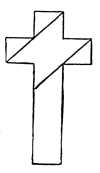
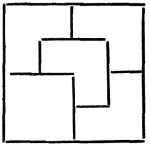
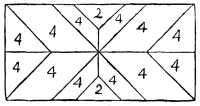
Illusions of the Eye are numberless, and afford a wide field for
experiment. Some people are left-eyed, others right-eyed, and very
few use both eyes equally. It is impossible to tell how far they
really do deceive us unless they have been tested in the proper
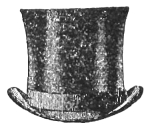
manner. For instance, if you ask anyone to what height a bell-topper
would reach if placed on the floor against the wall, nine times out
of ten the height guessed will be half as much again as the real
height of the hat. Everyone seems to over-estimate the proper height.
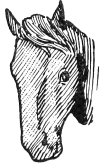
Another favourite illusion is to ask a person to mark on the wall a
height from the floor which would represent the length of a horse’s
head: here the majority guess far too little—for a horse’s head is
much longer than most people imagine, ranging from 25 to 34 inches.
In a recent experiment 5 persons out of 6 under-estimated the
proper height.
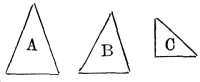
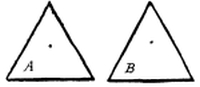
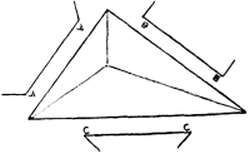
Here are two triangles. Which is the one whose centre is the better
indicated? (It looks like A, but it is B).
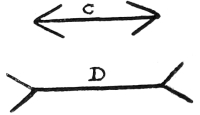
Again: Out of the two straight lines C and D which is the longer? (By
measurement we see they are both the same).
Guess, by eye-measurement only, the longest and shortest of the three
lines marked A A, B B, and C C. When you have done guessing measure,
and see how much you are out.
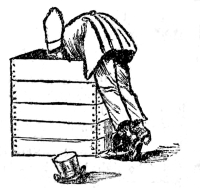
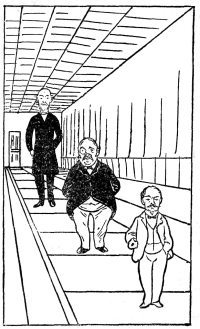
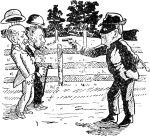
Which is the tallest gentleman of the three appearing in adjoining
figure?—Many would imagine the last to be the tallest, and the
first the shortest, whereas the reverse is the case—the last is the
shortest, and the first the tallest.
It is surprising how the eye can be deceived, when
dealing with areas or circles. Place on the table a half-crown and a threepenny-piece;
let these be, say, 9 or 10 inches apart, and ask a friend how many
of the latter can be placed on the former—with this proviso: the
threepenny-pieces must not rest on each other, nor must they overlap
the outer rim of the half-crown; they must be fairly within the
circumference of the larger coin. Many will answer 6, 5, or 4, others
who are more cautious 3. Try for yourself and see how many you can
put on, and you are sure to be surprised.
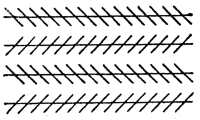
ARE THESE LINES PARALLEL?
The “herring-bone” figure here illustrated is yet another proof that
our eyes are faulty. The horizontal lines appear to slant in the
direction in which the short intersecting lines are falling, and
would give one the idea that they would meet if continued, whereas
really they are parallel. The illusion is more striking if you tilt the leaf up.
HOW DID HE DO IT.
115. Once there was an old tramp who had to go through
a tollbar, and before he could get through he had to pay a penny. He had not a
penny; he did not find a penny, nor borrow a penny, nor steal nor beg
a penny, and yet he paid a penny and went through.
116. Find a number which is such that if four times its
square be diminished by 6 times the number itself the remainder shall be 70.
117. A man has a certain number of apples; he sells
half the number and one more to one person, half the remainder and one more to a
second person, half the remainder and one more to a third person,
half the remainder and one more to a fourth person, by which time he
had disposed of all that he had. How many had he?
Teacher (impressing one of her
protégés)—“Be brave and earnest and you will succeed. Do you
remember my telling you of the great difficulty ‘George Washington’ had to contend with?”
Willy Raggs—“Yes, mum; he couldn’t tell a lie.”
118. Two numbers are in the ratio of 2 and 3, and
if 9 be added to each they are in the ratio of 3 to 4. Find the numbers.
PAYING A DEBT.
In an office the boy owed one of the clerks threepence, the clerk
owed the cashier twopence, and the cashier owed the boy twopence. One
day the boy, having a penny, decided to diminish his debt, and gave
the penny to the clerk, who in turn paid half his debt by giving it
to the cashier, the latter gave it back to the boy, saying, “That
makes one penny I owe you now;” the office boy again passed it to the
clerk, who passed it to the cashier, who in turn passed it back to
the boy, and the boy discharged his entire debt by handing it over to
the clerk, thereby squaring all accounts.
A TESTIMONIAL.
“How do you like your new typewriter?” inquired the agent.
“It’s grand!” was the immediate and enthusiastic response. “I wonder
how I ever got along without it.”
“Well, would you mind giving me a little testimonial to that effect?”
“Certainly not; do it gladly.”
(A few minutes’ pounding). “How’ll this suit you?”
“afted Using the automatig Back-action a type writ, er for thre
emonthan d Over. I unhesittattingly pronounce it prono nce it to be
al even more than th e Manufacturs claim? for it. During the time
been in our possession e. i. th ree monthzi id has more th an than
paid for it£elf in the saving of time an d labrr?
John £ Gibbs.”
STATE OF THE POLL.
119. In a constituency in which each elector may vote
for 2 candidates half of the constituency vote for A, but divide their
votes among B, C, D and E in the proportion of 4, 3, 2, 1; half the
remainder vote for B, and divide their votes between C, D, E in
proportion 3, 1, 1; two-thirds of the remainder vote for D and E, and
540 do not vote at all. Find state of poll, and number of electors on roll.
120. Three men, A, B and C, go into an hotel to have
a “free and easy” on their own account, and after sundry glasses of Dewar’s
Whisky got into dispute as to who had the most cash, and neither
being willing to show his hand, the landlord was called upon to
umpire. He found that A’s money and half of B’s added to one-third of
C’s just came to £32, again that one-third of A’s with one-fourth of
B’s and one-fifth of C’s made up £15, again he found that one-fourth
of A’s together with one-fifth of B’s and one-sixth of C’s totalled
£12. How much had each?
THE BIBLE IN SCHOOLS.
Visiting Clergyman—“What’s a miracle?”
Boy—“Dunno.”
V.C.—“Well, if the sun was to shine in the middle of the
night what would you say it was?”
Boy—“The moon.”
V.C.—“But if you were told that it was the sun, what would
you say it was?”
Boy—“A lie.”
V.C.—“I don’t tell lies. Suppose I were to tell you it
was the sun, what would you say then?”
Boy—“That you was drunk.”
121. A man travels 60 miles in 3 hours by rail and coach;
if he had gone all the way by rail he would have ended his journey an hour
sooner and saved two-fifths of the time he was on the coach. How far
did he go by coach?
Wanted Canvasser, energetic;
only “live” men need apply. Smart & Co.
A determined-looking young man rushed into Mr. Sharp’s office
the other day, and, addressing him, said abruptly, “See you’re
advertising for a canvasser, sir; I’ve come to fill the place.”
“Gently, young man!—gently! How do you know that you’ll suit?” asked
Mr. Sharp, somewhat nettled at the young man’s off-hand manner.
“Certain of it. Best man you could have—energetic, punctual, honest,
sober, A1 references, and——”
“Wait a minute, I tell you!” shouted Mr. Sharp. “I don’t think you’d
suit me at all.”
“Oh, yes, I shall,” said the young man, seating himself. “And I don’t
go out of this office till you engage me.”
“You won’t?” yelled Mr. S.
“Certainly not,” said the young man, calmly.
“Why, you impudent young scoundrel! I’ll—I’ll kick you out!”
“No, you wont. You may kick me, but you won’t kick me out.”
“If you don’t go, I’ll call a policeman,” declared Mr. S., purple
with rage.
“Will you?”
The young man rushed to the door, locked it, and put the key in his
pocket.
Mr. S. gasped and glared, and then roared:—
“I tell you I won’t have you! Get out of my office. Will you take
‘no’ for an answer?”
“No, I won’t take ‘no’ for an answer. Never did in my life, and don’t
intend starting now,” said the young man, very determinedly.
Mr. Sharp hesitated, then rose to his feet, with admiration beaming
from his eyes.
“Young man,” he said, “I’ve been looking for an agent like you for
twenty years. At first I thought you were only a bumptious fool;
but now I see you’re literally bursting with business. If any man
can sell my patent vermin-trap (warranted to catch anything from a
flea to a tiger) you’re that man. A hundred a year and 15 per cent.
commission. Is it a bargain?”
“It is,” said the young man, trying the trap, and smiling approvingly
when it nipped a piece of flesh clean out of his finger.
WHY IS IT?
Take a long narrow strip of paper, and draw a line with pen or pencil
along the whole length of its centre. Turn one of the ends round so
as to give it a twist, and then gum the ends together. Now take a
pair of scissors and cut the circle of paper round along the line,
and you will have two circles. This is a puzzle within a puzzle,
and has never been satisfactorily explained either by scientist or mathematician.
How to Read a Person’s Character.
Tell a friend to put down in figures the year in which he was born;
to this add 4, then his age at last birthday provided it has not come
in the present year (if it has, then his age last year); multiply
this sum by 1000, and subtract 687,423. (This number is for 1899;
it increases 1000 for each succeeding year.) To the remainder place
corresponding letters of the alphabet. The result will be the popular
name by which your friend is known.
Example: A person was born in 1860, and is now 38 years of age.
| 1860 |
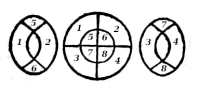
Age |
| 4 |
| 1864 |
| 38 |
| 1902 | (“A bad egg.”) |
| 1000 |
| 1902000 |
| 687423 |
| 1,2,1,4,5,7,7 |
| a,b,a,d,e,g,g |
122. There are 3 numbers in continued proportion—the
middle number is 60, and the sum of the others is 125. Find the numbers.
123. A lends B a certain sum at the same time he insures
B’s life for £737 12s. 6d., paying annual premiums of £20; at the end of three
years and just before the fourth premium is to be paid, B dies,
having never repaid anything. What sum must A have lent B in order
that he may have just enough to recoup himself, together with 5 per
cent. compound interest on the sum lent and on the premiums?
124. I met three Dutchmen—Hendrick, Claas,
and Cornelius—with their wives—Gertruig, Catrün, and Anna;
in answer to a question they told me they had been to market to
buy pigs, and had spent between them £224 11s; Hendrick bought 23
pigs more than Catrün, and Class bought 11 more than Gertruig,
each man laid out 3 guineas more than his wife. Now find out each
couple—man and wife.
CURIOUS BOOK-KEEPING.
An old tradesman used to keep his accounts in a singular manner. He
hung up two boots—one on each side of the chimney; into one of these
he put all the money he received, and into the other all the receipts
and vouchers for the money he paid. At the end of the year, or
whenever he wanted to make up his accounts, he emptied the boots, and
by counting their several and respective contents he was enabled to
make a balance, perhaps with as much regularity and as little trouble
as any book-keeper in the country.
QUICKER THAN THOUGHT.
A little boy, hearing someone remark that nothing was quicker than
thought, said: “I know something that is quicker than thought.” “What
is it, Johnny?” asked his pa. “Whistling,” said Johnny. “When I was
in school yesterday I whistled before I thought, and got caned for
it, too.”
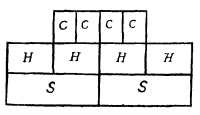
125. The number of men in both fronts of two columns of
troops A and B, when each consisted of as many ranks as it had men in front, was
84; but when the columns changed ground, and A was drawn up with the
front B had, and B with the front A had; the number of ranks in both
columns was 91. Required: the number of men in each column.
RUNNING THROUGH HIS FORTUNE.
126. A man inheriting money spends on the first day 19s.,
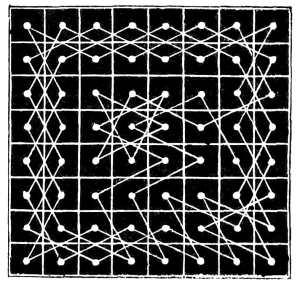
twice that amount on the next, and 19s. additional every day till he exhausts
his fortune by spending on the last day £190 by way of having a real
good time of it and treating his friends to a good “blow out.” What
amount of money had he left to him at the start?
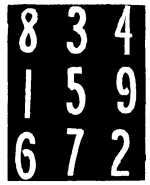
127. A shopkeeper makes on a certain article the first
day a profit of 3d., the second day 4·2d., and so on, profit increasing each day
by 1·2d. He had a profit of 14s. 3d. on the whole. How many days was
he selling the article?
“AWFUL SACRIFICE.”
One of those generous, disinterested, self-sacrificing tradesmen,
having stuck upon every other pane of glass in his window,
“Selling-off,” “No reasonable offer refused,” “Must close on
Saturday,” offered himself as bail, or security, in some case
which was brought before a magistrate, when the following dialogue
ensued:—The magistrate asking him if he was worth £200, “Yes,” he
replied. “But you are about to remove, are you not?” “No.” “Why, you
write up, ‘Selling-off.’” “Yes, every shopkeeper is selling off.”
“You say, ‘No reasonable offer will be refused.’” “Well, I should be
very unreasonable if I did refuse such offers.” “But you say, ‘Must
close on Saturday.’” “To be sure; you would not have me open on
Sunday, would you?”
128. A man dying left his property of £10,000 to his
four children, aged respectively 6, 8, 10, and 12 years, on the understanding that
each on attaining his majority shall receive the same amount of
money, comp. interest at the rate of 4½ per cent. being allowed.
What is the amount of the £10,000 payable to each?
A WASTE OF TIME.
A little boy spent his first day at school. “What did you learn?” was
his aunt’s question. “Didn’t learn nothing.” “Well, what did you do?”
“Didn’t do nothing. There was a woman wanting to know how to spell
‘cat,’ and I told her.”
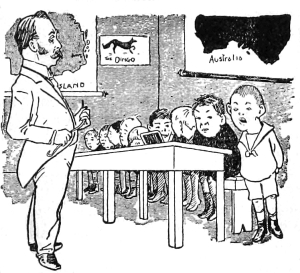
An English School-boy’s Essay on Australia.
“Part of Austrailya is vague. It ust to be used by the English to
keep men on that was not bad enough to be killed. Some farms would
raise as much as five hundred thousand. The English long ago ust to
send their prisoners there when they did anything not worth hanging.
“Austrailya is a vast Country, and the biggest Island on the surface
of the Earth. It has all its bad men and they have found a great many
Gold and Diamonds there, and Sidney is one of the Chief Countries in
it which is in new south Wales.
“It used to be used for purposes of Exploration, but it has no
interior, and you can’t explore it. Sometimes it is called Antipides,
because everything is upside down there. The chief products are Wool
and Gold and other Exports and the Austrailyan eleven come from
there. The Climate is hot in the Summer and not so in the Winter,
which causes drowts and sweeps all the sheep away and the banks break.
“It was discovered by Captain Cook who captured it from the Dutch.
There are no wild Animals there except the Kangaroo, they fly
through the air with great skill and then they return again right to
your feet. The natives are coloured Black and they call themselves
Aboriginels, they subsist on bark and other food they do no work and
chop wood for a miserable living and can smell the ground like a
dog. When we go there they call us new Chums. They have no form of
Worship, and pray for rain, but a belief in Federashun because they
want to be joined together.
“Their only amusement is Co-robbery. It is celebrated for
Bushrangers and the Melbourne Cup which sticks people up and takes
from them all they have got.
“Austrailya has a lot of aliasses, one is new Holland and afterwards
it was called Pollynesia, and Van Demon and Oceana but sir Henry
Parks called it Austrailya on his Death-bed. You can go to it in a
ship but it is joined to Great Britain by a cable.”
129. I ran to a certain railway station to meet the train
which was due at 3.15 p.m. When I arrived on the platform the hands of the
clock made equal angles with 3 o’clock. How long had I to wait?
130. The wall of China is 1500 miles long, 20 feet high,
15 feet wide at the top and 25 at the bottom. The largest of the pyramids is said
to have been 741 feet at the base, 481 feet vertical when finished.
How many such pyramids could be built out of the wall of China?
GRAMMAR.
Schoolmaster—“Now, boys, the word ‘with’ is a very
bad word to end a sentence with.”
131. There is an arch of quadrantal form; the rise
of the crown is 17 feet. What is the span?
132.
Two pairs of fives I bid you take,
And four times four and forty make.
133. A lady bought a quantity of flannel, which she
distributed among some poor women; the first received 2 yards, the second 4 yards,
and so on; the lot cost her £5 14s. 2½d. How many women were there, and
what did the lady pay per yard?
134. A and B marry, their respective ages being in
proportion to 3 and 4. Now after they have been married 14 years their ages
are as 5 to 6, and the age of A is 5 times that of her youngest child, who was
born when the parents’ ages were as 4 to 5. Required: the ages of A
and B when they were married, and the age of the youngest child now
that they have been married 14 years.
AN APPALLING “SUM.”
At a school, a short time back, the pupils were given, as a home
lesson, the task of subtracting from 880,788,889 the number 629 so
often till nothing remained.
The boys worked on for hours without any perceptible diminution of
the figures, and at length gave up the task in despair. Some of the
parents then tried their hands, with no better success. For, in order
to work out the sum, the number 629 would have to be subtracted
1,400,300 times, leaving 189 as a remainder.
Working 12 hours a day, at the rate of 3 subtractions per minute, it
would take over 1 year and 9 months to complete the sum which had
been set the poor lads for their home lesson.
A MILITARY LUNCHEON.
135. A certain number of Volunteers—namely, Commissioned
Officers, Non-commissioned Officers, and Privates had a dinner bill to pay;
there were, it seemed, half as many more Non-Com. Officers as Com.,
one-third as many more Privates as Non-Com. Officers, and they agreed
that each Commissioned Officer should pay one-third as much again
as each Non-Com., and each Non-Com. one-fifth as much again as each
Private; but 1 Commissioned and 2 Non-Com. Officers slipped away
without paying their portion (5s.), each of the others had to pay in
consequence 4d. more. What was the amount of the bill, and the number
of each present?
Twice the half of 1½? Ask your friends—it bothers them.
The Problem Easily Solved.
“Do you see that row of poplars on the other bank standing apparently
at equal distances apart?” asked a grave-faced man of a group of
people standing by a river.
The group nodded assent.
“Well, there’s quite a story connected with those trees,” he
continued. “Some years ago there lived in a house overlooking the
river a very wealthy banker, whose only daughter was beloved by a
young surveyor. The old man was inclined to question the professional
skill of the young rod and level, and to put him to the test directed
him to set out on the river shore a row of trees, no two of which
should be any further apart than any other two. The trial proved
the lover’s inefficiency, and forthwith he was forbidden the house,
and in despair drowned himself in the river. Perhaps some of you
gentlemen with keen eyes can tell me which two trees are furthest apart?”
The group took a critical view of the situation, and each member
selected a different pair of trees. Finally, after much discussion,
an appeal was made to the solemn-faced stranger to solve the problem.
“The first and the last,” said he, calmly, resuming his cigar and
walking away with the air of a sage.
136.
Twice five of us are eight of us, and two of us are three,
And three of us are five of us—now how can all this be?
If that does not puzzle you I’ll tell you one thing more:
Eight of us are five of us and five of us are four.
“EXPRESSIONAL” MEASURES.
The table of measures says that 3 barleycorns make 1 inch—and so
they do. When the standards of measures were first established 3
barleycorns, well-dried, were taken out and laid end to end, and
measured an inch.
The “hairbreadth” now used indefinitely for infinitesimal space, was
a regular measure, 16 hairs laid side by side equalling 1 barleycorn.
The expression “in a trice,” as everyone knows, means a very short
space of time. The hour is divided into 60 minutes, the minute into
60 seconds, and the second into 60 “trices.”
A CHALLENGE.
137. A lady belonging to the W.C.T.U. was endeavouring
to persuade a gentleman friend of hers to give up the drink; he replied, “I will
sign the pledge if you tell me how many glasses of beer did I drink
to-day if the difference between their number and the number of times
the square root of their number is contained in 2 be equal to 3.”
MEMORY SYSTEM.
Teacher—“In what year was the battle of Waterloo fought?”
Pupil—“I don’t know.”
Teacher—“It’s simple enough if
you only would learn how to cultivate artificial memory. Remember
the twelve apostles. Add half their number to them. That’s eighteen.
Multiply by a hundred. That’s eighteen hundred. Take the twelve
apostles again. Add a quarter of their number to them. That’s
fifteen. Add to what you’ve got. That’s 1815. That’s the date.
Quite simple, you see, to remember dates if you will only adopt my
system.”
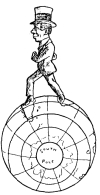
A GLOBE TROTTER.
138. Everyone knows that in a race on a circular track
the competitor who has the “inside” running has the least ground to cover, hence
the great desire of cyclists, jockeys, &c., to “hug the fence.”
Now a gentleman, six feet high, starts walking round the Earth on
the equator; his feet, therefore, have the inside running. Find out
how much further his head travels than his feet in performing this
wonderful journey? taking the circumference of the globe at the
equator to be 25,000 miles.
Precocious Juvenile—“Mamma, it isn’t good grammar to say
‘after I,’ is it?”
His Mother—“No, Georgie.”
Precocious Juvenile—“Well, the letter J comes after I.
Which is wrong—the grammar or the alphabet?”
139. There is an island in the form of a semi-circle;
two persons start from a point in the diameter; one walks along the diameter, and
the other at right angles to it; the former reaches the extremity of
the diameter after walking 4 miles, and the latter the boundary of
the island after walking 8 miles. Find the area of the island.
140. There is a certain number consisting of three figures
which is equal to 36 times the sum of its digits, and 7 times the left-hand
digit plus 9, equal to 5 times the sum of the remaining digits, and 8
times the second digit minus 9 is equal to the sum of the first and
third. What is the number?
141. A bottle and cork costs 2½d.; the bottle costs 2d.
more than the cork. What is the price of each?
A Cure for Big Words.
Here is a good story of how a father cured his son of verbal
grandiloquence. The boy wrote from college, using such large
words that the father replied with the following letter:—“In
promulgating your esoteric cogitations, or articulating superficial
sentimentalities, and philosophical or pscyhological observations,
beware of platitudinous ponderosity. Let your conversation possess
a clarified conciseness, compacted comprehensibleness, coalescent
consistency, and a concatenated cogency. Eschew all conglomerations
of flatulent garrulity, jejune babblement, and asinine affectations.
Let your extemporaneous descantings and unpremeditated expatiations
have intelligibility, without rhodomontade or thrasonical bombast.
Sedulously avoid all polysyllabical profundity, pompous prolixity,
and ventriloquial vapidity. Shun double entendre and prurient
jocosity, whether obscure or apparent. In other words, speak
truthfully, naturally, clearly, purely, but do not use big words.”
142. With a pair each of four different weights, 1 lb.
up to 170 lbs. can be weighed. What are the weights?
143. A man going “on the spree” spends on the first day
10s. 5d., the second 18s., the third £1 8s. 7d., the fourth £2 2s. 8d., and so on
at that rate of increase until he has spent all he had—£183 6s. 8d.
How many days was he on the spree?
144. Divide one shilling into two parts, so that one
will be 2½d. more than the other.
COMPLIMENTARY, VERY!
Editor—“Did you see the notice I gave you yesterday?”
Shopkeeper—“Yes, and I don’t want another. The man who says
I’ve got plenty of grit, and that the milk I sell is of the first
water, and that my butter is the strongest in the market, may mean
well, but he is not the man whose encomiums I value.”
145. A vintner draws a certain quantity of wine out of
a full vessel that holds 256 gallons, and then filling the same vessel with water
draws off the same quantity of liquor as before, and so on for four
draughts, when only 81 gallons of pure wine is left. How much wine
did he draw each time?
146. A man has 4 horses, for which he gave £80; the
first horse cost as much as the second and half of the third, the second cost
as much as the fourth minus the cost of the third, the third cost one-third
of the first, and the fourth cost as much as the second and third
together. What was the price of each horse?
The Divided Pound.
147. A father wishes to divide £1 between his four sons,
giving one-third to one, one-fourth to another, one-fifth to another, and
one-sixth to another; in doing so he finds he has only disbursed
19s.; the balance, 1s., is then divided in the same proportion. What
amount does each receive in full in the proportion named?
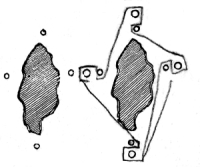
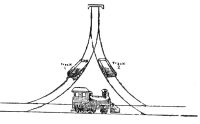
RAILWAY-SHUNTING PUZZLE.
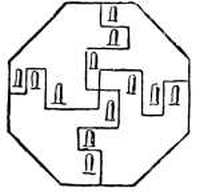
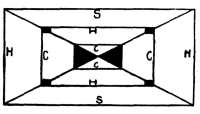
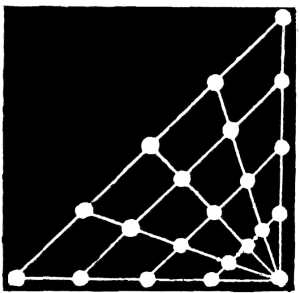
148. A locomotive is on the main line of railway; the
trucks marked 1 and 2 are on sidings which meet at the points, where there is room
for one truck only and not for the locomotive. It is desired to
reverse the position of the trucks—that is, put 1 where 2 is, and
2 where 1 is, and yet leave the locomotive free on the main line.
This must be done by means of the locomotive only, either pulling
or pushing the trucks—it may be between them, thus pulling one and
pushing the other—but no truck must move without the locomotive.
In working this puzzle out, it would be best to draw the diagram
on an enlarged scale, and have articles to represent the trucks and
locomotive.
149. In a public square there is a fountain containing
a quantity of water; around it stand a group of people with pitchers and
buckets. They draw water at the following rate: The first draws
100 quarts and one-thirteenth of the remainder, the second 200 quarts
and one-thirteenth of the remainder, the third 300 quarts and
one-thirteenth, and so on, until the fountain was emptied. How many
quarts were there in the fountain?
ENGLISH FROM A GERMAN MASTER.
Prof. Goldburgmann—“Herr Kannstnicht, you will the
declensions give in the sentence, “I have a gold mine.”
Herr Kannstnicht—“I have a gold mine; thou hast a gold
thine; he has a gold his; we, you, they have a gold ours, yours, or
theirs, as the case may be.”
Prof. Goldburgmann—“You right are; up head proceed. Should
I what a time pleasant have if all Herr Kannstnicht like were!”
SPENDING THEIR “ALL.”
150. Three men going “on the spree” decide to spend all
their money. The first, A, “shouts” for the company and then gives his balance to
B, who also in turn pays for 3 drinks and gives his balance to C, who
can then just manage to pay for drinks once more at 6d. each. How
much money had each?
151. There is a regiment of 7300 soldiers, which is to
be divided into 4 companies—half of the first company, two-thirds of the
second, three-quarters of the third, and four-fifths of the
fourth—to be composed of the same number of men. How many soldiers
are there in each company?
A GRAVE MISTAKE.
A Scotch tradesman, who had amassed, as he believed, £4000, was
surprised at his old clerk’s showing by a balance-sheet his fortune
to be £6000. “It canna be—count again,” said the old man. The clerk
did count again, and again declared the balance to be £6000. Time
after time he cast up the columns—it was still a 6, and not a 4,
that rewarded his labours. So the old merchant, on the strength of
his good fortune, modernised his house, and put money in the purse
of the carpenter, the painter, and the upholsterer. Still, however,
he had a lurking doubt of the existence of the extra £2000; so one
winter’s night he sat down to give the columns “one count more.” At
the close of his task he jumped up as though he had been galvanised,
and rushed out in a shower of rain to the house of the clerk, who,
capped and drowsy, put out his head from an attic window at the sound
of the knocker, mumbling, “Who’s there, and what d’ye want?” “It’s
me, ye scoundrel!” exclaimed his employer. “Ye’ve added up the year
of our Lord amang the poons!”
PROBLEM FOR PRINTERS.
152. A book is printed in such a manner that each page
contains a certain number of lines, and each line a certain number of letters.
If each page contains 3 lines more, and each line 4 letters more, the
number of letters in each page will be 224 more than before; but if
each page contains 2 lines less, and each line 3 letters less, the
number of letters in each page would be 145 less than before. Find
the number of lines in each page, and the number of letters in each line.
THE INCOME TAX.
153. The charge on a major income is the same in amount
as that on a minor one, which is 2½ per cent. of their mutual difference, but
the rate imposed on the overplus of a major income is 4 per cent., so
that on a composite income of the major and minor the charge would be
£3 8s. Required the major and minor incomes.
“Your Money or Your Life!”
154. Two gentlemen, A and B, with £100 and £48 respectively,
having to perform a long journey through a lonely part of the country, agree
to travel together for purposes of safety; they are, however, taken
unawares by a gang of bushrangers who, calling upon them to “bail
up,” ease them of some of their cash. The leader of the gang was
satisfied with taking twice as much from A as from B, and left to A
three times as much as to B. How much was taken from each?
GEOMETRICAL MUSIC.
· A point, my boys, is that which has no length, breadth, or dimension.
—— A line has length, and yet is but a point drawn in extension.
All lines have names expressing some distinguishing particular.
As: horizontal, parallel, oblique, and perpendicular.
Chorus of Pupils. Oh! dear! oh!
A pretty science mathematics is to know.
The lines called parallel are those which, drawn in one direction,
Continued to infinity, will never make bisection.
The thing perhaps sounds odd, but if you entertain a doubt, boys,
I’ll draw the lines, ——— now take your slates, and work the
problem out, boys.
Chorus of Pupils. Oh! dear! no!
We readily believe it, Sir! since you say so!
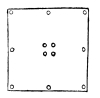
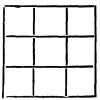
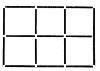
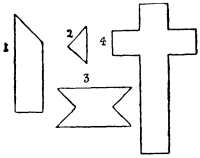
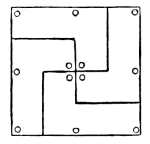
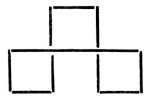
155. In this figure rub out eight lines, and
leave two squares. No side nor angle of any square must be left, otherwise that will
be counted as a square.
156. A and B travelled by the same road, and at the
same rate from Tamworth to Sydney. A overtook a flock of sheep, which travelled
at the rate of three miles in two hours, and two hours after he met a
mail coach, which travelled at the rate of nine miles in four hours.
B overtook the flock 45 miles from Sydney, and met the coach 40
minutes before he came to the 31-mile post from the Metropolis. Where
was B when A reached Sydney?
ENGLISH HISTORY.
A school examination paper contained the question:—“Write down all
you know about Henry VIII,” and one of the small boys answered as
follows:—
“King Henry 8 was the greatest widower that ever lived. He was born
at Anne Domini in the year 1066. He had 510 wives besides children.
The first was beheaded and afterwards executed, and the second was
revoked. She never smiled again. But she said the word ‘Calais’ would
be found on her heart after death. The greatest man in this reign
was Lord Sir Garret Wolsey—named the Boy Bachelor. He was born at
the age of fifteen unmarried. Henry 8 was succeeded on the throne by
his great-grandmother, the beautiful Mary, Queen of Scots, sometimes
called Lady of the Lake or the Lay of the Last Minstrel.”
157. Two boys, A and B, run round a ring in opposite
directions till they meet at the starting point, their last meeting place before
this having been 990 yards from it. If A’s rate to B’s be as 5 to 3, find
the distance they have travelled.
THE VALUE OF HOME LESSONS.
Two teachers of languages were discussing matters and things relative
to their profession.
“Do your pupils pay up regularly on the first of each month?” asked
one of them.
“No, they do not,” was the reply; “I often have to wait weeks and
weeks before I get my pay, and sometimes I don’t get it at all. You
can’t well dun the parents for the money.”
“Why don’t you do as I do? I always get my money regularly.”
“How do you manage it?”
“It is very simple. For instance, I am teaching a boy French, and
on the first day of the month his folks don’t send the amount due
for the previous month. In that case I give the boy the following
exercise to translate and write out at home:—‘I have no money. The
month is up. Hast thou any money? Have not thy parents any money? I
need money very much. Why hast thou brought no money this morning?
Did thy father not give thee any money? Has he no money in the
pocket-book of his uncle’s great aunt?’ This fetches them. Next
morning that boy brings the money.”
158. There is a number half of which divided by 6,
one-third of it divided by 4, and one-fourth of it divided by 3, each quotient
will be 9. What is the number?
QUIBBLE.
159.
Two-thirds of six is nine, one-half of twelve is seven,
The half of five is four, and six is half of eleven.
SOMETHING EASY.
160. Find a sum of £ s. d. (no farthings) in which the
figures, in their order, represent the amount reduced to farthings.
161. Three persons won a “consultation” worth £1,320.
If J were to take £6, M ought to take £4, and B £2. What is each person’s share?
“ON THE JOB.”
162. Six masons, four bricklayers and five labourers
were working together at a building, but being obliged to leave off one day by
the rain, they went to a public-house and drank to the value of 45s.,
which was paid by each party in the following manner: Four-fifths
of what the bricklayers paid was equal to three-fifths of what the
masons paid, and the labourers paid two-sevenths of what the masons
and bricklayers paid. What did each party of men pay?
163. In a certain speculation I gained £4 19s. 11¾d.
for each pound I expended, and by a curious coincidence I found that £4 19s.
11¾d. was the exact amount I had ventured. Required the amount of
capital and profit together.
HIS MAJORITY.
164. “I am not a man, I suppose, till I am 21. How
long have I to wait yet, if the cube root of my age eight years hence, added
to the cube root of my age eleven years ago would make 5?”
DRAUGHT-BOARD PUZZLE.
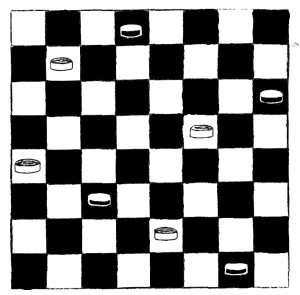
165. Place eight men on a draught-board in such a way
that no two will be in a line either crossways or diagonally. Of course the two
colours on the board must be used.
166. A gentleman, dying, left his property thus: To
his wife, three-fifths of his son’s and youngest daughter’s shares; to his
son, four-fifths of his wife’s and eldest daughter’s shares; to his
eldest daughter, two-sevenths of his wife’s and son’s shares, and to
his youngest daughter one-sixth of his son’s and eldest daughter’s
shares. The wife’s share was £4,650. What did the gentleman leave,
and what did each receive?
SAMSON OUTDONE.
A man boasted that he carried off an entire timber yard in his left
hand. It turned out that the timber-yard was a three-foot rule.
Domino Puzzle.
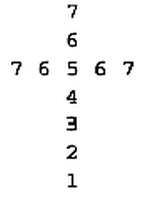
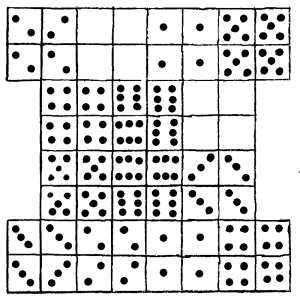
167. Arrange the 28 dominoes in such a manner as to have
two squares of each number; there are eight half-squares of each number in the
complete set—eight sixes, eight fives, &c.—so that four of the
one number comprise a square. The whole, when finished, will form a
figure like a square, resembling a wide letter I.
168. A sum of money is divided among a number of persons;
the second gets 8d. more than the first, the third gets 1s. 4d. more than the
second, the fourth 2s. more than the third, and so on. If the first
gets 6d. and the last £5 2s. 6d., how many persons were there?
IT COULDN’T BE EXPECTED.
Teacher: “Johnny, where is the North Pole?”
Johnny: “I don’t know.”
Teacher: “Don’t know where the North Pole is?”
Johnny: “When Franklin, Nansen and Captain Andrée hunted for it and
couldn’t find it, how am I to know where it is?”
169. For a loan of 2,500,000, 4½ per cent. per annum
is paid by a mining company whose capital is £4,900,000. The working expenses
constitute 52 per cent. of the gross receipts, which amount in the
year to £965,000, and the directors set apart £44,450 as a reserve
fund. What yearly dividend do the shareholders receive?
170. If a monkey climbs a greasy pole 10 ft. high, ascending
1 ft. with each movement of his arms, and slipping back 6 in. after each advance;
how many movements would he have to make, to touch the top, and what
height would he have climbed in all?
171. Find two numbers whose G.C.M. is 179,
L.C.M. 56385, and difference 10382.
172. What is the difference between twenty four-quart
bottles, and four and twenty quart bottles?
THE G.C.M.
The Greatest Common Measure—A “long pint.”
173. There are two casks, one of which holds thirty gallons
more than the other. The larger is filled with wine, the smaller with water.
Ten gallons are taken out of each: that from the first is poured into
the second; the operation is repeated, and it is now found that the
larger cask contains 13 gallons of water. Find the contents of each
cask.
174.
In the midst of a paddock well stored with grass,
I engaged just an acre to tether my ass;
What length must that cord be, in grazing all round
That he may graze over just one acre of ground?
175. If three first-class cost as much as five second-class
tickets for a journey of 100 miles, the total cost of the eight tickets
being £3 2s. 6d., find the charge per mile for each first-class and second-class ticket.
HUMILITY.
In a certain street are three tailors. The first to set up shop hung
out this sign—“Here is the best tailor in the town.” The next put
up—“Here is the best tailor in the world.” The third simply had
this—“Here is the best tailor in this street.”
“On the Wallaby.”
176. Four sundowners called at a station and asked
for rations. “Well,” said the manager, “I have a job that will take 200 hours
to complete; if you want to do it, you can divide the work and the money
among yourselves as you see fit.” The sundowners agreed to do the
work on these conditions. “Now, mates,” said the laziest of them,
“it’s no good all of us doing the same amount of work. Let’s toss
up to see who shall work the most hours a day, and who the fewest.
Then let each man work as many days as he does hours a day.” This
was agreed to; but the proposer took good care that chance should
designate him to do the least number of hours of work. How were the
200 hours put in so that each man should work as many hours as days,
and yet no two men work the same number of hours?
177. On multiplying a certain number by 517 a result
is obtained greater by 7,303,535 than if the same number had been multiplied
by 312. How much greater still would be the result if 811 were the
multiplier instead of 312?
A “CATCH.”
178. Six ears of corn are in a hollow stump. How long will
it take a squirrel to carry them all out if he takes but three ears a day?
NUMBER 7.
The number 7 has always been considered the most sacred of all our
figures. Its prominence in the Scriptures is very remarkable, from
Genesis—where we read that the seventh day was consecrated as a day
of rest and repose—to Revelations—where we find the seven churches
of Asia; seven golden candlesticks; the book with seven seals; the
seven angels with seven trumpets; seven kings; seven thunders; seven
plagues, &c., &c., its frequent occurrence is most striking.
The Ancients paid great respect to the seven mouths of the Nile.
The seven rivers of Vedic India; seven wonders of the world; seven
precious stones; seven notes of music; seven colours of the rainbow,
&c., &c. The “Lampads seven that watch the Throne of Heaven” led
the Chaldeans to esteem the unit 7 as the holiest of all numbers,
thereupon they established the week of seven days, and built their
temples in seven stages. The temples and palaces of Burma and China
are seven-roofed.
In modern times this number has kept up its reputation. Shakespeare
paid special regard to it; the “seven ages” and every multiple of it
is supposed to be a critical or important period in one’s life.
A modern philosopher as follows apportions—
Man’s Full Extreme.
| 7 years in childhood, sport and play, |
(7) |
| 7 years in school from day to day, |
(14) |
| 7 years at trade or college life, |
(21) |
| 7 years to find a place and wife, |
(28) |
| 7 years to pleasure’s follies given, |
(35) |
| 7 years to business hardly driven, |
(42) |
| 7 years for some wild-goose chase, |
(49) |
| 7 years for wealth, a bootless race, |
(56) |
| 7 years of hoarding for your heir, |
(63) |
| 7 years in weakness spent and care, |
(70) |
| And then you die and go—you know not |
where. |
Very many superstitious and curious ideas have been and still are
connected with all our figures. For those interested in this subject
see page 146—“How To Become Quick At Figures” (Student’s Edition).
“What’s the difference,” asked a teacher in arithmetic, “between one
yard and two yards?” “A fence,” said Tommy Yates. Then Tommy sat on
the ruler 14 times.
179. What relation is a woman to me who is
my mother’s only child’s wife’s daughter?
THE ADVANTAGES OF SKILFUL BOOK-KEEPING.
If a merchant wishes to get pretty deeply in debt, and then get rid
of his liabilities by bankruptcy—if, in fact, he proposes to himself
to go systematically into the swindling business, and engage in
wholesale pecuniary transactions without a shilling of his own, the
first thing he should take care to learn would be the whole art of book-keeping.
From what may occasionally be seen of the reports of the proceedings
in bankruptcy, it is found that well kept books are regarded as
quite a test of honesty, and though assets may have disappeared or
never have existed, though large liabilities may have been incurred
without any prospect of payment, the bankrupt will be complimented
on the straight look of his dealings, if he has shown himself a good book-keeper.
To common apprehension it would seem that well kept books would only
help to show a reckless trader the ruinous result of his proceedings,
and that while the man without books might flatter himself that
all would come out right at last, the man with exact accounts would
only get into hot water with his eyes open. If a man may trade on
the capital of others without any of his own, and get excused on the
ground that he has kept his books correctly, it is difficult to see
why a thief who steals purses, &c., may not plead in mitigation of
punishment that he has carefully booked the whole of his transactions.
It would be interesting to know the effect of producing a ledger
on a trial for felony, as well as curious to observe whether a
burglar would be leniently dealt with on the ground that his
house-breaking accounts gave proof of his experience in the science
of “double-entry.”
Therefore it would be well for those interested to procure copies of
“Re Accounts” and “Advanced Thought on Accounts.”
THE FIRM HE REPRESENTED.
A commercial traveller handed a merchant upon whom he had called a
portrait of his sweetheart in mistake for his business card, saying
that he represented that establishment. The merchant examined it
carefully, remarked that it was a fine establishment, and returned it
to the astonished and blushing traveller with the hope that he would
soon be admitted into partnership.
180. A man and a boy being paid for certain days’
work, the man received 27s., and the boy, who had been absent 3 days out of
the time, received 12s. Had the man, instead of the boy, been absent the
3 days they would both have claimed an equal sum. Find out the wages
of each per day.
181. The extremes of an arithmetical series are 21
and 497, and the number of terms is 41. What is the common difference?
182. A wine which contains 7½ per cent. of spirit
is frozen, and the ice which contains no spirit being removed the proportion of
spirit in the wine is increased by 8¾ per cent. How much water in
the shape of ice was removed from 504 gallons of the mixture?
THE SHARP SELECTOR.
183. A selector rented a farm, and agreed to give his
landlord two-fifths of the produce, but prior to the time of dividing the corn
the selector used 45 bushels. When the general division was made it
was proposed to give to the landlord 18 bushels from the heap in lieu
of the share of the 45 bushels which the tenant had used, and then to
begin and divide the remainder as though none had been used. Would
this method have been correct?
A GOOD “AD.”
A member of a certain firm appeared in a law court with a complaint
that his partner would sell goods at less than cost price, and he
desired to have him restrained. The defendant utterly denied the
charge, and the case was adjourned for a fortnight. As the plaintiff
went out of court he exclaimed in a tragic tone: “Then the sacrifice
must still go on!” and “I’ll be ruined!” The story was noised
abroad, and the result was that the shop was besieged by customers
every day. There the case ended, for at the end of the fortnight
the plaintiff failed to appear in court, having accomplished his
purpose—advertisement.
184. I give 3 sovereigns for 2 dozen wine at different
rates per dozen, and by selling the cheaper kind at a profit of 15 per cent.
and the dearer at a loss of 8 per cent. I obtain a uniform price for
both. What did each dozen cost me?
185. I have in my garden a shrub that grows 12 inches every
day, but during the night it withers off to half the height that it was at the
end of the previous day. How much short of 2 feet will it be at the end of a year?
TIT-FOR-TAT.
186. A farmer puts a 3 lb. stone in a keg of butter
worth 11d. a pound. The merchant cheats him out of 1 lb. on the weight, and
then does him out of 1s. 11d. on calico, tobacco, and a shovel. Who is
ahead, and how much?
187. Trains leave London and Edinburgh (400 miles apart)
at the same time and meet after 5 hours; the train which leaves London travels 8
miles an hour faster than that which leaves Edinburgh. At what rate
did the former travel, and at what speed must the latter travel after
they have met, in order that they both may reach their destinations
at the same time?
“GOOD ENOUGH!”
“Will you give me a glass of beer, please?” asked a rather
seedy-looking fellow with an old but well-brushed coat and almost too
shiny a hat. It was produced by the barmaid, frothing over the edge
of the tumbler.
“Thank you,” said the recipient, as he placed it to his lips. Having
finished it in a swallow, he smacked his lips and said, “That is very
good beer—very! Whose is it?”
“Why, that Perkins’s——”
“Ah! Perkins’s, is it! Well, give us another glass.”
It was done; and holding it up to the light and looking through it,
the connoisseur said:—
“’Pon my word, it is grand beer—clear as Madeira! What a fine color!
I must have some more of that; give me another glass.”
The glass was filled again, but before putting it to his lips the
imbiber said:—
“Whose beer did you say this was?”
“Perkins’s,” emphatically replied the barmaid.
The contents of the glass was exhausted, as also the vocabulary of
praise, and it only remained for the appreciative gentleman to say,
as he wiped his mouth and went towards the door:—
“Perkins’s beer, is it! I know Perkins very well; I shall see
him soon, and will settle with him for three long glasses of his
incomparable brew. Good morning.”
A Conspiracy.
188. Three gentlemen are going over a ferry with their
three servants, who conspire to rob them if they can get one gentleman to
two of them, or two to three, on either side of the ferry. They have
a boat that will only carry two at once, and either a gentleman or a
servant must bring back the boat each time a cargo of them goes over.
How can the gentlemen get over with all their servants so as to avoid
an attack?
189. Find two numbers whose product is equal to the
difference of their squares, and the sum of their squares equal to the difference
of their cubes?
190. Divide 1400 into such parts as shall have the
same ratio as the cubes of the first four natural numbers.
This was the tempting notice lately exhibited in the window of a
dealer in cheap shirts: “They won’t last long at this price!”
POSTING THE LEDGER.
The well known author of several works on account-keeping, Mr.
Yaldwyn, tells a rather good thing which actually occurred in New
Zealand some time back. Mr. Yaldwyn was at the time engaged examining
the books in one of the offices in a country town, and enquired
from one of the clerks standing near if the ledger were posted.
The person appealed to answered that “he didn’t know,” whereupon
Mr. Y. said that he required it done, and with as little delay as
possible. A few minutes later the same individual came rushing in and
informed him that the ledger was “posted.” Such a piece of “lightning
book-keeping” so surprised Mr. Y. that he further questioned the man,
who replied “You said you wanted the ledger posted, and, begorra, I
posted it.” It then dawned upon Mr. Yaldwyn that the clerk, who was
an Irishman, had actually posted the book in the post office!
THEY MANAGED IT.
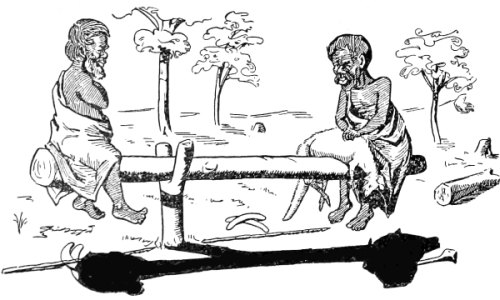
191. Billy and Tommy, two aboriginals, killed a kangaroo
in the bush, and began quarrelling over the weight of the animal. They had no
proper means of weighing it, but, knowing their own weights, Billy
130 lbs. and Tommy 190 lbs., they placed a log of wood across a stump
so that it balanced with one on each end. They then exchanged places,
and, the lighter man taking the kangaroo on his knees, the log again
balanced. What was the weight of the kangaroo?
192. A son asked his father how old he was, and
received the following answer: “Your age is now one quarter of mine, but
five years ago it was only one-fifth.” How old is the father?
193. Place three sixes together so as to make seven.
THE PASSING TRAINS PUZZLE.
194. If through passenger trains running to and from New York
and San Francisco daily start at the same hour from each place (difference
of longitude not being considered) and take the same time—seven
days—for the trip, how many such trains coming in an opposite
direction will a train leaving New York meet before it arrives at San Francisco?
THE SCHOOL-TEACHER “CAUGHT.”
Two of our Public Schools were engaged playing a football match one
afternoon. The head master of one of them had generously given the
boys a half-holiday; but the gentleman who held the same capacity in
the other school, not being an ardent admirer of Australia’s national
game, refused to do so. When school assembled in the afternoon, a
boy volunteered to ask the master for the desired holiday. When the
question was put, he firmly answered, “No, no!” whereupon the bright
youth called out: “Hurrah! we have our holiday; two negatives make an
affirmative.” The teacher was so pleased at the boy’s sharpness that
he dismissed the school right away.
195. A man arrives at the railway station nearest
to his home 1½ hours before the time at which he had ordered his carriage to
meet him. He sets out at once to walk at the rate of four miles an hour,
and, meeting his carriage when it had travelled eight miles, reaches
home exactly one hour earlier than he had originally expected. How
far was his house from the station, and at what rate was his carriage driven?
“OFF THE TRACK.”
196. A man starts to walk from a town, A, to a town B,
a distance by road of 16 miles, at the rate of 4 miles an hour. There is a point
C on the road, at which the road to B leads away to the right, and
another road at right-angles to this latter goes to the left, “to no
place in particular.” The unwary traveller gets on to this left hand
road, and is walking for 2¼ hours since he left A, before he finds
out his mistake, and he resolves not to go back to the junction,
which is five miles away, but makes straight across the bush to B,
and strikes it exactly. How long did it take to go from A to B?
GAMBLING.
197. Three friends, A, B, and C, sit down to play cards.
As a result of the first game, A lost to each of B and C as much money as they
started to play with; the result of the second game B lost similarly
to each of A and C; and in the third, C lost similarly to each of A
and B;—and they then had 24s. each. What had they each at first?
This Sticks Them Up.
198. A, who is a dealer in horses, sells one to B
for £55. B very soon discovers that he does not require the animal, and sells him
back to A for £50. Now, A is not long in finding another customer for
the horse: he sells it to C for £60. How much money does A make out
of this transaction?
This question has been the cause of endless discussion and argument.
It might be as well to state that when A first sold the horse to B he
neither made nor lost any money by the deal.
SCRIPTURAL FINANCE.
199. What is the earliest banking transaction mentioned
in the Bible? The answer generally given to this is, “The check which Pharaoh
received on the banks of the Red Sea, crossed by Moses & Co.” There
is still an earlier instance: see if you can find it out.
200. How much tea at 6s. per lb. must be mixed with
12 lbs. at 3s. 8d. per lb. so that the mixture may be worth 4s. 4d. per lb.?
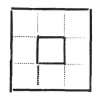
201. Place 17 little sticks—matches,
for instance—making six equal squares, as in the margin, then remove
five sticks and leave three perfect squares of the same size.
FOR THE JEWELLER.
202. How much gold of 21 and 23 carats must be
mixed with 30 oz of 20 carats, so that the mixture may be 22 carats?
LONDON GRAMMAR.
Three cockneys, being out one evening in a dense fog, came up to
a building that they thus described. The first said, “There’s a
nouse.” “No,” said the second, “It’s a nut.” The third exclaimed
“You’re both wrong; it’s a nin!”
203. A draper sold 12 yards of cloth at 20s. per yard,
and lost 10 per cent. What was the prime cost?
204. A jockey, on a horse galloping at the rate of 18
miles an hour on the Flemington racecourse, passes in 30 minutes over the diameter
and curve of a semi-circle. What area does he enclose by the ride?
205. How many trees 20 feet apart cover an acre?
“Multiplication is vexation,
Division is as bad.
The rule of three, it puzzles me,
And fractions drive me mad.”
MULTIPLY £19 19s. 11¾d. BY £19 19s. 11¾d.
This very old question is continually cropping up, and will continue
to do so as long as men are able to reckon. The answer generally
given is £399 19s. 2d. and a fraction, and the method of working it
out as follows:—
£19 19s. 11¾d. = 19199 farthings.
| 19199 |
x |
19199 |
= |
368601601 |
and so on. |
| 960 |
960 |
921600 |
Many adopt the following method:—
£20 x £20 = £400
| ¼d x ¼d = 1⁄16 |
less |
£ s d |
Ans. |
| £400 0 0 |
| 1⁄16 |
| £399 19 11 15⁄16 |
It would be possible to adopt other methods, each of which would give
a different result.
Properly speaking, this sum cannot be done.
Multiplication is merely a contracted form of addition: it means
taking a number or quantity a certain number of times. Every
multiplication can be proved by addition. All numbers are abstract
or concrete—3 is abstract, £3 is concrete.
Two abstract numbers can be multiplied together—as, 4 times 3 = 12.
One abstract number and one concrete number can be multiplied
together—as 2s. multiplied by 3 = 6s.
Two concrete numbers cannot be multiplied together.
In the example just given, 2s. multiplied by 3, we see it simply
means to write down 2s. three times, and by addition we discover the
answer to be 6s. Suppose the reader lent a friend 2s. on Monday, 2s.
on Tuesday, and 2s. on Wednesday, he has lent 2s. three times, making
6s. lent in all.
Now, we will attempt to multiply 2s. by 3s., but it is impossible
to comprehend how many times is 3s. times. The answer to 2s. x 3s.
usually given is 6s. On the same lines, we multiply 9d. by 10d., and
our answer is—90d., that is 7s. 6d.—a greater product than 2s.
multiplied by 3s.
Although it is stated that two concrete numbers cannot be multiplied
together, it should be borne in mind that we can multiply yards,
feet, and inches, by yards, feet, and inches (length by breadth),
which will result in square or cubic measure: 12 inches make 1 foot,
and 3 feet make one yard, 144 square inches make 1 square foot, &c.
12 pence make 1 shilling, but how many square pence make 1 square shilling?
The argument generally brought forward in favour of the performance
of this problem is, that when the Rule of Three is applied to
financial questions (such as interests, &c.) money is multiplied by money.
Example.—If the interest on £10 is 15s., what is the interest on £20?
As £10 : £20 :: 15s. : x
The multiplication in the above is in appearance only, for all we get
in the Rule of Three is the ratio between the sums of money and this
ratio is an abstract number, and not concrete. On examination we find
the ratio between £10 and £20; that the latter is double, or two
times as much as the former, and not £2 times more than it.
We extend a general invitation to all our readers who hold a
different opinion to multiply three pints of Dewar’s Whisky by 6
quarts of soda-water, but in case they might plead inability to
perform this little feat, on conscientious grounds, we will extend
the invitation to three cups of tea by six spoonfuls of sugar. And if
any of them have a few pounds (say £10) in the Savings Bank we would
advise “Don’t add any more deposits, but wait till you have £2,
then proceed to the bank and multiply the £10 by the £2, and prove
to the teller that you have £20 to your account. Be careful to take
no less a sum than £2, or the result might be a little surprising,
for if you take only £1, the teller might argue after he has received
your sovereign that “ten ones are ten,” and then your £10 would
remain the same.”
206. What is the difference between six dozen dozen
and half a dozen dozen?
A TELL-TALE TABLE.
There is a good deal of amusement in the following
table. It will enable you to tell how old the young ladies are. Ask a young
lady to tell you in which column or columns her age is found, add together
the figures at the top of the columns in which she says her age is,
and you have the secret. Suppose a young lady is 19. You will find
that number in the first, second and fifth columns; add the first
figures of these columns—1, 2 and 16—and you get the age.
| 1 | 2 |
4 | 8 |
16 | 32 |
| 3 | 3 |
5 | 9 |
17 | 33 |
| 5 | 6 |
6 | 10 |
18 | 34 |
| 7 | 7 |
7 | 11 |
19 | 35 |
| 9 | 10 |
12 | 12 |
20 | 36 |
| 11 | 11 |
13 | 13 |
21 | 37 |
| 13 | 14 |
14 | 14 |
22 | 38 |
| 15 | 15 |
15 | 15 |
23 | 39 |
| 17 | 18 |
20 | 24 |
24 | 40 |
| 19 | 19 |
21 | 25 |
25 | 41 |
| 21 | 22 |
22 | 26 |
26 | 42 |
| 23 | 23 |
23 | 27 |
27 | 43 |
| 25 | 26 |
28 | 28 |
28 | 44 |
| 27 | 27 |
29 | 29 |
29 | 45 |
| 29 | 30 |
30 | 30 |
30 | 46 |
| 31 | 31 |
31 | 31 |
31 | 47 |
| 33 | 34 |
36 | 40 |
48 | 48 |
| 35 | 35 |
37 | 41 |
49 | 49 |
| 37 | 38 |
38 | 42 |
50 | 50 |
| 39 | 39 |
39 | 43 |
51 | 51 |
| 41 | 42 |
44 | 44 |
52 | 52 |
| 43 | 43 |
45 | 45 |
53 | 53 |
| 45 | 46 |
46 | 46 |
54 | 54 |
| 47 | 47 |
47 | 47 |
55 | 55 |
| 49 | 50 |
52 | 56 |
56 | 56 |
| 51 | 51 |
53 | 57 |
57 | 57 |
| 53 | 54 |
54 | 58 |
58 | 58 |
| 55 | 55 |
55 | 59 |
59 | 59 |
| 57 | 58 |
60 | 60 |
60 | 60 |
| 59 | 59 |
61 | 61 |
61 | 61 |
| 61 | 62 |
62 | 62 |
62 | 62 |
| 63 | 63 |
63 | 63 |
63 | 63 |
COIN PUZZLE.
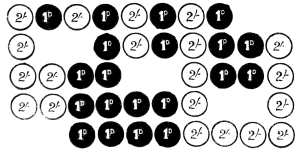
207. Place four florins alternately with four pennies,
and in four moves, moving two adjacent coins each time, bring the florins
together and the pence together. When finished there must be no
spaces between the coins.
208. If 2 be added to the numerator of a certain fraction,
it is made equal to one-fifth, whilst if 2 be taken from the denominator it
becomes equal to one-sixth. Find the fraction.
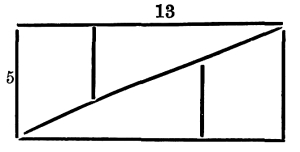
EUCLID.—The Famous Forty-Seventh.
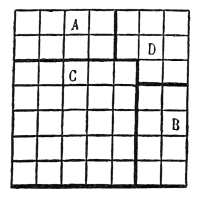
Fig. 1.
“In any right-angled triangle, the square which is described
upon the side opposite to the right-angle is equal to the squares
described upon the sides which contain the right-angle.”
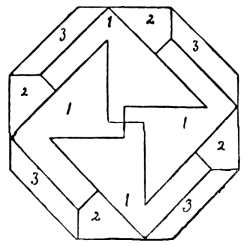
Here is a simple way of proving this proposition. Although perhaps
not exactly scholastic, it is none the less interesting.
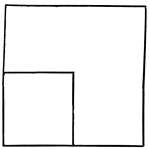
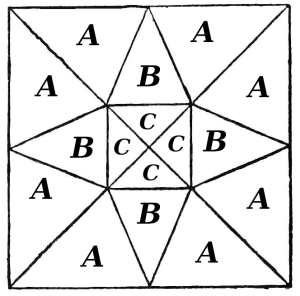
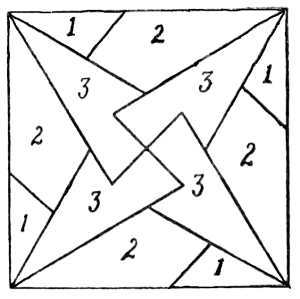
Draw an exact square, whose sides measure 7 in.; then divide it into
49 square inches. Having done this, cut the figure in following the
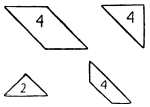
big lines as shown by Fig 1. It will be observed that C is a complete
square, and that A and B will form a square: but as D is 1 in. short
of being a square, it is necessary to cut a square inch and add it on.
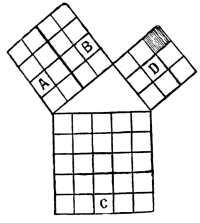
Fig. 2.
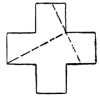
Then construct a right-angled triangle as shown by Figure 2.
We then see that the sum of the two small squares is equivalent to
the large square.
- D contains 9 small squares.
- A & B do. 16 do.
- 25
And as we see that C has 25 small squares, it is thus proved that the
sum of the squares upon the sides which contain the right angle are
equal to the squares upon the side opposite the right angle.
Q.E.D.
THE GREAT FISH PROBLEM.
209. There is a fish the head of which is 9 in. long, the
tail is as long as the head and half the back, and the back is as long as the
head and tail together. What is the length of the fish?
210. How may 100 be expressed with four nines?
211. Two shepherds, A and B, meeting on the road, began
talking of the number of sheep each had, when A said to B, “Give me one of your
sheep, and I will have as many as you.” “Oh, no!” replied B; “give me
one of yours, and I will have as many again as you.” How many sheep had each?
A BRICK PUZZLE.
One for Builders, Contractors, &c.
212. Suppose the measurements of a brick to be:—Length,
9 in.; breadth, 4½ in.; depth, 3 in. How many “stretchers, headers and
closures” can be cut out of one, and what would be the face area of same?
For the benefit of the uninitiated we might say that
“stretcher” = length of brick x depth
“header” = breadth "
“closure” = half-breadth "
213. A woman has a basket of 150 eggs; for every
1½ goose egg she has 2½ duck eggs and 3½ hen eggs. How many of each had she?
The Great Chess Problem.
THE KNIGHT MOVE.
214. Move the Knight over all the 64 squares of the
chess board so as to successively cover each square and, of course, not enter
any square twice. This problem has always proved to be an interesting
one. Mathematicians throughout all ages have devoted a good deal of
time to it. To chess players it should be especially attractive.
215. If 3 times a certain number be taken from 7 times
the same number the remainder will be 8. What is the number?
216. Divide £27 among 3 persons, A, B and C, so
that B may have twice as much as A, and C 3 times as much as B.
ANSWER THIS.
217. Suppose it were possible for a man in Sydney to start
on Sunday noon, January 1st, and travel westward with the sun, so that it might
be in his meridian all the time, he would arrive at Sydney next day
at noon, Monday, Jan. 2nd. Now, it was Sunday noon when he started,
it was noon with him all the way round, and is Monday noon when he
returns. The question is, at what point did it change from Sunday to Monday?
218. Start with 1 and keep on doubling for eight times,
thus giving nine numbers, and arrange them in a square that when multiplied
together, horizontally, vertically, or diagonally, the product of each row
will be the cube of the number which must go in the centre of the square.
The happiest year in a man’s life is 40; for then he can XL.
Bound to Win!
219. A certain gentleman, who was employed in one of our city
offices, purchased The Doctrine of Chance, which he studied
in his spare time, with the result that he sent in his resignation to
the head of the firm in order to try his luck on the racecourse.
At the first meeting he attended, there were only three horses in a
race. His brother bookmakers were crying out the odds—
“Two to 1 bar one.”
The odds on this latter horse which was “barred” he discovered to be 6 to 4
on. He determined to give far more liberal odds, and called out—
“Even money, 2 to 1, and 3 to 1.”
How could he give such odds, and yet win £1, no matter which horse
wins the race?
AN INCH OF RAIN.
How many people really consider what is contained in the expression?
Calculated, it amounts to this:—An acre is equal to 6,272,640 square
inches; an inch deep of water on this area will be as many cubic
inches of water, which, at 277·274 inches to the gallon, is 22622·5
gallons. The quantity weighs 226,225 lbs. Thus, an “inch of rain” is
over 100 tons of water to the acre.
Extract from a small boy’s first essay:—“Man has two hans. One is
the rite han an one is the left han. The rite han is fur ritin, and
the left han is fur leftin. Both hans at once is fur stummik ake.”
220. Find the side of a square whose area is
equal to twice the sum of its sides?
“THE EVIDENCE YOU NOW GIVE, &c., &c.”
221. Smith, Brown, and Jones were witnesses in a law
case. The first-named gentleman swore that a certain thing occurred; Brown, on
being called, confirmed Smith’s statement, but Jones denied it. They
are known to tell the truth as follows:—
- Smith, once in 3 times
- Brown, " " 5 "
- Jones, " " 10 "
What is the probability that the statement is true?
When a man attains the age of 90 years, he may be termed XC-dingly old.