THE history of the Putumayo occurrences after the exposure by Messrs.
Hardenburg and Perkins, due to the persistence of the Anti-Slavery
Society and the courage of the editor of Truth, who alone incurred the
risk of libel proceedings attaching to such exposures, so performing a
notable service to humanity,[123] is contained in the Blue Book, or
Foreign Office Report, already quoted. The proceedings leading to the
sending of Consul Casement to the Putumayo by Sir Edward Grey and the
Report itself are worthy of wider notice than that received by an
official pamphlet. The Report itself is of much geographical and
ethnological value and of general interest as a work of travel, apart
from its purpose of confirming the existence of the terrible and almost
incredible abuses.
Mr. Casement went to Peru in July, 1910, and transmitted his Report in
January, 1911.[124] The result was transmitted by the Foreign Office to
the British Consul in Lima, with instructions to lay particulars before
the Peruvian Government, and to the British Minister at Washington in
order that the United States Government should be informed of the action
of the British Government. The British Foreign Office repeatedly urged
upon the Lima Government that the criminals, whose names had been
immediately transmitted by cable, should be arrested. The Peruvian
Government promised to take action and sent a commission to Iquitos, but
failed to arrest the criminals. In July, 1911, they were informed that
the Report would be made public, but the chief criminals were not
arrested. Further promises to the same effect made by the Peruvian
Government were unfulfilled, and the British Government asked for the
support of the United States Minister at Lima, which was accorded in
October, 1911. After repeated communications had passed, during which
the Peruvian Government had not prevented the escape of several of the
criminals, or taken adequate steps to protect the Indians, the British
Foreign Office laid the correspondence before Parliament in July, 1912,
and published the Report.
In the preliminary Report received in January, 1911, by Sir Edward Grey
at the Foreign Office, Consul Casement said:—
“My conclusions are chiefly based on the direct testimony of Barbados
men in the company’s service, who brought their accusations on the spot,
who were prepared to submit them to investigation, and to make them in
the presence of those they accused, and whose testimony, thus given to
me, was accepted without further investigation by Señor Juan Tizon, the
Peruvian Amazon company’s representative at La Chorrera, on the ground
that it was sufficient or could not be controverted. It was equally
potent with the members of the Peruvian Amazon Company’s commission, who
expressed themselves as fully convinced of the truth of the charges
preferred, they themselves being often present when I interrogated the
British witnesses. There was, moreover, the evidence of our own eyes and
senses, for the Indians almost everywhere bore evidence of being
flogged, in many cases of being brutally flogged, and the marks of the
lash were not confined to men nor adults. Women, and even little
children, were more than once found, their limbs scarred with weals left
by the thong of twisted tapir-hide, which is the chief implement used
for coercing and terrorising the native population of the region
traversed. The crimes charged against many men now in the employ of the
Peruvian Amazon Company are of the most atrocious kind, including
murder, violation, and constant flogging. The condition of things
revealed is entirely disgraceful, and fully warrants the worst charges
brought against the agents of the Peruvian Amazon Company and its
methods of administration on the Putumayo. I append to my Report a list
of those agents of the company against whom the worst charges were
preferred and against whom the evidence in my possession is
overwhelmingly strong. The prefect of Loreto again and again assured me
that his Government was determined to deal with the criminals and
protect the Indians. The charges brought by the Barbados men were of the
most atrocious kind, and, added to the accumulating weight of evidence
that we had gathered from station to station, and the condition of the
Indian population as we had opportunity to observe it in passing, they
left no doubt in our minds that the worst charges against the company’s
agents were true. Many of the acts charged against agents whom we met
were of the most revolting description, and the Barbados men bringing
these charges did not omit, in several cases, to also accuse themselves
of shocking crimes, committed, they averred, under compulsion.”
“Names of some of the worst Criminals on the
Putumayo, all of them charged with atrocious
Offences against the Indians.
“Fidel Velarde: a Peruvian, chief of Occidente. Alfredo Montt: a
Peruvian, chief of Atenas. Charged with atrocious crimes. Augusto
Jiménez: a Peruvian. Is a half-caste. Age about 26. Has been for years
the lieutenant of Agüero, under whom he has committed appalling crimes
upon the Boras Indians in the section Abisinia. He was sub-chief of
Morelia, and is often mentioned in the Truth charges. He begged me to
listen to his statement, and said he could prove that one of the
charges against him in Truth was not true. On the other hand, the
evidence against him is overwhelming. Armando Normand: a Bolivian, I
believe of foreign parentage. Largely educated in England. A man of whom
nothing good can be said. The crimes committed by this man are
innumerable, and even Peruvian white men said to me that Normand had
done things none of the others had done. If any one on the Putumayo
deserves punishment this man should be made an example of. He was under
sentence of dismissal, and would have left Chorrera by the Liberal
with me only I objected to travel with him, and begged Señor Tizon to
send him by another vessel. José Inocente Fonseca: a Peruvian, about 28
years old. Has committed innumerable crimes upon the Indians. Abelardo
Agüero: about 35 or 36 years of age. Chief of Abisinia, of which section
he has had charge for years. Has committed innumerable crimes. Elias
Martinengui: The charges against him are many. Aurelio Rodríguez: a
Peruvian, whose crimes were vouched for by many and are widely known. A.
Vasquez Torres, or Alejandro Vasquez. Rodolfo Rodríguez: a Colombian,
charged with many murders. Miguel Flores: a Peruvian. Armando Blondel.
Aquiléo Torres: a Colombian. Innumerable crimes against this man. He was
made prisoner by Normand in January, 1907, and kept chained up for a
year by Velarde and others, and then released on condition he joined
them, and was first employed in flogging Indians. He improved on his
masters, and has killed scores, and cut ears off, and done things that
even some of the worst Peruvians say they could not tolerate. He was
once a Colombian magistrate, and was captured by Macedo’s orders along
with a lot of other Colombians because they were ‘poaching’ on the
company’s territory, and trying to get Indians to work for them. Jermin,
or Filomene, Vasquez. This man is charged with many crimes. The latest
of them only in August, 1910, when he had thirteen Indians—men, women,
and children—murdered on the road between the Caquetá and Morelia. He
boasted on his return to Abisinia ‘he had left the road pretty.’ Simon
Angúlo: a Colombian black man. Is the flogger or executioner of Abisinia
under Agüero. Has flogged many to death. There is also a Barbados man
named King, calls himself Armando King, who is at Encanto under Loayza.
I believe King to be as bad as any of the others almost. There are a
great many others charged with crimes whose names will be submitted.”
In his detailed Report, submitted in January, 1911, Consul Casement
says:—
“The true attraction from the first to Colombian or Peruvian caucheros
was not so much the presence of the scattered Hevea braziliensis trees
throughout this remote forest as the existence of fairly numerous tribes
of docile, or at any rate of easily subdued, Indians. The largest
gathering of these people was a tribe termed the Huitotos, a mild and
inoffensive people subdivided into many sub-tribes or families, each
dwelling apart from its neighbour, and ruled by its own hereditary
cacique or capitán.
“The Huitotos chiefly dwelt along the courses of the Caraparaná and
Upper and Middle Igaraparaná, and occupied all the country between these
two rivers. On the north of the Igaraparaná they extended some distance,
in various settlements, into the thick forest towards the great Japurá
(or Caquetá) River until they merged in the Andokes, Ricigaros, and
Boras, tribes doubtless of a kindred far-off origin, but wholly
differing to-day in speech from the Huitotos, as also from each other.
While these tribes were in each case of one family, speaking the same
language, little or no cohesion existed among the scattered sub-tribes
into which they were split. On the contrary, enmity more often than
friendship ruled the relations between neighbours.
“Thus the 30,000 Huitotos, instead of uniting as one people, were split
up into an infinity of ‘families’ or clans and inter-clan fighting and
raids perpetuated for generations disputes of obscure and often trivial
origin. So with the Boras, the Andokes, or other agglomerations
inhabiting the neighbouring regions. While, collectively, each of these
tribes might have put large numbers of men into the field, they were so
divided by family quarrels that no one cacique probably could ever count
on more than 200 men, and in the majority of cases on very many less.
“They were therefore an easy enough prey to the ‘civilised’ intruders,
who brought to their conquest arms of precision against which the Indian
blow-pipes or throwing-spears could offer but a paltry resistance.
“The object of the ‘civilised’ intruders, in the first instance, was not
to annihilate the Indians, but to conquistar—i.e., to subjugate
them, and put them to what was termed civilised, or at any rate
profitable, occupation to their subduers.
“These subduers formed themselves into bands and parties, dubbed
‘commercial associations,’ and, having overcome the resistance of the
Indians, they appropriated them to their own exclusive use along with
the rubber-trees that might be in the region they inhabited. Henceforth
to the chief of the band they became ‘my Indians,’ and any attempt by
one of his civilised neighbours to steal, wheedle, or entice away his
Indians became a capital offence.
“Thus where the primitive savage raided his savage neighbour for reasons
that seemed good to him, the white man who came on an alleged mission of
civilisation to end this primal savagery himself raided his fellow white
man for reasons that seemed to the Indian altogether wrong, viz., his
surer enslavement. Constant thefts of Indians by one cauchero from
another led to reprisals more bloody and murderous than anything the
Indian had ever wrought upon his fellow-Indian. The primary aim of
rubber-getting, which could only be obtained from the labour of the
Indian, was often lost sight of in these desperate conflicts.
“When the first contingent of Barbados men reached the Putumayo at the
end of 1904 the firm of Arana Brothers had not complete control of the
region in which it carried on its dealings with the Indian dwellers in
the forest. The majority of those who then exploited the Indians and
obtained rubber from them were Colombians, men who had come down the
Putumayo from that republic and established themselves on different
sites along the banks of these two tributaries. In some cases these
Colombian settlers appear to have held concessions from their
Government. As it was not easy to obtain supplies from Colombia owing to
the mountainous nature of the country in which the Putumayo rises, and
as the market for the rubber obtained lay down-stream, where the Amazon
forms the natural outlet, it was more profitable to open up relations
with traders in Brazil or Peru, and to obtain from them what was
required, than to seek supplies over the distant and difficult route
from Pasto, in Colombia. The Iquitos house of Arana Brothers had at an
early date entered into relations with these Colombian settlers, and, by
means of steamers between Iquitos and the two tributaries of the
Putumayo named, had supplied their wants and brought their rubber to be
disposed of in the Iquitos market. Little by little these relations
changed, and from being merely intermediaries the firm of Arana Brothers
acquired possession of the majority of the Colombian undertakings in
these regions. These transfers were sometimes effected by sale and
purchase and sometimes by other means.
“Throughout the greater part of the Amazon region, where the rubber
trade flourishes, a system of dealing prevails which is not tolerated in
civilised communities. In so far as it affects a labouring man or an
individual who sells his labour, it is termed peonage, and is
repressed by drastic measures in some parts of the New World. It
consists in getting the person working for you into your debt and
keeping him there; and in lieu of other means of discharging this
obligation he is forced to work for his creditor upon what are
practically the latter’s terms, and under varying forms of bodily
constraint. In the Amazon Valley this method of dealing has been
expanded until it embraces, not only the Indian workman, but is often
made to apply to those who are themselves the employers of this kind of
labour. By accumulated obligations contracted in this way, one trader
will pledge his business until it and himself become practically the
property of the creditor. His business is merged, and he himself becomes
an employee, and often finds it very hard to escape from the
responsibilities he has thus contracted. At the date when the Barbados
men were first brought to the Putumayo, the methods of exploiting the
Indian population in the interests of the Colombian or Peruvian settlers
were mainly confined to the river banks. They were more or less
haphazard methods. An individual with two or three associates squatted
at some point on the river-side, and entered into what he called
friendly relations with the neighbouring Indian tribes. These friendly
relations could not obviously long continue, since it was to the
interest of the squatter to get more from the Indian than he was willing
to pay for. The goods he had brought with him in the first case were
limited in quantity, and had to go far. The Indian, who may correctly be
termed ‘a grown-up child,’ was at first delighted to have a white man
with attractive articles to give away settling in his neighbourhood, and
to bring in exchange india-rubber for these tempting trifles seemed
easy. Moreover, the Amazon Indian is by nature docile and obedient. His
weakness of character and docility of temperament are no match for the
dominating ability of those with European blood in their veins. Yielding
himself, first, perhaps, voluntarily, to the domination of these
uninvited guests, he soon finds that he has entered into relations which
can only be described as those of a slave to a master, and a master, be
it observed, who can appeal to no law that recognises his rights. The
system is not merely illegal in civilised parts of the world, but is
equally illegal in the Amazon forests, since those regions are all
claimed by civilised Governments which absolutely prohibit any form of
slavery in their territories. The Barbados men on being brought into
these regions found themselves face to face with quite unexpected
conditions and duties. Already at Manaos, on their way up the river,
some of them had been warned by outsiders that in the countries to which
they were going they would not be employed as labourers, but would be
armed and used to force the Indians to work for their employers; they
were further told that the Indians, being savages, would kill them.
Several of them, taking alarm, had protested at Manaos, and had even
appealed to the British Vice-Consul to interfere so that they might be
released from their engagement. This was not done. They were assured
that their contracts, having been lawfully entered into in a British
colony, would be faithfully observed in Peru, and that they must fulfil
them. In some cases the men were not reassured, and had to be taken on
board the river steamer waiting to convey them to the Putumayo under
police supervision.[125]
“The first party to disembark in the Putumayo consisted of thirty men
with five women. They were landed at La Chorrera, on the Igaraparaná,
the headquarters station of the Arana Brothers, in November, 1904. Here
they were armed with Winchester rifles and a large supply of cartridges
for these weapons, and, headed by a Colombian named Ramón Sanchez, with
a man called Armando Normand, who served as interpreter, and several
other white men, Colombians or Peruvians, they were dispatched on a long
journey through the forest to open up what were styled trade relations
with an Indian tribe called the Andokes. This tribe inhabits a district
between the Igaraparaná and the Japurá, but lying closer to the latter
river. On arrival in this region the men were employed at first in
building a house, and then on raids through the surrounding forests in
order to capture Indians and compel them to come in and work for Señor
Sanchez. They were also used on what were termed ‘punitive expeditions’
sent out to capture or kill Indians who had killed not long before some
Colombians who had settled in the Andokes country with a view to
enslaving that tribe and forcing it to work rubber for them. These men
had been killed by the Andokes Indians and their rifles captured, and it
was to recover these rifles that many of the first raids of the Barbados
men were directed by Sanchez and Normand. In this way the station of
Matanzas was founded, and the man Normand soon afterwards, on the
retirement of Sanchez, became its chief. At the date of my visit to the
Putumayo he was still in charge of this district as representative of
the Peruvian Amazon Company. The station at Matanzas was founded at the
very end of 1904. I visited it on foot in October, 1910. It lies some
seventy miles by land from La Chorrera, and the route followed by the
Barbados men would occupy some four to five days of hard marching. The
forest tracks in the Putumayo present innumerable obstacles. Owing to
the very heavy rainfall, water and mud accumulate, many streams—some
of them even rivers—have to be crossed either by fording or upon a
fallen tree, roots of trees and fallen tree-trunks innumerable bar the
path, and the walker either knocks his shins against these or has to
climb over obstacles sometimes breast high. No food is to be obtained on
these routes except from the few Indians who may be dwelling in the
neighbourhood, and these poor people now have little enough for
themselves. For several years after its foundation all the rubber
collected at Matanzas was carried down this route by Indian carriers to
La Chorrera. The Indians were not supplied with food for this journey.
They were guarded by armed men both going and returning, and Barbados
men frequently were employed for this work, just as they were used, in
the first instance, in forcing the Indians to collect the rubber in the
forest and bring it into Matanzas. During the last three years the
journey from Matanzas to Chorrera has been shortened by the placing of a
small launch on the river above the cataract which blocks river
navigation at Chorrera. Rubber from Matanzas still goes under armed
escort a distance of forty-five or fifty miles through the forest to be
shipped in this launch at a place called Puerto Peruano for conveyance
thence to Chorrera by water. The duties fulfilled by Barbados men at
Matanzas were those that they performed elsewhere throughout the
district, and in citing this station as an instance I am illustrating
what took place at a dozen or more different centres of rubber
collection.
“At the date of my visit there were only two Barbados men left in
Matanzas, one of whom had been there six years from the foundation of
that station. I found the twenty men still remaining in the company’s
service when I was on the Putumayo scattered at various points. With the
exception of three men at La Chorrera itself, whose duties were those of
ordinary labour, all the men still remaining at the time of my visit
were employed in guarding or coercing, or in actively maltreating,
Indians to force them to work and bring in india-rubber to the various
sections. The men so employed at the time of my visit were two men at
Matanzas, one man at Ultimo Retiro, four men at Santa Catalina, three at
Sabana, one at Oriente, and three at Abisinia, and two others
temporarily employed on the river launches who had just come in from
forest duties. Another man was employed at the headquarters station of
the Caraparaná at the place called El Encanto. This man was sent for to
Chorrera while I was there, and I interrogated him. In addition to La
Chorrera, the headquarters station, I visited in succession the
following among its dependent stations, or succursales: Occidente,
Ultimo Retiro, Entre Ríos, Matanzas, Atenas, and Sur, the latter
practically an outpost of La Chorrera, being situated less than two
hours’ march away. With the exception of La Matanzas, which is situated
in the Andokes country, all these stations are in the country inhabited
by the Huitoto tribe. This tribe, formerly the most numerous of those
inhabiting the so-called Putumayo region, at the date of my visit was
said to have considerably diminished in numbers. One informant assured
me that there were now not more than 10,000 Huitotos, if, indeed, so
many. This decrease in population is attributed to many causes. By some
it is stated to be largely due to smallpox and other diseases introduced
by white settlers. The Indians themselves in their native state are
singularly free from disease. From trustworthy evidence placed before me
during my visit I have no doubt that, however high the deaths from
imported diseases may have been, the deaths from violence and hardship
consequent upon the enforced tribute of rubber required from these
people have been much higher.
“Statements made to me by the Barbados men, and which could not be
controverted on the spot, made this abundantly clear. Many, indeed all,
of the men had been for several years in the closest contact with the
Indians, and their duties, as they averred, chiefly consisted in
compelling the Indians to work india-rubber for the white man’s benefit,
and otherwise to satisfy his many wants. It would be tedious to go
through statements made by these different British witnesses, and it may
be sufficient to say that they left no doubt in my mind or in the minds
of the commission sent out by the Peruvian Amazon Company that the
method of exacting rubber from the Indians was arbitrary, illegal, and
in many cases cruel in the extreme, and the direct cause of very much of
the depopulation brought to our notice. The Barbados men themselves
complained to me that they too had frequently suffered ill-treatment at
the hands of agents of the company, whose names were given to me in
several cases, and several of whom were still employed on the Putumayo
in the service of the company at the date of my visit. On closer
investigation I found that more than once these British employees of the
company had been subjected to criminal ill-treatment.”
“These men had been tortured by being put in the stocks for
misdemeanours, or for refusing to maltreat the Indians, under the orders
of Normand, Rodríguez, Sánchez, and other chiefs of sections. Normand
and others afterwards attempted to bribe them into lying or concealment
of facts in their testimony before the Consul. The stocks are described
by Consul Casement:—
“The accused man was hung up by the neck, beaten with machetes, and
then confined by the legs in heavy wooden stocks, called locally a
cepo. Each station is furnished with one of these places of detention.
The stocks consist of two long and very heavy blocks of wood, hinged
together at one end and opening at the other, with a padlock to close
upon a staple. Leg-blocks so small as just to fit the ankle of an Indian
are cut in the wood. The top beam is lifted on the hinge, the legs of
the victim are inserted in two of these holes, and it is then closed
down and padlocked at the other end. Thus imprisoned by the ankles,
which are often stretched several feet apart, the victim, lying upon his
back, or possibly being turned face downwards, remains sometimes for
hours, sometimes for days, often for weeks, and sometimes for months in
this painful confinement. Prisoners so detained are released from these
stocks only to obey the calls of nature, when for a few moments, guarded
by armed men, they enjoy a brief release. Some of these implements of
torture that I saw ready for use had nineteen leg-holes. In one case I
counted twenty-one. The stocks at Ultimo Retiro, where Dyall was
confined, were, in my opinion, the cruellest of those I actually saw.
The ankle-holes were so small that, even for an ordinarily well-built
Indian, when closed the wood would often have eaten into the flesh. For
an ordinary-sized European or negro the top beam could not close upon
the leg without being forced down upon the ankle or shinbone, and this
was what happened to Dyall. He and men who had witnessed his
imprisonment assured me that to make the top beam close down so that the
padlock could be inserted in the staple two men had to sit upon it and
force it down upon his legs. Although more than three years had passed
since he suffered his punishment, both his ankles were deeply scarred
where the wood (almost as hard as metal) had cut into the ankle flesh
and sinews. The man’s feet had been placed four holes apart—a distance,
I should say, of from three to four feet—and with his legs thus
extended, suffering acute pain, he had been left all night for a space
of fully twelve hours. When released next day he was unable to stand
upright, or to walk, and had to reach his quarters crawling on his belly
propelled by his hands and arms. I have no doubt of the truth of this
man’s statement. I saw the stocks just as they had been used to confine
him. I caused a man of ordinary stature, a Barbados man, to have his
legs enclosed before me. The stock did not close upon the legs, and to
have locked the two beams together at the end could only have been done
by great pressure and weight exerted upon the top beam so as to force
it down upon the leg and thereby undoubtedly to inflict much pain, and
cause lasting wounds.
“By Rodríguez’ direction a special cepo, or stocks, for the
confinement, or torture rather, of the recalcitrant india-rubber workers
was made. Not satisfied with the ordinary stocks to detain an individual
by the legs alone, Rodríguez had designed a double cepo in two parts,
so formed as to hold the neck and arms at one end and to confine the
ankles at the other. These stocks were so constructed that the leg end
could be moved up or down, so that they might fit any individual of any
size. For a full-grown man they could be extended to the length of his
figure, or contracted to fit the stature of quite a child. Small boys
were often inserted into this receptacle face downwards, and they, as
well as grown-up people, women equally with men, were flogged while
extended in this posture. Crichlow, quite an intelligent carpenter for
an ordinary labouring man, had faithfully carried out the design of his
master, and this implement of torture remained in use at the station at
Santa Catalina until the early part of 1909. In May, 1908, Crichlow had
a dispute with one of the other employees, named Pedro Torres. The
quarrel was of no importance, but Torres was a white man and Crichlow
was a black man. The former appealed to his chief, and Rodríguez at once
took the part of his Peruvian fellow-countryman. He struck Crichlow over
the head with a loaded revolver, and called other white employees to
seize him. Crichlow tried to defend himself with a stick, but was
overpowered, and his hands were tied behind his back. He was then
beaten by many of them and put in the cepo, or stocks, to spend the
night. When released next day for a few moments for an obvious reason he
was chained round the neck, one end of the chain being held in the hand
of a guard. The same day, with his hands tied and this chain padlocked
round his neck, he was dispatched under guard to the neighbouring
station of La Sabana, a full day’s march. A certain Velarde was at the
time the chief of this section, and at the date of my visit I found him
chief of the section Occidente. Velarde put Crichlow in the stocks at
his station with his legs five holes apart—an almost insupportable
distance—in which posture he remained all night. Next day a Señor
Alcorta, employed at a neighbouring section, who was on a visit to La
Sabana, interceded for him and he was released from the stocks, but was
sent down to La Chorrera as a prisoner. Here he was again confined in
the stocks by the sub-agent, Señor Delgado, and was finally only
released through the friendly intervention of the captain of the port of
Iquitos, who happened to be on a visit to the Putumayo at the time. No
compensation of any kind was ever offered to these injured men. On the
contrary, they had been forced to buy at their own expense medicines, in
addition to many other things required (when ill from this bad
treatment), that, by the terms of the original contract, should have
been supplied free by their employers. Not only were they not
compensated, but no reproof or punishment of any kind had been inflicted
upon the agents so grossly maltreating them. With one exception, that of
Rodríguez, these agents were still in the service of the company at the
time I was on the Putumayo, and I met all three of them. I have dealt at
length with these cases of assault upon the British employees because
they are typical of the manner of dealing of so-called white men with
inferiors placed under their orders in that region. The Barbados men
were not savages. With few exceptions they could read and write, some of
them well. They were much more civilised than the great majority of
those placed over them—they were certainly far more humane.
“The man Dyall, who had completed nearly six years’ service when I met
him at Chorrera on the 24th of September, appeared to be in debt to the
company to the sum of 440 soles (say, £44) for goods nominally
purchased from its stores. Some of this indebtedness was for
indispensable articles of food or clothing, things that the working-man
could not do without. These are all sold at prices representing often, I
am convinced, 1,000 per cent. over their cost prices or prime value.
Much of the men’s indebtedness to the company was also due to the fact
that they were married—that is to say, that every so-called civilised
employee receives from the agent of the company, on arrival, an Indian
woman to be his temporary wife. Sometimes the women are asked;
sometimes, I should say from what I observed, their wishes would not be
consulted—they certainly would not be consulted in the case of a white
man who desired a certain Indian woman. With the Barbados men it was, no
doubt, a more or less voluntary contract on each side—that is to say,
the agent of the company would ask one of the numerous Indian women
kept in stock at each station whether she wished to live with the new
arrival. This man Dyall told me, in the presence of the chief agent of
the Peruvian Amazon Company at La Chorrera, that he had had nine
different Indian women given to him as ‘wives’ at different times and at
the various stations at which he had served. When an employee so
‘married’ leaves the station at which he is working to be transferred to
some other district, he is sometimes allowed to take his Indian wife
with him, but often not. It would depend entirely upon the goodwill or
caprice of the agent in charge of that station. As a rule, if a man had
a child by his Indian partner he would be allowed to take her and the
child to his next post, but even this has been more than once refused.
In Dyall’s case he had changed his wives as often as he had changed his
stations, and always with the active approval of the white man in
charge, since each new wife was the direct gift or loan of this local
authority. These wives had to be fed and clothed, and if there were
children, then all had to be provided for. To this source much of the
prevailing indebtedness of the Barbados men was due. Another fruitful
cause of debt was the unrestricted gambling that was openly carried on
up to the period at which I visited the district. The employees at all
the stations passed their time, when not hunting the Indians, either
lying in their hammocks or in gambling. As there is no money in
circulation, gambling debts can only be paid by writing an I O U, which
the winner passes on to the chief agency at La Chorrera, where it is
carried to the debit of the loser in the company’s books.
“The wild forest Indians of the Upper Amazon are very skilful builders
with the materials that lie to their hands in their forest surroundings.
Their own dwellings are very ably constructed. Several Indian families
congregate together, all of them united by close ties of blood; and this
assembly of relatives, called a tribe or ‘nation,’ may number anything
from 20 to 150 human beings. In many cases such a tribe would live
practically in one large dwelling-house. A clearing is made in the
forest, and with the very straight trees that abound in the Amazon woods
it is easy to obtain suitable timber for house-building. The uprights
are as straight as the mast of a ship. The ridge-pole will often be from
thirty to forty feet from the ground, and considerable skill is
displayed in balancing the rough beams and adjusting the weight of the
thatch. This thatch is composed of the dried and twisted fronds of a
small swamp palm, which admirably excludes both rain and the rays of the
sun. No tropical dwelling I have ever been in is so cool as one roofed
with this material. The roofs or thatches of Indian houses extend right
down to the ground. They are designed to keep out wet and sunlight, not
to bar against intruders. They afford no protection against attack, and
are not designed for defence, except against climatic conditions. The
white settlers in the forest, from the first, compelled the Indians to
build houses for them. The plan of the house would be the work of the
white man, but the labour involved and all the materials would be
supplied by the neighbouring Indian tribe or tribes he had reduced to
work for him. All the houses that I visited outside the chief station
of La Chorrera in which the company’s agents lived, and where their
goods were stored, were and are so constructed by the surrounding
Indians, acting under the direct supervision of the agent and his white
or half-caste employees. This labour of the Indians goes unremunerated.
Not only do they build the houses and the stores for the white men, but
they have to keep them in repair and supply labour for this purpose
whenever called upon. The Indian in his native surroundings is satisfied
with quite a small clearing in the forest around his own dwelling, but
not so the white man who has come to live upon the Indian. These decree
that their dwelling-houses shall stand in the midst of a very extensive
clearing, and the labour of felling the forest trees, and clearing the
ground over an area of often two hundred acres, or even more, falls upon
the surrounding Indian population. Here, again, neither pay nor food is
supplied. The Indians are brought in from their homes, men and women,
and while the men fell the trees and undertake the heavier duties, women
are put to clearing the ground and planting a certain area of it. Those
of the stations I visited outside La Chorrera—viz., Occidente, Ultimo
Retiro, Entre Ríos, Matanzas, Atenas, and Sur, in addition to a large
and extremely well-built dwelling-house for the white man and his
assistants, as well as suitable dependencies for servants, women, &c.,
were each surrounded by immense clearings, which represented a
considerable labour in the first case, and one which had fallen wholly
upon the Indian families in the vicinity. Sometimes these clearances
were put to economic use—notably that at Entre Ríos, where quite a
large area was well planted with cassava, maize, and sugar-cane; but
this was the only station which can be said to maintain itself, and all
the work of clearing and of planting here had fallen, not upon the
employees of the company but upon the surrounding Indian population. At
other stations one found the dwelling-houses standing in the midst of a
very extensive clearing, which apparently served no other purpose beyond
giving light and air. At Atenas, for instance, the station houses are
built on a slope above the River Cahuinari, and an area of fully two
hundred acres has been cleared of its original forest trees, which lie
in all stages of decay encumbering the ground, but scarcely one acre is
under any form of cultivation. At Matanzas a somewhat similar state of
neglect existed, and the same might be said in varying degree of the
stations of Ultimo Retiro and Occidente. Large areas of fairly fertile
cleared ground are lying waste and serve no useful purpose. Food which
might easily be raised locally is brought literally from thousands of
miles away at great expense, and often in insufficient quantity.

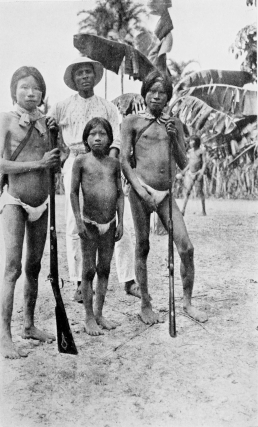
HUITOTOS AT ENTRE RIOS AND BARBADOS NEGRO OVERSEER.
[To face p. 296.
“The regular station hands—that is to say, the employees in receipt of
salaries—do no work. Their duties consist in seeing that the
surrounding forest Indians work rubber and supply them so far as may be
with what they need. For this purpose the principal requisite is a rifle
and a sufficiency of cartridges, and of these there are always plenty.”
A further Report was transmitted by Consul Casement to Sir Edward Grey
in March, 1911, giving a general description of methods of
rubber-collecting and treatment of Indians on the Putumayo by the
Peruvian Amazon Company, containing the following information:—
“The region termed ‘the Putumayo,’ consisting principally of the area
drained by two tributaries of the Iça or Putumayo River, the Igaraparaná
and the Caraparaná, lies far from the main stream of the Amazon, and is
rarely visited by any vessels save those belonging to the Peruvian
Amazon Company. The only other craft that penetrate that district are
steamers of the Peruvian Government sent occasionally from Iquitos.
Brazilian vessels may ascend the Japurá, known in Peru and Colombia as
the Caquetá, until they draw near to the mouth of the Cahuinari, a river
which flows into the Japurá, flowing in a north-easterly direction
largely parallel with the Igaraparaná, which empties into the Putumayo
after a south-easterly course. The region drained by these three
waterways, the Caraparaná, the Igaraparaná, and the Cahuinari,
represents the area in part of which the operations of the Peruvian
Amazon Company are carried on. It is impossible to say what the Indian
population of this region may be. Generally speaking, the upper and
middle courses of these rivers are, or were, the most populous regions.
This is accounted for by the greater absence of insect pests, due to the
higher nature of the ground, which rises at La Chorrera to a level of
about 600 feet above the sea, with neighbouring heights fully 1,000 feet
above sea-level. The lower course of the Igaraparaná, as well as of the
Putumayo itself, below the junction of the Igaraparaná down to the
Amazon, is through a thick forest region of lower elevation, subject
largely to annual overflow from the flooded rivers. Mosquitoes and sand
flies and the swampy soil doubtless account for the restriction of the
Indians to those higher and drier levels which begin after the
Igaraparaná has been ascended for about one hundred miles of its course.
In this more elevated region there are no mosquitoes and far fewer
insect plagues, while permanent habitations and the cultivation of the
soil are more easily secured than in the regions liable to annual
inundation.
“In a work officially issued by the Peruvian Government at Lima in 1907,
entitled ‘En el Putumayo y sus Afluentes,’ by Eugenio Robuchon, a French
explorer who was engaged in 1903 by Señor Julio C. Arana in the name of
the Government to conduct an exploring mission in the region claimed by
the firm of Arana Brothers, the Indian population of that firm’s
possessions is given at 50,000 souls. M. Robuchon lost his life near the
mouth of the Cahuinari in 1906, and the work in question was edited from
his diaries by Señor Carlos Rey de Castro, Peruvian Consul-General for
Northern Brazil. The figure of 50,000 Indians is that given by this
official as ‘not a chance one.’
“In the prospectus issued at the formation of the Peruvian Amazon Rubber
Company in 1908, Señor Arana is represented as claiming that there were
then 40,000 Indian ‘labourers’ dwelling within the area of his Putumayo
enterprise.
“Whatever the true figures may have been, it is certain that the region
laying between the Putumayo and the Japurá (or Caquetá) was for many
years known to be prolific in native life, and furnished therefore the
most attractive field for slave-raiding in the earlier years of the last
century. No civilised settlements would seem to have arisen in this
region until towards the close of the nineteenth century, and the Indian
tribes continued to dwell in their primitive state, subject only to
visits from slave-searching white or half-breed bands until a quite
recent period.
“The four principal tribes were the Huitotos (pronounced Witotos), the
Boras, the Andokes, and the Ocainas, with certain smaller tribes, of
which the Ricigaros and the Muinanes are frequently mentioned. These
tribes were all of kindred origin and identical in habits and customs,
although differing in language and to some extent in feature,
complexion, and stature. The Huitotos are said to have been the most
numerous, and may at one time recently have numbered 30,000 individuals,
although to-day they amount to nothing like that figure.
“The Huitotos, although the most numerous, were physically the least
sturdy of the four chief tribes named. The name ‘Huitotos’ is said to
signify ‘Mosquito,’ I know not with what truth, and to have been applied
to these people by their stouter neighbours in derision of their
attenuated extremities, for neither their arms nor legs are shapely or
muscular. The Boras are physically a much finer race than the Huitotos,
and, generally speaking, are of a lighter hue. While some of the
Huitotos are of a dark bronze or chocolate complexion, I have seen Boras
little, if at all, of darker skin than a Japanese or Chinese. The
Mongolian resemblance was not alone confined to similarity of colour,
but was often strikingly apparent in features as well as in stature,
and in a singular approximation of gait to what may be termed ‘the
Asiatic walk.’ So, too, with the hair and eyes. Both are singularly
Mongolian, or at least Asiatic, in shape, colour, and, the former, in
texture, although the Indian hair is somewhat less coarse and more
abundant than either Chinese or Japanese.
“A picture of a Sea Dyak of Borneo using his sumpitan, or blow-pipe,
might very well stand for an actual presentment of a Boras Indian with
his cerbatana. The weapons, too, are identical in structure and use,
and in several other respects a striking similarity prevails between two
races so widely sundered.
“These Putumayo Indians were not only divided tribe from tribe, but
within each tribe more or less constant bickerings and disunion
prevailed between the various ‘families’ or naciones into which each
great branch was split up. Thus, while Huitotos had a hereditary feud
with Boras, or Ocainas, or Andokes, the numerous subdivisions of the
Huitotos themselves were continually at war with one another. Robuchon
enumerates thirty-three sub-tribes or families among the Huitotos, and
he by no means exhausts the list. Each of these, while intermarriage was
common and a common sense of origin, kinship, and language prevailed as
against all outsiders, would have their internal causes of quarrel that
often sharply divided neighbour from neighbour clan.
“Such conflicts led to frequent ‘wars,’ kidnappings and thefts of women
being, doubtless, at the bottom of many disputes, while family
grievances and accusations of misuse of occult powers, involving
charges of witchcraft and sorcery, made up the tale of wrong. As a rule,
each family or clan has its great central dwelling-house, capable often
of housing two hundred individuals; and around this, in the region
recognised by tribal law as belonging to that particular clan,
individual members of it, with their families, would have smaller
dwellings scattered at different cultivated spots through the
neighbouring forest. The wars of those clans one with another were never
bloodthirsty, for I believe it is a fact that the Amazon Indian is
averse to bloodshed, and is thoughtless rather than cruel. Prisoners
taken in these wars may have been, and no doubt were, eaten, or in part
eaten, for the Amazon cannibals do not seem to have killed to eat, as is
the case with many primitive races, but to have sometimes, possibly
frequently, in part eaten those they killed. More than one traveller in
tropical South America records his impression that the victims were not
terrified at the prospect of being eaten, and in some cases regarded it
as an honourable end. Lieutenant Maw mentions the case of a girl on the
Brazilian Amazon in 1827 who refused to escape, to become the slave of a
Portuguese ‘trader,’ preferring to be eaten by her own kind.
“The weapons of the Putumayo Indians were almost entirely confined to
the blow-pipe, with its poisoned darts, and small throwing-spears with
poor wooden tips, three or more of which, grasped between the fingers,
were thrown at one time. The forest must have been fairly full of game
up to quite recently, for the Indians seem to have had a sufficiency of
meat diet; and, with their plantations of cassava, maize, and the
numerous fruits and edible leaves their forest furnished, they were not
so short of food that cannibalism could be accounted for as a necessity.
They were also skilled fishermen, and as the forests are everywhere
channelled with streams of clear water, there must have been a frequent
addition of fish diet to their daily fare.
“No missions or missionaries would seem to have ever penetrated to the
regions here in question. On the upper waters of the Putumayo itself
religious instruction and Christian worship appear to have been
established by Colombian settlers, but these civilising influences had
not journeyed sufficiently far downstream to reach the Huitotos or their
neighbours. Save for the raids of slavers coming up the Japurá or
Putumayo, their contact with white men had been a distant and far-off
story that in little affected their home life, save possibly to add an
element of demoralisation in the inducements offered for the sale of
human beings.
“Lieutenant Maw, an officer of the British Navy who crossed from the
Pacific to the Atlantic by way of the Amazon early in the last century,
in his work speaks of the Putumayo in the vaguest terms, and it is clear
that then, in 1827, and later on in 1851, when Lieutenant Herndon, of
the United States Navy, went down the Amazon in a canoe, nothing was
really known either of the river or of its inhabitants. They were
practically an untouched, primitive people when the first Colombian
caucheros, coming down the Putumayo from the settled regions on its
upper waters, located themselves at different points along the head
waters of the Caraparaná and Igaraparaná, and entered into what are
termed trade dealings with those unsophisticated tribes.
“This first Colombian invasion of the Putumayo regions took place, I am
informed, in the early eighties, some of my informants stated about
1886. The earliest of these conquistadores were Crisóstomo Hernandez
and Benjamin Larrañaga, who entered the region in search of the inferior
kind of rubber there produced, known as sernambi or jebe debil
(weak, fine rubber). The banks of these two rivers, and the whole of the
region inhabited by the Huitotos, the Andokes, and the Boras Indians,
are fairly well stocked with trees that furnish the milk out of which an
inferior rubber is elaborated. The Putumayo Indians merely gash the tree
with a knife or machete, and, catching the milk as it exudes in little
baskets made of leaves, they wash it in their streams of running water
and pound it with wooden pestles into long sausage-shaped rolls, termed
in Peruvian rubber parlance chorizos, which ultimately are put upon
the market just as the Indian carries them in to whoever may be locally
exploiting him and his neighbourhood. That these wild Indians welcomed
the coming into their country of Hernandez, Larrañaga, and the other
Colombians who succeeded these earliest of the modern conquistadores
it would be absurd to assert. They were, doubtless, glad to get
machetes, and powder and caps for the few trade guns they possessed,
with the prospect even of acquiring more of these priceless weapons
themselves, along with such trifles as beads, mirrors, tin bowls,
fish-hooks, and tempting tins of sardines or potted meats—all of them
articles of little intrinsic value, but of very attractive character to
the Indian dwelling in so inaccessible a region. Had any form of
administrative authority accompanied the early settlers or searchers for
Indians, as they should rightly be termed, their relations with these
wild inhabitants of the forest might have been controlled and directed
to some mutually useful end. But the caucheros came as filibusters,
not as civilisers, and were unaccompanied by any executive officers
representing a civilised control. The region was practically a no-man’s
land, lying remote from any restraining authority or civilising
influence, and figuring on maps of South America as claimed by three
separate republics.
“Those who came in search of rubber had no intention of dwelling longer
in the forest than the accumulation of the wealth they hoped to amass
necessitated. They wanted to get rich quickly, not to stay and civilise
the Indians or make their homes among them. The rubber-trees of
themselves were of no value; it was Indians who could be made or induced
to tap them and to bring in the rubber on the white man’s terms that all
the invading conquistadores were in search of. Generally a leading man
fitted out an expedition with a few companions, partners in effort and
initial expenditure; and with a gang of hired peons, or, as they are
called in that region, racionales (half-breeds mostly who can read and
write to distinguish them from the Indios, who are ignorant of all
save forest lore), he journeyed to some part of the forest in search of
tribes of wild Indians—infieles or “infidels”—who could be easily
subdued and reduced to work the wild rubber-trees in the territory they
inhabited. An Indian would promise anything for a gun, or for some of
the other tempting things offered as inducements to him to work rubber.
Many Indians submitted to the alluring offer only to find that once in
the conquistadores’ books they had lost all liberty, and were reduced
to unending demands for more rubber and more varied tasks. A cacique or
capitán might be bought over to dispose of the labour of all his clan,
and as the cacique’s influence was very great and the natural docility
of the Indian a remarkable characteristic of the Upper Amazon tribes,
the work of conquering a primitive people and reducing them to a
continual strain of rubber-finding was less difficult than might at
first be supposed. Their arms of defence were puerile weapons as opposed
to the rifles of the blancos.”
The terrible floggings practised upon the Indians are lengthily
described by Consul Casement, and it is said that 90 per cent, of them,
men and women, bear scars therefrom.
Further describing the outrages committed, Mr. Casement quotes from the
Annual Report of the Minister of Justice, presented to the Peruvian
Congress in 1907:—
“Coming to more distant regions, where executive authority is
necessarily weaker, the missionary brother informs the Minister of
Justice of the state of things on the Putumayo itself:—
“‘River Putumayo. In this river it is not possible to establish any
mission owing to the abuses of the caucheros against the Indians
(los infieles), whom they maltreat and murder for no reason (por
motivos frivolos), seizing their women and children.’ (P. 782 of the
Ministerial Report.)
“Lest this may be thought a vague indictment, I append a further extract
from the same Report, this time directed by the Apostolic Prefect of the
district of San Francisco de Ucayali to the Minister of Justice. It is
dated from Contamana, on the Ucayali, the chief place of the province,
on the 27th August, 1907, and deals at some length with the condition of
religion and education on that great river, the main feeder and source
of the Amazon, and one that has been largely occupied and in civilised
hands for the better part of the last century:—
“‘Before speaking of the region of the Ucayali I wish to draw the
attention of the Supreme Government to the infamous trade in buying and
selling boys and girls which for years has been practised in these parts
of the montaña (i.e., the forest region), in spite of the repeated
prohibitions of the Government, just as if these poor savages were
irrational beings (seres irracionales), or, to be still more clear,
just as if they were sheep or horses. This is intolerable in such an
illustrious country as Peru. This trade excites and foments the hunting
(correrías, literally “chasings”) so frequently indulged in of these
poor savages, so as to seize them in their houses in the moment when
they least expect it. This is done by different traders (comerciantes)
by means of their peóns, particularly some of those of the Upper
Ucayali. I could cite many examples in confirmation of this, but I will
cite one alone which took place last year (1906). Here it is:—
“‘The Campas Indians of the River Ubiriqui were dwelling peacefully in
their houses when suddenly, as is reported, there fell upon them men
sent on a correría by one of the traders of the Upper Ucayali, who
lives near Unini. These, without warning, attacked the innocent Campas,
seizing those whom they could, killing many of them so that few escaped
their cruelties, so that even up to now the number of their victims is
not known. It is certain that many bodies have been found in a state of
putrefaction, and that all the houses of the Ubiriqui are burnt. These
deeds have exasperated the Indians (los infieles), and if no effective
remedy is applied, later on we shall not be safe even in the mission
villages (pueblocitos de la misión), nor shall we be able to spread
our winning over and civilising of the savages who dwell in our
forests.’ (P. 783 and following of the Report.)
“I do not know what steps were taken to deal with this state of things
on the Upper Ucayali, but no steps of any kind followed on the Putumayo
the notification, as quoted, made to the Minister of Justice by Frei
Prat. That the representations of these Peruvian missionaries had not
escaped the eyes of the Minister himself is clear from his own remarks.
In his prefatory address to the members of Congress the Minister of
Justice states in his Report (p. 48 of the Part Instrucción y Culto)
as follows:—
“‘The apostolic prefectures have continued their work of civilisation
and evangelisation of the Indians of the Oriente, and in their reports,
which are inserted as an annex, will be found detailed accounts of its
progress.’”
Consul Casement continues:—
“Before my visit ended more than one Peruvian agent admitted to me that
he had continually flogged Indians, and accused more than one of his
fellow-agents by name of far greater crimes. In many cases the Indian
rubber-worker—who knew roughly what quantity of rubber was expected of
him—when he brought his load to be weighed, seeing that the needle of
the balance did not touch the required spot, would throw himself face
downwards on the ground, and in that posture await the inevitable blows.
An individual who had often taken part in these floggings and who
charged himself with two murders of Indians has thus left on record the
manner of flogging the Indians at stations where he served. I quote this
testimony, as this man’s evidence, which was in my possession when I
visited the region, was amply confirmed by one of the British subjects I
examined, who had himself been charged in that evidence with flogging an
Indian girl whom the man in question had then shot, when her back after
that flogging had putrefied, so that it became ‘full of maggots.’ He
states in his evidence—and the assertion was frequently borne out by
others I met and questioned:—
“‘The Indian is so humble that as soon as he sees that the needle of the
scale does not mark the 10 kilos he himself stretches out his hands and
throws himself on the ground to receive the punishment. Then the chief
or a subordinate advances, bends down, takes the Indian by the hair,
strikes him, raises his head, drops it face downwards on the ground, and
after the face is beaten and kicked and covered with blood the Indian is
scourged.’
“This picture is true; detailed descriptions of floggings of this kind
were again and again made to me by men who had been employed in the
work. Indians were flogged, not only for shortage in rubber, but still
more grievously if they dared to run away from their houses, and, by
flight to a distant region, to escape altogether from the tasks laid
upon them. Such flight as this was counted a capital offence, and the
fugitives, if captured, were as often tortured and put to death as
brutally flogged. Expeditions were fitted out and carefully planned to
track down and recover the fugitives, however far the flight might have
been. The undisputed territory of the neighbouring Republic of Colombia,
lying to the north of the River Japurá (or Caquetá), was again and again
violated in these pursuits, and the individuals captured were not always
only Indians.
“The crimes alleged against Armando Normand, dating from the end of the
year 1904 up to the month of October, 1910, when I found him in charge
of this station of Matanzas or Andokes, seem wellnigh incredible. They
included innumerable murders and tortures of defenceless
Indians—pouring kerosene oil on men and women and then setting fire to
them, burning men at the stake, dashing the brains out of children, and
again and again cutting off the arms and legs of Indians and leaving
them to speedy death in this agony. These charges were not made to me
alone by Barbados men who had served under Normand, but by some of his
fellow-racionales. A Peruvian engineer in the company’s service
vouched to me for the dashing out of the brains of children, and the
chief representative of the company, Señor Tizon, told me he believed
Normand had committed ‘innumerable murders’ of the Indians.
“Westerman Leavine, whom Normand sought to bribe to withhold testimony
from me, finally declared that he had again and again been an
eye-witness of these deeds—that he had seen Indians burned alive more
than once, and often their limbs eaten by the dogs kept by Normand at
Matanzas. It was alleged, and I am convinced with truth, that during the
period of close on six years Normand had controlled the Andokes Indians
he had directly killed ‘many hundreds’ of those Indians—men, women, and
children. The indirect deaths due to starvation, floggings, exposure,
and hardship of various kinds in collecting rubber or transferring it
from Andokes down to Chorrera must have accounted for a still larger
number. Señor Tizon told me that ‘hundreds’ of Indians perished in the
compulsory carriage of the rubber from the more distant sections down to
La Chorrera. No food is given by the company to these unfortunate people
on these forced marches, which, on an average, take place three times a
year. I witnessed one such march, on a small scale, when I accompanied a
caravan of some two hundred Andokes and Boras Indians (men, women, and
children) that left Matanzas station on the 19th of October to carry
their rubber that had been collected by them during the four or five
preceding months down to a place on the banks of the Igaraparaná, named
Puerto Peruano (Peruvian Port), whence it was to be conveyed in lighters
towed by a steam launch down to La Chorrera. The distance from Matanzas
to Puerto Peruano is one of some forty miles, or possibly more. The
rubber had already been carried into Matanzas from different parts of
the forest lying often ten or twelve hours’ march away, so that the
total journey forced upon each carrier was not less than sixty miles,
and in some cases probably a longer one. The path to be followed was one
of the worst imaginable—a fatiguing route for a good walker quite
unburdened.
“For two days—that is to say, from Matanzas to Entre Rios—I marched
along with this caravan of very unhappy individuals, men with huge loads
of rubber weighing, I believe, sometimes up to 70 kilos each,
accompanied by their wives, also loaded with rubber, and their sons and
daughters, down to quite tiny things that could do no more than carry a
little cassava-bread (prepared by the mothers before leaving their
forest home), to serve as food for parents and children on this trying
march. Armed muchachos, with Winchesters, were scattered through the
long column, and at the rear one of the racionales of Matanzas, a man
named Adan Negrete, beat up the stragglers. Behind all, following a day
later, came Señor Normand himself, with more armed racionales, to see
that none fell out or slipped home, having shed their burdens of rubber
on the way. On the second day I reached Entre Rios in the early
afternoon, the bulk of the Indians having that morning started at 5.15
from the place where we had slept together in the forest. At 5.15 that
evening they arrived with Negrete and the armed muchachos at Entre
Rios, where I had determined to stay for some days. Instead of allowing
these half-starved and weary people, after twelve hours’ march,
staggering under crushing loads, to rest in this comparatively
comfortable station of the company, where a large rest-house and even
food were available, Negrete drove them on into the forest beyond, where
they were ordered to spend the night under guard of the muchachos.
This was done in order that a member of the company’s commission (Mr.
Walter Fox), who was at Entre Rios at the time along with myself, should
not have an opportunity of seeing too closely the condition of these
people—particularly, I believe, that we should not be able to weigh the
loads of rubber they were carrying. I had, however, seen enough on the
road during the two days I accompanied the party alone to convince me of
the cruelty they were subjected to, and I had even taken several
photographs of those among them who were more deeply scarred with the
lash.
“Several of the women had fallen out sick on the way, and five of them I
had left provided for with food in a deserted Indian house in the
forest, and had left an armed Barbados man to guard them until Señor
Tizon, to whom I wrote, could reach the spot, following me from Matanzas
a day later. An opportunity arose the next day to weigh one of these
loads of rubber. A straggler, who had either fallen out or left Matanzas
after the main party, came into Entre Rios, staggering under a load of
rubber, about mid-day on the 21st October, when Mr. Fox and I were about
to sit down to lunch. The man came through the hot sun across the
station compound, and fell before our eyes at the foot of the ladder
leading up to the veranda, where, with the chief of the section (Señor
O’Donnell), we were sitting. He had collapsed, and we got him carried
into the shade and revived with whisky, and later on some soup and food
from our own table. He was a young man, of slight build, with very thin
arms and legs, and his load of rubber by no means one of the largest I
had seen actually being carried. I had it weighed there and then, and
its weight was just 50 kilos.[126]
“This man had not a scrap of food with him. Owing to our intervention he
was not forced to carry on his load, but was permitted the next day to
go on to Puerto Peruano empty-handed in company with Señor Normand. I
saw many of these people on their way back to their homes some days
later after their loads had been put into the lighters at Puerto
Peruano. They were returning, footsore and utterly worn out, through the
station of Entre Rios on their way back to their scattered houses in the
Andokes or Boras country. They had no food with them, and none was given
to them at Entre Rios. I stopped many of them, and inspected the little
woven string or skin bags they carry, and neither man nor woman had any
food left. All that they had started with a week before had been already
eaten, and for the last day or two they had been subsisting on roots and
leaves and the berries of wild trees they had pulled down on the way. We
found, on our subsequent journey down to Puerto Peruano, a few days
later, many traces of where they had pulled down branches and even trees
themselves in their search for something to stay the craving of hunger.
In some places the path was blocked with the branches and creepers they
had torn down in their search for food, and it was only when Señors
Tizon and O’Donnell assured me that this was done by ‘Señor Normand’s
Indians’ in their hungry desperation that I could believe it was not the
work of wild animals.
“Indians were frequently flogged to death. Cases were reported to me
where men or women had died actually under the lash, but this seems to
have been infrequent. Deaths due to flogging generally ensued some days
afterwards, and not always in the station itself where the lash had been
applied, but on the way home to the unfortunate’s dwelling-place. In
many cases where men or women had been so cruelly flogged that the
wounds putrefied the victims were shot by one of the racionales acting
under the orders of the chief of the section, or even by this individual
himself. Salt and water would be sometimes applied to these wounds, but
in many cases a fatal flogging was not attended even by this poor effort
at healing, and the victim, ‘with maggots in the flesh,’ was turned
adrift to die in the forest or was shot and the corpse burned or
buried—or often enough thrown into the ‘bush’ near the station-houses.
At one station—that of Abisinia (which I did not visit)—I was informed
by a British subject who had himself often flogged the Indians that he
had seen mothers flogged, on account of shortage of rubber by their
little sons. These boys were held to be too small to chastise, and so,
while the little boy stood terrified and crying at the sight, his mother
would be beaten ‘just a few strokes’ to make him into a better worker.
“Men and women would be suspended by the arms, often twisted behind
their backs and tied together at the wrists, and in this agonising
posture, their feet hanging high above the ground, they were scourged on
the nether limbs and lower back. The implement used for flogging was
invariably a twisted strip, or several strips plaited together, of dried
tapir-hide, a skin not so thick as the hippopotamus-hide I have seen
used in Africa for flagellation, but still sufficiently stout to cut a
human body to pieces. One flogger told me the weapon he used was ‘as
thick as your thumb.’
“After the prohibition of flogging by circular I have referred to, at
some of the less brutal or more cautious centres of rubber-collection
defaulting Indians were no longer, during the months of 1910, flogged
with tapir-hide, but were merely chastised with strokes of a machete.
These machetes are almost swords, and shaped something like a cutlass.
They are used for gashing the trees in tapping them for rubber milk, and
they also serve as weapons in the hands of the Indians. Blows with these
laid across the shoulder-blades or back might be excessively painful,
but would be unlikely to leave any permanent scar or traces of the
beating. At the station of Occidente this form of beating had in June,
1910, been varied with a very cowardly torture instituted by the chief
of that section, a Peruvian named Fidel Velarde. This man, who was found
in charge of that section when I visited it in October, 1910, in order
to still inspire terror and yet leave no trace on the bodies of his
victims, since Occidente lay close to La Chorrera and might be visited
unexpectedly by Señor Tizon, had devised a new method of punishment for
those who did not bring in enough rubber to satisfy him. Their arms were
tied behind their backs, and thus pinioned they were taken down to the
river (the Igaraparaná), and forcibly held under water until they became
insensible and half-drowned. One of the Barbados men related
circumstantially how on the 20th of June, 1910, only a few hours after
Señor Tizon had quitted Occidente on a visit of inspection proceeding
upriver to Ultimo Retiro, four Indian youths had been ordered by Velarde
to be taken down to the river, their arms tied together, and to be then
held under water until they filled—or, as James Mapp, the Barbados man
put it, until ‘their bowels filled with water.’ Mapp had been ordered to
perform this task, and had point-blank refused to obey, declaring he
would not lay a finger on the Indians, whereupon a racional employee,
by name Eugenio Acosta (whom I had met at Occidente), had carried out
Señor Velarde’s orders. The four Indians, with their arms tied, had been
thrust into the river by Acosta and an Indian he forced to help him and
held forcibly under water. The whole station and the kinsmen of the four
Indians were gathered on the high bank to witness this degrading
spectacle, the Indian women weeping and crying out. One of the young men
in his struggles had kicked free from the grasp of the man holding him
down, and as his arms were fastened he had been unable to save himself
by swimming, and had sunk in the deep, strong current at the spot
described.
“Indians were often flogged while confined in the cepo, this notably
in the special flogging cepo, with movable extremities, made by order
of Aurelio Rodríguez at Santa Catalina, and referred to by its maker,
Edward Crichlow, in his testimony to me. Sometimes the most abominable
offences were committed upon Indians while held by the legs or leg in
this defenceless position (see particularly the statement of James
Chase, borne out by Stanley Lewis, as to the crime committed by José
Inocente Fonseca at Ultimo Retiro upon a young Indian man). Some of the
British subjects I questioned declared to me that they had known Indian
women to be publicly violated by the racionales while in this state of
detention. As an added punishment, the legs of a man or woman would be
distended and confined several holes apart in the stocks—some of the
Barbados men asserted that they themselves had been confined with their
legs ‘five holes apart,’ a distance, I should say, intolerable to be
borne for any length of time. The Ultimo Retiro stocks were the worst I
saw, for the leg-holes were smaller, and the beams to have locked on any
ordinary sized leg must have forced down into the flesh.
“An individual confined with his legs ‘five holes apart’ would have had
them extended almost a yard at the extremities, and if confined for a
few hours in this posture, he must have been in acute pain. Indians who
spent long periods in the stocks were sometimes confined by only one
leg. Whole families were so imprisoned—fathers, mothers, and children,
and many cases were reported of parents dying thus, either from
starvation or from wounds caused by flogging, while their offspring were
attached alongside of them to watch in misery themselves the dying
agonies of their parents. One man at Ultimo Retiro, himself a living
witness to the enforced starvation he denounced, in the presence of
Señor Jiménez and his subordinates, related before me and the members of
the commission on the 8th of October how, in Señor Montt’s time, a year
previously, many of his countrymen and women had been so starved to
death or flogged to death in the station cepo that we were then
inspecting and experimenting with.
“Some of these agents drew fully £1,000 a year from the rubber they
forced by this means and by other lawless methods from the surrounding
native population.
“Flogging was varied with other tortures designed, like the
semi-drownings of Velarde, to just stop short of taking life while
inspiring the acute mental fear and inflicting much of the physical
agony of death. Thus, men and lads, rubber defaulters or fugitives from
its collection, were suspended by a chain fastened round the neck to one
of the beams of the house or store. Sometimes with the feet scarcely
touching the ground and the chain hauled taut they were left in this
half-strangled position until life was almost extinct. More than one
eye-witness assured me that he had seen Indians actually suspended by
the neck until when let down they fell a senseless mass upon the floor
of the house with their tongues protruding.
“Several informants declared they had witnessed Indians, chained round
the arms, hauled up to the ceilings of the houses or to trees, and the
chain then suddenly loosed so that the victim fell violently to the
ground. One case of this kind was circumstantially related to me where
the Indian, a young man, dropped suddenly like this from a height of
several feet, fell backwards, and his head hit the ground so violently
that his tongue was bitten through and his mouth full of blood.
“Deliberate starvation was again and again resorted to, but this not
where it was desired merely to frighten, but where the intention was to
kill. Men and women were kept prisoners in the station stocks until they
died of hunger.
“These starvations, as specifically related to me by men who witnessed
them and were aware of the gravity of the charge they brought, had not
been due to chance neglect, but to design. No food was given to the
Indians, and none could be given save by the chief of the section. One
man related how he had seen Indians thus being starved to death in the
stocks ‘scraping up the dirt with their fingers and eating it’; another
declared he had actually seen Indians who had been flogged and were in
extremity of hunger in the stocks ‘eating the maggots from their
wounds.’
“Wholesale murder and torture endured up to the end of Aurelio
Rodríguez’ service, and the wonder is that any Indians were left in the
district at all to continue the tale of rubber-working on to 1910. This
aspect of such continuous criminality is pointed to by those who, not
having encountered the demoralisation that attends the methods
described, happily infrequent, assert that no man will deliberately kill
the goose that lays the golden eggs. This argument would have force if
applied to a settled country or an estate it was designed to profitably
develop. None of the freebooters on the Putumayo had any such
limitations in his view, or care for the hereafter to restrain him. His
first object was to get rubber, and the Indians would always last his
time. He hunted, killed, and tortured to-day in order to terrify fresh
victims for to-morrow. Just as the appetite comes in eating so each
crime led on to fresh crimes, and many of the worst men on the Putumayo
fell to comparing their battues and boasting of the numbers they had
killed.
“Every one of these criminals kept a large staff of unfortunate Indian
women for immoral purposes—termed by a euphemism their ‘wives.’ Even
péons had sometimes more than one Indian wife. The gratification of
this appetite to excess went hand in hand with the murderous instinct
which led these men to torture and kill the very parents and kinsmen of
those they cohabited with.
“The Indian communities had been everywhere deprived of their native
weapons. Perhaps a greater defence than their spears and blow-pipes even
had been more ruthlessly destroyed. Their old people, both women and
men, respected for character and ability to wisely advise, had been
marked from the first as dangerous, and in the early stages of the
occupation were done to death. Their crime had been the giving of ‘bad
advice.’ To warn the more credulous or less experienced against the
white enslaver and to exhort the Indian to flee or to resist rather than
consent to work rubber for the new-comers had brought about their doom.
I met no old Indian man or woman, and few had got beyond middle age. The
Barbados men assured me that when they first came to the region in the
beginning of 1905 old people were still to be found, vigorous and highly
respected, but these had all disappeared, so far as I could gather,
before my coming. At Entre Rios I learned of an Indian chief named
Chingamui, who at Señor O’Donnell’s arrival in 1903 had exercised a
widespread influence over all the Huitotos in that district. This man
had fallen at the hands of a Colombian named Calderon, who then directed
the neighbouring district of Atenas, but not before he had shot at and
wounded his murderer. So, too, I learned of an ‘old woman’ who was
beheaded in the station of Sur by order of its chief, and whose crime
had been the giving of ‘bad advice.’ Her head had been held up by the
hair in the presence of my informant as a warning to the assembled
Indians of the fate they too would incur if they did not obey the white
man.
“Perhaps the bravest and most resolute opponent the murderers had
encountered had met his death only a few months, or even weeks, before
my arrival in the district. This was a Boras cacique, or
capitán—often referred to in the depositions of those I
examined—named Katenere. This man, who was not an old man, but young
and strong, lived on the upper waters of the Pamá, a small stream that
empties into the Cahuinari not far from its mouth in the Japurá. My
interpreter, Bishop, had seen this chief in 1907, when Normand had gone
to find him in order to induce him to work rubber. He had, from
necessity no doubt, consented to bring in rubber, and for some time had
worked voluntarily for Normand, until, through bad treatment, he, like
so many others, had fled. He had been captured later on, along with his
wife and some of his people, and confined in the stocks of the Abisinia
district, to undergo the taming process. While thus himself a prisoner,
his wife, so I was informed by a Peruvian white man holding a well-paid
post in the company’s service, had been publicly violated before his
eyes by one of the highest agents of the Syndicate, a Peruvian whose
name and record was frequently brought forward in the course of my
inquiry. This man had been obliged to fly from the Caraparaná agency on
account of his crimes in that region in 1908.
“As a rule, the criminals who controlled the Indian population of the
Putumayo were chary of robbing an Indian husband of his wife. The harems
were maintained mainly by orphans, generally girls whose parents were
‘dead.’ Asking once why it was that the wives of the Indians seemed
usually to be spared this contamination, a reliable witness answered me:
‘Because, sir, if they takes an Indian’s wife, that Indian don’t work
rubber.’ I urged that since these men stuck at no act of terrorisation
to make Indians work rubber, a husband could be forced, even if robbed
of his wife, to go and get rubber. ‘No, sir,’ my informant said, ‘the
Indians loves their wives, and if she is taken they won’t work rubber.
They can kill them, do anything they like to them, but the Indian won’t
work rubber.’
“This assertion was made more than once by men who, like this man, had
taken an active part in making Indians work rubber, and I believe that
this obstinate prejudice of the Indian preserved a native marriage from
invasion more surely than any respect the cauchero has for its
sanctity. An Indian marriage is not a ceremony, but a choice sanctioned
by the parents of the bride, and once a child or children result from
the union there is rarely infidelity or separation. The very conditions
of Indian life, open and above board, and every act of every day known
to wellnigh every neighbour, precluded, I should say, very widespread
sexual immorality before the coming of the white man. Certain it is that
immoral intercourse among Indians, leading their natural lives, is rare,
and as polygamy scarcely existed, only a few of the bigger men having
more than one wife, the affection that grew up between an Indian man and
his wife was very often sincere and deep-rooted, just as the love of
parents for their children was.
“The Indians often displayed a fortitude in the face of impending
torture and death that speaks for itself of the excellence of some of
their qualities. Thus, it will be seen in the depositions accompanying
this Report how, on more than one occasion, men had refused to betray
the hiding-place of fugitives under terrible threats of torture if they
did not point out the retreat of the runaways. Normand is charged with
having cut the arms and legs off a chief he captured and questioned, who
preferred to suffer such a death to betraying the refuge of those who
had fled. I learned of more than one case of the kind, and have no doubt
of the truth of the accusation against the white man as of the fortitude
of the Indian. The tribes of the Putumayo in the hands of good men could
be made into good men and women, useful and intelligent workers under an
honest administration. Trained to be murderers, with the worst example
men ever gave to men daily held up for imitation, with lust and greed
and cruelty so often appealed to, I daily wondered that so much goodness
still survived among the remnant we encountered. That that remnant
itself would soon be gone I became convinced. A Peruvian who spoke good
English, having spent some years in England, confessed as much to me two
days before I left Chorrera. I said to this man that under the actual
régime I feared the entire Indian population would be gone in ten years,
and he answered, ‘I give it six years—not ten.’
“The unrelieved barbarity of this Report does not rest alone on the
testimony of the Barbados men whose depositions accompany it. I had
other evidence to go by at the outset, and this was found to be in more
than one instance amply confirmed by the independent statements of the
British witnesses and again and again borne out by the evidence of our
own eyes and the general conditions of the Indians. Could these people
have been themselves fully interrogated, the weight of testimony would
have been far greater, but could not have been more convincing.
“A magistrate was said to be residing at one of the company’s stations
on that river, but I never heard him once referred to, and when
peculiarly atrocious crimes were dragged to light, admitted, and
deplored, the criminal charged with them would be sitting at table with
us, and the members of the company’s commission and myself were appealed
to to give no indication of our disgust lest this man ‘might do worse
things’ to the Indians or provoke an impossible situation with the armed
bandits under his orders. The apology for this extraordinary situation
was that there was ‘no authority, no administration, no one near to whom
any appeal could be made,’ and that Iquitos was 1,200 miles away. Every
chief of section was a law unto himself, and many of the principal
agents of this British company were branded by the representative of
that company, holding its power of attorney, in conversation with me as
‘murderers, pirates, and bandits.’”
A considerable part of Consul Casement’s Report is taken up with the
depositions, sworn before him, of the Barbados men; one of these, by
name Stanley Lewis, stated:—
“I have seen Indians killed for sport, tied up to trees and shot at by
Fonseca and the others. After they were drinking they would sometimes do
this. They would take a man out of the cepo and tie him to a tree, and
shoot him for a target. I have often seen Indians killed thus, and also
shot after they had been flogged and their flesh was rotten through
maggots.”
This man also described terrible barbarities committed on and murder of
two Indian girls by Fonseca. James Chase, another Barbados man, gave a
long account of Indians being flogged to death, starved, or shot, and
describes the terrible occurrence connected with the murdering of the
family of Katerene as follows:—
“They were also to hunt for a Boras Indian named Katenere, a former
rubber-worker of the district of Abisinia, who had escaped, and, having
captured some rifles, had raised a band of his fellow-Indians, and had
successfully resisted all attempts at his recapture. Katenere had shot
Bartolemé Zupaeta, the brother-in-law of Julio C. Arana, and was counted
a brave man and a terror to the Peruvian rubber-workers. The expedition
set out from Morelia, and at the first Indian ‘house’ they reached in
the forest they caught eight Indians, five men and three women. They
were all tied up with ropes, their hands tied behind their backs, and
marched on farther. At the next house they reached they caught four
Indians, one woman and three men. Vasquez, who was in charge, ordered
one of the muchachos to cut this woman’s head off. He ordered this for
no apparent reason that James Chase knows of, simply because ‘he was in
command, and could do what he liked.’ The muchacho cut the woman’s
head off; he held her by the hair of her head, and, flinging her down,
hacked her head off with a machete. It took more than one blow to sever
the head—three or four blows. The remains were left there on the path,
and the expedition went on with the three fresh male prisoners tied up
with the others. The date would be about May, 1910.
“They were then approaching the house where they believed Katenere to be
living. He was the chief of the Indians in whose direction they were
going—the fugitives from the rubber-work. At a point about half an
hour’s walk from this Indian house Vasquez ordered him, Ocampo, and two
of the muchachos to remain there to guard the prisoners, while he
himself (Vasquez) went on with the rest of the expedition. This party,
so Vasquez told them when he had returned, reached the house of Katenere
about six in the evening. Katenere and his wife, or one of his wives,
were in the house—only these two persons. Vasquez caught the woman, but
Katenere got away. Vasquez stayed there and sent four of the muchachos
into the forest to find and capture the rifles that Katenere had got.
When the muchachos got to this other house in the forest they found
several Indians in it, whom they captured, and four rifles. The Indians
were tied up with their hands behind them, but after a time the head
muchacho, a Boras Indian, nicknamed Henrique, ordered them to be
released. He then sent on his three muchachos to another house to
bring in some Indians whilst he stayed with the men whom he had just
released. These Indians, it should be noted, were all Boras Indians,
Henrique as well as the rest of the muchachos. Whilst Henrique was
with these men he found amongst them an Indian girl of whom he was very
fond and who had probably joined them in their flight. He endeavoured to
seize this girl, and in a quarrel that followed he was killed. The three
muchachos, on their return with two prisoners, found their leader
killed and his rifle in the hands of the released Indians, with the four
guns they already had belonging to Katenere. Each party fired at the
other, the forest Indians without effect. The three muchachos killed
two of the Boras Indians and then returned to the house where Vasquez
was spending the night and where he held the wife of Katenere prisoner.
In the morning Vasquez returned to Ocampo and Chase, bringing only this
woman with them. It was then that Chase learned from Vasquez’ own lips
what had happened. They had then, Chase states, twelve Indians as
prisoners, who included Katenere’s wife, and also of the original party
that left Abisinia two Indians, who were in chains, who had been brought
as guides to point out where Katenere and his fugitive people were
living. These were some of Katenere’s men who had not succeeded in
escaping when he got away. The whole party set out to return to Morelia
through the forest, having lost Henrique and his rifle. Soon after they
began their march in the morning they met in the path a child—a little
girl—who was said to be a daughter of Katenere by another wife he had
once had, not the woman they now held as prisoner. This child, Chase
states, was quite a young girl, some six or eight years of age. She was
frightened at the sight of the armed men, the Indians in chains and tied
up, and began to cry as they approached. Vasquez at once ordered her
head to be cut off. He knew it was Katenere’s child because Katenere’s
wife, in their hands, told them so. There was no reason that Chase knew
for their crime, save that the child was crying. Her head was cut off by
a muchacho named Cherey, a Recigiro Indian boy. He was quite a young
boy. They came on about half an hour’s march past that, leaving the
decapitated body in the path, and as one of the women prisoners they
had was not walking as fast as the rest Vasquez ordered a muchacho to
cut her head off. This was done by the same boy Cherey in the same way,
he flinging the woman on the ground and chopping her head off with
several blows of his machete. They left this body and severed head
right in the path and went on again towards Morelia. They were walking
very fast because they were a bit frightened, thinking the Indians were
pursuing them. One of the male Indian prisoners, a boy, about fifteen or
sixteen [Chase indicated the boy’s height with his hand], a lad who
could work rubber, was lagging behind and could not keep up with them as
they were going very fast. The Indian was hungry and probably weak.
Vasquez ordered his head to be cut off. This execution took place there
and then in the same way and was performed by the same boy Cherey. The
Indian’s hands were tied behind him. Cherey took hold of the lad’s long
hair, threw him on the ground, and cut his head off. They came on after
this towards Morelia, walking as fast as they could, and when they were
getting near it in the evening-time and perhaps three-quarters of an
hour’s distance Vasquez was in a great hurry to reach the station. Three
of the Indian men who were weak through hunger and not able to walk fast
could not keep up with them, so Vasquez himself shot one and he ordered
Cherey, the muchacho, to shoot the other two. These were all grown-up
men, Boras Indians, and belonging to Gavilanes, and were part of
Katenere’s people. The three bodies were left lying there on the path,
and the place where they were killed was so near Morelia that when they
reached it they learned that the station hands had heard the shots of
the rifles that had killed the men.
“They reached Morelia in the evening, and of their five prisoners three
were put with their feet in the cepo, while the fourth was hung up by
his neck with a chain round it. The chain was pulled taut over a beam in
the roof of the house, so that the man’s toes rested on the ground, but
he could not budge or even move his head. He had to stand like this with
his head and neck stretched up all night. Those in the cepo, two men
and a woman, also had chains round their necks. They got no food.”
Evidence confirmatory of James Chase’s statement with regard to this
expedition of Vasquez was subsequently obtained by the Consul-General
from other quarters. The Report continues:—
“Allan Davis, a Barbados man who was in Abisinia when Vasquez arrived
there, stated in his examination that Vasquez declared on arrival ‘he
had left the road pretty.’ Davis saw him arrive with the emaciated
prisoners, who were put in stocks, and all of whom subsequently met
their deaths in Abisinia, as averred by Davis and Evelyn Baston, another
Barbados man, whose testimony was subsequently taken. One of them was
murdered by being shot, and the others were deliberately starved to
death while confined in the stocks.
“Asked if he had seen women thus killed, he replied, ‘Yes. They were
shot and died from blows’ (from floggings). They were cut to pieces
sometimes and smelt dreadfully. Once he himself was put in cepo
alongside some of these rotting human beings who had been inhumanly
flogged, and the smell was so bad he begged and implored to be taken
out—he could not stand it—but Fonseca kept him in all night. He saw
these people die from these floggings; their bodies would sometimes be
dragged away and thrown in the bush around the station or burned. He has
seen the muchachos shoot Indians under the order of Fonseca. Continual
floggings went on at that time among women and children.
“Further statements were from time to time received from James Chase in
the course of the journey made by Mr. Casement in the company of the
commission, and finally on the 5th of November at La Chorrera he gave
still further testimony in the presence of several of his countrymen. He
states that amongst other things he saw Fonseca do was to kill an Indian
man who was at the time confined in the stocks, or cepo, at Ultimo
Retiro. The Indian in question had run away from working rubber, but had
been caught and brought in a prisoner. Fonseca said to him, ‘I am going
to kill you.’ The man protested, and said he had done no harm. He had
not killed a white man, he had not injured any one or killed any one,
and could not be killed for running away. Fonseca laughed at him, and
had him hung up by the neck first with a chain drawn tight, and then
when let down from this torture he had him put in the cepo with one
foot only, the other leg being free. Fonseca came up to the cepo with
a stick with a club head much bigger than the handle of the stick. He
put one of his legs against the Indian’s free leg and stretched it apart
from the confined leg. He then pulled off the man’s fono, or
loin-cloth made of beaten bark, so that he was quite naked, and then
struck the man many times with the club-end of the stick on his exposed
parts. These were ‘smashed,’ and the man died in a short time. Deponent
described the occurrence fully, declaring that he was an eye-witness.
“This statement was confirmed by the Barbados man, Stanley S. Lewis, who
stated he also saw Fonseca commit this deed.
“Chase states that Fonseca at Ultimo Retiro would shoot Indians with a
long rifle which he had. He thinks it was a Mannlicher. Sometimes he
shot at them whilst they were actually prisoners in the stocks, and
others were taken out in the open ground round the house, and he shot at
them from the veranda. The last case of this kind that Chase witnessed
was that of a young girl. Fonseca bandaged her eyes and face so that
even her mouth and nose were covered. She was then made to walk away,
and whilst she was thus blindfolded Fonseca shot her ‘as a sport for his
friends.’
“Chase further states that he has seen Aquiléo Torres cut the ears off
living Indians for sport. Torres took deponent’s own knife from him. It
was an open knife, and he used this knife for the purpose. He saw him do
this several times. Once he cut off a man’s ears and then burned his
wife alive before his eyes. This was done by Torres.
“In the summer of 1909 Chase accompanied Torico on a journey. Asked what
they were doing, he states that Torico, he thinks, was going round on a
sort of inspection for Macedo, or else to give warning to all the
sections that things must be put straight, because an Englishman,
Captain Whiffen, was then in the country and visiting the company’s
territories. He remembers Torico taking the names of the Indians at each
station, and talking to the agents about Captain Whiffen’s coming. Chase
states that he was with Sealey in the expedition under Jiménez, later
described.”
Stanley Sealey, another Barbados, described to the Consul a rubber raid
and its results in the following terrible story:—
“A party of armed employees is sent out to collect the Indians of a
certain division on the day when their puesta of rubber is due, and to
march them into the station with their loads of rubber, after this has
been weighed and found sufficient. The man in charge of the expedition
will have a list of the Indians he is to collect, and the amount of
rubber each is to bring in, and he proceeds to summon or find them. They
call the chief, or capitán, of these Indians, and if all his people do
not appear with him he may be put in the cepo, made out in the forest,
and kept guarded there. Sometimes he, deponent, and others of the
expedition would be sent to look for the missing Indians. If the Indians
do not all come in, the capitán will be treated in a variety of ways.
Sometimes they tie his hands behind his back, and then by a rope through
his bound wrists he will be hauled up off the ground, the rope passing
over a tree-branch. Sometimes his feet would be three or four feet off
the ground. They kept him in this position for sometimes an hour or an
hour and a half, he screaming out with pain. This is to make him
confess where the missing Indians are. When he admits this, and says he
will go for the truants, they let him down, and, keeping him tied, they
go with him to where the people are hiding. If they find his people,
they may still keep him tied up. They do not then flog the Indians. They
collect all they can, those with the rubber, and those who have failed
to get it, and march them all down to the station. The arms of the
capitán will be loosed on reaching the station, but his legs put in
the cepo. Then they weigh the rubber, and if any man has not brought
the right weight he is flogged. The severity of the flogging depends on
the amount of rubber the man is short. The deponent has not seen more
than two dozen stripes thus given. With regard to the Indians who had
not appeared in the first instance, and had to be collected, they would
be flogged and put in the cepo; they would get ‘a good flogging.’
Sometimes the capitán himself would be flogged in the station. Whole
families would be marched down in these gatherings, men with their wives
and children who would help the men with their rubber. On all these
marches the Indians would have to carry their own food too; they get no
food except what they bring themselves. They would only get food from
the white men during the time they are actually kept in the station. The
station would have a big pot of rice and beans boiled. This would be the
food. He has seen sometimes one hundred and fifty people thus marched
in. Those who have brought the fixed amount of rubber are allowed to go
back after this meal. The others are punished by being kept in cepo.
Some are put in a hole in the cellars of the house. There is such a
hole at Ultimo Retiro which the Consul can see when he gets there.
“The Indians are not paid at all on these occasions for such rubber as
they bring in. They only get payment when the full fabrico—say,
seventy-five days—is completed. These commissions take place sometimes
every ten days, sometimes every fifteen days, according to the period
fixed for each puesta, depending on the neighbourhood. Sealey gives
this as a general indication of the manner in which he has been employed
on ‘commissions’ and collecting the Indians from the forest. He next
states he wishes to describe what took place on a certain occasion when
he with other Barbados men went on a commission from Abisinia under
Jiménez. They were stationed at Morelia at the time, and went under
Jiménez to the Caquetá. It was a journey to catch fugitive Indians who
had fled from the rubber-working, and was soon after Sealey had gone to
Abisinia; he thinks it was in June, 1908. On the first day’s march from
Morelia, about five o’clock in the afternoon, when they were some one
and a half day’s distance from the Caquetá, they caught an old Indian
woman in the path. Jiménez asked the old woman where the rest of the
Indians were. Sealey states she was a bit frightened. She told him that
the next day at eleven o’clock he would get to the house where some
Indians were. She was an old woman, not able to run. They did not tie
her up. They went on with her, keeping her all night in camp until about
two o’clock of the next day, and then Jiménez asked her, ‘Where is the
house; where are the Indians?’ The old woman stood up, and said
nothing. She could not speak; she kept her eyes on the ground. Jiménez
said to her: ‘You were telling me lies yesterday, but now you have got
to speak the truth.’ With that he called his wife—he had an Indian
woman, the woman who is still with him—and he said to his wife: ‘Bring
me that rope off my hammock.’ She took the rope off and gave it to him,
and with that he tied the old woman’s hands behind her back. There were
two trees standing just like that—one there and one there. He made an
Indian cut a post to stretch across between the two trees. Then he
hauled the old woman up, her feet were not touching the ground at all.
He said to one of the boys, a muchacho: ‘Bring me some leaves—some
dry leaves,’ he said, and he put these under the feet of the old woman
as she hung there, her feet about a foot or so above the ground; and he
then take a box of matches out of his pocket and he light the dry
leaves, and the old lady start to burn. Big bladders [blisters] I see on
her skin up here’ (he pointed to his thighs). “All was burned; she was
calling out. Well, sir, when I see that, sir, I said, ‘Lord, have
mercy!’ and I run ahead that I could not see her no more.”
“You did not go back?”
“I stayed a little ways off to where she was. I could hear him speaking.
He say to one of the boys, ‘Loose her down now,’ and they loose her but
she was not dead. She lay on the ground—she was still calling out. He
tell one of the Indians: ‘Now, if this old woman is not able to walk,
cut her head off,’ and the Indian did so—he cut her head off.”
“You saw that?”
“Yes, sir, he leave her there in the same place. We left her there,
going a little ways into the forest; it was about four hours’ walk;
after we left the old woman we met two women. They had no house—they
had run away. One had a child. Jiménez axed the one that had the child:
‘Where is these Indians that has run away?’ she tell him that she don’t
know where they were. He tell her after she tell him that she don’t know
that she was a liar.”
“Did he tell her this himself in her own language?”
“He tell his wife to tell her. His wife speaks Spanish, too. His wife is
up there with him now at Ultimo Retiro. He tell his wife that she was a
liar. He took the child from the woman and he gave it to an Indian, one
of the Indians who had been collected to work rubber. ‘Cut this child’s
head off!’ he say, and he did so.”
“How did the Indian cut the child’s head off?”
“He held it by the hair and chop its head off with a machete. It was a
little child walking behind its mother.”
“Was it a boy or a girl?”
“It was a boy. He left the child and the head in the same place,
everything there, on the path. He went on then; he take the two women
with him, but the woman was crying for her child. Well, sir, we got a
little ways more inside the wood; walking, we met an Indian man—a
strong young fellow he was, too. That is, after we gets over to near
the Caguetá. Jiménez say he wanted to go to the next side—the other
side—of the Caquetá, but he do not know where he would get a boat, a
canoe, to go over. So this time he tell his woman, his wife, to ax the
Indian to tell where the boat is. Well, sir, the Indian say he do not
know where it is. By that time Jiménez say the Indian lie—he was a
liar, and he got a rope and he tie the Indian’s hands like that behind
his back. It was in the same way with the post across between two trees.
He made the Indians tie a post across between two trees, and he haul the
Indian, like that, up to the post. His feet could not touch the ground,
and he call for some dry leaves, and tell the boys to bring some dry
leaves, same as the old woman. He put the leaves under his feet, and he
take a box of matches out of his pocket. The man was there shouting out,
greeting. Jiménez draw a match and light the leaves, and this time, sir,
the Indian start to burn, big bladders going out from his skin. The
Indian was there burning, with his head hanging like that—moaning, he
was. Jiménez say: ‘Well, you will not tell me where the canoe, where the
boat is,’ he says, ‘so you must bear with that.’ Well, the Indian was
not quite dead, but was there with his head hanging, and Jiménez he tell
the capitán, by name José Maria, a Boras Indian [he is chief capitán
of the Abisinia muchachos]; he says, ‘Give him a ball!’ he says, and
the Indian took his carbine and give him a ball here, shooting him in
the chest. Well, sir, after I saw how the blood started, I ran. It was
awful to see, and he left the Indian hanging up there with the rope and
everything on him.”
“Was the Indian dead?”
“Yes, sir, he was dead with the ball, and we left him there in the same
place. That’s all.”
“Sealey states that he had reported these things to his
fellow-countryman, John Brown, who when he had reached Chorrera had
become the servant of a Captain Whiffen, an English officer who had
arrived there. He hoped that Captain Whiffen, hearing of it, might be
able to do something and so told John Brown.[127] Sealey states that
Chase was with him on the expedition.”
Another Barbados man’s (Westerman Leavine’s) examination includes the
following:—
“He confirms the statement made by Genaro Caporo, in the Truth charges
read out to him, who had declared what he saw in the middle of 1907. The
statement made by Caporo, that three old Indians and two young women,
their daughters, were murdered by Normand in cold blood and their bodies
eaten by the dogs, was corroborated by Leavine. He saw this take place,
and saw the dogs eating them. As to the starving to death of Indians in
the cepo, it was a common occurrence, and the dead and stinking bodies
left there alongside still living prisoners he declares he more than
once witnessed. The statement made by Caporo as to an Indian chief who
was burnt alive in the presence of his wife and two children, and the
wife then beheaded and the children dismembered, and all thrown on the
fire, Leavine says he remembers, and was a witness to it. He also
remembers the occurrence narrated by Caparo of an Indian woman who was
cut to pieces by Normand himself, because she refused to live with one
of his employees as he directed her to do. He was a witness to the woman
being set fire to with the Peruvian flag soaked in kerosene wrapped
round her, and of her then being shot. The statement made by Caporo as
to the ground round Andokes being sown with skulls was then read out by
the Consul-General to Leavine. He (Leavine) of himself stated that there
were days in 1906 and 1907 ‘when you could not eat your food on account
of the dead Indians lying around the house.’ He frequently saw the dogs
eating them, and dragging the limbs about. The bodies and arms were
thrown all round and were not buried.
“With regard to the statement of Roso España, read over to him from the
Truth charges, he saw one child rammed head first down one of the
holes being dug for the house timbers.
“The statement of Julio Muriedas, made in the same quarter, who stated
that he had been at Matanzas, was then read over to Leavine. He
remembers Muriedas. With regard to the statement that two hundred lashes
were given to Indians, Leavine says this often took place, also the
burning alive of children to make them reveal where their parents were
hidden. This he declares he has seen Señor Normand do more than once.
The eating of the limbs of the dead people by the house-dogs attested by
Muriedas he again confirms, and says it was ‘a common occurrence.’ The
statement of ‘M. G.,’ from the Truth accusations, was then read to
Leavine. He recalls this man, named Marcial, being a short time at
Matanzas when Señor Normand wished to make him a station cook, and this
man had refused and they had quarrelled. This man’s statement that he
had seen in one month and five days ‘ten Indians killed and burnt’
Leavine declares is in no wise remarkable. He has himself seen twenty
Indians killed in five days in Matanzas. As to the ‘stinking’ of this
section referred to by ‘M. G.’ he affirms that this was often the case
to a revolting degree. He recalls ‘M. G.,’ or Marcial, shooting the
little Indian boy by Señor Normand’s orders as he, ‘M. G.,’ accuses
himself of doing.
“Leavine finally declares that Señor Normand killed many hundreds of
Indians during his six years at Matanzas, during all which time he
(Leavine) served under him, and by many kinds of torture, cutting off
their heads and limbs and burning them alive. He more than once saw
Normand have Indians’ hands and legs tied together, and the men or women
thus bound thrown alive on a fire. The employees on the station would
look on or assist at this. The station boys, or muchachos, would get
the firewood ready, acting under Señor Normand’s orders. He saw Normand
on one occasion take three native men and tie them together in a line,
and then with his Mauser rifle shoot all of them with one bullet, the
ball going right through. He would fire more than one shot into them
like this.”
On arriving in London, in January, 1912, Consul Casement gave in a
further Report to the Foreign Office, of which the following are
extracts:—
“The managing director of the company at Iquitos, Señor Pablo Zumaeta,
against whom had been issued a warrant of arrest, had, I found, not
been arrested, but, with the connivance of the police, had merely
remained in his private residence at Iquitos during the hearing of an
appeal he was permitted to lodge. This appeal being considered by the
Superior Court of Iquitos during my stay there, resulted in the court
annulling the warrant issued by the Criminal Court below, and the return
to public life of the accused man without trial or public investigation
of the charges against him.”[128]
“Following my return to Iquitos in the 16th of October, an effort was
apparently made to arrest some twenty of those still employed by the
company on the Putumayo towards the very end of October and in the early
days of November. Although the localities where all of them were at work
were well known, the comisario or commissioner of the Putumayo, one
Amadéo Burga, a paid employee of the company, and a brother-in-law of
its managing director, in each case took action just too late, so that
all those incriminated were either absent in the forest or said to have
gone away only a few hours before the officer’s arrival. The vessel
reporting this unsatisfactory ending to this, the latest attempt[129] to
bring to justice the authors of so many crimes, returned to Iquitos on
the 25th of November, bringing only one man in custody, a subordinate
named Portocarrero, who was among those implicated. All the rest of the
accused were stated to have ‘escaped,’ in some cases, it was reported,
taking with them large numbers of captive Indians, either for sale or
for continued forced labour in other regions of the rubber-bearing
forests.
“Some of those wanted, however, I learned subsequently, had returned to
their stations when the officer, who had failed to find them, had left
the neighbourhood, and were at work again in the service of the company
at the date of my departure from the Amazon. Others of the individuals
charged by the judge, I found, were, or had been, actually in Iquitos at
the time the police there held warrants for their arrest, and no attempt
had been made to put these warrants into execution.
“The evidence that I obtained during my stay in Iquitos, coming as it
did from many quarters and much of it from the Putumayo itself, induced
in me the conviction that the punishment of the wrongdoers was a thing
not to be expected, and, from a variety of causes I need not dwell upon
here, possibly a matter beyond the ability of the local executive to
ensure. Suffice it to say I saw no reason to modify the opinion
expressed in my Report of the 17th of March last, that ‘custom
sanctioned by long tradition, and an evil usage whose maxim is that “the
Indian has no rights,” are far stronger than a distant law that rarely
emerges into practice.’
“In the Amazon territories of Peru—the great region termed the
Montaña—the entire population, it may be said, consists of native
Indians, some brought into close touch, as at Iquitos and in the
settled mission centres of the Ucayali, with white civilisation, but a
great proportion of them, like those on the Putumayo, still dwelling in
the forest, a rude and extremely primitive existence. To these remote
people civilisation has come, not in the guise of settled occupation by
men of European descent, accompanied by executive control to assert the
supremacy of law, but by individuals in search of Indian labour—a thing
to be mercilessly used, and driven to the most profitable of tasks,
rubber-getting, by terror and oppression. That the Indian has
disappeared and is disappearing rapidly under this process is nothing to
these individuals. Enough Indians may remain to constitute, in the end,
the nucleus of what is euphemistically termed ‘a civilised centre.’
“The entire absence of government, which has not kept pace with the
extension of revenue-yielding communities, has left the weaker members
of those communities exposed to the ruthless greed of the stronger. The
crimes of the Putumayo, horrible as they are, have their counterpart, I
am assured, in other remote regions of the same lawless forest—although
possibly not to the same terrifying extent.
“In this instance the force of circumstance has brought to light what
was being done under British auspices—that is to say, through an
enterprise with headquarters in London, and employing both British
capital and British labour—to ravage and depopulate the wilderness. The
fact that this British company should possibly cease to direct the
original families of Peruvian origin who first brought their forest
wares (50,000 slaves) to the English market will not, I apprehend,
materially affect the situation on the Putumayo. The Arana Syndicate
still termed itself the Peruvian Amazon Company (Limited) up to the date
of my leaving Iquitos on the 7th of December last. The whole of the
rubber output of the region, it should be borne in mind, is placed upon
the English market, and is conveyed from Iquitos in British bottoms.
Some few of the employees in its service are, or were when I left the
Amazon, still British subjects, and the commercial future of the
Putumayo (if any commercial future be possible to a region so wasted and
mishandled) must largely depend on the amount of foreign, chiefly
British, support those exploiting the remnant of the Indians may be able
to secure.
“A population officially put at 50,000 should in ten years have grown by
natural increase to certainly 52,000 or 53,000 souls, seeing that every
Indian marries—a bachelor or spinster Indian is unknown—and that
respect for marriage is ingrained in uncivilised Indian nature and love
of children, probably the strongest affection these people display. By
computations made last year and the year before, by officials and by
those interested in the prosperity of the Peruvian Amazon Company, the
existing population of the entire region is now put at from 7,000
Indians, the lowest calculation, to 10,000, the highest. Around some of
the sections or rubber centres whence this drain of rubber has been
forced, the human sacrifices attained such proportions that human bones,
the remains of lost tribes of Indians, are so scattered through the
forests that, as one informant stated, these spots ‘resemble
battlefields.’ A Peruvian officer, who had been through the Putumayo
since the date of my visit in 1910, said that the neighbourhood of one
particular section he had visited recalled to him the battlefield of
Miraflores—the bloodiest battle of the Chilean War. Moreover, these
unarmed and defenceless people, termed, indeed, in the language of
prospectuses, the ‘labourers’ of this particular company, were killed
for no crime or offence, and were murdered by the men who drew the
highest profits from that company. They comprised women and
children—very often babies in arms—as well as men and boys. Neither
age nor sex was spared; all had to work rubber, to perform impossible
tasks, to abandon home and cultivation of their forest clearings, and to
search week by week and month by month for the juice of rubber-yielding
trees, until death came as sudden penalty for failing strength and
non-compliance, or more gently overtook them by the way in the form of
starvation or disease. With all that it has given to the Amazon Valley
of prosperity, of flourishing steamship communications, of port works,
of growing towns and centres of civilisation, with electric light and
tramways, of well-kept hospitals and drainage schemes, it may well be
asked whether the rubber-tree has not, perhaps, taken more away.
“However this be, it is certainly in the best interests of commercial
civilisation itself, and of the vital needs of the trading communities
upon the Amazon River, that the system of ruthless and destructive human
exploitation which has been permitted to grow up on the Putumayo should
be sternly repressed. Peru herself can only greatly benefit from the
establishment of a civilised and humane administration—a task of no
great magnitude—in those regions hitherto abandoned to the cauchero
and the vegetable filibuster. The healthy development of the Amazon
rubber industry, one of the foremost of Brazilian needs, calls for that
humanity of intercourse civilisation seeks to spread by commerce, not
for its degradation by the most cruel forms of slavery and greed.
“All that is sensible of this among those interested in the rubber
industry, whether of Europe, the United States, or Brazil, should
heartily unite in assisting the best elements of Peruvian life to
strengthen the arm of justice, and to establish upon the Putumayo and
throughout the Montaña, wherever the rubber-seeker seeks his profits, a
rule of right dealing and legality. It may be long before a
demoralisation drawing its sanction from so many centuries of
indifference and oppression can be uprooted, but Christianity owns
schools and missions as well as Dreadnoughts and dividends. In
bringing to that neglected region and to those terrorised people
something of the suavity of life, the gentleness of mind, the equity of
intercourse between man and man that Christianity seeks to extend, the
former implements of her authority should be more potent than the
latter.
“I have, &c.,
“Roger Casement.”