“And so, Mr. Maston, you consider that a woman can
do nothing for the advance of the mathematical or experimental
sciences?”
“To my extreme regret, Mrs. Scorbitt,” said J. T.
Maston, “I am obliged to say so. That there have been
many remarkable female mathematicians, especially in
Russia, I willingly admit; but with her cerebral conformation
it is not in a woman to become an Archimedes or
a Newton.”
“Then, Mr. Maston, allow me to protest in the name of
my sex—”
“Sex all the more charming, Mrs. Scorbitt, from its
never having taken to transcendental studies!”
“According to you, Mr. Maston, if a woman had seen
an apple fall she would never have been able to discover
the laws of universal gravitation as did the illustrious
Englishman at the close of the seventeenth century!”
8“In seeing an apple fall, Mrs. Scorbitt, a woman would
have only one idea—to eat it, after the example of our
mother Eve.”
“You deny us all aptitude for the higher speculations—”
“All aptitude? No, Mrs. Scorbitt. But I would ask
you to remember that since there have been people on this
earth, and women consequently, there has never been
discovered a feminine brain to which we owe a discovery
in the domain of science analogous to the discoveries of
Aristotle, Euclid, Kepler, or Laplace.”
“Is that a reason? Is it inevitable that the future
should be as the past?”
“Hum! That which has not happened for thousands
of years is not likely to happen.”
“Then we must resign ourselves to our fate, Mr. Maston.
And as we are indeed good—”
“And how good!” interrupted J. T. Maston, with all
the amiable gallantry of which a philosopher crammed
with x was capable.
Mrs. Scorbitt was quite ready to be convinced.
“Well, Mr. Maston,” she said, “each to his lot in this
world. Remain the extraordinary mathematician that
you are. Give yourself entirely to the problems of that
immense enterprise to which you and your friends have
devoted their lives! I will remain the good woman I
ought to be, and assist you with the means.”
“For which you will have our eternal gratitude,” said
J. T. Maston.
Mrs. Scorbitt blushed deliciously, for she felt, if not for
philosophers in general, at least for J. T. Maston, a truly
strange sympathy. Is not a woman’s heart unfathomable?
9An immense enterprise it was which this wealthy
American widow had resolved to support with large sums
of money. The object of its promoters was as follows:—
The Arctic territories, properly so called, according to
the highest geographical authorities, are bounded by the
seventy-eighth parallel, and extend over fourteen hundred
thousand square miles, while the seas extend over seven
hundred thousand.
Within this parallel have intrepid modern discoverers
advanced nearly as far as the eighty-fourth degree of
latitude, revealing many a coast hidden beyond the lofty
chain of icebergs, giving names to capes, promontories, gulfs,
and bays of these vast Arctic highlands. But beyond this
eighty-fourth parallel is a mystery, the unrealizable desideratum
of geographers. No one yet knows if land or sea
lies hid in that space of six degrees, that impassable barrier
of Polar ice.
In this year, 189—, the United States Government had
unexpectedly proposed to put up to auction the circumpolar
regions then remaining undiscovered, having been
urged to this extraordinary step by an American society
which had been formed to obtain a concession of the
apparently useless tract.
Some years before the Berlin Conference had formulated
a special code for the use of Great Powers wishing to
appropriate the property of another under pretext of
colonization or opening up commercial routes. But this
code was not applicable, under the circumstances, as the
Polar domain was not inhabited. Nevertheless, as that
which belongs to nobody belongs to all, the new society
did not propose to “take” but to “acquire.”
In the United States there is no project so audacious
10for which people cannot be found to guarantee the cost
and find the working expenses. This was well seen when
a few years before the Gun Club of Baltimore had entered
on the task of despatching a projectile to the Moon, in the
hope of obtaining direct communication with our satellite.
Was it not these enterprising Yankees who had furnished
the larger part of the sums required by this interesting
attempt? And if it had succeeded, would it not be owing
to two of the members of the said club who had dared to
face the risk of an entirely novel experiment?
If a Lesseps were one day to propose to cut a gigantic
canal through Europe and Asia, from the shores of the
Atlantic to the China Sea; if a well-sinker of genius were
to offer to pierce the earth in the hopes of finding and
utilizing the beds of silicates supposed to be there in a
fluid state; if an enterprising electrician proposed to combine
the currents disseminated over the surface of the
globe so as to form an inexhaustible source of heat and
light; if a daring engineer were to have the idea of storing
in vast receptacles the excess of summer temperature, in
order to transfer it to the frozen regions in the winter; if
a hydraulic specialist were to propose to utilize the force
of the tide for the production of heat or power at will; if
companies were to be formed to carry out a hundred projects
of this kind—it is the Americans who would be
found at the head of the subscribers, and rivers of dollars
would flow into the pockets of the projectors, as the great
rivers of North America flow into—and are lost in—the
ocean.
It was only natural that public opinion should be much
exercised at the announcement that the Arctic regions
were to be sold to the highest bidder, particularly as no
11public subscription had been opened with a view to the
purchase, for “all the capital had been subscribed in
advance,” and, “it was left for Time to show how it was
proposed to utilize the territory when it had become the
property of the purchaser!”
Utilize the Arctic regions! In truth such an idea
could only have originated in the brain of a madman!
But nevertheless nothing could be more serious than the
scheme.
In fact, a communication had been sent to many of the
journals of both continents, concluding with a demand for
immediate inquiry on the part of those interested. It
was the New York Herald that first published this curious
farrago, and the innumerable patrons of Gordon Bennett
read, on the morning of the 7th of November, the following
advertisement, which rapidly spread through the
scientific and industrial world, and became appreciated in
very different ways:—
“NOTICE TO THE INHABITANTS OF THE TERRESTRIAL GLOBE.
“The regions of the North Pole situated within the
eighty-fourth degree of north latitude have not yet been
utilized, for the very good reason that they have not yet
been discovered.
“The furthest points attained by the navigators of
different nations are the following:— 82° 45′, said to have
been reached by the Englishman, Parry, in July, 1847, in
long. 28° E. north of Spitzbergen; 83° 20′ 28″, said to
have been reached by Markham in the English expedition
of Sir John Nares, in May, 1876, in long. 50° W. north of
Grinnell Land; 83° 35′, said to have been reached by
12Lockwood and Brainard in the American expedition of
Lieutenant Greely, in May, 1882, in long. 42° W. in the
north of Nares’ Land.
“It can thus be considered that the region extending
from the eighty-fourth parallel to the Pole is still undivided
among the different States of the globe. It is,
therefore, excellently adapted for annexation as a private
estate after formal purchase in public auction.
“The property belongs to nobody by right of occupation,
and the Government of the United States of America,
having been applied to in the matter, have undertaken to
name an official auctioneer for the purposes of its disposal.
“A company has been formed at Baltimore, under the
title of the North Polar Practical Association, which proposes
to acquire the region by purchase, and thus obtain
an indefeasible title to all the continents, islands, islets,
rocks, seas, lakes, rivers, and watercourses whatsoever of
which this Arctic territory is composed, although these
may be now covered with ice, which ice may in summertime
disappear.
“It is understood that this right will be perpetual and
indefeasible, even in the event of modification—in any
way whatsoever—of the geographical or meteorological
conditions of the globe.
“The project having herewith been brought to the
knowledge of the people of the two worlds, representatives
of all nations will be admitted to take part in the bidding,
and the property will be adjudged to the highest bidder.
“The sale will take place on the 3rd of December of the
present year in the Auction Mart at Baltimore, Maryland,
United States of America.
“For further particulars apply to William S. Forster,
13provisional agent of the North Polar Practical Association
93, High Street, Baltimore.”
It may be that this communication will be considered as
a madman’s freak; but at any rate it must be admitted
that in its clearness and frankness it left nothing to be
desired. The serious part of it was that the Federal
Government had undertaken to treat a sale by auction as
a valid concession of these undiscovered territories.
Opinions on the matter were many. Some readers saw
in it only one of those prodigious outbursts of American
humbug, which would exceed the limits of puffism if the
depths of human credulity were not unfathomable. Others
thought the proposition should be seriously entertained.
And these laid stress on the fact that the new company
had not appealed to the public for funds. It was with
their own money that they sought to acquire the northern
regions. They did not seek to drain the dollars and banknotes
of the simple into their coffers. No! All they
asked was to pay with their own money for their circumpolar
property! This was indeed extraordinary!
To those people who were fond of figures it seemed that
all the said company had to do was to buy the right of the
first occupant, but that was difficult, as access to the Pole
appeared to be forbidden to man, and the new company
would necessarily act with prudence, for too many legal
precautions could hardly be taken.
It was noticed that the document contained a clause
providing for future contingencies. This clause gave rise
to much contradictory interpretation, for its precise meaning
escaped the most subtle minds. It stipulated that the
right would be perpetual, even in the event of modification
14in any way whatsoever of the geographical or meteorological
conditions of the globe. What was the meaning of
this clause? What contingency did it provide for? How
could the earth ever undergo a modification affecting its
geography or meteorology, especially in the territories in
question?
“Evidently,” said the knowing ones, “there is something
in this!”
Explanations there were many to exercise the ingenuity
of some and the curiosity of others.
The Philadelphia Ledger made the following suggestion:—
“The future acquirers of the Arctic regions have doubtless
ascertained by calculation that the nucleus of a comet
will shortly strike the earth in such a manner that the
shock will produce the geographical and meteorological
changes for which the clause provides.”
This sounded scientific, but it threw no light on the
matter. The idea of a shock from such a comet did not
commend itself to the intelligent. It seemed inadmissible
that the concessionaries should have prepared for so hypothetical
an eventuality.
“Perhaps,” said the New Orleans Delta, “the new company
imagine that the precession of the equinoxes will
produce the modification favourable to the utilization of
their new property.”
“And why not,” asked the Hamburger Correspondent,
“if the movement modifies the parallelism of the axis of
our spheroid?”
“In fact,” said the Paris Revue Scientifique, “did not
Adhemar say, in his book on the revolutions of the sea, that
the precession of the equinoxes, combined with the secular
15movement of the major axis of the terrestrial orbit, would
be of a nature to bring about, after a long period, a modification
in the mean temperature of the different parts of
the Earth, and in the quantity of ice accumulated at the
Poles?”
“That is not certain,” said the Edinburgh Guardian,
“and even if it were so, would it not require a lapse of
twelve thousand years for Vega to become our pole-star,
in accordance with the said phenomenon, and for the Arctic
regions to undergo a change in climate?”
“Well,” said the Copenhagen Dagblad, “in twelve thousand
years it will be time enough to subscribe the money.
Meanwhile we do not intend to risk a krone.”
But although the Revue Scientifique might be right with
regard to Adhemar, it was probable that the North Polar
Practical Association had never reckoned on a modification
due to the precession of the equinoxes. And no one
managed to discover the meaning of the clause, or the
cosmical change for which it provided.
To ascertain what it meant application might perhaps
be made to the directorate of the new company? Why
not apply to its chairman? But the chairman was unknown!
Unmentioned, too, were the secretary and
directors. There was nothing to show from whom the
advertisement emanated. It had been brought to the office
of the New York Herald by a certain William S. Forster,
of Baltimore, a worthy agent for codfish, acting for Ardrinell
and Co., of Newfoundland, and evidently a man of straw.
He was as mute on the subject as the fish consigned to
his care, and the cleverest of reporters and interviewers
could get nothing out of him.
But if the promoters of this industrial enterprise persisted
16in keeping their identity a mystery, their intentions
were indicated clearly enough.
They intended to acquire the freehold of that portion of
the Arctic regions bounded by the eighty-fourth parallel
of latitude, with the North Pole as the central point.
Nothing was more certain than that among modern
discoverers only Parry, Markham, Lockwood and Brainard
had penetrated beyond this parallel. Other navigators
of the Arctic seas had all halted below it. Payer, in 1874,
had stopped at 82° 15′, to the north of Franz Joseph Land
and Nova Zembla; De Long, in the Jeannette expedition
in 1879, had stopped at 78° 45′, in the neighbourhood of
the islands which bear his name. Others, by way of New
Siberia and Greenland, in the latitude of Cape Bismarck,
had not advanced beyond the 76th, 77th, and 79th parallels;
so that by leaving a space of twenty-five minutes
between Lockwood and Brainard’s 83° 35′ and the 84°
mentioned in the prospectus, the North Polar Practical
Association would not encroach on prior discoveries. Its
project affected an absolutely virgin soil, untrodden by
human foot.
The area of the portion of the globe within this eighty-fourth
parallel is tolerably large.
From 84° to 90° there are six degrees, which, at sixty
miles each, give a radius of 360 miles and a diameter of
720 miles. The circumference is thus 2216 miles, and the
area, in round numbers, 407,000 square miles. This is
nearly a tenth of the whole of Europe—a good-sized estate!
The advertisement, it will have been noticed, assumed
the principle that regions not known geographically and
belonging to nobody in particular belonged to the world
at large. That the majority of the Powers would admit
17this contention was supposable, but it was possible that
States bordering on these Arctic regions, or considering the
regions as the prolongation of their dominions towards the
north, might claim a right of possession. And their pretensions
would be all the more justified by the discoveries
that had been made having been chiefly due to these
regions; and of course the Federal Government, as nominators
of the auctioneer, would give these Powers an
opportunity of claiming compensation, and satisfy the
claim with the money realized by the sale. At the same
time, as the partisans of the North Polar Practical Association
continually insisted, the property was uninhabited,
and as no one occupied it, no one could oppose its being
put up to auction.
The bordering States with rights not to be disregarded
were six in number—Great Britain, the United States,
Denmark, Sweden and Norway, Holland, and Russia.
But there were other countries that might put in a claim
on the ground of discoveries made by their navigators.
France might, as usual, have intervened on account of a
few of her children having taken part in occasional expeditions.
There was the gallant Bellot, who died in 1853 near
Beechey Island, during the voyage of the Phœnix, sent in
search of Sir John Franklin. There was Dr. Octave Pavy,
who died in 1884 at Cape Sabine, during the stay of the
Greely expedition at Fort Conger. And there was the
expedition in 1838–39, which took to the Spitzbergen Seas,
Charles Martins and Marmier and Bravais, and their bold
companions. But France did not propose to meddle in the
enterprise, which was more industrial than scientific; and,
at the outset, she abandoned any chance she might have of
a slice of the Polar cake.
18It was the same with Germany. She could point to the
Spitzbergen expedition of Frederick Martens, and to the
expeditions, in 1869–70, of the Germania and Hansa,
under Koldewey and Hegeman, which reached Cape
Bismarck on the Greenland coast. But notwithstanding
these brilliant discoveries she decided to make no increase
to the Germanic empire by means of a slice from the
Pole.
So it was with Austria-Hungary, which, however, had
her claims on Franz Joseph Land to the northward of
Siberia.
As Italy had no right of intervention she did not
intervene—which is not quite so obvious as it may
appear.
The same happened with regard to the Samoyeds of
Siberia, the Eskimos who are scattered along the northern
regions of America, the natives of Greenland, of Labrador,
of the Baffin Parry Archipelago, of the Aleutian Islands
between Asia and America, and of Russian Alaska,
which became American in 1867. But these people—the
undisputed aborigines of the northern regions—had no
voice in the matter. How could such poor folks manage
to make a bid at the auction promoted by the North Polar
Practical Association? And if they outbid the rest, how
could they pay? In shellfish, or walrus teeth, or seal oil?
But surely they had some claim on this territory? Strange
to say, they were not even consulted in the matter!
Such is the way of the world!
CHAPTER II. TO SYNDICATE OR NOT TO SYNDICATE.
19
If the new company “acquired” the Arctic regions, these
regions would, owing to the company’s nationality, become
for all practical purposes a part of the United States.
What would the first inhabitant say? Would the other
Powers permit it?
The Swedes and Norwegians were the owners of the
North Cape, situated within the seventieth parallel, and
made no secret that they considered they had rights extending
beyond Spitzbergen up to the Pole itself. Had
not Kheilhau, the Norwegian, and Nordenskiold, the
celebrated Swede, contributed much to geographical progress
in those regions? Undoubtedly.
Denmark was already master of Iceland and the Faroe
Isles, besides the colonies in the Arctic regions at Disco, in
Davis’s Straits; at Holsteinborg, Proven, Godhavn, and
Upernavik, in Baffin Sea; and on the western coast of
Greenland. Besides, had not Behring, a Dane in the
Russian service, passed through in 1728 the straits now
bearing his name? And had he not thirteen years afterwards,
died on the island also named after him? And
before him, in 1619, had not Jon Munk explored the
eastern coast of Greenland, and discovered many points
up to then totally unknown? Was not Denmark to have
a voice in the matter?
There was Holland, too. Had not Barents and Heemskerk
visited Spitzbergen and Nova Zembla at the close of
the sixteenth century? Was it not one of her children,
Jan Mayen, whose audacious voyage in 1611 gave her
20possession of the island named after him situated within
the seventy-first parallel?
And how about Russia? Had not Behring been under
the orders of Alexis Tschirikof? Had not Paulutski, in
1751, sailed into the Arctic seas? Had not Martin Spanberg
and William Walton adventured in these unknown
regions in 1739, and done notable exploring work in the
straits between Asia and America? Had not Russia her
Siberian territories, extending over a hundred and twenty
degrees to the limits of Kamtschatka along the Asiatic
littoral, peopled by Samoyeds, Yakuts, Tchouktchis, and
others, and bordering nearly half of the Arctic Ocean?
Was there not on the seventy-fifth parallel, at less than
nine hundred miles from the Pole, the Liakhov Archipelago,
discovered at the beginning of the eighteenth
century?
And how about the United Kingdom, which possessed
in Canada a territory larger than the whole of the United
States, and whose navigators held the first place in the
history of the frozen north? Had not the British a right
to be heard in the matter?
But, not unnaturally, the British Government considered
that they had quite enough to do without troubling themselves
about an advertisement in the New York Herald.
The Foreign Office did not consider the consignee of codfish
even worthy of a pigeon-hole; and the Colonial Office
seemed quite ignorant of his existence until the Secretary’s
attention was called to the subject, when the official reply
was given that the matter was one of purely local interest,
in which her Majesty’s Government had no intention of
concerning themselves.
In Canada, however, some stir was made, particularly
21among the French; and at Quebec a syndicate was formed
for the purpose of competing with the company at Baltimore.
The other countries interested followed the
Canadian lead. Although the Governments haughtily
ignored the audacious proposition, speculative individuals
were found in Holland, Scandinavia, Denmark, and Russia
to venture sufficient funds for preliminary expenses with a
view to acquire imaginary rights that might prove profitably
transferable.
Three weeks before the date fixed for the sale the representatives
of these various syndicates arrived in the United
States.
The only representative of the American company was
the William S. Forster whose name figured in the advertisement
of the 7th of November.
Holland sent Jacques Jansen, a councillor of the Dutch
East Indies, fifty-three years of age, squat, broad, and protuberant,
with short arms and little bow legs, aluminium
spectacles, face round and red, hair in a mop, and grizzly
whiskers—a solid man, not a little incredulous on the
subject of an enterprise whose practical consequences he
did not quite see.
The Danish syndicate sent Erik Baldenak, an ex-subgovernor
of the Greenland colonies, a man of middle height,
somewhat unequal about the shoulders, with a perceptible
corporation, a large head, and eyes so short-sighted that
everything he read he almost touched with his nose. His
instructions were to treat as beyond argument the rights of
his country, which was the legitimate proprietor of the
Polar regions.
The Swedes and Norwegians sent Jan Harald, professor
of cosmography at Christiania, who had been one of the
22warmest partisans of the Nordenskiold expedition, a true
type of the Norseman, with clear, fresh face, and beard and
hair of the colour of the over-ripe corn. Harald’s private
opinion was that the Polar cap was covered with the Palæocrystic
Sea, and therefore valueless. But none the less, he
intended to do the best he could for those who employed
him.
The representative of the Russian financiers was Colonel
Boris Karkof, half soldier, half diplomatist; tall, stiff, hairy,
bearded, moustached; very uncomfortable in his civilian
clothes, and unconsciously seeking for the handle of the
sword he used to wear. The colonel was very anxious to
know what was concealed in the proposition of the North
Polar Practical Association, with a view to ascertaining if
it would not give rise to international difficulties.
England having declined all participation in the matter,
the only representatives of the British Empire were those
from the Quebec Company. These were Major Donellan,
a French-Canadian, whose ancestry is sufficiently apparent
from his name, and a compatriot of his named Todrin.
Donellan was tall, thin, bony, nervous, and angular, and of
just such a figure as the Parisian comic journals caricature
as that of an Englishman. Todrin was the very opposite
of the Major, being short and thick-set, and talkative and
amusing. He was said to be of Scotch descent, but no
trace of it was observable in his name, his character, or his
appearance.
The representatives arrived at Baltimore by different
steamers. They were each furnished with the needful
credit to outbid their rivals up to a certain point; but the
limit differed in each case. The Canadian representatives
had command of much the most liberal supplies, and it
23seemed as though the struggle would resolve itself into a
dollar duel between the two American companies.
As soon as the delegates arrived they each tried to put
themselves in communication with the North Polar Practical
Association unknown to the others. Their object
was to discover the motives of the enterprise, and the
profit the Association expected to make out of it. But
there was no trace of an office at Baltimore. The only
address was that of William S. Forster, High Street, and
the worthy codfish agent pretended that he knew nothing
about it. The secret of the Association was impenetrable.
The consequence was that the delegates met, visited
each other, cross-examined each other, and finally entered
into communication with a view of taking united action
against the Baltimore company. And one day, on the
22nd November, they found themselves in conference at
the Wolseley Hotel, in the rooms of Major Donellan and
Todrin, the meeting being due to the diplomatic efforts of
Colonel Boris Karkof.
To begin with, the conversation occupied itself with the
advantages, commercial or industrial, which the Association
expected to obtain from its Arctic domain. Professor
Harald inquired if any of his colleagues had been able to
ascertain anything with regard to this point; and all of
them confessed that they had endeavoured to pump William
S. Forster without success.
“I failed,” said Baldenak.
“I did not succeed,” said Jansen.
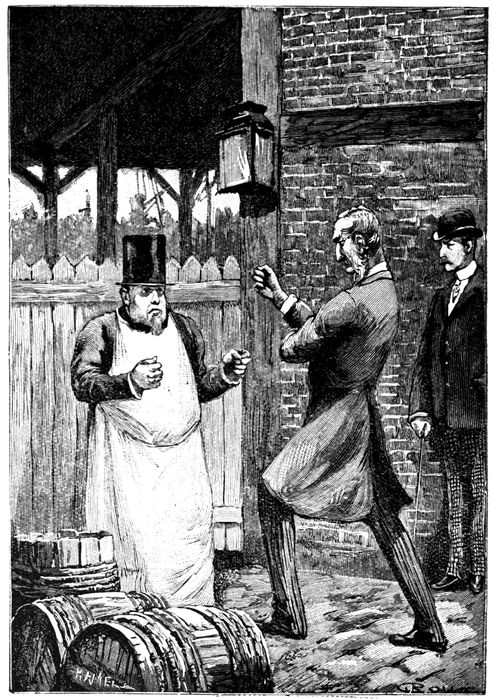
“When I went,” said Todrin, “I found a fat man in a
black coat and wearing a stove-pipe hat. He had on a
white apron, and when I asked him about this affair, he
told me that the South Star had just arrived from Newfoundland
24with a full cargo of fine cod, which he was
prepared to sell me on advantageous terms on behalf of
Messrs. Ardrinell and Co.”
“Eh! eh!” said the Councillor of the Dutch East Indies.
“You had much better buy a full cargo of fine cod than
throw your money into the Arctic Sea.”
“That’s not the question,” said the Major. “We are
not talking of codfish, but of the Polar ice-cap—”
“Which,” said Todrin, “the codfish-man wants to wear.”
“It will give him influenza,” said the Russian.
“That is not the question,” said the Major. “For some
reason or other, this North Polar Practical Association—mark
the word ‘Practical,’ gentlemen—wishes to buy four
hundred and seven thousand square miles round the North
Pole, from the eighty-fourth—”
“We know all that,” said Professor Harald. “But what
we want to know is, what do these people want to do with
these territories, if they are territories, or these seas, if they
are seas—”
“That is not the question,” said Donellan. “Here is a
company proposing to purchase a portion of the globe
which, by its geographical position, seems to belong to
Canada.”
“To Russia,” said Karkof.
“To Holland,” said Jansen.
“To Scandinavia,” said Harald.
“To Denmark,” said Baldenak.
“Gentlemen!” said Todrin, “excuse me, but that is not
the question. By our presence here we have admitted the
principle that the circumpolar territories can be put up to
auction, and become the property of the highest bidder.
Now, as you have powers to draw to a certain amount,
25why should you not join forces and control such a sum as
the Baltimore company will find it impossible to beat?”
The delegates looked at one another. A syndicate of
syndicates! In these days we syndicate as unconcernedly
as we breathe, as we drink, as we eat, as we sleep. Why
not syndicate still further?
But there was an objection, or rather an explanation was
necessary, and Jansen interpreted the feeling of the meeting
when he asked,—
“And after?”
Yes! After?
“But it seems to me that Canada—” said Donellan.
“And Russia—” said Karkof.
“And Holland—” said Jansen.
“And Denmark—” said Baldenak.
“Don’t quarrel, gentlemen,” said Todrin. “What is the
good? Let us form our syndicate.”
“And after?” said Harald.
“After?” said Todrin. “Nothing can be simpler, gentlemen.
When you have bought the property it will remain
indivisible among you, and then for adequate compensation
you can transfer it to one of the syndicates we represent;
but the Baltimore company will be out of it.”
It was a good proposal, at least for the moment, for in
the future the delegates could quarrel among themselves
for the final settlement. Anyway, as Todrin had justly
remarked, the Baltimore company would be out of it.
“That seems sensible,” said Baldenak.
“Clever,” said Karkof.
“Artful,” said Harald.
“Sly,” said Jansen.
“Quite Canadian,” said Donellan.
26“And so, gentlemen,” said Karkof, “it is perfectly
understood that if we form a syndicate the rights of each
will be entirely reserved.”
“Agreed.”
It only remained to discover what sums had been placed
to the credit of the delegates by the several associations
which amounts when totalled would probably exceed
anything at the disposal of the North Polar Practical
people.
The question was asked by Todrin.
But then came a change over the scene. There was
complete silence. No one would reply. Open his purse,
empty his pocket into the common cash-box, tell in advance
how much he had to bid with—there was no hurry to do
that! And if disagreement arose later on, if circumstances
obliged the delegates to look after themselves, if the
diplomatic Karkof were to feel hurt at the little wiles of
Jansen, who might take offence at the clumsy artifices of
Baldenak, who, in turn, became irritated at the ingenuities
of Harald, who might decline to support the pretentious
claims of Donellan, who would find himself compelled to
intrigue against all his colleagues individually and collectively—to
proclaim the length of their purses was to reveal
their game, which above all things they desired to keep
dark.
Obviously there were only two ways of answering
Todrin’s indiscreet demand. They might exaggerate their
resources, which would be embarrassing when they had to
put the money down; or they might minimize them in
such a way as to turn the proposition into a joke.
This idea occurred to the Dutchman.
“Gentlemen,” said he, “I regret that for the acquisition
27of the Arctic regions I am unable to dispose of more than
fifty gulden.”
“And,” said the Russian, “all I have to venture is thirty-five
roubles.”
“I have twenty kroner,” said Harald.
“I have only fifteen,” said Baldenak.
“Well,” said the Major, “it is evident that the profit in
this matter will be yours, for all I have at my disposal is
the miserable sum of thirty cents.”
CHAPTER III. THE NORTH POLE IS KNOCKED DOWN TO THE HIGHEST BIDDER.
That the sale of the 3rd of December should take place
in the Auction Mart might appear strange. As a rule,
only furniture, instruments, pictures, and objects of art
were sold there. But for this curious departure from the
ordinary practice in the sale of land a precedent was discoverable,
as already a portion of our planet had changed
hands under the hammer.
A few years before, at San Francisco, in California, an
island in the Pacific Ocean, Spencer Island, had been sold
to the rich W. W. Kolderup, when he outbid J. R. Taskinar,
of Stockton.[1] Spencer Island was habitable; it was only
a few degrees from the Californian coast; it had forests,
watercourses, a fertile soil, and fields and prairies fit for
cultivation; it was not an indefinite region, covered perhaps
28with sea and perpetual ice, which probably no one would
ever occupy. For Spencer Island four hundred thousand
dollars had been paid; for the polar territories it was not
to be expected that anything like that amount would be
forthcoming.
Nevertheless, the strangeness of the affair had brought
together a considerable crowd, chiefly of lookers-on, to
witness the result. The sale was to take place at noon,
and all the morning the traffic in Bolton Street was seriously
interfered with. Long before the hour fixed for the sale the
room was full, with the exception of a few seats railed off and
reserved for the delegates; and when Baldenak, Karkof,
Jansen, Harald, Donellan, and Todrin had taken these places,
they formed a compact group, shoulder to shoulder, and
looked as if they were a veritable storming column ready
for the assault of the Pole.
Close to them was the consignee of codfish, whose vulgar
visage expressed the sublimest indifference. He looked the
least excited of all the crowd, and seemed to be thinking
only of how he could most profitably dispose of the cargoes
now on their way to him from Newfoundland. Who were
the capitalists represented by this man, with probably
millions of dollars at his command?
There was nothing to show that J. T. Maston and Mrs.
Scorbitt had anything to do with the affair. How could it
be supposed that they had? They were there, though,
but lost in the crowd, and were surrounded by a few of the
principal members of the Gun Club, apparently simply as
spectators and quite disinterested. William S. Forster
seemed to have not the least knowledge of their existence.
As it was impossible to hand round the North Pole for
the purposes of examination, a large map of the Arctic
29regions had been hung behind the auctioneer’s desk.
Seventeen degrees above the Arctic Circle a broad red line
around the eighty-fourth parallel marked off the portion
of the globe which the North Polar Practical Association
had brought to the hammer. According to the map, the
region was occupied by a sea covered with an ice-cap of
considerable thickness. But that was the affair of the
purchasers. At least, no one could complain that they
had been deceived as to the nature of the goods.
As twelve o’clock struck, the auctioneer, Andrew R.
Gilmour, entered by a little door behind his desk. He
surveyed the assembly for an instant through his glasses,
and then, calling for silence by a tap from his hammer, he
addressed the crowd as follows:—
“Gentlemen, I have been instructed by the Federal
Government to offer for sale a property situated at the
North Pole, bounded by the eighty-fourth parallel of latitude,
and consisting of certain continents and seas, either
solid or liquid—but which I am not quite sure. Kindly
cast your eyes on this map. It has been compiled according
to the latest information. You will see that the area
is approximately four hundred and seven thousand square
miles. To facilitate the sale it has been decided that the
biddings for this extensive region shall be made per square
mile. You will therefore understand that every cent bid
will represent in round numbers 407,000 cents, and every
dollar 407,000 dollars. I must ask you to be silent,
gentlemen, if you please.”
The appeal was not superfluous, for the impatience of
the public was producing a gradually-increasing tumult
that would drown the voices of the bidders.
When tolerable quietness had been established thanks
30to the intervention of Flint, the auctioneer’s porter,
who roared like a siren on a foggy day, Gilmour continued,—
“Before we begin the biddings, I think it right to remind
you of three things. The property has only one boundary,
that of the eighty-fourth degree of north latitude. It has
a guaranteed title. And it will remain the property of
the purchasers, no matter what geographical or meteorological
modifications the future may produce.”
Always this curious observation!
“Now, gentlemen,” said Gilmour; “what offers?” and,
giving his hammer a preliminary shake, he continued in a
vibrating nasal tone, “We will start at ten cents the square
mile.”
Ten cents, the tenth of a dollar, meant 40,700 dollars for
the lot.
Whether Gilmour had a purchaser at this price or not,
the amount was quickly increased by Baldenak.
“Twenty cents!” he said.
“Thirty cents!” said Jansen for the Dutchmen.
“Thirty-five!” said Professor Harald.
“Forty!” said the Russian.
That meant 162,800 dollars, and yet the bidding had
only begun. The Canadians had not even opened their
mouths. And William S. Forster seemed absorbed in the
Newfoundland Mercury.
“Now, gentlemen,” said Gilmour, “any advance on forty
cents? Forty cents! Come, the polar cap is worth more
than that; it is—”
What he would have added is unknown; perhaps it was,
“guaranteed pure ice;” but the Dane interrupted him
with—
31“Fifty cents!”
Which the Dutchman at once capped with—
“Sixty!”
“Sixty cents the square mile! Any advance on sixty
cents?”
These sixty cents made the respectable sum of 244,200
dollars.
At Jansen’s bid, Donellan raised his head and looked
at Todrin; but at an almost imperceptible negative sign
from him he remained silent.
All that Forster did was to scrawl a few notes on the
margin of his newspaper.
“Come, gentlemen,” said the auctioneer; “wake up!
Surely you are going to give more than that?”
And the hammer began to move up and down, as if in
disgust at the weakness of the bidding.
“Seventy cents!” said Harald, in a voice that trembled
a little.
“Eighty cents!” said Karkof, almost in the same
breath.
A nod from Todrin woke up the Major, as if he were on
springs.
“Hundred cents!” said the Canadian.
That meant 407,000 dollars!
Four hundred and seven thousand dollars! A high
price to pay for a collection of icebergs, ice-fields, and
ice-floes!
And the representative of the North Polar Practical
Association did not even raise his eyes from his newspaper.
Had he been instructed not to bid? If he had
waited for his competitors to bid their highest, surely the
moment had come? In fact, their look of dismay when
32the Major fired his “hundred cents” showed that they had
abandoned the battle.
“A hundred cents the square mile!” said the auctioneer.
“Any advance? Is that so? Is that so? No advance?”
And he took a firm grasp on his hammer, and looked
round him.
“Once!” he continued. “Twice! Any advance?”
“A hundred and twenty cents!” said Forster, quietly,
as he turned over a page of his newspaper.
“And forty!” said the Major.
“And sixty!” drawled Forster.
“And eighty!” drawled the Major, quite as placidly.
“A hundred and ninety!” said Forster.
“And five!” said the Major, as if it were a mere casual
observation.
You might have heard an ant walk, a bleak swim, a
moth fly, a worm wriggle, or a microbe wag its tail—if it
has a tail.
Gilmour allowed a few moments to pass, which seemed
like centuries. The consignee of codfish continued reading
his newspaper and jotting down figures on the margin
which had evidently nothing to do with the matter on
hand. Had he reached the length of his tether? Had
he made his last bid? Did this price of 195 cents the
square mile, or 793,050 dollars for the whole, appear to
him to have reached the last limit of absurdity?
“One hundred and ninety-five cents!” said the auctioneer.
“Going at one hundred and ninety-five cents!”
And he raised his hammer.
“One hundred and ninety-five cents! Going! Going!”
And every eye was turned on the representative of the
North Polar Practical Association.
33That extraordinary man drew a large handkerchief from
his pocket, and, hiding his face in it, blew a long, sonorous
blast with his nose.
Then J. T. Maston looked at him, and Mrs. Scorbitt’s
eyes took the same direction. And by the paleness of
their features it could be seen how keen was the excitement
they were striving to subdue. Why did Forster
hesitate to outbid the Major?
Forster blew his nose a second time; then, with an even
louder blast, he blew it a third time. And between the
blasts he quietly observed,—
“Two hundred cents!”
A shudder ran through the hall.
The Major seemed overwhelmed, and fell back against
Todrin. At this price per square mile, the Arctic regions
would cost 814,000 dollars. The Canadian limit had
evidently been passed.
“Two hundred cents!” said Gilmour. “Once! Twice!
Any advance?” he continued.
The Major looked at the Professor, and the Colonel, and
the Dutchman, and the Dane; and the Professor, and the
Colonel, and the Dutchman, and the Dane looked at the
Major.
“Going! Going!” said the auctioneer.
Every one looked at the codfish man.
“Gone!”
And down came Gilmour’s hammer.
The North Polar Practical Association, represented by
William S. Forster, had become the proprietors of the
North Pole and its promising neighbourhood. And when
William S. Forster had to name the real purchasers, he
placidly drawled,—“Barbicane & Co!”
CHAPTER IV. OLD ACQUAINTANCES.
34
Barbicane & Co.! The president of the Gun Club!
What was the Gun Club going to do with the North Pole?
We shall see.
Is it necessary to formally introduce Impey Barbicane,
the president of the Gun Club, and Captain Nicholl, and
J. T. Maston, and Tom Hunter with the wooden legs, and
the brisk Bilsby, and Colonel Bloomsberry and their colleagues?
No! Although twenty years had elapsed since
the attention of the world was concentrated on these remarkable
personages, they had remained much as they
were, just as incomplete corporeally, and just as obstreperous,
just as daring, just as wrapped up in themselves as
when they had embarked in their extraordinary adventure.
Time had made no impression on the Gun Club; it respected
them as people respect the obsolete cannon that are found
in the museums of old arsenals.
If the Gun Club comprised 1833 members at its foundation—that
is persons and not limbs, for a number of
these were missing—if 30,575 correspondents were proud
of their connection with the club, the number had in no
way decreased. On the contrary, thanks to the unprecedented
attempt they had made to open communication
with the Moon, as related in the Moon Voyage, its celebrity
had increased enormously.
It will be remembered that a few years after the War of
Secession certain members of the Gun Club, tired of doing
nothing, had proposed to send a projectile to the Moon by
means of a monster Columbiad. A gun nine hundred feet
35long had been solemnly cast at Tampa Town, in the
Floridan peninsula, and loaded with 400,000 lbs. of fulminating
cotton. Shot out by this gun, a cylindro-conical
shell of aluminium had been sent flying among the stars of
the night under a pressure of six million millions of litres
of gas. Owing to a deviation of the trajectory, the projectile
had gone round the Moon and fallen back to the
earth, dropping into the Pacific Ocean in lat. 27° 7′ N.,
long. 141° 37′ west; when the frigate Susquehanna had
secured it, to the great satisfaction of its passengers.
Of its passengers, two members of the Gun Club, the
president, Impey Barbicane, and Captain Nicholl, with a
hare-brained Frenchman, had taken passage in the projectile
and had all returned from the voyage safe and sound.
But if the two Americans were then present ready to risk
their lives in some new adventure, it was not so with Michel
Ardan. He had returned to Europe, and made a fortune,
and was now planting cabbages in his retirement, if the best-informed
reporters were to be believed.
Barbicane and Nicholl had also retired, comparatively
speaking, but they had retired only to dream of some new
enterprise of a similar character. They were in no want
of money. From their last undertaking there remained
nearly two hundred thousand dollars out of the five millions
and a half yielded by the public subscriptions of the old
and new worlds; and by exhibiting themselves in their
aluminium projectile throughout the United States they
had realized enough wealth and glory to satisfy the most
exacting of human ambitions. They would have been
content if idleness had not been wearisome to them; and it
was probably in order to find something to do that they
had now bought the Arctic regions.
36But it should not be forgotten that if they had paid for
their purchase eight hundred thousand dollars and more, it
was because Evangelina Scorbitt had advanced the balance
they required.
Although Barbicane and Nicholl enjoyed incomparable
celebrity, there was one who shared it with them. This
was J. T. Maston, the impetuous secretary of the Gun
Club. Was it not this able mathematician who had made
the calculations which had enabled the great experiment
to be made? If he had not accompanied his two colleagues
on their extraordinary voyage, it was not from
fear; certainly not! But the worthy gunner wanted a
right arm, and had a gutta-percha cranium, owing to one
of those accidents so common in warfare; and if he had
shown himself to the Selenites it might have given them
an erroneous idea of the inhabitants of the Earth, of which
the Moon after all is but the humble satellite.
To his profound regret J. T. Maston had had to resign
himself to staying at home. But he was not idle. After
the construction of the immense telescope on the summit
of Long’s Peak, one of the highest of the Rocky Mountains,
he had transported himself there, and from the
moment he found the projectile describing its majestic
trajectory in the sky he never left his post of observation.
At the eye-piece of the huge instrument he devoted himself
to the task of following his friends as they journeyed
in their strange carriage through space.
It might be thought that the bold voyagers were for
ever lost to earth. The projectile, drawn into a new orbit
by the Moon, might gravitate eternally round the Queen
of the Night as a sort of sub-satellite. But no! A deviation,
which by many was called providential, had modified
37the projectile’s direction, and, after making the circle of the
Moon, brought it back from that spheroid at a speed of
172,800 miles an hour at the moment it plunged into the
ocean.
Luckily the liquid mass of the Pacific had broken the
fall, which had been perceived by the U.S. frigate Susquehanna.
As soon as the news had reached J. T. Maston,
he had set out in all haste from the observatory at Long’s
Peak to the rescue of his friends. Soundings were taken in
the vicinity of where the shell had been seen to fall, and the
devoted Maston had not hesitated to go down in diver’s
dress to find his friends. But such trouble was unnecessary.
The projectile being of aluminium, displacing an amount
of water greater than its own weight, had returned to the
surface of the Pacific after a magnificent plunge. And
President Barbicane, Captain Nicholl, and Michel Ardan
were found in their floating prison playing dominoes.
The part that Maston took in these extraordinary proceedings
had brought him prominently to the front. He
was not handsome, with his artificial cranium and his
mechanical arm with its hook for a hand. He was not
young, for fifty-eight years had chimed and struck at the
date of our story’s beginning. But the originality of his
character, the vivacity of his intelligence, the fire in his
eye, the impetuosity with which he had attacked everything,
had made him the beau-ideal of a man in the eyes
of Evangelina Scorbitt. His brain, carefully protected
beneath its gutta-percha roof was intact, and justly bore
the reputation of being one of the most remarkable of the
day.
Mrs. Scorbitt—though the least calculation gave her
a headache—had a taste for mathematicians if she had
38not one for mathematics. She looked upon them as upon
beings of a peculiar and superior species. Heads where
x’s knocked against x’s like nuts in a bag, brains which
rejoiced in algebraic formulæ, hands which threw about
triple integrals as an equilibrist plays with glasses and
bottles, intelligences which understood this sort of thing:
∫∫∫Φ(xyz) dx dy dz
—these were the wise men who appeared worthy of all
the admiration of a woman, attracted to them proportionally
to their mass and in inverse ratio to the square of
their distances. And J. T. Maston was bulky enough to
exercise on her an irresistible attraction, and as to the
distance between them it would be simply zero, if she
succeeded in her plans.
It must be confessed that this gave some anxiety to the
secretary of the Gun Club, who had never sought happiness
in such close approximations. Besides, Evangelina
Scorbitt was no longer in her first youth; but she was
not a bad sort of person by any means, and she would
have wanted for nothing could she only see the day
when she was introduced to the drawing-rooms of Baltimore
as Mrs. J. T. Maston.
The widow’s fortune was considerable. Not that she was
as rich as Gould, Mackay, Vanderbilt, or Gordon Bennett,
whose fortunes exceed millions, and who could give alms
to a Rothschild. Not that she possessed the millions of
Mrs. Moses Carper, Mrs. Stewart, or Mrs. Crocker; nor
was she as rich as Mrs. Hammersley, Mrs. Helby Green,
Mrs. Maffitt, Mrs. Marshall, Mrs. Para Stevens, Mrs.
Mintbury, and a few others. But she was the possessor
of four good millions of dollars, which had come to her
39from John P. Scorbitt, who had made a fortune by trade
in fashionable sundries and salt pork. And this fortune
the generous widow would have been happy to employ
for the advantage of J. T. Maston, to whom she would
bring a treasure of tenderness yet more inexhaustible.
At Maston’s request, she had cheerfully consented to
put several hundreds of thousands of dollars at the disposal
of the North Polar Practical Association, without
even knowing what it was all about. With J. T. Maston
concerned in it she felt assured that the work could not
but be grandiose, sublime, super-excellent. The past of the
Gun Club’s secretary was voucher enough for the future.
It may be guessed, therefore, if she lost confidence
when the auctioneer’s hammer knocked down the North
Pole to Barbicane & Co. While J. T. Maston formed part
of the “Co.” could she do otherwise than applaud?
And thus it happened that Evangelina Scorbitt found
herself chief proprietor of the Arctic regions within the
eighty-fourth parallel. But what would she do with
them? Or rather, how was the company going to get
any benefit out of their inaccessible domain?
That was the question! And if in a pecuniary sense it
had much interest for Mrs. Scorbitt, from a curiosity
point of view it had quite as much interest for the world
at large.
The trusting widow had asked a few questions of
Maston before she advanced the funds. But Maston invariably
maintained the closest reserve. Mrs. Scorbitt,
he remarked, would know soon enough, but not before
the hour had come, for she would be astonished at the
object of the new association.
Doubtless he was thinking of some undertaking which
40to quote Jean Jacques, “never had an example, and never
will have imitators,” of something destined to leave far
behind the attempt made by the Gun Club to open up
communication with the Moon.
When Evangelina grew somewhat pressing in her
inquiries, J. T. Maston had placed his hook on his half-closed
lips, and remarked soothingly,—
“Have confidence, Mrs. Scorbitt; have confidence!”
And if Mrs. Scorbitt had confidence before the sale,
what immense joy she must have experienced at the
result!
Still she could not help asking the eminent mathematician,
what he was going to do next. And though she
smiled on him bewitchingly, the eminent mathematician
only replied, as he cordially shook her hand,—
“You will know very soon!”
That shake of the hand immediately calmed the impatience
of Mrs. Scorbitt. And a few days later there
was another shake, for the old and new worlds were considerably
shaken—to say nothing of the shake that was
coming—when they learnt the project for which the
North Polar Practical Association appealed to the public
for subscriptions.
The company announced that it had “acquired” the
territory for the purpose of working—“the Coal Fields at
the North Pole”!
CHAPTER V. THE POLAR COAL-FIELD.
“But are there any coal-fields at the Pole?” Such was
the first question that presented itself.
41“Why should there be coal at the Pole?” said some.
“Why should there not be?” said others.
Coal-beds are found in many parts of the world. There
is coal in Europe; there is coal in America; and in Africa;
and in Asia; and in Oceania. As the globe is more and
more explored, beds of fossil fuel are revealed in strata of
all ages. There is true coal in the primary rocks, and
there is lignite in the secondaries and tertiaries.
England alone produces a hundred and sixty millions
of tons a year; the world consumes four hundred million
tons, and with the requirements of industry there is no
decrease but an increase in the consumption. The substitution
of electricity for steam as a motive power means
the expenditure of coal just the same. The industrial
stomach cannot live without coal: industry is a carbonivorous
animal, and must have its proper food.
Carbon is something else than a combustible. It is the
telluric substance from which science draws the major
part of the products and sub-products used in the arts.
With the transformations to which it is subject in the
crucibles of the laboratory you can dye, sweeten, perfume,
vaporize, purify, heat, light, and you can produce the
diamond.
But the coal-beds from which our carbon at present
chiefly comes are not inexhaustible. And the well-informed
people who are in fear for the future are looking
about for new supplies wherever there is a probability of
their existence.
“But why should there be coal at the Pole?”
“Why?” replied the supporters of President Barbicane.
“Because in the carboniferous period, according to a well-known
theory, the volume of the Sun was such that the
42difference in temperature between the Equator and the
Poles was inappreciable. Immense forests covered the
northern regions long before the appearance of man, when
our planet was subject to the prolonged influence of heat
and humidity.”
And this the journals, reviews, and magazines that
supported the North Polar Practical Association insisted
on in a thousand articles, popular and scientific. If these
forests existed, what more reasonable to suppose than that
the weather, the water, and the warmth had converted
them into coal-beds?
But in addition to this there were certain facts which
were undeniable. And these were important enough to
suggest that a search might be made for the mineral in the
regions indicated.
So thought Donellan and Todrin as they sat together
in a corner of the “Two Friends.”
“Well,” said Todrin, “can Barbicane be right?”
“It is very likely,” said the Major.
“But then there are fortunes to be made in opening up
the Polar regions!”
“Assuredly,” said the Major. “North America has
immense deposits of coal; new discoveries are often being
announced, and there are doubtless more to follow. The
Arctic regions seem to be a part of the American continent
geologically. They are similar in formation and
physiography. Greenland is a prolongation of the new
world, and certainly Greenland belongs to America—”
“As the horse’s head, which it looks like, belongs to the
animal’s body,” said Todrin.
“Nordenskiold,” said Donellan, “when he explored
Greenland, found among the sandstones and schists intercalations
43of lignite with many forest plants. Even in the
Disko district, Steenstrup discovered eleven localities with
abundant vestiges of the luxuriant vegetation which
formerly encircled the Pole.”
“But higher up?” asked Todrin.
“Higher up, or farther up to the northward,” said the
Major, “the presence of coal is extremely probable, and it
only has to be looked for. And if there is coal on the
surface, is it not reasonable to suppose that there is coal
underneath?”
The Major was right. He was thoroughly posted up
in all that concerned the geology of the Arctic regions,
and he would have held on for some time if he had not
noticed that the people in the “Two Friends” were
listening to him.
“Are you not surprised at one thing, Major?”
“What is that?”
“That in this affair, in which you would expect to meet
with engineers and navigators, you have only to deal with
artillerists. What have they to do with the coal-mines of
the North Pole?”
“That is rather surprising,” said the Major.
And every morning the newspapers returned to this
matter of the coal-mines.
“Coal-beds!” said one, “what coal-beds?”
“What coal-beds?” replied another; “why, those that
Nares found in 1875 and 1876 on the eighty-second
parallel, when his people found the miocene flora rich in
poplars, beeches, viburnums, hazels, and conifers.”
“And in 1881–1884,” added the scientific chronicler of
the New York Witness, “during the Greely expedition
to Lady Franklin Bay, a bed of coal was discovered by
44our men at Watercourse Creek, close to Fort Conger.
Did not Dr. Pavy rightly consider that these carboniferous
deposits were apparently destined to be used some day
for contending with the cold of that desolate region?”
When these facts were brought forward, it will be easily
understood that Impey Barbicane’s adversaries were
hard up for a reply. The partisans of the “Why should
there be coal?” had to lower their flag to the partisans of
“Why should there not be?” Yes, there was coal! And
probably a considerable amount of it. The circumpolar
area contained large deposits of the precious combustible
on the site of the formerly luxuriant vegetation.
But if the ground were cut from under their feet regarding
the existence of the coal, the detractors took their revenge
in attacking the question from another point.
“Be it so!” said the Major one day in the rooms of the
Gun Club itself, when he discussed the matter with Barbicane.
“Be it so! I admit there is coal there; I am
convinced there is coal there. But work it!”
“That we are going to do,” said Barbicane tranquilly.
“Get within the eighty-fourth parallel, beyond which no
explorer has yet gone!”
“We will get beyond it!”
“Go to the Pole itself!”
“We are going there!”
And in listening to the president of the Gun Club
making these cool answers, talking with such assurance,
expressing his opinion so haughtily and unmistakably, the
most obstinate began to hesitate. They felt they were in
the presence of a man who had lost nothing of his former
qualities; calm, cool, with a mind eminently serious and
concentrated, exact as a chronometer, adventurous, and
45bringing the most practical ideas to bear on the most
daring undertakings. Solid, morally and physically, he was
“deep in the water,” to employ a metaphor of Napoleon’s,
and could hold his own against wind or tide. His enemies
and rivals knew that only too well.
He had stated that he would reach the North Pole!
He would set foot where no human foot had been set
before! He would hoist the Stars and Stripes on one of
the two spots of earth which remained immovable while
all the rest spun round in diurnal rotation!
Here was a chance for the caricaturists! In the windows
of the shops and kiosks of the great cities of Europe and
America there appeared thousands of sketches and prints
displaying Impey Barbicane seeking the most extravagant
means of attaining his object.
Here the daring American, assisted by all the members
of the Gun Club, pickaxe in hand, was driving a submarine
tunnel through masses of ice, which was to emerge
at the very point of the axis.
Here Barbicane, accompanied by J. T. Maston—a very
good portrait—and Captain Nicholl, descended in a balloon
on the point in question, and, after unheard-of dangers,
succeeded in capturing a lump of coal weighing half a
pound, which was all the circumpolar deposit contained.
Here J. T. Maston, who was as popular as Barbicane
with the caricaturists, had been seized by the magnetic
attraction of the Pole, and was fast held to the ground by
his metal hook.
And it may be remarked here that the celebrated calculator
was of too touchy a temperament to laugh at any jest
at his personal peculiarities. He was very much annoyed
46at it, and it will be easily imagined that Mrs. Scorbitt was
not the last to share in his just indignation.
Another sketch, in the Brussels Magic Lantern, represented
Impey Barbicane and his co-directors working in
the midst of flames, like so many incombustible salamanders.
To melt the ice of the Palæocrystic Sea, they
had poured out over it a sea of alcohol, and then lighted
the spirit, so as to convert the polar basin into a bowl of
punch. And, playing on the word punch, the Belgian
designer had had the irreverence to represent the president
of the Gun Club as a ridiculous punchinello.
But of all the caricatures, that which obtained the most
success was published by the Parisian Charivari under the
signature of “Stop.” In the stomach of a whale, comfortably
furnished and padded, Impey Barbicane and J. T.
Maston sat smoking and playing chess, waiting their
arrival at their destination. The new Jonahs had not
hesitated to avail themselves of an enormous marine
mammifer, and by this new mode of locomotion had
passed under the ice-floes to reach the inaccessible
Pole.
The phlegmatic president was not in the least incommoded
by this intemperance of pen and pencil. He let the
world talk, and sing, and parody, and caricature; and he
quietly went on with his work.
As soon as he had obtained the concession, he had issued
an appeal to the public for the subscription of fifteen millions
of dollars in hundred-dollar shares. Such was the
credit of Barbicane & Co., that applications flowed in
wholesale. But it is as well to say that nearly all the
applications came from the United States.
“So much the better!” said the supporters of the North
47Polar Practical Association. “The work will be entirely
American.”
The prospectus was so plausible, the speculators believed
so tenaciously in the realization of its promises, and admitted
so imperturbably the existence of the Polar coal-mines,
that the capital was subscribed three times over.
Two-thirds of the applications were declined with regret,
and on the 16th of December the capital of fifteen millions
of dollars was fully paid up. It was about thrice as much
as the amount subscribed for the Gun Club when they
made their great experiment of sending a projectile from
the Earth to the Moon.
CHAPTER VI. A TELEPHONIC CONVERSATION.
Not only had Barbicane announced that he would attain
his object—and now the capital at his command enabled
him to reach it without hindrance—but he would certainly
not have appealed for funds if he was not certain of
success.
The North Pole was at last to be conquered by the
audacious genius of man!
Barbicane and his co-directors had the means of succeeding
where so many others had failed. They would do
what had not been done by Franklin, Kane, Nares, or
Greely. They would advance beyond the eighty-fourth
parallel. They would take possession of the vast portion
48of the globe that had fallen to them under the hammer.
They would add to the American flag the forty-third star
for the forty-third state annexed to the American Confederation.
“Rubbish!” said the European delegates.
And the means of conquering the Pole—means that
were practical, logical, indisputable, and of a simplicity
quite infantine—were the suggestion of J. T. Maston. It
was in his brain, where ideas were cooked in cerebral matter
in a state of constant ebullition, that there had been conceived
this great geographical work, and the means devised
of bringing it to a successful issue.
The secretary of the Gun Club was a remarkable calculator.
The solution of the most complicated problems of
mathematical science was but sport to him. He laughed
at difficulties, whether in the science of magnitudes, that is
algebra, or in the science of numbers, that is arithmetic;
and it was a treat to see him handle the symbols, the conventional
signs which form the algebraic notation, whether
letters of the alphabet, representing quantities or magnitudes,
or lines coupled or crossed, which indicate the relation
between the quantities and the operations to which they
are submitted.
Ah! The co-efficients, the exponents, the radicals, the
indices, and the other arrangements adopted in that language!
How the signs leapt from his pen, or rather from
the piece of chalk which wriggled at the end of his metal
hook, for he preferred to work on a blackboard. There, on
a surface of ten square yards—for nothing less would do
for J. T. Maston—he revelled in all the ardour of his
algebraical temperament. They were no miserable little
figures that he employed in his calculations. No; the
49figures were fantastic, gigantic, traced with a furious hand.
His 2’s and 3’s waltzed like shavings in a whirlwind; his
7’s were like gibbets, and only wanted a corpse to complete
them; his 8’s were like spectacles; and his 6’s and
9’s had flourishes interminable!
And the letters with which he built up his formulæ!
The a’s and b’s and c’s he used for his quantities given or
known; and the x’s, y’s, and z’s he used for the quantities
sought or unknown, and especially his z’s, which twisted in
zigzags like lightning flashes! And what turns and
twiggles there were in his π’s, his λ’s, his ω’s! Even a
Euclid or an Archimedes would have been proud of them!
And as to his signs, in pure unblurred chalk, they were
simply marvellous. His + showed the addition was
unmistakable. His -, though humbler, was quite a work
of art. His × was as clear as a St. Andrew’s cross. And
as to his =, so rigorously equal were they, as to indicate
without a chance of mistake, that J. T. Maston lived in a
country where equality was no vain formula. His <, his
>, and his ≷ were really grand! And as to his √, the
root of a quantity or of a number, it was really a triumph,
and when he completed the horizontal bar in this style
√‾‾‾‾‾‾
it seemed as if the indicatory vinculum would shoot clean
off the blackboard and menace the world with inclusion
within the maniacal equation.
But do not suppose that the mathematical intelligence
of J. T. Maston was bounded by the horizon of elementary
algebra. No! The differential calculus, the integral
calculus, the calculus of variations were no strangers to
him, and with unshaking hand he dashed down the famous
50sign of integration, the shape so terrible in its simplicity, the
f
that speaks of an infinity of elements of the infinitely
little.
And like it was his Σ which represents the sum of a
finite number of finite elements; like it was his ∝ with
which mathematicians indicate the variant; like it were
all the mysterious symbols employed in this language so
unintelligible to ordinary mortals. In short, this astonishing
man was capable of mounting the mathematical
ladder to the very topmost rung.
Such was J. T. Maston. No wonder his colleagues had
every confidence in him when he undertook to solve the
wildest abracadabrant calculations that occurred to their
audacious brains! No wonder that the Gun Club had
confided to him the problem regarding the hurling of
the projectile from the Earth to the Moon! No wonder
that Evangelina Scorbitt was intoxicated with his glory,
and had conceived for him an admiration which perilously
bordered on love!
But in the case under consideration, the solution of the
problem regarding the conquest of the North Pole, J. T.
Maston had no flight to take in the sublime regions of
analysis. To allow the concessionaries of the Arctic
regions to make use of their new possessions, the secretary
of the Gun Club had but a simple problem in
mechanics to occupy his mind. It was a complicated
problem, no doubt, requiring ingenious and possibly novel
formulæ, but it could be done.
Yes! They could trust J. T. Maston, although the
slightest slip might entail the loss of millions! But never
51since his baby head had toyed with the first notions of
arithmetic had he made a mistake, never had he been the
millionth of an inch out in a matter of measurement, and if
he had made an error in the last of twenty places of decimals
his gutta-percha cranium would have burst its fixings.
It was important to insist on the remarkable mathematical
powers of J. T. Maston. We have done so!
Now we have to show him at work, and to do that we
must go back a few weeks.
About a month before the famous advertisement, J. T.
Maston had been requested to work out the elements of
the project of which he had suggested to his colleagues
the marvellous consequences.
For many years he had lived at No. 179, Franklin
Street, one of the quietest streets in Baltimore, far from
the business quarter, for in commerce he took no interest;
far from the noise of the crowd, for the mob he abhorred.
There he occupied a modest habitation known as
Ballistic Cottage, living on the pension he drew as an old
artillery officer, and on the salary paid him as the Gun
Club secretary. He lived alone with one servant, Fire-Fire,
a name worthy of an artilleryman’s valet. This
negro was a servant of the first-water, and he served his
master as faithfully as he would have served a gun.
J. T. Maston was a confirmed bachelor, being of opinion
that bachelorhood is the only state worth caring about
in this sublunary sphere. He knew the Sclav proverb,
that a woman draws more with one hair than four oxen
in a plough; and he was on his guard.
If he was alone at Ballistic Cottage, it was because he
wished to be alone. He had only to nod to change his
solitude of one into a solitude of two, and help himself
52to half the fortune of a millionaire. There was no doubt
of it. Mrs. Scorbitt would only have been too happy;
but J. T. Maston was not going to be too happy; and it
seemed that these two people so admirably adapted for
each other—in the widow’s opinion—would never understand
each other.
The cottage was a very quiet one. There was a groundfloor
and a first-floor. The ground floor had its verandah,
its reception-room and dining-room, and the kitchen in
a small annexe in the garden. Above them was a bedroom
in front, and a workroom facing the garden away
from the noise, a buen retiro of the savant and the sage
within whose walls were solved calculations that would
have raised the envy of a Newton or a Laplace.
Different, indeed, was the home of Mrs. Scorbitt, in the
fashionable quarter of New Park, with the balconies on its
front covered with the fantastic sculpture of American
architecture, Gothic and Renascence jumbled together;
its enormous hall, its picture galleries, its double twisted
staircase, its numerous domestics, its stables, its coach-houses,
its gardens, its lawns, its trees, its fountains, and
the tower which dominated its battlements from the
summit of which fluttered in the breeze the blue and gold
banner of the Scorbitts.
Three miles divided New Park from Ballistic Cottage.
But a telephone-wire united the two habitations, and at
the ringing of the call between the mansion and the
cottage conversation could be instantly established. If
the talkers could not see each other, they could hear each
other; and no one will be surprised to learn that Evangelina
Scorbitt called J. T. Maston much oftener before his
telephonic plate than J. T. Maston called Evangelina
53Scorbitt before hers. The mathematician would leave
his work, not without some disgust, to receive a friendly
“good morning,” and he would reply by a growl along
the wire, which he hoped would soften as it went, and
then he would return to his problems.
It was on the 3rd of October, after a last and long
conference, that J. T. Maston took leave of his colleagues
to devote himself to his task. It was the most important
investigation he had undertaken. He had to calculate
the mechanical formulæ required for the advance on the
Pole, and the economical working of the coal-beds thereof.
He estimated that it would take him rather more
than a week to accomplish this mysterious task. It was
a complicated and delicate inquiry, necessitating the
resolution of a large number of equations dealing with
mechanics, analytical geometry of the three dimensions,
and spherical trigonometry.
To be free from trouble, it had been arranged that the
secretary of the Gun Club should retire to his cottage,
and be visited and disturbed by no one. This was a great
trial for Mrs. Scorbitt, but she had to resign herself to it.
She and President Barbicane, Captain Nicholl, the brisk
Bilsby, Colonel Bloomsberry, and Tom Hunter with his
wooden legs, had called on Maston in the afternoon to
bid him farewell for a time.
“You will succeed, dear Maston,” she said, as she rose
to go.
“But be sure you don’t make a mistake,” said Barbicane,
with a smile.
“A mistake! He!” exclaimed Mrs. Scorbitt, with
horror at the thought.
With a grip of the hand from some, a sigh from one,
54wishes for success, and recommendations not to overwork
himself from others, the mathematician saw his friends
depart. The door of Ballistic Cottage was shut, and Fire-Fire
received orders to open it to no one—not even to the
President of the United States of America.
For the first two days of his seclusion J. T. Maston
thought over the problem without touching the chalk.
He read over certain works relative to the elements, the
earth, its mass, its density, its volume, its form, its rotation
on its axis, and translation round its orbit—elements which
were to form the bases of his calculations.
These are the principal, which it is as well the reader
should have before him:—
Form of the Earth: an ellipsoid of revolution, with a
major diameter of 7926·6 miles, and a minor diameter of
7899·6 miles. The difference between the two, owing to
the flattening of the spheroid at the Poles being 27 miles,
or one two-hundred-and-ninety-third of its mean diameter.
Circumference of the Earth at the Equator: 24,899
miles, the meridional circumference being 24,856 miles.
Surface of the Earth: 197,000,000 square miles.
Volume of the Earth: 260,000,000,000 cubic miles.
Density of the Earth: five and a half times that of water,
the mass being approximately 6,000,000,000,000,000,000,000
tons.
Duration of the Earth’s journey round the Sun: 365
days and a quarter, constituting the solar year, or more
exactly 365 days, 6 hours, 9 minutes, thus giving the
spheroid an average velocity of 66,000 miles an hour.
Rate of the Earth’s rotation at the Equator: 1037·4583
miles per hour.
The following were the units of length, force, time, and
55inclination which J. T. Maston required for his calculations;
the mile, the ton, the second, and the angle at the centre
which cuts off in any circle an arc equal to the radius.
It was on the 5th of October, at five o’clock in the afternoon—it
is important to know the precise time in a work
of such celebrity—that J. T. Maston, after much reflecting,
began to write. And, to begin with, he attacked the
problem at its base—that is, by the number representing
the circumference of the Earth, and one of its great circles,
viz. the Equator.
The blackboard was placed in an angle of the room on
an easel of polished oak, well in the light of one of the
windows which opened on to the garden. Little sticks of
chalk were placed on the shelf at the bottom of the board.
A sponge to wipe out with was in the calculator’s left
hand. His right hand, or rather his hook, was reserved
for writing down the figures of his working.
He began by describing the circumference of the terrestrial
spheroid. At the Equator the curve of the globe was
marked by a plain line representing the front part of the
curve, and by a dotted line representing the back half of
the curve. The axis was a perpendicular line cutting the
Equator, and marked N.S.
On the left-hand top corner of the board he wrote the
number that used to represent the earth’s circumference in
metrical measurement—
40,000,000.
He knew that this was an assumption admitted to be
erroneous, but it afforded a good round integer to begin
with, and the subsequent rectification of his calculations
by the inclusion of the missing meters was but child’s-play
to so transcendental a mathematician as J. T. Maston.
56He was so pre-occupied that he had not noticed the
state of the sky—which had changed considerably during
the afternoon. For the last hour one of those great
storms had been gathering which affect the organizations
of all living things. Livid clouds like whitish wool flocks
had accumulated on the grey expanse and hung heavily
over the city. The roll of distant thunder was heard.
One or two flashes had already rent the atmosphere
where the electric tension was at its highest.
J. T. Maston, more and more absorbed, saw nothing,
heard nothing.
Suddenly an electric bell troubled the silence of the
room with its hurried tinkling.
“Good!” exclaimed the mathematician. “If interrupters
can’t get in by the door, they come through the
wire! A fine invention for people who wish to be left
alone! I’ll see if I can’t turn that current off while I am
at work!”
And stepping up to the telephone, he asked,—
“Who wants me?”
“I want a moment’s talk with you,” said a feminine
voice.
“And who is speaking?”
“Have you not recognized my voice, dear Mr. Maston?
It is Mrs. Scorbitt.”
“Mrs. Scorbitt! She will not leave me a moment’s
peace.”
But the last words were prudently muttered above the
instrument, so that the widow heard them not. And
J. T. Maston, seeing that he must say something civil,
replied,—
“To tell you that there is a storm coming your way.”
“Well, I cannot stop it—”
“No, but I wanted to ask if you had taken care to shut
your window—”
Mrs. Scorbitt had hardly ended before a tremendous
clap of thunder filled the air. It seemed as though a vast
sheet of silk had been torn apart for an infinity of length.
The lightning had flashed down over Ballistic Cottage,
and, conducted by the telephone-wire, had invaded the
mathematician’s room with a brutality quite electric.
J. T. Maston, bending over the mouthpiece of the instrument,
received the hardest voltaic knock that had ever
found the mouth of a philosopher. The flash had run
along his metal hook, and spun him round like a teetotum.
The blackboard he struck with his back was hurled down
in the corner. And the lightning disappeared out of window.
Stunned for a moment—and it was a wonder it was no
worse—J. T. Maston slowly rose, and rubbed the different
parts of his body to make sure he was not hurt.
Then, having lost none of his coolness, as beseemed the
ancient pointer of the Columbiad, he put his room in order,
picked up his easel, hoisted up his blackboard, gathered
up the fragments of chalk scattered on the carpet, and
resumed his work, which had been so rudely interrupted.
But he noticed that by the fall of the blackboard the
figures he had written on the right-hand top corner, which
represented in meters the approximate equatorial circumference
of the earth, had been partially erased. He
stretched his hook up to re-write them when the bell
sounded with a feverish tinkle.
58“Again!” exclaimed J. T. Maston. And he went to
the telephone.
“Who is there?” he asked.
“Mrs. Scorbitt.”
“And what does Mrs. Scorbitt want?”
“Did that horrible flash of lightning strike Ballistic
Cottage?”
“I have every reason to believe so.”
“Good Heavens! The lightning—”
“Do not be uneasy, Mrs. Scorbitt.”
“You are not hurt, dear Mr. Maston?”
“Not at all.”
“You are sure you have not been touched?”
“I am only touched by your thoughtfulness for me,”
said the philosopher gallantly.
“Good evening, dear Mr. Maston.”
“Good evening, dear Mrs. Scorbitt.”
And he returned to his blackboard.
“Confound that excellent woman,” he said; “if she
hadn’t called me to the telephone I should not have run the
chance of being struck by lightning.”
And to insure being left in quiet, he judiciously put the
telephone out of action.
Then he resumed his work. From the number on the
board he gradually built up a definitive formula, and then
noting it on the left, he cleared away the working by which
he had arrived at it, and launched forth into an appalling
series of figures and signs.
Eight days later the wonderful calculation was finished,
and the secretary of the Gun Club triumphantly bore off
to his colleagues the solution of the problem which they
had awaited with a very natural impatience.
59The practical means of arriving at the North Pole to
work its coal-mines were mathematically established.
Then the company was formed under the title of The
North Polar Practical Association. Then the Arctic
regions were purchased under the auctioneer’s hammer.
And then the shares were offered to the world.
CHAPTER VII. BARBICANE MAKES A SPEECH.
On the 22nd of December a general meeting was called of
the shareholders of the North Polar Practical Association,
to take place at the rooms of the Gun Club in Union
Square. And the square itself was hardly large enough to
hold the crowd.
Usually the large hall of the club was decorated with
weapons of all sorts appropriate to the noble profession of
its members. It was quite an artillery museum. Even
the furniture itself, the chairs and tables, and couches, was
of the pattern of the murderous engines which had sent to
a better world so many worthy people whose secret desire
had been to die of old age.
On this occasion the furniture had been removed. This
was not a warlike assembly; it was an industrial and
pacific assembly over which Barbicane was to preside.
The hall was full to suffocation, and the crowd of those
who could not get in stretched half across Union Square.
The members of the Gun Club who had held the first
shares in the company had secured places round the
60platform. Amongst them, even more triumphant than
usual, were Colonel Bloomsberry, Tom Hunter with the
wooden legs, and the brisk Bilsby. A comfortable armchair
had been reserved for Mrs. Scorbitt, as was only right,
considering that she was the chief proprietor of the Polar
freehold; and there were a number of other lady shareholders
belonging to all classes of the city, whose bright
bonnets, and hats, and feathers, and ribbons, were a
welcome relief to the black coats of the noisy men that
crowded under the glazed cupola of the hall.
The immense majority of shareholders were not so much
supporters as personal friends of the directors. But among
the crowd were the representatives of the rival companies
who had bid against Forster at the auction sale, and who
now had taken shares in order to be qualified to vote and
make mischief at the meetings. It can be easily imagined
with what intense curiosity they awaited Barbicane’s
address, which would probably throw some light on the
way in which the North Pole was to be reached. Perhaps
there was a difficulty there even greater than working the
mines? If any objections could be made we may be sure
that Baldenak, Karkof, Jansen, and Harald were quite equal
to making them. And the Major and his invaluable
Todrin would lose no chance of driving Barbicane behind
his last entrenchments.
It was eight o’clock. The hall, the side rooms, and the
corridors of the Gun Club glowed with Edison lamps.
Ever since the doors had been opened to the public there
had been an incessant uproar, but as soon as the directors
appeared all was silent.
At a table covered with a black cloth, on the platform,
Barbicane, Nicholl, and J. T. Maston took up their positions
61in the fullest glare of the light. As they did so three
cheers, punctuated by the needful “hips,” broke forth, and
were echoed in the adjacent streets. Solemnly J. T. Maston
and Captain Nicholl sat down in all the plenitude of their
celebrity. Then Barbicane, who had remained standing,
put his right hand in his trouser pocket, his left thumb in
his waistcoat pocket, and began to speak as follows:—
“Fellow-shareholders,—The directorate of the North
Polar Practical Association have called this meeting in the
rooms of the Gun Club, as they have something of importance
to communicate to you.
“You have learnt from the newspapers that the object
of our company is the opening up of the coal-fields of the
North Pole, the concession of which we have obtained.
The estate acquired in public auction is the property of the
company, and the capital, which was all subscribed by the
11th of December last, enables us to enter at once on an
enterprise which will produce a rate of interest unknown up
to now in any commercial or industrial operation whatever.”
Here the first murmur of approval for a moment interrupted
the orator.
“You are aware of how we came to discover that there
were rich beds of coal, and also possibly of fossil ivory, in
the circumpolar regions. The statements in the public
press leave no doubt as to the existence of these coal
strata.
“Now coal has become the source of all modern industry.
To say nothing of the fuel used for heating purposes, or of
its employment for the production of steam and electricity,
I may direct your attention to its derivatives, the aniline
colours, the perfumes, the picrates, salicylic acid, naphtol,
62phenol, antipyrin, benzin, naphthalin, pyrogallic acid,
tannin, saccharin, tar, asphalt, pitch, lubricating oils,
varnish, yellow prussiate of potass, cyanide, bitters, &c., &c.”
And after this enumeration, which had been given with
great rapidity, the orator paused like an exhausted runner
to take a long breath. Then he continued,—
“It is indubitable that coal will in time be exhausted.
Before five hundred years the mines in operation to-day—”
“Three hundred!” shouted one of the crowd.
“Two hundred!” roared another.
“Let us say a delay more or less restricted,” said
Barbicane, “and put ourselves in a position to see what
new coal-fields then remain, supposing that the present
fields are exhausted at the close of this century.”
Here he paused to enable his audience to concentrate
their attention. Then he continued,—
“Now, fellow-shareholders, follow me, and let us start
for the North Pole.”
And the audience rose as if to pack their baggage ready
for shipboard.
An observation from Major Donellan put a sudden stop
to this movement of enthusiasm.
“Before you start,” said he, “will you kindly inform the
meeting how you intend going? Are you going by sea?”
“Neither by sea, nor by land, nor by air!” said
Barbicane sweetly.
And the assembly sat down, a prey to very pardonable
curiosity.
“You are not without some knowledge,” continued the
orator, “of the attempts that have been made to reach that
inaccessible point of the terrestrial spheroid. It is better,
63however, that I should remind you of a few of them. It
will be to render due honour to the bold pioneers who
have survived and those who have succumbed in these
expeditions.”
Unanimous approval from the entire audience irrespective
of nationality.
“In 1845,” resumed Barbicane, “Sir John Franklin with
the Erebus and Terror set out to find the North-West
Passage, and nothing more was heard of him.
“In 1854 the American, Kane, and his lieutenant, Morton,
went in search of Franklin. They returned, but their ship,
the Advance did not return.
“In 1859 Sir Leopold MacClintock discovered a document
from which it appeared that no survivor remained of
the Erebus and Terror expedition.
“In 1860 Hayes left Boston in the schooner United
States, crossed the eighty-first parallel, and returned in
1862 without being able to advance farther, notwithstanding
the heroic efforts of his companions.
“In 1869 Captains Koldewey and Hegeman, both
Germans, left Bremerhaven in the Hansa and Germania.
The Hansa was crushed in the ice a little below the
seventy-first parallel, and the crew had to take to their
boats to reach the coast of Greenland. The Germania
was more fortunate, and returned to Bremerhaven, but she
had not been able to get higher than the seventy-seventh
parallel.
“In 1871 Captain Hall left New York in the steamer
Polaris. Four months afterwards, during the terrible
winter, he died. A year later the Polaris, caught in the
floes after reaching the eighty-second parallel, was crushed
by the ice. Eighteen of her men, under Lieutenant Tyson,
64took refuge on an ice-floe and reached the continent after
long drifting about in the Arctic Ocean.
“In 1875 Sir George Nares left Portsmouth with the
Alert and Discovery. It was in his memorable Arctic
campaign that winter quarters were established between
the eighty-second and eighty-third parallels, and that
Captain Markham, in a dash to the northward, stopped
within four hundred miles of the Pole, no one up to then
having been so near.
“In 1879 our great citizen, Gordon Bennett—”
Here there were three cheers given for the proprietor of
the New York Herald.
—“Fitted out the Jeannette, which he confided to Captain
De Long. The Jeannette left San Francisco with thirty-three
men, passed through Behring Straits, was caught by
the ice at Herald Island, and sank at Bennett Island, near
the seventy-seventh parallel. The men had only one
resource; to make southwards with the boats or journey
over the ice-fields. Misery decimated them. De Long
died in October. Many others succumbed, and twelve only
returned from the expedition.
“In 1881 Lieutenant Greely left St. John’s, Newfoundland,
in the steamer Proteus, to establish a station on Lady
Franklin Bay, a little below the eighty-second degree.
There he founded Fort Conger, whence he sent out expeditions
west and north, one of which, under Lieutenant
Lockwood and his companion, Brainard, in May, 1882,
claims to have reached 83° 35′, being fifteen miles nearer
than Markham’s furthest. That is the nearest yet obtained.
It is the Ultima Thule of circumpolar cartography.”
Here there were loud cheers in honour of the American
discoverers.
65“But,” said Barbicane, “the expedition ended in disaster.
The Proteus sank. Eighty-four men were left in frightful
misery. Doctor Pavy died. Greely was discovered by
the Thetis in 1883 with only six companions, and one of
these was Lieutenant Lockwood, who soon succumbed,
adding another name to the sorrowful martyrology of
Arctic exploration.”
There was a respectful silence while Barbicane paused.
Then in a thrilling voice he resumed,—
“And so, in spite of devotion and courage unparalleled,
the eighty-fourth degree has never been passed. And we
may even assert that it never will be by means of ships or
sledges. It is not given to man to face such dangers and
support such extremes of temperature. It is by other
means we must advance to the conquest of the Pole!”
From the subdued murmur of the audience it was evident
that therein lay the interest of the communication. What
was this secret?
“And how are you going to capture it?” asked the
Canadian.
“Before ten minutes are up you will know, sir,” replied
Barbicane, “and in addressing the shareholders generally
I say, Have confidence in us, for the promoters of the affair
are the same men who embarked in the cylindro-conical—”
“The cylindro-conical,” interrupted Todrin—
“Dared to venture to the moon.”
“And have come back as we see!” added Todrin, not
without signs of disapproval.
“Yes,” continued Barbicane, “within the next ten
minutes you will know what we propose.”
A murmur of “Oh!” and “Eh!” and “Ah!” rose in
answer to the reply.
66It seemed as though the orator had said, “Within the
ten minutes we shall be at the Pole!”
He continued,—
“And now, is it a continent at the Pole? Is it not a sea
such as Sir George Nares called the Palæocrystic Sea, the
sea of ancient ice? To that I say, We do not think
so.”
“That is not good enough,” said Baldenak. “It is not
a question of not thinking so but of being certain.”
“Well! I reply to our exuberant interrupter that we are
certain. It is solid ground, not a liquid basin, that the
North Polar Practical Association has purchased. It is a
plateau like the desert of Gobi in Central Asia, two or
three miles above sea-level, as can be easily and logically
proved from the observations made in the regions of which
the polar domain is really a prolongation. Nordenskiold
and other observers have all stated that Greenland increases
in height as it goes northward. A hundred miles
from Disko its altitude is nearly 7000 feet. And if we
consider the different products, animal or vegetable, found
in the secular ice, such as the carcases of mastodons,
the trunks of conifers, you can see that the continent was
once a fertile one, inhabited certainly by animals, and
probably by men. There lie buried the thick forests of
pre-historic times, which have formed the coal-fields we
propose to develop. Yes! It is a continent round the
Pole, a virgin continent untrodden by human foot.”
Great applause.
When the echoes of the applause had rolled away, the
strident voice of the Canadian was heard,—
“Seven minutes out of the ten have gone, and we have
not yet reached the Pole!”
67“We will be there in three minutes,” placidly remarked
Barbicane.
He continued,—
“But if it is a continent, and the continent is elevated as
we have reason to believe, it is obstructed by eternal ice,
covered with icebergs and ice-fields, and under such
circumstances its development would be difficult—”
“Impossible!” said Harald.
“Impossible, I am aware,” said Barbicane. “And it is
to conquer this impossibility that our efforts are directed.
We have no need of ships or sledges to reach the Pole, but
thanks to our arrangements the fusion of the ice, ancient
or modern, will take place like enchantment!”
He paused. There was absolute silence.
“Gentlemen,” he continued, “Archimedes demanded but
a fulcrum to lift the world! Well, we have found a
fulcrum! A lever was what the great Syracusan geometer
required, and a lever we possess! We are in a position to
displace the Pole—”
“Displace the Pole!” exclaimed Baldenak.
“Bring it to Baltimore!” said Professor Harald.
Evidently Barbicane did not wish to be more precise,
for he continued,—
“As to this fulcrum—”
“Don’t tell! Don’t tell!” shouted one of the audience
excitedly.
“As to this lever—”
“Keep it secret! Keep it secret!” shouted the spectators.
“We will keep it secret!” said Barbicane.
Baldenak and Co. protested in vain. The orator continued,—
68“As to the results of this mechanical operation—an
operation unprecedented in industrial annals—which we
have undertaken and will bring to a successful issue
thanks to your capital, I will say a few words.”
“Listen! listen!” shouted the crowd.
“The first idea of our enterprise occurred to one of the
most learned, devoted, and illustrious of our colleagues.
To him also belongs the glory of having made the calculations
which rendered the theory practicable, for if the
development of the Polar mines is child’s play, the displacement
of the Pole is a problem which higher mechanics
can alone deal with. That is why we addressed ourselves
to our worthy secretary, J. T. Maston!”
“Hurrah! Hip ! hip ! hip! hurrah! for J. T. Maston!”
shouted the whole assembly, electrified by the presence
among them of that extraordinary man.
Ah! How much was Mrs. Scorbitt moved at the
acclamations which resounded round the celebrated calculator!
He, with great modesty, bowed his head to the right;
then to the left, and then saluted in front with his metal
hook.
“Already,” said Barbicane, “when the great meeting
which celebrated the arrival in America of the Frenchman
Michel Ardan, a few months before our departure for the
Moon—”
The American spoke as coolly of the voyage to the
Moon as of a railway journey to New York.
“—J. T. Maston had exclaimed, “Let us invent machines,
let us find a fulcrum, and we will shift the axis of the
Earth!” Many of you heard him, and will remember it.
Well, the machines are invented, the fulcrum is found, and
69it is to the righting of the Earth’s axis that our efforts will
be directed.”
“What!” exclaimed Donellan. “You will put the
Earth’s axis upright?”
“Yes, sir,” said Barbicane; “or rather we can make a new
axis on which the diurnal rotation formerly—”
“Modify the diurnal rotation!” exclaimed Karkof.
“Absolutely! and without touching its duration. The
operation will bring the Pole to about the sixty-seventh
parallel, and under such circumstances the Earth will behave
like Jupiter, whose axis is nearly perpendicular to the plane
of his orbit. This displacement of 23° 28′ will suffice to
obtain for our Polar property sufficient warmth to melt the
ice accumulated for thousands of years.”
The audience looked at him in a state of breathlessness.
No one dared to interrupt or even to applaud him. All
were overwhelmed with the idea, which was so ingenious
and so simple; to change the axis on which the globe
turns!
The representatives of the rival syndicates were astounded,
annihilated, and remained without a word to say
for themselves.
But the applause broke out when Barbicane concluded
with sublime simplicity,—
“Thus it is the Sun himself who will melt the icebergs
and ice-floes, and render it easy to obtain access to the
Pole!”
“And so,” said Donellan, “if man cannot get to the Pole,
the Pole must come to man?”
“Just so!” said Barbicane.
CHAPTER VIII. LIKE JUPITER.
70
Yes! Like Jupiter.
At the time of that memorable meeting in honour of
Michel Ardan—so appropriately mentioned by the orator—if
J. T. Maston had excitedly exclaimed, “Let us right
the Earth’s axis,” it was because the daring and fantastical
Frenchman, one of the heroes of the Moon Voyage, had
chanted his dithyrambic hymn in honour of the most
important planets of our solar system. In his superb
panegyric he had celebrated the special advantages of the
giant planet, as we briefly reported at the time.
The problem solved by the calculator of the Gun Club
was the substitution of a new axis of rotation for the old
one on which the Earth had turned ever since in popular
phrase, “the world was a world.” This new axis of rotation
would be perpendicular to the plane of its orbit;
and under such conditions the climatal situation of the old
Pole would be much the same as that of Trondhjem, in
Norway, in spring-time. The palæocrystic armour would
thus naturally melt under the rays of the Sun; and at the
same time climate would be distributed over the Earth as
the climates are distributed in Jupiter.
The inclination of our planet’s axis, or in other terms, the
angle which its axis of rotation makes with the plane of its
ecliptic is 66° 32′. A few degrees would thus bring the
axis perpendicular to the plane of the orbit it describes
round the Sun.
But—it is important to remark—the effort that the North
Polar Practical Association was about to make would not,
strictly speaking, right the Earth’s axis. Mechanically, no
71force, however considerable, could accomplish that. The
Earth is not like a chicken on a spit, that we can take it in
our hand and shift it as we will. But the making of a new
axis was possible—it may be said easy—if the engineers
only had the fulcrum dreamt of by Archimedes and the
lever imagined by J. T. Maston.
But as it had been decided to keep the invention a secret
until further orders, all that could be done was to study
the consequences. And to begin with, the journals and
reviews of all sorts appealing to the learned and the
ignorant devoted themselves to considering how Jupiter
was affected by the approximate perpendicularity of his
axis to the plane of his orbit.
Jupiter, like Mercury, Venus, the Earth, Mars, Saturn,
Uranus, and Neptune, forms part of the solar system, and
sweeps round at nearly five hundred million miles from
the central fire; and his volume is about fourteen times
that of the Earth.
If there be such a thing as Jovian life, that is to say, if
there are any inhabitants on Jupiter, the following are the
advantages they obtain by living on the great planet—advantages
so poetically brought into relief at the
memorable meeting above alluded to.
In the first place, during the diurnal rotation of Jupiter,
which occupies nine hours, fifty-five minutes, the days are
always equal to the nights in all latitudes; that is to say,
the Jovian day is four hours, fifty-seven minutes long, and
the Jovian night lasts also four hours and fifty-seven
minutes.
“There,” said the admirers of Jovian existence, “you
have something suited to people of regular habits. They
will be delighted to submit to such regularity.”
72That is what would happen to the Earth if Barbicane
did what he promised, only as the new axis would make
no difference in the time of rotation, twenty-four hours
would still separate the successive noons, and our spheroid
would be blessed with nights and days each twelve hours
long, and we should live in a perpetual equinox.
“But the climatal phenomena would be much more
curious; and no less interesting,” said the enthusiasts,
“would be the absence of the seasons.”
Owing to the inclination of the axis to the plane of the
orbit, we have the annual changes known as spring, summer,
autumn, and winter. The Jovians could know
nothing of these things, and the Terrestrians would know
them no more. The moment the new axis became perpendicular
to the ecliptic there would be neither frigid zones
nor torrid zones, but the whole Earth would rejoice in a
temperate climate.
Why was this?
What is the Torrid zone? It is that part of the Earth
comprised between the Tropics of Cancer and Capricorn.
Every place within this zone has the Sun in the zenith
twice a year.
What are the Temperate zones? The part comprised
between the Tropics and the Polar circles; between 23° 28′
and 66° 32′ of latitude, and in which the Sun never rises
to the zenith, but is above the horizon on every day in the
year.
What are the Frigid zones? That part of the circumpolar
regions in which the Sun does not rise above the horizon
on every day in the year; while at the Pole itself
he does not rise for six months at a time.
The height of the Sun above the horizon is the cause of
73the excessive heat of the Torrid zone, the moderate heat
of the Temperate zone, and the excessive cold within the
Polar circles.
When the axis became perpendicular these things would
be different. The Sun would remain on the plane of the
Equator. All the year round he would pursue his imperturbable
twelve-hour course, and rise to a distance from the
zenith according to the latitude of the place. In countries
of twenty degrees of latitude he would rise seventy degrees
above the horizon; in countries of forty-nine degrees of
latitude he would rise forty-one; in places of eighty-four
degrees he would rise six, and of ninety degrees (the Pole),
he would just peep half his diameter above the horizon.
The days would be perfectly regular, and the Sun would
rise at the same time, and also at the same point on the
horizon, throughout the year.
“Look at the advantages!” said the friends of Barbicane.
“Every man, according to his temperament, can
choose his own climate, which will be invariable!”
Those modern Titans, the North Polar Practical Association,
were going to effect a complete change in the
state of things which had existed ever since the spheroid
had been launched on its orbit to become the Earth as we
know it.
The astronomer might lose a few of the familiar constellations;
the poet might lose the long winter nights and
the long summer days that figure so frequently in modern
verse; but what of that when we think of the advantages
that would be enjoyed by the majority of the human
race?
As the newspapers in the Barbicane interest pointed out,
the products of the Earth being reduced to regularity, the
74farmer could always plant and sow in the most favourable
temperature.
“Be it so!” said the opposition. “But are we to have
no rains, or hail, or storms, or waterspouts, or other odds
and ends that make matters pleasant for the depressed
agriculturist?”
“You may have them, of course,” said the Barbicanians,
“but they will probably be rarer, owing to the regularity
of the climate having its effect on the troubles of the
atmosphere! Yes, humanity will profit greatly by the
new state of things. It will be quite a transformation of
the terrestrial globe. Barbicane & Co. will have conferred
much good on the present and future generations
by destroying the inequality of the days and nights and
the irritating diversity of the seasons!”
And the New York Sun of the 27th of December concluded
one of its most eloquent articles:—
“Honour to Impey Barbicane and his colleagues! Not
only will they have made the Earth more hygienically
habitable, but they will have made it more productive; for
then we can sow as soon as we have harvested, for no time
will be wasted over the winter. Not only will our coal
supplies be increased by the new fields, which will insure
a supply for many long years, but the climatal conditions
will be altered to our great advantage! Honour, then, to
Barbicane & Co., who will take the first rank among the
benefactors of mankind!”
CHAPTER IX. SULPHURIC ALCIDE.
75
Such were the advantages promised by Barbicane’s
changing the axis of rotation—a change, however, which
would only slightly affect the movement of our spheroid
round the Sun. The Earth would continue to describe its
orbit through space, and the conditions of the solar year
would remain the same.
When the consequences of the change of axis were
brought to the knowledge of the world, they caused extraordinary
excitement. At first this problem of the
higher mechanics received an enthusiastic welcome. The
idea of having seasons of constant equality, and, according
to the latitude, “to suit consumers,” was very attractive.
The crowd revelled in the thought that they could enjoy
the perpetual spring which the bard of Telemachus accorded
to the Island of Calypso, and that they could have
the spring either fresh or mild. Where the new axis was
to be seemed to be the secret of Barbicane, Nicholl, and
J. T. Maston, which they were in no hurry to present to the
public. Would they reveal it in advance, or would it be
known after the experiment? It would be as well to say
so, perhaps, as opinion began to show signs of anxiety in
the matter.
One observation occurred naturally to the mind, and
was at once commented on in the newspapers. By what
mechanical means was the change to be produced,
which evidently required the employment of an enormous
force?
76The Forum, an important New York review, very justly
remarked:—
“If the Earth did not turn on its axis, it is probable that
a relatively feeble shock would suffice to give a movement
of rotation round an axis arbitrarily chosen; but the
Earth is like an enormous gyroscope moving at high
velocity, and it is a natural law that such an apparatus has
a tendency to turn round the same axis, as Foucault
demonstrated in his well-known experiments. It will
therefore be very difficult, if not impossible, to shift it.”
But after asking what would be the effort required by
the engineers of the North Polar Practical Association, it
was at least as interesting to know if the effort was to be
suddenly or insensibly applied. And if it was to be a
sudden effort, would not the proceedings of Messrs. Barbicane
& Co. produce some rather alarming catastrophes on
the face of the earth?
Here was something to occupy the brains of the wise
and foolish. A shock is a shock, and it is never agreeable
to receive the blow or the counter-blow. There was a
likelihood that the promoters of the enterprise had been
so busy with the advantages the world was to possess that
they had overlooked the destruction the operation would
entail. And with considerable cleverness the Major and
his allies made the most of this, and began to agitate
public opinion against the president of the Gun Club.
Although France had taken no part in the syndicating,
and officially treated the matter with disdain, yet there
was in that country an individual who conceived the idea
of setting out for Baltimore, to follow, for his own private
satisfaction, the different phases of the enterprise.
He was a mining engineer of about five and thirty years
77of age. He had been the first on the list when admitted
to the Polytechnic School, and he had been the first on
the list when he left it, so that he must have been a mathematician
of the first order, and probably superior to J. T.
Maston, who, though he was a long way above the average,
was only a calculator after all—that is to say, what
Leverrier was compared to Newton or Laplace.
This engineer was a man of brains, and—though he was
none the worse for that—somewhat of a humourist, and
an original. In conversation with his intimates, even when
he talked science, his language was more that of the slang
of the streets than of the academical formulæ he employed
when he wrote. He was a wonderful worker, being accustomed
to sit for ten hours at a stretch before his table,
writing pages on pages of algebra with as much ease as
he would have written a letter.
This singular man was called Pierdeux (Alcide), and in
his way of condensing it—as is the custom of his comrades—he
generally signed himself
ierd, or even I,
without
even dotting the i. He was so perfervid in his discussions
that he had been named Sulphuric Alcide. Not only was
he big, but he was tall. His friends affirmed that his
height was exactly the five millionth part of a quarter of
the meridian, and they were not far out. Although his
head was rather too small for his powerful bust and
shoulders, yet he held it well, and piercing were the eyes
that looked through his pince-nez. He was chiefly distinguished
by one of those physiognomies in which gaiety
and gravity intermingle, and his hair had been prematurely
thinned by the abuse of algebraic signs under the
light of the gas-lamps in the study.
He was one of the best fellows whose memory lingers
78at the school. Although his character was independent
enough, he was always loyal to the requirements of Code X,
which is law among the Polytechnicians in all that concerns
comradeship and respect for the uniform. He was
equally appreciated under the trees of the court of “Acas,”
so named because there are no acacias, as in the “casers,”
the dormitories, in which the arrangements of his box, and
the order that reigned in his “coffin,” denoted an absolutely
methodical mind.
That the head of Alcide Pierdeux was a little too small
for his body we admit, but that it was filled to the meninges
will be believed. Above all things, he was a mathematician
like all his comrades are, or have been, but he only used
his mathematics in application to experimental science,
whose chief attraction to him was that it had much to do
with industry. Herein he recognized the inferior side of
his nature. No one is perfect. His strong point was the
study of those sciences which, notwithstanding their immense
progress, have, and always will have, secrets for
their followers.
Alcide was still a bachelor. He was still “equal to
one,” as he phrased it, although he had no objection to
become “the half of two.” His friends had had ideas of
marrying him to a very charming girl at Martigues. But,
unfortunately, she had a father, who responded to the first
overtures in the following “martigalade:”—
“No, your Alcide is too clever! He talks to my poor
girl in a way that is unintelligible to her!”
And hence Alcide resolved to take a year’s holiday, and
thought he could not employ his time better than in
following the North Polar Practical Association in its
peculiar undertaking.
79As soon as he arrived at Baltimore he began to think
over the matter seriously. That the Earth would become
Jovian by the change of its axis mattered very little to him.
But by what means it was to be brought about excited his
curiosity, and not without reason.
In his picturesque language he said to himself,—
“Evidently Barbicane is going to give our ball a terrible
knock; but what sort of a knock? Everything depends
on that! I suppose he is going to play for ‘side,’ as if
with a cue at a billiard-ball; but if he hits us ‘square’
he may jolt us out of our orbit, and then the years will
dance to a pretty tune. They are going to shift the old
axis for a new one, probably above it, but I do not see
where they are to get their taking-off place from, or how
they are to manage the knock. If there was no rotation,
a mere flip would suffice, but they can’t put down that
diurnal spin. That is the canisdentum.”
He meant “the rub,” but that was his way of expressing
himself.
“Whatever they do,” he continued, “there will be no
end of a row before it is over.”
Try all he could, the engineer could not discover Barbicane’s
plan, which for one reason was much to be regretted,
as if it had been known to him he would at once have made
the calculations he needed.
But all at present was a mystery. And so it happened
that on the 29th of December Alcide Pierdeux, “Ingénieur
au Corps National des Mines de France,” was
hurrying with lengthy strides through the crowded streets
of Baltimore.
CHAPTER X. A CHANGE IN PUBLIC OPINION.
80
A month had elapsed since the meeting in the rooms of
the Gun Club, and a change had taken place in public
opinion.
The advantages of altering the axis of rotation were
being forgotten; and the disadvantages were being enlarged
upon. It was impossible that a catastrophe could
be avoided, for any change must necessarily be occasioned
by a violent shock. What the catastrophe would be no
one could say. Was this amelioration of climate desirable?
Who would gain by it except the Eskimos, Laps,
and Samoyeds, who had nothing to lose?
The Major and his allies were indefatigable in their
prophecies of evil.
“It is evident,” said Karkof “that the projectors will
do all they can to protect the United States from the
consequences of the shock.”
“But can they?” asked Harald. “When you shake a
tree all the branches shake.”
“And,” said the Dutchman, “when you are hit in the
stomach does not your whole body shake?”
“That is what that famous clause meant!” said Todrin.
“Here are the geographical and meteorological modifications!”
“Yes,” said Baldenak. “But suppose the change of
axis throws the seas out of their existing basins?”
“And if the ocean level is lowered at different points,”
said Jansen, “some people may find themselves so high
up in the world that communication with them will be
impossible!”
81“If they go up too high they will not be able to
breathe!” said Harald.
“Would you like to see Baltimore as high as Mont
Blanc?” asked Donellan.
This modification of the axis was evidently a public
danger.
A change of 23° 28′ would produce a considerable
displacement in the seas, owing to the flattening at the
Poles. The Earth was thus threatened with similar
disasters to those that, it is believed, have recently
occurred in Mars. There entire continents, among others
Libya and Schiaparelli, have been submerged, as shown
by the faint blue replacing the faint red. Lake Moeris
has disappeared. North and south there have been
changes, and the oceans have withdrawn from many
localities they formerly occupied. If a few charitable
souls have been much affected at the “floods in Mars”—almost
as much as to open subscriptions for the sufferers—what
would they do for the floods on the Earth?
Protests came in by every post. The United States
Government was urged to interfere.
“Look at these Yankees,” said one. “They want to
hang the globe on another axletree! As if the old one,
after all these centuries, had worn out! But is it not as
sound as it was at the beginning?”
And there was Sulphuric Alcide at work trying to find
out the nature and direction of the shock that J. T.
Maston had arranged. Once master of the secret, he
would very soon know what parts of the Earth were in
danger.
It was not likely that the United States would suffer.
Barbicane & Co. were quite Yankees enough to take care
82of their own country. Evidently the new Continent between
the Arctic Sea and the Gulf of Mexico had nothing
to fear. It was even possible that North America would
gain a considerable accession of territory.
“That may be,” said the nervous people who only saw
the perilous side of things. “But are you sure? Supposing
J. T. Maston has made a mistake? Supposing
Barbicane makes a mistake when he puts Maston’s theory
in practice? Such a thing can happen to the cleverest
artillerists! They do not always score a bull’s-eye!”
These fears were sedulously worked upon by the Major
and the opposition. Todrin published a number of
articles in a leading Canadian newspaper. Harald rushed
into print in a Swedish journal. Colonel Boris Karkof
tried his hand in a Russian one. The Americans began
to take sides. The New York Tribune and the Boston
Journal took up their parable against Barbicane. In vain
the North Polar Practical Association tried to stem the
rising tide. In vain Mrs. Scorbitt paid ten dollars a line
for serious articles, humorous articles, and smart, scathing
paragraphs treating the dangers as chimerical. In vain
the enthusiastic widow endeavoured to show that if ever
hypothesis was unjustifiable, it was that which assumed
that J. T. Maston was capable of an error!
Neither Barbicane nor his co-directors took the trouble
to say anything. They let the talk go on without making
any change in their habits. They seemed to be thoroughly
absorbed in the immense preparations necessitated by
their undertaking. The revulsion of public opinion
seemed to concern them not in the least.
But in spite of all Mrs. Scorbitt could do, it soon came
about that Impey Barbicane, Captain Nicholl, and J. T.
83Maston began to be looked upon as dangers to society.
So high grew the clamour that the Federal Government
had to interfere, and call upon them to declare their intentions.
What were their means of action? How did
they intend to substitute one axis for another? What
would be the consequences of the substitution? What
parts of the globe would the substitution endanger?
The excitement raging in every State in the Union
allowed of no hesitation on the part of the Washington
Government. A Commission of Inquiry, composed of
engineers, mathematicians, hydrographers, and geographers,
to the number of fifty, presided over by the
celebrated John Prestice, was appointed on the 19th of
February, with full powers to investigate the affair, and
put a stop to it if necessary.
Impey Barbicane was requested to attend before the
Commission.
Barbicane did not come.
The police went to look for him at his residence, 95,
Cleveland Street, Baltimore.
Barbicane was there no longer.
Where was he?
They did not know.
When had he gone away?
Five weeks ago, on the 11th of January, he had left
Maryland in company with Captain Nicholl.
Where had they gone?
No one could say.
Evidently the two members of the Gun Club were on
their way to the mysterious region where preparations
would begin under their direction.
But where could that be?
84It was important to know, if the scheme of these
dangerous projectors was to be nipped in the bud.
The effect of this departure of Barbicane and Nicholl
was immense. The popular wrath rose like the rising of
the equinoctial tide against the North Polar Practical
Association.
But there was one man who ought to know what had
become of Impey Barbicane and his colleague. There
was one who ought to be able to reply, and that instantly.
J. T. Maston!
J. T. Maston was requested to appear before the
Commission.
He did not go!
Had he then left Baltimore? Had he gone with his
colleagues, to help in the work of which the world awaited
the results with such very natural alarm?
No! J. T. Maston was still to be found at Ballistic
Cottage. He was still incessantly at work, but now on
other calculations, which he only left to spend an occasional
evening with Mrs. Scorbitt at New Park.
A policeman was sent with an order from the president
of the Commission.
The policeman reached the cottage, knocked at the door,
entered the hall, and had a warm reception from Fire-Fire
and a cool one from J. T. Maston.
However, the secretary of the Gun Club thought it as
well to go quietly, and he appeared before the Commission
complaining bitterly of having been interrupted in his
occupation.
The first question put to him was,—
“Do you know the whereabouts of Impey Barbicane
and Captain Nicholl?”
85“I do,” said J. T. Maston, “but I am not authorized to
tell you.”
Second question,—
“Are these two men occupied in the preparations for
their intended modification of the terrestrial axis?”
“That,” said J. T. Maston, “is part of the secret with
which I am entrusted, and I refuse to say.”
Would he submit his calculations to the Commission,
that they might judge if the project of the Association
could be accomplished?
“No, certainly not!” said J. T. Maston. “It is my
right as a free American citizen to keep from anybody
the result of my work!”
“But if that is your right, Mr. Maston,” said President
Prestice solemnly, as if he spoke in the name of the entire
world, “it may be your duty to speak in face of the anxiety
that exists.”
J. T. Maston did not think it was his duty. He had
only one duty—to keep silent; and he would keep silent.
In spite of their persistence, their supplications, their
threats, the members of the Commission of Inquiry could
get nothing out of the man with the iron hook. Never
would they have believed that so much obstinacy lurked
within a gutta-percha cranium!
J. T. Maston left as he had arrived, and that he was
congratulated on his valiant defence by Mrs. Scorbitt we
need hardly say.
When the result of J. T. Maston’s appearance was
made known, public opinion took a form that was really
serious for his safety. The pressure on the Government
became so great that Secretary John S. Wright had to
obtain permission from the President to act manu militari.
86On the evening of the 13th of March, J. T. Maston was
in his workroom at Ballistic Cottage, absorbed in his
algebra, when the bell of the telephone tinkled nervously.
“Hallo, there! Hallo, there!” murmured the instrument
in a way that showed great anxiety.
“Who’s there?” asked J. T. Maston.
“Mrs. Scorbitt.”
“What is it?”
“Be on your guard! I have just heard that this very
night—”
The sentence had not been finished when the door of
Ballistic Cottage was burst open by a push from several
shoulders, and up the staircase came an extraordinary
tumult. There was a voice protesting; then other voices
silencing it; then a bump as of a fallen body—bump,
bump—it was the negro, Fire-Fire, rolling downstairs
after an unavailing defence of his master’s home—bump,
bump; the door of the workroom flew open; policemen
rushed in; the excitable Maston seized a revolver; instantly
he was disarmed; a policeman laid his hand on the
papers on the desk; Maston slipped free and dashed at a
note-book; the police were after him; before they could
reach him he had torn out the last leaf, clapped it to his
mouth, and gulped it down as if it had been a pill!
“Now!” said he in the tone of a Leonidas at Thermopylæ.
“Now you can do your duty.”
An hour afterwards he was in the gaol at Baltimore.
And that was probably the best thing that could have
happened to him, for the populace were in such a state of
excitement that the police might have found themselves
powerless to protect him.
CHAPTER XI. THE CONTENTS OF THE NOTE-BOOK.
87
The book seized by the Baltimore police contained thirty
pages, sprinkled with formulæ, multiplications, equations,
and finally the general results of J. T. Maston’s calculation.
It was a work of the higher mechanics, appreciable
only by mathematicians. One of the equations was the—
V2 - (V0)2 = 2g(r0)2(1/r - 1/r0)
of which we heard in the Moon Voyage.
The “general reader” could make neither head nor tail
of Maston’s performances; but they could understand the
results as communicated to the newspapers a few days
afterwards.
There was nothing wrong with J. T. Maston’s working,
the Commission reported. The calculations had been
made with such precision that the Commission had no
doubt as to their accuracy and consequences. If the
operation was effected, the terrestrial axis would be undoubtedly
changed, and then the catastrophes foreseen
would be accomplished in all their plenitude.
“The object,” said the official communication to the newspapers,
“of the directorate of the North Polar Practical Association
is the substitution of a new axis of rotation for the old
one; and it is proposed to attain this object by means of the
recoil of an apparatus fixed in some agreed upon point of
the Earth’s circumference. If the core of this apparatus is
firmly fixed in the ground, there can be no doubt but that
it would communicate its recoil to the mass of our planet.
“The apparatus adopted by the Association is a monster
88cannon, which would have no effect if discharged vertically.
To produce the maximum effect it must be aimed horizontally
towards the north or south, and it is this latter
direction which has been decided on by the Association.
In this way the recoil will produce a shock towards the
north of the nature of that given to a billiard-ball when
struck on the side.”
Exactly as Alcide had foreseen!
“As soon as the explosion takes place, the centre of the
Earth will be displaced in a direction parallel to that of
the impetus, and a change will ensue in the plane of the
orbit, and consequently in the length of the year; but this
will be so slight as to be of no appreciable amount. At
the same time the Earth would take a movement of rotation
around an axis, supposing that no rotation existed
previous to the shock. But as the rotation in the line of
the Poles already exists, it will combine with the accessory
rotation produced by the recoil, and result in a new axis.
If the gun is fired at the moment when the Equator and the
Ecliptic are in intersection, and if the recoil is enough to
displace the Pole 23° 28′, then the new axis will become
perpendicular to the plane of the orbit.
“The consequences of this perpendicularity were clearly
stated by Impey Barbicane at the meeting on the 22nd of
December.
“Given the mass of the Earth and the amount of movement
it possesses, can a gun be produced having a recoil
sufficient to produce such a displacement of the Pole as
23° 28′?
“Undoubtedly, if a gun, or series of guns, be constructed
in accordance with the laws of mechanics, or if the inventors
possess an explosive of the necessary power. Such
89an explosive they unfortunately possess. It was discovered
by Captain Nicholl. Its name is meli-melonite, but all
that is known of it is that it is a mixture of organic substances
with nitric acid. A certain number of monatomic
radicles are substituted for the same number of atoms of
hydrogen, and a powder is obtained, which, like fulmi-cotton,
is formed by combination, and not by mechanical
mixture of the principal comburents and combustibles.
“Whatever this explosive may be, the force it possesses
is sufficient to carry a projectile weighing 180,000 tons
beyond the terrestrial attraction, and it is hoped by the
Association that the recoil will have the effect of displacing
the Pole, and forming a new axis perpendicular to the
plane of the ecliptic. From which would result the catastrophes
at which the inhabitants of the Earth have taken
alarm.
“There is a chance that humanity may yet escape the
consequences of an operation which would bring about
such regrettable geographical and meteorological changes
in the surface of the globe.
“Is it possible to construct a cannon of the dimensions
required?
“We are of opinion that it is very doubtful if it can be
done.
“It is well known that the two chief directors of the
North Polar Practical Association have left Baltimore and
America, probably for the purpose of attempting the
manufacture of this cannon in some distant part of the
world.
“Where they have gone to is unknown, and consequently
it is impossible to secure the malefactors who would upset
the world under pretence of opening up new coal-fields.
90“Evidently the place was indicated on the last page of
the note-book captured by the police from J. T. Maston.
But this last page had disappeared, having been swallowed
by the said J. T. Maston, now in prison at Baltimore.
“Such is the position. If Impey Barbicane can make
his cannon and his projectile, he will change the earth’s
axis, and within the next six months the earth will be
subjected to his reckless assault.
“A date has been chosen for the discharge of the projectile,
the date on which the shock would have its
maximum of effect on the terrestrial spheroid.
“This date is the 22nd of September, twelve hours
after the passage of the Sun across the meridian of the
place x.
“This place it is impossible from the calculations to
discover.
“There is nothing in J. T. Maston’s note-book to show
the position of the new axis.
“It is therefore impossible to state what territories or
seas will be affected by the attempt.
“The difference of level will be considerable. After the
shock the surface of the sea will take the form of an
ellipsoid of revolution, and the level will change nearly
all over the globe.
“In fact the intersection of the level of the old sea with
the level of the new sea, of two equal surfaces of revolution
with the axes intersecting, will be of two curved
planes, and the maxima of elevation or abasement will
exceed 25,000 feet.
“It is worthy of remark that the ancient Pole will be
immersed under more than 9000 feet of water, so that the
district acquired by the North Polar Practical Association
91will be flooded unless there exists at the Pole a plateau of
more than that number of feet of elevation.
“Where the maximum of alteration of land will take
place is unknown. There is in the equation an unknown
quantity, which no known formula can value. This unknown
is the position of x, where the shock is to be
applied. This x is the secret of the promoters of this
deplorable affair.
“In conclusion, it is desirable to point out that all the
inhabitants of the Earth are interested in unravelling
the secret, for all are menaced by the proceedings of the
Association.
“Notice is therefore given to the inhabitants of all parts
of the world to keep a strict watch over all operations
regarding the founding of cannons, or the fabrication of
powders or projectiles taking place on their territories, and
to report the appearance of any stranger connected therewith
to the Commission of Inquiry at Baltimore, U.S.A.
“It is urgently necessary that the information should
reach the Commission before the 22nd of September next,
the date on which the established order of the terrestrial
system is so seriously menaced.”
CHAPTER XII. HEROIC SILENCE.
It was a cannon that hurled the projectile up to the Moon;
it was to be a cannon that was to change the terrestrial
axis! The cannon! Always the cannon! Barbicane and
Co. evidently suffered from chronic attacks of aggravated
“cannonism”! Was a cannon the ultima ratio of the
92world? was it to be the brutal sovereign of the universe?
The canon rules theology, was the cannon to give the law
to commerce and cosmology?
A cannon was the engine Barbicane & Co. were to bring
into action. They had not devoted their lives to ballistics
for nothing. After the Columbiad of Tampa Town there
was to come the monster cannon of—of—the place x!
And already there were people who could hear the
sonorous command.
“No. 1! Aim at the Moon! Fire!”
“No. 2! Change the Earth’s axis! Fire!”
And then for the “general upset” predicted by
Sulphuric Alcide!
The publication of the report of the Commission produced
an effect of which it is impossible even to give an
idea. There was nothing in it of a soothing tendency, it
must be admitted. By J. T. Maston’s calculations, the
problem had evidently been solved. The operation to be
attempted by Barbicane & Co. would, it was only too clear,
introduce a most regrettable modification in the diurnal
movement. A new axis would be substituted for the old.
And we know what would be the consequences of that
substitution.
The enterprise of Barbicane & Co. was thus judged,
cursed, and demitted to general reprobation. Barbicane
and Co. were dangers to society. If they retained a few
partisans in the United States, the partisans were few
indeed.
From the point of view of their own personal safety,
Impey Barbicane and Captain Nicholl had certainly done
wisely to clear out. They would assuredly have come to
grief if they had not done so. It was not with impunity
93that they could menace fourteen hundred millions of people,
upset their habits and customs, and disturb their very
existence by provoking a general catastrophe.
But how had these two men managed to disappear
without leaving a trace? How could they have got away
unperceived with the men and material necessary for their
project? Hundreds of waggons, if they went by railway,
and hundreds of ships, if they went by sea, would be
required for the transport of the metal, the fuel, and the
meli-melonite. It was quite incomprehensible how the
departure could have taken place incognito. But it had
taken place nevertheless.
Inquiries were made, but nothing was discovered as to
any order being sent to any of the metallurgical or
chemical works of the world. It was inexplicable! But
the explanation would come—some day!
Barbicane and Nicholl having mysteriously disappeared,
were beyond immediate danger. But J. T. Maston!
He was under lock and key; but were not public reprisals
to be feared? Bah! He did not trouble himself about
that in the least! Admirably obstinate was the calculator!
He was of iron—like his fore-arm! At nothing did he
quail!
From the depths of his cell in the gaol of Baltimore the
secretary of the Gun Club became more and more absorbed
in the distant contemplation of the colleagues he had not
accompanied. In his mind’s eye he could see Barbicane
and Nicholl preparing their gigantic enterprise in that
unknown region where no one could interfere with them.
He saw them making the cannon, mixing the meli-melonite,
casting the projectile which the Sun would soon count
among its minor asteroids! That new star which was to
94bear the name of Scorbitta, as a delicate compliment to
the millionaire of New Park! and J. T. Maston began to
count the days that would elapse before the word to fire
was given.
It was the month of April. In two months and a
half the Sun would halt at the solstice on the Tropic of
Cancer and retrograde towards the Tropic of Capricorn.
Three months later he would cross the Equator at the
autumnal equinox. And with that would finish the seasons
that for millions of ages had alternated with such regularity
in every terrestrial year. For the last time the spheroid
would submit to the inequality of its days and nights.
For the future the number of hours between sunrise and
sunset would be equal all over the globe.
In truth it was a magnificent work! J. T. Maston forgot
all about the Polar coal-field in contemplating the cosmographical
consequences of his labours. The principal
object of the Association had been forgotten in the transformations
the face of the earth would undergo—notwithstanding
that the earth did not care about these magnificent
transformations.
J. T. Maston, alone and defenceless in his cell, resisted
every pressure brought to bear on him. The members of
the Commission of Inquiry visited him daily, and obtained
nothing. It occurred at last to John Prestice to make use
of an influence that might succeed better than his—that of
Mrs. Scorbitt. No one was ignorant of the lengths to which
the widow would go when the celebrated calculator was in
peril.
There was a meeting of the Commission, and Mrs.
Scorbitt was authorized to visit the prisoner as often as she
thought fit. Was not she threatened with the danger
95from the recoil of the monster cannon as much as any
other of the world’s inhabitants? Would her New Park
mansion escape the final catastrophe any more than the
wigwam of the poor Indian or the humble hut of the
backwoodsman? Was not her life as much in danger as
that of the obscurest Samoyed or South Sea Islander?
The president of the Commission elaborately explained
this to her, and suggested that she should bring her
influence to bear for the general good.
If she could only get J. T. Maston to state where
Barbicane and Nicholl had gone, there would still be time
to pursue them and save humanity from the impending
fate.
And so Mrs. Scorbitt had access to the gaol. What she
desired above all was to see J. T. Maston, who had been
torn by the police from the comforts of his cottage. Let
it not be supposed that the heroic Evangelina was a slave
to human weakness. And if, on the 9th of April, some
indiscreet ear had been applied to the keyhole the first
time that the widow appeared in the cell, this is what
would have met it,—
“At last, dear Maston, I see you again!”
“You, Mrs. Scorbitt!”
“Yes, my friend, after four weeks, four long weeks of
separation—”
“Exactly twenty-eight days, five hours, forty-five
minutes,” said Maston, looking at his watch.
“At last we meet!”
“But why, Mrs. Scorbitt? Why have they allowed you
to come here?”
“To use whatever influence a boundless admiration may
have on him who is its object!”
96“What!” exclaimed J. T. Maston, “you have consented
to talk thus to me! You have imagined that I would betray
my colleagues?”
“Do you think so meanly of me? I to ask you to
sacrifice your safety to your honour? I to urge you to
an act which would be the disgrace of a life consecrated to
the highest speculations of the higher mechanics?”
“Bravo, Mrs. Scorbitt! I recognize the worthy shareholder
of our Association! Never did I doubt your
courage!”
“Thank you, dear Maston.”
“As for me, to divulge our work; to reveal at what spot
on the surface of the earth our effort is to be made; to
sell the secret I fortunately kept hidden within me; to
permit these barbarians to launch off in pursuit of our
friends, to interrupt the labours they are engaged in for
our profit and our glory! I would rather die first!”
“Maston, you are sublime!” said Evangelina.
In truth, these two beings, so closely united in enthusiasm—and
equally mad—were born to understand
each other.
“No!” continued Maston. “Never shall they know
the name of the country which my calculations have
designated, and which will become immortal. They may
kill me if they will, but they shall never possess my
secret.”
“And they may kill me with you,” said Mrs. Scorbitt;
“for I also will be dumb.”
“Fortunately, they do not know that you possess the
secret.”
97“Do you think I am capable of revealing it because I
am only a woman? to betray our colleagues and you?
No, my friend; no! The Philistines may raise the world
against you to tear you from your cell, but I will be with
you, and we shall have at least the consolation of dying
together!”
And that was the way the conversation ended every
time the widow visited the prisoner. And every time the
Commissioners inquired as to the result the answer was
the same.
“Nothing yet; but in time I hope to obtain what you
want!”
Oh, the astuteness of woman!
“In time!” she said. But time marched on; weeks
went by like days, days like hours, hours like minutes.
It was now May. Mrs. Scorbitt had obtained nothing;
and if she had failed, who could hope to succeed? Was
the world to resign itself to this terrible blow without a
chance of hindering it?
Well, no! in such things resignation is unacceptable.
Our friends the delegates were unceasing in fomenting
the excitement. Jansen overwhelmed the Commissioners
daily. Karkof picked a quarrel with the secretary.
Donellan, to make things worse, directed attention to
another victim in the shape of the codfish merchant, Forster,
who had sunk into insignificance after the auction sale, to
bid at which he had been engaged. And in order to bring
the phlegmatic fishmonger prominently to the front, the
Canadian attempted to knock him down. To complicate
matters further, “the friendly Powers” began “to bring
pressure to bear” on the Washington Government, which
had quite enough to do to withstand the “pressure” of its
own people. In reply the Washington Government issued
a circular authorizing the arrest of the two “malefactors”
98by any power whatsoever. But none the less did it
remain impossible to discover where the malefactors had
got to.
Then the Powers hinted that if J. T. Maston were
properly dealt with, J. T. Maston would reveal the secret.
But the Government might as well have tried to extract a
word from Harpocrates, the god of silence, or from the
chief deaf-mute of the New York Institute.
And then the exasperation increased with the general
anxiety, and a few practical minds drew attention to the
fact that the torture system of the Middle Ages was not
without some advantages. So it was proposed to introduce,
for the benefit of J. T. Maston, a few experiments
with the “boot,” the “scavenger’s daughter,” “molten
lead,” “boiling oil,” “the wooden horse,” the “bastinado,”
&c., &c. But such things were impossible in the century
which invented the magazine rifle, roburite, bellite, panclastite,
and other “ites,” not to mention the far superior
meli-melonite.
J. T. Maston had, then, no fear of being put to the
torture. All that could be done with him was to hope
that he would speak, or that chance would speak for him.
CHAPTER XIII. A TRULY EPIC REPLY.
Time advanced, and so probably did the works of Barbicane
& Co., but where was the mystery.
But if their works were to require a foundry capable of
casting a gun a million times larger than a four hundred
99pounder, and a projectile weighing one hundred and eighty
thousand tons, they would want thousands of workmen;
and where, oh! where could they be?
In what part of the old or new world had Barbicane &
Co. installed themselves so secretly as to be invisible to
the nations around? Had they gone to some desert island
of the Pacific? But there are no desert islands now. That
they had gone to the Arctic or Antarctic regions was
extremely unlikely, for those were the very regions they
intended to displace.
There was no need to look for them all over the world,
for J. T. Maston’s note-book had revealed the fact that the
shot must be fired from near the Equator. Along the
equinoctial line, they might be in Brazil or Peru, or
Sumatra, or Borneo, or Celebes, or New Guinea, but
surely they would have been discovered by the people in
the neighbourhood? All through Africa, too, they would
be almost certain of discovery. There remained the
Maldive Islands, the Admiralty, Gilbert, and Christmas
Islands, the Galapagos and San Pedro Islands; but all
these had been searched, and no trace of Barbicane & Co.
had been found.
And what did Alcide Pierdeux think of all this? More
“sulphuric” than ever, he knew no rest in considering the
different consequences of the problem. That Captain
Nicholl had invented an explosive of such power that its
expansion was three or four thousand times greater than
the most violent explosives used in modern war, and five
thousand six hundred times stronger than “good old
gunpowder,” was, he remarked, “étonnant, not to say
détonnant!” but it was not impossible. No one knows
what the future has in store for us in that kind of progress.
100In the shifting of the Earth’s axis by means of the recoil of
a gun there was nothing to surprise him.
“It is evident,” he said to himself, “that every day the
Earth receives the counter-shock from every shock produced
on its surface! It is certain that when hundreds of
thousands of men amuse themselves by sending thousands
of projectiles weighing pounds, or millions weighing ounces,
even when I walk or jump, or when I stretch out my
arm, or when a blood corpuscle circulates in my veins, it
must in some way influence the mass of our spheroid. But
in the name of an integral will Barbicane’s jolt be sufficient
to upset the Earth? If the equations of that brute Maston
really demonstrate that, we must make up our minds to
it!”
In truth, Alcide could not but admire the ingenious
calculations of the secretary of the Gun Club, communicated
by the Commission of Inquiry to the mathematicians
who could understand them. And Alcide, who read
algebra as if it were newspaper, found the study of them
extremely interesting.
But if the upset did come, what a dreadful state of affairs
there would be in the world! What cities thrown down,
what mountains shaken, what people destroyed by millions,
what waters hurled from their beds, what fearful terrors!
It would be such an earthquake as had never quaked
before!
“If Nicholl’s powder,” he said, “was not quite so
strong, the projectile might return to give the Earth
another shock either before or behind the firing-point,
after making the turn of the globe, and then everything
might soon be knocked back into place, after causing
immense destruction, nevertheless! But they are going to
101throw it overboard! Thanks to their meli-melonite their
shell will describe the half of a hyperbola and never
come back to beg pardon for having given that kick to the
terrestrial ball!”
And Alcide threw his arms about like the semaphore at
Portsmouth Dockyard, at the risk of breaking everything
within a radius of six feet of him.
“If the firing-point were known I could soon find the
great circles in which the alteration will be zero, and the
places where it will reach the maximum, so as to give
folks notice to clear out and save themselves from being
smashed by their houses tumbling about their ears! But
how am I to know that firing-point?”
And he ran his fingers through the very little hair that
had been left him.
“The results of the shock may be much more complicated
than they imagine! Why should not the volcanoes
take the opportunity to favour us with a few disorderly
eruptions, and, like a first voyager, displace some of the
matter in their insides? Why should not the uplifted
ocean take a header into some of the craters? There’s a
chance for you! That would give an explosion that might
send the whole tellurian box of tricks sky high, or rather
sky higher! What do you say to that, you confounded
Maston? you obstinate mute! What do you mean by
juggling with our poor Earth as if it were a ball on a
billiard-table?”
These alarming hypotheses of Sulphuric Alcide were
taken up and discussed by the newspapers all over the
world. The pyrotechnic display organized by Barbicane
and Co. would end in waterspouts, tidal waves, deluges,
would it? But such catastrophes would only be partial!
102Thousands of people would disappear, and the rest would
hardly notice anything worth mentioning! As the fatal
day approached, fear came over the bravest. It might
have been the dreadful year 1000 from the way in which
the people generally conducted themselves.
What happened in that year 1000 it may be interesting
to recall. Owing to a passage in the Apocalypse, the
people of Europe were persuaded that the Day of Judgment
was nigh. They waited for the signs of wrath; the
son of Perdition, Antichrist, was to be revealed.
“In the last year of the tenth century,” relates H.
Martin, “everything was interrupted—pleasures, business,
interest, even the work in the fields. ‘Why,’ said the
people, ‘should we provide for a future that will never
come? Let us think of eternity, which will begin to-morrow.’
They provided only for their immediate needs; they
handed over their lands and castles to the monasteries to
obtain their protection in the kingdom in the skies which
was about to come to them. Many of the deeds of gift to
the churches begin with the words, ‘The end of the world
approaching, and its ruin being imminent.’ When the end
of the fatal term arrived the people kept within the basilicas,
the chapels, the edifices consecrated to God, and
waited in agony for the seven trumpets of the seven angels
of judgment to sound in the sky.”
As we know, New Year’s Day, 1000, was reached without
any disturbance in the laws of Nature. But this time the
expectation of the catastrophe was not based on a doubtful
interpretation of a text. It was a change to be applied to
the earth’s equilibrium based on indisputable calculations,
which the progress of the ballistic and mechanical sciences
rendered quite possible. This time it was not the sea that
103would give back the dead, but the sea that would engulph
millions of the living.
Under these circumstances, the position of J. T. Maston
became daily more critical. Mrs. Scorbitt trembled lest
he should become the victim of the general mania. Sometimes
she thought of advising him to speak the word which
he so obstinately kept to himself. But she dared not, and
she did well. It would have been to expose herself to a
categorical refusal.
The city of Baltimore was a prey to terror, and it became
difficult to restrain the populace, who were being
excited even unto madness by the newspapers, by the telegrams
which they published from the four angles of the
earth, to use the apocalyptic language of St John the Evangelist
in the days of Domitian. Assuredly, if J. T. Maston
had lived under that persecuting emperor, his business
would soon have been settled. He would have been thrown
to the beasts. But he would have contented himself with
replying,—
“I am there already!”
But no matter what happened, he refused to reveal the
position of place x, knowing well that if he divulged it
Barbicane and Nicholl would be prevented from continuing
their work.
After all, there was something grand in this struggle
between one man and the entire world. J. T. Maston
increased in grandeur in the mind of Mrs. Scorbitt, and
also in the opinion of his colleagues of the Gun Club.
These gallant fellows were as obstinate as retired artillerymen,
and never swerved from their support of Barbicane &
Co. The secretary of the Gun Club reached such a height
of celebrity that a number of persons even wrote to him,
104as they do to famous criminals, to obtain a few lines from
the hand of the man who was going to upset the globe.
This was all very fine, but it was more and more
dangerous. The populace thronged day and night round
the gaol of Baltimore. There was great shouting and
much tumult. The mob would have lynched J. T. Maston
there and then if they could; and the police saw the time
was coming when they could no longer protect him.
Desirous of satisfying the American mob, as well as the
mob of other countries, the Washington Government
decided to bring J. T. Maston to trial.
With a jury selected from the terrified masses, “the affair
would not hang about long,” to quote the words of Alcide,
who felt a kind of sympathy for the calculator’s tenacity.
On the 5th of September, the President of the Commission
visited the prisoner in his cell.
Mrs. Scorbitt, at his urgent request, was allowed to accompany
him. Perhaps at the last attempt the influence
of this amiable lady might be successful. It would not do
to neglect anything. All means were legitimate that might
secure the word of the enigma. If they did not succeed,
they would see!
“They will see!” said the knowing ones. “Suppose
they hang J. T. Maston, and the catastrophe takes place
all the same?”
At eleven o’clock, then, Maston found himself in the
presence of John Prestice and Evangelina Scorbitt.
“For the last time,” said Prestice, “will you answer
me?”
“What about?” said Maston.
“Where has your colleague, Barbicane, gone to?”
“I have already told you a hundred times.”
105“Repeat it for the hundred and first.”
“He has gone where he will fire the cannon.”
“And where will he fire the cannon?”
“Where Barbicane is at this present moment.”
“Take care, Maston!”
“Of what?”
“Of the consequences of your refusal to reply. The
result will be—”
“That you will not discover what you have no right to
know.”
“What we have the right to know.”
“That is not my opinion.”
“We are going to put you on your trial.”
“You can put me on my trial.”
“And the jury will find you guilty.”
“Let them find me guilty.”
“And the sentence will immediately be given and immediately
executed.”
“Very well.”
“Dear Maston!” said Evangelina, whose heart trembled
at the prospect.
“Oh! Mrs. Scorbitt,” said J. T. Maston.
She bowed her head, and was silent.
“Would you like to know what the sentence will be?”
“Yes, if you like.”
“You will be hanged, as you deserve.”
“Really.”
“And you will be hanged, sir, as sure as two and two
make four.”
“Then, sir, I shall have a chance,” said the phlegmatic
Maston. “If you were only the least bit of a
mathematician you would not say as sure as two and two
106make four. What is it that proves that all mathematicians
up to now have not been mad in asserting that the sum
of two numbers is equal to that of their parts, that two
and two make exactly four?”
“Sir!” exclaimed the president, completely puzzled.
“Ah!” continued Maston. “If you had said as sure as
one and one make two, all right! That is absolutely
evident, for it is no longer a theorem, it is a definition.”
At this lesson in arithmetic, the president of the Commission
retired, while Mrs. Scorbitt’s eyes were ablaze
with admiration for the extraordinary abilities of her
beloved calculator.
CHAPTER XIV. THE GEOGRAPHICAL VALUE OF x .
Fortunately for J. T. Maston, the Federal Government
unexpectedly received the following telegram:—
“To John S. Wright, Washington, U.S.A.
“Zanzibar, 13th September, 5 a.m., local time. Great
foundries have been established among the Wamasai to
the south of Kilimanjaro. For eight months Impey
Barbicane and Nicholl have been there, with hundreds of
black workmen under the authority of the Sultan Bali-Bali.
Information for Government purposes.—Richard
W. Trust, U.S. Consul.”
And that is how the great secret was discovered. And
that is why the secretary of the Gun Club was not hanged.
But who can say that he did not live to regret that he
107was not removed from mankind in all the plenitude of his
glory?
Anyhow the fact of the discovery is so important in our
history that we shall only be treating it with due respect
in giving it this chapter to itself.
CHAPTER XV. INTERESTING FOR THE INHABITANTS OF THE TERRESTRIAL SPHEROID.
And so the Washington Government knew where Barbicane
& Co. had commenced business. There could be no
doubt as to the authenticity of the telegram. The Consul
of Zanzibar was too cautious a man for his information to
be doubted, and it was confirmed by subsequent telegrams.
The gigantic works of the North Polar Practical Association
were in full swing in the centre of the Kilimanjaro
region, about three hundred miles from the East Coast of
Africa, a little below the equinoctial line.
How had they come to be installed so secretly in this
lost country, at the foot of the famous mountain discovered
in 1848 by Krapf and Rebmann? How had
Barbicane & Co. been able to build their foundries and
collect their staff? By what means had they managed to
enter into peaceful relations with the savage tribes of the
district, and their cruel and grasping chiefs? Nobody
knew. And as there were only a few days to run before
the 22nd, it was not unlikely that nobody would know.
When J. T. Maston learnt from Evangelina that the
108mystery of Kilimanjaro had been cleared up by a telegram
from Zanzibar,—
“Pshaw!” he said, making a wonderful zigzag in the
air with his iron hook. “They do not travel yet by telegraph
or telephone; and in six days—patarapatanboomboom—all
will be ready!”
And any one who heard the secretary of the Gun Club
deliver the sonorous onomatope, like a roar from a Columbiad,
would have wondered at the amount of vital energy
remaining in the old artilleryman.
But there was no doubt that he was right. There was
no time to send messengers to the Wamasai to arrest
Impey Barbicane. Even if the messengers started from
Egypt, or Aden, or Massowah, or Zanzibar, however
quickly they might travel, they would have to contend
with the difficulties of the country, with the obstacles
unavoidable on a road through a mountainous region, and
probably with followers acting under the orders of a sultan
as despotic as he was black.
All hope would have to be given up of stopping the
operation or arresting the operator.
But, if that was impossible, nothing was easier now than
to know the worst that could happen. The firing-point
had been revealed, and it was a simple matter of calculation—a
complicated calculation evidently, but not beyond
the capacities of algebraists in particular and mathematicians
in general.
At first the Government kept the despatch secret, their
object being to be able to indicate when they published it
what would be the results of the displacement of the axis
with regard to the alteration in the level of the waters.
The inhabitants of the world would then know the fate
109that was in store for them, according to the segment of
the spheroid on which they resided.
On the 14th of September the telegram was sent to the
Longitudes Office at Washington, with instructions to work
out the final consequences, ballistic and geographical. The
next day but one the information was ready. It was
cabled at once to all the Governments of the new and old
worlds, and having been printed in thousands of newspapers,
it was cried in all the great cities by all the newsboys
of the globe, as—
“What is going to happen?”
Which was the question being asked in every language
just then.
And this is the reply as given by the Longitudes Office.
“Important Notice.
“The experiment to be attempted by Barbicane & Co. is
as follows:—
“To produce a recoil on the 22nd of September at
midnight, local time, by means of a monster cannon
throwing a projectile of one hundred and eighty thousand
tons.
“If this discharge is effected just below the Equator, near
the thirty-eighth meridian, at the base of the Kilimanjaro
chain, and if it is directed towards the south, the mechanical
effect on the terrestrial spheroid will be as follows:—
“At once, owing to the shock being combined with the
diurnal movement, a new axis will be formed, the old axis
being 23° 28′, and the new one being perpendicular to the
plane of the ecliptic.
“In the north the extremity of the new axis will be
situated between Greenland and Grinnell Land, on that
110part of Baffin Sea cut by the Arctic Circle. In the south
it will be on the Antarctic Circle to the east of Adelaide
Land.
“As an example of the new meridians, we may mention
that passing through Dublin in Ireland, Paris in France,
Palermo in Sicily, Obeid in Darfur, Kilimanjaro, Kerguelen
Island, the new Antarctic Pole, the Society Islands in the
Pacific, Vancouver Island, and Melville Peninsula.
“The new Equator will pass through the Kilimanjaro
country, the Indian Ocean, Goa, a little below Calcutta,
Mangala in Siam, Hong Kong, the Marshall and Walker
Islands in the Pacific, Rio Janeiro, Saint Helena, and by
St. Paul de Loanda across Africa to Kilimanjaro.
“The new Equator having been formed by the new axis,
it is possible to calculate the results on the ocean levels.
“It is worthy of note that Barbicane & Co., or rather
the directors of the North Polar Practical Association,
have evidently been desirous of doing as little damage as
possible. Had the discharge been effected towards the
north, the consequences would have been disastrous for the
most civilized portions of the globe; but by firing towards
the south the consequences, so far as the submergence of
the land is concerned, will only affect the less peopled and
wilder countries.
“The globe will, for the purposes of this inquiry, be
divided by two great circles, intersecting at right angles
at Kilimanjaro and the antipodes of that mountain, thus
giving four segments, two in the northern hemisphere, and
two in the southern hemisphere, separated by lines in
which no alteration of level will occur.
“1. The northern hemisphere:—
“The first segment, to the west of Kilimanjaro, will
111comprise Africa from the Congo to Egypt, Europe from
Turkey to Greenland, America from British Columbia to
Peru and Brazil north of San Salvador—in fact the whole
of the North Atlantic and the greater part of the Equatorial
Atlantic.
“The second segment, to the east of Kilimanjaro, will
comprise the greater part of Europe from the Black Sea
to Sweden, the Russian Empire, Arabia, almost all India,
Persia, Beloochistan, Afghanistan, Turkestan, the Celestial
Empire, Mongolia, Japan, Corea, the Northern Pacific
and Alaska—and also the Polar regions, so regrettably
placed in the possession of Barbicane & Co.
“2. The southern hemisphere:—
“The third segment, to the east of Kilimanjaro, will
comprise Madagascar, Kerguelen Island, Mauritius, and
all the islands of the Indian Ocean, the Antarctic Ocean
to the New Pole, the Malay Peninsula, Java, Sumatra,
Borneo, the Philippines, Australia, New Zealand, and all
the southern Pacific up to the meridian of the Society
Islands.
“The fourth segment, to the west of Kilimanjaro, will
include Africa south of the Congo and the Mozambique
Channel, the Cape of Good Hope, the South Atlantic,
South America below Pernambuco and Lima, Bolivia,
Brazil, Uruguay, the Argentine Confederation, Tierra del
Fuego, the Sandwich and South Shetland Islands, and a
portion of the South Pacific.
“Such will be the four segments of the globe divided
by lines of no alteration in level.
“In each of these four segments there will be a central
point where the effect will attain its maximum, either of
increase or decrease.
112“This maximum will approach 25,000 feet at each point
and at the point the consequences will be most serious.
“In two of the segments situated opposite each other
in the northern and southern hemispheres, the sea will
retire to flow into the two other segments.
“In the first segment the Atlantic Ocean will almost
entirely empty itself, the point of maximum being about
the Bermudas, where the bottom will become visible if the
depth of the sea in that locality be less than 25,000 feet.
Consequently, between America and Europe, vast territories
will be revealed, which the United States, Great
Britain, France, Spain and Portugal can annex pro rata to
their Atlantic coast-lines, or otherwise, as they may think
fit. But it must be remembered that as the waters are
lowered, so will the air be. The coast of Europe and
America will be lifted to such an extent, that towns
placed twenty or even thirty degrees from the point of
maximum, will have no more air than is now available at
three miles from the surface of the sea. New York,
Philadelphia, Charlestown, Panama, Lisbon, Madrid, Paris,
London, Edinburgh, Dublin will be thus elevated, but
Cairo, Constantinople, Dantzic, Stockholm on one side,
and the western coast towns of America on the other,
will retain their present level. The Bermudas will be in
such rarefied air as has hitherto been only experienced by
aeronauts, and will become as uninhabitable as the upper
peaks of the mountains of Tibet.
“Similar effects will be experienced in the opposite
southern segment comprising the Indian Ocean, Australia,
and the Pacific. At Adelaide and Melbourne the level of
the sea will sink 25,000 feet below them, and the air will
become so pure and rarefied as to be unbreathable.
113“Such are the two segments from which the waters will
retire. In the sea that will be left there will probably be
many new islands, formed by the summits of submarine
mountain-chains.
“In the other segments the waters will rise to a corresponding
height.
“In the segment north-east of Kilimanjaro the maximum
will be at Yakutsk in Siberia. This town will be submersed
under 25,000 feet of water—less its actual altitude—and
thence thinning out on all sides the flood will spread
out over Asiatic Russia, India, China, Japan, and Alaska.
The Ural Mountains may possibly appear above the
waters as islands. St. Petersburg and Moscow on one side,
Calcutta, Bangkok, Saigon, Pekin, Hong Kong, and
Tokyo, on the other, will disappear beneath the waves at
variable depths, but at depths quite sufficient to drown
such of the Russians, Hindoos, Siamese, Cochinchinese,
Chinese, and Japanese who have not left the country before
the catastrophe.
“In the segment south-west of Kilimanjaro the disasters
will not be of such magnitude, as the segment is in a great
measure covered by the Atlantic and Pacific, the level of
which will rise 25,000 feet above the Falkland Islands.
But nevertheless much territory will disappear, among
others all South Africa from the Gulf of Guinea and Kilimanjaro
to the Cape of Good Hope, all South America
south of Central Brazil and Peru, including Chili, the
Argentine Republic down to Tierra del Fuego. The
Patagonians, however tall they may be, will not escape
destruction, as they will not even have the resource of
escaping to the Cordilleras, not one of whose summits will
in those parts rise above sea-level.
114“Such will be the results produced by the changes of the
level of the waters. And such are the eventualities for
which those interested must prepare, unless something
happens to prevent the dastardly enterprise of Barbicane
& Co.”
CHAPTER XVI. THE CHORUS OF TERROR.
According to the “important notice,” the dangers of
the position could be avoided, or rather fled from, by
hurrying off to the neutral zones.
The people in peril could be divided into two classes,
the asphyxiated and the drowned.
The effect of the communication was to give rise to very
different opinions, which soon developed into the most
violent protestations.
On the side of the asphyxiated were the Americans of
the United States, the Europeans of the United Kingdom,
and France, Spain, &c. The prospect of being able to
annex territories from the ocean-bed was not attractive
enough to persuade them to accept the change.
On the side of the drowned were the inhabitants of
South America, and the Hindoos, Russians, and Chinese.
But Great Britain was not likely to allow Barbicane & Co.
to deprive her of her southern colonies; and the other
nations decidedly objected to being so summarily disposed
of. Evidently the Gulf of Mexico would be emptied to
form a huge territory of the Antilles, which the Mexicans
115and Americans might claim in accordance with the Monroe
doctrine. Evidently the left of the Philippines and Celebes
would bring up an immense region which the British and
Spanish might share. But vain such compensation! It
would never balance the loss due to the terrible inundation.
If the new seas were only to rise over the Samoyeds,
Laps, Fuegians, Patagonians, Tartars even, Chinese,
Japanese, or even Argentines, the world might have borne
the bereavement. But the catastrophe affected too many
of the great Powers for them to bear it quietly.
Although the central part would remain much as it is,
Europe would be lifted in the west and lowered in the
east, that is to say half asphyxiated on one side and half
drowned on the other.
Such a state of affairs was unacceptable. Besides,
the Mediterranean would be nearly drained dry, and
that neither French, Italians, Spaniards, Greeks, Turks,
nor Egyptians cared for, as their position on its coast
gave them indisputable rights over the sea. And
what would be the use of the Suez Canal, which would
escape, owing to its position on the neutral line? What
was to be done with that when there was no Mediterranean
at one end and very little Red Sea at the other—unless
it was lengthened by several hundred miles?
Great Britain had no desire to see Gibraltar, Malta, and
Cyprus transformed into mountain-tops which ironclads
would try to anchor near in vain. And the British
Government declined to entertain in any form the suggested
compensation from the risen bed of the Atlantic.
In short, all the world was in arms against Barbicane &
Co. Even the people on the neutral lines were urgent in
their protests. And so it soon came about that Barbicane,
116Nicholl, and J. T. Maston were put under the ban
of humanity.
But how the newspapers prospered! What a rush there
was for copies! What editions after editions! For the
first time in the history of the newspaper press all the
papers of every country in the world were agreed upon
one matter. And the effect of that is more easily
imagined than described!
J. T. Maston might well believe that his last hour was
come.
In fact, a frantic mob broke into his prison on the
evening of the 17th of September with the intention of
lynching him, and it is well to say, the police made no
objection.
The cell was empty! With the worthy calculator’s
weight in gold, Mrs. Scorbitt had managed his escape.
The gaoler was the more ready to be bribed by a fortune
as he had hopes of enjoying it for some years. In fact,
Baltimore, like Washington, New York, and the other
chief cities of the American seaboard, was in the list of
towns to be reasonably elevated, and in which there would
remain enough air for the daily consumption of their
inhabitants.
J. T. Maston had gained some mysterious retreat where
he was safe from the fury of popular wrath. Thus was the
life of the great world-troubler saved by a woman’s
devotion.
And now only four days remained before Barbicane &
Co. did their awful deed. The important notice had been
generally understood. If there had been a few sceptics
before, there were none now. The Governments issued
proclamations to such of their peoples as were to be sent up
117into the rarefied air, and to the greater number that were
to be dropped into deep water.
The result was such a migration as had never been seen,
not even when the Aryan families began to remove. An
exodus took place comprising every branch of the Hottentots,
Melanesians, Negroes, Red Men, Yellow Men, Brown
Men, White Men.
Unfortunately the time was too short. It could be
reckoned in hours. Given a few months, the Chinese
might abandon China, the Australians Australia, the
Patagonians Patagonia, the Siberians Siberia.
But time! Time! The time! How was it possible?
Migration was useless.
There was only one chance!
Suppose that Barbicane & Co. were to fail?
CHAPTER XVII. THE WORKS AT KILIMANJARO.
The country of the Wamasai is situated in the east of
Central Africa, between Zanzibar and the great lakes. Our
knowledge of it is due chiefly to Thomson, Johnston, Count
Tekeli and Doctor Meyer. It is a mountainous district
under the sovereignty of the Sultan Bali-Bali, whose people
are negroes, and number from thirty to forty thousand.
Three degrees south of the Equator rises the chain of
Kilimanjaro, which lifts its highest summit over 18,000
feet above the sea, and commands northwards, southwards,
and westwards, the vast and fertile plains of the Wamasai.
A few miles below the first slopes of the mountain lies
118the town of Kisongo, where the Sultan resides. The
capital is, truth to tell, but a large village. It is occupied
by a population, highly gifted and intelligent, and working
hard as much by itself as by its slaves under the iron yoke
of Bali-Bali, who is justly considered to be one of the most
remarkable sovereigns of Central Africa.
Impey Barbicane and Captain Nicholl, accompanied by
ten foremen devoted to the enterprise, had arrived at
Kisongo in the first week of January. The fact of their
departure had only been communicated to J. T. Maston
and Mrs. Scorbitt. They had embarked at New York for
the Cape of Good Hope; thence they had gone to
Zanzibar; and a barque, secretly chartered, had taken
them to Mombasa on the other side of the channel. An
escort from the Sultan had met them at this port, and after
a difficult journey of about 300 miles across this harassed
region, obstructed by forests, cut up by streams, and
chequered with marshes, they had reached the royal
residence.
As soon as he had obtained J. T. Maston’s calculations,
Barbicane had put himself in communication with Bali-Bali
through a Swedish explorer who intended to spend a
few years in this part of Africa. The Sultan had become
one of the warmest admirers of the audacious Yankee after
the celebrated Moon Voyage, the fame of which had spread
even to this distant country. Without disclosing his object
Barbicane had obtained from the Wamasai the needful
authority to open important works at the southern base of
Kilimanjaro. For the very considerable sum of three
hundred thousand dollars Bali-Bali had engaged to furnish
him with the labour he required to do what he liked with
Kilimanjaro. He could take it down if he liked, or carry
119it away if he could; and he became as much the owner of
the mountain as he was of the North Pole.
Barbicane and his colleague were cordially welcomed at
Kisongo. Bali-Bali felt an admiration bordering on adoration
for the two illustrious voyagers who had launched out
into space to attain the circumlunar regions, and sympathized
enthusiastically with the projectors of the mysterious
works they wished to establish in his kingdom. He
undertook that the enterprise should be kept secret, both
by himself and his subjects, for all of whom he could
answer, as not one of the negroes engaged had the right
to leave the works for a day under penalty of the most
dreadful punishments.
On this account the operation was enveloped in a
mystery that the cleverest detectives of America and
Europe failed to penetrate, and if it was discovered at last
it was because the Sultan had relaxed his severity after the
completion of the works, and that there are traitors or
chatterers even among negroes. It was in this way that
Richard W. Trust, the consul at Zanzibar, got wind of
what was happening at Kilimanjaro. But at that date,
the 13th of September, it was too late to stop Barbicane in
the accomplishment of his plans.
The reason that Barbicane & Co. had chosen the
country of the Wamasai as the scene of their operations
was that, in the first place, it was little known and rarely
visited by travellers, and, secondly, that the mass of
Kilimanjaro offered all the qualities of solidity and position
necessary for their work. Besides, the country was
rich in all the materials they required, and these were
found under conditions that made them easily workable.
A few months before leaving the United States, Barbicane
120had learnt from the Swedish explorer that iron and
coal were abundant in the Kilimanjaro chain. There were
no mines to be opened, and no shafts to be driven thousands
of feet into the crust of the earth. The minerals
were on the surface, and had only to be picked up from
the ground. And in addition to these, there were large
deposits of nitrate of soda and iron pyrites, such as were
required for the manufacture of the meli-melonite.
Barbicane and Nicholl had brought no staff of workmen
with them except the ten foremen, on whom they
could depend. These could take command of the ten
thousand negroes placed at their disposal by Bali-Bali, to
whom was entrusted the task of making the monster
cannon and its no less monster projectile.
A fortnight after the arrival of Barbicane and his colleague
among the Wamasai, three large workshops had
been erected on the south of the mountain; one as the
foundry for the gun, one as the foundry for the shot, and
one as the factory for the meli-melonite.
And how did Barbicane & Co. intend to cast a cannon
of such colossal dimensions? The only chance for the
inhabitants of the world was, as we have seen, in the
difficulty of dealing with such a huge undertaking.
To cast a cannon a million times larger than a four
hundred pounder would have been beyond the power of
man. To make a four hundred pounder is difficult
enough, but a four hundred million pounder! Barbicane
and Co. did not attempt to do so. It was not a cannon,
nor even a mortar, that they had in their minds. They
simply intended to drive a gallery into the mountain.
Evidently this enormous mine would have the same
effect as a gigantic Columbiad, the manufacture of which
121would have been as costly as it was difficult, owing to the
thickness it would have to be to avoid the risk of bursting.
Barbicane & Co. had always intended to act in this way,
and if J. T. Maston’s note-book spoke of a cannon, it was
the four hundred pounder he had taken as the basis of his
calculations.
Consequently, a spot was chosen a hundred feet up the
southern side of the chain, from the base of which the
plains extended for miles and miles, so that nothing would
be in the way of the projectile when it was hurled from
the long tube in the mass of Kilimanjaro.
With great precision and much labour Barbicane carried
on the driving of his tunnel. Easy to him was the construction
of boring machines worked with air compressed
by the power of the large waterfalls in the district. The
holes bored by the machines were charged with meli-melonite,
and the blasting of the rock was easy, it being
a kind of syenite composed of orthoclastic felspar and
amphibolic hornblende. It was a favourable circumstance
that a rock so constituted would strongly resist the frightful
pressure developed by the expansion of the gas; but
the height and thickness of the mountain afforded ample
security against any exterior splitting or cracking.
The thousands of workmen under the guidance of the
ten foremen, superintended by Barbicane, progressed with
such zeal and intelligence that in less than six months the
tunnel was finished. It measured nearly ninety feet in
diameter and two thousand feet long. As it was important
that the projectile should glide along a perfectly
smooth surface without losing any of the gas of deflagration,
the interior was lined with a smooth tube of cast
iron. This was a much larger affair than the celebrated
122Columbiad of Tampa Town, which had sent the aluminium
projectile round the Moon. But what is there that is
impossible to the engineers of the modern world?
While the boring went on in the flank of Kilimanjaro,
the workmen were busy at the second foundry. While
the tube was being built the enormous projectile was in
process of manufacture.
All it consisted of was a mass of cast iron, cylindro-conical
in form, weighing one hundred and eighty thousand
tons. It had never been intended to make such a casting
in one piece, but to provide one hundred and eighty
masses, each of a thousand tons, which could be hoisted
into the tube and arranged in front of the meli-melonite
so as to form a compact charge.
It thus became necessary to furnish the second foundry
with four hundred thousand tons of ore, seventy thousand
tons of flux, and four hundred thousand tons of good coal,
which at the outset was transformed into two hundred and
eighty thousand tons of coke. As the deposits were all
in the vicinity, this was only a matter of transport.
The greatest difficulty was the construction of the blast
furnaces for dealing with the ore; but nevertheless, before
a month was out ten furnaces were at work, capable, each,
of an output of one hundred and eighty tons a day. This
gave eighteen hundred tons in the twenty-four hours,
and a hundred and eighty thousand tons in ten working
days.
In the meli-melonite factory the work went on easily,
and so secretly that the composition of the explosive was
never discovered.
All went well; and there was hardly an accident to mar
the progress.
123The Sultan was delighted. He followed the operations
with indefatigable assiduity, and it may be imagined how
his Majesty’s presence stimulated the zeal of his faithful
subjects.
When he asked what it all meant, Barbicane would
reply enigmatically,—
“It is a work which will change the face of the world!”
“A work,” Captain Nicholl would add, “that will confer
on the Sultan Bali-Bali a glory that will never fade among
the monarchs of Eastern Africa!”
And that the Sultan of the Wamasai felt proud there
is no need for us to insist!
On the 29th of August the works were completed. The
tunnel was lined with the smooth iron tube built up within
it. At the end lay stored two thousand tons of meli-melonite
in communication with the box of fulminate.
Then came the projectile three hundred and forty-five feet
long. In front of the projectile was a space of fourteen
hundred and fifty feet in which effect would be given to
the impulse due to the expansion of the gas.
That being the case, there remained the question—a
question of pure ballistics—would the projectile have the
trajectory assigned to it by J. T. Maston? The calculations
were correct. They indicated in what measure the projectile
would deviate to the east of the meridian of Kilimanjaro
in virtue of the earth’s rotation, and what would
be the form of the hyperbolic curve which it described in
virtue of its enormous initial velocity.
Second question: Would it be visible during its flight?
No, for when it left the tube plunged in the darkness of
the earth, it could not be seen, and besides owing to its
moderate height it would have a very considerable angular
124velocity. Once it entered the zone of light, the smallness
of its volume would conceal it from the most powerful
glasses, and for a stronger reason it would, when free from
the influence of terrestrial attraction, gravitate for ever
round the Sun.
Assuredly Barbicane & Co. might be proud of the work
they were about to complete. Why was not J. T. Maston
there to admire the admirable execution of the works
which was worthy of the precision of the calculations that
had inspired them? And above all things why was he
far away when the formidable detonation would awake the
echoes of the most distant horizons of Africa?
In thinking of him his colleagues had no notion that he
had had to leave Ballistic Cottage after escaping from
Baltimore Gaol, and was now in hiding to save his precious
life. They knew not to what a degree public opinion had
risen against the North Polar Practical Association. They
knew not what would be the massacres, quarterings, and
roastings if the people happened to lay hold of them.
Indeed they were fortunate that when the mine was fired
they could only be saluted by the shouts of the Wamasai.
“At last!” said Captain Nicholl, when on the evening
of the 22nd of September they were strolling about at the
mouth of the mine.
“Yes! At last! And also—Ha!” and Barbicane
gave a sigh of relief.
“If you had to begin again?”
“Bah! We should begin again!”
“What luck,” said Nicholl, “that we should have at our
disposal this admirable meli-melonite!”
“Which will make you illustrious, Nicholl!”
“Doubtless, Barbicane,” said the captain modestly.
125“But do you know how many galleries we should have
had to drive in the flanks of Kilimanjaro to obtain the
same result if we had only had fulmi-cotton like that
which flung our projectile at the Moon?”
“Tell me.”
“One hundred and eighty, Barbicane!”
“Well, we would have driven them!”
“And a hundred and eighty projectiles of a hundred
and eighty thousand tons!”
“We would have made them, Nicholl!”
There is no nonsense about men of this stamp. But
when artillerists have made the round of the Moon, or
what could they not be capable?
And that very evening, an hour or two only before the
discharge was to take place, and while Barbicane and
Nicholl were thus congratulating themselves, Alcide Pierdeux,
shut up in his room at Baltimore, jumped to his feet
and whooped like a Redskin.
“Whoooop! Mr. J. T. Maston! You brute, you shall
swallow your problem, you shall! And why didn’t I see
that before! In the name of a cosine! If I knew where
you were I would ask you to supper, and we would have
a glass of champagne together at the very moment your
gun is to go off!”
And he capered round the room and whirled his arms
about like a railway signal gone mad.
“Whoooop, you old plum-tree! You must have had a
big bang when you calculated the cannon of Kilimanjaro!
Hurrah for the cannon of Kilimanjaro; and how many
more would you like? That is not only the sine quâ non,
my boy, but the sine cannon! Whoooop!”
CHAPTER XVIII. THE WAMASAI WAIT FOR THE WORD TO FIRE.
126
It was the evening of the 22nd of September—that
memorable date to which public opinion assigned an
influence as disastrous as that of the 1st of January,
1000.
Twelve hours after the sun passed the meridian of
Kilimanjaro, that is to say, at midnight, the hand of
Captain Nicholl would fire the terrible mine.
From Kilimanjaro to Baltimore is one hundred and
fourteen degrees, or a difference in time of four hundred
and fifty-six minutes. At the moment of discharge it
would be twenty-four minutes past five in the afternoon in
the great city of Maryland.
The weather was magnificent. The sun had just set
on the plains of the Wamasai behind a perfectly clear
horizon. Barbicane & Co. could not have wished for a
better night, a calmer or a more star-lit one, in which to
hurl their projectile into space. There was not a cloud to
mingle with the artificial vapours developed by the deflagration
of the meli-melonite.
Who knows? Perhaps Barbicane and Nicholl were
regretting that they could not take their places inside the
projectile? In the first second they could have travelled
over seventeen hundred miles! After having penetrated
the mysteries of the lunar world, they would have penetrated
those of the solar world, and under conditions
differently interesting from those of Hector Servadac on
the comet Gallia!
127The Sultan Bali-Bali, the great personages of his court;
that is to say, his minister of finance and his minister of
works, and the staff of black workmen, were gathered
together to watch their final operation. But, with commendable
prudence, they had taken up their position
three miles away from the mouth of the mine, so as to
suffer no inconvenience from the disturbance of the
atmosphere.
Around them were a few thousand natives from Kisongo
and the villages in the south of the province, who had been
ordered by the Sultan to come and admire the spectacle.
A wire connecting an electric battery with the detonator
of the fulminate in the tube lay ready to fire the meli-melonite.
As a prelude, an excellent repast had assembled at the
same table the Sultan, his American visitors, and the
notabilities of the capital—the whole at the cost of Bali-Bali,
who did the thing all the better from his knowing he
would be reimbursed out of the ample purse of Barbicane
& Co.
It was eleven o’clock when the banquet, which had
begun at half-past seven, came to an end by a toast proposed
by the Sultan in honour of the engineers of the
North Polar Practical Association and the success of their
undertaking.
In an hour the modification of the geographical and
climatological conditions of the Earth would be an accomplished
fact.
Barbicane, his colleague, and the ten foremen began to
take up their places around the hut in which the electric
battery was placed.
Barbicane, chronometer in hand, counted the minutes—and
128never did they seem so long—those minutes which
seemed not years, but centuries!
At ten minutes to twelve he and Captain Nicholl approached
the apparatus which put the wire in communication
with the cannon of Kilimanjaro.
The Sultan, his court, the crowd of natives, formed an
immense circle round them.
It was essential that the discharge should take place at
the precise moment indicated in the calculations of J. T.
Maston, that is at the instant the sun touched the equinoctial
line, which henceforth he would never leave in his
apparent orbit round the terrestrial spheroid.
Five minutes to twelve!
Four minutes to twelve!
Three minutes to twelve!
Two minutes to twelve!
One minute to twelve!
Barbicane followed the hand of the chronometer, which
was lighted by a lantern held by one of the foremen.
Captain Nicholl stood with his finger on the button of
the apparatus ready to close the circuit.
Twenty seconds to twelve!
Ten seconds!
There was not the suspicion of a shake in the hand of
the impassible Captain Nicholl. He and his friend were
no more excited than when, shut up in the projectile,
they waited for the Columbiad to despatch them to the
Moon.
Five seconds!
One!
“Fire!” said Barbicane.
And Nicholl’s finger pressed the button.
129The noise was truly awful. The echoes rolled in
thunders far beyond the realm of the Wamasai. There
was a shrill shriek of the projectile which traversed the air
under the impetus from milliards of milliards of litres of
gas developed by the instantaneous deflagration of two
thousand tons of meli-melonite. It seemed as though there
had passed over the surface of the Earth one of those
storms in which are gathered all the fury of Nature.
And the effect would have been no less terrible if all the
guns of all the artilleries of the world had been joined to
the thunders of the sky to give one long continuous roar
together.
CHAPTER XIX. J. T. MASTON REGRETS HE WAS NOT LYNCHED.
The capitals of the globe—and also the less important
towns, and even the humbler villages—were, as a rule,
waiting for the result in a paroxysm of terror. The newspapers
took care that the exact moment corresponding
to midnight at Kilimanjaro should be thoroughly well
known.
The Sun travels a degree in four minutes, and the times
given by the newspapers for some of the cities was as
follows:—
Berlin
11.20 a.m.
Constantinople
11.26 a.m.
London
9.30 a.m.
Madrid
9.15 a.m.
130Paris
9.40 a.m.
St. Petersburg
11.31 a.m.
Rome
10.20 a.m.
Calcutta
3. 4 p.m.
Nanking
5. 5 p.m.
At Baltimore, as we are aware, twelve hours after the
passage of the Sun on the meridian of Kilimanjaro, it
would be 5.24 p.m.
We need not enlarge on the agony of these moments.
The most powerful pen of modern times would be helpless
to describe them.
That the inhabitants of Baltimore ran no danger of
being swept away by the rising sea may be very true!
That they would not see Chesapeake Bay empty itself, and
Cape Hatteras at the end become a mountain crest above
the dried Atlantic, is agreed! But the city, like many
others not menaced with emersion or immersion, might be
shattered by the shock, its monuments thrown down, and
its streets engulphed in the abysses that might open in the
ground! And was there not a justification for fearing for
those other parts of the world which would never survive
the displacement of the waters?
Why, certainly!
And so every human being in that city felt a cold shiver
in the spinal marrow during that fatal minute. Yes! all
trembled with terror—but one! And that one was Sulphuric
Alcide, who was quietly sipping a cup of hot coffee
as if he and the old world would last for ever.
5.24 p.m., answering to Kilimanjaro midnight, passed.
At Baltimore—nothing occurred!
131At London, Berlin, Paris, Rome, Constantinople—nothing!
Not the least shock!
Professor Milne, in the coal-pit at Kagoshima, in Japan,
gazed steadily at the tromometer, and saw not the least
abnormal movement in the crust of the Earth in that part
of the world.
At Baltimore there was no sign of any disturbance whatsoever.
The sky was cloudy, and when the night came it
was impossible to see if the apparent movement of the
stars had changed—which would, of course, have indicated
a change in the Earth’s axis.
What a night did J. T. Maston pass in his retreat, unknown
to all save Mrs. Scorbitt! He raged! He raved!
He could not keep still. Would that he had been a few
days older, to see if the curve of the Sun was modified—an
indisputable proof of the success of the operation. On
the 23rd the change would not be noticeable, for on that
day the Sun invariably rises due east in every country of
the globe.
In the morning the Sun rose just as usual.
Major Donellan and his friends were on the terrace of
their hotel. They had furnished themselves with instruments
of extreme precision, which would show if the Sun
described its curve in the plane of the Equator.
There was nothing to show that it did; and a few
minutes after it had risen the radiant disc inclined towards
the southern hemisphere.
There was no change in its apparent path.
The Major and his colleagues expressed their delight by
giving three cheers for the Sun.
The sky was superb, the horizon quite clear from the
132mists of the night, and never did the glorious orb present
himself under greater conditions of splendour before a
wondering people.
“And in the very place noted by the laws of astronomy!”
said Baldenak.
“Of our old astronomy,” said Karkof, “which these
madmen attempted to annihilate!”
“To their cost and shame,” said Jansen.
“And the Arctic regions will remain under their eternal
ice!” said Professor Harald.
“Hurrah for the Sun!” shouted Donellan. “He is good
enough for us as he is!”
“Hurrah! hurrah!” said the others on the balcony.
Then it was that Todrin, who had said nothing, remarked
judiciously, “Perhaps they have not fired!”
“Not fired?” ejaculated the Major aghast.
And that, with a different intonation, was what J. T.
Maston and Mrs. Scorbitt said.
“Not fired?”
And that was what the wise and the foolish were asking;
and it was what Alcide Pierdeux said, adding,—
“Whether they fired or no, it does not matter! The
Earth will still spin on its old axis!”
No one knew what had passed at Kilimanjaro; but
before the end of the day an answer was given to the
question that puzzled humanity.
There was a telegram from Zanzibar:—
“To John S. Wright, Washington, U.S.A.
“Zanzibar, 23rd September, 7.27 a.m., local time. Discharge
took place at midnight from cannon on southern side
of Kilimanjaro. Projectile travelled with fearful shriek.
133Awful explosion. Province devastated by a tornado. Sea
risen in the Mozambique Channel. Many ships damaged
and driven on shore. Towns and villages annihilated. All
well, as usual.—Richard W. Trust, U.S. Consul.”
Yes. All well as usual! Nothing changed in the state
of affairs except the disasters among the Wamasai caused
by the artificial tornado and the wrecks caused by the
risen sea.
And had it not been the same when the famous Columbiad
had sent its projectile towards the Moon? The shock
communicated to the soil of Florida had only been experienced
for a hundred miles round. But this time the
effect ought to have been a hundred times as great.
Under any circumstances the telegram informed the
world of two matters of interest:—
1. The enormous cannon had been made in the flank of
Kilimanjaro.
2. It had been fired at the time stated.
And then the world gave a shout of satisfaction, which
was followed by an immense shout of laughter.
Barbicane & Co.’s attempt had failed piteously! J. T.
Maston’s calculations might as well be put in the waste-paper
basket! The North Polar Practical Association had
nothing now to do but go into another kind of liquidation!
Could it be possible that the secretary of the Gun Club
had made a mistake?
“I would rather believe I am deceived in the affection
with which he inspires me,” said Mrs. Evangelina Scorbitt.
And if there was a discomfited being on the face of
the planet it was J. T. Maston. When he saw that nothing
had changed in the conditions of the Earth’s movement,
134he was buoyed up with hope that some accident had retarded
the work of Barbicane and Nicholl.
But since the Zanzibar telegram he had to admit that
the experiment had failed.
Failed? And the equations, the formulæ from which he
had deduced the success of the enterprise! Was the gun
not long enough, the projectile not heavy enough, the explosive
not strong enough? No! It was inadmissible!
J. T. Maston was in such a state of excitement that he
declared he would leave his retreat. Mrs. Scorbitt tried in
vain to prevent him. Not that she feared for his life, for
the danger was over. But the pleasantries that would be
showered on the unhappy calculator, the jokes that would
rain on his work,—she would have spared him.
And, still more serious, what was the reception the Gun
Club would give him? Would they retain him as their
secretary after a failure that covered them with ridicule?
Was not he, the author of the calculations, entirely responsible
for the collapse?
He would listen to nothing. He would yield neither to
the tears nor prayers of Mrs. Scorbitt. He came out of
the house in which he was hidden. He appeared in the
streets of Baltimore. He was recognized, and those whom
he had menaced in their fortune and existence, whose
anxiety he had prolonged by his obstinate silence, took
vengeance on him by deriding him in every way.
The street boys shouted after him,—
“Go along, old pole-shifter!”
“Hallo, old clock-jobber!”
“How’s the figuring tinker?”
And a mob gathered and began to hustle him, and he had
135to seek refuge in the New Park mansion, where Mrs.
Scorbitt did her best to console him. It was in vain.
J. T. Maston—after the example of Niobe—would not
be consoled. His gun had produced no more effect on
the terrestrial spheroid than an ordinary petard.
A fortnight went by, and the world had already forgotten
the North Polar Practical Association.
A fortnight, and no news of Barbicane or Captain
Nicholl! Had they perished in the counter-shock of the
explosion, victims to the ravages produced among the
Wamasai? Had they paid with their lives for the biggest
mystification of modern times?
No.
At the explosion Barbicane and Nicholl had been thrown
down; so had the Sultan, and several thousand natives; but
they had all got up again safe and sound.
“Is it a success?” asked Bali-Bali rubbing his
shoulders.
“Can you doubt it?”
“I—doubt it! But when shall we know?”
“In a day or two!” said Barbicane.
Did he see that the attempt had failed?
Possibly. But he never would have admitted it to the
monarch of the Wamasai.
Two days afterwards Barbicane and Nicholl took their
leave of Bali-Bali, not without paying a good round sum
for the destruction done to the surface of his kingdom.
And as the money went to his own private pocket, and his
subjects got not a dollar, he had no cause to regret so lucrative
an affair.
Then the two friends, followed by their foremen, reached
136Zanzibar, where they found a vessel starting for Suez.
There, under assumed names, they took passage to Marseilles,
whence by the P.L.M. and the Ouest they reached
Havre, where they went on board the Bourgogne and
crossed the Atlantic.
In twenty-two days after they left the Wamasai they
were in New York.
On the 15th of October, at three o’clock in the afternoon,
they knocked at the door of the mansion in New
Park.
A minute afterwards they were in the presence of Mrs.
Scorbitt and J. T. Maston.
CHAPTER XX. THE END OF THIS REMARKABLE STORY.
“Barbicane? Nicholl?”
“Maston!”
“You?”
“We!”
And in that pronoun, spoken simultaneously by the two
in a singular tone, there was everything that could be
said in the way of irony and reproach.
J. T. Maston passed his iron hook across his forehead.
Then in a voice that hissed between his lips he asked,—
“Your gallery at Kilimanjaro was two thousand feet
long and ninety in diameter?”
“Yes?”
137“Your projectile weighed one hundred and eighty
thousand tons?”
“Yes.”
“And you used two thousand tons of meli-melonite?”
“Yes.”
The three yes’s fell like blows of a sledge-hammer on
J. T. Maston’s occiput.
“Then I conclude—” he said.
“What?” asked Barbicane.
“—That, as the experiment failed, the explosive did not
give the projectile the necessary initial velocity!”
“Indeed!” said Captain Nicholl.
“And that your meli-melonite is only fit for pop-guns!”
Captain Nicholl started at the insult.
“Maston!” he exclaimed.
“Nicholl!”
“Will you fight me with meli-melonite?
“No; with fulmi-cotton. It is surer!”
Mrs. Scorbitt hastened to interfere.
“Gentlemen! Gentlemen!” she said. “Between friends!”
Then Impey Barbicane put in a word very quietly,—
“What is the use of abusing each other? It is certain
that the calculations of our friend Maston were correct,
and it is certain that the explosive of our friend Nicholl
was sufficient! We followed exactly the teachings of
science! And we failed! For what reasons? Probably
we shall never know!”
“Well,” said the secretary of the Gun Club; “we will
try it again!”
“And the money which has been lost?” observed
Captain Nicholl.
138“And public opinion, which will not permit you to again
risk the fate of the world?” added Mrs. Scorbitt.
“What will become of the North Pole?” asked Nicholl.
“What is the value of the shares in the North Polar
Practical Association?” asked Barbicane.
Oh, what a fall there had been thereof! The certificates
could be bought at waste-paper prices.
Such was the memorable fiasco of the gigantic project
of Barbicane & Co.
If ever unfortunate engineers were overwhelmed with
ridicule, if ever there were amusing articles in the newspapers,
caricatures, comic songs, parodies—it was then.
Barbicane, the director of the Association, the members of
the Gun Club, were literally covered with scorn. The
storm of contempt was so thoroughly American that
it was untranslatable even in Volapuk. And Europe
joined in with such vigour that at last America was
scandalized. And then remembering that Barbicane,
Nicholl, and Maston were of American birth, and belonged
to the famous club of Baltimore, a reaction in
their favour set in, which was almost strong enough to
make the United States declare war against the Old
World.
But was it ever to be known why the enterprise failed?
Did the failure prove that the project was impossible, that
the forces of which man disposes will never be sufficient to
bring about a change in the Earth’s diurnal movement,
that never would the Polar regions be displaced in latitude
to such an extent that their icy mantle will be melted by
the solar rays?
That this was the case appeared undoubted a few days
139after the return of Barbicane and Nicholl to the United
States.
A letter appeared in the Parisian Temps of the 17th of
October, which did mankind a service in confirming it in
its feeling of security.
The letter was the following:—
“The abortive attempt to furnish the Earth with a new
axis is now known. Nevertheless, the calculations of
J. T. Maston were correctly founded, and would have
produced the desired results if by some inexplicable
distraction they had not been nullified by an error at the
outset.
“In fact, the celebrated secretary of the Gun Club took
for his basis the circumference of the terrestrial spheroid
at forty thousand metres instead of forty million metres—and
that nullified the solution.
“How came he to make such an error? What could
have caused it? How could so remarkable a mathematician
have made such a mistake? Conjecture is vain.
“There is no doubt that the problem of the change of
the terrestrial axis was correctly stated, and it should have
been correctly worked out. But the initial error of three
noughts produced an error of twelve noughts in the final
result.
“It is not a cannon a million times as large as a four
hundred pounder, but a million million million such cannons,
hurling a million million million projectiles of one hundred
and eighty thousand tons, that would displace the Pole
23° 28′, supposing that meli-melonite has the expansive
power attributed to it by Captain Nicholl.
“In short, the discharge of the projectile at Kilimanjaro
140has been to displace the Pole three microns—that is,
thousandths of a millimetre, and the maximum effect on
the level of the sea must have been just nine-thousandths
of a micron.
“The projectile has become a small planet, and henceforth
belongs to our system, in which it is retained by the
solar attraction.
“Alcide Pierdeux.”
So it was some distraction of J. T. Maston’s, an error
of three noughts at the beginning of his calculations,
that had brought this humiliating disaster on Barbicane
& Co.
The members of the Gun Club were furious, but among
the general public a reaction arose in favour of the poor
fellow. After all, it was this mistake which had caused
all the evil—or rather all the good, for it saved the world
from ruin.
And so compliments came in from all parts, and letters
arrived in millions congratulating J. T. Maston on having
forgotten his three noughts!
But that extraordinary man, more deeply disgusted than
ever, would not listen to the congratulatory world. Barbicane,
Nicholl, Tom Hunter with the wooden leg, Colonel
Bloomsberry, the brisk Bilsby, and their friends, would
never forgive him.
But at least there remained Mrs. Scorbitt!
At first J. T. Maston refused to admit that he had made
a mistake; and set to work to check his calculations.
Sulphuric Alcide was, however, accurate. And that
was why, when he found the error at the last moment,
141and had no time to reassure his fellow-men, he so
calmly sipped his pleasant hot coffee while the spinal
marrow was so unpleasantly cool in his fellow-men’s
backs.
There was no disguising the fact. Three noughts had
slipped out of the terrestrial waist!
Then it was that J. T. Maston remembered! It was at
the beginning of his labours when he had shut himself
up in Ballistic Cottage. He had written the number
40,000,000 on the blackboard.
At that moment came a hurried tinkle from the telephone.
He had gone to the instrument. He had
exchanged a few words with Mrs. Scorbitt. There was a
flash of lightning that upset him and his blackboard.
He picked himself and his blackboard up. He began to
write in the figures half rubbed out by the fall. He had
just written 40,000—when the bell rang a second time.
And when he returned to work he had forgotten the
three last noughts in the measure of the Earth’s
equator!
Now all that was the fault of Mrs. Scorbitt. If
she had not bothered him he would never have been
knocked down by the return shock of that electrical
discharge.
And so the unhappy woman also received a shock when
J. T. Maston told her how the mistake had been made.
Yes! She was the cause of the disaster! It was her doing
that J. T. Maston was now dishonoured for the many years
he had to live, for it was the general custom to die as
centenarians in the Gun Club.
And after the interview J. T. Maston fled from
142the house in New Park. He went back to Ballistic
Cottage. He strode about his workroom saying to
himself,—
“Now I am good for nothing in the world!”
“Not even if you were to marry?” said a voice which
emotion made heartrending.
It was Mrs. Scorbitt.
Tearful and distracted she had followed J. T. Maston.
“Dear Maston!” said she.
“Well! Yes!” said he; “on one condition—that I
never again touch mathematics.”
“I abominate them!” said the widow.
And thus it was that Mrs. Scorbitt became Mrs. J. T.
Maston.
As to Alcide Pierdeux, what honour, what celebrity
that letter brought both him and his old school! Translated
into all languages, copied into all newspapers, it
made his name known throughout the world.
It happened, therefore, that the father of the pretty
Provençale, who had refused him his daughter’s hand
because he was too learned, came to read the famous letter
in the Petit Marseillais. Without any assistance he
managed to make out its meaning. And then he was
seized with remorse, and, as a preliminary measure, sent
Sulphuric Alcide an invitation to dinner.
And so the world was left as it was.
No attempt was made by Barbicane & Co. to resume
business. Any attempt would have been futile. Alcide’s
contention was indisputable. It could be shown by
mechanics that to effect a displacement of 23° 28′, even
with meli-melonite, so many Kilimanjaro guns or mines
143would be required, that the surface of the spheroid could
not hold them.
The world’s inhabitants could thus sleep in peace. To
modify the conditions of the Earth’s movement is beyond
the powers of man. It is not given to mankind to change
the order established by the Creator in the system of the
Universe.
THE END.
144Bournemouth:
Printed by W. Mate & Sons (1919) Ltd.,
58 Commercial Road.
TRANSCRIBER’S NOTES
Silently corrected typographical errors and variations in spelling.
Retained anachronistic, non-standard, and uncertain spellings as printed.
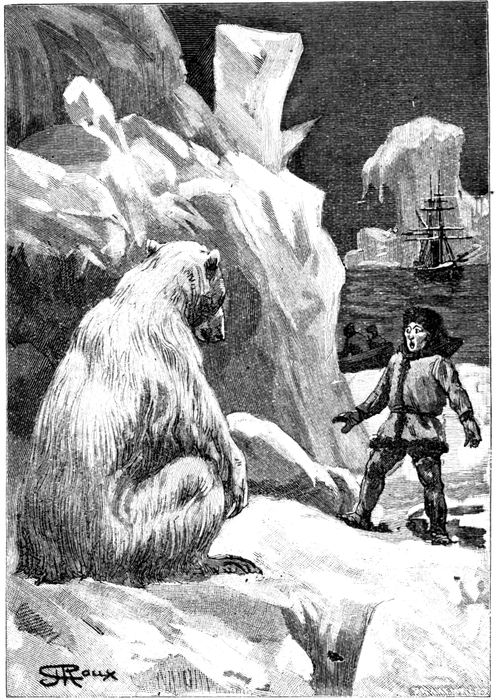
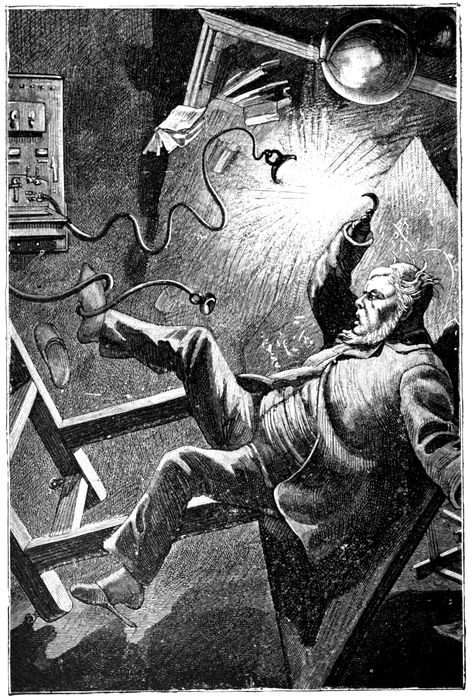
 ierd, or even
 I,
without
even dotting the i. He was so perfervid in his discussions
that he had been named Sulphuric Alcide. Not only was
he big, but he was tall. His friends affirmed that his
height was exactly the five millionth part of a quarter of
the meridian, and they were not far out. Although his
head was rather too small for his powerful bust and
shoulders, yet he held it well, and piercing were the eyes
that looked through his