I enjoyed Eton from the first moment I arrived. The
surprise and the relief at finding one was treated like
a grown-up person, that nobody minded if one had a
sister called Susan or not, that all the ridiculous petty conventions
of private-school life counted for nothing, were inexpressibly
great.
Directly I arrived I was taken up to my tutor in his study,
which was full of delightful books. He took me to the matron,
Miss Copeman, whom we called MeDame. I was then shown
my room, a tiny room on the second floor in one of the houses
opposite to the school-yard. As I sat in my room, boy after
boy strolled in, and instead of asking one idiotic questions
they carried on rational conversation.
The next day I met Broadwood, who was at another house,
and we walked up to Windsor in the afternoon. He told me
all the things I had better know at once; such as not to walk
on the wrong side of the street when one went up town; never
to roll up an umbrella or to turn down the collar of one’s greatcoat;
how to talk to the masters and how to talk of them;
what shops to go to, and what were the sock-shops that no
self-respecting boy went to. There were several such which I
never entered the whole time I was at Eton, and yet I suppose
they must have been patronised by someone.
The day after that came the entrance examination, in
which I did badly indeed, only taking Middle Fourth. My tutor
said: “You have been taught nothing at all.” I was in the
twenty-seventh division—the last division of the school but
three, and up to Mr. Heygate. I was in the French division
of M. Hua, who directly he put me on to read saw that I knew
French, a fact which I had concealed during the whole time I
was at my first private school. I messed with Milton and
Herbert Scott, and after the first fortnight I became one of
the two fags apportioned to Heywood-Lonsdale.
The captain of the House was Charlie Wood, Lord Halifax’s
eldest son, and his younger brother, Francis, was a contemporary
of mine and in the same house, but Francis, who was the most
delightful of boys and the source and centre of endless fun, died
at Eton in the Lent half of 1889.
Fagging was a light operation. One had to make one’s
fagmaster tea, two pieces of toast, and sometimes boil some
eggs, show that one’s hands were clean, and that was all. Then
one was free to cook buttered eggs or fry sausages for one’s
own tea.
On my first Sunday at Eton I had breakfast with Arthur
Ponsonby, who was at Cornish’s, and I was invited to luncheon
at Norman Tower, Windsor, where the Ponsonbys lived. There
I found my Uncle Henry, my Aunt M’aimée, my cousins, Betty
and Maggie and Johnny, and the Mildmay boys, who were also
at Eton then.
In the afternoon we went for a walk in the private grounds
of the Home Park with Johnny, and he took us to a grotto called
the Black Hole of Calcutta, which was supposed to represent
the exact dimensions of that infamous prison. It had a small,
thick, glazed glass window at the top of it. On the floor was a
heap of stones. Johnny suggested our throwing stones at the
window, and soon a spirited stone-throwing competition began.
The window was already partly shattered when warning was
given that someone was coming. We thought it might be
the Queen, and we darted out of the grotto and ran for our
lives.
The whole of my Eton life was starred with these Sundays
at the Norman Tower, which I looked forward to during the
whole week. Maggie would take us sometimes into the Library
and the State Rooms, and we used sometimes to hear the approaching
footsteps of some of the Royal Family, and race for
our life through the empty rooms.
One day we came upon the Empress Frederick, who was
quietly enjoying the pictures by herself.
Sometimes in the afternoon Betty would take me up to her
room and read out books to me, but that was later.
Our house played football with Evans’, Radcliffe’s, and
Ainger’s. We had to play four times a week, and though I was
always a useless football player, I thoroughly enjoyed these
games, especially the changing afterwards (when we roasted
chestnuts in the fire as we undressed), and the long teas.
Milton, my mess-mate, was an enthusiastic, but not a skilful
chemist, and one day he blew off his eyebrows while making
an experiment.
At the end of my first half we had a concert in the house,
in which I took part in the chorus. I had organ lessons from
Mr. Clapshaw, and during my first half I once had the treat of
hearing Jimmy Joynes preach in Lower Chapel. He had been
lower master for years, and had just left Eton; he came down
to pay a visit, and this was the last time he ever preached at
Eton. His sermons were of the anecdotal type, full of quaint,
pathetic, and dramatic stories of the triumph of innocence.
They were greatly enjoyed by the boys. In the evening, after
prayers, my tutor used to come round the boys’ rooms and talk
to every boy. He used to come into the room saying: “Qu’est-ce
que c’est que ci que ça?” My friends were Dunglass, Herbert
Scott, Milton, Stewart, and Brackley. After Eton days I never
saw Stewart again till 1914, when the war had just begun. I
met him then in Paris. He was in the Intelligence. He had
been imprisoned in Germany before the war, and he was killed
one day while riding through the town of Braisne on the Aisne.
Dunglass was peculiarly untidy in his clothes, and his hat
was always brushed round the wrong way. My tutor used to
say to him: “You’re covered with garbage from head to foot,”
and sometimes to me: “If your friends and relations could see
you now they would have a fit.”
In the evenings the Lower boys did their work in pupil room.
Boys in fifth form, when they were slack, did the same as a
punishment, and this was called penal servitude. While they
prepared their lessons or did their verses, my tutor would be
taking older boys in what was called private; this in our case
meant special lessons in Greek. One night these older boys
were construing Xenophon, and a boy called Rashleigh could
not translate the phrase, “Τοὺς πρὸς ἐμὲ λέγοντας.”[3] My tutor
repeated it over and over again, and then appealed to us Lower
boys. I knew what it meant, but when I was asked I repeated
exactly what Rashleigh had said, like one hypnotised, much to
my tutor’s annoyance.
Sometimes when my tutor was really annoyed he would say:
“Do you ever wake up in the middle of the night and think what
a ghastly fool you are?” Another time he said to a boy:
“You’ve no more manners than a cow, and a bad cow, too.”
When the word δύναμαι occurred in Greek, my tutor made a
great point of distinguishing the pronunciation of δύναμαι and
δυνάμει. δύναμαι he pronounced more broadly. When we
read out the word δύναμαι we made no such distinction, and he
used to say, “Do you mean dunamẏ or dunamai?” It was our
great delight to draw this expression from him, and whenever
the word δύναμαι occurred we were careful to accent the last
syllable as slightly as possible. It never failed.
We did verses once a week. A little later most of these
were done in the house by a boy called Malcolm, who had
the talent for dictating verses, on any subject, while he was
eating his breakfast, with the necessary number of mistakes
and to the exact degree of badness needed for the
standard of each boy, for if they were at all too good my tutor
would write on them, “Who is the poet?” In return for this
I did the French for him and a number of other boys. Latin
verses both then, and until I left Eton, were the most important
event of the week’s work. When one’s verses had been done
and signed by one’s tutor one gave a gasp of relief. Sometimes
he tore them up and one had to do them again. I was a
bad writer of Latin verse. The kind of mistakes I made
exasperated my tutor to madness, especially when I ventured
on lyrics which he implored me once never to attempt again.
In spite of the trouble verses gave one, even when they were
partly done by someone else, one preferred doing them to a long
passage of Latin prose, which was sometimes a possible alternative.
It is a strange fact, but none the less true, that boys can
acquire a mechanical facility for doing Latin verse of a kind,
with the help of a gradus, without knowing either what the
English or the Latin is about.
The subjects given for Latin verse, what we called sense for
verses, were sometimes amusing. The favourite subject from
the boys’ point of view was Spring. It was a favourite subject
among the masters, too. It afforded opportunities for innumerable
clichés, which were easy to find. One of the masters
giving out sense for verses used to say: “This week we will do
verses”—and then, as if it were something unheard of—“on
Spring. Take down some hints. The grass is green,
sheep bleat, sound of water is heard in the distance—might
perhaps get in desilientis aquæ.”
The same master said one day, to a boy who had done some
verses on Charles II., “Castus et infelix is hardly an appropriate
epithet for Charles II.” Once we had a lyric on a toad. “Avoid
the gardener, a dangerous man,” was one of the hints which I
rendered:
“Fas tibi sit bufo custodem fallere agelli.”
The whole of my first half was like Paradise, and I came back
to Membland for the holidays quite radiant.
When I went back for my second half I was in the Upper
Fourth in the Lower Master’s Division. The Lower Master was
Austen Leigh and the boys called him the Flea. I started,
when I was up to him, the fiction that I could scarcely write,
that the process was so difficult to me that a totally illegible
script was all that could be expected from me. This was
completely successful throughout the half, but in Trials I did
well. I had started off by getting the holiday task prize,
the holiday task being the Lord of the Isles, and as I had read a
great part of it in the train going back, and as none of the other
boys had read any of it, I got the prize.
Those holidays Chérie took Susan and myself to Paris. We
stayed at the Hôtel Normandy in the Rue de l’Échelle, and I
started from Eton the day before the result of Trials was declared.
The day we arrived in Paris a blue telegram came
telling us the result. It ran as follows: “Brinkman divinity
prize, distinction in Trials, Trial Prize.” This meant that for
the distinction, one had a cross next to one’s name in the school
list for the rest of one’s Eton career. The Trial prize meant
one was first in Trials in the division. It was a complete
triumph, and the Lower Master wrote in my report: “Had I
known what I discovered at the end of the half that he could
write perfectly well, I would have torn up every scrap of his
work during the half.” But it was an idle regret, as he did not
discover it until too late. We spent the whole of the holidays
in Paris and enjoyed it wildly.
Looking at a letter which I wrote from Paris (March 1888)
at this time, I see we did some strenuous sight-seeing. We
went to Notre Dame des Victoires, to the Musée Grévin, to
Sainte Geneviève, la Foire de Jambon, the Jardin d’Acclimatation,
and the Bois de Boulogne; we breakfasted at the
Café de Paris, with anisette at the end of the meal; went to
hear “la Belle musique sacrée” at the Châtelet, where Mademoiselle
Kraus sang and Mounet Sully recited; we visited
the Panthéon, saw Victor Hugo’s tomb, the Musée Cluny;
had breakfast at Foyod’s, and saw the Archbishop of Paris
officiate at Notre Dame, and went to the Louvre. All this was
in Holy Week.
The next week we went to Versailles, the Sainte Chapelle,
and the Invalides; saw Reichemberg and Samary act in the
Le Monde ou l’on s’ennuie at the Théâtre français and Michel
Strogoff at the Châtelet.
On Monday, 2nd April, I wrote home: “Nous allons jeter une
plume et la suivre.” We also saw a play of Georges Ohnet’s at
the Porte Saint Martin called La Grande Marnière and Le Prophète
at the opera, with Jean de Reske singing the part of the false
Messiah. We saw this from a little box high up in the fourth tier,
and when we arrived we found a lady and a gentleman in our
seats. We had expressly paid for the front seats. Chérie was
indignant, and had it out with the gentleman, who gave way
under protest. “Vous voyez,” said the lady, “Monsieur vous
cède sa place.” “C’est ce qu’un Monsieur doit faire,” said Chérie.
“On rencontre des gens,” said the lady, shrugging her shoulders.
We did not go to see L’Abbé Constantin, as Chérie said it
was “une pièce de carême.”
On our last night in Paris we went to see a farce called
Cocart et Bicoquet at the Renaissance. This play had been
recommended to Chérie by a French friend of hers, who thought
we did not understand French enough to follow dialogue.
After the first act, Chérie became uneasy, and no sooner was
the second act well under way than Chérie took us away. It
was, she said to me, no play for Susan. She added that whenever
she had tried to distract Susan’s attention from the more
scabrous moments by saying, “Regarde cette manche,” and
by calling her attention to interesting details in the toilettes of
the audience, I had recalled Susan’s attention to the play by
my only too well-timed laughter.
The year after this, 1889, we again went to Paris—Chérie,
Susan, and myself—and this year Hugo came with us. Great
preparations were being made for the Exhibition. It was not
yet open, but the Eiffel Tower was finished, and we saw the
reconstruction of the Le Vieux Paris and a representation of
Latude escaping from the Bastille.
We also saw Maître Guérin performed at the Théâtre
français, with Got Worms, Baretta, and Pierson in the cast.
Got’s performance as the old, infinitely cunning, and scheming
notaire, who is finally deserted by his hitherto submissive
wife, was said to be the finest thing he ever did.
We saw two melodramas—Robert Macaire and La Porteuse
de Pain; Zampa at the Opéra Comique and Belle Maman,
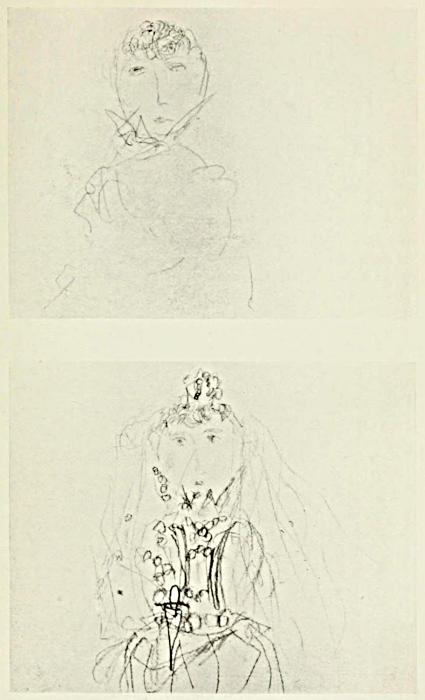
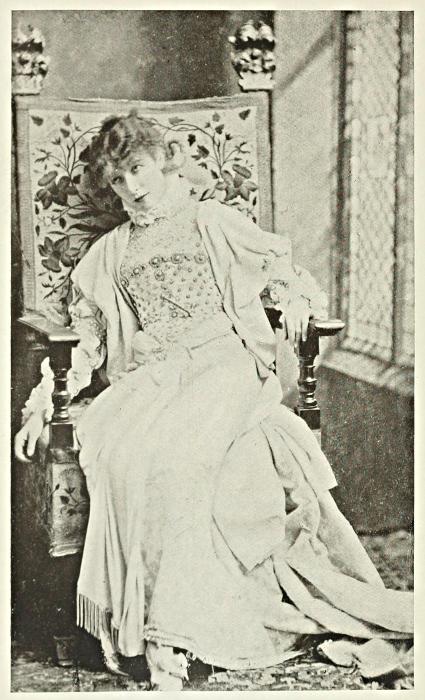
Sardou’s comedy at the Gymnase; and Chérie and I went to see
Sarah Bernhardt in perhaps the worst play to which she ever
lent her incomparable genius, and which, I imagine, she chose
simply to give herself the opportunity of playing a quiet death
scene. It was an adaptation of the English novel, As in a
Looking-Glass. Bad or good, I enjoyed it, and wrote home a
detailed criticism of the play. This is what I wrote: “The
adaptation of the book is bad. They evidently think you are
perfectly acquainted with the book, and the sharp outline and
light and shade of character is not sufficiently marked. In the
first act you see about a dozen people who come in and who
don’t let you know who they are, and who never appear again,
and you do not arrive at the dramatic part till the last act.
“The story is briefly thus: Léna is staying with Mrs.
Broadway, very Sainte Nitouche! everyone admiring her and
all the octogenaires in love with her. She (whose passé is not
sans tache) is under the power of a certain Jack Fortinbras,
who forces her, under the penalty of unveiling her past, to
marry a certain Lord Ramsey. Léna has in her possession a
letter which Ramsey wrote to a Lady Dower, whose name is
also Léna, and the letter is in very affectionate terms. Ramsey
is engaged to Beatrice, and Léna shows this letter to Beatrice
and says it was to her! Of course, Beatrice thinks Ramsey
un lâche and leaves the house, saying her marriage is impossible,
and leaving a letter for Ramsey to that effect. Act II.
is in Léna’s house. Fortinbras comes and plays cards with a
young man and cheats. Ramsey sees this, and Fortinbras
is turned out of the house.
“Act III., Monte Carlo.—Léna is staying there with Ramsey,
with whom she is now desperately in love. Fortinbras appears
and asks for money, which she gives. Ramsey comes in and
asks why she is agitated. She says she is helpless, alone. He
confesses his love for her, and she, in a nervous excitement,
says, “Je t’adore,” and so scheming to marry for money, she
finds she is dreadfully in love with him.
“Act IV.—They are married and in Scotland. Fortinbras
appears tracked by detectives and asks for 200,000 (pounds or
francs?) at once, or he tells of her passé. Then Sarah Bernhardt
was superb. It was quite impossible for her to get the money,
and she is so happy with her husband. At this crisis Ramsey
comes in and half strangles Fortinbras, who, when let go,
reveals all Léna’s past. At the words, ‘Cette femme m’aimait
une fois,’ Léna jette un cri d’angoisse, I would have given anything
for you to have seen her act that scene. Ramsey hears
it all, and, when given the proofs that are in letters, throws
them into the fire, and Fortinbras is given to the detectives and
Ramsey is alone with Léna and tells her that he really believes
what the man said. She cannot deny it, and confesses the
whole thing. Her acting was supreme, and Ramsey says to
her, ‘Et m’avez vous jamais aimé?’ Then she gives way and
bursts into sanglots, and implores him to believe her, and that
she adored him. He refuses to believe her and goes out. Then
all is pantomime. She takes up a knife, throws it down, gets a
little bottle of ‘morphine,’ drinks it, sits down with Ramsey’s
photograph in her hand; then come seven minutes of silence.
All pantomime, but what pantomime; she quietly dies. I
have never seen such a splendid bit of acting. It was lovely.
As she is dying, Ramsey tries to come in, but the door is locked.
He comes in at the window in an agony of grief and forgives
her. Just when he is at the door she stretches out her hand
and falls back épuisée. It was beautiful.”
I remember a doctor saying, as we went out of the theatre:
“Mais ce n’est pas comme cela qu’on meurt de la morphine,”—upon
which someone else answered: “Alors, ceux qui ont dit:
Voilà une mort réaliste ont dit une sottise. Pourtant elle a
été dite.”
We went to the cemetery of the Père Lachaise, and the tombs
that I cited in a letter are those of Héloïse and Abelard, Balzac,
Alfred de Musset, Bizet, and Géricault.
I went back to Eton for my first summer half, which is
said to be the most blissful moment of Eton life, and I
think in my case it was. The first thing one had to do was
to pass swimming. I had learnt to swim at Eastbourne, and I
swam as well as I ever did before or afterwards, but to pass,
one had to swim in a peculiar way. The passing was supervised
by my tutor, and I failed to pass twice, chiefly, I think,
owing to the curious nature of my dive from the boat, which
took the form of a high leap into the air and a descent on all-fours
into the water. “Swim to the bank,” said my tutor,
much to my disappointment. The second time I failed again,
but there was soon a third trial, and I passed. I at once hired
an outrigged gig with another boy, and then a period of unmixed
enjoyment began: rows up to Surley every afternoon and
ginger-beer in the garden there, bathes in the evening at
Cuckoo Weir, teas at Little Brown’s, where one ordered new
potatoes and asparagus, or cold salmon and cucumber, gooseberries
and cream, raspberries and cream, and every fresh
delicacy of the season in turn. Little Brown’s, the school
sock-shop next to Ingalton Drake’s, the stationer’s, which we
still called Williams’, was then controlled by Brown, who was
a comfortable lady rather like the pictures of the Queen of
Hearts in Alice in Wonderland. She was assisted by Phœbe,
who kept order with great spirit, in a seething mass of unruly
boys, all shouting at the top of their voices and clamouring to
be served first. Brown’s was open before early school, and if
one had the energy, one got up in time to go and have a coffee
and a bun there. It was well worth the effort, for the buns
were slit open and filled with butter, and then, not toasted, but
baked in the oven, and were crisp, hot, and delicious. Brown
and Phœbe had the most marvellous memory for faces I
have ever come across. They would remember a boy years
afterwards, and when I was at Eton I used often to hear Brown
say to Phœbe, as some very middle-aged man passed the
window, “There’s Mr. So-and-so.”
There was a pandemonium in the front of the shop; in
the little room at the back of the shop only swells went.
There was another sock-shop called Rowland’s, near Barnes
Pool, which had a garden and an arbour, and sold scalloped
prawns in winter and wonderful strawberry messes in the
summer. Then farther up town there was Califano, who was
celebrated for his fiery temper, and in Windsor there was
Leighton’s. But Brown’s was the smallest and cosiest of all
the sock-shops, and nothing at any of the others could vie with
her hot buns in the early morning.
I was now in Remove, and once more under the tuition
of Mr. Heygate. We no longer translated Greek stories and
epigrams from the delightful collection called Sertum, which was
used in the Fourth Form. This book is now out of print, but
I fortunately possess a copy. It is a most delightful anthology
of short anecdotes and poems. On the other hand, we did
Sidgwick’s Greek exercises, a book of very short English stories,
which have to be translated into Greek. It is one of the most
charming books ever written, and even now I can read it when
I can’t read anything else.
I can’t remember what we read in school that half, but I
remember reading Monte Cristo out of school. My mother had
given me an illustrated edition of it on my birthday. On the
afternoon of a whole school day I was reading of Dantès’ escape
from the Chateau d’If, and I became oblivious of the passage
of time. The school clock chimed the quarters, but I heeded
them not. Just before the school hour was ended the boys’
maid came in and told me I was missing school. I flung away
my book and ran breathless to upper school, where I found the
boys just going out. I had missed school, an unheard-of thing
to do, which meant probably writing out endless exercises of
Bradley’s Latin prose. Each division had what was called a
Prepostor, a boy who kept a book in which he was supposed
to note all boys who were absent, and to find out if they were
staying out, which meant staying out of lessons, that is to say,
staying indoors on account of sickness, in which case the Dame
of the house had to sign a statement to that effect in the prepostor’s
book, and add also whether they were excused lessons;
if they were not excused lessons they had to do written work in
the house. On this day the prepostor had not noticed my
absence, nor had Mr. Heygate, and I joined the crowd of boys
running downstairs as if I had been there all the time.
There were two sorts of masters at Eton—those who could
keep order and those who couldn’t. With those who could,
there was never any question of ragging. Boys knew at once
what was impossible and accepted it. They also knew in a
moment when it was possible, and they lost no minute of their
opportunities, and at once began to harass the wretched master
with importunate, absurd, and impertinent questions, seeing how
far they could go in veiled insolence without overstepping the
line of danger. It was the masters who taught mathematics and
French who had the worst time, with the exception of Monsieur
Hua, who was an admirable teacher and stood no nonsense.
In Remove we did science. There were three science
masters—Mr. Porter, Mr. Drew, and Mr. Hale (Badger). I was
taught by them all in turn. Mr. Drew used to produce a
mysterious and rather dirty-looking bit of stony metal or metallic
stone, and say in a confidential whisper: “Do you know what
that is? It’s quartz.” Badger Hale had only one experiment.
It was a split football which was made to revolve by turning
a handle, and proved, but hardly to our satisfaction, the centrifugal
tendency of the earth. Mr. Porter’s science lectures, on the
other hand, were fraught with excitement. Apparatus after
apparatus was brought in, and experiment after experiment was
attempted, sometimes involving explosions. Sometimes they
failed. Sometimes, just at the critical moment we would laugh.
Mr. Porter would say: “I have been three days trying to get this
experiment ready, and now you have spoilt it all.” “Please,
sir, we were not laughing,” we would say. “You were looking
as if you were laughing, and that disturbs me just as much,”
Mr. Porter would answer. It was no use accusing us of laughing,
because we always denied it at once, and after a time he would
always say: “Write out the verbs in mi for looking as if you were
laughing.” At the end of the half, Mr. Porter gave what was
called a “Good Boys’ Lecture,” at which the first nine boys of
all the various sets he taught attended, if their work had been
satisfactory throughout the term. I went to three of these or
more. They were lectures with coloured magic-lantern slides,
showing views of places all over the world, from Indus to the
Pole. Never have I enjoyed anything more. There was a
slide of Vesuvius in eruption, and slides of Venice and New
Zealand, which were entrancingly beautiful. But one half, the
Good Boy Lecture was confined to Mr. Porter’s holiday trip to
the Isle of Skye, and the slides were not coloured. This lecture
was a disappointment, and I am afraid, from the boys’ point of
view, a failure. Another remarkable lecture Mr. Porter gave was
on soap-bubbles. Films of soap bubble were projected by some
device on to a screen, so that you saw the prismatic colours
enlarged and as vivid as rainbows. While this was going on,
a boy called Harben, who had a fruity alto voice, sang a sentimental
song into a tube; the vibrations of the sound had a
strange effect on the soap-bubble films, and made them change
rapidly into a multitude of kaleidoscopic shapes and gyrations
and symmetrical patterns. So Mr. Porter was the precursor of
Skriabin’s Symphony, in which the music is assisted by visible
colour.
Mr. Porter gave a series of lectures on electricity out of
school. I and a boy in my house, Francis Egerton, applied
to go to these. Mr. Porter somewhat reluctantly and suspiciously
allowed us to come. They were rather stiff and advanced
lectures, involving a good deal of formula writing on the
blackboard with pi and other mysterious signs, but there were
also experiments. We did not understand one word of it,
but soon a difficult experiment was begun, which Mr. Porter
said had taken him days to prepare. He was doubtful whether
it would succeed. This was a rash remark. Egerton and I
rocked with laughter. We laughed till we cried. There was
no question of looking as if we were laughing. We were not
allowed to go to any more lectures on electricity. There was an
assistant masters’ prize given for science, and it was either that
or the following year that the subject was physiography. I went
in for this prize, staying out the whole Sunday before so as to
have time to read the book on which we were to be examined,
a short book by Huxley. I competed and won the prize. When
it came to choosing a book for my prize, I chose The Epic of
Hades, by Lewis Morris. I had to go to Mr. Cornish, who was
not yet Vice-Provost, to have my name written in it. He was
disgusted with my choice, and he advised me to change the
book. But I was obdurate. I had chosen the book for its nice
smooth binding, and nothing would make me reconsider my
decision. “It’s poor stuff,” said Mr. Cornish; “it’s like boys’
Latin verses when they’re very good.”
There were two other French masters besides M. Hua—M.
Roublot and M. Banck. M. Banck was sublimely strict, but M.
Roublot was easygoing, good-natured, but lacking in authority.
During his lesson we used to read the newspapers and write
our letters, but we liked him too much to rag. We used to bring
in all our occupations for the week, and stacks of writing-paper.
One day when this was happening, and every boy was pleasantly
but busily engaged in some occupation of his own, who should
walk in but the Headmaster, Dr. Warre. The newspapers and
the writing-paper and envelopes disappeared as by magic, and
M. Roublot at once put on the safest boy to construe. Dr.
Warre, who had grasped the situation, told us that our conduct
was disgraceful.
He often made sudden visits to divisions, and stood up by
the master’s desk while the work went on. These visits were
always alarming, and one day, when he had just gone out of
the room, one of the boys said: “Lord, how that man makes
me sweat!” But there was one other French master who was
not French, but far more formidable than all the rest, and
this was Mr. Frank Tarver. Mr. Tarver was a perfect French
scholar, and when he explained what the word bock meant,
and said: “When you go to a café in Paris you sit down and say,
‘Garçon, un bock,’” one felt that one had before one a perfect
man of the world. But sometimes there were no bounds to his
anger, especially if he found that one had not looked out words
in the dictionary, or if one translated encore by again. One day
I remember his being in such a passion that he took a drawer
from his desk and flung it on the ground. It is a great thing to
be able to do this effectually. The boys quaked. Most of us
liked him very much all the same; but to some he was a terror.
Mathematical lessons were always a difficulty in my case.
I should never have passed Trials in mathematics had it not been
for Euclid, which counted together with arithmetic and algebra.
Fortunately I could do Euclid without difficulty, so I always
got enough marks in that subject to make up for getting none
at all in the two other branches of the science.
Every week we had a task called an extra-work to do out
of school, which was meant to represent an hour’s work of mathematics,
and consisted of sums in arithmetic and algebra. It
generally took me more than an hour, and I never managed to
get a sum right. When we used to get into hopeless arrears
with our work, and everything was in an inextricable tangle,
there was always one solution, and that was to stay out; but
to be excused lessons one had to go to bed, and for that it was
necessary to catch cold. But just an ordinary attack of Friday
fever was enough to stay out. We complained of a bad headache
and incipient insomnia, and Miss Copeman let us stay out
at once, thinking it might be the beginning of measles, and we
sat in her sitting-room reading a novel till the crisis was over.
At the slightest sign of a real streaming cold my tutor used
to pack us off to bed and keep us there till it was gone, and we
were allowed bound volumes of the Illustrated London News
from the boys’ library, and my tutor would lend us books from
his own library.
Each boy in a division had to be prepostor for the division
for a week at a time in turn. With the prepostor’s book one
marked in the boys who were absent, either from school or
chapel. One had a list of the boys’ names at the end of the
book and ticked them off as they walked into chapel. This
sounds a simple thing to do, but as the boys used to come in
at the last minute and all together, and one had to take up the
book to a master before chapel began, I found it flustering to a
degree, and never knew if I had marked everyone in or not. I
had to go to the Headmaster once for losing the prepostor’s
book, and he said I had played fast and loose with a position of
grave responsibility, and gave me three exercises of Bradley’s
Prose to write out.
After the summer half I was in Arthur Benson’s division.
We read passages from the Odyssey, Virgil, and Horace’s Odes,
the Second Book, and for the first time I enjoyed some Latin.
I thought Horace’s Odes delightful. Arthur Benson used to
make us draw pictures illustrating episodes in Greek history,
and he would stick them up on the wall if they were good.
One of the subjects suggested was the bridge of boats that
Xerxes threw across the sea, and I remember drawing a magnificent
picture, with the hills of the Chersonese in the background,
copied from some illustrations of the Crimean War, and
a realistic flat bridge made of planks placed on broad punts.
He was delighted with the picture and put it up at once, and
sometimes he used to take older boys to see it.
There was not much religious instruction at Eton. We
construed the Greek Testament on Monday mornings, but this
was a Greek lesson like any other; and Sunday was made
hideous by an exercise called Sunday Questions, which had to
be done on that day, and which we always put off doing to
the last possible moment. These were questions on historical
points in the Old Testament, and entailed finding out the
answers from some such book as Maclear’s Old Testament
History, and writing four large sheets of MSS. The questions
were sometimes puzzling, and we used to consult Miss Copeman,
and sometimes, as a last resort, my tutor, who used to say:
“I can’t think what Mr. Benson”—or whoever it might be—“can
mean.” I have still got a copy of Sunday Questions
done at Eton. In this set we were told to give the probable
dates showing the duration of the kingdoms of Israel and
Judah, and what was going on in any other countries. Another
question is: “Why was Pharaoh Necho against Judah? How
did he treat their successive kings?” And the last question
(there were several others) was: “Distinguish carefully between
Jehoiakim and Jehoiakin.” I seem to have answered these
questions rather evasively, but I got seven marks out of ten.
Besides this, boys got their religion from the sermons in
Chapel, of which they were highly critical. They enjoyed a
good preacher, and some of the masters and guests were good
preachers, but the boys were merciless critics of a bad or ludicrous
preacher, and there were many of these. One of the
masters preached symbolic sermons about the meaning of the
Four Beasts. Another used to begin his sermons by saying:
“The story of the Prodigal Son is too well known to repeat.
We all know how⸺” and then elaborately retell what was
supposed to be too well known to tell at all. Before boys were
confirmed they received special tuition on religious and moral
topics from their tutor, but I missed it by having measles. So
I was confirmed in the holidays, and just before my confirmation
it struck my mother that I was singularly unprepared, so
she sent me to see my Uncle Henry Ponsonby’s brother, who
was a clergyman. We called him Uncle Fred; his sister had
married one of my uncles. He had a great sense of humour,
and was rather shy. He was also extremely High Church.
When I arrived with a note from my mother, in which he was
asked to examine me in theology, he was embarrassed, and he
said: “Well, I will ask you your catechism, What is your
name, N. or M.?” And then he laughed and said, “I think
that will do.” When I told my mother this, she sent me to
another clergyman who did talk, but confined the conversation
to moral generalities, and said no word about the catechism. So
I may say I had no religious instruction at school during all my
school-time, for which I have always been profoundly grateful.
Music lessons became a difficulty and a stumbling-block as
time went on. I had organ lessons, and they were, of course,
given out of school, and these lessons and the necessary practice
took up a lot of one’s spare time, besides having to give way to
work. Mr. Joseph Barnby, the organist and the head of the
music masters, said: “Your parents pay for your music
lessons just as they pay for your Latin lessons, and so you
ought to take just as much trouble about them.” This was
quite true, but the other masters did not see the matter in
the same light. They couldn’t be expected to take music
lessons seriously, and said that music must in all cases always
give way to work.
The result was one scamped one’s practice and shirked one’s
music lesson on every possible opportunity. Matters came to
such a pitch that I was sent for by Mr. Barnby. The situation
was aggravated because Dunglass and I had unwittingly offended
the violin master, and had gone into his room while he was giving
a lesson to another boy, and had then shut the door rather
more violently than was necessary. Mr. Barnby was indignant.
My brother John had been one of his best pupils. He said our
conduct was scandalous. I had employed base subterfuges to
shirk music lessons, and I and Dunglass had insulted dear kind
Mr. Morsh. We apologised to Mr. Morsh, and things went
more smoothly; but I gave up the organ and had lessons on the
pianoforte instead. Mr. Barnby was quite right, but he got no
sympathy from the other masters, who continued to treat music
as an utterly unimportant side issue which must give way to
everything else. The result being, of course, that directly boys
found that music lessons made it more difficult for them to get
through their work, they gave up learning music. I have never
stopped meeting people in after life who are naturally musical,
and bitterly regretted not having been taught music seriously as
boys; and if parents were wise they would insist on music being
taken seriously, if they pay for music lessons for their boys.
But as yet parents have done no such thing. Besides music
lessons, there was the musical society, which consisted of an
orchestra and a chorus, and performed a cantata at the school
concert at the end of the half. I belonged to this later, and we
sang Parry’s setting to Swinburne’s Eton “Ode” at the Eton
Tercentenary Concert in June 1891. Mr. Barnby used to conduct,
and had an amazing knack of discovering someone who was
not singing, or singing a wrong note. The concerts were, I used
to think, intensely enjoyable. There was an atmosphere of
triumph about them when the swells used to walk in at the
beginning in evening clothes, and coloured scarves, which stood
for various achievements either on the river, the cricket or the
football field. As each hero walked in there were thunders of
applause. Then a treble or an alto used to sing a song that
reduced the audience to tears: “Lay my head on your shoulder,
Daddy,” or “The Better Land.” There was a boy called
Clarke, who used to sing year after year till his voice broke. He
had a melting voice. During my last half at Eton there was a
boy called Herz, who sang “Si vous n’avez rien à me dire,”
with startling dramatic effect, exactly like a French professional.
But the best moment of all was when the Captain of the Boats
sang the solo in the Eton Boating Song, whether he had got a
voice or not, and then the whole school sang the “Carmen
Etonense” at the end. What an audience it was! How they
yelled and roared when a song pleased them! I used sometimes
to go to St. George’s Chapel at Windsor, and Sir Walter Parratt
used to let me sit in the organ loft. I heard Bach’s “Passion
Music of St. Matthew” in this way, and Sir Walter said:
“You must be as still as a mouse.”
I have said there were two kinds of masters: those who
were ragged and those who were not. The master who was
most ragged was a mathematical master called Mr. Mozley.
He punished, but could never stop the stream of impertinent
comment that went on through the hours of his instruction.
One day we got a boy called Studd to practise “God save the
Queen” at his open window. His window looked out on to a
yard, and Mr. Mozley’s schoolroom was on the ground floor of
the house next door to ours and looked out on to the same yard.
The windows were open. It was a hot summer’s afternoon, and
the strains of “God save the Queen” came in through Mr.
Mozley’s window. Every time the tune began we stood up.
“Sit down,” cried the Mo, or Ikey Mo, as he was called.
“National Anthem, sir,” we said; “we must stand up.” There
was a short pause. Then the tune began again. Again we all
stood up. Mr. Mozley rushed to the window, but there was no
sign of any violinist. For ten minutes there was no interruption,
and then, just when Mr. Mozley, by a shower of punishments,
thought he had got the division in hand once more, the tune
began again, and again we all stood up with plaintive, resigned
faces, as though nobody minded the interruption more than
we did.
Another master who was mercilessly ragged was Mr. Bouchier,[4]
who was deaf, and afterwards a famous Times correspondent
at Sofia—a man who could do what he liked with the Bulgars,
but who could not manage a division of Eton boys. The boys
took mice into his schoolroom, and ultimately he had to go
away.
There were masters who were stimulating teachers and
roused the interest of boys in topics outside the ordinary
routine of work, and others who kept scrupulously to the routine.
The latter were the fairest, for when outside topics were discussed
probably only a minority of the boys listened. It was
above the heads of many. Arthur Benson kept scrupulously
to the routine; he made it as interesting as he could, but rarely
diverged on to stray topics, and never on to such topics that would
only interest a few of the boys. Edward Lyttelton did exactly
the opposite. When I was in his division there were about half a
dozen boys who were advanced, and had got shoved up into his
division by a rapid rise. The others were solid, stolid dunces.
Edward Lyttelton devoted his time to the intelligent, and spent
much time in conversation on such topics as ritual in Church, the
reign of Charlemagne, and the acting at the Comédie française.
He carried on teaching by asking a quantity of questions which
entailed a great deal of interesting comment and argument. In
the meantime the dunces ragged. I was good at answering his
questions, but I joined in the ragging, nevertheless, partly from
a sense of loyalty to raggers in general. The result was that at
the end of the half I was top of his division for the school-time,
but I forfeited the prize owing, as he said in my report, to my
incorrigible babyishness. My tutor thought this unfair, and
gave me a book instead of the prize. Mr. Rawlins, who was
afterwards Lower Master and then Vice-Provost, was a good
teacher, but his chief hobby was grammar, and he talked far
above our heads. I startled him one day. We were construing
an Ode of Horace, where a phrase occurred mentioning the
difficulty of removing her cubs from, I think, a Gætulan lioness.[5]
He said, “There is a parallel to that in French poetry.” I
said, “Yes,” and quoted the lines from Hernani I had known for
so long:
“Il vaudrait mieux aller au tigre même
Arracher ses petits qu’à moi celui que j’aime.”
He was dumbstruck.
I was two years a lower boy, and reached the lower division
of fifth form by September 1889. Hugo arrived at Eton, and we
shared a room together. We messed together with Dunglass,
who had an order at Little Brown’s of a shilling a day. Every
day on the sideboard of the passage a large plate used to
await us in a brown paper parcel containing eggs and bacon
or sausages or fish. My tutor changed his house, and we
exchanged the convenient house opposite the school-yard for a
house that was once Marindin’s, on the Etonwick road. It
was far to go, and one had to get up early if one wished for
coffee and a bun at Little Brown’s before early school.
Dunglass and I used to read a good many books. Rider
Haggard and Edna Lyall were our favourite authors; Stevenson
got a second or third place; but Jane Eyre and Ben Hur
were approved of, and Monte Cristo got the first prize of all.
After Rider Haggard and Edna Lyall, I had a passion for
Marion Crawford’s books and read every one I could get hold
of. I have still got a list of the books I read in the year 1889,
marked according to merit. It is as follows:
| Name of Author. |
Name of Book. |
Remarks. |
| Edna Lyall |
Donovan |
Worth reading. |
| ” |
We Two |
” |
| ” |
In the Golden Days |
Exciting. |
| ” |
Won by Waiting |
Very good. |
| ” |
Knight Errant |
Worth reading. |
| ” |
The Autobiography of a Slander |
Very good. |
| ” |
Derrick Vaughan, Novelist |
Worth reading. |
| Shorthouse |
John Inglesant |
Excellent. |
| ” |
The Countess Eve |
Not worth reading. |
| Rider Haggard |
King Solomon’s Mines |
Excellent. |
| ” |
She |
Thrilling. |
| ” |
Jess |
Worth reading. |
| ” |
Allan Quatermain |
Exciting. |
| ” |
Mr. Meeson’s Will |
Trash. |
| ” |
Maiwa’s Revenge |
Trash. |
| Alphonse Daudet |
Tartarin de Tarascon |
Very good. |
| Alexandre Dumas |
Le Comte de Monte Cristo |
Perfect book. |
| ” |
La Dame de Monsoreau |
Worth reading. |
| Halévy |
L’Abbé Constantin |
Very good. |
| Octave Feuillet |
Le Roman d’un jeune homme pauvre |
Very good. |
| Lord Lytton |
The Last Days of Pompeii |
Excellent. |
| Marion Crawford |
Mr. Isaacs |
Worth reading. |
| ” |
Dr. Claudius |
” |
| ” |
Zoroaster |
” |
| ” |
A Roman Singer |
” |
| ” |
A Tale of a Lonely Parish |
Very good. |
| ” |
Saracinesca |
Worth reading. |
| ” |
Paul Patoff |
Exciting. |
| ” |
Marzio’s Crucifix |
Worth reading. |
| ” |
Greifenstein |
Thrilling. |
| ” |
With the Immortals |
Worth reading. |
| ” |
Sant’ Ilario |
” |
| Charles Kingsley |
Two Years Ago |
” |
| George Eliot |
Silas Marner |
Very good. |
| ” |
Adam Bede |
Perfect book. |
| ” |
Romola |
Very good. |
| ” |
The Mill on the Floss |
Perfect book. |
| Whyte-Melville |
Katerfelto |
Very good. |
| ” |
The White Rose |
Worth reading. |
| ” |
The Gladiators |
” |
| Lew Wallace |
Ben Hur |
Excellent. |
| Graham |
Neæra |
Worth reading. |
| Mrs. Humphry Ward |
Robert Elsmere |
” |
| Wilkie Collins |
The Woman in White |
Very good. |
| A. C. Gunter |
That Frenchman |
Thrilling. |
| Charles Reade |
Foul Play |
Worth reading. |
| R. L. Stevenson |
Treasure Island |
Perfect book. |
| ” |
Kidnapped |
Excellent. |
| ” |
Dr. Jekyll and Mr. Hyde |
Thrilling. |
| ” |
New Arabian Nights |
Very good. |
| ” |
The Dynamiter |
” |
| ” |
The Master of Ballantrae |
Excellent. |
| Julian Hawthorne |
Mrs. Gainsborough’s Diamonds |
Very good. |
| Charlotte Brontë |
Jane Eyre |
|
| Charles Kingsley |
Westward Ho! |
|
The reason the last two have no comments was probably
because the red ink in which the comments were made had run
out. I remember being particularly thrilled by Jane Eyre,
and so was Dunglass, who read it at the same time.
The 4th of June was an excitement for boys who were just
beginning their Eton career, but older boys were most blasé
about it and preferred short leave. We made great preparations
for my first 4th of June; grease spots were ironed
out of the tablecloth, everything that looked untidy was
put away; the window-box, which did duty for a garden, was
prepared and decked. I struck out a bold note in my window-box
by having a fountain in it, made by Mr. Duffield of High
Street, according to my instructions. There was a square
tin basin and a fountain in the middle of it, which was fed from
a tank which was hung high up by the side of the window.
The fountain worked successfully, but made a great mess,
and the boys’ maid had no patience with it. When my tutor
came round in the evening, the night before the 4th of June,
he said the room looked like a whited sepulchre. I had visitors
on the 4th of June. Chérie came, and I forget which other
members of the family.
Once every half the Headmaster used to ask Hugo and myself
to breakfast. This we enjoyed; it was an excellent breakfast,
with lots of sausages. The Headmaster used to look at the
Times, comment on the House of Commons, quote Horace,
and ask after John and Cecil. Other masters asked one to
breakfast as well, and I think few things gave the boys so much
pleasure. They used to discuss every detail of the breakfast
with the other boys afterwards, and retail everything the master
had said. I enjoyed my breakfasts with Mr. Impey most;
he used to tell me about books, and we used to discuss Rider
Haggard and Stevenson. I greatly preferred Rider Haggard,
and I had just read King Solomon’s Mines, and had one night
sat up late reading She.
Long leave and short leave were two great excitements.
When I went for short leave I used to go by the earliest possible
train and arrive at my sister Margaret’s house long before
breakfast. When long leave came about, we always went to a
play on Saturday night, and I remember seeing Captain Swift
at the Haymarket, and Coquelin in L’Étourdi. For my long
leave of the summer of 1889, I had been looking forward for
days to going to see Sarah Bernhardt in La Tosca, but when I
came up to London, I found to my horror that Chérie and my
mother had both been told it was too horrible a play to go
and see. My eloquent advocacy overcame Chérie’s scruples.
“Vraiment,” she said, “tu serais un superbe avocat.” And she,
Margaret, and I went off to the Lyceum and thoroughly enjoyed
Sarah’s harrowing and electric performance. While we were
having dinner, before starting, someone who was there said
that two men who had been to see the play had come out in
the middle. Chérie, who by that time had decided we were to
go, said they must have been des poules mouillées.
I think it was in 1890 that Queen Victoria opened the New
Schools at Eton and made a speech. And one summer while
I was at Eton, the German Emperor inspected the Eton Volunteers.
While he was doing this on horseback, a boy called
Cunliffe let off his rifle and the German Emperor’s horse bolted
into the playing fields.
Well-known people used to come and lecture at the literary
society sometimes, but the only famous man I heard while I
was at Eton was Mr. Gladstone, who lectured at the literary
society in March 1891, on Artemis, as revealed in Homer. I
was fortunate enough to get a ticket for this lecture. The boys,
abstruse as the subject was, were spellbound. There was only
one joke in the lecture, and that would have been better away.
It was this: “Some of you may have heard the old story of
the moon being made of green cheese.” Pause for laughter
and a dead silence. “The moon might just as well,” continued
Mr. Gladstone, “be made of green cheese for all the purposes
she serves in Homer.”
At the end of the lecture the Provost returned thanks, and
then Mr. Gladstone leapt to his feet and made an impassioned
speech on classical education. The last sentence of his peroration
was as follows: “But this, Mr. Provost, I venture to say,
and say with confidence, and it is not a fancy of youth nor the
whim of the moment, but the conviction forced upon me even
more by the experience of life than by any reasoning quality,
that if the purposes of education be to fit the human mind for
the efficient performance of the greatest functions, the ancient
culture, and, above all, the Greek culture, is by far the best and
strongest, the most lasting, and the most elastic instrument
that could possibly be applied to it.”
As he said these words his eyes flashed, he opened and raised
his arms, and his body seemed to expand and grow tall. He
seemed like the priest of culture speaking inspired words. His
voice rolled out in a golden torrent, and as he said the words,
“the best and strongest, the most lasting, the most elastic,”
they seemed to come to him with the certainty of happy inspiration
and with the accent of the unpremeditated. With these
words his voice reached its highest pitch of crescendo, and then,
slightly dying down, melodiously sank into silence.
This little speech showed me what great oratory could be.
At the end of my first year there was a prize called the
Headmaster’s prize for French, for lower boys. I competed
for this. It was always rather difficult to get a French prize
at Eton, as there was usually a French or a Canadian boy who
spoke and knew the language like a native. There was a
special examination paper for this prize. I and a French boy,
whose name I have forgotten, both got 95 marks out of 100.
Then the papers were looked through again, and it was found
that I had translated the French word hôte by host, when it
should have been guest, so the other boy was given the prize,
but my tutor gave me a book as a consolation. The following
year I competed for the Headmaster’s French prize for boys
in fifth form, and that time I won it, much to the delight of
Chérie and of everyone at Membland.
In fifth form we learnt German as an extra. German was
taught by Mr. Ploetz, who knew the language; and by other
masters, who didn’t. During the lessons of the latter, one paid
no attention, and attended to one’s private affairs. Mr. Ploetz
was an excellent, stimulating teacher, but most unpopular with
the other masters. The boys liked him; he was a book collector,
and had a fine library. He taught me a great deal, not of
German, as I paid no attention to the regular work, but I picked
up from him a mass of miscellaneous information. It was the
fashion to rag during his lessons, and I outdid everyone in
ingenious interruption during Mr. Ploetz’ lessons. It was not
that he couldn’t keep order. He was extremely strict and
competent, but one knew, with the fiendish intuition of boys,
that his complaints would not be taken seriously by the other
masters, or by one’s tutor. This was indeed the case. There
were three forms of punishment at Eton. First of all, one
could get a yellow ticket, which meant one had to do a punishment
of some written kind and get the ticket signed by one’s
tutor. We did not much like leaving out the yellow ticket in a
prominent place for my tutor to see when he came round in the
evening. If matters went further, one was reported to the
Headmaster and received a white ticket. The white ticket was
in force for a week. During that week leave was stopped,
and if the slightest complaint was made by anyone, it meant
being complained of to the Headmaster a second time and a
flogging by the Headmaster. I was complained of by Mr.
Ploetz to the Headmaster. As I guessed, the other masters
took this far from seriously. “What have you been doing to
Mr. Ploetz?” said my tutor. What I had been guilty of was
overt rowdyism, combined with prolonged and unbearable
impertinence, which if done to any other master would have
been taken very seriously indeed. “What have you been
doing to Mr. Ploetz?” said another master to me, with a laugh,
when he met me in the street. I received a white ticket, but
I got through the week without further complaints, and I was
never complained of again.
When I was in fifth form, the school library became a
favourite haunt of mine, and Mr. Burcher, the librarian, a special
friend. Mr. Burcher was a little dapper man, who was pained
when we jumped over the tables, a favourite game of mine, or
if we threw the books about. “Is it a joke,” he would ask
plaintively, “or is it an insult?” But in that library, during
my last year at Eton, I made by myself the discovery of English
poetry, and read the works of Shelley in the three little volumes
of the second Moxon edition of 1850, and the poems of Keats in
Lord Houghton’s one-volume edition. On Sundays I used to go,
rich with my new discoveries, to Norman Tower, and compare
notes with Betty Ponsonby, who knew reams of English poetry
by heart, and we would read each last new favourite poem.
There is no joy in the world like this to discover these things
for the first time. The shabby little Keats and Shelley, the
green volumes of Tennyson, the three dark volumes of Matthew
Arnold—what mines of fairy treasure they represented!
I made friends, through one of his pupils, with Arthur Benson.
I had been in his division twice, but I had never known
him well. One of the Coventrys, Willie Coventry, was his
pupil, and he told Arthur Benson that I liked books and poetry,
and had written a novel called Elvira, which was true (only it
had to be destroyed after I had measles), and was going to write
the libretto of an opera of which he, Coventry, was to write the
music. He was not really musical, and did not know a note
of music technically. He also intended, when I first made his
acquaintance, to write a life of Mary Stuart; but this, like the
opera, never got far.
Arthur Benson was most kind and interested, and it was
arranged that on Sunday afternoons we should meet in his rooms
and read out poetry. Arnold Ward, Mrs. Humphry Ward’s
son, who was in College, joined us. We read out poetry; if
we had written something ourselves, we left it with Arthur
Benson for a week, he told us what he thought about it next
time. I showed him a Fairies’ Chorus from my libretto. He
said: “I don’t like those galloping metres, but I see you have
got a good vocabulary.” My next effort was an Ode on the
Tercentenary of Eton College, in which Fielding was mentioned
as “the great wielder of the painting pen.” “Have you read
Fielding?” asked Arthur Benson. I had not read Fielding.
“I see,” said Arthur Benson, “you take him on trust.”
There was at that time a newspaper edited by two of the
boys, called the Mayfly. I sent them my poem on Eton College,
but they wisely refused it. The Mayfly, edited by Ramsay, was
an amusing paper, but not quite as good as the Parachute,
which had come out the year before, and was edited by Carr
Bosanquet and others. This was a singularly brilliant newspaper.
It only had three numbers, but they were most successful.
There was at the same time an exceedingly serious newspaper
called The Eton Review, edited, I think, by Beauchamp,
which had articles about the Baconian theory, and other rather
heavy topics. During my last summer a newspaper which had
twenty editors, but only one number, came out, called The
Students’ Humour. There was also a book published in 1891,
called Keate’s Lane Papers, in which there is an excellent poem
by J. K. Stephen, which has never been republished, called
“The Song of the Scug.” It begins:
“There was a little scug
Who sat upon a rug,
With a dull and empty brain,
And would show his indecision
In a twopenny division,
With a friend of the same low strain.
And would eat a lot of cherries and see a lot of cricket,
Till his lips and his fingers were as sticky as the wicket,
But at last he came to be a bald old man
Who talked about as wildly as a bald man can.
And he said, by Gad;
When I was a lad,
And the very best dry bob alive,
I should have made a million,
But a man in the Pavilion
Was killed by my first hard drive.”
J. K. Stephen used often to come down to Eton, dressed
always in slippers, a dark blue flannel blazer, and a dirty pink
cap on the back of his head; and thus dressed, and reading a
small book, I saw him serenely and unconsciously walk across
the pitch during the Winchester match.
Arthur Benson stimulated our reading tremendously, and
we were startled and interested by his frank heresies. He
said he did not care for Milton’s Lycidas. He wished Shakespeare
had been a modern and had written novels. He was indifferent
to Shelley. He loathed Byron, but was none the less
impressed, when one Sunday Arnold Ward read out the description
of the battle of Talavera (Childe Harold, I. xxxviii.),
and he admitted it was moving. He disliked Carlyle, Ruskin,
and Thackeray. On the other hand, he introduced us to
Matthew Arnold, Rossetti, FitzGerald, and many others, and
encouraged us to go on liking anything we did like. By this
time I had read many novels—Thackeray’s Vanity Fair, Pickwick,
a good deal of Scott (I was given the Waverley Novels
for Christmas 1889), George Eliot’s Adam Bede, The Mill on the
Floss, and quantities of poetry. Betty Ponsonby gave me
Swinburne’s Atalanta in Calydon, but explained to me that
the denunciations of God in it only applied to the Greek gods,
and she and my Aunt M’aimée both changed the subject when I
suggested reading Swinburne’s Poems and Ballads.
Willie Coventry and I found out that there was a competition
going on at this time in a magazine called Atalanta for who
should write the best essay in 500 words. You were allowed
to choose your own subject. Willie Coventry won it one month
by writing an essay on Dr. Schliemann’s Excavations, a subject
suggested to him by Arthur Benson. The next month I competed,
and chose as my subject a poem by Edgar Allan Poe
called “For Annie,” and I won the prize too.
In the summer of 1890 I went to stay at the Coventrys’
place at Croome Court in Worcestershire, and Willie Coventry
came to Membland later in the same summer. The libretto I
was writing for him never got further than a few lyrics, and his
score never got further than a few bars and a triumphal march,
which I composed, and even played at one of Miss Copeman’s
afternoon parties. I can still play it now, if pressed.
I had a faint hope at one time that I might be able to get
into the Boats. Arthur Benson had taken me out one day down
stream and advised me to try. I could row well enough on the
stroke side, but not so well on the bow side of the boat. I put
my name down for Novice Eights, in which boys were tried, and
one evening I started out full of hope. Unfortunately I was told
to row bow in the boat. A tall Colleger stood up in the stern of
the boat to coach us. No sooner had we started than there was a
loud call: “Keep time, Bow—keep time, Bow!” and we had not
gone much farther than the Brocas when I caught so violent a
crab that the coach fell into the water, the boat was partially
submerged, and we had to go back, some of us swimming. I was
never allowed to row in company again, and earned the reputation
of being the only person who had ever swamped a Novice Eight.
In the autumn of 1890 Hugo and I went up to London for
long leave. My father and mother were staying at my sister
Elizabeth’s house in Grosvenor Place, and there we heard about
the financial crisis in Baring Brothers, which had nearly ended
in a great disaster. When we went back to Membland at
Christmas everything was different. There was no Christmas
party, and the household was going through a process of gradual
dissolution. Chérie was leaving us, the stables were empty, and
the old glory of Membland had gone for ever.
All through the next year I was engrossed with the discoveries
I was making in English literature. In the summer I sent a
poem to Temple Bar, then edited by George Smith, and to my
great surprise it was printed, and I received a cheque for a
guinea. During that same summer I had a little book of poems
privately printed at Eton, called Damozel Blanche, consisting
of ballads and lyrics.
I was now a member of the House Debating Society, in which
we used to have heated discussions on such subjects as whether
sports were brutalising or not, whether conscription was a good
thing, whether General Booth’s scheme was a sound one, and
whether Mary Queen of Scots had been improperly beheaded.
There was another debating society founded before I left
Eton, called Le Cercle des Débats, in which we made speeches in
French, and I remember M. Hua making a passionate speech
in favour of England relinquishing her hold upon Egypt. I
spoke several times at this debating society, and in the report
on the debate as to whether Monte Carlo should be allowed to
exist, it is recorded that: “M. Baring croyait que c’était un
mauvais endroit mais que cela ne devrait pas être supprimé.”
The summer of the Eton Tercentenary, 1891, was great fun,
especially the concert, when Hubert Parry’s beautiful setting
to Swinburne’s “Ode” was performed. I sang among the baritones.
My mother came down for the concert, and Hubert
Parry conducted himself. There was an interesting exhibition
in the school hall, and it was there that I made the acquaintance
of Mrs. Cornish. My Aunt M’aimée introduced me to her, and
I soon became a great friend of the Cornish family, and was
invited by them to go out on water-parties down stream to the
Bells of Ousley and Runnymede, and to have supper with them
afterwards. I enjoyed these water-parties as much as anything
at Eton.
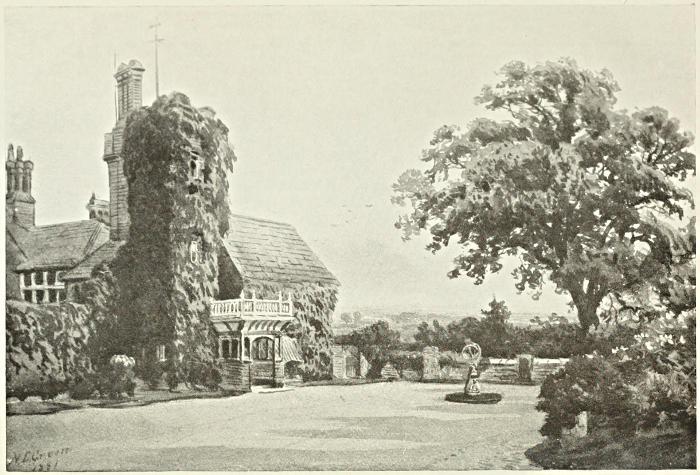
In the summer holidays of 1891 I went to stay with Chérie,
who had left us. She lived with her friend, Miss Charlesworth,
in a little house called Waterlooville, near Cosham, in Hants,
and realised the dream of her life, namely, to have a large garden
of her own full of hollyhocks and sunflowers and sweet peas.
In the Michaelmas half of 1891 I competed for the Prince
Consort’s French prize. I had already done so the last year,
but I was then too young to compete with sixth-form boys, who
were much older, and I was not expected to get a place, but
I came out third. This year it was my great ambition to get
the prize. I thought of nothing else. We had to read several
books—Molière’s L’Avare, Alfred de Vigny’s Cinq Mars, Taine’s
Voyage aux Pyrénées, Victor Hugo’s Ruy Blas, and Brachet’s
Grammaire Historique. Besides this, we were examined in unseen
translations from and into French, and we had to write a
French essay. We were examined by a Monsieur Hammonet.
I worked extremely hard for this examination, and had extra
lessons in the evenings from M. Hua. So did the other competitors.
My serious rival was Grand d’Hauteville, who I think
was a French Canadian, and who spoke French fluently. The
examination took five days, and as it went on I became more
and more convinced that I had not done well and could not
possibly win the prize. When it was over, there was a long
interval of agonising suspense before the result was made
known.
One afternoon I received a summons from my Uncle Henry
Ponsonby to go and see him at Windsor. I found him, not at
Norman Tower, but in a room somewhere in the Castle, and he
told me that the Queen had just received the news of the result
of the Prince Consort’s prize. She was the first to get this
news; the news was that I was first and had got the prize. I
at once sent a telegram to my mother and to Chérie, and walked
back to Eton, drunk with triumph and delight to tell my tutor.
The news was not published for some days, and I told
nobody, I think, except my tutor and Dunglass. But it came
out at last, and was published in the Times and on the board at
Eton. My father and mother came down to see me, and my
father gave me his own watch: a Breguet, the Demidoff Breguet.
It was then settled that I was not to go back to Eton, but to
go to Germany to learn German and prepare for the Diplomatic
Service competitive examination.
Dunglass went on messing with Hugo and myself until I left
Eton. We had three or four fags and they bored us, and we
could never find things for them to do. Dunglass developed
into a fine Eton football player, and got his House Colours and
then his Field Colours. He was a new boy the same half as I
was, and our alliance lasted unbroken through my Eton life.
One half we learnt bird-stuffing together, and when our mess
funds used to run short Dunglass used to say: “I’ve marked off
an uncle,” and one of his many uncles used to come down and
tip us. Our mess was a lively one, and when there was a whole
holiday on Friday, which necessitated Friday’s work being
done on Thursday, an arrangement which used to be called
doing Friday’s business, we used to sing in a loud chorus a song,
the words of which were:
“Why not to morrow?
Why not to-morrow?
Why, because to-morrow is to-day!”
The greatest excitements of Eton life were, I always thought,
the House football matches for the House Cup. There was the
Eton and Harrow match, of course, but while I was at Eton
these matches were unexciting and Eton never won, and Dunglass
and I agreed that there were few things we enjoyed more
than driving away from Lord’s. Nothing surpassed the excitement
of the House matches. One year, I think it was the
year before I left, we were supposed to have a small chance of
getting beyond first ties, but our House played so well together
that they got into the ante-final. They then drew Cornish’s,
who had a strong side of powerfully built boys. An epic match
followed. Durnford’s played as if inspired; they got three
rouges to nil, but failed to convert them into goals, and the
game was almost over. Then, in the last five minutes of the
game, Cornish’s scored a rouge, and being far the heavier team
converted it into a goal, and won the match. Never was there
a more exciting match.
During my last year my chief friends in the House, besides
Dunglass, were Leslie Hamilton, who went into the Coldstream
Guards and was killed in the war, and Crum; and outside the
House, Gerald Cornish. He, too, killed in the war.
Arthur Benson was my greatest friend among the masters,
and I used constantly to have tea with him, and have long talks
about books and every other sort of thing. My last half I was
up to Mr. Luxmoore, who was to be a lifelong friend.
The last days of my last half were like a dream. I was
hardly conscious of the reality of things, and I did not yet
fully realise that my Eton life was coming to an end. There
was no more work to do. The battle for the Prince Consort’s
prize had been fought and won. It was, as Eton triumphs go,
a small triumph—small indeed compared with such glories as
surround those who get the Newcastle, stroke the Eight, or play
in the Field, or at Lord’s in the Eleven; but such as it was, it
gave me as much joy and triumph as my being could hold, and
nothing in after life could ever touch the rapture of the moment
when I knew I had got it.
Now there was nothing left to do but to make every moment
seem as long as possible and to say good-bye. Good-bye to the
School Library, my favourite haunt at Eton, the scene of so
much hurried, scrambled work, of such minute consultations
of ecclesiastical authorities for Sunday Questions, or of translations
of Virgil and Horace, and the Greeks; of such long
and serious discussions of future and present plans and literary
topics, schemes and dreams, poems, plays, operas, novels,
romances, with Willie Coventry and Gerald Cornish. Good-bye
to the leather tables where numberless poems had been
copied out on the grey Library foolscap paper, which for some
reason we used to call electric-light paper; tables over which
we had leapt in wild steeplechases, while Burcher protested,
where so many construes had been prepared, and so many
punishments scribbled, and where the great poets of England
had been surreptitiously discovered, and the accents of Milton
and Keats overheard for the first time, and the visions of
Shelley and Coleridge discerned through the dust of the daily
work and above the din of chattering boys. Good-bye to the
playing fields, to South Meadow, the Field, to Upper School,
and to Williams’ inner room, full of prizes and redolent with the
smell of tree-calf and morocco, where I had so often dreamt of
getting prizes and wondered what I should choose if I ever
managed to get the Prince Consort’s prize. Good-bye to the
Brocas, to Upper Hope and Athens and Romney Weir,
“Where the lock-stream gushes,
Where the cygnet feeds,”
and to all the reaches of the river. Good-bye to Windsor and
Norman Tower, and to the chimes of the inexorable school
clock; to my little room with its sock cupboard, bureau, and
ottoman, to Little Brown’s and to Phœbe, and then to one’s
friends: to my Dame and to my tutor, and to Arthur Benson,
and the unforgettable readings and talks in his house.
I went to Williams’ to choose my prize, and while I was there
Mr. Cornish strolled in, and seeing what I was doing, he said:
“Of course you will choose a lot of little books—boys always
do—but what you ought to do is to get Littré’s Dictionary or
all Sainte Beuve.” This was asking too much in the way of
sense, and I compromised. I chose a Shakespeare in twelve
volumes, bound in tree calf, a Milton in three volumes, and a few
other small books. My tutor gave me two volumes of Ruskin;
Mr. Luxmoore gave me a volume of Ruskin as well. Arthur
Benson gave me Ionica. Just before leaving I had the honour
of dining with my tutor, which made one feel already as if
one was entering a new world. The hour struck when I was
actually leaving Eton. Up to that last moment all had been
excitement and fun, but when I was actually sitting in the
train and crossing the fifteen arches railway bridge, and Windsor
Castle and the trees of the Brocas came into sight, the whole of
the past, the Eton past, surged up and overwhelmed me like a
flood, and I realised in that last fleeting glimpse of the trees,
the river, and the grey Castle all that Eton life had meant, and
what it was that in leaving Eton I was saying good-bye to.