THE PUERING, BATING & DRENCHING OF SKINS — CONTENTS — ILLUSTRATIONS — PREFACE
Transcriber’s notes:
In this e-book a black underline indicates a hyperlink to a page,
illustration or footnote (hyperlinks are also highlighted when the
mouse pointer hovers over them), and a red dashed underline indicates
the presence of a concealed comment which can be viewed by hovering
the mouse pointer over the underlined text.
Page numbers are shown in the right margin and
footnotes are at the end.Footnotes are
listed at the end.
The text contains tables, equations and chemical
formulae that might not display correctly on small reading devices – a
standard web browser is recommended.
The text of the book has mostly been preserved in its original
form, including inconsistent italics, capitalisation, and hyphenation.
However, some defects have been corrected silently, such as
missing/inconsistent punctuation, parentheses and spacing, and an
erroneous ÷ has been replaced by − in a fraction in footnote 69. Tables
have been formatted to match the originals, but a large table that was
originally split over four pages (pp. 98–101), has been condensed into
two sections. Some illustrations have been positioned closer to the
relevant text and the location may not correspond to that specified in
the list of illustrations.
The following typographic corrections have been made:
mutiplied → multiplied
Kothbeize → Kothbeizen
of → on
phenolphtalein → phenolphthalein
hydroxylion → hydroxyl ion
Ca(OH2) → Ca(OH)2
pepsine → pepsin
bibliographic xref (9) → (19)
The following inconsistent spellings have not been altered:
Frankfort a/M – Frankfort o/M
Zenckeri – zenkeri
Casenin – Caseuin
Kentniss – Kenntnis – Kenntniss
resistant – resistent
c.c. – c.cm.
ureaæ – ureæ
ae – æ
The cover image of the book was created by the transcriber
and is placed in the public domain.
THE PUERING, BATING & DRENCHING
OF SKINS
Scientia et potentia humana in idem coincidunt, quia ignoratio
causæ destituit effectum. Natura enim non nisi parendo vincitur:
et quod in contemplatione instar causæ est, id in operatione instar
regulæ est.
Knowledge and human power are synonymous, since the
ignorance of the cause frustrates the effect; for nature is only
subdued by submission, and that, which in contemplative
philosophy corresponds with the cause, in practical science
becomes the rule.—Bacon, Aphorism III.
BY
JOSEPH TURNEY WOOD
DIRECTOR OF TURNEY BROTHERS, LIMITED, NOTTINGHAM;
EXAMINER IN LEATHER TANNING, DRESSING OF SKINS, AND LEATHER DYEING
TO THE CITY AND GUILDS OF LONDON INSTITUTE;
MEMBER OF THE INTERNATIONAL ASSOCIATION OF LEATHER
TRADES CHEMISTS, ETC.
33 ILLUSTRATIONS
London
E. & F. N. SPON, Ltd., 57 HAYMARKET
New York
SPON & CHAMBERLAIN, 123 LIBERTY STREET
1912
DEDICATED TO SIR JOHN TURNEY
THE VETERAN
OF THE
LIGHT LEATHER INDUSTRY
IN
GRATEFUL ACKNOWLEDGMENT
The present volume is the outcome of a desire to
preserve the numerous notes which I have made during
over twenty years’ work at the practical and scientific
study of bating. It has been my wish to complete
the investigation of this important process in leather
manufacture, for, as Lord Allerton has paradoxically
remarked:1 “Good leather is made before the skins
go into the tan liquor at all,” but owing to circumstances
having drawn me more and more to the commercial
side of the business, I have been compelled to
abandon this project.
When learning the trade as an apprentice every
fault in the leather was attributed to this part of the
work, and the troubles and miseries of the “puer shop”
first caused me to take up the study of puering. I
was determined to know the causes underlying the
process. Puering is not only a filthy and disgusting
operation, but is prejudicial to health, and in the
nature of it is attended by more worry and trouble
than all the rest of the processes in leather making
put together.
By giving a résumé of the work done up to the
present time, I hope to be of assistance to the younger
generation of Tanning Chemists, to some of whom is
reserved the privilege of carrying on the work.
I think it may now be said, at any rate, that the
solution of the problem of constructing an artificial
bate on scientific principles, which will replace the
present crude methods, is well within sight. The
principal obstacles are, on the one hand, the inertia
of English manufacturers; on the other hand, the
class of labour employed in puering is not of the
highest order of intelligence. Innovations in most
things are resisted, partly because they necessitate
changes in the method of working, and partly because
of the innate conservatism of human nature. It is
certainly a significant fact that although most of the
pioneer work on this subject was done in England, the
practical side has been taken up in Germany, and by
freely spending money on large trials in the works they
have enabled the manufacture of artificial bates to be
developed on a commercial scale.
In 1886, while studying Chemistry under Professor
Frank Clowes, I began to examine microscopically the
various liquors of a light leather factory, and more
especially the bran drenches. At that time I knew
nothing of bacteriology, for the simple reason that little
but pathological work in this line was being done in
England. Through the kindness of Professor Clowes, I
obtained an introduction to Mr. Adrian Brown (now
professor at the University of Birmingham), and in his
laboratory at Burton-on-Trent I saw the first pure cultivations
of Bacterium Aceti which he had isolated, and
of which he had completely studied the chemical action.2
I had there an opportunity of seeing the methods
and apparatus employed. I also had the benefit of
Mr. Brown’s advice in commencing a systematic study of
the process of drenching. Professor Percy Frankland,
then at Dundee, advised me further as to the microscope
and other matters. My warmest thanks are due
to these friends for directing me in the right way.
As a result of my first investigations, on December
11, 1889, I read a short paper entitled “Methods of
Bacteriological Research—with some account of Bran
Fermentation,” before the Society of Chemical Industry.
The way in which this paper was received led to a
further research into the nature of bran fermentation
in conjunction with Mr. W. H. Willcox, B.Sc. (now
Senior Analyst to the Home Office), by which the
action of the bran drench was thoroughly investigated,
and the results published in the Journal of the Society
of Chemical Industry, May 31, 1893.
This was followed, on June 30, 1897, by a paper
“On a Pure Cultivation of a Bacillus Fermenting Bran
Infusions,” also in conjunction with Dr. Willcox.
In 1898, in reply to a publication of Director Eitner,
of Vienna, I published in the Leather Trades’ Review
(November 15), a résumé of the whole subject, entitled
“The Rationale of Drenching.”
Already, in the first paper above named (“Methods
of Bacteriological Research”), I had called attention to
the bacteria of the bate prepared from dogs’ dung, and
in a paper entitled “Fermentation in the Leather Industry,”3
developed this aspect of the subject, and first
pointed out the influence of enzymes in bating. I
therefore decided to study the phenomena occurring in
the bate in the same way as I had studied drenching.
The work was begun in 1895, and, as it was likely
to occupy an indefinite time, the first instalment, entitled
“Notes on the Constitution and Mode of Action
of the Dung Bate in Leather Manufacture,” was published
November 30, 1898; while “Further Notes on
the Action of the Dung Bate” was published on November
30, 1899.
In these papers I indicated the lines on which a
culture of bacteria might be practically applied to the
bating of skins, and gave the composition of a liquid
which, while acting as a nutrient medium for the bacteria,
contained at the same time most of the active
chemical compounds of dog dung.
Meanwhile, Dr. Popp and Dr. Becker, in Frankfort
a/M, were investigating independently the bacteria of
dog dung, and conceived the idea of employing them
commercially. My dear friend Franz Kathreiner, of
Worms,4 put me in communication with these gentlemen,
and we were thus enabled to work in conjunction.
As a result of our combined labours, an artificial bate,
called “Erodin,” was put upon the market. This will
be fully treated of in the chapter on Artificial Bates.
I shall give first a short account of bating, and then
sum up as briefly as possible the present state of our
knowledge of the process, afterwards giving an account
of the more important of the various patents which have
been taken out for artificial bates.
Although the book is divided into separate sections
for convenience, it is obvious that we cannot separate
chemistry from physics, nor bacteriology from chemistry,
nor enzyme action from all three.
My own papers are printed as read. The Bibliography
does not profess to be complete, but includes
most of the works consulted.
No one realizes more than I how incomplete the
work is, and how much research still remains to be done
in order to complete it.
Thanks to the efforts of the Leather Industries Department
of the University of Leeds, and the Technical
College of the Leather Sellers’ Company, Bermondsey,
the era of Rule of Thumb is passing, and there is little
doubt that the work that is being done in these institutions
will be translated into practical use in the
factories by the coming generation.
I wish to express my special thanks to Mr. Douglas J.
Law, and to Dr. H. J. S. Sand for assistance in preparing
the notes for publication, to Dr. J. Gordon
Parker, Director of the Leather Sellers’ Technical
College, London, for the description of the bating of
hides, and to Professor Kràl, of Prague, for some of
the photographs of bacteria.
JOSEPH T. WOOD.
Nottingham : January 1912.
PUERING, BATING, AND DRENCHING OF SKINS — CHAPTER I. — THE PUERING AND BATING PROCESS.
“Beizen sind Stoffe die mit dem Kalk nicht nur ein
chemische Verbindung einzugehen im Stande sind, wodurch
derselbe löslich und somit vollständig unschädlich wird, sondern
auch den gegenseitigen festen Schluss der einzelnen
Wandungen der Zellenelemente mechanisch lockern, den
ganzen Bau der Haut in sich nachgiebiger machen und so
die Verschiebbarkeit der einzelnen Hautgebilde erhöhen.”—J.
C. H. Lietzmann, 1862.
“Bates are materials which are not only able to enter into
chemical combinations with the lime, whereby it becomes
soluble, and is thereby rendered completely harmless, but they
also mechanically loosen the cementing substance of the
separate cell elements, and render the whole structure of the
hide more pliable, and thus increase the mobility of the various
parts.”
The object of bating or puering is to render the skins,
and the resulting leather, soft and supple. Skins which
have undergone the liming process, must be thoroughly
freed from lime before going into the tan liquors, and,
for light and soft leathers, they must be reduced or
“brought down,” so that the elasticity or resilience of
the skin fibres is got rid of, and the skin, when tanned,
can be stretched without springing back. This is usually
done in the case of light leathers, by passing the skins
through a bate or puer, composed of an infusion of dogs’
dung in water at a temperature of 35° to 40° C., until
the required result is obtained. This condition is known
to the workman by the feel of the skin. A good
indication is, that the skin when “down” retains the
impression of the thumb and finger if squeezed. A
properly puered skin, when dropped on the floor, will
also be perfectly flaccid, the folds lying closely together.
It may, however, be said that it is only by experience
and a kind of instinct that the exactly correct condition
of the skin can be judged.
I know of no very early works on leather manufacture
giving an account of bating. It was a “secret
process,” and the results obtained depended almost
entirely upon the judgment of the operator; and this
judgment was frequently in error, owing to the fact that
he did not understand what took place in the bate.
The earliest account I have been able to find is
in a book5 in the possession of Mr. Seymour-Jones, of
Wrexham, entitled “The Art of Tanning and Currying
Leather, with an Account of all the Different Processes
made use of in Europe and Asia for Dying Leather Red
and Yellow, Collected and Published at the Expense of
the Dublin Society, to which are added Mr. Philippo’s
Method of Dying the Turkey Leather as approved of by
the Society for the Encouragement of Arts, etc., and
for which he had a Reward of £100, and their Gold
Medal, for the Secret. Also the New Method of Tanning
invented by the late David Macbride, M.D., London.
Reprinted for J. Nourse, on the Strand, Bookseller to
His Majesty, 1780.”
In the chapter entitled “Alumed Calf Skins for
Bookbinding” (p. 138), after the limed skins have been
fleshed, the writer continues—
“To alum them, put into a large vat, three or four
pails of dogs’ turd (this dogs’ turd is called alum); on
this they fling a large pail of water to dilute it; this
done, the workman goes into the vat, and, with his
wooden shoes, tramples it, filling the vat half full of
water. The alumer, on his part, pours water out of his
boiler into this vat, mixing it with the cold water, after
which he flings in the skins, stirring them and turning
them for some moments with great sticks.”
The work is described pretty much as now practised,
the puer tub being kept at a uniform heat by constantly
taking out liquor, heating it, and returning it. But
neither these goods, nor morocco, are put through a
“drench” after the puer, as we do now; they are
scudded on the flesh, and well washed several times in
clear water before being tanned.
Morocco Leather (p. 204).—The dry skins are
soaked three or four days, “pared” on the beam, and
unhaired in weak lime pits one month. At Nicosia they
put the skins into lime, reduced to powder, for twenty
days in summer, or twenty-five to thirty in winter;
out of the lime, the skins are well washed and drained.
The author continues—
“The river work finished, the skins are put into the
dogs’ confit, or mastering; for every four dozens of skins
they add one bucket of dogs’ excrement, containing
fourteen or fifteen quarts, which is worked up with their
hands into a kind of pap and well diluted. The skins
are flung in, stirred and worked in the mastering for
some minutes, then turned and left to rest.
“They remain about twelve hours in the mastering,
which opens them, and takes off the rawness, disposes
them to relax, fill and ferment. This excrement, by
its alkaline parts, also cleanses them and takes out the
grease, which would hinder them from taking the colour.
I shall hereafter speak of bran mastering.
“At Diarbekir, they make use of these masterings
in a different way. Whilst the skins are drying, they
fill great hollows made in the earth, like our lime pits,
with dogs’ dung, which is diluted to the consistence of
honey, or of thin pap, in which they soak the skins for
eight days in winter, and three in summer, treading
them each day with the feet. They are taken out of
this fecal matter, and well washed with fresh water,
after which another mastering is made with bran diluted
with water, in which the skins are soaked six days in
winter, and three in summer, observing to tread them
each day with the feet, the same as in the dogs’
mastering; they are then taken out, washed in fresh
water, and prepared for dyeing.”
From these primitive methods the majority of
tanners, even of the present day, have departed but
little, except that, instead of stirring the goods and
liquor with a stick, a paddle is used, and the process
thus shortened considerably. Before describing the
operation of puering, it will be best to describe the
preliminary washing of the skins, because, although
limed skins may be entered direct into the puer and
brought down quite satisfactorily, in this case more puer
and more time are required, hence it is usual to get rid
of the bulk of the lime by washing them in water before
putting them into the puer. In some cases very dilute
hydrochloric or other acid is used, in order to shorten
the time of watering.
It is now well known that lime cannot be entirely
removed from skins by washing in water, no matter how
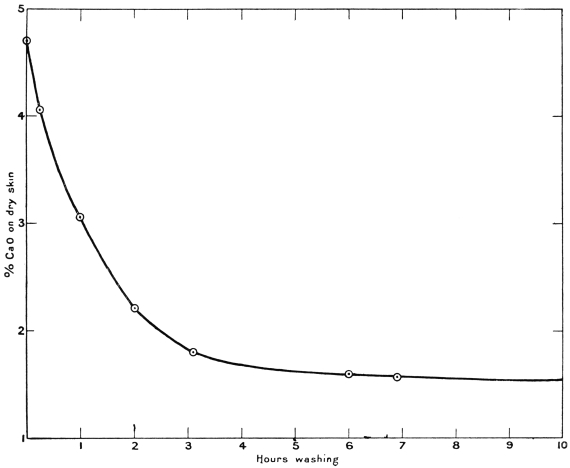
long the washing be continued. A limed skin containing
4·6 per cent. CaO, calculated on the dry weight,
was found to contain after washing—
Time of washing
Per cent. CaO on dry skin
Per cent. lime removed
1
hour
3·05
34
2
hours
2·20
52
3
"
1·75
62
6
"
1·55
66
7
"
1·55
66
24
"
1·50
67
Fig. 1.
If the washing be continued, a less amount of lime is
removed in each successive period of time, so that it is
evident a point is soon reached at which it becomes a
waste of time to continue the washing. In practice this
point is reached in about two hours. The progress of
the washing is best shown by the curve in the diagram
(Fig. 1), in which the ordinates represent the percentage
of lime (CaO) in the dry skin, and the abscissæ time in
hours. It will be seen that the character of the curve
is a hyperbola; such a curve only approaches a line
(representing in the example chosen about 1 1/2 per cent.
of lime) asymptotically—in other words, it is impossible
to wash out all the lime except by an infinite number of
changes of water, since each washing removes a less
amount than the previous one. The above is a typical
case of the washing of limed grains from the splitting
machine in the manufacture of skivers. These contain
from 4 to 5 per cent. of lime on the dry skin, and, after
washing in water in a paddle for six hours, analysis
shows them to contain still about from 1·5 per cent. to
1·9 per cent. of lime (CaO).6
The effect of washing depends on the character of
the water (hard or soft), and also on its temperature.
Hard waters should have a small quantity of clean lime
added to them before entering the goods, in order to
remove dissolved CO2, which, by carbonating the lime on
the surface of the skins, renders the grain harsh and
the subsequent puering difficult.
With regard to temperature, it is preferable to
employ cold water until the bulk of the lime is out,
since this dissolves more lime than warm water. 100 c.c.
of saturated lime water, at 10° C., contains 0·134 grm.
CaO. 100 c.c. at 40° C. contains 0·1119 grm. CaO.
Moreover, a comparatively small rise of temperature
causes a considerable decomposition in a fully limed
skin, by which the skin substance is rendered more
soluble, and consequently lost for the purposes of
the tanner. For a fully limed skin the limit of temperature
is about 82° F. (28° C.), whereas a skin free
from lime or alkali may be submitted to a temperature
of 120° F. (49° C.) without damage to the fibre.
Lamb prefers a short washing of half an hour in water
at 35° to 38° C., for the reason that the increased temperature
causes the goods to become more flaccid, but
this condition is attained at the expense of the loss of
skin substance we have mentioned.
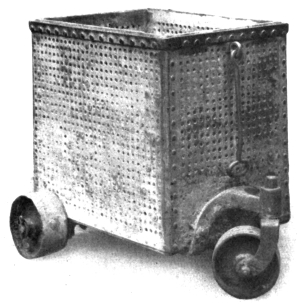
Fig. 2.—Cubical Truck.
In order to save time and water, the following
method is adopted. The goods are measured by means
of a cubical truck on wheels (Fig. 2); it holds 250 kilos
of wet skins (550 lb.). Four of such trucks are placed
in a wash wheel, and a stream of water from a 1-in.
pipe turned on. The goods are run from three-quarters
of an hour to one hour; the water is then stopped, and
4000 c.c. of commercial hydrochloric acid (18° Bé.) is run
in slowly, in a very diluted state, through a perforated
lead pipe. After all the acid has run in, the wheel is
run for half an hour, then water turned on again for
half an hour in order to wash away the calcium chloride
produced. During this last washing, hot water is admitted
at the back of the wheel through a perforated
pipe, in order to raise the temperature of the goods, so
that they do not enter the puer wheel in a cold condition,
and thus lower the temperature of the puer
liquor. The goods are now ready for puering.
The chemical action of the acid is a very simple one,
and is expressed by the formula—
It will be noted that the quantity of acid used is
only about one-tenth of that required to neutralize
completely the lime in the skin. If a greater amount
of acid be used the skins begin to absorb acid before
the lime in the interior is neutralized; but, provided the
lime on the surface of the skins is removed, that remaining
in the interior is forced out during the course
of the bating process (see Chapter III.). If more acid
were used, then it would require to be added so slowly
that time would be wasted unnecessarily in doing the
work.
With regard to the use of other acids for deliming,
Lamb considers formic acid preferable to hydrochloric,
and states that the removal of lime is more effectively
accomplished by its use. He attributes a pulling down
action to the calcium formate produced, so that less
formic acid is required than would be equivalent to hydrochloric,
merely regarded as a solvent for lime. We
shall refer to this point again in Chapter II. It may
be stated here that the author has obtained better
results by the use of a mixture of formic and acetic
acid, in equal proportions, than from either acid alone,
but that the cost of working is considerably greater
than with hydrochloric acid.
Lactic acid is in fairly common use as a deliming
agent. In practice 1 per cent. lactic acid (50 per cent.
strength) calculated on the wet weight of pelt, is used,
added gradually in small quantities. This does not
remove the whole of the lime, but sufficient for the
skins to puer quickly.
Some tanners measure their acid per dozen skins.
In a case which came under my notice, 1200 c.c. 90 per
cent. formic acid were being used for ten dozens medium
goat skins at a temperature of 35° C., time 1 1/4 hours.
The following table, due to Professor H. R. Procter,8
gives the cost of dissolving 1 lb. of lime at present
approximate prices of the various acids. The dissociation
constant K shows their relative “strength;”9 the
equivalent, Eq., the weight in lb. of 100 per cent.
acid required to dissolve 28 lb. of lime. Ordinary
wet limed hides, unhaired and fleshed, contain only
about 4 lb. lime per 1000 lb. wet weight.
Cost of Acids to remove 1 lb. Lime.
Acid
Eq.
K
Cost per cwt.
Strength per cent.
Cost for 1 lb. CaO
s.
d.
d.
Hydrochloric
36·5
say 200
3
3
31·5
1·4
Sulphuric
49·0
"
4
0
95·0
0·8
Oxalic
63·0
0·1
30
4
99·0
8·1
Formic
46·0
0·0214
35
0
87·4
7·0
Lactic
90·0
0·0138
26
0
49·7
18·0
Acetic
60·0
0·0018
18
0
40·0
10·0
Butyric
88·0
0·00115
21
0
82·8
8·0
Boracic
62·0
0·00000001
27
0
99·0
6·5
It will be seen from the above table that sulphuric
is the cheapest acid to use; but, owing to the insoluble
nature of the calcium sulphate, it is best to use hydrochloric
acid. Procter has suggested using a mixture
of sulphuric acid and common salt in molecular proportions,
so as to avoid the iron which is generally
present as an impurity in commercial hydrochloric
acid. The author has tried this, and found it perfectly
satisfactory. For a complete discussion of chemical
deliming, see Procter’s “Principles of Leather Manufacture,”
chapter xiii.
Quite recently butyric acid, which is now being
manufactured on a commercial scale by the process of
Dr. Effront (Brussels), has come into use for deliming.10
and is likely to become a useful acid, as it can be
manufactured cheaply. According to Parker, it dissolves
less skin substance than formic, acetic or lactic
acids, which observation is confirmed by Thuau. The
quantity required per 100 lb. of ordinary washed sheep
skin is about 1/2 lb. of the 80 per cent. acid. It is used
in exactly the same way as other acids, i.e. it should be
added in small quantities, suitably diluted, at successive
intervals of time.
Acid salts are also used for deliming, and Procter suggested
sodium bisulphate NaHSO4 (“Principles,” p. 155).
More recently, sodium bisulphite (NaHSO3) has been
recommended;11 the skins are tumbled for half an hour
with a dilute solution, which combines with the lime
according to the following equation—
(1) Ca(OH)2 + NaHSO3 = CaSO3 + NaOH + H2O
if sulphides are present the reaction is—
(2) Na2S + 2NaHSO3 = H2S + 2 Na2SO3
After this treatment the theoretical quantity of
hydrochloric acid, diluted with plenty of water, is run
in through the axle of the tumbler, and the skins run
another half hour. The reactions are—
(1) CaSO3 + 2HCl = CaCl2 + SO2 + H2O
(2) Na2SO3 + 2HCl = 2NaCl + SO2 + H2O
The sulphurous acid evolved in this way slightly
swells the skins, and also removes stains due to the
alkaline polysulphides; it is also said to remove salt
stains.
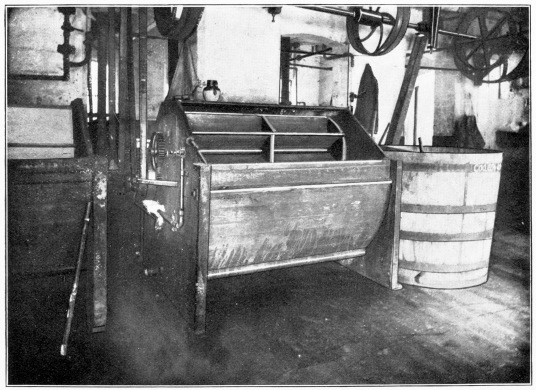
Fig. 3.—Puer Wheel, with Cover Removed.
Fig. 4.—Elevation of Puer Wheel (back).
A more interesting process, introduced by Dr. Gr.
Eberle12 as a bating process, but which is really a deliming
process, consists in using organic acids in the
form of their anhydrides, lactones, or lactides. During
the process these anhydrides, lactones, or lactides, are
gradually decomposed with formation of the free acids,
which in a nascent condition unite directly with the
lime in the skins. The anhydrides of acetic, propionic,
butyric and lactic acid have been tried, the lactone of γ-oxybutyric acid
CH2 CH2
O
CH2 CO
,
and the lactide of lactic acid.
After washing and deliming, the goods, warmed to a
temperature of 90° to 100° F., are now measured in the
truck above described, and put as quickly as possible
into the bating paddle. This is constructed to carry
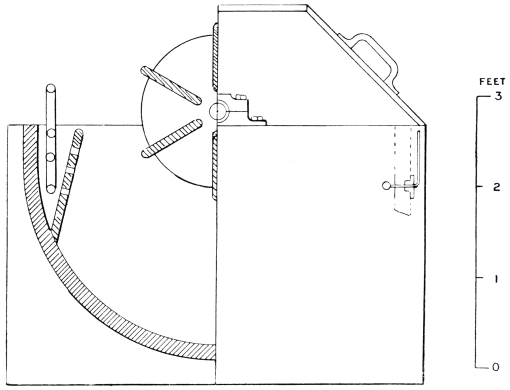
two trucks. The figures (Figs. 3, 4 and 5) show a
modern paddle adapted for puering light skins, such as
goat, sheep, splits (grains), either with dung or with
an artificial bate.
Fig. 5.—End Elevation of Puer Wheel.
The inside dimensions are: length, 4 ft. 6 in.; width,
4 ft.; depth, 2 ft. 6 in. A copper pipe of two coils is
provided at the back, through which steam is passed for
maintaining the temperature of the wheel—the goods
are prevented from coming in contact with this pipe by
a perforated board. Another steam pipe, jointed so that
it may be turned in and out of the paddle, is provided
for heating up the wheel to the required temperature
before beginning the bating. This pipe is not shown in
the drawing. The thermometer can be read while the
paddle is in motion. A suitable speed to keep the
goods in motion is twenty revolutions per minute. The
whole wheel is covered in, for the purpose of preserving
the heat, and also to exclude light and air, which are
prejudicial to the action of the bacteria. Such a paddle,
or wheel, has a capacity of 200 gallons liquor, or 900
litres, and will bate 25 dozens of average grains, weighing
in the wet state 1100 lb. or 500 kilos.
The dog dung, which is usually obtained from
hunting kennels, and of which the composition is given
in Chapter II., is simply diluted with water in the
paddle;13 five buckets, weighing about 165 lb., are required
for the above quantity of goods.14
The amount used depends on the state of the goods,
the prevailing weather, and, further, on the quality of
the puer.15 When the temperature is maintained at
40° C., ordinary limed goods, which have been washed,
come down in from one to three hours.16
During puering, the lime soaps in the skin are
decomposed, and the fat set free—in an estimation of
the fat, 0·151 per cent. on the wet skin was found
before puering, and 2·48 per cent. after puering. The
fat thus set free can be removed to a great extent by
scudding; but in modern practice this is not pushed
to extremes, as the grain is liable to be damaged by excessive
scudding. The fat is afterwards removed from
the dry leather by means of benzine or other solvent,
employed in a suitable apparatus.
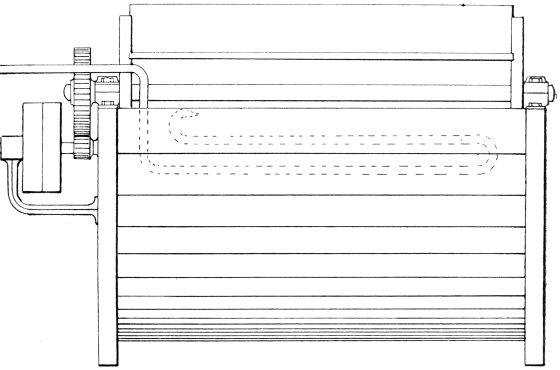
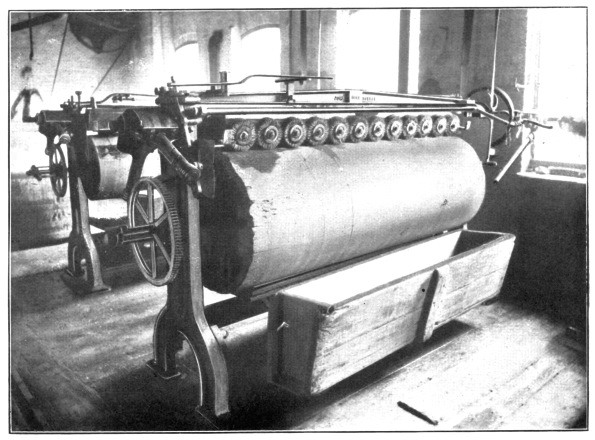
Fig 6.—Sir John Turney’s Scudding Machine for Sheep Grains.
Scudding.—When the goods are “down,” they are
ready for scudding. This operation in the case of grains
is performed either by hand over the beam, or by means
of a special scudding machine.
The scudding machine figured (Fig. 6) was invented
by Sir John Turney in 1880,17 and is the only type of
machine which will safely scud split skins. It will
readily be understood that the usual type of scudding
machine, in which a spiral knife is used, would tear the
delicate structure of the grain. The Turney scudding
machine works with hard, circular brushes, which revolve
against a wooden roller carrying the skin. At the same
time a continuous stream of water, at a temperature of
110° F., is sprayed upon the skins from a perforated pipe.
After scudding, the skins are washed in cold water
for about ten minutes. This checks the action of the
puer, and also washes away any loose dirt. They are
then ready to pass on to the drench (Chapter IX.), or to
the pickling process, or direct to the tan liquor, according
to the kind of leather required.
The Bating of Hides for Harness or Dressing
Purposes.—The hides intended for harness
leather, or for dressing purposes, are usually bated with
hen or pigeon manure. The exact process varies in different
tanyards, being dependent upon the condition of
the pelt prior to bating, as to whether it is bated directly
after fleshing or receives a preliminary deliming. The
process is also dependent upon the amount of bating
action required for the specific purpose prior to tanning,
but the following three methods are in actual use, and
may be taken as typical methods:—
Harness Backs.—About a hundredweight of hen
manure is put into a suitable tub or vat capable of holding
about fifty gallons; some thirty gallons of water,
at a temperature of about 100° F., is poured on to the
manure, and the whole is thoroughly stirred up by
means of a wooden stick or plunger, working the
manure about in order to mix it to a consistence of
thin soup. The vat is now stored in a warm place, so
that the temperature is kept about 70° F.—it is customary
to store this in the boiler-house, or some similar warm
room. It should be stirred two or three times a day,
until it begins to show signs of working; two days is
generally sufficient for this.
A pit is now prepared, with the necessary amount of
water; and, by the aid of a steam pipe, or other similar
means, the temperature of the water is raised to 70°,
and the contents of the bate tub are now added.
This should be poured into the pit through a sack,
or a canvas filter, so as to keep back stones, solids,
feathers, and other extraneous matters. The pit is now
thoroughly plunged, and the goods entered; these should
be handled up three to four times a day for two days.
At the end of two days the goods are usually scudded,
by working the back on an ordinary unhairing beam
with an unhairing knife. They then go into a fresh pit
containing a new solution of bate made up in the same
manner, and, when sufficiently bated, which generally
takes about three days, the goods are removed from the
pit, scudded again by working them over with a slate
scudding tool, when they are ready for tanning. Some
tanners give them a bath of boracic acid prior to their
going into the tanning liquor; this has the effect of
materially brightening the colour. The second pack of
harness backs go into the same liquor—which must be
re-warmed to a temperature of 70°—in which they are
handled as before for about two days, and are finished
off in a new liquor made as above described.
It will be understood, therefore, that in a tanyard,
working regularly, the pack of backs go first into an
old bate for two days, and are then finished off in a
freshly made one; so that each pack gets two days in
an old pit, and one or more days in the new. The
bate in the tub may also have a second water, or be
strengthened.
Dressing Hides.—For these goods a somewhat
stronger bating effect is required, and pigeon manure
is therefore frequently used. The preparation of the
bating liquor is as described above, both as regards
quantity and temperature of the water and time of
maceration.
The whole process may be carried out exactly as
described for harness backs, but the following is an
illustration of another method in practical use. Imagine
four ordinary bating pits, worked in a round. The first
pit is very old, having had three packs of hides through
it; the second having had two packs, and the third
one pack; and the fourth is made new. The goods,
after unhairing and fleshing, and washing, are put into
the first pit quite cold, are handled in this three times
on the first day, and afterwards put into the second pit,
the temperature of the second pit having been previously
raised to 65°—the cold pelt going into this
pit reduces the temperature to about 60°. They are
handled in this pit twice, and remain overnight; and
the third day they go into the third pit, the temperature
of which is raised to 70° before the goods go in.
They are raised, scudded thoroughly on the grain, and
new liquor is made from new bating liquor prepared
as described above; the goods are now entered, handled
at least twice a day, and, if insufficiently bated, are
left overnight. By the next day they will probably be
sufficiently “down” to permit of them going on to the
scudding beam and thence on to tanning.
In the event of any hide being insufficiently bated—in
other words, if the “bone” has not completely
disappeared in the inner part of the hide—they are
returned once more for three or four hours, the temperature
of the pit being raised to 70° with a steam
coil.
By this system, which is known as a system of
“sets,” it will be noticed that the pits are worked in a
round of four; the first pit, or oldest, being used more
or less as a wash pit, the actual bating taking place in
the second, third and fourth pits. No pit has more
than four packs passing through it, and the temperature
never rises above 70°, or, at the outside, 75°. The
reason of the comparatively low temperature is due to
the fact that in pit bating, if the temperature is raised
above 75°, the grain of the hide becomes affected before
the internal “bone” is sufficiently soft, which results
in a tender grain, which considerably affects the resulting
staining or dyeing which the leather usually
receives before it is put on the market.
The Third Process.—This process is suitable for
either harness or dressing hides, and differs from the
above-described process only in the fact that instead of
bating the hides in pits, a latticed drum is used in
order to keep the hides in constant motion. This consists
of a large pit, in which a latticed drum revolves
two-thirds immersed in the liquor. The bate liquor is
made up as usual, and the temperature of the liquor
raised to 75° or 80° F.; the hides are then placed in
the latticed drum, which revolves at from four to six
revolutions per minute, and, if the goods are put in the
drum in the morning, and if the temperature is kept
at about 70° F., the hides are generally sufficiently
bated by evening. They may then be taken out of the
drum, scudded, and left suspended in boracic acid
overnight, and can then be taken to the liquor next
morning.
Where there is considerable motion, even the
heaviest hides will stand a temperature of 75°, and
even 80°. Some tanners who use the latticed drum
method, do not place their hides in the drum until the
afternoon; they are drummed for about an hour in the
cold bate, and left overnight; next morning the temperature
of the bate is raised to 75°, and the drum started;
they are then removed from the drum towards the
afternoon, when sufficiently “down” to admit of them
passing forward into the next process.
The above are three typical methods in common
use in England, but many modifications of these processes
exist. Everything depends upon the amount
of lime in the hide, on the number of haulings or
handlings given to the goods, and the temperature or
the conditions under which the hides are bated, so that
no hard-and-fast lines can be laid down. Much also
depends upon the method of liming used, prior to the
bating. It must be borne in mind that the bating of
hides, and even of kips, differs materially from the
bating of goat and sheep skins, as one has to deal with
double or even treble the substance. If the bate is
worked at a temperature of even 70° or 75°, there is
the danger of the grain being seriously affected before
the bate has penetrated to the interior of the pelt,
unless the goods are kept in constant motion.
Instead of a latticed drum, large paddles are used in
some factories. If the pit is large enough the paddle
causes both hides and liquor to revolve, and thus gives
the required movement necessary for a regular and even
“bating effect” to be obtained.
CHAPTER II. — THE CHEMISTRY OF BATING.
“And now, as we cannot understand the frame of a Watch,
without taking it into pieces; so neither can Nature be well
known, without a resolution of it into its beginnings, which
certainly may be best of all done by Chymical Methods”—Jos.
Glanvill, 1668.
Professor H. R. Procter, in his “Principles of
Leather Manufacture,” 1903, p. 153, has given a very
complete account of chemical deliming, and also of the
bating and puering processes. Meunier and Vaney,
“La Tannerie,” 1903, give a general review of our
knowledge of these processes up to that date. These
accounts are extremely useful, but treat the subject in
a general manner.
I propose to treat of the particular case of puering
by means of an infusion of dogs’ dung in water, as I
believe this will give an insight into all the other bating
processes.
So far as the purely chemical action of the bate
goes, it consists in the solution of the lime contained in
the skins,18 thus setting free a certain portion of skin
substance which was combined with the lime, and the
subsequent solution of more or less of this skin
substance.
If a fresh puer be made and boiled for half an hour,
then allowed to cool to 95° F., it will be found to
remove the lime from the skin in a very similar way
to an ordinary bate, but it has not so rapid a reducing
action as an unboiled bate. In this case both
bacteria and enzymes are destroyed, so that the action
may be put down to the chemical constituents of the
bate.
Chemical Composition of the Puer.—The
mineral constituents of the fæces, both in dogs
and human beings, are well known, owing to the study
of the processes of digestion and nutrition in physiological
laboratories; but the organic constituents are
yet little known, and the sum of the weight of those at
present estimated is far from the total of these matters
present.
It is a mistake to suppose that the fæces represent
the residue only of the food taken. Strassburger19
estimates that bacteria alone account for nearly one-third
of the dry matter. In addition, the intestinal
mucous membrane is an important excretory channel for
lime, magnesia, iron and phosphoric acid, as has been
shown by analyses of fæces from men and dogs, during
prolonged fasting.20 Even when no nitrogenous food is
eaten, the dry fæces always contain from 4 to 8 per
cent. of nitrogen; in a dog fed on meat it amounts to
6·5 per cent.
In making a chemical analysis of the fæces, the
mineral matter is estimated in the ash in the usual
way for ash of organic substances, with special precaution,
on account of the phosphates present. The
material is first charred, the salts removed by acetic
acid; the acetic acid solution is then decanted, the
residue washed with distilled water, and the combustion
then completed. The acetic solution and washings
are added to the final ash, the whole evaporated to
dryness, and gently ignited to decompose the acetates.
(Cf. Bull. 46, U.S. Dept. of Agriculture, Washington,
1899.)
In estimating the fats, the dry puer is ground up
with sand, then extracted with ether in a Soxhlet. The
fats are present in four states:—1, neutral fats; 2, free
fatty acids; 3, alkali soaps, soluble in ether; 4, small
quantities of lime and magnesia soaps remaining in the
residue in the Soxhlet. For details as to the separation
and estimation of these, Lewkowitsch’s “Oils, Fats and
Waxes” (Macmillan) should be consulted.
The separation and estimation of the organic constituents
in the puer, is one of the most difficult
problems of physiological chemistry, and to include the
methods used would demand a special treatise beyond
the scope of the present volume. Hoppe-Seyler’s
“Physiological Chemistry,” and Allen’s “Commercial
Organic Analysis,” vol. iv., may be consulted; and
there is a mass of useful information in Dr. René
Gaultiers’ “Précis de Coprologie Clinique” (Paris,
Baillière et Fils, 1907).
It is proposed to give here the results of a number
of analyses of dog dung made by the author and others,
and to discuss the action of the various bodies upon the
skins. Many more experiments and much research
requires to be done, before the complete action of the
bate is clear, but only by the method of experiment
with the various bodies present can the problem eventually
be solved.
Analysis of raw puer from hunting kennels (Quorn)
showed the approximate composition of 1000 grm. of
raw puer, containing 150 grm.21 of dry matter to be as
follows:—
Grammes
Sodium chloride and sodium sulphate
2
·1
Sodium ammonium phosphate
14
·0
Earthy phosphates, principally Ca3(PO4)2
33
·6
Ferric phosphate
0
·87
Calcium sulphate
1
·94
Silicic acid
3
·40
Calcium in solution as CaO
1
·42
Total P2O5 in solution
4
·00
Non-volatile acids (as lactic)
3
·00
Volatile acids (as acetic)
2
·20
Amines (as ammonia)
6
·20
Enzymes
3
·66
Nitrogenous bodies not included in the above, consisting of complex amido-acids, leucin, tyrosin, xanthin, and other purine bases, indol and skatol
17
·00
Organic matter, cellulose, etc. mostly insoluble, including fats and soaps
70
·00
On the dry matter the amounts extracted by various
solvents were:—
Per cent.
Water
24
·03
Alcohol
22
·27
CS2
15
·57
C2HCl3 (Tri-chlorethylene)
14
·45
Petrol. ether
13
·23
No carbohydrates (sugars) capable of reducing
Fehling’s solution were found in the puers examined.
The ash22 of the dry fæces from dogs fed on a flesh
diet varies from 20 to 34·27 per cent., with the following
percentage composition:—
Silica
7
·04
CO2
4
·62
SO3
7
·37
Fe2O3
4
·22
CaO
25
·29
P2O5
26
·41
MgO
15
·52
Cl
1
·50
Alkali
5
·53
In a dog weighing 30 kilos., fed on a mixed diet
of 500 grm. meat and 200 grm. starch, 78·6 grm. dry
fæces were obtained containing 23·76 per cent. ash of
the following percentage composition:—
CaO
22
·3
P2O5
25
·4
Fe2O3
10
·6
MgO
9
·8
SO3
5
·0
Cl
0
·2
Alkali
1
·1
Insol. in HCl
21
·8
It is obvious that the composition of the fæces will
vary with the food given, and in this connexion it may
be stated that the puer used was obtained from dogs
fed on a mixture of boiled horseflesh and oatmeal
porridge, about equal quantities. Sometimes charcoal
and cabbage are mixed with the food, in this case the
puer is very dark coloured. The dark colour so produced
is to be carefully distinguished from the dark
colour caused by decomposition of the puer.
We cannot leave out of account the urinary products,
which, in the case of dung from hunting kennels,
are always present, though in varying quantities.
The total nitrogen in 1520 c.c. of urine was found23
to be 15·9 grm.
Each 100 grm. total nitrogen was distributed as
follows:—
Urea
85
·9
NH3
4
·1
Creatinine
3
·3
Uric acid
0
·5
N in other compounds
5
·7
The inorganic compounds were:—
Per cent.
Sulphur (as sulphate)
3
·31
P2O5
3
·98
Cl
6
·30
The urine of carnivora is acid, that of herbivora is
neutral or alkaline.
Urea, which is the chief nitrogenous constituent, is
very quickly fermented by several species of bacteria,
and entirely decomposed into ammonium carbonate, so
that it is this latter body which acts in the bate.
Uric acid exists in the urine of the carnivora,
but the quantity is small compared with the urea.
Herbivora excrete, mostly, hippuric acid (benzoyl-glycocoll,
CH2
NHC, H5O
COOH
,
and this difference may
account to some extent for the difference in bating
property, that of the excreta of herbivora being very
small as compared with the carnivora, such as the dog.
In this respect there are differences which are difficult
to account for; for instance, the excreta of the lion, fed
entirely on a meat diet, was not found to have such a
powerful bating effect as ordinary dog puer. Even
after keeping for several weeks, to allow the bacterial
flora to develop, the result was the same.
The analysis of the lion’s dung gave the following
results:—
Per cent.
Water
59
·2
Ash
21
·1
Lime (CaO)
10
·3
Phosphates (P2O5)
10
·67
Organic matter
19
·7
Dog dung contains some non-volatile bases of the
purine group, such as xanthin (C5H4N4O2) and guanin
(C5H5N5O), but the action of these bodies in the bate,
has not been studied. It is also extremely probable
that these and similar bodies are formed during the
bating by a process of auto-digestion of various proteids.24
The quantity of fat in dry puer, amounts to
10–11 per cent. Cholesterol was present.25 Part of
the fat is in the form of lime and magnesia soaps, but
part in the form of an emulsion, which probably plays
an important part in the puering process. The function
of the fatty constituents of puer is one of the problems
on which further research is necessary.
The colouring matters of the puer are nearly all
derived from bile products. Most of them are found in
the petroleum extract, which contains far more of the
colouring matters than the chloroform extract.
The following bile colouring matters have been
prepared by Merck, of Darmstadt: bilihumin, biliprasin,
bilirubin, bilifuscin, biliverdin.26 So far as has been ascertained
by the author, their effect in the bating is nil,
but, in so far as they impart colour to the pelt, they are
detrimental.
Experiments on the action of bile are given in the
paper reprinted in Chapter VI.
Recently Eberle27 has proposed to add a proportion
of gall juice (bile) to a bate containing
pancreatic enzymes, with a view of energizing the
latter. This part of the subject will be dealt with in
Chapter V.
The Reactions of the Puer.—The organic acids
are present principally in the form of the sodium or
calcium salts. The intestinal juices contain sodium
carbonate, but this is neutralized by lactic acid found
in the intestines, so that the excreta usually have an
acid reaction. The reaction of a fresh puer liquor is
faintly acid to litmus, but this acid is immediately
neutralized by the introduction of the skins, so
that the rest of the bating process takes place in a
neutral or alkaline medium, and the quantity of lime
removed by the free acids is probably small.
The acidity of a filtered puer liquor made up
freshly and titrated with N/5 soda, and phenolphthalein
as indicator, was found to equal 10 c.c. N/1 acid
per 1000 c.c. of bate. In the volume of liquor used,
namely, 900 litres, this would neutralize only 250 grm.
of lime (CaO).
The determination of the exact acidity or alkalinity
of puer liquors by ordinary methods with indicators
is not easy, as the end reactions are not sharp. The
liquor above described was alkaline to methylorange
and litmus, although acid to phenolphthalein, and the
results also vary somewhat, according to the quantity
of bate used for titration, and according to the
strength of the acid or alkali used. The method used,
both at the Trent Bridge laboratory and Messrs.
Doerr and Reinhart’s laboratory at Worms, is as
follows:—
The puer liquor is filtered through a Schleicher and
Schulls hard filter, No. 602, 18 1/2 cm. diam.; 50 c.c. are
taken, 4 drops of phenolphthalein solution (10 gr.
dissolved in 300 c.c. alcohol) added, and titrated with
N/5 acid or alkali as the case may be.
If the acidity be determined by adding excess of
alkali and titrating back, a larger amount of acid is
found than by direct titration. In the above-mentioned
case, an indirect titration showed an acidity equal to
18 c.c. N/10 acid per 100 c.c. of liquor.
On adding the alkali to a fresh filtered puer liquor,
a flocculent precipitate is produced, which appears to
be due to the decomposition of proteid compounds of
weak organic acids,28 the alkali uniting with them and
setting the proteids free. As these compounds are undoubtedly
decomposed by the lime in the skins, it seems
probable that the acidity available for neutralizing
lime may be greater than that shown by direct titration.
A method which was suggested by me for the
estimation of the acidity of tan liquors may be applied
also to the examination of the bate liquors, namely, the
method by which the electric potential between a
hydrogen electrode dipping into the bate liquor, and a
standard calomel electrode, is used to determine the
neutral point (for details see Chapter III.), using the
potentiometer devised by Dr. H. J. S. Sand.29
Puer liquors, titrated in this manner with N/10
soda or HCl until a potential of 0·69 volts is reached
(at which point phenolphthalein turns from colourless
to red), gave the following results per 100 c.c. filtered
liquor.
No.
Description of Liquor
Reaction
c.c. N/10
Alkali
Required for Neutralization
or
Acid
1
New puer before goods
Acid
7
·4 alkali
2
The same after goods
Alkaline
0
·57 acid
3
New puer before goods
Acid
8
·1 alkali
4
The same after goods
Alkaline
3
·25 acid
5
Used puer after goods
Alkaline
5
·00 acid
6
Spent puer
Alkaline
6
·6 acid
Determinations made in this way are more accurate
than the colorimetric method above described. Puer
liquors after use are found by the electrometric method
generally on the alkaline side, whereas such liquors
show neutral to phenolphthalein owing to some action
of the bate constituents on the indicator.
Puer Liquors in Electrometric Apparatus.
No.
P.D. Before Skins volt
c.c. of N/10 KOH required for 50 c.c. liquor to 0·69 volt
P.D. After Skins volt
c.c. of N/10 HCl required for 50 c.c. liquor to 0·69 volt
Description of Liquor
A1
0
·622
1
·95
..
..
New puer
A2
..
..
0
·747
1
·9
A1 after 2 packs skins
B1
·607
3
·7
..
..
New puer
B2
..
..
·770
3
·1
B1 after 3 packs skins
C1
·580
4
·3
..
..
New puer
C2
..
..
·762
2
·8
C1 after 2 packs skins
D1
·580
5
·2
..
..
New puer
D2
..
0
·8
·680
..
D1 after 1 pack skins (still on the acid side of 0·69)
E1
·570
6
·2
..
..
D2 + 4 buckets more puer
E2
..
..
·720
0
·8
E1 after 1 pack skins
F1
·610
3
·0
..
..
New puer
F2
..
0
·5
·680
..
F1 after 1 pack skins (still on the acid side of 0·69)
The potential at the neutral point, using an auxiliary
electrode filled with N/1 potassium chloride, was 0·69
volts. Potentials below this point, therefore, indicate
an acid reaction, and, conversely, potentials above 0·69
volts indicate an alkaline reaction. The apparatus is
thus very useful in following the course of the bating
process. The initial potential also enables the hydrion
concentration of the bate liquor to be determined
directly (see Chapter III.). It was found that during
the bating of a pack of skins the hydrion concentration
of the liquor diminished from 10-5·2 to 10-7·4 normal.
Such acidities as are found by this method, e.g.
7–8 c.c. N/10 acid per 100 c.c., are too great if made up
by taking a solution of the free acids. The ionization
must be almost entirely repressed by the presence of
sufficient neutral salts of the same acids in the bating
liquid, in order to obtain a similar result to the puer.
The table opposite gives the values found for a
series of puer liquors, made with dog manure from
hunting-kennels.
The reaction of puer liquors (expressed in c.c. of N/1
alkali or acid per 1000 c.c. of bate), in a series in which
the washed goods were run for one hour in old puer, out
of which goods had been taken, and then transferred to
a freshly-made puer, was as follows:—
Bate
Before Goods
After Goods
Old puer
Neutral
28 c.c. acid
Fresh
10 c.c. alkali
Neutral
Old puer
Neutral
40 c.c. acid
Fresh
11 c.c. alkali
Neutral
These figures were obtained by the ordinary colorimetric
method described on p. 32.
Adding together the alkalinity of the bate run away,
and the acidity of the new bate which is neutralized,
the total for 1 and 2 = 38 c.c. N/1 acid, and for 3 and 4,
51 c.c. N/1 acid.
Multiplying by 810 (volume of bate less volume of
dry skin), we find that the skins have neutralized 30·78
and 41·31 litres N/1 acid respectively. Since one litre
of N/1 acid will neutralize 28 grm. of lime, it follows
that the lime removed by the bate was in one case
862 grm., in the other case 1157 grm.
The 500 kilos, of wet washed grains introduced into
the paddle contain approximately 0·5 per cent. of lime
CaO, equivalent to 2500 grm. altogether. As will be
seen from the figures given in table, p. 35, the free acids
present in the fresh bate are only capable of neutralizing
10 × 810 c.c. of normal alkali, and this is equivalent to
225 grm. of CaO, or 9 per cent. of the total lime.30
In addition to this, a considerable amount of lime is
removed from the skins which is not found afterwards
in solution, but which is precipitated in an insoluble
form during the course of the bating process. In an
experiment to determine the amount of this insoluble
lime, the following figures were obtained:—
Lime in Puer Liquor, Grams per Litre CaO.
Before Skins
After Skins
Soluble lime
0·19
0·485
Insoluble lime
0·13
0·485
───
────
0·32
0·970
It will be noted that the amount of insoluble lime
has increased to a greater extent than the soluble lime,
showing that part of the lime from the skins has been
precipitated in an insoluble form. The increase of lime
in the solution is 0·295 grm. per litre of soluble lime,
and 0·355 grm. per litre of insoluble lime, a total
increase of 0·650 grm.; that is, the ratio of soluble
lime to insoluble lime in the original puer is 1·46 : 1.
In the used puer it is 1 : 1, so that in the above case
more than half the lime removed from the skins (54·5
per cent.) has been precipitated in an insoluble form,
some of it in the form of calcium phosphate, and the
remainder probably in the form of calcium oxalate.
Crystals of calcium oxalate may be seen under the
microscope in the puer residues.
The oxalic acid is produced by bacterial action, as
has been shown by Zopf31 and Banning32; but it is
difficult to estimate it in the bate, and a reliable
analytical method of doing so requires devising.
A further 30 per cent. to 40 per cent. of the lime in
the skins is removed by the chemical action of the
complex amines of the organic acids, and by the
mechanical effect of the paddle or drum, so that the
final result is more or less as follows:—
Per cent.
Lime neutralized by free acids
9
Lime dissolved by complex amines
25
Lime precipitated
30
Lime remaining in the skins
36
──
100
The lime remaining in the skins is not in the caustic
state, but principally in the form of neutral salts (see
footnote to p. 24).
Fig. 7.
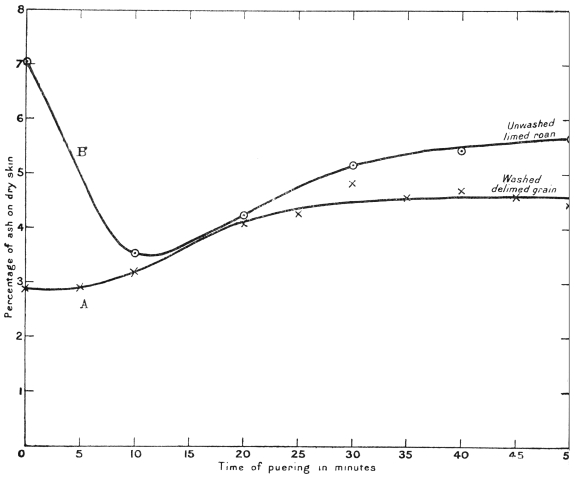
Some of these neutral salts appear to be absorbed
by the skin during the course of the bating, for, on
examining pieces of the same skin at frequent intervals
during the operation, and determining the ash, it
was found that a minimum point for ash content was
reached in about ten minutes, after which the ash
actually increased. The results are shown in the
following table, and also graphically by the curves,
Fig. 7—in which A is a “grain” previously washed
as free from lime as possible; B, an unwashed “roan.”
The effect of the absorption of inorganic matter is very
noticeable in both cases. A part of the effect only is
apparent since a certain amount of skin substance passed
into solution.
Variation of Ash Percentage during Puering.
—
Ash, per cent. on Dried Skin
Time of Puering in Minutes
Washed Delimed Grain (A)
Limed Roan (B)
0
2·88
7·03
5
2·91
—
10
3·20
3·54
15
4·80
—
20
4·08
4·24
25
4·29
—
30
4·85
5·19
35
4·59
—
40
4·70
5·45
45
4·60
—
50
4·45
5·67
55
4·42
—
60
—
5·00
The following analyses give the amount of lime
in solution before and after the bating of the skins,
in grams per litre of filtered puer liquor:—
No.
Bate
Before Goods
After Goods
Increase of CaO
1
Fresh puer
0·108
0·62
0·512
2
" "
0·34
0·72
0·38
3
" "
0·20
0·52
0·32
4
" "
0·19
0·49
0·30
5
Old puer
0·54
0·84
0·30
6
Old puer, goods not washed.
0·98
1·38
0·40
7
French puer shop.
0·308
0·548
0·24
The limit of the quantity of lime in solution in a
normal puer, in the form of calcium salts, appears to be
about 1 grm. per litre. If more lime be presented to
the liquor, the goods stop coming down. If now fresh
dung be added, they will continue to come down, but
the quantity of lime in solution does not increase; the
excess of lime is precipitated, partly as phosphate and
partly as oxalate, in the way stated above.
The type of reaction by which the lime is dissolved
is similar to that occurring between ammonium chloride
and lime, and is expressed by the formula—
2NH4Cl + Ca(OH)2 = CaCl2 + 2NH3 + 2H2O
and in the case of the calcium carbonate in the skins—
2NH4Cl + CaCO3 = CaCl2 + (NH4)2CO3,
so that every molecule of lime neutralized, liberates
two molecules of ammonia.
Jean states that the production of ammonia progresses
regularly during the puering, and that when
the free ammonia reaches 0·2 grm. per litre the bate
is unfit for further use. But if the excess of ammonia
be neutralized by the addition of phosphoric acid, which
also precipitates the lime brought in by the skins, the
bate may be kept in constant use for some time. Jean
found 0·06 grm. NH3 per litre in the puer as made up
for use, and, after one lot of skins had been put through,
0·086 grm. per litre; after two lots of skins, 0·135 grm.
per litre. In ordinary puer wheels, as used at Trent
Bridge, we find—
(a)
(b)
Before goods
0·0816
0·0850 grm. NH3 per litre
After "
0·0833
0·0799
so that there is little or no difference before and after
puering in this case.
Part of the ammonia formed escapes into the air;
a further portion unites with the acids which are being
formed by the action of bacteria in the bate (see
Chapter IV.), and it is also probable that part combines
in some way with the calcium salts in the
bate.
The actual reactions taking place are of course
much more complicated than this simple case, because,
instead of ammonia and ammonium chloride, we have a
number of complex salts formed by combination of
organic acids with substituted ammonia derivatives, such
as methylamine, ethylamine, etc. The chief of these
are ethylamine and methylamine butyrates, and lactates,
and probably propionates, although I have not been
able to separate the latter.33
The reaction with the butyrate is represented by the
equation—
2C2H5NH2C3H7COOH + CaO
= 2C2H5NH2 +
C3H7COO
Ca + H2O
C3H7COO
by which it will be seen that the amine is set free just
in the same way as ammonia in the equation on p. 40.
In order to ascertain if the action of the amines was
the same as that of salts of ammonia, I prepared the
following compounds and tested their action on skins at
37° C., a control piece of the same skin being kept in
water at the same temperature. The time in each case
was one hour. All the solutions were neutral.
1. Ethylamine lactate: skin swells slightly, not “down”
equal to puer.
2. Ethylamine propionate: skin moderately fallen, not
equal to puer.
3. Ethylamine butyrate: about the same as Exp. 1.
4. Trimethylamine butyrate: very similar action to
Exp. 3 and to ammonium butyrate.
The results correspond very closely with those
obtained in previous experiments with various salts of
ammonia (see Chapter VI.), and justify us in assuming
that in all essential respects the action is similar. The
free amines enter into fresh combinations with acids
which are produced by bacterial action, and this process
goes on until all the nutrient material is exhausted.
The Role of Phosphates in the Bate.—There
is no doubt that the phosphates in the bate play an important
part, but exactly in what manner they act is
not yet known. One of the principal effects is the part
they play as “buffers,” in preventing brusque changes
of the hydrion concentration during the bating process.
This has been pointed out by Soerensen in the case of
enzyme reactions. The phosphates in dung are mixtures,
which are capable of fixing both acids and bases;
and so the small quantities of these bodies, which are
produced by the splitting up of the organic matter, are
taken up or released as the case may be.
The chemistry of the phosphates is one of the most
complicated branches of inorganic chemistry, and, as a
consequence, the determination of the constitution of
the various phosphates in dung is an extremely difficult
matter, and demands a lengthy research. For instance,
besides the salts directly derived from the three phosphoric
acids, HPO3, H3PO4 and H4P2O7, phosphates exist
which are probably derived from hypothetical di-, tri-,
or meta-phosphoric acid, nHPO3, and a few salts have
been isolated, which are perhaps derived from the hypothetical
acids P4O7(OH)6 and P10O19(OH)12 (Watt’s Dict.,
art. “Phosphates”). Including the double salts, there
are more than 16 different calcium salts of phosphoric
acids. The normal lime salt Ca3(PO4)2 is very slightly
soluble in water, but its solubility is increased by the
presence of various organic substances such as exist in
dung, and part of the soluble phosphates found in the
bate are undoubtedly nothing more than this salt in
solution. This fact has been utilized in the manufacture
of the artificial bate Erodin (see Chapter VII.).
The phosphoric acid in the puer is partly precipitated
by the lime in the skins, and hence diminishes during
the bating process. In some cases practically the whole
of the phosphoric acid disappears from the solution.
The following experiment will give an idea of the
amount of lime precipitated as phosphate. A filtered
puer liquor was analysed for lime and phosphoric acid,
before and after the skins were passed through. The
results were, in grm. per litre—
Before
After
Soluble lime as CaO
0·364
0·540
P2O5
0·424
0·328
Increase of lime, 0·176 grm.; diminution of P2O5,
0·096 grm. Calculated to calcium phosphate Ca3(PO4)2,
this amount of phosphoric acid has combined with
0·114 grm. CaO. Assuming that the ratio of soluble
to insoluble lime is the same as given, p. 36, then the
lime is distributed as follows:—
Grm.
Increase of soluble CaO
0·176
" " insol. CaO
0·210
Lime as Ca3(PO4)2
0·114
Hence
" " oxalate (?)
0·096
That is, of the lime precipitated, 54 per cent. is phosphate,
46 per cent. oxalate.
In another puer containing before use 0·383 grm.
P2O5 per litre, only traces of phosphates were found in
solution after goods had been puered in the liquor,
and in some analyses by Jean (39) the following figures
were obtained:—
Grams of Phosphoric Acid per Litre.
Fresh dung after four days’ maceration
0·082
Bate after one pack of skins
0·036
Bate after two packs of skins
0·018
Although these figures are less than those found at
Trent Bridge, they confirm the fact that the soluble
phosphates diminish during the bating process.
The phosphates in solution thus diminish during the
bating, and are found in the insoluble matter which
separates out. A small portion of the lime remaining
in the skins is also converted into phosphate by the
action of the bate. In an experiment to determine this,
a portion of the same skin was taken before and after
puering. The pieces were dried, ashed, the ash dissolved
in dilute nitric acid, and the phosphates precipitated
by ammonium molybdate. In the skin before
puering no phosphates were present, but in the skin
after puering there was a small amount, though not
sufficient to weigh.
The action of ammonium phosphate on the lime in
the skin is very small. A skin was treated with a 0·1
per cent. solution of ammonium phosphate at 100° F.
for one hour. The CaO in the dry skin was estimated,
and found to be—
Per cent.
Before the experiment
1·93
After " "
1·45
A considerable amount of calcium phosphate was
found in the skin after the experiment.
Other chemical compounds existing in the puer, or
formed by the action of bacteria (principally B. coli
commune, see Chapter IV.), are indol, skatol and a number
of aromatic oxyacids, principally para-oxyphenyl-propionic
acid, a little para-oxyphenylacetic acid and
skatol carbonic acid. In addition, tyrosin, leucin, tryptophan
and mercaptans have been separated.34
With these bodies no experiments on skin have been
made, so far as I am aware, except with indol and skatol.
Kathreiner found that these had a slight reducing action
on skin, so that one may say they play some part in the
puering.
The action of the bile salts, glycocholate and taurocholate
of soda, also needs investigation. These have an
indirect effect in the puer, as they favour the development
of some species of bacteria (chiefly coli) and hinder
the growth of others.
Some action has also been ascribed to sulphuretted
hydrogen, but in the puer liquors which I have examined
no H2S was found, either before or after the
skins were entered.
It will be seen that the ammonia compounds in the
bate are not of themselves particularly fitted for the
purpose of removing lime35 from the skins, but owing to
bacterial action (which we shall treat of in Chapter IV.),
acids are produced which combine with the ammonia,
and in this way the small quantity of these compounds
originally present is continually being regenerated while
the bating is in progress. Ammonia is set free by the
lime in the skins. It is then neutralized by acids produced
by bacteria, and thus acts as a carrier for the
acids, and the bate remains in a nearly neutral condition.
As the lime increases in the liquid the action of
the bacteria diminishes, and finally the alkalinity becomes
too great to allow the bacterial or chemical action
to proceed further.
It will be noted that the concentration of the active
salts in the bate is extremely small. If the amine compounds
be assumed to consist of ethylamine butyrate or
lactate, the concentration of the solution is approximately
1 grm. per litre; it is important that the concentration
of salts should not greatly exceed this amount. I have
found by experiment with ammonium chloride solutions,
that the best reducing action is provided by a concentration
of 0·7 to 1 grm. NH4Cl per litre; if the
concentration be raised to 2 or 3 grm. per litre, the
skins become “leathery” and do not fall properly. The
alkalinity must not be greater than 3–5 c.c. N/10 per
100 c.c. bate, for the bate to work at its best.
Solution of Skin Substance during the
Puering.—The determination of the total skin substance
dissolved by the puer is best done by Kjeldahl’s
method before and after the goods.36
The difference in the total nitrogen found multiplied
by 5·6 gives the amount of skin substance dissolved
by the bate, assuming the amount of nitrogen in the
dry ash-free skin to be 17·8 per cent. If very great
accuracy be required, a small correction for nitrogen,
brought into solution from the puer itself, is necessary.37
This correction must be ascertained for the particular
puer used by actual experiment.
The following figures give the results in grams per
litre obtained in the puering of sheep grains. 50 c.c.
of the filtered puer liquor are slightly acidified with
sulphuric acid, evaporated nearly to dryness and
Kjeldahled in the usual way.
Mean
Total nitrogen before skins
0·2632
0·2604
0·2576
" " after "
0·4928
0·4844
0·4760
Difference
—
0·2240
Equivalent to 1·254 grm. skin substance per litre.
This was somewhat over a kilogram of skin substance
for the paddle in question, and equal to 1 per cent. of
the dry ash-free skin.
As to the differentiation of the dissolved skin substance
into albumoses, peptones, monamino acids, diamino
acids, ammonia, etc., a modification of Stiasny’s
method38 for the examination of soaks and old limes
may be used.
The method is based on the fact, discovered by
Schiff, that formaldehyde reacts with amino acids, forming
methylen-amino acids, which are distinctly acid and
allow a sharp titration with phenolphthalein as indicator,
while the amino acids themselves react almost neutral.
Soerensen has worked out a method on this basis for
the determination of different amino acids, and for
tracing the course of hydrolysis of albuminous matters.
Instead of using phenolphthalein as an indicator,
the electrometric apparatus of Sand (see p. 76) is
employed. 50 c.c. of the filtered puer liquor are put
into a beaker, the hydrogen electrode is immersed in
the liquor, and the potential difference (P.D.) observed;
this gives the hydrogen ion concentration of the solution.
10 c.c. of neutral formaldehyde solution (40 per
cent.) are added, and the P.D. again observed; it will
be found to diminish rapidly, but soon becomes constant,
indicating that the reaction is a quick one.
The increase of acidity, as shown by the lowering of
the potential difference, is due to the acidity developed
by the combination of the formaldehyde with the amino
acids forming methylen-amino acids of appreciable
hydrion concentration. The amount of such acids is
estimated by titrating with N/10 caustic soda solution
until the P.D. rises to the same voltage as that originally
found. The following figures were found in an experiment:—
Original Puer Liquor
The same After Goods
π (volts)
0·61
0
·69
π after 10 c.c. formalin
0·53
0
·54
N (Kjeldahl), grm. per litre
0·3136
0
·5936
Increase of N
—
0
·2800
N/10 soda for 50 c.c. to original voltage
7·0
11
·6
c.c. increase N/10 soda
—
4
·6
∴ 1 c.c. N/10 soda = mg N
—
3
·05
A preferable method is to add decinormal acid or
alkali to the original liquor until the P.D. of 0·69
is reached, at which point the liquor will be neutral
to phenolphthalein, and, after adding formaldehyde, to
titrate with N/10 soda until the P.D. of 0·69 is again
reached.
The factor which connects the amount of decinormal
soda required for the titration, after the addition of
formaldehyde, with the total nitrogen as determined
by Kjeldahl’s method, will afford information as to
the extent of the hydrolysis undergone by the proteid
matter, in the same manner as Stiasny (loc. cit.), has
proposed to differentiate the dissolved proteid matter in
lime liquors. As hydrolysis proceeds the percentage of
nitrogen in the molecule increases, being at its maximum
in the ultimate nitrogenous product ammonia; the
factor, therefore, becomes less as hydrolysis becomes more
advanced.
We may conclude that the skin substance dissolved
in the puer liquor is hydrolized almost as completely as
gelatin is by boiling with sulphuric acid.
I have previously pointed out that dilute acids
dissolve a certain amount of skin substance (see p. 157),
and in this connexion, Dr. Georges Abt has given me
the results of some experiments, on the solubility of
skin in various organic acids, which he made in Vienna.
Pieces of skin, weighing 40 grm. in the wet state, were
allowed to remain for one month in N/10 solutions of
the acids. The N was then determined, by Kjeldahl’s
method, with the following results, expressed as per
cent. of the wet skin dissolved:—
Per cent.
Acetic acid dissolved
0
·645
Lactic " "
2
·27
Butyric " "
0
·577
Formic " "
1
·47
It will be seen that butyric acid dissolved the least
amount of skin, lactic acid dissolving close upon four
times as much.
Scud.—A certain amount of skin substance comes
away in the “scud.” This is the liquid squeezed out
of the skin by the pressure of the scudding knife after
puering.
The liquid has the same composition as the puer
liquor out of which the goods have been taken, and in
addition contains large quantities of pigment granules,
wool roots, and some skin substance, which together
constitute the so-called “filth” of the skin. Analysis
of a scud from English sheep grains showed only 0·164
per cent. N, equivalent to about 1 per cent. skin substance
(9·15 grm. per litre). Fat, 7·9 grm. per litre.
Eberle and Krall have recently40 analysed the fatty
matter which adheres to the men’s knives in scudding
lamb skins for gloving work. They obtained the following
results:—
Per cent.
Water
29
·7
Fat
42
·0
Fatty acids combined with lime
6
·6
Albuminous matter soluble in water
3
·8
Hair and insoluble albuminous bodies
14
·4
Ash (containing 57 per cent. CaO)
3
·5
The fat had a—
Melting-point
40–44°
Saponification number
about 121
Iodine number
31·6
Hehner value
91·9
Acid value
9·3
Dr. Fahrion found, in a sample of the fat extracted
with ether:—
Per cent.
Iodine number.
Unsaponifiable
47·6
27·3
Fatty acids (sol. in petrol ether)
39·3
30·2
Oxy acids (sol. in ether)
13·5
13·4
The figures obtained for the fat therefore agree
closely with those for wool fat.
Action of the Bird-Dung Bate.—The depleting
action of the pigeon- and hen-dung bate is very
similar to that of the puer, or dog-dung bate; but the
bating process with these materials, as we have seen
(p. 18), is carried out at a lower temperature, and is
consequently more prolonged. The principal difference
between the two bates appears to be a chemical one,
due to the fact that bird dung contains all the urinary
products which are present only to a small extent in the
dung of mammals. In birds uric acid is the chief stage
in nitrogenous katabolism, the mechanism of its formation
being a process of synthesis in the liver (Halliburton).
Urea is also present in considerable amount, and does not
appear to be so easily decomposed as the urea in animal
urine.41 As we shall show in the next chapter, urea, and
probably also urates, greatly facilitate the permeability
of gelatine, and to this fact may be ascribed the more
gradual action of bird-dung bates. If we attempt to
bate hides with dog-dung, the grain of the hide is
found to be attacked and destroyed before the bate has
penetrated to the interior of the hide. On the other
hand, a bird-dung bate may be used at a temperature
of 38° to 40° C. for the puering of skins destined for
light leather, but its action is not so favourable as that
of the puers.
Composition of Bird Excreta.
—
Pigeon
Hen
Duck
Goose
Moisture
58·32
56·08
60·88
46·65
77·08
Organic matter†
28·25
19·56
19·22
36·12
13·44
Phosphates
2·69
2·54
4·47
3·15
0·89
Carbonate and sulphate of calcium
1·75
3·08
7·85
3·01
2·94
Alkaline salts
1·99
0·82
1·09
0·32
Silica and sand
7·00
17·92
6·69
10·75
5·65
—
100·00
100·00
100·00
100·00
100·00
† Containing nitrogen equal to ammonia
1·75
1·21
0·74
0·85
0·67
Macadam42 states that pigeon dung is the most concentrated.
Hen manure contains the largest proportion
of phosphates, and is followed by duck droppings.
That of the goose is the least valuable. The preceding
table is taken from his paper.
Procter43 quotes the following, as a mean of 40
analyses of pigeon dung by Schulze:—
Per cent.
Water
21·00
Nitrogen
2·53
Phosphoric acid
1·79
Potash
1·46
He remarks that the action of bird dung is more
penetrating, but less softening and loosening than that
of dog dung, and this effect may be explained by what
has been said above.
Unfortunately, far less work has been done on the
bird-dung bate than on the puer, and there is a wide
field open for research in this direction.
CHAPTER III. — THE PHYSICS OF BATING.
“The most important aspect of any phenomenon, from a
mathematical point of view, is that of a measurable quantity.”
—Maxwell.
It is impossible in the space of a short chapter to give
an adequate explanation of the physical changes taking
place during the puering process. An outline only can
be given, and perhaps a few signposts to indicate for
those interested, in what direction further work can be
usefully done. It is obvious that if more be attempted,
a treatise on physics and physical chemistry would be
required; such a work is beyond the scope of the
present volume. It is to be hoped that the whole of
the questions dealt with here, including the physical
chemistry of skin and of the whole tanning process,
will shortly be fully treated by the master hand of our
greatest tanning chemist, Professor H. R. Procter.
Since tanning, in the earlier stages, is for the
greater part a physical absorption, or colloidal co-precipitating
action,44 the physical state of the skin
fibre, or condition of the skin before it enters the
tanning liquor, is of the greatest importance. In fact,
the whole of the operations to which the skin is subjected
previous to tanning are directed towards changing
its physical state, and the chemical changes undergone
are small and principally hydrolytic.
The two most important physical influences over
which we have control are pressure and temperature.
The pressure during puering is practically constant,
viz. the atmospheric pressure, but, as we shall see later,
a diminution of pressure is favourable to falling or
depletion. It would, therefore, be interesting to conduct
experiments on puering in vacuo, or under reduced
pressure.
Before considering the effect of temperature and
the changes in the volume of the skin during puering,
it will be well to consider the properties of the skin and
the puer liquor.
In the skin prepared for tanning, practically all the
keratin and epidermis and soluble matters are got rid
of, and we have a mass of fibres which are composed of
collagen, a proteoïd, which by prolonged boiling with
water is converted into gelatin.
Neither the chemical formula nor the molecular
weight of collagen is known with certainty, but, from
a series of ultimate analyses, the change of collagen
into gelatin is represented by Hofmeister45 by the following
equations:—
C102H149N31O38 + H2O
=
C102H151N31O39
collagen
gelatin
from which it will be seen that he assigns a molecular
weight of 2416 to collagen, and 2434 to gelatin. Other
considerations, however, make it probable that the
molecular weight is double the above figures.
Gelatin is a typical colloid, and we may consider
that skin is practically a colloid with a structure (a
very important point, as we shall see later), but behaving
in many ways as gelatin. The puer solution
is to a large extent colloidal. Therefore, both the skin
and the puer are in the colloidal state. In the typical
crystalloid solution of an electrolyte, the dissolved body
is separated into its molecules, and to a large extent
into individual ions, while, in the colloid state, the units
of distribution are either large and often conjugated
molecules, or more frequently minute particles composed
of many molecules united by cohesive attraction.46
In the case of the skin the molecules are not free to
move, but are held in place by the structure of the
skin, and the fibres thus act as semi-permeable membranes,
with capillary spaces between them, in which
water and other fluids are merely held by capillary
attraction.
If filtered puer liquor is put into a vessel closed by
a membrane of skin, and the whole immersed in clear
lime water, the puer solution becomes turbid in a short
time, but the outer solution remains clear, showing that
the skin is permeable to the lime solution (crystalloid),
but not to the puer solution (colloid). It was observed,
however, that the acids contained in the puer diffused
through the membrane; this was shown by the addition
of a few drops of phenolphthalein to the lime solution,
when the pink colour disappeared after a short time in
the neighbourhood of the skin. These phenomena are
due to osmosis. It is the fundamental property of all
animal membranes, to allow some substances to pass
through them more easily than others. In many cases,
such membranes, while freely permeable to water, are
practically impermeable to certain substances in solution,
and play the part of sieves in directing and controlling
the diffusion. In the case of skin the phenomena are
complicated by the fact that the skin combines chemically
with many substances in solution, and thus we do
not always know what part to assign to chemical combination
and what to the osmotic phenomena.
Procter has shown (Colloid. chem. Beihefte 1911, ii.,
pp. 243–284) that, while gelatin is very permeable as such
to solutions of acids and salts, there may be formed in
the presence of excess of acid a hydrolysable chemical
complex of the nature of a salt, in which the gelatin
functions as base, and which is probably less permeable
to acids and their salts than the neutral gelatin. The
conditions would then be similar to those which obtain
when solutions of an acid and its salt are separated by
a movable membrane, which is permeable for the acid
and water but not for the salt solution. From the
organized structure of the skin surface, it is unlikely that
osmosis takes place between the skin itself and the
outer solution, with the two surfaces of the skin as semi-permeable
membrane. Osmotic action is most likely to
occur in the interior of the skin, between the skin fibres
themselves and the interfibrillar spaces. The colloids in
the puer solution, which constitute a large proportion of
its material, cannot, from their nature, penetrate the
skin. This may be shown by the above-mentioned
experiment. From this it is reasonable to assume
that the lime is not actually dissolved from the interior
of the skin by the puer acids, but that solution takes
place for the most part after it has diffused out into
the puer solution. It is probable, however, that part
of the bodies of acidic character present in the puer
are capable of penetrating the skin fibre, as has been
explained above.
The intensity of the osmotic action of puer upon
skin must depend upon the quantity of substances contained
in it, to which skin substance acts as an impermeable
membrane, and which on that account induces
an osmotic pressure between the outer puer solution
and the solutions held in the skin fibre. The effect of
puering does not necessarily imply the actual expulsion
of water from the skin—in fact, well puered skin may
quite possibly contain as much water as it did in the
swelled condition. The difference consists in the manner
in which the water is held in the skin, and its freedom
to move from parts which are submitted to pressure.
In the swollen skin, the fibres may be conceived as
swollen by the water and holding it in the same manner
as a gelatin jelly; after puering, the fibres are “fallen,”
and the water, hitherto held by them, surrounds them
in the liquid form.
The osmotic pressure47 of a solution of concentration
c, temperature T, and pressure p, is the difference of
pressure exerted on both sides of a semi-permeable membrane
in thermodynamic equilibrium, having on the
one side the solution under the above condition, and on
the other side the pure solvent under the pressure p0 of
its own saturated vapour. On this definition the osmotic
pressure of a normal solution is over 22 atmospheres,
or 330 lb. per sq. in.; and since a saturated lime solution
is about 1/20 normal, its osmotic pressure is about
1·1 atmospheres, or 16 lb. per sq. in.—this represents
the force causing the lime to diffuse into water in which
the skin is placed. The puer solution being of a colloidal
nature, exerts practically no osmotic pressure, and since
it contains substances capable of entering into combination
with lime, the latter is removed from the surface
very quickly. The curve representing the removal of
lime by water has been given in Chapter I., p. 6.
That for puer is not of such a simple character (see
Fig. 7, p. 38), but it will be seen that the greater part of
the lime is removed during the first 10 minutes. The
curve is plotted for percentage of ash, since the lime is
no longer in a caustic condition but in the form of salts.
It is remarkable that the percentage of ash, after reaching
a minimum, increases considerably. This phenomenon
still requires investigation.
Density of Skin.—Coming to the consideration
of the volume of skin and its changes during puering,
we know that the volume v is the reciprocal of the
density, i.e.—
v = 1/δ,
and therefore
δ = 1/v.
Carini48 has carried out exhaustive experiments on
the density of skin during tanning, but, so far as I am
aware, little or no work has been done as to the effect
of puering on the density of raw skin.
The usual methods of determining density are well
known,49 and consist in weighing the body first in air,
then in water or other liquid. If m be the weight of the
body, and it loses the weight w when weighed in water—
δ = m/w.
For experiments on skin, instead of weighing in
water it has been found more convenient to use a
simple volumenometer, which was devised by Mr.
Douglas J. Law (see Coll. 1911, p. 230.)
Fig. 8.—Volumenometer for Raw Skin.
The apparatus (Fig. 8) consists of the two vessels A
and B, connected by means of thick rubber tubing to
the burette C, of which the top is enlarged to a bulb.
The bottle A, which was specially made for us by Messrs.
Townson and Mercer, London, is of about 1 litre capacity,
and the wide mouth is closed by a stopper, accurately
ground to fit the neck, and extending down to
the bottom of the neck. The upper part of the stopper
is elongated to a tube, which is closed by the tap G.
The vessel A is also fitted with a tap E. The vessel
B serves as a reservoir, and is used to adjust the level
of the liquid in the burette C by means of the tap
at F. To find the volume of a piece of skin, the
method of procedure is as follows. The bottle A is
filled with water up to the neck, and the stopper D,
carefully greased, is inserted. The tap E is then closed,
and the burette is filled with water. Then, with the
taps G and E open, the bottle A is filled with water up
to D by raising the burette. G and E are then closed,
and by opening the tap F the level of the water in the
burette is adjusted to zero when F is again closed. G
and E are then opened again, and, by lowering the
burette, the water in A is allowed to fall below the level
of the neck of the bottle. E is then shut, the stopper
D removed, and the piece of skin is carefully introduced,
avoiding air bubbles. The stopper D is then
replaced with the tap open, and, by opening E and
raising the burette, the water is allowed to come up to
the stopper D again. The taps G and E are then
closed, and the volume of the piece of skin read off
directly from the burette scale. Volumes up to 50 c.c.
are measurable as described above, but larger volumes
may be measured if a known volume of water is run
from the burette into the reservoir before introducing
the skin.
By using various solutions in the apparatus instead
of pure water, the real swelling or contracting effect
of these upon the skin may be observed. The skin is
introduced into the bottle A, and the solution adjusted
to G, which is then closed; then, by leaving the tap E
open, the real swelling or contraction of the skin is
measured by the rise or fall of the liquid in the burette.
Petroleum or other liquid may be used instead of
water; in some cases, the use of petroleum is more
advantageous.
The density of dry gelatin as determined by Lüdeking
is 1·412, which is not greatly different from that of
skin. Carini gives the following figures for ox-hide:—
Skin with hair
1·450
" depilated with lime
1·425
" depilated with sodium sulphide
1·441
but does not give details how these figures were obtained,
and if corrected for ash and fat.
The density of limed and puered sheepskin, determined
by drying the skin over sulphuric acid until the
weight was constant, then determining the volume in
petroleum, gave the following results:—
Limed skin
1·2335
Puered "
1·2590
I.
By determining the volume of the wet skin in the
volumenometer, and the per cent. of water on drying
the skin, the calculated densities were—
Limed skin
1·438
Puered "
1·300
II.
Correcting for ash and fat, the dry ash-free skins
had the densities—
Limed skin
1·397
Puered "
1·335
III.
The density of the wet limed skin was 1·063, but
the density calculated from the results (I.) above is
1·0475; from this, it is evident the fibres of the
swollen limed skin undergo compression on swelling, or
that the water contained in them is in a state of compression,
in the same way as gelatin swollen with water
occupies a less volume than the sum of the volumes of
gelatin and water. Lüdeking50 found for 10 per cent.
gelatin jelly δ = 1·069; δ calculated was 1·041. He
attributed the whole of the compression to the water,
so that 1 c.c. of water in a 10 per cent. gelatin jelly
occupied a volume of 0·96069 c.c. See also par. 4
p. 68.
It may be of interest to give the figures used in
the preceding lines in tabular form.
Limed skin
Puered skin
Density of wet skin
1
·063
1
·053
Per cent. of water found
80
·63
78
·2
" " calculated
79
·50
79
·9
" of ash on wet skin
1
·71
1
·17
" of fat " "
0
·151
2
·6
Density of dry ash-free skin substance
1
·3970
1
·3356
In addition to the diminution of the density of the
skin by puering, the increase of fat is very marked.
The percentage of water referred to the wet skin
may be calculated from the formula
v2 – v1/1 – v1 × 100
where v1 = specific volume of the dry skin. v2 = specific volume of the wet skin.
The specific volume of the dry skin (v1) may be calculated
from the specific volume of the wet skin (v2), the
percentage of water (w) being known by the following
formula:—
v1 =
v2 – w/100
,
1 – w/100
and by comparing the volume thus obtained with the
volume determined by direct experiment, the amount of
contraction is ascertained. In the case we have been
considering (viz. limed skin with 80 per cent. water)
v2 calculated
= 0·955
v2 found
= 0·941
The specific volume of the dry skin
v1 calculated
= 0·6955
v1 found
= 0·8112
The difference for the dry skin is surprising, and
considerably greater than anticipated, but has been
verified by a large number of experiments. It may be
remarked that the exact determination of the density
of skin by drying out pieces is liable to error on
account of the non-homogeneity of the pieces. There
appears to be some chemical combination between
the water and the skin very similar to that between
water and alcohol, and although the figures obtained in
the above experiments by this method are accurate,
it is not certain that they represent the true density.
It is possible that the interior of the skin may still contain
some moisture, and, in order to arrive at absolute
certainty, it would be necessary to powder the skin,
and ascertain its density in a finely divided condition.
When this is done, the results obtained are very
much more concordant than when pieces of skin are
used. The following results were obtained for the
density of dry hide powder (as used for analysis by the
I.A.L.T.C.):—
In petroleum ether
1·2568
In carbon tetrachloride
1·2570
In alcohol
1·2580
Mean
1·2572
This is equivalent to a specific volume v1 = 0·7954.
The density of the powdered skin may also be determined
in the air volumenometer (Say; Kopp. Kohlrausch
Physical Measurements, p. 53).
Swelling and Falling.—The skin, in its living
condition on the healthy animal, is the most supple and
perfect of coverings, and in producing soft leathers it is
the object of the tanner to retain this supple condition.
To do this, the swollen fibres must, as we have seen,
be got back to their natural state. The phenomena of
swelling and depletion of skin have been discussed by
Körner,51 and recently Prof. H. R. Procter52 has published
a paper which goes into the whole theory of colloidal
swelling. In order to understand depletion, which is the
opposite of swelling, it is necessary to consider what
takes place when a body like skin is swollen. I am
indebted to Dr. Th. Körner for the following summary
of the phenomena of swelling. There are three types
of swelling: 1. Capillary attraction; 2. Endosmose;
3. Molecular imbibition.
The last named is of the greatest importance in
tanning. Körner (loc. cit.) enumerates certain principles
governing molecular swelling.
1. A body capable of swelling, when put into water,
absorbs a definite quantity of the water up to a maximum,
which cannot be exceeded. (C. Ludwig.)
2. The maximum of swelling depends upon the
chemical composition of the body, on its cohesion and
elasticity, and on the temperature and interior pressure
of the liquid. (C. Ludwig.)
3. Power of resistance to swelling increases from
the exterior to the interior, according to a parabolic
law; i.e. the external layers of the body attain the
maximum swelling sooner than the internal portions.
(L. Mathiessen and A. Schwarz.)
4. The volume of the swollen body is smaller than
its original volume, plus that of the liquid absorbed.
(Quincke.)
5. Swelling is accompanied by development of heat.53
The production of heat is simply due to the contraction,
and not to any chemical phenomenon, such as
hydration.54 This explains a fact well known to tanners,
viz. that skins swell in cold water and “fall” in warm
water. Riecke55 concludes that the degree of swelling,
m2/M (where m2 = mass of water absorbed, M = mass of
the body swollen), in a space filled with aqueous
vapour, unsaturated, is a function of the pressure and
temperature.
The velocity of swelling (Pascheles) may be expressed
by the formula—
dQ/dt = (M – Q) K
where M = maximum of swelling, Q = amount of swelling
in the time t, and K = a constant.
The differential quotient dQ/dt gives the velocity for
each moment, and it will be seen that the swelling
becomes slower and slower as the maximum is approached.
Thus, the law of the velocity of swelling is
identical with that of the velocity of inversion of cane
sugar, itself an application of the law of masses.56
For every process of swelling, the constant K must
be determined experimentally from observation of M,
and it may be shown that—
K = 1/t log M/M – Q
whence the value of K may be calculated for each series
of determinations.
On the manner in which water is held in swollen
colloid bodies, three hypotheses have been put forward.57
1. The hypothesis that colloids have a structure in
the form of a honeycomb. (Bütschli.)
2. The water is absorbed at the surface of colloids
in a specially condensed form.58
The water forms, with the swollen body, a “solid
solution.” (Nägeli.)
Swelling, and its opposite, contraction, are connected
with the surface tension between the swelling or contracting
bodies and the surrounding solution. With
diminished surface tension, the surfaces of contact
between the two become greater, i.e. swelling takes
place, with simultaneous diminution of the volume of
the whole system, and vice versa.
For the absorption phenomena which occur, the
following relation holds good: When a substance in
solution diminishes the surface tension at the dividing
surface, its concentration is increased; it is absorbed.
When a substance in solution increases the surface
tension at the dividing surface, its concentration is
diminished.
In the system water-hide substance the researches of
Wiedemann and Lüdkeing have shown that swelling
is accompanied by evolution of heat. Since a rise of
temperature is favourable to a system formed by absorption
of heat, it therefore hinders swelling and vice
versa. This is confirmed by practical experience, and
most bating operations are conducted at temperatures
between 35° and 40° C.
With regard to the influence of pressure on swelling,
a similar law holds good as for temperature, which may
be expressed as follows. When a chemical system is
compressed at constant temperature, its equilibrium is
shifted in that direction by which the reaction is accompanied
by diminution of volume. Quincke, however,
has shown what appears to be a paradox, namely, that
swelling is accompanied by diminution of volume, i.e.
the swelling substance, plus the water taken up, occupies
a smaller space than the sum of the two constituents
taken together; therefore, an increase of pressure must
be favourable to swelling, and conversely a diminution
of pressure is favourable to “falling.”
We must clearly bear in mind that in all cases of
swelling, it is the entry of water into the system which
is the cause of the swelling, and since puering is a
process which acts in a contrary direction, i.e. the skin
falls, this means that water is expelled from the system,
skin plus water. By direct determination, from 3 to
8 per cent. of water is expelled during puering. Calculations
made from density determinations are masked
by the fact, above referred to, that the density of the
skin changes during puering.
A fallen skin contains less water than when in the
swollen condition, but the difference between the percentages
of water in the skin in the two states is only
relatively small, and obviously insufficient in itself to
account for the great difference in the physical properties
of the skin in the two conditions. It is evident, therefore,
that the state in which the water is held in the two
stages must be different. It is reasonable to suppose
that, in the case of swollen skin substance, the whole
of the capillary cavities of the organized structure of the
skin are completely filled with water, which, owing to
its incompressible nature, confers upon the skin elastic
and unyielding properties which it always possesses
in this condition. The water, entering the organized
cell structure in the first place by osmotic pressure,
is fixed there and confers upon the skin, in part,
its own property of incompressibility. It is a well-recognized
fact that, during the puering process, large
quantities of the skin substance are dissolved by the
action of the enzymes in the bate, and it is probable
that the finer organized structure is first attacked. The
walls of the cells which hold the water are partly
destroyed, leaving the skin with, quite possibly, the
same amount of water contained in it as a whole, but
with the water dispersed at large throughout its interior
structure instead of being held in the fibres. The result
of this is, that when a small area of the puered skin
is subjected to local pressure the water in the portion
undergoing compression is free to move into the adjacent
portions of the skin, and there is no force acting upon
it, except that of capillarity, to cause it to return to that
area when the pressure is removed from it. When a
portion of a puered skin is compressed, the surrounding
part is always swollen to an equivalent amount.
That this view is, in the main, correct is supported
by an observation of Abt (Paris), that, while cell nuclei
may be demonstrated in the layers near the epidermis of
an unpuered skin, they are entirely absent from a puered
skin, showing that the puer has completely dissolved the
nuclear structure of the cells.
The swelling caused by alkalis is of a different
nature to the swelling caused by acids. Procter has
pointed out59 that alkaline swelling is not repressed by
sodium chloride, even when caused by sodium hydrate,
but is repressed by sufficient concentration of the
hydroxyl ion in the outer solution.
Müller60 points out that jellies containing certain
non-electrolytes (glucose, glycerine, alcohol) render the
diffusion of soluble matter much slower than pure
jellies of the same concentration, but the presence of
urea favours the permeability of gelatin and agar
jellies. The differences in the velocity of diffusion of
various salt solutions through jellies of the same
strength, are thus not due altogether to the greater
diffusibility of the particular salt solution, but are to be
attributed to the influence of the salt on the permeability
of the colloidal medium. Limed skin treated with a
1 per cent. solution of urea at 43° C. is depleted or “falls,”
but both the solution and the skin remain alkaline.
Přibram61 has recently shown that the swelling and
contraction of muscle are to be ascribed to absorption
and expulsion of water from the cells of the muscle;
the rapid changes taking place, are brought about by
changes in the concentration and composition of the
liquid components of the muscle. Lactic and phosphoric
acids are produced with enormous rapidity, and
of relatively high concentration; during a short period
these cause instantaneous changes in the swelling of the
muscle cells, followed by a return to their original state.
For the evidence of this the original paper must be
consulted, but it goes to show that the equilibrium of
the system—colloids, electrolytes, water—depends on
the proportions and quantities of each of these constituents.
The phenomena we are considering thus
conform to the general law of mass action (Guldberg
and Waage).
Influence of Solid Matter in the Bate.—It
was first pointed out by Wood (J.S.C.I. 1899, p. 991)
that a filtered puer liquor had less action on the skin
than an unfiltered liquor containing much finely suspended
matter.
On adding an inert solid (kaolin) to the filtered
bate, the action was hastened. No doubt much of the
colloidal matter, and with it some of the enzymes, are
removed by filtration, but nevertheless, the suspended
particles in the bate have some effect on the process.
In a most interesting paper, Perrin62 has recently
shown, that the granules in suspension in a colloidal
liquid function like the invisible molecules of a perfect
gas with a molecular weight of 3·3 x 10-9. Such
granules are endowed with the molecular (Brownian)
movement, and therefore may exert a mechanical effect
on the fibres of the skin. Although the mass of the
particles is large63 compared with molecular dimensions,
they are small enough to penetrate the pores of the
skin, and where puering is carried too far, may become
deposited beneath the fine hyaline layer, and thus
render it cloudy and unsuitable for fine colours.
Hydrogen ion Concentration of Puer
Liquors.—It has already been shown, in Chapter II.,
that fresh puer liquors have a certain acidity (7 c.c.
N/10 per 100 c.c.) at the commencement of the operation,
but that at the end they are alkaline (3 c.c. N/10
per 100 c.c.). If an artificially acid liquor be made
by diluting hydrochloric acid until it shows the same
number of c.c. by titration, it will be found far too
“strong,” and will swell the skins. This brings us to
the consideration of what is meant by the strength
of acids.
Procter and Jones64 have drawn attention to the
point in their paper on “Acids in Tan Liquors.” As is
well known, the ionic theory affirms that degree of
acidity depends on the concentration of hydrogen ions,
a strongly acid solution being one in which the hydrion
concentration is great, an alkaline solution one in which
it is extraordinarily minute, and if we adopt pure water
as our standard of neutrality, a neutral solution is one
in which the hydrion concentration is approximately
10-7 normal. A normal solution of hydrogen ions
would contain 1 gram of hydrogen ions per litre;
in the case of hydrochloric acid this would equal
1·35 N/1 HCl.
Sand and Law,65 and Wood, Sand and Law,66 have
described the mode of estimating the hydrogen ion
concentration in tan liquors directly by means of the
electrometric method, and this method is especially
applicable to the estimation of the hydrogen ion concentration
in puer liquors. It can also be used to
titrate the liquors, and we have already given some of
the results in Chapter II.
The method is based on the theory of Nernst, that
the difference of potential between a metal plate and
the solution of one of its salts into which the metal is
dipping, depends on the osmotic pressure of the free
ions of that metal in the solution (in other words, on
the concentration of the solution). In the case of
hydrogen ions, we use a plate of platinum coated with
platinum black and saturated with hydrogen, and the
difference of potential depends, therefore, on the concentration
of the hydrogen ions in solution.
Fig. 9.—Diagram of Connexions of Electrometric Apparatus.
The accompanying figure (Fig. 9) shows the hydrogen
electrode I, and the auxiliary electrode II, drawn to
scale,67 on the right, whereas the electrical apparatus is
explained diagrammatically on the left.
The principle of the method of measurement consists
in connecting the two ends P and Q, of a sliding
rheostat to the terminals of a dry cell, D, and balancing
the potential-difference to be measured against the
potential-difference between one end, P, and the slider,
S, by means of a special form of enclosed capillary
electrometer, E. The value of this potential-difference
is read directly on a delicate voltmeter, V. The connexions,
which are found ready-made in the box, have
been drawn out, whereas, those to be made by the
operator are shown by dotted lines. The steps to be
taken by the latter, consist first in taking off the capillary
electrometer and manipulating it in such a manner,
that on returning it into position the capillary may be
partly filled with a thread of mercury and partly with
the acid. The terminals, X and Y, marked battery +
and −, are connected to a dry cell, and the terminals,
Z and U, marked cathode and auxiliary respectively,
to the hydrogen and calomel electrode. Very careful
insulation of the connexion between the terminal marked
auxiliary and the calomel electrode is necessary. The
hydrogen is passed through the hydrogen electrode until
a constant P.D. between it and the calomel electrode is
obtained. This P.D. is measured by moving the slider
up and down until no movement of the mercury in the
capillary electrometer is observed on depressing the key
K marked electrometer.
Fig. 10 is a view of the apparatus as set up for the
titration of a puer liquor. H is a cylinder of compressed
hydrogen;68 I, the hydrogen electrode, dipping into the
beaker C containing the liquor for titration; b, the
burette, containing N/10 acid or alkali; II, the auxiliary
electrode, the capillary of which is also seen dipping
into the beaker C; P, the potentiometer box containing
the sliding rheostat S and electrometer E; D, a dry
battery. The acid or alkali is run in from the burette
until the voltmeter shows 0·69 volts, indicating that
the liquid is neutral or has a hydrogen ion concentration
of 10-7.
Fig. 10.—Electrometric Apparatus.
The following table shows some results obtained on
puer liquors before and after skins have been put
through. p+H has been called by Sorensen the exponent
of the hydrogen ion concentration C, and is defined by
the equation
p+H = log 1/C
i.e. it is equivalent to the logarithm of the reciprocal of
the factor of normality of the solution with respect to
the hydrogen ions.69p+H for pure water or a neutral solution
is 7, corresponding to 0·69 volts. The measurements
were made on filtered puer liquors, using a N/1 KCl
calomel electrode as auxiliary, the capillary of the electrode
being filled with 3·5N potassium chloride:—
No.
Before goods.
After goods.
Volts.
p+H
Volts.
p+H
1
0·560
4·7
0·755
8·16
2
0·585
5·16
—
—
3
0·600
5·4
0·658
6·44
4
0·595
5·35
0·710
7·35
5
0·600
5·4
0·725
7·6
6
—
—
0·770
8·35
No. 6 was a very old “spent” liquor. The mean
hydrogen ion concentration before goods was 0·588
volt, i.e. the concentration was 10-5·32 normal equivalent
to 0·00000479 grm. per litre of hydrogen ions. Therefore
the value of p+H was 5·32.
A solution of hydrochloric acid of the same strength
by titration consumed 0·7 c.c. N/1 alkali per 100 c.c.
Measured by the electrometric apparatus, it showed 0·410
volt, corresponding to p+H = 2·1, or a hydrion concentration
of ·0079N. In other words, the HCl solution
has an acidity or strength 1600 times that of the puer
liquor.
The mean hydrogen ion concentration of the liquors
after goods was 0·000000076 grm. per litre, corresponding
to 0·715 volt and p+H = 7·12, i.e. the liquor was
alkaline to a slight extent. For comparison saturated
lime-water gave a reading of 1·01 volt, corresponding
to p+H = 12·5.
The hydrogen ion concentration is of the greatest importance
for the proper action of the enzymes in the
bate;70 we shall, however, treat of this in Chapter VII.
Conductivity of Puer Liquors.—It was thought
of interest to examine the electrical conductivity of
puer liquors in actual use, in the hope that the numbers
obtained might give some useful indications. It was
found that the conductivity increased, as might be
expected from the lime going into solution, but the
difficulties of the method render it of less use than
ordinary chemical analysis. The results of a typical
liquor are given here as a record—
Conductivity (K) of liquor before goods
0·00316 1/ohm × cm.
Conductivity (K) of liquor after goods
0·00423 1/ohm × cm.
The difficulty of expressing the complex reactions
of puering numerically is, we have seen, very great, for,
as Minot71 says, “with human minds constituted as they
actually are, we cannot anticipate that there will ever
be a mathematical expression for any organ or even a
simple cell, although formulæ will continue to be useful
for dealing now and then with isolated details. Nevertheless,
the value of graphic methods to every student
of science has been immense.”
It has long been my endeavour to express quantitatively
the degree to which a skin has fallen. My friend
Dr. Sand has suggested that this may be done by
subjecting a piece of the skin successively to increasing
and then decreasing pressures, and measuring the thickness
under each load. Experiments carried out with
the apparatus described below show that a limed skin
treated in this way is first compressed, and then on
releasing the pressure recovers more or less of its former
thickness, according to the amount of plumping it has
received, i.e. it shows a certain amount of resilience.
A well-puered sheep-skin, on the other hand, shows no
resilience at all, i.e. on releasing the pressure the whole
of the compression persists. In the case of an ox-hide
subjected to a bate of hen-dung, a slight recovery takes
place on releasing the pressure. This accords with the
fact that it will never be possible to puer a thick ox-hide
so effectively as a thin sheep-skin. A piece of
india-rubber, on the other hand, is completely resilient,
i.e. it wholly recovers its thickness on releasing the
pressure. The relative thickness of the same skin in
the limed and puered conditions under varying loads is
also of interest. The process of puering may, as a rule,
be taken to reduce a limed skin to between two-thirds
and one-half of its thickness in the swollen condition.
If both limed and puered skin be then subjected to the
same load, the puered skin will at first be compressed
very much more than the limed one. This is probably
due to the expulsion from it of water, held simply by
capillary attraction. On further increasing the load,
however, the compression decreases greatly in the case
of the puered skin; with both limed and puered skin
increase of compression ultimately becomes practically
proportional to increase of pressure, and is slightly
greater with the former than with the latter.
The table gives representative results obtained on
the same sheep-skin (roan) in the limed and in the
puered condition. These results are expressed graphically
in Fig. 12.
Load per sq. cm. in grm.
Thickness in mm
Δ
Limed skin
Puered skin
0
3·45
1·78
1·67
20
3·43
1·58
1·85
40
3·33
1·43
1·90
60
3·28
1·35
1·93
80
3·22
1·23
1·99
100
3·15
1·13
2·02
120
3·08
1·08
2·00
140
3·03
1·05
1·98
160
2·95
1·01
1·94
180
2·90
·98
1·92
200
2·83
·95
1·88
300
2·73
·88
1·85
All off
2·98
—
—
380
2·61
·82
1·79
600
2·43
·76
1·67
All off
—
·76
—
Δ = difference in thickness of the skin—i.e. compression under the
same load.
Fig. 11.—Apparatus for Measuring Degree of Falling
m
= micrometer dial.
JJ
= jaws between which the skin is placed.
b
= balance-weight attached to cord passing over pulleys p p, to counterbalance weight of frame f f.
k
= knife edge supporting pan and weights w.
Fig. 11 shows the apparatus72 that was employed to
obtain these results. It consists essentially of a commercial
form of micrometer for measuring the thickness
of leather. To one of its jaws a pan for weights is
attached, by means of the frame f f, in such a manner as
to secure a perfectly straight pull. The weights of the
frame and pan are counterbalanced in the manner
shown by a counterpoise b. The delicacy of measurement
may be increased by inserting larger jaws in the
form of suitably fashioned disks, but even when this is
done the results are to a certain extent vitiated by the
rather considerable friction of the micrometer.
Fig. 12.—Curve obtained by Measuring Apparatus.
(The dotted lines show the pressure on taking off the load.)
An apparatus free from this fault is shown in Fig.
13. It consists essentially of a counterbalanced lever A,
to which the upper jaw J is rigidly attached. By
means of a sliding weight W, any desired load, from
zero upwards, may be put on this jaw. The lever
carries a very delicate spirit level, which allows it to be
set accurately horizontal in every experiment. The
lower jaw is movable vertically between parallel guides,
and its position is controlled by the screw-wheel S which
bears a divided circle on its circumference. The position
of this wheel, and therefore of the lower jaw, may be
accurately read on the vernier v. In every experiment
it is adjusted so as to make the upper lever accurately
horizontal.
Fig. 13.—Improved Apparatus for Measuring the Degree
of Falling. (Sand.)
CHAPTER IV. — THE BACTERIOLOGY OF THE BATE.
“Omne vivum ex ovo.”—Harvey (1578–1675).
When a drop of liquid from a puer wheel in use is
examined under the microscope73 with 1/12 o.i. objective,
it is seen to be swarming with bacteria.
The majority are short rods (bacilli), but other forms,
cocci and spirilli, are seen in lesser numbers. Most
of these bacteria move briskly in the liquid; as the
temperature of the slide sinks, their movements become
slower, and finally cease. The illustration, Fig. 14,
shows the various forms of bacteria observed by the
author in puer liquors × 1000 diam.
Fig. 14.—Various Forms of Bacteria in
Puer Liquors.
The living bacteria are best examined in a drop
culture in the following manner. A clean cover-glass,
of the proper thickness for the objective to be used, is
laid upon a black glass plate. With a platinum loop,
previously heated to redness in the flame, a drop of
sterile physiological salt solution (0·6 to 0·75 per cent.)
or sterile broth is placed in the centre of the cover-glass.
With a platinum needle a minute quantity of the puer
liquor is stirred into the drop. A slide with a depression
in the centre is taken, the edge of the depression
painted round with vaseline, and pressed over the cover-glass,
so that the drop is exactly central. If the whole
be now turned smartly over, the drop will hang central
in the hollow space.
If the ring of vaseline is continuous, and the cover
well pressed down, the drop is preserved from evaporation,
and the bacteria may be examined in their natural
condition—best on the edge of the drop.
For illuminating the drop culture, the concave mirror
is used, and a small diaphragm without condenser;
whereas, for stained preparations, the flat mirror is used
in conjunction with the Abbe condenser.
If the cover-glass be carefully removed, and dried
under a bell glass, the culture may be preserved in a
dry condition, or may be stained and mounted.74
If the dried preparation is on a cover-glass, it should
be held in the fingers (prepared side upwards), and
passed slowly three times through the flame of a
Bunsen burner. By holding the preparation in this
way, the exact temperature for proper fixation is
obtained.
A drop of fuchsin stain, or gentian violet, is allowed
to remain on the preparation for five minutes; wash off
the superfluous dye with water, and examine, either in
the wet state or after drying and mounting in balsam.
For a detailed account of the technique of staining and
mounting, the following works may be consulted:—
Methods and Formulæ. P. W. Squire. (Churchill.)
Taschenbuch für den bakteriologischen Praktikanten. Dr. Rudolf
Abel. (Stubers-Verlag, Würzburg.)
Technique Microbiologique. Nicolle and Remlinger. (Octave
Doin, Paris.)
Practical Bacteriology. Kanthack and Drysdale. (Macmillan,
London.)
The recent researches of Tissier and Metchnikoff
have shown that the flora of the intestines, both of men
and animals, consist very largely of anaerobic bacteria.
These have been overlooked in previous researches,
owing to imperfect means of studying this class of
organisms. Indeed, in one work on the microbes of the
alimentary canal of the dog, no mention was made of
them, whereas they are all very active.
Most of these organisms, and the new methods by
which they have been isolated, are fully described in a
new work entitled “Les Anærobies,” by M. Jungano and
A. Distaso, of the Pasteur Institute, Paris.75
The following bacteria have up to the present been
isolated from dung (mostly dog dung), and studied in
pure cultures:—
Isolated from horse manure by Severin, Centr. Bl. f. Bakt. (2), i., 97.
28.
" II.
29.
" III.
30.
" from horse dung (anaerobic) Severin, Centr. Bl. f. Bakt. (2) iii., 708.
31.
" from horse dung (anaerobic), No. 3, ditto.
32.
" oedematis maligni (Vibrion Septique, Pasteur).
33.
" mesentericus vulgatus.
34.
" lactis aerogenes.
35.
" cavicida (Brieger).
36.
" albuminis (Bienstock).
37.
" Bienstockii.
38.
" tenuis.
39.
" enteritidis sporogenes (Klein).
40.
" lactis acidi (Ankerschmid, 1905).
41.
" megatherium.
42.
" cadaveris sporogenes (Klein) said to be identical with No. 16.
43.
" thermophilus. (Houston).
44.
" a. from puer. See p. 162.
45.
" b. " " "
47.
Bacillus mycoides.
48–61.
14 species isolated from dog and pigeon dung by Prof. H. Becker. Zeit. f. Offentlich. Chemie. Heft xxiii. Jahrgang X. p. 447, includes B. erodiens (Fig. 16).
" from pig dung. Smith, Centr. Bl. f. Bakt. 16, (1), 124
74–76.
Vibrio, three species isolated by Kutscher.
77.
Clostridium butyricum (Prazmowski), said to be identical with No. 25.
78.
Streptococcus faecalis. Sidney Martin, 37 and 38; Ann. Rep. Loc. Gov. Board, 1907–9; Nature, March 3, 1910, p. 22.
79.
Bacillus bifidus.
80.
" perfringens.
81.
" bifermentans.
82.
" funduliformis (Veillon).
83.
" capillosus.
84.
" sporogenes.
85.
" ventriosus.
86.
" rodella III.
87.
Staphylococcus parvulus.
88.
Diplococcus orbiculus.
89.
Coccobacillus preacutus.
90.
Coccobacillus oviformis.
91.
Bacillus faecalis alkaligenes (Petruschky).
(79–90 are anaerobic bacteria, described and figured by Jungano and Distaso.)
It will be surmised from the above list, to which
additions are still being made, that the flora of the intestines
is pretty extensive, and, consequently, the study
of the part played by the various species of bacteria is
a long and difficult one.
The methods of isolating these bacteria, and the
compositions of the media employed, would demand a
treatise on bacteriology; but, for general purposes, a
good liquid medium for the cultivation of puer bacteria
is a gelatin peptone broth, made by digesting 10 grm.
gelatin with 6 1/2 grm. 80 per cent. lactic acid in 100 c.c.
water under pressure for three hours, neutralizing with
ammonia, adding 1 grm. potassium phosphate, making
up to 1000 c.c., and filtering. A sterile infusion of
fresh dung may be used, but it is troublesome to prepare
and not easy to get uniform in strength or composition.
The culture liquids are left slightly alkaline,
an alkalinity equal to 0·0636 per cent. Na2CO3 or
12 c.c. N/1 soda per litre. The amount of alkali may
be increased to 0·15 per cent. Na2CO3 without affecting
the growth of the bacteria. Of solid media, 10 per cent.
nutrient gelatin, or in summer 15 per cent., is good if
used at temperatures below 25° C. For higher temperatures,
up to 39° and 40°, nutrient agar is required. The
best nutrient gelatin for general work is made according
to Klein’s formula.76 For media in general, a most useful
compendium is Abel’s Taschenbuch.
The number of bacteria in fresh fæces varies greatly,
but is of the order of 10,000,000 per grm. of dry
matter, capable of developing in nutrient gelatin. Of
this number, about 100,000 are spore-bearing organisms.
This estimate applies to healthy animals; in a diseased
condition, the numbers vary enormously.
Dr. A. C. Houston found in raw London sewage
from 3,000,000 to 9,000,000 microbes per c.c., of which
more than one-tenth were gelatin-liquefying organisms.
There were only about 300 spores of aerobic bacteria,
about 100,000 B. coli, 100 B. enteritidis sporogenes, and
streptococci, in one gram of fæces.
With the object of ascertaining the effect of the
various species of bacteria contained in the dung upon
skins, a large number have been isolated, and the
effect of pure cultures in different media has been
tried upon skin.77 A number of the results have been
published in the Journal of the Society of Chemical
Industry. Professor H. Becker, who has done a great
deal of this part of the work, is of opinion that the
principal organisms concerned in the bating exist in
the dog’s intestines, and belong to the group of coli
bacteria. These are very widely distributed bacteria,
and are found in the large intestines of mammals, and,
as a consequence, in almost all soils, and in the mud
of rivers and lakes. The principal variety is B. coli
commune.
Fig. 15.—B. Coli Commune.
Stained to show Flagellae.
Lortet found it, along with other organisms, in the
mud of the Lake of Geneva, at a spot where the water
was chemically very pure. Dr. A. C. Houston, the bacteriologist
of the Metropolitan Water Board, enumerates
sixteen varieties of this organism, 80 per cent. of which
produced acid and gas in lactose-peptone cultures,
indol in peptone-water cultures, and when grown in
milk produced acid and clot. The bacterium (Fig. 15)
resembles that of typhoid fever, and has frequently
been mistaken for it. It is, however, much more resistent
to destructive influences. It is a short bacillus,
possessing flagellae, by which it moves more or less
rapidly.
B. coli forms short rods 0·8 µ wide, 1 to 3 µ
long. It moves somewhat slowly by means of flagellæ,
which may be demonstrated by staining with Loffler’s
method.78 It grows equally well in absence or presence
of air, that is, it is a facultative anaerobe. Although it
will grow at room temperature, the optimum growth is
at 37° C. In plate cultures the appearance of the
colonies below the surface of the gelatin is quite different
from that of the surface colonies. The former are small
round colonies, about the size of a pin head; the latter
spread into a whitish iridescent film, with irregular edges.
B. coli does not liquefy the gelatin. When grown in
nutrient solutions containing sugars, it produces much
acid, and at the same time gases are given off, consisting
of CO2 and hydrogen. If the growth in this solution be
allowed to continue a secondary fermentation ensues,
and the culture eventually becomes alkaline.
Indol is produced by B. coli, and may be demonstrated
by adding to 10 c.c. of the culture, 1 c.c. of a
1/50 per cent. solution of pure potassium nitrite; then
adding a few drops of concentrated sulphuric acid, when,
if indol be present, a red coloration (nitroso-indol) is
produced. This bacterium reduces nitrates to nitrites.
Cultivated in a 1 per cent. solution of peptone, to which
1/10000 per cent. of potassium nitrate has been added,
after four hours at 37° C., the presence of nitrite may be
shown; after the growth has continued for seventeen
hours, the nitrite is further reduced to ammonia.
Among other products of B. coli, Harden found lactic,
formic, acetic, and succinic acids, ethyl-alcohol, CO2 and
hydrogen.
In Germany, W. Lembke and H. Becker have specially
investigated the bacterial flora of the dog’s intestines.
Lembke, in 189679 cultivated the bacteria from
the fæces of the dog, fed in various ways—bread, meat,
and fat diet—and found B. coli constantly present,
although the form of the individuals, as well as the
colonies, and the intensity of the indol and gas formation,
showed great variations.
The other species of bacteria present varied with the
kind of food; this has a great influence on the flora
of the intestines, which was found to be very different
when the dogs were fed on bread to what it was when
they were fed on meat.
Lembke describes two other species of bacteria closely
resembling B. coli, one of which he calls B. coli anindolicum,
which, as the name implies, gives no indol
reaction; the other, B. coli anaerogenes, is non-motile,
possesses no flagellæ, and differs from B. coli by the
absence of gas production in the fermentation of sugars.
Besides B. coli, there are several species of bacteria
which liquefy gelatin, and a number of facultative organisms,
whose presence is more or less accidental. By
changing the food, and introducing with it quantities
of foreign organisms, the composition of the intestinal
flora may be changed. By introducing for a considerable
period B. coli anindolicum, Lembke succeeded in
entirely suppressing B. coli commune. On returning
to normal feeding, the foreign organisms in some cases
entirely disappeared.
The researches of Dr. H. Becker80 were applied more
directly to the use of bacterial cultures for the bating
of skins, and to the elucidation of the bacterial action
of dog-dung infusions. He isolated 54 varieties of
bacteria from dog-dung, and tried the action of pure
cultures of many of them on a skin.
A list of the various bacteria isolated by Becker is
given in tabular form on pp. 98–101.
Fig. 16.—B. Erodiens (Becker).
Fig. 17.—Plate Culture from Fresh Puer.
Professor Becker’s Bacterium No. 12, which he has
named Bacillus erodiens (Fig. 16), is undoubtedly a
variety of B. coli, but has a more rapid motion, and does
not coagulate milk, although it renders it somewhat
thick. Cultivated in broth it gives off much gas, consisting
of 12 per cent. carbon dioxide, 85 per cent.
hydrogen, 3 per cent. oxygen. If glucose be added, the
quantity of carbon dioxide rises to 40 per cent., and acid
is produced. The most rapid growth is at 37° C., and at
this temperature a broth culture has a distinct reducing
action on skin. According to the medium in which
it is grown, it produces acid or alkali, and thus comes
under the heading of mixed bacteria. In sugar81 solutions
acid is produced, and in proteid solutions ammonia
compounds, indol, and evil-smelling gases are given off.
Thus, by varying the medium, the effect produced may
also be varied.
B. erodiens does not secrete any tryptic enzymes,
hence its action on the skin is to be attributed either
to an intracellular enzyme, or to its chemical products,
which, being secreted in situ, have a more favourable and
powerful action than if merely added to the bating
liquid. It was for this reason that I proposed to use a
mixed culture of bacteria, especially bacteria from the
sweating process (see p. 105), which secrete a mild form
of proteolytic ferment, capable of dissolving the more
easily soluble portion of the skin fibres (or certain constituents),
but not capable of attacking the hyaline layer.
No. of the Bacterium
Where Found
Shape and Arrangement
Motility
Growth on Gelatin
Growth on Agar-agar
1
Dog dung
Small rods of the size of the Bac. prodigiosus.
Lively
In the gelatin stab-culture the bacteria show a good growth in the depth. At the surface it forms a small white button. The gelatin is not liquefied. The colonies which have reached the surface of the gelatin-plate spread in the shape of a leaf, with a mother-of-pearl-like gloss.
A white surface layer is formed on inclined stiffened agar-agar.
2
Do.
Small rods of the size of the hay bacillus.
Do.
Stab-culture: The germs develop along the entire track. Small arms extend sideways into the gelatin. A white layer is formed on the surface. The gelatin is slowly liquefied.
A yellowish-white layer is formed along the inoculating stab.
Gelatin-plate: When they reach the surface, the colonies spread out in the shape of a leaf and then are slightly fluorescent.
3
Do.
Very small rods rounded at the ends.
Do.
Stab-culture: Very good growth in depth. Very many arms extend laterally from the track of the stab into the gelatin. Small knots are formed at the ends of the arms. A thin white coating is formed on the surface. Gelatin is not liquefied.
A white deposit is formed on inclined agar-agar.
Gelatin-plates: The colonies located deeper down appear as pale-yellow small round disks, which gradually work up toward the surface and there form circular disks which show larger dots in the middle.
4
Do.
Small rods as large as hay bacilli.
Slow movement
The gelatin stab-culture resembles that of the hay bacillus, while the growth in the gelatin-plate more resembles that of the anthrax bacillus. Threads extend from the liquid colonies which have been let in, which threads are at first braided and twisted, and later on extend straight into the gelatin.
Heavy white deposit on the entire surface.
7
Do.
Small rods similar to the hay bacillus.
Lazy
Stab-culture: Strongly liquefying. A white skin forms on the surface. Along the liquefied prick are radiations into the solid gelatin.
White unevenly thin layers with spurs.
Gelatin-plate: Quickly liquefying colonies which form a white skin at the top.
11
Do.
Medium-sized small rods.
Motile
Stab-culture: A white coating is formed on the surface. The gelatin is not liquefied. The bacteria grow well in the depth.
A white deposit along the puncture.
The colonies which come to the surface spread out leaf-like with a mother-of-pearl-like gloss.
12
Dog dung
Medium-sized small rods.
Lively
Stab-culture: Grows evenly along along the track. Gelatin is not liquefied. A thin glossy deposit on the surface.
Heavy white deposit; glossy.
Gelatin-plates: The lower-lying colonies appear as pale-yellow circular small disks. Braids are noticed in some colonies similar to the superficial colonies of Proteus. Strong decaying smell.
13
Do.
Do.
Motile
Stab-culture: A thin coating forms on the surface. The bacteria grow downward bristle-like. Small buttons are formed at the ends of the bristles.
Stab-culture: Bag-shaped liquefying of the gelatin, the same being coloured yellow.
Yellow spreading over the surface of the culture medium.
Gelatin-plates: The deep-seated colonies are granular, yellow. Those that have forced their way to the surface form white glistening small buttons.
40
Do.
Do.
Do.
Stab-culture: A white heavy deposit is formed on the surface of the culture medium; grows very well along the track.
White irregular deposit.
Gelatin-plates: Leaf-like deposits with line system.
42
Do.
Do.
Do.
Stab-culture: A white heavy Spreading. Very good growth along the prick.
Do.
Gelatin-plates: Leaf-shaped deposits with line system.
43
Do.
Large, grouped, grape-like.
Not motile
Stab-culture: The gelatin is slowly liquefied. Only slight growth in the depth. The culture medium is coloured chamois colour.
White puncture in yellow.
Gelatin-plates: Yellow disks.
44
Pigeon and poultry dung.
Small rods, quite different in size.
Lively
Stab-culture: A heavy white spreading on the surface. Very good growth along the prick.
White irregular deposit.
Gelatin-plates Leaf-shaped deposits with the line system.
45
Do.
Small rods
Do.
Stab-culture: A heavy white spreading on the surface. Slight growth only in depth.
Very thin deposit.
Gelatin-plates: Leaf-shaped deposit with clear line system. The entire colonies appear much thinner than those of the preceding numbers.
(continuation of table to right)
No. of the Bacterium
Growth on Potatoes
Growth in Milk
Best Growth at—
Development of Gas
Special Remarks
1
The bacterium shows only a weak growth on potatoes. It forms a yellow layer.
Milk is not changed
37° C
Only slight
Without doubt a variety of bacterium Coli commune.
2
Dirty yellowish layer.
Milk remains unchanged.
Room temp.
Does not occur
—
3
Yellowish deposit at the place of inoculation.
Milk is caused to curdle only after it has been in the incubator for four days.
37° C
Very pronounced. From fifty cubic centimeters of broth 6·5 cubic centimeters gas were produced in fifteen hours, of which 3·5 per cent. was oxygen, 10·7 per cent. carbonic-acid gas, and 85·8 per cent. nitrogen.
Culture-medium to which blue litmus is added turns red.
4
White, dry, spreading.
Milk is changed. Serum is separated out.
Do.
Does not occur
—
7
White, dry.
Strong serum formation.
Do.
Do.
—
11
Yellowish glossy deposit.
Milk curdles
Do.
Weak
Strongly resembles the bacterium Coli commune and differs therefrom only in that the milk curdles quicker.
12
Yellowish glossy covering.
Milk becomes pappy.
37°C
Considerable. Five cubic centimeters of gas will be developed from fifty cubic centimeters of common broth in an incubator during the first fifteen hours and six cubic centimeters during the first forty-eight hours, consisting of 12·12 per cent. carbonic acid, 3 per cent. oxygen, and 84·9 per cent. hydrogen. The gas obtained from a culture-medium containing grape-sugar contains about 40 per cent. carbonic acid.
If 0·25 cubic centimeters of broth-culture are injected under the epigastrium, the animal is taken violently ill. After four hours violent diarrhea occurs. Soon the mouse can hardly move; looks bristly. On the third day the animal dies. On opening the body a strong putrid smell is noticed. Some of the injected bacteria are found in the blood. The intestines are coloured green and black. The other organs are pale.
13
Glistening, yellowish.
Strong curdling.
Do.
Weak
In old stab-cultures a brown discoloration of the culture-bed is noticed along the length of the stab. Differs in the gelatin stab-culture from the common bacterium Coli commune likewise in the curdling of the milk.
38
Yellow glistening deposits.
Milk is not changed.
Do.
Not noticed
—
40
White, glistening. Only very slight growth.
Do.
Do.
Weak. Is only noticed in culture-bed containing grape-sugar.
—
42
Sulphur yellow, glistening.
No change of the milk.
Do.
Strong only in media containing grape-sugar.
—
43
No growth
Do.
Do.
None
—
44
Weak development. The culture is sulphur yellow.
Curdling
Do.
Very weak. Only in media containing grape-sugar.
—
45
Weak yellowish deposit.
Milk is not changed.
Do.
Not noticed
—
The practical difficulty is to keep such cultures uniform
during propagation, and so far this has prevented
their introduction in practice. Similar difficulties have
influenced the use of pure cultures of yeast in the brewing
of English beers, although the use of a single species
of yeast is common in the low fermentation breweries
on the Continent.
I found in studying the bacteria of dog dung, that
the species existing in the fresh dung, which developed
in ordinary plate cultures, appeared to belong to four or
five species only, mostly bacilli. At the end of two or
three weeks, the original species had given place to
others, mostly cocci, in a very similar way to the change
which takes place in putrefaction. In fact, many of
the organisms are identical with those which cause
putrefaction. It will be seen, therefore, that no
single species produces the complex chemical and
physiological changes which take place, or the bodies
necessary for the bating of skin, as some observers have
supposed; but the various species succeed one another
as the medium changes its reaction and composition,
until finally the organic portion is resolved into the
simplest bodies such as carbon dioxide, ammonia, and
hydrogen. There is thus a moment when the dung is
at its best so far as the bating action is concerned, and this
moment is due to the vital activity of bacteria, and consequently
varies according to the temperature and some
other influences (electrical condition of the atmosphere,
etc.). One may say it is at its best at about fifteen
days in summer, and one month or more in winter.
Puer which has been dried, is not so powerful in its
action as that which is immediately made into a paste
with water. It appears to lose its “nature,” partly
owing to irreversible dehydration processes, and partly
because some of the bacteria are killed. Plate cultures on
agar from fresh puer (Fig. 17), and from a puer wheel in
use (Fig. 18), show the number of bacteria in the puer
wheel to be much greater than in the fresh puer. Whence
it is evident, that the bacteria continue to develop in the
puer and to produce their various products, enzymes, etc.
We have already considered the action of the chemical
products, and in Chapter V. we propose to discuss the
action of enzymes.
Fig. 18.—Plate Culture from Puer Wheel.
Fig. 19.—B. Putrificus.
Pigeon-Dung Bate as used for Hides.—The
bacteria contained in the intestines of birds and
in bird dung have not been studied to the same extent
as those of mammals, so that it is not possible to give
anything but a meagre account of them. A microscopical
examination of fresh pigeon dung, collected
on a sterile Petri dish, showed debris of food, cellulose,
etc., among the debris, a large number of dumb-bell
bacteria (b) (Fig. 20), and a few motile pairs (c); no
bacilli were seen. Cells of a saccharomyces (a) were
also observed. From this pigeon dung attenuations
were made by a modification of Soyka’s method,82 and
from the fourth attenuation a plate culture was made in
ordinary nutrient gelatin. The colonies from this plate
were principally of two varieties (both non-liquefying
organisms), corresponding to the bacteria observed in
the original dung. Large cultures were made in a
Carlsberg vessel, as described in Chapter VI., and the
effect of these cultures tried upon skin. No particular
reducing effect was obtained.
Fig. 20.—Organisms in Pigeon Dung. × 1000.
A microscopical examination of a bating pit used
for kips, showed an extraordinary mixture of bacteria,
bacilli, vibrios, and monads; some comparatively large
dumb-bell shaped bacteria, very motile, were present.
The difference between the bating liquor and the fresh
dung was very marked, especially in the variety of
species present. Cultures made from several colonies
isolated from the above bate, in a nutrient liquid,
consisting of 10 litres water, and 20 grm. gelatin,
peptonized by heating under pressure with 10 c.c.
sulphuric acid, afterwards neutralizing with ammonia,
and adding the soluble matter from 200 grm. bone-meal,
had no action on skin.
It would be unsafe to say from these two experiments
that the bacterial effect of the pigeon-dung bate
is negligible, but we may assume that it is different
and not so great as with the dog-dung bate or puer.
A complete research as to the various species of
bacteria developing in the bird-dung bate is necessary
before this question can be answered.
General Considerations on the Growth of
Bacteria in Various Media.—Since the publication
of Further notes on the action of the dung bate (Chapter
VI.), I have found that the bating organisms grow better
in the special medium, when it is neutralized with ammonia,
than when it is neutralized with sodium carbonate,
i.e. the presence of organic ammonium salts is more
favourable to the growth of the bacteria than the
corresponding sodium salts.
I also found that bacteria obtained from other
sources than dung, viz. from the roots of wool just
beginning to “slip” in a sweating stove, were equally
effective in causing the skin to fall. Now these bacteria
produce ammonia, and it seems clear that they are
essential to the chemical part of the process. They
also produce proteoclastic enzymes, which act upon
the skin fibre (see chapter on Enzyme Action). The
products of the bacteria depend very much upon the
composition of the nutrient medium. Many organisms
grown in media containing sugar or other carbohydrates
produce acids, but, grown in proteids free from sugars,
they produce alkaline compounds. Villon (“The
Leather Industry,” 1901, p. 408) describes a bacterium
which he considers to be the special micro-organism
concerned in the depilation of skins, which resembles
Bacillus d (Wood) (Fig. 21), but he does not describe the
appearance of the cultures; he states, however (p. 410),
that this is the only bacterium which can develop in the
limes,83 and that it is the cause of the unhairing in this
case also. Since the production of ammonia in limes
is known to be due to bacterial action, it is very probable
that this bacterium, which is ubiquitous, is also of
use in the bate, and a research in this direction would
be interesting.84
Fig. 21.—Bacillusd.
Some of the fermentations taking place in the dung
come under the heading of putrefactive processes (see
p. 116). Tyrosin is formed in considerable quantities
during putrefactive fermentation, but is soon further
decomposed, according to Nencki, with formation of indol,
CO2 and hydrogen. Leucin gives valerianic acid, ammonia,
CO2 and hydrogen; nitrogenous bodies of the
aromatic series are also produced.
Fig. 22.—Bacilluse.
Bacillus ureaæ, B. prodigiosus, and B. fluorescens
putridus, evolve trimethylamine (Herfeldt), and, as
the writer has shown, this amine has an important
action in the puering process. In combination with
organic acids, it removes lime from the skin, and in
addition it favours the growth of bacteria, such as
bacillus d and e (Figs. 21 and 22) and B. coli.
The albumens and peptones of the dung are pretty
well decomposed and absorbed before evacuation; the
bacteria subsequently split up the amido acids into
fatty acids and ammonia. The fatty acids are then
decomposed generally in the form of the calcium salts,
in the manner shown in the table (p. 108), for which
I am indebted to Dr. E. Herfeldt, of Bonn.
We have already treated of the action of these various
products in Chapter II., but it will be seen from what
has been said in the present chapter that the chemistry
and bacteriology of the puer overlap, and that it is
difficult, if not impossible, to separate them entirely.
The bacteria are continually manufacturing chemical
compounds, and decomposing others.
In this respect it is interesting and instructive to
note that Nencki, in his classical work “The Chemical
Mechanism of Putrefaction,”85 considers the processes by
which the putrefaction of proteids is brought about by
bacteria, to be analogous to those taking place by melting
the bodies with potash, and he holds the view that
in the hydration processes brought about by bacteria,
the water plays the same part as the potash.
No.
Fermenting Substance.
Cause of Fermentation.
Fermentation Product.
Authors.
1
Calcium formate
Bacteria from sewer slime.
Calcium carbonate, CO2 and H
Hoppe-Seyler, Archiv f. d. g. Physiol. xii.
2
Calcium acetate
" "
Calcium carbonate, CO2 and CH4
" "
3
Calcium lactate Undergoes four different fermentations
Thin bacillus
1. Propionic acid, and, as by-products, acetic acid, succinic acid and alcohol.
Fitz, nine papers in the “Berichte der Deutsch. Chem. Gesellschaft,” 1876–1884.
Other species of bacteria: short aerobic, butyric bacteria (Fitz).
2. Propionic acid and valerianic acid.
3. Butyric acid and propionic acid.
4. Butyric acid, according to Pasteur (Comptes rend. 1861)
4
Calcium malate
Bacteria (not described). Thin bacilli.
1. Chief product, propionic acid; and, as by-product, acetic acid.
Schützenberger, “Fermentation,” 1876.
2. Chief product, succinic acid; and, as by-product, some acetic acid.
Acetic acid in large quantities, along with small quantities of ethyl alcohol and succinic acid.
Fitz.
7
Calcium glycerate
Micrococci
1. Calcium acetate, along with small quantities of succinic acid and ethyl alcohol.
" "
Medium-sized bacilli
2. Formic acid, with some methyl alcohol and acetic acid.
Nencki explains, for example, the metamorphosis of
leucin by putrefaction in this way: The bacteria decompose
the water into hydrogen and hydroxyl, which
act upon the leucin as follows:—
CH3
CH — CH2 —
CH |
— COOH +
OH H
= NH3
CH3
Leucin
NH2
+ OH — CH2 (CH2)4 COOH (oxycaproic acid)
The resulting oxycaproic acid is then split up by the
second water molecule into methylenglycol and valerianic
acid:—
OH
+
OH H
= CH2 (OH)2 + CH3 (CH2)3 COOH
|
CH2
|
(CH2)4
|
COOH
The methylenglycol, which changes into formaldehyde
and water, is now split up into CO2 and hydrogen,
as it would be by melting with caustic alkali.
H
+
H.OH
= CO
OH
+ 2H2
C
O
H
H.OH
OH
As we shall see in the chapter on the action of
enzymes, the phenomena are of a catalytic nature.
Any urea present is decomposed, by the direct action of
micrococcus ureæ, into ammonium carbonate and ammonium
carbamate, so that it does not play any part
in the bating process as usually carried out with dung
which has been kept for some time, but the ammonia
produced plays an important part in the chemical action
of the bate, as we have already seen.
If, however, dung containing the urinary products
be used in a fresh condition, the urea has indirectly a
very important influence on the bating, as it favours the
permeability of the skin fibre. (See p. 72.)
The fermentation of the cellulose in the dung has
not been studied from the bating standpoint, but it is
well known that it is fermented by various species of
bacteria, which have been grouped together under the
generic name of Amylobacter.
Deherain and Gayon first showed that the solution
and fermentation of cellulose in the form of dead vegetable
matter, which had previously been observed, also
took place in dung. Van Tieghem, in 1879, showed
that the solution of cellulose is caused by bacteria,
whose properties correspond with those described by
him as Amylobacter. Tappeiner was able to ferment
cellulose by mixed cultures of bacteria from the intestines
of oxen—in neutral solution, CO2, methane, H2S,
aldehyde, butyric acid, and acetic acid, were all recognized.
In alkaline solutions, the principal products
were CO2 and hydrogen, together with the same by-products
as before.
From the researches of Van Sennis, in 1890, it seems
pretty certain that the fermentation of cellulose is due to
the symbiotic action of at least two different organisms
The decomposition of the cellulose may be explained
by considering that first a sugar-like carbohydrate is
formed by hydrolysis, and that this is then split up into
equal volumes of CO2 and CH4. It may be noted that
the fermentation is anaerobic, and no doubt, so far as
bating is concerned, the chief products are the organic
acids produced, principally butyric and acetic acids.
Van Sennis nearly always found Clostridium butyricum
associated with this fermentation.86
Another group of organisms which have some influence
in the bating process, are the class called by
Beijerinck, Granulobacter. They produce butyric acid,
and this acid, combining with the ammonia compounds
of the dung, forms salts which undoubtedly exert an
effect on the lime in the skins, though its action on the
fibre is, perhaps, not so great as the compounds of lactic
and propionic acids.
The most common butyric ferment is the old Clostridium
butyricum, now known as B. butyricus, (Prazmowsky),
which is anaerobic. It forms spindle-shaped
spores, hence the name Clostridium (from κλωστηρ, a
spindle). Another species (Fig. 23), found in milk by
Hueppe (1884), is aerobic, and ferments lactic acid
and its salts to butyric acid, CO2, and hydrogen; it
appears to correspond with Granulobacter polymyxa of
Beijerinck.
Oxalic acid is known to be produced by some bacteria
and the moulds Penicillium and Sclerotinia, and in the
white rot of the turnip it is produced by Pseudomonas;
it is also produced by some saccharomycetes, such as
B. Hansenii.87 There is reason to believe that its production
plays a part in the bate, as we have already
mentioned in Chapter II., but the organisms producing
it and their mode of action still remain to be investigated.
There are, of course, a large number of putrefactive
bacteria in the puer, among these B. putrificus (Fig. 19),
isolated by Bienstock; it is a spore-bearing anaerobic
bacillus, and is interesting as specially attacking fibrin.
Now fibrin is extremely resistant to the action of most
putrefactive bacteria, and it is very probable that specific
organisms ferment the different albuminous compounds,
in the same way that the different carbohydrates are
each decomposed by specific ferments.
Very interesting are the various forms of spirilla
met with in dung; Figs. 24 and 25 show Spirillum
volutans in the unstained condition, and also stained to
show the flagellæ. It will be noted that the appearance
is so different that, to an inexperienced observer, they
might be taken for different species. The rôle played
by these organisms still requires investigation.
Fig. 23.—B. Butyricus. (Hueppe.)
Fig. 24.—Spirillum Volutans. (Kutscher.)
Stained to show Flagellae.
I have pointed out previously the importance of
the nutrient medium, or substratum, in which the
bacteria grow, on the species surviving. In it one can
see on a small scale the Darwinian process of natural
selection. There is a great struggle for existence
between the various species, and the circumstances
determining the survival of this or that organism are
extremely complicated, and we are yet very much in
the dark as to the action of the various chemical compounds
contained in the puer, so that it is unsafe to
neglect even those which are present in only small
amounts. Very minute quantities of certain bodies,
almost too small for detection by chemical means, are
sufficient to cause large differences in the growth of
certain organisms. For instance, Raulin found that the
addition of a trace of zinc to his nutrient liquids increased
the crop of the mould Aspergillus niger more
than four times the weight of a crop grown in the same
liquid free from zinc.
If we inoculate a nutrient material with a pure culture
of bacteria, and the medium is not exactly adjusted to
the needs of the particular organism, it will not thrive,
and will speedily be overgrown by some other species
obtaining access from the air. This fact very much
discounts the use of pure cultures of bacteria which
have been proposed for bating, although in the case
of erodin, where the medium has been adjusted to suit
the organism, considerable success has been attained.
The whole of the enzymes and chemical compounds
essential for a perfect bate, are not present in the dung
when it leaves the animal’s body, but these compounds
are produced by the continued action of the intestinal
bacteria and other organisms which obtain access from
the air. The production of the enzymes depends, too,
upon the composition of the nutrient medium, since
this exerts a selective influence on the species of bacteria
obtaining access to it. Just as in the spontaneous
souring of milk numerous bacteria have free access to
it, yet the lactic ferment is generally so pure that it
may be, and is, used as a pure culture on a large scale
in the manufacture of lactic acid.
Coming to the action of the bacteria on the skin
fibres, from the work of Abt and Stiasny,88 we may
conclude that the substance of the conjunctive fibres is
less profoundly decomposed by bacterial fermentation
than by the action of lime. The latter dissolves about
2 per cent. of skin substance from a fresh skin, whereas
a puer acting normally dissolves about 1 per cent.
The nuclein of the skin fibres appears to be all
removed by the puer, since Abt confirms the fact that
no nuclei can be seen under the microscope in a puered
skin. The actual solution of the skin substance is
brought about by enzymes of a tryptic character. (See
Chapter V.)
While the main lines of the bacteriology of the dung
bate are now pretty well known and understood, it will
be seen that much work still remains to be done as to
details, and this principally with the anaerobic bacteria
of the dung, which have been studied by few investigators.89
I have suggested90 that such a research might
well be undertaken by the bacteriological laboratories of
our Leather Industries Schools in Leeds and London.
Moulds and Putrefaction.—In view of the fact
that moulds are of frequent occurrence on dog dung, a
brief mention of them is necessary. So far as our present
knowledge goes the researches of Van Tieghem, De
Bary, Rankin, Marshall Ward, V. H. Blackman and
others indicate that their action on the essential bating
constituents of the dung is a destructive one. They
grow usually on acid media, and in so doing break down
the acids present into simple inorganic bodies, such as
CO2 and water, utilizing the carbon and nitrogen for
their own growth. Although these fungi secrete almost
all varieties of enzymes (Bourquelot), yet we have no
evidence that any of the enzymes contained in dog dung
are from this source. In the usual case of dung preserved
in pits or casks, the upper surface only becomes
mouldy, since moulds require a free supply of oxygen.
The mycelium penetrates but a very little way into the
body of the dung, and cannot therefore effect any decomposition,
except of the surface layer. The dung exposed
to the action of the mould is generally a bad
colour, and is rejected as unsuitable for puering.
The following species have been noted and classified
as growing on dog dung, though probably not all of
them are specific.
1. Pilaira dimidiata (Grove).
2. Mucor caninus (a variety of Mucor mucedo).
3. Circinella simplex (Van Tieghem).
4. Pilobolus crystallinus (also on cow-dung).
Certain myxobacteria are found on dung, among
these Chondromyces, described as long ago as 1857 by
Berkeley, and at that time included among the Hyphomycetes.
It was rediscovered in 1892 by Thaxton, and
owing to his researches the whole class of myxomycetes
is now generally considered as a division of Bacteria.
Another myxomycete, Polyangium primigenum (Quehl),
forming a red fructification on dog dung, is figured in the
Encyclopædia Britannica, XI. edition, vol. 3, p. 163.
The following abstract gives some account of putrefaction,
and may be of use in conjunction with the account
of the bacteriology of the bate which has been
given. Since it was written Dr. G. Abt (see Bibliography
51) has also given a very full description of
putrefactive processes as affecting leather manufacture.
The subject is still occupying the attention of a large
number of bacteriologists, and we may expect more light
to be thrown on the whole question during the next few
years.
Abstract of Paper on Recent Advances in the
Bacteriology of Putrefaction. Read before
the Nottingham section of the Society of
Chemical Industry, January 24, 1906.91
To those who have to do with the manufacture of
leather, the changes which take place in the skin from
the time it leaves the animal are of the utmost interest.
The most important of these changes is the natural process
of decomposition known as putrefaction.
Putrefaction may be defined as the decomposition
of nitrogenous organic matter by living organisms,
accompanied by the evolution of malodorous gases.
The study of it may be divided into two parts—(1) the
biological, (2) the chemical. The first concerns the
organisms which break down the proteid molecule either
directly or by means of enzymes; the second that of
the different products of the action of these organisms.
It is extremely difficult to separate these two studies.
Dr. Sims Woodhead (59) gives a concise account of
the earliest researches on the organisms causing putrefaction
by Leeuwenhoek (1692), Plenciz of Vienna,
Müller of Copenhagen (1786), Needham (1749), Spallanzani
(1769), Schwann (1837), Schroeder and Van Dusch
(1854), Tyndall (1870), Lister (1878). These names
show that the history of putrefaction proceeds parallel
with the evolution of the microscope and the development
of the comparatively recent science of bacteriology.
I propose to-night briefly to carry it up to the present
day.
I need scarcely say that putrefaction is not a specific
fermentation like alcoholic or acetic fermentation, but
that it is extremely complex. In any putrefying matter,
such as gelatin or albumin, a large number of different
species of bacteria may be observed as well as monads
and infusoria, and in some cases moulds, all of which
take part in the process. The first stage is a process of
oxidation in the presence of air, in which ærobic bacteria
use up the oxygen present and only simple inorganic
compounds are formed, carbon dioxide, nitrates and sulphates;
this part of the process is generally without
odour. The second stage, or true putrefaction, takes
place in the absence of oxygen by anærobic bacteria, and
is a process of reduction. It has been shown that there
are no bacteria in healthy tissues, and if a muscle or any
organ is taken from an animal under antiseptic conditions
it may be preserved indefinitely in a sterile vessel
to which filtered air has free access. Solid matter is
usually liquefied by organisms like B. liquefaciens magnus,
which are invariably present in the air, and which
prepare the way for more specifically putrefactive bacteria,
such as Proteus vulgaris and B. putrificus, but if
one observes a number of putrefactions of the same kind
of matter under natural conditions, scarcely any two
follow the same course. The modern study of putrefaction
dates from Hauser (58), who, in 1885, isolated from
putrefying flesh the three organisms—Proteus vulgaris,
P. mirabilis, and P. zenkeri. He studied the action of
these in pure cultures, and came to the following conclusions:—
That Bacterium termo (Ehr.) is not a single definite
species; various forms and stages of other organisms
have been described under this name. The various
species of Proteus go through a wide range of forms
during their development in which cocci, short and long
rods, thread forms, vibrios, spirilli, and spirochætæ occur.
Under special nutritive conditions Proteus goes through
a swarm stage, in which condition it is capable of
moving over the surface and in the solid gelatin. The
Proteus bacteria are facultatively anærobic, they all
cause putrefaction; P. vulgaris and P. mirabilis are the
commonest and most active of all putrefactive bacteria.
They do not secrete an unorganised ferment, but decompose
albuminous bodies by direct action. They also
produce a powerful poison, of which small quantities
injected into animals produce septicæmia.
Tito Carbone (60) found amongst the products of P.
vulgaris, choline, ethylenediamine, gadinine, and trimethylamine.
Macé (61), criticising Hauser’s work, considers
the cocci form of Proteus to be spores. Bienstock (62)
believes the rôle of the Proteus group somewhat doubtful.
He discovered (1884) another widely distributed
putrefactive organism, which he called Bacillus putrificus;
it is a spore bearing, drumstick shaped bacillus
found in fæces; it is anærobic and specially attacks
fibrin. Now fibrin is extremely resistent to the action
of most putrefactive bacteria, and it is very probable
that specific organisms ferment the different albuminous
compounds in the same way that the different carbohydrates
are each decomposed by specific ferments. A
certain number of species of bacteria are able to decompose
both carbohydrates and proteids. Tissier and
Martelly (70) call these mixed ferments, and divide them
further into two groups (1), mixed proteolytic ferments,
including B. perfringens, B. bifermentans sporogenes,
Staphylococcus albus, Micrococcus flavus liquefaciens,
Proteus vulgaris, this group decompose albumin by
means of tryptic enzymes. (2) Mixed peptolytic ferments
are only able to attack the albumin when it has
undergone a preliminary decomposition. This group
comprises B. coli, B. filiformis, Streptococcus pyogenes,
Diplococcus griseus non liquefaciens.
The second class of bacteria are those which are without
action on carbohydrates, and only attack proteids;
these consist of the true proteolytic bacteria B. putrificus,
and B. putidus gracilis, and the peptolytic bacteria,
Diplococcus magnus anaerobius and Proteus zenkeri,
which can only decompose peptones.
These authors state that B. putrificus is always
present in putrefying albumin, but always accompanied
by facultative ærobes which favour the growth and
development of the special putrefactive bacteria.
In the putrefaction of meat the reaction is first acid
owing to the action of the mixed ferments on the sugars
present. In the next stage ammonia is formed by the
tryptic enzymes secreted by the ærobic bacteria, and
so the anærobic organisms are enabled to develop. We
can thus understand how it is that putrefaction proceeds
more rapidly the more mixed ferments there are present,
although these were formerly supposed to hinder putrefaction
from taking place.
When meat is exposed to air it is first attacked by
the mixed ferments, Micrococcus flavus liquefaciens,
Staphylococcus, Bacillus coli, Bacillus filiformis, Streptococcus
and Diplococcus, and becomes acid; at the same
time, the presence of decomposition products of albumin
may be detected, proteoses, amidoacids, amines and ammonia;
the latter quickly neutralise the acids, and in
three to four days the meat is alkaline, and has a faint
putrid smell. Bacillus perfringens and Bacillus bifermentans
sporogenes now make their appearance; the
latter of these organisms produces amines, amido-acids
and ammonia. In this stage the simple anærobic ferments
are able to begin their work, and real putrefaction
sets in; as this proceeds, the mixed ferments gradually
disappear, and finally the only organisms remaining are
Bacillus putrificus, Bacillus putidus gracilis, and Diplococcus
griseus non liquefaciens.
Another organism, which appears to play an important
part in the decomposition of animal bodies, is described
by Klein (63); he found that in bodies, which had
been buried from three to six weeks, bacteria such as B.
coli and B. proteus had almost disappeared, and an anærobic
bacterium, which he calls B. cadaveris sporogenes,
was very active. It is a motile bacillus 2–4 µ
long, with flagellæ all over its surface. Spores are formed
at the rounded ends, giving it a drumstick form. It
coagulates milk, the clot gradually dissolving. It grows
on all the usual nutritive media, but only under strictly
anærobic conditions.
In a paper, entitled “Fermentation in the Leather
Industry,”92 I gave a short account of the progress of
putrefaction as it takes place in the animal skin, and
also described some of the organisms I had observed
in putrefying skin. A small piece of skin was placed
in water and allowed to stand at room temperature.
During the first two days there was little change, but
on the third day a number of swiftly moving darting
monads made their appearance. Some of these were
propelled by flagellæ, but a few had assumed amœboid
forms. A slowly moving bacillus consisting of a
long straight rod, apparently broken up into cells exactly
like the Vibrio subtilis, illustrated in the “Micrographic
Dictionary,” was observed, accompanied by some
species of spirillum. Higher organisms present were a
Paramœcium and a colourless transparent piece of protoplasm,
shaped like a dumb-bell, with a slow rotating
motion. On the fifth day the number of vibrios and
spirilli had greatly increased, some with a swifter motion
than others. There were also many large infusoria present;
one of a peculiar double form, which appeared to
be a development of the dumb-bell shaped piece of protoplasm
seen on the third day. On the seventh day the
most striking feature was the great increase in the number
of vibrios; the field of the microscope was crowded;
masses of the bacilli could be seen clustered round small
particles of the disintegrating skin as if feeding upon it;
there were more infusoria, many of them short, boat-shaped
monads, with a trembling motion, refracting
light strongly; these evidently accompany the putrefaction
bacteria, and assist in the final disintegration. On
the ninth day the piece of skin was entirely dissolved.
Procter calls attention to the relative putrescibility
of the different constituents of skin, and especially to
the rapid putrescence of the lymph and serum. So far
as I know, this part of the subject has not been studied
at all thoroughly, and there is a considerable field open
to workers in our research laboratories.
Pure fat is not decomposed by bacteria, but if albuminous
matter is present, the fat is split up by several
species of bacteria and moulds. Schreiber (73) has
shown that the presence of oxygen is necessary. As this
subject scarcely comes within the category of putrefaction,
I refer you to Schreiber’s paper, and also to an
important paper by Otto Rahn (74) recently published.
In the putrefaction of vegetable matter the cellulose
is attacked by specific organisms, which have been
thoroughly investigated by Omeliansky (75). He has
shown that the fermentation of cellulose is an anærobic
process, caused by two species of bacteria belonging to
the class of butyric ferments. Morphologically the organisms
closely resemble one another, but one of them
decomposes the cellulose with evolution of hydrogen,
the other with evolution of methane; in both cases considerable
amounts of acetic acid and normal butyric acid
are produced.
I have previously stated that monads and infusoria
take part in the process of putrefaction, but I do not
know that their action has been studied in the same way
as that of bacteria. The life history and morphology of
some of these monads was studied in 1871 to 1875 by
Dallinger and Drysdale (76). These authors, in their
researches into the life history of the monads found in
a putrefying infusion of cod’s head, came to the conclusion
that “bacteria are not the only or even (in the end)
the chief organic agents of putrefaction, for most certainly
in the later stages of a disintegration of dead
organic matter the most active agents are a large
variety of flagellate monads.”
Dallinger cultivated some of the monads in Cohn’s
fluid, and found that they lived and multiplied in it.
Their spores were killed at a temperature of 250° F.
There is a big field of research open in this direction.
The consideration of the chemical aspect of putrefaction
is a vast subject, and would demand a special
treatise. I shall only call your attention to one or two
points of interest.
Taking the simpler bodies first, sulphuretted hydrogen
is formed in putrefying liquids in two ways: (1)
by reduction of the sulphates in the liquid by an
anærobic organism Spirillum desulfuricans; (2) by bacteria
capable of growing in the presence of oxygen such
as B. coli commune and B. lactis ærogenes, which ferment
glucoses with formation of lævorotatory lactic acid
and evolution of CO2 and hydrogen, and if at the same
time the material contains albumin or sulphur, H2S is
given off; these organisms are incapable of reducing
sulphates. Beijerinck (64) has investigated this process,
and found a variety of different forms intermediate
between the two above-mentioned, but all possessing
the same characteristics so far as their chemical action
is concerned, so that they may be classed as one order,
which he calls Aerobacter.
Stich (65) found phosphorus pentoxide in the residue
from the putrefaction of casein, nuclein, lecithin, and
protagon; and in the putrefaction of certain organs of
animals and plants, gases containing phosphorus are
evolved. The nucleic acid of yeast yielded phosphoric
acid along with hypoxanthin and xanthin.
Vitali (66) found in the putrefaction of muscle, which
had been freed from sugars and fat, that some alcohol
was produced. He considers that a hexose is split off
from the albumin in a similar manner to the splitting
off of a fermentable sugar from the glucoproteids (compounds
of simple proteins with carbohydrates). The
formation of alcohol in the putrefaction of muscle
occurs in the alkaline stage. Thus alcoholic fermentation
is caused not alone by saccharomyces, but also by
certain putrefactive bacteria.
Lermer (77) finds that the putrefaction of barley
resembles butyric fermentation. An analysis of the
gases given off during the later stages of the process
gave the following result: nitrogen, 58·88; hydrogen,
37·43; methane, 3·15. In the residue from the putrefaction
he found acetic, butyric and valerianic acids, but
not caproic or caprilic acid. In the normal steeping
process employed for barley the gases given off consisted
almost entirely of carbon dioxide and nitrogen.
This observation is interesting to compare with the
evolution of nitrogen in the fermentation of bran shown
by Wood and Willcox.93
The action of putrefactive bacteria has been found
capable of transforming hexoses into pentoses. Salkowski
and Neuberg (78) inoculated a solution of
d-glukuronic acid with putrefying meat, and showed
that it was changed into l-xylose with evolution of CO2
according to the following formula:—
COH(CHOH)4COOH = CO2 + COH[CHOH]3CH2OH.
This is an interesting fact, especially as, according
to Neuberg, the pentose contained in animal nucleo-proteids
is l-xylose.
I wish to express my indebtedness to Dr. Alfred
Koch’s “Jahresbericht über Gärungs-organismen” for
some of the abstracts.
The following is a list of putrefactive bacteria which
have been studied in pure cultures:—
1. Proteus Vulgaris (Hauser). 2. Proteus mirabilis. 3. Proteus
Zenckeri. 4. Bacillus Oedematis maligni (Kerry, Nencki, Bovet).
5. Bacillus Chauvæi = B. sarcophyematos bovis. 6. B. Liquefaciens
magnus. 7. B. spinosus. 8. B. putrificus (Bienstock). 9. B. pseudo
œdematicus (Liborius). 10. B. enteritidis sporogenes (Klein). 11. B.
tetani. 12. Clostridium fœtidum. 13. B. cadaveris sporogenes
(Klein). 14. Spirillum desulfuricans (Beijerinck). 15. B. coli commune.
16. B. lactis ærogenes. 17. B. fermentationis cellulosæ.
18. Micrococcus flavus liquefaciens (Flügge). 19. Diplococcus griseus
non liquefaciens (n. sp.). 20. Streptococcus pyogenes. 21. Staphylococcus
pyogenes albus. 22. Bacillus filiformis ærobius (n. sp.).
23. Diplococcus magnus anærobius (n. sp.). 24. Bacillus putidus
gracilis (n. sp.). 25. B. perfringens (Frankel). 26. B. bifermentans
sporogenes (n. sp.).
Moulds taking part in putrefaction, principally of
fruit and vegetable matter:—
“The living organism is enabled by the use of enzymes to
bring about, under ordinary conditions of temperature and moderate
concentrations of acid or alkali, many chemical reactions
which would otherwise require a high temperature or powerful
reagents.”—W. M. Bayliss.
In a recent work,94 Dr. Bayliss defines enzymes as the
“catalysts produced by living organisms.” A catalyst
is a body which greatly accelerates the rate of reaction
in chemical processes, without apparently taking part
in the process. For instance, peroxide of hydrogen is
decomposed into oxygen and water by mere contact
with finely divided platinum, while the latter remains
unaltered in the process. In this case the platinum
black is the catalyst.95
In natural processes the best known type of an
enzyme is diastase (amylase), the enzyme contained in
malt, and which enables the malt to convert starch into
dextrin and sugar (maltose). It is capable of transforming
more than 2000 times its own weight into
sugar, which fact is quite sufficient to show that its
action differs from that of an ordinary chemical reaction.
Another enzyme, sucrase, according to O’Sullivan and
Thompson, will hydrolyze 100,000 times its weight of
cane sugar to invert sugar. Rennet will coagulate
250,000 times its own weight of casein in milk. The
list of enzymes grows longer almost daily, as some new
one is separated having a specific action, until one is
almost led to believe that the mechanism of life itself,
as manifested in the cell, is due to enzymes.
It has been found that enzymes act very much in
the same way as inorganic catalysers. As an example,
the velocity of the reaction of invertase (the enzyme of
yeast which hydrolyses cane sugar to grape sugar) has
been compared with the same hydrolysis brought about
by heating a solution of cane sugar with a mineral acid.
In both cases the reaction is in accordance with the law
of mass action (Guldberg and Waage) that the amount of
sugar transformed will decrease as less remains to be
transformed. In the diagram (Fig. 26) the curve A is
for invertase (Jas. O’Sullivan, “Journ. Inst. of Brewing,”
vol. v. p. 168); curve B is for the hydrolysis by acid
(Wilhelmy), from which it will be seen that the manner
in which the hydrolysis proceeds is practically the same
in both cases.96
Fig. 26.—Curves showing Rate of Hydrolysis.
In the case of fermentation by the living organism,
the fermentation rises rapidly, and then gradually slows
down and comes to an end before the whole of the fermentable
matter is used up; the curve, therefore, is of
a hyperbolic character, C in the diagram, which represents,
in a general way, the fermentation of glucose by
B. furfuris. The ordinates represent the amount of
acid produced by the bacteria. The time in this case
would be 176
more nearly represented by hours instead of
minutes on the abscissa.
The mathematical expression for the velocity of the
reaction is
dx/dt = k(a − x)
where
a = original concentration of solution x = the quantity transformed in time t k = coefficient of velocity of the reaction
By integrating the above equation, it may be shown
that
1/t log a/a – x = k
For the experiment of J. O’Sullivan with invertase,
k has a mean value of 0·0013; for Wilhelmy’s experiment
with acid, k has a mean value of 0·001377.
Enzymes are produced by the living cell, with other
secretions, and as a consequence are found in all plants
and animals. Certain organs, however, produce enzymes
in large quantities, or appear to be specially set apart
for their production. In plants, the seeds are the chief
seat of enzyme activity; in animals, certain glands, such
as the salivary glands and the pancreas. The mucous
membrane of the stomach and intestines also secrete
enormous quantities.
The production of enzymes by bacteria was observed
by Wortmann in 1882. It has been found that the
secretion of the enzymes depends upon the composition
of the nutrient medium in which the bacteria are grown.
For instance, Pfeffer found that the secretion of diastase
by Bacillus megatherium depended upon the amount
of cane sugar in the nutrient medium. The cane
sugar checked the secretion of the diastase, and the
same effect was observed in the case of the common
mould Penicillium glaucum. In Bacillus mesentericus
vulgatus, diastase has been found to exist side by side
with four other enzymes. Passini,97 in studying the
putrefactive anaerobic bacteria of the normal human
intestines, succeeded in separating from B. putrificus a
proteolytic enzyme filtered free from bacteria, and
which caused proteolysis in media which were too acid
to permit of the bacteria growing. The enzyme easily
dissolved, without previous neutralization, the coagulated
casein caused in milk by old coli cultures. Acid gelatin
media were also liquefied by the enzyme.
From the evidence we have at present it seems
probable that every variety of enzyme, hydrolysing, oxidizing,
ammoniacal, etc., can be produced by bacteria.
The following useful classification of enzymes is due
to Effront.98
Name of Enzyme
Substance on which the Enzyme acts
Products of the Reaction
A. Hydrolyzing Enzymes
1.
Fermenting Carbohydrates:
Sucrase or invertin
Cane sugar
Invert sugar
Diastase or amylase
Starch and dextrin
Maltose
Maltase or glucase
Dextrin and maltose
Glucose
Lactase
Milk sugar
Glucose and galactose
Trehalase
Trehalose
Glucose
Inulase
Inulin
Levulose
Cytase
Cellulose
Sugars
Pectase
Pectin
Pectates and sugars
Caroubinase
Carobin
Carobinose
2.
Fermenting Glucosides:
Emulsin
Amygdalin and other glucosides
Glucose, oil of bitter almonds, and prussic acid
Myrosin
Myronate of potash
Glucose and allyl isosulphocyanate
Betulase
Gaultherin
Oil of gaultheria, glucose
Rhamnase
Xanthoramin
Rhamnetine, isodulcite
3.
Fermenting Fats (Lipolytic):
Steapsin
Fats
Glycerin and fatty acids
Lipase
Fats
4.
Fermenting Proteids:
Rennet
Casein
Caseuin
Plasmase
Fibrinogen
Fibrin
Casease
Casein
Proteoses, peptones Proteose, peptones, amides
Pepsin
Albuminoids
Trypsin
Ditto
Papain
Ditto
5.
Fermenting Urea:
Urease
Urea
Ammonium carbonate
B. Oxidizing Ferments
Laccase
Uruschic acid, tannin, anilin, etc.
Oxyuruschic acid, various oxidation products
Oxydin
Colouring matters of cereals
Ditto
Malase
Ditto, of fruits
Ditto
Olease
Olive oil
Ditto
Tyrosinase
Tyrosin
Ditto
Oenoxydase
Colouring matter of wine
Ditto
C. Ferment which Splits up the Molecule
Zymase
Various sugars
Alcohol and carbon-dioxide
A more recent classification based on chemical properties
is that of Kossel and Dakin.99 They divide ferments
into two classes:—
(1) Oxylytic ferments capable of breaking the O-link
by which the radicals are held together in fats
and carbohydrates.
(2) Imino-lytic ferments, including the amino-lytic
ferments which act on the amino groups of urea.
Group 2 is sub-divided into—
(a) Trypsin and erepsin, which separate the imide NH
from the neighbouring carbonyl CO.
(b) Arginase, which separates off urea from arginin.
Although it is somewhat doubtful whether the enzymes
contained in dog dung are of glandular origin,100
it is quite certain that other enzymes are secreted by
bacteria developing in the dung while it is kept prior to
being used for puering. These enzymes may be separated
by the following method. About 150 c.c. of puer
is well mixed with an equal quantity of glycerin, and
allowed to stand for seven days. It is then filtered
through paper by means of a pump, and yields a clear
filtrate of a deep golden-brown colour; the filtrate is
poured in a thin stream into a tall vessel containing about
1500 c.c. of 98 per cent. alcohol. A copious flocculent
precipitate of the albuminous matter and enzymes is
thrown down, the solution is filtered and the precipitate
washed on the filter with absolute alcohol, and then
dried over sulphuric acid in vacuo. The resulting
powder is, of course, a mixture of all the albumins in
solution, and probably only a small portion of it consists
of the pure enzymes. We have merely succeeded
by this method in concentrating them. The property
of albuminous bodies in the act of coagulation to carry
down soluble matter is well known, and this also renders
the preparation of any pure proteid extremely difficult.
It may be mentioned here that recent evidence goes to
show that enzymes are not of a proteid nature, since, by
repeated purification, the proteid matter may be almost
entirely got rid of, while the activity of the residue containing
the enzyme becomes considerably greater.
Krawkov’s method of preparing diastase from saliva
(Green, p. 46) may also be mentioned, as it is of general
application. It consists in salting out the enzymes, by
saturating the clear solution (in this case saliva diluted
with an equal volume of water) with neutral ammonium
sulphate. The precipitate which is caused by the saturation
is collected on a filter, and washed for a short time
with strong alcohol. It is then allowed to stand under
absolute alcohol for one or two days, and finally dried
at 30° C. On extraction with water it yields a solution
which is strongly diastatic, and which gives no proteid
reactions.
There are several other methods for the preparation
and purification of enzymes, but up to the present it
may safely be stated that no one has succeeded in preparing
an enzyme in a state of purity.
In considering the mechanism by which enzymes act,
it must be remembered in the first place that they are
colloids, and, as such, will form absorption compounds
with the substrate, or body, upon which they are acting.
It is difficult to understand how an enzyme can exert
an action on the substrate, unless it enters into some
kind of combination with it, although this may be only
a temporary one. The action of some enzymes has been
found to be due to extremely small amounts of certain
metals, e.g. in the case of the oxidizing enzyme laccase,
the metal is manganese. In the purest samples of this
enzyme prepared, 0·16 per cent. Mn was found, and it
has been supposed by some observers that the whole
of the action of the enzyme may be attributed to the
physical state of the manganese which it contains. According
to this hypothesis,101 the active part of the enzyme
is the ion Mn. This ion may exist in the solution in
two conditions, differing by the electric charge which
they carry. One of them Mn++ carries two positive
charges, the other Mn+++ carries three. In the first
phase, Mn++ is transformed into Mn+++ by absorbing
the charge of one ion of hydrogen (H+), and two hydrogen
ions thus discharged, in the nascent state, unite
with the oxygen dissolved in the liquid to form water.
2Mn++ + 2H+ + 0 = 2Mn+++ + H2O
In the second phase the ion Mn+++ with three charges
will be transformed into the ion with two charges, by
decomposing a molecule of water, of which the nascent
oxygen will attach itself to the oxidizable body R yielding
the oxide RO.
2Mn+++ + H2O + R = 2Mn++ + 2H+ + RO
and the same cycle of operations will begin again, and
continue indefinitely.
In the above illustration the enzyme action was an
oxidizing one. In the case of puering it is a hydrolytic
action, in other words a molecule of water is added to
the skin substance. The fibre or some portion of it is
converted first into proteoses, and finally into peptones,
and simpler bodies. The active metal in these cases
appears to be calcium, but by what mechanism it
brings about the hydrolysis is at present unknown.
Pozerski102 found that the pancreatic juice, which is
secreted after injections of certain sera (anti-pancreatic
action), and as a consequence has no pancreatic action,
contains no calcium, but pancreatic juice secreted under
the influence of pilo-carpin is more or less rich in calcium,
and its proteolytic action increases about equally with
the amount of calcium contained in it. The same probably
holds good for the intestinal juice.
Victor Henri has shown that the power of metals in
the colloidal state to bring about these catalytic actions
varies with the metal employed, and is in inverse ratio
to the size of the particle. There is a very interesting
and wide field of research open here in order to determine
the conditions under which the various metals act.
To this end the ashes from the purest enzyme preparations
might be studied, and methods devised for producing
these metals in the colloidal state, for it seems
evident that it is the state of the body acting which
gives it the properties observed, and not its chemical
properties in the usual sense.
The enzymes contained in dog dung which are
effective in the puering process belong to several
groups, principally the proteolytic and lipolytic groups,
but indirectly enzymes of the first group (see p. 132),
(fermenting carbohydrates) and of the fifth group (fermenting
urea) also play some part by decomposing
various compounds (e.g. cellulose and urea) contained
in the puer.
The action of certain enzymes from the animal
body upon skin has been tried by the author.103 Those
selected were pepsin and pancreatin,104 as being most
likely to be present in dung. Pepsin only acts in
presence of HCl. Two portions of the same skin were
taken, one of them was treated with a 1 per cent. solution
of pepsin, acidified with 0·2 per cent. of hydrochloric
acid; the other in a bate liquor of dogs’ dung
(puer), both at a temperature of 40°C. At the end of
one hour the skin in the pepsin solution was considerably
“fallen,” but that in the manure solution was bated
nearly away, i.e. the greater part of it was dissolved. A
1 per cent. solution of pancreatin (Mercks) was found
to act far more rapidly than pepsin; 1·5 per cent. of
chloroform was added to the solution, to prevent the
development of bacteria. The skin was reduced, but had
not the peculiar touch of a puered skin. As will be
shown later, this was found to be due to the absence
of any chemical action upon the lime salts in the skin, and
consequently it felt “limey.” This action took place in
the puered skin, but not in the skin treated with pancreatin
alone.
W. J. Salomon (19) has also attributed the activity of
the bate to pepsin and pancreatin, but he does not give
any proof of the presence of these ferments in the bate.
Since it is practically impossible up to the present,
to separate these enzymes from the dung in a state of
purity, the method described on p. 134 was employed.
The enzymes prepared in this way consist of a
mixture of all the enzymes present in the dung, the
amount obtained from 1000 grm. of dung being about
4 grm. The product had a slight diastatic action upon
starch; 0·5 grm. in 100 c.c. of water at 35° C. was found
to have a very considerable reducing action upon skin,
and when combined with the amine compounds prepared
from the dung, the action was more powerful, and
more rapid than with puer. Limed skin was puered in
thirty minutes in this solution to a perfect condition,
in the absence of bacteria, and with no evil smelling
compounds. The reaction of the solution at the beginning
of the experiment was faintly alkaline; at the end
of the experiment it was considerably alkaline.
This experiment proves that the action of the dung
is a complex one, due to the combined action of enzymes
and chemical compounds upon the skin. These
compounds, which are principally amines, and salts of
amino-acids, probably assist the enzymes, and at the
same time act upon the lime remaining in the skin from
the previous liming process. Whether a skin, which
has never been submitted to the liming operation, could
be bated by enzymes alone, without the addition of
amines, has not, so far as I know, been tried, but it is
highly probable that this would be the case.
In order to compare the action of the enzymes prepared
from dung with that of the enzymes produced
by bacteria, a mixed culture of bacteria from puer in
dextrose gelatin, after seven days’ growth, was taken.
200 c.c. of this was mixed with 200 c.c. of dilute alcohol
(65 per cent.), and well shaken: gelatin and albuminoid
bodies are by this means precipitated. The liquid was
filtered and poured into eight times its volume of 98 per
cent. alcohol. The precipitate which came down was
washed with absolute alcohol, and dried in vacuo. The
enzymes thus obtained were re-dissolved in water, and
the former experiment with the skin repeated with this
solution, with the addition of the amines. The skin was
brought down in exactly the same way as before, showing
conclusively that it is the enzymes produced by
bacteria, acting in conjunction with the amines, which
bate the skin. It would seem that the action of the
enzymes is aided by the presence of amine compounds,
in addition to the chemical action which these latter have
upon the skin. The action is interdependent, i.e. bacterial
action alone is insufficient, and chemical action alone
is insufficient, the true bating action being a combination
of the two.
There seems little doubt that it is the enzymes which
dissolve the skin substance, or rather certain parts of
the intercellular substance of the fibres, and the compound
of this substance with lime. The action is a
digestive one, and may be compared, as we have shown,
to that of the digestive ferment of the pancreas.
This fact has been made use of in the artificial
bate “Oropon” (see Chapter VII.), in which extract of
pancreas is combined with ammonium chloride, and
some inert material.
The effect of puering on the fatty matter in the skin
is well known. The fat and grease are partially emulsified,
and set free, so that they can be removed by scudding.
This action is a most important one, and one in
which artificial bates have hitherto been wanting. The
emulsification of the fats is brought about by means of
an enzyme either identical with, or closely resembling,
lipase.105 This enzyme is found in the pancreatic juice,
and in the seeds of many plants. It brings about the
emulsification of the fat by saponifying a portion of it,
i.e. the fat is split up into glycerin106 and a fatty acid,
according to the equation—
Lipase was one of the first enzymes in which the
reversibility of the reaction was shown, i.e. it is not
only capable of hydrolysing a fat, but also of causing
the formation of one by the combination of the fatty
acid and glycerin.107 This explains why the reaction of
such an enzyme is never complete. An equilibrium is
reached just as with ordinary reversible chemical reactions
like the precipitation of magnesium hydroxide by
ammonia.
Lecithin, and possibly other fatty compounds, are
known108 to be important auxiliaries in the ferment-like
actions produced by toxins; cholesterol has a similar
effect, and as this body is a constituent of dung, it may
play some part in puering. Here, again, is a further
problem awaiting investigation.
Loevenhart has shown that the bile salts, sodium
cholate, and sodium glycocholate, greatly increase the
activity of lipase, and Magnus found that synthetic bile
salts have the same effect; such bodies are known as
co-enzymes. I have shown that bile itself is not favourable
to the bating action, but the bile salts, by stimulating
the action of the fat splitting enzymes, are probably
essential to the full action of the dung bate.
Another enzyme which may be of importance in
puering is erepsin, the enzyme of the intestinal juice,
which is responsible for the completion of the digestive
process. The pancreatic enzymes act upon the peptones
produced by the pepsin of the stomach, splitting them up
into simpler compounds, while the erepsin acts further
upon these products. It dissociates albumoses and peptones
into amino acids, taking as it were the last traces
of nutriment from the food passing through the intestine.
It acts best in alkaline solutions.
This ferment is very widely distributed in the animal
kingdom, and occurs in other organs and tissues besides
the intestines. The quantity of erepsin in the fresh
fæces must be considerable, since a dog secretes from
400 to 500 c.c. of intestinal juice per day. It remains
to be shown whether this retains its properties after
excretion, and for how long.
A most important point in connexion with the
activity of enzymes is the reaction of the medium, i.e.
its acidity or alkalinity, or, more strictly speaking, its
hydrogen ion concentration. A very slight increase or
decrease of the acidity or alkalinity of the liquor will
diminish the rate of action of the enzyme by a large
amount, and in some cases cause the action to cease.
In all cases enzymes have an optimum acidity or alkalinity;
in other words, for every enzyme there is a
particular hydrogen ion concentration at which its activity
is at a maximum. The work of Soerensen, to which I
have already referred, gives a very complete account of
this aspect of enzyme action and also of the methods he
employed to investigate it. His work should certainly
be carefully studied by anyone wishing to take up this
part of the subject.
The same remarks as to optimum conditions apply to
temperature, although the effect of this is better known.
Most tryptic enzymes act best at the body temperature,
viz. 98° to 100° F. (37° to 40° C.), and hence puering
should be conducted at this temperature. In the case
of the hen or pigeon-dung bate the enzymes have not yet
been studied, so far as I am aware, so that it is not possible
to give an account of them. At the same time it
seems highly probable that, as these bates are employed
at comparatively low temperatures, the enzyme action
is kept back, and therefore the chief action would be a
chemical one.
Enzymes are retarded in their action in the first
place by their own products, in a very similar manner to
bacteria, in the second place the retarding or inhibiting
action is brought about by the so-called anti-bodies.
Of these the longest known and best studied are those
which are produced by toxins, and which neutralize the
action of the toxins upon the animal organism (anti-toxins).109
Normal serum also inhibits the action of trypsin
and many other enzymes. Another very important
group of anti-bodies are the precipitins. If the serum of
an animal be injected repeatedly into another animal of
different species, a precipitin appears in the serum of the
animal treated, which causes a precipitate when added
to the serum of the first animal. The special importance
of this fact is, that it can be utilized as a method of distinguishing
between human blood and that of animals,
which is often of importance in medical juris-prudence.110
This fact has been made use of to distinguish dog
dung from other matters, with which it has been adulterated.111
A perfectly clear extract of dog dung filtered
free from bacteria was injected into a rabbit. The serum
obtained from the rabbit was found to contain a precipitin,
and on addition of the serum to the dog dung extract a
precipitate was produced. When the serum was added
to the extract from the dung of another animal no
precipitate was formed. When added to the extract of
the adulterated dung a very much smaller precipitate
was produced than with the extract from dog dung alone.
The coli bacteria in the puer also produce an anti-body—agglutinin.112
If a culture of B. coli be examined
under the microscope, the bacteria are seen moving
here and there in the liquid, evenly distributed. On the
addition of a trace of the serum of an animal which has
been previously injected with coli bacteria the bacteria
on the slide cease their movements and collect together
in clumps. They are said to be agglutinated. This property
is used to diagnose bacteria in suspected cases of
cholera and some other diseases.
The wonderful discoveries that have been made in
this direction constitute one of the most marvellous
chapters in the history of science. Serum diagnosis and
serum therapeutics are now firmly established as invaluable
aids to the physician in his fight against disease
and death.
The extent of our present knowledge of the action
of enzymes in puering may be summed up as follows.
Active enzymes are produced by bacteria growing in
the infusion of dung, in addition to digestive enzymes
which may be originally present in the dung; the bacterial
enzymes are produced more rapidly in a dilute
infusion, as employed in the puer wheel, than in the
dung itself. The enzymes are of various kinds, proteolytic,
peptolytic, lipolytic, etc., but the proteolytic and
lipolytic are the most important. These have a solvent
action on the fibres of the skin, but little or no action
on the hyaline layer, at the concentration usually found
in the puer liquor. The fatty matters and soaps in
the skin are acted upon by the lipolytic enzymes, and
the fats to some extent emulsified, so that they may
be easily removed from the skin by scudding or pressing.
It must be clearly understood that enzyme action
alone is not sufficient, as has been previously explained,
but that the dung enzymes, acting in conjunction with
the chemical compounds present, produce the specific
puering effect.
There is still much work to be done before the action
of the enzymes in dung is fully understood, but from
the above short account it will be seen that the part
they play in the bate is of great importance.
CHAPTER VI. — ORIGINAL PAPERS ON BATING.
The reprints of these papers being no longer available,
I have thought it best to print them in the present
volume exactly as published, with the exception of the
paper entitled “Fermentation in the Leather Industry”
from which only so much is reproduced as relates to
puering and bating.
I. Part of Paper entitled “Fermentation in the
Leather Industry.” Read before the Nottingham
Section of the Society of Chemical Industry,
February 14, 1894.
In the next process, that of “bating,” the bacteria
play a more important part, and may be put in our
second category, viz. helpful to the tanner, though, from
the very nature of the material used, it forms a nidus for
various putrefactive ferments, and is therefore dangerous.
The materials usually employed are bird dung and dog
dung; the former of these is sharp and piercing in its
action, while the latter has a more softening action on
the skin. In both bates, however, a rapid solution of
the gelatinous and albuminous hide substance (coriin)
takes place. The hide fibres, however, are not attacked
until all the nutrient material in the liquid has been
consumed by the bacteria.
Eitner (Der Gerber, xv., 158) states that a sterile
bate is without action on the skins, and appears in
that article to attribute the entire working of the bate
to the action of micro-organisms. He seems to have
based his conclusions on experiments with an old bate
sterilised with creolin, which he found had no action on
the skins. If, however, a fresh bate be made and boiled
for half an hour, then allowed to cool to 90°–95° F., it
will be found to have a considerable action on the skins,
though not so rapid a one as the unboiled bate. The
boiling kills all organisms, and fresh ones have not time
to develop from spores still remaining before the experiment
is at an end.
Lately, the action of unorganised digestive ferments
in the dung has been found to be considerable. Thus
bating is an exceedingly complex process. The action
appears to be threefold:—
(i)
A purely chemical action of the soluble salts present in the bate on the lime in the skin.113
(ii)
An action due to organised ferments.
(iii)
An action due to unorganised ferments.
The precise amount of influence each of these actions
has on the skin is difficult to assign. The chemical
action of the ammonia compounds dissolves the lime
remaining in the skin, but the simple removal of the
lime is not sufficient, as may be shown by removing it
completely with dilute hydrochloric acid or other similar
means, and washing perfectly free from acid in distilled
water. When tanned, such a skin is hard and brittle.
The organised ferments or bacteria, of which there
are many species in the bate, probably act on the skin
by secreting soluble ferments, which have the power of
dissolving hide fibre. I have isolated in plate cultivations
several species which liquefy the gelatin.
If skins are allowed to lie in the bate, zoogloæ of
these bacteria collect in the folds and attack the fine
“grain,” so that the leather is covered with lines and
markings, or “flaked.” Thus the operation is a very
critical one, requiring careful watching; under certain
atmospheric conditions and at a temperature of 35°–40° C.
the skin, if only left a short time too long, will
completely melt away. The more skin substance is dissolved
in the liquid, the more rapid and pronounced the
bacterial action becomes.
So far as is at present known the unorganised ferments
in the dung, besides those which are secreted by
the bacteria, are mostly digestive ferments114 —pepsin,
pancreatin, and trypsin—certain quantities of which
pass out of the animal’s body in an unchanged condition.
Of these, pepsin only acts in an acid solution, and, although
fresh bate liquor is faintly acid to litmus, it
quickly becomes neutralised by the lime in the skins, so
that the action of this ferment can only be limited in
extent. Pancreatin will act in a neutral solution, and
has, therefore, a considerable effect on the skin.
Some Dung Analyses.
Hen Dung
Dog Dung
Guano
Per Cent.
Per Cent.
Per Cent.
Moisture
60·88
Ca
43·049
Urea
5·00
Organic matter †
19·22
Mg
0·087
K2SO4
7·90
Phosphates
4·47
K
0·302
NaCl
5·00
CaCO3 and CaSO4
7·85
Na
0·438
(NH4)3PO4
5·50
Alkaline salts
1·09
Si
0·004
(NH4)2O
0·60
Silica and sand
6·69
PO4
3·446
SiO2
2·25
────
CO2
7·464
Ca3(PO4)2
9·00
100.00
Cl
0·037
MgNH4PO4
15·25
Fe and loss
0·008
Ammon. urate
15·25
Organic matter
14·152
Organic matter (17 per cent. N)
41·73
† Containing N = ammonia 0·74
H2O
31·013
Moisture
6·52
─────
────
100·000
100·00
W. I. Macadam, J.S.C.I., 1888, 80. Viollet, Diction d’Analyses Chim.
The dog dung actually used in a tannery is from animals fed on a more vegetable diet, the one given having an extremely
high percentage of lime, no doubt owing to the animal having eaten bones. A dung as brought from the kennels was found
to contain:—
Per Cent.
Mineral matter
4·679
Organic "
9·731
Water "
85·590
─────
100·000
I find by experiments with the purified ferments
that their action is very slow compared with the bate
itself. Two portions of the same skin were taken: one
of them was treated with a 1 per cent. solution of pepsin
acidified with 0·2 per cent. of hydrochloric acid, the
other in a bate liquor of dog’s dung; both at a temperature
of 40° C. (104° F.). At the end of one hour, the
skin in the pepsin solution was considerably “fallen,”
but that in the manure solution was bated nearly away,
i.e. the greater part of it was dissolved.
A 1 per cent. solution of pancreatin (Merck’s) was
found to act far more rapidly than pepsin. At 40° C.
in a neutral solution the skin fell rapidly, and the action
continued even in the cold. In this experiment it was
found that in 15 hours the liquid was swarming with
minute bacteria. In order to guard against the influence
of bacteria a similar experiment, at the suggestion of
Mr. H. R. Procter, of the Yorkshire College, Leeds, was
tried with the addition to the pancreatic solution of 1·5
per cent. of chloroform; this prevents the development
of bacteria, while it does not interfere with the action of
the pancreatin. The skin was reduced as before, but
in neither case had it the peculiar touch of a “puered”
skin, nor were the characteristics of the leather the
same.
II. Notes on the Constitution and Mode of Action
of the Dung Bate in Leather Manufacture.
Read before the Nottingham section of the
Society of Chemical Industry, Oct. 26, 1898.
In a paper read before the Society of Chemical
Industry (J.S.C.I., 1894, 219), the author gave an outline
of the bating process as far as he had then investigated
it. Further researches have shown that,
although the views then put forward must be somewhat
modified, in the main they are correct.
In 1895–96 a series of experiments was undertaken
with a view of ascertaining how much of the reducing
action of the bate was due to: (1) the chemical constituents;
(2) the bacteria; (3) the digestive ferments and
enzymes.
The puer used was dog dung obtained freshly every
week from hunting kennels. It contained on an average:
water, 85 per cent.; organic matter, 10 per cent.; mineral
matter, 5 per cent.; about 3 per cent. of the organic is
soluble and about 1 per cent. of the mineral matter.
According to Gamgee (Phys. Chem. 2), a dog fed on
flesh diet excretes from 27 to 40 grm. of fæces in 24
hours, of which 12·9 grm. are solids. On a bread diet
the amount of fæces is much more.
An ultimate analysis gave the following results:—
—
Bread Diet
Meat Diet
C
47·39
43·44
H
6·59
6·47
N
2·92
6·50
O
36·08
13·58
Mineral matter
7·02
30·01
These figures alone are sufficient to show what
variable quantity is the puer employed in a tannery.
The mineral matter is composed as follows:—
Soluble in water
NaCl and Na2SO4
1·37
4·00
Sodium phosphate
2·65
Insoluble in water
Earthy phosphates
80·37
94·93
Ferric phosphate
2·09
CaSO4
4·52
Silicic acid
7·94
The ammonia compounds combine with the lime remaining
in the skin, but the constitution of these compounds
was unknown.
The puer was examined for ammonia by Schlösing’s
method, 50 c.c. being mixed with 50 c.c. milk of lime
placed under an air-tight bell-glass, together with an
open vessel containing a measured quantity of standard
acid, for 36 hours. No NH3 was given off.115
The mixture of dung and Ca(OH)2 was filtered
and a perfectly clear filtrate of a golden-yellow colour
obtained. This contained free amines, calcium salts of
volatile and non-volatile acids.
It was distilled until the distillate was no longer
alkaline, and made up to 500 c.c. 50 c.c. required for
neutralisation 5·7 c.c. of (N/100) H2SO4, equivalent to
0·1938 grm. of NH3 per litre of original puer, being the
amines set free by Ca(OH)2 in cold solution.
A further 50 c.c. was distilled with NaOH, the
amines given off neutralised 8 c.c. of (N/1) HCl, equivalent
to 2·72 grm. of NH3 per litre. The neutralised liquid
was evaporated to dryness; the residue, consisting of
amine hydrochlorates, amounted 0·27 grm. A qualitative
test showed both primary and secondary amines to
be present.
The action of these amine hydrochlorides was tried
upon skin, pieces of limed sheep grain previously washed
in water being used. The solution was maintained at
35°C. In the first experiment 0·27 grm. was dissolved
in 100 c.c. of water. In two hours the skin was considerably
reduced, but had not the touch of a “puered”
skin. It tanned well and was a good colour, showing
that the lime had been removed, but the leather was not
sufficiently soft.
With a strength of 1 grm. per 100 c.c. the action
was hastened, the same result being obtained in 1 1/4
hours, but the coriin of the skin was not dissolved. A
comparison piece of the same skin in dung was bated
too much.
With a view of comparing the action of analogous
bodies, skin was treated in a solution of anilin hydrochloride,
1 grm. per 100 c.c. for 1 1/4 hours at 35° C. The
solution was acid, lime was removed, and the skin felt
very similar to that in the previous experiment. Coriin
was not dissolved, and the skin did not “come down.”
Of the mineral constituents mentioned above, only
the chlorides116 have a reducing action on skin, the other
compounds being inert, e.g. silicates, or merely supply
food for the bacteria.
For a general outline of the decompositions taking
place in dung, see Dr. Herfeld’s paper (J.S.C.I., May
1895). We need only consider the action of the chief
organic compounds, as the amount of chlorine is too
small (in one case 0·053 per cent. on the dry dung) to
be of importance. The principal compounds are:—
Bases, consisting of amines, skatol, and indol, and
varying amounts of ammonia, according to the age of
the dung.
The organic acids exist partly as salts of the alkaline
earths, partly combined with amines. A distillation of
“puer,” after acidifying with H2SO4, gave 2·2 grm. per
litre of volatile acids reckoned as acetic. No HCl came
over. On decomposing the sodium salts of the acids
with H2SO4, the smell of butyric acid predominated.
I have also shown the presence of lactic acid in the
dung, but have been unable to determine the amount.
Action of Amido Compounds.—A mixture of glycocol
and leucin117 was prepared by boiling 8 grm. of gelatin
in 400 c.c. of water, acidified with 1 c.c. of HCl for
two hours with inverted condenser. The acid was then
neutralised with ammonia. The solution had a very
considerable reducing action on skin at 35° C. in 90
minutes, but not sufficient for practical purposes. It
appears to dissolve a little coriin in a similar way to
dilute acids. It was found on further investigation
that the action was largely due to the NH4Cl present.
Action of Dilute Acids.—Although the bate in practice
is almost always alkaline, yet a fresh bate is acid,
and it may be as well, before proceeding, to consider
briefly the action of weak and dilute acids on skin.
The fibres of the skin have only a limited capacity
for holding acids, and soon begin to swell abnormally
and partially dissolve. Reimer118 has found that the
material may be reprecipitated by lime water. It forms
a fibrous mass, which has not the sticky feel of gelatin,
but is at once converted into that body by boiling.
The author has examined the action of dilute H2SO4
on sheep skins, and this may be considered typical of
the action of acids on skin generally.
When puered and drenched sheep skin is treated for
20 minutes with a very dilute solution of H2SO4 (1/280),
it swells up considerably and becomes soft and semi-transparent,
The fibres of the skin, which under normal
conditions have a diameter of 4µ–6µ become 20µ or
more; on staining with picro-carmin there are seen to
be certain fibres which are unaffected or only slightly
affected by the acid. These are the elastic fibres119
and the capillary blood vessels.
On filtering a solution of the above strength in which
skin in excess has been treated for 20 minutes, and
evaporating 100 c.c. to dryness in a platinum dish, a
residue of 0·4992 grm. was obtained. A second experiment
gave 0·496 grm. of which 61 per cent. was organic
matter.
By Kjeldahling another portion of the residue, the N
in 0·12 grm. amounted to 0·0122 grm. equivalent to
0·073 grm. of skin substance; i.e. 60 per cent. of the
soluble matter is skin. It is evident that the matter
in solution is a compound of skin substance and H2SO4
together with a little soluble mineral matter contained
in the skin. The amount of substance dissolved depends
upon the condition and previous treatment of the
skin.
In the presence of NaCl, which prevents the swelling
of the fibres, puered sheep grains take up 7·0 c.c. of
(N/1) H2SO4 from a solution containing 17 c.c. of (N/1) H2SO4
(0·833 grm. H2SO4) and 7·8 grm. of NaCl per 100 c.c.
About 300 grm. wet skin per litre were used. The
skin substance dissolved by the acid in the time named
does not appear to be more than that dissolved by
the weak acids of a drench, although an equivalent
weight of H2SO4 has a much more powerful swelling
action on skin than these acids.
A piece of puered and drenched sheep skin was carefully
washed in distilled water and then dried in vacuo
until it ceased to lose weight; the absolute dry weight
was 4·2670 grm. The skin was soaked down in distilled
water and again drenched for 30 hours in a clean
bran drench, developing approximately 0·8 grm. lactic
acid, and 0·5 grm. acetic acid per litre (see this Journal,
May 1893). It was again washed and dried in vacuo.
It weighed 4·12 grm., a loss of 0·14 grm. = 3·44 per
cent.
The action, therefore, of the acids is a reducing one,
inasmuch as skin is dissolved, but as the fibres hold a
certain amount of acid, the skin appears to be plumped.
Where the acid is a mineral one the skin tans plump,
but with a brittle and inelastic fibre, weak organic acids
make a plump, soft leather with a moderately elastic
fibre, giving to the skin a somewhat india-rubber feel.
We thus see that weak acids alone do not produce a
similar result to a dung bate, which causes the skin to
fall and produces a flat soft leather with a stretch in it,
which will not spring back.
I have also tried the action of the following Na and
NH3 salts upon skin:—
Sodium lactate, C3H5O3Na, prepared by neutralising
2 grm. lactic acid with sodium carbonate in 1000 c.c.
water. The solution was used under the same conditions
as the other bating experiments, viz. at 37° C. the
reducing action was nil, but on prolonging the digestion,
the medium was found to be very suitable for
the development of putrefactive organisms, and, as
a consequence, the skin was attacked and partly
peptonised.
Ammonium lactate, prepared in a similar way, had
an almost identical action on the skin, but was more
effective in removing the last traces of lime.
Ammonium butyrate, prepared as above, removed
lime, but instead of a reducing action it appeared to
plump the skin slightly.
Action of Bile.
Amongst other compounds in the dung which might
have some action on skin were the bile salts and bile
colouring matters. (For a full description of these, see
Gamgee, Phys. Chem. ii.)
Experiments were made with ox bile, 25 c.c. being
diluted with 250 c.c. of water. Pieces of sheep grain
previously washed in water were digested in this solution
at 37° C. for 1–4 hours. The bile had no reducing
action on the skin and in fact hardened it, at the same
time staining it a dirty yellowish brown, the colour
differing from that of the colouring matter of dung
(hydrobilirubin). Even after continued standing there
was little or no development of bacteria, the bile appearing
to have an antiseptic action.
Action of Bacteria.
Having ascertained the action of the chief chemical
constituents of the dung, that of the bacteria was next
examined. In the first experiment, eliminating all but
bacterial action, a tube of nutrient gelatin was inoculated
from an active bate. In two days the gelatin had
liquefied along the needle track.
The culture was now transferred to the following
solution:—
Gelatin
4
grm.
Dextrose
4
"
K2HPO4
1
·0 "
MgSO4
0
·2 "
NaCl
0
·4 "
Water
2000 c.c.
The growth in this was fairly rapid and the smell
very slight at the end of a week. A piece of washed
sheep grain worked in this culture at 37° C. for four
hours was considerably reduced, the grain was not attacked,
the action differing in this respect from a prolonged
puering. This mixed culture was grown in various
other nutrient media, gelatin, gelatin and mineral salts,
broth made from sheep and calf fleshings, etc., with
practically the same results. In no case did the bating
action equal that of dung, and was insufficient for
practical purposes.
A cursory bacteriological examination of dung will
show that the number of species of bacteria it contains
is very large, but on making a plate cultivation from a
sufficiently dilute infusion of fresh dog dung, most of
the colonies developing appear to belong to four or five
species. The following is a list of all the organisms
which, so far as my knowledge goes, have been isolated
from different kinds of dung:—
List of Known Bacteria in Dung.
1.
Bacillus fluorescens putridus
These organisms have been formerly described as Bacterium termo by various authors.
2.
" " liquefaciens
3.
Proteus vulgaris.
4.
" mirabilis.
5.
Bacillus subtilis.
J. T. Wood, J.S.C.I., 1890, 28.
6.
Micrococcus fulvus.
7.
Bacterium ureæ. (Cohn.)
8.
Bacillus saprogenes, I., II., III. Vide Herfeld, J.S.C.I., May 1895.
9.
Bacillus butyricus.
10.
B. putrificus coli.
11.
B. pyocyaneus.
12.
B. janthinus.
13.
B. coprogenes fœtidus.
14.
B. pyogenes fœtidus.
15.
B. prodigiosus.
16.
B. zenkeri.
17.
B. magnus.
18.
B. spinosus.
19.
B. liquefaciens.
20.
B. coli.
21.
B. duclauxii = B. ureæ.
22.
Micrococcus ureæ.
23.
" " liquefaciens.
24.
Proteus sulphureus.
25.
Bacterium sulphureum.
26.
Bacillus amylobacter.
27.
Clostridium butyricum.
28.
B. acidi paralactici.
29.
Bacillus I.
Isolated from horse manure by S. A. Severin, Centr.-Bl. f. Bakt. ii. [1], 97.
30.
" II.
31.
" III.
32.
Spirillum serpens.
Isolated by Kutscher, Zeit. f. Hyg. xx. 45.
33.
" tenue.
34.
" undula.
35.
" volutans.
36.
VibrioI.
37.
" II.
38.
" III.
39.
Spirillum from pig dung. Smith. Centr.-Bl. f. Bakt. xvi. [1], 124.
40.
Streptococcus liquefaciens coli. Gamgee. Phys. Chem. ii.
There are besides many unnamed species of bacteria
in dung, among which are the two following isolated by
me from puer—
(a) Plate Cultures.—Small yellowish colonies, slightly
fluorescent, liquefy the gelatin slowly. Rods resembling
B. subtilis when at rest, but moving with a rapid undulatory
motion. Cultures in nutrient gelatin have a
considerable reducing action on skin.
(b) Plate Cultures.—Bluish colonies liquefying gelatin
rapidly, micro-bacteria in pairs. Not so marked an
action on skin as (a). The organism resembles Proteus
vulgaris, but swarming islets not observed.
Of the species mentioned above, a pure culture of
B. subtilis in meat broth, maintained for one week at
35° C., had no reducing action on skin. B. fluorescens
liquefaciens had a moderate reducing action.
The species developing on the plates vary according
to the age of the dung. In horse manure, according to
Severin,121 bacilli predominate in the early stages. At
the end of two to three weeks micro-bacteria, cocci and
diplococci make their appearance, while the bacillar form
becomes scarce. In three months cocci predominate,
forming zoogloæ; strepto- and staphylo-cocci and spirilli
were seldom found. Yeasts and sarcina were never
observed. From observations extending over several
years it is evident that a similar cycle occurs in dog dung.
When quite fresh it contains comparatively few bacteria;
then certain groups of species take possession, causing
decompositions in the dung; these in their turn give
place to other species, which decompose the products
formed by the first, so that no one species produces or
can produce the complex chemical and physiological
changes which take place, or the bodies necessary for the
bating of skin, as has been supposed by some observers.
None of the experiments, either with mixed or pure
cultures of bacteria, had a perfect reducing action on
skin, although the action was considerably greater than
that of the chemical solutions. It was found, however,
that by adding a small quantity of the amines above
mentioned to the bacterial cultures, the reducing action
became nearly as rapid and effective as with dung
itself; and it was, therefore, clear that the principal
bating effect was due to a combination of two things,
viz. an active growth of bacteria in the presence of
amine compounds.
It was now necessary to ascertain the mode of action
of the bacteria on the skins.
I have previously shown122 the action of digestive
ferments or enzymes to be notable in the case of pancreatin.
A careful study of the behaviour of the digestive
enzymes in the animal body shows, however, pretty
conclusively, that they are all destroyed before the fæcal
matter is discharged,123 and, therefore, the enzymes in
the dung are not from this source.
An attempt was made to filter the dung diluted with
water through a Berkefeld filter, and thus obtain a clear
filtrate containing all the enzymes and free from bacteria;
it was found impossible to filter the liquid in this way.
The method of Claudio Fermi124 was also tried, but a
clear filtrate could not be obtained.
The author has succeeded in obtaining the enzymes
best in the following manner:—About 150 c.c. of the
above-mentioned “puer” was well mixed with an equal
quantity of glycerin and allowed to stand for seven
days; it was then capable of being filtered on a filter
pump, although very slowly, and yielded a clear filtrate
of a deep golden brown colour; the filtrate was poured
in a thin stream into a tall vessel containing about 1500 c.c.
of 98 per cent. alcohol. A copious flocculent precipitate
of the albuminous matters and enzymes was
thrown down, the alcohol was filtered off and the precipitate
washed on the filter with absolute alcohol, and
dried over sulphuric acid. The resulting amorphous
body was of light brown colour, and became darker when
exposed to the air. The amount obtained from 150 c.c.
of dung was 0·55 grm. (3·66 grm. per litre). The
body consists of a mixture125 of all the enzymes existing
in the dung along with other albuminous bodies. It
has a very slight diastatic action on starch. 0·5 grm.
in 100 c.c. of water at 35° C. had a very considerable
reducing action on skin. A further experiment with
0·5 grm. of amine hydrochlorides, 0·5 grm. of enzymes
and 100 c.c. of water, at 35° C. brought down a piece
of limed sheep grain in 30 minutes exactly like puer;
the reaction of the solution at the commencement of
the experiment was faintly alkaline; at the end of the
experiment it was considerably alkaline.
It was noted that the fæcal odour of the glycerin
solution disappeared on standing for two or three weeks,
and the solution smelt strongly of ethyl butyrate, the
enzymes being still present.
These enzymes were prepared from dung, and it now
remained to prepare them in the laboratory by the
action of bacteria alone. For this purpose 200 c.c. of a
mixed culture of dung bacteria in the solution above
described, seven days old, was mixed with 200 c.c. of
dilute alcohol (alcohol 65, water 100) and well shaken.
Gelatin and albuminoid bodies are by this means precipitated.
The liquid was filtered and poured into eight
times its volume of 98 per cent. alcohol. The precipitate
which came down was washed with absolute alcohol
and dried in the usual way. The enzymes thus obtained
were redissolved in water and the former experiment
with skin repeated with this solution. The same effect
was produced, showing conclusively that it is the enzymes
produced by the bacteria, acting in conjunction with
the amines, which bate the skin. It would seem that
the special action of the enzymes is aided by the
presence of amine compounds, in addition to the
chemical action which these latter have upon the skin.
The action is shown to be interdependent, i.e., bacterial
action alone is insufficient, and chemical action alone is
insufficient, the true bating action being a combination
of the two.
In conclusion the author has pleasure in acknowledging
the valuable assistance of Mr. H. S. Shrewsbury
in carrying out some of the experiments.
III. Further Notes on the Action of the
Dung Bate.126
The present notes are a continuation of those published
in 1898. It has been impossible for me to
follow up the subject except in a desultory manner,
but I think it desirable to put further results, however
meagre, before you with the object of throwing more
light on the complex process of bating hides and skins.
Since the previous notes were written, Dr. Th.
Körner127 has called attention to the physics of the process,
a matter which I had not previously mentioned.
He explains part of the action by differences of osmotic
pressure. The ammonium salts and salts of organic
bases contained in the dung, possess a smaller osmotic
pressure than the solution of calcium hydrate contained
in the skins. The ammonium ion endeavours
to unite with the hydroxyl ion of the calcium hydrate
to form undissociated ammonium hydroxide. In consequence
of the osmotic pressure and the electrostatic
attraction of the oppositely charged ions, the calcium
hydrate solution is withdrawn from the skin and the
latter falls.
Experiments with Bacteria on a Large Scale.
I have shown128 that simple cultures of bacteria in
certain nutrient media, in the absence of amines and
other bodies, have an imperfect bating action on skin.
This was the case, whether the cultures were pure
or mixed, but the mixed cultures have a better action
than the pure cultures of any of the organisms I have
hitherto used. Bacteriological processes in nature are
usually carried on by a mixture of species of bacteria;
still there are fermentations like the spontaneous
souring of milk, the formation of nitrites from nitrates,
and the ammoniacal fermentation of urea, which may
be considered as natural pure cultures. These are
examples of what I may call the selective influence
of the nutrient medium. The nutrient medium used
in my former experiments was a solution of gelatin
and mineral salts, such as is used in general bacteriological
work, modified in various ways. On careful
consideration, this did not appear to be a medium
at all corresponding to the natural bate. The albuminoids
in the process of digestion are peptonised,
and dung contains only those bodies which the animal
is incapable of assimilating. It is from these bodies
that the necessary enzymes are produced by bacteria.
Of the numerous trials with pure cultures of different
organisms from dung, I found that most of those
having the property of secreting bating enzymes, were
non-liquefying bacteria. Popp and Becker have also
pointed out that peptonising bacteria do not exert a
favourable reducing action on skin. It is impracticable
to grow these non-peptonising organisms on a large
scale in a solid medium, and it occurred to me that
gelatin, previously peptonised by chemical means,
would be a favourable medium. Experiments with
hydrochloric and sulphuric acids gave hopeful results.
The acid was neutralised with ammonia after the
chemical action was complete, and the bacteria cultivated
in this solution.
A better result was obtained by digesting 10 grm.
gelatin, 5 grm. lactic acid (anhydrous by calculation),
100 c.c. of water, in a closed vessel on the water bath
for three hours. A slight black precipitate of melanoidic
acid (humic acid) is formed. The liquid is of a clear
brown colour, and contains a large number of nitrogenous
bodies resulting from the breaking down of the
gelatin molecule. It has been impossible for me to
ascertain its exact composition, but I have partially examined
it with the following results:—
1. A small quantity of the liquid poured into absolute
alcohol, gives a white precipitate which re-dissolves
on the addition of about 30 per cent. water.
This shows absence of gelatin.
2. On saturating with ammonium sulphate, a brownish
precipitate is thrown down which is perfectly soluble
in cold water. It consists of gelatose lactates which are
evidently formed in an analogous manner, to the gelatose
hydrochlorides prepared by C. Paal.129 The gelatoses
correspond to the protoses formed during the digestion
of albumin. In one sample 1·3 grm. gelatose lactates
per 100 c.c. was found.
3. The filtrate from (2) was dialysed against running
water for 15 hours to get rid of the ammonium sulphate.
The resulting gelatin-peptones, or gelatones, amounted
to 9·1 grm. per 100 c.c. In other words, the heating
under pressure had transformed 87 per cent. of the
original gelatin into true peptones.
It may be presumed that the other and simpler
nitrogenous bodies formed, are the same as those produced
by the treatment of gelatin solutions by dilute
mineral acids, and that the bases combine with the
free lactic acid. An excellent list of these and a very
interesting account of the protamines and hexones which
go to form the complex albumin molecule is given in a
paper by Dr. A. Kossel.130
The solution of gelatone lactates and free lactic acid
prepared as above, was neutralised with sodium carbonate
and diluted to 1000 c.c.; it was found to be a very
good medium for the growth of the bating organisms after
the addition of a small quantity of potassium phosphate.
In looking round for suitable means of testing the
action of both pure and mixed cultures of bacteria on a
practical scale, it occurred to me that the Carlsberg
vessels, as used by Hansen for the pure cultivation
of yeast,131 would answer for the cultivation of bacteria
also. I was unable to obtain any information on the
subject, and was surprised to find that the apparatus
is very little used in England. I procured two of these
vessels from Jensen of Copenhagen, and found they
answered very well. The bacteria were transferred
from the test tube in which the original inoculation
had been made to a Pasteur flask of 250 c.c. capacity
containing the nutrient solution; when the growth
in this flask was sufficiently vigorous the Carlsberg
vessel was inoculated from it in the manner described
by Hansen, and with all the usual precautions.
After three days at a temperature of 37° C. the
whole of the 10 litres was used for inoculating 100
litres of the nutrient medium above mentioned contained
in a clean barrel standing in a room, the temperature
of which was maintained at 37° C. By using
this comparatively large volume of pure culture for
pitching, if I may be allowed to use a familiar brewing
term, the large culture was kept practically pure, although
it could not be supplied with germ-free air, as
in the case of the Carlsberg vessel.
Using a nutrient medium containing 1 per cent.
original gelatin, the maximum bating effect was obtained
with the majority of organisms in three days.
In my previous notes I showed132 that a mixture of
digestive enzymes and amine hydrochlorates was effective
in bating skin. The liquid in this case was free
from bacteria. It was found, however, that the action
of the bate was hastened when an active growth of
bacteria was going on at the same time in the liquid,
even though the quantity of enzyme present was smaller.
This is what one might infer from a careful study
of the process. It appears better for small quantities
of enzymes to be produced in the liquid as required,
than to use larger quantities of stale enzymes.
Mr. Loxley Meggitt was kind enough to concentrate
for me about 170 litres of a culture of bating organisms.
The concentration was conducted in vacuo at a temperature
below 50° C., at which the enzymes were certainly
not injured, and it was found that when this concentrated
culture was diluted to the same strength as
the original, the action was considerably diminished.
This diminution of activity was due in part to a loss
of volatile products in the evaporation, but more especially
to the absence of an active fermentation going on
in the liquid.
The nutrient medium above described, besides acting
in a selective manner on a mixture of bacteria, and
providing them with food stuff, contains amido compounds
and other bodies, which are eminently favourable
to the proteolytic action of the enzymes, and therefore
act in the same way as the amine hydrochlorates which
I used in former experiments.
The action of the following bacteria grown in this
medium has been tried on skin. The pure cultures are
lettered in continuation of previous descriptions (see
previous paper, p. 162).
1. Bacillus c, isolated from pigeon dung bate. Small,
round, bluish-white colonies, standing up slightly above
the surface of the gelatin, but not spreading out on the
surface, non-liquefying pairs of micro-bacteria. This
was the principal organism found in a pigeon dung bate
as used for the bating of E.I. kips. Grown in nutrient
broth or in the special medium it had no reducing effect
on skin.
2. Bacillus pyocyaneus from blue skin, i.e. skin in
an early stage of putrefaction. No action.
3. Mixed culture from fresh pigeon dung, collected
in a sterile vessel. This contained very few bacteria
capable of developing in the special medium. The
action on skin was no more than that due to the chemical
compounds present.
4. Mixed culture from fresh dog dung. This contained
remarkably few species of bacteria which came
to a good development in the special medium. The
principal organisms were a jointed bacillus with extremely
rapid vibrionic movement, and a small bacterium
in pairs; the action on skin was perceptible but slight.
5. Mixed culture from dog dung one month old, as
used in the bate. The action of this in a certain medium
has already been described (see p. 160). In the special
medium it was distinctly better and almost equal to
that of the dung bate.
6. Mixed culture from fresh fæces gave a similar
result to (3). A microscopic examination showed pairs
of small bacteria and micrococci, but no bacillar forms.
7. Mixed culture from fresh horse dung had a
moderate but distinct action on skin, about equal to (4).
8. Bacillus d, isolated from wool infusion. Very
slight action.
9. Bacillus e, isolated from wool infusion. Similar
result to (8).
10. Mixed culture of bacilli d and e only. Very
powerful bating action, skin bated more rapidly than
with dung.
These experiments tend to confirm the conclusion
I previously arrived at, viz. that no single species of
bacteria produces the complex chemical and physiological
changes which take place in the dung, and which result
in the production of the bodies necessary for the proper
bating of skin. It is a well-known fact that dog dung
requires keeping for at least a month before it gives
the best result. During this time it undergoes a kind
of fermentation and continues to improve up to two
months, after which it deteriorates. The rate of fermentation
depends upon the season.
It is evident from these facts that the bacteria
present in the dung when it leaves the animal’s body do
not produce the required enzymes and chemical compounds,
and that these are produced by bacteria which
obtain access from the air. It is also evident that the
production of these enzymes depends upon the composition
of the nutrient medium, since this exerts a selective
influence on the species of bacteria obtaining access to
it. In the spontaneous souring of milk numerous bacteria
in the air have free access to the milk, yet the
lactic ferment is generally so pure that it may be and
is used as a pure culture on a large scale in the manufacture
of lactic acid. Dog dung is a favourable medium
for the bacteria secreting the bating enzymes; but if
dextrose or other carbohydrate be added to fresh dung
an acid fermentation is set up which effectually prevents
the development of the bating organisms.
Reasoning along these lines I was led to try some
cultures of air bacteria in my special medium, and I
found that a good source of such organisms likely to
have a useful effect was a sweating stove as used for the
depilation of skins. The hair roots are loosened by
bacterial action; the wool, when it slips, brings away
with it the epidermis. The root portions of the wool
were cut off and digested in water at 35° C., the liquid
strained off and used for making plate cultures in the
usual way. In making the attenuations for the plate
cultures, the fourth was found to be practically a pure
culture of the organism I have called bacillus d, or the
sweating bacillus. It forms large whitish colonies,
spreading on the surface, with irregular contour. The
bacilli are very small, mostly in pairs, but sometimes
joining together in thread-like forms. (Fig. 21.)
Grown in the special medium it had little or no
action on skin. At the same time I found that a culture
made from the original liquid, i.e., a mixed culture of
the sweating organisms, had an exceedingly powerful
bating action; indeed, the skin was bated more rapidly
than with dung.
All the experiments carried out so far tend to prove
that mixed cultures of suitable bacteria possessed the
required action, whereas pure cultures do not. A further
examination of the infusion of wool roots showed that
the bacteria contained in it, consisted practically of two
species only. The first of these I have already described,
the second one, bacillus e (Fig. 22), forms small brownish-yellow
boat-shaped colonies on gelatin plates, very similar
to one of the dung bacteria. They consist of plump cells,
two or three times the size of bacillus d, united in pairs
and short chains and surrounded by a capsule; the cells
appear to vary considerably in size. Cultivated in the
same way as the others it has very little action on
skin. It is evident from these facts that the growth of
the bacteria is a symbiotic one; separately they exert
little or no action, whereas used together the action is
most remarkable.
The author wishes to express his indebtedness to
Mr. J. Golding, F.I.C., of University College, Nottingham,
who made the first pure cultures of these “wool” bacteria.
The Influence of Solid Matter in the Bate.
In making comparative tests of my artificial bates
and dog dung, I usually took the latter from the paddles
in which it was diluted ready for use, and maintained
both solutions at exactly the same temperature. Parts
of the same skin were then digested in each solution,
and the results noted after 1 1/2 hours. In order to make
them more strictly comparable I filtered the dung bate,
so as to employ the matter actually in solution when
the bate was made up. It was found that the filtered
bate had far less action than when it was used in an unfiltered
condition. That this is not wholly due to the
passing into solution of some of the solid matter during
the bating was shown by adding an inert solid, viz.,
kaolin, to the filtered bate, when the action was greatly
hastened. On adding kaolin to the artificial bate and
keeping the liquid agitated, the same result was obtained.
It seems that the finely-divided solid matter acts as a
carrier for the enzymes, perhaps by a kind of mass
action, each particle offering a surface vastly greater
than the molecules of dissolved solids. In the case of
“puer,” the organic insoluble matter is gradually brought
into solution by bacterial action as the bating proceeds,
though I do not believe this occurs to any great extent.
The following quantities of soluble and insoluble
matter were found in puer wheels in actual practice per
100 c.c.:—
—
1
2
3
4
Total solids
10·20
8·63
8·64
3·26
Soluble
6·00
4·57
6·19
2·14
Insoluble
4·20
4·06
2·45
1·12
1. Wheel in constant use for a week.
2. Wheel freshly made up.
3. The same wheel after one lot of skins.
4. From pigeon dung bate pit.
On comparing 2 and 3 it will be seen that apparently
1·61 grm. of the insoluble matter has passed into solution.
This is not entirely the case, for part of the additional
soluble matter is lime and hide substance from
the skins, while part of the insoluble at the same time
adheres to the skins and is not estimated.
In conclusion, it will be seen that it is now quite
possible to produce an artificial dung bate, or rather a
bate having the essential properties of a dung bate, by
producing the required enzymes by fermentation and
then adding to them the amine compounds. Such a
bate I am able to show you here. The chief difficulty
in its practical application in the tannery is the question
of cost. If this can be overcome, and efforts are being
made to overcome it, there is no doubt that the tanners
of the next generation will be supplied with a bate
which will do the same work as the dung bate, and
which will have a definite and uniform composition and
properties, and a regular and certain action. The tannery
will become cleaner and healthier, and what is
perhaps of equal importance, the sewage effluents will
be comparatively harmless.
CHAPTER VII. — ARTIFICIAL BATES.
As may be supposed, inventors have from very early
times turned their attention to the substitution of some
other material in place of the unappetizing one so long
in use. But as I pointed out in a short article entitled
“Rationale of Bating”133 many of them looked upon
bating and puering as a process for removing lime from
the skins, and nothing more; whereas we have seen that
it is a very complicated process in which, not only is
lime removed more or less effectively, but the skin fibres
are acted upon, and portions of them rendered soluble,
and the skin thus got into the necessary condition.
This misconception of the object of bating or puering
prevented the success of most inventions of artificial
bates up to quite recent times. Procter states that the
use of ammonium chloride as a bate was patented by
Zollikoffer in 1838. Such agents as this, and various
acids, which have been proposed are merely chemical
deliming agents, and, as such, we do not propose to discuss
their use as artificial bates. Procter134 gives an excellent
account of these processes, including one of his own,
in which ammonium chloride is used in conjunction
with metabisulphite of soda, and for successive packs
sufficient sulphuric acid is added to neutralize the
ammonia formed.
The same author135 also mentions an American
invention for bating by the use of old lime liquors
neutralized with sulphuric acid. This method is much
more scientific than would at first sight appear, and
more nearly approximates to the conditions of the dung
bate than any of the early inventions. Old lime liquors
contain much ammonia and weak organic acids, such as
caproic, amido-caproic (leucin) and tyrosin. On adding
sulphuric acid, the lime forms an inert sulphate, and
the sulphate of ammonia and the weak organic acids
which remain dissolved are just what are required in a
chemical bate. The author has used this bate with
success on certain classes of goods.
Tiffany’s bate, which is used in America, is composed
of glucose and glue, and bates of this composition
are also in use in England. As an example, 10 lb.
glucose and 1/2 lb. of glue dissolved in 1000 gallons
water, at a temperature of 75° F., and allowed to ferment
for a few hours, may be used for the bating of
bellies, and if used in a paddle or latticed drum will
bring them “down” very rapidly.
Davis136 gives a list of twenty-nine patents for bating
issued by the U.S.A. Government from 1790 to 1883
inclusive. I do not know whether any of these are
in use at the present day.
Erodin.—Since the publication of the authors researches
on the constitution and mode of action of the
dung bate, renewed attention has been given to the construction
of bates, or puers, having an identical action.
One of these has been worked out by Professor Dr. H.
Becker, of Frankfort o/M, in conjunction with the author
under the name of Erodin (Latin, erodere, the equivalent
of the German beizen—to bate).
As this was the first artificial bate in which a pure
culture of bacteria has been applied to the treatment of
skins, I propose to describe it in some detail.
Erodin137 consists essentially of a nutrient material in
the form of powder and of a pure culture of B. erodiens
which is added to the powder mixed in a definite
quantity of warm water (40° C.). On the average about
10 grm. of this material is sufficient to bate one kilo of
wet prepared skin.
In practice it is found that this material acts far
more energetically on the skins when living bacteria are
present in the liquid; we suppose that they penetrate
the skin and form their products in the intercellular
spaces. It was found that, in the evaporation of the
cultures to dryness, the bacteria were mostly killed or
so far reduced in activity, that on preparing the bate
after a certain lapse of time it was liable to become
infected by foreign organisms.
In order to ensure uniform results a pure culture of
the special bating bacteria is supplied with every 5 kilos
of the erodin powder. The weighed amount of erodin
is placed in a perfectly clean mashing-tub, with 50 times
the weight of water at a temperature of 40° C. a pure
culture of Bacillus erodiens is added to the mixture, and
the whole covered with a clean cover and allowed to
stand for two or three days. A little steam is admitted
morning and evening so as to maintain the temperature
at about 40° C., or some other suitable device for heating
is applied. Several tubs may be kept in a small
stove heated to the right temperature by steam pipes.
In this way the bating bacteria develop rapidly, and if
the proper precautions as to cleanliness and temperature
have been observed, there is no fear of any adventitious
germs getting the upper hand. As soon as a vigorous
growth is attained, usually on the third day, the bate is
ready for use.
Erodin is in use on a fairly large scale, and, as is
usually the case, difficulties have arisen on a manufacturing
scale which do not occur in the laboratory. In
the practical application of the material the mashing-tub
may be 3 ft. 9 in. in diameter and 3 ft. 3 in. in
height and of a capacity of 200 galls. Steam is admitted
directly by means of a copper pipe fitted with a boiling
jet.
The goods are bated in the ordinary bating paddle
or puer wheel (Fig. 3, p. 13).
During the year 1901 about 9000 dozens of sheep
“grains” were puered with Erodin at Trent Bridge
Works (Messrs. Turney Brothers, Ltd.) Nottingham,
and considerable experience gained in its use.
The mode of operation was as follows:—On Fridays
30 kilos of Erodin powder was mashed in a wooden
vessel in 1600 litres water at 40° C. and inoculated
with a sufficient quantity of a pure culture of B. erodiens.
The temperature was kept at 35°–40° C. by
admission of a little steam first thing in the morning,
again at noon, and in the evening, and the liquid so
prepared was ready for use on Monday. One wheel or
paddle was kept going for the work. To start the
operation, 200 litres of stock liquor was put into the
wheel, and sufficient water added for the goods to turn
freely. The skins previously washed, as described in
Chapter I., were paddled until sufficiently “fallen”
or “down.”
For the following lots, the liquor was strengthened
by the addition of 100 to 140 litres of the stock liquor,
the wheel being run off and cleaned out once a week.
The general result showed that “high-limed” skins and
previously salted skins were more refractory to this
bate than to dung.
As in the English system of collecting pelts there
are all stages of liming, skins containing from 1.5 to 9
per cent. CaO on the dry skin, it is not surprising
that considerable difficulty was experienced in keeping
the puering uniform. Skins containing over 3 per
cent. CaO on the dry skin, seem to require a real
putrefactive action in order to “bring them down”
sufficiently, or it may be that their alkalinity is too
great to allow the bating enzymes to act properly. It
may here be said that if the fibres of skin are actually
damaged by excessive action of lime or any other
chemical, no subsequent treatment is of avail to remedy
the defects.
Shearling pelts were excellent when puered with
erodin, a further proof that the alkalinity is of importance,
since these pelts do not require so much lime as
“old fells” to bring them into proper condition for
splitting.
For sheep and calf skins treated from the market
condition and consequently containing a uniform amount
of lime—2–3 per cent.—the process is quite reliable, and
is in practical use on a large scale. Goat skins have
been successfully bated with erodin by treating them
in a concentrated liquor in a drum,138 instead of a paddle,
the mechanical effect of the drumming enabling the
bate to penetrate the hard and compact skin, while the
more concentrated solution of the enzymes attacks the
so-called “beard,” and renders the skins as supple as
sheep skins bated in a paddle.
It may be of interest to give here some of the
results of the early trials of erodin in a tabular form,
due to the late Franz Kathreiner. They are a further
proof of the thoroughness with which he carried out all
his work.
Leather, N.F. and Kalochrom.Date of Trial, Nov. 22, 1898.
No.
Test
E 47
B 3
B 4
B 5
1
Erodin, mark and date
Erodin M 21/9/98
Wood 1/11/98
Wood 1/11/98
Wood 1/11/98
2
" reaction
Slightly acid
Acid
Acid
Acid
3
" total quantity
500 gr.
26 L.
13 L. + 700 gr. kaolin
13 L.
4
" quant. per kilo scudded weight
5
" quant. per kilo slated
6
" quant. per kilo tumbled
3 gr.
160 c.c. neutralized
As for B 3
260 c.c. not neutralized
7
8
9
10
Water used
260 l.
210 l.
140 l.
125 l.
11
Temperature of bate at 10.25
34° R.
34° R.
33° R.
32° R.
12
" of bate at 10.30
28°
27°
28°
26°
13
" of bate at 2.30
26°
25°
25°
24 1/2°
14
Time run
4 hrs.
3 1/4 hrs.
3 1/4 hrs.
3 1/4 hrs.
15
" standing
—
1/2 hr.
1/2 hr.
1/2 hr.
16
Mode of motion
Paddle 1
Paddle 2
Paddle 3
Paddle 4
17
Acidity of 50 c.c. before neutralizing
0·2 N/10 soda
1·8 N/10 soda
1·15 N/10 soda
2·7 N/10 soda
18
" 50 c.c. after kaolin
—
—
1·15 N/10 soda
—
19
" 50 c.c.
20
Alkalinity of 50 c.c. after 2 hrs
1·2 N/10 acid
2·2 N/10 acid
1·4 N/10 acid
1·3 N/10 acid
21
" 50 c.c.
22
" 50 c.c.
23
No. of skins and size
45 X
46 X 3 goat skins
23 X
23 X
24
Weight after
25
" "
26
" " tumbling
100 kilo
100 kilo 2 1/2 goat
50 kilo
50 kilo
27
" " "
28
" " striking out
77
77
36
36
29
Invoice
30
Date of soaks
—
5/11/98
—
—
31
Mark
—
T. 71
—
—
32
33
34
Remarks.—22 skins of E 47 after 3 hours running had 250 c.c. 70 per cent. lactic acid; they were marked with
a hole in the tail; were more fallen than the others.
Judgment after Scudding.—All lots well down; E 47 whitest colour; all smooth grain, E 47 and B 3 smoothest.
The 3 goat were not low enough.
It was observed both in laboratory experiments139
and in practical work that the presence of solid matter
in the puering liquor had a considerable influence on
the speed at which the goods fell. The clearer the
liquor the slower the action. The explanation of this
fact is not quite clear. Possibly the finely divided
solid matter acts as a carrier for the enzymes, each
particle offering a very extended surface, or it may be
that the action of the solid matter is mechanical, like
that observed in bran drenching.
The goods puered with erodin, whether split or
unsplit skins, should be scudded on the grain. Sheep
splits are scudded with a machine of Sir John Turney’s
type. (Fig. 6, p. 17.) Roans and goat may be scudded
with any of the spiral knife machines (Turner, Mœnus,
etc.) in general use.
The following figures, p. 187, giving the reactions
of an erodin bate in c.c. N/5 alkali or acid required to
neutralize 50 c.c. filtered bate, are of interest as being
taken from actual work. They were kindly communicated
to me by Herr Karl Schorlemmer, chemist
to Messrs. Doerr and Reinhart, of Worms.
Erodin, tested by the electrometric method, was
found to have the following hydrogen ion concentrations:—Paddle
before goods, π = 0·672 volt, equivalent
to a hydrogen ion concentration p+H 6·6. The
same liquor after goods, π = 0·710, equivalent to
p+H 7·3. Compare puer liquors, p. 79.
Bate
Before Goods
After Goods
1.
Old
0·05 alkali
0·4 acid
2.
Fresh
0·15
"
neutral
3.
Old
0·05
"
0·55 acid
4.
Fresh
0·2
"
0·05 "
5.
Old
0·1
"
0·1 "
6.
Fresh
0·45
"
0·15 alk.
7.
Old
0·15
"
0·3 acid
8.
Fresh
0·5
"
0·1 alk.
9.
Old
0·1
"
0·3 acid
10.
Fresh
0·3
"
neutral
11.
Old
0·1
"
0·7 acid
12.
Fresh
0·2
"
0·05 alk.
13.
Old.
0·1
"
0·25 acid
14.
Fresh
0·4
"
0·15 alk.
15.
Old.
0·05
"
0·3 acid
16.
Fresh
0·45
"
0·1 alk.
Mean of old
0·087
"
0·31 acid
Mean of fresh
0·33
"
0·051 alk.
Oropon.—An interesting application of the theory
of the bating process which was put forward by me140
is that of Dr. Otto Röhm141 in 1908, in which, instead of
a bacterial culture, he employs an infusion of pancreas
in conjunction with ammonium salts. This bate has
been put upon the market in the form of a powder
under the name of Oropon.
The approximate composition is:—
Per cent.
Ammonium chloride
65
Wood fibre
31
Dry pancreas
about
3
·5
The nitrogen unaccounted for by ammonium chloride
is 0·32 per cent.
Its chief advantage is the simplicity of application,
no previous fermentation being required. About 5 oz.
to 9 oz. are required per 100 lb. wet pelt, and it is
recommended to soften the water by adding a certain
quantity of clear lime water to it previous to making
up the puer.
Its disadvantages are, that unless a previous bath is
used, the quantity of ammonia given off is detrimental
to a proper bating action, so that for good working a
preliminary bating is required. Another disadvantage
is that the whole of the enzymes being in the bate their
action is more superficial and the grain may be puered
too much while the interior of the skin is not penetrated
by the enzymes.
The author has made some experiments with an enzyme
bate using ammonium butyrate instead of ammonium
chloride, and castor oil seed meal in place of the
wood fibre.
It was found that the amount of ammonium salts in
solution in the most effective bate was approximately
one gram per litre. The bating liquid was therefore
made up as follows:—
Ammonium butyrate
1
grm.
Castor oil seed meal
2
"
Dry pancreas
0
·01 "
Water
1000 c.c.
This liquid at 40° C. bated a skin well in one hour.
On increasing the quantity of castor oil seed meal to
4 grm. per litre, the bating effect was not so good.
Substituting 0·5 c.c. liquor pancreaticus (Benger) for
the solid pancreas, the bating effect was too powerful,
the thinner skins were attacked by the bate, and the
grain destroyed in patches in a very similar manner
to over-puered skins. Further experiments showed that
a little more than one-tenth of this amount of pancreatic
solution per litre would be sufficient (70/100 c.c.
liquor pancreaticus per 1000 litres).
Castor oil seed contains a lipatic enzyme, and when
shaken up with olive oil will emulsify the oil. 75 grm
castor oil seed meal, and 10 c.c. of olive oil were shaken
up with 490 c.c. of water and formed a perfect emulsion,
no fat being visible on the surface of the liquid.
The mixture was diluted to 7 litres, and a grain treated
in it at 40° C. for half an hour; it was fairly well bated
in this time, and had a smooth slippery feel, such as
skins have in the puer, but was perceptibly “higher”
than the skins bated in the new bate containing
pancreatin.
This experiment appears to confirm the fact that a
mixture of enzymes is necessary, or, at any rate, that a
lipatic enzyme alone is insufficient for complete puering.
Dermiforma.142—This is an American preparation,
put on the market by the Nowak Manufacturing Co. of
Chicago, and is described as a natural bacterial liquor
of organic acidity. For 1200 lb. scudded calf skins, 9
gallons of the liquid Dermiforma are used at 100° F.,
one-third being put in to start with and the remainder
added gradually; time required, about 3 hours. For
sheep skin a less quantity is required. This bate was
found to be a preparation of whey, and contains a certain
quantity (18–20 per cent.) of lactic and other organic
acids, produced by fermentation; it is therefore
to be classed as a drench, and is not a true bate or puer,
since tryptic ferments or bacteria are not present.
Puerine.—Another bate, manufactured in America
is advertised under the name of Puerine, “the long-looked-for
bacterial bate.” The manufacturers give the
following directions for use. To start a bating liquor,
10 lb. of the dry powdered puerine is put into a half
barrel of warm water (100° F.), and allowed to stand for
3 or 4 days, maintaining the temperature by occasionally
warming the infusion with a steam pipe. This amount
is sufficient for each 100 galls. water in the bating vat
or paddle wheel, and will bate as many skins as can be
turned in 100 galls. When the warm infusion of puerine
has stood the required length of time, in order to
generate the necessary bacterial ferments, the bating
vat is run up with warm water say, 100 degrees in
warm weather and 110 in cold weather, and the infusion
of puerine, including the undissolved portion, is added
to the bating vat, and the skins entered into the bating
liquor. As the action of the puerine on the skins is
exactly the same as a dung bate, the judgment of the
operator must determine when the skins are “low enough.”
It is not necessary to make a fresh bating liquor for
each pack of skins, because the bating liquor improves
with age. With each succeeding pack of skins, enough
warm water is added to the bating vat to make up for
the loss of liquor which is occasioned by the removal of
the previous pack, and from 3 to 5 lb. of puerine for
each 100 galls. added directly to the bating liquor; it
is then in condition immediately to use again.
The bate was found to consist of
Sugar.
Gelatin.
Sodium
Chlorides and sulphates.
Ammonium
Bisulphite of lime.
Meal.
As it is allowed to ferment without the addition of
bacteria, it will be seen that it acts in quite a different
manner to erodin, being more of a modified drench than
a true bate, and is not in any way a perfect substitute
for the dung bate.
Sucanine.—This is a French bate, put on the
market by Messrs. Muller and Co., Rouen; it is described
as “concentrated dog puer, chemically clean, i.e., all
foreign matters have been eliminated and it contains
only that which is really necessary.” The directions
state that the quantity to be used is the same as of dog
puer prepared ready for use. The paddle is kept at a
temperature of 30° C.
This material was found to be a liquid containing
ammonium sulphide, phosphates and chlorides of sodium
in solution, a considerable quantity of solid matter in
suspension consisted of calcium phosphate and calcium
sulphide. There was sufficient organic matter to permit
of bacteria growing in the diluted liquid.
It had no harmful effect on skins and “brought
down” most sheep skins in an effective manner; some
resistant skins appeared to require further puering.
Purgatol is a patent bate put on the market by
Dr. G. Eberle and Co., of Stuttgart. 1 3/4 lb. is said to
be sufficient to bate 100 lb. wet pelt in 1–2 hours at
38°–40° C. It is a dark brown liquid with an unpleasant
smell. When boiled with potash it gives volatile
alkaline products.
Distilled with sulphuric acid it gives an acid distillate
consisting of organic acids mostly of the fatty series.
It contains amines and volatile nitrogenous bases, but
no enzymes or bacteria. It must therefore be classed
as a deliming agent and not as a true bate or puer.
“Esco.”—This recent artificial bate is of an acid
character, and is said to have an action intermediate
between the bran drench and pigeon dung; it contains
no animal enzymes, but appears to contain some vegetable
enzymes of a lipatic character; it also contains 18 per
cent. of ammonium chloride in which respect it resembles
“Oropon.” It is manufactured by E. Stickelberger and
Co., Haltigen, near Basle.
Other artificial bates are treated of in the next
chapter under the respective patents. There is also an
interesting article on new bates by Eitner in Der
Gerber, Nos. 878 and 879, 1911. See also Collegium,
1911, p. 402.
CHAPTER VIII. — PATENTS.
In Chapter VII. we have described a few of the many
artificial bates which have been proposed, and for which
in many cases patents have been taken out. It would
be impossible within the limits of a single chapter to
give an adequate account of all these patents, and
therefore it is not proposed to deal with those which
are merely deliming processes, but solely those in which
the use of bacteria and enzymes is directly applied.
We mention, however, one or two of the more interesting
deliming patents.143
Amend, Otto Paul, New York (U.S. Pat. 763,347,
1904; Eng. Pat. 18,514 and 18,514A, 1904).—Improved
Process for Bating and Puering Skins, and Improvements
relating to the Bating, De-acidifying and Oxidizing of
Hides and Skins.
The skins are treated with a solution of an ammoniacal
salt, small quantities of an acid such as hydrochloric
acid being added at intervals, so as to reform
the salts. Pickled skins are de-acidified and oxidized by
treatment in a neutral or slightly alkaline solution of a
nitrite of an alkali or alkaline earth such as sodium nitrite.
Nowak, O. H., Chicago (French Pat. 360,854,
1905; Eng. Pat. 26,771, 1905).—Substance for Treating
Hides and Process for Making same. This is the
“dermiforma” described in Chapter VII. Although
bacterial action is used to prepare the bate, the essential
action is an acid one, and, as we have said, resembles
the drench.
Norris, W. M., New Jersey (U.S. Pat. 840,794,
1907; Eng. Pat. 29,661, 1906).—Improved Process of
Treating Hides and Skins. In this process the skins
are subjected to treatment with a dilute solution of
hyposulphite of soda, which is said to “set” the
gelatinous fibres of the skin. The deliming is completed
with hydrochloric acid in the presence of salt.
Boehringer Sohn, C. H. (Eng. Pat. 3,140,
1911) Proposes to use in place of the free organic acid,
in this case lactic, the sodium salt, and then to add
slowly the amount of hydrochloric or sulphuric acid
requisite for deliming. The mineral acid combines with
the sodium salt, liberating an equivalent amount of the
weaker organic acid, which then acts upon the lime in
the skins. For deliming 100 kilos. of pelt, 0·25 kilo.
of sodium lactate (50 per cent.) and 0·56 kilo. hydrochloric
acid (20° Bé.) are used.
The advantage of the method is that a considerable
saving is effected in comparison to the quantity of the
free organic acid which would be required. In the above
example 1 kilo. of lactic acid (43 per cent.) would be
required to neutralize a corresponding amount of lime.
In addition to these deliming processes, there are a
number of bates in which various nutritive media are
allowed to ferment naturally, without the addition of any
specific bacteria. Among these may be mentioned:—
Dr. Nördlinger’s Bate, in which a paste of
potatoes is allowed to ferment at 30°–37° C. for several
days; it is then dried at 40°–50° C., and used in the
same way as dog dung.
H. E. Simons’, Phosphorbutyralin, consists of
the beetroot residues in sugar manufacture which have
undergone an acid fermentation, and contain butyrates
and phosphates of ammonia.
Oakes (US. Pat. 798,070, 1905; Eng. Pat. 24,488,
1905).—In this patent an albuminous body, such as
casein is allowed to putrefy, at a temperature of 100° F.,
for several days; an equal weight of flowers of sulphur
is then added, and the mixture used as a bate or puer.
The sulphur is said to play an essential part in the bate.
A similar process, by the same author (U.S. Pat.
798,293), is described by Dr. Allen Rogers144 in which
5 per cent. of glucose syrup and 10 per cent. of sulphur,
computed on the weight of the skins, is fermented with
yeast for twenty-four hours, after which it is used as a
bate. From a chemical point of view, it is difficult to
express the reactions taking place.
When the bath is first prepared, it is neutral in reaction,
but, after standing, gradually assumes a slight
acid reaction. On introducing the skins, it becomes
alkaline, owing to diffusion of the lime. After a short
time, it becomes neutral again, and remains thus until
the skins are in a perfect condition, when a slight acid
reaction is observed. These changes are caused by the
fermentation of the glucose, carbon dioxide and alcohol
being generated. Owing to the presence of sulphur,
a quantity of hydrogen sulphide is produced, which,
in its nascent condition, combines with the alcohol
to form mercaptans, which in their turn are slowly
oxidized to thioacids. These mercaptans and thioacids,
being of weak acid character, act in conjunction with
any excess of hydrogen sulphide upon the lime, converting
it into soluble compounds, which are readily
removed by diffusion.
Lederer, L. (French Pat. No. 404,926 of 1909).—Method
of Preparing a Substitute for Animal Excrement
(dog dung) in Puering Skins for Glacé Leather. In this
process a mixture of 10 parts finely powdered bone meal,
and 1 part of crushed lupin seeds or beans is formed into
a paste with water and allowed to undergo spontaneous
fermentation from 3–4 weeks. The mixture is said to
form a perfect culture medium for the micro-organisms
indispensable in bating. The removal of the lime is
facilitated by the addition of 2 per cent. of fat, 0·75 per
cent. sodium polysulphide and 1 1/2 per cent. common salt
reckoned on the weight of the bone meal.
In this patent the researches of Wood, Andreasch and
Eitner are referred to, and also Benker’s process of bating
with Peruvian guano to which soda has been added.
Turney, Sir J. and Wood, J. T.—Coming now
to bacterial and enzymatic bates, the author in conjunction
with Sir John Turney applied for a patent for a
new and improved method of bating skins (No. 25,894,
1896), in which cultures of suitable bacteria were to be
used in place of infusions of dog or pigeon dung. It
was found however that this patent had been anticipated
by the patent 21,720 of 1895, of Dr. Popp and Dr.
Becker of Frankfort o/M, and the application was therefore
not proceeded with. As has been related in
Chapter VII. the late Franz Kathreiner, who knew of the
work which was being done both by Dr. H. Becker and
the author, made us personally acquainted, and most of
our later work was done in conjunction. Like many
other new ideas, it was arrived at quite independently
by Dr. H. Becker and the author. (See Report of Third
Conference of I.A.L.T.C., Copenhagen, 1899, Wiss.
Techn. Beilage des Ledermarkt, 1899–1900, p. 8.)
We shall therefore give the original patents in full,
and afterwards the translation of Dr. Otto Röhms’ patent,
and the recent patent of Dr. Eberle, as these cover the
whole ground of the bacterial and enzymatic bates up
to the present time.
Dr. Popp and Dr. Becker’s English Patent
(No. 21,720, 1895). Improvements in Lyes or Liquors
for Preparing Hides for Tanning. An important
role in the process of manufacture of many kinds of
leather is played by the dung liquor or lye, which in
particular for calf skins and skivers constitutes one of
the necessary preparatory operations for the subsequent
actual tanning process, and which has for its purpose to
bring the skins or hides, which have been previously
swelled by the liming process, into a condition which
allows the easy and thorough removal of the lime and
lime soap as well as the remaining hairs by the subsequent
mechanical treatment, and to obtain a uniform
shrinking of the swelled hides.
The process hitherto employed consists in treating
the hides or skins for some time (such as for 4 or 5
hours) in a vat provided with a reel, and containing a
lye or brine formed of solutions of dog or pigeon or
poultry dung.
Generally speaking, the dog dung acts best in some
cases, and pigeon or poultry dung in other cases, but
no satisfactory and sound explanation has as yet been
given as to the nature of the action.
My correspondents have in the first place ascertained
that the action of these lyes or brines is the result of
bacteriological processes, especially of the products created
by the action of certain bacteria, and is certainly not,
as it has hitherto been generally assumed, the result of
the action of phosphoric acid or other acids.
The examination of the dog, pigeon and poultry
dung in bacteriological respect, and of the industrial
applicability of all the different results obtained, shows
in the first instance that, even after removal of all other
ingredients, which, according to the hitherto ruling
views, enter into reaction, the result of the treatment
remains the same as it had been before the removal.
The continued research led to the second result that a
great number of micro-organisms play a role in the lye,
partially an advantageous, and partially a detrimental
one.
Generally speaking, the non-peptonizing bacteria
act advantageously, while the peptonizing ones generally
have a detrimental effect. In connexion herewith
two methods of utilizing these discoveries have been
found.
One can either, according to the methods of bacteriology
(plate process), remove all the detrimental or
even the less useful bacteria, and effect the treatment
of the hide or skins by applying a pure culture of one
or at least a mixture of the different most effective bacteria;
or one can, without employing such a refined
process, but still utilizing the said discoveries, apply
the dog dung, and in particular the white descriptions
which are most effective, or, for certain kinds of leather,
the pigeon or poultry dung, subjecting the said dungs
to a certain treatment, which, by the use of a suitable
cultivating bed, will develop the useful bacteria, while
on the other hand, the increase of detrimental bacteria
may be prevented or retarded by the addition of materials
hindering the development of the latter.
In every case the employment of the process secures
greater rapidity of execution, and more reliable and
better results than the process heretofore applied.
The leathers obtained are tough and yet softer, and
in any case any discolouring, such as is often unavoidable
with dog dung, is avoided.
An advantage not to be underrated with the use of
germ cultures, is that liquors or cakes having a definite
percentage of really effective substance can be prepared,
whereas it was heretofore necessary to proceed by way
of trials, the result being subject to great uncertainty.
In addition, the dung liquors are subject to changes
overnight under the influence of atmospheric changes
(thunder-storms) in a most unaccountable manner, owing,
as has now been discovered by my correspondents, to
the growth of detrimental bacteria which are mixed
with the effective ones, and which gain the upper hand
over the latter under the change of atmospheric conditions.
The features of the newly discovered useful bacteria
are fully described in the following, and experiments
have shown that the particular kinds designed with 3,
7 and 12 in the table of bacteria, set forth in the Specification
to German Patent No. 86,335 and hereinafter
fully described, are those which are of value for the
purpose in question; in particular No. 12 is the most
effective, and 3 the least effective of these three descriptions.
All three are bacteria to be found in the dog dung,
and bacteria No. 3 consists of very small rods rounded
at the ends and are exceedingly mobile, while bacteria
No. 7, which are similar to the hay bacillus, are slowly-moving
rods, and bacteria No. 12 are medium-sized
rods having rapid motion.
The prick-culture gives with bacteria No. 3 a very
good growth in the depth; from the inoculating prick
extend laterally many arms into the gelatin. At the
ends of the arms are formed small knots. On the surface
is formed a thin white covering. The gelatin is not
liquefied.
On gelatin plates, the deep-seated colonies consist
of pale yellow round disks, which gradually penetrate to
the surface, and there they form circular disks which
show at the centre larger spots. On inclined agar-agar
there is formed a white superstratum.
With bacteria No. 7, the gelatin is strongly liquefied
in the prick-culture. On the surface of the zone of
liquefaction there is formed a white skin.
Along the liquefied prick are formed radiations into
the solid gelatin. On gelatin plates there are formed
rapidly liquefying colonies forming at top a white skin,
agar-agar gives a white unequal thin superstratum with
branchings.
Bacteria No. 12 grow with prick-culture equally
well along the prick; the gelatin is not liquefied. On
the surface there is formed a thin shining covering.
On gelatin plates, the deep lying colonies consist of
pale yellow circular disks.
Many colonies have tails similar to the surface
colonies of the Proteus. During the growth of this bacterium
on gelatin plates a strong putrid smell is developed.
On agar-agar this bacterium forms a strong white
shining superstratum.
These bacteria grow easily in any decoction of meat,
and the flesh particles from the flesh sides of the hides,
which otherwise form a waste product of little or no
value, may be advantageously employed for this purpose;
bran, and other materials known to offer good culture-beds,
may be employed instead.
For this purpose a vessel provided with a cover is
charged with equal parts of waste flesh, such as is obtained
in the tannery, and water, and this is boiled for
about half an hour by the direct introduction of steam,
after which concentrated carbonate of soda solution is
introduced until the reaction is slightly alkaline, after
which the decoction is cooled down. As soon as the
temperature has sunk to about 35° C. there is added the
pure culture obtained by the gelatin plate process (with
dilution), described in the works on bacteriology of Koch,
Fraenkel, Hueppe and others, and also by the further
treatment corresponding to the characteristic peculiarities
of the bacteria, and the whole is allowed to stand
covered up for a period of from twelve hours to five
days, depending on the time of year and the temperature.
The hides or skins are then dipped into the concentrated
decoction for a short time, according to the state
of development of the bacteria; or the decoction can be
diluted and the hides be then immersed therein for a
greater length of time.
The further treatment is then carried out in exactly
the same way as though the hides or skins had been
treated in dog-dung lye, with the exception that the
duration is shorter.
In case the pure culture of the bacteria is to be dispensed
with, and it is only desired to obtain an advantage
over the existing methods in so far as to obtain,
on the one hand an artificial increase of the ooze medium
viz. the number of useful bacteria and their products
existing in the dog dung, by providing a suitable culture
bed, and on the other hand to be in a position to limit
oneself to the best initial material, the process can be
carried out by starting with a practically proved dog
dung, therefore in particular the white kinds, and the
bacteria are caused to propagate in a decoction such as
above described. Afterwards it is advantageous to effect
the killing of the detrimental bacteria by a small addition
of acid, such as 0·5 per cent. of dilute sulphuric
acid or equivalent materials, as in this case the useful
bacteria are also the most enduring.
The more useful bacteria show, in particular in the
presence of alkalis, the same behaviour.
For example, the more useful bacteria arrive at development
equally with the detrimental ones, if to the
described culture bed be added 0·5 per cent. of carbonate
of soda, while the useful bacteria preponderate to a considerable
extent, and the detrimental ones are practically
unimportant, if the additions of carbonate of soda be
raised to about one per cent.
The pure cultures of the bacteria may be preserved
in a suitable liquid or solid material, and brought on the
market in a suitable packing.
In order to obtain a product which shall both be
durable, and capable of being delivered in definite doses,
sterilized bran, flour, etc., can be inoculated with definite
quantities of the pure cultures, and the percentage of
water be reduced, by drying, pressing, etc., to under a
certain percentage (10 to 12 per cent.) which will not
allow of, or will retard the evolution of germs.
The bacteria may also, after having been properly
developed, especially after having created a sufficient
quantity of their products, be killed, for instance by
heating, and the resulting stuff be brought on the market
in liquid or solid form, as an effectual lye or brine, it
having been found that the liquids containing the said
bacteria do not lose their effect if they are sterilized and
the bacteria thereby killed, provided that a sufficient
number of bacteria has been produced.
Claim.—1. The process for the production of a lye
for treating hides or skins preparatory to tanning, consisting
in the propagation of the bacteria of dung, in
particular dog and bird dung, by means of suitable culture
beds substantially as described.
2. As a new article of manufacture a lye containing
a pure culture of one or more of the described bacteria.
3. In the process of producing a lye referred to in
the first claim, the elimination of the detrimental agents
substantially as described.
4. In the process referred to in the first claim, the
addition of acids or alkalis for the purpose set forth and
substantially as described.
5. The process for the production of a lye for treating
hides, consisting in the separation from the dung of
the bacteria herein designated as 3, 7 and 12, producing
pure cultures thereof, and introducing the same into a
decoction preferably freed by boiling from other bacteria
and containing a suitable culture bed, substantially as
described.
6. A process for the production of cakes, for the
treatment of hides, consisting in the inoculation of sterilized
bran, flour, etc., with cultures having a definite
percentage of bacteria and the removal of the proportion
of water that is necessary for the development of the
bacteria, substantially as described.
7. As a new article of manufacture sterilized cakes,
containing a certain quantity of the described bacteria,
substantially as described.
8. As a new article of manufacture the solid or liquid
material containing the products of the decomposition,
as generated by the pure cultures of the said bacteria,
whether such material does or does not also contain the
said bacteria, either in the active condition or killed by
sterilization, substantially as described.
Wood’s English Patent (12,549, 1898).—Improvements
in and relating to the means used for the
Bating of Hides and Skins. This invention has reference
to improvements in and relating to the means,
liquid or bate, used for the bating or puering of hides
and skins previous to the process of tanning the
same.
At the present time skins are usually bated by
means of a liquid or bate prepared from dog or pigeon
dung, and although the bating action or actions have
not hitherto been thoroughly understood, it is a well
known fact that fermentations going on in the dung
play an essential part. It was also pointed out in 1885
by H. R. Procter, in his “Text Book on Tanning,” that
the action of the bate was in a great measure due to
bacteria. It is also a known fact to practical tanners
that a dung bate, properly applied, produces the best
quality of leather.
Owing, however, to the varying composition of the
dung used, the bate made therefrom possesses varying
properties, its bating action is uncertain, its properties
are readily affected by atmospheric influences, and the
skins treated are liable to putrefaction.
As a substitute for dung bate, it has been proposed,
as set forth in the Specification of Patent No. 21,720,
A.D. 1895, to use a bate made from a pure culture of
bacteria. Such bate, however, does not possess all the
essential properties of a dung bate; and although bacterial
action is necessary, such action alone is not sufficient,
as was pointed out by the present inventor in 1894
in the “Journal of the Society of Chemical Industry.”
The present inventor has now discovered that the
bating action of a dung bate is due to the combined
action of enzymes or unorganized ferments, and to
certain amine compounds in the dung. These compounds
consist of amines (i.e. ammonia in which one or
more atoms of hydrogen has or have been replaced by
alcohol radicles), in combination with lactic, acetic and
other organic acids contained in the dung, the acids
named being the principal ones.
The present inventor has also discovered that the
bating action of the enzymes alone, or the action of the
chemical compounds alone, are inefficient, and that the
enzymes exert their bating action in the presence of the
chemical compounds, while these latter in addition have
an independent action.
The object of this invention is the production,
according to scientific methods, of a bate having similar
properties to those of a dung bate, such properties in
the improved bate being defined and definite, but
capable of being modified according to the requirements
of the skins to be bated and the leather to be produced.
According to this invention, the liquid or bate is
made by producing by fermentation an enzyme or
enzymes of the same character as the enzymes contained
in dog dung or produced from bacteria obtained
from dung, and to the liquid thus obtained there is
added an organic acid and an alkali.
The inventor has discovered that for an efficient
bate a pure culture of bacteria is insufficient, and that
no single organism hitherto isolated will give results
equal to dung. He has also discovered that the production
of these enzymes depends more upon the composition
of the nutrient medium in which the bacteria
are cultivated than upon the kind of bacteria, although
these latter must be capable of producing the required
enzymes, the production of which appears to be due to
a symbiotic growth of bacteria, at present little understood.
It is desirable that the nutrient medium should be
without sugars or starchy matters, and, although the
composition of the nutrient medium may be varied,
good results can be obtained according to ordinary
bacteriological methods by using a medium composed
of—
Gelatin
50
parts
Potassium or sodium phosphate
1
do.
Water
2500
do.
This medium is maintained at a temperature of
about 37° C. (the most favourable temperature for the
fermentation) until the required bacterial action is completed,
the time necessary being about seven days, and to
each litre of the liquid thus obtained there are added
from 2 to 6 grs. of lactic acid. Acetic or other similar
organic acid may be used instead of the lactic acid, but
sulphuric or mineral acids must not be used. The acid
liquid is afterwards neutralized by ammonia, which is
added when the bate is to be used, and there are then
formed certain chemical compounds similar to those
found in a dung bate.
The addition of the acid to the nutrient medium
will immediately stop the growth of bacteria, but the
acid is not added for that particular reason, but for the
particular purpose set forth.
Instead of the enzymes obtained from the bacteria
of dung, other enzymes of a similar character may be
used, such as the enzymes obtained from the bacteria
found on skins during the sweating process.
For bating skins in a practical manner with the
improved bate herein set forth, the method of using the
same is preferably varied according to the skins to be
treated and the kind of leather it is required to produce.
Thus for kid skins, skivers and other skins for which
dog dung has hitherto been used, the skins, after the
liming process, are first well washed in water in the
usual way to remove the bulk of the lime. The skins
are then placed in a wheel or paddle with the bate
prepared as before described, with the acid exactly
neutralized by the ammonia or so nearly neutralized
that the alkaline action of the skins will complete the
neutralization, all skins being alkaline when introduced
into the bate.
The bate is diluted according to the amount of
liming the skins have undergone, and when in the
paddle or wheel the skins and bate are maintained at a
temperature of about 37° C., and the skins paddled until
they have “fallen” considerably. The skins are then
removed from the wheel or paddle and scudded preferably
on the “grain” side, after which they are
returned to the wheel or paddle and the paddling continued
until the bating action is completed, this being
judged in the usual way by a practical tanner according
to the feel of the skins. The strength of the bate after
the scudding process may be varied if found desirable.
After the bating process is completed the skins are
treated in the usual manner.
When the improved bate is to be used for light
hides and similar skins which have hitherto been treated
with pigeon dung, the skins, after the liming process,
are washed in the usual manner, heated to a temperature
of about 37° C., and placed in a wheel or paddle
containing by preference the improved bate in an acid
condition, that is before the ammonia has been added,
the bate being previously diluted according to the
amounts of liming the skins have undergone. The
skins are then paddled until the tanner, by the feel,
judges that the whole of the lime has been removed.
The acid bate is then neutralized by ammonia, with or
without removing the skins, and the paddling is continued
until the bating process is completed, this being
judged of by the feel of the skins.
The bated skins are then scudded, washed, and treated
in the usual manner.
The strength of the bate, into which the skins are
placed for both methods, is varied according to the
amount of liming the skins have undergone; that is to
say, for “high” limed skins, a stronger bate is required
than for skins which have been subjected to a moderate
liming.
Claim.—1. A bate having the essential properties of
a natural dung bate, but prepared according to scientific
methods from the means and in the manner substantially
as set forth in the accompanying specification.
2. The bate described and set forth in the accompanying
specification.
Wood’s American Patent (638,828, Dec. 12,
1899) Bate.—This invention has reference to improvements
in and relating to the means, liquid, or bate, used
for the bating or puering of skins previous to the process
of tanning the same.
At the present time, skins are usually bated by
means of a liquid or bate prepared from dog or pigeon
dung; and, although the bating action or actions have
not hitherto been thoroughly understood, it is a well-known
fact that fermentations which the dung undergoes
play an essential part. It was also pointed out,
by H. E. Procter in 1885, in his “Text Book of Tanning,”
that the action of the bate was in a great
measure due to bacteria. It is also a known fact to
practical tanners that a dung bate properly applied
produces the finest and most supple leather. Owing,
however, to the varying compositions of the dung used,
the bate made therefrom possesses varying properties:
its bating action is uncertain, its properties are readily
affected by atmospheric influences, and the skins treated
are liable to putrefaction.
As a substitute for a dung bate, it has been proposed,
as set forth in the specification of the British
Patent No. 21,720, A.D. 1895, and the specification of
the German Patent No. 86,335, Class 28, to use a bate
made from a pure culture of bacteria. Such bate, however,
does not possess all the essential properties of a
dung bate, and, although bacterial action is necessary,
such action alone is not sufficient, as was pointed out
by me in 1894 in the “Journal of the Society of
Chemical Industry.”
I have now discovered that the bating action of a
dung bate is due to the combined action of enzymes, or
unorganized ferments, and certain chemical compounds,
which compounds consist principally of amines—i.e. ammonia
in which one or more atoms of hydrogen has or
have been replaced by alcohol radicles—in combination
with organic acids usually found in dung, and of the
compounds so formed the lactates and acetates are the
most important. I have also discovered that the bating
action of the enzymes alone, or the action of the above-referred-to
chemical compounds alone, is inefficient, and
that the enzymes exert their bating action in the
presence of the chemical compounds, while these latter,
in addition, have an independent action on the limes in
the skins, and on the skin fibre.
The object of this invention is the production,
according to scientific methods, of a bate having similar
properties to those of a dung bate, such properties in
the improved bate being modified according to the
requirements of the skins to be bated and the leather
to be produced.
According to this invention, the liquid or bate is
made by producing by fermentation, an enzyme or
enzymes of the same character as the enzymes contained
in dog dung, or produced from bacteria contained
in the dung, and to the liquid thus obtained there is
added an organic acid and an alkali.
I have discovered that for an efficient bate a pure
culture or single species of bacteria is insufficient, and
that no single organism hitherto isolated will give
results equal to dung. I have also discovered that the
production of enzymes of the character above referred
to, depends more upon the composition of the nutrient
medium in which the bacteria are cultivated, than upon
the kind of bacteria, although these latter must be
capable of producing the required enzymes, the production
of which appears to be due to a symbiotic
growth of bacteria at present little understood. The
bacteria used for the purpose of this invention may be
the bacteria found in dog dung, or the bacteria obtained
from the roots of the hairs of skins during the sweating
process, these latter being used, by preference, on account
of the ease with which they are obtained, compared with
the difficulty of isolating from the dog dung the particular
mixture of species most desirable, there being
so many undesirable species present. Of the bacteria
found on the roots of the hair during the sweating
process, and hereinafter referred to as “sweating” bacteria,
I have found that two species predominate, and,
so far as I am aware, these have not been previously
isolated. The principal organism, which I call “bacillus
d,” in continuation of a series of previous investigations
described in the “Journal of the Society of
Chemical Industry,” A.D. 1898, forms large whitish
colonies, with irregular contour spreading on the surface
of the gelatin, the bacilli being very small, mostly
occurring in pairs, but sometimes joined together in
thread-like forms. The second organism, called by me
“bacillus e,” forms small brownish-yellow boat-shaped
colonies on gelatin plates. The bacteria consist of
plump cells two or three times the size of bacillus d,
united in pairs and chains, but the cells vary considerably
in size, and are surrounded by a capsule. I have
discovered that the above bacteria, when used separately
as pure cultures, exert little or no action on the skin, but
when used together the action is very remarkable.
The gelatin and gelatin plates referred to in the
above description are the gelatin and gelatin plates
used for the cultivation of bacteria, according to the
ordinary bacteriological methods as described in Günther’s
“Bakteriologie,” published by George Thieme,
Leipzig, in 1898, and in other text-books.
In the accompanying drawings, made from photographs
which are of record in this case, the bacillus d is
shown in Fig. 21, and the bacillus e in Fig. 22, both photographs
showing the bacilli magnified 1000 diameters.
A culture may be prepared from the sweating bacteria
by taking the hair from the skin when it “slips”—that
is, when it can be removed by simply pulling it.
The root portion of the hairs are then cut off, and about
10 grm. carefully digested in 100 c.c. of water at a temperature
of 32° to 35° centigrade for several hours. The
liquid portion is then poured off, and used for inoculating
10,000 c.c. of a nutrient medium of the character hereinafter
described. The inoculated nutrient medium is
then maintained for three days at a temperature of
37° centigrade, and may then be used for the inoculation
of a larger quantity of nutrient medium.
Theoretically, a single cell of a bacterium is sufficient
to inoculate any quantity of any suitable fluid; but in
practice it is found necessary or expedient to employ
5 or 10 per cent. of inoculating matter to the volume
of the liquid to be inoculated. The inoculation of the
10,000 c.c. of nutrient medium may be done in a Carlsberg
vessel, as described by Hansen in his “Untersuchungen
aus der Praxis der Gärungsindustrie.”
It is desirable that the nutrient medium should be
without sugars or carbohydrates; and, although its
composition may be varied, good results can be obtained
by ordinary bacteriological methods, by using a medium
composed of gelatin, 50 parts or 20 grm.; potassium or
sodium phosphate, 1 part or 0·4 grm.; sodium chloride,
1 part or 0·4 grm.; water, 2500 parts or 1000 c.c.
This medium, after inoculation, is maintained at a temperature
of 37° centigrade, until the required bacterial
action is completed, i.e., until the whole of the nutriment
for the bacteria is exhausted, at which time the maximum
quantity of the required enzymes has been produced.
The time required for this action is not less than three
days, nor more than seven days. The exhaustion of the
nutriment may be ascertained scientifically by a microscopic
examination of the liquid, the bacilli at this
period commencing to form spores. To each litre of
this liquid there is then added from 2 to 6 grm. of
lactic acid, and the acid liquid is afterward neutralized by
ammonia, which is added when the liquid is to be used
as a bate, the addition of the ammonia forming certain
chemical compounds similar to those found in the dung.
Instead of lactic acid, acetic or other similar organic
acid may be used, but sulphuric or mineral acids must
not be used. The addition of the acid to the liquid will
immediately stop the growth of the bacteria; but the acid
is not added for that particular purpose, but for the formation
of the chemical compounds above referred to.
The above-described method is most suitable, when
the bate has to be kept for a time before being used,
or when it is desired to concentrate it for transit or
export; but if the bate is to be used immediately, it
may be prepared as follows: 100 parts of gelatin are
dissolved in 1000 parts of water, and there is then
added 50 parts of commercial lactic acid. The mixture
is then heated, in a closed vessel, to 100° centigrade,
by which operation the gelatin is partially peptonized,
and the subsequent bacterial action is hastened. The
acid liquid is afterward neutralized with ammonia, or
other alkali, and the whole diluted with water to
20,000 parts. The dilution may conveniently take
place in the wheel or paddle in which the bating is
to be done, and to the liquid thus obtained there is
added from 5 to 10 per cent. of the active culture from
the Carlsberg vessel, as above described. The liquid is
then allowed to stand for 15 to 20 hours at a temperature
of 37° centigrade, and is then ready for use.
For bating skins in a practical manner with the
improved bate herein set forth, the method of using
the same is varied, according to the skins to be treated
and the kind of leather it is required to produce, and
the strength of the bate is varied in exactly the same
manner as the strength of a dung bate, and such variation
is made according to the judgment of the tanner,
the improved bate acting in the same manner as a
dung bate.
For kid-skins, calf-skins, skivers, and other skins for
which dog dung has hitherto been used, the skins, after
the liming process, are first well washed in water in the
usual way, to remove the bulk of the lime. The skins
are then placed in a wheel or paddle, with the bate
prepared, as above described, with the acid exactly
neutralized, or so nearly neutralized, that the alkaline
action of the skins will complete the neutralization, all
skins being alkaline when introduced into the bate.
The bate is maintained at a temperature of 37° centigrade,
and the skins are kept in motion until they have
“fallen” considerably, i.e., until the swollen condition
of the fibres due to the liming has disappeared. The
skins are then removed from the wheel or paddle and
scudded by hand or machine, preferably on the grain
side, and the skins not sufficiently reduced are returned
to the paddle, and the bating continued until the action
is completed, this being judged in the usual way by the
tanner by the feel of the skins. The strength of the
bate, when skins are returned thereto, may be varied
from the original strength, if desired, and after the bating
is completed the skins are treated in the usual manner.
The strength of the bate into which the skins are
placed, is varied according to the amount of liming the
skins have undergone—that is to say, for a high-limed
skin a strong bate is required. For moderately-limed
skins the bate may be of such a strength that each litre
as prepared for use contains five grm. of the original
gelatin contained in the nutrient medium, which is equal
to one part of liquid in which the culture has taken
place to three parts of water. When the bate is prepared
for immediate use, its strength is varied in the
paddle as required. For very hard skins, such as goat-skins,
the culture may be used as a bate undiluted or it
may be diluted with an equal quantity of water.
For light-dressing hides and similar skins, which
have hitherto been treated with pigeon dung, the skins
are washed in the usual manner after the liming process,
heated to 37° C., and placed in a wheel or paddle containing
the improved bate, preferably in an acid condition—that
is, before the ammonia or alkali has been
added—the strength of the bate being equivalent to
five grm. of original gelatin contained in the nutrient
medium to each litre of the bate used. When the lime
has been removed from the skins by the bate, which will
be in about one hour, a quantity of the original culture
previously neutralized with ammonia or other alkali and
equal to about one-half of the quantity of the original
culture first added is placed in the wheel and the bating
continued until the process is completed, this being
judged by the feel of the skins. If in the above method
the chemical reaction of the bate be examined before the
second portion of culture be added, it will be found
neutral, and the action of the enzymes takes place in a
neutral or alkaline solution, as in the first-described
method.
The character of the principal enzyme in dung and in
the improved bate is a proteolytic one; i.e. it resembles
the trypsin contained in pancreatic juice.
Instead of adding an organic acid and neutralizing
it by an alkali, as described with reference to both processes,
there may be added an organic salt of the same
character as that formed by the combination of the acid
and the alkali.
Claim.—1. A bating liquor or bate containing enzymes
of the same character as the enzymes contained in
dog dung, an organic acid, and an alkali, or their
chemical equivalent, i.e. an organic salt substantially as
herein set forth.
2. A bating liquor or bate containing enzymes of the
same character as the enzymes contained in dog dung
and produced by fermentation an organic acid and an
alkali, or their chemical equivalent substantially as
herein set forth.
3. A bating liquor or bate containing one or more
enzymes of the character of the enzymes contained
in dog dung, an organic acid and an alkali, or
their chemical equivalent substantially as herein set
forth.
4. A bating liquor or bate containing one or more
enzymes of the character of the enzymes contained in
dog dung, or produced from bacteria obtained from dog
dung, an organic acid, and an alkali or their chemical
equivalent substantially as herein set forth.
5. A bating liquor or bate containing enzymes of
the same character as the enzymes contained in dog
dung, two to six grm. of an organic acid to each litre
of the liquid and neutralized by an alkali substantially
as herein described.
6. A bating liquor or bate containing enzymes of
the same character as the enzymes contained in dog
dung, from two to six grm. of lactic acid to each litre
of liquor and neutralized by ammonia substantially as
herein described.
7. A bating liquor or bate containing enzymes of
the same character as the enzymes contained in dog
dung and obtained from bacteria found on the roots of
hairs during the sweating process, from two to six grm.
of lactic acid, and neutralized by ammonia substantially
as herein set forth.
8. A bating liquor or bate containing enzymes produced
from bacteria obtained from dog dung and cultivated
in a medium composed of fifty parts of gelatin,
one part of potassium or sodium phosphate, one part of
sodium chloride and two thousand five hundred parts of
water, two to six grm. of lactic acid to each litre of liquor
and neutralized by the addition of ammonia substantially
as herein described.
Oropon (German Patent 200,519, July 21, 1908).—Process
for Bating Hides. Dr. Otto Röhm, Esslingen
a/Neckar. In the present process, a watery extract
of the pancreas in combination with ammonia or alkaline
salts or mixtures of these salts is used as a bate liquor.
The object of the process is to replace the dung bate.
From the researches of Wood145 also Jettmar146 it appears
that the peculiar behaviour of the dog dung bate is to
be attributed to the action of enzymes in combination
with organic amine compounds and ammonia salts.
Starting from the assumption that other enzymes, known
to have an action on hide substance, might have an
analogous action to the dog dung bate, the author discovered
that the trypsin of the pancreas had exactly the
same bating action as the enzymes of dog dung. The
action is aided by the fat-splitting enzyme of the pancreas,
steapsin, which saponifies the fat in the hides.
A good bating action is obtained by a watery extract
of pancreas, by the addition of an ammonium salt,
which changes the caustic lime (from the limed pelt)
into a soluble lime salt, and gradually reduces the alkalinity
of the bate liquor caused by the lime in the skins,
since the ammonia liberated by the lime escapes to a
great extent from the liquor. The favourable action of
the ammonium salt on the skins causes them to fall and
become thinner, nor do they become rough when placed
in clean water after bating, as a strongly alkaline skin
will if placed in water containing calcium carbonate.
For example, the process may be conducted by extracting
a pancreas weighing about 250 grm. with 1
litre of water, and adding 10 c.c. of such extract to
990 c.c. of a solution containing 0·15 per cent. ammonium
hydrosulphide and 0·3 per cent. sodium chloride.
Such a solution forms a very active bate. In place of
the ammonium hydrosulphide, any other ammonium
salt yielding a soluble lime salt may be used, e.g., ammonium
chloride.
The pancreas extract used in the above process
must be used in a fresh condition or preserved from
putrefaction by the addition of some suitable preservative;
if putrefied, and consequently acid, it will not
work. The preservation of the pancreas may also be
brought about by drying, and the bate liquor made
from the dry material by putting it in water. No
putrefaction occurs during the bating process. The
action of the enzymes is favoured by the alkaline reaction
of the hide.
Claim.—Process for bating hides, characterized by
the use of a watery extract of the pancreas, with the
addition of an ammonium or alkali salt which forms
soluble lime salts, or mixtures of such salts to the liquid.
In an addition to the above patent, Dr. Röhm proposes
to soften the water used by adding the proper
amount of clear lime water to it. Starch paste can
also be used for the same purpose, or a mixture of lime
water and starch paste.
In a further addition, a weak acid mixture, consisting
of 0·05 to 0·1 per cent. lactic acid and 0·05 to
0·1 per cent. ammonium chloride, is proposed in place
of the ammonium salt alone, since the evolution of free
ammonia had been found to be detrimental to the skins.
Eberle’s English Patent (21,202, 1909).—Improved
Process for Bating Hides. Efforts have been
made for years to replace dogs’ excrement used in many
cases in tanning as a bate, by other simpler products and
methods which in particular shall have the advantage
of greater uniformity and thereby act with greater
certainty.
Now it has been ascertained that substances which
are only solvents of lime, such as acids of inorganic or
organic nature and their salts, form an incomplete
substitute. It has been shown by Eitner, Wood and
others that there are enzymes and bacteria to which
dogs’ dung owes its specific or bating properties. The
action of dogs’ dung is explained as one which liquefies
or dissolves the skin substance, such as is otherwise only
done by enzymes and bacteria.
Experiments in the laboratory and in practice have
shown that it is not the dissolving action on the skin
substance in the narrow sense which is desired in bating
the derm with dogs’ dung, but in order to prepare the
hide for the manufacture of a soft and elastic leather,
the albuminous intercellular substances and more particularly
the layers of fat lying at the roots of the hair,
in the corium and in many cases also on the epidermis,
must be dissolved and thereby the fibrils of the skin
loosened. The highly solvent action of the dung bate
on the skin substance means in very many cases a
direct disadvantage by reason of the loss of leather
substance.
Extensive experiments with the separate constituents
of dogs’ dung have shown that with none of them
employed alone can a satisfactory action be obtained.
For the experiments, the organic and inorganic salts
contained in dog’s dung were employed. Pure cultures
of intestinal bacteria were also examined and also the
intestinal juices, secretions of the gall bladder, of the
pancreatic gland and secretions of the intestinal mucous
membrane. The relatively best bating action was
obtained with the secretion of the gall bladder; only a
moderate bating action could be obtained with the
juices of the pancreatic gland and the secretions of the
intestinal mucous membrane. It was therefore very
surprising to find and could not be foreseen that
mixtures of these three secretions of the digestive
apparatus alone exerted an excellent bating action,
and that such mixtures not only formed a perfect substitute
for the bate of dogs’ dung, but that they acted far
better than the latter, without it being necessary, as
was recommended elsewhere,147 to add lime-dissolving
salts to the bate, or to take measures in any other
manner for the removal of the lime from the water.148
The explanation of the effective action of such mixtures
is evident from the following statements:—
Pancreatic juice contains three ferments, of which
for our purpose trypsin, which decomposes albumen, and
steapsin which decomposes fat, are the most important.
Both ferments are contained as zymogens, that is to say
in an inactive form, in the pancreatic juice. The latter
therefore only gives an incomplete bating action. Gall
contains ferments which have properties which are
mainly fat decomposing, but are also albumen dissolving.
Gall also contains the salts of gallic acids which have
the power in a high degree of dissolving and emulsioning
greases or fats, and among others have a great
solvent action on the chloresterin contained in the skin,
more particularly in the roots of the hair. As regards
the fat-decomposing and dissolving action, gall is far
superior to pancreatic juice.
The ferments of gall are, however, also capable of
energising the action of the steapsin in the pancreatic
juice as a fat-decomposing ferment, that is to say of imparting
to the pancreatic juice, which in a pure condition
has a very slight action on fat, a high capacity for
decomposing fat.149
Finally gall in bating the derms may be of great
importance inasmuch as its acids form easily soluble
lime salts. Extensive experiments have shown that
gall, as such, is adapted to dissolve a comparatively
large quantity of lime. In hard water an addition of
gall prevents the precipitation of calcium carbonate, and
the roughening of the derm, which, for instance, has
been noticed when pure bacteria cultures are employed,
is prevented by the addition of gall.
The intestinal juice contains in addition to carbonates
and alkalis, enzymes which again exert a slighter
bating action on the hide than those of gall. The intestinal
juice alone has a similar action to pancreatic juice,
but if intestinal juice be added to pancreatic juice, the
most powerful enzyme of pancreatic juice, namely the
albumen-decomposing trypsin is energised, and only in
this way does the pancreatic juice fully acquire the
property of dissolving albuminous substances.150
The proportions in which such mixtures best develop
their actions, are those which obtain in animal organisms;
the temperature also especially plays a great part. The
maximum temperature lies about 40° C.
From the above statements it is evident that it is
possible to produce various actions with the juices of
the pancreas, gall and the intestines, quite dependent
on which are considered the most important in the
bating. Similarly, as the proteolytic action of the mixture
of the three juices may be increased or diminished
by using larger or smaller quantities of intestinal juice
and pancreas, the fat-decomposing and fat-dissolving
action of the mixture may also be increased or diminished
by using larger or smaller quantities of gall, and of gall
and pancreas respectively. Finally the quantity of the
gall to be added is decided according to the amount
of lime contained in the water employed in the bating.
Experience has shown that a relatively small addition of
gall will act very advantageously.
It must be especially remarked that artificial bates
made in this way are extremely cheap as compared with
the natural dogs’ dung, as gall and intestinal juice may
be procured at very low prices and a considerably
smaller quantity of the energised, more expensive, pancreatic
juice is necessary than, for instance, would be
necessary if this juice were employed in a pure
condition.
The advantage of this invention also consists in its
being possible to make better bates than that which is
made, for instance, from dogs’ dung because, as hereinbefore
stated, it is a disadvantage of this latter bate that
it in many cases dissolves too large a quantity of the albuminous
substance. Otherwise, the composition of the
improved bate quite coincides qualitatively with the
composition of dogs’ dung, as the latter actually consists
in addition to the unabsorbed portions of food, of secretions
of gall, the pancreatic gland and the mucous membrane
of the intestines. The trypsin and steapsin respectively
as well as being derived from the pancreatic juice,
may also be derived from the vegetable kingdom, for
instance, there are considerable quantities of trypsin in
the sap of the fig. Steapsin, in not inconsiderable quantity,
is found in the saps of flax, hemp, maize, etc.
It must also be remarked that the colouring matters
in gall are of quite subordinate importance, and may be
disregarded. The view formerly adopted that the colouring
matters in gall stain the leather is incorrect.
Example:—200 c.cm. of gall juice in 1 litre of water
are mixed with the watery extract of 200 grm. of chopped
small intestine in 1 litre of water on the one hand, and
100 grm. of the pancreatic gland in 1 litre of water, on
the other hand. This watery solution is added to the
bating bath, according to the bating action desired. It
can also, in order to allow of being more easily handled,
be obtained in solid form by absorption in sawdust or
kieselguhr and drying at 30° to 40° C.
Claim.—A process for bating hides, characterised
by the use of mixtures of gall, the secretion of the pancreatic
gland and intestinal juice, and by the use of
mixtures of the active enzymes in these, or active enzymes
derived from the vegetable kingdom, substantially
as described.
Prof. Dr. H. Becker’s English Patent
(24,982, 1910).—Improvements in Puering and Bating
Hides and Skins.—It has been shown by Wood, of
Nottingham, and by Dr. Popp and Dr. Becker, of
Frankfort-on-the-Main, that the action of a good puer
or bate on hides, is connected with the development of
certain species of bacteria.
The preparation of pure cultures of these bacteria
(which are derived from dog dung) has enabled what
may be properly termed a safe puer to be obtained, inasmuch
as by its use overpuering the hides is entirely
prevented. Furthermore, the leathers are fuller and do
not lose any excess of hide substance, so that a dozen
sheepskins that have been suitably puered by the bacteriological
method, will weigh about 9 ounces more
than a dozen skins of the same kind and origin, that
have been treated in exactly the same way in other respects,
but puered with dog dung.
The method of action of the bacterial puer has
been elucidated as follows. The bacteria present in the
puer are microscopically small and pass easily into the
skin through the pores of the latter, while on the surface
and in the substance of the skin they produce their
metabolic products and enzymes. These substances are
partly proteolytic, partly fat decomposing, and also
diastatic in character, so that the highly proteid intermediate
substance of the skin is degraded. By means
of the ultimately formed ammonia, amine bases and
ammonium bases assisted by the action of organic acids
produced by the bacteria, the lime soaps are decomposed.
Lime and fat are partially dissolved, and partially further
decomposed or converted into a form which enables
them to be worked out by mechanical means. At the
same time the roots of the hairs are also loosened so
that the hairs also can be readily removed by mechanical
treatment.
Another essential factor is the liberation of gases
formed within the skin by the action of the micro-organisms
and exerting a very gentle pressure on their environment.
The structure of the fibres is loosened, the
fibrils are straightened individually without sustaining
any important loss of corporeal matter, and in this way
a firm, tough and yet soft handling leather is obtained.
Attempts have been made to improve this puer by adding,
for instance, organic acids and salts to the bacterial
cultures.
Other methods of puering, based on the direct weakening
of the skin fibres from the outside, may also effect
the pulling down of the hides, and moreover, in consequence
of that attack on the skin fibres without
straightening the fibrils, an immoderate amount of substance
is lost, and therefore a hard, stiff, thin and light
leather is obtained.
To this class belong also the purely digestive puers
such as pancreatic juice, intestinal juice and the like,
or purified enzymes. These enzymes are colloidal and
therefore incapable of diffusion, and consequently they
digest the hide mainly from the surface, that is to
say, the grain side and inner side of the hide. The
fibres, in-so-far as they are accessible at all to the action
of the colloidal enzymes, are removed from outside
without the fibrils being loosened and straightened.
Hence they are weakened by the digestive puer to such
an extent that the hides seem to be gradually pulled
down; but the skin will by that time have lost too
much substance, so that, inter alia, even the grain
appears to have been corroded. In this way the leather
is rendered thinner and lighter than that from the
dung or bacterial puer—a defect manifest to every
expert.
This danger is particularly great when, by the artificial
admixture of corporeal juices, complications are set
up, that intensify the destructive action of the digestive
enzymes on the material, and when their supplementary
action is not suitably controlled.
These animal or digestive enzymes and fat decomposing
substances originate, in-so-far as they are not of
vegetable origin, for the most part in the upper portions
of the digestive tract. The use of these substances
effects an imitation of the purely enzymatic and fat decomposing
processes that go on in the upper part of the
intestines, but omits the processes—not less important
for digestion and the formation of excrement—occurring
in the large intestine and the adjoining portions of the
digestive tract. Here the bacteria and the vegetable
enzymes secreted thereby, play the chief part. They
decompose not only the food constituents—partly by
putrefaction—but also the albuminoid digestive secretions
and the gall, so that only small quantities thereof
are left. Hence when applied to the puering process,
the use of bacteria, together with their specific enzymes
and metabolic products, is equivalent to a restriction of
the immoderate digestive action of the pancreatic and
digestive juices, i.e. of the animal enzymes.
Digestion therefore, with the resulting formation of
excrement, is carried on with the accompaniment of a
mutual control, excitation and restriction on the part of
the digestive secretions and the bacterial phenomena.
These latter form the real basis of the puering of
hides in dung preparations.
This is also evident from the purely practical experience
that dog dung puer, e.g. for glove leather, is
essentially improved by leaving the dung to ferment for
several weeks or rather months. During this process
an increase occurs in the micro-organisms present, and
also in their metabolic products and enzymes, but not
in the digestive juices originating in the organs of the
animal body—the term “digestive juices” being restricted
to indicate only such juices as are produced in
the course of the digestive tract by the organs and cells
of the animal body, in contradistinction to the juices
produced by bacteria.
According to the present invention, the bacterial
cultures, together with their metabolic products or
products of digestion and enzymes, are used in combination
with one or more of the substances that are
excreted in the digestive tract by the animal body itself
in order that not only each of these substances may
exert its special action on the skin, but also that the
aforesaid mutual influencing, and more particularly
regulating of the action may take place.
On this principle, in preparing an artificial puer for
hides, and in accordance with the nature and preliminary
treatment of the raw material, and the requirements put
forward in respect of the finished product, the bacterial
puer, nutrient medium or culture is mixed with the
corresponding digestive juices, or with purified animal
or vegetable enzymes, as well as with fat decomposing
media, if necessary, such as ground castor-oil seeds,
hemp seed or the like, or with extracts of same, or with
gall. Where it seems necessary, substances capable of
dissolving lime may also be added, for example, sugar,
molasses, salts of ammonia, organic acids, or the corresponding
salts or the like.
Finally, also, the several operations may be carried
out independently of one another, it being in such case
again advisable to adhere to the processes going on in
the intestines.
If, for instance, specially hard goat skins are to be
pulled down strongly by puering, it is advisable to add
to the nutrient medium of the bacteria a little papayotin
or papain, either—according as rendered necessary
by the local conditions—in the preparation of the
bacterial puering liquor, or during the propagation of
the bacteria. If the fells are less hard so that less pulling
down is required, the hides are first treated with a
weak solution of the digestive ferments, and then with
the bacterial liquor. In this way excessive digestive
action is counteracted in good time.
Sheep and goat skins that are particularly rich in
fat are immersed in a bacterial puering liquor, containing
ground castor-oil seed or castor-oil cake in suspension.
The fat-decomposing ferment contained in this meal
then comes into immediate action, and the liberated fatty
acids form readily soluble soaps with the ammonia,
originating from the degradation of the proteid substances,
and with the allied bases.
Extensive practical experiments have also shown
that, in the case of very fat skins, the action of the
bacterial puer is increased by mixing a suitable salt of
sulpho-ricinoleic acid with the puering liquor, or by
washing the skins with solutions of similar soaps either
before they are immersed in the puering liquor, or subsequently.
Local conditions, and the requirements laid on the
finished leather, must decide which of these methods is
specially advisable.
In any event, however, the combinations of the
bacterial puer afford a means of obtaining an increased
puering effect in many cases where puering with the
separate auxiliaries mentioned does not produce a sufficient
result.
Claim.—In the method of puering hides wherein
bacterial cultures, their metabolic products and enzymes
are employed, the combined use with these agents of
digestive juices, mixtures of digestive enzymes or pure
digestive enzymes (and, if desired, of fat-decomposing
substances), either simultaneously with said agents or
subsequently thereto.
CHAPTER IX. — DRENCHING.
In the manufacture of many kinds of light leathers,
skins, after bating, are drenched. The process usually
consists in placing the skins in a mixture of bran and
water, half to one per cent. of bran being used (5 to
10 grm. per litre, or 1/2 to 1 lb. per 10 gall.) at a temperature
of 29° to 35° C. This ferments vigorously for
18 to 24 hours, with evolution of a considerable quantity
of gas, and the formation of weak organic acids.
The acids neutralize any lime which has not been
neutralized in the bate, and they do this in a very gradual
and mild way, being produced by bacterial fermentation
exactly as required, in a similar manner to fermentations
taking place in presence of calcium carbonate.
The gases evolved bring the skins to the surface of the
drench, and distend the fibres; the workman attending
to the drenches puts the skins down under the liquor
with a pole, but a better way is to have the drench vat
fitted with a wooden paddle, which may be pulled round
by hand when necessary; in this way the skins are put
under the liquor without danger of tearing or trapping
them; in the case of grain splits the paddle is a great
advantage over the pole.
The skins are allowed to rise two or three times, according
to the condition required. For many kinds of
alum leather the bate is omitted and the drench only
is used.
In English practice the bran is mashed in the vat, in
which the drenching is to take place, at a temperature of
about 95° F. (35° C.); the skins are then put in and the
drench well stirred or paddled until the whole is uniform,
the temperature is then usually down to 85° to 83° F.
(29·5° to 28·2° C.), at which temperature the fermentation
begins. The temperature allowed varies with the
state of the goods and the prevailing exterior temperature;
in winter it may be higher than in summer, but
never usually higher than 90° F. (32·2° C.). In some
continental works the bran is mashed in boiling water,
allowed to stand for some hours to cool, and only the
bran-water is used; in this case the fermentation is different
to that in which the bran is mashed at a lower
temperature. In the first process the starch of the bran
undergoes changes to dextrin and glucoses, which are
then fermented by bacteria with the production of acids
and gases (see Chapter X.), in the latter case the
starch, which has been gelatinized is fermented by
other organisms, which probably secrete diastatic enzymes.
Less gas is given off in this fermentation than
where the bran is mashed at 95° to 100° F. The temperature
of fermentation is kept low, usually 25° C. (77°
F.). Bran contains a sufficient amount of nitrogenous
matter,151 to furnish the bacteria with nutriment, and
until this is exhausted there is no fear of the skins being
attacked.
There is also a “sweet” bran drench used on the
continent, in which fermentation is not allowed to take
place, the skins being paddled in an infusion of bran in
water for a short time only, two to three hours at the
most. In addition to the mechanical cleaning action,
which the fresh bran has upon the skins, there is also
a softening effect due to some constituent of the bran,
which is at present not understood. One reason for this,
is that the usual drench employed being an acid one, research
has practically been confined to the latter.
Another method of preparing the bran drench, consists
in allowing the required quantity of bran to soak
in cold water for several hours; a sufficient quantity of
hot water is then added to bring the temperature up to
50° C.; at this temperature the diastatic enzymes in the
bran act rapidly on the starch and transform it into
easily fermentable sugars. The temperature is allowed
to fall to 34° to 35° C., and then a quantity of an old
drench is added to start the fermentation. The liquor
becomes acid, and in two days usually reaches its maximum
acidity, when it is ready for use. The bran is
strained off and only the milky liquor used. Such a
drench is largely employed in the manufacture of chamois
leather, the goods (sheep fleshes) being paddled in it for
some hours previous to pressing. The French also use
a similar process in the preparation of suede leather.
The bran is strained off and only the sour partly fermented
and fermenting liquor used. The straining off
of the bran also saves working over the beam which
would otherwise be required to get rid of the bran
adhering to the skins.
It has recently been proposed to employ the bacillus
bulgaricus, the organism which causes the fermentation
of milk in the preparation of Bulgarian and Turkish
“Yoghurt” (Bibliography 124) for drenching. Bacillus
bulgaricus is capable of producing up to 2·5 per cent.
of lactic acid, or about three times the quantity of that
produced by ordinary lactic bacteria. Dr. Hugo Kühl
(loc. cit.) proposes to cultivate the bacillus in the mother
liquors, which are a by-product in the manufacture of
milk sugar, and to use such liquor as a drench. Where
skim milk or butter milk is to be had, this may also be
used. A similar process is already in use in America,
where the evaporated product is put upon the market
under the name of Dermiforma (see pp. 189 and 194).
As a substitute for the drench, and in order to
further remove lime after erodin, the late Franz Kathreiner
employed a solution of anticalcium, 1 in 500
water, in which the skins remained overnight. Anticalcium
is a mixture of sulphonic acids derived from
cresols, and has antiseptic properties, so that its action
is quite distinct from that of the bran drench. It is
put on the market by J. Hauff, Feuerbach, near Stuttgart.
Drench Damage.—Drenching is a very important
and useful process in leather manufacture, but, like
other fermentive processes, requires great care and
experience in its application. Although not so risky as
puering, a good deal of serious damage may occur in
the drench. The writer knows of no fuller discussion
of all the various forms of drench damage than the
articles of Eitner and others which appeared in “Der
Gerber” during a long series of years (1882–1900).
In these articles perhaps every known form of drench
damage is described. Procter152 also gives a concise
account of drenching. It will suffice to mention briefly
the chief accidents to which the drench is liable; these
are generally known as the “turning” of the drench.
1. Acid “turning.”—This usually occurs when the
atmosphere is charged with electricity—during thunderstorms.
It appears to be an extremely rapid form of
butyric fermentation, which has not been fully investigated.
The skins become swollen, transparent and
tender, and, unless the fermentation is stopped, soon
dissolve to a jelly. The only way to save the skins
from destruction is to add salt to the drench; this
reduces the swelling and, in fact, pickles the skin. I
have pointed out elsewhere that this is really the origin
of the modern pickling process, which is still known by
the name of “rising.” A very acid drench will swell
the skins almost the same as dilute sulphuric acid, and
if they are then placed in a salt solution, or salt is
added to the sour liquor, it is absorbed by the skins,
and they are preserved almost as effectually as by the
use of mineral acids.
2. Putrid “turning.”—This occurs under very similar
atmospheric conditions to 1, and may be almost as
rapid. Instead of becoming acid, the liquor turns
slightly alkaline, frequently becoming bluish black, due
to the presence of certain chromogenic bacteria. The
goods fall as in a puer. Both the chromogenic and
other bacteria present are peptonizing organisms, which
obtain the upper hand owing to favourable conditions,
and rapidly digest the skin unless the action is stopped.
The best remedy is to remove the skins from the
drench and pickle them without delay by the usual acid
and salt process.
3. “Pinholey” drench.—This is the same as the
Germans call “pikiren,” and is generally due to a too
rapid evolution of gas both in the drench and in the
capillary spaces of the skin itself. The gases form
under the hyaline layer, and finally burst through in
small holes. A damage very similar in appearance is
also caused by colonies of gelatin liquefying bacteria
developing on the grain. Each colony forms a small
hole. The trouble is usually due to the setting of the
drench at too high a temperature.
4. Spongy leather may be produced by leaving the
goods too long in a sound drench, if they are allowed to
rise too often. In this case experience alone can determine
the proper duration of the drenching process.
A special case in which the hyaline layer is slightly
attacked and its brilliance destroyed has been described
by Eitner.153 A slimy film was formed on the surface
of the drench and also on the grain of the skins. This
film was found to consist of Bacillus megaterium (the
potato bacillus), and where it was growing on the
hyaline layer the latter was etched as it were, by the
peptonizing enzyme secreted by the bacillus, so that
when tanned the grain was covered with dull patches
very much resembling “blast.”
Fermentations in the Drench.—Compared
with the dung bate, or puer, the fermentation taking
place in the bran drench is a simple one; as will be
shown in detail in the next chapter, about half the
weight of the bran consists of starch; this becomes
hydrolysed by the enzymes in the bran (and in some
cases secreted by the bacteria) into glucoses. According
to the following equation:—
(C6H10O5)n + H2O = n C6H12O6
starch glucose
This expresses the change in its simplest form; in
reality it is much more complex, various dextrins and
sugars being formed simultaneously.
The sugars are then fermented by a variety of bacteria
with formation of various organic acids, in accordance
with the equation
C6H12O6 = 2 CH3CH(OH)COOH
which represents the formation of lactic acid.
In addition, formic and butyric acids are produced
along with small quantities of other bodies, as will be
shown. It is pretty certain that the butyric acid is
formed by the further fermentation of the lactic acid
and lactic salts in the liquid; at the same time CO2
and hydrogen are evolved as follows:—
2 C3H6O3 = C4H8O2 + 2 CO2 + H2
Fig. 27.—Organisms in Bran Drench × 1000.
Fig. 28.—Chains of Bran Bacteria × 1000.
Fig. 27 is a drawing of the organisms seen in the
drench, under a magnification of 1000 diameters. This
was taken from a drench which had been set about 3
hours, and was just beginning to ferment; the bacteria
form chains of varying length: the short chains have a
slow motion in the liquor. As the fermentation proceeds,
these form longer chains (Fig. 28), some of which are
very beautiful objects, especially when viewed by dark
ground illumination. The other organisms present are
bacteria and bacilli from the puer, and at a later stage,
as the nutrient material for the bran ferment becomes
less, they begin to develop, first causing butyric and
finally putrefactive fermentation.
Fig. 29.—Bran Fermentation. Advanced Stage.
A fairly pure culture may be obtained by inoculating
a tube of bran infusion, previously sterilized, by means
of a freshly made capillary pipette, which is pushed
into the tube without removing the cotton-wool plug.
The tube is placed in the incubator at 30° C., and the
organisms causing the fermentation develop rapidly;
as soon as the tube is observed to become cloudy, indicating
the development of the bacteria, another tube is
inoculated in the same manner, using a very minute
quantity of liquid; this second “attenuation” is then
carried on to five or six more tubes. In the fifth tube
will usually be found a pure culture of the bran
fermenting organisms, which I have called Bacterium
furfuris. The bacteria (see Fig. 30) are mostly in
the form of dumb-bells or pairs, each cell 0·75 µ
× 1·25 µ: they vary slightly in size, some forming
chains; those on the surface become surrounded by a
kind of jelly, and form an iridescent pellicle on the
surface of the liquid, the zoogloae form. When the
nutriment of the liquid is exhausted or the acidity
becomes too great,154 this film sinks to the bottom and
the liquid above becomes comparatively clear. There
is no spore formation, and, consequently, the culture
soon dies unless inoculated into a fresh nutrient medium.
The liquor, after the fermentation both in the drenches
and tubes of pure cultivations, is always slightly
ropy.
B. furfuris probably belongs to the group of coli
bacteria, some of which ferment milk and other sugars
with production of lactic acid and gases. This explains
the ease with which the fermentation takes place, since
the skins bring in immense numbers of bacteria from
the bate, among which are the organisms described.
Eitner155 states that the action of the bran drench
cannot be considered a chemical one, and that the chief
action is a dynamical one, resulting from the gases
generated in the liquid and in the skin. While I do not
deny that the gas has such action—indeed I pointed out
in 1893156 that the gas acted by floating and distending
the skins, and so enabling them better to take up the
acids—I maintain, however, that the chief action is a
chemical one and due to the weak organic acids produced;
this was confirmed experimentally. The researches on
bran drenching commenced in 1887 by myself, and later
in conjunction with Dr. W. H. Willcox, prove conclusively
that the amount of acid produced, and especially
the lactic acid, is sufficient to produce a very decided
action on skin. In actual working we found from 1·07
to 2·34 grm. total acids per 1000 c.c., while in artificial
cultures, with addition of calcium carbonate, inoculated
with pure cultures of bacteria, obtained from drenches,
we obtained from 4·53 to 11·44 grm. total acids per
1000 c.c. Now traces of lime in the skins act in just
the same way as the calcium carbonate; they neutralize
a portion of the acid produced by the bacteria, and so
allow a greater amount of acid to be produced than if it
accumulated in the liquid. By preparing solutions of
the above acids of suitable strength and agitating skins
in them, results were obtained in 1 1/2 hours equal to a
drenching of 14 hours. The defect of such artificially
prepared liquids in practice is due to the fact that they
do not contain any particles of bran or flour; these take
up dirt from the skin mechanically, and so produce a
better-coloured leather. Where the skin has been bated
in a perfectly clean bate, and then paddled in such an
artificial drench, the leather is in every way equal to
that prepared by means of the dung bate, followed by a
bran drench.
By far the most important action for the tanner is
the solution of the last traces of lime not dissolved by
the bate, and this is the chief reason for its use, where
colour is a desideratum, and where sweet liquors are
used; for some kinds of leather where it is desirable not
to lose pelt, the drench is used alone for this purpose.
A dung bate, such as most light leather tanners use, is
seldom run off more than once a week, and contains a
considerable amount of dissolved lime; the amount in a
freshly made-up puer wheel is from 0·1 grm. to 0·3 grm.
lime (CaO) per litre. After the wheel has been in
use for a week, it rises to 0·5 grm. to 0·8 grm. per litre.
It will be readily seen that a liquid which already contains
such considerable quantities of lime is not an
especially good medium to use for its complete removal
from the skins, hence drenching is necessary to get rid
of the lime left in the skins.
Eitner states that the fermentation is alcoholic at
the commencement, and then becomes an acid fermentation
with generation of gas. In tan liquors there is no
doubt that this is the course of the acetic fermentation,
as has been shown by Andreasch,157 but in the usual
type of bran drench the action is certainly a different
one. The acetic acid, as far as we can ascertain, is produced
directly from the dextrose, without the previous
production of alcohol, since the presence of the latter
is not shown by tests in any stage of the fermentation.158
No yeasts were observed159 and no alcohol was found in
any stage of the fermentation.160 J. O’Sullivan remarks
that although it has not been noticed it is possible that
in this case the production of alcohol and its oxidation
into acetic acid are simultaneous, but that there is no
preliminary fermentation by yeasts followed by acetic
fermentation by bacteria such as Eitner indicates is certain.
To sum up the conclusions arrived at from the experiments
above quoted.
The starch of the bran or flour is first transformed
into glucoses and dextrin by the action of an unorganized
ferment called cerealin. The glucoses are then fermented
by certain species of bacteria, Bacillus furfuris
being perhaps the chief, with the formation of lactic,
acetic, formic and butyric acids, and the evolution of
carbon dioxide, hydrogen, nitrogen, and a small quantity
of sulphuretted hydrogen.
The principal acid produced is lactic; the acetic acid
is produced directly from the glucoses by the above-mentioned
bacteria without any preliminary alcoholic
fermentation by yeasts.
The mode of action of the drench on the skins may
be summed up as follows:—
1. The solution of the last traces of lime which has
not been removed by the bate, by the organic acids
produced by the fermentation, and the subsequent
swelling action of these on the skin fibres. The acids
also dissolve a small amount of skin substance.
2. Simultaneously with (1) the distension and floating
of the skins by gases produced by the fermentation,
so enabling them better to take up the acids.
3. The mechanical absorption of dirt by the particles
of bran or flour in the drench.
It is not proposed to enter into further detail, since
the next chapter, consisting of the original papers of Dr.
W. H. Willcox and the author, contains a pretty complete
account of the analysis of the drench and theory of the
drenching process.
CHAPTER X. — ORIGINAL PAPERS ON DRENCHING.
1. Further Contribution on the Nature of Bran
Fermentation. By J. T. Wood & W. H. Willcox,
B.Sc.(Lond.).
(Reprinted from the Journal of the Society of
Chemical Industry, May 31, 1893. No. 5, vol. xii.
p. 422.)
The paper which one of us had the honour of reading
before this Section on December 11, 1890,161 dealt chiefly
with methods of bacteriological research, but especially
in connection with the fermentation of bran as applied
in the manufacture of light leathers. The object of the
present paper is to give an account of further research
into the nature of the fermentation and its products,
the former communication being very incomplete. In
further investigating the matter, we endeavoured—
1. To obtain a complete knowledge of the products
of the actual fermentation as it takes place in practice.
2. To discover in what way the ferment acts, both
on the materials fermenting and on the skins.
3. To examine in the same way the products of a
pure cultivation of the bacterium causing the fermentation.
1. The Products of the Actual Fermentation.—These
may be divided into three groups:—(1)
gases; (2) volatile bodies; (3) non-volatile bodies. It
was stated in the former paper that the ferment produced
an inflammable gas along with considerable quantities
of CO2, H2S, etc. The inflammable gas was thought
by analogy from the researches of Tappeiner162 to be
methane; it has, however, proved to be pure hydrogen.
The absence of hydro-carbons was shown by the following
method. Some of the gases were collected, the CO2
and SH2 removed by absorption with KOH, and the
remaining gases exploded in a eudiometer tube with
oxygen. The gases which remained after explosion did
not diminish in volume after standing over KOH solution,
showing absence of the paraffins and olefines.
For the purpose of analysis, about 1 1/2 litres of the
gas were collected at a time in a large flask, fitted with
a caoutchouc stopper and a funnel having an area of
28 sq. in. This was inverted, filled with the drench
liquid, over the vat. The gas when collected was transferred
immediately in the vat to a glass-stoppered bottle,
sealed with a small quantity of the fermenting liquid
and examined at once. Nine analyses have been made,
most of them in duplicate. The following table, p. 248,
gives the results of three of these duplicate analyses,
which have been performed by Hempel’s method, the
hydrogen being estimated by combustion in air over
heated palladinised asbestos.
We find that the gases given off during the fermentation
are practically the same, with or without skins.
Gases
A
B
C
CO2 and H2S
21·9
25·2
42·4
O2
1·0
2·1
3·6
H2
53·1
46·7
28·2
N2
24·0
26·0
25·8
A is from a vat containing no skins, 1–2 days.
B from a vat containing skins, 2–3 days.
C from a vat containing skins, 3–4 days.
The H2S is present only in small quantities from 1–2
per cent. Its presence was shown by aspirating the
gases dissolved in 1 litre of drench through a dilute
solution of lead acetate containing a few drops of acetic
acid. The gases were liberated by heating the liquid,
and at the same time aspirating air through it. The
H2S is present both in the gases evolved from drenches
which do not contain skins, and from those which do,
though to a slightly greater extent in the latter. The
amount of CO2 given off increases as the fermentation
proceeds; the oxygen also increases, the nitrogen remaining
practically constant. We consider that some
of the nitrogen given off is that dissolved in the water,
the oxygen being partly used up by the ferment in its
earlier stages; the remainder of the nitrogen is probably
produced from the decomposition of the nitrogenous
bodies contained in the bran. It may be noted here
that the bran fermentation under ordinary circumstances
ceases on the fourth day, and sometimes earlier.
Frankland and Frew, in a paper on a pure fermentation
of mannitol and dulcitol163 have shown the hydrogen
and carbon di-oxide given off were produced by the decomposition
of formic acid, the ferment producing formic
acid and the latter immediately splitting up into an equal
number of molecules of carbonic anhydride and hydrogen.
We have every reason to believe, from experiments which
will be included in the third section of the paper, that
the source of the H and CO2 is the same in the fermentation
we are considering.
2. Volatile Bodies.—These may be divided into
(1) acids, and (2) amines. We had previously shown
the absence of aldehyde by the rosaniline reaction, and
of alcohol by Lieben’s iodoform test.
In the first experiment to determine the acids, 15,670 c.c.
of the liquid from a normally fermenting vat was
taken when the fermentation was at its height; this
was submitted to distillation, and to the last portions
distilled water added and 16,200 c.c. distilled over; the
distillate was neutralised with sodium carbonate, and
the whole was then evaporated in a porcelain dish, the
residue dried first at 100° C., then over strong sulphuric
acid, the weight of the sodium salts of the volatile acids
thus obtained being 18·07 grm.
These salts were treated with 200 c.c. absolute
alcohol and 20 c.c, strong H2SO4; heat was evolved,
and there was a strong smell of ethyl acetate and butyrate.164
The mixture was allowed to stand for 24 hours
and then distilled on the oil-bath, the temperature for
a long time remaining at 81° C., finally rising to 96° C.
219 c.c. of distillate was obtained, and to this a saturated
solution of common salt was added, but the esters of
the volatile acids did not separate out. The whole was
again redistilled with the same result.
Failing in this way to separate the acids in the form
of their esters, the mixture of esters and alcohol was
examined qualitatively; 75 c.c. was taken and saponified
with 80 c.c. N/1 NaOH in a distilling flask, with inverted
condenser, for half an hour, until all the fragrant smell
of the esters had disappeared. 71 c.c. N/1 HCl was then
added, and the apparatus connected with a condenser
in the usual way. The distillate was acid. 800 c.c.
was taken off, forming fraction 1. The remainder of
the acid required to neutralise the sodium hydrate was
added, and another 800 c.c. distilled off, forming fraction
2. Fraction 1 smelt strongly of butyric acid, fraction
2 of acetic acid. The fractions were then each
boiled for half an hour with excess of barium carbonate;
this was filtered off and washed, the filtrate evaporated
to dryness, and dried at 130°.
A portion of barium salt of fraction 1 was heated
with alcohol and sulphuric acid and gave the characteristic
pineapple smell of ethyl butyrate.
The solution of the barium salts of fraction 2 was
concentrated by evaporation, and to a portion excess of
H2SO4 was added, the BaSO4 filtered off, and the filtrate
carefully neutralised with ammonia and a portion added
to a solution of neutral ferric chloride. It was coloured
dark red, and a finely-divided precipitate of basic acetate
of iron came down on boiling. A second portion
of the concentrated solution was heated with sulphuric
acid and gave off a strong smell of acetic acid. To a
third portion silver nitrate was added, and a slight
excess of acetic acid; a little silver was deposited
in the form of a film, showing a trace of formic
acid.
Having thus shown the presence of butyric, acetic,
and formic acids in the drench, we proceeded to ascertain
the quantities formed in a normal fermentation of
bran without skins. For this purpose a drench was
made in a clean vessel with 10 litres of distilled water
and 200 grm. of bran mashed at a temperature of 38° C.,
and, after cooling to 33°, inoculated with bacteria from
an actual drench which was fermenting vigorously; this
was kept in the drench house so that the fermentation
and general conditions might be exactly similar. In 48
hours all gases had ceased to be evolved, and the true
fermentation was at an end. The liquid had an acid,
not unpleasant smell, and was acid to litmus paper.
The bran was strained off through muslin, washed with
a little water, and well squeezed; the liquid measured
10 litres. Three litres of this were taken for the separation
and estimation of the volatile acids, the remainder
being set aside for examination and estimation of the
non-volatile acids, etc. Two of the three litres were
placed in a distilling flask with 5 grm. of pure CaCO3,
and distilled down to one litre. The distillate was alkaline
to litmus, and had a peculiar fishy smell; the remaining
litre of drench was added, and the liquid taken
down until the distillate ceased to be alkaline and only
bad a faint smell. The alkaline distillate gave a yellow
precipitate with Nessler’s solution, as well as the following
reactions:—
AgNO3
A faint brown precipitate.
HgCl2
A yellowish-white curdy precipitate.
PbA
A brownish-white precipitate.
CuSO4
A dirty blue precipitate, which changed to a brownish turbidity on boiling.
HCl was added to the distillate in slight excess and
the liquid evaporated to a small bulk; to a portion
chloroform and alcoholic potash were added, and the
liquid heated; no smell of isocyanides was given off;
the body is, therefore, not a primary amine. Phosphomolybdic
acid gives no precipitate, therefore the body
is not an alkaloid. From the above tests and its characteristic
smell, we conclude that the body is trimethylamine.
The platinum salt was formed by evaporating
the above concentrated solution of trimethylammonium
hydrochloride with excess of platinum chloride, a precipitate
of the platinum salt insoluble in alcohol being
formed. There was not, however, a sufficient quantity
from the three litres to ascertain the molecular weight.
Proceeding with the estimation of the volatile acids,
100 c.c. N HCl being required to completely neutralise
the CaCO3 used, 50 c.c. were first added and the distillation
continued; the distillate was only very faintly
acid. Four fractions were now distilled off, using respectively
10, 10, 10, and 20 c.c. N HCl.165
Fraction 1 was boiled with excess of barium carbonate,
filtered, the BaCO3 washed with hot water, and
the filtrate evaporated to dryness, and the Ba salts
dried at 130° C. till the weight was constant; the salts
were then decomposed with strong sulphuric acid,
ignited, and the barium sulphate weighed.
Fractions 2, 3, and 4 were treated in an exactly
similar way, the barium salts obtained and the weight
and percentage of barium sulphate being shown in the
following table:—
Fraction
Weight of Salts
Weight of BaSO4
Per Cent BaSO4
I.
0·5585
0·4991
89·365
II.
0·5060
0·4618
91·265
III.
0·31675
0·29415
92·86
IV.
0·4475
0·4252
95·02
Calculating the fractions 1 and 2 as mixtures of
barium butyrate and acetate, and fractions 3 and 4 as
mixtures of barium acetate and formate, we may summarise
the results thus:—
Fraction
Weight of Salt
Ba Acetate
Ba Butyrate
Ba Formate
I.
0·5585
0·4904
0·0681
..
II.
0·5060
0·5030
0·0030
..
III.
0·31675
0·2749
..
0·04185
IV.
0·4475
0·2629
..
0·18460
Total
1·82875
1·5312
0·0711
0·22645
or as free acids:—
Fraction
Acetic
Butyric
Formic
I.
0·2308
0·0385
..
II.
0·2367
0·0017
..
III.
0·1293
..
0·0170
IV.
0·1237
..
0·0748
Total
0·7205
0·0402
0·0918
Proceeding now to (3) non-volatile bodies, we find
these to consist of (1) acids, and (2) soluble carbohydrates.
For examination, the remaining 4 litres of
experimental drench were evaporated down to 1 litre
and filtered; the residue (consisting of starchy matter)
was well washed and the washings added to the filtrate,
the whole placed in a large distilling-flask and distilled
with continued addition of distilled water until the
distillate was no longer acid (this required the addition
and distillation of 4 litres of distilled water). A further
deposit of solid matter rendering boiling dangerous, the
liquid was again filtered and the residue washed free from
acid. This residue was found to consist of nitrogenous
organic matter and calcium phosphate, together with a
trace of calcium oxalate, both being derived from the bran.
The clear liquid containing the non-volatile acids and
other bodies was further concentrated and made up to
500 c.c.; it was dark brown in colour and was very
acid to litmus; owing to a trace of flocculent matter, it
was again filtered.
The presence of lactic acid was shown in the following
manner: 10 c.c. of the liquid were placed in a small
distilling-flask along with 2 c.c. strong H2SO4 and about
0·5 grm. potassium chromate in a little water. This
was distilled and the vapours received in a test-tube
surrounded by cold water; on adding magenta solution,
decolorised by SO2, to the liquid in the test-tube, a red
colour was produced by the aldehyde formed from the
lactic acid; aldehyde was also recognised by its smell.
We find this an exceedingly delicate test for lactic acid,
and as far as we know it is quite new in this form.
For 10 c.c. of liquid to be examined, we find 2 c.c.
strong H2SO4 and 1 grm. of potassium chromate to be
the best proportions. Formic, acetic, propionic, butyric,
valerianic, succinic, malic, tartaric, and citric acids
do not give the reaction.
The liquid was now tested for succinic and malic
acids. 25 c.c. was taken and decolorised by treatment
with pure animal charcoal for half an hour; the liquid
was then filtered, the charcoal washed free from acid,
and the filtrate concentrated; ammonia was added in
slight excess, the precipitate of calcium phosphate filtered
off. To the filtrate CaCl2 was added in slight
excess to remove the remainder of phosphates, the liquid
filtered, and the filtrate cautiously neutralised with
HCl; the addition of neutral ferric chloride to a portion
gave no precipitate, showing the absence of succinic acid.
To the remainder an equal volume of absolute alcohol
was added and the liquid boiled; there was no precipitate.
Twice the volume of absolute alcohol was then
added and gave no precipitate. On the addition of
four times the volume of absolute alcohol, a slight white
precipitate came down, which evidently consisted of
dextrin, from the manner in which it settled round the
sides of the tube, and from its insolubility on adding
HCl. We therefore conclude that there is no malic
acid present, and that the only non-volatile acid produced
is lactic acid.
The acidity was first determined by titrating 10 c.c.
of the solution with N/10 sodium hydrate, using glazed
litmus paper to determine the point of neutralisation.
The 10 c.c. required 6·66 c.c. N/10 NaOH, equivalent
to 0·666 of N lactic acid = 0·7481 grm. per litre of
original drench.
In order to separate the lactic acid from the colouring
matter and other bodies (dextrin and soluble starch)
present, 100 c.c. of the concentrated liquid was decolorised
with 10 grm. of animal charcoal, the mixture filtered
and the charcoal well washed, the filtrate evaporated to
dryness, and 15 drops of N/10 H2SO4 added to decompose
any salts of lactic acid present; this was now extracted
with ether, the ethereal extract of lactic acid
placed in a distilling-flask, the ether distilled off, and
the residue boiled with distilled water and pure calcium
carbonate. The small amount of calcium sulphate present
was removed by boiling the filtrate from the CaCO3
with barium carbonate, and filtering. The filtered liquid
now consisted of a solution of calcium lactate; it was
evaporated to dryness in a platinum dish, and the residue
dried at 110° C.; it was then washed first with
ether, then absolute alcohol.166
The insoluble residue was dried at 110° C. till the
weight was constant.
The total weight of calcium salts obtained was
0·7661 grm. (from 4/5 litre of drench), of which 0·5493 grm.
yielded on ignition 0·1398 grm. CaO = 25·45 per
cent. Theory requires for calcium lactate (C3H5O3)2Ca
= 25·69 per cent. CaO.
0·7661 grm. calcium lactate in the quantity used =
0·9576 grm. per litre = 0·7907 grm. lactic acid per
litre. The difference between this and the preceding
amount of lactic acid found by titration, viz. 0·0426 grm.,
is probably accounted for by the presence of a
small quantity of salts of lactic acid in the drench.
The second part of the subject which we proposed
to consider was “In what way does the ferment act on
the bran and on the skins?” The average composition
of bran is shown in the following table:—
Per Cent.
Water.
14
Fibrin, etc.
15
Starch
44
Fat
4
Lignose and cellulose
17
Ash
6
It will be seen, as stated in the former communication,167
that the starch must be the principal body acted
upon; but the cellulose is also an important constituent,
and before going further it was necessary to ascertain
if it took part in the fermentation. For this purpose
some pure cellulose was prepared from cotton wool
in the usual way, and small portions placed in tubes
containing yeast-water168 as a nutrient material. These
were sterilised by steaming; two tubes were inoculated
from a pure cultivation of the bacteria obtained in 1889,
two were inoculated from an actual drench, and three
left uninoculated; all of them were placed on the
incubator at a temperature of 30°–33°. On the second
day the inoculated tubes were cloudy, but no gas was
given off, nor was any acid formed; in 10 days the
cellulose had not disappeared, nor on examination with
the microscope could any action be detected. The experiment
was repeated with peptone as a nutrient medium,
but with the same result. The conclusion is that the
bacterium does not attack the cellulose, which thus
takes no part in the fermentation. The starch and nitrogenous
bodies of the bran are therefore the only bodies
acted upon by the bacteria in this fermentation.
From the fact that bran drenches ferment in the
same way when mashed at all temperatures from 20° C.
to 40° C., and that in all cases the starch is decomposed,
it was supposed that the ferment was capable of attacking
the starch in its undissolved condition. To ascertain
if this were so, it was necessary to use pure cultivations
in the laboratory.
The usual methods employed had thrown no light
on this part of the subject, as in order to sterilise the
solutions they had been repeatedly boiled, and were
thus not comparable with the fermentation as it takes
place in the works.
In order to get rid of this difficulty, the starch was
sterilised in a dry condition in the hot-air oven,
by heating for several hours on successive days to
110° C.
This sterile starch was mixed with sterilised water
in tubes plugged with sterile cotton-wool. Eight tubes
were taken, as follows:—
1. Sterile starch and water.
2. Sterile starch and water inoculated pure culture.
3. Sterile starch and yeast-water inoculated pure
culture.
4. Sterile starch and asparagin inoculated pure
culture.
5. Yeast-water alone inoculated pure culture.
6. Dextrin169 and yeast-water inoculated pure culture.
7. Soluble starch170 and yeast-water inoculated pure
culture.
8. Starch mucilage and yeast-water inoculated pure
culture.
These were allowed to stand on the incubator at
33°–35°C., and examined for acid each day by the
method described in the previous communication for
starch testing. They all remained neutral, although
the bacteria developed in all but No. 1. These experiments
were repeated several times, with the same result
in every case. They show that this ferment is unable
to act on starch either in its insoluble or soluble
condition, alone or in the presence of nitrogenous
bodies.
Now it has been known for a considerable period that
bran contains an unorganised ferment called cerealin,171
which is capable of changing starch into dextrin and
other carbohydrates; but the information to be obtained
about it was very meagre, and as it appeared that this
body might play an important part in the fermentation,
we proceeded to prepare some pure cerealin and to
ascertain its action on pure starch. The cerealin was
prepared by taking a kilo of bran and extracting it
with 2 litres of distilled water at 30° C; the extract
was filtered clear and 2 litres of strong spirits of wine
containing 90 per cent. alcohol was added, when a flocculent
precipitate separated, which was washed on a
filter with alcohol, dehydrated with absolute alcohol,
and dried over H2SO4. The cerealin thus prepared is
an amorphous substance not quite white, difficultly
soluble in water, though we think this is due to its
having been coagulated, and that it might be prepared
in some other way which would show it to be more
soluble than that which you now see.
To show its action on starch we took 10 grm. of
pure starch in 200 c.c. water at 40° C., and placed equal
quantities in two flasks; to No. 1 about 0·1 grm. of
the cerealin was added; No. 2 was left blank. These
were kept at 40° C. for 10 hours, the clear liquid filtered
off, and examined with Fehling’s solution. No. 1 reduced
it strongly, showing that glucoses were present
in considerable quantity. No. 2 had no effect whatever.
Addition of alcohol to No. 1 gave a white precipitate;
this was thrown on to a filter, washed with
alcohol, and dried at 100°, again dissolved in water, and
inverted by boiling the solution with 1/20 part of strong
sulphuric acid and then neutralising with sodium hydrate.
The resulting solution reduced Fehling’s solution, showing
that the body was dextrin. Strong bran infusion
(which of course contains cerealin) acting on a thick
starch mucilage, liquefies it, and forms glucoses and
dextrin.
We have thus shown that the cerealin produces
glucoses as well as dextrin, both from solid starch and
from starch mucilage. This is most important, as it
has been previously shown by one of us that the ferment
attacks glucose very easily.
The drenches were now examined in order to ascertain
the presence of glucose and dextrin; in the former
communication it was stated that these were absent.
We find, however, that by concentrating the liquid, that
both are present in the early stages. Samples were
taken one hour after mashing, and at 3, 6, 12, and 18
hours, while the drench was working.
These were evaporated to 1/5 bulk, filtered, and divided
into two portions, one of which was examined
with Fehling’s solution; to the other alcohol was added;
the white precipitate after addition of alcohol was filtered
off, washed with alcohol, dried at 100° C., redissolved in
water, and boiled with sulphuric acid to invert it, then
examined with Fehling’s solution.
The following results were obtained:—
Hours
1
3
6
12
18
Glucoses or sugars reducing Fehling’s solution directly
Present in considerable quantity
Present in small quantity
Absent
Absent
Absent
Dextrins, Fehling’s solution reduced after inversion
Present in considerable quantity
Present
Traces
Faint traces
Absent
Soluble starch
Absent
Absent
Absent
Absent
Absent
In a bran infusion kept from fermenting by a little
ether or chloroform, the formation of glucose and dextrin
goes on continuously, the glucose increasing in
quantity; the action is, however, much slower than in
the case of diastase; at the end of 12 hours, at a temperature
of 40° C., about half the starch is transformed.
It appears from this and a number of other experiments
that glucoses and dextrin are formed by the
cerealin, the former only being decomposed by the
bacteria almost as fast as it is produced, for after three
hours no glucose is found in the drenches.
We have thus shown that the acids and gases are
produced from the starch contained in the bran, the
starch being first changed into glucoses by the action of
an unorganised ferment or ferments; and that the
glucoses are decomposed by a specific organism, the
nitrogenous material in the bran serving for its nutriment;
that the action is the same with or without skins
although there appears to be a little more H2S gas
given off from drenches containing skins, than from
those containing none.
The ferment has no direct action on the skins. This
may be shown by taking a piece of limed skin, in which
a considerable portion of the lime exists as carbonate,
and submitting it to the action of the ferment; in this
case the action goes on much longer than in the drenches,
being complete in about 15 days, but the skin may be
left in the resulting liquid for three months without
undergoing further change than solution of the lime,
provided that suitable means be taken to exclude moulds,
which, by destroying the organic salts and acids produced,
enable putrefactive fermentation to begin.
It has been thought that the bran itself exercised
some peculiar action on the skin, and possibly this may
be so to a slight extent,172 as the sweet bran drench is
occasionally used on the continent, but if skins are placed
in a mixture of bran and water (in the proportions for
drenching) which is prevented from working by the
addition of a minute quantity of HgCl21/10000, such a
drench has no action on them, and when tanned they
are harsh and hard, similar experiments have been made
on a smaller scale, using ether and chloroform to prevent
fermentation, with the same results.
In order to show whether the acids alone were the
cause of the action on the skins, an artificial drench was
made up of the following composition—
0·5 grm. per 1000 glacial acetic acid.
1·0 " " " lactic acid sp. gr. 1·210.
In this skins were worked intermittently for 1 1/2 –2
hours, and it was found that in this time they were in
a similar condition to skins which had been in a drench
from 12–16 hours. They were afterwards tanned, and
found to be good leather, and in every way equal to
similar skins which had been “drenched.” A number
of experiments have been tried with sulphuric and
hydrochloric acids in order to ascertain if these had
a similar action, but the results have not been satisfactory.
With regard to the third portion of the research,
viz. the products of a pure cultivation of the bacteria,
we have obtained a good number of results; but as the
description of the experiments is of a greater length
than we anticipated, and as there is still some work to
do in verifying them, we are obliged to leave this portion
for another paper, which we hope to have ready by
the next session.
In conclusion, we may summarise the results obtained
up to the present in the fermentation of bran
by the organism we have used; remarking that there
may be other organisms capable of fermenting bran in
a somewhat similar manner.
1. It has been shown that the fermentation investigated
is due to a specific organism, of which we find no
account, and which, pending further experiments, we
have therefore provisionally named Bacterium furfuris.
2. That the starch and nitrogenous bodies in the
bran, alone take part in the fermentation, the starch
being first transformed into glucoses and dextrin by the
action of an unorganised ferment or ferments; the glucoses
and nitrogenous bodies only, being decomposed
by the bacteria, with the formation of formic, acetic,
butyric, and lactic acids, and the simultaneous evolution
of hydrogen, carbon dioxide, nitrogen, and a small quantity
of sulphuretted hydrogen. The following table
shows the quantities found in an experimental drench
per 1000 c.c.
Grm.
Formic acid
0·0306
Acetic acid
0·2402
Butyric acid
0·0134
Lactic acid
0·7907
────
Total
1·0749
────
We find in actual work that the quantity of acid
produced varies from 1 to 3 grm. per litre.
3. That if these acids are applied to the skins in the
same proportions as they occur in the drench, the action
on them is the same, and much quicker than an ordinary
drench.
4. That the gas therefore, has no action on the
skins per se, with the exception of floating and distending
them, and so enabling them better to take up the acids.
We are indebted to Mr. H. R. Procter, of the Yorkshire
College, Leeds, and to Dr. Percy F. Frankland for
valuable suggestions in carrying out some of the work.
II. On a Pure Cultivation of a Bacillus Fermenting
Bran Infusions. By J. T. Wood and
W. H. Willcox, B.Sc.(Lond.).
Reprinted from the Journal of the Society
of Chemical Industry, 30th June, 1897, No. 6,
vol. xvi. p. 510.
Isolation of Pure Culture.—In our previous
communication on bran fermentation as applied in the
manufacture of light leathers,173 we gave an account of the
actual fermentation and its products, together with the
mode of action on the bran and on the skins for which
this fermentation is used, reserving to the present paper
an account of the products of a pure cultivation of the
bacteria causing the fermentation.
The cultivation used in the first experiments for
this purpose was one isolated in 1889, and used in the
cellulose and starch experiments described in the above-mentioned
paper.
This cultivation had not been obtained from a single
colony from gelatin, and in order to make quite sure
that the cultures used were pure, it was decided to
make another attempt to isolate the bacillus by plate
cultivation. Previous attempts to do this had failed,
bate organisms and gelatin liquefying bacilli, developing
in such numbers that the plates were spoiled before
the organism, which caused the fermentation, had time
to develop; beside which the organisms, as obtained
direct from the drenches, grew with difficulty in the
ordinary nutrient gelatin. A special gelatin was
therefore prepared of the following composition:—
Plates of this gelatin in Petri dishes were prepared
from the previously used supposed pure cultures which
had been preserved in sealed tubes. These were found
to be dead. A modification of the method previously
described by one of us175 was adopted.
Fig. 32.—Cultures of α in Glucose Gelatin,
showing Bubbles of Gas.
A solution of nutrient glucose was inoculated from a
working drench, and as soon as the liquid was observed
to become cloudy, a tube of the solid glucose gelatin
was inoculated from it by plunging in a platinum needle.
In two days the bacteria developed along the needle
track. Fig. 32 shows the appearance of the tube four
days after inoculation, a bubble of gas being formed in
the solid gelatin. On the following day, the tube
was broken, and from the portion where gas was given
off most vigorously other tubes of solid and liquid
media were inoculated. Acid was quickly formed in
the nutrient glucose solutions. In the gelatin tubes,
the bacteria developed well in the depth. The now
purified culture was passed through three more glucose
gelatin tubes, each time also a glucose tube being inoculated.
From the last of these tubes a very minute quantity
was taken 12 hours after inoculation on the point of
a platinum needle, and a streak culture made on glucose
gelatin. In 24 hours a growth could be seen on the
surface of the gelatin in the form of minute dots perfectly
separated one from another.
Fig. 30.—B. Furfuris α.
Fig. 31.—B. Furfuris β.
Organisms causing Bran Fermentation.
Pure Cultures.
From one of these dots a tube was inoculated and
from this several plate cultivations were made. The
colonies which developed on these plates were of two
kinds, the majority being round, yellowish and of small
size, a smaller number spreading out on the surface of
the gelatin and slightly iridescent. These surface expansion
colonies when examined with a low power
appear like a milky drop, with very fine granular contents,
the whole surrounded by wavy lines which follow
exactly the irregular contour of the expansion. The
small round colonies growing in the depth occur in the
proportion of about 3 to 1 of the surface expansion
colonies. The microscopic appearance of the bacteria
composing the two kinds of colonies, is almost exactly
similar, they are extremely small and regular in size,
0·75 µ × 0·5 µ to 0·7 µ × 1 µ. When spread upon a
slide, they are not readily miscible with water, and
appear greasy. Both colonies inoculated into glucose
tubes produced acid. The existence of these two organisms
was confirmed in the following way:—A glucose
tube was inoculated from a drench in active fermentation;
as soon as the liquid became cloudy, a second
tube was inoculated from it by means of a platinum
needle; from this tube the fermentation was carried
through two more tubes; a plate cultivation was made
from the last tube 10 hours after inoculation. Again,
the two kinds of colonies developed exactly similar in
every respect to those obtained from the streak cultures.
It seems probable from these results, and also from
a comparison of the fermentations made with the organisms
from an actual drench,176 and from purified cultures
with those from a single organism, which are described
in the present paper, that the action in the drenches is a
symbiotic one in which two or more organisms take
part.
The Fermentations.—During the time occupied
by the isolation of pure cultures of the bacteria, two
fermentations were conducted with the supposed pure
cultures. These fermentations (or rather the second of
them, for the first was unfortunately lost through the
breakage of a bottle) may prove of considerable interest
as throwing some light on the symbiotic action of the two
organisms.
The first fermentation with pure cultures of the
bacillus α (B. furfuris) obtained from a single colony
in glucose gelatin, was inoculated on September 16,
1894, the composition of the fermenting liquid being—
Glucose
27
grm.
Peptone
1·4
"
Salt solution
140
c.c.
Water
860
"
Pure calcium carbonate
10
grm.
This was contained in a narrow-necked litre flask fitted
with a rubber stopper, and narrow delivery tube dipping
under mercury, and sterilised with all the usual precautions.
The fermentation began on the second day,
reached its height from the 6th–8th day, and continued
for 39 days, when gas ceased to come off. The
examination of the gases will be described later on.
When the fermentation was over, the liquid was
brought to boiling temperature. It was then examined
for the volatile acids in exactly the same manner
as we described in our previous paper.
140 c.c. normal HCl was added and distillation commenced;
the distillate was acid. The distillation was
continued until the distillate ceased to be acid, forming
fraction I. Three more fractions were now distilled off
using respectively 10, 20, and 17 c.c. N1HCl.
The fractions were boiled with excess of BaCO3
filtered, the BaCO3 washed with hot water, the filtrate
evaporated to dryness, and the barium salts dried at
130° C. till the weight was constant.177 The salts were
then decomposed with strong H2SO4, ignited, and the
barium sulphate weighed. The following is a tabulated
statement of the results:—
Fraction
Weight of Salts
Weight of BaSO4
Per Cent. of BaSO4
I.
1·2420
1·0915
87·88
II.
0·9915
0·9170
92·49
III.
1·2155
1·1980
98·56
IV.
0·6350
0·6230
98·11
Calculating fraction I. as a mixture of barium
acetate and butyrate, and fractions II., III., and IV. as
mixtures of barium acetate and formate,178 we get:—
Fraction
Weight of Salts
Ba Butyrate
Ba Acetate
Ba Formate
I.
1·2420
0·2630
0·9790
..
II.
0·99151
..
0·89330
0·0982
III.
0·2155
..
0·44000
0·7755
IV.
0·6350
..
0·2552
0·3798
Totals
4·0840
0·2630
2·5675
1·2535
Calculating the barium salts into their respective
acids we get:—
Fraction
Formic Acid
Acetic Acid
Butyric Acid
I.
..
0·46070
0·1488
II.
0·03980
0·42040
..
III.
0·3143
0·20710
..
IV.
0·1539
0·1201
..
Totals
0·5080
1·2083
0·1488
The total volatile acids produced amounting to 1·8651 grm.
The residual liquid containing the non-volatile acids
was submitted to the test for lactic acid previously
used,179 and it was found to be present.
The method employed for estimating lactic acid in
our previous communication proving somewhat difficult,
we endeavoured to improve it by extracting the concentrated
solution of the non-volatile acids on prepared
pumice stone with ether in a paper thimble contained
in a Soxhlet fat-extraction apparatus. After repeated
trials we found that this method did not give accurate
results. The solution was therefore titrated with 1/10 N
sodium hydrate, using glazed litmus paper to determine
the point of neutralisation. The acidity found corresponded
to 2·438 grm. of lactic acid per 1000 c.c. of
the fermented liquid.
We have done several other fermentations with this
organism and find the same acids produced and the
same gases evolved, the results just given being fully
confirmed. At the same time the amount of the acids
produced and their proportions vary, that is to say, the
quantity of acid from a given fermentation cannot be
predicted with absolute accuracy, although the conditions
under which we carried out the experiments
were made as like as possible.
We give the total acids from four fermentations to
show the amount of variation. I. is a symbiotic fermentation
caused by organisms α and β; the remainder
are fermentations by α alone.
or one-half of these quantities per litre of the fermented liquid.
Note.—Mr. Adrian J. Brown, of Burton-on-Trent, has been kind enough to
examine a sample of the glucose used in the above fermentations, and found
the rotary power to be equivalent to 95·6 per cent. pure dextrose. The zinc
salt of the lactic acid produced had no rotary power.
The Gases.—In dealing with the gases evolved,
we first compare those given off in the fermentation of
glucose with that of bran under exactly similar conditions.
The fermentation was conducted in open
vessels as before described,181 and the gases were collected
and examined in the same way.
Mean of three Analyses.
—
Bran and Skins
Glucose and Skins
CO2
25·2
24·5
O2
2·1
1·5
H2
46·7
49·8
N2
26·0
24·2
The composition of the gases is thus almost exactly
similar, and, we think, fully proves our previous conclusions
as to the change of the starch of the bran
into glucoses by means of an unorganised ferment
(cerealin).
In the closed fermentations we had previously
collected only small quantities of gas over mercury,
owing to the difficulty of continuously collecting large
quantities which came off during the night.
In the fermentation of September 16, 1894, we
collected the whole of the gas given off, taking samples
every day over mercury, the gas coming off at night
being collected over warm water. Of course this method
does not give the total amount of gas evolved with absolute
accuracy, but the exact composition of the gases
was known from day to day, and the amount of CO2
absorbed by the water could be calculated with moderate
accuracy.
The fermentation was conducted in a narrow-necked
litre flask fitted with a narrow delivery tube dipping
under mercury, and sterilised with all the usual precautions.
The temperature was maintained at 25°–30°,
gas was evolved for 39 days, when it ceased to come off,
the total amount collected being 3435 c.c. One-half of
this quantity, however, came off in seven days. About
300 c.c. of CO2 was absorbed by the water during the
whole period. The diagram (Fig. 33) shows the manner
of evolution of the gases, the ordinates representing
volume of gas and the abscissæ lapse of time after
inoculation. The following table shows the composition
of the gas at different stages of the fermentation.
(The fermentation (II.) is the one of which the chemical
analysis has been previously given, page 273):—
Composition of Gases evolved in Fermentation of 1000 c.c.
Glucose with pure Ferment. September 16, 1894.
—
Day
Mean
5
9
12
19
26–31
35–39
CO2
53·7
56·4
44·3
52·6
55·6
43·2
49·9
O2
1·8
0·5
1·7
1·9
0·8
2·8
1·8
H2
35·8
34·6
41·2
30·3
34·7
31·8
34·8
N2
8·7
8·5
12·8
15·2
8·9
22·2
13·5
The total quantity of CO2 actually collected = 1563 c.c.
= 3·090 grm.; the amount of CO2 due to decomposition
of the CaCO3 by the acids produced was found
to be 667 c.c. = (1·3189 grm). The vol. of hydrogen
collected was 1086 c.c. = 0·973 grm.
Fig. 33.—Evolution of Gases from Pure Cultivation of B. Furfuris.
In a second fermentation (III.) we endeavoured to
ascertain the exact amount of CO2 evolved, as in the
previous fermentation this had not been done. It was
therefore decided to absorb the CO2 by means of potash.
The fermentation in this case was conducted in a
narrow-necked flask of 2000 c.c. capacity, connected by
means of a narrow glass tube with two potash bulbs
containing strong caustic potash, and furnished with a
delivery tube dipping under water; the whole apparatus
stood upon an iron plate, and was maintained at a temperature
of 25°–30° in the same manner as the previous
fermentation. The gases were evolved for 21 days—a
considerably shorter period than the 1000 c.c. fermentation;
but resembling it in that one-half the gas was
evolved in eight days. The diagram shows the curve
as in the previous fermentation, which it resembles for
the first 14 days, afterwards however stopping suddenly.
When the fermentation was at an end the flask and
contents were heated to boiling point, at the same time
a current of air free from CO2 was drawn through it,
and the CO2 given off being collected in potash bulbs as
in the fermentation. Unfortunately the estimation of
the CO2 was rendered valueless owing to an accident.
The table shows the composition of the gases other
than CO2 evolved in this second fermentation.
Gases from Fermentation of 2000 c.c. (excluding CO2)
Fermentation III.
—
Days
Mean
2–4
4–5
5–6
11
14–15
16–17
O2
3·4
2·2
1·5
0·42
0·9
2·4
1·48
H2
81·3
83·3
82·4
79·0
71·7
72·2
77·72
N2
15·3
14·5
16·1
20·5
27·4
25·4
20·78
The gas from days 18–21 was unfortunately mixed
with air. On comparing the mean composition of gases
other than CO2 collected from both fermentations, we
get the following result:—
—
Fermentation, 1000 c.c.
Fermentation, 2000 c.c.
O2
3·57
1·48
H2
69·4
77·72
N2
27·0
20·78
If now the O and part of the N in the proportion
to form air be taken away, the composition of the gases
from the two fermentations is found to be almost exactly
similar:—
—
Fermentation, 1000 c.c.
Fermentation, 2000 c.c.
H2
84·4
83·9
N2
15·6
16·1
100.0
100.0
The gases from a third fermentation were almost
exactly similar in composition, but the total volume
was not measured.
A remarkable fact in this fermentation is the evolution
of free N, which seems to be rare, except in the
case of putrefactive organisms, as in the vast number of
fermentative decompositions due to bacteria, almost the
only gases found are carbonic anhydride, hydrogen, H2S,
and marsh gas.
Gayon182 in 1875, in an investigation on the putrefaction
of eggs, collected the gas given off from large
ostrich eggs, and found in it 29 per cent. of nitrogen;
he adds, however, that its presence may be due to the
accumulation of a certain quantity of air in the air-bubble
before putrefaction.
Béchamp183 found that yeast cells under suitable
conditions, but sugar being withheld, produced pure
nitrogen along with leucin, tyrosin, a soluble albuminous
substance coagulable by heat, an enzyme, a peculiar
gummy substance, phosphates and acetic acid, alcohol
and CO2. These are almost the only instances where
observers of repute have been convinced of the evolution
of free N by bacteria. We find since the above work
was carried out that Immendorf184 has found certain
bacteria in dung which form ammonium nitrate, and
this body, as is known, splits up at a comparatively low
temperature into nitrogen and water.
From the bacteriological as well as the chemical
results, it is now evident that the fermentation as it
takes place in practice is a symbiotic one in which two
organisms play the most important part, and very probably
cause the entire fermentation. This is shown by
comparing the acids produced by the fermentation in
the works with those produced by a mixture of the
organisms α and β, the relative amounts being very
close, while in all the fermentations with α alone a
much less proportion of lactic acid is produced, as the
following table shows:—
—
Fermentation in Works
Fermentation α and β
Fermentation α (II.)
Fermentation α (III.)
Formic acid
2·8
0·8
11·8
16·0
Acetic "
22·5
16·4
27·9
22·7
Butyric "
1·2
4·5
3·5
0·9
Lactic "
73·5
78·3
56·7
60·2
Note.—Ruge (Sitzungsber. d. Wien. Akad. d. Wiss, Vol. xliv., 1862,
734) found that the gases of the large intestine contained 57·8 per cent.
of N, and Gamgee remarks “in part a diffusate from the blood, but is
certainly in part derived from the bacterial decomposition of proteids.”
(Gamgee, Phys. Chem. Vol. ii., p. 467.)
The acetic acid, as far as we can ascertain, is produced
directly from dextrose without the previous production
of alcohol, since the presence of the latter is not
shown by its tests at any stage of the fermentation.
We have also ascertained that the organism is without
action on dilute solutions of alcohol, in yeast water, no
acid being produced.
We are indebted to Mr. H. S. Shrewsbury for the
analysis of some of the gases and volatile acids, and also
for the preparation of the diagrams. In conclusion we
may state that the investigation of this fermentation in
the tannery has been the means of pointing the way to a
still more complicated process, viz., “bating.” It may
even be possible in the future to place these processes on
somewhat the same footing as the accurately understood
fermentations in the brewing industry although the
difficulties in the way are much greater.
CHAPTER XI. — BIBLIOGRAPHY.
The following short bibliography of works on tanning
and the bacteriology of leather manufacture, does not
profess to be complete, but is given in the hope that it
may prove useful. It includes most of the works consulted
or referred to in this book. For particulars of
some of the earlier works (Nos. 1, 2, 4, 5, 6, 7, and 8),
I am indebted to Dr. E. Stiasny, of Leeds University.
Nos. 1–10 are old works on Tanning generally.
Nos. 11–57 books and papers referring chiefly to
bating and the bacteriology of Leather Manufacture.
Nos. 58–78 deal with putrefaction.
Nos. 79–133 are general works consulted, in order
of date.
1. La Tannerie et la preparation des Cuirs. (MS.) Desbillettes.
1708.
2. L’art du tanneur. De la Lande. 1764.
3. The art of tanning and currying leather, with an account of
all the different processes made use of in Europe and Asia for dyeing
leather red and yellow, collected and published at the expense of the
Dublin Society. To which are added Mr. Philipo’s method of dyeing
the Turkey leather as approved of by the Society for the Encouragement
of Arts, etc., and for which he had a reward of £100 and their
gold medal for the secret. Also the new method of tanning invented
by the late David Macbride, M.D., London, reprinted for J. Nourse
in the Strand, Bookseller to His Majesty. 1780.
4. Lohgerberei, Ignatz Bautsch. Dresden, 1793.
5. Ueber die Bearbeitung der Tierhäute zu allen Gattungen von
Leder. P. J. Kasteleyn. German translation from the Dutch.
Leipzig, 1797.
6. Chemisch-technologische Grundsätze der gesammten Ledergerberei.
2 vols. S. F. Hermbstädt. Berlin, 1805 and 1807.
7. Dictionary of Chemistry and Mineralogy. 2 vols. A. and
C. R. Aikin, 1807.
8. Hand-Encyclopädie für das Gerben, Zurichten, etc., des Leders,
L. F. Kummer, Berlin, 1830.
9. Handbuch der Gesammten Lohgerberei. Vom Dr. Ch. H.
Schmidt. Weimar, 1847.
10. Lehrbuch der Sohlledergerberei. Dr. G. W. Bichon, Berlin.
11. “Das Beizen der Glacé-Felle” in Handbuch der Weissgerberei.
Anton Brüggemann. Quedlinburg and Leipzig, 1857. p. 21.
12. Erfahrungen auf dem Gebiete der Gerberei. J. C. H. Lietzmann,
Berlin, 1862.
13. “Das Behandeln in der Kleienbeize” in Handbuch der
Weissgerberei. Dr. W. F. Gintl. Weimar, 1873. p. 51.
14. Mistbeizen. Der Gerber, 1884. p. 197.
15. The Manufacture of Leather. Davis, Philadelphia, 1885.
p. 335, etc.
16. Traité pratique de la Fabrication des cuirs et du Travail
des peaux. Villon, 1889. p. 407.
17. Die Englische Methode für die Chevrettengerbung. Beizverfahren,
Der Gerber, Bd. XV. 1889. p. 267.
18. Methods of Bacteriological Research, with some account of
Bran Fermentation, by J. T. Wood. Jour. Soc. Chem. Ind. IX.
1890. p. 27.
19. The Theory and Practice of Tanning. W. J. Salomon. Tech.
Quarterly, 1892. 5 (1 and 2), 81–88.
20. Further contribution on the Nature of Bran Fermentation,
by J. T. Wood, and W. H. Willcox, B.Sc., London. Jour. Soc.
Chem. Ind. XII. 1893. p. 422.
21. The Chemistry of the Grainer Pit, by T. Palmer and P. G.
Sandford. J. Anal. and Appl. Chem., 1893, 7, 87–95.
22. Fermentation in the Leather Industry, by J. T. Wood.
Jour. Soc. Chem. Ind. XIII. 1894. p. 218.
23. The Bacteria of Stable Manure and their Action. Dr. E.
Herfeldt, Bonn. Jour. Soc. Chem. Ind. XIV. 1895, pp. 449–452.
Translated with foreword by J. T. Wood. (This paper contains a
Bibliography of 21 items.)
24. Uber die Beziehung der Bakteriologie zur Gerberei. Dr. F.
H. Haenlein. Cent. Bl. f. Bakt. II. 1895. p. 26.
25. Die im Miste vorkommenden Bacterien und deren physiologische
Rolle bei der Zerzetzung desselben. S. A. Severin. Central
Bl. f. Bakt. (II), Vol. I., 1895, pp. 97, 160, 799. Vol. III. pp. 628,
706.
26. Gährungserscheinungen in Gerbbrühen. Fr. Andreasch.
Der Gerber, 1895–7.
27. W. Schmitz Dumont. The Sweating Process in the Tannery.
Ding. Polyt. Jour. 1896, 300, 139–144. J.S.C.I. 1896, p. 461.
28. On a pure cultivation of a Bacillus fermenting Bran Infusions,
by J. T. Wood and W. H. Willcox, B.Sc., London. Jour. Soc. Chem.
Ind. XVI. 1897. p. 510.
29. The Rationale of Bating, by J. T. Wood. Leather Industries.
September, 1898.
30. Notes on the constitution and mode of action of the Dung
Bate in leather manufacture. J. T. Wood, Jour. Soc. Chem. Ind.
XVII. 1898. p. 1010.
31. “Schwitzen” in Gerberei Chemie, Sammlung von Aufsätzen
Professors Dr. Julius von Schroder, 1886–1895, published 1898.
32. Beizen und neue Beizmittel, W. Eitner, Der Gerber. Bd.
XXIV. No. 563–567, 1898.
33. The Rationale of Drenching, by J. T. Wood. Leather Trades
Review, Nov. 15, 1898.
34. Cantor Lectures on Leather Manufacture, by Prof. H. R.
Procter, F.I.C., Society of Arts. Lecture II., April 24, 1899.
35. Further notes on the Action of the Dung Bate, by Joseph T.
Wood. Jour. Soc. Chem. Ind. XVIII. 1899. p. 990.
36. Das Beizen der Blössen in Handbuch der Chromgerbung.
Jos. Jettmar. Schulze and Co., Leipzig, 1900.
37. J. Borgmann. Die Feinleder Fabrikation, Berlin, 1901.
Das Beizverfahren, p. 65.
38. Das Beizen der Blössen in Praxis und Theorie der Leder
Erzeugung, von Josef Jettmar, Julius Springer, 1901.
39. Micro-organisms and Antiseptics in Tanning. F. Jean, Rev.
Chim. Ind., 1901.
40. The Principles of Leather Manufacture, by Professor H. R.
Procter. E. and F. N. Spon, London, 1903. Chap. XIII.
41. La Tannerie, par Louis Meunier and Clément Vaney, Gauthier-Villars.
Paris, 1903. p. 125, etc.
42. Bakteriologische Vorgänge in der Lederindustrie. 1904,
H. Becker. Zeitschrift f. Offentliche Chemie, Heft. XXIII. Jahrgang.
X.
43. Untersuchungen über die Bakterien im Verdauungskanal des
Rindes. P. Ankersmit. Centralbl. f. Bacter. I, O, Bd. 39, 1905.
p. 359.
44. Über anaerobe Bakterien im Rinderdarm, Neubauer. Archiv
f. wissensch. u. prakt. Tierheilk. Bd. 31, p. 153, 1905.
45. Studien über fäulnisserregende anaerobe Bakterien des
normalen menschlichen Darmes, und ihre Bedeutung. F. Passini.
Zeitsch. f. Hygiene. Bd. 49, p. 135. 1905.
46. A new process of puering or bating hides and skins. Allen
Roger. J.S.C.I., p. 103, 1906.
47. Recent advances in the Bacteriology of Putrefaction, by J. T.
Wood. J.S.C.I. XXV. 1906, p. 119. (Contains a bibliography
of 21 items.)
48. Über den Bakteriengehalt menschlicher und thierischer Fäces.
M. Lissauer. (Archiv f. Hyg. Bd. 58, p. 136.) See also Koch’s
Jahresbericht, 1906, p. 195.
49. Character of the Bacterial Flora of Carnivorous and Herbivorous
animals. A. Herter. (Science N.S. Vol. 24, p. 859. 1906.)
50. Leather Trades Chemistry. S. R. Trotman, Griffin, 1908.
p. 79.
51. Le Rôle des Microbes dans la putrefaction des peaux en poils
et en tripe et dans les confits, par Dr. Gr. Abt. Bull. Mens. du Synd.
Gen. de cuirs et peaux de France. Nov.-Dec., 1908. p. 416.
52. Bakterien in der Lederindustrie. H. Becker, Collegium,
1909. p. 169.
53. A new Chromogenic Organism. S. R. Trotman, J.S.C.I.,
1909. p. 1238.
54. Problems of the Leather Industry. Prof. H. R. Procter,
J.S.C.I., 1910. p. 329.
55. Les Anaerobies, par M. Jungano et A. Distaso. Paris, Masson
and Cie., 1910.
56. The Bacteriology of the Leather Industry. J. T. Wood,
J.S.C.I., June 15th, 1910. p. 666.
57. The Seymour-Jones Anthrax Sterilization Method, by Alfred
Seymour-Jones. Bradbury, Agnew and Co., Ltd., December, 1910.
58. Hauser, G. Ueber Fäulnissbacterien und deren Beziehungen
zur Septicämie. Ein Beitrag zur Morphologie der Spaltpilze,
1885.
59. Woodhead, G. S. Bacteria and their products. (W. Scott,
1891.)
60. Carbone, Tito. Ueber die von Proteus Vulgaris erzeugten
Gifte (Cent. Blat. f. Bakt., Dec. 4, 1890).
61. Macé, Traité pratique de Bacteriologie. Paris. Baillière.
62. Bienstock, Recherches sur la putréfaction. (Ann. de l’Inst.
Pasteur, 13, 854.)
63. Klein. Ein Beitrag zur Kentniss der Leichenverwesung.
(Cent. Blatt. l. 25, 278.)
64. Beijerinck, W. Schwefelwasserstoffbildung in den Stadt.
gräben und Aufstellung der Gattung Aerobacter. (Central Bl. f.
Bakt. II., Bd. 6, p. 193.)
65. Stich, C. Ueber die Bildung gasförmiger Phosphorverbindungen
bei der Fäulniss. (Mitth. a. d. analyt. Laborat, der Krankenhausapotheke
Leipzig, p. 22.)
66. Vitali, D. Bildung von Alcohol bei der Fäulniss von Proteinsubstanzen,
die von Kohlehydraten befreit sind. (Bul. chimico
farmaceutico, vol. 38, 1889, p. 729.)
67. Behrens, J. Fadenziehendes Brot. (Wochenbl. d. landw.
Vereins im Grossherzogthum Baden, p. 569.)
68. Bienstock. Untersuchungen über die Aetiologie der Eiweissfäulniss,
Milchfäulniss, Verhinderung der Fäulniss durch Milch,
Darmfäulniss. (Archiv f. Hygiene, Bd. 39, 390.)
69. Taylor, A. E. Ueber Eiweissspaltung durch Bacterien,
Zeitschr. f. Phys. Chemie, Bd. 36, p. 487.
70. Tissier, H., et Martelly. Recherches sur la putrefaction de
la viande de boucherie. Ann. de l’Inst. Pasteur, t. 18, p. 865.
71. Wohltmann, F., Fischer, H., and Schneider, Ph. Bodenbakteriologische
und Bodenchemische Studien aus dem Popplesdorfer
Versuchsfelde. (Jour. f. Landwirthschaft, 1904, 97.)
72. Osterwalder, A. Ueber eine bisher unbekannte Art der
Kernobstfäule, verursacht durch Fusarium putrefaciens nov. spec.
(Centralbl. f. Bakt. 2 Ab. Bd. 13, p. 207.)
73. Schreiber, Karl. Fettzersetzung durch Microorganismen.
(Archiv f. Hygiene, Bd. XLI. 328, Cent. Bl. IX. 849.)
74. Rahn, Otto. Die Zersetzung der Fette. (Cent. Bl. f. Bakt.
Zweite Abth. XV. 53.)
75. Omelianski, W. Sur la fermentation forménique de la cellulose.
(Arch. de sciences biol. St. Petersburg, t. 11, 251. Centr. Bl.
f. Bakt. II., Bd. 8, 193.)
77. Lermer, K. Ueber die Produkte der Fäulniss der Gerste,
Zeitschr. f. d. ges. Brauwesen, p. 165.
78. Salkowski and Neuberg. Die Verwandlung von d. Glukuronsaure
in 1-Xylose Zeitschr. f. physiol. Chemie Bd. 36, p. 261.
79. Études chimiques sur la Végétation. J. Raulin, Paris, 1870.
80. Die Spaltpilze. W. Zopf. Breslau, 1885.
81. A Text Book of Tanning. H. R. Procter. Spon, 1885.
82. Micro-organisms and Disease. E. Klein. Macmillan, 1886.
83. Manual of Bacteriology. E. M. Crookshank. Lewis, 1887.
84. Manures, Natural and Artificial. W. Iveson Macadam.
J.S.C.I., 1888, p. 79.
85. Methods and Formulæ used in the Preparation of Animal
and Vegetable Tissues. P. W. Squire. Churchill, 1892.
86. Micro-organisms and Fermentation. A. Jörgensen. Macmillan
(London), 1900.
87. Micro-organisms in Water. Percy Frankland and Mrs.
Frankland. Longmans, 1894.
88. Disinfection and Disinfectants. S. Rideal. Griffin, 1895.
89. Guide to the British Mycetozoa, Dept. of Botany, British
Museum. Arthur Lister, F.L.S., 1895.
90. Elementary Practical Bacteriology. Kanthack and Drysdale.
Macmillan, 1895.
91. Les Ferments Solubles. E. Bourquelot. Paris, 1896.
92. The Manufacture and Applications of Lactic Acid. A.
Claflin. J.S.C.I., 1897, p. 516.
93. Bakteriologie. C. Günther. Leipzig, 1898.
94. Bates and New Bating Materials. Der Gerber 24 [563],
[564] and [565]. J.S.C.I., 1898, p. 361.
95. Les Enzymes. J. Effront. Paris, 1899.
96. Fixerung, Färbung und Bau des Protoplasmas. A. Fischer.
Jena, 1899.
97. Soluble Ferments and Fermentation. J. Reynolds Green.
Cambridge University Press, 1899.
98. Ueber die Zusammensetzungund Wirkungsweise der Mistbeizen.
Der Gerber, 1899, p. 31.
99. The Mycetozoa. Sir Edward Fry and Agnes Fry, London,
“Knowledge” Office, 1899.
100. Le Proteus Vulgaris. L. Felz. Baillière, Paris, 1900.
101. Bating Process, Improvements in. Leather Trades Review,
34 [773], 21. Abstr. in Jour. Soc. Chem. Ind., 1901, p. 263.
102. Oppenheimer, C. Ferments and their Actions. Trs. C. A.
Mitchell. Griffin and Co., 1901.
103. Harden. The Chemical Action of Bacillus Coli communis
on Carbohydrates and allied Compounds. J. Chem. Soc., Trans. 79,
1901, 610.
104. Traité de Technique Microbiologique. Nicolle et Remlinger.
Doin., Paris, 1902.
105. Carini. Sull’ Applicazione della Bilancia idrostatica per il
controllo della concia delle Pelli. Milan, 1903.
106. Traité d’Electrochimie. Max Le Blanc. Paris, 1904.
107. The Role of Diffusion during Catalysis by Colloidal Metals
and similar Substances. Henry J. S. Sand, Ph.D. M.Sc. Proc.
Chem. Soc. 74, 356. 1904.
108. Chemistry of the Proteids. G. Mann. Macmillan, 1906.
109. Canning and Preserving Food Products, with Bacteriological
Technique. E. W. Duckwall, M.S., Bacteriologist to the National
Canners Laboratory, etc. New York, 1905.
110. Précis de Coprologie Clinique. R. Gaultier. Baillière,
Paris, 1907.
111. Allgemeine Chemie der Kolloide. A. Müller. Leipzig,
1907.
112. Zur Erkenntniss der Kolloide. R. Zsigmondy. Jena,
1905.
113. The Nature of Enzyme Action. W. M. Bayliss. Longmans,
1908.
114. Ueber die Interfibrilläre Substanz der Lederhaut bei Säugethieren.
G. H. B. Van Lier. Coll., 1909, 321.
115. Practical Causerie on Deliming. Alex. T. Hough. Tanner’s
Year Book, 1909, p. 83.
116. Grundriss der Kolloid Chemie. M. Ostwald. Dresden,
1909.
117. Beizen. W. Appelius. Technische Briefe Monatshefte von
“Häute und Leder,” No. 23. April 1909.
119. Verfahren zum Beizen von Häuten. Otto Röhm. Coll.,
1909, p. 58.
120. A Brief Review of Bacteriological Research in Phytopathology,
with Bibliography. M. C. Potter, Sc.D., M.A. Science Progress,
Oct. 1910, p. 191.
121. La Chimie de la Matière Vivante. J. Duclaux. Felix Alcan,
Paris, 1910.
122. Sensibilité de la peau verte, et de la peau après l’échauffe,
les pelains, et les confits, à l’égard de la chaux, du sel, et de l’acide
acétique. Georges Abt et Edmund Stiasny. Coll., 1910, p. 189.
123. Bennett, H. G. The Analytical Examination of Bating.
Leather Trades Review, 1911, pp. 697, 972.
124. Der Bacillus bulgaricus des Yoghurt in der Gerberei.
Leder-technische Rundschau, No. 25, 1911. Collegium, 1911, p. 459.
125. Physiological Chemistry. Olaf. Hammarsten. Trans. J. A.
Mandel, Wiley, 1911.
126. Précis de Biochemie. E. Lambling. Paris, 1911.
127. Bacteriological and Enzyme Chemistry, an Introduction to.
Gilbert J. Fowler. Edward Arnold, 1911.
128. Microbes et Toxines. E. Burnet. Bibliothèque de Philosophie
Scientifique. Flammarion. Paris, 1911.
129. The Physical Chemistry of the Proteins. T. B. Robertson,
Professor at the Berkeley University, California, 1911.
130. Contributions to the History of the Enzyme Bate. Collegium,
1911. Otto Röhm, H. Becker, G. Eberle, J. T. Wood,
pp. 271, 276, 278, 281, 312, 324.
131. The Fungi of Excreta. Jas. Scott. The Leather World,
Jan. 11, 1912, p. 21.
132. Microbiology, by various Contributors. Edited by Charles
E. Marshall, East Lancing, Michigan, Professor of Bacteriology and
Hygiene, Michigan Agricultural College. J. and A. Churchill.
133. Technical Mycology. Lafar. C. Griffin and Co., 1911.
134. Manual of Bacteriology. R. T. Hewlett (Churchill), 1912.
135. Taschenbuch für den bakteriologischen Praktikanten. Dr.
Rudolf Abel. Würzburg. A. Stuber’s Verlag.
“What is a man,
If his chief good and market of his time,
Be but to sleep and feed? A beast—no more.
Sure, He that made us with such large discourse,
Looking before, and after, gave us not
That capability and godlike reason
To fust in us unused.”
Professor Procter, in his paper, entitled “Problems
of the Leather Industry,”185 says: “There is, however,
no reason that all the necessary effects both of puering
and bating should not ultimately be attained by purely
chemical treatment without the risk and uncertainty
which must always attach to bacterial and ferment
action.”
While I agree with him in this, still it is well to
remember that in the case of one of the very oldest of
the fermentation industries, that of the production of
alcohol, a comparatively simple body, the natural process
has not yet been replaced by a chemical one, and I
believe this applies also to the manufacture of vinegar.
Chemical methods of bating may be used for leathers
like chrome and alum leather, but even here natural
processes like drenching, in which acids are produced
gradually during the working of the skins, give more
beautiful results. With vegetable tanning materials, the
advantage is still on the side of the natural processes
when these are conducted in a proper manner.
Finally, the author regrets that the subject of the
work is not an inspiring and lofty one, such as is
astronomy for example.186 Limited in extent, imperfect
in execution, and in parts only suggestive in character,
this little book may perhaps serve as a foundation, on
which students of the science of tanning may raise the
superstructure of their own experience and eventually
perfect the processes touched upon, so that the use of such
filthy materials may be entirely avoided. In that case
the author’s intention will be fulfilled.
FINIS
INDEX. — FOOTNOTES:
Absorption phenomena, 70
Abt, Dr. G., 51, 72
Acid “turning” of drench, 237
Acids, action of, 156
— fractionating, 270
— deliming with, 9
— in drench, 265
— to remove lime, cost of, 11
Adulteration in dog-dung, detecting, 144
Agglutinin, 144
Alum, a term for puer, 3
“Alumed” calf skins, 3
Amend’s bate, 193
Amido compounds, 156
Amines, 163, 206
— in dung, 154
Ammonia in puer liquors, 41
Ammonium phosphate, 45
Analyses, bird excreta, 53
— dog dung, 26, 150, 152
— drench, 249
— gas, 247
— grains, 7
— guano, 150
— hen dung, 150
— puer, 26
— ultimate, of dung, 153
Andreasch, F., 244
Anti-bodies, 143
Anti-calcium, 236
Arginase, 133
Artificial drench, 263
Ash of skin, 39
Authors, list of, 290
5
There is a copy in the British Museum and also in the Patent Office
Library.
6
Some further analyses of grains at Trent Bridge gave the following
results:—
Water
CaO
CaO on dry skin
Grain from splitting machines
76·3
1·14
4·8
The same after washing 24 hrs.
86·0
0·22
1·57
The same after puering
—
—
0·80
Another grain
79·7
1·06
5·20
The same after deliming as completely as possible with HCl
—
—
0·45
Skin in natural condition
64·0
—
0·125
M. C. Lamb has found in sheep grains split for skivers the following
amounts:—
Ash
CaO
CaO in Ash
Grain from splitting machine
9·3
3·2
34·8
The same after washing
4·1
1·5
35·1
The same after puering
3·1
0·9
29·1
The same after bran drench
1·7
0·55
32·4
The figures are all percentages calculated on the dry weight of
the skin.
Munro Payne (Tanners’ Year Book, 1905, p. 75) gives the following
amounts of lime as Ca(OH)2 in limed hides, calculated on dry weight at
212° F.:—
Direct from limes
max.
3·859 per cent.
" "
min.
2·836
"
Limed for buff
4·621
"
Limed for tanning
3·7659
"
Ditto after bating
0·689
"
Calf limed
2·601
"
Calf bated
0·1215
"
Goat limed
5·613
"
Goat bated
1·268
"
7
From the molecular weights it will be seen that 74 grm. of calcium
hydrate, equivalent to 56 grm. of lime (CaO), require 73 grm. of HCl
gas for neutralization. This quantity of gas is contained in 265 grm. of
commercial hydrochloric acid of 18° Bé., or about 230 c.c.—that is, for
100 grm. CaO, 410 c.c. of 18° Bé. acid are required; hence for the 100
kilos wet grain containing 400 grm. CaO, 1640 c.c. of acid are required
for complete neutralization. It is impracticable to use this amount of acid,
for the reasons stated above.
10
See also L’Acide Butyrique dans la Tannerie, Urbain J. Thuau,
Le Cuir, Aug. 1910. Also Collegium, 1910, pp. 347, 363.
11
Le déchaulage des Peaux en tripe, Ettore Guisiana (Turin), Coll.
1910, p. 14.
12
Verfahren zum Beizen von Haüten, Ledertechnische Rundschau,
No. 24, 1910. Coll. 1910, p. 372.
13
When the puer is dirty it should be diluted with water and strained
through a bag, or the diluted puer may be put into a tub and the heavy
grit and dirt allowed to fall to the bottom of the vessel. Puer from
hunting kennels is usually clean enough to use without this process.
14
The quantities of puer used vary considerably in different works.
At Trent Bridge, 10 to 15 lb. of wet puer from hunting kennels are used
per 100 lb. of wet pelt. In a German works, 15 kilos of fairly dry dog
dung are used per 100 kilos of pelt (Blösse). In an American works, two
buckets (one bushel) wet dog dung were used to puer 10 dozens of 8 lb.
calf skins. This is equal to about 62 lb. of puer to 100 lb. of skin, which
seems an excessive quantity. In an Italian works, two kilos dry dung
were used to 20 skins of sheep, equivalent to about four kilos per 100.
In an English tannery, 100 hides for harness leather required four bushels
by measure of pigeon dung, costing 1s. 6d. per bushel (one bushel equals
eight gallons).
15
A German firm, who supply dry dog and pigeon dung for bating
purposes, recommend that the material should be spread in a warm room
at 30° C., and moistened up to 80 per cent. of its weight with an infusion
of oat straw, and continuously turned over until completely softened.
Other materials may be used for the fermenting fluid in place of the oat
straw infusion, such as broth made from waste fleshings, whey, or even
a simple inorganic solution, such as is used for cultivating bacteria,
consisting of—
2 parts potassium phosphate.
1 part magnesium sulphate.
1 part calcium nitrate.
1·5 part calcium chloride.
100 parts water.
This procedure is neither more nor less than an application of the
principles of bacterial cultivation and propagation, shown to be practically
useful in the bating process by Professor H. Becker, of Frankfort,
and by the Author in various publications (see Chapter VII.).
16
There is considerable variation in the length of time required to
bring down the skins. Lamb states that half an hour is frequently
sufficient, but at Trent Bridge 2–3 hours are generally required. The
causes of the variation are not altogether clear, but depend partly on the
previous history of the goods (fellmongering, liming, etc.), and partly on
the water used.
17
The original Turney scudding machine, was invented in 1871, and
patented in that year. The specifications are numbered 1351, and 3310,
1871. It was also patented in America. Specification No. 131,480, dated
September 17, 1872. Improvements in apparatus for cleaning and scouring
hides and skins.
18
Limed sheep grains, or Pelts, which have been limed for splitting,
contain from 3 per cent. to 6 per cent. CaO on the dry skin (see footnote,
p. 7), and about 80 per cent. of water. In a typical case of a fully limed
grain, the lime was found to be distributed as follows:—
Free uncombined lime (CaO)
1·7
per cent. on the dry skin
CaO combined with skin
2·5
"
CaO as carbonate, or other salts
1·4
"
──
5·6
Thus, 75 per cent. of the total lime in the skin was in the caustic
state. If the skin be cut during the progress of the bating operation, and
a solution of phenolphthalein applied to the cut surface, the course of
bating may be followed, and it will be found that the caustic lime disappears
from the skin in a very short period of time, accompanied by the
sudden collapse of the fibres. We shall treat of this more fully in
Chapter III. After puering, the lime (CaO) contained in the skin, amounts
to 0·5 to 0·9 per cent., calculated on the dry skin. This lime is in a
perfectly neutral state, and is more or less in combination with the fibre
of the skin. The exact state in which the lime exists in the skin after
puering is not known, and would form a very interesting subject for
research.
19
Schmidt, and Strassburger, Die Fæces des Menchen (Hirschwald,
Berlin), 1901.
24
Cf. Mann. Chemistry of the Proteids, 1906, p. 432.
25
The cholesterol was obtained by extracting the dry puer with ether,
saponifying with alcoholic potash. Shaking out the unsaponifiables with
ether, evaporating to dryness. The residue was taken up with absolute
alcohol, decolorized with animal charcoal. On cooling, characteristic
crystals of cholesterol separated. Hoppe-Seyler finds from 1 per cent. to
4 per cent. cholesterol in fæces. See also Gaultier, Coprologie Clinique,
p. 160.
26
For qualitative tests for the colouring matters, see Gaultier, Précis
de Coprologie Clinique, p. 159.
27
English Patent, 21202, 1909. See also Chapter VIII.
28
Probably syntonin, or bodies of a similar nature (see Allen. Comm.
Org. Anal. iv. p. 4). The supposition is supported by the fact that
solutions of puer have a slight laevorotatory action on polarized light.
See also note on Van Liers paper, Coll. 376, 1909, p. 823.
29
See paper entitled, “The Employment of the Electrometric Method
for the Estimation of the Acidity of Tan Liquors,” by H. J. S. Sand,
Ph.D. D.Sc., and D. J. Law, B.Sc. F.I.C., J.S.C.I. 1911, p. 3; also Part II.,
by Wood, Sand and Law, J.S.C.I. 1911, p. 872.
30
Eitner, Der Gerber, 566, p. 77, states that little or no neutralization
of lime by acids or acid salts takes place in the bate.
33
Fitz (Berichte, 1876–1884, see Herfeldt, J.S.C.I. May 31, 1895), has
shown that lactates in dung are decomposed by bacteria, the chief product
being propionic acid.
34
Rettger, Amer. Jour. of Physiol., viii. p. 284; Koch’s Jahresbericht,
1903, p. 112.
35
Deliming with acids when carefully done takes out more lime than
the puer, without in any way injuring the skin, but when tanned with
sumac the bellies and axilla are harsh, and of a browner colour than in a
puered skin. Analysis showed no more lime in the brown portions than
in the centre of the skin, where the colour was quite bright and satisfactory.
40
Ueber die Zusammensetzung des beim Beizen von Lammfellen mit
Hundekot abfällenden “festen Schmutzes”: ein Beitrag zur Beizenfrage.—Coll.,
1911, p. 445.
41
Urea is present to the extent of 5 per cent. in samples of Peruvian
guano.
42
Manures, Natural and Artificial, W. Ivison Macadam. Jour. Soc.
Chem. Ind. 1888, p. 79.
47
M. Planck, Zeit. f. Phys. Chem. xlii. p. 584 (1903).
48
Sull’ appliccazione della bilancia idrostatica per il controllo della
concia delle pelli, Milan, 1903.
49See Kohlrausch, An Introduction to Physical Measurements,
1894, p. 43. See also, Weighing Hides in Water, C. E. Parker and G. H.
Russell, Tanners’ Year-Book 1905, p. 45.
50
Wiedemann’s Annal d. Physik, xxxv. p. 352 (1888).
51
Th. Körner, 10 Jahres. Bericht, d. Deutsch. Gerberschule zu Freiberg,
1899, p. 32.
52
Procter, Ueber die Einwirkung Verdünnter Sauren und Salzlösungen
auf Gelatine, Kolloid Chem. Beihefte, 1911, ii. p. 243.
53
Duvernoy, E. Wiedemann, and Lüdeking, Wied. Ann. xxv. 1885,
p. 145.
54
Rodewald. Thermodynamik der Quellung, Zeit. f. Phys. Chem. xxiv.
1897, p. 193.
55
Zur Lehre von d. Quellung, Wied. Ann. liii. 1894, p. 564.
56
Nernst and Schönfliess. Einleitung in die mathematische Behandlung
der Naturwissenschaft, München 2 Aufl. 67.
57
See also Colloidal Chemistry, H. R. Procter, M.Sc., Brit. Assoc.
Reports, Dublin, 1908.
67
An improved form of hydrogen electrode devised by Dr. H. Sand
may now be obtained from Universitäts-mecanikes Fritz Köhler, Leipzig.
It is shown at I in Fig. 10.
68
It is necessary to use pure hydrogen. This may now be obtained
commercially from the Knowles’ Oxygen Co., Wolverhampton.
69
The formula for calculating p+H for the N/1 auxiliary electrode used
is as follows:—
Since π = (0·283 + 0·0575 log 1/C volt)
log 1/C = p+H = π – 0·283/0·0575
π = potential difference found
C = concentration of hydrogen-ions.
70Vide Sœrensen, Sur la mesure et l’importance de la concentration
des ions hydrogène dans les réactions enzymatiques. Comp. rend. Lab.
de Carlsberg, 8me. vol. 1ere livraison, Copenhagen, 1909.
71
Minot, Address to Amer. Assoc. for Advancement of Science, Minneapolis,
Dec. 29, 1910. Nature, 1911, p. 96.
72
The apparatus was constructed by Mr. W. Linney, of the University
College, Nottingham.
Since this apparatus was constructed Professor H. R. Procter has
informed me that an appliance devised by Mr. Anderson, of the Leeds
University, for measuring the thickness of leather under varying pressures,
has been in use in the leather industries department for some
months for the purpose of measuring the proportion of the permanent
to elastic compression.
73
A good microscope, with 1/12 oil-immersion objective and Abbe
condenser, is necessary for bacteriological work. The new dark-ground
condenser made by James Swift and Son, London, is extremely useful for
examining living bacteria under high magnifications.
74
The most recent method is to preserve the slides without cover-glasses:
a drop of cedar oil is placed directly on the preparation, and,
after examination, carefully washed off with xylol. Care should be taken
not to touch the preparation with the fingers.
76
Klein, E., Micro-organisms and Disease (Macmillan), p. 22. See
also, Kanthack and Drysdale, Practical Bacteriology (Macmillan 1896),
p. 86.
77
The subject is not so far removed from direct human interest as one
might suppose. For many years Metchnikoff, in Paris, has been studying
the bacterial flora of the human intestines. His theory is, that old
age is caused by the poisonous products of these intestinal bacteria, and
he proposes to counteract the effects of these poisonous organisms, by
introducing into the system large quantities of lactic acid bacteria, either
in the form of tabloids, or in the form of sour milk cultures.
78
For the demonstration of flagellæ, the material is taken from a
culture on solid media—a young agar culture is best. Make a dilution
by Soyka’s method (p. 103), dry and fix on a cover-glass as described,
p. 88, then proceed as follows:—
1. Mordant with a mixture of 10 c.c. 20 per cent. tannin solution,
5 c.c. cold saturated ferrous sulphate, 1 c.c. fuchsin or wool-black solution.
This solution is put on the preparation, which is then heated for one
minute until steam is given off.
2. Wash under the tap, then in alcohol.
3. Stain with anilin-water-fuchsin solution, prepared by dissolving
the dye in anilin-water and adding 1 per cent. of a 1 per cent. solution
of caustic soda until the liquid begins to go cloudy.
4. Wash off the stain with distilled water.
79
“Beitrag zur Bakterienflora des Darmes,” Archiv f. Hygiene, Bd.
26, p. 293.
80
Zeit. f. Offt. Chem., Heft. xxiii. Jahr. X. p. 447.
81
Dr. A. C. Houston has been kind enough to make an examination
of B. erodiens, and to ascertain its action on various sugars. It produces
fluorescence in neutral-red broth cultures, acid and gas in lactose cultures,
indol, and acid, and clot in milk cultures. It ferments dulcite with
production of acid, but not cane sugar, adonite, inulin, inosite, salicin, or
raffinose.
82
The modification of Soyka’s method of making attenuations of
bacteria is that of Günther (Bakteriologie, 1898, p. 204), and is carried
out as follows:—On the inner surface of the cover of a sterile Petri dish
(which is to be used for making the plate culture), place four drops of
sterile broth, or sterile water; inoculate the first drop, by means of a
platinum needle, with the material to be examined; heat the needle in
the flame, dip it into the first drop, and, with the liquid adhering,
inoculate the second drop. Proceed in this way, each time heating the
needle, to the fourth drop. From this fourth drop a tube of nutrient
gelatin is inoculated, and poured on to the plate. The cover is then put
on, and the plate put into the incubator. The drops on the cover do not
in any way contaminate the culture.
83
Villon found that Bacterium pilline developed 0·142 per cent.
ammonia in ten days in lime liquors used for unhairing skin.
84
Cultures made from old limes have, however, not been found
effective in bating.
85
Journ. f. Prakt. Chem., Bd. xvii., 1878; see also Stoklasa, Cent.
Bl. f. Bakt. vi., p. 526.
88
Sensibilité de la peau verte, et de la peau après l’échauffe, les
pelains, et les confits, à l’égard de la chaux du sel, et de l’acide
acétique. Georges Abt et Edmund Stiasny, Collegium 1910, p. 1 9.
89
See Les Anaerobies, Jungano and Distaso (Masson et Cie Paris,
1910).
90
The Bacteriology of the Leather Industry, J.S.C.I., 1910, p. 666.
91
Reprinted from the Journal of the Society of Chemical Industry,
February 15, 1906, No. 3, vol. xxv. The numbers in brackets refer to the
Bibliography, Chapter XI.
94
“The Nature of Enzyme Action,” by Dr. W. M. Bayliss, FRS.
95
The important discoveries of MM. Paul Sabatier and Senderens on
the catalytic action of finely divided metals, notably nickel and copper,
have recently been extended to a study of the catalytic action of various
metallic oxides. In the Comptes rendus, MM. Paul Sabatier and A. Mailhe
give an account of a new synthetic method, based on the catalytic effect
of titanium oxide, which would appear to possess many practical applications.
They show that if a column of titanium dioxide is maintained at
a temperature of 280°–300° C., and a mixture of the vapours of a primary
alcohol and a fatty acid (other than formic acid) is led over it, the
corresponding ester is formed. The same limit is here reached instantaneously
as was found by Berthelot after prolonged contact. An excess
of either constituent favours the limit of combination of the other.
Following this method, the methyl, ethyl, propyl, butyl, isobutyl, and
isoamyl esters of acetic, propionic, butyric, isobutyric, isovaleric and
caproic acids have been prepared. Esters of benzyl alcohol have also been
readily obtained by this method. The inverse action—the direct hydrolysis
of esters by water—is also easily effected, and the use of titanium dioxide
reduces any secondary reactions to a negligible amount. See Nature,
March 9, 1911, p. 54. See also Dr. Sand’s paper—bibliography.
96
There are apparent exceptions and complications of this law which
we shall not here enter into, except to say that they may be explained by
the fact that the action of some enzymes is reversible (see p. 141, under
lipase.)
99
Zeit. f. Physiol. Chem. xli. f. 153 (1904). See also the articles by
Mr. A. Seymour Jones, B.Sc., writing under the pseudonym of “Heof
Joppa,” in the Leather Trades’ Review, July 19, 1911, p. 540; and Aug.
16, 1911, p. 625.
100
See, however, the recent paper by Eberle and Krall, Ueber den
Nachweis des Trypsins im Hundekot, Collegium 1911, p. 201, in which
the authors endeavour to show the presence of unchanged trypsin in dog
dung. Their proof depends upon the action of an antipancreatic serum
on infusions of dog dung based on the work of Achalme, Ann. de l’Inst.
Pasteur, 1901, p. 737. See also the criticism on this paper by Dr. Otto
Röhm and Dr. Max Goldman, Collegium, 1911, p. 265. Hammarsten
(Physiol. Chemistry, 1911, p. 494) states that “among the secretions
which undergo putrefaction in the intestine, the pancreatic juice, which
putrefies most readily, takes place first.”
104
The word pancreatin is used throughout in the sense of pancreas
extract. As is well known, this contains several enzymes, trypsin,
steapsin, maltase, and also a rennin.
105
Also known as steapsin, or pyolin (Allen, p. 357, vol. iv., Comm.
Org. Analysis).
106
In the digestion of fat by dogs the glycerol produced is all absorbed
before the ileum is reached, so that none exists in the excrement. (Levites,
Chem. Soc. Abst. 1907, vol. iv. p. 891.)
107
Another instance of the reversibility of enzyme action is the secretion
of a peptolytic enzyme, by B. pyocyaneus; i.e. it has the power of synthesizing
proteins, as well as of decomposing them. (Zak. Chem. Soc. Abst.
1907, p. 996.)
Procter. Text-book of Tanning, 1885, 184.
Der Gerber, x. (1884), 197, Mistbeizen.
Der Gerber, xv. (1889), 267.
J. Anal, and Appl. Chem., 1893, vii. 87, 95.
J.S.C.I., xii. 530, Palmer and Sandford.
Salomon, W. J., Tech. Quarter, 1892, v. 81, etc.
J.S.C.I., xii. 774, ix. 27.
114
Harris and Gow, Jour. of Physiol., xiii. 469. G. Tammian, Zeitschr.
f. Physiol. Chem., xv. 271. O. Loew., J. Prak. Chem., 37, 101. J.S.C.I.,
1888, 224.
115
This is not invariably the case: other samples of puer examined
have given off NH3 when similarly treated, but only in small quantity.
A similar instance has been observed by Rideal and Orchard in the
liquefaction and decomposition of gelatin by B. fluorescens liquefaciens
(The Analyst, October 1897), where the quantity of ammonia produced
was insignificant, amounting even after 16 days’ incubation to only
0·168 grm. of N per 100 c.c., corresponding to 0·204 grm. of ammonia.
117
According to the text books; but for later researches see Paal and
Schilling, Chem. Zeit. 1895, 1487; also J.S.C.I., 1898, 589.
118
H. K. Procter, “Text Book of Tanning,” 1885, p. 18.
119
See Procter, “Text Book of Tanning,” pp. 8 and 21.
120
Since the above was written, Severin (Centr.-Bl. iii. [2], 628) has
described seven other species of bacteria, isolated from horse dung; for
the description and property of these the original memoir must be consulted.
Popp and Becker, German Patent 86,335, 28, describe fourteen
species which they isolated from dog and pigeon dung, of which three
have considerable bating action on skins, and which form the subject
of the patent. Some of these are probably identical with organisms in
the above list.
125
I did not consider it necessary to purify the enzymes, the object
being to examine the action of the bacterial products apart from the
living organisms.
126
Reprinted from the Journal of the Society of Chemical Industry,
November 30, 1899, No. 11, vol. xviii.
127
10 Jahresber. d. Deutsch. Gerberschule zu Freiberg, 1898–99:
Beiträge zur Kentniss der wissenschaftlichen Grundlagen der Gerberei,
p. 32.
128
J.S.C.I., 1898, p. 1011, see previous paper, p. 152.
129
Ber. 25, 1202; also Allen, “Comm. Org. Analysis,” iv., 466. F. Marpmann,
Centralblatt f. Bakt. 2, 5, 67.
136
The Manufacture of Leather, Philadelphia, 1885.
137
At the third Conference of the I.A.L.T.C., held in Copenhagen
Aug., 1899, F. Kathreiner (Worms) brought forward communications
from Wood (Nottingham) and Dr. Becker (Frankfort-on-Main) on
artificial bates, from which it is shown by experiments and trials on
a large scale at the works of Messrs. Doerr and Reinhart that both
these gentlemen had worked out similar processes quite independently.
Wiss. Techn. Beilage des Ledermarkt, 1899–1900, p. 8. Bemerkungen
über die Wirkung der Kothbeizen, J. T. Wood. Idem, p. 43.
Popp and Becker’s und Wood’s Ersatzmittel für Köthbeizen. Franz
Kathreiner. Idem, p. 50.
Einiges über die Anwendung von Erodin einem Ersatzmittel für
Hundekoth u. dergl. in der Leder industrie. Bericht von Dr. H. Becker,
Frankfort-on-Main. Wiss. Techn. Beilage des Ledermarkt. Bd. i., p. 39.
Further particulars about the bate and its construction will be found
in Chapter VIII.
138
One litre of erodin stock liquor (1 part erodin, 40 parts water) were
used per kilo drained washed pelt, in the drum for 1 1/2 hours. In some
cases less than 1 litre sufficed.
142
See Chapter VIII.; also J.S.C.I. 1906, p. 647.
143
A most useful source of information is Section XV. (Journal and
Patent Literature) in the Journal of the Society of Chemical Industry,
published fortnightly at Palace Chambers, Westminster. Abstracts of
all patents relating to bates will be found under the above heading.
154
Claflin (92) gives the limits of acidity for lactic bacteria from 0·02
to 0·5 per cent. Reynolds Green (97, p. 346) gives the upper limit for
B. acidi lactici as 8 per cent. lactic acid.