COPYRIGHT 1926 BY Henry Howard Harper All rights reserved
BOOKS BY THE SAME AUTHOR
Booklovers, Bibliomaniacs and Book Clubs
Bob Hardwick
A Journey in South-eastern Mexico
The Stumbling Block
Random Verses
The Codicil
The Unexpected Hodgkins
The Story of a Manuscript
Byron’s Malach Hamoves
The Tides of Fate
The Devils’ Nest
Library Essays
Highlights of Foreign Travel
(All of the above are out of print)
The Torch Press CEDAR RAPIDS, IOWA
THE PURPOSE OF THIS BOOK
There are many persons who, although
knowing a great deal about the stock market,
do not realize that the reason why they cannot
“beat” it, is that they know too little
about themselves. There are others who
know their limitations well enough to let this
monster problem alone. As it is important
that one should learn to swim before plunging
into deep water, so it is well to know some
of the dangers of the stock market before
delving into it.
It is not the purpose of this book to dissuade
anyone from buying and selling securities,
but merely to point out some of the
stumbling blocks and handicapping influences
that speculators, and even investors, are sure
to encounter.
H. H. H.
THE HUMAN ELEMENT IN STOCK MARKET TRANSACTIONS
THE
PSYCHOLOGY OF SPECULATION
The stock market literature of the past
thirty years would make a vast library in itself—one
that would provide reading for a
lifetime. Perhaps there is no other subject,
apart from the eternal topic of love, in which
more people are vitally concerned, either directly
or indirectly. Since most of the country’s
wealth and commerce is controlled by
corporations whose securities are listed on
the various stock exchanges, the price fluctuations,
which often reach the daily aggregate
of hundreds of millions of dollars, either in
loss or enhancement of value, are necessarily
a matter of general concern. In 1925 the
stock transactions on the New York Stock
Exchange alone amounted to the stupendous
and unprecedented total of well over 452,000,000
shares, while the sales of listed bonds
totaled more than $3,398,000,000. These figures,
of course, do not include the unknown
billions of dollars worth of securities bought
and sold on a dozen or more other exchanges
and through private channels.
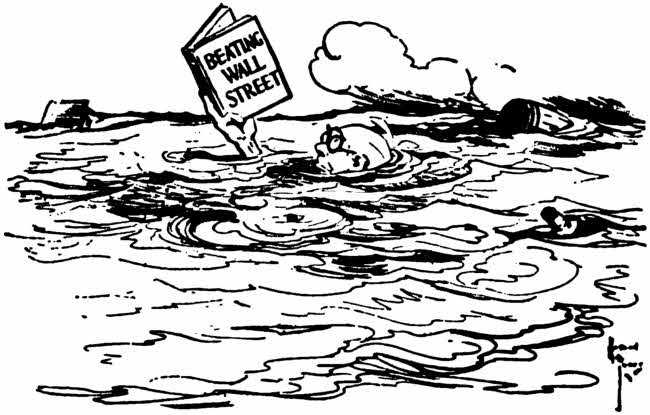
In addition to the large daily grist of
“Market Opinions,” many books and pamphlets
are written which purport to be “Guides
to Traders,” or up-to-date recipes for “Beating
Wall Street.” They set forth an exhaustive
array of statistics, instructions and
warnings; they furnish elaborately charted
plans indicating many of the pitfalls of speculation;
they tell how to avoid these, how to
buy, what to buy, when to buy and how to
make money; but while the theories advanced
are oftentimes sound and easily comprehended,
very few people profit by them, because
when once caught in the maelstrom of stock
speculation the average man becomes more
or less mesmerized, and at critical moments
his conservatism, his resolutions and his theories
all take flight. Under the discomposing
influence of a rapid succession of changing
values and alternating impulses he loses his
perspective, is incapable of calm reasoning,
and is likely to do precisely the opposite
of what he had intended doing. Like a piece
of driftwood in a swirling stream, his actions
are controlled less by personal instigation
than by the currents about him. Therefore
to write, however intelligently, or to read,
however studiously, about how to make
money in the stock market is largely wasted
effort in imparting, also in acquiring, information
that does not adequately inform. Not
that the instructor’s premises are faulty, or
that the reader is deficient in understanding;
but that the difficulties which necessarily attend
the application of the scheme of operations
subsisting in the mind of the author are
so perplexing and disconcerting that the disciple
becomes incapable of adhering to sound
basic principles. And it must be perfectly
obvious to anyone that even the teacher himself
is not a master, but merely an expounder,
of his own principles; for otherwise he would
be a capitalist instead of a professional scribbler.
Notwithstanding the many excellent
books which have been written on the subject,
the real secret of stock market success
still remains (and probably always will remain)
locked up in the bosoms of a few who
are too busy to write, and too rich to feel the
need of writing.
THE PERNICIOUS INFLUENCE OF THE STOCK TICKER
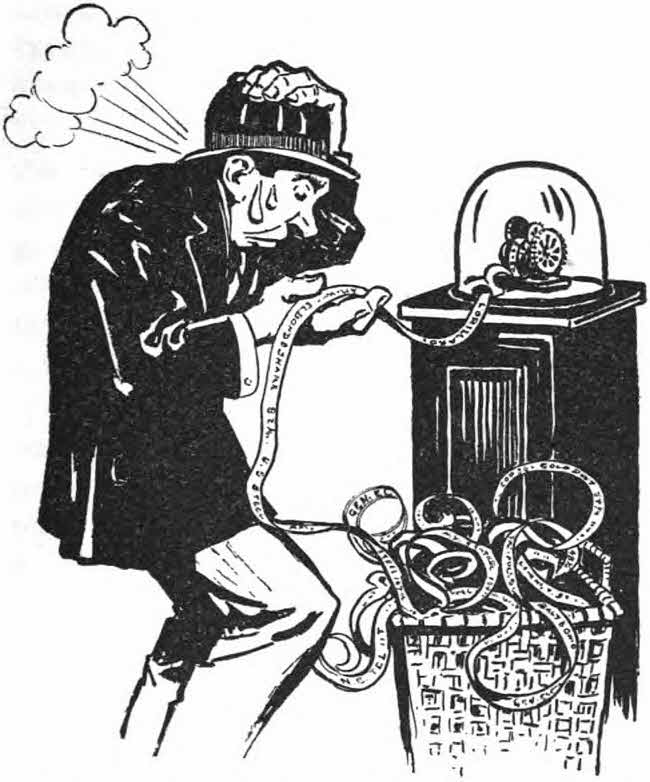
The individual who trades or invests in
stocks will do well to keep away from the
stock ticker; for the victim of “tickeritis” is
no more capable of reasonable and self-composed
action than one who is in the delirium
of typhoid fever. The gyroscopic action of
the prices recorded on the ticker-tape produces
a sort of mental intoxication, which
foreshortens the vision by involuntary submissiveness
to momentary influences. It also
produces on some minds an effect somewhat
similar to that which one feels after standing
for a considerable time intently watching the
water as it flows over Niagara Falls. Dozens
of people, without any suicidal intentions,
have been drawn into this current and dashed
on the rocks below. And thousands daily are
influenced by the stock ticker to commit the
most fatuous blunders.
As a camera fails to record a true picture
if placed in too close juxtaposition to the
object, so in studying the ticker-tape one is
restricted to a close-up view of conditions, resulting
in a distorted gauge of values; for
the figures recorded often mislead and confuse
the attentive observer; in fact it frequently
happens that the price fluctuations
result from a wave of hysteria among a coterie
of traders, and bear but little analogy
to the true value of the stocks. To illustrate
this point more explicitly, the stock of almost
any conservatively capitalized and well managed
concern paying six dollars annually in
dividends has an investment value of from
$85 to $100 a share; but in the ups and downs
of the market the stock gets buffeted about on
the exchange in obedience to the varying sentiments
of traders, sometimes selling as low
as $50, and at other times as high as $150,
without any change whatever in the company’s
earnings, its prospects, or its management.
(These matters will be dealt with a
little farther on, and exemplified by showing
their effects upon the mentalities of various
types of speculators.) It does not follow
that one who keeps in touch with the stock
market by telephone, or through the daily
papers, will find his path free from thorns
and snares; but he will at least have a more
open perspective than one who submits to the
influence of the ticker.
Any intelligent trader may reason out exactly
what he ought to do under certain specific
conditions; but in the quickly shifting
and uncertain process of determining values
he loses his mental poise; and experience
proves that anyone whose reasoning faculties
become confounded is apt to be affected by
some form of hysteria, and will frequently do
the opposite of what he would do under normal
conditions.
The most copious and the most unreliable
financial writers are the market “tipsters”
who write daily letters of advice to an army
of subscribers, and claim to have more or less
positive knowledge of what certain stocks or
groups of stocks are going to do marketwise.
They often profess to have definite “inside
information,” which any subscriber may receive
at a stated price, ranging anywhere
from $10 a month upward. These false financial
prophets, who lead a horde of blind followers,
should not be confused with reputable
bureaus and statistical experts who base their
opinions and their advice to clients upon a
logical analysis of general conditions.
Henry Fielding wrote a whole essay to
prove that a man can write more informingly
on topics of which he has some knowledge
than on matters that he knows nothing about.
He believed also that mankind is more agreeably
entertained by example than by precept;
therefore it is not the purpose of this discourse
to teach anybody anything, unless perchance
something may be gained by example
or suggestion. There are four subjects on
which advice, however good, is generally
wasted,—politics, stock speculation, religion,
and love; for in these matters grown-ups
rarely follow the advice of others, and when
they do, if they profit by it they take all the
credit to themselves, whereas if they lose they
always blame the adviser. Such are the inexorable
and universal laws of human
nature.
Anyone may relate his own stock market
experiences, or those of others—perhaps to
the surprise or enlightenment of his audience.
He may even venture his opinions on the subject;
but for anybody to assume that he can
continuously operate an unfailing system of
making money on stock or grain exchanges
would be equivalent to asserting that he could
invert the fundamental laws of psychology,
or that he could beat the game at Monte
Carlo by scientific methods. Many have tried
both, to their sorrow.
And still, hundreds of thousands of people
continue to play at gambling tables, and hundreds
of thousands speculate in stocks. There
are many persons who gamble moderately all
their lives, just as some drink moderately all
their lives, with no resultant harm; while
with others both of these inhibited practices
become fixed and ruinous vices. Since trading
in stocks has the appearance of being an
easy way of making money, it is one of the
most alluring pursuits of modern times; and
from this very fact, although legalized for all,
it is susceptible of becoming one of the most
dangerous habits known. It is dangerous for
the confirmed addict not only because he is
apt to lose, but for the reason that it distracts
his attention from business in daytime and
frequently destroys his rest at night. But as
it would be folly to advise people not to embark
in commercial pursuits because statistics
show that upwards of ninety per cent. of
business ventures result in failure, so it would
be useless to caution people not to trade in
stocks because it is a hazardous undertaking
in which a peculiar sort of sagacity and self-control
are the only safeguards against certain
disaster.
Most people of sturdy mentality are unwilling
to admit that they could be made easy
subjects of hypnotic influences, and would
scout the idea that mere business transactions
in securities could effect any undue subversion
of their equipoise. The average human
mind is, however, incapable of maintaining
its equilibrium under the strain of great excitement;
and no amount of knowledge, either
inherent or acquired, no amount of experience,
however dearly bought, will enable one
always to think intelligently or act wisely under
highly nerve-racking conditions. It is
said that persons who become disoriented in a
forest will almost invariably go in the wrong
direction (I have done so myself on two different
occasions); and that in an effort to
salvage goods from a burning house they will
throw mirrors and other fragile articles out
a third-story window and carry pillows downstairs.
THE DISCONCERTING EFFECT OF SUDDEN LOSSES AND GAINS
There are but few things more unbalancing
to the mind than the act of suddenly winning
or losing large sums of money. A few
years ago at Monte Carlo I was in company
with a friend, a well known man of affairs
who while there played at roulette nearly
every day, merely as a pastime. He was of
mature age, naturally methodical, conservative,
temperate and cool-headed. He made
it an unalterable rule to limit his losses to
$200 at any one sitting, and on losing this
amount he always stopped playing. His bets
were usually limited to two dollars on the
numbers, and never doubled except for one
turn of the wheel when his number won. He
generally played three numbers at a time;
never more than four. For ten consecutive
sittings luck was against him and each time
he had lost his stake of $200. I saw him get
up and leave the room, apparently in a state
of disgust. An hour or so later I discovered
him at a roulette table in another room stacking
his chips in piles on a dozen or more numbers.
Now and again when he exceeded the
limit the watchful croupier reduced his bets
and pushed a few disks back to him. In addition
to betting on the numbers he was staking
a thousand franc note on one of the three
columns, another thousand on the colors, and
a like amount on the center dozen. In one
run he lost seventeen consecutive bets on red,
of a thousand francs each. His eyes were
bloodshot, his fingers twitched, and plainly he
was under the strain of great agitation. He
continued to play for three hours or so, when
all of a sudden he got up, stood for a moment
looking dazedly about, then left the table.
He afterwards told me that he lost twenty
thousand dollars; and that he hadn’t the
slightest recollection of anything that happened
during the play, nor did he realize the
amount he was betting. In this connection,
it is a fact not generally known, that many
rich men sign printed cards of instructions to
the proprietor of a certain well known gambling
club in the South, directing him to stop
their play and refuse them further credit
beyond a certain specified sum on any one day
or evening of play, and refusing to become
responsible beyond that amount. If men who
trade in the stock market were to impose like
restrictions upon their transactions the losses
would in many cases be greatly minimized.
RETIRED BUSINESS MEN IN THE STOCK MARKET
Retired business men suffering from ennui,
have often had recourse to the stock market
as a means of stimulating their emotions and
expanding their fortunes; with the result, in
the first of these purposes they have usually
succeeded beyond their expectations, while in
the second they have met with uncharted obstacles.
Some years ago when many of the
great trusts were in process of formation a
well known Pittsburgh magnate sold out his
business to the United States Steel Corporation
and later bought a home in New York
and turned his attention to stock speculation.
After plunging into a boiling market and
buying thousands of shares at top prices, the
trend eventually changed and he found himself
on the crest of a tobogganing market
with more than a hundred thousand shares of
speculative stocks. At length when the pace
threatened both his fortune and his peace of
mind, in a fit of disgust he dumped his holdings
overboard and proceeded to damn the
market, the broker and everything else, including
himself for being such an unlucky
simpleton.
“My dear Mr. Blank,” said his broker,
“you are possibly quite justified in all your
abuse, except that of yourself, to whom you
really should apologize, since you do yourself
a great injustice. You have had six months’
experience in this game at an expense of a
little less than two millions of dollars, whereas
at the pace you began you were due to lose
at least five times that amount but for your
rare judgment and cool-headedness.”
“But why in hell didn’t you tell me all this
before?” inquired the irate customer. To
which the broker calmly replied, “It’s my
business to take orders; not to give directions
to a man of your understanding.”
When the American Hide and Leather
Company was formed a number of years ago,
a prominent Boston leather merchant of my
acquaintance, sold his business to the new
organization for a round million dollars in
preferred stock and bonds, and in the course
of the next few years of more or less restless
inoccupation he devoted himself to a systematic
study of investment securities and general
stock market conditions. The panic of
1907, when values were almost entirely lost
sight of in the mad scramble to liquidate
stocks, afforded a rare opportunity to view
the follies of reckless speculation, and our
astute leather merchant was quick to observe
the importance of this salutary lesson. The
recovery that followed was almost magical,
and many who bought stocks at the low prices
doubled their money in a few months. Then
following this sharp recovery there was the
natural setback when speculators undertook
to convert their new wealth into cash. And
this too proved a wholesome lesson to our
new apprentice in the game of high finance.
For some years he had held to the conservative
practice of investing only in non-speculative
bonds, but this proved to be a slow and
monotonous process of enlarging his fortune;
furthermore it was devoid of the exciting
thrills experienced by those who make fortunes
overnight. He thought the funds of
widows and orphans ought properly to be
invested in gilt edge bonds and mortgages,
but for a man of his business sagacity, in the
prime of life, to content himself with merely
cashing his coupons every six months was to
decline into a state of innocuous desuetude—a
condition into which he was determined not
to retrograde. To launch one’s bark into the
rapidly shifting currents of fortune in the
stock market and attempt to steer an even
course is one of the surest preventives of
ennui, and after deliberately weighing and
analysing conditions from every conceivable
angle our erstwhile leather merchant concluded
that cutting a few coupons now and
then was too tame an occupation for a man
of his acumen and ambition. He informed
his friends that after years of careful study
of the “game,” he was convinced that the reason
why people lost, was that while in theory
they all had the right ideas, they all used
wrong formulas in practice. He declared that
the “public,” so-called, always “bought at the
top and sold at the bottom”—a commonplace
in stock market parlance, though not
necessarily true. Also that the inclination of
all speculators is to venture out beyond their
depth, i. e., to buy more stocks than they can
pay for, or protect by ample margin. This
indiscretion he thought to be especially characteristic
of those with but small capital,
whose eagerness for large gains outstripped
their conservatism and exposed them to the
perils of abrupt and unexpected reactions and
panics. He had never bought more hides
and leather than he could pay for, either with
his own funds or with money easily borrowed
from banks; he would never buy more stocks
or bonds than he could pay for, or protect
with sufficient margin to carry them through
the severest depression.
He was a self-made man; he had entered
his firm as errand boy, and by sheer force of
perseverance, ambition and intellect he rose
steadily in usefulness and power until he
became sole proprietor of the whole establishment.
His prestige and the bulk of his
fortune had been made in buying and storing
goods when the markets were glutted and
prices were low, and holding them till the
markets were bare and prices were high.
After accumulating large stores it sometimes
required a year or more of patient waiting
for the readjustment of trade conditions;
but never had there been a time when during
a given cycle, prices had not been abnormally
low and also abnormally high. He reckoned
his twenty-five years of this sort of training
as a singularly qualifying element of success
in buying and selling stocks. This undertaking,
like dealing in hides and leather, required
forethought, discretion, patience and courage.
There was scarcely a two-year period
in any decade wherein stocks in general could
not be bought reasonably cheap; nor was
there a similar period when at some time during
the twenty-four months they could not be
sold at fairly high prices. Statistics proved
this to be almost infallibly true; statistics
likewise proved that the preponderance of
failures in his own line of business could be
traced to injudicious purchases of large stores
of merchandise at high prices, with resultant
inventory losses. As a merchant he had
learned that buying and selling leather and
hides at a profit was a matter of forecasting
future conditions in the light of past events;
and as a student of stock market conditions
he learned that a recovery of values always
follows a prolonged slump in the price of
stocks, and that sure success awaits those
who pick the right psychological moments to
buy and sell.
In due time this retired merchant secured
a desk in a brokerage office and undertook to
study the stock market systematically at close
range, and to reduce some of his theories to
actual practice. He did not launch into this
new venture as one would plunge into a cold
bath; he patiently watched the action of the
market from day to day, until stocks declined
to a point where it seemed safe to begin buying
on a scale down. Meanwhile he continued
to study stock market charts and conditions—charts
with double bottoms, double
tops, pyramids and all such enlightening information—about
past performances. At
length he bought a few hundred shares of
selected stocks, depositing bonds as margin—ample
margin of fifty points or more.
Prices reacted a little further, and in keeping
with his motto, which was—“Buy on the
decline, when the public is getting out, and
sell on the rise when the public is getting in,”
he increased his holdings at every two or
three points decline. In the course of time
the market faced about, stocks began to recover,
and in a few weeks he had the satisfaction
of seeing his plans work out successfully
in experiment, with a net gain of enough to
cover interest on his investment for more
than four years. According to precedent a
temporary reaction was due; therefore, like
most wary beginners, he sold out and cashed
in his profits. In his exhaustive study of
stock market psychology he had learned that
while it is the practice of inexperienced traders
to take small profits on stocks in a rising
market, it is also their custom to buy the
stocks back again at much higher figures,
instead of waiting for prices to decline. This
was one of the danger pits charted on his
course of action; one of the many against
which he had built up mental fortifications,
strong enough in seasons of peace and calm,
but in most people easily destructible by the
baffling influences of stock market speculation.
Although a beginner in practice, he was a
veteran in theory, for prior to entering the
financial arena he had made hundreds of
imaginary purchases and sales, nearly always
at a profit. Moreover he had discovered that
one may play both sides of the market, apparently
with equal safety, and that the biggest
“killings” are said to be made on the
“short” side. By selling “short” on bulges
and “covering” (i. e., buying the stock in to
cover the sale) on reactions, it was possible
not only to make money both ways, but also
to avoid the tedium of waiting inertly for opportune
occasions to buy at bargain-prices.
From the experience of others he derived a
valuable lesson, namely, that investors and
traders are always too eager to keep their
capital constantly employed; that they are
prone to hold stubbornly to one position,
either long or short; and that the wellnigh
irresistible impulse to get back into the market
after selling out, whether at a profit or a
loss, has probably been the ruination of more
speculators than any other one cause. Playing
the market both ways seemed a sure
means of forestalling this error.
STOCK MARKET TRANSACTIONS APART FROM GAMBLING
The thought of becoming a stock “gambler”
was farthest from this man’s mind; for
gambling in any form was contrary to his
code of ethics. But buying and selling legitimate
commodities could not be construed as
gambling; therefore stocks and bonds, being
legitimate commodities, could be bought and
sold without doing violence to the most sensitive
conscience. In order to gamble, one
must “risk or stake something on an uncertain
event;” which is popularly regarded as a
vice, and is made legally wrong because it is
said to be injurious to the public morals. It
also is morally wrong to gamble, because if
you win you deprive your fellow-being of
something without giving any adequate return.
Our friend contended that stocks
bought at figures below their intrinsic value
are so sure to advance, that the transaction
does not come within the given definition of
the word gamble; also that the same rule applies
to stocks sold at prices far above their
worth, no matter whether for long or short
account. He reasoned that if he gained by
selling a stock short, although someone was
apt to be the loser, he had no means of knowing
who that someone was, therefore he assumed
no moral responsibility in prudently
acquiring money in a businesslike way, even
at the expense of some indefinite person who
had been foolish enough to risk it. If the act
of selling stocks which one does not own is
regarded by some as being unethical in the
strictest sense, it is at least sanctioned by
general custom. All sorts of goods are sold
for future delivery, even before they are manufactured;
and our erstwhile merchant had
often sold leather for forward delivery, while
it was still in process of tanning; hence he
had no scruples against selling stocks in anticipation
of being able to buy and deliver
them later.
It is generally conceded that the public is
always arrayed on the “long” side (that is,
the buying side) of the market; it is also
universally admitted, at least by those who
know, that the so-called “public” always
bears the brunt of stock market losses; therefore
our friend decided that he would act the
part of wisdom and go “short” of the same
number of shares that he had previously
bought and sold,—the idea being that before
selling his long stock he convinced himself
that approximately the top prices had
been reached, in which case the market would
naturally react. But for some inexplicable
reason it failed to run true to his expectations;
that is, the probable course deducible
from charts and precedents. Per contra, the
prices continued stubbornly to rise. When
he had lost all his profits he backed his judgment
by his actions, and doubled his short
sales; and at five points higher he doubled
again, for a break was long overdue. Being
short upwards of three thousand shares in a
rapidly rising market is a tremendous mental
strain, even for a seasoned trader; and naturally
our novice became somewhat nervous.
Some stock market wiseacre—one or more
of which class are usually to be found lounging
about every brokerage office—consolingly
remarked that while stocks have a certain
fixed bottom, they have no top; which
increased his anxiety.
After studying charts and various compilations
of figures and facts about earnings
and past market performances, he concluded
that Bethlehem Steel, selling at $45 a share,
was not worth half that price; also that Studebaker
at $35 was much too high. After
an extended inquiry into the past and prospective
earnings of these two companies he
sold short a thousand shares of each; but
instead of reacting they steadily maintained
their upward course with the rest of the list.
His broker called for more margin, and he
put up another hundred thousand in bonds.
He was advised to “cover” and go “long,”
but he stood firmly by his convictions—and
the charts.
“That’s why the public all lose,” he declared;
“they get ‘cold feet’ and shift positions
at the wrong time.” From a personal
friend who was a director of the new General
Motors Corporation he got an “inside tip”
that that stock, selling at $82, was too high,
so he added a few hundred shares of it to his
short account. Meantime the country’s commerce
and the entire group of stocks, moved
forward with the steady even tread of an
army on parade.
THE STOCK MARKET PRODUCES A NEW PHENOMENON—TURNS WORLD-WIDE DISASTER INTO LOCAL PROSPERITY
At this time (1915) the major portion of
the civilized world was embroiled in a mad
turmoil, employing every known device and
resource in destroying human life and every
form of physical property. With the very
foundations of civilization thus disrupted,
and our own country on the verge of being
drawn into a deadly combat in which the
most humane and enlightened nations of the
earth were reverting to the practices of ancient
barbarism, it is not strange that our
merchant friend should have argued that it
was a most unpromising situation upon
which to construct investment values and
business prosperity. It was inconsistent, inconceivable
and seemingly impossible that
stocks, even good stocks, could continue to
advance in the face of such demoralizing conditions.
When war was first declared, even
before England became involved, the stock
market was thrown into such a violent state
of panic that it became necessary to close the
stock exchange for several months; yet now
when the clouds of disaster were at their
darkest and hung menacingly over the whole
of civilization this country alone was indulging
in a riotous exhibition of prosperity such
as had never been dreamed of. The market
tipsters, the financial editors of newspapers,
the brokers’ letters and all stock market literature,
with but few exceptions, were crowing
loud and boastfully for still higher prices,
and after the whole group of stocks had risen
in unison for a time, some individual stock
was singled out every day or so, pushed into
the forefront and skyrocketed to dizzying
heights. The brokers and all the customers
were delirious with joy and excitement. The
stock brokers were all bulls, the traders were
bulls, the tipsters and rumor-mongers were
bulls—even the office boys who called the
quotations from the tickers were bulls, and
shouted vociferously when some special stock
jumped a point or more from the previous
quotation; and it seemed to our trader that in
calling out the advancing prices special emphasis
was always given to the particular
stocks he was short of. He was literally beset
with bullish exultation and bullish news from
everywhere. The noisy enthusiasm in the
board-room rankled in his ears and rasped
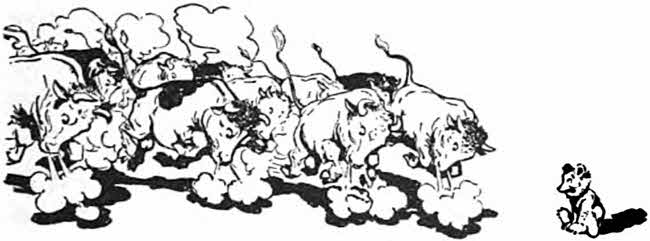
on his over-wrought nerves. He felt as one
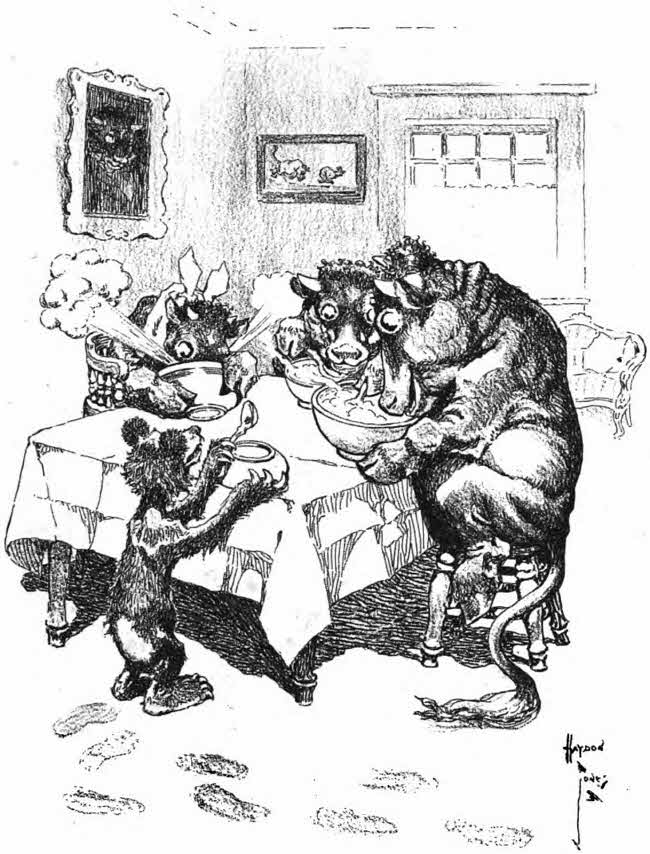
could imagine a tiny lone bear would feel in
the center of a great arena, surrounded by a
cordon of cavorting bulls. To him it seemed
that he was the only bear on earth. There
might be others, but they were too cleverly
sequestered to admit of sharing his misery
with them.
NOBODY LOVES A BEAR — FOOTNOTE:
In a bear market a discouraged bull is at
least not despised; he may find a sympathetic
sufferer; but in a bull market no one ever
wastes any compassion on a bear, or admits
sympathetic kinship with him. He is popularly
regarded as a pessimist, a destroyer of
values, a discordant note, an uninvited guest
at a banquet. If it be a true saying that
“misery loves company,” it must follow that
wretchedness is accentuated by noncommunion
with fellow-sufferers; in which case it
may be said that the situation of a bear in a
rousing bull market represents the ne plus
ultra of hopeless desolation.
At length it became a mooted question
whether to “sit tight” and wait for the boisterous
storm to blow over, or cover his shorts,
buy more stocks and go with the tide. Heretofore
he had maintained a stolid attitude,
born of self-confidence, inspired by a triumphant
business career, and supported by
precedent and every reasonable prophecy.
The traders had simply gone mad and were
rushing headlong to their ruin, as they had
often done before. History was merely repeating
itself. It was a time for sound cool-headed
judgment, and he stood firm in the
determination not to lose his head and join in
any such reckless carousal. But the more he
reasoned and studied the charts, the more unprecedented
and obstinate the market became.
One thing he failed to consider was,
that the favorite caprice of the stock market
is to violate precedent, and to do the thing
least to be expected of it. The newspapers
gave front page double-column headings to
business improvement and stock market
news—the enormous demand for textiles,
increased prices for all commodities, easy
money conditions, all labor disputes amicably
adjusted, and the stage all set for the greatest
era of prosperity the world had ever
known. The financial columns of the newspapers
literally teemed with bullish interviews
with financiers and bullish reports in
all lines of trade and finance. There was
scarcely a discordant note in the rush and
rhythm of progress; and when one was faintly
sounded the general din instantly smothered
it. Even the great cataclysm in Europe
was now construed as an additional bull
point, because our factories were all running
night and day to supply the armies with
equipment and provisions. It was argued
that the more they fought the more supplies
they would need, and the more money we
would make in furnishing them; also that the
more ships the Germans torpedoed the greater
demand there would be upon our shipyards
to replace them. The nation had indeed
gone prosperity mad, while the rest of
the world was going to destruction—certainly
an irregular and puzzling phenomenon.
Occasionally when some veteran writer
piped a note of warning to stock speculators,
it was met with a new outburst of bullish
demonstration, and the market swept on like
a conflagration in a city built of tinderwood.
Stocks that had lain dormant for months
suddenly came to life and became the favorites
of powerful cliques; corporations that
had never earned their fixed charges were
said to be piling up enormous surpluses, the
railroads and steamship lines were glutted
with traffic, the factories, steel foundries and
ammunition plants were running night shifts,
banks and millionaires were said to be buying
everything for control, whole fleets of grain-laden
ships were going abroad and the farmers
were simply wallowing in wealth; the
retail stores were jammed with eager customers,
labor was all employed at high
wages, and Big Business was rushing with
all the force of an avalanche along Prosperity
Highway, without a danger signal in sight.
Gradually, though manifestly, it became
evident that to resist such a tremendous momentum
was as expensive as it was exasperating;
and his hitherto fond illusions of
greater wealth were dispelled by a terrifying
reality. But a man who has been right all
his life is not easily convinced that he is
wrong in a market position that seems justified
by common sense and fundamental conditions.
And yet, however steadfast human
resolution may be, it is wellnigh impossible to
maintain a fixed attitude in opposition to
such a cumulative and overwhelming force.
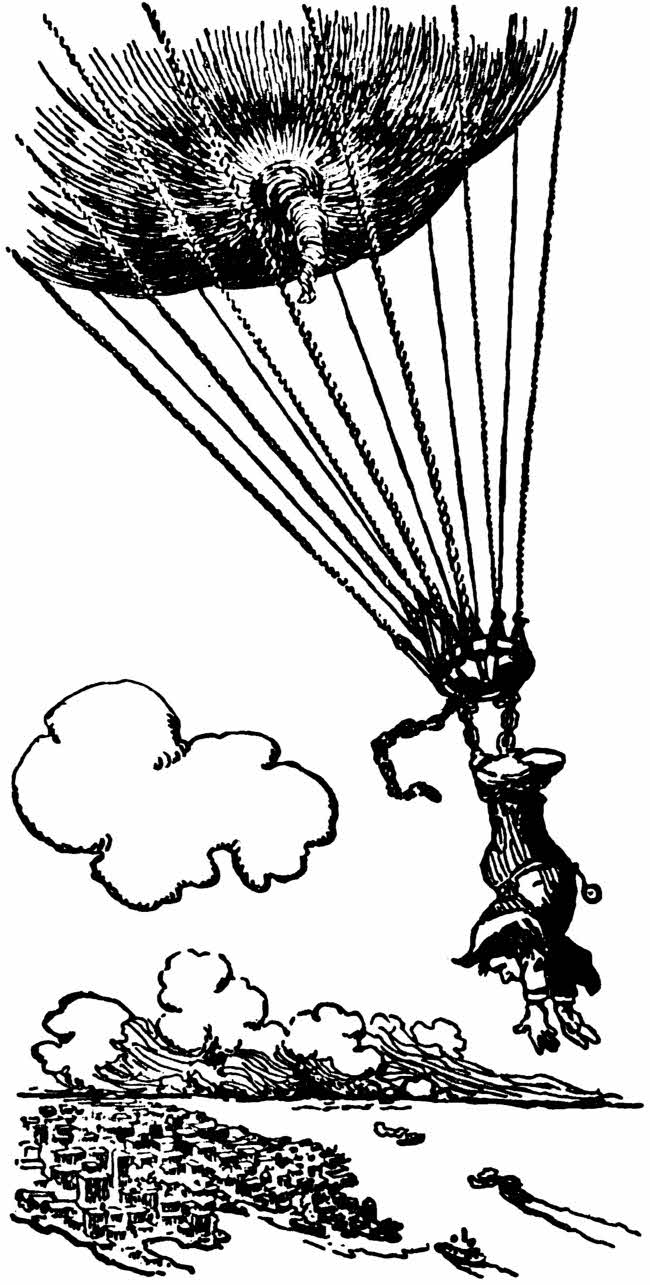
The sensation of being short in a rampant
bull market has been pictured as similar to
that of being chained by the heels to a rising
balloon, without any idea of the height to
which the gas will carry it—not a cheery
picture for the contemplation of one who is
bearishly disposed. It is therefore easy to
understand how likely one is under these
“third degree” operations to lose his mental
bearings, his nerve—and his money. A
trader who is long of stocks knows to a certainty
how much he can lose on any given
number of shares; but on the short side there
is no limit to what one may lose, even on a
few hundred shares. The loss of a definite
sum, whatever the amount may be, can be
borne with equanimity by a man of nerve;
but to maintain a short position in a bull market
gives one about as uneasy a feeling as it
would to have a number of outstanding
promissory notes with the amounts left blank
for some unknown person to fill in. It keeps
one in a constant state of fear, and fear
knows no limitations; it contemplates and
magnifies every baneful possibility.
However, this man of iron nerve, this erstwhile
dominant figure in the leather trade
who had ridden for a quarter of a century
with his feet firmly in the stirrups, was not
to be easily unhorsed. At the close of a turbulent
day he took account of stock and decided
to “cover” (buy in) all the dividend paying
stocks he was short of, and to sell an equal
number of additional shares in the non-dividend
paying issues, such as Bethlehem Steel,
General Motors and Studebaker. The reckoning
showed a paper loss of a quarter of his
million dollar capital, but he bore it courageously,
determined to recover it by adopting
the safer course of “shorting” only such
stocks as had never paid dividends, and perhaps
never would. Therefore he sold more
Bethlehem Steel, at $80, $90, $100, $150 and
$200 a share. He sold Studebaker again at
$75, $100 and $150, and more General Motors
at $100, $150, $200; and a hundred
shares at every fifty points advance until it
reached $500. Those who knew him in the
board room said that throughout this ordeal
he maintained the most inflexible nerve they
had ever known; but at the close of the market
on that memorable day in 1915 when
Bethlehem Steel touched $600 a share he collapsed
in a state of nervous prostration and
was taken home in an ambulance. He did
not live to see General Motors sell at $850 a
share (on October 25, 1916) and Bethlehem
Steel at $700 a share (on November 18,
1916). Long before these figures were
reached his million dollar capital had vanished
and he had crossed the bar into the
Great Beyond. His widow was left almost
penniless and he was buried at the expense of
his Lodge. Shortly before passing away he
remarked sorrowfully to a friend at the bedside,—“In
the past year I’ve suffered every
torment known to the demons of hell. My
only grain of comfort is that it’s all over now
and I have nothing more to lose.”
From this tragic experience it is obvious
that there is but little comfort or profit to be
gained on the short side of a protracted bull
market; and the natural inference must be
that the “long” side of such a market is as
felicitous and profitable for bulls as the short
side is discomforting and unprofitable for
bears. In theory it is, but in practice there
are comparatively few who make large gains,
and fewer still who “get away” with them.
It has been authoritatively stated by the head
of the world’s largest gambling emporium
that it is impossible for any human being to
beat the roulette wheel for any considerable
length of time; and that human nature is so
constituted that nearly all of those who make
large winnings continue to play until they
have lost all their gains, and perhaps more.
In the first place, there are thirty-six numbers,
with a single and double zero,[1] on the
wheel; if a player places a dollar on each of
these he stakes $38. He must inevitably win
on some one of the numbers or one of the
zeros, whereupon he collects $35, together
with the dollar risked on the successful number,
making a sure loss of two dollars, which
is the house’s fixed percentage. If a player
wagers a dollar on one number, with an even
break of luck he is due to win $35 (and also
to get his dollar back) once in thirty-eight
plays. At this rate, for every $3800 risked
he is due to lose $200. Players often stake
as high as two to three thousand dollars, or
even more, on every spin of the wheel; from
which it will be seen that with average luck,
at this rate of play one will lose more than a
thousand dollars an hour. It is said to be a
proven fact that the chances are so much
against the player, that a roulette wheel can
be run at a profit, even if the percentage in
favor of the house is entirely eliminated.
This is due to the fact that the excitement of
play causes a certain confusion of mind, and
players are prone to do the wrong thing; for
instance, double their bets when in an adverse
run of luck and “pinch” them when
luck is running favorably. Or, on the other
hand, players who have pressed their advantage
and doubled in a run of favorable luck
will continue stubbornly to plunge long after
their luck has changed. Precisely the same
psychology applies to trading in stocks.
[1] At Monte Carlo the roulette wheels have only one
cipher, but at the end of each turn of the wheel the person
(or persons) playing on the winning number usually
contributes a disk (or one thirty-fifth of the amount won)
to the croupier’s “box,” which amounts to about the same
thing as having two ciphers, without this customary gratuity.
It is said that one-half of the amount of these voluntary
contributions goes to the corporation, and the other
half pays for the entire upkeep of the establishment, including
the salaries of the croupiers and other attaches.
The same disks are used by all players, and a winner who
persistently ignores the “box” is not apt to be favored by
the croupier when another player claims his winning bet,
as often happens.
FRENZIED SPECULATION IS THE RANKEST FORM OF GAMBLING; IT IS A PERILOUS INDULGENCE
An enormous percentage of stock market
speculators become victims of over-confidence
after a series of successful trades.
Their buoyant spirits increase with every
new success, until at length they throw discretion
to the winds, extend their risks far
beyond the margin of safety, and at the infallible
turn of the market they find themselves
in difficulty, like foolish fishes that get
stranded on the beach at high tide. It is a
fact, as inexplicable as it is true, that men
with a fair amount of gray matter in their
heads, who would flout the idea of paying
$50 a share for a particular stock, will later
borrow money from a broker at from six to
eight per cent. to buy the same stock all the
way up from $100 to $150 a share on the
slenderest permissible margin; and, instead
of proportioning the margin of safety to the
increased carrying risk they narrow it by
continuing to buy as the prices advance.
Also there are many who after selling their
stocks at a handsome profit will buy them
back at twenty, fifty, eighty, or a hundred
points higher, and with much less timidity
than they felt when they first bought them
at low figures. Prosperity in the stock market
seems to encourage optimism, rashness
and impatience in about the same degree that
adversity discourages enterprise and aspiration.
But there is far greater danger in excessive
optimism than in excessive pessimism,
for the reason that optimists are inclined
to back their hopeful views by indiscriminate
purchases of stocks at high prices,
while pessimists are seldom disposed to back
their views at all. The risks incurred in
buying stocks on a “thin” margin are so
manifest that it seems almost as platitudinous
to mention them as it would be to remark
that children endanger their lives when they
congregate on thin ice.
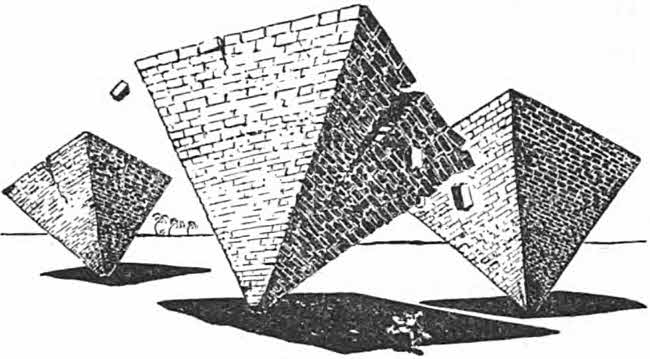
THE DANGERS OF INVERTED PYRAMIDS
It was a wise custom of the ancients to
build their pyramids with the big end on the
ground; but modern builders of pyramids in
the stock market have reversed this time-honored
practice, and most of them build
their stock pyramids with the heavy end up;
therefore they invariably topple over after
reaching a certain height. For example,
when a certain stock known as Lake Copper
was selling at $5 a share a trader bought five
hundred shares, expecting to double his
money on it, as the stock was “tipped” to go
up to $10. When it reached that figure, instead
of selling he bought another hundred,
and put in an order to sell the whole lot at
$15 a share. Before it reached his selling
price he cancelled the order and raised it to
$25; again cancelling it and buying another
hundred at $25. By this time he was convinced
that it would go to $50. He bought
five hundred more at $40, then the stock
dropped back, and fearing he might lose all
his gains he sold a thousand shares at $30.
Although he had lost $5000 on the last five
hundred shares he still had a profit of $4500,
less commission, after deducting the full cost
of the two hundred shares still remaining.
The stock recovered to $50, and encouraged
by the “street” gossip about rich ore bodies
being uncovered, with accompanying reports
that the stock would be cheap at $75, he
bought back at $50 the thousand shares he
had sold at $30. At $60 he sold five hundred
shares, which he afterwards repurchased,
with five hundred more, at $75. By this time
the speculators had discovered that the mine
was one of the richest prospects in the Lake
region; it was rumored that the company’s
stock was being bought for control by a large
mining company whose property it joined,
and the stock was “tipped” for $150. Many
surmised it to be another Calumet & Hecla,
which had sold at $12 a share, and afterwards
at $1000. From here on up he “pyramided,”
buying a hundred shares at every
point advance, and wisely protecting his
profits with “stop loss” orders a few points
under the market price. Once the market reacted
and five hundred shares of his stock
were sold on “stop,” after which the price
quickly recovered, and being assured that the
stock had been hammered down for the sole
purpose of “shaking him out,” he bought back
the five hundred shares at five points higher
than he had sold it. To prevent another similar
coup he cancelled all stop loss orders and
took his chances in the open market, confident
that he could not be beaten as long as
he was trading on “velvet” with an original
investment risk of only $2500. When the
stock reached $85 someone half convinced
him that it was time to cash in his profits,
and he put in an order to sell the whole lot at
$90, including the additional shares he should
buy on the scale order up to that point. When
the price approached $90 he cancelled the selling
order and put it in at $100. Later the
price reached $94.50, and he had thirty-two
hundred shares, on which he could have
cashed in a fortune. But what was the use
cashing in then, when he was in a fair way
to making half a million, or even more? After
reaching $94.50 the stock began to decline,
and here the top-heaviness of the pyramid
commenced to manifest itself, for with
every downward point he was losing $3200.
When the price got down to $75 his broker
demanded that he either put up more margin
or lighten his load by selling a thousand
shares or so. The stock continued to go
down, and again the broker called on him for
more margin. Soon after putting up all the
money he had, and all he could borrow, the
broker was obliged to close out the account to
protect himself. The stock afterwards went
down to ninety cents a share.
THE LURE OF THE COPPER BOOM—AND BOGUS SECURITIES
Of course the speculator who buys stock
in a new copper mine is simply taking a
gambler’s chance that ore will be found in
paying quantities. Most of those who have
submitted to this enticement in the past thirty
years do not need to be reminded of the hazards
attending such risks. I recall that about
twenty-five years ago, when the “copper
fever” was raging throughout the country—and
in Boston especially it was highly infectious—a
half-page advertisement appeared
in one of the leading Boston newspapers, relating
in graphic terms the discovery of the
most remarkable copper mining prospect that
had ever come to light. The chief mining engineer
of one of the largest and best known
copper mines in the United States—a man
of wide experience and vast knowledge in the
mining business—while prospecting somewhere
in the West came upon what seemed to
him the richest deposits of copper ore he
had ever seen. These ore bodies were said to
be located in a large mountain, conveniently
near a railroad, and by tunneling into the
side of the mountain the ore could be
trammed out, dumped onto the cars and
hauled to a smelter a few miles away. The
mining engineer (whose full name was given)
had immediately resigned his position,
organized a stock company, known as the
Occidental Copper Mining Company—into
which he admitted a number of personal
friends—bought the property, and began
tunneling operations on his own capital and
what he had raised among his friends
through the sale of stock in the new corporation.
Having exhausted their funds and desiring
to continue exploration work—which
became more and more promising—the directors
had sold a block of treasury stock, the
par value of which was one dollar a share.
The latest reports showed that the work was
progressing satisfactorily under the personal
direction of the engineer who had discovered
the mine, and that stockholders might expect
dividend returns inside of a year or so. The
advertisement was inserted, not by a stock-jobbing
firm or underwriting syndicate, but
by a well known wholesale and retail grocery
and provision company, who claimed that after
fully investigating matters they had
bought a large block of the stock, twenty
thousand shares of which they would distribute
among their customers at the par
value of one dollar per share. I called on
the president of the grocery company, who
said his firm thought so well of the prospect
that they had bought twenty thousand shares
as a speculative investment, and a like
amount to distribute among their customers.
He represented that although the shares
were easily worth $5 each he considered it
good advertising for his company to sell them
at par, $1; and with a view to extending the
benefits as widely as possible he preferred to
dispose of the stock in small lots. He cheerfully
gave me the names and addresses of the
directors of the new mining company and
suggested that, if interested, I might write
to them. One was a physician of good repute,
another was general auditor of the
Chicago, Milwaukee & St. Paul Railway Co.,
another was a western lawyer of prominence,
and so on. I wrote to each of these three,
telling them of my interest in the matter, also
asking for a candid expression of their opinions
about the property. Each of them sent
me a personally written reply, substantially
corroborating what information I already
had, and saying that they had given their
names and their financial support to the company
solely upon the recommendation of the
mining engineer, whom they knew personally
and trusted implicitly. Further than that
they knew nothing, but were willing to
take a gamble on his judgment. After receiving
the second of these three letters I
hurried to the office of the grocery and provision
company, and to my great disappointment,
found that they had only a few hundred
shares left. When I told the president
that I would take the entire lot at his price,
one dollar per share, he shook his head. He
said the stock was going rapidly in five, ten,
and twenty share lots, and that in justice to
their other customers and friends he did not
think it fair to let me have more than one
hundred shares at most. But finally he yielded
to my persuasive argument, that inasmuch
as he had only a few hundred shares left he
might as well let me have them all and thus
finish the whole transaction at once, saving
himself the bother of peddling them out piecemeal.
Nothing further transpired until, some
months later, I received a circular from the
mining company reporting good progress
with development work; also stating that
owing to further need of funds to continue
this work the directors had concluded to
make another offering of treasury stock at
the same reduced price at which they had sold
the previous block, namely, at five cents a
share! In the aggregate the advertising
feature was probably more advantageous to
the customers than it was to the grocery
company (which soon afterwards went bankrupt);
for although the purchasers, including
myself, lost every dollar of their investment,
it doubtless served as a warning
(which in my case it certainly did) that prevented
much greater losses in other swindling
schemes.
The task of preparing the prospectuses of
the thousands of fake copper mining propositions
and oil schemes that have been foisted
on the public in the past twenty-five years,
and made to appear especially attractive by
a price of from five cents to one dollar a
share, has developed some of the most remarkable
inventive geniuses of modern times.
Their advertisements and arguments have
been so convincing that the contrary persuasions
of bankers and brokers have been absolutely
unavailing with friends and customers
who have given orders to buy the stocks;
and against their enticements there is positively
no remedy short of experience. The
tempting baits of every imaginable variety
offered by the promoters and dispensers of
these bogus stocks have been the means of
filching hundreds of millions of hard-earned
money from credulous people, who are misled
to suppose they are getting in on the “ground
floor” of a modern Aladdin’s Cave before it is
opened to the public. But it always has been
so, and probably it always will be. It would
be as useless to warn the general public, or
even particular individuals, against these alluring
ground-floor propositions as it would
be to warn a flock of goslins to keep out of a
mud puddle. It’s like admonishing a boy
against a hundred kinds of mischief; he will
surely find some act of deviltry not included
in the list, and his defence will be that you
didn’t tell him not to do that. And this argument
is the more unanswerable because you
well remember having used the same stratagem
yourself.
THE PERILS OF OVER-ACQUISITIVENESS—THE HUMAN ELEMENT IN SPECULATION
Reverting again to the characteristic bent
of speculators who trade on the constructive
side of the market, some years ago a man of
my acquaintance bought a hundred shares of
Union Pacific at $120 a share, just for “a
turn of a few points,” as he expressed it.
Within a few days he sold it at $125, making
a net gain of $500, less commission,—equal
to more than five years’ interest at six per
cent. on the $1500 he put up as margin.
Someone afterwards convinced him that he
was silly to have sold out at $125, because the
stock was sure to go to $150; therefore he
bought it back at $130, and at $135 he took
on another hundred. The stock dropped
back to $125, and on hearing from someone
else that it was likely to go down to par he
sold the two hundred shares at a net loss of
$1500 and commissions. About that time
somebody discovered that the Company was
likely to distribute its large surplus, consisting
of Baltimore & Ohio stock and other
securities, and the stock rebounded to $135,
at which figure my friend repurchased the
two hundred shares he had sold at $125. At
$139 he bought two hundred more, which, in
a spasm of fright, he sold when the price
suddenly dipped down to $133. Later, at
$140, he recovered his nerve, also the last
two hundred shares he had sold at a loss.
At $160 the stock looked cheaper than it had
at $120, and having a safe margin of profit
to trade on he bought five hundred more. At
$170 it was reported that Harriman (who
controlled the road) was buying the stock,
and encouraged by the entry of such distinguished
company my friend plunged in and
bought a thousand shares more. When the
stock got to about $190 it was noised about
that the great railroad magnate had completed
his purchases, so the price went down a
few points, again frightening our trader into
taking a loss on three hundred shares he had
bought at $189. But concurrently some wise
tipster had discovered that the price had been
depressed purposely, to enable other “inside
interests” to accumulate a large line, and in a
short time the price climbed to $200. By this
time my affluent friend was becoming somewhat
disturbed and confused, but lured by
the prospect of greater gains he managed
to regain his composure, and bought five hundred
shares more; figuring that as long as he
was trading on profits he had everything to
gain, and nothing to lose. From here on
the stock maintained a fairly steady upward
course, and not to be outdone by the greedy
“insiders” he bought three hundred shares at
every point advance until the price reached
$212, when he had accumulated fifty-one hundred
shares. The net paper profit of well
over $100,000 looked exceedingly tempting,
and acting upon his own judgment, seconded
by the good advice of his broker, he wisely
closed out the entire lot, invested the net
proceeds in government bonds, bade good-bye
to the market, and planned a three
months’ excursion to Europe. So far, so
good; but—
“U. P.” (along with other stocks) continued
its upward course, accompanied by
much excitement and jubilation among the
“longs” with an equal measure of apprehension
and despondency among the hard-squeezed
“shorts.” When our trader was
preparing for his departure he happened to
read a review by some stock market wizard
who reported that according to “late inside
information” a dividend of $100 a share in
securities would be declared on Union Pacific,
and that the stock would pay $10 a
share in annual dividends; consequently at
$250 a share it would be cheap. Whereupon
my friend, who occupied the uncomfortable
position of a “sold out bull,” became wretchedly
aware that he had dropped out of the
race long before the course was completed,
and by doing so he had thrown away a grand
opportunity of making nearly $200,000 more.
It may here be explained that the mental
attitude of a “sold out bull” toward a rising
market is much the same as that of a bulldog
chained in his kennel while a dog fight is going
on outside. A speculator may stand by
and view with unruffled complacency the
most enormous profits of others in securities
that he never owned, but if one of his own
pet stocks continues to advance after he has
sold out, it not only reflects the error of his
judgment, but the remorse he suffers in contemplating
the additional sum he might have
made dampens all the pleasure of reflecting
upon the profit he actually did make.
Reluctant to admit such a costly blunder in
judgment, determined not to be surpassed by
his fellow-traders, and flushed with the victory
of his recent exploit, when Union Pacific
was selling at about $215 this “sold out
bull” put in an unlimited order to buy five
thousand shares. When his broker on the
floor of the exchange began bidding for this
amount of stock the crowd instantly surmised
that some big operator was being “squeezed”
on the short side, and before the purchase was
completed the price had jumped to $219, the
highest point it ever reached. After steadying
itself for a while at around this figure it
took a downward plunge, and a few weeks
later our trader who had retired from the market
with upwards of $100,000 profit, closed
out the last hundred shares, saving a little
less than the $1500 he originally put up as
margin. His escape from utter financial ruin
was largely due to the insistent advice of his
broker that he should steadily lighten his
load on the way down, rather than try to
protect the whole lot by putting up additional
margin.
The man who made this play in Union
Pacific was a college graduate, and a veteran
trader, with twenty years of hard-bought
experience and a good family name behind
him. While his experience, together with
the advice of his broker, saved him from a
heavy loss it might easily be supposed that
the former alone would have prevented him
from falling into the common error of novices.
From which it may be observed that in
stock speculation, as in other pursuits, wisdom
and the ability to master one’s own impulses
are sometimes late in arriving at full
maturity. Indeed a broker who for upwards
of thirty years has held a position of outstanding
prominence on the floor of the New
York Stock Exchange—a man who often
handles a hundred thousand shares or more
in a single day—once admitted to me that
while he generally made money for clients
who entrusted him with optional orders, yet
he regularly lost more than half his enormous
commissions trading on his own account.
Which calls to mind a wise saying of the old
Greek philosopher Heraclitus, five hundred
years B.C.—“Many men have no wisdom
regarding those things with which they come
in contact; nor do they learn by experience.”
The man who made the splurge in Lake
Copper was a daring young Lochinvar who
came out of the West, with only a moderate
sum of money, but an ample store of ambition;
and although enjoying a large practice
in an honorable profession, he occasionally
took what he called a “flyer” in the market.
For some years he was kept pretty busy
clearing up the results of his miscalculations
in this adventure, which I imagine was his
last “flyer.” I have remarked that “experience”
might reasonably have been counted
upon to safeguard the man in the Union Pacific
deal against the error of over-acquisitiveness;
and seeing it did not, it would seem
that the very inexperience of our other trader
should have made him less daring. From
which we may conclude that in stock trading,
all speculators, whether experienced or inexperienced,
are subject to those inscrutable
laws of psychology which Nature herself
seems to have designed for the discomfiture
of those who play at the wheel of Fortune.
THEY ALL RESOLVE, BUT THEY ALL GO BACK
One often hears the stock trader’s sad lament,—“If
I ever get even, I’ll get out and
stay out!” But I never knew one of this
class who ever got “out even” and I never
heard of one who stayed out if he did get out
even. If they get out, leaving a dollar in,
they go back after it; if they get out a few
dollars ahead, they go back for more; in any
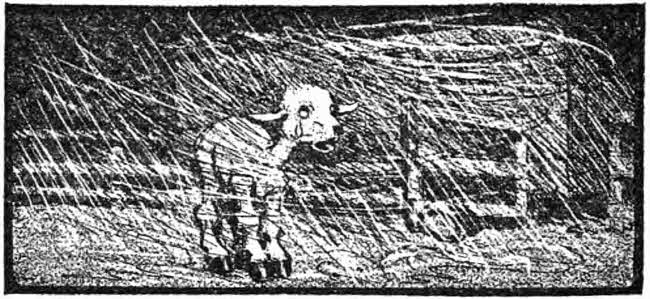
case they all go back. They wouldn’t be content
to stay out of the market any more than
a little shorn lamb would be content to stand
overnight uncomplainingly in a blustering
March storm, outside the open gateway to a
sheepfold where his brother lambs were
snugly housed.
A NEW KNIGHT-ERRANT IN SPECULATION
Another incident occurs to me, which is
so typical of those who become infected with
the stock market microbe that it seems worth
relating. A few years ago a young friend
appealed to me for advice as to the best method
of investing about $10,000 surplus which
he had taken out of his business the previous
year with a view to placing it out at interest.
I recommended several preferred industrial
and railroad securities which seemed reasonably
safe as a business man’s investment, and
suggested that he put about twenty per cent.
of the amount in each of five different stocks.
He knew nothing about buying securities, so
I introduced him to a reputable firm of bankers
and brokers, and in addition to warning
him to buy no more than he could pay for in
full, I cautioned the head of the firm not to
encourage, or even to permit, him to speculate
on margin. He bought twenty shares each
of five investment stocks, and a few weeks
later he informed me, quite excitedly, that already
his purchases showed a profit of more
than six hundred dollars; also that inasmuch
as the market was “going higher” he thought
he ought to double his holdings. The mistake
I had made in advising him to buy stocks,
instead of non-speculative bonds, was now
plainly evident; but I could do no more than
caution him to stick to his own business and
leave the stock market to others. He insisted
that he could see no harm in buying a few
more shares and margining them fifty points
or more with the stocks he then owned; that
it would not distract him in the least from his
business, nor would it subject him to any risk
or anxiety. My counter argument that
stocks, having already advanced to a high
average level, were as likely to decline as they
were to advance further, was totally unconvincing.
My young friend had caught the
speculative infection; which, like typhoid
fever and smallpox, must run its course. It
can be treated, and sometimes mitigated, but
not cured; in some cases not even by bankruptcy.
About four months later, on returning
home after a few weeks’ absence, I received
a telephone call from the head of the brokerage
firm, informing me that the young man
had sold out all his investment securities, and
was in a raging fever of speculation; that he
was buying and selling all sorts of highly
speculative stocks in lots of from a hundred
to five hundred shares, and that he spent two
or three hours a day watching the ticker. He
paid no heed to repeated warnings, and
threatened to take his account to some other
office if his orders were not executed as given.
“What am I to do?” the broker asked in despair.
“This young daredevil will probably
be in bankruptcy in less than six months.”
On the losing side there are at least three
distinct classes to be found at all times in
stock market circles: one class who know
nothing about the market, except what they
read or hear; they are guided by floating
rumors, the advice of well-meaning friends,
and the spumous counsel of market tipsters.
There is another class who arbitrarily suppose
they have learned everything there is to
know about the market; they possess a large
store of cynicism and skepticism, and their
market maneuvers are guided by a monumental
self-sufficiency that would be a valuable
asset in trading but for the fact that it is
worthless. There is a third class who, although
they really know the practices, theories,
precedents and possibilities of the
game, are not temperamentally qualified to
utilize this knowledge in their transactions.
Of course every banking and brokerage
firm has a few customers who go into the
market and buy stocks and bonds during seasons
of depression and afterwards pay no
attention to the daily or weekly fluctuations
until prices reach a stage where it seems advisable
to sell out; then they dispose of their
holdings and leave the market to the traders
until bargain day comes round again. But
the foregoing examples symbolize the mental
attitude and customary procedure of an overwhelming
majority of the trading public.
This being true, one may draw from them
some idea of how important a part psychology
plays in the destinies of those who speculate.
It would be erroneous to suppose that
the characters who play these rôles are shallow-brained
dolts because their actions
(judged by results) appear nonsensical to
the rational and composed mind. On the contrary,
the speculative element represents for
the most part men of uncommon shrewdness
and foresight; men of studious and analytical
minds; men who are, or have been, masters
of every situation in their own professions or
commercial vocations, even though most of
them act like children when they get tangled
up in the meshes of stock speculation.
Nor should it be imagined that the stock
market is primarily a guessing game, or a
game of chance; or even an unbeatable game;
or that it is run by a gang of swindlers or
mountebanks. Gamesters and swindlers may
play at it, but the game itself is as straight
and legitimate as any business pursuit. As a
matter of fact it is one of the fairest and most
open games ever played; a game in which
every participant, man or woman, rich or
poor, old or young, has an equal chance. The
fact that most people resort to mere guessing
and gambling in their stock transactions does
not make it necessary to qualify this statement;
neither is the truth of the assertion
altered by the fact that certain individuals
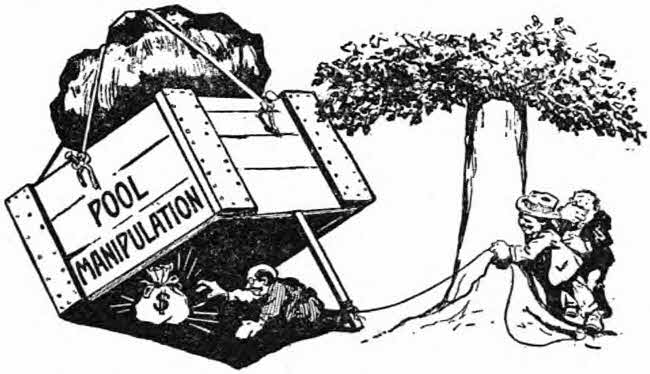
and organized cliques of traders manipulate
stocks, both up and down, with utter disregard
of basic values, and in this way set cleverly
baited traps for other traders who imagine
themselves wise enough to pluck the bait
and get away without springing the trap. A
trader or investor in stocks is not obliged to
participate in these machinations, any more
than one who goes to a circus is obliged to bet
on the shell games and other tricky money-making
devices that are sometimes run in
conjunction with traveling menageries, but
are no part of the main performance.
A person who buys a piece of improved
real estate for less than half of its actual
worth is reasonably sure he has a bargain;
but if he afterwards sells it at a fair price,
and later buys it back again at a much higher
figure, he is gambling that for some reason or
other it is going to be worth more, either
actually or fictitiously. Nor is it ever unsafe
to buy good stocks at figures away below
their intrinsic worth. The element of gambling
does not enter the undertaking until the
market price has risen above the investment
value; then if the owner refuses to sell, or
buys more (as the speculator usually does)
he is gambling on the uncertain event that
some individual or clique is going to pay him
more than the stock is worth. When one
buys a stock, either for investment or speculation,
its value cannot be permanently affected
by the action of other traders, and no
individual or group of individuals can euchre
an investor out of his stock except by his own
free will. The man with a hundred dollars
has the same relative chance for making
money as the man with a million; but the
difficulty is that the one with the smaller
amount is ambitious to make equally as much
as the one with the million; therefore he resorts
to gambling on thin margins; and not
being content with ordinary risks he plays a
long chance shot. If he wins, instead of
withdrawing the original capital, with perhaps
a little more, he usually stakes the whole
amount on every venture until it is lost.
Viewing the stock market calmly in the perspective,
it is not a question whether stocks
will rise or fall; of that there is not the slightest
doubt. They rise and decline with the
same certainty that the sun rises and sets,
though of course with less regularity. The
only question is, how far they will go in
either direction.
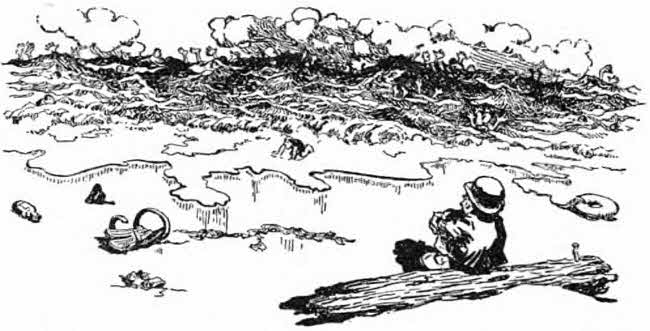
The action of the stock market much resembles
that of a troubled sea, which is always
uneasy, rolling and tumbling about as
if undermined by some volcanic force. The
prices of stocks are periodically rising and
falling, and one might as well undertake to
fight the ocean tide as to contest the course
of the stock market when once in full swing
in either direction; for the market, unlike the
tide, has no prescribed boundaries. There
are times—indeed most of the time—when
it is much wiser to sit by in the capacity of an
interested observer, than to plunge in and
become a struggling participant, with the
chance of being carried out beyond one’s
depth. Theoretically, there seems to be no
reason why the stock market should not move
along at a fairly even pace, except in case of
some unexpected crisis; but practically, it is
either abnormally high or unreasonably low
most of the time. Stocks, like food, clothing
and all human necessities, are more or less
subject to the laws of supply and demand;
and when the traders and investors throughout
the country become convinced that it is
time to buy stocks, a bull market is sure to
ensue; then when everybody has acquired all
they want—and some of them more—and
they make up their minds to sell, it is only
natural that values should recede; which they
do, usually to somewhere near the low point
from where they began to rise. This process
of sliding up and down the scale is repeated
year after year, and age after age.
No one has ever been able satisfactorily to
explain why the prices of all stocks, both
good and poor, and even gilt edge bonds,
keep an almost even pace in the backward
and forward swings, but they do; and thousands
of people who have placed their savings
in securities that are as sound and safe as a
savings bank have viewed with alarm the
crumbling market values of their investments,
wondering what has happened to their
particular stocks or bonds, and if the slumping
prices foreshadow a reduction in dividends,
or if interest will be defaulted on coupons.
Investors who own bonds or good
dividend paying stocks need not be troubled
over these capricious changes; but others of
a more venturesome or speculative bent are
forever wondering when they ought to get in
or out. Of this latter class it is the best
guessers who win.
SOME SIGNS ARE COMPREHENDIBLE; OTHERS ARE HARD TO INTERPRET
It has been wisely observed by one who is
more famous for the wisdom of his writings
than for the amount of money he has made
in speculation, that when a market reaches
the top there is no visible sign to indicate it;
that on the contrary, at this critical point,
everything seems to indicate much higher
prices. Also the majority of traders, tipsters,
financial editors, and even the brokers
themselves, are apt to be most bearishly disposed
when the market is at its lowest point.
This same authority declares that when the
“cats and dogs,” that is, the poorest and most
neglected stocks in the list, begin to advance
it is time for holders of securities to cash in
their profits. It might be further observed
that when plums get ripe and the melon season
is on, it is a sure indication that summer
is well advanced; likewise when, after a long
season of bullish anticipation, the stock market
“plums” are being distributed, and the
“melon-cutting” process is in full swing—when
the favorite “mystery” stocks have disgorged
their “hidden assets,” and begin to
sell ex-rights, ex-dividend, ex-merger and
ex-mystery, it is a pretty sure sign that the
“bulls” are running short of provender, and
that the “bears” are about due for their
inning. A man who accumulates large paper
profits in speculation and fails to “cash in”
until a large part, or all, of his gains have
been dissipated in the process of deflation
which inevitably follows every boom, is comparable
to one who plants a field of grain and
refuses to harvest it at maturity, hoping that
the ripened kernels will get a little larger.
Many a speculator has been brought to grief
by an insatiate greed for that coveted topmost
point, instead of being content to sell at
a good profit and leave the possibility of a
small gain to the individual who buys his
stock.
Chorus of the bears:—
When the plums are gone and the bulls go hence,
We’ll sharpen our claws and jump the fence.
NONE ARE SO BLIND AS THOSE WHO REFUSE TO SEE—NONE SO FOOLISH AS THOSE WHO SCOFF AT WISE COUNSEL
While there are various danger signals
which indicate the culmination of a bull market,
just as there are others which mark the
final stages of a bear market, it must not be
supposed that these signals stand out like so
many red lights placed in front of a ditch at
the roadside; on the contrary they are of the
most deceptive and decoying nature to all except
experienced and dispassionate observers.
And even the best judges are frequently deceived.
On this point one of the most reliable
financial writers in the country says:
“Not all of the economic indicia ever turn
together at any peak or bottom in the securities
markets. Always the case is that some
of the indicia disclose the change, while others
do not. The public usually keeps on expecting
a bull movement to continue, no matter
how unreasonably high stocks may sell.
This persistence of bullish sentiment greatly
facilitates distribution by wealthy holders.”
This timely note of warning was written early
in January of the present year, when a
great bull market after running about two
years was at the boiling-over point; but very
few bullish traders ever pay any attention to
such counsel; nor would they if the danger
signals stood out like beacon lights along a
treacherous shore. A few days later the following
bit of good advice was issued by a
Boston broker:
“For fifteen months this country has enjoyed
clear skies, politically, economically
and financially. Washington Irving begins
his essay on the Mississippi Bubble with the
phrase, ‘There was not a cloud on the horizon,’
and then goes on to state that the prudent
mariner takes cognizance of such ideal
conditions and prepares for the inevitable
change. Today, after fifteen months of national
sunshine and cloudless skies in all directions,
we believe it behooves a man of
affairs to take counsel with himself relative
to his investment and speculative position.
Many business men who should have learned
better by past experience, still take the business
situation as a guide to their stock market
operations in spite of the fact that all
stock exchange history shows that the market
turns up long before a period of business
depression has run its course and likewise
turns down six months or more before prosperity
comes to a pause.”
Speculators can usually find an abundance
of literary food suited to their particular
tastes, as witness the following, issued by a
prominent market forecaster simultaneously
with the above: “We wish you to keep in
mind that the biggest speculation yet witnessed
in the present bull market is still to
come. Now that the reactionary trend in the
market has been definitely halted, you can
look with assurance for higher prices in
many issues in the near future. Continue to
pick up our favorites as outlined in our letters,
as we expect them to prove features.”
Most of the “favorites” were then selling at
figures far above their intrinsic worth, and
many of them have since fulfilled the prediction
that they would “prove features,” for
soon afterwards they declined anywhere from
ten to fifty points.
The active participants in a market that
has run a long course in either direction are
wont to become so intoxicated with affluence,
or downcast with adversity—depending on
which side they have been operating—that
they give little heed to the matter of interpreting
signs which forecast future events,
particularly if these signs controvert their
own opinions. A man driving an automobile
at a sixty-mile-an-hour pace does not
stop to read signs by the roadway; and no
more does a trader bother with warnings
when a prolonged series of stock market victories
has blurred his vision to everything
but prosperity. As every unfamiliar noise or
object tends to aggravate fear in those who
are frightened in the dark, so every concurrent
happening stimulates courage and recklessness
in those who become emboldened by
stock market success. Paradoxical though it
may seem, many things which are construed
bearishly in a falling market are regarded as
bullish in a rising market; and signs which
portend higher prices in the mind of a bull
are equally significant of lower prices to the
mind of a bear. In other words, both bulls
and bears often derive their opposing opinions
from the same identical hypothesis.
These strange anomalies are not mere theories,
they are attested stock market facts.
For example, in a bear market some years
ago the stock of the Amalgamated Copper
Company was depressed several points in one
day on the report that the dividend was to be
reduced. Next day the report was denied
and upon supposedly good authority it was
stated that the regular dividend had been
earned and would be declared. Whereupon
the traders—who were mostly bearish—argued
that a declaration of the regular dividend
would be a bear argument, because it
ought to be reduced and if the usual amount
were declared it would be only for the purpose
of furnishing artificial market support
to the stock; consequently it was again depressed
a dozen points or more. Later when
the trend of prices had turned upward this
stock advanced sharply on the report that the
dividend was to be increased. Although the
report met with prompt denial, the stock was
nevertheless bid up several points more on
the theory that if the dividend were not increased
it at least ought to be, and if only
the regular declaration were made, that
would be evidence of a commendable policy
of conservatism.
EVEN THE STOCK MARKET HAS ITS FARCICAL SIDE
Some of the stock market philosophies and
inventions are quite amusing to the unsophisticated
onlooker. When the Amalgamated
Copper Company and the Anaconda Copper
Company were under separate management
a clique of traders became interested in advancing
the market price of the latter stock,
and forthwith the tipsters and rumor-mongers
circulated a report that Amalgamated
was buying Anaconda for control. This device
proved a profitable asset for the pool
members, who were thereby enabled to sell out
their holdings at much higher prices. When
this was accomplished and the story had become
threadbare, another ingenious story was
circulated, to the effect that the Anaconda
Company was now seeking control of Amalgamated,
whereupon that stock in its turn became
the favorite of traders, who succeeded
in lifting the price high enough to let the pool
unload its holdings at a handsome profit.
While these two monster companies were
performing the act of trying to swallow each
other the traders greatly enjoyed the comedy,
in consideration of which they contributed
generously toward swelling the purses of the
promoters. The final outcome was that the
great Anaconda succeeded in devouring its
competitor, which appears still to be in process
of digestion—or rather indigestion,—judging
from the internal agonies expressed
in the market action of the stock.
SPECULATORS ARE SLAVES OF SENTIMENT
When the whole country becomes pervaded
with an epidemic of bullishness the
action of speculators is always directed by
sentiment rather than judgment; and a market
that is swept along by excited emotions
is always dangerous,—dangerous to go
short of and dangerous to be long of. Hysterical
“bulls” care nothing whatever about
the earnings or dividend returns on a stock;
the only note to which they attune their actions
is the optimistic slogan, “It’s going up!”
and the higher it goes the more they buy, and
the more their ranks are swelled by new recruits.
A herd of stampeded cattle (cows no
less than bulls) will rush blindly into a river,
or butt their brains out against stone walls,
trees or other obstructions; they also stampede
every critter that happens along their
path; and anyone who has ever witnessed a
panic in a theater or auditorium, or in the
stock market, need not be told that under
such circumstances men are but little saner
than cattle.
And speaking of sentiment, it is remarkable
to what extent the combined business
and financial structures of the country are
swayed to and fro by this giant motive power.
Like the biblical wind that bloweth where it
listeth, and man heareth the sound thereof
but knoweth not whence it cometh or whither
it goeth, sentiment springs up from comparatively
trifling or unknown sources and after
playing its havoc, vanishes as suddenly and
mysteriously as it came. In a bear market
a train wreck, or the death of some financier,
or an earthquake in Europe, will put the market
off to the aggregate extent of hundreds
of millions; whereas one of the greatest bull
markets in history found its chief impetus in
the most universally devastating war the
world has ever known.
THERE IS BUT ONE WAY TO BEAT THE STOCK MARKET; THERE ARE MANY WAYS OF BEING BEATEN BY IT
It is admitted by the most sagacious financiers
that the only sure way of making money
trading in the stock market is to get in and
out at opportune times, and to stay out most
of the time. As against this there are numerous
ways of losing money. Among these,
one method in particular is quite popular
among a class of traders who although too
clever and conservative to buy stocks at
“top” prices, have not the patience to wait
for “bottom” prices. When values begin to
crumble after the top has been reached in a
bull market there must be a set of “carriers,”
or supports, onto which stocks can be dumped
on the way down. The market does not collapse
like a ten-story card house; it generally
goes down gradually for a while, one or two
flights at a time, and finds steadying props
every now and then which sustain it for brief
periods. For instance, a certain stock paying
$5 a share annually has been hoisted by
degrees from $75 up to $150 a share. When
it descends to $140 a few wise traders who
have been impatiently waiting for a reaction
will buy it because it looks cheap at $140
after having sold at $150; then at $130 another
lot of traders who are a little wiser and
more patient than the first lot buy it because
it looks much cheaper than it did even at
$140; and so on down it finds these temporary
supports, until at length it gets back to
$75, or perhaps lower, where it is accumulated
by a few shrewd investors and bargain
hunters whose attention has been attracted
to the market by front page newspaper headlines
announcing that the stock market is in
a state of complete prostration. They go on
about their business and pay no particular attention
to the market until the price has recovered
to a point where the stock, returning
$5 a share, is no longer “paying its board,”
when they sell out at a good profit, and stay
out while the speculators carry it on up as far
as they like. When the stock was at the bottom
price those who bought it on a scale
from $140 down were either so overloaded
or pessimistic—probably both—that they
were unable to buy more and thus reduce
their average to a reasonable cost.
THE STOCK EXCHANGE IS A MONUMENT OF BUSINESS INTEGRITY
It is a popular belief with many people that
the stock exchanges are highly prejudicial
to the public interest and to public safety; as
if they actually manufacture stocks, fix their
price, and sell them to the public. It is also
believed by many persons—even by men
with enough brains to buy and sell securities—that
whatever they lose on their transactions
is gained by the stock exchange or the
broker through whom they trade; and that
the brokers on the floor of the exchange plan
out each day’s campaign and manipulate the
stocks with utter disregard of the outside
world. Furthermore, it is commonly supposed
by a certain class of uninformed people
that stock exchanges create panics and financial
depressions; that they are licensed evils,
feeding and fattening upon the credulity of
an innocent public. Nothing could be farther
from the truth; nothing could disclose a more
profound ignorance of existent facts than for
one to adhere to any or all of these fallacious
beliefs. The stock exchange itself has no
more control over the price of securities than
it has over the ocean tides. It is merely an
auction room where anyone may send in orders
to sell stocks and bonds, either at a certain
asking price, or “at market” to the highest
bidder. On the other hand anyone may
put in either a limited or “at market” bid
for whatever securities he wants, provided
they are on the list admitted for trading; and
no securities are so admitted without being
passed upon by a committee of competent
judges whose duty it is thoroughly to investigate
every company before admitting its
securities to the board. The great value of
this service to both traders and investors is
plainly evident. The people who run the exchange
have no other privileges, prerogatives
or authority than to buy and sell securities
on their own account, or to act as buying
and selling agents for the public, and to execute
their orders precisely in accordance with
given directions. The interests of the public
are safeguarded by every known precautionary
device, and if a broker makes a mistake
he stands the loss, regardless of what the
amount may be. In this connection, those
who have stood in the visitors’ gallery of the
New York Stock Exchange on a busy day
have been induced to wonder how it is possible
for the brokers to avoid errors under
such seemingly chaotic conditions as exist
there. To the onlooker it resembles a riotous
mob scene in a modern cinema, and one might
easily mistake it for a place where a lot of
frantic men are trying to buy insurance on a
sinking ship, instead of dealing in gilt edge
securities which are not immediately perishable.
A benevolent sweet-natured old lady
who stood for a time looking down upon this
wild confusion was asked what she thought
of it. “I think it’s all very interesting,” she
said. Then after some reflection she added:
“But my husband never told me that we are
in a financial panic. And even so, why should
the men get so angry with one another?”
No matter what anyone may say or think
to the contrary, there is no business or profession
on earth in which a higher degree of
honor and business integrity prevails than
among the brokers on the floor of the New
York Stock Exchange; and there is no business
or profession in which sharp and unethical
practices among its members are more
quickly detected, or more promptly and summarily
dealt with. And by way of passing
comment it may be remarked that the going
price of $150,000 for a membership on the
New York Stock Exchange would seem to
imply that the brokerage business is no less
profitable than it is honorable. In its certificates
of membership the New York Stock
Exchange declares itself to be “An institution
whose history dates back to 1792, and
whose rules and regulations have been formulated
for the purpose of maintaining high
standards of honor among its members, and
for promoting and inculcating just and equitable
principles of trade.” And it is required
of every member that in every particular he
live up to these principles. It is a place where
a nod of the head or a lifted finger consummates
transactions involving millions of dollars.
In ordinary business affairs a deal
wherein only a few dollars are concerned is
signed, sealed, witnessed and sworn to before
a notary; but here contracts involving millions
are ratified by a mere gesture, and never
questioned by either party.
Every buyer or seller of stocks is a free
agent to do as he pleases, and if he gets hoodwinked
through the stock exchange it is generally
because in trying to outwit or undo
somebody else he overreaches himself and
falls into his own snare. The only percentage
against him is what he pays in commissions
and taxes on his trades; and the only
chances against him are his own blunders in
judgment; these, indeed, are likely to prove a
sufficient handicap. Every corporation whose
securities are listed on the stock exchange is
obliged to make a full and comprehensive
report to the exchange at least once a year,
and these reports can be found in any brokerage
office; they are always open to public inspection,
and no one need buy any stock or
bond without first satisfying himself regarding
the nature of the industry, capitalization,
earnings, management and other details.
Moreover, if at any time a purchaser becomes
dissatisfied with his investment and
wishes to get his money back or change into
something else, there is always a ready market
for the stock. It may be more, or it may
be less, than he paid for it, but in either case
it can be quickly converted into cash.
The investor in stock market securities
may equip himself, free of cost, with full information
concerning every listed security;
what the company’s earnings have been over
a period of years, how much stock and how
many bonds are outstanding, the highest and
lowest prices at which the stock has ever sold,
and all such matters in the fullest detail. He
therefore enters “the game,” as the stock
market is oftentimes called, with his eyes
open, and the cards all faced up on the table.
But if he deviates from sound principles and
resorts to dabbling in stocks that he knows
nothing about, except from hearsay among
traders and market tipsters, and undertakes
to guess the maneuvers of cliques who are
manipulating them, he has no one to blame
but himself for indulging in such an expensive
folly.
BOOKS TEACH WISDOM, BUT EXPERIENCE IS A MORE PRACTICAL INSTRUCTOR
It may be set down as an axiomatic truth
that no one can learn the art of making
money in the stock market by reading statistics,
charts, precedents, theoretical disquisitions
and instructions. Of course it is not
needful, nor would it be any more practicable
than it is necessary, to set forth any fixed
rules or maxims governing one’s procedure
in any other line of business or any other
profession, since no one could use them advantageously
without the requisite qualifications,
such as adaptability, shrewdness and
practice. Hundreds of different combinations
of cards are laid out in books of instructions
on auction bridge, with explicit
directions as to how to bid and play the
hands, yet nobody ever heard of a good
bridge player being made solely from book
instruction. One reason is that there are
actually millions of combinations of cards.
Also in stock trading there is an indefinite
number of needful “don’ts” which the most
resourceful person can neither contemplate
nor anticipate. Every stock market cycle
shatters some precedent; every era produces
new phenomena. Everyone who has ever
studied a book of instructions on how to play
golf knows how impossible it is to take up any
golf club and make it perform according to
schedule. A firm stance, feet well apart,
body under full control, the right knee stiff,
the left arm almost rigid as it follows the
right in a low backward swing; and most
important of all, the eye firmly fixed on the
ball, while the club whips through the air,
and after lifting the ball, follows on through,
carrying both arms forward to their full
length, and many other things which I never
could do, and cannot now recall; all these
directions the would-be player will learn as
he knows his A, B, C’s; but in his intense
eagerness to swat the ball he disregards
most, or all, of the stated essentials, and at
the moment of impact, while his club is
ploughing up the sod two or three inches behind
the ball, his eyes are cast heavenward in
fervent anticipation of watching its flight.
Likewise the speculator figures his profits
long before they materialize. The most important
thing in golf, and the hardest thing
to learn, is to keep the eye on the ball while
in the act of hitting it; and the hardest thing
to learn in stock trading is to keep the eye off
the market, hold firmly and patiently to good
resolutions, and not try to get rich too quickly.
Both look to be easy, but—
Reducing the whole problem to its simplest
form, the stock exchange is a well-organized
and honestly conducted market-place where
anyone may sell or buy investment or speculative
securities, at whatever price anybody
else is willing to pay or accept for them.
There is no more mysticism about the exchange
itself than there is about a book auction
room, or any other auction room where
articles of merchandise are offered at an
upset price, or auctioned off to the highest
bidder. A man who buys stocks or bonds for
investment is not gambling with anybody
that they will go up or down; he buys them
because he wants to invest his money and get
interest or dividends on it. If a stock bought
at $100 a share, paying seven per cent. annually
in dividends, should increase in market
value to $150 it is obvious that the rate
of interest on the total capital is correspondingly
reduced, and that whereas his original
$10,000 brought a return of seven per cent.,
the capital of $15,000 is earning a net return
of only four and six tenths per cent. Under
such conditions it is oftentimes wise to sell
out and reinvest the money in other securities
which bring a larger net return; or if stocks
in general are too high, put the money in the
bank and wait for lower prices. The $5000
gain in capital will surely more than cover
interest on the original $10,000 investment
during the time one has to wait for good
buying opportunities.
This reminds me that some years ago,
when Calumet & Hecla Mining stock was
selling at $850 a share, on which amount it
netted only a small dividend return, I asked
a friend (who owned a large amount of the
stock) why he didn’t sell it and reinvest in
other securities. My argument was that the
stock having already declined from $1000 a
share, would probably go much lower, considering
that the earning capacity of the mine
was in all probability as great as it ever
would be; therefore the chances were more in
favor of a decrease than an increase in earnings
and dividends. To all of which he readily
assented, but in view of the fact that he
had bought the stock at $50 a share it was
paying a very high rate of interest on his
original investment; and for sentimental reasons
he preferred to keep it,—which he did.
Such instances are not at all uncommon; nor
is it uncommon to hear intelligent business
men remark that they know they ought to
sell certain investment securities, because the
market price has risen out of all proportion
to the income yield, but other good securities
are all so high that they really don’t know
what to put their money in. The chances are
probably a hundred to one that if the money
were put in the bank and allowed to rest a
while at three per cent. interest, it could
within a few months be reinvested in the
same securities, or other equally good ones,
at a net gain of three to five years’ interest,
or even more. This is not stock gambling;
it is merely business prudence.
WHIMS AND FALLACIES IN SPECULATION
Traders and investors too often become
stubbornly insistent on recouping their stock
market losses in the same identical securities
in which they lost their money. After having
lost a large sum of money there is undoubtedly
a special gratification in seeing it
return by the same channel through which it
escaped, but the enjoyment of this peculiar
satisfaction is hardly commensurate with the
risk that many people run in attaining it. In
discussing this point some years ago with a
friend who owned a thousand shares of stock
in a bankrupt railway company which had
cost him $50 a share, and was then selling at
$15 a share, with a fifty to one chance that the
road would go into receivership, I argued
that while the loss of $35,000 was a large and
bitter pill to swallow, the chances were that
it would not be made smaller or more palatable
by the inevitable receivership, and that he
might as well salvage what he could from the
wreckage of his investment. After all, there
were dozens of really good stocks that had
declined more than $35 a share; stocks that
would eventually “come back” when the market
turned about; whereas with his stock
there was a probable assessment of $10 to
$15 a share staring him in the face, and after
paying that, the stock was likely to sell at a
figure less than the assessment to be paid,
judging by past performance of the stocks of
other companies in receivership. The road
was tremendously over-bonded, over-capitalized,
encumbered with every conceivable sort
of debt, and not earning its fixed charges. He
vehemently declared,—“No, I’ll be damned
if I’ll allow those thieves to do me out of that
money; they shall pay it all back, and more
with it!” He held tenaciously to his resolution,
the road fell into receivership, and a few
months later he could have bought the stock
in the open market at two dollars a share less
than he had paid in on the assessment.
A favorite and amusing pastime with a
multitude of traders is to cajole themselves
into believing that when some stock they own
becomes increasingly active after a considerable
advance, the renewed activity is a sure
indication that “bankers and insiders” are
accumulating it for a still further advance.
It is well to remember, however, that bankers
and insiders do most of their accumulating
before the rise begins, and while the outside
public is doing its accumulating the bankers
and insiders are quietly supplying the stocks.
It is quite clear that if the insiders pursued
the same tactics as the public they would soon
be relegated to the ranks of the outsiders.
It is a common saying, even among veteran
traders, that such and such a stock “is a good
buy, but you must watch it closely.” To watch
a stock after buying it is about the most foolish
thing one can do. To watch it go down
is certainly no pleasure, and if it goes up it
doesn’t need watching. The time to watch
it is before buying. In order to limit one’s
loss on a purchase it is a simple matter to
put in an “open stop loss” order somewhere
under the cost price; and no amount of diligent
“watching” will prevent it from going
down. On the other hand, to insure one’s
profit, if the price goes up, nothing more is
required than to put in a “G. T. C.” (good
till cancelled), selling order at whatever figure
above the cost price the purchaser is willing
to accept as his profit.
There is probably no more popular fallacy
among traders than the one which presupposes
that great “pools” and combinations
formed to manipulate certain stocks are
either made up of officers and directors of
the corporations concerned, or else that such
pools base their operations upon valuable inside
information from some head official.
This may be true in rare instances; but generally
speaking the directors and officers of
the companies know nothing whatever of the
pool operations in their stocks, and when
they do know they usually frown on such
schemes. Anyone who stops to consider
knows that the market prices of the company’s
securities are of far less concern to the
officials than the matter of conducting their
business operations at a profit. If the company’s
earnings are good, it is clear that this
fact will soon enough manifest itself in the
demand for the securities, without any abortive
or clandestine efforts; and if the earnings
are poor, it would obviously be beneath
the dignity of the officials to deceive the
public through pool operations or pool affiliations.
A more simple plan would be to utilize
their “inside information” by quietly selling
the stock.
I recall a particular instance, a few years
ago, when there were some tremendous pool
operations in the common stock of one of
America’s largest industrial corporations,
and after the stock had been bid up ten or a
dozen points it was reported that a “managing
director” of the company had assured
one of the pool members that it had been
tacitly agreed among the directors to declare
a fifty per cent. stock dividend at the next
board meeting. The public instantly took
the bit in its teeth, and inside of a week the
stock advanced fifteen points more, which
doubtless afforded the clique an auspicious
occasion for unloading its holdings, bought
at much lower figures. About that time I
happened to be in New York, and while
lunching one day with the chairman of the
board of directors at his club he told me that
the matter of a stock dividend had not even
been discussed among the directors, and that
in his opinion there was no likelihood of any
change in the dividend policy for at least a
year,—which proved to be true.
PROBLEMS DEFYING PRESENT SOLUTION ARE BETTER DEFERRED TO THE FUTURE
A matter of present and future importance
in connection with many investment and
speculative stocks, involving as it does questions
on which there is a wide diversity of
opinion, is the modern practice of increasing
the outstanding shares of corporations by
splitting them up into fractions, or by declaring
liberal stock dividends. Many of the
large companies have recently doubled and
quadrupled their shares, and some have issued
as high as nine new shares for one, on
somewhat the same principle as the Government
will issue ten one dollar notes in exchange
for a ten dollar bill. And in several
instances the fractional shares have been
split a second, and even a third time. In
past years when there were only a few listed
securities it was possible for any well informed
person in financial circles to tell the
par value and the approximate book value of
all the leading stocks, but the good old-fashioned
methods are no longer in vogue; there
are now 1,045 stocks listed on the New York
Stock Exchange alone, representing almost
every imaginable industry, from steam locomotives
to lunch counters, and under the new
capital readjustment process it takes a professional
statistician to keep up with the
changes and determine what stocks are
actually worth. But whatever their value
may be, it is at least certain that there is not
enough money in the world to cash them all
in at anywhere near their present market
price. Nowadays it is not unusual for industrial
companies to have from five to ten
million or more shares outstanding. The
lately devised and much over-worked practice
of splitting stocks up into small fractions,
avowedly for the convenience of traders,
savors strongly of the old worn-out custom
of “baiting” the public with low-priced issues,
ranging from $1 a share upward. As long
as we are riding on the crest of the wave of
prosperity there appears to be no imminent
danger in such inflation, but when business
slackens, as it always has periodically in the
past—— However, the optimists contend that
these problems are too far in the future to
worry about. Furthermore it is not the design
of this article to criticise abuses, or to
prognosticate future difficulties that seem
likely to grow out of them. It is true that
some of the companies, notwithstanding the
tremendous increase in their capital structures,
have not weakened their resources by
increasing their cash disbursements. In 1921
the stock of the Standard Oil Company of
New Jersey was paying $5 a year in dividends
and selling at $124.50 per share. In
1922 it was boosted up to $250.50 a share on
the report that shareholders were to receive
four new shares for one. After this split-up
was accomplished and the authorized common
stock increased to 25,000,000 shares,—not
dollars, but shares!—more than 20,000,000
of which have been issued, in addition to
$200,000,000 of preferred stock, the same
conservative dividend policy was continued,
and the new stock received, and still receives,
only one dollar a share annually in dividends.
The market price of the new stock went down
to a fraction below $31, whence it afterwards
recovered to about $46, at which figure it
pays a trifle over 2%, or about one half the
net return on U. S. Government bonds; and
the only visible change in the stockholder’s
position is that if he wishes to sell his stock
it costs about five times what it did before;
in other words, to buy and sell the equivalent
of one hundred shares of the old stock it now
costs $154 in commission and tax—more
than eighteen months’ income on a hundred
shares of the present stock. Possibly there
are mathematicians who can figure out some
sort of compensating advantage to the stockholder,
but I never could.
To sum up the whole situation in a word,
those who would make money speculating in
the stock market should first understand that
it requires as much caution and business acumen
as any other money-making enterprise,
plus some knowledge of the psychological
handicaps; also plus the rare faculty of maintaining
a complete mastery over one’s impulses,
emotions and ambitions under the
most heroic tests of human endurance. All
speculations, and even the most conservative
investments, have some slight element of
risk; all lines of business are more or less a
gamble; marriage is a gamble; political preferment
is a gamble; in fact nearly everything
in life, including our very existence, is
an uncertainty; yet people are not thereby
discouraged from entering into any and all
of these ventures. Those who look only for
certainties have far to search and little to
find in this world.
Transcriber’s Notes:
New original cover art included with this eBook is granted to the public domain.
The Table of Contents was created by the transcriber and placed in
the public domain.
The one footnote has been moved to the end of its chapter.
Illustrations have been moved to paragraph breaks near related content,
except for the frontispiece.
Variations in spelling and hyphenation were retained as they appear in
the original publication, except that obvious typographical errors
have been corrected.