GREEK EUROPE.
Hellenism
and Panhellenism.With the general intellectual development of the Hellenes
the political development of their republics had not kept
equal pace, or rather the luxuriant growth of the former
had—just as too full a bloom bursts the calyx that contains
it—not allowed any individual commonwealth to
acquire the extent and stability which are preliminary
conditions for the thorough formation of a state. The
petty–state–system of individual cities or city–leagues could
not but be stunted in itself or fall a prey to the barbarians.
Panhellenism alone guaranteed alike the continued existence
of the nation and its further development in presence
of the alien races dwelling around it. It was realised by
the treaty which king Philip of Macedonia, the father of
Alexander, concluded in Corinth with the states of Hellas.
This was, in name, a federal agreement, in fact, the subjection
of the republics to the monarchy, but a subjection,
which took effect only as regards external relations, seeing
that the absolute generalship in opposition to the national
foe was transferred by almost all towns of the Greek mainland
to the Macedonian general, while in other respects
freedom and autonomy were left to them; and this was, as
circumstances stood, the only possible realisation of Panhellenism
and the form regulating in substance the future
of Greece. It subsisted in presence of Philip and Alexander,
though the Hellenic idealists were reluctant, as they
always were, to acknowledge the realised ideal as such.
Then, when the kingdom of Alexander fell to pieces, all
was over, as with Panhellenism itself, so also with the
union of the Greek towns under the monarchic supremacy;
and these wore out their last mental and material power
in centuries of aimless striving, distracted between the
alternating rule of the too powerful monarchies, and vain
attempts, under cover of their quarrels, to restore the old
particularism.
Hellas and
Rome.When at length the mighty republic of the west
entered into the conflict, hitherto in some measure balanced,
of the monarchies of the east, and soon showed itself more
powerful than each of the Greek states there striving with
one another, the Panhellenic policy became renewed as the
position of supremacy became fixed. Neither the Macedonians
nor the Romans were Hellenes in the full sense
of the word; it is indeed the sad feature of Greek development
that the Attic naval empire was more a hope than
a reality, and the work of union could not emanate from
the bosom of the nation itself. While in a national
respect the Macedonians stood nearer to the Greeks than
the Romans did, the commonwealth of Rome had politically
far more of elective affinity to the Hellenic than the
Macedonian hereditary kingdom. But—what is the chief
matter—the attractive power of the Greek spirit was
probably felt more permanently and deeply by the Roman
burgesses than by the statesmen of Macedonia, just because
the former stood at a greater distance from it than the
latter. The desire to become at least internally Hellenised,
to become partakers of the manners and the culture,
of the art and the science of Hellas, to be—in the footsteps
of the great Macedonian—shield and sword of the Greeks
of the East, and to be allowed further to civilise this East
not after an Italian but after a Hellenic fashion—this
desire pervades the later centuries of the Roman republic
and the better times of the empire with a power and an
ideality which are almost no less tragic than that political
toil of the Hellenes failing to attain its goal. For both
sides strove after the impossible: to Hellenic Pan–hellenism
there was refused duration, and to Roman Hellenism solid
intrinsic worth. Nevertheless it has essentially influenced
the policy of the Roman republic as well as that of the
emperors. However much the Greeks, particularly in the
last century of the republic, showed the Romans that their
labour of love was a forlorn one, this made no change
either in the labour or in the love.
The Amphictiony
of
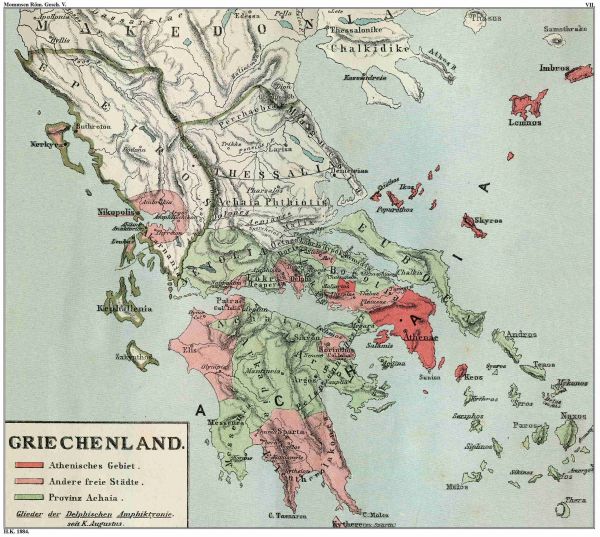
Augustus.The Greeks of Europe had been comprehended by the
Roman republic under a single governorship named after
the chief country Macedonia. When this was administratively
dissolved at the beginning of the imperial period,
there was at the same time conferred on the whole Greek
name a religious bond of union, which attached itself to
the old Delphic Amphictiony introduced for the sake of
“a peace of God” and then misused for political ends.
Under the Roman republic it had been in the main
brought back to the original foundations; Macedonia as
well as Aetolia, both of which had intruded as usurpers,
were again eliminated, and the Amphictiony once more
embraced not all, but most, of the tribes of Thessaly and
of Greece proper. Augustus caused the league to be
extended to Epirus and Macedonia, and thereby made
it in substance the representative of the Hellenic land in
the wider sense alone suited to this epoch. A privileged
position in this union alongside of the time–honoured
Delphi was occupied by the two cities of Athens and
Nicopolis, the former the capital of the old, the latter,
according to Augustus’s design, that of the new imperial,
Hellenic body.146 This new Amphictiony has a certain
resemblance to the diet of the three Gauls (p. 93); just
like the altar of the emperor at Lyons for this diet, the
temple of the Pythian Apollo was the religious centre of
the Greek provinces. But, while to the former withal a
directly political activity was conceded, the Amphictions
of this epoch, in addition to the religious festivals proper,
simply attended to the administration of the Delphic
sanctuary and of its still considerable revenues.147 If its
president in later times ascribed to himself “Helladarchy,”
this rule over Greece was simply an ideal conception.148
But the official conserving of the Greek nationality remained
always a token of the attitude which the new
imperialism occupied towards it, and of its Philhellenism,
far surpassing that of the republic.
Province of
Achaia.Hand in hand with the ritual union of the European
Greeks went the administrative breaking up of the
Graeco–Macedonian governorship of the republic. It
did not depend on the partition of the imperial administration
between emperor and senate, as this whole territory
and not less the adjacent Danubian regions were assigned
in the original partition to the senate; as little did military
considerations here intervene, seeing that the whole
peninsula up to the frontier of Thrace was—as protected
partly by this region, partly by the garrisons on the
Danube—always reckoned to belong to the pacified
interior. If the Peloponnesus and the Attico–Boeotian
mainland obtained at that time its own proconsul and was
separated from Macedonia—which perhaps Caesar may
have already designed—it may be presumed that in that
course, along with the general tendency not to magnify
the senatorial governorships the dominant consideration
was that of separating the purely Hellenic domain from
what was half–Hellenic. The boundary of the province
of Achaia was at first Oeta, and, even after the Aetolians
were subsequently attached to it,149 it did not go beyond
the Achelous and Thermopylae.
The Greek
towns
under the
Roman
republic.These arrangements concerned the country as a whole.
We turn now to the position which was given to the several
urban communities under the Roman rule.
The original design of the Romans—to attach the
whole of the Greek urban communities to their own commonwealth,
in a way similar to what had been done with
the Italian—had undergone essential restrictions, in consequence
of the resistance which these arrangements met
with, especially in consequence of the insurrection of the
Achaean league in the year 608 (iii. 47)iii. 45., and of the
falling away of most of the Greek towns to king Mithradates
in the year 666 (iii. 313)iii. 297.. The city–leagues, the
foundation of all development of power in Hellas as in
Italy, and at first accepted by the Romans, were all of
them—particularly the most important, the Peloponnesian,
or, as it called itself, the Achaean—broken up, and
the several cities were admonished to regulate their own
public affairs. Moreover certain general rules were laid
down by the leading power for the several communal
constitutions, and according to this scheme these were
reorganised in an anti–democratic sense. It was only
within these limits that the individual community retained
autonomy and a magistracy of its own. It retained also
its own courts; but the Greek stood at the same time de
jure under the rods and axes of the praetor, and at least
could be sentenced—on account of any offence which
admitted of being regarded as rebellion against the leading
power—by the Roman officials to a money–fine or
banishment, or even capital punishment.150 The communities
taxed themselves; but they had throughout to pay
to Rome a definite sum, on the whole, apparently, not on
a high scale. Garrisons were not assigned, as formerly
in the Macedonian period, to the towns, for the troops
stationed in Macedonia were in a position, should need
arise, to move also into Greece. But a graver blame
than that falling on the memory of Alexander through
the destruction of Thebes rests on the Roman aristocracy
for the razing of Corinth. The other measures, odious and
exasperating as in part they were, particularly as imposed
by foreign rule, might, taken as a whole, be unavoidable
and have in various respects a salutary operation; they
were the inevitable palinode of the original Roman policy—in
part truly impolitic—of forgiving and forgetting towards
the Hellenes. But in the treatment of Corinth mercantile
selfishness had after an ill–omened fashion shown itself
more powerful than all Philhellenism.
Freed communities
under the
Roman republic.Amidst all this, the fundamental idea of Roman
policy—to confederate the Greek towns with the Italian—was
never forgotten; just as Alexander never wished to rule
Greece like Illyria and Egypt, so his Roman successors
never completely applied the subject–relation to Greece,
and even in the republican period essentially fell short
of urging the strict rights of the war forced upon the
Romans. Especially was this the case in dealing with
Athens. No Greek city from the standpoint of Roman
policy erred so gravely against Rome as this; its demeanour
in the Mithradatic war would, had its case been
that of any other commonwealth, have inevitably led to
its being razed. But from the Philhellenic standpoint,
doubtless, Athens was the masterpiece of the world, and
for the genteel world of other lands similar leanings and
memories were associated with it, as for our cultivated
circles are connected with Pforta and Bonn. This consideration
then, as formerly, prevailed. Athens was never
placed under the fasces of the Roman governor, and never
paid tribute to Rome; it always had a sworn alliance
with Rome, and granted aid to the Romans only in an extraordinary
and, at least as to form, voluntary fashion. The
capitulation after the Sullan siege brought about doubtless
a change in the constitution of the community, but the
alliance was renewed,—in fact, even all extraneous possessions
were given back, including the island of Delos itself,
which, when Athens passed over to Mithradates, had
broken off and constituted itself an independent commonwealth,
and had been, by way of punishment for its fidelity
towards Rome, pillaged and destroyed by the Pontic
fleet.151
Sparta was treated with similar consideration, and that
doubtless in good part on account of its great name.
Some other towns of the freed communities to be afterwards
named had this position already under the republic.
Probably such exceptions occurred in every Roman
province; but this was from the outset peculiar to the
Greek territory, that precisely its two most noted cities
were beyond the range of the subject–relation, which
accordingly affected only the smaller commonwealths.
City–leagues
under the
republic.Even for the subject Greek cities alleviations were
introduced already under the republic. The city–leagues, at
first prohibited, gradually and very soon revived, especially
the smaller and powerless ones, like the Boeotian;152 with
the becoming familiarised to foreign rule the oppositional
tendencies disappeared which had brought about their
abolition, and their close connection with the time–hallowed
cultus carefully spared must have further told in their
favour, as indeed it has already been observed that the
Roman republic restored and protected the Amphictiony
in its original non–political functions. Towards the end
of the republican period the government seems even to
have allowed the Boeotians to enter into a collective
union with the small regions adjacent to the north and
the island of Euboea.153
The copestone of the republican epoch was the
atonement for the sack of Corinth made by the greatest
of all Romans and of all Philhellenes, the dictator Caesar
(iv. 574)iv. 544., and the renewal of the star of Hellas in the
form of an independent community of Roman citizens,
the new “Julian Honour.”
Achaia
under the
emperors.These were the relations which the imperial government
at its outset found existing in Greece, and in these
paths it went forward. The communities freed from the
immediate interference of the provincial government and
from the payment of tribute to the empire, with which the
colonies of Roman burgesses in many respects stood on a
level, comprehended far the largest and best part of the
province of Achaia:Freed
towns and
Roman
colonies.in the Peloponnesus, Sparta, with its
territory diminished no doubt, but yet once more embracing
the northern half of Laconia,154 still the counterpart
of Athens as well in its petrified, old–fashioned institutions
as in its at least outwardly preserved organisation and
bearing; further, the eighteen communities of the free
Laconians, the southern half of the Laconian region, once
Spartan subjects, organised by the Romans as an independent
cities–league after the war against Nabis, and,
like Sparta, invested with freedom by Augustus;155 lastly,
in the region of the Achaeans not only Dyme, which had
been already furnished by Pompeius with pirate–colonists,
and then had received new Roman settlers from Caesar,156
but above all Patrae, which Augustus, on account of its
position favourable for commerce, transformed from a declining
hamlet,—partly by drawing together the small surrounding
townships, partly by settlement of numerous Italian
veterans—into the most populous and most flourishing
city of the peninsula, and constituted as a Roman burgess–colony,
under which was also placed Naupactus (the
Italian Lepanto) on the opposite Locrian coast. On the
Isthmus Corinth, as it had formerly become a victim to
the advantages of its site, had now after its restoration
rapidly risen, similarly to Carthage, and had become the
richest in industry and in population of the cities of
Greece, as well as the regular seat of government. As
the Corinthians were the first Greeks who had recognised
the Romans as countrymen by admission to the Isthmian
games (ii. 79)ii. 75., so this town now, although a Roman burgess–community,
took charge of this high Greek national
festival. On the mainland there belonged to the freed
districts not merely Athens, with its territory embracing
all Attica and numerous islands of the Aegean Sea, but
also Tanagra and Thespiae, at that time the two most considerable
towns of the Boeotian country, as also Plataeae;157
in Phocis Delphi, Abae, Elateia, as well as the most considerable
of the Locrian towns, Amphissa. What the
republic had begun Augustus completed in the arrangement
just set forth, which was at least in its main outlines
settled by him and was afterwards in substance maintained.
Although the communities of the province subject
to the proconsul preponderated, certainly as to number,
and perhaps also as to the aggregate population, yet in
a genuinely Philhellenic spirit the towns of Greece most
distinguished by material importance or by great memories
were set free.158
Nero’s liberation
of
Greece.The last emperor of the Claudian house, one of the
race of spoiled poets and so far at all events a born
Philhellene, went further than Augustus had gone in this
direction. In gratitude for the recognition which his artistic
contributions had met with in the native land of the
Muses, Nero, like Titus Flamininus formerly (ii. 262)ii. 247.—and
that once more in Corinth at the Isthmian games—declared
the Greeks collectively to be rid of Roman
government, free from tribute, and, like the Italians, subject
to no governor. At once there arose throughout
Greece movements, which would have been civil wars, if
these people could have achieved anything more than
brawling; and after a few months Vespasian re–established
the provincial constitution,159 so far as it went, with the dry
remark that the Greeks had unlearned the art of being
free.
Rights of
the freed
towns.The legal position of the communities set free remained
in substance the same as under the republic. They
retained, so far as Roman burgesses were not in question,
the full control of justice; only, the general enactments
as to appeals to the emperor on the one hand and to the
senatorial authorities on the other seem to have also included
the free towns.160 Above all, they retained full
self–determination and self–administration. Athens, for
example, exercised in the imperial period the right of
coinage, without even putting the emperor’s head on its
coins, and even on Spartan coins of the first imperial
period it is frequently wanting. In Athens even the old
reckoning by drachmae and oboli continued; only that, it is
true, the local Attic drachma of this period was nothing but
small money current on the spot, and as to value circulated
as obolus of the Attic imperial drachma or of the Roman
denarius. Even the formal exercise of the right of war
and peace was in individual treaties granted to such
states.161 Numerous institutions quite at variance with
the Italian municipal organisation remained in existence,
such as the annual change of the members of council and
the daily allowance–moneys of these and the jurymen,
which, at least at Rhodes, were still paid in the imperial
period. As a matter of course, the Roman government
nevertheless exercised continuously a regulative influence
over the constitution even of the freed communities. Thus,
for example, the Athenian constitution was, whether at
the end of the republic or by Caesar or Augustus, modified
in such a way that the right of bringing a proposal
before the burgesses belonged no longer to every burgess,
but, as according to the Roman arrangement, only to
definite officials; and among the great number of officials,
who were mere figures, the conduct of business was placed
in the hands of a single one—the Strategos. Certainly
in this way various further reforms were carried out, the
presence of which, in dependent as in independent Greece,
we everywhere discern, without being able to determine
the time and occasion of the reform. Thus the right, or
rather the wrong, of asylums, which, as survivals of a
lawless period, had now become pious retreats for bad
debtors and criminals, was certainly, if not set aside, at
least restricted in this province also. The institution
of proxenia—originally an appropriate arrangement, that
may be compared to our foreign consulates, but politically
dangerous through the bestowal of full civil rights and
often also of the privilege of exemption from taxes on
the friendly foreigner, especially considering the extent
to which it was granted—was set aside by the Roman
government, apparently only at the beginning of the imperial
period; in room of which thereupon came, after
the Italian fashion, the empty city–patronate, which did
not come into contact with the system of taxation. Lastly,
the Roman government, as wielding supreme sovereignty
over these dependent republics just as over the client–princes,
always regarded it as its right, and exercised the
power, to cancel the free constitution in case of misuse,
and to take the town into its own administration. But
partly the sworn agreement, partly the powerlessness of
these nominally allied states, gave to these treaties a
greater stability than is discernible in the relation to the
client–princes.
Diets of the
Greek
cities.While the freed communities of Achaia retained their
previous legal position under the empire, Augustus conferred
on those communities of the province, in which freedom
was not granted or possessed, a new and better legal
position. As he had given to the Greeks of Europe a
common centre in the reorganised Delphic Amphictiony,
he allowed also all the towns of the province of Achaia, so
far as they were placed under Roman administration, to
constitute themselves as a collective union, and to meet
annually in Argos, the most considerable town of non–free
Greece, as a national assembly.162 Thereby not merely
was the Achaean league, dissolved after the Achaean war,
reconstituted, but also the enlarged Boeotian union formerly
mentioned (p. 259) was engrafted on it. Probably
it was just by the laying together of these two domains
that the demarcation of the province of Achaia was
brought about. The new union of the Achaeans, Boeotians,
Locrians, Phocians, Dorians, and Euboeans,163 or, as
it is usually designated like the province, the union of the
Achaeans, presumably had rights neither more nor less
than the other provincial diets of the empire. A certain
control of the Roman officials must have been intended
in the case, and for that reason the towns not placed
under the proconsul, like Athens and Sparta, must have
been excluded from it. This diet withal, like all similar
ones, must have found the centre of its activity chiefly
in the common cultus embracing the whole land. But,
while in the other provinces this cultus of the land preponderantly
attached itself to Rome, the diet of Achaia
was rather a focus of Hellenism, and was perhaps meant
to be so. Already under the Julian emperors it regarded
itself as the true representative of the Greek nation, and
assigned to its president the name of Helladarch, to itself
even that of “the Panhellenes.”164 The assembly thus
deviated from its provincial basis, and its modest administrative
functions fell into the background.
The Panhellenion
of Hadrian
in Athens.These Panhellenes therefore took to themselves this
name by an abuse of language, and were simply tolerated
by the government. But as Hadrian created a new
Athens, so he created also a new Hellas. Under him
the representatives of all the autonomous or non–autonomous
towns of the province of Achaia were allowed
to constitute themselves in Athens as united Greece,
as the Panhellenes.165 The national union, often dreamed
of and never attained in better times, was thereby created,
and what youth had wished for old age possessed in
imperial fulness. It is true that the new Panhellenion did
not obtain political prerogatives; but there was no lack
of what imperial favour and imperial gold could give.
There arose in Athens the temple of the new Zeus
Panhellenios, and brilliant popular festivals and games
were connected with this foundation, the carrying out
of which pertained to the collegium of the Panhellenes, and
primarily to the priest of Hadrian as the living god who
founded them. One of the acts, which these performed
every year, was the offering of sacrifice to Zeus the Deliverer
at Plataeae, in memory of the Hellenes that fell there in
battle against the Persians, on the anniversary of the
battle, the 4th Boedromion: this marks its tendency.166
Still more clearly was this shown in the fact that the
Greek towns outside of Hellas, which appeared worthy of
the national fellowship, had ideal certificates of Hellenism
issued to them by the assembly in Athens.167
The decay
of Hellas.While the imperial rule in its whole wide range
encountered the devastations of a twenty years’ civil
war, and in many places its consequences were never
entirely healed, probably no domain was so severely
affected by them as the Greek peninsula. Fate had so
arranged, that the three great decisive battles of this
epoch—Pharsalus, Philippi, Actium—were fought on its
soil or on its coast; and the military operations, which
with both parties led up to these battles, had here above
all demanded their sacrifices of human life and human
happiness. Even Plutarch was told by his great–grandfather
how the officers of Antonius had compelled the
citizens of Chaeronea, when they no longer possessed
slaves or beasts of burden, to drag their last grain on
their own shoulders to the nearest port to be shipped for
the army; and how thereupon, just as the second convoy
was about to depart, the accounts of the battle of Actium
arrived as glad news of relief. The first thing that
Caesar did after the victory was to distribute the enemy’s
stores of grain that had fallen into his power among the
famishing population of Greece. This heaviest measure
of suffering fell upon a specially weak power of resistance.
Decrease of
the population.Already, more than a century before the battle
of Actium, Polybius had stated that unfruitfulness in
marriage and diminution of the population had in his
time come over all Greece, without any diseases or severe
wars befalling the land. Now these scourges had emerged
in fearful fashion; and Greece remained desolate for all
time to come. Plutarch thinks that throughout the
Roman empire the population had fallen off in consequence
of the devastating wars, but most of all in
Greece, which was not now in a position to furnish from
the better circles of the citizens the 3000 hoplites, with
which once the smallest of the Greek districts, Megara, had
fought at Plataeae.168 Caesar and Augustus had attempted
to remedy this depopulation, which alarmed even the
government, by the despatch of Italian colonists, and, in
fact, the two most flourishing towns of Greece were these
very colonies; the later governments did not repeat
such consignments. The background to the charming
Euboean peasant–idyll of Dio of Prusa is formed by
a depopulated town, in which numerous houses stand
empty, flocks are fed at the council–hall and at the city
register–house, two–thirds of the territory lie untilled for
want of hands; and when the narrator reports this as
falling within his own experience, he therewith assuredly
describes not unaptly the circumstances of numerous small
Greek country towns in the time of Trajan. “Thebes
in Boeotia,” says Strabo in the Augustan age, “is now
hardly to be termed even a goodly village, and the same
holds true of all the Boeotian towns, with the exception
of Tanagra and Thespiae.” But not merely did men
dwindle away as regards number; the type also declined.
“There are doubtless still beautiful women,”
says one of the finest observers about the end of the first
century,169 “but beautiful men one sees no longer; the Olympian
victors of more recent times appear, compared with
the older, inferior and common, partly no doubt owing to
the fault of the artists, but chiefly because they are just
what they are.” The bodily training of the youth had
been carried in this promised land of ephebi and athletes
to such an extent, as if the very aim of the communal
constitution were to rear the boys as gymnasts and the men
as boxers; but, if no province possessed so many artists
for the ring, none supplied so few soldiers to the imperial
army. Even from the instruction of the Athenian youth—which
in the olden time embraced spear–throwing, shooting
with the bow, the use of missiles, the marching out and
pitching of the camp—this playing at soldiers on the part
of the boys now disappears. The Greek towns of the
empire were virtually not taken account of in the levy,
whether because their recruits appeared physically incapable,
or because this element appeared dangerous in
the army; it was an imperial pleasantry that the caricature
of Alexander, Severus Antoninus, reinforced the
Roman army for the conflict with the Persians by some
companies of Spartiates.170 Whatever was done for internal
order and security must have emanated from the individual
communities, as Roman troops were not stationed
in the province; Athens, for example, maintained a garrison
in the island of Delos, and probably a division of
militia lay also in the citadel.171 In the crises of the third
century the general levy of Elateia (p. 242) and that of
Athens (p. 246) valiantly repulsed the Costoboci and the
Goths; and, after a worthier fashion than the grandchildren
of the combatants of Thermopylae in Caracalla’s Persian
war, in the Gothic the grandchildren of the victors of
Marathon inscribed their names for the last time in the
annals of ancient history. But, though such incidents
must preclude us from treating the Greeks of this epoch
absolutely as a decayed rabble, yet the decline of the
population as regards number and vigour steadily continued
even during the better imperial period, until, from
the end of the second century, the diseases which severely
visited these lands, likewise the inroads of land and sea
pirates who particularly affected the east coast, and
lastly, the collapse of the imperial power in the time
of Gallienus, raised the chronic suffering into an acute
catastrophe.
Greek tone
of feeling.The decay of Hellas, and the feelings which it
called forth among the best men, come before us after
a striking manner in the appeal which one of these, the
Bithynian Dio, addressed about the time of Vespasian
to the Rhodians. These were not unjustly regarded as
the most excellent of the Hellenes. In no city were the
lower population better cared for, and nowhere did that
care bear more the stamp of giving not alms but work.
When, after the great civil war, Augustus made all private
debts irrecoverable at law in the East, the Rhodians alone
rejected the dangerous favour. Although the great epoch
of Rhodian commerce was over, there were still in
Rhodes numerous flourishing branches of business and
wealthy houses.172 But many evils had invaded the place,
and the philosopher demands that they be done away,
not so much, as he says, for the sake of the Rhodians, as
for the sake of the Hellenes in common. “Once upon
a time the honour of Hellas rested on many, and many
increased its renown—you, the Athenians, the Lacedaemonians,
Thebes, Corinth for a time, at a remote period
Argos. But now the others are as nothing; for some
are totally decayed and destroyed, others conduct themselves
as you know, and are dishonoured and destroyers of
their old renown. You are surviving; you alone are still
somewhat and are not utterly despised; for, after the way
in which those go to work, all Hellenes would long ago
have sunken more deeply than the Phrygians and the
Thracians. As when a great and noble family is reduced
to a single survivor, and the sin which this last of the
house commits brings all his ancestors into dishonour, so
you stand in Hellas. Believe not that you are the first
of the Greeks; you are the only ones. If we look at
those pitiful scoundrels, the great destinies of the past
become themselves inconceivable; the stones and ruins
of cities show more clearly the pride and the greatness
of Hellas than these descendants not even worthy of
Mysian ancestors; and better than with towns inhabited
by such as these has it fared with those cities which
lie in ruins, for their memory remains in honour and
their well–acquired renown unstained—better burn the
carcase than allow it to lie rotting.”173
The good
old
manners.We shall not disparage this noble spirit of a scholar
who measured the petty present by the great past, and,
as could not fail to be the case, looked at the one with
indignant eyes and at the other in the transfigured glory
of what had been, if we point out the fact that the good
old Hellenic habits were at that time and even long
afterwards not merely to be found in Rhodes, but were in
many respects still everywhere alive. The inward independence,
the well warranted self–esteem of the nation
that was still standing at the head of civilisation had not
disappeared in the Hellenes even of this age, amidst all
the pliancy of subjection and all the humility of parasitism.
The Romans borrowed the gods from the old Hellenes
and the form of administration from the Alexandrines;
they sought to master the Greek language and to Hellenise
their own in measure and style. The Hellenes even of
the imperial period did not pursue a like course; the
national deities of Italy, like Silvanus and the Lares, were
not adored in Greece, and it never entered into the mind
of any Greek urban community to introduce at home the
political organisation which their Polybius celebrates as
the best. So far as the knowledge of Latin was a
condition for the career of the higher as of the lower
magistracies, the Greeks who entered upon this career
acquired it; for, though practically it only occurred to
the emperor Claudius to withdraw the Roman franchise
from the Greeks who did not understand Latin, certainly
the real execution of the rights and duties connected with
it was possible only for one who was master of the imperial
language. But, apart from public life, Latin was
never so learned in Greece as Greek in Rome. Plutarch,
who, as an author, joined as it were in marriage the two
halves of the empire, and whose parallel biographies of
famous Greeks and Romans recommended themselves
and were effective above all by this juxtaposition, understood
not very much more of Latin than Diderot of
Russian, and at least, as he himself says, did not master
the language; the Greek literati having a real command
of Latin were either officials, like Appian and Dio Cassius,
or neutrals, like king Juba.
Really Greece was far less changed in itself than in its
external position. The government of Athens was truly
bad, but even in the time of Athenian greatness it had not
been at all exemplary. “There is,” says Plutarch, “the
same national type, the same disorders, earnest and jest,
charm and malice, as among their ancestors.” This epoch,
too, still exhibits in the life of the Greek people individual
features which are worthy of its civilising leadership. The
gladiatorial games, which spread from Italy everywhere,
especially to Asia Minor and to Syria, found admission to
Greece latest of all lands; for a considerable period they
were confined to the half–Italian Corinth, and when the
Athenians, in order not to be behind that city, introduced
them also among themselves without listening to the
voice of one of their best men, who asked them whether
they would not first set up an altar to the God of compassion,
several of the noblest turned indignantly away
from the city of their fathers that so dishonoured itself. In
no country of the ancient world were slaves treated with
such humanity as in Hellas; it was not the law, but custom
that forbade the Greek to sell his slaves to a non–Greek
master, and so banished from this region the slave–trade
proper. Only here in the imperial period do we find the
non–free people provided for in the burgess–feasts and in
largesses of oil to the burgesses.174 Only here could one
who was not free, like Epictetus under Trajan, in his more
than modest outward existence in the Epirot Nicopolis,
hold intercourse with respected men of senatorial rank,
after the manner of Socrates with Critias and Alcibiades,
so that they listened to his oral instructions as disciples
to the master, and took notes of, and published, his conversations.
The alleviations of slavery by the imperial
law are essentially traceable to the influence of Greek
views, e.g. with the emperor Marcus, who looked up to
that Nicopolitan slave as his master and model.
Parallel between
Roman
and
Athenian
life.The author of a dialogue preserved among those of
Lucian gives an unsurpassed description of the demeanour
of the polished Athenian citizen, amidst his narrow circumstances,
overagainst the genteel and rich travelling public
of doubtful culture or else undoubted coarseness; how
the rich foreigner has been weaned from appearing in the
public bath with a host of attendants, as if he were not
otherwise certain of his life in Athens and there were no
peace in the land; and how he was weaned from showing
himself on the street with his purple dress by people making
the friendly inquiry whether it was not that of his mamma.
He draws a parallel between Roman and Athenian
existence; in the former the burdensome banquets and
the still more burdensome brothels, the inconvenient
convenience of the swarms of menials and the domestic
luxury, the troubles of a dissolute life, the torments of
ambition, all the superfluity, the multifariousness, the
unrest of the doings of the capital; in the latter the charm
of poverty, the free talk in the friendly circle, the leisure
for intellectual enjoyment, the possibility of peace and of
joy in life— “How couldest thou,” one Greek in Rome
asks another, “leave the light of the sun, Hellas, and its
happiness and its freedom for the sake of this crowd?”
In this fundamental keynote all the more finely and purely
organised natures of this epoch are agreed; the very best
Hellenes would rather not exchange with the Romans.
There is hardly anything equally pleasing in the literature
of the imperial period with the already mentioned Euboean
idyll of Dio; it depicts the existence of two families
of hunters in the lonely forest, whose property consists
of eight goats, a cow without a horn, and a fine calf, four
sickles and three hunting–spears, who know nothing either
of gold or of taxes, and who, when placed before the
raging burgess–assembly of the city, are by the latter dismissed
at length unmolested to joy and to freedom.
Plutarch.The real embodiment of this poetically transfigured
conception of life is Plutarch of Chaeronea, one of the
most charming, most fully informed, and withal most
effective writers of antiquity. Sprung from a family of
means in that small Boeotian country–town, and introduced
to the full Hellenic culture, first at home and then
at Athens and at Alexandria; familiar, moreover, with
Roman affairs through his studies and manifold personal
relations, as well as by his travels in Italy, he disdained to
enter into the service of the state or to adopt the professional
career after the usual manner of gifted Greeks;
he remained faithful to his home, enjoying domestic life,
in the finest sense of the word, with his excellent wife and
his children, and with his friends, male and female; contenting
himself with the offices and honours which his own
Boeotia was able to offer to him, and with the moderate
property which he had inherited. In this Chaeronean
the contrast between the Hellenes and the Hellenised
finds expression; such a type of Greek life was not
possible in Smyrna or in Antioch; it belonged to the
soil like the honey of Hymettus. There are men enough
of more powerful talents and of deeper natures, but hardly
any second author has known in so happy a measure
how to reconcile himself serenely to necessity, and how to
impress upon his writings the stamp of his tranquillity of
spirit and his blessedness of life.
Misgovernment
of the
provincial
administration.The self–mastery of Hellenism cannot manifest itself
in the field of public life with the purity and beauty which
it presents in the quiet homestead, after which history
happily does not inquire any more than it inquires after
history. When we turn to public affairs, there is more to
be told of misrule than of rule, both as regards the Roman
government and the Greek autonomy. There was no
want of goodwill on the part of the former, in so far as
Roman Philhellenism dominated the imperial period even
much more decidedly than the republican. It expresses
itself everywhere in great matters as in small, in the prosecution
of the Hellenising of the Eastern provinces and
the recognition of a double official language for the empire,
as well as in the courteous forms in which the government
dealt, and enjoined its officials to deal, even with the
pettiest Greek community.175 Nor did the emperors fail to
favour this province with gifts and buildings; and, though
most things of this sort came to Athens, Hadrian at any
rate constructed a great aqueduct for the benefit of
Corinth, and Pius the hospital at Epidaurus. But the
considerate treatment of the Greeks in general, and the
special kindness which was shown by the imperial government
to Hellas proper, because it was accounted in a
certain sense as, like Italy, “motherland,” did not redound
to the true benefit either of the government or of the
country. The annual changes of the chief magistrates,
and the remiss control of the central position, made all the
senatorial provinces, so far as rule by governors went,
feel rather the oppression than the blessing of unity of administration,
and doubly so in proportion to their smallness
and their poverty. Even under Augustus himself these
evils prevailed to such a degree that it was one of the first
acts of the reign of his successor to take Greece as well as
Macedonia into his own power,176 as it was alleged, temporarily,
but in fact for the whole duration of his reign.
It was very constitutional, but perhaps not quite so wise on
the part of the emperor Claudius, when he came to power,
that he re–established the old arrangement. Thenceforward
the matter remained on this footing, and Achaia was
administered by magistrates not nominated, but chosen by
lot, till this form of administration fell altogether into
abeyance.
Misgovernment
of the
free towns.But the case was far worse with the communities of
Greece exempted from the rule of the governor. The
design of favouring these commonwealths—by freeing
them from tribute and levy, and not less by the slightest
possible restriction of the rights of the sovereign state—led
at least in many cases to the opposite result. The
intrinsic falseness of the institutions avenged itself. No
doubt among the less privileged or better administered
communities the communal autonomy may have fulfilled
its aim; at least we do not learn that Sparta, Corinth,
Patrae fared specially ill in this respect. Administration of
Athens.But Athens was
not made for self–administration, and affords the disheartening
picture of a commonwealth pampered by the
supreme power, and financially as well as morally ruined.
By rights it ought to have found itself in a flourishing
condition. If the Athenians were unsuccessful in uniting
the nation under their hegemony, this city was the only one
in Greece, as in Italy, which carried out completely the
union of its territory: no city of antiquity elsewhere possessed
a domain of its own, such as was Attica, of about 700
square miles, double the size of the island of Rügen. But
even beyond Attica they retained what they possessed, as
well after the Mithradatic war by favour of Sulla, as after
the Pharsalian battle, in which they had taken the side of
Pompeius, by the favour of Caesar—he asked them only
how often they would still ruin themselves and trust to be
saved by the renown of their ancestors. To the city
there still belonged not merely the territory, formerly
possessed by Haliartus, in Boeotia (ii. 329)ii. 309, but also on
their own coast Salamis, the old starting–point of their
dominion of the sea, and in the Thracian Sea the lucrative
islands Scyros, Lemnos, and Imbros, as well as Delos in
the Aegean; it is true this island, after the end of the
republic, was no longer the central emporium of trade with
the East, now that the traffic had been drawn away from
it to the ports of the west coast of Italy, and this was an
irreparable loss for the Athenians. Of the further grants,
which they had the skill to draw by flattery from Antonius,
Augustus, against whom they had taken part, took from
them certainly Aegina and Eretria in Euboea, but they
were allowed to retain the smaller islands of the Thracian
Sea, Icus, Peparethus, Sciathus, and further Ceos confronting
the promontory of Sunium; and Hadrian, moreover,
gave to them the best part of the great island Cephallenia
in the Ionian Sea. It was only by the emperor Severus,
who bore them no good will, that a portion of these extraneous
possessions was withdrawn from them. Hadrian
further granted to the Athenians the delivery of a certain
quantity of grain at the expense of the empire, and by
the extension of this privilege, hitherto reserved for the
capital, acknowledged Athens, as it were, as another imperial
metropolis. Not less was the blissful institute of
alimentary endowments, which Italy had enjoyed since
Trajan’s time, extended by Hadrian to Athens, and the
capital requisite for this purpose certainly presented to
the Athenians from his purse. An aqueduct, which he
likewise dedicated to his Athens, was only completed
after his death by Pius. To this falls to be added the
conflux of travellers and of students, and the endowments
bestowed on the city in ever increasing number by Roman
grandees and by foreign princes.
Its difficulties.Yet the community was in constant distress. The
right of citizenship was dealt with not merely in the way
everywhere usual of giving and taking, but was made
formally and openly a matter of traffic, so that Augustus
interfered to prohibit the evil. Once and again the
council of Athens resolved to sell this or that one of its
islands; and not always was there found a rich man ready
to make sacrifices like Julius Nicanor, who, under
Augustus, bought back for the bankrupt Athenians the
island of Salamis, thereby earning from its senate the
honorary title of the “new Themistocles,” as well as,
seeing that he also made verses, that of the “new Homer,”
and—together with the noble councillors—from the public
well–merited derision. The magnificent buildings with
which Athens continued to embellish herself were obtained
without exception from foreigners, among others from the
rich kings Antiochus of Commagene and Herod of
Judaea, but above all from the emperor Hadrian, who laid
out a complete “new town” (novae Athenae) on the Ilisus,
and—besides numberless other buildings, including the
already mentioned Panhellenion—worthily brought to
completion the wonder of the world, seven centuries after
it had been begun, the gigantic building, commenced by
Pisistratus, of the Olympieion, with its 120 columns partly
still standing, the largest of all that are erect at the present
day. This city itself was without money, not merely for
its harbour–walls, which now certainly might be dispensed
with, but even for its harbour. In Augustus’s time the
Piraeus was a small village of a few houses, only visited
for the sake of the masterpieces of painting in the halls of
the temples. There was hardly any longer commerce or
industry in Athens; or rather for the citizens as a body
as well as individually there was but a single flourishing
trade—begging.
Street–riots.Nor did the matter end with financial distress. The
world doubtless had peace, but not the streets and squares
of Athens. Even under Augustus an insurrection in
Athens assumed such proportions that the Roman government
had to take steps against the free city;177 and though
this event stands isolated, riots on the street on account
of the price of bread and on other trifling occasions belonged
in Athens to the order of the day. The prospect
must not have been much better in numerous other free
towns, of which there is less mention. To give criminal
justice absolutely into the hands of such a burgess–body
could hardly be justified; and yet it belonged de jure to
the communities admitted to international federation, like
Athens and Rhodes. When the Athenian Areopagus in
the time of Augustus refused to release from punishment
on the intercession of a Roman of rank a Greek condemned
for forgery, it must have been within its right;
but when the Cyzicenes under Tiberius imprisoned Roman
burgesses, and under Claudius the Rhodians even nailed
a Roman burgess to the cross, these were formal violations
of law, and a similar occurrence under Augustus
cost the Thessalians their autonomy. Arrogance and
aggression are not excluded by absence of power—are
not seldom even ventured on by weak clients. With all
respect for great memories and sworn treaties, these free
states could not but appear to every conscientious government
not much less than an infringement of the general
order of the empire, like the still more time–hallowed
right of asylum in the temples.
Correctores.Ultimately the government acted with decision, and
placed the free towns, as regards their economy, under the
superintendence of officials of imperial nomination, who,
at all events in the first instance, are described as extraordinary
commissioners “for the correction of evils prevailing
in the free towns,” and thence subsequently bear the
designation “Correctores” as their title. The germs of
this office may be traced back to the time of Trajan; we
find them as standing officials in Achaia in the third century.
These officials, appointed by the emperor, and acting
alongside of the proconsuls, occur in no part of the Roman
empire so early, and are in no case found so early permanent,
as in Achaia, which half consisted of free cities.
Clinging to
memories
of the past.The self–esteem of the Hellenes, well–warranted in itself
and fostered by the attitude of the Roman government,
and perhaps still more by that of the Roman public—the
consciousness of intellectual primacy—called into life
among them a cultus of the past, which was compounded
of a faithful clinging to the memories of greater and happier
times and a quaint reverting of matured civilisation
to its in part very primitive beginnings.
Religion.To foreign worships, if we keep out of view the service
of the Egyptian deities already earlier naturalised by
trading intercourse, particularly that of Isis, the Greeks
in Hellas proper sustained throughout the attitude of
declining them; if this held least true in the case of
Corinth, Corinth was also the least Greek town of Hellas.
The old religion of the country was not protected by
hearty faith, from which this age had long since broken
off;178 but the habits of home and the memory of the past
clung to it by preference, and therefore it was not merely
retained with tenacity, but it even became—in good part
by the process of erudite retouching—always more rigid
and more antique as time went on, always more a distinctive
possession of such as made it a study.
Pedigrees.It was the same with the worship of pedigrees, in
which the Hellenes of this age performed uncommon feats,
and left the most aristocratic of the Romans far behind
them. In Athens the family of the Eumolpidae played a
prominent part at the reorganisation of the Eleusinian
festival under Marcus. His son Commodus conferred on
the head of the clan of the Kerykes the Roman franchise,
and from him descended the brave and learned Athenian,
who, almost like Thucydides, fought with the Goths and
then described the Gothic war (p. 246). A contemporary
of Marcus, the professor and consular Herodes Atticus,
belonged to this same clan, and his court–poet sings of
him, that the red shoe of the Roman patriciate well befitted
the high–born Athenian, the descendant of Hermes
and of Cecrops’s daughter Herse, while one of his panegyrists
in prose celebrates him as Aeacides, and at the
same time as a descendant of Miltiades and Cimon. But
even Athens was far outbidden in this respect by Sparta;
on several occasions we meet with Spartiates who boast
of descent from the Dioscuri, Herakles, Poseidon, and of
the priesthood of these ancestors hereditary for forty generations
and more in their house. It is significant of
this nobility, that it in the main presents itself only with
the end of the second century; the heraldic draughtsmen
who projected these genealogical tables cannot have
been very punctilious as to vouchers either in Athens or
in Sparta.
Language;
archaism
and barbarism.The same tendency appears in the treatment of the
language or rather of the dialects. While at this time in
the other Greek–speaking lands and also in Hellas the
so–called common Greek, debased in the main from the
Attic dialect, predominated in ordinary intercourse, not
merely did the written language of this epoch strive to set
aside prevalent faults and innovations, but in many cases
dialectic peculiarities were again taken up in opposition to
common usage, and here, where it was least of all warranted,
the old particularism was in semblance brought
back. On the statues which the Thespians set up to the
Muses in the grove of Helicon, there were inscribed in
good Boeotian the names Orania and Thalea, while the
epigrams belonging to them, composed by a poet of
Roman name, called them in good Ionic Uranie and
Thaleie, and the non–learned Boeotians, if they knew
them, like all other Greeks called them Urania and
Thaleia. By the Spartans especially incredible things were
done in this way, and not seldom more was written for
the shade of Lycurgus than for the Aelii and Aurelii living
at the time.179 Moreover, the correct use of the language
at this period appears gradually losing ground even in
Hellas; archaisms and barbarisms often stand peacefully
side by side in the documents of the imperial period.
The population of Athens, much mixed with foreigners,
has at no time specially distinguished itself in this
respect,180 and, although the civic documents keep themselves
comparatively pure, yet from the time of Augustus
the gradually increasing corruption of language here also
makes itself felt. The strict grammarians of the time
filled whole books with the linguistic slips with which the
much celebrated rhetorician Herodes Atticus just mentioned
and the other famous school–orators of the second
century were chargeable,181 quite apart from the quaint
artificiality and the affected point of their discourse. But
barbarism proper as regards language and writing set in
in Athens and all Greece, just as in Rome, with Septimius
Severus.182
The public
career.The bane of Hellenic existence lay in the limitation
of its sphere; high ambition lacked a corresponding
aim, and therefore the low and degrading ambition flourished
luxuriantly. Even in Hellas there was no lack of
native families of great wealth and considerable influence.183
Great
families. The country was doubtless on the whole poor, but there
were houses of extensive possessions and old–established
prosperity. In Sparta, for example, that of Lachares
occupied, from Augustus down at least to the time of
Hadrian, a position which in point of fact was not far
removed from that of a prince. Antonius had caused
Lachares to be put to death for exaction. Thereupon his
son Eurycles was one of the most decided partisans of
Augustus, and one of the bravest captains in the decisive
naval battle, who had almost made the conquered general
personally a captive; he received from the victor, among
other rich gifts as private property, the island of Cythera
(Cerigo). Later he played a prominent and hazardous
part not merely in his native land, over which he must
have exercised a permanent presidency, but also at the
courts of Jerusalem and Caesarea, to which the respect
paid to a Spartiate by the Orientals contributed not a
little. For that reason brought to trial several times at
the bar of the emperor, he was at length condemned and
sent into exile; but death seasonably withdrew him from
the consequences of the sentence, and his son Lacon came
into the property, and substantially also, though in a more
cautious form, into the position of power of his father.
The family of the often–mentioned Herodes had a similar
standing in Athens; we can trace it going back through
four generations to the time of Caesar, and confiscation
was decreed, just as over the Spartan Eurycles, over the
grandfather of Herodes on account of his exorbitant position
of power in Athens. The enormous landed estates
which the grandson possessed in his poor native country,
the extensive spaces applied for the sake of erecting tombs
for his boy–favourites, excited the indignation even of the
Roman governors. It may be presumed that there were
powerful families of this sort in most districts of Hellas,
and, while they as a rule decided matters at the diet of
the province, they were not without connections and
influence even in Rome. The career
of state–offices. But although those legal bars,
which excluded the Gaul and the Alexandrian even after
obtaining the franchise from the imperial senate, hardly
stood in the way of those Greeks of rank, but on the
contrary the political and military career which offered
itself to the Italian likewise stood open in law to the
Hellenes, these in point of fact entered only at a late
period and to a limited extent into the service of the state;
partly, doubtless, because the Roman government of the
earlier imperial period reluctantly admitted the Greeks as
foreigners, partly because these themselves shunned the
translation to Rome that was associated with entrance on
this career, and preferred to be the first at home instead
of one the more among the many senators. It was the
great–grandson of Lachares, Herclanus, who first in the
time of Trajan entered the Roman senate; and in the
family of Herodes probably his father was the first to do
so about the same time.184
Personal
service of
the emperor.The other career, which only opened up in the imperial
period—the personal service of the emperor—gave
doubtless in favourable circumstances riches and influence,
and was earlier and more frequently pursued by the
Greeks; but, as most, and the most important, of these
positions were associated with service as officers, there seems
to have been for a considerable time a de facto preference
of Italians for these places, and the direct way was here
also in some measure barred to Greeks. In subordinate
positions Greeks were employed at the imperial court
from the first and in great numbers, and they often in
circuitous ways attained to trust and influence; but such
persons came more from the Hellenised regions than from
Hellas itself, and least of all from the better Hellenic
houses. For the legitimate ambition of the young man
of ancestry and estate there was, if he was a Greek, but
limited scope in the Roman empire.
Municipal
administration.There remained to him his native land, and in its
case to be active for the common weal was certainly a
duty and an honour. But the duties were very modest
and the honours more modest still. “Your task,” Dio says
further to his Rhodians, “is a different one from that of
your ancestors. They could develop their ability on many
sides, aspire to government, aid the oppressed, gain allies,
found cities, make war and conquer; of all this you can
no longer do aught. There is left for you the conduct of
the household, the administration of the city, the bestowal
of honours and distinctions with choice and moderation,
a seat in council and in court, sacrifice to the gods and
celebration of festivals; in all this you may distinguish
yourselves above other towns. Nor are these slight
matters: the decorous bearing, the care for the hair and
beard, the sedate pace in the street, so that the foreigners
accustomed to other things may by your side unlearn their
haste, the becoming dress, even, though it may seem
ridiculous, the narrow and neat purple–border, the calmness
in the theatre, the moderation in applause—all this
forms the honour of your town; therein more than in
your ports and walls and docks appears the good old
Hellenic habit; and thereby even the barbarian, who
knows not the name of the city, perceives that he is in
Greece and not in Syria or Cilicia.” All this was to the
point; but, if it was no longer required now of the citizen
to die for the city of his fathers, the question was at any rate
not without warrant, whether it was still worth the trouble
to live for that city.Plutarch’s
view of its
duties. There exists a disquisition by
Plutarch as to the position of the Greek municipal official
in his time, wherein he discusses these relations with the
fairness and circumspection characteristic of him. The
old difficulty of conducting the good administration of
public affairs by means of majorities of the citizens—uncertain,
capricious, often bethinking them more of their
own advantage than of that of the commonwealth—or
even of the very numerous council–board—the Athenian
numbered in the imperial period first 600, then 700,
later 750 town–councillors—subsisted now, as formerly:
it is the duty of the capable magistrate to prevent the
“people” from inflicting wrong on the individual burgess,
from appropriating to themselves unallowably private property,
from distributing among them the municipal property—tasks
which are not rendered the easier by the fact that
the magistrate has no means for the purpose but judicious
admonition and the art of the demagogue, that it is
further suggested to him not to be too punctilious in
such things, and, if at a city festival a moderate largess
to the burgesses is proposed, not to spoil matters with the
people on account of such a trifle. But in other respects
the circumstances had entirely changed, and the official
must learn to adapt himself to things as they are. First
of all he has to keep the powerlessness of the Hellenes
present at every moment to himself and to his fellow–citizens.
The freedom of the community reaches so far
as the rulers allow it, and anything more would doubtless
be evil. When Pericles put on the robes of office, he
called to himself not to forget that he was ruling over
free men and Greeks; to–day the magistrate has to say
to himself that he rules under a ruler, over a town subject
to proconsuls and imperial procurators, that he can and
may be nothing but the organ of the government, that
a stroke of the governor’s pen suffices to annul any one
of his decrees. Therefore it is the first duty of a good
magistrate to place himself on a good understanding with
the Romans, and, if possible, to form influential connections
in Rome, that these may benefit his native place.
It is true that the upright man warns urgently against
servility; in case of need the magistrate ought courageously
to confront the bad governor, and the resolute
championship of the community in such conflicts at Rome
before the emperor appears as the highest service. In a
significant way he sharply censures those Greeks who—quite
as in the times of the Achaean league—call for the
intervention of the Roman governor in every local quarrel,
and urgently exhorts them rather to settle the communal
affairs within the community than by appeal to give themselves
into the hands, not so much of the supreme
authority, as of the pleaders and advocates that practise
before it. All this is judicious and patriotic, as judicious
and patriotic as was formerly the policy of Polybius, which
is expressly referred to. At this epoch of complete world–peace,
when there was neither a Greek nor a barbarian
war anywhere, when civic commands, civic treaties of
peace and alliances belonged solely to history, the advice
was very reasonable to leave Marathon and Plataeae
to the schoolmasters, and not to heat the heads of the
Ecclesia by such grand words, but rather to content themselves
with the narrow circle of the free movement still
allowed to them. The world, however, belongs not to reason
but to passion. The Hellenic burgess could still even
now do his duty towards his fatherland; but for the true
political ambition striving after what was great, for the
passion of Pericles and Alcibiades, there was in this
Hellas—apart perhaps from the writing–desk—nowhere
any room; and in the vacant space there flourished the
poisonous herbs which, wherever high effort is arrested in
the bud, harden and embitter the human heart.
Games.Therefore Hellas was the motherland of the degenerate,
empty ambition which was perhaps the most general, and
certainly among the most pernicious, of the many sore evils
of the decaying ancient civilisation. Here in the first
rank stood the popular festivals with their prize competitions.
The Olympic rivalries well beseemed the youthful
people of the Hellenes; the general gymnastic festival
of the Greek tribes and towns, and the chaplet plaited
from the branches of the olive for the ablest runner according
to the decision of the “Hellas–judges,” were the
innocent and simple expression of the young nation as a
collective unity. But their political development had soon
carried them beyond this early dawn. Already in the
days of the Athenian naval league, or at least of the
monarchy of Alexander, that festival of the Hellenes was
an anachronism, a childs’ play continued in the age of
manhood; the fact, that the possessor of that olive wreath
passed at least with himself and his fellow–citizens as
holder of the national primacy, had nearly as much significance,
as if in England the victors in the students’ boat
races were to be placed on a level with Pitt and Beaconsfield.
The extension of the Hellenic nation by colonising
and Hellenising found, amidst its ideal unity and real disruption,
its true expression in this dreamy realm of the
olive–wreath; and the materialist policy of the time of
the Diadochi thereupon gave itself, as was meet, but little
trouble on the subject. But when the imperial period
after its fashion took up the Panhellenic idea, and the
Romans entered into the rights and duties of the Hellenes,
then Olympia remained or became the true symbol for the
Roman “All–Hellas”; at any rate the first Roman Olympic
victor appears under Augustus, and in the person of no less
than Augustus’s stepson, the subsequent emperor Tiberius.185
The far from pure marriage–alliance, which Allhellenism
entered into with the demon of play, converted these
festivals into an institution as powerful and lasting as it
was injurious in general, and especially for Hellas. The
whole Hellenic and Hellenising world took part therein,
sending deputies to them and imitating them; everywhere
similar festivals destined for the whole Greek world sprang
from the soil, and the zealous participation of the masses
at large, the general interest felt in the individual competitors,
the pride not merely of the victor but of his adherents
and of his native land, made people almost forget
what in the strict sense were the things contended for.
Universal
interest in
them.Not merely did the Roman government allow free
scope to this rivalry in gymnastic and other competitions,
but the empire took part in them; the right solemnly to
fetch home the victor to his native city did not in
the imperial period depend on the pleasure of the burgesses
concerned, but was conferred on the individual
agonistic institutes by imperial charter,186 and in this case
also the yearly pension (σίτησις) assigned to the victor
was charged upon the imperial exchequer, and the more
important agonistic institutes were treated directly as
imperial institutions. This interest in games seized all the
provinces as well as the empire itself; but Greece proper
was always the ideal centre of such contests and victories.
Here was their home on the Alpheus; here the seat of
the oldest imitations, of the Pythia, Isthmia, and Nemea,
still belonging to the great times of the Hellenic name
and glorified by its classic poets, and no less of a number
of more recent but richly equipped similar festivals, the
Euryclea, which the just–mentioned lord of Sparta had
founded under Augustus, the Athenian Panathenaea, the
Panhellenia, endowed by Hadrian with imperial munificence
and likewise celebrated at Athens. It might
be matter for wonder that the whole world of the wide
empire seemed to revolve round these gymnastic festivals,
but not that the Hellenes above all got intoxicated over
this rare cup of enchantment, and that the life of political
quiet, which their best men recommended to them, was in
the most injurious way disturbed by the wreaths and the
statues and the privileges of the festal victors.
Municipal
ambition.Civic institutions took a similar course, certainly in
the empire as a whole, but again more especially in Hellas.
When great aims and an ambition still existed there, in
Hellas, just as in Rome, the pursuit of public offices and
public honours had formed the centre of political emulation,
and had called forth, along with much that was empty,
ridiculous, mischievous, also the ablest and noblest services.
Now the kernel had vanished and the husk remained;
in Panopeus, in the Phocian territory, the houses were
roofless, and the citizens dwelt in huts, but it was still
a city, indeed a state, and in the procession of the Phocian
communities the Panopeans were not wanting. These
towns, with their magistracies and priesthoods, with their
laudatory decrees proclaimed by herald and their seats of
honour in the public assemblies, with the purple dress
and the diadem, with statues on foot and on horseback,
drove a trade in vanity and money–jobbing worse than
the pettiest paltry prince of modern times with his orders
and titles. There would not be wanting even amidst these
incidents real merit and honourable gratitude; but generally
it was a trade of giving and taking, or, to use
Plutarch’s language, an affair as between a courtesan and
her customers. As at the present day private munificence
in the positive degree procures an order, in the superlative
a patent of nobility, so it then procured the priestly
purple and the statue in the market place; and it is not
with impunity that the state issues a spurious coinage of
its honours.
Its honours
and their
evils.As regards the scale of conducting such proceedings
and the grossness of their forms the doings of the present
day fall considerably behind those of the ancient world,
as is natural, seeing that the seeming autonomy of the
community, not sufficiently restrained by the idea of the
State, bore unhindered sway in this domain, and the decreeing
authorities throughout were the burgesses or the
councils of petty towns. The consequences were pernicious
on both sides; the municipal offices were given away
more according to the ability to pay than according to
the aptitude of the candidates; the banquets and largesses
made the recipients none the richer, and often impoverished
the donor; to the increased aversion for labour and
the decay in the means of good families, this evil habit
contributed its full share. The economy of the communities
themselves also suffered severely under the spreading
evil of adulation. No doubt the honours, with which
the community thanked the individual benefactor, were
measured in great part by the same rational principle
of cheapness which governs at the present day similar decorative
favours; and, when that was not the case, the
benefactor frequently found himself ready, for example,
personally to pay for the statue to be erected in his
honour. But the same did not apply to the marks of
honour which the community showed to foreigners of
rank, above all to the governors and the emperors, and to
the members of the imperial house. The tendency of
the time to set value even on meaningless and enforced
homage did not dominate the imperial court and the
Roman senators so much as the circles of ambition in the
petty town, but yet it did so in a very perceptible way;
and, as a matter of course, the honours and the homage
grew withal in the course of time through misuses to
which they were put, and, further, in the same proportion
as the worthlessness of the personages governing or taking
part in the government. In this respect, as might be
conceived, the supply of honours was always stronger than
the demand for them, and those who correctly valued
such marks of homage, in order to remain spared from
it, were compelled to decline them, which seems to
have been done often enough in individual cases,187 but
seldom with consistency—for Tiberius, the small number
of statues erected to him may perhaps be recorded among
his titles to honour. The disbursements for honorary
memorials, which often went far beyond the simple statue,
and for honorary embassies,188 were a cancer, and became
ever more so, in the municipal economy of all the provinces.
But none perhaps expended uselessly sums so
large in proportion to its slender ability to furnish them
as the province of Hellas, the motherland of municipal
honours as of rewards for the festal victor, and unexcelled
at this period in one pre–eminence—that of menial
humility and abject homage.
Trade and
intercourse.That the economic circumstances of Greece were not
favourable, scarce needs to be specially set forth in detail.
The land, taken on the whole, was but of moderate
fertility, the agricultural portions of limited extent, the
culture of the vine on the mainland not of prominent importance,
that of the olive more so. As the quarries of
the famous marble—the shining white Attic and the green
Carystian—belonged, like most others, to the domanial
possessions, the working of them by imperial slaves
tended little to benefit the population.
The most assiduous of the Greek districts from an industrial
point of view was that of the Achaeans, where the
manufacture of woollen stuffs, that had long existed, maintained
its ground, and in the well–peopled town of Patrae
numerous looms worked up the fine flax of Elis into
clothing and head–dresses. Art and art–handiwork still
continued chiefly in the hands of the Greeks; and of the
masses in particular of Pentelic marble, which the imperial
period made use of, no small portion must have been
worked up on the spot. But it was predominantly
abroad that the Greeks practised both; of the export of
Greek art–products formerly so important there is little
mention at this period. The city of the two seas, Corinth—the
metropolis common to all Hellenes, constantly
swarming with foreigners, as a rhetorician describes it—had
the most stirring traffic. In the two Roman colonies
of Corinth and Patrae, and, moreover, in Athens constantly
filled by strangers seeing and learning, was concentrated
the larger banking–business of the province, which, in the
imperial period, as in the republican, lay largely in the
hands of Italians settled there. In places too of the
second rank, as in Argos, Elis, Mantinea in the Peloponnesus,
the Roman merchants who were settled formed
societies of their own, standing alongside of the burgesses.
In general trade and commerce were at a low ebb in
Achaia, particularly since Rhodes and Delos had ceased
to be emporia for the carrying traffic between Asia and
Europe, and the latter had been drawn to Italy. Piracy
was restrained, and even the land–routes were tolerably
secure;189 but withal the old happy times did not return.
The desolation of the Piraeus has been already mentioned;
it was an event when one of the great Egyptian corn ships
once strayed thither. Nauplia, the port of Argos, the
most considerable coast town of the Peloponnesus after
Patrae, lay likewise desolate.190
Roads.It is in accordance with this state of things that virtually
nothing was done for the roads of this province in
the imperial period; Roman milestones have been found
only in the immediate vicinity of Patrae and of Athens,
and even these belong to the emperors of the end of the
third and of the fourth century; evidently the earlier
governments renounced the idea of restoring communications
here. Hadrian alone undertook at least to make
the equally important and short land–connection between
Corinth and Megara—by way of the wretched pass of the
“Scironian cliffs”—into a practicable road by means of
huge embankments thrown into the sea.
Piercing of
the
Isthmus.The long–discussed plan of piercing the Corinthian
isthmus, which the dictator Caesar had conceived, was
subsequently attempted, first by the emperor Gaius and
then by Nero. The latter even, on occasion of his abode
in Greece, personally took the first step towards the canal,
and caused 6000 Jewish captives to work at it for a series
of months. In connection with the cutting operations
resumed in our own day, considerable remains of these
buildings have been brought to light, which show that
the works were tolerably far advanced when they were
broken off, probably not in consequence of the revolution
that broke out some time afterwards in the West, but
because here, just as with the similar Egyptian canal, in
consequence of the difference of level that was erroneously
assumed to exist between the two seas, there were apprehensions
of the destruction of the island of Aegina and
of further mischief on the completion of the canal. No
doubt had this canal been completed, it would have
shortened the course of traffic between Asia and Italy,
but it would not have tended specially to benefit Greece
itself.
Epirus.It has already been remarked (p. 256) that the regions
to the north of Hellas, Thessaly, and Macedonia, and at
least from Trajan’s time Epirus, were in the imperial
period separated administratively from Greece. Of these
the small Epirot province, which was administered by an
imperial governor of the second rank, never recovered
from the devastation to which it had been subjected in
the course of the third Macedonian war (ii. 329)ii. 309.. The
mountainous and poor interior possessed no city of note
and a thinly–scattered population. Augustus had endeavoured
to raise the not less desolated coast by the
construction of two towns—by the completion of the
colony of Roman citizens already resolved on by Caesar
in Buthrotum overagainst Corcyra, which, however, attained
no true prosperity, and by the founding of the
Nicopolis.Greek town Nicopolis, just at the spot where the headquarters
had been stationed before the decisive battle of
Actium, at the southernmost point of Epirus, about
an hour and a half north of Prevesa, according to the
design of Augustus, at once a permanent memorial of the
great naval victory and the centre of a newly flourishing
Hellenic life. This foundation was new in its kind as
Roman.191 The words of a contemporary Greek poet,
which we quote below, simply express what Augustus here
did; he united the whole surrounding territory, southern
Epirus, the opposite region of Acarnania with the island
of Leucas, and even a portion of Aetolia into one urban
domain, and transferred the inhabitants still left in the
decaying townships there existing to the new city of
Nicopolis, opposite to which on the Acarnanian shore the
old temple of the Actian Apollo was magnificently renewed
and enlarged.
Its character
and
privileges.A Roman city had never been founded in this way;
this was the synoekismos of the successors of Alexander.
Quite in the same way had king Cassander constituted
the Macedonian towns Thessalonica and Cassandreia,
Demetrius Poliorcetes the Thessalian town Demetrias,
and Lysimachus the town of Lysimachia on the Thracian
Chersonese out of a number of surrounding townships
divested of their independence. In keeping with the
Greek character of the foundation Nicopolis was, according
to the intention of its founder, to become a Greek city on
a great scale.192 It obtained freedom and autonomy like
Athens and Sparta, and was intended, as already stated,
to wield the fifth part of the votes in the Amphictiony
representing all Hellas, and to do so, like Athens, without
alternating with other towns (p. 254). This new Actian
shrine of Apollo was erected quite after the model of
Olympia, with a quadriennial festival, which even bore
the name of “Olympia” alongside of its own, had equal
rank and equal privileges, and even its Actiads as the
former had its Olympiads;193 the town of Nicopolis stood
related to it like the town of Elis to the Olympian
temple.194 Everything properly Italian was carefully
avoided in the erection of the town as well as in the
religious arrangements, however natural it might be to
mould after the Roman fashion the “city of victory” so
intimately associated with the founding of the empire.
Whoever considers the arrangements of Augustus in
Hellas in this connection, and especially this remarkable
corner–stone, will not be able to resist the conviction
that Augustus believed that a reorganisation of Hellas
under the protection of the Roman principate was
practicable, and wished to carry it out. The locality at
least was well chosen for it, as at that time, before the
foundation of Patrae, there was no larger city on the
whole Greek west coast. But what Augustus may have
hoped for at the commencement of his sole rule, he did
not attain, and perhaps even subsequently abandoned,
when he gave to Patrae the form of a Roman colony.
Nicopolis remained, as the extensive ruins and the
numerous coins show, comparatively populous and
flourishing;195 but its citizens do not appear to have
taken a prominent part in commerce and manufactures
or otherwise. Northern Epirus, which, like the adjoining
Illyricum bordering on Macedonia, was in greater part
inhabited by Albanian tribes and was not placed under
Nicopolis, continued during the imperial period in its
primitive condition, which still subsists in some measure at
the present day. “Epirus and Illyricum,” says Strabo,
“are in great part a desert; where men are found, they
dwell in villages and in ruins of earlier towns; even the
oracle of Dodona,”—laid waste in the Mithradatic war
by the Thracians (iii. 312)iii. 296.,—“is extinct like everything
else.”196
Thessaly.Thessaly, in itself a purely Hellenic district as well
as Aetolia and Acarnania, was in the imperial period
separated administratively from the province of Achaia
and placed under the governor of Macedonia. What
holds true of northern Greece applies also to Thessaly.
The freedom and autonomy which Caesar had allowed
generally to the Thessalians, or rather had not withdrawn
from them, seem to have been withdrawn, on
account of misuse, from them by Augustus, so that
subsequently Pharsalus alone retained this legal position;197
Roman colonists were not settled in the district. It
retained its separate diet in Larisa, and civic self–administration
was left with the Thessalians, as with the dependent
Greeks in Achaia. Thessaly was far the most fertile
region of the whole peninsula, and still exported grain in
the fourth century; nevertheless Dio of Prusa says that
even the Peneus flows through waste land; and in the
imperial period money was coined in this region only to
a very small extent. Hadrian and Diocletian exerted
themselves to restore the roads of the country, but they
alone, so far as we see, of the Roman emperors did so.
Macedonia.Macedonia, as a Roman administrative district under
the empire, was materially curtailed as compared with
the Macedonia of the republic. Certainly, like the latter,
it reached from sea to sea, inasmuch as the coast as
well of the Aegean Sea from the region of Thessaly
belonging to Macedonia as far as the mouth of the
Nestus (Mesta), as of the Adriatic from the Aous198 as
far as the Drilon (Drin), was reckoned to this district;
the latter territory, not properly Macedonian but Illyrian
land, but already in the republican period assigned to
the governor of Macedonia (iii. 44)iii. 42., remained with the
province also during the time of the empire. But we
have already stated that Greece south of Oeta was
separated from it. The northern frontier towards Moesia
and the east frontier towards Thrace remained indeed
in so far unaltered, as the province in the imperial period
reached as far as the Macedonia proper of the republic
had reached, viz. on the north almost as far as the vale
of the Erigon, eastward as far as the river Nestus; but
while in the time of the republic the Dardani and the
Thracians, and all the tribes of the north and north–east
adjoining the Macedonian territory, had to do with this
governor in their circumstances of peaceful or warlike
contact, and in so far it could be said that the Macedonian
boundary reached as far as the Roman lances, the
Macedonian governor of the imperial period bore sway
only over the district assigned to him, which no longer
bordered on neighbours half or wholly independent.
As the defence of the frontier was transferred in the
first instance to the kingdom of the Thracians which
had come under allegiance to Rome, and soon to the
governor of the new province Moesia, the governor of
Macedonia was from the outset relieved of his command.
There was hardly any fighting on Macedonian soil under
the empire; only the barbarian Dardani on the upper
Axius (Vardar) still at times pillaged the peaceful
neighbouring province. There is no report, moreover,
from this province of any local revolts.
Nationalities.From the more southerly Greek districts this—the
most northerly—stood aloof as well in its national basis
as in the stage of its civilisation. While the Macedonians
proper on the lower course of the Haliacmon (Vistritza)
and the Axius (Vardar), as far as the Strymon, were an
originally Greek stock, whose diversity from the more
southern Hellenes had no further significance for the
present epoch, and while the Hellenic colonisation
embraced within its sphere both coasts—on the west
with Apollonia and Dyrrachium, on the east in particular
with the townships of the Chalcidian peninsula—the
interior of the province, on the other hand, was filled
with a confused mass of non–Greek peoples, which must
have differed from the present state of things in the same
region more as to elements than as to results. After
the Celts who had pushed forward into this region, the
Scordisci, had been driven back by the generals of the
Roman republic, the interior of Macedonia fell to the
share especially of Illyrian stocks in the west and north,
of Thracian in the east. Of both we have already spoken
previously; here they come into consideration only so
far as the Greek organisation, at least the urban, was
probably introduced—as in the earlier,199 so also in the
imperial period—among these stocks only in a very
limited measure. On the whole, an energetic impulse
of urban development never pervaded the interior of
Macedonia; the more remote districts hardly reached—at
least as in a real sense—beyond the village–system.
Greek
polity.The Greek polity itself was not a spontaneous growth
in this monarchical country, as it was in Hellas proper,
but was introduced by the princes, who were more Hellenes
than their subjects. What shape it had is little known;
yet the civic presidency of politarchs uniformly recurring
in Thessalonica, Edessa, Lete, and not met with elsewhere,
leads us to infer a perceptible, and indeed in itself probable,
diversity of the Macedonian urban constitution from
that elsewhere usual in Hellas. The Greek cities, which
the Romans found existing, retained their organisation and
their rights; Thessalonica, the most considerable of them,
also freedom and autonomy. There existed a league and
a diet (κοινόν) of the Macedonian towns, similar to those
in Achaia and Thessaly. It deserves mention, as an evidence
of the continued working of the memories of the
old and great times, that still in the middle of the third
century after Christ the diet of Macedonia and individual
Macedonian towns issued coins on which, in place of the
head and the name of the reigning emperor, came those
of Alexander the Great. The pretty numerous colonies
of Roman burgesses which Augustus established in Macedonia,
Byllis not far from Apollonia, Dyrrachium on the
Adriatic, on the other coast Dium, Pella, Cassandreia, in
the region of Thrace proper Philippi, were all of them
older Greek towns, which obtained merely a number of
new burgesses and a different legal position, and were
called into life primarily by the need of providing quarters
in a civilised and not greatly populous province for Italian
soldiers who had served their time, and for whom there
was no longer room in Italy itself. The granting of
Italian rights certainly took place only to gild for the
veterans their settlement abroad. That it was never
intended to draw Macedonia into the development of
Italian culture is evinced, apart from all else, by the fact
that Thessalonica remained Greek and the capital of the
country. By its side flourished Philippi, properly a mining
town, constituted on account of the neighbouring gold
mines, favoured by the emperors as the seat of the battle
which definitively founded the monarchy, and on account
of the numerous veterans who took part in it and subsequently
settled there. A Roman, not colonial, municipal
constitution was obtained already in the first period of the
empire by Stobi, the already mentioned most northerly
frontier–town of Macedonia towards Moesia, at the confluence
of the Erigon with the Axius, in a commercial as in
a military point of view an important position, and which,
it may be conjectured, had already in the Macedonian
time attained to Greek polity.
Economy.
Roads and
levy.In an economic point of view little was done on the
part of the state for Macedonia under the emperors; at
least there is no appearance of any special care on their
part for this province, which was not put under their own
administration. The military road already constructed
under the republic right across the country from
Dyrrachium to Thessalonica, one of the most important
arteries of intercourse in the whole empire, called forth renewed
effort, so far as we know, only from emperors of the
third century, and first from Severus Antoninus; the
towns adjacent to it, Lychnidus on the Ochrida–lake and
Heraclea Lyncestis (Bitolia), were never of much account.
Yet Macedonia was, economically, better situated than
Greece. It far excelled it in fertility; as still at present
the province of Thessalonica is relatively well cultivated
and well peopled, so in the description of the empire
from the time of Constantius, at all events when Constantinople
was already in existence, Macedonia is reckoned
among the specially wealthy districts. If for Achaia and
Thessaly our documents concerning the Roman levy are
absolutely silent, Macedonia on the other hand was drawn
upon, in particular for the imperial guard, to a considerable
extent, more strongly than the most of the Greek districts—on
which, no doubt, the familiarity of the Macedonians
with regular war–service and their excellent
qualifications for it, and probably also the relatively small
development of the urban system in this province, had an
important bearing. Thessalonica, the metropolis of the
province, and its most populous and most industrial town
at this time, represented likewise under various forms in
literature, has also secured to itself an honourable place in
political history by the brave resistance which its citizens
opposed to the barbarians in the terrible times of the
Gothic invasions (p. 248).
Thrace.If Macedonia was a half–Greek, Thrace was a non–Greek
land. Of the great but for us vanished Thracian
stock we have formerly (p. 207) spoken. Into its domain
Hellenism came simply from without; and it will not be
superfluous in the first instance to glance back and to set
forth how often Hellenism had previously knocked at the
gates of the most southerly region which this stock possessed,
and which we still name after it, and how little it
had hitherto penetrated into the interior, in order to make
clear what was left for Rome here to overtake and what
it did overtake.Philip and
Alexander.Philip, the father of Alexander, first
subjected Thrace, and founded not merely Calybe in the
neighbourhood of Byzantium, but also in the heart of the
land the town which thenceforth bore his name. Alexander,
here too the precursor of Roman policy, arrived at
and crossed the Danube, and made this stream the northern
boundary of his empire; the Thracians in his army played
by no means the least part in the subjugation of Asia.
After his death the Hellespont seemed as though it would
become one of the great centres of the new formation of
states, and the wide domain from thence to the Danube200
as though it would become the northern half of a Greek
empire, and would promise for the capital of Lysimachus,
the former governor ofLysimachus.Thrace—the town of Lysimachia,
newly established in the Thracian Chersonese—a like
future as for the capitals of the marshals of Syria and
Egypt. But this result was not attained; the independence
of this kingdom did not survive the fall of its first
ruler (281 B.C., 473 U.C.). In the century which elapsed
from that time to the establishment of the ascendancy of
Rome in the East, attempts were made, sometimes by the
Seleucids, sometimes by the Ptolemies, sometimes by the
Attalids, to bring the European possessions of Lysimachus
under their power, but all of them without lasting result.
Empire of
Tylis. The empire of Tylis in the Haemus, which the Celts not
long after the death of Alexander, and nearly at the same
time with their permanent settlement in Asia Minor, had
founded in the Moeso–Thracian territory, destroyed the
seed of Greek civilisation within its sphere, and itself
succumbed during the Hannibalic war to the assaults of
the Thracians, who extirpated these intruders to the last
man. Thenceforth there was not in Thrace any leading
power at all; the relations subsisting between the Greek
coast–towns and the princes of the several tribes, which
would probably correspond approximately to those before
Alexander’s time, are illustrated by the description which
Polybius gives of the most important of these towns:
“Where the Byzantines had sowed, there the Thracian
barbarians reaped, and against these neither the sword
nor money is of avail; if the citizens kill one of the
princes, three others thereupon invade their territory, and,
if they buy off one, five more demand the like annual
payment.”
Later
Macedonian
rulers.The efforts on the part of the later Macedonian rulers
to gain once more a firm footing in Thrace, and in particular
to bring under their power the Greek towns of the
south coast, were opposed by the Romans, partly in order to
keep down the development of Macedonia’s power generally,
partly in order not to allow the important “royal
road” leading to the East—that along which Xerxes
marched to Greece and the Scipios marched against
Antiochus—to fall in all its extent into Macedonian
hands. Already, after the battle at Cynoscephalae, the
frontier–line was drawn nearly such as it thenceforth
remained. The two last Macedonian rulers made several
attempts, either directly to establish themselves in Thrace
or to attach to themselves its individual rulers by treaties;
the last Philip even gained over Philippopolis once more,
and put into it a garrison, which, it is true, the Odrysae
soon drove out afresh. Neither he nor his son succeeded
in placing matters on a permanent footing; and the independence
conceded by Rome to the Thracians after the
breaking up of Macedonia destroyed whatever Hellenic
germs might still be left there. Thrace itself became—in
part already in the republican, and more decidedly in
the imperial period—a Roman vassal–principality, and
then in 46 a Roman province (p. 211); but the Hellenising
of the land had not passed beyond the fringe of Greek
colonial towns, which in the earliest period had been
established round this coast, and in course of time had
sunk rather than risen. Powerful and permanent as was
the hold of Macedonian civilisation on the East, as weak
and perishable was its contact with Thrace; Philip and
Alexander themselves appear to have reluctantly undertaken,
and to have but lightly valued, their settlements in
this land.201 Till far into the imperial period the land
remained with the natives; the Greek towns that were
still left along the coast, almost all on the decline, remained
without any Greek land in their rear.
Greek
towns in
Thrace and
on the
Black Sea.This belt of Hellenic towns stretching from the
Macedonian frontier to the Tauric Chersonese was of very
unequal texture. In the south it was close and compact
from Abdera onward to Byzantium on the Dardanelles; yet
none of these towns held a prominent position in later
times with the exception of Byzantium, which through
the fertility of its territory, its productive tunny fisheries,
its uncommonly favourable position for trade, its industrial
diligence, and the energy of its citizens—heightened
merely and hardened by its exposed situation—was
enabled to defy even the worst times of Hellenic anarchy.
Far more scantily had the settlements developed themselves
on the west coast of the Black Sea; among those
subsequently belonging to the Roman province of Thrace
Mesembria alone was of some importance; among those
subsequently Moesian Odessus (Varna) and Tomis (Küstendje).
Beyond the mouths of the Danube and the
boundary of the Roman empire, on the northern shore of
the Pontus, there lay amidst the barbarian land Tyra202 and
Olbia; further on, the old and great Greek mercantile
cities in what is now the Crimea—Heraclea or Chersonesus
and Panticapaeum—formed a stately copestone.
Under
Roman
protection.All these settlements enjoyed Roman protection, after
the Romans had become generally the leading power on
the Graeco–Asiatic continent; and the strong arm, which
often came down heavily on the Hellenic land proper,
prevented here at least disasters like the destruction of
Lysimachia. The protection of these Greeks devolved in
the republican period partly on the governor of Macedonia,
partly on the governor of Bithynia, after this became
Roman; Byzantium subsequently remained with Bithynia.203
We may add that in the imperial period, after the erection
of the governorship of Moesia and subsequently of that
of Thrace, the supplying of protection devolved on
these.
Protection and favour were granted by Rome to these
Greeks from the first; but neither the republic nor the
earlier imperial period made efforts for the extension of
Hellenism.204 After Thrace had become Roman, it was
divided into land–districts;205 and almost down to the end
of the first century there is no record of the laying out of
a town there, with the exception of two colonies of Claudius
and Vespasian—Apri in the interior not far from
Perinthus, and Deultus on the most northern coast.206
Philippopolis and other towns with civic rights.
Domitian began by introducing the Greek urban constitution
into the interior, at first for the capital of the country,
Philippopolis. Under Trajan a series of other Thracian
townships obtained like civic rights; Topirus not far
from Abdera, Nicopolis on the Nestus, Plotinopolis on the
Hebrus, Pautalia near Köstendil, Serdica now Sofia,
Augusta Traiana near Alt–Zagora, a second Nicopolis on
the northern slope of Haemus,207 besides, on the coast, Traianopolis
at the mouth of the Hebrus; further, under
Hadrian Adrianopolis, the modern Adrianople. All these
towns were not colonies of foreigners but polities of Greek
organisation, composed after the model set up by Augustus
in the Epirot Nicopolis; it was a civilising and Hellenising
of the province from above downwards. A Thracian
diet existed thenceforth in Philippopolis just as in the
properly Greek provinces. This last offshoot of Hellenism
was not the weakest. The country was rich and charming—a
coin of the town Pautalia praises the fourfold
blessing of the ears of grain, of the grapes, of the silver,
and of the gold; and Philippopolis as well as the beautiful
valley of the Tundja were the home of rose–culture and
of rose–oil—and the vigour of the Thracian type was not
broken. Here was developed a dense and prosperous
population; we have already mentioned the largeness of
the levy in Thrace, and few territories stand on an equality
with Thrace at this epoch in the activity of the urban
mints. When Philippopolis succumbed in the year 251
to the Goths (p. 240), it is said to have numbered
100,000 inhabitants. The energetic part taken by the
Byzantines in favour of the emperor of the Greek East,
Pescennius Niger, and the several years’ resistance which
the town even after his defeat opposed to the victor, show
the resources and the courage of these Thracian townsmen.
If the Byzantines here, too, succumbed and lost
even for a season their civic rights, the time, for which the
rise of the Thracian land paved the way, was soon to set
in, when Byzantium should become the new Hellenic
Rome and the chief capital of the remodelled empire.
Lower
Moesia.In the neighbouring province of lower Moesia a similar
development took place, although on a smaller scale. The
Greek coast–towns, the metropolis of which, at least in the
Roman period, was Tomis, were, probably on the constituting
of the Roman province of Moesia, grouped as the
“Five–cities–league of the left shore of the Black Sea,” or
as it was also called, “of the Greeks,” that is, the Greeks of
this province.Tomis and
the Pontic
Pentapolis.Later there was annexed to this league, as
a sixth town, that of Marcianopolis, constructed by Trajan
not far from the coast on the Thracian frontier, and
organised, like the Thracian towns, after the Greek model.208
We have already observed that the camp–towns on the
bank of the Danube, and generally the townships
called into life by Rome in the interior, were instituted
after the Italian model; lower Moesia was the only
Roman province intersected by the linguistic boundary,
inasmuch as the Tomitanian cities–league belonged to the
Greek, the Danubian towns, like Durostorum and Oescus
to the Latin, linguistic domain. In other respects essentially
the same holds true of this Moesian cities–league, as
was remarked regarding Thrace. We have a description
of Tomis from the last years of Augustus, doubtless by
one banished thither for punishment, but certainly true in
substance. The population consists for the greater part
of Getae and Sarmatae; they wear, like the Dacians on
Trajan’s column, skins and trousers, long waving hair and
unshorn beard, and appear in the street on horseback
and armed with the bow, with the quiver on their shoulder,
and the knife in their girdle. The few Greeks who are
found among them have adopted the barbarian customs,
including the trousers, and are able to express themselves
as well or better in Getic than in Greek; he is lost, who
cannot make himself intelligible in Getic, and no man
understands a word of Latin. Before the gates rove
predatory bands of the most various peoples, and their
arrows not seldom fly over the protecting city–walls; he
who ventures to till his field does it at the peril of his life,
and ploughs in armour—at anyrate about the time of
Caesar’s dictatorship; on occasion of the raid of Burebista,
the town had fallen into the hands of the barbarians, and
a few years before that exile came to Tomis, during the
Dalmato–Pannonian insurrection, the fury of war had once
more raged over this region. The coins and the inscriptions
of that city accord well with these accounts, in so far
as the metropolis of the “left–Pontic cities–league” in the
pre–Roman period coined no silver, which several other of
these towns did; and, in general, coins and inscriptions
from the time before Trajan occur only in an isolated way.
But in the second and third centuries it was remodelled
and may be termed a foundation of Trajan with very
much the same warrant as Marcianopolis, which likewise
quickly attained to considerable development. The barrier
formerly mentioned (p. 227) in the Dobrudscha served
at the same time as a protecting wall for the town of
Tomis. Behind this wall commerce and navigation
were flourishing. There was in the town a society of
Alexandrian merchants with its own chapel of Serapis;209
in municipal liberality and municipal ambition the town
was inferior to no Greek town of middle size; it was still
even now bilingual, but in such a way that, alongside of
the Greek language always retained on the coins, here on
the border, where the two languages of the empire came
into contact, the Latin is also often employed even in
public monuments.
Tyra.Beyond the imperial frontier, between the mouths of
the Danube and the Crimea, the Greek merchant had
made few settlements on the coast; there were here only
two Greek towns of note, both founded in remote times
by Miletus, Tyra at the mouth of the river of the same
name, the modern Dniester, and Olbia on the bay into
which the Borysthenes (Dnieper) and the Hypanis (Bug)
fall. The forlorn position of these Hellenes amidst the
barbarians pressing around them, in the time of the
Diadochi as well as during the earlier rule of the Roman
republic, has already been described (iii. 297)iii. 282.. The emperors
brought help. In the year 56, that is, in the
exemplary beginning of Nero’s government, Tyra was
annexed to the province of Moesia.Olbia.Of the more remote
Olbia we possess a description from the age of Trajan;210
the town was still bleeding from its old wounds; the
wretched walls enclosed equally wretched houses, and the
quarter then inhabited filled but a small portion of the old
considerable city–circuit, of which individual towers that
were left stood far off in the desolate plain; in the
temples there was no statue of the gods which did not
bear traces of the hands of the barbarians; the inhabitants
had not forgotten their Hellenic character, but they
dressed and fought after the manner of the Scythians,
with whom they were daily in conflict. Just as often as
by Greek names, they designated themselves by Scythian,
i.e. by those of Sarmatian stocks akin to the Iranians;211
in fact, in the royal house itself Sauromates was a common
name. These towns were indebted doubtless for
their very continued existence less to their own power
than to the good–will or rather the self–interest of the
natives. The tribes settled on this coast were neither in
a position to carry on foreign trade from emporia of their
own, nor could they dispense with it; in the Hellenic
coast–towns they bought salt, articles of clothing and
wine, and the more civilised princes protected in some
measure the strangers against the attacks of the barbarians
proper. The earlier rulers of Rome must have had
scruples at undertaking the difficult protection of this
remote settlement; nevertheless Pius, when the Scythians
once more besieged them, sent to them Roman auxiliary
troops, and compelled the barbarians to offer peace and furnish
hostages. The town must have been incorporated
directly with the empire by Severus, from whom onward
Olbia struck coins with the image of the Roman rulers.
As a matter of course this annexation extended only to
the town–territories themselves, and it never was intended
to bring the barbarian dwellers around Tyra and Olbia
under the Roman sceptre. It has already been remarked
(p. 239) that these towns were the first which, presumably
under Alexander († 235), succumbed to the incipient
Gothic invasion.
Bosporus.If the Greeks had but sparingly settled on the mainland
to the north of the Black Sea, the great peninsula
projecting from this coast, the Tauric Chersonesus—the
modern Crimea—had for long been in great part in their
hands. Separated by the mountains, which the Taurians
occupied, the two centres of the Greek settlement upon it
were, at the western end the Doric free town of Heraclea
or Chersonesus (Sebastopol), at the eastern the principality
of Panticapaeum or Bosporus (Kertch). King Mithradates
had at the summit of his power united the two, and
here established for himself a second northern empire (iii. 298), which then, after the collapse of his power, was left
as the only remnant of it to his son and murderer Pharnaces.
When the latter, after the war between Caesar and
Pompeius, attempted to regain his father’s dominion in
Asia Minor, Caesar had vanquished him (iv. 439), and
declared him to have forfeited also the Bosporan empire. Asander.
In the meanwhile Asander, the governor left there by
Pharnaces, had renounced allegiance to the king in the
hope of acquiring the kingdom for himself by this service
rendered to Caesar. When Pharnaces after his defeat
returned to his Bosporan kingdom, he at first indeed
repossessed himself of his capital, but ultimately was
worsted, and fell bravely fighting in the last battle—as a
soldier at least, not unequal to his father. The succession
was contested between Asander, who was in fact master
of the land, and Mithradates of Pergamus, an able officer
of Caesar, whom the latter had invested with the Bosporan
principality; both sought at the same time to lean
for support on the dynasty heretofore ruling in the
Bosporus and on the great Mithradates, inasmuch as
Asander married Dynamis, the daughter of Pharnaces,
while Mithradates, sprung from a Pergamene burgess–family,
asserted that he was an illegitimate son of the
great Mithradates Eupator—whether it was that this
rumour determined the selection, or that it was put into
circulation in order to justify it. As Caesar himself was
called in the first instance to attend to more important
tasks, arms decided between the legitimate and the illegitimate
Caesarian, and once more in favour of the latter;
Mithradates fell in combat, and Asander remained master
in the Bosporus. In the outset—without doubt, because
he had not the confirmation of the lord–paramount—he
avoided assuming the name of king, and contented himself
with the title of archon, borne by the older princes of
Panticapaeum; but he soon procured, probably even from
Caesar himself, the confirmation of his rule and the royal
title.212 At his death (737–738 U.C.)17–16. he left his kingdom to
his wife Dynamis. So strong was still the power of
hereditary succession and of the name of Mithradates, that
both a certain Scribonianus, who first attempted to occupy
Asander’s place, Polemon.and after him king Polemon of Pontus,
to whom Augustus promised the Bosporan kingdom, conjoined
with the taking up of the dominion a marriage–alliance
with Dynamis; moreover, the former asserted
that he was himself a grandson of Mithradates, while king
Polemon, soon after the death of Dynamis, married a
granddaughter of Antonius, and consequently a kinswoman
of the imperial house. After his early death—he
fell in conflict with the Aspurgiani on the Asiatic coast—his
children under age did not succeed him; and even
with his grandson of the same name, whom the emperor
Gaius reinstated, notwithstanding his boyish age, in the
year 38, into the two principalities of his father, the
Bosporan kingdom did not long remain. In his place
the emperor Claudius called a real or alleged descendant
of Mithradates Eupator, and in this house, apparently,
the principality thenceforth continued.213
The Eupatorids.Extent of
the Bosporan
rule.While in the Roman state elsewhere the dependent
principality disappears after the end of the first dynasty,
and from Trajan’s time the principle of direct government
is carried out through the whole extent of the Roman
empire, the Bosporan kingdom subsisted under Roman
supremacy down to the fourth century. It was only after
the centre of gravity of the empire was shifted to Constantinople
that this state became merged in the empire at
large,214 in order to be soon thereafter abandoned by it and
to become, at least in greater part, the prey of the Huns.215
The Bosporus, however, in reality was and continued to
be more a town than a kingdom, and had more similarity
with the town–districts of Tyra and Olbia than with the
kingdoms of Cappadocia and Numidia. Here, too, the
Romans protected only the Hellenic town Panticapaeum,
and did not aim at enlargement of the bounds and subjugation
of the interior any more than in Tyra and Olbia.
To the domain of the prince of Panticapaeum belonged
the Greek settlements of Theudosia on the peninsula itself,
and Phanagoria (Taman) on the opposite Asiatic coast, but
not Chersonesus216—or at least only somewhat as Athens belonged
to the province of the governor of Achaia. The town
had obtained autonomy from the Romans, and saw in the
prince its immediate protector, not its sovereign; as a free
town, too, in the imperial period, it never coined with the
stamp either of king or emperor. On the mainland, not
even the town which the Greeks called Tanais—a
stirring emporium at the mouth of the Don, but hardly
a Greek foundation—stood permanently under subjection
to the Roman vassal–princes.217 Of the more or
less barbarian tribes on the peninsula itself, and on the
European and Asiatic coast southward from Tanais,
probably only the nearest stood in a fixed relation of
dependence.218
Military
position of
the Bosporus.The territory of Panticapaeum was too extensive and
too important, especially for mercantile intercourse, to be
left like Olbia and Tyra to the administration of changing
municipal officials and a far distant governor; therefore
it was entrusted to hereditary princes—a course further
recommended by the circumstance that it might not seem
advisable to transfer directly to the empire the relations
which this region sustained to the surrounding tribes.
The rulers of the Bosporan house, in spite of their Achaemenid
pedigree and their Achaemenid mode of reckoning
time, felt themselves thoroughly as Greek princes, and
traced back their origin, after the good Hellenic fashion,
to Herakles and the Eumolpids. The dependence of
these Greeks on Rome—the royal in Panticapaeum, as the
republican in Chersonesus—was implied in the nature of
things, and they never thought of rising against the protecting
arm of the empire; if once, under the emperor
Claudius, the Roman troops had to march against an insubordinate
prince of the Bosporus,219 yet withal this
region itself, amidst the fearful confusion in the middle
of the third century, which especially affected it, never
broke away from the empire even when it was falling to
pieces.220 The prosperous merchant–towns, permanently in
need of military protection amidst a flux of barbaric
peoples, held to Rome as the advanced posts to the main
army. The garrison was doubtless chiefly raised in the
land itself, and to create and manage it was beyond doubt
the main task of the king of the Bosporus. The coins,
which were struck on occasion of the investiture of such
a king, exhibit doubtless the curule chair and the other
honorary presents usual at such investiture, but also by
their side shield, helmet, sword, battle–axe, and war–horse;
it was no peaceful office which this prince undertook. The
first of them, whom Augustus appointed, fell in conflict
with the barbarians, and of his successors, e.g. king Sauromates,
son of Rhoemetalces, fought in the first years of
Severus with the Siracae and the Scythians—perhaps it
was not quite without reason that he stamped his coins
with the feats of Herakles. By sea, too, he had to be
active, especially in keeping down the piracy which never
ceased in the Black Sea (p. 242); that Sauromates likewise
is credited with having brought the Taurians to order
and chastised piracy. Roman troops, however, were also
stationed in the peninsula, perhaps a division of the Pontic
fleet, certainly a detachment of the Moesian army; their
presence even in small numbers showed to the barbarians
that the dreaded legionary stood behind these Greeks. In
another way still the empire protected them; at least in
the later period there were regularly paid from the imperial
chest to the princes of the Bosporus sums of money,
of which they stood in need, in so far as the buying off
of the hostile incursions by stated annual payments probably
became a standing practice here—in what was not
directly territory of the empire—still earlier than elsewhere.221
Position of
this vassal–prince.That the centralisation of the government had its
application also in reference to this prince, and he stood
to the Roman Caesar on a footing not much different from
that of the burgomaster of Athens, is in various ways
apparent; it deserves mention that king Asander and the
queen Dynamis struck gold coins with their name and
their effigy, whereas king Polemon and his immediate successors,
while retaining the right of coining gold, seeing that
this territory as well as the adjoining barbarians were for
long accustomed exclusively to gold currency, were induced
to furnish their gold pieces with the name and the image
of the reigning emperor. In like manner from Polemon’s
time the prince of this land was at the same time the
chief priest for life of the emperor and of the imperial
house. In other respects the administration and the court
retained the forms introduced under Mithradates after the
model of the Persian grand monarchy, although the chief
secretary (ἀρχιγραμματεύς) and the chief chamberlain (ἀρχικοιτωνείτης)
of the court of Panticapaeum stood related to
the leading court–officers of the great kings, as the enemy
of the Romans Mithradates Eupator to his descendant
Tiberius Julius Eupator, who, on account of his claim to
the Bosporan throne, appeared as a suitor at Rome at the
bar of the emperor Pius.
Trade and
commerce
in the
Bosporus.This northern Greece remained valuable for the empire
on account of its commercial relations. Though these
at this epoch were doubtless less important than in earlier
times,222 yet the mercantile intercourse continued very lively.
In the Augustan period the tribes of the steppes brought
slaves and skins,223 the merchants of civilisation articles of
clothing, wine, and other luxuries to Tanais; in a still
higher degree Phanagoria was the depôt for the exports of
the natives, Panticapaeum for the imports of the Greeks.
Those troubles in the Bosporus in the Claudian age were
a severe blow for the merchants of Byzantium. That the
Goths began their piratic voyages in the third century by
pressing the Bosporan vessels to lend them involuntary
aid, has been already mentioned (p. 244). It was doubtless
in consequence of this traffic, indispensable for the
barbarian neighbours themselves, that the citizens of Chersonesus
maintained their ground even after the withdrawal
of the Roman garrisons, and were able subsequently—when
in Justinian’s time the power of the empire once
more asserted itself in this direction—to return as Greeks
into the Greek empire.