The girl stood on the summit of the hill looking down the white highway
that stretched to Syracuse. The morning sun shone hotly; sky and sea and
earth seemed to kindle and quicken in the ecstasy of heat, setting free
spirits of air and earth and water, towards whom the girl’s spirit
stirred in sympathy. All about her beauty flamed luxuriant. At her feet
the secrets of the world were written in wild flowers, the wild flowers
of Sicily, which redeem the honor of the wellnigh flowerless land of
Greece. All about her the ground flushed with such color as never yet
was woven on a Persian loom or blended in a wizard’s diadem. The gold
and silver of great daisies gleamed in the grass; pimpernel blue and
red, mallow red and white, yellow spurge and green mignonette, blue
borage and pink asphodel and parti-colored convolvulus, snap-dragon and
marigold, violet and dandelion, and that crimson flower which shepherds
call Pig’s Face and poets call Beard of Jove for its golden change in
autumn—all these and a thousand other children of the spring lay at the
girl’s feet and carpeted her kingdom. But the girl was more beautiful
than all the flowers.
The spot where the girl stood was as fair a spot as any in Sicily.
Behind her on the fringe of the thick mountain pine-wood the blue tiled
dome of a Saracenic mosque glowed like a great turquoise in the midst of
the amber-tinted pillars of a ruined Grecian temple. In front of her, on
a little hill, stood the beautiful Norman church that Robert the King
had erected there on the highest point of his kingdom in gratitude for
his son’s recovery from sickness, a miracle of austere strength and
comeliness, with its great bronze image in a niche by the door of the
Archangel Michael, all armored, with his hands resting on the hilt of
his drawn sword. Below her lay all the splendor of Syracuse, the island
town, the smiling bay where the Athenian galleys had been snared more
than fifteen hundred years before, the quarries where the flower of
Athenian chivalry had died its dreadful death, the sapphire sea that
sang its secrets to Theocritus. In all Sicily there was no lovelier
spot, no fairer prospect. But the girl was more beautiful than the place
whereon she stood or the sights on which she gazed.
If the spirit of Theocritus, coming from the fields where Virgil
lingered unaware of Dante, could have revisited his much-loved Syracuse,
the poet of Berenice would have found that the island of Aphrodite still
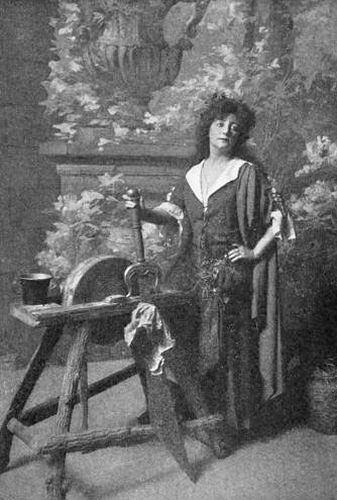
bore women worthy of the goddess. The girl was tall and straight and
slim; health and youth gave their warm color to her cheeks; the old
Greek beauty reigned in her face, but her blue eyes shone with the
brightness of Oriental stars. Her red hair, wine red, blood red, framed
her face with amazing color. Something of the composition of the
woodland entered into the hues of the garments she wore, the simple
garments of a country girl, but shaped of stuffs that were dyed warm
reds and browns, the red of forest fires, the brown of forest trees. It
seemed as if the child, conscious of the strange loveliness of her red
hair, sought to harmonize her very habit to its fierce assertion. Yet
there was no fierceness in the face that the red hair crowned so
radiantly. If it carried the Grecian beauty, it carried also the Grecian
calm, the noble repose of the Grecian image that once had stood in the
splendid temple whose ruined pillars now girdled ironically the ruined
Moslem mosque. Two civilizations had withered in Sicily to afford a
shelter for Perpetua, the daughter of Theron, the executioner of
Syracuse.
Perpetua, daughter of Theron the executioner of Syracuse, waiting for
the coming of Theron the executioner, looked with calm eyes upon
Syracuse, upon the distant city of which she knew no more in all her
eighteen years of life than that same distant vision, a jewel city lying
in orchards at her feet. She had no desire to know more of it; her
father wished that she should know no more of it, and she was content,
for Theron the executioner was the wisest man in the world, wiser than
the few priests who tended the chapel on the hill, wiser than the few
country folk who sometimes climbed to those heights and seemed to fear
the executioner and the executioner’s hut and the executioner’s
daughter, the white girl with the hair that was red as blood. These were
all the men she knew; these made the world, the outer world, for her.
Her real world was where her father was with his tales of gods and
heroes, and his ancient songs and his great sword. It was her task,
self-chosen and rich in pride, to tend the great sword, to keep it
stainless, to sharpen its edge on the grindstone while she sang the Song
of the Sword, and the sparks flew and the great sword seemed to gleam
with an answering fervor. But never in all the days of her young life
had blood to be washed from the sword. For Sicily smiled under the sway
of King Robert the Good, who had no need for executioners.
But the father went sometimes into the city, where the girl never went,
and then the hours seemed long to the girl, and she often came to the
edge of the mountain and gazed down the white ribbon of winding road for
the earliest glimpse of the dear, familiar figure, toilsomely ascending.
To-day the hours seemed longer than ever, for there was the shadow of a
secret over the child’s soul, and she sighed for her father’s presence,
that she might tell him the secret and be free of it, though she knew
very well in her heart that when her father was by her side she would
still stifle her secret. A little secret, indeed, a laughable secret,
for those down there in Syracuse, at the foot of the mountain, who took
the world for what it was, but a great one to the soul of a girl who had
lived all her life on the top of a mountain in a dwelling whose roof was
the crest of a Moslem mosque, and whose garden palings were the pillars
of a temple of Aphrodite; a girl who took the world for what it was not
and for what it could never be.
The white road was as empty as a noon-day dream; its whiteness only
troubled by one moving object, as noon-day dreams are often troubled by
one persistent, inappreciable idea. But the girl had eyes as keen as a
mountain-eagle, and she knew that, whoever the climber was, the climber
was not her father. Then she sighed a little sigh and turned and entered
her dwelling and drew the door behind her, and the mountain-top was
lonely for a time. Only for a time. Up the hill came a fantastical
fellow, alternately singing and sighing, for it seemed that the fierce
heat vexed him despite of his melody. He was a strange ape, tall and
lean and withered, with a wry shoulder like a gibbous moon and a wry leg
like a stricken tree, and his face was as the face of a goblin, with a
long, peaked nose, and loose, protruding lips, traitors to the few and
evil teeth that interwalled his livid gums, and his ears stood out like
bats’ wings from his yellow, wrinkled cheeks. He was visibly punished by
his journey; the sweat streamed from his leather and under his puckered
eyelids his eyes flamed imprecations. His grotesque body was enveloped
in yet more grotesque apparel—the piebald of the buffoon, the mottled
livery of the chartered mountebank. There was a slender collar of gold
about his neck, on which those that were near enough to him and had
quick sight might read in plain terms that he was a royal fool, one of
those jesters whom the great loved to tend to their beck, that they
might ply them with mirth in hours that were mirthless. When the
fantastical fellow had reached the summit he flung himself at once onto
the nearest seat that one of the fallen columns afforded, and sat for a
space gasping and puffing and spitting out blasphemies between every
gasp and puff of his staggered anatomy.
When his wind came to him it took shape in a furious soliloquy,
addressed to the vacant space about. “Devil take the day!” he grunted,
pressing his hands to his lean sides as if he were trying to squeeze
back the breath into his jaded body. “The sun rides as sky-high as the
King’s pride, and the air blazes as dog-hot as the King’s choler. I have
climbed the hill-side to spite him, and now am like to die of thirst to
spite myself, unless I can find friends and flagons.”
So he chattered to himself as if he were conversing with some familiar
spirit or demon, and as he babbled his dull eyes stared around him
stupidly, taking slow stock of unfamiliar objects. He grinned
spitefully at the church and its great archangel and mouthed a lewd
objurgation. Turning his back on the church, he leered at the pillars
and the mosque contemptuously until it dimly dawned upon him that the
ruin was now a place of human habitation. He rose with a groan of
fatigue and hobbled towards it. “A church is no good,” he muttered, “but
hospitality may hide in that hovel. Knock and know.” And having by this
time arrived at the door of the dwelling, he proceeded to rain a
succession of blows on it with his clinched fists, as if he were
determined not to be denied, and, at worst, to force an entrance.
The fury of his call was soon answered. Perpetua flung back the door and
faced the insistent fool.
“Is doom-crack at hand,” she asked, quietly, as she eyed the strange
figure before her, “that you hammer so hotly?”
The misshapen petitioner surrendered something of his malevolence to the
beauty of the girl. He swept her a salutation that exaggerated
courtliness, and there was a quality of apology in his voice as he
spoke.
“I am sand dry as the ancient desert, and to be thirsty roughens my
temper. Ply me tongue-high with wine and I will pipe for you blithely.”
Perpetua shook her head, and her red locks gleamed and quivered with the
motion like an aureole of flame.
“I have no wine,” she said, gravely, “for my father denies its virtues.
But there is a pitcher of milk within at your pleasure.”
At the mention of the word milk the face of the petitioning fool, ugly
enough when untroubled by crosses, took upon itself an expression so
hideous that if the girl’s spirit had ever permitted her to recoil from
any terror she might have recoiled from that.
“Milk!” he yelped, and the sound of his voice was as ugly as the show of
his face. “Milk! Gods of the Greeks! Milk! Your father is no less than a
fool to favor such liquor.”
The girl’s red eyebrows knitted. “Unless you mend your manners,” she
said, decisively, “you shall go as thirsty as you came. You dare not
speak so to my father’s face.”
The fool answered with a little crackling laugh, while the wide sweep
of his withered fingers seemed at once to plead for forgiveness and to
justify impertinence.
“Fair virgin of the heights and of the hollows,” he cackled, “I would
speak so to his face or to his foot or to any part of his honorable
anatomy, for, you see, I am a fool myself, and may pass the crazy name
without cuffing. Come, I will sip your white syrup to please you.”
The girl shrugged her shoulders at the sudden condescension. “Please
yourself. There is water, if you disdain milk.”
The hunchback twisted his pliant features into a new and peculiarly
repulsive form of protest.
“Even as there is the devil if you escape from the deep sea,” he
sneered. “I begin to lust after milk now.”
The maiden looked at him for a moment, with a curious pity for his
changing moods and his changeless deformity. Then she turned and entered
her home, from which she emerged a moment later with a vessel of milk in
one hand and a silver cup in the other. She filled the cup with milk and
handed it to the fool, who took it from her fingers with an ill grace.
His spiteful eyes grinned at the white fluid malignly, as if whatever it
emblemed of purity, of simplicity, exasperated him. He leered up again
at the girl with the same visible rage at her purity, her simplicity,
and he made a little tilting motion with his fingers, as if the devil in
him were minded to dash the milk in the maid’s face. But her
indifference defied him and the thirst tugged at his throat.
“Water is the drink of the wise,” the girl said, steadily. “But milk is
the wine of the gods.”
She was saying words that her father often said, and for his sake they
seemed very fair and very true, and she uttered them lovingly. To the
fool they seemed the last frenzy of folly. But there was nothing better
to drink, and his dryness yearned furiously. He lifted the cup to his
lips and sipped with a wry face. Then he glanced up at the girl slyly.
“It were but courteous to drink my hostess’s health, but I will not
pledge your ripeness in so thin-spirited a tipple. Yet a malediction may
cream on it, so here’s damnation to the King.”
And as he spoke he drank again, and seemed to drink with more gusto, but
the girl frowned at his malevolence.
“The milk should be sour that is supped so sourly,” she said.
The grimace on the twisted face deepened into a sneer as the fool handed
back the empty cup, to be filled again.
“Mistress Red-head,” he said, “if you knew the King as well as I know
him you would damn him as deeply.”
Perpetua’s wide eyes watched the deformed thing with wonder. She thought
he must, indeed, be mad to rail at the good King, so she answered him
gently as she gave him back the full cup.
“I have lived on this hill-top all my life, and know little of the world
of cities at the foot of the mountain. But whenever my father speaks of
the King he calls him Robert the Good.”
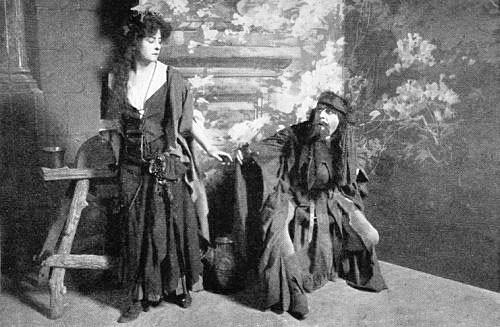 PERPETUA AND DIOGENES THE FOOL
The fool shrugged his shoulders—an action that accentuated their
deformity; and he chuckled awhile to himself, like a choking hen, while
he peered maliciously at the maiden through narrowed slits of eyelids.
When he had savored sufficiently whatever jest so moved him to ugly
mirth he spoke again.
“Oh, ay—Robert the Good! But virtue is no medicine for mortality, so
Robert the Good is dead and buried these six weeks, and Robert the Bad
reigns in his stead, and again I drink to his happy damnation.”
And again he drank the cool fluid, sucking it greedily from the cup ere
he returned it to Perpetua.
The girl took it unconsciously. She had forgotten the fool in his
phrase, in the name he gave to the King. Her springs had been sweetened
by hearing of Robert the Good, of his gentleness, his justice, his
mercy, of how men loved him in Sicily. She had taken it for granted that
his golden reign would endure forever, and now she learned from these
mocking lips that gentleness and justice and mercy were in the dust.
“Robert the Bad,” she murmured to herself, and the words made her
shudder in the sun.
The fool leered at her as if he read her thoughts, and he laughed
briskly.
“Angel of Arcady,” he piped, “shall I tell you tales of the King to
admonish your innocency?”
Perpetua’s eyes and mind came back from the sky into which she had been
staring. There might be a new king in Sicily, but she had her old work
to do.
“I have my task to do,” she answered. “But you can talk to me at my
work, if you choose.”
“What is your task?” questioned the fool, and the girl answered, simply:
“To serve my father’s sword!”
She turned from her interrogator and entered her dwelling, passing
between its fringe of columns, as slim and erect as they, while the fool
gaped at her. In another moment she reappeared, carrying with her that
which contrasted strangely enough with her sex, her beauty, and her
youth. She bore in her strong hands, and bore with ease, a great
two-handed sword—the two-handed sword of the executioner, her
father—the two-handed sword that was the symbol of the stroke of
justice in the eyes of all the world. With an air of pride the girl
carried the great weapon, the pride of a child with its doll, of a
mother with her infant, of a soldier with his flag.
At the sight of her the fool flung up his arms and emitted a queer, ropy
gust of laughter.
“Oh, ho!” he gurgled, “oh, ho! I think I know you now. You are the
daughter of Theron the executioner.”
The girl looked straightly at him, her eyes shining under levelled
brows. She let the point of the great sword rest on the grass, and she
leaned upon its mighty cross-piece, resting her cheek against its
handle. Her red hair ran in ripples over her shoulders and over the hilt
of the blade, red as ever the blood the blade had caused to flow of old.
“I am the daughter of Theron the executioner,” she said, gravely.
The monster flung a sneer from thrust-out lips, emphasizing it with
thrust-out hands.
“A pretty trade!” he cried, derisively. The girl answered him as calmly
and proudly as if she were the very divinity of justice rebuking some
obscene brawler.
“I have no horror of my father’s trade. This sword is but the red
weapon of law, as law is the red weapon of life.”
“I have heard of you,” the man retorted, yelping at her serenity. “The
wild, shy country people believe the blood that sword has shed flushes
in your hair, and that the life it has taken rekindles in your eyes.”
Perpetua shook her head.
“This sword has shed no blood since I was born. King Robert the Good had
no need of it.”
The deformed clasped his lean fingers across his knees and rocked to and
fro in an ecstasy of pleasure.
“King Robert the Bad will have great need of it. Your father’s arms
shall ache with swinging. Why, my own head would drop to-morrow like a
wind-fallen apple if I had not taken fool’s leave to the heights and the
hollows.”
The girl drew back a little, still clinging to the sword.
“Are you blood-guilty?” she asked, sternly.
The fool laughed shrilly to see the executioner’s daughter shrink from
blood-guiltiness.
“Not I. I am but Diogenes, the Court Fool. I have been Prince Robert’s
plaything over yonder in Naples since the dawn of his evil spring. When
his father’s death brought him over-seas to Sicily, I must needs come
too, for my wry wit diverts him and my wry body sets off his comeliness.
I plumed myself on my favor, but I was bottle-brave last night, and I
blundered. In my cups I aped the King’s airs and graces to a covey of
court strumpets till their sleek sides creaked with laughter. ‘Thus does
King Robert carry himself,’ jigged I, ‘and thus does he kiss a lady’s
hand—fa, la, la!’ Oh, it was rare.”
Even as he spoke Diogenes renewed his antics, skipping on the grass to
mimic how the King skipped on the palace floor, and with his lean claws
he blew kisses. Perpetua thought him more repulsive in his mirth than in
his rage. But suddenly his mirth dropped and his voice fell to a
whisper.
“And then the King caught me at my capers and his heart swelled like a
wet sponge. He swore a great oath that my fool’s head should be the
first to fall under his tyranny.”
The girl crossed herself in horror as she questioned.
“Surely, he would not kill a fool for his folly?”
The fool shrugged his shoulders; fear and malignity tugged at the
muscles of his cheeks and made them twitch.
“The King’s soul is as red as hell; sin scarlet through and through;
warp and woof, there is no white thread of heaven in him. Shall I number
you the beads in his chaplet of vices? The seven deadly devils wanton in
his heart; his spirit is of an incredible lewdness; he is prouder than
the Pope, more cruel than a mousing cat—all which I complacently
forgave him till he touched at my top-knot, but now I hate him.”
Again the girl crossed herself swiftly, while she looked at the puckered
face with curiosity, with pity.
“Can you hate in God’s sunshine?” she asked, and as she spoke she looked
about her at the trees and the mountains and the sea and the grass and
the flowers, ennobled and ennobling in the sunlight, and her heart ached
at the new thoughts that had thrust themselves into her life. But the
fool sneered at her surprise and did not heed her pity.
“My hate is a cold snake, and the sun will not thaw me.” He struck
himself fiercely on the breast and stared at her. “Look at me, humped
and hideous. How could this rugged hull prove an argosy of
ineffabilities?”
The pity deepened on the girl’s face, scattering the curiosity, and she
spoke gently, hopefully:
“I have sometimes picked a wrinkled, twisted pear and found it
honey-sweet at the heart.”
Even the callous fool felt the tenderness in Perpetua’s voice, the
tender pity of the strong spirit for the weak, the evil, the unhappy. He
shook his head less angrily than before.
“I am no such bird-of-paradise,” he sighed. “My mind is a crooked knife
in a crooked sheath. When I was a child in my Italian village, trimly
built, children laughed at me for my ugliness, for my hump, for my
peaked chin and my limp, and I learned to curse other children as I
learned to speak. Every hand, every tongue was against the hunchback,
yet my shame saved me. For my gibbosities tickled the taste of a
travelling mountebank. He bought me of my parents, who were willing
enough to part with their monster; he trained me to his trade, taught me
to sing foul songs and to dance foul dances. I have grinned and whistled
through evil days and ways. My wit was gray with iniquities when
Hildebrand, the King’s minion, saw me one day at a fair in Naples and
picked me out for jester to Prince Robert.”
The head of Diogenes drooped upon his breast. He had not talked, he had
not thought, of the past for long enough, and the memory vexed him.
Perpetua propped the sword against the wall of her dwelling and stood
with linked hands for a little while in silence, looking out over the
sea. Then she turned again to where the fool crouched, and spoke to him
softly.
“Are all court folk like you?”
Diogenes lifted his head, and the old malignity glittered in his eyes.
“Ay, in the souls; but for the most part they have smooth bodies.”
He watched the girl closely while her eyes again sought the sea and came
back and met the fool’s gaze.
“Is the King like you?” she questioned.
The fool unhuddled himself and leaped to his feet, snapping his fingers
in fantastic imprecation.
“My soul is as the soul of a sucking babe by his wicked soul; but, as
for his body, the imperious gods who mock us have given him a most
exquisite outside, the case of an angel masking a devil.”
He raged into silence, but his mouth still worked hideously, as if his
hate were fumbling for words it could not find. The girl gave a great
sigh.
“I did not know there were such men in the world,” she said. The fool
stared at her in amaze.
“Then you must have seen few men,” he grunted.
“I have seen few men,” the girl answered, sadly—“my father, who is old,
and the timid country folk, and the holy brothers of the church. Of men
from the valley, from the city, I have seen but two—you and one other.”
She paused for a moment, thoughtfully, and then went on with a swell of
exultation in her voice—“and that other was not like you.”
The fool drew nearer to her, eagerly, apish curiosity goading him. “Who
was my fellow?” he asked of the girl, who, with averted head, seemed as
one who dreams waking. Dreamily she answered:
“One dewy morning a week ago I met a hunter in these happy woods.” She
closed her eyes for a moment as if the memory was sweet to her and she
wished to shut it away from the staring fool.
“Humph!” said Diogenes. “In the days of Robert the Good men might not
hunt in these forests.”
Perpetua looked at Diogenes again with bright eyes of scorn.
“King Robert was gentle with beast as with man. But this hunter did not
seem cruel. Like you, he was tired; like you, he was thirsty. I showed
him where a spring of sweet water bubbled.”
“What was his outer seeming?” Diogenes asked. Somewhat of a warmer color
touched the girl’s cheeks.
“My father has told me tales of the ancient heroes. I think he was
blessed with all the comeliness and goodliness of the Golden Age.”
Diogenes jeered at her enthusiasm with his voice, with his eyes, with
every curve and angle of his misshapen frame—protesting against praise
of beauty.
“Did he pilfer your silly heart from your soft body?” he asked. Perpetua
answered him mildly, heedless of the sneering speech.
“He spoke me fair. He was grave and courteous. I know he was brave and
good.” She moved a little away, with her hands clasped, speaking rather
to herself, but indifferent to the presence of the fool. “When God
wishes me to mate, God grant that I love such a man.”
The frankness, the simplicity, the purity of this prayer seemed to sting
Diogenes to a fierce irritation. Leering and lolling, he advanced upon
the girl.
“Did he kiss you upon the mouth?” he whispered, mean insinuation
lighting his face with an ignoble joy.
The girl turned upon him swiftly, and there was a sternness in her face
that made the fool recoil involuntarily and wince as if at a coming
blow. But there was little anger in the girl’s clear speech as she
condemned the unclean thing.
“You have a vile mind,” she said, quietly. “And if I did not pity you
very greatly I should change no words with you.”
Diogenes, nothing dashed by her reproof, neared her in a dancing manner,
smiling as some ancient satyr may have smiled at the sight of some shy,
snared nymph.
“How if I chose to kiss you?” he asked, and his loose lips mouthed
caressingly. To his surprise the girl met his advances as no shy nymph
ever met satyr, with a hearty peal of laughter, that brought the tears
into her eyes and red rage into his. She thrust towards him her strong,
smooth arms.
“I have a man’s strength to prop my woman’s pity,” she said, as she
broke off her laughter, “and, believe me, you would fare ill.”
Diogenes eyed her with a dubiousness that soon became certainty. That
well-fashioned, finely poised creature, with the firm flesh and the
clean lines of an athlete, was of very different composition from the
court minions who swam in the sunshine of Robert’s favor, of late at
Naples and now in Sicily. He had strength enough to tease them and hurt
them sometimes when it pleased Robert to suffer him to maltreat them;
but here was a different matter. He gave ground sullenly, the girl still
laughing, with her strong arms lying by her sides.
“You seem a stalwart morsel,” he grunted. “I will leave you in peace if
you will tell me where to hide from the King’s anger. Indeed, I do not
greatly grieve to leave the city, for they say a seaman died of the
plague there last night, one of those that came with us out of Naples.”
He shivered as he spoke, and his bird-like claws fumbled at his breast
in an attempt to make the unfamiliar sign of the cross. But the face of
the girl showed no answering alarm.
“Neither the plague nor the King’s rage need be feared in these
forests,” she said. “The pure breezes here bear balsam. As for the
King’s rage, there are caves in these woods where a man might hide, snug
and warm, for a century. Bush and tree yield fruits and nuts in plenty,
for a simple stomach.”
“I will keep myself alive, I warrant you,” Diogenes responded, “and to
pay for your favor I will sing you a song.” So he began to sing, or
rather to croak, to a Neapolitan air, the words of the Venus-song of the
light women of Naples:
“Venus stretched her arms, and said,
‘Cool Adonis, fool Adonis,
Hasten to my golden bed—’”
Perpetua’s face flamed, and she put her fingers in her ears. “Away with
you! away with you!” she commanded.
The fool stopped in his measure; it was no use piping to deaf ears.
“Farewell, fair prudery,” he chuckled, and in a series of fantastic hops
and bounds he reached the edge of the pine wood and soon was lost to
sight within its sheltering depths.



 “‘I LOVE THE MAN’”