Although at least 20 States participate directly in the mussel fishery
for the shell trade, only 2 or 3 of these have taken any action
of any kind for the protection of the resources. In some others
measures have been proposed at various times, but without receiving
favorable consideration by the legislative bodies. Indeed, it is probably
well that this is the case, in view of the fact that there has been
no general presentation of the case from all sides to aid in a just
consideration of the matter. The Bureau is prompted to make this
report in the hope that suggestions based upon a long-continued
investigation of the shelling industry in all its phases may be of
material aid to the responsible bodies concerned in the determination
of how best to perpetuate the mussel resources, giving due regard to
the local conditions involved.
Any legislation to be most effective must fulfill certain general conditions.
It must be based upon just consideration of the welfare of
all classes legitimately interested in the business, including shellers,
buyers, manufacturers, and the public generally. This is important,
not only because fairness demands it but because it is manifestly
impracticable to enforce a law which is framed in disregard of
economic requirements. A law that makes possible the creation of
a monopoly, or one that drives the buyers and manufacturers from
the territory, or that sacrifices the good of the industry to revenue
production to the State, would be so manifestly unsound that further
comment seems unnecessary.
Nevertheless, the element of sacrifice can not be entirely eliminated.
In this case, as in others, ultimate benefits can scarcely be obtained
without some temporary sacrifice, although it should be aimed to
make the immediate loss felt as little as possible. It is the unwillingness
of individuals to make voluntary sacrifices, independently,
for the good of the mussel beds that makes legislation of any kind
necessary. There is a demand for legislative action only because, in
the end, the welfare of all parties concerned is dependent upon the
promotion of abundant growth of mussels.
Finally an eminently desirable feature of any legislation is that
it shall be so simple, plain, and undebatable as to minimize the difficulty
of enforcement. Coupled with this there must be not only an
effective penalty but machinery of enforcement that will work simply
and certainly.
The measures to be proposed will be considered in the light of
these requirements, together with the basic conditions offered by the
natural history and the conditions of life and reproduction of the
mussels.
As appears from the remarks hitherto made, the restrictions which
are immediately required for the preservation of the shell resources
are—
- The imposition of size limits for the protection of young
mussels.
- The adoption of a plan of rotation of closed regions, whereby
the mussel beds may be given the best opportunity for propagation
and growth.
We do not at this time advocate any other limitations, and it will
be attempted to show that these are so simple to apply and so promising
of effectual conservation that it is strongly advisable not to complicate
the situation by a needless multiplicity of restrictions. These
two measures will be fully discussed in subsequent sections of the paper.
Two other measures that have been more or less frequently proposed
are the provision of a closed season during certain months and
the restriction of the methods of taking mussels. While it is the
purpose of the present paper to discuss more especially the positive
suggestions that are offered, it is not out of place to give briefly some
of the reasons for exclusion of measures which may have been suggested
by friends of the industry with sincerity of purpose and which
are not upon their face devoid of merit. Always let it have the first
place in our minds that the one object in view is not to hamper but
to develop the mussel fishery.
Closed season of months.—The aim in establishing a closed season
for the mussel fishery during a portion of the year is either to protect
the mussels from disturbance during a breeding season or else to
diminish the extent of the fishery by limiting its duration.
It might be very proper to protect the mussels during the active
breeding season, if such a season could be defined; but, as a matter
of fact, the various species of mussels in any particular stream have
different seasons of breeding. The mussel industry is based upon a
considerable number of species of economic mussels. There is a
group which has a short breeding term during the summer months.
Such are the species known commercially as "niggerhead," "pimple-back,"
"monkey-face," "maple-leaf," "blue-point," "three-ridge,"
etc. The "washboard" seems to have an intermediate breeding
term during the early fall, though it may be that in some cases it
carries its spawn into the winter. Many of the more important
species of mussels have a long term of breeding; in the latter part
of the summer and in the early fall the eggs are deposited into brood
pouches within the shell of the female, and there, after they hatch
and develop, they are carried over the winter, to be liberated in the
spring and early summer.[A] Of this kind are the "mucket," "sand-shell,"
"pocketbook," "butterfly," and others.
In view of the variety of commercial mussel species and the diversity
of breeding seasons, it does not appear practicable to determine
upon a closed season that will accomplish its particular purpose.
The Illinois law prohibits the taking of mussels in any navigable
water in that State between the 1st day of October and the 1st day
of April; but, as illustrating how such a measure may apply in a
particular case, practically all of the mussels in the principal river
of that State—the Illinois River—are short term or summer breeders,
spawning some in June, July, and August, others in October and
about that time. Only a few carry the spawn, after its development,
through the winter.
The principal objection to an enforced interruption of the fishery
during a period of months is that it deprives the mussel fishermen
of the right to earn a living by their profession during a portion of
each year. This objection has real weight, and should be overborne
only by decided advantages to be gained from a closed season.
Restricting the methods of fishery.—The principal implements for
taking mussels are the crowfoot bar, the rake, the fork, the tongs or
scissors fork, the dip net, and the dredge. These several pieces of apparatus
are variously adapted to conditions of depth, rate of current,
and character of bottom, as well as to the aptitudes and customs of
the fishermen. Before a method should be prohibited it should be
known that it can be replaced by one of the more suitable methods,
or else that it is so positively injurious as to require its elimination.
The only implement of capture against which complaints are generally
made is the crowfoot hook, but this is the only method in general
use which is adapted for taking mussels in the deeper water, and
it is probably in more common use than any other method. Perhaps
in time improvements upon this hook will be adopted to lessen its
injuriousness, or other methods capable of replacing it will be better
known. In the light of present conditions it would work an unnecessary
hardship upon a very large number of fishermen to prevent its
use, especially when it appears that the protection of the mussels can
be accomplished by methods more equitable to all concerned.
Still other measures have sometimes been advanced looking to the
limitation of the number of shellers to be permitted to work within
a given territory or to the leasing of shelling rights. Since such proposals
have not yet been offered in connection with any properly
worked-out plan by which serious injustice would be avoided and the
interest of the public safeguarded they may be dismissed with the
remark that it is not simply the protection of mussels that is desired
but the protection of the mussels for human use without interference
with common human rights. The absence of inherent wrong in an
idea does not commend it if it carries within itself the seeds of its
own defeat by a method of application, or a want of method, that
allows opportunity for manifestly unjust and intolerable conditions
to arise.
There remains to deal with the necessity for the two measures that
are advocated and to discuss the methods of application. This can
be more adequately done in distinct sections.
The necessity for imposing restrictions upon the size of mussels
to be removed from the beds is brought out more clearly by the
photographs than could be done by any lengthy discussion. All
of the shells shown in plates I and II were actually taken for
market, sold, and shipped to the factory. The smallest ones (in the
three upper rows on plate I) were not wanted at any factory; they
were bought only because the fishermen had thrown them into the
piles along with the larger shells, "to add weight." Most of the
very smallest shells, those under 1 inch in length, are subsequently
lost in handling, by falling through the forks or otherwise wasting
as they are thrown into the car or from the car to the bin. None of
the shells in the three upper rows of plate I would ordinarily be
used by any manufacturer. It is true that some of the shells shown
have had one blank cut out, and these were actually cut at a commercial
plant, but the instance was a very rare one and was certainly
unprofitable. Even if the manufacturer desired it, the cutters will
not handle shells from which only one blank can be cut, since the
waste of time outweighs the saving of material.
Plate I
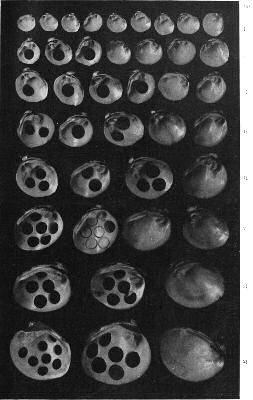
SMALL SHELLS ACTUALLY MARKETED. ALL EXCEPT THOSE OF THE THREE LOWER ROWS
SHOULD BE LEFT IN THE RIVERS.
[About one-half actual size, which is shown in inches at right of plate.]
Plate II
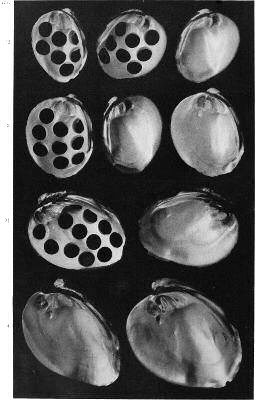
LARGER SHELLS MARKETED AND ADVANTAGEOUSLY USED.
[About one-half actual size, which is shown in inches at left of plate.]
Consequently all shells less than about 1½ inches in length, no
matter what the quality, are thrown into the discard. There can
be no difference of opinion as to the pure wastefulness of taking shells
of this size.
The shells shown in the illustration are not the smallest that could
be found. Some shells observed in the fishermen's boats were only
one-half inch in the greatest diameter. Out of the water these
are entirely without use. The fisherman who saves them, thinking
that they add weight to his heap, would doubtless be surprised to
learn that he would have to handle several times and clean 200 of
such shells to add 1 cent to his earnings, for it would take nearly
half a million of them to make 1 ton.
The shells in the fourth and fifth rows, counting from the top
in plate II, are used at the factories when received, and are sometimes
particularly favored where the quality is as good as in those
from many Arkansas rivers, and the shells will yield two or three
blanks of 16 to 20 lines. Such blanks are of a suitable thickness and
work up economically besides having a good quality. Some of the
shells in these two rows show how blanks of 18, 16, and 14 lines are
worked out, a "line" in button measure representing the fortieth
part of an inch.
The use of shells taken between 1½ and 2 inches in greatest diameter
does not, therefore, like the marketing of those under 1½ inches, represent
absolute waste, but it does denote relative waste or real short-sightedness
from the economic point of view. Shells of this size will
average about 30,000 pairs to the ton, while mussels of such a practical
size as 2½ inches will average only 15,000. The number of blanks obtained
from a ton of shells of the latter size would be just the same as
from a ton of the smaller shells, notwithstanding that only half as
many shells are handled. We are thus, when using the smaller shells,
depleting the mussel beds at twice the necessary rate without any
corresponding advantage.
There is given below a table that will repay careful examination
as illustrating the wastefulness of using the small shells. While the
figures must be understood to be only approximate, they are based
upon careful weights and counts of a number of shells from several
localities. The shells were all "niggerheads" and were all obtained
after shipment to factories.
The first two columns show the limits of size for each lot used, the
greatest diameter being the basis of measurement.
The third column shows the approximate number of pairs of shells
composing a ton, the unit of purchase; multiplying this number by 2
would give the number of single shells per ton.
In the fourth column there is given, in the case of the critical
sizes, the number of 18-line blanks readily taken from a single shell
(which is one-half the number yielded by a pair of shells, or an individual
mussel).
The fifth column indicates the number of gross of blanks, by computation,
yielded by a ton of shells. This computation is based upon
the cutting of 18-line blanks (not the larger 20-line blanks that have
been taken from some of the larger shells in the illustration). Some
of these shells are cut excessively close to the tips, on account of
taking too many larger line blanks. It must be understood that different
sized shells are adapted for different lines of buttons. The
data herein is for comparative purposes only.
Table of Sizes, Weights, and Button Production for Niggerhead Shells
(Approximate Figures).
| Longest dimension. |
Number
of mussels per ton. |
18-line
blanks per single shell. |
Quantity
of blanks per ton. |
Refer to
illustration. |
| Greater than— |
Less than— |
| Inches. |
Inches. |
|
|
Gross. |
|
Plate I— |
| ¾ |
1 |
174,000 |
|
|
|
1st row. |
| 1 |
1¼ |
110,000 |
|
|
|
2nd row. |
| 1¼ |
1½ |
55,000 |
|
|
|
3rd row. |
| 1½ |
1¾ |
33,000 |
2 |
917 |
|
4th row. |
| 1¾ |
2 |
26,000 |
3 |
1,008 |
|
5th row. |
| 2 |
2¼ |
20,000 |
4 |
1,111 |
|
6th row. |
| 2¼ |
2½ |
15,000 |
5 |
1,042 |
|
7th row. |
| 2½ |
2¾ |
10,500 |
6 |
875 |
|
8th row. |
| |
|
|
|
} |
Gradually
diminishing
to less
than 650
per ton. |
{ |
Plate II— |
| 2¾ |
3 |
8,500 |
[B]7–8 |
1st row. |
| 3 |
3½ |
6,200 |
10 |
2nd row. |
| 3½ |
4 |
4,000 |
12 |
3rd row. |
| 4 |
|
3,200 |
14 |
4th row. |
It may be seen from the table that a marketable ton of niggerheads
could be composed of the shells of 3,200 or of 33,000 mussels,
according as the shells were 4 inches in length or only 1½ inches. As a
matter of fact, no marketed ton is ever composed of mussels of an
exactly uniform size; furthermore, the extremely large niggerhead
shells are very rare and generally not very desirable on account of
inferior quality and disproportionate waste. A ton of shells from
a region of depletion will also include a number of the smallest and
not strictly marketable shells.
Now, let us take a concrete illustration: Several counts of mussels
gathered by shellers in the white River near Clarendon, Ark., were
made in October, 1913; from these an average was taken that fairly
represents the catches being made at that time in that region. It was
found that 60 per cent by number of the shells taken were of a size
less than 2 inches in greatest dimension; also that a ton of shells
comprised 20,500 pairs, of which 12,300 were less than 2 inches. Now,
it is evident that if these smaller shells were returned to the bed
we would be depleting the bed less than one-half as fast as at present.
This would be the substantial advantage that such a size limit would
have to the mussel beds; and any advantage to the mussel beds is an
ultimate advantage to the fishermen, manufacturers, and all others
in any way dependent upon the perpetuation of the mussels. Under
the working of a 2-inch size limit, 60 shells out of every 100 then
being taken on the niggerhead beds of that vicinity would have been
thrown back. This seems to be asking a good deal, but not so much
as at first appears, for the undersized shells constitute only 38 per
cent of the weight or selling value of the shells taken.
On the other hand, both sheller and manufacturer would be saved
the trouble of handling over and over again an unnecessarily large
number of shells. A ton of shells (from the same locality) comprising
only those above 2 inches in greatest dimension would contain
about 13,000 pairs, or 37 per cent less than the number now
found in a ton (20,500), while these shells, the smallest ones being
eliminated, would produce at least 10 per cent more buttons of
corresponding sizes.
The figures given above are, of course, based upon counts and computations
of shells from a particular locality and must not be assumed
to have any general application, but the facts and principles
derived do have a universal bearing. If such a size limit as 2 inches
is adopted, the saving to the mussel beds and to the future of all
interested parties is out of all proportion to the immediate loss to
any party; and even the immediate loss is to some extent compensated
by the saving resulting from having to do with a lesser number of
shells that yield a greater number of buttons per ton.
Undeniably some temporary sacrifice is entailed, but unless it be
admitted that temporary sacrifice will be accepted, it is useless to
consider any manner of restriction for ultimate benefit.
There is one point that is brought out in the table on page 14
that merits attention from the broad standpoint of economy. In all
shells there is a proportion of unavoidable waste, since the entire
weight of the shell can not be transformed into buttons. In very
small shells we may expect an undue waste, on account of the fact that
only one or two blanks can be cut out, leaving a larger bulk of shell
in proportion to the number of blanks gained. On the other hand,
in very large shells a high degree of waste is involved because of
excessive thickness, which must be ground from the blanks, and because
of the extra weight of the discarded portion. Somewhere
between these extremes is the size of shell that yields the largest number
of blanks as compared with the waste or the weight of shell that
does not go into buttons. As shown by the data in the fifth column of
the table, the shells a little above 2 inches in size are those (for this
species) that make the best yield per ton for the small lines for which
there is the greatest general demand.
Argument might be made in favor of a higher size limit as being
still more favorable to the preservation of the mussels, but it is
sufficient to say that the economic conditions would not justify a
higher limit. At 2 inches a sufficiently severe restriction is placed
upon the fishery, and to go further would be practically to prohibit
the pursuit of shelling in so many localities that excessive hardship
would be caused.
As consideration thus far has been given almost exclusively to
the niggerhead shell, the question may well be raised, Will the same
limit apply to other species of shells? The minimum size of 2 inches
suggested can be taken as an absolute minimum, since there is no
species of any importance for which it would be too high. This
minimum would not, however, give the same degree of protection
to the larger forms, such as the washboard, the bluepoint, and the
mucket. Should a minimum size be fixed with particular reference
to any one of these varieties, it would necessarily be a good deal
higher.
In the present paper recommendation is made for this one-size
limit alone, for the following reasons:
- All conditions considered, it is the most appropriate limit that
could be designated for the niggerhead mussel, which is at present
the most important species of wide distribution, and which is, furthermore,
the species most liable to rapid extermination. This and species
closely like it, as the pigtoe, the pimple-back, and the maple-leaf,
are chiefly those that are now being taken in the very small sizes.
- The same size applies equally well to the related species just
mentioned, as well as to the "hickory-nut," or "Missouri niggerhead,"
and the "butterfly."
- The larger species, as the "washboard," "bluepoint," and
"mucket," are generally so evidently valueless in the small sizes that
shellers do not take them. At least it is not yet of observation that
particular injury is being done to these species in this way.
- To insure the least trouble of enforcement of the law, it is necessary
that a minimum size be set, below which no shells of any species
may be retained. There are many different species of commercial
mussels, and some of them so intergrade as to make exact determination
a nice matter in some cases. Distinct size limits for the different
species would introduce peculiar difficulties into the practical
workings of enforcement; it would be more troublesome to the sheller
to observe the law voluntarily, and loopholes for evasion would more
easily be found by the offender of wrong intent.
Should conditions in certain States or streams subsequently require
a higher limit for particular kinds of shells, a supplemental limit
may be fixed for designated species; but this could be done without
affecting the application of a 2-inch limit as an absolute or universal
limit below which no shells of any species could be lawfully taken.
It is desirable that few different limits should ever be used, and it
seems expedient to have but one size limit until the first legislation
shall have been tried out.
In concluding this section emphasis may be laid on the value of
certain details of legislation.
Allowable margin of undersized shells.—While it may seem desirable
that no undersized shell at any time should be taken away, nevertheless
it is necessary to make allowance for a margin of unintentional
error. Only if the shellers and buyers were to apply an instrument
of measure to each individual shell would all possibility of error be
eliminated. The sheller will naturally, after a few measurements,
come to judge by the eye, and it is desirable that the law should be
somewhat liberal, rather than too stringent in the allowance for
mistakes. There should, accordingly, be a supplemental provision
that if not more than 5 per cent of the shells by number (not by
weight) of any bushel are found to be below the size limit, the law
shall not be presumed to be violated.
Illegal possession.—To be practicable of enforcement, the law
should be so worded as to make it illegal not only to bring ashore or
to offer for sale, but also to have in possession, fresh-water mussels
or clams of a size less than 2 inches in greatest dimension. This one
provision will obviate much unnecessary expense, as well as undesirable
complications in the detection of violations and the prosecution
of offenders. Furthermore, since buyers of the shells would be
equally liable to prosecution, the effect would be to destroy the market
for undersized shells, and thus in the most effective way to restrain
the shellers from taking them.
Method of measuring mussels.—It will be noted that the method of
measure is stated as "in greatest dimension," with a view to eliminating
every possibility of uncertainty or difference of opinion. Mussels
are sometimes measured in length or width or height, but on
account of the irregular form of mussel shells these dimensions are
not always interpreted in the same way. In testing the blank-making
capacity of a shell, commercial men sometimes measure the "width
on the face"; that is, between the lateral hinge tooth and the lower
margin of the shell. This measure can of course only be taken from
an open shell, and therefore could not serve for our purpose. It is
worth while to call attention to the fact that a 2-inch shell as measured
in greatest dimension would be a good deal smaller than a
2-inch shell in commercial measurement.
An inspector would need to be equipped with an ordinary rectangular
caliper. If a shell should be found to measure more than 2
inches in any linear direction it would be considered as above the
size limit.
In addition to the provision of size limits it is strongly recommended
that certain portions of the rivers be closed for rest periods
covering several years. It might be thought that in regions of extreme
depletion the operation of a size limit would, by making the
fishery less profitable, have the effect of causing a practical rest period,
but this can not be expected, for, stimulated by the high price
of shells and the ever-present hope of making a pearl find, the local
shellers will hardly ever desist entirely from the fishery.
No better way of giving protection to mussels can be found than
that of entirely stopping the shelling upon a series of beds, although
the plan must be applied in such a way as not to reduce the supply of
mussels unduly and suddenly and with as careful regard as possible
to the established interest of communities.
Some of the conditions that make a system of closed regions particularly
advisable for the conservation of fresh-water mussels may
be briefly mentioned:
1. It has been previously stated that some of the mussels are spawning,
or with spawn, during any period of the year. Many of the
most important species are spawning during the late spring, early
and mid summer; other equally important species form their eggs
in the late summer, when they become fertilized and develop into the
glochidium stage, but the mother clam retains them in marsupial
pouches within her shell during the entire winter and even into the
summer. All species of mussels carry the eggs in the marsupial
pouches during the process of development to the glochidium stage
or longer, whether the period be for a few weeks or for a few months.
In this condition the mussels are said to be gravid. It is readily observed
that when gravid mussels are disturbed they frequently discharge
the young, regardless of whether these are mature enough to
be liberated from the parent or not; certain species, such as the niggerhead,
are particularly likely to do this.
In the commercial fishery, therefore, not only is much spawn destroyed
when large gravid mussels are captured, but it is quite probable
that other mussels, disturbed on the bottom, though not captured,
are caused to abort the young in an immature stage when they are
entirely unable to complete the development without the parent.
2. In the stage of existence immediately after liberation from the
parent, the young mussels are parasitic upon fish. We are not here
concerned with them during this period of the life history. When
they are dropped from the fish many of the young mussels do not at
once take up life in the sand or mud of the bottom, but we find them
forming delicate threads by which they hang from plants or sticks
or stones or from clam shells, and thus are kept from being washed
away or smothered in the mud of the bottom. We may imagine the
harm to these little mussels that is unavoidably wrought when the
beds are continually dragged over. In like manner, the little shells
that are just beginning to take hold in the bottom may be torn out by
the rake or hooks, to be smothered or washed away to less favorable
bottoms. It will be remembered that when mussels first begin life in
the thread stage or in the bottom if the thread stage is omitted, they
are too small to be found without a microscope.
3. One of the principal methods of capturing mussels is with the
bar and hooks dragged over a large area of mussel bed in taking a
relatively small number of shells. There is chance for these hooks to
injure many little shells when each drag, requiring a period of only a
few minutes, covers a space of bottom 16 feet wide and several hundred
feet long. Nevertheless, it is not certain that there is any
method to take its place, and any implement used will accomplish
some injury to the very youngest mussels.
In planning for the closing of portions of rivers for periods of
years consideration should be given to community needs as well as
to general economic and biological conditions. On the one hand, the
closure will be more effective in result, as well as easier of enforcement,
if the regions of closure are made very large; while, on the
other hand, making the closed regions smaller might cause less
economic inconvenience. If, for example, the entire Illinois River
should be closed to mussel fishery for a period of several years, there
might be a substantial uncompensated loss to some communities,
where there are factories employing labor to cut shells derived from
that river. On the other hand, should we divide the river up into
small sections of 2 or 3 miles in extent, some of which would be open
while others would be closed under the law, it is apparent that such
a plan would be almost impossible of enforcement. To prevent shelling
from being carried on in all these little, closed areas would require
a force of wardens and an expense entirely incommensurate
with the object to be gained.
It is held advisable to divide a river within a single State into
some four or six sections for the purpose of establishing closed
regions. One-half—that is, two or three—of these sections, taken in
alternation, could be ordered closed for a period of five years, during
which no mussel fishing at all should be allowed in the closed sections,
although it would be regularly prosecuted in the alternate portions
of the stream. It would be convenient to break a river at points
where there was a substantial community interest in the shelling.
For example, let us apply this method of dividing a stream to the
White and Black Rivers in Arkansas. Starting from the head-waters
of the Black River, we find the first center of economic interest
at Black Rock, another on the White River at Newport, and a third
at Clarendon. Now, the river might properly be broken at these
points, forming four main sections. The fishery might then be
entirely prohibited for several years from the mouth of the river to
Clarendon, while permitted from Clarendon to Newport, and again
prohibited from Newport northward to Black Rock on the Black
River, and to Batesville or other suitable point on the upper White,
while permitted from Black Rock and Batesville northward on all
the tributaries. We would have the river system divided into four
sections, which would be probably as nearly equivalent as could be
expected. Furthermore, none of the three towns mentioned would
be cut off from the local supply of shells, except in one direction.
The shellers, generally speaking, would be little affected, since, with
their house boats, they could move from one portion of the river to
another. Those shellers who do not use house boats, but are local
residents and go out only by day from their homes, would be most
affected, and it is these generally who are most in favor of closing
portions of a river. They recall how much more easily shells were
taken in past times when the shells were abundant, and they would
be willing to do something else meantime in order that the beds
may be given a rest and the shells again become numerous. Shelling
has no attraction over any other form of crude labor when the shells
are so scarce that a wage can scarcely be made.
Taking the St. Francis River in Arkansas as another illustration,
the river might be broken at Madison, Parkin, and Marked Tree.
It is true that there are not many mussels, according to report,
above Marked Tree, but the region between Madison and Parkin has
beds which may well balance the remainder of the river.
The Wabash River, Ind., is one in which the need for protection is
most evident; and this stream could be divided at Vincennes and two
other points selected with reference to their economic interest in shelling
and with regard to an equitable division of the river system.
It might seem that an ideal method of rotation would be based
upon the division of a system into six portions, only one of which
should be worked in any one year; a new portion would be opened
each year, while each territory would enjoy a rest period of five
years between successive "open" years for that particular territory.
It will be evident that such a scheme, however correct in theory,
would be entirely impracticable. The plan of keeping certain regions
closed for periods of years while other regions are worked
continuously during a corresponding period of years may have some
imperfections, but it is probably the best that can be worked out
without practically suspending the industry. Undoubtedly the plan
will work most efficiently if a proper discretion is used in its application.
The law should plainly stipulate and establish the principle of
the closure of the rivers by regions or sections, but the determination
of which specific sections are to be closed should be left for
determination after investigation by properly qualified authorities.
A comparatively simple plan may be suggested under which the
most careful consideration could be given to the local conditions
involved as well as to the rights of the State as a whole. The legislature
could authorize and instruct the proper State authorities, as
the State fish commission, to give due consideration and study to
the needs of the mussel industry and determine what portions of
the streams of the State should be closed to the mussel fishery for
a period of years. It could be further provided that, after the preliminary
determination of plans for closure, due advertisement should
be made in all regions affected and opportunity given for public
hearings in such regions, after which the commission should submit
its final recommendations to the governor of the State, who
should then issue a proclamation ordering the entire interruption
of a mussel fishery in the regions selected for closure. The original
legislative act should provide that the proclamation so made should
have the full effect of law, and should specify the penalties that
would be incurred by violations. It is desirable also that the governor,
upon recommendation of the commission, should have power
to reopen the closed regions when such action was judged necessary.
Powers of officers.—It is necessary not only that the duty of enforcement
of the law be assigned to specified State officers, but also
that they be expressly given the right to inspect and examine mussels
or shells in the boats or on land and be empowered to seize mussels or
shells held in violation of the law. It is practically impossible to
bring about convictions when the opportunity is allowed for destruction
of the evidence between the time of detection and the date of trial.
Permits for special cases.—In cases where for the purposes of investigations
it may be necessary to take small mussels, the State
officers charged with the enforcement of the law should have by law
the right to issue special permits for the taking of undersized mussels
for scientific uses and not for sale.
Expenses of mussel protection.—The plans which have been advanced
in this report can be carried out with a minimum of expense.
The simplicity of the measures would reduce the trouble and cost of
inspection to the smallest practicable figure. The assignment of the
duties of enforcement to existing State commissions or boards which
already have field deputies or wardens obviates the creation of any
special offices for execution of the mussel laws.
The question of whether steps should be taken to raise special funds
on account of the additional burdens that would be placed upon the
present boards is one that would be determined by each State in the
light of its own conditions and established customs. It would be
very undesirable to create a burdensome tax; to do so would only
react against the State, and in the end the tax would be paid by the
shellers, who are now making only a meager living, for the local
shellers would have to sell in competition with the shellers from
States where more liberal conditions prevail.
It is another matter, however, to require a nominal license fee for
the privilege of working upon the public mussel beds. Such a fee
need not be greater than $1 or $2 per season, an amount which could
be paid by anyone who wished to shell seriously. Perhaps the idea
of a fee of any kind would arouse some antagonism among a certain
class of shellers who would enjoy the public stores without return of
any kind. Some shellers favor such a license system, and the writer
believes that they must all eventually come to see that it works to
their own particular advantage in many ways. It tends to create a
class of professional shellers, besides providing the necessary means
for promoting the abundance of shells.