To the Council on Pharmacy and Chemistry:
In response to the request of your chairman we have
investigated the below-mentioned preparations and report
as follows:
Specimens of the articles were bought in different cities
in the open market, and in original sealed packages, and
were analyzed by some of us or under our direction. Each
article was examined by at least two chemists, and some
were subjected to several analyses. While certain of the
preparations are represented as being chemical compounds,
the specimens examined were all found to be mixtures, the
principal ingredient being acetanilid. The percentage proportions
of acetanilid given below are the minimum obtained
by any of the analysts.
Soda and ammonia, combined with carbonic acid, are calculated
and reported as sodium bicarbonate and as
ammonium carbonate (U. S. P.) respectively. Salicylic acid
is calculated and reported as sodium salicylate. Diluents
and other constituents than those reported were not determined.
AMMONOL
According to the analyses of the contents of the original
sealed packages as purchased, this was found to be a mixture,
and to contain the following ingredients approximately
in the proportions given:
| Acetanilid. | Sodium Bicarb. | Ammonium Carb. |
| 50. | 25. | 20. |
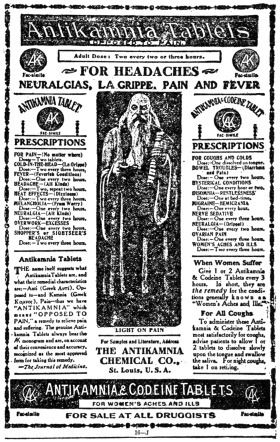
ANTIKAMNIA[B]
According to the analyses of the contents of the original
sealed packages as purchased, this was found to be a mixture,
and to contain the following ingredients approximately
in the proportions given:
| Acetanilid | Caffein | Citric Acid | Sodium Bicarb. |
| 68. | 5. | 5. | 20. |
KOEHLER’S HEADACHE POWDERS
According to the analyses of the contents of the original
sealed packages as purchased, this was found to be a mixture,
and to contain the following ingredients approximately
in the proportions given:
ORANGEINE
According to the analyses of the contents of the original
sealed packages as purchased, this was found to be a mixture,
and to contain the following ingredients approximately
in the proportions given:
| Acetanilid | Sodium Bicarb. | Caffein |
| 43. | 18. | 10. |
Other constituents said to be present were not determined.
PHENALGIN[C]
According to the analyses of the contents of the original
sealed packages as purchased, this was found to be a mixture,
and to contain the following ingredients approximately
in the proportions given:
| Acetanilid | Sodium Bicarb. | Ammonium Carb. |
| 57. | 29. | 10. |
Certain packages of phenalgin were purchased which on
analysis did not show ammonium carbonate.
SALACETIN[D]
According to the analyses of the contents of the original
sealed packages as purchased, this was found to be a mixture,
and to contain the following ingredients approximately
in the proportions given:
| Acetanilid | Sodium Bicarb. | Sodium Salicylate |
| 43. | 21. | 20. |
We recommend that this report be printed in The Journal
of the American Medical Association.
| Respectfully submitted, |
| J. H. Long, M.S., Sc.D., |  | Committee on Chemistry,
Council on Pharmacy and
Chemistry of the A. M. A. |
| W. A. Puckner, Ph.G., |
| S. P. Sadtler, Ph.D., |
| J. Stieglitz, Ph.D., |
| H. W. Wiley, M.D., Ph.D., |
(From The Journal A. M. A., June 3, 1905).
Agar-lac, said to be the product of “Agar-lac, Inc.,” is sold
by E. Fougera and Company, New York. The following
“formula” for Agar-lac is published:
“Agar-Agar with Lactic Ferments | Grs. | 41⁄2 |
Phenolphthalein | Grs. | 1⁄2” |
Regarding the “lactic ferment,” the identity of which is
not declared by the manufacturer and for the viability of
which no precautions appear to be taken, the Council’s expert
on lactic acid ferments reported that Bacillus bulgaricus was
present in small numbers only and that there were at least
two other bacteria present, one of which is a gas-former of
the Bacillus coli type.
The Council found that the amount of agar-agar in Agar-lac
and the identity of the “lactic ferment” are not declared;
that the name “Agar-lac” is blown in the glass and that the
method of its exploitation will lead laymen to use it to their
detriment; that the claims that it “facilitates assimilation
of proteids” and that it is of value as an aid to “gastro-intestinal
digestion” give a false value to the mixture and
that the claims emphasize the action of agar-agar when
from the composition it is evident that the phenolphthalein
action will predominate; that the name does not indicate its
predominating constituent, phenolphthalein, and that the use
of a ready-made combination of cathartic drugs, such as agar-agar
and phenolphthalein with lactic acid ferments, is
unscientific. The Council therefore refused recognition to
Agar-lac.—(From The Journal A. M. A., Nov. 14, 1914.)
The following reports were submitted to the Council by the
subcommittee to which these articles were assigned:
ANASARCIN
To the Council on Pharmacy and Chemistry:—Your subcommittee
to whom Anasarcin (Anasarcin Chemical Co., Winchester,
Tenn.) was assigned, herewith submits its report:
This remedy is offered in two forms: “Anasarcin Tablets,”
a pretended combination of the active principles of oxydendron
arboreum, sambucus canadensis, and urginea scilla;
and “Anasarcin Elixir,” said to contain the active principles
of oxydendron, sambucus, hepatica and potassium nitrate.
The advertisements of these articles conflict with the rules
of the Council as follows:
With Rules 1 and 2: The composition of these articles is
kept secret, in that the proportion of the ingredients is not
furnished. The statement that it contains the “active principles”
is misleading, since these are for the most part
unknown.
With Rule 6: The description of the pharmacologic action
of Anasarcin agrees practically with that of squill. No
material part of its effects can be attributed to the other
ingredients. Nevertheless, the advertisement studiously cultivates
the impression that Anasarcin has no relation whatever
to the digitalis group in which scilla is commonly placed.
The claims are therefore misleading. The claim of its infinite
superiority to digitalis, the claims that it cures neurasthenia,
eliminates uric acid in rheumatism, and is useful
in obesity, cystitis, lumbago and eclampsia, dyspepsia and
asthma, and that it works wonders in exophthalmic goiter,
appear exaggerated or false.
The recommendation of its indiscriminate use in nephritis,
for lowering the blood-pressure and the statement (contradicted
in the firm’s own literature) that it is not depressing,
are actually dangerous.
It is recommended that the articles be refused recognition,
and that the report, with explanations, be published.
ANEDEMIN
To the Council:—Your subcommittee to whom Anedemin
(Anedemin Chemical Co., Winchester, Tenn.) was assigned
herewith submits its report:
Anedemin is an evident imitation of Anasarcin. It is marketed
as tablets, said to contain the isolated active principles
of strophanthus, apocynum, squill and sambucus, chemically
combined. The quantities are not stated. The therapeutic
claims are copied almost literally from the Anasarcin circulars
and are equally false. Anedemin, therefore, conflicts
with Rules 1, 5, 6 and 7.
It is recommended that this report be published, with comments.
The reports were adopted by the Council and are herewith
published.
W. A. Puckner, Secretary.
This wonderful remedy, Anasarcin, has already been
exposed in these columns (The Journal A. M. A., Jan. 27,
1906), but it deserves additional mention, as it teaches several
important lessons of general application. It is a typical
example of the revival, under a new name and a thin
disguise, of an old, time-worn article, squill, presumably
because experience has demonstrated its general inferiority
to other drugs. Anasarcin further illustrates the dangers
involved in the use of semi-secret nostrums. It also shows
how a short experience with a widely advertised but little
understood drug is apt to lead to conclusions which more
extensive experience demonstrates to be entirely fallacious.
The first lesson is, that formulas are not always what
they seem. A hasty glance at the formula of Anasarcin
tablets, the basis of the Anasarcin dropsy cure, creates the
impression that it is a non-secret remedy; for it is said to
represent a combination of the active principles of oxydendron,
sambucus and scilla. As a matter of fact, it is
a secret nostrum of the insidious kind. A formula which
omits the quantities of its potent ingredients means very little.
Further than this, we do not hesitate to charge that
the claimed composition is a deliberate deception. The circulars
emphasize the claim that Anasarcin consists of the
isolated principles, and not of the crude drugs. Now, the
isolated active principles of sambucus and oxydendron are
not on the market, for the good and sufficient reason that
no active principles have ever been isolated. Are we to
believe that the Anasarcin Company has surpassed the
accredited chemists and has discovered such principles and is
isolating them? We shall have more to say on this subject
presently; but any one in the least familiar with the difficulties
attending the isolation of organic principles knows such
an idea to be preposterous. Indeed, it is absolutely incompatible
with the exhibition of ignorance of the elementary
facts of pharmaceutical chemistry which is given by these
people when they call the active principles of digitalis and
squill “alkaloids.”
It is an axiom that the effects of a mixture can only be
understood if the action of its components are known. So
far as we know, the physiologic effects of oxydendron and
sambucus have never been scientifically investigated, for the
simple reason that they are too slight and indefinite to
promise results. Both are credited with some slight, obscure
diuretic action. Oxydendron, the sour wood or sorrel tree,
is a small tree of the heath family, the acid leaves of which
are said to be chewed by hunters for their pleasant taste and
for the relief of thirst. Sambucus is the common elder. It
is most unlikely that these two innocuous substances should
play any part in the claimed powerful effect of Anasarcin;
they are evidently put in the formula, we do not say in the
preparation, to obscure the fact that Anasarcin is composed
principally of squill. That this is so can be gathered unmistakably
from a study of the pharmacologic action of Anasarcin
as described by its promoters:
Acting primarily on the heart and arterial systems through the nerve
ganglia, a natural physiologic balance is established between the arterial
and venous systems, whereby effusions ... are eliminated.... Coincident
with this action there is a noteworthy slowing of the pulse.... If
the remedy is pushed, can be brought down to 20 or 30
beats per minute.... Its physiological action is to stimulate the
cardiac motor-ganglia through the cardiac plexus of the sympathetic
system and at the same time exert an inhibitory influence upon the
cardiac fibers of the pneumogastric, thereby dilating the arterioles,
slowing the heart’s action, and increasing the force of the systole.... The
prolonged diastole allows the ventricle time to completely
fill, and the more forcible contraction causes the mitral valve to
close more thoroughly and at the same time increases pressure in the
coronary arteries, serving thereby the double purpose of relieving pulmonary
engorgement and increasing heart nutrition.
Anasarcin will nauseate some persons.
To appreciate fully the meaning of this description of the
actions of Anasarcin, it should be compared with the effects
of the digitalis group, to which squill belongs. The following
account is quoted literally from a recent text-book of
pharmacology (Sollmann):
The phenomena of the therapeutic stage of digitalis action
are said to be:
1. Slowing of the heart, with systole and diastole both
lengthened.
2. Increased strength of beat, leading to greater efficiency
of the individual contractions, and to an increase in the
total efficiency.
3. A tendency to the systolic phase.
4. A rise of blood-pressure, due mainly to the increased
action of the heart, but partly also to a vasoconstriction.
The therapeutic action may be explained, in part, as
follows:
A larger amount of blood will be thrown into the aorta
and coronary circulation. The first effect will be an improved
nutrition of the heart.... The tonic action ... narrows
the ring of the valves, brings them together, narrows
the orifice.... The venous congestion will tend to be
relieved. This relief ... will fall in the first place on
the lungs.... The lowering of the venous pressure will
tend to cause absorption of the effusions.
The nauseant action of squill, which is alluded to in connection
with Anasarcin, is too well known to require more
than a mention.
In brief, then, it appears from the statements of the Anasarcin
Company that the action of the remedy is that of
squill and that the other ingredients are a mere blind. It is,
of course, well known that squill can be used as a substitute
for digitalis in cardiac dropsy, although it is generally
considered very inferior to the latter drug. Rose Bradford,
for instance, states: “Squill is not used to any extent in the
treatment of cardiac disease and cardiac dropsy, digitalis
being a far more efficient and less toxic substance.” However,
it has been frequently observed that digitalis occasionally
fails, and it may then be replaced successfully by
another member of the group. At all events, it is very likely
that squill is a fairly efficient substitute for digitalis, especially
when it is supplemented by a very free course of
Epsom salts and by potassium nitrate (the active ingredient
of Anasarcin Elixir), both of which are stated to be essential
adjuvants to the Anasarcin (or squill) tablets. There
can be no objection to the use of squill when it is indicated;
but any one who wishes to use it should do so with his
eyes open, knowing what substance he is using and how
much (which he does not in Anasarcin); knowing also that
it has the same indications and limitations as digitalis. He
should not be misled by such statements as the following:
“Does what dropsy medicaments have hitherto failed to accomplish.”
“Superior to digitalis, strophanthus, scoparius, squills, acetate of
potash and the hydragogue cathartics all put together.”
“The only known relief [how modest!] and permanent cure of
dropsies.”
“Unrivaled heart tonic.” “The most powerful agent known.”
Any one wishing to use squill should take the trouble to
acquaint himself with the results obtained by competent and
independent observers, and not rely on it in eclampsia, septicemia,
“vices of civilization,” all forms of neurasthenia, as
“an active eliminator of uric acid in rheumatism,” in hepatic
cirrhosis, dyspepsia, asthma, obesity, cystitis (!), lumbago,
exophthalmic goiter, etc.
He should also learn the contra-indications to the use of
squill, deducible from the fact that it causes vasoconstriction
and raises the blood-pressure (prohibiting its use in Bright’s
disease and arteriosclerosis), and that it produces marked
gastric irritation, consequently nausea and depression, that it
is a very toxic agent, and that the dangers of cumulative
action must be borne in mind. In respect to these the advertisements
of the Anasarcin people are little short of criminal,
for these state:
“Safe in administration.” “Non-toxic as ordinarily administered.”
“Will nauseate some persons,” but “the reaction from the temporary
depression is prompt.” “In Bright’s disease, both the interstitial and
parenchymatous forms of nephritis, acute or chronic, no remedy ... to
equal it in efficacy.” “Without increasing the debility of the patient
or interfering with nutrition by producing loss of appetite....”
“This treatment is to be continued without cessation until all symptoms
of dropsy have disappeared.”
Physicians who are inclined to disregard this warning, and
who follow the advice of the Anasarcin people, should
remember that their patients—or their friends—will put the
blame for the results, which are bound to follow sooner or
later, on the prescribers, and not on the deceptive advertisements
of the Anasarcin Chemical Company.
There is another little matter which throws an illuminating
side-light on the Anasarcin Company. They take every occasion
to say that Anasarcin is “not offered to the laity,”
“never sold to the laity,” etc.; but witness the following,
which was found in the Retail Druggist of May, 1906, p. 179.
The italics are ours.
CURE FOR DROPSY.
“As every druggist knows, dropsy has been one of the incurable
diseases when caused either from heart, liver or kidney trouble. A
pharmacist in Winchester, Tenn., has worked out a remedy called
Anasarcin, which he is exploiting to the physicians, and his remedy is
showing itself as possessing great merit. Several hopeless cases have
been treated as a last resort by Anasarcin and in a very short time the
patient has shown marked improvement and has effected permanent cures.
“The result of the cases as handled by the physician with the aid of
Anasarcin has been so easily and quickly cured that physicians of
Tennessee and the southern states are high in their praises of the
remedy. The company which now manufactures and sells it is known
as the Anasarcin Chemical Co., of Winchester, Tenn. Any druggist
who knows of a case of dropsy would be conferring a favor on the
patient and mankind in general by telling the party or his physician of
the southern pharmacist, and we have no doubt but what a prompt
relief and permanent cure would be affected.” [Probably means
effected.—Ed.]
If we are disposed to doubt the vaunted scientific ability
of the Anasarcin Company, we are forced to admire their
business methods, at least, if there is any truth in the saying
that imitation is the seal of success. Anasarcin has had
this rather undesirable compliment paid to it, for its native
town of Winchester has given birth to another remedy,
Anedemin, which looks like a fair-haired twin brother. The
Anedemin Company has adopted Anasarcin almost bodily.
The name—“opposed to edema”—is about as close as the
copyright laws permit. The pharmacologic and therapeutic
claims agree almost literally with those of Anasarcin and
contain the same exaggerations and dangerous misstatements.
There is the same emphasis on free purgation with
Epsom salts. The dose is the same. Both are marketed at
$2.00 for a box of 100—only the Anedemin people have
adopted the prize package device of throwing in 20 or 30
tablets extra, for good measure, and give a discount of
75 cents or so.
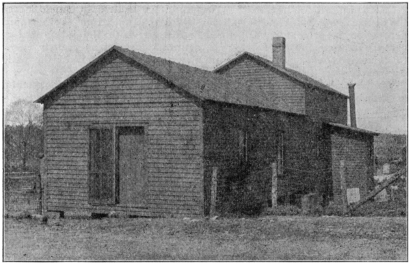
Laboratory and Warehouse of the Anasarcin Chemical Company,
Winchester, Tenn.
In short, the Anedemin Company has appropriated all of
Anasarcin which they considered of any value. It is, therefore,
rather suggestive that they drew the line at the formula.
Anasarcin is said to contain squill, sambucus and
oxydendron; Anedemin discards the oxydendron and reinforces
the squill with strophanthus and apocynum. Notwithstanding
this material change in composition, the actions
are described as identical; this is again rather suggestive.
The Anedemin Company, like the Anasarcin Company,
scorns crude drugs and claims to use only the isolated principles.
It was saved the trouble of discovering active principles
for strophanthus and apocynum, for these are known;
but it managed to find some scope for its inventive genius,
“both drugs being so chemically treated and disposed as
to absolutely eliminate all objectionable and disagreeable
properties and effects” so as to convert a vasoconstrictor
action into a dilator action; so as to render them non-toxic
and non-cumulative; so as to deprive apocynum of its characteristic
nauseant effect. Who can say that the days of
miracles are past? Even this is not the limit of Anedemin
alchemy; if we are to believe their claims, they have succeeded
in forcing strophanthin, apocynum, scillain, etc., to
combine with each other: “It is a definite chemical compound
of the active principles” of these drugs! This makes the
achievements of Emil Fischer in synthesizing sugars and
proteids appear as mere child’s play.
Since the formulas were completed, however, clinical
reports have been numerous enough—almost too numerous,
if we are to believe them. Anedemin has been on the market
for less than three years; the circulars emphasize that testimonials
and endorsements are not solicited. Nevertheless,
we are told that it is “endorsed by over fifty thousand clinicians
throughout the United States.” Since the total number
of physicians in the United States and Canada is only
about 128,000, this means that nearly every second physician
has endorsed Anedemin. The Anasarcin Company solicits
endorsements and they seem to do the larger business.
Hence the majority of physicians of the United States must
have written an endorsement of either Anedemin or Anasarcin,
or both. Or is this statement another “invention”?
It is a little peculiar that nearly all the endorsements come
from small towns in sparsely settled districts; practically
none from the centers of population. Does this mean that
dropsy is more common in the rural communities than in
the cities?
THE INVENTORS OF ANASARCIN AND ANEDEMIN
Even the newspapers, when they tax our credulity with
pretended scientific “discoveries,” feel the moral obligation
of justifying themselves by telling us something of the
personality and experience of the discoverers. We may
ask, therefore, who are these expert pharmaceutic and synthetic
chemists, these manufacturers of active principles,
these skilled clinicians of wide experience, who have “intelligently
built up the formula by wide application”? What
are we told of these men who ask us to believe, on their
mere assurance, in miracles and feats of magic; who tell
us that they have converted neutral principles into alkaloids,
that they have effected definite chemical compounds between
these neutral principles, that they have discovered principles
that do not exist, that they have changed the actions
of these principles to suit their wishes, that, in short, they
have reversed the laws of Nature?
These companies are located in Winchester, Tenn., a town
of about 1,500 inhabitants, situated in an agricultural country.
The town boasts of neither scientific schools, colleges,
universities nor laboratories. The Anasarcin Company was
organized in 1902, the incorporators and directors being Dr.
John W. Grisard and his sons, Dr. John P. Grisard, B. A.
Grisard, and A. F. Grisard, and Will E. Walker, all of
Winchester. Dr. John W. Grisard seems to be the originator
and promoter of Anasarcin. W. E. Walker is an insurance
solicitor of Winchester and is not actively identified
with the business. We are informed that he owns but a
single share of stock having a face value of $100, and that
he was added to the company in order to comply with the
laws of Tennessee, which require five directors for any corporation.
Dr. John W. Grisard, the father, has practically
retired, but still has a general supervising interest in the
business. There is no regularly licensed pharmacist or
chemist connected with the company. The office is in the
rear of a jewelry store in the business part of Winchester
and on the second floor above. According to our reporter,
an office force of about ten stenographers and clerks handles
the correspondence and labels and sends out the preparation
which is made in a crude frame building located on
a side street and without laboratory equipment. According
to our reporter, the work is done by the Grisards and a
colored man.
The Anedemin Chemical Company was organized in 1905
with a capital of $20,000, the incorporators and directors
being Dr. T. B. Anderton, Floyd Estill, J. J. Lynch, J. M.
Littleton and I. G. Phillips, all residents of Winchester,
and all lawyers with the exception of Dr. T. B. Anderton.
A Mr. Gordon, a clerical employee of the company, is
reported to have active charge of the business, to prepare
the medicine and conduct the correspondence. The office
headquarters, laboratory and complete outfit of the Anedemin
Company comprises two rooms over the law office of Estill
& Littleton. No one connected with the company is a
regularly licensed pharmacist or graduate chemist.
Of the six physicians located in Winchester, three (50 per
cent.) are engaged in the dropsical cure business. Poor
Winchester! Aside from their connection with these two
nostrums, these physicians may be estimable and worthy
citizens, but where, pray, did they find the extensive clinical
facilities and pharmaceutical knowledge necessary for their
wonderful and epoch-making discovery? Were they aided
in their scientific work by the four lawyers connected with
the Anedemin Company or by the insurance solicitor who
is a director of the Anasarcin Company? Did the 1,500
inhabitants of the town furnish the vast clinical material
necessary for discovering and working out the formulas of
these two preparations? If so, we fear that dropsical affections
are much more prevalent in Winchester than in any
other known spot on the globe. This matter should be
investigated. Without doubt the vital statistics of Franklin
County would be most interesting and we commend them
to the special attention of the medical profession in
Tennessee.—(From The Journal A. M. A., May 4 and 11, 1907.)
The report which appears below was submitted by a referee
and after adoption by the Council was sent to the manufacturer
for comment, in accordance with the Council’s regular
procedure in such cases. The manufacturer’s comments
were transmitted to a second referee, who reported that after
a careful consideration of the manufacturer’s reply he saw
no valid reason for a modification of the report. The referee
also reported that a visit to the Maignen Institute further
served to convince him of the viciousness of the treatment
as given and that the records made by the persons in the
employ of the institute were too inadequate to serve as clinical
evidence. On the referee’s recommendation, the report as
originally adopted was reendorsed by the Council and authorized
for publication.
W. A. Puckner, Secretary.
Maignen Antiseptic Powder is marketed by the “Maignen
Institute for the Study of Bacterial Diseases,” Philadelphia.
It is claimed to be a mixture of calcium hydroxid, sodium
carbonate, aluminum sulphate and boric acid, but no statement
as to the amount of the several constituents is furnished.
Its action depends on the sodium hydroxid which is formed
when the powder is treated with water, 1 Gm. of the powder
as now submitted to the Council yielding 0.32 Gm. of sodium
hydroxid (NaOH) and a specimen obtained a year ago
yielding 0.28 Gm. Its promiscuous use is recommended both
to physicians and to the public with claims which are
extravagant, preposterous and even dangerous.
A pamphlet, clearly intended for the laity, entitled “What
Is Catarrh?” gives direction for the “sterilization” of the
nose, throat, stomach, lungs, eyes, gums, mouth and the
genito-urinary tract. The following, taken from this pamphlet,
illustrates the absurdity of the claims made for
Maignen Antiseptic Powder:
“STERILIZATION OF THE STOMACH
“Take of the Maignen Antiseptic Powder half the quantity raised
on a dime, scant.
“ADD to a tumbler of water, preferably warm, and stir.
“Drink slowly.
“This is what may happen:
“1). Belching may be the first indication of the sterilization of the
stomach.
“2). The excess of acidity is corrected.
“3). The fermentation is stopped.
“4). The sterilization extends to the Intestinal Tract.
“5). The bowels are regulated without purgation.
“6). The whole metabolic process is improved.
“When and how often to drink the antiseptic solution.
“a). For Indigestion, whenever distressed, before or after meals.
“b). For Constipation, half an hour before breakfast or last thing at
night.
“c). For Gastro-Intestinal troubles, such as Typhoid Fever, Dysentery
and Cholera, which are the most serious forms of catarrhal inflammation,
take half a tumbler or a whole tumbler of hot water with half
the quantity of Powder raised on a dime every hour, and between
times a glass of generous [sic] wine.
“Remarks
“The sterilization recommended here is a plain disinfecting process
which does not interfere with medical treatment. It is, on the contrary,
of great assistance to it.
“It has been found very effective in breaking up the cigarette habit.
It does away with the craving by removing the morbid irritation of the
mucous membrane.”
Eighty-eight disorders are listed in a pamphlet entitled
“Antiseptic Therapeutics” all of which are reported as having
been treated with success. The dangerous character of the
Maignen “sterilization” propaganda is illustrated by a pamphlet
“First Aid to Baby-Sick” and by the recommendation
on the trade package:
“To prevent Blood Poisoning, Lockjaw, Hydrophobia and Infectious
Diseases.”
The legend on the trade package and the advertising
matter contained in it are likely to lead the public to place
dependence on a weak sodium hydroxid solution as a means
of preventing blood-poison, lockjaw, hydrophobia and infectious
diseases. The pamphlet “First Aid to Baby-Sick”
recommends its use in sore eyes, teething and sore mouth,
sore throat, running ears, running nose, sore chest, summer
complaint, skin troubles and infection after vaccination; if
any trust is put in these claims, they are bound to lead to
the sacrifice of many infants through neglect of proper
treatment.
Patent No. 1,086,339 has been granted on this powder to
P. J. A. Maignen of Philadelphia by the U. S. patent office
on the following specification of claim made in the application:
“1. A process for destroying microorganisms on living tissue, without
injuring the latter ... whereby the growth of such organisms is
inhibited and their substance dissolved without deleterious effect upon
contiguous healthy tissue.”
With brazen assurance this grant has been twisted by the
unscrupulous promoters into a government endorsement of
the preparation. It, of course, means nothing of the sort, as,
no doubt, in accordance with legal routine the patent was
granted without any investigation by the patent office to
determine the effectiveness of the powder for the purpose
claimed.
In view of the dangerous, unwarranted and absurd claims
made for Maignen Antiseptic Powder the referee recommends
that it be refused recognition, and that the Council declare
its agreement with views expressed in the article “Maignen
Pulv.” published in The Journal, Feb. 15, 1913, p. 537, particularly
the following:
“The germicidal powers of strong alkalies have long been known,
but the inconvenience of their application to tissues and mucous membranes
has prevented their use. That they will be of service when
sufficiently diluted not to irritate the tissues is improbable, for the antiseptic
power of such solution is slight and the disinfectant value practically
nil.”
Because the Maignen Institute has twisted the granting
of U. S. patent No. 1,086,339 into a quasi-endorsement of the
claims made for Maignen Antiseptic Powder it is recommended
that a copy of this report be sent to the Commissioner
of Patents as a protest against the present law, which
authorizes the granting of patents on unproved and improbable
medical claims.—(From The Journal A. M. A., Nov. 14,
1914.)
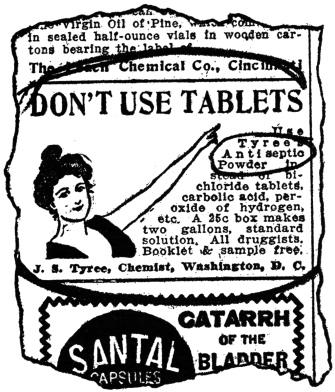
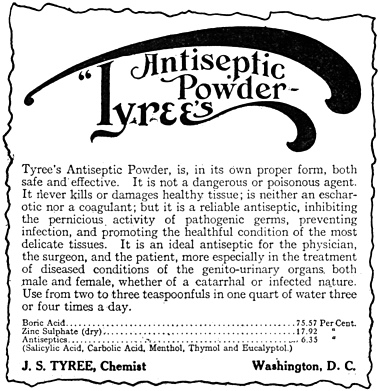
Tyree’s antiseptic powder was assigned for examination to
a subcommittee of the Council, which made the following
report:
To the Council on Pharmacy and Chemistry:—Your subcommittee,
to whom was assigned Tyree’s Pulv. Antiseptic
Comp., marketed by J. S. Tyree, Washington, D. C., reports
as follows: The label on the package states: “This
preparation is a scientific combination of borate of sodium,
alumen, carbolic acid, glycerin and the crystallized principles
of thyme, eucalyptus, gaultheria and mentha, in the
form of a powder,” etc.
The statement that the powder contains the crystalline
principles of thyme, eucalyptus, gaultheria and mentha is
vague and misleading, since the chief medical constituents
of eucalyptus and gaultheria are liquids, but it tends to
convey the impression that the powder contains the essential
constituents of these drugs, namely, thymol, oil of eucalyptus
or eucalyptol, oil of wintergreen, or methyl salicylate, and
menthol.
The literature supplied to physicians claims its composition
to be: “Parts, sod. bor., 50; alumen, 50; ac. carbol., 5;
glycerin, 5; the cryst. principles of thyme, 5; eucalyptus, 5;
gaultheria, 5, and mentha, 5.”
The composition, therefore, might be expressed as follows:
Sodium borate (borax) | 50 parts, or | 38.46 | per cent. |
Alum | 50 parts, or | 38.46 | per cent. |
Phenol (carbolic acid) | 5 parts, or | 3.85 | per cent. |
Glycerin | 5 parts, or | 3.85 | per cent. |
Thymol | 5 parts, or | 3.85 | per cent. |
Oil of eucalyptus or eucalyptol | 5 parts, or | 3.85 | per cent. |
Oil of gaultheria (or methyl salicylate) | 5 parts, or | 3.85 | per cent. |
Menthol | 5 parts, or | 3.85 | per cent. |
Analysis of specimens purchased from different sources in
the open market were made under our direction. The reports
of the chemists show that Tyree’s antiseptic powder contains
no borax, or mere traces only, and that it contains no
alum, or mere traces only. Instead, the analyses show that
boric acid and zinc sulphate are the essential constituents.
The amounts of carbolic acid, thymol, menthol, etc., contained
in the powder, if present, were far below the quantities
indicated by the formula. The presence of glycerin could
not be demonstrated, and, if present, the amount must be
very small.
One chemist reports: The result of analysis shows that
different samples differ slightly in composition, but that the
following indicates the average composition of the product:
| Per Cent. |
Zinc sulphate, anhydrous | 15.56 |
Boric acid | 81.26 |
Volatile matter at 100° C. for four hours | 0.45 |
The undetermined portion consists of salicylic acid, carbolic
acid, menthol and eucalyptol; possibly other antiseptic
agents may be present in very minute quantities.
From the above findings we conclude that Tyree’s antiseptic
powder is a mixture of boric acid and dried zinc
sulphate and antiseptic bodies, such as menthol, salicylic
acid and carbolic acid, eucalyptol, etc. From this it can be
readily seen that the label, which is supposed to set forth
the composition of Tyree’s antiseptic powder, is not in accord
with the facts. The powder does not contain either borate
of sodium or alum, and the presence of glycerin could not
be established. The antiseptic agents, exclusive of the boric
acid, are present only in small amounts.
The report of another analysis concludes as follows:
It evidently contains less than the amount stated of the
principles of thyme, eucalyptus, wintergreen and mint. It
also contains a very small amount indeed of carbolic acid,
much less than that stated. We have been unable to identify
certainly the presence of glycerin, and it is doubtful if it
be present.
From the result of the analysis we feel confident that the
preparation is to all intents and purposes a mixture of boric
acid and sulphate of zinc.
The carbolic acid, thyme, eucalyptus, wintergreen, etc., if
present, are present only in sufficient amount to give the
compound a satisfactory odor.
In view of the fact that J. S. Tyree has given wide publicity
to a formula which the preceding report has shown
to be a deliberate misrepresentation of facts, it is recommended
that the article be refused recognition by the Council
on Pharmacy and Chemistry, and that this report be
published in The Journal of the American Medical Association.
The recommendation of the subcommittee was adopted by
the Council in accordance with which the report is published.
W. A. Puckner, Secretary.
Mr. Tyree, in a letter to Dr. Simmons (which he states he
writes at the request of Dr. Kebler of the Drug Laboratory
of the Department of Agriculture, though he is under no
moral or financial obligation to do so), says that it has been
his intention to inform the medical profession of his reasons
for changing the formula of Tyree’s Antiseptic Powder from
an alum and borax base to a boracic acid and zinc base.
He states that this change was made at the suggestion of
prominent physicians connected with hospital clinics on nose
and throat, venereal and other conditions and that he has
had in contemplation the omission from the label of the
various conditions to which the preparation is applicable.
Mr. Tyree, it will be seen, assumes the right to sell to
physicians a preparation with a descriptive formula which
he acknowledges is false, and he presumes to use his own
pleasure as to the time when he will inform them of its true
composition.
Mr. Tyree does not state when he changed the formula.
We do not know whether it was a year ago, five years ago
or ten years ago, but we do know that the package which
was used in making the first analysis was purchased as
early as last February, and the first chemist’s report was
submitted to the Council March 5, 1906. On April 4 Mr.
Tyree was notified by the Council that the composition of
Tyree’s Antiseptic Powder did not correspond to the formula
published by him.
Whether or not Mr. Tyree is justified in offering our profession
a preparation as composed chiefly of borax and
alum when in reality it is chiefly composed of boric acid
and zinc sulphate, we leave physicians to judge.
A report from the Council on Pharmacy and Chemistry on
Tyree’s Antiseptic Powder appeared in The Journal, Oct.
20, 1906. This showed that the preparation, advertised as
a “scientific combination of borate of sodium, alumen, carbolic
acid, glycerin and the crystallized principles of thyme,
eucalyptus, gaultheria and mentha, in the form of a powder.”
was essentially a mixture of boric acid and sulphate of zinc—approximately
four-fifths of the former to one-fifth of the
latter. “The carbolic acid, thyme, eucalyptus, wintergreen,
etc., if present, are present only in sufficient amount to give
the compound a satisfactory odor.” As will be remembered,
in the correspondence published at that time, Mr. Tyree
attempted to explain the discrepancies between his statements
and the proved facts by intimating that he had recently
changed the formula, and that it was his intention “on or
about the first of February to state to the medical profession
his reasons for changing the formula,” and that the
change had been made “a short time ago, at the suggestion
of several prominent gentlemen.” Since that time, through
circulars and other advertisements, Mr. Tyree has attempted
to explain the matter in various ways. In his latest circular
letter he seems to make a deliberate attempt to mislead
our profession and to misrepresent facts to a degree that
makes it almost impossible to believe that the circular came
from a man who claims to be honorable.
First, however, we shall take this opportunity to publish
some matter which we have had in reserve since the first
exposé was made last October. When it was realized that
Mr. Tyree intended to defend himself by claiming that a
change had recently been made in the powder, we took
occasion to try to secure some of the preparation that had
been on the market for a long time. In this we succeeded
very well. From a Chicago druggist one package was
bought which had been in the store at least since July, 1902—how
much longer is not known. The druggist from whom
the powder was obtained bought the drug store in July,
1902, and this powder was on hand at that time, none having
been bought since. This particular powder was analyzed
by a chemist, who found the composition practically the
same as that given in the Council’s report, this chemist estimating
that it contained approximately 81 per cent. boric
acid and 14 per cent. anhydrous zinc sulphate. Bearing in
mind that for at least four years and ten months Tyree’s
Powder has been essentially the same as it is today, this
letter is very interesting: (The comments in brackets are,
of course, ours.)
“J. S. TYREE,
“Chemist,
“WASHINGTON, D. C.
“April 16, 1907.
“Dr. ————,
“——,
“My Dear Sir:—Doctors and medical publications of
extreme and prejudicial minds often hold and express opinions
in honorable faith, but like all critics, they are not
always familiar with the conditions composing their opinions,
and are often given to expressing them without knowledge
of the true motives and facts in the case.
“If you will read an article that appeared in one of the
medical weeklies some time ago [The Journal of the American
Medical Association, of course] and which has been
copied by several of its offsprings [not many we regret to
say] relating to Tyree’s Antiseptic Powder, you will see that
I had previously informed the editor as well as his council
of investigators, that at the suggestion of prominent physicians,
extensive clinical experimenting [sic] were being made
with some slight [! ! !] changes in my powder, the object
being to develop and extend its usefulness in new lines
[It had already been recommended for about everything2]
and at the same time make it more acceptable to the general
run of the profession. I also notified this editor that these
investigations would not be completed until the first of the
present year, after which time these slight [! ! !] changes
in the formula of Tyree’s Powder would be announced.
[It is now the middle of May; when and where were the
changes announced?3]
“There is nothing new, startling or dangerous in such
changes in formulas. The Pharmacopeias and national
books of authority are continuously improving their formulas.
It is the same with every preparation on the market.
[Mr. Tyree, as a nostrum maker, is in a position to know.
His plea evidently is: “I am no worse than others.”] The
apparent difficulty in my case is caused by my exceptional
frankness [“exceptional frankness” is good under the circumstances]
with the profession in telling them [when and
where?] about this improvement before I was ready to
announce full details and particulars, or place my improved
[sic] powder on the market.
“Yours very truly,
“J. S. Tyree.”
For years Mr. Tyree has been misleading physicians by
making false statements regarding the composition of his
powder and regarding its value as a therapeutic agent. When
exposed he tries to defend himself and his business by statements
and excuses that are worthy of a schoolboy trying
to get out of a bad scrape. We would respectfully suggest
to him that he either take his wonderful powder off the
market, or—which would probably amount to the same
thing—tell the truth, and the whole truth, about it.—(From
The Journal A. M. A., May 18, 1907.)
Apergols, put out by H. K. Wampole Co., Inc., is alleged
to be a “Uterine Stimulant.” Apergols is apparently an
inversion of the name Ergoapiol and the preparation appears
to have essentially the same formula, namely:
Apiol | 5 | min. |
Oil Savine | 1⁄2 | min. |
Ergotin | 1 | gr. |
Aloin | 1⁄8 | gr. |
Aromatics | q. s. |
As in Ergoapiol, the constituent referred to in the formula
as “Apiol” appears to be oleoresin of parsley-seed instead of
the definite substance apiol described in New and Nonofficial
Remedies. In general the claims made for Apergols are the
same as those made for Ergoapiol (see p. 82). The Council
refused admission to Apergols because they are advertised
indirectly to the public, because of unwarranted therapeutic
claims, because of the non-descriptive name and
because the product is unscientific.—(From The Journal
A. M. A., Dec. 12, 1914.)
Aseptikons are vaginal suppositories sold by the Chinosol
Co. of New York. Each suppository is said to contain:
Ac. Salicylici | 2 | gr. |
Ac. Borici | 10 | gr. |
Quin. purae (Alkal.) | 1 | gr. |
Chinosol | 2 | gr. |
But. Cacao | 60 | gr. |
The following claims appear in advertisements:
“These suppositories are indicated in cervicitis, leucorrhea, specific
and non-specific vulvo-vaginitis and in all cases where complete vaginal
antisepsis is desired.”
“Non Toxic, Non Irritating; No Damage to Membranes. Yet a More
Powerful Antiseptic than Bichloride.”
The Council decided that the foregoing claims in the
absence of evidence must be held exaggerated and likely to
mislead, and also that the claim “Stronger than Bichloride”
which appears on the box is misleading.
The position of the Council is that “In the case of pharmaceutical
preparations or mixtures the trade name must be
so framed as to indicate the most potent ingredients.” The
name Aseptikons does not give any indication of the ingredients
of the product.
The Council holds that “The combination of two or more
remedies in a mixture must be considered contrary to scientific
medicine unless a distinct reason exists for such combination.”
No evidence has been submitted to establish the
value of the combination in Aseptikons.
On the basis of the evidence submitted the Council voted
that Aseptikons be refused recognition because unwarranted
and misleading therapeutic claims are made, because the
name does not indicate its potent constituents, and because
the combination of two or more remedies in a mixture is considered
contrary to scientific medicine unless a distinct reason
exists for such combination.—(From The Journal A. M. A.,
Nov. 14, 1914.)
Betul-ol (E. Fougera and Co., New York) is a methyl
salicylate preparation advertised to physicians (and indirectly
to the public) as an external analgesic and anti-rheumatic.
The statements regarding its composition are
vague, misleading and, as shown by examination in the
Chemical Laboratory of the American Medical Association,
untrue. The therapeutic claims are based on discarded
theories. Although the alleged superiority of natural over
synthetic salicylates has been disproved, physicians are
urged to use Betul-ol because it contains, or is alleged to
contain, a natural salicylate. Another discarded theory is
pressed into service in the claim that the chloral in the
mixture will be absorbed and converted into chloroform in
the blood. The recommendations for the use of Betul-ol in
rheumatism are likely to lead the public to the self-treatment
of rheumatism. In view of the serious complications and
sequelae of rheumatic fever this recommendation is utterly
unjustifiable and a danger to public health—even if the
external application of this mixture in uncertain doses were
as effective as a proper internal use of salicylates—a theory
contrary to experience and unsupported by adequate evidence.
The Council therefore refused recognition to Betul-ol.—(From
The Journal A. M. A., Dec. 12, 1914.)
The Council has authorized publication of the following
reports on Peacock’s Bromides and Chionia, sold by the
Peacock Chemical Company, St. Louis.
W. A. Puckner, Secretary.
PEACOCK’S BROMIDES
This is another nostrum of the ordinary mixture type. Of
the various statements concerning composition furnished by
the company, the following gives as much information as
any:
“In Peacock’s Bromides it is designed to unite fifteen grains of the
purest bromides of Potassium, Sodium, Ammonium, Calcium and
Lithium, in such proportion as to insure the bromine equivalent of
potassium bromide. Each fluid drachm about equals, in medicinal
strength, fifteen grains of potassium bromide.”
The label on the trade package indicates the presence of
10 per cent. of alcohol. It will be observed that the proportions
of the different bromids are not stated. Hence, the
assertion of the Peacock Chemical Company that “there is
nothing secret in this compound” cannot be true. A physician
prescribing it cannot know how much of each ingredient
he is giving; it may be 141⁄2 grains of potassium bromid
and 1⁄8 grain each of sodium, ammonium, calcium and lithium
bromid, or any other of an enormous number of possible
permutations of the proportions.
While the theoretical basis of bromid medication is not
yet fully settled, the weight of the best pharmacologic
authority and clinical experience is decidedly against the
dogmatic claim of the Peacock Chemical Company that “the
best result is obtained by prescribing a combination of
bromides.” And if there were any advantage in prescribing
such a combination, the physician ought to regulate the
proportions.
The following quotations are from the advertising matter:
“Being uniform in purity and therapeutic power, it can be relied upon
to produce clinical results which it is believed cannot be obtained from
the use of commercial bromide substitutes.”
“The purity, quality and constant uniformity of this high grade
product have long made it a standard bromide preparation.”
These claims are unfounded. The analyses published in
the concern’s own advertising “literature” show a variation
of 8 per cent., in the bromid content, which certainly indicates
a sufficient lack of uniformity.
Again quoting:
“In order to insure the best results the bromides must be pure, i. e.,
free from alkalies and almost free from chlorides. The U. S. P. allows
three per cent. of chlorides. Peacock’s Bromides contains the least
possible amount of this impurity. Bromism is therefore less frequent
in those cases in which this preparation is employed.”
In view of the claim of low chlorid content, it is interesting
to note that the analyses above referred to show that the
chlorid content is actually higher than that of some other
bromid preparations on the market.
The claim of merit on the ground of freedom from chlorids
is, of course, absurd, and must be regarded as an attempt to
play upon the credulity of the doctor. As a matter of fact,
the average individual takes with his food many times the
amount of chlorid he could possibly take in contaminated
bromid. The 10 per cent. of alcohol would undoubtedly have
a greater disturbing influence on the bromid action than the
amount of chlorid that might be present in any bromid on
the market.
Then we have the statement that, owing to this freedom
from chlorids:
“Bromism is therefore less in those cases in which the preparation
is employed.”
Sodium chlorid, even as an impurity, would retard rather
than favor the development of bromism; sodium chlorid is
even used as an antidote in bromid poisoning.
The therapeutic claims lay stress on the value of the
bromids in sleeplessness, epilepsy, sexual excitement, tetanus,
infantile convulsions, chorea, delirium tremens, the climacteric,
migraine, headache due to pelvic conditions, ovarian
neuralgia, etc. These and other claims, while too vague to
be branded as falsehoods, are misleading and not in accordance
with modern teaching or practice; the latter recognize
the limitations of bromid therapy as well as its scope and
advantages. For instance, in epilepsy the company asserts
that:
“Large doses must be given if we expect to control the convulsions.
We are to be guided by the frequency and the severity of the seizures,
the saturation of the system by bromides and by the age of the patient.
The rule is ‘large doses for long periods but with occasional periodic
monthly or quarterly omissions.’ When we have succeeded in controlling
the convulsions in so far as greatly diminishing the frequency and
severity of the attacks we may then attempt to decrease the dose, but
the results must be carefully watched. Increase in frequency of convulsive
seizures is a sign that the bromides must again be pushed as
before.”
The best modern clinical teaching concerning the treatment
of epilepsy is that bromids should be avoided except as a last
resort. Bromids do not cure, and the amount necessary to
control the convulsions may produce a degree of mental
hebetude that is a greater evil than the disease itself.
It is recommended that the preparation be held ineligible
for admission to N. N. R., because of its conflict with Rules
1, 4, 6 and 10 of the Council, and that this report be published.
CHIONIA
Chionia, according to the statement of the Peacock Chemical
Company, which exploits the product, contains 19 per
cent. alcohol and is “A Preparation of Chionanthus
Virginica.”4
This preparation is advertised particularly as “a potent
hepatic stimulant” and special claims are made for it in
various disturbances of the liver:
“Chionia is very well adapted in the treatment of hepatic congestion
owing to its specific action in depleting the portal circulation.”
In passive congestion of the liver, the manufacturers
would have us believe
“... we have a drug in Chionia that will stimulate the circulation
of the blood and lymphatics of the liver as well as stimulate its physiological
activities and instead of the patient vomiting the blood an internal
depletion of the liver occurs.”
“... in cases of simple jaundice due to circulatory (congestive)
changes in the liver, Chionia is the drug ‘par excellence’ that will
rapidly cause a disappearance of this symptom.”
As a prophylactic against eclampsia, if a history of torpidity
of the liver is obtained:
“CHIONIA should be used during the major portion of child-bearing
period because it acts directly on the liver stimulating its functional
activity.”
Chionanthus virginica has never been shown to have the
slightest pharmacologic activity and no evidence is presented
that its offspring, Chionia, has any therapeutic value whatever
in any disturbance of the liver. The promoters themselves
indicate a lack of faith in their own preparation, for
they advise the use of old and efficient forms of treatment
along with Chionia—heart tonics and laxatives in passive
congestion of the liver, mercurial purge or podophyllin and
sodium phosphate in “biliousness,” and quinin in malaria.
Finally, with delightful English and elaborate insouciance,
they advise in the treatment of eclampsia:
“In all cases the uterus should be emptied as quick as possible. (Version
of Cæsarian Section.)”
The physician who prescribes Chionia promotes a fraud.
The Council held Chionia ineligible for admission to
N. N. R.
[Editorial Comment: In Peacock’s Bromides and Chionia
the Peacock Chemical Company has, for a third of a
century, been foisting on the medical profession nostrums
composed of drugs that are easily combined in any proportion
that the physician may want to prescribe. The company
has been inflicting on the unthinking physician pseudo-scientific
rubbish in the form of advertising literature that
should long ago have been regarded as an insult to the
intelligence of the medical profession. The following medical
journals are carrying advertisements of Peacock’s Bromides
and Chionia:
| Alienist and Neurologist | Medical Fortnightly |
| American Journal of Surgery | Medical Herald |
| American Medicine | Medical Record |
| Archives of Pediatrics | Medical Review of Reviews |
| Atlanta Journal-Record of Medicine | Medical Sentinel |
| Buffalo Medical Journal | Medical Standard |
| Charlotte Medical Journal | Medical Summary |
| Chicago Medical Recorder | Medical Times |
Denver Medical Times and Utah Medical
Journal | Medical World |
| Nashville Journal of Medicine and Surgery |
| Eclectic Medical Journal | New Orleans Medical and Surgical Journal |
| Ellingwood’s Therapeutist | New York Medical Journal |
| Indianapolis Medical Journal | Pacific Medical Journal |
| International Journal of Surgery | Southern Practitioner |
| Lancet-Clinic | Texas Medical Journal |
Louisville Monthly Journal of Medicine
and Surgery | Texas Medical News |
| Therapeutic Gazette |
| Maryland Medical Journal | Wisconsin Medical Recorder |
| Medical Brief | Woman’s Medical Journal] |
| —(From The Journal A. M. A., April 3, 1915.) |
The following report was submitted to the Council by a
member of its Committee on Therapeutics, with the recommendation
that publication be authorized. This recommendation
was adopted.
W. A. Puckner, Secretary.
Bromidia (Battle & Co., St. Louis) at once suggests
bromids; yet Bromidia is essentially a chloral rather than a
bromid preparation. This nostrum illustrates the need of
the provision in the Council’s Rule 8 under which recognition
is refused pharmaceutical mixtures whose names do not
indicate their most potent ingredients. While the chloral
content of Bromidia has been given considerable publicity,
yet the preparation is used both by physicians and by the
public without due consideration of its potent ingredient.
This fact is attested not only by the fatal results which have
followed its use but also by the many reports of habit formation.
As long ago as in 1887 a fatal case of poisoning was
reported5 to the medical society of the District of Columbia
due to an overdose taken by a Bromidia addict. The physician
who reported this case also gave his experience with
another patient who had the Bromidia habit. In the discussion
of the paper a number of cases were reported by others
present in which Bromidia had been taken without a physician’s
advice and with more or less grave symptoms of
poisoning.
In the report of a death of one who had been a slave
to Bromidia it was said:6 “When the body was found, there
were eleven one-ounce Bromidia bottles about the room or
on his person. Nine were entirely empty and the other two
were about half full. None of these bottles indicated that
they had been purchased on a physician’s prescription, only
the druggist’s label marked ‘Bromidia’ being on them.”
Dr. Horatio C. Wood, Jr., gave7 a striking illustration of
how preparations like Bromidia come to be used even by
physicians without consideration of their constituents:
“Within an hour after his father, a Brooklyn physician, had given
him a dose of bromid, H.G.P., a prodigal son, died yesterday at his
father’s home in Brooklyn. Two years ago, when he appeared to have
sown his wild oats, the father made him superintendent of his country
place, near Grants Mills, Delaware County. A week ago the son left
his place, and at 1 o’clock yesterday morning appeared at his father’s
Brooklyn home. He was nervous, and at 9 a. m. begged for a sedative.
“‘I prescribed the usual quantity of bromidia,’ the young man’s
father told a reporter. ‘He was weak and had suffered from weak heart
and kidney trouble for some time.’
“An hour later the father found the son dying and administered
restoratives, but to no avail.”
A circular, “The Advantages of Bromidia,” makes it plain
how physicians come to use a preparation like Bromidia
without consideration of its potent constituent. In this circular
the presence of chloral is at first frankly admitted,
then it is suggested that in the combination the evil effects
of chloral are completely eliminated and in the end the
impression is left that Bromidia is practically innocuous.
Thus at the beginning while arguing that Bromidia is better
than extemporaneous preparations the chloral content is
plainly acknowledged:
“In the untoward effects so frequently attending the use of extemporaneously
prepared mixtures of chloral and the bromides, may be
found the reason for BROMIDIA’S preference when the need for a hypnotic
agent arises. Were it not for the well known disadvantages of these
drugs which become still more marked with their continued use, there
could be no special need for such a preparation as BROMIDIA (Battle),
for the therapeutic powers of chloral and the bromides are among the
most positive facts in medicine.”
Again:
“It was to meet the growing professional demand for a combination
of chloral and the bromides with their evil effects eliminated, that led
to the manufacture of BROMIDIA (Battle).”
Then, suggesting the indiscriminate use of Bromidia—as
an entity as Dr. Wood suggests—the claim is made that:
“... its constituents have been chosen with a view of enabling
Bromidia to meet every requirement for an agent of its class.”
“Owing to the exceptional purity of its component parts and its freedom
from untoward effects when continued over long periods, this
product will be found of the highest utility in epilepsy.”
“... its action is that of chloral and the bromides minus their
evil effects.”
Finally Bromidia becomes a simple bromid preparation.
Thus an advertisement reads:
“Bromidia’s (Battle) Marked Sedative and Antispasmodic Qualities
eminently fit it for the treatment of Maniacal Excitement, Epilepsy,
Spasmodic Asthma, Convulsive Seizures of Reflex Origin, Sexual Neuroses,
and other disorders attendant upon nervous irritability.
“Through its exhibition, the fullest therapeutic power of the bromides
may be secured with a minimum of their evil effects; a feature of the
greatest service when the necessity for continued treatment becomes
necessary.”
In addition to the general invitation to use Bromidia in
epilepsy and various nervous disorders, a circular also
recommends its use in typhoid, a recommendation, which, if
followed, may turn the scale in favor of a fatal result. The
circular states:
“As a soothing agent in the extreme restlessness and irritability of
typhoid fever and other infectious diseases, BROMIDIA (Battle) is a
therapeutic weapon of definite service. Relief of the headache of
typhoid may also be secured through the use of BROMIDIA (Battle). By
means of its administration for the above purposes, the patient’s
strength is conserved and as a result he is much better prepared to
stand the force of the infection.”
Particularly vicious is the recommendation that it be
given to children. Thus, in a pamphlet entitled “Effective
Drugs Effectively Combined”:
“Another point of advantage to be found in bromidia is the ease
with which it is borne by children. Owing to this tolerance, it is of
distinct service in a considerable list of disorders of childhood. Thus,
of course, employed with care and an understanding of its potency,
bromidia has a field of usefulness in chorea, laryngismus stridulus, and
whooping-cough. In other nervous disorders of childhood—those
attending acute infections, for instance—bromidia is a definitely indicated
therapeutic aid, owing to the soothing influence exerted by even
a moderate dose and the absence of untoward effects. More specifically,
the correcting influence of bromidia in the night-terrors of children
may be mentioned.”
Formerly advertisements asserted that each fluidram of
Bromidia contained:
“Chloral hydrate | 15 | grains |
“Potassium bromid | 15 | grains |
“Extract of Cannabis indica | 1⁄8 | grain |
“Extract of henbane | 1⁄8 | grain” |
This formula also appears on the label of a sample package
sent through the mails during 1914. A recent circular
contains a somewhat different formula. Instead of “1⁄8 gr.
each of gen. Imp. Ext. Cannabis Ind. and Hyoscyam.” as
was formerly claimed, each fluidram of Bromidia is now
said, not to “contain” but to “represent,” not the extracts
but the far less potent drugs “Cannabis indica 1⁄8 grain,
Hyoscyamus 1⁄8 grain,” thus:
“Chloral hydrate | 15 | grains |
“Pot. brom. | 15 | grains |
“Cannabis indica | 1⁄8 | grain |
“Hyoscyamus | 1⁄8 | grain” |
Furnishing still greater variety, the labels on a recently
purchased bottle of Bromidia, where under the Food and
Drugs Act the presence of narcotic drugs must be declared,
read:
“Alcohol 10 per cent., Chloral Hydrate, 91 grs. per ounce. Cannabis
indica indeterminate in finished product.”
“In the manufacture of BROMIDIA to each drachm of fluid used are
added 15 grains of pure chloral hydrate and purified brom. pot., and
1⁄8 grain each of gen. imp. ext. cannabis ind. and hyosciam.”
These various statements as to the composition of Bromidia
leave one very much “in the air.” As chloral and potassium
bromid are easily determined and since lying on the labels
of widely exploited proprietaries has become somewhat
risky recently, it is probable that the statements on the trade
package are to be depended on and that each fluidram of
Bromidia contains something like 12 grains each of chloral
and potassium bromid and not 15 grains as the medical profession
has been and is being told.
Pharmacists who have attempted to put up a nonproprietary
preparation similar to or, more correctly, having
the alleged composition of Bromidia have found it practically
impossible to do so. The reason is that extract of
cannabis indica is almost insoluble in a menstruum such as
that found in Bromidia. The National Formulary, first edition,
listed Mistura Chlorali et Potassii Bromidi Composita
of which it was said: “Each fluidram contains 15 grains
each of Chloral and of Bromid of Potassium, and 1⁄8 grain
each of Extract of Indian Cannabis and Extract of
Hyoscyamus.” In this the pharmacists attempted to incorporate
the cannabis indica by using the tincture of the drug and
suspending it by the addition of tincture of soap bark. In
the present edition of the National Formulary, the preparation
is made by triturating the extract of cannabis indica
with pumice stone and then filtering the finished product.
This gives an “elegant” preparation—but one from which
the cannabis indica is filtered out! A sad commentary on
the National Formulary. It should not be supposed, however,
that the manufacturers of Bromidia have solved the
problem that has baffled the pharmacists; not at all. Bromidia
probably contains no more cannabis indica than does
its National Formulary prototype. The statement on the
present trade packages, that the amount of cannabis indica
in Bromidia is “indeterminate,” is but a tardy acknowledgment
of the fact that the stuff has not, and never had, the
amount of cannabis indica claimed for it for so many years.
The “indications” named on the Bromidia labels are, in
common with nostrums of this type, but suggestions for self-drugging.
They will appeal to the layman who has purchased,
either by prescription or otherwise, an “original
package” of Bromidia and who may imagine he suffers from
“nervousness,” “sleeplessness,” “headache” or “neuralgia.”
But while the manufacturers in their advertising matter
have on the whole not disguised the presence of chloral so
much as they have attempted to make it appear that the
chloral has been robbed of its dangers—for all hypnotics if
used thoughtlessly are dangerous—after all the name has
created the false impression that Bromidia is a bromid
preparation. It is because of this false impression carried
by its name, that Bromidia came to be used indiscriminately
by the profession and in the course of time still more
indiscriminately and recklessly by the public. Bromidia is
a vicious chloral preparation masquerading under a misleading
name. That physicians have been impressed by the
claims of its harmlessness and by the mystery connected with
the formula is not a credit to the intelligence of our profession.
There is no doubt but that physicians are responsible
for the use and abuse of this chloral preparation by the
public.
There is no scientific or rational excuse for a ready-made
preparation of this sort. When chloral or a bromid is indicated
the proper dose of each of these, if they are to be combined,
should be determined for each patient. Potassium
bromid and chloral hydrate both are readily soluble in water,
syrup or elixirs and it is a simple matter to prescribe the
required dose of chloral and of bromid dissolved in some
aromatic water like cinnamon-water (Aqua Cinnamomi), in
some syrup like syrup of orange (Syrupus Aurantii) or in
an elixir like the aromatic elixir (Elixir Aromaticum)
or adjuvant elixir (Elixir Adjuvans). If this mixture is
prescribed thus the physician is alive, alike to the dangers
and the limitations of the drugs; if it is prescribed under a
misleading proprietary name, the physician endangers his
patient, stultifies his profession and tends to perpetuate the
great American fraud.
[Editor’s Note.—A list of some of the medical journals that
advertise Bromidia:
| Texas Medical News | Southern Practitioner |
| Nashville Journal of Medicine & Surgery | New Orleans Medical & Surgical Journal |
| Medical Brief | Therapeutic Gazette |
| Annals of Surgery | Medical Herald |
| Charlotte Medical Journal | Medical Times |
| Medical Sentinel | Texas Medical Journal |
| Memphis Medical Monthly | Wisconsin Medical Recorder |
| Laryngoscope | International Journal of Surgery |
| Medical World | Vermont Medical Monthly |
| Medical Review of Reviews | Atlanta Journal-Record of Medicine |
| Louisville Monthly Journal | St. Paul Medical Journal |
| Indianapolis Medical Journal | Hospital Bulletin of the University of Maryland |
| Monthly Cyclopedia & Medical Bulletin | Denver Medical Times |
| Journal of Nervous & Mental Diseases | Buffalo Medical Journal |
| Maryland Medical Journal | Medical Review |
| Merck’s Archives | Ellingwood’s Therapeutist |
| Iowa Medical Journal | Eclectic Medical Journal |
| Medical Standard | Massachusetts Medical Journal] |
| —(From The Journal A. M. A., May 16, 1914.) |
The Council voted that cactus grandiflorus should not be
accepted for New and Nonofficial Remedies, and that a statement
be prepared for The Journal giving the reasons for
this action. Accordingly the following report has been
adopted by the Council and its publication authorized.
W. A. Puckner, Secretary.
The therapeutic value of this plant has been variously
estimated by different observers. Experimental evidence as
to its action is scanty and no complete chemical examination
has ever been made.
Reputable men have testified that some of the plants of
the cactus family contain very active principles, but so
far experiments seem to prove that cactus grandiflorus has
neither the action of digitalis nor that of strychnin. The
principal contributions, clinical and experimental, for and
against the drug, are set out below.
EXPERIMENTAL EVIDENCE
O. H. Myers8 worked with a product which he calls cactina
and which he regards as the active principle of the drug.
(As no such substance as cactina is described in any materia
medica, it is impossible to state what Myers really used.)
He found that it had a strychnin-like action and raised
the blood-pressure.
Hatcher comes to the conclusion: “Either Myers’ work
was a pure fabrication or he was dealing not with cactin
but with a substance similar to the pellotin of Heffter, the
action of which resembles that of strychnin to a certain
extent.”
E. Boinet and J. Boy-Teissier9 experimented with an
aqueous extract, an alcoholic extract, and with an alkaloid
which they call “cactine.” They concluded from three sets
of experiments on frogs that extract of cactus produces, in
ten minutes, a temporary increase in the heart’s action which
frequently repeated doses are required to maintain; and
that large doses slow the heart and produce arrhythmia.
L. E. Sayre10 experimented with a preparation of cactus,
made from the stem of the plant, by injecting it into the
dorsal lymph space of the frog. There was seemingly an
increase in the amplitude of the heart’s action and an
indication of a strengthened beat or increased force.
R. A. Hatcher11 states that it is possible that cactus grandiflorus,
under certain conditions, may contain a principle with
a strychnin-like action. But Hatcher made ten experiments
on frogs, four on cats, six on dogs, two on rabbits, and one
on a guinea-pig, with Cactina pillets of the Sultan Drug
Company and the Cactin of the Abbott Alkaloidal Company.
From 1 to 15 pillets in frogs and up to 25 in dogs were
used at each dose. In no single instance was there any
evidence of a digitalis-like or strychnin-like action, or, in
fact, of any decided action of any kind whatever.
Gordon Sharp12 was unable to obtain either alkaloid or
glucosid from the plant, but found a series of resins that
caused contraction of the blood-vessels of a frog. This was
not a digitalis-like contraction, but depended, he believed,
on simple acidity. On the heart of the frog the resins have
little or no effect, comparisons being made with digitalis
in the same animals. There is no proof that cactus grandiflorus
itself shortens diastole, or in fact, that it has any
special action on the heart muscle at all. Sharp experimented
on himself with large doses of an extract made
with alcohol 1 to 5, but got no noticeable results. He thinks
that the plant may have some slight diuretic action.
Sayre submitted the preparation which he used in his
experiments for more careful testing to E. M. Houghton,
who reported that it had practically no action on the heart.
In commenting on Houghton’s results, Reid Hunt said
that they were confirmed by his own experiments. He did
not deny, however, that the drug might have some therapeutic
effect and that, in very large doses, it did affect the kidneys.
S. A. Matthews13
found one preparation of cactus (cactin—Abbott)
absolutely inert so far as any effect on the heart
is concerned. He found that cactina (Sultan Drug Co.) in
very large doses depressed both the circulation and respiration.
In this regard it differs from strychnin, and it has
no resemblance to the action of digitalis, strophanthus or
any of the heart stimulants. A dose of from 10 to 12 pillets
administered intravenously to a 10 to 12 kg. dog exerted
little or no influence on the heart or circulation; the larger
dose may cause a slight fall in blood-pressure. When 70 or
more pillets were administered within two and a half hours
the animal generally died.
The work of Boinet and Boy-Teissier also has been criticized
by Hatcher on the ground that their most positive
results were obtained with an alkaloid which no one at
this day is able to prepare. The results quoted in this
report, however, were obtained by the use of extracts of
cactus so that it does not seem that they should be entirely
rejected, whatever their value may be.
CLINICAL EVIDENCE
Clinical observations have been more abundant than exact,
and a favorable action of the drug in some organic diseases
of the heart has been reported; other observers would limit
its use to functional arrhythmia, insisting that it is not a
substitute for digitalis or aconite, but that it occupies a place
distinct from either of those remedies.
P. W. Williams14 recommends cactus for functional heart
disease, but, as a rule, found it useless in organic disease.
He thinks it one of a class of remedies which act on the
accelerator nerves and sympathetic ganglia, shortening the
diastole and stimulating the spinal vasomotor nerve centers.
Williams apparently relied on Myers for his knowledge of
the pharmacologic action, and his paper is a fair example
of the clinical studies of cactus.
Ellingwood15 claims that cactus is a cardiac tonic, acting on
the accelerator nerves and heart ganglia, increasing muscular
force and arterial tension. He recommends it in both organic
and functional diseases.
Boinet and Boy-Teissier found that therapeutic doses of
40 drops of tincture of cactus were without effect on the
normal heart. In patients with noisy asystole (asystolie
bruyante) the same dose produced no appreciable effect. In
the period of latent non-compensation of true cardiac
patients, from 80 to 100 drops a day increased the force
of the failing heart. In patients with secondary heart disease
with arrhythmia of nervous origin, daily doses of 80,
100 and 120 drops of the tincture were well tolerated for
weeks; they seemed to increase the fulness of the pulse
and regulated its rhythm. In spite of such large doses,
these observers never noticed any symptoms that could be
attributed to a cumulative action. It must be remembered
that the precise preparation of cactus which they used is
not known.
Aulde16
recommends it as a cardiac tonic free from cumulative
effects.
Gordon Sharp says: “The therapeutics of the subject,
I think, are clear enough. Cactus grandiflorus cannot be
included in our list of cardiac drugs. It is not even a
simple stomachic tonic and at most all one can say is that
it has small diuretic action.”
Hatcher says: “Clinical testimony is so conflicting that
between the extreme views of Gordon Sharp and those of
Ellingwood there is room for an honest difference of opinion
concerning cactus grandiflorus.”
Matthews himself took 100 granules of cactin (1⁄67 gr.—1 mg.
each), 25 every four hours, without experiencing the
least effect.
CONCLUSIONS
Reliable conclusions regarding the therapeutic use of cactus
grandiflorus are rendered difficult on account of several
factors.
1. It is uncertain what part of the plant contains the
active principle if one exists; and its nature is unknown.
The National Standard Dispensatory states that its “activity
must be confined to the flower in some special stage of its
development or to a certain part of it or to some parts
gathered with it.” This uncertainty may explain the negative
results obtained by some observers, but it makes the
drug one that cannot be generally relied on and gives an
excellent opportunity for the exploitation of proprietary
preparations.
2. Some of the experimental work and much of the clinical
evidence has been obtained and published under proprietary
auspices. For this reason many of the therapeutic claims
made for the drug must be viewed as merely the reflection
of the exaggerated statements made by the advertisers of
proprietary preparations.
3. The value of clinical evidence when unsupported by an
animal experimentation is much diminished by the tendency
of enthusiastic and untrained observers to attribute to the
drug given the effect really due to general remedial measures,
psychic suggestion and so forth. While it must be admitted
that valuable remedies may exist whose therapeutic properties
cannot be revealed by animal experimentation, yet
in the absence of such experimental evidence conclusions
should be drawn with extreme caution.
Bearing these conditions in mind, the following statements
seem to be justified: (a) The botanical, chemical and pharmaceutical
properties of cactus are not sufficiently determined
to make any available preparation a reliable remedy.
(b) There is some evidence that cactus may be capable of
affecting the animal heart and nervous system, but its action
is not that ordinarily attributed to it. It does not increase
the force of the heart-beat. (c) While there is some clinical
testimony as to its usefulness in functional diseases of the
heart, the indications for its administration are at present
too uncertain to afford a safe basis for recommending it.
4. While the drug may be deserving of further experimental
and clinical investigation, this should be carried on
in reliable pharmacologic laboratories and in clinics provided
with facilities for exact observation.—(From The
Journal A. M. A., March 12, 1910.)
In response to inquiries and in view of the extensive
advertising propaganda, the Council, on Dec. 19, 1913, took
up for consideration Calcreose (Maltbie Chemical Company,
Newark, N. J.). Examination showed that the preparation
contained, in loose combination, approximately equal weights
of creosote and lime. The claims made in the advertising
“literature” were extravagant and uncritical, and the Council
therefore held Calcreose ineligible for New and Nonofficial
Remedies.
In June, 1914, at the request of the Maltbie Chemical Company,
the Council undertook a reconsideration of the preparation.
The advertising claims were now found more conservative.
Before the existing claims could be judged, however,
the Council deemed it necessary to require from the company
satisfactory proof (1) that the large doses of Calcreose
recommended and administered actually furnish large
amounts of creosote to the blood, and (2) that patients taking
these large doses do not suffer from digestive disturbances,
loss of nutrition, albumin in the urine or phenol urine, as
claimed. The Council accordingly advised the company of
this requirement, at the same time stipulating that nothing
in the report should be interpreted as indicating a belief on
the part of the Council that enormous doses of creosote are
necessary for, or will promote a cure of tuberculosis.
The Maltbie Chemical Company has not up to the present
date furnished this proof, but has evinced a disposition to
make the Council’s holding Calcreose under advisement
appear in the guise of a quasi-approval. It is therefore
recommended that Calcreose be refused recognition for conflict
with Rule 6.—(From the Journal A. M. A., June 26, 1915.)
The following report was submitted to the Council on
Pharmacy and Chemistry by the subcommittee to which
Campho-Phenique had been assigned:
To the Council on Pharmacy and Chemistry:—Campho-Phenique,
sold by the Campho-Phenique Co., St. Louis, Mo.,
is claimed to be composed of phenol 49 per cent., and camphor
51 per cent.
Examination of specimens, purchased in the open market,
made under our direction, demonstrates that the statements
made in regard to the composition are not true. Instead of
containing 49 per cent. of phenol (carbolic acid), the analysis
showed that it contains not more than 20 per cent. Instead
of containing 51 per cent. of camphor, the analysis demonstrates
that the amount of camphor is not more than 38 per
cent. Besides phenol and camphor, a third substance was
found which proved to be liquid petrolatum and to be present
to the extent of 38 per cent. or more.
Since the statements made in regard to the composition
of Campho-Phenique are deliberate misrepresentations of
the facts, it is recommended that the article be not approved.
Besides Campho-Phenique, the above-mentioned firm also
sells a preparation labeled Campho-Phenique Powder. While
no statement in regard to the composition of this product is
made on the label or in the literature, such expressions as
“Campho-Phenique in a powdered form” and “Powdered
Campho-Phenique” lead to the inference that it has essentially
the same composition as that stated for the liquid
preparation. An examination of a specimen of Campho-Phenique
Powder purchased in the open market showed that
92 per cent. of it was a talcum-like inorganic substance.
The remaining 8 per cent. consisted chiefly of camphor with
a small amount of phenol.
In view of the fact that Campho-Phenique Powder contains
very little phenol, but instead consists chiefly of an
inorganic talcum-like substance, its name is misleading and
deceptive. It having been shown that Campho-Phenique
Powder corresponds to a camphorated talcum powder, the
claims that it “has no equal as a dry dressing,” that it is
“absolutely superior to iodoform,” and that it has “all the
excellent properties of aristol and iodoform,” are unwarranted.
It is recommended that the article be not approved,
and that this report be published.
The recommendations of the subcommittee were adopted
by the Council, and in accordance therewith the above report
is published.
W. A. Puckner, Secretary.
The above report on a much advertised “ethical” proprietary
medicine is worthy of the thoughtful consideration
of the members of the medical profession, as it illustrates
admirably some of the conditions connected with this proprietary
medicine business.
THE FORMULA A FAKE
First, it illustrates the fact that the published formulas
of the “ethical” proprietaries are not always reliable. The
Campho-Phenique Company has been very willing to give
out a formula, purporting their product to be 51 per cent.
camphor and 49 per cent. phenol (carbolic acid). Now,
these two drugs will make a liquid mixture, and any druggist
can make it, and the mixture will have about the same
consistency and appearance as Campho-Phenique. But its
effect differs decidedly from that of Campho-Phenique. Some
months ago a very intelligent physician, in discussing the
proprietary medicine business, said that in some cases physicians
could not get druggists to make preparations which
were as satisfactory as those which could be bought ready-made.
He cited Campho-Phenique as an illustration. He
said that he had used this preparation for burns, etc., but
as he did not like to use preparations put up by companies
about which he knew nothing, he asked his druggist to
make the mixture in accordance with the published formula.
The druggist’s preparation was not satisfactory; it had a
decidedly different effect from Campho-Phenique, and so
he tried another druggist. This druggist also followed the
published formula, but his results, too, differed materially
from the proprietary article.
The various analyses that have been made show why the
preparations put up by the druggists did not resemble that
made by the company; since, according to the analyses,
Campho-Phenique consists of 40 per cent. liquid petrolatum,
which is an inert but soothing diluent, while instead of
49 per cent. of carbolic acid, as claimed, it really contains
less than 20 per cent. This is an entirely different proposition.
Now, if the physician referred to above will have
his druggist make a mixture of 20 per cent. of carbolic
acid, 40 per cent. of camphor and 40 per cent. of liquid
petrolatum, and will then compare this resulting compound
with Campho-Phenique, he will find that there is not much
difference. Furthermore, he will realize that there is nothing
either new or wonderful about the preparation. Camphorated
oil and carbolized oil are both in common use.
Campho-Phenique is apparently simply a mixture of the two.
THE POWDER STILL WORSE
So much for the liquid. The powder seems to be something
entirely different, for, according to the chemist’s report,
over 90 per cent. of it is inert, absorbent, talcum-like
material. There is enough camphor and carbolic acid to
give the powder an odor and thus mislead physicians,
especially those who are in the habit of taking for granted
that whatever statements nostrum manufacturers make are
true. Perhaps it is a fairly good dressing for wounds—at
least it will do no harm—but its name is misleading and
deceptive. For all practical purposes it is essentially a
camphorated talcum powder.
COMPANY A “PATENT-MEDICINE” CONCERN
The second interesting phase of this “ethical” proprietary
is that it illustrates another point, i. e., that many of these
articles are supplied to our profession by those who are not
legitimate manufacturing pharmacists. The Campho-Phenique
Company of St. Louis, according to all reports, is owned
and controlled by a gentleman named Ballard. This “company”
supplies the medical profession with the preparations
under consideration and also with Chloro-Phenique and
Scrofonol. We are informed that this same Mr. Ballard
is the principal owner, if not the sole owner, of quite a
number of “patent-medicine” companies, such as Ballard-Snow
Liniment Co., Brown’s Iron Bitters Co., Mayfield
Medicine Mfg. Co., Smith Bile Beans Co., Swain’s Laboratory,
and several others. We learn from the wholesale drug
trade lists that these various “companies” make and sell,
besides the Campho-Phenique preparations, Ballard-Snow
Liniment, Ballard’s Herbine, Brown’s Iron Bitters, Dr.
Herrick’s Pills, Richardson’s Life-Preserving Bitters, Smith’s
Bile Beans, Swain’s All Healing Ointment, and several
other “patent medicines.”
It is hardly necessary to make any further comments. The
whole business is nauseating to those who know the actual
conditions of this nostrum business and how our profession
is being deluded. The Campho-Phenique matter is not
an exception; it is simply another illustration of these
conditions.
The majority of “ethical” proprietaries are foisted on our
profession, either without any formula accompanying them,
or with a “formula” that is a fake. The majority of the
“ethical” proprietaries are manufactured and supplied to
physicians, with instructions regarding their use, by men
who bear the same relation to legitimate pharmacy that
the veriest quack that ever swindled a credulous public
bears to scientific medicine.—(From The Journal A. M. A.,
April 20, 1907.)
The following reports on products of the Rio Chemical
Company have been submitted by a referee. The Council
recommends that they be published, as the preparations
discussed are glaring instances of nostrums exploited through
physicians on unscientific claims and false representations.
W. A. Puckner, Secretary.
Celerina belongs to what Samuel Hopkins Adams calls
the “bracer” type of nostrum. According to the label it contains
42 per cent. alcohol (whisky contains about 50 per cent.).
The other ingredients of Celerina are declared to be as
follows:
“Each fluidounce represents Forty grains each Kola, Viburnum,
Forty-eight grains Celery, Twenty grains Cypripedium, Sixteen grains
Xanthoxylum and Aromatics.
“Dose—1 or 2 teaspoonfuls 3 times a day.”
Kola contains a very small percentage each of caffein and
theobromin. It is impossible for the infinitesimal amounts
of these alkaloids in an ordinary dose of Celerina to produce
any physiologic effect.
Viburnum has been called a “uterine sedative,” whatever
that may be. Its only real activity is the psychic one due to
its taste and odor.
Celery at one time was credited with being both an antispasmodic
and a nerve stimulant—a remarkable combination
of opposing qualities! Scientific investigation has failed to
show that celery has any physiologic or therapeutic activities.
If it had the slightest medicinal value, the rational course
would be to prescribe it in its fresh and natural state. The
small dose contained in a teaspoonful of Celerina is inappreciable
and not even equivalent to that contained in a stalk of
celery.
Ladyslipper, more imposing under the Latin name of
“cypripedium,” is a flowering plant with a legendary reputation
as an “antispasmodic and nerve stimulant.” It has
been in the therapeutic scrap-heap for years. It contains a
little tannic acid, gallic acid and a volatile oil. Even a
tannic acid action cannot be expected from a teaspoonful of
a preparation containing 20 grains of ladyslipper to the
ounce.
Prickly ash (xanthoxylum) has never been shown to have
any activity other than that of a local irritant, especially to
mucous membranes. The slight “bite” from this drug would
be entirely covered up by the alcohol in Celerina. Any stimulating
effect which this drug may have on the stomach is
greatly inferior to that produced by a very small glass of
ordinary ginger ale.
In short, there is no ingredient in Celerina, except the
alcohol, that has any recognizable activity; and the alcohol
content is nearly as great as that of ordinary whisky. Some
of the claims and recommendations for this nostrum are:
“Celerina (Nerve Tonic), for Nervousness, Hysteria, Insomnia,
Nervous Indigestion, Languid and Debilitated Conditions, Recovery
from Alcoholic Excess.”
Think of prescribing an alcoholic nostrum four times a day
to promote recovery from alcoholic excess!
“NEURASTHENIA: The bane of the general practitioner; the puzzle
of the neurologist; the juicy fruit of the quack and faddist; the opportunity
of the intelligent therapist.... For the medical treatment
CELERINA is the preparation of wide utility.”
The sang froid with which the exploiters of this nostrum
refer to other “quacks and faddists” as reaping “juicy fruit”
from neurasthenics would command admiration were it not
so pitiful.
“Celerina has substantial endorsement in nervous disorders characterized
by Aphonia (nervous).”
Of course, the disappearance of nervous aphonia might
follow the application of any treatment whatever, be it Eddyism,
Chiropractic, Peruna or Celerina.
In
“CLIMACTERIC (the Menopause) flattering results have been
reported from a combination of equal parts Celerina and Aletris Cordial
Rio.”
“Teaspoonful doses after meals and upon retiring have proven efficacious
[in “dyspepsia”] when other remedies have failed.”
Here is a good example of proprietary-house therapeutics:
Such widely different conditions as digestive trouble and the
climacteric are to be treated with a combination of alcohol,
simple bitters and aromatics! Why not order a cocktail
under its own name? It would be equally efficacious, less
mysterious and its dangers might be better realized!
“A teaspoonful or two in three tablespoonfuls of boiling hot water
[for insomnia] upon retiring.”
Any other hot toddy at bedtime (and it need not cost
a dollar a bottle) might give relief; but the intelligent physician
to-day recognizes the danger of prescribing alcohol in
such conditions.
“In the case of brain workers who suffer from nervous excitability
and mental fatigue, the administration of Celerina in teaspoonful doses,
three times a day and at bedtime, rapidly controls the condition and
increases mental capacity.”
And the same effect follows its use:
“In cases involving worry, anxiety, overwork, and excesses of various
kinds....”
Moreover:
“Celerina is the most prompt and efficient of remedies for devitalized
or broken-down constitutions—doses four times a day.”
The statement made by its manufacturers that this preparation
is free from narcotics or habit-forming drugs is not
true. Alcohol is both a narcotic and a habit-forming drug.
As in the case of other nostrums containing no potent drugs
but alcohol, Celerina is recommended for various diseased
conditions in combination with a familiar form of treatment
by drugs of more or less value. The physician who thoughtlessly
prescribes one of these combinations will without
doubt unthinkingly attribute any subsequent improvement to
the Celerina. Thus, for malaria, a prescription of quinin and
Celerina is advised; for chorea in children, arsenic with
Celerina; in “Convalescence from La Grippe,” strychnin
sulphate, Fowler’s solution, and Celerina; for impotence, nux
vomica, dilute phosphoric acid and Celerina. In none of
these conditions would Celerina affect favorably anything
except the pockets of the exploiters; in some, as in the chorea
of children, the alcohol would be positively detrimental. Of
course, the value of such prescriptions (so far as they have
any apart from the fictitious value lent by the alcohol) resides
altogether in the standard drugs prescribed with Celerina.
There is no possible excuse for writing a prescription for
Celerina, either in original package or mixed with well-known
or valuable drugs. The sooner it is realized that this preparation
has no place in medicine, should never be prescribed
by physicians and is essentially nothing but alcohol and bitters
exploited under a fancy name, the better for the public
health and the science of medicine. The continued sale and
use of Celerina is a disgrace to the medical profession.
Aletris Cordial is a nostrum containing therapeutically
worthless drugs in alcohol (28 per cent.).
The “formula” on the label reads:
“Each fluidounce represents ten grains Aletris, thirty grains Helonias
and thirty grains Scrophularia.”
At one time these drugs had some vogue, chiefly as
domestic remedies. They have been discarded as valueless
by modern scientific medicine.
Aletris, or unicorn root (Aletris farinosa), contains a bitter
principle and starch. The remarkable uterine tonic properties
formerly ascribed to it have not been confirmed by
reliable observers. It is practically worthless.17
Helonias, or false unicorn (Chamaelirium luteum), is
asserted to be a hemostatic and uterine tonic. No trustworthy
evidence has ever been offered in support of the
claims made for this drug; reliable medical literature contains
no reference to it; it has no valid claim on the attention
of physicians.18
Scrophularia, or figwort (Scrophularia marilandica), contains
a principle which has a digitalis-like action on the
heart. Its activity is so slight in comparison with that of
digitalis, however, that there was nothing to be gained by
studying it. The drug is consequently little known and is
not mentioned in critical works on pharmacology. If the
drug were therapeutically active in the quantities used,
another danger would be added to that of the alcohol content
of Aletris Cordial. Since the recommended dose (a teaspoonful)
contains, if the formula be correct, only about 4
grains of figwort, this drug too may be regarded as practically
inert in this preparation.
Not one of these drugs has been deemed worthy of mention
in the Pharmacopeia. The Council has previously discussed
them and declared them valueless (Reports Council
Pharm. and Chem., 1909, p. 146; 1910, p. 10; 1912, p. 42).
In Aletris Cordial, then, there is no ingredient capable of
producing any other effect than the alcohol stimulation and
such psychic effect as may be due to the bitter taste. Yet
physicians are asked to believe that
“Probably no remedy is so uniformly successful in the prevention
of threatened miscarriage as ALETRIS CORDIAL Rio.”
“HABITUAL MISCARRIAGE can be effectually overcome by the
systematic use of Aletris Cordial Rio.”
“... regulates the local circulation and imparts normal tone and
strength to the uterine muscle.”
“The use of Aletris Cordial Rio throughout pregnancy goes far to
assure normal, uncomplicated labor.”
Such claims as these, when made for a mixture containing
no therapeutically active constituent except alcohol, are
absolutely preposterous. It should be noted that the declared
alcohol content of Aletris Cordial is much higher than that
of the strongest wines, and, in the light of medical experience,
quite high enough to promote the formation of the
alcohol habit in a steady user. The following recommendation,
taken from the company’s “Budding into Womanhood”
circular, therefore, is outrageous:
“Many medical practitioners recommend to mothers the use of
Aletris Cordial Rio for their growing daughters, ranging in age from
twelve to eighteen years....”
It is to be hoped that no medical practitioner is so heedless
of consequences as to prescribe for adolescent girls a
worthless nostrum capable of creating a craving for alcohol.
The temperance societies might with profit take steps to
inform laymen, especially women, concerning the worthlessness
of this nostrum, the risk involved in taking it, and the
outrageous character of the recommendations made for it by
the manufacturers.
Kennedy’s Pinus Canadensis, Light (recently renamed
“Abican”) and Dark (renamed “Darpin”) are also exploited
by the Rio Chemical Company. Although they have been on
the market some thirty or forty years they appear to have
achieved no marked degree of commercial success. Yet
they have been imitated by most of the pharmaceutic houses.
They are of interest chiefly through the barefaced fraud
involved in their exploitation.
COMPOSITION CLAIMED
Apparently the dark preparation (“Darpin”) was first put
on the market; then the light one (“Abican”) was offered, to
be used only “as an injection and externally.” The reason
for the existence of the light preparation evidently was the
objectionable property of the dark, which stained linen. The
two preparations are both said to be extracts of Pinus Canadensis
or hemlock bark. A circular issued some years ago
contained the following statement:
“Pinus Can. (Ken.)—Dark—A non-alcoholic extract of Pinus Canadensis,
to each fluidounce of which is added 0.48 grains Thymol.
“Pinus Can. (Ken.)—Light—A non-alcoholic extract of Pinus Canadensis,
to each fluidounce of which is added 24 grains each of pure
Alum Potash and Sulphate of Zinc and 0.48 grains of Thymol.”
The labels on the packages of the light and dark preparations
sent out to-day bear, respectively, only the following
references to composition, the first on the dark and the second
on the light:
“Each fluidounce also contains 0.48 grains Thymol.”
“A non-alcoholic preparation of Pinus Canadensis, to which is added
twenty-four grains each pure alum potash and sulphate of zinc and 0.48
grains thymol to the fluidounce.”
ACTUAL COMPOSITION
“Darpin” or Kennedy’s Pinus Canadensis, Dark, does contain
tannin, but, as the simplest of chemical tests demonstrate,
Pinus Canadensis, Light, does not contain tannin. It
might as truthfully be called maple syrup or beef tea.
It is almost a work of supererogation to discuss the therapeutic
claims made for preparations sold under false pretenses
as to composition. It is enough to mention that Kennedy’s
Pinus Canadensis, Dark or Light, is recommended in
| Albuminuria | Hemorrhage from the Nose |
| Diarrhea-Dysentery | Uterine Hemorrhage |
| Fetid Perspiration | Leucorrhea |
| Endometritis | Nasal and Pharyngeal Catarrh |
| Fissures | Piles |
| Fistula | Sore Throat |
| Gonorrhea | Ulceration of the Cervix |
The intelligent physician of to-day knows that his forefathers
in the days of the stage-coach employed tannic acid
in its crude form and treated intestinal disease in a very
unsatisfactory manner; he knows, further, that advances in
our knowledge of pathology have rendered the use of tannic
acid in gastro-intestinal therapeutics largely unnecessary and
that when it is used it should be in some form that will pass
the stomach unchanged. So far as its use as local application
is concerned, he knows, without need of instruction from
the Rio Chemical Company, when tannin is indicated, and
the Pharmacopeia furnishes a suitable preparation for the
physician so that he need not resort to an unscientific nostrum
like Darpin.
The physician who is competent to treat a case of gonorrhea
does not need to be told that alum and zinc sulphate
may be useful in such conditions, and he does not want them
palmed off on him for something else under the name of
Pinus Canadensis, Light, Abican or what not. Also, he prefers
to use them, when they are needed, singly and in
strength suited to the conditions of the individual case.
[Editorial Comment.—Celerina, Aletris Cordial and Kennedy’s
Pinus Canadensis, Light and Dark, appear to be the
entire output of the Rio Chemical Company, which was one
of the earliest of the various companies organized by James J.
Lawrence of Medical Brief fame. The business was moved
from St. Louis to New York City in 1901. According to
what we believe to be reliable information, the Rio Chemical
Company is now composed of James P. Dawson, president;
William W. Conley, vice-president and treasurer; and E. D.
Pinkerton, secretary. These also constitute the directors.
It appears that James P. Dawson is a member of the law
firm of Dawson and Garven, St. Louis; E. D. Pinkerton is
said to be Miss Effie D. Pinkerton, stenographer for Dawson
and Garven. We know little concerning William W. Conley
except that he appears to be in charge of the establishment
in New York. We find no evidence that he is either a
chemist or a pharmacist; his name does not appear in the
membership list of the American Chemical Society or of
the American Pharmaceutical Association, nor can we discover
that he has published anything in the way of chemistry
or pharmacy. As a matter of fact, the Rio Chemical Company
is another of the pseudo-chemical companies created to
exploit one or more proprietaries—in this instance Celerina,
Aletris Cordial and Pinus Canadensis. The following medical
journals carry advertisements of the Rio products (or
did late in 1914): American Journal of Surgery, American
Medicine, Denver Medical Times and Utah Medical Journal,
Eclectic Medical Journal, International Journal of Surgery,
Interstate Medical Journal, Massachusetts Medical Journal,
Medical Brief, Medical Century, Medical Council, Medical
Review of Reviews, Medical Sentinel, Medical Standard,
Texas Medical Journal and Woman’s Medical Journal.].—(From
The Journal A. M. A., Feb. 13, 1915.)
Occasional inquiries in regard to the therapeutic value of
Cineraria maritima caused the Council to consider the drug
with reference to its fitness for inclusion in N. N. R. among
non-official, non-proprietary remedies. The following report,
having been submitted to the Council by a subcommittee,
was adopted and its publication authorized.
W. A. Puckner, Secretary.
To the Council:—The juice of a plant referred to as
Cineraria maritima was at one time supposed to be of value
in the treatment of cataract and certain other affections of
the eye. No scientific evidence is available to show that
the drug is therapeutically active, and its value is no doubt
correctly estimated by Dr. Casey Wood, who (“Ophthalmic
Therapeutics,” p. 446; Cleveland Press, Chicago, 1909) says:
“Still, a few respectable names have been associated with its
[Cineraria maritima] employment in that capacity and it only remains
to be said that the instillation into the conjunctival sac of a preparation
of this or any other member of the Senecio family has about as
much effect on the resolution or dispersal of opacities due to organic
changes in the lens as pouring the same down the back of the patient’s
neck!”
The plant from which Cineraria maritima juice is claimed
to be prepared is commonly referred to in literature as
Cineraria maritima, but is more correctly described as
Senecio cineraria, D. C.
It may be considered a matter of indifference whether a
remedy like this be advertised for the treatment of such
diseases as cataract, providing its application could do no
harm, but it must be remembered that it is recommended
also for other diseases of the eye in which its use, by
postponing efficient treatment, would be the means of serious
damage or even loss of vision.
Since there is no evidence to show that this drug is of
any therapeutic value, it is recommended that it be not
admitted to the list of non-official, non-proprietary remedies
in N. N. R., and that the Council formally expresses its
opinion that the drug, as judged by the evidence which is
available, is without value in the treatment of cataract or
similar diseases of the eye.
[Editorial Comment.—Cineraria maritima would long since
have been relegated to the limbo of discarded and discredited
drugs had it not been given a semiproprietary character by a
St. Louis nostrum house—the Walker Pharmacal Company—which,
like the Manola Chemical Company, is, we understand,
practically a subsidiary concern of the Luyties Homeopathic
Pharmacy Company. The Walker concern exploits
this drug under the name Succus Cineraria Maritima
(Walker). Its method of exploitation consists in publishing
testimonials, which it dignifies with the name “clinical
reports,” from men whom it designates as “representative
physicians.” As indicative of what constitutes representative
physicians, we find that of the seven testimonials given in
their pamphlet the names of three of the signers are not to
be found in any medical directory.
The exploitation of Succus Cineraria Maritima (Walker)
is the oft-repeated story of the resurrection of discarded
and worthless drugs for the purpose of creating proprietorship
in a nostrum. Cineraria maritima is worthless; its
therapeutic value is nil. By the prodigal use of printers’
ink, the medical profession—and through it the public—has
been humbugged into believing that it possesses curative
value.]—(From The Journal A. M. A., Nov. 11, 1911.)
This is one of the “oilless” cod liver cordials. Like other
manufacturers of such extracts, the Katharmon Chemical
Company, St. Louis, which owns Hagee’s Cordial, attempts
to trade on the reputation long enjoyed by cod liver oil as
a promoter of growth and nutrition. The following is the
statement of composition furnished by the company:
“Each fluid ounce of Hagee’s Cordial of the extract of Cod Liver Oil
Compound represents the extract obtainable from 1⁄8 fluid ounce of
Cod Liver Oil (the fatty portion being eliminated), 6 grs. Calcium
Hypophosphite, 3 grs. Sodium Hypophosphite, 1⁄2 gr. Salicylic Acid
(made from Oil Wintergreen), with Glycerin and Aromatics.”
And here are some of the therapeutic claims:
“Tonic, Stimulant, Alterative, Reconstructive, Nutritive and Digestive.”
“Useful in phthisis pulmonalis, scrofula and all chronic pectoral complaints,
coughs, colds, brain exhaustion, nervous debility, palsy, chronic
cutaneous eruptions and impaired digestion.”
Of course, these absurd claims hark back to the time of
the prevalence of the now discarded theory that the valuable
properties of cod liver oil reside, not in the fat, but in certain
nitrogenous, alkaloid-like constituents present in
infinitesimal amounts. Further “playing up” this theory:
“The prescriber may know that in our preparation he is getting, in
easily assimilable and palatable form, the very properties that make
cod liver oil the best of reconstructives.
“When you prescribe cod liver oil you are after the active principles—why
not give the active principles themselves.”
Proprietary manufacturers usually ignore scientific investigations
which establish facts adverse to proprietary claims;
but the same proprietary manufacturers are quick to seize
on any theory that can be twisted into support of their interests.
Thus, recent investigations having shown that cod
liver oil, like butter and egg yolk, possesses certain growth-promoting
properties not found in some other fats, the promoters
of Hagee’s Cordial claim these properties of cod liver
oil for their extract. They assert:
“Recent Chemical Investigations of Cod Liver Oil show that the active
principles contain the nutritive qualities attributed to the whole oil.”
The Council has previously expressed the opinion19 that
the preponderance of evidence indicates that whatever therapeutic
value cod liver oil may have depends chiefly, if not
entirely, on its fat (oil). There never was any evidence or
scientific authority for the theory that the therapeutic value
of cod liver oil was independent of its fat content. The fact
that the fat is the growth-promoting element has already
been shown, and J. P. Street, chemist for the Connecticut
Agricultural Experiment Station (The Journal A. M. A.,
Feb. 20, 1915, p. 638), in a series of experiments on a number
of the so-called extracts of cod liver or cod liver oil (including
Hagee’s Cordial) has conclusively demonstrated that the
growth-promoting properties of the oil are not to be found in
the extracts. Street placed rats on a ration not sufficient to
maintain normal nutrition and growth for an extended period.
After the rats had been on this ration for some time and a
failure to maintain weight was indicated, an amount of
dealcoholized Hagee’s Cordial was substituted for a portion
of the lard contained in the ration. Later Hagee’s Cordial
was replaced by cod liver oil.
Street says:
“None of the four rats did well on Hagee’s Cordial; in fact, they
lost 1.2 to 15.4 gm. during feeding periods of from seven to fourteen
days.”
“The rats failed so quickly when put on Hagee’s Cordial that in two
cases the animals did not recover even when put on the full cod liver
oil ration.”
“... the four rats during the Hagee period, instead of gaining
the normal 24 gm., actually lost 36.2 gm., while during the cod liver oil
period instead of gaining 114 gm., they gained 156.4 gm.”
“The inferiority of Hagee’s Cordial as a reconstructive and a nutrient
compared with ordinary cod liver oil is apparent.”
Hagee’s Cordial of the Extract of Cod Liver Oil Compound
has neither the nutritive qualities nor the reconstructive
efficacy of cod liver oil. This mixture is worthless for
the conditions for which it is advertised, and is marketed
under misleading and unwarranted claims. It is recommended
that Hagee’s Cordial be held ineligible for New and
Nonofficial Remedies.—(From The Journal A. M. A., April
10, 1915.)
Wampole’s Preparation is another of the oil-free “extracts”
of cod liver. The following formula (which, be it observed,
is non-quantitative and therefore practically worthless) is
published by the owners, Henry K. Wampole & Co., Inc.:
“Contains a solution of an extractive obtainable from fresh cod livers,
the oily or fatty portion being afterward eliminated. This extractive
is combined with Liquid Extract of Malt, Fluid Extract of Wild Cherry
and Compound Syrup of Hypophosphites (containing Calcium, Sodium,
Potassium, Iron, Manganese, Quinin and Strychnin).”
An alcohol content of 17 per cent. is declared on the label.
The following claims are typical of those made for the
preparation:
“This grease, or oil, is not present in Wampole’s Preparation of the
Extract, which is palatable and, at the same time, very efficient as a
stimulant to the centers of nutrition and assimilation. It is unsurpassed
as a reconstructive tonic ...”
“[Cases] with a marked tendency to pulmonary troubles,... if
a timely impulse be given them will easily shake off the impending evil.
Wampole’s Preparation gives that timely impulse ...”
In the Council’s opinion, as previously expressed,20 such
therapeutic value as there may be in cod liver oil is chiefly,
if not altogether, due to the fat (oil). Lately, the investigations
of J. P. Street of the Connecticut Agricultural Experiment
Station have definitely disproved the claims made for
the Wampole’s and similar preparations. In Street’s experiments,
rats were placed on a ration insufficient for normal
nutrition and growth. After the rats had been on the ration
for a time long enough for inability to maintain weight to
become evident, dealcoholized Wampole preparation was
substituted for a portion of the lard contained in the ration.
Later the Wampole preparation was replaced by cod liver
oil. From these experiments it appears that, although the
Wampole preparation is said to contain malt extract and
sugar, it does not show the advantage over ordinary cod liver
oil as a source of nutriment which is claimed for it by the
manufacturers. Street emphasizes that the Wampole preparation
does not possess to any marked degree the reconstructive
properties of cod liver oil, butter fat and egg yolk,
on which foods rats gain weight rapidly and steadily after
having been on a deficient diet. Street calls attention to the
fact that the amount of alcohol consumed daily by the user
of the Wampole preparation (the equivalent of 0.7 fluidounces
of whiskey) explains to a considerable extent the
asserted tonic virtues of the preparation.
Though offered as an efficient substitute for cod liver oil,
Wampole’s “Perfected and Tasteless Preparation of an
Extract of Cod Liver” lacks both the nutritive and the reconstructive
properties and is marketed under an indefinite
name and unwarranted and untrue claims. It is recommended
that Wampole’s Preparation be held ineligible for
New and Nonofficial Remedies.—(From The Journal A. M. A.,
April 10, 1915.)
The following report has been adopted by the Council and
its publication directed
W. A. Puckner, Secretary.
To the Council:—Your committee on pharmacology has
read with interest the contribution from the Association’s
laboratory on Waterbury’s Metabolized Cod-Liver Oil Compound.
The report shows that misleading and false statements
are made in regard to the composition of the product
and also that exaggerated and unwarranted claims are made
for its therapeutic value. In view of the attempt of the
Waterbury Chemical Co. to create a false impression in
regard to the therapeutic value of the composition of its
product, it is recommended that the following report be
adopted and published:
The Council believes that there is a preponderance of evidence
to indicate that whatever therapeutic value cod-liver
oil has, that value depends chiefly, if not entirely, on its
fat (oil). In the opinion of the Council, the word cod-liver
oil should not be used in connection with any preparation
unless it consists to a large extent (25 per cent. or more)
of cod-liver oil. Since Waterbury’s Metabolized Cod-Liver
Oil Compound contains no appreciable quantity of cod-liver
oil, the name is incorrect and misleading, and as a cod-liver
oil preparation it is believed to be wholly valueless. The
Council has previously voted that Waterbury’s Cod-Liver
Oil Compound be refused recognition because of conflict with
Rules 1 and 6.—(From The Journal A. M. A., Oct. 9, 1909.)
[Contribution from the Chemical Laboratory of the
American Medical Association]
W. A. Puckner and L. E. Warren
A full page advertisement of Waterbury’s Metabolized
Cod-Liver Oil Compound appeared in the Iowa Medical
Journal, March 15, 1909, in the form of a letter purporting
to give the results of an analysis of the product made for
the firm by a Chicago chemist. In this letter-advertisement
the chemist states at the outset that the results of his
examination “are somewhat at variance with the statements
made in The Journal.” These statements he quotes as
follows:
1. It is a clear liquid and no globules of oil are seen under the
microscope. It is therefore not an emulsion.
2. It is of acid reaction when mixed with water and remains clear
when strongly acidified. Hence it does not contain a soap, and is not
a saponification of fat.
3. It mixes with water without precipitation, hence, it can not
contain more than traces of a fatty acid.
The chemist admits in his letter to the firm that his
analyses verify statements 1 and 3, but regarding statement
2 he says: “I find that your preparation is acid in reaction,
but when strongly acidified gives a distinct turbidity within
10 minutes and a voluminous precipitate within 1 hour. This
precipitate is shown to consist of fatty acids of cod-liver
oil, which are thrown down by the splitting of the soaps, on
acidifying either with sulphuric or hydrochloric acid.” From
these results he states that to him it seems that the “preparation
does not deserve the statement that it contains no
soap, as there is no question whatever of the presence of
cod-liver oil.”
While in the letter published in this advertisement the
chemist claims to have demonstrated the presence in the
product of “saponified cod-liver oil,” he omits to mention
the quantities of the soap present. In the article that originally
appeared in The Journal (Oct. 13, 1906), in addition
to the three paragraphs quoted by the chemist, the following
statements were made:
“By these simple tests a physician is easily able to demonstrate
that the preparation does not contain cod-liver oil. It
is therefore valueless for the purpose of nutrition for which
we give the oil. More careful analysis confirms the results
of these tests and shows that it contains no fat or fatty
acids (except the merest traces)....”
At the time these statements were published in The
Journal, the St. Paul Medical Journal, October, 1906, contained
an advertisement for Waterbury’s Metabolized Cod-Liver
Oil Compound, which contained this statement:
“The only tasteless preparation on the market which contains Cod-Liver
Oil in its entirety. The metabolized product is obtained by the
action of digestive ferments on pure Cod-Liver Oil.”
In the Ohio Medical Journal of Feb. 15, 1907, there
appeared in the form of an advertisement what purported
to be an analysis of Waterbury’s Metabolized Cod-Liver
Oil Compound by Prof. C. N. Kinney of Drake University.
While Professor Kinney made a quantitative analysis of the
preparation, the quantities were omitted from the analysis as
published. A footnote added by the Waterbury Chemical
Company called attention to this fact and closed as follows:
“Any physician who is not satisfied with the analysis we will be only
too glad to furnish the complete analysis by our representatives.”
If this weirdly constructed sentence meant anything, it
meant that the complete analysis would be furnished on
request. Such requests to the company, however, from
various sources failed to elicit the information required nor
was the “complete analysis” forthcoming. The inference to
be drawn is fairly plain.
In a circular accompanying the product as sold at present,
this statement occurs:
WATERBURY’S
METABOLIZED COD LIVER OIL COMPOUND
With Creosote and Guaiacol or Plain
DOES CONTAIN COD LIVER OIL
DOES ALLAY FERMENTATION
DOES AID DIGESTION
DOES ASSIST ASSIMILATION
BUT DOES NOT DISTURB THE STOMACH
As previous examination disclosed only the merest traces
of cod-liver oil in the product though claims were made
that it “represents cod-liver oil in its entirety,” and in view
of the fact, too, that present advertisements emphatically
declare that cod-liver oil is present in the preparation as
now sold, it was thought best to examine some of the
preparation with especial reference to the quantities of fatty
acids from cod-liver oil.
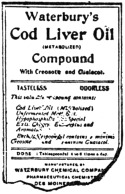
OLD LABEL |
|
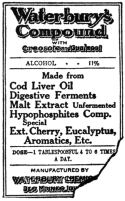
NEW LABEL |
| It is interesting in this connection to note that this product is
no longer being sold under the name “Metabolized Cod Liver Oil Compound.”
See the illustrations of the old and new labels. |
The results of the examination are briefly as follows:
The total quantity of acids isolated amounted to about
0.3 per cent., and of this amount about two-thirds was
salicylic acid. Thus it appears from the examination of the
specimens bought on the open market that the preparation
contains at most but 0.1 per cent. of the fatty acids from
cod-liver oil, a totally insignificant quantity.
Notwithstanding the protestations by the manufacturers,
in the form of published analyses and circulars, it is seen
that the statements published in The Journal, Oct. 13, 1906,
p. 1207, are essentially substantiated; it is further evident
that the product does not deserve to be designated as a
cod-liver oil preparation. To obtain a medicinal dose of
cod-liver oil the patient would be compelled to swallow the
contents of a bottle of this mixture, and as the product
contains 11 per cent. alcohol the patient who did so would
probably experience a degree of exhilaration not referable
to cod-liver oil.—(From The Journal A. M. A., Oct. 9, 1909.)
This product of the Waterbury Chemical Company, of
Des Moines, Iowa, was exposed in The Journal of the
American Medical Association, October 9, 1909. In May,
1910, the United States Government issued a notice of judgment
in which it was declared that Waterbury’s Metabolized
Cod Liver Oil Compound was misbranded. The court rendered
its decree of condemnation and forfeiture.—[Notice
of Judgment, No. 303.]
The Waterbury Chemical Company having requested that
the Council reconsider its action of four years ago (see preceding
report) on the product then known as Waterbury’s
Cod-Liver Oil Compound, now called Waterbury’s Compound,
the matter was submitted to a referee. The referee reported
that the statement now made as to the composition of this
product is as follows:
“Made from Cod Liver Oil, Digestive Ferments, Malt Extract Unfermented,
Hypophosphites Comp. Special, Ext. Cherry, Eucalyptus, Aromatics,
etc.”
He held that the Waterbury Chemical Company has not
submitted satisfactory evidence to indicate that the objections
of the Council’s former unfavorable report have been met; that
there is no evidence that the product is a substitute for cod-liver
oil in any way; and that under the present methods of
exploitation it constitutes what is at least an inferential
fraud; and recommended that no further consideration be
given to Waterbury’s Compound. The report was adopted
by the Council.—(From The Journal A. M. A., March 20,
1915.)
Colchi-Sal, said to be made by the Anglo-American Pharmaceutical
Co., Ltd., New York, is advertised, sold and
“guaranteed” (sic) by E. Fougera and Co., Inc., New York.
According to the label of a recently purchased specimen:
“Each Capsule contains Cannabis Indica (Active Principle of) 1-500th
Grain (1⁄8 Milligram); Colchicine (Crystallized) 1-250th Grain (1⁄4
Milligram); Methyl Salicylate 20 Centigrams.”
The advertising circular around the bottle adds that the
mixture also contains “appropriate aromatic adjuvants.”
It is recommended in “Gouty and Chronic Rheumatic
Manifestations,” “acute cases of Gout,” “intestinal auto-intoxication
or dyspepsia,” “bilious headaches,” etc. Salicylates
are generally recognized as valuable in acute manifestations
of acute articular rheumatism; colchicum is useless
in these conditions. Both salicylates and colchicum are
practically useless in chronic rheumatic and in chronic gouty
affections. For dyspepsia, bilious headache, etc., salicylates
are distinctly contra-indicated and the drastic purgation
produced by colchicum would not be thought desirable.
Though methyl salicylate administered internally is not generally
considered so efficient as sodium salicylate, it is
asserted that the former
“... is found far more effective than salicylate of soda or other
salicylic derivatives when given in conjunction with colchicine as Colchi-Sal.”
Further, the highly improbable and unsubstantiated claim
is made that “the active principle of Cannabis indica” (whatever
that may be) “corrects any tendency of the colchicine to
irritate the gastro-intestinal tract” and that the “appropriate
aromatic adjuvants” “prevent intolerance of the methyl
salicylate.”
Colchi-Sal is put up in a way to appeal to the public; the
bottle has the name “Colchi-Sal” blown in the glass; the
label gives full instruction for the use of Colchi-Sal, and also
the price, suggesting that the preparation may be freely purchased.
Wrapped around the bottle is a circular advising
its use in various affections.
The physician who acts on the advice that it is well to
“insist on the pharmacist dispensing original bottles ...”
of the “little green capsules” actually suggests to his patient
the use of this preparation of methyl salicylate and colchicum
in conditions in which these drugs may do much harm and in
which proper treatment is imperative.
Colchi-Sal is typical of unscientific ready-to-take proprietaries.
It was held ineligible for New and Nonofficial
Remedies because of its secret composition, viz., the unknown
nature of the “active principle of Cannabis indica” (Rule 1);
because the circular in the package and the name blown in
the bottle constitute advertisement to the laity (Rule 4);
because the claim that cannabis indica removes the gastro-intestinal
irritation, and the claim of the superiority of
methyl salicylate are unwarranted therapeutic claims (Rule
6); because the name does not indicate the presence of the
habit-forming cannabis indica, and because of its unscientific
composition (Rule 10).—(From The Journal A. M. A.,
March 20, 1915.)
Having voted that Cypridol Capsules be refused recognition,
the Council directed that for the information of physicians
publication of the following report be authorized.
W. A. Puckner, Secretary.
Cypridol Capsules, sold by E. Fougera & Co., New York,
are stated to be “Bottled in the New York Laboratories of
Vial, late Rigaud and Chapoteaut, Paris,” and to contain, in
each capsule, 2 mg. (1⁄32 grain) mercuric iodid (biniodid of
mercury) dissolved in a fatty oil. They are claimed to permit
the administration of mercury without danger of salivation—an
obvious misrepresentation.21 Cypridol Capsules are marketed
in a way to appeal to the public. If they are once prescribed,
the directions on the bottle and the full instructions
for the treatment of syphilis by means of Cypridol and by
other proprietaries sold by Fougera & Co. is likely to lead
the patient to attempt the treatment of this malady on his
own accord, and thus probably to forfeit his chances of cure.
Cypridol is a vicious example of the “ready-to-take” proprietaries.
Cypridol Capsules are in conflict with the rules of the
Council as follows:
Rule 4: The dosage, price, etc., on the label, and the name
“Cypridol” blown in the bottle, all tend to a direct self-prescribing
by the public. In addition to the objectionable statements
on the bottle itself, the preparation is put up in patent
medicine style and is accompanied by a circular giving full
directions for the use of this and of other proprietaries for
the treatment of syphilis in all of its stages. The circular
states that “a 1 per cent. solution of bin-iodide of mercury
in an aseptic oil” is “An Improved Specific in the Treatment
of Syphilis,” and after lauding the virtues of Cypridol, gives
full directions for the treatment of syphilis in its various
stages by means of Capsules of Cypridol augmented, during
periodical cessation of treatment, by “small doses of iodide
of strontium (Paraf-Javal’s standard solution, thirty grains
to the ounce).” Further, the circular expounds the need of
“a toning up of the general system” and by means of obsolete
theories and obviously untrue assertions recommends “Chapoteaut’s
Wine [another of their proprietary preparations],
each ounce of which contains 10 grains of phospho-glycerate
of lime. This is a delicious, nutritive tonic. A pint bottle
costs $1.00.”
Rule 6: Whereas it is evident that Cypridol, depending for
its effects on mercuric iodid, the ordinary well-known
hydrargyri iodidum rubrum of the U. S. Pharmacopeia, must
naturally have the properties of a mercuric compound, unwarranted
claims such as the following are made:
“CYPRIDOL does not render patients anemic. Ptyalism never follows
the administration of the capsules or injections. On the contrary,
patients rapidly put on flesh and keep well. There are no diarrhoeas or
other symptoms of intolerance even when the dose is pushed.”
Rule 8: The non-informing name “Cypridol” for a mercuric
iodid preparation is bound to lead to its use without
consideration of the fact that a potent mercury preparation is
being used, requiring a careful adjustment of dosage, a consideration
of the needs of the individual case, a correct diagnosis,
etc. While the advertising propaganda argues that
“physicians recognize the advantage of prescribing this solution
of mercuric iodide in an aseptic oil under the name of
‘Cypridol,’ because it does not betray to the laity the fact
that mercury is being used,” not only the physician but also
the patient has a right to know, and ought to know, the
potent character of the remedy which is being administered.
It is recommended that Cypridol be refused recognition
and that publication of this report be authorized.—(From
The Journal A. M. A., Dec. 19, 1914.)
Cystogen is the therapeutically suggestive name applied to
hexamethylenamin by the Cystogen Chemical Company.
While investigation has shown that hexamethylenamin yields
formaldehyd only in the presence of an acid and consequently
can produce an antiseptic effect only in the gastric juice
and in the urine, it is claimed that Cystogen is an “intestinal
antiseptic” and that it “bears its disinfectant and antitoxic
qualities into well-nigh every important bodily cavity.”
As the sale of a simple drug even with the aid of the most
extravagant claims probably did not offer sufficient opportunity
for an extensive proprietary propaganda, the Cystogen
Company has put out two other preparations, Cystogen
Aperient and Cystogen-Lithia, and finds it an easy matter
by means of extravagant claims, unwarranted assertions and
pseudo-scientific arguments to recommend the use of one or
another, or often all three, in a well-nigh endless number
of diseases.
As the continued patronage of the medical profession cannot
be relied on for proprietaries of this sort, the Cystogen
Chemical Company takes good care that every Cystogen prescription
is likely to spread the Cystogen gospel among the
people. The Council has directed publication of its report on
the Cystogen products to call attention to the way in which a
simple drug of established value may be made the basis of an
extensive proprietary propaganda. A conservative discussion
of the action of hexamethylenamin appears in the Council’s
publication, “Useful Drugs.” The Council therefore refused
recognition to Cystogen, Cystogen Aperient and Cystogen-Lithia.—(From
The Journal A. M. A., Dec. 12, 1914.)
Cysto-Sedative is sold by Strong, Cobb and Company,
Cleveland, Ohio, with the claim:
“Each fluid ounce represents:
Thuja Occidentalis, 31⁄2 grains.
Pichi, 18 grs.
Saw Palmetto berries, 36 grs.
Triticum Repens, 36 grs.
Hyoscyamus 8 grs.
All inert extractive matter being eliminated.”
The therapeutically active constituents of arbor vitæ, pichi,
saw palmetto and couch grass have never been isolated—indeed,
it has not been proved that all of these drugs contain
any therapeutically active constituents. Yet the absurd
claims are made that all inert matter has been eliminated
and each lot of drug used in the preparation of Cysto-Sedative
is “tested in reference to its medicinal activity.”
Equally preposterous is the claim:
“In formulating Cysto-Sedative each drug entering into its composition
was subjected to careful study clinically to determine the exact
proportion required when combined to increase their efficiency as a
whole. Cysto-Sedative is scientifically prepared, the proportion of each
individual drug being so finely adjusted as to increase their therapeutic
action in the conditions for which they are intended, forming a preparation
always reliable and of the very highest medicinal activity.”
Some other extravagant claims made for this complex
unscientific mixture are:
“It gives relief in almost every form of cystitis and prostatitis....”
“The best results are obtained in the worst chronic cases of cystitis
and prostatitis....”
“In Cystitis, Urethritis, Prostatitis, Inflammation of the Vesicle Neck,
complicated with Gonorrhoea, Enuresis, Painful Micturition, the action
of Cysto-Sedative is prompt.”
The Council voted that Cysto-Sedative be refused recognition.—(From
The Journal A. M. A., Dec. 12, 1914.)
Some time ago it was decided that a reexamination should
be made of Taka-Diastase and Liquid Taka-Diastase, both
of which had previously been rejected, to ascertain whether
or not the preparations were in accord with the claims made
for them by the manufacturers. Accordingly, the matter was
referred to a committee of the Council, and an examination
of specimens of these two preparations bought in the market
was made. The referee’s report, which appears below, according
to the usual procedure, and before final confirmation
by the Council, was first submitted to the manufacturers of
Taka-Diastase for comment. The report recommends that
the rejection of Taka-Diastase and Liquid Taka-Diastase
be allowed to stand, and that the report be published. Parke,
Davis & Co., in their reply, which is given in full below,
claim that the report is unjust concerning Liquid Taka-Diastase,
because the period of activity of the preparation
has been greatly prolonged by reducing the amount of alcohol
from 18 per cent. to 10 per cent. and by adding glycerin.
They reiterate their claims for the digestive power of Taka-Diastase,
but admit that it will not reduce the stated amount
of starch to the colorless end-point in ten minutes (the
standard method for the valuation of diastase). They further
state that they would change the word “digest” on the
label to “liquefy.”
The conclusion of the report having been questioned, the
entire matter was referred to a member of the Council’s
staff of clinical consultants. His report, which, also, is given
in full below, states that the material before him was sufficient
to decide the matter, and no further tests were necessary.
He concludes that the claims of the manufacturers regarding
the strength and properties of the material are erroneous
and exaggerated; that the literature still sent out by Parke,
Davis & Co. is misleading; and that if substitution of the
word “liquefy” for “digest” were endorsed by the Council
confusion would result which would give an exaggerated and
false value to Taka-Diastase. He therefore recommends
that the report of the reinvestigation of Taka-Diastase be
accepted by the Council and published.
This report of the second referee was referred to Parke,
Davis & Co. with the request that they state more definitely
the actual amylolytic strength of their preparations. To this
they replied that they had no desire to discuss the subject
further, or to make any additional statements.
In accordance with the second referee’s recommendations,
the Council confirmed its provisional action and voted that
the rejection of Taka-Diastase and Liquid Taka-Diastase be
allowed to stand, and that the report which appears below
be authorized for publication.
W. A. Puckner, Secretary.
REFEREE’S REPORT ON TAKA-DIASTASE AND LIQUID TAKA-DIASTASE
Following is the report of the committee to which was
referred the reexamination of Taka-Diastase and Liquid
Taka-Diastase:
Some time ago a comparison was made of the various
methods proposed for the valuation of preparations claimed
to have amylolytic power. This work was reported in The
Journal,22 and the method proposed for the testing of diastase
preparations now appears in New and Nonofficial
Remedies.23 In view of the incorrect and exaggerated claims
made for Taka-Diastase, the Council in 1908 was obliged to
rescind its acceptance and to direct its omission from New
and Nonofficial Remedies. The report contained the following
reference to Taka-Diastase (Parke, Davis & Company),
a product that had been accepted for inclusion with New and
Nonofficial Remedies:
“The widest discrepancy between the values as claimed
by the manufacturer and those found by actual tests seems
to be shown in the case of Taka-Diastase. The liquid
preparation has been tested a number of times in different
samples and has always been found weak. Some samples,
in fact, were quite inert. This ferment appears to lose
strength very rapidly in solution, as the manufacturers
now concede. The stability of the solid product is also
far from satisfactory, and appears to be less than that of
the ferment as marketed some years ago. The two samples
examined recently were weak.”
More than three years have now elapsed since the publication
of the Council’s findings regarding Taka-Diastase—sufficient
time, it is believed, for the manufacturers to modify
either their claims or the product itself, and thus again make
it eligible for inclusion with New and Nonofficial Remedies.
With this idea in mind new specimens of Taka-Diastase and
Liquid Taka-Diastase were purchased from a Chicago drug
house and the preparations reinvestigated. The following is
the report of this reinvestigation.
REPORT OF THE REEXAMINATION
In our report on the diastase preparations three years ago,
it was recommended that Taka-Diastase be removed from
New and Nonofficial Remedies, because the examinations
showed that it did not have the digestive strength claimed
for it. This was true both for Taka-Diastase itself and for
Liquid Taka-Diastase. So far as the latter was concerned,
the starch-converting power was practically nil in those
preparations which had been in the drug stores for some
months.
During the last few weeks new tests have been carried out
with several samples of the Taka-Diastase preparations and
the results obtained are essentially the same as those obtained
in the former examinations. The liquid preparation is still
extremely weak in starch-converting power, while we found
that Taka-Diastase itself would convert only 16.6 parts of
pure anhydrous starch to the colorless end-point in ten
minutes, as explained below.
In our method of experimentation we determine the weight
of the diastase in question which will convert a given weight
of starch in uniform paste to the so-called colorless end-point
in ten minutes, that is to the point where it will no longer
give any color reaction with a standard iodin solution. The
standard starch weight in 50 c.c. always is 1 gm. or 1,000 mg.
and to a series of flasks containing this amount of starch,
maintained at a constant temperature of 40 C., the diastase
dilutions are added. These diastase dilutions are made by
dissolving small, accurately weighed amounts of the sample
in some small, constant volume of water, usually 5 or 10 c.c.
and they are then poured into the starch flasks at the right
temperature, and agitated regularly.
Tests are made by taking a few drops from each flask and
mixing with the iodin solution. The end-point is reached
when a dilution is found which, at ten minutes from the
mixing time, gives no color with the iodin reagent. The first
set of tests is taken as a general guide, and quite accurate
results may be obtained in a second set of dilutions.
We first used a sample of Taka-Diastase bought in the
open market. It was found that 140 mg. were required to
convert the gram of starch as explained. This is equivalent
to a conversion of 7.14 parts of starch by 1 part of the
Taka-Diastase.
A new, and possibly fresher, sample was then obtained and
the test repeated. With this new sample it was found that
60 mg. were necessary to convert the gram of starch to the
colorless end-point in ten minutes, from which it follows that
1 part of the ferment will convert 16.6 parts of starch to the
colorless end-point in the same time. With a new sample of
Liquid Taka-Diastase obtained simultaneously it was found
that 3.5 c.c. were necessary to convert 1 gram of starch to
the colorless end-point in ten minutes. As a fluidounce of
this liquid is said to contain 20 grains of the solid it will be
seen that the results approximately agree with those of the
first sample of the solid, and that they are both very low.
In the earlier tests 16 parts of starch converted by 1 part
of the ferment was the value found. These results are in
close agreement with values reported by Sherman (Jour. Am.
Chem. Soc., xxxii, 1073) for a sample of recent purchase. He
found a conversion of 51 parts of starch to the colorless end-point
in thirty minutes for one sample, while for another he
found 66 parts, in the same time. It will be noted that our
time limit is ten minutes. It is worthy of note that for a
perfectly fresh and specially prepared sample furnished by
Dr. Takamine, a conversion of 278 parts in thirty minutes
was found by Sherman. Taking the time into consideration,
it will be seen that the results are about the same for the
market samples as those found by us and much lower than
claimed, as well as much lower than for other makes of similar
products. The difference in the behavior of fresh specially
prepared Taka-Diastase and the market sample is very
clearly shown. No one questions the fact that fresh laboratory
samples of Taka-Diastase may show a moderate converting
power on starch. But we have to deal with the
activity of market samples only, and Sherman’s work and our
own show the low digesting power of the product as physicians
may secure it on the market.
The marked difference in activity between perfectly fresh
and ordinary market samples of Taka-Diastase is very
clearly shown also in a recent paper published by Wohlgemuth.24
In the digestion of starch paste to the “dextrin”
stage Wohlgemuth found in the commercial sample a
strength approximately a hundred times less than that
observed in a fresh sample sent him by Dr. Takamine.
Wohlgemuth’s results were obtained by a method not essentially
different from ours, with this difference, however, that
he digested through 24 hours in the cases reported, and carried
the reaction to the “dextrin” stage only, in place of to
a colorless end-point. Making the proper reductions, it is
evident that the actual values found by him for the market
samples bought in Germany are not greater than those
reported by us.
The reference to the work of Sherman is made because, in
a following paper in the same journal, he recommends the
use of salt as an activator in finding the strength of certain
diastase preparations. It is well known that dialyzed diastase
preparations and starch of highest purity have but
slight action on each other; a little salt increases the activity
greatly, and also increases the activity of commercial
diastase preparations. These facts Sherman utilizes in working
out a method for valuation of commercial diastases.
The facts were well known to us at the time of our former
report, but it was not thought best to depart from the general
method which had been in use by all analysts following
the general scheme of Roberts. Quite recently, I. Bang has
published a paper on the investigation of diastase (Biochem.
Ztschr., xxxii, 417) in which he studies the behavior of
sodium chlorid and other salts on the rapidity of starch
conversion, and finds that a much smaller amount of salt
than Sherman recommends brings the maximum increase.
The method employed in our former tests is a good comparative
method, and this is all that may be claimed at
present for any method. By adding salt to our starch solution
the activity of Panase and other ferments is likewise
greatly increased. For Panase, a preparation possessing
rather high starch-converting power, we have recently found
an increase of about 30 per cent. in the converting power,
with salt present. Working to loss of blue color, merely,
it is possible in this way to get a higher value than that
claimed by the manufacturer. There is no practical gain
in using the salt for our purpose as the methods are at
best arbitrary, and the results only comparative.
Taking all the facts into consideration, it is recommended
that the rejection of Taka-Diastase and Liquid Taka-Diastase
be allowed to stand and that, in view of their extensive
exploitation, this report be authorized for publication
so that physicians may know the facts.
This report was referred to Parke, Davis & Co., and they
made the following reply:
“The report submitted in your letter of the 23d is, we
contend, erroneous and unjust: first, to our Liquid Taka-Diastase,
because over three years ago we changed our
formula, reducing the alcohol from 18 per cent. to 10 per
cent., increasing the glycerin and thus prolonging greatly
the period of activity.
“As for our regular Taka-Diastase, our claim is and has
been for years simply that Taka-Diastase will digest or
hydrolyze 150 times its weight of starch in ten minutes,
under proper conditions. We do not claim, we do not permit
our representatives to claim, that Taka-Diastase will
completely transform starch, to the colorless end-point, into
sugars. Taka-Diastase is used to supplement a deficiency
of ptyalin and converts the starch into soluble material with
great rapidity, thus giving the gastric fluid immediate access
to the proteids.
“If in the enclosed labels the word ‘digest’ were replaced
with the word ‘liquefy,’ the claim could not be assailed by
the most carping critic. To save any possible question, we
shall therefore make this change in our label, having it read:
‘Taka-Diastase will liquefy 150 times its weight of starch in
ten minutes, under proper conditions.’ Is there the slightest
question in your mind that this statement as just quoted is
entirely correct and entirely supported by clinical experience?
“It is our conviction that Taka-Diastase has a very remarkable
power to hydrolyze starch either in the test-tube or in
the stomach, and that this property is of great utility in
clinical work. We do not claim that its conversion of the
starch into sugars is complete, to the colorless end-point of
the Johnson test; and on this point we have been perfectly
frank with the Council, as well as with every physician who
has taken sufficient interest to inquire.”
In view of the above protest, the matter was submitted to
a second referee, who reported as follows:
“Your referee on the matter of Taka-Diastase has made a
careful investigation of the reports and correspondence submitted,
and begs to make the following report:
“The question at issue, viz., whether Taka-Diastase should
be included in New and Nonofficial Remedies, I believe, can
be determined by the material before me, and further tests
of the material are not necessary.
“The letter of the makers of Taka-Diastase admits that the
early claims regarding the strength and properties of the
material were erroneous and exaggerated. Since the product
was once admitted to New and Nonofficial Remedies, it may
be claimed that as the Council on Pharmacy and Chemistry
must have been in error then, it may be now. Your referee
does not consider this supposition worth discussing. The
conclusion he draws is that the Council was too hasty in
accepting the preparation, and that the incident shows how
much better it would be in all cases to accept no remedy
until sufficient time has been given for conclusive tests.
“The literature still sent out by Parke, Davis & Co.
regarding Taka-Diastase is misleading and of a kind more
appropriate for a nostrum than a standard chemical substance.
What would we think if morphin, quinin or even
heroin were advertised in the same way? I cite the statement,
‘Taka-Diastase digests starchy food with vigor and
directness.’ It seems to the referee that the proposition to
modify the label to indicate the amount of starch which is
liquefied rather than the amount which is saccharified, in
accordance with the Council’s standard, is bound to lead
to confusion and to give an exaggerated and false value to
Taka-Diastase.
“Your referee recommends that the report of the reinvestigation
of Taka-Diastase which has been submitted to me,
be made available to the medical profession, and that the
rejection of Taka-Diastase and Liquid Taka-Diastase be
allowed to stand.”
This report of the second referee was submitted to Parke,
Davis & Co., with the request that they state more explicitly
their claims regarding the activity of Taka-Diastase and
Liquid Taka-Diastase, in order that, if they decided to revise
their claims for the preparations, such revision of claims
might be published along with the reports of the Council.
They replied:
“Answering your note of the 15th instant: We have no
desire to discuss further the subject of your letter of February
24, or to make any statement beyond that set forth in
our letter to you of Dec. 27, 1911.”—(From The Journal A. M. A.,
July 6, 1912.)
Digalen is a proprietary said to contain a soluble form
(digitoxinum solubile Cloetta) of digitoxin, the chief active
principle of digitalis. This preparation was accepted25 by the
Council in 1909 for inclusion in New and Nonofficial Remedies.
The Council had not at that time determined whether
Digalen contained “soluble amorphous digitoxin,” as claimed,
or not. The product was accepted merely as a standardized
soluble and fairly stable digitalis preparation.
After the acceptance of Digalen, the therapeutic claims
made for it by the manufacturers increased in extravagance.
Meanwhile, evidence was brought forward by various independent
investigators which tended not only to show that
these therapeutic claims were unfounded, but also to discredit
the claim that Digalen contained a principle chemically
identical with digitoxin. In view of the obscurity of
the whole subject of the chemistry of the digitalis principles,
the latter claim (that Digalen was a solution of
“amorphous digitoxin”) had been an academic issue at the
time of the acceptance of the product. When, however,
the manufacturers of Digalen sought to mislead physicians
by increased and unwarranted therapeutic claims, the Council
felt that investigation of the whole matter was imperatively
demanded to decide whether or not Digalen should
be retained in N. N. R.
The questions at issue were: (1) the presence in Digalen
of “amorphous digitoxin”; (2) the constancy of composition
and reliability of action of Digalen, and (3) the claim
that it causes less gastric disturbance than digitoxin. No
satisfactory proof has yet been offered that Digalen contains
“amorphous digitoxin.” The mass of evidence tends to
show that Digalen is not constant in composition or reliable
in action, and that, when given in doses corresponding
in therapeutic activity, Digalen causes quite as much gastric
disturbance as the official galenical preparations of digitalis.
The outcome of protracted negotiations between the Council
and the Hoffmann-La Roche Chemical Works may be
summed up as follows: 1. The manufacturers promise to
hold in abeyance the claim regarding the presence of
“amorphous digitoxin.” 2. They refuse to concede the variable
composition of Digalen. 3. They reassert the claim that
Digalen is superior to other digitalis products with respect
to liability to cause gastric irritation and consequent
vomiting.
In view of the unsatisfactory character of the reply on
the second and third points, the Council voted that Digalen
be omitted from N. N. R. and that publication of the report
on Digalen which appears below be authorized, as well as
of the two reports26 (A and B) referred to therein.
W. A. Puckner, Secretary.
Because of persistent conflict with Rule 6 (unwarranted
therapeutic claims) and Rule 1 (composition) it is recommended
that Digalen be omitted from New and Nonofficial
Remedies; also that a copy of the report be sent to the
manufacturers, and that publication of this report and the
two previous reports submitted to the Council be authorized.
The nature of the problems involved necessitates a somewhat
extended discussion of the subject.
Digalein (liquid) is said to contain 1 part of soluble
amorphous digitoxin Cloetta in 1,000 parts of glycerin and
1,600 parts of water with 7.5 per cent. of alcohol. One c.c.
is said to contain 0.0003 gm. of the amorphous digitoxin.
Digalen was accepted by the Council27 and the following
footnote was appended to the description in New and Nonofficial
Remedies:
“The Council has not determined whether digalen contains ‘soluble
amorphous digitoxin’ or not, but accepts it simply as a soluble digitalis
preparation.”
Tablets of Digalen were accepted by the Council as a
dosage form of Digalen. Each tablet is said to represent
0.5 c.c. (eight minims) of Digalen (liquid).
One of the principal considerations which led the Council
to accept Digalen was that it was regarded as affording a
fairly constant and stable preparation of digitalis suitable
for intravenous administration. If Digalen is not fairly stable
and of fairly constant composition it has no obvious advantage
over an active soluble digitalis preparation, such as
digitalein.
The evidence now at hand seems to show: 1. Digalen is
not of constant composition or activity. 2. The manufacturers,
or their agents, continue to make misleading statements.
3. It is merely a solution of certain digitalis principles,
probably of digitalen mainly, in impure form.
COMPOSITION
Cloetta28 prepared a soluble amorphous substance which
he called “Digitoxinum solubile Cloetta,” but no information
concerning the method of preparation has been published.
Cloetta reported the result of an elementary analysis of
his product which he compared to the analyses of digitoxin
(crystalline) made by Schmiedeberg and by Kiliani, and
stated that there could be no doubt concerning the chemical
identity of the two substances.
Kiliani29 characterized as preposterous Cloetta’s claim that
the active constituent of Digalen is chemically identical with
digitoxin and stated that Digalen was merely an impure
digitalein. Kiliani has recently reiterated the statement that
the so-called “amorphous digitoxin” is not identical with
digitoxin.30
Cloetta’s failure to publish his method of preparing
Digalen places an additional burden of proof on him (or the
manufacturers of Digalen), concerning the identity of the
product, and in the face of Kiliani’s denial of the correctness
of Cloetta’s contention we must have strong corroborative
evidence of Cloetta’s claim before we can accept it as being
established.
The difficulties of dealing with the chemistry of digitalis
are so well known that they hardly require further mention
here, but under the circumstances Cloetta cannot be considered
as being wholly unprejudiced, and, while the same
might perhaps be said of Kiliani, such evidence as can be
deduced tends strongly to support Kiliani’s view, and to
disprove the contention of Cloetta.
There is much confusion regarding the names which have
been applied to the various principles obtained from digitalis,
and while it is undesirable that an established name
should be given to a newly discovered principle, one might
overlook this if no effort were made to associate the therapeutic
actions of the two substances to an extent which
the truth did not justify.
While the Council at that time did not challenge the existence
of “amorphous digitoxin” and made no attempt to
determine the identity with digitoxin of the substance forming
the basis of Digalen, the manufacturers of Digalen
have sought to show that Digalen and digitoxin were identical
so far as their therapeutic actions were concerned, but
that Digalen lacked the disadvantages of digitoxin. What
was a purely academic question when the acceptance of
Digalen was under discussion by the Council becomes a
matter of very great practical importance when the manufacturers
of Digalen seek to mislead the physician by these
claims.
The evidence which lends support to the view that Digalen
and digitoxin are wholly dissimilar may be summarized as
follows: Digalen differs greatly in its physical properties
from digitoxin and in certain of its physiologic actions, as
the manufacturers themselves state, Digalen being amorphous,
and soluble in water, while digitoxin is crystalline
and insoluble in water. The manufacturers state that
Digalen differs from digitoxin in certain of its physiologic
actions, but the two substances do indeed differ far more
than they admit.
Cloetta and the manufacturers of Digalen lay especial
stress on the claim that Digalen is cumulative to a far
less extent than digitoxin, and that it has far less tendency
to cause gastric disturbance than the latter. The first of
these claims is true; the second is the very opposite of the
truth, as we shall show.
We know nothing of the structure of any of the digitalis
principles, and even though one were to admit (purely for
the sake of argument) that Digalen and digitoxin were
chemical isomers, that fact could not be taken to lend any
support to the contention that the two substances were
identical, in the face of the established fact that they differ
physically and physiologically in nearly every particular,
and agree only in that they both cause standstill of the
heart in the same way—an action possessed also by so dissimilar
a substance as barium.
The manufacturers of Digalen support the claim of the
identity of their product with digitoxin by stating that
“Digalen is a solution of the most active glucoside of
digitalis.”31 Of course, it is very generally admitted that
digitoxin is the most active principle of digitalis, though
there is some question concerning its glucosidal nature.
Digalen is in fact far less active than digitoxin, as has
been shown by a number of independent observers[M] (Worth
Hale, 1910; Hatcher and Brody, 1910; Neave, 1907; Miller,
1908; the referee; Weis, 1912).
The essential fact which appears from the investigation
of Weis is that Digalen did not behave like digitoxin in
any case.
Hale also found that Digalen gave atypical actions in
which the effects on the central nervous system became
prominent. The referee can corroborate these observations of
Hale’s on frogs, but the convulsive symptoms were prominent
with some specimens of Digalen on mammals, though not
with others, the more recent specimens of the preparation
showing the action prominently.
The results of all these biologic tests, as well as of the
physical tests made by Weis, certainly lend no support to
the contention of Cloetta that the potent constituent of
Digalen is identical with digitoxin, but, on the contrary,
they show conclusively that the two substances differ widely
in many essentials, and the continued claim of the manufacturers
that the “amorphous digitoxin” said to be contained
in Digalen is the same as digitoxin, or that it is the
most active glucosid of digitalis, can be considered only as
misleading, and therefore in conflict with the rules of the
Council.
CONSTANCY OF COMPOSITION AND ACIDITY
The manufacturers of Digalen continue to claim that it
is of constant and uniform activity,32 and they imply this
even when they do not state it in those words; for example,
a substance cannot be considered reliable if it is variable in
activity. “Digalen is Absolutely Reliable. It is Standardized
and consequently always uniform. It does not produce
gastric disturbances.”
That the foregoing is absolutely untrue can be shown
abundantly. Hale33 found digalen not to be uniformly
stable; Weis found very different degrees of activity for
Digalen in the liquid and tablet forms, the tablets being
but one-third as active as the liquid, and the referee found
very great variations in the activity of different specimens of
Digalen, one specimen being almost inert. The results
obtained by Miller show that Digalen is sometimes very
slightly active, or not at all so.
The foregoing citations show conclusively that Digalen is
not of uniform activity. When reliability is claimed for
Digalen in contrast to the known variability of digitalis, it
must be considered as tantamount to the claim that Digalen
is not subject to such variability and it must be held that the
manufacturers make misleading statements when they assert
that Digalen is absolutely reliable.
The manufacturers claim that Digalen does not produce
gastric disturbances (see advertisement cited).
It is quite true that when small doses of Digalen are used
therapeutically it fails to produce gastric disturbances
because it is of such slight activity, as previously stated,
but when it is used in amounts which correspond in activity
to such doses of the ordinary galenical preparations of digitalis
as commonly cause nausea and vomiting it does cause
gastric disturbances quite as readily as the latter.
Among the clinicians who have found that Digalen causes
gastric disturbances may be cited: Veiel,34 Mueller,35 Eichhorst36
and Teichmann.37
Eggleston and Hatcher38 compared the emetic and cardiac
activity of Digalen and numerous other digitalis bodies and
preparations and found that the emetic activity of Digalen
was decidedly greater in proportion to its cardiac (or therapeutic)
action than was that of digitalis or digitoxin.
In the absence of any evidence to controvert this clinical
and experimental evidence, the continued claim that Digalen
does not disturb the stomach must be looked on as deliberate
misrepresentation.
MISLEADING THERAPEUTIC CLAIMS
The recommendation that Digalen be dismissed from
N. N. R. is made with the full appreciation of the fact that
the manufacturers of Digalen and their agents have
repeatedly stated that they desired to comply with the rules
of the Council, and that they have withdrawn several statements
to which the Council has taken exception, but the
fact remains that despite these reiterations the advertisements
of Digalen continue to embody statements which the
Council can only consider misleading.
The Council believes that the following advertisements
constitute gross therapeutic exaggerations:
“Digalen a sheet anchor in pneumonia; a strong support to the heart
in this deadliest of infectious diseases among adults. The prompt
action of Digalen, by intravenous or intramuscular injection makes it
possible to save lives which might be otherwise hopelessly lost. The
best digitalis preparation which we have at the present time.”39
“The digitalis for children. Because its dosage can be controlled.
Endorsed by pediatrists everywhere.”40
“The myocarditis of Tuberculosis so frequently encountered, especially
in the advanced stage of the disease, may be controlled with the aid of
Digalen. The standard digitalis preparation.”41
“Digalen is Absolutely Reliable. It is standardized and consequently
always uniform. It does not produce gastric disturbances.”42
Digalen is not a sheet anchor in pneumonia, for there is
no drug deserving such a title. Digalen has no action which
other digitalis preparations lack, and cannot save lives
otherwise hopelessly lost. The dosage of Digalen cannot
be controlled any better than that of other digitalis preparations,
since its activity is variable. We cannot control the
myocarditis of advanced tuberculosis by this or any other
means.
CLAIMED SUPERIORITY
Various digitalis principles, including digitoxin, digitalin
(true) and digitalein, have been known for many years.
Therapeutically they have been found wanting and there
appears to be no basis for the continued claim that Digalen
has any superiority over these several digitalis principles.
On the contrary, the evidence is accumulating that Digalen
has no advantage in any particular over a solution of digitalein,
and misleading claims of the manufacturers and their
agents certainly interfere with the formation of that calm
and unbiased opinion on the part of the general practitioner,
which, when applied to the non-proprietary digitalis principles
has caused them to fall into disuse.—(From The Journal
A. M. A., Sept. 5, 1914.)
A preparation called Dioradin was placed on the market
as a cure for consumption three years ago in Europe and
somewhat later in this country. It was first submitted to the
Council in July, 1911. Because of the manifestly unwarranted
claims made for its use in the treatment of tuberculosis,
the Council voted that the product be refused recognition
for conflict with Rule 8, without at that time taking
under consideration the question whether or not it was in
conflict with other rules of the Council.
In June, 1912, further consideration of Dioradin was
requested. The American agent having promised a reform
in the methods of advertising, the Council considered the
available evidence regarding the identity and value of the
preparation. Examination of evidence regarding the composition
of Dioradin—claimed to consist of radium chlorid,
iodoform and menthol in an ether-oil solution—showed serious
discrepancies as to the amount of radium as well as
to the identity and amounts of other constituents. It was
further found that the experimental evidence was insufficient
and biased. Then, too, in view of the difficulty of judging
the effects of medicines in tuberculosis, the clinical data
were unconvincing. There was nothing to prove that the
reported improvements, even if they actually occurred, were
to be ascribed to the mixture as a whole rather than to any
one of its constituents.
As a result of these findings, the Council voted that
Dioradin be refused recognition and that the publication of
these facts be authorized. In accordance with its regular
procedure, it also submitted the report to the agent. In
reply the agent submitted evidence which showed that he
was not responsible for the misstatements about Dioradin
but offered no facts that affected the Council’s findings.
The entire matter having been referred to a second referee,
minor modifications of the first draft of the report were
authorized. Since then the Dioradin Company has submitted
two reports of examinations of Dioradin made for the company
in Germany showing a higher radium content than that
previously found. These reports do not alter the facts
brought out in the report of the Council that the composition
of Dioradin has been variable, which past variability
arouses a feeling of uncertainty or lack of confidence. In
view of this the amended report was ordered published and
appears below.
W. A. Puckner, Secretary.
FIRST SUBMISSION OF DIORADIN
Dioradin, a preparation for the treatment of consumption
originated by Dr. R. de Szendeffy, Budapest, Hungary, was
submitted to the Council by Louis Gero, Ltd., New York,
with the following statement of composition:
“A radio-active preparation of Menthol, Iodin and Radium Barium
Chlorid 1⁄10 of a drop; in ether solution.”
A circular which accompanied the submission stated:
“Preparation No. 3 of Dioradin contains not only terpins but also
iodin salts.... In view of the fact that emanations of the
radium as well as the combinations of the evasive iodin terpins enter
into the organism through the lung....”
Later these indefinite statements of composition were supplemented
by the following:
| “In 100 c.c. there are: |
| 1 | gr. Iodoform. |
| 5 | " Menthol. |
| 10 | drops Radium chlorid solution (1 milligr. in 100 c.c. of water). |
| 5 | gr. ether. |
| 90 | " Oil (ol. amygd. frig. press).” |
In a circular contained in the package these claims were
made:
“The preparations of the Dioradin are based on the miraculous
effects which scientific researches have shown in regard to the
different sicknesses treated with radium.
“It is generally known that radium, even if externally employed,
has proved itself to be a bactericidal remedy. Its effect is multiplied
if one employs it internally even in infinitesimal doses, in consequence
of its permanent action of emanation on the organism.
“The preparations of the Dioradin contain the radium itself. For
this reason their antiseptic and bactericidal effect is much more
intensive than with medicaments which contain only its emanation,
which disappears in a short time.”
In view of the general extravagance of the claims made for
its therapeutic action the preparation was rejected without
considering other possible conflicts with the rules of the
Council.
SECOND SUBMISSION OF DIORADIN
Having been advised of the rejection by the Council of
Dioradin the American agency, which in the meantime had
become the Dioradin Co., requested further consideration.
The Council therefore took up the subject again. After certain
typographical errors had been corrected the following
was now given as the composition:
| “1 | gram Iodoform. |
| 5 | grams Menthol. |
| 10 | drops Radium Chlorid Solution (containing 1 milligram of radium chlorid in 100 cubic centimeters of water). |
| 5 | grams Ether. |
| 89 | grams expressed oil of almond. |
| This liquid is put up in ampules containing one cubic centimeter of liquid.” |
In support of the therapeutic claims for Dioradin the
American agent submitted literature consisting chiefly of
articles by Dr. Bernheim of Paris. Before reporting on the
requested reconsideration of Dioradin the referee directed
the secretary of the Council to point out to the American
agent that in the formula given, the amount of non-volatile
matter should be about 90 per cent., whereas the report of
the Lederle Laboratories which accompanied the request for
reconsideration states that but 72.08 per cent. was found in
the analysis. In reply the agent stated that he had called
the attention of Dr. Szendeffy (the originator of Dioradin)
to the discrepancies concerning non-volatile matter and that
he felt sure the discrepancy was wholly accidental (sic).
In a later communication the agent submitted a statement
of analysis from the Lederle Laboratories of a new specimen
of Dioradin according to which the amount of non-volatile
matter agreed essentially with the amount claimed by the
agent.
The referee, having examined the evidence, is of the
opinion that the statement of composition is misleading and
that the therapeutic claims are unwarranted, thus:
DISCREPANCIES IN RADIUM CONTENT
The chief claims for its therapeutic value are based on the
radium content, yet the discrepancies and contradictions,
regarding this are serious.
In connection with the reconsideration of this product the
agent presented a certificate of chemical examination by the
Lederle Laboratories in which the following statement was
made as to the radio-activity:
“Examination shows the preparation to possess slight radioactivity,
corresponding in activity to less than 1-10,000 of 1 milligram of
radium bromid per ampule. According to the sworn statement of Dr.
A. de Szendeffy, the originator of Dioradin, the preparation contains
10 drops of radium chlorid solution (1 milligram in 100 cubic centimeters
of water) in 100 cubic centimeters of the preparation. This
would correspond to 5-1,000 milligram of radium chlorid in 100 cubic
centimeters, or about 1-20,000 of 1 milligram per ampule.”
A cursory reading of this paragraph gives the impression
that Dioradin possesses fully the amount of radio-activity
claimed by its originator, Dr. A. de Szendeffy. This impression
is greatly strengthened by the concluding paragraph
of the Lederle report, which says:
“In conclusion, our examination shows that the preparation submitted
to us as Dioradin possesses radio-activity, and contains a fixed
oil (apparently expressed oil of almond), iodoform, menthol and
ether, thus confirming the sworn statement of Dr. A. de Szendeffy in
regard to the composition of this product.”
On inquiry as to the method used by the Lederle Laboratories,
in determining radio-activity the agent submitted
a further statement of the Lederle Laboratories which
describes the gamma ray test by which the determination
was made and a radium value equivalent to 0.000041 mg. of
radium bromid per capsule was obtained. The report then
says:
“The variations of the single measurements from the mean in
the case of the natural leak and the leak with the Dioradin near
were so large that we did not feel justified in assigning much accuracy
to the figure, 0.000041, but stated that the amount of radium per
capsule could not be greater than 0.0001 mg., with the possibility of
there being a much smaller amount present.”
It is evident that the wording of the reports of the Lederle
Laboratories is liable to give the impression that their examination
confirms the claims made for Dioradin.
It is further evident from these reports that the amount of
radio-active matter has not been definitely ascertained but
that it is at the best very small. The unreliability of the
claims for radium content of Dioradin was recently shown
by Buechner,43 who found a specimen obtained from an
apothecary to contain but 1-1,000 of the amount claimed.
VOLATILE AND NON-VOLATILE MATTER
The varying claims regarding the content of volatile and
non-volatile matter throw doubt on the entire composition of
Dioradin, for if the statement as to these is wrong the rest
of the statement regarding composition cannot be given
credence.
In the first submission of Dioradin about 89 per cent. of
non-volatile matter was claimed but in the report of the
analysis by the Lederle Laboratories, which accompanied the
resubmission, only about 72 per cent. was found. Later the
Lederle Laboratories reported that an examination of a new
specimen of Dioradin had shown about 90 per cent. of non-volatile
matter. The discrepancies between the composition
claimed for Dioradin and that found for the product in the
first Lederle report has shown that the agent was quite
ignorant of the composition of the product which he was
selling.
INDEFINITENESS OF THE IODIN CONTENT
The label on the trade package of Dioradin first submitted
to the Council stated that the product contained iodoform;
a similar statement was made in the submission of the
product; the circular accompanying the first submission
stated that “iodin salts” were contained in the product while
the iodin content was referred to further on in this circular
as “combinations of evasive iodin terpins.” In Bernheim’s
papers, which have been used to advertise Dioradin, and
which are referred to in the same circular, the iodin compound
is called “iode peptonisé,” which, according to information
stated by the American agent to have come from
Budapest, is to be translated “iodized peptone.” What is
the meaning of this confusion? One would naturally suppose
that the preparation to be sold in this country contains
iodoform in an ether-oil solution while the one used by
Bernheim and Dieupart44 was stated to contain an ethereal
solution of “iodized peptone.” This is another mystification,
for an ethereal solution of any kind of peptone would be a
novelty. The matter is of some importance, for Bernheim
and Dieupart lay great stress on the difference between
“peptonized iodin” and other iodin (loc. cit., p. 333) and of
the superiority of ethereal over oily solutions (loc. cit.,
p. 334). The American agents, however, in the second submission,
state that this is all a mistake; that the Dioradin
used by Bernheim is the same Dioradin which was submitted
to the Council; and that this does not contain, and never
did contain, the ethereal solution of “iode peptonisé” to
which Bernheim attached so great importance. Bernheim
(report to Medical Congress of Lyons) himself has come
to the same conclusion; for five months after his first paper
he believes that the “special salt of radium” (sic) is the
principal agent; so that the “peptonized iodin” must be unimportant,
and in a cablegram of July 4, 1912, he now informs
the Dioradin Company that the formula was incorrectly
given in his first papers “owing to my ignorance of actual
composition,” and that all the Dioradin used by him was of
the composition stated in the submission to the Council.
While this vindicates the good faith of the American
Dioradin Company, it does not clear up the mystery. The
question occurs at once: What led Dr. Bernheim to make
such positive statements? Was he drawing purely on his
imagination? If so, why did his imagination take this
peculiar special direction? Or if he did have some reason
to imagine the “iode peptonisé,” who supplied this reason?
And if, at that time, he was given to understand by
Szendeffy, who must have supplied him with the material,
that it contained the iodized peptone, how can he be positive
at this time, that it did not contain it? Has he actually
analyzed the old material?
There is also a further question which needs to be
answered. Why has Dr. Szendeffy waited until Dioradin
was rejected by the Council before correcting Bernheim’s
serious misapprehension, in the meantime permitting the
circulation of Bernheim’s paper?
Until these questions have been satisfactorily answered, the
element of mystery about the composition of Dioradin cannot
be cleared away.
EXPERIMENTAL EVIDENCE
The available experimental evidence regarding “Dioradin”
is restricted to some quotations from its inventor Szendeffy,
in the paper of Bernheim and Dieupart (p. 334). These, if
confirmed, would show that radium alone has practically
no effect on cultures of tubercle or colon bacilli; that 0.1 gm.
of “iode-menthol” (concentration not stated) checks the
growth of the acid-fast organisms; and that this antiseptic
efficiency can be nearly doubled by the addition of a little
radium. No quantitative data are given, so that it is difficult
to judge the accuracy of the observation. Granting that
it is correct, it would have little bearing on the therapeutic
actions of Dioradin, for there is nothing to show that the
effective test-tube concentration is reached in the pulmonary
tissues.
It is also claimed that the injection of Dioradin prevents
tubercle infection. The referee believes that the Council and
the medical profession should hesitate to accept this conclusion
without further details; and these would require
confirmation by unprejudiced observers.
CLINICAL EVIDENCE
The Dioradin Company submits considerable clinical data
in favor of Dioradin. It must be remembered that most
favorable opinions have been published, from time to time,
about scores of “consumption cures,” which have mysteriously
lost their efficiency when their novelty wore away.
There is no more reason to doubt the good faith of those
who are enthusiastic about Dioradin than of those who have
been enthusiastic about other “cures.” There appear to be
features in the course of tuberculosis which make the judgment
of therapeutic measures peculiarly difficult. It is possible
that impartial clinical trials of Dioradin by tuberculosis
experts appointed by the Council might facilitate judgment
as to the actual efficiency of Dioradin. The referee
doubts, however, whether this would advance the Council
very much toward the acceptance of the substance. Such an
investigation would be so lengthy that it should not be
undertaken until the Dioradin Company itself has offered
at least presumptive evidence in this direction, especially in
view of the adverse report recently made by Cecil Wall.45
Ten tuberculous patients were treated by Wall in strict
accordance with the method outlined to him by Bernheim,
yet Wall concludes that none of the cases, though treated
accurately in accordance with the instructions, can be quoted
to justify any of the claims for the therapeutic efficiency of
Dioradin. The Council cannot undertake lengthy investigations
of this character until it is put in possession of
data which would show to its satisfaction that such investigations
would probably be fruitful.
CONCLUSIONS
From investigations made, it appears that the claims in
regard to the composition of Dioradin have contained vague
statements and contradictions which arouse a feeling of
uncertainty and lack of confidence. Until this uncertainty is
cleared away, Dioradin cannot be considered as complying
with Rule 1. The experimental data are insufficient and
unconvincing. Some favorable clinical reports have been
submitted, but the accuracy of the observations is to be
questioned and they are more than offset by the negative
results observed by Cecil Wall. As might be expected, other
negative results, if observed, have not been submitted and
there is nothing in the manufacturer’s claim to show whether
the improvement reported is really due to the peculiar mixture
called Dioradin or to any one of its ingredients.
It is therefore recommended that Dioradin be not accepted
for New and Nonofficial Remedies. In view of the extensive
advertising of this preparation and because of the admittedly
incorrect statements in the earlier papers it is recommended
that publication of this report be authorized.—(From
The Journal A. M. A., Oct. 26, 1912.)
The Council has voted to reject several non-proprietary
articles and has recommended that the reasons for their
rejection be given in The Journal; among these is echinacea.
The following paper has been submitted by a subcommittee
with the recommendation that it be published. This recommendation
was adopted.
W. A. Puckner, Secretary.
When this drug was first introduced, it was a typical nostrum,
with exaggerations regarding its therapeutic value that
were somewhat more gross than usual. It was later adopted
by the eclectic school without being freed from the stigmata
of its origin. It was also pressed into use as the main ingredient
of such proprietary preparations as Echafolta, Ecthol
Eusoma, etc. Efforts have been made to get the regular profession
to use it in these various forms.
According to J. U. Lloyd (Pharm. Review, vol. xxii, p. 9–14),
the introduction of echinacea into eclectic medicine is due to
the efforts of Dr. H. F. C. Meyer to increase the sale of
Meyer’s Blood Purifier, a secret remedy containing it. The
following is a literal copy of the label on this nostrum:
After Lloyd had identified the plant, Meyer put the preparation
out under another form with the following label:
These absurd claims of an evidently ignorant man have
passed into the more recent proprietary advertising matters
and into much of the eclectic writings. Indeed, the seemingly
impossible had been attained by even surpassing Meyer’s
all-but-all-embracing claims. Not content with endorsing
echinacea as a positive and speedy “specific” for rattlesnake
bite, syphilis, typhoid fever, malaria, diphtheria and hydrophobia,
later enthusiasts have credited it with equally certain
curative effects in tuberculosis, tetanus and exophthalmic
goiter, and with the power of retarding the development of
cancer.
It is worth noticing—although it is not surprising—that
these far-reaching claims have been made on no better basis
than that of clinical trials by unknown men who have not
otherwise achieved any general reputation as acute, discriminating
and reliable observers. No attempt seems to have
been made to verify these claims by accurate scientific
methods, clinical or otherwise, although this could very easily
have been done.
Not one of the eulogistic reporters and exploiters seems
to have considered it worth while to determine by the
simplest control experiments whether the drug possesses any
bactericidal or antiseptic powers whatever. It is therefore
not very strange that discriminating physicians have failed
to show much enthusiasm. One of the warmest endorsers
of echinacea, C. S. Chamberlain (who later became the president
of the Eusoma Pharmaceutical Company), complains
that he has been unable to interest regular physicians in
the remedy. He reviews the statements of previous authors
and reports eight cases of infection, only two being acute or
extensive, in which he used it with asserted success.
In view of the lack of any scientific scrutiny of the claims
made for it, echinacea is deemed unworthy of further consideration
until more reliable evidence is presented in its
favor.
REFERENCES
Meyer, H. F. C.: Eclectic Med. Jour., 1887; Goss: Chicago Med.
Times, 1888; Hages: Eclectic Med. Jour., 1888; Shelly: Medical Gleaner,
1894; Lloyd, C. G.: Eclectic Med. Jour., 1897; Lloyd, J. U.: Eclectic
Med. Jour., 1897; Lloyd, J. U.: Pharm. Review, xxii, 9–14; Schnitz,
Elsie M.: Wis. Med. Recorder, 1898, ii, 202; White, J. N.: Texas Med.
News, 1898, viii, 110–113; Stinson, J. C.: Therap. Gazette, 1900; Hale,
E.: Lancet-Clinic, March, 1901; Thielen, B. F.: Echafolta, Its Uses in
Dental Surgery, Dental Reg., 1903, vii, 462–465; Gorse, C. A.: New
Albany Med. Herald, 1903–4, xxii, 384; Chamberlain, C. S.: Louisville
Monthly Jour. Med. & Surg., 1904–5, xi, 219–223; Lancet-Clinic, 1905,
M. S., liv, 279–283; Ellingwood, F.: Therap. Gazette, 1905, 3, S., xxi,
298–300; French, J. M.: Med. Brief, 1905, xxxiii, 537; Mathews, A. B.:
Georgia Pract., 1905, i, 137–140.—(From The Journal A. M. A., Nov.
27, 1909.)
Echtisia (Wm. S. Merrell Chemical Co.), Ecthol (Battle
and Co.) and Echitone (Strong, Cobb and Co.) are proprietary
preparations each of which is alleged to contain
echinacea as its chief constituent. In 1909 the Council
examined into the claims made for echinacea. This drug
has been claimed to be a “specific” for rattlesnake bite,
syphilis, typhoid fever, malaria, diphtheria and hydrophobia.
Enthusiasts have credited it with equally certain curative
effects in tuberculosis, tetanus, and exophthalmic goiter and
with power of retarding the development of cancer. Of
course there is no reliable or trustworthy evidence to substantiate
these claims. Echinacea is not often prescribed
under its own name, but is employed as an ingredient in
proprietary preparations mixed with other little-used or
obsolete substances. Thus Echtisia is said to contain
echinacea, wild indigo, arbor vitae and poke root; Ecthol,
to have echinacea and arbor vitae; Echitone, to consist of
echinacea, pansy and blue flag. Naturally the manufacturers
of such proprietaries make use of all available optimistic
reports in promoting their sale, while each manufacturer
ascribes special and peculiar virtues to the combination
represented in his particular preparation. The
Merrell Chemical Company claims that baptisia (wild
indigo) is a “destroyer” of devitalizing elements in the
blood “a vitalizer of the blood as well”; that thuja (arbor
vitae) is a “perfect antiseptic and a generator of vital force
in disorganized tissues,” and that a long list of diseases,
including diphtheria, syphilitic sciatica and gonorrheal
rheumatism, “are all more or less amenable to full doses”
of phytolacca (poke root). Strong, Cobb and Co. maintain
that Iris versicolor (blue flag) is “one of the most powerful
excitants of the biliary, salivary and pancreatic secretions,”
and that the “principal sphere of action of Viola tricolor
[pansy] is in the gastro-intestinal canal and the skin.”
There is no satisfactory evidence that the claims for any
of these substances are any more reliable than those for
echinacea. Notwithstanding, Strong, Cobb and Co. claim
for Echitone “not only the virtues of its constituent parts,
but a wider field and a particular therapeutic value of its
own”; Battle and Co., maintain that Ecthol is the “‘Ideal
Corrector’ of depraved conditions of the fluids and tissues,”
while the Merrell Company urges the virtues of Echtisia
in a list of diseases ranging from acne to appendicitis and
from gangrene to rattlesnake bite. The Council refused
recognition to these three products and directed publication
of reports to call attention to the exaggerated, unwarranted
and often utterly absurd claims made for these and similar
preparations.—(From The Journal A. M. A., Jan. 2, 1915.)
Ergoapiol (Martin H. Smith Co., New York) is a mixture
put up in capsules, each of which is said to contain
Apiol (Special M. H. S.) | 5 | grains |
Ergotin | 1 | grain |
Oil Savin | 1⁄2 | grain |
Aloin | 1⁄8 | grain |
Examination discloses the fact that, contrary to the claim
made, each capsule, instead of containing 5 grains of apiol,
really contains some liquid preparation of the type of
oleoresin of parsley seed. Ergoapiol is recommended (on
the label) for such diseases as “Amenorrhea, Dysmenorrhea
and other Menstrual Disorders,” while a circular enclosed
in the package contains many suggestions that may be
counted on to lead to its indiscriminate and uncritical use.
Ergoapiol is an unscientific, shot-gun mixture of drugs
having widely different therapeutic effects. Where the action
of parsley is desired, the effects of ergot would ordinarily,
be contra-indicated; furthermore, neither aloin or savin
would be called for in conditions that demanded the effects
of apiol. It would be impossible to predict the action of a
mixture of this kind in the varying conditions for which
its use is advised by the manufacturers. To combine four
drugs of dissimilar action in fixed proportions for the routine
treatment of conditions which have little in common except
that they involve the female generative organs, is unscientific
and absurd. The Council refused admission to Ergoapiol.—(From
The Journal A. M. A., Dec. 12, 1914.)
The original rules of the Council governing the acceptance
of articles have recently been modified, particularly by adoption
of Rule 10, which reads:
“Unscientific and Useless Articles.—No article will be admitted which,
because of its unscientific composition, is useless or inimical to the best
interests of the public or of the medical profession.”
In view of these modifications, the Council is reconsidering
the articles already accepted with the view of determining
their compliance with the rules as amended. In line
with this the Council reconsidered Erpiol (Dr. Schrader),
manufactured by the William S. Merrell Chemical Company,
and from the evidence given below concluded that one of
the constituents, gossypin, is inert and its use unscientific.
The Council therefore voted that Erpiol (Dr. Schrader)
be omitted from New and Nonofficial Remedies and authorized
publication of the following report.
W. A. Puckner, Secretary.
In consequence of the more thorough scrutiny now given
by the Council to the therapeutic value of the remedies
admitted to New and Nonofficial Remedies, the Council has
reconsidered Erpiol (Dr. Schrader), previously accepted for
New and Nonofficial Remedies. Erpiol (Dr. Schrader) is
the name applied to capsules containing apiol, ergotin and
gossypin, which are sold as an emmenagogue. The first two
ingredients have a recognized value in the treatment of
diseases of the female generative organs. The third, gossypin,
is a preparation from cotton-root bark, belonging
to the somewhat indefinite class of pharmaceutical preparations
known as resinoids.
Cotton-root bark (Gossypii radicis cortex, U. S. P.) has
been credited by some with pharmacologic and therapeutic
properties, similar to ergot, especially in its action on the
uterus; experiments on pregnant animals do not confirm
this view. Most authorities on gynecology either make no
reference whatever to the drug or ascribe little or no value
to it. The preparations from the dried bark are inert.
From reports made to him, Professor J. U. Lloyd concluded
(Eclectic Med. Jour., 1876, xxxvi, 545) that a prime
fluidextract of fresh cotton-root bark is an active therapeutic
agent and deserving the attention of the medical profession,
while that of the dry bark is inert and worthless. The
gossypin on the market is made from the dried bark.
Professor Lloyd, who is considered an authority on eclectic
medicine, says: “Were it left to me to admit or exclude it,
by reason of its therapeutical position, I should exclude it,
because, in my opinion, it has never been demonstrated, in
clinical practice, to be worthy of any therapeutic recognition
whatever.”
As the available evidence indicates that gossypin is an
inert preparation, Erpiol (Dr. Schrader) was considered in
conflict with Rule 10 and the Council has therefore voted
that it be deleted from New and Nonofficial Remedies.—(From
the Journal A. M. A., June 3, 1911.)
The Council voted to refuse to recognize false unicorn as
a non-proprietary article and the following statements, submitted
by a subcommittee, were ordered published.
W. A. Puckner, Secretary.
Helonias dioica, or more properly Chamælirium luteum,
is a plant, preparations of which enter into various proprietary
mixtures for diseases of the female pelvic organs.
In the advertisements of these preparations it is usually
credited with hemostatic powers and is asserted to be a
uterine tonic.
There is practically no reference to this drug in reliable
medical literature, and as there is no evidence worthy of
credence to support the claims made for it, the drug was not
considered deserving of a place in the Pharmacopeia. Hence,
it may be regarded as a drug not worthy of attention of
physicians.—(From The Journal A. M. A., Nov. 27, 1909.)
Formurol, Citrocoll and Aspirophen were submitted to
the Council by the Cellarius Company of San Francisco.
The manufacturers having failed to substantiate the claims
they make for these products, the Council has voted that
the preparations be refused recognition. The Council also
authorized the publication of the following report, which
deals particularly with one of the preparations—Formurol.
W. A. Puckner, Secretary.
Formurol is the product of the Chemische Fabrik Falkenberg,
Falkenberg-Gruenau, near Berlin, Germany. The
Cellarius Company, San Francisco, acting as selling agents
for the United States, submitted Formurol (along with
Aspirophen and Citrocoll, also made by the same firm) to
the Council, with the statement that it is “hexamethylentetraminsodium-citrate,”
and that it has the following composition: “C6H7O7Na.C6H12N4.”
Zernik,46 who examined these products, reported that
Aspirophen, Citrocoll and Formurol do not have the composition
that is claimed for them by the Fabrik Falkenberg.
Formurol, he states, is not a definite chemical compound, but
a mixture of hexamethylenamin and sodium citrate. The
agents were advised of this fact by the Council and were
asked to submit evidence to substantiate their claims. No
such evidence was submitted.
Since a compound having the composition that is claimed
for Formurol is theoretically possible, the Council requested
that the product be examined in the Association Laboratory
to determine whether it still was the simple mixture reported
by Zernik, or whether, perhaps, it now possessed the formula
claimed for it. The following report was made by the
Association chemists:
Formurol, as submitted to the Council, was in the form
of tablets weighing about 1 gm. each and appeared to be
composed of a fine white substance interspersed with
some transparent particles. The tablets were readily
soluble in water, were odorless and possessed a slightly
acid taste. The aqueous solution responded to tests for
hexamethylenamin, citrate and sodium. To determine
whether hexamethylenamin was present in the free or the
combined state, the method of Zernik was employed. This
consists in the extraction of Formurol with chloroform,
which dissolves out hexamethylenamin, leaving insoluble
sodium citrate. As the use of the solvent, chloroform,
would seem to preclude decomposition of such a hypothetical
compound as “hexamethylenamin-sodium-citrate,”
the extraction of hexamethylenamin from Formurol may
be taken to demonstrate its presence in the free state.
That Formurol is not a compound of hexamethylenamin,
but a mixture of hexamethylenamin and sodium citrate,
was further indicated by the appearance of the crushed
tablets described above. Further, on the low-power
microscope the powder was found to be composed of transparent
crystals and white opaque particles which appeared
to be masses of minute crystals. When treated with
chloroform the transparent crystals dissolved, leaving the
white masses intact, demonstrating the presence of two
distinct substances, one soluble and the other insoluble in
chloroform. It having been demonstrated that the residue
obtained by evaporation of chloroform could not be
weighed as hexamethylenamin, due to enclosed chloroform,
the amount of this substance in the residue was
determined.
The method used has been described in the Report of
the Chemical Laboratory of the American Medical Association,
Vol. I, p. 55, and depends on the decomposition of
hexamethylenamin by means of sulphuric acid to form
ammonium sulphate and formaldehyd. From this solution
the ammonia is liberated, distilled and determined by
titration and from the ammonia found the amount of
hexamethylenamin is calculated. By this method Formurol
was found to contain (a) 35.42 per cent. and (b) 35.32
per cent., or an average of 35.37 per cent. hexamethylenamin.
The residue insoluble in chloroform was shown
to consist essentially of disodium hydrogen citrate by
determining the amount of sodium (Na) contained in
Formurol. The percentage of sodium calculated from the
amount of sodium sulphate found was (a) 11.38 per cent.
and (b) 11.20 per cent., or an average of 11.29 per cent.,
equivalent to 62.50 per cent. disodium hydrogen citrate.
As a check on this determination, the amount of
material contained in Formurol which is insoluble in
chloroform was determined. It was found to be (a) 63.23
per cent. and (b) 63.49 per cent., making an average of
63.36 per cent., and thus agreeing fairly well with the
results obtained when the sodium content was assumed to
be disodium hydrogen citrate. From this analysis it
appears that Formurol is not a definite compound of
hexamethylenamin and sodium citrate, but instead is a
mixture of these substances consisting approximately of
hexamethylenamin 35.37 per cent. and sodium acid citrate
(disodium hydrogen citrate) 63.36 per cent., practically a
mixture of 1 part hexamethylenamin and 2 parts sodium
acid citrate. These results agree with those reported by
Zernik47 and show that the product now, as then, is not
true to claims.
In view of the findings of the laboratory, it is recommended
that Formurol be refused recognition. As the exploitation
of well-known remedies under false and misleading names is
detrimental to the progress of medicine, it is recommended
that publication of this report be authorized.
[Editorial Note: This report illustrates once more the
value of the Council on Pharmacy and Chemistry and the
Chemical Laboratory to the medical profession. Before the
Council was organized there was no agency to protect the
physician’s interests in the matter of pharmaceuticals. Under
the old régime Formurol would have been heralded as a
new “synthetic” of the most approved made-in-Germany
type—and the claims would have gone unchallenged. To-day
its status is made clear and the profession is informed.
Only those who have closely studied the question can
realize what a wonderful power for commercial probity the
Council has proved. Under the laissez faire system of the
past, many large pharmaceutical firms gave little attention
to the accuracy of the claims made for their products. If
the advertising gave good “pulling” results, that was all
that was asked or expected. Within the past five years a
wonderful change has taken place in this regard, and firms
of the better class have so modified their advertising as
to make it not only conservative in tone, but to approximate
scientific accuracy.]—(From The Journal A. M. A., Jan. 21,
1911.)
The Bristol-Myers Co., Brooklyn, N. Y., sells Gastrogen
Tablets which are described as “A Neutralizing Digestive”
to be “used in connection with Sal Hepatica.” Sal Hepatica,
it will be remembered, is another product of the Bristol-Myers
Company and has been the subject of previous
unfavorable comment. The label on a recently purchased
package of Gastrogen Tablets contains the following:
“For gastric distress, weak stomach and dyspepsia, one to two tablets
after eating; repeat in half an hour if needed.
“Also indicated in nausea, flatulence, sour stomach and heartburn.”
While these recommendations sound as if they were
addressed to the public, Gastrogen Tablets are advertised
in medical publications and hence come within the scope of
the Council. Gastrogen Tablets are said to be composed of
pepsin, calcium carbonate, calcium phosphate and “aromatics.”
As each tablet, according to the label, contains 7 grains of
calcium carbonate (chalk), the recommended dosage would
in most cases be sufficient to neutralize the gastric fluids in
the stomach and would thus tend to prevent the pepsin from
exerting its digestive effects. The means adopted to relieve
one symptom of dyspepsia, in other words, defeats the action
of the means for relieving the indigestion. The fact is that
patients who need an antacid do not need pepsin, while those
who need pepsin will be harmed by the administration of an
antacid. Gastrologists hold that, except in rare cases, the
evidence tends to show that wherever there is a sufficiency
of hydrochloric acid there is a sufficiency of pepsin. When
pepsin is lacking it should be administered along with hydrochloric
acid to make it effective. The Council voted that
Gastrogen Tablets be refused recognition.—(From The
Journal A. M. A., Dec. 12, 1914.)
The following report was submitted to the Council by a
referee and publication authorized.
W. A. Puckner, Secretary.
Glyco-Heroin, Smith (Martin H. Smith Co., New York)
is marketed in a showy “patent-medicine” type of package,
the label on which announces the presence of 1⁄2 grain of
heroin to the fluidounce and admits the presence of 3.5 per
cent. alcohol, an active ingredient that is not discussed in
any way in the literature sent out by the manufacturer.
The composition of Glyco-Heroin, Smith, is given as follows:
“Each teaspoonful represents: Heroin 1⁄16 grain,
White Pine Bark 31⁄2 grains, Ammonium Hypophosphite 3
grains, Balsam Tolu 1⁄4 grain, Hyoscyamus 1 grain, Glycerin
Q. S.” The alcohol is not mentioned in the formula.
The advertising matter says of the merits of the formula:
“Despite the fact that heroin, which is universally recognized as an
invaluable respiratory sedative, is a conspicuous element of Glyco-Heroin,
Smith, the other constituents, henbane, ammonia hypophosphite, balsam
tolu and white pine bark are factors of no less importance; indeed, it
is through the concerted action of its several ingredients that the preparation
proves so notably beneficial in the class of affections in which
it is indicated. The constantly increasing popularity of the preparation
in the treatment of respiratory affections is the best adducible evidence
of its value in such disorders.”
The absurdity of this assertion will be appreciated on comparing
the nature, quantities and activities of the several
ingredients. Thus, while heroin, a potent habit-forming drug,
is present in unusually large proportions, tolu, an innocuous
or comparatively harmless product, is said to be represented
by 1⁄4 grain, a relatively small quantity, hardly sufficient to
impart even a distinctive taste or flavor. Ammonium hypophosphite,
in the amount said to be present, may be considered
to be practically useless, while the dose of hyoscyamus, an
additional narcotic, is fairly large. The white pine bark
present is probably as active as would be a corresponding
amount of white pine shavings or of turpentine sufficient to
give the preparation a slight odor. The vehicle, glycerin, is
claimed to be “notably advantageous,” but not a word occurs
in the discussion by the manufacturer in regard to the presence
of alcohol, which is certainly quite as active medicinally
as the balsam of tolu and contributes fully as much to the
flavor or taste of the preparation as does the white pine bark.
In prominent type on the outer label of the trade package
we are told that the preparation is intended for the treatment
of “COUGH, ASTHMA, PHTHISIS, PNEUMONIA, BRONCHITIS,
LARYNGITIS, WHOOPING-COUGH AND KINDRED INFECTIONS.” In
much smaller type: “Glyco-Heroin (Smith) is distinctly a
product designed expressly for the use of physicians.” The
circular included with the trade package, however, bears
statements which would tend to encourage self-drugging by
the layman, and in view of the manner in which the preparation
is exploited are undoubtedly intended to do so. For
instance:
“Bronchitis.—In the acute form of bronchitis, Glyco-Heroin (Smith)
acts most happily. It tends to diminish the congestion and inflammation
of the lining of the air passages, relieves the pain and institutes
repair....
“Phthisis.—In the treatment of the cough of phthisis, Glyco-Heroin
(Smith) is used with the most gratifying results. It checks the night
sweats, acts favorably upon the reflexes, increases expectoration and
induces refreshing sleep.
“Asthma.—The preparation diminishes the intensity of the paroxysms
and lengthens the intervals between their recurrence. By the administration
of the preparation, asthmatic attacks can frequently be aborted.
“Pneumonia.—In the initial stage of pneumonia, the preparation
exercises a calming, antipyretic and sedative effect. In the latter stages
of the disease, the analgesic and expectorant properties of the product
are well displayed.
“Whooping-Cough.—Administered in doses of from five to ten drops
this preparation affords surprisingly satisfactory results. The cough
rapidly loses its spasmodic character and the frequency of the paroxysms
is considerably diminished.”
How cruelly misleading the literature put out by the manufacturer
of this nostrum is, will be apparent from a comparison
of the rather large dose of heroin in a teaspoonful
of the nostrum and the directions on the package that:
“The adult dose of Glyco-Heroin (Smith) is one teaspoonful repeated
every two hours or at longer intervals, as the case may require.
“Children of 10 or more years, from a quarter to a half-teaspoonful.
“Children of 3 years or more, 5 to 10 drops.”
A WICKED FALSEHOOD
Included in much of the advertising matter that has been
put out is the bare-faced untruth that the preparation does
not produce narcotism or habituation. Here is a quotation
from an undated circular:
“Glyco-Heroin (Smith) is decidedly preferable to preparations containing
codeine or morphine, by reason of the fact that it does not produce
narcotism, constipation, gastric disturbance nor habituation, even
though its administration be protracted.”
That this assertion is not in keeping with facts is evidenced
by the recent report of a study on the sale and use
of heroin made by the U. S. Department of Agriculture.
From the information gathered it appears that the sales of
heroin and heroin-containing preparations have increased
greatly, particularly in those states which have rigid laws
preventing the indiscriminate sale of morphin and cocain.
Investigation of the subject establishes the fact that many
drug victims who formerly used morphin and cocain, and who
under the new laws find it difficult to obtain these substances,
have begun using heroin, the sale of which is not as yet carefully
restricted under state laws. The drug is said to be
fully as dangerous as morphin, and by many is held to be
much worse, for the reason that it occasionally kills the
victim outright, and its habitual use is far harder to overcome
than that of other drugs.
Phillips,48 in discussing the prevalence of the heroin habit,
reports, among others, the case of a physician aged 60 who
began to take heroin because he suffered from a chronic
cough and thought there was no danger of habit from the use
of this drug because he believed the statements of various
manufacturing firms who claimed that there was no danger
of habit.
In a pamphlet now being distributed to the medical profession,
entitled, “Glyco-Heroin (Smith), an exposition of its
components together with references to its value in the treatment
of Bronchitis, Cough, Cough of Phthisis, Laryngitis,
Pneumonia and allied disorders of the Respiratory Tract,”
the several alleged uses of the nostrum in the treatment
of cough, “Regardless of the nature of its underlying cause,... whether
of recent origin or of long duration,” are discussed
at length, and eminent practitioners with degrees
extending the width of the printed page are quoted in support
of the statements made. While it may be permissible for a
theoretically trained medical tyro who lays claim to the right
of appending the abbreviations M.A., M.D., D.C.L., L.R.C.P.
to his name to laud a heterogeneous habit-forming cough-syrup
like Glyco-Heroin, Smith, similar testimonials from a
man entitled to append Ph.G., M.S., M.D. to his name makes
one doubt the value of the training, either scientific, pharmaceutical
or medical, that has been given the poor unfortunate
who, according to his own statements, indiscriminately doses
a female patient of 7 and a male patient of 40 with huge
doses of heroin every two, four or six hours.
The danger of contributing to the spread of the heroin
habit by the use of preparations of this type is indicated by
an editorial in The Journal of the American Medical Association,49
which points out that although heroin and its hydrochlorid
have been in use but a few years they have already
established themselves among the habit-forming drugs and
have become sufficiently conspicuous in this respect to awaken
the thinking public to the deplorable results for which they
may become responsible. Phillips,49 in the article mentioned
above, quotes Petty, who reports that in the last 150 cases
of drug habit coming under his care he saw eight cases of
heroin addiction. Three of these were initial cases; in one
the patient had been cured of the opium habit, but following
an operation heroin was prescribed, and the habit followed.
The remaining four patients purposely substituted heroin for
morphin, to which they had been addicted.
THE GROWTH OF HEROIN ADDICTION
The imminent danger of substituting heroin for either
morphin or cocain is shown by the fact, reported by the U. S.
Department of Agriculture, that during the early months of
1913 the coroner’s office in Philadelphia County, Pa., held
inquests on five sudden deaths from heroin poisoning. In
each case the victim was a heroin fiend and took an overdose.
Drug fiends are apparently able to consume relatively large
quantities of morphin or cocain, but any sudden and material
increase in the amount of heroin taken is liable to prove
fatal. As indicating the wide sale of this substance, it is
known that one druggist in Pennsylvania whose store is
located in an undesirable section of his city has been buying
heroin tablets in 25,000 lots.
GLYCO-HEROIN, SMITH, A “PATENT MEDICINE”
The popularity of Glyco-Heroin, Smith, as a household
nostrum is suggested by the fact that one of the larger
department-store type of drug-stores in the city of Philadelphia
lists this preparation in its “patent-medicine” catalogue
at $1.75 per bottle and sells it freely to all who care
to buy. This is due to the fact that Pennsylvania, like many
other states, does not include heroin in the prohibited list of
habit-forming drugs that can be supplied only on physicians’
prescriptions.
To what extent Glyco-Heroin, Smith, is responsible for
developing the rapidly growing heroin habit is of course
problematic. It is reasonable, however, to suppose that a
preparation, each teaspoonful of which contains so large a
dose of heroin as does this nostrum, when taken as repeatedly
and as indiscriminately as is directed by the manufacturer,
would offer possibilities for harm sufficient in number to
induce the thinking medical practitioner to avoid its use
altogether and at least to suggest to even the most commercial
dabbler in the healing art the desirability of carefully considering
its potency for harm before endorsing its use in the
treatment of “cough and kindred affections.”—(From the
Journal A. M. A., June 6, 1914.)
The Council, having voted that Glyco-Thymoline be
refused recognition, authorized publication of the following
report.
W. A. Puckner, Secretary
Glyco-Thymoline (Kress and Owen Company, New York)
is a typical example of a “patent medicine” advertised to the
public through the doctors. Bottles of the mixture with the
name blown in the glass are issued to physicians for distribution
to patients, and the circular which comes around
the bottle more or less directly recommends it for use in
almost every form of infectious disease.
COMPOSITION AND VARYING FORMULAS
Different formulas for Glyco-Thymoline have appeared.
At one time it was said to contain:
“Sodium 24, Boric Acid 4, Benzoin 4, Acid Salicylic 0.33, Eucalyptol
0.33, Thymoline 0.17, Betula Lenta 0.08, Menthol 0.08, Pini Pumilionis
0.17, Glycerin and solvents, q.s.”
Another formula, which appeared about the same time,
was:
“Benzo-Salicyl. Sod. 33.33, Eucalyptol 0.33, Thymol 0.17, Salicylate
of Methyl from Betula Lenta 0.16, Pini Pumilionis 0.17, Glycerin and
solvents q.s.”
A later formula was like the second except that it included
“Menthol, 0.08.”
Analysis in the chemical laboratory of the American Medical
Association showed that Glyco-Thymoline contained
borax, but no boric acid; sodium salicylate, but no salicylic
acid; sodium benzoate, but no benzoin; the compound benzo-salicyl.
sod. could not be determined, but a mixture of sodium
benzoate and sodium salicylate was demonstrable.50 Later
Puckner pointed out51 that while such a combination as benzo-salicylate
of sodium is known, it could not possibly be present
in Glyco-Thymoline because the alkalinity of this mixture
would decompose the compound. As the manufacturers
evidently recognize that false formulas can no longer be
made plausible, only vague statements as to the composition
are now offered.
Two points should be noted in this connection:
1. Glyco-Thymoline conflicts with Rule 1 of the Council
on Pharmacy and Chemistry, which declares that no article
shall be accepted for inclusion with New and Nonofficial
Remedies unless its composition be furnished.
2. No matter which published formula be accepted as correct,
it is at best a weak antiseptic. The antiseptic ingredients
present cannot act as germicides in the strength in
which they are used, or in the alkaline solution on the
unique virtues of which the circular lays so much stress
(“the one antiseptic solution based on the alkalinity and
saline strength of normal blood”). As shown by Verhoeff
and Ellis,52 undiluted Glyco-Thymoline does not kill Staphylococcus
aureus in four hours. It evidently, they say, “could
have but little if any greater therapeutic value than sterile
salt solution.”
DANGEROUS RECOMMENDATIONS
In Diphtheria: “Case-reports” in the advertising pamphlet
describe the treatment of diphtheria with Glyco-Thymoline.
It is surely unnecessary to point out that, whatever the possible
merits of Glyco-Thymoline or its ingredients, they are utterly
irrelevant here. But let a “case-report” be quoted:
“............., M.D., states: ‘I have many an interesting
story of Glyco-Thymoline. I just finished up a family in which I
was treating five cases of diphtheria—two of which presented diphtheritic
membrane in nasal cavity. I decided not to use antitoxin in
these cases. I used only the regular constitutional treatment and
Glyco-Thymoline as a local antiseptic. I believe the Glyco-Thymoline
worked wonders. My cases are all now in good health, with no after
troubles. I think it an ideal antiseptic for every trouble in nose and
throat.’”
Words of denunciation fall flat before the complacent self-revelation
of the physician who “decided not to use antitoxin.”
Surely if any other physicians have been misguided
by this example, there must be many another “interesting
story of Glyco-Thymoline” to tell—not to speak of other
families that have been “finished up.”
In Ophthalmia Neonatorum: We gain from the same advertising
pamphlet the following information on prophylaxis:
“The treatment in the past has consisted of instillation of silver
nitrate, boric acid, salts of mercury, nucleinated salts of silver and
mercury, etc. ..., but these agents have proved to be failures as an
absolute specific.... During the past few months experiments have
demonstrated the efficacy of a new mode of treatment that is both
rapid and thorough, and devoid of danger in its use. This method consists
of thorough irrigation of the eyes in fully developed cases of the
disease with a solution of Glyco-Thymoline.”
At the very best, Glyco-Thymoline is a weak, a very weak
antiseptic—not a germicide. To assert, or even to imply,
that it is superior to the well-tried and efficacious Credé
method of treatment for ophthalmia in the new-born is cruelly
wicked.
In Consumption: This from the same pamphlet:
“The indifference of phthisical patients toward the maintenance of
sanitary conditions is proverbial.
“That the environment of all such patients should be absolutely
aseptic both for the good of the patient and for the welfare of those
who are brought into contact with them is a well-established fact.”
It is, instead, an ill-established fiction. To talk about
maintaining an “absolutely aseptic” environment under any
practical conditions of daily life is to talk nonsense; the
thing is impossible, even were it desirable. But, not to be
distracted from the main issue by subsidiary falsehoods:
“In Glyco-Thymoline we have an antiseptic which, while mild and
soothing ... is still a powerful agent for promoting asepsis, and a
potent factor in the maintenance of sanitary environment in the sick
room.
“Inhaled from a vaporizer or a fine spray atomizer, it will loosen the
mucus in a marvelous manner and in a wonderfully short time, shorten
the paroxysms of coughing to a marked degree, at the same time
reducing the danger of contagion to a minimum.”
And this is the preparation, it will be remembered—this
“powerful agent for promoting asepsis”—which, when applied
in undiluted strength, was unable to kill Staphylococcus
aureus in four hours!
It would be a waste of space to cite further evidence to
show that the advertising of Glyco-Thymoline is in conflict
with Rule 6 of the Council, which provides that no article
shall be accepted “concerning which the manufacturer or his
agents make unwarranted, exaggerated or misleading statements
as to the therapeutic value.” It is further in conflict
with Rule 4, against indirect advertising by means of the
label, package or circular accompanying the package.
CLAIMS TO ORIGINALITY
Hatcher and Wilbert have pointed out that from a therapeutic
point of view the composition of Glyco-Thymoline is
based on the formula of the widely known “compound solution
of sodium borate,” or Dobell’s solution. For the phenol
in the original, a mixture of antiseptic acids and volatile
oils has been substituted.
SUMMARY
Glyco-Thymoline is in conflict with Rules 1 and 4 of the
Council on Pharmacy and Chemistry, because of its indefinite
composition and the method of advertising it to the
public. It is in conflict with Rules 10, 6 and 8, in that it
is an unscientific, shot-gun mixture sold under unwarranted
therapeutic claims and under a misleading name. Altogether
it must be considered an unscientific heterogeneous mixture,
in which a few valuable ingredients are hidden by the useless
shrubbery which surrounds them.—(From The Journal
A. M. A., Oct. 10, 1914.)
A number of specimens of Glycozone purchased in the open
market were examined by a subcommittee. The product
was found to be a mixture of approximately 90 per cent.
glycerin, 5 per cent. glyceric acid, a small amount of water
and traces of undetermined matter. The absence of hydrogen
peroxid or other peroxids was demonstrated.
In its report the subcommittee held that: (1) The name
of the product is objectionable and misleading; (2) the statements
made in regard to its composition also are misleading;
(3) the claims for its therapeutic value are exaggerated
and untrue. Since the objectionable statements have been
given wide publicity among physicians as well as among
the laity, the subcommittee recommended that attention
should be called to the matter in The Journal.
The report of the subcommittee was adopted by the
Council.
W. A. Puckner, Secretary.
Comment:—While the name gives the impression that
ozone or some similar substance is an essential constituent
of Glycozone, or else that the preparation is a compound
or derivative of ozone, and while the earlier advertisements
stated that Glycozone was “glycerine combined with ozone,”
the examination made by the Council shows that there is
no basis of fact for such inferences.
In the advertisements the “chemical formula” C3H6O4 +
C3H8O3 appears under the word Glycozone. From the
Council’s report it is apparent that C3H6O4 stands for
glyceric acid and the C3H8O3 for glycerin, and that these,
therefore, indicate the chief constituents of Glycozone. Few,
doubtless, would recognize the first formula as being that
of a glyceric acid, a product practically unknown in medicine,
nor would many associate glycerin with the second.
The evident intent is that physicians should accept the
formula as a badge of respectability.
According to the label on a trade package, Glycozone is
“prepared only by Charles Marchand, chemist,” and is {“}an
absolute cure for dyspepsia, catarrh of the stomach, ulcer of
the stomach, heart-burn,” etc. The label further reads:
“This remedy is positively harmless. By destroying the
microbian element in the stomach it prevents the fermentation
of food and stimulates digestion.” An examination of
medical literature fails to reveal any basis for these claims.
While glycerin possesses some antiseptic properties, it is
evident that the glycerin which constitutes 90 per cent. of
this remedy is not the agent that gives the glycozone such
phenomenal virtues. General literature contains nothing that
would indicate that glyceric acid in any quantity, with or
without glycerin, possesses these miraculous properties. If
by “microbian element” is meant microbic organisms, the
statement is without foundation. There is nothing in this
product which possesses these bactericidal powers.
The circular which accompanied a trade package envelops
the preparation in an air of mystery. Derivation from, or
close relation to, ozone and hydrogen peroxid is vaguely
hinted at, without definite assertion. Thus, the chief therapeutic
properties of glycozone and hydrozone are compared
as follows:
“Hydrozone instantly destroys the microbian element, leaving the
tissues beneath in a healthy condition.”
“Glycozone acts more slowly, but not less certain as a stimulant to
healthy granulations.”
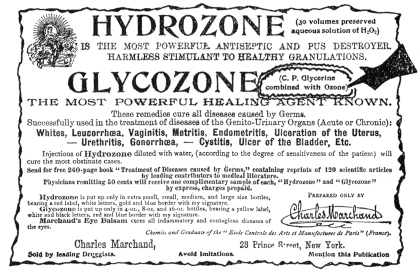
Much-reduced photographic reproduction of one of the older Glycozone
advertisements. Attention is directed to the false claim that this
nostrum is “glycerin combined with ozone.”
There is no similarity between the action of hydrozone,
which is a hydrogen peroxid preparation, and glycozone,
which consists of a mixture of glycerin and glyceric acid.
The representation is false and misleading. The following
statement, also, is an unwarranted exaggeration of the facts:
“As an internal medication in fermentation of food, catarrhal and
inflammatory conditions of the stomach, and intestinal disorders, its
action is prompt and effective, giving immediate relief to the patient.”
The following is another illustration of the vague statements
made: After asserting that Glycozone is hygroscopic
and that it will deteriorate by absorption of water unless
securely corked, it is stated that “Its healing properties
increase with age.” Whatever mysterious ingredient there
may be present in this mixture to justify the statement that
the healing properties increase with age can only be conjectured.
To humbug the patient further, the circular advises
him to use only a “silver, glass or hard rubber spoon.”—(From
the Journal A. M. A., June 5, 1909.)
The following report on Gardner’s Syrup of Hydriodic
Acid was submitted to the Council by a subcommittee:
This product was first taken under consideration in
February, 1906. Reference to several committees was necessary,
on account of the peculiar claims for the pharmaceutical,
and especially the therapeutic, superiority of this
preparation. At this time, as the Council did not have the
necessary facilities for investigating therapeutic claims, the
product was approved by the Council.
Since this time, however, the manufacturers have laid
especial stress in their advertisements on some highly
improbable claims, stating, for instance, that this Syrup of
Hydriodic Acid possesses “all the advantages, with none of
the objectionable symptoms caused by potassium iodid, or
other forms of iodin medication.” To one with even an
elementary knowledge of chemistry, the absurdity of this
statement should be evident. The alkaline reaction of the
tissues makes it impossible that hydriodic acid should persist
as such in the body. In fact, the iodin must circulate
in precisely the same form, whether administered originally
as potassium iodid or as hydrogen iodid. The qualitative
identity of the therapeutic actions is further proof of this
fact, were such needed.
Since the most important objectionable symptoms of iodid
medication arise after the absorption of the drugs, and since
hydrogen iodid is conceded to be readily absorbed, it is evident
that these symptoms must be equally liable to occur
with hydrogen iodid as with potassium iodid, provided that
equivalent doses of iodin are administered. An apparent
difference in clinical results would arise if one drug were
habitually given in smaller doses than the other. Since,
however, the iodin is present in the body in precisely the
same form, whether it is administered as a hydrogen iodid
or potassium iodid, it is evident that a given degree of
therapeutic effect would correspond to an identical tendency
to iodism, whichever drug was used. If, as appears to be
the case, the use of hydriodic acid is commonly restricted
to those cases in which only minimal doses of iodin are
required, the relative infrequency, or even absence of symptoms
with such doses would not prove that the drug itself
is less apt to cause them than is the potassium salt.
These facts are in reality self-evident; but since the
Council now has proper facilities for obtaining the views
and experiences of clinicians, it voted to submit the statement
in question to its staff of clinical consultants, and
to be guided by their advice.
OPINIONS OF THE CLINICAL STAFF
The following is an epitome of the replies of the eleven
members of this staff who had used the article or who
expressed an opinion to the questions sent out by the Council:
1. Query: “Do you think it possible that such a
preparation could be devoid of the usual effects of iodin
preparations?”
Eight reply that they consider this, a priori, impossible;
three stamp the statement as highly improbable, but do not
care to say that it would be impossible. One of the correspondents
remarks: “While distinctly taking the position
that under many conditions we must accept clinical results
which we find not explainable by our theoretical knowledge,
where the conditions are so simple as in this case and where
we know that the iodin, whether administered as hydrogen
iodid or potassium iodid, must behave in the same way,
after absorption, I believe that no properly educated and
correct thinking physician can or will, after due consideration,
fail to reject the claims of superiority made by the
proprietors of this preparation.”
2. Query: “Would you consider it necessary to make
clinical experiments to settle this question?”
Seven of the correspondents consider this superfluous; four
of these have had some experience with the article. Four,
who have not used this product, consider a clinical test
advisable. Under Query 3 we discuss the results of such
tests.
3. Query: “When using Gardner’s Syrup of Hydriodic
Acid, have you ever noticed from it any of the objectionable
effects of iodin preparations?”
Six of the correspondents have not used it, or are uncertain
whether or not they used the product made by Gardner.
One correspondent remarks: “Never used it. Repelled by
claims of superiority which exaggerate disadvantages of
potassium iodid and overlook the small amount of iodin
used in the preparation advertised.” The five clinicians
who have prescribed the preparation report as follows:
1. Objectionable iodin effects in two cases, both patients
being intolerant of all iodin preparations. 2. Has only prescribed
it once or twice, but thinks he has seen iodism
in one case, some years ago; does not recall clearly. 3. No;
but has used this make very little, and then always in very
small but continued doses. 4. No, always used it in small
doses. 5. Yes, several cases in children; typical coryza,
etc., with doses of three drams three times a day.
Conclusions: It appears that typical iodism occurred
in several cases, after doses corresponding to 10 grains or
less of potassium iodid per day, and this is a rather limited
clinical material. Objectionable iodin effects are, therefore,
not uncommon. Several correspondents remark that
the relative infrequency of iodism is easily explainable
by the fact that syrup is rarely employed in conditions which
demand an active iodin medication and that it is, therefore,
always taken in small doses. In fact, the main if not the
only point of superiority of the syrup appears to be in its
flavor.
These clinical opinions and experiences, therefore, are in
complete agreement with the judgment of the committee,
namely, that the therapeutic claims made by the manufacturers
for this article are exaggerated and misleading.
OTHER MISSTATEMENTS
The above is by no means the only misstatement in the
printed matter issued by this manufacturer. In the publication,
“The Applications of Iodin,” issued in 1907, there
occur the following misleading statements which, since they
refer to plainly chemical facts, did not require submission
to the clinical staff:
That the administration of potassium iodid after meals
greatly impairs its physiologic action “by its chemical union
with the various food products” (page 19). So far as the
committee knows, potassium iodid does not combine with
the food products in the stomach.
“Iodid of potassium, having an alkaline reaction, neutralizes
the hydrochloric acid in the gastric secretions, causing
indigestion, loss of appetite and depression” (page 19).
The United States Pharmacopeia states, under Potassii
Iodidum: “Its aqueous solution is neutral or has a slightly
alkaline reaction on litmus paper.” The slight occasional
alkalinity would be physiologically insignificant, and it is
absurd to claim that this alkalinity causes “indigestion, loss
of appetite and depression.”
“The dose of iodid of iron is so small that the amount of
iodin contained therein is of little advantage” (page 19).
As a matter of fact, the pharmacopeial average dose (1 c.c.)
of the Syrup of Iodid of Iron contains as much iodin (0.85
grains) as a teaspoonful of Gardner’s Syrup of Hydriodic
Acid (0.83 grains).
“In hydriodic Acid the iodin is in combination with hydrogen,
one of the elements of the natural secretions of the
body, and is, therefore, in physiologic harmony” (page 21).
No comment is needed.
It is implied elsewhere (page 29) that potassium iodid
decomposes more readily, with the liberation of iodin, than
does hydrogen iodid. This is contrary to the prevailing
opinion, and would require definite evidence before it could
be accepted. It is also stated the large doses of potassium
iodid in syphilis are necessary, because the gastric decomposition
prevents complete absorption. This is certainly
untrue, for potassium iodid is absorbed almost quantitatively.
These, and numerous other misstatements, constitute violations
of Rule 6; and it is, therefore, recommended that
Gardner’s Syrup of Hydriodic Acid be removed from the
list of remedies approved by the Council; it is further
recommended that this report be published.
The Council postponed final action on the report, pending
its submission to R. W. Gardner. This having been done,
and the reply of Mr. Gardner submitted to the Council, the
above report was adopted and ordered published.
W. A. Puckner, Secretary.
(From The Journal A. M. A., Nov. 14, 1908.)
The Purdue Frederick Company, exploiters of Gray’s
Glycerine Tonic, have recently been advertising to the medical
profession a nostrum called Hyperol. The following report
to the Council, by the referee, was adopted and its publication
authorized.
W. A. Puckner, Secretary.
According to the label, Hyperol is “A Utero-Ovarian Corrective
and Tonic.” The circular accompanying the trade
package states that it is:
“Indicated in all functional diseases of women such as: Amenorrhea,
Dysmenorrhea, Menorrhagia, Metrorrhagia, Subinvolution, and in all
conditions requiring a utero-ovarian corrective and tonic.”
From another circular we learn that:
“Hyperol is a combination of Hydrastine, Aloin, Iron, Apiol and
Ergotin. Its components to a certain extent will indicate its action,
but the therapeutic effects of each ingredient seem to be augmented
to an unusual degree by use in this particular combination. The
proportions of each have been determined by extensive clinical experimentation,
and the formula seems to be exactly balanced to produce
the best therapeutic effects in all derangements of the utero-ovarian
functions.”
This “formula” is not very enlightening and a physician
who wrote for further details was told that Hyperol contained:
Hydrastin | 1⁄40 | gr. |
Aloin | 1⁄12 | gr. |
Iron salts | 3 | gr. |
Apiol (Special) | 3 | ♏ |
Ergotin | 1 | gr. |
| And excipients. |
If this is correct, then, so far as its active ingredients are
concerned, Hyperol is but a mixture of well-known drugs,
having contradictory properties. According to the claims
in the circular quoted above, it is useful both in amenorrhea
and in menorrhagia. The mixture is as unscientific as it is
unnecessary. It cannot be adapted to any individual case;
when ergot is indicated, apiol would naturally be contra-indicated;
if aloes is appropriate, hydrastis may defeat the
object sought. It is unnecessary because no intelligent physician
would prescribe such a combination of drugs in any
given case. The claims are exaggerated, improbable and
foolish. Hyperol conflicts with the following rules of the
Council:
Rule 4, in that statements on the label and in the circular
enclosed with the trade package advertise it to the public
in the treatment of diseases.
Rule 6, in that exaggerated and unwarranted claims are
made for its therapeutic qualities.
Rule 8, in that the name of this pharmaceutical mixture
fails to disclose the potent constituents.
Rule 10, in that it is unscientific.
It is recommended that publication of this report be authorized
to call attention to the unscientific character of such
complex mixtures.
[Editor’s Note: Hyperol is advertised in American Medicine
and the St. Paul Medical Journal.]—(From The Journal
A. M. A., April 18, 1914.)
A subcommittee of the Council reported that unwarranted
claims and misrepresentation were made for Ingluvin by
its manufacturers, William R. Warner & Co., recommended
that the preparation be refused recognition and that the
report be submitted to Warner & Co. for action.
The report was submitted to the firm, and after waiting
one month and no acknowledgement or reply having been
received, the Council directed its publication. It is as
follows:
REPORT ON INGLUVIN
Ingluvin is manufactured by W. R. Warner & Co.,
chemists, Philadelphia, Pa. The printed matter contains
numerous claims and representations of which the following
are specimens:
“A positive specific for indigestion, dyspepsia and the most effective
remedy in obstinate cases of vomiting of gestation.... A specific
for vomiting in pregnancy in doses of from 10 to 20 grains, and a
potent and reliable remedy for the cure of marasmus, cholera infantum,
indigestion, dyspepsia, and sick stomach caused from debility of that
organ. It is superior to the pepsin preparations since it acts with
more certainty, and effects cures where they fail.... The natural
glycocholic acid in Ingluvin is the active principle and the most
efficient agent in the treatment of all stomachic and enteric disorders.”
Two samples were purchased at different times in the open
market and on examination found to consist essentially of
powdered meat fiber mixed with what appeared to {be} a membranous
tissue resembling the lining of a gizzard. Both
samples on being tested by the method prescribed by the
U. S. Pharmacopeia for estimating the strength of pepsin
were found to possess little, if any, proteolytic activity. In
order to determine whether or not the lining of a fowl’s
gizzard possesses proteolytic action, a fresh gizzard was
secured, the lining washed slightly with water, then removed
and on using one-half of same in place of pepsin as prescribed
by the Pharmacopeial method, it was found to
digest 10 grams of albumin within the time limit. Pepsin,
when properly kept, does not lose its strength to any
material extent.
A careful examination was made for the presence of
glycocholic acid, claimed to be the active principle of
Ingluvin, but its presence could not be established. Furthermore,
the anatomic relations of the fowl are such as to
preclude its presence.
The above shows that Ingluvin does not possess nearly as
much proteolytic activity as ordinary saccharated pepsin
recognized by the 1880 Pharmacopeia, which was prepared
on the basis of digesting 300 times its weight of egg
albumin. Inasmuch as no glycocholic acid is present in
Ingluvin, it would seem that saccharated pepsin would be
far more efficacious in treating the abnormal conditions for
which Ingluvin is recommended in the advertising circulars.
Furthermore, the claims made for the preparation
are grossly extravagant.
A communication from Warner & Co. has been received
since the above report was adopted, in which it is stated:
“The reason that previous letter was not replied to was
because we were desirous of securing all the information
possible on the subject. Since that time we have made considerable
research and also made laboratory investigation,
and are enclosing the accumulated data with diagram of a
part of the alimentary canal showing the esophagus, crop
and gizzard.”
Much of the other matter submitted is immaterial. The
following, so far as it means anything, seems to confirm the
correctness of the report of the Council’s referee that Ingluvin
is practically devoid of proteolytic activity: “... the
therapeutic activity must be due to the bitter property,
rather than any proteolytic activity, and it probably increases,
thereby, the functional activity of the stomach, by which
the normal digestive process is increased. Ingluvin in a
0.4 per cent. hydrochloric acid solution at 37 to 40 C. or
if mixed with an aqueous solution of pepsin under the same
conditions possesses an acrid, bitter taste and increases the
secretion of the saliva and this is practically the same condition
as when in the stomach, it no doubt stimulates the
depressed mucosa peptic glands and increases gastric solution.”
W. A. Puckner, Secretary.
COMMENTS
The fallacies attending the use of digestive ferments in
most stomach diseases have been previously noted in The
Journal.53 In most digestive disorders a deficiency of the
digestive ferment has not been proved. In cases in which
pepsin is lacking, its administration is valueless unless it
is combined with large doses of hydrochloric acid, and it
is doubtful whether this combination is either necessary
or conspicuously useful. There is, however, something so
alluring about medication by digestive ferments which are
assumed to supply a physiologic need, that since their
discovery they have formed a fertile field for the activity
of the manufacturer of proprietaries. As by scientific laboratory
tests, it is possible to determine whether a given
preparation has digestive power, the manufacturers of Ingluvin
avoid this point by claiming that the remedy acts, not
on the food, but on the stomach itself. That remedies may
exist which act as stimulants to the digestive secretions
can not be denied, although at the present time this power
has not been satisfactorily demonstrated. The proprietors
of Ingluvin, finding that proteolytic activity is not to be
attributed to this preparation of chickens’ gizzards, announce
a new therapeutic fact in the claim that “the natural glycocholic
acid in Ingluvin is the active principle and the most
efficient agent in the treatment of all stomachic and enteric
disorders. According to the report made to the Council
there is no glycocholic acid in this preparation, nor is it
possible, from the anatomic arrangements of the fowl’s
digestive apparatus, for it to get there. By all the tests
which can be applied to determine its value this preparation
is of much less value in digestive disorders than saccharated
pepsin, which was discontinued in the Pharmacopeia because
of its inferiority to the other forms of the ferment.
The repudiation, by the manufacturers, of the more
absurd claims made for Ingluvin, shows the need of maintaining
an attitude of healthy skepticism toward the advertised
therapeutic virtues of proprietary preparations. If a
physician is disposed to use digestive ferments, he should
give preference to the official preparations, and ferments
from other sources should be required to stand the exact
tests which demonstrate the worthlessness of so many preparations
on the market.—(From The Journal A. M. A., July 11,
1908.)
The Council voted that Intestinal Antiseptic W-A be refused
recognition, and that the publication of the following report
be authorized.
W. A. Puckner, Secretary.
The Abbott Alkaloidal Company advertises “Intestinal
Antiseptic W-A” as
“... A scientifically blended and physiologically adjusted mixture,
of the pure sulphocarbolates of calcium, sodium and zinc, grs. 5, with
bismuth subsalicylate, gr. 1-4 and aromatics.”
This formula is in conflict with Rule 1 in that it does not
state in what proportion the sulphocarbolates are present.
The name “Intestinal Antiseptic W-A” is in conflict with
Rules 4 and 8, since it is therapeutically suggestive.
The preparation is in conflict with Rules 6 and 10, in that
exaggerated claims are made for it, no evidence being submitted
to prove the superior value of the mixture.
The most serious of these conflicts consists in the exaggerated
and misleading therapeutic claims. The advertisements
say:
“This combination has no equal as an antiseptic and inhibitive agent
in typhoid fever, diarrhea, dysentery,” etc.
“Numerous cleverly devised and scientifically constructed intestinal
antiseptics have been introduced to the profession, but not one of them
has ever rivaled for one moment these salts in popularity.”
“... we are convinced that no small share of the credit for the
reduction of the death rate in infantile diarrheas is due to the widespread
application of this general method of treatment, associated of
course with the calomel clean-out and the regulation of diet, now
known to be essential.”
“But the use of the sulphocarbolates is not restricted to diseases of
the alimentary canal, although in the summer diarrheas, gastric fermentation,
intestinal indigestion, typhoid fever, dysentery—indeed in all
alimentary disturbances—it is the one essential remedy. It is also indicated
in practically all infectious diseases.”
“Typhoid Fever (in this disease the W-A Intestinal Antiseptic is of
great value; used early, with the proper synergistic cleanout, it will
often cut short the disease).”
These extreme claims exceed the limits of permissible
optimism, unless they are supported by strong dependable
evidence. They contrast sharply with the low esteem in
which the phenolsulphonates (sulphocarbolates) are generally
held. To accept these claims, and to justify encouraging
physicians to rely on them, it would be necessary to establish:
First, that feasible concentrations have a distinct antiseptic
action on cultures of intestinal bacteria. This experiment
could be easily made, but the claims do not seem to be
based on evidence of this kind.
Second, that the preparation actually checks putrefaction
in the intestines. There are several methods by which this
proof may be attempted; but the claims do not appear to be
based on evidence of this kind.
Third, that the preparation actually has a favorable influence
on the progress of diseases. This sort of evidence is
exposed to so many fallacies that it would have to be gathered
very carefully and critically, duly discounting the effect
of other treatment; for instance, by comparison with similar
cases which do not receive this preparation. This is especially
important; and yet we find directions to use this preparation
in conjunction with active cathartic treatment, which
in itself has considerable influence on the conditions for
which this preparation is recommended. No evidence of this
kind is presented.
The testimonials contained in the advertisements cannot be
considered as serious evidence. None present any indication
of accurate record or proper control of conditions, or of the
performance of control observations. They are superficial
impressions, to which little or no weight can be attached.
It is recommended that Intestinal Antiseptic W-A be considered
ineligible for New and Nonofficial Remedies.—(From
The Journal A. M. A., Dec. 19, 1914.)
Bannerman’s Intravenous Solution (Wm. Bannerman and
Co., Chicago) was refused recognition because vague, indefinite
and misleading statements were made regarding its
composition, because it was recommended for anemia, tuberculosis
and syphilis under grossly exaggerated and unwarranted
claims and because the intravenous injection of
complex and indefinite mixtures is unscientific and dangerous.
Notice of the action of the Council having been sent
to the Bannerman Company, the firm submitted a revised
statement of composition and also a revised advertising
circular.
The claim is made that Bannerman’s Intravenous Solution
“is a compound of only the purest and proven efficient
U. S. P. drugs.” According to the latest statement:
| Each 10 c.c. of Bannerman’s Solution contains: |
Hydrargyri Albuminas Mercury Content | 1 | 1-9 | Gr. or | 0.075 Gm. |
Ferri Albuminas Iron Content | 4 | 1-4 | Grs. or | 0.286 Gm. |
Sodii Chloridum | 6 | 1-5 | Grs. or | 0.412 Gm. |
Calcii Salicylicum | 4 | | Grs. or | 0.26 Gm. |
Guaiacol | 4 | | Grs. or | 0.26 Gm. |
Creosote (Beechwood) | 5 | | Grs. or | 0.32 Gm. |
The solvent is said to be distilled water.
The formula is unsatisfactory in several particulars. The
stated amounts of some of the ingredients are in excess of
their solubility in water; the nature and amount of
albumin contained in the “Hydrargyri Albuminas” and “Ferri
Albuminas” are not given; the claim that the solution contains
only U. S. P. drugs is not true. But the main objection
to the preparation is its unscientific character and the unwarranted
therapeutic claims made for it.
Even though a patient had all three diseases, syphilis,
tuberculosis and anemia, it would be most irrational to use
a shotgun prescription, containing, in fixed unvarying proportions,
mercury for the syphilis, iron for the anemia and
germicides for the tuberculosis. In syphilis the mercury-content
of Bannerman’s Solution is inadequate; in anemia
the intravenous administration of iron is unwarranted, and
in tuberculosis there is no evidence that the injection of
bactericides is efficient.
Exception must be taken, moreover, to the statement that
“its use is absolutely safe.” The danger of anaphylaxis
from repeated injections of albuminates cannot be disregarded,
and as J. F. Anderson, director of the Hygienic
Laboratory, has pointed out54 we know little of the secondary
or remote effects of the intravenous injection of toxic substances;
some of them probably do permanent harm.
Such claims as the following require no comment:
“It builds up and increases the hemoglobin in the blood.
“It increases the number of red blood corpuscles.
“It regulates the white cells.
“It stimulates cell growth; therefore, it is reconstructive.
“It is a powerful antiseptic.
“It is useful in any septic condition.”
In view of the facts given, the Council again refused
recognition to Bannerman’s Intravenous Solution.—(From
The Journal A. M. A., Jan. 2, 1915.)
Iodalia is sold by Geo. J. Wallau, Inc., with the claim
that because of the peculiar combination in which it contains
iodin it is a valuable and efficient substitute for
iodids. The preparation was examined in the Chemical
Laboratory of the American Medical Association, which
reported to the Council that, contrary to claim, iodin in
the form present in Iodalia would, when administered, act
like an ordinary iodid. Further the proportion of iodin
present was so small that to administer the equivalent of
20 grains of potassium iodid it would be necessary to give
the contents of a one-dollar bottle of Iodalia. In view of
this report it is evident that the claim that Iodalia is
“always well tolerated” and that it cannot produce “symptoms
of iodism” is true only because of the small percentage
of iodin it contains. The claims made in the advertising
matter, that Iodalia is an efficient iodin medication in the
treatment of syphilis, that it is a suitable substitute for
cod-liver oil and that it may be used in anemia, dysmenorrhea,
dyspepsia, malaria and diseases of the heart, are
entirely unwarranted.
Iodalia is exploited in a way to suggest its use to the
public for a host of diseases. Particularly reprehensible
are the recommendations contained in a circular which
accompanies the trade package that Iodalia:
“... offers the same protection against grippe, bronchitis, pneumonia,
tuberculosis, pleurisy and other infectious diseases that vaccine
does against small pox ...”
“It is also the best preventive against the slight infections and ailments
to which debilitated and delicate children are subject.”
The Council voted that Iodalia be refused recognition.—(From
The Journal A. M. A., Dec. 12, 1914.)
Iodex is manufactured by Menley and James, Ltd., New
York. It is advertised as
“... an embodiment of vaporized iodin in an organic base,
reduced and standardized at 5 per cent. by incorporation with a refined
petroleum product.”
The advertising conveys the impression that the effects of
free iodin are to be obtained from the preparation; it is said
to contain “5 per cent. Therapeutically Free Iodine,” and to do
“... everything the doctor expects of FREE iodin employed by
inunction, without one physical or therapeutic drawback.”
The statements are also made that the preparation “neither
stains, irritates, blisters or cracks the skin,” and that “thirty
minutes after inunction iodin can be found in the urine.”
The following report of an examination made by the Chemical
Laboratory of the American Medical Association has
been submitted to the Council:
“Iodex is dark green, practically black. The green color
is apparent when the ointment is rubbed on the skin, but
disappears on continued rubbing. This nonstaining property
is explained by the results of a test for free iodin, made on
five specimens, four of which yielded only minute traces of
free iodin, while the fifth yielded none. Of course, the statements
that Iodex is an ‘Effective Free Iodin Application
Without Drawbacks’ and also a means of ‘Really Efficient
External Iodine Therapy Without Stain or Irritation’ contradict
each other. Free iodin cannot be present in a sufficient
quantity to be therapeutically efficient in any application
which does not stain or irritate the skin.
“The total iodin content of the five specimens was found to
be 2.63 per cent.—a little over one-half of the content claimed.
“Absorption and excretion experiments were performed to
test the claim that ‘thirty minutes after inunction iodin can
be found in the urine.’ In several subjects, from 1 to 2 gm.
of Iodex was rubbed on the skin of the forearms, and the
urine, for periods varying from seven to seventy-two hours,
was collected and tested for iodin. In all of the tests the
results were negative.”
Iodex is advertised as beneficial in muscular soreness,
sprains, sciatica, neuritis, chronic rheumatism, enlarged
glands, orchitis, epididymitis, gout, burns and dermatomycoses.
It is also said to be “Indicated in Glandular Enlargements,
Inflammatory Conditions, Various Joint Diseases, Rheumatism,
Skin Diseases, Chilblains, etc., etc.”
To sum up:
1. As shown in the foregoing laboratory report, the composition
is incorrectly stated, for the actual iodin content is
only about half of that claimed.
2. It is not true that the action of Iodex is essentially that
of free iodin, which is the impression conveyed by the
advertising.
3. The assertion made in the advertising, that iodin may be
found in the urine shortly after Iodex has been rubbed on the
skin, has been experimentally disproved.
In view of these findings, the Council voted that Iodex be
refused recognition for conflict with Rules 1, 4 and 6.—(From
The Journal A. M. A., June 19, 1915.)
The following report on Iodia was adopted by the Council
and its publication authorized.
W. A. Puckner, Secretary.
Iodia is put on the market by Battle and Company, under
the claim that it contains potassium iodid in combination
with iron phosphate and vegetable “principles.” It is extravagantly
recommended for use in many and varied conditions.
For instance, it is “an unexcelled altero-reconstructive,”
“almost a specific” in eczema and rheumatism and “a
highly efficient form of iodin,” which will not produce iodism!
The therapeutic effects of iodids result from a chemical
transformation by which molecular iodin is set free in the
tissues, thus producing a mild degree of iodism. It follows,
then, that a preparation which cannot give rise to the symptoms
of iodism cannot be expected to produce the therapeutic
effects of the iodids. The claim that Iodia is therapeutically
efficient without producing iodism therefore justifies suspicion,
to put it mildly.
In view of the exaggerated tone of the advertising, together
with the fact that a report from the Chemical Laboratory
of the American Medical Association showed marked discrepancies
between the formula and the composition of Iodia,
it seemed desirable to investigate this product. The report
of the laboratory, which is given below, shows conflict with
Rule 1 (secrecy of composition) and with Rule 2 (false
claims of standardization). A discussion of the claims made
for Iodia follows the report.
LABORATORY REPORT
The composition of Iodia is given thus:
“Formula.—Iodia is a combination of active principles obtained from
the green roots of Stillingia, Helonias, Saxifraga, Menispermum and
aromatics. Each fluid drachm also contains two and one-half grains
Iod.-Potas. and one and one-half grains Phos.-Iron.”
We are told that:
“Its several ingredients are selected with scrupulous care, and the
most exacting methods are constantly employed to insure absolute uniformity
and maximum therapeutic potency.”
This “formula” is an absurdity: First, the amounts of the
“active principles” of the plants named are not given; second,
these “principles,” with the possible exception of menispermum
alkaloids, have not been isolated; and, third, ferric
phosphate and potassium iodid are incompatible! Incidentally,
there are no methods whereby it is possible to secure “absolute
uniformity” of a mixture such as Iodia is claimed to be.
Qualitative tests demonstrated the absence of iron and the
absence of all but traces of phosphorus compounds (0.015 gm.
phosphorus per 100 c.c.). Minute traces of alkaloids, possibly
from menispermum, were found (that amount being about
0.004 gm. per hundred c.c. of the preparation). Therapeutically
this quantity is entirely negligible. Determinations of
iodid demonstrated the presence of only about 60 per cent.
of the amount of potassium iodid claimed. The “formula”
for Iodia is false and misleading.55
DANGEROUS RECOMMENDATIONS
One of the Iodia labels reads:
“Indications.—Syphilitic, scrofulous and cutaneous diseases, dysmenorrhea,
menorrhagia, leucorrhea, amenorrhea, impaired vitality,
habitual abortion and general uterine debility.”
Such recommendations are likely to lead to self-drugging
in conditions that are not only dangerous to the individual
but also a menace to the community. The preparation thus
conflicts with Rule 4 of the Council. After admitting the need
of efficient iodid medication in certain stages of syphilis and
after exaggerating the frequence and severity of symptoms of
iodism, an advertising circular entitled “Practical Therapeutics”
asserts:
“Iodia then is the preparation of iodid of potassium to be preferred
whenever it requires to be administered in large doses or for prolonged
periods of time ...
“Not only does the association of the iodid of potassium with the
vegetable alteratives offer a measure of protection against iodism but the
latter exert depurative effects on their own account ...”
It is generally accepted that in certain stages of syphilis
the only hope of success lies in efficient iodin medication.
The exploiters of Iodia state that a dose of the nostrum
contains 21⁄2 grains of potassium iodid; actually it contains
only 11⁄2 grains. To urge physicians and the public to depend
on this product for efficient iodid medication constitutes an
unwarranted therapeutic exaggeration (Rule 6) which
approaches criminality. The reason Iodia does not produce
iodism is that, in the doses recommended, the iodin action is
extremely feeble.
Likening the human body to a factory and discussing the
“break downs” which are likely to occur, a circular entitled
“Always Trustworthy” says:
“When administered in proper dosage, Iodia stimulates organic functions,
promotes the elimination of waste products, and re-establishes
metabolic activity. It increases the solvent properties of the blood, and
arrests abnormal tissue metamorphosis. In other words, it lends material
assistance to weakened cells and curbs those unduly active. Iodia,
obviously, has a wide range of indications. It has been most generally
and successfully employed, however, in Syphilitic, Scrofulous and Cutaneous
Diseases, Rheumatic and Gouty Ailments, Dysmenorrhea, Menorrhagia,
Leucorrhea, Amenorrhea, Impaired Vitality, Habitual Abortion
and General Uterine Debility, and wherever a reliable altero-reconstructive
is required.”
These recommendations show that in addition to the
objections already given, this nostrum is an unscientific shot-gun
mixture. This brings it in conflict with Rule 10 (unscientific
articles inimical to the medical profession and the
public).
It is recommended that Iodia be refused recognition.—(From
The Journal A. M. A., Nov. 21, 1914.)
The Council has authorized publication of the following
report on Burnham’s Soluble Iodine.
W. A. Puckner, Secretary.
Burnham’s Soluble Iodine is offered to the medical profession
by the Burnham Soluble Iodine Company, Auburndale,
Mass., under the claim that by
“... a new process hitherto unknown to chemistry,... Iodine
is converted into a soluble article—soluble in water and soluble in gastric
secretions and in the tissues.”
Beyond this no statement as to the qualitative or quantitative
chemical identity of Burnham’s Soluble Iodine is
furnished; this secrecy, of course, has given the preparation
a certain mysterious prestige among unthinking physicians.
Burnham’s Soluble Iodine was examined in the Chemical
Laboratory of the American Medical Association some six
years ago and was found to be an alcoholic solution of free
iodin (approximately 3 gm. per hundred c.c.) and combined
iodin in the form of iodid (equivalent to about 2 gm. of potassium
iodid per hundred c.c.). Thus the total iodin content was
somewhat less than half of that of the official Tincture of
Iodin (Tr. Iodi), which contains 7 gm. of free iodin and 5 gm.
of potassium iodid to each 100 c.c. The official tincture,
diluted one-half, therefore, would be essentially equivalent to
the Burnham preparation, both being miscible with water.
The Burnham Soluble Iodine Company objected to the conclusions
drawn, from this analysis, but admitted the correctness
of the analysis itself.
Any one who gathered his first knowledge of the subject
from the Burnham advertising might readily infer that no
soluble iodin had been known prior to Burnham’s Soluble
Iodine. This, of course, is not the case; the method of producing
a solution of iodin by the use of an iodid has long
been known.
The following statement is not only obviously untrue but
also nonsensical:
“In all the history of iodin medication, covering a period of laboratory
research of many years duration, every effort to produce a free
iodin, prior to the evolution of Burnham’s Soluble Iodine, was attended
by failure.”
The company lays stress on the assumed superiority over
the iodids of a preparation containing free iodin. This
assumption is based on a fallacy. Those who regard free
iodin as superior to combined iodin forget that free iodin
taken by the mouth is converted in the intestines, by the
action of the alkaline intestinal secretions, into an iodid
with a small amount of iodate, while administered intravenously
(a procedure that, while advocated by the Burnham
concern, is therapeutically indefensible), it enters into combination
with the alkaline salts and proteins of the blood.
The free iodin in Burnham’s Soluble Iodine must act in the
system as an iodid, and the whole iodin content, to furnish
a correct estimate of the value of the preparation, should
be reckoned as an iodid.
Bearing this in mind, then, it is evident that the doses of
Burnham’s Soluble Iodine recommended by the manufacturers
are extremely small. They range from 20 minims
(equivalent to 1 grain of potassium iodid) to 1⁄2 minim (equivalent
to 1⁄40 grain of potassium iodid). From 5 to 20 minims
(equivalent to about 1⁄4 to 1 grain of potassium iodid) is the
dosage recommended for syphilis; from “1 to 3 minims
[equivalent to from 1⁄20 to 3⁄20 grain of potassium iodid] three
to six times daily” for typhoid and other intestinal diseases.
No wonder the exploiters can say that this nostrum does not
irritate the intestines, that it is “non-irritating to the weakest
stomach” and that there is an “entire absence of toxic action
from maximum doses”! Its alleged freedom from the irritating
and untoward effects of ordinary iodids is due, not to
any inherent superiority of the preparation, but to the insignificant
amount of iodid present.
The preparation is advertised for use in an extremely wide
range of diseases, in some of which iodid therapy is recognized
as of value, while in others it is generally regarded
as either worthless or harmful. Given orally or intravenously
(the recklessness of the latter method should again
be emphasized) Burnham’s Soluble Iodine is claimed to
be of:
“... great utility as an internal antiseptic in tubercular affections ...”
Since, as previously explained, free iodin, when introduced
into the body, enters into chemical combination before it has
a chance to permeate the tissues, and since the alkali iodids
possess very slight (in fact, for this purpose, negligible)
antiseptic powers, it is evident that this claim is unfounded.
So, for the same reason, is the claim that “as an intestinal
antiseptic,” Burnham’s Soluble Iodine is:
“... efficient in Typhoid Fever, Enteritis and other intestinal
diseases.”
It is recommended in exophthalmic goiter, notwithstanding
that this condition is generally recognized as contraindicating
the administration of iodids, which excite the action of
the thyroid gland, and which therefore must be used with
great circumspection. An especially indefensible recommendation
is that 1⁄2 minim of Burnham’s Soluble Iodine
(equivalent to 1⁄40 grain of potassium iodid) be administered
every five minutes in “membranous croup”—diphtheria—until
relief from dyspnea is obtained. But, of all the extravagant
claims made for this preparation, perhaps the following
is the most reprehensible:
“In the treatment of Phthisis, in its various forms, clinical evidence
clearly indicates that the use of SOLUBLE IODINE affords the most
potent method of treatment available. Dose—2 minims, increasing to
5 minims in four ounces water before meals.”
Remove the mystery and tell physicians that a dose of
1⁄10 or 1⁄4 of a grain of potassium iodid is “the most potent
method of treatment available” in tuberculosis and the
absurdity becomes self-evident. Nor is this the worst feature
of the advice here offered. Iodin, by combining with the
fatty acids of tuberculous tissues, promotes their autolysis
and consequently their softening and breaking down. The
products of this autolysis are carried by the lymphatics
to healthy tissues and thus may spread the infection. Therefore
the use of iodids in tuberculosis, even in small dosage,
should not be undertaken lightly.
It is recommended that Burnham’s Soluble Iodine, a semi-secret
preparation, exploited by means of extravagant and
dangerous therapeutic claims, be held ineligible for admission
to New and Nonofficial Remedies, and that this report be
published.—(From The Journal A. M. A., May 15, 1915.)
Eimer and Amend, New York, who market Iodotone,
state that it is a solution of hydrogen iodid (hydriodic
acid) in glycerin, containing 1 grain of iodin to each fluid
dram. The unwarranted assertion is made that Iodotone
“... will produce the constitutional effect of iodine in a shorter
time than other preparations ...”
This cannot be true, for it is certain that, because of the
alkaline reactions of the tissues, iodids, whether administered
as hydrogen iodid or as alkali iodids, must circulate
in precisely the same form and therefore exert the same
therapeutic effects in precisely the same way.
Eimer and Amend further assert that the ordinary iodids
may to advantage be replaced by Iodotone. The absurdity
of this claim is apparent when it is considered that it will
be necessary to administer nearly one fluidounce of glycerin
to obtain an amount of Iodotone equivalent to a 10-grain
dose of potassium iodid. The additional claim that Iodotone
will not disturb the stomach or produce the usual disagreeable
symptoms of iodism is evidently unwarranted, for
it is generally conceded that symptoms of iodism can be
avoided only at the risk of insufficient iodin medication.
Because of these unwarranted and misleading claims and
because the name Iodotone would tend toward the uncritical
use of the preparation as a general tonic, the Council
voted that Iodotone be refused recognition.—(From The
Journal A. M. A., Dec. 12, 1914.)
Iosaline is a rheumatism remedy for external application.
In view of the misleading and unwarranted claims which
are made for it, the Council voted that Iosaline be refused
recognition and recommended publication of the Committee’s
report which appears below.
W. A. Puckner, Secretary.
COMMITTEE’S REPORT
The following sweeping but rather indefinite claims are
made for Iosaline.
“Iosaline is a penetrator and overcomes the objectionable escharotic
properties of Iodine; it is readily absorbed and may be used without
discomfort or discoloration.”
“The strong analgesic properties of Iosaline make it especially useful
in controlling pain in cases of Neuralgia, Rheumatism, Gout, and
Arthritis Deformans.”
As there are few, if any, known iodin compounds which
are “readily absorbed” through the skin and which will not
at the same time produce discoloration or discomfort, it
was thought worth while to take up the examination of
Iosaline. The results of this examination are reported by
the Chemical Laboratory of the Association as follows:
Laboratory Report:—Iosaline is advertised by the Iosaline
Company of New York, as a remedy for the treatment by
external application, of rheumatism, gout, neuralgia, pneumonia
and numerous other diseases. Concerning its composition
the following statements are made:
“A transparent, non-staining gelatinoid of combined iodine with
menthol and methyl salicylate.
“Alcohol 070. per cent.
“Chemical tests demonstrate the preparation to contain 5 per cent. of
iodine.”
The placing of a cipher before the percentage figure for
alcohol, though perhaps accidental and not meant to mislead,
might cause a hasty or careless reader to understand
7 per cent. or .07 per cent., instead of 70 per cent., as the
proportion of alcohol present.
The preparation examined was a very pale yellowish,
translucent solid having a strong odor of methyl salicylate
and a fainter odor of menthol. A package sold for 2 ounces
contained 51.7 gm. Qualitative tests indicated the presence
of alcohol, an iodid, menthol, methyl salicylate, potassium,
sodium, combined fatty acids and a trace of glycerin. Thyroid
extract was not found. Quantitative examination indicated
the following approximate composition for Iosaline:
Alcohol (by weight) | 48.05 | per cent. |
Menthol | 2.07 | per cent. |
Methyl salicylate | 10.25 | per cent. |
Potassium iodid (4.25 per cent. iodin) | 5.55 | per cent. |
Soap | 12.68 | per cent. |
Glycerin | a trace |
| Water and undetermined matter to make 100 per cent. |
Iosaline, therefore, appears to be a solidified, watery-alcoholic
solution of soap containing potassium iodid, menthol
and methyl salicylate. Physiologic tests carried out by
rubbing the preparation on the skin and afterward testing
the saliva and the urine for an iodid indicated that none of
the potassium iodid is absorbed. Since Iosaline is claimed
to contain 70 per cent. of alcohol and 5 per cent. of iodin,
the alcohol content is but 68.7 per cent. and the iodin content
but 85 per cent. of the amounts claimed. The phrase
“combined iodin” is evidently meant to mislead, and adds
the element of mystery on which preparations of this class
rely so largely.—(From The Journal A. M. A., March 15,
1913.)
Nourry Wine (E. Fougera and Co., New York) is a
proprietary iodin preparation said to contain 12 per cent. of
alcohol and 11⁄2 grains of iodin in combination with tannin
to the fluidounce. Experiments made in the A. M. A. Chemical
Laboratory demonstrate that the iodin contained in
Nourry Wine is present either in the form of iodid ions or in
a form very readily yielding iodid ions and that therefore its
action will be that of ordinary iodid. Yet a circular asserts:
“The Nourry Wine is the one preparation ... able to introduce
into the organism the active metalloid liberated little by little from the
organic combination....”
While Nourry Wine contains but an insignificant proportion
of iodin, the circular claims that “Nourry Wine presents
a high dose of iodin.” Further, the label on Nourry Wine
and the circular which is wrapped with it suggests its use
in a number of diseases in which iodin medication is considered
of minor importance. These recommendations, bolstered
up by testimonials from twelve to twenty-five years old,
are likely to lead the public if not the medical profession to
use this weak iodid wine where efficient treatment is called
for. The attempt is made to give a further false value to
Nourry Wine in the minds of those who prize everything
that is foreign by the suggestion that it comes from France
when in reality it is made in New York. In conclusion the
Council held that, though the alcohol of the wine is the most
potent constituent, the constant use in the advertising matter
of the term “Nourry Wine,” unqualified by the adjective
“Iodinated,” was mischievous as likely to lead to the thoughtless
use of the preparation in cases unsuitable for iodin
medication. The Council refused recognition to Nourry
Wine.—(From The Journal A. M. A., Dec. 12, 1914.)
The following report was submitted to the Council on
Pharmacy and Chemistry by the subcommittee which
examined Labordine:
To the Council on Pharmacy and Chemistry:—Your subcommittee
presents the following report on Labordine, sold
by the Labordine Pharmacal Co., St. Louis.
Labordine is advertised to physicians as having the following
composition:
Apium Graveolens (true active principle) “Process-Laborde” | 353⁄8 |
Gaultheria Fragrantissima (true active principle) “Process-Laborde” | 251⁄8 |
Acete Amide-Phenyle | 151⁄8 |
Quinina | 11⁄8 |
Benzoyl-Sulphyonic-Imide | 231⁄4 |
It is stated to be a “vegetable antipyretic”; that {“}it
reduces temperature without heart depression,” and physicians
are warned to “avoid acetanilid poisoning and danger
from other coal-tar antipyretics.”
While the “formula” and the statement just quoted are
sufficient evidence of the fraudulent character of the product,
yet an abstract of the reports of the chemists who
analyzed it is given further to demonstrate its character.
Taking the average of the reports of analyses, labordine
contains:
Acetanilid | 37.9 |
Free salicylic acid | 6.9 |
Quinin | present |
Corn starch | present |
Milk sugar | 34.7 |
This report of analysis only makes apparent that Labordine
is not what it is claimed to be. While it is claimed
to contain 231⁄4 per cent. saccharin, this substance was
not present, or mere traces only. While, in a disguised
way, it is stated to contain 151⁄8 per cent. acetanilid, it
contained nearly 40 per cent.
It is recommended that Labordine be not approved and
that this report be published.
The recommendation of the subcommittee was adopted by
the Council, and in accordance therewith the above report is
published.
W. A. Puckner, Secretary.
COMMENTS
A concrete illustration of some general principles previously
laid down is furnished by a nostrum too unimportant
to be of any value, save to “point a moral and adorn a tale.”
About thirteen years ago Labordine was advertised under
the name of Analgine-Labordine, “A purely vegetable
product,” “a combination of the active principles of Camellia
Thea, Apium Graveolens, saccharin and carbohydrates,”
“Superior to Antipyrine, Phenacetine, Antifebrine, Acetanilid”—note
the use of two names for the same thing—“or
any of their imitations,” and “unexcelled by any coal-tar
product or their compounds.” In 1894 the name was changed
to Labordine, in order, as its owner stated, to prevent its
being mistaken for a coal-tar product of similar name.
What its composition was at this time we do not know,
since there is no guarantee of the permanence nor stability
of nostrum formulas except “the honor and reputation of the
manufacturers,” which, as investigation has shown, is not
always unimpeachable. There has been nothing to prevent
alteration of the formula, if the proprietors desired, with
every change in the moon. But the name and the general
tone of the advertising has been the same. The claim of
superiority over coal-tar products has been constantly made.
As to the present conditions, a circular enclosed with a
sample of Labordine, recently sent from the St. Louis office,
contains the formula given above in the report of the Council.
In the same circular are also found these illuminating
statements: “The medical profession has long appreciated
the dangers involved in the administration of various mineral
remedies now so commonly employed, and the value of
a safe, effective and reliable vegetable antipyretic is universally
recognized. Such a remedy is Labordine. It is
purely vegetable in its composition and produces none of
the evil after-effects of the coal-tar derivatives.... Labordine
... is a purely vegetable cardiac stimulant.... There
is nothing mysterious about Labordine or its
constituents.... The ‘Process-Laborde’ gives the true
active principles of the Celery and Indian Wintergreen,
something heretofore difficult to obtain. To this is added
the fact that absolutely chemically pure Acet-Amide-Phenyle
is used. The latter is the most valuable and, in fact, the
only vegetable antipyretic known.”
The above report of the Council shows the following facts:
1. Apium Graveolens (true active principle), “Process-Laborde”
is probably powdered celery seed. One chemist
says: “The powder has the characteristic odor of celery,
while a microscopic examination shows the presence of a
substance having the characteristic structure of seeds in
general.” If celery seed has any “active principle” it has
never been isolated. As to its therapeutic value, nothing
whatever is known. It is, we understand, highly beneficial
in the case of singing canaries, but authorities in scientific
therapeutics have never discovered that it possessed any
remarkable medicinal qualities.
2. Gaultheria Fragrantissima (true active principle), “Process-Laborde,”
is probably ordinary everyday salicylic acid.
One analysis showed salicylic acid to be present to the
amount of about 7 per cent. The question of whether or not
salicylic acid could in any way be considered the “true
active principle” of Gaultheria Fragrantissima, was submitted
to Prof. John Uri Lloyd of Cincinnati, the eminent
authority on the chemistry of the proximate principles of
plants, who replies:
“The advertisement is evidently so worded that, although
the name of the Indian plant Gaultheria Fragrantissima is
employed, its true and active principle being wintergreen
oil, the concoctor can mystify his patrons and at the same
time use the well-known wintergreen oil, made in America,
which in my opinion, so far as any chemical test might be
concerned, could not be distinguished from the methyl
salicylic acid (wintergreen oil) derived from the Indian
plant. Concerning whether salicylic acid is a proximate
constituent of Gaultheria Fragrantissima, in my opinion,
it would be a misnomer to make such an announcement.
Salicylic acid, per se, does not exist, in my opinion, in the
plants mentioned, being made by chemistry.”
3. The third and most important ingredient in this “purely
vegetable antipyretic” is brazenly announced as “Acet-Amide-Phenyle,”
but it is only necessary to say that this
imposing designation is an attempt to “Frenchify” a scientific
name for acetanilid.
Analysis shows that this coal-tar product is present to the
amount of 37.9 per cent., or 1.89 grains in a 5-grain tablet.56
In other words, this imposing Labordine, made by a mysterious
and elsewhere unheard of “Process-Laborde,” is
simply one more of the many acetanilid powders that have
been foisted on our profession and that have filled our journals
for years past. The only thing in it that is of practical
therapeutic value is 2 grains of acetanilid to a 5-grain
tablet. The statement that Labordine is a purely vegetable
preparation is probably intended by the proprietors as a
good joke on the medical profession. Acetanilid is not usually
regarded as a vegetable product, at least it is not
ordinarily found in market gardens. The only vegetable
source from which acetanilid can be obtained is the beautiful
flowering coal-tar bush, from which so many other
nostrum vendors obtain their “perfectly harmless, purely
vegetable antipyretics,” all composed of acetanilid and something
to hide it. If the statements made by one of the company’s
employees and quoted below are true, Labordine is
not “manufactured and made chemically pure in the laboratories
of the Labordine Pharmacal Company,” for this company
has no laboratory, and its product is manufactured
for it.
4. Our readers will be interested to know that the important
ingredient entered under the imposing name of Benzoyl-Sulphyonic-Imide
is simply a highly scientific name
for saccharin. Even on this point, however, the formula is
misleading, since it claims 231⁄4 per cent. of this substance,
whereas the analysis shows that the presence of saccharin
could not be proved. If it is present at all it is in quantities
much less than stated, and so small as to be difficult of
recognition. Instead it appears that the product contains
common starch and about 35 per cent. of milk sugar.
THE COMPANY ITSELF
One of the humiliating phases of the proprietary medicine
business is that, in many instances, these preparations are
foisted on our profession by men who know nothing of medicine,
pharmacy or chemistry, yet who not only presume to
concoct our medicines for us, but also assume to instruct us
how to use them.
Gould’s Commercial Register for 1907 gives the officers of
the Labordine Pharmacal Company as H. M. Coudrey, president;
M. Crawley, vice-president, and D. E. Gamble, Jr.,
secretary and treasurer. The place of business is given as
420 Market street, St. Louis. We are informed that Harry
M. Coudrey is an insurance agent and the present member
of Congress from the Twelfth Missouri District; that Mark
Crawley is a clerk in the insurance office of H. M. Coudrey;
and that Mr. Gamble is cashier in the same office. A recent
visit of a representative of The Journal to 420 Market
street, St. Louis, showed that the office of the Labordine
Pharmacal Company is in Room 12 on the third floor of an
old dilapidated building. There was no sign on the door
of the office, but on the wall next to an old elevator was a
very small sign which read “Labordine Chemical Company,
Room 12.” The office at the time of the visit was apparently
in charge of a young woman about 20 years old.
Careful scrutiny of the furniture and fixtures showed that
the room contained an old oak roll-top desk in one corner
and a kitchen table, on which were piled about half a dozen
packages of Labordine. The floor of the room was bare and
very dirty. In an adjoining room, the door of which was
open, was piled a lot of broken furniture. No laboratories
nor chemical apparatus were visible. The young woman in
charge stated that Labordine was made by the Mallinckrodt
Chemical Works, at No. 3600 North Second Street, St. Louis.
This is a fair sample of nostrums and of the methods of
exploiting them. The bitterly humiliating fact about the
whole business is that a preparation, advertised under such
palpably misleading claims, could actually be advertised in
medical journals, even in journals of a supposedly high
scientific standard, and could be bought and prescribed for
years by supposedly intelligent and conscientious physicians.
It is not supposed that every physician should be enough of
a chemist to detect the ridiculous discrepancies between the
published formula and the therapeutic claims made for such
a mixture. But that members of a supposedly learned profession
should fail to have enough interest in the preparations
they prescribe for their confiding patients to find out
that acetanilid is being masked under an obsolete and little
used name, that under an imposing polysyllabic designation
is hidden saccharin, that the so-called “active principle
Process-Laborde” (whatever that may be), is equivalent
only to one-third grain of salicylic acid in a 5-grain tablet,
and that the advertising matter sent out for years by this
company contained absolute falsehoods regarding the composition
and therapeutic benefits of its preparation, is certainly
just cause for shame and humiliation. If a physician,
knowing the composition of Labordine, wishes to prescribe
it and prescribes it intelligently, he has a perfect right to
do so. If he wishes his patient to have 2 grains of acetanilid,
1⁄20 of a grain of quinin, and 1⁄3 of a grain of salicylic
acid, and considers a mixture of ground celery seed, starch
and milk sugar as a proper vehicle for this medication, no
one will question his right to administer it. No physician,
however, has any right, either moral or professional, to prescribe
a preparation, concerning the ingredients of which
he knows absolutely nothing.
Is it possible that such carelessness may be one of the
causes of waning public confidence in our profession? We
leave it to our readers to determine whether such a moral
can be drawn from this typical nostrum story.—(From The
Journal A. M. A., March 30, 1907.)
The Franco-American Ferment Company has advised the
Council on Pharmacy and Chemistry that, in advertising its
products, it will no longer conform to the rules of the
Council. This is evident. The Franco-American Ferment
Company has distributed circulars in which the public is
informed that auto-intoxication is the cause of innumerable
ills ranging all the way from arteriosclerosis, rheumatism
and gout to chronic headache, odorous perspiration, nervous
disorders and melancholia; that the Bulgarian bacillus “is
a wonderful corrective or remedy” for all these conditions,
and that the Lactobacilline products are the only preparations
of Bulgarian bacillus “to be had in America which
bear his [Professor Metchnikoff’s] personal endorsement”—by
inference, the only reliable products. In view of the
action of the Franco-American Ferment Company, and of
the tendency of their advertising to cause the public to
exaggerate slight ailments into alarming conditions, the
Council has voted that the several Lactobacilline products
of this concern be deleted from New and Nonofficial Remedies.—(From
The Journal A. M. A., April 17, 1915.)
In 1907 the Council on Pharmacy and Chemistry published
a report on Lactopeptine. At that time it was shown that
Lactopeptine did not have the composition claimed for it.
The same claims as to composition are still being made for
the product. In view of this fact, a second examination of
Lactopeptine has been made and the result reported to the
committee on chemistry. The report confirms the Council’s
findings of six years ago. After adoption by the committee,
it was adopted by the Council and its publication authorized.
W. A. Puckner, Secretary.
SECOND EXAMINATION OF LACTOPEPTINE
Two specimens of Lactopeptine in original unbroken packages
were recently examined. One of these was an American
preparation said to be produced by the New York Pharmaceutical
Association at Yonkers and the other an English
preparation from John Morgan Richards and Sons, London.
When Lactopeptine was first examined by the Council
about six years ago, it was found to be little more than
weak saccharated pepsin, and did not contain the other ferments
which were claimed by the manufacturers to be present.
A statement concerning this was published in the Council
Reports for 1905–1908, p. 43. Because of claims recently
made by the exploiters that this preparation contains not
only pepsin but also pancreatin, diastase, lactic acid and
hydrochloric acid, and that the failure to recognize these
must be due to the lack of ability of the chemists making
the examination, it seemed worth while to undertake a new
series of tests on samples from two sources mentioned, the
products on the British and American markets. The label
on the British sample gives the following as the composition:
Sugar of Milk | 40 | ounces |
Pepsin | 8 | ounces |
Pancreatine | 6 | ounces |
Ptyalin or Diastase | 4 | drachms |
Lactic Acid | 5 | fl. drachms |
Hydrochloric Acid | 5 | fl. drachms |
The label on the American sample gives no quantities but
states that it “represents a combination of the principal
digestive and enzymogenic agents, Pepsin, Pancreatin, Diastase,
Lactic and Hydrochloric Acids, in the proper proportion
to insure best results.”
We have examined both preparations for starch-digesting
power according to the methods employed in our previous
examinations of such ferments and already reported. Diastase
and the amylopsin of pancreatin seem to be completely
absent, or, if present at all, in such minute traces that
digestion of starch is not shown after one hour when quantities
running from 60 mg. up to 150 mg. were allowed to
act on 500 mg. of starch made up into paste. These tests
were repeated, always with the same results, and were controlled
by digestions of the same starch with other diastase
preparations of known value.
Tryptic activity appears likewise to be absent, as in weak
alkaline solution after fifteen hours’ digestion no effect on
coagulated egg albumin or fibrin was observed when 100 mg.
of each preparation was used with 1 gm. of the protein
material.
As was found in the previous investigation the two
products have some peptic activity, but this activity is comparatively
weak, as about 200 mg. of each preparation are
required to digest 10 gm. of coagulated egg albumin with
0.2 per cent. hydrochloric acid in three hours at 40 C.
(104 F.), and 100 mg. portions were unable to completely
digest 10 gm. portions of egg albumin with acid of the same
strength in four hours at 50 C. (122 F.).
Hydrochloric acid is absent, as might be expected from
the character of the preparation, and the amount of combined
chlorid is small; but qualitative tests were obtained
for organic acid resembling in behavior lactic acid, which
is probably present in combined form.
It must be reaffirmed then that in digestive activity both
the Lactopeptine purchased in the United States and that
bought in England are essentially weak saccharated pepsins.
[Editorial Note.—The report of 1907 demonstrated that
Lactopeptine was at that time a weak saccharated pepsin.
The present report shows that Lactopeptine, as it is sold
both in the United States and Great Britain, is still the same
weak pepsin preparation. By the false statements which
appear on the Lactopeptine labels the exploiters lay themselves
liable to prosecution under the Food and Drugs Act—just
as they have laid themselves liable for the past six
years. The continued exploitation of this preparation warrants
a restatement of facts that have been given many
times before:
1. A preparation having the composition claimed for
Lactopeptine—a powder containing pepsin, pancreatin, diastase,
lactic acid and hydrochloric acid—cannot be produced
commercially.
2. Even if such a combination were available, the acidity
of the mixture itself and of the gastric juice would in all
probability destroy the pancreatin before it could reach the
intestinal tract.
3. Even if every constituent could exert its proper function
at the right time, the administration of such a shotgun
mixture would be unscientific and uncalled for.]—(From The
Journal A. M. A., Aug. 2, 1913.)
The following was submitted to the Council by a subcommittee:
To the Council:—While meat extracts contain only traces
of coagulable proteids and have little food value, meat
juices are prepared by a process which ensures the presence
in the finished product of considerable quantities of
coagulable proteids and they therefore have considerable
value as foods. Many preparations which are sold as beef
juices or meat juices have no right to these designations.
Since the public and physicians are likely to be misled by
the names given to these products and by the false claims
which are made for them as foods and depend on them in
the nourishment of the sick, it is important that their composition
and their value as foods should be known.
In the following report is presented the results of an
examination of some of the commercial products found on
the American market. The report shows that Wyeth’s Beef
Juice (John Wyeth & Bro., Philadelphia), Bovinine (The
Bovinine Co., New York), Carnine (Carnine Co., Fougera
& Co., New York), and Valentine’s Meat Juice (M. J. Valentine,
Richmond, Va.) are sold under names which are incorrect,
that their composition is not correctly stated by the
manufacturers and that false and misleading statements are
made in regard to their value as food.
It is recommended that the products named be refused
recognition for conflict with Rules 1, 6 and 8. Since these
preparations are typical of many others on the market, and
as their use is a menace to the public health it is recommended
that the report be published.
This report was adopted by the Council.
W. A. Puckner, Secretary.
Beef or meat juices are clearly to be distinguished from
beef or meat extracts. The word “juice” applies solely to
the fluid portion remaining in fresh meat after proper cooling
and storing and may be obtained by pressure or diffusion
with or without a low degree of heat. Under heavy
pressure freshly chopped meat will yield from 25 per cent.
to 40 per cent. of a thick reddish juice and if the meat is
previously frozen or heated to 60 C., as much as 50 per
cent. may be obtained. This gives some idea as to the
probable cost of preparing beef juice at home. The chief
characteristics of meat juice are the presence of a considerable
proportion of coagulable protein and a low content of
meat bases. That above represents the nature of these commodities
as usually understood by the medical profession,
is clearly shown by this quotation:57
“One or two teaspoonfuls of this (meat juice) are added
to a teacupful of cold or warm water, which, however, must
not be boiling, or otherwise the albumin would be coagulated,
but it may, however, be sufficiently warm to drink
comfortably.”
Beef juice is considered by some physicians of much
dietetic service and believed to represent liquid food in
concentrated form. W. O. Atwater,58 relative to this product
says:
“Beef juice obtained from the best steak which has been
merely warmed through over the coals and then entirely
deprived of soluble substance by a screw press, is undoubtedly
the most concentrated of the liquid foods.”
The latter authority gives a number of analyses of beef
juices prepared under known conditions.
DEFINITION OF MEAT JUICE
Meat juice is defined by the standards committee of the
Association of Official Agricultural Chemists as the fluid
portion of muscle fiber obtained by pressure or otherwise,
and may be concentrated by evaporation at a temperature
below the coagulating point of the soluble protein. The
solids contain not more than 15 per cent. of ash, not more
than 2.5 per cent. of sodium chlorid (calculated from the
total chlorin present), not more than 4 nor less than 2 per
cent. of phosphoric acid (P2O5), and not less than 12 per
cent. of nitrogen. The nitrogenous bodies contain not less
than 35 per cent. of coagulable proteins and not more than
40 per cent. of meat bases.
Meat juices of commerce are supposed to be made by subjecting
properly prepared meat to heavy pressure with subsequent
concentration of the juice in vacuo at a low temperature.
The latter is necessary because if the temperature
is raised to any material extent the valuable coagulable,
soluble proteins referred to above are precipitated and lost.
In order to establish a basis of comparison relative to the
composition of natural raw beef juice a number of samples
were prepared under known conditions and submitted to
analysis. The results contained in the subjoined table clearly
show that meat juices made under known conditions vary
according to the mode of preparation, but it is evident that
practically one-half of the nitrogen is present as coagulable
protein.
FOOD VALUES
In order to arrive at the food value of any commodity it
is necessary to consider its chemical composition, available
potential energy, absorbability, etc. On referring to the
analytical table it will be found that the amount of inorganic
material in meat juices Nos. 7 and 10 is unduly high. It
appears that sodium chlorid, per se, has been added to both
Bovinine and Wyeth’s Beef Juice probably as a preservative
in the latter and for condimental purposes in the former.
The relative and absolute proportions of phosphatic material
in both products is excessive. The other constituents
present in the ash are those usually found in meat products.
The amount of sugar and glycerin in Carnine is interesting.
These agents may be added for preserving purposes,
but the resulting product, on account of its syrupy appearance,
leads to the belief and is so represented, that it is a
concentrated food. Glycerin is also present in Bovinine
and Valentine’s meat juice. Bovinine in addition contains
about 8 per cent. alcohol.
The total nitrogen content of the trade products excepting
Carnine, is greater than the amount of nitrogen present in
meat juices proper, but the relative amount of nitrogen present
as coagulable protein—the valuable part of meat juice—is
much greater in the latter. In fact, the amount of
coagulable protein present in Valentine’s Meat Juice may be
considered nil, which indicates that an unduly high temperature
is used in its preparation. In this connection it
should also be noted that even a moderate elevation of temperature
influences the chemical composition of meat juices.
For example, the coagulable matter present in Nos. 3, 4 and
5, is approximately one-half that present in Nos. 1 and 2,
which appears to indicate that the best product can be made
without the use of any heat whatever. Several of the trade
products, namely Nos. 7, 8 and 9, contain about as much
coagulable material as meat juice made by heating beef to
60 C. According to the formula appearing in a circular of
the Bovinine Company, a part of the coagulable matter is
present in the form of egg albumin, but the company claims
egg albumin is not used at present. In the case of Carnine,
the coagulable matter appears to be introduced by the use
of blood itself. The exact nature of the coagulable protein
matter in Wyeth’s Beef Juice has not been ascertained. It
is well known to manufacturers and physiologic chemists
that it is practically impossible to manufacture a genuine
meat juice possessing a reasonable amount of coagulable
proteins, which is stable without a preservative.
Meat juices, in addition to the coagulable protein material,
contain other protein bodies such as albumoses and peptones.
These bodies are largely formed from the original protein
bodies present in the meat juice during the process of manufacture.
They are highly nutritious and largely and readily
absorbed from the alimentary canal, but the amount of these
bodies present in the trade products is relatively small
excepting in Bovinine, which is not a meat juice, particularly
when the high prices are considered.
A considerable proportion of the nitrogenous matter contained
in Valentine’s and Wyeth’s products is present in the
form of amino bodies frequently included in the general
term, “extractives.” These bodies may be oxidized in the
body and thus supply heat in a manner similar to alcohol,
but it should be remembered that there still appears to be
a wide difference of opinion among various observers on
this point. Some appear to be of the opinion that the amino
bodies are devoid of food value in that these bodies appear
in the urine practically unchanged. It would, therefore,
appear that the value of the amino bodies is largely of a
stimulant character.
The food value of meat juices, therefore, resides largely,
if not solely, in the coagulable and other protein material
present. Comparing the calorific value or potential energy
available in meat juices proper on this basis with that present
in the commercial products, excluding Bovinine, it will
be seen that on the average the genuine meat juices—that is,
those made by pressure, direct from the meat itself as
wanted—are much superior to the commercial products, notwithstanding
the marked concentration in some cases. The
calories given in the accompanying table do not include
sugar, alcohol or any other added material of this character.
WYETH’S BEEF JUICE
“Wyeth’s Beef Juice” is not a true beef juice, but resembles
rather a diluted meat extract. It contains much added
inorganic matter, is low in coagulable proteins, and considering
the degree of concentration, relatively deficient in
nutritive value. Some of the claims contained in the circular
accompanying this preparation, in view of its composition
set forth above, may be of interest:
“Wyeth’s Beef Juice ..., containing two fluid ounces and
representing three pounds of prime lean beef,...”
“... beef extracts made by the Liebig process are utterly
devoid of the valuable and nutritious albuminous constituents of
meat,...”
[Wyeth’s Beef Juice] “should not be compared with ordinary beef
extract,...”
COMPOSITION OF MEAT JUICES
Column Headings:
2 = Per cent. volatile matter 100 C.
3 = Per cent. inorganic matter
4 = Per cent. sodium chlorid
5 = Per cent. phosphoric pentoxid (P2O5)
6 = Per cent. ether extract, glycerol and undetermined matter
7 = Per cent. total nitrogen
8 = Per cent. coagulable proteins (N × 6.25)
9 = Per cent. other proteins (N × 6.25)
10 = Amino bodies (N × 3.12)
11 = Calories per 500 gm. obtained from protein factor 4.8
12 = Calories per 500 gm. obtained from amino bodies factor 0.56
| Name of Preparation | 2 | 3 | 4 | 5 | 6 | 7 | 8 | 9 | 10 | 11 | 12 |
| Trade Products: | | | | | | | | | | | | | | | | | | | | | |
| Chuck beef, cold pressed | 86 | .85 | 1 | .86 | | .20 | | .31 | 1 | .32 | 1 | .74 | 6 | .13 | 2 | .94 | | .90 | 217 | .68 | 2 | .52 |
| Round beef, cold pressed | 85 | .76 | 1 | .53 | | .12 | | .37 | | .75 | 2 | .08 | 8 | .56 | 2 | .37 | 1 | .03 | 262 | .32 | 2 | .88 |
| Chuck beef pressed at 60 C. | 91 | .90 | 1 | .29 | | .19 | | .29 | | .81 | 1 | .09 | 2 | .56 | 2 | .50 | | .84 | 121 | .44 | 2 | .35 |
| Chuck beef pressed at 60 C. | 89 | .56 | 1 | .27 | | .16 | | .37 | 2 | .98 | 1 | .09 | 3 | .00 | 2 | .63 | | .56 | 135 | .12 | 1 | .57 |
| Round beef pressed at 60 C. | 90 | .65 | 1 | .36 | | .16 | | .36 | 2 | .09 | 1 | .16 | 4 | .25 | | .31 | 1 | .34 | 109 | .44 | 3 | .75 |
| Chuck beef heated six hours before pressing 60–100 C. | 98 | .11 | | .39 | | .05 | | .12 | | .25 | | .24 | .... | 1 | .00 | | .25 | 24 | .00 | | .70 |
| Made in Laboratory: | | | | | | | | | | | | | | | | | | | | | |
Beef Juice, John Wyeth & Bro.,
Philadelphia, Pa. | 58 | .84 | 16 | .21 | 6 | .71 | 3 | .27 | 12 | .51 | 3 | .15* | 2 | .88 | 3 | .56 | 6 | .00 | 154 | .56 | 16 | .80 |
Bovinine, The Bovinine Co.,
75 W. Houston St., New York City | 80 | .40‡ | 1 | .55 | 1 | .05 | | .09 | 3 | .64‖ | 2 | .36 | 3 | .38 | 10 | .75 | | .28 | 339 | .12 | | .78 |
| Carmine Co., Lefranco, Paris, France; Imported by Fougera & Co., Agents, New York City | 24 | .80§ | | .86 | | .09 | | .33 | 68 | .94¶ | | .96 | 2 | .25 | 2 | .56 | | .59 | 115 | .44 | 1 | .65 |
| Meat Juice, M. J. Valentine, Richmond, Va. | 57 | .64 | 10 | .26 | 1 | .77 | 3 | .41 | 20 | .41# | 3 | .06† | | .19 | 5 | .44 | 6 | .06 | 135 | .12 | 16 | .97 |
*: Including 0.20 per cent. as NH3;
‡: 8.17 per cent. alcohol found;
‖: 3.1 per cent. glycerol found;
§: vacuum 70 C.;
¶: 47.50 per cent. cane sugar—14.2 per cent. glycerol found;
#: 8 per cent. of glycerol found.
†: including 0.22 per cent. NH3;
The several samples of beef juice were prepared from practically fat free, finely comminuted, chuck and round beef, first by pressure at
the ordinary temperature; second, by heating the prepared meat for several hours at 60 C., then submitting to pressure. Sample No. 6 was made
from chuck beef, prepared as above, by heating six hours at from 60 to 100 C., and expressing after cooling. It is not a beef juice proper
but was prepared, analyzed and added to the list for information. Its composition resembles several commercial articles closely. A number
of products represented and sold as meat juice in the United States were analyzed and the results recorded in the accompanying table.
BOVININE
Bovinine, advertised as a “condensed beef juice prepared
by a cold process” is a mixture of alcohol, glycerin, added
sodium chlorid, and apparently some form of defibrinated
blood. According to the manufacturer’s literature egg
albumin was used formerly but this ingredient is said to be
no longer employed. It is not a meat juice in any sense of
the word. Numerous misrepresentations will be found on
the label and in the literature of Bovinine, of which the following
are typical:
“The blood of selected steers prepared by a cold process, furnishing
a perfect food, free from insoluble elements.”
“The rapidity with which Bovinine is absorbed and assimilated in
the stomach ...”
“It supplies complete nutrition to the patient.”
“Bovinine contains all the elements of the animal, vegetable and
mineral kingdoms for the production of new blood with great rapidity.
Its principal constituents have been selected with a view to furnish
the largest amount of nutriment in the most condensed form and all
the resources of modern chemical analysis have been brought to bear
on this important problem.”
A series of experiments carried out with dogs under anesthesia,
by injecting Bovinine into the stomach, the pyloric
end of which was ligated, shows that Bovinine is not readily
absorbed and assimilated by the stomach as claimed. The
amount of protein material found in the stomach at the end
of one-half hour to one hour and a quarter was practically
equal to the amount introduced by the Bovinine.
It is also represented that Bovinine is of great service in
case of an irritable stomach. This is not borne out by
experiment. Bovinine fed to dogs by the mouth, either alone
or mixed with food, induced vomiting, which was less marked
when Bovinine was given with the regular diet. An examination
of the urine of these animals showed a marked
diminution of the amount of indican, while the ethereal
sulphates were enormously increased, both absolutely and
relatively, when Bovinine was given. Experiments on rabbits
have shown that Bovinine injected into the peritoneal
cavity was invariably followed by large quantities of albumin
in the urine, which persisted for from twenty-four to forty-eight
hours. Thirty to 50 c.c. per kilo given by mouth daily
caused emaciation and weakness; in some cases, irritation
of the gastro-intestinal canal, with death of the animal in
from seven to twelve days.
CARNINE
Carnine is a French preparation imported into the United
States by Fougera & Co., of New York City. In physical
appearance it looks like highly concentrated food, but analysis
shows that it consists of a small proportion of defibrinated
blood dissolved in a mixture of syrup and glycerol, the
whole agreeably flavored. It is represented as a “juice of
rare meat, prepared by cold process. Each tablespoonful
represents 100 gm. of raw meat, or 31⁄2 ounces.” It is clear
that Carnine is not a meat juice in any sense of the word.
VALENTINE’S MEAT JUICE
Valentine’s Meat Juice resembles in physical appearance
taste, odor and by chemical analysis a diluted meat extract.
The nutritive value of meat extracts is virtually nil, as is
well known by the medical profession. Notwithstanding the
composition of Valentine’s Meat Juice and the fact that beef
extract represents little nutritive value, the manufacturer
makes the following misleading representations:
“The two-ounce oval bottle, adopted for the Meat Juice contains
the concentrated juice of four pounds of the best beef, exclusive of
fat; or the condensed essence of one and a half pints of pure liquid
juice which is obtained from the flesh of beef.”
“The use of hot water with the Meat Juice changes its character and
impairs its value.” [Italics in original.—Ed.]
The company must certainly be aware of the fact that its
product contains little, if any, coagulable proteids.
CONCLUSIONS
In conclusion: Neither Bovinine nor Carnine is a meat
juice, the former is anything but palatable and the latter
soon cloys. “Valentine’s Meat Juice” and “Wyeth’s Beef
Juice” are virtually diluted meat extracts, which are known
to possess little food value. A physician depending on any
of the foregoing products to supply material nourishment, in
case of serious illness, is deceiving himself, starving his
patients, and may be lessening their chances for recovery.
If a patient recovers while using these commodities, it is
certainly not due to the food value contained in them—(From
The Journal A. M. A., Nov. 20, 1909.)
Some time ago the Council authorized publication of a
report[V] dealing with the composition and claims made for a
number of the more generally advertised meat and beef
juices. Among these was Valentine’s Meat Juice. This it
was shown was sold under an incorrect name, the claims for
its composition were not truthfully stated and its exploiters
made false and misleading claims in regard to its food value.
As Valentine’s Meat Juice is still widely advertised the
referee in charge of this class of products deemed a reexamination
of the product advisable. This was made and on
it was based the following report which has been submitted
to the Council, adopted, and its publication authorized.
W. A. Puckner, Secretary.
Your referee has had examined recently purchased specimens
of Valentine’s Meat Juice (Valentine’s Meat Juice
Company, Richmond, Va.). The examination shows that
it has virtually the same composition as that given in the
report of the Council “Meat and Beef Juices” published in
The Journal, Nov. 20, 1909. It contains practically no
coagulable protein material, one of the products characteristic
of a meat juice. It is essentially a diluted meat extract.
The following statement found in former circulars now
seems to have been eliminated:
“The two-ounce oval bottle, adopted for the Meat Juice contains the
concentrated juice of four pounds of the best beef, exclusive of fat;
or the condensed essence of one and a half pints of pure liquid juice
which is obtained from the flesh of beef.”
An endeavor is still made, however, to convey the idea
that the product contains coagulable protein, as shown by
the following:
“Boiling water changes the character of the preparation.”
“The use of boiling water with the Meat-Juice changes the character
of the Preparation.”
The proprietors undoubtedly know that the product does
not contain any coagulable material and that the statements
just quoted are plain misrepresentations.
The advertising circular contains a large number of “Testimonials
of the Medical Profession.” As all are undated,
one cannot tell how old these testimonials are. One
physician recommends it highly for hypodermic use; another
says, “I have kept cases on it and it alone for days, without
attempting to give any other food, and the results have been
entirely satisfactory.” According to another, it is “most
invaluable in typhoid fever and also in diphtheria.”
Valentine’s Meat Juice conflicts with the following rules
of the Council:
Rule 1, in that its composition is not correctly given;
Rule 6, in that unwarranted therapeutic claims are made,
the profession being led to believe that the product is highly
nutritious and is valuable in the treatment of pneumonia,
diphtheria and typhoid fever;
Rule 8, in that the name is objectionable, for while sold as
a meat juice, in reality it has the character of a meat extract.
Valentine’s Meat Juice is a fraud on the public, and in
view of its continued exploitation under false claims, the
referee recommends that the Council reiterate its former
condemnation and authorize the publication of this report.
[Editor’s Note.—The difference between meat extracts and
meat juices was fully discussed in the previous report of the
Council, Meat “juices” are made by the cold expression of
meat with subsequent evaporation, in such a way that the
nutritious coagulable proteins remain in solution. In making
meat “extracts,” heat is used which almost completely
removes the coagulable proteins and thus renders it practically
devoid of nutrient qualities.
A list of some of the medical journals that carry advertisements
of Valentine’s Meat Juice, follows:
| Pediatrics | Virginia Medical Semi-Monthly |
Old Dominion Journal of Medicine
& Surgery | Medical Times |
| American Medicine.] |
| Medical World | —(From The Journal A. M. A., May 2, 1914.) |
A report, of which the following is an abstract, was submitted
to the Council on Pharmacy and Chemistry by the
subcommittee which examined the medicinal foods:
In order to determine the food value of any food product
it is necessary to consider the following points: Chemical
composition; available potential energy; absorbability and
cost. No attempt is made in this article to discuss each of
these features separately, but they are utilized as required.
The ingredients on which the food value of any article of
food depends are the proteid substances, carbohydrates, fats,
certain inorganic bodies and—under certain conditions—alcohol.
The amount of each of these present in a preparation
must be established by chemical analysis. From the
results thus obtained it is possible to calculate the potential
energy represented by a given food product. In this
report the potential or food value is expressed in the large
or kilocalorie, that is, the amount of heat required to raise
the temperature of one kilogram of water one degree centigrade.
The factors employed in this report for expressing in
calories the actual amount of energy utilized by the system
are 4.8 for proteid substances, 4.1 for carbohydrates, and
9.2 for fats.
The accompanying table embodies the results obtained by
submitting all the well-known so-called “predigested foods”
to chemical examination. The table as published in The
Journal included columns on: Price of bottle, number of
cubic centimeters in a bottle, cost per 500 cubic centimeters,
reaction, specific gravity, percentage of non-volatile residue,
ash, percentage of nitrogen, calories as proteids in 500
grams, carbohydrates before inversion, alcohol by volume,
average recommended adult dose per diem in cubic centimeters,
cost per diem to supply 1,430 calories. These columns
were eliminated from this abstract, as they were unessential,
so far as the practical value of the article is concerned. In
most cases two samples of the same brand were purchased
at an interval of about six months. All the analyses were
made before Jan. 1, 1907. Some of the preparations contain
much glycerin which does not, so far as known at
present, possess any recognized food value, although there
are a number of experiments on record to indicate that it
influences metabolism.
The percentage of nitrogen accredited to each of these
products represents the total amount of nitrogen, irrespective
of the nature of the nitrogenous substances, although some
of this nitrogen has no nutritive value.
By multiplying the percentage of nitrogen found by the
factor 6.25 we obtain the percentage of nitrogenous matter
(proteids) contained in the various preparations. By multiplying
the number of grams of nitrogenous matter present
in 500 grams of material by the factor 4.8 it is found that
the potential energy available by the nitrogenous matter
varies from 10.3 calories to 153.1 calories. Five hundred
grams of the material is made the basis of calculation,
because it approximates a pint, the amount usually believed
to be present in the various trade packages, and because it
affords a ready basis of calculation.
The carbohydrates are represented by cane sugar, maltose,
dextrin and invert sugar. Lactose is probably also present
in some, but it is impossible to establish this. By multiplying
the number of grams of carbohydrates present in 500
grams of the foods by the factor 4.1 we obtain the potential
energy represented by the carbohydrate, which varies from
11.3 to 319.2 calories. The total calorific value of both proteids
and carbohydrates ranges from 54.7 to 397.5 calories.
The total food value of an equal quantity of milk, including
fat, approximates 360 calories.
The value of alcohol as a food product pure and simple
in disease is, however, an open question. There is no doubt
whatever but that it acts to a certain degree as a food even
here, not as a tissue builder, but as a saver of fat and carbohydrate
material, and in order to give the preparations
in question full value as food products, the calories represented
by the alcohol, are credited to each preparation, as
are the proteids and carbohydrates. The factor usually
recognized for expressing the calorific value of alcohol is 7.
By multiplying the number of grams of alcohol present in
500 grams of material by 7, the number of calories varies
from 420 to 658.
On looking over the literature and printed matter distributed
by some manufacturers, the physician is frequently
left under the impression that these preparations contain
all the essential constituents necessary for maintaining normal
nutrition of the body, as is clearly shown by the following
quotation: “Contains sufficient nutritive material to
maintain normal nutrition of the body, a valuable food in
typhoid fever, pneumonia, tuberculosis,... and all the
conditions of the system associated with enfeebled digestion
and malnutrition.”
In order to show the insidiousness of such representations
it is only necessary to give the actual food value of the
average daily dose (the average amount to be taken for
twenty-four hours) recommended by the various manufacturers
for their products. The average adult daily dose
recommended varies from 50 to 150 c.c. The total available
calories per daily dose based on the proteid and carbohydrate
bodies varies from 9.8 to 110.5. Adding to these figures the
amount of energy represented by the alcohol, in each case,
the total available calories varies from 55.0 to 299.5. The
number of calories per diem in sickness should not fall much
below 1,500 during twenty-four hours.
TABULATED RESULTS OF EXAMINATIONS OF MEDICINAL FOODS
Column Headings:
2 = Glycerin and undetermined matter
3 = Per cent nitrogenous matter (6.26)
4 = Calories as proteids in 500 grams
5 = Carbohydrates after inversion
6 = Calories as carbohydrates in 500 grams
7 = Calories as proteids and carbohydrates in 500 grams
8 = Alcohol, by weight
9 = Calories as alcohol in 500 grams
10 = Calories as proteids and carbohydrates per diem dose
11 = Total calories in per diem dose*
12 = Number c.c. required per diem to supply 1,430 calories
| Name of Preparation and Manufacturer | 2 | 3 | 4 | 5 | 6 | 7 | 8 | 9 | 10 | 11 | 12 |
| Carpanutrine—John Wyeth & Brother | 28 | .45 | 4 | .28 | 102 | .7 | 5 | .34 | 109 | .5 | 212 | .2 | 12 | .5 | 437 | .5 | 25 | .5 | 78 | .0 | 1,100 | .7 |
| Carpanutrine—John Wyeth & Brother | 21 | .29 | 6 | .24 | 149 | .8 | 5 | .78 | 118 | .5 | 268 | .3 | 14 | .0 | 490 | .0 | 32 | .2 | 91 | .0 | 942 | .9 |
| Liquid Peptones—Eli Lilly & Company. | 3 | .63 | 4 | .50 | 108 | .0 | 6 | .05 | 124 | .0 | 232 | .0 | 18 | .0 | 630 | .0 | 69 | .6 | 258 | .6 | 829 | .4 |
| Liquid Peptones, with Creosote—Eli Lilly & Company | 4 | .34 | 3 | .84 | 92 | .2 | 13 | .47 | 276 | .1 | 368 | .3 | 18 | .0 | 630 | .0 | 110 | .5 | 299 | .5 | 716 | .2 |
| Nutrient Wine of Beef Peptone—Armour & Company | 14 | .97 | 0 | .64 | 15 | .4 | 15 | .43 | 316 | .3 | 331 | .7 | 17 | .5 | 612 | .5 | 66 | .3 | 188 | .8 | 757 | .4 |
| Nutrient Wine of Beef Peptone—Armour & Company | 13 | .70 | 0 | .43 | 10 | .3 | 15 | .57 | 319 | .2 | 329 | .5 | 17 | .0 | 595 | .0 | 65 | .9 | 184 | .9 | 773 | .3 |
| Nutritive Liquid Peptone—Parke, Davis & Company | 1 | .02 | 1 | .86 | 44 | .6 | 12 | .89 | 264 | .2 | 308 | .8 | 18 | .8 | 658 | .0 | 74 | .2 | 232 | .1 | 739 | .5 |
| Nutritive Liquid Peptone—Parke, Davis & Company | 1 | .95 | 1 | .16 | 27 | .8 | 13 | .19 | 270 | .4 | 298 | .2 | 17 | .7 | 619 | .5 | 71 | .5 | 220 | .2 | 779 | .2 |
| Peptonic Elixir—Wm. Merrell Chemical Company | 3 | .21 | 2 | .54 | 61 | .0 | 11 | .46 | 234 | .9 | 295 | .9 | 16 | .5 | 577 | .5 | 53 | .3 | 157 | .2 | 818 | .6 |
| Tonic Beef S. & D.—Sharp & Dohme | 12 | .91 | 3 | .40 | 81 | .6 | 2 | .36 | 48 | .4 | 130 | .0 | 12 | .0 | 420 | .0 | 13 | .0 | 55 | .0 | 1,300 | .0 |
| Tonic Beef S. & D.—Sharp & Dohme | 12 | .63 | 3 | .28 | 78 | .7 | 2 | .22 | 45 | .5 | 124 | .2 | 13 | .0 | 455 | .0 | 12 | .4 | 57 | .9 | 1,234 | .4 |
| Liquid Peptone—Stevenson & Jester Company | 0 | .44 | 1 | .81 | 43 | .4 | 0 | .55 | 11 | .3 | 54 | .7 | 12 | .0 | 420 | .0 | 9 | .8 | 85 | .4 | 1,506 | .8 |
| Cow’s Milk (3.8 per cent. fat) | .... | 3 | .50 | 84 | .0 | 4 | .80 | 98 | .4 | 182 | .4 | .... | .... | 7 | .3 | 1,429 | .6 | 2,000 | .0 |
*: Total calories per diem dose includes the calories of alcohol in the liquid medicinal foods and the calories of the fat in milk.
In order to get a fair conception of the actual food value
of these various preparations, it is desirable to make some
comparison which can be readily comprehended by every
physician. The amount of good milk necessary each twenty-four
hours to sustain the vitality of a patient during a
serious illness is not less than 64 ounces, or approximately
2,000 c.c. The food value in calories represented by this
amount of good milk may be placed at 1,430. This includes
not only the proteid and carbohydrate matter, but the fat
as well. By comparing this available potential energy with
the total energy available in the predigested foods under
consideration, it can be readily seen that if a physician
depends on the representations made by some of the manufacturers,
and feeds his patient accordingly, he is resorting
to a starvation diet. The largest number of available
calories, including alcohol, present in any of the recommended
daily doses, is less than one-fifth of the number of
calories represented by 2,000 c.c. of milk; and the calories
represented by the daily dose of the preparation poorest in
food products is only one-twenty-fifth of the amount present
in 2,000 c.c. of milk. These figures tell their own story.
Making 2,000 c.c. of milk the basis of calculation, and
estimating the amount of the various preparations required
to yield this number of calories, it is found that the quantity
to be administered daily to supply 1,430 calories, including
alcohol, varies from 716.2 to 1,506.2 c.c. In many cases
the amount of alcohol exhibited by these quantities would
keep the patient in an alcoholic stupor continually. The
cost necessary to supply this energy varies from $1.48
to $3.39. Compare these prices with the cost of two quarts
of milk. Is further comment necessary?
It is urged in justification of the use of preparations of
this class that they contain constituents not found in our
ordinary foods and in a more perfectly assimilable condition.
As pointed out above, these so-called predigested foods
contain no fats; the carbohydrates in them are the ordinary
sugars present in our common foods, while the proteins
belong to the peptone or albumose class. It is for these
latter that the greatest claims are made, but even here no
value can be pointed out not found in whey, peptonized full
milk or peptonized skimmed milk.
There is likewise another point of considerable importance
to consider in this connection. The terms peptone
and albumose include bodies of very uncertain composition,
and their suitableness as food substances depends largely on
how they are prepared. Animal experiments have shown
that nitrogen equilibrium may be maintained, for a time at
least, by use of enzymic hydrolytic products of the proteins,
even where the hydrolysis has been carried far beyond the
so-called peptone stage, but it appears to be likewise true
that the mixtures secured by acid or high temperature steam
hydrolysis have no such value. Some of these, indeed, may
exhibit a toxic behavior. This is true in particular of some
of the commercial varieties of peptone, and until more is
known of the source of the bodies of protein character
employed in the makeup of these “predigested” mixtures it
is unwise to assume anything concerning the food value
of the nitrogen compounds found in them by analysis or
even to dignify them by the name of foods.—(Abstracted
from The Journal A. M. A., May 11, 1907.)
The Council, having voted to rescind the acceptance of
Migrainin and to omit it from New and Nonofficial Remedies
(Appendix), directed publication of the report given
below.
W. A. Puckner, Secretary.
SUPPLEMENTAL REPORT ON MIGRAININ
To the Council:—Koechl & Co., American agents for
Migrainin (Meister Lucius & Bruning) asserted that this
preparation was a mixture of antipyrin 85 parts, caffein 9
parts and citric acid 6 parts. The experiments of F. Zernik
(Apoth.-Ztg., 1906, p. 686), however, showed that Migrainin
consisted of antipyrin 90.88 parts, caffein 8.4 parts and citric
acid 0.45 parts. When the attention of Koechl & Co. was
called to this they informed the Council, on June 20, 1907,
that the formula they gave was given them direct by the
manufacturers abroad and that they, Koechl & Co., did not
question its accuracy. They, however, offered to “write
abroad and have the manufacturers confirm the formula
as given.” On July 23, 1907, Koechl & Co. wrote the secretary
of the Council that the manufacturers had informed them
that Migrainin contains 90 per cent. antipyrin and 9.1 per
cent. caffein citrate. This being an acknowledgment that
the former statement submitted was incorrect, the Council
voted that the approval of Migrainin should be reconsidered.
Examination of the product, therefore, was taken up in the
Association’s laboratory and an original specimen, purchased
in Chicago, was found to contain moisture 0.7 per cent.,
antipyrin 90.93 per cent., and instead of caffein citrate 9.1
per cent., citric acid 0.51 per cent., caffein 8.53 per cent.
This analysis agreed essentially with the composition of
Migrainin as found by Zernik.
While the discrepancies between the statement of the firm
and the facts are perhaps not great, nevertheless they show
that even the formula last given is incorrect, and that the
statements of Koechl & Co., while no doubt made in good
faith, were in this instance unreliable.
In recent advertising matter issued by Koechl & Co.,
“phenozon-caffein citrate” is given as a synonym for
Migrainin, one circular stating that “Migrainin is phenozon-caffein
citrate,” etc. In the same circular the following also
appears: “In the treatment of migraine with phenacetin or
antipyrin, the attack is delayed, while with Migrainin it is
usually permanently stayed.” This will, no doubt, lead physicians
to infer that Migrainin is not a mixture of antipyrin
and caffein citrate, but that it is some new compound.
While the firm disclaims any intention to mislead, it does
not offer to withdraw or modify this circular. It is recommended,
therefore, that the approval of Migrainin be
rescinded and that it be omitted from New and Nonofficial
Remedies.—(From The Journal A. M. A., June 5, 1909.)
The following report was adopted by the Council. Its publication
was authorized to show how a practically worthless
mixture may be exploited by means of ill-considered testimonials.
W. A. Puckner, Secretary.
Neurilla, which appears to be the sole product of the
Dad Chemical Company, New York, is advertised as
“The Ideal Nerve Calmant.”
“... a nerve tonic ... indicated in cases where the nerve
centers are poorly nourished and over-sensitive ...”
“... a stimulant to the nervous system.”
“A Valuable Aid in the Treatment of Fevers, Colds, La Grippe, etc.”
The following non-quantitative and indefinite formula is
given on the label of a recently purchased bottle of Neurilla:
“Prepared from Scutellaria Lateriflora, Passiflora Incarnata and Aromatics.”
“Proportion of Alcohol 20.3%.
“Made by Dad Chemical Co., New York, U. S. A.
“Dose, One Teaspoonful Four Times a Day.”
According to the formula, then, this mixture contains,
aside from alcohol and aromatics, two vegetable drugs,
scutellaria and passiflora, on which the alleged virtues of
the preparation must be presumed to depend.
Scutellaria lateriflora, or skullcap, is a bitter drug, one of
the many “herbs” to which, on wholly unreliable “clinical
evidence,” therapeutic properties were at one time ascribed.
Most pharmacologists do not mention the drug, and those
who do generally state that it has very feeble therapeutic
properties. It was admitted to the Pharmacopeia, but in
1909 its deletion was recommended by a committee of the
Section on Practice of Medicine of the American Medical
Association (The Journal A. M. A., Sept. 4, 1909, p. 792).
We understand that the next edition of the Pharmacopeia
will omit mention of skullcap.
Passiflora incarnata, or passion-flower, is another “herb,”
which, although known for about seventy years, has never
gained the confidence of the medical profession and has not
even been admitted to the Pharmacopeia. According to a
Council Report:
“None of the evidence is sufficient to show that passiflora
has therapeutic value; hence it is deemed inadvisable to
include the drug in the list of nonofficial remedies” (The
Journal A. M. A., March 19, 1910, p. 983).
On these two obsolescent “herbs,” then, rest the remarkable
claims made for Neurilla. A certain degree of appetizing
effect may be expected from the bitter taste and a very
slight degree of physical stimulus from the alcohol. Except
for these effects—and they are largely delusive and temporary—the
preparation is therapeutically inert and worthless.
The evidence on which the manufacturers of Neurilla base
their therapeutic claims appears to consist of testimonials
from physicians. As a matter of fact, this is true of practically
all of the large group of nostrums of which Neurilla
is typical. An analysis of these Neurilla testimonials brings
out clearly what such “evidence” is worth.
ILL-CONSIDERED TESTIMONIALS
The testimonials for Neurilla have been given with reference
to indefinite conditions of nervousness that border on
the psychic and include hysteria, neurasthenia, neuralgia
and the like. Nervousness and indigestion are two diseases
in which suggestion, especially when aided by bitters and
alcohol, produces temporarily a feeling of improvement. As
an illustration, take the following testimonial:
“But more striking was the following case: One evening between
5 and 6 o’clock I was sent for, family lives near me, and I was
informed that the young lady had promised to be bridesmaid, a function
she had never performed. Her mother said the daughter would certainly
drop in her tracks as she walked up to the altar with the procession,
and they had about concluded to send a note saying to the parents of
the bride that she could not come, although that would be very disagreeable
(and no less offensive, said I). They agreed with me. I
ordered Neurilla for two hours. She went to church, and, I was
informed the next morning, passed through the dreaded ordeal simply
fatigued, and was now fast asleep on account of the nice effect of
Neurilla.”
It might provoke a smile to think that a manufacturer
would publish so silly a testimonial were it not that the very
fact of its publication indicates that there are medical men
thoughtless enough to read and accept such stuff as reliable
evidence as to the value of any product.
TESTIMONIALS GIVEN LONG AGO—THE REMEDY ABANDONED
A number of physicians who had given testimonials were
asked in writing whether the testimonials were genuine and
whether they still entertained the high opinion of Neurilla
expressed at a former date. Several replied that, if they had
ever given such testimonials, they had forgotten the circumstance.
From the replies received we select the following:
The testimonial which bears Dr. A’s name reads:
“I am using Neurilla with most satisfactory results.”
Dr. A now says:
“As to its positive value as a therapeutic agent I have not used it
enough to know.... If the language you quote ... appears
as given in or as a ‘testimonial’ it must in some way be garbled and
appears wholly without my knowledge or consent.”
Dr. B is quoted as having written:
“I do not often lend my influence to furthering the fame of a proprietary
remedy, but I have achieved such excellent results from the use
of Neurilla as a calmative in hysteria and other nervous disorders, that
I feel its manufacturers are entitled to an acknowledgment of gratitude
from me.”
Dr. B writes:
“I have not prescribed a dose of the nostrum in years. The use of
my name in connection with Neurilla is unauthorized.”
Dr. C once wrote:
“I have used Neurilla with good results.”
Dr. C now writes:
“In re ‘Neurilla’ I think I used the preparation once or twice and it
seemed to do good work, but if due to the preparation or other
influences, I am not able to verify. I have not used it since nor will,
as I am opposed to using these preparations except in certain cases
where the ℞ contains remedies whose value I have verified under the
most rigid tests.
“P. S. This testimonial must have been given many years ago.”
Dr. D’s testimonial is admitted to be based on a single
case:
“I am using Neurilla in a bad case of neuralgic tic with very good
results on an aged lady. She has taken several bottles, and is still taking
it with very good results.”
Dr. D sums up his later experience by saying:
“I have long since abandoned the use of Neurilla in practice.”
The following bears Dr. E’s name:
“I endorse Neurilla without hesitation. It meets all indications for
which it is intended.”
This is what Dr. E writes now:
“As to the enclosed testimonial in regard to Neurilla said to be
written by me I have no recollection. I am not prescribing Neurilla.”
Dr. F’s experience is similar. The testimonial credited to
him reads:
“I have prescribed Neurilla in nervous disorders with good results.”
Dr. F now writes:
“I don’t remember of ever having prescribed ‘Neurilla’ or of having
given a testimonial for it or any other patent medicine if I knew it to
be so.”
SUMMARY
In the booklet from which the foregoing are taken, there
are forty testimonials. Those which we quote are merely
samples. To sum up the results of this analysis: Of the
testimonials some are said to be unauthorized; a number
were written with so little thought that the writers had since
forgotten their very existence; the conclusions expressed in
most are not in fact justified by the writers’ mature judgment
and experience. A number of writers admit that their
experience is insufficient to determine whether the supposed
good results were due to the medicine used or to other influences.
Of course such evidence is unworthy of credit and
happily, very little is now being furnished by doctors; even
our courts refuse to admit it.
In short, the published formula shows that Neurilla is
nothing more than a preparation of discredited drugs; it is
exploited largely by means of carelessly formed and thoughtlessly
expressed opinions of physicians. It is recommended
that this report be published as an illustration of such
methods and as a protest against them.
[Editorial Comment.—Neurilla is advertised in the following
publications:
| Archives of Pediatrics, | Medical Sentinel, |
| Atlanta Journal Record of Medicine, | Medical Standard, |
| Charlotte Medical Journal, | Pacific Medical Journal, |
| Indianapolis Medical Journal, | Southern Practitioner, |
| International Journal of Surgery, | Texas Medical Journal, |
| Journal of Nervous and Mental Diseases, | Woman’s Medical Journal, |
| Medical Herald, | Eclectic Medical Journal, |
| New York Medical Record, | Ellingwood’s Therapeutist, |
| Medical Review of Reviews, | Journal of the American Institute of Homeopathy.] |
| —(From The Journal A. M. A., March 27, 1914.) |
Neurosine, Dioviburnia, Germiletum and Palpebrine are
“shotgun” proprietaries typical of the polypharmacy of the
past three or four decades. They are marketed by the Dios
Chemical Company, St. Louis, Mo. On the recommendation
of the referee, the Council has authorized the publication of
this report.
W. A. Puckner, Secretary.
According to the manufacturers, each fluidounce of Neurosine
represents:
“Bromid of potassium, C. P. | 40 | grains |
“Bromid of sodium, C. P. | 40 | grains |
“Bromid of ammonium, C. P. | 40 | grains |
“Bromid of zinc | 1 | grain |
“Extract Lupulin | 32 | grains |
“Cascara sagrada, fl. ex. | 40 | minims |
“Extract Henbane | .075 | grain |
“Extract Belladonna | .075 | grain |
“Extract Cannabis indica | .60 | grain |
“Oil Bitter Almonds | .060 | grain |
| “Aromatic Elixirs.” |
No physician would think for a moment of prescribing all
of the drugs contained in Neurosine for any one condition.
Yet physicians are urged to use this nostrum in insomnia,
hysteria, neurasthenia, migraine, neuralgia, delirium tremens
and in a host of other conditions.
It is recommended in the treatment of epilepsy on this
ground:
“Neurosine is presented in a very palatable and agreeable form and
can be administered for an indefinite time without untoward by-effects
as so often attends the use of the commercial bromides. In order to
secure lasting benefits the treatment should be extended over a long
period of time.”
The evident implication here is that the recognized drawbacks
of bromid medication are due to impurities present
in the commercial bromids and that the teachings of modern
medicine with regard to caution in the use of bromids do
not apply in the case of Neurosine.
The assurance is offered:
“Neurosine contains no chloral, morphin or other objectionable drug—a
fact of the utmost importance when administering medicines to
neurotic women.”
“As a nerve-calmative and sleep-producer nothing can excel Neurosine ... It
should be borne in mind that this preparation contains no
opium, morphine, chloral or habit-forming drugs ... Neurosine
being a harmless remedy is especially indicated for neurotic individuals.”
Apart from cannabis indica, Neurosine contains no efficient
hypnotic. Cannabis indica is a dangerous drug, whose
administration to “neurotic individuals” is by no means free
from danger—especially when it is given under a proprietary
name that carries no warning of its presence.
Here is another recommendation—this time for chorea:
“All authorities recommend the bromides, hyoscyamus and cannabis
indica in this disease. These remedies are all combined in Neurosine,
the ideal calmative for both children and adults.”
On the contrary, practically “all [medical] authorities” will
admit that it is undesirable to keep a child under the influence
of bromids if this can be avoided. Such treatment is mentioned
only for use as a last resort in extreme cases. Hyoscyamus
and cannabis indica are mentioned in connection
with chorea by few authorities, and then merely as probably
valueless.
Not content with recommending the promiscuous use of
this already too complex mixture, the Dios Chemical Company
advises physicians to combine it with iron, when chalybeate
and tonic effects are to be combined with “a nervine,” with
acetanilid for “irritable cough,” headache and neuralgia,
with antipyrin in asthma and with Dioviburnia—another Dios
nostrum—in all female ailments.
Dioviburnia, another Dios nostrum, according to the label,
has the following composition:
“Every fl. oz. contains 3-4 dr. each of the fl. extracts, Viburnum
Prunifolium, Viburnum Opulus, Dioscorea Villosa, Aletris Farinosa,
Helonias Dioica, Mitchellae [sic] Repens, Caulophyllum Thalictroides,
Scutellaria Laterifolia.” [Lateriflora?—Ed.]
Further, according to the label, Dioviburnia contains 18
per cent. alcohol. If this statement is correct then the
“formula” is false, for the fluid extracts named contain from
25 to 73 per cent. of alcohol. As—according to the “formula”—these
fluid extracts constitute three-fourths of
Dioviburnia, the average alcohol-content in the whole mixture
must of necessity be much above 18 per cent.59 According
to the makers, Dioviburnia is “unexcelled” for:
“Amenorrhea, Dysmenorrhea, Leucorrhea, Puerperal Convulsions,
Prolapsus Uteri, Menorrhagia, Threatened Abortion, Parturition, Subinvolution,
Miscarriage, and a general relaxed condition of the uterus
and appendages, together with the various aches and pains peculiar to
women.”
Around the sample bottle of Dioviburnia is wrapped a
booklet entitled “A Treatise on Uterine Diseases and Obstetrical
Hints,” said to be “For the Profession Only.” The
booklet has been prepared, physicians are told, to present
“some very valuable suggestions” regarding the treatment of
female disorders and the attention of the medical profession
is “earnestly” called to the “very remarkable medicine,”
Dioviburnia. Further, it is said that Dioviburnia was devised
by the Dios Chemical Company because there was an “absolute
necessity” for some really efficient internal treatment in
female diseases. The company backs up its statements by
such claims as:
“The most valuable preparation, therapeutically, ever offered.”
“[Contains] every essential for toning up the female organs of generation,
and relieving pain.”
“A general and special tonic, antispasmodic and invigorating cordial.”
While the company directs the attention of physicians to
the “well-known, therapeutical effects of each individual constituent”
of Dioviburnia, there is in reality little positive evidence
regarding the action of any of the drugs contained in
the nostrum. Most writers on materia medica do not even
mention these drugs and the few who do discuss them,
either question or deny their medicinal value. But if every
drug claimed to be present in Dioviburnia had some actual
demonstrated therapeutic properties, it still would be impossible
to predict the action of such a combination in the many
and varied conditions for which it is exploited. Certainly
there is no warrant for such statements as:
“In Painful Dysmenorrhea [sic] Dioviburnia is especially indicated,
and its continued use will invariably give relief.”
“In cases of Leucorrhea of long standing, Dioviburnia, together
with local treatment, invariably gives relief.”
“Dioviburnia is efficient in cases of subinvolution; it cures by its
tonic effects ...”
The effects of the drugs alleged to be present in Dioviburnia
are not such as to justify the hope of either “cure” or
“invariable relief.” In a way the Dios Chemical Company
seems to recognize the inefficiency of Dioviburnia since it
frequently suggests that it be used in combination with drugs
of known value; but it ascribes all favorable results to its
own product:
“In chronic constipation fluid extract of cascara sagrada aromatic
may be combined with Dioviburnia.”
“In cases of habitual abortion, depending on syphilitic taint, a
prescription containing the following should be used during the entire
pregnancy:
℞ “Hydrarg. Chlor. Corros | gr. | 1 |
“Potass. Iodid | dram | 1 |
“Dioviburnia | ounces | 16” |
“An Anemic or Chlorotic patient, suffering with absence of the
menstrual flow, should take DIOVIBURNIA combined with Iron.”
“In leucorrhea depending on endocervicitis, hot astringent douches
once daily should be given. Local applications of iodin are useful in
chronic conditions. Internally, Dioviburnia promotes healing.”
“Rest in bed, hot douches of a one-half per cent. solution of compound
cresol solution and Dioviburnia internally, a teaspoonful
every 3 hours will rarely fail to cure endometritis in a few days.”
“In specific vaginitis, a solution of potassium permanganate (1 to
1000) should be used as a douche twice daily. Internally give the following:
“Sodii benzoate | 1⁄2 | ounce |
“Dioviburnia | 16 | ounces |
| “M. sig., Teaspoonful every three hours.” |
“Prolapsus Uteri is benefited, and often cured, by DIOVIBURNIA
combined with local treatment in the shape of tampons, pessaries, electricity,
etc.”
If Dioviburnia will cure specific vaginitis, anemia, etc., so
will a cobblestone make excellent soup. All that is necessary
in the former case is to add certain potent drugs that might
be indicated in the pathologic conditions mentioned and, in
the latter case, to combine suitable amounts of beef, chicken,
green turtle or vegetables, with herbs and other seasoning.
Germiletum is a member of the large class of alkaline antiseptic
solutions with excessively complex formulas. In this
case not only is the formula complex but also the Dios Chemical
Company finds it impossible even to assign a constant
composition to it—at least the “formulas” which appear on
the different styles of Germiletum labels and advertising circulars
vary greatly.
The company says:
“We appeal only to the Doctor’s judgment of his estimation of the
formula.”
“Doctor you will readily determine from the formula the class of cases
in which you have a right to expect satisfactory results.”
Yet the “formulas” given present so great a variety and
such confusion that it is not clear even to a chemist just
what the Dios Company wants the medical profession to
regard as the composition of Germiletum.
The following statements of “composition” have appeared
at various times:
1. In an advertising circular sent out some time ago:
“[HBF4 + BOH (OC6H4COOH)2
+ BOH (OC6H3COOH)2 + C3H5BO3
+ CH2O + C10H14O
+ C10H20O + C24H28N3Cl.]”
2. In advertising circulars which have been received of late,
being wrapped with a sample package and with the “large
size” trade package:
“[C7H6O2 + H3BO3 + C3H5BO3
+ (CH2O)3 + C10H20O + C10H14O + C2H6O]”
3. In another advertising circular:
“Germiletum is a slightly alkaline chemical solution of Borohydrofluoric
Acid, Borosalylbenzoic Acid, Boroglycerine, Formaldehyde with
Menthol, Thymol and Antiseptic Aromatics.”
4. On the label of a sample package sent through the mails
during 1914, and on the label of a “small size” trade package
purchased in 1914:
“FORMULA.—Borohydrofluoric Acid, Borosalylbenzoic Acid, Boroglycerine,
Formaldehyde with Menthol, Thymol, Amyl Acetate and other
Antiseptic Aromatics.”
5. In the circular which was wrapped around the sample
package referred to above, and around the “large size” trade
package purchased at the same time that the “small size”
package was bought:
“Germiletum is a slightly alkaline chemical solution of Borobenzoic
Acid, Boroglycerine Formaldehyde, with Menthol, Thymol and other
Antiseptec [sic] Aromatics.”
6. On the sample package, on the “small size” trade package
and on the wrappers of the “large size” trade package:
“Alcohol 18 per cent.; Formalin 3⁄4 M. per oz.; Amyl Acetate 1⁄3
M. per oz.” (also written “Acetate Amyl.”)
The label on the large trade package states that Germiletum
contains “Formalin 1⁄2 M. per oz.”
One and all of these various formulas spell mystery. The
existence of some of the constituents is problematic; even if
the theoretical possibility of such combinations be conceded,
some of them could not exist in Germiletum, for they would
be broken up by the alkaline fluid. As illustrating the contradictions
which the formulas present: While the wrapper
of the “large size” trade package claims that Germiletum
contains 3⁄4 minims Formalin (Formalin is a proprietary
name for a 40 per cent. formaldehyd solution) the label on
the bottle claims only 1⁄2 minim. Again, while the composition
expressed in chemical symbols asserts that “H3BO3”
(boric acid) is a constituent of Germiletum, the “formula”
which follows it states that Germiletum has an alkaline reaction;
hence it cannot contain much boric acid. Finally, the
“small size” bottle of Germiletum purchased at the same time
as the “large size” bottle and also the label of a sample
package sent through the mails to a physician in 1914, give as
a constituent “Borohydrofluoric Acid,” which is mentioned
neither on the label of the “large size” trade package nor in
the pamphlet wrapped around it. The only information
which these contradictory “formulas” can convey to a physician
is that Germiletum is an unscientific, varying mixture of
many drugs.
A trade package, having the name “Germiletum” blown in
the glass, bears on the label recommendations for its use in
the treatment of “catarrh,” “Gastritis, Stomatitis, Gastric and
Intestinal Catarrh,” “Leucorrhea and Uterine Diseases,”
“Hemorrhoids,” “Whooping Cough,” “Tonsilitis and other
forms of sore throat” and “Eczema.”
The following statement on the label is designed to induce
physicians to place false confidence in Germiletum to the
danger of their patients:
“The lying-in-room should be thoroughly sprayed with Germiletum.
Can be relied upon to destroy the living particles which so generally
constitute contagion.”
This claim, as well as the assertion which appears on the
label of a sample package and of the “small size” trade
package that it is “PAR-EXCELLENT IN OBSTETRICAL PRACTICE”
is almost criminal, as Fussell60 has said, since to depend on
any preparation of this sort is to court disaster.
The booklet around the trade package makes the claim that
Germiletum “is the best antiseptic”—evidently largely because
it is claimed to be “the blandest of all”—and that it is
“thoroughly germicidal” and even that it is “the best disinfectant
obtainable.” It also contains such unwarranted and
misleading claims and suggestions as:
“... preparatory to all operative work—Germiletum should be
used freely in spraying the atmosphere ...”
“Operative wounds, whether large or small, can be rendered thoroughly
antiseptic by freely spraying them with Germiletum....”
“... it may be given internally in many dyspepsias and in all
zymotic diseases.... In such conditions Germiletum is the ideal
internal antiseptic and disinfectant.”
In the present advertising, no evidence whatever is offered
for the value of Germiletum, the Dios Company contenting
itself with unsupported claims and cant phrases such as
“... the truth is only reached through a final appeal to intelligent
practical experience.”
In the old circulars only crude, uncritical and meaningless
tests to establish the antiseptic value of Germiletum are
reported and none whatever as to its germicidal action. In
the advertising matter sent out some time ago, for instance,
were given “Microscopical, Bacteriological and Chemical
Tests, Comparing Germiletum with Carbolic Acid.” These
tests have no value whatever, unless it be to show the worthlessness
of the preparation. This is particularly true as
regards a series of experiments on “Germiletum as a Preventive
of Lactic Fermentation,” in which one part of Germiletum
in thirty parts of milk did not prevent fermentation. Such
effect as indicated is probably due to the formaldehyd present.
The tests show the absurdity of using the preparation
for internal and external purposes. The referee challenges
the therapeutic claims on the basis that they are extravagant
and unsubstantiated. (The Chemical Laboratory of the
American Medical Association reports that the alkalinity of
Germiletum corresponds approximately to a 1 per cent. borax
solution.)
According to the Dios Chemical Company, Palpebrine is “A
Reliable External Ocular Antiseptic” having, it is said, the
following composition:
“... each fluid ounce contains 1⁄116 grain Sulphate of Morphia,
1⁄7 grain Sulphate of Zinc, 1⁄11 grain Bi-Chloride of Mercury, 53⁄8
grains Boric Acid, 3⁄4 grain Salicylic Acid.”
The essential virtues ascribed to Palpebrine, according to
its makers, are its harmlessness and its therapeutic efficiency
due, presumably, to its complex composition:
“Attention is called to the constituents of this formula, each one of
which is used by ophthalmologists. Their combination in Palpebrine is
such as to blend their action in a very happy manner. Palpebrine acts
as an antiseptic, an irritant, an astringent, and a nerve tonic to the
mucous membrane of the eye.”
“Palpebrine is superior in its action to the remedies now in use.
It contains all the constituents of Aqua Conradi ... But to these
are added a number of other agents which will prove it to be of much
greater value and give it a broader field for action.”
In all external afflictions of the eye the free use of Palpebrine
is suggested in such statements as:
“They [general practitioners] will therefore gladly receive from our
hands an efficacious preparation which may be used with perfect safety.”
“The name of our preparation—Palpebrine, is derived from the Latin
palpebra, the eyelid, and is well fitted, as it designates at a glance the
sphere of action of Palpebrine.”
“With the assistance of Palpebrine the general practitioner can successfully
treat all cases of external eye disease ordinarily encountered
in his practice.”
One of the members of the Council staff of clinical consultants
calls attention to the fact that much vitally valuable
time might be lost in a case of iritis, for example, which
being unrecognized, should be treated with Palpebrine on the
strength of the Dios Chemical Company’s advertisements.
Even more dangerous is the recommendation of Palpebrine
for the prevention of ophthalmia in the newborn, especially
as this recommendation is coupled with an attempt to discredit
the established treatment with silver nitrate solution:
“The use of severe remedies for this purpose has been discarded by
most physicians....”
While it is doubtless true that ophthalmia neonatorum may
be averted by other drugs than silver salts, it is utterly
unjustifiable to suggest that the established method of treatment
by means of silver salt irrigations has been generally
discarded.
[Editorial Note.—The four nostrums mentioned above
have been grouped together for publication to call attention
to one phase of the proprietary business. A fact not mentioned
in the Council’s report is that these nostrums are
manufactured and promoted by a concern that belongs to a
type we have often designated “pseudo-chemical” companies.
By this is meant companies that are not in the legitimate
business of pharmacy or chemistry, but organized to exploit
one, two or in some instances half a dozen proprietaries.
“Patent medicines” are exploited by this class of “companies.”
The Dios Chemical Company is not a chemical company,
except in name. J. H. Chambers, the founder so far as we
can learn, never claimed any special knowledge of chemistry,
pharmacy or medicine. The officers at the present time are:
J. H. Chambers, president; M. E. Chambers, vice-president;
Leslie T. Chambers, treasurer, and Arthur Chambers, secretary.
M. E. is the wife of J. H., and Leslie T. and Arthur
are sons.
This is simply one illustration of the fact noted above.
Some physicians have been and are prescribing nostrums
originated, manufactured and advertised by laymen who are
not in the legitimate pharmacy business. In addition, such
physicians have been accepting the statements of laymen, not
only as to the composition of the nostrums, but as to their
use. In every state the practice of pharmacy is regulated by
law: before assuming the responsibility of compounding
medicines a druggist must have studied and passed an examination
in pharmacy. Public safety demands and the law
requires it. There are some doctors, however, who will
allow laymen who are not chemists, pharmacists or physicians
to formulate and compound a prescription and tell
them what it is good for and how to use it.
The Dios Chemical Company is not an isolated instance:
we have already referred to some; we shall take occasion to
refer to others in the future. That such concerns flourish is
a reflection not so much on the shrewd laymen who exploit
the medical profession—and through it the public—as it is
on the physicians who cast their scientific training to the
winds and permit themselves to be thus exploited.]—(From
The Journal A. M. A., Jan. 9, 1915.)
The following report on Oxychlorine has been submitted
to the Council by the subcommittee to which it was assigned:
To the Council on Pharmacy and Chemistry:—Your subcommittee
submits the following report: The Oxychlorine
Chemical Company, 1326 Wabash Avenue, Chicago, states in
its advertising literature that:
“Chemically, Oxychlorine is the tetraborate of sodium and potassium
combined with oxychlorid of boron, thus: 6 (NaKB4O7) BOCl3.”
Analysis of Oxychlorine showed:
Potassium | 12.26 | per cent. |
Sodium | 8.20 | per cent. |
Chloric acid—CLO3 | 25.32 | per cent. |
Nitric acid—NO3 | 21.70 | per cent. |
Boric acid anhydrid—B2O3 | 18.63 | per cent. |
Water, calculated | 13.29 | per cent. |
Thus, Oxychlorine is not a definite chemical substance of
the composition claimed, but instead is a mixture of alkali
chlorate and nitrate with boric acid. Assuming that the
chlorate is present as potassium chlorate and the nitrate as
sodium nitrate, the analysis above quoted corresponds to a
mixture approximately as follows:
Potassium chlorat | 37.19 |
Sodium nitrate | 29.76 |
Sodium and potassium tetraborate | 2.18 |
Boric acid | 30.52 |
Undetermined | 0.35 |
| ———— |
| 100.00 |
Your committee recommends that Oxychlorine be not
approved and that this report be published.
The report of the subcommittee was adopted by the Council,
and in accordance with the recommendation is published
herewith.
W. A. Puckner, Secretary.
In commenting on the above report it is hardly necessary
to call attention to the palpable untruthfulness of the furnished
formula or its lack of correspondence to the real
composition of the preparation, to the imposing claims made
by its pseudo-scientific exploiters or the absurdities, from a
chemical standpoint, of the statements made in their literature.
These features are more or less common to all nostrums.
The physician who prescribes or uses Oxychlorine
under the impression that he is getting a definite and unique
chemical compound described as tetraborate of sodium and
potassium combined with oxychlorid of boron is, according
to our chemists, getting simply a mixture of potassium
chlorate, sodium nitrate (or, perhaps, sodium chlorate and
potassium nitrate), and boric acid in about equal amounts.
More than one-third of this mixture is potassium (or sodium)
chlorate, drugs by no means harmless.
In order that there may be no suspicion of unfairness to
the promoters of the preparation, we quote from one of the
advertising circulars sent out by the Oxychlorine Company:
“Oxychlorine owes its recognition as a therapeutic agent
to its six principal qualities:
“1. It will oxygenate the blood at the seat of application,
maintain nutrition and heal an uninfected solution of
continuity of first intention without scar formation.
“2. It will disorganize all pus and ferment-producing micro-organisms,
their toxins, ferments and ptomains.
“3. It will restore an inflamed mucous membrane to its
normal condition, except where the membrane is sclerosed or
atrophied.
“4. It will destroy pathogenic micro-organisms and their
toxins in the blood current.
“5. It will stimulate the blood to absorb more oxygen in
the lungs than it at the time carries. [We do not know what
this means; perhaps the Oxychlorine Company does.]
“6. It is absolutely harmless to the tissues and will not
destroy a living cell.”
Surely these people must have access to physiologic and
chemical authorities not found in modern medical libraries,
or else their esoteric researches into the mysteries of life
must have carried them far beyond the ken of our most
advanced workers along these lines. The scientific world
would receive with great interest information as to how a
mixture of potassium chlorate, sodium nitrate and boric acid
oxygenates blood, maintains nutrition and causes healing
without scar formation. A mixture which will destroy
micro-organisms and yet will not destroy a living cell certainly
shows a fine sense of selection and discrimination
not heretofore expected of a combination of chemicals or of
a chemical compound. How like the wonderful elixir of
medieval times, which was to the Christian a tonic and to
the heathen a poison!
Here is another claim made for this nostrum:
“Two or three rectal injections of a one or two per cent.
solution of Oxychlorine and ten grain doses given six to eight
times per day is the best and most reliable treatment for
typhoid fever.”
If 80 grains of Oxychlorine contain 30 grains of potassium
chlorate, three rectal injections each consisting of 1
pint of 2 per cent. solution, would contain approximately
160 grains of potassium chlorate. Such an injection might
prove decidedly dangerous, especially when used by one
ignorant of its true composition. However, the physician,
not the promoters, bears the responsibility.
Oxychlorine sells at $3.50 a pound; the ingredients can be
obtained for about 44 cents a pound. Perhaps the margin of
profit is intended as a reward due the promoters for the
profound physiologic discoveries announced in their reading
matter.—(From The Journal A. M. A., July 6, 1909.)
The following report of a referee on Pam-ala, an asserted
malaria specific, was adopted by the Council and its publication
authorized.
W. A. Puckner, Secretary.
Soon after publication of the Council’s report on Sinkina,
an alleged malaria specific proved worthless, the referee’s
attention was called to Pam-ala, which is sold under very
similar claims.
According to the advertisements which have been appearing
in Southern medical journals, Pam-ala is “A new and effective
remedy for MALARIA.”
The label describes Pam-ala as “An Effective Vegetable
Remedy For MALARIA. Guaranteed free of any Quinine, or
other harmful [sic] drugs.” It is said to be indicated in
“Malarial Intermittent and Remittent Fevers, especially curative
in Chronic Malaria and Malarial Cachexia and all conditions
even where Quinine fails.” One tablespoonful three
times a day is said to be the “Curative Dose,” while one
tablespoonful three times a week is stated to be a “Prophylactic
Dose.” The label further claims that Pam-ala
“Surpasses Quinine in its action and has none of its Disadvantages.”
Assertions that Pam-ala is superior to quinin are
followed by the usual “guarantee” claim: “Guaranteed by
the Pam-Ala Co. under the Drugs Act, June, 1906, Ser. No.
2909 A.” Finally, the label says that it is “Endorsed by
Medical Authorities Throughout the world.”
As regards the composition, a circular says that “PAM-ALA
is a purely vegetable remedy for the cure, without Quinine,
of all forms of Malaria.” “‘Pam-ala’ is derived from a
plant of the genus Umbelliferae, a native of the mountainous
regions of Mexico and northern parts of South America. Its
medicinal properties have not been known to anyone but the
native Indians, who for years past have used it as a specific
in all forms of fever and malarial diseases so prevalent in
tropical countries. The seeds are more active as a therapeutic
agent than the dried-up plant; hence their collection
for medicinal purposes requires special skill in the selection
of the same so as to be able to extract all the possible
medicinal properties from them, viz., its active principle. An
oil may be abstracted from the seeds which is of a yellow
color with an intense characteristic odor.”
At the close of the circular the following unenlightening
formula appears:
| Each fluid ounce contains: |
Ext. Fid. Pam-ala | 10 per cent. |
Alcohol | 15 per cent. |
Ol. Aurant Syr. Sacchari aqua ad. q. s. | 100 per cent. |
In addition to being a cure for malaria, Pam-ala is claimed
to have a “favorable influence upon the broncho-pneumonia
of measles ...,” “will avert an attack of acute catarrh,”
and “abort acute tonsilitis.”
The testimonials are of the usual character. Most of them
seem to have been given some four years ago by physicians
in Italy, Cuba, Porto Rico, Guatemala, etc., and therefore
cannot readily be looked into. Two are of more recent
date and come from physicians in this country. They furnish
good illustrations of the manner in which proprietary concerns
make use of opinions hastily formed and thoughtlessly
put in writing. One testimonial was given in July, 1912:
“I take pleasure in testifying to the seemingly marvelous and gratifying
effect of Pam-ala in 2 cases of malaria....”
On Jan. 2, 1914, its writer, in reply to an inquiry whether
in the light of continued experience, his first estimate of
Pam-ala had been confirmed, wrote:
“... Since then I tried Pam-ala on a number of cases
without any results whatever; in fact my patients seemed to
get worse until I resorted to the usual treatment of malaria,
mercurial laxative followed with quinin. I was too hasty
in stating that Pam-ala cured malaria. I now know and have
known since August, 1912, that Pam-ala will not cure
malaria....”
The writer of the second testimonial is reported to have
written that he tried Pam-ala “on a most pronounced case of
malarial spleen with the most excellent results” and that he
“also tried Pam-ala on a case of Malarial Cystitis and Hematuria,
with entire satisfaction.” In reply to inquiry this physician
admits that he was “very favorably impressed with the
preparation at the time.” He states that at that time he
was also trying out Sinkina and that after six months he
“discontinued the use of both as the results did not warrant
further investigation.” He concludes:
“With due allowance for the fact that certain cases will
for a time improve on any kind of treatment, new or old,
I see no reason for supplanting or even augmenting, the
recognized treatment for malarial conditions, with either
Pam-ala or Sinkina.”
Incidentally it should be mentioned that this physician also
noted the general similarity of Sinkina and Pam-ala. He
observes:
“The physical appearance and properties of the two preparations
seem to be identical, the advertising matter and literature
are surprisingly alike and the only marked difference
seems to be that one remedy is purported to be prepared
from a ‘new’ South American plant and the other from an
equally fresh discovered addition to Asiatic flora.”
WHAT IS PAM-ALA?
From a comparison of the statements regarding the composition
which are made for Sinkina and for Pam-ala, as well
as from the physical characteristics of the preparation, particularly
the odor and taste, it seems evident that the
essential constituent is oil of cumin. Although definite proof
that oil of cumin forms the essential constituent of Pam-ala
would have shown the worthlessness of this nostrum for the
reason that the clinical investigation of Sinkina proved the
worthlessness of oil of cumin, it did not seem worth while
to the referee that this be demonstrated by chemical analysis.
It seemed to him that in such cases as these, the secrecy
with which the identity of the preparation is surrounded, as
well as the extravagant and highly improbable claims, should
be sufficient to condemn it.—(From The Journal A. M. A.,
Feb. 28, 1914.)
The following report of a subcommittee was submitted to,
and adopted by, the Council and its publication directed.
W. A. Puckner, Secretary.
Papayans (Bell) made by Bell & Co., Orangeburg, N. Y.,
is said to consist of the “digestive principle obtained by our
own exclusive process from the fruit of Carica papaya, combined
with willow charcoal, chemically pure sodium bicarbonate
and aromatics.” The following statement appears on
the package: “For the treatment of dyspepsia, flatulence,
nausea, vertigo, hyperacidity, palpitation and other symptoms
of indigestion and the vomiting of pregnancy. Peritonitis,
cholera morbus, alcoholism and seasickness.” “Digests
every variety of food, removes every symptom of indigestion,
restores the entire digestive tract to a normal condition.”
The dosage is recommended as follows: “From one to three
tablets before meals, or two hours after eating. In severe
cases, three tablets dissolved in hot water and repeated as
necessary.”
A circular which accompanies the package details the
therapeutic virtues of the preparation and contains what
purports to be extracts from medical journals, in which
Papayans is recommended.
Examination of specimens purchased in the open market
showed them to contain the following ingredients: Charcoal,
sodium bicarbonate, ginger, saccharin and oil of gaultheria.
As the product is said to contain papain, the presence of
enzymes was tested for, with the result that it was found to
possess neither proteolytic nor amylolytic properties. The
results of our examination are in accord with the results
obtained by a member of the Council, who examined the
product independently, and who writes:
“We have made some extended tests with Papayans Bell,
and find that the tablets consist essentially of sodium bicarbonate
and charcoal, with a little flavoring matter. We find
no digesting power for starch or egg albumin. At any rate,
no appreciable change follows in the albumin in three hours,
and no conversion to sugar in the same time, or change of
starch to a point where the iodin reaction is weakened. The
product seems to be practically inert.”
It is recommended that Papayans Bell be refused recognition,
and that publication of this report be authorized.
Comment: It will be remembered that two other products
of Messrs. Bell & Company have been discussed in this
department: Salacetin (Bell)61 and Sal-Codeia (Bell).62
Salacetin was examined with several “synthetics” which all
turned out to be mere acetanilid mixtures. Salacetin, advertised
as “a combination, with heat, of Salicylic and Glacial
Acetic Acids and Phenylamine” when examined “was found
to be a mixture and to contain the following ingredients
approximately in the proportion given: Acetanilid 43;
sodium bicarbonate, 21; and ammonium carbonate, 20.” Sal-Codeia
(Salacetin-Codein) therefore, would be the same
with codein added.
Papayans (Bell) seems to be consistently fulfilling the
life-history of the average nostrum. Made of well-known
drugs and invested by its manufacturers—or exploiters—with
virtues absurdly disproportionate to the known properties
of the alleged constituents of the nostrum, the preparation
was introduced to the world via the medical profession.
With the help of thoughtless physicians, aided by a skilful
and aggressive advertising campaign and augmented by the
“free sample” device, the business grew and prospered. The
bottles with the name and address of the company blown in
the glass and with the varied therapeutic indications for the
nostrum printed both on the label and on the circular in
which the bottle is wrapped, have carried the manufacturer’s
message to the drug-taking public.
Apropos of this point, the recent “literature” contains what
purports to be endorsements of the nostrum by medical journals.
Thus there is quoted from the New York Medical Journal,
Jan. 2, 1909, in part, the following recommendation:
“... we venture to suggest to our readers who have not
tried this remedy that they prescribe one original sealed package
of Papayans (Bell) and that they carefully note the
results from its use.” [Italics ours.—Ed.] Having seen an
“original sealed package” we believe that we can predict
the “results from its use.” On any patient not mentally
unbalanced, the result would be that the next dose of
Papayans (Bell) he thought that he needed would be purchased
from the druggist direct.
That such results are not hypothetical is evidenced by the
statements of the exploiters of Papayans (Bell) that “the
annual sale now exceeds four hundred million tablets.”
Assuming that statement to be true, it would be necessary
for every physician in the United States to prescribe over
three thousand of these tablets every year—if they reached
patients only through the physician! The company’s own
figures indicate that the time is about ripe to take care of
this vast army of self-drugging laymen and recent circular
letters seem to recognize it. The physician is notified that
druggists are now furnished with Papayans (Bell) “in sealed
packages of thirty and one hundred tablets.” The medical
man is told that the firm has “not forgotten the days when
physicians’ orders made our success possible” and it says
it is “sincerely grateful to the doctors who gave us orders
in the days when we were struggling for recognition.” This
tacit admission of the value of the physician as an unpaid
agent for nostrum houses should be given thought by those
physicians who prescribe such preparations.
While, so far as we know, Bell & Co. have not yet advertised
in the daily press, they are not averse to furnishing the
laity with samples when requested. An Ohio physician sent
us the following letter received by a young woman who had
written asking for samples:
Miss X—— Y——,
Z——.
Dear Madam: As requested, we are mailing you sample of our
Papayans (Bell) for Indigestion.
If a sufferer from Indigestion, we want you to give it a
thorough trial as directed and note remarkable results that
we believe you will get from its use.
Kindly write us if you are unable to obtain it from your
local druggist, as it is stocked by nearly every good
drugstore in the United States.
Yours truly,
Bell & Co.
Evidently Bell & Co., while admitting that their financial
success is largely due to the kindly, though misguided,
efforts of physicians, are not going to let a little thing like
loyalty to the medical profession interfere with a possible
sale of their tablets.
THE L. D. JOHNS COMPANY
A discussion of the methods of Bell & Company would not
be complete without reference to a concern which seems to
be closely connected with it: the L. D. Johns Company,
whose “only product” is a sugar-coated laxative tablet.
Regarding the “sugar coated” tablet, a visitor at the place
of business of Bell & Company and the L. D. Johns Company
wrote: “These companies apparently are not in possession
of any tablet coating machines and in questioning on
this point stated that some of their tablets were sent out
to be coated.” There is a sameness regarding the claims
for the laxative tablets of the two companies that might lead
one to suspect that the same individual prepared both circulars.
For instance:
| Cascarans (Bell) | | Dr. Johns’ Tablets |
“Taken as directed, it permanently
removes the great majority
of cases of habitual constipation.”
“... a harmless vegetable
preparation.”
“... for the removal of
pimples, yellowness and greasiness
of the skin ...”
“... one tablet at night,
one night and morning, or, in
severe cases, one three time a day,
gradually decreasing the frequency
of the dose as improvement permits.” |
|
“Taken as directed ... permanently
remove the great majority
of cases of habitual constipation,
torpid liver and sick headache.”
“A harmless vegetable remedy.”
“... removes pimples,
blotches, sallowness and greasiness
of the skin ...”
“One at night, one night and
morning, or, in severe cases, one
three times a day. Gradually decrease
the frequency of the dose
as improvement permits.” |
According to a leaflet sent out with samples by the L. D.
Johns Company, the company is capitalized for $500,000,
divided into 50,000 shares at $10 each; these shares are sold
to those physicians who will agree “to prescribe the tablets
at every suitable opportunity, to introduce them to other
physicians” and “to promote their sale in every ethical way!”
If the list of physicians’ names and addresses which the
company sends out as comprising the eastern stockholders
is to be relied on, it would seem that many medical men are
promoting their sale. In prescribing it is, of course, “necessary
to specify ‘Dr. Johns’ Tablets No XXX (Original
bottle).’” As the name is on the bottle, it is not unbelievable
that, as the company says in its prospectus, because
of “our method of advertising, a large and very profitable
business is being created.” That the L. D. Johns Company
expects to profit by the self-drugging which this method
of prescribing fosters is evident:
“Physicians not stockholders in this company suffer from the continual
refilling of their prescriptions and from the recommendation of the
preparation prescribed by patients to others. [Italics ours.—Ed.] Our
stockholders benefit by the refilling of their prescriptions and by these
recommendations.”
Put baldly the case amounts to this: Physicians who prescribe
“Dr. Johns’ Tablets” not only are likely to foster self-drugging,
but they will reap dividends therefrom. Truly a
nice business to be in!
While Bell & Company and the L. D. Johns Company are
said to be entirely distinct, they are to be found at the same
address at Orangeburg, New York, and as will be seen, the
officers of the two companies are more or less related.
| BELL & CO. | | L. D. JOHNS CO. |
| President | John L. Dodge | President |
| Secretary | Geo. C. Tennant | Vice-President |
| Vice-President | Chas. B. Smith | Secretary and Treasurer |
EXPLOITING THE PROFESSION
Nostrum promoters have two simple ways of “working”
the medical profession. The first—and the more profitable—is,
by lavish distribution of free samples, to get physicians
to prescribe the blown-in-the-glass “original package” with
the inevitable result of large sales direct to the laity. By
the second method, which is merely a modification of the
first, the physician furnishes the capital for floating the
nostrum and then takes his share of the resulting profits.
There may not be quite as much money in the second method
for the promoter, but then the risks are correspondingly less.
If the firm fails, the stockholders are the losers; the promoter
is not necessarily “out” anything. From a commercial
standpoint, a combination of the two methods is, of course,
ideal—(From The Journal A. M. A., Aug. 14, 1909.)
The Council has voted that the drug passiflora (passion
flower) be not accepted for New and Nonofficial Remedies,
and has recommended that the following article be published
in The Journal. It is considered important to call attention,
not only to the lack of reliable evidence of the therapeutic
value of passiflora, but also to the absurdity of the
claims which are made for Daniel’s Concentrated Tincture
of Passiflora, a preparation which has been already refused
recognition.
W. A. Puckner, Secretary.
Although passiflora was introduced into medicine nearly
seventy years ago, the literature concerning it is not very
extensive; it is not mentioned in the standard works on
pharmacology and its chemistry seems never to have been
worked out. There appears, also, to be no record of experimental
investigations of the drug with reference to its pharmacologic
action, except an article by I. Ott,63 who used
“Daniel’s Concentrated Tincture.” Ott claimed that it lessened
the reflex irritability of the cord and paralyzed motion
by acting on the motor centers in the cord, and that it
increased the rate of respiration. He also stated that because
of its action on the vasomotor centers it reduced the frequency
of the heart-beat and lowered arterial tension, but
that these effects were only temporary.
On the clinical side the reports are not numerous and such
as have been made do not appear to be based on very extensive
trials nor on conditions of observation that would
entitle them to more than slight consideration. S. D.
Bullington64 reports good results, but no cure, in one case
of epilepsy, and improvement in a case of insomnia. W. J.
Stapleton65 recommends it in the form of a concentrated tincture
(not the one advertised so extensively), and states that
he has used it with great success in insomnia, hysteria,
neurasthenia, neuralgia, nervous and physical prostration,
and in alcoholism. In his opinion its action is most apparent
in cases of nervousness due to causes other than pain.
S. Harnsberger66 reports two cases in which partial blindness
followed the taking of potassium bromid and passion flower.
Extravagant and inconsistent claims are made for Daniel’s
concentrated tincture of passiflora in the advertising literature,
where it is recommended for such a wide range of diseases
as asthma, typhoid fever, convulsions and paralysis.
None of the evidence is sufficient to show that passiflora
has therapeutic value; hence it is deemed inadvisable to
include this drug in the list of nonofficial remedies.—(From
The Journal A. M. A., March 19, 1910.)
The following report was submitted to the Council by a
subcommittee:
To the Council on Pharmacy and Chemistry:—The U. S.
Pharmacopeia, 8th revision, pages 334–5, states: “Pepsin
and pancreatin in solution are incompatible with one
another. If the solution be neutral or alkaline the pancreatin
gradually destroys the pepsin, and if acid the pepsin destroys
the pancreatin.” The correctness of this statement has been
amply demonstrated by the reports which have been submitted
to the Council from time to time on liquid preparations
claimed to contain these two ferments.
Thus an elixir was investigated which was by the manufacturers
claimed to contain “the five active agents of digestion,
pepsin, veg. ptyalin, pancreatin, lactic and hydrochloric
acids,” and to be “superior to all other remedies in dyspepsia
and diseases arising from imperfect digestion,” and the
committee which investigated the article in question reported
that “it was impossible to establish the presence of either
the proteolytic or the amylolytic ferment.”
Similarly, on another liquid preparation, which was said
to contain “pancreatin, pepsin, lactic and muriatic acids,
etc.” ... “the combined principles of digestion to aid
in digesting animal and vegetable cooked food, fatty and
amylaceous substances,” the committee reported “this product
possessed only very slight proteolytic action and failed
to digest 2 per cent. of its own weight of starch.”
Again, the report on still another preparation stated:
“But while it was said to contain pancreatin, the U. S. P.
test for the valuation of pancreatin failed to indicate this
ferment.”
The report on yet another elixir, claimed to be “the only
true digestant, because it contains the enzymes of all the
glands which are necessary for digestion,” showed that this
article did not contain “any appreciable enzyme activity,
either amylolytic or proteolytic.”
The correctness of these findings of the committee of the
Council was generally acknowledged by the manufacturers
when their attention was called to the matter. Thus, one
manufacturer of digestive ferments writes: “We will ask
you to hold this matter up until you hear from us further
on the subject. The reason for this request is that we have
been going over our liquid preparations very carefully in
order to be sure that after aging they would contain the
ferments that we put into them. The pancreatic ferments
in alcoholic liquids seem to lose their strength.”
The chemist for a large manufacturing house writes:
“There are now on the market a number of preparations in
which pepsin and pancreatin are combined in liquid form,
and the result is that we have had numberless requisitions
from our representatives that we also market such a preparation.
As the result of this we have carried out a series
of experiments no less than four or five times in order to
determine whether pepsin, diastase, and pancreatin would
retain their activity in the form of a syrup, wine or elixir.
We have proved incontrovertibly that this cannot be done.
While any two of these substances, or even all three of
them, can be dispensed in the form of a liquid by the retail
druggist and will retain their normal activity for as long a
period as three to six weeks, yet if allowed to stand sufficiently
long, they mutually destroy each other; so that in
a combination of pancreatin and pepsin the pancreatic
enzyme is lost and the pepsin greatly injured, and where
diastase is present, both diastase and pepsin (or diastase
and pancreatin) mutually destroy each other.”
Since it has been demonstrated that pepsin and pancreatin
cannot exist in one and the same solution for any reasonable
length of time, it becomes apparent that liquid preparations
said to contain these two ferments are sold under
impossible claims. It is therefore recommended:
1. That the Council on Pharmacy and Chemistry
refuse to approve liquid preparations that are claimed
to contain both pepsin and pancreatin.
2. That the medical profession through the Journal
of the American Medical Association be advised of the
fallacy of employing such combinations.
3. That the attention of manufacturers be called to
the worthlessness of such incompatible liquid preparations
of pepsin and pancreatin, and that they be urged
to cease offering such products to the profession.
4. That, since the National Formulary has recognized
a preparation of this kind under the title “Elixir
Digestivum Compositum,” the American Pharmaceutical
Association be requested to instruct its committee on
the National Formulary to omit this preparation from
the next edition.
The recommendations of the subcommittee were adopted
by the Council and publication of the report directed.—(From
The Journal A. M. A., Feb. 2, 1907.)
W. A. Puckner, Secretary.
The following report was adopted by the Council and its
publication authorized.
W. A. Puckner, Secretary.
About ten years ago the M. J. Breitenbach Company circulated
what pretended to be an abstract of the report
of a government commission for the investigation of the
anemia then prevalent in Porto Rico. The company asserted
that “this report alone would suffice to establish Pepto-Mangan
at once as the foremost hematinic known.” Examination
of the official report of the commission67 revealed
the fact that the administration of iron in hookworm anemia
was considered of secondary importance, and that of the
various preparations of iron, Blaud’s pill was found to be
more efficient than Pepto-Mangan (Gude). A protest68 was
made at this time by the commission against the unwarranted
use of its report by the Breitenbach Company.
Later the Breitenbach Company sent out a report pretending
to prove that at the Infants Hospital, Randall’s Island,
New York City, Pepto-Mangan (Gude) had been found a
most superior preparation in the treatment of infantile
anemia. Inspection of the hospital records and daily charts
of the cases disclosed69 a remarkable disparity between the
claims of the Pepto-Mangan pamphlet and the real results
of treatment. And so here, also, as well as in the Porto Rico
commission’s report the trials, selected by the Breitenbach
Company prove the limitations and non-superiority of Pepto-Mangan.
The preceding false reports, though no longer circulated,
have never been definitely withdrawn and while it is now
generally conceded that the good results in anemia are
obtained by the administration of the various simple inorganic
iron preparations the Breitenbach Company still attempts to
convey the impression that Pepto-Mangan (Gude) is of most
superior efficacy. Thus the present Pepto-Mangan circular
attempts to discredit by obsolete and absurd or untrue statements
the various preparations of iron which are in general
use and to carry the impression that only iron and manganese,
in the particular form and proportion in which they
are contained in Pepto-Mangan—namely, 3 parts Fe to 1 part
Mn—are useful for the treatment of anemia, chlorosis, etc.
Thus contrary to general conceptions, the impression is given
that the now generally accepted course of chlorosis is due to
the three varieties of insufficiency of certain blood elements:
(1) insufficiency of manganese, (2) insufficiency of iron, (3)
insufficiency of iron and manganese; and that the administration
of iron often fails because manganese is not supplied
to the system at the same time and in sufficient amounts.
The following statement is made:
“Doctor:
“If you have a case of ANAEMIA, CHLOROSIS, or AMENORRHOEA,
that shows no visible sign of improvement, and you have
exhausted the entire list of Nauseating Iron preparations with little or
no effect, it is because the blood is deficient in that essential oxidizing
constituent, MANGANESE, in a soluble, readily assimilable form, the
best being in combination with iron.”
Another extravagant claim:
“Usually after taking it for a week its restorative influence on the
functions of the stomach is felt; appetite reappears, and the general
health is improved by the increase in bodily warmth, an effect directly
due to manganese.”
The following statement implies that Pepto-Mangan is
absorbed unchanged, for which there is no justification:
“As the ferruginous and manganic ingredients of Pepto-Mangan
(Gude) exist in the form of organic peptonates, they have already
undergone the changes necessary to insure prompt absorption and appropriation
by the circulating fluid.”
The following declaration implies that it repairs the individual
defective blood-cells which is, of course, also
ridiculous:
“That Pepto-Mangan (Gude) quickly and efficiently builds up defective
red blood cells, and generates, or at least potently encourages the formation
of new ones, and materially increases their richness in hemoglobin,
has been abundantly demonstrated....”
The M. J. Breitenbach Company is still trying to mislead
physicians; it also aims to make use of them in its direct
appeal to the physicians’ patients. For instance, the
name “Pepto-Mangan (Gude)” blown in the bottle, the
advertising circular suggesting Pepto-Mangan as the treatment
for anemia, etc., and the recommendation to physicians
that it be prescribed in “original bottles” all tend to encourage
the use of Pepto-Mangan by the public with the likelihood
that it will be depended on where good food and fresh
air are of prime importance. The attempt to exploit it
directly to the public is further attested by the advertisements
of department-store drug departments.
It is evident from the foregoing that Pepto-Mangan (Gude)
is in conflict with Rules 4 and 6 and therefore not eligible for
admission to New and Nonofficial Remedies.—(From Reports
Council Pharm. and Chem., 1914, p. 121.)
The following report was submitted to the Council by a
referee and its publication authorized by the Council.
W. A. Puckner, Secretary.
Petroleum has been in use as a medicine from time
immemorial. It was known to Herodotus 400 years before
Christ and is mentioned by Plutarch, Dioscorides, Pliny and
other early writers. It was extensively used by the Arabians
and evidently played an important part in the practice of
medicine in India, being known to the Bengalese as Muthe
Katel. The raw product was the substance used in earlier
times and differed much in character and composition, as
obtained from different sources.
As an internal remedy it was early employed in chronic
pulmonary affections, in obstinate skin diseases, in rheumatism,
and for the expelling of tapeworms. It was extensively
used for these several purposes in France under the name
of “Oleum Gabianum” and in North America as “Seneka
oil.”
The internal use of the refined product may be traced to a
patent granted to Robert A. Chesebrough of New York, in
June, 1872, for the manufacture of a “new and useful product
from petroleum, named vaseline.” This name was originally
applied only to a semisolid preparation, but later a liquid
product known as liquid vaseline was marketed and for a
time exploited as a cure for coughs, colds, consumption and
a number of other diseases and conditions.
The liquid petrolatum has since become known under a
variety of names, proprietary and otherwise, in addition to
being used as a substitute or an adulterant for other, more
costly, fats and oils. Some of the names applied to the
product are:
| Adepsine oil | Neutralol |
| Amilee | Olo |
| Atoleine | Paraffin Oil |
| Atolin | Paroline |
| Blandine | Petralol |
| Crysmalin | Petro |
| Deeline | Petrolax |
| Glyco | Petrolia |
| Glycoline | Petronol |
| Glymol | Petrosio |
| Heavy petroleum oil | Rock Oil |
| Liquid Albolene | Russian liquid petrolatum |
| Liquid Cosmoline | Russian mineral oil |
| Liquid Fossiline | Russian paraffin oil |
| Liquid Geoline | Russol |
| Liquid Paraffin | Saxol |
| Liquid Petrolatum | Terraline |
| Liquid Saxoline | Terralbolia |
| Liquid Vaseline | Usoline |
| Mineral Glycerin | Water-white mineral oil |
| Mineral Oil | White paraffin oil. |
A preparation similar to that official in the Pharmacopeia
of the United States as liquid petrolatum has been included
in many, if not all, of the foreign pharmacopeias, the official
titles under which this preparation is recognized being as
follows:
Petrolatum Liquidum, U. S. Pharmacopeia; Paraffinum
Liquidum, pharmacopeias of Great Britain, Germany, the
Netherlands, Japan, Belgium, Austria, Denmark, Switzerland,
Sweden, Servia, Italy, Hungary and Russia; Oleum Paraffinae,
Spanish Pharmacopeia; Vaselinum Liquidum, French
Pharmacopeia, and Oleum Vaselini (as a synonym) pharmacopeias
of Denmark and Russia.
The requirements of the several pharmacopeias differ
somewhat and the specific gravity as given is as follows:
U. S. P. VIII, 1905 | 0. | 870 | to 0.940 | at 25° |
Ph. Brit. IV, 1895 | 0. | 885 | to 0.890 | at 15.5° |
B. P. C. II, 1911, usually | 0. | 875 | or lower | at 15° |
Ph. Germ. V, 1910, at least | 0. | 885 | | at 15° |
Ph. Ross. VI, 1910 | 0. | 880 | to 0.885 | at 15° |
Ph. Hung. III, 1909 | 0. | 88 | to 0.89 | at 15° |
Ph. Ital. III, 1909 | 0. | 875 | to 0.890 | at 15° |
Ph. Fr. V, 1908, about | 0. | 875 | | at 15° |
Ph. Serb. II, 1908, about | 0. | 880 | | at 15° |
Ph. Svec. IX, 1908 | 0. | 88 | to 0.90 | at 15° |
Ph. Helv. IV, 1907 | 0. | 880 | to 0.885 | at 15° |
Ph. Dan. VII, 1907, at least | 0. | 880 | | at 15° |
Ph. Austr. VIII, 1906, at least | 0. | 880 | | at 15° |
Ph. Belg. III, 1906, not below | 0. | 880 | | at 15° |
Ph. Japon. III, 1906 | 0. | 875 | to 0.945 | at 15° |
Ph. Ndl. IV, 1905, not below | 0. | 860 | | at 15° |
Ph. Hisp. VII, 1905 | 0. | 840 | | at 15° |
For pharmaceutical purposes, liquid petrolatum may be
divided into two grades, the lighter or more limpid oil,
used extensively as a vehicle for oil sprays, and the heavier,
more viscid oil generally recognized in European pharmacopeias
and used as an ingredient of ointments and more
recently as a remedy in the treatment of intestinal stasis.
Under petrolatum liquidum the U. S. P. recognizes a
mixture of hydrocarbons, chiefly of the methane series, which
occurs as a colorless or very slightly yellowish, oily, transparent
liquid without odor or taste and having a specific
gravity of about 0.870 to 0.940 at 25 C. For the U. S. P.
IX, it is proposed to change this requirement somewhat so
as to have it apply to a transparent liquid free from fluorescence,
without odor or taste and having a specific gravity
of from 0.845 to 0.940 at 25 C.
Such a requirement would include all of the available
paraffin oils irrespective of origin. The now commonly available
commercial liquid petrolatum, used for pharmaceutical
purposes, is practically colorless and all of the better grades
are free from odor or taste. The specific gravity varies
from 0.855 to 0.895. The lighter oils, having a specific
gravity of from 0.860 to 0.870, are usually preferred in the
making of oil sprays or solutions of substances to be used
as local applications. The product having a specific gravity
above 0.875 evidently contains a considerable amount of
dissolved solid paraffin which separates out at temperatures
at or below 0 C., but readily dissolves again at temperatures
above 10 C.
There is considerable difference in the chemical composition
of the paraffin oils obtained from various sources. The
American oil consists largely of hydrocarbons of the
methane series, while the Russian oil contains naphthenes
or hydrocarbons of the benzene series, having the empirical
composition of ethylene, (CnH2n) which may be considered
as hydrogenated aromatic hydrocarbons, though they behave
with reagents very much in the same way as do the hydrocarbons
of the methane series.
Mineral oils with a naphthene base are best suited for
making white petrolatum, and at the present time the production
of the colorless water-white liquid petrolatum
appears to be confined largely or almost exclusively to the
crude product of the Baku district of Russia, though it is
asserted that it is now also made from the Hanover (Germany)
crude oil and that some is being produced by “cracking”
the white solid paraffin.
It is also said that the American oil can be made water
white but that it is not being so produced at present for
economic reasons; the yellowish oil, free from fluorescence,
having a very wide sale, both as a lubricant and as a substitute
for lard oil and other of the more costly lubricating
oils.
From a pharmaceutical point of view it would appear
important to note the physical characteristics of the oil and
to insist on absence of color, absence of odor and taste,
absence of acid and of alkali and a specific gravity in harmony
with the purposes for which the oil is to be used.
During the past year or two liquid petrolatum has
attracted considerable attention as a remedy in the treatment
of intestinal stasis or chronic constipation, the practice
of using it having been developed largely through its
recommendation by Sir W. Arbuthnot Lane and his associates.
This use of liquid petrolatum and of petrolatum products
generally is by no means novel. N. A. Randolph70 of Philadelphia
was among the first to suggest its use for this purpose
in an article published in 1885. Randolph also appears
to have been the first to experiment with petrolatum and to
determine its non-absorbability from the intestinal tract.
In an article71 in 1884 he concludes that “pure petrolatum
while entirely unirritating to the digestive tract is valueless
as a foodstuff.”
The experiments recorded by Randolph were evidently
prompted by the fact that vaseline and a number of imitation
products then on the market were being sold as substitutes
for lard and butter, and opinions regarding the food
value of petroleum products appear to have differed very
materially. Following the experiments of Randolph, Robert
Hutchison in 1899 made a series of experiments to demonstrate
that petroleum, petrolatum, paraffin and related products
were absolutely unassailable by any of the digestive
fluids, despite the “large vogue that had of late years been
given to various petroleum emulsions, chiefly by ingenious
and unterrified advertising.” He came to practically the
same conclusions arrived at by Randolph fifteen years earlier
and pointed out that “liquid paraffin in one sense may be
regarded as an artificial intestinal mucus and might in that
way have some value on certain forms of constipation.”
William Duffield Robinson72 reports on the use of a perfectly
refined colorless and odorless petrolatum, supposedly
of American origin. He was able to show that all of the
product passed unchanged through the intestinal tract and
could be regained from the feces. In his conclusions he
expressed the belief that the effect of the administration of
these petroleum products is far more than as a simple intestinal
lubricant. In over fifty selected cases in which nutrition,
digestion and body-weight were impaired, and the
purest oil administered in 1- or 2-dram doses each day for
a period of from four to six months, there was in every
instance an improvement of weight, health and feeling of
well-being. The administration of refined paraffin oil gave
no discomfort in any instance, even in cases in which nearly
a pint was given in a few hours.
William Ewart73 suggests liquid paraffin as a safe agent
for the local treatment of the lesions in typhoid fever. He
says in part: “Mineral oil, such as petrolatum or paraffin,
is neither absorbed nor dissolved; therefore, after all absorbable
ingestions are taken up by the lacteals, it will still
remain in the bowel. In this way pure liquid paraffin is
valuable, precisely because it is inert; moreover, it might
some day, perhaps, be made the vehicle for effective topical
remedies.”
A. D. Schmidt74 quotes Stubenrath as having given liquid
paraffin in the treatment of chronic constipation, and he himself
gave as much as 20 gm. of liquid paraffin to adults without
observing any injurious effect whatever. He says, “As a
result of the administration of liquid paraffin, the feces are
softened considerably and are found under the microscope
to contain numerous minute globules of paraffin.” He was,
however, unable to recover from the feces the entire quantity
of paraffin administered and believes that a certain portion
of it, probably the fractions with a low boiling-point, are
absorbed or possibly oxidized in the organism.
Maurice Vejux Tyrode75 also refers to the use of liquid
petroleum in the treatment of constipation.
Sir W. Arbuthnot Lane in his recommendations of liquid
petrolatum calls it an ideal remedy for stasis, but cautions
against the use of the lighter oil as extensively prescribed
in this country as a vehicle for sprays in nose and throat
work.
Paraffin oil is not absorbed from the alimentary tract and
so far as known exerts no deleterious influence. It is usually
given in quantities of from 10 to 20 c.c. half an hour
or an hour before meals or in larger doses, from 30 to 50 c.c.,
at one time on retiring. From available evidence it appears
that comparatively huge doses may be administered without
the production of any untoward results. According to many
observers, liquid paraffin should not be given with or after
meals because of the inhibiting influence that it may have on
the digestion of food. It is not soluble in water or the ordinary
solvents and therefore cannot be diluted. The denser
oils are preferably slightly warmed or drunk with warm
water so as to obviate the disagreeable slimy sensation that
persists when taken cold.
Volatile oils may be used in moderate amounts to give
a distinctive taste to the otherwise rather insipidly tasteless
paraffin oil. Among the more desirable oils to be used
for this purpose would be oil of peppermint, oil of cinnamon,
oil of betula or methyl salicylate and oil of cloves. From
2 to 10 drops of any of these oils can be added to a pint
of the oil. When larger doses of the oil are to be given at
one time, it would, of course, be advisable to use a comparatively
smaller quantity of the volatile oil as a flavor.76
From the foregoing it would appear that apart from the
Pharmacopeia of the United States, practically all other
known pharmacopeias describe a water-white mineral oil
under the title “Paraffinum Liquidum” or “Liquid Paraffin”
as a colorless, odorless, tasteless, non-fluorescent, oily liquid,
free from acids, alkalies and organic impurities. As
explained before, the specific gravity of the preparation as
recognized in other countries and as offered on the American
market at the present time varies considerably, and there
appears to be some difference of opinion as to the exact
nature of the product that is preferable for use for different
purposes. This matter requires further investigation.
Since the definition of liquid petrolatum in the U. S.
Pharmacopeia permits the use of fluorescent products of
widely varying specific gravities, it is recommended that
physicians who desire the water-white non-fluorescent
(Russian) mineral oil should use the term “Petrolatum
Liquidum, Grave,” or “Paraffinum Liquidum, B. P.,” if the
heavy product recommended by Lane is desired, and “Petrolatum
Liquidum, Leve” if the light varieties are required.
It is further recommended that under the foregoing names,
manufacturers and pharmacists be requested to dispense the
products, in accordance with the following descriptions:
Petrolatum Liquidum, Grave.—Heavy (Russian) Liquid
Petrolatum.—Paraffinum Liquidum, B. P., liquid paraffin.—A
transparent, colorless, tasteless, non-fluorescent, oily liquid,
odorless when cold but giving off a faint petroleum odor on
heating. This preparation should correspond to the requirements
of the British Pharmacopeia for liquid paraffin and
have a specific gravity of about 0.885 to 0.890 at 15 C. It is
insoluble in water or alcohol but soluble in boiling absolute
alcohol and readily soluble in ether, chloroform, carbon
disulphid, petroleum benzin, benzene and fixed and volatile
oils. It serves as a solvent for volatile oils and related substances
like camphor, menthol and thymol.
This is the type of preparation used by Sir W. Arbuthnot
Lane, and his associates for internal administration. It is
also used as a basis for ointments and salves and as a
local application to wounds, ulcers and in certain forms of
skin diseases in which a simple protective is desired.
Petrolatum Liquidum, Leve.—Light (Russian) Liquid
Petrolatum.—A transparent, colorless, tasteless, non-fluorescent,
oily liquid, odorless when cold, but giving off a faint
petroleum odor on heating. In other respects this preparation
should correspond to the pharmacopeial tests for liquid
petrolatum and have a specific gravity of about 0.860 to 0.875
at 15 C. Like the heavy variety of liquid petrolatum, it is
insoluble in water and alcohol, but soluble in boiling absolute
alcohol and rapidly soluble in ether, chloroform, carbon
disulphid, petroleum benzin, benzene and fixed and volatile
oils. It serves as a solvent for volatile oils and related substances
like camphor, menthol and thymol.
This is a type of preparation extensively used as a
vehicle for the oily sprays in nose and throat work. It is
also being used as one of the constituents in the now
popular paraffin oil cold cream and has been used to some
extent for internal administration in the treatment of chronic
stasis. Being more limpid than the preparation preferred
by Lane, it is more readily taken, though greater care must
be exercised in securing a sample devoid of the lighter
fractions of petroleum distillates.—(From The Journal
A. M. A., May 30, 1914.)
During the past three or four years, “mineral oil” has
come into extensive use in the treatment of constipation.
Preparations of the Russian and the American oil, both
heavy and light, have appeared on the market, but there
have been no satisfactory data on which to base a selection
of oil for use. Therefore, in order to obtain reliable clinical
information concerning the relative efficiency of the different
oils, the Therapeutic Research Committee of the Council
on Pharmacy and Chemistry of the American Medical Association
submitted samples of the oils to various clinicians
for testing. The following is a synopsis of the investigation,
which I have prepared at the request of the committee.
The collaborators were advised that specimens of the best
obtainable light Russian liquid petrolatum, heavy Russian
liquid petrolatum and an American brand of liquid petrolatum
would be sent out, but that, to avoid bias, these
specimens would be distinguished only by numbers or letters.
The oils sent out were (1) a light “Russian” liquid
petrolatum having a specific gravity of 0.860 at 20 C., (2)
a heavy “Russian” liquid petrolatum having a specific
gravity of 0.885 at 20 C., and (3) an “American” liquid
petrolatum having a specific gravity of 0.857 at 20 C. and
being markedly fluorescent. The collaborators were advised
that the reports should furnish information as to size and
frequency of dose, the agreeableness to the taste, the effect
on the stomach, the number and character of the stools, the
degree of admixture of the oil with the other ingredients
of the stool, the degree of leakage of oil about the anus,
and the need of other cathartic measures.
Reports have been received from Drs. L. F. Barker, W. A.
Bastedo, J. B. Champion, Henry A. Christian with C. K.
Drinker and F. A. Hatch, Alfred Stengel and R. L. Wilbur.
CONCLUSIONS
The conclusions to be drawn from the clinical reports are:
Dosage.—Half an ounce to 3 ounces a day. In the same
patient, the same amount of each of the oils was required.
Frequency of Dose.—The same amount daily seemed as
efficient when given in one dose as when given in divided
doses two or three times a day.
Agreeableness to the Taste.—There is a difference of opinion
in this regard. Two reports favored the heavy Russian oil.
One report favored the light Russian petrolatum. But the
taste of any of the samples was so slight as to be a
negligible quantity after the patient had taken the remedy
for two or three days.
Stomach Effects.—In about 20 per cent. of the patients, the
oil produced a slight degree of nausea or tended to repeat.
This is most likely in patients who have gastric stagnation
with retarded emptying of the stomach. All the oils acted
the same in this regard. Vomiting was reported in two
cases.
Number of Stools.—To produce one or two copious stools
a day the dose required varied considerably, but there was
no difference noted on account of difference in the specific
gravity or character of the oils.
Character of Stools.—The stools were soft, usually formed,
sometimes mushy, obviously greasy. They had a peculiar
odor described as sour. Their consistency varied with the
dose, but was the same for the different kinds of oil.
Admixture of Oil with Other Ingredients of Stool.—Generally
well mixed, but from time to time a patient would have
a stool of free oil. This occurred with all varieties of oil.
(It necessitated reduction of the dose, and if then the bowels
were not active enough, the administration in addition of
cascara, aloin, etc.)
Leakage About the Anus.—A disagreeable feature complained
of by many is that when they take enough of the
oil to move the bowels, there is sufficient leakage from the
anus to keep the neighboring skin continually in a greasy
condition, and sometimes to stain the clothes. That there
is any difference in this regard between the oils has not
been determined.
In the reports, one clinician noted no differences that were
not negligible. Another was slightly in favor of No. 2
(heavy Russian) as regards taste. A third reporter did
not make comparative tests. A fourth is slightly in favor
of “B” (heavy Russian) as regards taste and general suitability.
All of the findings of this investigation are based
on hospital cases. A fifth reporter favored No. 1 (light
Russian petrolatum). He considered it the most prompt
in its effect, the most uniform in results, and the most prone
to give a satisfactory admixture of the oil with the other
materials. The difference, however, from the other oils was
not marked. Another reporter noted no special differences.
SUMMARY
The results of this clinical investigation appear to warrant
the conclusion that so far as therapeutic results are
concerned the differences in the action of the three varieties
of liquid petrolatum, namely, light Russian liquid petrolatum,
heavy Russian liquid petrolatum and American liquid
petrolatum, are too slight to be of importance. Hence the
choice between the lighter and the heavier oils, and between
the Russian and the American is an open one, to be determined
not by therapeutic differences, but by palatability,
dependent on the degree to which the refinement of the oil
is carried out. The U. S. Pharmacopeia, the revision of
which is now nearing completion, no doubt will furnish
standards which will insure a suitable product. From the
findings of the foregoing report it would appear that a
satisfactory standard might permit the use of either Russian
or American oil, if suitably refined so as to be as nearly
as possible devoid of odor and taste.—(From The Journal
A. M. A., March 6, 1915.)
Angier’s Emulsion is essentially a petroleum product.
When it was first put on the market commercial interests
had been fostering the idea that petroleum products had
food-value, and the manufacturers of Angier’s Emulsion,
making use of the idea, advertised it as a “food-medicine”
and an “ideal substitute for cod-liver oil.” The impression
thus created has been kept alive through persistent advertising
in spite of scientific proof to the contrary. To-day many
who know that petroleum products have no food-value are
still likely unconsciously to class Angier’s Emulsion among
nutrients. Although the manufacturers now advertise this
product as “purely mechanical in its action,” they yet show
a disposition to profit by the old misapprehension, since, so
far from expressly disavowing the old claims as erroneous,
they mingle with the new ones vague claims of “tonic and
reconstructive merits” apparently designed to sustain, in
those who do not take time to consider the evidence carefully,
the old faith in the claimed nutritive qualities of the
preparation.
While the Council judges a preparation by the claims
made for it at present, and not by any past misstatements
when these have been thoroughly corrected, the past advertising
of Angier’s Emulsion so instructively illuminates
the scientific worthlessness of proprietary therapeutic claims
in general, and the whole course of its history is so typical
that the referee has thought it well to review the subject
briefly. The Council has authorized the publication of the
following report.
W. A. Puckner, Secretary.
Angier’s Petroleum Emulsion was brought out in 1881—that
is to say, before the food-value of petroleum products
had been experimentally disproved. Its advertising history
well illustrates the weed-like vitality of a financially profitable
therapeutic fallacy. The shifting claims made for this
preparation are such good examples of the generally unreliable
therapeutic pretensions of proprietary medicines—whether
of the “patent medicine” or of the “ethical proprietary”
type—that it has been deemed advisable to present a
brief review of the conflicting claims made for it at various
times.
A PETROLEUM PRODUCT
Angier’s Emulsion is described by the manufacturers as
containing, in addition to “our specially purified Petroleum,”
“the combined hypophosphites of lime and soda, chemically
pure glycerine, and the necessary emulsifying agents.” So
far as the hypophosphites are concerned, it is probably unnecessary
to remark that the latest researches bring to light no
evidence that they influence metabolism in the slightest
degree. The Angier Chemical Company apparently accepts
this view, for in its advertising stress is laid exclusively
on the merits of the emulsion as a petroleum product. It is
therefore proper to consider it from this point of view.
The history of the internal use of liquid petrolatum was
sketched in a recent Council report.77 As mentioned at that
time, a number of petroleum products were put on the market
some thirty years ago as substitutes for lard and butter.
Contemporary opinions regarding the food value of such
products differed widely.
There never was any scientific evidence to support
the view that petroleum and its derivatives are assimilable
by the animal organism. In fact, so far as we can learn,
there was no scientific investigation of the problem until
Randolph’s experiments in 1884. These were probably the
first to demonstrate the non-absorbability of petroleum and
its valuelessness as a foodstuff.
In 1899 Robert Hutchison conclusively demonstrated by
experiment that petrolatum, paraffin and related products
were absolutely unassailable by any of the digestive fluids,
and therefore could not possibly have any food value.
Various investigators later confirmed these findings.
FIRST ADVERTISED AS A “FOOD-MEDICINE”
Let us now take up the advertising history of this nostrum.
In 1895 it was sold under these claims:
“... a ‘Food-Medicine’ that is far more than a substitute for
cod-liver oil”;
“... a Food-Medicine that is readily assimilated and helps to
digest other foods.”
In 1897 it was an:
“Ideal Substitute for Cod Liver Oil.”
In 1899 it:
“... conserves heat and energy by furnishing more material for
oxidation.”
In 1902 it:
“... supplants tissue waste by tissue reconstruction.”
The promoters of Angier’s Emulsion thus for some time
ignored the status definitely assigned to petroleum products
by the experiments of Randolph, Hutchison and others.
This was only natural. If petrolatum was absolutely inert
in the alimentary canal (and this was now proved beyond
controversy) then an emulsion prepared from it most certainly
was not a “food-medicine,” could not “supplant tissue
waste,” or “conserve heat and energy.” All the credit which
previous “unterrified and ingenious advertising” (to quote
Hutchison) had accumulated for Angier’s Emulsion was
bound up with the view that petroleum products were foodstuffs.
LATER ADVERTISED AS NON-ABSORBABLE
The non-absorbability of liquid petrolatum, however, suggested
to Robinson, Schmidt, Lane and others, a new therapeutic
use for it in the treatment of chronic constipation.
This method has rapidly gained popularity and it is not
surprising, therefore, that the promoters of Angier’s Emulsion
changed their claims accordingly, and now began to base
their advertising chiefly on the proved properties of petrolatum.
In 1910 the emulsion was advertised for the treatment
of chronic diarrhea on these grounds:
“... given by the mouth, it passes to the lowermost portions of
the intestines without changing its identity; hence it exerts antiseptic,
soothing and demulcent properties upon every inch of the intestinal
tract, from the duodenum to the rectum.”
The old claims, however, were not discarded altogether,
for in 1911 the preparation was recommended for children’s
diseases as:
“... an aid to appetite and digestion and a splendid tonic and
builder.”
Before long the attempt was made to weave together the
claims based on opposed and mutually incompatible properties.
In 1912 we find Angier’s Emulsion recommended
because it:
“... corrects digestive disturbance and promotes normal action
of the bowels. At the same time it has a most invigorating tonic
influence upon the general health.”
In 1914 medical men are advised through the advertising
pages of the British Medical Journal of the:
“... tonic and reconstructive merits of Angier’s Emulsion.”
A pamphlet on “Constipation,” which is “Presented to
Physicians with Compliments of the Angier Chemical Company”
(copyright, 1913; still distributed in 1914) informs
physicians that Angier’s Emulsion is:
“... purely mechanical in its action.”
Notwithstanding this, we are told later on in the same
pamphlet that it:
“... facilitates, hastens and assists the processes of digestion and
assimilation.” ... “is a most efficacious remedy in Pulmonary
Tuberculosis because it not only maintains normal nutrition, but also
exerts a well-defined specific palliative influence upon the cough and
other symptoms of the disease.”
Evidently the advertisement is written in the hope that in
one paragraph a claim based on the proved properties of
petroleum products may be substantiated, while in another
a totally different and inconsistent claim may be glibly insinuated
in vague phrases designed to lull thought and thus
perform the remarkable feat of securing credence for two
contradictory statements.
UNWARRANTED AND MISLEADING CLAIMS
Further evidence that Angier’s Emulsion is at present
exploited both to the medical profession and to the public
under claims that are unwarranted and misleading, if not
as palpably untrue as the claims made in the past, is found
on the wrapper of a trade package purchased in 1914 and in
the circular accompanying it. Note the following:
“Indicated in Diseases of the Throat and Lungs and of the Digestive
Apparatus. Useful in General Debility and Wasting Diseases, Especially
when due to Faulty Nutrition. The antiseptic properties of the Emulsion
particularly adapt it to the treatment of diseases of septic or
bacterial origin.”
“Angier’s Petroleum Emulsion is indicated in affections of the throat,
lungs and intestinal tract—both subacute and chronic. In diseases
of the digestive apparatus due to catarrhal, ulcerative or tuberculous
conditions, its peculiar soothing, healing and aseptic properties make its
use especially beneficial. Wasting diseases, particularly when due to
faulty nutrition, are greatly benefited by its use, one of the most
noticeable effects being a prompt and decided increase in weight.”
It is, of course, unnecessary to point out that, since petroleum
is non-absorbable, Angier’s Emulsion contains no ingredient
capable of affecting the respiratory mucous membrane
except by local application, for which, indeed, this preparation
is evidently not intended.
COMPOSITION AND FORMULAS
According to a circular which was contained in a trade
package recently purchased
“Each fluidounce of Angier’s Petroleum Emulsion with hypophosphites
contains: 331⁄3 per cent. of our specially purified Petroleum; 9
grains of the combined hypophosphites of lime and soda, chemically pure
glycerin and the necessary emulsifying agents.”
As regards the nature of the product referred to under the
indefinite term “petroleum” the circular states that Angier’s
Emulsion is:
“... prepared with refined petroleum specially purified for the
purpose. By a process peculiarly our own the crude petroleum, obtained
from special wells is so purified that all taste and odor and all objectionable
and irritating properties are removed, while the full medicinal
value of the oil is retained....”
The composition assigned to Angier’s Emulsion in an
advertising pamphlet “The Petroleum Idea,” issued in 1907
differs in that it is said to contain “specially purified crude
petroleum” and that each fluidounce is said to contain 2.84
grains of benzoate of sodium. While these quotations convey
the impression that certain medicinal constituents of the
“specially purified” product obtained from “special wells”
are “retained,” a pamphlet recommending the use of Angier’s
Emulsion for the treatment of constipation assures us that
it produces the “mechanical effects of the purest petroleum”
and that it is “purely mechanical in its action.”78
LABORATORY REPORT
The statements regarding the identity of the “petroleum”
are so unsatisfactory and contradictory (in one place “refined
petroleum specially purified for the purpose,” in another
“specially purified crude petroleum”—in one place “medicinal”
and in another “purely mechanical in its action”) that the
help of the Chemical Laboratory of the Association was
invoked to establish the character of the petroleum product
and to determine the presence or absence of sodium benzoate,
at one time declared by the manufacturers to be present
but later omitted from the formula. The Association’s
chemists reported:
“From a specimen of Angier’s Emulsion recently purchased
there was separated by the customary methods of
analysis, a yellow fluorescent, unsaponifiable, semi-solid
residue which has all the properties of ordinary yellow
petrolatum of a consistence somewhat softer than the product
described in the Pharmacopeia. It was much more
dense than the colorless, non-fluorescent liquid petrolatum
now in vogue as a laxative. The preparation contained
benzoate, both in the form of free benzoic acid and also
in the form of a water-soluble salt probably sodium
benzoate.”
The petroleum product contained in the emulsion was thus
shown to be intermediate between the ordinary (solid) and
the liquid petrolatum. It also appears that a benzoate is
still present, though no longer mentioned in the formula.—(From
The Journal A. M. A., Sept. 12, 1914.)
Phecolates, Phecolax, Phecozymes and Phecotones were
submitted by F. Waldo Whitney, New York, with “literature”
indicating that they are designed to form parts of a system
of treatment founded on the theory of autotoxemia, which
they are supposed to prevent by their action on the functions
of the intestinal canal. The different preparations consist in
the main of mixtures of well-known remedies. The basic
preparation is Phecolates, which contains bile salts in combination
with phenyl salicylates and benzo-naphthol in about
one-eighth the regular doses and hence not likely to be of
any real service. Since the proportions of these ingredients
ought to be regulated by the physician according to the needs
of the individual patient, they should not be combined in
fixed proportions. The name is not so framed as to indicate
the principal ingredients.
Phecolax contains, in addition to the ingredients of Phecolates,
phenolphthalein and cascarin, of each one-half grain.
Phecozyme is made more complex than Phecolax by the
introduction of additional phenyl salicylate and of pancreatin.
Phecotone contains ten ingredients.
Extravagant claims such as the following are made:
“Our Health is governed by our bowels; Our bowels are governed
by our nerves; Our nerves are governed by our digestion; our digestion
is governed by Phecolates.”
The Council voted to refuse recognition to Phecolates,
Phecolax, Phecozymes and Phecotones as unscientific articles
with objectionable names.—(From The Journal A. M. A.,
Nov. 21, 1914.)
An examination of this article by a subcommittee of the
Council on Pharmacy and Chemistry revealed unscrupulous
claims which are a positive menace to public health. In
view of this the Council has directed the publication of
the following comments.
W. A. Puckner, Secretary.
COMMENTS
Phenol Sodique was not submitted to the Council by the
manufacturers, but was taken up because it is advertised to
both physicians and the public. Some advertisements state:
“Phenol Sodique was the standard antiseptic thirty years
ago. It’s the same today.” If this were true, it would be
high time to call a halt; for the unscrupulous claims made
for this nostrum, and the effrontery with which they are
pushed, are only rivaled by those of the most shameless
“patent medicines.”
The firm of Hance Bros. & White poses as a reputable
pharmaceutical manufacturing house, but how it can reconcile
this position with their method of exploiting this product
passes all understanding. In the original package of Phenol
Sodique (the latest was purchased on June 20, 1907), there
are little booklets and a folder describing the marvelous
properties of the nostrum. The booklets do not refer to
Phenol Sodique, but they are very instructive. They are
entitled: “Dyspepsia,” “Worm News,” and “Catarrh,” advertising
“Dyspepsia Stop”—some form of dyspepsia tablets,
a remedy for round worms, and “Catarrh Stop,” apparently
some mild antiseptic tablets. These booklets are addressed
frankly to the laity, although recourse to a physician is,
generously, advised if the patient does not respond to treatment!
The folly of prescribing “original packages” which
contain popular literature has been so often emphasized that
further comment seems superfluous. The following from
“Catarrh,” however, throws an interesting sidelight on the
scientific status of Hance Bros. & White:
“Catarrh is due to a minute insect in the inner lining
membrane of the nose. This insect multiplies rapidly,
and, unless checked, and destroyed, will produce the
worst results.”
To return, however, to Phenol Sodique: The folder is
also evidently intended for the lay public rather than for
physicians; at least, if we are to credit Hance Bros. &
White with any intelligence whatsoever. It is headed:
“Montyon Prize of Encouragement, Awarded by the Institute
of France, 1861.” This is rather ancient, but what follows
indicates that a little restraint would have been better
than encouragement. The circular is a compact treatise on
self-medication—apparently all that is necessary to retain
or regain health is the use of Phenol Sodique, externally
and internally. The following conditions are among those
specifically named as amenable to this remedy. Smallpox,
measles, scarlatina, erysipelas, puerperal fever, typhoid fever,
cholera, diarrhea, cramps, burns and scalds, bites, cuts and
wounds, excoriations, chilblains, chaps, sore throat, scratches,
catarrh, tetter, sunburn, swollen veins, ulcers, hemorrhages,
bruises, piles, gangrene, carbuncle, itching, insect stings,
ivy poison, cold in the head, bunions, inflamed eyes, eczema,
ringworm, rheumatism, pains, toothache, seat worms, etc.—besides
numerous diseases of animals.
No antiseptic, whatever its composition, could by any
possibility accomplish anything like what is claimed for
Phenol Sodique, so that the composition of the article is
really of little importance. This is evidently appreciated
by the manufacturers, for they have kept the composition a
profound secret, except in so far as it is implied in the name.
An inquiry addressed to Hance Bros. & White, under date
of April 27, 1907, six months ago, has remained unanswered.
The Council, therefore, directed an analysis of Phenol
Sodique. This was carried out at the chemical laboratory
of the American Medical Association, and a check analysis
was made by an independent firm of chemists.
This shows that Phenol-Sodique contains something like
0.5 or 0.66 per cent. of phenols, dissolved in about 0.75 per
cent. of sodium hydroxid. In other words, it appears to
be essentially a very dilute alkaline solution of some impure
coal-tar product, presumably a crude carbolic acid. The
analysis could not profitably be carried further, because
the amount of the antiseptic agent is so very small.
The consideration of this analysis, in connection with the
claims made for Phenol-Sodique, leaves little doubt as to
one reason for the secrecy concerning its composition;
although no educated physician could be deceived into
believing for a moment that Phenol-Sodique could fulfil the
promises of its promoters, even if it were “the best antiseptic,
hemostatic and disinfectant on the market,” as the
manufacturers say in their advertisements.
From its composition, it can only have the very moderate
and ordinary antiseptic qualities of a dilute phenol or cresol
solution, modified only to a very slight extent by the free
alkali. According to the manufacturers, however, “Phenol-Sodique
is a wonderful preparation.” Just how wonderful
appears from these extracts from the dissertations in the
pamphlet which is enclosed in the package.
“Catarrh, Old Colds, etc.—Drink every morning and evening a glass
of water containing ten to thirty drops of Phenol-Sodique ...”
“Small-Pox.—To prevent attack take internally three or four times
a day, fifteen or twenty drops of Phenol-Sodique in one tablespoonful
of sugar and water....
“Measles, Scarlatina and Erysipelas.—Same treatment as for Small-pox.”
“Typhoid Fever.—To prevent attack take internally three or four
times a day, fifteen or twenty drops of Phenol-Sodique.”
“Cholera.—To prevent, spread sawdust or sand, wet with Phenol-Sodique,
in apartments.
“The very best precaution is to drink, morning and evening, a
glass of water containing from fifteen to thirty drops of Phenol-Sodique....
“... Premonitory Diarrhea.—... Drink a teaspoonful of
Phenol-Sodique diluted in an ounce of water....”
This is the kind of therapeutics and prophylaxis taught
to the medical profession by their self-appointed instructors,
the proprietors!
But this matter has a serious as well as a ludicrous side:
What is the proper epithet to apply to those who, knowingly
and intentionally, impress on the ignorant lay public that
one can with impunity expose himself to smallpox, cholera,
typhoid or scarlet fever, or measles, by taking a few drops
of very dilute carbolic acid, or by sprinkling a little on
sawdust? What must be the consequences to those who
trust in these assurances? And what should be the lawful
penalty for those whose blunted moral instincts permit them
wilfully to endanger the lives of others for a little financial
gain? It would be interesting to know the real opinion of
the responsible members of the firm of Hance Bros. & White
on these questions.
The Montyon Prize was awarded by the French Institute
in 1861—forty-six years ago—how many victims a year?—(From
The Journal A. M. A., Nov. 9, 1907.)
Phytin, manufactured by the Society of Chemical Industry,
Basel, Switzerland, and sold by A. Klipstein and Co., is an
organic phosphorus compound said to be the “Acid Calcium-Magnesium
Salt of Phytinic Acid (Inosit Phosphoric Acid
or Anhydro-Oxymethylene-Diphosphoric Acid)” obtained
from cereals and legumes.
The trade package of Phytin constitutes an indirect advertisement
to the public.
The Council rejected Phytin because unwarranted and
exaggerated therapeutic claims are made for this product
based on the entirely undemonstrated assumptions: (1) that
phosphorus is assimilated only from organic combinations
(it is even implied that this must be in the form of Phytin,
and that milk is incapable of supplying the phosphorus needs
of infants); (2) that a long list of diseases, ranging from
rickets to hysteria, are due to deranged phosphorus metabolism;
(3) that all these diseases are cured or markedly
benefited by Phytin.
In brief, the claims rehearse every point of the more or
less discredited phosphorus propaganda, in exactly the same
way as it was rehearsed successively by the exploiters of
hypophosphites, lecithin, glycerophosphates, and amorphous
phosphorus. It is conceded by the writers of the advertising
pamphlets for Phytin that the preceding claims were erroneous;
but no evidence is given to warrant the belief that
the Phytin claims are less erroneous.
The misleading statements are most extreme. By the use
of bold type particular stress is laid on the preposterous and
vicious claim that Phytin
“radically and permanently removes sexual debility.”
Fortossan is a preparation of Phytin and sugar of milk,
also manufactured by the Society of Chemical Industry,
Basel, Switzerland, and sold by A. Klipstein and Co. Since
Fortossan is a simple preparation of Phytin the Council voted
that the rejection of Phytin should also apply to Fortossan.—(From
The Journal A. M. A., Jan. 30, 1915.)
Prunoids are tablets put out by the Sultan Drug Company,
St. Louis. They are said to be:
“Made of Phenolphthalein (one and one-half grains in each), Cascara
Sagrada, De-emetinized Ipecac and Prunes.”
The following report on the composition of Prunoids is
submitted by the Association’s Laboratory:
“From an examination of Prunoids it is concluded that the
amount of cascara or extract of cascara in the preparation
is very small. Also the quantity of “de-emetinized
ipecac” is insignificant. The claim is made:
“The levulose of prunes, a constituent of Prunoids, is hygroscopic
and thus when brought into contact with the saliva of the mouth or
contents of the stomach, disintegrates and prompt medication is
insured.”
“Actually the amount of prunes which may be present in
Prunoids is negligible. For all practical purposes, therefore,
Prunoids are phenolphthalein.”
According to the information included on and in the box
Prunoids are
“An Ideal Laxative, Purgative, and Intestinal Tonic” ... “particularly
adapted to the treatment of constipation ...”
They are said to act as an “intestinal tonic”—a claim
which in the light of the examination is obviously unwarranted—and
because of this, it is said that they:
“Will permanently remove constipation without causing after constipation.”
The trade package assures the purchaser that Prunoids are:
“Recommended by Physicians Generally.”
A circular sent to physicians makes the unwarranted claim
that Prunoids are “especially serviceable” in “... Neurasthenia,
Jaundice, Chlorosis, Rheumatism, Gout ...”
and that
“... their success in gouty diathesis and vague rheumatic symptoms
tends to confirm the opinion expressed by some physicians that
they have a solvent action on uric acid.”
In the following the haphazard and ill-considered use of
purgatives is suggested:
“For the expectant mother, or in the treatment of female diseases,
for bowel elimination, no happier or safer selection can be made.”
The Council refused recognition to Prunoids because the
statement of composition is incomplete and therefore meaningless;
because unwarranted therapeutic claims are made
for them; because the name “Prunoids” gives the false impression
that they depend on prunes for their effect; and because
it is irrational and a detriment to medicine to disguise a
well-known drug by means of a misleading name and to
attempt to create the impression of special virtues by combining
it with superfluous drugs.—(From The Journal
A. M. A., Jan. 2, 1915.)
Sal Hepatica, marketed by the Bristol-Myers Co. of New
York, has been refused recognition by the Council, because
its composition is secret; because it is advertised indirectly
to the public for the treatment of diseases; because exaggerated
and unwarranted claims are made for its therapeutic
qualities; and because the name fails to indicate its chief
constituents but does suggest its use in liver disorders.
The Council has authorized the publication of the report of
its referee, because it is an important illustration of the ways
in which physicians are being made parties to the introduction
to the public of a patent medicine, whose indiscriminate
use must often have resulted in harm, direct or indirect.
W. A. Puckner, Secretary.
The report of the referee follows:
Sal Hepatica is a saline laxative sold by the Bristol-Myers
Company of New York. No information seems to be given
regarding its composition except such as is contained in the
following vague and uninforming phrases:
“Effervescent saline combination, hepatic stimulant, laxative and
an eliminant of irritating toxins.”
“Sal Hepatica is a saline combination containing the alterative
and laxative properties similar to the natural ‘Bitter Waters’ of Europe
with the addition of sodium phosphate.”
“... more palatable and efficient than sodium phosphate alone or
other salines.”
A circular around the bottle contains the following:
“We invite the physicians’ careful consideration of the merits of
Sal Hepatica in the treatment of Rheumatism and Gout, in Constipation
and Auto-intoxication, and to its highly important property of cleansing
the entire alimentary tract, thereby eliminating and preventing the
absorption of irritating toxins and relieving the conditions arising from
indiscretion in eating and drinking.”
In the same circular, its promiscuous use is invited in
these terms:
“Owing to its palatability, Sal Hepatica is particularly well adapted
to the requirements of childhood or the feeble and delicate.”
Further suggesting its use in the treatment of that popular,
if somewhat vague ailment, “biliousness,” we read:
“It is especially valuable where there is intestinal sluggishness arising
from functional derangements of the liver or portal circulation....”
As further suggestive of its all-around “goodness,” are the
claims:
“It increases the appetite and promotes digestion by stimulating the
flow of gastric juice.”
“In rheumatism and gout Sal Hepatica furnishes the physician with
an ideal eliminant, usually affording prompt relief.”
The label on the Sal Hepatica bottle suggests—both to
physicians and to the public—its use in the following diseases
and conditions:
“Derangements of the stomach and liver.”
“Affections of the kidneys.”
“Bilious attacks.”
“‘Summer complaints,’ colic and alcoholic excesses.”
“Headache, dizziness, heartburn and seasickness.”
“Acute indigestion.”
“Gastric, hepatic and renal disorders.”
“Especially beneficial in rheumatism and gout.”
From these quotations it is evident that Sal Hepatica is
in conflict with:
Rule 1, in that its composition is not disclosed, although
statements are made which are likely to give a false impression
as to what it is;
Rule 4, in that the statements on the label and in the circular
around the bottle advertise it to the public and thus
make the physician who recommends it an advance agent
for the nostrum;
Rule 6, in that exaggerated and unwarranted claims are
made for its therapeutic qualities, and,
Rule 8, in that its name fails to indicate its chief constituents,
but does suggest its use in liver disorders.
The absurd claims made for this preparation are such as
to put it in the “patent medicine” class. Even the most
credulous members of the medical profession certainly can
take no stock in the claim that a preparation can be an
“eliminant” of uric acid, a hepatic stimulant, a remedy for
gout, rheumatism, liver disease, indigestion, etc. Why then
should such a preparation be tolerated?
In its conflict with Rule 4 Sal Hepatica belongs to that
class of nostrums which have been so successfully exploited
by manufacturers through the unwitting efforts of thoughtless
and careless physicians. The Bristol-Myers Company
has been most liberal in distributing free samples, evidently
with the assurance that physicians would do the rest. Thus,
at the present time, the profession is being supplied with a
package containing one regular 25-cent bottle and five single-dose
vials bearing the name Sal Hepatica. If only a small
percentage of the physicians who receive these samples distribute
them, the increase in Sal Hepatica consumers may
be imagined. How successful this scheme of the Bristol-Myers
Company has been is only too evident. Sal Hepatica
is one of the best-selling laxatives in department stores and
drug stores to-day.
While the evils of indiscriminate purgation are now generally
recognized, the referee wishes to quote and to indorse
the pertinent comments on this subject by The Journal:79
“The abuse of saline cathartics by the public is an evil
deserving of serious attention. Rightly or wrongly, the laity
fear constipation and naturally take what they are taught
to believe is the cheapest and simplest course for its relief,
self-drugging by means of saline cathartics or the extensively
advertised purgative mineral waters. This habit is responsible
for much of the distressing spastic constipation that exists,
and its accompanying neurasthenia. The advertisement and
sale to the laity of such a nostrum as “Sal Hepatica” can only
increase these evil results and the physician who aids and
abets the evil by using the preparation should reflect whether
he is thereby not only encouraging a fraud on the public but
also, what is even worse, helping to impair the public health.”
It is recommended that this report be authorized for publication
in order that physicians may know the extent to
which they have been made to act as advance agents for
“patent medicines.” It is hoped its publication may suggest
to those who in thoughtlessness have recommended Sal
Hepatica, that they go to their materia medica and renew
acquaintance with the host of simple and efficient laxative
salts which are available—magnesium sulphate, sodium sulphate,
sodium phosphate and the palatable effervescing preparations
of these which the Pharmacopeia provides—effervescent
magnesium sulphate (Magnesii Sulphas Effervescens,
U. S. P.), effervescent sodium phosphate (Sodii Phosphas
Effervescens, U. S. P.).—(From The Journal A. M. A.,
Feb. 7, 1914.)
The following report on Sanmetto (Od Chemical Company,
New York) has been adopted by the Council on
Pharmacy and Chemistry, which authorized its publication.
W. A. Puckner, Secretary.
Sanmetto is one of the oldest proprietaries on the market.
Its advertisements have been familiar to the readers of
medical journals for several decades past. It is a typical
nostrum. It is secret although the promoters have published
various “near-formulas.” The following are some of the
statements regarding composition:
“A Scientific Blending of True Santal and Saw Palmetto with Soothing
Demulcents in a Pleasant Aromatic Vehicle.”
As this did not disclose the identity of the demulcents or
the quantity of the alleged active constituents, the “formula”
was, of course, meaningless.
Again it is:
“A Scientific blending of true Santal and Saw Palmetto in a pleasant
aromatic vehicle.”
Here the reference to “soothing demulcents” is omitted.
The information furnished physicians at the present time is:
“It is a blend of harmonizing drugs.”
A letter from a physician requesting information as to the
exact composition of Sanmetto recently elicited the following
reply:
“... Sanmetto is a blending of true santal and saw palmetto with
soothing demulcents in a pleasant aromatic vehicle. The demulcents
are introduced not only for the purpose of modifying the irritant properties
of the santal, but to add distinctively to the soothing properties of
the finished product upon the mucous membrane of the urinary tract,
and are not mentioned in our published formula for the simple fact
that if we gave them, then we would do the advertising and the substitute
manufacturer would engage in the ‘unfair competition’ of putting
on the market his concoction, claiming to be made exactly after our
formula, without spending a cent for advertising, relying upon our
propaganda work to sell his substitute, although not the same article
as nor equivalent to Sanmetto, from the fact that he would be working
in the dark as to the processes in the manufacture of our product.
There is no mineral substance in Sanmetto, nor any other ingredient
that is detrimental in any way whatsoever....
“OD CHEM. CO.,
“M. Haman, Pres’t.”
THE VALUE OF SANTAL AND SAW PALMETTO
The foregoing warrants the assumption that the active
ingredients of the mixture are sandalwood oil and saw
palmetto.
There was a period when the internal treatment of gonorrhea
had a marked vogue. Balsamic remedies received the
approbation of the medical profession as the most specific
of internal remedies for this disease. As a representative of
this class, sandalwood oil was very highly esteemed and had
great popularity. As in other similar instances, this popularity
was commercialized and the drug became the basis of
many secret or semisecret mixtures, including “specialties”
of pharmaceutical houses.
Sabal or saw palmetto is an official drug which at one
time was used in genito-urinary affections, but now is seldom
used, presumably because it has been found practically worthless.
It is not mentioned by most pharmacologists, and those
who do mention it regard it as of doubtful value. It is
included among the preparations recommended for deletion
as given in the report of the Committee on the Pharmacopeia
of the American Medical Association (The Journal, Sept. 4,
1909, p. 792).
Even granting that sandalwood oil and saw palmetto do
have therapeutic value, no one would think of regarding
either or both of these preparations as of use except in
inflammatory conditions of the genito-urinary tract, especially
gonorrhea.
If one is to believe the advertisements, however, the combination
of these drugs in Sanmetto is a wonderful medicine.
One might even conclude that there are few conditions in
which it cannot be given with profit. For instance:
“In Nervous Diseases, especially Neurasthenic cases with origin in
some sexual or genito-urinary disorder, for its action as a vitalizing
tonic and reconstructive, restoring nutrition to germ plasm, relieving
pathological conditions and for soothing and sustaining the nerves controlling
the parts.”
Bear in mind in reading the foregoing statement and the
following that we are concerned with two drugs whose effects
are exerted on mucous membranes especially of the genito-urinary
tract.
“In Gestation Cases, showing tendency to albumin and convulsions,
for toning the pelvic organs, clearing up the urine and cleansing the
urinary bladder and outlet. In the Lying-in-Room for relieving the
affections of urethra and bladder, painful strangury of the urethra and
painful micturition due to the pressure of fœtal head upon the neck
of the bladder and upon the urethra during labor, and infection, either
septic or gonorrheal.”
“In Weakness of the Kidneys, causing loss in tone and general
health and Impairment of Eyesight—for strengthening the kidneys and
bladder and toning the nervous system; and also for aiding in the constitutional
treatment of Gonorrheal Infection of the Eyes.
“In the treatment of the Prostate, Testes, Mammæ, Ovaries, and
Urethra, Kidneys and Bladder, for its soothing, slightly antiseptic,
aphrodisiac, toning and restoring action to the mucous membrane and
glands. By its use the parts affected in many cases returning to their
normal condition.”
While the reference to its aphrodisiac action and to the
restoration of parts to the normal may have little interest
to physicians, it may be counted on to appeal to the sexual
neurasthenic. In premature senility:
“Sanmetto ... is unexcelled as a vitalizing tonic to the withered
glands of the reproductive system, promoting their normal secretory
activity.”
These claims are not only absurd but also harmful; they
tend to perpetuate a hypochondriacal state of mind in the
class of patients appealed to—the sexual neurasthenic. There
is, however, a more serious side; the tendency of certain
other claims made for the preparation are vicious and dangerous
as well as misleading. The advertising claims are
likely to induce some physicians—those who accept advertising
“literature” as dependable—to belittle the importance of
serious diseases of the sexual organs and to be content with
Sanmetto, which, even if it gave as good results as other
balsamic remedies, would be, at best, only a halfway measure.
This in an advertising pamphlet physicians are given
this advice as to the treatment of gonorrhea.
“To provide the needed rest the patient should be instructed to
simply keep the parts clean with warm water for the first week and let
the discharge continue until you can control it by internal medication.
I wish to emphasize the fact that there is no way that any acutely
inflamed portion of the genito-urinary tract can get the rest required
so completely as by administration of Sanmetto.... After the
acute gonorrhea has begun to subside the Sanmetto should be aided by
mild astringent injections.”
If there is any well-established fact in medicine, it is that
gonorrhea is a serious disease—serious alike to the sufferer
and to the community—and one which needs careful attention
from the very first. To claim, either directly or by
implication, that it can be cured by such a mixture designed
to act on the kidneys, bladder and nervous system is false
and dangerous doctrine.
The physician who prescribes Sanmetto prescribes a secret
medicine for conditions which he is presumably competent
to treat with simple remedies of which he knows the origin
and action and which he can vary to suit the needs of the
individual.
Sanmetto is a secret nostrum the exploitation of which is
an invitation to haphazard, uncritical therapy and a menace
to public health.—(From The Journal A. M. A., March 13,
1915.)
The Council has authorized publication of the following
report dealing with two internal secretion specialties—Secretogen
Elixir and Secretogen Tablets—to call attention to the
unfounded and extravagant claims made for this class of
products.
W. A. Puckner, Secretary.
Test tube experiments show that pepsin hydrolyzes proteins
in acid solutions; that pancreatin digests protein in
alkaline liquids, and that diastase converts starch into sugar.
Based on these facts, it was assumed that these ferments
would aid digestion. This assumption was correct if limited
to certain cases of dyspepsia in which it can be shown that
certain ferments are absent or deficient. But this limitation
was not realized or remembered; on the contrary, the indiscriminate
use of digesting ferments in all kinds of cases of
indigestion became widespread and still continues, although
to a less extent. Herein lies the great disappointment that
has followed the use of these ferments.
More recently hormones were discovered, and while their
importance has not been fully worked out, it has been
assumed that they are responsible for the secretion of digestive
ferments, and that in their absence this secretion fails.
Without waiting for proof of this assumption, that is, that
digestive failure is due to lack of hormones, proprietary
medicine promoters are already placing on the market
various secretion specialties.
As an example of this new class of specialties and of
the unfounded claims made for them, your referee presents
the following report on Secretogen Elixir and Secretogen
Tablets offered to physicians by the G. W. Carnrick
Company.
Secretogen Elixir is said to contain pancreatic secretin
obtained from the duodenum with 1⁄10 of 1 per cent. of
hydrochloric acid. Secretogen Tablets are said to be prepared
from pure secretin and succus entericus obtained from
the epithelial cells of the duodenum. The claims for Secretogen
are based on the physiologic action of secretin as
described by various observers. To determine whether these
claims are justified it becomes necessary to review the evidence
advanced to prove that secretin stimulates the digestive
glands.
Secretin is a hormone, a chemical substance produced by
the action of hydrochloric acid on a previously formed substance,
“prosecretin,” contained in the cells of the intestinal
mucous membrane, especially of the duodenum. Secretin is
absorbed by the blood and carried to the pancreas, liver and
intestinal mucosa, which are thereby stimulated to produce
their characteristic secretions, namely, bile, pancreatic juice
and succus entericus. When secretin is injected into the
blood, it causes an increase in the flow of these secretions.
Some observers have claimed that secretin is absent in cases
of diabetes in which the pancreas is still found normal.
Wentworth80 reported several cases of marasmus in which he
found no evidence of prosecretin. This deficiency, he believes,
is the cause of this disease.
The Carnrick Company, adopting the foregoing views,
namely, that secretin is necessary to secure the normal
action of pancreas, liver and intestine, as proved, placed on
the market their specialty “Secretogen,” to take the place of
the missing secretin.
The foregoing conclusion cannot, however, be sustained.
There are numerous cases in which no hydrochloric acid is
produced in the stomach and hence—as it is produced by
the action of hydrochloric acid—no secretin can be produced
in the intestine. Yet in these cases the pancreatic juice and
bile are secreted in normal amounts and digestion goes on
normally after the food leaves the stomach. In such cases
the pancreas and liver must be stimulated to secretion by
some other mechanism than secretin.
The proof that the absence of secretin is characteristic of
diabetes or of marasmus is not yet available. Sweet and
Pemberton81 found that many circumstances interfered with the
extraction of secretin, so that the mere failure to obtain it in
a given case is not proof of its absence, unless the various
inhibiting influences are given due consideration. The conclusions
reached by these authors are that “the evidence so
far adduced that secretin is absent in some varieties (of
diabetes) does not seem conclusive,” and that “the specific
absence or deficiency of secretin in marasmus seems to
remain as yet unproven.”
The favorable reports of Moore82 in regard to the use of
secretin in diabetes are not confirmed by the experience of
Foster83 in five cases, or by the case reported by Dakin and
Ransom.84
In regard to the use of secretin in intestinal disorders, the
G. W. Carnrick Company refers to an article by J. W.
Beveridge.85 An examination of this article shows it to be
unscientific and uncritical. The author presents four cases
to “demonstrate the peculiar potency exercised by secretin.”
Of the first he says:
“Stomach was dilated, food delay, seventy-two hours; hyperacidity,
vomiting daily, five to twelve times, urine high specific gravity, over
3 per cent. urea, trace albumen.”
The patient improved somewhat after gastro-enterostomy
with removal of the gallbladder; the vomiting ceased, but the
stools continued clay-colored and the high urea output still
kept up. Secretin was given, and after this the report
continues:
“The stools became normal in color at the end of the second month,
weight gradually increased until 1223⁄4 pounds was reached, and the
urea is now normal, averaging about 1 per cent.”
This case is offered to prove the absence of secretin and
its effect when given by the mouth. As evidence of hepatic
insufficiency the author apparently relies on the color of the
stools, and for pancreatic insufficiency he cites the high urea
output. He claims that when the pancreas does not furnish
an efficient secretion, the proteins of the food fail to be
converted into amino-acids, and instead, raise the percentage
of urea. Consequently, he concludes that a high percentage
of urea indicates the absence of secretin. It is usually held
that a high percentage of urea depends on two factors, ingestion
of a large amount of protein and concentration of the
urine. The author gives no data as to the amount of albuminous
food, the amount of urine, or whether the percentage
of urea was learned by examining a single specimen or the
total quantity for twenty-four hours. The mildest judgment
that can be passed on such clinical data is that they are
totally inadequate. Without doubt the percentage of urea
could have been reduced to “normal” by causing the patient
to drink water freely. The remaining cases show similar
hasty conclusions from insufficient data, rendering them
worthless as evidence.
The G. W. Carnrick Company introduces a number of
testimonials as to the value of Secretogen. These testimonials
are similar to all testimonials. They include no
evidence of careful diagnosis, and present an uncritical estimate
of the results. They show that the writers have given
Secretogen Elixir or Tablets indiscriminately in almost the
whole range of digestive disorders, in nephritis, neuralgia,
liver disease and gallstones, exophthalmic goiter, neurasthenia,
epilepsy, etc. As dependable evidence, these testimonials
are not worthy of consideration.
A rational basis for the therapeutic value of Secretogen is
lacking for the following reasons:
1. No evidence has been presented that the absence of
secretin is a cause of gastro-intestinal diseases. It is usually
present, and if not present, as in achylia gastrica, there is
evidently some compensating arrangement by which the pancreas
is stimulated to perform its regular functions.
2. There is no evidence that secretin in any form is physiologically
active when administered by the mouth.
REFERENCES
Fleig, M. C.: Action de la sécrétine, Arch. gén. de méd., lxxx, 24.
Charles, J. R.: Treatment of Diabetes with Secretin, Bristol Med.-Chir.
Jour., September, 1906; Med. Press and Circular, Nov. 21, 1906.
Meltzer, S. J.: Animal Experimentation in Relation to our Knowledge
of Secretions, Especially in Internal Secretions, The Journal
A. M. A., May 7, 1910, p. 1506.
Wentworth, A. H.: The Cause of Infantile Atrophy, Deduced from
A Study of Secretin in Normal and Atrophic Infants, The Journal
A. M. A., July 20, 1907, p. 204.
Bambridge and Beddard: Guy’s Hospital Reports, 1907, lxi, 161.
Enriquez and Hallion: Nuevas nociones sobre la digestion. Secretin,
Importancia fisiologica y patologica, Transactions of 14th Int. Med.
Congress, Madrid, 1904.
Enriquez: La Sécrétine Médication acide duodénale Stimulation de
function sécrétiniques chez l’homm., Rev. de. thérap. méd.-chir., Paris,
1904, lxxi, 187.
—(From The Journal A. M. A., May 1, 1915.)
Sinkina is a malaria “cure” put on the market by the
Metropolitan Pharmacal Company, New York. The product
was presented to the Council on Pharmacy and Chemistry
for admission to New and Nonofficial Remedies and was
rejected because insufficient evidence was submitted to substantiate
the improbable claims made for it. The manufacturers
were sent a copy of the report stating that their
product was refused recognition. In view of the advertising
that was persisted in after its rejection, the Council’s
referee for Sinkina submitted the preparation to clinical
tests. Both the original report and the results of the clinical
tests are given in the following report, which was submitted
to the Council and recommended for publication. The complete
report having been sent to the manufacturers and their
reply considered, the Council authorizes its publication.
W. A. Puckner, Secretary.
THE COUNCIL’S FIRST REPORT
The Council, after investigating the claims made for
Sinkina, declared the product unworthy of recognition and
adopted the following report, which was sent to the manufacturers:
No experimental evidence regarding the therapeutic value
has been submitted. The clinical evidence is scant and not
of such character as to deserve much consideration, no
sufficient precautions having been adopted to avoid wrong
conclusions. Judging from the evidence at hand the preparation
is simply a dilute sugar-alcohol-water solution containing
a little oil of cumin—Roman caraway. It is highly
improbable that such a liquid would have the therapeutic
effects claimed for it by the Metropolitan Pharmacal Company.
In view of the improbable claims made for Sinkina,
and the failure to substantiate them by suitable evidence,
it is recommended that the preparation be refused recognition
without at this time considering the claims made in
regard to the identity and amount of the drug claimed to
be the essential constituent.
In spite of its rejection Sinkina was persistently advertised.
It was thought advisable, therefore, to submit the
preparation to clinical tests. This was done and the results
are given in the following report:
THE CLINICAL REPORT
The following quotations indicate the claims made for this
preparation:
“In malarial conditions there is nothing that acts so promptly and
efficaciously as Sinkina. Sinkina destroys radically every trace of the
parasite in the blood from the time of its first appearance, builds up
the damaged corpuscles, revitalizes the system, and completely eliminates
every trace of the disease. Sinkina is deservedly termed the Specific
for Malaria.”
These claims were supported by testimonials which usually
gave no indication of a demonstration of the presence
or absence of malarial plasmodia in the blood. The following
is an example showing the character of most of the
evidence presented by the manufacturers:
“Three weeks ago I prescribed Sinkina for a negro man 40 years of
age suffering from a double tertian malarial infection having a chill
every afternoon for four consecutive days. He came to my office about
8 a. m. and was due to have a chill about 6 p. m. I gave him the
sample of Sinkina and directed him to take a tablespoonful at once,
also at noon and again at 4 p. m., and to continue taking it in same
size dose three times a day till he had taken it all. He reported to
me in a week from that date and told me he was feeling fine and that
he hadn’t had any more chills. The patient up to this time is apparently
cured.”
As the claims were supported by a few testimonials purporting
to be based on exact investigations, the Council
submitted the preparation to careful laboratory and clinical
tests. For this investigation the Council was fortunate in
securing the help of physicians actively engaged in the
study of malaria.
Experiments were made in vitro with the preparation; 1
ounce of Sinkina was used, and its action was compared
with that of 10 grains of quinin sulphate. When these were
added to cultures of malarial plasmodia in proportion corresponding
to 1 ounce of Sinkina or 10 grains of quinin
sulphate for a 150-pound man, the quinin was found to be
unfailingly antagonistic to the malarial organism, the drug
prevented the segmentation of the organism, and finally
killed it in about thirty-six hours. The Sinkina did not kill
the parasite after seventy-two hours of continued action,
and the parasites segmented in the presence of it just as
actively as they did in the control.
The investigator was furnished with two sets of preparations
in plain prescription bottles so as to avoid all influence
of the personal equation. One set consisted of Sinkina,
the other of a mixture of alcohol, sugar and water with
some oil of cumin. The investigator reported that, so
far as the tests on the cultures of malarial plasmodia were
concerned, he could not determine any difference in the
results obtained with the oil of cumin preparation, made
in the laboratory of the Association, and those obtained
with the Sinkina of the Metropolitan Pharmacal Company.
Clinical trials were made by three independent investigators.
Two of them received the two sets of preparations described.
FIRST INVESTIGATION
The first investigator treated two cases with Sinkina:
one was of the ordinary estivo-autumnal type and the other
an ordinary tertian.
Cases 1 and 2.—A good many schizonts were present in the
blood of each patient forty-eight hours after the administration
of Sinkina. In the instance of the case of tertian the
patient had his chill forty-eight hours after the medicine had
been started. As the Sinkina failed to produce any effect
the patients were then put on quinin to stop the disease.
Case 3.—The patient had taken 10 grains of quinin on the
day on which the experiment was begun. He had the tertian
form of the disease, and plasmodia were quite numerous
at the beginning. The quinin was discontinued and Sinkina
was given in doses of 1 ounce three times a day. The day
following the administration of 10 grains of quinin and 1
ounce of Sinkina, no parasites could be found in the blood.
The Sinkina was continued in the doses mentioned. On
the seventh day the patient had another chill, and a great
many parasites were found in his blood. The Sinkina was
discontinued and the patient was at once relieved by quinin.
This investigator gives it as his opinion, based on these
observations, that the preparation (Sinkina) is absolutely
worthless in the treatment of malaria, and he does not
think it necessary to make any further experiments with it.
SECOND INVESTIGATION
The second investigator treated two cases of tertian
malarial fever with these preparations until it was satisfactorily
proved that the drug was having no effect on the
presence of the parasites in the blood, when he began the
administration of quinin.
Case 4.—After the use of the remedies for one week the
investigator still found young rings half-grown and gametes
present in the blood. Apparently there was a relative
increase in the number of parasites. He then began the
administration of quinin. Blood-smears taken the next day
after 40 grains of quinin had been taken showed one parasite
after eighteen minutes’ search of one slide, and two
after thirty minutes’ search of a second slide. At the end
of a week’s treatment the patient was discharged recovered.
The blood examination of two slides was negative.
Case 5.—This was a case of tertian malaria. After treatment
for five days with Sinkina the blood still showed
tertian parasites with increase in the size of the spleen, and
the preparation was without effect on the clinical course
of the disease. Quinin was then begun, and the blood examination
became negative at the end of three days.
The investigator concludes that the preparations furnished
him were absolutely worthless in the treatment of
two cases of the tertian form of malarial fever, and that
these solutions had no effect on the presence of the parasites
in the peripheral circulation. In a case of quartan
malaria, both of the preparations (cumin oil mixture and
Sinkina), sent by the Association Laboratory, were without
effect on the plasmodia in the blood. This investigator
employed the solution made by the Association Laboratory
(cumin oil mixture) as well as Sinkina, and was unable to
note any differences between them.
THIRD INVESTIGATION
The third investigator began the trial of Sinkina at the
instance of the manufacturers, and used it in three cases,
two of them being benign tertian malaria and one case of
mixed infection (benign tertian and estivo-autumnal).
Case 6.—This was one of the cases of benign tertian
malaria. The patient gave a clinical history of malaria with
chills occurring on alternate days for a little over a week.
There was an immediate cessation of all clinical symptoms,
and three days after the patient had been on 1⁄2 ounce of
Sinkina three times daily there was no evidence of any
plasmodia in his blood; his additional treatment consisted
of 5 grains of calomel the evening of the first day with a
saline the next morning. Before the patient was put on
treatment, numerous parasites of both the asexual and sexual
forms were observed. The patient remained in bed for a
few days, and then returned to work. A week later he was
again taken ill with a return of all of his previous clinical
symptoms.
Case 7.—This case was one of mixed infection (benign
tertian and estivo-autumnal). The patient had a clinical
history of malaria dating back two weeks, with a maximum
temperature of 104 on admission. Tertian rings, estivo-autumnal
rings and crescents were found in the blood. The
patient was placed in bed, given thorough eliminating treatment,
and 1⁄2 ounce of Sinkina was administered four times
daily. His clinical symptoms ran on for two days with no
change, and there was no difficulty in finding the plasmodia
in blood-smears, which were taken twice daily. The dose
was then doubled and at the end of four days more there
was no change in either his clinical symptoms or the blood-findings.
The patient was then placed on 10 grains of
quinin sulphate with 15 drops of diluted hydrochloric acid
three times daily, to which he responded in less than forty-eight
hours and made an uneventful recovery.
Case 8.—This was the other case of benign tertian
malaria. The patient had chills every other day while
on the treatment, and laboratory diagnosis confirmed the
clinical findings. Experimental treatment was carried on
for four days, with a negative result.
The investigator calls attention to the fact that the first
case in which improvement resulted does not show any
necessary connection with the Sinkina administered, for
many cases of benign tertian malaria will clear up in just
as short a time under any line of treatment, while practically
all will eventually do so. This investigator later reported
another case and transmitted a clinical chart.
Case 9.—This patient was admitted to the hospital, Dec.
30, 1912, with a history of having had malaria for some
weeks. The diagnosis was confirmed by a blood examination.
He was then carried for four days without treatment
other than rest in bed and a liquid diet. His symptoms
subsided by the third day. On the fourth day a count of the
parasites was made which showed that there were 1,160
asexual parasites and 260 sexual forms to every thousand
leukocytes. The following day he was placed on Sinkina,
1 ounce three times daily. There was exacerbation of symptoms
on the following day, which gradually increased until
the fourth day, remaining about stationary for a day or so.
The fifth day after the patient had been placed on Sinkina,
another count of the parasites showed 5,600 asexual parasites
and 300 sexual forms to the thousand leukocytes, this
being an increase of 4,440 asexual forms and forty sexual
forms to every thousand leukocytes. With the second count
of parasites the dose of Sinkina was increased to 2 ounces
every four hours, the patient being kept on this until
January 14, without result. He was then placed on quinin,
with a complete reduction of the temperature to normal and
the disappearance of the parasites from the blood.
The investigator also reported a case of benign tertian
malaria.
Case 10.—This was in a child of 8 years which was
treated by the investigator’s confrère and gave similar
negative results. Blood examination showed numerous parasites.
The child was placed on 1 ounce of Sinkina three
times a day and kept on it for two weeks. The clinical
picture remained unaltered, and parasites could be detected
in numbers whenever examinations were conducted. A gradually
increasing enlargement of the spleen was also noted.
At the end of two weeks quinin was substituted, and the
child went on to a rapid and uneventful recovery.
This investigator also concludes that the claim put forth
by the Metropolitan Pharmacal Company that Sinkina is a
specific in the treatment of the malarial fevers is entirely
without foundation, and that the firm will be unable to
demonstrate to the contrary.
These investigations demonstrate that Sinkina is not a
specific against malaria, and that it has no more effect than
a mixture of oil of cumin, sugar, alcohol and water. They
further show the fallacy, first, of concluding from a temporary
cessation of the symptoms in malaria that the disease
has been cured and, second, of ascribing such temporary
improvement to the influence of a remedy which has no
known effect on the malarial organism.—(From the Journal
A. M. A., Sept. 27, 1913.)
To the Council on Pharmacy and Chemistry of the American
Medical Association:—Your subcommittee, to whom was
assigned Somnos, H. K. Mulford Company, submits the
following report of experiments, undertaken to compare
the effects of Somnos with those of chloral hydrate. These
experiments demonstrate that the statements made in regard
to the action of Somnos are in conflict with Rule 6 of the
Council, which requires: “No article will be admitted or
retained concerning which the manufacturer or his agents
make unwarranted, exaggerated or misleading statements
as to the therapeutic value.” It is, therefore, recommended
that Somnos be not approved for inclusion in the book until
the claims made for it are corrected. It is also recommended
that the report be published:
When these experiments were begun, April, 1906, there
was nothing in the advertising literature on Somnos to
indicate whether this article is a solution or a pure substance.
On the label on the bottle, in the circular accompanying
the bottle, and in the booklet “Somnos,” the word
Somnos seemed to be used as a synonym of “Chorethanal
alcoholate,” C9H11O5Cl9, and physicians were prescribing and
pharmacists dispensing it in the belief that it was a pure
substance. “The pure substance; some kind of an alcohol;
nothing to do with choral,” was the way the druggist from
whom the samples were purchased put it. Thus information
absolutely indispensable for any rational comparison of
Somnos with other hypnotics was withheld from the physician.86
Hence, before beginning the physiologic experiments it
was necessary to determine the strength of the preparation;
for this purpose three chlorin determinations (by the Carius
method) were made. On the assumption that all the
chlorin present was in combination as chloral glycerate,
C3H5[CCl3.C(OH)2]3 = C9H11O6Cl9, and calculating the percentage
of this in Somnos, the following results were
obtained: (1) 5.11 per cent.; (2) 5.15 per cent.; (3) 5.10
per cent.
Somnos, therefore, was found to contain approximately
5 per cent. of chloral glycerate and its physiologic action
was compared with that of a 5 per cent. solution of hydrated
chloral. In some experiments the hydrated chloral was
dissolved in water; in others, in 10 per cent. alcohol
(Somnos was found to contain at this time about this percentage
of alcohol); in other experiments glycerin was
added, as Somnos was found to contain this substance.
No very marked differences were found in the physiologic
action of the three solutions.
FATAL DOSE OF SOMNOS FOR THE LOWER ANIMALS
The booklet on Somnos states that “Somnos has no
toxicology”; that while chloral hydrate causes “acute
poisoning,” “deep coma,” etc., Somnos is “harmless in twenty
times the dose prescribed,” “coma unknown, etc.” The
physician would scarcely suspect from such statements that
Somnos is as poisonous a substance as solutions containing
hydrated chloral in corresponding amount; that such is the
case is shown by the following experiments. These experiments
were necessarily made on the lower animals. While
such results do not enable us to draw very definite conclusions
as to the absolute toxicity of poison for man,
the results on animals are conclusive as regards the relative
toxicity for man of such closely related drugs as hydrated
chloral and Somnos.87
*****
CONCLUSIONS
To sum up our results on the physiologic action of Somnos:
We have been completely unable to verify the claims of the
manufacturers that Somnos is less toxic than hydrated chloral,
or that it has a less depressing effect on temperature, respiration
or circulation. On the contrary, the physiologic effects
are indistinguishable from those of hydrated chloral, doubtless
because the action of Somnos is simply the action of
hydrated chloral. We can see nothing in the animal experiments
or in the chemical composition which would suggest
that Somnos would possess therapeutic advantages over an
elixir of hydrated chloral of corresponding strength.88
It is to be hoped that physicians who have been blindly
using Somnos without even knowing the strength of the
preparation, much less what it is, will compare its effects
with those of a 5 per cent. elixir of hydrated chloral.88—(Abbreviated
from The Journal A. M. A., Sept. 15, 1906.)
The following report was adopted by the Council:
It is, believed that unwarranted and exaggerated therapeutic
claims are made for Succus Alterans by its manufacturers,
Eli Lilly & Co., Indianapolis. In view of the
disastrous results which may follow, if, from the statements
made, physicians should be led to rely on the product as
a treatment for syphilis, it is recommended that Succus
Alterans be refused recognition and that this fact be published
with comments.
W. A. Puckner, Secretary.
Comment: Succus Alterans is a preparation which has
been put on the market for some years by Eli Lilly & Co.,
as a remedy for syphilis. The serious character of this
disease and especially the deplorable results that ensue
from its improper or insufficient treatment, should make a
firm hesitate to advise any treatment for it which experience
has not demonstrated to be at least as efficacious as that
which is generally accepted and well proved. Succus
Alterans is the result of a combination of circumstances; no
one person is responsible for it. It was probably the natural
desire for a remedy free from the occasional injurious
results of mercury that led Dr. J. Marion Sims to advocate
the use of a collection of indigenous American plant drugs,
sarsaparilla, stillingia, xanthoxylum, etc., which had a local
reputation for the cure of syphilis. These drugs are supposed
to be inert when the dried plants were used, and this
gave an opportunity for the development of a nostrum. The
ingredients are well known, but as their virtues are supposed
to be lost in drying, the physician can not have his druggist
compound them, but must, perforce, prescribe the proprietary
combination.
Those who consented to experiment with the new remedy
soon found that the claims to curative properties were
unfounded, but the strong commercial interests backing it
have prolonged its life to the present time. Authorities on
syphilis either say nothing about the preparation or mention
it merely to condemn; but the proprietors of the nostrum
continue to assert that it is not only practically a specific
in syphilis, but now recommend it for various derangements
of the blood and all sorts of skin diseases.
This being the case, what shall the wise physician do?
Shall he blindly follow an authority of a past generation or
shall he recognize that the claims of an interested manufacturer
ought not to weigh against the consensus of his
present-day confrères who have given the treatment of
syphilis their special attention? The exploitation of such a
preparation is deserving of strong censure. By such methods
the firm places itself on the same plane as those nostrum
venders, who advertise certain antiseptic sprays and gargles
as cures for epidemic meningitis and diphtheria and thereby
deprive credulous victims of the curative antitoxin treatment.
Succus Alterans is not a new remedy on trial for
its possibilities of improvement in therapeutics; it is an
old mixture which has been tried and found wanting.—(From
the Journal A. M. A., June 26, 1909.)
Sulpho-Lythin is sold by the Laine Chemical Company,
New York. In the literature sent to physicians it is said:
“This product, the sulpho-phosphite of sodium and lithium
(non-effervescent), is entirely new and is unique in its
action.”
Chemical analysis of a specimen of Sulpho-Lythin purchased
in the open market indicated its composition to be:
Sodium sulphate, anhydrous | 10.51 |
Disodium hydrogen phosphate, anhydrous | 56.67 |
Sodium thiosulphate, anhydrous | 20.78 |
Sodium chlorid | 5.98 |
Lithium, as citrate | 3.12 |
Sulphur, free | 0.16 |
Moisture | 1.53 |
Loss | 1.25 |
The examination, therefore, shows that Sulpho-Lythin is
a mixture consisting mainly of sodium sulphate and sodium
phosphate and sodium thiosulphate. The statement that it
is a “sulpho-phosphite of sodium and lithium,” therefore,
is not correct, and a statement that “it is entirely new and
unique in its action” appears unwarranted and misleading.
It is, therefore, recommended that the preparation be refused
recognition. It is also recommended that an article be prepared
for publication calling attention to the exaggerated
claims made for Sulpho-Lythin.
The recommendations of the subcommittee were adopted
by the Council and in accordance therewith the report is
published with comments, substantially as follows: The
formula means that it is a solution of well-known salts,
some of them under partially disguised names. Every one
knows what Glauber’s salts are good for. Disodium hydrogen
phosphate is ordinary common sodium phosphate. Sodium
thiosulphate is familiar as sodium hyposulphite, the “hypo”
of the photographers. Every one knows, of course, that
sodium chlorid is common salt. Examination and analysis
of various specimens of this product demonstrated that its
composition is not always the same. As an indication of the
ignorance of the promoters of this nostrum it is interesting to
note that the label on one of the bottles purchased states that
it is a “sulphophosphate” instead of a sulphophosphite. Extravagant
claims are made for this simple mixture of laxative
salts, and these with the methods of using it are printed on
the labels, and while it is claimed to be only advertised to
the profession, the physician is repeatedly advised in the
advertisements to “order always an original (six ounce)
bottle to prevent substitution.” The natural result of this
would be, of course, to put the patient in the way of prescribing
it for himself and to spread the advertisement of
the drug among the public. Difficulty has been experienced
in finding out who the promoters of this nostrum are and
the correspondence in regard to it is published. They seem
to prefer to be known by their corporate title of Laine
Chemical Company only. It is a sample of many other
so-called ethical proprietary drugs, most of which are simple
mixtures of well-known drugs which physicians are using
every day and which require no skill in their compounding.
Their proprietors not only presume to sell and advertise
medicines but also to tell the physicians how to treat their
patients.—(Abstracted from The Journal A. M. A., Dec.
8, 1906.)
The Paul Plessner Company, Detroit, places on the market
Taurocol Tablets and Taurocol Compound Tablets. The
company makes a pretense of giving the formula—minus any
quantities—thus:
“Taurocol is a combination of bile salts, extracts of cascara sagrada,
phenolphthalein and aromatics.”
The “formula” given for Taurocol Compound Tablets is:
“Taurocol (Bile Salts) | Gramme | .1296 |
Pepsin 1-3000 | " | .0324 |
Pancreatic Ext | " | .0324 |
Extract Nux Vomica (1⁄8 gr.) | " | .0081 |
Aromatics | Q. S.” |
A comparison of these two “formulas” with those furnished
for Veracolate and Veracolate with Pancreatin and
Pepsin shows that they are nearly the same.
The claims made for the Taurocol preparations are essentially
those made for Veracolate preparations, as instance
the following, which appears on a physician’s sample of
Taurocol:
“For Hepatic Insufficiency, Intestinal Putrefaction, Habitual Constipation.”
Likewise the following, found on a Taurocol circular,
duplicates claims made for Veracolate:
“... Directly stimulates the liver cells, producing an abundant
flow of bile rich in cholates, solvent of cholesterin and a biliary antiseptic.”
Taurocol is objectionable for the reasons that apply to
Veracolate, and Taurocol Compound Tablets are subject to
the objections that apply to Veracolate with Pepsin and
Pancreatin. (See p. 216.) The Council therefore refused
recognition to Taurocol and its preparations.—(From The
Journal A. M. A., April 24, 1915.)
As an illustration of unreliability of claims and the unscientific
character of proprietary mixtures, the Council has
authorized publication of the following reports on Tri-Iodides,
Three Chlorides and Maizo-Lithium, products of the Henry
Pharmacal Co. (J. F. Ballard, proprietor).
W. A. Puckner, Secretary.
Tri-Iodides (Henry Pharmacal Co., St. Louis) is a nostrum
whose ingredients apparently were selected at random.
Since the effects of such a mixture cannot be predicted, no
thoughtful physician would think of prescribing in any one
condition all the drugs named in the formula of Tri-Iodides—if
he had to write out the prescription. Yet because the
misleading name of the preparation gives it the semblance of
a therapeutic entity—and because it is advertised in medical
journals—a certain number of physicians thoughtlessly prescribe
this shotgun mixture.
LABORATORY REPORT
Regarding the composition of “Tri-Iodides” the Association’s
Chemical Laboratory makes the following report:
A trade package of Henry’s Tri-Iodides purchased in
1910 bore the following formula on the label:
“Colchicin, 1-20 grain,
“Phytolaccin, 1-10 grain,
“Solanin, 1-3 grain,
“Sodium Salicylate, C. P., 10 grains,
“Iodic Acid (equal to 7⁄32 gr. of Iodine)
in two fluid drachms
of Aromatic Cordial.”
In the circular which was wrapped with the bottle
the wording of the formula differs somewhat from the
foregoing, “iodic acid” of the label being replaced by
“hydro-iodic acid.” While the label on the bottle named
“phytolaccin” as one of the constituents the label on the
carton which contained the bottle gave “decandrin.” The
following formula appears on a trade package purchased
June, 1914:
“Colchicine, 1-200 Grain,
“Phytolacca, 1 1-5 Grain,
“Mydriatic Alkaloids, 1-500 Grain.
“Sodium Salicylate, 3 1-2 Grain.
“Iodic Acid (equal to 7-125 Grain of Iodine)
in two
fluid drachms.”
The differences between the formulas are striking.
Colchicin has been reduced from 1⁄20 grain to 1⁄200 grain;
sodium salicylate from 10 grains to 31⁄2 grains; iodin
(claimed to be present as iodic acid) from 7⁄32 grain
to 7⁄125 grain. “Phytolaccin” (“Decandrin”) has been
replaced by “Phytolacca” and “Solanin” by “Mydriatic
Alkaloids.” While the formula for the preparation has
been changed, the circular accompanying the package still
refers to “solanin” (in some parts of the circular wrongly
spelled “salonin”) and “phytolaccin.” As no principle
having the characteristic effects of poke-root is known
to have been isolated the terms “decandrin” and “phytolaccin”
are meaningless.
The circular states that solanin is an alkaloid obtained
from the sprouts of Solanum tuberosum, but wrongly calls
this plant “bittersweet” instead of potato. At the market
price the amount of solanin claimed, according to the
old formula, to be present in a bottle of Tri-Iodides,
would cost $1.60, although a bottle of the preparation sold
at wholesale for 67 cents.
Tri-Iodides is a dark brown, mobile liquid having a
faint clove-like odor and a mawkish, sweet taste. Salicylate
was found in considerable amounts. Traces of
alkaloids were found, a portion of which appeared to be
colchicin. Iodic acid and its salts were absent, although
claimed by the formula to be present. Potassium iodid
was present. Determinations of the iodin by distillation
with ferric ammonium sulphate solution and sulphuric
acid indicated the presence of about 1.68 gm. of iodin
(equivalent to 2.18 gm. of potassium iodid) in each 100 c.c.
of the preparation. This is equivalent to about 7.65 grains
of iodin per fluidounce, or more than thirty-four times
the amount claimed by the formula on the bottle. An
approximate determination of the salicylic acid by extraction
of the acidified preparation with ether and evaporation
of the solvent indicated about 2.67 gm. in 100 c.c., equivalent
to 3.09 gm. of sodium salicylate, or about 14.11 grains
per fluidounce. Since the amount of sodium salicylate
claimed is 3.5 grains in 2 fluidrams or 14 grains in each
fluidounce, the amount found agrees essentially with the
claims.
ABSURD CLAIMS
It should be unnecessary, after pointing out the conflict
between the name and the published formula, between the
formula and the actual composition, and between the composition
and all established therapy, to discuss this heterogeneous
and unscientific mixture further. A few specimen
absurdities, however, may be quoted from the advertising
“literature”:
“... Free of the Disagreeable Effects of the Alkaline Iodides.”
[Tri-Iodides, according to the laboratory report, depends
for its iodin action on potassium iodid.]
“... we have an assimilable form of vegetable hydriodates.
“The hydriodates of these valuable vegetable alkaloids afford the
specific alterative action of iodine without such disagreeable results
as the iodism produced by the ordinary iodides.”
[“The hydriodates” is an obsolete term formerly applied
to iodids of vegetable alkaloids. Iodids of vegetable alkaloids,
if present at all in Tri-Iodides, are present in negligible
amounts.]
“Containing Iodine in an available form, it is obvious that the formula
must be beneficial in the majority of syphilitic skin lesions.”
The falsity of the first two of these claims and the mischievousness
of the last are self-evident.
It would be possible, but is unnecessary, to produce an
almost unlimited amount of evidence to show the transparent
character of the deception by which this preparation is
exploited.
The referee feels that the nostrum will have been sufficiently
characterized when he has mentioned further that the
name “Henry’s Tri-Iodides” is blown in the glass of the
bottle, that the label contains the recommendation “For Gout,
Rheumatism and other Diathetic Diseases,” and that the circular
accompanying the bottle recommends the use not only
of Tri-Iodides, but also of Three Chlorides, Maizo-Lithium,
Campho-Phenique and Satyria in the treatment of many
diseases.
Three Chlorides (Henry) is advertised as:
“An oxygen-carrying ferruginous preparation, suitable for prolonged
treatment of children, adults and the aged. Indicated in anemia and
convalescence from acute diseases and surgical operations.”
The following report on the composition of Three Chlorides
is submitted by the Association’s Chemical Laboratory:
LABORATORY REPORT
It is claimed that each fluidram of Henry’s Three
Chlorides contains:
“Mercuric Bichlorid | 1-72 Gr. |
“Arsenic Chloride | 1-40 Gr. |
“Proto-Chloride Iron | 2-25 Gr. |
| “... in a cordial of Calisaya Alkaloids.” |
The preparation is a pale yellow, clear solution having
an odor of alcohol. The addition of potassium ferricyanid
solution does not produce any blue coloration, thus demonstrating
the absence of ferrous chlorid (iron protochlorid).
Instead potassium ferrocyanid solution produces
at once an intense blue precipitate and potassium
sulphocyanate solution an intense red coloration, thus
proving the presence of iron in the ferric condition. It
is obvious that the claimed superiority of Three Chlorides
over preparations containing ferric iron is absurd. Since
it contains iron in the ferric condition, Three Chlorides
decomposes soluble iodids with the liberation of free iodin.
The assertion that it is a suitable “vehicle” for the administration
of iodids is likely to lead the physician unwittingly
to administer free iodin.
As the laboratory report shows, the “formula” of Three
Chlorides (Henry) is incorrect, for protochlorid of iron
(ferrous chlorid) was absent from the preparation. There
is, however, a more serious objection to the formula than the
misstatement of fact. When the physician is dealing with
conditions that call for mercury, arsenic or iron, it is irrational
and unscientific to prescribe a preparation containing
these three drugs in fixed proportions.
OBJECTIONABLE ADVERTISING
Three Chlorides is marketed in bottles having the name
“Three Chlorides” blown in the glass, in a carton containing
a circular extolling the curative powers of this and
other proprietaries of the same concern. Thus a physician
who prescribes Three Chlorides is likely to place in the
hands of his patient the advice that
“Three Chlorides ... is suitable for the prolonged treatment of
children ...”
“In tertiary syphilis, with or without potassium iodide, it holds first
rank among remedies directed against the specific taint ...”
Further, that “Maizo-Lithium” is:
“A Genito-Urinary Sedative” and a “remarkable uric-acid solvent.”
Also that “Satyria” is:
“An Ideal Genito Tonic and Nerve Reconstituent.”
“Indicated in Prostatic trouble, Cystitis, Urethritis, Gonorrhea, Gleet,
Leucorrhea, Sexual Debility and Impotence.”
We are told that
“As a hematinic, the protochloride of iron justifies the confidence of
the medical profession.”
“The protochloride, more than any other salt of iron, stimulates the
paptic [sic] and hydrochloric glandular system of the stomach, increasing
the flow of acid gastric juice.”
It is unnecessary to discuss the truth or falsity of these
assertions, since Three Chlorides does not contain the protochlorid
of iron. For the same reason, it is obvious that the
small amount of iron which it contains is the only possible
justification for the claim that the preparation is
“... Non-Productive of ... Constipation or Teeth Discoloration.”
It is hardly necessary to point out that it is a therapeutic
exaggeration to claim that Three Chlorides is of particular
value in the treatment of tertiary syphilis, that in eczema it
is “the most effective remedy,” that in any form of constipation
it is “the remedy par excellence,” or that
“After arresting malarial attacks with quinine, the combination of iron,
arsenic and mercury with calisaya is an essential requisite.”
“Whenever gastric troubles and digestive disturbances furnish a
contra-indication to iron, this contra-indication disappears when the iron
is combined with arsenic.”
“The simultaneous exhibition of small doses of arsenic and bichloride
of mercury, besides augmenting the effect of iron upon the red blood-cells,
completely obviates the tendency to vascular congestion and hemorrhage.”
Finally, the suggestion that by the use of Three Chlorides
iodids may be prevented from causing iodism is absurd.
In short, whatever may be the advisability of prescribing
iron, arsenic or mercury in any given case, it is irrational
to prescribe them in fixed proportions. A physician who is
induced by the exaggerated advertising claims to prescribe
these drugs in a proprietary mixture, under a non-informative
name, does grave injustice to his patients.
Maizo-Lithium (Henry Pharmacal Co., St. Louis) is one
of the many proprietary lithium preparations based on the
disproved theory that lithium dissolves uric acid deposits
in the body. The label on a trade package states that:
“Maizo-Lithium promptly facilitates the elimination of the uric and
phosphatic deposits from the system.”
As might be expected, the promoter of Maizo-Lithium
ascribes a long list of ills to “uric and phosphatic deposits,”
and argues that, therefore, Maizo-Lithium is the proper treatment:
“In lithemia, hematuria, incipient diabetes, cystitis, urethritis, pyelitis
and ALL inflamed conditions requiring a non-irritating diuretic.”
“Inflamed conditions,” naturally, include almost all of the
real or imaginary ills of kidney, bladder, etc.
Maizo-Lithium is distinguished from its congeners chiefly
by the claim that it contains a mythical or problematical
compound, maizenate of lithium.
LABORATORY REPORT
The following report on the composition of Maizo-Lithium
has been submitted by the Chemical Laboratory of the American
Medical Association:
The promoter of Maizo-Lithium makes the following
statement on the label concerning the composition of the
preparation:
“Each fluid drachm contains two grains maizenate of lithium.”
The following is also found in a circular which is
enclosed with the trade package of Maizo-Lithium:
“Maizo-Lithium, the remarkable uric acid solvent, is a nascent
chemic union of maizenic acid, obtained from green corn silk,
with the alkaline base lithium forming maizenate lithium, of
which the mother liquid carries two grains to each drachm.”
Standard works on organic chemistry and pharmacology,
such as Beilstein’s Organische Chemie and Cushny’s
Pharmacology and Therapeutics, do not mention maizenic
acid. Neither is it mentioned in comprehensive bibliographies
of phyto-chemical investigations, such as Huseman-Hilger’s
Die Pflanzenstoffe or Wehmer’s Die Pflanzenstoffe.
The first to use the term appears to have been a
Dr. Vautier (Arch. méd. belg.), but his publication is not
available to the laboratory. Rademacher and Fischer
(Amer. Jour. Pharm., 1886, lviii, 369) claim to have isolated
the substance from green corn-silk, but the record of their
work is unsatisfactory and indefinite and therefore their
results could not be verified; it seems unlikely, however,
that they isolated a pure proximate principle.
Examination of Maizo-Lithium demonstrated the absence
of bromids, chlorids, phosphates, sulphates, acetates, benzoates,
salicylates and tartrates—combinations in which
lithium might be expected to be present. The presence of
a citrate, however, was shown by the usual tests. Lithium
and sodium were present. Free acid was absent. Determination
of lithium citrate and of sodium citrate indicated
the presence of a total of about 3.7 gm. of these two salts
in each 100 c.c. of the preparation, or about 2.1 grains in
each fluidram. About 25 per cent. of the total salts
appeared to be lithium citrate. The examination, therefore,
does not demonstrate the presence of “maizenate of
lithium,” but does show that Maizo-Lithium contains a
mixture of lithium citrate and sodium citrate. Tests for
citric acid and citrates were made on a commercial specimen
of fluidextract of corn-silk. The results were negative,
although the preparation had an acid reaction to
litmus. The presence of maizenate of lithium in Maizo-Lithium—in
fact, its actual existence—thus failed of demonstration.
In view of this fact, it was felt that the
burden of proof rested on the promoter of Maizo-Lithium
to supply some satisfactory evidence with regard to this
substance. The following letter was therefore, sent to
James F. Ballard:
“According to the label on a recently purchased bottle of Maizo-Lithium,
each fluidram of this preparation contains 2 grains of
‘maizenate of lithium.’ From an examination made in this laboratory
we are inclined to conclude that this statement is not in accordance
with the facts. A search of chemical and pharmaceutical publications
does not reveal that such a compound as ‘maizenate of lithium’ has
ever been isolated and described, and we are very much inclined to
question its existence. We should be pleased to receive from you
any evidence which you may care to send in substantiation of your
claim in regard to the content of ‘maizenate of lithium’ in Maizo-Lithium—particularly
a specimen of ‘maizenate of lithium’ or the
method by which it is produced.”
While this letter was sent Oct. 13, 1914, no evidence has
been submitted up to date (January, 1915) to substantiate
the asserted presence of maizenate of lithium in Maizo-Lithium.
The report just given shows that the manufacturer has
found it expedient to surround his worthless nostrum with a
cloak of mystery. A discussion of the jumble of uncritical
claims, baseless assertions and evident falsehoods presented
in favor of Maizo-Lithium would seem a waste of time when
the secrecy of this nostrum is all-sufficient for its condemnation.
[Editorial Note.—When the Council on Pharmacy and
Chemistry was started we announced that we did not see any
clear line of demarcation between “patent medicines” and
many so-called “ethical proprietaries.” Time has not caused
us to change our opinion. As we have already shown, and
as we shall have occasion to show in the future, not a few
of the “ethical proprietaries” offered to physicians are
being advertised by those who are pushing the rankest of
“patent medicines.” The three preparations mentioned
above are sold—and presumably manufactured—by Mr.
Ballard, of St. Louis. Mr. Ballard is the promoter of Ballard’s
Snow Liniment, Brown’s Iron Bitters, Herbine, Dr.
Herrick’s Vegetable Liver Pills, Swaim’s Panacea, Renne’s
Pain Killing Oil, etc. He is also the promoter of Campho-Phenique,
exposed in The Journal some eight years ago.89
The spectacle is not an edifying one. A manufacturer with
one hand offers the public a profusion of cure-alls, while
with the other he endeavors to foist on the medical profession
preparations which are just as fraudulent. Some day
our profession will awake to the disgrace of it all. It will
also awake to the fact, which should have been evident ere
this, that the nostrum business would cease if physicians
would refuse to accept into their offices, even as a gift, the
nostrum-promoting medical journals that live off this trade.
Fraudulent “patent medicines” will continue to thrive just so
long as newspapers will publish “patent medicine” advertisements;
fraudulent “ethical proprietaries” will continue to
exist just so long as medical journals will advertise such
proprietaries. As the better class of newspapers are rejecting
“patent medicine” advertising on their own volition, so are
the better class of medical journals rejecting advertisements
of fraudulent proprietaries. Some newspapers will continue
to carry nostrum advertising until their subscribers raise a
protest that will cause the business department to take notice;
so, too, some medical journals will continue to share the
profits with the nostrum exploiters until an outraged medical
profession repudiates such publications.]—(From The Journal
A. M. A., Feb. 6, 1915.)
The following report was submitted to the Council by a
subcommittee which examined Thialion (Vass Chemical
Company):
To the Council on Pharmacy and Chemistry:—We beg leave
to report on Thialion as follows:
Thialion is sold by the Vass Chemical Co., Danbury,
Conn. In the literature supplied to physicians and in the
advertisements in medical journals, Thialion is stated to be
“a laxative salt of lithia” with the chemical formula
“3Li2O.NaO.SO3.7HO.” “Sodio-trilithic anhydrosulphate” is
given as a synonym. An elaborate graphic or structural
formula is also given.
According to analyses, this preparation is a mixture consisting
chiefly of sodium sulphate and sodium citrate with
very small amounts of lithium, the average of several estimations
indicating the following composition:
Sodium citrate | 58.6 |
Sodium sulphate, anhydrous | 26.6 |
Sodium chlorid | 3.3 |
Lithium citrate, anhydrous | 1.8 |
Water | 9.7 |
Thus, the advertising literature is a deliberate misrepresentation
of the facts. It is, therefore, recommended that
the preparation be refused recognition, and that this report
be published.
The recommendations of the subcommittee were adopted
by the Council and in accordance therewith the above report
is published.
W. A. Puckner, Secretary.
In publishing the above report, the Council is presenting
to the medical profession another object lesson, and one that
illustrates how easily our profession is being humbugged.
There are several things that we may learn from the report
on this nostrum, but at this time we will take up only one
phase of the lesson. Many of the scientific chemical compounds
and derivatives given us by the German chemists
have been distinct advancements and have proved to be
valuable additions to our therapeutic agents; further, they
were received with so much favor by physicians that they
have been profitable for those who made them. It is not
strange, therefore, that imitators should appear. One of the
first was our old friend, Antikamnia (which was introduced
as a “new synthetical” compound). This was followed by
Ammonol, Phenalgin, Salacetin, and a host of others having
acetanilid as their principal ingredient.
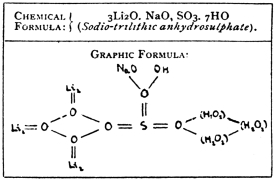
This picturesque “graphic formula” for Thialion appears with many
of the advertisements. To most of us it looks formidable, wonderfully
and deeply scientific and non-understandable; to a chemist it looks
absurd.
But there are hundreds of other so-called “new chemical”
compounds among the “ethical” proprietaries on the market
aside from the acetanilid mixtures. These wonderful compounds,
by the mysterious union of their ingredients, possess
therapeutic properties different from, or more powerful for
good than the drugs from which they are made. At least,
this is what we are told, and this is what many believe or
they would not sell so well.
There is another factor worth noticing connected with this
subject: When to the claim that the mixture is a “chemical
compound” is added a complex chemical formula, it prevents
the impertinent question, “What is it?” For isn’t the
“formula” there, and is not the information given without
the asking? Most of us have been so overcome by the
display of the chemical knowledge of the nostrum maker
that we have been afraid to expose our ignorance by asking
for information or explanation. And thus the promoter
avoids perplexing questions, which, if answered truthfully,
would spell bankruptcy.
To a chemist the formula of Thialion furnished by the
Vass Chemical Company signifies nothing. To a physician
who possesses but little knowledge of chemistry, it will
seem impressive, and he may absorb the idea that it stands
for a preparation that is the result of exhaustive scientific
research. To the chemist, this formula will appear as a
jumble of symbols and numbers that mean nothing.
It is not worth while to call attention to the simplicity of
this simple mixture of ordinary salts, for it is too self-evident.
As to the remarkable therapeutic qualities of
Thialion, the reader is referred to that ably edited “scientific”
periodical, the Uric Acid Monthly, and to the mass of “literature”
relating to this wonderful remedy.
While there is a ridiculous side to this business, there is
also a serious one. Those who have been making money
out of us undoubtedly laugh in their sleeves at our gullibility,
but to us as members of a presumably learned and
intelligent profession, it is not a laughing matter. The
whole nostrum business is a shame and a disgrace.—(Modified
from The Journal A. M. A., Nov. 3, 1906.)
Unguentum Selenio Vanadic (v. Roemer) is an ointment
manufactured by A. von Roemer, Brooklyn, N. Y., and put
on the market by Schering and Glatz, New York. It is claimed
to contain 1 per cent. of selenium oxycyanid and 1 per cent.
of vanadium chlorid “so prepared and incorporated into a
modified lanolin base as to insure complete absorption.” The
preparation is recommended in the later stages of inoperable
carcinoma, sarcoma, epithelioma and other malignant tumors,
as a substitute for morphin and other narcotics to control
pain, as a modifying (ante-operative) treatment in the middle
stage of malignant cases presenting the characteristics of
being inoperable, and as a prophylactic treatment of recurrences
and metastases following excision of malignant tumors.
It is also recommended for use in slow-healing surgical
wounds, abscesses, tuberculous and mixed septic and gangrenous
processes, etc., in lupus, acne, eczema, psoriasis,
scabies, erythemata, adenomata, angiomata, papillomata, etc.
The use of the ointment is further recommended by systemic
inunction in septicemia, pneumonia, erysipelas, cerebrospinal
meningitis, septic rheumatism, septic neuritis, etc. The
Council voted that the preparation be not accepted for inclusion
with New and Nonofficial Remedies because no evidence
has been submitted that the vanadium and selenium are
absorbed or that they produce any of the effects claimed.
When the preceding report was sent to Schering and
Glatz, the firm expressed surprise that evidence of the absorption
of selenium and vanadium should be requested. On
June 8 the firm wrote that within a few days one or more
tests would be sent by which the presence of selenium and
vanadium in the urine could be demonstrated. These tests
were not received. So far (November, 1914) no evidence of the
value of the preparation either in carcinoma or in any of the
very long list of other diseases in which it is recommended
has been submitted, and, the pharmacologic evidence that
such a preparation would be of value in such conditions being
practically nil, the Council authorized publication of this
report.—(From The Journal A. M. A., Nov. 21, 1914.)
The Council has voted that recognition be refused to the
following: Unicorn Root (Aletris farinosa), Wild Yam
(Dioscorea villosa), and Wild Indigo (Baptisia tinctoria)
and has authorized the publication of the following statements.
W. A. Puckner, Secretary.
Unicorn Root (Aletris farinosa) contains a bitter principle
and starch. Remarkable powers as a uterine tonic
have been ascribed to it but have not been realized by
reliable observers, the drug being practically valueless in
these conditions. It enters into the composition of a number
of nostrums. As a bitter it is superfluous and it should
not be included among non-official drugs.
Wild Yam (Dioscorea villosa) has been little used in
medicine. It contains a saponin and an acrid resin, and is
said to possess expectorant, diaphoretic and—in large doses—emetic
properties. It has been recommended as a remedy
in biliary colic and in muscular rheumatism. Its value in
such conditions has not been verified to an extent entitling
it to consideration as a useful remedy.
Wild Indigo (Baptisia tinctoria) has been in use—chiefly
by the eclectics—for about three-quarters of a century, but
there is no satisfactory evidence that it has any therapeutic
value. The following text-books on pharmacology do not
even mention wild indigo: Cushny, Brunton, Dixon, Binz,
Sollmann. It is not official in the United States or other
leading pharmacopeias.
A preparation of wild indigo is advertised with extravagant
claims for its therapeutic action, but these claims are
not supported by any substantial evidence. Other virtues
ascribed to wild indigo are its properties as a cardiac and
hepatic stimulant and its value in sepsis, particularly in
typhoid fever. It actually has emetic and cathartic properties,
but even these are inferior to those possessed by
many other drugs.
It is very evident that a drug possessing the extraordinary
merits that have been claimed for wild indigo would
not have remained unnoticed by the leading authorities on
pharmacology and therapeutics, especially after its prolonged
use in medicine. Owing, therefore, to the lack of
substantial evidence of its usefulness, baptisia is not considered
as of sufficient importance to warrant its inclusion
in the list of non-official drugs. It is probably entirely
superfluous.—(From The Journal A. M. A., Jan. 22, 1910.)
Vanadiol and preparations thereof, the products of the
Vanadium Chemical Company, were submitted to the Council.
After thorough investigation it was concluded that the
company has not, and never has had, any reliable evidence
for the therapeutic claims it has presented to the medical
profession regarding these products. Accordingly the Council
voted that the several products under consideration be
not accepted for inclusion with New and Nonofficial Remedies.
The findings of the Council having been submitted
to the Vanadium Chemical Company and its reply considered,
the Council authorized publication of the report which
appears below.
W. A. Puckner, Secretary.
The Vanadium Chemical Company, Pittsburgh, Pa., submitted
to the Council on Pharmacy and Chemistry for
inclusion in New and Nonofficial Remedies the following
products: Vanadiol, Vanadioseptol, Phospho-Vanadiol,
Vanadium Solution for Intravenous and Hypodermic Use
and Vanadoforme. At the same time, the company submitted
statements and “literature” regarding the composition
and therapeutic value of these products. The committee
to which the matter was referred, after carefully considering
both the matter presented and certain modifications
in the advertising matter to which the company consented,
reported that the evidence, especially that relating to the
therapeutic value of the preparations, was insufficient to
warrant the acceptance of the articles. Since the validity
of therapeutic claims can be determined to a certain extent
by experimental investigation, the Council decided to postpone
final action until sufficient dependable evidence as to
the therapeutic value had been submitted.
Accordingly, a series of questions was sent to the Vanadium
Chemical Company for the purpose of learning on
what pharmacologic evidence the therapeutic claims were
based. After waiting several months, the information
requested not being furnished, the Council took final action
on the products. This action was based both on the evidence
originally submitted and on the advertising matter
being sent out by the company at the time.
Briefly, Vanadiol is said to contain a compound of vanadium
with oxygen and chlorin, which gives up its oxygen
to readily oxidizable substances, such as the blood. In
addition to this compound it contains an oxidizing agent
(sodium chlorate) which is said to serve as a source of
oxygen, so that, according to the theory of the promoters,
Vanadiol acts in the animal system as an oxygen-carrier.
The following is quoted from an advertising circular:
“Most thorough and conclusive physiological tests were made on
guinea-pigs and other animals, which established undoubted evidence
as to the truth of this theory.
“INFLUENCE
“Under the influence of Vanadiol and the other derivatives, the
appetite is increased, there is greater ability to peptonize ingested
proteid material, and, through the improvement in the assimilative
powers and the checking of abnormal fermentations, leads to an
increase in weight. A greater excretion of urea follows their use.
Phagocytic action is promoted by an increase in the leucocytes. All
phases of the elimination of waste materials are favored by the positive
increase in the number of red blood corpuscles and the percentage of
hemoglobin, hematogenesis being thereby rendered more perfect. The
beneficent effect of nascent (active) oxygen, upon the red corpuscles
and upon tissue cells of low vitality are matters of common knowledge.
The results obtained from the vanadium derivatives are not drug effects,
but are due to improved metabolism, which in turn is due to the
removal of microbian toxins, and the general stimulation of cell activity.
“In a tubercular organism, the action of Vanadiol is two-fold. First,
it acts as an antiseptic and antitoxin, combating the Koch bacilli and
neutralizing their poison. Second, as a reconstituent of the economy,
to which it furnishes nascent oxygen, fortifying the defenseless cells
by the very element that is necessary to make them healthy and
resistant.”
“In Anemia and Chlorosis, the blood cells lack oxygen, and in
Neurasthenia the nerve cells are deficient. Vanadiol brings both blood
and nerve cells from a condition of weakness and decay into vital
energy, by furnishing them with active oxygen in a manner that had
not been possible by any other medicine.”
“Vanadiol accelerates the work of digestion by producing HCl in
small doses; it does not hinder the peptonization of albuminoids as
do beta-naphthol, salicylic acid, boric acid, etc., when used as a
stomachal antiseptic, but on the contrary it favors, by hydrochloric
acid, the transformation of albuminoids into peptone without the
assistance of pepsin. Thus, Vanadiol, when given to consumptives,
favors the digestion of large amounts of proteid materials and causes
oxidation of toxins of the stomach. The stomachic action is reflected
in other parts of the organism by the stimulation of the chief functions;
the pulse becomes stronger and muscular strength increases; and, last,
but of greatest importance, is the tremendous increase which will be
noted in the hemoglobin and the red cell count.”
“Phospho-Vanadiol, a combination of Vanadiol with an easily assimilable
organic phosphorus, is an active accelerator of general nutrition
with a special action on the nervous system.”
Such remarkable statements as these are past credence,
certainly, unless they are supported by scientific evidence.
And evidence, either in support or in contradiction of the
claims made, could be obtained; for many of these actions,
at least, are capable of proof by animal experimentation.
The Vanadium Chemical Company was asked to furnish
such proof but failed to do so. The inference is plain! The
committee has concluded that the company has not, and
never has had, any reliable evidence on which to base the
therapeutic claims it has presented to the medical profession.
Here another fact should be noted. It is the connection
shown in The Journal, June 22, 1912, of the general manager
of the Vanadium Chemical Company, F. M. Turner,
with a fraudulent obesity cure concern, the Dr. Turner
Company of Syracuse, N. Y.
It seems, moreover, by all the evidence available, that
F. M. Turner is not authorized to use the title M.D.; yet,
under this title his name appeared on cards representing the
Vanadium Chemical Company and under this title, also, he
published an article in a medical journal recommending to
the medical profession the use of Vanadiol. Later this
article was distributed as an advertising circular by the
Vanadium Chemical Company. Turner’s connection with
the Dr. Turner Company is known and acknowledged by
the Vanadium Chemical Company, yet it still retains him as
general manager!
While there is not necessarily any direct relation between
the personnel of a proprietary manufacturing company and
the value of that company’s product, it is natural that the
medical profession should view with distrust any concern
managed by one who has previously been connected with
such a fraud as the Turner obesity cure.
The committee therefore recommends that the preparations
of the Vanadium Chemical Company be refused recognition,
and that this report be authorized for publication.—(From
The Journal A. M. A., Jan. 18, 1913.)
The report which appears below was sent to the Intravenous
Products Company for consideration. Having considered
the firm’s reply, the Council has authorized publication of its
report along with the explanation sent by the Intravenous
Products Company in reference to the variable composition
reported for Venarsen, namely, that “only the first few
experimental ampules, sent to the doctors for clinical tests,
were made without the Mercuric Iodide.”
W. A. Puckner, Secretary.
This product is prepared by the Intravenous Products
Company, Denver. The advertising circulars contain inconsistent
statements as to its composition. According to one
circular Venarsen is
“... a comparatively non-toxic organic arsenic compound, 0.6 Gm.
representing 247 Mg. (33⁄4 grains) of metallic arsenic in chemical combination....”
According to another circular Venarsen is
“... a comparatively non-toxic organic arsenic compound, 0.6
Gm., representing 247 Mg. (33⁄4 grains) of metallic arsenic and .78 Mg.
(3⁄250 grain) metallic mercury in chemical combination.”
Neither one of these statements gives any information as
to the actual composition of the product. Inquiry addressed
to the manufacturers elicited the reply that:
“Venarsen contains in each 5 c.c. 0.6 Gm. Sodium Dimethyl Arsenate,
.0016 grams of Mercuric Iodide, .0048 grams of Sodium Iodide in
solution in a suitable vehicle for intravenous administration.”
The following report of the examination of Venarsen is
submitted by the Association’s Chemical Laboratory:
LABORATORY REPORT
Three ampules of Venarsen were examined. The first
ampule was labeled
“A comparatively non-toxic organic arsenic compound, representing
247 Mg. (33⁄4 grs.) of metallic arsenic in chemical combination.
5 c.c.—0.6 Gm.”
Practically the same statement appeared in an advertising
circular wrapped around the ampule. The second and
third ampules bore labels identical with the first. The
circulars differed from that accompanying the first ampule
in that the presence of mercury is also announced, thus:
“Venarsen is a comparatively non-toxic organic arsenic compound,
0.6 Gm., representing 247 Mg. (33⁄4 grains) of metallic arsenic and .78
Mg. (3⁄250 grain) metallic mercury in chemical combination and is so
prepared and enhanced as to present the ingredients to the blood in
their most acceptable form.”
Thus, although the potent elements said to be contained
in Venarsen are named, its chemical character (the combination
in which the elements occur) is not disclosed.
The ampules contained a transparent, odorless solution,
possessing the yellow color of salvarsan solution (an
aqueous solution of sodium cacodylate, mercuric iodid and
sodium iodid in the amounts said to be present in Venarsen
is colorless). Qualitative tests demonstrated the presence
in each of the three ampules of sodium cacodylate (sodium
dimethyl arsenate), and the absence of arsenites, arsenates,
phosphates, arsanilates (atoxyl, soamin) and arsenphenolamins
(salvarsan, neosalvarsan). Titrated with normal
hydrochloric acid, using methyl orange as indicator (as outlined
in New and Nonofficial Remedies, 1915, p. 40), the
three ampules were found to contain the equivalent of
respectively, 0.219, 0.253 and 0.216 Gm., or an average of
0.244 Gm. arsenic. (According to statements of the firm
each 5 c.c. of Venarsen contains 0.6 Gm. sodium dimethyl
arsenate [sodium cacodylate], equivalent to 0.247 Gm.
arsenic or 41.66 per cent. Sodium dimethyl arsenate, as
described in New and Nonofficial Remedies, contains 3
molecules of water and 35 per cent. arsenic. This indicates
that the sodium dimethyl arsenate used in Venarsen contains
less water of crystallization than the N. N. R.
product).
Neither mercury nor iodid could be found in the first
ampule. (The company has since explained that mercury
was absent only from the first experimental samples.)
The second and third ampules contained iodid and mercury
in small amount. The exact quantity was not determined
because, on the basis of the mercury content declared, a
single accurate mercury estimation would have required
the purchase of something like 25 to 100 ampules. As each
ampule sells for two dollars, the cost of the material was
considered prohibitive.
From the foregoing we conclude that the first ampule
examined consisted essentially of a solution containing
0.625 Gm. of sodium cacodylate, N. N. R., while the second
and third ampules contained 0.722 Gm. and 0.617 Gm.
sodium cacodylate, respectively, and in addition, a mercury
compound, probably mercuric iodid, dissolved by sodium
iodid.
In other terms, Venarsen as now marketed is a simple
solution containing approximately 9 grains of sodium cacodylate,
1⁄40 grain of mercury “biniodide” and 3⁄4 grain of
sodium iodid to each full dose.
In the past the preparation has been in conflict—especially
serious because of the potent character of the drug—with
Rule 1 (secrecy of composition). The manufacturers have
removed this conflict by furnishing a statement of composition;
and it is to be expected that they will likewise take
steps to remove the manifestly erroneous impression now
likely to be gathered from the circulars, namely, that the
preparation is rather analogous to salvarsan. These conflicts,
however, call for comment, since physicians have doubtless
used the material under misapprehensions.
As to therapeutic claims, the preparation is said to be
effective and safe in syphilis; “lower toxicity and greater
spirochaetacidal power than other known arsenic compounds”
are among the claims. No real evidence for either of these
claims is presented. Sodium cacodylate has been tried as an
antisyphilitic, but with indifferent success; certainly the
results have not been comparable to those of salvarsan. The
mercury could conceivably enhance its effect, but the dosage
appears too small and the course too short for this influence
to be pronounced. Moreover, a careful physician would
not give arsenic and mercury in fixed proportions.
The claim of comparative non-toxicity is probable enough
from what is known about the cacodylate. No physician
should feel “safe,” however, when injecting intravenously 0.6 gm.
of sodium cacodylate every four to six days. Aside from
the grave dangers of intravenous injection in general, the
possibility of idiosyncrasies to arsenicals should always be
borne in mind.
Finally, Venarsen is claimed to be “indicated” in pellagra,
tuberculosis, anemia, etc. No evidence is presented on which
to base an opinion as to its efficiency in pellagra. Those who
have studied that disease would not be likely to resort to
this treatment. In tuberculosis and anemia, there is no sufficient
advantage in giving the cacodylate intravenously.
To summarize, Venarsen treatment consists essentially in
the intravenous injection of large doses of sodium cacodylate.
The other ingredients, as well as the name, merely constitute
so much mystification. While the cacodylate probably has
some effect on the conditions for which it is advised, there
is no evidence that its value even approaches that of salvarsan
in syphilis, or that the intravenous use is preferable to
the ordinary methods. The dangers are manifest, although
they may not be so great as with salvarsan. No justification
has been established for its use in tuberculosis and pellagra.
Physicians who wish to try intravenous cacodylate administration
should have a full realization of the dangers of such
treatment, and in order to avoid further risks, will do well
to refrain from combining other drugs with the cacodylate
in fixed proportions.
It is recommended that Venarsen be held in conflict with
Rule 6 (unwarranted therapeutic claims), Rule 7 (poisonous
ingredients not stated on label), Rule 8 (name does not
express the chemical composition) and Rule 10 (unscientific
combination) and that this report be published.—(From The
Journal A. M. A., May 22, 1915.)
Venodine (The Intravenous Products Co., Denver), according
to information sent to the Council, is “an Intravenous
Iodine Compound” put up in ampules each of which contains
“28 grains of Sodium Iodide, 1⁄8 grain each of Beechwood
Creosote and Guaiacol in a suitable vehicle, and excipients
to enhance its compatibility with the circulating blood.”
The “Therapeutic Indications” include “infectious diseases,
such as syphilis, tuberculosis, bronchitis, bacteraemias associated
with chronic and acute nephritis (Bright’s disease),
and other infections.” The Council held as unwarranted and
grossly exaggerated the following therapeutic claims: (1)
that the full therapeutic value of iodin medication cannot be
readily obtained except by intravenous injection; (2) that
Venodine is “of exceptional value in tuberculosis”; (3) that
in pneumonia Venodine “combines the anaesthetic properties
of creosote and guaiacol with the germicidal value of iodine”;
(4) that “Venodine (or its iodine component) has long
enjoyed an exceptional reputation” as of great value in many
infectious diseases including bacteremias. The facts on these
points are the following:
1. Since iodids are easily absorbed from the mucous membrane
of the gastro-intestinal tract and are usually well
tolerated by the stomach, there is no reason for resorting to
intravenous injection in their administration.
2. The indiscriminate administration of iodids for pulmonary
tuberculosis is strongly to be condemned. The cases
in which they can be given to tuberculous patients without
doing harm must be very carefully selected.
3. There is no evidence either that creosote is excreted by
the lungs in sufficient quantity to exert an anesthetic influence
or that iodin is present in the circulation of the lungs or in
the bronchial secretions in a form which is capable of exerting
any germicidal action whatever.
4. It is generally held that the systemic administration of
iodin compounds in bacteremias is useless.
The Council also held the name “Venodine” objectionable
in that it fails to indicate the chief ingredient (sodium iodid)
of this simple pharmaceutical mixture. The statement in a
circular that “Venodine is a sterile solution representing 1.54 Gm.
(24 grains) of iodine in chemical combination together
with creosote and guaiacol” is likely to lead physicians to
use the preparation without considering that its chief constituent
is the well-known substance sodium iodid, particularly
so since no reference to sodium iodid is made in the
circular.
Furthermore, the Council held that the combination of two
such similar substances as creosote and guaiacol (the second
a constituent of the first) as given in the published formula,
stamps Venodine as unscientific; it adds mystery to the
preparation, but does not increase its efficiency, and is therefore
against the best interests of the public.
The Council voted that Venodine be held ineligible for
conflict with Rules 6, 8 and 10.
This report having been submitted to the manufacturers,
in accordance with the Council’s custom, and the reply
affording no reason for modifying the findings, its publication
has now been authorized.—(From The Journal A. M. A.,
June 26, 1915.)
“Veracolate (plain),” “Veracolate with Pancreatin and
Pepsin” and “Veracolate with Iron, Quinine and Strychnine”
are proprietary tablets marketed by the Marcy Company,
Boston.
“Veracolate (plain).”—For this the following non-quantitative
formula is given:
“A compound containing the bile acids, sodium glycocholate, sodium
taurocholate with cascara sagrada and phenolphthalein.”
The dose is three tablets. Examination in the Chemical
Laboratory of the American Medical Association of a specimen
of “Veracolate (plain)” indicated that there was about
20 mg. (1⁄3 grain) of phenolphthalein to each tablet. One
dose, therefore (three tablets), would contain 1 grain of
phenolphthalein—an average dose.
“Veracolate with Pepsin and Pancreatin.”—The following
“formula” is given for this mixture:
“Veracolate | 11⁄4 | grain |
“Pure Pancreatin | 1 | grain |
“Pepsin aseptic (1:3,000) | 1⁄2 | grain |
“Oil peppermint | 1⁄10 | min.” |
(Note the presence of two mutually incompatible digestive
ferments.)
“Veracolate with Iron, Quinine and Strychnine.”—This is
stated to have the following “formula”:
“Veracolate | 11⁄8 | grain |
“Reduced Iron | 1 | grain |
“Quinine Sulphate | 3⁄8 | grain |
“Strychnine Sulphate | 1⁄100 | grain” |
It will be noticed that these mixtures increase in complexity
until a combination of seven diverse ingredients, a
veritable shotgun mixture, is evolved. In none of the “formulas”
are the proportions of the purgative drugs in Veracolate
stated. In the second “formula,” the digestants might
as well be omitted, for the pancreatin is destroyed by peptic
digestion and hence cannot pass the stomach while the
pepsin is useless without hydrochloric acid, and, at any rate,
of no value in the intestine. If one is indicated, the other is
not. Yet this unscientific and complex combination of purgatives,
mutually incompatible digestive ferments, and oil of
peppermint is called:
“A scientific Blending of Digestive Ferments, Cholagogues and Carminatives.”
“... for all forms of indigestion and dyspepsia.”
And the third, an equally irrational and complex combination,
is termed “The Ideal Cholagogic Tonic”!
Extravagant and Misleading Claims.—True to type, the
claims are magnified in accordance with the number of
ingredients. For instance, of “Veracolate (plain),” we are
told:
“Veracolate is a true cholagogue and biliary disinfectant as it directly
stimulates the liver cells producing an increased flow of limpid bile.
Although not a purgative, it moves the bowels and is definite and
dependable in its action.”
“The action of Veracolate is to bring about a profuse flow of healthy
bile which prevents bile stasis. As the flow of bile is stimulated so antiseptic
action ensues, calculi softened and the concretion and mucous
eliminated. Mucosal swelling is diminished and the infection which is
usually present is antagonized. Relief is in plain evidence. As a result
of the treatment the skin, eyes and urine become normal in appearance
in a short time, the appetite and digestion improve and soreness in the
region of the gall-bladder is entirely relieved.”
Similarly, it is said of “Veracolate with Pancreatin and
Pepsin” that:
“It causes a natural flow of bile which checks fermentation, prevents
the absorption of toxines and causes the food elements to be emulsified
and thus rendered easy of assimilation. All this conduces to a natural
movement of the bowels. Digestion is at once improved and the epigastric
pain, nervous symptoms and headache disappear.”
“Veracolate with Iron, Quinine and Strychnine” is said
to be indicated in:
“Hepatic Torpor accompanied by Anemia, Chlorosis, Debility, Neurasthenia
and Neuroses.”
And the physician is asked to believe that it will:
“... give gratifying results in all nervous, anemic, and ‘run down’
conditions in which the liver function is usually subnormal.”
The objections to “Veracolate (plain)” are that it is semi-secret
in composition, unscientific in combination and
exploited under unwarranted claims. The same criticisms
hold with reference to “Veracolate with Pancreatin and
Pepsin” and “Veracolate with Iron, Quinine and Strychnine.”
These products are discreditable to the medical and pharmaceutical
profession alike and their use is against the public
good. The Council therefore refused recognition to Veracolate
and its preparations.—(From The Journal A. M. A.,
April 24, 1915.)
The following report on Hayden’s Viburnum Compound
was prepared by a member of the Council’s Committee on
Therapeutics. The Council held the preparation in conflict
with its rules and authorized publication of the referee’s
report.
W. A. Puckner, Secretary.
Hayden’s Viburnum Compound, according to the advertising
circulars, was first compounded in 1860 by W. R.
Hayden. The medical profession is told that W. R. Hayden
“... found by his experiments that a combination of the active
principles of Viburnum Opulus, Dioscorea Villosa, combined with
aromatics, proved a valuable remedy for Spasmodic Dysmenorrhea.”
As in 1860 W. R. Hayden was not a physician (he received
a diploma from the Eclectic Medical College, New York, in
1867), and, so far as we can learn, he was not a pharmacist
or chemist, one wonders what kind of “experiments” he made.
Hayden’s Viburnum Compound is put on the market by the
New York Pharmaceutical Company of Bedford Springs,
Mass. The name of this concern may sound imposing, until
it is realized that it is merely a trade name adopted by
Hayden in exploiting his nostrum.
The advertising matter formerly claimed that Scutellaria
(skull-cap) was one of the ingredients of Hayden’s Viburnum
Compound. As this is no longer mentioned, it is fair
to assume that even the manufacturer does not consider the
composition to be of vital importance. Stress is laid on the
superior efficacy of viburnum opulus in the conditions for
which the preparation is recommended; it is emphasized
that it is viburnum opulus, and not viburnum prunifolium,
that is the important ingredient of Hayden’s Viburnum Compound.
The label, in accordance with the requirements of the
Food and Drugs Act, declares that the preparation contains
50 per cent. alcohol. The claim is made:
“It is free from all narcotics and leaves no unpleasant after-effects.”
The medical profession is told that Hayden’s Viburnum
Compound is a remedy in:
“Hysteria, Bilious Colic, Cramps of Cholera Morbus, Muscular
Cramps,... Nervous Diseases of Pregnancy, Threatened Abortion,
Post-Partum Pains, Puerperal Convulsions, Rigid Os, Dysmenorrhea,
Menorrhagia.”
DISCUSSION OF ALLEGED INGREDIENTS
Viburnum Opulus (Cramp Bark).—Botanists and pharmaceutical
chemists declare that this drug has not been on the
American market for many years, if ever, and that the drug
used and even described as viburnum opulus is really the
bark of another plant. Viburnum opulus and its preparations
are therefore to be dropped from the next United States
Pharmacopeia. The principal constituents of viburnum
opulus are stated to be a glucosid, viburnin, a bitter resin,
and a little tannin, with small amounts of earthy carbonates
and phosphates and organic acids (Culbreth, Ed. 4, 1906,
p. 591). The glucosid and resin being bitter, the drug might
have a slight stomachic action (if, indeed, any such effect
is actually produced by “bitters”); the small amount of
tannin might make it slightly astringent; its fruit acids
(citric and malic) might make it slightly diuretic. Even if
viburnum opulus were present in Hayden’s Viburnum Compound
there is no clinical or laboratory proof that it, if
given alone—without alcohol or other drug—has any antispasmodic
or nervous sedative action.
Dioscorea Villosa (Wild Yam).—This drug contains a
saponin and an acrid, irritant resin. It has never been
proved clinically or experimentally that this drug has any
action whatever except that its irritant resin might, if taken
in sufficient quantity, cause irritation of the stomach and
vomiting.
Aromatics.—The irritation produced by concentrated
aromatics causes increased peristalsis and consequently may,
if there is no obstruction, relieve intestinal stasis and intestinal
colics. Therefore, a preparation containing large
amounts of aromatics, especially if given in hot water, would
have practically the same effects in the “cramps of a cholera
morbus” or other forms of acute diarrhea as a home-brewed
cup of spiced tea—and no more.
Alcohol.—This drug is a muscle relaxant, and sufficient
doses might, by relieving spasm, relax a muscularly contracted
os uteri and relieve post-partum pains. Alcohol
dilates the blood-vessels both in the abdomen and on the
surface of the body. It may thus either relieve uterine bleeding
by lowering the blood-pressure and causing more blood to go
to other parts, or increase uterine bleeding by relieving arterial
and muscle spasm. Alcohol is also a habit-forming narcotic
(Hayden’s Viburnum Compound is advertised as “free from
all narcotics”!) and when habitually used by either males or
females tends to impair the capacity to produce normal
offspring.
Even if the manufacturer’s “formula” be accepted, Hayden’s
Viburnum Compound contains no therapeutically active
ingredient except alcohol and aromatics. The recommended
dose of this preparation is “... two teaspoonfuls in six
of boiling hot water or milk and one teaspoonful of sugar,
every fifteen or twenty minutes until relief is obtained.”
“Frequently after taking the Viburnum Compound the patient will
sleep soundly for several hours from the sudden cessation of pain;
in such cases she should never be awakened through any fear of
oversleeping, as Hayden’s Viburnum Compound does not contain any
narcotic whatever, nor does it leave any disagreeable after-effects, and
it may be given to a child when necessary without any special caution.”
Read the foregoing and then remember that it means that
one teaspoonful of alcohol (the equivalent of two teaspoonfuls
of whisky) is to be given in hot water, every fifteen or
twenty minutes until relief is obtained and the patient is
asleep. Why not use plain language and say “until she is
drunk”?
The thoughtful physician would consider it decidedly
unwise to give alcohol to a young girl, to a prospective
mother, or to a young mother, except under extraordinary
circumstances. He would know that the menstrual pains for
which this preparation is recommended are likely to be
recurrent, and that the repeated taking of alcohol for recurrent
pain is fraught with danger—the danger of initiating the
alcohol habit. If, however, a physician does elect to give
alcohol as a drug, he must let the conditions that govern
each individual case determine whether it is not better to
give it as whisky, or to disguise it in a prescription of his
own. Above all the physician should be conscious that he
is giving the drug, alcohol; and this is not the case when he
prescribes a ready-made nostrum. If he writes a prescription
containing whisky or other alcoholic he will take measures
to avert the dangers inseparable from the use of this
drug.
CONCLUSIONS
1. Even if the manufacturer’s formula for Hayden’s
Viburnum Compound be accepted, it is apparent that any
therapeutic activity the preparation may have is due essentially
to the alcohol and aromatics.
2. Alcohol is a narcotic drug, and a habit-forming drug.
Physicians ordering this preparation may, by so doing, be
initiating the alcohol habit.
3. Whatever result is obtained by the use of Hayden’s
Viburnum Compound in the treatment of uterine or pelvic
disturbances, is due to the alcohol it contains. The fact that
menstrual pains are likely to recur might, when this preparation
is relied on, become a factor in the formation of the
alcohol habit.
4. Whatever result is obtained by the administration of
Hayden’s Viburnum Compound in the treatment of gastro-intestinal
disturbances is due to the alcohol and the aromatics
it contains.
5. Whisky has the same alcoholic content (50 per cent.)
as Hayden’s Viburnum Compound; the dangers in the use
of whisky are well known and its value as a therapeutic
agent is being questioned more and more every year.
Holding the exploitation of this proprietary a danger to
the public and a detriment to scientific medicine, the referee
recommends publication of this report as a protest against
such irrational therapeutics. The profession should recognize
that most, if not all, of the preparations recommended for
painful menstruation and for all kinds of pelvic pain contain
large percentages of alcohol, and that whatever physiologic
effect is produced is, for all practical purposes, due to the
alcohol.—(From The Journal A. M. A., Jan. 23, 1915.)
This preparation was assigned to a subcommittee of the
Council and the following is an abstract of the report of
the committee:
Samples of Vin Mariani and of the literature distributed
by the manufacturers were examined.
It appears that the beverage or medicine known as
“Vin Mariani” is a preparation of red wine, apparently
imported from Bordeaux, and fortified, in this country,
by an alcoholic preparation of coca leaves or other parts
of the coca plant.
The committee considered first, the character of the
red wine as imported. A sample received from the port
of New York, March 10, 1905, from Henry Clausel &
Co., Bordeaux, and consigned to Mariani & Co., on
analysis was found to have the following composition:
Specific gravity | 0 | .9959 |
Alcohol by volume | per cent. | 10 | .99 |
Extract | per cent. | 2 | .279 |
Volatile acids | per cent. | 0 | .0914 |
Ash | per cent. | 0 | .2801 |
Reducing sugar | trace. |
Pol. direct | degrees | —0 | .8 |
Pol. invert | degrees | —0 | .7 |
K.So | M. per liter | 0 | .092 |
A sample of Vin Mariani, as bought in the open
market in an original package, has also been analyzed
and found to have the following composition:
Specific gravity | 1 | .0125 |
Alcohol by volume | per cent. | 16 | .15 |
Extract | per cent. | 8 | .602 |
Ash | per cent. | 0 | .277 |
Glycerin | per cent. | 0 | .444 |
Volatile acid | per cent. | 0 | .0747 |
Tartaric acid | per cent. | 0 | .2400 |
Alkaloids (coca bases) | per cent. | 0 | .0250 |
Cane sugar | per cent. | 2 | .35 |
Reducing sugar | per cent. | 3 | .38 |
The increased alcoholic strength of Vin Mariani over
the Bordeaux wine from which it is made, as shown by
this analysis, doubtless comes from the alcohol extract
containing the coca bases, as already stated. Approximately
6 per cent. of sugar is also added to the wine.
Judging from the analysis, therefore, Vin Mariani corresponds
to a mixture of an alcoholic preparation of
coca leaves and ordinary Bordeaux red wine, with the
addition of about 6 per cent. of sugar.
Vin Mariani conflicts with Rule 5, which requires
that “No article will be admitted or retained, concerning
which the manufacturer or his agents make misleading
statements as to geographical source, raw material
from which made, or method of collection, or
preparation,” by stating in the advertising literature
that: “The United States government, under the Pure
Food Law of March 3, 1903, further emphasizes all
previous analyses of Vin Mariani by admitting Mariani’s
wine as absolutely pure and unadulterated.”
Whatever may have been the intent of the above statement,
its effect is to deceive. The conjunction of the
terms “Vin Mariani” and “Mariani’s wine” can only be
construed as meaning the same thing. Inasmuch as it
does not appear that Vin Mariani is imported into this
country, it would not have been possible for the United
States government to inspect it, and as to the wine
obtained from Henry Clausel & Co., from Bordeaux, it
is not in any sense Mariani’s wine except that of ownership.
It is the opinion of the committee that this phrase
can only result in deception and the construction of the
language strongly favors the supposition that it is
intentionally meant to deceive.
This false claim is practically repeated in the other
pamphlets published by the Vin Mariani Company,
although not always in the same words.
This preparation also conflicts with Rule 6, which
states that “No article will be admitted or retained of
which the manufacturer or his agents make unwarranted,
exaggerated or misleading statements as to therapeutic
value,” in that the firm’s letter-heads have printed on
them the following:
“Vin Mariani purifies the blood stream, strengthens the circulation,
stimulates muscular fiber and nerve tissue, is a respiratory
stimulant, strengthens the heart muscles, and is an emergency food
in the absence of all other nutriment. Successfully employed as
an adjuvant in anemia, debility, diseases of the chest, nervous
troubles, muscular or mental overstrain, neurasthenia, and allied
conditions, and in certain cases of protracted convalescence.”
The committee believes that Vin Mariani is intended as
a beverage rather than as a medicine.
The report concludes:
“The committee recommends, therefore, that Vin Mariani
be refused recognition and that this report be published in
full or in part.”
In accordance with this recommendation the above extract
of the report is herewith published.
W. A. Puckner, Secretary.
VIN MARIANI MADE IN THIS COUNTRY
According to the above report, Vin Mariani as imported
is simply an ordinary cheap French wine, the preparation
sold in this country as Vin Mariani being compounded in
this country. Yet the advertising literature, the label on
the bottle, etc., state directly or indirectly that it is a French
preparation. Until recently—presumably until the vendors
realized that the truth regarding this point would come out—the
advertisements in medical journals contained an analysis
made by a chemist in Paris. The shape of the bottle,
the character of the printed matter accompanying the bottle,
etc., are evidently intended to convey the impression that
it is imported. So far, then, as this point is concerned,
Vin Mariani is sold under gross misrepresentations and is
a fraud.
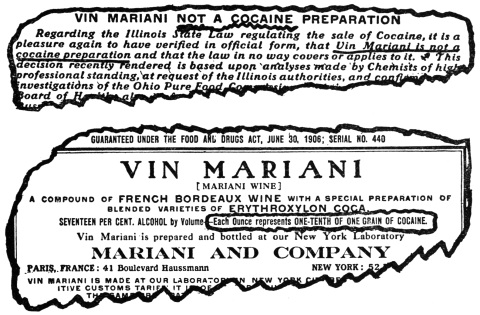
Advertisements of Vin Mariani before and after national Food and
Drugs Act went into effect.
ADVERTISED TO THE PUBLIC
Vin Mariani was at one time advertised to the public in
this country, but, so far as we know, it is not at the present
time; at least, not directly. Yet it is most effectively
advertised to the public indirectly, and this with little
expense to the promoters, the cost of the circular around
the bottle being the only expense—doctors who prescribe
it do the rest. If those who are in the habit of prescribing
Vin Mariani will examine the advertising that goes into
the hands of their patients they will realize how true it is
that our profession is responsible for much of the “patent-medicine”
taking. Few laymen could withstand the temptation
to buy the stuff for any ailment that comes along when
they read in the circular that this “medicine,” which their
doctor evidently thinks is a good thing, is so highly recommended,
for all the ills that befall us mortals, by the Pope
of Rome, the Czar and the Czarina of Russia, the Queen
of England, the Shah of Persia, the King of Norway and
Sweden, the Queen of Portugal, the Queen of Saxony, the
Crown Prince of Cambodia, Ferdinand of Bulgaria, and by
a whole list of ambassadors, generals, politicians, musicians,
actresses, etc. The testimonials of these great men
and women are enough to convince the most skeptical that
this remarkable medicine will do everything but raise the
dead—and under favorable circumstances accomplish even
this. And still more—it will win battles! Witness this
from the governor-general of Madagascar: “We were
refreshed by Vin Mariani, and before morning carried the
stronghold.” Alexander Dumas and Emile Zola are credited
with calling it “the elixir of life.” One very strange thing
about the testimonials in the circular used in this country
is that all are written by foreigners. But Americans
(President McKinley—think of it—among others) are honored
by having their testimonials quoted in the circulars
used on the other side of the Atlantic. Why? Is it possible
that the testimonials are fakes?
AN ETHICAL CURE-ALL
Here are a few of the conditions that the circular says
Vin Mariani is good for: “Anemia, winter cough, debility,
vocal weakness, la grippe, continued fevers, bronchitis, nervous
troubles, muscular weakness, diseases of the aged,
malaria, melancholia, overwork, neurasthenia, impotence,
malnutrition, depression, heart troubles, wasting diseases,
mental overstrain, and in certain cases of protracted convalescence.”
The following quotations are taken from blotters—circulated
in this country—which are evidently intended for the
laity, as well as for physicians:
“Vin Mariani creates and sustains vigor and energy. Guards
against wasting diseases. When everything else has failed try it to
prove merits.”
“Lung, Throat and Stomach Troubles benefited by Vin Mariani;
this Ideal French Tonic strengthens entire system of Body, Brain
and Nerves.”
“Most Efficacious, Most Agreeable, Unequaled by anything in
Fortifying, Strengthening, Refreshing.”
WHY BLAME THE LAYMAN FOR USING NOSTRUMS?
Can we blame the layman for using Peruna, Wine of
Cardui, etc., simply because they are advertised, when there
are physicians who, for the same reason, prescribe concoctions
that are just as quackish and just as useless?
And can editors of medical journals consistently find fault
with newspapers for carrying advertisements of fraudulent
“patent medicines” when they themselves admit to their
pages advertisements of nostrums that are no less fraudulent
and of no more value?
MEMBER OF PROPRIETARY ASSOCIATION
One word more: There is an organization known as the
Proprietary Association of America, but it is usually referred
to in common parlance as the “patent-medicine” men’s association.
It will be remembered that last year we printed a
list of the members of this body, among which was the Vin
Mariani Company. It will be remembered also that in the
list were the names of certain firms who were supplying
medicines to physicians, but practically all these resigned
from membership and their resignations were published by
us. We have not had the pleasure of publishing the resignation
of the Vin Mariani Company. On the contrary, we
note that at the last annual meeting of the “patent-medicine”
men’s association this firm was still an active member,
Mr. A. L. Jaros, who stands for the Mariani Company
in this country, being one of those registered at the meeting.—(From
The Journal A. M. A., Nov. 26, 1906.)
Virol, sold in the United States by the Etna Chemical
Company, is put out by Virol, Ltd., London, England. It is
said to be
“A preparation of bone marrow, red bone marrow of medullary
structure of ox rib and calf bones, eggs, malt extract, and lemon syrup
made from fresh fruit.”
“Marrow fat is emulsified with extract of malt, lemon syrup and
eggs, it is further enriched with soluble phosphates of lime, iron and
soda, and glycerine solution of red bone marrow.”
Many of the therapeutic claims made for Virol the Council
considered grossly exaggerated; among them are the following:
“... a complete food for children.”
“... a complete nutrient.”
“The value of the Lime-Salts (representing the Egg Shells) contained
in Virol is fully illustrated in its influence upon Rickets; whilst Struma,
Chronic Bronchitis, Anaemia and Influenza are all combated by its use
in a degree, which, we venture to say, has never been approached.”
“The fat, as represented by the Marrow-bone and Egg Yolk, is so
minutely divided that it admits of even far more rapid absorption by
the villi of the intestine than milk.”
“It is an ideal form of food, readily digested and assimilated in the
weakest of conditions.”
“Virol has a marked effect on the metabolism of the body, increasing
the production of opsonins and stimulating phagocytosis. As an adjuvant
to the natural defensive processes of the patient in all diseases of bacterial
origin its value can scarcely be over-estimated.”
The objections of the Council were transmitted to Virol,
Ltd. The firm’s reply was reported to the Council by the
referee of the Committee on Therapeutics who held that no
adequate or satisfactory answer had been made to the objections
raised against the advertising claims for Virol.
The claims made for Virol being unsubstantiated and
unwarranted, the Council voted that the preparation be
refused recognition.
In accordance with the practice of the Council, the
exploiters of Virol were afforded an opportunity to comment
on the foregoing statement before its publication. On their
objecting to the findings, the entire matter was turned over
to a second referee. This referee, in making his report,
reviewed the claims made for Virol and commented on the
lack of evidence to substantiate these claims. He stated that
a chemical analysis of the preparation had yielded the following
result:
“Sugar, as maltose | 60.0 per cent. |
“Fat | 13.2 per cent. |
“Proteins | 3.2 per cent. |
“Ash | 1.6 per cent. |
“Water and volatile matter | 21.6 per cent. |
“There is no appreciable diastatic action. A little glycerol
is present in the volatile matter. The preparation is therefore
an extract of malt with fat and a small amount of
protein.”
He then continues:
“That Virol has food value cannot be denied, but that it
has sufficient value to warrant the claims of the manufacturers
is not evident. Virol cannot be considered a complete
food, as the advertising literature reiterates, or an
ideal food for infants. The amount of protein is far too low
in comparison with the carbohydrates to warrant this view.
The dosage recommended is not large. Thirty gm. a day
would furnish only about 1 gm. of protein and 4 gm. of fat.
The 3 teaspoonfuls a day recommended for children would
furnish protein and fat even below this.
“If employed alone it cannot be a complete or sufficient
food, and if employed along with other articles of diet—milk
and bread, for example—it is not easy to see wherein lies
the efficacy of the small weights of fat and protein added in
the form of Virol. Here the demand made on our credulity
is too great, as the protein in the preparation is the familiar
protein of eggs, meat and malt, and the fat largely that from
the egg-yolk and marrow, according to the claims. It is not
known that any specific virtues reside in these bodies, or in
the egg-shells, also claimed as present.
“In the opinion of the present referee there is nothing in
the composition of Virol to justify the claims made for it.
The judgment and recommendations of the first referee
follow from the facts and must be accepted by the Council.”
The Council directed that the previously prepared report
be allowed to stand and that it be published along with a
suitable reference to the report of the second referee.—(From
The Journal A. M. A., Feb. 20, 1915.)