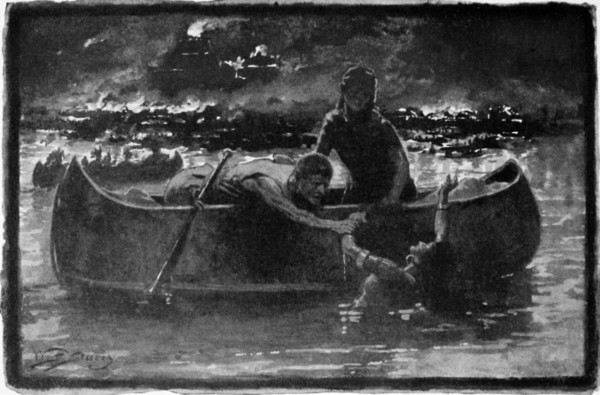
The first impulse of Marina's preservers was to escape
as quickly as possible from their awful surroundings.
The spell that had held them in that vicinity
was broken. They had snatched one victim from
the jaws of death, and now they must remove her beyond
reach of further danger. Instinctively they
headed their canoe in the direction of the little hut,
on the opposite side of the lake, that had for so long
been their home. They had not gone far when, as
though moved by a single impulse, both stopped
paddling at the same instant.
"It is no longer possible that we should go back,"
said the old man.
"For we should be taking another into slavery,"
continued the old woman.
"Nor would we return to slavery for ourselves,
even if there were no other."
"It is certain that we would not," agreed the wife.
"But whither shall we fly?" asked the old man,
irresolutely.
"Ask the child; since she called on the son of
Tlahuicol for aid she must be of our friends, and also
she must be possessed of wisdom."
Marina, who had ceased to sob, and now lay
quietly beneath the warm rabbit-hair blanket that
the old woman had spread over her, listened to this
conversation. Who could these people be? They
did not talk like enemies bearing her to the altar of
sacrifice. At any rate, a question could do no harm.
"Whither are you taking me?" she asked.
"Whither you would go," replied the gentle voice
of the old woman.
"I would go to my friends. To Huetzin, and
Sandoval, and Malinche, and the daughters of the
king, who are captives."
"Where are they?"
"I know not, but I fear me they are dead. Who
are you? You are not Aztecs."
"We are Tlascalans, and friends of the son of
Tlahuicol, whom we seek," was the proud answer.
"I thought you were Tlascalans from your
speech!" cried the girl, joyfully. "As such you
must be my friends, and as friends of Huetzin you
must be doubly my friends."
"Is he thy brother?" queried the old man, remembering
that Huetzin had spoken of a sister.
"No."
"Thy husband?"
"No."
"What then——?"
"Hush, thou stupid!" exclaimed the old woman,
"and waste not time in idle questionings. We be
escaped Tlascalan slaves," she continued, speaking to
Marina, "seeking the son of Tlahuicol, who has some
knowledge of us, and who we trusted would aid us to
freedom. Now we know not which way to turn, and
would ask thy counsel."
"Will you in truth do as I advise?" asked Marina,
who could scarcely credit her good fortune in falling
into such friendly hands.
"In truth we will."
"Then," said the Indian girl. "I would advise
that you seek no land before daybreak, but avoid all
canoes. With daylight, if the fight be over, as ere
then it must be, make thy way to Tlacopan, where we
are almost certain to discover our friends—thy
friends and my friends."
This advice was considered so sensible that it was
acted upon, and the canoe lay motionless. After
they had sat awhile in silence, listening to the distant
din of battle, the old woman asked: "Were you
not talking to some person, whom you called by name,
just before we found you?"
"Yes," replied Marina, sadly. "I was speaking to
poor, brave Cocotin, but she was not a person. She
was a horse belonging to the son of Tlahuicol, and
deeply will he grieve at her loss."
As these simple folk had never before heard of a
horse, Marina found much difficulty in explaining its
nature to them. When they finally comprehended,
after a fashion, they returned to the name, Cocotin.
"It was the name of our little one," explained the
old woman.
"Was she a babe but a year old, and left behind
when you both were captured by the Aztecs?" inquired
the Indian girl, with interest.
"Yes. But how knew you that?"
"Huetzin has told me of it, and his horse was
named for that child; and you must be the brave
Tlascalans who assisted his escape from the priests
of Tenochtitlan!"
"That honor and joy were indeed ours," answered
the old man; "but our part in his escape was so
slight that he might readily have forgotten it."
"Indeed he has not!" cried Marina, "and his joy
will be great when he again sets eyes on you, for his
gratitude to you is like the love of an own son."
All this time Marina had not the least doubt of her
hero's safety, for it did not occur to her that serious
harm could come to one who had escaped so often,
and was so brave and skilful a warrior. Therefore,
while he mourned her as dead, she was looking forward
with confidence to the joyful meeting that would
take place as soon as daylight permitted. Nor could
she realize in the slightest what a terrible disaster
had overtaken the army of the white conquerors.
She had never known it as aught but victorious, and
its defeat was something she did not for a moment
consider possible. Thus, instead of being a prey
to the feverish anxiety that would have absorbed
every thought had she known the true state of affairs
on the causeway, she entertained her new friends
with an account of her own life up to that moment.
Her auditors listened with eager interest, though
saying but little in return. After awhile the girl
also grew silent, and then fell asleep wrapped in her
rabbit-fur blanket.
The old people were careful not to disturb her, and
only occasionally moved their light craft when other
canoes threatened to approach so close that there
was danger of being discovered. This, however,
happened infrequently, so great was the attraction
at the causeway. Once the old woman said, musingly:
"Our own Cocotin would have been about her
age."
"And by birth she is Tlascalan," replied the man,
which showed that their thoughts tended in the same
direction.
At length the night passed, and daylight came. By
it they earnestly studied the features of the sleeping
girl.
"She is the image of what thou wast when first I
knew thee!" exclaimed the old man, in trembling
tones.
"We will question her more closely when she
wakes," answered the other, calmly, but with an intense
longing in her voice. "Now let us to Tlacopan;
the way looks open."
So they made for the town, and, as the canoe grated
on the beach, the girl awoke. She was at first bewildered
by her surroundings, but reassured by the
kindly words of the old people, quickly recovered her
usual presence of mind, and exclaimed, with decision,
"Now must we find our friends!"
The old man gathered up their scanty property,
and they entered one of the deserted streets. Most
of the inhabitants had been drawn to Tenochtitlan.
Stopping at a humble hut to ask for food and information,
they found it empty. Entering without
further ceremony, they found food, of which they
did not hesitate to partake, and a fire by which the
girl's wet clothing could be dried. Leaving the two
women here, the old man went out to seek for
information.
He was gone the best part of an hour, and when he
returned his wife greeted him with tearful but joyous
face. In trembling tones she exclaimed, "Husband,
she is indeed our own Cocotin, lost to us these many
years and now restored to our old age by the gods!
The marks are unmistakable." And then Marina,
also tearful with her new-found joy, threw her arms
about his neck and called him "father."
There was so much to tell and explain and wonder
at, that the day was well advanced ere they set out to
follow the Spanish army. This, as the old man had
learned, was camped, at no great distance, on the hill
of Montezuma. He had also heard rumors of the
strong Aztec force already gathering to descend on
them and complete their destruction at that place.
To this news Marina listened with eager attention
and all of her wonted alertness.
"Let us hasten!" she cried, when he had finished,
"for it may be that this information will prove of the
greatest importance."
So they set forth, the childless woman who had so
marvellously recovered a daughter, and the motherless
girl who had found that she was still possessed of
the greatest of earthly blessings, walking hand in
hand.
With all their haste they made such slow progress,
on account of their anxiety to avoid undesirable meetings,
that the sun was in the western sky ere they
climbed the hill of Montezuma, and received the challenge
of a Spanish sentinel, from a wall of the temple.
He was one of Cortes's veterans, and could
hardly credit his senses when the challenge was answered
in his own tongue, and in the voice of the girl
whom all the army knew, loved, and was even now
mourning as dead.
To Huetzin, roused out of a heavy sleep, she appeared
like a vision from heaven, and her restoration
to him like a miracle of the all-powerful gods. So
overpowering was his happiness that it could find no
expression in words, and he was as dumb, in the presence
of her whom he worshipped, as might have been
Sandoval himself.
To the White Conqueror this joyful coming again
of her whom he had named his "right hand" seemed
to render all things possible, and again the future
glowed with the sunrise of hope. He and the others
gathered in eager welcome, listened intently to her
story, and, for her sake, the aged Tlascalans, whom
she proudly claimed as father and mother, were
treated with the courtesy due to princes.
When she told Cortes of the Aztec army gathering
for the assault of his place of refuge, he exclaimed:
"They shall have it and welcome, if they have the
courage to take it; but, ere then, I trust we shall be
far hence."
So, at midnight, the Spanish army, refreshed by its
rest, and filled with a new hope inspired by Marina's
restoration to them, marched silently away from the
temple, to continue its retreat; but leaving behind
them watch-fires that would burn until morning, for
the misleading of the enemy.