NOW FIRST DONE INTO ENGLISH
BY
fellow of merton college,
oxford; corresponding member
of the lisbon geographical
society;
and
knight of the most noble
portuguese order of s. thiago; corresponding
member of the lisbon
royal academy of sciences,
the lisbon geographical society,
etc.
VOL. I.
(CHAPTERS I-XL).
With an Introduction on the Life and Writings of the
Chronicler.
BURT FRANKLIN, PUBLISHER
NEW YORK, NEW
YORK
Published by
BURT FRANKLIN
514 West
113th Street
New York 25, N. Y.
ORIGINALLY PUBLISHED BY THE HAKLUYT SOCIETY
REPRINTED BY PERMISSION
PRINTED IN THE U.S.A.
COUNCIL
OF
THE HAKLUYT SOCIETY.
Sir Clements Markham, K.C.B., F.R.S.,
Pres. R.G.S., President.
The Right Hon. The Lord Stanley of Alderley,
Vice-President.
Sir A. Wollaston Franks, K.C.B., F.R.S.,
Vice-President.
C. Raymond Beazley, Esq., M.A.
Miller Christy, Esq.
Colonel G. Earl Church.
The Right Hon. George N. Curzon, M.P.
Albert Gray, Esq.
The Right Hon. Lord Hawkesbury.
Edward Heawood, Esq., M.A.
Admiral Sir Anthony H. Hoskins, K.C.B.
Vice-Admiral Albert H. Markham.
A. P. Maudslay, Esq.
E. Delmar Morgan, Esq.
Captain Nathan, R.E.
Admiral Sir E. Ommanney, C.B., F.R.S.
Cuthbert E. Peek, Esq.
E. G. Ravenstein, Esq.
Coutts Trotter, Esq.
Rear-Admiral W. J. L. Wharton, C.B., R.N.
William Foster, Esq., Honorary
Secretary.
EDITORS' PREFACE.
he following translation of Azurara's Chronicle of the
Discovery and Conquest of Guinea is the first complete English
version that has appeared of the chief contemporary authority for the
life-work of Prince Henry of Portugal, surnamed the Navigator; and we
may remind members of the Hakluyt Society, and other readers, that we
have but lately passed the fifth centenary of the Prince's birth (March
4th, 1394).
The first volume includes about half of the text, together with an
Introduction on the Life and Writings of Azurara, which it is hoped will
be found more exhaustive and accurate than any previous notice of the
historian.
In the second volume (which is due for the year 1897) will be given
the rest of the Chronicle, with an Introduction on the Geographical
Discoveries of the Portuguese, and Prince Henry's share in the same. It
will also contain notes for the explanation of historical and
other questions arising out of certain passages in the text of both
volumes. To illustrate the condition of geographical knowledge in the
period covered by the present instalment, we have included four
reproductions of contemporary (or almost contemporary) maps: (1) Africa,
according to the Laurentian Portolano of 1351 in the Medicean Library at
Florence. This is the most remarkable of all the Portolani of the
fourteenth century. Its outline of W. and S. Africa, and more
particularly its suggestion of the bend of the Guinea Coast, is
surprisingly near the truth, even as a guess, in a chart made one
hundred and thirty-five years before the Cape of Good Hope was first
rounded. (2) N.W. Africa, the Canary Isles, etc., according to the
design of the Venetian brethren Pizzigani, in 1367. (3) The same
according to the Catalan Map of 1375 in the Bibliothèque Nationale at
Paris. The interior of Africa is filled with fantastic pictures of
native tribes; the boatload of men off Cape Bojador in the extreme S.W.
of the map probably represents the Catalan explorers of the year 1346,
whose voyage in search of the "River of Gold" this map commemorates. (4)
The same, with certain other parts of the world, according to Andrea
Bianco in 1436. In the succeeding volume, we hope to offer some
illustrations of the cartography of Prince Henry's later years, as well
as a likeness of the Prince himself, either from the Paris portrait
(MSS. Port. 41, fol. 5 bis) or from the statue at Belem. We had
expected to be able to furnish our readers with a copy of the portrait
of the Prince from the important oil-painting on board preserved in a
corridor of the extinct monastery adjoining the Church of S. Vicente de
Fóra in Lisbon, but the photograph, which was taken by Senhor Camacho
with the permission of His Eminence the Cardinal Patriarch, proved
unsatisfactory, owing to the position of the picture and want of
sufficient light.
We may add that a considerable part of the Paris manuscript of the
Chronicle of Guinea has been collated for the present edition
with the printed text as published by Santarem, and the result proves
the accuracy of the latter.
We have to thank Senhor Jayme Batalha Reis, who has looked through
the present version as far as the end of vol. i, and has kindly offered
many suggestions. Among other Portuguese scholars who have been of
service to us, we would especially mention Dr. Xavier da Cunha, of the
Bibliotheca National, Lisbon; Senhor José Basto, of the Torre do
Tombo, and General Brito Rebello. In a lesser degree we owe our
acknowledgments to D. Carolina Michaëlis de Vasconcellos and Dr. Theophilo Braga, the
chief authorities on all that pertains to Portuguese literature, as well
as to the late Conselheiro J. P. de Oliveira Martins, whose
untimely death robbed his country of her foremost man of letters.
C. R. B.
E. P.
October, 1896.
THE LIFE AND WRITINGS OF AZURARA.
Life.
"Lidar sem descanço parece ter sido o moto
d'Azurara."
Vieira de Meyrelles.

he materials at hand for a study of the life and work of the second
great Portuguese Chronicler are, considering the age in which he lived
and the position he held, somewhat disappointing, and no one of his
countrymen has been at the pains to work them up satisfactorily. They
naturally fall into three divisions—his own writings, documents
directly relating to his life or merely signed by him in his official
capacity, and the witness of historians. There exists but one
contemporary description of Azurara, that by Mattheus de Pisano, author
of the Latin history of the Capture of Ceuta, though this is
supplemented by the contents of two letters addressed to the Chronicler
by Affonso V and the Constable D. Pedro respectively, as well as by what
can be gleaned from documentary sources and from Azurara
himself. In the next century—the 16th—some assistance may be
derived from the traditions preserved by Barros, the historian of the
Indies, as also from his critical judgments together with those of
Damião de Goes, the famous Humanist and friend of Erasmus. These are all
in a sense primary authorities, while the others who have discoursed of,
or incidentally mentioned him are but secondary, namely, Nicolau
Antonio, Jorge Cardoso, Barbosa Machado, João Pedro Ribeiro, the
Viscount de Santarem, Alexandre Herculano, Vieira de Meyrelles,
Innocencio da Silva, Sotero dos Reis, and Rodriguez d'Azevedo.
Gomes Eannes de Azurara, to give the modern spelling of his name,
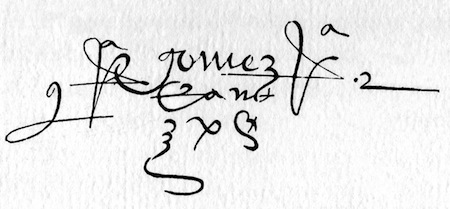
though he always signed himself simply "Gomes Eanes" or "Gomes Annes",[1] was the son of João Eannes de
Azurara, a Canon of Evora and Coimbra; but, beyond the fact of this
paternity, we know nothing of his father, and only by conjecture is it
possible to arrive at the name of his mother, as will hereafter appear.
He is said to have come of a good family, on the ground of his admission
into the Order of Christ.
As with several other Portuguese men of letters, the respective years
of Azurara's birth and death are unknown,[2] and two localities dispute the
honour of having given him to the world; but there seems little
doubt that this "bonus Grammaticus, nobilis Astrologus, et magnus
Historiographus," as his friend Pisano calls him,[3] was born in the town of his name, in
the Province of Minho, at the very commencement of the 15th century. In
proof of this it should be stated that Azurara expressly declares in his
Chronica de Ceuta, which was finished in 1450, that he had not
passed "the three first ages of man" when he wrote it.[4]
The dispute as to his birthplace between the Azurara in Minho and the
Azurara in Beira[5] is not easy to
settle, but tradition favours the former, and until the end of the last
century no writer had ventured to doubt that the ancient town at the
mouth of the River Ave, which received its first charter, or "foral",
from the Count D. Henrique in 1102 or 1107, was the early home of the
Chronicler.[6] Such evidence as
exists in favour of the latter place is slight, consisting only of
inferences drawn from a document, dated August 23rd, 1454, in which
Affonso V grants certain privileges to two inhabitants of Castello
Branco, who were accustomed to collect the Chronicler's rents and bring
them to Lisbon. From this it has been argued by such able critics as
Vieira de Meyrelles and Rodriguez d'Azevedo that these rents must have
issued out of family property situate at the Azurara in Beira, which
happens to be in the district of Castello Branco, and hence that the
Chronicler was a native of Beira rather than of Minho.[7] The conclusion seems far-fetched, to
say the least, for it is just as likely that these two men were agents
for a benefice, or "commenda", at Alcains, in the same district, which
Azurara possessed at the time this grant was made.[8]
The early life of the Chronicler is almost a blank. Until the year
1450, in which he wrote his first serious Chronicle, though not,
perhaps, his first book, we have little beyond the meagre information,
supplied by Mattheus de Pisano,[9] that he began to study late—"dum maturæ jam ætatis esset"—and that he
had passed his youth without acquiring the rudiments of
knowledge—"nullam litteram didicisset"[10]—to which some later
authorities have added—he spent his early years in the pursuit of
arms, a statement likely enough to be true. It seems probable that he
obtained a post in the Royal Library during the brief and luckless reign
of D. Duarte (1433-1438), or shortly afterwards, as assistant to the
Chronicler Fernão Lopes, whom he succeeded, for he was actually in
charge of it early in the reign of Affonso V, in 1452, and finished the
Chronica de Guiné in that place in 1453.
Tradition has it that he entered the Order of Christ as a young man,
for he came to be Commander therein, a position only obtainable at that
time by regular service in the Order, and by seniority; but the nature
of these services, and the advancement which Azurara gained by them,
cannot precisely be determined, because the early private records of the
Order, together with the roll of its Knights, have been lost, those that
exist only reaching back to the commencement of the 16th century.[11] This Order was founded by King
Diniz in 1319, on the suppression of the Templars, and it inherited
most, if not all, their houses and goods throughout Portugal. Its
members were bound by the three monastic vows of chastity, poverty, and
obedience, which prevailed in Azurara's time, although
Commanders and Knights of the Order were at a later period allowed to
marry, by grant of Pope Alexander VI.[12] The Commanders were bound to
confess and communicate four times in the year, to recite daily the
Hours of Our Lady, to have four Masses said annually for deceased
members, and to fast on Fridays, as well as on the days ordained by the
Church. Membership of the Order was an honour reserved for Nobles,
Knights, and Squires, free from stain in their birth or other
impediment; while the Statutes directed a number of enquiries to be made
before a candidate was admitted, one being, was he born in lawful
wedlock?—a question our Chronicler could possibly not have
answered in the affirmative.[13] Besides this, aspirants were
required to be knighted before their admission, and then to profess. A
gift of one or more "Commendas", or benefices, followed in due course,
but, to prevent the abuse of pluralities which thus crept in, Pope Pius
V afterwards decreed that no Knight should hold more than one Commenda,
and this he was to visit at least once in every three years. The Knights
possessed many privileges, the most notable being that, in both civil
and criminal cases, they were exempt from the jurisdiction of the Royal
Courts, and subject only to those of their Order, does not necessarily
follow that he was illegitimate, and, in fact, no letters of
legitimation exist in respect of him.] which had all the old
prerogatives of those of the Temple and Calatrava, together with such as
had been granted it by name.[14]
According to one authority, Azurara began his career as author in the
reign of D. Duarte by compiling a detailed catalogue of the Miracles of
the Holy Constable, Nun' Alvares Pereira.[15] The MS., which is said to have
existed in the Carmo Convent in Lisbon as late as 1745, has disappeared,
but the substance of this curious work may still be read in Santa Anna's
Chronica dos Carmaelitas, together with a number of contemporary
popular songs about the Constable, extracted from MSS. left by
Azurara.[16]
More than ten years now elapse without any mention of Azurara's name,
and we hear of him for the first time, definitely, in 1450. On March
25th of that year he finished at Silves, in the Algarve, his
Chronicle of the Siege and Capture of Ceuta, an event that took
place in 1415, and formed the first of a long line of Portuguese
expeditions, and the starting-point in their career of foreign conquest.
Fernão Lopes, the Froissart of his country, and the father of Portuguese
history, was still alive at the time Azurara wrote this
work, but had become too old and weak to carry on his history of the
reign of João I, to which it is a sequel. After paying a tribute to
Lopes as a man of "rare knowledge and great authority",[17] Azurara tells us that Affonso V
ordered him to continue the work, that the deeds of João I might not be
forgotten; and this he did, culling his information from eye-witnesses
as well as from documents, with that honesty and zeal which are his two
most prominent features as an historian.[18] He began the
Chronicle—which was printed once only, and that in the 17th
century—thirty-four years after the capture of Ceuta, i.e.,
in the autumn of 1449, and concluded it, as the last chapter states, on
March 25th, 1450. It was, therefore, written in the short space of about
seven months, which, says Innocencio, seems well-nigh incredible,
considering how deliberately and circumspectly histories were compiled
in those days.[19] The narrative
is, with a few exceptions, full and even minute.
We know not the precise date at which Azurara had begun to
apply himself to the study of letters, and he makes no allusion
whatsoever, in his writings, to his early life; but it is clear, from
the Chronica de Ceuta, that his self-training had been lengthy,
and his range of study wide.[20] In the Preface to this, his first
literary essay still existing, he quotes from many books of the Old and
New Testament, as well as from Aristotle, St. Gregory, St. Anselm, and
Avicenna; while in the body of the work he compares the siege of Ceuta
to that of Troy, talks of "Giovanni Boccaccio, a poet that was born at
Florence", mentions the Conde Lucanor, and wanders off into
philosophical musings that forcibly recall passages of the Leal
Conselheiro of D. Duarte, and prove him to have been no tyro in the
learning of the age. He was equally well versed in astrology, in which
he believed firmly, as in history, and of the latter he says: "I that
wrote this history have read most of the Chronicles and historical
works."[21] To understand how this was
possible, it must be remembered that the Portuguese Court, in the first
half of the 15th century, was an important literary centre, and that
João I and his sons, besides being themselves authors of books,
possessed libraries among the most complete in Europe.[22] The atmosphere of learning that
he breathed made Azurara what he was, and it explains the ascendency he
gained, as a pure man of letters, over the mind of Affonso V.
Three years elapsed between the writing of his second and third
books, and there can be little doubt that Azurara spent this period
partly in the Royal Library and partly among the Archives, which were
then housed in the Castle of S. Jorge in Lisbon, continuing his study of
the history of his own and foreign countries in the chronicles and
documents those places contained.
Some time in the year 1452 the King, who was then in Lisbon, charged
him with the book which constitutes his chief title to fame, owing to
the importance of its subject, and the historical fidelity and literary
skill that distinguish its presentment, namely, the Chronica de
Guiné, or, as it might be called, the Life and Work of Prince
Henry the Navigator. From the subscript we find it was written in
the Royal Library, and finished there on February 18th, 1453. Azurara
sent it to the King, five days afterwards, with a letter which has
fortunately been preserved, since it shows how friendly and even
familiar were the relations subsisting between them, and how these were
maintained by a regular correspondence. It appears that Affonso had
urged Azurara to obtain all the information possible about the life and
work of D. Henrique, and, this done, to write as best he could,
"alleging a dictum of Tully, that it sufficeth not for a man to do a
good thing but
rather to do it well". Then the letter proceeds, addressing the King:
"For it seemed to you that it would be wrong if some example of such a
saintly and virtuous life were not to remain, not only for the sake of
the Princes who after your time should possess these realms, but also
for all others of the world who might become acquainted with his
history, by reason of which his countrymen might have cause to know his
sepulchre, and perpetuate Divine Sacrifices for the increase of his
glory, and foreigners might keep his name before their eyes, to the
great praise of his memory."[23]
The following is a summary of the contents of the
Chronicle:—
Azurara begins (Chapter I) by some
reflections on well-doing and gratitude, the conclusion to which he
illustrates by quotations, and then goes on to tell the origin of his
work, which lay in the King's desire that the great and very notable
deeds of D. Henrique should be remembered, and that there should be an
authorised memorial of him, even as there was in Spain of the Cid, and
in Portugal itself of the Holy Constable, Nun' Alvarez Pereira.[24] The Chronicler justifies his task
by summing up the profits that had accrued from the
Prince's efforts—firstly, the salvation of the souls of the
captives taken by the Portuguese in their expeditions; secondly, the
benefit which their services brought to their captors; and thirdly, the
honour acquired by the fatherland in the conquest of such distant
territories and numerous enemies.
Chapter II consists of a long and most
eloquent invocation to D. Henrique, and a recital of his manifold good
deeds to all sorts and conditions of men and his mighty accomplishments.
Azurara presents them to us as in a panorama, and his simple, direct
language reveals a true, though unconscious, artist in words.
Chapter III deals with the ancestry of D.
Henrique, and Chapter IV describes the man himself, "constant in
adversity and humble in prosperity", his appearance, habits, and manner
of life, all with much force of diction.
In Chapter V we have an account of the
early life of D. Henrique, of his prowess at the capture of Ceuta, and
during its siege by the Moors, with his fruitless assault on Tangiers,
which resulted in the captivity of the Holy Infant. His peopling of
Madeira and other islands in "the great Ocean sea", and presence at the
gathering that ended in the battle of Alfarrobeira are referred to, as
also his governorship of the Order of Christ and the services he
rendered to religion by the erection and endowment of churches and
professorial chairs. The chapter ends with a description of the Town of
the Infant at Cape St. Vincent, "there where both the seas
meet in combat, that is to say, the great Ocean sea with the
Mediterranean sea", a place designed by the Prince to be a great
mercantile centre, and a safe harbour for ships from East and West.
In Chapter VI, Azurara returns to his
laudations of the Infant, whom he apostrophises thus: "I know that the
seas and lands are full of your praises, for that you, by numberless
voyages, have joined the East to the West, in order that the peoples
might learn to exchange their riches"; and he winds up with some remarks
on "distributive justice", the non-exercise of which had been attributed
to D. Henrique as a fault by some of his contemporaries.
Chapter VII is occupied with a recital of
the reasons that impelled the Infant to send out his expeditions. They
were shortly as follows. First and foremost, pure zeal for knowledge;
secondly, commercial considerations; thirdly, his desire to ascertain
the extent of the Moorish power in Africa; fourthly, his wish to find
some Christian King in those parts who would assist in warring down the
Moors; and last but not least, his purpose to extend the Faith. To these
reasons Azurara, quite characteristically, adds a sixth, which he calls
the root from which they all proceeded—the influence of the
heavenly bodies, and he essays to prove it by the Prince's
horoscope.
The narrative of the expeditions really begins in Chapter VIII, which opens with an account of the reasons
why no ship had hitherto dared to pass Cape Bojador, some of
them being at first sight as sensible as others are absurd. The fears of
the mariners prevented for twelve years the realisation of their
master's wish, and for so long the annual voyages were never carried
beyond the terrible cape.
Chapter IX relates how at length, in 1434,
Cape Bojador was doubled by Gil Eannes, a squire of D. Henrique, and
how, on a second voyage with one Affonso Gonçalvez Baldaya, Eannes
reached the Angra dos Ruivos, fifty leagues beyond it.
In the next Chapter (X) Baldaya passes one
hundred and twenty leagues beyond Cape Bojador to the Rio d'Ouro, and a
short way beyond; but failing to take any captives, as the Prince wished
him to do, he loads his ship with the skins of sea-calves and returns to
Portugal in 1436.
Chapter XI is a short one, and merely
tells that for three years, i.e., from 1437 to 1440, the voyages
were interrupted by the affairs of the Kingdom, which required all the
attention of D. Henrique. These affairs were the death of D. Duarte, and
the struggle that followed between the Queen, supported by a small
section of the nobles, and the Infant D. Pedro, backed by Lisbon and the
people as a whole, over the question of the Regency and the education of
the young King Affonso.
Chapters XII and XIII relate how Antam Gonçalvez took the first
captives, and how Nuno Tristam went to Cape Branco.
In Chapter XIV Azurara dwells on the
delight D. Henrique must have felt at the sight of the captives,
though he opines that they themselves received the greater benefit:
"for, although their bodies might be in some subjection, it were a small
thing in comparison with their souls, that would now possess true
liberty for evermore."
Chapter XV contains an account of the
embassy sent to the Holy Father by D. Henrique to obtain "a share of the
treasures of Holy Church for the salvation of the souls of those who in
the labours of this conquest should meet their end." The Pope, Eugenius
IV, granted a plenary indulgence, on the usual conditions, to all who
took part in the war against the Moors under the banner of the Order of
Christ; and D. Pedro, the Regent, made D. Henrique a present of the
King's fifth to defray the heavy expenses he had incurred by the
expeditions.
In Chapter XVI Antam Gonçalvez obtains the
Infant's leave for another voyage, and is charged to collect information
about the Indies and the land of Prester John. He receives ten negroes,
in exchange for two Moors whom he had previously taken, together with
some gold dust, and then returns home.
In Chapter XVII Nuno Tristam goes as far
as Arguim Island and makes some captures; this in the year 1443.
Chapter XVIII begins the relation of the
first expedition on a large scale, and the first that sprang from
private enterprise—namely, that of Lançarote and his six caravels
from Lagos. Azurara takes the opportunity to insert here a short but
interesting sketch of the change that had taken place in public opinion
with reference to these voyages. In the beginning, they were decried by
the great not a whit less than by the populace, but the assurance of
commercial profit had now converted the dispraisers, and the voyage of
Lançarote gave a tangible proof of it.
The next six Chapters (XIX to XXIV) relate the doings of this expedition, which
ended in the capture of two hundred and thirty-five natives.
Chapter XXV, which treats of the division
of the captives at Lagos, is the most pathetic in the book, and one of
the most powerful by virtue of the simple realism of the narrative.
Chapter XXVI gives a lucid summary of the
after-lives of the captives, and their gradual but complete absorption
into the mass of the people.
Chapter XXVII narrates the ill-fated
expedition of Gonçalo de Cintra and his death near the Rio d'Ouro;
while, in the next, Azurara refers the accident to the heavenly bodies,
and draws a profitable lesson from it, which he divides into seven
heads, for the benefit of posterity.
Chapter XXIX contains a short notice of a
voyage undertaken by Antam Gonçalvez, Gomez Pirez, and Diego Affonso to
the Rio d'Ouro, which had no result.
Chapter XXX deals with the voyage of Nuno
Tristam, who passed the furthest point hitherto discovered, and reached
a place he named Palmar. Azurara confesses himself unable to give more
details about this expedition, "because Nuno Tristam was
already dead at the time King Affonso ordered this Chronicle to be
written"—a statement which proves that he did not rely only on
documents for the facts he related, but was careful to glean as much as
possible from the actors therein.
Chapter XXXI tells how Dinis Dyaz sailed
straight to Guinea without once shortening sail, and how he was the
first to penetrate so far, and take captives in those parts. He pushed
on to Cape Verde, and, though he brought back but little spoil, he was
well received by the Infant, who preferred discoveries to mere
commercial profits.
Chapters XXXII to XXXVI recite the expedition of Antam Gonçalvez,
Garcia Homem and Diego Affonso to Cape Branco, Arguim Island and Cape
Resgate, where, besides trafficking, they took on board a squire, Joham
Fernandez, who had stayed full seven months at the Rio d'Ouro, among the
natives, to acquire for the Infant a knowledge of the country and its
products.
Azurara refers in Chapter XXXII to Affonso
Cerveira, whose history of the Portuguese discoveries on the African
coast, now lost, was used by him in the compilation of this Chronicle;
and in the next chapter he employs one of those rhetorical periphrases
of which his other works afford many an example, though they are rather
scarce in this his masterpiece in point of style.
Chapters XXXVII to XLVIII relate the doings of the first expedition
from Lisbon, which was under the command of Gonçalo Pacheco, and
penetrated to Guinea, or the land of the Negroes, the result being a
large number of captives, seemingly the chief object it had in view.
Chapters XLIX to LXVII contain the acts of the great expedition of
fourteen sail which set out from Lagos in 1445, under the leadership of
Lançarote, for the purpose of punishing the Moors on the Island of Tider
and avenging Gonçalo de Cintra. In all twenty-six ships left Portugal
that year, being the largest number that had perhaps ever sailed down
the Western side of the Dark Continent at one time.
After accomplishing their object some returned home, but others, more
bold, determined to explore further South, if perchance they might find
the River of Nile and the Terrestrial Paradise. Arriving at the Senegal
they thought they had found the Nile of the Negroes, and went no
further. A curious description of the Nile, and its power according to
astronomers, forms the subject of Chapters LXI and LXII, where
Azurara has collected all the learning and speculation of the Ancients
and Mediævals on the question.
Chapters LXVIII to LXXV describe the doings of the remaining ships
that left Portugal in 1445, and relate descents on the Canaries and the
African coast, and the voyage of Zarco's caravel to Cape Mastos, the
furthest point yet reached.
Chapters LXXVI and LXXVII contain valuable notes on the life of the
peoples south of Cape Bojador, together with an account of the travels
of Joham Fernandez, the first European to penetrate far into the
interior of Africa.
In Chapter LXXVIII Azurara adds up the sum
of the African voyages, and finds that up to 1446 fifty-one caravels had
sailed to those parts, one of which had passed four hundred and fifty
leagues beyond Cape Bojador.
Chapters LXXIX to LXXXII are taken up by a description of the Canary
Islands, while Chapter LXXXIII deals with the
discovery and peopling of the Madeiras and Azores.[25]
Chapter LXXXIV tells how D. Henrique
obtained from the Regent a charter, similar to the one he had previously
secured in the case of Guinea, to the effect (inter alia) that no
one was to go to the Canaries, either for war or merchandise, without
his leave; and the following chapter (LXXXV)
relates a descent on the Island of Palma.
In Chapter LXXXVI Azurara narrates in
feeling terms the death of the gallant Nuno Tristam in Guinea-land.
In Chapter LXXXVII we read how Alvaro
Fernandez sailed down the African coast past Sierra Leone, and more
than one hundred and ten leagues beyond Cape Verde.
Chapter LXXXVIII describes the voyage of
another Lagos fleet of nine caravels to the Rio Grande, while the next
five chapters (LXXXIX-XCIII) relate that of
Gomez Pirez to the Rio d'Ouro in 1446.
Chapters XCIV and XCV are devoted to the trafficking venture of the
year 1447, the unhappy fate of the Scandinavian Vallarte, and an
expedition to the fisheries off the Angra dos Ruyvos.
In Chapters XCVI and XCVII Azurara winds up his narrative, ending with
the year 1448. The captives brought to Portugal down to that date by the
various voyagers numbered, according to his estimate, 927, "the greater
part of whom were turned into the true path of salvation"; and this he
counts as the greatest of the Infant's glories, and the most valuable
fruit of his lifelong efforts. He then announces his intention to write
a second part of the Chronicle, dealing with the final portion of D.
Henrique's work—a purpose which to our manifest loss he never
carried out—and concludes by giving thanks to the Blessed Trinity
on the completion of his task.
The Chronica de Guiné has many features in common with that of
Ceuta, but on the whole it reveals a decided advance in power. The
style, though at times rather rhetorical, is generally plain and facile,
ever and anon rising to a true eloquence. While the narrative portions
are vivid, picturesque, and often majestic in their very simplicity,
other chapters bristle with quotations, and show a more
extensive range of reading and a knowledge truly encyclopædic. All the
philosophy, the geography, the history, and even the astrology of the
age is called into requisition to support an argument or illustrate a
point.
But to return to our subject—the Life of the Chronicler.
On June 6th, 1454, Azurara received the reward of his past services,
being appointed Keeper of the Royal Archives (Guarda Mór da Torre do
Tombo), at the instance of, and in succession to, Fernão Lopes. It is
probable that the office of Chief Chronicler (Chronista-Mór) was
conferred on him at the same time and implied in the grant, though it is
not verbally mentioned there, since in the document next referred to be
is actually named Chronicler.[26] The King, in his letter of
appointment, after reciting that Fernão Lopes is very old and weak, so
that he cannot well serve his office, says he confides in Gomez Eanes de
Zurara, Knight Commander of the Order of Christ, "by the long education
(criaçom) we have given him and the service we are receiving and
expect to receive at his hands", and therefore grants him the post to
hold in the same manner, and with the same rights and profits
as were enjoyed by his predecessor therein.[27]
It is noticeable that Azurara had already obtained a "Commenda"
belonging to the Order of Christ, and, although its name is not given
here, we know from another source it was that of Alcains, a place
situate in the Province of Beira (Baixa) and District of Castello
Branco, the value of which in 1628 amounted to one hundred and four
milreis.[28] The source
referred to is a document, dated July 14th, 1452, which calls Azurara
"Commander of Alcains" and "Author of the notable deeds of our realm",
and mentions that he had already at that time charge of the Royal
Library.[29] He appears to
have exercised this office with credit, though somewhat less strictly
than would now be considered necessary, for Pisano says of him in this
connection:—"hic bibliothecam Alfonsi quinti, cujus curam gessit,
strenue disposuit atque ornavit, omnesque scripturas Regni prius
confusas mirum in modum digessit, & ita digessit ut ea, quibus Regi
& ceteris Regni proceribus opus est, confestim discernantur; viros
enim eruditos summe coluit, atque nimio charitatis amore complexus est,
quibus ut profecissent ex Regia bibliotheca libros, si parebant,
libenter commodavit".[30] But the
Chronicler received yet another advancement in the year
1454. From a document bearing date the 4th August it appears that he was
then living in a house belonging to the King near the Palace in Lisbon
which needed some repairs. Affonso V therefore granted him leave to lay
out ten milreis upon it, and to make a cistern, with a proviso that he
and his heirs might continue to inhabit the house and use it as their
own, until the sum so expended should be repaid out of the Royal
Treasury. In this licence Azurara is dubbed "Commander of Pinheiro
Grande and Granja d'Ulmeiro, Our Chronicler, and Keeper of the
Archives".[31] These two
Commendas belonged to the Order of Christ, and were probably conferred
upon him in this same year, though the deed of grant has not come down
to us.
Pinheiro Grande is situate in the province of Estremadura and
Archbishopric of Lisbon, and its ancient Commenda belonged to the
Templars down to the year 1311, and from 1319 to the present century to
the Order of Christ. In the Statutes of the latter Order, published in
1628, it is stated to have been worth 550 milreis for many
years—"ha muitos annos".[32] Granja d'Ulmeiro is a small place
in the Bishopric of Coimbra, and the same Statutes give the value of its
Commenda. called of St. Gabriel. at 150 milreis, "in the year 1582".[33]
Besides these two Commendas, Azurara still continued to
hold that of Alcains, as we learn from the document already referred to,
granting certain privileges to his agents in Castello Branco, and dated
the 23rd of the same month and year. The revenue of these three
Commendas, together with his official salary, must have sufficed to make
of him a wealthy man, for it should be remembered that the purchasing
power of the milreis was then nearly six times greater than at the
present day. He seems, however, to have relinquished the benefice of
Alcains shortly afterwards, for it does not appear again among his
titles, and henceforth he is only credited with the other two.
In the above-mentioned document of privilege of August 23rd, 1454,
after reciting the services rendered to Azurara by Guarcia Aires and
Afomsso Guarcia—to employ the antique spelling—muleteers of
Castello Branco, in collecting his rents and bringing them to Lisbon,
the King grants them immunity from being forced into the service of
either himself, the Infants, or the local authorities of the district in
which they live. Their houses, cellars, and stables are not to be taken
from them to lodge others against their will, and they are to enjoy this
freedom as long as they continue to be of use to the Chronicler.[34]
When next we hear of Azurara he is acting in his official capacity as
Keeper of the Royal Archives. It seems that the people of Miranda had
lost the "foral" given them by King Diniz in 1324, and required a copy
of it, which Azurara made and handed to them on the 16th February
1456.[35] This is the first of a series of
certificates (certidões) signed by the Chronicler that has come down to
us, and the issuing of these and similar documents appears to have been
one of his chief duties as Royal Archivist.
But Azurara was too valuable a man to be allowed to spend his whole
time and energy in the routine work of an office; and so we find that
when the King had reigned twenty years or more, which would be in or
about 1458, he commissioned him to relate the history of Ceuta under the
Governorship of D. Pedro de Menezes, to whom the city had been entrusted
on its capture.[36] The story runs,
that for some time João I was unable to meet with anyone who would
undertake the responsibility of guarding the new conquest, and, word of
this having been brought to D. Pedro while he was playing at "Chóca", he
at once hastened into the King's presence, and said he would engage to
hold the city against the whole strength of Africa with the olive-wood
crook he had just been wielding.[37] Be this incident true or
not, certain it is that D. Pedro de Menezes succeeded in maintaining
Ceuta, despite all the efforts of the Moors to expel him; and his
achievements, as chronicled by Azurara, form by themselves sufficient
ground for Affonso's commission. But another reason, no doubt,
influenced the King, and that was the supreme importance attached to the
possession of the old city. Its position as the key of the Straits
enabled the Portuguese to hinder the Moorish corsairs from raiding the
Algarve, and, at the same time, to help the Christian cause by attacks
on the last relic of Mohammedan power in the Peninsula, the kingdom of
Grenada. Added to this, its conquest was hailed as the first step in the
realisation of that cherished ideal, an African Empire: for, besides
being a great trading centre and the sea-gate of Mauritania, it formed a
wedge driven into the heart of the Infidel, and a fitting crown to the
struggle of seven centuries, which, commencing on the morrow of the
battle of the Guadalete, had ended by the establishment of the Cross in
the land of the Crescent. The tide had turned at last and for ever, and
the Gothic monarchy was avenged.
Azurara, who on previous occasions had proved himself a ready writer,
compiled the Chronica do Conde D. Pedro de Menezes more slowly,
owing doubtless to the fact that his new official duties kept him from
devoting his whole time to the work, and the Chronicle was not finished
until 1463.
In this very year of 1458 occurred the first African Expedition of
Affonso V, with its result, the capture of Alcacer. This
event was probably the immediate cause of the writing of the Chronicle,
because the record of his reign shows how the King cared more for
African expansion than maritime expeditions, and how, like the old-time
cavalier that he was, he preferred a land-war with the Moors to the
seemingly theoretical, or at least distant, advantages to be gained by
voyages of discovery. In 1460 D. Henrique died, leaving the fruit of his
ceaseless endeavours to be plucked by other hands; since it was not
until 1498, when Vasco da Gama cast anchor off Calicut, that the
Infant's expeditions came to their legitimate conclusion, and a century
of efforts received their reward.
But if Azurara possessed many of the higher qualities of an
historian, he was by no means devoid of shortcomings; and two incidents,
now to be related, form serious blots on his character as a Chronicler
and a man.
In 1459 the Cortes met in Lisbon, and the Deputies of the People
requested that a reform should be carried out in the Torre do Tombo, or
Archive Office. They complained that the mass of old Registers which it
was necessary to search in order to obtain copies of the documents
existing there, together with the profitless prolixity of many of them,
had long proved a source of great expense; and they therefore begged
that such as were deemed of importance might be transcribed and the rest
destroyed. This petition met with the King's approval, and Azurara
charged himself with its execution, a task which seemingly
occupied the remainder of his life.[38] He acted with a zeal worthy of
barbarous times, and the memory of the destruction to which he condemned
documents of the highest historical importance has been preserved by
tradition, and his proscription is still spoken of. He appears to have
been unconscious of the harm he did, for he prefaces each of the new
Registers compiled by him from the old with an account of his handiwork.
True it is that Barros praises Azurara for these Registers, but in
reality they are only "dry, imperfect abstracts", as one writer calls
them, for they throw little light on the periods to which they relate,
and were, besides, the cause of the loss of their originals.
Fortunately, however, some records escaped the general destruction, for
it happened that certain Municipalities had previously obtained
transcripts of the most precious, while others that existed in duplicate
in the Archives, unknown to anyone, came to light during the
administration of another Guarda-Mór.[39] The authorities of the City of
Oporto obtained leave from Affonso V, on the 23rd March
1447, to have copies made of all the documents in the Torre do Tombo
which related to them in any way, and these were furnished on December
25th, 1453, when Lopes was still Keeper of the Archives.
But Azurara was guilty of a yet graver delinquency than his
destruction of the old Registers, and a charge of forgery must be
brought against him. A detailed account of this affair may be read in
the judgment of the Casa de Supplicação, delivered on January 12th,
1479, from which it appears that a dispute had arisen between the Order
of Christ and some inhabitants of Punhete over rights claimed by the
former in the River Zezere, a tributary of the Tagus. The Order based
its claim on certain documents, one being of the reign of D. Fernando,
and said to have been extracted from the Torre do Tombo, in which that
monarch purported to confer on the Order of Christ jurisdiction over the
towns of Pombal, Soure, Castello Branco and others, to the practical
exclusion of his own authority therein.[40] When a copy of this pretended grant
was produced in support of the contention, Azurara's successor in the
Archives, Affonso d'Obidos, received instructions to produce the
Register of D. Fernando for the purpose of comparison, and to bring the
scribes engaged in the Archive Office with him; whereupon the
grant was found at the end of the Register in a different writing from
the rest of the book. Neither d'Obidos, nor the scribe who had copied
out the Register, could say how it came there, or who had inserted it,
and the latter declared that no such grant existed in the old books from
which he had transcribed the present one. On further examination the
pretended grant proved to be in the handwriting of "Gomez Eannes,
Cleric",[41] a servant of
Azurara, and it must have been fraudulently inserted in the Register
after the latter had been bound up. On the discovery of this act of
forgery, judgment was, of course, given against the Order, and it was
fortunate for our Chronicler that the offence he had committed in its
interests remained undiscovered until after his death.[42]
Curiously enough, in the same year Azurara was rewarded by a pension.
The grant dated from Cintra, August 7th, 1459, runs as
follows:—"Dom Affonso, etc., to all to whom this letter of ours
shall come we make known that, considering the many services we have
received and expect hereafter to receive from Gomez Eanes de Zurara,
Commander of the Order of Christ, Our Chronicler and Keeper of our
Archives, and wishing to do him favour, we are pleased to give him a
pension of twelve white milreis from the 1st day of January next, which
amount he has had of us up to the present time."[43]
It would appear from the last line that this document is rather the
confirmation of an old grant than the gift of something new, but it has
been interpreted to mean that Azurara had been receiving the money from
the King's privy purse, and was henceforth to have it out of the public
treasury. There can be no dispute that the recipient merited the gift
for his past literary services, which were an earnest of the work he was
to accomplish in the future, and the value of the latter will presently
appear.
We possess the copy of one certificate issued by the Chronicler in
the following year, together with the record of another, their
respective dates being June 27th and October 22nd, 1460. The former,
dated from Lisbon, was granted in answer to the petition of the
inhabitants of Nogueira, who felt uncertain about the dues they were
bound to pay the Bishop of Coimbra;[44] the latter is mentioned by J. P.
Ribeiro, but seems to have disappeared from the Torre do Tombo.
In 1461 there occurred an event, simple enough on its face, but one
which Azurara's biographers have regarded as the mystery of his
life, or else employed as a weapon wherewith to smite their
hero—his adoption by Maria Eannes. In the king's confirmation of
this, dated from Evora, February 6th, 1461, we are told that "Maria
Eannes, a Lisbon tanner—considering the love and friendship that
Johane añnes dazurara, erstwhile Canon of Evora and Coimbra, had always
shown to her mother, Maria Vicente, as well as to herself and her
husband, and the many good deeds she herself had received at his hands,
being his godchild and friend, and considering that she had no children
and was no longer of an age to have any, and also the love and
friendship she had felt for Gomez Eannes dazurara, ever since his
father's death, and the services he had rendered her—thereby
adopted him as her son and heir to succeed to her real and personal
property, including her country house at Valbom, in the Ribatejo, and a
house she possessed in the Parish of S. Julião in Lisbon".[45] Such is the substance of this
document, over the explanation of which some controversy has taken
place, because of the social gulf that separated the parties to it. The
true motive for the adoption, as hints Senhor Rodriguez d'Azevedo, would
seem to have been the existence of some near relationship between Maria
Eannes and the Chronicler which it was not expedient to disclose; but
whether this opinion find acceptance or no, there is nothing to justify the old view which regarded the grant as a
proof of Azurara's avarice and unscrupulousness: since, on the contrary,
the preamble reveals a lively sense of gratitude in the donor for real
benefits conferred by the donee. If, however, the above theory be worked
out, the most plausible conclusion to arrive at is, either that Maria
Eannes and Gomes Eannes de Azurara were brother and sister, both being
children of the Canon and Maria Vicente, or that the Chronicler was
half-brother to Maria Eannes, i.e., had the same father but not
the same mother. It seems at least a fair inference to draw from the
wording that the Canon and Maria Vicente were of a similar age, and the
same may be said of the other pair, because at this time the Chronicler
would count nearly sixty years, and his benefactress could not be much
less, seeing that all possibility of her bearing children had passed by.
Either of these hypotheses would account for the name Eannes being
common to the lady and Azurara. The Canon would then have left his
property between his two children, and as Maria Eannes was childless, it
would be natural for her to bequeath her share of her fathers property
to her brother. But be this as it may, we know from an independent
source that Azurara had a sister, for she is mentioned in the letter
which Affonso V wrote him whilst he was living in Africa and engaged on
historical investigations. The fact, recorded by Pisano, that the
Chronicler began his studies relatively late in life, unless it be
ascribed to his adoption of a military career at first, seems to show that he had passed his early years under a cloud,
and that his father, from one cause or another, lacked the power to
provide him with an education at the customary age. It is, however,
impossible to proceed beyond conjectures, and since the matter cannot
claim to be one of historical moment, we may leave it unsolved without
much regret.
On June 14th, 1463, Azurara issued a certificate of documents in the
Torre do Tombo relating to land of one D. Pedro de Castro,[46] while yet another proof of the
influence he possessed with his royal master is afforded by two grants,
dated respectively June 22nd and 23rd of the same year. By the first of
these the office of Judge of Excise in the town of Almada was conferred
on a certain Pero d'Almada, servant of Gomes Eannes, and the grant is
expressed to be made at the latter's request. The second appoints the
same individual Judge and Steward of the gold-diggers at Adiça, near
that town.[47]
The Chronica de D. Pedro de Menezes, which had been commenced
by Azurara in or about the year 1458, was finished on St. John the
Baptist's Eve, June 23rd, 1463, at his Commenda of Pinheiro Grande. It relates the history of Ceuta, from the
capture of the city in 1415 until the death of D. Pedro de Menezes, the
first governor, in 1437, and gives evidence of the author's progress in
historical methods.[48] While it
contains less moralising and more matter than any of his previous works,
at the same time he appears surer of his own powers, and no longer feels
the same need of supporting every remark by a citation. Of course this
Chronicle has not as deep an interest for us as that of Guinea, but this
is due to the subject, not to any shortcomings in the narrator, whose
contemporaries were probably of a different opinion, for many of them
looked askance at the voyages of discovery, though there were few that
doubted the importance of the possession of Ceuta.
Azurara confesses that he felt at first somewhat diffident of putting
pen to paper, so marvellous seemed the deeds he was called on to relate;
and he would never have persevered with his task had he learnt them on
hearsay evidence, or from the mouths of one or two witnesses; but he
found their truth confirmed on a perusal of the official reports sent to
the King from Ceuta, and this encouraged him to proceed. He appears to
have been assisted in his task by D. Pedro himself during his
lifetime,[49] and to have
written out the book twice, while his impartiality and the care he took to arrive at the truth are
everywhere visible.[50] Of course he
cannot abstain altogether from citations, and these have an interest as
showing the measure of his literary knowledge: witness his mention of
Dante's Divina Commedia, Cinó da Pistoia and The Book of
Amadis, which he ascribes to "Vasco Lobeira, who lived in the time
of D. Fernando."[51]
For three years contemporary records are silent respecting the
Chronicler, and it is not until 1466 that he comes before us again. On
June 11th of that year, D. Pedro,[52] King of Aragon, son of him who was
Regent in the minority of Affonso V, and fell at Alfarrobeira, wrote
Azurara a short but familiar autograph letter, which affords another
proof of the intimate relations that existed between the Chronicler and
the great personages of the age. In this letter, which is in response to
one sent by Azurara, D. Pedro addresses him as "friend", refers to his
"old kindness and sweet nature", and goes on to accept his offer to keep
him informed of the progress of events in Portugal. He then takes the Chronicler into his confidence, and complains of
the difficulties of his position as King of Aragon—difficulties
which were aggravated by an illness that ended in his death less than a
month after he had penned this epistle.[53]
On July 27th, 1467, in answer to a petition of the inhabitants,
Azurara issued a certificate[54] of the "foral" of Azere (Azár),
virtute officii, and on the very next day he met with another
piece of good fortune. From the deed of grant it appears that, some
ninety years previously, a certain Gonçalo Estevez of Cintra had died,
after having built a chapel in honour of St. Clare in the Church of St.
Mary Magdalen, in Lisbon, where he desired to be buried, and had left
his property with the condition annexed that masses should be regularly
said there. This condition, the document goes on to declare, had been
broken by his heirs for about seventy years, in spite of judgments
obtained against them, and many had died excommunicate because of their
neglect and disobedience. Finally, the goods had been declared forfeit
to the Crown, and they were now granted out
to Azurara, on condition that he should provide for the masses and
generally carry out the instructions contained in the will of the
founder.[55] A gift of this
nature was considered an extraordinary grace in those days, and it
affords clear evidence that the Chronicler stood high in the royal
regard.
In August of this same year Azurara went to Africa, and, to explain
the journey, some introductory remarks are needed. On returning from the
fruitless African expedition of 1464, the King had written to him from
Aveiro, with instructions to leave all his other occupations—which
the Chronicler naïvely assures us were very important and profitable to
his countrymen—and forthwith to collect and put in writing the
deeds of D. Duarte de Menezes, late Captain of Alcacer.[56] This Duarte was the natural son of
D. Pedro, the hero of Azurara's last book; and he had merited much from
Affonso V for his long and faithful services at Alcacer, ending with the
sacrifice he had made of his own life to save that of the King, during a
reconnaissance against the Moors in the last-named year.
As before, Azurara hesitated to make a start on account of his
"untutored style and small knowledge", and through fear of hostile
criticism; indeed, under the latter head he says,
with a touch of bitterness, "there are so many watching me, that I have
hardly put pen in hand before they begin to damn my work."[57] But his obligations to, and regard
for, the King caused him to pluck up courage, and proceed with a task
which occupied some three or four years of his time. In order to secure
the best information possible, he considered that he ought to visit
Africa, because some of the dwellers in and about Alcacer were the chief
actors in the drama he was called upon to write, and would be likely to
have a clearer recollection of events than the courtiers in Portugal;
and also because he wished to view the district which had been the scene
of the struggle, and learn the disposition of the land, the Moorish
method of fighting, and the tactics employed against them by the
Portuguese. He confesses that he would have gone to Ceuta before writing
the Chronica de D. Pedro, but the King refused to give
permission, considering that his services were more needed inside than
outside the realm. Even after he had resolved on the present visit, the
King detained him a whole year, until fully convinced how necessary it
was, if his commands were to be satisfactorily carried out.[58] Finally, in August 1467, Azurara
crossed the Straits to Alcacer, where he stayed for twelve months,
occupied in studying the district and taking part in the various
excursions into Moorish territory that were made by D. Henrique, son of D. Duarte de Menezes, who, to satisfy him
and aid his work, used even to change the plan of operations and go to
some spot the Chronicler desired to inspect.[59] With an impartiality rare enough at
that time, Azurara took care to obtain information from the Moors
themselves, both from such as visited Alcacer and from those he met when
accompanying D. Henrique to treat of matters with the inhabitants of the
neighbouring places.[60]
The Chronicle, which is at once a life of D. Duarte de Menezes and a
history of Alcacer, supplements that of his father D. Pedro de Menezes,
and carries the history of the Portuguese in North Africa down to 1464.
We have no record of when it was finished, but the year 1468 seems the
probable date. It is, if not the most important, yet the longest, as it
proved to be the last, of the Author's historical works, and cost him
more labour than any of its predecessors; but, through some mischance,
no complete MS. exists, all having many and great lacunæ, as will
hereafter appear. It presents the peculiarities common to all Azurara's
writings—the same fondness for quotations, and the same reliance
on astrology as explicative of character. Among the more interesting of
the former, besides those from the Classics and the Fathers, are his
references to Johão Flameno's gloss on Dante, Avicenna, Albertus Magnus,
and the Marquis of Santillana. Speaking of this Chronicle. Goes
notes and condemns the "superfluous abundance and wealth of poetical and
rhetorical words" that are employed here and elsewhere by its
author.
During Azurara's stay at Alcacer the King addressed him an autograph
letter dated November 22nd, 1467 (?), which affords a striking proof of
Affonso's superior mind, as well as of the esteem in which he held men
of letters. He begins by saying that he has received the Chronicler's
letter,[61] and rejoices he is well, as he had
feared the contrary, owing to his long silence, and proceeds:—
"It is not without reason that men of your
profession should be prized and honoured; for, next after the Princes
and Captains who achieve deeds worth remembering, they that record them,
when those are dead, deserve much praise.... What would have become of
the deeds of Rome if Livy had not written them; what of Alexander's
without a Quintus Curtius; of those of Troy without a Homer; of Cæsar's
without a Lucan?... Many are they that devote themselves to the exercise
of arms, but few to the art of Oratory. Since, then, you are well
instructed in this art, and nature has given you a large share of it,
with much reason ought I and the chiefs of my Realm and the Captains
thereof to consider any benefit bestowed on you as well employed."
Affonso then goes on to praise Azurara for having voluntarily exiled
himself in his service, and says he would not have him stay in Africa
any longer than he pleases, and winds up as follows:—
"I count it as a service that you
wish for news of my health, and, thanks be to God, I am well in body as
in other respects, though on the sea of this world one is constantly
buffeted by its waves, especially as we are all on that plank since the
first shipwreck, so that no one is safe until he reaches the true haven
that cannot be seen except after this life, to which may it please God
to conduct us when He thinks it time, for He is sailor and pilot, and
without Him no man may enter there.... I have not a painting of myself
that I can send you now; but, please God, you will see the original,
some time, which will please you more."[62]
Herculano truly says of this epistle: "Had it been from one brother
to another, the language could not well have been more affable and
affectionate";[63] but, more than
this, it proves that Portugal was ahead of most European nations of that
age in possessing a King who could value the pen as highly as the
sword.
Henceforth little or nothing is known of the life of Azurara, except
from the certificates he issued in the course of his official
duties.
On May 25th, 1468, one of these documents was issued from the Torre
do Tombo, and signed by a substitute, with the statement that the
Chronicler was living at Alcacer, on the service and by command of the
King. He probably returned to Lisbon to finish the Chronica de
D. Duarte de Menezes in the autumn of this year.
On October 22nd, 1470, Azurara gave a certificate of the Charter of
Moreyra. In their petition for the same, the inhabitants allege that
their copy is so written, and in such Latin, that they cannot understand
it; and they further wish to know how much of the present money they
must pay for the three mealhas mentioned in the original as
payable for the carriage of bread and wine—a question which
Azurara seems to have experienced some difficulty in answering.[64]
On April 20th, 1471, he issued a similar certificate to the dwellers
in S. João de Rey.[65] In this same
year took place Affonso's third African campaign, which resulted in the
capture of Tangier, Arzila and Anafe.
On September 5th, 1472, in answer to a petition of the inhabitants of
Cascaes, the Chronicler handed them a copy of the Charter of Cintra, in
which district Cascaes is situate,[66] and on December 5th in the same
year he issued copies of documents affecting the liberties of the Order
of Christ and the couto, or "liberty", of Gordam.[67]
This latter is the last existing document signed by
Azurara, though he appears to have given another certificate on August
17th, 1473, nearly a year after, relating to the forged grant of D.
Fernando to the Order of Christ, as mentioned by João Pedro Ribeiro.[68]
There is no evidence to show when the Chronicler died, and tradition
on the point varies. The oldest authority who refers to it is Damião de
Goes, and, according to him, Azurara lived some years after 1472.[69] He never married, and was succeeded
in his post at the Torre do Tombo by Affonso Annes d'Obidos; but the
charter of this man's appointment has been lost, and his first recorded
certificate only bears date March 31st, 1475.[70]
* * * * *
We have now followed the life of Azurara step by step, and seen him
honoured for his talents by his contemporaries, and rewarded for his
services to King and country by numerous benefactions.[71] We have also seen him on
intimate terms with the Royal Family, and corresponding regularly with
some of its members, as well as acquainted with the leaders of the
explorations and the learned men of the time, and must conclude that
this was chiefly due to his literary attainments and genial character.
It is therefore pleasant to be able to record that, in our day, Portugal
has marked her appreciation of him, as a man and a writer, by a statue,
whilst recognising that his works form his greatest and most durable
monument. In the Praça de Luiz de Camões in Lisbon there rises a noble
statue of the "Prince of Spanish Poets"[72], surrounded by eight of the most
distinguished men of letters and action of the fifteenth and sixteenth
centuries, his predecessors and contemporaries, and among them is a
life-size figure of Gomez Eannes de Azurara.[73]
Critical Remarks.
Azurara belongs to the line of Portuguese Chroniclers who
rendered illustrious the fifteenth and sixteenth centuries, a line that
began with Fernão Lopes and culminated in Damião de Goes and João de Barros, both of whom were almost historians
in the modern sense of the term, and at the same time masters of prose
style. He is indeed the connecting link between the chronicler and the
historian, between the Mediæval writers and those of the Renaissance;
for, while he possesses much of the sympathetic ingenuousness of Lopes,
yet he cannot resist displaying his erudition and talents by quotations
and philosophical reflections, as quaint as they are often unnecessary,
proving that he wrote under the influence of that wave of foreign
literature which had swept in with the new monarchy.
Three literary tendencies may be said to have prevailed in Portugal
during the fifteenth century—firstly, a monomania for classical
learning; secondly, an increased taste for the mediæval Epics and prose
Romances, due to the English influence that had entered with Queen
Philippa, daughter of timeserving Lancaster, though it must be
remembered that Amadis de Gaula, the most famous romance of the
Middle Ages, was compiled in the preceding century and by a Portuguese
hand; and lastly, an admiration for Spanish poetry, which had made
wonderful strides since the great Italians, Dante and Petrarch, had
become known in the Peninsula. In philosophy, Aristotle, as expounded by
Averroes, was the chief authority—Azurara calls him "the
Philosopher"—and following him Egidius and Pedro Hispano, the
Portuguese Pope and scholar, enjoyed the widest influence. Platonic
philosophy was introduced at a much later period, chiefly through the medium of Italian poetry, and it
never took root.
To the reader of Azurara's writings, it often seems as though the
author were overburdened by his knowledge, which was in truth very
extensive, if at times somewhat superficial; and the Chronicles bear
witness to the fact that Portugal had not remained foreign to the
literary impulse of the Renaissance. Besides citations from many books
of the Bible, the following classical writers appear in his
pages:—Herodotus, Homer, Hesiod, Aristotle, Cæsar, Livy, Cicero,
Sallust, Valerius Maximus, Pliny, Lucan, the two Senecas, Vegetius,
Ovid, Josephus and Ptolemy. Among early Christian and mediæval authors he mentions
Orosius, St. Gregory, Isidore of Seville, Lucas of Tuy, the Arabic
astronomer Alfragan, Gualter, Marco Polo, Roderick of Toledo, Egidius,
St. Jerome, Albertus Magnus, St. Bernard, St. Chrysostom, St. Thomas
Aquinas, St. Augustine, and Peter Lombard; while he has heard the legend
of the voyages of St. Brandan and knows the author of the Amadis de
Gaula. He was acquainted with the Chronicles and Romances of the
chief European nations,[74] and had studied
the best Italian and Spanish authors. Added to this, he had mastered the
geographical system of the Ancients,[75] together with their astrology, and
his knowledge of the latter probably came from the famous Opus Quadripartitum of Ptolemy. Although
he obtained his education in the time of D. Duarte, or early in the
reign of Affonso V, an age which had ceased to believe in sidereal
influences, as appears from the Leal Conselheiro, his writings
show that he possessed a fervent faith in astrology as explaining the
character and acts, as well as governing the destinies, of man.[76] Various opinions have been emitted
about his style; for, while such a good judge as Goes condemns his
"antiquated words and prolix reasoning, full of metaphors or figures
that are out of place in the historical style", Barros speaks of his
"clear style" that, together with his diligence, rendered him worthy of
the office he held.[77] But perhaps the
most perspicuous criticism thereon is that of Corrêa da Serra, who
declares, with reference to the opinions just cited:—"Both may
well be right, for the style of Gomes Eannes is not uniform, and seems
the work of two different men. As a rule his narrative is simple, full
of sound sense, and not without elegance; but, from time to time, he
remembers the rude rhetoric he had learnt so late in life, and writes
(if I may say so) in a falsetto style. The first was what nature had
bestowed upon him, the last came from his immature studies. But these
very defects are of interest now, for they give an
idea of the learning and taste of that age."[78] And, in spite of all his pedantry,
Azurara rises at times to a true eloquence, some of his pages being
equal to the best in Portuguese prose. The grandeur of chapter ii of the
Chronica de Guiné, and the heartfelt pity of Chapter XXV, which relates the division of the captives,
prove conclusively that he could accommodate the style to the subject
like all writers worthy ofthe
name. Had he lived a century later, he would have certainly been placed
in the first rank of Portuguese prosists; while, as it is, his
antiquated and at times inflated language has gone far to prevent him
from being appreciated, or even read, by any save the studious.[79]
As an historian he had an unbounded respect for authority, on his own
confession, and the speeches he puts in the mouths of his heroes remind
the reader at times of Livy, and make it clear that he was writing under
the immediate influence of classical models.[80] The historical importance of his
Chronicles is of the first order. They are contemporary with the events
they relate, and contain the history of the Portuguese expeditions to
and rule in Mauritania from the reign of João I down to that of Affonso
V, and furnish a complete account of all the voyages of discovery along
the African Coast, due to the initiative of D. Henrique, until
1448. True, the Chronica de Guiné omits to mention some other
voyages that were the result of private enterprise, for Azurara wrote it
in the capacity of Chronicler to the King and as a panegyric of the
Prince, and never intended to relate discoveries unconnected with his
hero and with the land that gives his book its title. The Chronica de
Guiné must, of course, always take rank as Azurara's masterpiece. It
was the first book written by a European on the lands south of Cape
Bojador, and it restores to us, in great part, the lost work of Cerveira
entitled a History of the Portuguese Conquests on the Coast of
Africa, on which it is founded, besides making up for the
regrettable disappearance of the naval archives of the early period of
modern discovery.
Azurara's credibility as a narrator is both unquestioned and
unquestionable, for his position enabled him to get at the truth, and he
took pains to record nothing but the truth, thereby proving himself a
genuine disciple of his master, Fernão Lopes. He was moved, as a rule,
neither by human respect nor by petty jealousies, and accuracy seems
with him to have amounted to a passion.[81] So truthful was he that he
preferred to leave the relation of facts incomplete rather than tell of
them without having received exact information from
eye-witnesses. He was quite conscious of what he calls his "want of
polish and small knowledge", and his humility is shown by the
declaration that he only regarded the Chronica de Guiné as
material for some future historian who would perpetuate the great deeds
of D. Henrique in "a loftier and clearer style".[82]
His attitude towards the Moors, those hereditary enemies of Portugal,
was only what we should expect, for, while he is strictly impartial in
distributing praise and blame to them equally with Christians, he leaves
us in no doubt on which side his sympathies lay. In the Chronica de
Guiné, for example, after descanting on the universal praise of the
Infant's life and work, he admits that a discordant note in the general
chorus was struck by the Moors whom the Prince had warred with and
slain, or, to quote his own words, "Some other voices, very contrary to
those I have until now described, sounded in my ears, for which I should
have felt a great pity, had I not seen them to come from men outside our
Law".[83]
It has been already noted that Azurara, though he wrote under the
very shadow of the Palace, was anything but a flatterer of the great;
indeed, he has been accused by some of insisting too much on the defects
in his heroes.[84] On the other
hand, it must be confessed that he shows a marked partiality,
if not a blind admiration, for D. Henrique in the Chronica de
Ceuta as well as in the Chronica de Guiné. In the former he
attributes to the Prince the chief part in the capture of the city,
while in the latter he shows himself ever ready to defend him from his
dispraisers, and to convict of foolishness out of their own mouths the
opponents of the voyages of discovery. Nay, more, he even finds an
explanation for D. Henrique's neglect to defend his brother Pedro from
being done to death at Alfarrobeira, a neglect which is hard to explain
satisfactorily and must remain a blot on the Prince's fair fame. But
this bias may readily be accounted for by the fact that Azurara passed
much of his time in close intimacy with D. Henrique, and drew a great
part of the information for his Chronicles of Ceuta and Guinea from that
source, besides which he can hardly be blamed for the love he felt and
displayed for a great and good man, the initiator and hero of modern
discovery.
Finally, while no serious critic would admit Azurara within the
circle of great historians, few would dispute his title to be named a
great Chronicler. That he was a laborious and truthful writer his pages
make clear; that he could tell a simple story vividly—nay,
dramatically—and that he had at times flashes of inspiration,
the Chronica de Guiné attests, though, even bearing this work in
mind, it is easy to perceive his inferiority in the matter of style to
Fernào Lopes, a point constantly insisted on by Portuguese critics. In a
word, if, as Southey said, Lopes is "beyond all comparison the best
Chronicler of any age or nation", it may well be that Azurara,
"notwithstanding an occasional display of pedantry, is equal in merit to
any Chronicler, except his unequalled predecessor".[85]
Bibliography.
The following is a list of Azurara's works in the
order in which they were written:—
(a) "Milagres do Santo Condestabre D. Nuno
Alvres Pereira."
This volume, of doubtful authenticity, which was never printed, has
now been lost. Senhor Oliveira Martins was unable to find a trace of it
when engaged on his recently-published life of the Holy Constable,[86] and suggests that it may have
perished, along with so many other literary treasures, in 1755, during
the Great Earthquake. Jorge Cardoso, in his Agiologico
Lusitano,[87] quotes a
passage from Azurara's work, and Santa Anna gives the substance of it
in his Chronica dos Carmaelitas, expressly declaring that he had
seen the original MS., which was then preserved among the Archives of
the Carmo Convent.[88]
(b) "Chronica del rei D. Joam I de boa
memória e dos reys de Portugal o decimo. Terceira parte em que se
contém a tomada de Ceuta." Composta por Gomez Eannes D'Azurara Chronista
Mór destes Reynos & impressa na linguagem antiga. Em Lisboa. Com
todas as licenças necessarias. Á custa de Antonio Alvarez, Impressor
del-rei N.S. 1644, pp. X-283 fol. Such is the
full title of the Chronica de Ceuta as given in the one and only
published edition.
Following the Chronicle come accounts of the death of King João and
the translation of his body to Batalha, extracted from the Chronica
de D. Duarte, as well as a copy, with translation, of the epitaph on
his tomb, and then his will and a general Index. MSS. of this Chronicle
exist in the Bibliotheca National in Lisbon, and in the Torre do Tombo.
The former place contains a defective one, dating from the middle of the
16th century, as well as one of the second part of the same period
apparently complete. The latter boasts a MS. (No. 366) of the 15th
century, in large folio, written on paper in red and black, which
derives importance from its early date, and exhibits a text
practically identical with that of the book described above; while of
the others, one may be attributed to the 16th century and two to the
17th. The Oporto Municipal Library has an 18th-century MS. of this
Chronicle.[89]
(c) "Chronica do Descobrimento e Conquista
de Guiné, escrita por mandado de El-Rei D. Affonso V sob a
direcção scientifica, e segundo as instrucçoës do illustre Infante D.
Henrique pelo Chronista Gomez Eannes de Azurara; fielmente trasladada do
Manuscripto original contemporaneo, que se conserva na Bibliotheca Real
de Pariz, e dada pela primeira vez á luz per diligencia do Visconde de
Carreira, Enviado Extraordinario e Ministro Plenipotentiario de S.
Majestade Fidelíssima na corte da França; precedida de uma Introducção e
illustrada com algumas notas pelo Visconde de Santarem ..... e seguida
d'um Glossario das palavras e phrases antiquadas e obsoletas." Paris,
1841. Fol. pp. XXV-474, with frontispiece
portrait of D. Henrique from this same MS.
The letter which Azurara addressed to King Affonso V, when he
forwarded the Chronicle, is printed in facsimile and precedes the
Introduction.
There are three separate impressions of this Chronicle—one on
parchment, of which the Bibliotheca National in Lisbon possesses a copy,
another on large paper, both of these being folio size, and a third on
small paper octavo size.
Two early MSS. of the Chronicle exist: one, very handsome and
perfect, in the Paris National Library, from which the printed edition
was made; and the other, bearing date 1506, in the Royal and National
Library at Munich. The latter belonged to Valentim Fernandes, a German
printer, established in Lisbon from the end of the 15th century to past
the middle of the 16th, who owned many MSS. of great value, which have
been studied by Schmeller in his Ueber Valentī Fernandez Alemā und
seine Sammlung von Nachrichten über die Entdeckungen und Besitzungen der
Portugiesen in Afrika und Asien bis zum Jahre 1508. The imprint of
this essay is 1845.
The Munich MS. is an abridgment; many of the rhetorical passages, ch.
i, and nearly the whole of chs. iii-vii, being omitted. Valentim
Fernandes, who transcribed, if he did not compile, this summary, which
he finished on November 14th, 1506, commences his chapters at the eighth
of the Paris MS., and reduces the original number of chapters from
ninety-seven to sixty-two.
The text of the Paris MS. seems to have been added to at some later
time, and, at any rate, is not in the state in which Azurara left it in
1453, the year the Chronicle was finished, because certain
passages speak of D. Henrique as though already deceased, while he only
died in 1460.[90] Innocencio
thinks Azurara emended his work after the Prince's death, and inserted
some reflections on his life and moral qualities, without continuing the
narrative, or passing the limit he had at first marked out, namely
1448.
The history of the MS., and the discovery in 1837 by the Lusophile,
Ferdinand Denis, of the Paris copy, together with a description thereof,
is related by the Viscount de Santarem in his Introduction, and deserves
perusal.[91] Fragments of
the Chronicle were known to Barros, who incorporated them in his
Asia, but Goes never saw it at all, and it would seem to have
disappeared from Portugal in the 16th century.[92] Frei Luiz de Sousa, the great
Dominican prose writer, met with a MS. copy at Valencia, in the
possession of the Duke of Calabria, one of whose ancestors, a King of
Naples, had received it, he was informed, from D. Henrique himself.[93] We know from another source that this MS. was still in Spain at the
beginning of the last century, but how it reached its present
resting-place, the National Library in Paris, remains a mystery.
(d) "Chronica do Conde D. Pedro (de
Menezes) Continuada aa tomada de Cepta, a qual mandou El-Rey D.
Affonso V deste nome, e dos Reys de Portugal XII, escrepver." Such is
the title of this Chronicle, which was published in Vol. II of the
Ineditos, and runs from page 213 to the end. It is there preceded
by an Introduction of six pages, dealing with the life and works of
Azurara, from the pen of the erudite Abbade Corrêa da Serra.
There exists a valueless MS. of this Chronicle in the Bibliotheca
National in Lisbon of the end of the 17th century, and another equally
devoid of interest in the Academia das Sciencias. Mr. Quaritch recently
offered one for sale,[94] which derives
importance from having been copied from another of early date, and was
kind enough to send it for our inspection. It is a small folio,
beautifully written on paper, containing 164 leaves with thirty-one
lines to the page, and was transcribed from a MS. on parchment of 233
folios in a single column, which had been itself finished in Lisbon on
July 24th, 1470, by João Gonçalvez, the scribe who copied the Paris MS.
of the Chronica de Guiné. The copy belonging to Mr.
Quaritch has some marginal notes without value, and must, to judge from
the writing, have been made in Portugal at the very beginning of the
17th century, or, as he says, about 1620. The text is the same as that
printed in the Ineditos.
(e) "Chronica do Conde D. Duarte de
Menezes."
This was published for the first time in Vol. III of the
Ineditos, and has there no separate title page, but the heading
of the first chapter reads as follows:—"Comecasse a Historia, que
fala dos feitos que fez o Illustre e muy nobre Cavaleiro Dom Duarte de
Menezes, Conde que foi de Viana, Alferes Del-Rey e Capitão por elle na
Villa Dalcacer em Affrica. A qual foi primeiramente ajuntada e escripta
per Gomez Eanes de Zurara, professo Cavalleiro, e Comendador na Ordem de
Christus, Chronista do mesmo Senhor Rey, e Guardador mór do Tombo de
seus Regnos."
All the MSS. of this Chronicle are defective, and we know from the
Royal Censor that they were in the same state as early as the reign of
Dom Sebastião. In fact, more than a third of the work has disappeared,
and is represented by lacunæ. The Bibliotheca National in Lisbon has
three, the Torre do Tombo two, and the Bibliotheca da Academia Real das
Sciencias one MS. of this Chronicle; all show the same gaps. The only
MS. of value is one (No. 520) in the Torre do Tombo, dating from the end
of the 15th century, written on parchment, with the headings to the Chapters in red and black, and an
illuminated title-page. It must be pronounced a fine specimen of
caligraphy, and, though incomplete like the rest, is otherwise in good
condition.
* * * * *
The Writings attributed to Azurara consist of the
following:—
(f) A Chronicle of D. Duarte.
There seems to be little doubt that Azurara wrote some sort of a
Chronicle of this King which has not been preserved. The Chronicle we
possess goes under the name of Ruy de Pina, but, according to Goes, it
was begun by Fernão Lopes, continued by Azurara, and only finished by
Pina.[95] Barros is more explicit, for he not
only states that Azurara compiled the Chronicle in question, but adds
that it was appropriated by Ruy de Pina, who succeeded him in the post
of Chronista Mór.[96] Azurara himself
does not help us much to a solution of the problem. In the Chronica
de Guiné he refers twice to it somewhat vaguely, but in another
place mentions it quite clearly as his own work, though in the future
tense.[97] Again, in the Chronica de
Ceuta there is a similar reference to it, also in the future
tense.[98] Unsatisfactory as this is, we must
perforce be content with it in default of any better
information. It seems most unlikely that Affonso V would have employed
the Chronicler on the lives of great nobles like Pedro and Duarte de
Menezes, who, after all, were but private persons, without providing, in
some way, for a history of his father to be written. All we can say is,
that Azurara probably collected the material and possibly made a first
draft—although it is noticeable that he nowhere speaks of the
Chronicle as finished, but always as something that is to be
done—then came Ruy de Pina and put it into shape, for the style is
certainly his, and, while more smooth, is far less characteristic than
the quaint rhetorical sentences of Azurara.
(g) A Chronicle of King Affonso V.
Both Barros and Goes agree that Azurara wrote a Chronicle of this
monarch, and carried it down to the death of D. Pedro in the year 1449,
and that it was finished by Ruy de Pina, under whose name it appears.[99] More than this, Barbosa Machado
actually cites it, as though it existed in his day,
thus—Chronica del Rey D. Affonso V, até a morte do Infante D.
Pedro; fol. MS.[100] It is true
that, in the Chronica de D. Pedro de Menezes, Azurara declares
that, in spite of entreaties, the King would never allow him to write a
history of his reign; but this was in 1463, and Affonso may well
have entrusted him with the work in later years, and another passage of
the same Chronicle seems to imply it,[101] though Pina, while confessing that
he was not the first to receive a commission for the Chronicle of King
Affonso, declares that he found it uncommenced.[102] If we examine carefully the first
124 Chapters of Pina's Chronicle, we shall at first sight conclude the
ideas to belong to Azurara and the phraseology to savour of Pina. Such
prominence is given to the acts and character of the Regent that the
work might well have borne his name, and he is treated with a fervent
veneration and a love which might naturally be expected from Azurara,
who must have known him intimately, as he certainly knew his son, but
which could hardly be looked for in a later writer. Again, D. Henrique's
neglect of his brother, a neglect which made Alfarrobeira possible, is
reprehended in terms that bring to mind the stern and impartial Azurara
rather than his more smooth-tongued successor, while, curiously enough,
the incident is not touched on in Chapter cxliv, undoubtedly the work of
Pina, where the character of the Prince is summed up after his death and
receives unmixed praise. On the other hand, it must be
remembered that D. Henrique's behaviour to his brother Pedro at the last
is referred to in the Chronica de Guiné as a proof of his loyalty
under difficult circumstances, and this fact certainly tells against
Azurara's authorship of the Chronicle under consideration, though hardly
enough of itself to discredit the express statements of Barros and Goes.
To sum up. While it is certain that Azurara never wrote a complete
Chronicle of Affonso V, for the good reason that he predeceased the
King, it is impossible in the present state of our knowledge to measure
his share in the first part, with which alone he has been credited,
although one cannot help inclining to the opinion that the Chronicle as
it stands is substantially the work of Ruy de Pina.
(h) A Romance of Chivalry, in three
MS. volumes, existing in the Lisbon National Library. The title of the
First Volume runs:—"Chronica do Invicto D. Duardos de Bertania,
Princepe de Ingalaterra, filho de Palmeiry, e da Princeza Polinarda, do
qual se conta seus estremados feitos em armas, e purissimos amores, com
outros de outros cavalleiros que em seu tempo concorrerão. Composta por
Henrrique Frusto, Chronista ingres, e tresladada em Portugues por Gomes
Ennes de Zurara que fes a Chronica del Rey Dom AFonço Henrriques de
Portugal, achada de novo entre seus papeis."
There are three MS. copies of this volume which differ somewhat
inter se, the earliest dating from the second half of the
17th century. Two of these copies contain eighty chapters, the other but
seventy-six. They are marked respectively U/2/100 B/10/6 B/10/7 in the Lisbon National Library.
The last, an 18th-century MS., though substantially the same work as
the two former ones, bears a different title: "Chronica de Primaleão,
Emperador de Grecia. Primeira Parte. Em que se conta das façanhas que
obrou o Princepe D. Duardos, e os mais Princepes que com elle se criarão
na Ilha Perigoza do Sabio Daliarte." Its composition is attributed to
"Guilherme Frusto, Autor Hybernio", and the name of Azurara does not
appear as translator, one "Simisberto Pachorro" being named as the
copyist.
The Second Volume bears the title:—"Segūda parte da cronica do
Princepe Dom Duardos. Composta por Henrique Frusto e tresladada por
Gomez Enes Dazurara, autores da primeira parte." It contains eighty-six
chapters and is marked U/2/101. Underneath
the title is written in a flowing hand—"Podesse encadernar esta
segunda parte da Chronica do Princepe Dom Duardos. Lxa em
Mesa. 21 de Outubro de 659", and signed with three names.
The Third Volume is headed:—"Terseira parte da Chronica do
Princepe Dom Duardos, composta por Henrrique Frusto e tresladada por
Gomez Ennes dazurara, Auctores da 1a, e 2a parte."
It has thirty-five Chapters, and ends abruptly. Its mark is U/2/102.
All the MSS. described above are of relatively recent date, written on paper and of folio size.[103] A certain want of connection
appears between Parts I and II, but this is not so as regards Parts II and III. A very
unpoetical Sonnet closes Chapter XI. of the
last Part, and, since it is not referred to in the text and its language
is modern, may possibly have been interpolated. From the form it cannot
be earlier than 1526 or 1530, while a competent judge holds it to have
been probably composed after 1550.
From a cursory examination of the Chronicle under consideration, it
would seem to be neither (1) a translation from the English, nor yet (2)
by the hand of Azurara, as alleged, but an original composition by some
anonymous writer. The value of the first statement may be estimated by
remembering how Cervantes declared he had copied D. Quixote from
the Cide Hamete Benengeli; and, again, how João de Barros introduced his
Clarimundo as a version from the Hungarian; in any case, no such
early English or Irish Chronicler as Frusto or Frost (?) can be shown to
have existed. The Cycle of the Round Table, and other British Romances
of Chivalry, which were known in Portugal early in the 14th century,
became more popular after the marriage of D. João I with D. Philippa of
Lancaster, and this accounts for the ascription to an English origin;
while Azurara's knowledge of such books, as displayed
in his various Chronicles, explains how this story of a mythical D.
Duarte came to be fathered on him. The considerations that weigh most
against Azurara's authorship of the MS. are those of date and style. It
has been already proved that he died in or about the year 1473, so that,
assuming the work to be his, it must have been written at least before
that date, or even much earlier, say before 1454; since it cannot be
presumed that he would have time for such an essay after his appointment
as Chief Chronicler of Portugal and Royal Archivist. Perhaps he would
have lacked the inclination as well, at least judging from the
disdainful tone of his reference to the Amadis de Gaula in the
Chronica de D. Pedro de Menezes. Now, the first of the Palmerin
series—to which our MS. certainly belongs—the Palmerin de
Oliva, was only printed in 1511; and though both it and its sequel,
Primaleon, may have existed in MS. in the 15th century,
contemporary literature has no record of the fact as in the case of
Amadis, and there is nothing to favour the supposition. But,
apart from this, a perusal of the first few chapters of Part I of the present MS., and especially the opening
lines of Chapter 1, will convince most readers, without further proof,
that it is nothing else than a continuation of the Palmeirim de
Inglaterra of Francisco de Moraes,[104] for it not only takes up the story where Moraes had left off, but expressly
refers to the Palmeirim on more than one occasion.[105] Now, the book of Moraes was only
written about the year 1543, so that, as far as the dates go, they are
enough of themselves to decide the question of Azurara's authorship in
the negative. To come to the question of style—that of the MS. has
nothing to correspond with the rhetorical expressions and the
quotations, and none of the idioms, peculiar to Azurara; nor does it
belong to the 15th century, but rather to the middle or latter part of
the 16th, despite the slight archaic atmosphere, shown more especially
in the orthography, that hangs about Part I,
and ever and anon calls to mind the Saudades of Bernardim
Ribeiro. The phrase "achada de novo entre seus papeis", on the
title-page of the Romance, evidences nothing, although it is alleged, as
already mentioned, that Azurara left MSS. behind him which were explored
in the last century by Padre José Pereira de Sant' Anna.[106]
Edgar Prestage.
"Chiltern", Bowdon,
Day of Camöens' Death, 1895.
Note.—The elegant signature of Azurara, with
its flourishes and general ornateness, a woodcut of which appears below,
was copied by my friend the Viscount de Castilho, son of the poet, from
an original document in the Torre do Tombo. The writing, it will be
observed, is clear and firm, a characteristic of all the Chronicler's
signatures, which exist to the number of some half-dozen in the
Torre.—E. P.
OF THE
THE AUTHOR'S PREFACE.
ere beginneth the Chronicle in which are set down all the
notable deeds that were achieved in the Conquest of Guinea, written by
command of the most high and revered Prince and most virtuous Lord the
Infant Don Henry, Duke of Viseu and Lord of Covilham, Ruler and Governor
of the Chivalry of the Order of Jesus Christ. The which Chronicle was
collected into this volume by command of the most high and excellent
Prince, and most powerful Lord the King Don Affonso the Fifth of
Portugal.
CHAPTER I.
Which is the
Prologue, wherein the Author sheweth what will be his purpose in this
Work.
We are commonly taught by experience, that all well-doing requireth
gratitude. And even though the benefactor doth not covet it for himself,
yet he should desire it, that the recipient may not suffer dishonour
where the giver hath acquired virtuous merit. And such a special
communion is there between these two acts, to wit, giving and thanking,
that the first requireth the second by way of obligation. And did not
the former[A] exist, it would not be possible for
there to be gratitude in the world. Wherefore, Saint Thomas,[B] who was the most clear teacher[1] among the Doctors of Theology,
saith in the second book of the second part of his work, in the 108th
section, that every action returneth by nature to the cause from which
it first proceeded. Therefore, since the giver is the chief cause of the
benefit received by the other, it is requisite, by the ordinance of
Nature, that the good he doth should come back to him in the shape of a
fitting gratitude. And by this return we are enabled to understand the
natural likeness between the works of Nature and those that give moral
aid, for all things bring about a proper return, starting from a
commencement and progressing till in the end they accomplish the
recompence we speak of. And, in proof of this, Solomon saith in the book
of Ecclesiastes, that the sun riseth over the earth, and, having
encircled all things, returneth to where it first appeared. The rivers
also proceed from the sea, and ceasing not their course, are continually
returning to it. A like thing happeneth in the moral order, for all good
that cometh from a generous will, doth run a straight course until it
arrive at the fitting recipient, and then afterwards it returneth
naturally to the place where the generosity allowed it to begin; and
such a return bringeth about that sweet union between those that do good
and those that receive it, of which Tully speaketh when he saith that no
service is more necessary than gratitude, in order that the good may
return to him who gave it.
And in that the most high and excellent Prince and most mighty Lord,
the King Don Affonso the Vth (who at the time of the writing of this
book reigned in Portugal, by the grace of God, whose reign may God in
his mercy increase in length and in virtues), in that he, I say, saw and
knew the great and very notable deeds of the Lord Infant Don Henry, Duke
of Viseu and Lord of Covilham, who was his highly-valued and beloved
uncle, and in that the said deeds appeared to him so noteworthy among
the many actions of Christian princes in this world—it seemed to
him a wrong thing not to have some authentic memorial of the same before
the minds of men. And this most of all because of the great services
which the said Lord had ever rendered to past kings, and the great
benefits which by his efforts the Prince's countrymen had received.
For these reasons the King bade me engage in this work with all
diligence, for although great part of his other actions are scattered
through the Chronicles of the Kings of his day, as, for instance, what
he did when the King Don John, his father, went to take Ceuta,[2] and when on his own account he went
with his brothers and many other great lords to raise the siege of the
aforesaid town, and afterwards when in the reign and by the command of
the King Don Edward of glorious memory, he attacked Tangier, where were
done many very notable deeds, which are mentioned in his history, yet
all that followeth was done by his ordinance[C] and mandate, not without great
expense and trouble, all which is truly to be set down to his account.
For though in all kingdoms men compile general Chronicles of their
Kings, they do not fail also to write separately of the deeds of
some of those Kings' vassals, wherever the greatness of the same is
notable enough to warrant such especial mention—as was done in
France in the case of Duke John, Lord of Lançam,[3] and in Castille in the matter of
the deeds of the Cid Ruy Diaz,[4] and in our own kingdom in the story
of the Count Nunalvarez Pereira.[5] And with this Royal Princes ought
to be not a little contented, for so much the more is their honour
exalted as they have seigniory over greater and more excellent persons;
for no Prince can be great, unless he rule over great men; nor rich,
unless he rule over the wealthy. For this cause said the virtuous Roman
Fabricius, that he would rather be lord over those who had gold, than
have gold himself.
But because the said deeds were written by many and various persons,
so the record of them is variously written, in many parts. And our Lord
the King, considering that it was not convenient for the process of one
only Conquest[D] that it should be
recounted in many ways, although they all contribute to one result,
ordered me to work at the writing and ordering of the history in this
volume so that those who read might have the more perfect knowledge. And
that we may return the benefit he conferred on us by gratitude to him
from whom we received it, as I began to set forth at the commencement of
this chapter, we will follow the example of that holy Prophet Moses,
who, desiring not to let the people of Israel forget the good that God
had shewn them, often commanded the receivers to write them upon their
hearts, as in a book that should display to those who considered it what
was written therein. Further, seeing that the remembrance of injuries is
tender, and that the good deed is soon forgotten, those that came
after[E] set up signs that should be lasting,
on which people might look and remember the benefits they had
received in time past. And so likewise it is written of Joshua, that God
bade him take twelve great stones from the midst of the river Jordan,
and carry them to where the camp was pitched, after all had crossed. For
this was done in order that they should be in remembrance of the
wonderful miracle which God had wrought in presence of the people, when
he parted the waters, so that those which came from above stood up in a
heap and did not flow out towards the sides, while those which were
below flowed on until the river was dry. But some, considering that even
by such signs it was not always perfectly well known what had been done
(just as we see that the Pillars of Hercules[6] do not signify clearly to all who
see them that they were placed there as a memorial of his Conquest of
Spain), began the custom of writing what could not otherwise be long
remembered. And in proof of this it is related in the book of Queen
Esther, that King Ahasuerus kept a record of all the notable services
that had been rendered to him, and that at certain times he caused this
record to be read, that he might reward the authors of those services.
So, too, the King Don Ramiro, desiring that the men of Spain should not
allow themselves to forget the great aid that the blessed apostle Saint
James had given them, when he delivered them from the power of the
Moors, and promised to be our helper in all our battles with the
Infidel, caused to be written the story of that event in the privileges
that he granted the Church of Santiago,[7] that is to say, in providing for
the entertainment of the poor,—privileges which that Church now
receives from every part of Spain where Christians then lived.
Now this care that the ancients showed ought to be a custom of
to-day, and inasmuch as our memory is weaker than theirs was, and less
mindful of the good that it receiveth, so much the more careful should
we be to keep ever before us the benefits bestowed on us by others, since
we cannot afford to forget them without manifest injury to ourselves.
And because we received of God great benefit in the deeds hereinafter
recorded, in three ways—firstly, by the many souls that have been
already saved, and yet will be saved, of the lineage of our captives;
secondly, by the great benefits we all of us receive from the said
actions; thirdly, by the great honour that our realm is now gaining in
many parts by subjecting to itself so great a power of enemies, and so
far from our own land—for all these reasons we will put this
history in remembrance to the praise of God, and to the glorious memory
of our aforesaid Lord, and to the honour of many good servants of his,
and other worthy persons of our country who toiled manfully in the doing
of the aforesaid actions. Finally, because our said Chronicle is
especially dedicated to this Lord,[F] let us begin at once to speak of his
habits and of his virtues, and of his appearance also, in accordance
with the custom of various authors of credit whose chronicles we have
seen.
CHAPTER II.
The Author's
invocation.
O thou Prince little less than divine! I beseech thy sacred virtues
to bear with all patience the shortcomings of my too daring pen, that
would attempt so lofty a subject as is the recounting of thy virtuous
deeds, worthy of so much glory. For the eternal duration of these thy
actions, if the end of my attempt be profitable, will exalt thy fame and
bring great honour to thy memory, giving a useful lesson to all those
princes that shall follow thine example. For of a certainty it is not
without cause that I ask pardon of thy virtues, knowing my insufficiency
to compass such a task, and that I have more just reason to expect blame
for doing less than I ought, than for saying over much. Thy glory, thy
praises, thy fame, so fill my ears and employ my eyes that I know not
well where to begin. I hear the prayers of the innocent souls of those
barbarous peoples, almost infinite in number, whose ancient race since
the beginning of the world hath never seen the divine light, but who are
now by thy genius, by thy infinite expense, and by thy great labours,
brought into the true path of salvation, washed in the waters of
baptism, anointed with the holy oil, and freed from that wretched abode
of theirs, knowing at this present what darkness lay concealed under the
semblance of light in the days of their ancestors. I will not say with
what filial piety, as they contemplate the divine power, they are ever
praying for a reward to thy great merits—for that is a matter
which cannot be denied by him who hath well considered the sentences of
St. Thomas and St. Gregory[8] on the
knowledge possessed by spirits concerning those who have been, or are,
profitable to them in this world. I see those Garamantes,[9] those Ethiopians, who live under
the shadow of Mount Caucasus, black in colour, because of living just
opposite to the full height of the sun's rays—for he, being in the
head of Capricorn, shineth on them with wondrous heat, as is shown by
his movements from the centre of his eccentric, or, in another way, by
the nearness of these people to the torrid zone,—I see the Indians
of the greater and the lesser India,[10] all alike in colour, who call upon
me to write of thy gifts of money and of raiment, of the passing of thy
ships, and of thy hospitality—which those received who, either to
visit the Apostle,[11] or to see the
beauty of the world, came to the ends of our Spain. And those dwellers on
the
Nile, whose multitudes possess the lands of that ancient and venerable
city of Thebes,[12] they, too,
astonish me, for I see them clothed in thy livery, and their bodies,
that had never known a covering, now carrying robes of varied colours,
while the necks of their women are adorned with jewels of gold and
silver in rich workmanship. But what has caused this save the
munificence of thine expenses and the labours of thy servitors, set in
motion by thy beneficent will, by the which thou hast transported to the
ends of the East things created in the West? Yet not even the prayers
and the cries of these peoples, though they were many, were of such
price as the acclamations I heard from the greatness of the Germans,
from the courtesy of the French, from the valour of the English, and
from the wisdom of the Italians,[13] cries that were accompanied by
others of divers nations and languages, all renowned by lineage and
virtues. Oh thou, say these, who enterest the labyrinth of such great
glory, why dost thou busy thyself only with the nations of the East?
Speak to us, for we traverse the lands and encircle the circumference of
the Earth, and know the Courts of Princes and the houses of great lords.
Know that thou wilt not find another that can equal the excellency of
the fame of this man, if thou judgest by a just weight of all that
pertains to a great prince. With reason mayst thou call him a temple of
all the virtues. But how plaintive do I find the people of our nation
because I place the testimonies of some other race before theirs. For
here in Portugal I meet with great lords, prelates, nobles, widowed
ladies, Knights of the Orders of Chivalry, Masters and Doctors of the
holy faith, with many graduates of every science, young scholars,
companies of esquires, and men of noble breeding, with mechanics and an
untold multitude of the people. And some of these shew me towns and
castles; others villages and fields; others rich benefices; others great
and wealthy farms; others country houses and estates and liberties;
others charters for pensions and for marriages; others gold and silver,
money and cloth; others health in their bodies and deliverance from
perils which they have gained by means of thee; others countless
servants both male and female; while others there are that tell me of
monasteries and churches that thou didst repair and rebuild, and of the
great and rich ornaments that thou didst offer in many holy places.
Others, again, pointed out to me the marks of the chains they bore in
the captivity from which thou didst rescue them. What shall I say of the
needy beggars that I see before me laden with alms? And of the great
multitude of friars of every order that shew me the garments with which
thou didst clothe their bodies, and the abundance of food with which
thou didst satisfy their necessities? I had already made an end of this
chapter, had I not descried the approach of a multitude of ships with
tall sails laden from the islands thou didst people in the great Ocean
Sea,[14] which called on me to wait for
them, as they longed to prove that they ought not to be omitted from
this register. And they displayed before me their great cattle-stalls,
the valleys full of sugar cane from which they carried store to
distribute throughout the world: they brought also as witnesses to their
great prosperity all the dwellers in the kingdom of the Algarve.[15] Ask, said they, whether these
people ever knew what it was to have abundance of bread until our Prince
peopled the uninhabited isles, where no dwelling existed save that of
wild beasts. Next they shewed me great rows of beehives full of swarms
of bees, from which great cargoes of wax and honey are carried to our
realm; and besides these, lofty houses towering to the sky, which have
been and are being built with wood from those parts. But why should I
mention the multitude of things that were told me in thy praise, though
all of them were things that I could write without injuring the
truth? Let me tell how there now sounded in my ears some other voices
very contrary to these I have recounted hitherto: voices for which I
should have felt great compassion had I not discovered them to be the
cries of those outside our law. For there addressed me countless souls
of Moors, both on this side the Straits, and also beyond,[16] of whom many had died by thy lance
in the cruel war thou hast ever waged against them. And others presented
themselves before me loaded with chains, their countenances pitiable to
behold, men who were captured by thy ships through the strength of the
bodies of thy vassals; but in these I noticed that they complained not
so much of the ill fortune that overtook them at the end as of their
fate in earlier life, that is, of the seductive error in which that
false schismatic Mohammed[17] left them.
And so I conclude my preface, begging that if thy great virtues, if the
excellence of thy great and noble deeds, suffer any loss by my ignorance
and rudeness, thy magnanimous greatness may vouchsafe to look on my
fault with a propitious countenance.
CHAPTER III.
In which we
recount the descent of the Infant Don Henry.
Two reasons move me to speak in this chapter of the descent of this
noble prince. First of all, because the long course of ages driveth out
of the memory the very knowledge of past things, which would be
altogether dimmed and hidden from our eyes were they not to be
represented before us in writing. And since I have determined to write
for the representing of this present time to those that come after, I
ought not to pass by in silence the glory of so noble a descent as our
Prince's, since this book must indeed be a work placed by
itself. For it may happen that those who read through this may not know
anything of other writings.
But this digression must needs be brief, that I may not be drawn
away far from my projected task.
And the second reason[G] is that we may
not attribute the whole of such great virtues to one man only, but may
rather give some part to his ancestors, for it is certain that nobility
of lineage, being well observed by one that hath sprung from such a
stock—for the sake, as often happeneth, of avoiding shame, or in
some way of acquiring virtue—constraineth a man to shew courage,
and strengtheneth his heart to endure greater toils.
Therefore you must know that the King Don John, who was the tenth
King of Portugal, the same that was victor in the great battle of
Aljubarrota and took the very noble city of Ceuta, in the land of
Africa, was espoused to Donna Philippa, daughter of the Duke of
Lancaster, and sister of the King Don Henry of England, by whom he had
six lawful children, to wit, five princes, and one princess, who was
afterwards Duchess of Burgundy.[18] Some others, who died while still
very young, I omit to mention. And of these children Prince Henry was
the third, so that with the ancestry he had, both on his father's and
his mother's side, the lineage of this royal prince embraced the most
noble and lofty in Christendom. Now this same Prince Henry was also
brother of the King Don Edward and uncle of the King Don Affonso, the
kings who, after the death of the King Don John, reigned in Portugal.
But this, as I said, I touch on briefly, because if I were to declare
things more fully I should meet with many matters of which any single
one duly followed up, as would be necessary, must needs cause so great a
delay that I should be late in returning to my first commencement.
CHAPTER IV.
Which
speaketh of the habits of the Infant Don Henry.
Meseemeth I should be writing overmuch if I were to recount fully all
the particulars that some histories are accustomed to relate about those
Princes to whom they addressed their writings. For in writing of their
deeds they commenced by telling of the actions of their youth, through
their desire to exalt their virtues. And though it may be presumed that
authors of such sufficiency would not do aught without a clear and
sufficient reason, I shall for the present depart from their course, as
I know that it would be a work but little needed in this place. Nor do I
even purpose to make a long tale about the Infant's bodily presence, for
many in this world have had features right well proportioned, and yet
for their dishonest vices have got great harm to their fair fame. So,
though it be nothing more, let it suffice what the philosopher[19] saith concerning this, that
personal beauty is not a perfect good. Therefore, returning to my
subject, let me say that this noble Prince was of a good height and
stout frame, big and strong of limb, the hair of his head somewhat
erect, with a colour naturally fair, but which by constant toil and
exposure had become dark. His expression at first sight inspired fear in
those who did not know him, and when wroth, though such times were rare,
his countenance was harsh. Strength of heart and keenness of mind were
in him to a very excellent degree, and beyond comparison he was
ambitious of achieving great and lofty deeds. Neither luxury nor avarice
ever found a home within his breast, for as to the former he was so
temperate that all his life was passed in purest chastity, and as a
virgin the earth received him at his death again to herself. And what
can I say of his greatness, except that it was pre-eminent
among all the princes of the earth? He was indeed the uncrowned prince,
whose court was full of more numerous and more noble vassals of his own
rearing than any other. His palace was a school of hospitality for all
the good and high-born of the realm, and still more for strangers; and
the fame of it caused there to be a great increase in his expenses: for
commonly there were to be found in his presence men from various nations
so different from our own, that it was a marvel to well-nigh all our
people: and none of that great multitude could go away without some
guerdon from the Prince. All his days were passed in the greatest toil,
for of a surety among all the nations of mankind there was no one man
who was a sterner master to himself. It would be hard to tell how many
nights he passed in the which his eyes knew no sleep; and his body was
so transformed by the use of abstinence that it seemed as if Don Henry
had made its nature to be different from that of other men. Such was the
length of his toil and so rigorous was it, that as the poets have
feigned that Atlas the giant held up the heavens upon his shoulders, for
the great knowledge that was in him concerning the movements of the
heavenly bodies, so the people of our kingdom had a proverb, that the
great labours of this our Prince "conquered the heights of the
mountains," that is to say, the matters that seemed impossible to other
men, by his continual energy, were made to appear light and easy. The
Infant was a man of great wisdom and authority, very discreet and of
good memory, but in some matters a little tardy, whether it were from
the influence of phlegm in his nature, or from the choice of his will,
directed to some certain end not known of men. His bearing was calm and
dignified, his speech and address gentle. He was constant in adversity,
humble in prosperity. Of a surety no Sovereign ever had a vassal of such
station, or even of one far lower than his, who held him in greater
obedience and reverence than he showed to the kings who in his days
reigned in Portugal, and especially to the King Don Affonso, in the
commencement of his reign, as in his Chronicle[20] you may learn more at length.
Never was hatred known in him, nor ill-will towards any, however great
the wrong he might have done him; and so great was his benignity in this
matter that wiseacres reproached him as wanting in distributive justice,
though in all other matters he held the rightful mean. And this they
said because he left unpunished some of his servants who deserted him in
the siege of Tangier, which was the most perilous affair in which he
ever stood before or after,[21] not only becoming reconciled to
them, but even granting them honourable advancement over and above
others who had served him well; the which, in the judgment of men, was
far from their deserts. And this is the only shortcoming of his that I
have to record. And because Tully commandeth[22] that an author should reason, in
the matter of his writing, as truly appeareth to him—in the sixth
chapter of this work I shall declare myself more fully on this,[H] that I may approve myself a truthful
writer. The Infant drank wine only for a very small part of his life,
and that in his youth, but afterwards he abstained entirely from it. He
always shewed great devotion to the public affairs of these kingdoms,
toiling greatly for their good advancement, and much he delighted in the
trial of new essays for the profit of all, though with great expense of
his own substance. And so he keenly enjoyed the labour of arms, and
especially against the enemies of the holy faith, while he desired peace
with all Christians. Thus he was loved by all alike, for he made himself
useful to all and hindered no one. His answers were always gentle,
and therewith he shewed great honour to the standing of every one who
came to him, without any lessening of his own estate. A base or unchaste
word was never heard to issue from his mouth. He was very obedient to
all the commands of Holy Church, and heard all its offices with great
devotion; aye and caused the same to be celebrated in his chapel, with
no less splendour and ceremony than they could have had in the College
of any Cathedral Church. And so he held all sacred things in great
reverence and treated the ministers of the same with honour, and
bestowed on them favours and largess. Well-nigh one-half of the year he
spent in fasting, and the hands of the poor never went away empty from
his presence. Of a surety I know not how to find any prince so Catholic
and religious, that I could say as much of him. His heart never knew
what fear was, save the fear of sin; and since from chaste habits and
virtuous actions spring great and lofty deeds, I will collect in this
next chapter all the notable things which were performed by him for the
service of God and the honour of the Kingdom.
CHAPTER V.
In which the
Chronicler speaketh briefly of the notable matters which the Infant
performed for the service of God and the honour of the
Kingdom.
Where could this chapter begin better than in speaking of that most
glorious conquest of the great city of Ceuta, of which famous victory
the heavens felt the glory and the earth the benefit. For it seemeth to
me a great glory, for the sacred college of the Celestial Virtues,[23] that all those holy sacrifices and
blessed ceremonies should have been celebrated in praise of Christ our
Lord in that city from that day even until now, and by his grace
ever shall be celebrated. And as to the profit of our world from this
achievement, East and West alike are good witnesses thereof, since their
peoples can now exchange their goods, without any great peril of
merchandise—for of a surety no one can deny that Ceuta is the key
of all the Mediterranean sea. In the which conquest the Prince was
captain of a very great and powerful fleet, and like a brave knight
fought and toiled in person on the day when it was taken from the Moors;
and under his command were the Count of Barcellos, the King's bastard,
and Don Fernando, Lord of Braganza, his nephew, and Gonçalo Vasquez
Coutinho, a great and powerful noble, and many other lords and gentlemen
with all their men-at-arms, and others who joined the said fleet from
the three districts of the Beira, and the Tral-os-Montes and the Entre
Douro-e-Minho.[24] Now the first
Royal Captain who took possession by the walls of Ceuta was this same of
whom I write, and his square banner was the first that entered the gates
of the city, from whose shadow he was never far off himself. On that day
the blows he dealt out were conspicuous beyond those of all other men,
since for the space of five hours he never stopped fighting, and neither
the heat, though it was very great, nor the amount of his toil, were
able to make him retire and take any rest. And in this space of time,
the Prince, with four who accompanied him, made a valiant stand. For as
to the others who should have followed in his company, some were
scattered through that vast city, and others were not able to join him
by reason of a gate through which the Infant with the said four
companions had passed together with the Moors, which gate was guarded by
other Moors on the top of the wall. So for about two hours the Prince
and his friends held another gate, which is beyond that one which stands
between the two cities[25] in a turn of
the wall under the shadow of the castle, which gate is now called
that of Fernandafonso. And to this had retired the greater part of the
Moors who had fled out of the other town from the side of Almina just
where the city was entered, but in the end, despite the great multitude
of the enemy, they shut that gate. And whether their toil were idle or
no could well be seen by those who had fallen and lay dead there,
stretched out along that ground. In that city of Ceuta was the Infant
knighted, together with his brothers, by his father's hand, with great
honour, on the day of the consecration of the Cathedral Church. And the
capture was on a Thursday, the 21st day of the month of August, in the
year of Christ 1415. And immediately on the return of the King Don John
to his kingdom, he made this honoured prince a duke, with the seignory
thereof, in a place of the province of the Algarve.[26] And afterwards at the end of three
years there came against Ceuta a great power of Moors, who were reckoned
at a later time by the King's Ransomers of Captives to be 100,000
strong—for there were present the people of the Kings of Fez and
of Granada and of Tunis and of Marocco and of Bugya,[27] with many engines of war and much
artillery, with the which they thought to take the aforesaid city,
encircling it by sea and land. Then the Infant was very diligent in
succouring it with two of his brothers, that is to say the Infant Don
John and the Count of Barcellos, who was afterwards Duke of Braganza,
with many lords and gentlemen and with the aid of a great flotilla; and
after killing many of the Moors and delivering the city, he repaired it
and returned again very honourably to Portugal. Yet he was not well
content with his victory, because the chance of taking the town of
Gibraltar, for which he had made preparation, did not offer itself to
him.[28] The chief reason of his being thus
hindered was the roughness of the winter, which was just then beginning;
for although the sea at that time is dangerous everywhere, it is
much more so at that very part because of the great currents that are
there. He also fitted out a very great armada against the Canary
Islands,[29] to shew the
natives there the way of the holy faith.
Again, while the King Don Edward was reigning, by his order he passed
over a third time into Africa, when he besieged the city of Tangier, and
went for nineteen leagues with banners flying through the land of his
enemies; and then maintained the leaguer for two and twenty days, in
which time were achieved many feats worthy of glorious remembrance, not
without great slaughter of the enemy, as in the history of the kingdom
you can learn more fully.
He governed Ceuta, by command of the kings, his father, brother and
nephew,[I] for five and thirty years, with such
prevision that the crown of the kingdom never suffered loss of honour
through any default of his; but at last, because of his great burdens,
he left the said government to the King Don Affonso, at the beginning of
his reign.[30] Moreover,
from the time that Ceuta was taken he always kept armed ships at sea to
guard against the infidels, who then made very great havoc upon the
coasts both on this side the straits and beyond; so that the fear of his
vessels kept in security all the shores of our Spain and the greater
part of the merchants who traded between East and West.[31]
Also he caused to be peopled in the great Sea of Ocean five islands,
which embraced a goodly number of people at the time of the writing of
this book, and especially Madeira;[32] and from this isle, as well as the
others, our country drew large supplies of wheat, sugar, wax, honey and
wood, and many other things, from which not only our own people but also
foreigners have gained and are gaining great profit. Also the Infant
Don Henry was with the king Don Affonso his nephew, in
that army he collected against the Infant Don Pedro, from which followed
the battle of Alfarrobeira, where the aforesaid Don Pedro was killed and
the Count of Avranches who was with him, and all their host defeated.[33] And there, if my understanding
suffice for the matter, I may truly say that the loyalty of men of all
times was as nothing in comparison of his. Further, although his
services[J] did not occasion him such great
labours as those I have mentioned, yet of a certainty the circumstances
of the matter gave to them a lustre and a grandeur that exceeded all
else: and of these I leave a fuller account to the general history of
the Kingdom.
Don Henry also made very great benefactions to the Order of Christ,
of which he was ruler and governor by the authority of the Holy Father,
for he bestowed upon it all the spiritualties of the islands[K] and in the kingdom he made purchases
of lands (from which he created new commanderies), as well as of houses
and estates, which he annexed to the said Order. And in the
Mother-Convent of the Order he built two very fair cloisters and one
high choir, with many rich ornaments, which he presented for sacred
uses.[34] And for that
he had a great devotion to the Virgin Mary, he built in her honour a
very devout house of prayer, one league from Lisbon, near the sea, at
Restello, under the title of St. Mary of Belem. And in Pombal and in
Soure, he built two very notable churches. Also, he bequeathed many
noble houses to the City of Lisbon, being pleased to give his protection
for the greater honour of the holy Scriptures; and he ordained a yearly
grant of ten marks of silver to the Chair of Theology for ever. And in
the same way he gave to his chapel of St. Mary of Victory seven marks of
yearly revenue.[35] But I know
not for the present if there is to be an increase in these grants after
his death, for, at the time that King Affonso ordered this book to be
written he was yet alive, of an age little less than sixty years, so
that I cannot make an end of his benefactions, for, as his mind was
great and ever intent on noble actions, I am sure that his members may
indeed grow weaker with the lapse of time, but his will can never be too
poor both to undertake and to finish a multitude of good deeds, so long
as his soul and body are united together. And this may well be
understood by those that saw him ready to go to Ceuta[36] and almost embarked on shipboard
with that intent—to end his life there, toiling in arms for the
honour of the Kingdom and the exaltation of the Holy Faith. For in this
cause he ever had a desire to finish his days: yet he desisted from
carrying out his purpose for this time, because the King agreed with his
Council in hindering the voyage, though he had previously given him
leave. And though the chief cause of this be not known to most men, some
wiseacres, who were not members of the Chief Council, perceived that the
reason was as follows: the Lord King, like a man of great discretion,
considering the great things to be performed at home, ordered him to
remain, that he might give him, as his uncle and especial friend and
most notable servant, the principal part in searching out the remedies
for these troubles. But it mattereth not much, whether this was the
cause of his remaining or whether it was some other reason outside our
knowledge: let it suffice that by this action you may see what was the
chief part of his life's purpose, and this is what I ought in reason to
set forth after what I have said. And among those actions of the
Prince's[L] there are many others of no little
grandeur, with which another man, who had not attained to the excellency
of this hero, might well be content, but in this history I omit them,
in order not to depart from what I promised at first to write of. Not
that I would keep silence altogether concerning them, for in the general
chronicle of the Kingdom I intend to touch on each in its own place. And
because I began this chapter with the taking of a city,[M] I would fain end it with an account
of that noble town which our Prince caused them to build on Cape St.
Vincent, at the place where both seas meet, to wit, the great Ocean sea
and the Mediterranean sea. But of the perfections of that town it is not
possible to speak here at large, because when this book was written
there were only the walls standing, though of great strength, with a few
houses—yet work was going on in it continually. According to the
common belief, the Infant purposed to make of it an especial mart town
for merchants. And this was to the end that all ships that passed from
the East to the West, should be able to take their bearings and to get
provisions and pilots there, as at Cadiz—which last is very far
from being as good a port as this, for here ships can get shelter
against every wind (except one that we in this Kingdom call the
cross-wind), and in the same way they can go out with every wind,
whenever the seaman willeth it. Moreover, I have heard say that when
this city was begun, the Genoese offered a great price for it; and they,
as you know, are not men that spend their money without some certain
hope of gain. And though some have called the said town by other names,
I believe its proper one, according to the intention of its founder, was
that of "the Infant's town", for he himself so named it, both by word of
mouth and by writing.[37]
CHAPTER VI.
In
which the Author, who setteth in order this history, saith something of
what he purposeth concerning the virtues of the Infant Don
Henry.
Such were the virtues and habits of this great and glorious Prince,
even as you have heard in the past few chapters, in which I have spoken
as well as I was able, but certainly not as the matter deserved of me,
for as St. Jerome layeth it down, small wits cannot handle great
subjects. And if it be true, as Sallust saith, that great praise was
given to those who performed the famous actions in the history of
Athens, as far as the brilliant and glorious talents of her subtle
authors were able by words to praise and exalt them, it was great
boldness in me, who am only worthy to name myself a disciple of each one
of these ancients, to undertake so high a charge.[38]
But whereas it is said, that obedience is better than sacrifice, it
seemeth to me that I do not deserve so great a blame, since I have only
fulfilled what was commanded me. But I neither demand nor desire that my
work should be placed before the public, for it is not of so precious a
nature as to merit that it be preserved in a tower or temple, as the
Athenians preserved the Minerva of Phidias, the figure to wit of the
goddess Pallas, which for the excellency of its beauty was placed on
high for the better view of all men, as saith the Philosopher in the
sixth book of his Ethics, in the Chapter on Wisdom.[39] Rather I wish that this book of
mine may be profitable as to its form, in order that in the future
another work more adequate to the subject may be constructed out of it,
and one that may suffice for the merits of so great a prince; for
certainly shame will descend on all the masters, all the doctors, all
the lawyers that have received instruction through his beneficence,
if among so many there should not be found one willing to perpetuate his
admirable deeds in a loftier and nobler style.
But as it may happen that the recompense of gratitude, as I often
perceive, may not be swift to follow or may very quickly cease
altogether, let it please you to receive what in the past chapters of
this work I have said of the Prince's habits and virtuous acts, and what
more in the future I shall have to say—not according to that which
the excellence of the work requireth, but according to the rudeness and
ignorance of the Author. And these matters you may well believe are more
truthfully written than easily collected together.
But before entering fully upon the substance of my history, I wish to
say a little of my intention to amend somewhat in the things where
aforetime I was found wanting, to the praise of this great and glorious
duke. And thou, great Valerius,[40] who with such constant study,
didst occupy thyself in gathering and putting together in a history the
powers and virtues of the noble and excellent lords of thy city, of a
surety I dare say that among so many renowned men, thou couldst not, in
the highest degree, speak of another like him, for although thou wast
able to assign certain grades of virtue to each one of thy heroes, yet
thou wast not able to unite all these merits in one single body, as I am
able to gather and join them together in the life of this Prince.
Where couldst thou find one so religious, one so catholic, one so
prudent, one of so good counsel, one so temperate in all his actions?
Where couldst thou light on such magnanimity, such frankness, such
humanity, such courage, to support so great and so many toils as
his?—for of a surety there was not a man of his time who would
have dared to continue in the practice of such severity of life. Oh how
often did the sun find him on its rising seated in the
same place where it had left him the day before, watching throughout the
circle of the night season without taking any rest, surrounded by people
of various nations, not without profit to every one of them that stood
by. For he took no small delight in finding the means to profit all.
Where could you find another human body that would endure the toil he
underwent in arms, a toil that was but scantly diminished in the time of
peace? Certainly I believe that if fortitude could be depicted, it would
encounter its true form in his face and members, for he did not prove
himself strong in some matters only, but in all. And what courage, what
endurance, could be greater than that of the man who is victor over
himself? Yet he endured hunger and thirst as well, a matter almost past
belief.
But what Romulus, or Manlius Torquatus, or Horatius Coclês couldst
thou prefer to the might of this Prince? Perchance thou wouldst bring
hither thy Cæsar, whom by thy words thou hast set up as a god, and an
example of good morals and honest life: what then wilt thou do with
Marcus Tullius and with Lucan, who in so many places confess that he
corrupted himself by carnal desires and other vices, to the great
diminishing of his praise?[41] Who would not fear to compare
himself with this our prince, seeing how that the Sovereign Pontiff,
vicar-general of the Holy Church, and the Emperor of Germany, as well as
the Kings of Castille and England, when informed of his great virtues,
begged him to be captain of their armies?[42] And to what shall we assign more
justly the name of felicity and good fortune than to his virtues and
habits, or to what empires and riches can be given greater honour than
to his great and excellent deeds?
O fortunate prince, honour of our kingdom, what single thing was
there in thy life which they who praise thee ought to pass by in
silence: what moment of thy time was barren of good deeds or empty of
praise? I consider how thou didst welcome all, how thou didst
listen to all; how thou didst pass the greater part of thy days and
nights among such great cares, that many might be profited. Wherefore I
know that lands and seas are full of those that praise thee, for by thy
continual voyagings thou hast joined the East with the West, in order
that the nations might learn to exchange their riches. And in truth,
though I have said many things about thee, many more remain for me to
say.
But before I end this chapter I believe that it beseemeth me, of
necessity, to show what I think about that matter on which I
touched—to wit, distributive justice—so as not to pass it by
without some declaration of my mind, as I promised before. And certainly
that was a beautiful ordinance that Tully made upon this matter, for it
standeth to reason that the verdict of the historian should have greater
authority upon that matter of which he treateth than any other person,
because he enquireth about the truth of things with greater care: Now
this duty[N] will be either that of martial
correction or of humanity and clemency. If it be an affair of correction
or martial justice, it is impossible to excuse shortcomings, for we read
in the histories of the Romans that the fathers slew their sons for such
faults, and made other very bloody executions: but, contrariwise, on the
side of clemency and humanity, this must needs be praised as a great
virtue, since its third part, according to Seneca, lieth in reconciling
familiars to oneself; yet the extreme of both these two things is of
doubtful merit, to wit, whether one should prefer discipline to clemency
or clemency to discipline.[43]
But under correction of him who better understandeth it, I say it
appeareth to me that the better part of the matter should take
precedence of the other part of less value, and considering the particular
case and the circumstances of the time and how no correction could bring
about amendment,[O] we ought to give
praise rather than blame to the Infant for his conduct, inasmuch as it
sheweth a liberal heart to offer kindness to those whom one might with
good reason have denied.
And be this as it may, let not these matters, most excellent prince,
seem serious unto thee, for it was not so much my intent to praise thy
deeds as to praise thee. For the wicked do many deeds worthy of praise,
but no man should be praised save he who is truly good in himself. Where
is the man whose virtues are not offended by some accretion of vices?
Certainly I am not one to write or say it of thee, O Prince, for one who
hath a place prepared among the celestial thrones cannot receive offence
from the deeds he did on earth, though to some they appear worthy of
blame; for one may quote the saying of Saint Chrysostom, that there is
nothing so holy, but that an evil-minded interpreter thereof can find
something to asperse.[44]
O how few there be, as said Seneca in his first tragedy,[45] who turn to good account the time
of their life or ever think upon its brevity. But of a surety thou, O
prince, wast never of the number of these men, since by thy glorious and
lofty deeds and cruel sufferings, thou didst add to thyself, among many
princes of most excellent dignity, an eternal and undying memory, and,
what is of more value, a heavenly throne, as I piously believe. O
fortunate Kings, who after his death shall possess the royal seat of his
ancestors, I beg you always to keep the sepulchre of this great and
noble duke in your especial remembrance, since the splendour of his
virtues doth form a great part of your honour. For verily the
exclamations and the praises which I tell you of him, were not invented
by my own wit, but are as it were the living voices of his
virtues and his great merits, which would be of great profit to every
one of you, if you could keep them whole and sound in your thought, not
desiring that I had related them more briefly, since it would be a
trouble to find his like among the men of our time.
CHAPTER VII.
In which five
reasons appear why the Lord Infant was moved to command the search for
the lands of Guinea.
We imagine that we know a matter when we are acquainted with the doer
of it and the end for which he did it. And since in former chapters we
have set forth the Lord Infant as the chief actor in these things,
giving as clear an understanding of him as we could, it is meet that in
this present chapter we should know his purpose in doing them. And you
should note well that the noble spirit of this Prince, by a sort of
natural constraint, was ever urging him both to begin and to carry out
very great deeds. For which reason, after the taking of Ceuta he always
kept ships well armed against the Infidel, both for war, and because he
had also a wish to know the land that lay beyond the isles of Canary and
that Cape called Bojador, for that up to his time, neither by writings,
nor by the memory of man, was known with any certainty the nature of the
land beyond that Cape. Some said indeed that Saint Brandan had passed
that way; and there was another tale of two galleys rounding the Cape,
which never returned.[46] But this doth
not appear at all likely to be true, for it is not to be presumed that
if the said galleys went there, some other ships would not have
endeavoured to learn what voyage they had made. And because the said
Lord Infant wished to know the truth of this,—since it seemed to
him that if he or some other lord did not endeavour to gain that
knowledge, no mariners or merchants would ever dare to attempt
it—(for it is clear that none of them ever trouble themselves to
sail to a place where there is not a sure and certain hope of
profit)—and seeing also that no other prince took any pains in
this matter, he sent out his own ships against those parts, to have
manifest certainty of them all. And to this he was stirred up by his
zeal for the service of God and of the King Edward his Lord and brother,
who then reigned. And this was the first reason of his action.
The second reason was that if there chanced to be in those lands some
population of Christians, or some havens, into which it would be
possible to sail without peril, many kinds of merchandise might be
brought to this realm, which would find a ready market, and reasonably
so, because no other people of these parts traded with them, nor yet
people of any other that were known; and also the products of this realm
might be taken there, which traffic would bring great profit to our
countrymen.
The third reason was that, as it was said that the power of the Moors
in that land of Africa was very much greater than was commonly
supposed,[47] and that
there were no Christians among them, nor any other race of men; and
because every wise man is obliged by natural prudence to wish for a
knowledge of the power of his enemy; therefore the said Lord Infant
exerted himself to cause this to be fully discovered, and to make it
known determinately how far the power of those infidels extended.
The fourth reason was because during the one and thirty years that he
had warred against the Moors, he had never found a Christian king, nor a
lord outside this land, who for the love of our Lord Jesus Christ would
aid him in the said war. Therefore he sought to know if there were in
those parts any Christian princes, in whom the charity and the love of
Christ was so ingrained that they would aid him against those enemies of
the faith.
The fifth reason was his great desire to make increase in
the faith of our Lord Jesus Christ and to bring to him all the souls
that should be saved,—understanding that all the mystery of the
Incarnation, Death, and Passion of our Lord Jesus Christ was for this
sole end—namely the salvation of lost souls—whom the said
Lord Infant by his travail and spending would fain bring into the true
path. For he perceived that no better offering could be made unto the
Lord than this; for if God promised to return one hundred goods for one,
we may justly believe that for such great benefits, that is to say for
so many souls as were saved by the efforts of this Lord, he will have so
many hundreds of guerdons in the kingdom of God, by which his spirit may
be glorified after this life in the celestial realm. For I that wrote
this history saw so many men and women of those parts turned to the holy
faith, that even if the Infant had been a heathen, their prayers would
have been enough to have obtained his salvation. And not only did I see
the first captives, but their children and grandchildren as true
Christians as if the Divine grace breathed in them and imparted to them
a clear knowledge of itself.
But over and above these five reasons I have a sixth that would seem
to be the root from which all the others proceeded: and this is the
inclination of the heavenly wheels. For, as I wrote not many days ago in
a letter I sent to the Lord King, that although it be written that the
wise man shall be Lord of the stars, and that the courses of the planets
(according to the true estimate of the holy doctors) cannot cause the
good man to stumble; yet it is manifest that they are bodies ordained in
the secret counsels of our Lord God and run by a fixed measure,
appointed to different ends, which are revealed to men by his grace,
through whose influence bodies of the lower order are inclined to
certain passions. And if it be a fact, speaking as a Catholic, that the
contrary predestinations of the wheels of heaven can be avoided by
natural judgment with the aid of a certain divine grace, much more does
it stand to reason that those who are predestined to good fortune, by
the help of this same grace, will not only follow their course but even
add a far greater increase to themselves. But here I wish to tell you
how by the constraint of the influence of nature this glorious Prince
was inclined to those actions of his. And that was because his ascendent
was Aries, which is the house of Mars and exaltation of the sun, and his
lord in the XIth house, in company of the
sun. And because the said Mars was in Aquarius, which is the house of
Saturn, and in the mansion of hope, it signified that this Lord should
toil at high and mighty conquests, especially in seeking out things that
were hidden from other men and secret, according to the nature of
Saturn, in whose house he is. And the fact of his being accompanied by
the sun, as I said, and the sun being in the house of Jupiter, signified
that all his traffick and his conquests would be loyally carried out,
according to the good pleasure of his king and lord.[48]
CHAPTER VIII.
Why ships
had not hitherto dared to pass beyond Cape Bojador.
So the Infant, moved by these reasons, which you have already heard,
began to make ready his ships and his people, as the needs of the case
required; but this much you may learn, that although he sent out many
times, not only ordinary men, but such as by their experience in great
deeds of war were of foremost name in the profession of arms, yet there
was not one who dared to pass that Cape of Bojador and learn about the
land beyond it, as the Infant wished. And to say the truth this was not
from cowardice or want of good will, but from the novelty of
the thing and the wide-spread and ancient rumour about this Cape, that
had been cherished by the mariners of Spain from generation to
generation. And although this proved to be deceitful, yet since the
hazarding of this attempt seemed to threaten the last evil of all, there
was great doubt as to who would be the first to risk his life in such a
venture. How are we, men said, to pass the bounds that our fathers set
up, or what profit can result to the Infant from the perdition of our
souls as well as of our bodies—for of a truth by daring any
further we shall become wilful murderers of ourselves? Have there not
been in Spain other princes and lords as covetous perchance of this
honour as the Infant? For certainly it cannot be presumed that among so
many noble men who did such great and lofty deeds for the glory of their
memory, there had not been one to dare this deed. But being satisfied of
the peril, and seeing no hope of honour or profit, they left off the
attempt. For, said the mariners, this much is clear, that beyond this
Cape there is no race of men nor place of inhabitants: nor is the land
less sandy than the deserts of Libya, where there is no water, no tree,
no green herb—and the sea so shallow that a whole league from land
it is only a fathom deep, while the currents are so terrible that no
ship having once passed the Cape, will ever be able to return.[49]
Therefore our forefathers never attempted to pass it: and of a surety
their knowledge of the lands beyond was not a little dark, as they knew
not how to set them down on the charts, by which man controls all the
seas that can be navigated. Now what sort of a ship's captain would he
be who, with such doubts placed before him by those to whom he might
reasonably yield credence and authority, and with such certain prospect
of death before his eyes, could venture the trial of such a bold feat as
that? O thou Virgin Themis, saith our Author, who among the nine Muses
of Mount Parnassus didst possess the especial right of searching out the
secrets of Apollo's cave, I doubt whether thy fears were as great at
putting thy feet on that sacred table where the divine revelations
afflicted thee little less than death, as the terrors of these mariners
of ours, threatened not only by fear but by its shadow, whose great
deceit was the cause of very great expenses. For during twelve years the
Infant continued steadily at this labour of his, ordering out his ships
every year to those parts, not without great loss of revenue, and never
finding any who dared to make that passage. Yet they did not return
wholly without honour, for as an atonement for their failure to carry
out more fully their Lord's wishes, some made descents upon the coasts
of Granada and others voyaged along the Levant Seas, where they took
great booty of the Infidels, with which they returned to the Kingdom
very honourably.[50]
CHAPTER IX.
How Gil
Eannes, a native of Lagos, was the first who passed the Cape of Bojador,
and how he returned thither again, and with him Affonso Gonçalvez
Baldaya.
Now the Infant always received home again with great patience those
whom he had sent out, as Captains of his ships, in search of that land,
never upbraiding them with their failure, but with gracious countenance
listening to the story of the events of their voyage, giving them such
rewards as he was wont to give to those who served him well, and then
either sending them back to search again or despatching other picked men
of his Household, with their ships well furnished, making more urgent
his charge to them, with promise of greater guerdons, if they added
anything to the voyage that those before them had made, all to the
intent that he might arrive at some comprehension of that difficulty.
And at last, after twelve years, the Infant armed a "barcha" and gave it
to Gil Eannes, one of his squires, whom he afterwards knighted and cared
for right nobly. And he followed the course that others had taken; but
touched by the self-same terror,[51] he only went as far as the Canary
Islands, where he took some captives and returned to the Kingdom. Now
this was in the year of Jesus Christ 1433, and in the next year the
Infant made ready the same vessel, and calling Gil Eannes apart, charged
him earnestly to strain every nerve to pass that Cape, and even if he
could do nothing else on that voyage, yet he should consider that to be
enough. "You cannot find", said the Infant, "a peril so great that the
hope of reward will not be greater, and in truth I wonder much at the
notion you have all taken on so uncertain a matter—for even if
these things that are reported had any authority, however small, I would
not blame you, but you tell me only the opinions of four mariners, who
come but from the Flanders trade or from some other ports that are very
commonly sailed to, and know nothing of the needle or sailing-chart.[52] Go forth, then, and heed none of
their words, but make your voyage straightway, inasmuch as with the
grace of God you cannot but gain from this journey honour and profit."
The Infant was a man of very great authority, so that his admonitions,
mild though they were, had much effect on the serious-minded. And so it
appeared by the deed of this man, for he, after these words, resolved
not to return to the presence of his Lord without assured tidings of
that for which he was sent. And as he purposed, so he
performed—for in that voyage he doubled the Cape, despising all
danger, and found the lands beyond quite contrary to what he, like
others, had expected. And although the matter was a small
one in itself, yet on account of its daring it was reckoned
great—for if the first man who reached the Cape had passed it,
there would not have been so much praise and thanks bestowed on him; but
even as the danger of the affair put all others into the greater fear,
so the accomplishing of it brought the greater honour to this man. But
whether or no the success of Gil Eannes gained for him any genuine glory
may be perceived by the words that the Infant spoke to him before his
starting; and his experience on his return was very clear on this point,
for he was exceeding well received, not without a profitable increase of
honour and possessions. And then it was he related to the Infant how the
whole matter had gone, telling him how he had ordered the boat to be put
out and had gone in to the shore without finding either people or signs
of habitation. And since, my lord, said Gil Eannes, I thought that I
ought to bring some token of the land since I was on it, I gathered
these herbs which I here present to your grace; the which we in this
country call Roses of Saint Mary. Then, after he had finished giving an
account of his voyage to that part, the Infant caused a "barinel" to be
made ready, in which he sent out Affonso Gonçalvez Baldaya, his
cupbearer, and Gil Eannes as well with his "barcha", ordering him to
return there with his companion. And so in fact they did, passing fifty
leagues beyond the Cape, where they found the land without dwellings,
but shewing footmarks of men and camels. And then, either because they
were so ordered, or from necessity, they returned with this
intelligence, without doing aught else worth recording.[53]
CHAPTER X.
How
Affonso Gonçalvez Baldaya reached the Rio d'Ouro.
"As you have found traces of men and camels", said the Infant to
Baldaya, "it is evident that the inhabited region cannot be far off; or
perchance they are people who cross with their merchandise to some
seaport with a secure anchorage for ships to load in, for since there
are people, they must of necessity depend upon what the sea brings them,
and especially upon fish, however bestial they may be. Much more so the
inland tribes. Therefore I intend to send you there again, in that same
'barinel', both that you may do me service and increase your honour, and
to this end I order you to go as far as you can and try to gain an
interpreter from among those people, capturing some one from whom you
can obtain some tidings of the land—for according to my purpose,
it will not be a small gain if we can get someone to give us news of
this sort." The ship was soon ready to sail, and Affonso Gonçalvez
departed with great desire to do the Infant's will. And sailing on their
way they passed seventy leagues beyond where they had been before, a
space of 120 leagues beyond the Cape of Bojador, and found an estuary,
as of a river of some size, in the which were many good anchorages.[54] And the entering in of this water
ran eight leagues within the land, and in this they anchored. And
because among the things he had brought, Affonso Gonçalvez had two
horses, which were given him by the Infant to mount two youths upon, he
now had the horses put on shore, and before any one else disembarked, he
ordered the youths to ride on those horses, and go up country as far as
they could, looking about carefully on every side for villages, or
people travelling by some path. And to cause them and their horses the
less fatigue, he told then to take no arms of defence, but
only their lances and swords, wherewith to attack, if needed. For if
they came on people who tried to capture them, their best remedy would
be in their horses' feet, unless they found one man alone of whom they
might make use without danger.
Now in the performing of this action the youths shewed clearly what
sort of men they would prove. For although they were so far distant from
their own country and knew not what kind of people, or how many, they
would find, not to speak of the dread of wild beasts, whose fearful
shadow might well have alarmed them, considering their youth (for they
were not either of them more than seventeen years of age), yet putting
all this aside, they set out boldly and followed the course of the river
for the space of seven leagues, where they found nineteen men all banded
together without any other arms of offence or defence, but only
assegais. And as soon as the youths saw them, they attacked them with
great courage. But that unknown company, although so many in number,
dared not meet them on the level, but rather for security retired to
some rocks, whence they fought with the youths for a good space. And
during the fight one of those youths was wounded in the foot, and
although the wound was slight, it did not remain unavenged, for they
wounded one of the enemy likewise. And they kept on fighting until the
sun began to give warning of night, on which account they went back to
their ship. And I am sure that the injuries of that combat would not
have been so small, if the enemy had remained upon the open ground. Two
things I consider in this place, saith he who wrote this history.[55] And first, what would be the fancy
in the minds of those men at seeing such a novelty, to wit, two such
daring youths, of colour and features so foreign to them; what could
they think had brought them there, aye and on horseback, with lances and
swords, arms that some of them had never seen. Of a surety I ween that
their hearts were not so faint, but that they would have
displayed greater bravery against our men, had it not been for the
wonderment that was caused by the novelty of the thing. Secondly I
consider the daring of these two youths, who were in a strange land, so
far from the succour of their companions, and yet were bold enough to
attack such a number, whose power of fighting was so uncertain to them.
One of the youths, I knew in after time as a noble gentleman, very
valiant in the profession of arms, and he was called Hector Homem: the
same you will find in the Chronicle of the Kingdom well proved by great
deeds. The name of the other was Diego Lopez d'Almeida, also a gentleman
and a man of good presence, as I have learnt from some that knew him. So
they held on their journey to the ship, as we have related, and reached
it about dawn and took a little repose. And as soon as it was light,
Affonso Gonçalvez had the boat made ready, and putting himself and some
of his people into it, followed the course of that river, sending the
youths on horseback along by the land, till he reached the place where
the Moors had been found the other day, intending to fight with them and
capture some; but their toil was in vain, for so great was the alarm
that, although the youths had retreated, the natives were possessed with
a great fear and departed, leaving behind them the greater part of their
poor belongings, with the which Affonso Gonçalvez loaded his boat as a
witness of his toil. And seeing that it would not profit to pursue any
further, he returned to the ship. And because he saw on a bank at the
entrance of the river a great multitude of sea-wolves, the which by the
estimate of some were about 5,000, he caused his men to kill as many as
they could, and with their skins he loaded his ship—for, either
because they were very easy to kill, or because the bent of our men was
towards such an action, they made among those wolves a very great
slaughter.
But with all this Affonso Gonçalvez was not satisfied,
because he had not taken one of those Moors, so going on beyond this for
a space of fifty leagues to see if he could make captive some man,
woman, or child, by which to satisfy the will of his Lord, he came to a
point, where stood a rock which from a distance was like a galley. And
for this reason they called that port from that day forward the "Port of
the Galley". And there they went on land, where they found some nets,
which they took on board. And here you may note a new matter, new I say
to us who live in this Spain, that the thread of those nets was of the
bark of a tree, so well fitted for such a use that without any other
tanning or admixture of flax, it could be woven right excellently, and
nets made of it, with all other cordage.[56]
And so Affonso Gonçalvez turned back to Portugal, without any certain
knowledge as to whether those men were Moors or Gentiles, or as to what
life or manner of living they had. And this was in the year of Jesus
Christ 1436.
CHAPTER XI.
Of the things
that were achieved in the years following.
In the years that follow[P] we did not find
anything noteworthy to record. True it is that there went to those parts
two ships, each in its turn, but one turned back on account of contrary
weather and the other went only to the Rio d'Ouro for the skins and oil
of those sea-wolves, and loading a cargo of these returned to Portugal.
And in that year[Q] passed over our
noble Infant Don Henry into Tangier, for which reason he sent no more
ships to that land. And in the year 1438 departed out of this
world the very virtuous Don Edward on the 9th of September, in Thomar,
on whose death there followed very great discords in the kingdom.[57]
And in these troubles the presence of the Infant was so necessary,
that of all other matters he clean forgot himself, to bring a remedy to
the perils and travail in which the realm was. And it was so that the
King Don Affonso, who ordered the writing of this history, was at the
age of six, and had to be tutored and protected, he and his realm, by
governors; and about the authority of these there followed great
contentions, in which the Infant Don Henry toiled much for peace and a
good settlement of affairs, as you may find more at length in the
Chronicle of the reign of this King Don Affonso.[58] And so it was that in those years
there went no ships beyond that Cape, for the reasons that we have said.
True it is that in the year 1440 there armed themselves two caravels to
go to that land, but because they had hap that was contrary, we do not
tell further of their voyage.
CHAPTER XII.
How Antam
Gonçalvez brought back the first Captives.
I think I can now take some sort of pleasure in the narrating of this
history, because I find something wherewith to satisfy the desire of our
Prince; the which desire was so much the greater as the matters for
which he had toiled so long were now more within his view. And so in
this chapter I wish to present some novelty in his toilsome seed-time of
preparation.
Now it was so that in this year 1441, when the affairs of this realm
were somewhat more settled though not fully quieted, that the
Infant armed a little ship, of the which he made captain one Antam
Gonçalvez, his chamberlain, and a very young man; and the end of that
voyage was none other, according to my Lord's commandment, but to ship a
cargo of the skins and oil of those sea-wolves of which we have spoken
in previous chapters. But it cannot be doubted that the Infant gave him
the same charge that he gave to others, but as the age of this captain
was weaker, and his authority but slight, so the Prince's orders were
less stringent, and in consequence his hopes of result less
confident.
But when he had accomplished his voyage, as far as concerned the
chief part of his orders, Antam Gonçalvez called to him Affonso
Goterres, another groom of the chamber, who was with him, and all the
others that were in the ship, being one and twenty in all, and spoke to
them in this wise: "Friends and brethren! We have already got our cargo,
as you perceive, by the which the chief part of our ordinance is
accomplished, and we may well turn back, if we wish not to toil beyond
that which was principally commanded of us; but I would know from all
whether it seemeth to you well that we should attempt something further,
that he who sent us here may have some example of our good wills; for I
think it would be shameful if we went back into his presence just as we
are, having done such small service. And in truth I think we ought to
labour the more strenuously to achieve something like this as it was the
less laid upon us as a charge by the Infant our lord. O How fair a thing
it would be if we, who have come to this land for a cargo of such petty
merchandise, were to meet with the good luck to bring the first captives
before the face of our Prince. And now I will tell you of my thoughts
that I may receive your advice thereon. I would fain go myself this next
night with nine men of you (those who are most ready for the business), and prove a part of this land along the river,
to see if I find any inhabitants; for I think we of right ought to meet
with some, since 'tis certain there are people here, who traffic with
camels and other animals that bear their freights. Now the traffic of
these men must chiefly be to the seaboard; and since they have as yet no
knowledge of us, their gathering cannot be too large for us to try their
strength; and, if God grant us to encounter them, the very least part of
our victory will be the capture of one of them, with the which the
Infant will feel no small content, getting knowledge by that means of
what kind are the other dwellers of this land. And as to our reward, you
can estimate what it will be by the great expenses and toil he has
undertaken in years past, only for this end." "See what you do", replied
the others, "for since you are our captain we needs must obey your
orders, not as Antam Gonçalvez but as our lord; for you must understand
that we who are here, of the Household of the Infant our lord, have both
the will and desire to serve him, even to the laying down of our lives
in the event of the last danger. But we think your purpose to be good,
if only you will introduce no other novelty to increase the peril, which
would be little to the service of our lord." And finally they determined
to do his bidding, and follow him as far as they could make their way.
And as soon as it was night Antam Gonçalvez chose nine men who seemed to
him most fitted for the undertaking, and made his voyage with them as he
had before determined. And when they were about a league distant from
the sea they came on a path which they kept, thinking some man or woman
might come by there whom they could capture; but it happened otherwise;
so Antam Gonçalvez asked the others to consent to go forward and follow
out his purpose; for, as they had already come so far, it would not do
to return to the ship in vain like that. And the others being content
they departed thence, and, journeying through that inner land for the
space of three leagues, they found the footmarks of men and youths, the
number of whom, according to their estimate, would be from forty to
fifty, and these led the opposite way from where our men were going. The
heat was very intense, and so by reason of this and of the toil they had
undergone in watching by night and travelling thus on foot, and also
because of the want of water, of which there was none, Antam Gonçalvez
perceived their weariness that it was already very great, as he could
easily judge from his own sufferings: So he said, "My friends, there is
nothing more to do here; our toil is great, while the profit to arise
from following up this path meseemeth small, for these men are
travelling to the place whence we have come, and our best course would
be to turn back towards them, and perchance, on their return, some will
separate themselves, or may be, we shall come up with them when they are
laid down to rest, and then, if we attack them lustily, peradventure
they will flee, and, if they flee, someone there will be less swift,
whom we can lay hold of according to our intent; or may be our luck will
be even better, and we shall find fourteen or fifteen of them, of whom
we shall make a more profitable booty." Now this advice was not such as
to give rise to any wavering in the will of those men, for each desired
that very thing. And, returning towards the sea, when they had gone a
short part of the way, they saw a naked man following a camel, with two
assegais in his hand, and as our men pursued him there was not one who
felt aught of his great fatigue. But though he was only one, and saw the
others that they were many; yet he had a mind to prove those arms of his
right worthily and began to defend himself as best he could, shewing a
bolder front than his strength warranted. But Affonso Goterres wounded
him with a javelin, and this put the Moor in such fear that he threw
down his arms like a beaten thing. And after they had captured
him, to their no small delight, and had gone on further, they espied, on
the top of a hill, the company whose tracks they were following, and
their captive pertained to the number of these. And they failed not to
reach them through any lack of will, but the sun was now low, and they
wearied, so they determined to return to their ship, considering that
such enterprise might bring greater injury than profit. And, as they
were going on their way, they saw a black Mooress come along (who was
slave of those on the hill[58a]), and though some of our men were
in favour of letting her pass to avoid a fresh skirmish, to which the
enemy did not invite them,—for, since they were in sight and their
number more than doubled ours, they could not be of such faint hearts as
to allow a chattel of theirs to be thus carried off:—despite this,
Antam Gonçalvez bade them go at her; for if (he said) they scorned that
encounter, it might make their foes pluck up courage against them. And
now you see how the word of a captain prevaileth among men used to obey;
for, following his will, they seized the Mooress. And those on the hill[58A]
had a mind to come to the rescue, but when they perceived our people
ready to receive them, they not only retreated to their former position,
but departed elsewhere, turning their backs to their enemies. And so let
us here leave Antam Gonçalvez to rest, considering this Chapter as
finished, and in the following one we will knight him right
honourably.
CHAPTER XIII.
How
Nuno Tristam reached the spot where Antam Gonçalvez was, and how he
dubbed him knight.
For that the philosopher saith, that the beginning is two parts of
the whole matter,[59] we ought to
give great praise to this noble youth, for this deed of his, undertaken
with so great boldness; for since he was the first who made booty in
this conquest, he deserveth advantage over and above all the others who
in after time travailed in this matter. For the custom was among the
Romans, as Saint Augustine saith in the book that he made De Civitate
Dei, and as Titus Livius also saith in his Decades, that all
those who struck the first blow in battles or were the first to enter
into forts or to leap into ships, were granted in return a higher
increase of honour, which they bore on the day of triumph in testimony
of their valour, as Valerius telleth us more in detail, in the summary
that he made of Roman history.[60] And so let Antam Gonçalvez receive
his knighthood, as we purpose to describe in this chapter, and after
this we will give him commanderies in the Order of Christ (whose habit
he afterwards assumed), making him the private secretary to this great
and noble prince. And for the remembrance of his honour, let him be
satisfied that he is inscribed in this volume, whose tenor will for
ever, so long as writing endureth among men, be a witness of his
excellence.
Now you must know that Nuno Tristam, a youthful knight, very valiant
and ardent, who had been brought up from early boyhood in the Infant's
privy chamber, arrived at that very place where was Antam Gonçalvez, and
brought with him an armed caravel, with the special command of his Lord,
that he should pass beyond the Port of the Galley, as far as he could,
and that he should bestir himself as well to capture some of
the people of the country, as best he could. And he, pursuing his
voyage, now arrived at the place where Antam Gonçalvez was. And you can
well imagine how great was the joy of these two, being natives of the
same Kingdom and brought up in one and the self-same Court, to meet
again at so great a distance from their own land. But leaving out of
this account the words we may suppose they would use—the one in
asking for news of his lord, and of his friends and acquaintances; the
other in his desire to know of the booty—Nuno Tristam said, that
an Arab whom he had brought with him there, and who was a servant of the
Infant his lord, should speak with one of those captives, to see if he
understood their language, and that, if they could understand one
another, it would be of great profit to know all the state and
conditions of the people of that land. And so all three of them spoke,[R] but their language was very
different from that of the others, so that they were not able to
understand one another. But as soon as Nuno Tristam perceived that he
was not able to learn more of the manner of that land, than what Antam
Gonçalvez had told him, he was eager to depart, but that emulation which
Socrates[61] praised in
gallant youths, tormented his heart in such a manner that he wished
first of all to see whether he could not do something of more account
before the eyes of his fellows. "How is it right", said he to those of
his company, "that we should allow these men to go on their way back to
Portugal, without first shewing them some part of our labour? Of a
surety, I say to you, that as far as it concerneth me, I trow I should
receive disgrace, holding the order of knighthood as I do, if I gained
here no booty richer than this, by which the Lord Infant may gain
some first-fruits of a recompence for the great expense he has
incurred."
Thereupon he caused Antam Gonçalvez to be called, and the principal
men whom he brought with him, that he might show them his mind. "You",
said he, "my friend Antam Gonçalvez, are not ignorant of the will of the
Infant our Lord, and you know that to execute this purpose of his he
hath incurred many and great expenses, and yet up till now, for a space
of fifteen years, he hath toiled in vain in this part of the world,
never being able to arrive at any certainty as to the people of this
land, under what law or lordship they do live. And although you are
carrying off these two captives, and by their means the Infant may come
to know something about this folk, yet that doth not prevent what is
still better, namely, for us to carry off many more; for, besides the
knowledge which the Lord Infant will gain by their means, profit will
also accrue to him by their service or ransom. Wherefore, it seemeth to
me that we should do well to act after this manner. That is to say, in
this night now following, you should choose ten of your men and I
another ten of mine—from the best which each of us may
have—and let us then go together and seek those whom you have
found. And since you say that, judging from the fighting you had with
them, they were not more than twenty men fit for battle, and the rest
women and boys, we ought to capture them all very quickly. And even if
we do not meet with the very same that you encountered, nevertheless we
shall surely find others, by means of whom we can make as good a booty,
or perhaps even better."
"I cannot well believe", replied Antam Gonçalvez, "that our
expedition in search of those we found before, will have any sure
result, for the place is all one great bare hill, in the which there is
no house or hut where one could fancy they would lodge, and the more so
since we saw them turn again like men that had come there
from another part. And what seemeth to me worst of all is that those
men[S] will have forewarned all the others,
and, peradventure, when we think to capture them we may ourselves become
their booty. But consider this well, and where we have been in a manner
victorious, let us not return to suffer loss."
Yet, although this counsel of Antam Gonçalvez was good, according to
the circumstances of the affair; and although Nuno Tristam was not
unwilling to fall in with it; there were there two squires, in whom
these reasons did not suffice to oppose their desire of doing brave
deeds. Gonçallo de Sintra was the name of one of these—and of his
valour you will know more fully in the progress of this history; the
other was Diego Añes de Valladares, a squire, valiant in body, well
proved in many great perils. And these two persuaded the Council to
depart from the advice which Antam Gonçalvez had given, in this way,
that as soon as it was night, they set out according to the order that
Nuno Tristam gave at first. And so it chanced that in the night they
came to where the natives lay scattered in two encampments, either the
same that Antam Gonçalvez had found before or other like it. The
distance between the encampments was but small, and our men divided
themselves into three parties, in order that they might the better hit
upon them. For they had not yet any certain knowledge of the place where
they lay, but only a perception of them; as you see the like things are
perceived much more readily by night than by day. And when our men had
come nigh to them, they attacked them very lustily, shouting at the top
of their voices, "Portugal" and "Santiago";[62] the fright of which so abashed the
enemy, that it threw them all into disorder. And so, all in confusion,
they began to fly without any order or carefulness. Except indeed that
the men made some show of defending themselves with their assegais (for
they knew not the use of any other weapon), especially one of them, who
fought face to face with Nuno Tristam, defending himself till he
received his death. And besides this one, whom Nuno Tristam slew by
himself, the others killed three and took ten prisoners, what of men,
women and boys. And it is not to be doubted that they would have slain
and taken many more, if they had all fallen on together at the first
onslaught. But among those who were taken there was one greater than the
rest, who was called Adahu, and was said to be a noble; and he shewed in
his countenance right well that he held the pre-eminence of nobility
over the others. Now, among those ten who I said were with Nuno Tristam,
was one Gomez Vinagre, a youth of good family, brought up in the
Infant's household, who showed in this battle what his valour was like
to be in after time, for which in the result he was honourably advanced.
When the action was thus accomplished, as we have described, all met
together, even as they were in the fight, and began to request of Antam
Gonçalvez, that he should be made a knight. But he, appraising his toil
at far less than they did, answered that it was not right that he for so
small a service should receive so great an honour, and one too that was
more than his age did warrant. Of his own free will he said he would
never have it, except when he had accomplished greater deeds than these.
Yet at last by the excessive entreaties of the rest, and because Nuno
Tristam perceived it was right, he had to make Antam Gonçalvez a knight,
though it was against his will; and for this reason they called that
place henceforth, "the Port of the Cavalier".[63] And so he was the first knight
that was made in those parts. Then those captains returned to the ships
and bade that Arab whom Nuno Tristam had brought with him,
to speak with those Moors[T] but they were not
able to understand him, because the language of these people was not
Moorish, but Azaneguy of Sahara, for so they name that land. But the
noble,[U] in that he was of better breeding
than the other captives, so had he seen more things and better than
they; and had been to other lands where he had learned the Moorish
tongue;[64] forasmuch as
he understood that Arab and answered to whatever matter was asked of him
by the same. And the further to try the people of the land and to have
of them more certain knowledge, they put that Arab on shore, and one of
the Moorish women whom they had taken captive; who were to say to the
others, that if they wished to come and speak to them about the ransom
of some of those whom they had taken prisoners, or about traffick in
merchandise, they might do so. And at the end of two days there came to
that place about 150 Moors on foot and thirty-five on horses and camels,
bringing the Moorish slave with them. And although outwardly they seemed
to be a race both barbarous and bestial, yet was there not wanting in
them something of astuteness, wherewith they sought to ensnare their
enemies. For only three of them appeared on the shore, and the rest lay
in ambush, to the end that our men, being unaware of their treachery,
might land, when they who lay hid could seize them, which thing they
might have done by sheer force of numbers, if our men had been a whit
less cautious than they. But the Moors, perceiving that their wiles were
discovered by us—because they saw that the men in the boat turned
about on seeing that the slave did not appear—revealed their
dissembling tricks and all came into sight on the shore, hurling stones
and making gestures.[V] And there they
also displayed that Arab who had been sent to them, held as
one whom they wished to keep in the subjection of a captive. And he
called out to them that they should be on their guard against those
people; for they would not have come there, except to take them at a
disadvantage if they could. Thereupon our men turned back to the ships,
where they made their partition of the captives, according to the lot of
each, and the other Moors betook themselves to their encampments, taking
the Arab with them. And Antam Gonçalvez, because he had now loaded his
ship with cargo, as the Infant had commanded, returned to Portugal, and
Nuno Tristam went on his way, to fulfil his orders, as we have said
before that he had received commandment. But after the departure of
Antam Gonçalvez, seeing that his caravel needed repair, he caused them
to beach her, where he careened and mended her as far as was needful,
keeping his tides as if he had been in front of Lisbon harbour,[65] at which boldness of his there was
much marvel. And pursuing his voyage, he passed the Port of the Galley,
and went on till he came to a Cape which he called Cape Branco,[66] where his men landed to see if
they could make any capture. But although they found traces of men and
even some nets, they now took counsel to return, perceiving that for
that time they would not be able to advantage themselves above their
first achievement.
CHAPTER XIV.
How Antam
Gonçalvez, and afterwards Nuno Tristam, came before the Infant with
their booty.
I cannot behold the arrival of these ships, with the novelty of the
gain of those slaves before the face of our Prince, without finding some
delight in the same. For meseemeth that I behold before my
eyes that pleasure of his, of what kind it would be. For just in so far
as things are more desired, and more numerous and heavy labours are
undergone for them, so much the greater delight do they bring with them
when a man obtaineth them. O holy prince, peradventure thy pleasure and
delight might have some semblance of covetousness, at receiving the
knowledge of such a sum of riches, even as great as those thou didst
expend to arrive at that result? And now, seeing the beginnings of some
recompense, may we not think thou didst feel joy, not so much for the
number of the captives taken, as for the hope thou didst conceive of the
others thou couldst take?
But of a surety it was not in thy noble heart to set store by such
small wealth! And justly I may call it small, in comparison of thy
greatness; without which thou wast not able, and knewest not how, to
begin or finish any part of thy deeds. But thy joy was solely from that
one holy purpose of thine to seek salvation for the lost souls of the
heathen, as I have already said in the VIIth
Chapter of this work. And in the light of this it seemed to thee, when
thou sawest those captives brought into thy presence, that the expense
and trouble thou hadst undergone was nothing: such was thy pleasure in
beholding them. And yet the greater benefit was theirs, for though their
bodies were now brought into some subjection, that was a small matter in
comparison of their souls, which would now possess true freedom for
evermore. Antam Gonçalvez was the first to come with his part of the
booty, and then arrived Nuno Tristam, whose present reception and future
reward answered to the toil he had undergone; just as a fruitful soil
with but little sowing answereth the husbandman, when for however small
a part it receiveth, it giveth back a great increase of fruit.
CHAPTER XV.
How
the Infant Don Henry sent his embassy to the Holy Father, and of the
answer that he had.
Although the language of those captives could not be understood by
any of the other Moors who were in this kingdom, either as freemen or
captives, it sufficed, for a beginning, that the noble whom Antam
Gonçalvez had brought could recount for the understanding of the Infant
a very great part of the matters of that land where the aforesaid noble
dwelt. And considering how it was necessary that he should often send
his ships, manned with his people, where of necessity they would have to
fight with those infidels, he determined at once to send an embassy to
the Holy Father, to ask of him to make a partition with himself of the
treasures of Holy Church, for the salvation of the souls of those who in
the toils of that conquest should meet their end.
And on this embassy he sent an honourable cavalier of the Order of
Christ, called Fernam Lopez d'Azevedo, a man of great counsel and
authority, on account of which he had been made Chief Commander in the
same Order and was of the Council of the King and the Infant.
He had it in charge also to ask from the Supreme Pontiff other things
of great importance, as for instance the indulgences of St. Mary of
Africa, in Ceuta town, with many other graces that were to be requested
of the Pope, the true form of which you can find in the general history
of the kingdom.
And as for that part of the business that needeth to be recorded
here, the Holy Father was very glad to grant him such a grace as he was
requested; as you may see more fully in this transcript of his letter,
which we have set down here for your better understanding.
"Eugenius the Bishop,[67] servant of the servants of God,
etc. For an abiding memorial and remembrance. As, without any merit of
ours we have the authority of Jesus Christ our Lord, who refused not to
be sacrificed as the price of human salvation, by continual care we
strive for those things that may destroy the errors and wickednesses of
the infidels and by which the souls of good and Catholic Christians may
the more speedily come to Salvation;
"And as it hath now been signified to us by our beloved son and noble
baron Henry, Duke of Viseu, and Governor in spirituals and temporals of
the Knighthood of the Order of Christ, that confiding firmly in the aid
of God, for the destruction and confusion of the Moors and enemies of
Christ, and for the exaltation of the Catholic faith, he purposeth to go
in person, with his men at arms, to those lands that are held by them,
and to guide his army against them; And howbeit that, for the time he is
not personally in the field, yet as the knights and brethren of the said
order, with all other faithful Christians, purpose to make war under the
banner of the said order against the said Moors and other enemies of the
faith—to the intent that these faithful Christians may bestir
their minds with the greater fervour to the aforesaid war—
"We now do concede and grant, by apostolic authority and by the tenor of
these present letters, to each and all of those who shall be engaged in
the said war, Complete forgiveness of all their sins, of which they
shall be truly penitent at heart and have made confession by their
mouth. "And let no one break or contradict this letter of mandate, and
whoever presumeth to do so let him lie under the curse of the Almighty
God and of the blessed Apostles St. Peter and St. Paul. Given, etc."
Also the Infant Don Pedro, who at that time ruled the Kingdom in the
name of the King, gave the Infant his brother a charter by which he
granted him the whole of the Fifth that appertained to the King and this
on account of the great expenses he had incurred in the matter.
And considering how by him[W] alone the
discoveries were enterprised and made, not without great trouble and
expense, he granted him moreover this right, that no one should be able
to go there[X] without his
license and especial mandate.[68]
CHAPTER XVI.
How Antam
Gonçalvez went to make the first ransom.
As you know that naturally every prisoner desireth to be free, which
desire is all the stronger in a man of higher reason or nobility whom
fortune has condemned to live in subjection to another; so that noble of
whom we have already spoken, seeing himself held in captivity, although
he was very gently treated, greatly desired to be free, and often asked
Antam Gonçalvez to take him back to his country, where he declared he
would give for himself five or six Black Moors; and also he said that
there were among the other captives two youths for whom a like ransom
would be given.
And here you must note that these blacks were Moors like the others,
though their slaves, in accordance with ancient custom, which I believe
to have been because of the curse which, after the Deluge, Noah laid
upon his son Cain,[69] cursing him
in this way:—that his race should be subject to all the other
races of the world.
And from his race these blacks are descended, as wrote the Archbishop
Don Roderic of Toledo, and Josephus in his book on the Antiquities of
the Jews, and Walter, with other authors who have spoken of the
generations of Noah, from the time of his going out of the Ark.[70]
The will of Antam Gonçalvez to return to that land, for desire
of the ransom and profit he would get, was not so great as his desire to
serve the Infant his lord—and therefore he asked leave to go on
this journey, saying, that (forasmuch as he perceived the great desire
his Grace had to know part of that land) if that were not sufficient
which he had ascertained from that Moor,[Y] that he should give him license to
go and ransom him and the other captive youths with him.
For as the Moor told him, the least they would give for them would be
ten Moors, and it was better to save ten souls than three—for
though they were black, yet had they souls like the others, and all the
more as these blacks were not of the lineage of the Moors[Z]—but were Gentiles, and so the
better to bring into the path of salvation.[71]
Also he said that the blacks could give him news of land much further
distant, and he promised that when he spoke about the traffic with the
natives, he would find means to learn as much news as possible. The
Infant answered all this and said that he was obliged by his offer, and
that he not only desired to have knowledge of that land, but also of the
Indies, and of the land of Prester John, if he could.[72] Antam Gonçalvez made ready to go
with his captives, and beginning his voyage, met with so great a tempest
that he had to return again to Lisbon, whence he set out. And there
happened to be there a gentleman of the Household of the Emperor of
Germany, who had attached himself to the Household of the Infant with
the intention of going to Ceuta, where he desired to be made a knight,
but not without first doing so much for his own honour, as merited such
a reward.
His name was Balthasar, and certainly, as we understand, his heart
did not fail him in following out his good purpose; for
with great honour he received his knighthood, first performing very
notable deeds with his own right hand, as you may read at greater length
in the history of the Kingdom.
And he said many times that he much desired, before he left that land
of Portugal, to see a great tempest, that he might speak of it to those
who had never seen one.
And certainly his fortune was no niggard in accomplishing his wish,
for he happened to be with Antam Gonçalvez, as we have said, seeking to
go and see that land before he left this,[AA] and the tempest was so great that
it was a marvel they escaped destruction. However they returned again to
the voyage; and arriving at the boundaries of that land where the ransom
had to be made, they resolved to put on shore that Moorish noble, that
he might go and make ready his ransom at the place where he had agreed
to meet Antam Gonçalvez again.
The Moor was very well clad in garments given him by the Infant, who
considered that, for the excellence of his nobility that he had above
the others, if he received benefits, he would be able to be of profit to
his benefactors by encouraging his own people and bringing them to
traffic. But as soon as he was free, he forgot very quickly all about
his promises, on the security of which Antam Gonçalvez had trusted him,
thinking that the nobility he displayed would be the chief hindrance of
any breach of faith on his part; but his deceit thenceforth warned all
our men not to trust one of that race except under the most certain
security.
And now Antam Gonçalvez entering the Rio D'Ouro with his ship for a
space of four leagues, dropped anchor, and waited for seven days without
getting a message from any, or a glimpse of one single
inhabitant of that land; but on the eighth day there arrived a Moor
seated on a white camel, and another with him, who gave a message that
they should await the others who would come and make the ransom, and
that on the next day they would appear, as in fact they did.
And it was very clear that those youths[AB] were in great honour among them,
for a good hundred Moors, male and female, were joined in their ransom,
and Antam Gonçalvez received for his two captives, ten blacks, male and
female, from various countries—one Martin Fernandez, the Infant's
Alfaqueque[AC] managing the
business between the parties.[73]
And it was clear that the said Martin had great knowledge of the
Moorish tongue, for he was understood among these people, where the
other Arab, who was Moor by nation, could only find one person to
understand him. And besides the blacks that Antam Gonçalvez received in
that ransom, he got also a little gold dust and a shield of ox-hide, and
a number of ostrich eggs, so that one day there were served up at the
Infant's table three dishes of the same, as fresh and as good as though
they had been the eggs of any other domestic fowls. And we may well
presume that there was no other Christian prince in this part of
Christendom, who had dishes like these upon his table.
And according to the account of those Moors there were merchants in
that part, who traded in that gold,[74] which it seemed was found among
them; but the Moorish noble never returned to fulfil his promise,
neither did he remember the benefits he had received.
And by thus losing him, Antam Gonçalvez learnt to be cautious where
before he was not. And returning to the Infant, his lord, he
received his reward, and so did the German knight, who afterwards
returned to his own land in great honour, and with no small largess from
the Infant.
CHAPTER XVII.
How Nuno
Tristam went to the island of Gete, and of the Moors that he
took.
So these matters went on increasing little by little, and people took
courage to follow that route, some to serve, others to gain honour,
others with the hope of profit: although each of these two things
bringeth the other with it; that is, in serving they profited themselves
and increased their honour as well. And in the year of Christ, 1443, the
Infant caused another caravel to be armed; and bade embark in it that
noble knight, Nuno Tristam, with some other people, and principally
those of his own household. And pursuing their voyage, they arrived at
Cape Branco. And trying to go further, they passed the said Cape about
twenty-five leagues, and saw a little island, the name of which they
afterwards found to be[75] Gete.[AD] And from this island they now saw
that twenty-five canoes, made of wood, had set out and in them a number
of people, but all naked, not so much for the need of swimming in the
water, as for their ancient custom.
And they journeyed in such wise that they had their bodies[AE] in the canoes and their legs in the
water, and used these to help them in their rowing as if they had been
oars, and in each boat there were three or four of the natives. And
because this was a matter where our men had had so little experience,
when they saw them from a distance, they thought they were
birds that were moving so; and though they were rather different in
size, yet they thought it might well be that they were birds, in a part
of the world where other marvels greater than this were said to exist.
But as soon as they perceived that they were men, then were their hearts
clothed with a new joy; and most of all because they saw them so placed
that they were well able to take them. But they were not able to make a
large booty because of the smallness of their boat: for when they had
hauled fourteen captives into it, with the seven man of the caravel who
made up the crew, the boat was so loaded that it could hold no more.
And it booted not to return, for such terror had come upon our
adversaries, and they were so quick in taking flight, that before they
arrived at the island, some had perished,[AF] and the others escaped. But in
achieving this capture they experienced two contrary feelings: first of
all, the pleasure they had was very great to see themselves thus masters
of their booty, of which they could make profit, and with so small a
risk; but on the other side they had no little grief, in that their boat
was so small that they were not able to take such a cargo as they
desired. But yet they arrived at the island and captured fifteen other
Moors.
And very near this island they discovered another, in which there
were an infinity of royal herons;[75a] which appeared to go there to breed, as
in fact they did, and with these our men found great refreshment. And so
Nuno Tristam returned with his booty, so much more merrily than at the
first, as it had the advantage of being greater than the former, and had
been won further off; and also because he had no companion with whom he
would have to make an equal division of the same. The
reception and reward which the Infant gave him I omit to write down
here, for I think it superfluous to repeat it every time.
CHAPTER XVIII.
How
Lançarote required license from the Infant to go with his ships to
Guinea.
Of a truth the condition of the people, as Livy saith, is such that
men are always found to asperse great actions, especially at the
beginning; and it appeareth to me that this is through not having
knowledge of the results, for the man of faint heart, when he seeth the
base and start of great events, always thinketh them more formidable
than they really are; and because his spirit is not sufficient for the
accomplishment of these deeds, he beareth along with him a very natural
doubt whether they are capable of being performed. And this appeareth to
be very well proved by the deeds of our prince. For at the beginning of
the colonisation of the islands, people murmured as greatly as if he
were spending some part of their property on it; and basing their doubts
upon this, they gossipped about it until they declared his work was
absolutely impossible, and judged that it could never be accomplished at
all. But after the Infant began to people those islands, and to shew
these persons how they could profit by the new discovered land; and
after the fruits of those countries began to appear in Portugal in far
greater abundance; then those who had been foremost in complaint grew
quiet, and with soft voices praised what they had so loudly and publicly
decried.
And just the same they did in the commencement of this conquest; for
in the first years, seeing the great equipment that the Infant made,
with such great expense, these busybodies left off attending to their
own affairs, and occupied themselves in discussing what they understood
very little about; and the more slowly the results came in of the
Infant's undertaking, the more loudly did they blame it. And the worst
of it was that besides what the vulgar said among themselves, people of
more importance talked about it in a mocking manner, declaring that no
profit would result from all this toil and expense.
But when they saw the first Moorish captives brought home, and the
second cargo that followed these, they became already somewhat doubtful
about the opinion they had at first expressed; and altogether renounced
it when they saw the third consignment that Nuno Tristam brought home,
captured in so short a time, and with so little trouble; and constrained
by necessity, they confessed their mistake, considering themselves
foolish for not having known it before. And so they were forced to turn
their blame into public praise; for they said it was plain the Infant
was another Alexander; and their covetousness now began to wax greater.
And, as they saw the houses of others full to overflowing of male and
female slaves, and their property increasing, they thought about the
whole matter, and began to talk among themselves.
And because that after coming back from Tangier, the Infant usually
remained always in the kingdom of Algarve, by reason of his town which
he was then having built, and because the booty that his captains
brought back was discharged at Lagos, therefore the people of that place
were the first to move the Infant to give them license to go to that
land whence came those Moorish captives.[76]
For no one could go there with an armed ship without the express
permission of the Infant, as the King had granted him in the same
charter in which he presented him with the Royal Fifth, as you have seen
above.
And the first who interposed to beg for this license, was a
squire, who had been brought up from early youth in the Household of the
Infant and was now married and become Almoxarife[AG] for the King in that town of
Lagos.
And because he was a man of great good sense, he understood well how
the matter stood, and the profit that he would be able to gain by his
expedition, if God guided him, so that he could arrive at that land.
And when he had pondered well this plan, he began to speak of it with
some of his friends, stirring them up to join him in that action.
And this matter was not hard for him to compass; for that he was very
well beloved in the place and the inhabitants were in general men of
honour, always ready to exert themselves for a share in good things and
especially in naval contests; because their town was on the coast and
they were much more on shipboard than on land. So Lançarote prepared six
armed caravels to carry out his purpose and spoke to the Infant about a
license; saying that he begged he would grant it him that he might do
him service, as well as obtain honour and profit for himself.
And he gave him an account of the people that were going with him,
and of the caravels that they were taking.
And the Infant was very glad of this and at once commanded his
banners to be made, with the Cross of the Order of Jesus Christ, one of
which each caravel was to hoist.
CHAPTER XIX.
Who
were the Captains of the other Caravels, and of the first booty that
they made.
The chief captain, as we have said, was Lançarote; the second was Gil
Eannes, whom we have noticed as the first to pass the Cape of Bojador;
besides these, there were there—Stevam Affonso, a noble man, who
afterwards died in the Canary islands, Rodrigo Alvarez, John Diaz, a
shipowner, and John Bernaldez, all of whom together were very well
prepared for the expedition.[77]
And pursuing their voyage, they arrived at the Isle of Herons, on the
eve of Corpus Christi Day, where they rested a little and refreshed
themselves on the multitude of young birds that they found there, for it
was the breeding season.
Then they took counsel about their intended actions and Lançarote
began to set forth his reasons in this manner:—"My friends! we
have left our land to do service to God and to the Infant our Lord, who
may expect from us with good reason some performance to his advantage;
both from the bringing up that some of us have had of him; and because
we are men of such a kind that very shame should force us to do more and
greater things than any who came here before. For with such a fleet, it
would be matter for great shame to turn back to Portugal without a
worthy booty. And because the Infant hath learnt, by some of those Moors
whom Nuno Tristam brought home, that in the Island of Naar, which is
close by, there are little less than 200 souls; it seemeth good to me
therefore that Martin Vicente and Gil Vasquez, who have already been by
it and seen where it lieth, should go with these boats, and with those
men only who can row, against one side of the island, and that if they
can find it, they should return quickly along the coast until they
reach us, for we, God willing, will set sail very early in the morning
and go towards the island; so that on their returning we shall be so
near as to be able to hear the news they bring and take counsel as to
what it behoves us to do."
Lançarote, as I said, was a man of great good sense, as all those
with him knew well: so that they did not care to examine his reasons;
but all exclaimed with one voice, that it was very good what he had
said.
And so these two captains made ready to go forthwith, and they took
with them thirty men, to wit, six in each boat, and set out from the
island where they were, about sunset. And rowing all that night, they
arrived about daybreak at the island that they sought. And as soon as
they recognized it by the signs that the Moors had told them of, they
hugged the shore for some way until they arrived, as it grew light, at a
settlement of Moors, which was close to the beach; where were collected
together all the people of the island. And seeing this, our men stopped
for a while to consult what they ought to do. And they were greatly in a
strait betwixt two courses, for they did not know whether they should
return to the caravels, as their chief captain had ordered them, or
whether they should at once attack the settlement that was so near. And
while they were still undetermined, each one thinking for himself,
Martin Vicente arose and said "Of a surety, our doubts give us food for
thought; for, if we transgress the orders of our captain, we shall fall
into a mistake; and all the more so if any damage or danger were to come
upon us; for then it would be an occasion, not only of loss to
ourselves, but of our being very badly reputed. On the other hand we
have come here chiefly to procure an interpreter through whom the Infant
our Lord may get news of this land, a matter he greatly desires, as all
of you know. But now we are so near this settlement that, as it is already
morning, we shall not be able to get off to the caravels without being
discovered, and if discovered we cannot hope, after that, to obtain an
interpreter here; for these Moors will all have fled on to the
continent, which as you see is close by—aye, and not only the
inhabitants of this island, but also those of the other islands near at
hand, being at once warned and prepared by these from here. And so our
journey will bring in but small profit, and the Infant our Lord, for
this turn, will not have what he desireth from this land. But it
appeareth to me, and this is my counsel, if you agree, that we attack
the Moors whilst they are unprepared; because they will be conquered by
the disunion that will prevail amongst them through our arrival, and,
though we gain nothing there save an interpreter, we should be contented
with that. And as for disobeying our captain's order, provided God
assist us to do something good, as I hope He will, it should not be
reckoned against us, and, even if it be, we shall be lightly pardoned
for two reasons. First, because if we do not fight it is certain that
our coming here will be all in vain; and the design of the Infant our
Lord will fail by reason of our being discovered; and secondly, because,
although we are commanded to return we are not forbidden to fight. And
to fight seemeth to me to be reasonable; for we are here thirty in
number, and the Moors, as you have heard, are only 170 or 180 all told,
of whom fifty or sixty should be fighting men; and so, if it seem good
to you, let us not delay any longer, for the day is coming on quickly
enough, and, if we delay, our expedition and purpose will be of little
avail indeed."
All replied that his counsel was very good, and that they would go
forward at once. And when all this reasoning was done, they looked
towards the settlement and saw that the Moors, with their women and
children, were already coming as quickly as they could out of their
dwellings, because they had caught sight of their enemies. But they,
shouting out "St. James", "St. George", "Portugal", at once attacked
them, killing and taking all they could.
Then might you see mothers forsaking their children, and husbands
their wives, each striving to escape as best he could. Some drowned
themselves in the water; others thought to escape by hiding under their
huts; others stowed their children among the sea-weed, where our men
found them afterwards, hoping they would thus escape notice.
And at last our Lord God, who giveth a reward for every good deed,
willed that for the toil they had undergone in his service, they should
that day obtain victory over their enemies, as well as a guerdon and a
payment for all their labour and expense; for they took captive of those
Moors, what with men, women, and children, 165, besides those that
perished and were killed. And when the battle was over, all praised God
for the great mercy that he had shewn them, in that he had willed to
give them such a victory, and with so little damage to themselves. And
as soon as they had their captives put safely in their boats, and others
securely tied on land (because the boats were small and they were not
able to store so many in them at once), they sent a man to go as far as
possible along the shore, to see if he could get sight of the caravels.
He set out at once; and one full league from the place where the others
were staying, he had sight of the caravels coming; for Lançarote, as he
had promised, had started as soon as it was dawn. Now the scout put a
white ensign on his pike, and began to make signs to the caravels with
it, and they as soon as they espied him, directed their course to that
part where they saw the signal. And on their way they lighted on a
channel through which the boats could easily go to the island, and
forthwith they launched a small boat they had, and pulled to land to
hear the news, which was told them every whit by the fellow who there
awaited them. And he said also that they ought to land and
help them to bring off to the caravels those captives who remained on
shore under guard of seven men, who were staying with them on the
island. For the other boats were already coming along the shore with the
other Moors they were carrying.
And when Lançarote, with those squires and brave men that were with
him, had received the like news of the good success that God had granted
to those few that went to the island; and saw that they had enterprised
so great a deed; and that God had been pleased that they should bring it
to such a pass; they were all very joyful, praising loudly the Lord God
for that he had deigned to give such help to such a handful of his
Christian people.
But to the man who asketh me if their pleasure at the affair was
altogether sincere, and without being in some way feigned, even though
slightly, I would say "nay"—for those on whom God hath bestowed
stout and lofty hearts, cannot feel really contented if they are not
present at every brave deed they reasonably can meet with; nor are such
altogether without that envy which, in a like case, is not one of the
chief vices, but may rather be named a virtue, if it rest on a sound
reason, as with good men and true.
After the Moorish prisoners had all been transferred from the boats
to the caravels, some of our Christian folk were left to watch them and
the rest landed, and went over the island, until they found the others
under guard of the seven men of whom we have spoken before. And when
they had collected all their prisoners together, it was already late,
for in that land there is a difference in the length of days from ours;
and the deed was all the greater, by reason of the distance of the
caravels from the scene of action and of the great number of the
Moors.
Then our men rested and enjoyed themselves as their share of the toil
required. But Lançarote did not forget to learn from the Moorish
prisoners what it was his duty to learn, about the place in which he was
now staying and its opportunities; and he ascertained of them by his
interpreter, that all about there were other inhabited islands, where
they would be able to make large captures with little trouble.
And so, taking counsel about this, they determined to go and seek the
said islands.
CHAPTER XX.
How they went
to the island of Tiger, and of the Moors that they took.
On the next day, which was Friday, they made ready their boats, since
the caravels had to stay where they were, and put in them all the
provisions they needed for two days only, as they did not intend making
a more protracted absence from the ships. About thirty men embarked in
the boats, namely, Lançarote and the other captains of the caravels; and
with them squires and good men that were there. And they took with them
two of those Moors whom they had taken captive; for they had told them
that at the Island of Tiger,[78] which was five leagues off, there
was a settlement of Moors containing about 150 in all. And as soon as it
was morning, they took their departure, commending themselves all to God
very devoutly, and begging for grace that He would so guide them in
their way, that He might be served and His holy Catholic faith exalted.
And they went on until they came to the said island of Tiger; and as
soon as they had leaped on shore, the Moor they brought with them guided
them to a settlement, where had been all the Moors, or at least the
greater part of those that were in the island.
But when they came to it they found it empty, because for
some days, as they learnt afterwards, that place had been deserted. Then
fearing that their Moor was lying to them (in order to get them into
some place far from there, where they would find such a force of Moors
that they would perchance suffer loss), they took counsel on what they
ought to do. And before they had determined anything, they began to beat
the Moor, and to threaten him, to make him speak the truth. But he said
that he would bring them to a place where the Moors were, and that if
they went at night, they would be able to take or to kill the greater
part of them: but by day, as they were going then, they could not reach
there without being seen; and, as soon as they were perceived, they[AH] could place themselves in safety,
if they did not dare to fight with them.[AHa]
On the Moor saying this, it was not believed by all, but some said
that it would be well to return to the ships, and there to agree on what
they ought to do; others said that at all events they ought to go
forward and seek for that settlement to which the Moor affirmed that he
knew well how to guide them; because in reason that island[AI] ought not to have more fighting men
on it than the other isle of Naar, where they had already made their
first booty; for it was not so great nor so convenient for a large
settlement.
Thus they were arguing, each for his own view and not agreeing on any
final resolution for their action, when Gil Eannes, a good knight and
valiant, of whom we have spoken in another place, answered and said: "I
see well that the delay in agreeing on what we ought to do in this
matter (of which we should have good hope with the grace and favour of
our Lord Jesus Christ), may cause us some hindrance and small
profit, in that all division, especially among people so few in number
as we are, is very weakening, and may bring about our ruin, with little
honour to ourselves and little service to God and the Infant our Lord.
Wherefore I advise that with this Moor should go fourteen or fifteen
men, towards that part where he saith that the Moors are, till they see
the settlement or certain place of their abode; and as soon as they have
seen it, that they should return to where all the others are waiting,
without stirring until the return of the vanguard. And then with the
grace of God, that we should all set out together and go to seek them.
And in reason there ought not to be so many men of war as there were in
the isle of Naar, that we ought not to conquer them in fight, with the
aid of our Lord God, in whom is all our succour, who by His grace
causeth the few to conquer and the greater number to be overcome by the
less. But now if you are satisfied with what I have said, we ought not
to delay to fall to work."
All were very content with his speech, saying that it was very good
and that they should at once do as Gil Eannes said.
"Since you all", said Lançarote, "agree in this counsel of Gil
Eannes, I would wish to go with those who are to search for the
settlement; and I think that it will be well for Gil Eannes to stay with
you others and to guard the boats, that you may succour us if the matter
cometh to such a pass as to require it; and however it be, I ask him[AJ] to remain here."
And although Gil Eannes refused at first to remain, yet seeing how
the request became a command (since he who made it was his captain), and
especially as all the others agreed in this request, Gil Eannes had in
any case to stay: and Lançarote, with fourteen or fifteen
men, went off towards the spot where the Moor was guiding them. And when
they were already half a league from where the others were staying, they
saw nine natives, male and female, marching along, with ten or twelve
asses laden with turtles, who were about to pass over to the island of
Tiger, which was a league from them, for at low water it is possible to
cross from one to the other on foot. And as soon as they saw them, they
ran to them, and without any defence availing them in aught, they took
them all, except one who turned and fled to give news to the others that
were in the village. And as soon as they had taken these prisoners, they
dispatched them to where Gil Eannes was stationed; Lançarote sending him
word to put a guard over those Moors, and that he should follow after
them and bring all the men he had there, adding that he thought they
would find some people with whom to fight.
And as soon as the captives reached them,[AK] they bound them tightly and placing
them in the boats, left with them one man only on guard and at once
started after Lançarote, following steadily upon his track, till they
arrived where Lançarote was with his men.
Now after the taking of the Moors, whom they had sent to the boats,
these men[AL] had gone on
where the Moor guided them, and arrived at a village from which the
inhabitants had all departed, being warned by the Moor who had escaped
when the others were taken.
And then they saw all the people that were in the island, standing on
an islet to which they had passed over in their canoes: but the
Christians were not able to get at them, save by swimming; and they did
not dare to retreat, lest it should give courage to the enemy, who were
many more in number than they were. And so they waited till all
their other men had come up;[AM] and seeing that even when united,
they would not be able to do the enemy any harm, by reason of the inlet
that was between them, they determined to return to their boats, which
were two full leagues off.
And, on their return, they entered the village and searched it
thoroughly, to see if they could find anything in the houses. And in
searching they lighted on seven or eight Moorish women, whom they took
with them, giving thanks to God for their good fortune, which they had
obtained through his grace; and so they turned themselves to their
boats, which they reached about sunset time. And they rested and enjoyed
themselves that night, like men that had toiled hard in the day.
CHAPTER XXI.
How they,
Lançarote and the others, returned in their boats to Tiger, and of the
Moors that they took.
Although the necessity of the night obliged them to spend it chiefly
in sleeping, yet their wills were so bent upon this charge that their
thoughts never left what lay before them. And so they took counsel as to
what they should do on the next day, and agreed, after many reasons
given (which I omit in order not to make too long a story), that they
should go in the boats and attack the settlement before morning. For it
is very likely, they said, that the Moors, having seen our retreat, will
think that we went away like men in despair of being able to catch them,
and, thinking so, will return to their encampment; and not
only would their return profit us, but also the security with which they
are able to repose.
And this counsel being settled, they set off in the night, rowing
their boats along the coast. And at the first dawn they disembarked and
attacked the village, but they found no one there; for the Moors, as
soon as they saw their enemies retreat on the previous day, came to the
village but would not sleep in it, and went and stayed a quarter of a
league distant, near a ford by which they passed to Tiger. And when the
Christians saw that they found nothing in the village, they returned to
their boats and coasted along that island on the other side of Tiger,
and ordered fifteen men to march along the land and look if they could
see any Moors, or find any trace of them. And on their way they saw the
Moors flying as fast as they could; for they had already caught sight of
them, and at once all our men leaped on shore and began to run after
them. But as yet they could not overtake the Moor men, but only the
women and little children, not able to run so fast, of whom they caught
seventeen or eighteen.
And one of the boats, in which was John Bernaldez, and which was
among the smallest in the fleet, was coasting the island, and they who
were in this boat saw some twenty canoes passing over to Tiger, in which
were Moorish men and women, great and small, in each one four or five.
And with this sight they were exceeding glad, at the first view of it,
but afterwards they were still more grieved thereat. The pleasure they
had was in seeing the profit and honour that now offered, which was the
end for which they had come there: but they had great sorrow when they
saw that their boat was so small that they could only take in a few. But
with their slender oarage they followed after as fast as could, till
they were among the canoes; and, moved with pity, although they were
heathen who were going in the boats, they sought to kill but few of
them. But it is not to be doubted that many, who in their terror
forsook their boats, perished in the sea.
And some of them our men left on the right, and others on the left,
and going into the middle among them all, they chose the smallest of
them, because they could get more of these into their boat, of whom they
took fourteen; so that those who were captured in those two days, apart
from some who were killed, were in all forty-eight.
And for this good booty, and all the grace that God had shown them in
those days, they rendered Him much praise for His guidance and the great
victory He had given them over the enemies of the faith. And with the
will and purpose to toil still more in His service, they embarked again
in their boats and returned to their ships, which were lying five
leagues off. And here, on their arrival, they reposed themselves, as men
who needed it much, for they had toiled enough. But their respite was
not long, for that very night they took counsel of what they ought to do
next, as men who strove to make use of time, while they thought that the
opportunity offered for doing their business.
CHAPTER XXII.
Of the
reasons that Gil Eannes gave, and how they went to Tiger, and of the
Moors that they took.
Forasmuch as you see well that in councils (where many take part),
there is always much talking, so in discussing that matter each one
declared his mind; but at last Gil Eannes asked them all to be silent
for a space, and they all obeyed with a good will.
Then he began to reason with them in this wise: "Friends and
brothers, meseemeth the wills of you all are ready for some brave
action; and this I fancy because there is no talk of repose among you
nor of returning to our country; but rather I see that each and all of
you wish and require to toil and labour for the common honour and
profit. But where we do not agree is in that we do not clearly know to
what part we ought to go in search of the aforesaid toil, to do service
to God and the Infant our Lord. And forasmuch as we are so near the isle
of Tiger, as you all know, and in this there is so great a power of
Moors, as these prisoners we have taken tell us;—and as under the
command of the Infant our Lord, it is ordered us that we shall not
meddle with it without great caution, and that we are only to see if we
can in any wise learn about the people that are in the island, and
whether their power is such as is said;—therefore I say that we
should do well to go to it, and it may be that our Lord Jesus Christ,
who always aideth those who do well, will ordain that we shall light
upon some one there who may interpret for us; and although we accomplish
no more than to see how many people there are in the island, yet it will
profit us afterwards; for the Infant our Lord will be able, knowing the
power of the same, to send a fleet fit to cope with it and crews to
match, who will be able to fight with all the Moors of the island and
conquer it; which will be of great service to God and to himself. And
therefore let us go to it and land, but let us not wander far from the
shore; for of a surety, if their numbers are great, when they see we are
but few, and that we will not wander from the shore, they will discover
themselves; and if we see what people they are it may please our Lord
God, when we are not concerned at aught else,[AN] to shew us some grace we do not
think of."
All considered as good what Gil Eannes said, and on the next day at
dawn full thirty men started in the boats, and the others remained to
clean their ships, that they might be ready[AO]; and so it was agreed that they
should start on their voyage home to Portugal as soon as those returned
who had just started for the island.
They arrived at Tiger at mid-day, and twenty men landed, while the
other ten stayed in the boats; and the former went about half a league
distant from the shore and constantly explored those places that seemed
to them suitable for any people to lie in; and afterwards they took
their station on a hillock and began to look carefully over the island.
And as they were standing thus, they espied two Moors coming in their
direction, who saw them not, or peradventure thought that they were some
of the Moors of the island. These they made for and captured, and in
taking them they saw, further off, ten Moors coming, with fifteen or
twenty asses laden with fish. Some of our men made for them, and
although they put themselves on their defence, it pleased our Lord God
that this their defence availed little; for they were put to rout and
fled, some to one side and others to another, and so the Christians
captured them all.
And while they were there, two men went further on in front, to see
if they could descry anybody else; and they saw many Moors, who made for
them as hard as they could. The two men turned and fled, and gave this
news to the others who were with the prisoners; telling them to fly as
fast as they could, for that a great power of Moors was coming upon
them. So they made off all together towards the boats, taking their
captives with them; and the Moors came after them as well as they could.
And then it pleased our Lord God (who succoureth those who go in His
service in their dangers and toils) that the Christians should reach the
shore before the Moors came up with them; but before they had
all got safely into their boats, the Moors were already among them, and
fought with them; and only with sore trouble did the Christians gain
their boats. All of our men in that retreat showed their good qualities
and their brave and ardent hearts; so that it would be difficult to
distinguish who did best. But Lançarote and a squire of the Infant,
named Martin Vaz, were the last who got into the boats.
Now the Moors were about 300 fighting men, who showed well that they
meant to defend their land. Many of them were wounded during the retreat
of the Christians; but of the Christians, by the mercy of God, not one
was wounded, to speak of. And as soon as they had got into their boats
with their prisoners, they started for the spot where they had left the
caravels, although night had already fallen.
CHAPTER XXIII.
How they
went to Cape Branco, and of what they did there.
Then on board it was determined that next day they should start for
Cape Branco. The which matter, as soon it was dawn, they put in
execution, making sail for the said Cape, where they arrived after two
days, and some landed at once—about twenty or twenty-five
men—to see what the land was like; and when they were a little
distance from where they landed, they saw a number of Moors go by,
fishing. And though they appeared to them to be rather great in number,
they had a mind to attempt that matter by themselves, without
acquainting those who were in the ships with their project; and they
made after them. And the Moors, on seeing them, began to fly; but when
they saw they were so few in number, they awaited them as men
who desired to fight, in the hope of victory. The Christians reached
them, and the battle began, without anyone shewing to his enemy any
signs of fear; and at last He from whom (as saith St. James) cometh down
every good thing, and who had already given our men such a good
beginning and middle, as hath been said, was pleased that in the end[79] they should have a complete
victory over their enemies, and that their lives should be saved and
their honours increased; for after a little skirmish the Moors began to
get the worst of it, each flying as best he could; and the Christians,
following them a long distance, took fourteen of them captive, besides
those that died; and so with this victory, and filled with great joy,
they returned to their ships. And if their fortune was good against
their enemies, it was not less good in the refreshment they had
afterwards, for they had there many eels and crowfish,[AP] which they found in the nets that
the Moors had thrown out.
Then Lançarote, as a man who did not forget his first purpose, said
he thought it well, before they departed from that place, that some men
should go along the land and see if they could find any native
settlements; and at once five set out, and lighted on a settlement, and
returned to tell Lançarote and the others. But although they set off
very speedily, their journey was fruitless, for the Moors had caught
sight of the first party, and fled at once from that place; so that they
only found one girl, who had stayed sleeping in the village; whom they
took with them, and returning to the caravels, made sail for
Portugal.
CHAPTER XXIV.
How
the caravels arrived at Lagos, and of the account that Lançarote gave to
the Infant.
The caravels arrived at Lagos, whence they had set out, having
excellent weather for their voyage, for fortune was not less gracious to
them in the serenity of the weather than it had been to them before in
the capture of their booty.
And from Lagos the news[AQ] reached the
Infant, who happened to have arrived there a few hours before, from
other parts where he had been for some days. And as you see that people
are desirous of knowledge, some endeavoured to get near the shore; and
others put themselves into the boats they found moored along the beach,
and went to welcome their relations and friends; so that in a short time
the news of their good fortune was well known, and all were much
rejoiced at it. And for that day it sufficed for those who had led the
enterprize to kiss the hand of the Infant their Lord, and to give him a
short account of their exploits: after which they took their rest, as
men who had come to their fatherland and their own homes; and you may
guess what would be their joy among their wives and children.
And next day Lançarote, as he who had taken the main charge of the
expedition, said to the Infant: "My Lord, your grace well knoweth that
you have to receive the fifth of these Moors, and of all that we have
gained in that land, whither you sent us for the service of God and of
yourself.
"And now these Moors, because of the long time we have been at sea;
as well as for the great sorrow that you must consider they have at
heart, at seeing themselves away from the land of their birth, and placed
in captivity, without having any understanding of what their end is to
be;—and moreover because they have not been accustomed to a life
on shipboard—for all these reasons are poorly and out of
condition; wherefore it seemeth to me that it would be well to order
them to be taken out of the caravels at dawn, and to be placed in that
field which lies outside the city gate, and there to be divided into
five parts, according to custom; and that your Grace should come there
and choose one of these parts, whichever you prefer."
The Infant said that he was well pleased, and on the next day very
early, Lançarote bade the masters of the caravels that they should put
out the captives, and take them to that field, where they were to make
the divisions, as he had said already. But before they did anything else
in that matter, they took as an offering the best of those Moors to the
Church of that place; and another little Moor, who afterwards became a
friar of St. Francis, they sent to St. Vincent do Cabo,[80] where he lived ever after as a
Catholic Christian, without having understanding or perception of any
other law than that true and holy law in which all we Christians hope
for our salvation. And the Moors of that capture were in number 235.
CHAPTER XXV.
Wherein the
Author reasoneth somewhat concerning the pity inspired by the captives,
and of how the division was made.
O, Thou heavenly Father—who with Thy powerful hand, without
alteration of Thy divine essence, governest all the infinite company of
Thy Holy City, and controllest all the revolutions[AR] of higher worlds, divided into nine
spheres, making the duration of ages long or short
according as it pleaseth Thee—I pray Thee that my tears may not
wrong my conscience; for it is not their religion but their humanity
that maketh mine to weep in pity for their sufferings. And if the brute
animals, with their bestial feelings, by a natural instinct understand
the sufferings of their own kind, what wouldst Thou have my human nature
to do on seeing before my eyes that miserable company, and remembering
that they too are of the generation of the sons of Adam?[81]
On the next day, which was the 8th of the month of August, very early
in the morning, by reason of the heat, the seamen began to make ready
their boats, and to take out those captives, and carry them on shore, as
they were commanded. And these, placed all together in that field, were
a marvellous sight; for amongst them were some white enough, fair to
look upon, and well proportioned; others were less white like mulattoes;
others again were as black as Ethiops, and so ugly, both in features and
in body, as almost to appear (to those who saw them) the images of a
lower hemisphere. But what heart could be so hard as not to be pierced
with piteous feeling to see that company? For some kept their heads low
and their faces bathed in tears, looking one upon another; others stood
groaning very dolorously, looking up to the height of heaven, fixing
their eyes upon it, crying out loudly, as if asking help of the Father
of Nature; others struck their faces with the palms of their hands,
throwing themselves at full length upon the ground; others made their
lamentations in the manner of a dirge, after the custom of their
country. And though we could not understand the words of their language,
the sound of it right well accorded with the measure of their sadness.
But to increase their sufferings still more, there now arrived those who
had charge of the division of the captives, and who began to separate
one from another, in order to make an equal partition of the
fifths; and then was it needful to part fathers from sons, husbands from
wives, brothers from brothers. No respect was shewn either to friends or
relations, but each fell where his lot took him.
O powerful fortune, that with thy wheels doest and undoest,
compassing the matters of this world as pleaseth thee, do thou at least
put before the eyes of that miserable race some understanding of matters
to come; that they may receive some consolation in the midst of their
great sorrow. And you who are so busy in making that division of the
captives, look with pity upon so much misery; and see how they cling one
to the other, so that you can hardly separate them.
And who could finish that partition without very great toil? for as
often as they had placed them in one part the sons, seeing their fathers
in another, rose with great energy and rushed over to them; the mothers
clasped their other children in their arms, and threw themselves flat on
the ground with them; receiving blows with little pity for their own
flesh, if only they might not be torn from them. And so troublously they
finished the partition; for besides the toil they had with the captives,
the field was quite full of people, both from the town[AS] and from the surrounding villages
and districts, who for that day gave rest to their hands (in which lay
their power to get their living) for the sole purpose of beholding this
novelty. And with what they saw, while some were weeping and others
separating the captives, they caused such a tumult as greatly to confuse
those who directed the partition.
The Infant was there, mounted upon a powerful steed, and accompanied
by his retinue, making distribution of his favours, as a man who
sought to gain but small treasure from his share; for of the forty-six
souls that fell to him as his fifth, he made a very speedy partition of
these;[AT] for his chief riches lay in[AU] his purpose; for he reflected with
great pleasure upon the salvation of those souls that before were
lost.
And certainly his expectation was not in vain; for, as we said
before, as soon as they understood our language they turned Christians
with very little ado; and I who put together this history into this
volume, saw in the town of Lagos boys and girls (the children and
grandchildren of those first captives, born in this land) as good and
true Christians as if they had directly descended, from the beginning of
the dispensation of Christ, from those who were first baptised.
CHAPTER XXVI.
How the
Infant Don Henry made Lançarote a Knight.
Although the sorrow of those captives was for the present very great,
especially after the partition was finished and each one took his own
share aside (while some sold their captives, the which they took to
other districts); and although it chanced that among the prisoners the
father often remained in Lagos, while the mother was taken to Lisbon,
and the children to another part (in which partition their sorrow
doubled the first grief)—yet this sorrow was less felt among those
who happened to remain in company. For as saith the text,[82] the wretched find a consolation in
having comrades in misfortune. But from this time forth they[AV] began to acquire some knowledge of
our country; in which they found great abundance, and our men began to
treat them with great favour. For as our people did not find them
hardened in the belief of the other Moors; and saw how they came in unto
the law of Christ with a good will; they made no difference between them
and their free servants, born in our own country; but those whom they
took while still young, they caused to be instructed in mechanical arts,
and those whom they saw fitted for managing property; they set free and
married to women who were natives of the land;[AW] making with them a division of
their property, as if they had been bestowed on those who married them
by the will of their own fathers, and for the merits of their service
they were bound to act in a like manner. Yea, and some widows of good
family who bought some of these female slaves, either adopted them or
left them a portion of their estate by will; so that in the future they
married right well; treating them as entirely free. Suffice it that I
never saw one of these slaves put in irons like other captives, and
scarcely any one who did not turn Christian and was not very gently
treated.
And I have been asked by their lords to the baptisms and marriages of
such; at which they, whose slaves they were before, made no less
solemnity than if they had been their children or relations.
And so their lot was now quite the contrary of what it had been;
since before they had lived in perdition of soul and body; of their
souls, in that they were yet pagans, without the clearness and the light
of the holy faith; and of their bodies, in that they lived like beasts,
without any custom of reasonable beings—for they had no
knowledge of bread or wine, and they were without the covering of
clothes, or the lodgment of houses; and worse than all, through the
great ignorance that was in them, in that they had no understanding of
good, but only knew how to live in a bestial sloth.
But as soon as they began to come to this land, and men gave them
prepared food and coverings for their bodies, their bellies began to
swell, and for a time they were ill; until they were accustomed to the
nature of the country; but some of them were so made that they were not
able to endure it and died, but as Christians.
Now there were four things in these captives that were very different
from the condition of the other Moors who were taken prisoners from this
part. First, that after they had come to this land of Portugal, they
never more tried to fly, but rather in time forgot all about their own
country, as soon as they began to taste the good things of this one;
secondly, that they were very loyal and obedient servants, without
malice; thirdly, that they were not so inclined to lechery as the
others; fourthly, that after they began to use clothing they were for
the most part very fond of display, so that they took great delight in
robes of showy colours, and such was their love of finery, that they
picked up the rags that fell from the coats of the other people of the
country and sewed them on to their garments, taking great pleasure in
these, as though it were matter of some greater perfection. And what was
still better, as I have already said, they turned themselves with a good
will into the path of the true faith; in the which after they had
entered, they received true belief, and in this same they died. And now
reflect what a guerdon should be that of the Infant in the presence of
the Lord God; for thus bringing to true salvation, not only those, but
many others, whom you will find in this history later on.
Now when the partition was thus accomplished, the captains
of the other caravels came to the Infant, and with them some noblemen of
his house, and said to him: "Sire, in that you know the great toil that
Lançarote, your servant, hath undergone in this action just achieved,
and with what diligence he effected it, by the which God hath given us
so good a victory as you have seen; and also as he is a man of good
lineage, who deserveth every good; we beg your grace that for his
reward, you would be minded to knight him with your own hand. Since you
see that for every reason he deserveth this honour; and even if he had
not deserved it so well (said those captains of the caravels), we think
it would be an injury to us (as he was our captain-general, and laboured
so much before our eyes), if he did not receive for it some honour
superior to that which he had before, being an upright man and your
servant, as we have said."
The Infant answered that it pleased him greatly; and that besides he
was much obliged for their having asked it of him; for by it they gave
example to the others that might desire to act as captains of brave men,
and toil for their honour.
And so forthwith he made Lançarote a knight, giving him a rich
guerdon, according as his deserts and his excellence required. And to
the other leaders also he gave increased advancement, so that besides
their first profit they considered their labour right well bestowed.
CHAPTER XXVII.
How the Infant ordered Gonçallo de Sintra to go to Guinea, and how he
was killed.
It would be an ugly thing in prosecuting our history, if we did not
write the misfortunes of our people, as well as their successes; for
Tully[83] saith in his
books, that among the great charges that are laid upon the historian, he
ought chiefly to remember that of writing the truth, and when he writeth
the truth he should not diminish it in aught. And of a surety[AX] he not only doth his duty, but is a
cause of much profit; for it oft happeneth that men receive great
warnings by the misfortunes of their fellows. And the ancient sages
said: "Blessed is the man who gaineth admonishment by the evils of
others."[84]
But you must know that this Gonçallo de Sintra, of whom at present we
intend to speak, was a squire brought up from early youth in the
Infant's household—indeed I believe he had been his equerry. And
because he was a man who had a good stature of body and a high courage,
the Infant greatly increased him; ever laying upon him the charge of
great and honourable matters.
And some time after Lançarote's return, the Infant caused a caravel
to be armed; and gave it in charge of Gonçallo de Sintra as captain,
admonishing him, before his start, that he should go straight to Guinea,
and for nothing whatever should fail of this.
And he, pursuing his voyage, arrived at Cape Branco; and like a man
envious of obtaining fame, and desiring to win for himself advantages
above the others,[AY] he began to
talk of going to the isle of Arguim, which was now very near[84a] them; where he thought that with
little trouble he could make some prisoners. The others began to
contradict this; saying, that he ought not to do anything of this sort;
for, in meddling with any such matter, he would work two evils: to wit,
first in going beyond the command of the Infant; secondly, in tarrying
there and wasting the time without any profit—but they should
rather (they said) make their way straight to Guinea, the land of the
Negroes. But he, like a man whom death invited to make his end there,
said that the detention would be only short; and that in these matters
the injunctions of lords were not always to be strictly attended to; and
so at once he gave command to the mariners that they should make their
way to the said isle. And it appeareth that arriving by night, they were
perceived; so that when they landed in the morning they only found one
girl, whom they took to their ship. And thence they went off to another
island, that lieth near there; where they caught one woman, being
discovered in just the same way when they arrived there.
Now Gonçallo de Sintra took with him an Azanegue boy as an
interpreter, who already knew a great deal of our language, and whom the
Infant had given into his charge, commanding him to keep a good watch
over him. But it appeareth that there was lack of good advisement among
those who had the charge of him; and principally on the part of the
captain, whose care should have been all the greater. For the boy,
seeking for a suitable time and place, escaped one night from among
them; and joined those dwellers on the island, to whom he gave
information of all that he knew about their enemies.
And although they knew who he was, yet they were not so ill-advised
as to believe all that he said straightway; but to obtain certainty of
the truth, one of them undertook to go with false dissimulation to the
caravels; calling out from the shore that they should take him on board,
for he sought to go with them to Portugal. And afterwards when he was
among our men he made his signs to them; to shew that on account of the
great longing and regret that he had for his relations and friends, who
were now in this realm of Portugal, he did not know how to live except
among them; and that by God, let his life be what it might, he would be
very content to endure it, if only he could have sight of them and
intercourse with them again. And the others, like men very little on
their guard against his devices, were exceedingly pleased with him;
though some there were who said they were not at all content with his
coming on board, for it looked like treachery to them. And because of
the speech of these they put some guard over the Moor, though it was but
a small one. But on the second night the Moor took greater care to
escape than they to guard him; and made his way out of the caravel so
softly that he was never perceived by our people; and in truth they had
pretty well forgotten all about him. But when his escape was known next
day, everyone saw that they had been much deceived; and said at once to
the Captain that all these signs were against their making any booty in
that land. "For look," said they, "how we have been discovered in both
islands whither we have gone; how the youth has escaped from us; how one
Moor by himself has come to befool us. Of a surety we are not the men to
accomplish any great action."
"Then," said Gonçallo de Sintra, "may I perish in these islands; for
I will never depart hence till I have performed some exploit so signal
that never shall one like me, nor yet a nobler, come here and accomplish
a greater deed or perform it better than I."
The others however contended strongly with him, that he should not
make any further delay (since the danger was so well understood), and
said that he should pursue his voyage straight away. For in doing what
the Infant bade him he would be doing his duty; and in any other way he
would fall into error, especially seeing how manifest were the chances
of his ruin.
But neither did these reasons prevail, nor many others that were
spoken for his advisement; for in spite of them he steered the caravel
towards the isle of Naar; and as the islands are all near one to
another, and the Moors are able to move quickly about in their canoes,
all in that island were at once advised of his approach. Gonçallo de
Sintra, in his desire of honour as well as profit, bade them launch his
boat, and embarked in it with twelve men, the best of his company; and a
little before midnight he left the boat and began to walk along the
island; and, as it appeareth, the tide had already passed the ebb, and
was now beginning to flow somewhat. And there they came upon a creek,
which they passed over easily enough, and likewise another near it. But
because Gonçallo de Sintra and the rest of his company did not all know
how to swim, they determined to wait a little, and see how far the tide
would rise, so that if by chance it rose so much that they would have to
return, yet they would be near at hand to cross. And during the stay
that they made there, morning came on, and either because they slept or
because they did not understand the extent of the water, when dawn came
they perceived that they would not be able with such ease to retrace
their steps; because the tide was now nearly at the full, and the creek
had become large and deep. So it was necessary for them to remain there
till the water should fall somewhat, and give them a better chance for
their passage; and in this they spent two or three hours of the day
without seeking to move from there.
And the Moors (though they saw them as soon as it was dawn), like men
who were already prepared for it, did not attempt for a long time to
attack them, hoping that they would come up further into the country, so
that they might seize them more readily; but after they fully
perceived their intention they fell upon them all together, as upon a
vanquished party. And as in the fight they were very unequally matched
(for the enemy were 200 in number and our men but twelve, without hope
of succour), they were very easily overcome.
There was killed Gonçallo de Sintra, not in truth like a man who had
forgotten his courage, but inflicting great injury upon his enemies,
till his strength could aid him no more and he had to make his end. And
of the others there perished seven—to wit, two youths of the
Infant's Household, one whom they called Lopo Caldeira and another Lopo
d'Alvellos, and an equerry who was named George, and one Alvaro
Gonçalvez Pillito and three sailors. And in truth I wish to make no
difference between them, for they all died fighting, without one of them
turning back a foot; and although the youths of the Household and the
equerry knew how to swim and so to escape, yet they would never abandon
their captain, but bravely received burial around him. May God receive
the soul that He created, and the nature that came forth from Him, for
it is His very own!
The five survivors returned to their caravel, and shortly made sail
for the Kingdom;[AZ] for after such
a loss they had no inducement to do anything else, or to push on
further,[BA] as had been
commanded them before.[84b]
CHAPTER XXVIII.
Of the reasons that the Author giveth for a warning as to the death of
Gonçallo de Sintra.
In the event recorded in the last chapter there seemeth to me a great
mystery contained, for I know not whether it came about from the spirit
of covetousness or from the wish to render service, or from the desire
to gain honour. However, since the peril was so manifest, and might have
been avoided on that occasion if that Captain had been willing to
receive advice, I should say that of a certainty the wheels of destiny[BB] had so ordained it, and that their
appointed purpose blinded his reason so that he knew not the ills that
would be his. For although St. Augustine doth write many and holy words
reprobating the predestination of celestial influences, yet methinks in
other places I find authorities to the contrary; as for example Job, who
saith that God hath placed us bounds which we cannot pass, and many
besides in Holy Scripture which I omit to mention, that I may not be
drawn away from my first purpose.[85] But whether it were the
predestination of fortune, or a divine judgment for some other sin, or
peradventure that God thought good to take them so for their more
certain salvation, it is well for us to see if we can gather up some
measure of profit from this untoward event. And when I consider it,
there appeareth to me seven things from which we may take warning.
Now the first is that no Captain who hath a superior, from whose hand
he receiveth his charge, ought in any way to transgress the mandate of
his lord or master. And we have an example of this in the deeds of the
Romans in the case of Julius Cæsar; for although he gained very glorious
victories, and made subject to the Roman power France, Brittany,
England, Spain, and Germany, yet, because he overpassed the space of
five years (which was the limit marked out for him in which to conquer
his enemies), the honour he ought to have received was denied and taken
from him, and for no other reason save that he had transgressed his
orders. And Vegetius, in the fourth book, De re Militari,
relateth how Aurelius the Consul would have his son serve among the foot
soldiers because he had gone beyond his commands. And again, St.
Augustine in the fifth book of the City of God, telleth of Torquatus
that he slew his son, although victorious, for having fought against his
orders.[86]
The second thing is that upon captured hostages and interpreters from
a foreign land a special guard should ever be placed to keep watch over
them with great caution. And the ill results that lately followed from a
neglect of this are evident.
The third thing is that when an enemy throweth in his lot[BC] with the Captain the latter ought
not to trust him, but should rather keep a diligent look-out, and hold
his coming as suspicious until the final victory be won. For from a like
cause was lost the battle of Cannæ (as Titus Livius writeth in his book
on the Second[BD] War), that is
because the Romans refused to be forewarned by those of the enemy who
came over to them.[87]
The fourth is that we should hearken to the counsel of those who are
in our own company and give us profitable advice; for, saith the Holy
Spirit, there is safety in a multitude of counsels. And so the sage in
the Book of Wisdom doth admonish all men to take counsel—where he
saith, in the sixth of Ecclesiasticus, "List, my son, and take thou
counsel alway. For every wise man doeth his actions with advice."
Moreover, Seneca layeth it down in his Treatise on the Virtues that
every governor, be he Prince or Prince's Captain, should be careful to
take counsel of the things he hath to do;—"Regard everything that
may chance to happen and revolve it in thy heart, and let nothing come
as a surprise but rather have it well provided against, for the wise man
never saith—I did not think this would come to pass; and this is
because he is not in doubt, but expecteth it, and conjectureth not, but
rather attendeth to the reason of all things; for when the beginning of
an affair is perceived, the end and egress should ever be watched."[88]
And fifthly, that when our enemies have certain intelligence of our
power and intentions we should beware much of invading their land, for a
Captain's chief duty as regardeth his enemy is to conceal from them his
force; and the contrary leadeth only to his own destruction and that of
his men. And so Hannibal ever ordained his ambushes with such skill that
his foes might never think his strength to be greater than it appeared
for the moment.[89]
Sixthly, that we should take much care not to be discovered on a
coast where we would make an inroad. And experience showeth examples of
this every day to those who keep armed ships on the sea. And greatly do
I marvel that Gonçallo de Sintra, a man who had ofttimes sailed in ships
of the Armada[90] by his lord's
command and had taken a part in very great actions, both on the coast of
Granada and in Ceuta, was not more on his guard at such a time.
And the seventh conclusion I draw from the above event is that no man
who cannot swim should cross rising water in a hostile country, except
at the time for him to find that it hath ebbed away on his return.
Such then are the matters I have had to write for your warning, and
henceforth I will take up again the thread of my narrative.
CHAPTER XXIX.
How
Antam Gonçalvez and Gomez Pirez and Diego Affonso went to the Rio
d'Ouro.
In that year the Infant bade Antam Gonçalvez, that noble knight of
whom we have already spoken, to sail in one caravel and Gomez Pirez,
master of the Royal Galley in another: and this man went by command of
the Infant Don Pedro, who at that time governed the kingdom in the name
of the King. And at the same time there was another caravel with them,
in which sailed one Diego Affonso, a servant of the Infant Don Henry:
and all these commanders went jointly to see if they could bring the
Moors of that part to treat of merchandise.
And they had much talk with them and obtained great sureties by means
of the Moors whom the Infant sent there to see if with the aforesaid
pretence they could guide them into the way of salvation. But they were
not able to accomplish aught or do business with them, except in the
matter of one negro.
And so they turned back without achieving any more; except that they
brought with them one old Moor, who of his own free will wished to come
and see the Infant, from whom he received great rewards, according to
his quality, and who afterward sent him back to his own country. But I
am not so much surprised at the coming of this man as of a squire who
went with Antam Gonçalvez, called John Fernandez; who of his own free
will decided to stay in that land of Guinea, only to see the country and
bring the news of it to the Infant when he should chance to return. But
of the travels of this squire and of his excellent qualities I leave the
account to another place.
CHAPTER XXX.
How
Nuno Tristam went to Tira, and of the Moors that he took captive
there.
For a better understanding of the matter that now happened, we will
here tell how Nuno Tristam, of whom we have already spoken, first saw
the land of the Negroes. And it was so, that being sent in a caravel, by
order of the Infant, to those parts, he went straight to those islands
where they[BE] had been
already. Now these were then left desolate, for the inhabitants,
perceiving the damage they were receiving, had forsaken their land and
betaken themselves for a time to other islands, of which they presumed
that their enemies had no knowledge. "Seeing that this is so," said Nuno
Tristam, "and that we can find no booty in these islands, my wish is to
proceed as far as I can, till I come to the land of the
Negroes—for you know well," said he, "the desire which the Infant
our Lord hath in this matter, and we cannot employ our time better than
in doing what we know will most please him."
All said this was well, and that it should be his business to direct
them; for they were ready for any emergency, as men who possessed no
other good thing except the favour of that lord who sent them there. And
they proceeded so far that they passed that land and saw a country very
different from that former one—for that was sandy and untilled,
and quite treeless, like a country where there was no water—while
this other land they saw to be covered with palms and other green and
beautiful trees, and it was even so with all the plains thereof.[91] Nuno Tristam here caused his
ship's boat to be launched, with the intention of landing where
he saw certain men who appeared to be very willing to speak with
them.
And with this Nuno Tristam had been very content, if the roughness of
the sea had permitted his boat to reach the land; but the waves were
huge and perilous withal, so that he was forced to return to his ship
and to make sail, to escape the distemperature of the wind, which was
very contrary. But Nuno Tristam said, that although he was driven away
from the point where stood those who would fain speak with him, he well
understood that they were of the company of the Negroes.
And so Nuno Tristam, forced back by contrary weather, arrived with
his caravel nigh to those islands where Lançarote in earlier time had
made his booty; but he went on to the mainland, where he landed to see
if he also could make a capture.
And he went there several nights before he was able to secure
anything; till he captured one Moor, already old, who by signs told him
of the whereabouts of a settlement, about two leagues from there. But
the distance might just as well have been greater, for Nuno Tristam,
with the delay he had made before accomplishing any capture, would
equally have adventured it. But the Moor was not able to tell him how
many were the dwellers in that settlement towards which he was guiding
them; or, to speak more accurately, they could neither have asked nor
yet have understood him;[BF] and this, it
appears to me, should have put our men in some fear, because they knew
not what the enemy's numbers might be; but, where there is enough of
good will, determinations are never closely examined.
And in the night following that in which the Moor was discovered,
they attacked the settlement, but they did not capture there more than
twenty-one persons; and we do not find any record whether there were
any boys or women among these twenty-one, nor how many men Nuno Tristam
took with him, nor if he had to do any fighting there before making his
capture. Nor could we find out about these matters, because Nuno Tristam
was already dead at the time when King Don Affonso commanded this
history to be written.[92]
And so we leave this matter thus without saying any more.
CHAPTER XXXI.
How Dinis
Diaz went to the land of the Negroes, and of the Captives that he
took.
There was in Lisbon a noble squire, who had been a servant of the
King Don John (the grandfather of the king Don Affonso, and father of
this virtuous prince),[BG] who was called
Dinis Diaz.
And he hearing news of that land,[BH] and how the caravels were already
sailing so far from this coast;[BI] and also because he was a man
desirous of seeing new things and of trying his strength (although he
was now settled in that city,[BJ] which is one of the noblest in
Spain, with profitable offices which had been given him in reward for
his services), now went nevertheless to the Infant Don Henry to beg him
to despatch him to that land. For considering that he was a servant of
his father, and that all his rise was through him, and that he had both
the courage and the youth to serve him withal, he had no mind to let his
life slip away in the pleasures of repose.
The Infant thanked him for his good will, and had a caravel armed and
got ready for the aforesaid Dinis Diaz to go and accomplish his
purpose. And he, leaving Portugal with his company, never lowered sail
till he had passed the land of the Moors and arrived in the land of the
blacks, that is called Guinea.
And although we have already several times in the course of this
history, called Guinea that other land to which the first[BK] went, we give not this common name
to both because the country is all one; for some of the lands are very
different from others, and very far apart, as we shall distinguish
further on at a convenient place.[93] And as the caravel was voyaging
along that sea, those on land saw it and marvelled much at the sight,
for it seemeth they had never seen or heard speak of the like; and some
of them supposed it to be a fish, while others thought it to be a
phantom, and others again said it might be a bird that ran so on its
journey over that sea. And after reasoning thus concerning the novelty,
four of them were bold enough to inform themselves concerning this
doubt; and so got into a small boat made out of one hollow tree-trunk
without anything else being added thereto.
Now this I think must have been a kind of "coucho", like to some that
are in use on the rapids of the Mondego and the Zezere, in which the
labourers cross when they are obliged to do so in the depth of winter.
And they came a good way out towards where the caravel was pursuing its
course; and those in her could not restrain themselves from appearing on
deck. But when the negroes saw that those in the ship were men, they
made haste to flee as best they could; and though the caravel followed
after them, the want of a sufficient wind prevented their capture. And
as they[BL] went further on, they met with
other boats, whose crews, seeing ours to be men, were alarmed at the
novelty of the sight; and moved by fear they sought to flee, each and all; but because our men had a better
opportunity than before, they captured four of them, and these were the
first to be taken by Christians in their own land, and there is no
chronicle or history that relateth aught to the contrary.[94]
And for certain this was no small honour for our Prince, whose mighty
power was thus sufficient to command peoples so far from our kingdom,
making booty among the neighbours of the land of Egypt; and Dinis Diaz
ought to share in this honour, for he was the first who (by his[BM] command) captured Moors in that
land. And now he pushed on till he arrived at a great cape, to which
they gave the name of Cape Verde.[95]
And it is said that they met there with many people, but it is not
related in what way they met with them; whether our men saw them from
the sea while on board their ship; or whether[BN] as they were moving about in their
little boats, busy with their fishing. It is enough that they did not
capture any more on this voyage; except that it is said they landed on
an island where they found many goats and birds, with which they greatly
refreshed themselves; it is also said that they found many things there
different from this land of ours, as will be related further on. And
thence they turned back to this Kingdom; and although their booty was
not so great as those that had arrived in the past, the Infant thought
it very great indeed—since it came from that land. And so he gave
to Dinis Diaz and his companions great rewards on account of it.
CHAPTER XXXII.
How Antam Gonçalvez, Garcia Homem, and Diego Affonso, set out for Cape
Branco.
It would be well that we should now return to that squire who in the
past year remained at the Rio d'Ouro, as we have said already.
And his service was of especial merit, and is worthy of great
remembrance. For, as often as I consider it, I marvel much at the same.
And what shall I say of a single man, who had never been in that land
(and there was not nor had there been any other whom he knew or of whom
he had heard), willing thus to stay among a race little less than
savage, whose nature and wiles he knew not?
Let me consider with what a countenance he would first appear before
them, and for what end he would say he was remaining, or how he would be
able to arrange with them about food and other things for his use. It is
true that he had already been a captive among the other Moors, and in
this part of the Mediterranean Sea, where he acquired a knowledge of
their language; but I know not if it would serve him among these. Antam
Gonçalvez who had left him there, remembering his story, spoke to the
Infant about him in this wise:—
"Your Highness knoweth how John Fernandez, your squire, stayed at the
Rio d'Ouro, to learn all he could about that land, small things as well
as great, to inform you of the same, even as he knew was your desire;
and you know how many months he hath been there, for your service. Now,
if your grace is willing to send me to fetch him away, and some other
ships with me, I will labour for your service so that, besides bringing
back this squire, all the expense of this our voyage may be covered
as well." And you must be well aware in the case of a man
filled with such desire for these matters[BO] how bitter it would be to hear such
a request.[96]
The ships were quickly ready, and of these Antam Gonçalvez was chief
captain, taking in his company Garcia Homem and Diego Affonso, servants
of the Infant, as you have heard elsewhere. And these two[BP] received charge of the other two
caravels, but all under the command of the chief captain.
Now the ships, on setting out, went first to victual at the Madeiras,
because of the great supplies that were there. And thence they agreed to
push on straight for Cape Branco, and in case by any hap they should be
separated, they were nevertheless to steer for the said cape. And the
weather taking its accustomed course, that is changing quickly from fair
to foul, and sometimes too from foul to fair, there arose such a tempest
over them that in a very short time they thought they were lost, and
they separated one from the other; for each of those captains thought,
judging by his own great labour, that his companion's must be much
greater, and so on this account presumed he was lost; and the opinions
were so many in each caravel, that they could hardly decide on any
settled course.
But at last they decided, each one for his part, to go straight on
with the voyage to the place that they had all previously determined on,
each thinking that to himself alone appertained all that charge; for
they felt very doubtful of their partners reaching there, believing that
the best thing that could have happened to them would be their return to
Portugal, but asserting that their shipwreck was much more likely. So
they went on withstanding their fate, with great bodily toil and no less
terror of mind, till it pleased God that the sea should abate
somewhat of its first fury and return to its former calmness, as was
necessary for their voyage. Diego Affonso, who first reached Cape
Branco, caused to be erected on land a great cross of wood, that his
partners, in case they should come after him, not having passed it
already, might know that he was going on before them. And with such
firmness was that cross set up, that it lasted there many years
afterwards, and even now, I am told, yet standeth there. And right well
might any one of another country marvel, who should chance to pass by
that coast, and should see among the Moors such a symbol, without
knowing anything of our ships, that they were sailing in that part of
the world.
Great was the delight of each one of the other captains, when they
came to that spot and understood that their partners were in front.
Diego Affonso did not wish to make any stop near the Cape, considering
that if the others came there they could soon find him; and that since
he was not certain of their coming, he ought to push on and do what he
could to make some booty; so that the time might not be lost without his
winning some honour and profit while it lasted. I do not care to mention
certain matters of the voyage of these people,[BQ] which I found written by one
Affonso Cerveira, who first sought to set in order this history;[97] for since they brought no result
it serveth no good purpose to waste time over them, and so to weary the
good will of my readers and make them tired of my history; all the more
as I possess the matter to adorn my work and render it very
pleasing.
The caravels having joined one another again, the captains very
gladly met in their boats, each one proud to speak of what he had
just passed through with so much toil and terror.
And because Antam Gonçalvez was the last to arrive, and the others
had to govern themselves by his commands, they told him how they had
already landed several times, but had not been able to capture anything
to bring them profit; and what was worse, that the Moors had fled from
them, and that as they had been discovered they felt it would be of
little use returning there again.
CHAPTER XXXIII.
How they
went to Ergim[BR] Island, and of
the Moors they took there.
"Just as much", said Antam Gonçalvez, "as the beginning of our voyage
was troubled, so much I hope that our ending will be the better;
trusting in that God who by His mercy hath united us here and saved us
from so great a danger. Wherefore," said he, "as you perceive that by
your landing the Moors here are all forewarned, you know well that
further on from here is an island which is called Ergim; and there, I trust, if we go by night, we
shall light on some Moors that we can make captives of. I tell you
this, for I do not intend to undertake any matter without your
counsel."
And not only did the captains say that this pleased them, but so did
the others also in whose presence all had been spoken; who made haste
that there might be no great delay in performing this. And as soon as
the sun began to hide the rays of his brightness, and the twilight of
night filled the air with its obscurity, they were all ready in
their boats; taking with them as many people as they saw would be wanted
for their defence; each captain putting another in charge of his caravel
in place of himself, with orders that as soon as morning dawned they
should come and look for them by the said island. And so the men in the
boats set off, as had been ordered, and a little after midnight they
arrived at the said island; on which they landed and made straight for
the native settlement, but they only found there one blackamoor and his
daughter, whom they carried off.
And the Moor by signs made them understand that, if they went to the
mainland, they would find a settlement of Moors on the sea shore,
showing them himself the way to the spot. And upon this, they decided to
rest there the whole of the following day, for their deed could not be
performed except by their arriving at night; and so they spent the day,
partly in sleep, partly in eating and drinking; and especially did they
delight themselves in the goodness of the water, for of this there was
great abundance to be found there. And when night came, they started
again, rowing briskly to the point which the Moor had indicated to them
by signs before. And this was a marvellous thing; that as soon as one of
the natives was captured, he took a delight in shewing to the enemy, not
only his neighbours and friends, but even his wife and children. And so
pursuing their way, some of them became doubtful of that project;
thinking that they were going with too little advisement; in that they
did not know how great was the number of our enemies, nor how they were
equipped for defence. But the words of these men did not have much
effect; because when the wills of men are eager for such deeds as these,
they do not often wait to take counsel. And arriving at the mainland far
on in the night, they put the Moor in front of them as their guide; but,
through their difficulty in not being able to understand him,
they delayed so much, that when morning dawned, they were still a great
way distant from the village.
And the Moors rising up about dawn had sight of them where they were
coming, and like men without heart and deprived of hope, they began to
fly, every one where he perceived he could best take refuge, leaving
behind goods, wives and children, as men who perceived that they had
quite enough to do to save their own lives.
And our people, who were observing them, when they saw them flee
thus, rejoiced somewhat at being safe from the peril which they had
looked for before; yet on account of the loss which they saw they would
suffer by the flight of them, they could not be very glad. But this
thought had not time to be well considered in their minds, for though
they were wearied, it was not perceptible in the course of their race;
for just as briskly and with as much good will did they hasten on, as at
other times they had done; rising from their beds and seeking to prove
their cunning in the fields hard by those towns where they had been
brought up. And it well appeared with what good will they did it in the
capture of their booty; for though they had sighted it so far off, as we
have said, and the enemy were rested and used to that business, yet they
took twenty-five of them. But agile above all on that day was one
Lawrence Diaz, a dweller in Setuval, who was a servant of the Prince,
for he by himself alone took seven of those natives prisoners. And the
toil was by no one much regarded in comparison of the pleasure with
which they went along the shore to seek the caravels, for it was three
days since they had left them.
CHAPTER XXXIV.
How John Fernandez came to the caravels.
John Fernandez had now been seven months dwelling in that country,[98] and it seemeth clear, according to
reason, that at the time Antam Gonçalvez left him he must have settled
to return for him, or to beg the Infant to despatch some other, who
could take him off in this way. And after John Fernandez perceived that
the caravels had had time enough to return from Portugal, he came down
many times to that shore to see if he could have sight of any of them.
And I can well believe that this was his principal care.
And it happened that those who remained in the caravels, seeking to
fulfil the orders of their chief captains, made sail to the Isle of
Ergim (of which it appeared that they had no knowledge), and passed on
and went cruising up and down for two days until they came to another
land beyond. And a little more than an hour after they had cast anchor,
they saw a man who stood on the land over against them. Quickly one
caravel made ready to go and see who it could be; and making sail toward
him it was not able to go as far in as it wished, because the wind was
off the land. And John Fernandez, seeing the hindrance that the caravel
received, resolved to go along the shore, either hoping that the ship's
boats would be there, or for some other reason; and so went a little
way, till he saw the boats that were coming in search of their ships.
And when he shouted towards where they were coming, the others were very
glad, thinking that he was some Moor who came to them of his own will to
treat about the ransom of some one of these captives; but when they
understood his speech, and he named himself for what he was, they were
yet much more glad; so that they hastened towards him the
quicker. And I consider, saith our author, what must have been the
appearance of that noble squire, brought up as he had been upon the food
you know, to wit, bread and wine and flesh and other things skilfully
prepared, after living seven months in this fashion, where he could eat
nothing except fish and the milk of camels—for I believe there are
no better cattle in that part—and drinking brackish water, and not
too much of that; and living in a burning hot and sandy land without any
delights. O ye people who live in all the sweetness of Spanish valleys,
who when you chance to miss any part of your accustomed maintenance in
the houses of the lord with whom ye live, will let nothing else be heard
for your complaints—look, if you will, upon the sufferings of this
man, and you will find him worthy to be a great example for anyone who
wisheth to do the will of his Lord by serving him. And we others, who
perchance fast one day in many months by command of the Church, or for
satisfaction of our penance, or in honour of some festival of the
Church, if it be such that we must eat only bread and water, we give up
all that day to sadness. And how many there are who dispense their own
consciences, breaking their fasts to content their bellies. Let us see
if there is one here who, for a single week, would endure a like toil of
his own free will for Christ's sake. I will not say that the impulse of
John Fernandez was not with some regard for his Lord, for I knew this
squire myself, and he was a man of good conscience and a true Catholic
Christian; and since the object of the principal mover[BS] was so righteous and so holy, as I
have already said in other places, all the other matters set in motion
by him must needs in some way have corresponded to his first
intention.
CHAPTER XXXV.
How Antam Gonçalvez went to make the ransom.
If I marvelled before at the endurance of John Fernandez (to wit, his
living in that land and enduring what I have said), little less do I
marvel at the affection which those who dwelt there came to feel for
him. And albeit that his affability was very great towards all other
people, I was astonished it could exist towards these, or how it could
be so felt and returned by such savages; for I am assured that when he
parted from the men among whom he had lived those seven months, many of
them wept with regretful thought. But why do I say so, when I know that
we are all sons of Adam, composed of the same elements, and that we all
receive a soul as reasonable beings? True it is that, in some bodies,
the instruments are not so good for producing virtues as they are in
others, to whom God by His grace hath granted such power; and when men
lack the first principles on which the higher ones depend, they lead a
life little less than bestial. For into three modes is the life of men
divided, as saith the Philosopher. The first are those who live in
contemplation, leaving on one side all other worldly matters and only
occupying themselves in praying and contemplating, and those he calls
demi-gods. And the second are those who live in cities, improving their
estates and trading one with another. And the third are those who live
in the deserts, removed from all conversation,[BT] who, because they have not
perfectly the use of reason, live as the beasts live; like those who
after the Division of Tongues (which by the will of our Lord God was
made in the Tower of Babylon), spread themselves through the world and
settled there[BU] without
increasing any part of their first stock of knowledge. But yet these
last have their passions like other reasonable creatures; as love, hate,
hope, fear, and the other twelve which all of us naturally have; the
which each one of us setteth in use more or less, according to the grace
he hath of God, for as St. Paul hath said: God is He who worketh in us
the fulfilment of His will. And by these primal passions I hold that
these men were moved to the love of John Fernandez, for which reason
they henceforth felt sorrow at his departure. And it would be very
fitting to speak a little upon these passions, and in what way they are
universal in all men; but I fear to prolong my story, and to weary your
goodwill by lengthening out my words, even though all would be
profitable.[99] So let us
leave the long conferences that there might be among those on board the
caravels at the coming of John Fernandez, and let us only tell how he
said to Antam Gonçalvez that there was hard by there a noble called
Ahude Meymam, and that he wished to traffic with them in the matter of
some blacks whom he had taken; and of this Antam Gonçalvez was very
glad, and put on shore the same John Fernandez, who in a short time
brought a great number of that people there. And, after settling the
matter of hostages, Antam Gonçalvez received two Moors as security; and
he on his side gave two others of those that he had with him. And those
two, who were so given on the part of Antam Gonçalvez while the
exchanges were being made, were taken to the tents of the Moors, where
was a very great number of Moorish women, and those among the best of
that land.
Now it happened that the Moors raised an uproar among themselves, for
which reason they went out of their dwellings a good way on to the
plain. And the Moorish women, looking upon those two hostages, thought
to try them, shewing a very great desire of lying with them; and those
who thought themselves best favoured shewed themselves right willingly as naked as when they first came out of
the bellies of their mothers, and so made them other signs sufficiently
unchaste. But seeing that the others[BV] were more concerned at the terror
they felt (thinking that the tumult of those Moors was warily raised in
order chiefly to cause them injury), the women nevertheless persevered
in their unchaste purpose, making them signs of great security, and
asking them, as could be understood by their gestures, that they should
perform what they sought. But whether this was attempted with deceit, or
whether it was only the wickedness of their nature that urged them to
this, let it be the business of each one to settle as he thinks best.
Great confidence was shown by those Moors in their trafficking, for, in
speaking about their matters, many came boldly on to the ships, bringing
their women with them, who above all desired to see that novelty.[BW]
And when the noble[BX] concluded his
bargaining, he received some things which pleased him most among those
tendered to him by our men (though they were really small and of little
value), and he gave us for the same nine negroes and a little gold
dust.[100] And upon
the end of this same bargaining, one squire who dwelt in the isle of
Madeira required of Antam Gonçalvez that he should knight him; because,
as I believe, he was of great age and had some lineage of nobility; and,
having a sufficient wealth, he wished to acquire an honourable title for
his sepulchre. He was called Fernam Taavares, and that place was known
from henceforth by the name of the Cape of the Ransom.[101]
Well would it have pleased me to speak somewhat in this chapter of
the things that John Fernandez saw and learnt in that land; but it is
necessary that I should bring the action of those three caravels to an
end; and afterwards when I find time I will tell you of
all, that I may pursue my story in the order that seemeth best to
me.
Now the Moors having left that place, and the caravels sailing on,
those men of ours who were working the sails saw near the shore some 200
camels, with certain Moors who followed them. And because they seemed to
be very near they went towards them right briskly; but those Moors,
seeing themselves pressed by the others, jumped up lightly upon the
camels and fled upon them. But the camels were more in number than the
men, for which reason some stayed on the spot where they were; and of
these our men killed forty, and the others fled and escaped.
And so the caravels going on, came nigh to the island of Tider,[BY][102] where we have said already there
were many Moors; and seeing near the shore where they were, some houses;
and wishing to know if they could find anything there, they landed. And
perceiving that all was desolate, they had a mind to go further inland;
where they saw two Moors, who were coming in their direction, and our
men, anxious to take them, contended for them. But Antam Gonçalvez,
being advised of their deceit, understood by their countenance that that
movement of theirs was for the purpose of some ambush; for, as to such
confidence shewn by two men against so many, any man of judgment could
understand that it was to essay some stratagem.
"Go", said Antam Gonçalvez to two of his men, "a little way inland
(signing to them whither they were to proceed), and you will see the
treachery of these dogs." And so, as the Christians advanced from the
side of the shore, the Moors came out against them; and being near, they
hurled their spears, and the Christians ran after them till they came to
the place that had been marked out for them before, and so turned back.
And as our men began to retire to the ships the ambuscade was
discovered; and those who were of it very soon came down upon the shore,
so that, if our people had not retired thus sharply, they could not have
escaped from these without very great loss. For the Moors, perceiving
their advantage, shewed clearly enough their desire, entering into the
water as far as they could; whence, had they not been kept at a distance
by the cross-bows, they would have followed still, even by swimming, in
order to accomplish their desire of injuring our men.
CHAPTER XXXVI.
How they
took the Moors at Cape Branco.
"Let us return", said Antam Gonçalvez, "to Cape Branco, for I have
heard say that on the side opposite the sunset there is a village, in
which we could find some people of whom we could make booty, if we took
it suddenly and by surprise." All said that this was good counsel, and
that they should put it in action at once; and, for this thirty-eight
men were set apart, who were most ready for the service, and they landed
and went to the village straightway, at the beginning of the night, but
found nothing in it. Then said some of them, "It would be
well for us to return to our boats and row as far as we may along the
land, till we see morning; and as soon as that shall happen, we will
land and go towards those Moors to hold the passage of the Cape; because
they needs must go along the said Cape before they can retreat into the
upland. And as they have with them women and children, they will be
forced to rest part of the night, and though they travel continually,
they cannot go so fast as to prevent us from passing them." And in this
counsel they were all agreed, and rowing all the night
without taking any rest (because in such places and times slothfulness
is the greatest cause of loss), the night came to its end. And when the
clearness of the day was beginning, twenty-eight of them landed, for the
others stayed to guard the boats. And those that were on land went on,
till they arrived at a certain high place, from which they perceived
they could keep a good watch over all the parts round about; and
concealing themselves as well as they could on account of the rising of
the sun, they saw Moors coming towards them, men and women, with their
boys and girls, in all seventy or eighty, as they reckoned. And without
any further speech or counsel they rushed out among them, shouting out
their accustomed cries, "St. George", "Portugal". And at their attack
the Moors were so dismayed that most of them at once sought relief in
flight, and only seven or eight stood on their defence, of whom there
now fell dead at the first charge three or four. And these being
despatched, there was no more toil of fight, and only he who knew
himself light of foot thought he had any remedy for his life; but our
men did not stand idle, for if their enemies took care to run they did
not for their part let themselves rest; for at such a time toil of the
kind that they underwent is true rest for the conquerors. And so they
captured in all fifty-five, whom they took with them to the boats. Of
their joy I will not speak, because reason will tell you what it must
have been, both of those who took the captives and of the others on
board the caravels, when they came with their prize. And after this
capture they agreed to turn back to the kingdom;[BZ] both because they perceived that
they could accomplish no more to their profit in that part, and
especially because of the deficiency of victuals. For there was not
enough to last any long time for them and for the prisoners they
had with them; and all the more as the way[CA] was long, and they knew not what
kind of a voyage they would have.
Wherefore they guided their caravels towards Portugal, making
straight for Lisbon, where they arrived quite content with their booty.
But who would not take pleasure at seeing the multitude of people that
ran out to see those caravels? for as soon as they had lowered their
sails, the officers who collected the royal dues[103] took boats from the shore to find
out whence the ships came and what they brought; and as soon as they
returned and the news passed from one to another, in a short time there
was such a multitude in the caravels that they were nearly swamped. Nor
were there less on the next day, when they took the captives out of the
ships and wished to convey them to a palace of the Infant, a good way
distant from the Ribeira.[104] For from all the other parts of
the city they flocked on to those streets by which they had to convey
them. Of a surety, saith the author of this history, many of those I
spoke of at first, who murmured over the commencement of this action,
might well rebuke themselves now, for there was no one there who would
be then counted as of that number. And the noise of the people was so
great, praising the great virtues of the Infant (when they saw them take
the captives in bonds along those streets), that if anyone had dared to
speak in the contrary sense he would very soon have found it well to
recant. But perchance it would have availed him little, for the populace
(and most of all in a time of excitement) but rarely pardoneth him who
contradicteth what it willeth to hold established. Nor doth it appear to
me that there could be a man of such evil condition that he could speak
against so manifest a good, from which followed such great profits.[105] The Infant was then in
the district of Viseu, from which he sent to receive his fifth; and, of
those who remained, the captains made a sale in the city, from which all
received great advantage.
CHAPTER XXXVII.
How the
caravel of Gonçalo Pacheco and two other ships went to the isle of
Ergim.
As the town of Lisbon is the most noble in the Kingdom of Portugal,
so likewise its inhabitants (if we reckon the most for all) are the
noblest and have the largest properties. And let no one be so simple as
to take this word in a wrong sense, and think that this nobility is
specially to be found in them[CB] more than in those of other cities
and towns—for the Fidalgos and men of high family are noble
wheresoever they be found—only I speak generally, because as Paulo
Vergeryo said, in the instruction that he gave to the youth of the
gentry, the splendour of the great city is a large part of nobility. And
they,[CC] seeing before their eyes what
wealth those ships brought home, acquired in so short a time, and with
such safety, considered, some of them, how they could get a part of that
profit.[106]
Now, there was in that city a squire of noble lineage, which he had
not soiled as regardeth goodness and valour, called Gonçalo Pacheco, who
was one of the Infant's Court and was High Treasurer of Ceuta, a man of
great wealth and one who always kept ships at sea against the enemies of
the Kingdom.[107] And it
seemeth that he considered of this matter, and wrote at once to the
Infant to permit him to arm a fine caravel, which he had lately had
built for his service; and the same allowance he asked for two other
caravels which sought to accompany him. He had little delay or hindrance
in getting the licence he desired, and much less in making ready the
matters that were necessary for the armament. Then Gonçalo Pacheco made
captain of his caravel one Dinis Eanes de Graã, nephew of his wife in
the first degree, and a squire of the Regent's;[CD] and in the other caravels went
their owners, to wit, Alvaro Gil, an Assayer of the Mint, and Mafaldo, a
dweller in Setuval; and they, hoisting on their ships the banners of the
Order of Christ, made their way towards Cape Branco.[108] And arriving there they agreed
all together not to go to the village, which stood one league from the
Cape, by reason of the writing they found (which Antam Gonçalvez had
placed there), in which he advised those who should pass by that place
not to take the trouble of going against that village with any hope of
profit, because he had been in it and found it empty. And they agreed to
go and look for another, which was two leagues from there; and in the
result they came to it and found it likewise empty. But there chanced to
be in that company among those who went to that village, one John
Gonçalvez a Gallician, who was a pilot, and had already been in that
land with Antam Gonçalvez, when he had returned there this last time to
search for John Fernandez; and it appeareth that as soon as he reached
Lisbon he had joined their company. "And now," said that John Gonçalvez,
"you may make a great profit in this business if you will follow my
counsel; because I have faith in God that He will give us a prize worth
having; for I have already been in this land and seen how the others
acted who had a better knowledge of it." All said with one voice that
they were very content and that they thanked him much, and that he
should say at once[CE] what he thought
best. "You know," said he, "that the caravels in which Diego Affonso and
Garcia Homem came, went on along this coast frightening the Moors before
Antam Gonçalvez reached it. And when Antam Gonçalvez arrived he agreed
with them to go to Ergim, and when they came there, the islanders were
already prepared; wherefore they all fled away, and there only remained
one of them, with one Moorish girl his daughter, whom they brought to
Portugal. And we saw the houses on the island, which were capable of
holding a very large number of people, and it was evident that the Moors
had only just set out, and we went forth and caught twenty-five of them.
And I believe that since we were so recently in this island the Moors
will not now be ready and on the watch for this year, and so will have
returned to the island; and if you follow my guidance, with the grace of
God, I shall know how to take you to a place where I imagine they are;
and if we light upon them the booty cannot but be good." "How can it
be," answered some, "that the Moors should so quickly return to a place
where they know they have been looked for before? For that which you are
very sure of must be much more doubtful to us, and that is the brevity
of the time which you make the principal cause for their return, and
which seems to us exactly the contrary, because their suspicion, since
it is so manifest, should not give them a sense of security so soon."
Nevertheless, the captains did not wish to hear any more reasoning, but
as men settled in their first counsel, commanded to launch the boats
from the ships and made themselves ready with the crews they thought to
be necessary; and because it had already been ordained among them that
each captain should land in turn, the lot fell upon Mafaldo for this
expedition, and the others stayed in their caravels. And,
moreover, they were all commanded that no one should disobey the order
of the pilot, from whom I have said before that they received counsel.
And they rowed their boats so that about midnight they were in the
harbour of that island, close to the settlement; and, leaping on shore,
Mafaldo said that they should consider how it was still deep night, and
that they were so near to the place that, if they attacked it at this
time, by reason of the darkness many would be able to escape; or that
perchance they were resting outside at a distance from there, not having
got over their former fright; and therefore his counsel was to surround
the village, and, as day was breaking, to attack it. Mafaldo was a man
who was well accustomed to this business, for he had been many times in
the Moorish traffic; so that all considered his advice very
profitable.
And so, in going to place themselves where they had before agreed on,
they lighted on a road which ran from the village to a fountain; and
they stood a little while waiting there; and upon this they saw a girl
coming for water, who was quickly taken, and likewise a Moor (who
shortly after came along the same path), whom they asked by signs if
there were there many people, and he answered in the same way that there
were not more than seven. "Since this is so," said Mafaldo, "there is no
reason for us to wait any longer for the morning, but let us make for
them, for with so few we have no need of so many cautions." And in a
word, the village was quickly encompassed and those seven were all
captured. And Mafaldo at once took aside one of them and began to ask
him (as well as he could, for a man who had no other interpreter) where
were the other Moors of that island? And the Moor made signs that they
were on terra firma, where they had gone in the fear they had of the
Christians; and he offered himself at once to guide them to the spot,
for they lay near to the sea. And Mafaldo, when he learnt
this, came and spoke with his company; asking them if they thought well
to go in search of those Moors? And because where there are many heads
there are many judgments, certain doubts began to appear among them;
some saying that such an expedition was very questionable, because the
Moor could not say, nor they understand, the number of the Moors; and
even if he did tell it, that he would speak it treacherously, with the
intention of taking them among such a number that they could not get the
victory over them. "Then," said Mafaldo, "if in every matter you wish to
seek for difficulties, they will never fail you, and if in such deeds
you will go to the very end of their reason, late or never will you
perform anything notable. Let us go, with God's aid," said he, "and not
let our courage fail, for He will be with us to-day of His mercy." All
the rest agreed that it was better to start at once; and they left there
eight Moors, and with them six men to guard them; and took with them the
man who had first told them where the others lay. And it chanced that
one of the eight that had been left there escaped from our men who were
guarding him, and passed over to the mainland in a canoe to give news to
the others who lay there (in chase of whom the Christians were started),
and related to them how he and the rest of the eight had been made
prisoners. But he knew not to advise them of any matter that pertained
to their hurt, for it appeared that he did not perceive what was coming
upon them; and although the others were grieved at the news, they
supported it with the patience with which men bear the troubles of their
fellows.[109] And so they
let themselves rest and be easy, and that man with them. And after the
Christians entered the boats, they set out at once in the night for the
point which the Moor had shewn them, and proceeded the space of two
leagues; and landing they followed the Moor to the place where he showed
them, by his signs, that they were nigh at hand. And there they
all halted, sending on one of them who was called Diego Gil, who was to
see if he could find any trace of the people; and he went on until he
saw the houses; and approaching nearer, he heard an infant cry.
CHAPTER XXXVIII.
How
Mafaldo took forty-six Moors.
Diego Gil was not slothful in returning and telling his news to the
others, and they agreed that it was best to wait there for the morning;
for, in the island (as they said), by reason of the darkness of the
night, many of the natives could escape,—for such was their
boldness that they had no doubt of the capture of these people. And so
they stayed on, waiting until near the dawn, which to most of them
seemed a delay more than was reasonable, such was their desire of
getting to the end of that action. And oft-times it happeneth in other
parts (where through necessity men have to watch) that when that hour
cometh they cannot bear up without sleeping, so much are they oppressed
by sleep. But it was not so with these, for there was not one who was
not very sure of himself against such an event. And Mafaldo (on whose
care that action most depended), as soon as he saw the time had come for
departure began to speak to them thus: "Friends, the time is near in
which we have to finish that for which we have toiled so hard in this
part of the night. But we are in an enemy's land, where we know not if
we have to deal with many or with few. Wherefore I call upon you to
remember your honour, and each one of you to act bravely, and not to
faint in the execution of this deed. And now," said he, "let us go on
our way, for God will be with us."
The space was but short from where the enemy lay, and
they, seeing themselves surrounded, began to run out of their huts; and,
like men more full of terror than of courage, put all their hope in
flight. And at last they took captive of them forty-six, besides some
who were killed at the first shock. And though the action was not one of
any great danger, we will not omit to give the advantage of labour to
those who behaved the best, and who would not have shown less strength
in the fight (had it happened), however great it might have been. Now,
besides Mafaldo (who was Captain), Diego Gil, and Alvaro Vasquez and Gil
Eannes, (but not that knight of whom we spoke before), toiled manfully,
as men who showed well that they were fit for greater deeds than this.
And so the booty of that night was fifty-three Moorish prisoners.[110]
CHAPTER XXXIX.
How they
landed another time, and of the things that they did.
We can well understand, from the hap of these men, that the greater
part of the actions achieved in this world are more subject to fortune
than to reason. And what man in his right judgment could trust in the
motions of the head, or the signs of the hands, which a Moor made him?
Might it not chance, too, that that Moor, for the purpose of getting
free, or perchance to get vengeance over his enemies, should show them
one thing for another, and (under pretence of bringing them to a place
where, on his showing, our people might expect to win a victory) should
lead them into the middle of such a host of foes that they would escape
little less than dead? Certainly no judgment in the world could think
the contrary. Yet I believe that the chief cause of these matters lay in
the understanding that our men already had of these
people,[CF] perceiving their cunning to be but
small in this part of the world.[111]
So Mafaldo arrived with his booty, where he had such a reception from
the other captains as the presence of the booty, gained by his toil,
required of them. And making an end of recounting his joyful victory, he
said he thought they ought to ask each one of the Moors they brought
with them if, peradventure, beyond that settlement where they were
taken, there was any other in which they could make any booty? And after
getting the consent of all, he took aside one of those Moors in order to
put him the aforesaid question; and he answered that there was.[CG] And they were already so much
emboldened, that they waited not to ask if the enemy were many or few,
or how many fighting men they numbered, or any of the other matters
which it was fitting for them to ask in such a case. But like men who
had fully determined upon their action, they started off the same
afternoon, where by the signs of that Moor they were guided to a
village, at which on their arrival they found nothing they could make
booty of. And when they threatened the Moor for this, he made them
understand that, as the people were not there, they must be in another
settlement not very far from this. But here they only found one old Moor
in the last infirmity; and seeing him thus at the point of death they
left him there to make his end; not wishing to molest that little part
of life that from his appearance was left him. And as it appeareth, the
Moors, having already perceived the Christians to be among them, had
left that village and moved off to another part of the country. And so
our people who were there took counsel not to go further on, because it
seemed to be a toil without hope of profit; but they agreed to return
there in the future, presuming that the Moors, knowing of
their coming and departure, would feel secure and return to their huts.
But that was not so, for the Moors that time went a very long way off;
where they still felt fearful of being sought out, even though they were
so distant. True it is that our men (following their counsel as already
taken) went to their caravels, from which they again returned to the
village; and seeing they could not find anything, but only that Moor
whom they had left before, it now seemed better to them to take him with
them. Well might that poor man curse his fortune; that in so short a
time it revoked his first sentence, conforming so many wills on each
occasion regarding the fate of his happiness. And other times also our
men went on shore, but they found nothing of any profit, and so returned
to their ships.
CHAPTER XL.
How Alvaro
Vasquez took the seven Moors.
Great doubts were spread in the counsel of our men by the caution and
preparedness that they perceived in the Moors of that land; and they now
saw it would be necessary to seek other parts, in which there was no
knowledge of their arrival. And some said that it would be well to go to
Tider,[CH] because they knew there were many
Moors there. Others said that their going to that part would be hurtful;
because their enemy was so numerous that the fighting would be very
unequal; and to attempt such a matter would be nothing but an insane
boldness. For, being so few as they were, such an attempt would appear
monstrous to any prudent person; when the injury would
not only be the loss of their bodies, but shame before the presence of
the living as well. Others again said that they should push on; and if,
perchance, they could make no booty in the land of the Moors, that they
should go to the land of the Negroes; for it would be a great disgrace
to them to return with such small results from places where the others
had gained their fill of riches. This saying was praised by all; and so
they set out thence, and, going on their voyage for a space of
thirty-five leagues beyond Tider,[CI] all three caravels waited for one
another, and the captains spoke among themselves. And they agreed that
it would be well to send some people out to see if it was a land where
they could make any gain. And taking out the boats from the ships,
Alvaro Vasquez, that squire of the Infant's, said that it seemed to him
it would be well to order two or three men to go out on one side, and as
many others on another, to see if they could get any sight or knowledge
of the Moors; by whom at least they might understand who lived in that
land, that they might come and warn the others who had to attack them.
All agreed in that counsel, and selected four scouts for each side,
among whom Alvaro Vasquez was one; and each party following their path
to the end, the former came to a place where were some nets, which the
Moors had only just left. And Alvaro Vasquez with the others went on so
far that at night they came upon a track of Moors; and do not wonder
because I say "at night",—for perchance you think it doubtful if
they could tell such a track in the darkness of the night. Wherefore you
must understand that in that country there is no rain as here in
Portugal, nor is the lower sky overclouded as we see it in these Western
parts; and besides the brightness of the moon (when there is one), the
stars of themselves give so much light that it is easy
for one man to recognise another, even though they be a little space
apart. So that track was found; yet, because they saw no reason to put
reliance in it, they would not return to their captains until they had a
more certain understanding of the matter. And so going on, they came
where the Moors lay, and saw them so close that they felt they could not
turn back without being perceived. Therefore they went for the Moors
with a rush; and with their accustomed cries leapt among them, being
twelve in number. And such was their[CJ] dismay that they did not look at
the number of their enemy, but like conquered people began to flee;
though this was of little service to them, for only two escaped, while
three were killed and seven taken. And thus, returning to their ships,
our men were received as those who deserved honour for their toil and
bravery; for although we write some part of their desert, we have not
done so as perfectly as they performed it, for the knowledge of a thing
can never be so proper by its likeness as when it is known by itself;
and yet historians, to avoid prolixity, often summarize things that
would be far greater if these were related in their true effects.[112]
The captaincy for that turn was in the hands of Dinis Eannes, as we
have said already; and he took aside one of those Moors to know if there
were any other people in that land. And the Moor answered by signs that
there was no other settlement near there, but only a village very far
distant from that part, in which there were many people, but few of them
men of war. "Now we shall make small profit by our coming here," said
Dinis Eannes to his company, "if we are not ready to endure bodily
toils; and though this village be so far distant as this Moor maketh me
to understand, I should think it would be well for us to go to it,
for all the amount of our gain dependeth on our labour." All agreed to
go, in any case, where some profit could be got; and taking that Moor
for their guide, they went on a space of three leagues, till they
arrived at that village which the Moor had named to them before. But
they found there nothing by which they could get any profit, for the
Moors had already removed far off. So they returned again, not without
great weariness; for what they felt most sorely, after going through
such great toil, was the finding of nothing that they had sought.

LONDON:
PRINTED AT THE BEDFORD PRESS, 20 AND 21, BEDFORDBURY, STRAND, W.C.
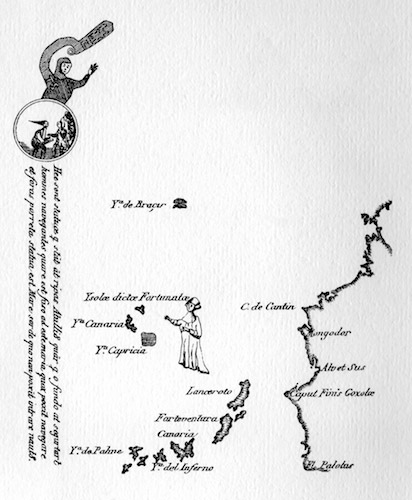
THE COAST OF N.W. AFRICA, ACCORDING TO THE PIZZIGANI
MAP, 1567.
Volume 1 ends with the illustration of the Coast of N.W. Africa.
Endnotes and index pertaining to Volume 1 have been added, below, for
the convenience of the reader; originally, they were included only in
Volume 2.
Obsolete and archaic spellings were retained. Punctuation was
standardized. Footnotes were moved to the end of the chapter to which
they pertain.
There were two endnotes numbered 75. The second was renumbered as
75A. The anchor for 75A was missing in the original. Chapter XXVII
contained three anchors to endnote 84. They all refer to the same
endnote, and are renumbered here as [84], [84a] and [84b]. The second
one was numbered [85] in the original text.
The remaining changes are indicated by dotted lines under the text.
Scroll the mouse over the word and the original text will appear.
NOTES.
[N.B.—The page references
are to the Hakluyt Society's translation].
INDEX.
- Adahu, 48
- Affonso V of Portugal, i, v, x,
xi, xiv, xxii, xxiii, xxvi, xxviii, xxx, xxxviii, xli, xliii; 1, 3, 11,
14, 19, 20, 39, 98
- Affonso, Diego, xvi, xvii; 95, 101, 102, 103, 118
- Affonso, Stevam, 63
- Ahude Meymam (Meimom), 110
- Aires, G., xxiv
- Algarve, Prov. of, 9
- Alvarez, R., 63
- Alvellos, L. d', 91
- Arguim, Bight and Islands of, 58, 63, 68, 87, 96, 104, 107
- Aristotle, "The Philosopher," 22, 44
- Atlas, 13
- Augustine, St., 44, 92, 93
- Avranches, Count of, 19
- Azanegues, 49
- Azevedo, F. L. d', 52
- Azevedo, R. d', ii, iv, xxxii
- Azurara, G. E. d', l-lxvii, passim; 1-10, 98, 103
- Azurara, J. E. d', ii
- Baldaya, A. G., xi; 34, 35-8
- Balthasar, 55
- Barcellos, Count, Duke of Braganza,
16
- Barros, J., ii, xxviii, xlvi
- Belem, 19
- Bernaldez, J., 63, 73
- Boccaccio, G., ix
- Braga, T., ix
- Braganza, Lord of = D. Fernando, nephew of John I of
Portugal, 16
- Brandan, St., 27
- Brito, S. de, iii
- Bugia, 17
- Cadiz, 21
- Cæsar, C. J., 24,
93
- Caldeira, L., 91
- Cerveira, A., xvii; 103
- Ceuta, 15-18
- Chrysostom, St., 26
- Cicero, 14,
24, 25
- Cid, The = Ruy Diaz de Bivar, 4
- Cocles, Horatius, 24
- Coutinho, G. V., 16
- Diaz, D., xvii; 98-100
- Diaz, J., 63
- Diaz, L., 106
- Diniz (Denis, Dionysius), of Portugal, Intr. i, v, xxv
- Duarte (Edward), of Portugal, Intr. i, v, vii, ix, xiv; 3, 11,
18, 28, 39
- Eannes, Gil, xiv; 32-4, 63, 69-71, 74-5
- Eannes, Gil, 122
- Eannes, M., xxxii-iii
- Eugenius IV, Pope, 53
- Fernandez, A., xix
- Fernandez, J., xix; 95, 101, 107-11, 117
- Fernandez, M., 57
- Fernando, "O Formoso," King of Portugal, xxix
- Fez, 17
- Gama, V. da, xxvii
- Garamantes, 7
- Genoese, in connection with Spain and Portugal, 21
- George, 91
- Gibraltar, 17
- Gil, A., 117
- Gil, D., 121
- Goes, D. de, ii, xxxi, xliv, xlv
- Gonçalvez, A., xiv, xv, xvi; 39-51, 52, 54-7, 95, 101-7, 109-13, 117, 118
- Gonçalvez, J., 117
- Goterres, A., 40,
42
- Graa, D. E. de, 117, 126
- Granada, 17
- Gregory I, Pope, St., 7
- Guarcia, A., xxiv
- Hannibal, 94
- Henry, "The Navigator," Prince of Portugal, viii, x -xx, xxvii, l, lii, lvii, lxiii; 1, 3, 6-35, 38-9, 40, 51-4, 55, 60-62, 79-87, 95, 98, 100, 101, 106-7, 116
- Herculano, ii, xlii
- Homem, G., xvii; 101-2, 118
- Homem, H., 37
- Isabel, Duchess of Burgundy, sister of Henry the Navigator,
11
- "Islands of the Ocean," 9
- "Italian Wisdom," 8
- James, St., of Compostella (Santiago), 5
- Jerome, St., 22
- John I, of Portugal, viii, ix, xxv; 3, 11,
17, 98
- John, Prince of Portugal, 17
- John, of Lançon, 4
- Josephus, 54
- "Labyrinth," 8
- Lagos, 61,
70
- Lançarote, xv-xviii; 60-80, 83, 86
- Lisbon, 50, 115
- Livy, 44,
93
- Lopes, Fernam, v, vii, viii, xxi,
xxix, xlv
- Lucan, 24
- Mafaldo, 117-123
- Marocco, 17
- Menezes, P. de, xxv, xxvi, xxxv, xl
- Menezes, D. de, xxxviii
- Menezes, H. de, xxxix-xl
- Meyrelles, V. de, iv
- Mohammed, 10
- Pacheco, G., xviii; 116
- Pedro, D., Regent of Portugal, brother of Henry Navigator, viii, xiv, xv; 19,
53, 95
- Pedro, D., nephew of Henry Navigator, i
- Pedro, D., of Aragon, xxxvi
- Pereira, Nun'Alvares, vii, xi, liii-iv; 4
- Phidias, 22
- Philippa, mother of Henry Navigator, xlvi; 11
- Pillito, A. G., 91
- Pina, R. de, vi, viii
- Pirez, G., xvi,
xx
- Pisano, M. de, i,
iv, xxxv
- Prester John, 55
- Ramiro, D., 5
- Roderic of Toledo, 54
- Romulus, 24
- Sagres, 21
- Sallust, 22
- Santarem, Viscount, xi
- Seneca, 25,
26, 94
- Serra, C. de, iii
- Sigismund (Siegmund), 24
- Sintra, G. de, xvi, xviii; 87-91, 94
- Socrates, 45
- Tangier, 14
- Thomas Aquinas, St., 2, 7
- Torquatus, M., 24, 93
- Tristam, N., xiv-xvii, xix; 44-51, 58-9, 63, 96-8
- Tunis, 17
- Valerius Maximus, 23, 44
- Valladores, D. A. de, 47
- Vallarte, xx
- Vasconcellos, C. M. de, vii
- Vasquez, A., 122, 124-5
- Vasquez, G., 63
- Vegetius, 93
- Vergerio, P., 116
- Vicente, M., 63,
64
- Vinagre, G., 48